/




Текст
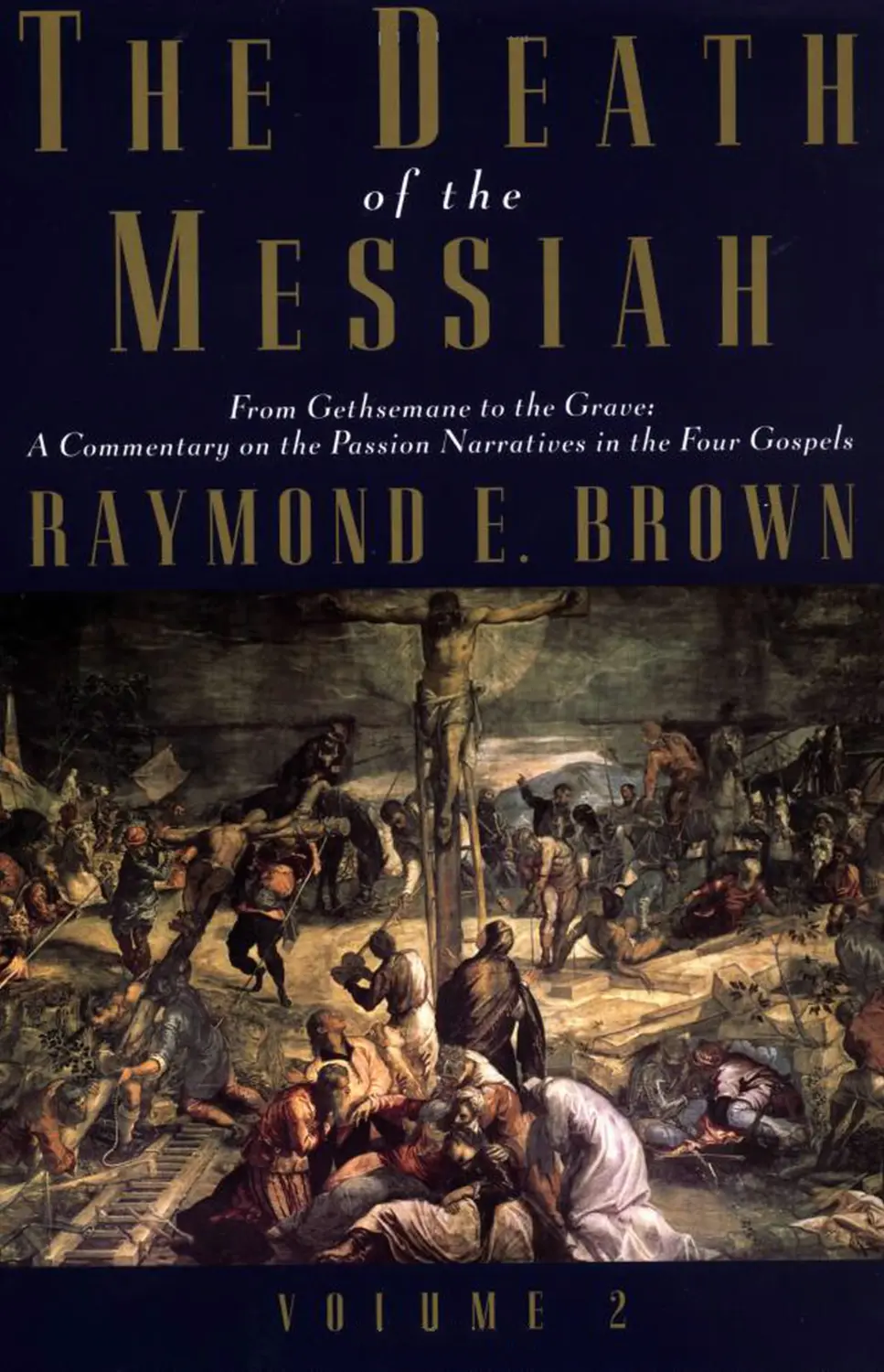
                    Messiah
гот
RAYMOND E. BROWN
The Death of the Messiah
Volume Two
The Anchor Bible Reference Library is designed to be a third major
component of the Anchor Bible group, which includes the Anchor Bible
commentaries on the books of the Old Testament, the New Testament, and
the Apocrypha, and the Anchor Bible Dictionary. While the Anchor Bible
commentaries and the Anchor Bible Dictionary are structurally defined by
their subject matter, the Anchor Bible Reference Library will serve as a
supplement on the cutting edge of the most recent scholarship. The series
is open-ended; its scope and reach are nothing less than the biblical world
in its totality, and its methods and techniques the most up-to-date available
or devisable. Separate volumes will deal with one or more of the following
topics relating to the Bible: anthropology, archaeology, ecology, economy,
geography, history, languages and literatures, philosophy, religion(s), the-
ology.
As with the Anchor Bible commentaries and the Anchor Bible Dictionary,
the philosophy underlying the Anchor Bible Reference Library finds expres-
sion in the following: the approach is scholarly, the perspective is balanced
and fair-minded, the methods are scientific, and the goal is to inform and
enlighten. Contributors are chosen on the basis of their scholarly skills
and achievements, and they come from a variety of religious backgrounds
and communities. The books in the Anchor Bible Reference Library are in-
tended for the broadest possible readership, ranging from world-class schol-
ars, whose qualifications match those of the authors, to general readers, who
may not have special training or skill in studying the Bible but are as enthusi-
astic as any dedicated professional in expanding their knowledge of the
Bible and its world.
David Noel Freedman
GENERAL EDITOR
THE ANCHOR BIBLE REFERENCE LIBRARY
THE DEATH
OF THE MESSIAH
From Gethsemane to the Grave
A COMMENTARY
ON THE PASSION NARRATIVES
IN THE FOUR GOSPELS
Volume Two
BY
Raymond E. Brown, S.S.
ABUL
Doubleday
NEW YORK LONDON TORONTO SYDNEY AUCKLAND
The Anchor Bible Reference Library
PUBLISHED BY DOUBLEDAY
a division of Bantam Doubleday Dell Publishing Group, Inc.
1540 Broadway, New York, New York 10036
The Anchor Bible Reference Library, Doubleday, and the portrayal
of an anchor with the letters ABRL are trademarks of Doubleday,
a division of Bantam Doubleday Dell Publishing Group, Inc.
Library of Congress Cataloging-in-Publication Data
Brown, Raymond Edward.
The death of the Messiah : from Gethsemane to the grave : a commentary on the
Passion narratives in the four Gospels I
Raymond E. Brown.— 1st ed.
p. cm.—(The Anchor Bible reference library) Includes bibliographical refer-
ences and indexes.
ISBN 0-385-19396-3 (v. 1)—ISBN 0-385-19397-1 (v.2)
1. Passion narratives (Gospels) I. Title. II. Series
BS2555.3.B7633 1994
226'.07—dc20	93-9241
CIP
Nihil obstat
Myles M. Bourke, S.T.D., S.S.L.
Censor deputatus
Imprimatur
©Patrick J. Sheridan, D.D.
Vicar General, Archdiocese of New York
April 30, 1993
The nihil obstat and imprimatur are official declarations that a book or pamphlet is
free of doctrinal or moral error. No implication is contained therein that those who
have granted the nihil obstat and imprimatur agree with the contents, opinions, or
statements expressed.
ISBN 0-385-19397-1 (Volume 2)
ISBN 0-385-19396-3 (Volume 1)
Copyright © 1994 by the Associated Sulpicians of the U.S.
All Rights Reserved
Printed in the United States of America
March 1994
7 9 10 8 6
CONTENTS OF VOLUME TWO
(Before each “Act” and “Scene” of the Commentary, a more detailed table will
be given breaking the sections [marked by §] into subsections.)
Abbreviations
ix
COMMENTARY (in Four Acts)
ACT IV: JESUS IS CRUCIFIED AND DIES ON GOLGOTHA
HE IS BURIED NEARBY
(Mark 15:20b-47; Matt 27:31b-66; Luke 23:26-56; John 19:16b-42)
SCENE ONE: Jesus Is Crucified and Dies (Mark 15:20b-41;
Matt 27:31b-56; Luke 23:26-49; John 19:16b-37)
§37	. Sectional Bibliography: The Crucifixion of Jesus	884-899
§38	. Introduction: Structure of the Crucifixion and Burial Accounts 900-909
§39	. Transitional Episode: Jesus Led Out to be Crucified
(Mark 15:20b-21; Matt 27:3lb-32; Luke 23:26-32; John 19:16b-17a) §40	. Jesus Crucified, Part One: The Setting (Mark 15:22-27; Matt 27:33-38; Luke 23:33-34; John 19:17b-24) §41	. Jesus Crucified, Part Two: Activities at the Cross (Mark 15:29-32; Matt 27:39-44; Luke 23:35-43; John 19:25-27) §42	. Jesus Crucified, Part Three: Last Events, Death (Mark 15:33-37; Matt 27:45-50; Luke 23:44-46; John 19:28-30)	910-932 933-981 982-1030 1031-1096
vi
Contents of Volume Two
§43. Jesus Crucified, Part Four: Happenings after Jesus’ Death:
a. External Effects
(Mark 15:38; Matt 27:51-53; [Luke 23:45b])	1097-1140
§44. Jesus Crucified, Part Four: Happenings after Jesus’ Death b. Reactions of Those Present (Mark 15:39-41; Matt 27:54-56; Luke 23:47-49; John 19:31-37)	1141-1198
SCENE TWO: Jesus Is Buried (Mark 15:42-47; Matt 27:57-66; Luke 23:50-56; John 19:38-42) §45. Sectional Bibliography: The Burial of Jesus	1201-1204
§46. The Burial of Jesus, Part One: Joseph’s Request for the Body (Mark 15:42-45; Matt 27:57-58; Luke 23:50-52; John 19:38a)	1205-1241
§47. The Burial of Jesus, Part Two: Placing the Body in the Tomb (Mark 15:46-47; Matt 27:59-61; Luke 23:53-56a; John 19:38b-42)	1242-1283
§48. The Burial of Jesus, Part Three: On the Sabbath; the Guard at the Sepulcher (Matt 27:62-66; Luke 23:56b)	1284-1313
APPENDIXES I. The Gospel of Peter—a Noncanonical Passion Narrative	1317-1349
II. Dating the Crucifixion (Day, Monthly Date, Year)	1350-1378
III. Pertinent Passages Difficult to Translate (Mark 14:41; Hebrews 5:7-8; Matt 26:50, John 19:13)	1379-1393
IV. Overall View of Judas Iscariot	1394-1418
V. Jewish Groups and Authorities Mentioned in the Passion Narratives	1419-1434
VI. The Sacrifice of Isaac and the Passion	1435-1444
VII. The Old Testament Background of the Passion Narratives	1445-1467
VIII. Jesus’ Predictions of His Passion and Death	1468-1491
IX. The Question of a PreMarcan Passion Narrative, by Marion L. Soards	1492-1524
Contents of Volume Two	vii
INDEXES
Bibliographical Index of Authors	1527-1555
Index of Subjects	1556-1581
Gospel Passage Index (including consecutive translation
of passion narratives)	1583-1608
ILLUSTRATIVE TABLES
6.	Comparing the Synoptic Crucifixion and Burial Accounts 902
7.	Chiastic Structure of John’s Account of the Crucifixion and
Burial	908
8.	The Women: on Friday (I) before or after Jesus’ death;
(II)	at the Burial; and on Easter (III) at the Empty Tomb	1016
9.	Comparing the Matthean Birth and Burial/Resurrection
Accounts	1302
10.	Sequence in the Gospel of Peter and the Canonical Gospels 1323
11.	Comparison of the (Qumran) Solar Calendar and the Lunar
Calendar for Dating Events in the Passion Narrative	1367
12.	Synoptic Gospel Predictions of Jesus’ Passion and Violent
Death	1470
13.	The Three Detailed Synoptic Predictions of the Passion of the
Son of Man	1474
14.	Theories of Various Scholars about the Composition of the
Marcan Passion Narrative	1502
ABBREVIATIONS
AB AER AJBI AJEC	Anchor Bible American Ecclesiastical Review Annual of the Japanese Biblical Institute Anti-Judaism in Early Christianity; Vol. I: Paul and the Gospels, ed. P. Richardson (Waterloo, Ont.: Canadian Corp, for Studies in Religion and Wilfred Laurier Univ., 1986)
AJINT	Antijudaismus im Neuen Testament? eds. W. P. Eckert et al. (Munich: Kaiser, 1967)
AJSL AJT AnBib AnGreg ANRW Ant. AP	American Journal of Semitic Languages and Literature American Journal of Theology Analecta Biblica Analecta Gregoriana Aufstieg und Niedergang der romischen Welt The Antiquities of Flavius Josephus Apocrypha and Pseudepigrapha of the Old Testament, ed. R. H. Charles (2 vols.; Oxford: Clarendon, 1913)
AsSeign ASTI ATANT ATR A.U.C.	Assemblees du Seigneur Annual of the Swedish Theological Institute Abhandlungen zur Theologie des Alten und Neuen Testaments Anglican Theological Review anno urbis conditae or ab urbe condita (a specified year from the founding of Rome)
AUSS BA BAA	Andrews University Seminary Studies Biblical Archaeologist M. Black, An Aramaic Approach to the Gospels and Acts (3d ed.; Oxford: Clarendon, 1967)
BAG	W. Bauer, W. F. Arndt, and F. W. Gingrich, Greek-English Lexicon of the New Testament and Other Early Christian Literature (Cam- bridge Univ., 1957)
BAGD BARev	BAG revised by F. W. Danker (Univ, of Chicago, 1979) Biblical Archaeology Review
X
Abbreviations
ввм	R. E. Brown, The Birth of the Messiah (Garden City, NY: Double- day, 1977; new ed., 1993)
BDF	E Blass, A. Debrunner, and R. W. Funk, A Greek Grammar of the New Testament (Univ, of Chicago, 1961). Refs, to sections.
BEJ	R. E. Brown, The Epistles of John (AB 30; Garden City, NY: Doubleday, 1982)
BeO BETL BExT BGJ	Bibbia e Oriente Bibliotheca Ephemeridum Theologicarum Lovaniensium P. Benoit, Exegese et Theologie (4 vols.; Paris: Cerf, 1961-82) R. E. Brown, The Gospel According to John (2 vols.; AB 29, 29A; Garden City, NY: Doubleday, 1966, 1970)
BHST	R. Bultmann, History of the Synoptic Tradition (New York: Harper & Row, 1963)
BibLeb BibLit BJG BJRL	Bibel und Leben Bibel und Liturgie P. Benoit, Jesus and the Gospel (2 vols.; New York: Herder, 1973) Bulletin of the John Rylands Library of the University of Man- chester
BK BR BS В Sac BSSNT	Bibel und Kirche Biblical Research Biblische Studien Bibliotheca Sacra K. Beyer, Semitische Syntax im Neuen Testament (Gottingen: Van- denhoeck & Ruprecht, 1962)
ВТ BTB BU BVC BW BWANT ByF BZ BZNW CB CBQ CC CCat CCER	The Bible Translator Biblical Theology Bulletin Biblische Untersuchungen Bible et Vie Chretienne Biblical World Beitrage zur Wissenschaft vom Alten und Neuen Testament Biblia у Fe Biblische Zeitschrift Beihefte zur ZNW Cultura Biblica Catholic Biblical Quarterly Corpus Christianorum (Series Latina) Civilta Cattolica Cahiers du Cercle Ernest Renan
Abbreviations
xi
CD CH CKC	Cairo (Genizah text of the) Damascus (Document) Church History Chronos, Kairos, Christos, eds. J. Vardaman and E. M. Yamauchi (J. Finegan Festschrift; Winona Lake, IN: Eisenbrauns, 1989)
ColB ConNT CQR CR CSA	Collationes Brugenses Coniectanea Neotestamentica Church Quarterly Review Clergy Review Chicago Studies (Anniversary Volume) 25 (#1; 1986: Passion, Death, and Resurrection of Jesus)
CSEL CT CTM CTom CurTM DACL DBG	Corpus Scriptorum Ecclesiasticorum Latinorum Christianity Today Concordia Theological Monthly Ciencia Tomista Currents in Theology and Mission Dictionnaire d’Archeologie Chretienne et de Liturgie M. Dibelius, Botschaft und Geschichte (2 vols.; Tubingen: Mohr, 1953, 1956)
DBS	H. Denzinger and C. Bannwart, Enchiridion Symbolorum, rev. by A. Schonmetzer (32d ed.; Freiburg: Herder, 1963). Refs, to sections.
DBSup DJ	Dictionnaire de la Bible, Supplement The Digest of Justinian, ed. T. Mommsen (4 vols.; Philadelphia: Univ, of Pennsylvania, 1985)
DJD DJS	Discoveries in the Judaean Desert A. Denaux, ed. John and the Synoptics (BETL 101; Leuven Univ., 1992). Analyzed by Denaux in ETL 67 (1991), 196-203.
DNTRJ	D. Daube, The New Testament and Rabbinic Judaism (London: Athlone, 1956)
DRev DSNT	Downside Review J.D.M. Derrett, Studies in the New Testament (4 vols.; Leiden: Brill, 1977-86)
DSS DSSW	The Dead Sea Scrolls G. Dalman, Sacred Sites and Ways (New York: Macmillan, 1935; German orig. 3d ed., 1924)
EBib EH EJMI	Etudes Bibliques Eusebius, Ecclesiastical History Early Judaism and its Modern Interpreters, eds. R. A. Kraft and G.W.E. Nickelsburg (Atlanta: Scholars, 1986)
xii	Abbreviations
EKKNT EQ ErbAuf EspVie EstBib EstEcl ETL ETR EvT ExpTim FANT	Evangelisch-katholischer Kommentar zum Neuen Testament Evangelical Quarterly Erbe und Auftrage Esprit et Vie (later LAmi du Clerge) Estudios Biblicos Estudios Eclesidsticos Ephemerides Theologicae Lovanienses Etudes Theologiques et Religieuses Evangelische Theologie Expository Times J. Finegan, The Archaeology of the New Testament (Princeton Univ., 1969)
FAWA	J. A. Fitzmyer, A Wandering Aramean (SBLMS 25; Missoula, MT: Scholars, 1979)
FB FESBNT	Forschung zur Bibel J. A. Fitzmyer, Essays on the Semitic Background of the New Testament (London: Chapman, 1971)
FGN	The Four Gospels 1992, eds. E Van Segbroeck et al. (F. Neirynck Festschrift; BETL 100; 3 vols.; Leuven Univ., 1992)
FRLANT	Forschungen zur Religion und Literatur des Alten und Neuen Testaments
FTAG	J. A. Fitzmyer, To Advance the Gospel (New York: Crossroad, 1981)
FV FZPT GCS GPet GVMF	Foi et Vie Freiburger Zeitschrift fur Philosophic und Theologie Die Griechischen Christlichen Schriftsteller (Berlin) The Gospel of Peter (see appendix I) Gottesverachter und Menschenfeinde? Juden zwischen Jesus und fruhchristlicher Kirche, ed. H. Goldstein (Dusseldorf: Patmos, 1979)
HeyJ HibJ HJPAJC	Heythrop Journal Hibbert Journal E. Schiirer, The History of the Jewish People in the Age of Jesus Christ (rev. by G. Vermes et al.; 3 vols.; Edinburgh: Clark, 1973-87)
HPG	The Holy Places of the Gospels by C. Kopp (New York: Herder and Herder, 1963)
HSNTA	E. Hennecke and W. Schneemelcher, New Testament Apocrypha
Abbreviations
xiii
	(2 vols.; Philadelphia: Westminster, 1963, 1965; rev. ed., vol. 1, 1991)
HTR HUCA IBS IEJ IER ILS	Harvard Theological Review Hebrew Union College Annual Irish Biblical Studies Israel Exploration Journal Irish Ecclesiastical Record Inscriptiones Latinae Selectae, ed. H. Dessau (3 vols.; Berlin: Weidmann, 1892-1916). Cited by inscription number.
ITQ JAAR J ANT	Irish Theological Quarterly Journal of the American Academy of Religion M. R. James, The Apocryphal New Testament (2d ed.; Oxford: Clarendon, 1953)
JBap JBL JBR JE JES JETS JEWJ	John the Baptist Journal of Biblical Literature Journal of Bible and Religion Jewish Encyclopedia Journal of Ecumenical Studies Journal of the Evangelical Theological Society J. Jeremias, The Eucharistic Words of Jesus (2d ed.; New York: Scribners, 1966)
JJC	Josephus, Judaism, and Christianity, eds. L. H. Feldman and G. Hata (Leiden: Brill, 1987)
JJS JJTJ	Journal of Jewish Studies J. Jeremias, Jerusalem in the Time of Jesus (Philadelphia: For- tress, 1969)
JPFC	The Jewish People in the First Century, eds. S. Safrai and M. Stern (2 vols.; Philadelphia: Fortress, 1974)
JPHD	Jesus and the Politics of His Day, eds. E. Bammel and C.F.D. Moule (Cambridge Univ., 1984)
JQR JRS JSJ	Jewish Quarterly Review Journal of Roman Studies Journal for the Study of Judaism in the Persian, Hellenistic and Roman Period
JSNT JSNTSup JTS KACG	Journal for the Study of the New Testament Journal for the Study of the New Testament—Supplement Series Journal of Theological Studies H. Koester, Ancient Christian Gospels (Philadelphia: Trinity, 1990)
xiv	Abbreviations
KBW KJV KKS	Katholisches Bibelwerk (Verlag, Stuttgart) King Janies Version or Authorized Version of the Bible W. H. Keiber, A. Kolenkow, and R. Scroggs, “Reflections on the Question: Was There a Pre-Markan Passion Narrative?” SBLSP (1971), 2.503-86.
Kyr	Kyriakon, eds. P. Granfield and J. A. Jungmann (J. Quasten Fest- schrift; 2 vols.; Munster: Aschendorff, 1970)
LB LD LFAE	Linguistica Biblica Lectio Divina Light from the Ancient East by A. Deissmann (rev. ed.; New York: Doran, 1927)
LKS	H. Lietzmann, Kleine Schriften II (TU 68; Berlin: Akademie, 1958)
LS Lum Vie LXX MACM	Louvain Studies Lumiere et Vie (The) Septuagint Greek Translation of the ОТ H. Musurillo, The Acts of the Christian Martyrs (Oxford: Clarendon, 1972)
MAPM	H. Musurillo, The Acts of the Pagan Martyrs (Oxford: Clarendon, 1954)
MGNTG	J. H. Moulton (and N. Turner), Grammar of New Testament Greek (4 vols.; Edinburgh: Clark, 1908-76)
MIBNTG	C.F.D. Moule, An Idiom-Book of New Testament Greek (Cam- bridge Univ., 1960)
MM	J. H. Moulton and G. Milligan, The Vocabulary of the Greek New Testament Illustrated from the Papyri and Other Non-Literary Sources (repr.; Grand Rapids: Eerdmans, 1963)
MNTS	Die Mitte des Neuen Testaments, eds. U. Luz and H. Weder (E. Schweizer Festschrift; Gottingen: Vandenhoeck & Ruprecht, 1983)
ms., mss. MT MTC	manuscript(s) (The) Mas(s)oretic Text of the ОТ or standard Hebrew Bible В. M. Metzger, A Textual Commentary on the Greek New Testa- ment (New York: United Bible Societies, 1971)
MTZ NAB NDIEC NEB NEv	Munchener Theologische Zeitschrift New American Bible (1970; Revised NT 1986) New Documents Illustrating Early Christianity New English Bible (1961) F. Neirynck, Evangelica, Gospel Studies—Etudes d’Evangile (2
Abbreviations
xv
	vols.; Louvain: Peeters, 1982, 1991). Vol. 1 covers articles written in 1966-81; vol. 2, 1982-91.
NHL	The Nag Hammadi Library, ed. J. M. Robinson (3d ed.; New York: Harper & Row, 1988)
NICOT NJBC	New International Commentary on the Old Testament New Jerome Biblical Commentary, eds. R. E. Brown et al. (Engle- wood Cliffs, NJ: Prentice-Hall, 1990). Refs, to articles and sec- tions.
NKZ NorTT NovT NovTSup NRSV NRT NS NT NTA NTAbh NTS NTT OL OS OScur OSsi" от OTP	Neue Kirchliche Zeitschrift Norsk Teologisk Tidsskrift Novum Testamentum Novum Testamentum, Supplements New Revised Standard Version of the Bible Nouvelle Revue Theologique new series (of a periodical) New Testament New Testament Abstracts Neutestamentliche Abhandlungen New Testament Studies Nederlands Theologisch Tijdschrift The Old Latin Version of the Bible The Old Syriac Version of the Bible The Curetonian tradition of the OS The Sinaitic tradition of the OS Old Testament The Old Testament Pseudepigrapha, ed. J. H. Charlesworth (2 vols.; Garden City, NY: Doubleday, 1983-85)
par.	parallel(s) in one or both of the other Synoptic Gospels to the pas- sage cited
PBI PEFQS PEQ PG PGJK	The Pontifical Biblical Institute (Rome) Palestine Exploration Fund, Quarterly Statement Palestine Exploration Quarterly Patrologia Graeca-Latina (Migne) Der Process gegen Jesus, ed. K. Kertelge (QD 112; Freiburg: Herder, 1988)
PIBA PILA	Proceedings of the Irish Biblical Association Political Issues in Luke-Acts, eds. R. J. Cassidy and P. J. Scharper (Maryknoll: Orbis, 1983)
PL	Patrologia Latina (Migne)
xvi	Abbreviations
PMK	The Passion in Mark. Studies on Mark 14-16, ed. W. H. Keiber (Philadelphia: Fortress, 1976)
PN	Passion Narrative. Most often the Passion Narratives of the canoni- cal Gospels that this book considers to be Mark 14:26-15:47; Matt 26:30-27:66; Luke 22:39-23:56; John 18:1-19:42.
PNT	Peter in the New Testament, eds. R. E. Brown et al. (New York: Paulist, 1973)
Q	Quelle or source for material shared by Matt and Luke but absent from Mark
QD RA RArch RB RBen RDLJ	Quaestiones Disputatae Revue Apologetique Revue Archeologique Revue Biblique Revue Benedictine Reimaging the Death of the Lukan Jesus, ed. D. D. Sylva (Bonner Biblische Beitrage 73; Frankfurt: Hain, 1990)
REA RechBib RechSR REJ RevExp RevQ RevSR RHPR RHR RivB RQ	Revue des Etudes Anciennes Recherches Bibliques Recherches de Science Religieuse Revue des Etudes Juives Review and Expositor Revue de Qumran Revue des Sciences Religieuses Revue d’Histoire et de Philosophic Religieuses Revue de I ’Histoire des Religions Rivista Biblica Romische Quartalschrift fur Christliche Altertumskunde und Kirchengeschichte
RSJ	G. Richter, Studien zum Johannesevangelium, ed. J. Hainz (BU 13; Regensburg: Pustet, 1977)
RSV RThom RTL RTP RTPL	Revised Standard Version of the Bible Revue Thomiste Revue Theologique de Louvain Revue de Theologie et de Philosophie Redaktion und Theologie des Passionsberichtes nach den Synop- tikern, ed. M. Limbeck (Wege der Forschung 481; Darmstadt: Wissenschaftliche Buch., 1981)
RV	The Revised Version of the Bible
Abbreviations
xvii
SANT SB SBB SBE SBFLA SBJ SBLA SBLDS SBLMS SBLSBS SBLSP SBS SBT SBU SC ScEsp SEA SGM SJT SNTSMS SO SPAW	Studien zum Alten und Neuen Testament Sources Bibliques Stuttgarter Biblische Beitrage Semana Biblica Espanola Studii Biblici Franciscan! Liber Annuus La Sainte Bible de Jerusalem Society of Biblical Literature Abstracts Society of Biblical Literature Dissertation Series Society of Biblical Literature Monograph Series Society of Biblical Literature Sources for Biblical Studies Society of Biblical Literature Seminar Papers Stuttgarter Bibelstudien Studies in Biblical Theology Symbolae Biblicae Upsalienses Sources Chretiennes Science et Esprit Svensk Exegetisk Arsbok Secret Gospel of Mark Scottish Journal of Theology Society for New Testament Studies Monograph Series Symbolae Osloenses Sitzungsberichte der (koniglichen) Preussischen Akademie der Wissenschaften
SPNM	D. P. Senior, The Passion Narrative According to Matthew (BETL 39; Leuven Univ., 1975)
SRSTP	Society and Religion in the Second Temple Period, eds. M. Avi Yonah and Z. Baras (World History of the Jewish People 8; Jeru- salem: Massada, 1977)
ST St-B	Studia Theologica H. L. Strack and P. Billerbeck, Kommentar zum Neuen Testament aus Talmud und Midrasch (6 vols.; Munich: Beck, 1926-61)
StEv	Studia Evangelica (I = TU 73 [1959]; II = TU 87 [1964]; III = TU 88 [1964]; IV = TU 102 [1968]; V = TU 103 [1968]; VI = TU 112 [1973]; VII = TU 126 [1982])
SuS SWJT TalBab TalJer	Sein und Sendung Southwestern Journal of Theology The Babylonian Talmud The Jerusalem Talmud
xviii	Abbreviations
твт TCSCD	The Bible Today Theologia Crucis—Signum Crucis, eds. C. Andresen and G. Klein (E. Dinkier Festschrift; Tubingen: Mohr, 1979)
TD TDNT	Theology Digest Theological Dictionary of the New Testament, eds. G. Kittel and G. Friedrich (10 vols.; Grand Rapids: Eerdmans, 1964-76; Ger- man orig. 1928-73)
TG TJCSM	Theologie und Glaube The Trial of Jesus—Cambridge Studies in Honour of C.D.F. Moule, ed. E. Bammel (SBT, 2d series 13; London: SCM, 1970)
TJT TLOTC	Toronto Journal of Theology The Language of the Cross, ed. A. Lacomara (Chicago: Franciscan Herald, 1977)
TLZ TNTSJ	Theologische Literaturzeitung The New Testament and Structuralism, ed. A. M. Johnson, Jr. (Pittsburgh Theol. Monograph 11; Pittsburgh: Pickwick, 1976)
TPNL	V Taylor, The Passion Narrative of St Luke (Cambridge Univ., 1972)
TPQ TQ TS TSK TTK	Theologisch-Praktische Quartalschrift Theologische Quartalschrift Theological Studies Theologische Studien und Kritiken Text and Testimony, eds. T. Baarda et al. (A.F.J. Klijn Festschrift; Kampen: Kok, 1988)
TToday TTZ TU TV	Theology Today Trierer Theologische Zeitschrift Texte und Untersuchungen Theologische Versuche, eds. J. Rogge and G. Schille (Berlin: Evangelische Verlag). In this annual a Roman numeral distinguish- ing the volume is part of the title.
TZ UBSGNT VC VCaro VD Vint VSpir VT WD	Theologische Zeitschrift United Bible Societies Greek New Testament Vigiliae Christianae Verbum Caro Verbum Domini Vie Intellectuelle Vie Spirituelle Vetus Testamentum Wort und Dienst
Abbreviations
xix
WUNT ww ZAGNT	Wissenschaftliche Untersuchungen zum Neuen Testament Wort und Wahrheit M. Zerwick and M. Grosvenor, An Analysis of the Greek New Testament (2 vols.; Rome: PBI, 1974, 1979)
ZAW ZBG ZBTJ	Zeitschrift fur die Alttestamentliche Wissenschaft M. Zerwick, Biblical Greek (Rome: PBI, 1963) Zur Bedeutung des Todes Jesu, ed. F. Viering (Gutersloh: Mohn, 1967)
ZDMG ZDPV ZKT ZNW ZTK ZWT	Zeitschrift der Deutschen Morgenlandischen Gesellschaft Zeitschrift des Deutschen Palastina- Vereins Zeitschrift fur Katholische Theologie Zeitschrift fur die Neutestamentliche Wissenschaft Zeitschrift fur Theologie und Kirche Zeitschrift fur Wissenschaftliche Theologie
Standard abbreviations are used for the biblical books and the Dead Sea Scrolls.
(For information about the major scrolls, see NJBC 67:82-95.) The ОТ in gen-
eral and the psalms in particular are cited according to Hebrew chapter and verse
numbers. This holds true even when the LXX is under discussion. It will help
readers to know that in the psalms the LXX number is frequently one lower than
the Hebrew number, e.g., Hebrew Ps 22 is LXX Ps 21. The KJV and RSV num-
ber of a psalm verse is frequently one number lower than the Hebrew, e.g.,
Hebrew Ps 22:2 is RSV Ps 22:1.
The names Mark, Matt, Luke, and John are used both for the writings and the
writers. No supposition is made about the identity of the individual evangelists;
thus when used for the writer, John means whoever was the principal writer of
the Gospel according to John. Mark/Matt is used where Mark and Matt (Gospels
or evangelists) are so close that they may be considered as presenting the same
data or view.
An asterisk after the name of a ms. of the Bible indicates a reading in the
hand of the original copyist as distinct from later additions or changes. Sections
(= chapters) in this book are marked by the § sign plus a numeral from 1 to 48
(see list of Contents above). Cross-references within the book will employ that
sign with the appropriate section number; see the running head at the top of
pages for easy access to the section indicated.
COMMENTARY
ON ACT IV:
JESUS IS CRUCIFIED
AND DIES ON GOLGOTHA
HE IS BURIED NEARBY
(Mark 15:20b-47; Matt 27:31b-66; Luke 23:26-56;
John 19:16b-42)
The fourth Act of the Passion Narrative describes how Jesus, having been led
out to Golgotha, was crucified between two others as “the King of the Jews!"
During the hours that he hung on the cross, there were reactions by various
people who stood nearby, as well as words spoken by Jesus until he
gave up/over his spirit. His death was greeted by wondrous events, and again
reactions by various people. Finally Joseph from Arimathea took the
body and buried it nearby, while the women looked on.
CONTENTS OF ACT IV, SCENE ONE
SCENE ONE: Jesus Is Crucified and Dies (Mark 15:20b-41; Matt
27:31b-56; Luke 23:26-49; John 19:16b-37)
§37 Sectional Bibliography: The Crucifixion of Jesus (§§38-44)	884-99
Part 1:	Transitional: Jesus Led from Pilate’s Praetorium
to the Site of Crucifixion (§39)	884
Part 2:	Geography of the Crucifixion, Specifically the Site
of Golgotha and Jesus’ Sepulcher	884
Part 3:	Overall: Ancient Crucifixion; Gospel Accounts of Jesus’
Crucifixion (§40)	885
Part 4:	Setting: Title, Third Hour, Garments, First Drink,
“Father, forgive them” (§40)	887
Part 5:	Synoptic Accounts of Activities at the Cross;
Luke’s “Good Thief” (§41)	889
Part 6:	Those Near the Cross (John 19:25-27); Identity
ofthe Women (§41)	890
Part 7:	Last Events and Words, Exclusive of the Death Cry
in Mark/Matt (§42)	891
Part 8:	Death Cry (“My God, my God . ..”)
in Mark/Matt, and Elijah (§42)	892
Part 9:	Reality of the Death of Jesus and
Its Physiological Cause (§42)	893
Part 10:	Rending of the Sanctuary Veil (§43)	894
Part 11:	Special Phenomena in Matt 27:51-53 (§43)	895
Part 12:	Synoptic Reactions to Death: Centurion’s Confession;
Galilean Women (§44)	896
Part 13:	Johannine Reactions to Death: Pierced Side;
Broken Bones (§44)	898
Contents of Act IV, Scene One	881
§38	. Introduction: Structure of the Crucifixion and Burial Accounts 900-9
A. Structure of the Mark/Matt Account	900
B.	Structure of Luke’s Account	905
C.	Structure of John’s Account	907
§39	. Transitional Episode: Jesus Led Out to Be Crucified
(Mark 15:20b-21; Matt 27:31b-32; Luke 23:26-32;
John 19:16b-17a)	910-32
Comment:
	Leading Jesus Out; the Carrying of the Cross;
Simon the Cyrenian	911
	Jesus Speaks to the Daughters of Jerusalem (Luke 23:27-31)	917
Analysis	928
§40	. Jesus Crucified, Part One: The Setting
(Mark 15:22-27; Matt 27:33-38; Luke 23:33-34;
John 19:17b-24)	933-81
Comment:
#	1. The Name of the Place (Mark 15:22; Matt 27:33;
Luke 23:33a; John 19:17b)	936
#	2. The Initial Offering of Wine (Mark 15:23; Matt 27:34)	940
#	3. The Crucifixion (Mark 15:24a; Matt 27:35a; Luke 23:33b;
John 19:18a)	945
#	4. The Division of Clothes (Mark 15:24b; Matt 27:35b;
Luke 23:34b; John 19:23-24)	952
#	5. The Third Hour (Mark 15:25); the Soldiers Keeping Guard
(Matt 27:36)	958
#	6. The Inscription and the Charge (Mark 15:26; Matt 27:37;
Luke 23:38; John 19:19-22)	962
#	7. Two Bandits or Wrongdoers (Mark 15:27; Matt 27:38;
Luke 23:33c; John 19:18b)	968
#	8. “Father, forgive them” (Luke 23:34a)	971
§41	. Jesus Crucified, Part Two: Activities at the Cross
(Mark 15:29-32; Matt 27:39-44; Luke 23:35-43;
John 19:25-27)	982-1030
Comment:
	The Threefold Mockery of Jesus (Mark 15:29-32;
Matt 27:39-44; Luke 23:35-39)	985
882
Contents of Act IV, Scene One
	The Salvation of the Other Wrongdoer (Luke 23:40-43)	1000
	Friends and Disciples Near the Cross (John 19:25-27)	1013
Analysis:
A.	Historicity	1026
B.	Some Added Theological Notes	1029
§42	. Jesus Crucified, Part Three: Last Events, Death
(Mark 15:33-37; Matt 27:45-50; Luke 23:44-46;
John 19:28-30)	1031-96
Comment:
	Darkness at the Sixth Hour (Mark 15:33; Matt 27:45;
Luke 23:44-45a)	1034
	Jesus’ Death Cry; Elijah; Offering of Vinegary Wine
(Mark 15:34-36; Matt 27:46-49)	1043
	Jesus’ Death Cry in Luke 23:46	1066
	Jesus’ Last Words and the Wine Offering in John 19:28-30a	1069
	The Death of Jesus in All the Gospels	1078
Analysis:
A	. Theories of How Mark 15:33-37 Was Composed	1083
B	. The Last Words of Jesus: Oldest Tradition and/or Historicity 1085
C. The Physiological Cause of the Death of Jesus	1088
D	. Imaginative Rewriting That Nullifies the Crucifixion	1092
§43	. Jesus Crucified, Part Four: Happenings after Jesus’ Death
a. External Effects
(Mark 15:38; Matt 27:51-53; [Luke 23:45b])	1097-1140
Comment:
	The Sanctuary Veil Rent (Mark 15:38; Matt 27:51;
Luke 23:45b	1098
	Special Phenomena in Matt 27:51-53	1118
Analysis:
A.	The Evangelists’ Theologies in Recounting the Rending of the
Sanctuary Veil	1134
B.	Matthew’s Theology in Recounting the Special Phenomena 1137
§44. Jesus Crucified, Part Four: Happenings after Jesus’ Death
b. Reactions of Those Present
(Mark 15:39-41; Matt 27:54-56; Luke 23:47-49;
John 19:31-37)	1141-98
Contents of Act IV, Scene One	883
Comment:
	Reactions of Those	Present according to Mark/Matt	1143
	Reactions of Those	Present according to Luke	1160
	Reactions of Those	Present according to John	1173
	Reactions of Those	Present according to GPet	1189
Analysis:
A.	The Historicity of the Reactors and of Their Reactions	1192
B.	The Composition of the Synoptic and the Johannine Accounts 1196
§37	. SECTIONAL BIBLIOGRAPHY
for Scene One of Act IV:
The Crucifixion of Jesus (§§38-44)
Discussions of the crucifixion of Jesus are particularly numerous. For this
bibliography to be useful, a greater division into parts than usual seemed
imperative. See the thirteen subdivisions outlined in the immediately pre-
ceding list of Contents.
Part 1:	Transitional: Jesus Led from Pilate’s Praetorium to the Site
of Crucifixion (§39)
Bishop, E.F.F., “Simon and Lucius: Where did they come from?” ExpTim 51 (1939—
40), 148-53.
Giblin, С. H., The Destruction of Jerusalem According to Luke's Gospel (AnBib 107;
Rome: PBI, 1985), esp. 93-104 on Luke 23:26-32.
Kaser, W., “Exegetische und theologische Erwagungen zur Seligpreisung der Kinder-
losen, Lc 23,29b,” ZNW 54 (1963), 240-54.
Kinsey, A. B., “Simon the Crucifer and Symeon the Prophet,” ExpTim 35 (1923-
24), 84-88.
Kudasciewicz, J., abstract of his Polish article on Luke 23:27-31, NTA 21 (1977),
#427.
Lee, G. M., “Mark xv 21, ‘The Father of Alexander and Rufus,’” NovT 17 (1975),
303.
Neyrey, J. H., “Jesus’ Address to the Women of Jerusalem (Lk 23.27-31)—A pro-
phetic judgment Oracle,” NTS 29 (1983), 74-86.
Reinach, S., “Simon de Cyrene,” Cultes, Mythes et Religions (5 vols.; Paris: Leroux,
1904-23), 4.181-88. Orig. in Revue de Г Universite de Bruxelles 17 (1912),
721-28.
Rinaldi, B., “Beate le sterili (Lc. 23,29),” BeO 15 (1973), 61-64.
Soards, M. L., “Tradition, Composition, and Theology in Jesus’ Speech to the
‘Daughters of Jerusalem,’ (Luke 23,26-32),” Biblica 68 (1987), 221-44.
Untergassmair, F. G., “Der Spruch vom ‘griinen und diirren Holz’ (Lk 23,31),” Stu-
dien zum Neuen Testament und seiner Umwelt 16 (1991), 55-87.
Part 2:	Geography of the Crucifixion, Specifically the Site of Golgotha and
Jesus’ Sepulcher
Bahat, D., “Does the Holy Sepulchre Church Mark the Burial of Jesus?” BARev 12
(3; 1986), 26-45.
§37 Parts 2-3: Crucifixion Geography and Gospel Accounts	885
Barkay, G., “The Garden Tomb—Was Jesus Buried There?” BARev 12 (2; 1986),
40-57.
Benoit, P., “Les remparts de Jerusalem,” BExT 4.292-310. Grig, in Le Monde de la
Bible 1 (Nov. 1977), 21-35.
Bible et Terre Sainte 149 (1973). Whole issue on Golgotha.
Corbo, V. С., Il Santo Sepulcro di Gerusalemme (3 vols.; Jerusalem: Franciscan,
1981-82).
Coiiasnon, C., The Church of the Holy Sepulchre in Jerusalem (London: Oxford,
1974).
Dalman, G., DSSW 346-81 on “Golgotha and the Sepulchre.”
Evans, L.E.C., “The Holy Sepulchre,” PEQ 100 (1968), 112-36.
Harvey, A. E., “Melito and Jerusalem,” JTS ns 17 (1966), 401-4 (in ref. to Mark
15:20b).
Jeremias, J., Golgotha (Leipzig: Pfeiffer, 1926).
Kretschmar, G., “Kreuz und Auferstehung Jesu Christi. Das Zeugnis der Heiligen
Statten,” ErbAuf 54 (1978), 423-31; 55 (1979), 12-26.
Lux (-Wagner), U., “Vorlaufiger Bericht liber die Ausgrabung unter der Erloser-
kirche im Muristan in der Altstadt von Jerusalem in den Jahren 1970 und 1971,”
ZDPV 88 (1972), 185-201.
Martin, E. L., “The Place of the Crucifixion,” The Foundation Commentator 10 (8;
Sept. 1983), 1-13.
-------, Secrets of Golgotha (Alahambra, CA: ASK, 1988). Updated information in
hisA.S./C Historical Report, Jan. 1992.
Riesner, R., “Golgotha und die Archaologie,” BK 40 (1985), 21-26.
Ross, J.-P. B., “The Evolution of a Church—Jerusalem’s Holy Sepulchre,” BARev
2(3; 1976), 3-8, 11.
Schein, В. E., “The Second Wall of Jerusalem,” BA 44 (1981), 21-26.
Smith, R. H., “The Tomb of Jesus,” BA 30 (1967), 74-90.
Vincent, L.-H., “Garden Tomb: histoire d’un mythe,” RB 34 (1925), 401-31.
Wilkinson, J., “The Church of the Holy Sepulchre,” Archaeology 31 (4; 1978),
6-13.
-------, “The Tomb of Christ: An Outline of its Structural History,” Levant 4
(1972), 83-97.
Part 3:	Overall: Ancient Crucifixion; Gospel Accounts
of Jesus’ Crucifixion (§40)
Bacon, B. W, “Exegetical Notes: John 19:17-20:20,” BW ns 13 (1899), 423-25.
Bailey, К. E., “The Fall of Jerusalem and Mark’s Account of the Cross,” ExpTim
102(1991), 102-5.
Bammel, E., “Crucifixion as a Punishment in Palestine,” TJSCM 162-65.
Baumgarten, J. M., “Does TLH in the Temple Scroll Refer to Crucifixion?” JBL 91
(1972), 472-81.
Bible et Terre Sainte 133 (1971). Whole issue on crucifixion.
Brandenburger, E., “Stauros, Kreuzigung Jesu und Kreuzestheologie,” WD 10
(1969), 17-43.
886	Sectional Bibliography: Act IV, Scene One
Cantinat, J., “Le crucifiement de Jesus,” VSpir 84 (1951), 142-53.
Carroll, J. T., “Luke’s Crucifixion Scene,” RDLJ 108-24, 194-203.
Charlesworth, J. H., “Jesus and Jehohanan: An Archaeological Note on Crucifixion,”
ExpTim 84 (1972-73), 147-50.
Collins, J. J., “The Archaeology of the Crucifixion,” CBQ 1 (1939), 154-59.
Diez Merino, L., “La crucifixion en la antigua literatura judia (Periodo intertesta-
mental),” EstEcl 51 (1976), 5-27.
Fitzmyer, J. A., “Crucifixion in Ancient Palestine, Qumran Literature, and the New
Testament,” CBQ 40 (1979), 493-513. Reprinted in FTAG 125-46.
Ford, J. M., “‘Crucify Him, Crucify Him,’ and the Temple Scroll,” ExpTim 87
(1975-76), 275-78.
Guillet, P.-E., “Les 800 ‘crucifies’ d’Alexandre Jannee,” CCER 25 (100; 1977),
11-16.
Haas, N., “Anthropological Observations on the Skeletal Remains from Giv'at ha-
Mivtar,” IEJ 20 (1970), 38-59, esp. 42, 49-59 on a crucified man.
Halperin, D. J., “Crucifixion, the Nahum Pesher, and the Rabbinic Penalty of Stran-
gulation,” JJS 32 (1981), 32-46.
Hengel, M., Crucifixion in the Ancient World and the Folly of the Message of the
Cross (Philadelphia: Fortress, 1977).
Hewitt, J. W, “The Use of Nails in the Crucifixion,” HTR 25 (1932), 29-45.
Holzmeister, U., “Crux Domini eiusque crucifixio ex Archaeologia Romana ilhis-
trantur,” VD 14 (1934), 149-55; 216-20; 241-49; 257-63.
Jeremias, J., “Perikopen-Umstellungen bei Lukas?” NTS 4 (1957-58), 115-19 (on
Luke 23:26-49).
Kreitzer, L., “The Seven Sayings of Jesus on the Cross,” New Blackfriars 72
(1991), 239-44.
Kuhn, H.-W., “Zum Gekreuzigten von Giv'at ha-Mivtar. Korrektur eigenes Ver-
sehens in der Erstveroffentlichung,” ZNW 69 (1978), 118-22.
-------, “Der Gekreuzigte von Giv'at ha-Mivtar,” TCSCD 303-34.
-------, “Jesus als Gekreuzigter in der friihchristlichen Verkiindigung bis zur Mitte
des 2. Jahrhunderts,” ZTK 72 (1975), 1-46.
-------, “Der Kreuzesstrafe wahrend der friihen Kaiserzeit,” ANRW 11/25.1
(1982), 648-793.
Leclercq, H., “Croix et Crucifix,” DACL 3 (1914), 3045-3131, esp. 3045-71 on
early centuries.
M011er-Christensen, V., “Skeletal Remains from Giv'at ha-Mivtar,” IEJ 26 (1976),
35-38.
Naveh, J., “The Ossuary Inscriptions from Giv'at ha-Mivtar,” IEJ 20 (1970), 33-37,
esp. 35 pertaining to a crucified man.
Nestle, Eb., “The Seven Words from the Cross,” ExpTim 11 (1899-1900),
423-24.
Osborne, G. R., “Redactional Trajectories in the Crucifixion Narrative,” EQ 51
(1979), 80-96.
Paton, W. R., “Die Kreuzigung Jesu,” ZNW 2 (1901), 339-41.
Robbins, V. K., “The Crucifixion and the Speech of Jesus,” Forum 4 (#1; 1988),
33-46.
§37 Parts 3-4: Crucifixion: Gospel Accounts and Setting	887
Rudel, W, “Die letzten Worte Jesu,” NKZ 21 (1910), 199-227.
Schreiber, J., Der Kreu^igungsbericht der Markusevangeliums Mk 15, 20b-41
(BZNW 48; Berlin: de Gruyter, 1986).
Scroggs, R., “The Crucifixion,” KKS 2.556-63.
Taylor, V., “The Narrative of the Crucifixion,” NTS 8 (1961-62), 333-34 (on Luke
23:26-49).
Trilling, W, “Le Christ, roi crucifie. Lc 23,35-43,” AsSeign 2d series, 65 (1973),
56-65.
Tzaferis, V., “Jewish Tombs at and near Giv'at ha-Mivtar, Jerusalem,” IEJ 20 (1970),
18-32, on the tomb of a crucified man.
-------, “Crucifixion—the Archaeological Evidence,” BARev 11 (#1; Jan/Feb
1985), 44-53. See corrective in 11 (#6; Nov/Dec 1985), 20-21.
van Unnik, W. C., “Der Fluch der Gekreuzigten,” TCSCD 483-99.
Wansbrough, H., “The Crucifixion of Jesus,” CR 56 (1971), 251-61.
Weeden, T. J., “The Cross as Power in Weakness (Mark 15:20b-41),” in PMK
115-34.
Wilcox, M., “‘Upon the Tree’—Deut 21:22-23 in the New Testament,” JBL 96
(1977), 85-99.
Wilkinson, J., “The Seven Words from the Cross,” SJT 17 (1964), 69-82.
Winandy, J., “Le temoignage du sang et de 1’eau,” BVC 31 (1960), 19-27, on John
19:17-37.
Yadin, Y, “Epigraphy and Crucifixion,” IEJ 23 (1973), 19-22.
Young, B., “The Cross, Jesus and the Jewish People,” Immanuel 24/25 (1990),
23-34.
Zias, J., and J. H. Charlesworth, “Crucifixion: Archaeology, Jesus, and the Dead Sea
Scrolls,” in Jesus and the Dead Sea Scrolls, ed. J. H. Charlesworth (New York:
Doubleday, 1992), 273-89.
Zias, J., and E. Sekeles, “The Crucified Man from Giv'at ha-Mivtar—A Reap-
praisal,” IEJ 35 (1985), 22-27; BA 48 (1985), 190-91.
Part 4:	Setting: Title, Third Hour, Garments, First Drink,
“Father, forgive them” (§40)
Aubineau, M., “La tunique sans couture du Christ. Exegese patristique de Jean 19,
23-24,” Kyr 1.100-27.
Bammel, E., “The titulus” JPHD 353-64.
Braun, E-М., “Quatre ‘signes’ johanniques de Г unite chretienne,” NTS 9 (1962-63),
147-55, esp. 150-52 on John 19:23-24.
Conybeare, F. C., “New Testament Notes: (2) The Seamless Coat,” Expositor 4th
Ser., 9 (1894), 458-60.
Cowling, С. C., “Mark’s Use of Hora” Australian Biblical Review 5 (1956), 153-60.
Dammers, A., “Studies in Texts: Luke xxiii,34a,” Theology 52 (1949), 138-39.
Daube, D., “‘For they know not what they do’: Luke 23,34,” Studia Patristica 4.2
(TU 79; Berlin: Akademie, 1961), 58-70.
Davies, J. G., “The Cup of Wrath and the Cup of Blessing,” Theology 51 (1948),
178-80.
888	Sectional Bibliography: Act IV, Scene One
de la Potterie, I., “La tunique ‘non divisee’ de Jesus, symbole de 1’unite messia-
nique,” in The New Testament Age, ed. W. C. Weinrich (Honor of B. Reicke; 2
vols.; Macon, GA: Mercer, 1984), 1.127-38.
-------, “La tunique sans couture, symbole du Christ grand pretre?” Biblica 60
(1979), 255-69.
Demann, P., “‘Pere, pardonnez-leur’ (Lc 23,34),” Cahiers Sioniens 5 (1951),
321-36.
de Waal, A., “Das Mora-Spiel auf den Darstellungen der Verlosung des Kleides
Christi,” RQ 8 (1894), 145-46.
Epp, E. J., “The ‘Ignorance Motif’ in Acts and the Antijudaic Tendencies in Codex
Bezae,” HTR 55 (1962), 51-62 (in ref. to Luke 23:34,41).
Flusser, D., “‘Sie wissen nicht was sie tun’. Geschichte eines Herrenwortes,” in Kon-
tinuitat und Einheit, eds. P.-G. Muller and W. Stenger (F. Mussner Festschrift;
Freiburg: Herder, 1981), 393-410.
Fuller, R. C., “The Drink Offered to Christ at Calvary,” Scripture 2 (1947),
114-15.
Harris, J. R., “New Points of View in Textual Criticism,” Expositor 8th Ser., 7
(1914), 316-34, esp. 324-34 on Luke 23:34a.
Heppner, T, “Eine vormoderte Hypothese und—eine neue Apokryphe?” TG 18
(1926), 657-71.
Karavidopoulos, J., “L’heure de la crucifixion de Jesus selon Jean et les synoptiques.
Me 15,25 par rapport a Jn 19,14-16,” in DJS 608-13.
Kennedy, A.R.S., “The Soldiers’ Portions (John xix. 23,24),” ExpTim 24 (1912-
13), 90-91.
Ketter, P, “1st Jesus auf Golgotha mit Galle und Essig getrankt worden?” Pastor
Bonus 38 (1927), 183-94.
Lee, G. M., “The Inscription on the Cross,” PEQ 100 (1968), 144.
Lipinski, E., abstract of his Polish article on the hour of the crucifixion, NTA 4
(1959-60), #54.
Mahoney, A., “A New Look at ‘The Third Hour’ of Mk 15,25,” CBQ 28 (1966),
292-99.
Miller, J. V., “The Time of the Crucifixion,” JETS 26 (1983), 157-66.
Moffatt, J., “Exegetica: Luke xxiii.34,” Expositor 8th Ser., 7 (1914), 92-93.
Nestle, Eb., “The Coat without Seam,” ExpTim 21 (1909-10), 521.
-------, “Der ungenahte Rock Jesu und der bunte Rock Josefs,” ZNW 3 (1902), 169.
-------, “ ‘Father, forgive them,”’ ExpTim 14 (1902-3), 285-86.
O’Rahilly, A., “The Title on the Cross,” IER 65 (1945), 289-97.
Primentas, N., abstract of his Modem Greek article on “The Tunic without Seam,”
NTA 37 (1993), #810.
Regard, P.-E, “Le titre de la croix d’apres les evangiles,” RArch 28 (1928), 95-105.
Rodgers, P, “Mark 15:28,” EQ 61 (1989), 81-84.
Rutherford, W. S., “The Seamless Coat,” ExpTim 22 (1910-11), 44-45.
Saintyves, P, “Deux themes de la Passion et leur signification symbolique,” RArch
Ser. V, 6 (1917 B), 234-70, esp. 234-48 on John 19:23.
Wilcox, M., “The Text of the Titulus in John 19.19-20 as Found in Some Italian
Renaissance Paintings,” JSNT 27 (1986), 113-16.
§37 Part 5: Activities at Jesus' Cross; Good Thief	889
Willcock, J., ‘“When he had tasted’ (Matt, xxvii.34),” ExpTim 32 (1920-21),
426.
Part 5:	Synoptic Accounts of Activities at the Cross; Luke’s
“Good Thief” (§41)
Altheim, F., and R. Stiehl, Die Araber in der alten Welt (5 vols.; Berlin: de Gruyter,
1964-69), 5/2.361-363 (“Aramaische Herrenworte” on Luke 23:42-43).
Aytoun, R. A., “‘Himself He cannot save’ (Ps. xxii 29 and Mark xv 31),” JTS 21
(1919-20), 245-48.
Bishop, E.F.F., “owa. Mark xv.29: A Suggestion,” ExpTim 57 (1945-46), 112.
Blathwayt, T. B., “The Penitent Thief,” ExpTim 18 (1906-7), 288.
Boulogne, C.-D., “La gratitude et la justice depuis Jesus Christ,” VSpir 96 (1957),
142-56 (on Luke 23:43).
Crowe, J., “The Laos at the Cross: Luke’s Crucifixion Scene,” TLOTC 75-101.
de la Calle, F., “‘Hoy estaras conmigo en el Paraiso.’ Vision inmediata de Dios о
purification en el ‘mas alia’?” ByF 3 (1977), 276-89.
Derrett, J.D.M., “The Two Malefactors (Lk. xxiii 33,39-43),” DSNT 3.200-14.
Donaldson, T. L., “The Mockers and the Son of God (Matthew 27.37-44): Two
Characters in Matthew’s Story of Jesus,” JSNT 41 (1991), 3-18.
Fitzmyer, J. A., “ ‘Today You Shall Be with Me in Paradise’ (Luke 23:43),” Luke the
Theologian (NY: Paulist, 1989), 203-33.
Garcia Perez, J. M., “El relato del Buen Ladron (Lc 23,39-43),” EstBib 44 (1986),
263-304.
Grelot, P, “ ‘Aujourd’hui tu seras avec moi dans le Paradis’ (Luc, xxiii 43),” RB 74
(1967), 194-214.
Hope, L. P, “The King’s Garden,” ExpTim 48 (1936-37), 471-73 (on Luke
23:43).
Klein, G(ottlieb), “Zur Erlauterung der Evangelien aus Talmud und Midrasch,”
ZNW 5 (1904), 144-53, esp. 147-49 on Luke 23:42; John 19:23.
Leloir, L., “Hodie mecum eris in paradiso (Lc. xxiii,43),” Revue Diocesaine de Na-
mur 13 (1959), 471-83. Slightly diff. Latin form of this French article in VD
28 (1950), 372-80.
Lewis, A. S., “A New Reading of Lk. xxiii.39,” ExpTim 18 (1906-7), 94-95.
Macgregor, W. M., “The Penitent Thief (Lk. xxiii.39-43),” ExpTim 41 (1929-30),
151-54.
MacRae, G. W, “With Me in Paradise,” Worship 35 (1960-61), 235-40.
Manrique, A., “El premio del ‘mas alia’ en la ensenanza de Jesus,” ByF 3 (1977),
162-77 (in ref. to Luke 23:43; Matt 27:53).
Martin, G. C., “A New Reading of Lk xxiii.39,” ExpTim 18 (1906-7), 334-35.
Metzger, В. M., “Names for the Nameless in the New Testament,” Kyr 1.79-99, esp.
89-95 on the two robbers of Mark 15:27.
Nestle, Eb., “Luke xxiii.43,” ExpTim 11 (1899-1900), 429.
O’Neill, J. C., “The Six Amen Sayings in Luke,” JTS ns 10 (1959), 1-9, esp. 8-9
on Luke 23:43.
Smith, R. H., “Paradise Today: Luke’s Passion Narrative,” CurTM 3 (1976), 323-36.
890	Sectional Bibliography: Act IV, Scene One
Trilling, W., “La promesse de Jesus au bon larron (Lc 23,33-43),” AsSeign 96
(1967), 31-39. Reprinted with minor changes as “Le Christ, roi crucifie” in
AsSeign 2d Ser., 65 (1973), 56-65.
Weisengoff, J. E, “Paradise and St. Luke 23:43,” AER 103 (1940), 163-67.
Part 6:	Those Near the Cross (John 19:25-27); Identity
of the Women (§41)
(Discussions of these verses where the dominant interest is primarily mariological
are not included.)
Bishop, E.F.F., “Mary Clopas—John xix.25,” ExpTim 65 (1953-54), 382-83.
-------, “Mary (of) Clopas and Her Father,” ExpTim 73 (1961-62), 339.
Boguslawski, S., “Jesus’ Mother and the Bestowal of the Spirit,” IBS 14 (1992),
106-29.
Buck, H. M., “The Fourth Gospel and the Mother of Jesus,” in Studies in New
Testament and Early Christian Literature, ed. D. E. Aune (Honor of A. P.
Wikgren; NovTSup 33; Leiden: Brill, 1972), 170-80 (in ref. to John
19:25-27).
Chevallier, M.-A., “La fondation de TEglise’ dans le quatrieme Evangile: Jn 19/
25-30,” ETR 58 (1983), 343-53.
Dauer, A., “Das Wort des Gekreuzigten an seine Mutter und den ‘Jiinger den er
liebte,”’ BZ 11 ns (1967), 222-39; 12 ns (1968), 80-93.
de Goedt, M., “Un Scheme de Revelation dans le Quatrieme Evangile,” NTS 8
(1961-62), 142-50, esp. 145ff. on 19:26-27.
de la Potterie, I., “La parole de Jesus ‘Voici ta mere’ et 1’accueil du Disciple (Jn
19,27b),” Marianum 36 (1974), 1-39. Abridged German form in Neues Testa-
ment und Kirche, ed. J. Gnilka (R. Schnackenburg Festschrift; Freiburg:
Herder, 1974), 191-219.
-------, “‘Et a partir de cette heure, le Disciple 1’accueillit dans son intimite’ (Jn
19, 27b),” Marianum 42 (1980), 84-125. Reaction to Neirynck, “eisT
Evans, G. E., “The Sister of the Mother of Jesus,” RevExp 44 (1947), 475-85.
Feuillet, A., “Les adieux du Christ a sa Mere (Jn 19,25-27) et la matemite
spirituelle de Marie,” NRT 86 (1964), 469-89. Eng. summary in TD 15
(1967), 37-40.
-------, “L’heure de la femme (Jn 16, 21) et 1’heure de la Mere de Jesus (Jn 19,25—
27),” Biblica 47 (1966), 169-84, 361-80, 557-73.
Klauck, H.-J., “Die dreifache Maria. Zur Rezeption von Joh 19,25 in EvPhil 32,”
FGN 3.2343-58.
Koehler, T, “Les principales interpretations traditionnelles de Jn. 19,25-27, pendant
les douze premiers siecles,” Etudes Mariales 16 (1959), 119-55.
Langkammer, H., “Christ’s ‘Last Will and Testament’ (Jn 19,26-27) in the Interpre-
tations of the Fathers of the Church and the Scholastics,” Antonianum 43
(1968), 99-109.
Neirynck, E, “eis ta idia: Jn 19,27 (et 16,32),” ETL 55 (1979), 357-65. Reprinted in
NEv 1.456-64.
§37 Parts 6-7: Those Near the Cross; Last Events at the Cross 891
-------, “La traduction d’un verset johannique: Jn 19,27b,” ETL57 (1981), 83-106.
Reprinted in NEv 1.465-88. Response to de la Potterie, “Et a partir.”
Preisker, H., “Joh 2,4 und 19,26,” ZNW 42 (1949), 209-14.
Schumann, H., “Jesu letzte Weisung. Jo. 19,26-27a,” Ursprung und Gestalt (Dus-
seldorf: Patmos, 1970), 13-28. Orig. in Sapientes ordinare, eds. F. Hoffmann
et al. (E. Kleineidam Festgabe; Leipzig: St. Benno, 1969), 105-23.
Zerwick, M., “The Hour of the Mother—John 19:25-27,” TBT 18 (1965),
1187-94.
Part 7:	Last Events and Words, Exclusive of the Death Cry
in Mark/Matt (§42)
Abramowski, L., and A. E. Goodman, “Luke xxiii.46 paratithenai in a Rare Syriac
Reading,” NTS 13 (1966-67), 290-91.
Bampfylde, G., “John XIX 28, a Case for a Different Translation,” NovT 11
(1969), 247-60.
Bergmeier, R., “TETELESTAI John 19:30,” ZNW 79 (1988), 282-90.
Bertram, G., “Die Himmelfahrt Jesu vom Kreuz aus und der Glaube an seine Aufer-
stehung,” in Festgabe fiir Adolf Deissmann (Tubingen: Mohr, 1927), 187-217.
Clarke, W.K.L., “St. Luke and the Pseudepigrapha: Two Parallels,” JTS 15 (1913—
14), 597-99, esp. 597 on Luke 23:44-48.
Colin, J., “Il soldato della Matrona d’Efeso e Г aceto dei crocifissi (Petronio III),”
Rivista di Filologia e Istruzione Classica ns 31 (1953), 97-128.
Driver, G. R., “Two Problems in the New Testament,” JTS ns 16 (1965), 327-37,
esp. 331-37 on Luke 23:44-45.
Galbiati, E., “Issopo e canna in Gv 19,29,” in Parola e Spirito, ed. С. C. Marcheselli
(Onore di S. Cipriani; 2 vols.; Brescia: Paideia, 1982), 1.393-400.
Garvie, A. E., “The Desolation of the Cross,” Expositor 7th Ser., 3 (1907), 507-27
(the “seven last words” of the crucified Jesus).
Grandez, R. M., “Las tinieblas en la muerte de Jesus. Historia de la exegesis de Lc
23,44-45a (Mt 27,45; Me 15,33),” EstBib 47 (1989), 177-223.
Grayston, K., “The Darkness of the Cosmic Sea: A Study of the Symboiism in St
Mark’s Narrative of the Crucifixion,” Theology 55 (1952), 122-27.
Holzmeister, U., “Die Finstemis beim Tode Jesu,” Biblica 22 (1941), 404-11.
Killermann, S., “Die Finsternis beim Tode Jesu,” TG 23 (1941), 165-66.
Milligan, W., “St. John’s View of Jesus on the Cross,” Expositor 1st Ser., 6 (1877),
17-36 (on 19:28-29); 129-42 (on 19:30-37).
Moretto, G., “Giov. 19,28: La sete di Cristo in croce,” RivB 15 (1967), 249-74.
Nestle, Eb., “Die Sonnenfinsternis bei Jesu Tod,” ZNW 3 (1902), 246-47.
-------, “Zum Ysop bei Johannes, Josephus und Philo,” ZNW 14 (1913), 263-65
(on John 19:29).
Powell, J. E., “‘Father, Into Thy Hands ...,’” JTS ns 40 (1989), 95-96.
Sawyer, J.F.A., “Why is a Solar Eclipse Mentioned in the Passion Narrative (Luke
xxiii 44-45)?” JTS ns 23 (1972), 124-28.
Schwarz, G., “Hyssopo perithentes (Johannes 19,29),” NTS 30 (1984), 625-26.
Spurrell, J. M., “An Interpretation of ‘I Thirst,’” CQR 167 (1966), 12-18.
892	Sectional Bibliography: Act IV, Scene One
Veale, H. C., “‘The Merciful Bystander,’” ExpTim 28 (1916-17), 324-25 (on
Mark 15:36).
Witkamp, L. T, “Jesus’ laatste woorden volgens Johannes 19:28-30,” NTT 43
(1989), 11-20.
Part 8:	Death Cry (“My God, my God ...”) in Mark/Matt, and Elijah (§42)
Baker, N. B., “The Cry of Dereliction,” ExpTim 70 (1958-59), 54-55.
Bligh, J., “Christ’s Death Cry,” HeyJ 1 (1960), 142-46.
Boman, T, “Das letzte Wort Jesu,” ST 17 (1963), 103-19.
Braumann, G., “Wozu (Mark 15, 34),” Theokratia 2 (1970-72 [К. H. Rengstorf Fest-
gabe]), 155-65.
Brower, K., “Elijah in the Markan Passion Narrative,” JSNT 18 (1983), 85-101, on
Mark 15:33-39.
Buckler, F. W, “Eli, Eli, Lama Sabachthani?” AJSL 55 (1938), 378-91.
Burchard, C., “Markus 15,34,” ZNW 74 (1983), 1-11.
Burkitt, F. C., “On St. Mark xv 34 in Cod. Bobiensis” JTS 1 (1899-1900), 278-79.
-------, “Ubertino da Casale and a Variant Reading,” JTS 23 (1921-22), 186-88 (on
Matt 27:49).
Caza, L., “Le relief que Marc a donne au cri de la croix,” ScEsp 39 (1987), 171-91.
Cohn-Sherbok, D., “Jesus’ Cry on the Cross: An Alternative View,” ExpTim 93
(1981-82), 215-17.
Danker, F. W, “The Demonic Secret in Mark: A Reexamination of the Cry of Dere-
liction (15,34),” ZNW 61 (1970), 48-69.
Eissfeldt, O., “‘Mein Gott’ im Alten Testament,” ZAW 61 (1945-48), 3-16.
Floris, E., “L’abandon de Jesus et la mort de Dieu,” ETR 42 (1967), 277-98.
Gnilka, J., “ ‘Mein Gott, mein Gott, warum hast du mich verlassen’ (Mk 15,34 Par.),”
BZ ns 3 (1959), 294-97.
Guillaume, A., “Mt. xxvii,46 in the Light of the Dead Sea Scroll of Isaiah,” PEQ 83
(1951), 78-80.
Hasenzahl, W, Die Gottverlassenheit des Christas nach dem Kreuzeswort bei Mat-
thaus und Markus und das christologische Verstandnis des griechisches Psal-
ters (Beitrage zur Forderung christlicher Theologie 39; Gutersloh: Bertels-
man, 1938).
Holst, R., “The ‘Cry of Dereliction’—Another Point of View,” Springfielder 35
(1971-72), 286-89.
Johnson, S. L., Jr., “The Death of Christ,” BS 125(1968), 10-19 (on Matt 27:45-46).
Kenneally, W. J., “‘Eli, Eli, Lamma Sabacthani,’ (Mt. 27:46),” CBQ 8 (1946),
124-34.
Lacan, M.-E, “‘Mon Dieu, mon Dieu, pourquoi?’ (Matthieu, 27,46),” LumVie 13
(66; 1964), 33-53.
Lee, G. M., “Two Notes on St. Mark,” NovT 18 (1976), 36 (on Mark 15:36).
Leon-Dufour, X., “Le dernier cri de Jesus,” Etudes 348 (1978), 666-82.
Lofthouse, W. E, “The Cry of Dereliction,” ExpTim 53 (1941-42), 188-92.
Nestle, Eb., “Mark xv.34,” ExpTim 9 (1897-98), 521-22.
§37 Parts 8-9: Death Cry; Physiological Cause of Jesus' Death 893
Pella, G., “‘Pourquoi m’as-tu abandonne?’ Marc 15,33-39,” Hokhma 39 (1988),
3-24.
Pennells, S., “The Spear Thrust (Mt. 27.49b,v.L./Jn. 19.34),” JSNT 19 (1983),
99-115.
Read, D.H.C., “The Cry of Dereliction,” ExpTim 68 (1956-57), 260-62.
Rehm, M., “Eli, Eli lamma sabacthani,” BZ ns 2 (1958), 275-78.
Rogers, R, “The Desolation of Jesus in the Gospel of Mark,” TLOTC 53-74.
Rosse, G., The Cry of Jesus on the Cross (New York: Paulist, 1987).
Sagne, J.-C., “The Cry of Jesus on the Cross,” Concilium 169 (1983), 52-58.
Sahlin, H., “Zum Verstandnis von drei Stellen des Markus-Evangeliums,” Biblica 33
(1952), 53-66, esp. 62-66 on Mark 15:34.
Schiitzeichel, H., “Der Todesschrei Jesu. Bemerkungen zu einer Theologie des
Kreuzes,” TTZ 83 (1974), 1-16.
Sidersky, D., “La parole supreme de Jesus,” RHR 103 (1931), 151-54 (on Mark
15:34).
-------, “Un passage hebreu dans le Nouveau Testament,” Journal Asiatique 11th
Ser., 3 (1914), 232-33 (on Mark 15:34).
Skehan, P, “St. Patrick and Elijah,” in Melanges Dominique Barthelemy, eds. P. Cas-
sette et al. (Orbis Biblicus & Orientalis 38; Gottingen: Vandenhoeck & Ru-
precht, 1981), 471-83 (on Mark 15:34-35).
Smith, E, “The Strangest ‘Word’ of Jesus,” ExpTim 44 (1932-33), 259-61.
Trudinger, L. R, “ ‘Eli, Eli, Lama Sabachthani?’ A Cry of Dereliction? or Victory?”
JETS 17 (1974), 235-38.
van Kasteren, J. P., “Der Lanzenstich bei Mt 27,49,” BZ 12 (1914), 32-34.
Vogels, H. J., “Der Lanzenstich vor dem Tode Jesu,” BZ 10(1912), 396-405.
Zilonka, R, Mark 15:34 in Catholic Exegesis and Theology 1911-1965 (S.T.D. Dis-
sertation; Rome: Gregorian, 1984).
Zimmermann, E, “The Last Words of Jesus,” JBL 66 (1947), 465-66.
Part 9:	Reality of the Death of Jesus and Its Physiological Cause (§42)
Ball, R. O., and K. Leese, “Physical Cause of the Death of Jesus,” ExpTim 83 (1971-
72), 248.
Barbet, R, A Doctor at Calvary (New York: Kenedy, 1953).
Blinzler, J., “1st Jesus am Kreuze gestorben?” Glaube und Leben 10 (1954), 562-76.
Brehant, J., “What Was the Medical Cause of Christ’s Death?” Medical World News
(Oct. 27, 1966), 154-59.
Crawford, L., “Non, Jesus n’est pas mort sur le Golgotha!” CCER 33 (142; 1985),
17-29; 34 (143; 1986), 20-22; (144; 1986), 37-42.
Edwards, W. D., et al., “On the Physical Death of Jesus,” Journal of the American
Medical Association 255 (#11; March 21, 1986), 1455-63.
Gilly, R., Passion de Jesus. Les conclusions d’un medicin (Paris: Fayard, 1985).
Lossen, W, “Blut und Wasser aus der Seite Jesu,” TG 33 (1941), 48-49.
Marcozzi, V, “Osservazioni medico-psicologiche sui fatti concementi la risurrezi-
one di. N. S.,” Gregorianum 39 (1958), 440-62.
894	Sectional Bibliography: Act IV, Scene One
Merrins, E. M., “Did Jesus Die of a Broken Heart?” BSac 62 (1905), 38-53, 229-44.
Primrose, W. B., “A Surgeon Looks at the Crucifixion,” HibJ 47 (1948-49), 382-88.
Sava, A. E, “The Wounds of Christ,” CBQ 16 (1954), 438-43.
--------, “The Wound in the Side of Christ,” CBQ 19 (1957), 343-46. The basic
thesis is repeated in “The Blood and Water from the Side of Christ,” AER 138
(1958), 341-45.
Sharpe, N. W, “A Study of the Definitive Cause of Death of the Lord Jesus Christ,”
BSac 87 (1930), 423-52.
Simpson, A. R., “The Broken Heart of Jesus,” Expositor 8th Ser., 2 (1911), 310-21.
Smith, D. E., “An Autopsy of an Autopsy: Biblical Illiteracy Among Medical Doc-
tors,” Westar 1 (#2; 1987), 3-6, 14-15.
Southerland, W, “The Cause of Christ’s Death,” BSac 88 (1931), 476-85. Response
to Sharpe and Young.
Troger, K.-W, “Jesus, the Koran, and Nag Hammadi,” TD 38 (1991), 213-18 (on
the Islamic view that Jesus did not die on the cross).
Wilkinson, J., “The Physical Cause of the Death of Christ,” ExpTim 83 (1971-72),
104-7.
Young, G. L., “The Cause of Our Lord’s Death,” BSac 88 (1931), 197-206. Re-
sponse to Sharpe.
Zugibe, F. T, “Two Questions About Crucifixion. Does the Victim Die of Asphyxia-
tion? Would Nails in the Hand Hold the Weight of the Body?” Bible Review 5
(1989), 34-43.
Part 10:	Rending of the Sanctuary Veil (§43)
Bonner, C., “Two Problems in Melito’s Homily on the Passion,” HTR 31 (1938),
175-90, esp. 182-90 on “The Angel and the Rending of the Temple Veil.”
Brown, D., “The Veil of the Temple Rent in Twain from the Top to the Bottom,”
Expositor 5th Ser., 2 (1895), 158-60.
Celada, B., “El velo del Templo,” CB 15 (1958), 109-12.
Chronis, H. L., “The Tom Veil: Cultus and Christology in Mark 15:37-39,” JBL 101
(1982), 97-114.
Daube, D., “The Veil of the Temple,” DNTRJ 23-26.
de Jonge, M., “De berichten over het scheuren van het voorhangsel bij Jesus’ dood
in de synoptische evangelien,” NTT 21 (1966-67), 90-114.
-------, “Het motief van het gescheurde voorhangsel van de tempel in een aantal
vroegchristelijke geschriften,” NTT 21 (1966-67), 257-76.
-------, “Matthew 27:51 in Early Christian Exegesis,” HTR 79 (1986), 67-79.
-------, “Two Interesting Interpretations of the Rending of the Temple-veil in the
Testaments of the Twelve Patriarchs,” Bijdragen 46 (1985), 350-62.
Green, J. B., “The Death of Jesus and the Rending of the Temple Veil (Luke 23:44-
49),” SBLSP 1991,543-57.
Jackson, H. M., “The Death of Jesus in Mark and the Miracle from the Cross,” NTS
33 (1987), 16-37.
Lamarche, P, “La mort du Christ et le voile du temple selon Marc,” NRT 96
(1974), 583-99.
§37 Parts 10-11: Rending of Sanctuary Veil; Matthean Phenomena 895
Legasse, S., “Les voiles du Temple de Jerusalem. Essai de parcours historique,” RB
87 (1980), 560-89.
Lindeskog, G., “The Veil of the Temple,” in In honorem Antonii Fridrichsen sexa-
genarii (ConNT 11; Lund: Gleerup, 1947), 132-37.
McCasland, S. V, “Portents in Josephus and the Gospels,” JBL 51 (1932), 323-35
(in ref. to Mark 15:38; Matt 27:51-53).
Montefiore, H. W., “Josephus and the New Testament,” NovT 4 (1960), 139-60, esp.
148-54 on “The Rending of the Temple Veil.”
Motyer, S., “The Rending of the Veil: A Markan Pentecost?” NTS 33 (1987),
155-57.
Nestle, Eb., “Matt 27,51 und Paralleled” ZNW 3 (1902), 167-68.
Pelletier, A., “Le grand rideau du vestibule du Temple de Jerusalem,” Syria 35
(1958), 218-26.
--------, “La tradition synoptique du ‘Voile dechire’ a la lumiere des realites archeo-
logiques,” RechSR 46 (1958), 161-80.
--------, “Le ‘Voile’ du temple de Jerusalem est-il devenu la ‘Portiere’ du temple
d’Olympie?” Syria 32 (1955), 289-307.
Sylva, D. D., “The Temple Curtain and Jesus’ Death in the Gospel of Luke,” JBL
105 (1986), 239-50.
Ulansey, D., “The Heavenly Veil Tom: Mark’s Cosmic Inclusio” JBL 110 (1991),
123-25.
Yates, J. E., “The Velum Scissum: Mark 15.38,” The Spirit and the Kingdom (Lon-
don: SPCK, 1963), 232-37.
Zahn, T, “Der zerrissene Tempelvorhang,” NKZ 13 (1902), 729-56.
Part 11:	Special Phenomena in Matt 27:51-53 (§43)
Aguirre, R., “El Reino de Dios у la muerte de Jesus en el evangelio de Mateo,”
EstEcl 54 (1979), 363-82 (on Matt 27:51-53). Eng. summary in TD 29
(1981), 149-53.
Aguirre Monasterio, R., Exegesis de Mateo, 27,51b-53 (Institucion San Jeronimo 9;
Vitoria: Eset, 1980).
Allison, D. C., The End of the Ages Has Come (Philadelphia: Fortress, 1985), 40-50
on the eschatological character of Matthew’s death scene.
Bieder, W., Die Vorstellung von der Hollenfahrt Jesu Christi (ATANT 19; Zurich:
Zwingli, 1949), esp. 49-56 on Matt 27:51b-53.
Blinzler, J., “Zur Erklarung von Mt 27,51b-53. Totenauferstehung am Karfreitag?”
TG 35 (1943), 91-93.
Cerfaux, L., “ ‘Les Saintes’ de Jerusalem,” Recueil Lucien Cerfaux (3 vols.; Gem-
bloux: Duculot, 1954-62), 2.389-413.
Essame, W. G., “Matthew xxvii.51-54 and John v.25-29,” ExpTim 76 (1964-65),
103.
Fascher, E., Das Weib des Pilatus (Matthaus 27,19). Die Auferweckung der Heiligen
(Matthaus 27,51-53) (Hallische Monographien 20; Halle: Niemeyer, 1951), re-
spectively 5-31, 32-51.
896	Sectional Bibliography: Act IV, Scene One
Fuller, R. C., “The Bodies of the Saints, Mt 27,52-53,” Scripture 3 (1948), 86-87.
Grassi, J. A., “Ezekiel 37,1-14 and the New Testament,” NTS 11 (1964-65),
162-64.
Gschwind, K., Die Niederfahrt Christi in die Unterwelt (NTAbh 2.3-5; Munster:
Aschendorf, 1911), esp. 185-99 on Matt 27:52-53.
Hill, D., “Matthew 27:51-53 in the Theology of the Evangelist,” IBS 7 (1985),
76-87.
Hutton, D. D., “The Resurrection of the Holy Ones” (Th.D. Dissertation; Cam-
bridge, MA: Harvard Univ., 1970).
Keane, W., “The Dead Arose [Matt 27:52-53],” Australasian Catholic Record 25
(1948), 279-89.
Lange, J., “Zur Ausgestaltung der Szene vom Sterben Jesu in den synoptischen
Evangelien,” in Biblische Randbemerkungen, eds. H. Merklein and J. Lange
(R. Schnackenburg Schulerfestschrift; Wurzburg: Echter, 1974), 40-55.
Maisch, I., “Die osterliche Dimension des Todes Jesu. Zur Osterverkiindigung in Mt
27,51-54,” in Auferstehung Jesus—Auferstehung der Christen, ed. L. Oberlin-
ner (QD 105; Freiburg: Herder, 1986), 96-123.
Riebl, M., Auferstehung Jesu in der Stunde seines Todes? Zur Botschaft von Mt
27.51b-53 (SBB 8; Stuttgart: KBW, 1978).
-------, “Jesu Tod und Auferstehung—Hoffnung fur unser Sterben,” BibLit 57
(1984), 208-13, on Matt 27:51b-53.
Schubert, U., “Eine Jiidische Vorlage fur die Darstellung der Erschaffung des
Menschen in des sogenannten Cotton-Genesis-Rezension?” Kairos 17 (1975),
1-10 (in ref. to Matt 27:51b-53).
Senior, D., “The Death of God’s Son and the Beginning of the New Age (Matthew
27:51-54),” TLOTC 29-51.
-------, “The Death of Jesus and the Resurrection of the Holy Ones (Mt 27:51-53),”
CBQ 38 (1976), 312-29.
-------, “Matthew’s Special Material” (p. 101 above), 277-85.
Vittonatto, G., “La risurrezione dei morti (Mt. xxvii,52-53),” Sapienza 9 (1956),
131-50.
Wenham, J. W., “When were the Saints Raised? A Note on the Punctuation of Mat-
thew xxvii.51-53,” JTS ns 32 (1981), 150-52.
Winklhofer, A., “Corpora Sanctorum,” TQ 133 (1953), 30-67, 210-17. Response to
Zeller, “Corpora”
Witherup, R. D., “The Death of Jesus and the Raising of the Saints: Matthew 27:51-
54 in Context,” SBLSP 1987, 574-85.
Zeller, H., “Corpora sanctorum. Eine Studie zu Mt 27,52-53,” ZKT 71 (1949),
385-465.
Part 12:	Synoptic Reactions to Death: Centurion’s Confession;
Galilean Women (§44: Mark 15:39-41; Matt 27:54-56; Luke 23:47-49)
Bauckham, R., “Salome the Sister of Jesus, Salome the Disciple of Jesus, and the
Secret Gospel of Mark,” NovT 33 (1991), 245-75.
Bligh, P. H., “A Note on Huios Theou in Mark 15:39,” ExpTim 80 (1968-69), 51-53.
§37 Part 12: Centurion's Confession; Galilean Women	897
Bratcher, R. G., “A Note on huios theou (Mark xv.39),” ExpTim 68 (1956-57),
27-28.
-------, “Mark xv.39: the Son of God,” ExpTim 80 (1968-69), 286.
Crossan, J. D., “Mark and the Relatives of Jesus,” NovT 15 (1973), 81-113, esp.
105-10 on Mark 15:40,47.
Davis, P. G., “Mark’s Christological Paradox,” JSNT 35 (1989), 3-18, on Mark
15:39.
Dechent, H., “Der ‘Gerechte’—eine Bezeichnung fur den Messias,” TSK 100
(1927-28), 438-43 (in ref. to Luke 23:47).
Gerhardsson, B., “Mark and the Female Witnesses,” in DUMU-E2-DUB-BA-A, eds.
H. Behrens et al. (A. W. Sjoberg Festschrift; Philadelphia: University of Penn.
Museum, 1989), 217-26.
Glasson, T. E, “Mark xv.39: the Son of God,” ExpTim 80 (1968-69), 286.
Goodspeed, E. J., Problems of New Testament Translation (University of Chicago,
1945), esp. 90-91 on Luke 23:47.
Goodwin, D. R., “Theou Huios, Matt xxvii.54, and Mark xv.39,” JBL 6 (June
1886), 129-31.
Guy, H. A., “Son of God in Mk 15:39,” ExpTim 81 (1969-70), 151.
Hanson, R.P.C., “Does dikaios in Luke xxiii.47 Explode the Proto-Luke Hypoth-
esis?” Hermathena 60 (1942), 74-78.
Hamer, P. B., “Qualitative Anarthrous Predicate Nouns: Mark 15:39 and John 1:1,”
JBL 92 (1973), 75-87.
Harris, J. R., “The Origin of a Famous Lucan Gloss,” ExpTim 35 (1923-24), 7-10
(on Luke 23:48).
Hengel, M., “Maria Magdalene und die Frauen als Zeugen,” in Abraham unser Vater,
eds. O. Betz et al. (O. Michel Festschrift; Leiden: Brill, 1963), 243-56 (in ref.
to Mark 15:40-41,47 and par.).
Johnson, E. S., “Is Mark 15:39 the Key to Mark’s Christology?” JSNT 31 (1987),
3-22.
Karris, R. J., “Luke 23:47 and the Lucan View of Jesus’ Death,” JBL 105 (1986),
65-74. Also RDLJ 68-78, 187-89.
Ketter, P., “Zur Ehrenrettung der Manner auf Golgotha,” TPQ 84 (1931), 746-58 (in
ref. to Luke 23:49).
Kilpatrick, G. D., “A Theme of the Lucan Passion Story and Luke xxiii,47,” JTS 43
(1942), 34-36.
Manus, C. U., “The Centurion’s Confession of Faith (Mk 15:39),” Bulletin de Theo-
logie Africaine/Bulletin of African Theology 7 (1985), 261-78.
Michaels, J. R., “The Centurion’s Confession and the Spear Thrust,” CBQ 29
(1967), 102-9.
Pobee, J., “The Cry of the Centurion—a Cry of Defeat,” TJCSM 91-102.
Ryan, R., “The Women from Galilee and Discipleship in Luke,” BTB 15 (1985),
56-59.
Schneider, C., “Der Hauptmann am Kreuz. Zur Nationalisierung neutestamentlicher
Nebenfiguren,” ZNW 33 (1934), 1-17.
Schottroff, L., “Maria Magdalena und die Frauen am Grabe Jesu,” EvT ns 42
(1982), 3-25.
898	Sectional Bibliography: Act IV, Scene One
Schweizer, E., “Scheidungsrecht der jiidischen Frau? Weibliche Jiinger Jesu?” EvT
ns 42 (1982), 294-300, esp. 297-300 on Mark 15:40ff.
Stock, K., “Das Bekenntnis des Centurio. Mk 15,39 im Rahmen des Markusevan-
geliums,” ZKT 100 (1978), 289-301.
Stockklausner, S. K., and C. A. Hole, “Mark 15:39 and 16:6-7; A Second Look,”
McMaster Journal of Theology 1 (1990), 34-44.
Part 13:	Johannine Reactions to Death: Pierced Side; Broken Bones
(§44: John 19:31-37)
(Purely physiological studies of the wound in the side and the flow of blood and
water as the cause of Jesus’ death are listed in Part 9 above.)
Barton, G. A., “‘A Bone of Him Shall Not Be Broken,’ John 19:36,” JBL 49
(1930), 13-19.
Blass, E, “Uber Ev. John. 19,35,” TSK 75 (1902), 128-33.
Braun, E-М., “L’eau et 1’Esprit,” RThom 49 (1949), 5-30, esp. 15-20 on John 19:34.
Chase, F. H., “Two Notes on St John’s Gospel,” JTS 26 (1925), 381, on John 19:35.
Culpepper, R. A., “The Death of Jesus: An Exegesis of John 19:28-37,” Faith and
Mission 5 (1988), 64-70.
Dechent, H., “Zur Auslegung der Stelle Joh 19,35,” TSK 72 (1899), 446-67.
de la Potterie, I., “Le symbolisme du sang et de l’eau en Jn 19,34,” Didaskalia 14
(1984), 201-30.
--------, “‘Volgeranno lo sguardo a colui che hanno trafitto.’ Sangue di Christo e
oblativita,” CCat 137 (3266; 1986), 105-18.
Dunlop, L., “The Pierced Side. Focal Point of Johannine Theology,” TBT 86
(1976), 960-65.
Ford, J. M., “‘Mingled Blood’ from the Side of Christ (John xix. 34),” NTS 15
(1968-69), 337-38.
Haensler, B., “Zu Jo 19,35,” BZ 11 (1913), 44-48.
Harder, G., “Die bleibenden Zeugen (1 Cor 15,6 ... Jn 19,35),” Theologia Viatorum
11 (1966-72), 83-90.
Harrison, S. J., “Cicero and ‘Crurifragium,’ ” Classical Quarterly 33 (1983), 453-
55, esp. 454.
Hemelsoet, B., “L’ensevelissement selon Saint Jean,” in Studies in John (J. N. Sev-
enster Festschrift; NovTSup 24; Leiden: Brill, 1970), 47-65 (on John
19:31-42).
Henninger, J., “Neuere Forschungen zum Verbot des Knochenzerbrechens,” in
Studia Ethnographica et Folkloristica in honorem Вё1а Gunda, eds. J. Szabad-
falvi et al. (Debrecen: Kossuth, 1971), 673-702.
Hultkvist, G., What Does the Expression “Blood and Water” Mean in the Gospel of
John 19,34? (Vrigstad, Sweden, 1947).
Kempthome, R., “‘As God is my Witness!’ John 19,34-35,” StEv VI, 287-90.
Lavergne, C., “Le coup de lance au coeur de Jesus,” Sindon 10 (#11; 1967), 7-14.
Lefevre, A., “Die Seitenwunde Jesu,” Geist und Leben 33 (1960), 86-96.
Leroy, H., “‘Kein Bein wird ihm zerbrochen werden’ (Jo 19,31-37),” in Eschatolo-
§37 Part 13: John 19:31-37: Pierced Side, Broken Bones	899
gie, eds. R. Kilian et al. (E. Neuhausler Festschrift; St. Ottilien: EOS, 1981),
73-81.
Malatesta, E., “Blood and Water from the Pierced Side of Christ,” in Segni e sacra-
menti nel Vangelo di Giovanni, ed. P.-R. Tragan (Studia Anselmiana 66; Rome:
Anselmiana, 1977), 165-81.
Menken, M.J.J., “The Old Testament Quotation in Jn 19,36. Sources, Redaction,
Background,” FGN 3.2101-18.
-------, “The Textual Form and the Meaning of the Quotation from Zech 12:10 in
John 19:37,” CBQ 55 (1993), 494-511.
Meyer, E., “Sinn und Tendenz der Schlusszene am Kreuz in Johannesevangelium,”
SPAW (1924), 157-62.
Miguens, M., “‘Salio sangre у agua’ (Jn. 19,34),” SBFLA 14 (1963-64), 5-31.
Minear, P. S., “Diversity and Unity: A Johannine Case-Study,” in MNTS 162-75 (on
John 19:34-37).
Nestle, Eb., “John xix.37,” ExpTim 24 (1912-13), 92. On ekeinos in 19:35 (despite
title).
Richter, G., “Blut und Wasser aus der durchbohrten Seite Jesu (Joh 19,34b),” MTZ
21 (1970), 1-21. Reprinted in RS J 120-42.
Seynaeve, J., “Les citations scripturaires en Jn., 19,36-37: une preuve en faveur de la
typologie de FAgneau pascal?” Revue Africaine de Theologie 1 (1977), 67-76.
Vellanickal, M., “Blood and Water,” Jeevadhara 8 (1978), 218-30.
Venetz, H. J., “Zeuge des Erhohten. Ein exegetischer Beitrag zu Joh 19, 31-37,”
FZPT 23 (1976), 81-111.
Wilkinson, J., “The Incident of the Blood and Water in John 19.34,” SJT 28
(1975), 149-72.
§38	. INTRODUCTION: STRUCTURE OF THE
CRUCIFIXION AND BURIAL ACCOUNTS
We now come to the last of the four major divisions of the PN that I have
called “Acts” in the drama. As previously, in commenting on these accounts
I shall subdivide mostly along the lines of the Marcan sequence. I recognize,
of course, that such partitioning does not do full justice to the sequence in
the other Gospels to the extent that they vary from Mark. Yet as I comment
on the respective scenes, I shall take care to alert the reader to the peculiari-
ties in the other Gospel treatments of each scene and to the arrangements of
material in those Gospels. This final “Act” of the PN has a variety of charac-
ters and locales, and the arrangement of this diverse material by each evan-
gelist is unusually important for diagnosing the evangelist’s thought. There-
fore, I have thought it wise, even before commenting on individual sections,
to give the reader an overall view of three different structures in the crucifix-
ion and burial accounts (Mark/Matt, Luke, and John). Detection of those
structures throws some light on how the individual Gospel accounts of the
crucifixion and burial were composed; and so as I describe each structure, I
shall make some general observations about composition. In part Luke is
close to Mark/Matt; in part Luke has a different structure. To facilitate ap-
preciation of both Lucan facets I shall include a comparative Lucan column
in my presentation of the Mark/Matt structure and then devote a separate
discussion to the Lucan structure taken alone.
A.	Structure of the Mark/Matt Account
Table 6 on pp. 902-3 schematizes the main elements in Mark 15:20b-47
and Matt 27:31b—611 (and supplementarily in Luke 23:26-56). In this
schema, after the introductory transition, the Marcan account consists of five
component parts (four [§§40-44] concern Jesus crucified, with the burial as
a fifth with its own subdivisions [§§45-46]). The centerpiece is the third
part (§42) where Jesus, dying, speaks his only words. On either side, in the
Юпе could extend this to 27:66. Both the burial (27:57-61) and the guard at the tomb (27:62-66),
while concluding the PN, function as part of a five-section narrative of the resurrection
(p. 1302 below).
§38A Structure of the Mark/Matt Account	901
second and fourth parts, are activities that show the reactions to Jesus of
those who are present at the cross. Besides this general artistry in arrange-
ment, the storytelling pattern of three is present in the three mockeries of
Jesus before he dies and in three notations of three-hour time periods (3d,
6th, 9th hours).2 Matera thinks he detects a Marcan pattern of bracketing
sections by putting the same kind of statement before and after, but the ex-
amples he offers are often strained.3
The contents of the Marcan narrative are to a great extent determined,
both materially and verbally, by a desire to show fulfillment. The mockery
of Jesus on the cross and what happens after his death continue and fulfill
claims made in the Jewish trial about destroying the sanctuary and being the
Messiah, the Son of God. More prominent still is the fulfillment of ОТ
themes, e.g., the psalmist’s portrayal of the suffering just one who is mocked
and buffeted by his enemies; the charge recorded in Wisdom 2:17-20 that
the just one is impotent to prevent a disgraceful death, despite his claim that
God is on his side and he is God’s son; the use of a psalm verse for Jesus’
prayer as he dies on the cross. Such motifs in the crucifixion narrative are
indisputable; less certain guiding motifs have also been proposed. For in-
stance, Matera (Kingship) finds the king motif throughout Mark, even where
it is not clearly visible.4 Neither a particular theme nor the motif of fulfill-
ment, however, explains all that Mark reports about the crucifixion. Espe-
cially in Part One (§40 below) there are items included that serve for Mark
2These are part of a larger three-hour time pattern that runs through the whole Marcan PN
(p. 628 above) but are not helpful for subdividing the crucifixion account (e.g., the references to the
6th and 9th hour are found within one verse!).
3See his Kingship 57. He claims that the references to the 3d and 6th hour bracket traditional
material, ignoring what I reported in n. 2. It is imaginative to call “They put purple on him” and
“They undressed him of the purple” in 15:17,20a a bracketing repetition; these are simply correlative
actions. I would say the same of “He is crying to Elijah” and “Let us see if Elijah comes to take him
down” in 15:35,36.1 would also find strained the division proposed by Robbins (“Reversed”), who
would join in one unit (15:16-24) the Roman mockery of Jesus in the praetorium, Jesus’ being led
to crucifixion, some of the crucifixion preliminaries—all under the title “Mockery of Jesus as Roy-
alty.” How do Simon from Cyrene, the place name Golgotha, and the offering of wine mixed with
myrrh fit together under that heading? Bailey (“Fall” 103) would cut off 15:40-46 and find an
elaborate chiastic structure in 15:20-39. However, the chiasm involves too many implausibilities,
e.g., making the central scene the mockeries by the passersby rather than Jesus’ only words and his
death, or making the Roman centurion who confesses Jesus parallel to Simon from Cyrene, when
in Mark (unlike Luke) Simon is closer in story structure and background to Joseph from Arimathea.
4On pp. 62-63 he makes these suggestions. The criminals at Jesus’ right and left (15:27) corre-
spond to the seats at Jesus’ right and left in glory, as requested by James and John (10:37,40)! The
mockery of Jesus’ cry of dereliction in 15:34-35 is the mockery of a cry by a false Messiah king
(even though neither of the terms appears in these verses). That Pilate was amazed that Jesus had
already died (15:44) echoes Pilate’s amazement in 15:5 related to “the King of the Jews” (even
though 15:5 relates the amazement to Jesus’ refusal to answer other charges) and contributes to the
atmosphere of a royal burial for Jesus! Matera observes that Pilate got his information about the
death from the centurion “who proclaimed the King of the Jews to be the Son of God” (even though
Mark does not associate the centurion with the title “the King of the Jews”).
TABLE 6. COMPARING THE SYNOPTIC CRUCIFIXION AND BURIAL ACCOUNTS
§39. Transitional Episode: Jesus Led Out to Be Crucified5
Mark 15:20b-21 •	Leading him out •	Simon the Cyrenian •	Father of Alexander, Rufus	Matt 27:31b-32 •	same •	same	•	Luke 23:26-32 same same Multitude and Daughters of Jerusalem followed and lamented; J. [= Jesus] spoke to them
§40. Jesus Crucified, Part One: The Setting
Mark 15:22-27	Matt 27:33-38	Luke 23:33-34
• Seven items (listed on p. 935 below)	• Six items in same order as Mark (Omits 3d hour; • adds guard6)	Four items rearranged (centered on Jesus’ saying “Father, forgive them”)
§ 41. Jesus Crucified, Part Two: Activities at the Cross
Mark 15:28-32 • Three mocking groups	Matt 27:39-44 • same (2d group and mocking expanded)	Luke 23:35-43 People standing, observing Three mocking groups (partly different makeup from Mark) “Penitent thief’
§42. Jesus Crucified, Part Three: Last Events, Death
Mark 15:33-37 •	Darkness 6th to 9th hours •	At 9th hour J. screamed to God cry of dere- liction •	Elijah interpretation •	Offering vinegary wine; Elijah mockery •	Having cried aloud, J. expired	Matt 27:45-50 • same	• •same	• •same •same •Having shouted, J. let go the spirit	•	Luke 23:44-46 same (sun eclipsed) Sanctuary veil rent J. cried loud cry committing into Father’s hands Having said this, J. expired
COO
Lk)
00
§§43-44. Jesus Crucified, Part Four: Happenings after Jesus’ Death
Mark 15:38-41 • Sanctuary veil rent	Matt 27:51-56 •	same •	earth shaken, rocks rent, tombs opened, holy ones raised, entered holy city	Luke 23:47-49
•	Centurion, having seen, confessed J. as Son of God •	Four Galilean women observed from distance	•	same (others with centurion) •	same	•	Centurion, having seen, confessed J. as just man •	Crowds returned striking beasts •	Those known to J. and Galilean women standing from a distance saw
§§46-47. The Burial of Jesus, Parts One and Two: Joseph and Entombment
Mark 15:42-47	Matt 27:57-61	Luke 23:50-56a
•	Evening, preparation day before Sabbath •	Joseph asked Pilate for body •	Pilate asked centurion if J. was dead7 •	Pilate granted corpse to Joseph	•	Evening •	same •	same	• same (Joseph did not agree with decision vs. J.)
•	Joseph tied up body and buried it •	Two women observed tomb	•	same •	Two women sat opposite sepulcher	•	same •	Women looked at tomb •	They returned, readied spices
§48. The Burial of Jesus, Part Three: On the Sabbath
	Matt 27:62-66 • After preparation day chief priests got guard from Pilate to watch sepulcher8	Luke 27:56b • Women rested
5This is not really a separate scene in Mark/Matt (or in John), but a transitional sentence. The Lucan expansion will force me to devote §39 to it. 6Mark 15:25, “Now it was the third hour, and they crucified him,” is in the same place in the sequence as Matt 27:36, “And having sat, they were keeping (guard over) him there.” 7In terms of Matt’s departures from the Marcan outline, this is Matt’s longest omission. "Matt has two significant addenda to the Marcan outline: at the end, this scene; and, earlier, the reactions of the earth, the rocks, and the tombs to Jesus’
death (see under §43).
о
904 Introduction: Structure of the Crucifixion and Burial Accounts
no obvious dramatic or theological purpose. I think particularly of the place
name Golgotha, the title “the King of the Jews? and the first offering of wine
mixed with myrrh. These were probably ancient elements in a recounting of
the event, and some of them have a claim to be historical.
Composition. The general observations just made about the structure of
the Marcan crucifixion narrative have value no matter what precise theory
of composition one espouses. Inevitably one encounters the same variety of
composition theories that we have seen in relation to previous portions
of the PN. For instance, many would detect a preMarcan primitive core
(sometimes judged to be historical) that was edited or reedited by Mark.
To that core Finegan would attribute 15:21,22a,24a,26,37,40-41, while
Linnemann proposes 15:22a,24a,25a,33,34a,37,38, and Bultmann suggests
15:20b-24a,(27),37. Dormeyer thinks that 15:21,22a,23,24a,26,27,31a,
32c,34ab,37,38,40 stemmed from an early Jewish-Christian community. An-
other popular approach theorizes that Mark’s narrative results from the com-
bination of two accounts. Schreiber thinks of the first as historical and relates
it to Simon of Cyrene (15:20b-22a,24,27) and of the second as apocalyptic,
colored by ОТ reminiscences (15:25,26,29a,32c,33,34a,37,38). In reference
to 15:22-33 Taylor would apportion 15:22-24,26,29,30 to Mark A, and
15:25,27,31,32,33 to Mark B. In both compositional theories the usual (frag-
ile) criteria of wording, doublets, and theological interest are invoked to de-
tect preMarcan stages. Where such criteria produce the most agreement is
in reference to the items that I described at the end of the preceding para-
graph as apparently unmotivated (chiefly in 15:22-27).9
To the contrary, if one judges that as far back as we can trace there were
narrative features (pattern of three) and reflections on the ОТ, the method
behind the exact analysis of preMarcan verses and half-verses becomes sus-
pect. The discouraging lack of agreement among the results advocated by
the various scholars (see also appendix IX) makes the whole enterprise
fragile. To these problems, if John is not dependent on Mark, one must add
the Johannine issue. The agreement between the two Gospels is not only in
details (place name, crucifixion between two criminals, charge posted
against Jesus, mockery by chief priests, division of clothes, offering of sour
wine (oxos), Mary Magdalene and another Mary) but also in patterns of
three and echoes of psalms—in other words, Johannine agreement with
Mark in aspects that most preMarcan analyses would regard as Marcan addi-
tions or characteristic of a second source. My judgment, then, is that here
as elsewhere one may detect early traditions (shared independently by the
9Pesch (Markus 2.482) as usual argues that Mark as it stands reflects the primitive account, and
thus he rejects fragmentation. He detects two subsections: 15:20b-24 and 15:25-32.
§38B Structure of Luke’s Account	905
Gospels) but that we cannot reconstruct with serious probability a preMar-
can narrative, even if we have good reason to think one existed.
B.	Structure of Luke's Account
A look at the Lucan column in the Mark/Matt outline above shows the extent
of the Lucan parallels with Mark. Especially striking is that the overall se-
quence of similar episodes is the same. Yet Taylor (Passion 92) makes the
point that Luke 23:33-49 (my Parts One through Four of Jesus Crucified)
has 265 words of which only 74 are found in the comparable material in
Mark (thus only 28 percent).10 The impressiveness of such statistics is some-
what lessened when we realize that Luke offers here some material found
elsewhere in Mark, e.g., the Roman mockery of Jesus.
Many of the Lucan elements that are not identical with Mark echo themes
common to Luke-Acts, e.g., forgiveness, being at peace with God, the sym-
pathetic multitude contrasted with the rulers. Thus one encounters the usual
disagreement as to whether Luke had a special source or reworked freely
the Marcan material (possibly with the aid of isolated items of tradition not
known to Mark). Here (as previously) I favor the latter position. Be all that
as it may, one fact is certain: The final account in 23:26-56 was carefully
written and shaped by Luke. Whatever he took over from Mark was fitted
into a structure of even greater artistry than Mark’s:
(a)	23:26-32 (§39: Jesus Led Out to be Crucified). Three parties favorable
to Jesus: (i) Simon who brings the cross behind Jesus in the posture of a
disciple; (ii) a large multitude of the people and the Daughters of Jerusalem
who beat themselves and lament; (iii) two wrongdoers, one of whom will
later sympathize with Jesus. See the parallel consisting of three sympathetic
parties after the death of Jesus in (e).
(b)	23:33-34 (§40: Setting for the Crucifixion of Jesus). This consists of
three subsections: (i) place name, fact of crucifixion, arrangement of the two
wrongdoers—items taken from Mark; (ii) Jesus’ prayer to the Father for
forgiveness—peculiar to Luke; (iii) division of the clothes—item taken
from Mark. The graciousness of the typically Lucan Jesus is heightened by
the surrounding hostility.
(c)	23:35-43 (§41: Activities at the Cross). Five items in all: (i) People
stand and observe—not hostile; (ii) rulers sneer; (iii) soldiers mock; (iv) one
wrongdoer blasphemes; (v) one wrongdoer sympathizes and is rewarded.
The three central hostile reactions resemble Mark with some shifting of per-
10Of the seventy-four parallel words nearly one-quarter are found in two verses (23:44-45).
906 Introduction: Structure of the Crucifixion and Burial Accounts
sonnel from a scene elsewhere in Mark.11 The first and the fifth, which frame
the central three and are not hostile, are peculiar to Luke, and soften the
negative impact of the scene.
(d)	23:44-46 (§42: Last Events, Death). Shorter than Mark, Luke has two
elements: (i) darkness from the 6th till the 9th hour (while the sun’s light is
eclipsed) and the rending of the sanctuary veil—both from Mark where,
however, the darkness precedes and the rending follows the death of Jesus;
(ii) Jesus cries with a loud voice (from Mark) entrusting his spirit to the
Father (almost the opposite of Mark where he feels forsaken by God). Luke
has gathered the negative elements beforehand so that after Jesus’ more re-
signed death, all can be positive.
(e)	23:47-49 (§44: Activities at the Cross after the Death). This is not
antithetically parallel to §41 as in Mark (because there Luke has already
neutralized the hostility of the three mockeries by his framework) but com-
plementarity parallel to §39 with its three parties favorable to Jesus before
the crucifixion. Here too are three parties favorable to Jesus: (i) the centurion
who praises God and confesses that Jesus is a just man, comparable to Simon
who carried the cross behind Jesus; (ii) the crowds who return home beating
their breasts—matching the multitude of the people in §39; (iii) Jesus’ ac-
quaintances (masc.) and the women from Galilee who stand afar and
watch—corresponding to the Daughters of Jerusalem in §39.
(f)	23:50-56 (§§46-48: Burial of Jesus and the Next Day). Joseph of Ari-
mathea asks Pilate for the body of Jesus and buries it in a tomb where no
one has been laid. This material parallels Mark, leaving out (as does Matt)
Pilate’s amazement that Jesus is already dead, increasing the emphasis on
the righteousness of Joseph (who, although a member of the council [Sanhe-
drin], did not consent to their purpose), and (with an apologetic goal)
avoiding the possibility that Jesus’ body could have been confused with an-
other body in the same tomb. To the Marcan report of the women who see
where Jesus is laid, Luke adds the information that they prepared spices and
ointments and rested on the Sabbath. The latter element I shall treat in a
separate section, for it corresponds functionally to the much longer Mat-
thean effort to fill in the day between the Friday of Jesus’ death and the
Sunday when his resurrection is revealed.
This analysis of the structure of the Lucan crucifixion account has been
done in such a way as to suggest how an imaginative adaptation of Marcan
material could account for many of the differences between the two Gospels.
nThe passersby from Mark’s negative triad of mockers become Luke’s more positive people who
observe. Since Luke also presents a negative triad of mockers, the (Roman) soldiers take the place
therein of Mark’s passersby. Mark presented Roman soldiers hostile to Jesus earlier (15:16-20a) in
a scene after the Roman trial that Luke did not preserve in that sequence but has appropriated here.
§38C Structure of John's Account	907
Luke’s more benevolent theology, both of the role of the human participants
and of Jesus’ exercise of mercy, lies behind that adaptation. Yet it should be
recognized that Luke’s artistry goes beyond an architectonic arrangement of
items to serve his theology. The dramatic development of the role of the
sympathetic wrongdoer (“the good thief”) comes close to John’s technique
of choosing a few crucifixion incidents and highlighting their possibilities.
His sovereign Jesus who can promise a share in paradise to the wrongdoer
“this day” (23:43) resembles the Jesus who rules from the cross in John’s
account. It is to the structure of the latter we now turn.
C.	Structure of John's Account
In Luke, unlike Mark/Matt, Jesus’ being led out to the place of crucifixion
constitutes a scene in itself, integral to the overall structure. In John, while
not a separate scene, Jesus’ exit to Golgotha is combined with other items
pertinent to the setting of the crucifixion, so that it constitutes an introduc-
tion that may be joined to six episodes describing Jesus on the cross and his
burial and thus yield a chiastic pattern (next page). This is partly similar to
the more elaborate chiastic arrangement of seven episodes in the Pilate trial
(p. 758 above); but in the absence of the outside/inside pattern that served
there as a guide, the guidelines for divisions here are more disputable.12
The amount of parallelism in this chiasm is not even. The chief similarity
between the Introduction and Episode 6 lies in the laconic way in which they
list what happened, but Episode 6 is longer than the Introduction. There is
good parallelism between Episode 1 and Episode 5. In each Jews hostile to
Jesus go to Pilate with a request designed to reduce Jesus’ importance or get
him off the scene, but Pilate does not accede in the manner they wish. There
is moderate parallelism between Episode 2 and Episode 4 in the theme of
fulfillment. Granted that the overall theme in John’s PN is Jesus’ control
of all and his victory on the cross, Episode 3 makes an excellent centerpiece
of the crucifixion account. In it Jesus is surrounded by a believing commu-
nity whom he makes into a family obedient to his will. He has preserved
those whom the Father has given him, and so he can well follow this with
the statement that all is now finished.
John is dealing with some of the same traditional items pertinent to cruci-
,2For instance, Janssens de Varebeke (“Structure”) would detect seven episodes in the crucifixion
account even as in the Pilate trial. He joins what I call “Introduction” to my “Episode 1,” while he
splits up my “Episode 6” into two. Also one can debate whether my terminology “Episode 6” is
appropriate, or should I speak of a Conclusion to match the Introduction? Neither designation does
justice to the fact that stylistically 19:38-42 is more developed than 19:16b-18 but less developed
dramatically and theologically than the other episodes.
908
Introduction: Structure of the Crucifixion and Burial Accounts
TABLE 7. CHIASTIC STRUCTURE OF
JOHN’S ACCOUNT OF THE CRUCIFIXION AND BURIAL
Introduction (19:16b-l 8)
Jesus taken along; carries own cross; Gol-
gotha; crucified with two others
Episode 6 (19:38-42)
Joseph asks Pilate for Jesus’ body; Nico-
demus brings myrrh; they bind it with
cloths and spices, burying it in new gar-
den tomb
Episode 1 (19:19-22)
Inscription dramatized in Pilate’s trilin-
gual proclamation of Jesus as king; chief
priests ask Pilate to change, but he re-
fuses
Episode 5 (19:31-37)
Day of Preparation; Jews ask Pilate to
take away bodies; his soldiers break legs
of others, stab Jesus’ side; blood and wa-
ter; two Scripture citations
Episode 2 (19:23-24)
Soldiers divide clothes in four parts; lots
for seamless tunic; Scripture fulfilled
Episode 4 (19:28-30)
Aware of finishing all, Jesus says he is
thirsty; vinegary wine sponge on hyssop;
“It is finished”;* 13 gives over spirit
Episode 3 (19:25-27)
Women standing near cross; Jesus ad-
dresses mother and beloved disciple;
disciple takes her to his own
fixion that Mark lists in his setting. Yet while John lists three of those in the
Introduction (comparable to Mark’s seven), two more (inscription, division
of clothes) he makes into his Episodes 1 and 2, using them to dramatize
theology. One is tempted to regard such development as entirely the work of
the fourth evangelist until one realizes that John’s Episodes 1, 2, and 3 pre-
sent three reactions to Jesus on the cross similar to the grouping of three that
Mark has in his activities at the cross (§41). Mark’s three groups (passersby,
chief priests, co-crucified) are all hostile. John has one truly hostile group
(chief priests), one partially hostile (Roman soldiers), and one favorable
(women, mother, disciple).14 One can theorize that John is imaginatively
adapting Mark, but it seems more plausible to me that the storytelling pattern
of three was part of the crucifixion narrative as far back as we can trace and
that each evangelist made his own adaptation. The same may be said of ОТ
scriptural coloring. There is no doubt that John has shaped structurally, dra-
matically, and theologically material that came to him about the crucifixion;
but I deem it less plausible that that material came from Mark.
13The crucified Jesus makes three statements in John and three in Luke; but there is no duplica-
tion between the two sets of statements (and each set is characteristic of the theology of the respec-
tive Gospel). Moreover, none of the six statements in Luke and John matches the one statement
attributed to Jesus in Mark/Matt. The traditional “Seven Last Words of Jesus (on the Cross)” are
highly composite.
,4Of John’s four (?) women who stand near the cross and Mark’s three women who observe from
afar, one is clearly identical (Mary Magdalene) and one other may be the same (a woman named
Mary; see Table 8 on p. 1016 below).
§38C Structure of John's Account	909
Because I shall be treating John alongside the Synoptic accounts of the
crucifixion and burial and therefore implicitly calling attention to similari-
ties, it might be useful here to offer a list of details that appear in (all three
or one of) the Synoptic accounts but are absent from John:
Simon of Cyrene (all three)
Lamenting women on the way to Calvary (Luke)
Initial offering of mixed wine (Mark/Matt)
Jesus’ prayer for the forgiveness of his executioners (Luke)
Time indications, e.g., 9 a.m. (Mark); noon to 3 p.m. (all three)
Various mockeries (all three)
Repentance of the “good thief” (Luke)
Darkness over the land (all three)
The cry “Eloi, Eldi, lama sabachthani” (Mark/Matt)
The suggestion that he seek deliverance by Elijah (Mark/Matt)
Jesus’ final loud cry (all three)
The words “Father, into your hands I place my spirit” (Luke)
The rending of the sanctuary veil (all three)
The earthquake and the opening of the tombs (Matt)
Reaction of the centurion (all three)
Repentance of the crowds returning home (Luke)
Pilate’s investigation to affirm the death of Jesus (Mark)
The wrapping of the body in a linen shroud (all three)
The presence of the women at the tomb (all three)
Purchase of spices by the women (Luke)
(Bibliography for this Introduction may be found in §37.)
§39. TRANSITIONAL EPISODE:
JESUS LED OUT TO BE CRUCIFIED
(Mark 15:20b-21; Matt 27:31b-32; Luke 23:26-32;
John 19:16b-17a)
Translation
Mark 15:20b-21: 20bAnd they lead him out in order that they might
crucify him; 2land they compel a certain passerby, Simon the Cyre-
nian, coming in from the field, the father of Alexander and Rufus,
to take up his [Jesus’] cross.
Matt 27:31b-32:3lbAnd they led him away to be crucified. 32But com-
ing out, they found a Cyrenian man by the name of Simon; this
fellow they compelled to take up his [Jesus’] cross.
Luke 23:26-32: 26And as they led him away, having taken hold of
Simon, a certain Cyrenian coming in from the field, they put upon
him the cross to bring behind Jesus. 27Now there was following him
[Jesus] a large multitude of the people and of women who were
beating themselves and lamenting for him. 28But having turned to
them, Jesus said, “Daughters of Jerusalem, do not weep for me.
Rather for yourselves weep, and for your children 29because, be-
hold, coming are days in which they will say, ‘Blessed are the bar-
ren, and the wombs that have not borne, and the breasts that have
not fed.’ 30Then they will begin to say to the mountains, ‘Fall on
us,’ and to the hills, ‘Cover us.’ 3lBecause if in the green wood they
do such things, in the dry what will happen?” 32But others also were
being led off, two wrongdoers, with him to be put to death.
John 19:16b-17a: l6bSo they took Jesus along; 17aand carrying the
cross by himself, he came out....
§39 Leading Jesus Out
911
Comment
This is a transitional scene that moves Jesus from the place where Roman
authority was centered in Jerusalem and where he had been tried and con-
demned to the place outside Jerusalem where executions took place. It con-
sists of two basic elements: First, common to all the Gospels is a description
of the leading out of Jesus and the carrying of the cross, either by Simon or
by Jesus. Second, peculiar to Luke is a following of Jesus by the people
and the women, i.e., the Daughters of Jerusalem to whom Jesus addresses a
prophecy of woe. In two Gospels (Mark and Matt) the first element follows
directly upon the mockery and abuse of Jesus by the Roman soldiers. Yet
some scholars regard the Roman mockery in Mark 15:16-20a as a secondary
addition and would argue that Mark 15:20b once came after 15:15 in the
immediate implementation of the death sentence.
Leading Jesus Out; the Carrying of the Cross; Simon the Cyrenian
Leading Jesus Out. The four Gospels describe the same initial action
whereby Jesus is led out/away/along toward the place of execution. In Mark
15:15 Pilate gave Jesus over “in order that he be crucified”; the leading out
in 15:20b is described as the first step “in order that they might crucify him”
(similarly Matt 27:26 and 27:31b). The “they” who lead/led Jesus out (Mark:
exagein) or away (Matt: apagein) are Roman soldiers—the soldiers who
shortly before had led him away (Mark 15:16: apagein) or taken him along
(Matt 27:27: paralambanein) into the praetorium and then had proceeded
with “the whole cohort” to mock and abuse him. Since in Luke and John
that Roman mockery is absent after Pilate’s giving Jesus over, there is ambi-
guity in those Gospels about the “they” who act upon Jesus: “they led him
away” (Luke 23:26: apagein); “they took Jesus along” (John 19:16b: para-
lambanein, in the sense of taking Jesus into custody). The Johannine phrase-
ology must have seemed abrupt to copyists; some textual witnesses reduce
paralambanein to a participle (taking Jesus along) and add in imitation of
the Synoptics either “they put upon him the cross” (Luke 23:26b) or “they
led him away” (Luke 23:26a; Matt 27:31b). In both Luke and John on first
impression the “they” would be the Jewish authorities and people present at
the end of the Roman trial. On pp. 855-56 above I gave reasons for thinking
that despite the vagueness of antecedent, the readers of John 19:16b would
think that Roman soldiers were involved in taking Jesus to the cross, because
earlier in the midst of the Roman trial (19:1-4) Pilate had turned Jesus over
to such soldiers for scourging and mocking, and immediately after arrival at
912	Transitional Episode: Jesus Led Out to Be Crucified
the place of crucifixion soldiers are present and active (19:23-24). Probably
too the Lucan readers would have thought of Roman soldiers as those who
led Jesus away in 23:26J In any case neither evangelist writes in the overtly
antiJewish spirit of GPet 3:5c-6, where explicitly the Jewish people drag
Jesus along.
In the sequence of Mark/Matt the “out” or “away” expressed in the ex
or ab prefixes of the verb “lead” (ageiri) logically means from inside the
praetorium, although the evangelists may have had a wider presupposition.
No Synoptic Gospel tells us precisely where the place of execution was in
relation to the walled city of Jerusalem, but in various ways all three give
the impression that the crucifixion took place outside the walls. The spot is
pictured as near a road or path, for passersby speak to Jesus on the cross
(Mark 15:29; Matt 27:39). Apparently the road leads into the city from the
countryside, for Simon the Cyrenian is a passerby coming in from the field
(Luke 23:26). Matt 27:32 has a second verb, “coming out” (exerchesthai),
that may suggest coming out of the city, as does that same verb (“he came
out”) in John 19:17, since in that Gospel Jesus was already outside the prae-
torium when he was given over by Pilate (19:13,16a). Eventually John 19:20
is quite specific: “The place where he was crucified was near the city”; in it
there was a garden and in this garden a tomb (19:41). The imagery in Heb
13:11-13 that Jesus died “outside the gate (or camp)” is part of what must
have been the common picture.
All this fits with what we know of Jewish and Roman customs. Lev 24:14
specifies that the blasphemer was to be taken outside the camp and stoned
by the whole community (also Num 15:35-36—both passages use exagein,
the verb employed here only by Mark 15:20b). When Israel settled in the
Promised Land, that directive was understood in terms of outside the city;
that is where Naboth was led to be stoned for cursing God and king (I Kings
21:13) and where Stephen was dragged to be stoned for blasphemy against
Moses and God (Acts 7:58; see 6:11). Quintilian (Declamationes 274) re-
ports that whenever criminals were crucified very crowded roads were cho-
sen so that the greatest number of people could see and be moved by fear.
A fragment of Plautus (Carbonaria 2) states that the criminal carried the
crossbeam (patibuluni) through the city before he was affixed to the cross.
In Miles gloriosus 2.4.6-7; #359-60 Plautus is more specific that the person
who carried the crossbeam would perish outside the gate. The only discor-
dant voice is that of Melito of Sardis, who three times in his On the Pasch
(72, 93, 94; SC 100, 114, 116) says that Jesus died in the midst of the city.
•On pp. 856-59 above I argued at length that although Luke 23:24-25 used “their” vaguely to
refer to the Jewish authorities and people (23:13), by the “they” of 23:26 he meant the Roman
soldiers who are not mentioned until 23:36.
§39 Simon the Cyrenian Carrying the Cross	913
Shortly after Jesus died Herod Agrippa I built the “third wall” of Jerusalem
considerably enlarging the city to the north, so that the place where Jesus
died was incorporated into the city. When in the first half of the 2d cent, the
Romans built Aelia Capitolina over the site of Jerusalem, the site of the
crucifixion was within that city (also see the 6th cent. Madaba map, and
indeed Jerusalem ever since). Meli to visited that Roman city some decades
later, and the site of the crucifixion that he was shown was in the midst of
the city.2
Carrying the Cross; Simon the Cyrenian. Again all four Gospels de-
scribe the transportation of the cross: Mark/Matt use airein (“to take up, pick
up”), Luke uses pherein (“to bear, bring”3), while John employs bastazein
(“to carry”). The object of these verbs is always stauros (“cross”). Normally
the vertical part of the cross (stipes, staticulum [“scaffold”]) stood implanted
at the place of execution; and the condemned carried only the crossbeam
(patibulum, i.e., a bar for closing a door; or antenna, a sail yardarm). Often
it was carried behind the nape of the neck like a yoke, with the condemned’s
arms pulled back and hooked over it. By synecdoche “cross” could be used
for the crossbeam (Seneca, De vita beata 19.3), even as “crossbeam” could
be used for cross (Tacitus, History 4.3); and so, unlike later artists, lst-cent.
Gospel readers could have understood that only the crossbeam was involved
as Jesus was led out.
The Synoptic Gospels have Simon the Cyrenian carry this. He appears in
no other role in NT tradition. In part because Simon is absent from John and
GPet, Denker (also Linnemann) holds that he was not part of the earliest
preMarcan tradition; but the opposite view is more common (Bultmann, Di-
belius, Finegan, J. Weiss). Indeed, some contend that his name was an im-
portant part of the eyewitness backing for the oldest crucifixion tradition
(e.g., Gnilka, Markus 2.314—along with the named women at the burial end
of the story). Complementary to that is the thesis that he became a Christian
and was remembered for the service he did for the Lord. (A similar thesis
will be proposed for the retention of the name of Joseph from Arimathea.)
That thesis seems to be fortified by Mark’s retaining the names of his sons,
presumably known to Mark’s Christian readers and/or where the tradition
was shaped. Despite John’s failure to mention him, Taylor (Mark 588) writes
that Simon is undoubtedly a historical figure. On the other end of the spec-
trum Reinach (“Simon” 183-84) contends that Simon’s role was invented to
dramatize Mark 8:34 (= Luke 9:23; see 14:27): “If anyone wills to follow
after [ppiso] me, let him deny himself and take up [airein] his cross and
2See Harvey, “Melito.”
3Mark will employ that verb in 15:22 for the soldiers bringing Jesus to Golgotha.
914	Transitional Episode: Jesus Led Out to Be Crucified
follow me.”4 Yet in Mark’s description of Simon, beyond the use of “take up
his cross,” there is no reference to following Jesus. That appears (implicitly)
only in Luke’s “They put upon him the cross to bring [pherein] behind [opis-
then] Jesus.” Although like the majority of scholars,51 think that Luke had
the saying about following in mind, he has added an echo of it to the tradition
of Simon that he took over from Mark; and Reinach’s thesis is unverifiable
for Mark. In all three Synoptics one gets the impression that Simon was
previously an unknown figure (“a certain”) and was coerced into his role of
taking up or bringing the crossbeam. Mark/Matt use aggareuein, a loanword
in Greek from Persian where it had the connotation of forcing into govern-
ment service; Luke describes Jesus’ captors as taking hold (epilambanes-
thai) and putting on (epitithenai) Simon the cross.6 If one were inventing the
story to portray Simon as a disciple, one would scarcely have him as an
unknown forced to serve Jesus. (Reinach imagines that forcing was not an
original part of Simon’s role when it was created by his sons who were ag-
grandizing their father; Mark added that to tone the story down!)
Two objections have been raised against the Simon story, both based on
Roman practice. Plutarch (De sera numinis vindicta 9; #554AB) says, “Ev-
ery wrongdoer who goes to execution carries out [to the execution site] his
own cross [stauros]” In the Oneirokritika (2.56) of Artemidorus Daldianus
we read: “The person who is nailed to the cross first carries it out [to the
execution site].” Thus it would not have been normal for the Romans to allow
someone else to carry Jesus’ cross. Beyond that, would they have forced
someone into service in this way (even if we leave aside for the moment
whether they were forcing a Jew to work on Passover)? While some scholars
(Blinzler, Process 363) state that this was typical Roman imperiousness in
the provinces, Josephus (Against Apion 2.6; #73) admires the “magnanimity
and moderation of the Romans since they do not force their subjects to trans-
gress their national laws.” If the Simon episode is historical, why would the
Romans have been acting so unusually? That they were touched by pity for
Jesus seems most unlikely in Mark/Matt where they have just mocked and
abused him.7 A more plausible suggestion is that Jesus had become so physi-
cally weak from the flogging that the soldiers were afraid that he would die
4On the historical level Brandenburger (“Stauros” 32-33) argues that this cross-carrying image
was not Jewish and so the saying was formulated after Jesus’ own crucifixion. That both the saying
and Simon as its fulfillment were postcrucifixion creations of the community seems unlikely.
5Loisy, followed by Soards (“Tradition . . . Daughters” 227), doubts that even Luke has been
influenced by Jesus’ saying on discipleship.
6Luke-Acts accounts for a high percentage of the use of both of these verbs in the NT.
7Even were we to leave aside the issue of historicity, there remains the problem of the plausibility
of the storyline.
§39 Simon the Cyrenian Carrying the Cross	915
before he got to the place of execution and the sentence of the governor
could be carried out.8 The theory of dangerous weakness on Jesus’ part gains
some support from the surprise shown over the swiftness of his death once
he is crucified (Mark 15:44; John 19:33).
Certain details in the description of Simon need comment. He is identified
as a Cyrenian, an unusual detail to invent if his role was not historical. Cy-
rene was the capital city of the North African district of Cyrenaica in the
area of Libya. Josephus (Against Apion 2.4; #44) reports that Ptolemy I Soter
(ca. 300 вс), in order to solidify Egyptian hold on the cities of Libya, sent
in Jews to settle.9 There was a Cyrenian synagogue in Jerusalem (Acts 6:9).
Christian preachers from Cyrene appear in Acts 11:20; and Lucius the Cyre-
nian is mentioned alongside Simon Niger in Acts 13:1 as a Christian leader
at Antioch. Thus there is no inherent implausibility that there could have
been a Cyrenian Jew named Simon in Jerusalem at the time of Jesus’ death
and that he could have become a Christian.
Simon is said in Mark (and Luke) to have been coming in from the agros,
“field, country.” This has frequently been interpreted to mean that he was
working out there, but that is not stated.10 Even without the possible farming
dimension, Simon is making a one-way trip into Jerusalem (or a round-trip
if he set out from Jerusalem to go to his field or to the country that morning).
Was such activity by a Jew permissible on Passover? In fact, we are never
told Simon is a Jew; Simon is a Greek name, even if frequently it serves as
the Greek equivalent for the Jewish name Simeon (as in the case of Simon
Peter); and the names of Simon’s two sons are Greco-Roman. Allowing the
greater likelihood that Simon was a Cyrenian Jew, Jeremias (JEWJ 76-77)
argues that the activity described could be allowed on Passover. I find that
solution particularly dubious here because Matt’s omission of “coming in
from the field” may stem from his recognition that Mark was describing
what was improper on a feast. As explained in appendix II, B3 below, I
approach the problem of the feast differently. Mark’s account, which is fun-
damental to the Synoptic chronology, describes only the Last Supper in a
Passover context, never giving any indication that the day following the Sup-
per is Passover. A theological observation about the meal may have created
8Luke is a problem because Jesus has not been scourged or flogged in the story that has preceded.
Perhaps as Luke shifted around and modified blocks of Marcan material, he did not notice that his
new arrangement produced problems of logic. We have already seen that although the Lucan Jesus
predicts he will be scourged, he never is.
9Jews became a favored one of the four groups in Cyrene; yet a Jewish revolt there is mentioned
by Josephus in Ant. 14.7.2; #114-18.
l0Very dubious support is offered by the imaginative contention of С. C. Torrey (Our Translated
Gospels [New York: Harper, 1936], 131) that the name Cyrenian suggests farming.
916	Transitional Episode: Jesus Led Out to Be Crucified
a spurious dating; John is plausible in indicating that this is the day before
Passover.11
As for the sons of Simon named by Mark, Alexander is a Greek name,
while Rufus is a Roman name (common for slaves). Thinking Mark was
written to people at Rome, some would identify Simon’s son with the only
other NT Rufus, “the chosen one in the Lord” mentioned with his mother in
Rom 16:13. “Alexander” appears four other times in the NT as the name for
one or more of the opponents of Paul.12
There has been much ancient and modem speculation about Simon and
his sons; it seems as if imagination abounds about NT figures in inverse
proportion to what the NT tells us about them. The two sons appear in stories
in the Coptic Assumption of the Virgin and in The Acts of Peter and Andrew
(JANT 194, 458). Bishop (“Simon”) suggests that Simon came from Kyre-
nia on the north coast of Cyprus, and Paul met the mother of the family
while he was there (Acts 13:4; Rom 16:13). Like Barnabas from Cyprus
(Acts 4:36-37) Simon had a field in Judea. Lee (“Mark xv”) contends that
Mark was written in Jerusalem in ad 41 when Simon and his two sons were
still there. Some would identify Simon with Symeon Niger listed next to
Lucius of Cyrene at Antioch in Acts 13:1. Because of the association of
Cyrenians with the Stephen story (Acts 6:9; 11:19-20) and because of the
Greek-style names of Simon and Alexander, there have been frequent at-
tempts to identify the father and his sons as Hellenist Christians (Acts
6:1-6).13 Irenaeus (Adv. haer. 1.24.4) associates with Basilides (perhaps in-
correctly) the gnostic idea that Jesus exchanged appearances with Simon and
stood by laughing while Simon was crucified. That idea leads us to discuss
John’s silence about Simon.
The Absence of Simon in John. Attempts have been made to harmonize
John’s affirmation that Jesus carried his own cross with the role that the Syn-
optics allot to Simon. Taking advantage of Luke’s wording (“They put upon
him the cross to bring behind Jesus”), artists have portrayed Jesus carrying
the front part of the cross and Simon carrying the rear half. In fact, however,
Luke does not mean that Simon carried the back part; he carried the whole
"On Passover eve, work often did cease about noon (appendix II, n. 19); and that could explain
why Simon is coming in from the field. Yet John, which gives the Passover eve setting and noon as
the time when the trial ended, does not mention Simon.
I2N. Avigad (IEJ 21 [1962], 1-12) reports on an early-1 st-cent. ad ossuary discovered in the SW
Kidron valley near Jerusalem in 1941. It seems to have belonged to a diaspora Jewish family from
Cyrenaica and has the name of Alexander, son of Simon. Inevitably some have speculated that this
is the son mentioned in Mark (see Pesch, Markus 2.477).
13Further afield, Derrett (“Haggadah” 313) would connect Simon with the ОТ Symeon, one of
Jacob’s twelve sons who hated his brother Joseph and counseled the brothers to kill him. The idea
that Simon carried Jesus’ crossbeam gave rise to the designation Kyrenaios from Hebrew qdra
(“beam”).
§39 Simon the Cyrenian Absent from John 19:17a	917
crossbeam as Jesus walked ahead of him, so that Jesus was free to turn and
converse in 23:28. Responsible scholars (Blinzler, Taylor) would harmonize
by having Jesus carry the cross himself for a while (John) and then, as Jesus
grew weak, Simon being forced to carry it (Synoptics). However, there
seems to be a deliberate quality in John 19:17a indicating that while John
knew the Simon tradition (and thus implicitly testified to its antiquity), he
rejected it for his own reasons.
In part this approach depends on the force of the dative heauto in 19:17a.
Some would understand it as a dative of advantage, “for himself” (BDF
1882); but D. Tabachovitz (Eranos 44 [1946], 301-5) argues that it is an
instrumental dative of person, equivalent to di" heautou, “by himself.” A
similar use of heauto is found in Mart. Polycarp 13:2, as the martyr takes
off his clothes by himself. Why would John so firmly reject Simon’s role in
favor of Jesus’ carrying his own cross? Some think that the above-mentioned
gnostic view denounced by Irenaeus (in which Simon was the one crucified)
was already in circulation and John was refuting it. Another highly specula-
tive explanation is that John was introducing here the typology of Isaac, who
carried the wood for his own sacrifice (Gen 22:6). Whether that symbolism
is farfetched depends to some extent on whether when John wrote, there
were already in circulation midrashic developments in which Isaac was por-
trayed as an adult who voluntarily accepted being put to death (the Suffering
Servant motif). For that issue, see appendix VI.
Less speculative and more probable is the observation that John’s christol-
ogy has no room for Jesus’ needing or accepting help. The basic principle
of John 10:17-18 comes into play: “I lay down my life ... no one has taken
it away from me; rather I lay it down of my own accord.” We have seen
previous Johannine touches in the PN to underline Jesus’ sovereignty: Jesus
forced the arresting party to move backward and fall to the ground in 18:6;
he challenged the high priest about why he was being questioned in 18:21;
he told Pilate, “You have no power over me at all” (19:11). That John’s omis-
sion of Simon was to emphasize Jesus’ control or authority even in the cruci-
fixion may be hinted at in Justin’s statement (Apology 1.35.2) that when Jesus
was crucified, he applied his shoulders to the cross, a statement that he ac-
companies with a citation of Isa 9:5(6): “On his shoulders rests the
authority/rule.”
Jesus Speaks to the Daughters of Jerusalem (Luke 23:27-31)
The Framework for This Scene. Mark 15:20b uses this sentence to pref-
ace the appearance of Simon the Cyrenian: “And they lead him out in order
that they might crucify him.” Luke 23:26 borrowed the first half of Mark’s
918	Transitional Episode: Jesus Led Out to Be Crucified
sentence also to preface Simon (“And as they led him away”).14 Luke will
use the other half of Mark’s sentence in 23:32 to conclude the present scene:
“led off . . . to be put to death.” Thus from Mark 15:20b Luke creates a
framework into which he puts the material in vv. 27-31 that has no Marcan
parallel. (See the analysis below as to whether Luke drew the material in
vv. 27-31 from a preLucan source or from his own free composition.)
Luke also made changes in the material about Simon the Cyrenian that he
borrowed from Mark, so that some changes visible in 23:26 lead into the
new material of vv. 27-31.15 From Mark’s account one may assume that Si-
mon became a Christian (because his name was preserved by Christian
memory), but Luke by having Simon bring the cross “behind” (opistheri)
Jesus allusively gives him the stance of a disciple (9:23). Some would deny
that because even if Luke softens Mark’s “compel,” Simon still has the cross
put upon him. Yet for Luke, contact with Jesus changes people unexpectedly
and suddenly. Jesus goes ahead of Simon and shows the way to the cross.16
The conversion of an involuntary follower and cross-bearer is no more diffi-
cult than the instant change of a penitent wrongdoer (the “good thief” of
23:40-43) or the proclamation of Jesus’ innocence drawn from the Roman
centurion who crucified him (23:47). The Lucan Simon, then, is a positive
figure who helps the transition to the description of others not opposed to
Jesus whom Luke will now introduce. Thus it would seem that in copying
from Mark, Luke compensates by way of theological development for de-
fects that he has created in the storyline (e.g., Jesus gets help carrying the
cross even though he has not been flogged).
The Multitude and the Women (Luke 23:27). The same somewhat di-
vided results for storyline and theology appear in the large Lucan insertion
about others who followed Jesus to the place of execution. Luke last men-
tioned “the people” as participants in the PN in 23:13 in a context in which
they were hostile to Jesus. He may have implicitly included them alongside
the Jewish authorities in the final moments of the Roman trial when Pilate
gave Jesus “over to their will” (23:25). What impression, then, do we get
when we read in 23:27: “Now there was following him a large multitude
14The agreement of Luke and Matt here in employing apagein against Mark’s exagein is not
significant. Apagein has been used six times in the PN for moving Jesus, and independently Matt and
Luke prefer to remain consistent with the previous usage rather than to follow Mark in introducing a
new verb—a verb Mark used in imitation of the LXX directives about the death of blasphemers:
Lev 24:14; Num 15:36.
,5A minor change is the initial “And as” in v. 26 (kai hos), which has been used elsewhere by
Luke to indicate a change of place or time (2:39; 15:25; etc.; see Biichele, Tod 42).
,6Acts 3:15; 5:31 describes Jesus as archegos, a term difficult to translate but which has the sense
of precedence; cf. Luke 19:28 (Talbert, Reading 219).
§39 Luke 23:27: The Multitude and the Women Following Jesus 919
of the people”?17 Although “following him” is not necessarily a posture of
discipleship, there is no prima facie suggestion of hostility (pace Biichele,
Tod 43). Indeed, Luke seems to assign a progressively favorable role to this
portion of the Jerusalem populace. If in 23:27 the “large multitude of the
people” is not itself said to mourn, it is associated with women who do
mourn and are clearly sympathetic to Jesus. Later (23:35), as Jesus hangs on
the cross, we shall be told that “the people were standing there observing.”
Although that description is noncommittal, the people are thus kept distinct
from the three types of mockers whose description follows immediately. In
a scene after Jesus dies on the cross (a scene that matches by inclusion the
present scene before the crucifixion) Luke 23:48 reports that “all the crowds
who were gathered together for the observation of this . . . returned striking
their breasts.” The total effect of this progression toward siding with Jesus
is found in the apocryphal Acts of Pilate 4.5: “Now as the governor looked
around on the multitudes of the Jews standing around, he saw many of the
Jews weeping, and said, ‘Not all the multitude wish that he should be put to
death.’ ” This picture would not strike ancient readers as implausible: Lucian
(De morte Peregrini 34) remarks cynically that “those being led off to the
cross . . . have a large number of people at their heels.”
In Luke’s Greek “a large multitude,” besides governing “of the people,”
also governs “and of women.” It is dubious, however, that Luke means to
emphasize the number of women; rather through the correlative kai (“and”)
he seems to be calling attention to a group of women alongside the general
multitude of the people, somewhat as in Acts 17:4: “a large multitude of
devout Greeks and not a few of the leading women.” (A correlating kai will
be found again in the parallel scene after the crucifixion in Luke 23:49: “all
those known to him . . . and the women.”) In any case the women are the
ones “who were beating themselves and lamenting for him.”18
Benoit, Lagrange, and Marshall are among those who think that this
mourning for a person about to be executed was an act of religious piety, but
others like Schneider doubt that lamentation for criminals on their way to
die was permitted in public. Suetonius (Tiberius 61) reports, “The relatives
[of those condemned in the aftermath of the fall of Sejanus—p. 693 above]
17In the NT a “multitude of the people” is peculiar to Luke (1:10; 6:17; Acts 21:36), with poly
(“large”) representing Luke’s penchant for rhetorical exaggeration (Fitzmyer, Luke 1.324).
18Many scholars see here the influence of Zech 12:10: “They shall look on him whom they have
pierced, and they shall beat themselves in mourning for him as for an only son, and grieve with grief
as for a firstborn son.” (The subsequent Zech verses attribute the mourning to the various families
and their wives.) Part of this verse is cited by John 19:37 after Jesus dies on the cross; and it would
seem more applicable to the crowds beating their breasts after Jesus has died (Luke 23:48) than to
the present scene where no physical injury has yet been done to Jesus.
920	Transitional Episode: Jesus Led Out to Be Crucified
were forbidden to go into mourning.” Whether or not that restriction was in
effect earlier, it is dubious that such a rule would have been applied to every
minor case in the provinces. Accordingly there is little to support the coun-
tersuggestion that instead of mourning, the women had come out to protest
the execution and express their support for Jesus as king. Luke tends to dou-
ble verbs of mourning (7:32; 8:52); and the combination of koptesthai and
threnein that he uses here is found in Josephus (Ant. 6.14.8; #377) to de-
scribe the self-beating and lamenting for the death of Saul.
How does Luke understand these women? Because Jesus calls them
“Daughters of Jerusalem” and addresses to them a negative prophecy about
the fate of the city in which they will be embroiled, some like Neyrey (Pas-
sion 111) would identify them with that element in Israel that consistently
rejected God’s messengers (see also Untergassmair, Kreuzweg 144). That is
surely wrong, as both Giblin (Destruction 97) and Soards (“Tradition . . .
Daughters” 229) point out. These women are figures sympathetic to Jesus,
and the tragedy is that even their sympathetic tears cannot save them from
the fate of the city that kills the prophets. There is no reason, however, to go
to the other extreme by describing them as disciples, for Jesus’ female fol-
lowers in the narrative are the women from Galilee (23:49,55). Also this is
too early in the movement toward crucifixion for readers to think of the
women who administered pain-killing drinks to the condemned (p. 941 be-
low). Rather we are in the well-known context of women who lament for
the dead by keening (as in the case of Saul just described; see John 11:31;
GPet 12:52). The abandoned sorrow displayed by their smiting themselves
is a dramatic touch, as is the use of them to portray an aspect of Jerusalem.
Jesus entered Jerusalem in 19:37-40 amid the rejoicing of a whole multitude
of the disciples and their singing the blessings of the king; he is now led
away from the city followed by “a large multitude of the people” and the
women who lament his death. It is interesting that at Jesus’ entry into Jerusa-
lem in Matt 21:5 and John 12:15 there is a personal address to “Daughter
Zion”; Luke has saved his equivalent address till here, and it is to that we
now turn.
The Fate of the Daughters of Jerusalem and Their Children (23:28).
Neyrey (Passion 111) points out that the turning of Jesus to address someone
is a characteristic Lucan feature; strapheis occurs seven times in Luke com-
pared to five in the other three Gospels. Yet the nature of the address to
follow, positive or negative, is not determined by that action.19 While
“daughters” can mean inhabitants, Luke follows here an ОТ pattern of ad-
,9Sometimes when the Lucan Jesus turns, he says something positive to the party (7:9; 10:23),
sometimes something negative (9:55; see 22:61), and sometimes something that fits neither category
(7:44; 14:25).
§39 Luke 23:28: Jesus Speaks to the Daughters of Jerusalem	921
dressing females as representatives of the nation or the city in oracles of joy
or woe: “Daughters of Israel” (II Sam 1:24); “Daughter Zion” (Zeph 3:14;
Zech 9:9); and “Daughters of Jerusalem” (Song [Canticle] 2:7). Calling the
women “Daughters of Jerusalem” is not pejorative,20 but it identifies their
fate with that of the city.
The words “do not weep” have been addressed previously by Jesus to the
widow of Nain grieving for her son (Luke 7:13) and to those who mourned
the death of the ruler’s daughter (8:52); and so they fit well the context of
mourning for one about to die. In the previous cases Jesus was about to
remove the cause for mourning by resuscitating the dead; here he is turning
away the grief from his own death toward the death of the city and its inhabit-
ants. A plen (“rather”) sets up the contrast, which is enhanced by the chiastic
word order: “not weep for me ... for yourselves weep” (see a somewhat
similar structure in 10:20). The atmosphere here is not far from that of Jer
9:16-19, where the Lord summons the women to lament over Jerusalem: “A
dirge is heard from Zion, ‘How ruined are we and greatly ashamed.’ . ..
Hear, you women.. .. Teach your daughters this dirge and each other this
lament.” While the instruction of Jesus is directed to the women who follow
him, through them he speaks to the whole multitude of the people of Jerusa-
lem who have not been hostile to him. The message is that now no amount
of lamenting for what is being done to him can save Jerusalem or its people
from the destruction to come. Jesus is not speaking words of compassion, as
Dalman thought, although that element is present; nor is he appealing to
reform (Grundmann, Danker), for it is too late; nor is he denouncing, since
those who follow are not doing evil. Like the prophets of old who uttered
oracles against the nations (so Neyrey, Giblin), Jesus is speaking to Jerusa-
lem as representative of Israel—the last of a series of words of woe.
In Luke 11:49-50 Jesus warned that this generation would be held
accountable for the blood of all the prophets. In 13:34-35 Jesus spoke
directly to Jerusalem, warning that because she refused to listen, her house
(= Temple and the whole city) would be forsaken; “How often I would have
gathered your children together as a hen gathers her brood under her wings!”
In 19:41-44 Jesus himself wept over Jerusalem and spoke to her of the com-
ing days of destruction by her enemies; “They will throw you to the ground,
you and your children within you.” Finally in 21:20-24 he spoke of the dev-
astation of Judea as having come near; “Let those who are in Judea flee to
the mountains. . . . And woe to those who have (children) in the womb and
to those who are nursing in those days.” I have italicized words in these
20Here Luke uses the Hebraized form Hierousalem for the city. In §33, n. 1, I mentioned the
thesis of de la Potterie that this spelling is used in positive contexts. In my judgment that thesis is
challenged here because a word of dire woe is about to be pronounced.
922	Transitional Episode: Jesus Led Out to Be Crucified
passages to show how in vocabulary and theme what Jesus says to the
Daughters of Jerusalem in 23:28-31 is consistent with sayings of the Lucan
Jesus to and about Jerusalem during the ministry. In particular, there had
already been a warning that innocent women and children would perish.21
Functionally (but without Jewish self-acceptance of responsibility) this pas-
sage is not far from Matt’s scene in 27:25, “His blood on us and on our
children.” The punishment is to be visited not only on the generation living
at the time of Jesus’ death but also on their children in the generation of
Jerusalem’s fall in 70.
Jesus’ Pronouncement in 23:29: “Behold, coming are days in which
they will say, ‘Blessed are the barren, and the wombs that have not borne,
and the breasts that have not fed.’ ”22 As one studies this verse, it is useful to
keep distinct two sets of biblical words (and ideas) involving blessing, one
that we may call “participial” and the other “adjectival”:
Passive participle: Hebrew baruk, Greek eulogetos or eulogemenos, Latin
benedictus, English blessed (pronounced blest)—more properly addressed
to God who is to be blessed by human beings.
Adjective: Hebrew 'asre, Greek makarios, Latin beatus, English blessed
(with the “ed” pronounced), meaning happy or fortunate—a macarism that
does not confer or wish for a blessing but recognizes an existing state of
good fortune among human beings, sometimes because of something God
has done for them.
Although I shall use the undifferentiated term “blessing” to refer to this say-
ing in 23:29, a macarism is meant.
In the analysis I shall discuss the overall composition of this section in
Luke to which the present verse is a key, but even here some facts pertinent
to the origin of the verse are important for understanding the commentary.
Does Luke draw it from a special PN source; or does he draw it from a
sayings source and adapt it to the present context; or does he simply com-
pose it on the model of the LXX and Jesus’ previous warnings about Jerusa-
lem? With these questions in mind let us look at each phrase.
An initial idou (“behold”) before an oracle of woe to Jerusalem is found
in Luke 13:35. With slight variations the LXX uses “coming are days” in
2,So Dupont, “Il n’en sera” 314-19; Rinaldi, “Beate” 62.
22This verse exhibits a number of scribal variants. P75, Codex Bezae, OL, and OS omit “behold.”
Some variants represent efforts to improve the poetic balance of the objects affected by the woeful
blessing, viz., changes that bring closer together “barren” and “wombs,” so that only the two parts
of the women’s bodies are involved (wombs, breasts) rather than a tripartite arrangement with an
overall reference to barren women, followed by the two organs related to bearing children. The latter
arrangement (which I have followed) matches better, however, the reference to “you” and “your
children” in v. 28.
§39 Luke 23:29: Jesus Blesses the Barren	923
the present tense in a number of prophecies of joy and of woe: Jer 7:32;
16:14; Amos 4:2; Mai 3:19 (4:1). Luke has used the phrase previously, e.g.,
in the Jerusalem warnings of 19:43 and 21:6, but always in the future tense.
Does the present tense here in Luke indicate dependence on a source, or has
Luke shifted to the present (imitating the LXX) to signal that with Jesus’
death the days of final divine action are closer at hand? As for days “in which
they will say,” Taylor and Rehkopf see preLucan style and evidence for a
PN source. Yet this clause is also LXX style (Isa 3:7; 12:1); and both in Jer
31:29,31 (= LXX 38:29,31) and in Luke 17:22-23 one finds in close prox-
imity the phrases “coming days” and “they will say.”
As for what will be said (“Blessed are the barren”), some like Kaser (“Ex-
egetische” 246) would have Luke drawing upon Isa 54:1: “Sing, О barren
one, who did not bear” They point to Isa 54:10, which mentions mountains
and hills even as does the next verse in Luke. Isa 54:1 was well known to
early Christians, being cited in Gal 4:27; II Clement 2:1; Justin, Apology
1.53. Yet in all these citations the Isaian passage is taken as the prophet
meant it: a message of joy that the barren one will now have children. That
is not what Luke means.23 Rather Luke is paradoxically saying that it is
better to be childless when the harsh retribution will come; for children are
not able to protect themselves in such times, and parents have the anguish
of seeing those whom they brought into the world destroyed—if the parents
try to save the children, both perish. Lam 4:4 provides a close analogy: In
the horrible fall of Jerusalem to the Babylonians, the suckling babes cry for
food, but there is none to feed them. This mournful theme was well known
in Greco-Roman literature as well (Fitzmyer, Luke 2.1498). Thus if Luke
was drawing on Isa 54:1, he had to change not only the format to a macarism
but the basic meaning. It requires much less imagination to relate Luke
23:29 to passages that truly bless those without child, e.g., Wis 3:13:
“Blessed is the undefiled barren one who did not know the transgression of
the marriage bed.” Pessimistically Qoh 4:2-3 praises the dead over the liv-
ing, and better off than either is the person never bom. Syriac II Baruch
10:5b—10, written within a few decades of Luke, uses that theme in a lamen-
tation over Jerusalem destroyed by the Romans: “Blessed is he who was not
bom or he who, having been bom, has died.” Seemingly, then, Luke has
drawn on a common theme appropriate to the catastrophe facing Jerusalem.
Previously he has phrased that theme in reference to Jerusalem’s destruction
as a woe: “Woe to those who have (children) in the womb and to those who
are nursing in those days” (21:23, drawn from Mark 13:17); here he phrases
23Kaser (“Exegetische” 251) would try to bend v. 29 in that direction: The barren constitute a
spiritual Israel trusting in God for children, replacing the Daughters of Jerusalem, who represent
fleshly Israel.
924	Transitional Episode: Jesus Led Out to Be Crucified
it as a blessing (macarism). For Luke’s phrasing of blessings and woes in
antithetic parallelism, see 6:20-26.
All this suggests strongly that Luke did not draw 23:29 from a preLucan
PN. But did Luke himself fashion entirely this blessing that is phrased in
biblical language, and reflects a biblical theme that he has used elsewhere
in relation to Jerusalem? Or did he draw it from a sayings tradition and re-
fashion it? Logion 79 in GThom is important in this discussion:
A woman from the crowd said to him, “Blessed are the womb that bore
you and the breasts that nourished you.” He said to [her], “Blessed are
those who have heard the word of the Father and have kept it in truth. For
there will be days when you will say, ‘Blessed are the womb that has not
conceived and the breasts that have not suckled.’ ”
In a careful analysis of this passage Soards (“Tradition . .. Daughters” 232-
37) shows how difficult it is to decide whether GThom by using chain words
had brought together Luke 11:27-28 and Luke 23:29, or whether vice versa
Luke has split into two an original unity that GThom has preserved. He fa-
vors the latter, pointing to instances in the Lucan use of Mark where ele-
ments from a single Marcan piece appear in two different places in Luke.
An example even closer to the splitting that is proposed here is offered by
Luke 2:14 and 19:38, two verses that were originally part of a preLucan
hymn (BBM 427). Thus it is not unlikely that the macarism in Luke 23:29
came from a collection of Jesus’ sayings, where it may have been associated
with the macarism in 11:27-28. (This saying would have had a partial Mar-
can counterpart in Mark 13:7 = Luke 21:23.) To introduce it here in the
context of an oracle to the Daughters of Jerusalem, Luke would have em-
ployed familiar LXX language, so that GThom's “there will be days” be-
comes “coming are days.”
The Pronouncement Continued (23:30): “Then they will begin to say
to the mountains, ‘Fall on us,’ and to the hills, ‘Cover us.’” Luke uses the
auxiliary “begin to” some twenty-nine times; and the sequence in 29:29-30
“will say . . . will begin to say” is found in an inverted order in Luke 13:26
and 14:9. In the covenant relationship between God and Israel, mountains
and hills are appealed to as witnesses: They were there when the covenant
was made and are still present to testify at crucial moments (Micah 6:1-2).
Isa 54:10 is often cited as background: “Though the mountains depart and
the hills be shaken, my love will not depart nor my covenant of peace be
shaken.” Yet that is very far from the import of this verse in Luke, even as
Isa 54:1 was very far from the import of the previous verse in Luke. The
clear antecedent is Hosea 10:8b which, in a context pertaining to the capital
city Samaria (similar to Luke’s use of Jerusalem), warns that under God’s
§39 Luke 23:30-31: Jesus' Final Words to the Daughters	925
punishment Israel will cry out for release: “And they shall say to the moun-
tains, ‘Cover us,’ and to the hills, ‘Fall on us.’” (Notice that Luke has in-
verted the order of Hosea’s imperatives found in the MT and the LXX Codex
Vaticanus.24) The Hosea verse served in the arsenal of early Christian apoca-
lyptic expectation; for Rev 6:16 echoes it to describe the plight of the power-
ful of the earth before the wrath of the Lamb, “And they will say to the
mountains and the rocks, ‘Fall on us and cover us’ ” (notice the same inver-
sion of the imperatives as in Luke). If Luke reshaped a saying of Jesus to
form v. 29, he has paralleled it with an ОТ warning of the same import in
v. 30. God’s Son and the prophets have the same message of violent doom
for the disobedient.
The Pronouncement Terminated (23:31): “Because if in the green
wood they do such things, in the dry what will happen [be done]?” The verb
in the last clause (the apodosis) is future.25 It concerns what will be done in
the time of punishment, even as did vv. 29-30. There we heard what the
inhabitants of Jerusalem would say; here we hear a question about what will
be done to them. The protasis of the condition (ei plus the present indicative),
however, describes something that is actually happening, and so the “they”
has changed meaning from those who will react in the future to those who
are doing something to Jesus. (Rather than admit there is a narrative logic in
such a change, some would describe vv. 29-30 as an insertion, so that the
“Because” of v. 31 would follow v. 28.) The thrust of the condition involves
the well-known proverbial formula a minore ad maius (from the lesser to the
greater), e.g., in the ОТ, Prov 11:31: “If the just person is punished on earth,
how much more the wicked and the sinner”; in the NT, I Pet 4:17: “Judgment
begins with God’s house: if judgment is done first with us, what will be the
end for those who disobey God’s gospel”; in rabbinic literature, in reference
to the crucified Jose ben Jo’ezer (Midrash Rabbah 65.22 on Gen 27:27): “If
this happens to those who do the will of God, what will happen to those who
offend Him?”
As for the imagery used in Luke’s condition, in Ezek 17:24 a green
(= fresh) tree and a dry one (xylon chloron, xylon xerori) are a contrasted
pair. In Seder Elijah Rabbah 14 (p. 65—9th cent, ad) without the use of
“wood,” we find, “When the moist catch fire, what will the dry do?” Luke is
not specific as to what things are done in the green wood and the dry; but
drawing on Ezek 21:3 (= RSV 20:47); 24:9-10; and Isa 10:17, Caird, Mar-
shall and many others assume that burning is involved: If they can bum
24The LXX of Codex Alexandrinus has the Lucan order. Has that codex (5th cent, ad) been
conformed to Luke, or did Luke use this other Greek form?
25That holds true whether we read the aorist subjunctive genetai used as an emphatic future in a
deliberative question (BDF 366b, or the indicative future genesetai (Codex Bezae).
926	Transitional Episode: Jesus Led Out to Be Crucified
green, wet wood, how much more will the dry wood be burned? However,
with Leaney, Neyrey, and others, one could think that the focus of the com-
parison is time difference between the beginning life of the tree and its aged
period, e.g., applied to the time difference between when Jesus is crucified
and when Jerusalem will be destroyed. The latter could be supported by vv.
29-30, which refer to God’s future punishment of Jerusalem and Israel. Fitz-
myer {Luke 2.1498-99) mentions an additional possible comparison be-
tween the wood on which Jesus was crucified (Acts 5:30; 10:39; 13:29) that
was not consumed by flames and the wood of Jerusalem consumed by
flames—yet none of the Lucan prophetic descriptions of the destruction of
Jerusalem mentions wood or flames.26
The vagueness of the subjects in the protasis and the apodosis and the
lack of certainty about the precise import of the imagery have led to many
interpretations of v. 31 (see Plummer, Fitzmyer). Let me group them under
four headings:
(1)	The Romans as the subject throughout, e.g., if the Romans so treat me
whom they admit to be innocent, how will they treat those who revolt against
them. Yet the Romans have not been formally identified in Luke as the
agents who are taking Jesus off to crucify him.
(2)	God as the subject throughout, e.g., if God has not spared the beloved
Jesus, how much the more will an impenitent Judaism receive the impact of
divine judgment (so Creed, Fitzmyer, Manson, J. Schneider [TDNT 5.38],
G. Schneider, Zerwick). But does Luke think of crucifixion as what God is
doing to Jesus?
(3)	Human beings as the subject throughout, e.g., if people so behave
before their cup of wickedness is filled, what will they do when it overflows.
This interpretation does not do justice to the specificity of the Lucan context
and the address to the Daughters of Jerusalem; Jesus is concerned with the
fate of that city. The first three suggestions do not posit a difference between
the subjects of the two verbs in the condition: “they do” and “will happen or
be done” (passive).
(4)	Jesus’ opponents as subject of the protasis, and God as the subject of
the apodosis. Which opponents? Luke has reported that Pilate gave Jesus
over “to their will.” Accordingly, although Lucan readers would probably
recognize that Roman soldiers were taking Jesus out to crucify him, they
would think of the primary opponents as “the chief priests and the rulers and
the people” of 23:13 who wanted Jesus crucified. The mindset is illustrated
26Still less likely is an echo of the plotting of Jeremiah’s opponents (Jer 11:19): “Come and we
shall put wood in his bread” (LXX) or “Let us destroy the tree in its vigor” (MT).
§39 Luke 23:32: Two Wrongdoers Led with Jesus to Crucifixion 927
by the texts of Luke-Acts that generalize in describing the Jews of Jerusalem
or their leaders as those who crucified Jesus (see Blinzler, Trial 280-81).
Thus the context certainly favors the Jewish opponents of Jesus as the sub-
ject of “they do” in the protasis. As for the apodosis, the immediately pre-
ceding verses have supposed a divine judgment coming on Jerusalem, and
so the most obvious subject behind what will happen or will be done is God.
The use of the passive to imply God’s action is a well-attested phenomenon
in biblical Greek, reflecting the Jewish avoidance of naming God too fre-
quently (BDF 1301, 313; C. Macholz, ZNW 81 [1990], 247-53). Thus the
basic suggestion of Neyrey is the most plausible in my judgment: If they
(the Jewish leaders and people) treat me like this in a favorable time (when
they are not forced by the Romans), how much the worse will they be treated
in an unfavorable time (when the Romans suppress them). In this interpreta-
tion green wood and dry wood are simply proverbially diverse periods of
time, one more favorable than the other, and “wood” is not interpreted alle-
gorically. As in the previous verses, reform is not a possibility; the fate of
Jerusalem and its inhabitants has been sealed by what the adversaries of
Jesus are now doing.
Two Wrongdoers with Jesus (23:32). The somewhat awkward word or-
der attested in P75 and Codices Sinaiticus and Vaticanus reads literally, “And
there were led others wrongdoers two with him to be put to death”; the
meaning is “others, who were wrongdoers, two of them.” Presumably, how-
ever, to avoid the possibility of reading it in a way that would make Jesus
himself a wrongdoer, the Koine tradition of mss. changed the word order to
“others, two wrongdoers.” In no way could the Lucan Jesus be a kakourgos
(a “bad-doer”); for in 23:22 Pilate could find nothing “bad” (kakos) that
Jesus had done, and after his death a Roman centurion would declare Jesus
a “just [dikaios]” man (23:47).
The vocabulary of this verse consists of words that have a high percentage
of Lucan use in the NT: agein (“to lead”), de kai (“But . . . also”), heteros
(“other”), kakourgos (“wrongdoer”), anairein (“to put to death”). Yet Soards
(“Tradition . . . Daughters” 239-40) is surely right in judging that this is
simply a Lucan rewriting of Marcan material. Luke uses agein at the begin-
ning of the verse to signal an inclusion with apagein (“to lead away”) in
23:26. With references to Jesus being led (away) on both sides of it, the
oracle to the Daughters of Jerusalem is neatly packaged—a static moment
in the journey.27 As already mentioned, Luke 23:26 used only the first half
27While Luke does not contain the stories of Veronica and the three falls of Jesus on the way to
crucifixion, his scene with the women would contribute to the much later devotion of the “Stations
of the Cross.” A woman named Berenice (Latin: Veronica) appears at the trial of Jesus before Pilate
928	Transitional Episode: Jesus Led Out to Be Crucified
of Mark 15:20b (the part about leading Jesus out/away). He chose to delay
use of the second part of the Marcan verse, “in order that they might crucify
him” until here where he rephrases it as “to be put to death.” That is the
expression Luke (alone; 22:2) used for the plot of the chief priests hatched
before Passover: “They were seeking to put him to death.” By a larger inclu-
sion Luke is telling us that what was plotted previously by the Jewish author-
ities is now about to take place.28
Mark (also Matt and John) waits until Jesus has arrived at the place of
crucifixion to mention that two others (Mark: lestai, “bandits”) were cruci-
fied with him. Luke anticipates, assuming that these two must have been
led out with him to the execution site. Some have thought that having two
wrongdoers with Jesus on this journey is Luke’s way of underlining the ful-
fillment of Jesus’ prediction at the Last Supper (22:37): “And with outlaws
[anomoi] was he reckoned,” a citation of Isa 53:12. That is not clear: The
vocabulary here (“wrongdoers,” kakourgoi) is different, and the prophecy
would have just as easily been fulfilled if Luke left the first mention of these
two men where Mark had it, at the time of crucifixion. Rather Luke calls
attention to these two men by anticipating their presence and separating it
from the other crucifixion events because of the very important scene in
which he plans to feature them while Jesus hangs on the cross. In 23:39-43,
the longest and most important Lucan change in the crucifixion narrative,
Luke will portray their different reactions to Jesus. He seems also to be quite
deliberate about preferring “wrongdoers” to Mark’s “bandits” (lestai), prob-
ably because of the pejorative tone the latter had gained in the troubled 50s
and 60s and the First Jewish Revolt. While Luke can describe Barabbas who
was preferred to Jesus by the Jewish leaders and people as someone who
had a role in a riot (23:18-19), he prefers to keep those who are crucified
with Jesus free from any such seditious context. After all, one of them will
be with Jesus in paradise this day (23:43).
Analysis
Of the two elements in this scene where Jesus is being led/taken to the cross,
the comment has already discussed in detail various theories about the ori-
in the Acts of Pilate 7 and identifies herself as the woman who touched Jesus’ garment and was
healed of a flow of blood (Luke 8:44 and par.). Despite the meaning of her name (“bearer of the
image”), there is no reference to a portrait of Jesus. In the Latin Death of Pilate (J ANT 157-58),
when Jesus met Veronica (but not on the way to Calvary), at her request he imprinted the features
of his face on a linen cloth. See E. Kuryluk, Veronica and Her Cloth (Oxford: Blackwell, 1991).
28See also Acts 2:23; 10:39; 13:28 for the verb “put to death, kill” (anairein) used to describe
the execution of Jesus by the will or complicity of the Jewish authorities and the Jerusalem populace.
§39 Analysis: Origins of the Material in This Episode	929
gin of the first, i.e., the carrying of the cross. I rejected the theories that
Simon the Cyrenian was invented as a person (he never existed) or as a role
(he existed as the father of Alexander and Rufus but was fictionally aggran-
dized as having helped Jesus). The contention that this invention was in order
to supply in the crucifixion narrative the example of a disciple who denied
himself, took up the cross, and followed Jesus (Mark 8:34) is weak, since in
no Gospel does Simon volunteer (= deny himself) or take up a cross of his
own, and in Mark/Matt he does not follow behind Jesus. The contention that
the invention was meant to supply an eyewitness for the crucifixion also
falters, for Simon is never mentioned again in the NT, and so is not claimed
to have been present and watching during the crucifixion (contrast Mark
15:40).29 Paradoxically the anomaly of one person carrying another’s cross
increases the odds that Simon was a historical figure, remembered because
he or his sons became Christians. John’s (seemingly deliberate) omission of
his role through the insistence that Jesus carried the cross by himself prob-
ably reflects Johannine christology wherein Jesus laid down his own life
under no human duress and with no human help. The absence of the attrac-
tive figure of Simon from GPet may reflect the antiJewish thrust of that apoc-
ryphon.
Peculiar to Luke (23:27-31) is the second element in this scene, the heart
of which involves the following of Jesus by the multitude of the people, the
women beating themselves and lamenting, and Jesus’ oracle to the Daugh-
ters of Jerusalem. As with all material peculiar to the Lucan PN there is a
wide diversity of views about composition. It is widely recognized that Luke
drew at least 23:26 from Mark 15:20b-21. I would agree with Biichele,
Soards, and others that Luke also derived 23:32 from that source (+ Mark
15:27), rewriting it so as to form an inclusion with 23:26 and thus frame the
inserted material about the people and the women. (Luke also wished to
form an inclusion with 22:2, where the Jewish authorities sought to put Jesus
to death; and he wanted to prepare for the insertion pertaining to the two
wrongdoers in 23:39-43.)
The major disagreements are centered on the inserted material in 23:27-
31. Since there is no close parallel in Mark, many (Fitzmyer, Rehkopf, Tay-
lor, etc.) would think that here Luke drew from a special source or a special
PN. Yet, as indicated in the comment, most of the vocabulary is attested
elsewhere in Luke-Acts, sometimes with notable frequency; and so the
special-source thesis raises acutely the stylistic relationship between Luke
and that putative source. Others think almost totally in terms of Lucan com-
29The idea that early Christians felt a pressing need to have eyewitnesses to back up the story of
the crucifixion events is dubious (see Wansbrough, “Crucifixion” 258-59); even more dubious is the
thesis that they freely invented characters to fill this need.
930	Transitional Episode: Jesus Led Out to Be Crucified
position of these verses, differing only as to whether and where Luke drew
on earlier elements.30 For instance, as to vv. 27-28, Bultmann, Dupont, and
Soards would hold that Luke composed them himself, while Kaser and Ku-
dasciewicz would find here (along with v. 31) the old preLucan nucleus of
the scene. As to vv. 29-30, Kaser and Kudasciewicz would hold that Luke
composed them himself out of ОТ (LXX) motifs, while Bultmann and Du-
pont would find here (along with v. 31) the old preLucan nucleus, perhaps
existing in Aramaic.31 Soards and Untergassmair would attribute v. 29 and
v. 31 to preLucan (oral) tradition but think of v. 30 as adapted by Luke from
the LXX (perhaps orally remembered). I report those views (without repro-
ducing every nuance) to show how impossible it is to get any agreement.
I indicated in the comment that there is good reason to think that Luke
found the macarism in v. 29 in the Jesus’ sayings tradition and has adapted
it to the present context. V. 30 clearly echoes Hos 10:8b, while v. 31 is an
obscure proverb: thus both prophecy and wisdom are used by Luke to con-
firm the oracle of Jesus. As to whether there was a preLucan tradition about
women lamenting for Jesus as he went to die or Luke has used a common
motif to supply context for the macarism in v. 29,1 see no way of telling.
What is clear is that whether we have creative composition or adaptive
reuse, Luke’s hand and mind-set are apparent in almost every line. Why did
Luke put all this material together? Those who emphasize the parenetic mo-
tif in Luke point out that only this Gospel’s account of Simon highlights his
bringing the cross behind Jesus. Others, however, like Dibelius {From
202-3), Surkau {Martyrien 96), and Aschermann (“Agoniegebet” 149), see
a strong martyrological thrust in such Lucan elements as Jesus’ being braver
than the sympathetic onlookers, his insistence that his death will bring divine
intervention affecting their fate, and that the times to come will be worse.
Later Christian and Jewish martyr stories {Martyrdom of Polycarp 11:2; cru-
cifixion of Jose ben Jo'ezer [p. 925 above]) are invoked as parallels. These
suggestions are so allusive, however, as to be debatable (Untergassmair,
Kreuzweg 162-63, challenges the martyr parallels).
Less problematic, in my judgment, are the structural parallels within the
Lucan PN (see pp. 905-6 above). In the heart of the crucifixion account
Mark 15:29-32 has three parties who mock Jesus, and Luke 23:35b-39
adopts and adapts that hostile triad. But Luke alone prefixes the crucifixion
30In the text above I mention views where Luke has preserved an earlier element. Some scholars
(Finegan, Feldkamper) so emphasize Lucan composition that either little reference is made to earlier
elements or those elements become a mere springboard for Lucan creation and are not really pre-
served.
31 For Bultmann this is a pronouncement story consisting of a Christian prophecy placed in the
mouth of Jesus, but not a genuine saying of Jesus. Fitzmyer {Luke 2.1495) thinks v. 28 may have
come from Jesus but in a different context.
§39 Analysis: The Lucan Material in This Episode	931
with three involved parties (Simon, the multitude of the people and of
women, the two wrongdoers) and affixes sequentially to the death of Jesus
another three involved parties (23:47-49: the centurion, the crowds who beat
their breasts, acquaintances and the women who saw from a distance). These
respective triads, prefixed and affixed,32 are sympathetic to Jesus (for at least
one of the wrongdoers will side with him). In each triad the first party (a
single outsider with no previous personal involvement) and the last can be
found in Mark, while the middle participant (a lamenting plurality) appears
only in Luke. (The Daughters of Jerusalem before the crucifixion and the
women from Galilee after the death form also a structural parallelism.)
These triads fit Luke’s theological outlook that while some opposed Jesus
(the middle triad of mockers taken from Mark), the lives of many others
were positively affected by the passion. If for Mark the passion manifests
human failure and evil with the overcoming power of God manifested
chiefly after Jesus dies, for Luke God’s love, forgiveness, and healing are
already present throughout the passion. The unprepared and unwilling Si-
mon emerges in Luke in the stance of a disciple; not all the people are hostile
to Jesus since a multitude follows him and the Jerusalem women lament for
him; one of the two wrongdoers who are led with him to die will be made
victorious with him; a Roman centurion will become a spokesman of Jesus’
innocence; the crowds will be so touched by his death that they will beat
their breasts in penance; and the women from Galilee who have followed
him so faithfully will see his death from afar but later see the tomb emptied
by his victory.
In the comment I pointed out that the oracle spoken to the Daughters
of Jerusalem in 23:28-29, with its prophetic (23:30) and proverbial (23:31)
accompaniments, is Luke’s way of saying that those responsible for the exe-
cution of God’s Son will be punished, even in the next generation through
the destruction of Jerusalem. It is functionally equivalent to the scenes be-
fore Pilate added in Matt (“His blood on us and on our children”) and in
John (“We have no king but Caesar”). But those self-convicting statements
placed respectively on the lips of all the people and of the chief priests are
much harsher in their context and import than the reluctant oracle reported
from Jesus’ lips by Luke. The very fact that it is spoken to women who
lament denies that the devastation will be deserved by all who live to see it. If
the divine wrath cannot be diverted from Jerusalem because of its prolonged
rejection of the prophets and Jesus, Luke shows that not all were hostile and
leaves open the possibility that the God who touched the hearts of Simon,
32In his structural analysis of the Lucan crucifixion narrative, Biichele (Tod 66-72) exhibits an
exaggerated passion for finding triads, but that should not blind us to his discovery of some genu-
inely parallel sets of three.
932	Transitional Episode: Jesus Led Out to Be Crucified
and of one of the wrongdoers, and of the centurion may in turn have been
touched by the tears of those who lamented what was being done to Jesus.
Modem readers who recognize that issues of responsibility, guilt, and pun-
ishment are more complicated than any Gospel portrays may judge that Luke
has introduced some helpful nuances.
(Bibliography for this episode may be found in §37, Part 7.)
§40. JESUS CRUCIFIED, PART ONE:
THE SETTING
(Mark 15:22-27; Matt 27:33-38; Luke 23:33-34;
John 19:17b-24)
Translation
Mark 15:22-27: 22And they bring him to the Golgotha place, which
is interpreted Skull-Place; 23and they were giving him wine with
myrrh, but he did not take it.24And they crucify him; and they di-
vide up his clothes, throwing lots for them as to who should take
what. 25Now it was the third hour, and they crucified him. 26And
there was an inscription of the charge against him, inscribed “The
King of the Jews.” 27And with him they crucify two bandits, one on
the right and one on his left.*
Matt 27:33-38:33And having come to a place called Golgotha, which
is called Skull-Place, 34they gave him to drink wine mixed with
gall; and having tasted, he did not wish to drink. 35But having cruci-
fied him, they divided up his clothes, throwing lots.36And having
sat, they were keeping (guard over) him there. 37And they put up
above his head the charge against him, written “This is Jesus, the
King of the Jews.” 38Then there are crucified with him two bandits,
one on the right, and one on the left.
Luke 23:33-34: 33And when they came to the place named Skull,
there they crucified him and the wrongdoers, the one on the right,
the other on the left. 34[But Jesus was saying, “Father, forgive them,
*The Koine Greek tradition, the Latin, and the Syriac Peshitta add a v. 28: “And the Scripture
was fulfilled that says, ‘And with outlaws was he reckoned.’” This is the text from Isa 53:12 that
Luke cites in 22:37. MTC 119 comments that Mark very seldom expressly quotes the ОТ, and that
if this verse were originally in Mark, there would have been no reason for Matt or for scribes to omit
it. Pace Rodgers (“Mark”) minor differences in the Marcan context do not disprove that this verse
was copied from Luke, and the reference in Origen, Contra Celsum 2.44, can refer to the fulfillment
of the prediction in Luke.
934	Jesus Crucified, Part One: The Setting
for they do not know what they are doing.”] But dividing his
clothes, they threw lots.
[23:38: For there was also an inscription over him: “The King of
the Jews, this (man).”]
John 19:17b-24: l7bHe came out to what is called the Place of the
Skull, which is called in Hebrew Golgotha, 18where they crucified
him and with him two others, here and there, but Jesus in the
middle.
l9But Pilate also wrote a notice and put it on the cross. Now it
was written, “Jesus the Nazorean, the King of the Jews.” 20So many
of the Jews read this notice because the place where he was cruci-
fied was near the city, and it was written in Hebrew, Latin, and
Greek. 21So the chief priests of the Jews were saying to Pilate, “Do
not write ‘The King of the Jews,’ but that that fellow said, T am
King of the Jews.’” 22Pilate answered, “What I have written, I
have written.”
23So the soldiers, when they crucified Jesus, took his clothes and
made four parts, a part to each soldier; and (they took) the tunic.
Now the tunic was without seam, from the top woven throughout.
24So they said to one another, “Let us not tear it, but let us gamble
about it (to see) whose it is,” in order that the Scripture be fulfilled,
They divided up my clothes among themselves,
and for my clothing they threw lots.
So then the soldiers did these things.
GPet 4:10-12: l0And they brought two wrongdoers and crucified the
Lord in the middle of them. But he was silent as having no pain.
"And when they had set the cross upright, they inscribed that “This
is the King of Israel.” 12And having put his garments before him,
they divided them up and threw as a gamble for them.
Comment
Previously, when I treated Jesus before the Jewish authorities and Jesus in
the Roman trial, I prefaced each of those major divisions (“Acts”) of the PN
§40 List of Items Mentioned in the Setting	935
with a section devoted to background. That procedure did not seem practical
here, however. What I call “Jesus Crucified, Part One” consists in Mark/Matt
and (to a lesser degree) in Luke of almost a list of discrete items pertinent to
crucifixion. The historical, geographical, and archaeological evidence perti-
nent to each of those items would be more useful to the reader as part of the
comment on the verse that mentions it than in an introductory section of
background that would necessarily appear many pages before the respective
verse. The nature of the material has also caused me to omit an analysis at
the end of this section. In the Synoptics, although some of the items re-
counted fulfill Scripture or fit into the respective evangelist’s overall outline,
others are presented without any clear indication of purpose. Indeed no
single explanation accounts for the presence of all the items, and different
evangelists may have had different reasons for what they included. Once
more, then, the investigation of purpose and composition will be more prac-
tical if attached to my commentary on the individual items, rather than if it
were gathered as an analytic discussion at the end.
In Mark one may detect seven items: (1) name of the place; (2) initial
offering of wine; (3) crucifixion; (4) division of clothes; (5) time; (6) inscrip-
tion of the charge; (7) two bandits. One of those items (#5) is peculiar to
Mark. Matt has six of them, in the same order as Mark, and copied from
Mark with minor adaptations. Luke has at least four: #1, 3, 7, 4 here at the
beginning; and #6 (the inscription) later in 23:38.1 Overall in this material I
find little reason to think that Luke needed a source other than Mark. Yet
while Mark/Matt simply list the items without attempting to spell out theo-
logical implications or ОТ echoes, Luke 23:38 weaves one of the items into
the narrative (#6); and 23:39-43 expands another (#7) into an important
theological episode.
John has a total of five items. At the beginning he lists #1, #3, and #7
simply as details, but then expands #6 and #4 as important episodes with
symbolic theological meaning. While it is theoretically possible that John
made a selection from Mark’s seven, there is enough difference even in those
that are parallel to suggest that we are dealing with items fixed early in the
tradition and that Mark and John independently reflect that tradition.2 Let us
discuss the seven items in the Marcan order and then in eighth place debate
•One can debate the presence of #2 (the initial offering of wine) in Luke, since he has only one
offering of wine and that is closer to Mark’s second offering.
2For instance, both Mark 15:29-32 and John 19:19-27 have three individuals/groups who react
to Jesus on the cross, but the only shared constituency is the chief priests, who appear as the main
component in one reacting group in both Gospels. Mark’s three reactions are independent of and
subsequent to the introductory list of seven items, and all three are hostile to Jesus. John’s first two
reactions are related to Mark’s introductory items #6 and #4, and the third reaction is supportive of
Jesus, not hostile.
936	Jesus Crucified, Part One: The Setting
the authenticity of the disputed Luke 23:34a where Jesus extends for-
giveness.
#1. The Name of the Place (Mark 15:22; Matt 27:33; Luke 23:33a;
John 19:17b)
The scene begins with the arrival of Jesus. Here Mark alone uses a histori-
cal present tense for the verb of arrival (“bring”), even as he did in 15:20b-
21 for the leading out of Jesus and the compelling of Simon. He will con-
tinue to use historical presents in vv. 24 and 27. Thus there is a strong
narrative style in the listing of these items. Matt and Luke use erchesthai
(“to come”); John uses exerchesthai (“to come out” which appeared earlier
in Matt 27:32). Scholars debate the tone of Mark’s pherein: Does it always
mean “bring” as distinct from“carry”?3 Does it imply here that Jesus had to
be brought (virtually pulled along) because he was too weak; and if so, is
that why Matt and Luke avoided it?4 Or does “bring” simply have the tone
of Jesus under compulsion?
Golgotha or Skull-Place. As to the name of the place where Jesus was
crucified, both the Semitic (Golgotha) and the Greek (kranion) forms, each
meaning “skull, cranium,” seem to have been in the tradition.5 The Semitic
form is omitted by Luke, but that is not unexpected; he omitted “Gethsem-
ane” as well, presumably because such foreign terms were meaningless to
his Greek readers. Mark/Matt put the Semitic name first, while John puts the
Greek first.6
The verb expressing the equivalence in Mark is methermeneuein (“to in-
terpret, translate,” to be used again in 15:34). Luke substitutes kalein (“to
call, name,” which as a passive participle in this situation is exclusively Lu-
can). Matt and John both use forms from legein (“to say,” but rendered here
“to call”)—Matt’s change from Mark is awkward, since now Matt has
“called” twice in the same sentence. From this last usage one could get the
3The verb is less frequent in Matt and Luke, where it does mean “carry.” Luke 23:26 has just
used it for Simon’s carrying the cross. See С. H. Turner, JTS 26 (1924-25), 12, 14.
4Did a similar attitude cause scribes to change the Marcan verb to agein (“to lead”) in Codex
Bezae and the Ferrar minuscules?
5Despite John’s reference to “Hebrew” (as previously in reference to Gabbatha in 19:13), “Golgo-
tha” (“Golgoth” in Codex Vaticanus) is closer to Aramaic Gulgulta' than to Hebrew Gulgolet. In the
Greek transliteration the second syllable (gul) has been dissimilated from the first (BDF 396). For
the equivalence with kranion, see the LXX rendering of Judg 9:53; II Kings 9:35. The Latin equiva-
lent is calvaria, whence the place name “Calvary” popular in English since Wyclif’s translation
(1382).
6Probably the form best known to John’s community was the Greek, since he seems to feel it
necessary to supply a Greek translation for even common transliterated terms (Messiah, Rabbi).
Apparently Mark is following a standard transliterated Aramaic/Greek sequence already illustrated
in the abba, ho pater of 14:36.
§40 Item #1: Place of Crucifixion (Mark 15:22 and par.)	937
impression that kranion was not simply the translation of “Golgotha” but
the actual name used by Greek speakers, an impression furthered by Luke.
The grammatical relationship between topos (“place”) and kranion or “Gol-
gotha” varies in each Gospel and is not always clear. In Mark/Matt, for in-
stance, one might judge that “Place” was part of the designation: “Place of
a Skull” or “Skull-Place.”7 Luke did not think that “place” was part of the
name. John’s phrasing in 19:17 is literally “He came out to what is called ‘of
the Skull’ Place which is called in Hebrew Golgotha”; ancient copyists did
not agree whether the “which” clause modifies “skull” (which is more
likely) or “place.”8
If one leaves aside those minor points, a major issue involves what the
name implies. All the name forms given above are reconcilable with the
suggestion that the appearance of the site was similar to a skull because it
was a rounded knoll, rising from the surrounding surface.9 In part because
of John’s information that a tomb was there (19:41), many have thought that
the entrances to cavelike tombs may have supplied the knoll with facelike
aspects. We shall discuss in the next paragraph the traditional Jerusalem site
of Golgotha. Pilgrims in the 4th cent, spoke of the Calvary that existed there
as a monticulus or small hill (Jeremias, Golgotha 2), and what remains of it
today (within a church) stands about 14 ft. high (L.E.C. Evans, “Holy” 112).
The utilization of a hill as the place of crucifixion would have served the
Roman goal of making the punishment a public warning.
The Site in Jerusalem. Where exactly outside the walls of Jerusalem
(p. 912 above) was Jesus crucified? Since John states that Jesus was en-
tombed nearby (a fact confirmed by the need for haste implied in the Synop-
tic burial narrative), this is the same as the question of the site of Jesus’
tomb. The discussion has been focused by queries about the validity of the
site chosen by Constantine’s architects (drawing on local tradition) for con-
structing in ad 325-335 a great sacred enclave consisting of the basilica of
the Martyrion, a holy garden with a colonnaded rotunda centered on the
7See H. Koester, TDNT 8.203. Mark’s double use of “place,” namely, the Golgotha place (with
“the” missing in some mss.) and Skull-Place, has caused some to think that he combined pieces of
information. More likely it is simply Marcan tautology.
8Also John can be rendered “He came out to a place called Skull,” as favored by P66 and Jeremias
(Golgotha 1).
9The name Skull was given another meaning in later Christian tradition, some of it stemming
from Jewish tradition about the Jerusalem Temple area. Origen (In Matt. 27:33; #126; GCS 38.265
and 41 *.226) mentions the thesis that Adam was buried here; and a century later Pseudo-Basil (In
Isa. 5:1; #14; PG 30.348C) mentions the skull of Adam. Jerome (In Matt. 4; CC 77.270) knows of
the skull-of-Adam tradition but does not accept it. Nevertheless the skull and bones of Adam are
depicted at the foot of the crucifix in many paintings and carvings. Still another explanation of the
name is that the Skull Hill was a place of public execution where skulls could be found on or near
the surface.
938	Jesus Crucified, Part One: The Setting
tomb (called the Anastasis), and a freestanding Calvary thought to be the
hill of Golgotha. What remains from the crusader rebuilding of all this in
1099-1149 is generally called the Church of the Holy Sepulchre. Because
(as the name indicates) the primary focus of the ecclesiastical edifice has
always been the tomb where Jesus lay, I shall reserve discussion of the his-
tory of the site and its churches to the last part of the analysis of §47 below,
the section concerned with the Gospel account of the burial of Jesus by Jo-
seph from Arimathea. Here I am concerned only with what that traditional
site (which must be taken seriously as a possible historical remembrance)
might tell us about the locale of Golgotha.
A crucial point in the debate is Josephus’ placing of the various defensive
walls constructed through Jerusalem’s history (War 5.4.2; # 142ff.). The Sec-
ond North Wall existed in Jesus’ time; and the possible genuineness of the
site occupied by the Church of the Holy Sepulchre depends on whether it
lay outside that wall (and not inside the walls as the church now stands).
Excavations since World War II have clarified the situation,10 for apparently
the traditional site stood outside the wall in a section that had served as a
quarry since the 8th or 7th cent, вс and had in the 1st cent, вс been partly
filled in to serve as a garden and burial place. The site is not far from the
Garden Gate in the north wall and fits well the description of John 19:41:
“But there was in the place where he was crucified a garden, and in the
garden a new tomb in which no one had ever yet been placed.” What is now
Calvary rose 35-40 feet above the quarry floor, a knoll that should have been
easily visible from the walls. Evidence of tombs has been found cut into the
rock of the knoll.11 Thus, extensive excavations have strengthened the case
for the traditional site.
The Church of the Holy Sepulchre which is now on that site has emotional
drawbacks, e.g., the nasty squabbling among the priests or monks who repre-
sent the ancient churches that celebrate rituals there, oppressive grime, dark-
ness, and (through much of the last century) ugly scaffolding because Chris-
tians could not agree on repairs. For Protestant evangelicals in particular,
the incense and music of exotic liturgies have seemed almost idolatrous.
Inevitably there have been attempts to find a more suitable site, the most
famous of which is the “Garden Tomb” (associated in the 19th cent, with
Thenius, Conder, and the British General Gordon), some 820 ft. N of the
existing Turkish walls and the Damascus Gate. A knoll that looks like a
,0In §37, Part 2, see especially the writings of Bahat, Benoit, Evans, Kretschmar, Lux-Wagner,
Riesner, Schein, and Wilkinson (“Tomb”).
11 Bahat, “Does” 32. Plausibly one may reason that the rock of this outcrop had been spoiled by
a crack resulting from an earthquake (a split is still visible) and that is why the quarriers left it as
unfit for yielding the fine blocks of melek limestone that this area supplied.
§40 Item #1: Place of Crucifixion (Mark 15:22 and par)	939
skull, a landscaped garden, and an ancient tomb have made this choice at-
tractive to visitors repelled by the Sepulchre church. Arguments that the
“Garden Tomb” site has no solid tradition from antiquity, that the skull phys-
iognomy does not stem from the 1st cent., that there are many tombs of
different periods in this area, and that the Turkish walls are quite far from
the walls of Jesus’ time have convinced the overwhelming majority of schol-
ars that this candidate for Golgotha is not worthy of serious debate.12 An
equally implausible thesis has been proposed in continued writings by E. L.
Martin: The Mount of Olives, near the summit, was the place of execution.13
His main argument stems from a literalist interpretation of Matt 27:51-54,
where one gets the impression that the centurion and those with him have
seen the earthquake, the rending of the sanctuary veil, the tombs being
opened, and the bodies of the fallen-asleep holy ones being raised. Only
from the Mount of Olives could one see the entrance to the sanctuary or
“holy place” of the Temple. This assumes that Matt knew which veil was
involved and that Martin has read his mind correctly as to which veil, and
that all this happened. (Mark is not specific that the centurion saw the rend-
ing). There is not the slightest evidence outside Matt that when Jesus died
any of these things happened; as I shall contend in §43, we are dealing with
apocalyptic symbolism. The attempt to take Heb 13:10-13 literally as a geo-
graphical directive to the place where Jesus was “sacrificed” is another fail-
ure to recognize symbolism. John’s phrasing in 19:20 is particularly obscure
(literally: “because near was the place of the city where Jesus was cruci-
fied”). Martin wants to interpret that to mean that Jesus was crucified near
“the Place [Temple] of the city,” for the Mount of Olives was opposite the
Temple. This is totally implausible in my judgment: “Place” was used just
three verses before in “the Place of the Skull” (Golgotha) and plausibly that
is what it means here as well. The most implausible thesis is that of Barbara
Thiering:14 Golgotha was the southern esplanade of the Qumran settlement
down by the Dead Sea, over twenty miles from Jerusalem by road (both
Pilate and Caiaphas had come there). One will never be able to prove beyond
12See Vincent, “Garden”; Barkay, “Garden.”
,3He claims in his A.S.K. Historical Report that his thesis is revolutionary because the traditional
churches, including the Roman Catholic Church, “have accepted as their de facto teaching of dogma
(supposedly under the inspiration of the Holy Spirit) that the Church of the Holy Sepulchre built by
Constantine and his mother is indeed the crucifixion site.” The physical site of the crucifixion in
Catholic thought has absolutely nothing to do with dogma, doctrine, or belief. If one looks at the
scholars I have listed in n. 10 above, one recognizes that they are not deciding on the basis of
religious prejudice. That is a red herring.
,477ze Qumran Origins of the Christian Church (Sydney: Australian and New Zealand Studies in
Theology and Religion, 1983) 216; repeated in her Jesus and the Secret of the Dead Sea Scrolls (San
Francisco: Harper, 1992), 113-15. Death took place on Friday in ad 33 after Jesus had married Mary
Magdalene for the second time on Wednesday evening.
940	Jesus Crucified, Part One: The Setting
doubt where Golgotha stood, but no candidate more credible than the tradi-
tional site is likely to emerge. Traditions of the 2d and 4th cents, about the
place of the burial, which point to the Holy Sepulchre, have more value than
such modem guesses that have no serious archaeological support.
#2. The Initial Offering of Wine (Mark 15:23; Matt 27:34)
In Mark/Matt Jesus is offered wine twice. Here, at the beginning of the
crucifixion process “they,” i.e., the Roman soldiers, give him oinos (sweet
wine) mixed with myrrh or gall, but he does not take/drink it. (Mark uses
the imperfect with possibly a conative thrust: were trying to give.) At the
end, after Jesus’ cry of desolation and just before he dies, “someone” among
the bystanders fills a sponge with oxos (coarse, bitter wine, vinegary in
taste), fits it on a reed, and gives it to him to drink (Mark 15:36; Matt 27:48).
This is done in a context of mockery, but it is not clear that the action itself
is a mockery. We are not told whether Jesus drank it.
In Luke there is only one offering of wine: In the middle of Jesus’ time
on the cross the soldiers (Luke’s first reference to them) mock him, coming
up and offering him oxos. This resembles the Mark/Matt second offering (no
sponge, however). The agents are the soldiers, but that may not be enough to
claim an echo of the first offering, since Luke tends to treat the bystanders
favorably and may be correcting the Marcan picture of the second offering.
In John there is only one offering of wine: At the end (19:29-30), just
before Jesus dies, “they” (the soldiers?) put a sponge soaked in oxos on some
hyssop and raise it to Jesus’ lips; he takes this wine. Clearly this is parallel
to the second Mark/Matt offering.
Overall, then, only Mark/Matt have the initial offering of oinos, whereas
later or toward the end of the crucifixion all four Gospels have the offering
of oxos, as does GPet (see below). Only John specifies that Jesus took that
oxos. Were there two drinks in the preGospel tradition, and did several evan-
gelists independently simplify the picture? Or in the tradition was there only
one drink offered—toward the end, in a context of mockery, and with a
Scriptural background? The latter is a simpler solution, but then one must
explain why Mark (or the immediate preMarcan tradition) added the initial
oinos. There is no clear scriptural echo of passion psalms in this initial offer-
ing in Mark (Matt adds one, as we shall see). True, Mark has a fondness for
doubling scenes and sayings, and the initial offering supplies a type of
inclusion (wine at the beginning and the end); but is there a theological
motif?
Mark’s Use of This Gesture. What Mark describes is not totally lacking
in verisimilitude. The idea of a benevolent quaff of wine to numb pain ap-
§40 Item #2: Initial Offering of Wine (Mark 15:23 and par.)	941
pears already in Prov 31:6-7 where, as an exception to admonishing those
in power not to drink, we hear: “Give strong drink to him who is perishing
and wine [oinos] to those in bitter distress; when they drink, they will forget
their misery.” Passages in later Jewish writings attest to the offering of
scented wine to the condemned as an anesthetic.15 Mark writes of an admix-
ture of myrrh using the passive participle of smyrnizein, a verb related to
Smyrna (“myrrh”).16 Myrrh was used by the Egyptians in embalming; and
biblical passages refer to an external use in preparing the body for burial
(Mark 14:3; Luke 23:56; John 12:3; 19:39). A wider use as an attractive
perfume is attested in Ps 45:9; Prov 7:17; and Song (Canticle) 5:5. Some
have thought that it was put in the wine as an anesthetic or narcotic, citing
the Ist-cent. ad pharmaceutical of Dioscorides Pedanius. However, in the
first book (#77) of The Greek Herbal of Dioscorides, ed. R. T. Gunther (Ox-
ford Univ. 1934), 42-43, there is a long list of what myrrh helps (menstrua-
tion, colds, dysentery, loss of hair, bad breath, body odor, etc.); but there is
only one passing word about a soporiferous effect. Apuleius (Golden Ass
8.14) describes a woman drugging a man with strongly soporific wine so
that she can harm him in his sleep, but myrrh is not mentioned. Therefore
the dulling effect expected from the drink may well have been associated
with the wine itself (heavy, sweet wine) rather than with the myrrh. As to
the purpose of the admixture of myrrh, strange as it may seem to modern
tastes, perfumed wine was prized in antiquity: “The finest wine in early days
was that spiced with the scent of myrrh” (Pliny, Natural History 14.15; #92).
He continues, “I also find that aromatic wine is constantly made from almost
the same ingredient as perfumes, from myrrh, as we have said” (14:19;
#107).
All this background suggests how Mark’s statement about the offer of
wine would have been understood. The only surprise in what he describes is
that the “they” who offer the wine are Roman soldiers; for in the background
references the assistants are often family, friends, or pious helpers. This Gos-
pel picture whereby those who have mocked and scourged Jesus offer a pain-
killing drink makes intelligible why “he did not take it.” In 14:36 in Geth-
semane the Marcan Jesus had asked the Father to take the cup of a suffering
15TalBab Sanhedrin 43a tells of a group of Jerusalem women who, as an act of piety, gave to the
condemned a vessel of wine containing a grain of frankincense to numb him. The minor talmudic
tractate Semahot ('Ebel Rabbati) 2.9 (44a) reports: “The condemned ... are given to drink wine
containing frankincense so that they should not feel grieved.” Tertullian (De jejunio 12.3; CC
2.1271) tells how on the morning of his being condemned friends gave a Christian catechumen
“medicated” wine as an antidote, but it made him so drunk that he was not able to confess which
Lord he served.
16Also referred to as myrra or myron and, when mixed with oil, as stacte. It is the resinous
gum of the bush known as balsamodendron myrrha or, more precisely, as commiphora myrrha or
abyssinica. For details see W. Michaelis, TDNT 7.457-59; G. W. Van Beek, BA 23 (1960), 83-86.
942	Jesus Crucified, Part One: The Setting
death from him but had come to understand that doing the Father’s will
involved drinking that cup. To drink the wine mixed with myrrh given
him by his enemies in order to lessen the pain would be to renege on the
commitment he had made. For the Marcan Jesus the offer of wine is
another manifestation of the peirasmos or testing that had begun in Geth-
semane.
In my judgment this analysis of Mark’s theological intent in which the
refused drink is used to underline Jesus’ determination to give himself fully
is more plausible than any of several other suggestions. For example, some
would relate the refusal of wine here to the symbolic statement at the Last
Supper in Mark 14:25: “Amen I say to you that I shall not drink of the fruit
of the vine until that day when I drink it anew in the kingdom of God.” Yet
Jesus’ refusal to drink the wine mixed with myrrh is scarcely part of that
postponement until later when the kingdom of God has been fully estab-
lished; for this is not a positive wine that, were Jesus to have drunk it, would
have brought the coming of the kingdom. Davies [“Cup”] has another sug-
gestion: Jesus considers his death as an atonement, and Mishna Yoma 8.1
forbids drinking on the Day of Atonement. But there is no evidence that
Mark interprets Jesus’ death against the background of the Day of Atone-
ment imagery, as does the Epistle to the Hebrews.
Matt’s Use of This Gesture. Some would argue that Mark is alluding to
Ps 69:22, which offers a description of what the enemies of the suffering
just one do to him:
And they gave for my bread gall [chole],
and for my thirst they gave me to drink vinegar [0x05].
Of the fifteen Greek words in the LXX of the verse, however, only “and”
and the verb “to give” (in a different tense) are found in Mark 15:23. If there
is an echo of the psalm in Mark, it is in the second offering of wine that
involves oxos (15:36).
An analysis of the first offering of wine in Matt 27:34 gives a different
result, for that Gospel has replaced Mark’s “wine with myrrh” by “wine
mixed with gall [chole]” so that the chole of the first line of the psalm is in
Matt’s first offering of wine, and the oxos of the second line of the psalm
constitutes Matt’s second offering of wine. By parallelism the two lines of
the psalm were saying the same thing in different vocabulary: Gall (chole)
and vinegar or common wine (oxos) were unpleasant offerings to the just
one, reflecting hate or contempt. Yet elsewhere Matt (as well as other NT
authors; see John 19:24 below) shows a tendency to break down the parallel-
ism of ОТ passages into two distinct statements, both of which are shown to
§40 Item #2: Initial Offering of Wine (Matt 27:34)	943
be fulfilled in Jesus.17 It is Matt, then, not Mark, who makes the first drink
recognizably echo Ps 69:22.18 This represents an abandonment of Mark’s
emphasis; for while the Marcan readers would discern in the sweet wine
perfumed with myrrh the traditional pain-killer, Matt’s readers would not
think that of the wine mixed with gall. Rather they would recognize that as
God had predicted through the psalmist, the just man was being abused by
his enemies.191 explained above that most likely the reason the Marcan Jesus
did not take the anodyne wine offered him was because he had agreed to do
the Father’s will in drinking the cup. This reason is not applicable to Matt,
as the evangelist implicitly acknowledged by inserting a new explanation for
Jesus’ refusal: “having tasted, he did not wish to drink.” He tasted the gall
that had been mixed with the wine to mock him and recognized the
mockery.20
Does the change from myrrh to gall sacrifice all verisimilitude for Matt's
narrative? Was gall ever put into wine? Chole means something bitter (gall,
poison, wormwood; see Prov 5:4; Lam 3:15). There is a certain bitterness in
the aromatic taste of myrrh as well;21 and wormwood (absinthium) was
mixed in ancient wine (Pliny, Natural History 14:19; #109), as well as in
modern vermouth. Thus the Matthean picture is not absurd, even if readers
would recognize the action in the present context as hostile.
While we cannot know with any surety, in summary I suggest that the
following scenario best explains the situation in the Gospels pertinent to the
wine offered to Jesus on the cross. In the earliest tradition there was one
offering of common wine (vinegar, oxos), probably in mockery of Jesus’
thirst on the cross. That is preserved in John’s only offering and in Mark/
Matt’s second offering. It was probably Mark himself who introduced into
the crucifixion account an initial offering of spiced wine because that was a
practice often followed in such executions. Mark’s predilection for doubling
is well attested; here the introduction created an inclusive parallelism be-
tween the beginning and end of the scene. More important, it enabled Mark
l7His most famous example is in 21:15, where a parallelism with two names for the same animal
in Zech 9:9 (ass, colt) is split into a description of two animals on both of which Jesus sits at the
same time!
18The Koine text of Matt 27:34 goes further in this direction by reading oxos, instead of oinos,
in the first wine offering.
|9As mentioned previously, I believe that NT argumentation and references to preaching justify
our positing that considerable familiarity with Scripture was communicated to Gentile converts.
Most Jews who became believers in Jesus are thought by their upbringing already to have had this fa-
miliarity.
20I find totally implausible the suggestion of Willcock (“When”) that Jesus graciously tasted it
to show acknowledgment of the kindly purpose for which the wine had been offered. The wine had
been offered for a kindly purpose in Mark, not in Matt.
21 Strained, however, are the efforts of R. C. Fuller (“Drink”) and Ketter (“1st Jesus”) to argue
that Matt’s “something bitter” is really no different from Mark’s myrrh.
944	Jesus Crucified, Part One: The Setting
to signal to the reader Jesus’ refusal of what would spare him from suffering
and thus to show at the final stage of the drama Jesus’ willingness to drink
the cup of suffering the Father had given him. Matt, adapting Mark and
having recognized the echo of Ps 69:22 in the second drink, introduced an-
other echo (“gall”) in the first drink; thus the crucifixion of Jesus fulfilled
both lines of what the psalmist had said about the suffering of the just one.
As for Luke, his one drink (23:36) is dependent on Mark’s account of the
second drink (not on an earlier preLucan tradition; see pp. 997-98 below);
his omission of Mark’s first drink is an example of the usual Lucan simplifi-
cation, dispensing with Marcan duplication.
There remains a complicating factor. In GPet 5:16, toward the end of Je-
sus’ time on the cross and just before (not after, as in Mark/Matt) Jesus’ cry
of dereliction, “someone of them” (the Jewish people who have crucified
him) says, “Give him to drink gall with vinegary wine [яхог].” Then having
made a mixture, they gave to drink. I shall discuss in appendix I the (rela-
tively few) scholars who give GPet priority over the canonical PNs. Follow-
ing (in an exaggerated manner) Dibelius’s idea that the PN arose from re-
flection on Scripture, they would contend that GPefs strong echo of Ps 69:22
was the original form of the tradition and that Mark decreased the biblical
flavor by omitting the reference to gall and introducing a first drink. Matt
would have been partially restoring the original tone by bringing back the
gall and introducing it into the first drink. To my mind this theory makes
Mark act most implausibly. I see rather a tendency to gradually increase the
echoes of the psalm. There was already the oxos (“common wine, vinegar”)
in Mark 15:36; Matt added the gall in the first drink; GPet, eliminating all
non-psalm elements, brought together the gall and the oxos into one line.
What appears in GPet is found elsewhere in 2d-cent. writings, and therefore
one cannot be certain whether GPet is the font of this combination or echoes
it. Barnabas 7:3, in describing the crucifixion of the Son of God, reports,
“He was given to drink vinegary wine and gall.” A few lines later (7:5), in
the context of how all this fulfilled the ОТ preparations spoken by God
through the prophets, we find: “Because you are going to give me to drink
gall with vinegary wine” (same wording as GPet). Irenaeus (Adv. haer.
4.33.12) refers to the prediction that he should be given to drink vine-
gary wine and gall. The echo of the psalm has become almost the only
issue.
§40 Item #3: Crucifixion (Mark 15:24a and par.)
945
#3. The Crucifixion (Mark 15:24a; Matt 27:35a; Luke 23:33b;
John 19:18a)
We now come to the centerpiece of the passion, the crucifixion itself,
more often portrayed in art than any other scene in history—with great varia-
tion in the shape and position of the crosses, in how Jesus is affixed to the
cross, in how he is clothed, in his expressions of anguish, etc. Yet in all
comparable literature, has so crucial a moment ever been phrased so briefly
and uninformatively?
Mark: And they crucify him [historical present]
Matt: But having crucified him
Luke: There they crucified him
John: Where they crucified him
Not a word is reported about the form of the cross, about how he was affixed,
about the amount of pain. Indeed, in Matt the crucifixion is subordinated to
the division of clothes, and in John, to the naming of the site. In Luke and
John the crucifixion of Jesus and the crucifixion of the two criminals get the
same amount of attention. Thus in what follows we are heavily dependent
on evidence from outside the NT.22
Crucifixion in General. The English term “cross” prejudices our under-
standing, for it gives the image of two lines crossing each other. Neither the
Greek stauros nor the Latin crux necessarily has that meaning; they both
refer to a stake to which people could be attached in various ways: impaling,
hanging, nailing, and tying.23 Using a stake to impale would normally kill
the victim instantly or quickly. Using a stake or pole to crucify would nor-
mally effect a slow death since no vital organ would be pierced.
Archaeology supplies evidence that the crucifixion of pirates was known
in the port of Athens as early as the 7th cent. вс. Yet Herodotus (History
1.126; 3.132,159) seems to associate crucifixion primarily with the Medes
and the Persians, and the latter may have been the first to employ it as a
punishment on a large scale. With Alexander the Great’s spread of Greek
power to the East in the late 4th cent., crucifixion became a common Helle-
nistic practice. The Carthaginian relatives of the Phoenicians practiced cru-
22In §37, Part 3, see the helpful contributions of Brandenburger, Fitzmyer, Hengel, and H.-W.
Kuhn (“Kreuzesstrafe”).
23Skolpos (“picket, stake”) and xylon (“tree”) also appear in references to crucifixion. As for
verbs, besides the stauroun employed in the Gospels, one encounters anastauroun, anaskolpizein
(“to fix on a stake”), kremannynai (“to hang”), and proseloun (“to nail”). Whether deliberately or
not, Herodotus uses anastauroun (3.125) in reference to corpses, and anaskolpizein (1.128; 3.132)
in reference to the living. Eventually, however, shades of meaning yielded to stylistic custom: Philo
uses anaskolpizein and Josephus uses (ana)stauroun. See Hengel, Crucifixion 24. The Hebrew roots
found in crucifixion vocabulary include tlh (“hang”), zqp (“lift up”) and sib (“hang, impale”).
946	Jesus Crucified, Part One: The Setting
cifixion, and contact with them in the Punic Wars seems to explain its spread
to the Romans. If those who had been killed in other ways were sometimes
crucified after death for show in the East, the Roman crucifixion of the living
constituted the punishment in itself. Plautus (250-184 вс), who in his plays
gives us a Roman world peopled by slaves, soldiers, and rogues, is the first
Latin writer to supply vivid, even if brief, references to crucifixion. It was
primarily a punishment applied to the lower classes, slaves, and foreigners.
Tacitus (History 2.72.1-2) speaks of a “slave-type” punishment (servile mo-
dumfi and Cicero (In Verrem 2.5.63,66; #163,170) expresses oratorical hor-
ror at the thought of daring to crucify a Roman citizen. Actually sometimes
that did happen (Hengel, Crucifixion 39-40; H.-W. Kuhn, “Kreuzesstrafe”
736-40); but overall, unlike the Carthaginians, the Romans spared the upper
classes and nobility from crucifixion. The mind-set may be reflected in refer-
ence to Jesus in Philip 2:7-8, which connects taking on the form of a slave
with death on a cross.
As for crucifixion by Jews, one of the earliest references to the practice is
the execution in the early 1st cent, вс of 800 prisoners by Alexander Jan-
naeus.24 As Roman armies began to interfere in Judea, crucifixion of Jews
became a matter of policy, e.g., the governor of Syria crucified 2,000 Jews
in 4 вс (Josephus, Ant. 17.10.10; #295). In the 1st cent, ad Jesus is the first
Jew whom we know to have been crucified. Otherwise Josephus records no
crucifixions of Jews during the first part of the Roman prefecture in Judea
(ad 6-40), though there is ample attestation of crucifixion during the second
part of that prefecture (ad 44-66).25
Despite the number of passing references to crucifixion in secular litera-
ture, we learn little by way of detailed information. Comparatively the la-
conic Gospel accounts emerge as informative (Hengel, Crucifixion 25).
Partly the situation is explained by the fact that educated Romans would
have regarded crucifixion as a barbarous punishment to be talked about as
little as possible. (At any period of history those who practice torture are not
overly communicative about the details.) “The relative scarcity of references
to crucifixion in antiquity and their fortuitousness are less a historical prob-
lem than an aesthetic one” (ibid 38). Justinian’s Digest 48.19.28 looks on
24Josephus, War 1.4.6; #97; Ant. 13.14.2; #380. It is unlikely that Josephus was referring to an
impalement that would ipso facto be likely to kill the victim; see §35, n. 4. Consult pp. 533, 541
above for other examples of crucifixions by Jews and for the Qumran interpretation that seems to
inculcate this punishment. Halperin (“Crucifixion” 40-42) argues that Jews borrowed crucifixion
from the Romans and brought it into Jewish law by involving Deut 21:22-23. He suggests that
crucifixion, which became a legitimate form of punishment in Qumran times, was later replaced in
rabbinic times by strangulation, a quicker and less agonizing capital punishment.
25H.-W. Kuhn, “Kreuzesstrafe” 733. He observes (pp. 686-87) that in the period ad 1-150 inci-
dents of crucifixion are rarely documented elsewhere (Greece, Asia Minor, Syria), except for the
crucifixion of Christians in Rome under Nero.
§40 Item #3: Crucifixion (Mark 15:24a and par.)	947
crucifixion as a most aggravated form of the death penalty (summum sup-
plicium; see H.-W. Kuhn, “Kreuzesstrafe” 746-51). Cicero (In Verrem
2.5.64,66; #165,169) refers to it as a “most cruel and disgusting penalty,”
and the “extreme and ultimate penalty for a slave.” He says (Pro Rabirio
perduellionis 5.16), “The very name ‘cross’ should not only be far from the
body of a Roman citizen, but also from his thoughts, his eyes, and his ears.”
Seneca (Epistle 101.14) speaks of the “accursed tree.” Josephus (War 7.6.4;
#203) calls crucifixion “the most pitiable of deaths.” Besides the NT refer-
ences to the shame of Jesus’ death on the cross (I Cor 1:18,23; Heb 12:2),
we have the constant scorn of pagan writers for a religion that so esteems a
man executed by the worst of deaths on the infamous cross.26
One might think that the reticence of writers about the details of crucifix-
ion could be supplemented by Christian art from the early centuries when
crucifixion was still practiced, showing how artists of that period imagined
Jesus would have been crucified. The symbolism of a cross (without a cor-
pus) appears in catacomb art, e.g., in the 3d-cent. hypogeum of Lucina, and
becomes common by the 4th cent. Yet often the cross sign is only a rough
approximation that can tell us nothing about the type of cross Christians
thought was used for Jesus. The situation is complicated by the tendency of
the older archaeologists to identify anything remotely resembling a cross as
Christian.27 As for depictions of the crucified Jesus, there are only some
half-dozen portrayals from the 2d to the 5th cents. (Leclercq, “Croix,” with
reproductions). One of the oldest, a tiny 2d-cent. carving on a jasper gem,
may be a gnostic work; it shows a nude, contorted crucified figure with no
onlookers and thus perhaps makes fun of the orthodox Christian belief in
the death of Jesus. Another gem, a carnelian of the 2d cent, from Romania,
shows a superhuman Christ on the cross almost twice as tall as the sur-
rounding twelve apostles. The 3d-cent. representation found in the Domus
Gelotiana of the imperial palace on the Palatine Hill in Rome, a school for
pages, is a graffito of a crucified ass; it makes fun of the God worshiped by
the Christians and seemingly reuses what may have been a standard form of
mockery directed at a royal pretender (Polybius, History 8.21; #3; see
NDIEC 3 [1979], #34, p. 137). Alas, such reproductions have nothing to
teach us about how Jesus was crucified. Granted the sparsity of information,
let us nonetheless seek to answer several questions.
On What Type of Cross Was Jesus Crucified? Seneca states (De conso-
26Justin, Apology 1.13.4; Origen, Contra Celsum 6.10; Augustine, Civitas Dei 19.23 (CC 48.690)
in reference to Porphyry.
27The pre-79 cruciform object at Herculaneum, the celebrated Sator word-square at Pompeii (W.
Barnes, NTS 33 [1987], 469-76), the plus signs on Judean ossuaries of the 1st cent., and the
Palmyrene cross of ad 134 are all possible examples of this exaggeration.
948	Jesus Crucified, Part One: The Setting
latione ad Marciam 20.3): “I see crosses there, not just of one kind but fash-
ioned in many different ways: Some have their victims with head down to-
ward the ground; some impale their private parts; others stretch out their
arms on the crossbeam.” Josephus (Whr 5.11.1; #451) reports that the Roman
soldiers under Titus nailed their prisoners in different postures. Occasionally
just an upright stake was used, and the condemned’s hands were raised verti-
cally and nailed extended above his head. (This is not what happened in
Jesus’ case,28 since he carried a cross[beam] to the place of execution.)
Where a mass crucifixion took place, sometimes a number of criminals were
affixed to something resembling a scaffold or tympanum—a panel of verti-
cal planks. The 5th-cent. depiction of the crucifixion of Jesus on the portal
of St. Sabina in Rome shows a type of scaffold. Because of the assumption
that the two criminals mentioned on either side of Jesus were all who were
crucified on Golgotha, in the present scene three individual crosses are usu-
ally imagined. While there was an X-shaped cross (crux decussata,
“crooked”), the fact that Jesus carried a cross(beam) has usually eliminated
that from the discussion. If the vertical post already stood at Skull-Place, the
crossbeam could have been attached to it in one of two ways. A V-shaped
notch was sometimes cut into the very top of the upright post and the cross-
beam laid in that, giving the shape of a T (crux commissa) in which no part
of the cross rose above the crucified one’s head.29 Barnabas 9:8 assumes
that Jesus was crucified on a tau-shaped cross, and Justin (Dialogue 91.2)
describes the crossbeam being fitted into the topmost extremity of the up-
right, an area shaped like a horn. (Justin, however, is interested in the ful-
fillment of an ОТ passage dealing with horns that may have guided his de-
scription.) Another type of cross was formed if a notch was cut horizontally
into the side of the standing pole at some distance from the top, and the
crossbeam inserted into that, giving the shape of an elongated plus sign
(t, the crux immissa). This would be a cross with four arms; it is assumed
by Irenaeus (Adv. haereses 2.24.4), who by adding a seat or buttocks-rest to
it speaks of five extremities. Tertullian (Ad nationes 1.12.7; CC 1.31) com-
pares Jesus’ cross to an erect man standing with arms stretched out. This has
been the favorite cross of Christian art because Matt 27:37 mentions that
“they put up above his head the charge” (see Luke 23:38).
How high from the ground did a cross stand? We find the expression “to
go up on the cross” (anabainein, epibainein, ascendere). Often the cross was
low enough for animals to ravage the feet of the crucified, which may have
been only a foot off the ground. Suetonius (Galba 9.1) reports that a man
28Pace the Jehovah Witness Bible; see J. E Mattingly, CBQ 13 (1951), 441-42.
29This is sometimes referred to as a cross with three arms, one vertical descending from the
crossbeam, and two horizontal on either side of the point where the vertical bisects the crossbeam.
§40 Item #3: Crucifixion (Mark 15:24a and par.)	949
who claimed to be a Roman citizen was mockingly hung higher than the
rest. Three of the evangelists imagine that a reed or hyssop was needed to
raise a sponge full of common wine to Jesus’ lips. A common guess is that
Jesus’ cross stood some 7 ft. high.
How Was Jesus Affixed to the Cross? Criminals were affixed to the
crossbeam by being tied or nailed; then the crossbeam was lifted up by
forked poles (furcillae) and, with the body attached, inserted into the slot in
the upright. Hewitt (“Use” 40) cites evidence that in Egypt tying was more
common. Pliny (Natural History 28.11.46) includes among magic parapher-
nalia rope (spartum) from a cross; and Livy (History 1.26.6) speaks of crimi-
nals being tied to a tree and beaten while there. On the other hand, Philo (De
posteritate Caini 17; #61) alludes to men crucified and nailed to a tree. Lu-
can (Civil War 6.547) has a witch gathering iron that has been driven into
the hands (manus). A slave in Plautus (Mostellaria 2.1; #360) offers a reward
if anyone will take his place on the cross, provided the feet be nailed twice
and the arms (brachia) twice. Mishna Shabbat 6.10 mentions the nails of a
crucified. Seneca (De vita beata 19.3) speaks figuratively of people driving
their own nails into their crosses.
From these descriptions arise issues pertinent to Jesus. No Gospel account
of the crucifixion tells us whether Jesus was tied or nailed. For that we are
dependent on descriptions of scenes after Jesus’ death. In Luke 24:39 the
risen Jesus says, “See my hands and my feet,” a statement that suggests they
were pierced. More specifically, John 20:25,27 indicates the prints of nails
in Jesus’ hands. GPet 6:21, describing the taking of the corpse from the
cross, speaks of drawing “the nails from the hands of the Lord.” Ignatius
(Smyrnaeans 1.2) says that Jesus was “truly nailed.” With a clear symbolic
interest Ephraem, Commentary on the Diatessaron 20.31 (Armenian; SC
121.365) speaks of Jesus’ hands as nailed and his feet as tied. To what extent
are these passages historical on this point and to what extent do they reflect
the passion psalm (22:17): “They have pierced my hands and my feet”? By
way of answer to the latter question, none of the above passages that refer
to nails only in the hands echoes the LXX wording or imagery of the psalm.
Indeed, some scholars, puzzled by that failure to exploit a scriptural passage,
have suggested that the evangelists were not using the LXX of the psalm;
yet Mark 15:34 clearly quotes the LXX of Ps 22:2. Perhaps Luke 24:39 (the
only NT passage to mention the feet) does reflect Ps 22:17; and by the 2d
cent, that psalm passage would be cited explicitly.30
That Jesus’ hands were nailed can be deemed historically plausible, pro-
30Justin, Apology 1.35.5-7; Dialogue 97.3-4; Tertullian, Adversus ludaeos 13.10-11 (CC
2.1386).
950	Jesus Crucified, Part One: The Setting
vided one understands that this is not clinically exact terminology. Nails
through the palms would not carry the weight of a body but would tear away.
In the classical references above Plautus is more accurate in speaking of
“arms,” and most assume that the nails went through Jesus’ wrists. (Hebrew
у ad covers not only the hand but the forearm.) More of a problem is the
historicity of the nailing of the feet. In 1932 Hewitt (“Use” 45) wrote, “There
is astonishingly little evidence that the feet of a crucified person were ever
pierced by nails.” Most of the crucifixion nails discovered by excavations in
the border regions of the Roman Empire supply no indications of what limb
they had pierced. Yet H.-W. Kuhn (“Gekreuzigte” 303-4) mentions the dis-
covery at the port of Athens (Phaleron) of seventeen skeletons of pirates
with iron nails in their hands and feet reflecting an execution in the 7th cent,
вс. Far more important for our purposes was the discovery in June 1968 of
a tomb at Giv'at ha-Mivtar, just north of the tomb of Simon the Just in Jeru-
salem. It housed eight ossuaries, containing the bones of almost twenty
people. In one ossuary, among the bones of three people (one of them a
small child), were those of a man in his late 20s who had been crucified.
Both the child and the man were named Yehohanan (YHWHNN), but there
was also the designation BN HGQWL that has puzzled scholars. Yadin
(“Epigraphy”) suggested reading h ‘qwl,31 “the bow-legged,” so that the child
would have been the son of a man crucified with his legs apart. H.-W. Kuhn
(“Gekreuzigte” 312) suggests an echo of the Greek word agkylos [Latin an-
cyla\, “crooked, bent,” describing the bones. The date of crucifixion for the
elder Yehohanan was some decades before ad 70. A description of the bones
and nails was published by V. Tzaferis, J. Naveh, and N. Haas in IEJ 20
[1970], 18-59; and many depictions of Yehohanan on the cross have been
based on their presentation (see the Supplement vol. [1976] of the Interpret-
ers Dictionary of the Bible, 200). H.-W. Kuhn (“Gekreuzigte”) and Zias and
Sekeles (“Crucified”) have detected major errors in the 1970 presentation
(including the length of the nails). The arms were tied (not nailed) to the
crossbeam;32 the man’s legs seem to have straddled the upright beam, so that
his feet were nailed to either side of it (not to the front); most likely two
nails were involved, each piercing first an olive wood plaque, the heel bone,
and then the wooden surface of the cross—the olive wood was to prevent
the crucified man from pulling his feet free of the nail. The leg bones do not
31 Naveh (“Ossuary”), who published the inscription, could make no satisfactory sense of
HGQWL. In the Yadin proposal it is uncertain whether a badly written ‘ appears as G or ‘ was
pronounced and hence written as G.
32To explain the fact that the wrist bones were undamaged, Haas (“Anthropological” 57-58) had
originally theorized that the upper limbs were nailed. For a list of what many consider defects in
Haas’s publication, see Zias and Charlesworth, “Crucifixion,” 279-80.
§40 Item #3: Crucifixion (Mark 15:24a and par.)	951
seem to have been deliberately broken while he was alive on the cross, as
originally reported.33 At least the data from this crucifixion, roughly contem-
porary with Jesus’ crucifixion, should remove skepticism about the plausibil-
ity of the suggestion that Jesus’ feet were nailed.
Hewitt (“Use” 30-39) surveys how the nails were portrayed in subsequent
Christian art. Surprisingly, some very old portrayals of Jesus on the cross, a
5th-cent. ivory box preserved in the British Museum and the wood portal of
St. Sabina in Rome (Leclercq, “Croix”), seem to show no nails in the feet.
Gradually the nails begin to be portrayed as long—an elongation reflecting
theological interest in Jesus’ blood. Four nails are more common in the ear-
lier period.34 Helena, the mother of Constantine, is supposed to have found
only three;35 and that number eventually became standard (Gregory of Nazi-
anzen, Bonaventure)—a nail for each hand, and a third nail piercing Jesus’
feet (right foot placed over the left, except in Spanish art).
The nailing of Jesus to the cross would have been painful: “Punished with
limbs outstretched . .. they are fastened and nailed to the stake in the most
bitter torment, evil food for birds of prey and grim picking for dogs” (free
rendition of Pseudo-Manetho [3d cent, ad] Apotelesmatica 4.198-200;
Hengel, Crucifixion 9). No canonical Gospel mentions Jesus’ suffering.
However, as it reports that they “crucified the Lord,” GPet 4:10 comments,
“But he was silent as having no pain.”36
Comment is needed on two other minor items pertinent to Jesus affixed
on the cross. The body of the crucified could be given physical support in
several ways, not as an act of mercy but so that the suffering would last
longer. If the condemned could lift himself up to get breath, he would survive
longer than if the unsupported body were dead weight hanging from the
nailed or tied arms. The report that Jesus died so quickly makes it unlikely
that we should think that his body had either of the following supports, but
I mention them because they appear in Christian art and writing. A suppeda-
neum or footrest was sometimes attached near the bottom of the upright
beam. In the 6th and 7th cents. Christian artists and writers begin to assume
33Haas (“Anthropological” 57) had reported that the right tibial bone was broken by a single
strong blow which might be attributed to the final “coup de grace.” In the light of the newer analysis,
the bone-breaking may have occurred in the course of putting the bones in the ossuary.
34A counting supported by Cyprian, Ambrose, Gregory of Tours, and Sibylline Oracle 8.319-20.
350n dubious aspects of this find, see J. W. Drijvers, Helena Augusta: The Mother of Constantine
the Great and the Legend of Her Finding the True Cross (Leiden: Brill, 1991).
36This may well have been one of the passages that led to the orthodox mistrust of this gospel
(see appendix i), for it could be read to lend support to the thesis that Jesus was not truly human,
or even not real at the time of the crucifixion. More likely, however, the author simply reflects the
theme of Jesus’ silence (already seen in different settings in the canonical Gospels) combined with
the theme of bravery related to the portrayal of Jesus as a martyr. For instance, Polycarp {Martyrdom
13.3) prays that God will grant him to remain unmoved in the flames.
952	Jesus Crucified, Part One: The Setting
that Jesus had one.37 In the Russian cross this becomes another, shorter
crossbeam, traversing the vertical shaft at an angle near the bottom. Midway
up the cross there was sometimes a sedile (“seat”) or pegma (“something
stuck on”), i.e., a block of wood to support the buttocks. Seneca (Epistle
101.12) writes of taking one’s seat on the cross; another expression is to
“mount” the cross as if one were riding a horse (inequitare}. The seat may
have been useful as the condemned, tied or nailed to the crossbeam, was
being lowered into place; for it could have taken some of the weight during
the brief time when the crossbeam was being fitted into the niche prepared
for it in the upright.38
#4. The Division of Clothes (Mark 15:24b; Matt 27:35b;
Luke 23:34b; John 19:23-24)
In Mark/Matt the statement that Jesus was crucified is followed immedi-
ately by the division of his clothes; indeed, in Matt the crucifixion is gram-
matically subordinated to the division, almost as if the latter were more im-
portant. In Luke and in John the statement that Jesus was crucified is
followed by the reference to the crucifixion of two criminals; and the refer-
ence to the division of clothes comes slightly later. In John it is prepared for
by a second reference to crucifixion (19:23a); in Luke it appears incidentally,
simply confirming that Jesus was being treated like a criminal.
All four Gospels indicate that “his clothes” were divided. As mentioned
previously, the condemned would normally have been led naked to the place
of execution; and so, whether for the sake of Jesus, or of Jerusalem, or of
the Jews, an exception has been made. Moreover, the clothes are his own,
not the garments of mockery that had been put on him. That exchange was
specified in Mark 15:20a; Matt 27:31a, but never specified in John or Luke.
(Although Luke had no mocking-clothes put on Jesus by Roman soldiers,
when we last heard [23:11] Jesus was wearing the splendid garment with
which he was clothed by Herod.)
Before discussing the division described in the Gospels, let us ask whether
the division meant that Jesus would have hung naked on the cross. The evan-
37E. Grube, Zeitschrift fiir Kunstgeschichte 20 (1957), 268-87. One of the oldest portrayals of
the crucifixion, the graffito of the crucified ass on the Palatine (2d-3d cents.; p. 947 above) has a
suppedaneum—an indication that the use was thought to be normal. Yet specimens of 5th-cent.
Christian art (the British Museum ivory box, the door panel of Santa Sabina in Rome) lack such a
foot support.
38Justin (Dialogue 91.2) describes it as standing out from Jesus’ cross like a rhinoceros horn, but
he is interested in the fulfillment of an ОТ passage dealing with horns (Deut 33:17). As mentioned
on p. 948 above, it constituted the fifth extremity of the cross for Irenaeus, while Tertullian (Ad
nationes 1.24.4; CC 1.31) thought of it as a projecting seat.
§40 Item #4: Division of Jesus' Clothes (Mark 15:24b and par.)	953
gelists are not specific and perhaps would not have known; all that we can
discuss are likelihoods. Certainly John, who gives the greatest attention to
the scene, is so specific about every item of clothing that one would have the
impression that nothing was left. The normal Roman pattern would have
been to crucify criminals naked, as attested by Artemidorus Daldianus
(Oneirokritika 2.53). But did the Romans make a special concession to the
Jewish horror of nudity (Jubilees 3:30-31; 7:20) and allow a loincloth to be
used (subligaculumy? That the evangelists think the Romans allowed Jesus
to wear his clothes to Golgotha might favor that. Mishna Sanhedrin 6.3 re-
cords differing rabbinic opinions about whether a male should be stoned
naked or with a covering in front. Midrash Sipre 320 on Deut 32:21 judges
it one of the most shameful things in the world to be (punished) naked in
the marketplace. Among the early portrayals of the crucified Jesus (p. 947
above), several of the carved gems have Jesus naked. In the late 2d cent.
Melito of Sardis On the Pasch 97; SC 123.118) writes of “his body naked
and not even deemed worthy of a clothing that it might not be seen. There-
fore the heavenly lights turned away and the day darkened in order that he
might be hidden who was denuded upon the cross.” Church Fathers like John
Chrysostom and Ephraem the Syrian tolerate that view. Yet the Acts of Pilate
10:1 has Jesus girded with a loincloth after the division of clothes; and both
the 5th-cent. ivory box in the British Museum and the cypress door of St.
Sabina portray Jesus with a loincloth. I would judge that there is no way to
settle the question even if the evidence favors complete despoliation.
The Division and Psalm 22. What the evangelists actually describe in
terms of dividing and throwing lots is remarkably similar in the four Gos-
pels.39 One may ask how much of that language reflects Ps 22:19:
They divided up my clothes [pl. himation] among3themselves,
and for my clothing [himatismos] they threw lots.
The LXX of the psalm verse is quoted exactly (as a fulfillment citation)
only in John 19:24; but the seven items enumerated above make a strong
appearance in the Gospels’ description of the dividing:40
Mark	15:24b:	nos.	1,2,4,	6, 7
Matt	27:35b:	nos.	1,2, 6,	7
Luke	23:34b:	nos.	1,2, 6,7
John	19:23b-24a: no.	2
39Mark’s final phrases are peculiar to that Gospel (“for them as to who should take what”), using
the verb airein that was employed three verses before for Simon’s “taking” the crossbeam.
40There was a sharp debate among Church Fathers as to whether the psalmist had Jesus in mind
when he wrote this. Tertullian affirmed it (Adv Marcion 4.42.4; CC 1.659), as did the Second Coun-
cil of Constantinople (4th session; May 12/13, 553) against Theodore of Mopsuestia.
954	Jesus Crucified, Part One: The Setting
If one compares these statistics, the situation that emerges is curious. With-
out citing the psalm verse, the Synoptics use half the vocabulary of the psalm
in describing the division, with Luke a bit more distant from the psalm than
Mark/Matt. As a backup John cites the psalm exactly, but his own descrip-
tion of what the soldiers did has little of the vocabulary of the psalm.
Presumably on the preGospel level (Oswald, “Beziehungen” 56), Chris-
tians were including in the PN the customary stripping of the prisoner but
doing so in the language of a psalm about the suffering just one. This helped
to illustrate God’s detailed preparation for the fate of the Son. Mark followed
that preGospel pattern; and Matt and Luke copied from Mark, suppressing
the historical present tense (“divide”) and the awkward ending “as to who
should take what.” John was familiar with a similar tradition and acknowl-
edged it by a fulfillment citation quoting Ps 22:19 exactly. Yet John made
this a major episode in the crucifixion account by narrating a scene that ful-
fills the psalm in every detail without using the vocabulary of the psalm. In
the psalm itself no difference of action is intended between the two lines;
for “divided up” and “threw lots” are the same action, with the second phrase
simply the way of accomplishing the first. Similarly only one set of apparel
is referred to under the names of “clothes” and “clothing.” John, however,
ignores the parallelism (even as Matt did in reference to the gall and vinegar)
and describes two different actions on different items of apparel: the clothes
are divided into four parts, whereas the undivided clothing (= tunic) is
tossed for.41
Some of the Johannine development beyond the psalm represents theolog-
ical symbolism, as can be seen already from John’s schematic arrangement
of episodes (p. 908 above). This is Episode 2 in the Johannine crucifixion
account. In Episode 1 Pilate has given witness to the sovereignty of Jesus
by a trilingual proclamation. Now the soldiers, whose task to execute crimi-
nals aligns them with the forces hostile to Jesus, nevertheless fulfill the
Scriptures. (Notice that the division of clothing is framed on both sides by a
reference to the soldiers.) The next episode will concern followers of Jesus.42
Where John goes beyond the psalm (and where there may be preJohannine,
nonSynoptic tradition) is in having the clothes made into four parts, one
to each soldier (19:23b). Squads of four soldiers (Greek: tetradion; Latin
quaternion) seem to have been common.43 One of the four might well have
41 The Aramaic of a later targum of this psalm has sometimes been invoked as basis for John’s
exegesis, for it speaks of lebiisa\ “clothes,” in one line and petclgcT, “cloak,” in the next; but there is
no evidence that such a reading existed in the 1st cent.
42In n. 2 above I pointed out that like Mark, John has three reactors (Pilate, soldiers, followers)
interact with the crucified Jesus, even though the identity of John’s reactors differs from that of
Mark’s.
43Acts 12:4 has King Herod Agrippa I deliver Peter to prison in the custody of four squads.
§40 Item #4: Division of Jesus’ Clothes (John 19:23-24)	955
been an officer, and later the Synoptics mention a centurion (Mark 15:39
and par.). Here, then, we have Johannine verisimilitude without any clear
theological orientation.44
How likely is it that the garments45 would have gone to the soldiers who
were custodians of the condemned? In DJ 48.20.1 the general principle is
that the goods of those condemned are confiscated, but 48.20.6 reports a
distinction made by Hadrian: The garments that the condemned person is
wearing may not be demanded by the torturers. Tacitus (History 4.3) de-
scribes a slave crucified while still wearing rings. Was this milder 2d-cent.
attitude correcting the more rapacious practice of the 1st cent.? As for the
method employed to divide the clothes of Jesus, all three Synoptics use ball-
ein kleron (“to throw the lot”), an expression appearing in Ps 22:19,46 where,
as in Mark, it is accompanied by the preposition epi (“on” = “for”). In refer-
ence to the tunic, not the clothes, John 19:24 employs lagchanein (“to obtain
by chance” = “gamble”),47 accompanied by the preposition peri (“about”).
As for what is envisaged, most scholars think that something like dice would
have been thrown. De Waal (“Mora”), however, doubts that the soldiers
would so conveniently have brought a pyrgos (“dice box”) to the place of
crucifixion. He suggests a mora game played by guessing the number of
outstretched fingers on the opponent’s hidden hands. Seemingly that is how
the paraphrase of John by Nonnus of Panopolis (ca. 440) understood lag-
chanein: “putting out the fingers of the hand for it [the tunic].”
The Untorn Tbnic. John 19:23-24 attaches considerable importance to a
chiton, which evidently he identifies with the himatismos (“clothing”) of Ps
22:19 and keeps separate from the other four parts of Jesus’ “clothes.” Chi-
ton, most often rendered as “tunic,” would normally be a long garment worn
next to the skin.48 Would the description that John gives of chiton arraphos,
“without seam, from the top [to the bottom] woven throughout,”49 mean that
441 find farfetched the attempt to relate the four parts of the clothes to the four women (by the
most plausible counting) in 19:25 (see de la Potterie, “Tunique non divisee” 135).
45Whether or not the evangelist himself speculated as to what the four items were, scholars have
made up for the Johannine lack of specificity. A. Edersheim (The Life and Times of Jesus the Messiah
[2 vols.; New York: Longmans, Green, 1897] 1.625) suggests: headgear, sandals/shoes, long girdle,
and a coarse talith or outer mantle. Kennedy (“Soldiers”) argues that Jesus would have been led
barefoot to Golgotha; and on the basis of John 13:4 that portrays Jesus as wearing something beneath
his chiton, he substitutes for the sandals a shirt or inner tunic (the haluq mentioned in the Mishna).
46Jn the case of Luke 23:34, however, Codex Alexandrinus and the Lake Family of minuscules
have a divergent reading employing the plural klerous, and that may be original.
47The related ballein lachmon appears in GPet 4:10 (with epi) and Justin, Dialogue 97.3 (even
if in Apology 1.35.8 Justin uses ballein kleron). Lachmos is a rare word, found chiefly in reflections
on this passage.
48J. Repond, “Le costume du Christ,” Biblica 3 (1922), 3-14, discussing John 19:23.
491 have tried to follow John’s word order. It is not clear what the phrase “from the top” modifies.
Most take it with the preceding “without a seam”; but Nestle (“Coat”) would take it with the follow-
ing “woven” (as do the Latin Codex c and Syriac witnesses). He believes John is describing a coat
956	Jesus Crucified, Part One: The Setting
this was a highly unusual garment or simply a normal garment of special
quality? H. Th. Braun50 discusses weaving technique: A seamless garment
was not necessarily a luxury item, for it could be woven by a craftsman
who had no exceptional skill. Ca. 400 Isidore of Pelusium {Epistle 1.74;
PG 78.233B) contended that this style of garment was characteristic of the
Galilean poor—was this a guess or did he somehow preserve ancient tradi-
tion? According to Aubineau (“Tunique” 105), most of the Church Fathers,
judging from the clothes of their own time, deemed John’s seamless tunic
to have been a very unusual garment, exhibiting either Jesus’ majesty or
his poverty.
Suggestions have been made that the garment had a sacral character, and
the superstitious soldiers feared they would destroy that by tearing it. Some
scholars would find a symbolic echo of the Joseph story.51 Nestle (“Un-
genahte”) points to the special coat that Joseph had (Gen 37:3) which the
LXX understood to be a chiton of many colors. There the Hebrew was prob-
ably describing a long tunic, and the Syriac translators apparently under-
stood it as having long sleeves.52 We have seen above (p. 658) the thesis
that in the PN Joseph served as a type or image of Jesus. Gottlieb Klein
(“Erlauterung”) points to TalBab Ta'anit 11b which he interprets to mean
that Moses wore a seamless coat (without a border).
Overall two symbolic interpretations have outdistanced the others53 in the
adherents they have won: an allusion to the garment of the high priest, and
a symbol of unity. Each must be discussed in detail.
(a)	The garment of the high priest. Beginning with Grotius in 1641, schol-
ars have appealed in interpreting John to the description by Josephus of the
ankle-length tunic {chiton) of the high priest {Ant. 3.7.4; #161): “not com-
posed of two pieces,” stitched {raptos) at the shoulders and on the side, one
without a seam at the top or in the upper part. In a passage to be discussed further on, Josephus {Ant.
3.7.4; #161) describes a priestly tunic that “does not consist of two pieces [of cloth] sewn together
at the shoulders and at the sides.”
5QFleur bleue, Revue des industries du Un (1951), 21-28, 45-53.
5'Others look to a pagan background. Saintyves (“Deux” 235-36) points out that the clothing of
the gods of vegetation revealed their cosmic nature and that the robes on the statues of the gods had
significance (e.g., Macrobius, Saturnalia 1.18.22 speaks of garments placed on the statue of Dio-
nysos or Liber to imitate the sun). The gnostic work Pistis Sophia 1.9-11 pays great attention to the
vesture of light with which Jesus was clothed. It is difficult to know how John’s readers, presumably
of various backgrounds, would have interpreted John’s attention to Jesus’ clothes; but the detailed
psalm background makes it difficult to believe that the author has suddenly shifted to a totally differ-
ent background for the tunic.
52That seems to be the import of Midrash Rabba 84.8 on Gen 37:3 (“reached as far as his
wrists”). However, Murmelstein (“Gestalt” 55) cites both the Syriac and the Midrash as evidence
for Joseph’s wearing a seamless coat. G. Klein (“Erlauterung”) denies that the evidence for this
is early.
53Besides these two, one may mention the seamless tunic as a symbol of Christ himself as one
within whom all (including the heavenly and the earthly) were in harmony (Rutherford, “Seamless”).
§40 Item #4: Jesus' Clothes: Undivided Tunic (John 19:23-24)	957
long woven (hyphasmenos) cloth. While the pattern of the garment is not far
from that in John, the descriptive vocabulary is quite different: Only chiton
is the same, and for the high priest that may be an outer garment rather than
an inner one, as presumably it was for Jesus. Could John and Josephus be
giving us independent Greek renditions of a tradition about the high priest’s
“woven tunic of fine linen” (Exod 39:27; Exod LXX 36:35)? A factor con-
tributing to interest in it may have been the Roman care to keep control of
the high priest’s garments, releasing them only for feasts (Josephus, Ant.
15.11.4; #403-8; 20.1.1; #6).54 Those who invoke this background suggest
that having had Jesus proclaimed as a king by the title on the cross, John is
now symbolizing him as a priest.55 Some patristic writers compare Jesus to
the high priest in Lev 21:10 whose vestment was not rent.56 In general, how-
ever, de la Potterie (“Tunique sans couture” 256-57) is correct that the inter-
pretation of John 19:23 whereby the tunic is the high priestly vestment is a
relatively modem insight.57 (Some who espouse it also hold the following
interpretation, for they are not exclusive.)
(b)	A symbol of unity. The fact that the tunic without a seam was not tom
(schizeiri), an element not in the psalm, has been seen as symbolizing unity
among Jesus’ followers. De la Potterie (“Tunique non divisee” 131) points
to I Kings 11:30-31, where the prophet Ahijah tore his new himation into
twelve pieces to symbolize the rending of the united kingdom of David and
Solomon. John has shown more interest in unity than in priesthood (10:16:
“One sheep herd, one shepherd”; 11:52: “To gather together even the dis-
persed children of God and make them one”; 17:21-22: “That they all may
be one”). A parallel symbol could be the net loaded with large fish that was
not tom in John 21:11, the only other Johannine use of schizein. The related
noun schisma appears in John 7:43; 9:16; 10:19 for divisions produced
among people by Jesus. The idea, then, would be that the Roman soldiers,
so prominent at the beginning and end of this episode, did not tear apart
what belonged to Jesus. De la Potterie (“Tunique non divisee” 136-37), a
strong proponent of this interpretation,58 thinks that John had in mind the
unity of the messianic people of God. In the Western church the unity inter-
54Noteworthy too is Philo’s allegorizing of the high priest, who had a special garment; this is tied
in with Philo’s identification of the high priest as a symbol of the all-compassing Logos (De ebrietate
21; #85-86; Defuga 20; #108-12; see Bacon, “Exegetical” 423; Conybeare, “New”).
55For possible references to Jesus as a priest in John, see BGJ 2.765-67, 907-8, 993. Also in-
voked is Rev 1:13, where one like a Son of Man wears garments possibly symbolic of both priest
and king. Hebrews 8-10 has Jesus go to his death in a manner comparable to the high priest’s offering
sacrifice on the Day of Atonement.
56Isidore of Seville (Quaestiones in Vet. Test. Lev. 12.4; Pl 83.330); also Severus of Antioch.
57Proponents include Barrett, W. Bauer, Calmes, Durand, Haenchen, Hoskyns, Lightfoot, and
Loisy.
580ther proponents include Bernard, Bultmann, Dauer, Lagrange, and van den Bussche.
958	Jesus Crucified, Part One: The Setting
pretation is attested early with Cyprian (De Ecclesiae Cath. Unitate 7; CC
3.254), who sees in the tunic without a seam, woven from the top, a symbol
of the undivided church being unified from heaven above. Slightly later in
the East, Alexander of Alexandria criticizes the Arians for having rent the
seamless tunic of Jesus.59
A decision about exactly what type of symbolism John had in mind may
not be possible (that is true too of other Johannine symbolisms), even if
there is more evidence for the unity interpretation than for the priesthood
symbolism. In either reading one is still forced to deal with the symbolic
import of having this undivided tunic taken away from Jesus. What is certain
is that John has gone beyond the Synoptics in this as well as in the other
episodes of the crucifixion.
#5. The Third Hour (Mark 15:25); the Soldiers Keeping Guard
(Matt 27:36)
Here we discuss two brief sentences of differing import, found (only) in
Mark and Matt, each sequential to the division of clothes: Mark 15:25, “Now
it was the third hour, and they crucified him”; and Matt 27:36: “And having
sat, they were keeping [guard over: terein} him there.” Three issues emerge:
Mark’s third hour; Mark’s second reference to crucifixion; and Matt’s sol-
diers keeping guard.
The Third Hour. Mark has had a long and careful sequence of time indi-
cations dividing the day beginning with the Last Supper (see p. 628 above).
In particular, this is the first of three time indications in the course of the
crucifixion, continued by “the sixth hour” when darkness came over the
whole earth in 15:33, and “the ninth hour” when Jesus cried out in 15:34.
(On either side of these three, one has proi [“early” = 6 a.m.] for taking
Jesus to Pilate in 15:1 and opsia [“evening” = 6 p.m.?] for getting Jesus’
body in 15:42.) Matt and Luke, who preserve other Marcan patterns of three
and other Marcan time indications, omit this reference to the third hour and
thus seem to reject the Marcan picture in which Jesus would have been cruci-
fied by or shortly after 9 a.m. Already John 19:14 has described Jesus as still
standing before Pilate at “the sixth hour,” i.e., noon.60
In reference to that Johannine passage (p. 846 above) I mentioned and
rejected a series of attempts to harmonize Mark and John (also J. V. Miller,
59Theodoret, Hist. Eccl. 1.4.3-5; GCS 19.9. In interpretations focused on unity sometimes the
emphasis is christological, e.g., the unity of natures in the one person (Aubineau, “Tunique” 126).
60This disagreement is important in the light of John’s time agreements with Mark in relation to
Peter’s denials (cockcrow), the bringing of Jesus to Pilate (“early”), and the burial of Jesus (late on
preparation day, just before the Sabbath).
§40 Item #5: Third Hour (Mark 15:25)	959
“Time”). Those and others include the following (with each of which I list
a basic objection or difficulty):
	arguing that John’s sixth hour should be counted from midnight rather than
from dawn and so equals 6 a.m.—a horarium already discussed and re-
jected;61
	dismissing John’s sixth hour as a theological statement (it is that, but the sixth
hour is also the first time indication pertinent to the crucifixion in Matt and
Luke);
	making Mark’s third hour equivalent to the sixth hour: (a) reading hote
(“when”) for kai (“and”) with some textual witnesses of Mark 15:25, com-
bined with an ingressive understanding of the aorist (“began to crucify”), so
that Mark means that a series of actions related to crucifixion began at 9 a.m.;
(b) arguing that Mark’s third hour covers from 9 a.m. to noon (a thesis refuted
by the Marcan pattern of third, sixth, and ninth hours, which requires a distinc-
tion between the third and sixth; moreover, Mark spells out a duration when
he wishes one, e.g., from the sixth to the ninth hour in 15:33);62
	arguing that Mark’s third hour describes the moment when Pilate decided to
crucify Jesus, while John’s sixth hour describes the moment of the execution
of that decision63 (actually Pilate’s presence and action were concluded by
Mark ten verses before he mentioned the third hour);
	arguing that Mark’s “third” hour is a mistaken reading for the “sixth”64 (one
would then have two Marcan references to the sixth hour);
	arguing that in many passages “hour” is eschatological, i.e., the hour of Jesus’
final struggle as in Mark 14:35,41 (once more, however, the sequence of the
third, sixth, and ninth hours indicates specific time indications within that
struggle).
My overall conclusion is that Mark’s 9 a.m. and John’s noon cannot be
reconciled in any of the ways cited. Both indications may be theological;
one may be chronological and the other theological or liturgical; but both
cannot be chronologically exact.
The only time indication appearing in all four accounts of the crucifixion
61 §35, n. 45. J. P. Louw (Scriptura 29 [1989], 13-18) argues strongly that one cannot harmonize
by claiming that Mark 15:25 represents a Roman way of reckoning hours while John 19:14 repre-
sents a Greek one. “All the data from ancient Greek and Latin texts substantiate a single unified
system of counting the hours of the day from sunrise to sunset” (NTA 34 [1990] #88).
62A desperate proposal by Cowling, “Mark’s” recognizes this: While Mark’s third hour was a
three-hour time watch (9 to noon), the sixth and ninth hours mentioned by Mark were actual hours
(noon and 3 p.m.). Blinzler (Trial 266) questions whether any of these “hours” can be made the
equivalent of a three-hour watch period.
63See Theophylact, Enarratio in Ev. Joannis (on John 19:14; P 124.269A) and Euthymios Ziga-
benus, Commentarium in Marcum (on Mark 15:25; PG 129.845A).
64This is the reverse of the thesis that John’s “sixth” hour was a copyist’s mistake for “third.” I
mentioned both proposals in §35, n. 46.
960	Jesus Crucified, Part One: The Setting
is “the sixth hour” (noon). Possibly that stood in the preGospel tradition but
was used differently: in the Synoptics for darkness coming over the whole
land; in John for the sentencing of Jesus to be crucified. Moving beyond that
to history, we should recognize that Mark’s 9 a.m. time for crucifixion has
much less likelihood than that Jesus hung on the cross in the early afternoon.
Mark himself may give an indication that Jesus was not crucified so early;
for with evening drawing on (between 4 and 6 p.m.?), Pilate wonders that
Jesus has died so soon (Mark 15:44).
If “the third hour” was not part of the early tradition, Mark (or the imme-
diate preMarcan tradition) would have added it to fill out the pattern of the
third, sixth, and ninth hours. Was that purely for structural purposes or was
there a theological motif? Gnilka (Markus 2.317) would detect here the
chronological determinism of apocalyptic thought in which there are periods
fixed by God (seasons and times, years, months, and weeks), even if there is
no close parallel to Mark’s counting of daytime hours. Without following
that thesis completely, one can recognize that the exact Marcan time frame
in this fateful day shows how carefully God took care of the events sur-
rounding the death of the Son.
A second possibility is that the time frame responds to liturgical patterns
in Mark’s church. The most famous of several attempts to explain the whole
of Mark as a liturgical arrangement is P. Carrington’s The Primitive Christian
Calendar (Cambridge Univ., 1952); he held that Mark consisted of readings
arranged according to a church calendar. Less farfetched is that in Mark’s
church background there were fixed hours of prayer,65 perhaps especially for
an annual commemoration of the death of the Lord. Christian prayer hours
are noted in Acts 3:1 (ninth hour); 10:9 (sixth hour); and 10:30 (ninth hour).
The site of Golgotha may have been remembered because of the Jewish ten-
dency to honor (perhaps with annual feasts) places associated with the
deaths of martyrs. The liturgical suggestion is attractive but is little more
than a guess.66
Mark’s Second Reference to Crucifixion. In Mark 15:24 we find “and
they crucify him”; in 15:25, “Now it was the third hour, and they crucified
him”; in 15:27, “And with him they crucify two bandits.” Matt has the first
and third references to crucifixion but not the second. Why the Marcan re-
65Karavidopoulos (“Heure”) and others may be correct in proposing that this was the practice of
the Church of Rome, but it could have been a wider Jewish-Christian practice. Daniel (6:11) had
the custom of praying three times a day; and TalBab Berakot 26b attributes such timed praying to
the patriarchs.
66Although Gnilka (“Verhandlungen” 9) recognizes that there was liturgical influence on Mark,
he thinks that the Marcan time references were added for historicizing purposes.
§40 Item #5: Third Hour (Mark 15:25)	961
petitiveness? Theses that Mark has combined an extraneous tradition by in-
corporating the second reference or that the second reference, which alone
uses an aorist, should be translated “began to crucify” are not necessary.
Most likely we have another instance of free-flowing Marcan narrative style.
There will be two references to Jesus’ crying out in Mark 15:34,37. (Notice
too the double reference to crucifixion in John 19:18,23.)
Nevertheless, there remains a problem. Matt and Luke copied from Mark
neither element of 15:25: not “the third hour” nor the second crucifixion
reference. Some would explain the silence in Matt and Luke by textual criti-
cism. Blinzler (Trial 268-69) proposes that the form of Mark read by Matt
and Luke (independently) lacked 15:25, which was the addition of a later
editor. One could then attribute to that editor and that later period the liturgi-
cal interest discussed above. Or one could explain the addition as the result
of an editorial misinterpretation. For example, one encounters in Christian
writing the motif that Jesus spent six hours on the cross, presumably counted
from the sixth hour until evening when Joseph from Arimathea came. Did
the hypothetical Marcan editor mistakenly count the six hours back from the
time of Jesus’ death about the ninth hour (3 p.m.) and thus emerge with
crucifixion at the third hour? As attractively simple as the proposal of inter-
polation is, the positing of a different form of Mark available to Matt and
Luke is a rather desperate solution.67
The absence of both elements of Mark 15:25 in Matt and Luke is best
explained as deliberate omission. If the absence of the Marcan verse were
manifested by Luke alone, that would be a minor problem, for Luke has
already excised the first offering of wine. But Matt has retained all the other
Marcan preliminary incidents. Why did he suddenly excise both elements in
15:25? One may plausibly explain the omission of the second reference to
crucifixion on the grounds that Matt and Luke often dispense with Marcan
repetition, e.g., the repetition of prayer in Mark 14:35-36 where indepen-
dently they eliminated the first Marcan description. But one needs another
explanation for the omission of “the third hour” (when Mark’s references to
the sixth and ninth hours are preserved). Independently did Matt and Luke
67Similarly I have little confidence in the thesis of J. P. Brown (JBL 78 [1959], 223) that origi-
nally in Mark, in the place where 15:25 now stands, there was a different wording pertinent to
watching Jesus on the cross, and that verse gave substance to Matt 27:36 (perhaps through Matthean
rewriting). To establish the existence of such a Marcan verse, besides Matt 27:36 with its terein, one
can point to Luke 23:35, which in the same sequential position as Mark 15:25 and Matt 27:36 reads:
“And the people were standing looking on [theorem]” Also one could argue for the originality of
an alternative reading of Mark 15:25 (supported by Codex Bezae and the OL) that substitutes for
“and they crucified him” the reading “and they were guarding [phylassein] him.” But the vocabulary
of these three witnesses to the hypothetical lost Marcan verse is too diverse, and the Bezae reading
of Mark may result from an attempt to harmonize with Matt.
962	Jesus Crucified, Part One: The Setting
decide that Mark’s placing of the crucifixion at such an early hour ran against
a well-established tradition associating the sixth hour with Jesus’ crucifix-
ion? They may have found Mark’s introduction of a complete time frame too
radical an innovation; or, if the Marcan frame was liturgical in origin, they
may not have repeated it because they had no such liturgical prayer pattern
in their own churches.
The Soldiers Keeping Guard (Matt 27:36). Precisely where Mark 15:25
should have come (after the clothes division, before the inscription), Matt
records a different verse not found in Mark: “And having sat, they were
keeping [guard over: terein] him there [ekei]T There is verisimilitude here,
for Petronius (Satyricon 111) describes a soldier assigned to watch over cru-
cified robbers (see Matt 27:38) lest their bodies be taken down (also Phae-
drus, Fables of Aesop, Perotti’s Appendix 15.9). What is described by Matt
fits into the plan of his PN: These soldiers will be recalled as Jesus dies
(27:54) so that they can join the centurion in testifying to the Son of God.
In other details this verse is harmonious with Matthean styles and motifs.
As for the sitting and guarding position of the soldiers, only Matt explains
Peter’s presence in the courtyard of the high priest thus: “He sat with the
attendants to see [idein] the end” (26:58; see 26:69). Only Matt uses the verb
terein in the PN (here; 27:54; in 28:4 for the custody of the tomb). Thus,
with SPNM 279-80 one can explain this verse as a Matthean creation. These
soldiers will raise the value of the Roman testimony to Jesus, for the recogni-
tion of his divine sonship will be based not only on what happened at his
death but on what happened throughout the crucifixion, as well known by
those assigned to keep guard.
#6. The Inscription and the Charge (Mark 15:26; Matt 27:37;
Luke 23:38; John 19:19-22)
The four Gospels agree that the crime with which Jesus was charged ex-
isted in a written form at the place of crucifixion. Mark and Luke call it an
epigraphe (“inscription”), with Mark adding epigegrammene (“inscribed”)
in a typical periphrastic construction. Matt and John both use the passive
participle gegrammenos (“written”—they also agree on including “Jesus” in
the wording); John uses titlos (“notice”), a Greek translation of the technical
Latin term titulus (perhaps through the vulgar Latin titlus). John’s more pre-
cise terminology is in harmony with his tendency to make this a formal
episode. Titlos for John seems to include the board and the message
written on it, but the term could refer just to the message.68 There is
68See E R. Montgomery Hitchcock, JTS 31 (1930), 272-73.
§40 Item #6: Inscription on the Cross (Mark 15:26 and par.)	963
another sense of titlos as a royal “title,” and that may not be completely
absent from John.
Three Gospels mention the existence of the inscription/title in their intro-
ductory material pertinent to the crucifixion. Luke mentions it only later as
the basis of the soldiers’ mockery of Jesus (by analogy with Mark’s making
the substance of the inscription the object of Jewish mockery in 15:32).
What the evangelists portray here is not an official notification related to
Roman records but a technique of informing the general public: If crucifix-
ion was meant to deter crime, it would be useful to have the specificity of
the crime publicized. A plaque (tabula; Greek pinax) was prepared indicat-
ing the charge against the prisoner, i.e., the crime or causa poenae of which
he had been convicted. Mark/Matt speak of aitia, the term used in John
(18:38; 19:4,6) in Pilate’s statements that he found no case against him.
Blinzler (Trial 254) imagines the writing would have been in red or black
lettering on the white gypsum surface of a board. From our chief references
to a titulus outside the NT,69 it appears that such an inscription was frequent
but not necessary, that there was considerable latitude in the wording (which
could contain a note of sarcasm), and that it could be displayed in several
ways. Eusebius exemplifies one wording: “This is Attalus the Christian.”
Sometimes the titulus was carried before the condemned as he went to be
crucified or was marched around the amphitheater; other times it was hung
around his neck. In TalBab Sanhedrin 43a (p. 376 above) a herald is sup-
posed to have gone out to give cry to Jesus’ crime.
The Gospel Reports. Mark does not describe the position of the inscrip-
tion; John describes it as “put on the cross”; Luke has it “over [epi] him”;
Matt specifies that it was “put up [epitithenai] above [epano] his head.” Har-
monizing the evidence, most artists have imagined a crux immissa (t) with
the inscription on the section of the upright that rose above Jesus. That may
well have been what all or most of the evangelists intended, since all think
that those who were passing or were nearby could read it. The fact that in
the (quite limited) secular evidence we have no instance of the title being
placed in such a position has led some scholars to dismiss the Gospel local-
ization as fiction. Surely, however, were the evangelists freely creating, they
could have placed the title in another position and have had it readable. Veri-
similitude suggests that writers living in the 1st cent, ad would not describe
a totally implausible scenario without theological reason.
The inscription/title contains the only words pertinent to Jesus claimed to
have been written during his lifetime. We observe, however (with amuse-
69Suetonius, Caligula 32.2; Domitian 10.1; Tertullian, Apology 2.20 (CC 1.91); Cassius Dio,
History 54.3.7; Eusebius, EH 5.1.44.
964
Jesus Crucified, Part One: The Setting
ment if we think of literalistic approaches to the Gospels), that all four evan-
gelists report them differently (as does GPet 4:11):
Mark: The King of the Jews
Matt: This is Jesus, the King of the Jews
Luke: The King of the Jews this (man)
John: Jesus the Nazorean, the King of the Jews70
GPet: This is the King of Israel
Mark does not report who did the inscribing, but the surrounding actions are
those of Roman soldiers. Matt attributes the written charge to a “they” who
have to be the guarding soldiers. Luke places the inscription in a setting
where he mentions (Roman) soldiers for the first time. In none of the Synop-
tics is there a suggestion that the inscription itself was made for the purpose
of mockery, although once inscribed the wording was used in mocking Jesus.
One gets the impression from the inscription and the use made of it that to
the last moment Jesus was the victim of false accusation.
The Episode in John. John not only develops the inscription into a major
episode but changes its import. Pilate writes the title. That indication is not
directly contradictory to the Synoptic picture because most readers would
understand that Pilate had it written and put up by the soldiers. Nevertheless
the immediacy of the attribution to Pilate and the ensuing impression that
he and the chief priests are at Golgotha arguing with one another enable
John to turn the scene at the cross into a personal encounter, prolonging the
struggle in the trial. Once more Pilate and “the Jews” debate over Jesus. In
the apparent conclusion of the trial the chief priests forced Pilate to condemn
Jesus who he knew was not guilty; now with irony Pilate turns the tables on
his Jewish protagonists by proclaiming to be true the charge they had
made.71 The implication of Pilate’s deliberate reuse of the Jewish charge is
spelled out in the Acts of Pilate 10:1: “After the sentence Pilate ordered the
charge against him to be written as a title in Greek, Latin, and Hebrew, just
as the Jews had said that, ‘He is the King of the Jews.’” In the Johannine
dramatization the Roman governor has regained his imperiousness after hav-
ing been cowed by threats at the end of the trial. Without effort the laconic
answer (given in Greek) to the chief priests of the Jews can be rendered into
70In John 19:21 the title is repeated as “The King of the Jews,” a form that agrees with Mark and
must have been the basic wording in the tradition.
71 John plays on the complexities of the charge. In the Roman trial Pilate’s question, “Are you the
King of the Jews?” (18:33) was not of his own making but came from the Jewish nation and chief
priests who gave Jesus over to him (18:34-35). Jesus never answered “I am a king” but “You say
that I am a king” (18:37) to underline that his kingdom was not of this world as had been implied.
Yet now at the cross the chief priests claim: “That fellow said, ‘I am King of the Jews.’” And it is
in response to their affirmation stating that Jesus himself made the claim that Pilate affirms Jesus’
kingship (presumably in the sense that Jesus envisioned the kingdom).
§40 Item #6: Inscription on the Cross (John 19:19-22)	965
a Latin epigram worthy of an authoritarian prefect: Quod scripsi, scripsi.
The chief priests had accepted Caesar as king; now they must be satisfied
with a rebuff by Caesar’s representative.
John’s formulation of the wording of the title is the most solemn and most
memorable, as attested by the traditional artistry of the cross with an INRI
from the supposed Latin lesus Nazarenus Rex ludaeorum. The solemnity is
increased by the indication that the title was trilingual.72 Inevitably there
have been attempts to argue that John’s form of the title, including the trilin-
gual pattern, is historical. A peculiar variant is the thesis of Regard (“Titre”),
who maintains that Matt preserves in literal translation the Hebrew form of
the inscription, Luke preserves the Greek form, and John, the Latin form!
Equally romantic is the thesis of Lee (“Inscription”) that the full title, “This
is Jesus of Nazareth, the King of the Jews,” was written in Semitic (Aramaic)
consonants; but the longer style of Greek and Latin writing (which included
vowels) meant that only abbreviated forms appeared on the inscription in
those languages, whence the briefer Gospel variants. He invokes the eyewit-
ness of Simon the Cyrenian for the wording—something the Gospels de-
cline to do. There have been attempted reconstructions of the Hebrew73 and
even discussions of whether the relic of the title (Johannine form) venerated
at the Church of Santa Croce in Gerusalemme in Rome might not be au-
thentic.74
Leaving all this aside, we can be reasonably sure that soldiers would not
have taken care to transcribe a criminal charge in three languages. Multilin-
gual inscriptions were in vogue in antiquity but in solemn settings, e.g., im-
perial proclamations. Gordian Ill’s tomb, erected by Roman soldiers, was
inscribed in Greek, Latin, Persian, Hebrew, and Egyptian. (Jerusalemites
would have been familiar with the edict against entering forbidden sections
of the Temple inscribed in Greek and Latin [Josephus, War 6.2.4; #125]; and
it is not impossible that by irony that edict contributed to John’s thought.) If
the Synoptics informatively reported the existence of an inscription because
its wording would become the occasion for the mockery of Jesus, John has
moved in another direction which in part mocks “the Jews.” Only in John’s
trial scene was the significance of the title “The King of the Jews” explored:
72The Koine textual tradition of Luke 23:38 reads “inscribed over him in Greek, Latin, and He-
brew letters.” Fitzmyer (Luke 2.1505) vocalizes the opinion of the vast majority of scholars: “Almost
certainly a gloss taken over from John 19:20.”
73Most of the medieval paintings show a Hebrew text, sometimes vocalized on the basis of John’s
Greek (see Wilcox, “Text”). S. Ben-Chorin, Bruder Jesus (Munich: Deutscher Taschenbuch, 1977),
180, has a peculiar suggestion: Yeshu Hanozri Wumelek Hayehudim, the first four letters of which
constitute a play on the tetragrammaton YHWH. Blinzler (Trial 254) turns to Aramaic (which
is most often, if not always, what John’s “Hebrew” means): Yesua' Nazo ray a' tnalka' diyehudaye
(= my modification of Blinzler’s Germanic transcription).
-"The Month 155 (1930), 428.
966	Jesus Crucified, Part One: The Setting
It is a false title if it refers to a kingdom of this world, but Jesus is a king in
the sense that he has come from above into this world to bear witness to the
truth (John 18:36-37). Here the Johannine Pilate, who has no power over
Jesus except what has been given him from above (19:11), is brought to
make a formal proclamation of the truth. When Jesus challenged him in the
trial, “Everyone who is of the truth hears my voice,” Pilate evaded by asking
what is truth (18:38a). But no one escapes so easily from judgment in the
presence of Jesus, and now Pilate is brought to profess publicly what he
would not confess privately.
In this proclamation IESOUS NAZORAIOS has all the formality of “Ti-
berius Caesar,” and the trilingualism increases the imperial or regal atmo-
sphere. For the Christian readers “Jesus the Nazorean” colors “The King of
the Jews” to give a fuller picture. The latter, if rightly understood, has truth;
but Jesus himself gave an “I am” to his identification as the former in 18:5,7-
8. Thus in the title that culminates the Roman governor’s judgment on Jesus
there is an echo of a designation of Jesus spoken when Roman soldiers first
came on the stage of the PN to arrest him. The three languages have sym-
bolic force. Hebrew is the sacred language of the Scriptures of Israel; Latin
is the language of the Roman conqueror (indeed the word John uses is Rd-
maistiy Greek is the language in which the message about Jesus is being
proclaimed and written. Ancient scribes saw possibilities in the symbolism:
Some Koine textual witnesses changed the order to Hebrew, Greek, and
Latin, giving the place of dignity at the end to the imperial language; but
John’s primacy is not determined by what is powerful here below. We may
compare Pilate’s present role to that of Caiaphas in John 11:49-52; 18:14.
High priest that year and therefore someone who could prophesy, Caiaphas
was brought by God unknowingly to speak the truth about Jesus: “It is better
that one man die for the people.” Having encountered the truth (Jesus), Pilate
is brought to make an imperial proclamation prophetically true in its word-
ing.75 In John 19:16 “the Jews” had said, “We have no king but Caesar”; but
ironically the Roman has proclaimed a king other (and greater) than Caesar.
Even more clearly than the Synoptics, John uses Pilate to vocalize a theolog-
ical evaluation.
John 19:20 tells us that this dramatic title was read by many of the Jews
because “the place where [Jesus] was crucified was near the city.”76 The
75Pseudo-Cyprian (De montibus Sion et Sinai 9; PL 4.915C) says that Pilate made manifest a
prophetical saying.
76Literally “near was the place of the city where Jesus was crucified.” Martin (“Place” 3) uses
the tangled Greek word order to argue for the Mount of Olives as the crucifixion site, near the place
(i.e., Temple; see 11:48) of the city. There is nothing in the context, however, to encourage reading
“place” here as the Temple; more logically it is the Place of the Skull of 19:17b. The grammar does
not necessarily support Martin’s reading since eggys (“near”) can govern the genitival phrase “of the
§40 Item #6: Inscription on the Cross (John 19:19-22)	967
Synoptic crucifixion accounts have three mockeries of Jesus by those who
dispute his claims; John’s closest parallel in terms of content is the present
scene where “the chief priests of the Jews” challenge Pilate’s proclamation
of “The King of the Jews.” In the triumphal Johannine portrayal of the cruci-
fixion Pilate is adamant in favor of Jesus. The verbs in “What I have written,
I have written” are both perfect in tense, the first equivalent to an aorist, the
second connoting a lasting effect (BDF 3424). Compare the response of the
Seleucid king Demetrius in I Масс 13:38: “The things we have guaranteed
to you have been guaranteed.” On Pilate’s lips both Roman authority and
Roman respect for a written statement find expression.
In John this is Jesus’ final encounter with his Jewish adversaries, and the
“chief priests of the Jews” still refuse him any acknowledgment. That is
given by the representative of the Gentiles. Jesus had said (12:32) that when
he was lifted up from the earth, he would begin to draw all to himself; and
that has now begun. John’s portrayal of the crucified Jesus is harmonious
with the famous Christian interpolation in Ps 96:10: “The Lord reigns from
the wood [of the cross].”77
GPet. The inscription on the cross is used in GPet 4:11 in a way that
differs from both the Synoptic and Johannine presentations. Since the Jewish
people, not the Roman soldiers, crucify Jesus, they inscribe, “This is the King
of Israel.” Previously they had mocked Jesus, “Judge justly, King of Israel,”
but there is no suggestion that the inscription itself is a mockery. “The King of
Israel” is not a political title as is “the King of the Jews.” For the Christian who
wrote GPet Jesus is truly the King of Israel; and so the Jews have proclaimed
the truth in that inscription, even if they mock Jesus’ claim to it.
Is there a historical kernel in the canonical title or inscription? As Bammel
(“Titulus” 355-56) points out, many critical scholars dismiss the inscription
as a Christian invention: Bousset because it shows disparagement of the
Jews; Haenchen because it contains a Jewish-Christian confession of Jesus.78
Such objections pertain more to the Johannine developments of the title than
to the simple existence of the inscription “The King of the Jews” in relation
to the crucifixion of Jesus.79 The use of the title here is related to its use in
city.” Schnackenburg {John 3.271) points to the separation of words that belong together as a mark
of Johannine style and as proof that the scene was composed in Johannine circles.
77This reading is not found in the MT or LXX but is implied in Barnabas 8:5 and known to
Justin {Dialogue 73.1), Tertullian {Adv. Marcion 19.1; CC 1.533), and the Latin tradition.
78To the contrary, the Jewish scholar Winter (“Marginal” 250-51) argues that the Gospel wording
of the title is historical, since had Christians created the wording, they would have been more precise
about Jesus’ theological identity. He points to the Christian phrasing that was the subject of the
previous note: “The Lord reigns from the wood [of the cross].”
79Mark’s form of the wording is surely the most original among the Synoptics, for Matt and Luke
simply expand on it. The same form is found in the discussion between the chief priests and Pilate
in John 19:21.
968	Jesus Crucified, Part One: The Setting
the Roman trial. Was the trial usage enshrined in the inscription; or did the
memory of a crucifixion inscription shape the account of the trial; or were
both historical; or were both formulations of Christian faith? That the title
“the King of the Jews” is completely a Christian invention is implausible,
since it never appears as a Christian confession.80 Jesus’ recorded reaction
to it, “You say (so),” indicates that this is not a phrasing he would choose.
There is, on the other hand, nothing implausible about it as a charge that a
Roman governor, deciding a case according to extraordinary proceedings
typical of provincial administration in a minor area like Judea, could relate
to the general policy of the Lex lulia de maiestate in the ordinary jurispru-
dence of Rome (pp. 717-19 above). That a claim to kingship would bring a
violent Roman reaction can be seen from the mass crucifixions performed
by Varus, the Roman governor of Syria, against self-proclaimed kings and
their followers after the death of Herod the Great (Josephus, Ant. 17.10.8,10;
#285,295). H.-W. Kuhn (“Kreuzesstrafe” 735) thinks the inscription is a his-
toricizing of the characteristic evaluation of Jesus by the Romans. But how
did the characteristic evaluation get started? Did Christians not preserve any
memory about the basic details of the most important event in their faith?
Objections to historicity have often been based on the (dubious) claim that
Christians would have had no access to what was said in the Sanhedrin and
the Roman trials, but here we are dealing with a public sign. I see no con-
vincing objection to its historicity as the expression of the charge on which
the Romans executed Jesus.
#7. Two Bandits or Wrongdoers (Mark 15:27; Matt 27:38;
Luke 23:33c; John 19:18b)
Mark has one more historical present in 15:27, “And with him they crucify
two bandits,” forming an inclusion with 15:24, “And they crucify him.” This
is not a sign that what is in between is inserted (pace Matera, Kingship 27);
it is a sign that Mark is concluding his list of preliminary items. In what
follows Mark will start again his sequential narrative. Matt’s “Then there are
crucified with him two bandits” (27:38) is less obviously an inclusion with
“having crucified him” of 27:35; but Matt’s listing of the preliminary items
has already been sequential, as suggested by “Then.” While Mark/Matt thus
place the reference to the two co-crucified at the end of listed items per-
taining to the crucifixion, Luke and John agree in putting it at the beginning
in the same sentence that announces the crucifixion of Jesus at the place of
80The use of the designation by the magi in Matt 2:2 does not contradict this, for that occurs
before they are enlightened by information from the Scriptures. The magi, like Pilate, have recog-
nized a certain truth about Jesus, but in 2:2 are scarcely depicted as Christians.
§40 Item #7: Two Co-crucified (Mark 15:27 and par.)	969
the Skull; and thus make the presence of the co-crucified somewhat more
incidental or, at least, less climactic in the list. It is noteworthy that all four
Gospels mention that two others were crucified with Jesus and agree on their
relative position on either side of Jesus.81 Yet the Gospels are not very infor-
mative about details pertinent to the crucifixion of the co-crucified. This
terseness has given free rein to patristic commentators and artists to portray
the crucifixion of the two criminals as different from the crucifixion of Jesus
and thus highlight the uniqueness of the Lord. For instance, often the crimi-
nals are depicted as affixed to a different style of cross, as tied rather than
nailed, or as without inscriptions of their crime.82 They were even given
names, e.g., for the good (right side) and the bad (left side): Joathas and
Maggatras (Capnatas, Gamatras) in OL mss. of Luke 23:32 (and deriva-
tives); Zoatham and Camma in an OL ms. of Matt 27:38; Dysmas and Gestas
in Acts of Pilate 9:4.83 All of this goes beyond the Gospels, which mention
them without explanation, but also without embarrassment over the fact that
Jesus is being treated as one among several criminals.84 What is noticeable
is that the criminal code of the Mishna was not in effect; Sanhedrin 6.4
would not have two people judged in the same day.
Why were the co-crucified included in the Gospel accounts? The simplest
answer is that their presence illustrates the indignity to which the innocent
Jesus was subjected. He had protested in Mark 14:48 and par. that he was
being arrested as if he were a bandit (lestesf, now in the language of Mark/
Matt he is crucified amid bandits. Luke has taken great pains to show that
Jesus is dikaios (“innocent, just”); yet he is crucified among kakourgoi
(“wrongdoers, malefactors”—a term that Luke may have chosen to avoid
the political implications of lestes for his readers in the 80s and 90s after the
violence in Judea in the 50s and 60s).
There are other motifs.85 Just as Mark/Matt mention the inscription
among the preliminary items and then return later to the wording of the in-
scription as a source of mockery, so also these two bandits will appear later
8’In the Synoptics, right and left; in John, “here and there,” with Jesus in the middle.
82Chrysostom, Homily on John 84 (85); PG 59.461.
830ne also finds Titus and Dumachus (whom Jesus met as a child!) in the Arabic Gospel of the
Infancy 23; see Metzger, “Names” 89-95. The most curious nomination is supplied by B. Thiering
(n. 14 above): Judas Iscariot and Simon Magus!
84Matera (Kingship 62) would see an echo of the request of James and John to sit at Jesus’ right
and left in his glory, a request (Mark 10:35-37) that follows immediately upon Jesus’ third prediction
of his passion. Yet the imagery of an honored seat or throne is so different from what we have here
that mention of right and left is not sufficient to establish a parallel, and indeed the vocabulary for
“left” is not the same.
85Besides those mentioned above, Paton, “Kreuzigung,” would see here a continuation of the
Sacaean-feast mockery that was proposed by some as background for the Roman mockery of Jesus
(p. 876 above). However, Dio Chrysostom (De Regno 4.66-70), the major source of information for
that feast, mentions only one man being mocked, stripped, scourged, and hung.
970	Jesus Crucified, Part One: The Setting
in Mark 15:32b and Matt 27:44 as deriding Jesus. In Luke the motif of future
usage is even stronger. That Gospel already mentioned the two wrongdoers
on the road to crucifixion (Luke 23:32), so that the present reference (23:33)
is a reiteration of their presence—all this because they will play a role in a
major episode in 23:39-43 where one will mock but the other will confess
Jesus and be rewarded by him. In John their future utility in the crucifixion
account (even if different from the utility in the Synoptics) is probably also
a motif. We shall hear nothing of their mockery, but after Jesus is dead their
bones will be broken while his will not (19:31-36). That difference will
highlight a scriptural passage pertinent to Jesus. The future of the wrong-
doers (Lucan terminology) in GPet 4:13-14 involves elements similar to
both Luke and John, as we shall see.
What is the relationship between the Gospel references to the two co-
crucified and Isa 53:12: “With outlaws [anomoi] was he reckoned”? Clearly
the evangelists looked on Jesus being crucified between criminals as an in-
dignity suffered by God’s Son, but did this particular Isaian passage generate
the Gospel report? Not all the items pertinent to the crucifixion were gener-
ated by reflection on ОТ texts, e.g., Mark’s first offering of wine, if we may
judge from vocabulary (p. 942 above). Here too there is no vocabulary simi-
larity between the Isa passage and the Gospel description of the co-crucified.
(The same may be said of a proposed similarity to Ps 22:17: “A company of
evildoers [ponerouomenoi] has encircled me.”) Luke is the only Gospel that
cites Isa 53:12 (in 22:37 at the Last Supper), but there is no vocabulary
indication that Luke saw that passage fulfilled in the crucifixion of Jesus
between two wrongdoers.86 One of those wrongdoers will emerge in a highly
favorable light and not as an anomos. The only other Lucan use of anomoi
(Acts 2:23) suggests that the outlaws were those who crucified Jesus, not
those who were crucified with him. The application of Isa 53:12 to the pres-
ent scene is first clear in the textual variant that constitutes Mark 15:28 (see
footnote on p. 933 above). Presumably that is a 2d-cent. interpretation, from
a time when there was a tendency to find hitherto unnoticed ОТ connections
for Gospel passages.
Of what crime were the co-crucified accused? John is the least informative
with his reference to “two others,” an unfortunate silence that offers no in-
centive for associating these two with Barabbas, whom John called a lestes.
For Mark/Matt they are “two bandits” (pl. of lestes); yet those Gospels never
86The initial reference to the wrongdoers in Luke 23:32 shows signs of Luke’s writing in vocabu-
lary and syntax, and that is true also of the present verse (23:33) where the wrongdoers are crucified.
Untergassmair (Kreuzweg 42) points to the initial kai + hote + a finite verb (“And when they came”)
as occurring seven times in Luke-Acts. The men ... de (“one . .. other”) construction in the latter
part of the verse is also Lucan (Fitzmyer, Luke 1.108), even if hon men ... hon de occurs only here.
§40 Item #8: “Father, forgive them” (Luke 23:34a)	971
used that term in relation to Barabbas, a notorious figure imprisoned with
rioters. For Luke they are “two wrongdoers,” and again this is not a term
that was used for Barabbas. In 7:26 GPet, which has already spoken of the
crucified “wrongdoers” (4:10), has Peter say of himself and his fellows: “We
were sought after by them [the Jews] as wrongdoers and as wishing to set
fire to the sanctuary.” Since according to Mark there were at this Passover
people in prison because of a riot, many scholars have concluded that the
two bandits/wrongdoers were from among these; yet no Gospel promotes
this interpretation by vocabulary resemblance. Were there others crucified
besides the two? The Gospel silence might imply a negative; yet the reason
for specifying two is architectonic, so that Jesus might be portrayed in the
center between them. While the Mark/Matt use of lestes to designate the two
would give the impression that they were men of violence (certainly not
thieves as the traditional “good thief” description for Luke’s penitent wrong-
doer would indicate), interestingly the inscription/title that describes Jesus’
crime has no suggestion of that for him. Even if the Roman charge against
Jesus was political, it did not have the same tone as the Mark/Matt designa-
tion of those crucified with him.
#8. “Father, forgive them” (Luke 23:34a)
Before discussing the way Luke situates and interprets the words “Father,
forgive them, for they do not know what they are doing,” let us reflect on
this as the first that we have encountered of what are commonly called “the
Seven Last Words of Jesus.” After Jesus had been crucified, he speaks once
in Mark/Matt, three times in Luke, and three times in John. Let me list these
in that Gospel order, which is the order in which they appear in the NT, and
in the discussion that follows refer to them by the number used here: (*1)
“My God, my God, for what reason [to what purpose] have you forsaken
me?” (Mark 15:34; Matt 27:46); (*2) “Father, forgive them, for they do not
know what they are doing” (Luke 23:34a); (*3) “Amen, I say to you, this
day with me you shall be in paradise” (Luke 23:43); (*4) “Father, into your
hands I place my spirit” (Luke 23:46); (*5) “Woman, look: your son... .
Look: your mother” (John 19:26-27); (*6) “I thirst” (John 19:28); (*7) “It
is finished” (John 19:30).
If we treat Mark/Matt as a unity, no saying in one of the three Gospel
records is found in another. Even the very last word of Jesus uttered just
before he dies is not the same in Mark/Matt, in Luke, and in John—function-
ally we have three different attempts to have a saying capture Jesus’ final
outlook on his role in God’s plan. Nevertheless, with the understanding that
Jesus spoke seven times after he was crucified, harmonizations since the 2d
972	Jesus Crucified, Part One: The Setting
cent, have preserved these as distinct sayings but in varying orders. Nestle
(“Seven”), drawing on the Arabic form of Tatian’s Diatessaron, reconstructs
the 2d-cent. order as *3, 5, 1,6, 7, 2,4. He reports the order that has become
traditional in German church life, e.g., at Wurttemberg, as *2, 3, 5, 1, 6, 7,4,
with the most frequent variation centering on the order of 3 and 5.87 Modem
scholars who give priority to Mark might assume that *1, the (only) Mark/
Matt saying, would be placed as the last word of Jesus before his death. Yet
evidently the negativity of that saying caused problems, and so one of the
softer sayings, especially *4, has been traditionally placed last. Having re-
flected on the sayings in general, let us now turn to the first of the Lucan
sayings.
At the beginning of my comments on this whole section which deals with
items that serve as setting for the crucifixion, I noted that Luke has five of
the Marcan seven items, of which four (#1, 3, 7, 4) occur here, and the fifth
(#6, the inscription) later. If we concentrate on the four, we should note how
Luke arranges them. In a complex sentence that constitutes one verse (23:33)
there are three items (#1, 3, 7): the place name, the crucifixion of Jesus, and
the crucifixion of the two wrongdoers. Then the other item (#4: the division
of clothes) occurs in the second sentence of the next verse (27:34b), the first
sentence of which (27:34a) is a request by Jesus that the Father forgive. Thus
the Lucan crucifixion setting is arranged in this sequence: (a) At the Place
of the Skull they crucify Jesus and the two wrongdoers; (b) Jesus prays for
forgiveness; (c) They divide Jesus’ clothes. The first and the third are proba-
bly Lucan abbreviations of Marcan material; the middle item is unique to
Luke. Schweizer (Luke 359) makes a strong point of this arrangement, for
he finds three more triadic patterns respectively in 23:35-43; 23:44-46; and
23:47-49. And he argues that in the present sequence, were Jesus’ prayer
for forgiveness omitted, the characteristic Lucan triadic pattern would be de-
stroyed.
That observation leads to the two issues we must discuss pertinent to
23:34a: first, the meaning of the verse in terms of who is being prayed for
and the moral thrust of the prayer; second, the authenticity of the prayer in
terms of whether it was spoken by Jesus or written by Luke. The fact that it
is omitted by major textual witnesses makes the second question necessary.88
Meaning of the Verse. In the midst of hostile actions by those who cru-
87For a typical homiletic approach in seven articles, see ExpTim 41 (1929-30). There the order
of treatment is also #2, 3, 5, 1, 6, 7, 4. See Kreitzer (“Seven”) for the differing arrangements in
modern authors and films.
88Helpful in the discussion of 23:34a are the articles in the bibliography §37, Part 4, by Dam-
mers, Daube, Demann, Epp, Flusser, Harris, Moffatt, Nestle; also Feldkamper (Betende 257-67);
Harnack (“Probleme” 255-61); and Wilkinson, “Seven.”
§40 Item #8: “Father, forgive them” (Luke 23:34a)	973
cify Jesus and divide his clothes, in v. 34a Jesus prays unexpectedly and
graciously for these agents. Who are the “they” who “do not know what they
are doing”? I have argued (pp. 856-59 above) that although Luke has not
yet mentioned Roman soldiers, he assumed a general awareness on the part
of readers that the Romans crucified Jesus. And so I agree with Hamack,
Flusser, and others that this act of forgiveness covered the Romans who
physically affixed Jesus to the cross but did not understand that they were
doing this outrage to God’s Son. Yet Luke never presents the Romans as
solely responsible for the crucifixion; they did the physical action, but “the
chief priests and the rulers and the people” (the Jewish agents of 23:13 who
are the last-mentioned antecedent for any “they” in the crucifixion) cried out
to crucify Jesus (23:21). On the route to the place of crucifixion Jesus spoke
to the Daughters of Jerusalem, “If in the green wood they do such things”;
and that had to refer to Jewish antagonists symbolized by Jerusalem. In Acts
3:17; 13:27 those who acted in ignorance when they executed Jesus are ex-
plicitly identified as the Jewish populace and their rulers. Therefore, in Luke
23:34a the “they” for whom Jesus is praying includes both the Romans and
the Jews in proportion to their respective roles in Jesus’ death.
More needs to be said about the Lucan Jesus’ praying for the Jewish
agents who have been so consistently hostile to him. How can he say that
“they do not know what they are doing”? The chief priests and their cohorts
have heard Jesus preach and have quite deliberately rejected his proclama-
tion. They are part of a Jerusalem that Jesus has denounced for killing the
prophets (13:34). Yet it was to obdurate Jerusalemites Jesus attributed igno-
rance, “Would that even today you knew the things that make for peace;
but now they are hidden from your eyes” (19:42). Seemingly in the Lucan
understanding, no matter how much the evil was plotted, the perpetrators
can always be said not to have known (i.e., appreciated God’s goodness or
plan) or else they would not have acted as they did. In opposing Jesus’ fol-
lowers to the point of stoning them, a Paul who was allied with the chief
priests said: “I myself was convinced that it was necessary to do many things
against the name of Jesus the Nazorean” (Acts 26:9). Yet surely Luke would
judge that Paul did not know what he was doing. Perhaps with Daube (“For
they” 60) one might sum up Luke’s attitude thus: If there were those who
did not know because they had not been told, there were also those who did
not know because, although they had been told, they did not grasp. It is
noteworthy, however, that even though the latter group do not know what
they are doing, they need forgiveness.
As for punishment, Luke 12:48 makes a distinction, “The person who has
not known and has done things to deserve a beating shall receive a light
beating.” Presumably that refers to the more elementary lack of knowledge,
974	Jesus Crucified, Part One: The Setting
for the words of Jesus to the Daughters of Jerusalem shows that punishment
can become inevitable for more reprehensible evildoers. If Luke 23:34a is
authentically Lucan, then, one has to distinguish between a forgiveness that
is possible and a punishment that is inevitable. But was not an appeal for
forgiveness combined with a sense of inevitable punishment a message of
the ОТ prophets in the last days before the fall of the kingdoms of Israel and
of Judah?
How does a prayer for forgiveness because they do not know what they
are doing match the ethical attitudes of the world contemporary with the
NT? As Daube (“For they” 61-62, 65) points out, some cite the Socratic
principle: No one ever does wrong but from ignorance of himself, of his
place in the world, or of ultimate good. Then they move too quickly to as-
sume the Greek origin of the prayer attributed to Jesus. True, the Jewish
attitude toward ignorance in sinning is complex. There are passages that re-
flect benevolence if the ignorance is a lack of information so that the actions
really become inadvertent or indeliberate. Num 15:25-26, in describing the
atonement made by priests for the people of Israel, offers the assurance that
forgiveness for sins of inadvertence shall be granted even to the resident
aliens among them, “since the fault of inadvertence affects all people.”89 Yet
deliberate actions, those done with a high hand, are judged severely, and the
lack of full understanding was not widely accepted as an excuse. In IQS
10:16-21, even though a Qumran psalmist says, “I will pay no man the re-
ward of evil” and thus seems to eschew vengeance, he goes on to show that
he is eagerly awaiting divine judgment on those who depart from the way.
More benevolently in the MT of Isa 53:12 the Servant makes intercession
for the sins of all without distinction of how the sins were committed (see
TalBab Sota 14a). In Jonah 4:11, despite all the horrors inflicted on others
by the brutal Assyrians, it is asked rhetorically whether God should not have
pity on the population of Nineveh, “people who do not know their right hand
from their left.” Test. Benjamin 4:2 states: “The good person . .. shows
mercy to all, even though they be sinners.”90 An important distinction is
made by Philo (In Flaccum 2; #7): “For a person who goes astray because
of ignorance of a better way, allowance may be made; but the person who
with knowledge does what is wrong has no defense but is already convicted
in his conscience.” Would Luke 23:34a be putting the Jewish authorities in
the first category? Or more likely would the prayer be in disagreement with
Philo’s attitude toward the second category? If Judaism was not at one on
89Heb 5:2 praises the high priest for treating gently those who do not know and are deceived.
90We must be cautious: There is Christian influence on the Testaments of the Twelve Patriarchs.
§40 Item #8: “Father, forgive them” (Luke 23:34a)	975
this issue, neither was later Christianity; and, as we shall see below, that may
be one of the reasons why this prayer is not found in all copies of the NT.
The Authenticity of the Verse. It is omitted in important textual wit-
nesses, some of them very early.91 Yet other major Greek codices and early
versions have it. This is an instance where the weight of textual witnesses on
one side almost offsets that on the other side. What emerges is that already in
the 2d cent, some copies of Luke had the prayer, while others did not. From
that situation the following possibilities for the origin of the prayer in
23:34a emerge:
	It was spoken by Jesus (in the crucifixion context or elsewhere) and preserved
only by Luke. Some later copyists, finding it unacceptable, removed it.
	It was spoken by Jesus but was not preserved by Luke. It circulated as an
independent saying and only in the 2d cent, was inserted in the present context
by a copyist who thought that it fit well the sentiments of this Gospel. Other
copyists did not know of it. (A similar history is supposed for the story of the
woman caught in adultery, which eventually was inserted at the beginning of
John 8.) This position is held by MTC 180.
	It was not spoken by Jesus but was formulated by Luke (or in the immediate
preLucan tradition) as an appropriate vocalization of what Jesus must have
thought: He actually forgave silently. Some later copyists, finding it unaccept-
able, removed it.
	It was not spoken by Jesus but was formulated in postGospel Christian thought
as appropriate to Jesus and inserted by a copyist in Luke’s PN as a fitting
context.
To discern whether the evidence favors Lucan composition, which is our
interest here, we shall discuss sequence, style, alternative origins, and why
copyists might have omitted it.
(a)	Sequence. Despite Schweizer’s appeal to overall Lucan structure in
favor of the prayer (p. 972 above), this prayer attributed to Jesus is intrusive,
breaking up two sentences (vv. 33 and 34b) where the subject is “they,” i.e.,
the crucifiers. Yet as Harnack (“Probleme” 257) points out, that intrusion
could be Luke’s own work because he is inserting a nonMarcan saying amid
9IP75, Codices Vaticanus, Bezae, the corrector of Sinaiticus, Koridethi, and the Syr5111 and Coptic
versions. Nestle (“Father”) thinks that the placing of this saying of Jesus as next-to-Iast in the order
of the Seven Last Words of Jesus in Tatian’s Diatessaron, as discussed at the beginning of this sub-
section, suggests that it was a later insertion, and that Tatian’s original attitude would have been
influenced by the lack of the passage in the OS. The author of the Apostolic Constitutions used
Tatian; and after recounting the “My God” word from Mark/Matt at the ninth hour, he reports, “After
a short while he cried out with a loud voice, ‘Father, forgive them, for they do not know what they
are doing,’ and adding, ‘Into your hands I commend my spirit,’ he breathed out and was buried
before sunset in a new tomb” (5.14.17).
976	Jesus Crucified, Part One: The Setting
material borrowed from Mark. Indeed, it is quite effective to find in the midst
of hostile actions by the crucifiers a prayer by Jesus for their forgiveness. In
that sequence the prayer is met by further hostility (stripping him of his
clothes). Even if this verse is not from Luke, the present sequence made
sense to someone, i.e., to the later copyist who inserted it.
(b)	Style. As the verse now stands, the name Jesus is necessary to indicate
the change of agent. The imperfect “was saying” (elegeri) is not unusual in
Luke to introduce a question or demand. Jesus prays with great frequency
in Luke (Fitzmyer, Luke 1.244-45); and among the Synoptics a prayer ad-
dressed to God in the Greek vocative “Father,” without any modifier or Se-
mitic translation, is a Lucan peculiarity (10:21; 11:2; 22:42; 23:46). In the
Lucan PN, if we count the present instance, Jesus prays “Father” three
times.92 Thus the format of the prayer is very Lucan. This is also true of the
rest of the vocabulary in the prayer (Untergassmair, Kreuzweg 46). The pat-
tern “forgive . .. for” (aphes .. . gar) is exactly the same as in the Lucan
form of the Lord’s Prayer (11:4).93 As for “what they are doing,” we find in
6:11 the scribes and Pharisees discussing “what they will do to Jesus” (see
also 19:48). The Lucan Jesus paints a picture of a God who is generous in
forgiving, even before repentance is expressed (15:20; 19:10). In 6:27-29
Jesus teaches his disciples: “Love your enemies; do good to those who hate
you; bless those who curse you; pray for those who maltreat you.” In 12:10
he says, “Everyone who speaks a word against the Son of Man will be for-
given.” Logically, then, what is done against the Son of Man can also be
forgiven. If one wonders why Jesus asks the Father to forgive instead of
extending forgiveness himself (as in 5:20; 7:48), he may be motivated by a
desire that his prayer be imitated by Christians who suffer unjustly, e.g.,
Stephen in Acts 7:60. Thus if one wishes to posit that a 2d-cent. copyist
inserted a prayer into Luke, that copyist took great care to imitate Lucan
style and thought and was so successful that the end product was perfectly
Lucan.
(c)	Suggested alternative origins. If the prayer were not an original part
of the Lucan Gospel, where would it have come from? One suggestion is
that it was formulated from the general NT attributions of ignorance to Je-
sus’ enemies, e.g., I Cor 2:7-8: None of the rulers of this world understood
the secret wisdom of God, “for if they had, they would not have crucified
the Lord of Glory.” Yet the ignorance motif is clearer in Luke-Acts than in
any other NT writing. If one is tempted to posit that a copyist read passages
920n the Mount of Olives that the cup might be taken away; here for the forgiveness of his
persecutors; and before he dies, entrusting his spirit into the Father’s hands.
93Elsewhere in Luke “forgive” has the object “sins”; yet the “them” being forgiven here are “the
sinful men” of 24:7 into whose hands the Son of Man has been delivered to be crucified.
§40 Item #8: 11 Father, forgive them” (Luke 23:34a)	977
like Acts 3:17 and 13:27 and then formulated this prayer, one has even better
reason to posit that the prayer was a formulation by Luke himself.
Others have proposed that Christians developed this prayer of Jesus in
reflection on the MT of Isa 53:12: “He bore the sins of many and made
intercession for the transgressors.” This reflection would have had to be on
the Hebrew, for the LXX of the second clause reads: “He was given over
because of their sins.” If Luke 23:34a was written by Luke, since he normally
worked from the LXX, one would have to posit that the reflection on the MT
was done by Jesus himself or by preLucan Christians. If the verse was not
written by Luke but added by a copyist, could it have been developed by
postLucan Jewish Christians who still read Hebrew? Flusser (“Sie wissen”
404-7) thinks so, offering the continued Christian mission to the Jews as a
context in which the prayer for their forgiveness could have been persuasive.
He points to the Gospel of the Nazarenes as a possible locus—a gospel
known in the 2d-4th cents, to Hegesippus, Eusebius, and Jerome, all of
whom also exhibited knowledge of the prayer. In that gospel (#35; HSNTA
1.153; rev. ed. 1.164) we read that the prayer of Jesus for forgiveness led to
the conversion of 8,000 Jews, as recorded in Acts (2:41 + 4:4). In the same
vein Hegesippus (reflective of 2d-cent. Jewish Christianity) describes how
in Jerusalem in the early 60s James, the brother of the Lord, knelt and prayed
as he was being stoned by the scribes and Pharisees: “Lord, God, Father,
forgive them for they do not know what they are doing” (cited in Eusebius,
EH 2.23.16). The Nag Hammadi Second Apocalypse of James places related
motifs on the lips of James: “Judges, you have been judged; and you did not
spare, but you were spared” (V.57,21-24); “He will not judge you for those
things that you did, but will have mercy on you” (V.59,6-8). Was the prayer
first attributed to James, the great hero of the Jewish Christians (the “bishop
of bishops” of the Ps-Clementines [Epistle of Clement, Preface]) and then
later shifted to Jesus? Or did the influence go the other way: A saying of
Jesus favorable to the Jews was preserved in Jewish-Christian circles and
made part of the martyrdom of James, the brother of Jesus? We note that
nothing in the Hegesippus account denies that Jesus had uttered such a
prayer.
A middle component important for relating the James of Hegesippus and
Jesus in relation to the prayer is Stephen. In Acts 7:60 he too knelt and
prayed, “Lord, do not hold this sin against them.” Just as in Acts 7:56 Ste-
phen saw the heavens opened and the Son of Man standing at the right of
God, the James of Hegesippus affirms that the Son of Man is sitting at the
right of the Power and will come on the clouds of heaven (EH 2.23.13).
Thus there is a connecting line from the death of Jesus, through the death of
Stephen, to the 2d-cent. picture of the death of James. The association of
978	Jesus Crucified, Part One: The Setting
a prayer for forgiveness with the Hellenist spokesman Stephen, who was
antiTemple, weakens the thesis that it was preserved only in Jewish-
Christian circles. A common factor among the three figures is a martyr’s
death. True, a prayer for forgiveness of persecutors is not characteristic in
the Jewish martyr pattern set by the victims of Maccabean times: They
warned that God would ultimately punish their persecutors, depriving them
of the resurrection (II Масс 7:14,19,31,35-36; IV Масс 9:30; 10:11; 11:3).
Yet forgiveness, such as that expressed in Luke 23:34a, became a mark of
suffering Christians. Ignatius (Eph. 10:2-3) urges: “Offer prayers in re-
sponse to their blasphemies ... be gentle in response to their cruelty and do
not be eager to imitate them in return. ... Let us eagerly be imitators of the
Lord.” Justin Martyr (Apology 1.14) affirms, “We pray for our enemies and
endeavor to persuade those who hate us unjustly.” In the late 2d cent, the
Lyons martyrs are said to have prayed “even as did Stephen, the perfect mar-
tyr, ‘Lord, do not hold this sin against them’” (EH 5.2.5).
In relating the prayer to martyrdom, once more one must inquire about the
direction in which the motif traveled. For instance, was the prayer originally
associated with the protomartyr Stephen, and then read by copyists back into
the story of Jesus’ death to increase the martyrological element there? There
are serious difficulties with that thesis. Surkau (Martyrien 90) points out that
Luke’s PN is more martyrological than Mark’s or Matt’s, so that it would
make sense to posit that the prayer was already on the lips of the Lucan
Jesus rather than retrojected from Stephen’s martyrdom. Moreover, a study
of Luke’s use of Mark’s PN shows that he has colored the account of Ste-
phen’s death by transferring to it motifs that Mark associated with Jesus’
death (blasphemy, false witness, hostility to the sanctuary/holy place, the
role of the high priest). Thus one would tend to think that the influence went
from Jesus’ prayer to Stephen’s prayer. In Luke-Acts there is attributed both
to Jesus and to Stephen another prayer in which the respective speaker com-
mits his spirit into heavenly care (Jesus to the Father in Luke 23:46; Stephen
to the Lord Jesus in Acts 7:59). One cannot dismiss, then, the possibility that
Luke-Acts had a prayer uttered both by Jesus and by Stephen that God would
be lenient to the executors. This prayer would subsequently have been attrib-
uted by Jewish Christians to James, the brother of the Lord, their martyr
hero, and become a pattern for the attitude of other Christian martyrs as well.
The discussion thus far has shown that there is nothing to disprove the
Lucan authorship of 23:34a and no convincing alternative explanation of its
origin. Were there not textual witnesses that lacked it, there would be no
serious doubt among scholars about its appertaining to the Lucan PN. Yet if
one wishes to argue that Luke wrote this prayer, there remains one major ob-
jection.
§40 Item #8: “Father, forgive them” (Luke 23:34a)	979
(d)	Why would copyists have omitted this beautiful passage from mss. that
contained it? The lack of the prayer in Mark/Matt might have made copyists
uneasy, but that alone would scarcely have caused them to take the drastic
step of excision. Did they find the prayer contradictory to the threatening
words spoken by Jesus to the Daughters of Jerusalem in 23:29-31, indicating
that punishment was inevitable? Was such a prayer deemed contradictory
because the Father had not granted forgiveness to the Jews but had caused
Jerusalem to be destroyed in 70? The latter issue was echoed by the Church
Fathers, e.g., Jerome (Epistle 120.8.2; PL 22.993) explains that the prayer
won some years of reprieve for the Jews before the destruction and during
that time thousands came to believe.
While the above issues may have entered the picture, the primary sugges-
tion for a motif why copyists might have omitted the prayer is that they found
it too favorable to the Jews. In relation to that, two factors are important. The
first is the Christian conviction that Jews continued to be hostile persecutors
long after the death of Jesus. In I Thess 2:14-16 we hear that Jews drove out
Christians and prevented the proclamation of the Gospel. According to Acts
(13:45,50; 14:2,19; 17:5,13; 18:12) Jews constantly stirred up trouble for
Christian preachers. John 16:2 claims that Christians were expelled from the
synagogue and put to death.94 Josephus (Ant. 20.9.1, #200) reports that the
high priest Ananus II had James, the brother of Jesus, stoned in the early
60s. In the 2d cent, and later, Christians thought that they were captured for
martyrdom because Jews denounced them to the Romans. The Martyrdom
of Poly carp speaks of the customary wrathful zeal of the Jews against the
saint (12:2; 13:1). Justin, who had been in Palestine, addresses his Jewish
adversaries: “You hate and murder us also ... as often as you get authority”
(Dialogue 133.6). The forgiving prayer of Jesus in 23:34a might have
troubled copyists who shared this picture of the Jews as relentless perse-
cutors.
A second factor that could have influenced copyists’ judgment is the mo-
rality of the prayer, as already discussed at the beginning of our treatment of
23:34a. Since the Jewish authorities acted so deliberately against Jesus,
surely they knew what they were doing and how then could they be forgiven
without genuine repentance? Ongoing persecution of Christians was a sign
that such repentance was not forthcoming, and so 2d-cent. copyists would
have been making their judgments in a context of the strong antiJewish feel-
ing exhibited in the Didache, GPet, Aristides’ Apology, Doctrine ofAddai,
and the Syriac Didascalia Apostolorum. Later John Chrysostom would
94No information is given as to whether the putting to death was direct or indirect (i.e., by in-
forming the Romans that these people were no longer entitled to the tolerance extended to Jews).
980	Jesus Crucified, Part One: The Setting
write: “After you killed Christ.. . there is no hope left for you, no rectifica-
tion, no forgiveness, no excuse” (Adv. Judaeos Oratio 6.2; PG 48.907). Since
agreement with church thought and practice influenced the process of re-
ceiving writings as canonical Scripture, copyists who shared this theology
might well have decided against a prayer asking God to forgive Jesus’ Jewish
persecutors.95 The Syriac Didascalia 2.16.1 (Connolly ed., p. 52) echoes
Luke 23:34a but shows hesitation: “Our Savior was pleading with his Father
for sinners, ‘My Father, they know not what they do, nor what they speak;
but if it be possible, do you forgive them.’” Epp (“Ignorance”) points out
that although Codex Bezae (which originally omitted 23:34a) contains the
Acts texts about the ignorance of the Jewish participants in the death of
Jesus, it seems to make that ignorance more blameworthy.
Overall, after surveying the pros and cons, I would deem it easier to posit
that the passage was written by Luke and excised for theological reasons by
a later copyist than that it was added to Luke by such a copyist who took the
trouble to cast it in Lucan style and thought. Except perhaps in Jewish-
Christian circles, there would have been few 2d-cent. copyists anxious to
have Jesus pray for forgiveness for the Jews.96 Harnack (“Probleme” 261),
who argued most strongly for the genuineness of Luke 22:43-44, is less
certain (even if favorable) about 23:34a; he insists, however, that it should
not be stricken from copies of the Gospel text.
It is ironical that perhaps the most beautiful sentence in the PN should be
textually dubious. The sentiment behind it is the essence of responding to
hostility in what came to be thought of as a Christian manner. This word of
Jesus would surely have been a prime factor leading to Dante’s judgment on
Luke as “the scribe of the gentleness of Christ.” For some, if Jesus did not
utter these words, they have no Christian religious importance. For others,
if Luke did not write them, they are merely apocryphal sentiment. For still
others, while an affirmative answer on either or both of those points would
be appreciated, the long use of these words by Christians means they have
acquired normative authority.97 If they were added by a scribe, that scribe’s
insight would have become an authentic interpretation of the Lucan Christ.
Alas, too often not the absence of this prayer from the text, but the failure to
incorporate it into one’s heart has been the real problem. Flusser (“Sie wis-
sen” 393) begins his treatment of this verse on the plaintive note that the
95Hamack, Harris, and others count this a very important factor. See BGJ 1.335 for the similar
issue of scribal hesitation about including a story where Jesus forgave an adulteress.
96Yet there is no way to be certain: A copyist might have inserted this as a prayer for the Romans
and never have dreamed that his words could be read as forgiveness for the Jews.
97That reflects a tenet in which continuous church usage serves as the criterion of what is canoni-
cal Scripture.
§40 Item #8: “Father, forgive them” (Luke 23:34a)	981
crusaders quoted to the Jews a word (apocryphal) of the Lord, “There will
yet come the day when my sons will come and revenge my blood.” Yet in
their Latin NT the crusaders could find presented as a genuine word of the
Lord Luke 23:34a—a word that should have given them a very different
outlook.
(Bibliography for items in this episode may be found in §37, Parts 3 and 4.)
§41. JESUS CRUCIFIED, PART TWO:
ACTIVITIES AT THE CROSS
(Mark 15:29-32; Matt 27:39-44; Luke 23:35-43;
John 19:25-27)
Translation
Mark 15:29-32:29And those passing by were blaspheming him, wag-
ging their heads and saying, “Aha, О one destroying the sanctuary
and building it in three days, 30save yourself by having come down
from the cross.”
31Similarly also the chief priests, mocking him to one another
with the scribes, were saying, “Others he saved; himself he cannot
save. 32Let the Messiah, the King of Israel, come down now from
the cross in order that we may see and believe.”
Even those who had been crucified together with him were revil-
ing him.
Matt 27:39-44: 39But those passing by were blaspheming him, wag-
ging their heads 40and saying, “O one destroying the sanctuary and
in three days building it, save yourself, if you are Son of God, and
come down from the cross.”
41Similarly also the chief priests, mocking him with the scribes
and elders, were saying, 42“Others he saved; himself he cannot save.
He is the King of Israel—let him come down from the cross, and
we shall believe. 43He has trusted in God. Let him be delivered if
He wants him, for he said, T am Son of God.’ ”
^In the same way even the bandits who were crucified together
with him were reviling him.
Luke 23:35-43:35And the people were standing there observing.
But there were also rulers sneering, saying, “Others he saved; let
him save himself, if this is the Messiah of God, the chosen one.”
§41 Translation
983
36Moreover, also the soldiers mocked, coming forward, bringing
forward to him vinegary wine, 37and saying, “If you are the King of
the Jews, save yourself.” 38For there was also an inscription over
him: “The King of the Jews, this (man).”
39Moreover one of the hanged wrongdoers was blaspheming
him, “Are you not the Messiah? Save yourself and us.”
40But in answer the other, rebuking him, said, “Do you not even
fear God? Because you are under the same condemnation; 41and
indeed we justly, for we are receiving what is worthy of what we
did, but he did nothing disorderly.” 42And he was saying, “Jesus,
remember me whenever you come into your kingdom.” 43And he
said to him, “Amen, I say to you, this day with me you shall be
in paradise.”
John 19:25-27:25But there were standing near the cross of Jesus his
mother, and his mother’s sister, Mary of Clopas, and Mary Magda-
lene. 26So Jesus, having seen his mother and the disciple whom he
loved standing nearby, says to his mother, “Woman, look: your son.”
27Then he says to the disciple, “Look: your mother.” And from that
hour the disciple took her to his own.
GPet 4:13: But a certain one of those wrongdoers reviled them [the
Jews], saying, “We have been made suffer thus because of the
wrong that we have done; but this one, having become Savior of
men [human beings], what injustice has he done to you?”
Comment
In the first part of the crucifixion scene (Part One), the evangelists set the
stage, naming place and time and situating Jesus on the cross amid two ban-
dits or wrongdoers. In Part Two they begin the action of the drama by show-
ing us how those who were present at the Place of the Skull reacted to the
crucified Jesus. The reactions they describe run the gamut from negative to
positive according to the individual evangelist’s theological outlook on the
passion. In Mark/Matt the reaction is entirely negative: Three groups are
listed and all mock Jesus. This is another example of the patterns of three
984	Jesus Crucified, Part Two: Activities at the Cross
that we have seen throughout the PN:1 Jesus makes predictions about the
fate of three among those who follow him (about Judas, the disciples, and
Peter); in Gethsemane Jesus prays three times and comes back to find his
followers sleeping three times; Peter denies Jesus three times; in Mark the
period on the cross is divided into the third, sixth, and ninth hours. The
negative reaction whereby not a single person close to the cross is favorable
to Jesus fits the overall pessimism that has dominated the Marcan PN since
Jesus left the Last Supper and began to proclaim a warning of scandal (Mark
14:27). For the most part, Matt has preserved the dour outlook of the Marcan
PN; and in this scene at the cross Matt hews very close to Mark, making
only minor changes and adding an ОТ echo (27:43) that only intensifies
the hostility.
In Luke the reaction to Jesus on the cross is mixed, negative and positive.
Luke preserves the Marcan pattern of three mockeries of Jesus; but he sur-
rounds those three by an ameliorating framework, describing at the begin-
ning “the people” who are neutral bystanders, and at the end one of the co-
crucified who is sympathetic to Jesus. The latter gives Luke a chance to have
the mockery terminate with an act of salvation by Jesus, another instance of
Luke’s treating the suffering of Jesus as salvific.
pQrJohn this is the third crucifixion episode. In the first, as the crucifixion
began, “the chief priests of the Jews” were silenced by Pilate;2 in the second,
by treating Jesus as a criminal to be despoiled of his clothes, the soldiers
unknowingly fulfilled the Scriptures. Now we find a mixture of friends, dis-
ciples, and relatives standing near the cross and constituting a believing
community from whom Jesus establishes his true family. Here there is no
mockery of Jesus on the cross; he has triumphed over his enemies.
I shall divide my treatment into three subsections. The first will comment
on the threefold mockery of Jesus common to the Synoptics, even if Luke
modifies the Marcan schema. The second will discuss the addendum to the
schema in Luke 23:40-43 where one of the hanged wrongdoers takes Jesus’
side against the other wrongdoer who mocked him by blaspheming—in
•Important here, at least for Matt and Luke, is another pattern of three: the three temptations of
Jesus by Satan at the beginning of the ministry matching the three mockeries of Jesus at the end of
his life. At the cross, two of the mockeries in Matt (27:40,43) and two in Luke (23:35,37) are phrased
as “if” clauses, even as are the three temptations in Matt 4:1-11 and Luke 4:1-13. Indeed, Matt’s
mockery, “If you are Son of God” (compare Luke’s “If you are the King of the Jews”) is verbatim
the same as the “If you are Son of God” in two of the temptations. The tone of the two triads is
the same.
2In the artistic Johannine chiastic balance (p. 908 above), just as after the introduction “the chief
priests of the Jews” face Pilate in Episode 1 to make a request concerning Jesus that Pilate frustrates,
so before the conclusion “the Jews” shall reappear in Episode 5 to make of Pilate another request
concerning (the now dead) Jesus that he will again frustrate. But they do not confront Jesus as he
hangs on the cross.
§41 Threefold Mockery of Jesus (Mark 15:29-32 and par.)	985
other words, the positive side of the Lucan picture. The third will comment
on John’s very positive scene at the foot of the cross.
The Threefold Mockery of Jesus (Mark 15:29-32; Matt 27:39-44;
Luke 23:35-39)
While this is a common Synoptic portrayal, there are small Matthean vari-
ations from Mark and larger Lucan ones. I shall use a table to make an
overall comparison. The 1, 2, and 3 at the left represent the three mockeries
in the order in which they occur in each Gospel; the a, b, and c represent
respectively the mockers, the substance of the mockery, and the challenge
to Jesus to save himself. Under Matt only differences from Mark are noted.3
	Mark	Matt	Luke
			the people observe
1 a. b. c.	passersby blaspheme destroying sanctuary save yourself; come down	+ Son of God	rulers sneer Messiah of God; chosen one saved others; save self
2 a. b. c.	ch. priests, scribes mock Messiah, King of Israel saved others, not himself come down so we believe	+elders King of Israel Son of God be delivered	soldiers mock King of the Jews save yourself
3 a. b.	two co-crucified deride	bandits	one co-hanged wrongdoer blas- phemes Messiah
			other co-hanged sympathizes; will go to paradise
3A minor difference that I found too complicated to include is that Matt binds the mockeries more
closely together than does Mark. He repeats Mark’s “Similarly” to introduce the second mockery, but
adds “In the same way” to introduce the third mockery. The same effect is achieved by having the
“Son of God” title in both the first and second mockeries.
986	Jesus Crucified, Part Two: Activities at the Cross
Before I comment on individual mockeries, an overall glance should make
clear that Luke’s expansion is for the most part dependent on Mark—the
only serious possible exception is the substance of the dialogue between
Jesus and the sympathetic wrongdoer. Luke has created a preface to the
threefold mockery by adapting Mark’s passersby into the people and giving
them a neutral role. He has created a sequel to the threefold mockery by
splitting up Mark’s two co-crucified and making one of them sympathetic.
Since he does not have passersby, Luke has made up the lacuna in the triadic
structure by substituting soldiers. Indeed, Luke has made the middle mock-
ery a compendium of Marcan scenes he had previously not drawn on: mock-
ery by Roman soldiers immediately after the Roman trial (Mark 15:16-20a),
the offering of wine (15:23 + 36), and the inscription of the charge “The
King of the Jews” (15:26). With that overall observation, let us turn to the
components one by one.
Mark/Matt’s First Mockery (Mark 15:29-30; Matt 27:39-40). No study
of this initial mocking as Jesus hangs on the cross can afford to overlook its
dramatic character. Both Gospels have illustrated amply the fierce hostility
of the Jewish authorities determined on Jesus’ death. Indeed, in the instance
of a crowd that had come to request Pilate to release a prisoner at the feast,
the determined authorities succeeded in stirring up that crowd to ask for the
release of Barabbas and the crucifixion of Jesus. But here we encounter
simple Jewish passersby4 who are not indicated to have encountered Jesus
previously and who have not been preprogrammed by the authorities; yet
their first reaction is to blaspheme the crucified on the basis of what they
have heard about him.5 “Blaspheme” is a significant word for Mark, supply-
ing interesting inclusions with previous usages.6 At the beginning (Mark
2:6-7 = Matt 9:3) Jesus was accused of blaspheming because he forgave
sins, a power appropriate to God alone. At the end in his trial by the Sanhe-
drin (Mark 14:61-64 = Matt 26:63-66) Jesus was convicted of blasphemy
because he said he was the Messiah, the Son of the Blessed, the Son of Man
who would be seen at the right of the Power. Early in Mark (3:22,28-30 =
4Mark/Matt do not identify the passersby as Jewish; but in a Jerusalem locale the failure to give
them another identity would scarcely allow readers any other conclusion.
5We have already commented on Matt 27:25 that has “all the people” take responsibility for the
death of Jesus (“His blood on us and on our children”). Mark is not so systematic, but would the
overall impact of this narrative lead to any other conclusion about the reprehensible involvement of
the people?
6I pointed out above (p. 523) what becomes obvious here: Blasphemein has in the attested usage
of this period no implication of pronouncing the sacred name YHWH. It involves an insult and is
most often reflective of arrogance by the blasphemer or the blasphemed. Here it is not significantly
different from the empaizein (“to mock”) and oneidizein (“to revile”) that Mark/Matt use in the
second and third mockeries, except perhaps in intensifying the irreverence.
§41 First Mockery (Mark 15:29-30; Matt 27:39-40)	987
Matt 12:24,31-32) scribes from Jerusalem were associated with the commis-
sion of an everlasting sin by blaspheming against the Holy Spirit who was
at work in Jesus’ exorcisms—they thought of him as possessed by an un-
clean spirit. Now at the end as Jesus hangs on the cross, passersby blaspheme
against Jesus, challenging his power to destroy the sanctuary and build it in
three days.7 Thus the picture of hostile misunderstanding is consistent in
Mark from beginning to end.
Before giving voice to their blasphemy, the passersby communicate by
their body language as they wag their heads in derision. As we shall see
below (p. 989) they thus imitate an action that the ОТ associates with the
behavior of the wicked toward the suffering just. They begin their voiced
contempt with a vivid expletive, “Aha” (a Marcan dramatic touch that the
more sober Matt omits).8
The avowed subject matter that gives rise to the first Mark/Matt mockery
is the charge that Jesus would or could destroy the Temple sanctuary and
rebuild it in three days—a charge made in a vocative participial form almost
as if the “one-destroying-the-sanctuary” had become a proverbial identifying
description of Jesus. This wording obviously echoes the testimony given
against Jesus at the trial by the Jewish Sanhedrin9 (false and inconsistent
testimony for Mark 14:57-59; legally sufficient testimony for Matt 26:60-
61). The way the charge is placed on the lips of passersby suggests that it
was well known and that whatever Mark may have meant originally by call-
ing the testimony that invoked it false, he did not mean that Jesus never said
it. How this claim of Jesus got to be so well known, the reader is probably
not expected to ask. The reaction of the passersby to it in the present form
indicates that its offensiveness is not integrally related to the phrases “made
by hand” and “not made by hand,” those interpretative precisions that were
present in Mark 14:58 but absent here (and absent in both Matthean reports
of the saying).
If we recall that there were two themes in the Mark/Matt Jewish Sanhedrin
trial, we can see that there is a deliberate effort to recall the whole trial here.
7This blasphemy is more reprehensible because in Mark 7:22 Jesus pointed out that it is a vice
which stems from the hearts of people.
8Greek oua is used in Epictetus to express wonder. Yet, finding scornful wonder unsatisfactory,
Bishop (“ома”) suggests relating the Marcan expression to Arabic ’ua\ a warning to “look out” by
the rider of a donkey or a camel—the passersby are warning Jesus to look out for himself. Without
meaning to be harsh, I deem this pedantic fantasy. Expletives have emotional intelligibility without
one’s tracing their etymology; a dictionary will not be very informative about the “Aha” I used to
translate oua.
9The use here of “in [en] three days” in place of “within [dia] three days” of Mark 14:58 (Matt
26:61) is a meaningless variant. The Matthean word order here with “in three days” before “build-
ing” (a reversal of the order in Mark’s mockery) is the same order as in the trial saying.
988
Jesus Crucified, Part Two: Activities at the Cross
Trial Themes	Marcan Mockeries	Matthean Mockeries
1. Sanctuary de-	1. same	1. same + Son of
struction		God
2. Messiah, Son of	2. Messiah	2. King of Israel
Blessed or God	King of Israel	Son of God
Mark, who has already used “blaspheme” to recall the judgment at the
trial, recalls the first trial theme in the first mockery and the second trial
theme in the second mockery. Matt recalls both trial themes in the first
mockery10 and then repeats “Son of God” in the second mockery. Various
reasons for Matt’s emphasis on the “Son of God” motif suggest themselves.
First, probably by the time Matt was writing, the physical Jerusalem sanctu-
ary had been destroyed, and hostile Jewish incredulity was now primarily
concentrated on christology, so that the issue of whether Jesus was the Son
of God had come to the fore in church-synagogue debates. Second, Matt
recounts the temptations of Jesus at the beginning of the Gospel, and in those
“if you are Son of God” is a major motif (see n. 1 above).111 have noted that
this mockery scene in Mark uses the theme of blaspheming as an inclusion
with beginning passages in his Gospel; Matt uses “if you are Son of God”
as his inclusive phrase. A third reason for Matt’s emphasis on Jesus as the
Son of God may involve an echo from the ОТ Book of Wisdom in its de-
scription of the mocking of the just by the wicked—an echo involved with
the themes of being saved and delivered that are best discussed at the end of
the second Mark/Matt mockery below (pp. 994-95), where Matt makes an
insertion that facilitates such a discussion.
Already here, however, an echo of the ОТ theme of the mockery of the
just is clear. On p. 953 above, in studying the division of Jesus’ clothes, we
saw a recall of the wording of Ps 22:19. Below we shall see that the only
words spoken on the cross by the dying Jesus in Mark/Matt will quote Ps
10Mark’s first mockery juxtaposes “destroying the sanctuary’’ and “save yourself’’ without speci-
fying grammatically that //Jesus can do the one, he should be able to do the other. Matt’s addition
of “if you are Son of God” clarifies that. Moreover, it reminds us that in Matt’s Sanhedrin trial the
charge of destroying the sanctuary was not false (as it was for Mark) but led directly to the high
priest’s question as to whether Jesus was the Son of God.
>4n the mockeries at the cross Matt catches both major satanic misunderstandings of the nature
of the Son of God: At the beginning of the Gospel the temptations of the devil culminated in the
offer of a power befitting the world’s standard for God’s Son (Matt 4:8-9); in the middle of the
Gospel Peter was called Satan because he thought suffering irreconcilable with Jesus’ being the Son
of the living God (16:16,22-23). Donaldson (“Mockers”) advocates strongly that in the mockeries
Matt with his emphasis on the Son of God has gone beyond the picture of the suffering just man
in Mark.
§41 People Who Watch before the Mockery (Luke 23:35a)	989
22:2. And so it is not surprising that we have another reverberation of Ps
22 here:12
Ps 22:8a: All those observing [theorem] me sneered [ekmykterizein] at me;
8b: they spoke with the lips; they wagged [kinein] the head.
In their first mockery of Jesus on the cross Mark/Matt echo Ps 22:8b in the
phrase about the wagging of the heads;13 and as we shall now see, Luke
draws upon 22:8a as he reshapes the Marcan passage.
The “People” Who Watch (Luke 23:35a). As I explained at the begin-
ning of this section, Luke supplies a framework for the three mockeries by
adding reactions both before and after. If the “passersby” who begin the
Marcan scene are a hostile group (of Jews) who blaspheme, Luke begins
with a more benevolent (Jewish) “people.”14 By carefully painting this group
into the crucifixion scene and its aftermath, Luke is preparing for the quick
acceptance of Jesus by large numbers of Jerusalemites in Acts 2:41,47; 4:4;
6:1. In composing the framework Luke combines Mark’s picture15 with Ps
22:8a and writes: “And the people were standing there observing.”
In itself the appearance of people at an execution could be negative, repre-
senting curiosity-seekers come to enjoy the spectacle, as in III Масс 5:24
where a multitude comes out early to see Jews put to death. But the sequence
of Luke’s references to the people in the crucifixion account indicates a more
positive attitude here. Surely “the people” near the cross in 23:35 is the same
“large multitude of the people” that followed Jesus to the crucifixion site in
12The bracketed Greek words represent LXX vocabulary of the psalm passage that is used in the
Gospel account of the mockery. Yet the Gospel use of Scripture here is so allusive that we cannot
always be certain whether the evangelist is reading the LXX or the MT. (McCaffrey, “Psalm” 86,
also invokes the possibility of targumic readings.) Beyond allusions to Ps 22 and Wis 2 cited in my
text, Prof. E. Boring has called to my attention Jer 48:27 (LXX 31:27) addressed as a reproof to
Moab: “Is Israel a laughing stock to you? Was she caught among thieves that you wag your head
whenever you speak of her?”
13This can scarcely be doubted because of frequent uses of Ps 22 in the PN; but “wagging the
head” is found in other passages of affliction and they may have been in mind too, e.g., Lam 2:15:
“All who pass along the way clap their hands at you; they hiss and wag their heads at the daughter
of Jerusalem.” Both the italicized phrases are found in Mark 15:29. Bailey (“Fall” 105) stresses this
background in Lam, and certainly there would be irony in having the Jerusalemites mock Jesus in
the same way that their enemies once mocked Jerusalem.
14An exception to the generally favorable Lucan presentation of “the people” (appendix V, A) is
23:13 that joins “the people” to the chief priests and the rulers—a group that together brought Jesus
to Pilate to be punished (23:14). Implicitly they would have been part of a “they” that is hostile to
Jesus throughout the Pilate trial (23:18,21,23) and to whose will Pilate gives over Jesus (23:25).
Attempts to make Luke totally consistent in treating this (Jewish) people fail to recognize that Luke
2:34 described Jesus as a contradictory sign “set for the fall and rise of many in Israel.”
15Besides changing the Marcan passersby to the standing people, Luke omits Mark’s ill-natured
“wagging their heads” and moves Mark’s “were blaspheming” from the first mockery to the third,
attaching it to the hostile wrongdoer (23:39). Since Luke omitted the theme of the destruction of the
sanctuary from the interrogation of Jesus before the Sanhedrin, he omits it from the mockery as well.
990	Jesus Crucified, Part Two: Activities at the Cross
23:27. While Luke did not indicate their attitude or reason for following, the
fact that that multitude accompanied “women who were beating themselves
and lamenting” for Jesus would not give the impression that they had a nega-
tive attitude toward Jesus.
Here the people are portrayed as “standing [histanai] there observing
[theorem]?' Once again neither verb in that Lucan description would reveal
the attitude of “the people” toward the crucified Jesus. In Greek that reflects
Semitic background the verb histanai often conveys no more than presence,
virtually equivalent to “to be” in a place. At times, however, Luke uses it to
paint a living tableau, as in 23:10 where he says that before Herod “the chief
priests and the scribes had been standing there insistently accusing him [Je-
sus].” Now, in contrast to Mark’s transient first group, the passersby, Luke’s
people “standing there” are an enduring presence throughout the crucifix-
ion,16 for as Jesus dies we read in 23:48: “All the crowds who were gathered
together for the observation of this, having observed these happenings, re-
turned striking their breasts.” There we see the results of the observation
(theorem) that began as Jesus was mocked. Whether or not the people were
already sympathetic in contrast to the three groups of mockers, their obser-
vation led to repentance. Thus for Luke—and this will once more be empha-
sized in relation to the two malefactors—observing Jesus on the cross could
harden the hostility of some and soften the hearts of others.
Luke’s First Mockery; Mark/Matt’s Second Mockery (Luke 23:35b;
Mark 15:31-32a; Matt 27:41-42). Having left out Mark’s first group of
mockers (the blaspheming passersby), Luke had to rearrange to get his three-
fold mockery. He followed the Marcan order in the sense that Mark’s second
group of mockers, i.e., the chief priests and scribes mocking Jesus about
being the Messiah, become Luke’s first group of mockers: the rulers sneering
at Jesus about being the Messiah. Let us begin by looking in detail at the
Lucan passage.
The opening words are literally: “There were sneering, however [de], also
[kai] the rulers.” Probably under the influence of the awkward kai, some
ancient scribes17 and a few modem commentators18 have understood that
the people’s watching in 23:35a was malevolent and thus complemented the
sneering of the rulers. In the majority interpretation (defended above) in
which the watching is not meant to be hostile, there are several ways to
16Matt 27:36 in a different way also includes at the cross an enduring watching presence: the
soldiers who sat keeping guard over him there.
17Codex Bezae, which has anti Jewish tendencies, omits Luke’s “there were also rulers,” so that
the people are standing there, watching, and sneering at him. The Lake and Ferrar families of minus-
cules have the rulers sneering at him “with them” (= the people).
|8Plummer (Luke 532) counts the people’s watching as the first of “four kinds of ill-treatment.”
Structurally, in one episode we should be suspicious of four, rather than three, mockeries!
§41 First Mockery (Luke 23:35b); Second Mockery (Mark 15:31-32a) 991
explain the kai. One could resort to explaining it as part of Luke’s borrowing
from Mark (15:31: “also the chief priests”) without paying sufficient atten-
tion to the awkwardness thus accidentally created. More simply the force of
the kai may be adverbial, not having the implication that the rulers were
sneering too as others had, but that not only were the people standing there
watching but also the rulers were sneering and saying. In a way the kai would
be calling attention to the parallel structure of the two parts of v. 35, each
having a subject accompanied by a finite verb with the force of an imperfect
tense,19 and an explicative participle continuing the action of the verb.
In Mark/Matt the verbs of insult in the three mockeries are blasphemein,
empaizein, and oneidizein in that order. Luke uses ekmykterizein, empaizein,
and blasphemein—is the last the culmination? His preference for ekmykteri-
zein (“to sneer”) over Mark’s oneidizein (“to revile”) may have been dictated
by the appearance of ekmykterizein in Ps 22:8a. (Notice that one is thus
presupposing that Luke saw that Mark was using Ps 22:8b, but has preferred
to use 22:8a—a subtle editing!) Nevertheless, the verb was already in the
Lucan vocabulary since he is the only author in the NT who employs it
(16:14). It is marvelously expressive; for it is related to myktos, “nose,” and
so has some of the connotation of English “to look down one’s nose at” or
“to turn up one’s nose at.” Archontes, “rulers,” is peculiar to Luke in the PN
(23:13 and here) and in Luke-Acts sometimes corresponds to the compo-
nents of the Sanhedrin (appendix V, B6). Thus it is equivalent to Mark’s
second group of mockers: “the chief priests .. . with the scribes,” to which
Matt adds the “elders” to fill out the components of the Sanhedrin. Yet
Luke’s preference for the umbrella term “rulers” supplies a nice contrast to
“the people.” For Luke the Jewish reaction to Jesus is divided in the passion
(as in subsequent history): The people are not hostile as a whole, but the
rulers are. That is quite different from Matt’s view where “all the people”
(27:25) side with the authorities.
Mark has the chief priests “mocking him to one another” and speaking
about Jesus in the third person. Gnilka (Markus 2.320) thinks they are at a
distance from the cross, but that would destroy the setting where the first
and third mockers are immediately present to Jesus. It is appropriate that
members of the Sanhedrin, under various designations, appear as the main
protagonists in the first Luke mockery and the second Mark/Matt mockery
since the scene is meant to remind the readers of the challenge to Jesus in
the Sanhedrin trial or interrogation. Mark has set the pattern: Charges
against Jesus by the Jewish authorities as they interrogated him are resumed
l9The pluperfect of histanai in 23:35a has that import, even as the perfect has a present import
(BDF971).
992	Jesus Crucified, Part Two: Activities at the Cross
to mock him as he hangs on the cross but will ultimately be the subject of
God’s vindication of Jesus after he dies. We have already discussed in rela-
tion to the Mark/Matt first mockery the charge that Jesus claimed he would
destroy and build the sanctuary. Let us now turn to the titles about which
Jesus was queried in the Jewish proceedings, namely, “the Messiah,” “the
Son of the Blessed/God.” In the mockery at the cross the following titles
appear:
Mark 15:32: Messiah, King of Israel
Matt 27:42-43: King of Israel, Son of God
Luke 23:35-37: Messiah of God, chosen one, (3d mockery) King of the Jews
Why does Mark mention only “Messiah,” and not “Son of the Blessed/
God,” especially when in the vindication of Jesus after he dies the Roman
centurion will confess him as the Son of God?20 The latter feature, taken by
itself, is intelligible: A Gentile would not use “Messiah” in confessing Jesus.
Could that be a key to the answer? Does Mark portray the Sanhedrin authori-
ties mocking what is of concern to them, i.e., “the Messiah,” and the Roman
centurion confessing the same reality but under the title of “Son of God”?
Does a similar approach explain in part what Mark adds to “Messiah,”
even though it was not mentioned at the Sanhedrin trial, i.e., the title “King
of Israel”?21 On this title Matt follows Mark although he keeps it quite sepa-
rate from “Son of God,” while Luke shifts to “the King of the Jews.” The
Lucan title clearly echoes the charge against Jesus in the Roman trial, as
evidenced by the fact that Luke has attributed it to (Roman) soldiers. Has
Luke thus given us the key to Mark’s mind, namely, that having echoed the
Jewish trial of Jesus with the sanctuary and Messiah motifs, Mark wants to
echo the Roman trial as well? But why then would Mark not have written
“the King of the Jews” instead of what he did write, “King of Israel”? Does
he (followed by Matt) intend that Pilate and Romans use the political title
“the King of Jews” (15:2,9,12,18,26)22 but that Jews use the more theologi-
cal “King of Israel”? Our evidence for that surmise would be by external
comparison: In GPet 4:11 the inscription on the cross set up by Jews is “This
is the King of Israel.”23 While it is attractive to think that Mark wants to echo
20In discussing these titles I shall be asking questions rather than firmly offering solutions. The
logic of the evangelists is obscure here, and perhaps the choice of titles was not as deliberate as most
solutions suppose.
21 Of the seven Marcan uses of Christos (“Messiah”) four are followed by a title in apposition:
Son of God/Blessed (1:1; 14:61), son of David (12:35), King of Israel (here). Luke 23:2 has Jesus
charged before Pilate with claiming to be “Messiah king.”
22For the use of this title by the Hasmonean and Herodian secular kings, see p. 731 above.
23Also according to John 12:12-13 Jesus was praised by the Jewish crowd as he entered Jerusa-
lem: “Blessed be the one who comes in the Lord’s name and the King of Israel.”
§41 Second Mockery (Matt 27:41-42)	993
the Roman trial, the suggestion that he does so by giving us the known Jew-
ish equivalent of “the King of the Jews” implies great subtlety.
Matt’s preference for “Son of God” has already been discussed (p. 988
above) since he has used it twice, introducing it into the first mockery as
well as substituting it for Mark’s “Messiah” in the second mockery. It re-
mains puzzling to this commentator why Matt did not leave “Messiah”
alongside “Son of God.” Nothing in Matt’s account would favor the thesis
that “the King of Israel” translates the charge in the Roman trial since, unlike
Mark’s mockery where that title comes after the sanctuary and Messiah
charges, in Matt it appears between the two references to “Son of God.”
Although Luke’s “the King of the Jews” (the third mockery) offers less
of a problem as a title, the additions to Mark’s “Messiah” are puzzling; for
Luke speaks of “the Messiah of God, the chosen one.” It is noteworthy that
Luke 9:20 placed the confession of “the Messiah of God”24 on Peter’s lips
when the parallel in Mark 8:29 had simply “the Messiah” (and Matt 16:16
had “the Messiah, the Son of the living God”). If at the cross the Jewish
rulers are sneeringly throwing back at Jesus a claim that his followers made
for him, Luke has taken care to hint to the reader that the title is primarily
theological. As for the other Lucan addendum, “the chosen one” (ho
eklektos)25 in the account of the Transfiguration Luke (9:35) had God call
Jesus “my Son, my chosen one [eklelegmenos]” where the parallel in Mark
9:7 had “my Son, my beloved [agapetos]” Matt 17:5 followed Mark but
added “in whom I am well pleased,” a full form used by the three Synoptics
in describing the heavenly voice at Jesus’ baptism. In both the Transfigura-
tion and the baptism designations readers are meant to recognize a combina-
tion of royal christology (Ps 2:7: “You are my son”) and Suffering Servant
christology (Isa 42:1: “Behold my servant. .. my chosen one in whom my
soul delights”). Since that combination represents postresurrectional Chris-
tian reflection on Jesus’ career, the Jewish rulers in Luke are sneering at the
most profound evaluation of Jesus by his followers.
24See also “His Messiah’’ in Acts 3:18, and “the Messiah of the Lord’’ in Luke 2:26—the latter
(or “Messiah Lord”) is attested as a Jewish designation in Ps. Solomon 17:36(32)—see BBM 676.
25Perhaps because “the chosen [elect] one” was not a familiar title to them, copyists adapted the
phrase, e.g., some Koine mss. smooth Luke 23:35 to “the Messiah, the chosen one of God,” while
P75 has “the Messiah, the chosen Son of God.” (Is the latter an attempt to incorporate the two titles
that Luke has used in the Jewish interrogation of Jesus: Messiah and the Son of God [22:67,70a]?)
“The chosen one of God” as a title for Jesus has impressive textual support in John 1:34. Was “the
chosen or elect one” a title in preChristian Judaism? The title appears a dozen times in I Enoch
between 45:3 and 61:10, i.e., in the “Parables” section that has not been found among the many
Qumran copies of I Enoch and that shows signs of Christian interpolation; yet see pp. 509-10 above.
The title does appear in 4Q Mess Ar in reference to a newborn child who will have a great future,
but without enough context to identify that figure as the Messiah—so J. A. Fitzmyer, FESBNT
127-60 vs. J. Starcky.
994	Jesus Crucified, Part Two: Activities at the Cross
The Challenge to Save Himself or Be Delivered (esp. Matt 27:43). In
relation to Mark/Matt’s second mockery and Luke’s first mockery we have
discussed the personages (Sanhedrin authorities) and the titles that gave rise
to the mockery. But there is a challenge that runs through the first two mock-
eries in Mark/Matt and all three in Luke, namely, a challenge, worded in
various ways, that Jesus should save himself,26 come down from the cross,
or be delivered by God. Matt 27:43 adds to what has been borrowed from
Mark a whole verse dealing with this challenge. Let me list the various
phrasings, followed by the Gospels in which they occur and an indication
(1, 2, or 3) as to which of the three mockeries contains them in that particu-
lar Gospel.27
i. Save yourself: Mark 1, Matt 1, Luke 2-3
ii. Others he saved; himself he cannot save: Mark 2, Matt 2
Others he saved; let him save himself: Luke 1
Hi.	Come down from the cross: Mark 1-2, Matt 1-2
iv.	He has trusted in God. Let him be delivered if He wants him (Matt
addendum to 2)
Several items are immediately notable. First, I have been treating Luke’s first
mockery as equivalent in certain features to the Mark/Matt second mockery;
under ii it is apparent that the equivalence extends to the challenge as well.
Yet Luke does not appreciate the Marcan wording “himself he cannot save.”
For Mark that is an artistic hardening of attitude by the second mockers (the
Sanhedrin authorities) over the first (mere passersby)—the authorities in
Mark are certain of Jesus’ impotence. But the Jesus of the Lucan PN, while
not as omnipotent as the Johannine Jesus, is portrayed as more in control of
his destiny than the Marcan Jesus; and Luke would find “cannot save” too
strong. Second, Luke, who three times employs the Marcan theme of Jesus’
saving himself, avoids the Marcan challenge that Jesus should come down
from the cross. Did Luke regard “Save yourself by having come down from
the cross” as tautology?
I have shown above (p. 989) how Ps 22:8 gave shape to the first Mark/
Matt mockery and to Luke’s description of “the people” that prefaces the
mockeries. The next verse of the psalm has influenced the challenge to Jesus:
26Pesch (Markus 2.488) thinks that the inability to save himself may have been a standard test
betraying the false messiah, but the evidence he advances (Apocalypse of Elijah, and Hippolytus) is
over a century later and found in a Christian context.
27Note that under i, the third Lucan mockery has adapted the challenge (borrowed from Mark)
to the context in which it is addressed to Jesus by a wrongdoer “hanged” with him: “Save yourself
and us.” The challenge in the second Lucan mockery is also in the second person (“Save yourself”);
and Codex Bezae would conform the challenge in the first mockery (23:35b) as well, changing it
from the third person to the second: “You saved others, save yourself.”
§41 Second Mockery (Mark 15:30; Matt 27:43)	995
Ps 22:9a: He hoped in the Lord; let Him deliver him;
9b: Let Him save him because He wants him.
The reference in 9b to God saving the just has been adapted in challenges i
and ii to Jesus (who claims to be God’s Son or the Messiah). Challenge iv, a
form reported only in Matt 27:43, makes clear use of 22:9a as well.28 Since
the sarcastic reason why challenge iv is presented to Jesus is that “he said,
‘I am Son of God,’ ” Matt probably has in mind too another scriptural mock-
ery of the just sufferer by the ungodly:
Wis 2:17a: Let us see if his words are true,
17b: and let us test [peirazein] what will be his outcome.
18a: For if the just one is God’s son,
18b: He will help him and deliver him from the hand of those stand-
ing against him.29
Clearly the ОТ atmosphere of the challenge hurled at Jesus is strong.
There are also motifs, however, derived from the Gospel accounts of Je-
sus’ ministry. The “he saved others” of challenge ii globally describes a
range of actions, for “save” is frequent in narratives of Jesus’ forgiving sins
and healing.30 Perhaps especially significant is the Gospel use of “save” for
Jesus’ delivering people from death (Mark 5:23; Luke 8:50)—the Jesus who
has saved others from death should be able to save himself from death.31 But
the challengers show no cognizance that Jesus’ admonition to his disciples
had exactly the opposite import: “Whoever wishes to save his life will lose
it” (Mark 8:35 and par.). Similarly the challenge “come down from the
cross” is exactly the opposite of the demand that Jesus posed to his disciples
to take up the cross and follow him.32 In Mark the challenge to come down
from the cross is placed “in order that we may see and believe.” But the
Marcan readers have already heard Jesus speaking of such outsiders in Isaian
language (Mark 4:12 from Isa 6:9): “They may indeed see but not perceive.”
28SPNM 287-88 debates in detail which linguistic form of the psalm text motivated Matt and
concludes: “Although influence from both the Hebrew and the LXX may be present, there is no
necessary relationship with either version.” The issue is complicated both by Matt’s freedom in
adapting and by his having other passages in mind. Aytoun, “Himself,” would trace “Himself he
cannot save” in challenge ii to the last line of Ps 22:30(29), a very obscure line which reads literally,
“His soul he does not make alive,” and which Aytoun interprets to mean that the sufferer did not
save himself.
29The context in Wis 2:19-24 goes on with the resolution of the ungodly to torture and condemn
the just to a shameful death, “for according to his own words, God will take care of him.”
30E.g., Matt 1:21; Mark 3:4 and par.; Luke 7:50; 8:48; 17:19; 18:42.
3,The suggestion that Jesus cannot save himself is particularly ironic in Matt, where the readers
have already heard Jesus say, “Do you think that I am not able to call upon my Father, and He will
at once supply me with more than twelve legions of angels?” (Matt 26:53).
32Mark 8:34; Matt 10:38; 16:24; Luke 9:23; 14:27.
996	Jesus Crucified, Part Two: Activities at the Cross
Matt 27:42 concentrates only on the belief element: “Come down from the
cross, and we shall believe.”33 The irony is that if he came down, he would
ipso facto become unbelievable.
I have already pointed in n. 1 to the verbal parallels between these three
mockeries of Jesus at the end of Matt and the three temptations of Jesus at
the beginning. “If you are Son of God ... come down from the cross” is
very close to “If you are Son of God, throw yourself down [from the pinnacle
of the Temple]” (Matt 27:40; 4:6). Matt’s readers are meant in each to recog-
nize that if Jesus does what the challenger wants him to do, he will cease to
be the very thing that the claim concerns: He will not be God’s Son. Rather,
only when he remains on the cross to die will Jesus be truly believed in as
God’s Son (Matt 27:54; Mark 15:39).
Luke’s Second Mockery (Luke 23:36-38). In place of Mark’s first set of
mockers, “the passersby,” Luke substituted “the people” and gave them a
neutral role framing the mockeries. Logically this meant that if Luke was to
keep the pattern of three, he had to introduce a substitute group of mockers
(see the table on p. 985 above). Consequently after the sneering rulers who
make up the first Lucan mockery, we now find “Moreover, also the soldiers
mocked.”34 The appearance of these soldiers at last specifies the vague
“they” who have been in charge of the execution of Jesus since Pilate gave
him over.35 Although Luke does not identify them, surely he means us to
think of Roman soldiers (pace Walaskay, “Trial” 92). In the third Lucan pas-
sion prediction (18:32) Jesus said he would be handed over to the Gentiles
and mocked. Eleven other uses of stratiotes (“soldier”) in Luke-Acts refer
to soldiers that Roman officers, like centurions and tribunes, had under
them.36 The title they use here to mock Jesus is “the King of the Jews,” a
title that never originates with Jews in the Gospels and which echoes Pilate’s
charge (23:3) in the Roman trial. Thus, while the Marcan first and second
33The same challenge would be vocalized by the disbelieving Celsus 150 years later: “Why does
he not at any rate now show forth something divine and deliver himself from this shame?” (Origen,
Contra Celsum 2.35).
34The opening of all three Lucan mockeries of Jesus on the cross (23:35b,36,39) is marked by a
postpositive de, translated: “But... Moreover . . . Moreover . . .” Despite the custom of describing
these three insults as “mockeries,” the verb empaizein, which is most properly translated “to mock,”
appears only in the second action. Previously all three Gospels used it in the third passion prediction
(Mark 10:33-34; Matt 20:19; Luke 18:32). Luke used empaizein in both the previous PN scenes in
which Jesus was derided (before the Jewish trial [22:63], and in the presence of Herod [23:11]),
while Mark 15:20 and Matt 27:29,31 used it only for the mockery after the Pilate trial.
35Luke 23:26: “they led him away”; 23:33: “there they crucified him”; 23:34: “they threw lots.”
36The only exceptions in the total Lucan practice are in Acts 12:4,6,18 with the soldiers of King
Herod Agrippa I. Yet since that king had taken over the governing role previously held by Roman
prefects, one may say that stratiotes is always used by Luke for soldiers of the civil governing
authority. The term should not be confused with the st rat egos used by Luke-Acts for the “captains
of the Temple,” who are priestly figures accompanied by Jewish militia, charged with Temple order
(appendix V, B4), or with strateuma that Luke 23:11 uses for Herod’s troops.
§41 Second Mockery (Luke 23:36-38)	997
mockeries progress from passersby to chief priests and the scribes, the Lucan
first and second mockeries progress from Jewish rulers to Roman soldiers.
The Jewish rulers sneer at Jesus under the religious title “the Messiah of
God”; the Roman soldiers mock him under the political title “the King of
the Jews.” The fact that both challenge him to save himself from the cross
shows that Jews and Romans alike misunderstand Jesus’ identity.
Several features in the Lucan account require attention. The first is a par-
allelism between this Lucan scene at the cross where Jesus is mocked by
Roman soldiers and the Mark/Matt scene in the praetorium after the Pilate
trial where Jesus is mocked by a Roman cohort (§36 above). Here in Luke
and there in Mark the verb empaizein (“to mock”) is used, and the mockery
is centered on the title “King of the Jews.” The scribes of Codez Bezae and
the OS noticed this relationship; for in their text of the Lucan scene at the
cross, just as in Mark’s postPilate mockery, the soldiers say, “‘Hail [chaire],
О King of the Jews,’ . .. after having put on him also a thorny crown.” Mark
may be said to have four settings in which mockery takes place: Jewish trial,
Roman trial, on the cross, and as Jesus dies (15:36-37).37 The first and the
third are by Jews, the second by Romans, and the fourth simply by “some-
one.” Luke’s sense of orderliness has caused him to reduce the mockeries to
two: one before the Jewish trial by the Jewish captors who were holding
Jesus, and the other on the cross by Roman soldiers.
The second feature deserving attention is the action of the soldiers “com-
ing forward, bringing forward to him vinegary wine [oxos].” That the sol-
diers have to come forward (proserchesthai3*) implicitly recognizes that
Luke has kept the Roman military in the background until now. Prospherein
is the second Lucan verb in a row compounded with pros, whence my repeti-
tious translation “bring forward.” The verb is often used for a religious, re-
spectful presentation of gifts (as in Matt 2:11), so that the action described
here is not in itself mocking. Only when we hear the words of the soldiers
does it become clear that their offering of cheap wine39 is a burlesque gift
to the king.
On p. 940 above I described the Mark/Matt accounts of two offerings of
wine to Jesus on the cross. At the beginning in Mark 15:23 (= Matt 27:34)
37The relation between Luke’s account and the last Marcan crucifixion episode which involves
the offering of wine will be discussed shortly.
38This verb, occurring 10 times in Luke, 10 in Acts (compared with 5 in Mark, 1 in John), still
does not have Matthean frequency (52 times) or import (p. 253 above).
39It is difficult to ascertain the impression conveyed by the offering of oxos, the coarse, diluted,
vinegary, dry red wine (related to oxys, “sharp”) which was the posca or ordinary drink of the Roman
soldiers, e.g., of those stationed at Hermopolis in Egypt, as attested by papyri finds. For Matt and
probably also for Mark the use of the word oxos in the PN is an echo of Ps 69:22 (see p. 1059
below); but does Luke intend his readers to make such a connection, and would they have done so?
998	Jesus Crucified, Part Two: Activities at the Cross
they (Roman soldiers) offer oinos or sweet wine, mixed with myrrh (gall),
presumably with the benevolent purpose of lessening Jesus’ pain; but he
does not take it. At the end in Mark 15:36 (= Matt 27:48) a bystander fills a
sponge with oxos or bitter wine, fits it on a reed, and (in a context of mock-
ery) gives it to Jesus to drink; but we are not told whether or not he drank
it.40 Not unexpectedly Luke simplifies by recounting only one offering of
wine, basing his narrative mostly on Mark’s second wine offering—the first
was ineffectual, after all, since Jesus refused it. Indeed, the only possible
echo of Mark’s first offering would be Luke’s specification of what Mark
only implies: The soldiers were the agents. Luke also makes specific the
mockery hinted at by the context in which Mark places the second offer-
ing.41 By bringing mockery and oxos here, Luke thus eliminates several
items of Marcan repetition.
A third feature is the information “For there was also an inscription over
him: ‘The King of the Jews, this (man).’ ” Luke uses this to explain why the
soldiers were moved to say to Jesus, “If you are the King of the Jews”—they
could read the title before their eyes on the cross. As we saw on p. 963 above,
Mark 15:26 (= Matt 27:37) mentions the inscription at the beginning of the
crucifixion account simply as a pertinent item, without supplying theological
or narrative explication. John 19:19-22, on the other hand, develops the title
as the centerpiece of the first narrative episode in the crucifixion account,
working with the dramatic import of the languages employed and the angry
protest of the chief priests of the Jews that caused Pilate to insist on its af-
firmation of Jesus’ kingship of the Jews. Luke’s treatment stands midway
between these two approaches, for Luke uses Mark’s details with an instinct
for their narrative import not unlike John’s.42 Since in Luke the inscription
feeds the soldiers’ mockery, it is not simply a notice of the accused’s crime;
it is a public derision of his pretensions. That is caught in the houtos (“this”)
that Luke adds to the Marcan wording of the inscription: “The King of the
Jews—this character!”
Thus in my judgment the mockery by the soldiers, peculiar to Luke, is
totally a formation by that evangelist from Marcan raw material, exhibiting
40In John 19:29-30 “they” (the soldiers?) put a sponge soaked in oxos on some hyssop and raise
it to Jesus’ lips; he takes that wine. There is no mockery involved. Nothing suggests that Luke knew
the Johannine tradition or drew on John’s account.
41 The challenge in the Marcan mockeries to come down from the cross may have reminded Luke
of the taunt that accompanied Mark’s final offering of wine, about wanting to see if Elijah would
come to take him down.
42Indeed, ancient scribes wrongly translated that functional similarity to John into a verbal rela-
tionship. As reported in §40, n. 72, in Luke 23:38 instead of “an inscription over him,” the Koine
textual tradition substituted “inscribed over him in Greek, Latin, and Hebrew letters”—surely a
gloss taken over from John. Without that gloss Luke’s text betrays no dependence on John.
§41 Third Mockery (Mark 15:32b and par.)	999
his customary flair for rearranged organization, simplification through
avoidance of repetition, and preference for smoother narrative flow.
The Third Mockery (Mark 15:32b; Matt 27:44; Luke 23:39). Mark/Matt
ended the setting of the crucifixion (§40) by speaking of two bandits who
were crucified alongside Jesus; Mark/Matt close the second part of the cruci-
fixion scene by coming back to these co-crucified. In all three Synoptics this
is the shortest mockery of Jesus on the cross. (For Mark that is not surprising
since the three prayer scenes in his Gethsemane account also grow progres-
sively shorter.) Mark introduces a new verb, oneidizein (“to revile, re-
proach”) in the imperfect, and the continuous force of that tense plus the
force of the initial kai gives a pungency to the brevity: Even the co-crucified
kept on reviling Jesus. Since Mark supplies no wording for this reproach,
Matt assumes that it was done “in the same way” as the preceding mocker-
ies.43 When Mark (15:27) introduced these figures, he spoke of them as “two
bandits” (pl. of lestes; also Matt 27:38); but he does not reproduce that ter-
minology here: They are simply co-crucified. Evidently Mark is not inter-
ested in the crime of which these figures are guilty, but only in their miser-
able fate on the cross. He is not interested in the content of what they said
but only in the fact that they reviled Jesus. The force of the third mockery,
then, is the cumulation of hostility: Not only the haphazard passersby and
the determined Sanhedrin enemies of Jesus, but even the wretches that share
his fate speak ill of him. On the cross Jesus has no friends; he is a solitary
righteous man closely surrounded on all sides by enemies. Once again Ps
22 may be in the background, for in v. 7 the righteous speaks thus: “I am
one reviled [oneidos] by human beings and considered as nothing by people
[laos]T Words of the same stem as oneidizein are standard in ОТ accounts
describing the mockery undergone by the just (Ps 69:10; 89:51-52; Wis 5:3).
The Lucan version of the third mockery has meaningful differences from
Mark.44 When Luke introduced the criminals who would be crucified with
Jesus in 23:32,33, he called them wrongdoers (pl. of kakourgos), and he
repeats that designation here.45 Unlike Mark, he wants to emphasize not only
their wretched fate but the fact that they have done something reprehensible.
One of them will be saved, and the readers must see that Jesus’ bountiful
43The Greek to d' auto, although separated from the verb, is translated by some almost as if it
were in an objective relationship: “reviling him in the same way.”
44 A minor difference is that Luke does not speak of those who were “crucified together” with
Jesus but of the “hanged,” i.e., the verb kretnannynai that will be used of Jesus’ death in Acts 5:30
and 10:39 (“hang him on a tree”). This verb, which is more biblical, echoes the description in Deut
21:22,23 of the punishment of a capital offense, but we cannot be sure that the Deut allusion is
intended here.
45Luke is the only Gospel that never uses lestes (“bandit”) for those whose arrest accompanies
Jesus’ passion—either for Barabbas (John 18:40) or for the co-crucified (Mark 15:27 and Matt
27:38,44).
1000	Jesus Crucified, Part Two: Activities at the Cross
graciousness is not simply sympathy for suffering but true mercy toward
sinners. Indeed, Luke has the first wrongdoer live up to his designation. The
Jewish rulers in the first mockery sneered disbelievingly: “If this is the Mes-
siah.” The Roman soldiers in the second mockery mocked Jesus: “Save your-
self.” Now the evildoer who hangs at Jesus’ side repeats both in his blas-
phemy: “Are you not46 the Messiah? Save yourself and us.” For all the
injustice involved, the Jewish rulers and the Roman soldiers had on their
side the legal formalities of interrogation and trial, but the wrongdoer (as his
fellow will remind him) is on the other side of the law. His blaspheming
Jesus is even more gratuitous than that of the passersby of whom Mark 15:29
used that verb. It is a Jesus who has been vilified without cause who will
now show mercy.
The Salvation of the Other Wrongdoer (Luke 23:40-43)
Thus far in the present scene, which describes activities at the cross, Luke
has been reworking Marcan material, even when he was creating the intro-
ductory verse (23:35) about the people watching. That neutral group, placed
before the three hostile mockeries, alerted Luke’s readers that the picture at
the cross was not totally negative. To match that introductory verse Luke
now terminates the scene with an episode centered on a figure who is more
than neutral, namely, “the other” wrongdoer47 who serves as a witness to
Jesus’ innocence. More important, this episode gives Jesus an opportunity
to speak from the cross the last words of his life directed to people. During
the mockeries he did not answer those who demanded signs; now he speaks
to a wrongdoer who acknowledges being a criminal. The others derided
46Twenty of 53 NT uses of ouchi occur in Luke-Acts (Mark 0; Matt 9; John 5); it expects a
positive answer: In this wrongdoer’s view Jesus claims to be the Messiah. This theme echoes Mark’s
second mockery (15:32), where Jesus is addressed sarcastically as “the Messiah, the King of Israel.”
Codex Bezae omits “Are you not the Messiah?” The Koine tradition of Luke (“If you are the Mes-
siah”), on the other hand, conforms the third Lucan mockery to the second, which reads: “If you are
the King of the Jews.” Agnes Lewis (“New”) points to the OSs,n reading “Are you not the Savior,” a
reading harmonized with “Save yourself and us.” G. G. Martin (“New”) points to GPet 4:13 that
speaks of Jesus as “the Savior of men [human beings].” Do GPet and OSsin reflect a common tradi-
tion, or has the former influenced the latter? How to date them in respect to each other is uncertain;
both are 2d cent.
47Luke never supplies another designation. The popular “good thief” is imperfect on two scores:
first, the use of lestes (“bandit”) for the co-crucified, while found in Mark/Matt, is avoided by Luke;
second, Luke does not use “good” to describe this wrongdoer but “bad” (kakos). In an attempt to be
more precise, some would favor “penitent” for “good”; yet, as I shall mention, while the wrongdoer
acknowledges his guilt, he is never explicit about sorrow. Inevitably there have been attempts to be
more precise, supplying different sets of names for the two criminals (p. 969 above). The saved
wrongdoer has been identified as “the one on the right” (Mark 15:27) of Jesus, and the blaspheming
wrongdoer as the “one on his [Jesus’] left.”
§41 Salvation of the Other Wrongdoer (Luke 23:40-43)	1001
Jesus as an implausible king; now Jesus answers that this day he himself
will be in paradise. The wicked wrongdoer picked up the challenge “Save
yourself” (by coming down from the cross) and added to it “and (save) us”;
Jesus will save one of the “us” but by remaining on the cross and entrusting
himself to his Father.
Where did Luke get this episode? There is no evidence that Mark (or Matt
or John) knew of it.48 Did Luke draw it from an independent tradition? Some
(Fitzmyer, Jeremias, Taylor) answer affirmatively, pointing to nonLucan fea-
tures, e.g., paradise. Yet, as the footnotes will show, there are Lucan features
as well; and so it is not impossible to think of the scene as a Lucan theologi-
cal creation.49 Or one may argue for an intermediary view: Luke has drawn
an element from independent tradition and developed it into the present epi-
sode. As for that element, there are two chief proposals: (a) The thesis that
the account in GPet 4:13 represents preLucan tradition. In that tradition only
one of the wrongdoers played an active role; and he reviled the Jews, voicing
some of the themes but not much of the wording found in Luke. It is pro-
posed that Luke combined this independent tradition with Mark’s two co-
crucified revilers. However, one then has to suppose that there were two very
different early traditions concerning the co-crucified, the one in Mark and
the one in GPet, each seemingly unknown to the preserver of the other until
both fell into Luke’s hands. Also one must think that by chance the early
tradition posited for GPet fits in extremely well with the theology of that
apocryphal gospel, which makes the Jews the only adversary in the passion.
Is it not far more likely that GPet has drawn remotely on Luke and turned
the Lucan episode in an antiJewish direction? That suggestion would fit in
with the general approach I have advocated toward GPet, namely, that it
draws on the canonical Gospels (not necessarily from their written texts but
often from memories preserved through their having been heard and re-
counted orally), (b) The thesis that Luke has taken from the tradition an
“Amen” saying of the forgiving Jesus who promised a sinner a place with
him in paradise.50 Luke would then have adapted this saying to the context
48From patristic times on there have been attempts to harmonize Luke’s picture with that of Mark/
Matt where both the co-crucified revile, e.g., the proposal that both started out hostile but one
changed his mind, or the contention that Mark’s picture of both reviling is not contradictory to Luke’s
picture in which only one blasphemes. Of those two harmonizations the former is not true to what
is stated in the respective Gospel narratives, while the latter ignores the equivalence of reviling and
blaspheming (in parallelism in II Kings 19:22).
49As I shall point out, the Genesis story of Joseph imprisoned amid the (good) chief butler who
was restored to his post and the chief baker who would be hanged on a tree might have inspired
Luke to describe two different fates for the wrongdoers. In the infancy narrative the Genesis story
of Abraham and Sarah inspired Luke’s description of Zechariah and Elizabeth.
50This is more plausible than the suggestion of Robbins (“Crucifixion” 41) that the saying origi-
nally referred to “a converted Gentile sharing the destiny of a martyr, a recurrent feature in martyr
1002	Jesus Crucified, Part Two: Activities at the Cross
of the cross by applying it to one of the wrongdoers of whom he read in
Mark. We know that Luke had access to a collection of the sayings of Jesus;
and the proposed adaptation is not without parallel in Lucan procedure, for
most posit that in 22:29-30 Luke took a saying which promised thrones in
the kingdom to the Twelve and adapted it to the context of the Last Supper.
What is certain is that whether pure creation or tradition in whole or in
part, the episode of the benevolent wrongdoer has been adapted by Luke to
his theological purpose in at least three ways: (a) He has used it to supply
the other side of a positive framework for the negative mockeries, (b) He
has presented “the other wrongdoer” as another impartial witness to Jesus’
innocence in a chain stretching from Pilate and Herod before Jesus’ death
to the centurion after the death, (c) He has given another instance of healing
forgiveness exercised during the passion in a chain that includes the servant
of the high priest (whose ear Jesus healed) and those who nailed Jesus to the
cross (forgiven as not knowing what they did). The first words that the Lucan
Jesus spoke to the people were in the synagogue at Nazareth, as he pro-
claimed release to the captives and liberty to those who were oppressed
(4:18); it is only fitting that his last words addressed to another human being
should fulfill that promise by offering paradise to a wrongdoer hanged on a
cross. If Luke got this episode from a source (which I doubt), one recognizes
why he favored that source: It had the same theology he had. Well does
Fitzmyer (“Today” 21 Off.) appeal to this episode to refute the thesis that
Luke has no soteriological theology of the cross.
The Other Wrongdoer Speaks to His Blaspheming Companion (Luke
23:40-41). While in Mark/Matt no answer is given to the reviling by the co-
crucified, in Luke the sarcasm and repeated blasphemy by the one wrong-
doer receives a direct response51 from his companion. Luke likes to contrast
two figures, e.g., Mary and Martha (10:38-42), the rich man and Lazarus
(16:19-31), the Pharisee and the publican (18:9-14), JBap and Jesus (7:33-
34)—see also the parable of the two sons in Matt 21:28-32. Here there is
also a resonance of the story in Gen 40 about the chief baker and the chief
butler (cupbearer) imprisoned with Joseph in Egypt.52 The chief butler was
given a place at Pharaoh’s court, while the chief baker was hanged on a tree.
Joseph, after interpreting positively the butler’s dream of the future, added,
“Remember me . .. when it will be well with you and act [do] mercifully
stories of later Judaism.” The salvation of a persecutor is a later feature in Jewish and Christian
martyr stories, and there is nothing here to suggest a Gentile background.
51 Among the Gospels the pattern “in answer .. . said” is Lucan, reflecting LXX usage.
52See p. 658 above for other similarities between Joseph and Jesus in the PN, e.g., Joseph was
sold to enemies by Judah/Judas, one of the twelve (sons of Jacob), for twenty or thirty pieces of
silver.
§41 One Wrongdoer Speaks to the Other (Luke 23:40-41)	1003
toward me.”53 If in the Genesis story the butler eventually takes Joseph up
with him to a prestigious place in the court, in the Lucan story Jesus takes
the wrongdoer up with him to paradise.
We have seen that the three mockeries of Jesus resemble Satan’s three
temptations of Jesus. Jesus rebuked (epitimari) Satan for his effrontery (Luke
4:35,39,41), and so it is not surprising to find the same verb (more com-
monly used in Luke than in the other Gospels) employed here as the second
wrongdoer rebukes the first. The rebuke gains emphasis from oude, “not
even,” a particle used five times in Luke to begin a sentence, as it does here.
Interpreters disagree about the word modified by it in Luke’s question: Does
“not even” modify “you” (Marshall), or “God,” or “fear” (Plummer, Fitz-
myer)? The last is the most likely since oude immediately precedes the verb
“fear”; but the general import is clear, no matter what word it modifies. In
12:4-5 the Lucan Jesus warned that the only one who should be feared is
God, who has the power after someone’s death to cast that person to hell;
and that type of fear,54 based on divine justice, is involved here. Certainly
the wrongdoer speaks of something more than simple pious fear, for the
warning that fear is imperative is called forth by blasphemy that has been
spoken against the Son of God.
The clause “Because you are under the same krima” is elliptic and some-
what obscure. Garcia Perez (“Relato” 263) feels impelled to resort to Ara-
maic, but his highly speculative approach produces a translation (“Do you
not fear God when you stand condemned?”) that is not much better than the
one that can be derived from the Greek. The awkwardness of th£ Greek is
alleviated if one recognizes that “Because” is tantamount to “After all.” What
comparison is involved in “the same”—the same as Jesus? Garcia Perez
(287ff.) would reject that implication, arguing that the phrase is no more
than a reminder that the blaspheming wrongdoer is being punished for what
he did. Yet in what follows, the idea seems to be that all three are condemned
to die on the cross: two deservedly, one unjustly. Part of the problem of
understanding precisely what Luke means centers on krima. Generally in
the NT it refers to the judicial action (judgment or sentencing), but it can
refer to the negative result of the action (execution). I use “condemnation”
53Beyond the similarities in the biblical narrative, it is noteworthy that contemporary with Luke’s
writing, Josephus in Ant. 2.5.1; #62 speaks of Joseph’s fellow prisoners as condemned (katakrinein)
for crimes, and Ant. 2.5.2; #69 has Joseph undergoing the fate of a wrongdoer (kakourgos) despite
his virtues, while Luke 23:40 has the two wrongdoers and the same condemnation (krima). In later
Jewish tradition the request in the Joseph story to be remembered was taken to refer to a future
world, even as for Luke the remembrance involves paradise. See Nestle, “Ungenahte” 169; Gottlieb
Klein, “Erlauterung”; and Derrett, “I\vo” 201-9.
54Phobeisthai (“to be afraid”) is used more frequently by Luke (23 times) than by any other
Gospel (Mark 12, Matt 18, John 5).
1004	Jesus Crucified, Part Two: Activities at the Cross
to refer to the whole complex. Luke would have us think that the two wrong-
doers were tried even as Jesus was, were judged (23:24 uses epikrinein for
Pilate’s judgment that the demand to crucify Jesus should be met), and were
led off to be crucified (23:26,32). Thus all three had the same judicial expe-
rience.
In v. 41 the eloquent wrongdoer admits that he and his companion are
being condemned justly—an implicit contrast with the statement that will
be made after Jesus’ death in Luke 23:47: “Certainly this man was just.” In
typical Lucan language the wrongdoer confesses, “We are receiving what is
worthy of what we did”55—an implicit contrast with Pilate’s affirmation
about Jesus in Luke 23:15: “There is nothing worthy of death that has been
done by him.” (Similarly in Acts 25:11 Paul denies that he has done anything
worthy of death.) While the wrongdoer was certainly able to know that cru-
cifixion fitted his crime and that of his companion, how can he be so certain
of the rest of his assertion (again phrased in Lucan language56): “But he did
nothing disorderly.” How does he know what Jesus did? Certainly in this
genre we should not resort to a naturalistic explanation, e.g., the wrongdoer
had previously known Jesus57 or he had heard that Pilate had declared Jesus
innocent. Rather this wrongdoer in Luke has somewhat the same function
that Pilate’s wife had in Matthew 27:19: Though a Gentile who had never
seen Jesus before, she could affirm that he was a “just man.” She knew that
through (divine revelation in) a dream; however, for Lucan characters, such
as this wrongdoer or the centurion after Jesus’ death, the first time they see
Jesus his innocence is transparent. Only those whose eyes are blinded by
ignorance do not recognize that (Acts 3:17).
Is the recognition of his own guilt and of Jesus’ innocence equivalent
to repentance (metanoia) on the part of the wrongdoer? If so, the implicit
forgiveness extended to him by Jesus would be comparable to that extended
in Luke 15:20 by the father to the prodigal son who did not have enough
time to express fully his confession: “I have sinned against heaven and be-
fore you” (15:21). Or has this wrongdoer not yet reached metanoia? That
55“Receive” is apolambanein, which is used 4 or 5 times by Luke, 1 by Mark, and 0 by Matt and
John. Axios plus the genitive (“worthy of”) is used 11 times in Luke-Acts, 2 in Matt, and 6 in the
rest of the NT. “What we did” begins with a genitive, not an accusative; the attraction of the relative
pronoun to the case of the antecedent is a Lucan grammatical feature (Fitzmyer, Luke 1.108, under
6). Prassein (“to do”) is a verb used 19 times in Luke-Acts, 2 in John, 0 in Matt and Mark.
56“But” is de paired with the preceding men (“indeed”)—a classical usage affected by Luke
(Fitzmyer, Luke 1.108). “Did” is prassein, used again. Among the Gospels atopos (literally, “out of
place”) occurs only in Luke. Indeed, here in its place Codex Bezae reads the more usual poneros
(“evil”), offering a contrast with Peter’s judgment on the “men of Israel” in Acts 3:17: Jesus did
nothing evil; but they did evil, even if in ignorance.
57Some apocryphal gospels expand the narrative of the baby Jesus in Egypt, having his family
encounter favorably this “robber” at that time. See n. 70 below.
§41 Other Wrongdoer Speaks to Jesus (Luke 23:42)	1005
incomplete stage would require greater forgiveness—the kind implied by
Paul in Rom 5:8: “God demonstrated His love for us in that while we were
still sinners, Christ died for us.” The Lucan Jesus healed the ear of the high
priest’s servant who was hostile to him. His very presence healed the enmity
that had existed between Herod and Pilate. He spontaneously pleaded with
his Father for forgiveness for those who crucified him. In none of those three
cases did he look for metanoia. Obviously, then, interpreters cannot demand
that metanoia must have existed in the heart of this crucified wrongdoer who
recognized that Jesus had not done anything disorderly, deserving condem-
nation.
The Other Wrongdoer Speaks to Jesus (23:42). Having rebuked his
companion, the “other” (wrongdoer) now directs a persistent (“was saying”)
plea to Jesus. His manner of address, “Jesus,” is stunning in its intimacy, for
nowhere else in any Gospel does anyone directly address Jesus simply by
his name without a specifying or reverential qualification.58 Such familiarity
has struck some interpreters as illogical on the part of a convicted evildoer
who encounters Jesus for the first time, but one may doubt that such an issue
even occurred to Luke. In the PN the address “Jesus” is a moving artistic
touch, for the personal name conveys the sincerity of the request. Beyond
that, this usage reflects irony. The first person with the confidence to be
so familiar is a convicted criminal who is also the last person on earth to
speak to Jesus before Jesus dies. The familiarity is not irreverent, for the
wrongdoer assumes that Jesus has the kingly power to dispense at will royal
benefits.
The requested benefit is phrased in terms of remembrance59 whenever
Jesus comes (aorist subj: has or will come) into/in his kingdom. “Into/in”
reflects a famous textual problem. P75, Codex Vaticanus, and the Latin tradi-
tion support eis, “into,” while the Koine tradition, including Codices Sinaiti-
cus and Alexandrinus, support en, “in.” In the Greek of this period the de-
marcation line between the two prepositions is not precise, but here most
interpreters see a difference of theological import.
58These are the vocative addresses to Jesus in the Gospels: “Jesus Nazarene” (Mark 1:24; Luke
4:34); “Jesus Son of God” (Mark 5:7; Luke 8:28); “Jesus Son of David” (Mark 10:47; Luke 18:38);
“Master Jesus” (Luke 17:13). Those patterns help to explain the Koine textual variant in Luke 23:42:
“And he was saying, ‘Jesus, Lord, remember me .. .and the Codex Bezae variant: “Having turned
to the Lord, he said to him. . ..”
59The verb mimneskesthai (“to remember”) occurs six times in Luke, compared to six times in
all the other Gospels together. (Also the hotan [“whenever”] that follows it occurs more frequently
in Luke than in any other Gospel.) Requests for remembrance are attested in early Jewish funerary
inscriptions (IEJ 5 [1955], 234). Indeed the quest to be remembered graciously in a more favorable
situation is attested also in other religious tradition. Diodorus Siculus (1st cent, вс), Bibliotheca 34/
35.2.5-9, tells us of a Syrian who engaged in the magic arts and prophesied that the goddess had
told him he would become king. At a dinner where some mocked him, the request was made by
1006	Jesus Crucified, Part Two: Activities at the Cross
(a) Eis, “into,” (favored by Fitzmyer, Metzger, RSV, NAB, New Jerusalem
Bible) would mean that the wrongdoer thought that Jesus was on his way to
his kingdom and wanted to be remembered as soon as Jesus got there. (The
use of eis following erchesthai, “to come,” occurs some twenty-five times in
Luke-Acts and is a set expression for arriving at a place.) How would the
wrongdoer know with conviction that Jesus was truly a king? Once more it
must be remembered that we are dealing with a popular narrative that does
not spell out the logic. The soldiers have mocked Jesus as “the King of the
Jews.” Following that, the wrongdoer recognizes an injustice done to Jesus
and concludes that in fact he will rule over a kingdom.60 How will this come
about? Luke does not explain the wrongdoer’s understanding: Does he ex-
pect God to step in and stop Jesus from dying? Or will God make Jesus
victorious immediately after death in a kingdom on this earth or in a king-
dom in heaven? Sometimes scholars try to determine the answer by asking
what a Jewish criminal (not likely to have been a learned theologian) would
have understood about Jesus’ destiny in ad 30/33. That is an unsatisfactory
approach: In ad 80-95, when Luke was writing, Christian readers of the
eis phrase would have understood the wrongdoer to mean “into your heavenly
kingdom” because they knew Jesus had just assigned places (thrones) in the
kingdom (22:29-30) and that he went to heaven (Acts 1:9-l 1; 7:56). One may
object that they also would have known that Jesus did not ascend into heaven
until Easter Sunday evening (Luke 24:51) or till forty days after Easter Sunday
(Acts 1:3,9-11). However, the very fact that Luke could describe the ascension
into heaven at two different dates leaves open the possibility that he saw no
problem reproducing another early Christian belief that Jesus ascended (in an
invisible, otherworldly way) into heaven from the cross as he died.61 That
others who gave him a gift: “Whenever you become king, remember this good deed.” He did become
king and rewarded them.
60There is debate whether basileia here means “kingdom” or “kingly power, rule,” sometimes
with the assumption that the en reading (understood as a reference to the parousia) is facilitated if
the words refer to Jesus (coming back) with kingly power. In fact, however, both prepositions can
be meaningful with either connotation of basileia, even if “kingdom” reads more easily with eis and
“kingly power” with en. Some would claim that the semitism bemalkut (“in the rule of” = “as king”:
Dan 6:29) underlay the Greek en basileia (G. Dalman, The Words of Jesus [Edinburgh: Clark, 1902],
133-34). The contention that later scribes who no longer understood the Semitic background
changed it to eis basileian is dubious because those scribes would be introducing a theology of
ascent into heaven from the cross which was not prominent in later times.
6'Applying a psalm to Jesus, Peter in Acts 2:27 says that God would not let the Holy One see
corruption. The idea of several goings of Jesus to the Father is found also in John: elevation through
the cross in 12:32-33, and ascension on Easter in 20:17. The Gospel narratives describe everything
after the death of Jesus as a sequence affecting Jesus’ followers who remained within history; never-
theless the evangelists seem to have understood that from God’s stance everything from the death on
the cross to the outpouring of the Spirit (from Good Friday evening to Pentecost) was unified and
timeless. In dying Jesus had passed beyond time. On all this see G. Bertram, “Die Himmelfahrt Jesu
vom Kreuz aus und der Glaube an seine Auferstehung,” in Festgabe fur Adolf Deissmann (Tubingen:
Mohr, 1927), 187-217, esp. 215-16.
§41 Other Wrongdoer Speaks to Jesus (Luke 23:42)	1007
belief is found in Heb 10-11, in John’s language of being “lifted up” on the
cross in return to the Father (3:14-15; 8:28; 12:32,34; 13:1; 16:28), and even
in Luke 24:26 where the risen Jesus speaks of having entered (past tense) into
his glory after suffering. Would entering (eiserchesthai) into his glory be the
same as coming (erchesthai) into his kingdom?62 In Dan 7:13-14 “one like
a Son of Man” comes to the Ancient of Days and is given honor and king-
dom, and that is related to 7:22, where the saints come to possess the king-
dom. The eis reading of Luke 23:42 is quite consonant with such an interpre-
tation.
(b) En, “in” (favored by Lagrange, Lake, Plummer, G. Schneider), offers
a wider range of possibilities than the eis reading. Garcia Perez, who prefers
it, points out instances where it means “into”;63 and he observes that "th
(Hebrew) or "t" (Aramaic), while they normally mean “come,” can be poly-
valent, slipping over toward “go.” Since I am dubious that Luke was translat-
ing from Semitic, I judge it better to work with the Greek meaning: “Re-
member me whenever you come in [or with] your kingdom [or kingly rule].”
That “remember” fits such a context is apparent from Ps 106:4: “Remember
me, Lord, in the course of favoring your people. Visit me [LXX: us] with
your salvation.”
Most often those who accept the en reading understand Luke to be refer-
ring to the parousia, and that seems to be implied by the subvariant of the
en reading in Codex Bezae: “in the day of your coming.” Once again, one
should not evaluate this interpretation on the basis of whether a Jewish crim-
inal in ad 30/33 would be expecting the second coming of the Messiah (the
title used in blasphemy by the first wrongdoer), for seemingly the second
coming was a peculiarly Christian concept.64 The real issue is that in 80-95
Christian readers of Luke certainly expected the parousia. Indeed, defenders
of the eis reading argue that the more familiar concept of the parousia caused
scribes to change from the original eis (with its now less familiar concept of
ascent into heaven from the cross) to en.65 That the coming of the kingdom
was appropriate language for the endtime is apparent in the Lord’s Prayer
(Luke 11:2): “May your kingdom come.” To the objection that the crucified
wrongdoer speaks of Jesus’ kingdom, not of God’s, one may point to Luke
62p75 actuany substitutes “kingdom” for “glory” in 24:26.
63“Relato” 272-84: he cites instances from the LXX and Luke 1:17c; 4:1; 9:46.
MIf one leaves out the “second” element, Ps 72:12-14 describes the role of the future, yeamed-
for king: “He shall rescue the poor.. . from fraud and violence he shall redeem them.” The day of
the Lord’s coming was not always a day of expected wrath (as it is in Rev 6:17).
65This argumentation is on the level of reader comprehension in the 80s. But if one thinks of
23:43 as a saying on the lips of the historical Jesus, he may have thought he would return in parousia
immediately after his death. Luke 22:16 seems to anticipate fulfillment in the kingdom of God very
shortly after the Last Supper.
1008	Jesus Crucified, Part Two: Activities at the Cross
22:29 where the Father has assigned Jesus a kingdom (also 1:33), and to
Matt 16:28 which refers to the parousia as “the Son of Man coming in his
kingdom.”
Not all those who advocate the en reading refer it to a distant future com-
ing of Jesus in the parousia to establish his kingdom on earth. Some think
of Jesus coming after this wrongdoer’s death to take him to heaven, some-
what along the lines of John 14:3: “And when I go and prepare a place for
you, I will come again and will take you to myself, that where I am you may
be also.” This interpretation comes close to the picture in the eis reading,
for both understand the ultimate destiny to be heaven. The main remaining
difference would be whether after dying Jesus takes the man with him di-
rectly to heaven from the cross in order to enter into the kingdom, or after
dying Jesus goes to heaven and then returns with kingly power to take the
man back with him to heaven.
Overall I judge that Jesus’ response in 23:43, which we shall now discuss,
rules out the parousia by its emphatic “today.” It allows the second form of
the en interpretation just discussed, as well as the eis interpretation. The idea
of Jesus ascending into (eis) the kingdom from the cross seems to me the
most plausible. In the fearful judgment of God about which he has warned
the blaspheming wrongdoer, the “other” wrongdoer expects Jesus to be vin-
dicated and to gain his kingdom; he is asking to be remembered at that
moment.
Jesus’ Response to the Other Wrongdoer (Luke 23:43). The mark of
disciples is that they are spontaneously willing to respond to Jesus’ invitation
to follow him (Luke 5:11,27-28; 9:23,57-61; 18:22,28). By asking to be
remembered by Jesus this wrongdoer has anticipated the invitation and al-
ready expressed his desire to follow Jesus. Jesus responds with an “Amen”
saying. In discussing the origin of this scene, I mentioned the possibility
that instead of being entirely a Lucan creation, or entirely a borrowing from
preLucan tradition, the scene may have been created on the basis of a tradi-
tional saying, namely, this Amen-pronouncement of future blessing with its
peculiar use of “paradise.” At the beginning of the PN, Mark/Matt had their
final “Amen” saying when Jesus predicted Peter’s three denials. (Comparable
is the “Amen, Amen” saying in John 13:38.) Luke had no “Amen” saying
there, so that his sole usage of this style in the PN, which is also his final
use of it,66 consists of the last words spoken to a human being by Jesus in
66Luke avoids Semitic words (omitting Abba, Hosanna, Rabbi), and so it is surprising that he
includes Amen 6 times (a word that some 8 times is left untranslated in the LXX). Yet this frequency
in Luke is lowest among the Gospels (13 times in Mark, 31 in Matt, 25 times in John [in the doubled
format “Amen Amen"]). See the overall analysis in O’Neill, “Six” 1-6. Two of Luke’s 6 usages have
reference to the kingdom; this is the only one addressed to an individual.
§41 Jesus' Response to Wrongdoer (Luke 23:43)	1009
his preresurrectional life. On p. 137 above, I mentioned briefly various theo-
ries about the meaning of an “Amen” saying, and pointed out that the one
aspect that cannot be debated is the atmosphere of solemnity projected by
the “Amen.” These last words of the Lucan Jesus exhibit divine graciousness
beyond any anticipation, including that of the crucified wrongdoer who peti-
tioned Jesus. In Luke 11:9, Jesus promised “Ask and it will be given you”;
here it is given more abundantly. The fact that Luke prefixes an “Amen” to
the fulfillment tells us much about the Lucan conception of the merciful
Jesus.
Although “this day” in Greek follows immediately after “say,” it does not
refer to the time of saying but to the time of being with Jesus in paradise;
“this day” responds to the “whenever” in the wrongdoer’s request.67 On the
one hand “this day” has an eschatological tone, so that E. E. Ellis68 is correct
in saying that of itself the phrase does not necessarily mean the day of cruci-
fixion but could refer to a period of salvation inaugurated by the death of
Jesus. Yet the context, in which the response goes beyond the request, favors
the literal meaning of “this very day” (which, in any case, is eschatological),
not some indefinite future in God’s plan. Luke signals that by the immedi-
ately following references (23:44) to the sixth hour (noon) and the ninth
hour (3 p.m.), i.e., hours of that same day which is now hastening to a close.
In 2:11; 4:21; and 19:9 Luke has used “this day”69 of a chronological day
that is also an eschatological moment of salvation.
The wrongdoer asked to be remembered by Jesus; more is granted in
terms of being with Jesus; for the response given by Jesus includes not only
deliverance but intimacy. Acknowledging the disciplelike spontaneity mani-
fested by the wrongdoer, Jesus is giving him the role of a disciple. In 22:28-
30 the Lucan Jesus said to the Twelve, “Now you are the ones who have
remained with me in my trials,” and as a reward he gave them to eat and
drink at his table in the kingdom. On that analogy Jesus’ promise that the
wrongdoer would be with him involves more than being in his company in
paradise; it involves sharing his victory (Plummer, Luke 535).70 The Lucan
usage of the phrase “with me” may not reach the mysticism of the Pauline
67So Blathwayt, “Penitent.” Scribes made closer the connection of the “this day” to what pre-
cedes. In the OSsin the malevolent wrongdoer says in Luke 23:39: “Are you not the Savior? Save
yourself alive today, and also us.” In Codex Bezae the benevolent wrongdoer asks Jesus to be remem-
bered “in the day of your coming,” and Jesus begins his response by saying, “Have courage.”
68NTS 12 (1956—57), 37. See “the day of the Lord” in ОТ prophecies (Isa 2:11; Jer 30:3; etc.).
Heb 13:8 describes Jesus Christ as “the same yesterday, today, and forever.”
69Semeron occurs in Luke-Acts a total of 20 times, compared to 8 in Matt and 1 in Mark.
70The Arabic Gospel of the Infancy has the infant Jesus in Egypt encounter the two future wrong-
doers who would be crucified with him; Jesus says to his mother that Titus (the benevolent wrong-
doer) “will go before me into paradise” (23:2).
1010	Jesus Crucified, Part Two: Activities at the Cross
usage; but in Luke, as in Paul (I Thess 4:17; Philip 1:23; II Cor 4:17), to be
with Christ describes a fate after death.
“Paradise,” the designated destiny in the “Amen” saying, has been a much-
discussed term. Does it represent heaven, i.e., the highest heaven in which
Jesus is eternally at God’s right hand, or some inferior or temporary celestial
state? In Hebrew pardes is a Persian loan word (pairi, “about”; daeza,
“wall”: a walled enclosure or park), and three times in the ОТ it clearly
describes a garden (Neh 2:8; Eccles 2:5; Cant 4:13). The Greekparadeisos
in the LXX reproduces both Hebrew pardes and gan/ganna (“garden,” as in
the Garden of Eden).71
Those who argue that “paradise” in Luke 23:43 is not the highest heaven
of God’s full presence and thus the ultimate destiny include Calvin, Maldo-
natus, Jeremias, Leloir, O’Neill, etc. They offer several arguments: (a) Many
uses of “paradise” imply a lesser form of closeness to God, e.g., the paradise
of Gen 2:15; 3:8 where God walked with Adam and Eve; the paradise of II
Cor 12:3-4 where it is equal to the third of seven heavens (12:2), a place to
which Paul was swept up in mystical vision. Paradise is also the third heaven
in II Enoch 8, the place where the just wait for final judgment; see also Life
of Adam and Eve (Apocalypse of Moses) 37:5. (b) There can be no full salva-
tion or redemption until Jesus has been raised from the dead.72 Thus the
wrongdoer would not have been taken definitively into the presence of God
already on Good Friday. As a parallel one might point to the Matthean ac-
count of the events that took place when Jesus died (27:52-53): The tombs
were opened, and many bodies of the holy ones who had fallen asleep were
raised; they came out of their tombs; and after his resurrection they entered
into the holy city—a type of salvation in two steps, with the second step
following the resurrection of Jesus on Easter Sunday, (c) The wrongdoer
cannot go to the highest heaven, for he has not expressed repentance clearly.
(De la Calle, “Hoy” 299, draws a parallel between paradise and purgatory.)
See, however, pp. 1004-5 above where I list examples of Luke’s theology of
divine forgiveness even before repentance is expressed. A Jesus who was
known as a friend of sinners (7:34), who received sinners and ate with them
(15:2), may not have been squeamish about taking a sinner into the highest
heaven once that sinner had asked to follow him.
“Paradise” understood as the highest heaven or final bliss in God’s pres-
71 See Weisengoff, “Paradise” 163-66; also J. Jeremias, TDNT 5.766-68. In the first centuries of
Judaism after the exile references to paradise become reasonably frequent, as attested by apocrypha;
but there is less use in the early rabbinic literature—a frequency proportion that suggests we are
dealing with the terminology of popular expectation.
72Bertram (“Himmelfahrt” 202) reports that according to Chrysostom the Manichaeans used
“This day with me you shall be in paradise” (as well as “Father, into your hands I place my spirit”)
to prove that resurrection from the dead was not really necessary.
§41 Jesus' Response to Wrongdoer (Luke 23:43)
1011
ence has an even larger number of proponents (Ambrose,73 Cornelius a
Lapide, Fitzmyer [seemingly], J. Knabenbauer, MacRae, etc.) and is sup-
ported by impressive arguments:74 (a) In early Judaism paradise and Eden
took on the significance of ultimate happiness. In Isa 51:3 the future glory
of Zion is compared to Eden, the garden of the Lord. Grelot (“Aujourd’hui”
198-200) points to Aramaic fragments of I Enoch for the “paradise of righ-
teousness,” i.e., the place where the saintly go. In Ps. Sol. 14:3 the Lord’s
holy ones live forever in the garden of the Lord.75 In II Enoch 65:10 paradise
is an eternal residence. See also Test. Dan. 5:12; Test. Levi 18:10-16. Jewish
tombstones mention the Garden of Eden, surely meaning a full heavenly
existence (Nestle, “Luke xxiii”). (b) Such a meaning responds better to the
wrongdoer’s request to be remembered in Jesus’ kingdom. He is scarcely
hoping for an inferior heavenly status. II Tim 4:18 shows the heavenly king-
dom to be the final state, (c) It seems inconceivable that after his death Jesus
went only to a lower heaven, (d) “Be with me” (met' emou) must be close
in meaning to the expressions of ultimate bliss “with the Lord” in I Thess
4:17 (syn Kyrio) and II Cor 5:8 (pros ton Kyriori). (e) The parable of Lazarus
and the rich man (Luke 16:19-31) shows two places in the other world:
Hades, which is a situation of torment, and the bosom of Abraham; and the
division between them is permanent. There is no real reason to think of the
bosom of Abraham as provisional and to make a distinction between it and
heaven. See also the parable of the rich bam builder in 12:16-20. (f) There
is nothing alien in the thought of a complete (rather than partial) act of gra-
ciousness by God to the dying. TalBab, "Aboda Zara 18a, reflects a (later)
Jewish outlook in a similar situation. The Roman executioner of a saintly
rabbi asked would he have life in the world to come if he did something that
would make the rabbi’s death less tortured. The rabbi responded affirma-
tively; and when he died a voice from heaven affirmed that both rabbi and
executioner have life in the world to come. Thus one may gain eternal life
in a single hour, (g) “The paradise of God” in Rev 2:7 is parallel to these
other descriptions: no “second death” (2:11); power over the nations (2:26);
having one’s name in the book of life (3:5); and, in particular, sitting with
Christ on his throne (3:21). Rev 22:2 uses paradise imagery for the state of
perfect and lasting bliss with God. By bringing this wrongdoer with him into
73A famous interpretation is given by Ambrose, Expositio Evang, secundum Lucam 10.121 (CC
14.379): “Life is to be with Christ; for where Christ is, there is the kingdom.”
74Besides the arguments I shall list, some would add another argument supporting the idea that
Jesus took the wrongdoer from the cross directly into supreme bliss, namely, that this is consonant
with Luke’s de-emphasis on the parousia. In interpreting Lucan thought I find this postulated de-
emphasis exaggerated, and there is nothing in this scene to support it.
75Fitzmyer, Luke 2.1507, adventurously prints “in Paradise” as if it were a quote from Ps. Sol.
14:3.
1012	Jesus Crucified, Part Two: Activities at the Cross
paradise, Jesus is undoing the results of Adam’s sin which barred access to
the tree of life (Gen 3:24).76
Thus the second understanding of paradise in Luke 23:43, namely, as be-
ing with Christ in the full presence of God, has very high probability. What
then would be the lesson from Jesus’ action? To answer that, some have
resorted to symbolism, e.g., this wrongdoer was a Gentile or represented the
Gentiles, and so the story points to the conversion of the Gentiles on the
world’s last day. Others have sought historical antecedents, finding in this
wrongdoer a Zealot who was attracted by Jesus’ claim to kingship (Hope,
“King’s Garden”). Some Church Fathers contrasted this brave wrongdoer
with the apostles who had fled. However, that comparison represents a me-
lange of the Gospels, for they do not flee in Luke. The only contrast clearly
intended by Luke is with the first wrongdoer, who remains hostile toward
Jesus’ claim to kingship. Still other scholars think that Luke is teaching his
readers how to receive suffering patiently and make it an occasion of win-
ning Jesus’ favor. The most frequently held view is the most obvious: This
story teaches the unmotivated graciousness of God exercised by and in Jesus.
The action implicit in 23:43 is consonant with the activity of the Lucan Je-
sus, who during his public ministry forgave sins (5:20; 7:48) and brought
salvation (19:9). The fact that Jesus can speak with such authority about the
hanged wrongdoer’s fate shows that he has God’s power of judgment, which
he wields graciously.77
Nevertheless, some would almost look down on this Lucan presentation,
for they contrast it with Pauline soteriology whereby the death of Jesus is
the factor that brings about forgiveness. The observation is made that in
Luke Jesus is not dying for the sinner but joining the sinner to him in salva-
tion. Variations of this view are held by Conzelmann, Talbert, and Untergass-
mair, to name a few. The forgiveness extended here, however, is certainly in
view of the death of Jesus, since only after death will Jesus take the wrong-
doer with him to paradise. One should also insist that for Paul not simply
the brute fact of death by crucifixion but the forgiving intention of Jesus was
important. Rom 5:6-8 speaks of the love of Christ for us as part of his sal-
vific death. Thus a loving forgiveness extended by the crucified Jesus to a
wrongdoer is really not so far from Paul’s notion that Christ died for us
while we were still sinners. The Jesus who speaks here continues the general
pattern of mercy shown previously in the Lucan PN when Jesus healed the
servant’s ear in the arrest scene, when Jesus expressed concern about the
76Garrett (“Meaning” 16) points out that in the Lucan portrait of Jesus’ death there is both Adam
imagery and Moses imagery (Luke 9:30-31: “his exodus”).
77Neyrey (Passion 139-40) portrays this verse as a judicial pronouncement by one whom Acts
10:42 describes as “ordained by God to be judge of the living and the dead.”
§41 Those Near the Cross in John 19:25
1013
future fate of the Daughters of Jerusalem on the way to the place of execu-
tion, and when Jesus prayed for forgiveness for those who crucified him.
Frequently called the episode of “the good thief,”78 this is rather another
aspect of the good Jesus.
Friends and Disciples Near the Cross (John 19:25-27)
In the Synoptic Gospels we saw a pattern of three mockeries of Jesus by
those at the cross. In Mark/Matt there were only hostile agents (passersby,
chief priests with scribes/elders, and crucified criminals), while Luke framed
the three hostile agents (rulers, soldiers, and one crucified wrongdoer) with
the people as neutral observers and the other wrongdoer as sympathetic.
John too has a pattern of three groups of agents at the cross—a pattern evi-
dently fixed early in the narrative tradition of the crucifixion—even if a sep-
arate Johannine episode is built around each. In 19:19-22 the chief priests
of the Jews hostilely complained about the title “the King of the Jews” (a
topic that appears in the second Lucan mockery). In 19:23-24 the soldiers
treated Jesus as a criminal, dividing his clothes. Now in a move that goes
beyond Luke, a third Johannine group of participants consists of friends and
disciples of Jesus. If one analyzes the action, Jesus was made triumphant
over the first group, for Pilate resisted their request; unwittingly, by their
actions the second group fulfilled the Scripture pertinent to Jesus; Jesus re-
constitutes the principal members of the third group, the mother and the
beloved disciple, as a family in discipleship. Thus in a certain way Jesus is
the supreme agent throughout the three episodes, fulfilling the plan given to
him by the Father.
Those Standing Near the Cross (John 19:25). The opening sentence in
this episode provides a double contrast. A men . . . de construction offers at
least a moderate contrast between the women standing (pluperf. of histanai
used in an imperf. sense) near (para) the cross and the soldiers who “did
these things” (19:24). The other contrast is implicit: These women are
“standing near the cross” before Jesus dies, while a partially comparable
group of women is mentioned in Mark 15:40 after the death of Jesus as
“observing from a distance.” (In that situation Luke 23:49 will make the
contrast sharper by having those women among those “standing from a dis-
tance.”79) To what extent is this latter contrast real and intentional? Are the
78Consonant with the “good thief” designation is the touching and attractive observation that in
the end he also stole heaven. Unfortunately, there is nothing in any Gospel’s description of the two
co-crucified that would suggest that they were thieves. The lestes (“bandit”) designation in Mark/
Matt does not refer to a thief.
79In the present scene Luke 23:35 has reported that “the people were standing there observing,”
so that functionally John 19:25 almost combines two Lucan verses.
1014
Jesus Crucified, Part Two: Activities at the Cross
same women involved? Were they near the cross or far off or both?80 Is there
one underlying tradition that has developed in different ways in the Synoptic
and Johannine Gospels? To study this in more detail we must recognize that
John has two components in his group near the cross: first, women who are
there but do not become involved in the dialogue; second, Jesus’ mother and
the beloved disciple to whom Jesus addresses himself. The first component
is described in v. 25, with the overlapping figure of Jesus’ mother, who is
introduced there; and the second component is described in vv. 26-27. Let
us compare the first component to the Synoptic lists of those who look on
far off.
How does one punctuate “his mother and his mother’s sister Mary of Clo-
pas81 and Mary Magdalene”? Is John 19:25 referring to two, three, or four
women? If two women are involved, there would be a twofold apposition:
his mother = Mary of Clopas; his mother’s sister = Mary Magdalene. This
interpretation has serious unlikelihoods: for instance, that the mother of Je-
sus, Mary wife of Joseph, would be referred to as Mary of Clopas. Another
unlikelihood is that Mary of Magdala would be the sister of Mary of Naza-
reth, so that their parents named both daughters Miriam. No other Gospel
reference to Mary Magdalene suggests that she was a close relative of Jesus
(his aunt). If three women are involved,82 there would be one apposition,
namely, his mother’s sister = Mary of Clopas—the personal name would be
parenthetical to the designation “sister.” This solution still leaves the prob-
lem of the two sisters being named Miriam. Most likely, then, we are to think
of four women, as understood by Tatian and the Syriac Peshitta, which insert
80The standard harmonization is that having stood near the cross before Jesus’ death (John), they
moved to a distance after the death in order to observe (Synoptics).
8lThe designation “of Clopas” offers four possibilities, as Bishop, “Mary Clopas,” points out: (1)
Sister of Clopas: this is the least likely hypothesis since there is little evidence of a woman identified
through her brother; (2) Mother of Clopas: in Arabic sometimes a woman is identified through her
son’s name; (3) Wife of Clopas (Moffatt; [later] Phillips; RSV; NEB; NAB): a designation less likely
after a woman has become a mother; (4) Daughter of Clopas (Jerome; early Arabic versions;
Goodspeed and [early] Phillips translations; Bacon [“Exegetical” 423]): particularly an unmarried
woman might be identified through her father. Bishop thinks the choice is between 3 and 4, and
argues for 4, in favor of which his later article “Mary (of) Clopas” cites the Diatessaron. Imagina-
tively Bishop proposes that later she became the mother of James and Joses and went with her father
Clopas (= short form of Cleopater) toward Emmaus in Luke 24:18. In fact, however, the name
Clopas is not found elsewhere in the NT; and it is not the same as the name Cleopas in Luke 24:18.
It is never associated in the NT with Mary, the mother of Jesus, despite patristic attempts to make
him her relative (by blood or marriage).
^Gospel of Philip #28; II 59,6-11: “There were three women who always walked with the Lord:
Mary his mother, and her[?] sister, and Magdalene (the one who was called his companion). His
sister and his mother and his companion were each a Mary.” See Klauck, “Dreifache.” It is tempting
to speculate that Mary (wife of) Clopas was a sister of Jesus (see Mark 6:3); and therefore all
the women near the cross, except Magdalene, were relatives of Jesus. Like most temptations, it is
better resisted.
§41 The Women in the Crucifixion/Burial	1015
an “and” between the second and third designations.83 The reason why the
personal name of Jesus’ mother is not given may be that like the disciple
whom Jesus loved (also never named), she has a predominantly symbolic
role. But why, then, is the sister of Jesus’ mother not named? Was she so
well known that naming was unnecessary, or was her name not preserved in
the tradition? We have no way of knowing.
Having decided on the number four, we may now compare John’s list of
women near the cross with two Synoptic PN lists, one of women who are
mentioned after Jesus’ death as standing or observing from a distance and
the other of women in the burial scene who observed Jesus being placed in
the tomb by Joseph from Arimathea. In constructing Table 8 to facilitate this
comparison, I shall also include (in italics) a third list consisting of the
women who in all four Gospels came to the empty tomb on Easter. With
varying intensity there is an implication that the women who were at Golgo-
tha for Jesus’ death and also observed his burial in the tomb before the Sab-
bath came to that same tomb after the Sabbath. Consequently the Easter lists
are helpful in settling ambiguity as to whom the evangelists were referring
in their previous descriptions. While Table 8 of the three scenes (I: death; II:
burial; III: Easter) may seem complicated, since it must include so many
lists of the grouped followers of Jesus, a discussion is facilitated if readers
pay attention to the capital letters at the extreme left as a way of comparing
respective figures: Horizontal line A has the figure that occurs most fre-
quently when all the scenes are considered; В has the figure second in fre-
quency; etc. As one reads down vertically, the numeral next to a name indi-
cates the order in which that person appears in the scene indicated at the top
of the column. Thus in the first vertical column (Scene I under discussion
here), the order of the list of names in John’s text is: (1) Jesus’ mother, (2)
his mother’s sister, (3) Mary of Clopas, (4) Mary Magdalene, (5) the disciple
whom Jesus loved. John has no women at the burial (II).
There is a remarkable consistency of certain names in the various Gospel
accounts of Scenes I, II, and III. Horizontal line A shows that Mary Magda-
lene is the most frequently named, appearing in nine of the eleven vertical
lists and thus not named only in the two Lucan scenes that refer to Galilean
women without using personal names.
Another woman named Mary (across line В in the table) appears with
high consistency, even if the designation given her varies. Twice in Matt she
is simply called “the other Mary.” When she is further identified in the
83There is no need, however, to claim that John wants to contrast the four women with the four
soldiers of the preceding episode since in neither instance does John apply the term “four” directly
to the individuals.
TABLE 8. THE WOMEN AND OTHERS: ON FRIDAY (I) BEFORE OR AFTER JESUS’ DEATH; (II) AT THE BURIAL;
AND ON EASTER (III) AT THE EMPTY TOMB
I	III	I	II	III	I	И	III	I	II	III
John 19:25 be- fore death	John 20:1,2 Easter	Mark 15:40-41 after death	Mark 15:47 burial	Mark 16:1 Easter	Matt 27:55-56 after death	Matt 27:61 burial	Matt 28:1 Easter	Luke 23:49 after death	Luke 23:55 burial	Luke 24:10 Easter
A 4. Mary Magdalene	1. Mary Magdalene	1. Mary Magdalene	1. Mary Magdalene	1. Mary Magdalene	2. Mary Magdalene	1. Mary Magdalene	1. Mary Magdalene			1. Mary Mag- dalene
В 3. Mary of Clopas		2. Mary mother of James the younger and of Joses	2. Mary of Joses	2. Mary of James	3. Mary mother of James and of Joseph	2. the other Mary	2. the other Mary			3. Mary of James
C 2. his mother’s sister		3. Salome		3. Salome	4. mother of the sons of Zebedee					2. Joanna
D	2. “We”	4. many other women who had come up with him to Jeru- salem			1. many women who had fol- lowed Je- sus from Galilee			2. the women who were following with him from Gali- lee (see 8:1-3)	1. the women who had come with him out of Galilee	4. the other women
E 1. his mother 5. disciple whom Jesus loved								1. all those (masc.) known to him
§41 The Women in the Crucifixion/Burial	1017
Synoptics, it is through her sons James and Joses/Joseph.84 The possibility
that this Mary is the same person known to John as Mary of Clopas (her
husband or father) is good.
Occasionally still another woman is remembered by name (line C in Table
8), but here the identifications vary widely. For Mark in Scenes I and III
Salome is the third woman. (In an echo of Tatian’s Diatessaron preserved in
Middle Persian, found among the Turfan fragments in the Gobi desert, Sa-
lome is the second woman alongside Mary in Scene III; and the third woman
is Arsenia—see W. L. Petersen in TTK 187-92, esp. 189.) Is Matt’s “mother
of the sons of Zebedee” (elsewhere only in Matt 20:20) a knowledgeable
identification of the woman called Salome in Mark? Even if one were to
suggest that, there is no reason to equate either of these with the Joanna
known only to Luke, whom elsewhere (8:3) he describes as the wife of
Chuza, Herod’s steward. The peril in attempting to identify Salome, the
mother of the sons of Zebedee, or Joanna with the woman whom John calls
“his mother’s sister” (i.e., the sister of Mary of Nazareth) is obvious; yet
upon that dubious identification depends the thesis that would make the sons
of Zebedee cousins of Jesus. There are varying names for candidates in the
lists of the Twelve; so also various women who were attached to Jesus were
remembered; and for reasons that we cannot determine, different ones were
preserved in traditions of different Gospels.
Line D in the table shows that the evangelists were aware that a group
of women was involved in the various events we are discussing, and that
generalization should make us cautious when we try to equate individuals
in the lists.
Line E in the table has entries so peculiar to one Gospel that seemingly
they have no parallel elsewhere in the lists but have considerable theological
import to the respective evangelists. We are chiefly interested here in “his
mother” and “the disciple whom Jesus loved,” who are the protagonists in
John 19:26-27. Luke’s “all those [masc.] known to him” will be discussed
84The variant whereby “Joses” is used in Mark and “Joseph” in Matt also occurs in the names of
“the brothers” of Jesus in Mark 6:3 and Matt 13:55. Since James is also the name of a “brother” of
Jesus, many would identify the sons of the woman at the cross with “the brothers” of Jesus. That
identification, when accepted, has produced the most diverse explanations: (a) Mary the mother of
James and Joses/Joseph is not the same as Mary the mother of Jesus. Consequently these men are
not blood brothers of Jesus but more distant relatives, perhaps cousins because this other Mary was
the wife of Joseph’s brother Clopas. On Clopas, see Hegesippus (ca. ad 150) in Eusebius EH 3.11
and 3.32.1-6. (b) The two Marys are the same person; but because Mary the mother of Jesus was
not a believer (Mark 3:21,31-35; 6:4), Mark prefers to designate her by her other children (Jesus’
brothers) rather than as Mary the mother of Jesus. (See the treatment in Crossan, “Mark” 105-10.)
This is a dubious interpretation of Mark’s overall view of Mary; moreover, it has to suppose the three
other evangelists went in the opposite direction because they gave Mary a favored role in Christian
memory. It is incredible that if Luke understood the Mary to whom he refers in 24:10 as “Mary of
James” to be the mother of Jesus, he would have designated her thus.
1018	Jesus Crucified, Part Two: Activities at the Cross
fully in its proper sequence in §44 after the death of Jesus. Let me note here
only that the “all” has been taken literally by some scholars to include the
Twelve (without Judas?), in harmony with the praise given them in Luke
22:28 as having remained with Jesus in his trials. Nevertheless, that inclusive
adjective can suggest the presence (at a distance from the cross) of male
disciples beyond the Twelve (cf. 10:1). We saw another hint of that in Mark’s
account (14:51-52) of a would-be disciple who, after the Twelve had fled
(14:50), remained, only to flee away naked himself. Might John’s picture of
“the disciple whom Jesus loved” fit into that tradition, with the understand-
ing that an overall, vague recollection of the involvement in the PN of male
disciples beyond the Twelve was used by the individual evangelists to exem-
plify their theologies of the passion! Mark would have used it to fortify his
thesis of human weakness and failure during the passion; Luke, to strengthen
an optimistic portrayal of (at least partial) fidelity by those who had followed
Jesus; John, to embody symbolically an ideal discipleship that never wa-
vered. Even by this standard of remote parallels in the tradition, there is no
hint in the Synoptics that would support the Johannine picture of Jesus’
mother as present at the cross.85 Luke, who will later mention her presence
in Jerusalem before Pentecost (Acts 1:14), would have been likely to name
her among the Galilean women if he knew that she was present at the cruci-
fixion. As we shall see, she serves John as a symbol of discipleship; and we
have to be content to deal with the following verses on a theological level,
without being able to resolve further the questions of the preGospel antiquity
of the picture of the mother and the disciple at the cross or its historicity.
But before I turn to the verses dealing with those two figures, how would
I use Table 8 to evaluate the other part of the picture John gives in v. 25,
where he names the three women present with Jesus’ mother but assigns to
them no active part in what follows? Of the three scenes in which women
are named in the PN (in relation to the crucifixion, observing the burial,
coming to the empty tomb on Easter), the one most agreed upon by the
evangelists involves Mary Magdalene (explicitly or implicitly with compan-
ions) coming to the tomb on Easter and finding it empty. Women are absent
from John’s burial scene, and there is disagreement between John and the
Synoptics about the time and place of their presence at the crucifixion: John
19:25 mentions Jesus’ mother’s sister, Mary of Clopas, and Mary Magdalene
(along with Jesus’ mother and the disciple whom he loved) as standing near
the cross before Jesus died, while Mark 15:40 mentions Mary Magdalene,
Mary mother of James the younger and of Joses, and Salome as observing
85Щ n. 84 I judged unfavorably the thesis that “his mother” is to be identified with the Synoptic
“Mary mother of James and Joses/Joseph.”
§41 Jesus' Mother and the Beloved Disciple (John 19:26-27)	1019
from a distance after Jesus died. Now, in this crucifixion context John is
primarily interested in the other figures, the mother of Jesus and the disciple
whom he loved, whom John must place near the cross before the death since
Jesus speaks to them. Apparently, in order to group in the death scene those
previously involved with Jesus, John has taken a form of the Mary
Magdalene/another Mary/another woman tradition and attached it to his own
special scene; and in so doing he betrays the fact that the three-women tradi-
tion was well established in relation to the crucifixion. (Certainly John’s way
of listing the women is not a back-formation from his mention of Mary Mag-
dalene at the empty tomb; as for the origin of the Synoptic list of the women
after the crucifixion, see p. 1195 below.) I say “a form” of the women tradi-
tion because the lists in Mark and John are surely related (two of the three
women may well be the same) and yet John has the names in a different
order, designates the second Mary differently, and identifies a different third
woman. That makes it unlikely that John has copied from Mark; plausibly
both evangelists drew on a more ancient preGospel tradition. The fact that
in John the three women are only mentioned and not addressed suggests that
the localization of them near the cross is secondary and that the Marcan
presentation of them after the death observing from a distance is closer to
the ancient tradition. John’s relocation, besides having the convenience of
consolidation, shows that the Son of Man lifted up on the cross has begun
drawing all to himself (John 12:32-34). By placing the three women in the
company of Jesus’ mother and the disciple whom Jesus loved (whom Jesus
is about to reconstitute as a family of disciples), John is more positive toward
them than any Synoptic Gospel, even though hitherto he has never men-
tioned them in the following of Jesus, nor indicated that they were among
“his own” at the Last Supper (13:1), or present during the passion.
The Mother of Jesus and the Beloved Disciple (John 19:26-27). Al-
though “his mother” is mentioned in 19:25 with the other women as standing
near the cross, she does not become a protagonist until 19:26, where she is
joined to the beloved disciple. A verb compounded of para and histanai is
used of these two in v. 26, even as histanai (“to stand”) and para (“near”)
were used of the four women in v. 25—one has the impression that two
traditions are being sewn together. We last heard of this other disciple in
18:15-16 where, not having gone away with the rest, he followed Jesus to
the court of the high priest and got Peter in. Now, after Peter has denied
Jesus, this disciple is the only faithful male to follow Jesus to the cross. His
presence here is peculiar to John and indeed most critical scholars would
attribute it to the evangelist, not to preGospel Johannine tradition. Yet the
Gospel itself, in its second reference to him at the crucifixion (19:35), makes
him the eyewitness and presumably the tradition bearer who guarantees the
1020	Jesus Crucified, Part Two: Activities at the Cross
scene. In discussing v. 25 I offered some Synoptic parallels that give plausi-
bility to the thesis that the disciple may already have been mentioned incho-
atively in the preJohannine crucifixion story, even if it was the evangelist
who has elaborated and systematized the disciple’s theological import as the
preeminently beloved disciple. While the language and characterization of
this episode involving the mother and the disciple are totally Johannine, we
shall see below that functionally it has a Synoptic counterpart.
Jesus begins to speak upon seeing his mother and the disciple. (In the
Synoptics the women see [different verb] Jesus afar off; here he sees the two
figures near.) The mother is the first mentioned in the pair, and Jesus speaks
first to her; that priority suggests that she is the primary concern of the epi-
sode. The disciple is more important in the total Gospel picture, and Jesus’
interest in his role is predictable; but the role of Jesus’ mother cannot be
anticipated from what has hitherto been narrated and must be clarified. We
last heard of her at Cana (2:1-12), where her initial concern was to fill the
needs of the wedding party by an implicit demand for Jesus to act. He disso-
ciated himself from her concerns, placing first the hour assigned to him by
the Father. Only her response, “Do whatever he tells you,” and Jesus’ grant-
ing her request at the end were favorable to her having a positive future
relation to Jesus. The fact that Jesus’ brothers mentioned in her company in
2:12 are severely judged in 7:3-7 as never having believed in him would
leave the reader ambiguous about the role of Jesus’ mother even if she is
never so judged. That ambiguity is resolved here, for the mother stands with
the other women (indeed, first among them) who are clearly attached to Je-
sus even to his death; and she is about to be put in close relationship to the
ideal disciple.
The relatedness of this episode to that at Cana is clear: These are the only
two Johannine passages in which the mother of Jesus appears; that same
designation is used for her in both instances (with no personal name); in
each she is addressed as “Woman,” an address perfectly proper for a man to
a woman, but never found for a son to his mother;86 and while Cana occurred
before the hour had come (2:4), this episode occurs after the hour has come
(13:1). Jesus’ words to his mother in 2:4 were that he and she had no com-
mon concern; his words to her here have the opposite import. They call atten-
tion to and reveal a role that puts her in intimate relationship to the ideal
disciple; for “Look: your son” is another instance of John’s revelatory use
86See BGJ 1.99. That this address may not have seemed properly reverent to scribes of a later
period who had a more developed mariological sense may explain a tendency to omit “Woman”
from John 19:26 (some Coptic mss. and one OL).
§41 Jesus' Mother and the Beloved Disciple (John 19:26-27)	1021
of “Look”87 detected by de Goedt (“Scheme”; see BGJ 1.58). Similarly
“Look: your mother” is a revelation to the beloved disciple. The atmosphere
is testamentary as the dying Jesus makes disposition of the two unnamed fig-
ures who are known only through their relation to him (his mother, the disciple
whom he loves). The importance of what is done is highlighted in v. 28, where
we read, “After this, Jesus having known that already all was finished. ..” Thus
what Jesus does in relationship to his mother and the disciple is his last-willed
act, and is an act of empowerment that both reveals and makes come about a
new relationship. We are reminded of Ps 2:7: “You are my son; today I have
begotten you,” which also involves a revelatory empowerment.
What is the new relationship that did not exist before? What is the impor-
tance of instructing Jesus’ mother to be the mother of the beloved disciple,
and instructing him to be her son? One line of interpretation stretching from
Augustine to Aquinas to Lagrange has found in this episode a manifestation
of filial piety: The dying son is worried about his mother’s future, and he is
leaving her to his closest friend to be taken care of. She is to be treated by
the disciple as he would treat his own mother.88 I find little in Johannine
thought to recommend this interpretation. Johannine disciples are not of this
world (17:14), and what will happen to them in terms of material welfare
until they die is an issue that the Johannine Jesus regards as extraneous
(21:22). To interpret the relationship between the Johannine Jesus and his
mother in terms of filial care is both to reduce Johannine thought to the level
of the flesh and to ignore the distancing from the concerns of natural family
that took place at Cana in 2:4.89
Many more interpreters of John have moved to a theological level in order
to understand the scene. Most of the time that has meant probing the symbol-
ism of the two figures addressed by Jesus. Already at an early period in
Christian exegesis, she who is called “Woman” here was compared to Eve,
the woman of Gen 2-4. Even as the old Eve was the mother of all the living
(Gen 3:20), so does this new Eve become the mother of the disciples of
*7Ide (“look,” used in John 19:4,14) is found in the best textual witnesses, but there is respectable
support for idou. (“behold”). Barrett (John 552) and others find similarity to an adoption formula;
see Tobit 7:12 (Sinaiticus): “Henceforth you are her brother and she is your sister.” Yet there is no
precise parallel where the mother is addressed first; and it is Paul, not John, in whose theology
adoptive sonship has a role.
88Schiirmann (“Jesu” 15) argues that the task is not mutual: Mother, care for your son; Son, care
for your mother. Rather it means: Mother, see the son who will care for you; Son, see the mother
you will care for.
89I am not saying, of course, that historically Jesus was not a loving son to his mother. If she was
in Jerusalem for Passover, her son would have been concerned about her. But the never named “his
mother” of John has been lifted to the level of theological significance; and the issues are those of
spirit, not of flesh.
1022	Jesus Crucified, Part Two: Activities at the Cross
Jesus, i.e., those endowed with eternal life. The beloved disciple was looked
on as a son given to Mary to replace Jesus who was crucified, even as the
old Eve said, “God has given me a son to replace Abel whom Cain killed”
(Gen 4:25; see also 4:1: “With the help of the Lord, I have begotten a
man”).90 That symbolism has been fortified by an appeal to Rev 12 (often
with the assumption that this book is related to John) where the woman who
struggles with the dragon (12:9: = the ancient serpent of Gen 3) is the
mother of the Messiah (12:5); but after he is taken up to God and to his
throne, she has other offspring (12:17: “Those who keep the commandments
of God”) who stand with her in the war waged against her by Satan.
Working with Rev 12:2, where the woman in her birth pangs is pregnant
with the Messiah, others have appealed to the image of Mary in the Lucan
infancy narrative and identified the Johannine mother of Jesus with Lady
Zion who brings forth a new people with joy.91 If the beloved disciple repre-
sents the Christian,92 Mary is taken to be a figure of the church (Ambrose,
Ephraem) who is a mother to Christians, giving them life in baptism. In the
9th-llth cents, the interpretation moved from the symbolic Mary to Mary
as a person exercising spiritual motherhood from heaven.93 In advocating
such symbolic interpretations some scholars make no distinction between
what may have been intended in a lst-cent. milieu by the evangelist and the
usage made of the passage to meet the needs of the subsequent church. The
symbolic interpretation has continued into modem exegesis. R. H. Strachan
(The Fourth Gospel [3d ed.; London: SCM, 1941], 319) thinks the mother
represents the heritage of Israel now being entrusted to the Christians (be-
loved disciple). Bultmann (John 673) identifies the mother with Jewish
Christians and the disciple with Gentile Christians, and has the former find-
ing a home with the latter.94 This interpretation overlooks John’s complete
lack of interest in the distinction between Jew and Gentile, a lack of interest
signaled not only by silence on the subject, but by the principle that human
parents beget only flesh, while the Spirit comes from divine begetting (John
90For a full exposition, see Feuillet, “Adieux” 474-77.
9lIsa 49:20-22; 54:1; 66:7-11; Feuillet, “Adieux” 477-80; “Heure” 361-80. For a discussion as
to whether this is valid imagery for the Lucan infancy narrative, see BBM 319-28.
920rigen, In Jo. 1.4(6); GCS 10.9: “Every man who becomes perfect no longer lives his own
life, but Christ lives in him. And because Christ lives in him, it was said to Mary concerning him,
‘Here is your son, Christ.’”
930n all this, see BGJ 2.924-25 and the literature cited there, esp. Koehler, Langkammer. The
latter (“Christ’s” 103-6) argues (against C. A. Kneller) that the idea of Mary’s spiritual motherhood
was not found in Ambrose but belonged to scholasticism and the Middle Ages. What is found in
Ambrose is the portrayal of John 19:26-27 as the private and public “last will” of Jesus—a private
legacy to the beloved disciple (John, son of Zebedee) and a public legacy to all Christians.
94Meyer (“Sinn”) recognizes correctly that the beloved disciple becomes the brother of Jesus in
this scene; but he argues that the unmentioned natural brothers of Jesus represent Jewish Christianity
which was being replaced. He thinks that the symbolic sense of the woman figure is irrelevant!
§41 Jesus' Mother and the Beloved Disciple (John 19:26-27)	1023
3:3-6). Perhaps the most serious exegetical difficulty about these symbolic
approaches has been pointed out by Schiirmann (“Jesu” 20): The scene does
not primarily concern the two figures in themselves but the new relationship
that exists between them. Before I offer a theological interpretation of that
relationship, let me comment on the last part of 19:27.
“From that hour the disciple took her to his own” has been the subject of
much discussion, a good example of which can be seen in the opposing
positions taken in lively controversy by Neirynck (“Елг”) and de la Potterie
(“Parole” and “Et a partir”), two ranking Roman Catholic scholars. Nei-
rynck, famous for his attempts to establish Johannine dependency on Mark,
argues strongly on the basis of Greek usage that “took to” (lambanein eis)
is a verb of motion as in 6:21 and that ta idia (“his own”) means “to his own
home,” just as in 16:32. De la Potterie argues that before the 16th cent, no
one took these words in a material sense,95 and that the phrase must mean
that the disciple accepted her into a type of spiritual intimacy.96 In “Et a
partir” 120 he speaks of “interior and spiritual space.” Wis 8:18 shows
a similar expression for taking Wisdom to oneself. “From that hour” means a
beginning (inceptive aorist: he began to take); and there is an eschatological
dimension, for the woman represents the eschatological people. De la Pot-
terie (“Et a partir” 125) ends his interpretation by criticizing the historical
critical method which cannot penetrate the sense of the text.
I would take a stance between the two positions. Neirynck shows through
grammatical and vocabulary parallels what the text could mean if one ig-
nores Johannine theology. But I think it absolutely incredible that such a
dramatic revelatory scene involving Jesus’ mother in a new relationship with
the beloved disciple concludes simply with his taking her to his house. I
would reject not only the extravagant aspects of this interpretation, e.g., that
they left at that moment and were not present for the death (despite 19:35
which has the disciple at hand after the death of Jesus), or that we may con-
clude from this that the disciple was a Judean who had a house nearby. The
95Certainly there were early interpretations that the beloved disciple took Mary to his house.
Indeed, this was taken so literally that at Panaya Kapulu in modem Turkey (some five miles from
ancient Ephesus) a house is shown where Mary is supposed to have resided with John (= the beloved
disciple) when he moved to Ephesus. De la Potterie, however, would trace that to 19:26-27a, the
mother-son relationship, not to the phrase “to his own.” A factor that makes the debate with Neirynck
a bit more acerbic than it need be is de la Potterie’s habit of referring to what he has “shown”
(montrer) in previous writings, e.g., “Et a partir” 84,98-99,101, when he means what he has argued
for. An argument does not a demonstration make!
96See also “Parole” 31, where de la Potterie speaks of the spiritual space in which the beloved
disciple lives as his comprehension of Jesus. I find difficult to translate his favored rendering of “the
disciple took her to his own,” namely: “Le Disciple 1’accueillit dans son intimite.” De la Potterie
combines this interpretation with the representative value of Mary as the New Zion and figure of the
church (“Parole” 38-39)—see n. 98 below.
1024	Jesus Crucified, Part Two: Activities at the Cross
interpretation is flawed more deeply because it assumes that the evangelist
was interested in where these two figures went to live. That is a question of
this earth, of the realm below; and it has no place in Johannine thought
(3:31). Those who are interested in Jesus’ earthly origins are portrayed as
disbelieving Jews in 6:42; those interested in the earthly habitat of the
mother of Jesus would not be considered much better. The idea of providing
a house for Jesus’ mother does not lead well into 19:28 (“After this, Jesus
having known that already all was finished . ..”), as if providing lodgings
were the ultimate purpose of Jesus’ life.
On the other hand some of the historical criticism that de la Potterie rails
against permits us to distinguish between later mariological mysticism that
flavors his interpretation and the type of theological issue that a lst-cent.
evangelist might be interested in. One does not need to invoke “interior and
spiritual space” to understand “his own.” What is peculiar to the beloved
disciple, what is “his own,” is neither his house nor his spiritual space but
the fact that he is the disciple par excellence. “His own” is the special dis-
cipleship that Jesus loves.97 The fact that the mother of Jesus is now the dis-
ciple’s mother and that he has taken her to his own is a symbolic way of
describing how one related to Jesus by the flesh (his mother who is part of
his natural family) becomes related to him by the Spirit (a member of the
ideal discipleship). Those who harmonize the Gospels may object that Luke
1:38 shows Mary to be already a disciple at the annunciation, since she says,
“Behold I am the slave of the Lord; let it be to me according to your word.”
But there is no reason to think that John’s readers knew of this Lucan scene—
a caution made apparent through historical criticism.
I remarked above that I agree with Schurmann that the significance of this
episode lies in the new relationship between the mother of Jesus and the
beloved disciple, not in symbolism attached to Mary through the history of
interpretation.98 My contention that this new relationship involves the issue
97In 16:32 Jesus predicted that the other disciples would be scattered each to his own—theirs
was not the special discipleship that would enable them to stay with Jesus. The “his own” of the
beloved disciple is just the opposite.
98New Eve, the church, the mother of every Christian who must become a beloved disciple, the
mother of the church or of the eschatological people, or the ever-virgin who had no children of her
own (besides Jesus) to whom she could be entrusted—valid though some of those may be for later
theological issues. In my judgment A. Kerrigan, “Jn. 19.25-27 in the Light of Johannine Theology
and the Old Testament,” Antonianum 35 (1960), 369-416, by arguing that Jesus conferred a univer-
sal maternity directly on Mary, confuses Johannine theology and that of the later church. More
possible (but still very uncertain) is the thesis of Zerwick (“Hour”) that the “messianic” context in
John, created by the Scripture citations in the surrounding episodes, makes it likely that John thought
of Eve and her posterity and saw Mary as the mother of the church (pp. 1192-94). However, John’s
Gospel, while not neglecting other sheep not of this fold, was concerned primarily with the commu-
nity of the beloved disciple. When the Gospel was taken into the canon, the scope of the motherhood
§41 Jesus' Mother and the Beloved Disciple (John 19:26-27)	1025
of how Jesus’ natural family was related to a family created by discipleship
(in Johannine language, through birth from above) gains support from the
fact that this precise issue was one that the Synoptic evangelists struggled
with. In the Synoptic tradition Mary appears actively only once during the
public ministry, when she and the brothers of Jesus come seeking Jesus
(Mark 3:31-35; Matt 12:46-50; Luke 8:19-21). In Mark followed by Matt,
their request to see Jesus is not treated favorably," for Jesus has a different
agendum that concerns his Father’s will. Pointing to his disciples, he identi-
fies them as his family: “Whoever does the will of God is brother and sister
and mother to me” (3:35). Mark leaves the reader with the impression that
the natural family is separated from the family of discipleship. (We saw that
Cana represented for John a rejection by Jesus of his mother’s concerns for
the needs of the wedding party in favor of an agendum set by the “hour”
[determined by the Father].) Luke’s reinterpretation (8:19-21) of the basic
Marcan scene gives a very different picture of the natural family. By omitting
all contrast between the natural family and the family through discipleship,
Luke makes the mother and brothers model disciples, hearing the word and
keeping it, thus exemplifying the seed planted in good ground, as explained
in the immediately preceding parable (8:15). John’s second scene involving
the mother of Jesus, this scene near the cross, accomplishes in relation to
the first scene at Cana what Luke’s reinterpretation accomplishes in relation
to the Marcan scene—it brings the natural family (Jesus’ mother) into the
relationship of discipleship by making her the mother of the beloved disciple
who takes her into his own realm of discipleship. The woman whose inter-
vention at Cana on behalf of earthly needs was rejected because the hour
had not yet come is now given a role in the realm engendered from above
after the hour has come.100 There remains a touch of similarity to Mark in
that the natural “brothers” do not become disciples (John 7:3-7) but are re-
placed by the beloved disciple who, by becoming the son of Jesus’ mother,
becomes Jesus’ brother.
was broadened. M.-E. Boismard, RB 61 (1954), 295-96, is quite cautious on relating messianic
activity and Gen 3:15 to this scene, and on insisting that Catholics should not seek all Mary’s mater-
nal privileges in the literal meaning of this text. On the other end of the spectrum, Preisker (“Joh”)
seems almost polemic in arguing against Marian mother-goddess cult here; for him Mary becomes
simply a member of the community on earth. Yet to have been made mother of the beloved disciple
constitutes a unique status!
"Only Mark (3:21) associates this seeking at Capernaum with the fact that “his own” (= family
at Nazareth) think that he is beside himself and set out to seize him.
,00Even if that role is not as advanced as the roles assigned to the mother of Jesus in later mariol-
ogy (see n. 98 above), to be constituted the mother of the beloved disciple by Jesus’ dying wish is a
privileged role in discipleship. Failure to recognize the importance of this causes H. M. Buck
(“Fourth” 175-76) to misunderstand the scene completely: Jesus is no longer his mother’s son; he is
1026	Jesus Crucified, Part Two: Activities at the Cross
Luke modified the gloom of Mark’s picture of the hostile reactions to Je-
sus on the cross by using one wrongdoer who was rewarded with a place in
paradise (heaven). John’s positive example looks not to heaven but to the
earthly continuation of beloved discipleship. For John there is no discontinu-
ity between the ministry of Jesus and the postresurrectional period in regard
to this unique discipleship. The beloved disciple did not come into existence
after the resurrection but was already there during the crucifixion itself. As
we shall see below (p. 1082), the gift of the Spirit, associated with what we
may call the foundation of the church, takes place for this discipleship al-
ready at the cross (19:30).* 101 By relating his mother (natural family) to the
beloved disciple, Jesus has enlarged the discipleship in a significant way as
a sign that it will grow and contain many from diverse backgrounds. This
interpretation of the episode in 19:25-27 makes intelligible the fact that in
the next verse (19:28) Jesus is said to know that all things are now finished.
Analysis
The amount of material that had to be the subject of comment in this part of
the crucifixion scene, which I have entitled ‘Activities at the Cross,” tempted
me strongly to make a separate section of John 19:25-27. Nevertheless, I
became more and more convinced that the Johannine passage had to be
treated alongside the Synoptic mockery episode if we were to appreciate
structural and functional relationships and to trace the development of Chris-
tian reflection on the crucifixion. Most of the important points about struc-
ture and theology have already been discussed in the comment so that the
analytic treatment will be quite brief. Some additional observations need to
be made about historicity and theology.
A.	Historicity
Crucifixion was designed to be a public event producing a chastening ef-
fect on observers, and so we can be certain that there were people around
wholly the son of the Father. “In giving her a new son, John would exclude the Mother from partici-
pating in the work of Christ.”
101 If this unique discipleship and the community it produced constitute the “church” for John
(although the Gospel does not use that term), the ecclesiastical aspect of this episode in 19:25-27
may be related to the unity interpretation of the previous episode (19:23-24) where the tunic was
not tom (p. 957 above). Chevallier (“Fondation” 343) complains that his fellow Protestants neglect
the ecclesiastical symbolism of Mary even though Calvin did not. He sees in 19:25-27 the formation
of a church with two different types of sheep—a new family with Mary representing the historical
Israel and the beloved disciple representing a new type of discipleship (p. 348).
§41A Analysis: Historicity of the Mockery of Jesus on the Cross \QT1
the cross of Jesus. In the cast of characters involved in the Gospel accounts,
the most certain to have been present historically are the soldiers. In the
crucifixion before the death of Jesus, soldiers in Mark constitute the “they”
who do all the activities described between 15:16 and 15:27; but they are
given no part in the Marcan mockery of Jesus on the cross. Matt follows
Mark but explicates the obvious by telling us that the soldiers keep guard on
Jesus (27:36). John 19:23-24 is an expanded account of the soldiers dividing
Jesus’ clothes (normal treatment of a criminal). Only Luke 23:36-38 gives
the soldiers a part in the mockery of Jesus on the cross. While it is not un-
likely that soldiers might join in reviling a pretentious crucified criminal,
without doubt this is Luke’s form of the mockery of Jesus by the Roman
soldiers which is recounted during and after the Pilate trial in the other Gos-
pels. The historicity of this Lucan mockery must be related to the historicity
of that other mockery (pp. 874, 877 above).
Certainly, too, there would have been passersby (Mark/Matt) and onlook-
ing people (Luke), i.e., John’s “many of the Jews,” since the place of cruci-
fixion was chosen for accessibility and was probably alongside a road that
led to and from a city gate (John 19:20: “near the city”). It is not implausible
that some of those present would observe in a neutral manner (Luke) and
some would gratuitously express contempt (Mark/Matt). Nevertheless, the
language in which the latter reaction is described is so redolent of ОТ pas-
sages describing the mockery of the just102 that it is impossible to decide
whether a specific memory from Golgotha was at the root of the Mark/
Matt scene.
The presence of some of the Sanhedrin members who had promoted Je-
sus’ death is not at all implausible: One could speculate that they would have
wanted to see the denouement of what they had set in motion.103 The jump
from verisimilitude to historical fact is warranted if one accepts the historic-
ity of the role of Joseph from Arimathea (§46 below). While not all members
of the Sanhedrin would have been scrupulously religious, is it plausible that
the chief priests and many of the scribes and elders would have been at the
scene of the death of a crucified criminal on Passover? JEWJ 74-79 has
attempted to show that the activities surrounding the crucifixion described
by the Synoptics were possible on the feast day. Be that as it may, I shall
follow my standard practice of insisting that after the Last Supper the Synop-
l02In addition to the passages cited in the comment, it is worth noting that the verb empaizein
(“to mock”) appears in the burgeoning martyr tradition (I Масс 9:26; II Масс 7:7,10) which, as
Surkau and others have shown, contributed to the Christian image of Jesus’ death.
103Yet there was the danger that they would be present at the place of execution when Jesus or
one of his companions died, and contact with a corpse would render them ritually impure for cele-
brating the feast.
1028	Jesus Crucified, Part Two: Activities at the Cross
tics never mention Passover or show consciousness that they are describing
the feast day itself. Therefore the only historical problem that springs from
the text of the Gospels is whether the chief priests would have been active in
the crucifixion scene on the eve of Passover (John 19:31). In John 19:21 the
activity of the priests is described; and yet one would have expected them to
have been in the Temple, slaying lambs for the Passover meal that would take
place on the evening of the day of crucifixion. If prima facie such priestly
involvement on Golgotha seems implausible, we should admit uncertainty
as to the rules governing the activity of Sadducee priests on Passover eve.
But perhaps we are asking inappropriate questions, given the intention of
the evangelists. That fact that Mark 15:31 joins the scribes to the chief
priests and Matt 27:41 feels free to add the elders should warn us that the
Gospels are freely describing the continued activity of the Sanhedrin with-
out precise memories; and the dramatic and theological function of having
Jesus mocked by those whom Luke globally calls “the rulers” really makes
impossible a precise historical judgment.
If we turn to the historicity of the mockery of Jesus by the co-crucified,
we also run into problems. There is no convincing reason to reject the asser-
tion of the four evangelists that there were others crucified with Jesus, and
it is not impossible that crude criminals would have expressed contempt for
Jesus’ religious pretensions. Yet Mark/Matt assign no direct words to this
reviling of Jesus, and Luke 23:39 has one of the hanged wrongdoers use
virtually the same words that appeared in the first and second mockeries.
Surely then there was no precise memory about this reviling of Jesus, and
the dominant interest was to show the just maltreated by the unjust. Luke’s
peculiar episode where the other wrongdoer is sympathetic to Jesus and
speaks to him defies historical judgment. There is no way to show that this
could not have happened, but one must explain why no other canonical evan-
gelist is aware of it. On pp. 1001-2 above I suggested that the traditional
element in the Lucan scene may be the “Amen” saying (23:43) whereby Je-
sus promises paradise to a sinner. Luke may have adapted that saying (which
could have been spoken on another occasion) to the setting of the crucifixion
and have made one of the Marcan co-crucified the subject of the forgiveness.
The most difficult element to verify historically among the activities at
the cross is the presence of the friends of Jesus, including his mother
and the disciple whom he loved, as described in John 19:25-27. The fact that
this picture fits John’s theology of a believing community (church) already in
existence before Jesus dies does not automatically establish that John in-
vented the scene. We shall see in §44 below that the presence of friends or
companions of Jesus at a distance, as recounted in the Synoptic Gospels,
corresponds to a scriptural motif (Ps 38:12[11]; 88:9[8]); and so it is very
§4IB Analysis: Added Theological Notes	1029
difficult to decide on the basis of theology that one picture is more historical
than the other, or that either is necessarily historical. Nothing in the other
Gospels would support the presence of Jesus’ mother at Golgotha, but there
is some evidence that disciples who were not members of the Twelve104 were
involved in the PN. As for Roman custom, some appeal to later rabbinic
evidence that often the crucified was surrounded by relatives and friends
(and enemies) during the long hours of agony.105 Yet in the reign of terror
that followed the fall of Sejanus in ad 31, “The relatives [of those con-
demned to death] were forbidden to go into mourning” (Suetonius, Tiberius
61.2; see also Tacitus, Annals 6.19). Under various emperors of this period
relatives were not allowed to approach the corpse of their crucified one (§46
below). Thus we cannot be sure that Roman soldiers would have permitted
the contact with Jesus described in John 19:25-27.106
B.	Some Added Theological Notes
I have already commented (p. 984 above) that in the reactions of people
at the cross a pattern of three (flowing from older tradition) can be found in
all our Gospels, even if in John the pattern emerges as three distinct episodes
(19:19-22; 19:23-24; 19:25-27).107 Clearly the fact that in Mark (followed
by Matt) the three reactions to Jesus on the cross are all hostile mockeries
fits in with Mark’s theology of the PN where Jesus is entirely deserted by
friends and maltreated by enemies. There is a dramatic progression in the
mockers from haphazard passersby through Sanhedrin members to even fel-
low condemned criminals. The content of the mockeries has several theolog-
ical dimensions. On the one hand the mockeries pick up the themes of the
Sanhedrin trial of Jesus (destroying the sanctuary, claiming to be Messiah
[+ Son of God in Matt]) when Jesus was ridiculed as a false prophet; they
are thus transitional to what will happen when Jesus dies on the cross and
fulfills his prophecy, as the veil of the Temple sanctuary is rent and he is
104Within the Fourth Gospel itself there is little reason to think that the disciple whom Jesus
loved was a member of the Twelve.
105Stauffer {Jesus 111, 1791) cites TalJer Gittin 48C; Tosepta Gittin 7.1. The key passage in both
works seems to be Tosepta Gittin 5.1 about a man who was crucified and while still breathing gave
a writ of divorce to his wife. If I understand the logic, the assumption is that wife or family would
have been at the cross to witness this.
,06In the comment I pointed to the likelihood that a very early tradition involved Mary in a scene
that contrasted natural family and the family constituted by discipleship. The Synoptics, however,
have that scene during the public ministry, and so John may have adapted it and brought it into a
new setting at the cross.
107Since there is little evidence that John drew his three episodes from Mark’s three mockeries,
a good case can be made that the pattern of three existed in preGospel narration of the crucifixion.
We saw in §27 that a pattern of three denials by Peter existed as far back as we can trace the story.
Of course, traceable antiquity in narration should not be confused with historicity.
1030	Jesus Crucified, Part Two: Activities at the Cross
confessed as the Son of God. On the other hand the mockeries clarify the
strongly religious nature of the real conflict between Jesus and his Jewish
opponents. If Pilate interrogated Jesus concerning the charge of being “the
King of the Jews” and afterward the Roman soldiers mocked him under that
title, that issue has disappeared in Mark/Matt as far as the Jewish mockers
of Jesus on the cross are concerned.108
Luke's picture is more complicated. His framing the three hostile mocker-
ies with a neutral preface (the observing people) and a benevolent conclu-
sion (the sympathetic wrongdoer) fits entirely with Luke’s dislike of a totally
negative picture. In general (but see n. 14 above) in the PN he distinguishes
between some Jewish rulers who are strongly opposed to Jesus and the Jew-
ish people who are not. As I have stressed (p. 1012 above), the salvation of
the one wrongdoer by Jesus is typical of Luke’s view that God’s mercy is
already active in the PN. Nevertheless, in rearranging the three hostile mock-
eries within that framework, Luke’s sequence of Jewish rulers, Roman sol-
diers, and one wrongdoer does not preserve the theological thrust of Mark’s
progression. No longer is the concentration solely on the Jewish religious
issues stemming from the Sanhedrin investigation, for now there is inter-
mingled the charge of “the King of the Jews” stemming from the Roman
trial and leveled by Roman soldiers. Because the most consistent theme in
the three hostile mockeries is the challenge to save, these mockeries have
become a preamble to what is the most important feature in this Lucan
scene: the acceptance of that challenge by Jesus, who saves the sympathetic
wrongdoer at the end of the episode.
John's arrangement of activities at the cross in the three episodes results
in a theologically dramatic pattern. The sovereign Jesus reigning from the
cross is victorious or accomplishes God’s purpose in all three (p. 1013
above). Among those who are involved in the episodes there is a progression
from the hostility of the chief priests who regard Jesus as a fraudulent king,
through the insensitivity of the soldiers who treat Jesus as a criminal, to the
fidelity of family and friends who are constituted in a new status by an act
of Jesus’ love. This last episode is the culmination of Jesus’ ministry, which
ends on a positive note of success. If his own people did not accept him,
there are a new “his own” who do accept him and are thus empowered to
become God’s children in a new relationship to God’s Son (John 1:11-13).
(Bibliography for this episode may be found in §37, Parts 5 and 6.)
!08“The King of Israel” in Mark 15:32 has a messianic tone without the political coloring of “the
King of the Jews.”
§42. JESUS CRUCIFIED, PART THREE:
LAST EVENTS, DEATH
(Mark 15:33-37; Matt 27:45-50; Luke 23:44-46;
John 19:28-30)
Translation
Mark 15:33-37: 33And the sixth hour having come, darkness came
over the whole earth until the ninth hour. 34And at the ninth hour
Jesus screamed with a loud cry, “Eldi, Eldi, lama sabachthaniT'
which is interpreted, “My God, my God, for what reason have you
forsaken me?” 35And some of the bystanders, having heard, were
saying, “Look, he is crying to Elijah.” 36But someone, running, hav-
ing filled a sponge with vinegary wine, having put it on a reed, was
giving him to drink, saying, “Leave (be). Let us see if Elijah comes
to take him down.” 37But Jesus, having let go a loud cry, expired.
Matt 27:45-50: 45But from the sixth hour darkness came over all the
earth until the ninth hour. ^But about the ninth hour Jesus screamed
out with a loud cry, saying, “Eli, Eli, lema sabachthani?”—that is,
“My God, my God, to what purpose have you forsaken me?” 47But
some of those standing there, having heard, were saying that “This
fellow is crying to Elijah.” 48And immediately one of them, running
and taking a sponge full of vinegary wine and having put it on a
reed, was giving him to drink. 49But the rest said, “Leave (be). Let
us see if Elijah comes saving him.” 50But Jesus, again having
shouted with a loud cry, let go the spirit.
[Luke 23:36: Moreover, also the soldiers mocked, coming forward,
bringing forward to him vinegary wine.]
23:44-46:44And it was already about the sixth hour, and darkness
came over the whole earth until the ninth hour, 45the sun having
been eclipsed. The veil of the sanctuary was rent in the middle.
1032	Jesus Crucified, Part Three: Last Events, Death
46And having cried out with a loud cry, Jesus said, “Father, into
your hands I place my spirit.” But having said this, he expired.
John 19:28-30:28After this, Jesus having known that already all was
finished, in order that the Scripture be completed, says, “I thirst.”
29A jar was there laden with vinegary wine. So, putting on hyssop
a sponge laden with the vinegary wine, they brought it forward to
his mouth. 30So when he took the vinegary wine, Jesus said,
“It is finished”; and having bowed his head, he gave over the
spirit.
GPet 5:15-19: 15But it was midday, and darkness held fast all Judea;
and they were distressed and anxious lest the sun had set, since he
was still living. [For] it is written for them: “Let not the sun set on
one put to death.” l6And someone of them said, “Give him to drink
gall with vinegary wine.” And having made a mixture, they gave to
drink. 17And they fulfilled all things and completed the(ir) sins on
their own head. 18But many went around with lamps, thinking that
it was night, and they fell. l9And the Lord screamed out, saying,
“My power, О power, you have forsaken me.” And having said this,
he was taken up.
Comment
In §38 I gave an overall picture of the arrangement of the final Act of the
Gospel PNs, consisting of Jesus’ crucifixion/death. There remain, however,
difficulties in determining the demarcation of individual sections, and in the
present section it is not easy to decide how best to do justice to the flow of
the Mark/Matt narrative. In Mark we have seen the importance of a horarium
that calls attention to almost every three-hour period. Although it would be
tempting to divide Mark’s account on the basis of such time designations,
no subdivisions proportionate in length or content would emerge here, since
the opening verse of this section (15:33) has within itself two three-hour
notations (sixth and ninth hours).
A more plausible basis for subdividing the present Marcan section is to
draw on the mention before Jesus’ death of a darkness over all the earth
(15:33) and the mention after Jesus’ death of a rending of the Temple sanctu-
ary veil (15:38). This gives us two God-given, eschatological signs forming
§42 Arrangement of the Material Preceding Jesus ’ Death	1033
an inclusion on either side of Jesus’ death agony.1 Yet from another view-
point, the rent sanctuary veil is an integral part of the postcrucifixion se-
quence that constitutes the next scenes (§§43-44 below); for the centurion
who reacts to it is parallel to the women who look on from afar—both exem-
plify responses to the changed situation produced by Jesus’ death and God’s
intervention. Thus, it is not clear whether the present section should be Mark
15:33-38 (with vv. 33 and 38 as an inclusion), or 15:33-37 (with v. 38 be-
ginning the next section: 15:38-41).
Recognizing that neither method of subdividing Mark is perfect, in this
commentary that compares PNs I have chosen the latter because Matt’s or-
ganization of material favors it. To the rending of the sanctuary veil which
Matt has taken from Mark 15:38, he has added a series of cosmological signs
(27:51-53: earthquake, opened tombs, rising of the dead) that cannot easily
be joined to the last events preceding the death on the cross.
Both Luke and John have arrangements of the predeath material that are
easier to diagnose. In Luke 23:44 the initial kai (“And”), accompanied by
the first time indication given in this evangelist’s crucifixion account, signals
a new subdivision, as does the shift to indirect description from the direct
speech that preceded. In 23:44-45, before Jesus dies, Luke has joined the
darkness over the whole earth with the rending of the sanctuary veil—two
signs that Mark had inclusively placed on either side of the death. Through
this rearrangement the two ominous divine interventions constitute one vi-
gnette to which Jesus reacts by an act of confidence in God’s loving care
(23:46).2 Thus Luke is able to make the total scenario after Jesus’ death
positive, with the trio of the centurion, the crowds, and the onlooking Gali-
lean women all favorable to Jesus (23:47-49), even as there was a trio of
Simon, the multitude, and the Jerusalem women favorable to Jesus before
he was crucified (23:26-31). In John’s complicated chiastic pattern (p. 908
above), 19:28-30 constitutes Episode 4, easily distinguishable from the two
subsequent postdeath episodes in 19:31-42 (to be discussed in §§44, 46-
47 below).
This commentary will treat the incidents in this section in the order listed
below; here the apocryphal GPet has an unusual amount of material parallel
to Mark/Matt:
’As we shall see in the analysis, several scholars would interpret such an inclusion as a Marcan
framework placed by the evangelist around preMarcan material.
2Matera (“Death” 475) thinks that by moving the rending of the sanctuary veil to before Jesus’
death Luke is trying to avoid the impression that this death marks the end of the Temple and its cult.
Luke’s effort fits in with his plan to narrate scenes in Acts where the apostles and Paul go to the
Temple. I would agree that Luke lessens the immediacy of the end of the Temple cult; but God’s
rending the veil just before the death of Jesus is a sign that the end is inevitable in harmony with
1034	Jesus Crucified, Part Three: Last Events, Death
	Darkness at the sixth hour (Synoptics; GPet)
	Jesus’ death cry, Elijah, and the offering of vinegary wine in Mark/Matt
(GPet)
	Jesus’ death cry in Luke
	Jesus’ last words and the offering of vinegary wine in John
" Death of Jesus (all)
The second of the above incidents will require the longest treatment because
there is a complicated misunderstanding about the coming of Elijah that
occurs only in Mark/Matt.
Darkness at the Sixth Hour (Mark 15:33; Matt 27:45;
Luke 23:44-45a; GPet 5:15,18)
As one reads the startling description of darkness covering the whole earth
from noon to 3 p.m. (sixth to ninth hours), several possible interpretations
spring to mind. This could be a factual account involving either a natural
phenomenon (eclipse, storm, etc.) or a totally unparalleled miracle.* 3 Or it
could be a purely figurative description, reflecting either ОТ eschatological
language, or Hellenistic imagery associated with the death of famous men,
or both. While all these possibilities will have to be discussed, such discus-
sion will be subordinate to our primary concern, namely, the use to which
each evangelist puts the darkness motif.
Darkness in Mark/Matt. There is no way to know whether the individual
evangelists, Mark and Matt, thought that there was physical darkness at mid-
day on Golgotha—more than likely they did, for they attach to it an “hour”
specification similar to those they attach to events they posit as real—but
the dominant focus in the two Gospels is symbolic and theological.
Mark: The intervening three hours since the soldiers crucified Jesus at 9
a.m. (15:25) have been filled with the mocking of Jesus on the cross by the
passersby, by the chief priests, and by the co-crucified. No human beings
have shown mercy to God’s Son, and now at noon in the realm of nature the
whole earth goes into darkness. Although some interpreters make the point
that Mark has the darkness end before Jesus dies, Mark does not state that;
what he emphasizes is that the darkness extended till the very moment (hour)
when Jesus died, namely, the ninth hour when Jesus gave his scream of aban-
words spoken to the “Daughters of Jerusalem” about the destruction of Jerusalem in the next genera-
tion (23:28-31).
3In summarizing the history of interpreting the darkness, Grandez (“Tinieblas” 183) calls atten-
tion to the influence of the Pseudo-Areopagite (ca. ad 500), who pointed to the analogy of the great
miraculous interventions of God in the ОТ, especially in the exodus.
§42 Darkness in Mark 15:33; Matt 27:45	1035
donment and expired (15:34,37; 3 p.m.). Thus, even on the most obvious
level of symbolism, the darkness adds to Mark’s dour description of the cru-
cifixion which is the culmination of the PN.
However, there is a deeper level of reference. The preceding mockeries
of Jesus echoed ОТ descriptions of the suffering just one, especially Ps 22:8.
The dying scream of Jesus introduced by the darkness will quote the opening
line of the same psalm (22:2). The reaction to that cry by someone who runs
to give Jesus vinegary wine fulfills Ps 69:22. Thus the context presses read-
ers to think of an ОТ background for this unusual darkness employed dra-
matically by God. Chaotic darkness preceded God’s creation of light in Gen
1:2-3. One of the exodus plagues was darkness “over all the land” for three
days, called down by Moses as a punishment for the Egyptians (Exod
10:21-23).4 The (first) Passover context of that plague makes it a likely par-
allel for the darkness at the Passover of Jesus’ death.5 As for darkness sym-
bolizing divine wrath, in a bitter reproach to Jerusalem God proclaims, “Her
sun sets at midday; she is shamed and disgraced” (Jer 15:9). In Wis 5:6 those
who have been mocking the just one, doubting that he is a “son of God,” are
brought to exclaim, “We have strayed from the way of truth, and the light of
justice did not shine for us, and the sun did not rise upon us.” In Jer 33:19-21
(lacking in the LXX), if day and night no longer follow the normal sequence,
that would be a sign that God is breaking the covenant. Perhaps the best
ОТ parallel may be found in the darkness that marks “the day of the Lord,”
conceived of as a day of judgment and punishment: “a day of wrath ... a
day of darkness and gloom” (Zeph 1:15). Joel 2:2 warns: “It is near, a day
of darkness and of gloom” (see also 2:10); and Joel 3:4 (RSV 2:31) predicts,
“The sun will be turned to darkness ... at the coming of the great and ter-
rible day of the Lord.” Amos 8:9-10 seems particularly pertinent, even if the
vocabulary differs from Mark’s: “And on that day, says the Lord God, the
sun shall set at midday, and the light shall be darkened on earth in the day-
time. ... I will make them mourn as for an only son and bring their day to
a bitter end.” Against this background one can interpret Mark to mean that
while the mockers demanded of Jesus on the cross a sign (i.e., that he come
down from the cross), God is giving them a sign as part of a judgment on the
world, namely, a warning of punishment that was now beginning. Although
4Some stress that the Egyptian darkness was for three days and the Golgotha darkness for three
hours; Mark, however, does not mention “three hours” but the sixth and the ninth hours. Grayston
(“Darkness”) carries the evil symbolism of the darkness further to include death (Ps 88:11-13 and
Job 38:19: part of the horrors of the underworld).
5Matching Luke’s mention (23:45a) of the sun having been eclipsed (or failed) is the Passover
parallel suggested by Irenaeus {Adv. haereses 4.10.1) involving the sacrifice of the paschal lamb
before the setting of the sun (Deut 16:5-6).
1036	Jesus Crucified, Part Three: Last Events, Death
throughout Mark’s PN God has not been visibly active, now that Jesus is
drinking the dregs of the cup that his Father has given him, divine interven-
tion begins to be seen.
Since the noun ge means both “earth” and “land,” it is debatable whether
Mark describes darkness over the whole earth or only over the land (of Ju-
dea, as GPet 5:15 understood it).6 Some favor the latter as less troublesome
to explain since darkness over the whole earth for three hours at the time of
Jesus’ death should have been noted in ancient historical or astronomical
records, and it was not. However, such a historical objection should not in-
fluence our interpretation of a scene that primarily has theological import.
While the target of the ОТ oracles of judgment on the day of the Lord was
usually Israel or Judea, the prophets scarcely confined the apocalyptic signs
to one small comer of the earth. In the Marcan context soon there will be
brought on the scene a Roman centurion who will deliver a resounding vin-
dication of Jesus (15:39); surely, then, Mark sees this as a climactic day for
all peoples and the whole earth.
Matt: In 27:45 he follows Mark closely, albeit presenting a smoother
Greek.7 However, features in the Matthean context serve to strengthen the
Marcan symbolic and eschatological message. In Matt alone (27:25) “all the
[Jewish] people” accepted responsibility before Pilate for sentencing Jesus
to death by crucifixion; it is not unexpected, then, that God sends the dark-
ness as a warning of imminent judgment. Matt (27:51-53) will follow the
death of Jesus with eschatological signs (earthquake, opening of tombs, rais-
ing the dead) even more dramatic than Mark’s rending of the sanctuary veil.
Surely, then, the darkness is more of the same. Does Matt’s strong emphasis
on “all the [Jewish] people” mean that his “all the ge,” which is a change
from Mark’s “the whole ge,” refers to the land of Judea rather than all the
earth? Probably not—even though the explanation for Matt’s changing Mark
here cannot be purely one of stylistic preference since elsewhere Matt uses
“whole” (holos) for geographic expanse. “Over all the ge” is very common
LXX usage and heightens the ОТ background for the darkness. In particular,
6Among those who favor “land” are Erasmus, Luther, Billerbeck, Ewald, Klostermann, Knaben-
bauer, Olhausen, and Plummer. Among those who favor “earth” are Gnilka, Grayston, and Lohse,
with Loisy claiming that in the Gospels the expression “over the whole ge” or “over all the ge” never
has a meaning restricted to “land” (Grandez, “Tinieblas” 204—I would not have that certainty about
Luke 4:25). Unconvincing is the argument that in relation to Moses Exod 10:22-23 has the plague
“over all the land of Egypt,” and so here the divine punishment by analogy should come over all the
land of Judea. Should not the divinely sent plague be greater in relation to Jesus, God’s Son, and
thus “over the whole earth”?
7Since earlier Matt had no third-hour notice comparable to Mark’s, his change of Mark’s “the
sixth hour having come” to “from the sixth hour” is just a chronological adjustment. He uses the
apo . . . heds (“from . . . until”) pattern ten times to describe a period of time (SPNM 292).
§42 Darkness in GPet 5:15,17	1037
it appears in Exod 10:22, one of the passages cited above to throw light on
Mark’s meaning.
Darkness in GPet. Although GPet 5:15 describes the same event as Mark
15:33 and Matt 27:45, it does so in almost totally different vocabulary (ex-
cept for the basic word “darkness”). If we suppose that GPet drew on the
canonical Gospels (at least through a memory of having heard a Gospel
orally), some of the changes may be intentional, rather than haphazard.
GPefs interpretation of ge as Judea is in line with the fierce antiJudaism of
this apocryphal Gospel that thus far has had the Jewish king Herod com-
mand Jesus’ death (1:2), and the Jewish people drag along the “son of God”
now that they have power over him (3:6), and mock, spit upon, strike, and
scourge the Lord (3:9), only finally to crucify him, dividing his clothes
(4:10,12). They forbid the breaking of the bones of the co-crucified wrong-
doer who showed sympathy to the Lord, so that he might die tormented
(4:14).
Another motif has influenced the vocabulary of GPefs description: “But
it was midday, and ... the sun had set.” The italicized words echo the de-
scription of the day of the Lord in (the LXX of) Amos 8:9 which, as we
have already suggested, may have given rise to the symbolism in Mark.8
Characteristically GPet makes scriptural motifs found in the canonical Gos-
pels more explicit. Further emphasis on the Scriptures is seen in GPefs di-
rect citation of what is written: “Let not the sun set on one put to death.”
Although GPet has previously used the same citation verbatim and, indeed,
specified that it was “in the Law” (2:5), the citation has no exact counterpart
in the Pentateuch or anywhere in the ОТ. The closest one comes is Deut
24:15 (LXX 24:17), which insists that the day’s wages are to be paid before
the sun sets. That refrain about sunset9 has been combined with the idea (but
not the vocabulary) of Deut 21:22-23 whereby a hanged corpse must not
remain on the tree overnight. This general scriptural injunction may have
been behind the canonical Gospel accounts since they all describe a burial
before the Sabbath, which began at sunset, but only GPet has cited the Scrip-
tures on this point. Was that because GPefs readers were Gentiles who
would not understand the Jewish mentality on this point if it had been left
implicit? More likely (and perhaps in addition) it represents an antiJewish
implication of hypocrisy: Those who crucified Jesus were extremely careful
8This passage shows me the impossibility of considering GPet the original PN on which Mark
and Matt were dependent. Why would either or both of those have discarded the scriptural phrasing
“midday” used by GPet in favor of “the sixth hour,” not attributable to any of the ОТ passages that
are background for the darkness?
9See it in Eph 4:26: “Let not the sun set on your anger.”
1038	Jesus Crucified, Part Three: Last Events, Death
about such minutiae as the exact hour of sunset, but they did not hesitate to
mock the Son of God (3:9).10 Still one more echo of sacred literature may
be detected if the author of GPet knew II Enoch 67:1-3.11 There darkness
covers the earth when Enoch speaks and is taken up to heaven.12 Such a
parallel would enhance the apocalyptic coloring of the phenomena that oc-
curred while Jesus was on the cross.
Beyond the scriptural, the treatment of darkness in GPet illustrates the
popular storytelling facet of this apocryphon. We are told in 5:18 that many
went around with lamps because they thought night had come, and even still
they fell. This depiction emphasizes vividly that the darkness was intense
and, as a sign from God, it had the power to paralyze the enemies of Jesus.
To all appearances these Jewish opponents had mastery over him, but God
has now begun to visit their sins on their heads (5:17). In Deut 28:29 God
curses the people if they are disobedient: “Even at midday you will grope
like a blind man in the dark, unable to find your way.”
Darkness in Luke. As in Mark the darkness is timed as coming about the
sixth hour until the ninth hour; but between the darkness and the death cry
of Jesus there is interposed the rending of the sanctuary veil, which is associ-
ated with the eclipsing of the sun. Besides this dissolution of the Marcan
connection between the darkness and the death, Luke 23:44-45 brings to a
head other problems about the darkness; for it has joined before Jesus’ death
two signs taken from Mark 15:33 (darkness before Jesus’ death) and 15:38
(rending of the sanctuary veil after Jesus’ death). This rearrangement is un-
doubtedly a reflection of Luke’s penchant for a (logically) more orderly ac-
count (Luke 1:3) and shows an understanding that the two signs are of simi-
lar origin, reflecting God’s wrath. Luke wanted to concentrate the negative
elements before the moment when Jesus would entrust his spirit into his
Father’s hands (23:46). Everything in Luke that will follow that act of trust
will be positive, acknowledging God’s benevolence.
If the Lucan reordering is reasonably intelligible, the Lucan wording is a
greater problem. Luke 23:44 is borrowed from Mark 15:33 (as almost all
acknowledge) since twelve of its sixteen words are found in Mark.13 Yet
there is some interesting tinkering: Mark is the one who usually overuses
l0In interpreting the canonical Gospels, one must make some allowance for a realization by the
evangelists that those who did harm to Jesus did not know his true divine identity. In GPet, however,
the Jewish perpetrators know they have done evil (7:25; 8:28; 11:48).
11 Preserved in Slavonic and never attested before the 14th cent, ad, this pseudepigraphon is
very difficult to date, but many would attribute it to about the 2d cent, ad, when GPet was also
being written.
l2The passage continues: When the people saw this, they glorified God and went to their
homes—cf. Luke 23:48. For the influence of II Enoch, see Clarke, “St. Luke.”
'^Several of the words are not normal Lucan style, e.g., from Mark Luke takes “over the whole
earth,” whereas elsewhere (4:25; 21:35) he prefers “all the earth.”
§42 Darkness and Eclipse in Luke 23:44-45a	1039
“and”; but here in 44b Luke has added a second “and,” creating coordina-
tion. More important is Luke’s addition of “already” (ede), from which one
might surmise that Jesus had been on the cross before noon (sixth hour) and
thus find an implicit harmonization with Mark’s horarium. Yet we should
also note the addition of “about” (hosei) which, with a time expression, is a
common Lucan usage (9:28; 22:59; Acts 10:3). Feldkamper (Betende 273)
observes that thus Luke shows an appreciation that one cannot assign an
exact hour to an eschatological sign like midday darkness.
A major issue is the clarification that Luke supplies in 23:45a, which
seems to be independent of Mark.14 Evidently ancient scribes were also
puzzled by this clarification, for mss. attest basically two different readings:
	tou heliou eklipontos: aorist (or occasionally pres.: ekleipontos) genitive abso-
lute: P75, Codices Vaticanus, Sinaiticus, Ephraem rescriptus, some Sahidic
witnesses.
Translation (a): the sun having been eclipsed
Translation (b): the sun having failed
	kai eskotisthe ho helios: coordinated main clause: Codices Alexandrinus, Be-
zae, Koridethi; Marcion; Latin and Syriac witnesses; Koine tradition.
Translation (c): and the sun was darkened/obscured
Because, as we shall see, there is a major astronomical problem about pos-
iting an eclipse of the sun at the time of Jesus’ death, the second reading is
much easier (even as is Translation [b] of the first reading) and for that rea-
son may have been favored by scribes eager to improve the acceptability of
the passage. The first Greek reading has more impressive textual support and
should be given preference under the rule of choosing as original the more
difficult reading.15
There remains the problem of how the first reading is to be translated.
Translation (b) is possible, for “to fail, die out, give out” is a normal transla-
tion of ekleipein,16 and many modern Lucan scholars from Lagrange to Mar-
shall and Fitzmyer have preferred it. Although a banal explanation of the
darkness, it avoids the awkwardness of attributing a mistake to Luke, for an
eclipse of the sun cannot take place during the period of the full moon that
l4It is very difficult to derive Luke’s Greek (either reading given above) from Mark despite the
attempt of Buckler (“Eli” 378) to relate it to the Eldi (variant texts: Eli) and egkatelipes of Mark
15:34.
15Because of the influence of Origen (see below) older commentators favored the second reading;
but with the advent of Tischendorf in the last century and a sharper sense of textual criticism the
first reading has come into general favor. Grandez (“Tinieblas”) offers a history of opinions on
this point.
,6An interesting example is in the LXX of Sir 22:9(11), which describes a dead person as one
who has lost (ekleipein) the light or whose light has failed.
1040	Jesus Crucified, Part Three: Last Events, Death
begins Passover.17 Also the maximum length of an attested full solar eclipse
seems to be seven minutes and forty seconds (Driver, “Two” 333), consider-
ably less than the three hours posited by the Synoptic Gospels. Any sugges-
tion that God suspended natural possibilities and caused an extraordinarily
long eclipse over the whole earth at a time when none could happen runs
against the silence of ancient authors contemporary with the supposed event,
like Seneca and Pliny, who normally would have noted such an extraordinary
wonder. If there was no eclipse of the sun at the death of Jesus,18 what other
known phenomenon could have caused the darkness or the obscuring of sun-
light? Many explanations have been offered: sunspots, solar storms, the
hamsin or sirocco winds bringing a dust storm,19 a thunderstorm, the after-
math of a volcanic eruption in Arabia or Syria, etc. The Lucan passage, how-
ever, gives no hint of winds or storms (contrast Acts 2:2). Moreover, some
of these suggestions emanate from people who have lived in Palestine and
know the local weather phenomena,20 but Luke does not betray that type
of knowledge.
On the other hand, there is a Lucan pattern that favors Translation (a),
“The sun having been eclipsed,” even if that translation means that Luke’s
description is not scientifically accurate.21 In his infancy narrative Luke re-
ported that “an edict went out from Caesar Augustus that a census should
be taken of the whole world” (2:1). So far as known evidence indicates, there
never was such a universal census under Augustus, despite the ingenious
17Already this problem was seen by Origen (Commentariorum Series 134; In Matt. 27:45 [GCS
38.271-74]), who favored the reading that the sun was darkened. Elsewhere Origen hinted that the
idea of an eclipse was introduced by antiChristians to discredit the Gospels. (We remember he
thought the same of the reading in Matt 27:16-17 that gave “Jesus” as the personal name of Barab-
bas.) See В. M. Metzger, “Explicit References in the Works of Origen to Variant Readings in the
New Testament Manuscripts,” in Biblical and Patristic Studies, eds. J. N. Birdsall and R. W. Thom-
son (Memory of R. P. Casey; New York: Herder, 1963), 78-95, esp. 87. Julius Africanus, who was
born in Jerusalem and knew Origen, wrote his Chronikon about ad 221; in 5.50 (Rowth ed. 2.297)
he reported that Thallos (a historian of the early 1st cent, ad?) called this darkness an eclipse of the
sun, but such a designation was without foundation.
,8In times past J. J. Scaliger (1598) and A. Calmet (1725) and others have thought of a moon
eclipse, sometimes combined with a sun eclipse! Appealing to Acts 2:20, “The sun shall be turned
to darkness, and the moon to blood,” Humphreys and Waddington (“Dating”) suggest that Luke
combined a sandstorm with a partial moon eclipse that took place on April 3, ad 33.
19This is mentioned or favored by distinguished scholars, e.g., Lagrange, Benoit, Fitzmyer.
Driver (“Two”) argues that since the Temple was open on the eastern side (Mishna, Middot 2.4), the
wind that brought the dust could have tom the sanctuary veil!
20Certainly that is true of Lagrange’s proposal of a sirocco; and already, writing ca. 396, Jerome,
who lived there, mentions an unusual darkness that took place around Pentecost (Contra loannem
Hierosolymitanum 42 [PL 23.393C]).
2’The fact that Origen argued against the eclipse interpretation shows that it had support in his
time; and there were famous church writers (Chrysostom, Cyril of Alexandria) who accepted it,
even if they posited a special act of God in producing it. G. B. Caird, Danker, and Sawyer argue for
the eclipse translation, and it is found in the NAB, Jerusalem Bible, and NEB.
§42 Eclipse in Luke 23:45a
1041
attempts of interpreters to defend Lucan accuracy (see BBM 394-95, 547-
56). There were many edicts of Augustus and many regional censuses; and
Luke, by confusion or artistic license, was drawing on them to create a back-
ground for Jesus’ birth at Bethlehem. Similarly Luke 2:2 describes this as
“the first census under Quirinius as governor of Syria” and tells us that it
brought Jesus’ parents from Galilee to Bethlehem. There was a census (but
of Judea, not of Galilee) under Quirinius as governor of Syria; yet it was
carried out more than ten years after the most plausible date for Jesus’ birth,
which seems to have taken place during the reign of Herod the Great. Luke
has taken a known event (that was associated with Herod’s son) and by con-
fusion associated it with the time of Jesus’ birth.22 In light of these proce-
dures in the infancy narrative, it is not implausible that having read about
darkness at noon in Mark, Luke associated it with a well-known eclipse of
the general period in which Jesus died and made the latter the cause of the
former.23 The verisimilitude of such an association, including the exagger-
ated length of the darkness, is apparent when one reads some of the often
exaggerated literary descriptions of a solar eclipse. For instance, Plutarch
(Pelopidas 31.2) describes an eclipse of the sun in 364 вс thus: “Darkness
took hold of the city in the daytime.” Sawyer (“Why” 128) reports the depic-
tion of a solar eclipse at Antioch in 1176 that lasted for three minutes and
twenty seconds: “The sun was totally obscured; night fell and the stars ap-
peared ... the darkness lasted for two hours; afterwards the light returned.”
Was there a noted eclipse in this region within a year or two of Jesus’
death (ad 30 or 33) of which Luke could have heard or read? A solar eclipse,
lasting 1 Vi minutes, took place in parts of Greece, Asia Minor, and Syria on
Nov. 24, ad 29.24 There are possible pertinent references to it in ancient
authors, but the date they assign varies. Concerning an eclipse that happened
in the reign of Tiberius (ad 14-37), Origen (Contra Celsum 2.33) reports
22In this instance I would opt for confusion over artistic license because Luke shows confusion
about this census in Acts 5:36-37. There he attributes to the famous Gamaliel a speech (apparently
given in the late 30s) that mentions the uprising of Theudas (which took place a decade later!) and
after that uprising mentions the census associated with the uprising of Judas the Galilean (= the
census under Quirinius in ad 6). Indeed, the association of Gamaliel with this speech may be another
instance of Luke’s bringing known events and people into the story in appropriate but not absolutely
accurate places and roles.
23Probably Luke did not know that there could not have been an eclipse at Passover. Killermann
(“Finstemis”) points out that Albert the Great, who had scientific abilities, may not have known that
Passover occurred at the full moon. Yet Thucydides (History 2.28) speaks of an eclipse of the sun
at the new moon as seemingly the only time when such an occurrence could take place.
24Reflecting the view that Luke was an Antiochene, Sawyer (“Why” 127) suggests that Luke had
experienced this eclipse as a youth. That hypothesis, however, complicates the issue of Lucan accu-
racy, for he should have remembered that it took place in the autumn, not in the spring when Jesus
was crucified.
1042	Jesus Crucified, Part Three: Last Events, Death
that Phlegon made a record of it along with an earthquake “in the 13th or
14th book, I think, of his Chronicles [Olympiades]”25 (Phlegon, a Greek
from SW Asia Minor, was a historian who lived in the reign of Hadrian, ad
117-135.) Eusebius in his Chronicle for the 18th—19th year of the reign of
Tiberius (GCS [2d ed.] 47.174-75)26 reports that Phlegon says that in the
4th year of the 202d Olympiad there was a great eclipse of the sun, outdoing
all that preceded. It became like a night at midday. The specified year would
have run from July 1, ad 32 to June 30, ad 33.27 Eusebius goes on to connect
this with an earthquake in Bithynia that caused buildings to fall in Nicaea
and with signs in the Jerusalem Temple reported by Josephus; clearly he is
constructing a scenario to match the Gospel reports. Some have appealed to
Chinese astronomical records to support the darkness (see Grandez, “Tinie-
blas” 198).
If Luke has confusedly or by art connected a vague memory of such a
solar eclipse (that factually occurred several months or years before Jesus’
death) with the Marcan tradition of a darkness on the day of Jesus’ death,
we should not think he was offering a purely naturalistic explanation for the
latter. Luke would have assumed that this eclipse was controlled by God,
who employed it to signal the death of the Son. No less than Mark, Luke
would have seen this darkness resulting from the eclipse as one of the escha-
tological signs of the last times mentioned in the ОТ.28 In the Lucan infancy
narrative Jesus was hailed as “a rising light [anatole] from on high, ap-
pearing to those who sat in darkness and the shadow of death” (1:78-79). In-
deed, among the evangelists only Luke has previously mentioned darkness in
the PN; for as Jesus was being arrested, he exclaimed that this was the “hour”
of his enemies “and the power of darkness” (22:53). The symbolism of the re-
turn of darkness as Jesus died should have been apparent to Luke’s readers.
There may have been another dimension to Luke’s communication, how-
ever, that goes beyond the ОТ background and beyond the eschatological
motifs apparent in Mark/Matt. The connection between a noted eclipse and
the darkness at noon before the death of Jesus may have served to underline
the impact of that death upon the Roman Empire (which, like “the ends
of the earth” in Acts 1:8, is what Luke would have meant by “the whole
25Yet in commenting on Matt (n. 17 above) Origen is careful to point out that Phlegon did not
say that the eclipse took place at the full moon.
26Tiberius reigned from 14 to 37; was Eusebius thinking of ad 31-32? Holzmeister (“Finstemis”)
raises the issue of a possible confusion between a moon eclipse on April 3, ad 33, and the sun
eclipse on Nov. 24, ad 29.
27Some like Maier (“Sejanus”) use this evidence to argue for the death of Jesus in April 33, but
such reasoning does not remove the impossibility of a solar eclipse at Passover.
28Luke’s mind-set is apparent in Acts 2:17-21, when on Pentecost Peter cites from Joel 3:1-5
(RSV 2:28-32) signs (including darkening of the sun) showing that what happened to Jesus marks
“the last days.”
§42 Jesus' Death Cry (Mark 15:34; Matt 27:46)	1043
earth” in 23:44). Luke showed interest in the universal effect of Jesus’ birth
in 2:1 by connecting it with the edict “from Caesar Augustus that a census
should be taken of the whole world,” and he may be showing a parallel inter-
est at Jesus’ death. We can see that by considering how Luke’s readers in the
Hellenistic world with little background in ОТ “day of the Lord” imagery
might have understood the darkness, eclipse, and rending of the sanctuary
veil described in 23:44-45. There is abundant Greco-Roman evidence that
extraordinary signs were commonly thought to accompany the death of great
or semidivine men.29 If we confine ourselves to authors who wrote within
100 years before or after Jesus’ death, we find that Plutarch (Romulus 27.6)
reports that at the demise or departure of Romulus “the light of the sun was
eclipsed.” Similarly Ovid (Fasti 2.493) uses the expression “the sun fled,”
and Cicero (De re publica 6.22): “the sun .. . appeared to be extinguished.”
When Julius Caesar was put to death, Plutarch (Caesar 69.4) speaks of an
obscuring of the sun; and Josephus (Ant. 14.12.3; #309) describes it as an
occasion on which “the sun turned away.”30 Indeed, Pliny (Natural History
2.30; #97) mentions this death to exemplify a wide expectation: “portentous
and long eclipses of the sun, such as when Caesar the dictator was mur-
dered.”
Because Mark/Matt report the rending of the sanctuary veil after the death
of Jesus, we shall leave until §43 below a discussion of that phenomenon
even though Luke mentions it in 23:45b. I have rendered that verse as a
separate sentence, to avoid having to translate de. If that particle is conjunc-
tive, the darkening/eclipse and rending of the veil are yoked as negative signs
in heaven and on earth. If it is adversative, setting up a contrast with the
negative darkness,31 then the rending (perhaps understood as opening a path
through the veil into the sanctuary of the Father’s house) is connected with
Jesus’ loud cry as he places his spirit into his Father’s hands.
Jesus’ Death Cry; Elijah; Offering of Vinegary Wine (Mark
15:34-36; Matt 27:46-49; GPet 5:19,16)
Jesus’ final words on the cross (his only words in Mark/Matt) appear in
three different forms in Mark/Matt, Luke, and John respectively; and we
29Grandez (“Tinieblas” 199-200) lists some thirty passages from twenty-five Hellenistic authors
pertinent to this, from which I shall make a selection. From a later period there are also some
rabbinic parallels (St-B 1.1040-42).
30Similarly Ovid {Metamorphoses 15.785) describes “the sad face of the sun,” and Virgil {Geor-
gies 1.467) reports that the sun “veiled its shining head.”
31 More frequently the particle is mildly adversative; other times it is truly conjunctive, having
the force of “also” after a preceding kai (“and”). There is also a third possibility, namely, that it is
simply transitional, meaning “now” or “then.” That connotation would seem to me to favor joining
1044	Jesus Crucified, Part Three: Last Events, Death
shall have to devote a subsection to each of the three. The discussion of the
Mark/Matt form will be done under three subheadings: meaning of the death
cry,32 its wording, and the misunderstanding about Elijah combined with the
offering of vinegary wine.
Meaning of Jesus’ Death Cry. At 3 p.m., after three hours of darkness
over the whole earth, the crucified Jesus speaks for the first and only time.
(Although it is often said that Mark has Jesus die at this hour, the “ninth
hour” is affixed to Jesus’ scream with a loud cry, not to his death, even if we
may assume that he expired shortly thereafter—especially if the “loud cry”
of v. 37 is simply a resumption of the “loud cry” of v. 34.) “Speaks” is not
precise, for Mark uses the verb boan and Matt uses anaboan; moreover, they
both refer to what emerges from his mouth as phone megale (“a loud cry,”
which will be repeated two or three verses later as Jesus dies). The range of
boan and anaboan includes solemn proclamation, the acclamation or shout
of a crowd, and a desperate cry for help.33 In Luke 9:38; 18:38 boan is used
to describe a man crying out loudly or insistently to Jesus, and in 18:7 for
voices crying out to God for help. In Mark/Matt Jesus speaks in Semitic the
words of Ps 22:2a, “My God, my God, for what reason have you forsaken
me?” The second part of that verse (22:2b) in Hebrew refers to God being
far from “the words of my cry.” Clearly, then, the scream and loud cry lend
desperate urgency to Jesus’ petition. Moreover, to those familiar with cruci-
fixion, such a cry would not have seemed unusual. Blinzler (Trial 261) de-
scribes as part of what made crucifixions particularly gruesome “the screams
of rage and pain, the wild curses and the outbreaks of nameless despair of
the unhappy victims.” Yet it was not in rage but in prayer that Jesus screamed
his loud cry, even as the martyrs in Rev 6:10 shouted with a loud cry their
prayer for God to intervene. Indeed, prayers made with a loud cry are rela-
tively frequent in the biblical story.34
In the Gospels, however, there is still another dimension. The scream,
crying out, and loud cry of Mark 15:34; Matt 27:46; Luke 23:46; and GPet
5:19, as well as the loud cry, shouting, and letting go of the breath/spirit
the rending to the darkness; but Sylva (“Temple” 243) uses it otherwise, translating thus: “Then, the
curtain of the Temple tore down the middle, and Jesus, crying with a loud voice, said. . . .”
32Although I recognize the resultant awkwardness, I have tried to be consistent in translating
phonein, phone as “cry”; krazein as “shout”; kraugazein as “clamor, yell”; and boan or anaboan as
“scream.” See also pp. 824, 826, 843 above.
33See usage in all four Gospels for JBap’s proclamation in the desert; also Acts 17:6; 25:24.
34Luke 17:15; 19:37-38; I Kings 8:55; Ezek 11:13; Neh 9:4; etc. Midrash Sifre on Deut 3:23
(Pisqa 26) says that prayer has ten names, and the first one it lists is “cry.” Whether Mark would
have expected his readers to know that the ninth hour when Jesus uttered his prayer was the Jewish
ritual time for the afternoon prayer (see Pesch, Markus 2.494) depends in part on whether Mark’s
arrangement of time reflects a church prayer ritual in commemoration of the day of the Lord’s death.
§42 Jesus' Death Cry (Mark 15:34; Matt 27:46)
1045
of Mark 15:37; Matt 27:50,35 constitute an apocalyptic sign similar to the
eschatological elements of darkness, rent sanctuary veil, earthquake, and
risen dead that accompany the death of Jesus in the various Gospels. In John
5:28 the cry of the Son of Man causes all those who are in the tombs to hear;
and in 11:43 the clamor and loud cry of Jesus help to call forth Lazarus from
the tomb. In I Thess 4:16 the cry of the archangel accompanies the coming
of the Lord to raise the dead, while in IV Ezra 13:12-13 the Man from the
Sea calls the multitude to him. In judgment the Lord speaks, roars, and cries
out, at times producing earthquakes, in Amos 1:2; Joel 4:16 (3:16); Jer
25:30; and Ps 46:7, even as in Rev 10:3 the angel shouts with a loud voice
as he reveals the seven thunders.36
A particular eschatological aspect is the final battle with evil.37 In lan-
guage echoing Isa 11:4, according to II Thess 2:8 the Lord Jesus slays the
Lawless One (anomos) with the breath/spirit (pneuma) of his mouth. Acts
8:7 employs boan and phone meg ale to describe the shriek of unclean spirits
as in defeat they come out of the possessed.38 (Note that on the cross four
verses after Matt 27:46 Jesus will let go the spirit.) Does the violent descrip-
tion of Jesus’ outcry suggest that in his death struggle with evil he feels
himself on the brink of defeat so that he must ask why God is not helping
him? In any good drama the last words of the main character are especially
significant. It is important for us, then, to ask how literally we should take,
“My God, my God, for what reason have you forsaken me?” (Ps 22:2).
There is much to encourage us to take it very literally on the level of the
evangelists’ portrayal of Jesus. (The question of historicity, i.e., whether Ps
22:2 represents how Jesus actually felt at the moment of death, will be
35It may well be that with these phenomena Mark (followed by Matt) intends an inclusion with
his use of some of the same terms at the beginning of the Gospel: e.g., Mark 1:2 cites Malachi, the
basis of the Elijah expectation; 1:3 uses phone and boan of JBap in the desert; 1:10-11 has the
pneuma descend on Jesus as a phone speaks from heaven.
36In some dozen passages in Rev a “loud cry” accompanies revelation to the seer.
37A. Fridrichsen, J. M. Robinson, and Schreiber are among the many who see the Marcan passion
as a climax of the conflict with the demonic. While at times this theme may be exaggerated, I would
defend it against Best (Temptation), who insists that the victory of Jesus over Satan in the temptation
was total and that accordingly Mark has no struggle with or victory over the demonic in the passion.
As I have argued (pp. 157-62 above), the Synoptic reference in Gethsemane to peirasmos (14:38)
continues a struggle with Satan or the devil begun with the peirazein of 1:13.
38Hitherto only the demons have known that Jesus is the Son of God. Danker (“Demonic”) would
explain that when in Mark 15:37 Jesus expels the demon (lets go the spirit) with a great cry, the
centurion who has seen the expulsion of the demon can now confess Jesus as the Son of God
(pp. 67-68). On p. 48 he cites with approval the view of Best that the cry of dereliction reflects the
fact that Jesus himself has become the object of the wrath of God. Even though I see an aspect of
the struggle with the demonic in the crucifixion, I judge that these views go beyond Mark’s detect-
able intention. Jesus is never shown as having a demonic element within; no demonic spirit comes
forth or is expelled from Jesus in Mark 15:37; and Jesus is not the object of the wrath of God.
1046
Jesus Crucified, Part Three: Last Events, Death
treated in the analysis.39) In the tragic drama of the Mark/Matt PN Jesus
has been abandoned by his disciples and mocked by all who have come to
the cross. Darkness has covered the earth; there is nothing that shows God
acting on Jesus’ side. How appropriate that Jesus feel forsaken! His “Why?”
is that of someone who has plumbed the depths of the abyss, and feels envel-
oped by the power of darkness. Jesus is not questioning the existence of
God or the power of God to do something about what is happening; he is
questioning the silence of the one whom he calls “My God.”40 If we pay
attention to the overall structure of the Mark/Matt PN, that form of ad-
dressing the deity is itself significant, for nowhere previously has Jesus ever
prayed to God as “God.” Mark/Matt began the PN with a prayer in which
the deity was addressed by Jesus as “Father,” the common form of address
used by Jesus and one that captured his familial confidence that God would
not make the Son go through the “hour” or drink the cup (Mark 14:35-36;
Matt 26:39). Yet that filial prayer, reiterated three times, was not visibly or
audibly answered; and now having endured the seemingly endless agony of
the “hour” and having drunk the dregs of the cup, Jesus screams out a final
prayer that is an inclusion with the first prayer. Feeling forsaken as if he
were not being heard, he no longer presumes to speak intimately to the All-
Powerful as “Father” but employs the address common to all human beings,
“My God.”41 (The fact that Jesus is using psalm language—a fact to which
Mark does not call our attention—does not make less noticeable the unusu-
alness of such terminology on Jesus’ lips.) Mark calls our attention to this
contrast between the two prayers and makes it more poignant by reporting
the address in each prayer in Jesus’ own tongue: “Abba” and “EldiP thus
giving the impression of words coming genuinely from Jesus’ heart, as dis-
tinct from the rest of his words that have been preserved in a foreign lan-
39Braumann (“Wozu” 158) distinguishes four stages of interpretation: 1. What would Jesus have
meant by the psalm if he spoke it? 2. What did it mean on a preMarcan level? 3. What did Mark
mean by it? 4. What did Mark’s readers understand?
40Lacan (“Mon Dieu,” espec. 37, 53) has intriguing reflections on this point. While human suffer-
ing makes us think God is absent, that may be because we have shaped God in our image and
likeness. The cross teaches us that the self-revelation of the true God, for whom humility is power,
takes place in human weakness. The silence confirms that there is a God. Vigorous poetic theological
affirmations about the Word collapsing into a scream for the lost God have marked the christology
of H. U. von Balthasar, for whom the citation of Ps 22:2 is a major factor; see Zilonka, Mark 207-21.
41Eissfeldt (“Mein Gott”) detects six different shades of meaning for this expression in the ОТ,
ranging from a reference to a house idol to a way of describing the covenant God of Israel (Deut
4:5). In the psalms in particular it expresses closeness, involving God in the ups and downs of the life
of the petitioner (pp. 10-15). Often, as here on Jesus’ lips, it implies a warm interiorized association.
Gerhardsson (“Jesus” 222) warns what the prayer of Jesus in Mark/Matt is not, namely: a radical
cry in a universe that seems empty of God, or a pious outpouring by one who does not realize what
he is saying, or a saying uttered simply in order to fulfill the Scriptures. Rather, the one who speaks
feels no consolation but has not lost his sense of the will of God expressed in the scriptural word.
§42 Jesus' Death Cry (Mark 15:34; Matt 27:46)	1047
guage (Greek). As he faces the agony of death,42 the Marcan Jesus is por-
trayed as resorting to his mother tongue.
There is an external indication that also favors taking literally the pessi-
mistic pathos of Jesus’ last words. In discussing the opening “Abba” prayer
of the Marcan PN, I called attention to a parallel description in the Epistle
to the Hebrews (4:14-16; 5:7-10) of Jesus’ prayer to the One who had the
power to save him from death. While many aspects of the Hebrews passage
had echoes in the Mark/Matt Gethsemane prayer, there are other aspects that
have resemblances to the prayer on the cross (p. 232 above). It is on the
cross that Jesus has learned even more fully “obedience from the things he
suffered.” It is here that he has made “strong clamor,” and it is here that he
will be “heard from [anxious] fear” and made perfect. These parallels in
Hebrews encourage us to take literally the psalm passage in which Mark/
Matt vocalize Jesus’ desperation.43
While I find this interpretation of Mark convincing, in fairness it should
be noted that from the early Church Fathers44 to contemporary scholars and
preachers many have resisted the surface import that would have Jesus ex-
pressing the sentiment of being forsaken by God. Very often in this opposi-
tion the assumption is made that the psalm was historically cited by Jesus,
and no distinction is made between what Mark/Matt implied and what Jesus
himself felt. Zilonka (Mark 8-94) shows how the literal “forsaken” interpre-
tation was rejected by Roman Catholic scholars as a whole during the church
rejection of historical criticism in the antiModernist period ca. 1910.
Some deny the obvious meaning of the words, e.g., Sagne (“Cry”) em-
ploys the Book of Job to explain: “The cry of Jesus on the cross is not a
reproach against God, but the explosion of suffering in love”! Another form
of rejecting the idea that Jesus was forsaken recognizes that citing Ps 22:2
implies desperation, but has Jesus expressing this not in his own name but
in the name of sinners or of the Jews 45 Others shift the meaning from des-
42Braumann (“Wozu” 161-62) insists that Jesus’ feeling forsaken refers not simply to suffering
but to death. Leon-Dufour (“Dernier” 669) comments that Jesus did not enter death with all the
answers derived from the beatific vision but with a “Why?”
43Read (“Cry”) would find further support for the stark tone of Mark in the formulas of II Cor
5:21: “made him to be sin for us” and Philip 2:8: “he humbled himself becoming obedient to death,
even death on a cross.”
^Hasenzahl (Gottverlassenheif) combines his curiously disparate approach to the Mark/Matt
“last word” of Jesus with reflections on the christological understanding of the Greek psalter, a
combination that warns us how difficult it is to move back from the later Christian reflection to what
Mark intended.
45So, for example, С. M. Macleroy (ExpTim 53 [1941-42], 326): In love Jesus has identified
with us and our sins; he experienced the separation from God that our sins bring into our lives. Isa
53:6 enters this view: “The Lord laid upon him the iniquity of us all.” Kenneally (“Eli” 132) attrib-
utes variations of the view to Origen, Athanasius, Augustine, and Cyril of Alexandria. A complicat-
1048	Jesus Crucified, Part Three: Last Events, Death
peration to loving surrender by harmonizing Mark/Matt with Luke or John,
so that, for example, Luke’s “Father, into your hands I place my spirit” be-
comes the correct interpretation of “My God, my God, for what reason have
you forsaken me?” Or they may soften the import of the Aramaic or Greek
verbs used by Mark/Matt. (In fact, those verbs have various shades of mean-
ing, and we shall see that this enterprise was shared by ancient copyists.)
Buckler (“Eli” 384) points out that the Semitic verbs (sbq and Zzb) mean not
only “leave, forsake” but also “leave a bequest, hand over to” ^zb in Pss
10:14; 49:11), and by complicated exegesis has Jesus refusing a royal role
in relation to God’s people. It has even been suggested that the Semitic trans-
literation given by Mark/Matt constitutes a wrong reading of what Jesus ac-
tually said.46
On theological grounds others challenge more directly a literal interpreta-
tion of Mark/Matt. The charge is made that to take literally the wording
about God forsaking or abandoning Jesus would be to deny Jesus’ divinity.47
Certainly Mark did not imply such a denial, for immediately after Jesus’
prayer in 15:34 we find the climactic confession of Jesus as God’s Son
(15:39). Still another objection finds despair being attributed to Jesus in a
literal interpretation of the prayer. Despair, understood as the loss of hope in
God or of salvation, is considered a major sin, and the NT affirms that Jesus
committed no sin 48 This is a rather pointless objection, however, for nothing
in the Marcan passage suggests a sense of the loss of salvation or forgiveness
ing factor for Church Fathers and later Roman Catholic scholars was the rendering of the second
part of Ps 22:2 in the LXX and Vulgate: “Far from my salvation are the words [i.e., recounting] of
my sins” (reading s'gh [se’ogd], “cry,” as sg'h [iegf’a], “sin”). That sentiment could not be attrib-
uted literally to the sinless Jesus! On the other hand, Wilkinson (“Seven” 75-76) cites with approval
Schmiedel’s view relating this passage to Jesus’ bearing the sin of the world: The horror of that sin
has obscured the closeness of his communion with the Father. P. Rogers (“Desolation” 57), who
lists various views of times past, attributes to Luther the thesis that Jesus on the cross was at the
same time supremely good and supremely sinful.
46Sidersky (“Passage”) shows how the transliteration sabachthani (“forsaken me”), seemingly
from Aramaic sbq, could represent a form of (Hebrew-Aramaic) skh: “Why have you forgotten
me?”—a question that appears in Ps 42:10. In a later article (“Parole”) he points to another possibil-
ity: The original was a form of (Hebrew) zbh: “Why have you sacrified me?” Cohn-Sherbok (“Jesus’
Cry”) thinks of the original as a rhetorical question involving Aramaic sbh: “Why have you praised
me?” and sees this as a victory cry ushering in the messianic kingdom—that leads people to ask
where is Elijah. Such suggestions, of course, invalidate the evangelist’s own interpretation of what
the Semitic wording means.
47Baker (“Cry”) finds acceptable Jesus’ being “forsaken” (a withdrawal of the light and joy of
God’s presence) but not absolutely “abandoned” (breaking of the unity between Father and Son);
yet such precision of thought is not transparently conveyed by the respective English verbs. Ken-
neally (“Eli” 130-31) finds erroneous all suggestions that the hypostatic union was broken, that God
withdrew actual grace, and that Jesus lost the beatific vision. These fears are couched in the language
of later theology and cover ideas that were scarcely in the mind of Mark or his readers. A more
realistic issue is that nonChristian apologists of the early centuries might well have found a contra-
diction between Jesus being divine and yet uttering such a despondent prayer of weakness.
4811 Cor 5:21; Heb 4:15; I Pet 2:22; John 8:46; I John 3:5.
§42 Jesus' Death Cry (Mark 15:34; Matt 27:46)	1049
(or even the need thereof). Jesus is praying, and so he cannot have lost hope;
calling God “My God” implies trust. Because he saw how Jesus died, the
Marcan centurion confesses that Jesus was God’s Son; Mark could not have
meant that Jesus’ despair prompted such a recognition. Thus, despair in the
strict sense is not envisaged.49 Rather the issue is whether the struggle with
evil will lead to victory; and Jesus is portrayed as profoundly discouraged at
the end of his long battle because God, to whose will Jesus committed him-
self at the beginning of the passion (Mark 14:36; Matt 26:39,42), has not
intervened in the struggle and seemingly has left Jesus unsupported. (That
this is not true will become apparent the second that Jesus dies, for then God
will rend the sanctuary veil and bring a pagan to acknowledge publicly Je-
sus’ divine sonship.) Jesus cries out, hoping that God will break through the
alienation he has felt.
Other factors enter into scholars’ rejection of the literal import of Jesus’
prayer. That import seems to contradict the untroubled communion with God
expressed elsewhere by Jesus. The Johannine Jesus says, “I am never alone
because the Father is with me ... I have conquered the world” (16:32-33).
The Lucan crucified Jesus has just expressed the conviction that this day he
would be in paradise. But those statements are in other Gospels that have
christologies different from that of Mark/Matt.50 For Luke and John, God is
patently with Jesus in the passion so that Jesus can give voice respectively
to surety and victory on the cross before he dies. For Mark/Matt, despite a
long-range confidence that God will make the Son of Man victorious, Jesus
reaches a low point at death; and God exercises overwhelming power only
after Jesus dies. In fact, the comparative argument can be used to favor a
literal interpretation of the Mark/Matt prayer as truly agonized, e.g., the tone
of despondency is probably what caused Luke not to copy this psalm prayer
from Mark and to substitute another much more positive psalm prayer: “Fa-
ther, into your hands I place my spirit.” Similarly John whose Jesus says,
“The Father and I are one,” would find alien a tradition in which he screams,
“My God, my God, why have you forsaken me?”
Perhaps the most frequently offered argument for softening the dour im-
port of the Mark/Matt death cry is based on the general context of Ps 22.
49Reimarus used this verse to argue that Jesus died a frustrated, defeated revolutionary. There
have been novelistic attempts to make despair the last temptation of Jesus; but that also appears in
L. Boff, Way of the Cross (Maryknoll: Orbis, 1980), 95-97: “Jesus’ absolute hope is understandable
only in the light of his absolute despair.”
50Of course, many of those who raise the objection of a lack of harmony with other words of
Jesus suppose that all “Seven Last Words on the cross” were historical and that therefore the fact
that they appear in different Gospels is irrelevant—the words have to agree because they all came
from the same Jesus. Lofthouse (“Cry”) lists this and other noncritical arguments against attributing
to Mark 15:34 the sense of Jesus’ feeling forsaken.
1050	Jesus Crucified, Part Three: Last Events, Death
Jesus cites the opening verse of a psalm that continues for thirty more verses.
By the end the psalmist will take a positive view: Rejoicing, he will proclaim
that he has survived the danger and that after all God did not spurn him or
“turn His face away” (Ps 22:25).51 Accordingly some would invoke a herme-
neutic principle that a NT citation of a specific ОТ passage supposes that
the readers will be familiar with the context of that passage and so under-
stand implied references to that context. At times that principle has validity,
but it is not universally true. Applied here, it would mean that Mark expected
his readers to recognize that a psalm was being cited, to know the whole
psalm, and to detect from a reference to the agonized opening verse the
triumphant fate of the one who prays—in short, to take almost the opposite
meaning of what Jesus is portrayed as saying! Elsewhere in citing psalms,52
Mark/Matt have shown the ability to quote a verse with exact appropriate-
ness to the point under consideration, and there is insufficient reason to think
they have not followed the same procedure here. If one wishes to draw on
the context of the whole psalm without positing such an extraordinary con-
tresens usage of Ps 22:2, one can supplement the literal sense of that quoted
verse by two observations. First, the positive ending of the psalm helps to
show that in attributing to Jesus such a sentiment of abandonment Mark did
not think that Jesus was guilty of despair or had lost hope. Mark knew that
the passion culminated in victory even if it plumbed the depths of lonely
suffering; for that reason it was appropriate for him to portray Jesus at his
lowest moment in the passion uttering the most tragic verse53 of a psalm that
ends on a triumphant note. Second, the speaker in the psalm is one who has
been committed to God since birth (22:10-11) and has constantly relied on
God (22:9). That makes particularly poignant the present predicament where
5’Burchard (“Markus”) and Trudinger (“Eli”) argue strongly for the positive import of the whole
psalm in interpreting Jesus’ citation. Trudinger (253-56) appeals even to the title where, he says,
bnnsh does not mean “To a musical conductor” but “To the One who brings about victory,” i.e., by
making the suffering just one victorious. On the other hand, Leon-Dufour (“Dernier” 672) lists
arguments against this type of interpretation: The situation of one near death on a cross does not
imply a long prayer consisting of a whole psalm, and there is no emphasis that a psalm is being cited.
52Possible citations of or allusions to Psalm 22 in the Marcan PN are found in Mark
15:24,29,30,31. See appendix VII for more detail on the citation of psalms.
53The import of the verse is sharpened when we consider the survey of Caza (“Relief” 181)
showing that the psalter as a whole stresses that God does not abandon those who seek help (Pss
9:11; 16:10; 37:25,28; 94:14). She describes this as the only instance where God abandons the
righteous just. Outside the psalter, however, we hear in II Chron 32:31 that in the face of the Babylo-
nian ambassadors, “God forsook him [King Hezekiah] to test him, that He might know all that was
in his heart.” Moreover, the Matthean Jesus has shown an awareness that the wrong confidence in
divine help can be a deception. In the temptations at the beginning of the Gospel, the devil cited Ps
91:11-12 to the effect that if Jesus was Son of God, God would command the angels to support him
and not let him dash his foot against a stone. There Jesus replied that the Lord God should not be
put to the test.
§42 Jesus' Death Cry (Mark 15:34; Matt 27:46)
1051
for the first time God has not responded and seemingly has forsaken the
suppliant. Obviously that general situation is most appropriate to Jesus on
the cross.54
Overall, then, I find no persuasive argument against attributing to the Je-
sus of Mark/Matt the literal sentiment of feeling forsaken expressed in the
psalm quote. The interpretation of this prayer at the end of the PN should
follow the same course as the interpretation of the opening prayer of the PN
in Mark 14:35-36 and Matt 26:39. There many would reject the literal mean-
ing that Jesus really wanted the hour to pass from him and was not eager to
drink the cup of suffering. They could not attribute to Jesus such anguish in
the face of death. If one accepts literally that anguish at the opening moment
when Jesus could still call God “Abba, Father,” one should accept equally
literally this screamed protest against abandonment wrenched from an ut-
terly forlorn Jesus who now is so isolated and estranged that he no longer
uses “Father” language but speaks as the humblest servant.
Wording of Jesus’ Death Cry. In Mark/Matt there are two wordings of
Ps 22:2. The first is a transliteration of the Semitic in Greek characters; the
second is a translation of the import of that verse into Greek. The Semitic
transliteration must be compared to Hebrew (MT) and Aramaic forms of the
psalm verse; the Greek translation must be compared to the LXX translation
of the psalm verse. The following Semitic renditions of Ps 22:2 are pertinent
to our study:
Hebrew (MT):	"Eli, "Eh, lama cazabtani
Aramaic:	"Elahi, "Elahi, lema" sebaqtani55
Mark:	Eldi, Eldi, lama sabachthani
Matt:	Eli, Eli, lema sabachthani56 57
Codex Bezae:	Elei, Elei, lama zaphthani51
54In my judgment none of this justifies interpreting Mark 15:34 in terms of Jesus enduring the
wrath of God. In his survey of interpretations, P. Rogers (“Desolation” 57) attributes to Anselm of
Canterbury in his Cur Deus Homo? the thesis that Jesus was abandoned to satisfy the angry justice
of God. Modem advocates often uphold it in continuity with the understanding that “the cup” of
14:36 is “the cup of wrath.” But the issue in Jesus’ prayer on the cross is God’s failure to act, without
any suggestion as to why. Nothing in the Gospel would suggest God’s wrath against Jesus as the ex-
planation.
55This is a reconstruction, graciously checked for me by J. A. Fitzmyer; Ist-cent. Aramaic would
permit 'Eli or 'Elahi. The later (ca. 450) Targum on the Psalms (Lagarde ed.) reads: 'Eli, 'Eli, mittul
ma sebaqtani, employing an interrogative (mtwl mh) not attested in Ist-cent. Aramaic. See the trans-
literation in Codex Washingtonensis of Matt: Eli, Eli ma sabachthanei.
56Variant ms. readings harmonize the form of God’s name in Mark/Matt so that both read Eldi or
Eli. Similarly there are attempts to harmonize the lama and lema difference, and witnesses in the
Koine tradition read lima in Mark. The exotic sabachthani is written sabaktanei in Codex Vaticanus
of Matt, sabapthanei in Vaticanus of Mark, and sabachtanei in Sinaiticus of Matt, sibakthanei in
Alexandrinus of Mark.
57Thus in both Mark and Matt; Elei is an unimportant orthographic variant of Eli.
1052	Jesus Crucified, Part Three: Last Events, Death
The minor differences between Mark and Matt have been the subject of
much discussion, both as to the language that each is transcribing (Aramaic
or Hebrew) and as to originality.58 Clearly sabachthani in Mark/Matt re-
sembles the verb in the Aramaic rather than in the Hebrew of the psalm;
consequently most scholars agree that the psalm is being cited in Aramaic.
Yet apparently both Gospels are using mixed forms: The Eldi of Mark is
close to Aramaic, while the ЁИ of Matt echoes Hebrew; the lama of Mark
echoes Hebrew, while the lema of Matt resembles Aramaic. Although it is
not impossible that the tradition recorded a mixed Hebrew-Aramaic quote,59
that is not a necessary conclusion. First, there were dialects both of Hebrew
and Aramaic where forms differed from what might be called the more clas-
sical standards of the two languages, e.g., Galilean Aramaic, a form of which
Jesus would probably have spoken. Specifically, Rehm (“Eli”) would main-
tain that the ЁН of Matt is not Hebrew but spoken Aramaic, while Mark’s
Eloi represents traditional Aramaic. Even without that distinction both "Ё1
and "Elah are attested for “God” in Aramaic documents.60 61 Second, transliter-
ation of Semitic vowels and consonants was not an exact procedure. (The
standardized transcription of the MT used above does not render exactly
Hebrew pronunciation in Jesus’ time.) Rehm would argue that the shewa
(short “e” vowel) in the Aramaic lema" could be transcribed either as e or a,
so that Mark’s lama is not really an echo of Hebrew. Some scholars have
even maintained that the Mark/Matt sabachthani does not transcribe Ara-
maic sebaqtaniJA On purely linguistic grounds, however, it is perfectly pos-
sible to contend that the Marcan transliteration represents Aramaic or an
Aramaic dialect, not mixed Hebrew-Aramaic. This would be in harmony
with Mark’s tendency elsewhere to present transliterated Aramaic, not He-
brew.62 While Matt’s transliteration could also represent Aramaic, it is not
unlikely that that more bookish evangelist has conformed at least the name
58While in harmony with the theory of Marcan priority, there are many defenders of Mark’s form
as more original, a surprising number of scholars support Matthean originality: Allen, Dalman,
Hauck, Huby, Jeremias, Klostermann, Rehm, Taylor, Zahn, etc.
59This is a view shared with nuances by many scholars (Gundry, Lagrange, Stendahl, Strecker,
etc.), a few of whom would maintain that Jesus spoke such a mixture. Among those who contend
that in the tradition Ps 22:2 was originally cited in Aramaic are Cadoux and McNeile; those for
original citation in Hebrew include Dalman, Gnilka, Kilpatrick, Taylor, and Wellhausen.
60E.g., Targum Onqelos.; see n. 55 above for the Targum on the Psalms.
61Normally ch should transliterate Semitic h not q (usually rendered by k). Yet in the translitera-
tion one must allow the influence of th on the consonant before it, so that a к rendering of Semitic
q has been shifted to a ch (Rehm, “Eli” 275). See n. 46 above.
62See talitha koutn (5:41); ephphatha (7:34); hosanna (11:9,10); abba (14:36); Golgotha (15:22).
Korban (7:11) has most often been thought to reflect (mishnaic) Hebrew, but qrbn (qorbari) is now
attested in an Aramaic ossuary inscription discovered near Jerusalem in the 1950s (FESBNT 93-
100).
§42 Jesus' Death Cry (Mark 15:34; Matt 27:46)	1053
of God to the form used in prayer in the sacred Hebrew language.63 It is
generally agreed that in the Lord’s Prayer Matt (6:9) has changed the more
ancient “Father” address (Luke 11:2; representing the "Abba" of Aramaic) to
“Our Father (who are) in heaven,” a form conformable to traditional syna-
gogue usage. The same type of influence may have been at work here.
The transliteration of Mark in Codex Bezae is interesting, for here we
have a further step by a scribe who has totally conformed the passage
to Hebrew.64
The solution just proposed for the variants in the Mark/Matt and Bezae
transliterations has been rejected by others on the assumption that these are
the ipsissima verba of Jesus and that he would have recited the psalm in
Hebrew. Beyond the unprovable assumption of historicity (see analysis),
such an approach presupposes other uncertainties, e.g., that Jesus could
read65 and that he knew the Scriptures in Hebrew. From the discovery of the
Qumran (11Q) Targum of Job we have clear evidence that Aramaic transla-
tions of some biblical books were in existence several centuries before Jesus’
time. If he used these words, there is no convincing reason that he could not
have spoken them in Aramaic; and no matter what language he used, there
is good reason to think that an early Aramaic-speaking Christian community
might have preserved them in Aramaic. The contention that the Hebraized
form in Codex Bezae represented the scribe’s access to a preMarcan tradition
is not plausible.
Let us turn now from the transliteration of the Semitic of Jesus’ words in
Mark/Matt to the translation66 of those words into Greek. The following list
compares the Gospel text with the rendition of Ps 22:2 in the LXX:
63We shall have to come back to Matt’s reason for changing the Marcan reading when we discuss
the misinterpretation of Jesus’ words to mean that he was Elijah (p. 1061 below).
^Here I agree with Rehm (“Eli” 275), although other scholars challenge the derivation of Bezae’s
zaphthani from Hebrew 'azabtani. (Admittedly the transliteration is odd; first the initial ayin was
lost, and then the normal b transliteration became ph under the influence of the following th.) Nestle
(“Mark xv”) and Gnilka (“Mein Gott”) would derive zaphthani not from the root czb (forsake) but
from the root zp (rage against). They argue that Bezae translates the transliterated zapthani by a
form of oneidizein (“Why have you reviled me?”), and that oneidizein is not used in the LXX to
render (zb. Yet neither does it render z'p; and in the Greek translations of Symmachus and Lucian it
does render 'zb.
65For this Luke 4:16-21 is the sole evidence. Fitzmyer {Luke 1.526-27) reports the debate among
scholars whether that is a free Lucan creation based on Mark 6:l-6a or represents independent
tradition. He regards 4:17-21 as “better ascribed to Luke’s own pen” because it betrays a distinctive
Lucan concern. Nevertheless, Meier {Marginal 1.268-78) is probably to be followed in contending
that Jesus was taught how to read and to expound the Hebrew Scriptures.
66Mark uses methermeneuein (“to interpret”) as he did in reference to Golgotha in 15:22. Matt
(27:33) avoided it there, even as he changed it here. SPNM 296 suggests he found it too cumber-
some; yet Matt used it in 1:23.
1054	Jesus Crucified, Part Three: Last Events, Death
LXX:	ho theos, ho theos той, prosches moi hina ti egkatelipes me
Mark:	ho theos той, ho theos той, eis ti egkatelipes me61
Matt:	thee той, thee той, hinati me egkatelipes
Codex Bezae: ho theos той, ho theos той, eis ti oneidisas me67 68
GPet:	he dynamis той, he dynamis, kateleipsas me
From the fact that a translation is given one may judge that the audience was
no longer expected to understand the Semitic wording (and indeed GPet no
longer reports it). In discussing the initial PN prayer in Mark (p. 175 above),
we saw that the presence of both transliterated Aramaic and a Greek transla-
tion (14:36: Abba ho Pater) may have represented a history of the prayer
being recited in Aramaic first, then (in a mixed community) in both lan-
guages, finally in Greek alone. It is tempting to posit a similar history for
the final Marcan prayer of Jesus; but obviously the circumstances in which
Christians would pray this prayer as Jesus prayed it would have to be re-
stricted, e.g., in times of martyrdom or extreme suffering. As for the word-
ing, the LXX (“God, My God, attend to me, to what purpose have you for-
saken me?”) represents a literal translation of the MT Hebrew except for the
omission of the first possessive pronoun and the insertion of a clause peti-
tioning attention (prosches moi).69 Even though Mark/Matt used the word-
ing of the LXX, they stayed closer to the Hebrew in avoiding the LXX pecu-
liarities. (Scholars like Black, Gundry, and Stendahl [SPNM 297] regard
Matt’s hinati [“to what purpose”] as a stylistic improvement on Mark’s eis ti
[“to/for what reason”]; yet in 26:8 Matt followed Mark 14:4 in using eis ti.
More likely Matt is conforming to the LXX Greek.70) Some have speculated
that they knew a shorter form of the LXX psalm verse different from the
4th-cent.-AD one known to us; others have thought that Mark/Matt adapted
the LXX to the Hebrew wording71 or to the Semitic tradition of Jesus’ words.
Either solution makes it unlikely that the earliest Gospel tradition of Jesus’
words had only Greek (as in GPet) and that the Semitic transliteration was
added later to give verisimilitude.
67Codex Vaticanus omits the second ho theos той.
68This is the reading in Mark only.
69Some would attribute these LXX changes to a misinterpretation of one of the 'Eli words in the
Hebrew as a preposition 'eli, “to me.”
70Braumann (“Wozu” 159-61) and Burchard (“Markus” 8) insist that Mark’s eis ti means “to
what end” not “why.” It is more difficult to explain Matt’s substitution of the rare Attic vocative
thee for Mark’s (and the LXX) use of the nominative ho theos as a vocative (BDF 147). Yet the same
type of substitution occurred in Jesus’ initial PN prayer to the Father in Matt 26:39 over against
Mark 14:36.
71 Presumably that is what Aquila did, for his Greek rendition did not have the prosches moi.
§42 Jesus' Death Cry (Mark 15:34 in Codex Bezae)	1055
Codex Bezae. As in the Semitic transliteration so also here for Mark this
codex has a remarkable rendition in oneidisas: “Why have you reviled me?”
This Western reading is echoed in the exprobasti of an Old Latin witness,
the maledixisti of Codex Bobiensis (Burkitt, “On St. Mark”), and the in op-
probrium dedisti of Porphyrins. Harnack (“Probleme” 261-64) offers argu-
mentation for accepting the Bezae Greek verb as original, with the result
that the standard Mark egkatelipes (“forsaken”) would be later harmonizing
with the LXX. Would the Bezae scribe have dared to change Mark’s egkate-
lipes if he found it, given the support of Matt and the LXX for that reading?
More often it has been argued that the Bezae scribe did change Mark be-
cause he found the notion of God’s forsaking Jesus theologically offensive.
That solution, however, is not without problems: Why then did he not change
Matt as well? Is God’s reviling Jesus any less offensive than God’s forsaking
him? There is probably no totally satisfactory diagnosis of the oddness of
Bezae, but some factors are interesting. Even though Harnack thinks oneidi-
sas cannot have been a translation of Bezae’s Semitic transliteration zaph-
thani, the verb oneidizein is used by Symmachus and Lucian to translate czb
(n. 64 above); and so the scribe may not have thought his oneidizein very
adventurous over against the egkataleipein rendering. It may have been for
him a matter of more familiar Greek—and perhaps more usual theological
Greek, for words related to oneidizein describe the sufferings of Christ in
Rom 15:3 and Heb 13:13 (see also Heb 10:33; 11:26). The Romans passage
cites Ps 69:10, and so the idea that Jesus was reviled may have been fixed in
Christian memory. Mark used this verb in describing the third mockery of
Jesus on the cross: “Even those who had been crucified together with him
were reviling him” (15:32b; Matt 27:44). Is God now being suspected of
offering still another mockery in the series, or is there a chance that the
Bezae scribe understood Jesus to be asking, “My God, My God, why have
you (allowed their having) mocked me?” In that case there would be less a
problem of why Bezae allowed Matt to read: “Why have you forsaken me?”
Both questions would have the import of asking why God has allowed such
things to be done to Jesus.
There is a minor but fascinating corollary to this Western reading pointed
out by Skehan (“St. Patrick”). The apostle to Ireland is recorded to have had
ca. ad 400 a peculiar way of praying in Latin: “When I would cry ‘Heliam
(Heliam)’ with my strength, behold the splendor of that sun would come
down upon me.” Patrick, in invoking the sun, is using a transliterated form
of Greek Helios (perhaps in part drawing on a picture of Elijah [Latin Elias]
having gone up there with his chariot [II Kings 2:11]), but at the same time
is echoing the prayer of Jesus. Codex Bobiensis of N. Africa may give us a
1056	Jesus Crucified, Part Three: Last Events, Death
key to where he got his wording:72 in Mark 15:34-36 it has Jesus praying
“Heli, Helianm” (= Greek ЁН, Eli: “My God”), and the bystanders referring
to “Helion .. . Helias” (= Greek Elian . .. Elias: “Elijah”). Was there a
moment in the Western Latin interpretation of Jesus’ prayer that he was
thought to have addressed a reproach to the sun for having forsaken him or
reviled him? That would make perfect sense immediately following the
verse about darkness having covered the whole earth!
Rendition in GPet 5:19. Without any accompanying transliteration of Se-
mitic, GPet reports Jesus’ last words as, “My power, О power, you have
forsaken me.” Clearly this is closer to Mark/Matt than to Luke or to John.
Three possibilities (with variations) are immediately apparent: (1) GPet rep-
resents an original tradition that was secondarily modified by Mark/Matt;
(2) GPet is secondary and represents a modification of Mark/Matt; (3) Both
GPet and Mark/Matt are derivative from an original tradition. At an earlier
period in GPet research this issue would probably have been resolved on the
basis of a theological analysis of the document as a docetic work in which
Jesus was simply a human shell inhabited by a divine power. Basis for this
view was found in 4:10, where “the Lord” had no pain when he was cruci-
fied. Most often, then, the present passage was interpreted as if it reflected
the theology ascribed to Cerinthus (Irenaeus, Adv. Haer. 1.26.1) whereby the
divine being (Christ) who descended upon Jesus at the baptism withdrew
from him before he died. Such an analysis made it hard for most scholars to
ascribe originality or priority to the wording of the death cry in GPet. Today,
however, this docetic interpretation of GPet has largely been abandoned.73
The description that Jesus had no pain is seen as a martyrological touch
showing the bravery of the one about to die, and it is recognized that the
Cerinthian interpretation of the death cry is most unlikely since Jesus clearly
remains divine after the “power” has left him (see 6:21; 10:40). Accordingly
the decision about the three possibilities listed above has to be made on
other grounds.
As we consider the possibilities individually, we must keep in mind the
overall relationship that we have already seen between GPet and the canoni-
cal Gospels. That past experience makes too simple an acceptance of possi-
bility (1) quite unlikely, for hitherto we have found nothing to make us think
that Mark or Matt depended on GPet. True, a specific passage, itself a cita-
tion of Scripture, might provide an exception. Nevertheless, even on that
limited basis it is hard to see how Mark/Matt could have drawn their form
of Jesus’ last cry from that in GPet. One would have to think that at a later
72This represents the African Old Latin tradition, and British bishops who attended a church
council in N. Africa could have spread knowledge of this type of translation.
73Brown, “Gospel of Peter” 325, 340; see appendix I.
§42 Jesus' Death Cry (GPet 5:19)
1057
period of Gospel development they or one of them74 introduced an Aramaic
wording that they had not found in their source. Moreover, they would have
edited the wording to favor a lower christology, for they would have intro-
duced the notion of God forsaking Jesus—a notion more offensive theologi-
cally than that of Jesus’ power deserting him.
Possibility (2) has seemed likely in other instances, at least in the sense
that the author of GPet may have heard a reading of Matt or of Mark and
have written from memory of that oral communication rather than from a
written copy. Here as a likely sign of the influence of Mark/Matt on GPet,
we notice that these words of Jesus come after a reference to darkness hold-
ing fast all Judea (5:15a), i.e., largely the same sequence as in Mark/Matt,
even if GPet contains a much more dramatized description (5:15b—18) than
that found in Mark/Matt and the offering of vinegary wine comes before
Jesus’ words rather than after them. GPet 5:19 reports that the Lord
“screamed out, saying,” employing the same Greek as in Matt 27:46 (but
without “a loud cry”). In the citation of Jesus’ words GPet stays close to
Mark/Matt and/or to the LXX in the choice of the verb kataleipein, which
does not differ in meaning from their egkataleipein. The two points that
would need to be explained if one were positing GPet dependence on Mark/
Matt are the GPet shifts from a question to a statement75 and from “My God,
my God” to “My power, О power.” Since the question in Mark/Matt already
implies that a forsaking has taken place, the shift to “you have forsaken me”
in GPet is not very significant, except to the extent that it shows a looser
attitude toward exact citation of Scripture (Ps 22:2 is a question in both the
MT and LXX). The deliberate change from “God” to “power” is the real
issue. The christology of GPet is extremely high (e.g., never referring to
“Jesus” but always to “the Lord”; thinking of the risen Jesus as a figure
whose head was higher than the heavens [10:40]); and so the author might
have found offensive the notion that God forsook Jesus. That very explana-
tion, however, runs against a frequent explanation of why GPet hit upon
“power” as a substitute for “God,” namely, that it was a title for God, as in
Mark 14:62 and Matt 26:64 where Jesus speaks of the Son of Man sitting at
the right of “the Power” (Luke 22:69: “of the power of God”).76 If one is
going to see the use of “power” as a deliberate alteration of Mark/Matt and
of the LXX in order to make Jesus being forsaken seem less offensive, one
must interpret the term literally.
74Matt is closer to GPet than is Mark—thus one might have to posit that in this instance Matt
borrowed from GPet and Mark borrowed from Matt!
75Actually one could read the verbal form in GPet as a question, but there is no grammatical
reason to do so as there is in Mark/Matt.
76It should be noted that “my Power” as a reference to God is more awkward than “the Power.”
1058	Jesus Crucified, Part Three: Last Events, Death
Possibility (3) for the words of Jesus (combined with [2] for the context)
may offer fewer hurdles in the sense that one could dispense with positing
intentional excision of “God” on the basis of a theological stance. If Ps 22:2
was associated with the death cry of Jesus and various interpretations of that
psalm verse flourished side by side, the GPet author may have chosen the
one known to him in his oral tradition without deliberate rejection of the one
in the LXX followed by Mark/Matt. There is evidence for another rendering
of Ps 22 that could have been known to the author of GPet. The Hebrew
word for God ’E7 was derived from the verbal root ’vv/ (’y/), which also gave
rise to a number of words involving strength. The construct noun ’ё/ appears
in the expression “the strength of hand(s)” in Prov 3:27; Neh 5:5; Micah 2:1.
Thus the 'eli of Ps 22:2 could have been read to mean something like “My
strong one” or “My strength.” In the 2d cent, ad, contemporary with GPet,
as part of a Jewish attempt to produce a Greek translation more faithful to
the Hebrew, Aquila rendered Ps 22:2 as “My strong one [ischyre], my strong
one,” a translation which Eusebius thought could be more eloquently ren-
dered, “My strength” (Demonstratio evangelica 10.8.30; GCS 23.476). If
the author of GPet had heard Matt read orally and remembered that the dy-
ing Jesus cited the psalm, might he not have recorded that with a rendition
of the psalm known to him—a rendition that was less offensive theologically
and made perfect sense? He could have meant that Jesus felt his physical
strength had left him, a feeling that did not have to be expressed in a rhetori-
cal question as in Mark/Matt. Or did the author of GPet go further and, since
the word dynamis was used for Jesus’ miraculous power (Mark 5:30), imply
that Jesus now could not deliver himself because he had lost the power to
produce miracles—a power always delimited by purpose since Jesus never
used it for his own convenience? Or could the author have intended to go
even further, in the direction of Philip 2:7 and Jesus’ emptying himself, not
of his divinity,77 but in terms of experiencing human powerlessness like that
of a slave? Not long after GPet was written Tatian was speculating that the
godhead must have been hidden from the one slain on the cross, for if it had
been revealed the one to be slain would not have feared and the slayers would
not have been able to slay.78 In all this GPet would be a witness of how the
tradition of Jesus’ death cry was being reinterpreted and understood in popu-
lar circles in the 2d cent.
Elijah and the Offering of Vinegary Wine. Just before Jesus’ death
77In mid-2d cent. Justin may have been polemicizing against a wrong understanding of the loss
of dynamis when he wrote that Jesus already had the power when he was bom (Dialogue 88.2) and
that some hidden power of God belonged to him in his crucifixion (49.8).
78Reported by T. Baarda, “A Syriac Fragment of Mar Ephraem’s Commentary on the Diatessa-
ron,” NTS 8 (1961-62), 287-300, esp. 290.
§42 Offering of Vinegary Wine (Mark 15:36 and par.)	1059
Mark 15:35-36 and Matt 27:47-49 combine these two elements in a very
awkward sequence. The Elijah element is found only in Mark/Matt while
the oxos or vinegary wine79 is a universally common element in the PN,
being mentioned in all the canonical Gospels and GPet. A few general re-
marks about this situation may be useful before we try to unravel the difficult
Mark/Matt account.
A major factor in the offering of vinegary wine to Jesus on the cross is an
echo of Ps 69:22 describing how the just one is mocked by his enemies:
And they gave for my bread gall,
and for my thirst they gave me to drink vinegar.
This psalm is certainly in mind in Matt and GPet, for both mention gall,80 the
other psalm component besides the vinegary wine. Plausibly too the psalm is
in mind in John 19:28-30: There Jesus’ “I thirst” is explicitly set in the
context of the completion of Scripture; and when he has drunk the wine, he
says, “It is finished.” While Mark is much less specific, the whole context of
15:36 echoes Scripture passages, including Ps 22:2. Only Luke’s description
of the offering of vinegary wine gives the reader no hint of the psalm being
fulfilled: In 23:36 amid the three mockeries of Jesus on the cross the vine-
gary wine is offered to him by (Roman) soldiers. (The difficulty of relating
Mark and Luke to Ps 69:22 suggests that the scene was not invented through
reflection on that psalm.) In moving the action from immediately before Je-
sus’ death, where it stood in Mark, Luke has given up some of its patent sym-
bolism.
Another aspect of the offering of vinegary wine that is common to most
of the narratives is mockery. That is not surprising since in Ps 69:22 gall and
vinegar function as deliberate raillery. Even Luke, who has obscured the
psalm background, maintains the element of mockery. Curiously, while John
19:28-30 manifests a strong scriptural component, it is alone in portraying
no clear mockery. That may be because John is the one who has best woven
the offering of wine into the storyline and accordingly has sacrificed one of
the original aspects of the gesture.
From these observations the following scenario may be constructed. In an
early stage of the crucifixion tradition a reference to an offering of vinegary
wine was preserved or introduced because it showed how, just before he
19Oxos was a cheap, bitter red wine or vinegar distinct from the previously offered oinos, which
had been mixed with myrrh or gall and was mentioned respectively (and only) in Mark 15:23 and
Matt 27:34. See p. 940 above. It is difficult to decide whether to translate oxos as “vinegar” or as
“wine.” The choice depends on whether the primary element is mockery or drink. In Ps 69:221 have
used “vinegar” because mockery is the main theme; I have decided not to prejudice the Gospel
situation and have used “vinegary wine” throughout.
80Matt 27:34 (mixed with oinos); GPet 5:16; see p. 944 above for the differences.
1060	Jesus Crucified, Part Three: Last Events, Death
died, Jesus was mocked even as was the suffering just one in Ps 69:22. That
this item could have had a separate history from the other death phenomena
may be seen from the Qumran Hymns, where the liars who persecute the
just assuage their enemies’ thirst with vinegary wine (1QH 4:10-11). Awk-
wardly, the preMarcan tradition (or less likely, Mark) combined this wine
offering with an eschatological reference to Elijah—so awkwardly that it is
very difficult to analyze the storyline. I say “less likely, Mark” because the
awkwardness of the combination81 suggests that Mark did not create either
component, for then he could have adapted one to the other to make a
smoother storyline. The awkwardness is more easily explicable if Mark were
joining two already formed traditions.82 Indeed, Mark may not have fully
understood their interrelation. While Matt followed Mark in this, modifying
some of the awkwardness, Luke eliminated the Elijah component and moved
the offering of vinegary wine to an earlier point in the narrative, i.e., into the
tradition of the three mockeries of Jesus on the cross (§41 above). The author
of GPet kept the Mark/Matt death context for the offering of vinegary wine,
but he eliminated the Mark/Matt awkwardness by eliminating or forgetting
the Elijah component. Independently of Mark (presumably), John drew on
the vinegary wine tradition combined with last words, but made the combi-
nation more intelligible by supplying a scriptural reference to Jesus’ thirst,
so that Jesus’ final words could refer to the completion of Scripture. He
either did not know or rejected the Elijah tradition. Let us now begin to test
that scenario by studying the Mark/Matt sequence.
If immediately after Jesus cried out the words of Ps 22:2, Mark had incor-
porated into his account of the death of Jesus this affirmation, “Someone,
running, having filled a sponge with vinegary wine, having put it on a reed,
was giving him to drink” (i.e., what now stands in Mark 15:36a), there would
be little problem. One would have concluded that this was a discrete refer-
ence to Ps 69:22, giving biblical background for the mockery of the just one
by his enemies. Problems are caused by what Mark 15:35 actually reports
immediately after Jesus cried out the words of Ps 22:2, namely, “And some
of the bystanders, having heard, were saying, ‘Look, he is crying to Elijah.’ ”
This misunderstanding is reiterated in 15:36b, “Let us see if Elijah comes
to take him down.” The first problem is why from Jesus’ “Eldi, Eldi, lama
81It is not clear how the cry to Elijah (15:35) stems from hearing Jesus cite Ps 22:2 (15:34), or
why (mistakenly) hearing a cry to Elijah should cause someone to offer vinegary wine to Jesus
(15:36a), or whether and why that offering is involved with pausing to see whether Elijah comes to
take Jesus down.
82I do not find persuasive Matera’s thesis (Kingship 29-32) that there were three separate tradi-
tions (citation of Ps, offering of wine, Elijah). In Mark/Matt, GPet, and John (thus, in four out of
five of our witnesses) a death psalm-citation (with variant wording) is related to the offering of
vinegary wine; and that conjunction may well represent the oldest traceable tradition.
§42 Elijah Motif (Mark 15:35,36b)	1061
sabachthani" the bystanders conclude that he was calling on Elijah. The
second problem is how their misinterpretation is related to someone running
and getting vinegary wine to offer.
First, the names Eloi and Eli and Elias (Elijah). This problem is a superb
test of the hermeneutical approach one takes to Mark’s account. Scholars
who know Semitic ask themselves about the verisimilitude (or even the his-
toricity) of a moment when Semitic speakers heard Aramaic >Elahi (tran-
scribed by Mark Eloi) and mistook it for the prophet’s name 'Eliyahu, some-
times abbreviated 'Eliya. (Less often asked is how these Semitic speakers
heard lemff sebaqtani [which Mark transcribes lama sabachthani and trans-
lates “Why have you forsaken me?”] and understood it to be an appeal for
Elijah to come and take Jesus down.) There have been ingenious and some-
times desperate attempts to find a dialectal pronunciation of God’s name or
of Elijah’s name that could more plausibly explain how the Jewish bystand-
ers confused one with the other.83 84
Matt, who probably knew both Aramaic and Hebrew, may already have
seen the problem; for the Eli that he uses in transcribing God’s name, besides
introducing into Jesus’ Aramaic words a more traditional Hebrew designa-
tion for God (pp. 1052-53 above), provides a form of address that bystanders
could more plausibly have misunderstood as the prophet’s name "El!yd.M
Some scholars argue on this score for the originality of Matt’s Semitic (He-
brew) transliteration of God’s name over Mark’s form (15:34), but this solu-
tion faces serious objections.85
The approach to understanding Mark described above is problematic in
my judgment and may be responding to a false problem. In part it supposes
that Mark, besides preserving a few Aramaic words, is describing in Greek
a scene that would make sense if readers understood the underlying Semitic
language. In all probability, however, Mark was writing for readers who did
83Rehm (“Eli” 276-77) argues on the analogy of other shortened personal names that the already
shortened 'Eliya could have been further abbreviated to 'ЁН. See Kutscher’s view in the following
note.
84Guillaume (“Mt. xxvii”) carries this further when he argues that the first person possessive
suffix on “my God,” although written iy (transcribed i), was actually pronounced iya like the ancient
Semitic suffix written that way. This view has been challenged by E. Kutscher, The Language and
Linguistic Background of the Isaiah Scroll (IQ Isaa) (Studies on the Texts of the Desert of Judah 6;
Leiden: Brill, 1964), 181-82. Kutscher’s own explanation of the Matthean text is that Elijah’s name
was pronounced 'Eli, as in Jewish inscriptions in Rome.
85E.g., how then does one explain Mark’s wording? It becomes necessary to posit that someone
(Mark or a later copyist) changed ЁН, the Hebrew transliteration that was more original (whether
he found it in Matt or in a preMarcan tradition), and made more sense as a basis for the Elijah
misunderstanding, to the Aramaic transliteration one now finds in Mark, namely Eloi. Why? Was it
on the principle that Mark always uses Aramaic transliterations? I find such an approach implausible:
Someone (Mark or a copyist) who knew that much Semitic would have been perceptive enough to
realize that he was producing a mess in regard to the Elijah misunderstanding.
1062	Jesus Crucified, Part Three: Last Events, Death
not know Semitic. After all, he regularly translated Aramaic words for them
and in 7:3-4 felt compelled to explain some elementary Jewish customs. If
one remains on the level of the Greek, readers would have had little problem
understanding Mark’s scene (so also L. Schenke and Brower). Having heard
in exotic Aramaic Jesus’ words “Eldi... ” and having been told that this
was misunderstood by hostile Jewish bystanders as an appeal to Elias (Greek
transcription for “Elijah”), they would have assumed that the Semitic under-
lying the Greek form of the prophet’s name was close to the transliterated
Aramaic Eldi that Jesus used. That is what hearers of Mark’s Gospel who
know no Aramaic have been doing ever since.
Whether Mark himself knew that the Semitic form of the prophet’s name
was not like Jesus’ Aramaic for “My God” we do not know, for it is not clear
that Mark could read or understand either Aramaic or Hebrew.86 Therefore
Mark may not have realized that to any reader who knew Semitic his Eldi
transliteration could not be confused with Elias, the name of the prophet
Elijah. Matt, who seemingly did know the Semitic languages, probably saw
the problem and that is why he changed the name of the divinity to (translit-
erated) Hebrew Eli, which could more easily have been confused.
If the call for the coming of Elijah did not originate on the Semitic level
of the tradition from a genuine misunderstanding of the name of God, how
did that element arise and what function did it have as a separate component
in the death narrative? An important factor is that the expectation of the
coming of Elijah fits into the Marcan series of apocalyptic events sur-
rounding Jesus’ death, namely, the loud cry, darkness over the whole earth,
rending of the veil of the Temple sanctuary. (The list is longer in Matt: earth-
quake[s], opening of tombs, rising of the saintly dead.) Elijah was very
prominent in popular expectations of the endtimes, as miracle worker in time
of mortal need, as forerunner of the God’s coming, as anointer of the Mes-
siah.87 (Probably all these were related to the last prediction in the prophetic
books: “Behold I will send you Elijah the prophet before the day of the Lord
comes, the great and terrible day” [Mai 3:23, or 4:5 in the RSV].) One may
86The fact that Mark preserved a few Aramaic words does not answer this question. One of his
six Aramaic transliterations (n. 62 above) is a place name; two are healing formulas that would have
been memorized by Greek-speaking Christians in Aramaic (since they were probably thought to
have healing power as exotic words); two others are prayer formulas. To give an example of how
one can parrot formulas from another language that one does not speak or read, when the Latin
Mass was being celebrated, ordinary English-speaking Roman Catholics could use and understand
Dominus vobiscum without knowing Latin. Similarly, many of today’s Jews would know some basic
Hebrew prayer formulas without having the ability to speak or read Hebrew.
87See Cohn-Sherbok, “Jesus’ Cry”; Gnilka, “Mein Gott.” A baraita or older tradition in TalBab
Baba Qamma 60b says, “When dogs howl, the angel of death has come to the city; if the dogs
frolic, Elijah the prophet has come to the city.” TalBab Aboda Zara 17b and 18b connect Elijah and
deliverance from the Romans.
§42 Elijah Motif (Mark 15:35,36b)
1063
object, however, that the coming of Elijah cannot be associated with the
other apocalyptic signs surrounding Jesus’ death because the others are de-
scribed as happening while the Elijah expectation is a misunderstanding. Yet
we remember that the Elijah expectation has been presented as a misunder-
standing before, precisely in relation to the suffering of the Son of Man and
the resurrection of the dead (Mark 9:9-13; Matt 17:9-13): “Why do the
scribes say that Elijah must come first?” To which Jesus replied, “I tell you
that Elijah has come.” (Matt adds that they did not know him—so also the
Son of Man will suffer at their hands.) On the cross, when the Son of Man
is finally suffering his fate, Mark/Matt show a series of signs foretold by the
prophets for the last times, but the only response of the bystanders is to
repeat the misunderstanding about Elijah (whereas, as Brower, “Elijah,” in-
sists, the readers know that Elijah has come as JBap). Although they have
seen the darkness and heard the loud cry of Jesus, they interpret him as cry-
ing out to Elijah.88 They turn the expected coming of Elijah into mockery of
Jesus: “Let us see if Elijah comes to take him down” (Mark 15:36b), even
as a few hours before they had derided Jesus, “Come down now from the
cross” (15:32; see 15:31). Matt increases the hostility of the mockery by
having some of those standing there employ the contemptuous houtos in
reference to Jesus: “This fellow is crying to Elijah” (27:47). The wording
they use to cast doubt on Jesus is: “Let us see if Elijah comes saving him”
(27:49), echoing an earlier mockery directed to Jesus, “Save yourself, if you
are Son of God” (27:40; also 27:42: “Himself he cannot save”). Ironically,
while Elijah will not intervene on Jesus’ side, soon God will, and in a very
visible way that all shall see.
Second, the offering of vinegary wine. We have already discussed the
offering of vinegary wine (oxos) as an echo of Ps 69:22; but now we must
be concerned with the storyline in Mark 15:36; Matt 27:48-49; and GPet
5:16-17. All the accounts suppose that there was vinegary wine at hand
(John 19:29 will make that explicit: “A jar was there laden with vinegary
wine”). That is not implausible since oxos is Greek for the posca or red
peasant wine drunk by Roman soldiers (MM 452-53). In itself the offering
of oxos to Jesus need not have been hostile, for vinegary wine is implicitly
a desirable drink in Num 6:3 and Ruth 2:14. Plutarch, in his life of Cato
Maior (1.7) says, “Water was what he drank on campaigns, but occasionally
in a raging thirst he would request vinegary wine.”89 Nevertheless, the con-
text in Mark makes it likely that the wine offering was not a friendly gesture.
88The noun phone is used to describe Jesus’ cry in Mark 15:34; the verb phonein is used in 15:35:
“He is crying to Elijah.” Although some have understood the latter to mean “He is calling for Elijah,”
that would normally require prosphonein.
89For other references, see Colin, “Soldato” 105.
1064	Jesus Crucified, Part Three: Last Events, Death
If Mark is echoing the use of oxos in Ps 69:22, he is recalling how the just
one was given bitter food by his enemies. The accompanying sarcastic skep-
ticism about waiting to see if Elijah would come to take Jesus down (Mark
15:36b) suggests mockery. But the scene is very complicated. Who is the
“someone” who runs to get the vinegary wine? The fact that this wine is a
soldier’s drink, and that Luke explicitly has soldiers offer the wine, has
caused many commentators to suppose that Mark means a Roman soldier,90
only to point how unlikely it would be for a Roman soldier to know about
Elijah. This identification may be a false track, for the inner logic of the
Marcan narrative suggests that the “someone” is one of the bystanders men-
tioned in the previous verse. The objection that the Roman soldiers who
normally guarded the crucified and kept away sympathizers would not have
allowed such a gesture supposes what is not clear, namely, that the gesture
was sympathetic. Still it becomes complicated when this same “someone”
speaks and says, “Aphete. Let us see if Elijah comes to take him down.”91
What is the connection between the “someone’s” action of offering wine and
what he says? The speaker seems to be offering a reason for giving Jesus a
drink. The force of aphete would normally be “Let him be” or “Leave him
alone”; but whom would the “someone” be stopping since he is the only one
who is acting? Are we to suppose some unmentioned hostile movement on
the part of the other bystanders which the “someone” is forestalling by offer-
ing oxosl In that case the offering is meant to revive Jesus lest he die too
soon, before they had a chance to see whether Elijah will come. (Vinegary
wine could certainly revive; for, as Colin, “Soldato” 128, points out, the
acrid odor of the vinegar under the condemned’s nose would have that ef-
fect.) Or is the “someone,” who is embarrassed at being seen doing some-
thing good for Jesus, trying to pretend that he is on the side of the skeptical
bystanders? That, however, may be to construct too complicated a scenario.
Aphete is sometimes simply a rough intensive, serving virtually as an auxil-
iary verb to an imperative, as in Mark 10:14: “Let the children come to me.”
The meaning here would then be, “Do let us see . .. ,”92 and perhaps one
would not be expected to press the issue of how the wine drink would ac-
90Veale (“Merciful”) bases this supposition on combining Mark and John. Metzger (“Names” 95)
reports that in Codex Egberti (10th cent.) the one who offered the wine is given the name
Stephaton.
91 Lee (“Two” 36) would have the bystanders speak by (implausibly) supposing that Mark was
composed in Semitic and that the final waw of the plural form 'mrw was lost by haplography, being
mistaken for the initial nun of the jussive underlying “Leave.” Such erudite improvements on Mark
go back to antiquity, for the Syriac versions of 15:36 read a plural for “saying,” instead of the very
well attested singular.
92MGNTG 1.175. Taylor {Mark 595) opts for this, and Moffatt’s translation is close: “Come on,
let us see.”
§42 Elijah Motif; the Lance (Matt 27:48-49)	1065
complish the speaker’s goal. I have left the translation of Mark 15:36b literal
to show the problem.
Here again Matt, who changed Mark’s Eloi to Eli, presumably because he
recognized that it would not easily be confused with the name of the prophet
Elijah, tries to straighten out the storyline he found in Mark. In 27:48 he
makes it clear that the one who runs to get the wine is one of those standing
there who thought Jesus was crying for Elijah (and thus consciously or un-
consciously prevents the Roman-soldier interpretation). The runner is no
longer the speaker; rather “the rest said.” The speakers are offering a reason
not to give Jesus a drink. Accordingly now the aphete can be translated liter-
ally, “Let (him [= Jesus] be).” The other (Jewish) observers think that the
volunteer wine-offerer is distractingly interfering or even doing something
hostile to Jesus (echoing the hostile atmosphere of Ps 69:22 that Matt’s men-
tion of gall in 27:34 shows the evangelist had in mind) and perhaps trying
to hasten Jesus’ death.93 They want Jesus left alone to linger long enough
for them to see if his prayer to Elijah is answered.
GPet 5:16 is closer to Matt in presenting a smooth storyline. One of the
Jews responsible for crucifying Jesus (no Roman soldiers have been men-
tioned) proposes to maltreat Jesus by giving him to drink gall with vinegary
wine. There is no ambiguity about the malevolent goal of the oxos since gall
is the first-mentioned element. This mixture, clearly evocative of Ps 69:22,
the Jews themselves mix. Accordingly GPet 5:17 passes a condemnatory
judgment on them: “And they fulfilled all things [i.e., the Scriptures about
maltreating the just] and completed the(ir) sins on their own head.” This is
another instance of the antiJewish sentiment that is much more prominent
in GPet than in the canonical Gospels.
Before we leave the discussion in Mark/Matt, we should notice an addi-
tional line at the end of Matt 27:49 found in some important textual wit-
nesses (Codices Vaticanus and Sinaiticus, the Irish-British family of Latin
mss., Harclean Syriac, and Chrysostom): “But another, having taken a lance,
stabbed at his side, and there came out water and blood.” Pennells (“Spear”)
argues for the genuineness of this text. It would lead into 27:50, where Jesus
shouts out with a loud cry and expires. Pennells thinks that embarrassment
at the picture of Jesus shouting when he was stabbed and dying of a spear
wound led to suppression of the passage or its transfer to after Jesus’ death,
as in John 19:34. Most textual critics, however, have judged that it was an
erudite Alexandrian addition to Matt copied from John 19:34 (with which it
shares ten words out of thirteen): “One of the soldiers stabbed his side with
93Taylor {Mark 596) calls attention to Goguel’s evidence for a belief that the death of a crucified
person was hastened by drinking.
1066
Jesus Crucified, Part Three: Last Events, Death
a lance, and immediately there came out blood and water.” Presumably the
Johannine passage was copied into the margin of a ms. of Matt and then
subsequently introduced into the text, even though it is not totally clear why
a copyist introducing a Johannine vignette into Matt would have moved this
episode from after the death of Jesus, where John had it, to before the
death.94 However, the situation may have been more complex. In the early
14th cent. (Council of Vienne, Pope Clement V) because of the importance
of the water and blood as symbols for baptism and eucharist, there was a
dispute as to whether they came from Christ before or after his death. The
Spiritual Franciscans supported the Matthean pre-death order, with Ubertino
da Casale citing a Latin ms. that was seemingly at Paris and independent of
the Irish-British family. Burkitt finds evidence for the Matthean reading in
an epistle of Jerome to Pope Damasus. An llth-cent. minuscule (72) Gospel
in the British Museum (Harley 5647) has a scholion claiming that Tatian
supported it—that would bring the Matthean addendum back to the 2d cent,
before the likelihood of Alexandrian improvement. There has been a learned
dispute concerning whether Tatian introduced the lance blow of John 19:34
into his consecutive harmony before the death of Jesus (even though that
positioning would contradict John’s explicit indication that Jesus was dead
and is not supported by one of our chief guides to Tatian’s harmony, i.e.,
Ephraem’s commentary) and so was responsible for the idea that gave rise
to the Matthean addendum. On all this see the articles in §37, Part 8, by
Burkitt (“Ubertino”), Pennells, Vogels, and van Kasteren; the last-mentioned
thinks that the Matthean addendum predated Tatian. While there is little
chance that the addendum was originally part of Matt, its very existence in
mss. of Matt is a testimony to how early Christians harmonized the Gospel
accounts of the passion.
Jesus’ Death Cry in Luke 23:46
From the complications surrounding the death scream in Mark/Matt, we
turn to the simpler Lucan account. The vinegary wine offering has been
moved earlier (Luke 23:36); Elijah is not mentioned;95 and only the death
cry itself is recounted: “Father, into your hands I place my spirit.”
94Another minor difference is that John mentions “blood and water” while the Matthean adden-
dum has “water and blood.” Was that change effected in Matt under the influence of I John 5:6,
“Jesus Christ came ... by water and blood”?
95Biichele (Tod 52-53) argues that Luke eliminated the call for Elijah because in Luke’s mind
Jesus himself had the Elijah role (so also Bomkamm, Conzelmann, Schreiber). That is not so clear;
after all, a Lucan reference to the coming of Elijah here would have been an inclusion with the role
of JBap as Elijah at the Gospel’s beginning (1:17). The thesis that Luke suppressed the Elijah episode
because it did not fit his portrayal of Jesus as a martyr (W. Robinson, Schneider) would seem to
§42 Jesus' Death Cry (Luke 23:46)	1067
Although the Lucan cry differs totally in wording from the Marcan cry,
there is good reason to think that Luke is editing the Marcan account. Before
the death of Jesus Luke groups the darkness over the whole earth and the
rending of the sanctuary veil (see p. 1038 above). These two negative apoca-
lyptic signs, taken over by Luke from Mark, symbolize God’s judgment on
those who have mocked Jesus in 23:35b-39. Jesus’ last words (23:46) are con-
nected to these signs by an “and”—in response to them he cries out to his Fa-
ther his words of trust and dies without apprehension. Just as at the beginning
of the PN Luke omitted the passage where the Marcan Jesus began to be
greatly distraught and troubled, expressing himself in the adapted language of
Ps 42:6 (“My soul is very sorrowful unto death”), so at the end of the PN Luke
excises the Marcan Jesus’ desperate cry of abandonment from Ps 22:2. Luke’s
motive in this excision is primarily theological; he is also being consistent with
his standard editorial policies by not reporting Mark’s Aramaic wording from
Ps 22:2 and by having only one loud cry, contrasted with Mark’s two (even as
he had only one cockcrow contrasted with Mark’s two).96
As for wording, the softening of Mark’s portrayal begins already with
Luke’s preference for the verb “to cry out” (phonein) over Mark’s “to
scream” (boan). The latter is too violent an action to be attributed to the
Lucan Jesus.97 Luke follows Mark’s lead in having the dying Jesus pray in
the language of the psalter but chooses Ps 31:6 over 22:2. The Lucan word-
ing is identical with the LXX of the psalm (“Into your hands I shall place
my spirit”) except that the form of the verb (paratithenai) has been changed
from the future to the present and “Father” has been made part of the cita-
tion.98 The psalmist in Ps 31 is praying for deliverance from his enemies and
their snares—praying with assurance, for the cited verse continues: “You
have redeemed me, О Lord.” Deliverance from hostile enemies is also the
theme in Ps 22 cited by the Marcan Jesus; but Mark has attributed to Jesus
depend on reading the episode positively as if the participants wanted Elijah to help Jesus. If they
made the reference to Elijah in mockery, the episode would fit very well into a martyr presentation.
More simply Luke may have omitted the reference because he could not see how Mark could derive
a call to Elijah from Jesus’ citation of the psalm.
96Even one “loud cry” (phone megale) is adventurous for Luke. Jesus, who has prayed often, has
never prayed before with such vehemence, for hitherto a “loud cry” has been the mark of exclama-
tions by demons, a leper, the multitude of the disciples, and the enemies of Jesus. Yet words from
the phon- root are not strange to the Lucan PN (22:60,61; 23:20,21,23), and greater emphasis is
appropriate for Jesus’ last word.
97The cognate combination “to cry out with a loud cry” occurs also in Acts 16:28 in reference
to Paul.
98The verb paratithenai means “to place toward, place beside, commit.” Abramowski and Good-
man (“Luke xxiii”) describe discussions among Syriac-speakers (Nestorians, Ephraem) on how to
translate it, preferring for dogmatic reasons “to commend” rather than “to lay down.” As for “Father,”
the inclusion of a direct address may have been catalyzed by “O Lord” in the second line of the
psalm verse.
1068	Jesus Crucified, Part Three: Last Events, Death
the most desperate verse of that psalm, while Luke has attributed to him a
trusting verse. We have heard in Luke of the scribes and chief priests seeking
to lay “hands” on Jesus (20:19; see 22:53), and Jesus predicted that the Son
of Man would be “given over” (paradidonai) into the “hands” of sinful men
(9:44; see 24:7); but the denouement of the PN comes when Jesus proclaims
that it is into the “hands” of the Father himself that he “places over” (parati-
thenai) his spirit, i.e., all that he is and has. “Spirit” is not simply a partial
component of the human being (as in “soul” and body); it is the living self
or life power that goes beyond death. In Jesus’ case, however, “spirit” goes
beyond the usual anthropological definitions, for he was conceived by the
Spirit that came upon Mary (Luke 1:35), and at his baptism the Holy Spirit
descended upon him in a bodily form (3:22), so that he was full of the Holy
Spirit (4:1) and moved about Palestine in the power of the Spirit (4:14).
When Jesus “places over” his spirit to the Father, he is bringing round to its
place of origin his life and mission."
If Luke has dramatically shifted the theological tone of the death scene
by preferring Ps 31:6 for Jesus’ last words over Mark’s Ps 22:2, another
significant shift is visible when we compare the Marcan Jesus’ address “My
God” to the Lucan Jesus’ “Father” (also Luke 10:21; 11:2), an address by
which the psalm citation has been personalized. In part Luke’s choice here
of “Father” is by way of inclusion with the first words of Jesus in Luke 2:49:
“Did you not know that I must be in my Father's house.” By comparison
with Mark’s PN, however, there is another inclusion. The movement in the
Marcan Jesus’ prayer from the opening scene in Gethsemane, where he used
“Father” (14:36), to the dying scene, where he uses “My God” (15:34), is
one of increased alienation. But the Lucan Jesus has been utterly consistent
throughout the PN, praying to “Father” at the beginning on the Mount of
Olives (22:42) and to “Father” at the end at the crucifixion place named
Skull. Indeed, within the Lucan crucifixion account there is still another in-
clusion: At the very moment he was being crucified, Jesus prayed “Father”
(23:34) even as he does at the moment he dies on that cross—two prayers
peculiar to the Lucan Jesus.
Luke is taking great care in describing the death of Jesus so that this pic-
ture will be impressed on the minds of his readers who would be followers
of Jesus: As they come to die, their sentiments must imitate the sentiments
of their master when he faced death. In Acts 7:59-60 Stephen, the first
Christian martyr, will be described as shouting (krazein) with “a loud cry,”
having said, “Lord Jesus, receive my spirit.” The effectiveness of Luke’s les-
son is seen a half-century or more later in Justin, Dialogue 105: “Hence God
"Feldkamper (Betende 277-79) is very helpful on these points.
§42 Jesus' Death Cry (Luke 23:46)
1069
also teaches us by His Son that we should struggle [agonizesthai; see agonia
in Luke 22:44] in all ways to become righteous and at our departure [exodos;
Luke 9:31] to ask that our souls may not fall under any such [evil] power.
For when Christ was giving out [apodidonai] his spirit on the cross, he said,
‘Father, into your hands I place my spirit.’ This also have I learned from
the memoirs.”
Some would see another symbolism here, drawing upon the later-attested
Jewish custom of reciting Ps 31:6 at evening prayer.100 Assuming that this
custom was already in vogue, Hendrickx (Passion 123) writes imaginatively:
“Jesus who died at the ninth hour (three o’clock in the afternoon) recited
this prayer at the moment the trumpets were sounded for the evening prayer,
the end of which was precisely ‘Into your hands I commit my spirit.’ Joining
the people in their evening prayer, Jesus expressed his confidence and cer-
tainty that his death was only a ‘going to sleep,’ and therefore the beginning
of life with the Father.” I doubt that: The date when the psalm began to be
used as evening prayer is uncertain; the Lucan portrait of Jesus crying out
with a loud cry scarcely suggests evening prayer; and even in Luke there are
apocalyptic signs that militate against thinking of Jesus’ death as only a “go-
ing to sleep.” After all, the Lucan Jesus proclaimed this whole period as the
hour of his enemies and “the power of darkness” (22:53). Jesus’ death prayer
confidently proclaims that the power of darkness has not been able to sepa-
rate him from his Father. When he is seen again after his death, he clearly
speaks from the realm of his Father: “I send the promise of my Father upon
you” (24:49; Acts 1:4; see Acts 1:7). And when he shall come back as the
Son of Man at the end, he will come “in the glory of the Father” (Luke 9:26).
Jesus’ Last Words and the Wine Offering in John 19:28-30a
John’s account (Episode 4 in the structural outline on p. 908 above) is
longer than Luke’s but shorter than Mark/Matt’s. Although there are obscuri-
ties in it because of the double reference to being finished, it has a straight-
forward storyline when compared to the obscurities of Mark/Matt. By way
of simplification John lacks the Synoptic crucifixion time-indicators (sixth,
ninth hours) and apocalyptic elements (darkness, loud cry, rending of sanctu-
ary veil, earthquake); on the positive side John integrates closely the offering
of vinegary wine into the echo of a psalm. The theological outlook, as we
shall see, is typically Johannine.
Before we comment on the individual verses in detail, a glance at the
100For references see St-B 2.269. TalBab Berakot 5a reports the dictum of Abaye that at bedtime
even a scholar should recite one verse of supplication, e.g., “Into your hand I place my spirit; you
have redeemed me, О Lord, God of truth.”
1070	Jesus Crucified, Part Three: Last Events, Death
overall arrangement of the episode would be useful. This episode begins in
19:28a with the assurance that “already all was finished [tetelestai, from
telein]T Then (19:28b) after a statement of thirst made by Jesus “in order
that the Scripture be completed [teleidthe, from teleioun]” there is in 19:29
an offering of vinegary wine. In 19:30a when Jesus takes it, he affirms, “It is
finished [tetelestai\'' It might seem illogical to have three separate indicators
involving finishing, completing, and finishing; but what happens here is in-
terrelated, and John wants to be massively insistent on how Jesus dies only
after he has terminated what he came to do.
“After this, Jesus having known that already all was finished”
(19:28a). The episode opens with a stereotyped Johannine phrase “After
this,” that indicates logical and sometimes chronological sequence (BGJ
1.112). The clause “Jesus having known” is a bit awkward;101 and one is
tempted to translate it as “having realized” or “having become aware,” so
that a particular incident or action might be identified as leading Jesus to
this perception. Yet it is dubious that John would have wanted to present
Jesus as learning anything, for whatever the Johannine Jesus does or says
flows from what he saw with the Father before his incarnation and, indeed,
before the world began (5:19; 8:28; 17:5). John is letting the reader know
what Jesus already knew.
Indeed, the atemporality of Jesus’ knowledge (that serves as a key to un-
derstanding the thrust of what he knows, i.e., “that already all was finished”)
is illustrated by two other passages in John with which the present passage
forms an inclusion. The lifting up of Jesus on the cross is the keynote of the
second part of John, which many call “The Book of Glory” (BGJ l.cxxxviii;
2.541-42). That Book begins in 13:1: “Before the feast of Passover, Jesus,
having known that the hour had come for him to pass from this world to the
Father....” Both 13:1 and 19:28a have a temporal reference that leads up to
the “Jesus having known”; what is known in each case has a finality; yet
some six chapters of activity separate them. Part of the solution is that the
opening of the Last Supper and the death of Jesus on the cross are all part
of the same “hour.” Intermediate between them is 18:4, a transitional verse
from the supper to the passion-crucifixion: “So Jesus, having known all the
things to come upon him. . . .” The “So” is implicitly a temporal reference
since it is consequent to Jesus’ having come out from the supper to the gar-
den across the Kidron and to Judas’ having brought out assembled forces
against him. Once more Jesus has known this and all that will follow—a
10’There is varied word order in the better textual witnesses that support eidds, “having known,’’
over against idon, “having seen,” of the Koine tradition. In what follows “already” is missing in
some witnesses and appears in varying sequence in others. Evidently the early copyists saw some
of the difficulties explained above.
§42 Jesus Knew that All Was Finished (John 19:28)	1071
portrait perfectly in harmony with the leitmotif of the Johannine passion that
Jesus is in control: “I lay down my life ... I lay it down of my own accord”
(10:17-18). In all three instances the participle “having known” comes at a
crucial moment in the progress of the action where the reader might need
assurance that Jesus was in control. The participle is phrased in terms of
what has happened but leads into something significant that is about to
happen.
If there is temporal development, in John that comes not in Jesus’ knowl-
edge but in whatever has occurred or is occurring to enable the report “al-
ready all was finished.” The “all” (panta) is neuter plural and (at least, in
part102) has to refer to all that God gave Jesus to do: “The Father loves the
Son and has given all [panta] into his hand” (3:35; also 5:17,20; 6:37,39).
Taken together, the opening phrases of 19:28a, “After this ... already all was
finished,” must include a reference to the preceding episode where Jesus
constituted his mother and the disciple whom he loved into a new family
relationship (pp. 1025-26 above) and made them a “his own” who were
empowered to become God’s children—thus fulfilling the Prologue’s stated
purpose for the Word’s becoming flesh (1:12).103
Yet previous instances of the expression “Jesus having known” have led
into what follows. And so we must allow the likelihood that “all was fin-
ished” (19:28a) goes beyond Jesus’ action in the preceding episode and in-
cludes the completion of Scripture about to be narrated in 19:28b-29. That
likelihood is increased by the second use of “finished” in 19:30a, forming
an inclusion that covers what occurs between. True, the verb “to finish” (tel-
ein) occurs only here (19:28a,30a) in John, and so there is no Johannine
precedent for its including Scripture fulfillment. Yet telein is used elsewhere
in the NT for the death of Jesus as fulfilling the prophets (Luke 18:31; 22:37;
Acts 13:29), and certainly in John the crucifixion of Jesus echoes themes in
Scripture. John 3:14 affirmed that just as Moses lifted up the serpent in the
desert, so must the Son of Man be lifted up. This “lifting up,” an image twice
more applied to the Son of Man in John (8:28; 12:32-34, with the latter
specifically referring to the kind of death Jesus would die), is the language
used for the fate of the Suffering Servant in Isa 52:13. One may also make
a case that the Johannine language for Jesus’ laying down his life (psyche)
in 10:11,15,17-18 stems from Isa 53:10 with its reference to the Servant’s
,02The “in part” allows for the scholarly dispute whether the object in the finishing is on the
christological plane (Becker) or on the biblical plane, or on both planes. See the careful discussion
in Bergmeier, “TETELESTAI.”
юзщ Exod 40:33, at the conclusion of the building of the tabernacle, we read: “Moses finished
[syntelein] all the works”; thus there is biblical precedent for God’s chosen instrument “finishing”
the work God gave him to do.
1072	Jesus Crucified, Part Three: Last Events, Death
giving his life {psyche) as an offering for sin.104 In summary, there is no
major obstacle to giving “all was finished” a double content, referring back
to the previous episode when Jesus, lifted up, began drawing to himself dis-
ciples as he had promised (12:32) and referring forward to the completion
of Scripture that is about to take place.
“In order that the Scripture be completed, (he) says, ‘I thirst’ ”
(19:28b). The interpretation just offered brings this purpose clause into
close relationship with the first half of the verse as part of what was fin-
ished.105 The verb “to complete” is teleioun, applied to Scripture only here
in John, who normally employs pleroun, (“to fulfill”) for Scripture, as in
12:38; 13:18; 15:25; 17:12; 19:24. Accordingly Bergmeier (fiTETELESTAI”
284) and others ask if teleioun did not come to John from a preGospel
source. But I would judge that the use of the verb here is deliberately Johan-
nine. First, teleioun is from the same stem as telein and so lexicographically
helps to show that Scripture completion is part of Jesus’ finishing all things.
Second, teleioun has been used previously in John for Jesus’ completing the
work that the Father gave him to do (4:34; 5:36; 17:4) and so makes clear
that Jesus’ finishing all things also includes his christological task. Third,
teleioun is more appropriate than pleroun for this particular reference to
Scripture because this is the final fulfillment, the telos, the end.106
In this interpretation the hina (“in order that”) clause, as to be expected
in Greek grammar, is governed by the preceding verb form(s) (“having
known ... was finished”). There remains the issue of the relationship of that
clause to what follows. Important grammars (BDF §478; MGNTG 3.344)
cite this as an example of where the final clause precedes the main clause so
that the fulfillment of Scripture is related to Jesus’ saying “I thirst.” This
additional relationship where hina points forward as well as backward is
favored by the realization that the subject “Jesus” and the main verb “says”
encompass between them all the clauses we have been discussing. The main
objection to having the hina clause point forward is that what Jesus says is
not an explicit citation from Scripture. Is it an implicit citation? Since the
immediate response to it is the offering of vinegary wine, many think of Ps
69:22, “For my thirst they gave me to drink vinegar.” That would mean that
despite the phrasing “in order that the Scripture be completed, (Jesus) says,
,04Mark 10:45 would have the Son of Man give his life (psyche) as a ransom for many, and so
this employment of Isaian language is probably preGospel in its origins.
105Yet because I think the purpose clause also points to what follows, I would not agree with a
translation that relates “finished” with “in order that” so closely as does О. M. Norlie, Simplified
New Testament (Grand Rapids: Zondervan, 1961): “Jesus, knowing that everything had been done
[tetelestai] to fulfill the Scriptures, said ...”
W(>Telos occurs in 13:1, which we have already noted as an inclusive parallel to 19:28a (p. 1070
above): “He now showed his love for them to the very end."
§42 Completion of Scripture (John 19:28)	1073
‘I thirst,’” the scriptural element is not in Jesus’ words but in the response
they provoke. We shall see below, however, doubts that John presents this
offering as mockery. Accordingly while a reference to Ps 69 may have ex-
isted on a preGospel level for the wine offering and may still be discreetly
present in the reaction to Jesus’ “I thirst,” we need to discuss further whether
there is not also (or, indeed, primarily) a scriptural element in the thirst itself
expressed by Jesus.107
What Scripture passage could John have had in mind in the “I thirst”?
Worth consideration is the possibility that John was familiar with the tradi-
tion that the dying Jesus prayed in the language of Ps 22:2, “My God, my
God, for what reason have you forsaken me?” a tradition that Mark took over
into his Gospel. At the beginning of the PN John seems to have known the
prayer tradition also taken over by Mark wherein Jesus asked his Father
“that, if it is possible, the hour might pass from him” (Mark 14:35). The
attribution of that sentiment to Jesus was irreconcilable with Johannine
christology; and so elsewhere in the Fourth Gospel we find a scene that con-
stitutes a commentary on it by having Jesus refuse to pray such a prayer
and substitute another: “And what should I say? Father, save me from this
hour? But for this (purpose) have I come to this hour. Father, glorify your
name” (12:27-28). Similarly here the theme of Ps 22:2 which has Jesus
forsaken by God would be irreconcilable with Johannine christology. (We
find virtually a corrective commentary on it elsewhere in the Fourth Gos-
pel: “I am never alone because the Father is with me” [16:32].) Has John
substituted for it by appealing to another verse in Ps 22, namely “Dried
up like baked clay is my strength [or throat]; my tongue cleaves to my
jaws; You have brought me down to the dust of death” (22:16)? While
thirst is not mentioned in the verse, clearly the sufferer suffers from it to
the point of death.
Why would John not have quoted Ps 22:16 literally if that was what he
had in mind? A possible answer is that the reluctant psalmist is accusing
God of having brought him to this situation, while John sees Jesus as the
master of his fate. Jesus’ stating “I thirst” just before he dies may mean that
he is deliberately fulfilling the situation envisaged in the psalm, an impres-
sion harmonious with his affirmation in 10:17-18 that he lays down his own
life and no one takes it from him. It would also make Jesus responsible for
the reaction in terms of the offering of vinegary wine and any Scripture
fulfillment in that action (perhaps Ps 69:22 and, in addition, the Passover
107Jesus on the cross could indeed have been thirsty, but surely John is not disinterestedly describ-
ing a factual thirst. In seeking symbolism some would find a connection to the words that Jesus
spoke at an earlier noontime to the Samaritan woman, “Give me to drink” (4:6-7). In my judgment
the relationship is too obscure to be helpful.
1074	Jesus Crucified, Part Three: Last Events, Death
lamb motif—see below). This proposal of Ps 22:16 as the referential point
of John 19:28b is speculative but is in harmony with Johannine patterns and
thought. Other candidates have been suggested;108 but a primary reference
to Ps 22, followed by a possible secondary reference to Ps 69, would mean
that John has adapted to his christology the psalms we know other Christians
and evangelists were thinking of. To the scriptural background one should
add another note of Johannine christology. At the beginning of the PN, in-
stead of having Jesus pray that the Father might take the cup of suffering
from him (as in Mark 14:36), John portrayed Jesus as rebuking Peter for
drawing his sword to resist the arresting party: “The cup the Father has given
me—am I not to drink it?” (John 18:11). “I thirst” in 19:28b shows that same
determination to drink the cup.
Offering of Vinegary Wine on Hyssop (19:29). The Johannine vignette
of this action differs from the Synoptic accounts109 in some significant ways.
In Mark/Matt (with varying clarity) a Jewish bystander fills the sponge with
vinegary wine and offers it to Jesus on a reed in a mockery somehow con-
nected with Jesus’ calling upon Elijah. We are not told how he got the wine,
which was often associated with Roman soldiers, or had handy a suitable
reed. In Luke (earlier and not as part of the death scene) Roman soldiers
came forward and offered the wine in mockery of the King of the Jews.110
Soldiers would have had both the wine and a lance to put the sponge filled
with it up to Jesus’ lips; but Luke is silent about all that. John takes the
trouble to explain that ajar was there laden with vinegary wine. The “they”
who fill a sponge with that wine are not specified. The last dramatis personae
mentioned were Jesus’ mother and the beloved disciple, but 19:27 seems to
put a terminus to the mother’s involvement in the scene. Consequently al-
most all commentators have assumed that readers are to think of the Roman
soldiers who were active in 19:23-24 and who would have had access to
both the wine and Jesus. Obviously only one of the soldiers would have
brought the wine to Jesus’ lips, so that the “they” include those who sug-
,08Bomhauser (Death 153), Hoskyns (John 531), Beutler (“Psalm” 54-56), and Witkamp (“Je-
sus”) suggest Ps 42:3, “My soul [i.e., I] thirsts for God, the living God.” Another candidate is Ps
63:2: “O God (you are) my God whom I seek; for you my flesh pines and my soul thirsts." One
cannot exclude these possibilities, especially since John may have had a collective sense of complet-
ing Scripture. Bampfylde (“John”) argues that the Scripture is Zech 14:8 (in conjunction with Ezek
47), which underlay John 7:38: “As the Scripture says, ‘From within him shall flow rivers of living
water’” (see BGJ 1.320-23). There is great likelihood that some form of this last proposal is applica-
ble to John 19:34 (although what precise Scripture underlies John 7:38 is disputable) but much less
likelihood that it is appropriate here.
,09The parallel is clearly between John and the second Mark/Matt offering consisting of oxos.
For my estimate of Freed’s strange view that John is offering an interpretation of Mark’s first offer-
ing, see BGJ 2.928.
110Interestingly, although Luke and John differ in many ways in describing their one offering of
wine (oxos), they both use the verb prospherein (“to bring forward”) to describe the action.
§42 Vinegary Wine on Hyssop (John 19:29)	1075
gested the idea and helped. These military men would have been capable of
mockery, for in the midst of the trial before Pilate Roman soldiers mocked
Jesus (19:2-3). In the more recent scene (19:23-24), however, they were
simply carrying out the customary treatment of the criminal without any
special brutality. Nothing in 19:29 suggests mockery; rather the soldiers
seem to be responding spontaneously to Jesus’ request for a drink. (See
p. 1063 above for oxos, “vinegary wine,” as a thirst-quenching drink.) In
19:23-24 John reported that the soldiers divided Jesus’ clothes in the manner
in which they did “in order that the Scripture be fulfilled”—an indication
that even though they may not have known it, they came under the direction
of Jesus who was orchestrating the passion as part of laying down his own
life. Their response to his statement of thirst comes under the same orches-
tration, as we shall see.
The truly puzzling item in the Johannine picture is the indication that the
sponge laden with wine is put on hyssop. Mark/Matt mention a reed, pre-
sumably a long, strong stalk; Luke and GPet mention no instrument for
reaching Jesus’ mouth.111 What does John mean by “hyssop”? On a wider
scale it is not easy to be certain what the Bible means by “hyssop.”112 Hyssop
is a plant of the labiate family, related to mint and thyme; but “true” hyssop
known to Europeans (Hyssopus officinalis L.) does not grow in Palestine.
Biblical descriptions of hyssop (Heb. 'ezob; Gr. hyssopos) may not always
refer to the same plant, e.g., it can be portrayed as a small bushy plant that
can grow out of cracks in the walls, a plant that I Kings 4:33 implies is the
humblest of shrubs. As for the hyssop associated with Passover and sprin-
kling, most think of Origanum Maru L. or Syrian marjoram,113 a shrub that
reaches about a yard in height, with a relatively large stem and branches
with leaves and flowers that are highly absorptive and thus suitable for sprin-
kling (Lev 14:4-7; Num 19:18). Nothing in the biblical accounts suggests
that this hyssop could bear the weight of a soaked sponge. In varying ways
scholars seek to avoid this difficulty and to justify the accuracy of the Johan-
nine account.114
1,1 Part of the difference among those writings may stem from a different image of how high the
cross was. The crux humilis was about seven feet high. Is John thinking of the higher crux sublimis?
,,2Already the rabbis disputed what was meant by hyssop in the Mishna; in TalBab Sabbat 109b
the two candidates proposed are artemisia and marjoram, with the latter favored.
,I3A number of writers (Galbiati, “Issopo” 393) distinguish two species, with the marjoram
(Origanum majorana) as a smaller, garden variety of the plant.
1,4Some argue that the marjoram stem gets woody after a while; Nestle (“Zum Ysop”) argues
that a tall stalk of hyssop stood near the cross and points to a Transjordanian village with the name
“House of Hyssop” (Josephus, War 6.3.4; #201). Still, most doubt that it would be sufficiently stiff.
Milligan (“St. John’s” 29) raises the possibility that both in ОТ references and here a bunch of hyssop
was tied to a rod; yet there would scarcely have been such a prepared instrument at the place of
crucifixion, and the spontaneity of the action does not allow for the preparation of one. Others
suggest that in this instance “hyssop” refers to Sorgum vulgare L., which can grow to six feet in
1076	Jesus Crucified, Part Three: Last Events, Death
Influenced by Matt 27:34 (“wine [oinos] mixed with gall”) a few scribes
and church writers (Eusebius, Hilary, Nonnus, and Chrysostom) read John
19:29 to mean that the hyssop was mixed with the wine.* 115 Another ancient
attempt at avoiding the difficulty has attracted much more attention: An
llth-cent. cursive ms. (476) reads hyssos (“javelin”) for hyssopos. (This can
be related to the pertica, “pole, rod, long staff,” found in some OL mss.)
Without knowing this Greek ms., J. Camerarius (d. 1574) suggested this
emendation; and a javelin reading has been accepted by Tischendorf, Blass,
Lagrange, Bernard, and (with equivalents) by some translations (Moffatt,
Goodspeed, NEB). But there are many objections: Galbiati (“Issopo” 395)
contends that hyssos would render the Latin pilum, a weapon of the Roman
legionaries, not of the cohort troops at Pilate’s disposal. When John does
speak of a spearlike weapon (19:34), he uses logche, not hyssos. Although
“javelin” makes better sense than “hyssop,” MTC 253 points out correctly
that hyssos resulted from a copyist’s dropping out a syllable because of the
letters that begin the next word.116
A much better solution is to accept the fact that John means the biblical
hyssop despite the physical implausibility caused by the fragility of that
plant. In treating the offerings of wine to Jesus on the cross in Mark/Matt, we
saw that in the first wine offering Matt highlighted the scriptural component
(possibly implicit in Mark) by changing the “wine with myrrh” of Mark
15:23 to “wine mixed with gall” (Matt 27:34), despite the implausibility of
that, in order to have it match the first line of Ps 69:22 that has the suffering
just one given gall by his enemies. Despite the implausibility of the hyssop
as a support for the sponge, John may be effecting his own change in the
offering of wine for the same purpose of echoing Scripture.117 The most
famous reference to hyssop is in Exod 12:22, which specifies that hyssop
should be used to sprinkle the blood of the paschal lamb on the doorposts
of the Israelite homes. This is evoked by Heb 9:18-20 to describe how the
death of Jesus ratified a new covenant, reminding those addressed that Mo-
ses used hyssop to sprinkle the blood of animals in order to seal the earlier
length, and argue that this is the reed of Mark/Matt. This is but one of some seventeen other plants
that have been proposed (see Wilkinson, “Seven” 77).
115Nestle, “Zum Ysop” 265, points out that hyssop served as a medicine and food component.
Pliny {Natural History 14.19; #109) describes a drink made by throwing three ounces of Cilician
hyssop into a gallon and a half of wine. Galbiati (“Issopo” 397-400) argues that the original Greek
of John had both hyssop and reed (kalamos), with the hyssop used to bind the sponge to the reed.
Then the hyssop was misunderstood as a flavoring.
1,6By haplography hyssopoperithentes became hyssoperithentes. I find improbable the sugges-
tion of G. Schwarz (“Hyssopo”) that a rare and only later-attested Aram, 'ez (>izza>) “rod” (= Mark/
Matt “reed”) was misread in John as ’ezob “hyssop.”
,17The scribal reading mentioned above in which the vinegary wine is mixed with hyssop is an
implicit recognition of this.
§42 “/Г is finished"’ (John 19:30a)
1077
covenant. Did John introduce hyssop into the offering of wine to show Jesus
fulfilling the scriptural role of the paschal lamb? Other passages that suggest
a lamb role for Jesus in the Johannine PN are 19:14, where Jesus is judged
at noon, the very hour when the slaughter of lambs for Passover began in the
Temple area (p. 847 above); and 19:33,36, where the fact that Jesus’ bones
are not broken fulfills the Scripture pertinent to not breaking the bones of
the paschal lamb (Exod 12:10; p. 1185 below).118 Plausibly the reference to
hyssop in John 19:29 is meant to alert readers to an inclusion with the Gos-
pel’s opening description of Jesus by JBap: “Behold, the lamb of God who
takes away the sin of the world” (1:29). If so, then Jesus’ having brought
about that offering of wine by his “I thirst” would have both finished the
work that the Father had given him to do and completed the Scriptures.
“So when he took the vinegary wine, Jesus said, ‘It is finished’ ”
(19:30a). The suggestion just made that John had a positive understanding
of the offering of vinegary wine on hyssop explains not only that Jesus pro-
voked this offering by saying, “I thirst,” but also that he took the proffered
wine when it was brought forward to his mouth—something mentioned only
in John. In 18:11 Jesus said that he wanted to drink the cup the Father had
given him; when Jesus drinks the offered wine, he has finished this commit-
ment made at the beginning of the PN. When Jesus drinks the wine from the
sponge put on hyssop, symbolically he is playing the scriptural role of the
paschal lamb predicted at the beginning of his career, and so has finished
the commitment made when the Word became flesh.
In 19:28a we heard of “Jesus, having known that already all was finished”;
now in 19:30a Jesus phrases that directly, “It is finished.”119 These two te-
telestai passages surround Jesus’ saying “I thirst.” A parallel pattern exists
with the loud cry in Mark 15:34 and 15:37 surrounding Jesus’ saying “My
God, my God, for what reason have you forsaken me?” From another point
of view, although in Mark/Matt and in Luke, Jesus’ last words are a psalm
citation, in John the psalm echo, “I thirst,” is the-next-to-the-last saying of
Jesus, while “It is finished” constitutes the very last words. Since “I thirst”
comes under the rubric of “all being finished,” we might think of it and “It
is finished” as functionally constituting one saying.
Taken thus, the Johannine last words of Jesus from the cross are an inter-
esting contrast to those reported by Mark/Matt and by Luke. In Mark/Matt
ll8Milligan (“St. John’s” 25-26) would add another Passover feature: He tries to claim that it was
vinegar, not wine, that was offered to Jesus, and that vinegar was used in the Passover ritual. In the
Johannine storyline could readers be expected to think that the soldiers would have vinegar during
their guarding the crucified? The connection of vinegar with Passover is highly dubious.
,l9I find dubious the attempt of Robbins (“Crucifixion” 39) to find a biblical background for this
use of telein in the twofold syntelein of Job 19:25-27; the thrust of the two passages is quite different.
1078	Jesus Crucified, Part Three: Last Events, Death
the citation of Ps 22:2 expresses Jesus’ strong sense of having been forsaken
by God, who has not visibly assisted him during the PN. Ps 22 ends on a
note of victory, but Mark does not let that show through until after Jesus’
death—death on a cross is the low point before a triumph to come. Although
some think Matt changes the climax to victory,120 I find nothing in the text
to justify that. Matt’s theology of Jesus’ death is not significantly different
from Mark’s. In Luke the citation of Ps 31:6 expresses Jesus’ unshakable
trust in God who is always a loving Father to him. Throughout the PN, even
when abused, Jesus has acted consistently with his behavior during his life-
time by healing, forgiving, and reaching out to the suffering. The first words
Luke recorded from the lips of Jesus (2:49) expressed astonishment that his
parents would not know that he would be “in my Father’s house,” and
throughout the ministry Jesus prayed with great frequency. It is fitting that
the last words recorded are a prayer indicating that he will be taken into the
Father’s hands.
In John Jesus, who has come from God, has completed the commission
that the Father has given him, so that his death becomes a deliberate decision
that all is now finished, taken by one who is in control. His own “I thirst,”
echoing Ps 22:16, has caused the offering of vinegary wine on hyssop, ful-
filling not only Ps 69:22 but also the exodus motif of sprinkling the lamb’s
blood. Jesus said that the testimony given on his behalf by the Father (5:37)
was harmonious with the Scriptures that also testified on his behalf (5:39).
Accordingly his “It is finished” refers both to the work the Father has given
him to do and to the fulfillment of Scripture. As “Lamb of God” he has taken
away the world’s sin, thus fulfilling and completing the role of the paschal
lamb in ОТ theology.
The Death of Jesus in All the Gospels
The Gospel death notices are extremely laconic:
Mark 15:37: But Jesus, having let go [aphienai] a loud cry, expired
[ekpnein].
Matt 27:50: But Jesus, again having shouted [krazein] with a loud cry, let
go [aphienai] the spirit.
Luke 23:46b: But having said this, he expired.
John 19:30b:	And having bowed his head, he gave over the spirit.
GPet 5:19b:	And having said this, he was taken up [ana lamb ane in].
I20Senior (Passion . .. Matthew 141) writes of the Matthean Jesus: “And with the shout a final
act of integrity: the sacred life-breath of the Son of God is handed back in trust to the God who had
given it.” For me that is Lucan, not Matthean, death theology.
§42 Loud Death Cry (Mark 15:37; Matt 27:50)	1079
Each death notice consists of two parts: first, an introductory participial
clause, in four of the five witnesses involving speaking; second, a main verb
describing the death.
The Introductory Clause. Mark/Matt have the emission of a loud cry,
the second time in each that this phrase has been used. I have already pointed
out that John’s “finished,” also used two times (the second by Jesus himself),
is functionally parallel to the Mark/Matt duplication. Luke and (probably
independently) GPet settle for a neutral reference back to Jesus’ previous
words.
The Marcan “loud cry” without words before death has been the subject
of much speculation. Source critics have wondered whether this was not
the most ancient reminiscence, so that all the last words (psalm citations)
attributed to Jesus were subsequent additions. Doctors have discussed
whether it is compatible with asphyxia as the physiological cause of Jesus’
death. (For both these points see analysis below.) There are serious diffi-
culties, however, in appealing to the Marcan expression to decide such is-
sues. We saw above (pp. 1044-45) that a “loud cry” is one of the eschatolog-
ical features surrounding the death of Jesus, and thus is not simply a factual
reminiscence.121 The twofold reference to a “loud cry” in 15:34,37, which
are also the two verses in which the name Jesus appears, reflects Mark’s
predilection for doubling that we have already encountered (cf. the two ref-
erences to “they crucify” in 15:24,27). Indeed, it is legitimate to ask if by
his aorist participle “having let go a loud cry” Mark envisages a separate cry
from the one he vocalized in 15:34 (with “My God, My God, for what reason
have you forsaken me?”). Or after an interruption (the wine offering and
Elijah misunderstanding) is Mark not simply resuming thus: “But Jesus,
having let out that loud cry [in 15:34], expired”? We saw in 15:1 a Marcan
aorist participle “having made their consultation” that was probably simply
resumptive of the juridical deliberations in 14:53-64 after the interruption
provided by Peter’s denials in 14:66-72. If there was for Mark no second
loud cry but only a reference back to the first, we can dispense with the
theorizing about the preMarcan character of the wordless cry uttered by Je-
sus before he died.
Matt (27:50) adds a palin (“again”) to what he takes over from Mark,122
and so clearly he understood that there was a second cry. I find dubious the
interpretation of this by Senior in SPNM 304-5. Despite the wording perti-
nent to being forsaken in Ps 22:2, he stresses the note of confidence in the
psalm. When Jesus cries out again before he dies, he is expressing his “con-
,21Of course, a death rattle may have come from Jesus’ lips before he died, but Mark’s “loud cry”
is no simple report of that.
,22An unusual procedure; palin occurs seventeen times in Matt, twenty-eight in Mark.
1080	Jesus Crucified, Part Three: Last Events, Death
fident and triumphant faith.” Matt’s introduction of krazein (“to shout”) ech-
oes such sentiments as Ps 22:6, “To You they shouted out, and they were
saved,” and 22:25, “But when he shouted out to Him, He heard him.” Not
only do I disagree with such a positive interpretation of the fundamental
import of the Matthean Jesus’ use of Ps 22:2; but I would argue that if
krazein comes to Matt from the psalm, one should derive it from the verse
immediately after 22:2: “I shout by day, and you do not answer” (22:3).
Bieder (Vorstellung 52) is closer to truth, in my judgment, when he inter-
prets this Matthean cry as similar to the Marcan cry, emerging not from
victory but from the abyss of feeling forsaken.
Although Luke is following Mark, he changes “having let go a loud cry”
to “having said this.” Since Luke has already used the expression “loud cry,”
his failure to reproduce it a second time does not stem from dislike for it. If,
like Matt, Luke interpreted Mark (probably wrongly) to mean a second loud
cry, he may once more characteristically be avoiding Marcan doubling. Or
Luke may have recognized that Mark was simply referring to the first cry
resumptively after an interruption and thought the resumption was confusing
and unnecessary. Since Luke had no wine or Elijah interruption, he could
refer back to that cry more simply: “having said this.”
We have already discussed John’s resumptive saying “It is finished.” In a
certain sense it is the equivalent of the introductory saying clauses in the
Synoptics that we have just been discussing. But John too has a participial
clause: “having bowed his head.” In itself it might be simply a picture of
exhaustion, but that would be irreconcilable with John’s insistence on a Jesus
who is master of his own fate. After all, this is a Jesus who needed no help
from Simon the Cyrenian but carried the cross by himself to Golgotha
(19:17). Some Johannine commentators (Braun, Loisy) have contended that
bowing the head is the action of a man who is going to sleep, and certainly
sleep is a possible image for death in John (11:11-14). Yet sleep does not fit
the dynamic image of Jesus in the Johannine PN. This is the only Gospel
that shows standing near the cross of Jesus a group of his followers to whom
he has spoken (19:25-27). The participial “bowing his head” modifies the
main action of giving over the spirit. Might it not indicate the direction of
the giving, namely, down to those who stood near the cross?
Description of the Death. None of the evangelists uses the ordinary verbs
for dying: apothneskein or teleutan.123 Mark and Luke have the simplest
description, employing ekpnein (“to breathe out”). In the light of his theory
123In itself this is not enough to show that all the evangelists wanted to emphasize the voluntary
aspect of Jesus’ death. Taylor (Mark 596) finds a voluntary element in Matt and John but not in Mark.
§42 Description of the Death (All the Gospels)	1081
(that I judge overdone) of demon expulsion at Jesus’ death, Danker (“De-
monic” 67-68) takes the ekpnein to mean that Jesus “expelled the pneuma
[demonic spirit]” and associates the loud cry with the demon coming out.
Luke, who repeats Mark’s wording here, surely did not understand that. The
Lucan Jesus, who was conceived in Mary by coming of the Holy Spirit
(1:35), could never have been inhabited by a demon; it was Judas into whom
Satan entered (22:3). Less imaginatively, Taylor (Mark 596) finds in ekpnein
the suggestion of a sudden, violent death, presumably because he interprets
it to mean a strong exhalation following a loud cry. Again I doubt that
Luke, who uses this verb, is attributing a violent death to Jesus. More
simply, since ekpnein is a euphemism for “die” in Sophocles, Plutarch,
and Josephus (BAGD 244), even as is my literal English rendition “ex-
pire,” both Mark and Luke may have used the verb as a neutral descrip-
tion.
Matt’s wording prima facie may seem to emphasize that Jesus voluntarily
“let go the spirit.” Probably Matt took over aphienai (“to let go”) from
Mark’s “let go a loud cry” (15:37), where the verb reflects an action more
tortured than voluntary. Matt may have drawn pneuma (“spirit”) from an
analysis of Mark’s ekpnein. Actually aphienai (with psyche, “soul, life”) is
used neutrally for dying in the LXX (Gen 35:18; I Esdras 4:21), even as is
the exodus or going forth of the spirit (Sir 38:23; Wis 16:14). Thus all Matt
may be saying is that Jesus let out the life force or last breath, a resigned act
that consisted in offering no further resistance, even if it did not exactly
convey a voluntary death.
GPet, although it has been hewing closely to a Matthean form of these
last events before Jesus’ death, departs significantly from the canonical Gos-
pels in the verb used to describe the death: “He was taken up” (analamban-
ein, a verb associated with the ascension in Acts 1:2,11,22; I Tim 3:16; Mark
16:19). There is here no denial of the resurrection (for that will be described
graphically in 9:35-10:42), and no docetism as if the real Jesus who was
only spiritual went away, leaving an appearance of a body (for in 6:21-24
Jesus’ body still has the power to make the earth shake). There are two pos-
sible understandings. The first is that this being “taken up” reflects early
Christian theology that Jesus’ entry into heaven was directly from the cross,
even though those who held this view could also describe Jesus as rising
from the dead and subsequently ascending into heaven—a theology that tes-
tifies to the subtle understanding that after his death Jesus had passed out of
time. As we have seen, Luke in 23:43 can imply that Jesus went to paradise
on the day of his death, but still subsequently describe a resurrection and
two ascensions (24:51; Acts 1:11)! Precisely because this theology stems
1082	Jesus Crucified, Part Three: Last Events, Death
from the earlier Christian period124 and in later centuries a chronological
sequence was taken much more literally, I doubt that GPet is being so subtle
with its analambanein in 5:19b. A second explanation is that by the 2d cent,
the verb “taken up” could be merely a euphemism for dying, even as today
one might tenderly report the death of elderly people to their grandchildren
by saying that they have been taken to heaven. Vaganay (Evangile 257) gives
examples from Irenaeus, Origen, and the OSsin of “take up, receive” as
equivalent to “die.” If one opts for this second explanation, GPet, like Matt,
will have simply found a more graceful way to report that Jesus died.
John’s “he gave over [paradidonai] the spirit” is often interpreted in the
light of Luke’s “Father, into your hands I place [over: paratithenai] my
spirit.” Certainly in the abstract that interpretation is possible. Jesus is going
to his Father; and there is a certain fittingness in having the long chain of
those giving Jesus over (p. 211 above) come to an end with Jesus giving
himself over. Yet this is the Johannine Jesus who is already one with the
Father—he may go to the Father, but can he give his spirit to the Father?
Remembering what we said about “bowed his head,” would we not have a
better sequence if, while going to the Father, Jesus gives his spirit to those
who are standing near the cross? In 7:37-39 Jesus promised that when he
was glorified, those who believed in him were to receive the Spirit. What
more fitting than that those believers who did not go away when Jesus was
arrested (18:8), but assembled near the cross, should be the first to receive
it? This would mean that although the other evangelists described Jesus as
breathing forth or giving out his spirit or life force, John rethought the tradi-
tion by equating “spirit” with the Holy Spirit. Such serious Johannine inter-
preters as Bernard, Bultmann, and Lagrange reject this. A major objection
is that elsewhere in NT thought only the risen Christ gives the Holy Spirit.
However, while not raised from the dead, the Jesus of John is lifted up on
the cross and already passing from this world to the Father (13:1; 17:11). He
is already enjoying much the same status that in the other Gospels comes
when he is raised from the dead. Another objection is that the giving of the
Holy Spirit is explicitly placed on Easter Sunday evening in John 20:22. Yet
one must recognize John’s way of combining commonly known Christian
presentations with those peculiar to his own community’s memory. In the
Easter Sunday scene of 20:19-23 he preserves the tradition shared by other
Gospels that the risen Jesus appeared to the Twelve (see 20:24), the fore-
bears of the larger church. In that larger church tradition nothing is reported
about special followers of Jesus who were not members of the Twelve but
124Another witness is Hebrews. In 9:1 Iff. Jesus seems to pass from the cross directly into the
heavenly Holy Place with his own blood; yet 13:20 refers to the resurrection.
§42A Analysis: How Mark 15:33-37 Was Composed	1083
stood near the cross—some of them (especially the beloved disciple) were
the forebears of the Johannine community. It is very much Johannine style
that while not rejecting the Twelve (especially Peter), priority is given to the
disciple whom Jesus loved. Plausibly then, John means that when Jesus
bowed his head down toward those who stood near the cross, i.e., believers
who were remembered as the antecedents of the Johannine community, he
gave over to them the Holy Spirit. They would have been the first to have
been made children of God by the victorious Jesus, when he was lifted up
on the cross but before he was risen from the dead.
Analysis
Four issues will be discussed here: A. composition of this section in Mark;
B. the tradition and/or historicity of Jesus’ last words; C. the physiological
cause of Jesus’ death; and D. imaginative rewriting of the Gospel accounts
so that the crucifixion is nullified or denied.
A.	Theories of How Mark 15:33-37 Was Composed
As pointed out in the comment, there are many Marcan features in this
section. This results in the usual range of theories of composition, depending
on whether one assumes that a Marcan feature implies Marcan creation.
Boismard {Synopse 2.426) thinks that the earliest text was much shorter: At
the ninth hour, Jesus, having let go a loud cry, expired (15:34a,37). As else-
where Pesch {Markus 2.491) attributes the whole of 15:33-39 to the preMar-
can PN and divides it (as always) into three subsections (33, 34-36, 37-39).
For Bultmann (BHST 273-74) the whole section is secondary and “strongly
disfigured by legend,” with the possible exception of v. 37. Taylor {Mark
651) regards 34-37 as part of the primary (A) narrative, with v. 33 as В
material. Many scholars regard 34 and 37 (Jesus speaking or acting with a
loud cry) as a doublet, only one of which is original, or perhaps as a Mar-
can frame encompassing earlier material in 35-36. Matera {Kingship 57)
sees 35-36, bracketed by vv. 34 and 37, as the third mockery reported in
Mark, following those done by the Roman soldiers in the praetorium
(15:16-20a) and by the three groups who came to Golgotha (27-32). (I
would have to comment that the mockery in 15:36 is of much lesser intensity
that the two preceding mockeries and not fully parallel.) Within 15:35-36
Matera finds a further bracketing by the reference to Elijah in both verses.
1084	Jesus Crucified, Part Three: Last Events, Death
(Again I comment that the first reference to Elijah is at the end of v. 35, and
therefore we are scarcely dealing with a beginning/conclusion. Moreover,
the Elijah references are not repetitious as are the “loud cry” references, but
are in a progressive description. They are wrongly described as bracketing.)
Although I find Matera’s framework forced, I find him more plausible when
he suggests that Mark found the use of Ps 22 already in vogue,125 and worked
that use into a coherent narrative. Liihrmann (Markus 263) seems to regard
much of the material in the passage as old, even if it was Mark who estab-
lished the relationship between Elijah and the rest.
Here as previously I doubt that we have adequate methodology to discern
with precision preMarcan sources rewritten by Mark from Mark’s own cre-
ation. Already in the comment I suggested a more plausible scenario in-
volving all the Gospels, and for convenience’ sake I shall now summarize
that.
Two separate traditions, namely, (a) the last cry of Jesus, combined with
the offering of vinegary wine; (b) mockery about Elijah, were put together
by Mark or in preMarcan tradition to give us the scene that now exists in
Mark/Matt—a joining that has produced a somewhat confused storyline in
which the Elijah motif is awkwardly related both to Jesus’ cry and to the
wine. The Mark/Matt scene is filled with scriptural reminiscences: The
words of Jesus’ cry are a citation of Ps 22:2 where the just one addressed
his plaint to God; “vinegary wine” is the same word (oxos) that Ps 69:22
used for the vinegar drink offered in mockery to the just one by his enemies;
the coming of Elijah is an eschatological expectation expanding the last
of the prophets’ words in Mai 3:23 (RSV 4:5). The author of GPet knew
the tradition of Jesus citing Ps 22:2 but presents a different rendering of
the divine name. Since the GPet translation does not seem to be a theolog-
ical correction of Matt or of Mark (for the meaning is not substantially
different), it may represent another form of the early tradition on which
Mark also drew.
The account in Luke seems to be an attempt to improve Mark’s account
by eliminating the Elijah element, by moving the mocking offering of vine-
gary wine to the set of three mockeries of Jesus on the cross narrated earlier
(§41), and by making the wording of Jesus’ cry harmonious with Lucan
theology of the passion. Accordingly the Lucan Jesus does not use the lan-
guage of being forsaken by God from the LXX of Ps 22:2 but the language
of entrusting oneself into God’s hands from the LXX of Ps 31:6. John shows
125Yet on p. 60 he speaks of the early use of the psalm in passion “apologetic.” More plausible is
that the early use reflected an attempt by Christians to reconcile their own beliefs with the expecta-
tions they had learned from Scripture—not at first apologetic against others but for self-
understanding.
§42B Analysis: Jesus' Last Words: Tradition, Historicity	1085
no knowledge of the Elijah motif but may have known the tradition of Ps
22:2 plus the vinegary wine (in a preMarcan form?)—his reporting that Je-
sus said, “I am never alone because the Father is always with me” (16:32)
appears to be a dissenting comment on the theme that Jesus could feel for-
saken by God. John echoes Pss 22:16; 69:22 and Exod 12:22 in Jesus’ ex-
pression of thirst and the reaction to his plaint by offering vinegary wine.
(Of all the Gospel accounts this is the smoothest storyline.) Accordingly
Jesus’ last words, “It is finished,” besides embodying his fully controlled
laying down of his life, signal the complete fulfillment of Scripture. This
highly polished episode betrays Johannine composition.
B.	The Last Words of Jesus: Oldest Tradition and/or Historicity
There are three different Gospel reports of Jesus’ last words (Mark/Matt,
Luke, John); of these at most only one can represent the oldest discernible
tradition. Jesus’ citation of Ps 22:2 seems to have been known by all the
evangelists (even if two did not reproduce it), and the transliterated Aramaic
form in Mark can be defended as earlier than the form in Matt. Often, then,
Mark’s “Eldi, Eldi, lama sabachthani?" is affirmed to be the oldest knowable
Christian tradition of Jesus’ last cry and even to have been spoken by Jesus.
Neither affirmation can be assumed, so the issue must be discussed. While
I shall work with the scenario of Gospel development summarized in the
two preceding paragraphs, many of the points to be made below will have
validity even if that scenario is rejected.
A citation of Ps 22:2 may be the oldest tradition reported in the Gospels;
but was that citation supplied by Christian reflection on the crucifixion or
did it come from Jesus himself? It is not inconceivable that historically a
Jesus tortured by his sufferings gave voice to his desperation by using a
psalm prayer describing the despondent condition of a suffering just one.
Since the prayer cited by Jesus was the opening line of the psalm (22:2),
Christians would have followed Jesus’ lead by mining the psalm for passages
to interpret the other events of the crucifixion (see appendix VII, B2).
Let us look at the arguments for and against historicity.126 The fact that
the prayer was remembered in Aramaic is often thought to favor derivation
from Jesus, even as Abba is most frequently treated as an ipsissimum ver-
bum of Jesus. Yet an Aramaic-speaking Christian community did compose
prayers in Aramaic, e.g., Maranatha (I Cor 16:22). Some reject that observa-
,26Zilonka (Mark 46-47) lists six arguments supporting the historicity of the citation of Ps 22:2
in Mark 15:34 as Jesus’ actual words, arguments proposed by Roman Catholic scholars of the early
1900s; later (169) he points out that by the 1970s none of the six had survived the impact of modem
historical criticism.
1086	Jesus Crucified, Part Three: Last Events, Death
tion, claiming that there is no evidence that the NT attributed to Jesus such
prayers created by Christians. Yet on that score Acts 2:27 warrants study.
Although it appears in a sermon by Peter, the citation of Ps 16:10 is phrased
in first-person language that implies Jesus as the speaker: “You will not for-
sake [egkataleipein as in Ps 22:2] my soul to Hades, nor will you give your
holy one to see corruption.” The pessimism of “My God, my God, for what
reason have you forsaken me?” has been offered as another argument for
historicity: No Christian would dare to put such a despairing cry on the Sav-
ior’s lips! That cry, however, is not an expression of despair in the strict sense
(pp. 1048-49 above), and early Christians would scarcely think it blasphe-
mous or unworthy to portray Jesus as praying a psalm. The argument that
the sentiments of Ps 22:2 make sense as Jesus faces death supports the possi-
bility that Jesus cited the psalm; only rarely, however, do the evangelists
portray the inner feelings of Jesus.127
If the original tradition about Jesus’ last words did not have Ps 22:2, what
would have caused Mark or a preMarcan Christian to choose that passage to
be inserted? If Mark were the inserter, one could offer as a reason the confor-
mity of this psalm citation with Mark’s pessimistic view of the passion, for
22:2 constitutes a perceptive commentary on the fact that God did not inter-
vene to save his faithful one from dying. If a preMarcan Christian were the
inserter, since from the very first it was a principle that Jesus died “in accor-
dance with the Scriptures” (I Cor 15:3), one could suggest that the whole of
Ps 22 was one of the first Scriptures to become entwined with features in
the passion; then the use of 22:2 would have been simply one more step.128
An argument against attributing to Jesus himself the citation of Ps 22:2 is
the fact that other evangelists (Luke and John) felt free to change Jesus’ last
words (which should have had special solemnity) to other psalm citations or
allusions. Such substitution would have come easier if it were recognized
that the citation of Ps 22:2 arose from Christian reflection on the passion,
compared to which a citation from another psalm would have equal right to
be considered appropriate. When the arguments pro and con are weighed,
no one can say that the case for “Eldi, Eldi, lama sabachthani?” as the ipsis-
sima verba of Jesus is established.
If it is possible that the citation of Ps 22:2 came from Christian reflection
,27Floris (“Abandon” 284) argues that Ps 22 reflects not the crisis of Jesus as he faced death but
the crisis of his disciples as they sought to understand how in God’s plan he could have died such
a death.
128Attention has been called to Midrash Tehillim on Ps 22:2 (section 6). It states that on the three
days of the fast decreed in Esther 4:16 (a fast that Midrash Rabbah on the Esther passage associates
with Passover), one should say on the first day, “My God,” and on the second day “My God,” and
on the third day, “Why have you forsaken me?” But this is too late a witness to allow us to call on
that custom to explain why an early Christian would have placed Ps 22:2 on Jesus’ lips.
§42B Analysis: Jesus’ Last Words: Tradition, Historicity	1087
on the death of Jesus, what other possibilities for Jesus’ last words are there,
by way of preMarcan tradition and/or historicity? Logically there would
seem to be three: 1. Jesus remained silent; 2. Jesus uttered a loud wordless
cry; 3. Jesus uttered some basic words. Let us consider those one by one.
1.	Silence. In Mark/Matt from the time Jesus was crucified until now,
Jesus has said nothing. Clearly, then, it would not be inconceivable that he
died without saying anything. (Indeed, by not speaking Jesus could have
seen himself as fulfilling the description of the Suffering Servant in Isa 53:7
who opened not his mouth as he was led to the slaughter.) In that case all
three Gospel accounts of Jesus’ last words would represent Christians’ use
of the psalms as they reflected on what Jesus’ attitude must have been. While
not illogical, this proposal has no direct support in the Gospel texts, for Jesus
speaks aloud in all of them.
2.	Wordless Cry. That Jesus screamed out a loud cry is attested in vary-
ing ways by the three Synoptics and GPet. In all those witnesses words are
then supplied for the cry; but in Mark 15:37 and Matt 27:50 there is a second
(resumptive?) reference to “a loud cry,” this time without words. Is a word-
less cry the earliest memory so that the psalm words reported in the Gospels
represent later Christian supplementation? Among those who have advo-
cated a form of this are Bacon, Bertram, Boman, Bultmann, Hauck, Loisy,
Pallis, Strathmann, Wansbrough, and J. Weiss. Unlike 1 above, here a subse-
quent supplying of words would have been in harmony with and not against
the direction of what is thought to have been original. One could find support
for the proposal in Heb 5:7 that has Jesus utter “a strong clamor ... to the
One having the power to save him from death,” but reports no words in that
clamor. I would reject the contention that a dying crucified man would not
have had the strength to utter words even if he might give forth a death rattle
or gasp—an argument sometimes used to support this proposal.129 Occa-
sionally one sees another contention that the attribution of a death scream
or cry to Jesus is less theological than having him recite a psalm passage and
therefore might be more historical. That overlooks the fact reported in the
comment that “a loud cry” has an apocalyptic tone, and so could be one of
the signs of the last times (like darkness, rending the sanctuary veil, earth-
quake, opened tombs) through which Christians expounded the significance
of the death of Jesus (Schiitzeichel, “Todesschrei”).
3.	Basic Word(s). Working from the words of Jesus reported in the Gos-
pels, scholars have hypothesized a more basic saying or cry. The thesis of
Sahlin (“Verstandnis”) has attracted considerable attention, e.g., Boman,
l29Yet the fact that crucified men could and did speak before they died (p. 1044 above) does
nothing to support extravagant suggestions in the other direction, e.g., that Jesus recited the whole
of Ps 22 from the cross! (Holst, “Cry” 287).
1088	Jesus Crucified, Part Three: Last Events, Death
Leon-Dufour. He proposed that Jesus said in Hebrew, “7?/f 'attd'” (“You are
my God”), found four times in the psalter (22:11; 63:2; 118:28; 140:7; also
Isa 44:17).130 The bystanders thought he was speaking Aramaic, “'Eliya'
ta'” (“Elijah, come”). Words used to reproduce and translate the spoken He-
brew were confused in subsequent Greek renditions, leading to the citation
of Ps 22:2.131 A memory of the original might be seen in the fact that Mark/
Matt chose a verse from a psalm in which “'Eli 'atta'” appeared.132 Sahlin
goes on to theorize that Jesus himself was thinking of Ps 118:28, “You are
my God, and I will give thanks to you,” i.e., the conclusion of the Hallel
psalms begun at the Last Supper (Mark 14:26).133 Without the complexities
involved in Sahlin’s ideas, some would have Jesus crying aloud simply “'Eli”
(“My God”) in Hebrew, so that both the expansion to Ps 22:2 and the Elijah
misunderstanding came from that (see Boman, “Letzte” 112). The move-
ment from “'Eli 'atta'” to Ps 22:2 may have been facilitated by an estab-
lished relationship of theme; for Midrash Mekilta on Exod 15:2 (Shirata 3),
a midrash written relatively early in the Christian era, says that 'Eli, “My
God,” signifies the rule of compassion or mercy and cites Ps 22:2, “My God,
to what purpose have you forsaken me?” The advantage of either form of
this proposal is that it traces back to Jesus or the earliest tradition a basic
wording that has some similarity to the oldest Gospel tradition. Also the
proposal agrees with all the Gospels in having Jesus speak words before he
dies. If one is not going to accept that Jesus himself cited Ps 22:2 before he
died (a possibility not to be discounted), this proposal seems the best alterna-
tive. More than that one cannot claim.
C.	The Physiological Cause of the Death of Jesus
Crucifixion pierces no vital organ, and so inevitably one must wonder
what physical or organic factor caused Jesus to die. The extremely brief
Gospel descriptions of the death of Jesus are of little help in answering this
question. Mark and Luke say noncommittally that he expired; Matt probably
,30That such a prayer would not be inappropriate when facing death is maintained by Leon-
Dufour (“Dernier” 678), who calls attention to the invocation of the name of God in the Shema, the
most frequently recited Jewish prayerful confession (“Hear О Israel, the Lord our God [’Eldhenu],
the Lord is one”), and to the later tradition that Aqiba said “The Lord is one” as he died.
131 An early Marcan (or preMarcan) transliteration into Greek read Eli atha, translated into Greek
as theos той ei sy (“You are my God”)—this is reflected in the presence of only one theos той in
Codex Vaticanus. The ei sy became eis ti, and the enigmatic “My God, for what reason” was inter-
preted as part of Ps 22:2 and completed in the wording of that psalm.
132Some would argue that John did so as well since they connect “I thirst” with Ps 63:2: “O God,
my God ... for you my soul thirsts.”
133See p. 123 above for doubts about the Passover supper use of Hallel psalms in the early 1st
cent, when Jesus died and/or whether Mark would have expected his readers to know about such
a custom.
§42C Analysis: Physiological Cause of Jesus' Death	1089
means no more. John emphasizes Jesus’ control over his own death as he
gives over the spirit; GPet highlights God’s intervention, for the passive (“Je-
sus was taken up”) is a circumlocution for divine activity—both of these are
clearly theological portrayals. At the beginning of §18 I pointed out that
those skilled in the law (advocates, professors of law, etc.) have produced
many studies of the trial of Jesus with the assumption that from their profes-
sion they could shed light on the legalities of the proceedings. Often they
wrote without any awareness that the NT records could not be treated as if
they were exact court records. It is not surprising that many of those skilled
in medicine (doctors, professors of anatomy, etc.) have written to explain the
cause of Jesus’ death, using the Gospel accounts as if the details preserved
therein were exact observations that made a diagnosis possible. For instance,
they have noted that Jesus could utter one or more loud cries (Mark/Matt,
Luke, GPet), that he was thirsty (John), that he died surprisingly soon (Mark
15:44-45; John 19:33), and that after death blood and water flowed from
a lance wound in his side. Often the medical writers have expressed their
conclusions without recognizing that any or all these features might embody
theological symbolism rather than historical description.134
Frequently ancient Christian writers did not bother speculating about a
physical cause because they regarded the death as miraculous and totally
under the control of Jesus, who did not have to die. Tertullian (Apology
21.19; CC 1.126) explains that Jesus “with a word expressing his own will
dismissed his spirit, forestalling the work of the executioners.” As late as the
20th cent., most often physiological explanations have been combined with
christological and spiritual factors.
A survey of medical explanations by Wilkinson (“Incident” 154) reports
that the first discussion of the death of Jesus as a physiological issue was
that of F. Gruner in 1805. In 1847 J. C. Stroud, M.D., in The Physical Cause
of the Death of Christ (rev. ed., 1871), proposed what became a classic the-
sis, i.e., the violent rupture of Jesus’ heart, giving preachers the opportunity
to stress that literally the Lord died of a broken heart brought on by his
vision of human ingratitude, sin, etc. Without detracting from a death by
Jesus’ consent, Stroud theorized that after a hemorrhage had taken place
134In his article “Autopsy,” which bears the subtitle “Biblical Illiteracy Among Medical Doctors,”
D. E. Smith is devastatingly critical of Edwards et al. (a Methodist pastor and two Mayo Clinic
professionals) for the lack of criticism manifested in their 1986 article “On the Physical Death of
Jesus.” He asks (p. 14) how a scientific publication, the Journal of the American Medical Associa-
tion, could publish a piece that the vast majority of biblical scholars would immediately evaluate as
“not scientific” and “pseudo-intellectual.” Smith is harsh, but he has exposed a real problem; see
nn. 138, 139, and 141 below. Nevertheless, Smith’s own guidelines (pp. 4-5) as to what is historical
(the decisions of the Jesus Seminar, and P. Winter’s judgment that what is described in the Gospels
about the Jewish legal proceedings does not correspond to “normal Jewish procedure”) need greater
professionalism on the biblical side.
1090	Jesus Crucified, Part Three: Last Events, Death
through the heart wall into the pericardial sac, there was a clotting of blood,
separating it from serum. The lance thrust opened the pericardial sac, releas-
ing the two substances which appeared as blood and water. Stroud’s thesis
was endorsed by Dr. W. Hanna, The Last Days of Our Lord's Passion (1868),
and was still being defended by A. R. Simpson (“Broken”) in 1911. How-
ever, gradually new medical experience showed that cardiac ruptures do not
occur spontaneously or under the pressure of mental agony but are the result
of a previously diseased condition of the heart muscle. Moreover, the coagu-
lation of blood in the pericardium would have required more time after death
than the Gospel account allots. The articles of Merrins and Sharpe repre-
sent medical refutations of the Stroud broken-heart thesis, even though in
their own way they preserve the element of the supernatural and the voli-
tional.135
The next thesis that became a classic identified the cause of death as suffo-
cation. Its most famous proponent was the French surgeon R Barbet.136 His
1950 study of the crucifixion drew on his own research in the 1930s and on
earlier research in the 1920s by Dr. LeBec; but he also drew heavily on the
Shroud of Turin as an accurate representation of the corpse of the crucified
Christ. Experimentation had been done on Austrian-German soldiers of
World War I who were hung alive by two hands from a post. If one were to
translate the gruesome results to crucifixion, the following scenario would
be plausible. Attached to the cross by wrists and ankles, the victim would
shift his weight from arms to legs.137 If there were no rest for the buttocks
and no support for the feet, the dead weight of the body would soon cause the
crucified to slump down exhausted. The intercostal muscles that facilitate
inhaling would become too weakened to function, so that the lungs, unable
to empty, would fill with carbon dioxide. Death would result from asphyxia.
Barbet (Doctor 119-20) maintained that after death a horizontal lance thrust
from the right pierced Jesus above the fifth rib and perforated the fifth inter-
costal space, piercing the right auricle of the heart (which always has blood)
and the pericardium (the serum of which appeared like water). Aspects of
the asphyxiation theory were thought to be confirmed by Nazi experimenta-
135The responses of Young to Sharpe and of Southerland to both Sharpe and Young show the
intensity of the debate in the early 1930s. One finds a medical discussion rejected on the grounds
that the physician did not do sufficient justice to the Johannine statement that Jesus gave over his
own spirit.
136Much earlier S. Haughton, who was both a minister and a doctor, in The Speakers Commentary
on the New Testament, ed. F. C. Cook (London: Murray, 1881), 4.349-50, argued that Jesus died
both from asphyxiation and from the rupture of the heart (Stroud).
137In this theory the breaking of the legs would hasten death, because then they could not be used
to lift the weight of the body.
§42C Analysis: Physiological Cause of Jesus' Death	1091
tion at Dachau, and the approach was reiterated in the 1960s by another
French physician, J. Brehant. A variation of the same approach was advo-
cated by Dr. W. D. Edwards of the Mayo clinic in 1986: The major patho-
physiologic effect of crucifixion was an interference with respiration and
thus asphyxia.138 Gilly {Passion 120-21) attributed the death of Jesus to pro-
gressive asphyxiation when, under the effect of all the preceding suffering,
the respiratory muscles were tetanized.139
Yet many other proposals have been made.140 As for the lance thrust,
Primrose (“Surgeon”) argued that frontal scourging damaged the abdomen
so that when the stomach was pierced both blood and water emerged. Lossen
(“Blut”) argued that the lance hit not only Jesus’ arteries in between the ribs
in the third intercostal area (producing blood), but also his lung (from which
came serum watery in appearance). In a series of articles (especially
“Wound” [1957]) Sava, a Brooklyn physician, maintained that Barbet’s ex-
periments were invalidated because he worked with corpses that were dead
over twenty-four hours. Pericardial fluid would have to pass through the lung
to get to the surface of the chest, and a fresh corpse would not have exhibited
the gaping tunnel imagined by Barbet for that passage. Moreover, the peri-
cardium would hold only six or seven cubic centimeters of fluid. In Sava’s
own theory (“Wounds” [1954]) the scourging caused a hemorrhage in the
pleural cavity between the ribs and the lungs, producing fluid that ultimately
separated into light serous and dark red parts.
As for the cause of death, Edwards combined asphyxia and hypovolemic
shock;141 and indeed insufficiency of blood to the various parts of the body
enters into various composite theories, e.g., Marcozzi (“Osservazioni”) pro-
posed suffocation related to circulatory failure. Sometimes it has been sug-
gested that the shock caused acute dilation of the stomach so that it con-
tained dark watery fluid. Both psychological and physical reasons would
have produced this shock, e.g., the spiritual agony in Gethsemane, exposure
138Edwards (1461) does not exclude dehydration and congestive heart failure as possible contrib-
uting factors, and on 1463 he says, “It remains unsettled whether Jesus died of cardiac rupture or of
cardiorespiratory failure.” The water flow from the lance wound probably represented serous pleural
and pericardial fluid (1463). Thus, in some ways, despite its main thrust toward asphyxia, the article
combines many of the solutions of the past century, including some that most had thought happily
discarded.
139A. M. Dubarle, EspVie 96 (#5, Jan. 30, 1986), 60-62, in a biting review, hopes that in his
medical practice Gilly does not make the numerous mistakes that he manifests in all other areas in
this book.
,40Summaries of these can be found in Wilkinson, “Physical,” and Blinzler, Prozess 381-84.
141 His article (“On the Physical”), written in combination with others, gives with great assurance
but remarkable lack of critical sense a combination of details from the biblical accounts, from the
Shroud of Turin, and from handbooks dealing with crucifixion practices. One would need to issue
cautions at almost every turn.
1092	Jesus Crucified, Part Three: Last Events, Death
for three to six hours on the cross, and the loss of blood in the scourging.142
On the assumption that the Gospel accounts give detailed history, some have
tried to refute this suggestion by pointing to Jesus’ vigor before he died
and his loud cry. Yet E. Sons (Benedictine Monthly 33 [1957], 101-6) has
responded that a type of shock seen in World War II, resulting from extreme
physical punishment, left full consciousness unto death. A clot resulting
from the damage to blood vessels during the scourging has been proposed.
In my judgment the major defect of most of the studies I have reported on
thus far is that they were written by doctors who did not stick to their trade
and let a literalist understanding of the Gospel accounts influence their judg-
ments on the physical cause of the death of Jesus. There is no evidence that
the evangelists personally knew anything about that matter, and discussion
of it could better be carried on simply by employing the best of medical
knowledge to determine how any crucified person is likely to have died (and
not citing a single biblical detail in confirmation). The recent study by Zu-
gibe (“Two”), a medical examiner and pathologist, comes close to that goal.
He has challenged the asphyxia theory of LeBec, Barbet, and others by con-
tending that the experiments on which they drew consisted of men hung with
their hands almost directly over their heads. He has conducted experiments
with volunteers whose arms in simulated crucifixion were spread out at an
angle of 60° or 70° to the trunk of the body, and no asphyxia resulted. He
contends that shock brought on by dehydration and loss of blood is the only
plausible medical explanation for the death of the crucified Jesus. Obviously
no certitude has been reached by the various medical commentators; and
while experiments in actual crucifixion may be the only way to come to
higher probability, we trust that this barbarism is now safely confined to
the past.
D.	Imaginative Rewriting That Nullifies the Crucifixion
Despite shortcomings, the medical studies described above take seriously
the unanimous Gospel witness that Jesus died on the cross. Hesitantly, but
with the hope it may be of assistance, I have decided to present a brief survey
of theories that rewrite the Gospel presentation into a radically different sce-
nario. It is an embarrassing insight into human nature that the more fantastic
the scenario, the more sensational is the promotion it receives and the more
intense the faddish interest it attracts. People who would never bother read-
ing a responsible analysis of the traditions about how Jesus was crucified,
142Wilkinson (“Physical” 104-5) explains this well. Ball and Leese (“Physical” 8) maintain:
“Mental agony, associated with oligaemic shock produced by injury, could have been a lethal combi-
nation producing the sudden death of Christ by cardiac syncope.”
§42D Analysis: Imaginative Theories Nullifying the Crucifixion 1093
died, was buried, and rose from the dead are fascinated by the report of some
“new insight” to the effect he was not crucified or did not die, especially if
his subsequent career involved running off with Mary Magdalene to India.
Whether sparked by a rationalism that seeks to debunk the miraculous or
by the allure of the novel, often such modem imaginings reproduce ancient
explanations that dismissed the death of Jesus on the cross, explaining it
away through confusion or a plot.
1.	Confusion. By the 2d cent, a number of suggestions were being circu-
lated that someone other than Jesus was crucified on Golgotha. According
to Irenaeus (Adv. haer. 1.24.4) the gnostic Basilides maintained that Jesus
did not suffer. “Rather a certain Simon of Cyrene was compelled to bear his
cross for him . . . and through ignorance and error it was he who was cruci-
fied.” If this view was in circulation in the 1st cent., it may have been one of
the reasons why John ignored the Simon tradition and insisted that Jesus
carried the cross by himself (pp. 916-17 above).
Thomas, whose name John three times explains as “Twin” (11:16; 20:24;
21:2), was confusingly identified in Syriac-speaking Christianity, especially
of the Edessa region, with Jude (Judas), one of the four “brothers” of Jesus
mentioned in Mark 6:3 and Matt 13:55. Thus was created the figure of Jude
Thomas, the twin brother of Jesus, a portrait popular in gnostic circles.143
The idea that Jesus had a look-alike may have been one of the factors that
led to the thesis that someone who looked like Jesus was crucified instead
of him. A gnostic form of that is the contention that the bodily appearance
of Jesus was crucified, but the real Jesus (who was purely spiritual) was
not.144 Cerinthus made the distinction in terms of the earthly Jesus and the
heavenly Christ, for Irenaeus (Adv. haer. 1.26.1) reports Cerinthus’ view that
Christ descended on Jesus at the baptism and “in the end Christ withdrew
again from Jesus—Jesus suffered and rose again, while Christ remained im-
passible inasmuch as he was a spiritual being.” In the Nag Hammadi Apoca-
lypse of Peter (VII.81.7-25) we read that Peter saw two figures involved in
the crucifixion: Executioners were pounding on the hands and feet of one;
the other was up on a tree laughing at what was going on. “The Savior said
to me, ‘The one whom you saw on the tree, happy and laughing, is the living
Jesus; but the one into whose hands and feet they drive the nail is his fleshly
part. It is the substitute being put to shame, the one who came to being in
,43It is attested in such writings as The Book of Thomas the Contender (11.138.2,4); The Gospel
of Thomas (11.32.11); Acts of Thomas 1.
,44Tatian’s view was ambiguously close to a gnostic outlook. Baarda (n. 78 above), reporting on
the then recently available Syriac version of Ephraem’s commentary on Tatian’s Diatessaron, finds
therein the thesis that the godhead was separated from the slain one and hidden from him by a force/
power (see GPet 5:19). A. d’Ales, RechSR 21 (1931), 200-1, reports that some 4th- and 5th-cent.
writers thought that the divinity left Jesus’ body accompanying his soul.
1094	Jesus Crucified, Part Three: Last Events, Death
his likeness.’” The Second Treatise of the Great Seth (VII.51.20-52.3) af-
firms: “I visited a bodily dwelling. I cast out first the one who was in it, and
I went in ... He was an earthly man; but I, I am from above the heavens.”
The confusion this caused among the unenlightened during the passion is
graphically described: “It was another, their father, who drank the gall and
the vinegar; it was not I ... It was another, Simon, who bore the cross on
his shoulder” (VII.56.6-11).
The Koran (4.156-57) criticizes the Jews for “saying, ‘We killed the Mes-
siah, Jesus the son of Mary, the messenger of Allah,’ when they did not kill
or crucify him;145 but he/it was counterfeited [or: a double was substituted]
before their eyes. ... 146 And certainly they did not kill him.” Islamic apolo-
gists have pointed out that Mohammed would have had no trouble accepting
the crucifixion of Jesus; therefore the fact that he did not accept it shows he
got revelation on the subject from God. But we do not know how much
orthodox Christianity Mohammed knew; the Arabian Christianity he was
acquainted with probably came from Syria and was heterodox. It may have
brought with it the gnostic substitution views described above. (Troger, “Je-
sus” 217, maintains that certainly the Islamic commentators on the Koran
were familiar with gnostic texts.) The suggestion of a counterfeit leads us to
another aspect of the approaches that deny to Jesus death by crucifixion.
2.	Plot. The idea of the crucifixion as a deception was in circulation in
antiquity. In 1966 attention was called to a defense of Islam written ca. 1000
by cAbd al-Jabbar.147 The part directed against Christianity drew knowledge
of the latter not only from the canonical Gospels but also from translated
Syriac writing(s) of the 5th cent.; these seem to represent the compositions
of an early Jewish-Christian sect that did not regard Jesus as divine (2d-cent.
Nazarenes?). According to the underlying account Judas agreed to point out
Jesus the Nazarene to the Jews; and so amid a great crowd assembled for the
Passover “Judas Iscariot took the hand of a man and kissed his hand,” run-
ning away after that. The Jews seized the man who had been pointed out and
145Whether the emphasis is on the “not” or the “him” is uncertain. If the latter, a substitution
interpretation is facilitated. Troger (“Jesus” 215) reports that all Islamic interpretations revolve
around a substitution. The more common interpretation posits that someone else was crucified: a
disciple, a well-known Sergius, or someone (e.g., Judas) who was changed to look like Jesus. Some
modem Shiite theologians maintain that although Jesus’ body died his spirit had been taken to
heaven. Troger (218) maintains that Mohammed himself “in no way wanted to deny Jesus’ crucifix-
ion and death as historical fact.” He probably wanted to say that in reality the true prophet lives
because he cannot be killed.
,46The very obscure sentence I have omitted seems to say that the Jews themselves are uncertain
about it.
l47S. Pines, The Jewish Christians of the Early Centuries of Christianity According to a New
Source (Proceedings of the Israel Academy of Sciences and Humanities 2.13; Jerusalem: Central
Press, 1966), esp. 54, 56. S. M. Stem, “Quotations from Apocryphal Gospels in ‘Abd al-Jabbar,”
JTS ns 18 (1967), 34-57, esp. 44-45.
§42D Analysis: Imaginative Theories Nullifying the Crucifixion 1095
brought him before Pilate, but the man sobbed and wept and denied that he
had ever claimed to be the Messiah. Al-Jabbar, interpreting it to mean that
Judas deliberately pointed out the wrong man, uses this to prove that Mo-
hammed was right. Was deception by Judas what the 5th-cent. writing
meant, or is it being read into the document in light of the Koran? If decep-
tion was the meaning, did it go back to the earliest stages of the Jewish-
Christian group, or was their understanding of the crucifixion contaminated
between the 2d and 5th cents.? In any case, by 1000 Judas had entered into
plot theories as the one responsible for a scenario quite different from the
standard account of Jesus’ death on the cross.148
Sometimes Jesus himself was seen as the deceiver. Above we recorded
Irenaeus’ report of Basilides’ thesis that Simon of Cyrene was crucified in-
stead of Jesus. Simon could be mistaken for Jesus because “Jesus for his
part assumed the form of Simon and stood by laughing.”
A special form of the plot thesis is that one or the other drinks of wine
offered to Jesus—among the Gospels only John 19:30 has Jesus take the
wine—was a narcotic that numbed him so that he appeared dead but could
be revived after his executioners departed. Heppner (“Vermorderte”) reports
on a variant proposed by G. B. Wiener (1848), and resuscitated in the 1920s,
that Jesus was given morion wine, also called death wine. Morios was a plant
used in making philters, a type of sleep-producing nightshade, sometimes
identified with the mandragora plant. Pliny (Natural History, 21.105; #180)
speaks of it as a poison that kills more quickly than opium and when mixed
with wine produces senselessness. Heppner (664-65) tells of an apocryphal
work that describes Judas’ sister giving it to Jesus because she saw how
much trouble he had caused. Thiering (Qumran 217-19) maintains that the
high priest Jonathan kindly offered Jesus wine mixed with poison (chole,
“gall”) so that he would not suffer further. After tasting it, he lost conscious-
ness and appeared to die. Simon Magus (a doctor) who had been crucified with
Jesus and whose legs had been broken was put in the cave tomb with him
(along with Judas). She assures us: “Within the tomb, Simon Magus worked
quickly, despite his broken legs. He squeezed the juice from the aloes and
poured it with myrrh down the throat of Jesus. The poison that was not yet ab-
sorbed was expelled, and by 3 a.m. it was known that he would survive.”
In 1965 H. J. Schonfield created a sensation with his book The Passover
Plot, proposing a vast conspiracy. Jesus set the stage for his entry into Jerusa-
lem and intentionally forced Judas to betray him. He chose the day of his
death as Passover eve so that his body would be taken down from the cross
148 Variants of the Judas-plot theory can be found in appendix IV; in many of them he did not
want Jesus to die and assumed that Jesus would be delivered, only to be seized with remorse when
Jesus was actually killed.
1096	Jesus Crucified, Part Three: Last Events, Death
quickly. The drink given Jesus was doctored to produce unconsciousness,
thus permitting him to be revived when Joseph from Arimathea claimed his
body. His plan backfired because of the spear wound, so that actually Jesus
died soon afterward, but not from crucifixion. Undoubtedly many of those
who hastened to buy the book thought they were getting the latest scholar-
ship. The survey above shows that there is not likely to be much new under
the sun in such exercises of the imagination. These theories demonstrate that
in relation to the passion of Jesus, despite the popular maxim, fiction is
stranger than fact—and often, intentionally or not, more profitable.
(Bibliography for this episode may be found in §37, Parts 7, 8, and 9.)
§43. JESUS CRUCIFIED, PART FOUR:
HAPPENINGS AFTER JESUS’ DEATH
a. EXTERNAL EFFECTS
(Mark 15:38; Matt 27:51-53; [Luke 23:45b])
Translation
Mark 15:38: And the veil of the sanctuary was rent into two from top
to bottom.
Matt 27:51-53:5'And behold, the veil of the sanctuary' was rent from
top to bottom into two. And the earth was shaken, and the rocks
were rent, 52and the tombs were opened, and many bodies of the
fallen-asleep holy ones were raised. 53And having come out from
the tombs after his raising they entered into the holy city; and they
were made visible to many.
[Luke 23:45b: (^And it was already about the sixth hour, and dark-
ness came over the whole earth until the ninth hour, 45athe sun hav-
ing been eclipsed.) 45bThe veil of the sanctuary was rent in the mid-
dle. (^And having cried out with a loud cry, Jesus said, “Father,
into your hands I place my spirit.”)]
GPet 5:20-6:22: 5 20And at the same hour [midday] the veil of the
Jerusalem sanctuary was tom into two. 6:21 And then they drew out
the nails from the hands of the Lord and placed him on the earth;
and all the earth was shaken, and a great fear came about. 22Then
the sun shone, and it was found to be the ninth hour.
10:41-42: (Those present at Sunday dawn were hearing a voice
from the heavens addressed to the gigantic figure of the Lord who
has been led forth from the sepulcher):41 “Have you made procla-
mation to the fallen-asleep?” 42And an obeisance was heard from
the cross, “Yes.”
1098
Jesus Crucified, Part Four A: External Effects after Death
Comment
Between Jesus’ death (§42 above) and the burial by Joseph of Arimathea
(§§46-47 below), there are two sets of happenings or reactions to the death,
(a) External, often physical, effects of an extraordinary nature (Mark 15:38;
Matt 27:51-53; GPet 5:20-6:22). These physical effects are to be discussed
in the present section (§43), namely: rending of the sanctuary veil, shaking
of the earth, rending of the rocks, opening of the tombs, raising of the bodies
of the fallen-asleep holy ones, their entrance into the holy city and being
made visible to many. None of them are recounted after Jesus’ death by John 1
or by Luke, although the latter has the rending of the sanctuary veil before
Jesus dies (Luke 23:45b). (b) Reactions by people who were present
(Mark 15:39-41; Matt 27:54-56; Luke 23:47-49; John 19:31-37; GPet
7:25-8:292). The reactors include the centurion, those who kept watch over
Jesus, the assembled crowds, the women, the hostile “Jews,” and the soldiers
who come to take the bodies away. Although their responses are often closely
related to the physical happenings (e.g., the centurion reacts to the rending
of the sanctuary veil), treatment of them will be reserved to the next sec-
tion (§44).
In (a) we find an obvious pattern for subdivision. The rending of the veil
of the sanctuary, found in Mark, Matt, Luke, and GPet, will be treated first.
Some six special phenomena reported only by Matt among the canonical
Gospels (one or two of them are echoed in GPet) will constitute the second
subdivision. Commentators from the NT period onward have shown great
ingenuity in interpreting these events, and considerable discussion will be
required in my comment to keep the luxuriant overgrowth of such interpre-
tations (interesting though they may be) distinct from what each evangelist
wished to convey by the happenings he described and what plausibly would
have been understood by his Ist-cent. hearers/readers.
The Veil of the Sanctuary Was Rent (Mark 15:38; Matt 27:51;
Luke 23:45b; GPet 5:20)
An interpretation of what the Gospels narrate here is, in my judgment,
relatively simple. Complications stem from the introduction of an interpreta-
>The closest John comes to something external and physical is the flow of blood and water from
Jesus’ pierced side (19:34).
2In fact, GPet has mixed the two sets of reactions. Amid external effects in 5:20-6:22 (veil tom,
earth shaken, sun returning), we find “a great fear came about”; but most of the personal reactions
(by the Jews; by Peter and his companions) come afterward. For an analysis of what GPet has done,
see p. 1136 below.
§43 Rent Sanctuary Veil in Mark	1099
tion of the veil found in Hebrews, and from attempts to discern which veil
of the historical Temple is meant and what significance that would add. The
existence of a different tradition involving the fracture of the Temple lintel
has also entered the discussion. These issues will be treated one by one.
The Role of This Phenomenon in the Gospel Narratives. The language
used to describe the rending of the veil (katapetasma) is remarkably stable:
Mark: And the veil of the sanctuary was rent into two from top to bottom.
Matt: And behold, the veil of the sanctuary was rent from top to bottom
into two.
Luke: The veil of the sanctuary was rent in the middle.
GPet: The veil of the Jerusalem sanctuary was torn into two.
Twelve of the thirteen Greek words in Mark/Matt are identical; the one dif-
ference is at the beginning. Mark’s simple kai (“and”) will be used by Matt
to introduce six additional phenomena that he will add in 27:51b-53; but
this first phenomenon, the only one he draws from Mark, he chooses to high-
light by the kai idou (“And behold”), which he uses elsewhere some dozen
times3 but which is never employed by Mark. Luke, besides moving the
rending of the veil to before the crucifixion, has simplified Mark’s dupli-
cation (“from top to bottom” and “into two”) into one expression: “the
middle,”4 meaning “in or down the middle.” Granting GPefs proclivity for
different vocabulary, it is notable to find only one significant change, diareg-
nynai (“to tear [apart]”) for schizein (“to rend”). Here GPet may have been
influenced by the use of diaregnynai in Mark/Matt for the high priest’s tear-
ing his clothes at Jesus’ blasphemy during the Sanhedrin trial.5 GPet was
seemingly addressed to an audience with little knowledge of Palestine, and
so it may have been useful to specify “the Jerusalem sanctuary.” Faced with
such similar wording, let us now turn to interpreting each Gospel.
Mark. Twice before, both times in the PN, Mark has spoken of naos, “the
sanctuary.”6 Before the chief priests and the whole Sanhedrin, there was
given against Jesus false testimony, namely, that he had been heard saying,
“I will destroy this sanctuary made by hand, and within three days another
not made by hand I will build” (14:58). As Jesus hung on the cross, those
3The frequency of the pattern would cause me to query the attempt of Witherup (“Death” 577)
to make this expression in v. 51a part of the time sequence of chap. 27 (v. 46: ninth hour; 48:
immediately; 57: evening).
4Luke uses inesos more than do Mark/Matt together. Whether this change also has theological
significance will be discussed below.
5Unfortunately we do not have this trial preserved in the extant copy of GPet (which begins with
the Herod/Pilate trial); it might have followed Matt’s usage (26:65 [Mark 14:63]).
6Although what Jesus says about or does in “the Temple” (to hieron) is not unrelated to his
attitude toward “the sanctuary,” the immediate evocation is more likely to have been of passages
using the same vocabulary.
1100	Jesus Crucified, Part Four A: External Effects after Death
who passed by were blaspheming him, “Aha, О one destroying the sanctuary
and building it in three days . ..” (15:29). Part of the import of the present
narrative, which constitutes a third reference to the sanctuary, must be that
Jesus is vindicated: Rending the veil of the sanctuary has in one way or
another destroyed that holy place. (Another almost identical sequence of
three passages deals with the issue of Jesus’ claim to be the Messiah, the
Son of God—14:61; 15:32; 15:39: at the Sanhedrin, on the cross, after
death—and there too the last one vindicates Jesus.) Nevertheless, Mark does
not explain exactly how rending its veil destroys the sanctuary, and so we
must analyze the image, as to both the rending and the sanctuary veil.
(1) The rending. Clearly the passive “was rent” makes God the agent.7 At
the beginning of Jesus’ ministry the heavens were “rent” so that the voice of
God could speak from them and declare of Jesus, “You are my beloved Son”
(1:10-11); now God from heaven intervenes again, rending the veil of the
sanctuary so that the centurion in the next verse will be brought to confess,
“Truly this man was God’s Son.”8 In 15:34 Jesus with a loud cry screamed
out his sense of being forsaken by God, only to be mocked by those standing
there. By the violent rending (schizein) God responds vigorously, not only
to vindicate Jesus whom God has not forsaken, but also to express anger at
the chief priests and Sanhedrin who decreed such a death for God’s Son.
Several early Christian witnesses confirm this interpretation of the rending
as an angry act. In Test, Levi 10:3, when God can no longer endure Jerusalem
because of the wickedness of the priests, the veil of the Temple is rent so
that their shame can no longer be covered.9 In GPet the signs that surround
the death of Jesus, including the veil of the sanctuary being torn in two
(5:20), show that he is just (8:28) and lead the Jews, the elders, and the
priests to say, “Woe to our sins. The judgment has approached and the end
of Jerusalem” (7:25). Indeed, that same gospel, by using the verb “tear” (as
noted above), suggests a connection between the high priest’s tearing of his
clothes before the Sanhedrin as he demanded Jesus’ death (Mark 14:63) and
God’s rending of the veil at Jesus’ death, with the latter as an angry response
7Later traditions will attribute the rending to the Temple itself or to the angels, but in either case
the ultimate agency is God’s.
8Motyer (“Rending”) uses this parallelism in an exaggerated way, attempting to find in the present
scene a Marcan Pentecost: Because there was a descent of the Spirit (1:10: pneuma) when the heav-
ens were rent at the beginning of Mark, this also happens at the end in the rending of the veil, as is
hinted at when Jesus expires (15:37: ekpnein).
9In a series of articles M. de Jonge has explored early Christian exegesis of the rending of the
veil, using the Testaments of the Patriarchs as a prime example. Whether one thinks of this as a
Jewish work glossed by Christians or as a Christian composition, there was a Christian at work in
the passages I shall be citing here.
§43 Rent Sanctuary Veil in Mark
1101
to the former.10 After all, at that very moment in the Sanhedrin trial Jesus
warned the high priest that he and his fellow judges would see the Son of
Man coming (14:62)—a coming in judgment that has commenced at the
cross.
If wrath is the dominant symbolism of the rending in Mark 15:38, is there
also an element of sorrow at what has happened to Jesus and/or to what is
happening to the sanctuary and Jerusalem? Codex Bezae and the OL add to
Mark’s “rent.. . into two” the word “parts.” Was the scribe who initiated the
addition thinking of II Kings 2:12 where Elisha, inconsolable at the depar-
ture of Elijah, tears his cloak into two pieces (different Greek word)? The
connection could have been suggested by the references to Elijah in Mark
15:35-36 when Jesus died. Daube (“Veil” 24) uses this to argue for the
theme of sorrow and points also to TalBab Mo'ed Qatan 25b, which lists the
mournful occasions where one rends one’s clothes, not to be sewn up again:
One of them is the destruction of the Temple and of Jerusalem, i.e., first for
the Temple and then an enlarged rending for Jerusalem.11 Referring to the
rending of the sanctuary veil as the work of an angel (see p. 1120 below),
Melito’s homily On the Pasch 98 says that while the people did not rip their
clothes at the death of Jesus, an angel ripped his. The evidence is not conclu-
sive, but one should not discount the added motif of sorrow.
(2) The sanctuary veil. The general function of such a veil would be to
shut the holy place off from the profane, and rending the veil would mean
destroying the special character or holiness that made the place a sanctuary.
Against the background of the sanctuary as a divine dwelling place—an idea
shared by pagans and Jews alike—rending the veil could mean that the deity
or the deity’s presence had left. According to Ezek 10 the glory of God left
the Temple in anger at the idolatries practiced there, just before God em-
ployed the Babylonians as instruments in destroying the Temple. In II Ba-
ruch, a Jewish apocryphon describing the destruction of Jerusalem by the
Romans (whom it portrays as the Babylonians), an angel takes away the veil
and other furniture of the Holy of Holies (6:7) before the voice is heard
inviting, “Enter enemies and come adversaries, for he who guarded the
house has left it” (8:2). A Christian form of this picture can be found in
Tertullian (Adv. ludaeos 13.15; CC 2.1388), who reports that a holy spirit
,0This connection made in antiquity by GPet is more plausible than the attempt of Bailey (“Fall”
104) to make parallel the “unveiling” of Jesus (Mark 15:24: “They divide up his clothes”) and the
“unveiling” of the sanctuary—a proposed parallel that involves no vocabulary and little symbolic
similarity.
11 As part of the connection between the rending of the sanctuary veil and the rending of clothes,
Daube points to Aramaic/Hebrew pargod, meaning both “curtain” and “tunic.”
1102	Jesus Crucified, Part Four A: External Effects after Death
(i.e., angel) used to dwell in the Temple before the advent of Christ who is
the temple; also Didascalia Apostololorum 6.5.7 (Funk ed. 312): “He de-
serted the Temple [leaving it] desolate, rending the veil and taking away
from it the holy spirit.” The Marcan love for duplication has a strong literary
effect here: The veil is rent “from top to bottom” and “into two” and so will
not be reparable. Thus, for Mark the rending of the sanctuary veil means
that with the death of Jesus the sanctuary as such went out of existence; the
building that continued to stand there was not a holy place. Yet in addition
to indicating symbolically what had already happened, the rending of the
sanctuary veil retained value as a sign of what was yet to come and as an
ominous warning of a judgment that would not be turned back. (Those who
were reading Mark when or after the Romans physically destroyed the sanc-
tuary of the Jerusalem Temple must have seen in this the fulfillment of what
was signified earlier by the rending of the veil. After all, the Marcan Jesus
had told them to be on the lookout for signs in the sacred precincts [13:14]:
“When you see the desolating abomination standing where it ought not...
then let those in Judea flee to the mountains.”) As a negative sign after the
death, the rending stands parallel to the darkness before Jesus’ death. The
day of the Lord with its burden of judgment was being heralded.
Matt. Here, on the one hand, the ominous, apocalyptic character of what
has already been effected through the death of Jesus is intensified. Matt’s
readers have heard Jesus chastise Jerusalem for killing the prophets, pre-
dicting, “Behold your house is forsaken and deserted” (23:37-38). How
much more divine wrath for killing the Son (21:33-41)! To illustrate this,
the rending of the sanctuary veil is accompanied by the shaking of the earth
and the rending of the rocks which, as we shall see in the next subsection,
are familiar apocalyptic portents of the last times portrayed in the ОТ and
early Jewish writings. On the other hand, the opening of the tombs, the rais-
ing of the many bodies of the fallen-asleep saints, and their being made
visible to many in Jerusalem, while also part of the expected apocalyptic
context, are positive signs. Matt is showing that the divine judgment has
begun with both the negative and the positive.
Luke. Although the rending of the sanctuary veil in this Gospel, narrated
in 23:45b, occurs immediately before the death of Jesus (see §42), I noted
that I would reserve treatment of the phenomenon until here. The postpone-
ment was not because I intend to interpret Luke through Mark, but because
Luke’s moving of the rent veil to a position between the darkness over the
whole earth and Jesus’ final words has produced an ambiguity that can be
appreciated better now that we have discussed the symbolism of this portent
in Mark/Matt. If Luke found the Marcan localization to be unsatisfactory,
§43 Rent Sanctuary Veil in Luke	1103
perhaps in some way he interprets the rent veil differently. After the Lucan
relocation, two lines of interpreting the rent veil become possible: (a) It re-
tains some of its negative force and is joined to the darkness that precedes it
as a double sign of divine displeasure; (b) It has acquired positive force and
is joined to Jesus’ last words as a contrasting positive reaction to the dark-
ness. I pointed out on p. 1043 above that deliberately I had not translated the
particle de in 23:45b because on purely grammatical grounds it is not pos-
sible to make a decision whether the de has a conjunctive sense, yielding an
introductory “And (also),” which favors the (a) interpretation, or an adversa-
tive sense, yielding a “But,” which favors the (b) interpretation. (In my trans-
lation I tried to reflect the existence of de without prejudicing the exegesis
by setting v. 45b off as an independent sentence.12) Let us now evaluate
each interpretation.
(a)	Yoking the rending of the veil with the darkness. Luke 23:47-49 (to
be treated in §44 below) will present after the death of Jesus three types of
people who respond compassionately and thus affirm the salvific import of
the death. I regard that grouping as a Lucan construction to match the three
favorable responses to Jesus before he was crucified, a grouping also pecu-
liar to Luke (23:26-32). In such an optimistic context after Jesus’ death,
Luke could not allow the ominous rending of the veil that he found in Mark
to remain, and so he has moved it to where there was already an ominous
context, placing it before the death to form a unit with the darkness that
covered the whole earth from about the sixth until the ninth hour while Jesus
suffered on the cross (23:44-45). Combined with the darkness/eclipse, the
rent sanctuary veil offers a pattern of dire portents in the heavens and on the
earth. That arrangement suited Lucan theology in another way.13 At the Lu-
can Sanhedrin trial there was no prediction that Jesus would destroy the
sanctuary, and so at the cross there was no need to portray a fulfillment of
that prediction after Jesus’ death. In Luke’s outlook the Temple did not lose
its sacred value through anything that happened in Jesus’ lifetime, for the
story of that life began and ended with a scene in the Temple complex (1:9
[naos]; 24:53 [hieron]). Indeed, in the early days of Christian life at Jerusa-
lem believers in Jesus went daily to the Temple to pray (Acts 2:46; 3:1).
Only with Stephen do we hear that the Most High does not dwell in the
house built by Solomon’s hands (7:48-49), and Stephen is the one who is
condemned before the authorities for speaking against the holy place, say-
,2Sylva (“Temple” 242) treats the independent sentence in NEB as meaning that the rending of
the veil “may stand alone, not closely connected with what precedes or what follows it.” That is not
my understanding of the phenomenon; it must be related to one or the other.
l3For what follows see the helpful observations of E Weinert, CBQ 44 (1982), 69-70.
1104	Jesus Crucified, Part Four A: External Effects after Death
ing, “This Jesus the Nazorean will destroy this place.”14 By changing the
Marcan picture where the rending of the veil was God’s violent response to
the death of Jesus, Luke has avoided desacralizing the Jewish sanctuary at
the time of the death. The rending of the sanctuary veil before Jesus’ death
is a forewarning that the continuing rejection of Jesus will bring the destruc-
tion of the holy place, especially when rejection comes to the point of killing
those (like Stephen) who proclaim him.15 For Mark the rending of the veil
after the death of Jesus both effected a present destruction of the holiness of
the sanctuary and served as a sign of a future, less symbolic destruction. For
Luke the rending of the veil, now placed before the death of Jesus, remains
on the level of an ominous sign pointing to the future (which he narrates
in Acts).
(b)	Yoking the rending of the veil with Jesus’ last words. This approach
has been expounded by Pelletier and impressively by Sylva. While part of
the supporting argumentation involves the role of the veil in Hebrews (which
I shall discuss below), let me present the case here on purely Lucan grounds.
If one gives an adversative thrust to the de of v. 45b (“But the veil of the
sanctuary was rent in the middle”), one can interpret this phenomenon as a
reaction to the darkness over the whole earth: The veil has been rent so that
Jesus can go from the surrounding darkness through to his Father to place
his spirit into his Father’s hands, as he himself says immediately after the
veil is tom. Several factors favor this interpretation. The veil is no longer
rent “into two from top to bottom” as in Mark—a more violent image—but
rent “in the middle,” as if one would pass through. At the beginning of this
Gospel (1:35) the coming of the Holy Spirit on Mary brought the conception
of the Son of God; at the beginning of the ministry (3:21-22) the heaven was
“opened” and the Holy Spirit descended on Jesus as a voice from heaven
declared, “You are my beloved Son.” Now this Son in his last words cries
out to his Father, returning this spirit to God’s hands. But why through the
rent sanctuary veil? We remember that shortly after his birth Jesus was pre-
sented to the Lord in the Jerusalem Temple (2:22-27). At age twelve he was
found by his parents in the Temple; and when chastised, he replied that he
14This is characterized as false witness in Acts 6:13-14. That is not because the saying is not
true, but because the agency is misunderstood: Jesus himself takes no action to destroy the holy
place, but the attitude of the rulers, and especially of the priests, toward him and his followers is the
occasion of a divine judgment that strips the holy place of its holiness. Stephen, who is martyred,
marks a turning point in the Christian attitude toward the Temple. Even though later in Acts Paul
will go to the Temple (21:26), he has already stated (17:24) that the Lord of heaven and earth does
not dwell in man-made sanctuaries (naos).
,5Green (“Death” 556) finds a slightly different emphasis: “The time of the temple is not
over.. . . But it is no longer the center around which life is oriented. Rather than serving as the
gathering point for all the peoples under Yahweh, it has now become the point-of-departure for the
mission to all peoples.”
§43 Rent Sanctuary Veil in Luke	1105
must be in his Father’s house. Luke, then, has portrayed the Temple, “a house
of prayer” (19:46), as the place of divine presence, and so Jesus may be
shown as now passing (himself or his spirit) through the rent veil to the
heavenly sanctuary which contained that presence. We know from Hebrews
that some early Christians did think in this fashion (see below). An added
argument is brought from the death of Stephen in Acts 7:55-59: He sees the
heavens opened and the Son of Man standing at God’s right; and as he dies
he says, “Lord Jesus, receive my spirit.” He was offering his spirit through
the opened heavens to Jesus, who was now in heaven where he had gone
earlier (1:11), even as Jesus offered his spirit through the rent veil to his
Father in the sanctuary. Luke changed Jesus’ last words from the Marcan
cry of abandonment to a prayerful affirmation of trust; why could he not
have changed the Marcan rent veil from a negative sign of destruction of the
sanctuary to a positive sign of access to God?
This interpretation is possible, but I do not think it correct16 because it
pays insufficient attention to the exact wording that Luke has used, i.e.,
namely, “rent” (schizein) and “sanctuary” (naos). Both as Jesus’ ministry
begins and as Stephen dies, when Luke is describing the aperture of the
heavens as a passageway for the spirit (to descend upon Jesus or to go up
from Stephen), he uses a verb for opening. In fact, at the baptism (3:21) he
changes Mark’s expression (1:10) “the heavens rent [schizein]” to the less
violent “open.” Luke’s only other Gospel use of schizein besides this
sanctuary-veil passage shows how he understands its force; in 5:36 he intro-
duced this verb into the parable of rending a piece from a new garment
(Mark 2:21 had airein). The only two uses in Acts (14:4; 23:7) show a crowd
rent in two, divided for and against Jesus. Thus never does Luke use schizein
for an opening through which one passes, and his preserving here this verb
which he found in Mark (contrary to his practice in 3:21) suggests that he
has retained its negative force. Also one should be careful in generalizing
from Luke’s statements about the Temple (hierori) to his use here of the
sanctuary (naos), copied from Mark.17 His only other Gospel usage of
“sanctuary” (in 1:9,21,22 for the place where Zechariah performs his
priestly duties) suggests an awareness of the distinction between the two.
There is no evidence that Luke thought of Jesus in priestly terms, and there-
fore it would be quite unusual to have the Lucan Jesus passing (himself or
his spirit) through the sanctuary where only priests go. Luke had a positive
16On grounds other than the ones I propose, Green (“Death” 550-52) also disagrees with Sylva
and emphasizes that since the very negative darkness comes before the rending of the veil, it must
interpret that rending.
17I cannot help noticing the title of Sylva’s article: “The Temple Curtain and Jesus’ Death in the
Gospel of Luke” (my italics).
1106	Jesus Crucified, Part Four A: External Effects after Death
attitude toward the Temple (as also posited in the [a] interpretation above);
but he has preserved a sign of the destruction of the sanctuary, i.e., the place
where priests and especially the high priest ministered to God’s presence,
for he knows that the priests and especially the high priest will continue their
hostility to Jesus, persecuting Peter, John, Stephen, Paul, and other Chris-
tians (Acts 4:6; 5:17; 7:1; 9:1-2,21; 22:30; 23:14; 24:1; 25:2).
In summary, then, without dismissing altogether this second interpretation
(b) of Luke, I definitely favor the first interpretation (a) where the rending
of the sanctuary veil (like the darkness) is a negative indicator of God’s
wrath, even if for Luke that wrath is not immediately destructive as it is in
Mark. Because there is an element of ignorance among those who put Jesus
to death (Luke 23:34; Acts 3:17), a period of grace is granted before it will
become Christian truth that God does not dwell in houses made by hands,
and that Jesus of Nazareth has destroyed this holy place (Acts 7:48-49;
6:13-14).
Having commented upon the three Synoptic accounts of the rending of the
sanctuary veil, I would now normally turn to expound the other phenomena
narrated by Matt (27:51b-53) alone. I cannot pass so easily, however, from
my interpretation of the rent sanctuary veil as a negative portent, which
seems clear in Mark/Matt (and more probable in Luke), without comment-
ing on various complementary issues that cause some scholars to give it an-
other interpretation. Since I have already discussed diverse interpretations in
Luke (a discussion necessitated by Luke’s change of the Marcan locus), I
am primarily concerned in what follows with a diverse interpretation of the
rent veil in Mark.
The Veil in Hebrews. This epistle never employs the words naos (“sanc-
tuary”), hieron (“Temple”), or schizein (“to rend”); but using the imagery of
the preTemple Tent or Tabernacle, it paints a remarkable portrait of Jesus as
the high priest of the New Covenant functioning as did the ОТ high priest
on the Day of Atonement (Yom Kippur). In that description there occur the
only other NT references (three) to the katapetasma (“veil”) of which the
three Synoptic death scenes speak. In Heb 6:19-20 Jesus, a high priest for-
ever according to the order of Melchizedek, is described as a forerunner who
has entered “the inner place of the veil” (an inner sanctum cut off from the
outer by a veil). In 9:2-3 the description of the Israelite Tabernacle includes
the outer (section of the) Tent called the Holy Place, and “behind the second
veil there is the [section of the] Tent called the Holy of Holies.”18 In 10:19-
20 the readers are assured: “We have confidence of entrance into the Holies
18The description assumes, but does not describe, a first veil at the entrance to the Holy Place.
§43 Tabernacle Veil in Hebrews	1107
in the blood of Jesus, an entrance which he inaugurated for us as a new and
living way through the veil, i.e., his flesh.”19
For our purposes it is not necessary to go into all the disputes about how
to interpret this imagery. The following scenario is plausible. Once a year
the Jewish high priest went through the katapetasma or veil that separated
the Holy Place from the inner Holy of Holies; in the latter he incensed the
gold cover (kapporet) of the Ark of the Covenant20 and sprinkled it with
the blood of a bull and goat previously sacrificed (Lev 16:11-19). Similarly,
according to Hebrews, Christ the high priest passed through the katape-
tasma, which is his flesh, to the Holy of Holies which is the highest heavens,
taking his own blood, in order to consummate there the sacrifice begun on
the cross. By so doing he opened the way for believers to enter the heavenly
sanctum. Is Eph 2:13 (“You who were once far off have become near by the
blood of Christ”) an independent form of the same idea?
In reflecting on the Mark/Matt account of Jesus’ prayers in Gethsemane
and on the cross, we found a parallel in Heb 4:14-16; 5:7-10 when Jesus, a
high priest tested as we are, “brought prayers and supplications with a strong
clamor and tears to the One having the power to save him from death.” That
parallelism was best explained by positing a very early tradition of Jesus’
praying to God before he died, a tradition that was developed through the
use of psalms into a narrative in Mark and independently into a hymn in
Hebrews. In the present instance, then, it is not unlikely that there was an
early theological insight that the death of Jesus redefined God’s presence
among the chosen people, a presence hitherto found in the veiled sanctuary
(Holy of Holies) of Israelite liturgical ordinance. In the line of development
that led to Mark’s presentation, this insight was combined with Jesus’ threats
against the Jerusalem sanctuary, prophesying destruction unless his procla-
mation of God’s kingdom was heeded. The rejection of that proclamation by
crucifying the proclaimer effected the destruction of the sanctuary, symbol-
ized by the irreparable rending of the veil that marked its distinctness as
the place of God’s presence. This symbolic destruction, serious as it was,
foreshadowed the final physical destruction of the Temple by the Romans.
In the independent line of development that led to Hebrews, this insight was
combined with the theology of Christ as the high priest of the New Cove-
nant. Once more (implicitly) the Jerusalem sanctuary had lost all signifi-
l9From the analogy of the Israelite high priest we have to assume that like the veil, the flesh was
something Jesus had to pass through (the incarnation of God’s Son?) to get to heaven.
20This existed in the pre-exilic sanctuaries but not in the Temple of Jesus’ time. That, along with
the fact that the building of the Temple was not commanded by God as was the erection of the
Tabernacle, may explain why Heb drew its imagery from the latter.
1108	Jesus Crucified, Part Four A: External Effects after Death
cance but not by destruction; now God’s presence in the heavenly sanctum
is depicted as opened to all who follow Jesus through the veil.
Such an understanding of the relationship of the katapetasma passages in
Hebrews and in Mark 15:38 presents no major problem for the interpretation
of Mark already given above. These NT works would be offering indepen-
dent developments of an early tradition21 in which the emergent final imag-
ery is quite different: in Mark, a destructive rending of the veil causing the
sanctuary to lose its holiness; and in Hebrews, a positive opening of the veil
to God’s presence in a heavenly Holy of Holies. Problems arise, however,
when the positive outlook of Hebrews is introduced into the explication of
Mark 15:38, so that the Marcan passage emerges with (a) only a positive
interpretation, e.g., the veil was rent so that Jesus could lead others into the
sanctuary, or (b) both a negative and a positive interpretation.22 How is one
to evaluate these suggestions?
I judge (a) impossible. Admittedly, it would be pleasing to have an entirely
positive Marcan picture emerge from the death of Jesus (like the Lucan pic-
ture in 23:47-49) and thus to remove the antiJewish implications of a de-
structive divine judgment on the Jerusalem sanctuary. But interpretation (a)
illegitimately neglects the relationship between the use of naos in Mark
15:38 with the two preceding Marcan naos passages, both of them in the PN
and both of them referring to the destruction of the naos by Jesus. It also
does not do justice to an element of violence implied by rending (schizein).
Completely to overlook these factors on the basis of imagery in Hebrews
that never mentions naos or schizein is unjustifiable.
Prima facie, interpretation (b) is more deserving of attention, for it re-
21 While independently two authors could have hit on the change of the site of God’s presence,
their hitting upon the key symbol of the katapetasma in relation to the death of Jesus without the
influence of a common tradition is less likely. Also, as will become evident from my citation of
Jewish literature, descriptions of divine punishment of Jerusalem traditionally involved the Holy of
Holies and its furnishings; and early Christian tradition evidently turned to this same symbolism.
Besides the (inner) veil passages there is Rom 3:25 with its reference to the hilasterion (kapporet).
22Commentators often do not distinguish between (a) and (b); they also disagree (as will be
explained) on whether the outer veil was rent to allow access to the Holy Place or the inner veil was
rent to allow access to the Holy of Holies. Yet among those who in one way or another assign a
positive interpretation to the rending of the veil in one or the other Synoptic Gospel are Bartsch,
Benoit, Caird, Ellis, Gnilka, Linnemann, Motyer, Pelletier, Sabbe, Schneider, Taylor, Vogtle, and
Yates. Lindeskog (“Veil” 134) argues, as I do, for a common tradition behind the Synoptics and Heb
but thinks the import of that early tradition was positive. Not all positive interpretations are the same
as that offered by Heb. For instance, Test. Benjamin 9:4 has the curtain (haploma) of the sanctuary
rent, with the result that the spirit of God is poured out upon all the Gentiles like fire. Ephraem
(Comm, on the Diatessaron 21.4-6; SC 121.376-78) lists a number of activities of this Spirit, e.g.,
using the rent veil to clothe honorably the naked body of Jesus on the cross. Jerome (Epistle 120,
Ad Hedybiam 8; CSEL 55.490) and other Church Fathers would have heavenly mysteries revealed
when the veil was rent and in this connection sometimes quote I Cor 13:12 and II Cor 3:16-18. A
gnostic interpretation along this line is found in Gospel of Philip 11,3; 85.5-21.
§43 Tabernacle Veil in Hebrews
1109
spects the negative thrust demanded by the Marcan sequence.23 Yet one must
prove that Mark 15:38 is patient of the positive explication found in He-
brews. Two basic arguments are offered by those who respond affirmatively.
First, they note that in the first reference to naos in Mark 14:58 there is both
negative and positive: not only the destruction of the naos made by hand,
but the building of another naos not made by hand. (Generally they ignore
the fact that the second reference to naos in 15:29 has only the negative part,
an emphasis which suggests that as the narrative continues Mark’s primary
concern will be to show the destruction of the naos,) The deduction, how-
ever, that therefore there should be both a negative and positive fulfillment
in the rending of the veil in 15:38 (Vogtle, “Markinische” 374-75) is weak,
for the positive element (if it need be present) may lie in the centurion’s
confession of Jesus as Son of God in 15:39 and have nothing to do with the
veil. That confession in 15:39 is the center of the second argument offered
by proponents of interpretation (b). We shall see in §44 below that the centu-
rion who recognizes Jesus’ true identity may represent the Gentiles ready to
acknowledge what the Jews denied. But some would press this further and
argue that Jesus, having gone through the rent veil into the heavenly sanctu-
ary, is beginning to lead others through that veil.24 In evaluating this, one
must be disturbed by the complete lack of entering language in Mark 15:38-
39 and of even an implied reference to heaven. (Mark’s imagery is not at all
like that of Luke’s scene where Jesus promises that one wrongdoer will be
with him this day in paradise [23:40-43].) If we return to Mark 14:58, the
positive image of Jesus’ building another sanctuary not made by hand would
not make us think of a heavenly sanctuary, for surely that has existed time-
lessly. Mark is more likely depicting replacement by a sanctuary consisting
of believers, as in other NT passages that imagine a Temple of living stones
(p. 440 above). In that interpretation Mark 15:39 would be showing the first
new believer after the death of Jesus and thus the commencement of the
building of another sanctuary. Such an exegesis of 15:39 does nothing to
support a positive reading of the rent sanctuary veil in 15:38. Overall, then,
I see no solid reason for bringing over from Hebrews a positive interpretation
of Mark 15:3825 whereby the veil has been rent to allow Jesus to enter the
heavenly sanctum, leading others behind him.
The Veils in the Temple of Jesus’ Time. Interpretations other than the
23Theoretically one could debate whether the rending of the veil can be negative and positive at
the same time, but symbols are notoriously resistant to the law of noncontradiction.
24Appeal is made to Acts 7:55-56, where Stephen looks up to heaven: “Behold, I perceive the
heavens opened and the Son of Man standing at the right of God.”
25Those who settle for or favor a negative interpretation (with varying nuance and in reference
to one or the other Gospel) include Danker, Dormeyer, Grundmann, Juel, Lohmeyer, Liihrmann,
Marshall, Maurer, Schenke, Schmid, Schreiber, and Zahn.
1110	Jesus Crucified, Part Four A: External Effects after Death
one I advocate for Mark 15:38 have been advanced on the basis of the special
significance that the veil had in the Herodian Temple. This argument is based
on the suppositions that the evangelists knew this significance and that we
are able to recover it; consequently a number of erudite articles have been
devoted to a historical investigation of the issue. Before I finish this discus-
sion, I shall raise a hermeneutical challenge to the whole approach; but for
the moment let me lay out the available facts. Fitzmyer (Luke 2.1518) would
count thirteen curtains or veils in the Temple, but the issue may be even
more complicated. Many statements about the veils are based on Pentateu-
chal descriptions of the arrangement of the Tabernacle. Since the Tabernacle
or Tent of the desert wanderings was not rigidly built but movable, curtains
rather than permanent dividers played an important role. But the Pentateu-
chal descriptions of the Tabernacle are overlaid with memories of a more
permanent building at Shiloh constructed when the Israelites gained control
of the highlands of Judea and Samaria. As for the Temple, we have some
detailed descriptions of Solomon’s Temple, less detail about Zerubbabel’s
Temple, and for the Herodian Temple which existed in Jesus’ time some
passages in Josephus and Philo (as well as much later memories in the
Mishna and Talmud, often colored by idealism).26 The descriptions of an
earlier Temple are often colored by the writer’s experience of the Temple
now standing and are further complicated by the desire to show that the
Temple, which was essentially a human (royal) enterprise, followed in its
structures the directives God had given through Moses for the Tabernacle.
Clearly doors were used as dividers in the Temple; but we cannot always
decide whether the mention of curtains and veils is an anachronism, or cloth
dividers were kept in many Temple doorways and apertures, even if now
otiose, for the sake of tradition. For instance I Kings 6:31-34 speaks of
doors, while II Chron 3:14 speaks of a veil leading into the Holy of Holies.
Josephus (Ant. 8.3.3; #71-75) describes doors with veils or woven hangings;
and Aristeas 7.86 depicts the outer veil (katapetasmd) as shaped to match
the doors, which evidently were left opened, for winds moved and bulged
out the veil. Overall we must be cautious when we read scholars’ descrip-
tions of the sanctuary veils that existed at Jesus’ time and check whether
they are based on contemporary descriptions of the Herodian Temple or are
a melange of earlier descriptions of uncertain applicability.
For the present discussion two or three veils are important. Within the
innermost court of the Herodian Temple area stood the sacred Temple itself,
divided into two rooms. The portal led into the Holy Place (Hekalf, and at
26Let me leave aside the complication that the Herodian Temple was not finished in Jesus’ time,
and so even use of the Josephan descriptions of the finished Temple may be anachronistic. On the
complications of the various descriptions of the veils, see Legasse, “Voiles.”
§43 Temple Veils in Jesus’ Time
1111
the end of that room was the entrance into a further and smaller chamber,
the Holy of Holies (Debir; see sketch in NJBC 76.42 of the Solomonic
Temple, which set the pattern). The two veils that concern us are those that
hung at the entrance from the outside court to the Holy Place (the outer veil)
and the entrance from the Holy Place into the Holy of Holies (the inner
veil).27 A third veil comes into the discussion because in the Tabernacle there
was a veil (that I shall call the precinct veil) at the entry to the whole sacred
precinct or compound; and biblical descriptions are not always clear as to
which entrance (to the compound or to the structure) is involved and corre-
spondingly whether the precinct veil or the outer veil is meant. (Legasse,
“Voiles” 568-71, denies that there was a precinct veil in the Solomonic or
Zerubbabel Temples.) Which of these veils might have been meant in the
Synoptic accounts that speak of the rending of the katapetasma? ОТ vocab-
ulary for the outer and inner veils is not rigorously consistent: Katapetasma
is used for both outer and inner veils28 but more often for the inner veil,
while kalymma is used for the outer veil (and the precinct veil) but, so far as
I can discover, not for the inner veil.29
Vocabulary, then, slightly favors interpreting the Synoptic reference to the
katapetasma as having the inner veil in mind (if specificity was intended).
The fact that katapetasma in Hebrews clearly refers to the inner veil covering
the entrance to the Holy of Holies also points in that direction.30 Yet many
contend that the Synoptics were referring to the outer veil that marked the
entrance from the court outside into the Holy Place.31 The outer veil, not the
inner, would have been visible from a distance. Consequently those who
understand Mark 15:39 (that the centurion saw that thus Jesus expired) to
27Mishna Yoma 5.1 describes a double curtain with a space between, but Legasse (“Voiles” 580-
81) judges this a Active description.
28But to my knowledge it is not used for the precinct veil, unless Num 3:26 refers to that.
29In these listings I do not attempt to be exhaustive: (1) Descriptions of the precinct veil are
found in Exod 27:16; 35:17; 38:18; 39:40; 40:8,33; Num 4:26, using mesek in Hebrew and kalymma
(“curtain”) in LXX Greek, although Philo (De vita Mosis 2.19; #93) speaks of a hyphasma or woven
piece. (2) Descriptions of the outer veil are found in Exod 26:36-37; 35:15; 39:38; 40:5,28; Num
3:25,31; 4:25, using mesek in Hebrew and kalymma, katakalymma, kalymma katapetasmatos, and
epispastron (“draw curtain”) in LXX Greek. Philo calls it a kalymma in De vita Mosis 2.21; #101,
but katapetasma (once modifying it as “the first” veil) in De specialibus legibus 1.171,231,274.
Seemingly the outer veil is meant in Lev 21:23 and Num 18:7, which use pardket in Hebrew and
katapetasma in Greek. (3) Descriptions of the inner veil are found in Exod 26:31-33; 30:6; 35:12;
39:34; 40:21; Num 4:5, using pardket in Hebrew and katapetasma in LXX Greek (and Philo). It is
noteworthy that while the Hebrew description of the outer and inner veils in Exod 36:35-37 distin-
guishes them as mesek and pardket, the LXX (37:3-5) uses katapetasma for both.
30Church Fathers and subsequent scholars who think that Mark/Matt are referring to the inner
veil include Chrysostom, Theodoret, Cyril of Alexandria, and Aquinas; and Billerbeck, Hauck, Lin-
deskog, Plummer, Schneider, Senior, Swete, Taylor, and Turner.
3,These include Origen and Jerome; and Bartsch, Benoit, Driver, Ernst, Fitzmyer, Huby, La-
grange, Lohmeyer, McNeile, Pelletier, and Vincent. Yates (“Velum” 232) thinks that Matt and Luke
meant the outer veil but finds Mark unclear.
1112	Jesus Crucified, Part Four A: External Effects after Death
mean that he also literally saw the rending of the veil (Matt 27:54: saw “these
happenings”)32 would argue that the outer veil must have been involved.
What difference does it make? That depends on whether the outer veil had
a special significance. Pelletier (“Grand”) depicts the outer veil as a huge
linen draw-curtain in an entrance porch that was ninety feet high (whence
the significance of “from top to bottom”). According to Josephus (War 5.5.4;
#213-14) it had four different colors symbolizing the elements of the uni-
verse (fire, earth, air, water) and portrayed the panorama of the heavens.33
(However, Philo [De Vita Mosis 2.17-18; #84-88], who also speaks of the
symbolism of the four elements, describes curtains all the way around the
Tabernacle, and so one could get the impression that the symbolism was not
confined to the outer veil.) Lindeskog (“Veil” 136) manages to draw some
of the same symbolism from what lay behind the inner veil, now no longer
the Ark of the Covenant but a special stone designated as foundational—a
stone that was involved in the creation of the world, the gate to hell and
heaven (Mishna Yoma 5.2; TalBab Yoma 54b). From all this it has been ar-
gued that the rending of the sanctuary veil had cosmic significance as inter-
preted by the extra phenomena in Matt 27:51b-53 (earth shaken, rocks rent,
tombs opened),34 or had salvific import for all since it involved a rending of
the heavens offering access to the presence of God. Ulansey (“Heavenly”)
employs the idea of heavenly symbolism for the veil to enhance the inclusion
between the rending of the veil and rending of the heavens at the beginning
of Mark (p. 1100 above).
Despite the enormous amount of research dedicated to the outer/inner veil
issue and to the esoteric symbolism of the respective veils, along with Dor-
meyer and Lamarche, I reject the value of the whole enterprise in relation to
the Gospel description. One can attribute at most possibility to the scholarly
decisions as to which veil the evangelists might have had in mind (if all three
32See p. 939 above for the theory of E. L. Martin. In the same vein D. Brown (“Veil”) points out
that if the inner veil were rent, the only ones who would have known of it were the priests, who
alone were allowed into the Holy Place; and according to the Synoptic accounts at this moment they
were at Golgotha. In any case would they have been likely to advertise such an event if it took place
at the time of Jesus’ death? Occasionally those who push the historical issue to the extreme contend
that the priests who did reveal the rending of the inner veil were those who became followers of
Jesus (Acts 6:7)!
33In support of the heavenly symbolism Pelletier (“Veil” 171) also points to Sir 50:5-7, where
Simon the high priest comes from within the katapetasma and is compared to a star, the sun, the
moon, and a rainbow. In “Voile” he calls attention to the parapetasma, a similar huge, colored wool
veil hanging in the portal of the temple of Olympia in Greece, reported by Pausanias (Descriptio
Graecae 5.12.4) to have been donated by the Syrian king Antiochus (IV?). According to I Масс
1:22 and Josephus (Ant. 12.5.4; #250) Antiochus IV took away the veil of the Jerusalem Temple ca.
169 вс.
34Clearly Jesus’ death was thought to be of cosmic significance, and I would interpret the special
Matthean phenomena as symbolizing that. It is another question whether the rending of the veil had
this significance.
§43 Phenomena Marking Jerusalem Temple Destruction	1113
had the same veil in mind). How much confidence can we have that the
general description “the veil of the sanctuary,” used by the three evangelists,
conveyed any precision about outer/inner? More radically, what assurance
do we have that the evangelists knew about the number of veils, or details
about them and their symbolism? None of them had ever been inside the
Holy Place. Had any of them ever been to Jerusalem and seen the outer
veil from a distance?35 How widely were esoteric interpretations of the veils
known? Still more radically, is there any likelihood that the readers of the
Gospel would have known about all this? Mark (7:3-5) had to explain to his
readers elementary Jewish purity customs. Can we seriously think he ex-
pected them to interpret the rending of the veil against an unsupplied back-
ground of the curtain arrangements in the Herodian edifice and of the way
they were colored? From the beginning of this commentary I have argued
that detectable comprehensibility to a Ist-cent. audience is an important
(even if not sufficient) guide to interpretation. It is one thing to posit that the
Christians (Jewish and Gentile) in that audience would have known the basic
themes of the Jewish Scriptures pertinent to Jesus; it is another to posit that
they would have understood details of cosmic symbolism that are not con-
tained in the biblical descriptions of the Temple. On that principle I would
contend that we should not introduce into the exegesis of Mark 15:38 and
par. esoteric information about the historical veils in the Jerusalem Temple.
Phenomena Marking Temple Destruction (Especially in Josephus
and Jerome). Under this somewhat awkward title I shall deal with material
that does cast light on how the report of the rending of the sanctuary veil
would fit into people’s understanding in the 1st cent, and how it was interpre-
ted by early Christians.36
It was widely understood in antiquity that God or the gods frequently gave
extraordinary signs at the death of noble or important figures. The blood of
a Maccabean martyr quenched the fire set by his torturers to bum him (ZV
Масс 9:20), and there was an eclipse of the moon on the night when Herod
the Great put to death Matthias who had stirred up youth to purify the
Temple by removing an eagle Herod had placed there (Josephus, Ant. 17.6.4;
#167). Sometimes in the instance of Jewish martyrs who died piously a voice
was heard from heaven proclaiming their blessed destiny in the world to
come (TalBab Berakot 61b; Aboda Zara 18a). As for the Greco-Roman
mind-set, in relation to the darkness covering the earth at noon before Jesus
35Luke in 1:5-10,21-22 and Acts 3:2,11 shows knowledge of priestly customs and of details of
Temple layout; but was that personal knowledge or simply part of the tradition he received? He adds
nothing locative to Mark’s picture of the veil.
36Most helpful in what follows are the studies by de Jonge, McCasland, Montefiore, Nestle, and
Zahn listed in §37, Part 10. See also Lange in Part 11.
1114	Jesus Crucified, Part Four A: External Effects after Death
died, I cited (p. 1043) eclipses thought to have marked the death of Romulus
and of Julius Caesar. Beyond that Virgil (Georgies 1.472-90) adds terrestrial
and celestial wonders at the death of Caesar: Etna pouring forth molten rock;
clashes of arms in the German skies; the Alps quaking; an awesome voice
speaking in the forests; pale specters in the dark night; the temple ivories
weeping and the bronzes sweating; frequent lightnings in a cloudless sky;
and comets. Cassius Dio (History 60.35.1) reports portents at the death of
Claudius, including a comet seen for a long time, a shower of blood, a thun-
derbolt striking the soldiers’ standards, the opening by itself of the temple
of Jupiter Victor.
Similar signs are associated by Cassius Dio with the fall of Alexandria to
Octavian in 30 вс (51.17.4-5), so that besides the death of men, the “death”
of prestigious places and institutions was marked by the gods. Important for
our consideration is one of the most famous instances of this.
Josephus (War 6.5.3; #288-309) tells of some eight wonders that oc-
curred between ad 60-70 and served as ominous, God-given portents of the
coming desolation of the Jerusalem Temple by the Romans, even though
many of the Jews foolishly took them as positive signs. In the heavens there
were a sword-shaped star; a comet31 that continued for a year; at 3 a.m. a
light as bright as day shining around the altar and the sanctuary; chariots and
armies seen throughout the country in the clouds before sunset (told with
special emphasis that this is not a fable). In the temple area there were many
signs: a cow giving birth to a lamb; the massive brass eastern gate of the
inner court opening by itself at midnight, even though scarcely movable by
twenty men; at Pentecost the priests in the inner court hearing a collective
voice, “We are departing from here” (i.e., the sanctuary37 38); years of woes
against Jerusalem and sanctuary uttered by Jesus bar Ananias, whom the
Jerusalem authorities seized, beat, and handed over to the Romans to be put
to death, only to have him released by the governor as mad. Tacitus, who would
have been in Rome during the last years of Josephus’ life there, wrote (Hist.
5.13) in reference to Titus’ destruction of the Jerusalem Temple that there
were ill-omened signs that the Jews foolishly looked on as favorable. They in-
cluded armies fighting in the heavens; fire lighting up the Temple; doors of the
Holy Place abruptly opening; a superhuman voice declaring that the gods
were leaving it and at the same time a great movement of those departing.39
37I am italicizing motifs that will come into the subsequent discussion.
38In many references in the following pages the presence of an angel or angels (spirit or spirits)
in the Holy of Holies is assumed. Sometimes these may be the angels who adore the divine presence
(as in Isa 6:2-3) or who guard the sanctuary; other times, like the angel of the Lord, they may
represent an anthropomorphic description of God.
39Although Montefiore (“Josephus” 152) judges Tacitus to be an independent witness, McCas-
land’s view (“Portents” 330-31) that Tacitus drew on Josephus is probably correct.
§43 Phenomena Marking Jerusalem Temple Destruction	1115
From the preceding paragraphs it should be clear that the 1 st-century
readers of the Gospels, whether Jewish or Gentile, would have had no great
problem with the rending of the sanctuary veil (or the additional phenomena
in Matt 27:51b-53) that the Gospels associated with the death of Jesus in
ad 30/33. In the post-70 era, Christians would soon have become aware
of the portents that Jews associated with the destruction of the Jerusalem
Temple by the Romans.40 Because of the common motif of the destruction
of the Jerusalem sanctum, they easily mingled the two traditions of ominous
divine signs. Let us discuss some traces of that mingling and of how it func-
tioned interpretatively.
Below (p. 1120) I shall cite a poetic piece from Melito of Sardis (ca. ad
170) that describes what happened at Jesus’ death: The earth was trembling,
the heavens feared, the angel rent his clothes, the Lord thundered from the
heaven, and the Most High gave a cry. Although what Melito lists is related
to the added phenomena in Matt 27:51b-53, the imagery has some similari-
ties to Josephus’ portents before the destruction of the Temple. Similarly
and contemporaneously, The Ascents of James (Pseudo-Clementines 1.41.3.)
reports that the whole world suffered with Jesus: The sun was darkened; the
stars were disturbed; the sea was roiled up; the mountains were moved;
the graves were opened; and the veil of the Temple was rent as if lamenting
the destruction hanging over the place. Tertullian (Adv. Marcion 4.42.5; CC
1.660) connects the rending of the Temple veil to the breaking out of an
angel leaving the daughter of Zion.41 * * * 45 Eusebius (EH 3.8.1-9) cites the whole
passage from Josephus about the portents of the destruction of the Temple;
40In addition to the Josephus list, we have other traditions. II Bar 6-8 relates that before the
destruction of the Temple by the Babylonians (= Romans) angels came and took out the furniture
of the Holy of Holies, including the veil, ephod, kapporet, altar, and priestly vestments. Only then
did a voice come from the midst of the Temple allowing entrance to the adversaries because the
guardian had left the house. TalJer Yoma 6.43c says that among the portents, forty years before the
destruction of the Temple (see pp. 365-66 above) its doors opened of their own accord. Rabbi Jo-
hanan ben Zakkai rebuked the Temple for thus troubling itself, since Zech 11:1 had already prophe-
sied: “Open your doors, О Lebanon, that the fire may devour your cedars.” (We remember that the
Solomonic Temple was built of cedar of Lebanon.) TalBab Yoma 39b reports that at that time sacred
lots came out unluckily, the crimson strip over the Temple entrance remained red rather than turning
white on the Day of Atonement, and one of the seven-branched candlestick lamps went out. TalBab
Gittin 56b narrates that Titus entered the Holy of Holies, rent the veil with his sword, and blood
spurted out. Despite the final Christian layer, the Lives of the Prophets is thought by many to contain
old Jewish traditions. There (Torrey ed., 44) Habakkuk says: “The veil of the inner sanctuary will
be tom to pieces, and the capitals of the two pillars will be taken away.” For “capitals,” see n.
45 below.
^Transitus Mariae (difficult to date) 10 (JANT 195) has the women who ministered in the
Temple flee into the Holy of Holies during the crucifixion darkness. There they see an angel come
down with a sword to rend the veil in two and hear a loud voice uttering a woe against Jerusalem
for killing the prophets. When they see the angel of the altar fly up into the altar canopy with the
angel of the sword, they know “that God has left His people.” See also Gospel (Questions) of Bartho-
lomew 24-27 (HSNTA 1.491; rev. ed. 1.542-43).
1116	Jesus Crucified, Part Four A: External Effects after Death
elsewhere (Demonstratio Evangelica 8.2.121-24; GCS 23.389-90) he says
that the Pentecost portent reported by Josephus took place after the death
of the Savior and then calls attention to a scene that occurred during the
governorship of Pilate, leaving a confusing indicator of the time span of the
narrated events. In his Chronicle (p. 1042 above) Eusebius links to the gen-
eral period of Jesus’ death the eclipse reported by Phlegon (related to Luke
23:45a), an earthquake in Bithynia (related to Matt 27:51b), and Josephus’
Pentecost portents (related to the veil)! The obscuring of the time difference
between what happened to Jesus in ad 30/33 and what happened near the
destruction of the Temple in ad 70 (a forty-year generational span) will be-
come characteristic of other Christian writers. Among the different authors
and their traditions the melding may have happened because of: (a) Jewish
references to certain occurrences forty years before the destruction; and/or
(b) a theology that saw the death of Jesus as the cause for the (later) destruc-
tion of the Temple; and/or (c) a recognition that the rending of the sanctuary
veil was an anticipatory sign of the destruction of the whole, as foretold
by Jesus.
Jerome has a very important role in the development of the veil tradition,
not only because of his use of the Josephus material but because of his access
to early apocryphal Christian witnesses. Of import are a half-dozen refer-
ences covering a range of almost thirty years (between 380 and 409) that are
not always consistent and may reflect a growing tradition in Jerome’s own
mind.421 shall treat them in chronological order to the extent that dating can
be ascertained. In Epistle 18a (Ad Damasum Papam 9; CSEL 54.86) Jerome
comments on Isaiah’s vision (6:4) of the Lord’s throne in the Temple where
the Seraphim are singing praise to God’s holiness: “And the lintel [over the
door frame] was shaken at the voice with which they shouted, and the house
was filled with smoke.” Jerome quotes a Greek Father (Gregory Nazianzen?)
who sees this fulfilled in the (Roman) destruction of the Temple and burning
of Jerusalem. Yet others hold that the Temple lintel was heaved over when
the veil of the Temple was rent, and the whole house of Israel was confused
by a cloud of error. It was to this same period that Josephus was referring
when he wrote about the priests hearing the voices of the heavenly hosts
from the inmost part of the Temple, “Let us cross out from these abodes.”
In Epistle 46 (Paulae et Eustochii ad Marcellam 4; CSEL 54.333) Jerome
associates the rending of the Temple veil with Jerusalem being surrounded
by an army and the departure of the angelic guardianship. He again cites
Josephus but now in such a way that Josephus seems to say that the voices
of the heavenly hosts broke forth “at that time when the Lord was crucified.” 42
42See Zahn, “Zerrissene” 733, 740, 751, 753.
§43 Jerome on Destruction of Jerusalem Temple	1117
In his Commentarium in Matt. 4 (on 27:51; SC 259.298) Jerome makes ref-
erence to a gospel he has often mentioned (i.e., the gospel written in Hebrew
characters, although it was actually in Aramaic, used by the Nazoreans of
the Berea or Aleppo region).43 In that gospel he says, “We read that the
Temple lintel of infinite size was shattered and fractured.” Then he repeats
the Josephus reference about the outcry of the angelic hosts. In Epistle 120
(Ad Hedybiam 8; CSEL 55.489-90) Jerome again cites Josephus, as well as
referring to the gospel written in Hebrew letters where: “We read not that
the veil of the Temple was rent, but that the Temple lintel of great size was
heaved over.” In his Commentarium in Isaiam 3 (CC 73.87), once more in
reference to 6:4, he speaks of the lintel of the Temple being heaved over and
all the hinges broken, fulfilling the threat of the Lord in Matt 23:38 that the
house would be left deserted.44 Later in the same writing (18; CC 73A.775),
commenting on the uproar from the city and Temple (Isa 66:6), which is
part of the sound of the Lord repaying enemies, Jerome sees an undoubted
reference to the period when Jerusalem was surrounded by Roman armies.
Once more he cites the Josephus passage about the outcry of the angelic
hosts who presided over the Temple.
I have gone into this in some detail because it casts interesting light on
the factors that entered Christian interpretation. Clearly the Jewish tradition
about the portentous phenomena surrounding the destruction of the Temple
(in this case phrased by Josephus) has colored the understanding of the phe-
nomena accompanying the death of Jesus. Both sets of actions express God’s
wrath, and those of ad 30/33 foreshadow the greater destruction in 70; in-
deed, the line between the two is blurred. The rending of the sanctuary veil
which functioned on a symbolic level ultimately becomes the physical shak-
ing or upheaving of the Temple lintel, as occurred in the destruction of the
building by the Romans. A catalyst in connecting the Christian presentations
of 30/33 and 70 is ОТ prophecy referring to events in the Temple whenever
the wording, no matter what it meant originally (Isa 6:4 was positive!), was
applicable to either set of phenomena. If one follows the chronological flow
of Jerome’s passages, he first mentions the breaking of the Temple lintel in
interpreting Isa 6:4 and then later mentions that he found this (instead of the
rending of the veil) in an apocryphal gospel. Surely, then, Jerome saw a
relationship between the reading in that gospel and the exegesis of Isaiah.
43See M. J. Lagrange, RB 31 (1922), 161-81, 321-44. Confusingly, sometimes Jerome treats this
Gospel of the Nazoreans as if it were the Semitic original behind Greek Matt. (It is not the same as
the Gospel of the Hebrews known to the Alexandrian Fathers, which is independent of Greek Matt.)
He claims to have translated it into Greek (and Latin?); but we are not sure always whether he is
citing it directly, or from quotes in others, or from memory.
^He specifies that forty-two years after the passion the Temple was destroyed.
1118	Jesus Crucified, Part Four A: External Effects after Death
The phenomena surrounding Jesus’ death in Mark 15:33,38 echo ОТ pas-
sages (particularly those giving the signs of the day of the Lord). So also do
other phenomena which developed in popular circles and of which we have
knowledge from the Fathers and apocryphal writings; but there a different
set of ОТ passages comes into play.45 These remarks serve as a helpful intro-
duction to the first attested set of other phenomena occurring after the death
of Jesus that were used to supplement Mark’s rending of the sanctuary veil,
namely, those listed in Matt.
Special Phenomena in Matt 27:51-53 (and GPet)
Previous PN scenes also have had material peculiar to Matt, namely, the
death of Judas and the thirty pieces of silver, the dream of Pilate’s wife,
Pilate’s washing his hands, and “his blood on us and on our children”—
material that I have suggested came from vivid popular tales of the passion.
Here, alone among the canonical Gospels, Matt has an additional list of
astounding phenomena that greeted the death of Jesus.46 While, like the
rending of the sanctuary veil, these phenomena reflect apocalyptic eschatol-
ogy, they are even more imaginative. GPet, which echoed special Matthean
material in the washing of the hands, echoes at least one of these phenomena
(the shaking of the earth) 47
In order to study the Matthean passage carefully, it is helpful to set up the
verses in a line-by-line structure:
51a: And behold, the veil of the sanctuary was rent from top to bottom into
two.
45For the lintel in place of the veil, two articles by Nestle (“Sonnenfinstemis” and “Matt 27,51”)
are fascinating. In the context of describing the day of the Lord when the end comes to God’s people
Israel, the Hebrew of Amos 8:3 speaks of the “songs” (sirdf) of the holy place being turned to howls.
The LXX refers to the “ceiling panels” (phatnomata) of the sanctuary, while Jerome’s Vulgate has
“door hinges.” (Aquila has the door pivots [strophigges], seemingly reading sir for sir.) In classical
Greek the word the LXX uses for “wail” (ololyzein) often refers to the cry of goddesses and to things
sacred. The MT of Amos 9:1 has the Lord standing by the altar, saying, “Strike the pillar capitals
and the thresholds will shake.” The LXX (seemingly reading the consonants kprt for kptr of the MT)
has the lid of the Ark of the Covenant struck and the porch pylons shaken, while Jerome’s Vulgate
has the door hinges struck and the lintels shaken. If one puts together the LXX and the Vulgate of
these passages, one has references to ceiling panels, strange cries in the sanctuary area, and shaken
lintels—partially the makings of Jerome’s combination of the fractured lintel and the Josephus phe-
nomena. Some of the combinations antedated Jerome. Describing the martyrdom at the altar of the
priest Zechariah, father of JBap, Protevangelium of James 24:3 says, “The panels of the ceiling of
the sanctuary wailed, and they [i.e., the priests or (variant) the panels] rent their clothes from top to
bottom.” This combines Amos 9:1, 8:3, and Mark 15:38 or Matt 27:51a.
46Both among the Church Fathers and modem scholars (see §37, Part 11) these phenomena have
been the subject of an extraordinary amount of discussion. Good surveys of views are found in
Aguirre Monasterio and Maisch.
47This fact strengthens my view that in part GPet is a folk-gospel.
§43 Phenomena Described in Matt 27:51-53
1119
b:	And the earth was shaken,
c: and the rocks were rent;
52a: and the tombs were opened,
b:	and many bodies of the fallen-asleep holy ones were raised.
53a: And having come out from the tombs
b:	after his raising
c:	they entered into the holy city;
d:	and they were made visible to many.
I have italicized four lines (51bc,52ab) so that readers can see both their
similarity to each other (four coordinated simple sentences or main clauses,
beginning with kai, in which the verb is an aorist passive) and their differ-
ences from the more complicated 51a (which Matt took over from Mark)
and from 53.48 It is almost as if the basic aorist passive pattern of 51a, indi-
cating divine action, has been taken over to construct a small poetic quatrain
consisting of two couplets (51b and c are interrelated, as are 52a and b) with
the earthquake of 51bc leading into the results described in 52ab. V. 53 has
the appearance of a drawn-out reflection on the events of 52ab.49 Poetic re-
frains are often a part of the popular presentation of an event, and are attested
in NT references to the aftermath of the death of Jesus.50 A close poetic
parallel is found in On the Pasch of Melito of Sardis, composed ca. ad 170.
In the context of describing the Lord’s death and the darkness that accompa-
nied it, Melito (98; SC 123.118) writes four couplets in which, while the
first lines decry the insensitivity of the Jews, the second lines describe the
corresponding terrestrial or celestial phenomena thus:
48While v. 5 la also has an aorist passive, the basic action is modified by a long descriptive phrase.
V. 53 begins with a participial construction plus a phrase, and the first principal verb is active, not
passive. The thesis formerly held by Schenk (Passionsbericht) that a seven-line Jewish apocalyptic
hymn describing the resurrection of the dead lay behind vv. 51b-53d is unsatisfactory on many
scores. To get seven lines beginning with kai (“and”) he had to delete v. 53b and to add a kai at the
beginning of 53c. Also he had to change the participle in 53a to a finite verb, and to ignore the shift
from the passive to the active. The attribution of such a hymn to Jewish sources neglects the temporal
force of the aorist: These apocalyptic actions have happened (in Jesus, as Christians believe) and
are not simply anticipated in the future. The same objection faces the attempt to make the hymns
of the Lucan infancy narrative Jewish rather than (Jewish) Christian compositions; see BBM
350. See the rejection of Schenk’s thesis by Senior, “Death of Jesus” 318-19; Aguirre Monasterio,
Exegesis 69-71. Senior, “Matthew’s Special Material” 278, reports that Schenk has abandoned
this theory.
49I have deliberately not punctuated 53abc to illustrate the problem of whether 53b should be
read with 53a or 53c.
50I Pet 3:18-19, consisting of five or six poetic lines, has an eschatological tone: The one who
died in the flesh and was made alive in the spirit goes and preaches to the spirits in prison. Eph 4:8,
consisting of three lines, portrays Christ ascending on high, leading a host of captives. Perhaps the
NT analogue closest in form to Matt 27:51b-52b is I Tim 3:16, composed of six lines (short main
clauses) in a pattern of three couplets: Christ is the unnamed subject and all the verbs are in the
aorist passive. Frequently this poem is interpreted as ranging from the incarnation to the ascension,
but the whole could refer to the death of Jesus and its aftermath. See (p. 1115 above) the Pseudo-
1120	Jesus Crucified, Part Four A: External Effects after Death
The earth was trembling ...
The heavens feared51 . . .
The angel rent his clothes52 . ..
The Lord thundered from heaven,
and the Most High gave a cry.
Notice that the contextual reference to darkness is followed by allusions to
an earthquake and a loud cry.
With these general remarks about format, let me now turn to a closer con-
sideration of the phenomena themselves. (Although I favor the view that
the quatrain in vv. 51b-52b is preMatthean and that v. 53 is a Matthean
development beyond the quatrain, I shall leave that issue until we have dis-
cussed the contents.)
The Four Terrestrial Phenomena in 27:51bc,52ab as Reactions to Je-
sus’ Death. Previously we have heard of the darkness over all the earth at
noon and the rending of the sanctuary veil. If we add these two to the four
phenomena recounted in vv. 51b-52b, there are in Matt a total of six apoca-
lyptic signs associated with the death of Jesus.53 (Two more will be associ-
ated with the raising of Jesus in v. 53, yielding eight in all.) A few years later
Ignatius (Trail. 9:1) would write that Jesus “was truly crucified and died,
with those in heaven and on the earth and under the earth looking on.”54 It
may not be too romantic, then, to see in Matt 27:5 lb-52b a progression from
signs in the heavens (darkness) to signs on the earth (rent sanctuary veil,
earth shaken, rocks rent) to signs under the earth (opening of the tombs and
raising of the dead). Those who surrounded the cross mockingly demanded
a sign from heaven in the coming of Elijah (27:49); God, who refused that
sign, has now amply responded in a majestic way appropriate to the divine
power.
The issue of the historical reality of such signs is surely beyond our calcu-
lation, but even on the surface level of the Gospel narrative by their very
nature they are of varying visibility. Only a few people could have seen the
rending of the sanctuary veil or the actual raising of the bodies of the dead
holy ones. Despite Matt’s generalizing “many,” only some Jerusalemites
Clementine Recognitions 1.41.3, which has a stylized pattern; it is not clear whether this is derivative
from Matt or from an independent variant tradition of signs accompanying the death of Jesus.
5,Probably a reference to the darkness that covered all the earth.
52This refers to the rending of the sanctuary veil. Tertullian (Adv. Marcion 4.42.5; CC 1.660):
“The veil of the Temple was rent by the breaking forth of an angel leaving the Daughter of Zion.”
See Bonner, “Two” 183-85.
53 Did 16:6 speaks of three signs of the last days: “First, a sign of an opening in heaven; then, a
sign of the voice of the trumpet; and third, the resurrection [anastasis] of the dead.”
54Ignatius (Eph. 19), with its references to the virginal conception, a star, and forms of magic
(cf. magi), shows knowledge of the type of popular material that Matt 2 incorporated into the birth
narrative; he may also have known popular material incorporated into Matt’s PN.
§43 Earth Shaken (Matt 27:51b)
1121
could have seen these holy ones when they were made visible in the holy
city. The three-hour darkness over all the earth at noon, however, and the
shaking of the earth (and probably the concomitant rending of the rocks)
should have been visible to all in the area, at least. Perhaps Matt acknowl-
edges that, for, when in 27:54 he reports that “the centurion and those with
him keeping (guard over) Jesus” had seen all “these happenings” and were
greatly afraid, he singles out the shaking (of the earth) as an example. That
specification helpfully acknowledges that the earthquake is the principal fac-
tor in 27:51b-53, governing the other three phenomena. (It is the only one
of the four preserved clearly in GPet.) The quake causes the rending of the
rocks (Matt repeats the schizein used for the rending of the sanctuary veil)
and the opening of the tombs. In themselves these first three of the four
phenomena could have been natural occurrences since Palestine is prone to
earthquakes; yet, as with the darkness over all the earth (described by Luke
as the result of an eclipse), the timing shows that a divine passive is being
employed in the verbs and that God is active in all this. That is placed beyond
doubt by the fourth phenomenon, the raising of the saintly dead.55 The four
need to be discussed one by one to see their eschatological import.
Earth Shaken (27:51b).56 In Matt alone a star greeted the birth of “the
King of the Jews” (2:2,9); and so it is not surprising by way of inclusion that
at the death, besides darkness coming over all the earth (27:45), the earth
itself would shake. On pp. 1041-42 above we saw that both Origen and Eu-
sebius, in describing the eclipse recounted by Phlegon, made reference to a
severe earthquake. Probably Matt’s reference to a shaking of the earth, com-
bined with Isa 6:4, explains a shift in imagery in later Christian tradition
from the rending of the sanctuary veil at Jesus’ death to a fracturing and
overturn of the Temple lintel (p. 1117 above). There are numerous ОТ ex-
amples of shaking the earth as a sign of divine judgment or of the last times,
e.g., Judg 5:4; Isa 5:25; 24:18; Ezek 38:19. In the context of God’s blazing
wrath being manifested toward the people of God who are so evil, Jer 4:23-
24 reports: “I looked at the earth and it was waste and void; at the heavens
and their light was gone; I looked at the mountains and they quaked, and all
55We must reject, then, any attempts to treat the four phenomena differently: If by modem stan-
dards the first are less supernatural and easier to accept than the last, both the structure and the
import of the Matthean scene place them all on the same level of divine intervention.
56Although in general Riebl (Auferstehung) favors a preMatthean Semitic antecedent for the
description of the phenomena, on pp. 49-50 she acknowledges that the vocabulary of “And the earth
was shaken [sefe/n]” is quite Matthean. A related noun, seismos (“shaking”), is used for Matt’s
second earthquake associated with the opening of Jesus’ tomb in 28:2, while the verb seiein is kept
for the shaking or trembling of the guards (28:4) in response. Previously the verb was used for the
stirring of Jerusalem when Jesus entered (21:10). Witherup (“Death” 580), in my judgment, presses
too far when he sees “shaking” to be loaded with christological significance, even if it does represent
reaction to events concerning Jesus.
1122	Jesus Crucified, Part Four A: External Effects after Death
the hills were moved.” The combination of darkness and earthquake as part
of judgment is found too in the description of the day of the Lord in Joel
2:10: “Before them the earth shall tremble and the heavens shake; the sun
and moon shall be darkened, and the stars shall withdraw their light.”57 Test.
Levi 3:9 extends the reaction to the lower regions: “And the heavens and the
earth and the abysses are moved before the face of His great majesty.” In
I Enoch 1:3-8, as part of the great shaking of the earth that greets God’s
coming forth from heaven to judge the world, even the heavenly Watchers
tremble—an interesting detail to compare to Matt’s second earthquake
(28:2-4) when an angel of the Lord opens the tomb of Jesus and the guards
are shaken with fear. When the Lord comes in response to the cry of the just
one on the day of his distress, we read in Ps 77:19: “The earth trembled and
quivered” (also II Sam 22:7-8). In Matt 24:7-8 (Mark 13:8) earthquakes
mark the beginning of the travails of the last times. Thus, Matt’s readers, if
they were familiar with any of this background, should have had little diffi-
culty recognizing in the shaking of the earth that accompanied the rending
of the sanctuary veil an apocalyptic sign of God’s judgment evoked by the
cruel death to which the Son of God was made subject. As for readers
with primarily a Greco-Roman background, Virgil reported that the Alps
quaked at the murder of Caesar (p. 1114 above). Indeed, when Lucian
wants to burlesque the death of a famous man, he combines an earthquake
with a talking vulture flying off to heaven as signs that greeted his depar-
ture (De morte Peregrini 39).
Rocks Rent (27:51c).58 This might be considered an example of poetic
parallelism, using other words to say the same thing as “the earth was
shaken.” Nevertheless, often the power of God in smashing the solid rocks
is a special item in describing judgment. The phrase “the rending of the
rocks” occurs in the LXX of Isa 2:19 in the description of where those who
flee the day of the Lord will hide their idols. In I Kings 19:11-12 as part of
what might be expected in a theophany, we hear of a strong wind splitting
the mountains and crushing the rocks, and after that an earthquake. Zech
14:4 describes the final judgment, with God coming to stand on the Mount
of Olives and “rending” it into two halves; Nahum 1:5-6 reports that when
the wrath of God is let loose, the mountains are shaken and the rocks are
57Also Joel 4:15-16 [RSV 3:15-16]; Isa 13:9-13; Hag 2:6,21; Rev 6:12; Assumption [Testament]
of Moses 10:4-5.
58Although petra (“rock”) is more frequent in Matt (five times) than in the other Gospels, the
verb schizein is used elsewhere in Matt only for the rending of the sanctuary veil two lines earlier,
where he borrowed it from Mark. The latter uses it not only here but at the baptism for the rending
of the heavens (1:10).
§43 Tombs Opened (Matt 27:52a)
1123
smashed asunder. In Test. Levi 4:1, a poetic passage with a format not unlike
that of Matt 27:51b-52b, as God effects judgment on human beings, “the
rocks are rent, and the sun darkened.”
Tombs Opened (27:52a).59 For Matt, God’s action of opening the bowels
of the earth after the death of Jesus is an inclusion with God’s opening the
heavens in the beginning of the ministry at the baptism of Jesus (3:16).60 The
connection of the tomb openings with the preceding rending of the rocks is
splendidly visible in the Dura Europos synagogue wall-paintings that portray
the raising of the dead as part of the enlivening of the dry bones in Ezek
37—a 3d-cent. ad tableau61 that is very helpful in understanding how Matt
and/or his readers might imagine the scene he is narrating.62 There in the
splitting of a mountain covered by trees (almost surely the Mount of Olives
rent by an earthquake63), rocks are rent, thus opening up tombs burrowed
into the sides of the mountain and exposing bodies of the dead and their
parts. A figure is depicted who may be the Davidic Messiah (see Ezek
37:24-25) bringing about this raising of the dead. Earlier and contemporary
with the writing of Matt there is testimony to the importance that Ezek 37
had for the just who died for their convictions about God. At Masada, where
Jewish Zealots made their last stand against the Roman armies in ad 73, in
the floor of the synagogue were found fragments of a scroll on which was
written Ezekiel’s account of his vision of the raising of the dead bones. Con-
sequently, even apart from the Dura Europos picturization, Ezek 37:12-13
may be the key passage behind Matt’s description both in this line and in
what follows, for it offers the only opening of tombs (as distinct from the
simple raising of the dead) described in the ОТ:64 The people of God are
59When I discuss the burial of Jesus, I shall give statistics on the various words for tomb and
sepulcher; here mnetneion is employed, a term that Matt will use three times for the tomb of Jesus.
60By contrast Mark 1:10 and 15:38 make the inclusion between the rending of the heavens and
of the sanctuary veil.
6lThe Dura synagogue was built ca. ad 200. The paintings, including the Ezekiel painting on the
north wall, stem from the period following the enlargement in ad 244.
62H. Riesenfeld, The Resurrection in Ezekiel xxxvii and the Dura-Europos Paintings (Uppsala:
Lundequistska Bokhandeln, 1948); R. Wischnitzer-Bemstein, “The Conception of the Resurrection
in the Ezekiel Panel of the Dura Synagogue,” JBL 60 (1941), 43-55, esp. 49; U. Schubert, “Jiidische”
3-4; A. Grabar, “Le theme religieux des fresques de la synagogue de Doura (245-256 apres J.C.),”
RHR 123 (1941), 143-92. Aguirre Monasterio (Exegesis 84-97) relates to the Dura frescoes various
targumic and Jewish liturgical reflections on Ezek 37. None of this material is a totally reliable guide
to lst-cent.-AD folkloric understanding of the raising of the dead, but it may well be closer to that
understanding than is modem exegesis of ОТ texts pertaining to the subject.
63See Zech 14:4, where God comes to exercise judgment on the Mount of Olives. Matt’s insis-
tence in the next verse (27:53) that they entered the holy city (of Jerusalem) may have been influ-
enced by Zechariah’s locale for the judgment.
^Note that Ezek 37:7 mentions an earthquake (see Grassi, “Ezekiel”). Yet I am very skeptical of
a connection between Ezek 37:6, “I will give my spirit (in)to you, and you shall live,” and Matt
27:50, Jesus “let go the spirit.” The imagery of the two passages is different. The fallen-asleep holy
1124	Jesus Crucified, Part Four A: External Effects after Death
assured that they will come to know the Lord because: “I will open your
tombs [mnema], and I will bring you up out of your tombs, and I will lead
you into the land of Israel.” Previously each description of an individual
phenomenon in Matt’s list of four in 27:51b-52b, while partially repeating
in poetic parallelism what preceded (the shaking of the earth rent the rocks
and thus opened the tombs), also provided a new vista. That is true here as
well, for the sign has now moved from the heavens (darkness) and the earth
(rent sanctuary veil, shaken earth, rent rocks) to under the earth. Which
tombs were opened? The answer to that is involved with the identity of the
“holy ones” in the fourth phenomenon.
Many Fallen-Asleep Holy Ones Raised (27:52b).65 “Asleep” is a frequent
NT euphemism for the dead (I Thess 4:13; I Cor 15:20; John 11:11; II Pet
3:4). In the context of judgment I Enoch 91:10 envisions that “the just shall
arise from their sleep” (also IV Ezra 7:32); and II (Syriac) Baruch 21:24
regards Abraham, Isaac, and Jacob as asleep in the earth. (Some Church
Fathers, like Augustine and Chrysostom, imagined that Matt meant that
these bodies were awakened from their death-sleep by Jesus’ scream and
loud cry as he died [27:46,50].) Elsewhere in the NT the “holy ones” or
“saints” are believers in Jesus (I Cor 14:23; Rom 1:7; Acts 9:13; Heb 13:24),
even as sometimes in the ОТ they are the people of Israel (Isa 4:3; Dan 7:21;
8:25). In this passage they must be Jews who died after a saintly life.66
I Enoch 61:12 places in parallelism “all the holy ones who are in heaven”
and “all the elect ones who dwell in the garden of life.” Test. Levi 18:10-11
foresees that the anointed high priest of the last days “will open the gates of
paradise .. . and will give to the holy ones to eat from the tree of life.” Noting
that Matt speaks of the “bodies” of the holy ones rather than simply of the
“holy ones,” some have tried to distinguish between this resurrection and
that of the whole person, as if this were an in-between resurrection before
the final resurrection. However, no such distinction is being made by the use
of “body,” since the resurrection of dead bodies from the tombs is simply
ones are raised in the earth-shaking moment of Jesus’ death; I cannot see that Matt means that they
received Jesus’ released spirit. Aguirre Monasterio {Exegesis 184) contends that Matt uses a highly
unusual expression for dying; but then, one may ask, if Matt intended a parallel to Ezek 37:6, why
did he not choose a verb that would have facilitated that?
65Egeirein (“to raise”) is used thirty-six times in Matt, thirteen of which refer to the resurrection
of the dead.
66They are those whom Matt elsewhere (13:17; 23:29) associates with prophets of old under the
title “the just [dikaioi]”—a vocabulary switch that may indicate the nonMatthean origin of this
piece. (Syr5*11 and Ephraem read “just” in place of “holy ones” in the present passage.) Although a
few Church Fathers would include Gentiles, the context in Matt indicates clearly that he is thinking
of Jews—why would Gentiles go into “the holy city”? Wis 5:5 writes thus of the destiny of the
pious Jewish deceased: “See how he is accounted among the sons of God [angels], how his lot is
among the holy ones [also angels, or virtuous human dead?].”
§43 Fallen-Asleep Holy Ones Raised (Matt 27:52b)	1125
set imagery.67 Hitherto the apocalyptic signs have been negative (darkness,
rent sanctuary veil, earthquake), but this sign shows the positive side of the
divine judgment centered on the death of God’s Son: The good are rewarded
as well as the evil punished.
Jews who believed in bodily resurrection would have expected that all the
holy ones (just) should have been raised and received the kingdom (Dan
7:22; Luke 14:14), or even that all human beings should have been raised
and been assigned different fates by God (Dan 12:2; John 5:28-29). A selec-
tive raising as here is very peculiar and has led to speculation:68 What tombs
were opened and which holy ones were raised? The Matthean context
(27:53-54) in which the opening of the tombs is part of the phenomena
visible to the centurion and other guards on Golgotha and in which those
raised become visible in the holy city indicates that Matt is thinking of tombs
of holy ones in the Jerusalem area close to where Jesus died.69 Although
some commentators have proposed that Matt is describing the deliverance
of the great known figures of ОТ history whose reward has been delayed
until the redemption brought by Jesus,70 relatively few of them were sup-
posed to be buried in the Jerusalem area. Because of the speculation con-
necting “Skull-Place” with Adam’s skull (§40, n. 9), that patriarch has been
proposed (Epiphanius). And because Peter in Acts 2:29 mentions the tomb
of David being “with us to this day” in Jerusalem, that saintly king has been
another candidate (Augustine). Appeal has been made to Matt 23:37 with
its charge that Jerusalem killed the prophets, suggesting the possibility of
their having been buried there. Other commentators have thought of holy
ones closer to Jesus’ time or involved with him, even if there is only legend
about their burial place. In antiquity JBap was nominated as one of the raised
bodies, although that was queried by later commentators (Cornelius a Lap-
ide) on the grounds that several churches (Rome, Amiens) claimed to have
relics of his preserved head. The Gospel of Nicodemus (Acts of Pilate) 17:1
67See Isa 26:19 for the dead rising and those in the tombs being raised. Tatian’s Diatessaron
recognized the equivalence of this terminology by reading “the dead” in place of “many bodies of
the fallen-asleep holy ones”; see W. L. Petersen, NTS 29 (1983), 494-507.
68Matt uses “many” frequently, and of itself the usage is not necessarily partitive (see 9:10; 13:17;
24:11). “Many bodies of the fallen-asleep holy ones” contains an epexegetical genitive (the “many
bodies” are “the fallen-asleep holy ones”), but the context makes it clear that not all the just of every
time and place have been raised.
690ther tombs are found adjacent to Calvary and to Jesus’ tomb in the Church of the Holy Sepul-
cher in Jerusalem, and the presence of a burial area nearby is assumed in the Gospel accounts of
Jesus’ interment.
70Heb 11:39-40, after going through the exploits of many great ОТ figures, says, “And all these,
though proved by faith, did not receive the promise ... so that apart from us they should not be
made perfect.” Ignatius (Magn. 9:2) writes of the ОТ prophets: “When the one arrived for whom they
were rightly waiting, he raised them from the dead.” See more specifically Martyrdom (Ascension) of
Isaiah 9:17-18 (p. 1131 below).
1126	Jesus Crucified, Part Four A: External Effects after Death
says that Jesus raised Simeon, the aged man who took the baby Jesus into
his arms (Luke 2:25-28), as well as Simeon’s two sons who had died re-
cently. Indeed their tombs could still be seen opened, and these risen wor-
thies were alive and dwelling in Arimathea!
All such speculation is unnecessary, for this popular, poetic description is
deliberately vague—its forte is atmosphere, not details. Note that the fea-
tures of fear, lack of recognition, doubt, and demanded proof that accompany
the resurrection and appearances of Jesus are not found in Matt 27:52-53.
The identity of the risen Jesus as the same one whose crucifixion and death
had been witnessed was important for NT writers; but here the awesome
power of God’s action, not the identity of the raised, is the issue. The coming
of the kingdom of God in the ministry of Jesus was understood not as the
final manifestation of the kingdom (i.e., the culmination when the Son of
Man would gather before him all the nations, assigning those who are to
inherit the kingdom prepared for them from the foundation of the world, as
in 25:31-34) but as an inbreaking inaugurating and anticipating it. Similarly,
this raising of “many bodies” as Jesus dies is not the universal final resurrec-
tion but an inbreaking of God’s power signifying that the last times have
begun and the judgment has been inaugurated (see D. Hill, “Matthew” SO-
82). At the Sanhedrin trial Jesus warned the high priest and the authorities
judging him, “From now on you will see the Son of Man sitting at the right
of the Power and coming on the clouds of heaven” (26:64). The darkness,
the rent sanctuary veil, the shaken earth, the rent rocks, the opened tombs,
and the raised bodies of the holy ones are the apocalyptic trappings that
illustrate the partial fulfillment of the divine judgment implied in that pro-
phetic warning, as the All-Powerful One responds to the death of the Son of
Man who is the Son of God.
When one appreciates the symbolic, poetic, and popular apocalyptic char-
acter of the four lines of 27:5 lb-52b with the phenomena they describe, they
offer no major problem. They are clearly attached to the death of Jesus on
Friday afternoon,71 whence the ominous judgmental tone that precedes the
raising of the holy ones. But the situation has been complicated by Christian
theological attempts to understand chronologically the various aspects of
7’We shall see that v. 53 changes the focus to Easter. Hutton (“Resurrection”), drawing on GPet
10:41 where “the fallen asleep” are mentioned after the resurrection of Jesus, would see all these
phenomena as stemming from a transposed resurrection account. Besides the extremely dubious
thesis that GPet is more original than Matt, the elements of wrathful judgment in v. 51 be belong
with the darkness over all the earth at noon and the rent veil of the sanctuary rather than with the
resurrection, if we can judge from the canonical accounts. Against Hutton’s advocacy of the priority
of the GPet account, see Aguirre Monasterio, Exegesis 115-51; and Maisch, “Osterliche” 102-3—
also Senior, “Death of Jesus” 314-18, who points out that even the resurrection appearance of angels
in Matt 28:2-4 functions differently from the angelic appearance in GPet 10:39.
§43 Jesus’ Descent into Hell	1127
Jesus’ death and going to his Father. One attempt, reflected elsewhere in the
NT and early church writings, fills in the interstice between death on Friday
and discovery of the empty tomb early Sunday by having Jesus descend into
hell; and we shall discuss that in the next paragraph. Another attempt makes
all victory flow from the resurrection of Jesus, and we shall discuss that in
relation to the next verse (Matt 27:53).
The Descent into Hell. Where was Jesus from the time he died and
was buried until he appeared at Easter? One early Christian answer, already
discussed above (§41) in relation to Luke’s “This day with me you shall be
in paradise” (23:43), was that he went to God or was in heaven. That, I would
argue, was the original background understanding of the poetic Matthean
verses we have been discussing—Friday was the time of victory and the
cross itself the site of judgment, so that functionally the raising of the fallen-
asleep holy ones at Jesus’ death had the same import as the Lucan Jesus’
taking the wrongdoer who had been crucified with him into paradise on the
same day on which they both died. Another view, however, was that Jesus
did not enter into heaven until after the resurrection localized on Easter; and
sometimes in that scenario the in-between time was taken up with a descent
into the netherworld.72 There he was thought to have crushed the evil spirits
locked up in the depths of the earth since primeval sins (7 Enoch 10:12) and/
or to have freed from confinement the dead holy ones (or, at least, the repen-
tant) who were waiting (in prison or a type of limbo called hell) for redemp-
tion or access to heaven.73 This speculation must have begun early, for it
seems to be presupposed in a series of (admittedly obscure) NT passages,74
even if often there is a lack of specificity as to when the descent occurred. I
Pet 3:18-19 speaks of Christ having been put to death in the flesh but made
alive in the spirit, in which “having gone, he made proclamation [keryssein]
to those spirits in prison.” I Pet 4:6, after a reference to him who is ready to
judge the living and the dead, says, “For this is why the gospel was preached
72The creedal phrase “He descended into hell” appears in the East (formula of Sirmium) and
West (Old Roman Creed used at Aquileia) by the 4th cent., even though there is no unanimity as to
what it means, in part because of debates over Origen’s position that the souls of the wicked could
be converted after death. On all this see W. J. Dalton, Christ’s Proclamation to the Spirits (AnBib;
Rome: PBI, 1965; 2d ed. 1989).
73Early Jewish imagery of what followed death was not uniform and indeed often had changed
drastically from biblical (pre-exilic) times when Sheol was no more than a tomb, a place of darkness
and gloom (Job 10:21) where the bodies of all the dead were inert, without hope (Job 17:13,15). See
N. J. Tromp, Primitive Conceptions of Death and the Nether World in the Old Testament (Rome:
PBI, 1969). Closer to the views described in the text above would be IV Ezra 4:35-42, where the
souls of the just ask how long they have to remain in their chambers; and an archangel explains: In
Hades the chambers are like the womb, for, when the premeasured number of the ages and times is
completed, these places will give back those committed to them from the beginning.
74Many of these are poetic, consisting of several lines (perhaps from a larger poem), even as I
have posited that Matt 27:51b-52 is poetic.
1128	Jesus Crucified, Part Four A: External Effects after Death
even to the dead, in order that, though judged in the flesh according to human
beings, they might live according to God in the spirit.” Eph 4:8-10 indicates
that there was a descent into the lower parts of the earth before Christ as-
cended on high leading a host of captives (see also Rom 10:6-7; Philip 2:9).
None of the above about the descent into hell seems to have anything to
do with the picture in Matt 27:52 with its opened tombs and the raising of
the fallen-asleep holy ones at the time of Jesus’ death, but we have evidence
that the two images were intertwined by the early 2d cent., if not earlier.75
Besides references to the darkness holding fast all Judea and the ripping of
the sanctuary veil, GPet 6:21 reports that “all the earth was shaken,” be-
traying knowledge of one of the peculiarly Matthean phenomena. Then in
GPet 10:41-42, as the Lord is led forth from the sepulcher, a voice from
heaven speaks, “Have you made proclamation [keryssein] to the fallen-
asleep?”; and from the cross there is an obedient response, “Yes.” Obviously
this proclamation (language of I Pet 3:19) to those asleep (language similar
to Matt’s) had to have happened between the time Jesus died and the time
he rose. The combination of Matt’s language with that of the descent is even
more obvious in Justin (Dialogue 72:4) as he claims the fulfillment of a
spurious citation of Jeremiah:76 “The Lord God of Israel remembered His
dead, the fallen-asleep in the earth of the grave; and He went down unto
them to preach to them the good news [euaggelizein] of His salvation.”77
Justin (Apology 1.35 and 48) makes reference to documents (acts) of the trial
of Jesus before Pilate; and that same type of legendary material is known to
us in later form in the Acts of Pilate (Gospel of Nicodemus). There (17ff.) the
raised Simeon and his sons, whose opened tombs can still be seen (clearly an
echo of Matt’s phenomena), are brought from Arimathea where they now
live to give a sworn, written statement to the Jewish authorities about the
miracles that Jesus did in Hades, by defeating Hades and Satan and leading
forth to paradise all the famous figures of the ОТ and JBap. When we dis-
cussed the popular Judas traditions that Matt 27:3-10 had taken over and
shaped into a narrative about the price of innocent blood, we pointed to other
developments of this death-of-Judas material in Acts and Papias. It is not
surprising to find the same situation here in diverse popular traditions about
the apocalyptic signs that accompanied the death of Jesus. Even if later writ-
ers connected these traditions, in Matt’s account which shows imaginatively
75This approach is still supported by some, e.g., Bousset, R. C. Fuller; Gschwind, Neile, Pesch,
and Schniewind.
76The Jeremiah passage with a similar interpretation is also found in Irenaeus, Adv. haer. 4.22.1.
77Later Eusebius (EH 1.13.20) cites an apocryphal letter of Abgar of Edessa: “He was crucified,
descended into Hades .. . raised up the dead; and though he descended alone, he ascended with a
great multitude to the Father.” The Greek Apocalypse of Ezra 7:1-2 reports: “I was set down in a
grave, and I raised up my elect ones, and I summoned up Adam from Hades.”
§43 Raised Saints Come Out of Tombs (Matt 27:53a)	1129
how Jesus’ resurrection broke the power of death, there is nothing to suggest
that the author himself knew about the descent into hell/Hades (see Fascher,
Auferweckung 38; Aguirre Monasterio, Exegesis 153-71).
Coming out of the Tombs, Entry into the Holy City, and Appearances
(27:53). I have already pointed out that the style of writing changes notice-
ably when we pass from the short coordinated lines of the quatrain (27:51b-
52b), phrased in the aorist passive, to the complex participial, active phrasing
(much closer to Matt’s normal style) in 27:53. The moment that is the focus
of theological interest also changes. Is not Jesus “the first fruits of the fallen-
asleep” (I Cor 15:20), “the first-born from the dead” (Col 1:18)? Does not
the oldest preserved Christian writing on the subject (I Thess 4:14) give the
proper order: “Jesus died and rose; so through Jesus God will lead out with
him those asleep”? How, then, can the many bodies of the fallen-asleep holy
ones have been raised (Matt 27:52b) before Jesus himself was raised? We
encountered this difficulty in discussing Luke 23:42-43, which implied that
Jesus would come into his kingdom this very Friday of his death and take
along to paradise the wrongdoer hanged with him. Dismayed by such a view
that appeared to neglect the resurrection and Easter, scribes seemingly
changed the Lucan “into your kingdom” to “in your kingdom,” shifting the
reference to the parousia; and commentators explained that paradise was not
really the highest heaven, to which Jesus and his companion would go only
after the resurrection. Similar maneuvering has been at work in Matt 27:53,
centered on the phrase in 53b about the resurrection, on the earthly or heav-
enly reference of “the holy city” in 53c, and on the types of bodies that were
made visible in 53d.
“After his raising" (27:53b).78 Normally in relation to Jesus’ resurrection
the verb egeirein has been translated transitively by “raise,” and anistanai
intransitively by “rise,”79 with the noun anastasis (forty-two times in the NT)
rendered as “rising, resurrection.” But here we have the sole NT occurrence
of egersis, “raising.” Are we to take it intransitively, so that the “of him
[Jesus]” which follows it is possessive, equivalent to “after Jesus’ rising”?80
Or are we to give it a (more expected) transitive force, so that the “of him”
is objective, i.e., “after the raising of Jesus”? Since these two possibilities
78This is the most difficult phrase in Matt 27:51-53, but we should reject attempts to remove or
neutralize it, whether ancient (Codex 243; Palestinian Syriac) or modem (Klostermann). While one
might judge that this phrase is an editorial addition to v. 53, that addition would have been made by
the time the Gospel first appeared; and so it must be treated as a part of Matt. See n. 106 below.
79I do not wish to enter here into the complicated issue of the agent of the resurrection, God or
Jesus; see NJBC 81.133. The raise/rise distinction given above is too simple, especially for egeirein
since the meaning of the verb shifts according to the outlook of the individual NT authors, and the
passive can mean both “be raised” and “rise.”
80A good parallel is the LXX of Ps 139:2, “You know my egersis" i.e., my rising up; similarly
Zeph 3:8: “the day of my anastasis."
1130	Jesus Crucified, Part Four A: External Effects after Death
have the same connotation (setting 27:53 in whole or part in an Easter con-
text), decision between them is unimportant. More crucial is a third interpre-
tation that treats egersis as transitive with an implied object: “after his rais-
ing [them, i.e., the bodies of the fallen-asleep holy ones].”81 This is the
rendering that offers the fewest interpretive problems, for it does not change
the time focus from the death of Jesus on Friday involved in the preceding
verses. Yet the very ease of this interpretation makes us suspicious that we
are dealing with an erudite improvement. Moreover, grammatically this
involves a double objective genitive, namely, “the raising of him [of
them].” It is more prudent, then, to deal with either of the first two
interpretations that have 53b refer to the resurrection of Jesus and, thus,
to an Easter context.
If we translate 53b to mean “after his [Jesus’] resurrection,” how do we
punctuate the first main clause in 53abc? A number of scholars attribute all
the action of v. 53 to the Easter period after Jesus’ resurrection (Blinzler,
R. C. Fuller, Sickenberger, Wenham), with the grammatical effect of treating
53b as a parenthetical aside modifying the whole. While this would yield an
attractively simple picture, it does not do justice to the fact that “after his
raising” does not appear first in the sentence, where it could modify all that
followed. Moreover, were the whole action of v. 53 postresurrectional, it
should more logically have been recounted in the next chapter of Matt that
begins on Easter.82 With more respect for grammar we might put a comma
after 53b so that it is joined to 53a: “After having come out from the tombs
after Jesus’ resurrection [by or after Sunday83], they. . ..” This would mean
that even though they were raised on Friday, the holy ones waited inside their
tombs until Sunday when Jesus had risen from the dead—an extraordinary
courtesy! A less illogical view can be derived by putting a comma after 53a
and thus joining 53b to 53c (so A. Schlatter, T. Zahn): “And having come
out from their tombs [on Friday], after Jesus’ resurrection [Sunday] they
entered into the holy city; and they. ...” That would remove from the Friday
of Jesus’ death (when the other phenomena in 27:51b-52b occurred) only
one composite scene, consisting of two phenomena: the entrance into the
holy city and the appearances of 53cd. While I favor this last rendering of
v. 53, the important issue is that this verse has moved to Easter from the
Friday of 51-52 at least the aftermath of the emerging from the tombs,
81 Some minuscule Greek mss. and the Ethiopic version have made this explicit by reading “the
raising of them’’ instead of “the raising of him.’’
82A number of scholars (Hutton, Resch, Seidenstecker, Trilling, Zeller) argue that this verse or
the whole of 27:51b-53 belongs with the account in chap. 28 and has mistakenly been placed here.
83I am being cautious because the Gospel resurrection accounts do not say that Jesus rose from
the dead on Sunday (even if that is implied elsewhere in some of the “third day” formulas). They
indicate that he had been raised by Sunday since on that day the tomb was found empty.
§43 Raised Saints Enter Holy City (Matt 27:53c)
1131
namely, the appearances, and thus has produced a setting that gives priority
to Jesus’ resurrection. The meta (“after”) of 27:53b has a causative tone:
Jesus’ resurrection made possible the entry of the raised holy ones into the
holy city and their appearances there.84
“The holy city" (27:53c). The difficult temporal issue just discussed has
to imply that the risen dead passed days in some locale; and so it becomes
important to determine what Matt envisions by reporting that the bodies of
the fallen-asleep holy ones, once raised, entered “the holy city.” (In part, a
response to this will be affected by whether the risen dead were mortal or
immortal, an issue to be discussed in relation to the next clause [53d] in
Matt.) The use of that designation for Jerusalem in passages such as Isa 48:2;
52:1; Rev 11:2, as well as earlier in Matt (4:5-6), rules out all other terres-
trial candidates.85 Nevertheless, not a few interpreters balk at the thought of
many known risen dead being seen in Jerusalem—that large-scale a phe-
nomenon should have left some traces in Jewish and/or secular history! Con-
sequently, they appeal to the use of “holy city” for a new, heavenly Jerusalem
in Rev 21:2,10; 22:19 (“the city that is to come” of Heb 13:14), and interpret
Matt 27:53c to mean that the risen dead entered heaven after Jesus’ resurrec-
tion.86 Certainly that would agree with portrayals where the risen Jesus leads
a host into heaven (e.g., Eph 4:8). The Martyrdom (Ascension) of Isaiah
9:7-18 describes how the righteous from the time of Adam onward had to
wait until the incarnation of Christ before they could receive their crowns;
he plundered the angel of death by rising from the dead, and when he as-
cended to the seventh heaven, they ascended with him. Test. Dan 5:12 would
have “the holy ones” refreshing themselves in Eden and the just rejoicing in
the New Jerusalem. Yet there is a fatal flaw in this heavenly “holy city”
interpretation of Matt 27:53c: “They were made visible to many” in 53d can
scarcely apply to heaven! Nor does it refer to earthly appearances after an
unmentioned going to heaven (see Winklhofer, “Corpora” 41-43), for Matt
betrays no interest in the in-between. Surely appearances in the earthly Jeru-
salem are intended.
84SPNM 317. Notice the thought of Ignatius (Magn. 9:1), writing not long after Matt: “the Lord’s
Day on which also our life sprang up through him and his death.” The purpose of the risen holy ones
is not to testify against Jerusalem, for there is nothing negative in this scene of appearances, and
Matt would scarcely use “holy city” for Jerusalem in a scene of condemnation by the “holy ones.”
The select seers of the holy city share the sanctity of those seen. In the verb emphanizein there is an
element of revealing, making clear: The raised holy ones are a testimony to Jesus’ victory over death.
85Why does Matt use the designation “the holy [hagios] city” rather than speaking directly of
Jerusalem? Is he playing on an established designation that contains the same word he has just used
for “holy ones” (hagioi) in 52b?
86See Gschwind, Niederfahrt 192. Eusebius (Demonstratio evangelica 4.12.4; GCS 23.169), us-
ing Matthean terminology, reports that after the resurrection many bodies of the fallen-asleep holy
ones rose (anistanai) and were brought along with him into the holy and truly heavenly city (also
10.8.64; GCS 23.483).
1132	Jesus Crucified, Part Four A: External Effects after Death
“They were made visible to many” (27:53d). Taken by itself the poetic
reference to the raising of the fallen-asleep saints in Matt 27:52ab would
undoubtedly be interpreted as a resurrection to eternal life.87 What is added
in 53d about appearances in Jerusalem does not necessarily challenge that
interpretation. After all, Jerusalem appearances were attributed to the risen
Jesus, who certainly enjoyed eternal life.88 The idea that the bodies of the
fallen-asleep saints were made visible (passive of emphanizein indicating
that God was the agent89) to many in the holy city but implicitly not to all
corresponds to what Peter states in Jerusalem in Acts 10:40-41: “God raised
Jesus on the third day and gave him to become visible [emphanes] not to
all the people but to us.” However, there are major differences. NT writers
remember the identity of those to whom the risen Jesus was made visible
and place a terminus on those appearances, even describing Jesus’ departure,
ascending to heaven (I Cor 15:5-8; Luke 24:51; Acts 1:3,9; Mark 16:19).
There is no other NT memory of Matt’s raised holy ones; those in the holy
city to whom they appeared are never identified, and we are never told when
or if they went to heaven. Consequently in early Christian thought an alterna-
tive understanding of the risen holy ones was advanced: They were not
raised to eternal life, but (like those raised by Jesus during his ministry) they
were only resuscitated to ordinary life. A miracle was performed but not the
miracle of a resurrection like that of Jesus. They were “made visible” in their
ordinary bodies, and they would die again.90 This conception lies behind the
already mentioned claim in the Gospel of Nicodemus that those raised in-
cluded Simeon and his two sons, who had died recently (and thus presum-
ably had not corrupted—note that those resuscitated by Jesus during the
ministry had just died). The ordinary character of their renewed existence is
confirmed by the report that they were living at Arimathea. Eusebius
(EH 4.3.2) quotes from the apologist Quadratus, who lived during Hadrian’s
reign (117-138), concerning those who had risen from the dead: “After Je-
sus’ departure they existed for a considerable time, and certain of them have
87That eternal life is involved is maintained by many Church Fathers, e.g., the Alexandrians
(Clement, Origen, Cyril), Epiphanius, Eusebius, Gregory of Nyssa, and Anselm.
88These appearances of Jesus are narrated by Luke and John; Matt has an appearance by the
tomb to Mary Magdalene and the other Mary (28:1,9-10) but no appearance of Jesus in the city. It
has been suggested that the appearance of these many risen dead in the holy city makes up in Matt
for that lack.
89As Witherup (“Death” 581) points out, this verb (emphanizein) in the passive can have an
active meaning (“appear”); but in the instance of the raised dead only God can make them appear.
Nevertheless, Witherup’s observation illustrates that this is not the same kind of passive found pre-
viously in the four verbs of the quatrain (27:51b-52b).
90Held by Chrysostom, this view had its strongest following in the West: Tertullian, Ambrose,
Augustine, Aquinas (Summa Theologiae Illa, q. 53, a. 3), and Suarez; and it still has defenders:
Cullmann, Fascher, Lagrange, Voste, and Witherup. A third and lesser-known interpretation posits
that apparent bodies were involved, neither mortal nor immortal (Luke of Bruges, ad 1606).
§43 Evaluation of Matt 27:53
1133
reached even our own days.” While this folklore partially resonates with the
popular character of the vivid phenomena associated with the death of Je-
sus,91 it is quite foreign to the apocalyptic thrust of those phenomena. If we
remember that the criterion of interpretation must be what Matt intended by
his narrative (not what we think happened), the concatenation of signs in the
heavens, on the earth, and under the earth scarcely allows us to think that
the culmination was a resuscitation to ordinary life. Those who were resusci-
tated by Jesus during his ministry did not have to appear or to be made vis-
ible to some; that description makes sense only of those who are raised to
another sphere, even as Jesus was raised and appeared.
Overall, then, the following seems the best interpretation of 27:53: To
vv. 51b-52b, a poetic piece describing four eschatological phenomena asso-
ciated with Jesus’ death, Matt had added two other interrelated eschatologi-
cal phenomena associated with Jesus’ resurrection, namely, emerging from
the tombs to enter Jerusalem and being made visible to many. Thus, those
who were raised to eternal life at the death of Jesus made their appearances
after his resurrection. These holy ones entered Jerusalem, the holy city near
which God will judge all at the end of time; and their appearances both
attested that Jesus had conquered death and promised that eventually all the
holy ones would be raised. Matt does not report what happened to them after
the Jerusalem appearances any more than he reports what happened to Jesus
after his last appearance (28:16-20). Presumably it was self-evident that
both he and they, having been delivered from death, dwell with God hence-
forth.92 The issue of why Matt expanded the tradition I shall leave to the
ANALYSIS below.
Analysis
All the phenomena that we have discussed in this section represent a theo-
logical interpretation of the import of the death of Jesus, an interpretation in
the language and imagery of apocalyptic. I have pointed out in the comment
9’Previously I have cited parallels in Greco-Roman descriptions of the death of famous people
or institutions to show that the Gospel phenomena would be intelligible to readers from that back-
ground, no matter what theological value they might assign to such portents. Cassius Dio (History
51.17.5) reports that at the fall of Alexandria to the Romans, “the disembodied spirits [eidolon] of
the dead were made visible.”
92Epiphanius (Panarion 75.7.6-7; GCS 37.339) speaks of the raised holy ones going together
with Jesus into the holy city, i.e., both into the earthly Jerusalem to appear and into the heavenly
Jerusalem to be with God. Bieder (Vorstellung 54) reports the thesis of Diodorus of Tarsus that they
were taken up like Elijah.
1134	Jesus Crucified, Part Four A: External Effects after Death
that to make a matter of major concern their literal historicity is to fail to
understand their nature as symbols and the literary genre in which they are
presented.93 A comparable example would be for readers ca. ad 4000 to
debate the literal historicity of George Orwell’s book 1984: Orwell was a
most perceptive interpreter of the destructive forces set loose during his life-
time, but his was a discriminative vision, not a history of what actually hap-
pened in a specific year. (Or, if one wishes an example from NT times, one
can scarcely posit the literal historicity of the apocalyptic signs that Peter
sees fulfilled at Pentecost in Acts 2:19-20, e.g., the moon having turned to
blood.94) Granted that for Christian faith the self-giving of God’s Son
changed human relationships to God and thus transformed the cosmos,
apocalyptic imagery was in many ways a more effective medium for com-
municating such truths that lie beyond ordinary experience than would have
been discursive disquisition. Apocalypticists, with all their vivid images,
still write within the limiting sphere of human approximation; they betray
an awareness that they have not exhausted the wealth of the otherworldly—
an awareness that a more precise and prosaic exposition sometimes ob-
scures.
A.	The Evangelists’ Theologies in Recounting the Rending
of the Sanctuary Veil
Although the three Synoptics narrate this, there can be little doubt (even
if we judge simply from vocabulary) that one basic report was copied into
the two other Gospels; and on the analogy of what we have seen elsewhere,
there is nothing to cause us to doubt that the basic report was Mark’s. Mark
has used and even phrased this phenomenon to correspond to his arrange-
ment of the Gospel story and his own theological purpose. On the macro-
scale of the whole Gospel the rending of the heavens in 1:10-11 marked the
beginning of God’s gracious intervention as the Spirit descended on Jesus
and the heavenly voice declared, “You are my beloved Son”; and the rending
of the sanctuary veil at the end of the Gospel marks God’s wrath at the Jeru-
salem authorities who, having mocked that identification, crucified this same
93The issue of the literal historicity of the opening of the tombs, the raising of the bodies of
fallen-asleep saints, and their appearances to many in the holy city (Matt 27:52-53) is not the same
as the issue of whether Jesus’ body corrupted in the tomb and whether he was seen by many. See
p. 1132 above for the very different atmosphere in the accounts of these two events.
94To some, not to affirm the historicity of the rending of the sanctuary veil, or of the earthquake,
or of the appearances of the risen dead, all narrated in relation to Jesus’ death, is to deny a divine
guidance or inspiration of the Gospel accounts. Strangely, that judgment detracts from the unique
power of God which it seeks to protect: If human beings could give a rich exposition of the signifi-
cance of Jesus’ death in a language and genre other than history, on what grounds would one deny
God’s freedom to supply guidance to such expression?
§43A Analysis: Mark's Theology of the Rent Sanctuary Veil	1135
Son. The very next verse will show that God will now turn to outsiders to
recognize what the leaders of Jesus’ people could not: “Truly this man was
God’s Son.” On the microscale of the PN, the mockery during the Sanhedrin
trial and on the cross (14:58; 15:29) of Jesus’ claim that he would destroy
this “sanctuary” has now been answered, showing that Jesus spoke the truth:
The veil that marked off the sanctuary as holy space has been rent from top
to bottom into two—there is no longer truly a sanctuary in the Jerusalem
Temple, for God is no longer present there.95 While Mark attached this
wrathful judgment to the moment of Jesus’ death, both he and his readers,
if they lived as the Roman legions under Titus burned the Jerusalem Temple,
would have seen the rending of the sanctuary veil as a portent of this more
physical destruction to come.
Marcan use and even rephrasing, however, does not establish Marcan cre-
ation. In the comment, by comparing Mark’s symbolism of the rent veil to
the symbolism of Jesus’ passing through the veil in Hebrews (p. 1107
above), I found good reason to suggest that at a preMarcan stage Christians
perceived that the death of Jesus redefined God’s presence among the people
chosen to be God’s own. Even as early Jewish literature portrayed corrective
divine judgment by focusing on the devastation of the Jerusalem sanctum
(the holiness of which God stopped protecting), so Christian reflection on
judgment centered on the symbolism of the veil in that sanctum, demarcat-
ing God’s holy presence. (I contended that one need not decide whether orig-
inally the outer or inner veil was meant: There is nothing in the Gospel narra-
tives to specify that, and the readers of the Gospels may not even have known
of such a differentiation, even if the readers of Hebrews were directed to the
inner veil.) The preMarcan tradition probably already saw the rending of
the veil as hostile, and Mark intensified that by having the rent veil “of the
sanctuary” confirm the preceding PN references to Jesus’ destroying the
sanctuary. The author of Hebrews saw positive possibilities in the veil: Jesus
passed through the veil carrying his own blood to offer an eternal sacrifice
in the heavenly sanctum, and as a forerunner led others to follow him. In
either interpretation (Mark’s or Hebrews’) the earthly sanctuary, the one built
by hand, no longer had meaning.
Luke and Matt both combined the rending of the sanctuary veil that they
took over from Mark with other apocalyptic signs. Without adding new signs
Luke did this by relocating the rending to before the death of Jesus and join-
95The word “sanctuary” is Mark’s primary tool in connecting the texts involving Jesus’ claim at
the Sanhedrin trial and its fulfillment at his death. See p. 1099 above for the possibility that there is
a secondary connection between the high priest’s tearing his garment at the blasphemy in Jesus’
claim before the Sanhedrin to be the Son of the Blessed and God’s rending the veil of the sanctuary,
an area accessible to priests alone, in order to show that it is God’s Son who has been blasphemed.
1136
Jesus Crucified, Part Four A: External Effects after Death
ing it to the darkness. God spread darkness at noon over the whole earth
(Luke 23:44-45a) in anger at the approaching death on the cross of a Jesus
whom years ago in the Temple precincts Simeon had hailed as “a light to be
a revelation to the Gentiles and to be a glory for your people Israel” (2:32).
Similarly in anger96 God rent the veil of that sanctuary where years ago the
priest Zechariah had heard the angel Gabriel proclaim the beginning of the
turning of many sons of Israel to the Lord their God (1:8-23, esp. 1:16).
Through the Lucan relocation the immediate destructiveness of the rending
which Mark emphasized in his prophecy-fulfillment pattern has yielded to
its other role (secondary in Mark) as a sign of future destruction. For Luke
there is a grace period for repentance (Acts 3:17-21), but ultimately and
inevitably the days are coming when the Jerusalemites will say to the moun-
tains, “Fall on us” (Luke 23:30). Drawing on popular tradition, Matt has
related God’s rending of the sanctuary veil to other God-given apocalyptic
signs that intensify the judgment provoked by the crucified death of God’s
Son.
But before we analyze the additional Matthean signs, we should consider
GPet, which exemplifies further developments reflecting popular imagina-
tion. As in the common Synoptic portrayal, GPet 5:15 placed the darkness
that “held fast all Judea” at midday before the Lord “was taken up” (5:19),
but not without dramatizing the effect of the darkness: “Many went around
with lamps, thinking that it was night, and they fell” (5:18). After recounting
the Lord’s departure, but “at the same [midday] hour,”97 GPet 5:20 reports
the tearing of the veil of the Jerusalem sanctuary; and only in 6:22 are we
told, “Then the sun shone, and it was found to be the ninth hour.” In other
words, the Synoptic ambiguity about when the darkness ended (pp. 1034,
1039 above) has been exploited to have the three-hour absence of the sun en-
velop the death scene and its immediate aftermath.98 Within that framework
comes the shaking of the earth, but not as part of a poetic quatrain expressing
an apocalyptic judgment by God, as in Matt. The earth shakes when the body
of the Lord is placed upon it, an effect that produces “great fear” (6:21b).99
96In the comment I explained why I did not accept the yoking of the rent veil with Jesus’ final,
trusting prayer, so that it becomes a positive sign of the opened heavens.
97Note the implication that Jesus died at midday. The sixth or noon hour is the one time notice
found in the four canonical accounts of the crucifixion, even if what happens at noon varies: sentenc-
ing by Pilate (John); darkness, after a crucifixion at 9 a.m. (Mark); darkness without an implication
that crucifixion had taken place long before (Matt, Luke).
98Thus GPefs combining the tom veil with the darkness differs from the Lucan combination just
discussed. The fact that GPet 6:22 reports “the sun shone” after the death notice that Jesus “was
taken up” (5:19) makes it clear that the twice-mentioned law about the sun not setting on one who
has died (2:5; 5:15) has not been violated.
"In my approach to GPet I posit that occasionally the preMatthean popular tradition that was
drawn on by Matt has continued its development, and it is from that later stage of development that
GPet has drawn. Yet GPet has also drawn on a memory of the contents of Matt. In the present
§43B Analysis: Matthews Theology of the Special Phenomena
1137
Just before he was taken up the Lord had screamed, “My power, О power, you
have forsaken me” (5:19); but this exercise of theological insight adapts the
earthquake to show that the dead body retains divine power,100 a body that
10:40 will describe as so gigantic that the head stretched beyond the heavens.
GPet is giving us an early attestation of the developing fascination with the
death phenomena that we saw (pp. 1115-18 above) in full flower in the pa-
tristic period.
B.	Matthew’s Theology in Recounting the Special Phenomena
Matt inherited from Mark two eschatological phenomena (darkness over
all the earth at noon and the rent veil of the sanctuary) as signs of divine
judgment in reaction to the death of the Messiah, God’s Son. To them he
added another six phenomena, also signs eschatological or even apocalyptic
in nature. Four of them are found in 27:51b-52b in a poetic quatrain of
paratactic main clauses subdivisible into two couplets, one threatening (earth
shaken, rocks rent), the other encouraging (tombs opened, bodies of the holy
ones raised). The comment showed the extent to which the four signs
echoed Scripture. Like the phenomena borrowed from Mark, the phenomena
in the quatrain offered a dramatic way in which ordinary people familiar
with ОТ thought could understand that the death of Jesus on the cross had
introduced the day of the Lord with all its aspects, negative (divine wrath,
judgment) and positive (conquest of death, resurrection to eternal life).101
The quatrain represented a form of Christian thought (often early) that could
attach God’s response to one of the moments used to describe Jesus’ passing
beyond time, without spelling out the response chronologically by allotting
different results to the individual steps in a sequence of crucifixion, resurrec-
tion, ascension, and gift of the Spirit. Early attempts to identify the shaking
of the earth with an otherwise known earthquake of the late 20s and to iden-
tify which dead were raised, even if they have their own theological thrusts,
represent a failure to preserve the symbolic character of the set scriptural
language of apocalyptic.
instance, faced with at least those two possible derivations, I think GPet can best be explained as
dependent on Matt. In the instance of the related tradition that between death and resurrection the
Lord had made proclamation to those asleep (10:41), however, I think GPet was drawing on further
developments in the popular tradition, for I find no proof that Matt knew of “the descent into hell”
(pp. 1127-28 above).
loowhile this might be devalued as a magical view, it could also be a simply expressed apprecia-
tion of the incarnation and its enduring results.
,01The import of the phenomena is eschatological rather than christological, for God is the agent
rather than Jesus. However, the fact that God does this because of Jesus’ death has implications for
Jesus’ identity, and that is recognized by the confession of him as God’s Son given by the centurion
and the guards with him in Matt 27:54. As for soteriology, here Jesus’ death does not raise the dead;
God raises them on the occasion of that death.
1138	Jesus Crucified, Part Four A: External Effects after Death
The style of the quatrain in 27:51b-52b is not typically Matthean; and the
vivid, imaginative character of the phenomena suggests a preMatthean po-
etic piece circulating in popular circles.102 (In n. 50 above I pointed to other
poems or short hymns treating the death-resurrection-ascension event.) I
have contended that the veil of the sanctum was a symbol associated with
Jesus’ death on a preMarcan level, for it appears in another way in Hebrews.
Perhaps already the aorist passive phrasing “the veil was rent,” preserved
in the three canonical Gospels and only slightly adapted in GPet, was also
preMarcan.103 Imitation of the pattern could have given rise to a quatrain in
the same aorist passive style, piling on one another other apocalyptic por-
tents interpreting Jesus’ death. That quatrain could have come to Matt from
the same circles that supplied some material in the infancy narrative (espe-
cially the story of the magi, the star, and the wicked king in chap. 2) and the
account of Judas’ death haunted by the fear of innocent blood.104 Such mate-
rial is almost totally composed from interwoven echoes of Scripture and to
a degree unattested elsewhere in Matt gives free rein to symbols. The fact
that Jerusalem is involved in all these scenes suggests that here, however
much modified by Matt, we may be hearing elaborations of the Jesus story
that originated among Jerusalem Christians. The objection that despite semi-
tizing features, the detectable preMatthean quatrain existed in Greek (not in
Semitic) does not disprove Jerusalem origins. The Lucan infancy hymns,
which may also have been of Jerusalem Christian genesis, are known only
in semitized Greek, despite (unconvincing) attempts to reconstruct Semitic
originals (BBM 350-55).
,02Those who posit a preMatthean unit (behind either the quatrain or the whole of 27:51b-53)
include Aguirre Monasterio, Bartsch, Bieder, Fischer, Haenchen, Hauck, Hirsch, Plummer, and
Riebl. On the issue of preMatthean vocabulary and style, see Aguirre Monasterio, Exegesis 29-56.
юзмагк, then, by adding “sanctuary,” would have brought this phrase into a sequence whereby
it fulfilled two preceding passages predicting the destruction of the sanctuary.
I04Consonant with his usual aversion to positing any clearly defined preMatthean tradition (other
than Mark or Q), Senior (“Death of Jesus” 320; “Matthew’s Special Material” 282-85) argues for
Matthean composition of the quatrain. He claims that the main argument for the preMatthean posi-
tion is the parataxis of the four lines, and offers an example of parataxis shaped by Matt in the four
lines of Matt 7:25. The weakness of that argument can be shown if we translate the latter verse
literally: “And fell the rain, and came the rivers, and blew the winds, and it struck against that house.”
First, this quadruple structure is less regular than that of 27:51b-52b, as we see in the shift of the
subject pattern in the last clause. Second, the word order is different, and it is precisely the word
order in vv. 51b-52b (with the verb last) that suggests to Riebl (Auferstehung 58-60) a (written)
Semitic antecedent. Third, despite the four-line pattern, the description of what happens in 7:25 is
factual (i.e., the phenomena are those of ordinary experience), while the contents of 27:51b-52b are
highly imaginative and echo Scripture, even as does the other popular material peculiar to Matt
mentioned above. The contention that every once in a while Matt on his own suddenly erupted into
creating such material is far less credible than the contention that he incorporated popular material
that had developed around Jesus’ birth and death. Fourth, if Matt both created the quatrain in vv.
51b-52b and mentioned more phenomena in v. 53, why did he change the style so sharply from one
of those passages to the other?
§43B Analysis: Matthews Theology of the Special Phenomena 1139
To the four phenomena in the quatrain Matt 27:53 added two more (entry
of the raised holy ones into the holy city, being made visible to many) in a
verse noticeably different in construction from 5 lb-52b and closer to Matt’s
own style. Some would contend that we have here another piece of preMat-
thean tradition, but more likely Matt supplemented the quatrain with his own
commentary.105 Why? One can suggest two likely motives.
Matt’s first motive involved extending the eschatological symbolism to
Easter and connecting it to Jesus’ own resurrection. Matt would have been
acting under the influence of a strain of Christian thought that characterized
Jesus as the firstborn or first fruits of the dead (p. 1129 above)—an aspect
seemingly neglected by localizing the raising of the fallen-asleep holy ones
on Friday before Jesus’ resurrection. Without changing that presentation,
Matt has done more justice to the priority of Jesus by having the holy ones
who had been raised on Friday enter the holy city and be made visible only
“after his raising.”106 The freedom of early Christians to attach eschatologi-
cal symbolism to any one of the events in the sequence death-resurrection-
ascension-gift of the spirit (which from God’s viewpoint are only different
aspects of one timeless moment) is illustrated further in Acts 2:16-20. That
passage sees fulfilled at Pentecost what was prophesied by Joel: before the
coming of the day of the Lord, wonders in heaven above and signs on earth
below (blood, fire, a cloud of smoke, sun turned to darkness, moon turned
to blood). The Acts passage is the Lucan equivalent of Matt 27:51b-53 in
emphasizing apocalyptic signs. Besides exhibiting a flexibility about the sal-
vific event to which the signs could be attached, it casts light on the interpre-
tation of Matt in two other ways. First, it cautions against too facilely histori-
cizing the symbolism. As I noted at the beginning of the analysis, there
have been few attempts to claim that on Pentecost the moon actually turned
to blood, while there have been many attempts to treat the Matthean eschato-
logical signs as historical. Moreover, the Acts passage is explicitly a citation
of Scripture, and that observation leads us further in our quest to determine
why Matt felt impelled to supplement the quatrain in vv. 51b-52b that he
received from popular tradition.
105Arising from vocabulary there are two objections to attributing v. 53 to Matt. Elsewhere he
does not use emphanizein (“to make visible”); but the adjective emphanes is used in Acts 10:40 in
relation to the risen Jesus, and so we may be dealing with established resurrection-appearance lan-
guage. Elsewhere Matt does not use egersis (“raising”), but he probably wants to continue from
egeirein in v. 52b: The holy ones were raised previously, and now Matt focuses on Jesus’ own
raising. Positively for Matthean composition, only Matt among the Gospels has used “holy city” for
Jerusalem, namely, when the devil took Jesus there to tempt him and challenge whether he was
really God’s Son (4:5-6; cf. 5:35). The present instance of entering “the holy city” will be followed
by a confession of Jesus as God’s Son.
IO6Because I regard this phrase as a key to Matt’s theological outlook, I reject the suggestion (see
Riebl, Auferstehung 54-56) that it represents postMatthean editing.
1140	Jesus Crucified, Part Four A: External Effects after Death
Matt’s second motive in adding v. 53 was the fulfillment of Scripture.
Above I pointed out how much Ezek 37 with its creative description of the
enlivening of the dry bones influenced Jewish imagination in picturing the
resurrection of the dead. The first part of Ezek 37:12-13, “I will open your
tombs,” probably shaped the third line of the quatrain of Matt 27:51b-52b,
“And the tombs were opened.” But the Ezek passage continues: “And I will
bring you up out of your tombs, and I will lead you into the land of Israel.
Then you shall know that I am the Lord.” Even as elsewhere Matt enhances
the scriptural background and flavoring of material taken from Mark, so here
scripturally he goes beyond the quatrain by offering in 27:53 the fulfillment
of the rest of the Ezek passage: “And having come out from the tombs, ...
they entered into the holy city [of Jerusalem].” Another biblical passage may
have shaped Matt’s addition, especially the last clause “and they were made
visible to many,” i.e., Isa 26:19 (LXX): “Those in the tombs shall be raised,
and those in the land [or on the earth] shall rejoice.” Thus in what he has
added to Mark (both the quatrain taken over from popular tradition and his
own commentary on it), Matt has developed the theological insight. In apoc-
alyptic language and imagery borrowed from Scripture he teaches that the
death of Jesus and his resurrection (“raising”) marked the beginning of the
last times107 and of God’s judgment, shaking the earth as an accompaniment
to the threatening darkness that spread over it, and raising the holy ones to
a new life. These holy ones are Jews; in the next part of the scene to which
we shall now turn Matt will present Gentiles (the centurion and the guards
who were with him) and their confession of faith. From Jesus’ birth (which
involved Joseph and the magi) to his death, Matt is interested in showing that
Jesus brought salvation to both Jew and Gentile alike.108 Thus, in Ezekiel’s
language, through God’s Son they come to “know that I am the Lord.”
(Bibliography for this episode may be found in §37, Parts 10 and 11.)
107In a certain way the last times began for Matt with the birth of the Messiah; but there were
different aspects of the last times, and here we come to the eschatological moment of punishment
and reward.
108Perhaps it is worthwhile to stress once more, however, that the positive, salvific aspects of this
picture are centered in the raising of the dead and the confession by the centurion, not in the rending
of the sanctuary veil.
§44. JESUS CRUCIFIED, PART FOUR:
HAPPENINGS AFTER JESUS’ DEATH
b. REACTIONS OF THOSE PRESENT
(Mark 15:39-41; Matt 27:54-56; Luke 23:47-49;
John 19:31-37)
Translation
Mark 15:39-41:39But the centurion who had been standing there op-
posite him, having seen that he thus expired, said, “Truly this man
was God’s Son.” 40But there were also women observing from a
distance, and among them Mary Magdalene, and Mary mother of
James the younger and of Joses, and Salome 41 (who, when he was
in Galilee, used to follow him and serve him), and many others
who had come up with him to Jerusalem.
Matt 27:54-56: 54But the centurion and those who with him were
keeping (guard over) Jesus, having seen the (earth)shaking and
these happenings, feared exceedingly, saying, “Truly this was God’s
Son.” 55But there were there many women observing from a dis-
tance, such ones as had followed Jesus from Galilee, serving him,
56among whom was Mary Magdalene, and Mary mother of James
and of Joseph, and the mother of the sons of Zebedee.
Luke 23:47-49: 47But the centurion, having seen this happening, was
glorifying God, saying, “Certainly this man was just.”48And all the
crowds who were gathered together for the observation of this, hav-
ing observed these happenings, returned striking their breasts. 49But
all those known to him were standing from a distance, and the women
who were following with him from Galilee, seeing these things.
John 19:31-37:31Then the Jews, since it was preparation day, in order
that the bodies might not remain on the cross on the Sabbath, for
that Sabbath was a great day, asked Pilate that their legs be broken
and they be taken away. 32So the soldiers came and broke the legs
1142 Jesus Crucified, Part Four B: Reactions of People after Death
of the one and of the other who had been crucified with him; 33but
having come to Jesus, when they saw him already dead, they did
not break his legs. 34However, one of the soldiers stabbed his side
with a lance, and immediately there came out blood and water.
35And the one who has seen has borne witness, and true is his wit-
ness; and that one knows that he speaks what is true in order that
you too may believe. 36For these things happened in order that the
Scripture might be fulfilled: “Its (his) bone shall not be fractured.”
37And again another Scripture says, “They shall see whom they
have pierced.”
GPet 4:14 (after 4:13 where one of the crucified wrongdoers reviled
the Jews for making the Savior suffer unjustly): And having be-
come irritated at him, they ordered that there be no leg-breaking,
so that he might die tormented.
6:21: And then they drew out the nails from the hands of the Lord
and placed him on the earth; and all the earth was shaken, and a
great fear came about.
7:25-8:29:7:25Then the Jews and the elders and the priests, having
come to know how much wrong they had done to themselves, be-
gan to beat themselves and say, “Woe to our sins. The judgment has
approached and the end of Jerusalem.” 26But I with the companions
was sorrowful; and having been wounded in spirit, we were in hid-
ing, for we were sought after by them as wrongdoers and as wishing
to set fire to the sanctuary. 27In addition to all these things we were
fasting; and we were sitting mourning and weeping night and day
until the Sabbath. 8:28But the scribes and Pharisees and elders, hav-
ing gathered together with one another, having heard that all the
people were murmuring and beating their breasts, saying that, “If
at his death these very great signs happened, behold how just he
was,” 29feared (especially the elders) and ...
Comment
I shall subdivide my remarks here under four headings: Mark/Matt, Luke,
John, and GPet. While the Synoptics have in common two reactions, namely,
§44 The Centurion (Mark 15:39; Matt 27:54)
1143
of the centurion (Matt includes fear) and of the Galilean women, Luke has
a different form of the first plus an extra reaction (of the repentant crowds)
intercalated between them, thus warranting special treatment. John has a
different presentation in which “the Jews” react by wanting the bodies taken
away—a request that shifts attention to the dead body of Jesus which be-
comes the source of blood and water, as witnessed by the beloved disciple.
GPet has four reactions in a scattered pattern and of a mixed nature: fear
as in Matt, repentant Jews as in Luke, mourning disciples, and threatened
Jewish authorities.
Reactions of Those Present according to Mark/Matt
After the eschatological divine actions that have preceded, an initial de
(“But”) shifts the scene to human reactions. There is no hostility in either of
the two that are recounted (centurion, women), but scholars disagree
strongly about the tone of each.
Reaction of the Centurion (Mark 15:39; Matt 27:54). This figure spon-
taneously praises Jesus as God’s Son. Previously Mark 15:16-24 and Matt
27:27-35 told us of Roman soldiers who mocked Jesus in the praetorium
and led him away to Golgotha; there they gave him wine, crucified him, and
divided up his clothes. (Matt 27:36 added that they then sat and kept guard
over him.) Neither Gospel has mentioned the presence of an officer of centu-
rion rank.1 Yet now we learn from Mark that he had been standing there
right in front of Jesus in a position to observe what had been going on,2 and
presumably in charge of the execution. (The latter point will be confirmed
in 15:44 when Pilate summons the centurion to ask if Jesus is dead.) Only
his reaction is described, as if the other soldiers were no longer present:
Evidently for Mark it is more effective to have a single spokesman evaluate
Jesus. Matt fills in the scene by adding to the evaluators of Jesus the soldiers
who had been sitting, “keeping (guard over) him.” Since 27:36 prepared for
this addition, Matt’s narrative flow is an improvement over Mark’s unex-
pected introduction of a figure who all along had been “standing there oppo-
site him.” More important, Matt has thus established the legal propriety of
“Truly this was God’s Son”; it is now a confession not by one man but by a
'Only Mark in the NT, with his penchant for Latinisms, uses (3 times) the loan word kentyrion
from the Latin centurio, related to centum (“a hundred”), a word found also in Greek literature (e.g.,
Polybius, History 6.24.5). Matt and Luke prefer the more properly Greek hekatontarches (variant
hekatontarchos, related to hekaton “a hundred”), which appears 20 times in the NT (4 in Matt, 16
in Luke-Acts).
2In II Kings 2:15 and Sir 37:9 the phrase ex enantias (‘‘opposite, in face of”) is used with idein
(“to see”).
1144 Jesus Crucified, Part Four B: Reactions of People after Death
plurality of witnesses (who match the plurality of Sanhedrin-trial witnesses
arraigned against Jesus’ exalted dignity).
What the centurion saw. Mark 15:39 reports that the centurion’s reaction
followed his “having seen that he [Jesus] thus expired.” What does that
mean? Two verses before (15:37) Mark wrote, “But Jesus, having let go a
loud cry, expired.” Accordingly one could equate the “thus” of v. 39 with
letting go a loud cry in v. 37. Codices Bezae, Freerianus, and Alexandrinus,
although differing in Greek wording, all present the centurion as having seen
him crying out and expiring. In order to explain how “seeing” a cry would
lead to the centurion’s very high christological evaluation, some commenta-
tors imaginatively guess at the unmentioned content of the cry. Stock (“Be-
kenntnis” 292) points to ОТ passages where a cry accompanied divine action
(see p. 1045 above) and raises the possibility that Jesus’ cry without words
could have been revelatory. But in the storyline is it plausible that the Roman
centurion (or Mark’s readers) would have recognized that? Danker (“De-
monic” 69) contends that an evil spirit came out of Jesus with a loud cry as
he died, and it was the sight of this that impressed the centurion. In §42, n.
38,1 explained why I did not find convincing Danker’s interpretation of Je-
sus’ expiring with a loud cry; yet even if one were to accept his theory, such
a defeat of the forces of evil might cause the centurion to exclaim that Jesus
was good or innocent, but why would it lead him to give to Jesus the highest
christological evaluation in the Gospel? During Jesus’ ministry, through his
God-given power, demons came out from the possessed with a loud cry
(Mark 1:26; cf. 3:11; 5:13); if now through this power the same thing hap-
pened to Jesus, why would the centurion be so easily moved to confess Je-
sus’ unique filial relationship to God? Others would push the area covered
by the “thus expired” of 15:39 back further to include 15:34-36, i.e., Jesus’
articulated cry, “My God, my God, for what reason have you forsaken me?”,
and the continued mockery by the bystanders until Jesus expired (“Let us
see if Elijah comes to take him down.”) Such an extension is helpful because
“My God” is invoked there, and the centurion’s confession involves Jesus’
relationship to God.3 Nevertheless, that extension does not really explain the
exalted content of the centurion’s confession, for nothing in those verses
shows that in fact God had not abandoned Jesus, and certainly God did not
intervene to save him from death.
Far more plausible is that “having seen that he thus expired” in 15:39 was
meant to include not only the expiration in 15:37 (and what immediately
3In discussing the relationship of the vocalized loud cry in 15:34 and the unvocalized loud cry in
15:37,1 found it more likely that Mark did not think of two cries but in 15:37 was simply resuming
his storyline (after an interruption in 15:35-36) by recalling the loud cry he had mentioned in 15:34.
§44 What the Centurion Saw (Mark 15:39; Matt 27:54)	1145
preceded it in 15:34-36),4 but especially 15:38 and what followed the expi-
ration: the rending of the sanctuary veil. The objection that this event can
scarcely be considered part of “thus expired” does not give sufficient force
to the “thus” that Mark has placed in an emphatic position. In the centurion’s
sight Jesus who had cried out “My God” just before he expired was truly
God’s Son because God had responded dramatically and thus had shown
that Jesus had not been abandoned—a divine response that at the same time
ironically granted the request of those who had mockingly invited a heavenly
intervention. But could the centurion have seen this? Some object that the
inner sanctuary veil leading to the Holy of Holies could have been seen only
by Temple priests, and the outer veil only from the east (the Mount of Olives)
and not from the skull-shaped hill of Golgotha to the north. I reject the very
applicability of such an objection. If it is meant on the level of history, it
confusedly misreads an apocalyptic sign as a factual occurrence (§43, anal-
ysis). If it is meant on the level of story flow, it supposes that Mark and
his readers knew the architectural and geographical layout of the Temple
in relation to Golgotha, a supposition that I challenged above (p. 1113) in
discussing the veils. There is no reason to think that the ancient Marcan
audience (any more than most people today) would have had a problem with
the centurion’s seeing the rending of the veil. And it would have made sense
to them that this tremendous sign led him to understand that Jesus was not
only innocent but indeed so closely related to God that the deity had begun
to destroy the sanctuary of the people who had dared to mock him.
The first known interpreter of Mark read the scene to include what hap-
pened after Jesus’ death, for in Matt 27:54 the centurion and those keeping
guard have seen “the (earth)shaking and these happenings”5—in other
words most of the apocalyptic signs wrought by God to interpret Jesus’
death: the earth shaken, rocks rent, tombs opened, bodies of the fallen-asleep
saints raised.6 Matt emphasizes the earthquake partly because it is related
causally to some of the other signs, and partly because it would have been
4I would favor pushing the “thus expired” back to 15:33 and the darkness that came over the
whole earth from the sixth hour. That is surely something that the centurion would have seen. In
all this and throughout this section I am thinking on the level of the story flow, not on the level
of historicity.
5Codices Vaticanus and Bezae read the present participle ta ginomena, while the Koine tradition
reads the aorist participle ta genomena, “these things that had happened.”
6The signs I have listed reflect the likelihood that “the shaking and these happenings” are to be
taken sequentially, i.e., the “happenings” are what Matt listed after the earthquake. There is no
adequate reason in interpreting Matt to include how Jesus died (pace Vanni, “Passione” 88). I am
uncertain about the rending of the veil since that is the same type of eschatological sign as the others.
As I explained in §43 above, plausibly Matt 27:53 means that while the dead came out of the tombs
on Friday, they came into Jerusalem and appeared on Sunday or later after Jesus’ resurrection. In
describing what the centurion saw on Friday, Matt jumps back over that verse (which he had ap-
pended) to Friday’s events.
1146 Jesus Crucified, Part Four B: Reactions of People after Death
the most clearly visible. This shift of emphasis from the rent veil (the im-
plied focus of Mark’s attention) raises the possibility that Matt was aware of
the topographical problems about seeing the veil. Whether or not that is so,
however, Matt’s signs should not be historicized any more than Mark’s; and
the centurion’s sight of “these happenings” should not be challenged on the
grounds of geographical implausibilities—how many tombs could have
been seen from Golgotha? Understandably Matt reports that the sight of the
shaking earth and the other happenings caused exceeding fear,7 as well as
an exclamation (taken over almost verbatim from Mark) giving voice to the
awe: “Truly this was God’s Son.”
What is meant by “God’s Son”? I have translated literally the expression
huios theou in Mark and theou huios in Matt to make intelligible the problem
that interpreters have had with it. It is anarthrous, i.e., does not have the
definite article before either noun, unlike the comparable arthrous designa-
tion (i.e., with the definite article) in the high priest’s question at the Sanhe-
drin trial: “Are you .. .the Son of the Blessed/God?” (ho huios tou eulogetou
in Mark; ho huios tou theou in Matt). A large number of scholars contend
that this predicate in the centurion’s confession of Jesus means something
less than “the Son of God.”8 Let me list their three important arguments and
explain why I disagree.
(1)	Some argue that Mark, who thus far has never had a human being
confess Jesus as “the Son of God,” would not allow that here. One may rea-
son in the other direction, however: Mark does have the demon-possessed
recognize that Jesus is “(the) Son of (the Most High) God” (3:11; 5:7; cf.
1:24);9 would he have had the centurion confess less in response to God’s
impressive action at the time of Jesus’ death? That such a confession has not
been uttered before is no obstacle, for the full understanding of Jesus’ iden-
tity was not possible before the Son of Man had suffered (see 9:30-32). Also
Mark is supplying an inclusion framing the Gospel: At the beginning God
said, “You are my beloved Son” (arthrous: 1:11); at the end a human being
finally recognizes that truth.10 Within the PN the confession is surely meant
TSphodra (“exceedingly”) occurs 7 times in Matt, 1 in Mark, and 1 in Luke. Shaking of the earth
and fear among the guards will reappear as a Matthean motif in 28:2-4 when the angel of the Lord
rolls back the stone from Jesus’ tomb.
8RSV (1st ed.), NEB, Phillips, and Moffatt render it as “a son of God.” In §37, Part 12, for the
less-than-full christological predicate, see Hamer, Johnson; also C. Mann, ExpTim 20 (1908-9),
563-64. For the full-valued “the Son of God,” see P. H. Bligh, Bratcher, Glasson, Goodwin, Guy,
Michaels, Stock.
9Since Mark 1:11 had God reveal Jesus to be the Son, most agree that this confession by demoni-
acs is not to be considered false. Rather demons know supematurally what humans can know cor-
rectly only when they have understood the role of the cross as a component in Jesus’ identity (his
suffering humanity)—a component that is also part of the identity of those who would be his dis-
ciples.
10There may be another inclusion if “Son of God” in 1:1 (missing in some mss.) is genuine.
§44 The Centurions Confession (Mark 15:39)	1147
to pick up the issue raised at the Sanhedrin trial where Jesus answered “I
am” when asked whether he was the Son of the Blessed. Why would Mark
now have less than that confessed by the centurion? As for Matt, this first
argument is not applicable, for he has had Jesus confessed by the disciples
as “God’s Son” (anarthrous: 14:33) after the walking on the water, and by
Simon Bar-Jona as “the Son of the living God” (arthrous: 16:16) at Caesarea
Philippi. The confession by the centurion and the guards is a continuation
of the confession of believers.
(2)	Grammatically some would argue that the anarthrous predicate has to
have less force than the arthrous and is indefinite, equaling “a son of God,”
a rank shared by other human beings. That claim about indefinite import,
however, is far from certain. I have just pointed out that in chaps. 14 and 16
Matt used the anarthrous and arthrous titles interchangeably;11 he does so
again in 26:63 (arthrous) and 27:40,43 (anarthrous). In Luke 1:32,35, in re-
vealing to Mary what Jesus will be called, the angel Gabriel uses “Son of
the Most High” and “Son of God” without the article; and no one can doubt
that he intends the highest christology. As for the use of the title with the
copula verb, there are instances where the designation “Son of God” in an
exclusive sense is anarthrous when in whole or in part it precedes the verb,
as it does in the centurion’s confession, e.g., Matt 4:3,6 (= Luke 4:3,9); Matt
27:40; John 10:36. Indeed, after a famous study by E. C. Colwell more preci-
sion has entered the evaluation of the anarthrous predicate. Colwell’s rule,
viz., definite predicate nouns which precede the verb usually lack the arti-
cle,12 caused him (p. 21) to find in Mark 15:39 a confession of “the Son of
God.” Hamer (“Qualitative” 75) has sought to refine the grammatical picture
by arguing that anarthrous predicate nouns that precede the copula verb may
function primarily to express the nature or character of the subject. The
Marcan centurion, then, does not mean that Jesus was a son of God, for in
that case the designation would have followed the verb. But neither does the
centurion mean that Jesus was the exclusive Son of God in the full christo-
logical sense, for then the predicate would have been arthrous. Rather he
means that Jesus was the kind of Son of God who is marked by (and there-
fore can be known through) suffering and death. While Hamer’s grammati-
cal distinctions are probably too refined, he correctly implies that “Truly ...
God’s Son” would include a Marcan rejection of any false notion of divine
’One could make a case that there is a progression from the disciples’ anarthrous confession to
Simon Peter’s more solemn arthrous confession; but surely Matt was not having the disciples con-
fess, “You are a son of God” (like other human beings), after Jesus walked on the water and calmed
the storm.
,2“A Definite Rule for the Use of the Article in the Greek New Testament,” JBL 52 (1933),
12-21. E. S. Johnson (“Is Mark” 4), in his examination of 112 instances of definite predicate nouns
preceding the verb, found that 15 had the article and 97 did not.
1148 Jesus Crucified, Part Four B: Reactions of People after Death
sonship (especially one that would exclude suffering) in circulation among
Christians. But Hamer’s evaluation should have extended “the kind of Son
of God” qualification to the whole PN context. In the logic of the Marcan
storyline the centurion must be referring back to “the Son of the Blessed”
question at the Sanhedrin trial, for that is the only other time that divine
sonship has been a topic in the Marcan PN.13 Jesus is in fact the kind of Son
of God that the Jewish leaders asked about, the affirmation of which they
regarded as blasphemous. That is the import of “Truly,” the first word in
the centurion’s confession: In the issue that led to Jesus’ death truth was on
Jesus’ side.14
(3)	Often it is argued that a pagan Roman15 soldier would not have had
the religious background to confess Jesus as the unique Son of the true God.
He could have recognized that Jesus was a good or holy man and a child of
God in that sense, or at most a divine hero, worthy to be worshiped.16 Once
more this is the wrong kind of historicizing. We are not to ask what a soldier
meant at Golgotha in the year 30/33; that is impossible to discover. (If the
scene is historical and he spoke this sentence, did he speak Latin, where
there is no definite article \filius Dei\, or Greek? If the latter, would he have
known the niceties of Greek grammar [Colwell’s rule]? See Guy, “Son.”) We
are to ask what this scene meant to the Marcan readers in the late 60s or 70s.
For them the centurion would have had representative value both as a Gentile
and as a Roman official with responsibility who would not have reacted out
,3In the mockery at the cross that the centurion might have heard, the chief priests and the scribes
challenged Jesus’ being “the Messiah, the king of Israel,” without mentioning the Son of God. Once
again Matt’s storyline is an improvement, for in 27:40,43 he had both passersby and the chief priests
mock Jesus’ claim to be the Son of God.
14Stock (“Bekenntnis” 104) points out that alethes had this force of solving a dispute in its only
previous Marcan use (14:70b) where the bystanders affirm to Peter, “Truly you are one of them, for
indeed you are a Galilean.”
,5Troops under the control of the prefect of Judea were often not ethnically Roman or Italian
(§31, n. 64), and centurion rank did not require Roman citizenship. Yet this centurion comes with
his soldiers from the praetorium of the Roman prefect (Mark 15:16,20) and will be summoned by
Pilate to report on Jesus’ death (15:44). Therefore, he must be thought of by the readers as a Roman
representative of Pilate. That was understood early: GPet 8:31 gives to the centurion who with
soldiers was sent by Pilate to guard Jesus’ tomb the name Petronius, which was the name of a Roman
legate of Syria ca. ad 40. Acts of Pilate 16:7 gives the centurion the name Longinus, a name borne
by Romans of the Cassia gens (C. Schneider, “Hauptmann” 5). Metzger (“Names” 95) reports that
a picture in the lOth-cent. Codex Egberti calls the man Stephaton who put the vinegary wine on the
sponge to offer to Jesus.
16As for declaring Jesus good, Matt 27:19 has Pilate’s wife recognize that Jesus is a just man,
and Matt 27:23-24; Luke 23:14; and John 19:6 all have Pilate declare Jesus innocent. Some appeal
to Luke’s form of the centurion’s confession (23:47: “Certainly this man was just”) as proof that
Mark meant this; but below I shall argue that Luke is changing, not translating, Mark. As for declar-
ing Jesus a divine hero, P. H. Bligh (“Note”) points out that a pagan would be familiar with the
designation sebastos (“worthy to be worshiped”) attached to Augustus, or even the huios sebastos
attached to Tiberius.
§44 The Centurion's Confession (Mark 15:39)	1149
of sheer pity or credulity.17 As Jesus hung on the cross, the chief priests with
scribes were saying, “Let the Messiah, the King of Israel, come down from
the cross in order that we may see and believe" (Mark 15:32). Now a Gentile
has seen what God has done and has believed. The Q tradition knows of a
centurion who on the spot showed such faith that Jesus promised to many
from East and West places at table with Abraham, Isaac, and Jacob, while
the children of the kingdom would be thrown into outer darkness (Matt
8:5-13; Luke 7:1-10). This centurion at the cross is Mark’s equivalent. At
the end of the risen Jesus’ appearances in the other Gospels, there is a direc-
tive to proclaim Jesus’ gospel beyond the confines of Judaism to the Gentile
world (Matt 28:19-20; Luke 24:47; [Acts 1:8]; John 20:21 [by implication];
Marcan Appendix 16:15). For Mark, who does not recount appearances of
the risen Jesus, this centurion serves as a symbol for the incipient fulfillment
of Jesus’ promise in 13:10 that the gospel would be preached to all the na-
tions. Is there also an ОТ echo? Granted the use of Ps 22 in the PN (appen-
dix VII), especially in Jesus’ last words a few verses before (15:34), was
Mark thinking of Ps 22:28: “All the ends of the earth shall remember and
turn to the Lord, and all the families of the nations shall bow down before
Him”? That the confession is made by a Roman soldier is also important. In
narrating the activity of the soldiers in the crucifixion, 15:26 reported an
inscription bearing the charge against Jesus, “The King of the Jews,” echoing
the charge in the trial before Pilate (15:2). Now the chief among the soldiers
tacitly ignores that false political issue and returns affirmatively to the
charge in the Sanhedrin trial, “the Son of God [the Blessed].”18
As for verisimilitude,19 Mark’s readers need not have found strange this
17Manus (“Centurion’s” 269): “In a world where the army was used to expand the empire and
acquire hegemony over weak nations, the rank and status of a centurion was a respectable one.”
Johnson (“Is Mark”) offers helpful sociological background, e.g., a Hellenistic audience would have
looked upon a centurion as one whose capability had enabled him to advance to a respected officer’s
position. (Note the admirable integrity and sympathetic stance of the tribune in Acts 23:16ff. and of
the centurion in 27:43.) But then Johnson goes on to misapply historical information in order to
deny that the centurion confessed Jesus’ unique sonship. Johnson is undoubtedly right that many
Roman soldiers serving in Judea would have had contempt for crucified criminals, have been anti-
Jewish, and have despised Jewish beliefs as superstition. But Johnson does not ask whether Mark’s
audience would have adverted to that. Would they not have regarded it as all the more convincing
that one who had no reason to be favorable to Jesus had recognized the truth about him? Later the
centurion Longinus was looked on as a Christian saint (honored on March 15) whose relics were
preserved in Mantua.
18The preceding context demands that this confession be interpreted over against the Jewish
denial. I think Bligh (“Note” 53) historicizes wrongly when he sees it made over against the Roman
soldier’s allegiance to the emperor: “This man, not Caesar, is the Son of God.” I see nothing to
suggest that the Marcan audience would think of this contrast.
l9Petronius, Satyricon 111, mentions a soldier who stayed watching the cross lest someone take
away the body for burial.
1150 Jesus Crucified, Part Four B: Reactions of People after Death
affirmation of faith by a Roman centurion involved in Jesus’ crucifixion.
Acts 10 recounts how another centurion, Cornelius, came spontaneously to
faith in Jesus,20 and 16:25-34 tells of Paul’s jail guard at the Roman colony
of Philippi who was instantly converted by Paul’s not seeking to escape. In
Jewish martyr stories divine intervention on the martyr’s behalf and/or the
way in which the martyr was willing to suffer for the truth sometimes con-
verted their captors or persecutors,21 and that became a feature of Christian
martyr stories as well. Certainly the acceptance of Jesus’ heavenly origins
by a Roman centurion after a divine sign has no lesser degree of verisimili-
tude than the acknowledgment in Luke 23:42 of Jesus’ heavenly kingdom
by a crucified wrongdoer without any divine sign. Neither figure had the
religious background of the Jewish authorities; both could see the truth.
By way of summary, then, there is no convincing objection to the thesis
that the predicate in the confession of the Marcan centurion meant “the Son
of God” in the full sense of the term. I chose to deal with the various objec-
tions because some have been convinced by them. I would rather have an-
swered the basic question in the same manner I dealt with the issue of what the
high priest meant when he asked Jesus, “Are you ... the Son of the Blessed/
God?” There is no likelihood that Mark’s audience would make a distinction
between what their creedal statement (Jesus is the Son of God) meant ca. 70
and what the high priest and the centurion meant when they used “Son of God”
in a story situated in 30/33. The audience would have heard one of the two fig-
ures scoffing at what they believed, and the other affirming it.
Turning briefly to Matt, I find no reason to think that “God’s Son” in
Matt’s form of the centurion’s confession means something different from
Mark’s use of the term. The participle “saying” that introduces the Matthean
confession is dependent on “feared exceedingly.” In other words, religious
awe engendered by the eschatological signs is the context in which Jesus is
hailed as God’s Son. The “Truly” that is the first word of the confession
was used previously in the acknowledgment of Jesus’ divine sonship by the
disciples in Matt 14:33. We saw that Ezek 37 greatly influenced Matt’s refer-
ence to the rocks being rent, the tombs being opened, and the bodies being
raised. Now that these phenomena have occurred, the centurion and the
guards who saw them recognize who Jesus is, fulfilling Ezek 37:13 (LXX):
“Then you shall know that I am the Lord, when I have opened your sepul-
chers to lead forth my people from the sepulchers.” The contrast between a
20True, Acts 10:1-2 reports that he was already a devout God-fearer, but the real import of the
story is the unexpectedness of faith coming to this Gentile centurion (see 11:18; 15:7).
2,Dan 3:28; 6:24; III Масс 6:20-29; see Pobee, “Cry.” After the martyr Eleazar had undergone
a horrible death, the author of IV Масс 7:6-15 recognizes the extraordinary import of this noble
figure by a series of laudatory titles.
§44 The Centurion's Confession (Mark 15:39)	1151
Roman confession and Jewish rejection is even stronger in Matt than it was
in Mark. Jewish rejection of what the Roman affirmed is heightened by the
fact that Matt’s Sanhedrin trial had the high priest using this very title “the
Son of God” (26:63: ho huios tou theouf, and as Jesus hung on the cross
(Jewish) passersby, chief priests, scribes, and elders all mocked his claim to
be “Son of God” (27:40,43: huios tou theou; theou huios; see Vanni, “Passi-
one” 89). Gentile acceptance is heightened by the fact that after Jesus’ death
Matt has plural confessors of “God’s Son” (centurion, those keeping guard),
thus forming an inclusion with the period after Jesus’ birth when the Gentile
magi came and worshiped “the King of the Jews,” while the Jewish king
Herod and “all the chief priests and scribes of the people” were hostile.22
“Truly this man was God’s Son.” The predicate has been the most dis-
cussed aspect of the Mark/Matt centurion’s confession, and in treating it
above we saw the importance of “Truly.” Yet we would not do justice to
Mark’s theology if we neglected the grammatical subject and the verb of the
dramatic declaration. All the other Gospel confessions of Jesus are in the
present tense; and so the use of the imperfect tense, “was,” in this final con-
fession is both unique and significant. Mark/Matt do not mean that Jesus’
divine sonship is something confined to the past, but the verb shows that the
confession is an evaluation of the past.23 Jesus was God’s Son throughout a
ministry which began when God affirmed that truth (Mark 1:11), even if no
human being has hitherto recognized it. The grammatical subject in Mark,
“this man,” is a rarely found description of Jesus. Mark used it previously
only in 14:71 when Peter stated, “I don’t know this man”—a denial by the
chief disciple shared the wording of a confession by a new disciple! (The
preceding verse in the denial [14:70] was Mark’s last use of “Truly,” which
reappears here.) That “this” is placed first in the confession has partially a
locative force, calling attention to the one in front of whose crucified body
the centurion stands. (Note how the bandits crucified on either side of Jesus
[15:27] are ignored.) To a greater degree, however, the “this” is designatory:
this one who died in this way. Combined with “was” the demonstrative
serves Mark’s theology that the revelation of God’s Son took place on the
cross. As for the nominal subject “man [anthropos]’’24 Mark has frequently
contrasted “man [= human being]” and “God” (7:8; 8:33; 10:9,27; 11:30;
12:14) as opposed alternatives. In those passages human values are so differ-
ent from God’s as to distort religious truth. Jesus acted and spoke with
power/authority (exousia: 1:22,27; 11:28), but the scribes accused him of
22Matt 2:4,20; the latter contains a plural: “those who sought the child’s life,” showing that all
the parties of 2:4 were involved.
23For many of the observations made here, see Stock, “Bekenntnis” 296-97.
24Davis (“Mark’s”) is particularly helpful on this point.
1152 Jesus Crucified, Part Four B: Reactions of People after Death
blaspheming by claiming to do things that God alone could do (2:7: note that
they too see human and divine origin as opposed alternatives). The reader is
being told that the reason Jesus was not blasphemous is that in him the con-
trariety between the human and the divine does not exist. He is the Son of
Man whose values are those of God and not of human beings: the Son
of Man who came to serve, not to be served (10:45), and who has acknowl-
edged that his role is to suffer on the cross (8:31; 9:31; 10:33). Before the
Sanhedrin Jesus answered affirmatively the high priest’s question about his
being the Son of the Blessed (God) in terms of seeing the Son of Man
(14:61—62); now the Roman centurion has seen “this man” and identified
him as the Son of God.25 Manus (“Centurion’s” 264) phrases well the totality
of the picture in Mark 15:39: “Mark makes the Roman centurion a faithful rep-
resentative of Gentile Christianity which saw the significance of Jesus as the
son of God revealed par excellence in the drama of the cross.” He is the first of
that believing community which in the language of 14:58 constitutes another
sanctuary not made by hand, replacing the Jerusalem sanctuary made by hand,
the veil of which has just been rent into two from top to bottom.
Matt 27:54 has a slightly different thrust since it omits “man” from the
grammatical subject, which is now simply “this” and is moved to the end in
the Greek word order: “Truly God’s Son was this.”26 Yet the reference to the
crucified Jesus is maintained. As he hung on the cross others might utter
a mockery tantamount to “This was God’s Son?” as a derisive question
expressing incredulity (see 27:40,43); Matt’s centurion responds with his
prefixed “Truly.”
Reaction of the Women (Mark 15:40-41; Matt 27:55-56). The second
response to Jesus’ death is described at twice the length of the first; yet nothing
is uttered by those described, so that their presence has to speak for itself—a
factor producing disagreement among interpreters and opening the possibility
that the presence may mean different things in different Gospels.27
The identification of the women. According to Mark, among the “women
25The grammatical order in the confession of Mark 15:39 is appropriate (“this man” as subject;
“God’s Son” as predicate); for throughout the Gospels “Son of Man,” as Jesus’ self-designation, is
normally a subject, while “the Son of God,” said of him by others, is usually a predicate. The confes-
sion of the centurion has been hailed as “the” climax of Mark’s Gospel. The critique of that position
by Stockklausner and Hole (“Mark 15:39”) is a bit overdone in my judgment. Yet they are right in
insisting that the resurrection is also important to Mark, so that 15:39 is better characterized as
a climax.
26In the third of Peter’s denials, where Mark 14:71 had “I don’t know this man,” Matt 26:74 took
the alternative of eliminating “this”: “I don’t know the man.” Is Matt’s twice avoiding Mark’s “this
man” in the PN accidental; or is the designation, which could be understood as “this fellow,” an
undignified reference to Jesus in Matt’s eyes?
27In his effort to detect a new structure in the ending of Matt, Heil (“Narrative” 420) attempts to
join the reaction of the women (27:55-56) to the burial and resurrection account so that Matt
27:55-28:20 forms a unit. I judge this wrong for three reasons: (a) as I shall argue (pp. 1300-1),
§44 The Observing Women (Mark 15:40; Matt 27:56)	1153
observing from a distance” were: (i) Mary Magdalene, i.e., Mary from Mag-
dala on the NW shore of the Sea of Galilee; (ii) “Mary, of James the younger
and of Joses, the mother”; (iii) Salome—these “used to follow and serve
him” when he was in Galilee28—and (iv) many others who had come up
with him to Jerusalem. Mark has never before mentioned that women had
followed Jesus throughout his public ministry; and so in naming three of
them he has to supply some background information. Unfortunately, what
he supplies is phrased confusingly, mentioning a plural group both at the
beginning and the end of 15:40-41. One gets the impression that none of
the women who were observing from a distance were native to Jerusalem.
Of three it is said specifically that when he was in Galilee they used to follow
and serve him.29 Other women who are not said to have done that (although
Mark may have meant that they did) had come up with (synanabaineiri) Jesus
to Jerusalem, i.e., presumably from Galilee in the coming up (anabaineiri)
described in 10:32-33, where Jesus warned his companions that he would
suffer. We are left to wonder whether Mark meant that the three named
women had also come up with him in the same journey.30
Matt simplifies the picture by having one mention of a plural group, com-
bining the features of the twofold Marcan reference:31 (i) the “many women
observing from a distance” are those who “had followed Jesus from Galilee,
serving him”—here all are Galileans; all have served him; all have followed
him to Jerusalem. Among them are: (ii) Mary Magdalene; (iii) “Mary, of
James and of Joseph, the mother”; (iv) the mother of the sons of Zebedee.
In order to compare the names of the individually identified women,
please consult Table 8 (p. 1016 above), presented in relation to John’s sce-
nario of women standing near the cross. That table lists the women men-
tioned in three interrelated scenes: on Friday in the vicinity of the cross, and
again at the burial; on Easter at the empty tomb. In line D of the table I point
Heil’s discovery of three unequal parts (each with three subsections) represents overstructuralization
foreign to Matt; (b) this analysis runs against the clear storyline which associates 27:55-56 primarily
with what has preceded in the crucifixion, rather than with the burial and resurrection to follow; and
(c) the analysis ignores the inclusive parallel between Matt 27:57-28:20 (note the beginning with
27:57) and 1:18-2:23 to be pointed out below (Table 9; p. 1302).
28These verbs in the imperfect have pluperfect force. Any attempt (see Schottroff, “Maria”) to
make the verbs inchoative with the idea that Mark means that these women are still following and
serving Jesus in this crucifixion scene does not do justice to Mark’s specification that this took place
in Galilee. Only in 16.1 will Mark inform us that the women still wish to render service to the
dead Jesus.
2Wiakonein (“to serve, minister to”) here probably means to take care of material needs, particu-
larly food and drink (see Mark 1:13,31).
30Tumer (“Marcan” 26.240) thinks that they did not but came later, just at Passover time, hoping
to meet Jesus in Jerusalem. Pesch {Markus 2.508) recognizes that the literal grammar of Mark favors
distinctions in the degrees of the women’s adherence; Schottroff (“Maria” 13) rejects that.
31 This is a clear instance of the implausibility of the thesis that Mark drew on Matt and Luke:
Both of them give a simple description, so that Mark would have had to introduce confusion.
1154 Jesus Crucified, Part Four B: Reactions of People after Death
to a tradition (phrased differently by the various Gospels) of a larger group
of Galilean women associated with Jesus who were present in Jerusalem,
presumably having come for the Passover feast. Of the women identified by
name,32 line A shows Mary Magdalene to be the most frequently recalled;
and here Mark/Matt name her first. Line В shows the high frequency of
another woman named Mary, most often identified through her sons James
and Joses/Joseph.33 On this line, however, Mark confusingly offers three dif-
ferent designations for Mary: at a distance from the cross: “Mary, of James
the younger and of Joses, the mother”; at the burial: “Mary of Joses”; and at
the empty tomb: “Mary of James.” Many theories have been advanced to
explain how such diversity arose;34 but fortunately a decision on that point
is not of importance for our discussion here.
Line C of the table shows that there is too much variation among the
Gospels about the other named women to allow comparative identifications.
Mark alone mentions a Salome (here and 16:1—in Palestine at this period
“Salome” was a common name). She appears also in the second fragment of
32Hengel (“Maria” 248) points out a tendency in the three scenes to list three women by name,
similar to the tendency to list three of the Twelve: Peter, James, and John. Such listing probably
reflects the relative importance within the larger group of those three, and the first named in each
list may be respectively the first to have been granted an appearance of the risen Jesus (I Cor 15:5
for Cephas/Peter).
33I explained the likelihood that she is the woman whom John calls Mary of Clopas (her husband
or father). As for the variants “Joses” in Mark and “Joseph” in Matt, and the similar variation in the
names of the brothers of Jesus, see §41, n. 84.
34To illustrate scholarly ingenuity, let me list some of the proposals, with some queries: (a) The
longer first designation of this Mary was original, and the second and third were shortened from the
first. This is probably the most widely held view. But why then was the order of sons in the first
(James before Joses) not followed? (b) The second and third designations of Mary were original,
and the first was a composite from them (R. Mahoney, Matera, Schenke). This is related to the thesis
that the women’s presence at the tomb was more original than their stance (far-off or near) at the
cross. On what basis, then, did the composer of the first designation of Mary, working from the
second and third, change the order of names and add “the younger” to James’ name? (c) Only the
third reference to Mary was original, for the first and second lists of the women’s names are easily
omitted. Why then does the wording of the first and second references to Mary differ from the third?
(d) Codex Vaticanus has two definite articles: “The Mary of James the younger and the mother of
Joses.” Pesch and Schottroff read this as a designation of two women, so that the second and third
references are respectively to one and the other of them. Matt, however, read Mark to mean one
woman: “the other Mary” (27:61; 28:1). (e) One woman is meant but her designation should be
understood as “Mary the wife of James the younger and mother of Joses” (Finegan, Lohmeyer). Such
a double designation of one person, however, is quite unusual, (f) Crossan (“Mark”) contends that
the preMarcan level spoke of “Mary of James” in the first and third references. Mark added “Joses”
in the first and created the second (“Mary of Joses”) because James and Joses were listed together
among Jesus’ brothers (6:3). (Later in PMK 146, however, Crossan contends that the third reference
to the women in 16:1 was created on the basis of the first in 15:40.) (g) This Mary was Mary the
mother of Jesus (as in John 19:25-27); but Mark, who denigrated the importance of family relation-
ship to Jesus (3:31-35), preferred to designate her by her other sons (6:3). One has no other example
of such a way of referring to Mary the mother of Jesus, and seemingly neither Matt or Luke detected
her under this sobriquet. Although this survey of views that I find wanting is sobering, I have dared
to make a suggestion of my own in §47, p. 1277.
§44 The Observing Women (Mark 15:40; Matt 27:56)	1155
SGM (3.15-16) at the moment when Jesus comes to Jericho (Mark 10:46a):
“Present there were the sister of the young man whom Jesus loved, and his
mother, and Salome; and Jesus did not receive them.” Bauckham (“Salome”
257ff.) points out that she is subsequently remembered, particularly in gnos-
tic works, as one of the (four) named women disciples of Jesus (e.g., First
Apocalypse of James V.40.25-26). Is she to be kept distinct from the Salome
of the Protevangelium of James 19:3, who may have been a child of Joseph
by a previous marriage (see 9:2) and thus a “sister” of Jesus (same legal
father)?35 Or (whether historically or by subsequent imagining) did a sister
of Jesus become one of the Galilean women who followed him?
On Line C Matt mentions the mother of the sons of Zebedee, a woman
named in the NT by Matt alone. Is she Matt’s identification of Mark’s Sa-
lome? Or at a distance from the cross (he names no third woman in the burial
and empty tomb scenes) is Matt substituting for Salome (a figure never men-
tioned by him) another, more significant woman? Previously Matt has twice
changed what he received from Mark in a way that could give the designa-
tion “the mother of the sons of Zebedee” evocative significance here. In the
issue of obtaining first places in Jesus’ kingdom, as a substitute for the sons
themselves (Mark 10:35), Matt 20:20 had the request made by “the mother
of the sons of Zebedee.” By changing the “Peter, and James, and John” of
Mark 14:33, Matt 26:37 had Jesus take along with him in Gethsemane “Peter
and the two sons of Zebedee.” After those references redolent of failure,
does Matt reintroduce at a distance from the cross “the mother of the sons
of Zebedee” as a promise of a future role both for her and her sons in the
following of Jesus?
In the analysis I shall discuss the issue of the presence of the women in
the three scenes (the cross, the burial, the empty tomb) to determine which
may have been the more original localization. Here we shall concentrate on
the role the women play in the extant Mark/Matt narrative of the aftermath
of Jesus’ death. Two issues have been the subject of scholarly debate: their
discipleship and the import of their “observing.”
Were the women who observed from a distance disciples? On the level
of terminology, Matt uses mathetes for Jesus’ adherents some sixty-five
times (about two-thirds of the time independently of Mark or Q). While he
envisions the extension of discipleship to all nations (Matt 28:19) and wants
his readers to become disciples along the model of those whom he describes,
it is never clear that he uses the term during Jesus’ ministry to refer to any
others than the Twelve, who were all men. (See 10:1: “His twelve disciples.”)
35Mark 6:3 refers to the sisters of Jesus. Epiphanius (Panarion 78.8.1; 78.9.6; GCS 37.458,460)
names in that category Mary and Salome, who were daughters of Joseph. See §41, n. 82.
1156 Jesus Crucified, Part Four B: Reactions of People after Death
Mark’s first mention of Jesus’ having disciples (2:15) has the explanatory
clause “for there were many who were following him.” One could get the
impression in 3:14 that it was out of this larger group of disciples that he
appointed the Twelve. Having called to himself the crowd with his disciples
(8:34) Jesus stressed the importance of the cross in following him; and in
9:35 he talked to the Twelve about the need to be a servant of all. Would the
indication in 15:41, then, that the three named women “used to follow him
and serve him” in Galilee mean that in Mark’s estimation they could be
called “disciples,” even though their presence with Jesus has never before
been mentioned? Schottroff (“Maria”) says yes; Gerhardsson (“Mark” 219—
20), after describing very positively all that the women did, states: “But they
are not painted as proper disciples, even less as future apostles.”36 We need
to recognize that we may be asking something that Mark never asked of
himself, and that two questions may be in order to cover that situation.
Would Mark consider these women disciples, were he asked? (I suspect so.)
Did Mark think of them when in describing the ministry he wrote the word
“disciples”? (Perhaps not.)
No matter how one answers such questions (if they are answerable from
the available evidence) and beyond the terminological level, the discipleship
issue affects the interpretation of the present scene in a particular way. As
part of her thesis that these women were disciples, Schottroff would argue
that they were at the Last Supper, went to Gethsemane, were part of the “all”
who fled, and now bravely have come back. I can see nothing in Mark to
support that contention. Mark 14:17 says that Jesus came to the supper with
the Twelve and gives no indication in that scene that he had anyone else in
view.37 In 14:26 those who were at the supper were the ones who went out
to the Mount of Olives; and in 14:50, fulfilling the prophecy made to them
in 14:27, they were the “all” who fled. In chap. 14 Mark is interested peda-
gogically in showing the failure of the Twelve, not of women he has never
mentioned to his readers. The “all” who fled from Gethsemane are never
present again in the Marcan PN or indeed again in the Gospel. In 14:28
Jesus said that after his resurrection he would go before them into Galilee;
36Also E. Schweizer, EvT ns 42 (1982), 294-300 in disagreement with Schottroff.
37That there must have been others at the supper (cooks, waiters) is irrelevant in diagnosing the
import of the Gospel narrative, for only mentioned characters function on that level. The presence
of women (disciples) at the supper has sometimes entered current debates about the ordination of
women to the priesthood. Lest someone suspect that by denying Mark’s intention to include at the
supper the women observers whom he would first mention at the crucifixion, I am in a covert way
commenting on the ordination issue, let me observe that I have stated many times that the issue of
whether women should be eucharistic celebrants cannot be decided either positively or (as is done
more frequently) negatively on the basis of those whom the evangelists describe as present at the
Last Supper. The evangelists’ description of the supper corresponds to issues they were dealing
with; it is with great peril applied to later church problems that never entered their minds.
§44 The Observing Women (Mark 15:40)	1157
and it is to them as an absent audience that on Easter the women are in-
structed by the (angelic) young man: “Go tell his disciples and Peter, ‘He is
going before you to Galilee’” (16:7). Clearly the women who are to carry
the message are not part of those disciples; that is why they have to be intro-
duced to the readers in 15:40-41.
How were the evangelist’s readers meant to evaluate the women’s ob-
serving from a distance? Some wrong evaluations have been proposed. Sen-
timentally, some would imagine that their presence must have comforted
Jesus. That is thoroughly implausible: They are not introduced until after his
death; they are set at a distance, giving the readers little encouragement to
think he would have seen them; Jesus’ cry in 15:34 portrays a man who has
not been consoled. Another suggestion is that they were being held up as
examples of bravery because they dared to come to Golgotha. Schottroff
(“Maria”) stresses that those who sympathized with leaders of revolutionary
movements were liable to punishment. This is also implausible. Mark’s read-
ers are scarcely meant to recall without prompting this unmentioned back-
ground, given the fact that Jesus has never been presented as a leader of a
revolutionary movement and no attempt by either Jewish police or Roman
soldiers to arrest any of his followers has been reported. Observing “from a
distance” is scarcely an opening description designed to make readers think
of bravery. Indeed, the last person to whom that phrase was applied was
Peter in Mark 14:54, who was following the arrested Jesus “from a dis-
tance”38—as the three denials indicate, he did not want to be identified as a
follower of Jesus. From an understandable desire to uncover some of the
unrecorded aspects of women’s roles in Christian beginnings, others propose
that these women observers are to be contrasted with the male disciples of
Jesus. Cowardly males fled; noble women remained. If one wishes to make
that comparison, “observing from a distance,” even if not a description de-
signed to make one think spontaneously of noble behavior, is better than
“they all fled” (14:50). However, what evidence is there that Mark’s narra-
tive would encourage readers to contrast male disciples whose fleeing was
mentioned some sixty verses before with these women who are not said
to have remained (precisely because we have been told nothing of their
previous presence)?
The clear contrast that Mark gives his readers in adjacent verses, as dis-
tinct from those imposed on his text, is between the centurion who has been
standing there opposite Jesus and the women who were observing from a
distance. From having seen how Jesus expired, the centurion, who presum-
38This is the only other Marcan PN use of apo makrothen and the only other use in the whole
Gospel for Matt.
1158 Jesus Crucified, Part Four B: Reactions of People after Death
ably never knew Jesus before, is brought to confess him as God’s Son. From
what they have observed from a distance, these women who followed and
served Jesus are silent and give no evaluation of him. If we remember that
Mark does not spare the inadequacies of those associated with Jesus (family,
disciples), it would be consistent for Mark to present the role of these women
followers as inadequate. Indeed, his description of them may echo Ps 38
where a suffering figure describes how his enemies lay snares for his life
and he gets no help from those close to him: “Those who were close to me
stood Угоди a distance” (38:12).
To test the thesis that Mark has not portrayed the role of these women
observers so positively as many have assumed, let us look ahead to the two
other Marcan scenes in which they will reappear (three scenes within fifteen
verses). In 15:42-47 Joseph from Arimathea, one who was looking for the
kingdom of God and had the courage to get Jesus’ body from Pilate, will lay
it in a tomb. These women will observe where he was placed without any
helping intervention by word or deed. The only intervention on Jesus’ behalf
that Mark will attribute to them will come in 16:1 when after the Sabbath
the three will buy spices in order to go and anoint Jesus.39 Alas, the initiative
will result in failure. When in 16:5-8 the young (angelic) man informs the
three that Jesus has risen and that they are to go and tell his disciples and
Peter that he is going before them to Galilee, they do not have the courage
to obey. They say nothing to anyone, for they are afraid. When the centurion
saw how Jesus expired, he immediately confessed aloud Jesus’ divine iden-
tity. The three women are not moved to proclaim Jesus even when they are
directed to do so by heavenly intervention!40 Mark’s portrayal of the male
disciples of Jesus illustrated that despite close following of Jesus during the
ministry, they failed because they did not have the strength to remain with
him during the bearing of the cross. Seemingly Mark has now used the fe-
male followers of Jesus to illustrate that observing the crucified sympatheti-
cally but from a distance was insufficient to guarantee the fidelity demanded
of disciples; indeed, not even the news of the resurrection in itself accom-
plished that. Neither group has exemplified taking up the cross to follow
Jesus, and that is absolutely necessary.41 Both groups would have been meant
39I presume this act would strike Mark’s readers favorably unless they were meant to regard it as
foolishly superfluous after 14:3-8 where already a woman had poured pure nard ointment over
Jesus’ head, anointing his body beforehand for burial.
40For the thesis that the women fail at the empty tomb, see A. T. Lincoln, JBL 108 (1989),
283-300.
4'Despite a series of scholarly attempts to portray the women in Mark as models of fidelity, the
Gospel treats men and women with relative impartiality: Occasionally men and women are effective
in their reaction to Jesus (9:38-39; 14:9), but the customary followers of Jesus, male and female,
§44 The Observing Women (Matt 27:55)	1159
to instruct Mark’s readers. Those readers who had been persecuted and failed
by fleeing or denying Jesus could identify with and, at the same time, gain
hope from the male disciples who, after all, were promised that they would
see Jesus in Galilee and who (as all knew) afterward became believing pro-
claimed of the Gospel, eventually showing themselves willing to bear the
cross. Those who had escaped persecution and who might pride themselves
that they had not failed are possibly being warned that noninvolvement and
the reluctance to confess the risen Jesus publicly were reprehensible. But
they too would not have been left without hope: The fact that the names of
these women were remembered in the tradition suggests that eventually the
risen Jesus gave them the strength to proclaim him—as the writer of the
Marcan Appendix affirms (Mark 16:9-10).
In general throughout the ministry Matt has treated Jesus’ relatives and
disciples much less pessimistically than Mark treated them.42 Is a more fa-
vorable treatment given by Matt to these Galilean women followers as well?
Nothing in the present scene or in the burial scene (27:61) would indicate
substantial difference from Mark; and in 28:1, instead of having the women
intervene after the Sabbath by buying spices in order to go and anoint Jesus
(Mark 16:1), Matt attributes to them the less indicative motive of desiring to
see the sepulcher.43 At the tomb itself, however, Matt’s presentation of the
women (28:8-10) is dramatically the opposite of Mark’s. The women still
have fear, but they obey the angel and run with great joy to give Jesus’ disci-
ples the angel’s message. When Jesus himself appears to them, they take
hold of his feet and worship him (the same wording used to describe the
magi’s reaction in 2:11). The Matthean readers, then, having got an impres-
sion that these women onlookers at the crucifixion and burial did not imme-
diately react as well as did the centurion or Joseph of Arimathea, would
discover that in the end they showed the fidelity of true followers of Jesus.
In Matt, as in Mark, the women would be parallel to the male disciples (the
Twelve), not contrasted to them; but now the parallelism is much more posi-
tive. Though the disciples had fled from Gethsemane, once the angel’s mes-
fail at crucial moments. See E. S. Malbon, Semeia 28 (1983), 29-48; also С. C. Black, Disciples
278, n. 37.
42As regards the family, Matt did not include the pejorative Mark 3:20-21, although he copied
what went before (Matt 10:2-4 = Mark 3:16-19) and after (Matt 12:24-29 = Mark 3:22-27). Also
Matt 13:57 omitted the negative phrase about Jesus’ relatives in Mark 6:4. As regards disciples, for
example, Matt 14:33 had the disciples confess Jesus’ divine sonship whereas Mark 6:52 had their
hearts hardened. Matt 8:25; 9:32 avoided the rudeness toward Jesus on the part of the disciples
reported in Mark 4:38; 5:30-31.
43In part the change from Mark is dictated by the presence of hostile guards at the sepulcher so
that the women would not have been allowed near the body. Yet also Matt may have recognized the
superfluousness of the Marcan intervention since Jesus had already been prepared for burial (26:12).
1160 Jesus Crucified, Part Four B: Reactions of People after Death
sage (repeated by the risen Jesus) was relayed to them, they obeyed and went
to Galilee. When Jesus appeared to them despite the continued doubt of
some, they worshiped him and were made apostles (28:16-20).
Reactions of Those Present according to Luke
Luke 23:47-49 differs from Mark/Matt in having three reactions after Je-
sus’ death on the cross instead of two, and this arrangement is clearly a
Lucan artistic construction. Before Jesus was placed on the cross, as he was
being led out to the place named Skull, Luke 23:26-31 also described three
reactions. Thus Luke has set the crucifixion in a triptych, with three respon-
dents grouped benevolently on either side of the cross. (Within the crucifix-
ion scene itself [23:35-43] he preserved the pattern of three negative mock-
ings that he found in Mark, even if before and after he framed them with the
neutral “people” and the well-disposed wrongdoer.) On the way to crucifix-
ion the reactors were: (i) Simon the Cyrenian who brought the cross behind
Jesus, i.e., probably in Luke’s estimation an individual who became a disci-
ple by taking up or bearing the cross (as if it were his own) and following
after Jesus (9:23; 14:27); (ii) a large multitude of the people who followed
Jesus to the site of execution, evidently sympathetic but not revealing their
mind by word or deed; (iii) women, addressed as “Daughters of Jerusalem,”
who were beating themselves and lamenting for him. In the present scene
the reactors are also an individual and the people and women: (i) the centu-
rion who, on the basis of what he has seen happen, glorifies God and affirms
that Jesus was just; (ii) all the crowds who, after observing, returned to their
homes striking their breasts; (iii) all those known to him standing at a dis-
tance and the women followers from Galilee, seeing these things, evidently
with sympathy but not revealing their mind by word or deed. The first and
third of these reactions have been adapted from Mark; the second is a Lucan
contribution corresponding to that Gospel’s more favorable attitude toward
the Jewish people. Let us consider the three reactions one by one.
Reaction of the Centurion (23:47). Having seen this happening, he was
glorifying God and affirming that Jesus was just. The italicized expressions
represent differences from Mark’s account of the centurion. Such differences
have caused Creed, Fitzmyer, Taylor, and others to maintain that here Luke
drew from a source other than Mark,44 a source often deemed more original
44Hanson (“Does” 77-78) holds that the Lucan form is an adaptation of Mark but argues against
Kilpatrick that the Proto-Luke hypothesis (i.e., there was a combination of Q and a Lucan special
source into which Luke brought Marcan material) is not refuted by this scene. Manus (“Centurion’s”
268) agrees with B. S. Easton that Luke’s dikaios is primary and suggests it may represent “an
original understanding of Jesus’ personality probably current in the primitive Q community espe-
cially in the Palestinian-Syrian region.”
§44 The Centurion's Confession (Luke 23:47)	1161
because the Lucan confession seems more appropriate on the lips of a Ro-
man Gentile than Mark’s “God’s Son.” In my judgment none of that is neces-
sary: Luke, with adaptations to fit his theological outlook, has drawn totally
on Mark and not on another source. A basic argument for Lucan dependence
on Mark may be drawn from two sets of words, viz., the introductory de-
scription of the centurion and his confession. The introductory words “But
the centurion, having seen” are the same in Mark and Luke with the excep-
tion that Luke has substituted for the Latinized kentyrion (related to centum,
“hundred”), used by Mark alone, the proper Greek for “centurion”: heka-
tontarches (related to hekaton, “hundred”), which with its variant hekatont-
archos is used sixteen times in Luke-Acts and never in Mark.45 As for the
centurion’s confession, Luke’s word order is very close to Mark’s even if the
key word of the predicate is different:
Mark 15:39: alethos houtos ho anthrdpos huios theou en
Luke 23:47: ontos ho anthrdpos houtos dikaios en
Both evangelists place the adverb in an emphatic position at the beginning;46
and both use the imperfect tense of the verb, so unusual in a confession. If
such similarities point to Luke’s use of Mark, how do we account for the
differences italicized in the initial sentence above?
Three Differences from Mark. The first difference lies in what the
centurion has seen: namely, in Mark, “that he [Jesus] thus expired”; and in
Luke, “this happening.”47 For Mark “thus expiring” included Jesus scream-
ing a cry of abandonment, a mocking response by the bystanders (vinegary
wine, jibe about Elijah), again the loud cry, Jesus expiring, and the veil of
the sanctuary being rent by God. Luke has presented a different sequence:
The eschatological warnings of the darkness and the rent veil were joined
(23:44-45) before Jesus’ death; and by contrast Jesus cried aloud a prayer
of trust, expiring on the note of “Father, into your hands I place my spirit”
(23:46). The violent apocalyptic content of Mark’s “thus” does not immedi-
ately precede Luke’s description of the centurion’s “having seen this happen-
45Mark, as we saw, offered little preparation for the appearance of the centurion standing there
opposite Jesus, although he did have a whole Roman cohort called together to mock Jesus in Pilate’s
praetorium (15:16). Luke has offered even less preparation, for only during the mockery of Jesus on
the cross (23:36) were readers alerted that Roman soldiers were involved.
46Mark’s alethos is virtually synonymous with Luke’s ontos (“really, certainly”); but the latter,
implying what flows from one’s very being, is appropriate in the confession that Jesus is just, for
throughout the Gospel (10:29; 16:15; 18:9; 20:20) Luke has challenged those whose justice or righ-
teousness is superficial or self-deceptive.
41To genomenon, the aorist participle neuter singular from ginesthai (“to happen, come about”),
meaning “what happened.” The plural form ta genotnena (“these happenings”) will be used in the
next verse. Matt 27:54 had the centurion and the guards see ta ginomena, the present participle
neuter plural (n. 5 above).
1162 Jesus Crucified, Part Four B: Reactions of People after Death
ing,” nor does anything like Matt’s list of extraordinary happenings.48 The
Lucan centurion saw Jesus’ composure facing death, a Jesus whose trusting
relationship with God could not be interrupted, even by death.49
The second difference is that the Lucan centurion, “having seen” the
happening, responded by “glorifying God.” After Jesus’ death Luke thus
achieves an inclusion with the beginning of the Gospel where after Jesus’
birth the shepherds returned (to their fields) “glorifying God for all they had
. .. seen” (2:20). Indeed, during the Lucan account of the ministry, “glorify-
ing God” has been a standard reaction to seeing Jesus manifest divine
power.50 Surely Luke’s readers would not stop to ask themselves, as do some
modem commentators, whether it is plausible that a Gentile soldier would
so easily praise the God of Israel. They would perceive that from the begin-
ning to the end of Jesus’ life those who had eyes to see consistently lauded
God. Moreover, they would deem it appropriate that the final glorification
came from a Gentile, thus anticipating the reception of the Gospel by the
ends of the earth to be narrated in the Book of Acts (where in 13:48 Gentiles
will glorify the word of God). The motif of “glorifying God,” then, is clearly
Luke’s addition to what he received about the centurion from Mark, and
there is no need to posit a special source.
The third difference is what is predicated in the centurion’s confession,
i.e., in Luke that this man (Jesus) was “just,”51 as contrasted with Mark’s
“God’s Son.” Why without authorization from a source would Luke have
changed from Mark’s christological formula to a “lower” estimate of Jesus?
Some scholars deny that a change is involved, arguing that dikaios represents
Luke’s understanding of Mark’s anarthrous huios theou. Indeed, they use
Luke as an argument for translating Mark to mean “a son/child of God” (p.
1148 above). In antiquity Augustine (De consensu evangelistarum 3.20;
CSEL 43.346) wrote: “Perhaps the centurion had not understood Jesus as the
only-begotten equal to the Father but had spoken of him as the son of God be-
cause he believed him to be just, even as many just people are said to be
sons of God.” In modem times, Plummer (Luke 539) interprets the Marcan
and Lucan confessions to mean the same: Jesus “was a good man and quite
right in calling God His Father.” This type of interpretation confuses what
48In that list Matt showed how Jesus’ death effected the raising of the fallen-asleep holy ones;
the belief in a similar afterlife effect is seen in Luke’s “This day with me you shall be in paradise”
(23:43). Are we to think that the Lucan centurion heard that?
49Some would extend “this happening” that the centurion saw back to include Jesus’ prayer of
forgiveness for his executioners (23:34).
50Luke 5:25-26; 7:16; 13:13; 17:15 (by a Samaritan); 18:43. Doxazein (“to glorify”) with theos
(“God”) as an object occurs 1 time in Mark, 2 in Matt, 1 in John, 11 in Luke-Acts.
51Although dikaios could be a nominal predicate (“the just one”) lacking the article because it
was placed before the copulative verb (n. 12 above), there is little reason not to accept the customary
adjectival rendering.
§44 The Centurion's Confession (Luke 23:47)	1163
may have gone on historically in the centurion’s mind52 with what Luke
would have him say and mean on the narrative level. I contended that the
Marcan centurion confessed Jesus as the Son of God in the full sense, and I
see little likelihood that Luke misunderstood Mark. (In recording what hap-
pened before the Sanhedrin, Luke 22:70 spoke of “the Son of God,” cor-
rectly interpreting Mark’s “the Son of the Blessed”; are we to think that Luke
has not recognized Mark’s resumption of that theme here?) To maintain that
Luke is dependent on Mark in the present scene, one must deal with Luke’s
deliberately changing Mark and preferring a designation of Jesus that was
more appropriate for his own purposes.
The Meaning of the Lucan Centurion’s Confession. Scholars have de-
bated the connotation of dikaios used as a predicate here. Often it is rendered
“innocent”:53 This man was not guilty of the charge on which he was exe-
cuted. Obviously in the context of crucifixion this is something that an un-
prejudiced observer might conclude without any special religious insight.
Though the authoritative Liddell and Scott Greek-English Lexicon (9th ed.)
does not give “innocent” as a translation for dikaios, BAGD (196.3) does,
even if only in reference to this verse.54 Certainly it is not an indefensible
rendering; and although I prefer “just,” the semantic range of “just” includes
innocence. I stress this because some of the campaigners against the “inno-
cent” translation (Hanson, Karris) write almost as if “innocent” and “just”
were totally different ideas.55 The rival translation of dikaios as “just, righ-
teous, upright” has equal if not greater support among scholars and transla-
tions.56 In favor of it Beck (“Imitatio” 42) contends that no other Luke-Acts
usage of dikaios is reducible simply to “innocent,” i.e., not guilty.57 The ad-
52Goodwin (“Theou” 129) represents an older scholarship that thought the centurion might have
said both things.
53Danker, Fitzmyer, Kilpatrick, Klostermann, Marshall; and the NT translations of Fenton,
Goodspeed, Moffatt, Weymouth, RSV, NRSV, NAB, NAB (rev.), and NEB.
54In the LXX occasionally dikaios renders naqi, “clean, without guilt,” especially in set phrases
like “innocent blood”; Gen 20:5; Prov 6:17; Joel 4:19; etc. In the NT “innocent” is a possible under-
standing of dikaios applied to Jesus in the context of his death in Matt 27:19; I Pet 3:18.
55For instance, Karris (“Luke 23:47” 68-70), who is worried that detecting elements of martyr-
dom in Luke’s presentation of Jesus’ death favors the “innocent” translation, unnecessarily dismisses
the martyrological background. Were martyrs so identified as criminals that “just” might not apply
to them as well as “innocent”? Brawley (Luke-Acts 141, n. 24) challenges Karris’s contention (65)
“that diakios does not mean innocent, but means righteous,” asking whether one can substantiate
such a sharp differentiation from the Greek.
56Beck, Dechent, Hanson, Karris, Lagrange, C. Schneider; and the NT translations of Wyclif,
Coverdale, Rheims, KJV, New Jerusalem Bible. With the same import but paraphrastic are “perfect”
(Tyndale) and “great and good” (Jerusalem Bible). Because “righteous” might evoke Pauline ideas
of “righteousness,” I prefer “just,” which also reminds readers of “justice,” a fundamental quality of
the king in the ОТ. The centurion is commenting on “The King of the Jews.”
57Epp (“Ignorance” 61-62) points out, however, that in the Codex Bezae of Acts 16:39 there
is an addition excusing the Roman officials who did not know that Paul and Silas were dikaioi,
i.e., innocent.
1164 Jesus Crucified, Part Four B: Reactions of People after Death
jective has a wide range of positive meaning for Luke, being used to describe
the saintly (Elizabeth and Zechariah in 1:6, and Simeon in 2:25), even the
saintly dead (14:14-15). By attempting to answer several questions let us
explore its meaning for Luke in the centurion’s confession.
Why might Luke have preferred not to preserve Mark’s full christologi-
cal confession of “God’s Son”? Translating dikaios as “innocent,” some
commentators have contended that Luke found this affirmation more ap-
propriate for a pagan bystander. (The argument is less appropriate if it
means “just,” for that designation, as we shall see, had ОТ background.)
Others would attribute to Luke an apologetic motive: a Roman confirma-
tion that Jesus was innocent and not politically subversive. C. Schneider
(“Hauptmann”) maintains that Luke feared a syncretistic reading of the
“God’s Son” confession: What a pagan spokesman would mean by sponta-
neously confessing Jesus under that title might be thought by Luke’s read-
ers to be acceptable, whereas Luke would insist on a recognition of Jesus’
unique divine sonship, and so in his Gospel would restrict proclaiming
the title to committed Christians. In my judgment, such motives, if present
at all, had little influence on Luke’s preference for dikaios. (See Beck,
“Imitatio” 41, who rejects them.)
The key to the change from Mark’s “God’s Son” lies in the import dikaios
had in the Lucan storyline and for Luke’s theology. In Mark that very high
evaluation of Jesus was prompted by God’s startling intervention after Jesus’
death (rending the sanctuary veil). But what precedes the confession in Luke
is Jesus’ trusting prayer to his Father, something less likely to lead to a full
acknowledgment of Jesus’ divinity.58 Moreover, in terms of having a Gentile
confess Jesus, Luke could be more flexible than Mark/Matt because of the
range offered by his planned Book of Acts. If the first two evangelists
wanted to have in the finale of their story a Gentile come to full faith in Jesus
(anticipating the destiny of the Christian mission), the present scene before
the burial was their last opportunity. (Resurrection appearances, which theo-
retically might offer another opportunity, were fixed in the tradition [e.g., I
Cor 15:5-8]; and none of the preserved tradition hints at an appearance to a
Gentile.) Luke, however, had a whole second book, much of which would
be devoted to the spread of faith among the Gentiles; and that would histori-
cally be a more appropriate context to describe a conversion leading to a
580n the other hand, some would argue that since the Lucan Jesus has just addressed God as
“Father,” it would have been appropriate for the Lucan centurion to recognize him as “God’s Son.”
That might be valid reasoning if Luke understood the expression to mean “я son of God.” But in the
storyline a pagan soldier would not easily understand from a prayer to God as Father that Jesus was
the unique Son of God.
§44 The Centurion's Confession (Luke 23:47)	1165
confession of Jesus in the church language of “Son of God.”59 In fact Acts
does devote almost a whole chapter (10, especially 10:34-48) to how a Ro-
man centurion became a believer. Such flexibility allowed Luke here to
adapt the centurion’s confession, which he took over from Mark, to another
theological message.
Why, conformable to his own thought patterns, did Luke choose dikaios
to phrase his message? There are several plausible reasons; and I shall devote
a paragraph to each, for they are not mutually exclusive. First, the Lucan
Jesus had prayed, “Father, into your hands I place my spirit,” echoing Ps
31:6. In that same psalm (v. 19) we read, “Let the lying lips be struck dumb
which speak insolently against the just one [dikaios] in pride and con-
tempt.”60 The prayer of the Lucan Jesus also echoes Wis 3:1: “The souls of
the just are in the hand of God”; and the context there, beginning in 2:12, is
the plot of wicked adversaries to destroy a dikaios who professes to have
knowledge of God calling himself a child (pais) of God, saying that God is
his father (2:13,16). The adversaries say, “If the just one [dikaios] is the son
of God [huios theou], He will help him” (2:18). On p. 995 above we saw
that Matt 27:43 drew on this passage, and so it was probably widely known
to early Christians. The combined ideas that the just entrusted himself to
God’s hand (as Jesus did in prayer at his death) and that the just one was
God’s son may explain why Luke could regard dikaios as an interchangeable
alternative for Mark’s huios theou in the centurion’s reaction to Jesus’ death
prayer. Earlier in Luke direct divine revelation has been associated with
identifying Jesus as the Son of God (1:35; 3:22; 9:35). There is no indication
of such a divine intervention in the Lucan picture of the centurion, and so
the dikaios alternative may have seemed more logical.
A second contributing factor would have been the use of dikaios as a
christological title in the early church, drawing upon ОТ practice. In the
idealizing of the expected Davidic king, he is described as dikaios in Jer
23:5; Zech 9:9; Ps Sol. 17:32,61 as is the Suffering Servant in Isa 53:11. In
a context where Jesus has been condemned as the King of the Jews and made
to suffer an ignominious death, Luke may have deemed both those scriptural
echoes of dikaios appropriate. By using “just” of Jesus the centurion was
preparing Luke’s readers for the references to Jesus as “the just one” in Acts
59So Biichele, Tod 54; Walaskay, “Trial” 93.
60The righteous dikaios, especially as persecuted without warrant by accusers (notice the combi-
nation of “just” and “innocent”), is a frequent figure in the psalter: Pss 5:13; 7:10; 11:3,5;
34:16,18,20,22; 37:12,16,17,21,25,29,32,etc.
61 Justice is often listed as a fundamental element in divine and human kingship, e.g., Pss 72:1-2;
97:1-2; Isa 9:6.
1166 Jesus Crucified, Part Four B: Reactions of People after Death
3:14 and 7:52, a title given him in relation to his having been put to death.
Other uses in Acts 22:14; James 5:6; I Pet 3:18; and I John 2:1 show that
the solemn statement of the centurion, “Certainly this man was just,” would
have had some of the tone of confessing Jesus as “the just one.”62
A third and perhaps principal factor behind Luke’s choice of dikaios was
his desire to make the centurion’s confession fit into a chain of reactions that
run through Luke’s presentation of the Roman proceedings against Jesus.
That Jesus was not guilty of the charges leveled against him has been a
Lucan concern throughout.63 Pilate was shown repeatedly affirming it
(23:4,14,22), even citing Herod as support (23:15); and in two of those refer-
ences (23:4,14) Pilate spoke of “this man” as the centurion does. Patently
the centurion’s confession adds to the testimony. In judging Jesus he does
not have the authority of Pilate; yet his testimony to Jesus is convincing
against the background of implied conversion. The only PN information
about Roman soldiers hitherto given by Luke (23:36-38) is that they mocked
Jesus, coming forward (as if in obeisance?), bringing him vinegary wine,
and saying, “If you are the King of the Jews, save yourself.” When now
suddenly the chief among them confesses Jesus really to be “just,” a term
traditionally used for the Davidic king, one has to think that he has been
persuaded, despite his strong inclination to the contrary. A major element in
the persuasion has been the sight of Jesus accepting death with a prayer that
illustrated his claim to be close to God. Thus moved, the centurion has gone
beyond Pilate’s “Not guilty” to affirm that Jesus was what he claimed to be.
This unexpected conversion to the truth about Jesus places the centurion in
another chain of reactions to Jesus, deeper than those of Pilate and of Herod.
As described by Luke 23:20, Simon the Cyrenian would have known nothing
of Jesus previously and should have been inclined unfavorably toward Jesus
after the crucifiers had taken hold of him to impose Jesus’ cross. Yet Simon
is (symbolically) portrayed as being converted instantly, bringing the cross
behind Jesus in the position of a follower. Similarly, the co-crucified wrong-
doers (23:39-43) would not have been sympathetic toward this royal pre-
tender, and indeed one of them blasphemed Jesus: “Are you not the Messiah?
Save yourself and us.” Yet the other, despite his criminal past, was converted
to acknowledge not only that Jesus had done nothing disorderly but also that
he had a kingdom and was close enough to God to be able to grant a share
in that kingdom. When we preface these two figures to the centurion, we
find that before, during, and after the crucifixion agony of Jesus an unlikely
620n the adjectival and nominal predication of dikaios, see n. 51 above.
63Does that reflect apologetics (responding to actual or feared Roman accusations that the
“founder” of this Christian group was a convicted royal usurper) or simply Christian conviction not
without implications for missionary endeavor?
§44 The Crowds (Luke 23:48)	1167
figure (an imposed-upon stranger, a convicted wrongdoer, and a previously
mocking soldier) had instantly come to recognize the truth about the one
being crucified. None of them confesses Jesus’ identity in such a familiar
fixed formula of christology as “the Son of God” but rather in the implied
christology of personal attachment. Such a sequence of “conversions”
served both as a challenge and an encouragement to Luke’s readers. Beyond
this inner PN chain of reactions, the centurion is part of still another se-
quence. The first one to see Jesus in Jerusalem was Simeon who praised God
and said, “My eyes have seen this salvation that you have made ready in the
sight of all the peoples: a light to be a revelation to the Gentiles” (2:28-32).
The first one to see Jesus in Jerusalem after his death is this centurion who
glorifies God and by confessing Jesus becomes an example of the salvation
brought to the Gentiles.
Reaction of the Crowds (23:48). Only Luke records this; but it is so
typical of his arrangement, wording, and theology that no special source
need be posited. Structurally this reaction is closely parallel to that of the
centurion:64
centurion having seen	happening	was glorifying saying
crowds	having observed happenings returned	striking breasts
Implicitly the centurion and the crowds are in the same “observation” place
near the cross, reserved by Luke for those who have not previously been
committed to Jesus, as distinct from the place at a distance where Jesus’
acquaintances and women followers stand in the next verse. These “crowds”
represent the “people” whom Luke has mentioned before and during the
crucifixion, as may be seen when we look at the key words in three pas-
sages:65
23:27: There was following him [Jesus] a large multitude of the people
23:35: And the people were standing there observing
23:48: All the crowds who were gathered together for the observation
(In the first and the third passage there is a subsequent reference to women,
Jerusalem and Galilean respectively.) Earlier, in the Roman trial (23:13-18)
the people, like the chief priests and the rulers, were hostile to Jesus, asking
for his death (also the hostile “crowd” in 22:47). In the three crucifixion
passages, however, they develop from sympathetic following and observing
to repentance. Like the centurion, what moves them to change is having
observed “happenings.” Some would regard the plural here as a meaningless
^Feldkamper, Betende 280. The parallelism is increased by a gloss (to be discussed below) that
has the crowds speak words.
65Untergassmair, Kreuzweg 92.
1168 Jesus Crucified, Part Four B: Reactions of People after Death
variant of the “happening” seen by the centurion,66 covering only Jesus’
prayerful death. Yet Luke may mean to add to that “happening” the centuri-
on’s own confession, so that the crowds would have been moved by observ-
ing not only the death but his reaction to it. (In 5:25-26 there is a tandem
arrangement: The healed paralytic going home glorifying God is part of
what causes all to be amazed and glorify God.) The crowds striking their
breasts after the crucified death of Jesus are parallel to the Jerusalem women
who before the crucifixion beat themselves67 and lamented for Jesus (23:27-
28). In that earlier moment there was an element of mourning for one about
to die, but here the crowds are expressing repentance.68 Their mourning is
not simply for the passing of a human life but for the unjust execution of
one who was visibly close to God.
The repentance of the crowds is not a conversion on the level of that of
the centurion, for they neither glorify God nor confess Jesus. Acts 2:38
shows that for Luke repentance is not sufficient unless it is followed by con-
fessing the name of Jesus. That the crowds “return” (presumably to where
they came from69) leaves their future obscure. Jesus’ words, spoken before
crucifixion to the Daughters of Jerusalem who accompanied the large multi-
tude of the people, presented divine punishment as inevitable for them and
their children (Luke 23:27-31); yet punishment does not preclude forgive-
ness, for afterward Jesus prayed the Father to forgive even his crucifiers
(23:34). In many ways this scene echoes the peculiarly Lucan parable of the
Pharisee and the publican (18:9-14). During the Pilate trial both the authori-
ties (chief priests, rulers) and the people shouted for condemnation. The
authorities have shown no sign of grief after Jesus’ death, for, like the Phari-
see of the parable, they trust in themselves that they are just. The crowds of
the people have seen the centurion proclaim that certainly Jesus was just;
and like the publican they beat their breasts, implicitly signifying, “Be mer-
ciful to us sinners.”
Copyists were not content to leave implicit what the crowds would say. A
2d-cent. addition is found in the OSsincur and OL (St. Germain, ms. g). In
variant forms words like these appear on the lips of the crowds: “Woe to us!
660ne suggestion is that a plural subject prompted the switch to a plural object. Luke uses the
singular “happening” in 8:34-35; 24:12; and the plural “happenings” in 9:7.
67In 23:48 Luke uses the transitive verb typtein (“to strike”), used previously in the Roman mock-
ery of Jesus (Mark 15:19; Matt 27:30) as the soldiers were striking the head of Jesus. In 23:27 Luke
used the reflexive of koptein (“to beat”), the same verb that is used after the death of Jesus in GPet
7:25 (reflexively) and 8:28 (transitively). Just after Zech 12:10 (the passage about looking upon the
one whom they have pierced cited by John 19:37), Zech 12:12 uses koptein to describe the lamenting
of the Davidic families in Jerusalem.
68Need for repentance is a strong Lucan theme: 10:13; 11:32; 13:3,5; 15:7,10; 16:30; 17:3-4.
69For the absolute use of hypostrephein, without a destination, see Luke 2:20,43; 8:37,40; Acts
8:28.
§44 Those at a Distance (Luke 23:49)
1169
What has happened to us because of our sins? (The judgment and) The end
of Jerusalem has approached.” A similar saying is found in Ephraem’s Com-
mentary on the Diatessaron (20:28; SC 121.362) and GPet 7:25.70 The
added words complete the parallelism between the centurion and the crowds,
for now they both speak: the Gentile soldier in a confession of faith; the
Jewish crowds in self-judgment.71
Reaction of Those Standing at a Distance (23:49). With adaptations
Luke has taken over from Mark that there were Galilean women observing
from a distance—nine of eighteen words in this verse are found in Mark
15:40-41. Luke has those women (and all those known to Jesus) “standing
from a distance,” an expression composed of “stand,” a verb that Mark 15:39
used in a compound form for the centurion, and the phrase “from a distance”
that Mark 15:40 used of the women observers.72 Since Luke has already
utilized “observe” (theorem) for the crowds whose presence he introduced
between the centurion and the women, here he exemplifies stylistic alterna-
tion by returning to “see” (horan), the verb he used for the centurion.73 Luke
does not give the names of the women either here or at the buiial (23:55-56)
but only in reference to the empty tomb (24:10: perhaps an indirect confir-
mation that the empty tomb locale was original for all or some of them [p.
1018 above]). For the readers’ comprehension, however, the absence of
names in the present Lucan episode is not significant since in this Gospel
(alone) “the women who were following with him from Galilee” were intro-
duced in the course of the Galilean ministry.74 In 8:1-3 we were told how,
as Jesus went through city and village proclaiming and announcing the good
70See МТС 182 for precise wordings. Harris (“Origin” 9) calls attention to a Syriac version of I
Масс (found in a 5th-cent.-AD account of martyrdom) where Mattathias says, “Woe to us! What has
befallen us? To look upon the misery of our people and the ruins of the holy city!” (See I Масс 2:7.)
He proposes that this gave rise to the OS gloss, which in turn influenced the Diatessaron, GPet, and
the OL. Harnack (Bruchstucke 57), however, contends that this and other Gospel glosses were drawn
from GPet.
71 In a contrary direction a 9th-cent. witness tells us that the Gospel of the Nazoreans (24, HSNTA
1.150; rev. ed. 1.162) reported: “At this word of the Lord [Luke 23:34?] many thousands of the Jews
standing around the cross believed.”
72Luke employs makrothen (“at a distance”) twice alone and twice with apo (“from”). Whereas
Mark/Matt used apo makrothen for Peter’s following Jesus to the courtyard of the high priest, Luke
22:54 omitted apo. “Standing from a distance” is atrocious English but preserves the distinction.
73The participle hordsai in 23:49 is feminine by attraction but surely is meant to apply as well to
“all those known to him.” Fitzmyer (Luke 2.1521) would distinguish between a more intent “looking
on” here and the “gazing” of the idle crowds as at a spectacle in the previous verse; but Untergass-
mair (Kreuzweg 105) is to be followed in not seeing any real difference between the two verbs. The
crowds are scarcely pictured as idle, and the transformation toward repentance that they undergo
from observing (noun and verb) is significant. For the two verbs, see BGJ 1.502-3.
74Perhaps to emphasize the connection between the women here and those previously introduced,
the Koine tradition has the participle in the aorist (“had followed”) instead of the present tense.
Luke’s synakolouthein almost combines the two verbs in Mark 15:41: akolouthein and synanabain-
ein (“to come up with”), and thus simplifies Mark even as did Matt.
1170 Jesus Crucified, Part Four B: Reactions of People after Death
news of the kingdom of God, the Twelve were with him; “and some women
who had been cured from evil spirits and infirmities: Mary called Magdalene
from whom seven demons had gone out; Joanna wife of Herod’s epitropos
[“steward”? “companion”?], and Susanna, and many others who were serv-
ing [diakonein] them out of their own means.” When finally at the empty
tomb, in his third PN reference to these women, Luke will identify those of
whom he has spoken at the cross and burial, he will interweave Mary Mag-
dalene and Mary of James from the list in Mark (16:1; see Table 8 on p.
1016) with his own tradition of the names of the Galilean women and thus
emerge with this list: “Mary Magdalene, and Joanna, and Mary of James,
and the rest (of the women) with them” (Luke 24:10).
In introducing the women in 8:3 Luke used diakonein, the same verb
Mark (15:41) uses here, but added his own tonality. Mark’s usage would
have the women taking care of material needs like food and drink (n. 29
above), but Luke specified this as having been done “out of their own
means.” They were not just distributing but providing. In this Luke antici-
pated the action of women of the early church, such as Lydia whose hospital-
ity to Paul he will describe in Acts 16:14-15 (see also Luke 10:7; 24:29).
This, plus the fact that Luke has told us these women were cured by Jesus,
would cause Luke’s readers to think of them as committed disciples75 when
they read of them standing from a distance in the crucifixion scene, even
though no more than Mark does Luke have them previously active in the PN
or reactive here by either word or deed. The fact that women are described
as “standing” there, not having “returned” or gone away as did the crowds
of the previous verse, prepares readers for participation still to come. Indeed
in the next two scenes in which the women reappear Luke will go beyond
Mark’s portrayal (where they remain inactive during the burial and disobedi-
ent at the empty tomb). At the burial the Lucan women will not only see
where Jesus is buried but will immediately go and prepare spices and oint-
ments, so that as soon as the prescribed Sabbath rest is over they can set out
for the tomb with the spices (23:56; 24:1). In the ensuing scene, upon leaving
the empty tomb, they will relay the angels’ message concerning the living
Lord to the Eleven and all the rest (24:9). True, unlike Matt, Luke will nar-
rate no appearance of Jesus to the women at the tomb; but his wording in
Acts 13:31 leaves open the possibility that there was a subsequent appear-
75Rosalie Ryan (“Women” 56-57) points out that some women scholars (E. Tetlow, E. Schiissler
Fiorenza) accuse Luke of a patriarchal attitude toward women which would restrict them to house-
hold or “at home” tasks. Ryan argues convincingly that 8:1-3 describes these women and the Twelve
similarly, as being “with” Jesus (almost a technical element in discipleship) and proclaiming the
good news of the kingdom.
§44 Those at a Distance (Luke 23:49)
1171
ance to them: “He appeared to those who came up with him from Galilee.”76
Thus the whole Lucan picture of the women from Galilee in the PN is posi-
tive: Unlike the Daughters of Jerusalem (the parallel group before the cruci-
fixion) who with their children cannot be spared God’s wrathful judgment
on the city, these women will be gathered together in Jerusalem with the
Eleven and the mother and brothers of Jesus, devoting themselves to prayer
and thus preparing for the coming of the Spirit at Pentecost (Acts 1:13-14).
Male acquaintances. The major Lucan change from Mark 15:40-41 in
terms of those who are at a distance from the cross observing/seeing is that
Luke prefaces to the Galilean women another group: “all those known
[gnostoi, masc.] to him [Jesus].”77 The “all” is Lucan hyperbole as in the
preceding verse: “all the crowds.” In itself, the masculine would normally
be read as generic, i.e., “those known” would consist of men but could also
include women. Nevertheless, since it is followed by an explicit reference to
women, most interpreters concentrate on who were these men “known” to
Jesus (e.g., Ketter, “Ehrenrettung”).
Some wonder if Luke had any specific group of individuals in mind.
Psalm passages dealing with the suffering just one could have prompted the
usage, e.g., Ps 38:12: “My friends and my neighbors approached opposite
me and stood there, and those who were close to me stood from a distance”;
Ps 88:9: “You have distanced from me those known to me; they have made
me an abomination to themselves.” Above I cited negative psalm passages
of this type as background for Mark’s account that does not present a favor-
able picture of the participation by the women from Galilee. I am dubious
about their applicability here, granted Luke’s positive portrayal of the reac-
tions after the death of Jesus. Of course, he could have taken over the back-
ground and changed the meaning. Even more likely, the psalm usage of
gnostoi could have stayed in his mind and colored what he wrote. In either
case a psalm echo in the last verse of the Lucan account of the crucifixion
would be a reminder that Jesus died in accordance with the Scriptures
(I Cor 15:3).
If Luke did have a specific group in mind, what men did he envision (on
the level of storyline, with the level of history left to the analysis below)?
Gnostos/oi occurs a dozen times in Luke/Acts, but almost always in a set
expression about something being known; consequently the term itself has
no consistent reference. Many think that Luke might mean or include the
76Acts uses synanabainein, the word Mark 15:41 used for the women. For them Luke uses syn-
akolouthein (23:49: “to follow with”) and synerchesthai (23:55: “to go/come with”).
77The best texts read auto (“to him”); the Koine tradition reads autou (“his”). A frequent transla-
tion covers both possibilities: “all his acquaintances.”
1172 Jesus Crucified, Part Four B: Reactions of People after Death
Eleven (Twelve minus Judas). Unlike the other Gospels Luke has not told
the readers that the Eleven (apostles, disciples) fled or were let go at the time
of Jesus’ arrest (even if he never mentions their presence in the PN after that
and shows Peter as the only one to attempt to follow Jesus to the high priest’s
courtyard). If here the gnostoi are associated with the women from Galilee,
the Twelve were associated with them in 8:1-3. In 24:9, coming from the
empty tomb, the women will report to “the Eleven and all the rest”; and
before Pentecost in Acts 1:13-14 the women will again be associated with
the Eleven. But would Luke, who so often mentions the Twelve or Eleven
by title, refer to them in this crucial scene in such a vague way, the only time
he does so in Luke-Acts?78 Perhaps one could answer that Luke was aware
of the common tradition that the Eleven were not present at Skull Place, and
so did not dare mention them by name. His referring to them only after the
death of Jesus and placing them at a distance could have been part of the
same delicate sensitivity. Yet what would such an obscure, indirect reference
accomplish, since most readers would easily miss the application to the
Twelve?
Another proposal is that gnostoi include the relatives of Jesus, male and
female, and that this is partially parallel to John’s inclusion (19:25-27) of
the mother of Jesus at the cross. Acts 1:14 will associate in one phrase “the
women and Mary the mother of Jesus and his brothers,” even as the present
verse associates the gnostoi and the women. Contributing to this interpreta-
tion is the only other truly parallel use of gnostoi (to refer to a group of
people) in Luke, namely, at the beginning of the Gospel in 2:43-44. There,
when Jesus was lost, left behind in the Temple, his parents looked for him
“among relatives and gnostoi.” The passage, while not identifying the two
groups, does associate them. Yet that argument may backfire, for II Kings
10:11 and Neh 5:10 also associate gnostoi with relatives without identifying
the two groups, so that one may ask if gnostoi would be used for close rela-
tives. Moreover, Luke gives no reference to the “brothers” of Jesus in the
PN79 or in the resurrection appearances on Easter Sunday, a reference that
would tell his readers that these people, who did not follow Jesus about
during his ministry, had come to Jerusalem for the Passover at which he died.
(Acts 1:14 is set at another festal time close to fifty days later.)
A third suggestion, and the one that seems to me the most plausible, is
that Luke uses this vague description to designate other disciples and/or
78Some, pointing out that Luke uses inathetes (“disciple”) less than the other Gospels, suggest
that gnostoi substitutes for that here. But nowhere else is this the case.
79The word adelphoi does occur at the Last Supper, in 22:32 when Simon Peter is told to
strengthen his brothers; but the context in 22:28-32 makes it clear that this is a reference to other
members of the Twelve.
§44 Request to Pilate by “the Jews ” (John 19:31)	1173
friends of Jesus (beyond the Twelve). We remember that among the Gospels
Luke alone is specific that beyond the Twelve there are seventy(-two) others
whom Jesus sent out on an evangelizing mission during the Galilean minis-
try (10:1,17). It is not implausible that such Galileans are being associated
here with the Galilean women. When the Galilean women come from the
empty tomb, they will report the angels’ message “to the Eleven and all the
rest” indicating the presence at Jerusalem in these days of a wider group of
Jesus’ followers than the women and the Twelve. Luke 24:13, immediately
after that report, will speak of two of these going to Emmaus and later the
same day reporting back to the Eleven in Jerusalem (24:33). Later Acts
1:13-15, having listed the Twelve, the women, and Jesus’ mother and broth-
ers, will refer to a group of 120. Vague terms are used by Luke to describe
the larger group (“others,” “all the rest”), and plausibly the present passage
is another instance (“all those known to him”). If this interpretation is cor-
rect, Luke would indirectly agree with John 19:26-27 that places at the cross
the unnamed disciple whom Jesus loved (and perhaps even with Mark
14:51-52 that describes a certain young man following Jesus from Geth-
semane).
In any case, one should not let scholarly speculation about these men on-
lookers overshadow Luke’s primary interest in v. 49, i.e., the women who
are part of his parallelism with the other women before the crucifixion.
Reactions of Those Present according to John
We begin here Episode 5 in the chiastic structure of John’s crucifixion and
burial account (p. 908 above). Given John’s sensitivity to narrative continuity,
it is not surprising that here he does not simply list two or three reactions
but weaves them into a consecutive story. Characteristic of Johannine chris-
tological concern is the fact that the “reaction” that comes from Jesus (blood
and water) overshadows the reactions of others to his death. John’s account
is unique in mixing with those reactions a request to have the bodies be taken
away—a request that the other Gospels (and John again) will describe in the
burial scene (§46) in relation to Joseph from Arimathea. I shall keep a de-
tailed discussion of how the bodies of the crucified would be buried until
that scene (which treats the burial of Jesus) and treat here only a few burial
details essential to making John’s account intelligible.
The Request Made to Pilate (19:31). In this verse John has elements
similar to the opening of the burial scene in Mark 15:42-45. Both passages
have the clause “since it was preparation day [paraskeue]”80 in connection
80Part of this clause is found also in Luke 23:54. Some would use the fact that Mark and John
share three identical Greek words (but not in the same order) to affirm Johannine dependence on
1174 Jesus Crucified, Part Four B: Reactions of People after Death
with the oncoming Sabbath. Earlier John 19:14 spoke of this Friday as
“preparation day for Passover” (echoing a set Hebrew formula cereb
pesah)\ there he was interested in the sixth hour (noon) on the preparation
day, seemingly because it was the time for the beginning of the slaughter
of the paschal lambs. Now after Jesus’ death John is interested in this
Friday as the day before the Sabbath. (I remind the readers that while
paraskeue means “preparation,” the underlying Hebrew cereb means “eve-
ning, vigil.”) The seemingly more important fact that the next day was
Passover is echoed only in the statement “that Sabbath was a great day.”81
Has Passover lost its meaning to remain only “a feast of the Jews” now
that the Lamb of God is slain? In any case the two Johannine references
to “preparation day” in 19:14 and here form a type of inclusion around
the crucifixion, the first occurring as Jesus was sentenced to death, the
other just after that death.
It is interesting that (implicitly) Mark and (explicitly) John and GPet re-
late the urgency about getting Jesus buried to the fact that the next day was
the Sabbath. In fact the law behind the desire of the Jews “that the bodies
might not remain on the cross on the Sabbath” (John—a law phrased in
GPet 2:5 as “The sun is not to set on one put to death”) is Deut 21:22-23,
which insists that on any day (not just on the Sabbath) the bodies of hanged
criminals should not remain overnight on the tree.82 Nevertheless, Mark,
John, and GPet probably reflect practical fact, namely, that on special days
there was greater pressure for observance. In terms of Roman behavior Philo
(In Flaccum 10.83) indicates an expectation that at festivals the authorities
would allow bodies to be taken down, and in terms of Jewish sensibilities
profanation of special holy days would be a greater concern. There may well
have been extra pressure to get Jesus off the cross before a Sabbath in Pass-
over week.
As we shall see in the first episode pertaining to the burial (§46), the
Gospels are unanimous in having Joseph from Arimathea request the body
Mark. A set time expression that could have been widely used in the tradition is not a decisive indi-
cation.
81That this is the significance of “great Sabbath” is a surmise, for no such designation occurs in
early Jewish literature (I. Abrahams, Studies in Pharisaism and the Gospels [New York: Ktav reprint,
1968], 2.68). John 7:37 used “the great day” to designate a special day (the last) during the feast of
Tabernacles. Some (Bultmann, Leroy) would find here evidence that John had previously misrepre-
sented the chronology by indicating that Friday (daytime) was the day before the one on which the
Passover meal would be eaten (Friday evening/Saturday), for now John has joined the Synoptic
dating in which Friday evening/Saturday would be the day after the Passover meal had been eaten
(Thursday evening) and “great” because the offering of sheaves would take place on that day (Lev
23:6-14; see appendix II). This judgment that the Johannine writer was guilty of contradictory
statements within a few lines is suspect, especially when the issue involved (dating of feasts) is one
on which John has previously shown care.
82For the applicability of this law to the crucified, see pp. 532-33, 541 above.
§44 Request to Pilate by “the Jews” (John 19:31)	1175
of Jesus from Pilate, and ultimately be given it to bury. Although differing
in details, Mark, John, and GPet agree that the way in which the request
and granting came about involved complications. GPet 2:3-5, as part of
its (unhistorical) portrait of Herod as judicially supreme in Jerusalem, has
Joseph request Pilate and Pilate in turn request Herod for the body. In
Mark 15:44-45, after Joseph has made his request, Pilate is amazed that
Jesus could have already died and calls for the centurion to verify the
death—clearly the centurion who, we were told in 15:39, had been “stand-
ing there opposite” Jesus and who had “seen that he thus expired.” In
John, before Joseph comes on the scene, “the Jews” ask Pilate to have
the legs broken and the bodies taken away. (Crurifragium could have the
effect of a coup de grace [Harrison, “Cicero” 454].) In the course of
doing that, the soldiers see that Jesus is dead. Thus Mark and John are
in agreement that Jesus’ death was verified by Roman military personnel
before his burial, but in Mark that is at Pilate’s specific request. Apologet-
ics may have influenced the Marcan picture (§46); John’s goal is primarily
theological, as we shall now see.
Neither in John 19:21 nor 19:31 are “the Jews” said to come/go to Pilate;
and although in the Synoptics (also GPet 2:3) Joseph comes/goes to Pilate,
that is not said of him in John 19:38. Accordingly some contend that John
mistakenly imagines that Pilate was personally present at Calvary. In the
Roman trial scene, however, John meticulously situated Pilate inside and
outside the praetorium because it suited his dramatization of Pilate’s role;
and so, rather than positing historical error, we may assume that here John
finds it more dramatic to keep the characters close to center stage where the
cross of Jesus stands. We may see a parallel in the Johannine treatment of
the women followers of Jesus, not at a distance as in the Synoptics but “near
the cross” (19:25).
Although in asking Pilate to act, “the Jews” aim to fulfill the Law, they
also betray hostility,83 like the hostility suggested in the parallel Episode 1
(Table 7, p. 908 above) when at the beginning of the crucifixion their chief
priests demanded that Pilate change the title on Jesus’ cross (19:21). Now
they ask first that the legs be broken and only then that the bodies be taken
away.84 One might contend that “the Jews” were asking simply that the cruci-
fixion punishment be terminated; yet leg-breaking was not so integral a part
83Legality and hostility were also combined in John 19:7: “We have a law, and according to that
law he ought to die.”
84Careless Johannine grammar in 19:31 has them ask literally “that their legs be broken and taken
away.” One need not aggravate the hostility of “the Jews” by assuming that they knew Jesus was
already dead. In crurifragium (perhaps a name coined by Plautus, Poenulus 4.2; #886) sometimes
other bones were broken as well as the leg bones.
1176 Jesus Crucified, Part Four B: Reactions of People after Death
of the crucifixion that it had to be included.85 When John 19:38a describes fa-
vorably Joseph’s asking to “take away” Jesus’ body (same verb: airein), noth-
ing is said about breaking legs. If GPet 4:14 can be looked on as an early inter-
pretation of the leg-breaking tradition found in John, there the action is
definitely in an atmosphere of hostility by the Jews, even if the GPet logic of
what they want is different.86 All this makes it possible that “the lews” in John,
as part of their request that the bodies of the crucified be removed, ask that one
final act of suffering be imposed.87 The fact that in John the project of “the
Jews” to have the legs broken does not succeed in the case of Jesus will be pre-
sented as a triumph of God’s planning foretold in the Scriptures (19:36).
The Soldiers’ Action (19:32-34a). John does not tell us explicitly that
Pilate granted the petition of “the Jews”; but that is implied both in the “So”
at the beginning of v. 32 and in the fact that the soldiers set about doing what
was requested. Why do the soldiers first deal with the two co-crucified on
either side of Jesus, leaving him who was in the middle (19:18) till the last?
The answer is not that they saw that Jesus was already dead, for that observa-
tion does not come until v. 33 after they have broken the legs of the co-
crucified. Rather the arrangement is dictated by the dramatic goal of having
Jesus dealt with last. In the storyline the observation of death causes the
soldiers to reject the petition of “the Jews” by not breaking the legs of Jesus.
According to the structure of the Johannine crucifixion and burial account
(p. 908 above), this Episode 5 before the Conclusion is parallel to Episodes
1 and 2 after the Introduction. In Episode 1, as I have already noted, the
chief priests of “the Jews” petitioned Pilate about changing the wording of
the title on the cross, even as here “the Jews” petitioned him about the leg-
breaking and removal. In both instances the Roman reaction frustrates the
malevolent purpose. In Episode 2 the soldiers decided not to tear the tunic
of Jesus, thus fulfilling the Scriptures (Ps 22:19); here they decide not to
break the bones of Jesus, thus fulfilling the Scripture (perhaps Ps 34:21 —
see discussion of 19:36).
85Despite early reports to the contrary, Zias and Sekeles (“Crucified”) state in reference to the
crucified Yehohanan ben hgqwl (p. 950 above), who was roughly contemporary with Jesus: “The
evidence does not support the contention that the victim was administered a coup de grace that broke
the lower limb bones.” Harrison (“Cicero”) shows from Cicero’s usage that crurifragium had the
connotation of being a brutal punishment deserved by low types (e.g., pirates).
86They do not want the legs broken (legs of Jesus or legs of the wrongdoer who sided with
Jesus?), so that the torment will last longer. GPet uses skelokopein while John uses katagnynai ta
skele. In GPet the leg-breaking incident occurs before the death of Jesus and is tied in with a parallel
to Luke’s account of one of the co-crucified who was sympathetic to Jesus.
87DNTRJ 325-29 points out that in Jewish thought disfigurement was an obstacle to resurrection,
but I doubt that John is attributing to “the Jews” an attempt to prevent Jesus’ resurrection. We cannot
even be sure of the attitude of Ist-cent. Jews on this point. Certainly among the Pharisees there was
an increasing sensitivity about keeping bodies whole and not allowing them to be mutilated, but did
§44 Soldiers' Action (John 19:34)	1177
With his report that the soldiers saw Jesus “already dead” (19:33), John
affirms what Mark 15:44 will state more directly when it has Pilate amazed
that Jesus “had already died.”88 This strong attestation of the death of Jesus
in John was not for apologetics (to prove that Jesus rose from the dead) but
for christology: Even from his dead body life-giving elements will come
forth (symbolized by blood and water). A special action by “one of the sol-
diers” leads to that development, even as in the functional parallel in Mark
15:39; Matt 27:54 the centurion is the agent for the christological confes-
sion, “Truly this (man) was God’s Son.” It is not surprising that harmonizers
have identified the two, using the lance (logche) of the Johannine soldier to
give the name Longinus to the Matthean centurion.89 Harmonization with
this Johannine scene is represented also by the gloss in Matt 27:49 (p. 1065
above) where before Jesus died, while some of those standing by were saying
that Jesus was crying to Elijah, one of them put a sponge full of vinegary
wine on a reed, giving Jesus to drink: “But another, having taken a lance,
stabbed at his side, and there came out water and blood.” (The italicized
words are shared by the Matthean gloss and John.90) Piercing the crucified
evidently provided assurance of their death: “As for those who die on the
cross, the executioner does not forbid the burying of those who have been
pierced [percussos]” (Quintilian, Declamationes maiores 6.9). The action
by the soldier in John 19:34 has the illogic of ordinary life: Like the other
soldiers he has seen that Jesus is dead, yet to make sure he probes the body
for a telltale reaction by stabbing Jesus’ side. Probably that is what is meant
rather than the delivery of a coup de grace aimed to pierce the heart (pace
Lagrange, Jean 499), even though the verb nyssein (“to prick, thrust in”) can
cover both prodding (as to awaken a sleeping man) and plunging deeply.91
they think that broken limbs prevented resurrection? After all, there was breakage as bones were
gathered up and placed in ossuaries.
88The early tradition of a quick death for Jesus (whereas often the crucified survived for days)
has fed medical speculation about the state of Jesus’ health and the actual medical cause of his death
(since crucifixion pierced no vital organ); see pp. 1088-92 above.
89The earlier (A) recension of the Acts of Pilate 16:7 has the name while the later recension (B)
11:1 has: “But Longinus the centurion [hekatontarchos as in Matt, not kentyrion as in Mark], stand-
ing there, said, ‘Truly this was God’s Son’ [as in Matt].”
90Michaels (“Centurion’s”) would see a progressive sequence involving the Acts of Pilate pas-
sages in the preceding note and the gloss.
мNyssein is used in Codex Bezae of Acts 12:7 for pricking Peter’s side to awaken him, and in
Sir 22:19 for pricking the eye and causing tears; but by Josephus (War 3.7.35; #335) for stabbing a
Roman soldier and killing him. Notice that the lightweight lance (lancea, logche) is used, not the
heavy spear (pilum, hyssos). I disagree with Wilkinson (“Incident” 150) that the desire of Thomas
to put his hand in Jesus’ side (20:25,27) shows that a wide, deep wound was envisioned by John.
Thomas, who has not seen Jesus, is made to speak exaggerated language to illustrate his desire for
crass physical proof. The Vulgate and Peshitta used the verb “opened,” probably reflecting a mis-
reading (enoixen for enyxen), facilitating an interpretation whereby the sacraments and even the
church came forth from Jesus’ side (see BGJ 2.949-52). Augustine states (In Jo. 120.2; CC 36.661):
“He did not say ‘struck’ or ‘wounded,’ or something else, but ‘opened.’”
1178 Jesus Crucified, Part Four B: Reactions of People after Death
John uses pleura (“side”) in the singular, though more normally in Greek it
is plural. That has led some to suggest that John is recalling Gen 2:21-22,
where God takes a pleura from Adam and forms it into a woman.92 The
Ethiopic version and the Acts of Pilate (B recension, 11:2) specify the right
side, and both art and medicine (seeking the cause of Jesus’ death) have
utilized that indication. If taken historically it works against the coup-de-
grace theory, for a blow at the heart would be aimed at the left side; but
Barbet (Doctor 120) argues that Roman soldiers were trained to strike at the
heart through the right side because the opponent’s left would be protected
by a shield. More plausibly in the light of ancient mentality, there may have
been scriptural background for this imaginative detail, e.g., Ezek 47:1: “And
water came down from the right side.” Symbolic interpretations of the side
and the wound serve as a good introduction to a discussion of the flow of
blood and water produced by the lance—one of the best remembered, even
if not easily understood, dramatic symbols in John.
“Immediately there came out blood and water” (19:34b).93 Following
the death of Jesus Mark/Matt had eschatological signs that led to the confes-
sion by the Roman centurion. John has this sign brought about by a Roman
soldier. Leaving historical and compositional issues to the analysis, I shall
concentrate here on what the text as it now stands was meant to convey.
There will be no attempt, therefore, to distinguish what the episode meant
in the source and what it meant for the evangelist, as does Schnackenburg
(John 3.289: not symbolic in the source); or, a fortiori, on what it meant for
the final redactor if he was the one who added the “blood and water” of
19:34 or the witness of 19:35. Nor shall I discuss the incredibly rich develop-
ments in subsequent reflections by Church Fathers and theologians on the
pierced side (or even, pierced heart94) as a symbolic source of salvation,
divine love, and the sacraments.95
92A. Loisy, A. Feuillet; see BGJ 2.949 for the motif of the New Eve.
93The position of “immediately” varies in the textual witnesses; and a few, versional and patristic,
plus the gloss to Matt 27:49, read “water and blood.” That is probably a harmonization with I John
5:6,8; but M.-E. Boismard (RB 60 [1953], 348-50) argues that it may be original, with scribes
having conformed it (in all but one Greek ms.!) to the more normal expression “blood and water.”
B. Kraft, BZ 13 (1915), 354-55, writing on the order “water and blood” in a Coptic fragment of
Irenaeus published by P. de Lagarde in 1886, shows that this was not Irenaeus’ own reading in the
2d cent, but stems from the later copyist influenced by a Coptic version he had before him. A.
Barberis, Sindon 10 (#11; 1967), 31-33, influenced by Chrysostom’s insistence that water came out
first, then blood, argues that there were two flows: blood and water from the lance blow, and then
more blood during the removal from the cross and burial, as can be proved from the Shroud of
Turin—thus both textual readings could be affirmed by the sequence blood-water-blood!
94Lavergne (“Coup” 7) uses “heart” in the title of his article; and this statement appears in the
summary: “In this word ‘heart’ in place of the more usual ‘chest’ is contained the real meaning of
this work [ i.e., article].”
95The literature is considerable but one may sample profitably: J. Heer, “The Soteriological Sig-
nificance of the Johannine Image of the Pierced Savior,” in Faith in Christ and the Worship of Christ,
§44 Blood and Water (John 19:34b)	1179
A considerable amount of modem literature devoted to the blood and wa-
ter has been medical in character: If one supposes that John is describing an
actual happening, what physiological cause could have caused a corpse to
emit blood and a fluid that looks like water? The analysis of §42 devoted
subsection C to “The Physiological Cause of the Death of Jesus” and di-
gested the pertinent discussions. Clearly none of that discussion dedicated
to discovering the natural cause of the blood-and-water phenomenon is ger-
mane to John’s purpose in recording it, for he presents the flow of blood and
water from the dead Jesus as something so wonderful that he must assure
readers that behind it lies the guaranteed testimony of an eyewitness. Even
though that testimony pertains primarily to the theological import of the
blood and water, it would scarcely have been invoked if what is described
was normal or easily explicable. Against Richter (“Blut”) who thinks that
the flow of blood and water indicated simply a truly human death, Minear
(“Diversity” 164) correctly points out that the language of seeing and
bearing witness in 19:35 has consistently been used in John (1:34;
3:11,32-33) for heavenly witness. While one may quibble about the appli-
cability of “miracle” if that term is too narrowly defined as beyond the
powers of nature, a long tradition96 that evaluated this flow as miraculous
is closer to John’s intention than is the modem postmortem medical
analysis.97
Recognizing that John’s intent in speaking of blood and water is theologi-
cal, scholars have been divided on the precise message intended. Was John
using Hellenistic symbolism to portray Jesus as divine? There was an old
Homeric legend that the gods had in their veins a type of blood mixed with
water, e.g., Aphrodite bled lymph blood diluted with water.98 Origen (Contra
Celsum 2.36) reports the mocking question whether Jesus had in his veins
the divine liquid that was the blood of the gods. One can never be sure what
was understood by those among John’s readers who had a pagan Hellenistic
ed. L. Scheffczyk (San Francisco: Ignatius, 1986), 33-46; A. A. Maguire, Blood and Water. The
Wounded Side of Christ in Early Christian Literature (Studies in Sacred Theology 108; Washington:
Catholic Univ., 1958), which goes to the 4th cent.; and S. P. Brock, ‘“One of the Soldiers Pierced
. ..’ The Mysteries Hidden in the Side of Christ,” Christian Orient 9 (1988), 49-59, which covers
the theologians of the Syriac church.
96Represented by Origen, Aquinas, Cajetan, Cornelius a Lapide, and Lagrange, to name a few.
97Ancient medical lore has also been brought into the discussion. Greek thought from Heraclitus
to Galen stressed that proper proportions of blood and water in the human body guaranteed health.
IV Масс 9:20 describes a martyr’s death in terms of his blood smeared on a wheel, and fluid from
his body quenching the burning coals. Midrash Leviticus Rabbah 15.2 on Lev 13.2ff. says, “A human
being is evenly balanced, half water and the other half blood.”
98P. Haupt, American Journal of Philology 45 (1924), 53-55; E. Schweizer, EvT ns 12 (1952—
53), 350-51. Alexander the Great, hit by an arrow and in great pain, quoted from Homer (Iliad
5.340): “What flows here, my friends, is blood and not ‘Serum [ichor] such as flows from the veins
of the blessed gods’” (Plutarch, Alexander 28.3).
1180 Jesus Crucified, Part Four B: Reactions of People after Death
background; but since nowhere else does John depend on such blatantly pa-
gan imagery to explain Jesus, I see little reason to suppose that it was a major
factor here.
Was John using the blood and water with an anti-gnostic intent? We know
that in the 2d cent, there were docetic gnostics who denied that Jesus really
died on the cross (§42, analysis D), and in the Acts of John 101 Jesus is
represented as denying that blood really came from his body. Irenaeus ca.
180 used 19:34b against docetists (Adv. haer. 3.22.2; 4.33.2). In the 1st cent.,
however, when John wrote, did such docetic gnosticism exist among those
who claimed to believe in Jesus?" True, the flow of blood and water (if the
latter [hydor] was understood as equivalent to ichor, fluid from the wound)
might convey the idea that Jesus was truly dead. Yet Hultkvist (What) has
used this emission to argue that Jesus was not dead but only in a coma re-
sulting from severe hemorrhage. In any case was not Jesus’ death already
established by the soldier who both saw that he was dead and probed his
body? The next verse with its “that you too may believe” suggests that depth
of faith, not correction of error, was the main goal.
Was John thinking here of Jesus as the paschal lamb or, more generally,
of him as a sacrificial victim, and trying to show that he fulfilled the require-
ment that the blood of the victim should flow at the moment of death so that
it could be sprinkled?100 But then why the flow of water? The Scripture cita-
tion in 19:36 will show that John may well have in mind the paschal lamb im-
agery, but that is connected to the unbroken bones, not to the flow of blood.
Some have suggested that primarily John is calling attention to ОТ back-
ground (see Lefevre, “Seitenwunde,” for a rich variety). Above (p. 1178) I
pointed to the thesis that Gen 2:21-22 (Eve from the side of Adam) was
behind the whole scene.101 Others think of the Suffering Servant pouring out
his soul (life) to death in Isa 53:12 (if that is what the hiphil of ‘rh means).
Another proposed set of passages involves the exodus imagery of Moses
"Richter and others think of gnosticism as a major adversary in the Gospel. In BGJ and BEJ I
contended that there was a much clearer concern about incipient gnosticism at the later date when
the Johannine Epistles were written and that is visible in the reference to water and blood in I
John 5:6.
100Mishna, Pesahim 5.3,5. So Miguens (“Salio” 13-16) and Ford (“Mingled”). Miguens (17-20)
points to the similarity between the soldier’s stabbing Jesus’ side with a lance and the insistence of
Jewish law that the priest should slit the heart of the victim and make the blood come forth (Mishna,
Tamid 4.2) Wilkinson (“Incident” 150) rejects Ford’s thesis that the blood should flow in order that
it could be sprinkled—on the level of history that would not interest the soldier; on the level of
narrative that would not interest the author.
101 Brock (“One”) shows that this imagery was popular in the Syriac-speaking church along with
the symbolism that the piercing with the sword opened up the garden of the tree of life that was
fenced in with a sword after Adam’s sin (Gen 3:24). See also R. Murray, Orientalia Christiana
Periodica 39 (1973), 224-34, 491.
§44 Blood and Water (John 19:34b)
1181
causing water to flow from the rock and the Ezek 47 image of water flowing
from Jerusalem—a connection facilitated when John 19:34 is read in the
light of 7:38, where living water flows from within Jesus. This last proposal
has added significance as background for the most embraced explanation,
namely, that here John is continuing and developing a symbolism he used
earlier.
In John 7:37-38 Jesus cited a Scripture passage seemingly in reference to
himself: “From within him shall flow rivers of living water.”102 There the
evangelist interrupted to explain that Jesus was referring to the Spirit which
those who believed in him were to receive, for as yet there was no Spirit
since Jesus had not been glorified. In Jesus’ death we now have the hour of
his glorification as he has been lifted up on the cross in return to the Father
(12:23-24,28-32; 13:1; 17:1,10-11). That death is signified by the blood,
and the promised Spirit flowing from within him is signified by the water.103
This interpretation is not contradictory to the idea that Jesus gave over his
Spirit to those at the cross in 19:30, but is another aspect of a multifaceted
Spirit-giving through the death, resurrection, and ascension of Jesus. (Note
that in each case the Spirit comes from Jesus and thus is the Spirit of Jesus.)
At the cross his mother and the disciple whom he loved represented the
forebears of the Johannine community—a community of the specially be-
loved who had already come into existence before he died and were the first
to receive the Spirit. Now that he has been lifted up in death he is drawing
all to himself (12:32), and all those who believe in him shall receive the
Spirit (7:39). The same ОТ passages that were background for the flow of
living water from within him in John 7:38 (Num 20:11; Ps 78:15-16; Ezek
47:1; see BGJ 1.321-23) would have been influential in John 19:34b. And
granted the importance of Zech 9-14 in the PN, one might single out Zech
13:1: “On that day a fountain shall be opened for the House of David and
for the inhabitants of Jerusalem, for the removal of sin and impurity”; and
l02Others take the “him” to refer to the believer (BGJ 1.320-21). The Scripture is often identified
as Num 20:11 where Moses strikes the rock and the waters flow forth. In Midrash Exodus Rabbah
3.13 on Exod 4:9 Moses is said to have struck the rock twice because he first brought forth blood
and then water, but we do not know that this exegesis was in circulation in the 1st cent.
103So also Vellanickal, “Blood.” In a combination of oversimplification and oversubtlety, de la
Potterie (“Symbolisme” 208, 214-15) objects to making the death (blood) historical and the water
(Spirit) symbolic; he prefers to distinguish between the blood as “sign” of death and as “symbol” of
life. John, however, never makes a linguistic distinction between sign and symbol. I would interpret
the blood to be symbolic of the death as John understands that historical event, i.e., theologically:
a glorified and life-giving death on the uplifting cross. Well does Origen (Contra Celsum 2.69)
observe that this is a different type of dead man who “showed even as a corpse signs of life in the
water and the blood.” The potentiality of water to symbolize the Spirit was recognized early (see
Irenaeus, Adv. haer. 4.14.2).
1182 Jesus Crucified, Part Four B: Reactions of People after Death
Zech 12:10: “I will pour out on the House of David and on the inhabitants
of Jerusalem a spirit of pity and compassion” (see below under 19:37 for
further use of this passage).104
I began this discussion of the flow of blood and water by pointing to the
functional equivalence of John 19:34 and Mark 15:39 in that each features
a Roman soldier in an episode that interprets Jesus’ death. We may add that
each Gospel passage hints at the wide salvific effect of that death, Mark by
having a Gentile confess Jesus, and John by fulfilling Jesus’ promise to draw
all to himself through the pouring out of the Spirit to all believers. Yet Mark’s
centurion commented on the death christologically, while John’s soldier re-
mains silent. The functional equivalent of Mark’s interpreting centurion is
John’s testifying eyewitness in the next verse, to which we now turn.105
The True Witness of the One Who Has Seen (19:35). A parenthetical
comment106 highlights the importance of what has preceded. Just as Mark’s
centurion, having “seen that he thus expired” (a “thus” that includes the es-
chatological intervention of God in rending the sanctuary veil), interpreted
that sight christologically and salvifically, so now John has “one who has
seen” a prophetic sign that followed the death of Jesus and bears true witness
“in order that you too may believe.” What was seen by this Johannine seer
was primarily the stabbing of Jesus’ side and the outflow of blood and water
(19:34), but the seeing would have placed that action in the whole context
of 19:31-33. Who was the seer? John’s extremely indirect style here makes
the answer to that uncertain; in part it hinges on whether he refers to two
different people in 19:35a and 35b respectively.
As for 19:35a, “And the one who has seen has borne witness, and true is
his witness,” there have been two males singled out at the cross to whom
this might apply. The closest antecedent is the soldier (Minear, “Diversity”
163-64); but it seems odd within a Johannine framework that such a solemn
affirmation would be attributed to him without some indication that he came
!°4For the relation of I John 5:6-8 to this interpretation of “blood and water” in 19:34b, as well
as to the role of the witness in 19:35, see BEJ 577-80. Beyond the interpretation of “blood and
water” as the Spirit flowing from the glorified death of Jesus, there is also the possibility of a second-
ary sacramental symbolism, whether both elements symbolize baptism, or the blood symbolizes the
eucharist and the water, baptism. Both sacramental interpretations were in vogue by the late 2d and
early 3d cents. (BGJ 2.951); and the idea that the sacraments flowed from the death of Jesus would
not be impossible for John himself. Yet this symbolism is difficult to prove.
105The equivalence would be strengthened by the thesis to be mentioned (although it is held
by very few) that John’s “the one who has seen has borne witness” was the soldier who pierced
Jesus’ side.
106A few Latin witnesses omit the verse and Nonnus implies a somewhat different reading; Blass
(“Uber”) argues on text-critical grounds that it is so dubious that nothing can be made to depend on
it—a view that is repeated in BDF 2916, where Blass was a major contributor. In fact, however, this
view has practically no following among commentators.
§44 The Witness (John 19:35)
1183
to believe. The importance of the testimony better fits the disciple whom
Jesus loved, mentioned a few verses earlier (19:26-27) as standing nearby
the cross. That he is meant is confirmed by 21:24, which speaks of the be-
loved disciple (who has been referred to in 21:20-23): “This is the disciple
who bears witness about these things and who has written these things, and
we know his witness is true.”107
More difficult to identify is the figure mentioned in 19:35b: “and that one
[ekeinos] knows that he speaks what is true in order that you too may be-
lieve.” (The purpose clause probably modifies the whole sentence, including
the bearing witness of 35a, rather than simply “speaks.”) The use of ekeinos
suggests to many a new subject who knows that the eyewitness (“he” = the
beloved disciple) speaks what is true. Let me summarize briefly some of the
identifications of ekeinos as a new subject (for detail see BGJ 2.936-37).
Some think that ekeinos is God or Jesus (mentioned in 19:33),108 both of
whom John occasionally tags as ekeinos (but only when the context is clear),
or even the Paraclete (the Spirit symbolized by the water) who is the witness
par excellence (15:26).109 The real objection to each of these is that the
highly oblique context does not prepare us for the respective agent.110 The
Johannine writer has also been proposed as the ekeinos: The writer knows
that the eyewitness (the beloved disciple) speaks the truth. Something similar
is found in 21:24: “We know that his [the beloved disciple’s] witness is true.”
However, a self-reference as ekeinos is more awkward than the use of “we”;
107There is considerable debate about whether the writer is indicating that the witness borne
(martyrein, martyria) by the beloved disciple in 19:35a involves the witness embodied in the written
Gospel or simply that of the basic tradition behind the Gospel. In favor of an indication that the
disciple wrote the Gospel is invoked the “who has written these things” clause of 21:24; yet that
might mean no more than “has caused these things to be written,” as in 19:19 where “Pilate also
wrote a notice and put it on the cross.” Lavergne (“Coup” 11) reports that he researched the ninety-
nine uses of martyr- words in Plato, and that Plato seems to employ martyria (eight times) only in
the instance of written testimony. Chase (“Two”) argues that in 19:35 there is nothing to indicate
that the disciple wrote, for a written account would not add to his trustworthiness. Rather this is an
almost viva voce comment of the one presiding over reading the Gospel aloud to a body of disciples,
just as a comment is made by “we” in 21:24 or, indeed, by “I” in 21:25.
108Nestle (“John xix”) lists in favor of this view Abbott, Sanday, Strachan, and Zahn, and reports
that it goes back to Erasmus. Lavergne (“Coup” 9-10) thinks that ekeinos (seemingly = God, until
Jesus is risen) lends divine affirmation to the veracity of the human witness of 19:35a. There is a
chain of witnesses in John 5:31-38 culminating in the Father.
l09Kempthome (“As God”) argues that God is the witness, not God looking down from heaven
but in the person of the Spirit; and he cites in support I John 5:6, which speaks of Jesus having come
by water and blood and then states: “And the Spirit is the one who bears witness for the Spirit is the
truth.” Yet cannot one go further? As John indicates, the Spirit bears witness through others (15:26-
27); and so if one argues that the beloved disciple is the ekeinos of 19:35b, the reason that he can
bear witness is because he is the embodiment of the Paraclete-Spirit.
,,0Among them the “Jesus” identification has the most following, since Jesus is mentioned by
name in this scene. But it would be odd to have Jesus who has died certify the truth of witness to
what happened after his death.
1184 Jesus Crucified, Part Four B: Reactions of People after Death
accordingly many attribute 19:35 to a redactor who as a third party states
that the evangelist (ekeinos) knows that the eyewitness speaks the truth.111
Others, ancient and modem (Nonnus of Panopolis, Bacon, Bultmann,
Schnackenburg, etc.) challenge the idea that ekeinos changes the subject.
One can point to an anaphorical use of the pronoun as “he” (BDF 2916;
MGNTG 3.46); and in this pattern the reference would be to the beloved
disciple himself, the chosen instrument of the Paraclete-Spirit. This last
identification makes the best sense within the framework of Johannine theol-
ogy: The beloved disciple who in 19:35a has seen and borne witness is the
one who speaks in 19:35b “in order that you too may believe.”112 Undoubt-
edly what is to be believed is the christological and salvific import of the
death of Jesus, even as the evangelist writes this Gospel “that you may be-
lieve that Jesus is the Messiah, the Son of God, and that, believing, you may
have life in his name” (20:31). At the beginning of John’s narrative of Jesus’
earthly career, JBap was the one who saw and bore witness that Jesus is the
Son of God (1:34); by way of inclusion at the end of that career the beloved
disciple has seen and borne witness to the same truth.113 The beloved disciple
is more perceptive than any other follower of Jesus, and in a certain way here
he anticipates resurrection faith. True, he himself will not come to believe in
the risen Jesus until he sees the garments in the empty tomb (20:8); but his
perception that the Jesus who has died on the cross is life-giving will help
people to believe, even as the sight of the risen Jesus in other NT works
brings people to faith. (This is a point made by Harder, “Bleibenden,” when
he compares I Cor 15:6 and John 19:35.)
Fulfillment of Scripture (19:36-37). Some verses earlier we heard of
Scripture being “fulfilled” (19:24: pleroun) or “completed” (19:28: teleioun)
in regard to the events preceding Jesus’ death. Now by inclusion we hear of
Scripture being fulfilled in regard to the events following Jesus’ death.114
The introduction in v. 36 relates the Scripture to “these things” that have
happened. Logically the plural refers to at least two items: that Jesus’ legs
were not broken (19:33), and that his side was stabbed by a lance (19:34a),
for the citation in v. 36 refers to the former, and the citation in v. 37 to the
1HThey think of the redactor responsible for chap. 21 of John, especially 21:24. For the contrary
thesis that this redactor was copying from 19:35 which was a reflection of the evangelist, see analy-
sis В below.
112The present subjunctive is textually preferable to the aorist here. An even more acute problem
of deciding between the two tenses occurs in the parallel clause of 20:31 (BGJ 2.1056).
113On the basis of this insight leavened by the thesis that the beloved disciple was John, son of
Zebedee, it became a convention to paint the crucifixion as a triptych with the two witnessing Johns
in the side panels.
1,4Otherwise in the events of the Johannine PN it has been Jesus’ own words that were “fulfilled”
(18:9,32). In Matt Scripture is fulfilled in relation to the arrest of Jesus without resistance (26:54,56),
and in relation to Judas (27:9-10).
§44 No Bone Fractured (John 19:36)	1185
latter. (Commonly it is claimed that there is no citation referring to the flow
of blood and water [19:34b] which is covered by v. 35, but we shall return
to that point later.)
The first citation (19:36) is “Its [or his: autou] bone shall not be frac-
tured [syntribesetai]” The ambiguity of the autou has been preserved in my
translation, for much discussion has centered on whether the primary refer-
ent is the paschal lamb (“its”) or the persecuted psalmist (“his”). This pas-
sage constitutes an example of how we should not easily or univocally as-
sume that ОТ passages creatively gave rise to Gospel events. John’s
description in 19:33 used skelos (“leg”) and katagnynai (“to break”; GPet
4:14 used skelokopein), while the citation in 19:36 uses osteon (ostoun:
“bone”) and syntribein (“to fracture, shatter”). More than likely the appli-
cation of Scripture by the evangelist came after the basic description of
the Johannine episode was set (analysis В below). There are several
Scripture passages employing osteon and syntribein that have been pro-
posed as candidates for the one John had in mind, and we need to dis-
cuss those.
(a)	A Pentateuchal passage phrasing the law governing the paschal lamb:115
 Exod 12:10 (LXX); 12:46: You [pl.] shall not fracture [syntripsete] a
bone from it [apf autou].
 Num 9:12: They shall not fracture [syntripsousin] a bone from it.
In support of this being the primary reference one may recall John’s descrip-
tion of Jesus as the Lamb of God (1:29,36), a time setting a few hours before
the Passover meal, and possible implicit references to the paschal lamb in
19:14 (noon: the hour when the slaughtering of paschal lambs in the Temple
began) and 19:29 (hyssop: used to sprinkle the lamb’s blood).116 The imagery
of Jesus dying as the paschal lamb or as a sacrifice whose blood cleanses
from sin had wide circulation among early Christians (I John 1:7; I Cor 5:7;
I Pet 1:19; Rev 5:8-9). Against the thesis that John was referring to a
paschal-lamb passage is the fact that the passive singular of the verb used
by John 19:36 is not found in the examples above, which have plural active
forms of the verb. Some would posit a deliberate change by the evangelist,
e.g., to make the ОТ texts sound more like a prophecy. Others would posit
115Antipathy toward having a fractured bone presumably stems from the desire that what is of-
fered to God should be perfect. From a comparative religion survey Henninger (“Neuere”) points
out that bones were not broken because bone and marrow had to be kept intact for reanimation, but
admits that there is no evidence of that thesis in Israel’s view of the lamb.
,,6Some would add 19:31 (“in order that the bodies might not remain on the cross”) in the light
of Exod 12:10 that when the next day comes, nothing must remain of the lamb killed in the evening.
Also see appendix VI on parallels (esp. #12) between the death of Jesus and the sacrifice of Isaac.
1186 Jesus Crucified, Part Four B: Reactions of People after Death
that he used a Greek translation other than that found in the LXX.117 Of the
various Scripture passages cited or alluded to plainly in the Johannine PN,
this would be the only one from the Pentateuch.
(b)	The description of the suffering just one in Ps 34:21:
The Lord watches over all their bones,
and not one of them [ex auton] will be fractured [syntribesetai].
The Johannine passive verb is found here but not the Johannine subject (“his
bone”). Other formal Scripture citations in the Johannine PN have been from
the psalms.118 Even though Ps 34 is never cited in the NT in relation to Jesus’
passion,119 the motif of this psalm (God answers the call of the afflicted
and delivers the just: 34:7,20) would fit the Johannine scene well: God’s
providence prevented the soldiers from breaking Jesus’ legs contrary to the
request of his enemies. A number of scholars (Dodd, Haenchen, Seynaeve,
Torrey, B. Weiss) favor this as the passage intended by John. With Hemel-
soet, Rehm, and others I think the evidence favors the paschal-lamb image
as the primary reference; but I see no reason why John may not have in-
tended to echo the psalm as well.120 After a detailed study of the language,
Menken concludes: “The best explanation for the peculiar form of the quota-
tion in Jn 19,36 seems to be that here elements from Ps 34(33),21 have been
combined with elements from the Pentateuchal texts.”121 Moreover, both
lamb and persecuted psalmist fit into Johannine theology.
The second citation (19:37) is “They shall see [opsontai eis] whom they
have pierced [ekkentein]” (Zech 12:10).122 As with 19:36 there is a dissimi-
|17Appeal has been made to the Codex Vaticanus LXX form of Exod 12:10, which reads syntrip-
setai, a future middle singular with a passive sense: “A bone from it shall not be fractured.” Yet the
“from it” (др’ autou) is not the same as John’s autou, and the verb is still not the same as John’s
future passive singular (syntribesetai). In fact, Menken (“Old” 2104) may be correct in arguing that
the Vaticanus syntripsetai is nothing more than another way of writing the more widely attested
LXX plural form of the verb in Exod 12:10, syntripsete, since ai and e were pronounced the same
at this time.
118John 19:24 cited Ps 22:19; John 19:28-29 seemingly cited Ps 22:16 and 69:22.
,19It is cited in I Pet 2:3; 3:10-12 (see also I Clement 22:1-7; Barnabas 9:2).
120Bultmann, Schnackenburg, and others think that the Johannine source cited the psalm, but the
evangelist saw a reference to the paschal lamb. Since I do not think one can reconstruct such a
source, I would rather see the possibility that one of these biblical texts may have been in Johannine
use earlier than the other.
121“Old” 2106. Indeed, on pp. 2114-16 he makes an interesting case that already in Jubilees
49:13 (the Ethiopic rather than the Latin) we find echoes of the Pentateuchal passages pertinent to
the lamb combined with Ps 34:21: “There is no fracturing of bone from the middle of it [the paschal
lamb], not a single one, because not a single bone will be fractured from the children of Israel.”
,22This is introduced by “And again [palin] another [heteros] Scripture says.” Lavergne (“Coup”
13-14), drawing on an older sense of palin as “back, backwards,” argues that this should be trans-
lated: “And in an inverse sense another Scripture says.” The first Scripture passage forbade that
damage should be done to Jesus, while the second speaks of his being pierced. There is a contrast
from the contents even without Lavergne’s translation. This is John’s only use of heteros, “another”;
§44 Seeing Whom They Pierced (John 19:37)	1187
larity of vocabulary between the description in the episode (19:34a: nyssein,
“to stab at”) and the citation in 19:37, and in the episode no plural group is
said to see Jesus after the lance blow. The citation, once more then, did not
give rise to the episode but has been added to bring out the theological depth
of an existing account. Although clearly Zech 12:10 is being cited, the word-
ing given by John in the citation does not agree verbatim (see italics) with
either the MT, “They shall look on me whom they have pierced”123 or the
standard (Vaticanus) LXX: “They shall look upon [epiblepsontai] me be-
cause they have danced insultingly. ”124 Most often in reference to the parou-
sia and sometimes in combination with Dan 7:13, the Greek form of the
Zech 12:10 passage cited in John with its opsontai and ekkentein is found in
Rev 1:7, and echoed in Barnabas 7:9 and Justin Apology 1.52.12 (cf. Dia-
logue 64.7). Since most of these are scarcely dependent on John, we cannot
think that John simply changed the standard LXX reading by adapting it to
the MT. Rather he and the other witnesses were citing another early Greek
form of Zech 12:10.125 John has cited only one line of a long verse in Zech.
The words in 12:10 that precede the cited line speak of God’s pouring out a
spirit of compassion on the House of David and the inhabitants of Jerusalem.
The words in 12:10 that follow the cited line report that they wail over him
as a beloved and firstborn son. How would those other words in the verse be
meaningful to John? I reported at the beginning of this subsection dealing
with the Scripture citations that conventionally this second Johannine cita-
tion (v. 37) is thought to refer to the stabbing of Jesus’ side with a lance
(v. 34a), but not to the flow of blood and water (v. 34b) or to the witness of
the one who has seen (v. 35). But why then were the Scripture citations not
placed after vv. 33-34a, rather than after vv. 34b-35, to which they had no
its equivalent appears as a formula with variations in early rabbinic literature for stringing together
applicable citations, e.g., Midrash Mekilta (Beshallah 2.84) on Exod 14:4. An eis (“into”) follows
“see,” perhaps with the innuendo of penetrating to the meaning of the stab wound. De la Potterie
(“Volgeranno” 113), as part of his tendency to take Johannine prepositions (over)literally, renders
“into the interiority of.”
i23in the context the “me” in the Hebrew is Yahweh, a reading so difficult that most regard the
text as corrupt. Some forty-five Hebrew mss. (collated by Kennicott and de Rossi) have “him,” but
that may represent copyists’ attempt at improvement. The verb opsontai (from ho ran) used by John
is not employed in Septuagintal Greek to render the hiphil of nbt used by the MT.
124The LXX probably misread Hebrew dqr (“pierce”) as rqd (“skip about”). The root derivation
of English “insult” traced through the Latin involves dancing or leaping derisively about someone.
125The 5th-6th-cent. Vienna codex (L) preserves a Greek reading closer to John and to the MT:
“They shall look upon me whom they have pierced.” The late P. W. Skehan, a distinguished specialist
in the LXX, wrote me in personal correspondence: “I have no doubt whatsoever that the Vienna
codex reading is both pre-Hexaplar [before Origen] and proto-Lucianic [see NJBC 68:69: a 2d- or
lst-cent.-вс Palestinian revision of the LXX, bringing it closer to the Hebrew], and that it underlies
John.” One would still have to posit that the epiblepsontai (“look upon”) of this reading was changed
to the opsontai (“see”) of the Christian readings, and for that reason Menken (“Textual” 504) prefers
to posit that underlying John is a Greek translation from the Hebrew which was independent of
the LXX.
1188 Jesus Crucified, Part Four B: Reactions of People after Death
reference? Why would “these things,” which introduces the citations in v.
36, not refer to what happened in the immediately preceding verses, espe-
cially to the startling flow of blood and water from the side of Jesus? More-
over, the citation in v. 37 speaks of “see whom they have pierced” and the
only “seeing” that takes place after the stabbing of Jesus’ side occurs in v.
35 in reference to the beloved disciple who has borne witness to the flow of
blood and water. It is much more logical, then, to think that the citation in v.
36 (bone not fractured) refers to vv. 32-33, and the citation in v. 37 (see
whom they have pierced) refers to vv. 34-35.
In that scenario the whole of Zech 12:10 was part of the Johannine
outlook (so also Hemelsoet, Venetz). The opening words of 12:10 that
have God pouring out a spirit of compassion in connection with the House
of David would be related to the water (= Spirit) coming out of the side
of Jesus (v. 34b). The seeing of the one pierced in 12:10 by a plural
subject (“they”) would be fulfilled by the one soldier of v. 34a who,
having seen that Jesus was already dead, stabbed Jesus’ side and thus
caused the outflow, and by the beloved disciple who saw all this.126 The
wailing over the one pierced as “a beloved and firstborn son” mentioned
at the end of 12:10 could be related to v. 35b where ekeinos “speaks what
is true in order that you too may believe.” Believe what? John 20:31 fills
in the object: “that you may believe that Jesus is the Messiah, the Son of
God.” Rev 1:7 associates Zech 12:10 with the coming on the clouds of
heaven, a motif often associated with the Son of Man coming in judgment.
In John’s realized eschatology, however, the judgment is already taking
place, for the pierced one who hangs on the cross is the Son of Man who
has been lifted up (3:14; 8:28; 12:32-34). Moreover, as 3:18-21 makes
clear, there is always a twofold aspect, positive and negative, in the judg-
ment constituted by seeing and encountering Jesus; and that will divide
those who encounter the pierced one as well. Those who accept the wit-
ness of the beloved disciple see and believe, and thus receive the Spirit
that flows forth from the glorified Jesus, the Son of God. But for “the
Jews” who caused the piercing by their demand to have Jesus’ legs broken,
the pierced one is in Johannine thought a sign of punishing judgment.127
I26Menken (“Textual” 504) argues that despite the wording of Zech 12:10 where the “they”
who look seem to be the same as the “they” who have pierced, there is evidence in Jewish
interpretation for not identifying the two groups. In John the Roman soldier in fulfilling the
request of the Jews and the order of Pilate does the piercing, while both he and the beloved
disciple do the seeing.
127See BGJ 9.954-55; de la Potterie, “Volgeranno” 116. Menken (“Textual” 511) recognizes that
there is a difference in the seeing of the pierced Jesus by believers and unbelievers, but strangely (p.
505, nn. 43,44) he makes a point that John does not say that either “the Jews” or the Roman soldiers
looked on the pierced Jesus. I think that is a meaningless distinction because, as a matter of fact,
§44 GPet 7:25-8:29
1189
Reactions of Those Present according to GPet
In this commentary on the canonical PNs, my interest in GPet is in seeing
how lines of development visible in (or even before) the NT Gospels contin-
ued in the 2d cent. The breaking of the legs recounted in John 19:31-33
appears in GPet 4:14 in other vocabulary before the death of Jesus and is
combined with the Lucan picture of one of the crucified wrongdoers being
sympathetic to Jesus. In the combined story Jewish malevolence is intensi-
fied over the implicit malevolence in the request of John 19:31. There is
nothing in GPet about the Johannine lance wound in Jesus’ side128 or the
flow of blood and water.
In Mark/Matt the reactions of people come after the external phenomena
that manifest God’s reaction to the death of the Son (sanctuary veil rent,
earth shaken), so that the people are responding to the phenomena as well
as to the death. GPet mixes the phenomena and the reactions. In 6:21 the
shaking of the earth which takes place when Jesus’ body is placed on it
understandably produces fear among the Jews. (Notice that now the power
that produces the shaking is no longer simply divine intervention as implied
by the passive in Matt 27:51, but resides in Jesus’ dead body, even as John
has the dead body the source of a life-giving flow.) Among the canonical
Gospels fear is a reaction to Jesus’ death only in Matt 27:54, where too it
follows a reference to the earth shaking. In Matt it is the Roman soldiers
who “feared exceedingly”; in GPet, since the crucifixion is done by Jews,
they are the subject of “a great fear.”
A phenomenon mentioned by the Synoptics before the death of Jesus was
darkness over the whole earth. Even more dramatically GPet 5:15-18 de-
scribes that event also before the death; but only GPet specifies that the end
of the darkness came after the death of Jesus (6:22, following 5:19): “Then
the sun shone, and it was found to be the ninth hour.” This caused the Jews
to rejoice and to give to Joseph Jesus’ body for burial (6:23). Thus in GPet
the extraordinary phenomena have produced both fear and joy.
More reactions of people are found in GPet 7:25-8:29. In considering
them, one must remember they come after the burial of Jesus, not only after
his death as in the canonical Gospels. In sequence GPet describes four
groups: (a) “the Jews and the elders and the priests” in 7:25; (b) Peter and
his companions in 7:26-27; (c) “the scribes and Pharisees and elders” in
8:28a, continued by 8:29-30; (d) “all the people” in 8:28b. Since both (a)
John does not say that the witness (beloved disciple) looked on the pierced Jesus either. The judg-
ment touches those who are the dramatis personae in the whole scene.
128In GPet 6:21 (which shares with John 20:25 a reference to nails) only hand wounds are indi-
cated.
1190 Jesus Crucified, Part Four B: Reactions of People after Death
and (d) beat themselves or their breasts, are they related? How is one to
reconcile that the elders among the Jews and the priests in (a) show repen-
tance, while the elders among the scribes and Pharisees in (c) do not? Part of
the confusion stems from the fact that in these verses GPet has run together
reactions to the death of Jesus (as in the Synoptics) and a story of how the
Jewish authorities got soldiers from Pilate to watch the burial place of Jesus
(as in Matt 27:62ff.). Nevertheless, GPet 7:25-8:29 offers an interesting in-
sight into the author’s attitude toward the Jews, whom (having left the Ro-
mans completely out of the execution) he has described as responsible for
the crucifixion and death of Jesus. One gets the impression that overall GPet
envisions two Jewish groups, one unrepentant and the other repentant. In
portraying unrepentant “scribes and Pharisees and elders” (8:28a) who will
approach Pilate about the sepulcher of Jesus (8:29ff.), GPet is close in spirit
to John, who has malevolent “Jews” ask that the legs be broken, and even
closer in theme to Matt, who in 27:62ff. has “the chief priests and Pharisees,”
who ultimately will pay people to lie, approach Pilate about the sepulcher
of Jesus—in both cases the intent is to prevent the resurrection. The GPet
“scribes and Pharisees and elders” fear because they have heard the people’s
reaction to Jesus (8:28-29); this echoes the beginning of the passion in Mark
14:1-2; Matt 26:3-5; and Luke 22:1-2 where the chief priests and scribes or
elders seek to seize and kill Jesus in stealth lest there be a disturbance among
the people, for, as Luke explains, “they feared the people.” As for repentant
Jews, one gets the impression that GPet differentiates between “the Jews and
the elders and the priests” who beat themselves in 7:25 and “all the people”
who beat their breasts in 8:28b. The former do so because by their sins they
have made inevitable God’s wrathful judgment and the end of Jerusalem,
and thus they have done wrong to themselves. The latter do so, after they
have murmured against the authorities, because the great signs have shown
them how just Jesus was. In having this differentiation GPet is close to the
twofold Lucan picture of reactions to Jesus before the crucifixion and after
his death, as can be seen in the italicized words in what follows. According
to Luke 23:27-32, as Jesus was led off to be crucified with two wrongdo-
ers, 129 there was a large multitude of the people and the Daughters of Jerusa-
lem who were beating themselves and lamenting, but Jesus warned them of
apocalyptic destruction to come. After Jesus’ death in Luke 23:48 “all the
crowds” struck their breasts.130 In its pictures of the unrepentant Jewish
leaders and people and of various types of repentant ones, GPet has contin-
129Note that in GPet 7:25 the Jews have done wrong to themselves.
,30See pp. 1168-69 above for textual variants in Luke 23:48 that are very close to what is found
in GPet. Vaganay (Evangile 269-70) discusses the relationship between these variants and GPet and
opts for a common source, while Hamack argues that the variants are dependent on GPet.
§44 GPet 7:26-27	1191
ued portrayals found in the canonical Gospels but darkened the hostile back-
ground.
An intriguing novelty among the reactions in GPet (7:26-27) is that of
Peter and his companions (hetairoi, seemingly the Twelve on the basis of
14:59) in the aftermath of the death and burial and before the resurrection.131
The canonical Gospels, having left the Twelve and Peter in Gethsemane or
the court of the high priest, pick up their story only on Easter after the dis-
covery of the empty tomb. In mentioning them GPet preserves the canonical
Gospel convention of not having them present at the crucifixion; indeed it
explains their absence by reporting that they had gone into hiding because
the Jews were seeking them as wrongdoers. No canonical Gospel reports an
attempt to arrest Jesus’ followers along with him, and the closest one comes
to GPet on this point is in John 20:19 where the disciples have the doors of
the place shut “for fear of the Jews.” The particular charge against the disci-
ples in GPet is that they wished to set fire to the Temple sanctuary. Closest
to that is Acts 6:12-14, where Stephen is brought before the Sanhedrin ac-
cused of saying that Jesus of Nazareth would destroy this (holy) place. That
GPet has Peter and his companions sorrowful, wounded in spirit, mourning,
and weeping is an understandable dramatic touch. What is more significant
is that it has them fasting “night and day until the Sabbath.” All three Synop-
tics (Mark 2:20 par.) have Jesus say of his disciples that when the bridegroom
was taken away from them they would fast, and by the time of GPet some
custom of fasting in relation to the time of Jesus’ death was in place.132 The
“night and day” phrase seems to indicate a Jewish pattern of the day begin-
ning in the evening. “Until the Sabbath” is confusing because GPet 2:5 has
Jesus crucified on the day before the Sabbath. Such a curiosity helps to rein-
force a picture of the author of GPet as skilled in popular drama but weak
on details about Ist-cent. Jewish life.
Analysis
As usual there are two basic issues to be discussed: historicity and composi-
tion, with the latter applicable mostly to John.
13’That Peter relates this reaction as “I” and includes his companions as “we” is unheard of in
the canonical Gospels. Vaganay (Evangile 271) cites this as a clear mark that GPet belongs to the
pseudepigraphical apocryphal-gospel genre. Note too in GPet the dramatic emotions in this reaction:
“wounded in spirit” (cf. II Масс 3:16); “mourning and weeping” (Marcan Appendix 16:10).
132Tertullian, De ieiunio 2.2; CC 2.1258; Apostolic Constitutions 5.18 (Funk ed., p. 289); Syriac
Didascalia Apostolorum 21.13 (Connolly ed., pp. 180, 183). Gospel of the Hebrews 7 (HSNTA
1192 Jesus Crucified, Part Four B: Reactions of People after Death
A.	The Historicity of the Reactors and of Their Reactions
After the death of Jesus the canonical Gospels describe three groups who
are present and react by actions, words, or observation: (1) Roman soldier(s)
and/or centurion (all); (2) Jewish crowds and/or authorities (Luke, John,
GPet); (3) Followers of Jesus (all, GPet). In evaluating the historicity of
these reactors and their reactions we shall be bedeviled by a major problem.
With rare exception there is little implausibility in what is described, so that
one may speak of general verisimilitude. Nevertheless what is described fits
in closely with the interests of the evangelists; otherwise they would not have
included it. Conformity with the theology and dramatic organization of a
Gospel does not establish creation by the evangelist but makes historicity
extremely difficult to prove.
1.	Roman Soldiers. That these would have been present is certain; and if
verification of Jesus’ death was desired (Mark, John), they would have car-
ried it out. The issue of historicity becomes more complicated when one
focuses on the role of a particular soldier (John) or officer (Synoptic centu-
rion). Since in word or deed (as distinct from functional theological import)
John’s soldier has no surface similarity to Mark’s centurion, there is insuffi-
cient reason to think that John drew on Mark. Reasonably one could main-
tain that old tradition spoke of a soldier in the aftermath of Jesus’ death, and
that Mark and John represent different developments of that. For example,
it would have been commonly known that among the group of four commis-
sioned to carry out the execution one soldier would have been in charge, and
independently in different places storytelling could have dramatized the role
of that soldier in relation to Jesus’ death. By way of contrast with the hostile
Jews, a natural tendency would have been to present the Roman as impartial
or favorable.
There is no way to establish the historicity of what the centurion actually
says in the Synoptics, for it is scarcely accidental that what he affirms fits
well the theological purposes of the individual evangelists. Mark had a heav-
enly voice identify Jesus as God’s Son at the beginning of the Gospel (1:11);
it is fitting, then, that at the end, after Jesus’ death, a human being (Gentile)
acknowledge that: “Truly this man was God’s Son” (15:39). Matt, who had
Gentile magi acknowledge Jesus at the beginning of the Gospel, has by in-
clusion Gentiles (the centurion and those with him) acknowledge Jesus at
the end of the Gospel, an acknowledgment as “Son of God,” a title that he
has used in the PN more frequently than any other evangelist (26:63;
27:40,43). In the comment I sought to show that Luke’s form of the centuri-
1.165; rev. ed. 1.178) has James, the brother of the Lord, fasting from bread after the Last Supper
until Jesus would appear to him.
§44 A Analysis: Historicity of Centurion, Crowds	1193
on’s confession, “Certainly this man was just” (23:47), was an adaptation of
Mark’s form of the confession and thus neither independent nor original. It
suited Luke’s theological purposes to have outsiders recognize that Jesus
was a just man, indeed, the just one, both before and after Jesus’ death on
the cross.
The historicity of John’s account is complicated by 19:35 that stresses the
presence and veracity of an eyewitness, seemingly the beloved disciple.
Many scholars doubt the historicity of this figure, but I would contend that
plausibly there was behind the Johannine community and its tradition a dis-
ciple of Jesus, not a major figure by outside standards (e.g., not one of the
Twelve) but one whose subsequent role in Johannine life showed that he was
specially loved by Jesus. Even if there was an eyewitness, is everything that
John ascribes to the soldier historical, since the focus of the beloved disci-
ple’s witness would have been on theological import? There is no implausi-
bility in the soldier’s not breaking Jesus’ legs but rather stabbing his side
with a lance to make sure he was dead. Nevertheless, the difficulty of con-
firming John’s information is exemplified by the fact that no other Christian
work written within a hundred years of Jesus’ death mentions the wound in
the side.133 Even more complicated is the historicity of the flow of blood and
water effected by the lance blow. Barrett, Dodd, and others judge simple
creation unlikely; and one could argue for the historicity of this peculiar
physical phenomenon134 which originally (on a preGospel level) did no more
than confirm Jesus’ death. Of course, as I have insisted in the comment, the
evangelist does not present the outflow in that way; for him it is a heaven-
given revelatory sign of great theological import, fulfilling a prophecy of
Jesus.
2.	Jewish Crowds and/or Authorities. The presence of onlooking specta-
tors at a crucifixion could be expected. Stories of unjust persecution and
martyrdom tend to posit such a group, e.g., Ill Масс 5:24 (which is scarcely
historical) describes crowds assembled for the spectacle of Jews being put
to death. The likelihood of the attendance of priests and other authorities
(posited by GPet and probably by John [cf. 19:31 with 19:20-21]) is compli-
cated by unanswerable questions related to the feast. Did not the priests have
Temple duties if this was the day before the Passover meal would be eaten
in the evening, i.e., slaying the lambs? Would they not have become ritually
,33Luke 24:39 mentions hands and feet; GPet 6:21 mentions the hands.
134The medical situation was discussed in §42, analysis C. From one point of view dead bodies
do not bleed because the heart ceases to pump blood through the arteries. Yet in the period shortly
after death, especially where gravity favors a flow (e.g., a body kept erect), blood can drain from an
opening made in veins or auricles of the heart, for in undamaged vessels it would not have coagu-
lated. What is described as water mixed in with the blood could have been some type of accumulated
bodily fluid. Few doctors are willing to say that what John describes is impossible.
1194 Jesus Crucified, Part Four B: Reactions of People after Death
impure by being close to crucified dead men? As for the historicity of the
reactions attributed to them, it is not unlikely that some of his fellow Jews
would have been hostile to Jesus in death as they were in life. Yet the
role attributed to “the Jews” in John 19:31 is stereotypically hostile, and
their request to Pilate at the end of the crucifixion scene is an inclusive
parallel to their request to him at the beginning (19:21). Luke 23:48
describes the repentance of the Jewish crowds, and historically it is not
unlikely that some among the local onlookers would have thought that
Jesus was treated unfairly by the Romans or by the Jewish authorities or
by both. Nevertheless, the Lucan portrayal of the crowds (as a component
in a pattern of three reactions) after Jesus’ death fits in perfectly with his
generally more sympathetic portrayal of the Jerusalem populace during
the PN, and constitutes an artistic inclusion with the mention of the sym-
pathetic multitude of the people (as a component in a pattern of three
reactions) before Jesus’ death.
3.	Followers of Jesus. John alone (19:25) places these near the cross of
Jesus before his death, and in §41 (analysis A) I warned that it would be
unusual for the Romans to permit family and sympathizers such proximity.
As for their presence at a distance after the death (Synoptics), at certain
periods of heightened Roman fears of conspiracy or of recurrent revolts it
would have been unwise to signal sympathy with the convicted.135 But as I
pointed out in §31 (A and B), there is no record of organized revolts in Judea
during the prefecture of Pilate; he was not a ferociously cruel governor (pace
Philo); nor is there real evidence that there were plans to arrest Jesus’ follow-
ers as if he were the leader of a dangerous movement. Consequently a priori
there is nothing implausible in the Synoptic picture of women followers
(Galileans, perhaps not even known in Jerusalem) observing from a distance,
not expressing in any way their attitude toward the crucifixion.136 (In the
comment I expressed disagreement with the thesis that their presence was
held up by the evangelists as an act of bravery.)
What complicates the issue of historicity is the interconnected presence
of these women in the three scenes of the crucifixion, the burial, and the
empty tomb (Table 8, p. 1016). The strongest Gospel attestation is that on
Easter mom Mary Magdalene (and some other women) found the tomb of
135Tacitus (Annals 6.19) and Suetonius (Tiberius 61) point to hypersensitivity under Tiberius
after the downfall of Sejanus in ad 31. See also Philo, In Flaccum 9; #72; Josephus, War 2.13.3;
#253 for later periods.
136Luke has males known to Jesus also standing at a distance; John has the beloved disciple as
an eyewitness. Again this is not implausible (so Gerhardsson, “Mark” 222); and neither evangelist
mentions the presence of members of the Twelve, whose flight and absence has every chance of
being historical.
§44A Analysis: Historicity of Women	1195
Jesus empty. Despite significant academic dissent both Gospel evidence and
scholarly opinion favor the historicity of the emptiness of the tomb and in-
deed of Magdalene as the first witness to the fact that Jesus’ body was no
longer there.137 It has long been noted that were fictional invention in-
volved (for apologetic purposes to support the reality of the resurrection),
the discovery of the tomb by males, not females, would have been a more
likely result, granted limitations on the validity of women’s testimony.138
Ironically, however, the historicity of the Galilean women at the tomb on
Easter morn has been used to cast doubt on their presence at Golgotha
on Friday, either after the death on the cross or at the burial. Did the
evangelists or their forebears simply guess that if the women found the
tomb on Easter, they must have seen where Jesus was buried on Friday,
and that if the women were there for the burial of the body, they must
have observed the death? (The early tendency to relate death, burial, and
resurrection is attested in I Cor 15:3-4.) Yet “guess” may be pejoratively
tendentious, for the interrelationship posited in that question exhibits re-
spectable logic. To find Jesus’ tomb Christians had to know where he was
buried, and the women who found the tomb are never recorded as having
to ask others where it was.
In any case I judge the interrelationship more complicated. As I argued
above (§41), John in 19:25-27 seems to have combined his own scene in-
volving the mother of Jesus and the beloved disciple with another tradition
of three Galilean women at the crucifixion, thus indirectly attesting the an-
tiquity of the latter. His form and ordering of the women’s names (Jesus’
mother’s sister, Mary of Clopas, and Mary Magdalene) does not appear to
be borrowed from Mark’s enumeration (Mary Magdalene, Mary mother of
James the younger and of Joses, and Salome). A plausible explanation is that
there was a preGospel tradition about Galilean women who observed the
crucifixion from afar (John has moved them close to the cross because of
the combination he makes with his scene of the mother and the beloved
disciple to whom Jesus speaks). In line with the storytelling pattern of three,
a reference to three was fixed, of whom two were named: Mary Magdalene
,37Magdalene’s finding the tomb empty (all Gospels; GPet) is a different issue from that of her
being the first to see the risen Jesus (Matt, John, Mark 16:9). The intermingling of the two may be
responsible for a certain ambiguity about whether there were other women with her when she found
the tomb. Probably the earliest memory had her alone see the risen Lord (John; Mark 16:9); but she
and other women went to the empty tomb, so that by simplification Matt 28:9-10 has Jesus appear
to them. In all this investigation of the most ancient tradition I am referring simply to finding the
tomb empty, not to the narrative of angelic appearances at the tomb where a revelation is given that
Jesus has been raised and thus explains why the tomb is empty. See NJBC 81:124.
138Josephus, Ant. 4.8.15; # 219; Mishna Ros Hassana 1.8; TalBab Sebu'ot 30a. See Gerhardsson,
“Mark” 218.
1196 Jesus Crucified, Part Four B: Reactions of People after Death
and another Mary.139 Inevitably, in varying degree the presence of three
women in the crucifixion tradition influenced the account of the story of the
finding of the empty tomb by Mary Magdalene and others, so that the others
in the Easter-mom scene began to be identified harmoniously with the
women at the crucifixion—once again not an illogical assumption. In §47
below I shall explain why I think the specification of the women at the burial
(absent from John) is a back-formation from the filled-out tradition of the
women finding the tomb empty.
B.	The Composition of the Synoptic and the Johannine Accounts
In terms of the composition of the Synoptic scene, I need only summa-
rize what has already been stated in various places in the comment. In my
judgment Matt and Luke are clearly derivative from Mark. Matt has added
persuasiveness to the Roman confession of Jesus as God’s Son by having it
come from the other guards as well as from the centurion. Luke has ex-
panded Mark’s two reactions to three in order to match the three parties who
react to Jesus on the way to the place of execution (23:26-31). In each set
of three there is an individual (Simon, centurion), a multitude or crowd, and
a group of women (Jerusalemites, Galileans). Mark's own arrangement is
not without artistry: A Gentile centurion stands close by, opposite Jesus,
while the Galilean women followers observe from a distance. The positive
reaction in 15:39 is placed on the lips of a Gentile, whose confession of
Jesus as God’s Son reverses the denial of it by the Jewish high priest at the
trial (14:61) and supplies human acknowledgment near the end of the Gos-
pel of what the heavenly voice proclaimed at the baptism as the Gospel be-
gan (1:11). The role of the women in 15:40-41 is passive and transitional to
the burial in the next scene (§46).140
John’s account needs more discussion because in the comment I re-
frained from entering into most issues of composition. Haenchen {John
2.202) contends that here John employs a tradition different from Mark’s;
yet I pointed to many functional parallels. In my judgment that is too short
a scene to allow a judgment as to whether Mark and John represent two
totally separate formations or two independent developments of the same
small preGospel nucleus (Michaels). What I regard as extremely unlikely is
that here John knew only Mark and drew upon it creatively.
139As the women were taken into the individual Gospels the name of the third was variously
specified: Salome (Mark), mother of the sons of Zebedee (Matt), Joanna (see Luke 24:10), and
Jesus’ mother’s sister (John), leaving us uncertain whether these are four different candidates.
,40So Matera (Kingship 50-51), who speaks of these verses as a Marcan creation. I think it more
judicious to speak of a Marcan formation of an older tradition about the women, as I explained
above under historicity.
§44B Analysis: Composition of Accounts	1197
As for the iggueg of gource, contribution of the evangelist, and redaction
there is, as usual, no scholarly agreement. Let me exemplify the problems
by offering Bultmanris thesis with my own parenthetical observations based
on discussion in the comment. Bultmann holds that John 19:31—34a,36—37
came to the evangelist shaped by the community, and compared to the Syn-
optics this is a relatively late formation centered on the fulfillment of Scrip-
ture. (Because of sharp vocabulary differences between the Scripture cita-
tions in vv. 36-37 and the episodes in vv, 32-34a, I argued that the former
did not give rise to the latter and were appended to the episodes after they
were already formed.) Bultmann proposed that 19:34b (flow of blood and
water) and 19:35 (eyewitness is true) were added to the evangelist’s com-
pleted Gospel by the Ecclesiastical Redactor141 as a reference to sacraments,
one of the peculiar concerns of the Redactor’s theology. (I contended that
the possible sacramental significance of the blood and water is secondary;
the main meaning is related to 7:38-39, i.e., the flowing of the living water
of the Spirit from a Jesus glorified in death, and so is perfectly harmonious
with symbolism found in the body of the Gospel.) Bultmann would apply
the Scripture citations in 19:36-37 to vv. 32-34a but not to the later-inserted
34b-35. (I argued that the Scripture citation in 19:36 clearly refers to vv.
32-33, and the citation in 19:37 from Zech 12:10 really makes sense only if
it refers to the whole of vv. 34-35. Overall, then, I would side with Venetz,
“Zeuge,” and others who judge 19:34b-35 to be the work of the evangelist
rather than of the redactor.)
Granted that the detection of stages in the formation of John 19:31-37
is far from certain, our evidence points to 19:31-34 as narrative tradition
that came to the evangelist.142 In the course of incorporating it into the
Gospel he rewrote it and added the parenthetical comment in 19:35, as
well as the Scripture citations in 19:36-37, in order to bring out additional
theological perspectives. I prefer to speak of preJohannine tradition rather
than to reconstruct a source with exactitude. Both the preGospel stage(s)
of the Johannine tradition and the Gospel were shaped in the Johannine
community and reflect a continuity, with new insights being based on
earlier ones. Therefore, I am skeptical when a difference of meaning is
said to exist between the putative source and the Gospel. If, as in the case
of the Scripture citation of 19:36, two different symbolic images may have
14 nf we speak simply of a redactor (leaving aside the mind-set that Bultmann would attribute to
the Ecclesiastical Redactor), this is an old theory. Haensler (“Zu Jo”), like Belser before him, main-
tained that this was added to the Gospel by Aristion, mentioned in Papias’ list of the presbyters
(EH 3.39.4,7).
,42In discussing historicity I pointed to the possibility that this preGospel tradition would have
contained the breaking of the legs, a lance probe, and the flow of blood and water as a sign of death.
1198 Jesus Crucified, Part Four B: Reactions of People after Death
been combined, we do more justice to the state of our knowledge to
justify both interpretations on the Gospel level. It is for this reason that
in the comment I have made none of my interpretation depend on what
the preGospel level meant.
(Bibliography for this episode may be found in §37, Parts 12 and 13.)
CONTENTS OF ACT IV, SCENE TWO
SCENE TWO; Jesus Is Buried (Mark 15:42-47; Matt 27:57-66;
Luke 23:50-56; John 19:38-42)
§45. Sectional Bibliography: The Burial of Jesus (§§46-48)	1201-4
Part 1: Overall Bibliography on the Burial of Jesus (§§46-47)	1201
Part 2: The Guard at the Sepulcher in Mau 27:62-66 (§48)	1204
§46. The Burial of Jesus, Part One; Joseph’s Request for the Body
(Mark 15:42-45; Matt 27:57-58; Luke 23:50-52; John 19:38a) 1205-41
Comment
	Roman Attitudes toward the Bodies of the Crucified	1207
	Jewish Attitudes toward the Bodies of the Crucified	1209
	The	Request for Burial according	to Mark 15:42-45	1211
	The	Request for Burial according	to Matt 27:57-58	1223
	The	Request for Burial according	to Luke 23:50-52	1226
	Asking for Burial according to John 19:38a	1230
	The Request for Burial according to GPet, and the Growth
o	f the Joseph Legends	1232
Analysis
A.	Internal Structure of the Burial Accounts	1235
B.	External Relation to the Crucifixion and Resurrection Accounts 1236
C. PreGospel Burial Tradition	1238
§47. The Burial of Jesus, Part Two: Placing the Body in the Tomb
(Mark 15:46-47; Matt 27:59-61; Luke 23:53-56a;
John 19:38b-42)	1242-83
Comment
	Burying Jesus according	to Mark 15:46-47	1244
	Burying Jesus according	to Matt 27:59-61	1252
	Burying Jesus according	to Luke 23:53-56a	1254
	Burying Jesus according	to John 19:38b-42	1258
Analysis
A.	Preparation and Interment of the Body	1271
B.	Presence and Activity of Dramatis Personae Other than Joseph 1275
C. The Church of the Holy Sepulchre in Jerusalem	1279
1200	Contents of Act IV, Scene Two
§48. The Burial of Jesus, Part Three: On the Sabbath; the Guard
at the Sepulcher
(Matt 27:62-66; Luke 23:56b)	1284-1313
Comment
	The Petition Made to Pilate (Matt 27:62-64)	1288
	Pilate Grants the Petition (Matt 27:65-66)	1294
	Conclusion of the Guard Story in the Resurrection Narrative
(Matt 28:2-4,11-15)	1296
Analysis
A.	Structure of Matt’s Burial Narrative and Origins of the
Guard-at-the-Sepulcher Story	1299
B.	Historicity of the Matthean Story of the Guard at the Sepulcher 1310
§45. SECTIONAL BIBLIOGRAPHY
for Scene Two of Act IV:
The Burial of Jesus (§§46-48)
Part 1 treats the burial in general [§§46—47], while Part 2 concentrates on
the special Matthean scene of the guards at the sepulcher [§48]. For writings
on the site of the burial and the Church of the Holy Sepulchre, see above in
Sectional Bibliography §37, Part 2.
Part 1: Overall Bibliography on the Burial of Jesus (§§46-47)
Bakhuizen van der Brink, J. N., “Eine Paradosis zu der Leidensgeschichte,” ZNW
26 (1927), 213-19.
Barrick, W. B., “The Rich Man from Arimathea (Matthew 27:57-60) and lQIsaa,”
JBL 96 (1977), 235-39.
Bartina, S., “Othonia ex papyrorum testimoniis linteamina,” Studia Papyrologica 4
(1965), 27-38.
Bender, A. P., “Beliefs, Rites and Customs of the Jews, connected with Death, Burial
and Mourning,” JQR 6 (1894), 317-47, 664-71; 7 (1895), 101-18, 259-69.
Blinzler, J., “Die Grablegung Jesu in historischer Sicht,” in Resurrexit, ed. E. Dhanis
(Vatican: Editrice Vaticana, 1974), 56-107.
-------, “Othonia und andere Stoffbezeichnungen im ‘Waschekatalog’ des Aegyp-
ters Theophanes und im Neuen Testament,” Philologus 99 (1955), 158-66 (in
ref. to John 20:5).
-------, Prozess 385-415 (lacking in his Trial).
-------, “Zur Auslegung der Evangelienberichte fiber Jesu Begrabnis,” MTZ 3
(1952), 403-14 (reaction to the German form of Bulst, “Novae”).
Bomhauser, K., “Die Kreuzesabnahme und das Begrabnis Jesu,” NKZ 42 (1931),
137-68.
Braun, E-М., “La sepulture de Jesus,” RB 45 (1936), 34-52,184-200, 346-63. Col-
lected in book form in 1937.
Broer, I., Die Urgemeinde und das Grab Jesu (SANT 31; Munich: Kosel, 1972).
Brown, R. E., “The Burial of Jesus (Mark 15:42-47),” CBQ 50 (1988), 233-45.
Buehler, A., “L’enterrement des criminels d’apres le Talmud et le Midrasch,” REJ
46(1903), 74-88.
Bulst, W., “Novae in sepulturam Jesu inquisitiones,” VD 31 (1953), 257-74, 352-59
(on the Shroud of Turin). German form in MTZ 3 (1952), 244-55.
Burkitt, F. C., “Note on Lk. xxiii 51 in the Dura Fragment,” JTS 36 (1935), 258-59.
1202	Sectional Bibliography: Act IV, Scene Two
Called Damonte, G., “Aloe officinalis о aquilaria agallocha?” Sindon 22 (#29;
1980), 48-56.
Charbel, A., “A Sepultura de Jesus сото Resulta dos Evangelhos,” Revista de Cul-
tura Biblica (Sao Paolo) 2 (1978), 351-62.
Cousin, H., “Sepulture criminelle et sepulture prophetique,” RB 81 (1974), 375-93.
Craig, W. L., Assessing the New Testament Evidence for the Historicity of the Resur-
rection of Jesus (Lewiston, NY: Mellen, 1989), 163-96.
Curtis, K.P.G., “Three Points of Contact between Matthew and John in the Burial
and Resurrection Narratives,” JTS ns 23 (1972), 440-44.
Daube, D., “The Anointing at Bethany and Jesus’ Burial,” ATR 32 (1950), 186-99.
Reprinted in DNTRJ 310-24.
de Jonge, M., “Nicodemus and Jesus: Some Observations on Misunderstanding and
Understanding in the Fourth Gospel,” BJRL 53 (1970-71), 337-59. Cited as
reprinted in his Jesus Stranger from Heaven and Son of God (SBLSBS 11; Mis-
soula: Scholars Press, 1977), 29-47.
de Kruijf, T. C., “‘More than half a hundredweight’ of Spices (John 19,39 NEB).
Abundance and Symbolism in the Gospel of John,” Bijdragen 43 (1982),
234-39.
Dhanis, E., “L’ensevelissement de Jesus et la visite au tombeau dans 1’evangile de
saint Marc (xv,40-xvi,8),” Gregorianum 39 (1958), 367-410. Reprinted in
Christus Victor Mortis, ed. E. Dhanis (Rome: Gregorian, 1958), 167-210.
Ducatillon, J., “Le linceul de Jesus d’apres saint Jean,” RThom 91 (1991), 421-24.
Figueras, R, “Jewish Ossuaries and Second Burial: Their Significance for Early
Christianity,” Immanuel 19 (1984-85), 41-57.
Gaechter, P., “Zum Begrabnis Jesu,” ZKT 75 (1953), 220-25.
Garcia Garcia, L., “‘Lienzos’, no ‘vendas’, en la sepultura de Jesus,” Burgense 32
(1991), 557-67.
Ghiberti, G., La Sepoltura di Gesu. I Vangeli e la Sindone (Rome: P. Marietti, 1982).
Giblin, С. H., “Structural and Thematic Correlations in the Matthean Burial-
Resurrection Narrative (Matt, xxvii.57-xxviii.20),” NTS 21 (1974-75),
406-20.
Hachlili, R., and A. Killebrew, “Jewish Funerary Customs during the Second Temple
Period, in the Light of the Excavations at the Jericho Necropolis,” PEQ 115
(1983), 115-26.
Heil, J.P., “The Narrative Structure of Matthew 27:55-28:20,” JBL 110 (1991),
419-38.
Hemelsoet, B., “L’ensevelissement selon Saint Jean,” in Studies in John (J. N. Sev-
enster Festschrift; NovTSup 24; Leiden: Brill, 1970), 47-65 (on John
19:31-42).
Hepper, F. N., “The Identity and Origin of Classical Bitter Aloes (Aloe),” PEQ 120
(1988), 146-48.
Holtzmann, O., “Das Begrabnis Jesu,” ZNW 30 (1931), 311-13.
Jackson, C., “Joseph of Arimathea,” Journal of Religion 16 (1936), 332-40.
Jeremias, J., Heiligengraber in Jesu Umwelt (Gottingen: Vandenhoeck & Ruprecht,
1958).
§45 Part 1: Burial of Jesus	1203
Joiion, P., “Matthieu xxvii,59: sindon kathara, ‘un drap d’un blanc pur,’” RechSR
24 (1934), 93-95.
Kennard, J. S., Jr., “The Burial of Jesus,” JBL 74 (1955), 227-38.
Klein, S., Tod und Begrabnis in Palastina zurZeit des Tannaiten (Berlin: H. Itzkow-
ski, 1908).
Krauss, S., “La double inhumation chez les Juifs,” REL 97 (1934), 1-34.
Lai, P., “Production du sens par la foi ... Analyse structurale de Matthieu 27,57-
28,20,” RechSR 61 (1973), 65-96.
Lieberman, S., “Some Aspects of Afterlife in Early Rabbinic Literature,” in H. A.
Wolfson Jubilee Volume (2 vols.; Jerusalem: Central Press, 1965), 2.495-532.
Reprinted in his Texts and Studies (New York: Ktav, 1974), 235-73.
Liebowitz, H., “Jewish Burial Practices in the Roman Period,” The Mankind Quar-
terly 22	107-17.
Mahoney, R., Two Disciples at the Tomb (Bern: Lang, 1974), 121-40 on John
19:31-42.
Masson, C., “L’ensevelissement de Jesus (Marc xv,42-47),” RTP ns 31 (1943), 193—
203. Reprinted in his Vers les sources de Veau vive (Lausanne: Payot, 1961),
102-13.
Mercurio, R., “A Baptismal Motif in the Gospel Narratives of the Burial,” CBQ 21
(1959), 39-54.
Meyers, E. M., “Secondary Burials in Palestine,” BA 33 (1970), 2-29.
Murphy-O’Connor, J., “Recension: Die Urgemeinde. .. pari. Broer,” RB 81 (1974),
266-69 (on Joseph of Arimathea).
O’Rahilly, A., “The Burial of Christ,” IER 58 (1941), 302-16, 493-503; 59 (1942),
150-71.
-------, “Jewish Burial,” IER 58 (1941), 123-35.
Pesch, R., “Der Schluss der vormarkischen Passionsgeschichte und des Markus-
evangeliums: Mk 15,42-16,8,” in L'Evangile selon Marc, Tradition et redac-
tion, ed. M. Sabbe (BETL34; Gembloux: Duculot, 1974), 365-409.
Prete, В., “‘E lo legarano con bende’ (Giov. 19,40),” BeO 10 (1968), 189-96.
Price, R. M., “Jesus’ Burial in a Garden: The Strange Growth of the Tradition,” Reli-
gious Traditions 12 (1989), 17-30.
Puech, E., “Les necropoles juives palestiniennes au toumant de notre ere,” in Dieu
Га resusscite d’entre les morts (Les quatres fleuves 15-16; Paris: Beauchesne,
1982), 35-55.
Scholz, G., “‘Joseph von Arimathaa’ und ‘Barabbas,’” LB 57 (1985), 81-94.
Schreiber, J., “Die Bestattung Jesu. Redaktionsgeschichtliche Beobachtungen zu Mk
15, 42-47,” ZNW 72 (1981), 141-77.
Senior, D., “Matthew’s Account of the Burial of Jesus (Mt 27,57-61),” FGN
2.1433-48.
Shea, G. W., “On the Burial of Jesus in Mark 15:42-47,” Faith & Reason 17
(1991), 87-108.
Sylva, D. D., “Nicodemus and his Spices (John 19,39),” NTS 34 (1988), 148-51.
Turiot, C., “Semiotique et lisibilite du texte evangelique,” RechSR 73 (1985), 161—
75 (on Matt 27:57-28:15).
1204	Sectional Bibliography: Act IV, Scene Two
Vaccari, A., “‘edesan auto othoniois’ (loh. 19,40),” in Miscellanea Biblica B.
Ubach, ed. R. M. Diaz (Montserrat, 1953), 375-86.
Vander Heeren, A., “In narrationem evangelicam de sepultura Christi,” ColB 19
(1914), 435-39.
von Dobschiitz, E., “Joseph von Arimathia,” Zeitschrift fur Kirchengeschichte 23
(1902), 1-17.
Part 2: The Guard at the Sepulcher in Matt 27:62-66 (§48)
(See also the bibliography of appendix I on GPet)
Craig, W. L., “The Guard at the Tomb,” NTS 30 (1984), 273-81.
de Zulueta, F., “Violation of Sepulture in Palestine at the Beginning of the Christian
Era,” JRS 22 (1932), 184-97.
Kratz, R., Auferweckung als Befreiung. Eine Studie zur Passions- und der Auferste-
hungstheologie des Matthaus (besonders Mt 27,62-28,15) (SBS 65; Stuttgart:
KBW, 1973).
Lee, G. M., “The Guard at the Tomb,” Theology 72 (1969), 169-75.
Metzger, В. M., “The Nazareth Inscription Once Again,” New Testament Studies
(Leiden: Brill, 1980), 75-92. Orig. pub. in Jesus und Paulus, ed. E. E. Ellis and
E. Grasser (W. G. Kiimmel Festschrift; Gottingen: Vandenhoeck & Ruprecht,
1975), 221-38.
Pesch, R., “Eine alttestamentliche Ausfuhrungsformel in Matthaus-Evangelium,”
BZns 11 (1967), 79-95, esp. 91-95 on Matt 28:11-15.
Schmitt, J., “Nazareth (Inscription dite de),” DBSup 6 (1958), 334-63.
Smyth, K., “The Guard on the Tomb,” HeyJ 2 (1961), 157-59.
Walker, N., “ ‘After three days’ [Matt 27:63],” NovT 4 (1960), 261-62.
Walter, N., “Eine vormatthaische Schilderung der Auferstehung Jesu,” NTS 19
(1972-73), 415-29 (on Matt 28:2-4).
§46. THE BURIAL OF JESUS, PART ONE:
JOSEPH’S REQUEST FOR THE BODY
(Mark 15:42-45; Matt 27:57-58; Luke 23:50-52; John 19:38a)
Translation
Mark 15:42-45:42And, it being already evening, since it was prepara-
tion day, that is, the day before Sabbath, 43Joseph from Arimathea
having come (a respected council member who was also himself
awaiting the kingdom of God), having taken courage, came in be-
fore Pilate and requested the body of Jesus. ^But Pilate was
amazed that he had already died; and having called over the centu-
rion, he questioned him if he was dead for some time.45And having
come to know from the centurion, he granted the corpse to Joseph.
Matt 27:57-58: 57But it being evening, there came a rich man from
Arimathea whose name was Joseph, who had also himself been a
disciple of Jesus. 58This man, having come before Pilate, requested
the body of Jesus. Then Pilate ordered (it) to be given up.
Luke 23:50-52:50And behold a man, Joseph by name, being a mem-
ber of the council, a good and just man—51he was not in agreement
with their decision and course of action—from Arimathea, a city
of the Jews, who was awaiting the kingdom of God. 52This man,
having come before Pilate, requested the body of Jesus.
John 19:38a: 38aBut after these things Joseph from Arimathea, being
a disciple of Jesus but hidden because of fear of the Jews, asked
Pilate that he might take away the body of Jesus, and Pilate permit-
ted (it).
GPet 2:3-5: 3But Joseph, the friend of Pilate and of the Lord, had
been standing there; and knowing that they were about to crucify
him, he came before Pilate and requested the body of the Lord for
burial. 4And Pilate, having sent to Herod, requested his body. 5And
Herod said, “Brother Pilate, even if no one had requested him, we
1206	The Burial of Jesus, Part One: Joseph's Request for the Body
would have buried him, since indeed Sabbath is dawning. For in the
Law it has been written, ‘The sun is not to set on one put to death.’”
5cAnd he gave him [Jesus] over to the people before the first day
of their feast of the Unleavened Bread.
6:23: And the Jews rejoiced and gave his body to Joseph that he
might bury it, since he was one who had seen how many good
things he did.
Comment
The treatment of Jesus’ burial will be divided into three sections. The first
section (§46) centers on the request for the body made by Joseph to Pilate.
Discussion of this request will necessitate a treatment of Roman and Jewish
attitudes toward burial of the crucified, and an understanding of the motives
of Joseph from Arimathea. The second section (§47) will treat the placing
of Jesus’ body in the tomb, with some who knew Jesus observing the burial
(the women) and others taking part in it (Nicodemus). Here there will be
reflection on Jewish burial customs that might distinguish an honorable
burial from a dishonorable one. The third section (§48), which constitutes
an epilogue and runs over into the resurrection account, will be devoted to
Matt’s story of the guard placed at the sepulcher.
In all this the clear and unanimous Gospel presentation is that Jesus was
given a distinguishable burial in a place that could be remembered. His was
not the type of common burial in which corpses could be confused;1 nor was
he buried and then reburied, so that the women went to the wrong tomb on
Easter and that is why they found it empty.2 These last two suggestions,
1 We must be careful to recognize limitations in our knowledge of burial practices in Jesus’ life-
time. Even before recent sensitivity about the limited applicability of the Mishna to Jesus’ time, and
therefore about mishnaic rules for burying the bodies of the condemned, Buehler (“Enterrement”
74-75) recognized that the references to burial in Josephus indicated a different situation in the 1st
cent, from that envisaged by later information.
2Following in the footsteps of G. Baldensperger, Le tombeau vide (Etudes d’histoire et de philo-
sophic religieuses; Univ, de Strasbourg, 30; Paris: E Alcan, 1935), Kennard (“Burial” 233) would
make Joseph’s own tomb separate from the tomb in which the women saw Jesus placed, and make
Joseph the one who reburied Jesus, unbeknown to the women. Answering such flights of the imagi-
nation belongs to the “empty tomb” sections of books on the resurrection. See P. De Haes, La
resurrection de Jesus dans I’apologetique des cinquante dernieres annees (Analecta Gregoriana 59;
Rome: Gregorian Univ., 1953), esp. 215-33; Craig, Assessing 163-96. A different type of twofold
burial is advocated by Bulst (“Novae”) in order to make the Gospel evidence fit the image of the
Shroud of Turin; his theory is vigorously criticized by Blinzler (“Zur Auslegung”).
§46 Roman Attitudes toward Burying the Crucified	1207
typical of rationalist attempts to disprove the reality of the resurrection, find
no support in the Gospel text or in primitive Christian tradition.3 Passages
like Rom 6:4 and Col 2:12 treat the burial of Jesus as an accepted basis for
theological conclusions, and the prePauline tradition (stemming from the
30s?) in I Cor 15.3-5 fixes the burial of Jesus in an established chain: Christ
died, he was buried, he was raised, and he appeared. How does this Christian
memory of a distinguishable burial fit into what we know of Roman and
Jewish attitudes toward the bodies of those executed by crucifixion? (Mark
gives no hint that there was anything extraordinary in the fact that Jesus was
buried, and so presumably information about ordinary attitudes on this issue
would be pertinent.) Let us look at that issue before we treat the individual
Gospel accounts of the request made to Pilate by Joseph from Arimathea.
Roman Attitudes toward the Bodies of the Crucified
In investigating Roman customs or laws dealing with the burial of cruci-
fied criminals, we find some guidance in DJ 48.24,4 which gives the clement
views of Ulpian and of Julius Paulus from the period ca. ad 200. The bodies
of those who suffer capital punishment are not to be refused to their relatives
(Ulpian) nor to any who seek them for burial (Paulus). Ulpian traces this
attitude back to Augustus in Book 10 of Vita Sua, but he recognizes that the
generous granting of bodies may have to be refused if the condemnation has
been for treason (maiestas). The exception was verified a few years before
Ulpian in the treatment of the martyrs of Lyons reported in Eusebius (EH
5.1.61-62): The bodies of the crucified Christians were displayed for six
days and then burned so that the ashes might be scattered in the Rhone.
Christian fellow-disciples complained, “We could not bury the bodies in the
earth . . . neither did money or prayers move them, for in every possible way
they kept guard as if the prevention of burial would give them great gain.”
If we move back from the 2d cent., what was the Roman attitude at the
time of Jesus toward the bodies of crucified criminals? Despite what Ulpian
tells us about Augustus, he was not always so clement. Suetonius (Augustus
13.1-2) reports, with the obvious disapproval of 2d-cent. hindsight, that Au-
gustus refused to allow decent burial for the bodies of those who fought for
3The first Christian passage known to me that could give any support to any of these hypotheses
is the peculiar inscription of Archbishop Hypatius of Ephesus from the year 536. In reference to the
self-abasement of Jesus, it observes that not only did he humble himself on a cross, but after his
death, “as the tradition of the evangelist runs, he was thrown out [aporiptein] naked and without
burial; then in the property of Joseph was he buried, laid in that man’s tomb.” Bakhuizen van der
Brink (“Paradosis” 217) suggests that the root of this “tradition” may be in the parable of Mark 12:8
about the son of the owner of the vineyard: “Taking, they killed him and threw him out [ekballein]'.'
4Also T. Mommsen, Romisches, 987-90.
1208	The Burial of Jesus, Part One: Joseph's Request for the Body
Brutus: “That matter must be settled with the carrion-birds.” Since Augustus
would have looked on Brutus as a traitor, the parallel to the question of what
would happen to those convicted of treason (maiestas) is significant. In the
reign of terror that followed the fall of Sejanus (ad 31), Tacitus reports the
actions of Tiberius: “People sentenced to death forfeited their property and
were forbidden burial” (Annals 6.29). Beyond such imperial vengeance, se-
verity is assumed to be normal by Petronius (Satyricon 111-12), as in Nero’s
time he writes the story of a soldier at Ephesus who neglected his duty of
preventing the bodies of dead criminals from being removed from the cross.
While he was absent in the night making love to a widow, parents came
stealthily, took the body down, and buried it, causing the soldier to fear the
severest punishment. Evidently it was almost proverbial that those who hung
on the cross fed the crows with their bodies (Horace, Epistle 1.16.48).
Discerning Roman legal practice for a province like Judea is difficult. The
law cited above (DJ) was juxta ordinem, i.e., customary law in Rome for
dealing with Roman citizens. Decisions in the provinces dealing with non-
citizens were most often extra ordinem, so that such a matter as the disposi-
tion of crucified bodies would have been left to the local magistrate. Before
Jesus’ time, in Sicily, much closer to Rome, Cicero (In Verrem 2.5.45; #119)
reports that a corrupt governor made parents pay for permission to bury their
children. Philo (In Flaccum 10.83-84) tells us that in Egypt, on the eve of a
Roman holiday, customarily “people who have been crucified have been
taken down and their bodies delivered to their kinfolk, because it was
thought well to give them burial and allow them ordinary rites.” But the
prefect Flaccus (within a decade of Jesus’ death) “gave no orders to take
down those who had died on the cross,” even on the eve of a feast. Indeed,
he crucified others, after maltreating them with the lash. Looking at the total
picture, what can we say of the likely attitude of Pilate dealing with Jesus,
who was crucified on the charge of being “the King of the Jews” in the time
of Tiberius? I have contended in §31В that Pilate was not overly brutal, and
as a Roman governor he would not have been likely to punish needlessly a
criminal’s family. But in charges of treason Roman governors were anxious
that the convicted criminal not be regarded as a hero to be imitated. Whether
the case of Jesus should be considered an example of maiestas (§31D) is
debatable; but if it was, little indeed would be the likelihood that the prefect
of Judea would have given the body of this crucified would-be-king to his
followers for burial.5 True, even according to Mark (who does not have Pilate
affirm Jesus’ innocence as do the other evangelists) Pilate suspects that the
5If a governor wanted to be merciful, he would more likely have given the body to the family of
the crucified. It is interesting that no Gospel even raises this possibility, although, of course, only
John has family members present for the crucifixion (19:25-27: the mother of Jesus and her sister).
§46 Jewish Attitudes toward Burying the Crucified	1209
accusation against Jesus is from motives other than those professed (15:10).
Nevertheless, in the logic of the story, having committed himself to a public
action, Pilate would have had to be apprehensive about possible idolizing of
Jesus by his followers and about the severity of the emperor in matters relat-
ing to maicstas.
Jewish Attitudes toward the Bodies of the Crucified
As we have seen (pp. 532-33 above), there is solid evidence that in Jesus’
era crucifixion came under the Jewish laws and customs governing hanging,
and in particular under Deut 21:22-23: “If there shall be against someone a
crime judged worthy of death, and he be put to death and you hang him ОП
a tree, his body shall not remain all night on the tree; but you shall bury him
the same day, for cursed of God is the one hanged.” The conflict between
Roman and Jewish attitudes is phrased thus by S. Lieberman: “The Roman
practice of depriving executed criminals of the rite of burial and exposing
the corpses on the cross for many days . . . horrified the Jews.”6 In the First
Jewish Revolt the Idumeans cast out corpses without burial. Commenting
with disgust on this, Josephus states, “The Jews are so careful about funeral
rites that even those who are crucified because they were found guilty are
taken down and buried before sunset.”7
The crucial issue in Judaism, however, would have been the type of burial.
The hanged person was accursed, especially since most often in Jewish legal
practice this punishment would have been meted out to those already exe-
cuted in another way, e.g., stoning.8 In the ОТ we see a tendency to refuse
to the wicked honorable burial in an ancestral plot (I Kings 13:21-22). Even
a king like Jehoiakim, despite his rank, having been condemned by the Lord
for wickedness, had these words spoken of him by Jeremiah (22:19): “The
burial of an ass shall be given him, dragged and cast forth beyond the gates
of Jerusalem.” Jer 26:23 refers to a prophet condemned (unjustly) and slain
by the king being thrown “into the burial place of the common people” (see
also II Kings 23:6). I Enoch 98:13 excludes from prepared graves the wicked
who rejoice in the death of the righteous, and Josephus (Ant. 5.1.14; #44)
has Achar at nightfall given “the ignominious burial proper to the con-
6“Some” 2.517. Evidently when the authorities refused to grant the body for burial, sometimes
Jews took it into their own hands and stole the body; the later rabbinic Semahot ('Ebel Rabbati) 2.11
forbids that.
iWar 4.5.2; #317. Such practice applied even to suicides and the bodies of enemies (War 3.8.5;
#377) and to all those who were condemned by Jewish laws to be put to death (Ant. 4.8.24;
#264-65).
8See the debate in Mishna Sanhedrin 6.4: “All that were stoned were then hanged, according to
Rabbi Eliezer; but the Sages say, ‘No one is hanged except the blasphemer and the idolater.’”
1210	The Burial of Jesus, Part One: Joseph's Request for the Body
demned” (see also 4.8.24; #264). The account of the death of Judas in Matt
27:5-8 shows that the Jews of Jesus’ time9 would think of a common burial
place for the despised, not a family tomb. By the time of the Mishna (Sanhe-
drin 6.5), there is a reference to two places of burial which “were maintained
in readiness by the court, one for those who were beheaded or strangled, and
the other for those who were stoned or burned.” Tosepta Sanhedrin 9.8
states, “Even if the criminal were king of kings, he may not be buried in the
grave of his fathers, but only in that prepared by the court.” (Some have
thought that the wording of that passage was polemically phrased against
Christians.) Once the flesh of the deceased criminal had decomposed, the
bones could be gathered and buried in the ancestral burial place (Mishna
Sanhedrin 6.6). (Obviously, the common burial place provided by the court
is not thought of as an indistinguishable common grave or charnel house
where corpses could be confused, for the bones had to be recoverable.) Some
aspects of the mishnaic practice were surely ideal or reflect a post-NT situa-
tion (see n. 1 above); but the bones of the crucified Yehohanan ben hgqwl,
found in a lst-cent. burial place at Givcat ha-Mivtar in 1968 (p. 950 above),
were in an ossuary10 adjacent to the ossuary of Simon the builder of the
Temple, so that the honorable second burial of the crucified was not so late
a practice as once thought.
How would this attitude that criminals should receive (at first) shameful
burial be applicable to those crucified by Gentiles? In the Bible and the
Mishna there is an assumption that the condemned person was punishable
by death under Jewish law, which is God’s law. In a political situation where
the death penalty was imposed by Gentiles, however, the opposite could be
true: An innocent or noble Jew might be crucified for something that did not
come under the law of God, or indeed for keeping the divine law. We find
this issue raised in TalBab Sanhedrin 47a-47b when Abaye complains,
“Would you compare those who are slain by a [Gentile] government to those
who are executed by the Beth Din? The former, since their death is not in
accordance with [Jewish] law, obtain forgiveness; but the latter, whose death
is justly merited, are not [thereby] forgiven.” Such a distinction had to be
made much earlier, or there could have been no tradition of an honorable
burial for the Maccabean martyrs.11 Thus we cannot discount the possibility
of an honorable first burial of one crucified by the Romans.
What would have been the Jewish attitude toward the crucified Jesus? A
desire to get his body off the cross before sunset is implicit in the appeal of
Joseph to Pilate in the Synoptics and explicit in John 19:31; GPet 2:5; 5:15.
9Whether fact or legend, Matt’s story clearly took shape among Palestinian Jewish Christians.
10For ossilegium, see Meyers, “Secondary”; Figueras, “Jewish.”
”M. Hadas, The Third and Fourth Books of the Maccabees (New York: Harper, 1953), 104-13.
§46 The Time of Day (Mark 15:42)
1211
Yet would the tendency have been to give Jesus an honorable or dishonorable
burial? According to Mark/Matt the Sanhedrin found him worthy of death
on the charge of blasphemy, and Josephus (Ant. 4.8.6; #202) would have the
blasphemer stoned, hung, “and buried ignominiously and in obscurity.”
Mart, of Polycarp 17:2 has Jews instigating opposition lest the body of Poly-
carp be given to his adherents for honorable burial. On the Other hand, Jesus
was executed by the Romans not for blasphemy but on the charge of being
the King of the Jews. Could this have been regarded as a death not in accor-
dance with Jewish law and so not necessarily subjecting the crucified to dis-
honorable burial?
With that background we are now ready to seek to understand the Gospel
narratives of Joseph’s request to Pilate.
The Request for Burial according to Mark 15:42-45
For the whole burial scene Mark is the key account among the Synoptics
since there is no solid reason to think that Matt or Luke knew anything be-
yond what Mark supplied them. In this first section also John is very close
to the Marcan picture; and if John is independent of Mark, that similarity
would cause us to think that here Mark has not departed greatly from com-
mon preGospel tradition. A careful and detailed discussion of Mark, then,
may save time in discussing the other Gospels.
Time Indication (15:42). Mark gives two time indications plus an expla-
nation of the second. The first is “it being already evening [opsia]?12 What
precise hour of the day is meant? According to the last time specification
given (15:34,37) Jesus had screamed out at the ninth hour (3 p.m.) and then
expired. Jewish law would have the crucified taken down and buried before
sunset, which would mark the beginning of another day. By narrative flow,
then, the setting is somewhere between 3 p.m. and sunset. In itself opsia does
not convey precise information about relationship to the opening of the next
day.13 Mark’s “already” and the following “since” are the only hints that Jo-
seph was conscious of temporal pressure and must have hastened. The ac-
tions now about to be described (going before Pilate who would call in the
i2Ginesthai in the genitive absolute as a way of indicating time that had already “become” is a
formulation Mark uses nine times.
13An example of its imprecision is found in Matt 14:15,23b where “it being evening” both pre-
cedes and follows the multiplication of the loaves as if the action had taken no time. In passages like
Matt 14:15 and 20:8 “evening” seems to be late afternoon, whereas in 16:2 the sun seems to have
already set. As for Marcan usage, previous instances of opsia were accompanied by precisions fixing
the time. In 1:32 opsia was refined by “when the sun had set”; in 14:17, when opsia had come, Jesus
and the Twelve came and sat for the Passover supper, a meal that could not be eaten until the next
day had begun.
1212	The Burial of Jesus, Part One: Joseph's Request for the Body
centurion, buying a linen cloth, taking the body down, tying it up, and put-
ting it in a burial place) would have taken not much less than two hours.
Consequently, by logic rather than by simple translation, interpreters assume
that Mark has in mind late afternoon, no earlier than ca. 4:30 p.m. What
should be emphasized is that opsia fits into a series of time references that
Mark has been giving us in relation to the death of Jesus (15:1,25,33,34:
early, 3d, 6th, 9th hours), so that sequence more than precision is intended.14
Indeed, if we had chosen to begin the discussion of the PN with the Last
Supper, the “evening” reference in 14:17 that began the supper account
could form an inclusion with the “evening” here to mark the beginning and
the end.
The second Marcan time indication, “since it was preparation day [ para-
skeue] f besides showing that it was still Friday and that the next day had not
begun, makes more intelligible why Mark went to the trouble of telling us
that it was already evening. While discussing paraskeue in John 19:14 (§35),
I indicated that it rendered Hebrew zereb (“vigil, day before”) but added the
tone of making ready for an important next day. To explain this concept to
his (Gentile) readers Mark adds a rendering that is more than a literal transla-
tion: “that is, the day before Sabbath.” The initial ho estin (“that is”) has
been used by Mark eight times before; and in 3:17; 5:41; 7:11,34, 15:22,34
it signaled the rendering of Aramaic words into Greek for intelligibility. Evi-
dently, then, Mark did not deem Greek paraskeue sufficiently enlightening
in itself for his readers; he translated it in relation to the Sabbath, for even
Gentiles would know that Jewish people regarded the Sabbath as holy and
did not work on that day.15 (Indeed, if paraskeue was preMarcan [p. 1238
below], Mark may have clarified it by explanatory phrases both before [“it
being already evening”] and after.) On p. 1174 above, in treating the almost
identical “since it was preparation day” in John 19:31, I judged it unlikely
that either evangelist thought that the necessity of getting the crucified off
the tree (cross) occurred only on the eve of a Sabbath (or of a feast day).
Rather their mutual stress on the oncoming Sabbath reflects both the intensi-
fied sense of Jewish outrage that a sacred day would be profaned16 and the
greater chance that at such a time to avoid trouble the Romans might consent
,4The “already” (ede) of 15:42, placed before opsia, is in relation to the previous time indication
of the 9th hour, even if indirectly it suggests urgency.
15Interestingly, when Josephus uses paraskeue (Ant. 16.6.2; #163), he also explains it as being
before the Sabbath.
16In later rabbinic times the necessity for respecting the Sabbath in terms of burial is illustrated
by the legend that at the death of Rabbi Judah ha-Nasi on the eve of the Sabbath all the inhabitants
of Israel assembled to mourn, and by divine providence the day was miraculously extended until
each Israelite was able to reach home and kindle the Sabbath light (Midrash Rabbah on Ecclesiastes
7:12; #1).
§46 Joseph from Arimathea (Mark 15:43)	1213
to have the bodies taken down. It is worth noting that GPet 2:5 agrees that
it was the day both before the oncoming (dawning) Sabbath and “before the
first day of their feast of the Unleavened Bread” (i.e., similar to John 19:14,
which explains it as the day before Passover), although it is the Sabbath time
indication that is cited in this GPet verse in relation to burial before sunset.
The Marcan Description of Joseph from Arimathea (15:43). The fact
that all the Gospels mention Joseph here for the first time, that Arimathea (a
non-Galilean site17) was his birthplace or identifying residence, and that he
is pictured as having “come” on the scene after the death of Jesus makes it
clear that none of the evangelists thinks of this man as a Galilean follower
of Jesus or as someone who had hitherto been involved in the PN. In both
these features he differs from the Twelve18 and from the women (and those
known to him in Luke) who observed the death of Jesus from afar. Perhaps
because of this Mark supplies more than the usual information about him,
but unfortunately in an extremely convoluted sentence.19
“A respected council member” (euschemon bouleutes) is the first item of
information. Mark’s Gentile readers could understand this: In their own re-
gion they would have had a city or town council (boule), and in inscriptions
honoring public administrators euschemon occurs frequently.20 That Joseph
was an outstanding member of the city council that ran Jerusalem would
have been the impression given. Using synedrion (“Sanhedrin”) Mark has
twice in the PN (14:55; 15:1) referred to the authoritative body at Jerusalem
that found Jesus guilty, a body which consisted of “all the chief priests, and
17Matt and GPet (by intuitive interpretation of the tradition and probably not on the basis of
private historical information) tell us that the tomb near Golgotha where Jesus was buried was Jo-
seph’s own tomb. However, since many Jews wanted to be buried in the Jerusalem area near the
Temple, the Jerusalem location of Joseph’s tomb does not necessarily tell us that Joseph lived in the
Jerusalem area. Luke calls Arimathea “a city of the Jews” (23:51), meaning that it was in Judea. By
many it has been identified with Ramathaim-zophim of I Sam 1:1. In his Onomasticon Eusebius
suggested Rempthis or Rentis, 9 miles NE of Lydda. (I Масс 11:34 associates Lydda and Rathamin
[Ramathaim] as districts.) Yet W. F. Albright, Annual of the American Schools of Oriental Research
4 (1922-23), 112-23, rejects the Rentis identification and proposes Ramallah. Another suggestion
is Beit Rimeh, 5 miles E of Rentis and about 12 miles NW of Bethel. None of these sites is in Galilee.
^GPet 6:23 and 7:26 heighten the difference: Joseph is present for the burial while the Twelve
are in hiding.
19Gnilka (Markus 2.331) points out awkward grammar, e.g., the duplicated verbs ‘‘having come
[erchesthai] . . . came in before [eiserchesthai pros]." Although Mark means that Joseph stemmed
from Arimathea, he could be read to mean that he came from Arimathea to go in before Pilate.
20Used only here in Mark, euschemon means “prominent, honorable, outstanding.” In Acts 13:50
Jews incite “prominent” citizens against Paul and Barnabas; in Acts 17:12 “prominent” Greek
women as well as men become believers in Jesus. In I Cor 7:35; 12:24, and in the only LXX instance
(Prov 11:25) the meaning is “fitting, honorable.” The attempt of Schreiber (“Bestattung” 143, n. 4)
to connect the description of Joseph as euschemon with the rich people who put large sums in the
treasury (Mark 12:41-44) and with the godless rich of Isa 22:16 who have hewn tombs for them-
selves and “habitations in the rock” is implausible. There is no connection in vocabulary, and in
Mark he is not said to be rich or the owner of the tomb. The Marcan description is clearly positive.
1214	The Burial of Jesus, Part One: Joseph's Request for the Body
the elders, and the scribes” (14:53). As I showed above (§18, B2), in the
course of history that body was referred to in Greek with a certain inter-
changeableness both as boule and synedrion; and Josephus (War 2.17.1;
#405) uses bouleutes for council members associated with the ruling author-
ities in Jerusalem. Most probably, then, Mark wanted his readers to know
that Joseph was a distinguished member of the Sanhedrin,21 even though
previously Mark has portrayed all the Sanhedrists as having sought testi-
mony against Jesus in order to put him to death (14:55: “the whole Sanhe-
drin”), as having judged him guilty, punishable by death (14:64), and as hav-
ing given him over to Pilate (15:1: “the whole Sanhedrin”). “All” and
“whole” may well be Marcan hyperbole, but their use creates a mindset
among readers about the Sanhedrin opposition to Jesus. Thus there is noth-
ing in Mark’s first item of information about Joseph to make readers think
of him as a follower or supporter of Jesus.
“Who was also himself awaiting [prosdechesthai:22 looking for] the king-
dom of God” is Mark’s second item of information about Joseph. The “him-
self” may connote an element of the unexpected, granted the previous infor-
mation. The “also” indicates that he is being compared to others who were
awaiting the kingdom. Before Jesus’ death Mark described those who
mocked him as king (and thus were not awaiting the kingdom) and after
Jesus’ death those who were in various ways sympathetic to him. In the
immediately preceding 15:39-41 the latter consisted of the centurion who,
though previously not a follower of Jesus, was moved to confess him, and
the women who followed him in Galilee. Joseph was “also” one of this type,
but Mark does not make clear whether the similarity is to the women (al-
2’Patently this is the way Luke (23:50-51) understood Mark. Those who object to this conclusion
ask why, having employed synedrion twice, Mark shifts to bouleutes to describe a member thereof.
Beyond the greater intelligibility of boule to Greek readers mentioned above, it is noteworthy that
no NT author ever uses a denominative from synedrion to describe a Sanhedrin member, e.g.,
synedros or synedriakos. Could Mark in practice have thought of bouleutes as the standard term for
such a figure? The suggestion of Winter (“Marginal” 244) that Joseph was not a member of the
Great Sanhedrin but of the Beth Din or lower court whose duty it was to see that those executed
received decent burial is doubly defective: Not only does Mark’s Greek offer no reason to think of
a separate body, but there is no solid evidence that such a diversity of bodies existed in the Jerusalem
of Jesus’ time (see §18, B2). Even more incautious is Shea’s conclusion (“Burial” 89-90) that Joseph
was a member of the high priest’s consistory or cabinet that consisted of priests and laymen—a
conclusion that ignores our lack of precise knowledge about the makeup of a Sanhedrin in Jesus’
lifetime (§18, Cl).
22Never found in Matt or John, but seven times in Luke-Acts. This is a periphrastic construction
that lends force to the verb. Schreiber (“Bestattung” 143-45) interprets prosdechesthai in the light
of Mark 4:12, “seeing but not perceiving,” so that Joseph becomes a pious legalist who ignores Exod
23:1,7 about killing the innocent but is concerned about the body! How anyone can read this descrip-
tion as negative defies imagination. Given the eminent value according to “the kingdom of God” in
Mark, readers would surely interpret “awaiting the kingdom of God” positively. If Mark was describ-
ing a plotting legalist, as Schreiber contends, then independently Matt and Luke have completely
misunderstood Mark by seeing Joseph as a positive figure.
§46 Joseph from Arimathea (Mark 15:43)	1215
ready followers) or to the centurion (not a follower at this moment but open
to becoming one). This is Mark’s only use of prosdechesthai, and so we have
to look at other synonymous expressions related to the kingdom to see what
the readers of Mark or of Matt would have understood by “awaiting the king-
dom of God,”
Surely the disciples of Jesus, specifically the Twelve, would have been
covered by that phrase, since to them was given “the mystery of the kingdom
of God” (4:10-11). Therefore many interpreters from early times to the 20th
cent, have understood Mark as affirming that Joseph was a disciple.23 If that
was what Mark meant, why did he take such an indirect and obscure way of
saying so?24 He showed no such indirection in reporting the burial of JBap
(6:29): “His disciples ... came and took his corpse and put it in a tomb.”
Actually, “awaiting the kingdom of God” could describe a common Jewish
anticipation covering many others beyond the disciples of Jesus. In lQSb
5;21 there is a blessing for the Prince of the Congregation: “. . . that he may
establish the kingdom of His [God’s] people forever.” The Qaddish, an early
Jewish prayer, asks, “May He establish His kingdom in your days.” In Mark
itself (12:34) there was a scribe who asked Jesus about the commandments
and admired Jesus’ knowledge of the Law but who did not specifically fol-
low him—the scribe was said to be “not far from the kingdom of God.” Thus
for Mark those who awaited the kingdom covered both disciples and pious
observers of the Law who were outside the discipleship. Was the latter cate-
gory closed to Joseph because he was one of the Sanhedrin that was “seeking
testimony against Jesus in order to put him to death” (14:55)? It is notewor-
thy that Mark does not say, as does Matt 26:59, “seeking false testimony
against Jesus.. . .” For Mark, clearly the chief priests and the scribes acted
with deceit (14:1); and the chief priests were envious and malicious
(15:10,31). But there were other members of the Sanhedrin who had to be
led by the high priest to say that Jesus had culpably blasphemed (14:63-64)
and so should be punished by death. If the Marcan Joseph was among those
23Matt 27:57 describes Joseph as a disciple of Jesus (as does John 19:38a). But is Matt inter-
preting Mark’s meaning or changing it? Luke did not see such an implication in Mark.
240ne answer proposes deliberate obscurity on Mark’s part because he found it hard to present a
Sanhedrin member who was at the same time a disciple of Jesus. This is not a satisfactory solution,
granted that Mark could have avoided such a difficulty by not writing that “the whole Sanhedrin”
condemned Jesus. Shea (“Burial” 91), following Blinzler (“Grablegung” 69), would argue that Mark
did not call Joseph a disciple because he confined that term to those who accompanied Jesus on his
journeys. This is too narrow an appreciation of what discipleship meant for Mark. E. Best, Following
Jesus: Discipleship in the Gospel of Mark (JSNTSup 4; Sheffield Univ. 1981), 39, makes clear that
following Jesus, which is the characteristic of a disciple in Mark, involves the imitation of Christ; it
is primarily a spiritual following rather than a geographical one. “The disciples are on a journey, or
pilgrimage, on which they travel after Jesus seeking a dedication like his .. .” (p. 246). If Mark
thought that Joseph (who was awaiting the kingdom of God) believed in Jesus, there is nothing in
that description that would have stopped Mark from describing him as a disciple.
1216	The Burial of Jesus, Part One: Joseph's Request for the Body
Sanhedrin members, he might be described as a pious Jew who awaited the
kingdom of God in the sense that he sought only to obey the commandments,
much as the scribe of 12:28.25
From all that Mark has reported so far, then, there is a possibility and even
likelihood that Mark is not describing Joseph as a disciple of Jesus. We have
to ask now whether that interpretation is refuted by the next two clauses in
15:43, namely, that it took courage for him to come in before Pilate, and that
he requested the body of Jesus. The logic of my response will be easier to
grasp if I treat the two clauses in reverse order.
The end of Mark 15:43 tells us that Joseph “came in before Pilate and
requested the body of Jesus.”26 One can understand a disciple of Jesus re-
questing his body for burial; but why would a pious, law-observant member
of the Sanhedrin who was not a disciple of Jesus want to bury the body of a
crucified blasphemer? It would have been a matter of obeying God’s will,
for the deuteronomic law required that even a criminal’s body not be left on
the cross after sunset, a situation all the more binding because the next day
was the Sabbath. Sometimes an objection is raised that if Joseph’s request
were granted, contact with the corpse would have rendered him impure, a
status that a pious Jew would have wanted to avoid. As we shall see below,
probably he would not have done the burying alone and would have had
servants helping him; but let us not resort to that explanation, since servants
are not mentioned in the narrative. Those who wrote the deuteronomic law
did so knowing that anyone who handled a corpse would become impure;27
clearly burial was seen as a necessary good that overshadowed the accompa-
nying impurity. I showed above when treating Jewish attitudes how seriously
the burial of corpses was taken in Jesus’ time. A later example from the
Mishna (Nazir 7.1) debates whether the high priest himself, upon encoun-
tering a stray corpse, would have to bury it even at the cost of becoming
contaminated. Thus Joseph’s concern about burying Jesus was perfectly con-
sistent with Jewish piety.28 A particular objection has been raised as to
25One of those who consented to the execution of Stephen was Saul of Tarsus (Acts 8:1), clearly
a person who awaited the kingdom of God—not a disciple of Jesus, but open to becoming one when
enlightened. The thesis that Joseph was a pious Sanhedrist who only in developing Christian tradi-
tion was thought to have been a disciple at the time of the burial was impressively presented by
Masson, “Ensevelissement”; I developed it further in my article “Burial.”
26A11 three Synoptics use the verb aitein (“to request”) here, the same verb that Mark used earlier
in 15:8 when the crowd came up to Pilate and “began to request (that he do) as he used to do for
them,” i.e., release at the feast a prisoner whom they requested.
270n this issue of impurity see the detailed discussion in Mishna Oholoi.
28Why did Joseph not request the bodies of the criminals crucified on either side of Jesus? We
have to assume that the story in the Synoptics has been narrowed down in its focus to Jesus, ignoring
the two others who were no longer theologically or dramatically important. Craig, Assessing 17b,
raises the possibility that if Joseph were both a delegate of the Sanhedrin and a secret disciple, he
obtained all three bodies but disposed of the criminals’ bodies in a common grave.
§46 Joseph from Arimathea (Mark 15:43)	1217
whether such piety would allow Joseph to bury a crucified criminal on Pass-
over Day. As we have seen, however, Mark mentions Passover only in refer-
ence to Jesus’ meal on Thursday night and then seems to ignore the
Passover-daytime setting in describing all the subsequent activity of the
Sanhedrin and the crucifixion. In fidelity to what Mark emphasizes, there is
no reason to bring the Passover into our quest for intelligibility in the burial
scene, any more than we needed to bring that dating into the trial scene.
Why, if Joseph was not a disciple of Jesus, did it take courage on his part
to approach Pilate?29 The Marcan Pilate, who had perceived that Jesus had
been given over to him by the Sanhedrin out of envious zeal (5:10:
phthonos), conceivably might have been suspicious if a Sanhedrist bothered
him again. Or was Joseph afraid that in asking for Jesus’ body, he might be
mistaken as a sympathizer in the cause of “the King of the Jews” and thus
be tainted by maiestas, in Roman eyes a crime taken very seriously? Cicero
(Phillipic 1.9; #23) admitted that while originally he had disapproved of the
Lex lulia de maiestate (p. 717 above), that law should be scrupulously ob-
served for the sake of peace. Suetonius (Tiberius 58) tells us: “A praetor
asked Tiberius whether in his opinion courts should be convened to try cases
of treason [maiestas]. Tiberius replied that the law must be enforced, and
indeed he did enforce it most savagely.” Tacitus (Annals 6.8) mentions Tibe-
rius’ inane suspicions about everyone who had been friendly with Sejanus,
who was guilty of treason. If in such a context it took courage for Joseph to
come in before Pilate to request the body of a criminal crucified as a would-
be king, what would save him was that he was a respected member of the
Sanhedrin that had given this criminal over for prosecution. Incidentally, in
the light of Roman attitudes explained at the beginning of this section, the
Marcan account is far more plausible than are the Matthean and Lucan ac-
counts. A prefect would not have been likely to give the body to a disciple
of Jesus (Matt) or to a member of the Sanhedrin who had argued for finding
Jesus not guilty (Luke).30
29The tolmesas of Mark 15:43 apparently remained difficult even if one thought of him as a
disciple or at least as favorable to Jesus, for it was omitted both by Matt (for whom Joseph was a
disciple) and by Luke (for whom Joseph did not agree with the Sanhedrin decision against Jesus).
In an article that indulges in constant harmonization and assumes that every detail is historical, Shea
(“Burial” 95) would explain that the courage of Joseph (a disciple of Jesus) in coming “in before”
Pilate was exhibited in ignoring the ritual impurity that John 18:29 (he means 18:28b) says would
be incurred if “the Jews” entered the praetorium. Since Mark never mentions such impurity, how
would Mark’s readers even think of that possibility? As for John, he does not say that Joseph came
in before Pilate.
30Scholz (“Joseph” 82-84), drawing on the Marcan use of paradidonai (“to give over”), sees
Pilate’s giving Jesus to Joseph as a positive action, for a worthy burial—even though no Gospel uses
the verb paradidonai for this action! See the discussion on p. 1226 below. The argument that Pilate
might simply have chosen to be gracious to Joseph the disciple of Jesus fits neither what Mark tells
us about Pilate’s cynical behavior at the trial (15:10,15), nor Josephus’ account of Pilate, nor Roman
1218	The Burial of Jesus, Part One: Joseph's Request for the Body
Why, if Joseph was not a disciple of Jesus, did he give Jesus an honorable
burial? This objection, in my judgment, is based on a false premise. It as-
sumes that the sindon or “linen cloth” that Mark 15:46 describes as being
bought and used by Joseph to tie up and bury Jesus was fine or expensive
material (thus Shea, “Burial” 96-97). That is far from verifiable, granted the
wide range of the uses of sindon for garments of different shapes, size, and
uses. Indeed, to make it clear that the disciple Joseph treated Jesus’ body
properly Matt (27:59) has to add that the “linen cloth” was “clean white.” I
shall argue in §47 below that Mark describes the sparest type of burial,
marked by haste and lacking in amenities.
The contention that Mark was presenting Joseph as a pious Sanhedrist but
not as a disciple of Jesus makes sense of a detail that is the Achilles’ heel of
the disciple interpretation. No canonical Gospel shows cooperation between
Joseph and the women followers of Jesus who are portrayed as present at
the burial, observing where Jesus was put (Mark 15:47 and par.).31 Lack of
cooperation in burial between two groups of Jesus’ disciples is not readily
intelligible, especially when haste was needed. Why did the women not help
Joseph if he was a fellow disciple, instead of planning to come back after
the Sabbath when he would not be there?32 Lack of cooperation between the
women followers of Jesus and a Sanhedrist responsible for the death of Jesus
whose only wish was to get the criminal’s corpse buried is quite intelligible.
He would not have allowed them near precisely because they were followers
of Jesus. GPet 12:50 dramatizes what Mark implies by specifying that (on
the day of death) the Jews had prevented Mary Magdalene from rendering
at the tomb the customary burial services to the beloved.
This interpretation of Mark also makes sense of some other notices about
the burial of Jesus that may represent ancient tradition. (With effort all the
crucifixion customs. If one wants to posit that Joseph was Jesus’ disciple, the Marcan Pilate’s behav-
ior makes sense only if Pilate did not know this hidden fact; but then one has removed much of the
daring that caused positing discipleship in the first place.
31This discussion seeks to make sense of the present narrative where Joseph and the Galilean
women appear in the same scene. If one argues that the women were absent from the preMarcan
burial narrative (p. 1277 below), the thesis that Joseph was a disciple would present a problem about
why they stayed away. I have contended that there was a preGospel tradition that three Galilean
women (one of them was Mary Magdalene) observed from afar the death of Jesus on the cross.
There is a very strong tradition that Mary Magdalene went to the tomb on Easter morning. If the
Joseph who took down the body of Jesus from the cross was a disciple, why did she not come to the
burial and help him when haste was important?
32Shea (“Burial” 105) would explain the lack of cooperation on the grounds that Jewish women
were not supposed to talk with men in public, especially with strangers (Joseph is a stranger because
he was a Judean disciple of Jesus and they were Galilean ones!), and sexes were segregated at
funerals. Where in the Gospels (except in John 4 where Jesus speaks to a Samaritan woman) is there
any problem about women talking to men? As for funeral customs, John (20:14-15) has no difficulty
about Magdalene at the tomb addressing a man whom she thinks is a gardener.
§46 Pilate Reacts to Joseph's Request (Mark 15:44-45)	1219
following are capable of being explained in another way, but their wording
favors a burial of Jesus by Jews condemnatory of Jesus rather than by his
disciples.) A sermon in Acts 13:27-29 reports: “Those who lived in Jerusa-
lem and their rulers ... requested Pilate to have him killed; and when they
had fulfilled all that was written of him, they took him down from the tree
and placed him in a tomb.”33 John 19:31 tells us that the Jews asked Pilate
that the legs of the crucified be broken and they be taken away. A variant
reading at the end of John 19:38 continues the story: “So they came and took
away his body.”34 Similarly in GPet 6:21 we read, “And then they [the Jews]
drew out the nails from the hands of the Lord and placed him on the earth.”35
Justin (Dialogue 97.1) phrases the burial thus: “For the Lord too remained
on the tree almost until evening [hespera], and towards evening they buried
him”—in a chapter where the context suggests that the “they” may be the
Jewish opponents of Jesus rather than his disciples. The plural may be sim-
ply a generalization of the memory of Joseph who was one of “the Jews,”
i.e., not a disciple of Jesus at this time but a pious Sanhedrist responsible for
sentencing Jesus and acting in fidelity to the deuteronomic law of burying
before sunset those hanged (crucified) on a tree. Let us move on now to how
this Sanhedrist had his request answered.
Pilate’s Reaction to Joseph’s Request (15:44-45). A common con-
tention36 is that in all or in part these verses were added to Mark by a redactor
for apologetic purposes, i.e., to prove by the double witness of Pilate and the
centurion that Jesus was truly dead, so that his resurrection was not simply
a resuscitation from a coma. The main argument for such a suggestion is
Synoptic: The amazement of Pilate and the verification of death by the cen-
turion are not reported by either Matt or Luke, and so many would conclude
that this account must have been absent from the form of Mark known to
them. Some (Gnilka, Schenk) would maintain that even if 15:44-45a were
33R. H. Fuller, The Formation of the Resurrection Narratives (New York: Macmillan, 1971), 54-
55, recognizes the antiquity of the tradition but interprets the burial hostilely as the “last act of the
crime.” That is not really clear in Acts and may have been totally absent from the underlying tra-
dition.
34Boismard {Jean 444) would have the Jews the subject in this earliest form of the Johannine
tradition. Murphy-O’Connor (“Recension”) rejects the Jews as subject, for they would have wanted
to avoid ritual impurity. (He fails to take into account the serious responsibility of pious Jews to bury
such a body even at the price of impurity.) For him the “they” are the anonymous disciples of John’s
Gospel (even though no such plural anonymous group is mentioned in the context), so that Joseph’s
role in the burial (19:38) is a later interpolation. If the “they” is original, Boismard’s identification
is far more plausible.
35In the continuing story (6:23) they “give his body to Joseph that he might bury it”—thus seem-
ingly a melding of two traditions. Acts of Pilate 12 reports that the Jews became so hostile when
they heard that Joseph had asked for Jesus’ body that they imprisoned Joseph; this is a further
development of the later Gospel portrayal of Joseph as a disciple of Jesus or sympathetic to him.
36Klostermann, Lohmeyer, Loisy, etc.; see BHST 274.
1220	The Burial of Jesus, Part One: Joseph's Request for the Body
redactional, 15:45b (“He granted the corpse to Joseph”) had to be in the
original Mark both because the request of Joseph to Pilate for the body of
Jesus needed an answer and because Matt reports an answer. If I may begin
with this proposed exception, I see little to recommend it. The request of
Joseph needs only an implicit answer, which is all that it receives in Luke.
While Matt has an answer by Pilate (27:58b: “Then Pilate ordered [it] to be
given up”), his wording differs totally from that of Mark 15:45b, so that
Matt’s dependence on the latter is dubious.
Let us take Mark 15:44-45 as a unit, then. Besides the absence of this
unit in Matt and Luke, what arguments support or challenge the thesis that
it was added to Mark by a later redactor?37 First, to what extent are the style
and vocabulary characteristic of Mark? The introduction of the previously
mentioned Roman prefect in v. 44, “But Pilate” (ho de Pilatos), is exactly
the same as the introduction of the previously mentioned Magdalene in
v. 47, “But Mary” (he de Maria). When the Marcan Pilate first encountered
Jesus, he was amazed (15:5: thaumazein) that Jesus refused to answer him;
here in Pilate’s last encounter with the issue of Jesus, he is amazed again.38
In the popular Greek of this era the verb often governs a “that” (hoti) clause,
but here the more classical “if, whether” (ei) is employed in an indirect ques-
tion (BDF 4541; ZAGNT 1.164). The wording of the two Marcan indirect
questions about Jesus’ death in vv. 44 and 45 has caught commentators’ atten-
tion: “amazed that he had already died [ei ede tethnekeri\” and “questioned
if he was dead for some time [ei palai apethanen}” The first with ede offers
no difficulty as Marcan style, but nowhere else does Mark use palai.39 Yet
in the redactor thesis, the redactor would have written both questions and
presumably would have varied the wording of the second to avoid repetition.
The same explanation would be applicable if Mark wrote these verses. In
describing how Pilate summons the centurion, v. 44 uses proskaleisthai (“to
call over/in,” used more by Mark [9 times] than by Matt or Luke), kentyrion
(only Mark, 3 times), and eperotan (25 times in Mark, as much as Matt and
Luke together); the last verb was used of Pilate previously in Mark 15:2,4,
and of the high priest in 14:60,61. In v. 45 “having come to know” represents
the only place in the NT where apo (“from”) is used with ginoskein. In
Greek “He granted the corpse [edoresato to ptoma] to Joseph” has auditory
parallelism to “Joseph . . . requested the body [etesato to soma]'' This is the
37I.e., someone who subsequently added the verses to a completed Gospel—the Gospel that had
already been used by Matt and Luke—early enough for the verses to appear in all known copies.
Personally I doubt that there is sufficient evidence in the rest of Mark for positing such a figure.
38Gnilka {Markus 2.333) would have this verb point to the numinous. Yet beyond the overall
Marcan belief that Jesus is wonderful, I see nothing in the storyline of the two uses by Pilate to
suggest religious awe. Why would a quick death make Jesus more divinely mysterious?
39It is textually dubious in 6:47, supported by Codex Bezae and P45.
§46 Pilate Reacts to Joseph's Request (Mark 15:44-45)	1221
only time Mark uses doreisthai, but this verb “to grant” is very appropriate
for an act of clemency (see II Peter 1:3-4). The more precise word for a
dead body, ptoma, used by Mark to express the results of Pilate’s investiga-
tion (Jesus is now a corpse40), was employed by Mark previously (6:29) to
describe the burial of JBap’s corpse. The parallel between the fate of the
precursor and that of Jesus will be continued in 15:46 (which is undoubtedly
Marcan), for of both burials the expression “placed him/it in a burial place/
tomb” is used. A final stylistic argument pertinent to the identity of the com-
poser of vv. 44-45 is that the participle that begins the next verse (15:46)
“And having bought” logically modifies Joseph, but the last subject in 15:45
was Pilate. If 15:44-45 were added by a redactor so that originally v. 46
continued v. 43, the subject there was Joseph. I find this scarcely a convinc-
ing argument, for the last word in v. 45 was “Joseph,” and so the opening of
v. 46 is simply picking up that as a subject. Such a construction ad sensum
is not unusual. Moreover, 15:46 does not perfectly continue the storyline of
v. 43 because in such a sequence one is not told that Pilate granted Joseph’s
request. Overall, then, Blinzler is correct (“Grablegung” 59) in arguing that
one cannot settle the redactional question by appealing to style or vocabu-
lary. There are several touches that might be judged unMarcan, but they are
outnumbered by distinctively Marcan words and patterns. Overall it seems
more logical to posit that Mark wrote the passage than to introduce a redac-
tor who imitated Mark so closely.
Another argument that has entered the discussion of the authorship of
Mark 15:44-45 involves plausibility. I shall discuss the issue, but frankly I
do not understand what the plausibility of the contents or the lack thereof
tells us about who wrote this passage. At most one might argue that if the
action described in these verses were seen to be thoroughly implausible, on
that score Matt and Luke might independently have decided to eliminate it
even though they found it in Mark. (In fact, few have argued in that way, for
the action is not thoroughly implausible.) The first question is whether Pilate
would have been likely to check on the death of a criminal. We know little
of the practice of Roman governors pertaining to such an issue,41 but John
19:32-34 shows that another evangelist did not think it implausible to have
a Roman soldier test to see if Jesus was dead. Mark’s plausibility has to be
determined in terms of the practical issue: Was the length of time that Jesus
40Daube (“Anointing” 195) argues that ptoma (which some judge crude) was particularly suitable
for a mutilated dead body, a disgrace in the eyes of the rabbis (Mishna Sanhedrin 9.3). Craig (As-
sessing 177) sees here the possibility of a Latinism reflecting the official language of the governor’s
order: donavit cadaver.
4’Mishna Yebamot 16.3 shows how cautious the rabbis were: Even if a person was publicly
crucified, evidence establishing death may be offered only after an interval for the soul to have gone
out of the body.
1222	The Burial of Jesus, Part One: Joseph's Request for the Body
had hung on the cross so short that his death might have amazed an author-
ity? Mark 15:25 had Jesus crucified at the third hour, so that Jesus was on
the cross some six hours before he died (15:34,37). Seneca (Epistle 101.10-
13) takes for granted that the crucified could last a long time, and Origen
reports that it was not rare for the crucified to survive the whole night and
the next day.42 Surely, then, Jesus did die sooner than most (and according
to John 19:32-33 sooner than his crucified companions). That factor could
have amazed the governor, making him suspicious that a deceit was being
practiced. On the other side of the coin, is it plausible that Jesus died so
soon? In fact, crucified men lasted different lengths of time, depending on
their own state of health,43 on the severity of the precrucifixion torture in-
flicted on them (e.g., flagellation), and on the way in which they were cruci-
fied (nails, supports). Josephus (Life 75; #420-21) tells of seeing three of
his friends hanging on crosses; he went and told Titus, who gave orders that
they should be taken down; two of them died while under the treatment of
physicians, while the third survived. (Note how the chief Roman official
responds to a request about the crucified.) Overall, then, it was not impossi-
ble that Jesus died relatively quickly, and there is nothing egregiously un-
likely about Pilate’s reaction to Jesus’ reported death in 15:44-45.
In the light of this discussion there is only one major objection to main-
taining that Mark wrote 15:44-45: How could Matt and Luke independently
have been led to omit the passage? That such independent omission did oc-
casionally occur we saw in treating Matt 14:51-52, another two-verse pas-
sage, describing the naked flight of the young man who wanted to follow
Jesus. Apparently each evangelist found the scene too scandalous a portrait
of a disciple to retain. Here, as mentioned, it is most often contended that
the reaction of Pilate in 15:44-45 was included for apologetic purposes to
show that Jesus was truly dead.44 Did the later evangelists think that the
apologetics had backfired by even raising the question of the truth of Jesus’
death and by showing that a Roman governor doubted it? That independently
such a reaction could have caused each evangelist to omit this passage from
Mark is not a perfect solution; but in my judgment it is more likely than the
theory that a shadowy redactor (otherwise not well established) added the
verses to Mark early enough for them to appear in all known copies but after
Matt and Luke had drawn upon the Gospel.
42So Barbet (Doctor 68, without supplying the reference). Barbet similarly points to an Arabic
text which affirms that in 1247 at Damascus a crucified man lasted till the second day.
43C. E Nesbitt (Journal of Religion 22 [1942], 302-13), pointing to the prevalence of malaria in
the Jordan valley and around Tiberias, speculates that Jesus was not well or strong!
^Alternative proposals involve antidocetism (Klostermann) or purely decorative narrative em-
bellishment (Blinzler). The former purpose could apply, I would think, only if the verses are redac-
tional and late.
§46 Matthean Account of Joseph (27:57)
1223
The Request for Burial according to Matt 27:57-58
This account is less than half the length of Mark’s and, in my judgment,
totally dependent on it. Accordingly we have to pay attention not only to
what Matt includes and adapts, but also to what he omits.
Time Indication (27:57a). In observing how Matt reduces a whole Mar-
can sentence to a phrase, we remember that Mark 15:42 in an awkward jux-
taposition had two time indications plus an explanation of the second: “And,
it being already evening, since it was preparation day, that is, the day before
Sabbath.” As might be expected, Matt eliminates the awkwardness as he
skillfully reuses the three Marcan elements to cover the three days from the
burial on Friday evening to the empty tomb on Sunday morning. (To illus-
trate the reuse, while giving Matt’s wording, I shall italicize what he took
over from Mark.) The first Marcan time indication is reused by Matt here to
introduce Joseph and the request for the body on Friday: “But it being eve-
ning.”45 The second Marcan time notice Matt will use in 27:62 to introduce
the special material he will report about the Pharisees and the guard at the
tomb on Saturday: “on the next day, that is, after preparation day.” The final
Marcan element, the explanatory phrase about Sabbath,46 Matt will use in
28:1 to introduce his story of the empty tomb on Sunday: “But late [opse]
on Sabbath, at the dawning [= beginning] of the first day of the week.” (On
how time was calculated for days of the week, see p. 1353 below.)
The Matthean Description of Joseph from Arimathea (27:57b). We
spent pages discussing what Mark 15:43 meant by “a respected council
member who was also himself awaiting the kingdom of God.” The most
plausible interpretation was that although like other members of the Sanhe-
drin Joseph rejected Jesus, he was a pious man wishing to fulfill the Law,
whence his desire to get the body of Jesus buried before sunset. In rejecting
the thesis that Mark was presenting Joseph as a disciple of Jesus, I asked
why he would have phrased that information so ambiguously in terms of
“awaiting the kingdom of God.” But I might also have asked the reverse
question: If Mark did not mean that Joseph was a disciple, why did he de-
scribe him as “awaiting the kingdom of God,” since that language could
be applied to disciples of Jesus? The answer to that question and to Matt’s
description of Joseph lies in the great likelihood that after the resurrection
Joseph did become a Christian and that is why his name was remembered
in all the Gospel accounts. Knowing that but also thinking that Joseph was
45While not preserving all the Marcan PN time indications, Matt has kept the inclusion whereby
“evening” marks the beginning of the Last Supper (26:20) and the ending of the crucifixion by burial.
46Mark 16:1, beginning the empty tomb story, has another reference to the Sabbath: “And when
the Sabbath was over.” Matt avoids the duplication.
1224	The Burial of Jesus, Part One: Joseph's Request for the Body
not a disciple before the burial, Mark deliberately described him in language
appropriate both for a law-observant Jew and for a (future) disciple of Jesus.
Matt, judging that subtleties are pedagogically perilous because readers in
fact do not understand, eliminates Joseph’s preEaster, Sanhedrin history47
and anticipates his postEaster career as a Christian: “There came a rich man
from Arimathea whose name was Joseph, who had also himself been a dis-
ciple48 of Jesus.” (Again elements from Mark are italicized.) The consecutive
narrative in Matt is important: The women who had followed Jesus from
Galilee were observing the crucified from a distance (27:55-56); now comes
a rich man who also himself had been a disciple of Jesus—two types of
adherence. Moreover, over against the most famous male disciples of Jesus
(the Twelve) who had fled, Matt presents one male disciple who has re-
mained with Jesus to the death. In the Matthean portrayal earlier information
has been lost, but Joseph as a Christian model has been clarified.
In his omissions of Marcan material, Matt has exercised not only “council
member” but also “respected,” the special status that in Mark’s story helped
to make intelligible why Pilate granted the request. In its stead Matt offers
“a rich man.” That Joseph had wealth is related to his having his own new
tomb (27:60),49 an ownership that by the time Matt wrote had become a
Christian tradition about the place where Jesus had been buried (e.g., GPet
6:24: “called the Garden of Joseph”). How did Joseph’s being rich affect his
47Did Matt think that impossible? More likely he thought it not fitting to repeat.
48Literally a verb: “had been discipled to Jesus.” Anticipating the postresurrectional situation is
a major characteristic of Matt’s Gospel both in its christology and its treatment of Jesus’ followers,
e.g., in adding Son-of-God confessions (Matt 14:33; 16:16, compared to Mark 6:52; 8:29). That this
is misunderstood by ultraconservatives is visible in the editorial introduction to Shea’s posthumous
“Burial”: The thesis that in calling Joseph a disciple Matt is anticipating the man’s postEaster career
is treated as challenging the veracity of Matt. Such anticipated postresurrectional insights are the
truth for Matt.
49 A scriptural background for Matt’s tomb of a rich man has been found by some in the descrip-
tion of the Suffering Servant. The MT of Isa 53:9 reads: “And he gave [i.e., placed] with the wicked
his grave, and with the rich man in his deaths." Many suspect corruption in the last clause and have
suggested Hebrew emendations that would yield a better synonymous parallelism: “and with the
doers of evil his tomb.” Clearly the emendations would do nothing to support Matthean use of this
verse, which is dependent on “rich man”; moreover, for Matt Jesus was buried in the new tomb of
Joseph, a disciple of Jesus, and thus neither with nor by the wicked. The later targum (“And he shall
deliver the wicked into Gehenna, and those that are rich in possessions that they have obtained by
violence unto the death of destruction”), while retaining “rich,” is no closer to Matt in meaning.
Neither is the LXX (“I will give the wicked in place of [anri] his burial and the rich [pl.] in place of
his death”), which presumably refers to God’s retributive putting to death the Servant’s wicked oppo-
nents in place of him. Barrick (“Rich”) appeals to the lQIs° reading, which he understands to mean
“And they made his grave with wicked (men), but his body (lay) with a rich (man).” That interpreta-
tion requires interpreting the scrolls bwmtw not as his “burial monument,” but as “his back,” i.e.,
“body.” It correctly recognizes that only by antithetic parallelism can the verse come into play in
Matt, but still does not explain how Matt would have seen the first part of the verse fulfilled. As we
have seen, in instances of biblical citation Matt likes every detail fulfilled. One can doubt, then, that
Matt had this Isaian passage in mind.
§46 Matthean Account of Pilate's Reaction (27:58)	1225
role as a model Christian disciple? When Matt read the Marcan “awaiting
the kingdom of God,” did he think of the words of Jesus he had recorded
earlier in 19:23-24: “A rich man will enter the kingdom of heaven with dif-
ficulty ... it is easier for a camel to come through the eye of a needle than
for a rich man to enter the kingdom of God”? If so, Matt may have decided
in this scene after Jesus’ death to portray one rich man who met the challenge
of “Come, follow me,” unlike the young man whose many possessions
turned him away (19:21-22). Matt never reports the curse Luke 6:24 attrib-
utes to Jesus, “Woe to you rich, because you have received your consola-
tion.”50 Matt has no warning not to invite rich neighbors to the banquet (Luke
14:12), no parable of a rich man who foolishly builds larger bams (Luke
12:16-21), no parable of a rich man contrasted with Lazarus (Luke 16:1-13).
Unlike Simon Peter, James, and John in Luke 5:11 who leave “everything”
to follow Jesus, those worthies in Matt 4:20,22 leave specific things (nets,
boat, father). Senior (Passion . . . Matthew 151) points out that Matt refers
to a much wider range of coins than Mark and has such terms as “gold,”
“silver,” and “talent” some 28 times, compared to 1 time in Mark and 4 in
Luke. One may suspect, then, that among Matt’s community there were rich
people, and Joseph could serve for them as a model disciple.
Joseph and Pilate (27:58). We have already discussed the problem of
Matt’s omitting the contents of Mark 15:44-45.51 What Matt gives us here,
therefore, is a shortened form of Mark 15:43b (and, some would say, a re-
writing of Mark 15:45b). In the clause “having come before [proserches-
thai] Pilate,” Matt preserves from Mark the use of a second verb “to come”
to describe Joseph, but has simplified Mark’s redundant eiserchesthai pros
(“to come in before”). In “requested the body of Jesus” Matt preserves also
the Marcan aitein which he used previously in 27:20 when the crowds re-
quested Barabbas from Pilate in place of Jesus, whom they wanted de-
stroyed. Now, by contrast, the request is addressed to Pilate by a disciple
wanting to save the body of Jesus from destruction.
In 27:58b, “Then Pilate ordered (it) to be given up,” Matt has the same
idea as Mark 15:45b (“he granted the corpse to Joseph”) but expressed in
entirely different vocabulary.52 The Matthean Pilate has acquiesced without
expressing any hesitation or questioning Joseph, even though Joseph is a
50The pertinent Matthean beatitude (5:3) is “Blessed are the poor in spirit, for theirs is the king-
dom of heaven”—a beatitude that can include the rich—unlike the Lucan beatitude (6:20): “Blessed
are you poor.”
51I argued that more probably the version of Mark used by Matt had those verses, but Matt
omitted them because it did not help the Christian presentation of the resurrection to have it known
that the Roman governor queried whether Jesus was actually dead.
52If the form of Mark that Matt used had vv. 44-45, then Matt has decided to paraphrase the last
clause in those verses.
1226	The Burial of Jesus, Part One: Joseph's Request for the Body
disciple of Jesus. Two factors should be considered in recognizing that such
acquiescence is not implausible granted the Matthean storyline. First, there
is a difference between Mark’s portrayal of Pilate and Matt’s. During the trial
of Jesus the Marcan Pilate was a cynical judge who did not greatly exert
himself on Jesus’ behalf: Even though he recognized the prejudice of Jesus’
enemies, he gave Jesus over and released Barabbas to satisfy the crowd
(Mark 15:10,15). I argued above that this Pilate would not have taken the
risk of releasing the body of “the King of the Jews” to a known disciple of
that king. But during the trial the Matthean Pilate was told by his wife that
Jesus was a just man, and he acted out a public washing of hands to remain
innocent of Jesus’ blood (27:19,24). Such a well-disposed Pilate might have
continued to show his conviction that Jesus had been unjustly treated by
ordering that his body be given to a disciple precisely because he recognized
that Jesus had no political following. Second, the Matthean Joseph, unlike
the Marcan, was a rich (and presumably influential) man whom a governor
might not wish to offend by refusing his request. Pilate’s affirmative re-
sponse implies the agency of Roman soldiers, for they would be the ones
who would turn over the body. Apodidonai (“to give up/back”) is a Matthean
verb (18 times, compared to 1 in Mark, 8 in Luke); and besides the sense of
surrendering the body, it may have the connotation of giving it back to Jesus’
supporters, since Joseph is a disciple.53 (Did Matt mean us to think that Pilate
knew this about Joseph?) Throughout the PN we have seen Jesus “given
over” (paradidonai) from one hostile actor to another in a chain leading to
the cross.54 Now finally he is not given over again but given back to one who
loves him.
The Request for Burial according to Luke 23:50-52
Some scholars posit a special source for Luke in this section of the burial
narrative (Grundmann, Schneider, B. Weiss); but I see no convincing reason
to think that Luke had any written source beyond Mark here (so Biichele,
Taylor) even if, as usual in the PN, Luke exercised greater freedom toward
Mark than Matt did in what he took over. Luke begins his burial account
with an initial “And” (kai), just as he began his accounts of the Roman trial
(23:1) and of the crucifixion (23:26). Before we treat what Luke records in
the burial, we should note his opening omission of the two time indications
53The verb appears in Philo (Jn Flaccum 83) in a passage about bodies being taken down from
crosses and delivered to relatives to be given burial rites.
Paradidonai in reference to Judas before the PN (26:2,15,16,21,23,24,25): then 26:45,46,48:
27:2,3,4,18,26.
§46 Lucan Account of Joseph (23:50-51)	1227
and explanatory phrase that began Mark’s account (15:42). The omission of
Mark’s opsia ("evening”) is not surprising since Luke-Acts never uses opsia
(5 times in Mark, 7 in Matt, 2 in John). As for Mark’s “it was preparation
day, that is, the day before Sabbath,” Luke will reuse those phrases in the
second part of the burial scene (§47 below); for after the actual burial, Luke
(23:54) states; “And it was preparation day, and Sabbath was dawning.”
Placed there, it shows implicitly Joseph’s success in keeping the law of bury-
ing crucified bodies before sunset, as well as the law of the Sabbath rest.55
At the beginning of the Gospel Luke portrayed a number of pious Jews who
were carefully law-abiding and still open to participate in the Jesus event
(Zechariah, Elizabeth, Simeon, Anna; 1:5-6; 2:25,36-37). By way of inclu-
sion at the end of the Gospel he presents Joseph as the same kind of Jew.
The Lucan Description of Joseph from Arimathea. The use of an ini-
tial kai idou (‘And behold”) in 23:50 is standard Lucan style.56 57 Although
Luke depends on Mark here, he rearranges the material, supplementing it by
inferences, and so gives a longer presentation of Joseph than that found in
any other Gospel. “A man, Joseph by name [onomatiY involves a Greek
name-identification formula used 27 times in Luke-Acts (Mark 1, Matt 1,
John 0); indeed the Gospel opened in 1:5 with "a priest, Zechariah by name.”
In the phrase "being [hyparchon] a member of the council” Luke inserts his
own style (hyparchein occurs 40 times in Luke-Acts, 3 in Matt, 0 in Mark,
John), while preserving Mark’s bouleutes, which he clearly understands to
mean a member of the Sanhedrin responsible for Jesus’ death (v. 51). But
Luke postpones Mark’s “awaiting the kingdom of God” until after he has
affirmed in plain language the character of this Sanhedrist as “a good and
just [dikaios51] man,” a description that replaces Mark’s “respected” and
gives more attention to Joseph’s moral character than to his dignity in the
Sanhedrin. This description fits the Lucan Joseph into a pattern of pious Jews
described at the beginning of the Gospel: Zechariah, mentioned above, and
his wife Elizabeth were “just before God” (1:6); Simeon was not only “a
just man” but also “awaiting the consolation of Israel” (even as the Lucan
55Luke 23:56ab shows us explicitly that the latter law (which Gentile readers would know about)
was important, for after the burial the women returned to where they were staying to prepare spices
and myrrh, “And then on the Sabbath they rested according to the commandment.”
56It occurs in Luke twenty-six times; see Fitzmyer, Luke 1.121. Feldkamper (Betende) would
begin with 23:49 and thus by way of inclusion have the Galilean women at the beginning and the
end (23:55-56) of the burial scene. Yet v. 49 has the women standing from a distance seeing the
things that took place as Jesus died. The better diagnosis is that the Lucan structure has the two
scenes, one of death and the other of burial, each ending with the Galilean women observing or
looking.
570f the many possible renderings of dikaios (“righteous, upright, saintly”), “just” seems appro-
priate here, set over against the injustice of the Sanhedrin.
1228	The Burial of Jesus, Part One: Joseph’s Request for the Body
Joseph is both “just” and “awaiting the kingdom of God”).58 Thus, unlike
Matt who makes Joseph a disciple, Luke preserves Mark’s subtlety of de-
scribing a pious, law-observant Jew—a person who at the time of burial was
not a disciple of Jesus but had the moral qualifications to become one once
he would recognize that the awaited had come. Mark never explained how
someone “awaiting the kingdom of God” could have been part of a Sanhe-
drin that found Jesus guilty of blasphemy and worthy of death; but Luke
resolves the problem: Joseph “was not in agreement [sygkatatithesthai]
with their decision [boule] and course of action.”59 In his analysis Luke
is echoing important scriptural language, for the ОТ uses of sygkatatithes-
thai in Exod warned Israel: “You shall not be in agreement with the
wicked as an unjust [adikos] witness” (23:1) and “You shall not be in
agreement with them [the pagan inhabitants of the land] and their gods”
(23:32).60 Luke 22:66,70 had all the members of the Sanhedrin interrogate
Jesus, and 23:1 had “the whole multitude of them” lead Jesus to Pilate.
Yet here is one Sanhedrist who did not violate the warning commands of
God to Israel by agreeing against Jesus with unjust judges in the Sanhe-
drin or with the Romans.61
In v. 51b Luke returns to copying from Mark basic information about
Joseph. To Mark’s notice that Joseph was from Arimathea, Luke adds for the
sake of his Gentile readers “a city of the Jews,” meaning that this was in
Judea, even as he had spoken of “Capernaum, a city of Galilee” (4:31). Does
Luke also desire readers to note that although Jesus had been condemned
and mocked as “the King of the Jews” (23:3,37), there was a good and just
man from “a city of the Jews” who buried him? I shall mention in §47 that
Luke develops the role of the women observers more than do Mark/Matt:
Joseph from a Judean city and the women out of Galilee form a pair in the
Lucan burial narrative. Only at the end of the description of Joseph does
58In 1:27 Luke has the virgin Mary espoused “to a man whose name was Joseph.” In this architec-
tonic arrangement where at the end of the story Luke has Joseph from Arimathea resemble pious
Jews at the beginning of the story, is he also meant to remind us of his namesake, or is the similarity
of name accidental?
59The play that the bouleutes did not agree with the boule (Luke-Acts 9 times; 0 in Mark,
Matt, John) is surely intended. This is an inference by Luke in an attempt to make sense of the
Marcan information and scarcely something about which he had private information. Were the
latter true we would have expected Luke to prepare us for such an exception in his account of
the Sanhedrin proceedings. In fact, as I point out in the text above, Luke describes the actions
of the Sanhedrin against Jesus with the same universality found in Mark 14:53,55,64; 15:1
(“all, whole”).
60The only other ОТ use is in the Susanna story of Dan 13:20 where the lascivious elders want
her to “consent” to them.
61There is no need to harmonize historically the Lucan “all” or “whole” with this exception by
positing that Joseph was not present in the Sanhedrin when the vote was taken. That suggestion runs
against Luke’s literary intent; clearly he wants to portray Joseph as a man of courage in dissenting.
§46 Joseph and Pilate (Luke 23:52)	1229
Luke add from Mark “who was awaiting the kingdom of God" (even as Luke
2:25 kept “awaiting the consolation of Israel" till the end of the description
of Simeon). In fact Luke has been interpreting that clause all throughout the
description, but now at last readers can fully understand it in the way Luke
wants it understood.62
Joseph and Pilate (23*52). “This man, having come before Pilate, re-
quested the body of Jesus" represents an example of Luke and Matt (27:58)
in exact verbal agreement for nine Greek words. This, plus another instance
of agreement in the next section (§47), brings some scholars, e.g., F.-M.
Braun (“Sepulture") to posit that Matt and Luke have a source independent
of Mark. Others, like Buchele, posit the influence of oral tradition on the
two evangelists. In general I am more favorable to the latter solution, but
appeal to it is probably unnecessary in the present instance. The last five
Greek words (= “requested the body of Jesus") are verbatim from Mark; in
fact, the mutual agreement of Matt and Luke against Mark consists only of
two words. The first, Houtos (“This one/man"), which is scarcely significant,
arises from the need to supply a subject after having broken down the com-
plicated Mark 15:43 into more manageable segments, a simplifying process
that is normal for both Matt and Luke. The second agreement is the use of
the participle proselthon (proserchesthai) with the dative rather than Mark’s
finite eiselthen (eiserchesthai) with pros. Employing a participle is part of
the grammatical recasting for purposes of simplification. Reducing Mark’s
tautological accumulation of prepositions (eis- as part of the verb, plus pros)
to pros- as part of the verb is an obvious improvement that could have oc-
curred to each evangelist independently, especially since both use the verb
proserchesthai far more frequently than Mark does (Matt 52 times; Luke-
Acts 20; Mark 5).
Like Matt, but presumably independently, Luke omits the material in
Mark 15:44-45 about Pilate’s amazement that Jesus was dead and his ques-
tioning of the centurion to know the truth. Indeed, even more radically than
Matt, Luke has nothing corresponding even in idea to Mark 15:45b: “He
granted the corpse to Joseph." (The fact that Joseph has made his request for
the body to Pilate, however, confirms my contention above [p. 857] that Luke
meant his readers to think that the Romans did the physical execution.) Only
from the opening of the next verse in Luke (23:53: “And having taken
down"; see §47), do readers learn that the Lucan Pilate acceded to Joseph’s
request.
62Burkitt (“Note”) points out that a small 3d-cent. uncial fragment of the Diatessaron found at
Dura Europos contains the Greek of Luke 23:51, and it clearly is not a translation from the OS of
that verse. This helps to show that Tatian drew for his harmony on Greek texts of the Gospels not
unlike those known to us.
1230
The Burial of Jesus, Part One: Joseph's Request for the Body
Asking63 for Burial according to John 19:38a
In the previous Johannine scene, in order that the bodies might not remain
on the cross on the Sabbath, “the Jews . .. asked [erotan] Pilate that their
legs be broken and they be taken away [airein]” (19:31). John indicated im-
plicitly that Pilate ceded the first part of this petition, for the soldiers came
and began breaking the legs of those crucified with Jesus (19:32). Yet we
were told nothing about the enactment of the second part of the petition:
“that they be taken away.” That seems to be picked up now in 19:38a: Joseph
“asked [erotan] Pilate that he might take away [airein] the body of Jesus.”64
Readers will recognize rivalry between the two petitions for taking away the
body, since John explains that Joseph was a hidden disciple of Jesus who
feared “the Jews.” If Pilate knew that, then by acceding to Joseph’s petition
he was at the same time denying the second part of the petition of “the Jews”
in 19:31, for certainly they did not want Jesus to get an honorable burial.
Such independence of action would be consonant with Pilate’s previous dis-
dain for the initiatives of “the Jews” against Jesus (18:31; 19:15,21-22). Or
are we to think that Pilate did not know Joseph’s hidden sympathies and
regarded his petition simply as a reminder that what “the Jews” had asked
had two parts? In that case in ceding to Joseph, Pilate thought he was ceding
to “the Jews.”
There is no way to be certain how John intended us to understand Pilate’s
attitude; however, the obscurity may indicate that at a preGospel stage in
Johannine tradition Joseph was not (yet) a disciple of Jesus but the spokes-
man for “the Jews” who presented the petition of 19:31 “that their legs be
broken and they be taken away” and that both parts of the petition were
granted to him. Later, as Joseph came to be distinguished from the hostile
Jews (because he became a believer and thereby a disciple), a second petition
reusing the language of the first (eretan and aitein in both) was fashioned
for Joseph.65 This hypothesis would mean that the material in 19:31-37
63The Synoptics all used aitein (“to request”); twice (19:31,38) John uses erotan (“to question,
ask, petition”).
64Notice that neither “the Jews” nor Joseph is said to come to Pilate, an action posited in all three
Synoptics and GPet. On whether John thought that Pilate was present at the place of crucifixion, see
p. 1175 above. The “after these things” of 19:38a is a vague Johannine connective and clearly edi-
torial.
650n p. 1219 above I mentioned a variant reading in John 19:38b (Codex Sinaiticus, Tatian, OL,
some Sahidic) with a plural subject: “So they came and took away his body.” This reading, supported
by Boismard and Bultmann as original, might echo this earlier stage of Johannine tradition where
Joseph worked together with the other Jews who presented the petition in 19:31. Or it may simply
be a scribal improvement to prepare the way for the appearance of Nicodemus in 19:39-40; of him
together with Joseph it will be said, “So they took the body of Jesus.”
§46 Johannine Account of Joseph and Pilate (19:38a)	1231
(which has no Synoptic parallels) and at least some of what is in 19.38—42
(which has Synoptic parallels except for the role of Nicodemus) constituted
a consecutive story; it militates against any simple hypothesis that in 19:31—
42 John has joined two disparate bodies of material.
The Johannine Description of Joseph from Arimathea. Be all that as
it may, in its current form John 1938a, like the later Synoptics, represents a
stage of the tradition about Joseph where his subsequent career as a Chris-
tian has been read back into his status before Jesus’ burial. We have seen
that faced with Mark’s difficult portrayal of a pious Sanhedrist who by impli-
cation must have voted against Jesus, Matt simplified by omitting the Sanhe-
drist and making Joseph a disciple before the burial, while Luke left him a
Sanhedrist but one who was not in agreement with the decision of the Others.
John’s portrayal has some of both those approaches. First, as in Matt, Joseph
is a disciple of Jesus.66 67 Second, and closer to Luke, he was a hidden disciple
for fear of "the Jews." It is fascinating that in the next part of the Johannine
scene (§47) Joseph will be associated in the burial with Nicodemus, a
teacher of the Jews (3:1; = Sanhedrist) who is sympathetic to Jesus and
dissents from the judgment of his fellow Jewish authorities (7:50-52). If we
put John’s Joseph and Nicodemus together, they represent the different views
of Joseph in Matt and Luke! Indeed, the statement that hitherto the Johan-
nine Joseph was governed by "fear of the Jews’’ creates a certain resemblance
to what is reported about Joseph by Mark alone (15:43), namely, that it took
courage for him to go to Pilate.
Joseph and Pilate. We have already discussed how Joseph’s asking Pilate
that he might take away the body of Jesus duplicated the request of “the
Jews” in 19:31. In wording different from either Mark’s “granted the corpse”
or Matt’s “ordered (it) to be given up,” John reports the acquiescence: “Pilate
permitted [epitrepein61]” In this Gospel that has given Pilate a greater role
than any other, his final action is in favor of a hidden disciple of Jesus. The
fact that we cannot tell whether Pilate knew or did not know this is not
unbefitting a Pilate whom John has dramatized as the man caught in between
and never wanting to decide—the man who asked “What is truth?” (18:38)
in response when he who is the truth (14:6) stood before him, issuing the
challenging invitation, “Everyone who is of the truth hears my voice”
66Curtis (“Three” 442-43) would have John dependent on Matt here, even though the vocabulary
is significantly different. (John uses the noun while Matt 27:57 uses the verb matheteuein, Matthean
in three of its four NT occurrences.) The attitude toward Joseph in all the Gospels implies that he
became a Christian, and easily that could have led two writers independently to speak of him in the
language of discipleship.
67This is John’s only use of the verb (Mark 2 times; Matt 2; Luke-Acts 9).
1232	The Burial of Jesus, Part One: Joseph's Request for the Body
(18:37). We do not know even at the end whether, however faintly, Pilate
had heard.
The Request for Burial according to GPet, and the Growth of
the Joseph Legends
We have seen in the canonical Gospels a line of development that moved
Joseph from being a pious Sanhedrist observing the law of burying the cruci-
fied toward a more sanctified status as a model disciple of Jesus. GPet gives
us a 2d-cent. glimpse of other and further developments. Here we are told
even before the trial that Joseph was a friend of the Lord (2:3), indeed per-
haps one who traveled with him, for he had seen the many good things Jesus
had done (6:23). In the preserved portion of GPet there is no indication that
he was a Sanhedrist, although he is described as “standing there” during the
proceedings against Jesus under Herod and knows that they are about to
crucify him.68 Indeed, since he is not identified as “from Arimathea” and is
a friend of Pilate, readers of the extant GPet fragment would not even know
that he was a Jew, unless they recognized “Joseph” as a characteristically
Jewish name.
In “he came before Pilate and requested the body of the Lord for burial”
(2:3) GPet hews close to Matt 27:58. Note that now there is no need for
courage (Mark 15:43) because Joseph is a friend of Pilate. GPet differs
sharply from the canonical Gospels in dating Joseph’s visit to the Roman
before Jesus is crucified and in depicting Pilate as unable to grant the re-
quest. In a scene illustrative of the author’s ignorance of the political realities
of lst-cent. Judea, Pilate must in turn request from Herod the body of Je-
sus—Herod is the supreme judge and ruler. Whereas in Luke 23:12 Herod
and Pilate had been at enmity toward each other before putting Jesus on
trial, the GPet Herod addresses “Brother Pilate” (2:5);69 and speaking as an
observant Jew (!), he gives the Roman a short instruction on the niceties of
Jewish law pertinent to burial before the Sabbath.70 That instruction tells us
that GPet situates the trial and death of Jesus on Friday, and only subse-
quently in 2:5c do we learn that this is (also) the day “before the first day of
68Caution is required in judging this information in 2:3, for the way Joseph is mentioned suggests
that he appeared earlier in the lost part of the narrative.
69The two never converse in the canonical Gospels. The “Brother” formula could be protocol
among sovereigns (Josephus, Ant. 13.2.2; #45); but was also used in the greetings of ordinary letters.
70As in Mark 15:42, Luke 23:54, and John 19:31, the urgency about burial is because the next
day is the Sabbath. I have already commented that GPet 7:27 shows forgetfulness or confusion when,
after the death of Jesus, it has Peter and the other members of the IXvelve (see 14:59) “mourning and
weeping night and day until the Sabbath.”
§46 GPet and Developing Legends about Joseph	1233
their feast of the Unleavened Bread” (in partial agreement with John [19:14]
for whom this is the “preparation day for Passover”). Further instruction
cites in paraphrase the specific law that underlies the urgency to get Jesus
buried, a law that has been tacitly supposed in the canonical Gospels: “The
sun is not to set on one put to death” (see Deut 21:22-23).
In response to the request transmitted through Pilate, Herod never directly
says that the body will be granted to Joseph; but that happens even if in a
roundabout way. In 6:21 the Jews who executed Jesus draw the nails from
the hands of the Lord and place him on the earth. When all the earth shakes,
a great fear comes about among them. Only after the long darkness that
holds fast all Judea (5:15) ends, when the sun shines (6:22), do the Jews
rejoice and give the body to Joseph that he might bury it. At an earlier stage
of the tradition (as I would reconstruct it) the Jews (of whom Joseph was
one) got the body of Jesus; but now they give it to Joseph (who seems not
to be one of them) “since he was one who had seen how many good things
he [the Lord] did” (6:23). It is not clear what the “since” (epeide) means:
Did the Jews give the body to Joseph since he was a person who would be
sympathetic to Jesus because of what he saw—an interpretation that would
make the Jews thoughtful—or in a constructio ad sensum, does the “since”
clause supply the reason why Joseph had requested the body?
GPet represents only the beginning of a florid Joseph legend. In the Acts
of Pilate (Gospel of Nicodemus) 12 the Jews arrest and imprison Joseph be-
cause of his burying the body of Jesus. In 15-16 Joseph defends himself
before the chief priests, telling how Jesus appeared to him during that im-
prisonment. Then in 17 Joseph narrates that Jesus descended into hell and
raised the dead; Joseph leads the chief priests to Arimathea to see the raised
Simeon and his sons. But the most astonishing development of the legend
comes from the medieval period in the ecclesiastical histories of Glaston-
bury in England and of its monasteries.71 Having been a companion of Philip
the Apostle in Gaul, Joseph crossed to England where he was allotted an
island (Glastonbury, also Avalon of Arthurian fame) in the swamps. Some
31 years after the death of Jesus and 15 years after the assumption of Mary,
he built a church of wattle in honor of Mary. By 1400 it was claimed that
Joseph brought the Holy Grail to England or indeed a vessel containing the
blood of Jesus. This gave Britain status as having a church founded in apos-
tolic times, matching the claims of Spain to have been evangelized by James
the brother of John (7th-cent. tradition eventually localized at Compostela)
and of France to have been visited by Mary (Magdalene), Lazarus, and Mar-
71 On all this see J. Armitage Robinson, Two Glastonbury Legends (Cambridge Univ., 1926);
R. E Treharne, The Glastonbury Legends (London: Cresset, 1967).
1234	The Burial of Jesus, Part One: Joseph's Request for the Body
tha (11th cent., especially in the Marseilles region). Joseph passed into Ar-
thurian legends, becoming part of Galahad’s vision of the Holy Grail in
T. Malory’s Morte d’Arthur (15th cent.). A final touch of the Joseph legend
has him as Jesus’ merchant uncle who took the boy Jesus with him on a
journey that brought them to Britain.72 W. Blake enshrined speculation about
that visit of Jesus in the magnificent poem “Jerusalem” (which in turn be-
came a stirring hymn):
And did those feet in ancient time
Walk upon England’s mountains green?
And was the holy Lamb of God
On England’s pleasant pastures seen?
And did the Countenance Divine
Shine forth upon our clouded hills?
And was Jerusalem builded here
Among these dark Satanic Mills?
Who could have foreseen such a career (in literature but, alas, not in fact)
for one who began simply as a “respected council member who was also
himself awaiting the kingdom of God”?
Analysis
With §46 we have begun three sections dealing with the burial of Jesus. The
third section (§48) deals with what happened on the Sabbath day after the
burial in terms of the women resting and of the Pharisees arranging a guard
on the tomb. Consequently only the first two sections (46 and 47) treat the
burial itself. My arrangement of those as Part One and Part Two is purely
for the convenience of presenting my comments in units of manageable
size. From the viewpoint of the evangelists those two parts belong together
and form a relatively brief, unified account of Jesus’ burial. To determine
how this account developed, it will be useful to study both the internal struc-
ture and the external relation to the crucifixion and resurrection accounts.
72E. Jung and M.-L. von Franz, The Grail Legend (Boston: Sigo, 1986), 344.
§46A Analysis; Structure of the Burial Accounts
A.	Internal Structure of the Burial Accounts
1235
Despite their relative brevity and the unified story they tell, the accounts
seem to be of composite origin. What Joseph from Arimathea does is a ma-
jor factor in all of them, but on a secondary level there is the presence and
action of another figure or figures. In Mark/Matt the secondary presence
consists of the two Marys who are described in one verse and have the mini-
mal functions of observing (Mark) or of sitting opposite the sepulcher
(Matt). In Luke the description of the women is longer; They followed (Jo-
seph as he took Jesus down and placed him in the tomb); and after seeing,
they returned (to where they were staying) and got spices and myrrh ready.
The attention that Luke pays to these women gives them almost parity with
Joseph in the burial story. In John the women are absent, but the other figure
is Nicodemus. Although he and Joseph work together in preparing the body
and placing Jesus in the tomb, Nicodemus initiates the burial process by
bringing the myrrh and aloes and thus becomes the dominant figure. In GPet
the elements of the burial story are scattered: before the crucifixion, the re-
quest for the body of Jesus (2:3-5); after Jesus’ death, the darkness, the
earthquake, and moving the body to the sepulcher (6:21-24); and after the
Pharisees have asked Pilate for a guard to watch the sepulcher, the rolling of
the stone against the door of the tomb (8:32). Here, in addition to Joseph,
Jews or Jewish authorities play an important role both in granting the request
and in sealing the tomb.
The balance between Joseph and the other figure(s) in the burial accounts
often betrays the theological interest of the evangelists. The burial by Joseph
in itself really does no more than conclude the crucifixion, but the presence
of other or secondary figure(s) allows other functions. The women who are
present in the Synoptics point to Easter and their discovery of the empty
tomb. Indeed, in Luke this orientation becomes the dominant interest in a
burial which concludes with the women getting ready spices and myrrh that
they plan to use on Easter. As we shall see in §47, the presence of Nicode-
mus helps John to portray the burial as a triumph, a presentation appropriate
in a Gospel that has shown the crucifixion to be a victorious exaltation. The
magnified role of the Jews in the burial in GPet (Herod grants the request
for the body; the Pharisees, elders, and scribes take part in rolling the stone
against the door of the tomb) is not surprising, granted the fact that in this
gospel they have tried, condemned, and crucified Jesus. Previously we have
seen the strong antiJewish prejudice of GPet, and here their continued activ-
ity helps to display that the malevolence of the Jewish authorities toward the
Son of God did not stop with his death.
1236	The Burial of Jesus, Part One: Joseph's Request for the Body
These observations about the internal structure of the burial accounts are
complemented when we study the external relation of those accounts to the
narratives that immediately precede and follow.
B.	External Relation to the Crucifixion and Resurrection Accounts73 74
Some scholars maintain that the appearances of the risen Jesus were once
proclaimed separately from the PN, which ended with the crucifixion or the
burial of Jesus. Theoretically that is possible, but there is little extant evi-
dence to support the thesis. If we leave aside 2d-cent. and later gnostic works
(sometimes called “gospels”) that present themselves as revelations of the
risen Jesus without a foregoing narrative of Jesus’ earthly ministry, the ca-
nonical Gospels and GPet join appearance material to the crucifixion and
burial. The predictions of Jesus about the fate of the Son of Man (appendix
VIII, A2), which in their basic outline may be independent of the canonical
PNs, join resurrection to death. The early prePauline tradition in I Cor
15:3-5 strings together that Christ died, was buried, was raised, and ap-
peared. The passive of thaptein used there also appears in a speech in Acts
2:29 comparing David with Christ; and Acts 13:29 affirms: “Having taken
him down from the tree, they placed him into the tomb.”
While that evidence militates against separating crucifixion, burial, and
resurrection as if they were totally distinct traditions, it does not really solve
the issue of the antiquity and relationship of burial and resurrection narra-
tives.14 We can recognize that early Christians maintained that Jesus was
buried after he died on the cross, but the NT evidence from outside the Gos-
pels and Acts does not report where Jesus was buried, what was done in the
burial, and by whom. To illustrate the problem we recall that while most
scholars acknowledge the antiquity of the reports of the appearances of the
risen Jesus, many think that the narratives of the women at the empty tomb
are of relatively late origin in the 1st cent. (And we can distinguish further
between earlier knowledge of the fact that Mary Magdalene found the tomb
73I am primarily interested here in what this relationship tells us about the composition of the
burial account. In the last paragraph of this В subsection, however, I shall give attention to how the
burial account functions between the crucifixion and the resurrection in the respective Gospels.
74Dhanis (“Ensevelissement” 375) discusses the view of scholars who think that the preMarcan
PN contained a burial narrative reflected in whole or in part by Mark 15:42-47 (e.g., Cerfaux,
Michaelis, Taylor [probably], Vaganay). Some of those (e.g., Taylor) would not think it contained an
empty tomb narrative. Matera (Kingship 50-51) joins Broer and Schenke in arguing that the narra-
tive of the burial in Mark 15:42-47 and that of the empty tomb in 16:1-8 were originally separate.
I shall speak of a preGospel account of the burial and a preGospel tradition of Magdalene’s finding
that the tomb was empty, but I reiterate my conviction that we cannot delineate exactly a whole
preMarcan PN (§2, C2). Nor am I certain that on the preGospel level there was a developed narrative
about the empty tomb.
§46B Analysis: Relation of Burial to Crucifixion and Resurrection 1237
empty and a later developed narrative about how angels revealed the mean-
ing of the empty tomb.) Is the narrative of the burial in the tomb and the
presence of the women there to be dated to the same formative period as the
empty-tomb narratives, as a type of back-formation from them? For in-
stance, did the report that the women knew on Easter where the tomb was
and how it was sealed lead to the surmise that they must have observed the
burial? Yet the theory of back-formation does not explain the substance of
the burial narrative centered on Joseph from Arimathea. In the light of our
discussion above about the internal structure of the burial accounts, one
might answer that objection by theorizing that a basic Joseph-burial narra-
tive belonged to the crucifixion story and only the mention of the women in
Mark (followed by Matt and Luke) was back-formed from the empty-tomb
story. If John was independent of Mark, the presence of a short reference to
Joseph taking away the body in John 19:38 and the absence of women from
the burial would lend support to that theory.75 I spoke of a “basic burial
narrative” because further development within the course of Gospel writing
is clear from the differences between Mark’s early presentation of Joseph as
a pious Sanhedrist and the later evangelists’ portrayal of Joseph as already a
disciple of Jesus or as a Sanhedrist who did not agree with the decision of
the others against Jesus.
Below I shall work with this theory to see what we can detect as the most
ancient material in the Joseph-burial story. But before I do that, let me com-
ment briefly on how the individual evangelists fit the burial scene into their
PN structure. What has been suggested about the composition of the burial
account gives us the key to Mark’s use: The burial is a connective between
the death of Jesus and the narrative of the tomb left empty by the resurrection
of Jesus, with Joseph pointing back to what has happened and the women
pointing forward to what will happen. Luke follows Mark closely here; and
indeed by increasing the role of women, Luke equalizes the thrust. There is
also a Lucan structural touch in the enhanced parallelism between 23:47-49
and 50-56a: Each ends with the women from Galilee who have observed
what has happened. (By varying the names of the women, Mark and Matt
do not facilitate the parallelism.) Matt and John make unique structural use
of the burial narrative in relation to the crucifixion and resurrection. Matt’s
burial scene (27:57-61) is not simply a continuation of the crucifixion story.
Rather, along with the peculiarly Matthean episode of the guard at the tomb
(27:62-66), it is joined with the three resurrection episodes (28:1-10, 11-15,
75I shall leave to the analysis in §47 a discussion of the origin of the role of Nicodemus, found
only in John. Many features in GPet, e.g., having Pilate ask Herod for the body, and having Phari-
sees, elders, and scribes work on the Sabbath by rolling a large stone to the entrance of a tomb, are
the polemic creations of popular storytelling.
1238	The Burial of Jesus, Part One: Joseph's Request for the Body
16-20) to constitute a five-episode ending of the Gospel to match the five
beginning episodes in the infancy narrative (1:18-25; 2:1-12, 13-15, 16-18,
19-23). That analysis of structure (which I favor) and rival approaches to
Matthean structure will be discussed in detail in subsection A of the analy-
sis of §48 (especially Table 9) when we consider the guard at the tomb and
the continuance of that guard motif in the resurrection narrative. If structur-
ally Matt’s burial scene strongly points forward, John’s burial scene (19:38-
42) points backward. It is Episode 6 in the chiastically structured Johannine
crucifixion account (Table 7, p. 908), closely yoked with Episode 5 (19:31-
37) as the final two episodes partially matching the opening two (19:19-22,
23-24). In the comment of §47 readers will see the importance of that struc-
tural pattern in establishing the role of Nicodemus in the burial as a positive
act of praise. Here, however, let us concentrate on ascertaining the preGospel
material underlying the burial accounts as they now stand.
C.	PreGospel Burial Tradition
We shall discuss three elements: the time indication; the description of
Joseph from Arimathea; and the burial that he gave to Jesus.
1.	Time Indication. A reference to the day on which the burial took place
as paraskeue, “preparation day,” is found in all the canonical accounts;76 and
it contains the implication that the burial had to be over before the Sabbath
began.77 That this time indication was preMarcan is suggested by several
factors. First, it renders Hebrew "ereb (“vigil, day before”), and so could
reflect a Semitic-speaking stage in Gospel formation. Second, Mark offers
two specifications of paraskeue: “it being already evening” and “that is, the
day before Sabbath.” He has scarcely created a term that he would have had
to explain in this manner; rather he uses it because it is traditional. Third,
John (whom we have elsewhere found independent of Mark) uses the term
three times, once in reference to the moment of Pilate’s sentencing of Jesus
(19:14) and twice in reference to the burial (19:31,42). If John had invented
the term, logically we would have expected him to give it the same meaning
throughout. Rather he uses its ambiguity in order to make it the preparation
for Passover in 19:14, but agrees with Mark (Matt and Luke) in making it the
preparation for Sabbath in the two burial narrative references. A plausible
76In Matt (27:62) the phrase “after the preparation day” introduces the episode (§48) about the
guard at the sepulcher.
77Logically the day for which preparation was being made had to be significant. In the Synoptics,
unlike John, that day (which would begin in the evening) could not be the one on which the paschal
meal would be eaten.
§46C Analysis! PreGospel Burial Tradition	1239
explanation is that the preSabbath meaning here was too traditional to
change.
2.	Description of Joseph from ARIMATHEA. In all the burial accounts
there is a felt need to identify this figure, and that implies that Joseph had
not previously played a known role in the Jesus story.78 79 In the comment on
Mark 15:43 I suggested that “a respected council member who was also
himself awaiting the kingdom of God”70 meant that Joseph was a religiously
pious Sanhedrist who, despite the condemnation of Jesus by the Sanhedrin,
felt an obligation under the Law to bury this crucified criminal before sunset.
That Mark created such an identification is most unlikely since it runs
counter to his hostile generalizations casting blame on all the members of
the Sanhedrin for the injustice of sentencing Jesus to death (14:55,64; 15:1).
As for John, in treating the relationship between 19:31 and 19:38a, I sug-
gested that at an earlier stage of Johannine thought Joseph was associated
with “the Jews” who asked that the bodies be taken away—and thus with
the group that had demanded Jesus’ death (19:7).80 Only because of his post-
resurrectional discipleship did his request for the body of Jesus come to be
seen as a rival request to that of “the Jews.”81 This suggestion would mean
that in very different language the preGospel traditions behind Mark and
behind John were in harmony in their view of Joseph, a view that fitted the
final outlook of neither evangelist.
3.	Rapid and Minimum Burial by Joseph.82 By the little they narrate
about Joseph’s actions, the evangelists (even those who make him a disciple
of Jesus) give an impression of an expeditious burial without frills.83 Joseph
requests the body of Jesus from Pilate; the request is granted; Joseph takes
78Even the later Gospels, which report that Joseph had been a disciple or a well-disposed Sanhe-
drin member, point to no previous scene in which his presence had been mentioned. For GPet see
n. 68 above.
79Braun (“Sepulture” 37) argues that this was the original information about Joseph and that
everything else the Gospels report represents Christian touching-up of the portrait.
80This is not the usual solution, for many scholars see the request by the Jews in 19:3Iff. and the
request by Joseph as two rival traditions incorporated into John. For instance, Boismard (Jean 444-
45) diagnoses each tradition with its subsequent additions down to the half-verse. In another compli-
cated construction, Loisy (Jean 496) suggests that the tradition which began in 19:31 was continued
by 19:40a,41-42 so that the “they” who buried Jesus were “the Jews.” To this were added the sepa-
rate themes of the burial by Joseph (19:38) from the Synoptics and of the burial by Nicodemus.
81 By hindsight it could be seen that although the intention of the Jewish request was hostile, once
the request was granted, Joseph’s carrying out the burial actually worked for good. That nuance
could be caught by presenting the request twice, once with hostility and once with better intent.
82In dividing the burial narrative into two parts to get units of convenient length for comment, I
have placed the actual burial in the second part (§47). Here I give only a bare outline, leaving detail
till there.
83John has a more elaborate burial according to Jewish custom, but that is at the initiative of
Nicodemus. John’s beginning account of Joseph’s own actions (19:38ab) does not differ in substance
from Mark’s account.
1240	The Burial of Jesus, Part One: Joseph's Request for the Body
the body, wraps it with cloth(s), and places it in a tomb (nearby). No mention
is made of washing the body or anointing it immediately before burial.84
Only as the basic account is modified in the later Gospels under the impact
of the increasing ennoblement of Joseph is it stated that the cloth was clean
white, that the body was washed (GPet), that there were spices (John: but
even then, no anointing), and that the tomb was new and even Joseph’s own.
While the need for haste was certainly a motive for the frugality of the burial
in the basic account, such a burial also matches the account’s portrait of
Joseph: one who was motivated by God’s rule (kingdom) expressed in the
law that the crucified should be taken down and buried before sunset, but
one who at this stage had no reason to honor the condemned criminal.
I have been outlining a detectable preGospel account of the burial of Jesus
by Joseph. (Whether the presence of other dramatis personae constitutes an-
cient tradition, along with details about the tomb, will be discussed in the
analysis of §47.) How much of that is history? That Jesus was buried is
historically certain. That Jewish sensitivity would have wanted this done be-
fore the oncoming Sabbath (which may also have been a feast day) is also
certain, and our records give us no reason to think that this sensitivity was
not honored. That the burial was done by Joseph from Arimathea is very
probable, since a Christian fictional creation from nothing of a Jewish
Sanhedrist who does what is right is almost inexplicable, granted the hostil-
ity in early Christian writings toward the Jewish authorities responsible for
the death of Jesus. Moreover, the fixed designation of such a character as
“from Arimathea,” a town very difficult to identify and reminiscent of no
scriptural symbolism, makes a thesis of invention even more implausible.85
The very fact that the later Gospels had to ennoble Joseph and to increase
84Attempts have been made to harmonize the claim that Joseph was a disciple with the frugal
burial that he gave Jesus, e.g., that he did extend many of the amenities but the evangelists did not
think it necessary to mention them (Blinzler—but why then did the later evangelists mention a few
amenities, but not the most expected?); that out of respect for the significance of blood, they did not
wash the bloodied corpse (Bulst and Shroud of Turin enthusiasts); that Joseph tried to buy spices
but the stores were out of stock (Gaechter, Shea). The desperate character of some of these proposals
is obvious; more objectionably they would interpret the Gospels by what is not narrated by the
evangelists because basically (even if unconsciously) those who propose them disagree with what
is narrated.
85R. Mahoney (Two 112) does not think that the Gospel reports are so persuasive in establishing
the historicity of Joseph and his role in the burial. The known absence of Jesus’ disciples st the
burial, he claims, could have been reason for inventing a prominent Jew of unimpeachable creden-
tials. But why invent a Sanhedrist, given the Christian tendency to universalize Sanhedrin guilt
visible in Mark 14:53 (“all”); 14:55 (“whole”); 14:64 (“all”)? Another possibility he suggests is that
an empty tomb outside Jerusalem—I presume he means the one associated with Jesus’ burial—was
connected with this otherwise unknown figure. Yet the fact that the tomb was Joseph’s appears only
in the late layers of Gospel development; the very early tradition does not identify the tomb. If Mark
and John bear witness to a preGospel tradition about Joseph, so old that already by Gospel-writing
time his identity is being modified, that tradition has to go back to the first decade or two of Chris-
tianity, which is a bit early for etiological creation.
§46C Analysis: PreGospel Burial Tradition	1241
the reverence of the burial given to Jesus shows that Christian instincts
would not have freely shaped what I have posited for the basic account.
While high probability is not certitude, there is nothing in the basic preGos-
pel account of Jesus’ burial by Joseph that could not plausibly be deemed
historical.86
{Bibliography for this episode may be found in §45, Part 7.)
86Bultmann (BHST 274) characterizes Mark 15:42-47: “This is an historical account which cre-
ates no impression of being a legend apart from the women who appear again as witnesses in v. 47,
and vv. 44-45 which Matthew and Luke in all probability did not have in their Mark.” Taylor (Mark
599) judges that quotation an understatement but agrees about the women. In the next section I too
shall conclude that the presence of the women here is probably a back-formation from their presence
in the empty-tomb tradition.
§47. THE BURIAL OF JESUS, PART TWO:
PLACING THE BODY IN THE TOMB
(Mark 15:46-47; Matt 27:59-61; Luke 23:53-56a;
John 19:38b-42)
Translation
Mark 15:46-47 46And having bought a linen cloth, having taken him
down, with the linen cloth he tied up and put him away in a burial
place that was hewn out of rock; and he rolled over a stone against
the door of the tomb. 47But Mary Magdalene and Mary of Joses
were observing where he was placed.
Matt 27:59-61:59And having taken the body, Joseph wrapped it up in
a clean white linen cloth 60and placed him in his new tomb which
he had hewn in the rock; and having rolled a large stone to the door
of the tomb, he went away. 6lBut Mary Magdalene was there and
the other Mary, sitting off opposite the sepulcher.
Luke 23:53-56a: 53And having taken (it) down, he wrapped it up with
a linen cloth and placed him in a rock-hewn burial place where no
one was yet laid. 54And it was preparation day, and Sabbath was
dawning. 55But the women who had come with him out of Gali-
lee, having followed after, looked at the tomb and how his body
was placed. 56aBut having returned, they got spices and myrrh
ready.
John 19:38b-42: 38bSo he came and took away his body. 39But there
came also Nicodemus, the one who had first come to him at night,
bringing a mixture of myrrh and aloes, about a hundred pounds.
4OSo they took the body of Jesus; and they bound it with cloths
together with spices, as is the custom among the Jews for burying.
41But there was in the place where he was crucified a garden, and
in the garden a new tomb in which no one had ever yet been placed.
§47 Burial Customs in the Mishna	1243
42So there, on account of the preparation day of the Jews, because
the tomb was near, they placed Jesus.
GPet 6:24: And having taken the Lord, he washed and tied him with
a linen cloth and brought him into his own sepulcher, called the
Garden of Joseph.
8:32: And having rolled a large stone, all who were there, together
with the centurion and the soldiers, placed (it) against the door of
the burial place.
Comment
In treating the type of burial given to Jesus by Joseph, we find that while the
Synoptics differ among each other in details, the difference of Mark from
John is quite sharp. The issue has an added importance as a test for the
hypothesis advanced in the preceding section (§46) that in an early form of
the tradition (represented by Mark and perhaps by the preJohannine layer)
Joseph was not a disciple of Jesus before the burial but a pious Sanhedrist
whose interest was to fulfill the law of having the crucified bodies buried
before sunset. As explained there (p. 1209), from the prophets through to
the Mishna there was an insistence that one found guilty according to Isra-
elite law or by Jewish courts should not receive an honorable burial. An hon-
orable burial would not be given to Jesus by a Sanhedrist who had voted for
him to be condemned to death on the grounds of blasphemy. In discussing
the issue, however, we are partially hampered by uncertainty as to what con-
stituted honorable burial in the time of Jesus. The Mishna (Sabbat 23.5)
mentions burial customs such as washing and anointing the corpse, laying it
out and binding up the chin, and closing the eyes. Details of honorable burial
can be detected from Jewish narrative literature: trimming the hair, clothing
the corpse with care, covering the head with a veil, perhaps tying the hands
and feet in view of carrying the corpse. But how many of these practices
were customary in Jesus’ time? There is little certitude, especially since a
change in burial style is reported to have been introduced between then and
the Mishna.1 As for customs mentioned in the NT, in an honorable burial
•Rabban Gamaliel II (ca. ad 110) is supposed to have opted for simpler burial customs (TalBab
Mo'ed Qatan 27b)
1244	The Burial of Jesus, Part Two: Placing the Body in the Tomb
Tabitha (Acts 9:37) is washed and laid out at her home, while in a dishonor-
able burial no washing is mentioned for Ananias and Sapphira (Acts 5:6,10).
No canonical Gospel mentions the washing of Jesus’ body (though GPet
6:24 does), and that would probably have been the most basic service that
could be rendered to one who had died on a cross and would be covered
with blood. (Mishna Oholot 2.2 specifies that blood on a corpse is unclean.)
Anointing and spices surely were features of an honorable burial. Those are
not mentioned in the Synoptic accounts of Jesus’ burial; but John 19:40 re-
ports, “So they took the body of Jesus; and they bound it with cloths together
with spices, as is the custom among the Jews for burying.” Acts 8:2 reports
that the devout men who buried Stephen made great lamentation over him,
but no lamentation over Jesus by Joseph or even by Galilean women follow-
ers is mentioned.2 Thus Mark’s account is singularly lacking in elements that
would suggest an honorable burial for Jesus, while John’s account clearly
envisions a customary and, therefore, honorable burial. With that in mind let
us study the individual accounts in detail.
Burying Jesus according to Mark 15:46-47
The first of these two verses describes the physical burial of Jesus; the
second lists the women observers.
Buying a Linen Cloth, Taking the Body Down, Tying it Up with the
Cloth, and Burying it (15:46a). Once Pilate had granted the corpse (ptomd)
to Joseph, he3 is pictured as buying a sindon, a word that can indicate the
kind of cloth and/or what was made of it. Primarily sindon indicates linen
material of good quality,4 and secondarily something like a tunic, drape, veil,
2I find weak the explanation for this difference on the basis that Jesus was condemned by the
Sanhedrin and Stephen was not. Stephen was brought before the Sanhedrin and false witness was
borne against him, and he was interrogated by the high priest (6:12-14; 7:1), so that the Sanhedrin
members may well be the “they” who were enraged at him, cast him out of the city, and stoned
him (7:54-58).
4The subject in v. 45 was Pilate, but “Joseph” was the last word in the verse and so becomes the
subject of the participle with which Mark begins v. 46.
4So Blinzler, “Othonia” 160; Gaechter, “Zum Begrabnis” 220; Joiion, “Matthieu xxvii” 59. It is
not justified, however, to claim that sindon was of such quality that readers would have to recognize
the burial as honorable. (Byssos is the really fine linen.) To specify that the sindon he took over from
Mark would befit a burial rendered to Jesus by a disciple. Matt (27:59) adds “clean white” (kath-
aros). The argument of Shea (“Burial” 98) that if Joseph were not a disciple of Jesus and were just
burying a criminal, he would have wrapped the body in ragged, torn, dirty winding sheets makes
little sense on two scores. First, this is a hasty, impromptu gesture by Joseph. Are we to suppose that
he would go home (to Arimathea?) or go into the city to friends’ homes asking them for some dirty
cloths? Rather he went and purchased what was readily available, and stores surely did not sell torn
cloths for interring criminals. Second, a cloth of at least durable quality would have been needed to
take down and carry a bloodstained body without tearing through, for this is how we are left to
imagine that Jesus’ corpse was transported. Luke 7:12,14 envisions a body being carried on a bier
§47 Clothing and Burying the Body (Mark 15:46a)	1245
or sheet of that material. From such general usage it is not easy to be precise
about the size and shape of the sindon envisaged here, and all that may be
meant is that Joseph bought a piece of linen. Although all three Synoptics
use the term in the burial, the only other NT instance of the word is in Mark
14:51-52 where a sindon was wrapped around the young man in such a way
that it was left in the hands of those who seized him when he fled away
naked. On that analogy many imagine the sindon of Jesus’ burial to have
been like a sheet or large towel in shape. Blinzler (“Grablegung” 80), how-
ever, insists that sindon could refer to several pieces of cloth, corresponding
to the consistent plural of takrik in the Mishna for burial garments5 and to
the usage in the Greek Life of Adam and Eve 40 (late 1st cent.?) where God
instructs Michael to go into paradise and “bring me three cloths of linen and
silk ... and spread them out over Adam.... And they brought other linens
and prepared Abel also.” Nevertheless, nothing in the Synoptic account
would make one think of more than one cloth;6 * and certainly talmudic litera-
ture attests to the use in burial of a sadin1 or single linen cloth, e.g., Rabbi
Judah ha-Nasi was buried in one (TalJer Kil'ayim 9.3 [32b]).
Some have puzzled whether Joseph had sufficient time to go and buy such
a cloth, since we were told in 15:42 that it was “already evening.”8 Probably
it is useless to ask “Was there enough time?” questions of a narrative that
designedly gives an overall impression of haste, interspersed with time indi-
cations that are not precise. Nevertheless, attempts to answer are not without
interest. Blinzler (“Grablegung” 61) contends that Joseph would not have
touched the dead body himself and thus become impure (see Num 19:11);
rather he would have had others to accomplish the task. Therefore one
should take the verbs that describe his action causatively: “having had a linen
cloth bought”—a cooperation that would have sped up the process. Simi-
larly, although Mark seems to have Joseph himself “take down”9 Jesus,
in an honorable burial. Buehler (“Enterrement” 78-79, 83) reports that in mishnaic times a bier or
couch would be used for a nearby burial, and a coffin for a distant burial; to use something crude
like a bier of cords would be the type of treatment accorded to a criminal’s corpse.
5For example, KiVayim 9.4; Sabbat 23.4; Sanhedrin 6.5.
6If readers knew that there should have been plural burial garments, the mention of only one
might convey the minimal character of the burial. But I see no reason to suspect that Mark’s readers
had such knowledge. The Gospel of the Hebrews (frag. 7; HSNTA 1.165; rev. ed. 1.178), which
seems to be independent of the Synoptic Gospels, speaks of one sindon.
1Sinddn occurs only four times in the whole Greek ОТ, and this is the word it translates. To get
a plural sense the plural of each is used in those instances.
8An added problem exists for those who think that Mark has Jesus die on the day which began
with the Passover meal. Could one purchase cloth on such a feast day? JEWJ 77 argues, as usual,
that it was possible, on the basis of Mishna Sabbat 23.4.
9The verb kathairein used by Mark is the technical expression for removing someone from the
cross (Josephus, War 4.5.2; #317; Philo In Flaccum 83).
1246	The Burial of Jesus, Part Two: Placing the Body in the Tomb
Joseph would have had him taken down by others. Sometimes confirmation
for this is found in the words spoken at the empty tomb in Mark 16:6: “See
the place where they placed him.”
The only burial preliminary reported by Mark is that Joseph “tied up”10
Jesus’ body in the linen material, i.e., the absolute minimum one could do
for the dead. This frugality puzzles many who think that the Marcan Joseph
was a disciple of Jesus. (Midrash Sipre on Deut §221 indicates that it can be
better to leave the body exposed all night than to bury it without proper
preparation, although whether such permissiveness would apply in Jerusa-
lem, the holy city, is debatable.) Some would posit that the Gospel account
is abbreviated and that surely the readers would know that Joseph must have
washed the blood off. No such imaginings (see §46, n. 84) are necessary if
Joseph was not a disciple and felt no obligation to care for the crucified
criminal beyond burying him. At Bethany Mark 14:8 had Jesus’ body
anointed by a woman beforehand for burial, and this was proleptic precisely
because Mark had no tradition of an anointing (or of other kind acts) done
for Jesus’ body after his death.11 The anointing at Bethany before the passion
was the only item appropriate to an honorable burial that the Marcan Jesus
is said to have received; and Mark’s audience would have been expected to
remember it since “Wherever the gospel is proclaimed in the whole world,
what she has done will be told in memory of her.”
To describe the burial of a corpse the verb katatithenai (“to lay down, put
away”), found in the Koine text of Mark, is rare in the NT, occurring in the
Gospels only here. Nestle-Aland (26 ed.) prefers to read tithenai with Codi-
ces Sinaiticus and Vaticanus, the verb used by Matt and Luke (and John
19:42). However, it is hard to imagine a scribe changing an original tithenai
to an unusual katatithenai and breaking the comparative Gospel harmony,
while a change of an original Marcan katatithenai to tithenai in order to
harmonize with Matt and Luke is quite understandable scribal procedure. A
variety of synonymous Greek words12 is used in the Gospels to designate the
^Eneilein means to confine a thing or person inside something, e.g., a prisoner in fetters, or a
child in swaddling; Ghiberti (Sepoltura 49) would interpret it to mean that the body was tightly
wrapped. Presumably, then, the linen material not only covered Jesus but was wrapped around him.
11 So Daube, “Anointing.” He suggests that a story that originally had a woman anointing Jesus’
feet (Luke 7:38—or perhaps weeping on them?) was placed just before the PN in Mark/Matt; and,
because Jesus’ body was not anointed before burial, that woman’s action gradually came to be under-
stood as an anticipatory anointing of Jesus’ body (Mark 14:8; Matt 26:12) in preparation for death
and burial. At the end of the trajectory Matt eliminates the postburial anointing intended by the
women (Mark 16:1; Luke 23:56a), thereby making the woman’s action the only anointing of Jesus.
12One should dismiss as hypercriticism attempts (e.g., E. Hirsch) to use them to detect different
Marcan sources; for in Mark 5:2,3,5, even as here,mnema and mnemeion are interchangeable. Simi-
larly implausible is the attempt of Bomhauser (Death 185) to distinguish taphos as the trough (in
which Jesus was laid) inside the burial vault (mnemeion).
§47 The Stone at the Tomb Door (Mark 15:46b)	1247
place where Jesus was buried; and it may be helpful to identify the different
translations that I have used to distinguish the respective Greek words and
to offer some statistics of usage:13
mnema (“burial place”)'. Mark 2; Luke 2; GPet 6.
mnemeion (“tomb”): Mark 5; Matt 3; Luke-Acts 7; John 9; GPet 3.
taphos (“sepulcher”): Matt 4; GPet 7 (entaphiazein, “to put in a sepul-
cher”: Matt 1, John 1; thaptein, “to bury”: I Cor 15:4; Acts 2:29).
Mark reports that the burial place was hewn out of the rock, a practice
attested in Isa 22:16 and frequent in NT times, with quarries often serving
as apt sites for such tunneling. As noted on p. 937 above, Golgotha was
probably a knoll that rose up from a quarry floor, a rock protuberance not
useful for being quarried itself but convenient for cutting out tombs.
Rolling a Stone against the Door of the Tomb (15:46b). The description
found here raises the issue of whether Mark (and/or the other evangelists)
envisaged a tomb tunneled into the rock vertically or horizontally, since both
types of Jewish tombs have been found, with vertical shafts more common
for private burial. Two indications are pertinent. The first is that Joseph
“rolled over a stone against the door [thyra] of the tomb.” The “stone” is
mentioned in all the Gospels (not here but after Easter in Luke 24:2; John
20:1). Matt and GPet specify that the stone was large, while Mark 16:4 ex-
plains that it was “very large.” The three Synoptics use a form or forms
of the verb “to roll” (proskyliein, apokyliein, anakyliein; GPet uses simple
kylieiri). Mark/Matt have Joseph roll the stone; Luke and John do not identify
the agent; GPet 8:32 has the stone rolled and placed against the door of the
tomb by all those who were there along with the centurion and the soldiers.
While one might cover over with a stone the hole that serves as the mouth
of a vertical shaft, the language of rolling a stone against the door ill befits
that type of tomb.14 The second indication is that the “other disciple” in John
20:5 bent down to look into the tomb but did not enter. Both these indica-
13The statistics cover usage in both passion and Easter accounts in relation to Jesus' body, not
general NT use. The first two nouns listed are related and have the root meaning of “memorial.” The
better reading at the beginning of Mark 15:46b is mnema, with Sinaiticus and Vaticanus; but Nestle-
Aland (26th ed.) has accepted mnemeion from the Koine, which in my judgment has been conformed
to the mnemeion at the end of the verse.
14John 20:1 uses the verb airein to describe the removed stone, but one need not translate that
“taken off,” as if John envisaged a vertical shaft tomb with the stone on top. The verb there means
“taken away” as it does in the next verse in reference to Jesus’ body. The normal purpose for such a
stone was to prevent animals from gaining entry, especially those that would eat the bodies. In the
Marcan picture, however, where Joseph was a Sanhedrist (and not discemibly a disciple of Jesus),
closing the tomb may have had the purpose of keeping out the women followers of Jesus who were
observing where Jesus was placed. Echoes of that may be heard in the insistence that the stone was
(very) large, that the women on Easter were worried about who would roll away the stone for them
(Mark 16:3), and that guards sealed the stone (Matt 27:66; GPet 8:33).
1248	The Burial of Jesus, Part Two: Placing the Body in the Tomb
tions fit well a tomb tunneled into the side of a rock face and entered by a
small windowlike door at ground level, at most a yard high, so that adults
would have to bend down to look or crawl in. (Today the “Tombs of the
Kings,” a half-mile north of the old-city wall in Jerusalem, in a quarry, offer
an excellent example of this type of burial place.15) This door might be
closed by a boulder rolled up against it; or for more elaborate tombs there
was a wheel-shaped stone slab that could be rolled in a track across the
entrance, with the practical effect of a sliding door. Apparently Matt 28:2
supposes16 a boulder, since the angel who rolls away the stone sits on it—
a wheel-shaped stone would most likely have been rolled back into a
rock recess or flat along the outside of the tomb and thus not available
for sitting.
What was the tomb of Jesus like inside? Often tombs that were entered
by a horizontal shaft opened into several cavelike rooms, high enough for
adults to stand,17 and connected by tunneled passageways. (Such a tomb
might begin with one burial room and be expanded to others as need arose;
in picturing Jesus’ tomb the claim that it was a new tomb should be remem-
bered in this connection.) In such tombs there were several ways of accom-
modating burial, sometimes appearing in combination, even if it is not al-
ways clear that repositories of different styles were in use at the same era.
Popular, particularly in the Jerusalem area, since Hellenistic times were
kokim, i.e., loculi (i.e. large, deep pigeon holes) about IV2 or 2 feet in width
and height, burrowed horizontally into the rock wall of the cave to a depth
of 5 to 7 feet, each able to receive a corpse, head first. Another plan involved
a stone bench on which bodies (or more often ossuaries) could be placed,
cut out around three sides of the rooms. Still another plan involved an arcosol-
ium or semicircular niche about a yard up from the floor, formed by cutting
away the side walls of the cave to a depth approaching two feet. The niche with
its half-moon shape had at the bottom a flat shelf on which a corpse could be
laid, or sometimes a trough into which the body could be placed.18 No Gospel
15The Tombs of the Sanhedrin in this same region are also in a quarry. For excellent illustrations
and explanations of tombs, see FANT 181-219.
,6We should remember that there is no proof that any of the canonical evangelists, who were not
themselves eyewitnesses and were writing from thirty to seventy years after the event, had seen the
tomb of Jesus. Under the influence of tombs that he had actually seen, each may be describing what
he supposed the tomb of Jesus to have been (so Ghiberti, Sepoltura 63).
17The height was often achieved by digging out pits in the floor. Particularly helpful in under-
standing such tombs is Puech, “Necropoles.” For a range of tomb types uncovered in recent archae-
ology, as well as for mishnaic specifications, see Liebowitz, “Jewish” 108-11.
18Already from the 1st cent, ad the burial chambers of the wealthy might have large stone sar-
cophagi, either cut in the rock (a development from the carved-out arcosolium) or, more rarely,
freestanding. This form of burial became more popular in the 2d cent. ad. Besides wooden biers
and coffins used to transport bodies, archaeology shows that primary burial within a tomb was often
in wood (a requisite in Mishna, Mo'ed Qatan 1.6) until the time of decomposition was over and
§47 Type of Tomb (Mark 15:46b)	1249
account tells us what type of burial accommodation was envisaged; but the
story of the women at the empty tomb in Mark 16:5 may suppose an anteroom
with a bench since it describes a young man sitting inside on the right. Jewish
graves within sixty feet of the traditional tomb of Jesus (the Holy Sepulchre)
were of the kokim type, while in the nearby area a family tomb of Jesus’ era
consisted of a chamber with arcosolia shelf graves on either side. John 20:12
may suppose that Jesus’ body was placed on a bench or on the shelf of an
arcosolium, for there are two angels, one seated at the head and the other at
the foot of the place where Jesus had lain. Reconstructions of Jesus’ tomb
based on a knowledge of the venerated site in the Church of the Holy Sepul-
chre point to an arcosolium.19 Even though much has been learned recently
about the architectural history of that site (as I shall recount below in subsec-
tion C of the analysis), further detailed knowledge of Jesus’ tomb cannot
be expected from that source.
Mark tells us nothing about who owned the burial place or why Joseph
was free to use it. Two proposed answers to those questions reflect back on
the issue discussed in §46, namely, whether Mark describes a Joseph who
was not yet a follower of Jesus. The first of the two seeks to make sense of
Mark’s silence about elements that would make the burial of Jesus honor-
able—a silence that implies that Jesus was buried as one who had been cru-
cified after being found guilty by a Sanhedrin. Outside the walls of Jerusa-
lem,20 adjacent to the place of crucifixion there may well have been burial
places for convicted criminals, i.e., hollows quarried in the rock wall of the
hill used for execution. On days when the Romans let the bodies be taken
down from the cross, burial places close by would have been a necessity if
the bodies were to be put away before sunset. A distinguished member of
the Sanhedrin, Joseph may have had access to tombs that served for those
whom the Sanhedrin judged against. Into one of these tombs nearby the
cross,21 then, the Marcan Joseph, acting quite consistently as a pious law-
observant Jew, could have placed the corpse of Jesus. Objections to this pro-
posal are based on information in the other Gospels (e.g., Matt’s claim that
reburial was possible. Soft-limestone ossuaries or bone boxes were for reburial, and many of these
have been recovered from the period just before ad 70. This was partly for practical reasons (gather-
ing the bones allowed reuse of tombs), but more importantly for religious reasons (belief in resurrec-
tion and afterlife); see Figueras, “Jewish.” Sometimes the bones from more than one corpse were
placed in the same ossuary.
19O’Rahilly, “Burial” 152; Puech, “Necropoles” 54; Bahat, “Does” 32.
20By Tannaitic times (ca. 2d cent, ad) it became customary to have the cemetery for criminals at
a distance (Klein, Tod 64-99). In NT times, burial of them simply outside the city seems to have
been sufficient (Mark 12:8; Acts 14:19).
21The “nearby” is by implication in the Synoptic Gospels since none mentions carrying Jesus’
body to the place of burial, an action that could not have traversed any distance granted the hour and
oncoming Sabbath. (Carrying a body on the Sabbath would have violated the Law; see John 5:10;
1250	The Burial of Jesus, Part Two: Placing the Body in the Tomb
the tomb was Joseph’s own) and on archaeological evidence. In the Church
of the Holy Sepulchre in Jerusalem there are some remains of what has been
traditionally identified as the tomb of Jesus. If the tomb is genuine, it seems
to imply a more elaborate burial place than would have been provided for
the interment of criminals.22
The second answer draws on Matt 27:60 that has Joseph use his own tomb.
This answer has the attraction of offering a simple explanation of why the
burial place was available to Joseph for such an impromptu burial. There
are many objections to it as well as some supporting evidence. By way of
objections, the information is supplied in the NT only by Matt,23 and it could
be part of Matt’s expansion of the role of Joseph. If, going beyond Mark, he
made Joseph a disciple of Jesus, did Matt identify the burial place as Joseph’s
own tomb precisely because that would explain why it was available for use
in burying Jesus? Yet elsewhere Matt has access to popular tradition about
Jerusalem (Matt 27:6-8: the “Field of Blood” bought with Judas’ silver as a
burial ground for strangers); and perhaps here as well he had access to old
tradition about the tomb. Joseph’s use of his own tomb can be reconciled
with the thesis that he was not yet a disciple of Jesus by supposing that in
his anxiety to have Jesus buried before sunset, he was willing to have his
own tomb serve as a temporary receptacle for the body of the crucified until
the Sabbath was over.24 (There is nothing, however, in the Marcan account to
suggest that this was a temporary burial.) How likely is it that an influential
Sanhedrist would have had his private tomb so close to a place of execution?
Blinzler (“Grablegung” 85) tries to avoid the problem by contending that we
are not certain that Golgotha was a regular place for public execution. Or
are we to think that choosing a place of burial with the greatest proximity to
the holy city25 was more important to the pious than the undesirability of
adjacent Golgotha? (Externally impressive tombs from the 1st cent, are still
Mishna, Sabbat 10.5.) John 19:41-42 makes explicit the proximity of the tomb to the site of the cru-
cifixion.
22If Mark 16:5 implies that the tomb had an antechamber, that too would suggest an elaborate
structure. However, Mark’s use of mnema and mnemeion (with the root meaning of “memorial”;
n. 13 above) for the burial place or tomb of Jesus is scarcely probative. As BAGD 524 indicates,
these words can be generic terms for “grave” or “tomb.” In Acts 13:29 the burial of Jesus in a
mnemeion is a hostile action seemingly by Jesus’ Jewish enemies. Moreover, if one opts for the
“memorial” connotation, that may reflect Christian veneration of the spot.
23No other canonical Gospel states that this was Joseph’s own tomb. That is affirmed by GPet
6:24 but almost surely in dependence on Matt.
24This possibility would be enhanced if the information that this was a new tomb never used
before (Matt 27:60; Luke 23:53; John 19:41) is historical, for then Joseph would not be contaminat-
ing deceased family members by placing among them the corpse of a criminal.
25Mishna Baba Batra 2.9 insists that graves must be kept at fifty cubits (about seventy-five feet)
from a town.
§47 Two Marys Observe (Mark 15:47)	1251
standing in the Kidron valley parallel to the southern end of the walls of
Jerusalem, a choice spot even if it is close to the undesirable Gehenna.)
While the first answer has the methodological advantage of not depending
on outside information, the choice of one over the other represents little
more than a guess, since there could be other possibilities for which we have
no evidence, e.g., Joseph’s use of a friend’s tomb. Probably Mark never ex-
pected his readers to ask about the availability of the tomb.
The Two Marys (15:47). Having ended the story of Joseph with his clos-
ing the tomb, Mark turns our attention to two other figures in the burial
story, Readers should consult Table 8 (p. 1016) that compares these Galilean
women (and the way they are identified) in three interrelated Marcan scenes:
observing from a distance as Jesus died (15:40-41: three named women);
here (two named women); and going to the tomb on Easter to anoint Jesus’
body (16:1: three named women). The first two of the three women de-
scribed in the initial scene (“Mary Magdalene, and Mary mother of James
the younger and of Joses”) are mentioned here at the burial,26 but the second
in an abbreviated form: “Mary of Joses.”27 These two (plus Salome) will be
in the Easter scene as well: They observed Jesus die; here they are observing
his burial in this tomb; they will find the same tomb empty. Notice that Mark
does not have them involved in the burial,28 or lamenting as women of the
time were wont to do, or even expressing sympathy; he is interested only in
their observing. The imperfect tense “were observing” means that the
women were there for a time, and thus probably throughout the brief burial
process. It should not be weakened to a conative imperfect (B. Weiss), “were
trying/wishing to observe,” especially if that gives the implication that they
did not in fact observe. (Why, then, would Mark have mentioned them? He
is portraying a chain of witnesses connecting the locale of the burial and that
of the resurrection.) The clause with the perfect tense of tithenai, “where he
was/had been placed,” gives prominence to the “where” precisely because
these women will come to the same place at Easter. Yet one should not press
that to mean that the women observed only the place and not the actual
putting away (15:46: katatithenai) of the body. (Why, then, would Mark have
26Some scholars think that Mark has two women in order to fulfill the Law’s requirement (Deut
19:15: “Only on the evidence of two or three witnesses shall a charge be sustained”), but that does
not explain why he did not retain the three women. Moreover, there were limitations on women as
legal witnesses (p. 1195 above).
27See §44, n. 34, for theories to explain the long and short forms of this Mary’s designation.
There are many variant readings of the son’s name(s) here, but “Mary of Joses” is the best attested
(Codex Vaticanus and some Koine witnesses).
28In my interpretation where the Marcan Joseph is not a friendly disciple of Jesus, the women
disciples would not have been permitted to participate. Nevertheless, the basic impression in the
extant narrative is one of noninvolvement.
1252	The Burial of Jesus, Part Two: Placing the Body in the Tomb
used the imperfect “were observing”?) Notice that Luke 23:55, which shows
knowledge of Mark 15:47, refers to the women’s seeing not only where but
also how the body was placed.
Burying Jesus according to Matt 27:59-61
In relation to Mark this account has been affected by Matt’s portrayal of
Joseph as a disciple of Jesus before the burial, so that clearly he is burying
his master, not a convicted criminal. Pilate has ordered that the body be
given back to Joseph, presumably by Roman soldiers (27:58). Consequently
Joseph needs simply to take (lambanein) the body from them, not take it
down from the cross as in Mark 15:46 (kathairein). The Marcan Joseph’s
hasty improvisation of buying linen material at the last moment is omitted;
presumably the rich Matthean Joseph was prepared for an affirmative answer
from Pilate and had the material at hand. Matt’s indirect employment of
Mark’s information that the linen was just now bought is found in his speci-
fication that the sindon was katharos. Normally this would mean “clean”;
and I have kept that meaning in the translation, understanding it as a sign of
a reverential attitude in the burial. The additional element of “white” stems
from the careful discussion by Joiion (“Matthieu xxvii”), who contends that
the adjective refers to the heavily bleached character of the linen and its
pure whiteness.29
Again more reverentially, Matt describes what was done to the body of
Jesus (not to “him” as in Mark). The use of entylissein (“to wrap up”) by
Matt is one of the famous agreements with Luke (23:53) over against Mark’s
eneilein. The verb entylissein is also found in John 20:7, and so by the last
part of the 1st cent, probably had become part of the standard language perti-
nent to Jesus’ burial. Independently Matt and Luke may have turned to it in
preference to Mark’s matter-of-fact “tie up.” Matt and Luke (and John 19:42)
also agree in using the normal tithenai instead of Mark’s rare katatithenai;
did they find a pejorative tone in that verb, one of the connotations of which
is to rid oneself of a burden?
The chief innovation in Matt about the place of burial is that the tomb is
Joseph’s own and new. The first item, fitting the picture of a disciple being
generous in the burial of his master, may reflect deduction by Matt: If Joseph
was free to use the tomb and was rich, surely it was his own tomb.30 Or was
29See Rev 15:6; 19:8,14; the related verb katharizein is used in Ps 51:9 in parallelism with wash-
ing and producing a state whiter than snow
30For the imaginative use of this as a different tomb from that in which the women saw Jesus
placed, see §46, n. 2; for proposed background in Isa 53:9, see §46, n. 49.
§47 Burying Jesus according to Matt 27:59-61	1253
this a factual memory? (Above, in discussing what kind of a tomb Mark
envisioned, we saw the strong and the weak points of that claim.) Or after
becoming a Christian did this wealthy Jew purchase the tomb in which he
had buried Jesus? The answer to the origin of Joseph’s ownership may lie in
still another direction. GPet 6:24 shows the development of a place name
“the Garden of Joseph.” On that analogy by Matt’s time had the tomb associ-
ated with Joseph’s activity in burying Jesus been pointed out as “Joseph’s
tomb” and had that been simplified to the tomb that Joseph owned?31
As for the newness of the tomb, John 19:41 is in agreement with Matt:
“There was ... in the garden a new tomb in which no one had ever yet been
placed.” Once more Curtis (“Three” 443) would use this as proof of John’s
dependence on Matt. I would judge it rather as a sign that both evangelists
are influenced by a developing Joseph tradition,32 for the same idea is con-
veyed by Luke 23:53 and John 19:41 in the language of a place or tomb in
which no one had ever yet been laid/placed. The account of the burial and
tomb in all the Gospels is influenced by the subsequent account of the dis-
covery of the empty tomb and the proclamation that Jesus had risen. Just as
in the later Gospels the empty-tomb account shows the influence of apolo-
getics countering adversaries’ arguments against the resurrection, so also the
burial account. Jesus’ body could not have become confused with another
body in the tomb and then lost, for this was a new tomb.33
Matt’s description of the closing of the tomb is not significantly different
from Mark’s. Matt uses Mark’s lithos for the “stone” that closes the tomb
and that will be rolled back by the angel in connection with the great earth-
quake on Sunday morning (28:2), not the petra he used in describing the
earthquake and the rending of the “rocks” that led to the raising of the holy
ones when Jesus died (27:51-52)—material that came from the popular non-
Marcan source available to Matt. To Mark’s account Matt adds here the detail
that the stone was large (information that Mark holds back until he describes
31 For the likelihood that the tomb of Jesus would have been remembered and venerated, see C
in the analysis below.
32Similarly, independently both seem to have been influenced by a tradition about a postresurrec-
tional appearance of Jesus to Mary Magdalene.
33Shea (“Burial” 102) misses the apologetic factor and tries to use the newness historically as a
proof that Jesus was buried in an expensive tomb. There is little in the Gospel accounts to support
Bultmann’s suggestion (John 680) that the newness shows that the tomb has not yet been profaned
and so is suitable for the holiness of Jesus’ body. As pointed out in n. 24 above, some would relate
the newness to Jewish concern that remains of venerated family ancestors would have been contami-
nated if the body of a crucified criminal were introduced into an already used tomb. Both Gospels
(Matt, John) that call the tomb “new,” however, present Joseph as Jesus’ disciple; and in that situa-
tion the body of Joseph’s venerated master would scarcely have brought dishonor to a family tomb
already in use.
1254	The Burial of Jesus, Part Two: Placing the Body in the Tomb
the open tomb in 16:4).34 Understandably the tomb of a rich man would be
of a scale to require a large stone for closure. Matt also adds that Joseph
“went away” after he closed the tomb, so that the women who are next men-
tioned implicitly remain there alone.35 Just as for Mark, so also for Matt,
readers should review Table 8 in §41 in order to see the connection among
the three scenes in which the Galilean women appear: at the death of Jesus
observing from a distance (27:55-56 with three named women); here at the
burial (two named); and going to see the sepulcher on Easter (28:1: same
two named). Following Mark’s example, Matt names at the burial only the
first two of the women he named in the initial scene (27:56: “Mary Magda-
lene, and Mary mother of James and of Joseph”) and abbreviates the desig-
nation of the second woman to “the other Mary.” What is different is that
Matt does not say, as Mark did, that the women were observing where Jesus
was placed. Is that because Matt has a Jewish sense of how very limited
would be the legal value of their witness? Or would readers assume that
since the women “were” (imperfect) there, sitting just opposite the sepul-
cher, naturally they observed the burial? In any case, the women seem to
have gone away by the next day when (in a scene peculiarly Matthean) a
guard of soldiers secures the sepulcher and seals the stone at its door (27:65).
It is worth noting that in reference to the women Matt 27:61 introduces the
word taphos (“sepulcher”) instead of the mnemeion (“tomb”) that he used
in reference to Joseph; this new term will run through the account of the
guard (27:64,66) into the Easter-morning visit of the women (28:1).
Burying Jesus according to Luke 23:53-56a
Luke’s account in this scene is almost evenly divided between the burial
by Joseph and what the women were doing, for Luke gives the latter more
attention than do Mark/Matt.
Burial by Joseph (23:53-54). Unlike Matt, Luke has not made Joseph a
disciple of Jesus before the burial; yet the Lucan Joseph did not agree with
34R. H. Fuller {Formation 54) would attribute the rolling away of this stone to the earliest form
of the resurrection tradition. Yet that does not justify other scholars’ attempts to use the size of the
stone as historical information that constitutes another proof that the tomb of Jesus was luxurious.
It is bad methodology to ignore the purpose for which the evangelists narrate details and to use those
details to create a historical picture that the evangelists may never have envisaged. The reason for
mentioning the size of the stone is to increase the miraculous element in the stone’s being rolled
back when the women visit the tomb on Sunday.
35That the function of “went away” is to shift the readers’ attention to the women is far more
plausible than the thesis of Schreiber (“Bestattung” 160) that Matt is contrasting Joseph’s departure
to observe the Sabbath with the continuing action of the Jewish authorities who spend time on the
Sabbath getting a guard placed on Jesus’ tomb (27:62-66). Actually Matt does not mention “Sab-
bath” with either action.
§47 Burying Jesus according to Luke 23:53-54	1255
the decision in the Sanhedrin against Jesus. Joseph’s motive in burying Jesus,
therefore, beyond piety (Mark’s view) would have had to involve respect and
pity. Like Matt, Luke omits the first Marcan clause “having bought a linen
cloth,” presumably for a similar reason: Knowing that an injustice was being
done, Joseph had already begun to make some reparation by preparing for
the burial. Unlike Matt (who has those under Pilate’s orders get the body of
Joseph) but like Mark, Luke has Joseph take the body down. As explained
in relation to Matt, Luke also prefers what had become the more standard
verb entylissein (“to wrap”) over Mark’s eneilein (“to tie up”) for describing
how Jesus’ body was enveloped in a sindon. Again with Matt he prefers the
more usual tithenai to Mark’s katatithenai (“to put away, lay down”) for plac-
ing Jesus’ body in the grave. Yet, with Mark, Luke uses mnema (“burial
place”) vs. Matt’s mnemeion (“tomb”), modifying it, however, with the ele-
gant rare adjective “rock-hewn.” Luke, unlike Matt, does not call the burial
place “new,” but achieves the same effect through a clause: “where no one
was yet laid,” resembling John 19:41: “in which no one had ever yet been
placed.”36 Some would trace this clause that terminates 23:53 to the special
Lucan source (see Fitzmyer, Luke 2.1523); but I see the unusual number of
peculiar minor agreements (Matt and John, Luke and John, Matt and Luke,
all over against Mark) in this section as a sign that the apologetic use of the
burial narrative had catalyzed the development of a commonly used descrip-
tion and that this influenced the evangelists as they wrote about the burial.
(In the case of Matt and Luke this caused them to substitute independently
for what Mark had.) Beyond apologetics, Luke may have favored this partic-
ular expression, “where no one was yet laid,” as an echo of the clause he had
used to describe the entry of Jesus as king into Jerusalem on a colt “on which
no person has ever sat” (19:30,38). I shall suggest below that there was a
regal character to the burial in John; and Senior (Passion .. . Luke 151-52)
may not be wrong in finding a similar aspect in Luke, as “the King of the
Jews” is placed in a tomb.
Luke omits Mark’s information that Joseph closed the tomb by rolling
over a stone against its door and will not mention the stone until the Easter-
morning scene (24:2) when the women will come and find it rolled away.
Rather Luke places here, after the burial, one part of the time indication37
that Mark 15:42b (“since it was preparation day, that is, the day before Sab-
36Luke’s “laid” is from keisthai (Luke 6 times; Mark 0; Matt 3; John 7); John’s “placed” is
tithenai.
37John 19:42 also has a time indication (“on account of the preparation day of the Jews”) at the
end of the burial account. But John has it just before he says that they placed Jesus in the tomb,
whereas Luke has his reference to preparation day just after the placing of Jesus in the burial place.
Moreover, quite differently from Luke, John had a previous time indication in 19:31 (preparation day
before the Sabbath) before the taking down from the cross. In that detail John was closer to Mark.
1256	The Burial of Jesus, Part Two: Placing the Body in the Tomb
bath”) placed before the burial. In Mark that indication, combined with “it
being already evening,” explained the urgency for getting Jesus’ body off
the cross and into the tomb. Luke’s placing of the time indication (“it was
preparation day, and Sabbath was dawning”) has a twofold effect. First, it
assures the readers that the Law was followed, for Jesus’ burial was com-
pleted before the Sabbath. Also it helps to explain why the women whom
Luke is about to mention could not stay at the tomb but went away to get
spices and myrrh ready: They had to obey the Sabbath rest that was about to
begin (23:56b). Luke employs epiphoskein in the imperfect: “the Sabbath
was dawning'' a verb that involves phos (“light”) and reflects a mindset
where days begin in the morning as the sunlight begins to shine. This verb
seems odd in the context of the Jewish calendar where the day begins after
sunset and so with the onset of darkness. Despite efforts to explain the usage
in terms of other lights that shine at night,38 surely it merely reflects unthink-
ing customary idiom, which is not always precise. (Matt 28:1 employs the
same verb for the “dawning” of the first day of the week: not early Sunday
morning but late Saturday night, which is the beginning of Sunday in the
Jewish calendar.)
What the Women Saw and Did (23:55-56a). As with the other Synoptic
Gospels, readers should once more consult Table 8 in §41 to see the interre-
lationship of the three scenes in which the Galilean women appear: first,
standing from a distance and seeing those things that happened at the death
of Jesus (23:49: no individual named39), here (none named), and going to
the tomb with spices on Easter morning (24:1, with three named in 24:10).
In the present scene by speaking of “the women who had come up with him
out of Galilee,” Luke is repeating almost verbatim the designation he used
in the first scene,40 reminding us that these women made with Jesus the great
journey from Galilee to Jerusalem that began in 9:51. While Mark/Matt sim-
ply identify the women as Galileans, Luke’s repetition goes beyond that by
assuring the continuity of these death, burial, and resurrection scenes with
Jesus’ ministry in Galilee (so Talbert, Reading 225) and thus the consistency
of his whole career. Interestingly, those males known to Jesus, whom Luke
(Luke 23:49) alone mentioned at the death scene as “standing from [apo] a
38Fitzmyer (Luke 2.1529) lists these: the dawning light of the first star, or of the planet Venus, or
of the Sabbath candle.
39I explained in discussing 23:49 that it was not necessary for Luke to name “the women who
were following with him from Galilee” because (alone among the Gospels) during the Galilean
ministry Luke had introduced such women as Mary Magdalene and Joanna, whom in the present
context he will name only in 24:10 at the end of their activities.
40Despite the fact that Luke 23:55 repeats the description of the women from 23:49, Taylor (Pas-
sion 96, 102-3), who recognizes a dependence on Mark in 23:49, would assign 23:55 as well as 56a
to the special Lucan source.
§47 The Women in Luke 23:55-56a	1257
distance,” now have completely disappeared from the narrative. The connec-
tion of the women to the two scenes, however, is heightened: They are not
only at both but have “followed after” (23:55), i.e., presumably after Joseph
as he took down the body and placed it in the burial place (23:53).41 In v. 55
Luke is also more specific than Mark about what the women saw:42 not only
the site of the tomb, but also how the body of Jesus was placed therein. The
latter means that they saw that it was wrapped up with a linen cloth (23:53)
but not anointed; that is why they did not stay at the tomb but “returned” to
make preparations for anointing.43
Whither did they return? Presumably to where they were staying in Jeru-
salem, a spot where they had spices and myrrh that they could get ready,
since unlike Mark 16:1 Luke does not report that they had to buy those
commodities. (Indeed, with Sabbath dawning, there would not have been
time to make a purchase.) Useless are the ingenious attempts to harmonize
Luke, where the women had the spices before the Sabbath began, with Mark,
where the women did not buy the spices until after the Sabbath was over.44
Luke, having read Mark, deliberately changed the sequence as part of his
writing a more “orderly account” (1:3). Presumably Luke wanted readers to
think that in their loving foresight these women had already acquired what
would be necessary. In first introducing them in 8:2-3 Luke described them
as providing for or “serving” {diakonein) Jesus in his public ministry “out
of their own means.” They have served him in death no less than in life.
What the women got ready is described in verse 56a by the plural form of
the Greek words aroma and myron (“spices and myrrh”). The plural of
aroma appears in the Johannine burial account (19:40), as does smyrnon
(19:39), another word for myrrh. I shall leave until my discussion of John’s
burial account a detailed discussion of these fragrant materials because a
problem exists whether John means pulverized spices or oil scented with
41 Literally katakolouthein means “to follow down,” but Luke scarcely means down the slopes of
Skull-Place; in Acts 16:17 it is used for following after Paul.
42Luke uses theasthai (“looked at”), not the theorem (“were observing”) of Mark 15:47.
43The participial construction that begins 23:56a binds it close to 23:55, so that grammar con-
firms the logical connection between what they saw and what they did. The verb “to return,” hypos-
trephein, is very Lucan, occurring thirty-two times in Luke-Acts but never in the other Gospels.
44E.g., the thesis that what they had on Friday (Luke) was not enough, so they had to buy more
on Sunday (Mark)—Luke 24:1 is specific that the spices that the women took to the burial place on
Sunday morning were those that they had prepared (on Friday), and so not some newly purchased
ones. Nor is it permissible to argue that the “de [56a: ‘But’] . . . men [56b: ‘then’]” construction is
not to be taken as temporally sequential, so that Luke can be read in an inverted manner: They kept
the Sabbath (56b) and then prepared spices (56a). The reason for this supposed inversion is that
Luke wanted to finish narrating the burial before he turned to the empty-tomb sequence (Vander
Heeren, “In narrationem”). However, Luke connects the preparation of the spices with the returning
from the burial place; such an inversion would have to assume that they stayed at the tomb the whole
Sabbath and “returned” to where they were staying only on Sunday!
1258	The Burial of Jesus, Part Two: Placing the Body in the Tomb
them. Since Luke’s myron virtually always implies liquid, there is little rea-
son to doubt that he means scented oil and/or ointment which will be applied
(by pouring?) on the corpse. Luke has read Mark 16:1 that the purpose of the
women’s going to the tomb on Easter morning was to bring spices (aroma) to
anoint (aleiphein) Jesus; and although he is not that specific in 24:1, Luke
surely wants readers to understand the same goal.
Some scholars, doubting that the women could get the spices and myrrh
ready (23:56a) before sunset, have wondered whether Luke was confused
about Jewish time reckoning and thought that Friday evening belonged to
preparation day rather than to the Sabbath. (This thesis would give the
women till midnight to finish getting the spices ready before the Sabbath
began.) But Luke 22:13-14 suggests an understanding that the hour of the
evening meal marked the next day (the day after the Passover lamb had been
sacrificed: 22:7). The very mention of the “dawning” Sabbath in 23:54 re-
quires an atmosphere of haste not of leisure; and so whether or not modem
scholars think there was enough time before the Sabbath for getting spices
ready, Luke wanted his readers to think so. From the opposite direction
comes another objection to Luke’s account of the spices. Why did the
women have to get the job done before the Sabbath in the light of Mishna
Sabbat 23.5 which says that on the Sabbath “They may prepare all the re-
quirements for a corpse, anoint it, and wash it, provided only that they do
not move any one of the limbs”? Besides the possibility that there was a
more stringent Sabbath demand in NT times, that mishnaic rule would not
be applicable to the body of Jesus, for it supposes a situation in which it has
not been possible to get the corpse interred before the Sabbath so that it is
still in the possession of the buriers. A more applicable mishnaic rule would
be Sabbat 8.1 that forbids taking out on the Sabbath “sufficient oil to anoint
the smallest member.”
Burying Jesus according to John 19:38b-42
I mentioned at the very beginning of this section that John’s account was
very different from Mark’s, for in John Jesus receives an honorable burial.
Already (because he had modified Mark’s picture so that Joseph became
Jesus’ disciple) Matt had moved toward a less stark description of the burial:
The linen was “clean white” and the tomb “new.” No Synoptic, however,
suggests the use of spices on Jesus’ corpse between death and burial as does
John, where about a hundred pounds are brought. At the same time John
respects the tradition about Joseph, for alone he does no more in 19:38b
than he does in Mark. Following Pilate’s permission in 19:38a, the Johannine
§47 Role of Nicodemus (John 19:39)	1259
Joseph “came [erchesthai as in Mark 15:43a] and took away [airein while
Mark 15:46 has kathairein] his body.”
What makes the difference in John’s account, beginning in v. 39, is the
presence of Nicodemus. He is the one who came “bringing a mixture of
myrrh and aloes, about a hundred pounds.” Indeed, his very presence makes
Joseph’s action more positive, if the lambanein of the combined action
(“they took the body”) in 19:40 has a more favorable tone than the airein of
Joseph’s solitary action (“he took away the body”) in 19:38b.45 John does not
specify how Joseph and Nicodemus cooperated other than in the very act of
burial. Did Nicodemus buy the large amount of spices on short notice, the
moment he heard that Jesus had died, or did he already have them,46 foresee-
ing that Jesus would not be spared by the Romans? Lagrange (Jean 503)
supposes that Joseph and Nicodemus had agreed on a division of labor: Jo-
seph went to Pilate, while Nicodemus went to the spice store. Gaechter
(“Zum Begrabnis” 221-23), with his usual harmonizing, proposes that both
went to the store: Joseph bought the linen cloth (Mark 15:46), and Nicode-
mus bought the spices. All this speculation runs against John’s intention:
There is a spontaneity and unexpectedness in “But there came also Nicode-
mus.” The effects of the death of Jesus are finding independent expression
in the reactions of various people: in a Joseph who had hitherto been only a
hidden disciple because of fear of the Jews, and now in a Nicodemus “who
had first come to him [Jesus] at night.” The fact that like Joseph in all the
Gospels, Nicodemus is said to have “come” (to the site of execution after
Jesus’ death) means that he was not present during the passion. Like the
Marcan Joseph, Nicodemus was a Sanhedrist, “a teacher of Israel” (3:10);
yet, although he was interested in the kingdom (3:1-5), he had only enough
courage to come to Jesus at night, as John reminds his readers. Like the
Lucan Joseph, Nicodemus disagreed with his fellow Sanhedrists over their
judgment against Jesus; yet he did so not by professing Jesus’ innocence but
by raising a technicality of the Law (7:50-52). Implicitly he was rich like
the Matthean Joseph, for he had the means to bring a large amount of spices.
And finally like John’s own Joseph, he does a public action for Jesus that
demonstrates more courage than hitherto exhibited.
45So Hemelsoet (“Ensevelissement” 54-55), who points to 1:12 where all who “receive” (lam-
banein) Jesus become children of God.
46A few textual witnesses, including Codex Sinaiticus, read “having” a mixture of myrrh and
aloes, instead of “bringing.” Does the fact that there is already a mixture (inigma) suggest prepara-
tion? The variant heligma, found in Codices Sinaiticus* and Vaticanus (and thought original by
Barrett), means “roll” or “package”; it throws little light on this issue, since it probably represents a
scribe’s effort to understand how the spices were carried. Another, minor variant is smigma, a form
of smegma, (“ointment”), a scribal guess about the nature of the spices. Bernard (John 2.653) would
explain heligma as a corruption of smigma.
1260	The Burial of Jesus, Part Two: Placing the Body in the Tomb
Our discussion, however, must go into more detail, for many questions
are raised by John’s account. How are we to understand the symbolism of
the hundred pounds? What is meant by “myrrh and aloes”—small pieces of
incense or a liquid, and if the latter, was there an anointing? What does John
intend by the “cloths” which bind the body of Jesus together with the spices?
How does John mean us to judge Nicodemus’ gesture? Let us treat these
questions one by one.
“About a hundred pounds” (19:39b). The Roman litra or pound was
about twelve ounces, and so the amount would be about seventy-five of our
pounds.47 This is still an extraordinary amount. If powdered or fragmented
spices are meant, such a weight would fill a considerable space in the tomb
and smother the corpse under a mound. Puzzlement about where such a
quantity could have been got on short notice and how it was brought has
caused scholars to seek to explain the amount away. For instance, A. N. Jan-
naris (ExpTim 14 [1902-3], 460) proposes reading hekaston for hekaton,
yielding “myrrh and aloes, about a pound each.” De Kruijf (“More” 236-38)
takes litra as a measure not of weight but of volume; and, on the analogy of
John 12:3 where litra myrou involves liquid in an alabaster vessel, he argues
that it represents six to ten fluid ounces (roughly 7з to Vi pint). The result
would be four gallons, more or less, of perfumed oil.48 De Kruijf holds that
this interpretation would remove some of the unrealistic extravagance of the
quantity. A major difficulty is that here John does not use myron, a word that
implies oil, but, as we shall see below, terms that more likely imply powder.
Others (e.g., Lagrange, Jean 503) accept the meaning “pound” but wonder
if there has not been a scribal error about the number (an error that has left
no evidence in the textual copies!). Rather it is better to recognize that large
numbers are employed in various Johannine scenes as symbolically sugges-
tive of messianic abundance, e.g., in 2:6 the six water jars each containing
two or three measures (all totaled, 120 to 180 gallons), and in 21:11 the 153
fish. What specifically would be symbolized here? De Kruijf (“More” 239)
thinks of reverent faith. Others point to large amounts of spices at royal
burials. Five hundred servants were required to carry the spices (pl. of
aroma) at the burial of Herod the Great (Josephus, War 1.33.9; #673; Ant.
17.8.3; #199). Later rabbinic sources (TalBab 'Aboda Zara Ila; Semahot
["Ebel Rabbati] 8.6 [47a]) speak of seventy or eighty minas being burned at
the death (ca. ad 50?) of Rabban Gamaliel the Elder, who “was worth more
than a hundred useless kings.” The biblical background is Jer 34:5 where the
Lord promised the soon-to-be exiled King Zedekiah that “as spices were
47Josephus (Ant. 14.7.1; #106) gives a lower weight for the pound that would make the amount
about fifty of our pounds.
48 Working with mishnaic measures, O’Rahilly (“Burial” 310) calculates about three gallons.
§47 Hundred Pounds of Myrrh and Aloes (John 19:39b)	1261
burned for your fathers, the former kings before you, so shall spices be
burned for you.” The idea that Jesus was accorded a burial fit for a king
would correspond well to the solemn proclamation that on the cross he was
truly “the King of the Jews” (John 19:19-20) and to the contention that he
was buried in a garden (19:41; see below). When Mary, the sister of Martha,
used one pound of myrrh (myrori) to anoint Jesus’ feet, Judas Iscariot, “one
of the disciples” of Jesus, complained about the waste of money (John
12:3-5); ironically now Nicodemus, who is just emerging as a disciple of
Jesus, has used a hundred pounds of myrrh (smyrna) on Jesus’ body.
“A mixture of myrrh [smyrna] and aloes [aloe] ... together with
spices [pl. of aroma], as is the custom among the Jews for burying”
(19:39b-40).49 Jews did not eviscerate the cadaver, as did the Egyptians in
mummification. So far as we can tell for this period (p. 1243 above), a cus-
tomary honorable burial would have involved washing the body, anointing
with oil, and/or placing spices within the wrappings of the body,50 and cloth-
ing it. Does John imply that Jesus’ body was anointed by Joseph and Nicode-
mus? He does not use a verb for anointing (aleipheiri) as he did in 12:3
where he described the action of Mary of Bethany that was somehow associ-
ated with Jesus’ death and burial (12:7), an action that Mark/Matt thought
was the only preburial anointing of Jesus (Mark 14:8 [myrizein]; Matt
26:12).51 In part the answer to whether John implies an anointing here de-
pends on the meaning of aroma, always employed in the plural in the ac-
counts of Jesus’ burial. Does it mean “spices,” i.e., dry powders and small
pieces; or does it mean “oil made fragrant by spices”?52 In Mark 16:1 aroma
is clearly brought for anointing and so involves oil. (That is probably true
also of aroma in Luke 23:56a; 24:1.) In burying, however, dry spices could
also be sprinkled around the corpse and where it was laid to offset the odor
of decomposition. That may be what is meant in the description of the burial
of King Asa (II Chron 16:14): “They laid him on a bed and filled (it) with
spices and kinds of myrrh.” (See also Prov 7:17 where different fragrant
particles, not oil, are sprinkled on a couch.) The description in John 19:40
of binding the body of Jesus “with cloths together with spices” does not
seem to envision a liquid poured over the cloths. But we cannot settle the
49While among the canonical PNs only Matt uses taphos (“sepulcher”), John’s verb for “burying”
is entaphiazein (“to put in a sepulcher”; also Matt 26:12), which extends to preparing for burial.
50So Liebowitz, “Jewish” 108. Anointing would not necessarily consist of rubbing the oil on the
corpse, for it could be dripped from a vessel over the body from head to foot. The purpose of the
spices was in part to offset the stench of corruption and perhaps even to retard the decomposition.
51 Mark 16:1 has the women after the Sabbath buy spices (plural of aroma) to go and anoint
(aleiphein) Jesus.
52See O’Rahilly, “Jewish” 128-32. A formula for an anointing oil made by blending spices with
olive oil is given by Exod 30:23-25.
1262	The Burial of Jesus, Part Two: Placing the Body in the Tomb
issue till we look at the relationship between the plural of aroma and the
“myrrh and aloes” mentioned in the previous verse. (Myrrh and aloes may
have been a frequent combination; it occurs in Song of Songs 4:14.) Is this
aroma a third substance alongside them, or is it a summarizing name for
them? If the latter, are they dry particles or oil? Unfortunately the answers
to these questions, which I shall now attempt, involve considerable com-
plexity.
Smyrna. There are two terms in the Greek Bible for “myrrh,” myron and
Smyrna; and both of them are used in the accounts of the burial of Jesus, the
former by Luke, and the latter by John.53 By myron the LXX often renders
Hebrew semen (“oil”), and myrizein appears in Josephus (Лиг. 19.9.1; #358)
for being scented with ointment.54 Ointment or vegetable oil mixed with a
fragrant substance was used for cult, cosmetic, and burial purposes. A clear
biblical example of myron employed for the pulverized spice is not found.
It is the noun used for myrrh in the Bethany scene (Mark 14:3-8; Matt
26:6-12; John 11:2; 12:3-5; also Luke 7:37-38), where perfumed oil is envi-
sioned. It is used in the Lucan burial scene in 23:56 in combination with
aroma and contributes to our thinking that Luke meant liquid.
By Smyrna (the word John uses here) the LXX renders Hebrew mor (re-
lated to the root mrr, “bitter”).55 This myrrh is a dry powder made by pulver-
izing the gummy resin that exudes from the low, stubby commiphora
abyssinica, a bush of the balsam family that grows in S. Arabia and N. So-
maliland. Besides having medicinal properties, because it emits a strong
scent it was used for incense (teamed with frankincense in Matt 2:11), cos-
metics, and perfume (see the verb smyrnizein for scented wine in Mark
15:23; see p. 941 above). The use in burial was to offset unpleasant odors.
It could be heaped up as powder (Song 4:6; “mountains of myrrh” and “hills
of incense”) or be dripped down in liquid form (Song 5:5).
Aloe. Modern botanists do not always agree about the classification and/
or the place of origin of the candidates most often suggested for the biblical
references to “aloes,” so that some of the information offered by biblical
dictionaries and encyclopedias is disputed.56 Attempts to discern what John
meant have gone in two different directions. The first candidate, sometimes
53Helpful here are the articles in TDNT by W. Michaelis, “myron, myrizo" (4.800-1), and
“Smyrna, smyrnizo” (7.457-59). Also G. W. Van Beek, “Frankincense and Myrrh,” BA 23 (1960),
70-95.
54Semen is also rendered by elaion (“olive oil, oily ointment”). Myrizein (poetic smyrizein) is
related to the Indo-European root smur (Eng. “smear”); aleiphein is a synonym.
55The Greek form may have been assimilated to Smyrne, the city name of “Smyrna.” It is not
etymologically related to myron.
56See Hepper, “Identity.” There are some 360 different species of the genus aloes; some were
cultivated in antiquity and transported by merchants, and thus were transplanted to new areas.
§47 Myrrh and Aloes (John 19:39b)	1263
called lign-aloes (from Latin lignum, “wood”), is the highly aromatic pow-
dered wood from the inner core of the aquilaria agallocha, the eaglewood
tree native to SE Asia and similar to sandalwood; it was imported into Bible
lands and used in incense and perfume. ОТ references (Ps 45:9; Prov 7:17;
Song 4.Т4)57 associate “aloes” with fragrant substances like cassia, cinna-
mon, and nard, even as John associates it with myrrh. Accordingly many opt
for this as John’s reference even though in literature outside the Bible and
still in most references today this is not what is meant by “aloes.” The second
candidate is genuine or medicinal aloes, namely, the dried liquid from a ge-
nus of succulent plants in the lily family called aloe officinalis or aloe vera
L., of which there are many species. Aloe succotrina appears frequently as
the possible species, for the name reflects origin in the Red Sea island of
Socotra off the coast of Yemen, a site on the trade routes to Palestine.58 The
dried juice of this plant, sometimes referred to as bitter aloes, supplied an
acrid, unpleasant-smelling medicine59 that could also be used for em-
balming. Yet, of course, Jesus was not embalmed. Objecting that the plant
is rare on Socotra and has never been widely cultivated, Hepper proposes a
different species, aloe vera (L.) Burmf, a widely cultivated, genuine aloes
plant that grows in SW Arabia. From it two products are derived: a mucilagi-
nous gel and a bitter yellow exudate, both of which can be reduced to a
solid and pulverized, one for medicinal purposes as a skin curative, the other
offering the possibility for use in burial.
No certainty is possible, but the coupling with Smyrna makes it likely that
John is thinking of two fragrant substances.60 Moreover, since most biblical
allusions to fragrant aloes seem to envision a pulverized substance, the com-
bination increases the likelihood that John’s “myrrh and aloes” in 19:39 is
not a reference to oil or ointment but to dry spices.61 Accordingly I have
translated the aroma (pl.) of 19:40 as “spices”—not a third substance but a
57The tree that produces fragrant aloes does not grow in Palestine, and so Num 24:6 offers a
problem since (unless there is a textual error as frequently posited) the tree in that passage seems to
be growing in the Jordan valley. Called Damonte (“Aloe” 51-52) shows how widely known this
wood-aloes was in antiquity.
580man and Socotra are mentioned in antiquity as traditional sources of aloes. Nevertheless,
Hepper (“Identity”) maintains that the plant in question is misnamed, for what is correctly called
aloe succotrina Lam. is S. African in origin. The correct name, he states, is aloe perryi Baker.
59Pliny (Natural History 27.5; #14-20) discourses on the medical uses of aloes as an astringent,
laxative, and cure for headaches, hemorrhages, and hemorrhoids.
60Vardan, a 12th-cent. Armenian writer, quotes Papias: “Aloes is a kind of incense” (F. X. Funk,
Patres Apostolici [2 vols.; Tubingen: Laupp, 1901], 1.375).
6‘Pliny (Natural History 13.3; #19) gives the Greek diapasma as the technical name for a dry
mixture of aromatics, and magma as the name for thick unguent. See Called Damonte (“Aloe”
49,55): Jewish burials in Rome show the use of aromatic substances. He thinks that the aromatic
powder was put on the bottom and along the sides of the place destined to receive the body, and that
after the wrapped body had been lowered into this place, more powdered spices were sprinkled over
it from above.
1264	The Burial of Jesus, Part Two: Placing the Body in the Tomb
generic reference to the previously mentioned fragrant, pulverized “myrrh”
and “aloes” that would be sprinkled in with and/or over the burial wrapping
around Jesus. Thus, while John differs from the Synoptics in giving a more
elaborate burial to Jesus, none of the Gospels posits that Jesus was anointed
with oil between death and burial.62 This conclusion is of no use, however,
in harmonizing the accounts. Granted that Jesus was not anointed on Friday,
if a hundred pounds of spices (myrrh and aloes) were buried with him, there
would be no point to the women purchasing or preparing further spices for
use on Easter, as they do in Mark and Luke.63
“Bound [dein] it with cloths [pl. of othonion]” (19:40). Once again it is
difficult to determine exactly what John wishes to convey. Dein was used in
John 11:44 for tightly wrapped hands and feet, a binding that must have
involved strips going around the limbs several times and holding them fast.
Is such a close multiple binding meant here as well?64 The Marcan eneilein
(“tied up”) and the Matthean/Lucan entylissein (“wrapped up”) allowed the
imagery of one piece of linen cloth (sindon) covering the body of Jesus, and
therefore perhaps a less tightly constrained corpse. We saw that there was
nothing in the Synoptic description to suggest a plurality of burial clothes.
What does John intend with his plural form othonia? (Even beyond this,
John writes of another and separate garment in the empty-tomb story of
20:7, a soudarion which had been on Jesus’ head.65) Although some (e.g.,
Bulst) have thought of bandage-width strips of cloth or bandages similar to
mummy wrappings, we do not know that the Jews of this period wrapped
strips around dead bodies in the way envisaged. When John wished to de-
scribe linen strips binding the hands and feet of a corpse (11:44), he used
the plural of keiria, not of othonion. Moreover, the meaning “strips” is not
62Thus, not in the manner in which he had been anointed before Passover (Mark 14:3; Matt 26:7;
John 12:3). In part because of the baptismal motif in the first appearance of Nicodemus (John 3:5),
Mercurio (“Baptismal” 50-54) would detect a baptismal element in the spices for anointing
in the Johannine burial account. This imaginative thesis loses all likelihood if no anointing
was intended.
63Above I rejected the thesis that the women in Mark observed only the place where Jesus was
laid, not the burial proceedings—a thesis used in Lagrange and others to harmonize Mark and John,
on the grounds that the Marcan women would not have seen Nicodemus’ spices. Harmonization
with Luke 23:55 is even more incredible, for there they looked at “how his body was placed.”
^Ghiberti (Sepoltura 50-52) points out that in the papyri de in has the sense of impeding motion.
One may respond to Feuillet and Lavergne that attributing to it a symbolic sense (a bound prisoner
who will be liberated by resurrection—also Prete, “E lo legarano” 192) does not mean that it has
no literal sense.
65In the empty tomb it is rolled up by itself. This is a loanword in Greek from the Latin sudarium,
related etymologically to sudor (“sweat”), which served for drying. Presumably it was a type of
napkin or kerchief. Lazarus had his face covered or surrounded by one (11:44); and some think the
function was to keep the corpse’s jaw from falling down, as described in Mishna Sabbat 23.5. Luke
19:20 has a servant wrap up a sum of money in a soudarion; Acts 19:12 has such a cloth touched to
Paul’s skin and applied to the sick.
§47 Evaluating Nicodemus' Gesture (John 19:40)	1265
traditional.66 The plural of othonion may designate category or size (BDF
141) rather than the number of pieces, e.g., a 4th-cent.-AD papyrus (Rylands
Catalogue vol. 4, #627, pp. 117-22) points to othonion as a general category
and sindonion (a garment made of sindon material) as a species. Vaccari
(“e de san”) accepts this relationship between the generic othonia and the
specific sindon as applicable to the Gospels; but Blinzler (“Othonia”) thinks
that sindon is the generic material out of which othonia or pieces are made.
In the Codex Vaticanus Greek of Judges 14:12-13 the plural of sindon and
the plural of othonion are interchangeable designations for the same thirty
garments; and Garcia Garcia (“Lienzos”) thinks that John’s othonia refers to
Mark’s sindon. (In a variant Ducatillon, “Linceul,” thinks othonia includes
not only the sindon but also the soudarion or headpiece that will be men-
tioned in the tomb after the resurrection and the keiriai or binding strips
that are implied.) These interpretations, which vary both as to content and
plausibility, at least warn that we should not too facilely portray as contradic-
tory the Marcan (and general Synoptic) term and the Johannine term for the
burial garment of Jesus.67 On the level of the impressions they would make
on readers, however, the Synoptics seem to picture a single burial cloth while
John speaks of several cloth wrappings. Whether John’s picture of plurality
would enhance the impression of an honorific burial cannot be decided. In
order to envision and depict how Jesus was buried, rather than drawing on
historical tradition, the individual authors may simply have used the burial
clothing with which they themselves were familiar.
How to Evaluate the Gesture by Nicodemus? His past history is im-
portant. First, he had come to Jesus at night. Despite the attraction he felt
for Jesus as a teacher from God (3:2), he was not willing to reveal publicly
(by day) his interest. On the level of Johannine symbolism he still belonged
to the realm of darkness when he came to the light of the world (8:12; 9:5).
Later he protested about the illegality of the procedure of his fellow (Sanhe-
drin) authorities against Jesus (7:50-51). This was a step forward since he
660nly since the 1870s have “linen strips” and “bandages” made their appearance in vernacular
Bibles as translations of othonia, in place of the traditional “linen cloths.” In part, this new transla-
tion depends on taking othonion as a diminutive in meaning as well as form from othone (“linen
cloth, sheet”; Acts 10:11; 11:5). But the vague connotation of diminutive forms at this period (BDF
1113) could mean that there is no difference between othone and othonion, other than that the former
designates the material, and the latter an article made of it. For details, see Bartina, “Othonia”-,
Blinzler, “Othonia”-, and Vaccari, “edesan.”
67I see no reason to think that John knew of the Marcan sindon and changed it to othonia, for
there is no clear theological import in the latter. The difference may reflect different traditions behind
Mark and John. Whether Luke 24:12 (about which there is a textual problem) was written by Luke
or added by a later scribe, its composer sensed no contradiction in having Peter see only othonia in
the tomb where Luke 23:53 placed Jesus wrapped in a sindon; and certainly Luke 24:12 came from
a source other than Mark from which Luke 23:53 drew sindon.
1266	The Burial of Jesus, Part Two: Placing the Body in the Tomb
was no longer secretive, but still he did not alert Jesus’ opponents that he re-
spected Jesus as a teacher. These actions during the ministry would not place
Nicodemus significantly higher than those among the authorities whom John
12:42-43 criticized: They believed in Jesus; but from fear of the Pharisees and
lest they be ejected from the synagogue, they did not confess him publicly.
“They loved the glory [= praise] of men more than the glory of God.” For John
such pusillanimous faith was tantamount to lack of faith; for as Jesus says in
5:44, “How can people like you believe, when you accept glory [= praise]
from one another but do not seek that glory which is from the One God.”
The disputed issue is whether Nicodemus’ behavior at the burial is an-
other negative example of failure, of insufficient faith, and of lack of under-
standing, or represents a positive change to an expression of more adequate
faith. This dispute is of major import, for on it depends the whole thrust of
the burial in John. The positive position is the majority opinion,68 and I share
it; but to clarify the issue a discussion of the negative position advocated
by Sylva and by de Jonge is necessary. Sylva (“Nicodemus”) contends that
bringing spices in such an amount signals a failure to understand that Jesus
lives beyond death, as do the verb dein (“to bind,” used also for Lazarus in
11:44) and the employ of burial garments that the risen Jesus would have to
discard (20:6-7). De Jonge (“Nicodemus” 34) describes both Joseph and
Nicodemus as “having come to a dead end,” for they regard the burial as defin-
itive and are not able to look beyond the tomb. John means us to contrast these
men who lack understanding and faith with the beloved disciple whose wit-
ness (19:35) will further the belief of Christians at a period beyond the grave.
In debate with these theses I contend that such a negative view of Nicode-
mus’ actions represents a confusion about types of faith. Inevitably in John
when the beloved disciple appears alongside another figure in the same
scene, the beloved disciple exhibits a more perceptive faith; but that does
not mean that the other figure does not believe, as shown by the many times
the beloved disciple and Simon Peter are yoked together in implicit contrast.
We saw that the witness borne by the beloved disciple as the blood and water
came out from the side of Jesus (19:34-35) constituted a certain analogy to
the witness of the apostles to the risen Christ (Acts 10:40-42), even though
clearly the faith of the disciple was not yet full belief in the risen Jesus
(which came after 20:8). The faith of Nicodemus is not on that level, for he
does not bear witness and we do not know what Nicodemus anticipated for
the future in terms of resurrection—we remember that in John Jesus has not
68Besides the standard commentaries, see for the general development of Nicodemus: K. Stasiak,
“The Man Who Came by Night,” TBT 20 (1982), 84-89; J. N. Suggit, “Nicodemus—the True Jew,”
Neotestamentica 14 (1981), 90-110. As for the negative view, besides himself and de Jonge, Sylva lists
as supporters only P. W. Meyer and G. Nicholson. One may add W. A. Meeks (JBL 91 [1972], 54-55).
§47 Evaluating Nicodemus' Gesture (John 19:40)	1267
clearly predicted a resurrection as he had in the Synoptic narratives. In the
Nicodemus scene John is not concerned with preparing for the resurrection
(he has no women witnesses here) but with culminating the triumph of the
crucifixion. There is nothing negative about the act of burying Jesus, for
once he died, he had to be buried. John’s conviction that Jesus is “the resur-
rection and the life” (11:25) did not make burial unnecessary; rather it made
burial insignificant. The issue is whether John intended the way in which
Nicodemus buried Jesus to be understood as something positive that glori-
fied Jesus or as something negative that misrepresented him. The fact that
some of the vocabulary used for burying Lazarus is reused here has no nega-
tive connotation, since John (19:40) indicates that he is describing what
was customary.69
Previously in John’s Gospel believers who adhered to Jesus and were iden-
tified as his disciples have been contrasted with those who believed but were
afraid to have it known that they were disciples. At this “hour” of the death
and burial of Jesus the beloved disciple in 19:31-37 is the example par excel-
lence of the first group of believers. Hitherto Joseph and Nicodemus in
19:38-42 have belonged to the second group; but now they are presented as
transformed through Jesus’ victory on the cross, so that they move out of the
latter group to constitute a new category, no longer contrasted to the first
group but complementary to them. We are left with the expectation that the
public action of Joseph and Nicodemus will lead them to bear witness to
Jesus after the resurrection. If the previous fault of Joseph mentioned by
John is that although a disciple, he hid because of the fear of “the Jews,” in
the present narrative that is true no longer. His petition to “take away the
body of Jesus” (19:38a) is presented as a rival to the petition of “the Jews”
to do exactly the same thing (19:31), and he wins out over them. Surely he
has shown himself as no longer cowed by fear of “the Jews.” If the previous
fault of Nicodemus mentioned by John is that he had come to Jesus at night
and thus, by implication, privately, now he has come before sunset and thus
publicly. If till now he was one of those authorities who put the glory of men
before the glory of God, he has changed his priority. The amount of spices
that he brings would do honor to a king and, as Bacon (“Exegetical” 424)
says, testifies to the sincerity of this belated reverence. There is not a word
in the account to suggest that either of these men thought the burial to be
the definitive end of Jesus. Indeed, although John knows of a stone before
69The fact this was a custom “among the Jews” does not suggest malice but simply indicates that
Nicodemus did what was expected. From the viewpoint of language, more significant may be that
instead of simply taking away (airein) the body of Jesus, as the Jews requested (19:31) and as Joseph
did (19:38b—see §46, n. 65), once Nicodemus comes, he and Joseph “take” or “accept” (lambanein)
the body of Jesus.
1268	The Burial of Jesus, Part Two: Placing the Body in the Tomb
the entrance to the tomb (20:1), he does not have Joseph and Nicodemus
close or seal the tomb. Moreover, it is a violation of the whole flow of the
Johannine crucifixion-burial narrative to suggest that the final episode is no
more than “a dead end.” John transformed the crucifixion into the triumph
of Jesus; so also he has transformed the burial into a triumph. One who
reigned as a king on the cross receives a burial worthy of his status.
It is important to recall the structure of this narrative sketched on p. 908.
The first two episodes showed how the enemies of Jesus contributed unwit-
tingly to his victory on the cross. In 19:19-22 the demand made to Pilate by
Jewish chief priests caused Pilate to proclaim solemnly that Jesus truly was
“the King of the Jews”; and in 19:23-24 the Roman soldiers fulfilled what
was written of Jesus in the Scriptures. The last two episodes show how dif-
ferent types of believers glorify Jesus by drawing out the implications of his
death. In 19:31-37 the beloved disciple, to whom the Spirit was given over
as Jesus died (19:30), bears witness to the fact that a demand made to Pilate
by the Jews caused Roman soldiers to bring about the fulfillment of Jesus’
promise of living water (as well as the fulfillment of the Scriptures in regard
to other details about Jesus’ death). This is meant to make others believe. In
19:38-42 Joseph and Nicodemus have gained the courage to glorify Jesus
publicly by a regal gift of spices and by the place in which they bury him.
This is the fulfillment of Jesus’ own words: “When I am lifted up from the
earth, I shall draw all to myself" (12:31-34). Joseph and Nicodemus are the
first two drawn from among those who had hitherto not publicly adhered to
Jesus as believers must. This is meant as encouragement to still others within
the synagogue to follow the same route.
“A garden, and in the garden a new tomb in which no one had ever
yet been placed. So there, on account of the preparation day of the Jews,
because the tomb was near, they placed Jesus” (19:41-42).70 While John
shares developments of the burial tradition found in Matt (27:60: “new
tomb”) and in Luke (23:53: “where no one was yet laid”), he also has devel-
opments not attested elsewhere. That the burial was near the place where
Jesus was crucified probably represents a deduction comparable to what was
implied by the other Gospels (n. 21 above).71 What is more significant and
peculiar to John among the canonical Gospels is that the tomb was in a
70This time John does not indicate whether the preparation day is for the Passover (19:14) or for
the Sabbath (19:31). Tatian and some Syr mss. opted for the latter by adding: “because Saturday
had begun.”
71I find farfetched the attempt (e.g., A. Loisy) to see here an echo of the paschal-lamb motif from
Exod 12:46, which specifies that the lamb must be eaten on the spot and none of the flesh carried
away. Even more farfetched is the attempt (Price, “Jesus” 17) to relate “tomb in which no one had
ever yet been placed” to I Sam 6:7, where the Ark of the Covenant is borne by cattle “on which
there has never come a yoke.”
§47 Burial in a Garden (John 19:41-42)
1269
garden (kepos)22 a tradition that appears, perhaps independently, in GPet
6:24 as “the Garden of Joseph.”72 73 For GPet the name is explicable because
the sepulcher was Joseph’s own. John, however, betrays ignorance of that
ownership—the reason he offers for the burial of Jesus in this particular
tomb is because it was near the place where he was crucified. If the site later
came to be known popularly as “the Garden of Joseph,” the Johannine basis
would lie in the tradition that Joseph used a tomb in that garden to bury
Jesus. Let us discuss first the possibility or verisimilitude of such a garden
burial, and then its significance in Johannine thought.
Possibility/verisimilitude. Jewish burials were made outside the city, and
that means outside the city gates. Very likely Jesus was crucified and buried
north of Jerusalem. A major junction in the north wall of the city (where the
eastern section of it swung farther north to include the Antonia area) was
called Gennath (Josephus, War 5.4.2; #146), a name connected with the Gar-
den Gate (Hebrew gan, Aramaic ganna* = “garden”), one of the four gates
in the north wall. Indeed, the route from the likely site of Pilate’s praetorium
(the Herodian palace; §31, C2) to the most likely site of Golgotha would
have brought Jesus eastward along the city-side of the north wall, to exit the
city through the Garden Gate. An intelligible reason for such a designation
of the gate was that there were gardens in this northern area. Certainly there
were important burials to the north of the walls, e.g., those of the royal high
priests John Hyrcanus and Alexander Jannaeus (War 5.6.2 and 5.7.3; ##259,
304). Krauss (“Double” 8) indicates that it was not uncommon for Jews to
put to rest their dead in fields or gardens (particularly when they planned
later to collect the bones for “reburial” in an ossuary); and TalBab Ye ba mot
86b mentions a garden and graveyard in close proximity.74 Ca. ad 350 Cyril
72In John 18:1 this term was applied to a locale on the Mount of Olives and may mean an orchard.
The garden motif is picked up again in John 20:15 with Mary Magdalene’s surmise that Jesus is the
“gardener” (kepouros) who might have carried Jesus’ body off from the tomb. In the Secret Gospel
of Mark 2:26 the tomb of the unnamed woman’s brother was in a garden; that has a good chance of
reflecting a combination of John’s accounts of the burials of Lazarus and of Jesus (p. 296 above).
73As Price (“Jesus”) shows, the tradition of the garden had a rich subsequent history. Tertullian,
De Spectaculis 30 (CC 1.253), reports a Jewish polemic contention that the gardener of this plot
took Jesus’ body away from the tomb lest crowds of visitors damage his lettuces or cabbages. The
Book of the Resurrection of Christ by Bartholomew the Apostle 1.6-7 (Coptic, 5th to 7th cents.;
JANT 183) tells us that the gardener’s name was Philogenes, whose son Jesus had healed. He offered
a tomb close to his vegetable garden to the Jews who were looking for a place to bury Jesus, all the
while planning to take the body away and bury it honorably. But when he came back at midnight he
found the tomb surrounded by angels and saw the Father raise Jesus. The Muslim antiChristian
apologist ‘Abd al-Jabbar, writing ca. 1000 (p. 1094 above), reports that Jesus was crucified in a field
of melons and vegetables—a theme he may have picked up from Jewish attacks on the worship of
the crucified Jesus as idolatrous, phrased in the language of Jer 10:3-5 (a wooden idol set up like a
scarecrow in a cucumber field; Price, “Jesus” 24). In the Toledoth Yeshu polemics, Judas buried
Jesus in a garden under a brook (ibid 27).
74Garden burial seems to have been a Greek custom as well; so M. Smith, Clement 105.
1270	The Burial of Jesus, Part Two: Placing the Body in the Tomb
of Jerusalem (Catechesis 14.5; PG 33.829B) reported that the remains of a
garden that had previously existed were still visible adjacent to the Mar-
tyrion basilica that Constantine had recently built to honor the traditional site
of Jesus’ tomb (subsection C in the analysis below). Thus there is nothing
implausible in John’s scenario that there was a garden in the area north of
Jerusalem where Jesus was crucified, and that he was buried in a tomb in
that garden.
Significance. Does John intend an inclusion by having his PN begin in
18:1 with Jesus going out across the Kidron with those who were his disci-
ples to where there was a garden (kepos), and by ending his PN in a garden
where Jesus is buried by two men who are just becoming public disciples?
That is certainly a possibility. Some scholars have also tried to find a parallel
between the garden across the Kidron and the paradise (paradeisos) of Gen-
esis 2:8 where God placed the first human being and where sin was first
committed. Because of the vocabulary dissimilarity I did not find that pro-
posal convincing; nor do I accept such a parallel here, despite the attempt to
reinforce it through the Adam parallelism that Paul detected in Christ’s death
(Rom 5:12-21) and/or through the thesis that Golgotha was named after
Adam’s skull (§40, n. 9).
Above I pointed out that huge amounts of spices were used in regal
burials. Is the fact that the kings of Judah were buried in garden tombs (II
Kings 21:18,26) part of the same picture? From the LXX of Neh 3:16 we
learn that the sepulcher of King David was in a garden, and Acts 2:29 shows
that David’s tomb was popularly familiar in NT times. Was the garden burial
of Jesus remembered because it was seen as symbolically appropriate for
the Son of David? Was the tradition recalled by John in particular because
of his emphasis that Jesus of Nazareth on the cross was triumphantly pro-
claimed as “the King of the Jews”? The evidence for this thesis is not suffi-
cient to establish proof, but such a symbolism would be a most appropriate
conclusion to John’s PN.
Analysis
As I have stressed, my division of the treatment of the burial of Jesus into
two parts (§§46 and 47) is only for convenience in commenting, since in fact
the Gospel accounts are relatively brief and unified. In the analysis of §46
I have already discussed the composition of the accounts and reconstructed
a preGospel tradition of the burial by Joseph that could have been shared by
§47 A Analysis: Evaluating the Tradition about the Burial	1271
Mark (which influenced Matt and Luke) and John. Building on that general
discussion, I shall concentrate here on the preparation and interment of
the body (the last part of the Joseph burial) and on the activity of other
dramatis personae (the addendum to the Joseph burial). The analysis will
close with a summary of what is known about the history of the Church
of the Holy Sepulchre and the site on which it stands—a summary that
represents what Christian tradition in Jerusalem can tell us about the
burial place.
A.	Preparation and Interment of the Body
The Marcan description of the finale of the burial by Joseph is laconic:
Joseph took down the body, tied it up in a linen cloth, and put it away in a
burial place hewn out of rock. (Harmoniously with their ennoblement of
Joseph, Matt and Luke embellish the description of the cloth and/or the
tomb.) After the burial, Mark tells us that Joseph rolled over (proskyliein) a
stone against the door of the tomb. (Matt adds that he went away.) John’s
account is complicated by the intervention of Nicodemus, who cooperated
with Joseph and thus changed the style of the burial to one done according
to Jewish customs. Nevertheless, if one confines oneself to what John attri-
butes to Joseph alone in 19:38b and one skips over the role of Nicodemus
and his spices in the joint action of 19:40-42, the finale of the story of the
burial activities in John runs like this: Joseph came and took away the body;
he (they) bound it with cloths; he (they) placed it in a nearby garden tomb,
a new one in which no one had ever been placed. The italicized clause at the
end of my summary of the finale represents an embellishment of the tomb
almost identical with the embellishments that Matt and Luke add over Mark,
and so may be looked on as a later stage in Johannine composition. The
nonitalicized portion of the summary shows how close John is to Mark. On
the basis of the agreements between Mark and John, therefore, I suggested
on pp. 1239-40 above a preGospel tradition of the Joseph-burial finale that
had Joseph taking (down) the body, wrapping it with cloth(s), and placing it
in a tomb (implicitly nearby). Mark and John have incorporated this tradition
in quite different vocabulary.75 This difference not only helps to establish
75Mark: kathairein (“to take away”), eneilein (“to tie up”), sindon (“linen cloth”), katatithenai
(“to put away”). John: lambanein (“to take”), dein (“to bind”), othonion (pl.: “cloths”), tithenai (“to
place”). It is mind-boggling to theorize that John copied from Mark the brief core of the action but
changed almost every key word. Why? One has to posit either John’s independence of Mark (with
both drawing on the same preGospel tradition) or a remote dependence based on having heard or
read Mark in the past. The latter suggestion falters on the fact that the more vivid Marcan details
that people tend to remember are not preserved in John, e.g., that the tomb was hewn out of the rock
or that the stone was rolled over against the door of the tomb. Luke and Matt, which are dependent
1272	The Burial of Jesus, Part Two: Placing the Body in the Tomb
that John did not copy from Mark but also suggests that the common tradi-
tion was shaped in the Semitic-speaking stage of preGospel formation, so
that there were already different formulations in the Greek stage of the pre-
Marcan and preJohannine tradition. This perception of early origin, although
not in itself proving historicity, contributed to my judgment at the end of the
analysis of §46 that “there is nothing in the basic preGospel account of
Jesus’ burial by Joseph that could not plausibly be deemed historical.”
But now on the basis of some differences between Mark and John in their
descriptions of the finale of the burial, let me raise questions about other
details that might have been in the preGospel Joseph-burial account.
Did the preGospel Account Have Joseph Take Jesus Down from
the Cross? The Gospels agree that Joseph needed Pilate’s permission but
disagree as to whether Pilate’s soldiers took the body down and give it to
Joseph (Matt implicitly, perhaps John; the Jews in GPet take the body down
and give it to Joseph) or took it down himself (Mark, Luke). It would help
to settle the issue if we knew what the Romans usually did once they had
made the concession of allowing discrete burial. Did they show their mastery
of the situation by not letting anyone touch the body till they actually gave
it over, or did they spare themselves the extra labor and contemptuously
make the petitioner do the physical work of detaching the corpse from the
cross? I see no way to decide, although the first seems a bit more probable
especially when there were to be different disposals of the bodies of the
crucified so that the Romans themselves would have had to take down at
least some from the cross.
What Details about the Tomb Were Included in the preGospel
Burial Account? Mark (followed by Matt and Luke in slightly different
vocabulary) specifies that the tomb was hewn out of rock. John does not;
instead he states that the tomb was in a garden near the site of the crucifixion.
In my judgment these details about the tomb are not on the same level as the
indications that it was new (Matt, John), that no one had ever been laid/
placed in it before (Luke, John), and that it was Joseph’s own (Matt, GPet).
The latter indications stem either from apologetic interests associated with
the empty tomb or from the ennoblement of Joseph, and so are more likely
to represent a later formative stage. (Lateness does not rule out all possibili-
ties of factuality.) I mentioned in the comment that rock-hewn tombs were
common in the area north of Jerusalem which is the most plausible site for
Golgotha, and that there was a Garden Gate that led out to that area, presum-
on Mark (not by past memory, however, but by direct use of written Mark), preserve the first of those
features, and Matt preserves the second.
§47 A Analysis: Evaluating the Tradition about the Tomb
1273
ably so called because there were gardens or orchards there.76 If Christians
retained a memory of the tomb of Jesus (and that is plausible), these details,
as well as the hint that this was a horizontal-shaft tomb with the door blocked
by a rock, could be factual. That would not mean necessarily that they were
part of the early preGospel tradition of the Joseph burial; they could have
still been added at a later stage (whether preMarcan or Marcan, preJohan-
nine or Johannine) as it was fleshed out. Or they could reflect verisimilitude,
e.g., rock-hewn tombs closed by rolling stones were frequent in the garden
area north of Jerusalem and so presumably Jesus was laid in a tomb like
that. Similar comments might be made about the indication (explicit in John,
implicit in the others) that the tomb was near where Jesus was crucified. A
Joseph who was not a disciple would not have taken the trouble nor have
had the time before the Sabbath to carry the crucified criminal’s body far
away; consequently the tomb was (factually or plausibly) near Golgotha.
Once more I see no way to settle this issue. Because I do think that Christians
remembered the tomb in which Jesus was buried, I tend to favor factuality
over verisimilitude in explaining the origin of these details. Yet the fact that
Mark and John do not share any of them makes it less likely that they were
to be found in the detectable early preGospel tradition that underlay both
Gospels.
Did the preGospel Account Have Joseph Close the Tomb with a
Stone? Mark, followed by Matt (who makes the stone large), has Joseph
himself roll over the stone against the door of the tomb. Neither Luke nor
John specifies who was responsible for the stone being there. GPet has those
interested in the guarding of the tomb, i.e., Roman soldiers and Jewish au-
thorities, roll a large stone to the door of the tomb. At the time on Easter
morning that the women get to the tomb, all five works agree that the stone
was or is moved.77 There is reason to judge, then, that in the preGospel tradi-
tion of Mary Magdalene’s discovery of the empty tomb, reference was made
to the tomb being already opened because the stone that had closed it had
76True, John may well give a theological significance to the garden setting of the burial (p. 1270
above), and so one might argue that this detail is not unmotivated and should be put together with
the others that were brought into the burial picture for apologetic or theological reasons. The theo-
logical import, however, in this instance is not so clear that it can easily be judged to have given rise
to the mention of a garden; more likely the theological possibilities arose from the fact that a garden
was mentioned in recounting the burial.
77Mark: apokyliein, anakyliein; Matt and Luke: apokyliein; John airein; GPet kyliein. I am dubi-
ous to what extent the removed burial stone is echoed in 1 Pet 2:4, which invites people to come
“to him, a living stone, rejected by human beings but before God chosen and precious.” Mercurio
(“Baptismal” 48-49) points to this as one of the baptismal motifs in the Gospel descriptions of
the burial, along with the water that flows from Jesus’ side, the linen cloth, and the garden
(of paradise!).
1274	The Burial of Jesus, Part Two: Placing the Body in the Tomb
been rolled/moved back.78 79 It would not have been either a great or an illogi-
cal leap to assume that the person who buried Jesus put the stone at the door
of the tomb, and therefore it may well be that Joseph’s closing of the tomb
was read into the burial story as a back-formation from the empty-tomb
tradition. Such a back-formation would not necessarily mean that such
action by Joseph was not historically factual—what is logically surmised
to have happened more often than not actually did happen—any more
than acceptance of the factuality of Joseph’s actions would necessarily
mean that the tomb closing was included in the preGospel tradition about
the burial. John’s independent tradition does not mention the stone in the
burial account but only in the empty-tomb story; that fact suggests that
there was no tomb closing in the preGospel Joseph-burial story and sup-
ports a back-formation theory. Nevertheless, one must allow the possibility
that John omitted the closing of the tomb for theological reasons, since
the stronger the identification of Joseph as a disciple before the burial,
the less likely a tendency to have him close the tomb with finality, as if
he were not open to the resurrection. That is why the closing of the tomb
becomes an action by Jesus’ opponents in GPet, as is the sealing of the
tomb in Matt 27:66.
Were Spices Mentioned in the preGospel Account of the Burial?
The issue of the spices is more complicated. In connection with Nicodemus,
John mentions myrrh (smyrna), aloes, and spices as part of the burial in
which Joseph cooperates. Luke mentions spices and myrrh (myron) being
prepared by the women after the burial on Friday evening before the Sabbath
began. Mark (16:1) has the women buy spices on Easter mom after the Sab-
bath is over before they go to the tomb. The fact that none of the three Gos-
pels that refer to “spices” (pl. of aroma)19 associates them with Joseph’s per-
sonal action makes it dubious that there was a mention of spices in the
preGospel tradition of a burial by Joseph. Was the use of spices part of
the preGospel empty-tomb tradition and read back into the burial? Or were
there other burial traditions beyond the burial by Joseph that we have been
discussing? That question leads us into a discussion of the second topic in
78Speculation as to how it was opened belongs to a later stage in the development of the story
with the introduction of the angel(s) to interpret the meaning of the empty tomb, so that the story
could become an effective means of proclaiming the risen Lord. As for the agent of the removal,
Mark, Luke, and perhaps John imply that the angel(s) who appear in/at the tomb did this; Matt
describes an angel who descended from heaven rolling back the stone; GPet has the stone roll of
itself.
79They may not interpret the spices in the same way. I argued in the comment that John is
thinking of pulverized, dry myrrh and aloes, while Mark (clearly) and Luke (probably—myron is
usually oil) think of a liquid oil or salve for anointing.
§47B Analysis: Evaluating the Presence of the Women	1275
this analysis: the fact that all the Gospels have other actors besides Joseph
in their burial accounts.
B.	Presence and Activity of Dramatis Personae Other than Joseph
The Synoptic Gospels have in common the presence of Galilean women
at the tomb; and using Luke 24:10 to clarify 23:55, we can see that implicitly
they agree that two of those women were Mary Magdalene and Mary mother
of James and Joses/Joseph. Nicodemus is active only in John. In GPet
6:21,23 the Jews “drew out the nails from the hands of the Lord and placed
him on the earth . .. and gave his body to Joseph that he might bury it”; and
in 8:32 Roman soldiers and scribes, Pharisees, and elders “having rolled a
large stone . .. placed (it) against the door of the burial place.” (The GPet
story goes on to have the latter agents seal the burial place and keep watch
over it.) If, as I speculated, Joseph from Arimathea was originally a Sanhe-
drist who was not on Jesus’ side, it is not surprising that Christian tradition
about the burial would want to complement him with figures more favorable
to Jesus, like the women or Nicodemus.80 On the other hand, once Joseph
was imagined to have been a pre-burial Christian and it was believed that
the risen Jesus broke the bonds of the tomb, some of the negative character
of the burial process (attempting!© get rid of Jesus) would quickly be attrib-
uted to his enemies. Were other preGospel traditions that gave a role to these
additional dramatis personae in the burial of Jesus brought into the Gospels
by way of combining them with the Joseph story? Or was the presence of
such dramatis personae a product of deduction from the empty-tomb resur-
rection narratives, and/or of theological creation, and/or, in the case of ene-
mies, of apologetics? Whether or not they appeared in the preGospel tradi-
tions, was their presence historical? These are questions with which we must
now wrestle as we treat separately the origins of the role of the Galilean
women and of Nicodemus in the burial accounts. That of the Jews in closing
the tomb will be kept until the next section (§48) where we treat Matt’s
account of the request of the chief priests and the Pharisees to guard the
tomb, along with its parallel in GPet.
1.	The Galilean Women. Readers should refresh their memory of the
discussion centered around Table 8 on p. 1016. It was pointed out that of the
three appearances of these women in the PN (at a distance from the cross,
observing the burial, coming to the empty tomb on Easter), the one most
agreed upon by the evangelists involved Mary Magdalene (explicitly or im-
80Another reaction, as we saw, was to transform Joseph into someone more favorable to Jesus.
1276	The Burial of Jesus, Part Two: Placing the Body in the Tomb
plicitly with companions) coming to the tomb on Easter and finding it empty.
That, plus another early tradition that Mary Magdalene was accorded the
first Jerusalem appearance of the risen Lord, was the primary factor in pre-
serving the memory of the Galilean women.81 What does the disagreement
among the evangelists, especially between Mark and John, about the appear-
ance of these women in the earlier PN scenes mean? On pp. 1019, 1195
above I discussed their presence at the crucifixion and argued that John
19:25 and Mark 15:40 pointed to the likelihood of a preGospel tradition that
three women were present at (a distance from) the cross: Mary Magdalene,
another Mary (variously identified), and a third woman.
It is more difficult to argue for an early common tradition involving their
presence at the burial. Negative signs are that they are absent from John, that
in Mark (the basic Synoptic account) they have no active participation in the
burial, and that they observe the burial in the tomb so that they can come
back to the tomb on Easter and make up for what was lacking in the burial.
The thesis of back-formation, then, is very attractive: namely, that from the
role of Mary Magdalene and companions in the empty-tomb tradition and
from the early tradition of the presence of three Galilean women at the cruci-
fixion it was logically assumed that they were at the burial. They were in-
cluded in the Marcan story of the burial (followed by Matt and Luke) in
order to make the burial story more clearly a connective between the cruci-
fixion and the resurrection. Primarily Joseph’s action was the culmination of
the passion and crucifixion account; and the women’s observation prepared
for the resurrection from the tomb. (John’s burial account, which does not
mention the women, clearly brings the crucifixion to a close; it serves as
Episode 6 of the crucifixion narrative in a chiastic pattern [p. 908], but does
little to prepare for Mary Magdalene’s visit to an empty tomb.) In the larger
Marcan picture, however, the women by their presence at the crucifixion, the
burial, and the empty tomb interrelate all three scenes.
In §44, n. 34,1 surveyed ingenious attempts to use variations in the names
of the women (especially of the other Mary) to determine the scene in which
they were more original. Not surprisingly that technique has been used here
as well, e.g., Gnilka (Markus 2.331) would maintain that while the Marcan
list of names in the empty-tomb story (16:1) is secondary and drawn from
the list at the crucifixion (15:40), the list of names here at the burial is older
tradition, for only two are mentioned. Blinzler (“Grablegung” 61) considers
the list both here and at the empty tomb to be original. While regarding this
8•The subsequent career of Mary Magdalene became the subject of florid legendary develop-
ment, not unlike the legends that grew up around Joseph from Arimathea. However, the fact that she
is primarily a figure of the resurrection accounts would render a report on those legends out of place
in a book on the PN.
§47B Analysis: Evaluating the Presence of Nicodemus
1277
approach based on names as, at best, complementary to other argumentation,
I suggested that the two older traditions of the names had three women at
the crucifixion (Mary Magdalene, another Mary, a third woman82), and Mary
Magdalene (and vaguely other women) at the empty tomb. Eventually the
names of the women at the empty tomb were harmonized with the names
given to the women at the cross, but in an abbreviated form since they had
already been mentioned.83 Thus, if we look once more at Table 8, Mark’s
“Mary Magdalene, and Mary mother of James the younger and of Joses, and
Salome” in 15:40 became “Mary Magdalene, the Mary of James, and Sa-
lome” in 16:1.84 According to the thesis that the reference to the women at
the burial is a back-formation from their presence at the empty tomb, the
shortening has continued: only “Mary Magdalene and Mary of Joses,”
with a decision to name here the other son from 15:40 who was omitted
from the reuse in 16:1.85 Matt has gone further in his simplification, using
at the burial (27:61) the same shortened form (Mary Magdalene and the
other Mary) that he will use at the tomb (28:1). These suggestions about
the procedure of the evangelists in this complex matter remain highly
speculative, however.
2.	Nicodemus. This additional character in the burial is found only in
John, where he has appeared in two previous scenes (3:Iff.; 7:50-52). To
explain his presence here (when he is totally absent from the Synoptic burial
account) an astounding number of suggestions have been made by scholars.
Most simply some have thought that there was a historical Nicodemus who
did just what John described but who was forgotten in the tradition of the
larger church. (More than the other evangelists, John shows a knowledge of
Jerusalem and of Jesus’ followers there.) We have seen the likelihood that
as the tradition grew, Joseph was transformed from a pious law-observant
Sanhedrist who before the burial was not a follower of Jesus into a disciple
or one sympathetic to Jesus. Was the original picture more complex, with
several Jewish Sanhedrin members anxious to have Jesus buried before sun-
set, including a Joseph who was not a disciple and a Nicodemus who was
82I doubt that the third woman was identified in the preGospel tradition because every Gospel
names her differently; see §44, n. 139.
83That harmonization did not happen in John which, by naming only Mary Magdalene (who
speaks as “we”) at the tomb, preserves the older situation.
84If we compare the respective Matthean texts, we find that “Mary Magdalene, and Mary mother
of James and of Joseph, and the mother of the sons of Zebedee” in 27:56 became “Mary Magdalene
and the other Mary” in 28:1. Luke, with his own sense of order, having named the Galilean women
in the course of the ministry in 8:1-3, simply refers to them in general at the crucifixion and burial,
naming them once more (in a shortened form) only as the empty-tomb story ends (24:10).
85This last step would have been on the literary level; the earlier steps could have been wholly or
partly in the oral shaping of the Gospel traditions. The explanation I have offered answers many of
the objections that I raised against other theories about the names in §44, n. 34.
1278	The Burial of Jesus, Part Two: Placing the Body in the Tomb
sympathetic to Jesus throughout the public ministry; and were the two amal-
gamated into Joseph in simplified preaching that has left its effect on the
Synoptic accounts? The main difficulty with such historical suggestions is
that in Mark the burial by Joseph is hasty and minimal; in John the presence
of Nicodemus and his spices makes the burial customary and honorific—if
one argues that the Synoptic tradition forgot Nicodemus, it also forgot the
very nature of the burial. Another thesis is that although Nicodemus was
original in the Johannine scenes of Jesus’ ministry, he was added here for
symbolic purposes. For example, with the reminder that earlier Nicodemus
had come at night (19:39 echoing 3:1-2), did John want readers to recollect
the initial dialogue between Jesus and Nicodemus about “water and spirit”
(3:5) as they reflected on the meaning of the water that came out of Jesus’
side in 19:34? Still another thesis is that Nicodemus was entirely an imagina-
tive Johannine creation. It is pointed out that he was much like Joseph: Both
were Sanhedrin members; both were attracted to Jesus; both kept hidden
their sympathy for him. Was Joseph too established a figure in the tradition
to allow dramatization, so that John fashioned a doppelganger who might
function elsewhere besides the burial?86 Or alongside Joseph, who during
Jesus’ lifetime was a hidden disciple for fear of the Jews, did John want to
set a figure like Nicodemus personifying the synagogue leaders who were
familiar at a later period to the Johannine Christians, showing publicly their
sympathy for Jesus only after a moment of great trial (and thus finally break-
ing the concealment pattern of 12:42)?
None of these theses can claim great probability. In fact, the two episodes
involved in the burial, John 19:31-37 and 19:38-42, are among the most
difficult in the Gospel for discerning the history of Johannine composition.
Yet some observations can be made with surety (even if they do not enable
a decision): The role of Nicodemus was absent from the preGospel Joseph-
burial account; when added it changed the style of the burial from minimal
to customary; the role of Nicodemus is very Johannine in the triumphal ori-
entation it gives to the burial as the culmination of the enthroning crucifix-
ion. Both in this episode, then, as in the preceding one with the eyewitness
of 19:35 (i.e., the beloved disciple of 19:26-27), we have present a crucial,
very Johannine character not known to the Synoptics who establishes the
theological symbolism of the scene.
Like many other commentators on John (Barrett, Dodd, Schnackenburg,
86An objection to the supposed inability to dramatize the Joseph image is constituted by what
happens to Joseph in GPet, where he becomes a friend of Pilate (2:3) “who had seen how many
good things he [Jesus] did” (6:23). There Joseph becomes like “many of the Jews” in the ministry
of the Johannine Jesus—“having seen what Jesus did, they believed in him” (John 11:45, as con-
trasted with those in 12:37).
§47C Analysis: Church of the Holy Sepulchre	1279
etc.) I recognize that one should not jump to the conclusion that exclusively
Johannine characters are not historical because their role suits the theology
of the Gospel. After all, John makes similar dramatic theological use of char-
acters whose existence is confirmed by the other Gospels, e.g., Simon Peter.
As for the peculiarly Johannine characters, I would argue that John did not
simply invent the disciple whom he describes as loved by Jesus; I take him
to have been a relatively insignificant disciple when compared with those
named in the common tradition, e.g., the Twelve, but one who achieved ma-
jor importance within the confines of Johannine tradition, where his ongoing
closeness to Jesus was perceived as the model for community behavior. I see
no reason for denying Nicodemus a possible historicity; but that judgment
does not guarantee that he had a role in the burial, any more than the historic-
ity of the beloved disciple guarantees that factually he appeared in every
scene in which he is described. A decision on that point must be aided by
other factors, e.g., not only whether the Johannine character is absent from
the Synoptic parallel (which in itself is not too decisive87), but whether the
presence of the Johannine figure is in conflict with the Synoptic presentation.
The present situation is close to that.
C.	The Church of the Holy Sepulchre in Jerusalem
Let me close this analysis of what may be ancient in the burial narrative
with the light cast on the tomb of Jesus by what we know of the traditional
site at which both Golgotha and the tomb were venerated in Jerusalem and
of the series of churches built there.88 Certainly the site possesses verisimili-
tude, for we have already seen that it is appropriately located for what the
Gospels tell us about the place of Jesus’ execution and burial. It was north
of the Second North Wall of Jesus’ time, near the Garden Gate; excavations
have shown that there was a quarry at the site which had begun to be filled
in so that it served as a garden for cereals and trees (figs, carobs, olives) and
for burials, mostly of the kokim type (see comment above). But beyond
verisimilitude, which could apply to several sites, why has this candidate,
the Church of the Holy Sepulchre, emerged first in its claim that within its
walls are both Golgotha and the tomb? (Seemingly in the first millennium
neither site was inside the basilica church erected at this spot: The site of
87It is not truly significant that Luke 24:12 (if authentic) mentions only Peter running to the tomb
while John 20:2-4 has the beloved disciple alongside Simon Peter (even though this combination is
purely Johannine and quite symbolic). As Luke 24:24 shows, it was in the Lucan tradition that “some
of those with us [thus more than one] went away to the tomb.”
88In the Sectional Bibliography of §37, under Part 2 (Geography), see especially the articles
of Bahat, Kretschmar, Ross, and Wilkinson (“Church”), which reflect the foundational studies of
Coiiasnon and Corbo. I am indebted to Bahat and Wilkinson for much that I digest in this section.
1280	The Burial of Jesus, Part Two: Placing the Body in the Tomb
the crucifixion was in a courtyard and that of the tomb in a rotunda separated
from the church by a garden.) The very name the church now bears suggests
that the primary claim is centered on the tomb, and I shall concentrate on
that here.
We may begin with reflections on the likelihood that Christians would
remember correctly which was the tomb of Jesus, even though in this early
period there is little evidence that they preserved precisely a memory of the
sites of other phenomena associated with him. In the Gospels there are clear
signs of theological interest in the tomb. Acknowledging the existence of an
old tradition that on Easter mom Mary Magdalene found empty the tomb in
which Jesus had been buried, many scholars would posit an ongoing devel-
opment into full-scale narratives with the presence of an angel or angels who
served to interpret the significance of the empty tomb as an indicator of
the resurrection. However, interest in the symbolism of the tomb would not
necessarily be accompanied by a knowledge of the exact site. The informa-
tion that Mark gives, namely, that it was hewn out of rock, would scarcely
help to make the site identifiable; only John’s report that the tomb was in a
garden near Golgotha and Matt’s indication (by surmise?) that it was Jo-
seph’s own tomb might serve that purpose. Nevertheless, we have to turn to
evidence outside the Gospels to establish the likelihood of a remembered
spot.
There was in this period an increasing Jewish veneration of the tombs
of the martyrs and prophets.89 The putative tombs of the Maccabees were
venerated, since they were considered martyrs for the worship of the true
God (p. 1210 above). Indeed, by the 4th cent., Christians in Antioch had
taken over these tombs from the Jews as places of prayer and pilgrimage.90
The Lives of the Prophets, a work with a complicated history but which may
have roots in lst-cent.-AD Judaism, is careful in most of its accounts to tell
us where the prophet was buried. Of particular interest is 1:9, which tells us
that the tomb of Isaiah in Jerusalem was “near the tomb of the kings, west
of the tomb of the priests in the southern part of the city” (= the Kidron
valley). As for the tomb of Haggai (14:2), “When he died he was buried near
the tomb of the priests, in great honor, even as they were.” Zechariah, who
was the martyred son of a priest, was taken by the priests and buried with
his father (23:1). The Kidron valley and the area north of Jerusalem are dot-
ted with monumental tombs from this period, commemorating (accurately
and inaccurately) the memory of prophets, holy men, sages, priests, and roy-
89See Jeremias, Heiligengraber, esp. 145.
90Chrysostom, De Maccabeis 1.1 (PG 50.617); Homily 11, De Eleazaro 1.1 (PG 63.523-24).
§47C Analysis: Church of the Holy Sepulchre	1281
alty. I have already mentioned the “Tombs of the Kings” (in reality, the tomb
complex of Queen Helen of Adiabene, who died about twenty-five years
after Jesus) that offer an excellent parallel in many features for studying the
kind of place in which Jesus was probably buried (cut in a quarry; containing
both kokim and arcosolium burials; closed by a rolling stone). A particular
reason for remembering the tomb of Jesus would lie in Christian faith that
the tomb had been evacuated by his resurrection from the dead. If one may
appeal to later mishnaic attitudes, Berakot 9.1 offers encouragement for
thinking that the Jewish followers of Jesus would not forget the site of that
tremendous happening: “When a place is shown where wonders happened
in Israel, say, ‘Blessed is the One who wrought wonders for our ancestors in
this place.’” Unfortunately GPet shows no reliable knowledge of Ist-cent.
Palestine; otherwise one might appeal to 6:24, which gives a place name,
“the Garden of Joseph,” as proof that Christians could point out the tomb
site.
Some historical factors could have affected the remembrance of the spot.
A close relative of Jesus, James “the brother of the Lord,” was a major figure
in the Jerusalem Christian community (Gal 2:9) from just after Jesus’ resur-
rection (I Cor 15:7: “He appeared to James”) until ad 62 when he was put
to death by the high priest Ananus II (Josephus, Ant. 20.9.1; #200). In that
period he might well have had a family interest in the tomb, an interest that
could have been a living tradition among the relatives of Jesus who are sup-
posed to have been prominent in Palestinian Christianity into the 2d cent.
(Eusebius, EH 3.19-20). Burial in the quarry garden that marked the tradi-
tional site stopped within fifteen years of Jesus’ death, for it was incorpo-
rated into Jerusalem when Herod Agrippa I (ad 41-44) pushed the city walls
farther north. Even more difficult would have been retention of a memory of
the site during the major change that occurred after the Second Jewish Re-
volt with Hadrian’s rebuilding of Jerusalem as the Roman city of Aelia Capi-
tolina. Jews were not allowed in this new city, but the Christian community
was able to continue because the bishopric now passed into the hands of
Gentile Christians (EH 4.6.3-4). In 135 in the general area of the tomb site
an immense platform was built—a rectangular filled-in area on which the
Romans constructed a temple to Aphrodite (although some scholars, draw-
ing on Jerome, speak of a temple to Jupiter). The choice to erect a pagan
temple right over the tomb of Jesus may have been accidental and not a
deliberate affront to what after all was only a minor sect.91 Yet it may also
91L. D. Sporty (BA 54 [1991], 28-35) thinks rather of an affront to Judaism. If one looked from
the Mount of Olives along an east-west line from what was the Golden Gate of the Temple com-
pound through the site of the Holy of Holies to where the Aphrodite temple was built, the pagan
1282	The Burial of Jesus, Part Two: Placing the Body in the Tomb
have served to landmark the now-buried site for the next two hundred years
(Kretschmar, “Kreuz” 424). As for Golgotha, according to Jerome, it pro-
truded above the platform and constituted a base for a statue of Aphrodite.
In the latter part of the 2d cent, the site of the buried tomb could be shown
to Melito of Sardis when he came to Jerusalem, and he described it as in the
midst of the broad streets of the Roman city (pp. 912-13 above).
In 325, according to Eusebius and Cyril of Jerusalem, who were contem-
porary with the event, local tradition about the site of the crucifixion and
burial guided the builders commissioned by the Emperor Constantine who
wished to uncover the holy places and honor them with a church (see L.E.C.
Evans, “Holy” 123). When they demolished the Hadrianic structures and
dug out the fill, they found the cave tomb, a discovery described by Eusebius
in his De vita Constantini (3.30-32; GCS 7.91-93—see S. Heid, Romische
Quartalschrift 87 [1992], 1-28). Cyril of Jerusalem, who preached in the
Constantinian basilica ca. 350, also speaks of the tomb as having been a
grotto or cave.92 Besides building a long basilica running east-west called
the Martyrion (completed in 336), the Constantinian architects worked on
the burial cave and Golgotha, thus creating a sacred complex with three ma-
jor sites. As for the holy cave, the interior tomb chamber with the burial
niche was left intact; but the builders cut away much of the outer antecham-
ber of the cave as well as the exterior rock face until only a blocklike struc-
ture was left standing on a level surface. They then adorned the exterior with
an edicule having small marble columns and a gold roof, thus turning it into
a shrine. Eventually this became the center of a colonnaded rotunda, entitled
the Anastasis (Resurrection),93 set in a garden courtyard west of the Mar-
tyrion basilica. Golgotha or the Calvary knoll was in the southern comer of
the courtyard, touching on the west end of the basilica.
The Persian invaders of 614 stripped some of the precious adornments
off the edicule but were not interested in the underlying rock tomb, which
fortunately was not damaged by the fire that accompanied the depredation.
Nor does another major fire in the 10th cent, seem to have damaged the tomb
itself. Catastrophe came in 1009 when the Fatimid Caliph of Cairo, Hakim,
temple would have stood at a dominantly higher point on the western end of the line towering over
the Jewish religious ruins—a visible sign of Rome’s triumph over Judaism. The choice of the Con-
stantinian architects to build their church on the site of the Aphrodite temple which they destroyed
and thus on the same east-west line would have shown the triumph of Christianity over both the
Roman and Jewish religions.
92Catechesis 14.9 (PG 33:833B); in 14.22 (PG 33.853A) he claims that the stone that closed the
tomb was still there.
93Bahat (“Does” 40) makes the interesting suggestion that the rotunda imitated the shape of the
Temple to Aphrodite that had stood above the site in the forum of Hadrian’s Aelia Capitolina; and
indeed it is likely that some of the columns from that temple were used. He points to rotunda-shaped
Aphrodite temples elsewhere, including Rome.
§47C Analysis: Church of the Holy Sepulchre	1283
as part of his attempt to abolish Christianity, destroyed the whole complex
and had the tomb virtually levelled, leaving traces of the original rock walls
only on the north and south (fortunately enough to enable subsequent inves-
tigators to detect the plan of the edicule). In a rebuilding forty years later a
replica of the tomb was erected and the Anastasis rotunda partially restored,
but the Constantinian basilica was not rebuilt.
When the crusaders arrived in 1099, they began to build a church to house
both the Anastasis and Calvary; and this was completed in 1149. Having the
general form that is still standing, it exhibited the pointed arches and other
features that were beginning to appear in the European churches of the era.
Golgotha was squared off and a marble casing placed over it (although the
original rock of the knoll is still visible in the back); so that it now stood
within the church like a high boxed chapel not far from the edicule that
covered the rebuilt tomb. Once more the area of the holy sepulcher became
a burial spot, this time for the crusader kings of the Latin Kingdom of Jerusa-
lem. The crusaders were driven out in 1187. Over the centuries earthquakes
and fires marred their great church and weakened it; and attempts to shore
it up left an ugly tangle of supporting girders and wooden beams. It was only
with the reconstruction begun in 1959 that the long history of structures
underneath became apparent. And beneath nearly 1,700 years of architec-
tural endeavors, not visible to the pilgrim’s eye, which sees a marble cov-
ering, there are still the very meager remnants from the walls of a cave that
has the best claim to have been the burial place hewn out of rock into which
a pious Sanhedrist placed the corpse of the crucified Jesus.
(Bibliography for this episode may be found in §45, Part 1.)
§48. THE BURIAL OF JESUS, PART THREE:
ON THE SABBATH; THE GUARD AT
THE SEPULCHER
(Matt 27:62-66; Luke 23:56b)
Translation
Luke 23:56b: 56bAnd then on the Sabbath they rested according to the
commandment.
Matt 27:62-66: “But on the next day, which is after the preparation
day, there gathered together the chief priests and the Pharisees be-
fore Pilate, “saying, “Lord, we remembered that that deceiver said
when he was still living, ‘After three days I am (to be) raised.’ MSo
order the sepulcher to be made secure until the third day, lest, hav-
ing come, the disciples steal him and say to the people, ‘He was
raised from the dead,’ and the last deception will be worse than the
first.” “Pilate said to them, “You (may) have a custodial guard. Go,
make secure as you know how.” “Having gone, they made the sep-
ulcher secure with the custodial guard, having sealed the stone.
[28:2-4 (after the Sabbath, at the sepulcher): 2And behold there
was a great earthquake; for an angel of the Lord, having come down
out of heaven and having come forward, rolled away the stone and
was sitting upon it. 3Now his appearance was as lightning, and his
garb white as snow. 4But from fear of him those keeping guard
quaked and became as dead men.]
[28:11-15 (after the women have been met by the risen Jesus and
told to go to his brothers, the disciples): "But while they were go-
ing, behold some of the custodial guard, having entered the city,
announced to the chief priests all the things that had happened.
12And having gathered with the elders and having taken a decision,
they gave many silver pieces to the soldiers, I3saying, “Say that,
§48 Translation
1285
‘His disciples, having come at night, stole him while we were
sleeping.’ 14And if this be heard by the governor, we shall persuade
(him) and make you free from worry.” 15Now having taken the sil-
ver pieces, they did as they were instructed. And this word has been
spread about among the Jews until this day.]
GPet 8:28-9:34:8:28But the scribes and Pharisees and elders, having
gathered together with one another, having heard that all the people
were murmuring and beating their breasts, saying that, “If at his
death these very great signs happened, behold how just he was,”
29feared (especially the elders) and came before Pilate, begging him
and saying, 30“Give over soldiers to us in order that we may safe-
guard his burial place for three days, lest, having come, his disci-
ples steal him, and the people accept that he is risen from the dead,
and they do us wrong.” 31But Pilate gave over to them Petronius the
centurion with soldiers to safeguard the sepulcher. And with these
the elders and scribes came to the burial place.32And having rolled
a large stone, all who were there, together with the centurion and
the soldiers, placed (it) against the door of the burial place.33And
they marked (it) with seven wax seals; and having pitched a tent
there, they safeguarded (it). 9:34But early when the Sabbath was
dawning, a crowd came from Jerusalem and the surrounding area
in order that they might see the sealed tomb.
[9:35-11:49:9:35But in the night in which the Lord’s Day dawned,
when the soldiers were safeguarding (it) two by two in every watch,
there was a loud voice in heaven; 36and they saw that the heavens
were opened and that two males who had much radiance had come
down from there and come near the sepulcher. 37But that stone
which had been thrust against the door, having rolled by itself, went
a distance off to the side; and the sepulcher opened, and both the
young men entered. 10:38And so those soldiers, having seen, awak-
ened the centurion and the elders (for they too were present, safe-
guarding). 39And while they were relating what they had seen,
again they see three males who have come out from the sepulcher,
with the two supporting the other one, and a cross following them,
40and the head of the two reaching unto heaven, but that of the one
being led out by hand by them going beyond the heavens. 41And
1286	The Burial of Jesus, Part Three: Guarding the Sepulcher
they were hearing a voice from the heavens saying, “Have you made
proclamation to the fallen-asleep?” 42And an obeisance was heard
from the cross, “Yes.” 1143And so those people were seeking a com-
mon perspective to go off and make these things clear to Pilate;
^and while they were still considering it through, there appear
again the opened heavens and a certain man having come down
and entered into the burial place. 45Having seen these things, those
around the centurion hastened at night before Pilate (having left the
sepulcher which they were safeguarding) and described all the
things that they indeed had seen, agonizing greatly and saying,
“Truly he was God’s Son.” 46In answer Pilate said, “Z am clean of
the blood of the Son of God, but it was to you that this seemed (the
thing to do).” 47Then all, having come forward, were begging and
exhorting him to command the centurion and the soliders to say to
no one what they had seen. 48“For,” they said, “it is better for us to
owe the debt of the greatest sin in the sight of God than to fall
into the hands of the Jewish people and be stoned.” 49And so Pilate
ordered the centurion and the soldiers to say nothing.]
Comment
In this last section of my commentary on the PN I have placed together a
half-line from Luke and a scene from Matt. Although these two items have
nothing in common by way of content, they have a similar function. No ac-
tivity was narrated by Mark between the burial of Jersus in the presence of
Mary Magdalene and Mary of Joses, when it was already evening on the day
before Sabbath (15:42), and the coming of Mary Magdalene and Mary of
James and Salome to the burial place when the Sabbath had elapsed (16:1—
2). Both the evangelists who drew on Mark fill in by mentioning what took
place on the Sabbath that intervened between the two Marcan references.1
No theologian has been more interested in the import of what happened on this Holy Saturday
than Hans Urs von Balthasar; yet his reflections (guided by the mystical experiences of Adrienne
von Speyr) have not been centered on what the canonical evangelists assign to this day. For von
Balthasar (Mysterium Paschale [Edinburgh: Clark, 1990; German orig. 1969]) the crucified one,
condemned as a sinner and utterly abandoned by God, descended among the dead on Saturday in
order to show solidarity with those who had abandoned God in sin—a divine “yes” breaking down
§48 Filling in the Sabbath (Luke 23:56b; Matt 27:62a)	1287
Luke’s effort is brief and uncomplicated. He has interpreted Mark’s si-
lence about the women on the Sabbath to mean that they rested on that day.
By specifying this and relating it to observance of “the commandment,”* 2 i.e.,
“Remember to keep holy the Sabbath day ... on it you shall not do any
work” (Exod 20:8-10), Luke portrays the women as carefully law-observant.
Thus at the end of the Gospel the Lucan picture of the burial and resurrection
of Jesus in Jerusalem features pious, law-observant characters of the same
type as depicted at the beginning during Jesus’ infancy and boyhood visits
to Jerusalem (2:22-24,25,37,41-42). By inclusion Luke vocalizes his theol-
ogy that Jesus’ whole career from beginning to end was marked by respect
for the Law and that he attracted followers of this mindset among the Jews.
Matt also fills in the Sabbath in an inclusive way that makes the end of
the Gospel match the beginning; for in the analysis, subsection A, below, I
shall show that he has arranged five episodes from 27:57 to 28:20 so as to
parallel the structure of his infancy narrative. The story of the guard at the
sepulcher, which begins on the Sabbath, is an essential element in the five-
episode arrangement. The whole of the comment will be devoted to inter-
preting this guard story in Matt, and readers may find it useful to know ahead
of time some of the conclusions I shall reach in the analysis pertinent to the
basic contours. A consecutive story about the guard at the sepulcher came to
Matt from the same collection of popular tradition that he tapped for previ-
ous additions he made to Mark’s PN, such as the suicide of Judas and the
blood money (27:3-10); the dream of Pilate’s wife (27:19); Pilate’s washing
his hands of Jesus’ blood while the people accepted responsibility for it
(27:24-25); the extraordinary phenomena on earth and in heaven when Jesus
died (27:51b-53). I shall contend that the author of GPet drew not only on
Matt but on an independent form of the guard-at-the-sepulcher story, and in
GPet 8:28-11:49 the basic story is still found consecutively (even if details
in the story are modified by later developments). Matt, however, divided
up the guard story to constitute the second episode (27:62-66 before the
resurrection) and the fourth episode (28:11-15 after the resurrection) in the
burial-resurrection narrative,3 just as the Herod story was divided up to con-
the gates of hell by embracing the “no” of obdurate dead sinners and providing hope for the salvation
of all. A magnificent concept, but paradoxically different from Matt’s interest in showing that sin
continued on the Sabbath. It is GPet, not Matt, which states that between the sealing of the tomb at
the dawning of the Sabbath (9:33-34) and the emergence of the Lord from the tomb on the dawning
of the Lord’s day (9:35; 10:39-40) proclamation had been made by the crucified one to the fallen-
asleep (10:41). Matt 27:52 placed the raising of the fallen-asleep holy ones on Friday afternoon
before the burial of Jesus.
2The Lucan phrase “according to the commandment” is omitted by Codex Bezae, perhaps to
avoid giving the impression that believers in Jesus were bound by the Sabbath ordinance.
3A small segment is interwoven in the third episode (28:2-4 as part of 28:1-10); a similar phe-
nomenon occurs in the infancy narrative where Herod is mentioned in the third episode.
1288	The Burial of Jesus, Part Three: Guarding the Sepulcher
stitute the second and fourth episodes in the infancy narrative. The guard-
at-the-sepulcher story, when told as a unit in popular circles, did not have to
be related to the other empty-tomb story (the women come to the tomb) that
we find in Mark; but both Matt and GPet have interrelated the two stories,
Matt by interweaving them, GPet by telling them one after the other (see
12:50-13:57 for the women story). Like the listing of the extraordinary
pheomena in Matt 27:51b-53, the guard story had as its primary focus a
miraculous divine confirmation of Jesus’ victory, so that development of
the apologetic element (that the body was not stolen) came later logically
and (probably) temporally. Questions about historicity and/or about the
most ancient elements in the guard story will also be left until the
ANALYSIS.
Let us turn now to detailed commentary on the earlier part of the Mat-
thean guard story, i.e., the part that belongs to the burial narrative, which I
shall divide into two subsections: first, the petition made to Pilate; and sec-
ond, the granting and execution of the petition. A third subsection will sim-
ply survey the latter part of the guard story as it is continued in the Matthean
resurrection narrative. The much longer narrative in GPet will not be the
subject of detailed commentary but will be brought in to supplement re-
marks on Matt.4
The Petition Made to Pilate (Matt 27:62-64)
Time Indication. Since the petition concerns guarding the sepulcher lest
it be tampered with, logically it had to be presented before the tomb’s being
(found) open on Sunday morning after the Sabbath.5 GPet takes the choice
of having it presented before the Sabbath dawned (see 9:34). If the author
was calculating time by Jewish standards, he would mean that the petition
was made late Friday afternoon; if not, he might mean it was made in the
early hours of Saturday before dawn. However, nothing can be concluded
about this point granted the confusing indications about the Sabbath in
GPet.6 Matt takes the choice of having the petition presented on the Sabbath
itself. The time variation between GPet and Matt suggests that there may
4This choice is dictated by the nature of the volume as a commentary on the canonical Gospels.
Sometimes I have not hesitated to add a subsection on a short segment in GPet, but the twenty-two
verses of the guard story constitute over one-third of what is preserved of GPet.
5In the canonical burial-of-Jesus narratives Matt alone uses taphos (“sepulcher”), and two of his
four uses are in the guard story, with the fourth in 28:1 that joins the story to the account of the
women coming on Easter. In the Easter account mnemeion (“tomb”) is the most frequently used
canonical word (Mark 4, Matt 1, Luke 5, John 7)—Mark and Luke have mnema once each.
6For example, in 7:27 after Jesus’ death and burial, the author tells us that the disciples “were
sitting mourning and weeping night and day until the Sabbath,” even though he already had “Sabbath
dawning” when Jesus was sentenced to death (2:5)!
§48 Those Who Petition Pilate (Matt 27:62)	1289
have been no precise time indication in the guard story, an absence that al-
lowed each writer to fit it in where he thought best in the interstice between
Friday and Sunday. Indeed, the time indication in Matt 27:62 (“after the
preparation day”—a very indirect way of referring to the Sabbath) betrays
Matt’s editing hand. In discussing the elements of time indication for the
burial story in Mark 15:42 (already evening, preparation day, the day before
Sabbath), I pointed out that in the corresponding passage (27:57) Matt used
only one of the Marcan indications (evening) and that he reserved the others
till later, namely, “preparation day” until the present scene (27:62) and “Sab-
bath” until the next scene at the empty tomb (28:1, where he economizes on
the mentions of “Sabbath” in Mark 15:42 and 16:1).
Those Involved. Matt 27:62 reports that “there gathered together the
chief priests and the Pharisees.”7 Synagein (“to gather together”) echoes
other Matthean PN passages (26:3,57; 27:17,27) where those who were or
would be adversaries of Jesus gathered together. (GPet’s account of the
guard story uses the same verb [8:28]—an indication that if that author drew
on an independent form of the guard story, he also had heard Matt and was
influenced by familiar Matthean expressions.) If we combine “the chief
priests” here with their reappearance in 28:11-12, where they are associated
with “the elders,” we recognize that we are dealing with the traditional ad-
versaries of Jesus in the Matthean PN, where the designation “chief priests”
appears fifteen other times and “elders” seven other times. Gnilka (Matthaus
2.487) is correct in seeing here the components of the Sanhedrin. The star-
tling exception is the reference to “the Pharisees,” who appear only here in
the Matthean PN.8 In other words, this story about the guard at the sepulcher
violates the traditional (and even historical) remembrance that the Pharisees
were not active in the death of Jesus. That the Pharisees appear only here in
GPet (8:28: independently or drawing on Matt?) suggests that we cannot
trace a form of the guard story that does not have them. Kratz (Auferweckung
57-59) sees no particular significance in the appearance of the Pharisees
here, but to others it suggests that the story of the guard at the sepulcher was
vocalized at a period when the Pharisees had become the chief opponents of
Christians (after 70?), whether or not the story had earlier antecedents.9
Some have wondered whether a gathering of the chief priests and the
7The corresponding passage in GPet 8:28 has “the scribes and Pharisees and elders . . . gathered
together” against Jesus. Later Matt 28:12 will introduce “the elders” into his story, even as GPet
8:29 will reiterate that “the elders” were present.
8Elsewhere in the canonical PNs only in John 18:3. In Matt “the chief priests and the Pharisees”
were last teamed in 21:45-46 when they sought to arrest Jesus because his parables threatened them.
9Yet we must note that the Pharisees, after being mentioned at the beginning both in Matt and
GPet, are never referred to again; the chief priests and the elders in Matt and the elders and scribes
in GPet remain hostile figures throughout the story.
1290	The Burial of Jesus, Part Three: Guarding the Sepulcher
Pharisees before Pilate would have been a violation of the Sabbath. Certainly
Matt calls no attention to such a violation, for his circumlocution “on the
next day, which is after the preparation day” avoids mention of the Sabbath.10
Truly implausible behavior is found in what GPet has happen in the period
of time about “when the Sabbath was dawning” (9:34). After the elders and
scribes had joined in sealing the tomb, they pitched a tent there and along
with soldiers safeguarded the tomb all through the Sabbath into the night
when the Lord’s Day (Sunday) dawned (GPet 8:33-10:38). On the Sabbath
they were joined by a crowd from Jerusalem who came out to see the sealed
tomb (9:34). The picture of so many observant Jews spending the Sabbath
at a tomb is another factor (along with chronological confusion about the
Jewish calendar) that makes us doubt that GPet was written by a knowledge-
able Jewish Christian.
Recollection of Jesus and What He Said. Matt 27:63 has the Jewish
authorities address the prefect as “Lord,” a politeness never attested in previ-
ous encounters in the PN. They speak to him of Jesus as “the deceiver”
(pianos) and of what is likely to be claimed by his disciples about his resur-
rection as a “deception” (27:64: plane). Neither of these words is used else-
where by Matt, and the corresponding verb “to deceive” (planan) is never
used in any Synoptic PN. Among the Gospels the verb is applied to Jesus
only in John 7:12,47. On p. 544 above I pointed out that Jewish polemic
identifying Jesus as the deceiving prophet of Deut 13:2-6; 18:20, attested in
the Talmud and other Jewish literature, seemingly does not belong to the
pre-70 strata of the NT. Thus we have another indicator that the formulation
of the guard story may be relatively late.11
In Matt 27:63 the adversaries quote to Pilate Jesus’ words: “After three
days I am (to be) raised.” Nowhere in Matt (or in any other Gospel) has
Jesus actually said those words. In the three passion predictions of 16:21;
17:22-23; and 20:18-19 (see appendix VIII) he spoke of the Son of Man
being raised on the third day. The expression “three days” did occur in the
sign-of-Jonah passage (12:40: “the Son of Man will be in the heart of the
earth three days and three nights”), a sign addressed to the scribes and Phari-
sees (12:38),12 and in the destruction-of-the-sanctuary claim attributed to
,0That this day was part of the festal period of the Unleavened Bread which began with the
Passover meal on Thursday night/Friday, while a logical deduction from Matt’s earlier chronological
indications, is even further from the Matthean picture here.
HOf note is the absence of all reference to Jesus’ claims in the GPet form of the guard story.
Perhaps in the psychology of the GPet storyline, since the people have been saying how just Jesus
was (8:28), we are to imagine that his adversaries thought it wise not to attack him directly.
12Giblin (“Structural” 414-19) argues at length for the Jonah passage as the antecedent for the
saying of Jesus that the chief priests and the Pharisees report to Pilate. It has the Son of Man “in the
heart of the earth,” and that is where the Jewish authorities want to keep Jesus in response to his
§48 Fear Disciples Will Steal Jesus' Body (Matt 27:64)	1291
Jesus at the Jewish trial and on the cross (26:61; 27:40: “within three days I
will build [it]”). Yet even there we do not find “after three days,” which might
imply resurrection on Monday, the fourth day.* 13 But perhaps we should not
press stringently the issue of exact wording;14 for the time indication is from
the viewpoint of the total narrative rather than from a historical moment
on the Sabbath when the Jewish authorities were speaking. In the burial-
resurrection sequence Matt 27:57,62; and 28:1 indicate distinct days, with
the last being “the dawning of the first day of the week”—after those three
indicated days Jesus will have been raised. Indeed, Matt 28:6, “For he has
been raised just as he said,” will go out of its way to point out the truth of a
prediction that the Jewish authorities in 27:63 characterized as coming from
a deceiver! What is really surprising in our present scene before Pilate is
that the chief priests and the Pharisees know not only the substance of Jesus’
saying but understand it correctly as referring to his resurrection. Although in
the storyline Jesus’ disciples have heard many more predictions of Jesus’ be-
ing raised up than have the chief priests and the Pharisees, none of the Gospels
attributes that much insight to them before the resurrection, or sometimes even
after they have encountered the risen Jesus!15 Clearly the story has been for-
mulated in a context where Christians have been proclaiming the resurrection
and their opponents understand what they are claiming.
A Petition Phrased because of Fear about Jesus’ Disciples. Matt 27:64
begins by having the Jewish authorities ask Pilate to issue an order that
would last until the third day. The verb keleuein (“to order”) was used by
Matt a few verses before (27:58) in place of Mark’s doreisthai (15:45: “to
grant”) to cover Pilate’s giving up Jesus’ body to Joseph. Having issued an
order that favored Jesus’ disciple, Pilate is now asked for an order hostile to
the disciples. The time limitation in the request, while determined by Jesus’
prediction, has the psychological effect of facilitating an affirmative answer:
A Roman governor would not commit forces for an indeterminate time.
When it comes to what Pilate was asked for and why, Matt 27:64 and GPet
8:30 agree broadly. The substance but not the wording of the petition is the
bold warning to them at the trial (26:64): “You will see the Son of Man sitting at the right of the
Power and coming on the clouds of heaven.”
13Walker (“After”) points out that the Jewish authorities are quoting this on Saturday and on that
day they ask that the sepulcher be made secure “until the third day,” which would mean Monday.
He suggests that some of the traditional expressions referring to three days are calculated from
Thursday.
14Elsewhere in the Gospels even when Jesus cites his own words, the quotation is not necessarily
verbatim (see John 18:9).
15This is where literalist attempts at historicity stumble. Lee (“Guard” 63) argues that the words
of Jesus, including a statement about the destruction of the Temple sanctuary within three days, were
betrayed to the chief priests by Judas. That assumes that Judas reached an understanding of this or
of the other sayings as a reference to the resurrection!
1292	The Burial of Jesus, Part Three: Guarding the Sepulcher
same: Pilate was asked for help (GPet specifically “soldiers”) in securing or
safeguarding (Matt: asphalein; GPet: phylassem) the sepulcher/burial place
(Matt: taphos; GPet: mnema). The wording of the reasoning behind the re-
quest is virtually identical: “Lest, having come, the/his disciples steal him.”16
There is once again variation of vocabulary but not of substance in the appre-
hension that having stolen the body, the disciples would use this to mislead
“the people” (ho laos in both) to believe in Jesus’ resurrection (passive of
egeirein in Matt; active of anistanai in GPet). Matt ends the petition with a
gnomic statement: “The last deception will be worse than the first” (phrased
in the language used previously in 12:45: “And the last state of that man
becomes worse than the first”). This sarcastically implies that Jesus’ whole
career was false, but ironically leaves the logical problem of why the Jewish
authorities have taken so seriously a claim made by such a deceiver. GPet
ends the petition on a different note. Consonant with its picture of “all the
people” murmuring at Jesus’ death and professing that he was just (8:28),
GPet has the authorities afraid that the people might “do wrong” (poein
kaka) to them. Here the language is ironic, for GPet 4:10 (and Luke) showed
Jesus crucified among the kakourgoi or “wrongdoers.”
While I shall reserve issues of historicity till the analysis, verisimilitude
is worth discussing here. How plausible would this story appear in reporting
a fear that Jesus’ body might be stolen? And if we may anticipate, how plau-
sible is it that Pilate would move to block such a depredation? Tomb viola-
tion was not unusual in antiquity, usually in search of treasure; but the pres-
ent instance would involve the transfer of a corpse. That was done
occasionally for honest reasons (to move the recently deceased to a better
tomb) or dishonest reasons (for sorcery or magic), and the suggested motiva-
tion of the disciples (deception) in the charge before Pilate falls into the
latter category. That Pilate’s help could plausibly be enlisted to prevent a
tomb violation designed to create a superstitious devotion is seen from an
inscription that has had a fascinating history, an inscription that some have
thought was provoked by what happened to the tomb in which Jesus was
buried.
[6GPet has “his disciples,” and so does the Koine textual tradition of Matt (probably by contami-
nation from Matt 28:13 where the lie has “his disciples” stealing the body); it is absent from Codices
Vaticanus and Sinaiticus. (The Koine tradition of Matt also adds “at night,” but again in imitation of
28:13). While I think that the author of GPet was familiar with Matthean phrasing, too much should
not be deduced about literary dependence from this clause, which is about the longest verbatim
literary agreement between GPet and a canonical Gospel. That the disciples came and stole Jesus
away (a description repeated in Matt 28:13; see John 20:2,15) became an established charge in
polemic discussions, as Matt 28:15 testifies (also Justin, Dialogue 108.2); and the fixed phrasing of
that charge could have been known to the author of GPet without direct dependence on Matt. Yet
most of the vocabulary is quite at home in Matt, and the “having come” plus a verb of motion is
very Matthean (twenty-seven times).
§48 Tomb Violation; Nazareth Inscription (Matt 27:64)	1293
In the 19th cent, among some antiquities acquired at Nazareth (but not
necessarily originating there) was a marble slab about 2' by 1.25' containing
22 lines of Greek inscription. It was sent to the Paris Bibliotheque Nationale
in 1878 and published by F. Cumont in Revue d’Histoire 163 (1930), 241—
66. It bears the title Diatagma Kaisaros. This is not a standard designation
of an imperial pronouncement, and scholars have been intrigued by what
kind of a pronouncement this was and the Caesar who made it.17 That it is a
translation from Latin is generally suggested, but there is no agreement that
it can be classified as one of the rigorously defined juridical statements
known from later imperial times: edictum, rescriptum, decretum, mandatum.
We may have an extract from an edict that was made only for a section of
the empire,18 and there is no way to determine whether it was a response to
a question proposed to Rome. As for the “Caesar,” as Metzger (“Nazareth”
86-87) notes, the range of suggestions has run from Augustus, who became
emperor in 30 вс, to Septimius Severus, who died in ad 211. Nevertheless,
the imprecision of the title Diatagma Kaisaros suggests a period before im-
perial style became fixed, and paleography favors the period 50 вс to ad 50.
Consequently the early emperors Augustus, Tiberius, and Claudius have
been advanced most often.19 Augustus frequently designated himself as
“Caesar”; and were it not for a desire to see here an application to Jesus
(which would require an emperor later than Augustus), his candidature
might have convincing support.
The thrust of the inscription20 is that sepulchers and graves should remain
unmolested in perpetuity. Those who have infringed on the inviolate charac-
ter of burial should be tried and punished. Such criminals include anyone
who has cast out bodies that have been buried in a tomb and/or who “with
malicious deception has transferred them to other places.” The governing
principle is: “It shall be especially obligatory to honor those who have been
buried. Let no one remove them for any reason.” One can understand why
the fact that the inscription was first known at Nazareth and that it warns
against moving bodies has led some to think this was the emperor’s answer
to Pilate’s report that the discovery of Jesus’ empty tomb caused a squabble
between Jesus’ followers and Jews who did not believe in Jesus and that they
,7The inscription has been the subject of an enormous bibliography. At the time Schmitt wrote
in 1958 (“Nazareth” 6.361-63) there were already some seventy entries, and the count had risen to
ninety by the time of Metzger’s 1975 article (“Nazareth” 91-92).
18De Zulueta (“Violation” 193-94) points out that violatio sepulchri, even though punished by
fines, was not treated as a criminal issue throughout the empire until 2d cent. ad.
19If the inscription was copied during the reigns of Augustus or Tiberius, it was not originally
set up in Nazareth, for Galilee was not under direct Roman rule in that period.
20See transcription and translation in de Zulueta (“Violation” 185) and Metzger (“Nazareth”
76-77).
1294	The Burial of Jesus, Part Three: Guarding the Sepulcher
were arguing as to why Jesus’ tomb was empty. That ca. ad 49 (?) Claudius
“expelled Jews from Rome beause of their constant disturbances impelled
by Chrestus” (Suetonius, Claudius 25.4) has often been interpreted as an
attempt by that emperor to settle a fight in the synagogues of Rome between
Jews who believed that Jesus was the Christus and those who did not. The
“Nazareth Inscription” has been seen as another such imperial involvement,
perhaps by Claudius again. This suggestion is farfetched, reflecting imagina-
tion more than evidence. There is no serious evidence that Pilate made any
such report, or that Rome would have been interested in the problem, or that
such a debate occurred right after Jesus’ resurrection. Yet the inscription
does fill in the background of the guard-at-the-tomb story. On the one hand,
it shows that tomb violation was very serious, and that a Roman governor
might have committed soldiers when there was reason to anticipate the theft
of the body of one whose death had public notoriety. On the other hand,
common knowledge that those who stole a body would be seriously pun-
ished by the Romans might make readers realize the ridiculousness of the
Jewish claim that disciples who fled when Jesus was arrested had now
gained the courage to steal Jesus’ body.
Pilate Grants the Petition (Matt 27:65-66)
In GPet 8:30 the Jewish authorities had asked Pilate: “Give over soldiers
to us in order that we may safeguard his burial place.” That vocabulary is
reused to describe the prefect’s reaction: “Pilate gave over [paradidonai] to
them Petronius the centurion with soldiers to safeguard the sepulcher”
(8:31). The verb paradidonai so often used in the PN for the giving over of
Jesus, is now used differently, and perhaps ironically. Since GPet had Jews
crucify Jesus, this is the first mention of Roman soldiers. Not surprisingly
there appears here the Roman centurion (kentyrion as in Mark 15:39, not
hekatontarches as in Matt 27:54) who was featured in the Synoptic crucifix-
ion stories. He is only a transferred memory, however; for despite his bearing
the personal name Petronius21 and being mentioned five times in the guard
story (GPet 8:31,32; 9:38; 11:45,47), the centurion neither does nor says
anything by himself.
Matt 27:65 has Pilate respond in direct discourse, “Echete koustodian.
2'See §44, n. 15. This is a known Roman name, e.g., a Petronius was governor of Syria in ad
39-42; but some have looked on it as a play upon the name of the author of GPet, namely, the Petros
of 14:60, even as a daughter named Petronilla was attributed to the first of the Twelve. Metzger
(“Names” 95) reports that the 13th-cent. Syriac Book of the Bee offers names for all the soldiers
sent to watch the tomb: They “were five [in number], and these are their names, Issachar, Gad,
Matthias, Barnabas, and Simon; but others say they were fifteen, three centurions and their Roman
and Jewish soldiers.”
§48 Pilate Grants the Petition (Matt 27:65)
1295
Go, make secure as you know how.” I left the first two words in Greek be-
cause of their disputed meaning. Most often they have been understood to
mean: “You have a custodial guard of your own”—in other words, Pilate
refuses to help and tells the chief priests and the Pharisees that they have
troops of their own whom they can use to make the sepulcher secure. Nu-
merous arguments of varied weight militate against such an interpretation
wherein those who guarded the tomb would be Jewish troops mustered by
Jewish authorities: (1) GPet 8:31 has clearly understood Pilate to give Ro-
man soldiers to safeguard the burial place. (2) If the Jewish authorities had
military of their own to secure the sepulcher, why did they need Pilate’s help
in the first place? (3) Matt uses the term koustodia to refer to the military
who guarded the sepulcher: a Latin loanword in Greek that in early Christian
literature appears only in this story (27:65; 28:11). Such a Latinism fits well
the picture of a Roman prefect assigning Roman troops.22 (4) Matt 28:12
will call those who guarded the sepulcher “soldiers,” using the plural of stra-
tidtes, while 28:14 will refer to Pilate as the hegemon (“governor”). Pre-
viously (27:27) Matt used these two Greek terms to refer to ‘ the soldiers of
the governor,” and surely here he is thinking of the same Roman soldiers. In
22 of 26 NT uses of stratiotes, it refers to Roman soldiers; in another 3 (Acts
12:4,6,18), to soldiers under the command of King Herod Agrippa I—never
does it refer to soldiers controlled by the Jerusalem Jewish authorities. (5)
If those involved were Jewish soldiers under the control of Jewish authori-
ties, why would they be responsible to the Roman governor for falling asleep
and failing to keep watch, as 28:14 implies?23
Much more likely Matt means that Pilate gave the Jewish authorities Ro-
man soldiers to help make the sepulcher secure.24 The key word echete, then,
has to be translated not as “You have a custodial guard” but as “You (may)
have a custodial guard,” or “You are granted a custodial guard,” or “Take a
22Lee (“Guard” 173) romantically contends that Caiaphas heard custodia from Pilate’s own lips
when he spoke to the high priest in Latin! In talmudic Aramaic qustodya' appears as a loanword
from Latin; that may weaken the argument used here, if it is an echo of earlier Aramaic usage.
23Craig (“Guard” 274) contends that a Jewish guard is intended because Matt 28:11 has them
report to the chief priests—if Roman troops were involved, as in GPet, they would have reported to
Pilate. On two grounds I find that argument quite unconvincing. First, the Roman troops granted by
the Matthean Pilate were put under the directives of the chief priests and the Pharisees in 27:65
(“You [may] have a custodial guard. Go, make secure as you know how”), so naturally the troops
report to the chief priests about what happened. The chief priests reassure them that if they cooperate
with the lie about sleeping, they will not be made scapegoats by having the chief priests tell Pilate
that the soldiers he gave them were unreliable. Second, in GPet, where clearly Roman troops are
involved, they first consult with Jewish elders whom they have awakened (10:38; 11:43) about how
to report to Pilate before together they go to give a report to Pilate (11:45)—a sensitivity about
responsibility to the Jewish authorities.
24There is an interesting interpretative addition to 27:65 in the 9th-cent. minuscule Codex 1424:
“And he gave over to them armed men in order that they should sit opposite the cave and keep guard
over it day and night.”
1296	The Burial of Jesus, Part Three: Guarding the Sepulcher
custodial guard.” The verb echein is being used in the set sense of an affir-
mative response to a request: “You have it.”25 Thus in Matt, as in GPet, Pilate
gives Roman soldiers to the Jewish authorities to enable the Jewish authori-
ties to make the sepulcher secure in the way they best know how. Symboli-
cally this is important; for when the resurrection frustrates this security, read-
ers are to recognize that God has frustrated both Roman and Jewish power.
Matt and GPet agree that the sepulcher or burial place was made secure
by putting seals on the stone that was used to close the door. In Matt (27:60),
before the Sabbath began, Joseph of Arimathea had rolled a large stone to
the door of the tomb; and it was that stone that “they” sealed.26 It is not
clear whether the authorities were part of the “they” and thus working on
the Sabbath, or the Roman troops were agents who did the sealing under
their direction. Before the Sabbath has dawned, GPet 8:31-33 has the elders
and scribes come to the burial place; and, together with the centurion and
(Roman) soldiers and all who were there, they roll a large stone against the
door of the burial place and seal it. In both Matt and GPei the implication is
that wax was put on the stone in such a way that opening the tomb would
break the wax, and in that wax the imprint of a seal was made. A special
element in GPet is that there were seven seals. The number seven is com-
monly symbolic in the Bible, but it is difficult to be certain whether here the
seven is just part of the folkloric imagination or has special symbolism.27
One might appeal to Rev 5:1-5, which has a scroll sealed with seven seals
that can be opened by no one in heaven or on earth save by the lion of the
tribe of Judah, the root of David who has triumphed—that could reinforce
the obvious meaning of GPet that everything was done to make opening the
tomb difficult (but the power of God would break through all these human
precautions).
Conclusion of the Guard Story in the Resurrection Narrative
(Matt 28:2-4, 11-15)
GPet preserves the guard story as a unit, so that the resurrection section
of this story (9:35-11:49) follows immediately after the tomb sealing; and
25See BAGD p. 33,1,7b; also Smyth, “Guard” 157-58. Both cite Papyrus Oxyrhynchus (vol. 1,
papyrus 33, col. 3, line 4) where the magistrate Appianus asks for a special favor, and the emperor
(Marcus Aurelius?) responds eche, i.e., “Take it” or “You have it.” One may also point to the Acts of
the Scillitan Martyrs 13 where the proconsul Satuminus makes a grant to Speratus, “Moram .. .
habete”: “You have a delay” (MACM 88).
26The Greek of Matt 27:66 is awkwardly abbreviated; scribes of the Western textual tradition
have tried to improve “with the custodial guard” (meta tes koustodias) by changing it to “with the
guards” (meta ton phylakon).
27Several suggestions have been made. Because chief priests are involved, some would cite Zech
3:9; 4:10 where a special stone is set before Joshua the high priest with seven facets, representing
§48 The Guards and the Resurrection (Matt 28:2-4)	1297
the whole story precedes the standard account of the women coming to the
tomb on Easter morning (12:50-14:60). Matt chooses to weave the two to-
gether in an alternating pattern (see analysis). Neither solution can disguise
that the guard-at-the-tomb and the women-coming-to-the-tomb were two
different accounts. To detect what belongs to the guard-at-the-tomb story in
Matt we need to look at what he has added to Mark’s account of the women
coming to the tomb. Mark has Mary Magdalene and the other women come
very early on the first day of the week and find the large stone rolled back,
the tomb opened, and a young man (angel) seated inside. Matt has the
women come late Saturday night (“when the first day of the week was dawn-
ing,” i.e., beginning); as they get to the sepulcher, there is a great earthquake;
an angel of the Lord comes down and rolls back the stone—an angel whose
appearance is like lightning.28 These extraordinary occurrences cause those
keeping guard (terein as in Matt 27:36) to quake and become as dead men.
There is wry irony here: The quaking of the earth that accompanied the
angel’s coming causes the guards to quake; those whose presence is to cer-
tify that Jesus stays dead become as dead themselves. As to time, the corre-
sponding scene in GPet 9:35-37 also takes place in the night that ends the
Sabbath and begins the “Lord’s Day.”29 A loud voice sounds in the heavens,
which open (comparable to Matt’s earthquake); and two males (angels have
male attributes in Jewish thought) come down from there and approach the
sepulcher. The stone rolls by itself to the side, and both enter the sepulcher.
The guarding soldiers awaken the centurion and the elders to relate what
they have seen. Then GPet has a sequence that is without parallel in Matt.
The two angelic men, whose heads reach from earth to heaven, bring out
from the sepulcher Christ who is even taller; and they are followed by a
talking cross who can assure the heavens that proclamation has been made
to the fallen-asleep (see Matt 27:52).30
The next major segment of the story in Matt (28:11-15) has some of the
custodial guard enter Jerusalem to announce (apaggellein) to the chief
priests all the things that happened (ta genomena). Again this is wry irony:
the eyes of the Lord that range over the whole earth. Because the tomb is in the earth, reference is
also made to 4 Baruch 3:10 where God has sealed the earth with seven seals in seven periods of time.
28In the story of the women coming to the tomb Mark 16:5 has the young man dressed in a white
robe; Luke 24:4 has the two men (angels: see Luke 24:23) in dazzling apparel. This corresponds to
the second part of the Matthean description (28:3b) of the angelic garb as white as snow. The “light-
ning” part of the description in 28:3a belongs to the guard-at-the-tomb story.
29By the time that GPet was written, the first day of the week (Matt) had become the Lord’s Day.
30I have stated that it is not my purpose to write a commentary on GPet; yet since the talking
cross may strike modem readers as ridiculous, I should call attention to other early dramatizations
of the cross as the sign of the Son of Man (Matt 24:30) or as a cosmic sign and tree of life, e.g.,
Epistola Apostolorum 16; Apocalypse of Peter 1; anonymous homily On the Pasch 51.9-10 (SC
27:177-79); see Mara, Evangile 188-89; Schmidt, Kanonische 71.
1298	The Burial of Jesus, Part Three: Guarding the Sepulcher
Apaggellein was used in 28:8,10 for announcing the good news of the resur-
rection, and the centurion’s seeing “these happenings” (ta ginomena) pro-
duced a confession of faith in God’s Son (27:54). The chief priests gather
together (synagein) with the elders and take a decision (symboulion lamban-
ein) to give silver (pl. argyrion) to the soldiers to lie. Here Matt is using
language that creates inclusions with earlier actions in the PN. In 26:3 the
chief priests and the elders gathered together (synagein), and the result of
the meeting was that they paid silver (pl. argyrion) to Judas to give Jesus
over. In 27:1 the chief priests and the elders took a decision (symboulion
lambanein) against Jesus that they should put him to death, a decision that
caused Judas to bring the silver back (27:3), only to be treated callously by
the authorities. Thus for Matt the Jewish authorities have remained consis-
tent in their identity and manner of proceeding.
The lie that the soldiers are to tell is phrased in the set terms that the
Jewish authorities used when they first approached Pilate about making the
tomb secure (27:64): Jesus’ disciples came and stole him—at night while
the soldiers were sleeping. And if Pilate hears about this fictional dereliction
of duty, the authorities are prepared to avert his wrath (presumably by an-
other lie). Matt’s readers would not be surprised by this resort to falsehood
if they remembered 26:59: “The chief priests and the whole Sanhedrin were
seeking false testimony against Jesus so that they might put him to death.”
In the polemical picture being painted, lies were used to put Jesus to death,
and lies will be used to kill his memory. The soldiers take the silver, even as
did Judas in 26:15, and do as they are instructed,31 so that the false “word
has been spread about among the Jews until this day” (28:15)—a type of
antigospel. In the Synoptic Gospels this is one of the few instances of “the
Jews” used in this manner, to designate an alien and hostile group (cf. Mark
7:3), reflecting an era when the followers of Jesus (even if of Jewish birth)
no longer considered themselves to be Jews.
Again the account in GPet (11:43-49) is more elaborate. In response to
the miraculous opening of the tomb by the angels and their bringing Jesus
out from the tomb, accompanied by the talking cross, those who have ob-
served (who include the soldiers and the elders) are trying to get a common
perspective or way of looking at the phenoemna (syskeptesthai) so that they
can go off and make these things clear (emphanizeiri) to Pilate. But then they
3,Pesch (“Alttestamentliche” 95) calls attention to a set Matthean pattern of carrying out com-
mands; see Matt 1:24-25; 21:6-7; 28:15; and 28:19-20. Matt will reuse the verb didaskein from
28:15 in Jesus’ command to his eleven disciples: “Going therefore, make disciples of all nations . ..
teaching them to observe all I have commanded you” (28:19-20). The Jewish authorities teach the
soldiers to lie; Jesus has his disciples teach people to keep the commandments. In Matt’s mind there
is no doubt about who really observe the Law.
§48 Lying about What Happened (Matt 28:13-15; GPet 11:47-49)	1299
see the opened heavens and another heavenly being32 come down and enter
the burial place. This second phenomenon settles their decision: Even
though it is night, they go to Pilate and tell him what they have seen, includ-
ing their understanding that this shows that Jesus was God’s Son. (Notice
that while Matt had the centurion and those who were with him keeping
[guard over] Jesus confess this, GPet has the confession made by both the
guards and the Jewish authorities.33) Pilate’s reaction, ‘7 am clean of the
blood of the Son of God, but it was to you that this seemed (the thing to
do),” accepts their professed understanding of Jesus, but points out that they
were the ones primarily responsible for death (“blood”) of him whose stand-
ing they now grudgingly acknowledge. That very fact, however, leads the
Jewish authorities to emphasize their anguished fear of being stoned if the
Jewish people hear the truth. (Notice that the GPet has these authorities
admit implicitly that the blasphemy which deserved stoning was not by Jesus
but by them.) And so Pilate, despite his recognition that Jesus was the Son
of God, commands the centurion and the soldiers to remain silent. If for
Matt a lie has been spread among the Jews, for GPet the failure of both the
Romans and the Jewish leaders to tell the truth has misled the people.
Analysis
Since Luke’s contribution to this episode is only a half-verse that helps the
transition to the empty-tomb or resurrection narrative, we may concentrate
here on Matt (and corresponding passages in GPet). In §46 (analysis A) I
discussed the structure of the Gospel burial narratives but alerted readers
that the complicated issue of Matthean structure would be reserved until
here, since the guard-at-the-sepulcher story is an important segment of
Matt’s burial narrative. After treating Matthean burial structure and composi-
tion, I shall conclude with the question of the historicity of the guard story.
A.	Structure of Matt’s Burial Narrative and Origins of the Guard-at-
the-Sepulcher Story
Some Theories about Structure. As we have seen, the Marcan and
Lucan burial narratives consisted of two segments: one dealing with Joseph
32In 11:44 an anthrdpos, whereas 9:36; 10:39 used aner This heavenly being will be referred to
in the next section as a neaniskos or “young man” (13:55).
33The form of the centurion’s confession in Luke 23:47, “Certainly this man was just,” has its
parallel in the people’s reaction in GPet 8:28: “Behold how just he was.”
1300	The Burial of Jesus, Part Three: Guarding the Sepulcher
from Arimathea concluding the story of the crucifixion, and the other deal-
ing with the Galiliean women serving as a transition to the empty-tomb and
resurrection story.34 Matt 27:57-61 has the same two segments and follows
Mark closely. Accordingly an author like Senior who rarely recognizes any
source for Matt other than Mark will think of what follows about the guard
at the tomb (27:62-66) as simply a Matthean creative appendage to the
burial. Thus in “Matthew’s Account” 2.1446-48, he proposes a structure
consisting of a bipartite burial account (27:57-61 and 27:62-66) and a bipar-
tite empty-tomb account (28:1-10 and 28:11-15). The principal difficulty
with this is that it splits off by itself the resurrection appearance of Jesus in
Galilee (28:16-20), even though that has been foreshadowed in the first seg-
ment of the empty-tomb account (28:7).
A much more elaborate proposal has been made by Heil, first in “Narra-
tive,” an article dedicated to Matt 27:55-28:20, and then in a book (Death)
treating the whole of Matt 26-28, with reflections on the Matthean Gospel
structure in general. Using his own form of narrative criticism, he detects an
extremely complicated literary structure based on “a pattern of alternation
or ‘interchange’ in which each scene frames and is in turn framed by con-
trasting scenes” (“Narrative” 419-20). He divides the burial/resurrection
into three parts of unequal length: (1) 27:55-61; (2) 27:62-28:4; (3) 28:5-
20, with each of those subdivided into three subsections (thus nine segments
in all). An example of the framing in the first part is that there is a subsection
on the women from Galilee in 27:55-56 and another in 27:61 serving as a
framework for the action of Joseph the disciple in 27:57-60. Yet, as already
pointed out in §44, n. 27, to create this framework Heil has to ignore the
narrative flow, since the women in 27:55-56 are related to the crucifixion,
specifically said to be observing the death of Jesus and its aftermath, not to
the burial. On a larger scale I find Heil’s divisions very artificial; and while
they detect some Matthean patterns, they often sacrifice other and larger
issues. In an unpublished critique of Heil given at the 1991 Catholic Biblical
Association Meeting at Los Angeles, J. R. Donahue pointed out that Heil’s
division does not respect the genres of different elements in the burial/resur-
rection narratives. In an incisive critique Senior (“Matthew’s Account,” espe-
cially 2.1439-40) speaks of the “nearly mechanistic nature” of Heil’s literary
pattern; and since Heil’s book would extend such a pattern through the whole
of Matt, many may well share Senior’s doubt that the evangelist was capable
of formulating such an elaborate plan. Senior suspects Heil is unconsciously
fitting “the text to the Procrustean bed of the alleged pattern.” That suspicion,
34John does not have the women segment, and his whole burial narrative (including Nicodemus)
concludes the crucifixion story illustrating the triumph of Jesus. It is part of the chiastic crucifixion
structure outlined on p. 908 above.
§48 A Analysis: Structure of Matts Burial Narrative	1301
applied to Heil’s nine segments in Matt 27:55-28:20, is increased for me by
his subsequent discovery of nine segments in Mark 14:53-16:8 (Biblica 73
[1992], 331-58).
What I propose below moves in another, simpler direction. I disagreed
with Senior’s splitting off the resurrection appearance in 28:16-20 from the
burial and empty-tomb structure. I disagreed with Heil’s including in his
plan the crucifixion episode 26:55-56. My diagnosis of structure will cover
burial, empty tomb, and resurrection without additions or exclusions, thus
27:57-28:20. (These are also the confines of the Matthean unit accepted by
the independent structural studies of Giblin, Lai, and Turiot.) It will attempt
to do justice to the way Matt has woven together material taken from Mark
and material from other sources (guard-at-the-tomb story and resurrection
appearance—which he did not create). Let me use the origin of the guard-
at-the-tomb story as an entree into the Matthean structural plan.
Originally a Consecutive Story. Two easily observable facts indicate
that at one time there was a consecutive story about the guards, not inter-
woven with the story of the women at the tomb (as it now is in Matt). First,
a consecutive story exists in GPet; and it is very difficult to assume that the
author of GPet selected out elements from Matt’s interwoven account, made
a consecutive story out of it (8:28-11:49), and then prefaced it to the residual
story of the women at the tomb (12:50—13:57).35 Second, extracting from
Matt anything pertaining to the tomb that is not in Mark gives us the guard
story, so that the interweaving of the two stories in Matt does not produce a
closely integrated sequence that has the marks of being original.
This last point leads into an analysis of the Matthean structure that, in my
judgment, shows that without doubt Matt himself interwove two accounts. I
sided in BBM 51 with those who recognized that after an introductory gene-
alogy, Matt’s infancy narrative has a five-episode structure, each with a for-
mula citation of Scripture. They are set in an alternating pattern with those
who are favorable to Jesus, namely Joseph and the mother, highlighted in
the first, third, and fifth episodes, while the enemies of Jesus, especially
Herod, are highlighted in the second and fourth episodes. If we use A to
designate the favorable episodes and В to designate the hostile episodes, we
may schematize the pattern as in Part One of Table 9. Part Two illustrates a
35The author of GPet may well have known Matt’s account of the guard (a judgment based on
his use of Matthean vocabulary), but a plausible scenario is that he also knew a consecutive form of
the story and gave preference to that. In order to join it to the women-at-the-tomb story, the author
of GPet had to make one adaptation: the awkward second angelic descent from heaven in 11:44.
The two angelic males of the first descent (9:36) belonged to the guard story, but they left the tomb
supporting Jesus. As we know from all the canonical Gospels, the women story that the GPet author
was about to tell required angelic presence at the empty tomb when the women arrived (see GPet
13:55); and so he had to have another angelic man come down.
TABLE 9. COMPARING THE MATTHEAN BIRTH AND BURIAL/RESURRECTION ACCOUNTS
Part One: The Birth Account
A*	1:18-25	(Isa 7:14)	First angelic dream revelation to Joseph about the child to be bom of Mary as the Messiah
B*	2:1-12	(Micah 5:1)	The magi come to Herod, the chief priests, and the scribes, who supply information but actually plot hostilely against Jesus; the magi find child and mother at Bethlehem and worship; they go back another way
A2	2:13-15	(Hosea 11:1)	Second angelic dream-revelation to Joseph to take the child and his mother to Egypt
B2	2:16-18	(Jer 31:15)	Herod kills the male children of Bethlehem in an unsuccessful attempt to kill Jesus
A3	2:19-23	(Isa 4:3?)	Third angelic dream-revelation to Joseph that those who sought the child’s life are dead; he is to take the child and his mother from Egypt to Nazareth
Part Two: The Burial/Resurrection Account
A1	27:57-61
B1	27:62-66
A2	28:1-10
B2	28:11-15
A3	28:16-20
Burial by Joseph, a disciple, with the women followers observing
Chief priests and Pharisees get custodial guard from Pilate to secure the sepulcher against Jesus’ claim to be raised
Women followers go to sepulcher; earthquake; angel comes from heaven and rolls back stone; guards quake and become as dead;
angel reveals to women who are to tell disciples; the women see Jesus
Custodial guard announce all these things to chief priests, who with the elders bribe them with silver to lie that the disciples stole the
body
On a mountain in Galilee Jesus appears to the eleven disciples and commissions them to go to all nations
The Burial of Jesus, Part Three: Guarding the
§48 A Analysis: Structure of Matt’s Burial Narrative	1303
similar alternating pattern in the Matthean burial/resurrection narrative.36
There the disciples/women motif runs through the A episodes, and the chief
priest/Pilate/guards motif runs through the В episodes.
Clearly in both instances a hostile story and a friendly one have been
interwoven in a positive-negative-positive-negative-positive pattern. In each
instance there is an episode where the two stories come together: toward the
end of B1 in the infancy narrative, and at the beginning of A2 in the
sepulcher/resurrection narrative.37 True, in the latter there is no guidance so
sure as the five formula citations in the infancy narrative;38 but it is worth
noting that each of its five episodes has a verb of motion at the beginning,
and the first three have time indications.39 This structural inclusion between
the beginning and end of the whole Gospel is, in my judgment, evidence that
the present interwoven arrangement of the Matthean guard-at-the-sepulcher
story does not represent the original flow of that story (which was once con-
secutive). The interweaving rearrangement in Matt’s sepulcher/resurrection
narrative also means that Matt has departed from Mark, who used the burial
primarily as a connective between the crucifixion and the resurrection ac-
counts.40 While there are continuing echoes from the crucifixion, the burial
in Matt is primarily the opening part of a structure that points to the resurrec-
tion episodes. Finally, the five-part structure alerts us that the negative ele-
ment of Jewish rejection of the resurrection (dominant in the В episodes, the
first of which happens to be the one we are commenting on) is not primary.
Greater emphasis is given to A episodes and what God has done; the nega-
tive is present as a foil to exhibit that God can overcome. Despite their mur-
derous intent against the newborn King of the Jews, Herod, the chief priests,
36This structural parallel between the two narratives, which I advocated in BBM 105, was sug-
gested earlier by J. C. Fenton, “Inclusio and Chiasmus in Matthew,” StEv I, 174-79. From another
viewpoint, Giblin (“Structural”) has argued correctly that the Matthean resurrection narrative does
not begin with 28:1 but with 27:57. He points to an inclusion between matheteuein (“been a dis-
ciple”) in 27:57 at the beginning and that verb (“make disciples”) in 28:19 at the end.
37The complex nature of this middle episode gets special treatment from Giblin, “Structural”
409-11.
38The sepulcher/resurrection narrative is more interested in the fulfillment of Jesus’ own word
that he would be raised after three days than in the fulfillment of the prophets. Of course, that word
in the form in which the Jewish authorities remember it was probably uttered in comment on the
ОТ prophet Jonah who was three days and three nights in the belly of the whale.
3927:57: erchesthai; 27:62: synagein; 28:1: erchesthai; 28:11: poreuesthai and erchesthai; 28:16:
poreuesthai—all five initial verses have a postpositive de (“But”). As for time: 27:57: “it being
evening”; 27:62: “on the next day, which is after the preparation day”; 28:1: “late on Sabbath at the
dawning [i.e., beginning] of the first day of the week.”
40Also, if the Marcan burial scene had an apologetic element designed to show that Jesus was
truly dead (Pilate’s investigation) and that was omitted by Matt, the Matthean guard story, which is
an addendum to the burial scene, has a compensating apologetic thrust in showing that Jesus truly
came forth from the sepulcher.
1304	The Burial of Jesus, Part Three: Guarding the Sepulcher
and the scribes (2:20: “those who sought the child’s life”) were thwarted;
and the child was brought back safely from the exile in Egypt. Despite their
attempt to keep the King of the Jews in his sepulcher, Pilate, the chief priests,
and the elders are thwarted; and the Lord is brought back safely from the
netherworld.
A Story from the Same Body of Popular Material from which
Matt Drew Other PN Addenda. Throughout the Matthean PN I have
contended that Matt occasionally supplemented the Marcan material avail-
able to him by stories that bore the stamp of popular, imaginative reflection
on the events surrounding the death of Jesus41—stories marked by vivid im-
agery (blood, dreams), by extraordinary heavenly phenomena (earthquake,
dead rising), and, alas, by extreme hostility toward Jews. There are elements
of Matthean style in these stories,42 and so the evangelist has rewritten and
reshaped them; but there are enough elements peculiar to them to make me
think that Matt did not create them.
Among such stories I mentioned the episode of Judas hanging himself
(27:3-10) with its thirty pieces of silver, the insensitivity of the chief priests
and the elders who are scrupulous about blood money but care nothing for
the guilt involved in giving over an innocent man to death, and the allusion
to the “Field of Blood” to this day; the incident of Pilate's wife’s dream about
a just man (27:19); the description of Pilate washing his hands of the blood
of an innocent man, while all the people say, “His blood on us and on our
children” (27:24-25); and after the death of Jesus the poetic quatrain that
has the rocks rent, the tombs opened, and the many bodies of the fallen-
asleep holy ones raised (27:51b-53). I find clear signs that the guard-at-the-
sepulcher story belongs to the same vein of vivid popular material. There is
a strong antiJewish feeling as the chief priests, the Pharisees, and the elders
are shown as unprincipled scoundrels; a dramatization of Pilate; an earth-
quake; an offering of silver to purchase contemptible behavior;43 a tradition
411 remind readers that I use the term “popular” to cover a transmission of Jesus material other
than by the preaching, kerygmatic transmission that marked much of the Synoptic material or by
the marshaling of synagogue-trial evidence that shaped the Johannine material. I intend nothing
pejorative historically, theologically, or intellectually in the designation. Indeed, in the popular
stories detectable in Matt perceptive theological issues are being raised, and the quality of the lan-
guage is often quite striking. Notice, for example, the quasi-technical use of echete koustodian (“You
[may] have a custodial guard”) in this Matthean guard story (Smyth, “Guard” 157).
42Pesch (“Alttestamentliche”) is insistent on this point (unfortunately, however, not distinguishing
adequately between Matthean reformulation and Matthean creation).
43The episode of Judas and the silver followed Matt 27:1 when “all the chief priests and the
elders of the people took a decision [symboulion lambanein] against Jesus that they should put him
to death.” In Matt’s guard-at-the-sepulcher story (28:11-12) the chief priests gather with the elders
and, “having taken a decision,” give silver to the soldiers.
§48A Analysis: Guard Story in Matt and GPet	1305
that has endured until this day. The parallels to the Matthean supplementary
material increase if we look to the form of the guard story in GPet.44 There
Pilate says, ‘7 am clean of the blood of the Son of God, but it was to you
that this seemed (the thing to do)” (11:46), even as in Matt 27:24 he said, “I
am innocent of the blood of this man. You must see to it.” Proclamation to
“the fallen-asleep” after the death of Jesus is a theme in GPet 10:41-42,
comparable to the raising of “the fallen-asleep” in Matt 27:52.45 The five-
episode structural parallel between the Matthean sepulcher/resurrection
narrative and the Matthean infancy narrative also supports the thesis that
popular material was the source for the guard story, since the infancy narra-
tive has the same kind of popular material. It contained revelation through
dreams and angels, and indeed in the magi episode a heavenly communica-
tion to Gentiles of what hostile Jewish authorities could not see (even as
there was revelation to Pilate’s wife). The star that came to rest over the place
where the child Jesus could be found belongs in the same context as the dead
rising from the tombs and coming into the holy city to be seen by many on
the occasion of Jesus’ resurrection.46
In stressing that Matt took over and broke up a popular story so that he
might combine it with material he had from Mark about the burial and resur-
rection, I do not suggest that he simply copied the story as he heard or read
it. In the comment we saw that the existing account has Matthean vocabu-
lary and constructions. The evangelist did not use a paste-and-scissors
method of composition; he rethought and rephrased material that he took
over to give a unity of purpose and style. In studying the infancy narrative
I found the same phenomenon in the Matthean retelling of the magi story
(see BBM 192).
A Story that is Preserved in Matt in a Less Developed Form than
in GPet. I have argued that Matt broke up a consecutive guard-at-the-
sepulcher story to interweave it with the women-at-the-tomb story, while
440f course, Matt was not the only author influenced by popular imaginative reflection on Chris-
tian happenings. Kratz (Auferweckung 33-35) points out that several NT stories have the motif of
frustrated guards who cannot prevent the holy one they are watching from getting out, e.g., Acts
5:19,23 (a story involving deliverance from prison by an angel of the Lord); Acts 12:4-11 (also
involving an angel of the Lord, a gate that opens of itself, and a wicked king); Acts 16:23-34 (an
earthquake, with prison doors that open of themselves, and chains that come loose).
45See appendix I, n. 18. One could add also that the extraordinary phenomena in the GPet form
of the story (the stone rolling of itself; the gigantic size of the angels and the even more gigantic
size of the risen Lord; the talking cross) match the affinity for the spectacular in the special Mat-
thean material.
46Comparison of Matt’s infancy narrative to Luke’s, e.g., comparing the magi to the shepherds,
or the flight to Egypt to the peaceful return through Jerusalem to Nazareth, illustrates that whether
or not the Lucan narrative is historical, the Matthean is more folkloric.
1306	The Burial of Jesus, Part Three: Guarding the Sepulcher
GPet preserved the original consecutive form of the guard story.47 That does
not mean, however, that the GPet story is more original. It is quite possible
that by the 2d cent, when GPet was written (and thus after the time when
Matt had drawn on his source), the guard-at-the-sepulcher story had contin-
ued to develop in extraGospel narration and become a longer and more elab-
orate composition. While I disagree firmly with Crossan’s contention that
much of the GPet passion account antedated the canonical passion accounts
and was one of their main sources (see appendix I below), I agree with him
that the relationship is not to be treated simply in terms of literary depen-
dence of GPet on the canonical Gospels. In this particular instance, in my
judgment, what is found in GPet is best explained in terms of the author’s
knowing the canonical Gospels (perhaps by distant memory of having heard
them), especially Matt, as well as an independent form of the guard-at-the-
sepulcher story, and of his own activity in combining these two sources of
material.48 Let us look at the various elements in this explanation.
By detailed comparisons it will be argued in appendix I that the GPet
author has heard or read Matt and knew traditions of Lucan and Johannine
origin. Here let me simply give some instances of possible echoes of Matt
in the long GPet account of the guard at the tomb (8:29-11:49).49 GPet’s
“Truly he was God’s Son” is closer to Matt’s “Truly this was God’s Son”
than to Mark’s “This man was God’s Son.” Matt speaks of the elders 7 times
in the PN, as compared with Mark’s 3, Luke’s 1 (John 0); GPet has 3 refer-
ences to them in the guard-at-the-sepulcher story. Probably too in the GPet
account there have been interwoven elements borrowed from Matts form of
the popular material listed above. (This is much harder to show, however,
for this material too could have traveled independently after Matt drew on
it.50) For instance, Matt 27:52 mentions the fate of “the fallen-asleep” in a
47This has been proposed by B. A. Johnson and Walter and accepted by many others. Proponents
are divided on whether the pre-GPer form stopped with 11:49 (so that, as I think, the GPet author
joined it to the separate women-at-the-tomb story) or continued to 13:57. The GPet form of the
women story has many similarities to the canonical forms and could represent simply an imaginative
retelling of memories from them.
48In a study of intertextuality in the Protevangelium of James, W. S. Vorster (TTK 262-75) argues
that the author of that 2d-cent. apocryphon creatively combined canonical material with other tra-
dition.
49There are also echoes of peculiarly Lucan material (the people beating their breasts; two an-
gelic men [aner]). If one extended the search to the subsequent women-at-the-tomb story in GPet
12:50-13:57, one would find there more echoes of Luke (at the dawn [orthrou]), as well as of John
(“afraid because of the Jews”; bending down to see inside the sepulcher).
50Both Matt and GPet mention the Pharisees at the beginning of the story and only there (and
also nowhere else in the PN); both Matt (28:1-2) and GPet (9:35-36) have angelic descent from
heaven in connection with the opening of the sepulcher at the “dawning” of Sunday (epiphoskein:
Matt’s only use). I would suspect that these are elements that Matt found in the original guard-at-
the-sepulcher story and that therefore the author of GPet could have also found them there without
depending on Matt.
§48 A Analysis: The GPet Guard Story	1307
poetic quatrain that has a good chance of being more original than the GPet
dramatization of it in 10:41. The fact that Herod and the Jews conducted
both the trial and crucifixion in GPet meant that Matt’s scene of Pilate’s
washing his hands and declaring himself innocent of Jesus’ blood could not
stand within the trial; apparently GPet broke up the incident, putting the
washing of the hands earlier (see 1:1) and the declaration of being clean of
Jesus’ blood after the opening of the sepulcher. (When I say “broke up,” I
do not conceive of this as a literary reshuffling of a Matthean story that the
GPet author had in a ms. before him; I think rather of his having heard Matt
read in the past and from that hearing having images in his mind which he
unconsciously reshuffled under the impact of other stories of the passion he
heard, such as that of the guard at the sepulcher.)
Yet there are many elements in the long GPet story that are not found in
Matt. The author himself could have added them to a story he took from
Matt, since this is a popular, folkloric Gospel and the author probably had
an affinity for the dramatic and extraordinary. Nevertheless, that solution
does not explain important facts. The role of Pilate in the GPet sepulcher
story is dramatically different from the role he played in 2:4-5: There he had
to request from Herod the body of the Lord for burial; here he has complete
authority over the sepulcher. Moreover, when one compares the Matthean
account of the guard at the sepulcher that is some ten verses in length with
the twenty-two-verse account in GPet (over one-third the length of the total
GPet PN!), one notices that no other part of the GPet passion or resurrection
account has been expanded so extensively by comparison with a correspond-
ing canonical scene. Therefore, on the presumption that the author of GPet
acted with some consistency, we have the right to suspect that here he had a
source besides Matt, namely, a more developed account of the guard at the
sepulcher. (That point is also supported by the consecutiveness of the story
in GPet.) The supplying of the centurion’s name, the seven seals, the stone
rolling off by itself, the account of the resurrection with the gigantic figures,
the talking cross, the confession of Jesus as God’s Son by the Jewish authori-
ties, and their fear of their own people—all those elements could plausibly
have been in the more developed form of the story known to the author of GPet
and absent from the form known to Matt. (True, Matt need not have reported
the whole story; but why would he have omitted many of those items?)
The likelihood that the author of GPet had available two forms of the
guard-at-the-sepulcher story, Matt’s and another, is increased by evidence
for still another form of part of the material. Codex Bob(b)iensis of Mark
16:3/4 has a Latin addition: “Suddenly at the third hour of the day darkness
came about through the whole earth, and there came down from heaven
angels; and rising in the shining brightness of the living God, they went up
1308	The Burial of Jesus, Part Three: Guarding the Sepulcher
[ascended] with him; and immediately light came about.”51 This story is set
just before the women come up to the empty tomb. Clearly it is parallel to
GPet 9:36; 10:39-40, which is set in the same context; but it is much sim-
pler. D. W. Palmer (JTS ns 27 [1976], 113-22) has proposed that originally
this Bob(b)iensis story was attached to the hour of Jesus’ death when the
darkness came over the whole earth, and that angels came down to take Jesus
from the cross. (Remember that GPet 6:22 mentions that after Jesus’ body
was taken from the cross, the sun shone, ending the darkness.) If that were
the case, the independent story underlying GPet may have been composite,
already combining the phenomena that took place at the cross (see pp. 1118—
19 above) with those pertaining to guards at the sepulcher, a combination
not found in the form of the sepulcher story known to Matt.
Besides elements drawn from Matt and from an independent form of the
guard story, other elements in GPet may reflect the author’s own editing of
what he received: e.g., the expression “the Lord’s Day” and the confusing
time frame centered around the Sabbath.52 And certain elements may have
been a combination. For example, on the one hand the use of “the Jews” at
the end of the guard story by Matt in 28:15 is untypical and may have been
original in the form of that story known to him. The appearance of loudaios
at the end of the GPet account in 11:48 might mean that it was also original
in the form of the story known to the GPet author so that he did not need to
borrow it from Matt. On the other hand GPet uses that term a total of six
times, and so it was part of the author’s own style as well. Some students of
GPet would contend that my suggested interplay of dependence on Matt
(and other Gospels) orally remembered, of dependence on a separate, more
developed form of the guard story transmitted in popular circles, and of per-
sonal additions constitutes too complicated a scenario for explaining what
appears in GPet. To the contrary, in the instance of such an imaginative tale,
I would find that scenario plausible in an ancient world where repetition of
stories orally and reminiscences from having heard them were more com-
mon than reading stories oneself. It is a scenario surely more believable than
imagining that the author of GPet worked at a desk with copies of the vari-
5lThis 4th/5th-cent. codex copies from an archetype of the 2d or 3d cent. The grammar of the
Latin is obscure and probably has been corrupted in copying. Still other witnesses to independent
forms of this material might be suggested, e.g., it is not clear that this Ascent of James (mid-2d
cent.?) section of the Pseudo-Clementine Recognitions (Latin 1.42:4) is dependent on Matt: “For
some of those who were guarding the place with diligence called him a magician when they could
not stop him from rising; others pretended that he was stolen.”
52The fact that Matt has the whole first part dealing with the request to Pilate take place on the
Sabbath while GPet has it happen before the Sabbath had dawned indicates that the original story
had no precise time indication. Elsewhere the author of GPet shows an ignorance of Jewish chronol-
ogy (n. 6 above), and here his having the Jewish elders and crowd watching the tomb on the Sabbath
is quite implausible.
§48 A Analysis: Basic Thrust of the Guard Story	1309
ous canonical Gospels propped up in front, carefully making changes, in
order to craft a tale of a talking cross.
The Basic Thrust of the Guard Story. Three goals enter the discus-
sion: polemics, apologetics, and apocalyptic eschatology. The ending of the
Matthean account has a polemic bent: It refutes a story circulating among
the Jews, namely, that Jesus’ disciples stole his body and then fraudulently
proclaimed the resurrection.53 But that is surely not the primary thrust of the
basic story. If one left out the theme of paying the soldiers to spread a lie (a
theme absent from the GPet form of the guard story), the placing of a guard
at the tomb and the failure of that precaution to prevent the tomb from being
opened by divine intervention would still have meaning. The polemic ele-
ment may represent the latest or final stage of the use of the guard story,
developed at the period when Jewish polemic had begun to describe Jesus
as a “deceiver” (27:63: pianos) and when in the Matthean area there was
an ongoing struggle between Christian missionaries and Jewish teachers of
Pharisaic persuasion (27:62: Pharisees) to persuade the people (27:64: “say
to the people”).54 Laying aside the polemics, we still find a strong apologetic
tone: This story proves that Jesus fulfilled the word he spoke, “After three
days I am (to be) raised”; there can be no doubt, then, about the truth of the
Good News that would be proclaimed by the disciples to all nations until the
end of the age (Matt 28:19-20). Yet again Jesus’ prophecy is absent from
the GPet form of the guard story,55 and apologetics does not explain all the
elements. Accordingly many have been led to think that the oldest and most
basic element in the story that underlies both Matt and GPet may be an
eschatological message phrased in apocalyptic imagery. The message is that
God makes the divine Son triumph over his enemies, even when they consist
of the seemingly all-powerful ruler and the supreme religious authorities—
53Some would contend that as an apologetic proof, the Matthean story is weak since the guard
was not placed until the Sabbath, and thus the body could have been stolen between burial late
Friday afternoon and the sealing on Saturday. They point out that this “hole” in the story has been
plugged in GPet, where the burial place is closed with a stone, sealed, and guarded before the
Sabbath began. I am not convinced by either observation. The Matthean story is brief and popular;
we are left to assume that the Jewish authorities would have taken the elementary caution to have
the sepulcher checked to see that the body was still there before they sealed it on Saturday. That
would have been part of their securing it as they “know how” (27:65). If the authorities were smart
enough to remember and understand a statement of Jesus about resurrection made long ago, they
were scarcely so naive as to guard an empty tomb. As for GPet with its very confused time sequence,
I doubt that better apologetics caused the author to move the sealing story up to Friday afternoon.
That dating is related to another motive for sealing the tomb, namely, a reaction to what the people
were saying in response to Jesus’ death that had just taken place (8:28-29). Since GPet will portray
the body of Jesus coming forth from the tomb, the author scarcely needed an earlier sealing of the
burial place to prove that the body was still there.
54Gnilka (Matthaus 2.488) denies the missionary background, but offers no reasoning.
55In the GPet storyline the wish to safeguard the burial place “for three days” (8:30) need imply
only that after such a period the imposter would surely be dead.
1310	The Burial of Jesus, Part Three: Guarding the Sepulcher
the same message found in the story of Herod’s attempt to kill the child, as
narrated at the beginning of the Gospel. The startling things that happen (in
Matt, the earthquake and an angel coming down and rolling away the stone;
in GPet much more) are a dramatization of the great power of God compared
to puny human obstacles.56 At the beginning of the Gospel Matt included a
story depicting how the child who is Emmanuel (“God with us”) would meet
dangerous opposition in his predestined task of saving his people from their
sins (1:21) and would need divine intervention. At the end of the Gospel he
depicts at the tomb a foretaste of the eschatological struggle, warning readers
that the risen Jesus who says, “I am with you all days until the end of the
age” (28:20), will still face dangerous opposition that God’s power, now
manifestly given to him (28:18), will have to overcome.
B.	Historicity of the Matthean Story of the Guard at the Sepulcher
A few prolegomena to this discussion are necessary. The main focus will
be the Matthean account, not the GPet account that I regard as a later, more
developed form. In principle some would reject any possibility that the Mat-
thean account might be historical because it contains the supernatural, viz.,
an angel descending from heaven to roll back the stone. I do not deem it
methodologically sound to let such an a priori rejection of the supernatural
determine historicity, and indeed that principle would rule out the discussion
of any resurrection narrative. In my judgment the possibility or plausibility
of this story must be discussed on the same basis as that of any other Gospel
story. Other a priori principles have been invoked to deny historicity. For
example, the observation that this is a late and popular story (found only in
Matt, not in Mark), or that it has an apologetic bent, would cause many to
dismiss it out of hand as a fabrication. I argued above that apologetics is not
the primary thrust; and even if it were, why are apologetics and historicity
incompatible? After all, an argument based on something that really hap-
pened may have been advanced against the Jewish opponents of Christianity.
As for the late appearance of the story in the Gospel tradition, there are other
possible reasons besides fictional creation that could supply an explana-
tion (e.g., that the presence of a guard was unimportant until enemies ad-
56Recognizing that this was the original thrust of the guard story, Kratz (Auferweckung 74) sees
in a second stage of narration a definite increase in an apologetic motif that was only there lightly
at the beginning, and then in a third stage a development of the epiphanic character of the story
(especially visible in the opening of the tomb and the angelic intervention). As for GPet as a whole,
one may have to recognize that in material expanded from canonical Gospel memories there is less
of the astounding than in material that has an independent source. Accordingly one has mixed em-
phases in the final form of the GPet PN (see D. E Wright’s article ‘Apologetic and Apocalyptic,”
the title of which catches the diversity).
§48B Analysis: Historicity of the Matthean Guard Story	1311
vanced the lie that the body had been stolen).57 Similarly, circulation in pop-
ular circles rather than in public preaching does not always point to nonhisto-
ricity.
Having refused to treat this issue on such a priori grounds, I am not always
impressed by the force of the a posteriori arguments against historicity. For
example, the lie that the soldiers are bribed to spread (“His disciples, having
come at night, stole him while we were sleeping”) is sometimes dismissed
as absurd. It is claimed that to sleep on duty was a capital offense in the
Roman army; and so the soldiers would have known that they were contrib-
uting to their own demise, despite the promise that the chief priests would
persuade the governor and thus could deliver them from worry. On the level
of storyline, however, as I pointed out, the chief priests are corrupt; and
readers are meant to assume that they would lie to Pilate and probably bribe
him not to punish the soldiers. On the level of background facts, it is not
clear that sleeping on duty was always punished by death. Tacitus (Histories
5.22) tells of careless sentries whose sleeping on watch almost allowed the
enemy to catch their general; but they seem to have used the general’s scan-
dalous behavior (he was away from duty, sleeping with a woman) to shield
their own fault. In other words, bargains could be struck; and it is not im-
plausible that Pilate might not have been so strict about the behavior of
troops temporarily placed at the service of the Jewish authorities if those
authorities chose not to push for punishment.
Yet there is a major argument against historicity that is impressive indeed.
Not only do the other Gospels not mention the guard at the sepulcher, but
the presence of the guard there would make what they narrate about the tomb
almost unintelligible. The three other canonical Gospels have women come
to the tomb on Easter, and the only obstacle to their entrance that is men-
tioned is the stone. Certainly the evangelists would have had to explain how
the women hoped to get into the tomb if there were a guard placed there
precisely to prevent entry.58 In the other Gospels the stone is already re-
moved or rolled back when the women get there. How can we reconcile that
with Matt’s account where, while the women are at the sepulcher, an angel
comes down out of heaven and rolls back the stone? There are other internal
57Lee (“Guard” 171) suggests that a servant of the high priest (the one to whom the risen Jesus
gave his linen burial cloth according to the Gospel of the Hebrews 7 [HSNTA 1.165; rev. ed. 1.178])
later became a Christian and that only then did the story become known. Besides the dubious expedi-
ent of combining such diverse information, this argument does not take into account that while the
lie might have been secret, the posting of the guard would have been publicly known. Moreover, it
may imply (wrongly) that the guard consisted of Jewish Temple police among.whom would have
been the servant of the high priest.
58Lee (“Guard” 171) suggests that the guards had fled from the tomb before the women got there,
but that is not what Matt reports.
1312	The Burial of Jesus, Part Three: Guarding the Sepulcher
implausibilities in Matt’s account (e.g., that the Jewish authorities knew the
words of Jesus about his resurrection and understood them, when his own
disciples did not; that the guards could lie successfully about the astounding
heavenly intervention); but they touch on the minor details of the story. The
lack of harmony with the other Gospels touches on the heart of the story,
i.e., the very existence of a guard. Can one save historicity by going back to a
preGospel situation and contending that the Jewish Sanhedrin member who
buried Jesus, Joseph from Arimathea, may have taken some precaution to
protect the sepulcher, and that this developed into the story that Matt now
tells? That is a very hypothetical suggestion, however; for neither Matt nor
GPet connects the guard with Joseph, and even some minor precaution
should have left a trace in the other Gospels as an obstacle to the women on
Easter. Absolute negative statements (e.g., the account has no historical ba-
sis) most often go beyond the kind of evidence available to biblical scholars.
More accurate is the observation that as with other Matthean material (e.g.,
Herod’s slaughtering the children at Bethlehem and the flight to Egypt—a
story with functional parallels to the present story) there is neither internal
nor external evidence to cause us to affirm historicity.59
That, of course, does not mean the story is without value.60 I have sug-
gested that the polemic and apologetic functions were probably secondary,
and that the more fundamental thrust was an apocalyptic eschatological dra-
matization of the power of God to make the cause of the Son successful
against all human opposition, no matter how powerful. John has a partially
similar dramatization in 18:6, where in the garden across the Kidron a cohort
of Roman soldiers under a tribune and Jewish attendants fall to the ground
before Jesus when he says, “I am.” Truth conveyed by drama can at times be
more effectively impressed on people’s minds than truth conveyed by history.
The treatment of the guard-at-the-tomb story closes my consecutive com-
59The same may be said of the raising of the holy ones and their appearance to many in Jerusalem
(Matt 27:52-53). It is remarkable that Blinzler (Prozess 415), who tends to be extremely conserva-
tive about historicity, acknowledges difficulty in claiming it in relation to the guard story. Let me
point out that if some popular material that Matt has used to supplement the PN and make it more
vivid should be judged to be unhistorical, we have no way of knowing whether the evangelist was
aware of that. He included a body of material, but was he in a position to evaluate the historical
value of each episode?
60W. L. Craig has written very perceptively on the resurrection of Jesus and has deflated some
of the presuppositions that underlie facilely repeated arguments against its reality. In his attempt
(unsuccessful in my judgment) to defend the historicity of the guard story, it is disappointing that
he seems to see worthless legend as the alternative to a historical account (“Guard” 274). The Bible
is a collection of literatures of many different genres, and we devalue it if we emphasize history in
a way that would demean other types of biblical literature. Jonah is an ОТ book of extraordinary
value even if no man bearing that name was ever swallowed by a large fish or put a foot in Nineveh.
Gnilka (Matthaus 2.488-89), who thinks that Matt brought this story (which he had found) into the
Easter narrative in order to refute Pharisee attacks on the resurrection, judges it a dubious way to
defend the Gospel. But was defense its chief purpose?
§48B Analysis: Historicity of the Matthean Guard Story	1313
mentary on the PN of the Gospels. Matt’s interweaving of that story with his
recital of the resurrection reminds us that the PN is not the end of the Gospel
account of Jesus—none of the canonical Gospels ends without a further ac-
count that gives assurance (in various ways) that he has been raised from the
dead. The last line in Matt’s guard story reflects a tragic situation of polemic
and counter-polemic that accompanied the Christian proclamation of the
risen Lord: “And this [false] word has been spread about among the Jews
until this day” (28:15). This acrid reproach, however, is not the finale of
Matt’s Gospel. That comes five verses later when the risen Jesus says, “Be-
hold, I am with you all days until the end of the age” (28:20). Matt’s real
concern is to have this last and true word spread about among Christians
until this day.
(Bibliography for this episode may be found in §45, Part 2.)
APPENDIXES
I The Gospel of Peter—a Noncanonical Passion Narrative
II Dating the Crucifixion (Day, Monthly Date, Year)
III	Pertinent Passages Difficult to Translate
(Mark 14:41; Hebrews 5:7-8; Matt 26:50; John 19:13)
IV	Overall View of Judas Iscariot
V	Jewish Groups and Authorities Mentioned in the Passion Narratives
VI	The Sacrifice of Isaac and the Passion
VII	The Old Testament Background of the Passion Narratives
VIII	Jesus’ Predictions of His Passion and Death
IX	The Question of a PreMarcan Passion Narrative, by Marion L. Soards
APPENDIX I: THE GOSPEL OF PETER —
A NONCANONICAL PASSION NARRATIVE
Some 250 miles S of Cairo and 60 miles N along the Nile from Nag Ham-
madi1 is Akhmim (ancient Egyptian Chemmis and Hellenistic Panopolis),
the site in antiquity of a Pachomian monastery, and from the 5th cent, of a
necropolis. In 1886-87 a French archaeological expedition found in one of
the monks’ graves a small codex (6" X 41/2"). On its 33 two-sided parchment
leaves 4 fragmentary Greek texts2 were copied by different hands between
the 4th and 9th cents. After an opening recto page with a Coptic cross and
an alpha-omega lettering, pages 2 through 10, stemming from the 7th-9th
cents.,3 are devoted to a work that begins in mid-sentence with an account
of the trial of Jesus and ends in mid-sentence at the sea where (presumably)
the risen Jesus will appear to Simon Peter, Andrew, and Levi. Apparently
this incomplete segment was all that the copyist had of the work. Since in it
Simon Peter speaks in the first person (14:60; cf. 7:26), scholars guessed
that it was part of the Gospel of Peter mentioned by several early church
writers, an apocryphon that was known to have been in circulation in the
Antioch area before ad 200.4 In the 1970s two small fragments of Papyrus
’This is the site where in Dec. 1945 Egyptian peasants found within ajar a collection of thirteen
Coptic codices (books) that had been buried about ad 400—these codices contained fifty-two dis-
crete tractates, probably from one of the 4th-cent. monasteries associated with St. Pachomius (292-
348), which stood within a five-mile radius of the find (Chenoboskion, where Pachomius began
his life as a hermit, and Pabau, which was the headquarters monastery). These tractates constitute
the NHL.
2Besides GPet, which comes first, the other three in order are the Apocalypse of Peter; I Enoch
(1:1-32:6); and, on a (34th) page pasted to the back cover, the Acts [Martyrdom] of St. Julian. For
the page allotments, see Crossan, Cross 4-5. The original publication was in Memoires publies par
les membres de la Mission archeologique frangaise au Caire Vol. 9, ed. U. Bouriant (Paris: Leroux).
Fascicle 1 (1892), 91-147, describes the fragments, with 137-42 offering a Greek transcription and
a French translation of GPet; Fascicle 3 (1893), 217-35, provides a study and critically annotated
transcription of GPet by A. Lods, and Plates II-VI reproduce a facsimile of the Greek.
3The pages have 17-19 lines each (14 on the 10th page with 3 lines left blank at the end).
J. Armitage Robinson divided the text into 14 chaps.; Harnack, into 60 vv. It is now normal to use
both systems of reference simultaneously, e.g., v. 14, which ends chap. 4 (= 4:14), is followed by
v. 15 opening chap. 5 (= 5:15).
4So far as we know, this was the only gospel attributed to Peter in antiquity. There is no preserved
quotation of any words from it, however, that we might check against the Akhmim text. Some have
doubted whether the Petrine gospel mentioned by Origen in reference to infancy-narrative material
(p. 1337 below) was the same work of which we find the passion narrative in GPet. An affirmative
answer is suggested by Latin fragments preserved from Origen’s Commentary on Matthew which
show similarities to GPefs mindset about the passion, e.g., 125 says that Jesus did not suffer any-
1318	Appendix I: Gospel of Peter
Oxyrhynchus 2949 (with some 16 discernible words from about 20 partial
lines) were shown to agree partially with 2:3-5 of the Akhmim copy,* 5 prov-
ing that the latter had transcribed a work that was known in 2d-cent. Egypt
and helping to confirm the identification. Throughout this commentary, then,
I have used the designation GPet to refer to the Greek text of Akhmim with
the assumption that it substantially reproduces a section of this ancient Gos-
pel of Peter.
The contents of this appendix will be as follows:
A.	Literal Translation of GPet (with the right margin indexing the pages
where I have commented on the passages being translated)
B.	Sequence and Contents of GPet
1.	Sequence Table (comparing GPet to the canonical Gospels)
2.	Comparing the Contents of GPet and Those of the Canonical Gospels
3.	Overall Proposal about Composition Based on Sequence and Contents
C. Aspects of the Theology of GPet
1. The Ancient Debate about the Docetism of GPet
2. Discernible Theological Features in GPet
D. When and Where was GPet Composed?
Bibliography6
A.	Literal Translation о/GPet7
1:1But of the Jews none washed his hands, neither Herod nor one of his 834
judges. And since they did not desire to wash, Pilate stood up. 1:2And then
Herod the king orders the Lord to be taken [sent?] away, having said to
them, “What I ordered you to do to him, do.”
2:3But Joseph, the friend of Pilate and of the Lord, had been standing 1232
there; and knowing they were about to crucify him, he came before Pilate
and requested the body of the Lord for burial. 2:4And Pilate, having sent
to Herod, requested his body. 2:5And Herod said, “Brother Pilate, even if
no one had requested him, we would have buried him, since indeed Sab-	1350
bath is dawning. For in the Law it has been written, ‘The sun is not to set	1174,	1213
on one put to death.’ ”	1233
2:5cAnd he gave him over to the people before the first day of their feast	1213,	1360
of the Unleavened Bread. 3:6But having taken the Lord, running, they were	1233
thing (GCS 38.262, line 26; cf. GPet 4:10); 140 has Jesus “received” after death (receptus; GCS
38.290, line 22; cf. GPet 5:19: anelephthe).
5See Coles and Liihrmann in the Sectional Bibliography.
6The works in the Sectional Bibliography that I have found the most helpful are those of
Swete, Vaganay, Beyschlag, and Mara.
7This translation is based on the Greek text supplied by Maria Mara, with one significant change,
i.e., preferring par[ale]mphthenai, not par[ape]mphthenai in 1:2. Neirynck prints this Greek text at
the end of “Apocryphal” (171-75).
A. Literal Translation
pushing him and saying, “Let us drag along the Son of God now that we
have power over him.” 3:7And they clothed him with purple and sat him
on a chair of judgment, saying, “Judge justly, King of Israel.” 3:8And a
certain one of them, having brought a thorny crown, put it on the head of
the Lord. 3:9And others who were standing there were spitting in his face,
and others slapped his cheeks. Others were jabbing him with a reed; and
some scourged him saying, “With such honor let us honor the Son of
God.”
4:10And they brought two wrongdoers and crucified the Lord in the mid-
dle of them. But he was silent as having no pain. 4:11 And when they had
set the cross upright, they inscribed that “This is the King of Israel.”
4:12And having put his garments before him, they divided them up and
threw as a gamble for them. 4:13But a certain one of those wrongdoers
reviled them, saying, “We have been made suffer thus because of the
wrong that we have done; but this one, having become Savior of men,
what injustice has he done to you?” 4:l4And having become irritated at
him, they ordered that there be no leg-breaking, so that he might die tor-
mented.
5:15But it was midday, and darkness held fast all Judea; and they were
distressed and anxious lest the sun had set, since he was still living. [For]
it is written for them: “Let not the sun set on one put to death.” 5:16And
someone of them said, “Give him to drink gall with vinegary wine.” And
having made a mixture, they gave to drink. 5:17And they fulfilled all things
and completed the(ir) sins on their own head. 5:18But many went around
with lamps, thinking that it was night, and they fell. 5:19And the Lord
screamed out, saying, “My power, О power, you have forsaken me.” And
having said this, he was taken up.
5:20And at the same hour the veil of the Jerusalem sanctuary was tom
into two. 6:21 And then they drew out the nails from the hands of the Lord
and placed him on the earth; and all the earth was shaken, and a great fear
came about. 6:22Then the sun shone, and it was found to be the ninth hour.
6:23And the Jews rejoiced and gave his body to Joseph that he might bury
it, since he was one who had seen how many good things he did. 6:24And
having taken the Lord, he washed and tied him with a linen cloth and
brought him into his own sepulcher, called the Garden of Joseph.
7:25Then the Jews and the elders and the priests, having come to know
how much wrong they had done to themselves, began to beat themselves
and say, “Woe to our sins. The judgment has approached and the end of
Jerusalem.” 7:26But I with the companions was sorrowful; and having
been wounded in spirit, we were in hiding, for we were sought after by
them as wrongdoers and as wishing to set fire to the sanctuary. 7:27In addi-
tion to all these things we were fasting; and we were sitting mourning and
weeping night and day until the Sabbath.
8:28But the scribes and Pharisees and elders, having gathered together
with one another, having heard that all the people were murmuring and
beating their breasts, saying that, “If at his death these very great signs
happened, behold how just he was,” 8:29feared (especially the elders) and
came before Pilate, begging him and saying, 8:30“Give over soldiers to us
in order that we may safeguard his burial place for three days, lest, having
come, his disciples steal him, and the people accept that he is risen from
the dead, and they do us wrong.” 8:31 But Pilate gave over to them Petronius
1319
912
864-65
1392
866-71
869
971
1338
964, 992
1000-1
1333
1176
1037-38
1136-37
940-44
1065
1340
1054-58
1081
1098-1101
949
1219
1232-33
1278
1224, 1253
1168-69
1189-91
290, 1213
1345
1327
1287-89
1299
1291-92
1333
1292
1294
1320
Appendix I: Gospel of Peter
the centurion with soldiers to safeguard the sepulcher. And with these the
elders and scribes came to the burial place. 8:32And having rolled a large
stone, all who were there, together with the centurion and the soldiers, 1247
placed (it) against the door of the burial place. 8:33And they marked (it)	1273
with seven wax seals; and having pitched a tent there, they safeguarded	1296
(it). 9:34But early when the Sabbath was dawning, a crowd came from 1290
Jerusalem and the surrounding area in order that they might see the
sealed tomb.
9:35But in the night in which the Lord’s Day dawned, when the soldiers 1297
were safeguarding (it) two by two in every watch, there was a loud voice
in heaven; 9:36and they saw that the heavens were opened and that two 1333
males who had much radiance had come down from there and come near 1299
the sepulcher. 9:37But that stone which had been thrust against the door,
having rolled by itself, went a distance off to the side; and the sepulcher 1274
opened, and both the young men entered. 10:38And so those soldiers, hav-
ing seen, awakened the centurion and the elders (for they too were present, 1295
safeguarding). 10:39And while they were relating what they had seen,
again they see three males who have come out from the sepulcher, with
the two supporting the other one, and a cross following them, 10:40and the 1297
head of the two reaching unto heaven, but that of the one being led out by	1335
hand by them going beyond the heavens. 10:41 And they were hearing a	1339
voice from the heavens saying, “Have you made proclamation to the
fallen-asleep?” 10:42And an obeisance was heard from the cross, “Yes.” 1287, 1307
11:43And so those people were seeking a common perspective to go off 1295
and make these things clear to Pilate;11:44and while they were still consid-	1298
ering it through, there appear again the opened heavens and a certain man	1299
having come down and entered into the burial place. 11:45Having seen 1301
these things, those around the centurion hastened at night before Pilate 1295
(having left the sepulcher which they were safeguarding) and described
all the things that they indeed had seen, agonizing greatly and saying,
“Truly he was God’s Son.” 11:46In answer Pilate said, “7 am clean of the 1299
blood of the Son of God, but it was to you that this seemed (the thing to 1305, 1307
do).” 11:47Then all, having come forward, were begging and exhorting him
to command the centurion and the soldiers to say to no one what they had
seen. 11:48“For,” they said, “it is better for us to owe the debt of the greatest
sin in the sight of God than to fall into the hands of the Jewish people and
be stoned.” 11:49And so Pilate ordered the centurion and the soldiers to 1299
say nothing.
12:50Now at the dawn of the Lord’s Day Mary Magdalene, a female
disciple of the Lord (who, afraid because of the Jews since they were	1345
inflamed with anger, had not done at the tomb of the Lord what women	1218
were accustomed to do for the dead beloved by them), 12:5 having taken 1345
with her women friends, came to the tomb where he had been placed.
12:52And they were afraid lest the Jews should see them and were saying,
“If indeed on that day on which he was crucified we could not weep and
beat ourselves, yet now at his tomb we may do these things. 12:53But who
will roll away for us even the stone placed against the door of the tomb in 1327
order that, having entered, we may sit beside him and do the expected
things? 12:54For the stone was large, and we are afraid lest anyone see us. 1247
And if we are unable, let us throw against the door what we bring in mem-
ory of him; let us weep and beat ourselves until we come to our homes.”
Bl. Comparing GPet and Canonical Gospel Sequence	1321
13:55And having gone off, they found the sepulcher opened. And having
come forward, they bent down there and saw there a certain young man 1299
seated in the middle of the sepulcher, comely and clothed with a splendid
robe, who said to them, i3:56“Why have y0U come? Whom do you seek?
Not that one who was crucified? He is risen and gone away. But if you do
not believe, bend down and see the place where he lay, because he is not
here. For he is risen and gone away to there whence he was sent.”
13:57Then the women fled frightened.	1327
14:58Now it was the final day of the Unleavened Bread; and many went
out, returning to their homes since the feast was over. 14:59But we twelve
disciples of the Lord were weeping and sorrowful; and each one, sorrow-
ful because of what had come to pass, departed to his home. 14:60But I,
Simon Peter, and my brother Andrew, having taken our nets, went off to 1331
the sea. And there was with us Levi of Alphaeus whom the Lord . . .
B.	Sequence and Contents of GPet
To study the relationship of GPet to the canonical Gospels, it is important
to understand both its contents and the sequence in which they are presented.
Below I shall offer: (1) a table to help with the sequence; (2) some lists
comparing GPet to each of the canonical Gospels; and (3) an overall pro-
posal about the composition of GPet based on 1 and 2. In all that pertains to
such a comparison of sequence or wording one factor must be kept firmly
in mind. The Akhmim codex gives us a copy made some six hundred years
after the original of GPet was written; and we can be sure that copyists made
changes in that long course of transcription8—probably all the more freely
because this work, circulated privately, was widely deemed as heterodox,
and was not read publicly, as were the canonical Gospels where greater super-
vision was exercised and changes would have been noticed. When the vocabu-
lary or even the sequence of GPet agrees with that of the canonical Gospels,
there is always the danger that some copyist has substituted the more familiar
canonical wording or patterning for what originally stood in GPet.
1.	Sequence Table
Table 10 (pp. 1323-1325) follows the sequence of GPet; in the first col-
umn whatever is double underlined is found in GPet only. Although I see
little to recommend the compositional theory of D. Crossan, we shall have
to discuss it below in this subsection under B3. Therefore, I have thought
that it might be useful to readers if I were to put dotted lines around episodes
8I mentioned above that the 2d-cent. Papyrus Oxyrhynchus 2949 form of this gospel, which has
only sixteen words, has discernible differences from the comparable GPet passage.
1322	Appendix I: Gospel of Peter
in the first column that Crossan regards as secondary editing or redaction in
GPet;9 in his theory all the rest would have existed before the canonical
evangelists wrote and would have been known by them. There is no column
for Mark because the basic Marcan sequence is the same as Matt’s, and GPet
has no scene peculiar to Mark.
GPet follows the classical flow from trial through crucifixion to burial and
tomb, presumably with postresurrectional appearances to follow. The GPet
sequence of individual episodes, however, is not the same as that of any
canonical Gospel, as one can see in sections I, IV, and V of the chart. Yet in
some short sequences GPet is closer to Mark/Matt than to the other Gospels.
For example in II, although GPet places the way of the cross before the
mocking and scourging (the opposite of the Mark/Matt order), it is clearly
closer to those two Gospels than to Luke which omits the mockery here
(and the scourging altogether), or to John which has shifted the mocking
and scourging into the middle of the Roman trial. Again in the latter part
of III the GPet sequence of darkness, vinegary-wine drink, Jesus’ scream
“My power,” and the tom sanctuary veil approaches that of Mark/Matt
which have the same four items but with the scream and the wine drink
reversed.
When one looks at the overall sequence in the twenty-three items I listed
in Table 10, it would take great imagination to picture the author of GPet
studying Matt carefully, deliberately shifting episodes around, and copying
9For Crossan, there are two types of additions: (1) insertions, or scenes made from canonical
Gospel material and introduced into the Cross Gospel, even though they virtually contradicted what
was already there; (2) redaction passages created to prepare for and facilitate the insertions and thus
to smooth over the apparent contradictions. Because he has different analyses in (a) Four 134 and
later in (b) Cross 21,1 offer both here in parallel columns:
(a) REDACTION for -> INSERTION (b) REDACTION for -> INSERTION
2:3-5ab ->	6:23-24	2:3-5ab -»	6:23-24
7:26-27 -»	14:58-60	7:26-27; 14:58-59 ->	14:60
9:37; ll:43-44->	12:50-13:57	11:43-44 _>	12:50-13:57
In Table 10 in the text below I have been able to indicate with dotted boxing all these additions
except 11:43-44 (and the 9:37 of [a], which apparently Crossan no longer considers an addition).
Note that in Crossan’s theory the placing of the redactional preparation has little to do with where
the insertion will appear (indeed the second and third horizontal rows presume a very peculiar mind
if one analyzes the sequence of verses). Moreover, the classification of the insertions as canonical is
rather loose attribution. GPet 14:60 has a remote resemblance to John 21:1-2 and to a name in Mark
2:14, but are we to think that the GPet final author really gathered such unrelated material from a
ms. of Mark and a ms. of John to create 14:60? (Koester, KACG 220, despite a general liking for
Crossan’s approach, objects to his treatment of 14:60.) Also Crossan’s attribution of 2:3 to the latest
stage of GPet composition gets no help from the fact that this passage appears in the oldest known
copy, Papyrus Oxyrhynchus 2949.
1323
TABLE 10. SEQUENCE IN THE GOSPEL OF PETER AND THE CANONICAL GOSPELS
GPet	Matt	Luke	John
I. l:l-2:5: Trial be- fore Herod (with Pilate present)	27:11-26 Only Pilate	23:2-25 Pilate & Herod	18:28-19:16a only Pilate
1:1 Herod refused to wash hands	27:24 (Pilate)
1:2 Herod ordered Lord taken away
2:3-5b Request for Lord’s body: Joseph-»Pilate -» Herod	27:57-58 Joseph-»Pilate	23:50-52 Joseph-»Pilate	19:38a Joseph-»Pilate
2:5c Herod gave Lord over to the people	27:26 Pilate to soldiers	23:25 Pilate to their will	19:16a Pilate to them
II: 3:6-9: Way of cross; mocking; scourging	27:27-32	23:26-32	19:2-3,16b-17a
3:6 They (Jews) pushed and dragged Son of God	27:31b Roman soldiers led	23:26 They led	19:16b They took along
3:7-9 Purple clothing, judgment chair, mocked King of Is- rael, thorny crown, spat, slapped, struck with reed, mocked Son of God	27:27-3la all items except slap; King of Jews as title (see 27:19 [judgment seat]; also 27:39-43 on cross)	(see 23:35-37 on cross)	19:2-3 crown of thorns, purple robe, King of Jews, slaps
III. 4:10-6:22: Cru- cifixion	27:33-56	23:33-49	19:17b-37
4:10 Crucified amid wrongdoers; silent, no pain	27:38 amid bandits	23:33 amid wrongdoers	19:18 amid others
4:11 Title on cross: King of Israel	27:37 Jesus, King of Jews	23:38 King of Jews	19:19 Jesus the Nazo- rean, King of Jews
4:12 Divided gar- ments	27:35	23:34b	19:23-24
4:13 Penitent wrongdoer		23:40-43
1324
Appendix I: Gospel of Peter
TABLE 10. Continued
GPet	Matt	Luke	John
4:14 No leg-breaking			19:31-33
5:15 Midday dark- ness; anxiety lest sun set	27:45 (6th—9th hours)	23:44-45a (6th- 9th hours)
5:16-18 Drink: gall with vinegary wine; they fulfilled all things; sin on their head; thought it was night	27:34, 48 Two drinks: (sweet) wine with gall and vinegary wine	23:36 Drink: vinegary wine	19:28-30 Drink: vinegary wine; he finished all things
5:19 Lord screamed, “My power”; he was taken up	27:46 “My God”
5:20 Veil of sanctuary torn	27:51a	23:45b
6:21 Drew out nails; placed him on earth; earth shaken; fear	27:51b, 54
6:22 Sun shone; 9th hour	27:46 (9th hr.)	23:44 (9th hr)
IV. 6:23-11:49: Burial	27:57-66	23:50-56	19:38-42
i 6:23-24 Jews gave ' body to Joseph; he i washed him; linen [ cloth; “his own” sep- i ulcher; garden i	27:58b-60 (no gar- den); his tomb	23:53-54 (no “his own”; no garden)	19:38b-42 (no linen cloth; no “his own”)
7:25 Sorrow of Jews; beat themselves		23:48 crowds striking breasts
7:26-27 Peter and companions: sorrow, fasting
8:28-11:48 Guards at tomb; angelic open- ing; came out with gi- gantic Lord and talk- ing cross; guards silenced	27:62-66; 28:2-4, 11-15
1325
TABLE 10. Continued
GPet	Matt	Luke	John
V. Women at empty tomb; Appearances of the Lord
12:50-13:57: Women at empty tomb	28:1,5-10	24:1-11,22-23	20:1-2, 11-18
14:58-60: After feast 1 12 go home;	* Peter et al. at the sea [			21:1-23 Peter et al. at the sea see risen Lord
in episodes from Luke and John to produce the present sequence. In the
canonical Gospel PNs, we have an example of Matt working conserva-
tively and Luke working more freely with the Marcan outline and of each
adding material; but neither produced an end product so radically diverse
from Mark as GPet is from Matt. Some scholars think the author of the
Long Ending of Mark knew Matt and Luke; be that as it may, he produced
a sequence of resurrection appearances that is more detectably close to
the sequence in Luke than is the sequence of GPet to any of the four
Gospels. The opposite hypothesis that the four canonical evangelists drew
on all or part of GPet is even more incredible in respect to sequence. Are
we to believe that four different writers used GPet as a main source, and
none preserved the GPet sequence for more than two or three of twenty-
three episodes I listed in the table?10 The difficulty of hypotheses of
careful literary dependence in either direction will become more apparent
in what follows.
2.	Comparing the Contents of GPet and Those of
the Canonical Gospels
I shall now give some lists to accomplish this purpose.11 Some general
cautions: Most of the time I shall refer to “Jesus,” but readers should remem-
ber that GPet never uses the personal name; its most frequent alternative
is “the Lord.” Except where specific Greek words are given, what is being
10I see no greater likelihood in Crossan’s thesis that the canonical evangelists drew only on part
of GPet. All the items from 2:5c through 6:22 would have been in the part that he thinks they used,
and the GPet diversity of sequence from the canonical Gospels is quite sharp in much of that area.
nSwete (Euaggelion xvi-xx) offers lists which I have checked against my own; obviously there
will be differing judgments about what is important enough to include.
1326	Appendix I: Gospel of Peter
compared are items or episodes, not wording. GPet, even when describing
an incident also found in a canonical Gospel, uses remarkably different vo-
cabulary. It is very rare that it agrees with any of the Gospels in more than
two or three consecutive words.
(a)	Items shared by GPet and more than one of the canonical Gospels (an
asterisk indicates that the respective item is absent from John and is there-
fore a Synoptic feature):12
	Use of generalized term “the Jews” (Matt, John)
	Pilate’s role in Jesus’ death is not so important as that of the Jewish authorities
	Joseph has dealings with Pilate over the burial of Jesus’ body
	Joseph was a friend/disciple of Jesus or did not vote against him
	Getting the body off the cross is related to the approaching Sabbath
	Jesus mocked as king with purple/scarlet clothing, crown of thorns, scourging,
spitting, striking
	Judgment chair/seat with relation to Jesus or to Pilate (Matt, John)
	Crucifixion of Jesus between two criminals
	Inscription on the cross that Jesus was King of the Jews/Israel
	Gambling to divide his clothes/garments
	Mention of the 6th hour and ^darkness over the earth/Judea
	Offered a drink of vinegary wine
	* Jesus’ final words as “My power/my God” (Mark/Matt)13
	Weil of the sanctuary rent/torn
	Joseph buries Jesus in a tomb *in a linen cloth
	A (*large) stone covers the tomb entrance; eventually rolled/taken away
	On Sunday Mary Magdalene (and others) come to tomb
	There they are addressed by explicitly or implicitly angelic figure(s) who ex-
plain the absence of Jesus’ body
(b)	Items shared by several canonical Gospels but absent from GPet (an
asterisk indicates that the respective item is also absent from John and is
therefore a Synoptic feature):
	Pilate’s major role in the trial of Jesus and his finding Jesus not guilty
	Barabbas and the cries of the crowd to crucify Jesus
	Carrying of the cross by Jesus and/or *Simon of Cyrene
	* Several mockeries of Jesus hanging on the cross
,	2I shall begin with the canonical Roman trial of Jesus and its parallel in GPefs Herodian trial,
but with the reminder that we do not have the whole of the latter. I shall give relatively little attention
to comparing postresurrectional appearances at the end of the list, for GPet breaks off there and we
do not know what would have been recounted.
1	3Of the Seven “Words” of Jesus on the cross, GPet has nothing resembling the three in Luke or
the (diverse) three in John; its one “word” is only partially similar to the Mark/Matt one “word.”
В2. Comparing GPet and Canonical Gospel Contents	1327
	*Confession of Jesus (Son of God, just) by the centurion immediately after
death14
	Women at the cross or onlooking from a distance; *women at burial
 Jesus appearing to Mary Magdalene at tomb (Matt, John)
	Jesus appearing to disciples/Twelve in Jerusalem (Luke, John)
While these items are not so numerous as those in (a), several of them
(Barabbas, mockeries on the cross, some of the appearance narratives) are
major components in the canonical passion and resurrection accounts.
(c) Items peculiar to GPet and Mark. In the extent of narrative covered
by GPet, Mark has three outstanding items absent from the other canonical
Gospels, i.e., a crucifixion reference to the 3d hour; Pilate’s asking if Jesus
had already died (15:44-45); and after the angelic message at the tomb, to
translate literally, the women “said nothing to no one.” All three are lacking
in GPet. In the PN proper the most noticeable peculiarity shared by Mark
and GPet is the use of kentyrion for “centurion.”15 Only in the story of the
women at the tomb on “the Lord’s Day” does GPet come close to vocabulary
peculiarities in Mark. In GPet 12:53 the women ask the rhetorical question,
“Who will roll away for us even the stone placed against the door of the
tomb?”; in Mark 16:3 they ask, “Who will roll away for us the stone from
the door of the tomb?” Both works have the sentence, “For the stone was
large,” even if the word order is different and Mark alone has the adverb
sphodra (“very”). Both works describe the (heavenly) being inside the
sepulcher/tomb as a neaniskos (“young man”). Both works combine
the verbs phobeisthai and pheugein to describe the frightened flight of the
women from the tomb {GPet 13:57; Mark 16:8) but again in different order.
Only in GPet 14:60 and Mark 2:14 do we hear of Levi of Alphaeus. These
few similarities (several of which also contain differences) are insufficient
to show that GPet was a primary written source for the Marcan evangelist
(Crossan’s thesis) or, in the other direction, that the author of GPet had Mark
before him as he wrote.
I need to add more on this last point because of the work of Neirynck,
who has a strong penchant to relate to Mark almost all the canonical material
pertinent to the women at the tomb—a thesis with which I disagree. In
“Apocryphal” 144-48 he discusses in detail the relation of the women-at-
,4These confessions of Jesus’ identity come later and in other circumstances in GPet (8:28;
11:45).
'5GPet 7:27 has the combined verbs penthein and klaiein (“to mourn and weep”) to describe the
reaction of Peter and his companions to the death of the Lord. In the material we are considering
here, only in the Long Ending of Mark (16:10) does that combination appear, and again it is to
describe the reaction of those who had been with Jesus.
1328	Appendix I: Gospel of Peter
the-tomb story in GPet 12:50-13:57 to Mark 16:1-8.16 There are three major
difficulties in positing dependence on Mark: (1) Even Neirynck (“Apocry-
phal” 144) has to state that this is the most “Markan” section in GPet, an
admission which does not sufficiently alert readers to how little distinctively
Marcan is found in the rest of GPet. As Gardner-Smith has pungently ob-
served (see “Gospel” 264-70), if the author of GPet had read Mark, he had
certainly forgotten the details. Unless the evidence for dependence on Mark
in the tomb story is truly compelling,17 I would think it logical to avoid
inconsistency by rejecting Mark as a source for GPet. (2) In judging the
GPet and Mark agreement in the tomb story, we note a good deal of differ-
ence in internal sequence and word order. These differences should not be
overlooked in studying the comparison Neirynck makes between the two:
He has had to make changes in the Marcan verse sequence to draw attention
to the parallels. (3) If one lays aside differences of order and sequence and
compares only vocabulary, there are about 200 Greek words in the GPet
passage concerning the women at the tomb and about 140 in the Marcan. If
one is generous and ignores differences of case endings and tenses, my count
is that GPet and the Nestle text of Mark share about 30 words. If one sets
aside other places in the story where Matt or Luke is closer to GPet in vocab-
ulary than is Mark, of these 30 words Matt has about 14 and Luke about 17;
and since those numbers are not always overlapping, the statistic means that
the author of GPet could have got two-thirds of the vocabulary he shares
with Mark from either Matt or Luke. As for the relatively few words that
GPet shares only with Mark (among the canonical Gospels), we must keep
in mind the possibility of noncanonical origin. For example, the neaniskos
of the tomb story is found only in GPet and Mark; but SGM also portrays a
neaniskos in a tomb, and so the image of the young man did circulate in
apocryphal tradition. In my judgment, then, the tomb-story similarities leave
too slim a basis for positing GPet dependence on Mark.
(d) Items peculiar to GPet and Matt. Here the list, presented in GPet se-
16There is no question that in shaping 12:50-13:57 the author of GPet was influenced by canoni-
cal Gospel material (even Crossan admits that); there are in this story echoes of Luke and of John,
and of passages where Mark and Matt agree, combined with many features that are peculiar to GPet
(that Magdalene was a female disciple, that the Jews inflamed with anger had previously stopped
the women from what they were accustomed to do, that they wanted to weep and beat themselves,
that the young man inside was comely). But is there evidence that the author of GPet used Mark?
17What I have listed in the preceding paragraph above is really all that is parallel in that story.
Neirynck would increase the basis for dependence by sheer hypothesis: The “he is risen and gone
away to there whence he was sent” in GPet 13:56 is a replacement of Mark’s “Go tell his disciples
and Peter that he is going before you into Galilee; there you will see him as he told you” (16:7).
That assumes what needs to be proved, namely, that the author knew Mark. In any case, much of
Mark 16:7 is in Matt 28:7. The absence of this directive to go to Galilee in a GPet sequence where,
in fact, the disciples will go to the sea to fish (14:60) is for me a strong indication that the author
did not have even written Matt before him.
В2. Comparing GPet and Canonical Gospel Contents	1329
quence, is quite long and dramatically different from the relationship be-
tween GPet and Mark (notice that only toward the end does Matt’s sequence
of these peculiarities begin to differ from GPefs)\
	the washing of hands in relation to Jesus’ innocence {GPet 1:1; Matt
27:24)
	Gall as part of the wine drink given to Jesus {GPet 5:16; Matt 27:34)
	Anaboan {GPet 5:19; Matt 27:46: “to scream out”) for Jesus’ last words
	A shaking of the earth in relation to Jesus’ death {GPet 6:21; Matt 27:51)
	The sepulcher/tomb in which Jesus is buried is Joseph’s own {GPet 6:24;
Matt 27:60)
	“Gathering together” of Jewish authorities including Pharisees {GPet 8:28;
Matt 27:62)
	Request by Jewish authorities to Pilate to protect the grave “lest, having come,
his/the disciples steal him”; Pilate’s granting soldiers {GPet 8:30-31; Matt
27:64-65)
	The use of taphos (“sepulcher”), particularly in that story
	The sealing of the stone that closed the door of the tomb {GPet 8:33; Matt
27:66)
	The appearance from heaven of “males” or an angel involved with the rolling
away of the stone from the door of the tomb
	Dealing with the “fallen-asleep” after Jesus’ death {GPet 10:41; Matt 27:52)18
	The fright of the guard; consultation with the Jewish authorities; agreement
that the guards would keep silence or lie
	Pilate’s statement that he was clean/innocent of Jesus’ blood {GPet 11:46;
Matt 27:24)
On the other side of the picture there are many items peculiar to Matt not
found in GPet: the dream of Pilate’s wife, “His blood on us and on our
children,” rocks split, tombs opened, many of the fallen-asleep holy ones
raised and made visible to Jerusalemites, Jesus’ appearance to women at the
tomb. When these are added to those listed under (b) where Matt is most
frequently a component of the “several canonical Gospels,” and to overall
differences of vocabulary, we recognize how difficult it is to imagine a rela-
tionship in which one author had a written ms. of the other before him and
copied from it.
18Denker (Theologiegeschichtliche 93-95) contends that Matt’s raising of the fallen-asleep dif-
fers from GPefs proclamation to the fallen-asleep because the latter does not change the fate of the
dead. How does one know that? Harnack (Bruchstiicke 69) correctly observes that the proclamation
was not one of judgment: These are the asleep who by that very designation are able to be wakened.
Odes of Solomon 42:3-20 describes the opening of the doors of Sheol by the Son of God and the
salvific going forth of those who were in darkness (see Crossan, Cross 365-68).
1330
Appendix I: Gospel of Peter
(e)	Items peculiar to GPet and Luke:
	Herod had a role in the trial of Jesus19
	Friendly relations between Herod and Pilate {GPet 2:5; Luke 23:12)
	Jesus given over to Jews after trial; Roman soldiers mentioned only later
	Co-crucified are “wrongdoers”; one is favorable to Jesus
	Jesus’ death related to approaching end of Jerusalem {GPet 7:25; Luke
23:28-31)
	Jewish people lament, beating themselves/breasts {GPet 7:25; 8:28; Luke
23:27,48)
	Jesus recognized as “just” {dikaios: GPet 8:28; Luke 23:47)
	“Dawning” of the Sabbath {GPet 9:34; Luke 23:54)
	Many/crowds returned to homes {hypostrephein: GPet 14:58; Luke 23:48)
The list is not so long as the Matthean list, and in these few shared items
there are major differences in GPet: Herod’s trial role is greater than Pilate’s;
Herod is already on friendly terms with Pilate; the favorable wrongdoer
speaks from the cross to the Jews, not to his companion. Moreover, there are
notable items peculiar to Luke missing from GPet: Jesus’ address to the
Daughters of Jerusalem; all three of the Lucan Jesus’ “words” (sayings) on
the cross; eclipse; the women getting the spices and myrrh ready; resting on
the Sabbath; the rhetorical question by the angelic men at the tomb and the
reminders of what Jesus said in Galilee; all the postresurrectional appear-
ances of the Lucan Jesus. When these differences are added to the failure of
GPet to follow unique patterns in the Lucan sequence, it is clear that in
content and sequence GPefs relationship to Luke is more distant than GPefs
relationship to Matt.
(f)	Items peculiar to GPet and John:
	It is the day before the 1st day of Unleavened Bread/Passover
	Their feast; a feast of the Jews
	The issue of not breaking Jesus’ bones (somewhat unclear in GPet 4:14)
	The Jews carry lamps/lanterns {GPet 5:18; John 18:3)
	Nails in the hands {GPet 6:21; John 20:25; only implicit in Luke 24:39)
	Sepulcher/tomb in garden
	Jews speak to Pilate of Jesus as Son of God {GPet 11:45; John 19:7)
	Women or disciples are afraid of the Jews after Jesus’ death
l9I follow here the surface likelihood that the Herod the king of the GPet PN (l:l-2:5c) is the
Herod who features in only Lucan passion references (23:6-12,15; Acts 4:25-28), Herod Antipas
the tetrarch of Galilee. I would allow, however, that he might be the Herod the Great of the Matthean
magi story who tried to put the child Jesus to death, for I suspect that the author of GPet and/or his
audience might not distinguish between the wicked Herods of Christian memory. See Brown, “Gos-
pel of Peter” 337.
В2. Comparing GPet and Canonical Gospel Contents	1331
	Women or disciples bend down to look in sepulcher/tomb
	Simon Peter and others at the sea (site of an appearance)
Several times above I gave the Johannine chapter and verse because the
placing of the parallel item was so different; and indeed these are truly items,
for there is no consecutive story shared by the two works (unless there will
be one in the appearance to Simon Peter where GPet breaks off at the end20).
The Pilate trial in John 18:28-19:16a, with its inside-outside the praetorium
pattern, is a carefully constructed whole, and none of that appears in GPefs
account of the trial. Similarly there is a discernible chiastic arrangement of
the episodes in John’s crucifixion-burial account that is totally absent from
GPet. If GPet shares with John such items as the title on the cross, the divi-
sion of garments, and the vinegary wine, it contains nothing of the Johannine
dramatization of those items into discrete episodes; and it offers no echo of
the other episodes: the mother and the beloved disciple at the foot of the
cross; the lance stabbing of Jesus’ side from which came out blood and wa-
ter; Nicodemus and the hundred pounds of myrrh and aloes. It is virtually
inconceivable that the author of GPet had John before him and copied so
little distinctively Johannine; and it is scarcely less conceivable that the au-
thor of John had GPet as his main source in constructing his PN.
(g)	Items peculiar to GPet, not found in any canonical Gospel:
	Herod as the principal judge whom Pilate must ask for the body
	Specific Law passage cited about sun not setting on one put to death
	Jews, not Romans, carried out all the crucifixion acts from thorny crown and
scourging to deposition from cross
	When crucified, the Lord was silent as having no pain
	The darkness at midday caused many to need lamps, thinking it was night,
and to fall
	Peter and companions in hiding, sought as wrongdoers who would set fire to
the Temple
	Petronius the centurion who safeguarded the sepulcher; seven wax seals
	The stone rolling by itself; the extravagant height of the heavenly men; depic-
tion of the Lord’s resurrection; his having preached to the fallen-asleep; the
talking cross
	Admission of sin by Jewish authorities; their fear of being stoned by Jewish
people
	Women who came to tomb feared lest the Jews should see them
20The opening of the broken-off story sounds promising, but note that the named other disciples
in GPet 14:60 (Andrew, Levi of Alphaeus) are different from the others in John 21:2 (Thomas,
Nathanael, the sons of Zebedee, two other disciples).
1332
Appendix I: Gospel of Peter
	On final day of the Unleavened Bread they returned to their homes
	Presence of Andrew and Levi of Alphaeus at the sea
Having presented this series of lists illustrating various ways to reflect upon
the relationship of GPet to the canonical Gospels, I now turn to evaluating the
evidence to see which proposal might do most justice to the evidence.
3. Overall Proposal about Composition Based on Sequence
and Contents
In the more than a century since GPet has been available, scholars have
been divided on whether the author drew on the canonical Gospels (any or
all),21 or composed on the basis of independent tradition.22 Combinations of
dependence and independence have also been proposed, and to them one
must now add the thesis of Crossan that all four canonical evangelists drew
on an early form of GPet (which he calls the “Cross Gospel”; see 10:42),23
and that afterward additions were made to produce the present form of
GPet—additions that increased conformity between GPet and the canonical
Gospels (see n. 9 above). In “Gospel of Peter” I wrote a detailed refutation
of Crossan’s thesis,24 and throughout the commentary on individual scenes I
showed why I did not think GPet presents a more original form of the PN
than do the canonical Gospels. Rather than repeat the detailed discussions
here, let me mention three major objections. First, if all four canonical evan-
gelists used the Cross Gospel as a major source, why is it that no one of
them followed GPefs vocabulary and word order for more than two or three
2lThis has been the majority view, e.g., Beyschlag, Burkitt, Dodd, Finegan, Harris, M. R. James,
Liihrmann, Mara, Maurer, Meier, Moffatt, J. Armitage Robinson, Swete, Turner, Vaganay, Wright,
Zahn. Although a few (e.g., Mara) have thought that the author may have heard the canonical Gos-
pels, most have assumed that he was working with written copies. If only some Gospels were speci-
fied as a source, most often they were Matt and Mark.
22Thus, to a greater or lesser degree (some allow knowledge of Mark), Cameron, Crossan,
Denker, A. J. Dewey, Gardner-Smith, Harnack, Hilgenfeld, Koester, Moulton, Volter, von Soden,
and Walter. Varying proposals have been made about the underlying independent tradition: e.g.,
separate stories shaped by ОТ reminiscences, or even a continuous preGospel PN on which the
canonical evangelists also drew. Independence has been advocated with different suggestions about
when GPet was composed, e.g., anterior to some or all the canonical Gospels, or about the same
time.
23The Cross Gospel consisted of the three units in GPet: 1:1-2 + 2:5c-6:22; 7:25 + 8:28-9:34;
9:35-10:42 + 11:45-49 (Crossan, Cross 16). As for the dependence of canonical Gospels on it, he
schematizes this theory (18): Mark’s main source was the Cross Gospel; Matt used the Cross Gospel
and Mark, and so did Luke; John used the Cross Gospel, Matt, Mark, and Luke. A. J. Dewey
(“Time”), who rejects Crossan’s theory, proposes three different stages of GPet composition, with
the last completed after the fall of Jerusalem in 70, but does not spell out a relationship of the
canonical Gospels to this early PN.
24See also the negative reactions of Neirynck (“Apocryphal”); Green (“Gospel”); and D. F.
Wright (“Four”). The latter (p. 60) raises the interesting objection that the Cross Gospel and the
insertions and redactions seem to share the same vocabulary and style.
ВЗ. Composition of GPet	1333
words? (The glaring exception is a segment of seven words, “Lest having
come, his/the disciples steal him,” shared by GPet 8:30 and Matt 27:64.25)
Matt and Luke, according to Crossan, worked with Mark as well—why then
did they work so differently in preserving a much greater residue of Marcan
vocabulary and word order? Second, if the canonical evangelists copied
items from GPet, why did they leave out the items listed in (g) above that
include some of the most eyecatching elements in GPet,26 27 especially when
those items were in lines contiguous to what the evangelists copied? If Mark
copied the centurion (kentyrion) from GPet, why did he not copy the centuri-
on’s name, Petronius? Why would Matt copy from GPet the fact that the
sepulcher was sealed and omit that there were seven seals? Third, how is it
that if Matt, Luke, and John all drew nonMarcan material from GPet, they
never agree against Mark in what they added? Look at lists (d), (e), and (f)
above for the diverse items in which each Gospel agrees with GPet21 When
Matt and Luke drew nonMarcan material from Q, they produced an enor-
mous amount of agreement—only rarely do we have to recognize Q material
in one Gospel that is not in the other. How could they have dealt so differ-
ently with GPet? Are we to think that Luke and John read GPet 4:13-14,
and that Luke excerpted and developed the element of one penitent wrong-
doer while John excerpted and developed the element of no leg-breaking,
without either giving the slightest indication of being aware of the other
element in this two-verse passage?—a silence even more incomprehensible
in Crossan’s theory where John knew Luke as well as GPet!
Obviously in the instance of the second and third objections against Cros-
san’s theory, it is much easier to theorize that the author of GPet knew the
canonical Gospels, made the material he borrowed more vivid by imagina-
tive additions, and picked up from each Gospel various items not found in
the other. However, a literary dependence of GPet on all or three of the
canonical Gospels really does not explain the first objection about vocabu-
lary, nor the lack of agreement in sequence, nor lists (b) and (g). If he had
the four Gospels before him, why would the author of GPet have omitted
Barabbas, Simon of Cyrene, the women at the crucifixion and at the burial,
and Jesus’ appearances at the tomb or in Jerusalem, especially when several
25For the minor variant of Matt’s “the” vs. GPet's “his,” see §48, n. 16.
26Less than one-third of them belong to material that Crossan excludes from the original form of
GPet, and so two-thirds of them would have been known to the canonical evangelists when they
used GPet.
27Crossan (Cross 19) thinks he has found one exception where two Gospels agree with GPet
against Mark: Luke 24:4 and John 20:12 have two individuals at the empty tomb in agreement with
GPet 9:36 vs. one in Mark 16:5. But since he posits that John knew Luke, how does he know that
John did not copy this point from Luke rather than from GPet? (By p. 361 he seems to recognize
this possibility.) Since the Lucan two males and the Johannine two angels are not in the same setting
or position as the GPet two males, I regard this one exception as entirely dubious.
1334	Appendix I: Gospel of Peter
Gospels had such items? And where did he get so many items not found in
any Gospel? And how can we explain the massive “switching” of details in
GPet compared to similar details in the canonical Gospels? For example,
John 19:38 describes Joseph from Arimathea as a disciple of Jesus, while in
GPet 12:50 Mary Magdalene is the one who is a disciple of the Lord. Luke
23:6-12 has Pilate send Jesus to Herod so that Herod and Pilate became
friends; in GPet 2:3-4 where Pilate sends to Herod, it is Joseph from Arima-
thea who is a friend of Pilate. While Matt 27:19 and John 19:13 have Pilate
sitting on the bema to judge Jesus, GPet 3:7 mockingly has Jesus seated on
the kathedra invited to judge righteously. In John 19:33 we are told that the
Romans did not break the bones of Jesus because he was already dead; GPet
4:14 has the Jews command that the bones of the crucified (Jesus) not be
broken, presumably so that he will live and suffer longer. Other such
“switchings” can be named (see Brown, “Gospel of Peter” 335). One might
explain some as redactional preferences by the GPet author who was delib-
erately changing the written Gospels before him, but not such a multiplicity.
A final objection to the thesis that the GPet author composed by using the
written canonical Gospels is that we have an example of a 2d-cent. scholar
working on written copies of the four Gospels and combining them to make
a consecutive PN, namely, Tatian’s Diatessaron. The end product is clearly
recognizable in vocabulary and sequence as a harmonization, and shows
none of the aberrant variation visible in GPet2*
After working with the table and lists above (and the massive vocabulary
difference), I am convinced that one explanation makes better sense of the
relationship between GPet and the canonical Gospels than any other.28 29 I
doubt that the author of GPet had any written Gospel before him, although
he was familiar with Matt because he had read it carefully in the past and/
or had heard it read several times in community worship on the Lord’s Day,
28Already Swete (Euaggelion xxii-xxv), who placed GPet after the canonical Gospels, recog-
nized the problem of difference from Tatian; and at least for him it meant that one could not explain
GPet in terms of the author having used the Diatessaron. He raised the possibility of dependence
on a preTatian harmony of the passion history of a looser type. Rather than positing such an interme-
diary whose existence we cannot prove, it seems more economical to argue that, unlike Tatian’s
literal harmonization of written Gospels, GPet is itself a free harmonization of canonical Gospel
memories and traditions.
29I do not claim more than that. Personally I cannot reconstruct the exact history of the composi-
tion of a long commentary volume I myself wrote twenty-five years ago: What did I know before I
began and where did I obtain it? As I wrote, how many new ideas did I get from reading other
authors (as distinct from their confirming and sharpening views I already had)? How many times
did I profit from papers I heard? I can recognize when I have quoted others directly, but I cannot
trace their indirect influence on phrases that I used and the way I organized material. How can I
possibly hope to detect the exact composition of a section of the Gospel of Peter copied some 600
years after the original was written, especially when that original, composed about 1,850 years ago,
is now lost?
ВЗ. Composition of GPet	1335
so that it gave the dominant shaping to his thought. Most likely he had heard
people speak who were familiar with the Gospels of Luke and John—per-
haps traveling preachers who rephrased salient stories—so that he knew
some of their contents but had little idea of their structure. The spoken back-
ground of GPet is echoed in the fact that about one-third of its verses are in
direct discourse. Under (с) I reported that I see no compelling reason to
think that the author of GPet was directly influenced by Mark. (We must
remember that before ad 150 very few churches would have had copies of
several canonical Gospels to read in public, and a written copy of any Gospel
would have been accessible to very few individuals. Indeed, the category of
“better known” or “more famous” might be more appropriate than “canoni-
cal” at this period.) Intermingled in the GPet author’s mind were also popular
tales about incidents in the passion, the very type of popular material that
Matt had tapped in composing his Gospel at an earlier period. All this went
into his composition of GPet, a gospel that was not meant to be read in
liturgy but to help people picture imaginatively the career of Jesus.30 Tatian’s
Diatessaron shows that there was a tendency in the 2d cent, to create one
consecutive story (albeit on a scholarly, literary level), and the Protevangel-
ium of James gives an imaginative recasting of the infancy story from echoes
of Matt and Luke combined with imaginative popular developments.31
Therefore, the work I am proposing would not have been an oddity in the
early days of Christianity.
Beyond the early days, however, I would argue that it is not an oddity at
any time; and I would like to offer a contemporary comparison with the
hope that it may make more intelligible to readers my theory of composition.
(While I have tried to describe what follows in such a way that all can recog-
nize its possibility, allow me to state my assurance that the people I am de-
scribing existed in large numbers in pre-Vatican-II Roman Catholicism.) Let
me suppose that we selected in our own century some Christians who had
read or studied Matt in Sunday school or church education classes years ago
but in the interim had not been reading their NT. Yet they had heard the
canonical passion narratives read in church liturgies. Also they had seen a
passion play or dramatization in the cinema, on TV, or on the stage, or heard
30Below under Cl I shall narrate the story of Bishop Serapion and the trouble that was caused at
Rhossus when some people began reading in public the Gospel according to Peter.
31 In terms of literary classification I would regard the Protevangeliwn as a cousin of GPet in the
same species of apocryphal gospels. The compositional instincts are much the same, but the author
of Prot. Jas. had access to written copies of Luke and Matt. On the one hand, it is more elaborately
expanded over the canonical Gospels than is GPet; on the other hand, when it cites them, it does so
with greater preservation of exact vocabulary. Dramatically both works describe eschatological
events that the canonical Gospels were content to leave wrapped in silence: the actual birth of Jesus
in Prot. Jas. 19 and the actual resurrection in GPet 10:39-41. Theologically these vivid descriptions
left both works open to heretical interpretations: encratism and docetism respectively.
1336
Appendix I: Gospel of Peter
one on the radio; and they had attended a church service where preachers
were using imagination to fill in PN lacunae and were combining various
Gospel passages, e.g., a Good Friday three-hours or Seven-Last-Words ser-
vice. If we asked this select group of Christians to recount the passion, I am
certain that they would have an idea of the general outline, but not necessar-
ily be able to preserve the proper sequence of any particular Gospel. Cer-
tainly the complicated Johannine chiastic structures would not be retained
by them. They would remember some catch phrases (e.g., pieces of silver,
cockcrow, “He is risen”) but otherwise largely rephrase the story in their own
words, perhaps elevated above the level of ordinary conversation because of
the solemnity of the occasion—words often of a faintly traditional biblical
echo but not exactly the same as in the written Gospels. The more traditional
among these selected narrators might never refer to the main character as
“Jesus” but as “Christ” or “our Lord.” They would remember one or two of
his sayings (“words”) on the cross, probably the ones they liked best, but
surely not all of them. They would recall the more vivid Gospel episodes
(Judas’ hanging himself; Pilate washing his hands; the good thief [even if
he is never called that by Luke]; John and Mary at the foot of the cross [even
if the Gospel of John never mentions those names]) without much ability to
report in which Gospel those episodes appeared. They would realize that the
tomb had been opened by divine intervention but might dramatize the rolled-
away stone in different manners. They might remember characters like Pi-
late, Herod, and the high priest but not really be precise about how they were
intertwined in the trial and crucifixion or where they were at a given mo-
ment. There would be a tendency to portray more hostilely the enemies of
Jesus (particularly the Jewish opponents, given the remarkable endurance of
antisemitism) and attribute to them evil motives. And amid the remem-
brances of the passion from the Gospels there would be an admixture of
details and episodes not in the Gospels, e.g., Judas’ motives might be sup-
plied; perhaps Peter’s repentance; some of the background of the good thief
and his name (Didymus); an elaboration of the centurion’s role and perhaps
the name Longinus. In other words, we would get from our test group of
Christians modem parallels to GPet, which, as I have contended throughout
the commentary, was not produced at a desk by someone with written
sources propped up before him but by someone with a memory of what he
had read and heard (canonical and noncanonical) to which he contributed
imagination and a sense of drama.
Thus far, I have discussed the issue only from the viewpoint of sequence
and content. Let me add some observations about the theological outlook of
GPet before I discuss when and where such a gospel might have been com-
posed.
Cl. Docetism of GPet?
1337
C. Aspects of the Theology ofGPti.
We have in GPet only a section of the original Gospel of Peter, and so we
must be very careful about judging the theology and outlook of the original
author, especially when his silence about something would enter the judg-
ment, e.g., his failure to mention Barabbas or Simon of Cyrene. The “author
of GPet” really means the person responsible for the Akhmim fragment.
Origen (In Matt. 10.17 on 13:55; GCS 40.21) reported that according to the
Gospel of Peter Joseph, husband of Mary, had children by an earlier mar-
riage.32 To know fully the thought of such an apocryphon that covered the
whole career of Jesus, one would need more than what is preserved in the
section of the passion-resurrection account we have in GPet.
1.	The Ancient Debate about the Docetism of GPet
We may begin with the only extended discussion of the work in antiquity.
Eusebius (EH 6.12.2-6) tells us that Serapion, who was bishop of Antioch
ca. 190,33 wrote a book, Concerning What Is Known as the Gospel according
to Peter (Peri tou legomenou kata Petron euaggeliorif refuting the gospel’s
false statements that had led into heterodoxy certain members of the church
at Rhossus (a Mediterranean coast town some 30 miles NW from Antioch
across the mountains). After this brief analysis Eusebius cites a passage from
Serapion’s book.34 In principle the bishop rejected books that falsely bore
the name of an apostle; but he came to Rhossus assuming the orthodoxy
of the congregation, and so without careful examination he gave permission
for the continued reading of the gospel attributed to Peter even though there
had been a dispute over the work (about Petrine authorship?). Subsequently
Serapion was alerted to the danger of heresy in relation to the work, and so
now he was warning the Rhossus community to expect him to return soon.
(The heresy had something to do with an otherwise unknown Marcianos,
presumably a local character, who was not consistent in his thought.) Sera-
pion, having learned from docetist students of this gospel, had gone through
it. He found that most of it was in accordance with the true teaching of the
Savior, but some things (which he was going to list) were added.
32That outlook is clearly found in the Protevangelium of James, which Origen cited alongside
GPet as a source. Evidently these 2d-cent. apocrypha shared material. Hamack (Bruchstiicke 90)
would attribute to GPet noncanonical stories and sayings of Jesus’ ministry found in Christian writ-
ings that seem to have had a knowledge of the GPet PN (Justin, Didascalia, etc.; see D below).
That is too uncertain a criterion.
33EH 5.22 dates him to the tenth year of the reign of Commodus (180-192).
34Some of Eusebius’ own mind goes into the analysis; presumably the citation represents exactly
Serapion’s mind almost 150 years earlier.
1338	Appendix I: Gospel of Peter
An impression was gained that Serapion had classified the gospel attrib-
uted to Peter as docetic; and so when GPet was discovered, most interpreters
were prone to read as docetic several ambiguous passages therein (so J. A.
Robinson, Zahn, J. R. Harris, Turner, Moulton, Swete, etc.). The tide has
now turned and most recent writers do not find docetism in GPet (so
Schmidt, Mara, Denker, McCant, Crossan, Head).35 We may point out that
Serapion (although not overly clear) never said that the gospel he encoun-
tered was docetic; rather he said that docetists used it and pointed out pas-
sages in it that could be read docetically—with the benefit of their guidance
Serapion could detect additions, but he still judged that most of the apocry-
phon was quite orthodox. The passages cited as docetic in GPet are capable
of a nondocetic interpretation. To summarize what I wrote in the commen-
tary, GPet 5:19, “My power, О power, you have forsaken me,” is not plaus-
ibly an indication that the divinity left the body of Jesus before death36 be-
cause the body of the dead Jesus still has miraculous power to cause an
earthquake (6:21), and the one who comes forth from the tomb is supernatu-
ral and has preached to the fallen-asleep between his death and resurrection
(10:40-42). GPefs statement in 4:10 that the Lord on the cross “was silent
as having no pain” need not be an affirmation of docetic impassibility, for a
similar description of a Christian martyr implies bravery and divine assis-
tance (Martyrdom of Polycarp 8:3).37
2.	Discernible Theological Features in GPet
If one lays aside the ancient docetic issue, what are some of the noticeable
theological features of GPet?
(a)	It manifests a very high christology. The personal name Jesus is never
used, nor even “Christ.” “Lord” is the most consistent designation (14
times); also “Son of God” (4 times). Those who scourge Jesus refer to him
as the Son of God (3:9); a co-crucified wrongdoer recognizes that he is the
“Savior of men” (4:13); all the Jewish people recognize how just he was
35Although I side with these scholars, I cannot simply affirm that the 2d-cent. gospel read by
Serapion was not docetic in its theology. I would need to see the whole work, of which GPet gives
us only a section. If the gospel attributed to Peter had an infancy narrative, as Origen affirms, the
outlook there would have been crucial in determining docetic tendencies. If the Petrine evangelist
was not consistent, he may have exhibited docetism in that area even if not in the crucifixion account.
36Wright (“Apologetic” 405-6) agrees with this judgment but offers a complicated explanation
of 5:19a: The saying that the power has left (not forsaken) the Lord should be understood as equiva-
lent to 5:19b, “And having said this, he was taken up.” If I have understood Wright, the divine power
is the identifying factor of the Lord which is taken up to God. I do not think that does justice to
“left me''
37Wright (“Apologetic” 402-3) contends that while the GPet expression does not imply docetic
impassibility, it does imply divine impassibility, i.e., not that the Lord was not human but that the
Lord was truly divine.
С2. Theological Features of GPet	1339
(8:28); Roman soldiers and Jewish elders who were trying to safeguard the
tomb have to acknowledge that Jesus is the Son of God (10:38; 11:45), as
does Pilate (11:46). The divine power is so inherent in Jesus that when his
dead body touches the earth it quakes (6:21); and his raised body stretches
from earth to above the heavens, outdistancing the angels (10:40).
(b)	There is a strong antiJewish animus, especially against the religious
authorities. Only John among the canonical PNs can match GPet in the fre-
quency (six times) of its alienated use of “the Jews” as another, often hostile
group. Although there are instances of Jewish repentance (7:25; 8:28),
Herod and the Jews will not wash their hands (of the blood of Jesus: 1:1);
they are the ones who condemn him, mock and spit at him, slapping his
cheeks (2:5c-3:9). They complete their sins on their own head (5:17).
Scribes, Pharisees, and elders watch his tomb even on the Sabbath in an
attempt to prevent the resurrection (8:28,32-33; 10:38). Although they have
seen the risen Jesus and know that he is the Son of God, they persuade Pilate
to keep it quiet, acknowledging that what they are doing is “the greatest sin
in the sight of God” (10:38-11:49).
(c)	There is knowledge of the Scriptures, mostly implicit.38 The one ex-
plicit biblical citation is in 2:5, echoed in 5:15: “In the Law it has been
written, ‘The sun is not to set on one put to death.’” Actually that passage
is not found in the Pentateuch (or any biblical book), but is a paraphrase of
Deut 21:22-23, combined with some of the phraseology of Deut 24:15
(LXX 24:17). GPet 5:16 (“Give him to drink gall with vinegary wine”) ech-
oes Ps 69:22 (“And they gave for my bread gall, and for my thirst they gave
me to drink vinegary wine”). This time the citation is not explicit and again
it is not exact. As I pointed out above (p. 944), the combination of the chole
and oxos is so established in Christian writing of the early 2d cent, that there
is no way to be sure that GPet has used the LXX of this verse. The descrip-
tion of the darkness in GPet 5:15, different from that in the Synoptic Gos-
pels, echoes in key phrases (“It was midday . . . lest the sun had set”) the
LXX of Amos 8:9. On the other hand, GPet's words concerning the clothing
of Jesus in 4:12 (“Having put his garments before him, they divided them
up and threw as a gamble for them”) is not close to the LXX wording of Ps
38Swete, Euaggelion xxvii, offers a list of ОТ passages used in GPet and other early Christian
writings. The great interest in GPet's use of the ОТ stems from Dibelius, “Alttestamentlichen,” who,
even though he judged GPet dependent on the Synoptics, found its use of Scripture more original
than that of John and indeed illustrative of a process that gave rise to gospels. (See my hesitations
about this on p. 944 above.) Following in the steps of Dibelius, Denker (Theologiegeschichtliche
77) points to a major use of Isaiah and the Psalms; but many of his judgments in this study are based
on very debatable allusions. In part, the high evaluation of the allusive or implicit employment of
Scripture stems from the thesis that this was earlier than the appeal to the fulfillment of named
passages. Often, however, the preference for different styles of ОТ citation may have been a matter
of ambiance rather than of antiquity: the popular ambiance vs. the scholarly and apologetic.
1340
Appendix I: Gospel of Peter
22:19 (“They divided up my clothes among themselves, and for my clothing
they threw lots”), with only the verbs diamerizein and ballein the same. The
Lord’s scream in 5:19, “My power, О power, you have forsaken me,” is even
further from the LXX of Ps 22:2 than are Mark/Matt, and the author of GPet
does not give us a Semitic transcription as do those Gospels. Is he making
his own translation from Hebrew? Or is he echoing another Greek rendition
that was in circulation at this time (p. 1054 above)? If I see no way to be
certain that the author of GPet used the LXX Scriptures, as did the canonical
evangelists, neither do I know that he read Hebrew, even though an occa-
sional Hebrew play behind his Greek has been proposed.39 Indeed, the au-
thor’s use of Scripture does not tell us how much he read the ОТ, as distinct
from having heard it talked about or references made to it in Greek as part
of his religious background. Are we reading in his work the echo of certain
ОТ texts or allusions already intimately associated with the passion events
he was narrating rather than the fruits of his actually consulting a collection
of biblical books?40
(d)	There seems to be confusion about Jewish feasts. The author knows
of “the first day of their feast of the Unleavened Bread” (2:5c), by which he
means the feast of the (Jewish) people, a feast that as a Christian he would
seemingly not consider his. This first day would logically be the oncoming
Sabbath of 2:5, the day after Jesus’ death. Yet when Jesus does die he reports
(7:27) that the disciples of the Lord were fasting and sitting mourning and
weeping “night and day until the Sabbath.” Apparently he is not sensitive to
Sabbath observance; for he reports that on Saturday morning a crowd (obvi-
ously of Jews) came from Jerusalem and environs to see the sealed tomb of
Jesus, and that the whole night between Friday evening and Saturday dawn
was spent by scribes, Pharisees, and elders in a tent safeguarding the tomb,
staying there until the angels descended on the Lord’s Day (see 8:33-10:38).
The sequence from 12:50-13:57 to 14:58 would give readers the impression
that the Lord’s Day (Sunday) was the final day of the Unleavened Bread,
even as Saturday had been the first day—thus apparently a two-day feast,
not the seven-day feast known in the Bible (Lev 23:6, etc.). This could be
just careless writing, but the more obvious impression is that the author
knew little about Jewish practice.
39The chole (“gall”) of Ps 69:22 renders Hebrew ros, a word with several meanings, the most
frequent of which is “head.” Was GPet 5:16-17 playing on the two meanings of the underlying
Hebrew: ‘“Give him to drink gall' . . . completed the(ir) sins on their own head"?
40Deut 21:22-23, employed as background by GPet, seems to have been used by Aristo(n) of
Pella (ca. 140) in anti Jewish apologetic in his “Dialogue between Jason and Papiscus,” as cited by
Book 2 of Jerome’s Commentary on Galatians (on 3:14; PL 26.361-62). Cambe (“Recits”) argues
that GPet may be like many other works of the 2d cent, in using Testimonia or collections of passages
detected as applicable to Jesus, in this case to his passion, death, and resurrection.
D. When Was GPet Composed?
1341
(e)	There are hints of already established Christian cultic patterns. Sunday
is known as “the Lord’s Day” (9:35; 12:50). A fasting on the Sabbath, that
in the story is related to the time between Jesus’ death and his resurrection,
may well reflect practice in the author’s time.
D. When and Where Was GPet Composed?
The story of Bishop Serapion and the existence of the Oxyrhynchus frag-
ments show that before 200 a form of GPet was known both in Syria and in
Egypt. Indeed, Serapion indicates that the work had been in circulation for
a while, for he sought guidance about the docetism of the work “from the
successors of those who first used it.” Parallels in GPet with traditions about
the passion exhibited by the Epistle to Barnabas,41 by Justin,42 and by the
Ascension of Isaiah43 confirm that composition later than 150 is unlikely.
If we turn from that as one terminus (the date before which) to the other
terminus (the date after which), a virtual certainty is that it could not have
been composed in Palestine in the 1st cent. In a writing that involves a histor-
ical setting, whether that writing is 90 percent fact or 90 percent fiction,
one expects at least minimum plausibility about circumstances with which
everyone would be familiar. Those who today try to write more Sherlock
Holmes stories are writing fiction, even as was A. Conan Doyle; but living
much later and outside England, they might easily make errors about Lon-
don of the late 1800s that he would never have made. Yet none of them
would make the massive error of depicting the England of that period as a
republic ruled by a president, for everyone likely to write or read such a
story would know that England was a monarchy. It is scarcely conceivable
that a Palestinian of the 1st cent, ad could have imagined that Herod was
the supreme ruler in Jerusalem and that the Roman governor Pilate was sub-
ject to him. The Roman prefectures of ad 6-40, 45-66, and the Jewish Re-
volt would have made the matter of governance unforgettable at least before
41 GPet 5:16: “Give him to drink gall with vinegary wine”; Barn 7:5: “to give me gall with vine-
gary wine.”
42GPet 3:7 and Apol. 1.35 have Jesus seated on the judgment seat. GPet 4:12 and Dial. 97 use
the awkward expression lachmon ballein (“throw a gamble”) in reference to Jesus’ garments. GPet
10:41 has proclamation made to the fallen-asleep between Jesus’ death and resurrection; Dial. 72.4
has God remembering the fallen-asleep in the earth of the tomb: “He went down to them to evange-
lize them about their salvation.” It is debated whether Justin drew on GPet and whether this was the
“Memoirs [Apomnemoneumata] of Peter” that he mentions (Dial. 106.3); recently Pilhofer, “Justin,”
has argued affirmatively for both.
4yDie Martyrdom and Ascension of Isaiah is a composite work. In 3:15-17 two angels open the
grave of Jesus on the third day and bring him out on their shoulders, a scene comparable to GPet
10:39-40. This passage belongs to the “Testament of Hezekiah” section of the Isaian apocryphon,
which is sometimes dated to ca. 100 or slightly afterward (see M. A. Knibb, OTP 2.149).
1342
Appendix I: Gospel of Peter
100. I suspect even Jews outside Palestine would have been aware of the
governance of Judea in that century, so that if one wishes to posit that GPet
was written in the 1st cent., odds would have to favor its having been written
outside Palestine44 by a nonJew with a good knowledge of the Jewish Scrip-
tures and of Jesus.45 There are solid reasons, however, for placing such an
author in the 2d cent, rather than the 1st. The first of these would be the
likelihood explained above that the author used echoes from the canonical
Gospels of Matt, Luke, and John (all of which were composed by 100), a
usage implying that GPet was probably composed after 100 46
Moreover, the span between 100 and 150 would fit the theological features
we have just discerned. Admittedly, comparative development is always a
very uncertain gauge for dating works since older and newer theologies are
often contemporary in different comers of Christianity. Yet there are several
works of the early 2d cent, that share theological views of GPet that go
beyond anything found in most of the NT, which was written in the 1st cent.
I pointed out that GPet shares with the Protevangelium of James (very
widely dated to ca. 150) a tendency to dramatize visibly the divinity of Jesus
(Prot. Jas. in describing the birth, GPet in describing the resurrection from
the tomb), a dramatization absent from the canonical descriptions of those
moments in Jesus’ life. The preference for “the Lord” in place of “Jesus” as
a way of referring to the Nazorean has a canonical Gospel adumbration in
Luke but is thoroughgoing in GPet; it is visible also in Didache (8:2; 9:5;
11:2; 12:1; etc.). The designation of Sunday as “the Lord’s Day” (GPet 9:35;
12:50), which appears in one of the latest NT books (Rev 1:10), was becom-
ing widespread in the early 2d cent. (Did. 14:1; Ignatius, Magn. 9:1).47 The
period of fasting attached to the day of Jesus’ death (GPet 7.27) has a paral-
44Mara (Evangile 31) is quite correct when she writes, “L’auteur est completement depayse.”
Readers are told that this takes place in Judea (5:15), but GPet has none of the local place names
that appear in the canonical PNs. The one local reference that he has (5:20), one not found in the
Synoptic Gospels, “the veil of the Jerusalem sanctuary,” is information for readers who otherwise
might not know which sanctuary was involved. GPet is silent about the going of the twelve disciples
to Galilee after the resurrection: They go home, and Simon Peter and Andrew are suddenly at the
sea. Has the author any precise idea of where Galilee and the sea are or of distances from Jerusalem?
45To my mind this shows the utter implausibility of Crossan’s thesis that GPet embodies the oldest
Christian PN, for then later canonical evangelists who had a much better knowledge of Palestinian
milieu and history than that exhibited in GPet would still have respected GPet enough to make it
their main source! Of course, if one accepts the view Crossan offers in Cross 405, “It seems to me
most likely that those closest to Jesus knew almost nothing whatsoever about the details of that
event [the passion],” one has removed most external controls forjudging dating.
46The Greek of GPet marked by occasional classical features (atticisms, optative) has at times
been used to date it. F. Weissengruber (in Fuchs, Petrusevangelium 117-20) claims that this combi-
nation of narrative style and revived classicism is particularly at home in the first half of the 2d cent.;
but many would doubt that such precision over against Ist-cent. Greek is possible.
47There is some dispute as to whether these passages refer only to Easter Sunday or to Sunday
in general (W. Stott, NTS 12 [1965-66], 70-75).
D. Where Was GPet Composed?	1343
lei in the mindset of Did. 8:1, which inculcates fasting on Wednesday and
Friday.48 The Epistle of Barnabas and Melito of Sardis manifest an antiJuda-
ism comparable to the animus in the pages of GPet. (Perler, “Evangile,” as-
serts strongly the literary dependence of Melito on GPet.) Beyschlag, then,
is justified in detecting in GPet the atmosphere of the first half of the 2d
cent.49
As for the place of composition, although Mara (Evangile 217-18) has
suggested Asia Minor, and the Oxyrhynchus fragments raise the possibility
of Egypt (pointed to earlier by D. Volter), Syria is most often proposed.
A.F.J. Klijn50 states that before 150 there was in Syria a text of the Gospels
and Acts that showed agreement with the Diatessaron, Epistula Aposto-
lorum, and GPet. The Serapion story shows that GPet was known at Rhossus
and Antioch, and at least in certain circles had been known for a long time.
Origen mentions GPet after he visited Antioch. Didascalia Apostolorum was
written by a bishop in Syria ca. 200-225; the Syriac form (especially chap.
21 = Latin 5) shows a knowledge of GPet (directly or through a florilegium
of gospel passages?). Parallels with the Didache (most likely composed in
Syria) and the high christology of Ignatius of Antioch may also be cited.
Parallels in style and content between GPet and the Protevangelium of James
have been mentioned; and H. R. Smid thinks the latter “was possibly written
in Syria.”51 The GPet author was influenced strongly by Matt, a Gospel most
likely composed in the environs of Antioch.52 A knowledge of Lucan and
Johannine PN elements would also be consonant with this area.53 Whether
or not the author of Luke was a native of Antioch (so Fitzmyer, Luke 1.47),
Acts certainly shows knowledge of the Christian community at Antioch. I
favor the ancient tradition that associates the final composition of John with
Ephesus rather than the opinion of some modem scholars (based almost en-
tirely on parallels of ideas) that fastens on Antioch. Nevertheless, theological
vocabulary attested only in John among the Gospels appears in the writings
48Seemingly by the 120s at Rome under Sixtus (I) and/or Telesphorus fasting on the days before
Easter had begun to be introduced. See Decretales Pseudo-Isidorianae, ed. P. Hinschius (1883;
reprinted Aalen: Scientia, 1963), 109-10.
^Verborgene 46; this has been the most common dating by past investigators, and is continued
by Denker (between the two Jewish wars), Johnson, and Mara. See also Head, “Christology.”
50A Survey of the Researches into the Western Text of the Gospels and Acts: Part II, 1949-69
(NovTSup 21; Leiden: Brill, 1969), 25.
51 Protevangelium Jacobi (Assen: Van Gorcum, 1965), 22.
52J. P. Meier, in the work he did with R. E. Brown (Antioch and Rome [New York: Paulist, 1983],
45-84), thinks of Matt as a representative of the outlook of the Antiochene church of 70-100, and
Ignatius and Didache as representative of the church there after 100.
53I prefer this cautious phrasing. Our limited knowledge forces us to look for an area where
these Gospels could have been known; however, we should allow for the contrary possibility that
composition took place in a “backwater” area by an author whose travels had brought him into
contact with diverse Christian presentations of Jesus.
1344	Appendix I: Gospel of Peter
of Ignatius, so that most likely someone in the Antioch area in the early 2d
cent, could have known some of the peculiar features of the Johannine PN.
Finally, the attribution of this gospel to Peter may be indicative. It is very
clear that Peter functioned prominently in the church of Antioch, for there
in the 40s occurred the clash between Peter and Paul described in Gal 2:11-
14. As Meier points out (Antioch 24), despite Paul’s rhetoric, it was he who
left Antioch, rarely ever returning; Barnabas went over to Peter; and the Gos-
pel of the Antioch area, Matt (16:18), points to Peter as the foundation rock
of Christ’s church. Thus a writer in that area, dramatizing the passion of
Jesus, might very well have fastened on Peter as spokesman.54
Beyond the general locale, what type of Christian background does GPet
reflect? Theoretically it is possible that the author came from one back-
ground, e.g., Jewish Christian, and directed his words to another, Gentile
Christian; but with so little available evidence we must lay aside such a com-
plication and look at GPet as if the author and his addressees were of the
same ambiance. Because of the influence of Scripture on GPet, some (e.g.,
Denker, Theologiegeschichtliche 78) have proposed a Jewish-Christian set-
ting. Yet from the earliest days works employing Scripture were addressed
to Gentile audiences (Galatians), and by the 2d cent, the use of the Scriptures
was a lingua franca among Christians. Barnabas is filled with scriptural cita-
tions and allusions; yet the author of a major commentary on it suggests that
it was written for Gentile Christians in the Syro-Palestine area probably by
a Gentile.55 As I pointed out under C above, the author of GPet seems con-
fused about Jewish customs and clearly regards the Unleavened Bread as a
feast of the Jews, an alienated group of which he does not seem to be a
member.56 If the Sabbath is mentioned in relation to the Jews (but without
much knowledge of what they could not do on that day), Sunday has become
the Lord’s Day. It is almost as if the author and his audience are spiritually
54The pseudonymous character of GPet was often misunderstood or misrepresented in earlier
scholarship. In their desire to defend the worth of the canonical Gospels against this new discovery,
some looked down on the author as a forger, e.g., Vaganay’s objectionable custom of referring to the
author as “le faussaire,” in a commentary that otherwise made an important contribution. In the 2d
cent, there was a growth of traditions identifying the apostles Matthew and John as authors of Gos-
pels that almost certainly they did not write; those attributions were eventually prefixed to the re-
spective Gospels. The author of GPet has gone further in incorporating his attribution within the
text of the gospel he was writing, even as did the author of the Protevangelium of James (25:1). The
desire for apostolic patronage and dramatic plausibility are likely motives we may attribute to
the GPet author; there is absolutely nothing to show that he wanted to deceive. It is worth adding
that contemptuous attitudes toward the GPet author have not been confined to scholars who thought
him a secondary user of the canonical Gospels; Gardner-Smith (“Date” 407) considered him “credu-
lous, muddle-headed, incompetent.”
55P. Prigent, Epitre de Bamabe (SC 172), 22-24, 28-29.
56Again caution is necessary, however; I think that the fourth evangelist was bom a Jew, but
would not consider himself a Jew because synagogues of his acquaintance had expelled believers in
Jesus, and thus had virtually or actually said to them that they were no longer Jews (John 9:28,34).
D. Ethos of GPet
1345
related to those described by Ignatius of Antioch (Magn. 9:1) as “no longer
observing the Sabbath but living according to the Lord’s Day.” Perhaps we
are at that moment in Christian development when it no longer mattered
much whether one’s ancestry was Jewish or Gentile; believers in Jesus of
both backgrounds considered themselves Christians, while “Jews” were a
particular group of nonChristians. Was there ongoing conflict with those
Jews? The presence of polemics against Jews in GPet and of implicit apolo-
getics does not necessarily prove that. An inherited hatred for another reli-
gious group can be passed on for generations even when there is no longer
contact with that group. Yet we must admit that some references to the Jews
in GPet may have a note of self-protection as if they were an ongoing enemy:
Peter and his companions hid after Jesus’ death, for they were being hunted
as wrongdoers who would set fire to the (Temple) sanctuary (7:26); Mary
Magdalene was not able to do anything for Jesus’ body on the day of burial
because the Jews were inflamed with anger (12:50). The issue is complicated
by other passages that show Jews acting as penitents (7:25; 8:28). Conse-
quently judgments about the relationship to the Jews in the ambiance of
GPet remain highly speculative.
Moving to a different aspect, I would see the ethos of GPet as later but
not far removed from the ethos that Matt had tapped in the 80s-90s for what
I have called the popular material (§48, n. 41) that he used to supplement
Mark’s PN: the stories of Judas’ suicide and the silver pieces contaminated
by innocent blood, of the dream of Pilate’s wife, of Pilate’s washing his
hands of the blood of this man while all the people took responsibility, of
the phenomena that accompanied Jesus’ death (shaking of the earth, opening
of tombs, emergence of the fallen-asleep holy ones), and of the guard at the
sepulcher frightened by a descending angel and earthshaking—as well as
the infancy story of the magi and the star and the wicked Herod slaughtering
the Bethlehem male children. In the commentary above, as I dealt with the
episodes peculiar to Matt’s PN, I pointed out GPefs parallels to many of
them; and in particular I argued that the author of GPet had not only heard
the heavily edited Matthean form of the guard-at-the-sepulcher story but
also had access to a later, more developed form of the story which still pre-
served the continuity of the original. I would argue, then, that GPet is a
gospel reflecting popular Christianity, i.e., the Christianity of the ordinary
people not in the major center of Antioch, where public reading and preach-
ing would have exercised greater control, but in the smaller towns of Syria,
not unlike Rhossos where Serapion became acquainted with it.57 GPet was
57Hamack (Bruchstiicke 37) imagined GPet to belong to a party outside the church in the sense
that it did not feel itself bound by the traditions and ordinance of the larger church. That is not what
I mean: Christians of all periods who have thought themselves loyal to the large church have had
1346	Appendix I: Gospel of Peter
not heterodox, but it incorporated many imaginative elements that went be-
yond the canonical Gospels and the writings of bishops like Ignatius.
Through most centuries, including our own, the ordinary Christian view of
Jesus has differed considerably from what was proclaimed from pulpits as
based on Scripture. Elements of popular piety and imagination have tended
to fill the portrait with a coloring that one could not justify intellectually
from the written Gospels, but which in its own way was an extraordinary
enrichment.58 Even today the image of the birth of Jesus held by most
Christians is far closer to what is portrayed by innumerable Christmas
cribs or creches that ultimately owe their inspiration to Francis of Assisi,
than to what is portrayed in either Matt or Luke. So also the image of
the passion and death of Jesus held by most Christians from the first
century on would go beyond what is found in any canonical Gospel or in
all of them put together.
A fundamental objection to GPet since its discovery over a century ago
has been that it is not historical, an objection often made by those who as-
sume wrongly that everything pertaining to the passion in the canonical Gos-
pels is historical. The canonical PNs are the product of a development that
has involved considerable dramatization, so that exact history is not a cate-
gory applicable to them.59 Nevertheless, I have no doubt that Mark’s PN
has a greater historical component than has GPefs PN,60 in part because it
represented something like a common preaching that was associated with
apostolic tradition—a line of descent that exercised a control over basic
facts, despite rearrangements and simplification. That is why it received of-
ficial church recognition (canonical status) and was seen to be part of God’s
provision for the Christian people (recognized as inspired). Gospel stories
such as those of GPetfx composed in more popular circles, were not under
theological views that were not the same as those of the official teachers (even though they were not
always aware that this was the case), not because they were disobedient but because of folk piety
and imagination. Those at Rhossos who were beginning to read from GPet publicly were still within
the large church, or the bishop of Antioch would not have been asked for his view of the matter.
58The popular played a special role not only because GPet stood outside the canon-forming
preaching process but also because of its apocalyptic coloring. See J. H. Charlesworth, “Folk Tradi-
tions in Jewish Apocalyptic Literature,” in Mysteries and Revelations, eds. J. J. Collins and J. H.
Charlesworth {Journal for the Study of Pseudepigrapha, Supp. 9; Sheffield: Academic, 1991),
91-113.
59May I point out that this is not necessarily a liberal view, e.g., it was espoused in reference to
the Gospel accounts of Jesus’ whole ministry both by the Roman Pontifical Biblical Commission
and by the Second Vatican Council (NJBC 72:35,15).
60Mara {Evangile 30) says that the author of GPet does not appear to have been restrained by the
truth of the facts he recounts, but he was held by the truth of their interpretation. However, that
might imply that the GPet author could distinguish whether what he recounted was historically true.
61 In my remarks I have in mind narrative apocryphal gospels such as GPet, Protevangelium,
and Infancy Gospel of Thomas. One might envision differently noncanonical collections of sayings
attributed to Jesus that often had a much more cerebrally planned focus. Although popularly there
D. Evaluation of GPet	1347
the same controlling influences, and imagination was allowed freer rein.
Nevertheless, at times they could function quite happily in enabling ordinary
Christians to imagine the passion. Two major difficulties might cause mal-
function. If flights of imagination went to the point of becoming heterodox
(and the 2d cent, was precisely a time when the lines between heterodoxy
and orthodoxy were being sharply drawn), church authorities would tend to
ban the stories that lent support to such aberrant ideas. In Serapion’s time
some were using GPet for docetist propaganda, perhaps along the lines that
a dying Jesus who, as it were, felt no pain, was not really human or did not
really die.* 62 But it was a second difficulty that initially brought GPet into
dispute. If I am right in contending that GPet came into existence as a popu-
lar production, not conceived in the womb of church preaching, it was never
designed to become official proclamation, any more than is a passion play.
But now Christians at Rhossus were beginning to read GPet publicly and
thus to give it a status alongside the canonical Gospels, something that Sera-
pion had never encountered in the major center of Antioch. (Even though
some there knew of GPet, he the bishop did not.) The very nature of the
canon—the collection of books that the church has committed itself to live
by as a norm—will always call such innovation into question.
What is a balanced reaction to GPet today? I have criticized a condemna-
tory attitude prevalent among some earlier commentators on GPet who con-
sidered the author a heretic, or someone hostile to the larger church with its
developing canon of only four Gospels, or a forger attempting to gain cre-
dence for an unhistorical approach to Jesus. On the other hand, I have ex-
plained that I see no solid reason to hail it as the oldest PN, nor am I sympa-
thetic to a simplistic tendency to regard extracanonical works as the key to
true Christianity as contrasted with a narrow-minded censorship represented
by the canonical NT. Nevertheless, while appreciating Serapion’s dilemma
and the sense of pastoral responsibility that led him ultimately to react
against GPet and thus for all practical purposes to end its career, I think we
may at the same time be grateful to the mourner who buried with a monk of
the late patristic period a strange little book of spiritual readings dealing
is a tendency to speak of the tractates found in the Nag Hammadi collection as gnostic “gospels,”
very few of them claim to be gospels or are at all similar to the canonical Gospels.
62I would hope that today Christians would recognize another heterodox tendency in GPet: its
intensified antiJewish depictions. There is antiJudaism in the NT as a result of polemics between
Jews who believed in Jesus and those who did not, but it is more restrained than that of GPet and
Barnabas. This is an instance of what I think of as a larger truth: Frequently among ordinary Chris-
tians there was (and is) more hostility toward Jews than detectable among official spokesmen—a
situation that may have been true, vice versa, in Judaism as well, if we may judge from comparing
the more official Mishna and Taimuds with the popular Toledoth Yeshu. Several times I have cited
passion plays as examples of the tendency to enrich the story of Jesus’ death with popular imagina-
tion, and often a strong antiJudaism appears in those plays.
1348	Appendix I: Gospel of Peter
with the afterlife and thus belatedly supplied us with a fascinating insight
into how dramatically some ordinary Christians of the early 2d cent, were
portraying the death of the Messiah. Beneath the drama, in its own way GPet
proclaimed that Jesus was the divine Lord, victor over all that his enemies
could do to him by crucifixion.
Bibliography for Appendix I:
The Gospel of Peter
This is only a working bibliography; fuller bibliographies composed in different
years may be found in Vaganay, Mara, Fuchs, and Crossan (Cross)', Greek vocabu-
lary concordances may be found in Fuchs and Vaganay
Beyschlag, K., Die verborgene Uberlieferung von Christus (Siebenstem Taschen-
buch 136; Munich, 1969), 27-64.
Brown, R. E., “The Gospel of Peter and Canonical Gospel Priority,” NTS 33
(1987), 321-43.
Cambe, M., “Les recits de la Passion en relation avec differents textes du IIе siecle,”
FV 81 (4; 1982), 12-24.
Coles, R. A., “[Papyrus] 2949. Fragments of an Apocryphal Gospel (?),” in The Ox-
yrhynchus Papyri Vol. 41, eds. G. M. Browne et al. (London: British Academy,
1972), 15-16.
Crossan, J. D., Four Other Gospels (Minneapolis: Winston, 1985), esp. 124-81 on
GPet.
-------, The Cross That Spoke. The Origins of the Passion Narrative (San Francisco:
Harper & Row, 1988).
-------, “Thoughts on Two Extracanonical Gospels,” Semeia 49 (1990), 155-68. On
GPet and Secret Mark.
Denker, J., Die theologiegeschichtliche Stellung des Petrusevangeliums (Euro-
paische Hochschulschriften, Series 23, 36; Bem/Frankfurt: Lang, 1975).
Dewey, A. J., “‘Time to Murder and Create’: Visions and Revisions in the Gospel
of Peter? Semeia 49 (1990), 101-27.
Dibelius, M.,“Die alttestamentlichen Motiven in der Leidensgeschichte des Petrus-
und Johannesevangeliums,” Beihefte zur ZAW 33 (1918), 125-50. Also in
DBG 1.221-47.
Fuchs, A., Das Petrusevangelium (Studien zum Neuen Testament und seiner Um-
welt B.2; Linz, 1978). Contains a concordance.
Gardner-Smith, P., “The Date of The Gospel of Peter,” JTS 27 (1926), 401-7.
-------“The Gospel of Peter,” JTS 27 (1926), 255-71.
Green, J. B., “The Gospel of Peter: Source for a Pre-Canonical Passion Narrative?”
ZNW 78 (1987), 293-301.
Harnack, A. (von), Bruchstiicke des Evangeliums und der Apokalypse des Petrus (2d
ed.; Leipzig: Hinrichs, 1893).
Head, P. M., “On the Christology of the Gospel of Peter,” VC 46 (1992), 209-24.
Bibliography	1349
Johnson, В. A., “Empty Tomb Tradition and the Gospel of Peter” (Th.D. Disserta-
tion; Harvard Divinity School, 1966).
-------,“The Gospel of Peter: Between Apocalypse and Romance,” in Studia Patris-
tica 16.2 (7th Oxford Congress, 1975; TU 129; Berlin: Akademie, 1985),
170-74.
Koester, H., “Apocryphal and Canonical Gospels,” HTR 73 (1980), 105-30, esp.
126-30 on GPet.
Lambiasi, E, “I criteri d’autenticita storica dei vangeli applicati ad un apocrifo: il
Vangelo di Pietro,” BeO 18 (1976), 151-60.
Liihrmann, D., “POx 2949: EvPt 3-5 in einer Handschritt des 2./3. Jahrhunderts,”
ZNW 72(1981), 216-26.
McCant, J. W., “The Gospel of Peter: Docetism Reconsidered,” NTS 30 (1984),
258-73. z
Mara, M. G., tvangile de Pierre (SC 201; Paris: Cerf, 1973).
Neirynck, E, “The Apocryphal Gospels and the Gospel of Mark,” in The New Testa-
ment in Early Christianity, ed. J.-M. Sevrin (BETL 86; Leuven Univ., 1989),
123-75, esp. 140-57, 171-75 on GPet. Reprinted in NEv 2.715-72.
Perler, O., “L’Evangile de Pierre et Meliton de Sardes,” RB 71 (1964), 584-90.
Pilhofer, P, “Justin und das Petrusevangelium,” ZNW 81 (1990), 60-78.
Rodriguez Ruiz, M., “El evangelio de Pedro. Un desafio a los evangelios cano-
nicos?” EstBib 46 (1988), 497-525.
Schaeffer, S. E., The “Gospel of Peter,” the Canonical Gospels, and Oral Tradition
(Union Theological Seminary [NYC] Ph.D. Dissertation, 1990; UMI Disserta-
tion Service, 1991).
Schmidt, K. L., Kanonische undApokryphe Evangelien und Apostelgeschichten (Ba-
sel: Majer, 1944), esp. 37-78 on GPet.
Stanton, V. H., “The ‘Gospel of Peter’ and the Recognition in the Church of the
Canonical Gospels,” JTS 2 (1901), 1-25.
Swete, H. B., Euaggelion kata Petron: The Akhmim Fragment of the Apocryphal
Gospel of St Peter (London: Macmillan, 1893).
Turner, С. H., “The Gospel of Peter,” JTS 14 (1913), 161-95.
Vaganay, L., L’Evangile de Pierre (EBib; 2d ed.; Paris: Gabalda, 1930).
von Soden, H., “Das Petrusevangelium und die kanonischen Evangelien,” ZTK 3
(1893), 52-92.
Wright, D. E, “Apologetic and Apocalyptic: the Miraculous in the Gospel of Pet erf
in The Miracles of Jesus, eds. D. Wenham and C. Blomberg (Gospel Perspec-
tives 6; Sheffield: JSOT, 1986), 401-18.
-------fFour Other Gospels [by J. D. Crossan]: Review Article,” Themelios 12 (2,
Jan. 1987), 56-60, esp. 58-60.
Zahn, T, “Das Evangelium des Petrus,” NKZ 4 (1893), 143-218. Reprinted as a
book.
APPENDIX II: DATING THE CRUCIFIXION
(DAY, MONTHLY DATE, YEAR)
Discussion of this issue makes sense only if we assume that the evangelists
are reliable for the minimal chronological references that they all (plus
GPet) supply, namely, that Jesus died in Jerusalem on a day before the Sab-
bath at Passover time during the prefecture of Pontius Pilate. We shall use
those temporal indications individually as the keys to determining the fol-
lowing information about the crucifixion:
A.	The Day of the Week
B.	The Date in the Month
1.	Clarification of Five Preliminary Issues
2.	Gospel Evidence for Dating the Crucifixion in Relation to Passover
3.	Attempts to Deal with the Discrepancies
4.	A Brief Survey of the Opinion Adopted in This Commentary
C.	The Year
Bibliography
Although by its very nature, discussion of chronology is technical, it often
gives insight into how scholars think the evangelists worked.
A.	The Day of the Week
Mark 15:42 identifies the day on which Jesus dies as “the day before Sab-
bath” (prosabbaton). Matt, while not mentioning the Sabbath in relation to
the crucifixion, clearly indicates that the day after Jesus’ death (27:62) is the
Sabbath; for as it comes to an end, the first day of the week begins (28:1).
Just after Jesus is buried, Luke 23:54 states that Sabbath is about to dawn.
John 19:31 records precautions being taken lest the bodies remain on the
cross for the oncoming Sabbath. GPet 2:5 indicates that Jesus would die and
be buried before Sabbath dawned. It is not surprising, then, that the vast
majority of scholars have accepted that the crucified Jesus died on Friday,
and indeed sometime in the afternoon.1
’Pertinent specific hour indications include these: The Synoptics have Jesus on the verge of dying
by the ninth hour (3 p.m.: Mark 15:34; Matt 27:46; Luke 23:44); GPet 5:15-20 places Jesus’ death
in the context of midday; John 19:14 has Jesus before Pilate’s praetorium at the sixth hour (noon).
В. Date in the Month
1351
A few dissenters have opted for Thursday or even Wednesday,2 chiefly on
the basis of Matt 12:40: “The Son of Man will be in the heart of the earth
three days and three nights” (echoed in 27:63). A backward calculation from
Saturday night through Friday night could lead to the conclusion that Jesus
had to be in the tomb Thursday night to fulfill the prophecy (or even Wednes-
day night in the light of Matt 28:1, which has the women coming to the tomb
just after Sabbath is over and Sunday is beginning, and thus before Saturday
nighttime). But that prophetic word is based explicitly on Jonah having been
in the belly of the fish three days and three nights (Jonah 2:1) and is second-
ary to prophecies of the Son of Man being raised on the third day (Mark
9:31; 10:34; etc.) which make resurrection by Sunday reconcilable with
death and burial on Friday. All the discussion that follows, therefore, is based
on the daytime of Friday as the time of the crucifixion.
B.	The Date in the Month
No monthly date is specified by the Gospels. Yet in the context of the final
few days of Jesus’ life all make a reference to Passover, and the Synoptics
refer to the feast of the Unleavened Bread. It might be well, then, at the
outset to recall the history of these two feasts.
In the ancient biblical texts describing Passover (Exod 12:1-20; Lev
23:5-8; Num 28:16-25), its date depended on the sighting of the new moon
that began Nisan,3 for the celebration of the feast came at the full moon of
that month. At the twilight that ended the 14th of Nisan and began the 15th,
the lamb (or goat) was slaughtered and its blood sprinkled on the doorposts
of the house. During that nighttime belonging to the 15th (the night of the
full moon), the lamb was roasted and eaten with unleavened bread and bitter
herbs. This 15th of Nisan also began the week-long feast of the Unleavened
Bread. Already six hundred years before Jesus these feasts had been joined
2Hoehner (“Day” 241-49) lists В. E Westcott, J. K. Aldrich, R. Rush for Thursday, and W. G.
Scroggie for Wednesday. Davison (“Crucifixion”) argues for Wednesday on the grounds that the
Sabbath mentioned by all the Gospels as following the daytime of the crucifixion was an “annual
Sabbath” rather than a weekly Sabbath. “Annual Sabbath” is used by him to designate those days
within festal periods on which there was rest from work and a sacred assembly. He finds “two annual
Sabbaths” connected with Passover or Unleavened Bread, namely, the first day and the last of the
seven-day period (Lev 23:7-8). The first Passover “annual Sabbath” in the year in which Jesus died
was Wednesday night/Thursday, and it was in the Wednesday daytime immediately preceding that
“Sabbath” that Jesus was tried and was crucified—a Wednesday daytime that was the 14th of Nisan.
Unfortunately he offers little proof for this.
3Also called Abib (Exod 13:4), Nisan was the first month of the year, although in another calen-
drical reckoning the New Year came in the seventh month (Tishri).
1352	Appendix II: Dating the Crucifixion
as a combined festal period that brought people to the Temple in Jerusalem;4
and eventually the slaughtering of the lambs was considered a task of the
priests, thus taking on the characteristics of a sacrifice.
The chronological relationship between the death of Jesus and the date
of those two feasts is complicated by the fact that at face value there is a
contradiction between the Synoptics and John. The meal that Jesus ate on
Thursday evening before he was arrested, according to the Synoptics, was
the paschal (Passover) meal, whereas in John 18:28, on Friday morning
when Jesus was being tried before Pilate, the Jewish authorities and people
refused to “enter into the praetorium lest they be defiled and in order that
they might eat the Passover (meal)”—a feast that according to John 19:14
was to begin the next day (i.e., Friday evening). Thus, the paschal meal for
the Synoptics was on Thursday evening and Jesus died in the daytime after
it; for John it was on Friday evening and Jesus died in the daytime before it.
Before entering in detail into the complexities of this seeming contradiction,
let us review preliminary issues on which we need to be clear.
1.	Clarification of Five Preliminary Issues
(a)	There is a dispute about how hours were counted in the PN, namely,
the third, sixth, and ninth hours in relation to the sentencing and crucifixion.
Were the evangelists who mention one or all of those counting from 6 a.m.
(thus 9 a.m., noon, 3 p.m.), or were they counting from midnight (thus 3, 6,
and 9 a.m.)? Most scholars accept the 6 a.m. starting point. However, in
order to harmonize contrary Gospel data, a few (like Walker, “Dating” 294)
appeal to two systems, e.g., John 19:14 is thought to count from midnight in
having Jesus before Pilate at the sixth hour (= 6 a.m.); and Mark 15:25, to
count from dawn in having Jesus crucified at the third hour (= 9 a.m.). In
the commentary we have seen that such harmonizations are implausible and
unnecessary, so that calculation from 6 a.m. should be accepted throughout,
even if that leaves the accounts in conflict. It is not demonstrable that any
4Passover was the more ancient of the two, originating in the pastoral culture when Israel was
seminomadic, moving about with its flocks to find grazing. Unleavened Bread, marking the begin-
ning of the barley harvest, was adopted later during the agricultural phase after the entrance into
Canaan. Originally Passover was not a feast (in the ОТ only Exod 34:25 calls it one) when people
had to go as pilgrims to the central shrine, for the lamb was killed and eaten at home; only when
joined to Unleavened Bread did it become one of the three pilgrimage feasts. For the joining of the
themes of the two, see Deut 16:2-3 which, after speaking of the animal chosen for Passover sacrifice,
says, “For seven days you shall eat with it unleavened bread.” By the 1st cent, ad, as we shall see,
the names were becoming interchangeable. By the next century “Passover” had become the name
for the whole feast, so that “the feast of the Unleavened Bread” never appears in Tannaitic literature
(Zeitlin, “Time” 46), e.g., Midrash Mekilta (Pisha 7) on Exod 12:14 speaks of “The seven days of
the Passover feast”; and Mishna Pesahim 9:5 says that after Egypt, “The Passover of all subsequent
generations had to be observed throughout seven days.”
В1. Clarifying Issues about Monthly Date	1353
evangelist had a personal, chronologically accurate knowledge of what hap-
pened. Most likely they found a time indication like “the sixth hour” (men-
tioned by all) in the tradition and attached it to different moments in the
passion according to their respective dramatic and theological interests. For-
tunately this issue of counting hours is not of great import for our present
discussion.
(b)	There is also a dispute concerning the beginning of the day: When an
evangelist spoke of the day before the Sabbath, was he thinking of a day that
began at sunset Thursday (and so included Thursday evening/Friday day-
time), or at midnight (which in our modern calculation ends Thursday and
begins Friday), or even at sunrise on Friday?5 Once more in attempts to har-
monize, some would argue for different systems (a Jewish one, a Roman
one, or a local Greek one) employed by different evangelists. In the com-
mentary I have rejected this harmonizing route for escaping difficulties. The
issue before us involves a Jewish feast, and there can be little doubt that in
the liturgical calendar the day began in the evening. Moreover, the account
of the burial of Jesus on Friday afternoon with its tone of haste makes little
sense unless all the evangelists were calculating that a day was about to begin
soon. When it is important, to help readers of the following discussion to
keep in mind the difficult concept of a day that began in the evening, instead
of writing of Wednesday, Thursday, and Friday in reference to the pertinent
crucifixion actions, I shall write of “Wednesday nighttime/Thursday day-
time” to cover a day that ran from approximately 6 p.m. Wednesday to 6 p.m.
Thursday; similarly of “Thursday nighttime/Friday daytime,” and of “Friday
nighttime/Saturday daytime”—using for these the abbreviations Wn/Thd,
Thn/Fd, Fn/Sd.
(c)	Frequently one finds the statement that although John has Jesus die on
the day before Passover, the Synoptics have Jesus die on Passover itself. The
last part of that statement is not precise: No Synoptic Gospel ever mentions
Passover or Unleavened Bread in its account of the hours of the arrest, trials,
crucifixion, death, and burial of Jesus. In describing the time period in which
Jesus dies, the Synoptic Passover references are to the preparations for the
Last Supper or to eating the Supper.6 The last Gospel references among the
5For information see Zeitlin, “Beginning,” with the caution that his use of the Mishna to deter-
mine the pre-70 (ad) period may need qualification. Parenthetically let me note that even though the
Jewish calendric day began in the evening, popular parlance could be affected by a way of thinking
in which a day is seen to start with sunrise—something that is still true today when the calendric
day begins at midnight. This has left its mark in the use of “dawning” for the evening-beginning of
a Sunday in Matt 28:1 and GPet 9:35: Neither writer is thinking of Sunday around 5 a.m.; both are
thinking of Saturday just after sunset. Notice that Matt has omitted Mark’s (16:2) “very early” and
“when the sun had risen”; and in GPet 11:45, after the events happen, it is still night.
6The advance notice in Mark 14:1-2, namely, that “The Passover and the Unleavened Bread was
(to be) after two days” and the authorities did not want to seize and kill Jesus on the feast (a passage
1354
Appendix II: Dating the Crucifixion
Synoptics to “Passover” are in Mark 14:16; Matt 26:19; and Luke 22:15,
and the last references to the “Unleavened Bread” are in Mark 14:12; Matt
26:17; and Luke 22:7—all these before the section that we have been con-
sidering as the PN, which begins after the Last Supper. (We shall see later
the importance of being precise on this point.) The expression “feast” does
occur in the confines of the PN (Mark 15:6; Matt 27:15, and the spurious
Luke 23:17) pertinent to the custom of releasing one prisoner “at а/the feast.”
Yet even if that refers to “the feast” of Passover (as I think), it is not definitive
as to which day is meant before or during the eight-day festal period of
Passover/Unleavened Bread.
(d)	Hebrew pesah and Greek pascha are ambivalent terms, referring not
only to a feast day but also to the slaughter of a lamb or goat and the subse-
quent meal. For the sake of clarity (only in what follows in this subsection В
of the present appendix), where useful I shall use “Passover” for the festal
day and “pasch/paschal” for the sacrificial slaughtering and the meal. In five
Marcan uses of pascha in the time period of Jesus’ last days, the usage var-
ies: 14:1 tells us that the Passover feast was “after two days”; 14:12 mentions
first the time when they sacrificed the pasch(al animal), and then a prepara-
tion to eat the pasch(al meal); 14:14 expresses Jesus’ desire “to eat the pasch
with my disciples”; 14:16 says, “They prepared the pasch/Passover” (pre-
sumably the paschal meal but also with a sense of celebrating the Passover
feast).
(e)	Recognition of that ambivalence leads us to a true ambiguity that may
be said to have its roots in the instruction of Exod 12:6 that the lamb or goat
be kept until the 14th day of the month (Nisan, in later nomenclature) and
then slaughtered “between the two evenings.” In the early period of Israelite
history when the slaughtering was done by the head of a family, presumably
that meant the animal was killed between twilight (just as the sun set) and
darkness. Therefore the slaughtering was at the end of one day (the 14th)
and the meal at the beginning of the next (the 15th). Later, when the practice
developed of having the priests sacrificially slaughter the lambs in the Jeru-
salem Temple confines, more time was required to slay thousands of these
animals brought forward by the families who intended to observe the feast.
Consequently the slaughtering started on the early afternoon of the 14th
(when the sun had begun to set), and sometimes almost six hours might
separate the slaughtering on the 14th of Nisan and the meal which took place
in the evening beginning the 15th. Thus the question of which day was con-
sidered Passover becomes relevant for our discussion of the time of Jesus.
to be discussed below), might seem a possible exception. In fact, however, that passage would not
encourage us to place the arrest and death of Jesus on the feast itself.
В1. Clarifying Issues about Monthly Date	1355
(In modern Judaism, where there is no longer a sanctuary sacrifice of an
animal, and the meal features the unleavened bread, Passover is the 15th of
Nisan, the first day of the Unleavened Bread festival, a day that begins in the
evening with that meal.) References in the ОТ, the NT, Josephus, and Philo
are not always precise on this point partly because of the historical develop-
ment just described, and partly because pesah and pascha refer to the feast,
the slaughtering, and the meal, as explained in (d). On the one hand, Lev
23:5-6 states with precision: “The Passover of the Lord falls on the 14th day
of the first month, at the evening twilight. The 15th day of this month is the
Lord’s feast of the Unleavened Bread.” Num 28:16-17 is also clear: “On the
14th day of the first month falls the Passover of the Lord; and the 15th
day of this month is the pilgrimage feast.” Similarly Josephus (Ant.
3.10.5; #248-49) affirms: On the 14th of Nisan “we offer the sacrifice
called pascha. ... On the 15th day the Passover is followed up by the
feast of the Unleavened Bread.” Again Philo (On the Special Laws 2.27-28;
#145,149,150,155) speaks of the Passover as occurring on the 14th of the
month, and the feast of the Unleavened Bread as beginning on the 15th. On
the other hand, Josephus can fail to make distinctions: “When the feast of
the Unleavened Bread came around, they sacrificed the pascha” (Ant. 9.13.3;
#271);7 and “When the day of the Unleavened Bread came around, on the
14th of the month” (War 5.3.1; #99). Presumably it is in this imprecise cate-
gory that Mark 14:12 (copied by Luke 22:7) belongs: “On the first day of
the Unleavened Bread when they sacrificed the paschal lamb,” since techni-
cally they sacrificed the lamb on the 14th, and the first day of the Unleavened
Bread (when they ate the lamb) was the 15th.8 Evidently by the 1st cent.
ad the two feasts had so fallen together that frequently in ordinary speech
distinctions were not made. In any case this discussion cautions against the
statement that although John has Jesus die on the day before Passover, the
Synoptics have Jesus die on Passover itself (a statement against which I ar-
gued for another reason in [c] above). If technically according to the reli-
gious calendar the 14th of Nisan when the lambs were slaughtered was Pass-
over, and the paschal meal was eaten at the beginning of the 15th which was
the first day of the Unleavened Bread, then according to John Jesus died on
Passover, and according to the Synoptics he died on the day after Passover,
namely, on the first day of the Unleavened Bread! At least in this subsection
where we are seeking precision, however, to avoid any confusion caused by
the issue of which day was considered Passover, I shall speak in a way that
I hope is unobjectionable. John has Jesus die in the afternoon of the day
7Also Ant. 18.2.2; #29: “The feast of the Unleavened Bread which we call Passover.”
8Similarly by that distinction Matt 26:17 would be imprecise since it has the disciples asking on
the first day of the Unleavened Bread where Jesus wants the paschal meal to be prepared.
1356	Appendix II: Dating the Crucifixion
when the lambs were being slaughtered in the Temple area and before the
paschal meal (and thus on the 14th of Nisan), and the Synoptics have Jesus
die in the daytime following an evening paschal meal eaten with his disciples
(and thus on the 15th of Nisan).
2.	Gospel Evidence for Dating the Crucifixion in Relation to
Passover
In the Synoptics and in John there are advance notices to the coming Pass-
over that would serve as the setting for Jesus’ passion, and then proximate
references associating with Passover individual episodes from the Last Sup-
per to the sentencing of Jesus. They will be treated in this order: (a) Synoptic
advance notices; (b) Synoptic proximate references; (c) Johannine advance
notices; (d) Johannine proximate references.
(a)	Synoptic Advance Notices. Many would commence the Marcan PN
with 14:1-2: “But the Passover and the Unleavened Bread was (to be) after
two days; and the chief priests and the scribes were seeking how, after having
seized him by deception, they might kill him. For they were saying, ‘Not on
the feast,9 lest there be a disturbance of the people’ ” (see Matt 26:1-5; Luke
22:1-2). The time indicator in the first line is often given importance not
only because Mark is thought to be the oldest of the Gospels, but because
some would judge this to be the beginning of the preMarcan PN which is
older still. Nevertheless, there are major difficulties about it. There are four
more references to pascha in the Marcan passion sequence (14:12,14,16),
and all those refer to the paschal sacrifice/meal. Do those four and this one
reference to the Passover feast come from the same source? If not, which is
more original?
There are two obstacles to connecting them. First, the notice in 14:1-2 is
the first layer of a typical Marcan “sandwich” arrangement of three episodes
that may be schematized thus:
A. An incipient or de- sired action that will require time to be completed.		B. A separate episode filling in the time and complementing the theme of A.		A'. Resumption of the action of A.
9There is a debate whether “the feast” means Passover, Unleavened Bread, or both. As we have
seen the classic usage applied “feast” to Unleavened Bread; but in the 1st cent, ad the usage was
changing, so that “feast” was being used more frequently (and soon exclusively) for Passover rather
than for Unleavened Bread. When Mark picks up the theme in 14:12-16 he mentions Unleavened
Bread once more and Passover four times more; it is doubtful that he saw a calendric distinction
between them, but Passover dominates his mind.
В2. Synoptic Gospel Evidence about Passover	1357
In Mark 14:1-11 the passage plotting the death of Jesus that we have been
discussing (14:1-2) serves as A; it is followed by the В scene of the woman
pouring ointment over Jesus’ head at Bethany (14:3-9), which anticipates
anointing his body for burial (14:8); then 14:10-11 has the role of A' picking
up the action of A as Judas comes to the chief priests and offers to give Jesus
over to them. If one were to take the sequence of the three episodes literally,
one would ask how much time of the after-two-days-till-Passover was taken
up by them. If one recognizes that the sequence is purely literary, the anoint-
ing by the woman becomes an undatable episode10 set as filler (whence the
name “sandwich” construction) between two parts of a single episode of a
plot against Jesus by the Jewish authorities assisted by Judas, which carried
the indicator that Passover was “after two days.” (Although Matt 26:1-14
follows the tripartite Marcan sequence, Luke 22:1-6 omits the anointing-by-
the-woman episode [see 7:36-50] and makes a single piece of the plot and
betrayal by Judas.)
Second, if the “after two days-before-Passover-and-Unleavened-Bread”
was attached to the plot, did it specify the date when the priests and scribes
were seeking how to seize and kill Jesus or the date when Judas came to
them? And what precise date is being calculated by a relationship to “the
Passover and the Unleavened Bread”? Is Mark thinking of two days until the
14th of Nisan or until the 15th? (We shall see below Mark’s imprecise way
of referring to these feasts.) Calculating back an interstice of two days from
those two dates apparently would fix the date given in 14:1 as the 12th or
13th of Nisan. Yet Holtzmann, Swete, Turner, and others argue that “after
two days” is not so easily calculated. Just as “after three days” in Mark 8:31;
9:31 is fulfilled in resurrection on the third day, they think that “after two
days” may have meant Passover on the second day—a reasoning that might
fix the date in 14:1 as the 13th. (That resurrection analog, however, has its
own problems.)
(b)	Synoptic References to the Passover Supper. Mark 14:12 goes on from
what was just discussed to report: “And on the first day of the Unleavened
Bread, when they were sacrificing the pasch(al lamb), his disciples said to
him, ‘Where do you wish that, having gone away, we shall prepare in order
that you may eat the pasch(al lamb/meal)?’ ” Then two disciples go into Jeru-
salem city and find a guest room for Jesus to eat the pasch(al lamb/meal)
with his disciples (14:16). “And when evening had come, Jesus comes with
the Twelve; and reclining with them and eating, he said . ..” (14:17-18).
Above under B,le we saw that frequently there was imprecision about dating
Passover when it was run together with the feast of the Unleavened Bread.
l0John 12:1-8 has Mary anoint Jesus’ feet at Bethany “six days before Passover.”
1358
Appendix II: Dating the Crucifixion
Lev 23:6 would locate “the first day of the Unleavened Bread” on the 15th
of Nisan; indeed, in the ОТ the 14th of Nisan is never called “the first day
of the Unleavened Bread.”11 Yet the rest of Mark’s description corresponds
to what we know of the 14th of Nisan, e.g., the slaughtering of the lambs
and making preparations for the paschal meal. Eating the pasch would come
at a moment after that day (time) was over and the 15 th had begun. (The
Matthean and Lucan accounts point in the same direction; and in none of
the Synoptics is Passover mentioned again after this, as noted in B,lc above.)
Thus the meal described (the Last Supper) that Jesus ate with the Twelve
should have been the paschal meal (and is specifically so in Luke 22:15). By
the logic of calendric sequence—but not by Synoptic Gospel affirmation—
what follows in the rest of the night (going to Gethsemane, arrest, Jewish
trial) and in the next daytime (Roman trial, crucifixion, death, burial) should
have taken place on that same one day: the 15th of Nisan, a Thn/Fd. (Most
commentators would add “on Passover,” but we have seen above that at this
period technically Passover may have been the 14th, the day of the sacrific-
ing of the lamb rather than the day of eating it. Less disputably the 15th was
technically the first day of the Unleavened Bread.)
Many scholars accept this 15th of Nisan as the most plausible dating for
the crucifixion, including Baur, W. Bauer, Dalman, Edersheim, Jeremias,
J. B. Lightfoot, Schlatter, and Zahn. Often, at least implicitly, part of their
logic is that Mark preserves the oldest tradition. The main reason for
doubting this chronology is the amount of activity that the Synoptics de-
scribe as taking place on what should have been a solemn festal day: a crowd
coming out to Gethsemane to arrest Jesus; a session of the Sanhedrin to
sentence Jesus to death; both Sanhedrin authorities and crowds going to see
the Roman governor; Simon of Cyrene coming in from the fields (Mark
15:21); many passersby at the crucifixion site (15:29); buying a linen cloth
(15:46). JEWJ 74-79 argues that one can find indications in Jewish tradition
allowing every one of these actions on a feast; but beyond debates about his
individual points,12 the conglomeration of so much activity on a feast day
has seemed highly implausible. Moreover, all this action against Jesus on
the festal day seems to run against the expressed wish of the chief priests
11 For disputed rabbinic passages see JEWJ 17, n. 2. In Mark 14:12 some would try to understand
Greek prote (“first”) as pro: “the day before the Unleavened Bread”; or posit a misunderstood Ara-
maic original which should have been translated: “before the first of the Unleavened Bread” (see
GPet 2:5c). Most likely we are dealing with careless Marcan writing, where what he really means
in 14:12 is defined by the second phrase, so that he might be paraphrased: “And on the beginning
day of Unleavened Bread/Passover, when they were sacrificing the lamb.”
,2Many of the Jewish texts cited come from long after the time of Jesus and so are dubiously
applicable. In particular, some have queried Jeremias’s defense of a Sanhedrin session on a feast, for
which he appeals to the immediate need to rid the people of a false prophet (JEWJ 78-79).
В2. Johannine Gospel Evidence about Passover	1359
and the scribes that arresting Jesus and killing him should not take place on
the feast lest there may be a disturbance among the people (Mark 14:1-2).
(c)	Johannine Advance Notices. Having reported a Sanhedrin meeting that
resulted in a plan to kill Jesus (11:45-53) and in Jesus’ escaping off to
Ephraim (11:54), John indicates that “the Passover of the Jews was near, and
many went up to Jerusalem from the country before the Passover in order
that they might purify themselves” (11:55). Although the situation is similar
to that of the Synoptic advance notices discussed in (a) above, the “was near”
of John is vaguer than the “after two days” of Mark 14:1. This nearness of
Passover causes many people to come up to Jerusalem for the feast in order
that they might purify themselves, but John gives no indication as to how
long that would take—presumably no less than seven days.13 We are next
told (John 12:1) that six days before Passover Jesus came to Bethany where
Mary anointed his feet, an ointment kept for his entombment.14 Note that
John makes sequential the same episodes that Mark 14:1-11 has inter-
mingled. There Mark placed the anointing in a framework with a notice that
Passover was after two days; how seriously then are we to take John’s dating
of the anointing scene to six days before Passover? All we know is that John
(unlike his practice in 1:29,35,43; 2:1) does not spell out a sequence of days
before he comes to Passover eve; for there is only one intervening day spe-
cifically mentioned, namely, the next day of 12:12ff. on which a crowd greets
Jesus with palm fronds as he comes into Jerusalem.
(d)	Johannine References to the Immediately Oncoming Passover. John
has one proximate Passover reference in the context of Jesus eating with
his disciples, namely, in 13:1 “before the feast of Passover” appears at the
beginning of a general introduction to the second part of the Gospel which
commences with an evening meal on the night before Jesus dies. In disagree-
ment with the more specific Synoptic chronological references to the meal,
John’s phrasing does not suggest that Jesus is eating the paschal meal with
his disciples. Rather after part of the meal is over Judas leaves and thus
causes some to think that Jesus has told him to go out and buy what is needed
for the feast (13:29). Since the only feast John mentions is Passover (not
Unleavened Bread), and the meal is the major factor in Passover, surely this
is an indication that the paschal meal still lies in the future. John departs
even more from the Synoptics by continuing his chronological references
l3For the custom of being purified before celebrating a feast, see Num 9:10-11; II Chron
30:16-18; Josephus, War 1.11.6; #229; Acts 21:24-27. Num 19:11-12 requires a seven-day period
to purify the uncleanness contracted from contact with a corpse, with water cleansing on the third
and seventh days. In relation to Unleavened Bread this would probably take place on the 10th and
14th of Nisan.
14Might this be compared to a cleansing on the first day of the seven-day period mentioned in
the preceding note?
1360	Appendix II: Dating the Crucifixion
into the following daytime and applying them beyond Jesus’ circle to “the
Jews” in general. On the next morning, before Pilate’s praetorium as he is
about to begin the trial of Jesus, the Jews (leaders and people: see 18:35,38)
are portrayed (18:28) as avoiding impurity so that they may eat the pasch(al
lamb/meal). And when the trial is coming to an end,15 as Pilate leads Jesus
outside and sits on the judgment seat, we are told that it is preparation day
for Passover (19:14).16 There is little doubt, then, that John presents the
whole fateful night and following daytime (which we saw to be Thn/Fd) as
the 14th of Nisan, the day before the paschal meal would be eaten.17
Scholars who favor John’s chronology over that of the Synoptics probably
constitute a majority, e.g., Blinzler, Brooke, Burkitt, Cadoux, Dibelius,
Hoskyns, T. W. Manson, C. G. Montefiore, G. Ogg, Peake, Rawlinson, San-
day, Strachan, Streeter, and Taylor—this despite the tendency of their adver-
saries to cite the general principle that one cannot expect a historical account
from John. In my judgment that principle is just as invalid as the older thesis
that the Fourth Gospel was written by the most intimate of eyewitnesses
(John, son of Zebedee) and therefore is the most historical of all the Gospels.
None of the four canonical Gospels is pure history; all preserve older tradi-
tions transformed by theological reflection and gathered for missionary or
pastoral purposes. When they disagree, no overall principle settles the issue
of the more plausible. The Johannine chronology is supported by GPet 2:5c,
where Jesus is given over for execution “before the first day of their feast of
the Unleavened Bread,” and by TalBab Sanhedrin 43a: “On the eve of Pass-
over Yeshu was hanged.” (However, both those references may be influenced
indirectly by John.18) Probably the most persuasive argument for those who
accept John’s dating of the crucifixion is that then the many activities de-
scribed on Thn/Fd do not occur on a feast day. However, it may be false to
suppose that the 14th of Nisan, the day when the lambs were being sacrificed
i5In the midst of the trial John 18:39 speaks of a Jewish custom of releasing a prisoner at Pass-
over, but from that reference one cannot tell whether Passover is about to begin or has already begun.
16C. C. Torrey (JBL 50 [1931], 227-41) attempted to avoid the import of this by arguing that
paraskeue (“preparation day”) was simply equivalent to Hebrew/Aramaic 'erebFaruba' (“eve”), spe-
cifically the eve of the Sabbath, or Friday. Therefore John did not mean the preparation day for
Passover but a Friday in Passover week. S. Zeitlin (JBL 51 [1932], 263-71) shows that this is not
justifiable on the basis of Semitic evidence, and I have argued on p. 846 above that the Greek conno-
tation of “preparation” should not be dismissed even in a set expression.
17Although by the more ancient calendric calculation, the 14th of Nisan when the lambs were
sacrificed may have been considered Passover (B,le above), for John the 15th, when the meal was
eaten, was the Passover.
18In early-2d-cent. Christianity we know of the “Quartodecimans” who argued that Easter should
always be celebrated the 14th of Nisan, no matter what day of the week it fell on. G. Ziener, “Johan-
nesevangelium und urchristliche Passafeier,” BZ 2 (1958), 263-74, would see the Fourth Gospel
originating in a primitive Jewish-Christian Passover celebration of the Quartodeciman type—thus
the Johannine dating may have had no more than liturgical value. However, most would see the
relationship in the opposite direction: John’s dating contributed to the Quartodeciman practice.
ВЗ. Attempts to Solve Gospel Passover Discrepancies	1361
in the Temple area, was not a festal day. Even if it was looked on purely as
the “preparation day for Passover” (John 19:14), according to later Jewish
law, as explained in the commentary, some of the activities would be forbid-
den on the eve of a feast day as well, e.g., a Jewish trial for a capital offense.
We are not certain, however, how much of this highly protective attitude
toward legalities was in effect in the 1st cent.19
3.	Attempts to Deal with the Discrepancies
We have seen that all the Gospels place Jesus’ death on the day before the
Sabbath, thus a Thn/Fd. We have also seen that because of their indications
pointing to the supper that Jesus ate with his disciples as a paschal meal,
logically the Synoptic evangelists imply that this Thn/Fd was the 15th of
Nisan. Johannine passages referring to events both on Thursday night and in
the daytime on Friday indicate that the Thn/Fd was the 14th of Nisan, the
eve (preparation day) of the 15th when the paschal meal would be eaten.
Attempts to deal with this discrepancy between the Synoptics and John run
the gamut from contending that both chronologies are true, through favoring
one over the other, to the view that neither is true. The easiest solution is to
accept one of the two presentations as more plausible—a judgment that does
not necessarily solve the issue of historicity, even though many commenta-
tors combine the search to find what an evangelist intended with a discussion
of what happened.20 However, often on the dubious assumption that the Gos-
pels must be historical, there is a desire to harmonize the two pictures. Let
us sample some of the more prominent proposals.
(a)	The Synoptics and John are both correct, and one can harmonize them
by rearranging the sequence. Often this solution is based on the ancient
thesis that the author of John knew the Synoptics and wrote to supplement
them, assuming that his passages would be intercalated with theirs (but, alas,
forgetting to supply any key for doing so). The Arabic form of Tatian’s Dia-
tessaron places John 13:1-20 (a meal dated before Passover) before the Syn-
optic account of the Last Supper (the paschal meal). That still leaves the
reference in John 18:28 where the Jews have not yet eaten Passover. To be
plausible, then, the rearrangement has to be combined with other proposals:
e.g., the Jewish authorities postponed the celebration of their paschal meal
19We know that by this time there was a certain respect for eves. Judith 8:6 has no fasting on the
eve of the Sabbath and the eve of the new moon, but does not mention the eve of the great feasts.
Later Mishna Pesahim 4.5 reports that in Judea they used to carry on their occupations on the eve
of Passover until noon, but in Galilee they used to do no work at all.
20Still a further issue is whether any of the evangelists had personal knowledge of the precise
day on which Jesus died. One can doubt that without descending into the nihilism of assuming that
no writer knew or cared about anything that happened in Jesus’ passion.
1362
Appendix II: Dating the Crucifixion
until they had disposed of Jesus, their archenemy (as old as Chrysostom).21
Overall, I find that this solution presupposes an interest in harmonized se-
quence totally foreign to the evangelists, and in some of its combinations
posits implausible Jewish behavior.
(b)	The Synoptics and John are both correct because there were two
Passover celebrations one day apart.22 Some would support this possibil-
ity on the basis of an acknowledged provision in the Law that those who
were unable to celebrate on the 14th of Nisan could celebrate on the 14th of
the next month (Num 9:10-11). Actually, however, that “escape clause” may
militate against the likelihood of another escape through legally tolerated
adjacent days for Passover in Nisan itself. (Num 9:13 can be harsh on those
who do not eat at the appointed time precisely because an alternative has
been made available.) Those who take the approach of two Passovers often
point out that Passover (the full moon) was calculated from the sight of the
new moon at the beginning of Nisan, a sighting that may have varied in
different regions. (In fact, ancient Jews had an exact knowledge of astron-
omy that may have helped the naked eye.) Another contention, quite justified
in itself, is that the various ОТ accounts describing how to celebrate feasts
were not always consistent since they embody different practices changing
over centuries, and that there was dissension among Jews about how to inter-
pret them. Certainly there was a dispute about some chronological details
pertinent to Passover/Unleavened Bread and about when to celebrate the
feast of Weeks.23 In judging the variants of this approach one should recog-
21 Another proposal is that of Heawood (“Time” 42-44) who argues that John’s having the Jews
avoid contamination “in order that they might eat the Passover” is confused and really means: in
order that they might complete the purifications of the feast of the Unleavened Bread—cleansings
that followed the Passover meal on the 15th. Zeitlin (“Time” 46-47) is perfectly correct in rejecting
this introduction into John of “Unleavened Bread,” a nomenclature that he never employs and that
was going out of use as the name of the feast at the time John wrote (n. 4 above).
22A few have offered as an analogy the fact that Jews in the Diaspora celebrated the feast of
Weeks over a two-day period (to be sure that they had the right day) while those in Jerusalem cele-
brated a single day. The analogy limps, for Jesus’ celebration of Passover took place in Jerusalem,
and he was not a Diaspora Jew. The reference in TalBab Megilla 31a to two Passover days to make
allowance for the Diaspora in Babylon belongs to a redactional level, probably about five centuries
after Jesus.
23Mishna Pesahitn 4.5 preserves a memory of a dispute between the schools of Shammai and
Hillel about whether work before Passover had to stop on the night that began the 14th of Nisan or
only at sunrise. As for the feast of Weeks, after the first day of the feast of the Unleavened Bread
came the day for waving the sheaf of the firstfruits of the barley harvest. Lev 23:11 says: “On the
day after the Sabbath the priest shall do this”; and Lev 23:15-16 calculates the feast of Weeks
(Pentecost) as the fiftieth day of a period beginning after that Sabbath. There was dispute over
whether the indicated “Sabbath” is to be taken as equivalent to the holy day of rest constituted by
the 15th of Nisan itself. That would put the waving of the firstfruits on the 16th, no matter what
weekday that was (a view associated with the Pharisees; held by Josephus [Ant. 3.10.5; #250] and
Philo [De specialibus legibus 2.30; #176], and implicit in the LXX of Lev 23:11), or as the first
Saturday to occur from the 15th on, so that the ceremony of firstfruits was always on a Sunday (a
view associated with the Sadducees: see Tosepta Ros Hassana 1.15). Interestingly H. Montefiore
ВЗ. Attempts to Solve Gospel Passover Discrepancies	1363
nize that the Synoptics attach time references to Jesus’ private meal with his
disciples, while John describes a public chronology. Nevertheless, celebrat-
ing a true paschal meal in Jerusalem had to depend on when the priests killed
lambs in the Temple and thus made them available for the meal—a public
factor that militated against private calendric decisions. Variants of the two-
Passover approach include the following:
(1)	Perhaps Galileans celebrated Passover one day earlier than was cus-
tomary in Jerusalem (every year? this year?).24 Jesus and his followers from
Galilee would then have celebrated Passover as described in the Synoptics,
while the public Jerusalem calendar v^ould be reflected in John. Mishna
Pesahim 4.5 shows that by the 2d cent, ad there was a difference between
Galilee and Judea as to when work must stop on the eve of Passover, but that
there was a difference in the 1st cent, about which day to celebrate Passover
remains an unsubstantiated guess.
(2)	Perhaps the Pharisees followed one calculation (and Jesus was closer
to them), while the Sadducees (priests) followed another that governed pub-
lic life (the one indicated by John). For instance, it is theorized that when the
day for eating the pasch fell on the Sabbath (as in the Johannine calculation),
limitations about work on the eve of the Sabbath prevented the priests from
getting the required number of lambs slaughtered; and so they had to begin
the sacrifice a day earlier, on Thursday afternoon. Similarly Chenderlin
(“Distributed” 392) argues that the Jerusalem authorities may have had to
make a provision for two sacrificing days in Nisan because they could not
kill enough lambs on one day to meet the needs of hundreds of thousands
of pilgrims that came. (Yet beginning slaughtering at noon on the 14th was
already a concession to cover such practicalities.) Facing this priestly proce-
dure, the theory continues, and bound by the law that nothing of the slaugh-
tered lamb could remain till the next morning, the Pharisees and their sym-
pathizers had to eat the lamb on the night of the first day even though that
was not the regular time (in the year of Jesus’ death it was the night of Thn/
Fd, the 14th), while the less legalistic Sadducees could wait till the second,
regular night which began the 15th (Fn/Sd). Against such theorizing is the
fact that the Sadducees did observe the written law, and we have no reason
(“When”), on the basis of I Cor 15:20 which has Christ the firstfruits raised from the dead, argues
that waving of the sheaf on the 16th of Nisan took place this year on the Sunday when the tomb was
found empty; thus Fn/Sd was the 15th, and Thn/Fd the 14th as in Johannine chronology. However,
according to the other calculation the waving always took place on a Sunday, no matter the date
in Nisan.
24Dockx (“Le 14 Nisan” 26-29), after discussing a number of the harmonizing variants I shall
present, judges this to be the only really defensible proposal. He speculates that Galileans did not
accept as binding the decisions of a calendar committee that met in Jerusalem on the 29th of every
month. Mishna Ros Hassana 1 is the source for those who picture how the new moon that marked
a new month was calculated at Jerusalem; see Shepherd, “Are Both” 127.
1364	Appendix II: Dating the Crucifixion
to think they could ignore Exod 12:10. Moreover, it is peculiar to place the
whole burden of solving the Gospel discrepancies on the availability of a
slain lamb, when no Gospel ever mentions that a lamb was part of the meal.
Certainly Mark shows no awareness of a calendric dispute between Saddu-
cees and Pharisees, for his first notice about the oncoming Passover (14:1)
has the chief priests cooperating with scribes (a group that elsewhere he
associates with the Pharisees: 2:16; 7:1,5) in a plot against Jesus that presup-
poses the same understanding of the feast.
(3)	Because chronological calculations varied throughout the Diaspora
where Jews were scattered more than 1,000 miles from Jerusalem, perhaps
there was a policy of a consecutive two-day Passover, in order to be sure
that the correct day was covered. More specifically Shepherd (“Are Both”)
proposes that Diaspora Jews used fixed astronomical calculations according
to which Thn/Fd was the 15th of Nisan, while Palestinians depended on a
sighting of the new moon and Fn/Sd was the 15th for them. In such explana-
tions Jesus, knowing that he would be dead by the second of the two days,
opted this year for the first (even though he was not a Diaspora Jew). He
celebrated the paschal meal on the 14th of Nisan whereas many other Jews
of his time had the meal on the 15th (Fn/Sd). Such theories seem to imagine
the priests cooperating with a calendric calculation they did not accept by
slaughtering lambs on the day before each of these Passovers! The problem
with all these solutions is that we do not have any evidence for the celebra-
tion in Jerusalem of two adjacent days as Passover. The solutions have been
invented to reconcile Gospel discrepancies and cannot call on established
Jewish practice for support.
(c) The Synoptics and John are both correct because the Synoptics were
not describing a paschal meal.25 Rather they were describing a nonpaschal
meal eaten by Jesus with his disciples on the 14th of Nisan, even as John
was. Some scholars have thought that on the night before he died Jesus ate
a specially blessed meal26 or a meal of the type eaten by religious confedera-
25Less frequently the argument proceeds in the opposite direction, namely, that both in the Syn-
optics and in John Jesus ate the Passover meal with his followers; and when in the following daytime
John 18:28 reports that the Jews did not want to be defiled by entering the praetorium so that “they
might eat [phagein] the pasch(al lamb/meal),” that means the subsequent meals of the seven-day
festal period. Chenderlin (“Distributed” 369-70) argues for this, pointing out that the verb for the
Passover/pasch proper was thyein (“to sacrifice”) or poiein (“to do”). Given, however, that the ОТ
shows specific concern about purity preparatory for eating the paschal meal itself (e.g., Num 9:6-13
with 9:11 using phagein), this is a forced interpretation. Moreover it deals poorly with John 19:14,
which calls the day when Jesus was judged the “preparation (day) for Passover”—clearly such lan-
guage involves preparation for a very special day, not for any day in a week-long festal season.
Finally the thesis does not do justice to John 13:29, which is a strong indication that the meal Jesus
is eating is not the meal of the (Passover) feast, for which things may still need to be bought.
260ften reference is made to Qiddush (Kiddush) or purification meals, i.e., food eaten on the
eves of Sabbath and festivals ritually to sanctify those days (see Walker, “Dating” 294). Taylor (Jesus
ВЗ. Attempts to Solve Gospel Passover Discrepancies	1365
tions (Haburoth).* 27 However, beyond the fact that we know very little about
the practice of these proposed meals in the 1st cent, ad (so that it becomes
a case of explaining obscurum per obscurius), such suggestions do not do
justice to the Synoptic data about preparing/br the pasch or to Luke 22:15:
“I have desired to eat this pasch(al meal) with you.” Accordingly, a more
common suggestion is that on the evening that ended the 13th of Nisan and
began the 14th, according to both the Synoptics and John, Jesus ate a prepas-
chal meal,28 one that he designed himself in order to anticipate the regular
paschal meal to be eaten the next night (which he knew that he could not eat
because he would be dead). The evidence that JEWJ 41-62 has gathered to
prove that the Last Supper was a paschal meal29 is often cited in the prepasch
theory: It was a paschal meal in everything but the lamb (which could not
be obtained because it would not be slaughtered till the next afternoon); and
that was why Jesus could speak about eating this pasch with his followers.
Yet the Synoptic story flow does not favor such a private anticipation of the
paschal meal: (Two) disciples are commissioned to go into the city and find
a house where Jesus may eat the pasch with his disciples (Mark 14:12-16
and par.). Such preparation involves public contact and scarcely allows that
when they come that night, they will be eating a type of private pasch a day
earlier than everybody else. To my mind this theory is one more example of
an ad hoc creation for purposes of harmonization. If one did not have John,
those now inclined to find a prepaschal meal in the Synoptic accounts of the
Last Supper would never have thought of that thesis and would be arguing
for a paschal meal.
Moreover, whether one thinks of a paschal or a prepaschal meal, the Pass-
over parallels in JEWJ are weak support. Many of them are drawn from
mishnaic descriptions of Passover that are dubiously applicable to Jesus’
time, as has been pointed out by Bokser (“Was”) who has specialized in
115-16) reports that G. H. Box opted for the Sabbath Qiddush, while W. E. Oesterley and G.H.C.
Macgregor preferred the Passover Qiddush. Taylor (also Geldenhuys, “Day” 651) rejects these pro-
posals on the grounds that such a meal was eaten in the evening on which the Sabbath or the Passover
began, thus regularly on Friday for the Sabbath and also on a Friday this particular year if one
follows John’s chronology for Passover. There is no evidence that either could be anticipated one
day and eaten on a Thursday evening as in the Synoptics. For rabbinic debates about various times
for reciting the Qiddush, see TalBab Pesahim 105a ff.
27JJTJ 246-59 discusses the Pharisee habura, trying to reconstruct the history of such communi-
ties in Jerusalem in the 1st cent, ad; but almost all the evidence is rabbinic, and it is very difficult
to know how much later organization has been retrojected into the picture.
28See Blank, “Johannespassion” 151-52; Bomhauser, Death 63-64. Occasionally I have the im-
pression that proponents of the prepaschal meal are thinking of a meal that was an accepted custom
for the evening that ended the 13th of Nisan and began the 14th. I do not know of concrete evidence
for the existence at this time of such a set prepaschal meal.
29Eaten in the confines of Jerusalem; at night; with an appropriate number (at least ten); reclining;
with those present washed and thus ritually pure; wine; the suggestion of giving something to the
poor; interpretative words over the bread and wine.
1366	Appendix II: Dating the Crucifixion
trying to reconstruct the early festal meal. Personally I find quite persuasive
his thesis30 that the Passover seder as we know it from Jewish sources did
not develop until after ad 70 when the lamb could no longer be killed sacri-
ficially and the loss of this chief element from the meal caused greater sym-
bolic emphasis to be given to other elements by way of compensation. On
the other hand, we must be careful in applying Bokser’s arguments to a dis-
cussion of the Gospel Last Supper accounts. They prove that it is not pos-
sible to show that historically Jesus ate a paschal meal with his disciples, as
Jeremias and many others sought to do. They do not tell us whether the
evangelists who knew the Jewish situation after 70 were coloring their de-
scription of Jesus’ last meal with imagery from the “lamb-less” paschal
meals that began to be celebrated then. How soon after 70 did seder-like
features of the Passover develop in Judaism? How soon did echoes of them
come into Christian descriptions of the Last Supper? Was there already an
inchoate development of seder symbolism in the “lamb-less” Passovers cele-
brated away from Jerusalem in the Diaspora that would have facilitated both
processes? Readers should keep those issues in mind when they consider in
the next major subsection (3) the view that I have adopted in this commen-
tary. Before turning to that, however, one other attempt to harmonize the
Gospels should be mentioned.
(d) The Synoptics and John are both correct to the extent that they pre-
serve memories of the chronology of the Qumran calendar that Jesus fol-
lowed in his last days. Although many have theorized that simultaneously
there was adherence to different religious calendars by Jews in Palestine
in the 1st cent, ad, our first concrete proof of that came with the discovery
of the Dead Sea Scrolls at Qumran in 1947. Clearly those who produced the
Scrolls (identified by most as Essenes) adhered to the solar calendar sup-
posed in the Book of Jubilees, an ancient calendar that had been replaced in
the Jerusalem Temple (probably in the 2d cent, вс) by what we customarily
think of as the standard Jewish lunar calendar. The Qumran calendar, based
on a rough solar year of 364 days with intercalated additions, was inge-
niously permanent so that feasts fell on the same weekday every year. For
example, on the presumption that days are reckoned as beginning in the eve-
ning, the 15th of Nisan (the date of the paschal meal) would always begin
Tuesday night and continue through Wednesday daytime. With Jaubert and
Ruckstuhl as advocates and many others (Delorme, Skehan, Schwank, E.
Vogt) expressing interest or support, a harmonizing arrangement of Gospel
details was proposed to show how Jesus might have followed the Qumran
(Essene) solar calendar. In this theory the solar calendar is reflected in the
30B. M. Bokser, The Origins of the Seder (Berkeley: Univ, of California, 1984).
ВЗ. Attempts to Solve Gospel Passover Discrepancies
1367
TABLE 11. COMPARISON OF THE (QUMRAN) SOLAR CALENDAR AND THE LUNAR CALENDAR
FOR DATING EVENTS IN THE PASSION NARRATIVE
Day	Gospel Happening	Nisan Date
Tues, day	preparation for paschal meal (Mark 14:12-16)	solar 14 lunar 11
Tues, eve —> night —> (Tu./Wed.) Wed. day ->	Last Supper paschal meal (Mark 14:17-18; Luke 22:15) eaten before (lunar) 15th Nisan (John 13:1) Gethsemane; arrest of Jesus Inquiry before Annas (Mark 14:53a; John 18:13) Peter’s denials; mockery by servants (Luke 22:54-65) Sent to Caiaphas (John 18:24); 1st Sanhedrin session (Luke 22:66-71) Mockery of Jesus by authorities (Mark 14:65)	solar 15 (paschal meal) lunar 12
night —> (Wed./Th.) Th. mom. —> Th. p.m. ->	{Jesus in custody of high priest) 2d Sanhedrin session (Mark 15:1a) Jesus taken to Pilate (Mark 15:1b; Luke 23:1) Opening of Pilate trial (Luke 23:2-5) Jesus taken to Herod (Luke 23:6-12) Return to Pilate and trial resumed (Luke 23:15ff.); adjournment	solar 16 lunar 13
night —> (Th./Fri.) Fri. mom —>	(Jesus in Pilate ’5 custody) Pilate’s wife’s dream (Matt 27:19) Pilate trial resumed; Barabbas Pilate sentences Jesus (Mark 15:15) noon before Passover (John 19:14) (Jewish priests slay lambs in Temple precincts) Crucifixion, death, burial by Joseph	solar 17 lunar 14
Fri. eve. —> Sat. mom. —>	Jesus in the tomb Jews eat their paschal meal (John 18:28b) Priests and Pharisees ask Pilate to guard sepulcher (Matt 27:62-64)	solar 18 lunar 15 (paschal meal)
time references of the Synoptics, while Johannine indications were governed
by the corresponding dates on the official lunar calendar followed by the
Jerusalem authorities. I schematize the results in Table 11 above.31
I shall now list arguments advanced in defense of this adventurous recon-
struction and at the same time give a response to them marked off by dashes:
(i) It allows more time for events that seem impossibly crowded in the Gos-
pels—but thus undoes the motive of haste and stealth that the Synoptics
31 The Gospel references I give there suppose some intuitive understanding by the readers: Even
if an event occurs in several or all Gospels, e.g., Peter’s denials, I give the reference most appropriate
to the sequence, e.g., only Luke has those denials followed immediately by a mockery of Jesus. If
you are truly puzzled why I have given one reference rather than another, please consult the treatment
of the episode in the commentary.
1368	Appendix II: Dating the Crucifixion
assign to the Jewish authorities, (ii) It meets the mishnaic demands requiring
trials over more than one day for a capital offense with an interstice before
sentencing—yet (pp. 357-63 above) there is no real evidence that these later
Jewish laws were in effect at this time, (iii) It enables the anointing of Jesus
by the woman at Bethany to be both “six days before Passover” (John 12:1)
and only two or three days before Passover (Mark 14:1,3)—but only at the
price of ignoring how Mark has put together 14:1-16, as explained above, (iv)
There is Christian tradition that supports a memory of the Last Supper on
Tuesday evening, especially in Didascalia Apostolorum 21 (5.13; Connolly
ed. p. 181)—but is this a historical reminiscence of Jesus’ following an Essene
calendar, or a desire to fulfill the prophecy that Jesus was three days and three
nights in the heart of the earth (Matt 12:40), as explained under A above?
This summary of supporting arguments does not do justice to the amount
of learned ingenuity that has gone into the defense of the Essene-calendar
hypothesis. Nevertheless, I firmly join those who in articles or in book re-
views have rejected it (Benoit, Blinzler, Gaechter, Jeremias, Ogg, Schubert,
Trilling, etc.). The harmonizing of events displayed in the table puts genuine
preGospel traditions together with literary editing by the evangelists that
should be left out of a historical reconstruction. In the commentary I con-
tended that Luke’s arrangement (which is very important in this theory)
flows from his desire to put in more logical order (Luke 1:3: kathexes) what
he found in Mark and is totally secondary. The idea of two trials in Mark
rests on a misreading of Mark 15:1. One should not attempt to fit into a
chronology clearly imaginative stories that Matt has borrowed from popular
tradition, e.g., the dream of Pilate’s wife. Moreover, what evidence is there
that Jesus at any other time in his life followed anything other than the offi-
cial calendar? Calendric adherence was a matter of deep religious identity;
no accusation against Jesus by his enemies accuses him of Essene sympa-
thies or of calendric irregularities. What would prompt Jesus and his dis-
ciples to depart so seriously from the official calendar in this instance?
Where did they get the lamb for Passover, days before the official time for
slaughtering?32 In short this solution has less plausible basis than most other
harmonizations and only creates new difficulties.
32Ruckstuhl (“Zur Chronologic” 50-51) calls upon Josephus (Ant. 18.1.5; #19), an unclear pas-
sage: Seemingly the Essenes sent offerings to the Temple, but observed different rules of purifica-
tion, and so were barred from the precincts of the Temple frequented by others. What is uncertain
is whether Josephus means that therefore they went elsewhere (in Jerusalem?) to offer sacrifices
under their own rules or that they ceased altogether to offer sacrifices at Jerusalem. Granted the
hostility of the Jerusalem priests toward the Qumran sectarians attested in the Dead Sea Scrolls, it
seems very dubious that Qumran Essene priests were permitted publicly to sacrifice paschal lambs
in Jerusalem, so that a nonEssene like Jesus could get one if he decided to follow the solar calendar.
See Blinzler, Prozess 118-20; HJPAJC 2.570,582,588.
В4. Opinion Adopted Here about Passover Dating	1369
As I close this subsection, my judgment is that the various attempts to
reconcile the chronological discrepancies between the Synoptics and John
are implausible, unnecessary, and misleading.33 The two Gospel traditions
have given us irreconcilable chronological notices. Logically, then, neither
or only one set of notices can be historical. In what follows I shall go beyond
that judgment to suggest why the evangelists produced diverse chronologies,
a suggestion that will cast light on the oldest historical tradition.
4.	A Brief Survey of the Opinion Adopted in This Commentary
The word “brief” appears in the title for two reasons: First, in refuting the
many harmonizing solutions above I have laid out for the readers the basic
facts that must be dealt with; second, the long commentary on the PNs that
is the substance of this book fills in what is only outlined here.
Before the Gospels were written, Paul reported as a received tradition
(presumably dating back to the 30s when he became a follower of Jesus)
that on the night in which Jesus was given over he took bread and said, “This
is my body,” and after supper, “This cup is the new covenant in my blood”
(I Cor 11:23-25). In other words, he knew an early tradition of a final supper
before Jesus’ death (with eucharistic words in a form closest to what Luke
reports). In the same letter Paul challenges his readers/hearers to clear out
the old yeast inasmuch as they are unleavened, “for Christ, our pasch(al
lamb), has been sacrificed” (5:7). He states that Christ has been raised from
the dead, “the firstfruits of those who have fallen asleep” (15:20). It seems
clear that the death and resurrection of Jesus were associated in Paul’s mind
with the symbolism of the opening days of the feast of Passover/Unleavened
Bread. Since a pilgrimage feast is the most plausible explanation of why
Jesus and his Galilean disciples were together in Jerusalem, I would regard
as historical that Jesus’ final supper and crucifixion took place just before or
at Passover—a fact that Christians very quickly capitalized on theologically
by relating his death to the sacrifice of the paschal lamb. Paul is not the only
nonGospel witness to this. Later on, but not in obvious dependence on the
Gospels, I Pet 1:19 speaks of “the precious blood of Christ as of a lamb
without blemish or spot,” echoing Exod 12:5. Although (perhaps under the
influence of apocalyptic conventions) Rev 5:6-14 uses a Greek word for
33Unfortunately many who have justifiable religious interests in the Gospels feel impelled to
harmonize them. Yet if one believes that the Gospels are the inspired word of God, why does one
seek to improve what they offer by harmonizing their diversities so that one can present to others a
unified picture that they do not give? If one believes that the Christian church was guided in recog-
nizing that the Gospels are canonical or normative, why does one seek to produce a harmony in
their stead? In the 2d cent. Tatian did that, but eventually the whole church refused to substitute his
harmony for the four diverse Gospels.
1370
Appendix II: Dating the Crucifixion
lamb (arniori) that is not employed by the LXX for the paschal lamb, such an
identification may lie behind Rev’s picture of Christ (in a liturgical context of
incense, prayers, and hymns) standing as a slain lamb whose blood pur-
chased people from every tribe for God. Many times in the commentary on
the passion we have seen that an old insight has found its way into narrative
differently in Mark and in John. That is true here of the preGospel theologi-
cal identification of Jesus as the paschal lamb.
In Mark 14 Jesus’ Last Supper with his disciples is presented as a paschal
meal. This is clear from Mark 14:12-16, the preparation for the meal; and
so I think that Luke (22:15) correctly interprets Mark when he has Jesus
begin the supper by saying that he has desired to eat this pasch with his
disciples. Whether the theological identification has been carried through to
the extent that Synoptic readers would recognize Passover features in details
of how the meal is eaten and the cup is drunk I do not know.34 Clearly,
however, in this paschal supper the words spoken in reference to the bread
and wine give to Jesus’ body and blood (“poured out for many”) the central
place that normally would have been accorded to the lamb sacrificed in the
Temple, a lamb that is never mentioned at the Last Supper. In other words
we have here a theologoumenon, i.e., the presentation of the Last Supper as
a paschal meal is a dramatization of the preGospel proclamation of Jesus as
the paschal lamb. Granted that Mark has written this up in narrative form,35
was Mark responsible for the basic theologoumenon? Or before Mark’s writ-
ing had Christians already begun to picture the “Lord’s Supper” (I Cor
11:20) eaten “on the night in which he was given over” (11:23) as a paschal
meal? The day that began in the evening with the paschal meal would have
been the 15th of Nisan and the first day of the week-long feast of the Unleav-
ened Bread.36 We have noted that Mark has no echo of that feast-day dating
in any detail of Jesus’ passion subsequent to the supper;37 indeed, without
34Nor, as a matter of fact, does anyone else know because of two serious gaps in our information:
How quickly were the adaptations of the post-70 period when the lambs were no longer sacrificed
(adaptations spelled out in the Mishna written about 200) introduced into the Jewish ritual of the
paschal meal, and to what extent were the intended Christian readers of the years 60-90 (when
the Synoptic Gospels were written) familiar with the contemporary Jewish Passover celebration?
Throughout the commentary I have contended that the explanation given by Mark in 7:3-4 suggests
that his readers knew little about Judaism. Luke has a good book-knowledge (LXX) of Judaism, but
there are few indications of what his readers knew. There is a good chance that the Jewish-Christian
section of Matt’s community knew contemporary Judaism well, even if polemically.
35Therefore the presence of Marcan style in 14:12-16 does not solve the issue of whether the
basic insight is Marcan or preMarcan.
36By the calculation of many it would have been Passover. As explained in B,le above, however,
there is inconsistency in Ist-cent. references as to whether the 14th or the 15th was Passover, and
for that reason I am avoiding the term.
37As I have pointed out, during the Pilate trial Mark 15:6 and Matt 27:15 speak of the custom of
releasing one prisoner “at а/the feast.” Yet that reference need mean no more than during the eight-
В4. Opinion Adopted Here about Passover Dating	1371
manifesting any consciousness that he needs to offer an explanation, he nar-
rates activities that are extremely difficult to reconcile with this being the
feast day. Moreover, he has not modified the conflict with such a feast-day
dating for the arrest and crucifixion implicit in the 14:2 reference to the plot
of the chief priests and scribes not to seize and kill Jesus “on the feast.” If
Mark had created the paschal dating for the meal, one would have expected
him to have thought through the implications and have brought about greater
consistency in the narrative. It seems more likely that Mark has taken over
an understanding of the supper as a paschal meal and not attempted to
change the basic narrative of the passion in the light of it—and this (perhaps
consciously) because he thought of the paschal characterization of the meal
as liturgical theology and not as history.38 In my judgment, then, although
Christians began early to think of the Last Supper as a paschal meal, that
picture does not give us historical information that Jesus died on the 15th of
Nisan; and indeed I suspect Mark recognized that. Therefore, despite all the
ink poured out on the subject, in chronological discussions we should treat
with extreme caution (and perhaps give up) the so-called Synoptic dating of
the crucifixion on the 15th of Nisan (a dating which, in fact, those Gospels
never apply to anything more than the Last Supper39).
In John 1:29 (1:36) the theological insight of Jesus as the paschal lamb
finds direct expression when John the Baptist hails him as “the Lamb of God
who takes away the sin of the world.”40 The Gospel never spells out how
Jesus the lamb takes away the world’s sin; but I John (which often recalls
old Johannine traditions) in related passages (1:7; 2:2) says: “The blood of
Jesus, His Son, cleanses us from all sin” and “He himself is an atonement
for our sins, and not only for our sins but also for the whole world.” This
indication that by his death the Lamb of God is effective against the world’s
sin finds reinforcement in the frequent incidence of paschal-lamb imagery
day festal period of Passover/Unleavened Bread, and certainly does not highlight the day of the trial
as the feast day par excellence.
38Blank (“Johannespassion” 151-54) appeals to the theory of Schille that Mark reflects the cultic
setting of the annual Christian Passover that was the occasion for reciting the PN. Grappe (“Essai”
106—8) sums up efforts to use what is known about the Quartodecimans (n. 18 above) to reconstruct
the early Jewish-Christian Passover practice.
39The only reference in the Marcan passion context that is not attached to the meal is in 14:1:
“But the Passover and the Unleavened Bread was (to be) after two days.” As I explained, the “sand-
wich” nature of the material that follows in 14:1-11 means that without the Passover references
preparatory to the coming meal in 14:12-14, we would not be able to tell precisely from Mark the
date of the day on which Jesus died (14th or 15th of Nisan). The same may be said of Matt and
Luke, which here are very dependent on Mark.
40BGJ 1.58-63 points out that “Lamb of God” may be a polyvalent symbol, intended to recall
not only the paschal lamb (its most plausible reference) but also the motif of the Suffering Servant
going to his death like a sheep led to slaughter (Isa 53:7) and even the apocalyptic lamb. Vocabulary
issues are discussed there.
1372
Appendix II: Dating the Crucifixion
in the Johannine PN. The soldiers do not break the bones of Jesus (John
19:33), thus fulfilling the scriptural description of the paschal lamb, “Its
bone shall not be fractured” (19:36: Exod 12:10,46; Num 9:12; p. 1185
above). Hyssop is used to raise the sponge of vinegary wine to Jesus’ lips,
even as hyssop was used to sprinkle the blood of the paschal lamb on the
doorposts of the Israelite homes (Exod 12:22). Probably also, in using “the
sixth hour” (the one “hour” calculation common to all four accounts of
the death of Jesus) for that moment on the “preparation day for Passover”
when Pilate sentenced Jesus to death, John 19:14 is alluding to Jesus as the
paschal lamb; for that was when the priests began to slay the lambs on the
14th of Nisan preparatory for the paschal meal on the 15th.41 In other words,
like Mark, John has woven the preGospel insight of Jesus as the paschal
lamb into his narrative. Unlike Mark, he has not done this in reference to the
Last Supper, for in the Johannine account there is nothing overt that points
to it as a paschal meal, and no reference to the eucharistic body and blood
of Jesus which might take the place of the missing lamb.42
How does this analysis affect our evaluation of John’s chronology? We
used John’s seven passion references to Passover (three in advance and four
proximate, as discussed under B2,cd above) to determine that John portrays
the Thn/Fd of Jesus’ Last Supper, trial, and death as the 14th of Nisan, the
eve of Passover. Only one of those (19:14, discussed last in the preceding
paragraph), the one that speaks specifically of the “preparation day for Pass-
over,” is related to Jesus being portrayed as the paschal lamb, and that is by
subtle allusion. Thus the odds do not favor John’s having created the chronol-
ogy to fit that theological insight.
Such an observation, however, is not enough to establish historicity: The
chronology of the 14th of Nisan, even if it did not stem from Johannine
theological dramatization, could still be the product of imagination and a
wrong guess. Yet it is virtually impossible to find a plausible alternative date.
We have seen the dubiousness of the 15th of Nisan, and there is no remem-
brance whatsoever to suggest that the crucifixion might have come later than
that. Indeed, as indicated in n. 23 above, the firstfruits ceremony which does
come later in the festal period (the 16th or Sunday) was associated with
4,See the discussion on p. 847 above. I pointed out that in portraying Jesus at the feast of Taber-
nacles, even as here in reference to Passover, John seems to have expected his readers to perceive
allusions to the symbolism of the feast that had developed beyond what is spelled out in the ОТ.
42Jeremias, of course, would find implicit Passover references; but see n. 34 above, and the larger
issue of the dubious applicability of the mishnaic Passover seder to the 1st cent. Whether, at an
earlier period in the development of Johannine Gospel tradition, there was a Passover motif in the
Last Supper is related in part to whether one accepts the thesis that the passage about eating
the flesh and drinking the blood of Jesus in John 6:51-58 once stood in the chap. 13 context of the
supper (see BGJ 1.287-91).
C. The Year of the Crucifixion
1373
Jesus’ resurrection, so that he must have died earlier than that. Nor is there
good reason for thinking Jesus died earlier than the 14th. Not only is there
no Gospel recollection to that effect, but also no earlier day such as the 13th
or 12th was part of the Passover feast or associated with the death of the
paschal lamb. If Jesus were put to death on one of those days, why would
the earliest preserved recollection about the Last Supper on the night in
which Jesus was given over to death (I Cor) have coexisted with a reference
to him as our paschal lamb who has been sacrificed? I suppose that one
could theorize that if Jesus died in the general ambiance of Passover, Chris-
tians might have begun to think of him as the paschal lamb; but the explicit
reference to the night in which he was given over is part of a tradition that
Paul received and thus takes us back to Christian thought of the very early
days.43 Thus there are solid reasons forjudging as historical that Jesus died
on Thn/Fd, the 14th of Nisan, the day on which paschal lambs were sacri-
ficed, and the eve of the 15th of Nisan44 on which the paschal meal would
be eaten.
C. The Year
Except for the romantic few who think that Jesus did not die on the cross
but woke up in the tomb and ran off to India with Mary Magdalene, most
scholars accept the uniform testimony of the Gospels that Jesus died during
the Judean prefecture of Pontius Pilate, which is usually dated between ad
26 and 36 45 How do we narrow down that span? The infancy narratives of
Matt and Luke (not models of objective history) indicate that Jesus was bom
before Herod the Great died—a disputed death date, even if the vast major-
ity accept 4 вс.46 We do not know how long before that death, but many
would appeal to the witness of Matt 2:16 that Herod sought to kill children
“two years of age and under” and so opt for Jesus’ birth date as about 6 вс.
During John’s account of the public ministry of Jesus (8:57), “the Jews” say
to him, “You are not yet fifty years old”—if one overlooks the hyperbolic
tone of that statement and counts from the Matthean and Lucan birth indica-
tions, it suggests that Jesus was active publicly before ad 44. Luke 3:23 says
43I realize, of course, that the pasch(al lamb) reference in I Cor 5:7 is not necessarily as old as
the material in I Cor 11:23-25; but they are related, and there is no hint of novelty in Paul’s presenta-
tion of the paschal-lamb imagery (which is certainly not a development of the mission to the Gen-
tiles), so that we cannot separate them by a long span of time.
^Or, as John 19:14 calls it, the “preparation day for Passover.”
45The evangelists (except Mark) mention the high priesthood of Caiaphas; but that is of no assis-
tance in dating the crucifixion, since Caiaphas was high priest before and after Pilate’s prefecture,
from 18 to 36/37. Eccentric dating for Jesus’ death is supplied by R. Eisler (ad 21) and J. Steward
(ad 24).
46See BBM 166-67, 607-8, 666-68; also R. E. Brown, CBQ 48 (1986), 482-83.
1374
Appendix II: Dating the Crucifixion
that when Jesus began his ministry he was about 30 years old (thus ca. ad
24?). Luke 3:1-2 has John the Baptist receive the word of God in the 15th
year of the reign of Tiberius Caesar; but that dating is not without difficul-
ties. Fitzmyer {Luke 1.455) lists five problematic factors in calculating that
date, but many would opt for Aug./Sept. ad 28-29. At times Lucan chrono-
logical calculation is not accurate (e.g., for the census under Quirinius; see
BBM 547-56). Also we do not know how long was the interval between the
Baptist’s receiving the word and the beginning of Jesus’ ministry: several
years or a few months? The fact that after twenty verses Luke turns to Jesus
has led many calculators to opt for the lower range and start Jesus’ ministry
in late 28; but this is not totally harmonious with Luke’s idea that Jesus was
about 30. In John 2:20, when Jesus has cleansed the Temple and predicted
the destruction of the sanctuary, the Jewish opponents object that the Temple
sanctuary has taken 46 years to build. Josephus {Ant. 15.11.1; #380; and War
1.21.1; #401) gives two different dates for the start of the rebuilding, namely
23/22 вс and 20/19 вс, to which a 46-year addition would yield ad 24/25
and 27/28 respectively.47 Even though there are problems about John’s plac-
ing this Temple-cleansing scene early in the ministry when the Synoptics
place it in the very last days of Jesus’ life, many scholars accept the latter
date as historical and use it to confirm Luke’s chronology pointing to the
year ad 28 as the commencement of Jesus’ public activity.
If Jesus began his ministry about then (and it is a big “if”), how long did
that ministry last before he was crucified? The Synoptic Gospels offer no
way of calculating the length of the ministry, and from the brevity of the
Marcan account one might assume that it lasted a relatively short time. A
Passover is mentioned in John 2:13; another in 6:4; and a third in relation to
Jesus’ death (11:55 etc.). Given John’s highly theological concentration on
Passover motifs, are those references to an annual feast historical? If the
answer is yes, are those three Passovers (which John mentions for his own
purposes) the only Passovers of the public ministry? If the answer is yes,
how long was Jesus active before the first-mentioned Passover? The answer
to that might determine whether we are to think of a two-year or a three-year
ministry. If we add two or three years to 28/29, depending on which month
in those years Jesus began to be active, we emerge with a range between 30
and 33 for the death of Jesus. The uncertainties that I have indicated about
every stage of the reasoning make such calculations very unreliable, to say
the least;48 yet they have had their impact. Blinzler {Prozess 101-2) has listed
47Hoehner (“Year” 339) would reckon from the beginning of the rebuilding of the sanctuary
proper in 18/17 вс and emerges with ad 30—a date that favors crucifixion in 33.
48Some would supplement calculations from the Gospels with affirmations by church writers
like Tertullian and Clement of Alexandria that Jesus died in the 15th or 16th year of Tiberius. Those
C. The Year of the Crucifixion
1375
the options of about 100 scholars for the year of Jesus’ death: None whom
he lists has opted for ad 34 (actually Zeitlin has) or 35, while between one
and three respectively have opted for the years 26, 27, 28, 31, 32, and 36.49
Thirteen opted for ad 29, fifty-three for 30, and twenty-four for 3350—thus
close to the range just mentioned.
Astronomy has played an important role in narrowing down the possible
years for Jesus’ crucifixion. If Jesus died on the 14th of Nisan, in which
years during Pilate’s prefecture did that fall on Thn/Fd? That question is
not so easy to answer, even though the mathematical accuracy of ancient
astronomy was very respectable. Sighting the new moon was essential for
determining Nisan, and one has to calculate when such a sighting would
have been possible in Palestine. Even then, bad atmospheric conditions
could have interfered with the sighting and delayed what should have been
the beginning of the month. The Jewish calendar was a lunar calendar, and
to keep it in approximate synchronism with the solar year leap months had
to be added. JEWJ 37 warns that we have no historical records about the
adding of leap months in ad 27-30. And a translation into our months must
use the Julian calendar, not the much later Gregorian. It is not surprising,
then, that astronomers have emerged with different results; indeed, JEWJ
39-41 gives an extraordinary account of opinions switching back and forth
in the period from the 1920s to the 1940s. Having no personal competence,
let me report here points of partial agreement between the careful studies of
Jeremias (JEWJ 38) and the Oxford scholars Humphreys and Waddington,51
namely, that the 14th of Nisan:
not only are likely to be derivative directly or indirectly from the Gospels, but also are problematic
in themselves, especially with respect to how the beginning of Tiberius’ reign was being reckoned.
49The date of the conversion of Paul, often calculated about ad 36 (on the basis of Gal 1:18-2:1),
limits the choice of the upper end of the scale. Obviously Jesus had to have died sometime before
that. However, Kokkinos (“Crucifixion”) is not intimidated from arguing for Jesus’ death in 36,
based on the year 33 for the marriage of Herod Antipas to Herodias (which took place before the
death of JBap), on 33/34 as the sabbatical year echoed in Luke 4:17-20 as part of Jesus’ sermon,
and on the birth of Jesus in 12 вс, making him close to fifty years old in ad 36 (John 8:57).
50It is useless to list all the names. Among the more famous or knowledgeable authorities who
have opted for ad 30 are Benoit, Belser, Brandon, Conzelmann, Dibelius, Flusser, Haenchen, Holtz-
mann, Jeremias, Leitzmann, Metzger, Olmstead, Schiirer, Wikenhauser, and Zahn. Among those
who opted for ad 33 are Bacon, Besnier, Hoehner, Husband, Gaechter, Maier, Ogg, Reicke, Renan,
and Turner.
51 “Dating” 744; “Astronomy” 169; the italicized dates are the ones they would regard as most
probable astronomically. The study of these two scholars claims to be of particular value because
every effort was made to take into account the variables. However, not unlike the medical doctors
who studied the death of Jesus (§42, analysis C), these learned scientists tend to take literally the
various Gospel statements without raising the kinds of questions I have posed in the text above.
Moreover, they give a great deal of attention to apocalyptic descriptions of the moon appearing like
blood when Jesus died (Acts 2:19-20; apocryphal Report of Pilate [Anaphora], found in JANT
154), an appearance that Humphreys and Waddington relate to a lunar eclipse on April 3, ad 33—
one of the two probable dates for the death of Jesus.
1376
Appendix II: Dating the Crucifixion
in ad 27 fell on Wn/Thd or with some possibility on Thn/Fd
in ad 30 " "Thn/Fd or " less "	on Wn/Thd
in ad 33 " " Thn/Fd
If we exclude 27 not only as weak astronomically but also as too early for
Jesus’ death in the light of almost all the Gospel indications about his life
and ministry listed above, that leaves two possibilities for the 14th of Nisan
as a Thn/Fd, namely (translated into the Julian calendar), April 7, 30 or April
3, 33.52 In general there has been a tendency to reject 33 as implying too old
a Jesus and too long a ministry, since he would have been almost 40 when
he died and have had a public ministry of some 4 years. If he died in 30, he
would have been about 36 and have had a ministry of somewhat less than
two years. Neither date fulfills every detail in the Gospel evidence about
Jesus’ birth and ministry; but since many of those details are theologically
intended and approximate, I see no problem about either. In some ways the
political situation in 33 (after the fall of Sejanus in Rome in Oct. 31) would
explain better Pilate’s vulnerability to the pressures of the populace,53 but
that is too uncertain an argument to create a preference. I see no possibility
of coming to a decision choosing one of the two years.54
Bibliography for Appendix II:
Dating the Crucifixion
Writings on this topic are very numerous; and since dating is a tangential issue for
my commentary, in this bibliography I have made no attempt at completeness.
Beckwith, R. T, “Cautionary Notes on the Use of Calendars and Astronomy to De-
termine the Chronology of the Passion,” CKC 183-205.
Black, M., “The Arrest and Trial of Jesus and the Date of the Last Supper,” in New
Testament Essays, ed. A.J.B. Higgins (T. W. Manson Memorial; Manchester
Univ., 1959), 19-33.
Blinzler, J., “Qumran-Kalendar und Passionschronologie,” ZNW 49 (1958), 238-51.
Bokser, В. M., “Was the Last Supper a Passover Seder?” Bible Review 3 (2; 1987),
24-33.
52For a contrary voice, see Olmstead (“Chronology” 4, 6) who argues that in 33 the 14th of Nisan
was not on a Thn/Fd: “The year of crucifixion can be only 30 ad. ... Friday, April 7, 30 ad is
established as firmly as any date in ancient history.”
53See §31, Bl; this thesis is defended by Maier (“Sejanus”) and Hoehner (“Year”). Maier cites
the earthquake and eclipse reported by Phlegon, and Eusebius’ dating the death of Jesus in the 19th
year of Tiberius, both of which can be calculated as evidence for ad 33 (p. 1042 above).
54It is interesting that in CKC the very assured astronomical reckoning of Humphreys and Wad-
dington (“Astronomy”) is followed immediately by the very skeptical article of Beckwith (“Caution-
ary”) that calls into doubt almost every means used to calculate the year of Jesus’ death.
Bibliography	1377
Chenderlin, E, “Distributed Observance of the Passover—A Hypothesis,” Biblica
56 (1975), 369-93; 57 (1976), 1-24.
Davison, A., “The Crucifixion, Burial, and Resurrection of Jesus,” Palestine Explo-
ration Fund 38 (1906), 124-29.
Dockx, S., “Le 14 Nisan de Fan 30,” Chronologies neotestamentaires et Vie de
VEglise primitive (Paris-Gembloux: Duculot, 1976), 21-29.
Doyle, A. D., “Pilate’s Career and the Date of the Crucifixion,” JTS 42 (1941),
190-93.
France, R. T, “La chronologic de la semaine sainte,” Hokhma 9 (1978), 8-16.
Geldenhuys, N., “The Day and Date of the Crucifixion,” Commentary on the Gospel
of Luke (NICOT; Grand Rapids: Eerdmans, 1954), 649-70.
Grappe, C., “Essai sur Farriere-plan pascal des recits de la demiere nuit de Jesus,”
RHPR 65 (1985), 105-25.
Heawood, P. J., “The Time of the Last Supper,” JQR 42 (1951-52), 37-44.
Hinz, W., “Chronologic des Lebens Jesu,” ZDMG 139 (1989), 301-8.
-------, “Jesu Sterbedatum,” ZDMG 142 (1992), 53-56.
Hoehner, H. W., “The Day of Christ’s Crucifixion,” BSac 131 (1974), 241-64.
-------, “The Year of Christ’s Crucifixion,” BSac 131 (1974), 332-48.
Humphreys, C. J., and W. G. Waddington, “Astronomy and the Date of the Crucifix-
ion,” CKC 165-81.
-------, “Dating the Crucifixion,” Nature 36 (1983), 743-46.
-------, “The Jewish Calendar, a Lunar Eclipse and the Date of Christ’s Crucifix-
ion,” Tyndale Bulletin 43 (1992), 331-51.
Jaubert, A., The Date of the Last Supper (Staten Island, NY: Alba, 1965). French
orig. 1957.
-------, “Jesus et le calendrier de Qumran,” NTS 7 (1960-61), 1-30.
Kokkinos, N., “Crucifixion in a.d. 36: The Keystone for Dating the Birth of Jesus,”
CKC 133-63.
Maier, P. L., “Sejanus, Pilate, and the Date of the Crucifixion,” CH 37 (1968), 3-13.
Montefiore, H. W, “When Did Jesus Die?” ExpTim 72 (1960-61), 53-54.
Mulder, H., “John xviii 28 and the Date of the Crucifixion,” in Miscellanea Neotesta-
mentica II, eds. T. Baarda et al. (NovTSup 48; Leiden: Brill, 1978), 87-105.
Olmstead, A. T, “The Chronology of Jesus’ Life,” ATR 24 (1942), 1-26.
Ruckstuhl, E., Chronology of the Last Supper (New York: Desclee, 1965).
-------, “Zur Chronologie der Leidensgeschichte Jesu,” Studien zum Neuen Testa-
ment und seiner Umwelt 10 (1985), 27-61; 11 (1986), 97-129. Reprinted in his
Jesus im Horizont der Evangelien (Stuttgart: KBW, 1988), 101-84.
Saldarini, A. J., Jesus and Passover (New York: Paulist, 1984).
Shepherd, M. H., “Are Both the Synoptics and John Correct about the Date of Jesus’
Death?” JBL 80 (1961), 123-32.
Smith, B. D., “The Chronology of the Last Supper,” Westminster Theological Jour-
nal 53 (1991), 29-45..
Stemberger, G., “Pesachhaggada und Abendmahlsberichte des Neuen Testaments,”
Kairos 29 (1987), 147-58.
Story, C.I.K., “The Bearing of Old Testament Terminology on the Johannine Chro-
nology of the Final Passover of Jesus,” NovT 31 (1989), 316-24.
1378
Appendix II: Dating the Crucifixion
Walker, N„ “The Dating of the Last Supper,” JQR 47 (1956-57), 293-95.
-------, “Yet Another Look at the Passion Chronology,” NovT 6 (1963), 286-89.
Zeitlin, S., “The Beginning of the Jewish Day during the Second Commonwealth,”
JQR 36 (1945-46), 403-14.
-------, “The Date of the Crucifixion According to the Fourth Gospel,” JBL 51
(1932), 263-71.
-------, “The Time of the Passover Meal,” JQR 42 (1951-52), 45-50.
APPENDIX III: PERTINENT PASSAGES
DIFFICULT TO TRANSLATE
Throughout the commentary I have struggled with the normal difficulties of
translation and grammar. A few passages or phrases are so difficult, however,
that they require extended discussion. To have done that in the respective
comments would have meant lengthy digressions, distracting from the chain
of thought. Accordingly I have moved these severe translation difficulties to
this appendix. They include:
A.	Mark 14:41 (apechei)
B.	Heb 5:7-8 (apo tes eulabeias)
C.	Matt 26:50 (eph ho parei)
D.	John 19:13 (ekathisen epi bematos)
A. Translation of Mark 14:41: (apechei: p. 208)
The words of Jesus to his sleepy disciples in Mark 14:41 contain a number
of short phrases that are difficult to translate because of problems of gram-
mar and idiom. I translated several of these (which are also found in Matt
26:45) as questions: “Do you go on sleeping, then, and taking your rest?”
Here I concentrate on the single word that follows in Mark (which Matt
omits, probably because he could not understand it): apechei. Couchoud
(“Notes” 129) says that it “has resisted a battalion of commentators.”1 In-
deed, beginning with J.M.S. Baljon (1898) a number of scholars have forth-
rightly judged apechei an “absurd reading” (K. W. Muller, “Apechei” 93).
The verb apechein consists of the preposition “from” and the verb “to have.”
In papyri dealing with commerce it is used to describe receiving in full an
amount that had been owed and giving a receipt (LFAE 110-12): It is thus
that one “has from” the payee. Such a meaning is echoed in the refrain of
Matt 6:2,5,16: “They [the hypocrites] have received their reward [misthos].”
•See in the Sectional Bibliography (§4, Part 2) articles by Anonymous (= Bomemann), Ber-
nard (“St. Mark xiv”), Boobyer, de Zwaan, Hudson, Muller, Smisson, and Zeydner; also Feldmeier,
Krisis 209-15.
1380	Appendix III: Difficult Passages
The verb can also mean “to be distant from, to abstain from, to keep away
from.”
Translations offered for apechei in Mark 14:41 can be divided into those
that understand the verb to have a subject which the translator supplies and
those that take the verb impersonally. A modifying factor in the theories is
how apechei relates to what precedes and, more especially, to what follows
(v. 41c: “The hour has come; behold the Son of Man is given over into the
hands of the sinners”). I shall now list some suggested interpretations with-
out seeking to be exhaustive. The translations illustrating the various propos-
als are my own (not necessarily those offered by the scholars holding the
interpretation), simplified for the sake of comparison.
(1)	Supplied personal subject. Most supply “Judas” for the unmentioned
subject.2 “Judas is receiving [or has received] the money” (de Zwaan, Smis-
son). Judas was promised money in Mark 14:11, and his arrival is announced
in 14:42 (the next verse here). A variant of this is Boobyer’s suggestion:
“Judas is taking possession of me.” Another variant is that of Anonymous
(Bomemann): “Judas is far away.” Euthymius Zigabenus (In Matt. 26:45;
PG 129.685D) offers other subjects: “The devil has got power over me” or
“What concerns me [i.e., the Scriptures] has been fulfilled” (cf. Luke 22:37).
Dormeyer (Passion 132) proposes: “The Father [addressed in 14:36] has re-
ceived my prayer”—yet we remember that the prayer was for the hour to
pass, not to arrive as it does in 14:41c. “God is far away” is proposed by
Feldmeier (Krisis 212-15). A fundamental question may be asked about all
such suggestions that supply subjects: Would the ordinary Marcan reader
spontaneously have recognized the proposed subject?
(2)	The reading in Codex Bezae. Instead of apechei followed by elthen he
hora, Bezae offers this reading: apechei to telos kai he hora.3 While telos
means “end” and hora means “hour,” the meaning of apechei with this addi-
tion remains unclear. The Latin of Bezae reads sufficit finis et hora—see
Jerome’s rendering of apechei as “It is enough” or “It suffices” under (3)
below. OL renderings include consummatus est finis and adest finis, “The
end is completed” or “is at hand.” BAA 225 assumes Bezae means “Far-off
is the end and the hour,” which is the exact opposite of what is affirmed
about “the hour” in v. 41c in the best Greek mss. Zeydner (‘Apechei” 440)
thinks telos can be rendered as an object: “One has received the end.” A
2Anonymous (“Erklarung” 105) observes that Jesus is reluctant to mention Judas’ name because
of his betrayal.
3Variations are found in Codices Washingtonensis and Koridethi, family 13 of minuscules, OL,
and OSsin; see the listing in de Zwaan, “Text” 460. He hora comes from the next clause in the best-
attested Greek of Mark 14:41: “The hour has come.”
A. Translating Mark 14:41 (apechei)	1381
translation combining Greek readings (Bezae and Vaticanus) could give: “Is
the end far away? Why, the hour has come!” (Hudson “Irony”). Taylor {Mark
556), who favors the Bezae reading as a key to the original, offers, “The end
is pressing; (and) the hour has come”; but it is hard to justify “is pressing”
for apechei, without resorting to alternatives mentioned in (5) and (6)
below. Others (MTC 114-15) would wisely query whether Bezae repre-
sents any more than an ancient guess at what apechei meant (influenced
by telos echei in Luke 22:37), rather than an entree to the original text
of Mark.
(3)	Impersonal renderings. Let me list some proposals. “Is it far away?”
a question answered immediately by “(No), the hour has come.” (One gets
the same meaning by anticipating hora as subject: “Is the hour far away? It
has come.”) “It is all over; the hour has come” is offered by Lagrange and
Gnilka. Others propose “It is settled” or “It is paid” in reference to Judas’
treachery (cf. Boobyer, “Apechei” 45). Bauer (BAGD 85), working back
from the attested ouden apechei, “Nothing hinders,” mentions the thesis
that apechei means “It hinders,” i.e., the sleep of the disciples is a hin-
drance.
Most important is Jerome’s Vg rendering: “It is enough.”4 Such a render-
ing makes good sense, especially after an interrogative or exclamatory inter-
pretation of the preceding verbs: “Are you sleeping and resting? Enough of
that.” Yet was Jerome giving a translation of apechei that he knew was justi-
fied by Greek? Or, heavily influenced by the OL, did he find this word puz-
zling and use finis (see [2] above) to craft a meaning that made good sense?
Or did he find or substitute another Greek verb that he translated (see [5]
below)? The brute fact is that there is practically no evidence in all Greek
literature (independent of comments on Mark 14:41) that apechei means “It
is enough.”5 The lexicon of Hesychius is said to offer aporche or exarchei
(which mean “enough”) as meanings of apechei; but this listing is not given
in the critical edition of K. Latte, Hesychii Alexandrini Lexicon (2 vols.;
Copenhagen: Munksgaard, 1953), 1. lines 6103-16. In any case, Hesychius
(6th cent.?) was a Christian and might have been influenced by the Vulgate
or a ms. tradition of Mark similar to Bezae. We are left, then, with two
postNT examples for the proposed “It is enough” meaning of apechei,6 and
4This rendering may be found in Augustine and in most later translations: Luther, RSV, NAB,
German Einheitsiibersetzung, etc.
5Papyrus Strassbourg 4.19 (6th cent, ad) is sometimes cited, but apechei is an erroneous reading
there, according to K. W. Muller (“Apechei” 85). The reading in the British Museum papyrus
1343.38 (8th cent.) is also dubious.
6So F. Field, Notes on the Translation of the New Testament (Cambridge Univ., 1899), 39; Muller,
“Apechei” 84-85.
1382
Appendix III: Difficult Passages
both of them have problems.7 The first is in one of the Anacreonta (16[ 15 or
28].33); these are odes of the postclassical period in the style of Anacreon,
and this particular ode may stem from the 2d cent. ad. In the context of a
man rhapsodizing to a painter who is doing a picture of the man’s girl friend,
we find apechei near the end as the man thinks he is almost seeing the girl
in the flesh. While it could mean “It is enough,” alternatively it could express
the idea that the painter has earned his pay and should stop. The second is
in Cyril of Alexandria’s commentary on Haggai (2:9; PG 71.1048B), where
apechei appears in the context of a statement that God has no need for silver
and gold. Rather than “It is enough,” it could mean that God already has
possession of these things. Thus, in both these instances the translation “It
is enough” may reflect a preconception (influenced by knowledge of Mark
14:41) that apechei can mean that. Such sparsity of evidence calls this trans-
lation into doubt and, indeed, raises questions about efforts to translate
apechei impersonally.8
(4)	Textual corruption. Couchoud (“Notes” 130-31) proposes that the text
of Mark 14:41 was originally longer, containing phrases now found in 14:42,
e.g., “Behold the one who gives me over has come near.” His eye caught by
similar words, a scribe wrongly transposed the lines. When the mistake was
noticed, the correct reading was put at the bottom of the already copied page,
with a note in the margin next to 14:41: apechei to telos, “The end (of this
line) is farther on.” This note got into the text and was mistaken for a state-
ment of Jesus, a mistake compounded when another copyist dropped to telos
because, thus read, the statement now contradicted “The hour has come.”
Other brilliant proposals could be listed, but there is no way to establish that
such a mistake did indeed occur.
(5)	Mistranslation from Semitic (on the assumption that the Greek Gospel
is a literal translation of an Aramaic or Hebrew original or source). С. C.
Torrey,9 presupposing that apechei means “It is enough,” suggested that the
Greek writer interpreted wrongly Aramaic kaddu (“already”), under the in-
fluence of the Syriac meaning of that word (“enough”). Black (BAA 225-
26), however, argues that in both Aramaic and Syriac kaddu means “already”
and no such mistake would have been made. Rather, assuming that the Bezae
rendering (2 above) is a reliable guide to Mark’s Greek and that apechei in
Bezae means “far off,” Black suggests that the Greek writer misread dhq
7I shall leave aside here shrewd emendations proposed by Couchoud (“Notes” 129); he observes
that in the first passage apecho and in the second apeche would be a more sensible reading than
apechei.
8De Zwaan (“Text” 467-68) gives a chart of over fifty papyri uses of apechein; they are over-
whelmingly in the active mood with the meaning “to have received.” Most are in the first person
singular; none of those in the third person singular (apechei) is impersonal.
9Our Translated Gospels (New York: Harper, 1936), 56-58.
A. Translating Mark 14:41 (apechei)
1383
(“to press, urge”) as rhq (“to be far away”). The Aramaic original of Mark
meant: “The end and the hour are pressing.” Zeydner (“Apechei” 441-42)
points to the pa'el of slm, which means both “to finish” and “to pay a debt”;
presumably it was misunderstood in the latter sense although it was meant
in the former: “It is finished” (see John 19:30). The basic difficulty men-
tioned at the end of (4) above is aggravated here: Not only are we uncertain
of the existence of an underlying Aramaic, but we are uncertain about the
Aramaic usage of Jesus’ time.
(6)	Substituting other Greek verbs (on the assumption that apechei must
stem from scribal misreading because it makes such poor sense), (a) Epechei
from epechein, “to hold fast, stop”; so that the reference was to the end of
Jesus’ struggling in prayer to have the hour pass. This reading would be
facilitated were there an indication of indirect discourse: He said to them
(that) he was finished, (b) Epeste from ephistanai, “to be at hand.” A. Pallis10
thinks that epeste was first wrongly read as apeste, then as apechei. The
original would have been a statement “It is at hand,” matching “The hour
has come” and the arrival of Judas (14:43). (c) Eneste from enistanai, “to be
at hand.” This suggestion and the preceding are influenced by the OL adest
finis.11 (d) Arkei from arkein, “to be enough,” thought to be the basis for
Jerome’s sufficit. (e) Etelesthe from telein, “to be concluded,” supported by
the OL consummatus estfinis, (f) Apechei, not from apechein, but as a gram-
matically justifiable imperfect of apochein, “to pour out” (K. W. Muller,
"ApecheF 95-99). In 14:35 Jesus prayed for the hour to pass; in 14:36 he
prayed for the cup (of divine wrath) to be taken away; now he acknowledges
in reverse order that he must undergo both: “(God) has poured out (his wrath
in the cup); the hour has come.”
Such a list of possibilities, no one of them truly convincing, is discourag-
ing until one realizes that the import of most of them is the same. Apechei
says something that coincides with “the hour has come; behold the Son of
Man is given over into the hands of the sinners.” That is true for readings
such as “Judas has received the money”; “The end is pressing/has been
completed”; “It is settled”; “It is enough”; “God has poured out.” In my
translation I have chosen a well-attested meaning of apechein: “The money
is paid,” which fits in with the promise to pay Judas in 14:11. I have no
assurance that this is right, but it does fit in with the immediacy of what
follows. The great peirasmos has begun for Jesus; the hour has come; he is
given over to sinners.
10A Few Notes on the Gospels according to St. Mark and St. Matthew (Liverpool: Booksellers,
1903), 22-24.
11 De Zwaan (“Text” 464) would argue that even the epechei reading in (a) renders adest.
1384
Appendix III: Difficult Passages
B. Translation of Heb 5:7-8 (p. 227)
We are told in Heb 5 that Jesus prayed “7 ... to the One having the power
to save him from death, and having been heard from fear, Mespite his being
Son, he learned obedience from the things that he suffered.” The phrase that
ends v. 7, “from fear” (apo tes eulabeias) is difficult to translate in a way
that does justice to word usage and grammar and still fits into the flow of
thought. Apo (“from”) is normally used in the meaning range of something
coming away from something else. In this passage many want to translate it
as “on account of, because of” (BDF 2101), or even “after” (Andriessen).
Eulabeia, related to lambanein, has a root meaning of “acceptance,” which
in reference to God comes to mean “fear of God, piety, reverence.” BAGD
321 insists that in the NT it probably means only “awe”; but Bultmann
(TDNT 2.751-53) points out that in classical literature eulabeia slipped over
into “anxiety, anxious fear,” which meaning he would assign to the usage in
Heb 12:28.12 Nevertheless, the fact that apo meaning “because of” and eula-
beia meaning “(anxious) fear” are quite debatable should be kept in mind
when judging the following suggested translations:
	“having been heard because of his (reverential) fear”: This requires that one
understand Jesus’ being saved from death as something other than his not
dying; what follows in v. 8 becomes a modifying comment: Even though he
was heard, he still had to learn obedience. The Vulgate, Greek Fathers, Luther,
and most modem translations take this interpretation.
	“having been heard (and delivered) from (anxious) fear”: This rendering, held
by Dibelius, Hering, Manson, etc. (yet firmly rejected by BDF 211), presup-
poses an ellipsis, but has the advantage of making the following verse a com-
plementary illustration of the human struggle.
	“to save him from [ek] death and—having been heard—from (anxious) fear”:
(thus Brandenburger, “Texte” 216): This has the same thrust as the preceding
interpretation, but has “save” govern ek and apo clauses almost in apposition.
	“having been heard. Apart from his (reverential) fear and despite his being
Son, he learned obedience”: Two factors that might have spared his having to
learn from suffering are in apposition; yet then one might have expected: “de-
spite his exhibiting (reverential) fear and his being son. ...” See Matt 6:7 for
the absolute use of “heard.”
	“death. Having been heard, from [apo] anxious fear—despite his being Son—
from [apo] the things that he suffered, he learned”: This involves an apposition
between the two apo phrases that in Greek are awkwardly separated.
	“(not) having been heard”: Many have accepted Harnack’s brilliant but textu-
12“Fear of death” in Heb 2:15, clearly meaning anxiety, is an important parallel, even if it uses
phobos.
В,C. Translating Heb 5:7-8; Matt 26:50	1385
ally unattested addition of a negative to explain why Jesus had to learn from
suffering: His prayer to be saved from death was not heard. This makes He-
brews agree with the Mark/Matt Gethsemane scene.
In my judgment, except for the last suggestion, which is an emendation
(always a desperate resort), the basic thrust of the whole is not crucially
changed whether “from fear” emphasizes the anxiety of the sufferings of
Jesus or, understood as reverence, colors his status as Son.13
C. Translation of Matt 26:50 (eph ho parei: p. 256)
Already in §13, n. 22,1 listed the many authors who had written articles on
this verse, and many of those articles concentrated on this phrase. (The oth-
ers are on the meaning of hetairos that precedes it.) Parei from pareinai (“to
be present”; less likely from parienai, “to come here”) means “You are here”
or “Are you here?” Ho is a neuter relative pronoun (“which”) and, preceded
by the preposition epi, would give the basic meaning “unto which, for
which.” I shall list below some attempts to resolve the ambiguity of a clause
that reads literally: “Friend, for which you are here.” Occasionally I shall
use italics in my translations (not necessarily those of the authors cited) to
clarify a grammatical point.
(1)	The pronoun taken as a relative for which the translator must supply
an implied nominal antecedent. From the context of Judas’ identifying Jesus
by a kiss so that he can be given over to the arresting party we get some of
the proposed antecedents: “Friend, (that is a betrayal kiss) for which you are
here” or “Friend, for that (betrayal) you are here.” The Matthean Jesus al-
ready knows what Judas is doing, and so such a statement would be more
likely to indicate his knowledge (indicative) than his surprise (exclamatory).
As in all suggestions (including those to be mentioned below) where words
must be supplied, an obvious difficulty is Matt’s failure to give the anteced-
ent he intended. Acts 10:21 illustrates how easily and clearly this could have
been done: “What is the reason [tis he aitia] because of which you are here?”
(2)	The pronoun taken as a relative in which a demonstrative is hidden
(BAGD, p. 585, I 9), meaning “that which” or “what.” Under this rubric
many would posit an aposiopesis, i.e., a phrase emotionally broken off,
either because Judas was kissing him and interfering with his speaking, or
because Jesus, overcome, could not continue, “Friend, that for which you
are here.. ..” The supposed emotion could be related to the (dubious) thesis
|3For more detail, besides the authors noted at the beginning of §1 IB, see P. Andriessen and
A. Lenglet, Biblica 51 (1970), 207-20, esp. 208-12; P. Andriessen, NRT 96 (1974), 282-92.
1386	Appendix III: Difficult Passages
that “Rabbi” and the kiss were unusual and therefore hypocritical signs of
respect and friendship. Perhaps classifiable here would be the eph ho value
proposed by Lee: “for that purpose, for such an errand”; thus, “Friend, for
that you are here!”
(3)	The same pronominal value as in (2) but with a helping verb supplied
by the translator. Klostermann proposes, “Friend, (are you misusing a kiss)
for that for which you are here?” The demonstrative relative as the object of
a supplied verb often becomes an indirect question, as in a possibility men-
tioned by Zorell: “Friend, (I know) for what you are here.” This type of
proposal sometimes becomes elaborate (e.g., Belser): “Friend, (do you think
that I do not know) for what you are here?” An ancient example is supplied
by a Christian who was put to death under Marcus Aurelius (MACM 28-
29): Ego de eph" ho pareimi (“Let me do that for which I am here” or, less
likely, “I have that for which I am here”). A complicated interpretation of
this sort is proposed by Wellhausen in his commentary on Matt: “Friend, do
you kiss me with the goal for which it is evident that you are here?"" The
objection that Matt should have supplied a verb if he meant something like
this gathers force when we see how easily Josephus (War 2.21.6; #615) did
it: “He carried out [diepratteto] that for which he was there.”
Most often the supplied verb is an imperative, “Friend, (do) that for which
you are here.” This has the advantage of brevity and brings Matt in harmony
with Jesus’ words to Judas in John 13:27, “Do [poieson] quickly that which
you do.”14 An imperative fits in which the other imperatives in the Matthean
context: “Get up; let us go; behold, there has come near the one who gives
me over” (26:46). Benoit and the NAB accept the imperative “do” interpre-
tation, and Eltester is close to it with his hortative, “Friend, that for which
you are here (let it be done) ” One may wonder why Matt, who eight verses
before wrote clearly, “Let your will be done [genethetd]"," did not use a gene-
theto here; but Eltester would answer that this is a greeting, and greetings
are often elliptic. Somewhat desperate is Blass’s suggestion of a textual cor-
ruption where the original did not have hetaire (“Friend”) but either aire or
hetaire aire: “Take that for which you are here.”
(4)	The relative taken as an interrogative pronoun in a direct question:
“Friend, for what are you here?”—a translation favored by the majority of
the Church Fathers. An interrogative use of the relative pronoun hos is well
attested in indirect questions, e.g., John 13:7, “You do not know now what
I am doing.” But grammarians are not agreed that such a usage is found in
14We should not be overly impressed that a scribe of the 9th-cent. Irish Latin Codex Armagh
moved in this direction: “Amice, fac ad quod venisti”—he was probably influenced by the fac in
John.
C. Translating Matt 26:50 (eph ho parei)	1387
a direct question.15 Reading Matt as a direct question offers a parallel to
Luke’s question addressed by Jesus to Judas (22:48); and we remember that
Sir 37:2, which was offered on p. 257 above as plausible background for
Matt’s use of hetairos, is a question. Rehkopf argues strongly for the inter-
rogative, following Deissmann who dismisses the grammarians as overly in-
fluenced by classical Greek (and some of the scribes as overly influenced by
neo-atticism). For him the question that appears in the OL and Vulg is proof
that ancient translators understood Hellenistic Greek to allow such a con-
struction.16 However, one is never sure when the ancient scribes stopped
translating and became creative in dealing with difficult phrases. Moreover,
Eltester (“Freund” 73) asks whether one is sure that the Latin reading “Am-
ice ad quod venisti” is a question and not simply a Latin preservation of the
ambiguity of the Greek; the Clementine Vulg, after all, seems to have found
it necessary to clarify: “Amice, ad quid venisti.” (Yet the OSsin and Origen
did read a question.)
Deissmann’s favorite argument (“Friend” 493; LFAE 125-31) stems from
an inscription consisting of two phrases separated by a space on a drinking
vessel: eph ho parei. . . euphrainou, which he translates, “For what are you
here? Drink!” Since the beaker is rounded, however, one could just as easily
read the euphrainou before the eph ho parei: “Drink! That’s what you are
here for.” Owen, Klostermann, Spiegelberg, J. P. Wilson, and BDF 300 opt
for the latter rendering and thus remove the proposed example of a direct
interrogative use of the relative. Wilson (“Matthew”) compares it to the ex-
clamatory usage in Menander, Epitrepontes 363 (Loeb p. 424): “O Heracles,
what has been done [to me].”
(5)	A set colloquial phrase. Precisely because of the toast on the drinking
goblet, BDF 3002 proposes that there may have been a set phrase eph ho
parei, “That’s what you are here for.” We could then understand, “Friend,
(as the saying goes), that’s what you are here for” to be Jesus’ ironic way of
letting Judas know that his plan has been seen through. A Gegengruss (Eltes-
ter), or countergreeting, hetaire, eph ho parei, could be offered by Jesus to
match Judas’ chaire, rabbi. More complicated is the proposal of F. W.
Danker17 that eph ho is a copyist’s error for eph ho™ and that the latter was
a set commercial idiom for the contractual basis on which obligations are
,5“Hardly” says BDF 3002 of Matt 26:50; dubious are Lee (“Matthew xxvi”), Owen, and Zorell;
“An unambiguous example of it is yet to be found” says BAGD, p. 584,1 9; an open question says
ZAGNT 1.89.
l6Deissmann, “Friend” 492. The Vulg, read as a question, influenced many translations: Wycliffe,
Luther, Tyndale, KJV, RSV.
17BAGD 583, 2d col., based on NTS 14 (1967-68), 424-39.
l8This, with an iota subscript, is a variant in some mss. and in the Textus Receptus.
1388	Appendix III: Difficult Passages
met and something is done. Thus, “That’s the deal,” or interpreted interroga-
tively here, “Friend, what deal did you make?”
Despite the obscurities of grammar, the various interpretations cover a
narrow range of meaning. No matter what the phrase may have meant in
preMatthean tradition (if it existed there), it cannot now serve as a question
seeking information—Jesus already knows. Nor is it likely to be a statement
of indignation. Either it expresses Jesus’ sadness and pain at betrayal (and
that may be the thrust of the question in Luke), or it shows with irony or
sarcasm that Jesus knows. I think the Matthean context (especially 26:25)
favors the latter. I find attractive the suggestion at the beginning of (5) above
(for which we have concrete evidence) that this was a set phrase, usually in
a context of convivial joy, but now used in the opposite situation. People
could encourage others to a drink of companionship, “Friend, rejoice. That’s
what you are here for.” To the irony that Judas comes with a kiss and says,
“Hail, Rabbi,” Jesus responds with equal irony, “Friend, that’s what you are
here for.”
D. Translation of John 19:13 (ekathisen epi bematos: p. 844 above)
These words19 come near the end of the Roman trial of Jesus when Pilate
has failed in several attempts to have Jesus released and when “the Jews”
begin to blackmail him with the threat: “If you release this fellow, you are
not a friend of Caesar” (19:12). “Now Pilate, having heard these words, led
Jesus outside and .. . in/into а/the place called Lithostrotos.” Should the
Greek words given above in the subsection title which fit into the lacuna
be translated intransitively, e.g., “and sat down on the judgment seat,” or
transitively, e.g., “and sat him [Jesus] on the judgment seat” (or “on a plat-
form” that served as a place of judgment)? In the comment of §35 I opted
for the intransitive translation but kept detailed discussion until here.
The Greek bema, representing the Latin tribunal, has two basic meanings
pertinent to the present context. It can refer to the sella curulis or “judgment
seat” on which a Roman judge sat to conduct a trial for a serious crime.
Josephus (War 2.14.8; #301) mentions the bema that Florus placed in front
of the palace where he stayed in Jerusalem; presumably it was on an eleva-
tion with steps leading up to it. But through the custom of using the name
of the part for the whole, bema can also refer to the platform, usually semi-
,9See the articles in the Sectional Bibliography (§30, Part 3) by Balague, Corssen, de la
Potterie, Derwacter, Kurfess, O’Rourke, Robert, Roberts, Trebolle Barrera, and Zabala; also Excur-
sus XVII in Blinzler, Prozess 346-56; and the various commentaries on John.
D. Translating John 19:13 (ekathisen epi bematos)	1389
circular and made of stone or wood, in the center of which was the judgment
seat. What Matt 27:19 means by bema is clear: The message from Pilate’s
wife comes to him while he is seated on the judgment chair, and one gets
the impression that the whole trial was conducted from that chair.20 A trial
was conducted in one of two positions: a sessio de piano (off the bench,
literally, “on level ground”) for lesser crimes or more informal proceedings,
and a sessio pro tribunali (seated on the judgment chair) for serious crimes;
but the judge did not move from one position to the other in the midst of a
trial. If the intransitive meaning is followed in John 19:13, does Pilate take
his seat on the bema only at the end of the trial? Was everything up to this
point informal so that the trial begins in 19:13? Of course, John is not acting
as a court reporter describing the technicalities; he is writing as a dramatist
with the complicated scenario of Pilate moving back and forth, inside and
outside the praetorium. He may have included a juridical term to convey the
impression that the most solemn and serious moment of the trial had come.
In my judgment, to have Pilate simply sit on the platform rather than on
the judgment chair does not harmonize with the very careful localization
(Lithostrotos, Gabbatha) and timing (at noon before the Passover meal) that
John gives to this moment. If one follows the transitive translation, wherein
Pilate has Jesus sit on the bema, one has a greater possibility for rendering
it as “platform.”
Among modem scholars the transitive translation with Jesus on the bema
began to make inroads with an 1872 dissertation by J. Groenigen at Utrecht
and has many followers.21 Other commentators (with whom I agree)22 have
examined the arguments for the transitive reading and found them wanting.
Thus they translate 19:13 intransitively with Pilate on the bema (or primarily
intransitively since a few allow a double meaning23—yet Johannine double
meanings do not normally allow contradictory views). Clearly one is not
going to settle this question by counting authorities, so let us turn to the
main arguments.
20See also the trial of Paul before Festus in Acts 25:6, 17; and Josephus, War 2.9.3-4; #172, 175.
21E.g., Beutler, Boismard, Bonsirven, E-М. Braun, Charbonneau, Corssen, de la Potterie, Fenton,
Gardner-Smith, Guichou, Haenchen, Harnack, Kurfess, Lightfoot, Loisy, G.H.C. Macgregor,
MacRae, Mader, Meeks, O’Rourke, Roberts, and Schwank.
22E.g., Balague, Barrett, W. Bauer, Benoit, Bernard, Blinzler, Bultmann, Bruce, Derwacter,
Holtzmann, Hoskyns, Knabenbauer, Lagrange, Lightfoot, A. Richardson, Robert, Zabala, and Zahn.
23Some think that John was deliberately ambiguous by way of theological irony, e.g., J. Ashton,
Understanding the Fourth Gospel (Oxford: Clarendon, 1991), 228, following R. H. Lightfoot. Tre-
bolle Barrera (“Posible”) points out that Hebrew ysb is intransitive in the qal and transitive in the
hiphil, and that in some coronation scenes (I Kings 8:20; II Kings 4:20) Greek translators were
divided as to whether it should be rendered intransitively or transitively. He thinks John was influ-
enced by the possibilities of the Hebrew.
1390	Appendix III: Difficult Passages
(1)	The verb form ekathisen can be either transitive (set [something/some-
body] on) or intransitive (sat on).24 In the sentence flow, however, if it were
transitive, one would have expected a pronominal object that is lacking here:
“He led Jesus outside and set him on the bema” De la Potterie has tried to
construct an argument that in NT Greek where the second verb has the same
object as the first, the object need not be repeated. Blinzler (Process 347)
contends, however, that the examples given by de la Potterie are all ones
where no pronoun is needed after the second verb because there is no ambi-
guity, i.e., the second verb cannot be intransitive. For instance, in Eph 1:20:
“(God) having raised Christ from the dead and seated (him) at his right
hand,” even though no pronominal object is expressed in Greek, the verb
must be transitive (seated, not sat) because God cannot sit at His own right
hand. Interestingly, some scribes in the Koine tradition still felt it wise to
add a pronominal object after the verb of seating in Eph 1:20, perhaps to
facilitate public reading. (No scribe ever adds a pronoun in John 19:13, and
that may mean that scribes never thought of reading the verb transitively; no
Greek Father read it transitively, nor did any one of the main ancient ver-
sions.) On the other hand, when a transitive meaning is meant and there
could be ambiguity, the object is regularly expressed, e.g., II Kings 11:19;
II Chron 23:20; the LXX of Dan 4:37b(34). Balague (“Y lo” 66), then,
would give the opposite rule from de la Potterie: Unless the context is totally
clear, when kathizein does not have an object expressed, it is always intransi-
tive. It is noteworthy that Josephus uses the same expression as John
(kathizein epi bematos) of Pilate (War 2.9.3; #172) and of Vespasian
(3.10.10; #532), and in both cases it is intransitive.
(2)	The meaning of bema. As I mentioned above, some would see as a
major argument against the intransitive meaning the fact that in the middle
of a trial a Roman judge would not suddenly take his seat on the judgment
chair. I argued, however, that John is writing for dramatic effect and so with
this picture of Pilate sitting down, John is saying no more than the most
solemn moment had come. In the opposite direction, some who take the
scene as history cannot imagine Pilate profaning the sacred symbol of Ro-
man justice, the sella curulis, by seating a criminal on it for buffoonery, as
supposed in the transitive meaning. Yet supporters of the transitive meaning
can also answer that we are not dealing with history but with drama in
which, for the sake of irony, John might have chosen to have Jesus the judge
seated on a judgment chair. One can question, however, whether Johannine
irony would employ the intrinsically implausible to make its point. Feeling
24Derwacter (“Modem” 27) reports that 47 out of the 50 NT uses of kathizein are intransitive,
and that all 4 other NT uses with bema are intransitive.
D. Translating John 19:13 (ekathisen epi bematos)
1391
the force of that argument, some supporters of the transitive meaning (de la
Potterie, “Jesus” 226-31) argue that the bema on which Jesus was placed
was not the judgment chair but the judicial platform or the area in front of
the Roman judge. That thesis supposedly receives support from the lack of
a definite article before bema in John 19:13. Yet the article is also lacking in
the two instances cited above from Josephus where bema does mean judg-
ment chair. There is always the possibility that kathizein epi bematos (no
article) has been influenced by the Latin sedere pro tribunali (a language
that lacks a definite article). Also by analogy, in the LXX “to sit on the
throne” (kathizein epi [tou] thronou) can be used with or without the definite
article. If one can draw no argument from the lack of an article in John
19:13, Zabala (“Enigma” 21) is quite correct in arguing against the transitive
interpretation that kathizein epi bematos does not mean “to install as judge.”
(3)	An argument for the transitive interpretation is drawn by de la Potterie
from the phrase that follows ekathisen epi bematos, namely, eis topon. As
part of a thesis that he has argued for many years, namely, that in John prepo-
sitions are used with precision, de la Potterie presses eis to mean “into the
place called Lithostrotos” and holds that the whole phrase modifies the first
verb “led,” not the second verb “sat.” The basic idea, then, would be that
Pilate led Jesus out into the place called Lithostrotos and sat him on the
judicial platform. There are several difficulties with this view. John’s precise
use of prepositions is dubious (see BGJ 1.5); eis (“into”) and en (“in”) are
often semantically indistinguishable in the Greek of this period (BDF 205;
2071). Kathizein eis after a verb of motion like “led” can have the sense of
sitting down or resting in a place, as in I Sam 5:11, or be equivalent to “sit-
ting there,” as in II Sam 15:29. See also II Thess 2:4 where eis . . . kathizein
is used for “sit in the Temple of God.” In John 19:13 what goes with “led
Jesus” is “outside”; the “in [e/s] a place called Lithostrotos” goes with Pilate
sitting on a judgment seat. Robert (“Pilate” 281) argues for eis being used
pregnantly with kathizein, meaning “to go and sit down.” O’Rourke (“Two”)
points out that in a series of verbs, when a phrase follows the second verb,
it is usually to be construed with the second verb. Even Meeks, who favors
the transitive use of kathizein, considers this argument based on a literal
sense for eis very weak.
(4)	The picture of Pilate seating Jesus on the bema is defended as a contin-
uation of the mockery of Jesus in 19:5: The “Look, your king” in 19:14
echoes “Behold the man” in 19:5. One needs to be precise, however. After
the mockery of Jesus as king was carried out by soldiers in 19:2-3, the Ecce
homo of 19:5 may have been more directly intended to show how foolish
the charge against him was. As for “Look, your king” in 19:14, the intention
was not to mock Jesus but to make “the Jews” take responsibility for execut-
1392
Appendix III: Difficult Passages
ing their own king. Since the bema is not a throne, mockery of a Jesus seated
on the bema should have been phrased not simply as “Look, your king,”
but “Look, your judge.” That observation leads us to discuss an important
argument for the transitive interpretation that some would draw from two
early passages, one in GPet, the other in Justin, where Jesus is portrayed as
seated and is mocked as a judge.
GPet 3:7 has as its subject the Jewish people: “And they clothed him with
purple and sat him on a chair of judgment, saying, ‘Judge justly, King of
Israel.’ ” Does this text really support the transitive reading of John 19:13 if
we suppose that the GPet author knew or had heard that passage? Notice the
changes and their implications: GPet has the Jewish people, not Pilate, as
subject; the clear reference to a chair (kathedra kriseds) means that bema
was not understood as a platform; a context of mockery that is not clear in
John has been effected by adding elements from the mockery of Jesus by
the Roman soldiers found in John 19:2-3; although Jesus is called king, he
is mockingly told to judge justly (dikaios; see Matt 27:19); and, most im-
portant, in order to make kathizein transitive, a pronominal object (auton) is
placed after it—the grammatical element that is notably absent in John.
Thus, this is more a rewriting than an exegesis of John 19:13, fitting the
motif into a new dramatic context, quite different from that in John. As often
in GPet what motivates the rewriting is a desire to bring out similarities to
the ОТ. Here the passage in mind is Isa 58:2, where God complains that the
Israelites act as if they were a righteous nation (which they are not): “They
ask of me just [dikaios] judgment.” There is no echo of that text in John.
Little needs to be added about the other passage, i.e., Justin, Apology
1.35.6. Having cited Isa 58:2, Justin refers to Jesus being crucified by the
Jews who spoke against him and denied he was the Messiah: “And as the
prophet had said, having dragged him along [diasyrein], they sat (him) on a/
the bema and said, ‘Judge us.’ ” Justin is close to GPet 3:6 that has the Jewish
people say, “Let us drag along [syrein] the Son of God now that we have
power over him.” Most of the observations made above about GPet apply
here. There is no pronominal object following kathizein; but this exemplifies
the rule that the object may be omitted when there is no ambiguity: The Jews
as a plurality cannot sit on the bema.
In my judgment, from these two passages a serious argument for the in-
transitive reading of John may be derived. Without the type of changes in
setting and detail they exhibit, one cannot read the phrase about the bema
transitively. In GPet and Justin only two parties are involved (the Jews and
Jesus), and in GPet after the Jewish people seat Jesus on the chair, they speak
to him. In John 19:13 three parties are involved, Pilate, the Jews, and Jesus.
After Pilate has led Jesus out and the action involving the bema has taken
D. Translating John 19:13 (ekathisen epi bematos)	1393
place, Pilate speaks to the Jews, not to Jesus. If the action were transitive
and Pilate had seated Jesus on the bema, the same dynamism seen in GPet
and Justin should have taken place: Pilate would have spoken to Jesus, not
to the Jews, and have challenged him to act as judge. In the commentary I
argued that the solemn setting of place and time in John 19:13-14 encour-
ages one to read this as a culminating moment in the trial where Pilate sits
on the sella curulis to render judgment and a capital sentence. The weakness
of the arguments for the transitive interpretation means that there is no cause
to change that picture.
APPENDIX IV:
OVERALL VIEW OF JUDAS ISCARIOT
Outline:
A.	The Career of Judas
1.	The Existence of Judas
2.	Attempts to Enlarge the Role of Judas
3.	Did Judas Participate in the Eucharist?
4.	What Did Judas Betray?
5.	What Was Judas’ Motive for Giving Over Jesus?
6.	How Did Judas Die? (Acts and Matt; Papias)
B.	The Name Iscariot
1.	Ways of Writing the Name
2.	Various Explanations
Bibliography
The NT tells us relatively little about Judas; but, as we saw in our com-
mentary on the PN (especially §29), what it reports is highly dramatic.
Working with the few details that are given and applying insight and imagi-
nation, writers from the beginning to the present have fleshed out the picture.
Among major writers on Judas in recent years one may name Haugg, Halas,
Gartner, Vogler, and Klauck. It seems worthwhile, therefore, to devote an
appendix to Judas, drawing together material pertinent to this major PN figure
and thus going beyond what was germane to the line-by-line commentary.
A. The Career of Judas
This Judas is mentioned 22 times in the NT: Mark 3, Matt 5, Luke-Acts 6,
John 8. If that listing of NT works is correct chronologically, interest in Judas
was progressive. Mark names him among the chosen Twelve in 3:19, but not
again after that until Judas begins the process of giving Jesus over in
14:10-11. The later Gospels enhance the picture by reporting details that
might be relevant to why he gave Jesus over. Let us now analyze that material
and scholarly surmises based on it.
1395
Al. Existence of Judas
1.	The Existence of Judas
The name of one of the twelve sons of Jacob-Israel, Yehuda is rendered
as loudas in the LXX. Patriarchal names were popular in NT times, and
several figures in the NT bear the name Judas.1 Thus in itself the name of this
man is not suspect. Yet “Judas” is etymologically related to “Jew” (Yehudi,
loudaios)? and thus the one who gave Jesus over could be regarded by those
hostile to him as the quintessential Jew. Augustine holds that as Peter repre-
sents the church, Judas represents the Jews (Enarratio in Ps 108. 18,20; CC
40.1593,1596; Sermon 152. 10; PL 38.824). As Lapide (Wer 11-42, esp.
11-16) documents, this was exploited as anti Jewish polemic in dramatic lit-
erature and art, e.g., depicting Judas with grossly exaggerated “Semitic” fea-
tures and generalizing his love for money. In another direction, the fact that
the consonants of his name (Yhwdh) give in Hebrew the numerical value of
thirty may have contributed to Matt’s count of thirty pieces of silver. The
figurative possibilities of the name have led a number of scholars to the the-
sis that Judas never existed but was originally a symbolic figure (J. M. Rob-
ertson, W. B. Smith, G. Vblkmar—see Schlager, “Ungeschichtlichkeit”;
Campbell, Did 42). Arguments advanced include these: the paucity of NT
data concerning him; the contention that Judas’ role was primarily parabolic
as an admonition to the faithful of the possibility that they might betray Jesus
(Plath, “Warum” 181-82); the staged nature of the scenes in which he ap-
pears (e.g., Matt 26:21-25 where one after the other the disciples ask “Is it
I, Lord?”, with Judas coming last); Judas’ appearance in a scene in a later
Gospel from which he was absent in an earlier Gospel (compare the Bethany
anointing in Mark 14:4; Matt 26:8; John 12:4-5); the differing stories about
his death; silence about him in Paul, in most of the Apostolic Fathers, in
Aristides, and Justin. G. Volkmar suggested that the image of Judas was
created from the early Christian experience of being handed over to Roman
authorities by the Jews; and Wrede (“Judas” 132) discusses whether this
might not be possible. Strauss in the 1864 ed. of his Leben Jesu had moved
close to a mythical explanation of Judas, and many others (e.g., Wrede,
Heitmiiller) think large parts of the Judas story are fictional. Enslin
(“How”) considers the stories of Peter’s denials and Judas’ betrayal to
have been Marcan creations from II Sam 15-17. J. B. Bauer (“Judas”)
argues that early Christians thought that Judas went away (Acts 1:25: “to
•Sometimes this is disguised as “Jude” to avoid confusion with Iscariot. One of the “brothers”
of Jesus bears the name Judas (Mark 6:3—presumably the author designated in Jude 1:1), as does
a disciple whom John 14:22 declares not to have been the Iscariot—presumably the latter is the
“Judas of James” in the lists of the Twelve in Luke 6:16; Acts 1:13.
2The tribe of Judah was the major component in the Southern Kingdom, an area that became the
province of Judea under the Romans.
1396	Appendix IV: Judas Iscariot
his own place”), and various stories of his death filled in their ignorance
of his fate. John 17:12 is cited as an example that in Christian estimation
Jesus had lost him.
Much of the argument for total or almost total nonhistoricity flows from
interpreting silence. Is the fabrication of Judas a plausible way to represent
what could easily have been stated? The theme of Judas = the Jew is never
suggested in the NT. The figure of Judas scarcely helped the Christian im-
age; indeed an opponent like Celsus could point to him as an erroneous
choice by the supposedly divine Jesus (Origen, Contra Celsum 2.11). The
differing Synoptic lists of the Twelve all mention him, and that is surely
preGospel tradition. Judas is firmly embedded in both the Synoptic and Jo-
hannine PNs. If he were a fictional creation, that would have had to take
place within the first decade of Christian tradition! As for the gradually ex-
panding career in the later Gospels, that may well represent imagination fill-
ing in the blanks; but it constitutes no argument against the basic historicity
of the character.
Another nuance in this discussion concerns Judas’ role. For instance,
Grayston {Dying 395-99) admits that Judas was not invented by Mark and
was a member of the Twelve, but by innuendo raises the possibility/likeli-
hood that he played no active role in giving over Jesus to the Jewish authori-
ties. Grayston maintains that the earliest Christian tradition claimed that God
had given Jesus over {paradidonai) or, in conflict with the Jews, that the
Temple hierarchy had given Jesus over. Ohly in response to internal Chris-
tian dangers was Judas given a role in the PN as giving Jesus over to death.
I read the evidence about paradidonai differently. The range of subjects who
are said to have given over Jesus was discussed on pp. 211-13 above. It is
perfectly possible that varying circumstances in the preaching caused one
subject or the other to be emphasized; but there is no convincing evidence
that the language was not polyvalent from the beginning, and that a subject
like Judas was created at a later level. Dorn (“Judas”) offers an admirably
careful discussion of the issue; he points out that although Judas surely ex-
isted as one of the Twelve in Jesus’ lifetime, there is little likelihood that in
the tradition he was included among the Twelve who bore witness to the
risen Jesus. Some deed that challenged his discipleship had taken place be-
tween the ministry and the resurrection. If Judas were only the first to flee,
would that sufficiently account for the unanimous Gospel tradition that he
gave Jesus over, for an old tradition that the circle of the Twelve had to be
filled out as if Judas’ position was definitively vacant, and for the association
of Judas’ damnable fate with the “Field of Blood”? Thus in my judgment,
attention to all the evidence supports the thesis that one of the Twelve named
Judas gave Jesus over to the authorities who arranged his death. In the tradi-
А2. Enlarging the Role of Judas Iscariot	1397
tion little more than that may have been known about Judas, except that he
died a sudden, violent death and that his name was associated in the Jerusa-
lem area with “the Field/Acreage of Blood.”
2.	Attempts to Enlarge the Role of Judas
If some scholars have minimized Judas to the point of dispensing with
him, others have gone in the opposite direction, giving him greater impor-
tance than the NT warrants. For instance, the facts that he is called son of
Simon (John 6:71), that he is present at the Bethany anointing, as are Martha,
Mary, and Lazarus (John 12:2-4), and that Mark 14:3 localizes the Bethany
anointing at the house of Simon the leper have led J. A. Sanders (NTS 1
[1954-55], 29-41) to theorize that Judas was the older brother of Martha,
Mary, and Lazarus in the Bethany family of Simon the leper—indeed “a
masculine Martha gone wrong” (p. 41)! There have been several attempts to
identify Judas as the disciple whom Jesus loved in John’s Gospel, and Hueter
(Matthew) thinks Judas may have written that Gospel. A. Wright (“Was Ju-
das”) argues that the cardinal number heis, used of Judas in the phrase “one
of the Twelve,”3 was colloquial for the ordinal (BDF 2471), so that Judas
was “first of the Twelve.” Arguments proposed for supporting Judas’ priority
include: his position at the Last Supper (John 13:26, close enough to be
reached by Jesus); his control of the common purse (John 12:6); and the
possibility proposed by Wright that he was a priest, enabling him to enter
the Temple as far as the sanctuary into which he threw the silver pieces (Matt
27:5). But why would the Christian community, which did not suppress the
memory of Judas’ having given Jesus over, suppress the memory of his being
first among the Twelve? In fact there is little to support the primacy of Judas.
All lists of the Twelve put Simon Peter first; Matt 10:2 uses the ordinal pro-
tos of him, and he plays a far greater role in the Gospels than Judas. Indeed,
even John (brother of James) is named more frequently than is Judas (30
times [plus 4 as son of Zebedee] compared to 22). As for holding the purse
(if that is factual), nothing in the values proclaimed by Jesus would make
3Bum (“St. Mark”) reports that Wright had distinguished support from E Field, but that J. E
Isaacson counterargued that in Hellenistic Greek, as opposed to Attic, ho eis can mean “one of the”
because there are clear instances where the definite article can be indefinite. A. T. Robertson (Expos-
itor 8th Ser., 13 [1917], 278-86) rejects the thesis of Wright but correctly observes that ho heis ton
dodeka is the best reading in a passage like Mark 14:10. He accepts H. B. Swete’s attempt to do
justice to the article, giving the meaning: that one, the only one of the Twelve to go to the chief
priests to give Jesus over. J. R. Harris (Expositor 8th Ser., 14 [1917], 1-16) does not accept Wright’s
thesis either—in some early traditions Judas is third or sixth among the Twelve—but has problems
with Robertson’s view of ho heis. Wright (Expositor 8th Ser., 14 [1917], 397-400) answers, particu-
larly concentrating on Harris’s fanciful attempt to relate Judas Iscariot to Issachar in terms of where
either figure is placed among the twelve (tribes or apostles).
1398	Appendix IV: Judas Iscariot
that role primary. Finally, following Wright’s thesis, if heis applied to Judas
in John 6:71 means “first of the Twelve,” what does it mean when applied to
Thomas (John 20:24)?
3.	Did Judas Participate in the Eucharist?
Besides the scholarly attempts to minimize and maximize the career of
Judas, attention has been given to differing presentations in the few scenes
in which Judas appears, e.g., the Last Supper. Bomhauser (Death 65-66)
would contend that Jesus’ indirect way of indicating to the disciples where
he would eat the supper (Mark 14:13-15 and par.) reflected his desire to
conceal the locale from Judas. Yet Judas was at the supper. Was Judas still
there when Jesus distributed his body and blood to his disciples, and did he
accept that gift even though he had decided to give Jesus over? (For a survey
of the intensive discussion of this, see Halas, Judas 104-36.) Those who
affirm Judas’ participation often point to I Cor 11:27-32, where Paul speaks
in strong condemnation of whoever eats the bread or drinks the cup of the
Lord unworthily: “That person eats and drinks judgment on himself by not
discerning the body. That is why ... some have died.” They would detect in
Paul’s general admonition a remembrance of Judas who ate unworthily and
soon died. No Gospel account specifically describes Judas receiving the
bread/body or wine/blood. John does not describe the eucharist at the supper,
and so nothing can be made of the morsel given to Judas in John 13:26.
Jesus’ dipping (food) into the dish with Judas in Mark 14:20; Matt 26:23 is
described as quite distinct from the eucharist. In Mark 14:18-21; Matt
26:21-25 Jesus’ warning predicting betrayal by Judas (overtly in Matt) pre-
cedes the words over the bread and wine (Mark 14:22-25; Matt 26:26-29).
Neither evangelist describes the departure of Judas from the meal (men-
tioned only by John 13:30), even though Judas is not among the disciples
who go with Jesus to Gethsemane (but arrives later: Mark 14:43; Matt
26:47). One has no way, then, of telling whether in the mind of these two
evangelists Judas left after the warning (and before the eucharist) or after the
eucharist. Luke’s account causes the problem: There Jesus’ warning pre-
dicting betrayal (by Judas: 22:21-23) follows the words over the bread and
wine (22:17-20). Surely one would guess that Judas was there for both. Yet
Luke never mentions Judas by name during the supper; and his lack of con-
cern with any possible impropriety implied in the sequence just described is
apparent from the statement the Lucan Jesus makes to his disciples after the
woe on the betrayer in 22:22: “You are the ones who have remained with me
in my trials . .. you will sit on thrones judging the twelve tribes of Israel”
А4. What Did Judas Betray?	1399
(22:28,30). If one is likely to think that Judas received the eucharist and then
heard Jesus curse him, did he leave after the curse and before the promise?
There have been the usual attempts to solve the problem by rearranging
texts. Hein (“Judas”) posits two meals: Judas was at an earlier meal when
he decided to give Jesus over, but he was not at the Last Supper and hence
did not receive the eucharist. Hein finds evidence for two meals in Ephraem’s
Commentary on the Diatessaron 19.3-4 (SC 121.332-33) and the Apostolic
Constitutions (5.14.1-6; Funk ed., p. 271), which permit a distinction be-
tween the night of the washing of the feet and the night of the eucharist—a
distinction that grew up in liturgy, perhaps? Preisker (“Verrat” 152-53) ar-
gues that Mark 14:10-11 (Judas going to the chief priests to agree to give
Jesus over) is out of chronological order (so also E. Hirsch, Klostermann,
Wellhausen), for it originally came at the end of the Last Supper as in John
13:30. The (hypothetical) original Lucan order was 22:25,28-30,21-23,3-6;
and thus Judas gave Jesus over after the eucharist. Such rearrangements sup-
pose that scribes, scandalized by finding Judas receiving the eucharist with
an already fixed plan to betray Jesus, tried to soften the account. I would
judge most of this as unproductive guessing about an issue that may have
been very foreign to the evangelists’ concern.
4.	What Did Judas Betray?
In my commentary (pp. 211-13 above), I insisted that the verb paradido-
nai, applied to Judas, means “to give over,” not “to betray.”4 Judas gave Jesus
over by two actions according to the Synoptics: He went before or with the
arresting party to show them where and when to seize Jesus (in a remote
place on the Mount of Olives late at night); and once there he identified who
Jesus was, distinguishing him from others who were there (the disciples).
Some scholars have found either or both of these functions illogical and have
argued that Judas betrayed Jesus in another way. Let us first consider the
contention of illogicality. Would not Jesus’ whereabouts and identity have
been well known to the authorities or, at least, could they not have had police
follow and arrest Jesus without Judas’ help? To that objection one can re-
spond by the following: There were masses of people in Jerusalem for the
feast, making supervision difficult; Jesus normally did not stay in Jerusalem
but outside the walls (Mark 11:11; among friends in John 12:1-2); in the
Synoptic accounts this is the first time Jesus has come to Jerusalem and he
has not been there long; even in John, where he has been in Jerusalem fre-
4The classical verb for betraying is prodidonai. The only time a word from that stem is applied
to Judas in the NT is Luke 6:16 (prodotes). Did the overwhelming preference for paradidonai stem
from usage in Isa 53:12 [LXX]: “He was given over for our sins.”
1400
Appendix IV: Judas Iscariot
quently and could have been well known, Jesus has several times eluded
arrest and hidden himself (John 7:30,45-46; 8:59; 10:39-40; 11:54). Thus
it is not illogical on the level of verisimilitude that the Jewish authorities
could use help from Judas as to where and when they might take Jesus with-
out a riot.
As we turn to the theories of those who favor the idea of betrayal, the
underlying presumption is that Judas gave the Jewish authorities secret
knowledge about Jesus that enabled them to build a case against him. Let
me list some sayings or deeds of Jesus that Judas is supposed to have be-
trayed: that Jesus claimed he would destroy the sanctuary (Goguel); that Je-
sus claimed to be God’s Son (Grundmann) or the Messiah, thus breaking the
messianic secret (Bacon, Bomhauser, A. Schweitzer, Seitz); that Jesus hoped
to inaugurate the kingdom of God with or immediately after the Last Supper
(Bacon, Preisker; see Mark 14:25; Luke 22:28-30 [Ps 122:5]); that Jesus
had let himself be anointed (Bacon; see Mark 14:3,8 [I Sam 16:13]); that
Jesus celebrated the Passover at an illegal time or in an illegal way (M.
Black); that Jesus had approved the use of the sword (Stein-Schneider; see
Luke 22:36-38; Isa 53:12). All these suggestions are speculation, based
mostly on motifs that appear directly or indirectly in the Jewish proceedings
against Jesus. The fatal objection to all of them, in my judgment, is that were
this true, Judas should have appeared as a witness against Jesus to make the
charge plausible.
Derrett (“Iscariot,” with the announcement that he is approaching the NT
with a fresh mind and the correct approach) discusses Judas in light of the
mesird. The Hebrew and Aramaic root msr means “to deliver up”; and as
the Jews lived under foreign rule, words from that root were used to describe
the giving over of Jews to the Gentile rulers. At the end of the 2d cent, ad
Mishna Terumot 8.12 insists that such behavior is inexcusable under any
circumstances. Earlier and more applicable to the NT is the hostility of the
Qumran Temple Scroll (11Q Miqdas 64:7-8): “If someone delivers his
people to a foreign nation .. . you shall hang him on a tree, and he shall
die.”5 How is any of this applicable to Judas? Did he realize, when he gave
Jesus over to the Jewish authorities, that he was indirectly giving him over
to Pilate? On the level of verisimilitude one would expect that he would
know the normal procedure of the Sanhedrin in capital cases. On the other
hand, according to Matt 27:3, having seen that the Jewish authorities were
5In general, however, the root msr at Qumran rarely applies to giving a person over, as it does in
CD 19:10. It is not clear whether CD 9:1 refers to this same issue: “Everyone who vows another
human being to destruction by the laws of the Gentiles shall himself be put to death.” Contrast P.
Winter, RQ 6 (1967-69), 131-36, and I. Rabinowitz, RQ 6 (1967-69), 433-35.
А5. What Was Judas' Motive?	1401
going to give Jesus over to the Romans, Judas changed his mind with re-
morse—almost as if he did not know that this would be the outcome.
It is better to accept the Gospel evidence that the iniquity of Judas was to
give over his teacher and friend to the Jewish authorities by showing them
how they could arrest Jesus without public disturbance. They already knew
enough about Jesus to be seriously hostile toward him. The Gospels agree
that Judas had turned against Jesus by the time of the Last Supper. When
did he begin to incline in that direction? That is uncertain; for, although John
6:70-71 has Jesus refer to Judas as “a devil” in mid-ministry, it is not clear
that such a designation means that Judas was already planning to give Jesus
over (Zehrer, “Judasproblem” 259).
5.	What Was Judas’ Motive for Giving Over Jesus?
Mark gives no indication of why Judas did what he did. The later Gospels
mention two factors that might constitute motivation. First, in Matt
26:14-15 Judas asks the chief priests, “What will you give me if I give him
over to you?” In John 12:4-6, where Judas complains that the ointment used
by Mary on Jesus should have been sold for money for the poor, the evangelist
gives a clear indication of insincerity: Judas “was a thief; he held the money
box and could help himself to what was put in.” These two episodes were
connected in the medieval Golden Legend of Jacob of Voragine: The thirty
pieces of silver specified in Matt as the price given by the chief priests were
deemed to be Judas’ self-reward as a tithe on the 300 denarii that the oint-
ment should have been sold for (Mark 14:5; John 12:5). However, we cannot
be certain the portrayal of Judas as avaricious is not a later denigration of
his character on the principle that one who did such an evil act must have
embodied all evil.6 In itself there is nothing implausible in the idea that Judas
was in charge of the money box, despite the argument that Jesus would more
likely have given that job to a former tax collector such as Levi/Matthew.
Liithi (“Problem”) thinks that the charge that Judas was a thief hinted at
the diabolic, and that leads us to the second motivation offered in the Gos-
pels. Luke 22:3 introduces the scene in which Judas goes to the authorities
by reporting, “Then Satan entered into Judas called Iscariot.” Before the Last
Supper John 13:2 informs the reader, “The devil had already put into the
heart of Judas, son of Simon, the Iscariot, to give Jesus over”; 13:27 stresses
6Bartnik (“Judas”) points to the theologizing of Judas as the archetypal sinner. Klauck (Judas
74) wonders whether Judas as thief is not a retrojection of early Christian dislike of possessions
(Acts 2:44-45; 4:32-35). In that case, however, one might have expected Luke-Acts to emphasize
Judas’ avarice. “The wages of his wickedness” in Acts 1:18 is too general to indicate avarice.
1402
Appendix IV: Judas Iscariot
that “after the morsel of food, Satan entered into Judas.” Thus Luke and John
present Judas as the instrument of Satan, the main agent in giving Jesus over
(see Billings, “Judas”). For John, Judas gave the Prince of this world entree
into Jesus’ inner circle. Further indication of the diabolic is the designation
of Judas as “the son of perdition” (John 17:12, a term used by II Thess 2:3
for the antiGod figure) and as a devil (John 6:70). In addition, the idea that
Jesus knew Judas “from the beginning” may be related to the judgment that
the devil was a murderer “from the beginning” (John 6:64; 8:44). Of course,
this is a theological judgment made in retrospect; it does not help to diag-
nose Judas’ personal outlook.
A familiar theme is that what Judas did served the fulfillment of Scripture,
as indicated in Mark 14:18-21 and par.; 14:43-45,49 and par.; John 13:18;
Matt 27:9. Yet this is even more clearly a theological explanation.
Scholars (as well as novelists and dramatists—see Hughes, “Framing”)
have not hesitated to make up for the reticence of the NT in proposing mo-
tives for Judas’ behavior. Zehrer (“Judasproblem” 262) points out that a
number of factors have been cited as likely to have scandalized Judas and
caused him to reject Jesus: the claim of Jesus to be the Messiah; the more
blasphemous claim to be God’s Son; Jesus’ illegal celebration of the Pass-
over meal at an anticipated date; and his sayings about the Temple. (Zehrer
himself rejects these). Using the NT material, Origen, facing Celsus’ objec-
tion that in choosing Judas the supposedly divine Jesus had made a mistake,
argued that Judas had started out as a good disciple; avarice and lack of faith
opened the way for the devil (Commentary on John 32.14 on 13:18; GCS 10
[Origen 4J.448; see S. Laeuchli, CH 22 [1953], 253-68). In the other direc-
tion, some (e.g., E. Stauffer) have thought that Judas might have been work-
ing with the Sanhedrin for a long time, even if the Gospels portray him as
making his decision about the time of the Last Supper.7 A favorite sugges-
tion is that Judas had grown impatient with Jesus’ failure to inaugurate the
kingdom, an impatience bom from zeal (those who think Judas was an ar-
dent nationalist) or from ambition (those who note the sequence in Luke
22:21-24 where the woe against the betrayer is followed by a dispute as to
which of the disciples is the greatest). Yet in regard to that suggestion, Judas
plays no role in the several NT passages dealing with kingship for Jesus or
ambition among the disciples (e.g., John 6:15; Acts 1:6; Mark 9:33-34;
10:37). Some who think that Judas still believed in Jesus propose that Judas
7The tendency to see Judas as evil early on accelerated. In the Arabic Gospel of the Infancy 35,
Judas is possessed by the devil as a child and strikes the boy Jesus. In the influential 13th-cent.
Golden Legend of the Dominican Jacob of Voragine (Feast of St. Matthew, Feb. 24) there is a pro-
phetic warning to Judas’ parents on the night of his conception that this child will be evil; and he is
that all through his life, especially when he becomes a friend of Pilate.
А5. What Was Judas’ Motive?
1403
gave him over with the expectation that Jesus would now be forced to show
his power, overcome the authorities, and inaugurate God’s rule (Cox, “Judas”
420-21). As support they invoke Matt 27:3-5, where Judas seems stunned
when the authorities are handing Jesus over to Pilate. A particular version of
this is advocated by Stein-Schneider (“Recherche” 415-20): Judas, a faithful
disciple, hoped to stop a revolt that Jesus’ actions had caused, and with
money sought to get the chief priests to let him go. Even more idiosyncratic
is the thesis of G. Schwarz {Jesus 12-31) that Judas was only obeying the
orders of Jesus (John 13:27) to give him over to Caiaphas who was known
to Judas (the unnamed disciple of John 18:15b). The morsel of bread given
to Judas by Jesus at the supper was a gesture of thanks, and Judas’ kiss was a
gesture of farewell as in Ruth 1:14. (Schwarz’s mixture of texts from various
Gospels, none of them given the meaning the evangelists intended, is sur-
rounded by his retroversion of segments of the PNs into the original Ara-
maic!) Others opine that Judas had now lost faith in Jesus and felt it his
religious duty to stop this false teacher.8 Luke 22:6 uses the verb exomolog-
ein in describing Judas’ dealings with the chief priests. Often translated that
Judas “consented,” the verb can have the connotation of “acknowledge, con-
fess,” and so has been understood by some in terms of the priests forcing
Judas to confess his complicity in the following of Jesus before they ac-
cepted his service.
A group of gnostics developed the strange idea of gratitude toward Judas
since he forced the powers of this world to act against Jesus and thus made
salvation possible (Ps-Tertullian, Adv. Omnes Haer. 2.5; CC 2.1404). Occa-
sionally that idea is invoked more subtly in modern discussions (Lapide,
“Verrater” 79), chiefly to remove any thought of attributing blame for the
crucifixion. Most Christians went in the opposite direction of portraying Ju-
das as an odious figure. Judas has gone through history a marked man be-
cause he was guilty of the innocent blood of Jesus. Besides making him a
hated symbol of the Jews,9 Christians used him to exemplify the evil of those
who gave Christians over to Roman persecutors.10 In the 2d cent, the Martyr-
dom of Poly carp 6.2 judges that those who gave that saint over to the ar-
resting party “should undergo the same punishment as Judas.” Although
8Ps-Tertullian {Adv. Omnes Haer. 2.6; CC 2.1404) describes gnostics who thought Judas was
trying to unmask Jesus as an evil person. The medieval Jewish legends of the Toledoth Yeshu have
Rabbi Jehuda ish Bartola (Judas Iscariot) helping the Jewish people to overcome the magic defenses
of the wicked Jesus. Judas took Jesus’ body from the tomb; and when the lying claim of resurrection
was made, Judas refuted it by showing the body.
9Notice the combination in a curse from patristic times invoked on anyone who would disturb a
grave: Let him have the curse of Judas and of those who say, “Away with him ... crucify him”
(NDIEC 1 [1976] #61, pp. 100-1).
10The Shepherd of Hennas {Sim. 9.19.1-3) states that there is no repentance possible for “those
who give over the servants of God.” Hernias is easier on those who are devoid of faith.
1404
Appendix IV: Judas Iscariot
there is no official church teaching that any specific person has gone to hell,
that citation agrees with the suggestion in Acts 1:25 (“Judas turned aside to
go to his own place”) that Judas was condemned.11 Similarly Irenaeus (Adv.
haer. 5.33.3-4), after citing an early 2d-cent. fragment from Papias wherein
Jesus spoke about the abundance of the last times, says that Judas expressed
disbelief and the Lord hinted that he would not be among those to see that
abundance.
6.	How Did Judas Die? (Acts and Matt; Papias)
In §29, as part of the treatment of Matt 27:3-10, I gave a translation of
the reference to Judas’ death in Acts 1:16-20,25. From the early 2d cent.
Papias supplies still a third account that I shall discuss below. In §29 I com-
pared the Matt and Acts accounts chiefly from the viewpoint of trying to
determine an earlier form of the tradition; here we shall be concerned with
historicity.
(a)	The Acts Account in Relation to Matt 27:3-10. As can be imagined,
faced with two such different reports of Judas’ death as those recounted by
Matt and Acts (and perhaps even an independent third account with still
further differences), debunkers have had marvelous grist for their mills, as
already visible in D. F. Strauss’s Leben Jesu (1835). Highly respectable con-
servative scholars (e.g., Benoit) have also been led to recognize that the de-
scriptions of the death of Judas have been filled in from ОТ examples of the
deaths of wicked men. Inevitably, too, there have been learned conservative
attempts to defend the historicity of both the Matt and Acts accounts by
harmonization or reinterpretation.
In antiquity, already among the copyists of the NT text and among Church
Fathers there were attempts, explicit or implicit, to solve the two chief differ-
ences between Matt and Acts, i.e., the manner of death (hanging in Matt;
falling prone and bursting open in Acts), and the purchase of the field/acre-
age (by the chief priests after Judas’ death in Matt; by Judas himself in Acts).
As to the first difference, the idea that Judas did not die when he hanged
himself (e.g., the rope broke) and that Acts describes the death that took
place later is already implicit in the OL of Acts 1:18: “He bound himself
HThis would be harmonious with the judgment in Mishna Sanhedrin 10.2 that Ahithophel (who
turned against David and hanged himself) has no place in the world to come. In the opposite direc-
tion Origen’s distrust of eternal punishment may be illustrated in his view that Judas’ suicide re-
flected a naked soul confessing and beseeching mercy (In Matt. 117 on 27:3; GCS 38.245). Halas
(Judas 46) points to the Acts of Andrew and Paul where, after having given back the money, Judas
met Jesus and was sent into the desert for penance; there he met and worshiped the demon (JANT
472).
А6. How Did Judas Die?
1405
by the neck; and having been cast down on his face, he broke open in the
middle.” Similarly the Vulgate reads: “And having been hanged, he snapped
in the middle.” Such harmonization is still proposed by modem scholars, but
often with more nuance. There is harmonization in the theory of Derrett
(“Miscellanea”) who draws on a reference from many centuries later in Se-
der Rabba de Bereshith 30 to someone in hell having his belly burst and
(the bowels) drop out before his face. Derrett pictures a Judas hanging head
downward and bursting!
The second difference (the purchase of the land) also continues to be the
object of ingenious explanation. Haugg (Judas 180) would understand Acts
to allow an interpretation in which Judas gave the money and others used it
to buy the field. Sigwait (“Eine andere”), Silva (“Como murio”), and Sick-
enberger (“Judas”) in varying degrees fasten on the fact that while Matt 27:7
uses agorazein to say that “they bought,” Acts 1:18 uses ktasthai for what
Judas did; and to the latter they attribute a more indirect sense of acquired
or having been in the market for. Sickenberger goes further to suggest that
if one allows for itacism, the Acts form ektesato, instead of being derived
from ktasthai, could come from ktizein (“to create, make; found”), so that
Judas would be described as the founder who made the purchase possible
(with reference to this sense of the verb in post-1000 Byzantine inscrip-
tions). In my judgment such harmonization distorts the obvious meaning of
the Acts text, written in complete ignorance of the Matt story.
More interesting is the effort (sometimes independent of harmonization)
to interpret the four extremely difficult Greek words in Acts 1:18: prenes
genomenos elakesen mesos, which I translated “laid prostrate, he burst open
in the middle.” Literally the first words are “become prostrate”; and some
would propose “fell prostrate,” in part to harmonize with Matt’s account of
hanging. Among other scholars who want to emend, A. D. Knox (“Death”)
would read mesos genomenos elakesen prenes, “And arriving in the midst of
it [the acreage he had bought], he fell headlong.” J. W. Cohoon (JBL 65
[1946], 404), arguing that all four Greek words are mistranslations of puta-
tive Hebrew originals, emerges with “becoming insane, he hanged himself
from a tree” and thus achieves perfect consonance with Matt. On immedi-
ately following pages of JBL (405-6) E. J. Goodspeed witheringly refutes
this suggestion as the product of uncontrolled imagination and bad
grammar.
Most of the serious debate has centered on prenes, “prostrate, headlong,
prone [Latin pronus]? In a famous article on prenes Chase pointed to
similar-sounding verbs: pimprasthai, “to bum”; prethein, “to swell”; and al-
though prenes is not attested with a meaning related to those verbs, he ar-
1406	Appendix IV: Judas Iscariot
gued that it would be a natural formation for “swollen”12 and that ginesthai
(genomenos) was common with medical terms. Chase’s suggestion of
translating prenes genomenos as “having swollen up” gives a much easier
reading; it has found its way into BAGD and the Liddell-Scott Greek dic-
tionary as a possibility and been accepted by scholars of the rank of Harnack,
Harris, and Nestle. These points have been offered in support: (a) Judas is
described as swollen (prestheis) in both citations of the Papias story (see
below).13 (b) In Codex C of the Gospel of Nicodemus (Acts of Pilate B;
JANT 116), after the report that when the cock that Judas’ wife was cooking
began to crow, Judas “straightaway made a halter of rope and hanged him-
self,” there is a marginal addition that has elakisen epristhe ebremesen—the
idea is that he burst open after having swollen; and Chase would see ebreme-
sen as a confusion from errage mesos “and bestrewed or poured forth from
the middle.” (c) The punishment of the faithless wife involved a curse that
would cause her to have her belly swell up (Num 5:21-22,27).14 (d) Swelling
up is a death that God inflicts on various unworthy people.15 In evaluation it
should be noted that argument (b) is very speculative and (d) is weak, for
while many evil figures are smitten in the intestines with intense pains and
worms,16 relatively few are said to swell up. In rejecting Chase’s translation,
H. J. Cadbury (JBL 45 [1926], 192-93) argues that in no case in Greek med-
ical or nonmedical literature does prenes mean swollen (also A. D. Knox,
Lake).
In my judgment neither translation of Acts 1:18 (“and laid prostrate,
he burst open in the middle” or “having swollen up, he burst open in the
middle”) suggests even remotely that Luke was aware that Judas had hanged
himself, as reported in Matt. Many of those who struggle to harmonize these
accounts do so on a principle foreign to the Bible itself, i.e., what is narrated
must be historical; and so, if there are two differing accounts, they must be
able to be harmonized. These two accounts cannot be harmonized; conse-
quently both cannot be historical, and in fact neither may be.
In the analysis of §29 we saw the extent to which the ОТ (explicitly
cited or implicitly supposed) contributed to Matt’s story of Judas’ hanging
himself, the thirty pieces of silver, and innocent blood. In particular, the im-
l2Desautels (“Mort” 236) claims that the meaning of prenes depends on whether it is derived
from a pro- root	forward) or a pra- root (become swollen).
x3Prestheis is reflected in the Georgian and Armenian versions of Acts.
,4Also Josephus Ant. 3.11.6; #271); see Eb. Nestle, “Fate.” More distantly Ps 109:18 would have
cursing penetrate the wicked’s entrails like water.
15In the Ahiqar legend, according to the Syriac version (8:41) “Nadan swelled up like a bag and
died.” The Arabic version (8:38) and the Armenian have him swell up and burst open. See also the
description of the death of the wicked Emperor Galerius by Eusebius (EH 8.16.5). Acts of Thomas
33 has the great evil serpent who had tested Eve swell, burst, and die so that poison poured out.
16See the list in n. 28 below.
А6. How Did Judas Die?
1407
age of Ahithophel (II Sam 15-17), the trusted advisor who tried to give Da-
vid over to Absalom and who failed and hanged himself, implicitly influ-
enced the Matthean description of Judas’ death.17 In Acts too, Scripture
(explicitly cited or implicitly supposed) has shaped the story. In Acts 1:20
two psalm citations (69:26; 109:8) are related to Judas’ vacated office
(episkope) or place among the Twelve and to the choice of another to take
his place. Implicit references have also been detected.18 Wilcox and Manns
think there is a reflection of the tradition preserved in the Targum Neofiti of
Gen 44:18 where Judah (= Judas) warns: If Simeon and Levi killed people
to avenge the rape of Dinah (see 34:25), a woman who was not numbered
among the tribes of the brothers and who had no share in the Promised Land,
“how much more for the sake of Benjamin, our brother who is of the number
of the tribes and who has a share [holeq] and inheritance in the division of
the land.” This is seen as related to the description of Judas in Acts 1:17:
“He was numbered among us and allotted a share of the ministry.”19 The
reference to the killing of a brother is thought to have become intertwined
with the story of Cain in Gen 4 where he kills his brother Abel in a field
(LXX pedion, “plain”) and there is emphasis on the blood.20 The validity of
this suggested background depends greatly on the antiquity of the composi-
tion of Targum Neofiti that scholars like J. A. Fitzmyer would date to a pe-
riod considerably after the NT. Also Dupont (“Douzieme”) has severely
challenged Wilcox’s approach to Acts 1:15-26.21
As for the manner of Judas’ death in Acts 1:18, Benoit (“Death” 194)
would invoke Wis 4:19 where God punishes the evil: “He shall rend them,
[leaving them] speechless and prostrate [preneis]”22 But he also recognizes
the influence of the death of the antiGod figure Antiochus IV Epiphanes in
,7The explicit formula citation from Zech/Jer in Matt 27:9-10 is related to the fate of the money
paid for innocent blood and the purchase of the field, but not to how Judas died.
18One of these is Ps 16:5-6 (share of inheritance).
19Part of the theory is that holeq was related to the haqel of haqel dema' (Hakeldamach in Acts
1:19).
20Some think these texts served as background for the Matt story as well. When God asks Cain
about Abel, Cain shows no remorse: “Am I my brother’s keeper?” Functionally this resembles the
reaction of the chief priests and elders in Matt 27:4: “What is that to us?” Manns (“Midrash” 198)
thinks that both Matt’s and Acts’ accounts of Judas’ death were passed on orally in Aramaic, whence
the resemblance to the Aramaic of Targum Neofiti.
21On 142-44 Dupont shows that most of the vocabulary in the crucial Acts 1:17 is thoroughly
Lucan, and that the idea of being allotted a share is thoroughly biblical, so that one need not appeal
to Targum Neofiti. E. Richard (CBQ 42 [1980], 330-41) also rejects Wilcox’s approach.
22Wis 2:13,18 describes the just one mocked as son of God, a parallel to the mockery of Jesus
on the cross (Matt 27:43). Betz (“Dichotomized”) in a complicated argument invokes Qumran lan-
guage about the community member who continues his evil ways (IQS 2:16-17): “He will be cut
off from the midst of all the sons of light.. . . His allotted portion will be in the midst of the accursed
forever.” The connection between Acts’ elakesen mesos and being “cut off from the midst” is tenu-
ous, however.
1408	Appendix IV: Judas Iscariot
II Масс 9:5-10; he too fell, and subsequently his body corrupted. Thus if
Matt’s Judas dies a death resembling that of the evil traitor Ahithophel,
Luke’s Judas dies in a manner resembling the demise of another evil figure.23
Before drawing any conclusions about historicity from this, let us look
briefly at a third ancient account of Judas’ death.
(b)	The Account Given by Papias. In the 4th book of the Logion kyriakon
exegeseis, written considerably before 150, Papias described the death of
Judas; and although the book is no longer extant, the pertinent passage was
quoted by Apollinaris of Laodicea (4th cent.). That citation has, in turn, been
preserved in catenae or collections of patristic passages on the Scriptures.
Lake (“Death” 23) gives the Greek text of two versions of Apollinaris’ cita-
tion of Papias taken from Cramer’s catena published in Oxford in 1844,24
one from the catena on Matt 27, the other from the catena on Acts 1. It is
the Acts catena that is most often translated. There Apollinaris, having stated
that Judas did not die by hanging but was taken down and died the death
described in Acts 1:18, assures the reader that Papias tells the story more
clearly:25
Judas lived his career in this world as an enormous example of impiety.
He was so swollen in the flesh that where a wagon could pass easily he
could not pass. Indeed not even his oversized head alone could do so. His
eyelids were so puffed, they say, that he could no longer see the light at
all; nor could his eyes be detected even by an optician’s instrument, so far
had they sunk below the outer surface. His private organ was gross and
loathsome to behold in a degree beyond shame. Carried through it from
every part of his body, there poured forth together pus and worms, to his
shame even as he relieved himself. After so many tortures and punish-
ments, his life, they say, came to a close in his own acreage [chorion]', and
this acreage because of the smell has been until now a desert and uninhab-
ited. Indeed, even until this day none can pass by that place without hold-
ing the nose with one’s hands—so massive was the flow from his flesh
and so widespread over the earth.
The catena on Matt 27 has two parts. The second part (less directly attributed
to Papias) is almost the same as the catena on Acts just quoted. The first
part, attributed directly to Papias, is much briefer.
23II Масс was composed in Greek. Acts’ accounts of the deaths of Judas and of Herod Agrippa
I (12:23: “eaten by worms”) would have been understood not only by Greek-speaking Jews but by
those who knew Greco-Roman accounts of wicked deaths. See n. 28 below.
24See also J. Kiirzinger, Papias von Hierapolis (Regensburg: Pustet, 1983), 104-5.
25While Apollinaris knows of the hanging, nothing in what he quotes suggests that Papias knew.
А6. How Did Judas Die?
1409
Judas lived his career in this world as an enormous example of impiety.
He was so swollen in the flesh that he could not pass where a wagon could
easily pass. Having been crushed by a wagon, his entrails poured out.
Harris (“Did Judas”) argues for the originality of the longer form, pointing
out that Bar Salibi, independently of Apollinaris, ascribes to Papias details
mentioned in it. Lake (“Death” 25) prefers the short version and thinks that
the longer version arose from piling up horrors from the gruesome deaths of
notoriously evil men.
Is the Papias account (in either form) independent of the account in Matt
and Acts? Certainly there is no sign of dependence on Matt.26 Parallels with
Luke are somewhat more possible: Judas is prestheis (“swollen”) in Papias
and prenes (“prostrate”) in Acts.27 Yet in Papias Judas is never said to burst
open as he does in Acts. If both write of chorion (“acreage”), the acquisition
of it by Judas is absent from Papias. In Acts 1:25 “his own” modifies “place”
(topos), not chorion as in Papias. A closer parallel involves Ps 69:26, cited
explicitly in Acts 1:20 (“Let his habitation become a desert, and let there be
no dweller in it”). It is echoed implicitly in Papias’ account near the end of
the long form where Judas’ acreage has been until now a desert and uninhab-
ited. Another passage from Ps 69 (69:24) is sometimes thought to have in-
fluenced the Papias account: “Let their eyes be darkened so that they cannot
see, and may their loins tremble continually.” The second psalm passage
cited in Acts 1:20 is 109:8; and some would find the influence of 109:18 on
Papias: “May cursing soak into his body like water, and like oil into his
bones.” I mentioned part of Wis 4:19 in relation to the Acts account (“He
shall rend them, [leaving them] speechless and prostrate")', other lines of
that verse have been thought similar to Papias’ report in picturing a dishon-
ored corpse and unceasing mockery. These relationships are very tenuous in
my judgment. It is probably best to remain content with saying that the Pap-
ias account has been influenced by accounts of the death of evil men in
biblical and perhaps even nonbiblical stories.28 I would judge (along with
26Notice the vocabulary difference between Papias (long form) “until this day” {mechri [res]
semeroti) and Matt 27:8: “to this day” {heds tes setnerori).
27The resemblance would be much closer if Chase is right that prenes can mean “swollen.”
Klauck {Judas 121) thinks Papias is secondary to Acts.
28See Benoit, “Death” 194. The long form of Papias is closer to the full account of the death of
Antiochus Epiphanes in II Масс 9:5-10 (worms, vile stench) than is Acts 1:18. The death of Nadan
in the Arabic form of the Ahiqar legend (8:38) has a much expanded description of the effect of
swelling on the body. Herod Agrippa is struck down and eaten by worms in Acts 12:23. Josephus
{Ant. 17.6.5; #168—69) includes in the death of Herod the Great ulceration of the bowels, rotting of
the private organ producing worms, and malodorous breath. Besides going mad, the brutal governor
of Cyrene, Catullus, has his ulcerated bowels fall out (Josephus, War 7.11.4; #451-53). According
to Herodotus {Hist. 4.205) the cruel Cyrenaean Queen Pheretime has maggots or worms come out
of her body. The same fate befalls Cassander who acts against the family of Alexander (Pausanius,
1410	Appendix IV: Judas Iscariot
Hilgenfeld, Lake, Nellessen, Overbeck, Schweizer, van Unnik and others)
that the Papias account, even the long form, is probably independent of Acts
as well as of Matt.
3. Summary. By the 2d. cent, there were three or four different deaths
ascribed to Judas: suicide by hanging (Matt); bursting open in the middle
(Luke); swelling up and being crushed by a wagon so that his entrails poured
forth (Papias, short form); and suffering from a loathsome disease that af-
fected all his organs (Papias, long form). Is any one of them historical? The
long form of Papias is clearly legendary. The Lucan account is obscurely
brief and may describe what is not possible. Herber (“Mort” 47-49) reports
medical studies in France as to whether one can burst open without an exter-
nal cut.29 Many countries have the legend of swelling and bursting because
evil or the evil spirit is inside. We remember that in Luke 22:3 Satan had
entered into Judas; the death in Acts 1:18 may reflect that. As for the short
form of Papias, an accident is certainly possible; but the immense swelling
is melodramatic. Of course, the debate about which Papias passage is the
more ancient affects the value of the passages for history. Matt’s suicide by
hanging is certainly possible, but the almost exact parallel with Ahithophel
affects an evaluative judgment.
Disappointing as it may be, historical probability cannot be assigned to
any of the different deaths. I suggested in §29 that early Christians had the
tradition that Judas died suddenly, shortly after the death of Jesus. If one can
derive probability from the evidence, that note should be applied to the idea
that these Christians did not know in detail how Judas had died. The sudden-
ness of the death of Judas persuaded Christians that such a death was a pun-
ishment from God, and that persuasion catalyzed narratives evocative of
other scriptural deaths that were deemed punishments by God.30 The com-
mon antecedent of the four accounts, then, is not one form of death but the
sudden violence of the death that needed interpretation by the Scriptures.
B. The Name Iscariot
The Judas who gave Jesus over is often distinguished from others in the NT
named Judas or Jude by the designation “Iscariot.” What does that designa-
Graeca Descriptio 9.7.3-4). The hostile Emperor Galerius is punished with an abscess in his private
organ, ulcerated bowels, a multitude of worms, and an intolerable stench (Eusebius, EH 8.16.3-5).
29Not really relevant to the Judas issue is Mishna Sanhedrin 9.5 where a recalcitrant criminal is
force-fed with barley till his belly bursts. TalBab Shabbat 151b cites as an example that three days
after death the belly bursts and the insides come out.
30As pointed out in n. 28 there were also Greco-Roman models. The death of the theomachoi,
the contenders against the gods, was a classical motif. One may compare the words of Jesus about
Judas, “It would have been better for that man if he had not been bom” (Mark 14:21; Matt 26:24)
В1. Ways of Writing “Iscariot ”	1411
tion mean? Does it tell us anything about Judas’ background, career, atti-
tudes, or death? Morin (“Deux”) gives an interesting history of the many
attempts to explain the name, beginning already with Origen (ca. 254: In
Matt. 78 on 26:14; GCS 38.187) who was reporting what he had heard. Be-
fore listing the many proposals, some no more than guesses, let me first note
the various ways in which the appellation appears in NT mss.
1.	Ways of Writing the Name
The designation “Iscariot” for Judas appears 10 times in the NT (Mark 2;
Matt 2; Luke 2; John 4),31 never, however, in the confines of the PN (calcu-
lated from Gethsemane to the grave). There are several different ways of
writing the name; all of the forms in the list below appear preceded by
loudas:32
	Iskaridth: Mark 3:19; 14:10; Luke 6:16
	(ho) Iskariotes: Matt 10:4; 26:14; John 12:4
	ho kaloumenos Iskariotes: Luke 22:3
	Simonos Iskariotou: John 6:71; 13:2633
	Simonos Iskariotes: John 13:2
	Skarioth: Codex Bezae and Lat of Mark 3:19
	Skariotes: Codex Bezae and Lat of Matt 10:4; 26:14
	apo Karyotou: Codex Bezae of John 12:4
	Simonos apo Karyotou: Codex Bezae of John 13:2,26; Sinaiticus (original
hand), Koridethi, and Family 13 (minuscules) of John 6:71
	Simonos Skarioth: Codex Bezae and OL of John 6:71
From such variations three questions emerge: (a) Which is more original,
Iskaridth or Iskariotes? Since Iskaridth is closer to Hebrew name style and
Iskariotes closer to Greek style (Klauck, Judas 40), the latter may well have
resulted from conforming to the Greek gentilic adjectival ending, e.g., Simon
ho Kananites (in some mss. of Mark 3:18 and Matt 10:4 adjacent to Judas’
name), or to a Greek nominal ending for a role or profession, e.g., stratiotes,
“soldier.” Yet Arbeitman (“Suffix”) points out that Greek words ending in
-tes, when taken over into Hebrew/Aramaic, appear with both the endings
to Sophocles’ statement (reported by Stobaeus, Florilegium 121.9): “Not to have existed is better
than to suffer great sorrow.”
31Dibelius (“Judas”) thinks this is sufficiently frequent to suggest that the name probably contains
a damning judgment.
32Not all the minor variants are listed. Helpful with these variants are Halas, Judas 8-10; Haugg,
Judas 72-78; and Torrey, “Name” 51.
330nly John gives the name of Judas’ father. Mss. differ in these passages on the case ending of
Iskaridt-; I have offered the best-attested reading.
1412	Appendix IV: Judas Iscariot
-tys and -ot, corresponding to the two forms Iskaridtes, Iskarioth34 (b) How
important are the variant readings in Codex Bezae (apo Karydtou, Skarioth
types)? Are they reflections of the underlying Semitic designation of Judas,
or are they scribal attempts to interpret the Greek Iskarioth? The fact that the
apo Karydtou readings occur only in John suggests the latter. An interchange
between Eb. Nestle and E H. Chase (ExpTim 9 [1897-98], 140, 189, 240,
285-86) raises the possibility that this interpretation arose with an early
translation of John into Syriac (see the Harclean Syriac), and moved from
there through a Codex Sinaiticus corrector into Bezae and the Latin evi-
dence—all part of an ancient guess that Iskarioth contained a geographic
designation. Similarly the Skarioth/Skariotes readings may be scribal inter-
pretations, but they militate against the geographical understanding of Iskar-
ioth as a man from, since "is (“man”) would not have been dispensed
with so easily, (c) Does the Johannine reading (4th in the list) loudas Si-
monos Iskariotou indicate that Simon, Judas’ father, was called Iscariot?
Dorn (“Judas” 48) answers affirmatively, judging that Iscariot was a family
name, derived from the place whence its bearers came (see below). If so, the
name tells us nothing about Judas’ career. While the two genitives in Greek
might favor “Judas, son of Simon Iscariot,” Ingholt (“Surname” 154) argues
that in the Semitic original an adjective describing the first member of
such a series can be put after the second name and possibly attracted to
the case of the second name, thus “Judas, son of Simon, the Iscariot.”
Although that argument in itself is not totally persuasive, such a reading,
which is found only in two passages of John, is not an adequate base for
dismissing the other evidence that it was Judas who was remembered as
the Iscariot.
From these three questions the safest conclusion is that the variations in
ms. reporting of the designation are of no great help in discerning its original
meaning. While Judas’ father’s name was probably Simon, the son was
known as Iscariot. Forms with apo are early scholarly guesses that Karioth
designated Judas’ place of origin. There is no significant difference between
Iskarioth and Iskaridtes. At most the forms Skarioth and Skariotes may re-
flect on the limited value to be given to the first syllable in putative originals
(see below).
As we turn to proposed derivations of “Iscariot,” the fact that the designa-
tion is used throughout accounts of Jesus’ ministry may be important. Theo-
ries that make the meaning of the name depend on the final moments of the
Gospel story (e.g., his giving Jesus over, the way Judas died) have to suppose
34He contends that the final a of a form like saqqara becomes 6, whence the -dt(h) ending in
Greek.
В2. Explanations of Name “Iscariot”	1413
that the name was retrojected into earlier descriptions of Judas in the Gos-
pels, including the choice of him as one of the Twelve. Theories that explain
the designation “Iscariot” in terms of Judas’ origin (family or locale), trade,
appearance, outlook, or political allegiance do not have that difficulty—Ju-
das would have had the sobriquet when he was called as a disciple by Jesus.
2.	Various Explanations
(a)	Minor Explanations. For the sake of brevity I list here ancient and
modem explanations that had or have limited following and, in my judg-
ment, little likelihood.35 I associate with them names of scholars who have
either mentioned or defended them. Origen mentioned a theory that related
“Iscariot” to Judas’ being hanged or strangled; much later J. B. Lightfoot
also moved in this direction: >askera> from the root skr/sgr, “to stop up.”
Jerome suggested zeker Ya, “memorial of the Lord,” which, to be faithful to
Origen, could mean remembrance of the way Judas was punished by the
Lord in death. The thirty silver pieces have pointed some to the root skr
(“hire, pay”). Lightfoot suggested scortea, a leather apron worn by couriers
over their clothing, with the assumption that Judas’ purse which held the
common funds (information only in John 12:6) was sewn into it or perhaps
was in a box covered with leather. He called attention to a loanword from
scortea attested in much later talmudic Aramaic 4sqoretiya\ Derrett (“Iscar-
iot” 9-10) would derive “Iscariot” from ’isqa’ re'ut, “one who makes a busi-
ness [money] out of friendship,” a derivation involved with giving Jesus over
for silver. The Aramaic noun 'eseq, 4sqa\ meaning “business,” is not attested
in any Aramaic before ad 100 (courtesy of J. A. Fitzmyer from his diction-
ary material). The word offered by Derrett for friendship, re'ut, is Hebrew
and not Aramaic. Derrett does not explain how an Aramaic noun (from a
later period) in the emphatic state would be in a construct chain with a He-
brew noun. As part of his debatable retroversion of NT Greek into original
Aramaic, G. Schwarz (Jesus 231) argues that the second part of the Greek
for “Iscariot” represents this chain of Semitic development: qrywt = qryf
= qrf, and that the qrf in the (postChristian) targums can refer to Jerusalem,
so that Judas can be the man from Jerusalem.
A number of suggestions derive “Iscariot” from a proper name: from Issa-
char (Yissakar; Jerome); from Jericho (Yerihof, from Sychar in Samaria
(John 4:5 [see BGJ 1.169]; Schulthess); from Kartah in Zebulun (Qarta;
Josh 21:34; H. Ewald). A few of these would need to depend on NT writings
35Some of the ancient proposals are not defensible from the standpoint of scientific rules govern-
ing transcription from Hebrew to Greek.
1414
Appendix IV: Judas Iscariot
of “Iscariot” lacking the initial syllable Is-; they would also have to reflect
an adjectival ending being appended to a proper name.
(b)	Man of Kerioth. The most popular explanation of “Iscariot” appeals
to a putative Hebrew form 'is Qeriyot, suggesting that Judas came from a
town called Kerioth. The Codex Bezae form apo Karyotou shows that the
idea was ancient. Serious objections have been offered: (i) Why was 'is
transliterated and not translated as “man” or even as a relative pronoun, e.g.,
“Philip the one who was from Bethsaida” in John 12:21? (ii) Was there a
town of Kerioth in Judea or Galilee? Most point to Josh 15:25 for a Kerioth
in the southern part of Judah (remember Judas = Judah) between En-Gedi
and Beersheba; indeed some analyses of Judas and his motives have been
based on his being the only Judean among the Twelve. The Hebrew of that
verse has Qeriyot Hesron—Jerome and the Aramaic targum take these as
two towns; but the LXX hoi poleis Aseron understands the first noun as the
plural of qirya, meaning “the cities [or villages] of Hezron.” Many modern
commentators think the latter is correct; and if so, Kerioth in Judea disap-
pears. A Moabite city named Qeriyot is mentioned in the Hebrew of Amos
2:2 (LXX poleis again) and of Jer 48:24,41 (LXX 31:24,41: Kerioth). Not
many, however, would suggest that Judas came from the Transjordan. In ei-
ther case, moreover, there is no evidence that cities mentioned from 1,200
to 600 years before were still extant in Judas’ time, (iii) The assumption that
'is plus a city named X would mean “man of X” is dubious. The normal way
to express that in Hebrew would be with a gentilic adjective, e.g., 'is Qeri-
yoti, or “a certain man from” ('is had min Qeriyot). Sometimes defenders of
the 'is Qeriyot approach point for justification to 'is Tob in II Sam 10:6,8,
but the expression there means “men of Tob.” Another proposed example is
problematic chronologically since it is from later Mishnaic Hebrew; Jose b.
Jo'ezer of Sereda is 'is Sereda (see Sota 9.9; 'Eduyyot 8.4; 'Abot 1.4). Overall
the objections make the “man of Kerioth” understanding of Iscariot very
dubious.
(c)	Sicarius. The Greek term sikarios appears in Acts 21:38; it is related
to Greek sikarion, Latin sica, “dagger”; Josephus uses it to describe fanatical
revolutionaries who used daggers. Celada, Lapide, Schulthess, and Well-
hausen are among the many who derive “Iscariot” from a form of this term.
Cullmann (“Douzieme” 139) thinks that Judas Iscariot (in the Synoptic lists
of the Twelve), Judas the Kananites (a Sahidic variant in John 14:22), and
Judas the Zelotes (contaminated by Simon the Zelotes: Luke 6:15; Acts
1:13) are all the same person. For Cullmann Sicarius would be transliterated
as Iskaridth and translated as Zelotes, while transliterated Aramaic from the
root qn', “to be zealous,” would have yielded Kananites. Many who accept
such a derivation appeal to the Skarioth and the Skariotes forms of Judas’
В2. Explanations of Name “Iscariot”	1415
name (Codex Bezae and the Latin of Mark 3:19; Matt 10:4; 26:14) for the
dispensability of the first syllable of Iskaridtes and for a form closer to sika-
rios. This derivation is harmonious with the guess that a political under-
standing of the kingdom made Judas, a revolutionary, impatient with Jesus
and brought him to the act of giving over Jesus. Etymologically there are
objections: Are we to suppose a metathesis in the first two syllables of the
sikarios form (sika- to iska-f? But why, since sika could easily have been
pronounced? Ingholt (“Surname” 156) would go back to an Aramaic form
'isqaryd'a' (or 'iskarya'a' if the Syriac is a guide). From the viewpoint of
intelligibility, nothing in the described career of Judas in the NT would en-
courage one to think of him as a political revolutionary who would deserve
this title. More seriously, the evidence in Josephus (pp. 688-92 above) places
the first existence of the sicarii and the Zealots in Palestine two or three
decades after Judas’ death.
(d)	The One Who Gives Him Over. The root sgr/skr in the intensive verbal
forms (pi'el, hiph'il) means “to give up or over, surrender to” (= LXX para-
didonai). Some have pointed to Isa 19:4, “I will give over [sikkarti] the
Egyptians,” suggesting that a form of this verb describing Judas as the one
who gave Jesus over was the origin of the name Iscariot. Morin (“Deux”
353) adds the evidence of sgr/skr in this sense in the Aramaic Sefire inscrip-
tions and in the Qumran Genesis Apocryphon, arguing that it is a standard
verb for delivering criminals to authorities. In his theory “Iscariot” might be
related to an Aramaic pacel verbal form with an object like “him” (yesaggar/
yesakkaryateh [which he renders yoteh}) or to an aph'el form (yaskarydteh).
Several objections arise: the sgr form is more common than the skr form;
and while g in Semitic can be rendered by a к in Greek, a rendering by g
would be more normal. Moreover, one would have to assume that no NT
author recognized that Iskarioth rendered the idea of giving Jesus over.
Morin struggles manfully to prove that Mark 3:19 (loudan Iskarioth hos kai
paredoken autori) could denote: “Judas Iscariot, that means, ‘The one who
handed him over.’” But Mark has written a “that means” clause just two
verses before: Boanerges ho estin huioi brontes (“Boanerges, that means
Sons of Thunder”)—that is the normal way to write it and, in my judgment,
indicates that 3:19 should be translated according to the face value of the
Greek, not as “that means” but as “Judas Iscariot and it was he who gave
him over.” If within thirty years “Iscariot” was not recognized as meaning
“gave over,” the chances are that it did not originally mean that.
(e)	The Deceiver. Already in 1861 E. W. Hengstenberg proposed as back-
ground 'is seqarim, “man of lies,” from the root sqr (“deceive”). “Lie” would
be seqer or siqra'; “liar” would be saqqar. Torrey (“Name” 59-61) advo-
cates saqray, “liar,” as a basis for “Iscariot,” once the word is made definite
1416	Appendix IV: Judas Iscariot
(seqarya" or "isqarya"). Ingholt (“Surname” 157), while not favoring this der-
ivation, thinks it etymologically possible (see also Gartner, Iscariot 7). Yet
the Syriac Peshitta did not recognize this root in its transcription of Iskari-
oth. In addition to the problem of a derivation that would have been true not
of Judas’ whole career but only of the end, one may wonder about a sobri-
quet that had little resemblance to what Judas did—no NT account has Judas
lie about Jesus.
(f)	The Ruddy-Colored One. The root sqr is associated with having a
brown color or ruddy complexion.36 Ingholt (“Surname” 158-62) favors this
derivation and points to Aramaic forms like saqray, seqara", and 4sqara\
Palmyrene tesserae have personal names followed by "sqr" or "sqr"; and Ara-
bic has el Asqar meaning “the one with a ruddy complexion.” Depictions of
Judas in the 9th cent, show him with red hair. In Acts 13:1 one hears of
“Symeon called Niger,” and so a color appellation is not impossible. Ehrman
(“Judas”) adds the evidence of TalBab Gittin 56a that the head of the sicarii
or the Judean revolutionary party in ad 70 was Abba Saqqara, nephew of
Yohanan ben Zakkai. Arbeitman (“Suffix”) backs this derivation suggesting
that saqqara yielded the Iskar- in Iscariot. Despite the support for this the-
ory, one must realize that knowing the color of Judas’ hair or complexion is
not a significant gain.
Almost one hundred years ago G. Dalman (Words 52) stated, “It is a very
plausible conjecture that ‘Iskarioth’ was already unintelligible to the evange-
list.” I doubt that we have moved much beyond that judgment; and if one or
two new derivations of “Iscariot” have been advanced since then, even were
they true, they would not tell us much about Judas.
Bibliography for Appendix IV:
Judas Iscariot
Bibliography pertinent to the death of Judas in Matt 27:3-10 (sometimes involving
comparison with Acts 1:15-26) is found in §25, Part 3.
Arbeitman, Y, “The Suffix of Iscariot,” JBL 99 (1980), 122-24.
Bacon, B. W., “What Did Judas Betray?” HibJ 19 (1920-21), 476-93.
Bartnik, C. S., “Judas 1’Iscariote, histoire et theologie,” Collectanea Theologica 58
(1988), 57-69.
Betz, O., “The Dichotomized Servant and the End of Judas Iscariot (Light on the dark
passages: Matthew 24,51 and parallels; Acts 1:18),” RevQ 5 (1964-66), 43-58.
Billings, J. S., “Judas Iscariot in the Fourth Gospel,” ExpTim 51 (1939-40), 156-57.
36From the root sqr Iscariot has been related to the idea of “the dyer.”
Bibliography	1417
Brownson, J., “Neutralizing the Intimate Enemy: The Portrayal of Judas in the
Fourth Gospel,” SBLSP 1992, 49-60.
Buchheit, G., Judas Iscarioth: Legende, Geschichte, Deutung (Giitersloh: Rufer,
1954).
Bum, J. H., “St. Mark xiv.10,” ExpTim 28 (1916-17), 378-79 (response to A. Wright
on Judas, first of the Twelve).
Chase, F. H., “The Name of Judas Iscariot in the Fourth Gospel,” ExpTim 9
(1897-98), 285-86.
-------, “On prenes genomenos in Acts i 18,” JTS 13 (1911-12), 278-85, 415.
Cox, W. A., “Judas Iscariot,” The Interpreter 3 (1906-7), 414-22; 4 (1907-8),
218-19.
Cullmann, O., “Le douzieme apotre,” RHPR 42 (1962), 133-40. German in Oscar
Cullmann: Vortrdge und Aufsatze 1925-62, ed. K. Frohlich (Tiibingen: Mohr,
1966), 214-22.
Derrett, J.D.M., “The Iscariot, M^sira, and the Redemption,” JSNT 8 (1980), 2-23.
Reprinted in DSNT 3.161-83.
-------, “Miscellanea: a Pauline Pun and Judas’ Punishment,” ZNW 72 (1981),
131-33. Reprinted in DSNT 4.187-89.
Dorn, K., “Judas Iskariot, einer der Zwolf,” in Wagner, Judas Iskariot, 39-89.
Dupont, J., “La Destinee de Judas prophetisee par David, Actes 1:16-20,” CBQ 23
(1961), 41-51. Reprinted in his Etudes sur les Actes des Apotres (LD 45; Paris:
Cerf, 1967), 309-20.
-------, “Le Douzieme Apotre (Actes 1:15-26),” in The New Testament Age, ed.
W. C. Weinrich (Honor of B. Reicke; 2 vols.; Macon, GA: Mercer, 1984),
1.139-45. Reply to Wilcox, “Judas-Tradition.”
Ehrman, A., “Judas Iscariot and Abba Saqqara,” JBL 97 (1978), 572-73.
Enslin, M. S., “How the Story Grew: Judas in Fact and Fiction,” in Festschrift to
Honor E Wilbur Gingrich, eds. E. H. Barth and R. E. Cocroft (Leiden: Brill,
1972), 123-41.
Gartner, B., Iscariot (Facet, Biblical Ser. 29; Philadelphia: Fortress, 1971; German
orig. 1957).
Goldschmidt, H. L., and M. Limbeck, Heilvoller Verrat? Judas im Neuen Testament
(Stuttgart: KBW, 1976).
Halas, R. B., Judas Iscariot (CUA Studies in Sacred Theology 96; Washington,
D.C.: Catholic Univ., 1946).
Harris, J. R., “St. Luke’s Version of the Death of Judas,” AJT 18 (1914), 127-31.
Haugg, D., Judas Iskarioth in den neutestamentlichen Berichten (Freiburg: Herder,
1930).
Hein, K., “Judas Iscariot: Key to the Last Supper Narratives?” NTS 17 (1970-71),
227-32.
Herber, J., “La mort de Judas,” RHR 129 (1945), 47-56 (on Acts 1:18).
Hueter, J. E., Matthew, Mark, Luke, John . . . Now Judas and His Redemption (In
Search of the Real Judas) (Brookline Village, MA: Branden, 1983).
Hughes, К. T, “Framing Judas,” Semeia 54 (1991), 223-38.
Ingholt, H., “The Surname of Judas Iscariot,” in Studia orientalia loanni Pedersen
Septuagenario (Copenhagen: Munksgaard, 1953), 152-62.
1418
Appendix IV: Judas Iscariot
Klauck, H.-J., Judas—ein J Unger des Herrn (QD 111; Freiburg: Herder, 1987).
Knox, A. D., “The Death of Judas,” JTS 25 (1923-24), 289-90 (on Acts 1:18).
Lapide, P. E., “Verrater oder verraten? Judas in evangelischer und judischer Sicht,”
Lutherische Monatshefte 16 (1977), 75-79.
Liithi, K., Judas Iskarioth in der Geschichte der Auslegung von der Reformation bis
zur Gegenwart (Zurich: Zwingli, 1955).
-------, “Das Problem des Judas Iskariot—neu untersucht,” EvT ns 16 (1956),
98-114.
Manns, E, “Un midrash chretien: le recit de la mort de Judas,” RevSR 54 (1980),
197-203.
Menoud, P. H., “Les additions au groupe des douze apotres, d’apres le livre des
Actes,” RHPR 37 (1957), 71-80.
Morin, J.-A., “Les deux demiers des Douze: Simon le Zelote et Judas Iskarioth,” RB
80 (1973), 332-58, esp. 349-58 on Judas.
Nellessen, E., “Tradition und Schrift in der Perikope von der Erwahlung des Mat-
thias (Apg 1,15-26),” BZ 19 (1975), 205-18, esp. 207-11 on Judas.
Nestle, Eb., “Another Peculiarity of Codex Bezae,” ExpTim 9 (1897-98), 140.
-------, “The Fate of the Traitor,” ExpTim 23 (1911-12), 331-32, on Acts 1:18.
German in ZNW 19 (1919-20), 179-80, with minor updating.
Pfattisch, J. M., “Der Besitzer des Blutackers,” BZ 7 (1909), 303-11.
Plath, M., “Warum hat die urchristliche Gemeinde auf die Uberlieferung der Judas-
erzahlungen Wert gelegt?” ZNW 17 (1916), 178-88.
Preisker, H., “Der Verrat des Judas und das Abendmahl.” ZNW 41 (1942), 151-55.
Roquefort, D., “Judas: une figure de la perversion,” ETR 58 (1983), 501-13.
Schick, C., “Aceldama,” PEFQS (1892), 283-89.
Schlager, G., “Die Ungeschichtlichkeit des Verraters Judas,” ZNW 15 (1914),
50-59.
Schwarz, G., Jesus und Judas. Aramaistische Untersuchungen zur Jesus-Judas
Uberlieferung der Evangelien und der Apostelgeschichte (BWANT 123; Stutt-
gart: Kohlhammer, 1988).
Sickenberger, J., “Judas als Stifter des Blutackers; Apg. l,18f.,” BZ 18 (1929),
69-71.
Sigwait, C., “Eine andere Erlauterung von dem ‘Besitzer des Blutackers,’” BZ 9
(1911), 399. Reaction to Pfattisch.
Silva, R., ‘7,C6mo murio Judas, el traidor?” CB 24 (212; 1967), 35-40.
Stein-Schneider, H., “A la recherche du Judas historique,” ETR 60 (1985), 403-24.
Torrey, С. C., “The Name ‘Iscariot,’” HTR 36 (1943), 51-62.
Vogler, W, Judas Iskarioth (Theologische Arbeiten 42; 2d ed.; Berlin: Evangelische
Verlag, 1985).
Wagner, H. (ed.), Judas Iskariot (Frankfurt: Knecht, 1985).
Wilcox, M., “The Judas-Tradition in Acts 1:15-26,” NTS 19 (1972-73), 438-52.
Wrede, W., “Judas Ischarioth in der urchristlichen Ueberlieferung,” Vortrage und
Studien (Tubingen: Mohr, 1907), 127-46.
Wright, A., “Was Judas Iscariot ‘The First of the Twelve’?” The Interpreter 13 ([Apr
1917] 1916-17), 182-252.
Zehrer, E, “Zum Judasproblem,” TPQ 121 (1973), 259-64.
APPENDIX V: JEWISH GROUPS
AND AUTHORITIES MENTIONED
IN THE PASSION NARRATIVES
Outline:
A.	Jewish Groups Mentioned in the Passion Narratives
1.	Terms for Such Groups and Their Respective Gospel Usage
2.	Individual Gospel Portrayals
B.	Jewish Authorities Described as Hostile to Jesus
1.	High Priest, Chief Priests
2.	Scribes
3.	Elders
4.	Captains of the Temple
5.	Pharisees
6.	Rulers
According to Mark 14:43 there was accompanying Judas and aligned
against Jesus “a crowd .. . from the chief priests and the scribes and the
elders.” Acts 13:27-28 charges that “those who live in Jerusalem and their
rulers” asked Pilate to have Jesus killed. While the canonical Gospels allot
to Pilate and the Roman soldiers a direct role in the death of Jesus, these two
texts and others also attribute a hostile role to a collective Jewish group
(crowd, people, nation, Jews, Jerusalemites, sons of Israel) and to specific
Jewish authorities (chief priests, scribes, elders, captains of the Temple,
Pharisees, rulers). This appendix is intended to give an overall view of the
role attributed by the Gospels to the collective group and to the individual
authorities.1
•My primary concentration is on what each writer tells us about the hostile groups and figures.
Far more complicated is the extent to which these reports are historical. If Mark used written
sources, did those sources agree on hostile characters? Did Mark himself have knowledge of these
different characters, or was he simply reshuffling what he received from source or tradition? Matt
and Luke add to and change Mark’s cast of characters. Is that on the basis of independent knowledge
or simply a literary reshuffling? What factors contemporary to the evangelists (as distinct from
historical factors from Jesus’ time) caused them to name, magnify, and/or omit certain hostile char-
acters? Although I do not seek to answer those questions here, in the body of the commentary, where
possible, I dealt with them as I treated individual passages.
1420
Appendix V: Jewish Groups in the Passion
A.	Jewish Groups Mentioned in the Passion Narratives
In historical fact, of the four to seven million Jews contemporary with Jesus
in the Roman empire, only an infinitesimal percentage would have heard of
him during his lifetime. Even of the Jews living in Judea and Galilee in ad
30/33, only a minute percentage would have stood before Pilate’s praetorium
to demand Jesus’ crucifixion or have mocked him on the cross. Factually,
then, many NT statements are exaggerated generalizations. For instance,
Matt 27:25 has “all the people” say, “His blood on us and on our children,”
while Acts 2:36 urges, “Let all the house of Israel know with surety that
God has made both Lord and Messiah this same Jesus whom you crucified.”
(In § 18F I discussed the issue of antiJudaism in such passages and the ma-
levolence toward Jews they produced in subsequent centuries.) The situation
has not been helped by popular preaching that has confusingly fused groups
that the Gospels keep separate, e.g., by suggesting that the same Jewish
crowd that welcomed Jesus as he entered Jerusalem turned against him on
Good Friday. Accordingly it will be a useful exercise to seek precision about
the groups of Jews described by the evangelists and the roles attributed to
them. Let us begin by listing the terms used by the various Gospels and then
study the tone of the usage in each Gospel.
1.	Terms for Jewish Groups and Their Respective Gospel Usage
There have been important studies of specific collective terms used in the
PN (e.g., Crowe and Kodell on laos, “people”); but only when we take into
account the range of terms used by the various writers do we get the whole
picture. I list below terms used to describe Jewish groups active during Je-
sus’ passion, i.e., from the time he left the supper until he was placed in the
grave. Although our chief concern is the testimony of the canonical Gospels,
I shall add Acts2 and GPet.
	Crowd (ochlos):3 Mark, Matt, Luke, GPet
	Nation (ethnos): Luke,4 John
2Although I am primarily interested in the references to the passion of Jesus in Acts, the parallel-
ism that Acts makes between the hostility to Paul and the hostility to Jesus is worth noting. Via
(“According” 137) points out, “Those who oppose Jesus are basically the same as those who oppose
Paul.” In the latter capacity are the following: “crowd(s)” (7 times); “Gentiles” (ethnoi 3); “Jews”
(passim); “chief priest(s)” (5); “elders” (3); “rulers” (2); “soldiers” (1); the Sanhedrin (7). In Pales-
tine Paul was tried by two Roman procurators and a Herodian king.
3James {Trial 1.246-47) distinguishes two meanings of ochlos: the populace in general (not
necessarily gathered together), and a crowd or concourse of people. He tries to argue that in the
sense of populace, the ochlos was friendly to Jesus, e.g., Matt 27:15, as compared with Mark 15:8.
This is too subtle: Matt means the same as Mark, but has moved the reference to the crowd earlier
to create a smoother reading. The crowd is the representative of the populace; that is why Matt 27:25
can refer to the crowd of 27:24 as “all the people.”
4In Acts 4:25,27 ethnos is used in the plural for Gentiles hostile to Jesus.
А2. Gospel Portrayals of Jewish Groups
1421
	People (laos): Matt, Luke, Acts,5 GPet
	The Jews: Matt, John, Acts, GPet
	Men of Israel, sons of Israel, nation of Israel: Matt, Acts
	Inhabitants of Jerusalem, Daughters of Jerusalem, crowd from Jerusalem:
Luke, Acts, GPet
2.	Individual Gospel Portrayals
The above list is helpful in showing that a Jewish group or groups collec-
tively played a major role or roles in the Gospel narratives of the passion.
However, a particular term is capable of quite different use, describing in
one Gospel a group favorable to Jesus and in another Gospel a group hostile
to him, or within the same Gospel describing a group favorable during the
ministry in Galilee but hostile during the passion in Jerusalem. Therefore
we must study each Gospel individually in its portrayals of a collectivity
hostile to Jesus during the passion.
Mark. Before the PN the crowds (ochlos) that encounter Jesus are not
hostile to him. Even when Jesus comes to Jerusalem the crowd (or every
crowd) is astonished by his teaching, hears him gladly, so that the crowd
causes fear among the authorities who are seeking to destroy Jesus
(11:18,32; 12:12,37). Yet in the PN besides describing the hostile ochlos that
comes with Judas to arrest Jesus, Mark uses that term three times more in
the PN (15:8,11,15) to describe a crowd that becomes increasingly hostile
to Jesus as he stands before Pilate. On a surface level of plausibility one may
query whether the crowd that comes to arrest Jesus and the crowd that cries
out for his crucifixion consist of the same people; but on the narrative level
“the crowd” has become one of the actors in the drama, and at the end in
Mark it is not friendly to Jesus. To describe a collectivity hostile to Jesus
Mark does not use in the PN “the people,”6 “the nation,” or “the Jews.”
Matt. In its overall usage of “crowd” Matt is close to Mark. Before the
PN crowds are not antagonistic to Jesus. Indeed, as Jesus enters Jerusalem,
Matt (21:8-9; no Marcan parallel) shows him greeted enthusiastically by
crowds as the Son of David; and, as in Mark, the authorities who want to act
against Jesus are hampered by a crowd favorable to him (21:26,46). Yet once
the PN begins there appears in the arrest scene a crowd(s) hostile to Jesus,
and in the trial before Pilate there are three references to a Jewish crowd(s)
5Besides attributing to the people a role in the death of Jesus, Acts (6:12) shows the people in
Jerusalem hostile to Stephen.
6There is one Marcan reference to “the people” after Jesus’ arrival in Jerusalem, and that group
is favorable to Jesus (14:2).
1422
Appendix V: Jewish Groups in the Passion
that opts for Jesus’ crucifixion.7 By the use of other terms the Matthean
PN, more strongly than the Marcan, portrays a collective Jewish antagonism
toward Jesus; for Matt describes as hostile “all the people”8 (27:25), “the
Jews” (28:15), and “the sons of Israel” (27:9).
Luke. Before the Last Supper the chief priests and (Temple) captains agree
to pay Judas money to give Jesus over “without a crowd being present”
(Luke 22:6), a passage implying that the crowd might favor Jesus (also 19:3).
Of the three appearances of ochlos in the Lucan PN, the crowd in the arrest
scene with Judas (22:47) is hostile; the crowd addressed by Pilate in 23:4 is
not characterized; and in 23:48 “all the crowds who were gathered together”
mourn for what was done to Jesus. The “Daughters of Jerusalem” in 23:27
are women who lament for Jesus. But the most important index of Lucan
thought about a Jewish collectivity’s relation to Jesus is the use of laos,
“people.” Of 141 NT instances, 84 or sixty percent are in Luke/Acts (36 in
Luke; 48 in Acts). At the beginning of Luke (1:17) the first angelic annunci-
ation (of the birth of JBap) envisions the making ready for the Lord of a
prepared people, and indeed what happens in the Gospel can be described
thus: “The Lord God of Israel has visited and redeemed His people” (1:68;
see also 2:32). In what precedes the passion, after Jesus has cleansed the
Temple precincts and taught there (19:47-48), the effort of the authorities to
destroy him was frustrated “because all the people hung on hearing him
speak” (also 20:6,19,45; 21:38; 22:2). Grammatically “the people” who ap-
pear before Pilate in 23:13 are among the “they” who cry out against Jesus
in 23:18; but in 23:35 the people are said to have stood by watching the
crucifixion while others mocked Jesus. Thus in the Lucan Gospel taken by
itself, one finds little emphasis on a collective group hostile to Jesus.
The evidence of Acts, however, is to the contrary. In Acts 2:22-23 the
“men [andres] of Israel” are spoken to as those who took part in the cruci-
fixion and killing of Jesus. The people or the men of Israel addressed in Acts
3:12 are said (3:13-15) to have given over Jesus, to have denied him before
Pilate, to have asked for a murderer rather than the Holy One, and thus to
have killed the author of life. In 4:27 “the peoples of Israel” are described
as having gathered together with the Gentiles against Jesus. In Acts 10:39
7I use “crowd(s)” because of a peculiar Matthean phenomenon. In 26:47 “a numerous crowd
[sg.]” arrives to arrest Jesus, but in 26:55 he addresses himself to “the crowds [pl.].” Before Pilate
“crowd” is singular in 27:15, plural in 27:20, and singular in 27:24. This variant is simply a way of
generalizing; there is no specific difference of meaning or indication of different sources.
8The Matthean use of “the people” (laos) is more complicated than the Marcan. Although Matt
describes at Jerusalem a “people” favorable to Jesus (26:5, parallel to Mark 14:2; see n. 6 above),
the frequent designation “the elders of the people” may have the effect of aligning the people with
those hostile authorities. At the end of the PN, however, the chief priests and the Pharisees fear that
the disciples’ preaching of the resurrection might win over “the people” (27:62-64).
А2. Gospel Portrayals of Jewish Groups	1423
“the Jews” are said to have put Jesus to death by hanging him on a tree.
Jerusalemites and their rulers are blamed for Jesus’ death in 13:27-28. The
reader of the whole work Luke-Acts, then, would probably come away with
a strong sense that there was a Jewish collectivity very hostile to Jesus.9
John. Neither “crowd” nor “people” is used to describe those working
against Jesus in the PN. But John 18:35 uses “nation” for those who with
the chief priests gave Jesus over to Pilate. The phrase “the Jews” is used at
least nine times in the PN to describe those hostile to Jesus and who want
his death. The latter usage makes the Johannine picture of collective agency
very strong.10
GPet. Here the involvement of a Jewish collective group in the crucifixion
of Jesus goes beyond the usage of “crowd” (9:34), “people” (hostile to Jesus
in 2:5; potentially favorable in 8:28,30; 11:48), and “the Jews” (hostile to
Jesus in 1:1; 6:23; 7:25; 12:50,52; favorable in 11:48). There is in GPet no
hostile Roman involvement in the crucifixion, so that the responsibility is
totally Jewish: the Jewish king Herod (1:2; 2:5), the Jewish authorities (“the
scribes and Pharisees and elders” in 8:28 [8:31]), and the Jews or Jewish
people.
The evidence is unanimous, then, that a collective Jewish group, least ten-
dentiously identified as a crowd, cooperated with the Jewish authorities in
the arrest and/or approved the crucifixion of Jesus. That unanimity does not
establish without doubt that such hostility by a group of Jewish people to-
ward Jesus is historical, but it does show how hypothetical and without seri-
ous evidence is the contention of Maccoby (“Jesus” 55-56) that historically
the Jewish crowd was for Jesus and that Christian writers distorted this fact.
Rather, it is surprising that granted the Christian tendency to generalize Jew-
ish responsibility, the Gospels have given overall a mixed picture where
among the Jewish people present some were for and some were against Je-
sus—a picture that has considerable plausibility. Moreover, where a crowd
or the people are shown against Jesus, most of the time such hostility is not
portrayed as spontaneous but as resulting from persuasion by the religious
authorities.
9Sometimes treatments of the role of the people in the Lucan PN do not take sufficiently into
account the statements in Acts and thus exaggerate the positive side of the overall Lucan view.
Compare writings by Brawley (Luke-Acts, esp. 133ff.), Cassidy (“Trial” 70,173-74), Rau (“Volk”),
Rice (“Role”), and Tyson (Death 26-47). See pp. 389-90 above on Luke.
10Unfortunately the discussion of “the Jews” in John has been sidetracked by Bultmann’s dehis-
toricizing identification of “the Jews” and “the world.” Bultmann’s approach to John largely ignores
the struggles with the synagogue that shaped the Fourth Gospel. (Granskou, “Anti-Judaism,” is a
particularly unhelpful treatment of “the Jews” in this Bultmann heritage.) By using “the Jews” to
refer to those hostile to Jesus, John identifies the synagogue authorities and their followers of the
last third of the century (as encountered in the history of the Johannine community) as the heirs of
the authorities and populace who were hostile to Jesus in Judea and Galilee during his lifetime.
1424
Appendix V: Jewish Authorities in the Passion
B.	Jewish Authorities Described as Hostile to Jesus
In their accounts of the arrest the Gospels mention as opposed to Jesus and
as agents of the arrest the chief priests, the scribes, the elders, the captains
of the Temple, and the Pharisees. A survey of these and of the frequency
with which one encounters them in the different versions of the PN is im-
portant for evaluating what we are being told about the primary moving
force against Jesus. Nevertheless, this survey must be interpreted with nu-
ance. Because Mark mentions the scribes more than the elders, one might
get the impression that the scribes played a greater role than did the elders
in having Jesus condemned—and the opposite impression from Matt where
the statistics are the reverse. Nevertheless, despite the statistical information
that I shall supply, caution is suggested when we realize that the original
hearers/readers of the various Gospels would scarcely have been conscious
of such statistics and were much more likely to form overall impressions.
The fact that the Pharisees are absent from Mark’s PN need not mean that
Mark’s hearers/readers would have thought (or even that Mark would have
wished to convey) that the Pharisees had no responsibility for that death. The
twelve references to Pharisees in the Marcan account of the public ministry,
presenting them as unsympathetic and hostile to Jesus, would probably have
carried over and influenced the judgment of the hearers/readers about which
Jewish authorities wanted Jesus’ death.11 Therefore, some observations
based on careful distinctions may not really be pertinent to what the Gospel
meant to those who first received it. Here the conclusion of Kingsbury12 is
very appropriate: “Within the story-world of Mark, the religious authori-
ties—the scribes, Pharisees, Herodians, chief priests, elders, and Saddu-
cees—formed a united front opposed to Jesus and therefore constitute,
literary-critically, a single, or collective, character. If Jesus is the protagonist,
they are the antagonists.” I would ask my readers to keep that very much in
mind below, as I introduce precisions.
In what follows the number of “times,” given in parentheses after the re-
spective Greek designation of the authorities, does not refer to the total oc-
currence of those authorities in the Gospels but in the chapters pertaining to
the lethal plotting of the authorities against Jesus that directly precedes the
Last Supper, the PN itself, and the guard-at-the-tomb story, namely, Mark
14, 15; Matt 26, 27, 28; Luke 22, 23; John 11, 12, 18, 19.13
11 Van Tilborg (Jewish 6) argues that Matt did not wish to create any distinction between various
groups like the Pharisees and the Sadducees.
12“Religious,” 63. Kingsbury is very clear (even as I hope I have been in this appendix) that he
is not dealing with history but with the impression created by the Gospel storyline.
13Notice that this coverage goes beyond what I have been considering as the confines of the PN
since it includes presupper plotting.
Bl. Gospel Portrayals of Chief Priests
1.	High Priest, Chief Priests
1425
Archiereus, archiereis (sg. “high priest”; pl. “chief priests”: Mark 17
times, Matt 19, Luke 9, John 19—including 4 in John 11:47-53,57). In all
the Gospels the chief priests are the most active opponents of Jesus during
the PN. None of the Gospels mentions here those who were simple priests.14
Therefore we must assume that it is not the priestly activity of these oppo-
nents that makes them hostile to Jesus, but their role as chief priests. There
was only one high priest at a time in Judaism, with the incumbent theoreti-
cally determined by hereditary descent from Aaron through Zadok. Ac-
cording to Num 35:25 high priesthood was for a lifetime: “until the death of
a high priest who has been anointed with sacred oil” (also IVМасс 4:1). But
now the situation had been complicated for about two hundred years as for-
eign rulers deposed high priests frequently and replaced them by others who
were not necessarily of the same family.15 Jews seem to have reacted to such
changes according to their theological persuasion, with some giving honor
to the de jure candidate even after deposition, and others accepting the de
facto occupant.16 TalBab Yoma 8b looks back bitterly (and with exaggera-
tion) on this period: “Because money was being paid for the purpose of ob-
taining the position of high priest, they were changing every twelve months.”
During the years ad 18-37 (a tenure of exceptional length) and hence at the
time of Jesus’ death, the high priest was Caiaphas, mentioned in the PN
by Matt and John, although John also refers to Annas, the father-in-law of
Caiaphas, as high priest. Both these figures have been discussed in detail in
the comment of § 19. Otherwise in the PN the Gospels have the plural “chief
priests,” a usage familiar to us from Josephus (War 2.12.6; #243; Life 38;
#193). The Dead Sea Scrolls speak of “head priests” under a chief head
priest (1QM 2:1). Among the “chief priests” would have been deposed high
priests, along with some members of the priestly families from which the
high priest was chosen, and probably some who had been entrusted with
14That is noteworthy since in John 1:19 priests are hostile to JBap, and in Acts 4:1-3 priests are
involved in the arrest of Peter and John.
,5McLaren {Power 202-3) contends that the Romans adopted the practice initiated by Herod,
changing the incumbent high priest when it was considered appropriate or expedient. The increased
turnover of office-bearers resulted in ex-high priests who were a phenomenon of the 1st cent. ad.
“Chief priests” is language of that century.
,6E. P. Sanders {Judaism 322-23) makes some excellent observations about the complexity of
attitudes toward the high priest. The secular authority expected him not to let things get out of
control and would change incumbents till a satisfactory one was found; yet the high priest had his
own interests (and those of his people) and could agitate against the authority to whom he owed his
office. The pious wanted the high priest to be on their side; they preferred that he be pious, but he
had authority by virtue of his office, even when he championed an unpopular cause and despite a
dubious political pedigree and dealings.
1426	Appendix V: Jewish Authorities in the Passion
special sacerdotal duties.17 In short, the term designates a Jerusalem priestly
aristocracy with positions of privileged power over the Temple and its
treasury.
In the Synoptic picture Jesus would have had no encounter with the chief
priests in his public ministry until he came to Jerusalem for the first time
(Mark 11:1; Matt 21:1; Luke 19:28), so that up to that moment they figure
only in the passion predictions (Mark 8:31; 10:33; and par.; see appendix
VIII, A2). Jesus irritated them, and they began seeking to destroy him the
very day he arrived in Jerusalem (Matt 21:15) or the next day (Mark 11:18)
or soon afterward (Luke 19:47). John’s picture is more complicated since he
has Jesus come to Jerusalem several times, and on some of those occasions
the chief priests are described as plotting against him (7:32,45; 11:47-57;
12:10). We are not told all their motives but his public presence and state-
ments in the Temple are mentioned as provoking opposition. Besides the
issue of whether Jesus is the Messiah, what the chief priests say about Jesus
and Pilate fits well with the apprehensions of a powerful, monied priestly
aristocracy, e.g., “We have found this fellow misleading our nation, forbid-
ding the giving of taxes to Caesar” (Luke 23:2); “If we permit him (to go
on) thus, all will believe in him, and the Romans will come and take from
us both the place [i.e., the Temple] and our nation” (John 11:48). While the
chief priests participate in virtually every phase of the PN, we should not
forget that they are not shown as acting alone, as Via (“According” 126-33)
has pointed out. They worked in and through the Sanhedrin, whence the
importance of considering other authorities such as the scribes and elders.
2.	Scribes
Grammateis (Mark 5, Matt 2, Luke 3, John 0).18 Since scribes are never
mentioned in John, we are dealing with a Synoptic description. We must
divide it into a preJerusalem ministry and a Jerusalem ministry. Unlike the
chief priests, scribes play a role in Jesus’ life before he comes to Jerusalem
(Mark 10 times, Matt 10, Luke 6), and in almost half these instances they
17See HJPAJC 2.232-36; Sanders, Judaism 327-29. In my description I have combined two dif-
ferent theories (priestly families or special duties) of who “the chief priests” were; I see no reason
for having to choose between them.
18Acts uses this plural of grammateus three times for hostile Jewish authorities in Jerusalem. J.
Jeremias (TDNT 1.741) points out that in treating Ist-cent. situations neither Philo nor Josephus
uses grammateis in the way in which the Gospels and Acts use it for those learned in the Law (with
the exception of the reference to “sacred scribes” in War 6.5.3; #291).
В2. Gospel Portrayals of Scribes	1427
are joined to the Pharisees.19 Indeed, in Mark 2:16 we hear of “the scribes
of the Pharisees” (also Acts 23:9), and in Luke 5:30 of “the Pharisees and
their scribes.” They are portrayed as teachers (Mark 1:22; 9:11) concerned
with religious issues; and so they question, usually in an unfriendly manner,
the behavior of Jesus or of his disciples (Mark 2:6-7,16; 7:1,5; 9:14). Scribes
“from Jerusalem” (3:22) are portrayed as fiercely hostile to Jesus during his
ministry in Galilee. Already in the passion predictions (8:31; 10:33) the
Marcan Jesus begins to mention the scribes (in Jerusalem) who will have a
part in the death of the Son of Man.20
In the three Synoptics, almost from the moment of Jesus’ arrival in Jerusa-
lem, scribes are associated with the chief priests as opponents of Jesus (Mark
11:18,27; Matt 21:15; Luke 22:2). More than the other evangelists, Matt
(chap. 23) makes a connection between these Jerusalem scribes and those
encountered in the earlier ministry by having Jesus in Jerusalem utter eight
“woes” castigating the scribes and the Pharisees (see Luke 20:46). In Mark
14:1 and Luke 22:2 scribes are associated with the chief priests in the plot
that will gain Judas’ help, and the initial statistics given above show that
they continue to be active throughout the PN, especially in Mark. Since in
the Synoptic view Sanhedrin meetings consist of chief priests, scribes, and
elders, the references to Jerusalem scribes who want Jesus dead presumably
envision scribes who were part of the Sanhedrin, whether or not that is spec-
ified.
To summarize, then, we find two types of scribes in the Synoptics.21 There
19This situation is greatly complicated by the fact that after 70 rabbis who followed Pharisee
attitudes toward the oral law were central in the Judaism known to the evangelists, and so in the
Gospel descriptions of Jesus’ ministry (which had taken place decades earlier) there was a tendency
to give Pharisees a similar prominence—sometimes for polemic reasons, sometimes by simple
anachronism. Therefore, the precise historical relationship between the scribes and Pharisees in
Jesus’ time is hard to discern. There is no accord on the outlook of the individual evangelists or how
they reached it. Here are some sample theories. A.F.J. Klijn (NovT 3 [1959], 259-67) contends that
while scribes are often a separate group in Mark, Matt tends to substitute Pharisees; and Luke omits
references to scribes or combines them with Pharisees. Cook (Mark’s) contends that Mark found in
three different sources references to hostile leaders and understood little of them. He shuffled them
about in his own account (see n. 1 above); but in fact scribes and Pharisees were identical, so that
the scribes described in the PN were Pharisees. Working on a different level of Gospel interpretation,
D. Liihrmann (ZNW 78 [1987], 169-85) thinks Mark assumed that his readers were informed about
the scribes and the Pharisees. Shown mostly in Galilee, the Pharisees argued with Jesus about appli-
cations of the oral law; scribes, more prominent in Jerusalem, contested the authority of Jesus in
promulgating the kingdom. The latter was the issue that most concerned the Marcan community.
20J. C. Weber (JBR 34 [1966], 214-22) thinks that there was no historical continuity between
the opponents of Jesus in Galilee and those in Jerusalem.
21 Scribes are mentioned less in the PN of Matt than in the PNs of Mark and Luke. This may be
because the Matthean church had Christian scribes and therefore a positive attitude toward that
designation (see Matt 13:52; R. D. Crossan, “Matthew” 176). Cook (Mark’s 141) maintains that all
Luke’s references to scribes were taken over from Mark or added under the influence of Mark.
1428	Appendix V: Jewish Authorities in the Passion
are scribes of Pharisee leaning whom Jesus encounters chiefly in Galilee and
whom he puzzles, annoys, and even angers because of his attitude toward
what they regard as religious practice fixed by the Law. There are also scribes
in Jerusalem who are part of the Sanhedrin; and together with the chief
priests they want Jesus dead.22 (Issues of behavior contrary to the Law that
are so prominent in the ministry are not the charges against Jesus in the
Jewish proceedings.) Yet I must ask whether Mark’s readers would have been
expected to notice this distinction. Or were they to think that the scribes who
want Jesus dead in the PN were the same as the scribes with Pharisee affilia-
tion encountered earlier? I suspect the latter. In Matt this is even more likely
because of the woes delivered in Jerusalem against the scribes and the Phar-
isees.
3.	Elders
Presbyteroi (Mark 3 times, Matt 9, Luke 1, John 0).23 We may leave aside
from our discussion presbyteros used in several senses; elder in age (Luke
15:25); synagogue authorities who are part of the local scene (Luke 7:3);
Christian church authorities patterned on the synagogue authorities (Acts
14:23); and the ancients who are the sources of tradition (Mark 7:3,5). Perti-
nent to our inquiry, however, is that among those who want Jesus dead in the
PN are “elders” or frequently in Matt “elders of the people.” (Is this designa-
tion precisely to keep them distinct from other elders described above?
These elders never appear during the Galilean public ministry of Jesus, and
at Jerusalem are mentioned only in the company of the chief priest(s). In-
deed in five of the thirteen PN occurrences of “elders” the scribes are also
mentioned, so once more we are dealing with the components of the Sanhe-
drin as conceived by the Synoptics.
The Gospels never explain who the elders were or their particular role in
Jerusalem, but the history of zeqenim (“elders”) in the ОТ casts light on
them. Elders served as town leaders (Judg 8:14), not only in matters of com-
22D. R. Schwartz, Studies 89-101, contends that scribes are representatives of priestly law and
competitors of the Pharisees. Could that be true at least of the scribes in Jerusalem? But then the
Pharisees would have no voice in the Sanhedrin described by the Synoptics.
23Before the PN Luke has three references to presbyteroi as Jewish authorities, and Acts has
seven more. Yet Gaston (“Anti-Judaism” 141) maintains that Luke’s knowledge of “elders” comes
only from Mark and was conventionally expanded from there in Acts. Josephus does not use presby-
teroi for members of the Jerusalem Sanhedrin (G. Bomkamm, TDNT 6.654). One needs to look for
synonyms describing those who function as NT “elders,” e.g., hoi protoi, “the first men”; hoi en
telei, “those in the leading position”; gnorismoi, “notables”; hoi dynatotatoi, “the most powerful/
influential”; hoi episemoi, “the eminent/distinguished”; hoi prouchontes, “the respected/esteemed.”
Also gerousia for presbyterion, “council of elders.” (See McLaren, Power 204-6 for the Josephus
references.) Yet some of these could be the same as archontes, “rulers,” to be discussed in subsection
6 below.
ВЗ. Gospel Portrayals of Elders	1429
munity policy but also in administering justice (Ruth 4:2,9,11). There were
also “elders of Israel” (II Sam 3:17; 5:3), perhaps representatives drawn
from various tribes or regions. At the end of the monarchy we find elders as
a powerful group in Jerusalem, e.g., in the meeting that would decide the
fate of Jeremiah, when the princes and the people were speaking to the
priests and the prophets, “certain of the elders of the land” rose and com-
mented (Jer 26:16-17). A letter of Jeremiah (29:1) to the exiles taken captive
by Nebuchadnezzar was addressed, “To those who are left of the elders of
the exiles, to the priests and the prophets, and to all the people.” Jer 19:1
speaks of “the elders of the people” (a terminology that reappears in Matt
21:23; 26:3,47; see n. 8 above). After the exile the pedigree of those who
came back was very important, and the registries of the heads of houses were
preserved (Ezra 8:1-14). Then we find in Judea an aristocracy of elders who
can be considered as rulers in certain matters, e.g., property is forfeited by
order of the officials and the elders in Ezra 10:8. We have seen in §18,Bl
that there appear in the documents of this postexilic period references (e.g.,
I Масс 12:6, II Масс 1:10) to a Gerousia or Senate (respectively reflecting
the Greek and Latin words for “old” and hence a body of elders). The high
priest’s leadership of a Gerousia (eventually known as a Sanhedrin) was fa-
cilitated because the nobles who functioned as elders in deliberations were
mostly of the Sadducee outlook. Josephus (Ant. 18.1.4; #17) tells us that the
Sadducees were not numerous, but included in their ranks people of the best
standing. In ad 66 Josephus (War 2.17.3; #411) shows the men of influence
or power [dynatoi] deliberating with the chief priests and the most notable
Pharisees about the course of action to take with Rome. These would be
similar to “the elders” who appear in the Synoptic PN, following the initia-
tive of the priests against Jesus. The elders were a nonpriestly aristocracy, a
nobility by heredity and wealth, who were consulted on important matters
affecting the people. Perhaps Joseph from Arimathea was one of them. It is
difficult to discern why Matt mentions them more frequently than the other
Gospels in the PN, and sometimes in place of Mark’s scribes.24
Before we pass on to another group of authorities, it may be worth noting
that the triad of chief priests, elders, and scribes (that is the order of prece-
dence) is mentioned five times in Mark (8:31; 11:27; 14:43,53; 15:1); twice
in Matt (16:21; 27:41); and twice in Luke (9:22; 20:1); never in John. Only
Mark 11:27 is not in direct relation to the passion of Jesus.
24Doeve (“Gefangennahme” 465-66) thinks Matt is giving historically correct information that
only Sadducees (chief priests and elders) were involved in Jesus’ death, whence the down-playing
of the scribes. But why then does Matt (27:62) make the only Synoptic PN reference to the Phari-
sees, and why does he assemble (chap. 23) Jesus’ woes on the scribes and Pharisees in a Jerusalem
setting just before Jesus’ death?
1430
Appendix V: Jewish Authorities in the Passion
4.	Captains of the Temple
Strategoi (Mark 0, Matt 0, Luke 2, John 0). In the plot of the authorities
to seize Jesus by stealth and kill him, Mark 14:1 has the chief priests and
scribes conspiring; Matt 26:3 has the chief priests and elders of the people
conspiring; and in both Mark 14:10 and Matt 26:14 it is with the chief priests
that Judas deals. But Luke 22:4 has Judas conferring with the chief priests
and strategoi. This term reflects the Greek for leading an army (related to
English “strategy”) and is usually rendered as “captains.” In the arrest of
Jesus, while Mark 14:43 has a crowd come with Judas “from the chief priests
and the scribes and the elders” (= Sanhedrin members), and Matt 26:47 has
the crowd “from the chief priests and elders of the people,” Luke 22:52 has
present on the scene “the chief priests and captains of the Temple and el-
ders.” This gives the impression that these captains have a military or polic-
ing function in relation to the Temple and have Sanhedrin status. They ap-
pear three more times in Acts as Jerusalem authorities. In 4:1-3 “the priests,
and the captain [sg.] of the Temple, and the Sadducees” come upon Peter
speaking in Solomon’s Portico and arrest him and John. In Acts 5:21-24 the
high priest and those with him call together “the Sanhedrin and all the Senate
[Gerousia] of the sons of Israel,” but the attendants cannot produce Peter since
he is gone from the jail. “When the captain of the Temple and the chief priests
hear these words,” they are perplexed. Then (5:26) “the captain with the atten-
dants” goes out and brings Peter and John before the high priest. While these
references in Acts confirm the Gospel picture, they give preference to a single
figure, the captain, who seems able to command the attendants.
In Josephus (War 6.5.3; #294) when the massive bronze gate of the
Temple has swung open by itself, the watchmen run and report the matter to
the strategos. In Ant. 20.6.2; #131 the governor of Syria puts the high priest
Ananias and the strategos Ananus in chains and sends them to Rome (ca.
ad 50). Ant. 20.9.3; #208 speaks of “the scribe of the captain Eleazar; he
was the son of Ananias the high priest.” This picture has been further filled
in from the Mishna, where next to the high priest in rank there is a sagan (a
Hebrew term appearing in the ОТ in the pl. for “prefects” and rendered in
the LXX by strategoi or archontes). He seems to be the priest who is in
supreme charge of order in and around the Temple, serving at times as a
deputy for the high priest (indeed perhaps the high priest’s son and heir to
the office—see JJTJ 160-63; HJPAJC 2.277-79). We can feel more at ease
using this mishnaic evidence since the much earlier War Scroll of Qumran,
contemporary with Jesus’ time, speaks of the high priest and his deputy
(misneh) at the head of twelve chief priests (1QM 2:1-2).
Luke’s fluctuation between a plural and a singular is confusing: Were
B4,5. Gospel Portrayals of Captains, Pharisees	1431
there subordinate captains under the captain, or has the term become gener-
alized to imitate “chief priests” and “scribes”? Yet his overall picture is plau-
sible. Next to the high priest there was another priest who was a prominent
member of the Sanhedrin with special policing authority in Temple affairs,
whence the designation “the captain of the Temple,” and a special role in
arrests and trials. Since the captain seems to have been one of the chief
priests, there would be no need to enlarge the Synoptic understanding of the
three groups that make up the Sanhedrin: the chief priests, the scribes, and
the elders. Did Luke have a special tradition about the role of such a Temple
captain (or captains) in the arrest of Jesus; or has such a figure, mentioned
in the story of the arrest and trial of Peter, been taken back from Acts and
by analogy applied to the arrest of Jesus?
5.	Pharisees
Pharisaioi (Mark 0, Matt 1, Luke 0, John I).25 Despite the frequent refer-
ences to Pharisees in the public ministry of Jesus in all the Gospels, most
often in a posture unfriendly or sharply hostile to Jesus, and despite the blis-
tering criticism of them in Matt 23, they are noticeably absent from the three
Synoptic passion predictions, from the plotting with Judas, and indeed from
almost the whole PN! Before the PN Matt mentions them after Jesus has
entered Jerusalem as plotting with the chief priests to arrest him (21:45-46),
but the parallel verses in Mark and Luke omit “the Pharisees.” That suggests
we are dealing with Matthew’s own generalization, not with ancient tradi-
tion. In the three Synoptic PNs the only mention of the Pharisees is in the
story unique to Matt about the guard at the tomb (27:62), a story that also
contains the only Synoptic PN reference to “the Jews” (28:15). I have sug-
gested in §48 that this was a popular story reflecting the antiJewish attitude
and vocabulary of many ordinary Christians in Matt’s time. In the Johannine
account of the ministry, while Jesus is in Jerusalem, the Pharisees join the
high priest in an attempt to arrest Jesus (John 7:32-49), in calling together
the Sanhedrin to discuss him (11:47), and in orders about his arrest (11:57).
25A normal counterpart to the Pharisees would be the Sadducees, but the Saddoukaioi (alluded
to in the NT 14 times [Matt 7; Mark 1; Luke 1; Acts 5]) are never named in the PN, even though
according to all three Synoptics (Mark 12:18; Matt 22:23,34; Luke 20:27) Jesus encountered them
when he came to Jerusalem. K. Miiller (“Jesus . .. Sadduzaer” 9-12) insists that Jesus would have
been offensive to Sadducee theology on issues other than the well-known ones of the angels and
bodily resurrection, e.g., in his independent attitudes toward cleanliness (Mark 7:1-8), Qorban
(7:9-13), and oaths (Matt 23:16-22). Earlier in this appendix I indicated that among other charac-
ters mentioned in the PN as hostile to Jesus surely all or most of “the chief priests” and probably
“the elders” were Sadducee in outlook, but the affiliation of the Jerusalem “scribes” is uncertain.
Sanders {Judaism 318) offers evidence for his contention: “Not all aristocrats were Sadducees, but
it may be that all Sadducees were aristocrats.”
1432	Appendix V: Jewish Authorities in the Passion
In these scenes through stress on the Pharisees John may be making tradition
about the priestly opposition to Jesus more contemporary in the 80s and 90s,
after the loss of priestly power through destruction of the Temple, when the
Pharisees had emerged as the main Jewish opponents of the Johannine com-
munity. But even after such references, remarkably there is only one mention
of the Pharisees in the whole Johannine PN (18:3): Judas takes attendants
of the chief priests and (of the) Pharisees when he sets out to arrest Jesus.
A conclusion drawn from all the evidence is that there was no firm Chris-
tian memory that the Pharisees as such played a role in the crucifixion of
Jesus.26 Some of the scribes (and perhaps even some of the priests) who
were called together against him as part of the Sanhedrin may have been
Pharisee, rather than Sadducee, in the way they interpreted the Law; but their
part in consigning Jesus to die was not associated in Christian recall with
their being Pharisees. Not surprisingly, then, the basic issues of Law obser-
vance portrayed as matters of dispute during the ministry between Jesus and
the Pharisees do not appear in the Jewish legal procedure against Jesus.
Nevertheless, the ordinary readers of the Gospels would be expected by
the evangelists to make a connection between the opposition to Jesus by the
Pharisees and scribes during his ministry and the determination to put Jesus
to death by the chief priests, scribes, and elders when he came to Jerusa-
lem—Jewish authorities are opposed to Jesus throughout. Historically that
might mean that reports of Pharisee opposition to Jesus assisted the Sanhe-
drin authorities in their own agenda: They knew that if they handed Jesus
over to the Romans with their own judgment that he should die, they would
not face protest instigated by the Pharisees. If a Pharisee like Saul (Paul)
persecuted the followers of Jesus (Gal 1:13), he would have needed assis-
tance and authorization. Acts 9:1-2; 22:5; 26:12 mention the high priest,
chief priests, and elders as participants in the same persecution. If that coop-
eration is historical, it warns us not to overcompartmentalize the Jewish op-
position to Jesus.
6.	Rulers
Archontes (Mark 0, Matt 0, Luke 2, John 0).27 This designation for Jerusa-
lem Jewish authorities hostile to Jesus occurs in the PN only in Luke
26As I indicated in n. 19 above, it is very difficult to reconstruct historically the role of the
Pharisees in Jesus’ lifetime; and in §18, C2,1 agreed with those who contended that the Pharisees
were not a dominant force politically or liturgically in Jerusalem. Sanders (Judaism 398) estimates
that numerically there were three times as many priests and levites as there were Pharisees.
27With considerably greater frequency archontes, often translated as “magistrates,” appears in
Josephus as a designation for officials in Jerusalem. McLaren (Power 207) would argue that these
were administrators but not involved in reaching decisions.
В6. Gospel Portrayals of Rulers
1433
23:13,35; but, as we shall see, there are other Johannine and Lucan refer-
ences that cast light on what is meant. Part of the difficulty is that archontes
can cover a wide range of princely rulers, local officials, and men of impor-
tance.28 But we shall confine ourselves to archontes in Jerusalem who deal
with Jesus, as they appear in John and in Luke-Acts.29
John’s archontes seem to function with powers and concerns that else-
where in the Gospels are given to Sanhedrin members. In John 3:1 Nicode-
mus, a man of the Pharisees and an archon of the Jews, comes sympatheti-
cally to Jesus at night. In 7:26, when Jesus speaks publicly, the people ask,
“Can it be that the archontes know that this is the Messiah?” But hearing
such talk in the crowd, the chief priests and the Pharisees send attendants to
seize Jesus (7:32). When the attendants come back empty-handed and half-
believing in him, the Pharisees answer them scornfully, “Have any of the
archontes of the Pharisees believed in him?” (7:48), only to have Nicodemus
point out the unfairness of this judgment (7:50). In 12:42, having reported
Jesus’ judgment upon blindness and disbelief, John comments, “Yet many
of the archontes believed in him; but for fear of the Pharisees they did not
confess it, lest they be put out of the synagogue.” The evidence is a bit con-
fusing as to what extent the archontes are coterminous with chief priests and
Pharisees; also some archontes are for Jesus and some against him. Diffi-
culties stem from the fact that John is writing in general terminology at
a later time for an audience that presumably is not particularly interested
in the subdivisions of Jewish authorities, and from the fact that he is inter-
mingling with the opposition to Jesus the tactics of later synagogue oppo-
sition to the Johannine Christians.
Turning to the Lucan writings, we find that Acts 4:26-27 aligns against
Jesus the kings and the archontes in Jerusalem, and seems to identify the
former as Herod and the latter as Pilate. But this very literal attempt to apply
a psalm passage to the passion produces a description that is not really char-
acteristic of the Lucan view of archontes. In Acts 13:27-29 Paul states that
“those who live in Jerusalem and their archontes” condemned Jesus (krin-
eiri) and asked Pilate to have him killed; they eventually took him down from
28In the Gospels and Acts, for instance, we have Beelzebul archon of demons and the satanic
“archon of this world”; archontes of the Gentiles who exercise authority (Matt 20:25); archontes in
the Gentile cities (Acts 14:5; 16:19); Moses is an archon (Acts 7:35); Jairus is the archon of the
local synagogue (Luke 8:41); there is an archon or higher magistrate to whom disagreeing parties
go and then are given over by him to the judge (Luke 12:58); and there are references to a local
archon without much specifying context (Matt 9:18,23; Luke 14:1; 18:18).
29Tcherikover (“Was” 73-74) argues persuasively that the archontes of Jerusalem cannot be
equated with the archons of the Greek city-states; but then he argues that one description of them
covers the evidence in Josephus and the NT, namely, that they were members of the priestly families.
I doubt that the usage in John and in Luke allows such precision.
1434	Appendix V: Jewish Authorities in the Passion
a tree and laid him in a tomb.30 Since that description coincides with what
the Sanhedrin members did in Luke’s PN, archontes is presumably an um-
brella term for chief priests, captains of the Temple, elders, and scribes
(Luke 22:52,66). In Luke 23:35 the archontes scoff at Jesus on the cross,
and the parallel passages in Mark/Matt attribute such mockery to the chief
priests and the scribes. Acts 23:5 treats the high priest as an archon of the
people. Acts 4:5-8 mentions the archontes alongside the elders, the scribes,
and the chief priests. Similarly in Luke 23:13 “the chief priests and the ar-
chontes" are called together by Pilate, and 24:20 makes those two groups
responsible for giving Jesus over to a judgment of death and for crucifying
him.31 The two difficulties mentioned at the end of the preceding paragraph
in relation to John also apply here. Acts, written in the 80s or 90s, is con-
temporizing and using a general and imprecise term to communicate with
readers who are not interested in the precise titles of the Jewish authorities
of Jesus’ time. Moreover, this term enables Acts to draw a parallel between
those hostile to Peter and Paul and those hostile to Jesus. Overall in reference
to the passion, for Luke-Acts the archontes are equivalent to components of
the Sanhedrin (especially the scribes and elders) and are unremittingly hos-
tile to Jesus. The generic use of the term gives an impression of powers who
are against him.
30Could that be a reference to Joseph from Arimathea, whom Luke 23:50 describes as a bou-
leutes, i.e., a member of the boule, “council,” presumably the Sanhedrin (§18, В2)?
31 The archontes may be present under another designation in Luke 19:47 where, after Jesus has
cleansed the Temple and taught there, an effort to destroy him is mounted by “the chief priests and
the scribes . .. and the first men [protoi] of the people”—compare, immediately afterward, 20:1:
“the chief priests and the scribes, with the elders.” The Testimonium Flavianum (Josephus, Ant.
18.3.3; #64; see pp. 373-74 above) says that Jesus came before Pilate upon the “indictment of the
first-ranking men [protoi andres] among us.”
APPENDIX VI: THE SACRIFICE OF ISAAC
AND THE PASSION
Outline:
A.	Theories Relating the Aqedah to the Death of Jesus
B.	Contributive Elements in the Developing Story of the Sacrifice of Isaac
1. In the Abraham Story of Gen 22:1-19
2.	In Early Jewish Literature (before ad 100)
3.	In Later Literature (Targums, Midrashim, Mishna)
C.	Proposed NT Parallels to the Isaac Story
1.	Outside the Passion Narratives
2.	In the Passion Narratives
Bibliography
Abraham’s willingness to offer Isaac, his beloved son, as a sacrifice if God
commanded it (Gen 22:1-19) was reflected upon in Judaism in a way that
made Isaac the center of a greatly developed narrative and theology. The
end-product of the development about the sacrifice of Isaac is referred to as
the Aqedah, a designation derived from the root “to bind,” reflecting the
judgment that Isaac was bound even as the lamb used in the daily burnt
offering (the tamid) was bound, as described in Mishna Tamid 4.1. P. R.
Davies (“Passover” 59) depicts the Aqedah theme thus: “The Offering of
Isaac ... is an actually accomplished sacrifice in which blood was shed,
constituting a definitively expiatory or redemptive act for all Israel.”1 Obvi-
ously there are parallels between the redemptive sacrifice of Jesus and the
Aqedah theology of the redemptive sacrifice of Isaac, but how did such par-
allels come about? Let us begin with a survey of proposals.2
'Swetnam (Jesus 18) objects to this description because implicitly it does not equate the term
Aqedah with the Abraham/Isaac story of Gen 22 or even with some minor imaginative embellish-
ments of the figure of Isaac in the story. I think, however, that precision here is very wise, for it helps
to prevent reading later ideas and terminology back into an earlier period in the literature of which
they are unattested.
2A helpful brief history of Aqedah theorizing is offered by Swetnam, Jesus 4-22.
1436
Appendix VI: Sacrifice of Isaac
A. Theories Relating the Aqedah to the Death of Jesus
A. Geiger is generally credited with having inaugurated the discussion3 by
his claim that the Aqedah embodied alien theology brought into Judaism
from Syrian Christianity by Babylonian Jewish writers of the period after
ad 200. After some decades I. Levi4 objected that Aqedah themes were
found among Palestinian Jewish writers of the same period, that the theology
was not alien, and that the basic outlook on Isaac’s sacrifice existed much
earlier. By mid-20th cent, the thesis that Aqedah theology predated Chris-
tianity was gaining numerous adherents. For many this meant that the evalu-
ation of Jesus’ death in the NT (and even his resurrection: Schoeps) was
influenced by the Jewish evaluation of the sacrifice of Isaac. Spiegel (Last
116), however, thought that “the two traditions on the one bound [Isaac] and
the one crucified [Jesus] seem to point rather to a common source in the
ancient pagan world.” Shortly after Spiegel’s book Dahl (“Atonement”) ar-
gued with great nuance that early Christian interpretations of Isaac and the
Jewish Aqedah traditions were parallel but independent developments from
Gen 22.5 Meanwhile in the early 1960s both Le Deaut and Vermes had ap-
pealed to Palestinian targums on the Pentateuch6 as evidence for the pre-
Christian existence of Aqedah theology (a view supported also by McNa-
mara), particularly as part of the Passover liturgy. Aqedah influence on the
NT was advocated in varying degrees by Wood and Daly (a maximalist
view). Yet an extremely serious challenge to such an early dating for the
targums has been mounted by Fitzmyer—a challenge with which I person-
ally agree. A different challenge to the earliness of the Aqedah tradition in
general can be found in Danielou, while P. R. Davies and Chilton have rejected
the arguments drawn from the Passover liturgy reconstructed on the basis of
the targums. Indeed, one may ask how much is known from any source about
the details of Passover liturgy in the 1 st cent. ad. In the light of such uncertain-
ties the most helpful approach, which I shall follow below, is to be rigorously
descriptive as to which documents contribute what information. B.
B. Contributive Elements in the Developing Story of the Sacrifice of Isaac
Unquestionably from Gen 22 to the full-blown Aqedah picture there was a
development over centuries. One cannot reconstruct that development with
iJiidische Zeitschrift fur Wissenschaft und Leben 10 (1872), 166-71.
4REJ 64 (1912), 161-84. Both scholars associated the Aqedah with the New Year’s liturgy.
5Still another possibility is that Aqedah theology was developed as a Jewish counterweight to the
Christian theology of Jesus’ sacrificial death (Geiger, Chilton, P. R. Davies).
6These are the expansive Aramaic renditions known as Neofiti, Pseudo-Jonathan, and the Frag-
mentary Targum.
В. Elements in the Developing Isaac Theology	1437
certitude, but one can look at the Abraham/Isaac story in documents of dif-
ferent eras and notice diverse elements in the presentation.
1.	Elements in the Abraham Story of Gen 22:1-19
Before beginning to list the elements, one should note that this is emphati-
cally an Abraham, not an Isaac, story. It praises Abraham’s obedience to and
trust in God. Isaac is seemingly a little boy, subject to what his father says
and does, who has a minor role as an object of Abraham’s actions. The fol-
lowing elements are pertinent:
#	1. Isaac is Abraham’s uniquely beloved son (22:2,12,16: yahid, aga-
petos).
#	2. Abraham was told by God, “Take along your son ... and go to the
land of Moriah.” Abraham took along (paralambanein) two young men
servants and his son Isaac (22:2-3).
#	3. On arriving, Abraham said to the young men servants: “Sit in this place
[kathisate autou] with the donkey; I and the little boy shall go on far-
ther; and having worshiped, we shall return to you” (22:5).
#	4. Abraham took the wood for the offering and laid it on Isaac his son
(22:6).
#	5. Isaac addressed Abraham as “(My) Father” (22:7: >abi; pater).
#	6. Abraham bound dqd) Isaac and laid him on the wood (22:9).
#	7. An angel of the Lord called to Abraham and told him not to lay his
hand on the boy (22:11-12).
#	8. Having offered a ram instead, Abraham returned to his young men
servants (22:19); nothing is said of the return of Isaac.7 8
2.	Elements in Early Jewish Literature (before ad 100)8
Under this rubric I shall include deuterocanonical literature like Sir, Wis,
and I Масс that certainly was written before the Christian era, along with
the works of Josephus composed in the 1st cent. ad. Among the apocrypha
Jubilees cannot be dated much after 150 вс, and IV Масс is probably to be
dated just before ad 50. The greatest problem is the dating of the Biblical
Antiquities of (Pseudo-)Philo: It was composed just before or after ad 70;
nevertheless, on the assumption that ideas found in it circulated before the
7This silence led to semimystical speculations about the whereabouts of Isaac.
8I shall include several early Christian references to the Gen 22 story where they coincide with
the views in Jewish literature. I Clement can narrowly be included within the time framework.
1438	Appendix VI: Sacrifice of Isaac
composition, I am including it in this section of Jewish works that might
have influenced the NT.9
#	9. Most of the references in the deuterocanonical literature (and the NT)
are to a story about Abraham wherein he manifests his resoluteness
and loyalty to God (Sir 44:20-21; Wis 10:5; I Масс 2:52; Heb
11:17-20; James 2:21). A reference to Isaac’s virtue appears in IV
Масс 16:20: “He did not shrink.”
#	10. Jub. 17:16-18; 18:9; 19:8 make this the most severe of the ten trials of
Abraham engineered by Mastema (Satan). This picture is harmonious
with the dualistic angelic theology of Jub. and may not have been
widespread.
#	11. Mount Moriah, the place of sacrifice, is identified with Mount Zion
(Jub. 18:13; see II Chron 3:1), the Davidic site of the future Temple
(Josephus, Ant. 1.13.2; #226).
#	12. The time of the sacrifice is set at Passover in Jub. 17:15 with 18:3.10
#	13. Isaac addresses Abraham as “Father” twice in Jub. 18:6.
#	14. The age of Isaac is given as twenty-five in Josephus, Ant. 1.13.3;
#227.11
#	15. Isaac rushes willingly to the altar (Josephus, Ant. 1.13.4; #232) and
endures being sacrificed for the sake of religion (IV Масс 13:12). In
Ps-Philo 32:3 Isaac says, “Have I not been bom into the world to be
offered as a sacrifice to him who made me?” (also 40:2: The one being
offered was ready). I Clement 31:3 reports: “Isaac with confidence,
knowing what was to happen, gladly was led as a sacrifice.”
#	16. Jub. 18:9 reports the discussions in the heavenly councils that lead to
the staying of Abraham’s hand, and the Lord Himself speaks to Abra-
ham to stop him (18:11).
#	17. Although Isaac did not die on the altar, there is a passage in Ps-Philo
32:4 (“And when he had offered the son upon the altar and had bound
his feet so as to kill him”) that some like Vermes, Le Deaut, and Daly
use in arguing that Ps-Philo treats the sacrifice as complete. Swetnam
(Jesus 53-54), pointing out that the words of Isaac in Ps-Philo 32 are
difficult to interpret, states that the language of 32:3 “seems calculated
to suggest that the sacrifice was not complete.” Yet “the author regards
Isaac’s non-consummated sacrifice as an expiation of sin.”
#	18. In IVМасс we see Isaac becoming a model for martyrs: “Nor did Isaac
flinch when he saw his father’s hand, armed with a sword, descending
9P. R. Davies and Chilton (“Aqedah” 522-28) contend that Ps-Philo is too late to have influenced
the NT.
,0Le Deaut (Nuit 260-61) claims that this connection with Passover was widespread early.
11 In midrashic tradition the age is elevated to thirty-seven, based on rabbinic calculations derived
from data in Gen.
В. Elements in the Developing Isaac Theology	1439
upon him” (16:20). The willingness of the mother of the seven sons to
have her children die for God is compared to Abraham’s willingness
concerning Isaac (14:20; 15:28).
3.	Elements in Later Literature (Targums, Midrashim, Mishna)
The chief point of dispute here concerns the elements in the targums. Al-
ready in literature datable to the end of the 1st cent, ad some of the elements
of Aqedah theology and narrative about the sacrifice of Isaac had made their
appearance (e.g., ##14, 15, 17 above). Yet in the Palestinian targums on Gen-
esis a much more developed picture of Isaac is presented, containing some
elements found also in the early midrashim, the Mishna, and the Ep. of Bar-
nabas, indisputably 2d-cent. works. As I mentioned above, some scholars
(Daly, Le Deaut, McNamara, Vermes, etc.) would contend that here the tar-
gums preserve lst.-cent. thought. Certainly, however, these targums were
written after the 1st cent.,12 and I judge it extremely problematic to build
from them an argument of influence on the NT. More likely they show us
how the Aqedah theology developed in the 2d and 3d cents, ad. Let me list
some aspects of the Isaac story that appear in one or more Palestinian tar-
gums or (where specified) in other Jewish literature written after ad 100.
#	19. Isaac expresses fear in face of death.
#	20. Isaac himself requests that he be bound (enhancing the idea of Aqedah
and strengthening the parallelism to the bound lamb of the daily burnt
offering [tamid]).
#	21. Isaac looks up and sees the angels in heaven (and the shekina or glory
of God). A voice in heaven explains the scene: There are two chosen
individuals, i.e., Abraham sacrificing and Isaac sacrificed.13
#	22. The blood of Isaac is mentioned in Midrash Mekilta (Pisha 7, lines
79,81) and even the ashes of Isaac in TalBab Ta'anit 16a (“That [God]
may remember for our sake the ashes of Isaac”).
#	23. In the targum on Job (3:19) Isaac is identified as the “servant of
Yahweh.”14
#	24. In the targumic elements of the Passover liturgy the deliverance of
Isaac and the deliverance of Israel from Egypt are related. In the 5th-
cent. Pesikta de-Rab Kahana (Supp. 1.20) we read that because of the
merit of Isaac who offered himself bound on the altar, God will
quicken the dead.
,2See NJBC 68:108-10; P. R. Davies and Chilton, “Aqedah” 542-45.
13In the Dura Europos synagogue painting the hand of God stops Abraham from slaying Isaac.
,4Although few would date this targum earlier than the 4th cent, (and many would date it consid-
erably later), scholars like Le Deaut, Vermes, and Wood think this was an early identification of
Isaac. See Rosenberg, “Jesus.”
Appendix VI: Sacrifice of Isaac
1440
#	25. Ep. of Barnabas T.2 draws a direct parallel between the sacrifice of
Isaac offered on the altar and the self-giving of Jesus on the cross. In
his homily On the Pasch Melito makes two references to Isaac bound
(59, 69) as foreshadowing the death of Jesus; and in fragments 9-10
Melito points to several parallels: Both carried wood, both were led by
a father—yet Isaac was released while Jesus suffered death.15
C. Proposed NT Parallels to the Isaac Story16
Clearly the later elements in the narrative and theology of Isaac (##19-24)
heighten the resemblance to the story of Jesus, and it is no wonder that spe-
cific comparisons (#25) began to be made in the 2d cent. I have mentioned
above that many scholars draw upon those later elements as background for
scenes in the NT.17 Here, however, I shall confine my remarks to the Isaac
elements ##1-18 that plausibly are earlier than or contemporary with the NT
writings. First I shall point briefly to proposals for Isaac influence on NT
themes or writings outside the PN—if they are valid, they heighten the pos-
sibility of influence on the PN. The latter will be the concern in the second
section below.
1.	Parallels outside the Passion Narratives
	References to the sacrifice of Christ. I Cor 5:7 states: “For Christ, our pasch(al
lamb), has been sacrificed,” and this has been seen as reflecting the sacrifice
of Isaac which took place at Passover (#12), a sacrifice in which Isaac was
bound (as a sacrificial lamb would have been). According to Rom 8:32 God
“did not spare His own Son but rather gave him over for all of us.”18 In John
3:16 we find: “God so loved the world that He gave the only Son.”19 This
15See R. Wilken, “Melito, the Jewish Community at Sardis, and the Sacrifice of Isaac,” TS 37
(1976), 53-69.
16The designation “Isaac story” is by preference: The issue is not simply the influence of the
Abraham story in Gen 22 on the NT, nor am I thinking of the fully developed A.qedah (as defined at
the beginning of the appendix), which in my judgment may not have existed in Judaism before the
2d-3d cents, ad.
17As an example, Stegner attempts to find a parallel between element #21 and the baptismal
scene where Jesus sees the heavens opened, as a voice from heaven explains what is happening. The
Servant motif of Isa 42:1 invoked in Mark 1:11 would then be comparable to #23.
18Dahl (“Atonement”) emphasizes this verse along with Gal 3:13-14 (Christ hanged on a tree [in
the Isaac story “a ram caught in a thicket”], followed by a reference to the blessing of Abraham)
and Rom 3:25-26 (God put forward Christ as an expiation by his blood). A relation to the Isaac
story in such passages is subtle, to say the least.
19Originally this text probably did not refer to the death of Jesus but to the incarnation or God’s
sending the Son into the world. Nevertheless, I John 4:10 can be looked on as a reinterpretation to
include the death: “God sent His only Son into the world ... to be the expiation for our sins.”
C. Proposed NT Parallels to Isaac Theology	1441
phrasing could have been influenced by the portrait of Abraham’s generous
willingness to sacrifice his beloved son (#1), especially if Isaac was looked on
as an adult and willing victim who also exemplified obedience (##14-15). Yet
we note that the parallels suggested are very much on the implicit level.
	Influence on the Epistle to the Hebrews. Swetnam {Jesus 86-129) has argued
that a passage like Heb 11:17-19 shows Isaac influence.20 True, Abraham is
the principal figure who is invoked because of his readiness “to offer up his
only son,” so that one might think only of Gen 22. But for Swetnam the theme
of testing (#10) and the reference to Abraham’s figuratively receiving Isaac
back from the dead are factors that point to an “unquestioned appearance of
the Aqedah in Heb 11:17-19” (p. 129). On pp. 130-77 he argues for Aqedah
background in Heb 2:5-18 with its references to the seed of Abraham (Isaac)
and the hostile work of the devil (#10). He would invoke several other Heb
passages as well; but, as one can see, the proposed allusions to the developed
Isaac story are very subtle.
	Influences on the Last Supper.2^ In Jubilees and perhaps more widely before
ad 100 the sacrifice of Isaac was imagined to have taken place at Passover
(#12), and his blood becomes a theme in the midrashim. The Synoptics por-
tray the Last Supper as a Passover meal, and in Mark 14:24 and Matt 26:28
Jesus specifies that his blood is “poured out for many.” Had the sacrifice of
Isaac at Passover already taken on an expiatory aspect and been associated
with the liberation of Israel (as would become specific later: #24)? As men-
tioned above, scholars like P. R. Davies and Chilton have created real doubt
about this.
The few examples given above illustrate how subtle are the claimed parallels
between the NT and the developments of the Isaac story (beyond the Abra-
ham story in Gen 22:1-19). If one does not allow an appeal to the existence
in the 1st cent, ad of Aqedah motifs that are documented only in the targums
and other later Jewish literature, there is no clear NT allusion outside the PN
to developed Isaac theology and themes. Therefore, one must evaluate the
proposed parallels in the PN on their own merit without much support from
the rest of the NT.
2.	Parallels in the Passion Narratives22
	In Matt 26:36 (but not in Mark 14:32), as Jesus enters Gethsemane, he says to
the body of disciples, “Sit in this place [kathisate autou] until going away, I
20For a favorable evaluation of Swetnam’s thesis, see R. Williamson, JTS ns 34 (1983), 609-12.
21 In a wider sense the supper scene could be construed as part of the PN, but this commentary
has treated a PN beginning after the Last Supper.
22Grassi (“Abba” 450-54) gives a helpful list of proposals from which I select some as worthy
of attention. Some proposals are too farfetched (the Mount of Olives in Jesus’ passion as parallel to
Mount Moriah in #11); others are based on Isaac material that is not demonstrably as early as the NT
1442	Appendix VI: Sacrifice of Isaac
pray there”; and then he takes along (paralambanein) Peter and the two sons
of Zebedee. Good linguistic parallels may be found in the Gen 22 story as
exhibited in ##2-3 above. Yet notice that the parallel is more between Jesus
and Abraham than between Jesus and Isaac.
	A motif in the Gethsemane scene is Jesus’ warning to the disciples to watch
and pray lest they enter into trial (peirasmos: Mark 14:38; Matt 26:41; Luke
22:40,46; also Heb 4:15, peirazeiri). One may compare this with the theme in
Jubilees (#10) of the trials of Abraham engineered by Mastema (cf. John 16:11
about the passion as a judgment on the Prince of this world, and Luke 22:53
about a confrontation with the power of darkness). Once more the parallelism
is between Jesus and Abraham.
	In Jesus’ Gethsemane prayer (Mark 14:36; Matt 26:39; Luke 22:41) Jesus ad-
dresses God as “(My) Father” (see also the Johannine parallel in 12:27b-28).
In Gen 22 Isaac addresses Abraham as “(My) Father” (#5) and that motif is
increased in Jubilees (#13). It is hard to judge how significant this is since it
would be natural for Isaac to speak thus to his father.23
	In (some mss. of) Luke 22:43 an angel from heaven strengthens Jesus in his
prayer on the Mount of Olives; in Matt 26:53 Jesus says he could have called
on the Father and been supplied with twelve legions of angels; in John
12:28b-29 the heavenly voice that speaks to Jesus is mistaken for an angel. In
Gen 22 there is the intervention of an angel on behalf of Isaac (#7), and the
developing story stresses the heavenly role (#16). Heavenly intervention, spe-
cifically angelic, is not uncommon in the ОТ and the Jewish apocrypha; and so
positing here the specific influence of the Isaac story on the Gospel passages is
imaginative, especially since Jesus is not spared as Isaac was.
	In John 18:11, as Jesus is arrested, he says, “The cup the Father has given
me—am I not to drink it?” Previously he said (10:17-18): “I lay down my life
... no one has taken it away from me; rather I lay it down of my own accord.”
Before Pilate (18:37) Jesus shows an awareness of his destiny: “The reason
for which I have been born and for which I have come into the world is that I
may bear witness to the truth.” Some would find a parallel in Isaac’s willing-
ness to be sacrificed (#15), and a vocabulary parallel in his question “Have I
not been bom into the world to be offered as a sacrifice to him who made
me?” In the PN, however, this attitude is peculiar to the Johannine Jesus, and
almost as good a parallel to Isaac can be found in Heb 10:7 where in a psalm
quotation Christ is imagined to have said, “Lo, I have come to do your will,
О God.”
	As Jesus goes out to Golgotha, John 19:17a reports: “And carrying the cross
(Jesus’ being sorrowful unto death and asking not to drink the cup as parallel to Isaac’s expression of
fear in #19).
23Grassi	would make a major point of this, but the real parallel would have to be in the
later targumic tradition.
Bibliography	1443
by himself, he came out.” A patristic interpretation, already appearing in Mel-
ito (#25), would see a parallel here to Abraham’s taking the wood for the offer-
ing and laying it on Isaac (#4). Once more the “parallel,” which is not linguis-
tic, is found only in John (since the Synoptics introduce Simon the Cyrenian)
and is to Gen 22 without the later Isaac developments.
By way of overall summary I would judge that of the proposed parallels
to Isaac in the PNs, those that have plausibility are the parallels to the Gen
22 account of Abraham and Isaac. There is very little that is plausibly related
to the later Isaac developments and the Aqedah.
Bibliography for Appendix VI:
The Sacrifice of Isaac
This is a working bibliography to be supplemented by the exhaustive bibliography
on the Isaac question in Swetnam’s book listed below.
Chilton, B. D., “Isaac and the Second Night: a Consideration,” Biblica 16 (1980),
78-88.
Dahl, N. A., “The Atonement—an Adequate Reward for the Akedah? (Ro 8:32),”
in Neotestamentica et Semitica, eds. E. E. Ellis and M. Wilcox (Honor of M.
Black; Edinburgh: Clark, 1969), 15-29.
Daly, R. J., “The Soteriological Significance of the Sacrifice of Isaac,” CBQ 39
(1977), 45-75.
Danielou, J., “La typologie d’Isaac dans le christianisme primitif,” Biblica 28
(1947), 363-93.
Davies, P. R., “Martyrdom and Redemption: On the Development of Isaac Typology
in the Early Church,” in Studia Patristica, ed. E. A. Livingstone (8th Interna-
tional Conf, on Patristic Studies, 1979; Oxford: Pergamon, 1982), 2.652-58.
-------, “Passover and the Dating of the Aqedah,” JJS 30 (1979), 59-67.
-------, and B. D. Chilton, “The Aqedah: A Revised Tradition History,” CBQ 40
(1978), 514-46.
Grassi, J. A., “Abba, Father (Mark 14:36): Another Approach,” JAAR 50 (1982),
449-58.
Hayward, C.T.R., “The Sacrifice of Isaac and Jewish Polemic against Christianity,”
CBQ 52 (1990), 292-306.
Le Deaut, R., “De nocte paschatis,” VD 41 (1963), 189-95.
-------, La nuit pascale (AnBib 22; Rome: PBI, 1963).
McNamara, M., The New Testament and the Palestinian Targum to the Pentateuch
(AnBib 27a; 2d printing; Rome: PBI, 1978), 164-68.
Rosenberg, R. A., “Jesus, Isaac, and the ‘Suffering Servant,’” JBL 84 (1965),
381-88.
Schoeps, H. J., “The Sacrifice of Isaac in Paul’s Theology,” JBL 65 (1946), 385-92.
1444	Appendix VI: Sacrifice of Isaac
Spiegel, S., The Last Trial: On the Legends and Lore of. . . the Akedah (New York:
Pantheon, 1967).
Stadelmann, “O sacrificio de Isaac: Um texto classico sobre о discemimento
espiritual na Biblia,” Perspectiva Teoldgica 23 (1991), 317-32.
Stegner, W. R., “The Baptism of Jesus: A Story Modeled on the Binding of Isaac,”
Bible Review 1 (#3, Fall 1985), 35-45.
Swetnam, J., Jesus and Isaac: A Study of the Epistle to the Hebrews in the Light of
the Aqedah (AnBib 94; Rome: PBI, 1981).
Vermes, G., Scripture and Tradition in Judaism (Leiden: Brill, 1961), 193-227.
Wood, J. E., “Isaac Typology in the New Testament,” NTS 14 (1967-68), 583-89.
APPENDIX VII: THE OLD TESTAMENT
BACKGROUND OF THE PASSION
NARRATIVES
After some preparatory remarks the material will be divided thus:
A.	Passion Parallels in the Old Testament in General
1.	The Pentateuch
2.	Historical Books
3.	Prophetical Books
4.	Wisdom or Sapiential Books
B.	Passion Parallels in the Psalms
1.	Proposed Psalm Parallels (except Ps 22) for the Passion
2.	Ps 22 and the Passion
Bibliography
Already § IB introduced the theory that the PN arose not from the memory
of what happened but simply from imaginative reflection on the ОТ, espe-
cially on passages describing the suffering of the just one at the hands of
enemies who plot against him, mocking his trust in God. Although I offered
reasons for rejecting such a radical approach (at least in regard to the main
outline of the canonical PNs), it is impossible to deny that the ОТ back-
ground influenced heavily early Christian presentation of the passion, high-
lighting what should be recounted in order to expand the preaching outline
into dramatic narratives. Moreover, in passion material which did not go
through the crucible of common preaching or synagogue debate and in
which popular imagination was allowed freer rein (e.g., the Matthean special
material and GPet), ОТ influence was truly creative. This is why, for in-
stance, in Matt 27:3-10 and Acts 1:16-25 we have two different stories of
the death of Judas, each dramatized in imagery borrowed from the death of
a wicked ОТ figure, respectively Ahithophel and Antiochus Epiphanes. As
my commentary on the PN proceeded through the Gospels verse by verse, I
pointed to ОТ background for individual episodes or expressions. In this
appendix, however, I shall survey the issue in ОТ sequence,1 concentrating
•Moo, Old Testament, one of several writings offering a more detailed study, concentrates on
particular themes (Suffering Servant, Zech 9-14, Lament Psalms, sacrificial imagery) and does not
follow the ОТ sequence.
1446	Appendix VII: Old Testament Background
on the books that most influenced the PNs, and then turning particularly to
the psalms and, indeed, to the most influential single work, Ps 22. This brief
study should help to establish the extent to which early Christians looked on
the passion as the working out of the will of God, foreshadowed in the suf-
ferings of the innocent just of Israel.
By way of general introduction, it should be noted that the passion echoes
the ОТ in different ways. Sometimes there is simply an allusion without any
notification to the reader that Scripture is in mind. If a detected allusion is
to an ОТ situation but uses none of the vocabulary of the ОТ description of
the situation, we are not always certain that the NT writer intended the refer-
ence.2 (That is one of the reasons why lists of ОТ passages that influenced
the PNs disagree; my listing in what follows claims only to offer the parallels
that I thought important.) Other times in the PNs ОТ vocabulary is unmistak-
ably echoed; and indeed in a few instances the citation of the ОТ is made
explicit through the use of a formula, e.g., “This happened in order that the
Scripture (or words of the prophet) might be fulfilled. .. .”3 For references
to (sacred) writings or Scripture in the Mark/Matt PN,4 see particularly Mark
14:27 (= Matt 26:31); and Mark 14:49 (cf. Matt 26:54,56). Outside these a
fulfillment citation has been introduced into the Matthean special material
in 27:9-10. Luke’s only fulfillment citation is at the Last Supper in 22:37. In
the Johannine PN5 fulfillment of ОТ Scripture appears in 19:24,36-37 (see
also 19:28), and fulfillment of Jesus’ own word in 18:9,32.
To appreciate a broader influence of the ОТ on the way in which Chris-
tians understood Jesus’ passion, other factors should be kept in mind. First,
I am concentrating here on the Gospel PNs, but there are references to Jesus’
death in most other NT books. Often these references have also been influ-
enced by the ОТ, but not necessarily by the same passages that have influ-
enced the Gospels. Second, we tend to think of the familiar written ОТ
2A judgment that the proposed reference is not farfetched is assisted if unambiguously elsewhere
the respective ОТ situation served other early Christian writers. Even without that assistance Dillon
(“Psalms” 431) thinks that the overall scriptural coloration of the PNs creates an atmosphere sympa-
thetic to recognizing the likelihood of allusions.
3In statistics covering the whole Gospels, fulfillment citations are more frequent in Matt and
John. Occasionally the idea that these things happened to fulfill the Scriptures confuses believers
and supplies ammunition to skeptics. How can there be responsibility or guilt on the part of those
who executed Jesus or of those for whose sins he died if it all had to happen? Such a question
fails to recognize that biblical thought often does not distinguish between God’s providence and
predestination, so that whatever happens is presented as being willed by God. According to a more
subtle understanding God did not will (= wish) the violent death of the Son, but foresaw it and
turned it into something salvific for all.
4Earlier at the Last Supper, see Mark 14:21 (= Matt 26:24).
5At the Last Supper see 13:18 echoing Ps 41:10, probably cited implicitly in Mark 14:18. John
15:25 has fulfillment of a text contained “in their law” (“They hated me without cause”), which
echoes Pss 69:5 and 35:19.
Al. Pentateuch
1447
Scriptures of our Bibles. Yet we know that through a midrashic approach,
the understanding of ОТ episodes among Jews in Jesus’ time had gone be-
yond the written text. For instance, in BBM 194,215-161 showed that Matt’s
story of Herod and the birth of Jesus reflected not only the account in Exod
1:8-16 of how Pharaoh killed the male children to control the growth of the
Hebrews in Egypt, but also developed features of that story known to us
from Philo and Josephus, namely, that magi warned Pharaoh of the birth of
a marvelous Hebrew male child who would save his people. Similarly there
is the likelihood that NT writers drew for the passion on midrashic develop-
ments beyond the literal sense of the ОТ.6
For convenience’ sake let me organize the survey according to standard
ОТ groupings (Pentateuch, Historical Books, Prophetical Books, Wisdom
Books), with the final subsections dedicated to the Psalms and Ps 22. In
general, preference is given to the LXX form of ОТ passages.
A. Passion Parallels in the Old Testament in General
1.	The Pentateuch
Two Genesis stories were seen to offer parallels to the death of Jesus. The
first was the testing of Abraham in Gen 22:1-14 where the patriarchal father
showed himself obedient to God even when commanded to sacrifice Isaac,
his beloved son. That story is probably in mind implicitly in passages like
Rom 8:32, which describes God as not sparing “His own Son” but giving
him for all, and I John 4:9-10, where God is said to have shown love for us
in sending the Son as an expiating sacrifice.7 If the midrashic elaboration of
the Abraham story known as the Aqedah (i.e., the binding of Isaac) was
already in circulation, the Gospel PNs may echo it in certain details; but
each proposed example is debatable (see appendix VI). The second influ-
ential story was the selling of Joseph into Egypt at the suggestion of Judah
for twenty (thirty) pieces of silver (Gen 37:26-28) and Joseph’s eventual
salvation of his eleven brothers. This had parallels to the silver paid to Judas
(= Judah) for giving Jesus over, the failure of the other eleven to help Jesus,
and Jesus’ postresurrectional reestablishment of them as his brothers.
Exod 12 describes the ritual of the eating of the Passover lamb and the
sprinkling of its blood with hyssop on the doorposts of the Israelites to spare
them when the angel slew the Egyptian firstborn. The Synoptic evangelists
6I shall regularly insist, however, that we must have evidence that such midrashic developments
were known in the 1st cent.; appeal to later Jewish midrashim is methodologically weak.
7See appendix VI, n. 19.
1448
Appendix VII: Old Testament Background
describe the Last Supper as a Passover meal. John calls Jesus the Lamb of
God and has him sentenced at the noon hour when Passover lambs were
killed in the Temple precincts; there is a sponge laden with vinegary wine
that was put on hyssop to be offered to him, and a formula citation calling
attention to his fulfilling Scripture by not having a bone fractured (similar to
the lamb of Exod 12:46; Num 9:12).8 Another symbol of Israel’s exodus
experience, the serpent lifted up in the desert to bring healing (Num 21:9;
see Wis 16:5-7), is seen in John 3:14-15 as a foreshadowing of the Son of
Man being lifted up in crucifixion so that believers may have abundant life.
2.	Historical Books9
Since Jesus was thought to be descended from David, indeed entitled “son
of David,” a parallel to the passion was found in the most desperate moment
of David’s life, as described in II Sam 15:13-37; 17:23. There, after his
trusted friend and advisor Ahithophel (= Judas) had gone over to his enemy,
David crossed the Kidron (see John 18:1) and went to the Ascent of Olives
(see Mark 14:26 and par.) where he wept and prayed (Synoptic Mount-of-
Olives scene). David arranged for his followers not to suffer his fate but to
go back to Jerusalem and wait for a future reunion (see John 18:8b), while
the unfaithful Ahithophel, seeing that his plan against David was unsuccess-
ful, went home and hanged himself (see Matt 27:5b).
At the end of the ОТ historical period the dramatic Maccabean stories of
martyrs (the aged Eleazar, the mother and the seven sons) who resisted the
pagan king Antiochus Epiphanes (И Масс 6:18-7:42; IV Масс 5:1-18:23)
have often been suggested as models for Jesus’ refusal to acquiesce to Pi-
late’s interrogation, especially as narrated in John 19:10-11 where Jesus dis-
putes the governor’s power over him (see II Масс 7:16). Yet the Gospel PNs
are singularly lacking in important features of the Maccabean martyr stories,
e.g., gruesome descriptions of the tortures, and defiant speeches calling
down punishment on the ruler. The veneration of the tombs of the Macca-
bees (p. 1280 above) helps us to appreciate the possibility that Christians
might have kept a memory of the tomb of Jesus and annually recalled the
story of his death.
3.	Prophetical Books
Isaiah comes first in the collection of the Latter (or writing) Prophets.
Acts 8:32-33 has Philip explain to the Ethiopian eunuch that Isa 53:7-8
8See also I Cor 5:7 and I Pet 1:19 for the sacrifice or blood of Christ the lamb, and possibly
Heb 9:14.
9Four of these are known in the Hebrew collection as the Former Prophets.
A3. Prophetical Books
1449
(sheep led to the slaughter) refers to Jesus. Accordingly many consider the
Isaian Suffering Servant passages10 a major source for Christian reflection
on the passion of Jesus.111 Pet 2:22-24 reports that Jesus did no wrong, that
there was no deceit in his mouth12 (echoing Isa 53:9b), and that he gave
himself up, bringing our sins to the cross (echoing Isa 53:10: the Servant
giving his life as an offering for sin, and Isa 53:5: the Servant pierced for
our offenses, crushed for our sins). The theme of Jesus being given over
{paradidonai), which is a favorite in the PNs (p. 211 above), reflects the
theme of the Servant being given up in Isa 53:6,12.13 In Mark’s account of
the ministry (9:12) “Scripture” is quoted as saying that the Son of Man must
suffer much and be despised, echoing Isa 53:3 where the Servant is spumed.
Matt 8:17 specifies that Jesus was fulfilling the words of Isaiah (53:4) inas-
much as he took our infirmities and bore our ills. Despite this wide use of
the Servant passages (especially the fourth song), evidence for the Servant
theme in the PN proper is not extensive. The only direct citation (of Isa
53:12: “And with outlaws was he reckoned”) is during the sword passage of
the Lucan Last Supper (22:37). The idea that this Isaian passage was in mind
in the descriptions of Jesus on the cross between two bandits/wrongdoers
(Mark 15:27 and par.) is dubious because of the difference in vocabulary.14
That same type of difference makes uncertain a connection between the de-
scription of the Servant in Isa 53:7 (“He does not open his mouth”) and the
silence of Jesus and his refusing to answer at the trials.15 A clearer allusion
to the Servant is found in the Jewish mockery of Jesus (Mark 14:65 and
par.), for Isa 50:6-7 describes the Servant as having his cheeks slapped, and
his face spit on.16
Jeremiah. Closer than the Maccabean martyr stories to the complex sur-
,0Four Servant songs are usually detected (Isa 42:1-4; 49:1-7; 50:4-11; 52:13-53:12); yet we do
not know the extent to which in NT times these passages were seen as interrelated and/or distinguish-
able from the rest of Isa.
11R. A. Guelich, ‘“The Beginning of the Gospel’: Mark 1:1-15,” BR 27 (1982), 5-15, and others
would see massive Isaian influence on Mark’s Gospel; for they understand 1: l-2a to mean that Mark
is beginning the gospel of Jesus Christ as written (foretold) by Isaiah the prophet. On the other side
of the ledger, Hooker’s study of the passion in Jesus is skeptical of much provable influence of Isa
in this area of the Gospels.
12See also I John 3:5: “In him there was no sin.”
13Paradidonai for giving over (to enemies or death) also appears in Pss 27:12; 118:18; 119:121;
140:9. In the second of the three detailed Synoptic passion predictions (Table 13 in appendix VIII),
Mark 9:31 has the Son of Man “given over into the hands of men [anthropoi]”; the imagery of “the
hand of” (sinners, etc.) is found in Pss 71:4; 97:10; 140:5.
14Isa 53:12 is cited in Mark 15:28, but that is a later copyist’s addition, not a genuine Marcan
text (pp. 933, 970 above).
,5(Mark 14:61 [= Matt 26:63]; Mark 15:5 [= Matt 27:12,14; John 19:9]; and Luke 23:9). Hooker
{Jesus 89) is very strong in rejecting the influence of Isa on the accounts of the silence of Jesus.
,6Outside the Servant songs, some have proposed as background for the crucifixion Isa 65:2: “I
spread out my hands the whole day to a disobedient and contradictory people.”
1450	Appendix VII: Old Testament Background
rounding the death of Jesus is the plot in Jer 26, including the prophet’s
warning against the Jerusalem Temple,17 the assemblage of priests and
prophets against him, the participation of “all the people,” the warning that
they would bring innocent blood on themselves, and the contention that he
“deserved” death. I have suggested in §2 that the pattern of the Book of
Jeremiah, with prophetic words and actions, and a narrative of the prophet’s
suffering and rejection, may have influenced the idea of writing a gospel
about Jesus that would join these features. Part of that suggestion would have
“the passion of Jeremiah” (including the later tradition of a violent death)
influence the passion of Jesus. Worthy of notice is that the closest PN allu-
sions to Jeremiah are in the Matthean special passion material (innocent
blood, Judas’ silver, the potter’s field, “all the people”),18 a distribution sug-
gesting that on a popular level the analogy between Jesus and Jeremiah was
strongly influential. If one may add Lamentations to the Jeremiah back-
ground for the passion, Lam 2:15 has all who pass along wag their heads at
the afflicted daughter of Jerusalem, even as Mark 15:29; Matt 27:39 have
the passersby wag their heads at the crucified Jesus. Lam 3:28-30 envisions
that the one who waits for the Lord keeps silence when the yoke is laid on
him and offers the cheek to the one who hits him.
Ezekiel 37, the vision of the revitalization of the dry bones (especially
37:12-13: “I will open your tombs, and I will bring you up out of your
tombs, and I will lead you into the land of Israel”), is the background of
other Matthean special material, namely, the poetic quatrain describing what
happened when Jesus died: “The tombs were opened, and many bodies of
the fallen-asleep holy ones were raised. .. . They entered into the holy city”
(Matt 27:52-53). The influence of Ezekiel on this Matthean scene may be
stronger if we use the later frescoes of Dura Europos as a guide to the popu-
lar understanding of Ezek 37, for there an earthquake rends the rocks, open-
ing the tombs (Matt 27:51: “The earth was shaken, and the rocks were rent”).
Daniel 7 is often seen as the background for the Gospel use of “Son of
Man” for Jesus. Certainly as Jesus stands before the high priest in Mark
14:62 and par., his words (“You will see the Son of Man sitting at the right
of the Power and coming with the clouds of heaven”) echo a combination of
Ps 110:1 (“sit at my right hand”) and Dan 7:13 with its vision of “one like a
son of man coming with the clouds of heaven.”19 The Danielic vision con-
cerns a heavenly court where judgment is given to a son of man (= saints of
17The poetic form of this (Jer 7:11) is cited in Mark 11:17 and par.
,8Jer 18:2; 19:1-2; 26:15-16. Outside that material see Jer 15:9 where an oracle of doom for
Jerusalem warns “her sun is set in the middle hour of the day.” In the Last Supper context one may
compare the “new covenant” in the Lucan eucharistic formula (22:20) with Jer 31:31.
19See earlier allusions to this verse of Dan in Mark 8:38 and 13:26.
А4. Wisdom Books
1451
the Most High: 7:10,22), even as Jesus’ Son-of-Man statement has the con-
text of a court and judgment. The issue of blasphemy at the trial may echo
the anti God figure of Dan 7:8,20,25 who speaks arrogantly against the Most
High. We saw above that Ezek 37 offered background for Matt’s description
of the phenomena surrounding the death of Jesus, but the raising of the bod-
ies of the fallen-asleep saints may also reflect Dan 12:2: “And many of those
who sleep in the dust of the earth shall be awakened, some to eternal life.”
The Sanhedrin trial of Jesus in Mark/Matt resembles the Susanna story in
Dan 13 (elders, false witnesses).
Minor Prophets. Darkness over the whole earth from the sixth hour (noon)
to the ninth hour (3 p.m.) in Mark 15:33 and par. is often seen as an allusion
to the eschatological day of the Lord in Amos 8:9: “The sun shall set at
midday, and the light shall be darkened on the earth in the daytime.” (See
also Zeph 1:15; Joel 2:2.) This darkness is part of what leads to the centuri-
on’s confession of Jesus as God’s Son in Mark 15:39 and par.; and the next
verse in Amos (8:10) states, “I will make them mourn as for an only son.”
Zech 9-14 requires special attention (see Bruce, “Book”); for as a single
ОТ passage, next to Ps 22, it offers the most extensive background for the
passion. Indeed, if one begins the passion as I have done, after the Last Sup-
per with Jesus proceeding across the Kidron to the Mount of Olives, his very
first words (Mark 14:27; Matt 26:31) are a formal citation of Zech 13:7
about striking the shepherd and scattering the sheep. Jesus’ entry into Jeru-
salem (Mark 11:1-10 and par.), seated on a colt and greeted by hosannas,
echoes Zech 9:9. Zech 14:21 would have the house of the Lord purified of
all merchants by the final day, even as Jesus purifies the Temple (Mark
11:15-19 and par.; especially John 2:16). Jesus’ Last Supper statement iden-
tifying the wine with blood of the covenant seems to allude to Zech 9:11
(“the blood of my covenant with you”). Zech 11:12-13 sets the price of the
shepherd at thirty pieces of silver which are thrown into the House of the
Lord into the potter (see p. 642 above on Matt 27:3-10). John 19:34,37,
when the soldier stabs the dead Jesus’ side with a lance, recalls Zech 12:10
about looking on the one who has been pierced.20
4. Wisdom or Sapiential Books21
Prov 31:6-7 would give strong drink to those who are perishing and wine
to those in bitter distress in order to make them forget their misery; it is often
proposed as the background for Mark 15:23 and Matt 27:34 where as soon
20John 7:38 with its water flowing from within Jesus may echo Zech 14:8 that has the water
flowing from Jerusalem.
21Those Wisdom Books found in the Hebrew Bible are often classified in or with “the Other
Books (Writings).”
1452	Appendix VII: Old Testament Background
as Jesus arrives at Golgotha, even before he is crucified, he is offered wine.
The Book of Wisdom (of Solomon), composed in Greek, probably in Alex-
andria ca. 100 вс, has a passage about the suffering just one that seems to
be echoed in a remarkable way in the PNs.22 Scoffers have been oppressing
the just man (2:10ff.), angry at him because he professes to have knowledge
of God and styles himself a child of God (2:13), and because by that very
claim his life is not like that of other men (2:15). In 2:18 they cry out for a
test to see whether the words of this man are true: “If the just man be the
son of God, He will defend him, and deliver him from the hand of his foes.”
In tone the mockery of Jesus on the cross in the three Synoptics is close to
this passage, especially the wording peculiar to Matt 27:43: “He has trusted
in God. Let him be delivered if He wants him, for he said, ‘I am Son of
God.’ ” The equivalence in the Wisdom passage between “just one” and “son
of God” throws light on the variant Gospel forms of the centurion’s confes-
sion when Jesus dies: “Truly this (man) was God’s Son” (Mark 15:39; Matt
27:54) and “Certainly this man was just” (Luke 23:47).23
B. Passion Parallels in the Psalms, Especially Ps 22
Psalms is facile princeps among ОТ books in supplying background for the
PN. Rose (“Influence”) is particularly helpful in detecting the many parallels
I shall discuss below. Yet, as Homerski (Abstract) correctly points out, the
psalm parallels are to secondary details that fill in the story (mostly to inci-
dents involving what other people do to Jesus); and no psalm offers a parallel
to the basic Gospel outline of Jesus’ passion. Nor does it seem that in flesh-
ing out the outline, early Christians did a verse-by-verse interpretation of
any psalm (even Ps 22) similar to what appears in the Qumran pesharim on
the psalms (McCaffrey, “Psalm” 73-74). Most psalms cited or alluded to in
the PNs would be classified as Lamentations or Petitions centered on the
sufferings of the innocent just, but Thanksgiving Psalms (34) and Royal
Psalms (2; 110) also serve as passion background. Next to Ps 22, the psalms
most indisputably in mind were 6924 and 31, with Pss 42/43 having special
22This situation causes us to notice how early the knowledge of books that were never part of the
Hebrew Bible entered into Christian reflection on the “Scriptures.”
23The victory of the suffering just one is depicted in Wis 5:1-5, which offers a better general
parallel to the victory of the risen Jesus than does the second part of Ps 22 (to be discussed below).
A reasonable case can be made that the figure of the Isaian Suffering Servant influenced the picture
in Wisdom.
24Before the PNs Ps 69:10 (“Zeal for your House consumes me”) is used in the account of the
cleansing of the Temple in John 2:17. Other psalm uses in passages preparatory to the passion would
include Ps 118:22-23 as part of the warning Parable of the Tenants in the Vineyard (Mark 12:10-11
and par.); and Ps 118:26-27 alluding to the entry of Jesus to Jerusalem (Mark 11:7-l 1 and par.). See
also n. 5 above for the Last Supper citations of Pss 41:10; 69:5, and perhaps 35:19.
В1. Psalms
1453
influence on John.25 Below I shall follow the numerical order of the psalms
in citing passages26 that have been proposed as offering background for the
passion of Jesus. Sometimes the proposed allusion is very general and highly
speculative; other times (where I use boldface type) the proposal has high
possibility, probability, or certainty. Subsection 1 will treat all the psalms
except Ps 22, which will be treated in subsection 2.
1.	Proposed Psalm Parallels (except Ps 22) for the Passion
Ps 2:1-2 (LXX) reads, “Why did the Gentiles act arrogantly, and the people
think of empty things? The kings of the earth came to take their stand,
and the rulers gathered together [synagein] in the same place against the
Lord and against His Messiah.” It is cited in Acts 4:25-27 in reference to
Herod (king) and Pilate (ruler), the Gentiles and the Israelites, gathering
against Jesus the anointed servant of God. In the PN Luke alone (23:6-12)
gives Herod a place alongside Pilate in the trial of Jesus. The verb “gather
together,” in reference to the assembling of Jesus’ Jewish opponents
against him, is found in Matt 26:3,57; 27:17,62; and Luke 22:66.
Ps 18:7, “From His holy sanctuary He heard my cry,” may be echoed in
Mark 15:37-38 and par., where Jesus’ “loud cry” is followed by the divine
rending of the sanctuary veil.
Pss 26:6 and 73:13 use the imagery of washing one’s hands in innocence and
serve as background for Matt 27:24, where Pilate washes his hands, say-
ing, “I am innocent of the blood of this man.”
Pss 27:12 and 35:11 have unjust (adikoi) witnesses rise up against the just
one; cf. the false witnesses against Jesus in Mark 14:57,59; Matt
26:59-60.
Ps 31:6, “Into your hands I shall place my spirit,” supplies Jesus’ last words
in Luke 23:46: “Father, into your hands I place my spirit.” (The use of this
psalm of the suffering just one should be compared to Jesus’ last words
in Mark/Matt; see 1* under Ps 22 below.) For Ps 31:12 see n. 51 below.
Ps 31:14 has: “While they were gathered together [synagein] against me,
they took counsel [bouleuein] how to take my life.”27 After the gathering
25See the debate between Beutler and Freed. Beutler maintains that 42/43 served for John the
function that 69 and 22 served for the Synoptics; Freed insists that passages where Beutler sees
the influence of Pss 42/43 are freely composed with several different ОТ pericopes influencing the
vocabulary and imagery.
26(I remind readers of how psalm numbers and verses are cited; see p. xix in this volume.) Some
may wonder about the order if I listed the more plausible psalm parallels (those to appear in bold-
face) in a sequence that followed the Gospel PN order of events or words that echo the psalms. Such
a sequence would yield Ps 41:10; Ps 42:6; Ps 110:1; Ps 2:1-2; Ps 69:22; Ps 31:6; Ps 34:21; Ps 38:12.
In no Gospel would the sequence of incidents with psalm parallels follow the numerical order of
the psalms.
27See also Ps 71:10 for enemies taking counsel against the just one.
1454	Appendix VII: Old Testament Background
together against Jesus in Matt 26:3 (see Ps 2:1-2 above), the chief priest
and the elders took counsel together (symbouleuein) to seize Jesus by
stealth and kill him (Matt 26:4). See also the report in John 18:14 that
Caiaphas “advised” or “counselled” (symbouleuein) that Jesus should
die.
Ps 31:23 has the plea of the just one heard when he shouts out to the Lord;
cf. Mark 15:37-38 and par.
Ps 34:21, where the Lord watches over the bones of the just so that not even
one of them would be fractured, may be added to the description of the
paschal lamb as another source of the Scripture cited in John 19:36, “His
bone shall not be fractured.”
Ps 35:21 has the enemies of the just one exclaiming “Aha”; cf. Mark 15:29.
See under Ps 27:12 above for the use of Ps 35:11, and under n. 5 above
for the Last-Supper use of Ps 35:19. See also n. 52 below.
Ps 38:12 has those who were close to the afflicted “standing from [apo} a
distance” (see also Pss 88:9; 69:9). Mark 15:40-41 and Matt 27:55 have
the women followers observing from a distance the death of Jesus on the
cross; to these women Luke 23:49 adds “all those known to him.”
Ps 39:10 has a suppliant who under chastisement was struck mute and did
not open his mouth. This has been suggested as a parallel to the times
when Jesus stayed silent and answered nothing.28
Ps 41:7 has an enemy coming to the just one, speaking without sincerity;
cf. the behavior of Judas in Mark 14:45; Matt 26:49; and John 18:3.
Ps 41:10, describing the trusted friend who partook of the just man’s bread
and then raised his heel against him, appears in a fulfillment citation at
the Last Supper in John 13:18 in reference to Judas. It may also underlie
Mark 14:18 and par.29
Ps 42:2-3, “My soul has thirsted for the living God,” is sometimes seen as
the background for the words of the crucified Jesus in John 19:28, “I
thirst” (but see Ps 22:16).
Ps 42:6 (see also 42:12), “Why are you very sorrowful, my soul, and why
do you disturb [syntarasseiri} me?” is echoed by Jesus in Gethsemane in
Mark 14:34; Matt 26:38 (“My soul is very sorrowful”30) and Ps 42:7, “My
28See n. 15 above. Some would also invoke the MT of Ps 38:14: “I have become like ... a mute
who opens not his mouth [LXX: a man who has no reproofs in his mouth],” but this is an even more
uncertain parallel to Jesus’ silence than Isa 53:7.
29In treating Ps 22, Fisher (“Betrayed” 27-36) discusses Ps 41, combining the Judas parallel with
II Sam 15-17 (Ahithophel betrays David) discussed in §5. Ps 41:2 blesses the one who has regard
for the lowly and the poor, something that Judas pretended to do in John 12:4-5.
3()The words of Jesus continue “unto death,” perhaps echoing Judg 16:16 (where Samuel’s soul
was vexed unto death) and particularly Sir 37:2: “Is it not a sorrow unto death when your companion
or friend is turned enemy?”
Bl. Psalms	1455
soul is disturbed [tarassein]” is echoed in John 12:27 (“Now is my soul
disturbed”).31 For Ps 42:11 see n. 51 below.
Ps 69:4 portrays the just one as weary from shouting out and his throat as
parched or hoarse; see the reference to Jesus’ loud death cry in Mark
15:34,37 and to his thirst in John 19:28. See n. 5 above for the Last-Supper
use of Ps 69:5.
Ps 69:22, “And they gave for my bread gall, and for my thirst they gave me
to drink vinegary wine [oros],” is clearly echoed in Matt 27:34 and 48
where the crucified Jesus is given wine (oinos) mixed with gall and later
vinegary wine. It is probably alluded to in Mark 15:36; Luke 23:36; and
John 19:29 where Jesus is offered vinegary wine. Is the psalm also back-
ground for Mark 15:23 where Jesus is offered wine (oinos) mixed with
myrrh?
Ps 109:25 makes the just one the subject of mockery to those who see him
and wag their heads, even as the passersby blaspheme the crucified Jesus
and wag their heads in Mark 15:29; Matt 27:39. However, this expression
of scorn is common in the ОТ; see Lam 2:15; and especially Ps 22:8.
Ps 110:1, where the Lord God says “to my lord, ‘Sit at my right,’ ” supplies
the context for the Son of Man “sitting at the right of the Power” (Mark
14:62 and par.) in Jesus’ warning to the high priest in the Synoptic account
of the Jewish trial.
Ps 118:22 speaks of the stone that the builders rejected (apodokimazein), a
passage used by Jesus in Mark 12:10 as a warning to the hostile audience
of the parable of the tenants in the vineyard. In the first of the three de-
tailed Synoptic passion predictions (Table 13 in appendix VIII), Mark
8:31 and Luke 9:22 foresee that the Son of Man will be “rejected.”32
Let us now turn to the psalm that offers the most parallels to the PNs.
2.	Ps 22 and the Passion
Tertullian (Adv. Marcion 3.19.5; CC 1.533) spoke of “the 21st [= Hebrew
22nd] psalm containing the whole of Christ’s passion”; indeed it has been
called simply the passion psalm. Let us begin with some general remarks
about the structure, origin, and import of the psalm. As generally agreed, it
31The Johannine Jesus goes on (12:27) to ask, “And what should I say? Father, save me from this
hour?” Ps 6:4-5 has: “My soul is greatly disturbed. ... О Lord . . . save me for your mercy’s sake.”
See also Hab 3:2 (LXX).
32Instead of apodokimazein, the citation of this psalm in Acts 4:11 uses exouthenein, a variant
form of exoudenein, “to consider as nothing, disdain,” which appears in Ps 22:7.
1456	Appendix VII: Old Testament Background
consists of two parts: an individual lament in 22:2-2233 and a thanksgiving
in 22:23-32 (with 22:28-32 sometimes designated as an eschatological
hymn of praise). An “I” who is suffering speaks throughout the first part;
but suddenly that “I” fades into the background in the second part, and the
congregation praises the Lord. The Hebrew helps the transition, for v. 22
ends with “You have answered me” (absent from the LXX) that explains the
change of tone.34 Duhm and others have contended that two originally sepa-
rate psalms were joined; but the majority of scholars (e.g., Gunkel, Kittel,
Lagrange, Westermann) treat the psalm as a unity, with the possible excep-
tion of vv. 28-32.35 The understanding is that the lamentation implicitly or
explicitly contains a vow to render thanksgiving when the suppliant is heard
(a hearing that is assured). In this particular case there is a recognition that
the Lord has rescued the suppliant from extinction. Thus it is quite appro-
priate to have a lamentation coupled with a thanksgiving. (Those psalms
where thanksgiving is virtually the whole message are fulfilling the vow of
the lamentation.) An argument for unity is found in v. 25, which implies that
someone has been afflicted and cried out to God, as did the “I” of the first
part of Ps 22.
The title (22:1) attributing the psalm to David36 and Jesus’ applying 22:2
to himself (Mark 15:34; Matt 27:46) gave rise to the early Christian view
that the psalm was a prophecy about the suffering Messiah.37 Accordingly,
as Salguero (“Quien” 28) points out, from Augustine to Aquinas a literal
application of Ps 22 to the crucified Jesus was dominant. Justin (Dialogue
berated Trypho and the Jews for not seeing that Ps 22:17 had to be
spoken of the crucified Christ since no other Jewish king had his hands and
33This may be subdivided into two subsections: 2-11 (direct address and lament to God) and
12-22 (description of the trouble and a plea to God); or into three subsections (e.g., Gese), 2-6,
7-12, 13-22, each involving a complaint (ascending in intensity and length) and an expression of
prayerful confidence.
34However, as indicated by my italics, many scholars emend because of the abruptness of the
clause (“Save me from the mouth of the lion, and from the horns of the wild ox [save] my afflicted
self’) or prefer another verbal meaning: “make me triumph."
35Those who divide part one of the psalm into two subsections (n. 33 above) may see the second
part divided into two subsections as well: 23-27 and 28-32. However, Gelin, Martin-Achard, and
E. Podechard are among those who think vv. 28-32 had a different origin, reflected in its different
theme (the kingship of Yahweh). E. Lipinski (Biblica 50 [1969], 153-68) sees it as a hymn from the
8th or 7th cents, вс.
360ne can debate whether Idwd contains a lamed auctoris (“by David”) or is designed to make
the psalm royal: “for the Davidic king.” R. B. Hays, “Christ Prays the Psalms: Paul’s Use of an Early
Christian Exegetical Convention,” in The Future of Christology, eds. A. Malherbe and W. Meeks
(L. E. Keck Festschrift; Minneapolis: Fortress, 1993), 122-36, contends that the tradition of reading
the royal (Davidic) lament psalms as prefiguration of the Messiah was early enough to be prePauline.
37Aquila translated what is often thought to be a musical notation in the title of the psalm (22:1:
Imnsh: “for the leader”) as “to the maker of victory” (so also Jerome); and the LXX has “to the
end”—thus the messianism could be given an eschatological thrust. See Bomhauser, Death 2.
В2. Psalm 22
1457
feet pierced.38 Indeed, the view of Theodore of Mopsuestia that the psalm
was not a prophecy was disapproved at the Second (Fifth Ecumenical) Coun-
cil of Constantinople and condemned by Pope Vigilius on May 14/24, 553
(PL 69.84ff.). Nevertheless, some continued to interpret typically or spiritu-
ally the figure described in the psalm rather than resorting to a theory of
direct prophecy. One of the ancient factors supporting this thesis is the sec-
ond clause of 22:2 in the LXX and Vulgate: “Far from my salvation are the
words [i.e., recounting] of my sins”—the reference to “my sins,” inappli-
cable to Jesus, could be understood if the figure in the psalm represented
humanity. In later Jewish exegesis (Rashi) the psalmist’s fate was identified
with that of the Jewish people. Yet such collective interpretations are also
open to objection, for the psalm is close to the laments of individuals, e.g.,
of Jeremiah. Senior (“Death Song” 1461) thinks that the psalm probably
originated in the genuine personal experience of the anonymous psalmist,
experience that eventually was looked on as appropriate to the just Israelite.
Soggin (“Appunti” 109-13) contends that to do justice to both the royal-
individual and the collective interpretations of the psalm we should think of
the figure as the king-spokesman for the community, but a humiliated king
as in Zech 9:9.39
To an extent the ancient disputes about direct prophetic application to
Jesus are no longer pertinent.40 Although some scholars think of the psalm
being composed in the latter part of the monarchical period with heavy reori-
entation after 586 вс, the majority think of composition in the postexilic
period—either dating rules out Davidic composition. Rather than fitting the
psalm into the life of a historical ОТ individual like David who suffered the
afflictions described, most would now think of a liturgical context. Schmid
(“Mein Gott” 124) finds in the psalm the priestly religion of the postexilic
period, where liturgically the individual believer’s prayer is related to the
community whose faith assures that God will answer. Stolz (“Psalm 22”)
speaks of a postexilic circle of righteous sufferers who endured great tribula-
tion but remained firm in anticipating divine help. As for prophecy, we note
^Dialogue 98-106 is largely concerned with applying this psalm to Jesus’ whole career, includ-
ing his birth.
39Ps 22:10-11 with its suggestion that the psalmist who speaks was taken from the womb and
set aside from birth may be compared with Ps 2:7 that involves the divine begetting of the king.
Following Scandinavian interpreters, Soggin (“Appunti” 114-15) contends that the king and the
Suffering Servant may have been joined in Jewish expectation, especially among the Anawim or
poor ones.
40Yet as late as 1948 in Roman Catholicism, Feuillet (“Souffrance”) was urging that Ps 22 is
broadly messianic, as interpreted in a typical rather than a literal sense, so that the psalmist did not
have to know about Christ ahead of time. In 1972 Lange (“Relationship” 610), arguing for a typolog-
ical application, pointed out that among Missouri Synod Lutherans a literal prediction by David
would still be the more common interpretation.
1458	Appendix VII: Old Testament Background
that in the MT of the psalm the suffering is expressed in the present tense,
without reference to the future, and is not primarily a prediction. The figure
whom the psalmist addresses as “My God” (22:2) is enthroned in the Jerusa-
lem Temple receiving the praises of Israel (22:4) and in heaven anticipating
the praises of the whole earth (22:28-30). A particular liturgical context that
has been envisioned by many is the service of the todd^ involving the one
whose prayer for deliverance has been answered. Going to the sanctuary,
that person fulfilled the vow involved in the lamentation, and supplied a
sacrificial meal for relatives and friends, singing the hymn of thanksgiving.
The dating in a postexilic context makes it conceivable that Jeremiah’s vocal-
ization of his complaints to God may have had an effect on the formulation
of this lamentation pattern.41 42 The reference to the psalmist being taken from
“my mother’s” belly and womb (22:10-11) may be compared to Jer 1:5 (cf.
20:17-18) where the prophet has been set aside before coming from his
mother’s womb. The Ps 22 pattern of discouragement and confidence
matches the tone of Jeremiah’s soliloquies; and Maitin-Achard (“Re-
marques” 82) points to the psalmist as a Jeremiah-like person with greater
confidence who refuses to end his psalm on the note of Jer 20:14-18, cursing
the day he was born. Parallels have also been detected between Ps 22 and
the Suffering Servant songs of Deutero-Isaiah, with the mistreatment in Ps
22:7-9 comparable to that in Isa 50:6; 53:3.43 The Servant pierced (MT hlT)
for our sins in Isa 53:5 may be compared to the psalmist who in the LXX of
22:17 speaks of the piercing of his hands and feet. (It has often been sug-
gested that the Servant was patterned on Jeremiah, so that we may be com-
paring parallel literature, prophetic and liturgical, with the same anteced-
ent.44) A joining of the Servant Song of Isa 53 and Ps 22:7-9 is attested at
the end of the 1st cent, ad in I Clement 16.
41 Advocacy of parts of this theory is associated with J. Begrich, ZAW 52 (1934), 81-92; it has
been challenged by R. Kilian, BZ 12 (1968), 172-85, chiefly in reference to whether a priestly
oracle of fulfillment is involved. In reference to Ps 22 and the PN the todd background is accepted
by Dillon, Gese, Mays, Reumann, etc. Specifically Senior (“Death” 1460) points to Lev 7:1 Iff. with
its description of the peace offering.
42So Gelin, “Quatre” 31. Holladay (“Background”) calls attention to persuasive parallels between
Ps 22 and Jer, but thinks the prophet drew on the psalm.
43See Ruppert, Leidende 49-50; Feuillet, “Souffrance” 141-45. Although Worden (“My God”
12) thinks the psalmist modeled the portrait on the image of the Servant, an essential element of the
Servant depiction is absent, namely, vicarious suffering. It should be noted that the description of
the one buffeted and spat upon in Isa 50:6 leads into praise of God’s help in 50:7ff. Similarly the
portrait of the Servant as not crying out in Isa 42:2 is followed by a description of a divine vocation
(seemingly from creation) to serve salvific purposes—a sequence not unlike Ps 22:7-11. Yet the
Servant songs result in the vindication or raising up of the Servant while Ps 22 does not stress the
personal vindication of the lamenter.
44Stuhlmueller (“Faith” 18) reports with favor the view of H.-J. Kraus: So many passages and
converging traditions are echoed in Ps 22 that it may have been composed by many authors over a
long period of time. However, it is more likely that an old psalm was revised through the centuries.
В2. Psalm 22
1459
There is no evidence that Ps 22 was applied in preChristian Judaism to
the expected Messiah,45 despite the fact that the ending of the psalm gives a
strong eschatological thrust to the sufferings of the depicted just one.
Martin-Achard (“Remarques” 85) speaks of a hasid or holy one who is also
an eschatological personage. Perhaps that context explains the interesting
application of themes similar to those of Ps 22 in a Qumran thanksgiving
hymn, 1QH 5:5-19.46 In these hymns the speaker is often thought to be the
community hero, the Righteous Teacher, vocalizing not only his own an-
guish but also the pain and faith of the community living in the last times.
1QH 5:10-11, “They have not opened their mouth against me,” contains
wording from Ps 22:14. 1QH 5:12-13, “For in the distress of my soul You
have not abandoned me; You have heard my cry in the bitterness of my soul;
and have received the clamor of my affliction in my groaning,” may be com-
pared with the sentiments of the psalmist who, after crying to God in
22:3,20-22, states in 22:25: “He has not spumed or abhorred the afflicted in
his affliction, and He has not turned His face from him; but in his shouting
out to Him, He has heard.”47 The continuation in 1QH 5:13, “You have deliv-
ered the soul of the afflicted,” echoes the prayer of Ps 22:21, “Deliver my
soul.”
The background just cited helps us to understand the Christian application
of the Ps 22 to the suffering Jesus48 who was also looked on as the Suffering
Servant and a Jeremiah-like figure. Using an example of a special (perhaps
even regal) pious or just person,49 the psalmist was vocalizing the thesis
that the just who trust in God frequently suffer atrociously at the hands of
adversaries, even to the point of feeling abandoned by God; yet finally God
always vindicates the just. (This is an indirect refutation of another, more
facile thesis that God will deliver favored ones from suffering—see the pro-
posal of Jesus’ opponents in Matt 27:43.) The fact that the psalmist does not
45 A half-millennium after Jesus’ time the Midrash on Psalms (Braude translation, 1.298ff.)
shows a royal application of Ps 22 to King Hezekiah when threatened by Sennacherib, or to Queen
Esther when the Jews were threatened by Haman.
46See Fisher, “Betrayed” 25-27; Lange, “Relationship” 611-13; Rupert, Leidende 114-33. Dillon
(“Psalms” 435) sees in 1QH 3:19-36 an analogy of structure to Ps 22, except that the Qumran hymn
has the order: thanksgiving, retrospective lament, and eschatological outlook.
47Note that in 1QH there is a parallel to the second, more positive part of the psalm, while in the
Gospel PNs the clear parallels are all to the lamenting lines of the first part.
48Despite the strong likelihood that the psalm had a liturgical or cultic background, the parallels
in the Qumran thanksgiving hymns suggest the possibility of a community applying the psalm to an
individual even outside of Temple liturgy. As for Christian application to Jesus, whether the psalm
was first applied to Jesus in a liturgical context, e.g., in a Christian toda related to the eucharist,
is debated.
49Mays (“Prayer” 329) contends: “Psalm 22 cannot be the prayer and praise of just any afflicted
Israelite. Though we cannot know for certain for whom it was written and through what revisions it
may have passed, in its present form the figure in the psalm shares in the corporate vocation of Israel
and the messianic role of David.”
1460	Appendix VII: Old Testament Background
pray for the punishment of these adversaries lent a special adaptability to
Jesus, as did the eschatological ending in 22:28-32; for through this just
sufferer all the ends of the earth, including the families of the Gentiles, are
brought to worship the God of Israel. Since the early Christians would have
thought the psalm was composed by David, that understanding also affected
their application of the psalm to the Son of David. And, once the tradition
was developed that the dying Jesus himself cited the opening line of the
psalm (22:2 in Mark 15:34; Matt 27:46), further Christian use of the psalm
for details of the crucifixion would have been predictable.
Let us now list allusions to Ps 22 that scholars have detected in the Gospel
PNs.50 The list follows the psalm order, indicating with boldface type allu-
sions or citations that are more plausible or certain (for this distinction, see
also Oswald, “Beziehungen” 56). The translation of the psalm reflects the
LXX.
1* Ps 22:2a: “My God, my God, receive me, to what purpose have you
forsaken me?” In having Jesus quote this, Matt 27:46 is slightly closer to
the LXX wording than is Mark 15:34, but neither quotes the italicized
phrase, which is also absent from the MT.
2* Ps 22:3, “My God, I have shouted ... by night, and there is no rest for
me,” may be alluded to in the Synoptic pattern of darkness over the whole
earth to the ninth hour when Jesus uttered a loud cry (Mark 15:33-34;
Matt 27:45-46; Luke 23:44,46).
3* Ps 22:7b, “Reviled [oneidizein] by human beings and considered as noth-
ing [exouthenein] by people,” is plausibly alluded to in the mockery of
Jesus on the cross where Mark 15:29,32b and Matt 27:39,44 have the
passersby blaspheme him and the co-crucified “revile” him.51 In Luke
23:11 Herod treats Jesus as nothing (= “with contempt”); see also n. 32
above.
4* Ps 22:8a, “All those observing me sneered at me,” is probably alluded to
in the Lucan form (23:35a) of the mockery of Jesus on the cross: “And
the people were standing there observing. But there were also rulers
sneering.”52
5* Ps 22:8b, “They spoke with the lips; they wagged the head,” is probably
5°Ps 22 passages cited or alluded to elsewhere in the NT, outside the Gospels, include: Ps 22:14
(enemies “like a roaring lion”) in I Pet 5:8 (“devil a roaring lion”); Ps 22:22 (“Save me from the
mouth of the lion”) in II Tim 4:17 (“I was delivered from the mouth of the lion”); Ps 22:23 (“I will
tell of Your name to my brothers; in the midst of the church [ekklesia] I will hymn You”) almost
verbatim in Heb 2:12.
5iPss 31:12; 42:11; 102:9; and 119:22 refer to being reviled by enemies. Rom 15:3 cites Ps 69:10
on Christ being reviled.
52Mockery is described as “sneering” also in Ps 35:16.
В2. Psalm 22	1461
alluded to in Mark 15:29; Matt 27:39 where those passing by are “wag-
ging their heads.”
6* Ps 22:9, “He has hoped in the Lord; let Him deliver him; let Him save
him because He wants him,” is partially echoed in the challenge to Jesus
on the cross: “Save yourself” (Mark 15:30; Matt 27:40; Luke 23:39b). It
is more fully echoed in Matt 27:43: “He has trusted in God. Let him be
delivered if He wants him.”
7* Ps 22:16b, “My tongue has stuck to my jaws,” may be part of the back-
ground of John 19:28 where, in order that the Scripture be completed,
Jesus says, “I thirst.” (See also Pss 42:2-3; 69:4.)
8* Ps 22:17b, “A company of evildoers [poneroumenoi] has encircled me,”
may lie behind depicting the crucified Jesus between two bandits (Mark
15:27; Matt 27:38; cf. John 19:18), especially in Luke 23:33: “They cruci-
fied him and the wrongdoers [kakourgoi], the one on the right, and the
other on the left.”
9* Ps 22:17c, “They have pierced53 my hands and my feet,” is probably
echoed in the portrait of the crucified, risen Jesus in Luke 24:39, “See my
hands and my feet” (cf. John 20:25,27: “the place of the nails ... see
my hands”).
10* Ps 22:19, “They divided up my clothes among themselves, and for my
clothing they threw lots,” lies behind the description of the division of the
crucified Jesus’ clothes in all four Gospels,54 and appears verbatim as a
fulfillment citation in John 19:24.
11* Ps 22:25c, “And in my shouting [kragein] to Him, He heard me,” may
be alluded to in the Synoptic sequence where, when Jesus has expired
with a loud cry {phone), divine intervention takes place with the rending
of the sanctuary veil (Mark 15:37-38; Matt 27:50-53; but cf. Luke
23:46,45b).
12* Ps 22:28b, “All the families of the nations shall worship before Him,”
may be remotely alluded to in the reaction of the (Gentile) centurion
53The MT has “kaari [like a lion] my hands and my feet,” which Aquila and Jerome read as
“they bound,” presumably interpreting the consonants as a form from krh (which should have yielded
the form karii, a verb which elsewhere is not attested in that meaning). The LXX uses oryssein, “to
dig,” drawing on an attested meaning of krh (but never in a figurative sense as here). Others, drawing
on Akkadian parallels, suppose that krh can mean “to be short, shrivel.” (See J.J.M. Roberts, VT 23
[1973], 247-52.) It is also possible to accept the MT text and understand a verb: “Like a lion (they
maul) my hands and my feet.”
54Presumably in their descriptions the evangelists are using the psalm language freely; and Rob-
bins (“Reversed” 2.1176) shows how Mark has rephrased it in his own style. Yet Scheifler (“Salmo”)
has argued that some of the forms may represent use of a text different from that in the MT or LXX,
e.g., Luke’s participial “dividing his clothes” (23:34b) reflecting the targumic participial form over
against the МТ/LXX finite verb. One would need to have more proof that the targum was available
in the 1st cent, and that Luke could read Aramaic.
1462	Appendix VII: Old Testament Background
confessing Jesus who had just died (Mark 15:39; Matt 27:54; Luke
23:47).
These twelve proposals for citations of or allusions to Ps 22 in the PNs
have very uneven value. Nevertheless, what impressions emerge when we
consider them? The order of the psalm verses does not correspond to the
order of the parallels in any of the four Gospels.55 Accordingly the sequence
of the PN was scarcely created from this psalm.56 Indeed, the parallels all
refer to crucifixion episodes, not to anything earlier or later in the PN. This,
then, should be called a crucifixion psalm rather than “the passion psalm,”
for there is no visible way that it created or heavily influenced other parts of
the passion. Within the crucifixion narrative, the three areas of concentration
are, to use the terminology of my sections in the commentary, the setting of
the crucifixion (§40: 8*,9*,10*), the mocking of Jesus on the cross (§41:
3*,4*,5*,6*), and the death and its aftermath (§§42-44: 1*,2*,7*,11*,12*).
In other words, given the historical tradition that Jesus died on a cross, at
most this psalm caused Christians: (1) to concentrate on certain details, e.g.,
the presence of co-crucified wrongdoers, the pierced hands (and feet), the
division of clothes; (2) to dramatize the mocking hostility shown to Jesus by
those around the cross, challenging his claim to have God’s help; and (3) to
highlight the reversal in an abandoned death and subsequent victory.
Although all four Gospels use the psalm (10*, perhaps 8*), the respective
usage is not the same. The widest use of Ps 22 is in Mark/Matt
(1*,2*,3*,5*,6*,8*,10*,11*,12*), with Matt’s use distinctively stronger only
in 6*. Thus the formative effect of Ps 22 on the PN was already strong when
the first Gospel was written (if not before). Some speak of the Marcan use
as apologetic (e.g., McCaffrey, “Psalm” 82-83), presumably in arguments
with Jews who rejected Jesus. However, (1) and (2) in my analysis in the
preceding paragraph would not really serve that purpose; the chief citation
(1*) is so despairing that it created problems for apologetics; and there is no
known history of the psalm having messianic connotations that would make
55For instance, the pertinent passages Mark 15:24,27,29,30,32b,33-34,37-38,39 correspond to
the Ps 22 passages listed as 10*,8*,3*,5*,6*,3*,2*, 1*, 11 *,12*. Since 11* and 12* are very dubious,
Robbins (“Reversed” 2.1179) may be correct that, in terms of numerical order, the echoes of Ps 22
in Mark begin with 22:19 (10*) and move backward to 22:2(1*). In my judgment the clearest Marcan
uses of the psalm are of 22:19 in Mark 15:24 and of 22:2 in 15:34 (10* and 1*).
56Stadelmann (“Salmo”) exercises extraordinary imagination in finding the outline of the whole
of Mark 14-16 in Ps 22, so that the Synoptic PNs were structured on this psalm. Nor are Ps 22
parallels particularly helpful for theories of preMarcan sources. For example, in the thesis of two
preMarcan sources proposed by Taylor (see appendix IX), there would be Ps 22 parallels in each
source: 1*,3*,5*,6*, 10*,12* in A; 2*,8* in B; and 11* in both.
В2. Psalm 22
1463
it apologetically attractive.57 Far more likely the earliest appeal to the psalm
was to enable Christians to see the relationship between what happened and
God’s plan. The events around which the psalm parallels were clustered are
not implausible factors in crucifixion, e.g., a number of condemned would
be crucified at the same time, their possessions including their clothes would
be divided among the executors, the crucified would be reviled. But through
the psalm a bridge was created between the ordinary details of crucifixion
and ОТ expression (Oswald, “Beziehungen” 63).
A special issue arises with respect to the Mark/Matt use of the psalm.
With the exceptions of the dubious 11* and 12*, all the proposed parallels
are from the first part of the psalm. Accordingly if the main purpose of citing
the psalm (especially in 1*) was to call attention to the victory in the second
part, the evangelists have taken an extraordinarily obscure route to signify
this. I have already argued in the commentary against underplaying the
strong sense of desolate isolation that the use of Ps 22:2 gives to the Marcan
(and Matthean) Jesus; and indeed by reversing order and using the opening
verse of the psalm (1*) at the end of the crucifixion as Jesus’ last words,
Mark (followed by Matt) puts the culminating emphasis on the most desper-
ate lament in the psalm.58 Yet a somewhat different question arises when we
consider what follows the PN: Does the thanksgiving section of the psalm
(where the lament has been heard) influence the Mark/Matt narrative of what
happened after Jesus’ death? Gese (“Psalm 22”) is a major proponent of
this thesis, and would even connect the psalm’s influence on the resurrection
narrative with the eucharist as a Christian todd or thanksgiving meal. The
allusions in 11* and 12*, which can be rated possible at most, lie within the
PN following the death; but after the burial, in the postresurrectional Mat-
thean sequence, possible but quite disputable parallels include Ps 22:23, “I
will tell of Your name to my brothers,” parallel to the instruction to the
women in Matt 28:10, “Go, announce to my brothers that they should go to
Galilee”;59 and Ps 22:28, “All the families of the nations will worship before
Him,” parallel to Matt 28:19, “Going, therefore, make disciples of all na-
tions.” (Note that there is no really parallel vocabulary in Mark to either of
these proposed parallels in Matt; any attempt to make a parallel between
Joseph from Arimathea and Ps 22:28 where all the ends of the earth turn to
57One can debate whether in 6* Matt introduces an apologetic tone stronger than that found in
Mark, at least in the direction of polemic, by adding a clearer reference from Ps 22:9 to the mocking
of Jesus by the chief priests.
58True, the 2d-cent. -ad Midrash Mekilta (Shirata 3) does cite Ps 22:2, “My God, my God, why
have you forsaken me?” as an example of mercy, but it accompanies that citation with a justifying
explanation from other passages invoking God.
59See also John 20:17, “Go to my brothers and say to them.. ..”
1464	Appendix VII: Old Testament Background
the Lord fails to recognize that Joseph is not presented as converted to Jesus
in Mark.) Some have tried to find a reference to resurrection in the words of
Ps 22:30 (an obscure verse) about those who go down to the dust bowing
down before God; but these are clearly the proud groveling before God’s
rule and so the passage is not even a good parallel to Matt’s emergence of
the holy ones from the tombs (27:52). I am not overly convinced by all this.
It is one thing to maintain that a very early understanding of the passion and
its aftermath was that the suffering of Jesus led to the inbreaking of the
eschatological kingdom—an understanding that one can find supported in
Ps 22. It is another thing, however, to move beyond the lucidly clear influ-
ence of Ps 22 on the Mark/Matt narrative of the crucifixion to posit contin-
ued influence of the psalm on the Mark/Matt resurrection narrative where
there is no clear allusion to Ps 22, especially since in that narrative the vic-
tory is embodied primarily in Jesus whereas the psalm does not speak of the
victory of the one who uttered the lament but rather submerges the individ-
ual in the liturgical community.
A survey of the Lucan use of psalms in the PN (previous subsection)
shows that Luke is not particularly close to Mark, and that is true with re-
spect to Ps 22 as well. McCaffrey (“Psalm” 27) thinks Luke gives evidence
of a separate tradition on this score, but the differences from Mark may
simply reflect editorial option.60 Certainly the rejection of 1* can be attrib-
uted to Lucan christology, and the rejection of the role of the passersby in
3* attributed to Luke’s desire to portray Jews (the people) favorable to Jesus
at the end of his life, matching those who greeted his birth. When it comes
to the mockery of Jesus by the rulers, in 4* Luke can heighten the Marcan
use of the psalm (5*). The agreement with Mark in 2*,6*,8*, and 10* con-
cerns crucifixion details on which Luke had no specific sensitivity different
from Mark’s theology. The Lucan introduction of the Ps 22 reference found
in 9* probably does not concern the crucifixion directly but reflects Luke’s
apologetic interest in the reality of the risen body.
The only clear Johannine use of the psalm is 10*, because 9*, 8*, and 7*
are respectively only possible or remotely likely. If one posits John’s depen-
dence on Mark,61 one has to imagine that the evangelist removed most of the
Marcan psalm references (many of them in episodes about which there
would be no special Johannine theological difference), but then heightened
another (10*). It has even been argued that John substituted a different psalm
as a major guiding factor in the PN (n. 25 above). All this constitutes a
60Oswald (“Beziehungen” 64) suggests that Luke may have been more interested in a martyrolog-
ical presentation of the passion, different from that of Ps 22.
61 John does not follow any of the peculiar uses of Ps 22 in Matt (6*) or in Luke (4*), with the
possible exception of 9*.
Bibliography	1465
peculiar modus operandi to say the least. Once more it is easier to posit
that the Johannine tradition of the passion (or of the crucifixion) developed
independently, at times with appeal to ОТ passages different from those that
dominated the preMarcan and Marcan tradition.
Bibliography for Appendix VII:
The ОТ Background of the Passion Narratives
Many writings discuss the use of the ОТ in the NT; this bibliography is confined to
discussions of the use of the ОТ in the Gospel PNs.
Basset, J.-C., “Le psaume 22 (LXX:21) et la croix chez les peres,” RHPR 54
(1974), 383-89.
Beutler, J., “Psalm 42/43 im Johannesevangelium,” NTS 25 (1978-79), 33-57.
Bligh, J., “Typology in the Passion Narratives: Daniel, Elijah, Melchizedek,” HeyJ
6 (1965), 302-9.
Bruce, E E, “The Book of Zechariah and the Passion Narrative,” BJRL 43
(1960-61), 336-53.
Deissler, A., “ ‘Mein Gott, warum hast du mich verlassen . .. !’ (Ps 22,2): Das Reden
zu Gott und von Gott in den Psalmen—am Beispiel von Psalm 22,” in “Zc/i will
euer Gott werden'' eds. H. Merklein and E. Zenger (SBS 100; Stuttgart: KBW,
1981), 97-121.
Dillon, R. J., “The Psalms of the Suffering Just in the Accounts of Jesus’ Passion,”
Worship 61 (1987), 430-40.
Feigel, F. K., Der Einfluss des Weissagungsbeweises und anderer Motive auf die
Leidensgeschichte (Tubingen: Mohr, 1910).
Feuillet, A., “Souffrance et confiance en Dieu. Commentaire du psaume xxiiNRT
70(1948), 137-49.
Fisher, L. R., “Betrayed by Friends, an Expository Study of Psalm 22,” Interpreta-
tion 18 (1964), 20-38.
Flesseman-van Leer, E., “Die Interpretation der Passionsgeschichte vom Alten Tes-
tament aus,” ZBTJ 79-96.
Freed, E. D., “Psalm 42/43 in John’s Gospel,” NTS 29 (1983), 62-73.
Gelin, A., “Les quatre lectures du Psaume xxii,” BVC 1 (1953), 31-39.
Gese, H., “Psalm 22 und das Neue Testament. Der alteste Bericht vom Tode Jesu
und die Enstehung des Herrenmahles,” ZTK 65 (1968), 1-22. Eng. summary in
TD 18 (1970), 237-43.
Guichard, D., “La reprise du Psaume 22 dans le recit de la mort de Jesus (Marc
15,21-41),” FV 87 (1988), 59-64.
Holladay, W. L., “The Background of Jeremiah’s Self-Understanding: Moses, Sam-
uel and Psalm 22,” JBL 83 (1964), 153-64.
Homerski, J., Abstract of his Polish article on ОТ allusions in the PN, NTA 26
(1980-81), #452.
1466
Appendix VII: Old Testament Background
Hooker, M. D., Jesus and the Servant: The Influence of the Servant Concept of
Deutero-Isaiah in the New Testament (London: SPCK, 1959), esp. 86-102.
Кее, H. C., “The Function of Scriptural Quotations and Allusions in Mark 11-16,”
in Jesus und Paulus, eds. E. E. Ellis and E. Grasser (W. G. Kiimmel Festschrift;
Gottingen: Vandenhoeck & Ruprecht, 1975), 165-88.
Kissane, E. J., “ ‘Foederunt manus meas et pedes meos,’ ” ITQ 19 (1952), 72-74.
Kleinknecht, К. T., Der leidende Gerechtfertige. Die alttestamentlich-judische Tra-
dition vom “leidende Gerechten” und ihre Rezeption bei Paulus (WUNT 2/13;
Tubingen: Mohr, 1984).
Lange, H. D., “The Relationship between Psalm 22 and the Passion Narrative,” CTM
43 (1972), 610-21.
Lohse, E., “Die alttestamentlichen Beziige im neutestamentlichen Zeugnis vom Tode
Jesu Christi,” ZBTJ 97-112.
McCaffrey, U. P, “Psalm quotations in the passion narratives of the Gospels,” Neo-
testamentica 14 (1981), 73-89.
Martin-Achard, R., “Remarques sur le Psaume 22,” VCaro 17 (1963), 78-87.
Mays, J. L., “Prayer and Christology: Psalm 22 as Perspective on the Passion,” TTo-
day42 (1985), 322-31.
Moo, D. J., The Old Testament in the Gospel Passion Narratives (Sheffield: Al-
mond, 1983).
Oswald, J., “Die Beziehungen zwischen Psalm 22 und den vormarkinischen Pas-
sionsbericht,” ZKT 101 (1979), 53-66.
Reumann, J. H., “Psalm 22 at the Cross,” Interpretation 28 (1974), 39-58.
Robbins, V. K., “The Reversed Contextualization of Psalm 22 in the Markan Cruci-
fixion: A Socio-Rhetorical Analysis,” FGN 2.1161-83.
Rose, A., “L’influence des psaumes sur les annonces et les recits de la Passion et de
la Resurrection dans les Evangiles,” in Le Psautier, ed. R. De Langhe (Orien-
talia et Biblica Lovaniensia 4; Louvain Univ., 1962), 297-356.
Ruppert, L., Der leidende Gerechte (Forschung zur Bibel 5; Wurzburg: Echter,
1972).
-------, Jesus als der leidende Gerechte? (SBS 59; Stuttgart: KBW, 1972).
Salguero, J., “^Quien es el ‘desamparado’ des salmo 22?” CTom 84 (1957), 3-35.
Scheifler, J. R., “El Salmo 22 у la Crucifixion del Senor,” EstBib 24 (1965), 5-83.
Schmid, H. H., “‘Mein Gott, mein Gott, warum has du mich verlassen?’ Psalm 22
als Beispiel alttestamentlicher Rede von Krankheit und Tod,” Wort und Dienst
ns 11 (1971), 119-40.
Senior, D., “A Death Song,” TBT 69 (1974), 1457-63 (on Ps 22 and Matt 27:46).
Soggin, J. A., “Appunti per 1’esegesi cristiana della prima parte del Salmo 22,” BeO
7 (1965), 105-16. Eng. form in his Old Testament and Oriental Studies (Biblica
et Orientalia 29; Rome: PBI, 1975), 152-65.
Stadelmann, L.I.J., “O salmo 22(21) e a historia de Paixao,” Perspectiva Teologica
15 (1983), 193-221. Eng. abstract in Internationale Zeitschriftenschau fur Bi-
belwissenschaft und Grenzgebiete 31 (1984-85), 128, #922.
Stolz, F., “Psalm 22: Alttestamentliches Reden vom Menschen und neutestament-
liches Reden von Jesus,” ZTK 77 (1980), 129-48.
Bibliography	1467
Stuhlmueller, C., “Faith and Abandonment in the Psalms of Supplication,” TLOTC
1-28, esp. 18-24 on Pss 22 and 69.
Suhl, A., Die Funktion der alttestamentlichen Zitate und Anspielungen im Markus-
evangelium (Gutersloh: Mohn, 1965), esp. 26-66 on the PN.
Vaccari, A., “Psalmus Christi patientis (Ps 22),” VD 20 (1940), 72-80, 97-104.
Worden, T., “My God, my God, why hast Thou forsaken me?” Scripture 6
(1953-54), 9-16.
Yubero, D., “La Pasion de Cristo . . . segun los Profetas,” CB 10 (1953), 73-76 (on
Ps 22).
Zehrer, E, “Sinn und Problematik der Schriftverwendung in der Passion,” TPQ 121
(1973), 18-25.
APPENDIX VIII: JESUS’ PREDICTIONS OF
HIS PASSION AND DEATH
The controversial “Jesus Seminar” took votes on the authenticity of Jesus’
sayings in this manner: red = he undoubtedly said this or something very
much like it; pink = probably he said something like this; gray = the ideas
are his even though he did not say this; black = he did not say this; it repre-
sents later or different tradition.1 In 1987 eleven Synoptic sayings wherein
Jesus spoke about his future passion were all recommended to be voted
black (Butts, “Passion” 107). In another set of votes the overwhelming ma-
jority voted that Jesus did not foretell his death in a way beyond the percep-
tive powers of one involved in dangerous times. A factor at the root of the
issue was that most of the participants were unwilling to grant that Jesus
spoke of his impending death by virtue of “super-ordinary” powers (Borg,
“Jesus Seminar” 83-84). Obviously a great distance separates the mind-set
of these interpreters from that of the evangelists. Having described a minis-
try where, acting with God’s power, Jesus calmed the storm, multiplied
loaves, turned water to wine, healed the sick, resuscitated the dead, made
the blind see and the mute speak and the deaf hear, the evangelists surely
thought that divine power enabled Jesus to foresee the future. Consequently
in interpreting the place and development of Gospel passion predictions, an
a priori rejection of extraordinary or miraculous foreknowledge is a handi-
cap. This rejection also distorts the quest for history. Historicity should be
determined not by what we think possible or likely, but by the antiquity and
reliability of the evidence; and as far back as we can trace, Jesus was known
and remembered as one who had extraordinary powers. In what follows,
then, I shall proceed without assuming that “super-ordinary” knowledge of
the future is impossible2 and let the Gospel material itself guide judgments
about how a tradition developed in which Jesus foretold his passion and
death. The material will be divided thus:
'See R. W. Funk, Forum 2 (#1; 1986), 54-55.
2The Synoptic evangelists saw no contradiction between attributing to Jesus foreknowledge of
what would necessarily happen and describing his prayer on the Mount of Olives asking to be deliv-
ered from what he had foreseen. The author of Hebrews saw no contradiction between having Christ
say “I have come to do your will, О God” (10:7) and his having to learn “obedience from the things
that he suffered” (5:8). On the theological issue of the compatibility of freedom with a foreknowl-
edge of what is predestined, see Whitely, “Christ’s.”
A. Synoptic Predictions	1469
A.	Synoptic Predictions of the Passion and Violent Death of Jesus
1.	Less Precise or More Allusive Predictions
2.	The Three Detailed Predictions of the Passion and Death of the Son
of Man
B.	Johannine Predictions of the Passion and Death of Jesus
C. Comparison of John and the Synoptics and Conclusions
Bibliography
It should be noted that in dealing with Jesus’ predictions of his passion,
we are bordering on the larger issue of how Jesus understood his death.
Schurmann {Jesu 5) lists a series of interesting questions under that issue,
which it may be helpful to paraphrase. Could Jesus count on the serious
possibility of a violent death? Was he prepared for it? (Bultmann raises the
possibility of Jesus’ virtual collapse when faced with the eventuality.) Did
this danger affect the way he acted? Could Jesus reconcile such a death with
his ministry? Would he have attributed a salvific value to such a death? Did
he speak publicly (or at least before his disciples) of an oncoming violent
death? Did he indicate the salvific meaning of his death on those occasions
and/or at the Last Supper? This appendix does not attempt to answer all
those questions, but the issue we discuss has relevance to them.
A. Synoptic Predictions of the Passion and Violent Death of Jesus
To avoid making this subdivision unduly long it will be necessary to confine
most of the discussion to the three famous detailed predictions of the fate of
the Son of Man (Mark 8:31; 9:31; 10:33-34; and par.). Nevertheless, we
must realize that those are not isolated anticipations of future violence; and
so I shall list in Table 12 on the next page all the sayings of the Synoptic
Jesus that might reasonably be considered predictions of a passion or cruci-
fixion, and shall give a quick survey of the less precise or more allusive
predictions before I turn to the special three (which are marked I, II, III in the
table). Inevitably, in deciding which passages are predictions, commentators
emerge with slightly different lists. A major difficulty is determining
whether a highly allusive statement should be included. For instance, in
Mark 8:34 (Matt 10:38; 16:24; Luke 9:23; 14:27) Jesus says, “If anyone
wishes to follow after me, let him deny himself and take up his cross and
follow me.” While this statement would scarcely have been preserved if Je-
sus had not been crucified, the fact that the carrying of the cross is being
urged on all followers (only a few of whom will actually be crucified)
greatly weakens its role as a prediction of Jesus’ precise fate. Despite a few
1470	Appendix VIII
TABLE 12. SYNOPTIC GOSPEL PREDICTIONS
OF JESUS’ PASSION AND VIOLENT DEATH
MARK		MATT		LUKE
2:20		9:15		5:35
I	8:31	I	16:21	I	9:22
9:12		17:12b		(see 17:25)
II	9:31	II	17:22-23	II	9:44
				13:33
				17:25
III	10:33-34	III	20:18-19	III	18:31b-33
10:38		20:22		(12:50)
10:45		20:28
12:7-8		21:38-39		20:14-15
		26:2
14:8		26:12
14:21		26:24		22:22
14:27-28		26:31-32
possible disagreements of judgment, however, this table of predictions is
broadly representative of those to be discussed seriously.3
1.	Less Precise or More Allusive Predictions
(a)	The four “predictions” beneath the heavy horizontal line in Table 12
are spoken in their Gospel sequence at the threshold of or within the PN
itself. I shall comment on them in this paragraph, even though I prefer to
confine the range of selection to the public ministry so that the predictions
occur sufficiently before what happens in the storyline. Just before the chief
priests and scribes assemble to seek a way to arrest Jesus (a search to which
3For instance, the table covers most of the passages treated in Taylor’s full-length book on the
predictions (Jesus) with the exception of the eucharistic words of Jesus that Taylor regards as predic-
tions of his death.
A1. Synoptic Less Precise Predictions	1471
Judas will respond), Matt 26:2 has Jesus tell his disciples: “You know that
after two days the Passover is coming and the Son of Man is (to be) given
over to be crucified.” Despite the use of “the Son of Man,” which is very
characteristic of passion predictions, the formative background of this saying
rules it out as a true prediction. Matt has simply taken the chronological
notice in Mark 14:1, “The Passover and the Unleavened Bread was [to be]
after two days” (see Luke 22:1; John 12:1), and placed it on the lips of Jesus
as a theological reminder of the extent to which God had planned all that
would happen. At Bethany, in the immediately following scene (Mark 14:8;
Matt 26:12; cf. John 12:7) the woman is said by Jesus to have anointed his
body for burial; but many would see this as a hindsight interpretation after
death had occurred. Mark 14:21; Matt 26:24; Luke 22:22, in the context of
Jesus’ predicting that one of the Twelve would give him over, have him say,
“The Son of Man goes as it is written of him [Luke: according to what was
determined], but woe to that man by whom the Son of Man is given over.”
Many regard this taken by itself as a very old prediction or combination of
predictions (especially if they can remove the reference to Scripture [“writ-
ten”] as Luke has done). Nevertheless, in its present context when Judas has
already struck the bargain with the chief priests, Jesus has more the air of
knowing what has happened rather than what will happen. Finally, at the
beginning of what I would consider the PN proper, as Jesus leaves the Sup-
per and goes to the Mount of Olives, we find him predicting: “It is written,
‘I will strike the shepherd, and the sheep (of the flock) will be scattered.’
However, after my resurrection I shall go before you into Galilee” (Mark
14:27-28; Matt 26:31-32). This passage has already been discussed on pp.
130-33 above. Like the great passion predictions it contains a reference to
the resurrection; but unlike other predictions, it is not phrased in terms of
the Son of Man and explicitly cites Scripture. Let us now turn to passages
from earlier in Jesus’ ministry, which I have printed above the heavy hori-
zontal line in Table 12.
(b)	Mark 2:20; Matt 9:15; and Luke 5:35 stand out as being placed at the
beginning—a placing harmonious with the Johannine presentation of a Je-
sus who knows from the start what is going to happen to him. The basic
(Marcan) form is highly allusive: “The days will come when the bridegroom
will be taken away from them, and they will fast on that day.” The choice of
the verb (a possible echo of Isa 53:8: “His life is taken away from the earth”)
and the mournful fasting to which the “taking away” leads to are thought by
many to indicate an anticipation of a violent death. Nevertheless, if Jesus
had died a nonviolent death, the saying could probably have been reconciled
with that; and so I would not consider it, taken in isolation, a persuasive
example of Jesus’ precise foreknowledge of his death.
1472	Appendix VIII: Jesus' Predictions of His Passion
(c)	Mark 9:12, “It is written of the Son of Man that he should suffer many
things and be treated as nothing [exoudeneinY4 follows both the first (I)
detailed Marcan passion prediction (8:31) and a reference to the Son of Man
rising from the dead (9:9). The abbreviated Matthean form (17:12b), “So
also the Son of Man will suffer from [hypo: by] them,” is in the same se-
quence. A similar statement in Luke 17:25 that the Son of Man “must suffer
many things and be rejected by [apo] this generation” follows the second
(II) specific Lucan passion prediction.5 Although in their context these refer-
ences to suffering clearly anticipate the whole passion and crucifixion, some
would argue that in themselves they are not more specific than the ОТ de-
scriptions of the just one maltreated by his enemies. In light of the Scripture
to be discussed below under (2) it is worth noting that in Isa 53:3 exoudenein
is used of the Servant of the Lord in the Greek of Aquila, Symmachus, and
Theodotion. (See also appendix VII, n. 32.)
(d)	In Luke 13:33, after being told that Herod wants to kill him (13:31),
Jesus says, “But it is necessary that today and tomorrow and the next day I
go on, for it is not possible that a prophet perish outside Jerusalem.” There
is no doubt that this is a reference to a violent death at the hands of those
who oppose prophets (as the next verse makes explicit). However, such a
statement, taken by itself, could represent general inevitability rather than
precise foreknowledge.
(e)	Mark 10:38 is addressed to James and John (the parallel Matt 20:22 is
addressed to their mother): “Are you able to drink the cup which I drink, or
to be baptized with the baptism with which I am baptized?” (See Luke
12:50: “I have a baptism to be baptized with, and how I am distressed until
it is finished”) That Jesus refers here to his violent death is clear from the
fact that this follows the third (III) and most detailed passion prediction
(Mark 10:33-34; Matt 20:18-19) and from the reuse of the cup imagery in
all four Gospels as Jesus begins his passion (Mark 14:36 and par.). Once
again, however, taken in isolation, it is very allusive; and, were Jesus’ fate
other, it could still have been used by Christians.
(f)	Mark 10:45 (Matt 20:28), “The Son of Man also came not to be served
but to serve, and to give his life as a ransom for many,” comes a few verses
later and so again is clarified by the context—the giving will take place on
the cross. Yet taken by itself, if there had been no crucifixion, this statement
of Jesus could probably have been understood as a more general reference
4This occurs within the context of a question. Note that Jesus is shown as maintaining that the
suffering Son of Man is part of the scriptural record; there is no consciousness that this portrayal is
an innovation.
5Luke 17:25 is secondary, perhaps influenced by Mark 9:12, but even more surely derivative
from Luke 9:22 (I) that in turn is derivative from Mark 8:31 (I). See Fitzmyer, Luke 2.1165.
А2. Synoptic Detailed Predictions (Son of Man)	1473
to the way he dedicated his life. Many scholars regard the “as a ransom for
many” as secondary and a reflection of the description of the Servant in Isa
53:11-12 who suffered for many. Similar sayings with the serving motif in
Luke 22:27 and John 13:16 do not have the ransom element.
(g)	Mark 12:7-8 (Matt 21:38-39; Luke 20:14-15), contained in a parable,
describes how the tenants killed and cast out (or cast out and killed) the
beloved son of the man who planted the vineyard that they were renting.
While there is no doubt that the evangelists understood Jesus to be referring to
himself in the portrait of the son, had he been decisively rejected by the author-
ities in a way other than a death sentence, this portrayal would probably have
been explained by commentators as simply parabolic exaggeration.
Evaluation. One way or another these statements point to death with suf-
fering, sometimes in figurative ОТ or parabolic language. We have seen that
none of them, taken singly, shows clear foreknowledge of a crucifixion of
Jesus by the Romans. Yet considering them singly and in isolation does not
do justice to their cumulative effect. If the passages from (b) to (g) are found
in the public ministry, all except (b) occur in the latter part of the Gospel
account of that period, namely, when antagonism toward Jesus had mounted.
Such an arrangement may stem from a plan to show a progression from an
acceptance of Jesus at the beginning to rejection at the end. Yet would a
different historical sequence be truly plausible? Frequently enthusiasm for
a challenging religious figure is stronger at the beginning of his proclama-
tion, only to lessen as the disturbing quality of his message become clearer.
Thus historically, as Jesus’ career progressed, opposition to him may have
increased; and he would have become increasingly pessimistic, anticipating
the worst. If these sayings only vaguely or allusively predict the manner
of Jesus’ death, that is because their wording does not reflect exactly what
happened in the passion of the respective Gospel. Accordingly it is not pos-
sible to dismiss them simply as retrojections of what happened. Other fac-
tors may lead scholars to judge some of them as formulations of the early
church rather than as words of Jesus; but can one reasonably claim that all
these predictive sayings phrased in such differing vocabulary and imagery
are postJesus? Before we answer that question, we must discuss the most
famous of the passion predictions.
2.	The Three Detailed Predictions of the Passion and Death of
the Son of Man
There is wide variance in scholarly views about the origin of these predic-
tions, as well summarized by Maartens (“Son” 85). Bultmann and Conzel-
mann regard them as creations of the Hellenistic church. Hahn, Todt, Fuller,
1474
TABLE 13. THE THREE DETAILED SYNOPTIC PREDICTIONS
OF THE PASSION OF THE SON OF MAN
I. First Passion Prediction
Mark 8:31	Matt 16:21	Luke 9:22
That it is necessary for the Son of Man	That it is necessary for him (Jesus)	That it is necessary for the Son of Man
	to go away to Jerusalem
to suffer many things	and to suffer many things	to suffer many things
and to be rejected		and to be rejected
by [hypo] the elders and the chief priests and the scribes	from [apo] the elders and chief priests and scribes	from/by [apo] the elders and chief priests and scribes
and to be killed	and to be killed	and to be killed
and after three days	and on the third day	and on the third day
to rise	to be raised	to be raised
IL Second Passion Prediction
Mark 9:31	Matt 17:22-23	Luke 9:44
That the Son of Man	The Son of Man	For the Son of Man
is given over	is about to be given over	is about to be given over
into the hands of men;6	into the hands of men;	into the hands of men;
and they will kill him,	and they will kill him,
and having been killed,
after three days	on the third day
he will rise	he will be raised
and Hooker attribute them to the early Aramaic-speaking church of Pales-
tine, with some of Fuller’s argumentation pointing to the early 30s. Maartens
himself (88-89) gathers arguments to show that in substance they may have
6The plural of anthrdpos, although it refers to human beings, is translated “men” here to catch
the play on “the Son of Man [anthrdpos]!'
1475
TABLE 13. CONTINUED
III. Third Passion Prediction
Mark 10:33-34	Matt 20:18-19	Luke 18:31b-33
And the Son of Man	And the Son of Man	4. And to the Son of Man7
will be given over	will be given over	1. will be completed
to the chief priests and the scribes;	to the chief priests and scribes;	2. all the things written 3. through the prophets;
and they will judge against him to [dative] death	and they will judge against him unto [e/j] death
and they will give him over	and they will give him over	for he will be given over
to the Gentiles	to the Gentiles	to the Gentiles
and they will mock him	to mock	and he will be mocked
		and he will be arrogantly mistreated;
and they will spit on him		and he will be spat on;
and they will scourge him	and to scourge	and having scourged (him)
and they will kill (him)	and to crucify	they will kill him
and after three days	and on the third day	and on the third day
he will rise	he will be raised	he will rise
come from the historical Jesus.8 In what is, after all, a tangential issue to my
commentary on the PNs, there is no way in which I can hope to present and
evaluate the minute details of such discussions. In what follows I concentrate
on what is useful for understanding the issues.
We must pay attention to the exact wording of the predictions in the three
Synoptics (Table 13). In general, Marcan priority will explain the relation-
ships among the Gospel variants, but there are some interesting points. Matt
and Luke always prefer the set kerygmatic formula “raised [egeirein] on the
third day” (I Cor 15:4), despite the fact that Mark has “rise [anistanai] after
7The Arabic numerals indicate the order of these phrases in Luke’s Greek. The “to” of “to the
Son of Man” may be governed by “completed” (and thus equivalent to “in”) or by “written” (and
thus equivalent to “about”).
8In Casey’s survey of literature on Jesus’ use of “the Son of Man” (§22, n. 35), he raises the
interesting but complicating possibility that Jesus may have made a genuine prediction of his suffer-
ing death into which Christians introduced a reference to “the Son of Man.”
1476	Appendix VIII: Jesus' Predictions of His Passion
three days”;9 once again this illustrates the influence of oral tradition even
when copying from a written Gospel. In II they also agree10 in shifting from
Mark’s present tense, “is given,” to the future with mellei (“is about to”—in
different word order, however), presumably evidencing a mutual instinct to
clarify what Mark means.11 As in the PN proper, Luke evidences more free-
dom toward Mark than does Matt, omitting the second part of II and re-
casting the first part of III.12
The first issue is how many original predictions we are dealing with. Very
few scholars are willing to maintain that on three different occasions the
historical Jesus made these independent predictions. Many choose one of
the predictions as more original and regard the other two as variants of it.13
Jeremias (New Testament 281) would contend that the arrangement of three
came because Mark took over three complexes of material, each of which
by chance had a variant of the one basic prediction. This suggestion seems
desperate. Perrin (“Towards” 20) argues that the three predictions are basic
to the structure of Mark 8:22-10:52, and therefore that Mark composed
them. Perrin can scarcely conceive of a situation (Sitz) for them other than
the one Mark has given. Yet as we shall see, John too has three predictions
about the lifting up in death of the Son of Man, and certainly John has found
9It may well be that “raised” and “rise” reflect variant translations into Greek from the same
Aramaic verb form yequm. Since Farmer has written an article on these predictions as proofs for his
approach to the Synoptic problem which maintains that Mark drew upon Matt and Luke, let me note
that I find here an argument entirely to the contrary. Matt and Luke are in agreement here and are
using a well-established kerygmatic formula; yet Mark prefers a different reading. I cannot under-
stand why Mark would not have followed them; I can understand why they would have corrected
him.
l0The agreement of Matt and Luke in I in using apo (“from”) in place of Mark’s hypo (“by”) for
the agents of rejection is not significant because respectively in different ways they are letting the
verb “suffer” dominate the grammatical relationship. They also agree in disliking Mark’s ponderous
repetition of the definite article before “chief priests” and “scribes.” Strangely Farmer (“Passion”
559) regards this easily accountable grammatical preference as definitive proof that Matt and Luke
did not depend on Mark. Yet he has no problem in maintaining that Luke (who, he hypothesizes,
drew from Matt and did not know Mark) omitted gratuitously Matt’s “to go away to Jerusalem”
and substituted “and to be rejected,” a reading that later Mark as well preferred to Matt’s more
original phrase.
••The opposite thesis is more difficult: Why, if Mark used both Matt and Luke, does he disagree
with them here in preferring the more obscure present in place of their common, clearer future?
,2Whether one argues that Matt and Luke depend on Mark or (with Farmer) that Mark depends
on Matt and Luke (and Luke knew Matt), the appearance of different verb forms in all three Gospels
in III after “to the Gentiles” is a problem. Against Farmer, why would Mark have chosen the “will
mock” and “wz// spit” verb forms that are found in neither Matt nor Luke? And, again against
Farmer, why if Luke knew Matt but not Mark, did he add “spit” without any support from Matt and
without internal support in his own account since in Luke no one ever spits at Jesus? In the more
widely held thesis that Luke (and Matt) drew from Mark, the verbs “mock” and “spit” came to Luke
from Mark.
•3Lohmeyer contended that all three Marcan predictions stemmed from Luke 17:25, but most
think the Lucan passage secondary. See n. 5 above.
А2. Synoptic Detailed Predictions (Son of Man)	1477
a situation for them other than Mark’s. Nevertheless, if one would posit that
there was a preGospel pattern of three that Mark and John developed inde-
pendently, that still leaves the problem of whether the three emerged from
one prediction. Predictions II and III share the pattern of the Son of Man
being “given over” while prediction I speaks of “suffering many things,” and
so it would not be unreasonable to think of two different sayings.14 In either
case, III as the most detailed prediction is regarded by many as a secondary
creation, enlarged retrospectively in light of what happened in the PN. Mark
14:64 describes the chief priests and the scribes judging against Jesus;
15:15-20a has the Roman soldiers (Gentiles) flog (scourge), spit, mock, and
crucify (kill) Jesus. Thus the distinctive additions of III over I and II may be
echoes of the Marcan PN. Matt’s form of III increases similarity to the PN
by substituting “crucify” for “kill.”15
If we concentrate on I and II, Strecker argues for I as more original; Fuller,
Jeremias, Lindars, and Todt argue for II. Certainly the vague agency in II
(“by the hands of men”) is less influenced by the PN than the agency of the
elders, the chief priests, and the scribes in I. On the other hand, if II were
more original, Mark seems not to have recognized that, or why would he
have put it in the middle? The discussion is frightfully complicated and in-
volves many factors, which it may be helpful to lay out before the readers.
(a)	All three predictions include resurrection after three days or on the
third day, so that many would refuse to discuss Jesus’ anticipation of his
death without treating his anticipation of his resurrection (Lindars, Jesus 62).
According to the Gospel evidence Jesus was buried late on Friday afternoon
and was raised before Sunday morning (or according to Matt 28:1 before the
beginning of Sunday shortly after darkness on Saturday), and thus after little
more than twenty-four hours in the tomb—not “after three days” and only
broadly “on the third day.” Above (p. 444) in reference to Jesus’ prophecy
about destroying the sanctuary and building it (or another) “within three
days,” I pointed out that this time span in its various wordings may mean no
more than a short time, with precision being added or detected post factum.
See also under Aid above the time span for Jesus’ going on, namely, “today
and tomorrow and the next day,” in the prediction (Luke 13:33) that a prophet
must not perish outside Jerusalem. As for “rise” or “be raised,” one may
14Some who think of two basic sayings do not choose Mark 8:31 and 9:31; Fuller (“Son of Man
Came” 47) looks to 14:21a “The Son of Man goes” and the 14:21b “The Son of Man is given over”
(with the latter pattern reflected in 9:31). See under Ala above.
l5Luke’s III has its own problems: The Lucan PN does not have the Romans spit on or scourge
Jesus, and so Luke has taken those features over from Mark in III without recognizing that his
rearrangement of Mark’s PN means that Jesus’ prediction now remains unfulfilled (p. 858 above).
1478	Appendix VIII: Jesus' Predictions of His Passion
debate as to whether this is a post-factum vocalization of a more general
prediction of victory over a hostile death.16 A prediction of resurrection after
three days or on the third day may be a rewording of Jesus’ prediction that
if he died a violent death at the hands of his enemies, he would quickly
be vindicated.17
(b)	Some would exclude all these statements because they have Jesus
speaking of “the Son of Man”; and in their judgment he never used that term
of himself. On pp. 506-15 above I explained the three types of “Son of Man
sayings” found in the Gospels and various theories about them (including
the unlikely thesis that in the future sayings Jesus was talking about someone
other than himself).181 offered arguments for thinking that Jesus may well
have expanded the symbolic portrait of “one like a son of man [human be-
ing]” whom God strengthens and makes victorious (Dan 7:13-14; Ps 80:18)
so that it became “the Son of Man,” the specific human figure through whom
God manifests his eschatological triumph.19 He would then have identified
himself as this instrument in God’s plan. In opening that possibility I moved
against a very common presupposition that underlies this whole discussion,
namely, the thesis that if a concept or pattern is traceable to such a scriptural
background, it cannot have come from Jesus. The argument proceeds thus:
We know that the early Christians understood and explained Jesus by ap-
pealing to biblical passages on which his career had thrown light (see the
Lucan opening of III). Therefore any use of Scripture may have arisen in the
early church, and we cannot safely attribute it to Jesus. I would argue that it
is more unsafe to deny two factors that upset that argument.20 First, there
must have been continuity between Jesus and his earliest followers, many of
whom had been with him in his lifetime. If he had no ideas on an issue that
l6Even centrist scholars doubt that Jesus foretold literally his bodily resurrection on the third day.
In the storyline of the four Gospels none of his disciples understood him to mean that, and all of
them had some difficulty in comprehending when in fact he did rise by the third day. Their failure
to understand is without doubt a theological motif but still suggests that in the tradition Jesus had
not been lucidly clear on this point. The question has been asked whether in thinking about God’s
plan for future history, Jesus distinguished in any detail among parousia, resurrection, consumma-
tion, and building of the Temple sanctuary. Are these simply different ways of phrasing the one basic
eschatological vision or foresight? Be that as it may, I do not agree with the suggestion (see Lindars,
Jesus 73) that any or all of this could have been predicted without making Jesus central to what
would happen: He is God’s agent of the kingdom in this age and the age to come.
,7So Black (“Son of Man” 7) who thinks that the oldest Son-of-Man stratum may have referred
to suffering and vindication without reference to resurrection; he points out that John’s three Son-
of-Man sayings (that we have yet to discuss) come close to that.
l8Marshall, “Son of Man,” offers a balanced survey of views.
,9I remind the reader that since “the Son of Man” appears almost exclusively on Jesus’ lips, it is
not easily attributed to the early church. Also it is not easy to deny that Jesus reflected on Dan 7
since that is one of the very few ОТ places where there is reference to God’s kingdom.
2°In other words, I do not accept the thesis that a minimalist principle like discontinuity is truly
scientific (since sayings that get through that net can safely be attributed to Jesus); it guarantees
atrocious distortion.
А2. Synoptic Detailed Predictions (Son of Man)	1479
was essential to them, namely, how he fitted into the revealed plan of God,
why did they move to thinking in that direction? “For the sake of apologet-
ics” is an insufficient answer; they came to faith themselves before they ar-
gued with others. Second, no Jewish religious figure of Jesus’ time could
have ignored the Scriptures. A Jesus who never thought of himself in the
light of the Scriptures becomes even more inconceivable now that we have
a contemporary witness to the mentality of his time in the Dead Sea Scrolls,
which portray an intense effort to relate the life of the group to the Law and
the Prophets. Consequently I shall proceed with this discussion of Jesus’
anticipation of his fate by accepting as fact that Jesus did use the Scriptures
and by ignoring the a priori prejudice that while Dan 7 might have offered
early Christians a base for developing an outlook on him in terms of the Son
of Man, it could not have offered Jesus himself that base.
(c)	Even some who admit that Jesus spoke of the Son of Man deny that
he did this in relation to his suffering (one of the three types of “Son of Man
sayings”).21 They contend that nothing in Dan 7 suggests that the one like a
son of man would suffer. As Schaberg has so well pointed out,22 that is not
accurate. Dan 7:25 has one of the horns of the fourth beast oppress the holy
ones of the Most High who are “given into his hands for a time, two times,
and a half time” (3^2 times) before the Most High will give them kingdom
and dominion. Most scholars would identify these holy ones as the ones
symbolized by “the one like a son of man” of 7:13-14 to whom the Ancient
of Days will give kingdom and dominion. If Jesus recognized his own role
in Dan 7:13-14, he might have used the phraseology of 7:25 to predict that
he would be given over into the hands of men hostile to him and have to wait
for a period of three days before he would be made victorious. It is worth
noting that although in these predictions Jesus does not speak of his victory
in terms of kingdom, Mark 14:25; Matt 26:29; and Luke 22:28-30 have
him doing that at the Last Supper. In predictions I, II, and III he speaks of
resurrection; and although above I noted that theme as possibly a post-
factum explication, Schaberg (“Daniel” 209-12) points out that Dan 12:1-2
has a resurrection of the holy people of God. If Daniel could be the back-
ground from which the saying in Mark 9:31 (II) was shaped, was II in turn
the saying from which I and III were formed; or is it likely that reflection on
the Scriptures gave rise to those variant forms? Most scholars think that
21A factor in this judgment is the absence from Q of suffering-Son-of-Man sayings. Yet since Q
does not have a PN, would it have been a logical vehicle for preserving predictions pertinent to the
passion? Of the five Son-of-Man sayings that Lindars would accept as authentically from Jesus,
three (Mark 9:31; 10:45; 14:21) involve suffering. Yet Lindars’s thesis (Jesus) that “Son-of-Man”
means “a man like me” makes little sense of 10:45 or 14:21 without major editing.
22She acknowledges (“Daniel” 213-14) that scattered ideas that she presents have been proposed
by Best, Lindars, and Hooker; but certainly she has made the best synthesis.
1480	Appendix VIII: Jesus' Predictions of His Passion
the reference in III to the Son of Man being given over “to the Gentiles” is
a retrojection from the PN, even though ta ethne is not used for the Gentiles
in any PN.23 (Acts 4:25-27 refers to “Gentiles,” and some would contend
that Mark picked up the expression from early preaching: see under [d] be-
low.) However, the horn of the fourth beast to whom the holy ones of the
Most High (symbolized earlier by one like a son of man) are given over in
Dan 7:25 is a Gentile ruler.
Also there is the likelihood that other Scripture passages have been com-
bined with Daniel in formulating the predictions. A plausible candidate is
the picture of the Suffering Servant in Isa 52:13-53:12. Taylor (“Origin”)
contends that use of Isaian Servant imagery belongs to early NT layers. In
particular some have appealed to the targum on Isa 53:5 “given over [msr]
for our iniquities” as a proof that Jesus might have spoken in Aramaic of the
Son of Man being “given over” as in prediction II.24 As for prediction I, the
“spurned and held in no esteem” of Isa 53:3 is thought to have an echo in
“be rejected,” while “he carried [sbl] our sufferings” of Isa 53:4 may be
background for “suffer many things.” When one thinks of these passages as
background, one is not necessarily positing that Jesus identified himself as
the Servant. As we see in the Qumran hymns and in the Benedictus and
Magnificat hymns, a main theme that has a primary ОТ analog often picks
up images, phrases, and words from many other ОТ passages because the
spokesperson (author) had a mind imbued with biblical background. Under
A If above we discussed sayings in which Jesus saw himself in a servant role,
and so passages (including Isa 53) that spoke of a servant type could have
shaped his thought. And indeed the Servant passage in Isa 50:4-11 may also
have been part of the background. Most scholars look on the specific out-
rages predicted in III as retrojections from the actual PN accounts of what
was done, e.g., that they would spit on Jesus and scourge him; but Isa 50:6
has the Servant say, “My back I gave to scourges ... I did not turn my face
from the shame of spitting.”25 What is interesting is that if Isaiah influenced
any or all of I, II, and III, the atoning or soteriological aspect of the Isaian
23Luke 23:2 and John 18:35 use the singular ethnos for the Jewish people.
24The paradidonai of the Marcan Greek is found in the LXX of Isa 53:6,12. It is tempting to
suggest that this verb, which appears in Dan 7:25, facilitated the association of Dan 7 and Isa 53;
but that would have to be on the Greek level of Christian reflection, for the underlying Semitic verbs
in Dan 7:25, Isa 53:6,12 (and in the targum of Isa 53:5) are not the same. Yet 4 Ezra (13:32), a
Jewish work written originally in Hebrew, associates the apocalyptic figure of the “man” (echoing
“son of man” in Dan) with the “servant” of the Most High (echoing Isa), and so the connection
between these figures may have been made on a preChristian level. In the passion predictions, as in
the Isaian background pertaining to the servant, the one who gives over is God (not Judas).
25See pp. 577, 869 above for the possible influence of the Isaian text on the PN accounts of the
abuse of Jesus, so that one has to deal with a triangular relationship involving the Isaian description,
the predictions, and the PN accounts.
А2. Synoptic Detailed Predictions (Son of Man)	1481
Suffering Servant’s role so beloved of the early church (our infirmities, our
sufferings, our sin, we were healed, guilt of us all) has not been taken over
into those predictions. In that sense they could be looked on as less theologi-
cally developed than Mark 10:45 (“as a ransom for many”; see Alf above);
or Rom 4:25 (“given over for our transgressions”); or Rom 8:32 (“God gave
him over for [hyper] us all”).26 Besides Daniel and Isaiah, other passages,
particularly from the psalms, have been suggested as formative background
for the passion predictions, e.g., Ps 118:22 (“the stone the builders rejected”)
for the “rejected” of I.27 The language “to give over” and “the hand of”
(sinners, etc.) is found in the psalms as well (appendix VII, n. 13).
(d) Other factors that underlie the discussion of passion predictions in-
volve whether the language in which they are phrased appears in early Chris-
tian preaching and at which stage of that preaching. A radical principle is
that if the vocabulary of a saying is found in the preaching (e.g., in the ser-
mons of Acts, in Pauline kerygmatic phrases), it cannot safely be attributed
to Jesus.28 As above in dealing with the use of Scripture, I think such a
principle guarantees deformity in understanding Jesus. If his disciples were
responsible for the preaching, and if Paul mentions that he “received” some
formulas (from the earliest Christians), would not considerable continuity
between Jesus’ phrasing and the formulas reflected in the preaching have
been inevitable?29 Acts 3:15 has Peter say that the men of Israel “killed” the
author of life. Why do we have to think that “killed” in predictions I, II, and
III is a retrojection of that language? If Jesus actually predicted that he
would be killed, what more natural than that believers would have pro-
claimed that he was “killed” just as he said he would be?
The possibility (or likelihood) of linguistic continuity may be rejected
26Also Rom 5:8 (“while we were yet sinners, Christ died for [hyper] us”). Hyper language is not
used in Isa 53, and Perrin (“Use” 208) would attribute it to the Greek stage of early Christian
preaching.
27Fuller (“Son of Man Came” 48) stresses the psalm background. If we move to other Son-of-
Man predictions, Perrin, working with Mark 14:62 (“You will see the Son of Man sitting at the right
of the Power and coming with the clouds of heaven”), would see a creative combination of Dan
7:13-14; Ps 110:1; and Zech 12:10ff.
28A variant of the argument is found in Perrin (“Towards” 26-27). “After three days” is distinctly
Marcan and would not go back to Jesus. Beyond the dubious adequacy of the base for this argument,
see above on p. 56 about the issue of where Mark got his language.
29Perrin (“Towards” 28) rejects the dei (“it is necessary”) of Mark 8:31 (I) as coming from Jesus
since it reflects early Christian apologetic. I think a case can be made for not attributing to Jesus the
vocabulary of apologetic since the context of Christian struggle with the synagogues would have
been alien to Jesus’ lifetime. But was “it is necessary” with relation to God’s plan created (and not
merely used) in apologetic debate? Or was it originally part of the inner Christian attempt to under-
stand Jesus’ career and (dare I suggest) even part of Jesus’ attempt to understand the turns of his
own life? The issue of the necessity of what is predicted, which is important because it lends an air
of inevitability, is conveniently studied under the rubric of the usage of dei. That is probably too
narrow a rubric, however; Mowery (“Divine”) points out that dei is only one of six different ways
in which Luke refers to divine intervention in the passion.
1482
Appendix VIII: Jesus' Predictions of His Passion
when the preaching formulas are phrased in a Greek that cannot be retro-
verted into an Aramaic that Jesus could have spoken,30 but that occurs rela-
tively seldom. Jeremias, arguing for the originality of Mark 9:31 (II), draws
heavily on his ability to reconstruct the underlying Aramaic.31 However, one
must be cautious on several scores. Septuagintal Greek influenced NT
preachers and writers—a semitized Greek shaped by the Hebrew or Ara-
maic original that was being translated. Therefore the wording of a saying
of Jesus in a semitized Greek that can be translated back into Aramaic or
Hebrew does not necessarily prove that an initial Semitic saying existed.
Original composition in this semitized Greek remains a possibility. Jeremias
points to an Aramaic play on words in II in bar 3enasa3 lide bene 3enasa3
(“the Son of Man into the hands of men"); but the play also exists in the
Greek that Mark has given us: huios anthrdpou . . . eis cheiras anthropon.
“Given over into the hands of” is a Semitic expression, but it appears in the
LXX. Much more solid is Fitzmyer’s contention (“New Testament” 146-49)
that “the Son of Man” is scarcely a believable creation in Greek and surely
represents the Aramaic (not Hebrew) br 3ns.32 Yet even when a plausible Ara-
maic substratum can be reconstructed, one has not shown the genuineness of
the saying; the early Christian followers of Jesus spoke Aramaic as well.
Before drawing any conclusions about whether Jesus made any of the pre-
dictions attributed to him in the Synoptic tradition, let us look briefly at the
contributions to the picture in John.
B.	Johannine Predictions of the Passion and Death of Jesus
John will be treated more briefly than were the Synoptics, but even a brief
treatment will seem meaningless to those who hold that the Fourth Gospel
can tell us nothing about the historical Jesus. I began this appendix with a
reference to the Jesus Seminar; in 1991 the press reported that the voting
majority in the seminar would not consider a single saying in John to be
authentically from Jesus.
There are in John, as in the Synoptics (Al above), allusive references to
a violent death, although those I mention in this paragraph are not overly
helpful for our purposes. In John 1:29 John the Baptist hails Jesus as “the
30On p. 439 above I pointed out the difficulty of retroverting into Aramaic the Greek adjectival
phrases modifying “sanctuary” in the prediction of Mark 14:58, “I will destroy this sanctuary made
by hand, and within three days another not made by hand I will build.”
31 Recognizing Aramaic substrata is not an exact science. Jeremias distrusts the dei (“it is neces-
sary”) of I as a later element, while Black (“Son of Man” 3) sees the construction that begins I as
Semitic rather than Greek.
32I cite that form because, although they appear in later Aramaic, the forms br ns or br ns’ are
not found in the 1st cent, ad; nor is the meaning “I” for “Son of Man.”
В. Johannine Predictions
1483
Lamb of God who takes away the sin of the world.” I explained in appendix
II, B4, that within the Gospel this designation relates Jesus’ death to the
paschal lamb shedding its blood—a meaning derived from early Christian
reflection on the fact that he died at Passover time (I Cor 5:7). Yet in BGJ
1.58-63 I pointed out that this is not necessarily the earliest meaning of the
description of Jesus as a lamb, and that if the description went back to JBap,
he could have been speaking of the victorious apocalyptic lamb or even of
the Servant figure in Isa 53:7 who was “like a sheep that is led to the slaugh-
ter, and like a lamb before its shearers.” For our purposes here, however,
even though the Johannine Jesus accepts the designation tacitly, it is not part
of his prediction of his fate. In John 2:19 “the Jews” are challenged by Jesus:
“Destroy this sanctuary, and in three days I will raise it up”; and 2:21 tells
us that the sanctuary was his own body. However, reading between the lines
of 2:22 shows that the evangelist is giving a later interpretation of an enig-
matic saying (pp. 449-52 above), which in any case is not a clear prediction
but more a warning of what will happen if Jesus’ adversaries proceed on
their hostile course.
More important in the Johannine picture is that partway through the minis-
try (proportionately at the point where the Synoptics begin to have frequent
allusive predictions of violent death, as seen in Table 12 above) there begins
a series of attempts by “the Jews” and the authorities in Jerusalem to kill
Jesus (5:18; 7:1,25; 8:37,40,59; 10:31; 11:8), culminating sometime before
Passover in a meeting of the Sanhedrin that formally makes plans to have
him killed (11:49-53). Many scholars recognize that John’s picture of Jesus
coming on several occasions to Jerusalem is more historical than the simpli-
fied Marcan outline of only one journey to Jerusalem, at the time of his
death. (It is historically likely that on those occasions he encountered oppo-
sition.) In John, then, as Jesus’ Jerusalem adversaries become more and more
aggressive, the likelihood of a violent death at their hands is before Jesus
constantly. When Jesus says in John 10:15, “For these sheep I lay down my
life,” in Johannine theology he is expressing his own sovereignty over his
death (10:17-18—“no one has taken it [my life] away from me”); but on
the level of the storyline the kind of death about which Jesus theologizes is
inevitable. Similarly when Jesus associates with his burial the perfume that
Mary puts on his feet (12:3,7), his comment reflects both inevitability and
foreknowledge.
The most important element in the Johannine Jesus’ predictions of his fate
consists of three Son-of-Man sayings:33
33Many commentaries on John treat the Johannine Son-of-Man theme. See also R. Schnacken-
burg, “Der Menschensohn im Johannesevangelium,” NTS 11 (1964-65), 123-37; S. Smalley, “The
Johannine Son of Man Sayings,” NTS 15 (1968-69), 278-301; J. Coppens, “Le Fils de 1’homme
1484	Appendix VIII: Jesus' Predictions of His Passion
	“Just as Moses lifted up the serpent in the desert, so is it necessary that the
Son of Man be lifted up” (3:14)
	“When you [Jews and Pharisees] lift up the Son of Man, then you will know
that I AM” (8:28)
	“And I, when I am lifted up from the earth, shall draw all to myself” (12:32).
The evangelist comments, “Now he was saying this, giving a sign by what type
of death he was going to die” (12:33). This is followed by a hostile reaction of
the hearers: “How can you say that it is necessary for the Son of Man to be
lifted up?” (12:34)
That this “lifting up” involves death is clear from the interpretation which
the evangelist supplies for the third saying. That the death involves hostile
action by his opponents is implied in the second. That it involves crucifixion
is strongly suggested in the first (he is to be elevated on a pole so that all
can see) and is emphasized in the explanation of the third (the “type of death
he was going to die”).34 Thus, these statements are predictions. Even though
in the storyline the second and third are made after there have been attempts
on Jesus’ life, those attempts would lead one to anticipate stoning (8:59;
10:31; 11:8), not crucifixion. Moreover, the “lifting up” also and even pri-
marily involves exaltation, for when it is done all will recognize that Jesus
is of God (“know that I AM” in the second saying), and all will be drawn to
believe in him and become one with him (the third).35 As on the cross Jesus
is lifted up physically from the ground, he is at the same time being lifted
up symbolically to God and returning to his Father (see 17:11,13). In this
area, too, John wants readers to see Jesus as truly predicting; for when he
has been lifted up on the cross, Joseph from Arimathea and Nicodemus, who
hitherto had been hesitant disciples, come forward publicly to give him an
honorable burial, acting as representatives of the “all” whom Jesus has be-
gun to draw to himself.
C.	Comparison of John and the Synoptics and Conclusions
In my judgment the three Johannine predictions (referred to here as first,
second, and third) are clearly related to the three Synoptic Son of Man pas-
sion predictions (I, II, III). All have the same “Son of Man” subject. (Note
dans 1’evangile johannique,” ETL 52 (1976), 28-81; E J. Moloney, The Johannine Son of Man (2d
ed.; Rome: Libreria Ateneo Salesiano, 1978).
34This is confirmed in the PN in 18:31-32 when it becomes clear that physically Pilate, not the
Jews, must put Jesus to death (and thus he will die by the Roman penalty of crucifixion) “in order
that there might be fulfilled the word of Jesus that he spoke signifying what type of death he was
going to die.”
35G. C. Nicholson, Death as Departure (SBLDS 63; Chico, CA: Scholars Press, 1983), 75-144,
puts strongest emphasis on the exaltation factor.
C. Comparing Johannine and Synoptic Predictions	1485
that while Jesus says, “I” in the third, the audience has heard “Son of Man.”)
There is a dei (“it is necessary”) in the first as there was in I.36 While in
Mark’s I, II, and III there is a prediction of being killed, Matt’s III turns that
into a prediction of being crucified, even as John’s third finds in “lifted up”
the type of death he was going to die. The passive “given over” appears in
the Synoptic II and III, whereas Synoptic I places greater emphasis on hu-
man agency (“rejected by”); John uses a passive form of “lift up” in his first
and third, but emphasizes human agency in the second (“When you lift up”).
All three Synoptic predictions involve Jesus’ ultimate victory: to rise or be
raised. All Johannine predictions involve his exaltation to God. In a way
John’s predictions are less developed than those of the Synoptics, for what
will happen is expressed only symbolically (“lift up”) without the Synoptic
details. Yet the soteriological effect, absent from the three Synoptic predic-
tions, is present in John’s predictions: the “you will know” in the second; the
“draw all to myself” in the third.37
Do these similarities make probable that John derived his three sayings
from the Synoptic three? Did the fourth evangelist read Mark 8-10 and pick
out I, II, and III and decide to recast them in totally symbolic phraseology
and to scatter them throughout his Gospel? That seems farfetched. A more
likely hypothesis in my judgment is that already on a preGospel level there
was a collection of three sayings predicting the death and resurrection of the
Son of Man, and that the Marcan and Johannine traditions and/or evangelists
developed those sayings and used them independently.38 If plausibly Dan 7
offered the basis for the idea that one like a son of man might be victimized
by the representative of evil but made triumphant and exalted to the presence
of the Ancient of Days, the Marcan form of the Son-of-Man predictions kept
some of the Danielic vocabulary and imagery (given into the hands of the
Gentile leader and [perhaps] resurrection) but omitted the exaltation of this
son-of-man figure to God’s throne. John’s form, except for the derived title
“Son of Man,” has none of the Danielic imagery but has preserved the basic
thrust of exaltation. We saw above the likelihood of an influence of the Isaian
36The people have heard a dei in the third as well even though Jesus did not say so. Are we to
assume that in the Johannine storyline this audience remembers the first saying and is interpreting
the third through the first? Is this evidence that these three predictions were once a unified block?
37Elsewhere in comparing John and the Synoptics, e.g., on the multiplication of the loaves, I find
exactly the same phenomenon involving what one might deem to be earlier and later features. That
works against the thesis of simple borrowing: A copyist would have to create new, earlier-style
features as well as include or exclude later features.
38Letoumeau (“Quatrieme”) shows how this development fits the respective theology of the two
Gospels. In Mark, besides alerting the disciples about the future of Jesus, the three sayings with
their concentration on suffering teach the disciples that if they wish to follow Jesus, they will have
to share the same fate. In John the concentration in the three sayings on the lifting up of Jesus teaches
the relationship between Jesus’ exaltation and faith that brings salvation.
1486	Appendix VIII: Jesus' Predictions of His Passion
Suffering Servant passages on the Marcan predictions. Many think that
John’s hypsoun (“lift up”) stems from Isa 52:13: “My servant shall be . ..
lifted up and greatly exalted.”39 However, Schaberg (“Daniel” 218) notes
that Dan 12:1 (LXX, not Theodotion) uses this verb for the lifting up of
God’s people in the last times. In n. 24 above I pointed out that on the Greek
level a connection could be made between the LXX of Daniel and of Isaiah,
both of which use the verb paradidonai that appears in the Synoptic passion
predictions; similarly a connection can be made between the LXX of Daniel
and Isaiah, both of which use the verb hypsoun that appears in the Johannine
predictions.40 It is this kind of scriptural reflection connecting passages
(along with the respective theological thrusts of the evangelists41) that may
have led from a common preGospel pattern of three predictions to what has
emerged independently in Mark and John.
But why would both traditions have worked with Daniel and Isaiah? Was
that proclivity already on the preGospel level, and if so did it go back to
earlier Christians on a preGreek level or to Jesus himself? Related to that
issue is the question raised earlier but left unsolved: Was there one basic
prediction or several behind the three? Despite affirmations made with as-
surance in some scholarly treatments of the predictions, such queries ask for
precision that I doubt even our modem methods of investigation are capable
of supplying. Let me simply list general concluding observations that I find
persuasive.
It is solid history that Jesus was associated with John the Baptist and that
JBap was put to death by Herod (Antipas) because his preaching made him
a dangerous figure. Somehow the beginning of Jesus’ ministry of public
preaching was tied in with the end of JBap’s career. How could Jesus not
have anticipated that his own career might bring him a similar violent fate?
It is quite plausible that Jesus vocalized this anticipation. A consideration
of the three Synoptic and the three Johannine Son-of-Man predictions and
of the more numerous allusive and less detailed predictions (Table 12 above)
shows that foresight was attributed to Jesus widely and in very varied lan-
guage. Only a small proportion of that language is clearly derivable from
39The LXX reads: “My servant . . . shall be lifted up and glorified exceedingly,” and certainly
the glorification of Jesus is a strong Johannine theme.
40There has been an attempt to trace John’s hypsoun to a passive form of Aramaic zqp, which in
Ezra 6:11 means “impale,” and hence “crucify,” and in later Aramaic (Syriac) means “raise, lift up.”
Thus, John would be playing on both meanings when he wrote in Greek of Jesus being lifted up on
the cross. In one verb John would be summing up the type of formula Acts places in the apostolic
speeches: You crucified him but God exalted him (see Acts 2:32,36; 5:30-31). One needs more
proof that in 1 st-cent. Aramaic the root zqp had both meanings and that John worked from an Ara-
maic base.
41See n. 17 above for Black’s suggestion that the preGospel stratum may have been closer to
John’s final form than to that of Mark.
C. Conclusions
1487
the Gospel PNs. Therefore, one should not facilely claim that the predictions
are all retrojections from what the evangelists knew to have happened. Nor
is it easy to see how all these formulations are reducible to one basic predic-
tion. Thus I judge very unlikely the thesis that none of these sayings antici-
pating a violent death stems from Jesus. Clearly early Christian preachers
enlarged and intensified the motif of Jesus’ foreknowledge of the divine
plan, but such massive creativity without some basis in Jesus himself is im-
plausible. Nevertheless, since continuity from Jesus’ own expressed predic-
tions to those shaped by early Christian preaching would surely produce
resemblances in motif and phrasing, it is very difficult to determine what
form of which saying is or is not from Jesus.
Some of these many predictions echo ОТ descriptions of just ones who
suffer and are persecuted by the wicked. Undoubtedly early Christians used
Scripture to reflect on Jesus’ death, but there is no serious reason to doubt
that Jesus used Scripture as well to interpret his role in God’s plan. After all,
the kingdom of God is Danielic language. In particular, some activities of
Jesus seem intentionally designed to evoke the prophets of old, like Elijah
and Elisha;42 and Jesus had to know that their careers in proclaiming God’s
word jeopardized their lives by attracting the hostility of rulers. Surely Jesus
was aware that Jeremiah’s denunciation of the Jerusalem authorities led to a
plot against his life (Jer 26; 37-38). By this time in Jewish thought most of
the prophets were thought to have been killed by hostile authorities (Luke
11:50-51; 13:33; see The Lives of the Prophets). In various journeys to Jeru-
salem during his ministry Jesus must have come more than once into conflict
with the authorities there, and his knowledge of Scripture surely made him
aware that a prophet’s fate awaited him if he continued his challenging proc-
lamations.43 His scriptural reflections on his fate may well have oriented the
more detailed scriptural reflections by his followers after his death. There is
nothing implausible, then, in thinking that Jesus may have made use of Dan-
iel and Isaiah in such reflections. Paradoxically, however, it may be impos-
sible to determine precisely how much usage of these ОТ books attested in
the NT did come from Jesus himself.
If Jesus anticipated a violent death at the hands of those who opposed
him, if he spoke about this and phrased his anticipations in biblical language,
how much detail might have entered into his description of his fate? On the
one hand, only the three Synoptic predictions (I, II, III) offer detail; and so
42Healings, resuscitations, multiplication of loaves, exercising power over storms. (On not easily
dismissing the miracles of Jesus, see NJBC 78:20; 81:96,103-9.) See the works in the Sectional
Bibliography below by Davies, Downing, and Gnilka for the possibility that Jesus’ seeing himself
as martyr-prophet may supply the key to understanding Jesus’ foreknowledge of his fate.
43Gnilka, Jesu, thinks this involved Jesus’ having a salvific outlook on his death.
1488	Appendix VIII: Jesus' Predictions of His Passion
one may suspect that Jesus did not go into details in foretelling a violent
outcome. Yet let me point out that a Jewish prophetic figure who knew the
religious and political situation of the early 1st cent, ad could well have been
somewhat detailed in his expectations. If Jesus expected trouble in Jerusa-
lem, he would have known that the chief priests would be involved. The
attested violence of the chief priests against the Samaritans, the Pharisees,
and the Qumran Teacher, which was already history by Jesus’ time, would
clearly point in that direction. Josephus shows us the high priest involved
with a Sanhedrin or council in his actions; and so the inclusion of elders and
scribes in Jesus’ generalizations about those opposed to him is not incred-
ible. (Of course, we must take into account that a grouping like elders, chief
priests, and scribes is, with variations, an established pattern of the PNs; but
that does not mean that the grouping was unhistorical. If factually a Sanhe-
drin considered what to do with Jesus, that Sanhedrin would have consisted
of various types of Jewish leaders.) Indeed, if Jesus was familiar with Jer
26; 37-38 and its lineup of priests, prophets, and princes who demanded the
punishment and death of the prophet, he might well have included other
hostile groups alongside the chief priests in anticipating those who would
do him violence. Would he have envisioned Gentile (Roman) involvement?
If he “went up” to Jerusalem only at feasts, he would know the likelihood
(establishable from Josephus) that the Roman prefect would be in Jerusalem
at the very moment that the chief priests might attempt to get rid of him.
Josephus shows that on such occasions the Jewish authorities had to deal
with the Roman governor, and Jesus’ apocalyptic view of his proclamation
of the kingdom might well envisage a hostile Gentile action. As for the
mocking, spitting, and scourging predicted in III, ОТ descriptions of the
persecution of the just guided the PN descriptions of the violence that was
done to Jesus. If Jesus thought he would be made to suffer, how else would
he have imagined his suffering except in this same ОТ language? Having
made these observations, let me reiterate how seldom (sometimes only once)
such detail is found in Jesus’ statements about his destiny. This paragraph
simply serves the purpose of reminding ourselves that a Jesus who would
not have thought about any of these things would have been an oddity.
While a certain amount of foresight could have come to Jesus from read-
ing the signs of the times, and more foresight from reflecting on what had
happened to prophets and the just ones of God in the past, we do not do
justice to a figure so God-imbued as Jesus if we overrationalize the source
of his conviction that he would be rejected and die violently but emerge
vindicated. Whatever reasoning went into his understanding of what would
happen to him, he would surely attribute his conviction on this score to his
status as the one whom God sent to proclaim the kingdom. I can understand,
C. Conclusions
1489
even though I do not agree with, the position of those who deny that Jesus
had any such role in relation to God. I find more difficult the position of
those who acknowledge that he had such a role but can imagine that he
never spoke about where that path would lead him. The proclamation of the
kingdom had to involve convictions about how that kingdom would come
about; and for one who attached the inbreaking of the kingdom to his own
activity, that would include convictions about his own fate44—convictions
that he would trace to the God whose kingdom was being proclaimed.
I have just written about Jesus’ “convictions” and “foresight”; previously
I have written about “anticipation” and “expectation.” Oberlinner, who has
devoted a book to this question, would probably allow all these terms under
his German heading Todeserwartung; but he insists that this does not neces-
sarily amount to sure foreknowledge (Todesgewissheif). He thinks that Jesus
expressed his expectation of a violent death, and so was not unprepared for
it and neither were his disciples. Yet he was not certain of what would hap-
pen. He knew what might plausibly happen but had no absolutely fixed
schema of the events. I see no way of determining the extent to which his
relation to God in heaven moved Jesus beyond foresight to foreknowledge,
and it may well be that he himself could not have answered that question.
Subtlety does far more justice to the likelihoods than a negative vote that
Jesus did not make (and perhaps could not have made) any of the predictions
attributed to him.
Bibliography for Appendix VIII:
Jesus’ Predictions of His Passion
Most books on NT christology have a section on these predictions, e.g., Fuller,
Hahn, Todt.
Bastin, M., Jesus devant sa Passion (LD 92; Paris: Cerf, 1976).
Black, M., “The ‘Son of Man’ Passion Sayings in the Gospel Tradition,” ZNW 60
(1969), 1-8.
Borg,M. J., “The Jesus Seminar and the Passion Sayings,” Forum'S (#2; 1987), 81-95.
44As I pointed out at the beginning of this appendix, it is another question how Jesus’ own
evaluation of his fate was related to the soteriological value attached to his death by the early Chris-
tians. They said that he died for all, for sins, as a sacrifice, by way of redemption or justification or
salvation, etc. Did he think in any of those categories, or did he somehow relate his death to the
coming of the kingdom (Mark 14:25)? There is an immense literature on the theological import of
the death of Jesus (§1, n. 32); but it is worth noting that Leon-Dufour (Face 168-71) holds that it
cannot be historically demonstrated that Jesus declared that he would die to save the world from
sin—he left in God’s hands that salvation. Segalla (“Gesu”) judges the implications of that opinion
too minimalist for an adequate christology.
1490	Appendix VIII: Jesus' Predictions of His Passion
Butts, J. R., “Passion Apologetic, the Chreia, and the Narrative,” Forum 3 (#3; 1987),
96-127, esp. 107-11.
Davies, P. E., “Did Jesus Die as a Martyr Prophet?” BR 2 (1957), 19-30; 19
(1974), 34-47.
Downing, J., “Jesus and Martyrdom,” JTS ns 14 (1963), 279-93.
Farmer, W. R., “The Passion Prediction Passages and the Synoptic Problem: a Test
Case,” NTS 36 (1990), 558-70.
Feuillet, A., “Les trois grandes propheties de la Passion et de la Resurrection des
evangiles synoptiques,” RThom 67 (1967), 533-60; 68 (1968), 41-74.
Fitzmyer, J. A., “The New Testament Title ‘Son of Man’ Philologically Considered,”
FAWA 143-60.
Fuller, R. H., “The Son of Man Came to Serve, Not to Be Served,” in Ministering
in a Servant Church, ed. F. A. Eigo (Proceedings of the Theology Institute of
Villanova Univ., 1978), 45-72.
-------, “The Son of Man: a Reconsideration,” in The Living Text, eds. D. E. Groh
and R. Jewett (Honor of E. W. Saunders; Latham, MD: University of America,
1985), 207-17, esp. 211-13.
Gnilka, J., Jesu ipsissima mors. Der Tod Jesu im Lichte seiner Martyriumsparanese
(Munich: Minerva, 1983).
Jeremias, J., New Testament Theology (London: SCM, 1971), esp. 276-99.
Kittel, G., “Jesu Worte liber sein Sterben,” Deutsche Theologie 3 (1936), 166-89.
Letourneau, P, “Le quatrieme evangile et les predictions de la passion dans les evan-
giles synoptiques,” DJS 579-86.
Lindars, B., Jesus Son of Man (London: SPCK, 1983), esp. 65-84.
Marshall, I. H., “The Son Of Man in Contemporary Debate,” EQ 42 (1970), 67-87.
Mouson, J., “De tribus praedictionibus Passionis apud Synopticos,” Collectanea
Mechliniensia 40 or 25 ns (1955), 709-14.
Oberlinner, L., Todeserwartung und Todesgewissheit Jesu (SBB 10; Stuttgart:
KBW, 1980).
Perrin, N., “Towards an Interpretation of the Gospel of Mark,” in Christology and a
Modern Pilgrimage, ed. H. D. Betz (Claremont, CA, 1971), 1-78, esp. 14-28.
-------, “The Use of (para)didonai in Connection with the Passion of Jesus in
the New Testament,” in Der Ruf Jesu und die Antwort der Gemeinde, ed. E.
Lohse (J. Jeremias Festschrift; Gottingen: Vandenhoeck & Ruprecht, 1970),
204-12.
Pesch, R., “Die Passion des Menschensohnes. Eine Studie zu den Menschensohn-
worten der vormarkinischen Passionsgeschichte,” in Jesus und der Menschen-
sohn, eds. R. Pesch and R. Schnackenburg (A. Vogtle Festschrift; Freiburg:
Herder, 1975), 166-95.
Schaberg, J., “Daniel 7,12 and the New Testament Passion-Resurrection Predic-
tions,” NTS 31 (1985), 208-22.
Schmithals, W., “Die Worte vom leidenden Menschensohn,” in TCSCD 417-45.
Strecker, G., “The Passion- and Resurrection Predictions in Mark’s Gospel,” Inter-
pretation 22 (1968), 421-42. German orig. in ZTK 64 (1967), 16-39.
Taylor, V., Jesus and his Sacrifice: A Study of the Passion-sayings in the Gospels
(London: Macmillan, 1937).
Bibliography
1491
-------, “The Origin of the Markan Passion-sayings,” New Testament Essays (Lon-
don: Epworth, 1970), 60-71 (orig. article 1955).
Todt, H. E., The Son of Man in the Synoptic Tradition (Philadelphia: Westminster,
1965), esp. 141-221.
Whiteley, D.E.H., “Christ’s Foreknowledge of His Crucifixion,” StEv I, 100-14.
Willaert, B., “La connexion litteraire entre la premiere prediction de la passion et la
confession de Pierre chez les Synoptiques,” ETL 22 (1956), 24-35.
APPENDIX IX: THE QUESTION OF A
PREMARCAN PASSION NARRATIVE*
By Marion L. Soards
Professor of New Testament Studies
Louisville Presbyterian Theological Seminary
In recent years much has been written on the sources of Mark’s PN, re-
flecting a fundamental difference of opinion. On one side, there are scholars
who maintain that Mark had a primitive source for the PN which he took
over virtually intact; on the other side, there are scholars who argue that
Mark created the PN using existing independent traditions and did not draw
on a continuous earlier PN. The range of opinion is illustrated by the posi-
tions of the following scholars: E. Linnemann (Studien) employs Redak-
tionsgeschichte to arrive at the conclusion that the evangelist, Mark, was
himself responsible for the connected form of the PN and that, at best, we
may speak of various other traditions that the author has employed in con-
structing the PN. J. Ernst (“Passionserzahlung”) avers that I Cor 15:3-4 lays
out the authentic track of the original PN: death —> grave —> resurrection.
He concludes that in Mark 15:30b through 16:8 (minus redactional
elements) we find this original PN track. R. Pesch (Markus) treats all the
material between Mark 8:27 and 16:8 as the preMarcan PN, made up of
thirty-nine story units which are easily organized into thirteen groups of
three stories. W. Schmithals1 argues that a single foundation document
(Grundschrift) lies behind the entire Gospel and so the preMarcan PN
should be regarded as a section of that earlier unified work.
Since scholarly opinion varies greatly on the dimensions of the preMarcan
PN, it is necessary to establish the section to be considered in this appendix.
* Note from R. E. Brown: The contents of this appendix were published as an article in Bible-
bhashyam 11 (1985), 144-69. Prof. Soards has updated the study and kindly allowed me to edit it
to the terse style of my commentary and to shorten it by eliminating bibliographical and other dupli-
cations. I submitted the final form to him for approval. For my appreciation of his work, see
p. 75 above.
]Das Evangelium nach Markus (Okumenischer Taschenbuchkommentar zum Neuen Testament
2; 2 vols.; Gutersloh: Mohn, 1979).
A. List of Scholars’Views	1493
I shall treat the material in Mark from the arrest of Jesus in Gethsemane
through his death and burial, namely, 14:32 to 15:47.2 Four major sections
comprise my treatment:
A.	Annotated list of thirty-five scholars with a summary of the working
method of each
B.	Table 14 surveying the verses these scholars3 attribute to the preMarcan
PN(s)4
C.	Methods/criteria for determining the shape (or nonexistence) of the pre-
Marcan PN
1.	Parallels
2.	Internal Tensions
3.	Vocabulary and Style
4.	Theological Themes and Literary Motifs
5.	Conceptual Clusters
D.	Conclusions from this survey: evaluation and implications for the origins
of the PN
A. Scholars and Works: An Annotated List
The scholars discussed here will have their opinions surveyed in Section В
(Table 14). After each author’s name and the title of the pertinent work(s),5
there is a description of the aim, method, and conclusions of the scholar’s
study.
The words “source” and “tradition” will appear throughout this study—
words that are often used with ambiguity in writing on the Marcan PN. In
this appendix “source” designates a resource, oral or written, that existed in
a basically fixed form prior to Mark drawing upon it. “Tradition” indicates
a resource that was brief and probably not fixed in form prior to Mark’s use
of it. For example, if we consider the story of Peter’s denial (§27 above:
2In this commentary Brown began with Mark 14:26, and so his introductory §5 (14:26-32) is
not covered in Table 14 of my appendix.
3From among the thirty-five, only Mohr is not included (for reasons to be explained). Outside
the thirty-five, several outstanding writers on Mark are not included, e.g., J. Gnilka, E. Giittgemanns,
M.-J. Lagrange, E. Linnemann, E. Lohmeyer, and J. Schniewind, not because their scholarship is
not helpful, but because their approach and style made it impossible to present their conclusions in
Table 14 devised for the present analysis. See also PMK, since some authors whose work is repre-
sented in Table 14 contributed to it. The positions they take in PMK do not vary from those given
in the table.
4Also E Neirynck (“Redactional” 144-62) helpfully gives in lists the redactional text of Mark as
it is described by Gnilka, Pesch, and others.
5 Abbreviated titles are used for works already cited in the bibliographies of the commentary,
especially the part of the General Bibliography dealing with Mark’s PN (§3, Part 2).
1494
Appendix IX: A PreMarcan Passion Narrative?
Mark 14:53,66-72), there are at least three ways to account for the presence
of this episode in Mark. First, it may be a purely Marcan creation. Second,
Mark could have heard the tradition that Peter denied Jesus and could have
written the story himself. Third, Mark could have received a careful account
of Peter’s denial and incorporated that source into his Gospel by making
appropriate alterations.
H. Anderson, The Gospel of Mark (New Century Bible; London: Oli-
phants, 1976), envisions an extensive preMarcan source with a discernible
history of traditions to which Mark has added redactional touches. Attention
to different themes in the Marcan PN (some related to concerns seen else-
where in Mark’s Gospel), to awkward connections in the narrative, and to
language and style (including structure) allows Anderson to define Marcan
redaction and the various traditions that made up the preMarcan PN.
E. R. Buckley, “Sources,” claims that two major sources lay behind the
Marcan PN. Source A was a basic historical account, and Source В was a
set of short, self-contained, more vivid pieces that were intercalated into
Source A. This view is essentially like that of V. Taylor (see below), though
Buckley’s contribution came earlier than Taylor’s.
R. Bultmann, BHST, posits that behind the Marcan PN there lay an older
story “which told very briefly of the arrest, the condemnation by the Sanhe-
drin and Pilate, the journey to the cross, the crucifixion and death” (p. 279).
He analyzes each pericope within the PN to determine whether the unit is
continuous with the other elements of the PN or is an independent tradition
that was later incorporated into the original PN. The question of how far the
developed complex (of the original PN and the subsequent additions to this
original piece) was known to Mark is regarded by Bultmann as a secondary
question that cannot be answered with any certainty. In making decisions
about the dimensions and content of the original PN, Bultmann notices par-
allel traditions in other traditional materials, doublets within pericopes, apol-
ogetic and theological motifs, legendary features, editorial and explanatory
materials, and internal tensions in the text.
J. Czerski, “Passion,” discusses the Marcan PN from the perspective of
form criticism (see Bultmann). He posits a preMarcan PN that developed in
four stages: (1) death and burial, (2) trial before Pilate and the crucifixion,
(3) the trial before the Sanhedrin and the story of the empty tomb, and (4)
the addition of supplementary incidents and traditions.
M. Dibelius, From (see also The Message of Jesus Christ [New York:
Scribners, 1939]), thinks that a preMarcan passion story was taken over by
Mark in toto. He claims that the critic can delete as secondary from the
present Marcan PN such scenes or parts of scenes as have artificial links
A. List of Scholars' Views	1495
with the narrative, i.e., those parts of the Marcan PN that are in tension with
the materials around them (either by breaking the continuity of the immedi-
ate context or by disturbing the narrative sequence of the whole).
J. R. Donahue, Are You, holds that the PN is a Marcan creative forma-
tion, e.g., Mark composed the Sanhedrin trial scene and intercalated it into
the account of Peter’s denial. Donahue employs the tools of redaction criti-
cism and composition criticism to argue that Mark used at least two diverse,
independent preMarcan traditions in composing the first PN. One was an
apologetic tradition based upon ОТ texts; the other was a historical tradition
wherein Jesus was led away to the high priest. They have been combined in
a thoroughgoing Marcan redaction to produce Mark 14:53a-65. Donahue
utilizes observations related to language, style, structure, patterns, and theo-
logical themes and motifs to separate tradition from redaction.
D. Dormeyer, Passion, employs vocabulary statistics and style criticism,
along with the detection of theological themes and motifs, to separate Mark
14:1-16:8 into three neat, distinct, separable layers. The first was an old
martyr-story with a historical core. Later, this layer was popularized by the
addition of dialogues and legendary expansions imitative of prophetic biog-
raphies. Finally, Mark added verses of parenetic material to this preMarcan
core.
J. Ernst, “Passionserzahlung,” takes the primitive Christian confession
of I Cor 15:3-4 as a starting point for knowledge about the passion of Jesus
and lays out a track: death —> grave resurrection. He suggests that Mark
15:20b-16:8 contains the preMarcan core (PN) that follows this track. Ernst
separates that core from the Marcan redactional elements by focusing on
theological components and arguing from a stylistic and compositional per-
spective that certain narrative elements are secondary.
F. C. Grant, The Earliest Gospel (New York: Abingdon-Cokesbury,
1943); and The Gospels: Their Origin and Their Growth (New York: Harper,
1957), works essentially as a form critic, focusing on the continuity of the
whole PN and asking whether individual pericopes could or did have an
independent existence outside the context of the PN. In both method and
conclusions Grant’s position is almost identical to Dibelius’s. He holds that
Mark took over in toto a preMarcan PN and expanded it by making addi-
tions. In addition to the verses indicated in Table 14, Grant contends that the
preMarcan PN included 14:1-2, 10-11, 17-18a, 21-27, 29-31.
S. E. Johnson, A Commentary on the Gospel According to St. Mark (New
York: Harper & Brothers, 1966), refers to the “considerable agreement”
among scholars concerning the passages to be assigned to the preMarcan
PN. He refers to the work of Grant and Dibelius and then lists the verses in
1496
Appendix IX: A PreMarcan Passion Narrative?
Mark which were part of the preMarcan PN: 14:1-2,10-11,17-18a,21-
27,29-3l,43-53a; 15:1-15,21-22,24a,25-27,29a,32b-37,39. Johnson sus-
pects that this PN was read along with the ОТ in early Christian worship.
W. Kelber, KKS, works similarly to Donahue (see above). He finds
“some glimmer of a preMarcan tradition” (p. 539); but by studying Mark
14:32-42 from the perspective of Marcan terms, vocabulary, motifs, struc-
tures, and theological concerns, Keiber concludes that “Mark is not merely
the redactor, but to a high degree the creator and composer of the Gethsem-
ane story” (p. 540).
E. Klostermann, Das Markusevangelium (4th ed.; Handbuch zum
Neuen Testament 3; Tubingen: Mohr, 1950), claims to follow Bultmann in
positing a preMarcan PN. He distinguishes the basic, continuous story of
this preMarcan PN from expansions that are both “earlier already existing
stories” and “newly arisen creations.”
A.	Kolenkow, “Trial,” analyzes Mark 15:l-20a, focusing on (1) material
in the story for which Mark does not prepare the reader, and (2) the essential
structure of the piece. Kolenkow’s method and conclusions are similar to
those of Keiber and Donahue in putting the emphasis on Mark’s composition
rather than on preMarcan sources.
K. G. Kuhn, “Jesus,” by studying the Gethsemane scene in light of theo-
logical themes and motifs, is able to distinguish two sources that were em-
ployed in the formation of Mark 14:32-42. One source was christological
and spoke of the “hour.” The other source was parenetic and spoke of “the
cup.”
W. L. Lane, The Gospel according to Mark (New International Commen-
tary on the NT; Grand Rapids: Eerdmans, 1974), starts with the assumption
of the early form critics that Mark had a primitive source that he took over
virtually intact. Lane claims that Mark “chose to supplement it with parallel
or complementary traditions and to orchestrate it for the development of
certain themes” (p. 485). To determine how Mark did this, Lane employs
parallel traditions from Paul and Acts and asks whether a particular pericope
could have had an originally independent existence outside the PN.
X. Leon-Dufour, “Passion,” outlines in a general manner the opinions
of several scholars concerning the contents of the preMarcan PN and then
reports the work of Taylor in detail and with approval. He also refers to Buse,
“St John ... Marcan,” which notes striking parallels between the Fourth
Gospel and the В stratum (not the A) of the preMarcan PN as Taylor isolates
it. It is therefore permissible to doubt that story A offers the primitive PN.
Scrutinizing each canonical PN individually and comparatively, Leon-
Dufour concludes that there is a degree of independence for each account,
but that Matthew and Mark shared one common source while Luke and John
A. List of Scholars'Views
1497
shared a common tradition. Behind the four PNs grouped two-by-two, he
discerns a primitive story, written or oral, that the evangelists would them-
selves have transformed through the incorporation of relevant oral traditions.
Although Leon-Dufour does not offer a precise reconstruction, he defines
the general boundaries of the “primitive story”: Going out from the room
where the Lord’s Supper was taken, Jesus was arrested in the Garden of
Olives; he was delivered by the high priest to Pilate; he was condemned to
death and crucified. The story closed with the sepulcher and probably an
appearance. So far as I can detect, it would have consisted of 14:3-9,22-
25,32-42,47-52,54,65,66-72; 15:2,6-14,16-20,25,27,31-33,38,40-41,47.
R. H. Lightfoot, History and Interpretation in the Gospels (New York:
Harper, 1934), focuses on Mark 14:1-16:8 and works as a form critic to
identify later development beyond the preMarcan PN. The critical criteria
are similar to those used by Bultmann.
E. Lohse, History, argues that Mark 10:33-34 presupposes a brief account
of the passion. He works with the methods of form criticism (see Bultmann)
to determine the original form of the preMarcan PN.
D. Luhrmann, Markus, follows the lead of J. Becker and T. A. Mohr
in noticing striking and extensive similarities between the Marcan and the
Johannine PNs. He insists one must account for these parallels since John’s
Gospel is otherwise literarily independent of the Synoptics and shows a dif-
ferent theological interpretation of the meaning of Jesus’ passion. Luhrmann
concludes that some source necessarily lies behind the commonality; but in
discerning the scope of this preGospel PN, one should recognize that rather
than being slavishly bound to it, Mark incorporated it with integrity.
Luhrmann would attribute to it: 14:1,3-9,17-20,27,29-56,60-61a; 14:63-
15:29a; 15:32b-38; 15:40-16:6,8a.
W. Mohn, “Gethsemane,” uses the tools of redaction criticism (see Do-
nahue and Keiber) to argue that an apocalyptic original (Vorlage) with an
emphasis on “hour” and “sleep” lay behind the present Gethsemane scene.
T. A. Mohr, Markus, investigates the historical, traditional, and theologi-
cal bases of the Marcan PN by careful comparison of the Marcan and Johan-
nine PNs. He concludes that Mark employed a major source that had it-
self previously experienced a revision. Mohr’s reconstruction of the source
(subdividing verses as a, b, c and then further subdividing as an, aZ?, bn, etc.)
is so complex as to defy being charted in Section В below; and so his re-
sults are listed here, as he himself gives them: 14:1-2 (in part),
3,4,5a,6an,8b, 7ac,9ac; 11:lan (up to Hierosolyma), 8,9a (in part), 9b, 10 (in
part), llab,15aZ?b,16,[19]; 14:18a(inpart), 18bn,20b,21c,22-23,24(without
tes diathekes), 25,32,33,34,35a,36 (without ho pater), 37 (without bb), 38-
39,40abn,42a,43 (in part), 45,46,47,50,51-52,53a,55-56,6lb (without palin
1498	Appendix IX: A PreMarcan Passion Narrative?
and probably with kai inserted), 62,63-64,65b; 15:1 (in part),
3,2,6,9,11,7,12 (without hon legete), 13,15 (without boulomenos through
poiesai), 16an,16b,17,18 (in part), 19,20a (up to autou), 20b-22a,24,26-
27,34a (without te enate hora), 36a,37b,40, 42b,43,45b,46,47; 16:1,2,3,
4a,5,8a (up to mnemeiou)—then followed an account of the appearance to
Mary Magdalene similar to the account in John 20:llb-18.
M. Myllykoski, Letzten Tage, analyzes the Marcan PN at and beyond
the level of individual words and phrases by focusing, above all, on the
“narrative thread” (Erzahlfaden) that unifies the different elements
of the story. After careful and complementary readings of Mark and John
(and the other Gospels), he contends that observable tensions and rep-
etitions disturb the continuity of the narrative and point to a preMarcan
PN. Myllykoski distinguishes between the oldest stratum of the PN and
an enlarged PN that both Mark and John would have used as the basis
of their own presentations. (Asterisks are explained on p. 1501 below.)
The oldest passion tradition comprised (Mark) 11:11*,15c,27b*,28*;
14:58*; 14:1-2*,10-11*,17*,26*,43*,45*,46-47*,50,53a,61b*,62a,65ca*;
15:l*,3*,2*,15b,19a*,20b-22a,23-24a,27,26. The enlarged passion source
(with material from the oldest passion tradition in brackets) contained
11:8-10* [11:11*,15c,27b*,28*; 14:58*;14:l-2*]; 14:3-8* [14:10-11*],
14:17-20*,27a, 29-31*,33-36*,41-42* [14:43*,45*,46-47*,50,53a], 14:54*
[14:61a*,62a,65ca*], 14:66-72* [15:1*,3*,2*]; 15:6-15a* [15:15b], 15:16-
18,19b [15:19a*,20b-22a,23-24a], 15:24b [15:27,26], 15:29a,30*,34*,
36a,37*,40*,42-46*; and John 20:l,llb(3,12 ... 19ac,20*,22-23. I am
grateful to Dr. Myllykoski for supplying me with a copy of vol. 1 of his
study and several ms. pages from vol. 2 that is still in production at this
writing; he graciously cooperated in determining the precise contents of this
descriptive paragraph.
D. E. Nineham, The Gospel of St. Mark (Pelican NT Commentaries; Bal-
timore: Penguin, 1963), refers frequently to the work of “scholars” (without
much identification) in arguing toward the recovery of the preMarcan PN.
Using form-critical methods, he asks whether a tradition is likely to be his-
torical, i.e., could a tradition extend back to an eyewitness. He also employs
a criterion that is similar to the redaction-critical analysis of theological con-
cerns.
C. D. Peddinghaus, Entstehung, argues that a preMarcan PN, originally
inspired from Psalm 22, was later elaborated and finally became the text
Mark drew from (Vorlage). The methods of study are largely those of form
criticism with an awareness of the methods of redaction criticism.
R. Pesch, Markus, contending that Mark’s commitment to earlier Jesus-
material(s) has been underestimated in much contemporary study, maintains
A. List of Scholars' Views
1499
that Mark used extensive sources, i.e., at least seven blocks of preMarcan
tradition. One of these was an extensive earlier PN, comprised of 8:27-33;
9:2-13,30-35; 10:1,32-34,46-52; 11:1-23,27-33; 12:1-12,35-37,41-44;
13:1-2; and 14:1-16:8. Since the scope of this PN material is broader than
the span of verses summarized in Table 14, only the relevant portions of
Pesch’s proposed PN are shown on that chart.
E. J. Pryke, Redactional, lists fourteen syntactical features as guidelines
to Mark’s own style. His discussion of “redactional verses” that scholars
have identified allows him to classify the elements of the “redactional text
of Mark” under nine headings, eight of which are applicable to redactional
verses in the PN. Thus, Pryke isolates the traditional materials that Mark em-
ployed.
W. Schenk, Passionsbericht, using vocabulary and style criticism and
focusing on theological themes and motifs, isolates two sources that lay be-
hind the Marcan PN. The first source (a Simon-tradition) was a simple story
employing ОТ allusions to establish the innocence of Jesus. The second, an
apocalyptic tradition, represented the theology advocated by Mark’s oppo-
nents. Mark combined these with additional individual elements (Einzel-
stiickef coordinating the components under the rubrics of the suffering Jesus
and of imitation by disciples.
L. Schenke, Gekreuzigte, with the help of literary criticism, focuses on
theological themes in the PN. He isolates the earliest preMarcan concern: a
Suffering-of-the-Just-One motif that presented Jesus’ suffering and death as
that of the Messiah. At a later preMarcan stage, material was worked from
a polemically apologetic angle that made clear the sharp distinction between
the Christian community and official Judaism.
G. Schille, “Leiden,” using the principles of form criticism, isolates a
preMarcan PN that may be described as a cultically oriented traditions-
collection in three parts: (1) a Maundy Thursday tradition, (2) a Good Friday
tradition, and (3) a tomb-stories tradition. The overall scope of these col-
lected traditions is 14:18-16:8 with the omission of 14:55-65.
W. Schmithals, Markus, envisions a single unified writing (Grund-
schrift) that lay behind the entire Gospel and contained a PN. “The
Grundschrift and the redactional reworking are relatively clearly separated
from one another because in general with regard to his redaction of the
Grundschrift Mark does not revise the Grundschrift but rather supplements
and occasionally shortens or rearranges it” (p. 43).
G. Schneider, “Verhaftung” and “Gab,” who does not posit a preMarcan
PN, is most interested in the process of composition of the present Marcan
text. He employs the methods of form and redaction criticism (see Bultmann
and Donahue).
1500	Appendix IX: A PreMarcan Passion Narrative?
J. Schreiber, Kreuzigungsbericht and Theologie, employs language and
style criticism, while taking note of ОТ citations and apocalyptic concep-
tions. He distinguishes two sources that lay behind the text of the Marcan
PN (see Schenk).
E. Schweizer, Mark, in suggesting the shape and substance of the pre-
Marcan PN, takes seriously the parallels between Mark and John and em-
ploys the methods of form criticism.
R. Scroggs, in KKS, claims that while Mark 15:20b-39 displays a com-
plex history of transmission, Mark did not create this section. Indeed, Mark
changed the tradition that he received very little. Scroggs suggests that style
and vocabulary are “too uncertain” (p. 557) to be used as definitive method-
ological criteria. He uses the methods of form criticism and emphasizes the
isolation and correlation of different conceptual clusters that are found in
the text for the process of reconstructing the history of transmission.
V. Taylor, Mark, isolates two sources that lay behind the Marcan PN.
Source A, called the Roman source, was a continuous, flowing narrative of
summary character marked by realism. Source B, called the Semitic source,
was made of short, self-contained bits full of possible semitisms that were
intercalated into A. The criteria of form criticism are coupled with questions
of style and vocabulary in Taylor’s work.
B.	Table 14: Theories of Various Scholars about the Composition of the
Marcan Passion Narrative
Eight double-pages make up this table. The Marcan text is the literal transla-
tion that Brown made for this commentary. The symbols used are explained
below. The absence of a symbol in reference to a particular verse usually
indicates that the verse in question is considered to be redactional by the
scholar whose opinion concerning the preMarcan PN is being given in sym-
bols. Any exceptions to this principle were noted above in the description of
the individual scholar’s working methods.
symbols used in table 14 covering mark 14:32-15:47
A identifies a verse as belonging to а/the preMarcan source or tradition
that has been incorporated by Mark into the text of his PN.
В identifies a verse as belonging to a second, independent preMarcan
source or tradition, different from A, that has been incorporated by
Mark into the text of his PN.
C identifies a verse as belonging to a third, independent preMarcan
В. Sigla Used in Table 14	1501
source or tradition, different from A and B, that has been incorpo-
rated by Mark into the text of his PN.
A1/2/3 indicates a verse from what was once an independent tradition that
became a part of a later, unified, single source that in turn was incor-
porated by Mark into the text of his PN, e.g., see under Dormeyer,
where after 15:27 A1 means that he attributes v. 27 to a first preMar-
can stage of tradition-history. Again, see under Peddinghaus, where
after 15:27 A2 means that he attributes v. 27 to a second preMarcan
stage of tradition-history. В and C are sometimes subdivided also.
a/b/с/ following a symbol designates part of the verse to which the symbol
refers, e.g., under Buckley, after 14:32 Aa and Bb mean that he attrib-
utes 32a to A and 32b to B.
* following a symbol indicates that a word or words in the verse to
which that symbol refers are likely redactional but that the prepon-
derance of the verse is preMarcan.
? following another symbol indicates that the author did not make a
clear decision as to whether a verse was preMarcan or redactional.
[ ] around a symbol indicate that an author considers a verse to be a
secondary addition to the primary source that the symbol designates
and that this secondary addition was made prior to Mark’s incorpora-
tion of the source (primary and secondary addition) into the text of
his PN.
— area of the PN not treated by the respective author
1502
Appendix IX: A PreMarcan Passion Narrative?
Mark 14:32-42	Anderson	Buckley	Bultmann	Czerski	Dibelius	Donahue	Dormeyer	Ernst	Grant	Johnson	Keiber	Klostermann	Kolenkow	Kuhn
32And they come into the plot of land the name of which was Gethsemane; and he says to his disciples, “Sit here while I pray.”	[B]	Aa Bb					Aa1 Ab2				Aa		—	A
33 And he takes along Peter, and James, and John with him, and he began to be greatly distraught and troubled.	[A]	Aa Bb											—	В
34And he says to them, “My soul is very sorrowful unto death. Remain here and keep on watching.”	[A]	A									Ab?		—	В
35And having gone forward a little, he was falling on the earth and was praying that if it is possible, the hour might pass from him.	[B]	В					Aa2				A?		—	A
36And he was saying, “Abba, Father, all things are possible to you: Take away this cup from me. But not what I will but what you (will).”	[A]	A					A2				A?		—	В
37 And he comes and finds them sleeping, and he says to Peter, “Simon, are you sleeping? Were you not strong enough to watch one hour?	[A]	В					Aa2						—	В
38Keep [pl.] on watching and praying lest you [pl.] enter into trial. Indeed the spirit is will- ing, but the flesh is weak.”	[A]	В									A*		—	в
39And again having gone away, he prayed, saying the same word.		В											—
40And again having come, he found them sleeping; for their eyes were very burdened, and they did not know what they should answer him.	[B]	A											—	А
41 And he comes the third time and says to them, “Do you go on sleeping, then, and taking your rest? The money is paid; the hour has come; behold the Son of Man is given over into the hands of the sinners.	[Bb]	В					Ab2						—	А
42Get up; let us go; behold the one who gives me over has come near.”		В											—
>	>	>	>	>	>	>	>	>	>	>	Lane
>	>	>	>	>	>	>	>	>	>	>	Leon-Dufour
>	>	>	>	>	>	>	>	>	>	>	Lightfoot
	p^	>	>		>		>	>		>	Lohse
>	>	>	>	>	>	>	>	>	>	>	Luhrmann
	>				> p		>			>	Mohn
tJO *	tJO *					co *	co *	co *	tJO *		Myllykoski
>	>	>		>	>	>	>	>	>	>	Nineham
											Peddinghaus
>	>	>	>	>	>	>	>	>	>	>	Pesch
					>	>	>	>		>	Pryke
>	to >	>	>	>	>	>	w >	>	tJO >	>	Schenk
>	Aa*1 [Ac*1]	> > ст		>	>	>	> p_	>	> CT	p^ *	Schenke
>	>	>	>	>	>	>	>	>	>	>	Schille
	> *	>	>	>	>	>	>	>		>	Schmithals
											Schneider
											Schreiber
											Schweizer
1	1	1	1	1	1	1	1	1	1	1	Scroggs
tJO	tJO	tJO	tJO	tJO	tJO	tJO	tJO	tJO	co	co	Taylor
В. Table 14: Compositional Theories	1503
1504
Appendix IX: A PreMarcan Passion Narrative?
Mark 14:43-52	Anderson	Buckley	Bultmann	Czerski	Dibelius	Donahue	Dormeyer	Ernst	Grant	Johnson	Keiber	Klostermann	Kolenkow	Kuhn
43And immediately, while he was still speaking, there arrives Judas, one of the Twelve, and with him a crowd with swords and wooden clubs, from the chief priests and the scribes and the elders.	A	A	A	A	A		Ab1		A	A	—	A	—	—
^The one who was giving him over had given them a signal, saying, “Whomever I shall kiss, he is (the one). Seize him and lead him away securely.”	A	В	A	A	A				A	A	—	A	—	—
45And having come, immedi- ately having come up to him, he says, “Rabbi,” and he kissed him warmly.	A	A	A	A	A		A2		A	A	—	A	—	—
46But they laid hands on him and seized him.	A	A	A	A	A		A1		A	A	—	A	—	—
47But a certain one of those standing by, having drawn the sword, hit at the servant of the high priest and took off his ear.		В	A		A		A2		A	A	—	A	—	—
48And in answer Jesus said to them, “As if against a bandit have you come out with swords and wooden clubs to take me?		A	A		A				A	A	—	A	—	—
49Day after day I was with you in the Temple teaching, and you did not seize me. However—let the Scriptures be fulfilled!”	Aa	A	A		A				A	A	—	A	—	—
50And having left him, they all fled.	A	A	A		A		A1		A	A	—	A	—	—
51 And a certain young man was following with him, clothed with a linen cloth over his na- kedness; and they seize him.			A		A		A'		A*	A	—	A	—	—
52But he, having left behind the linen cloth, fled naked.			A		A		A1		A*	A		A
		>	>	>	>	>	>	>	>	Lane
>	>	>	>	>	>					Leon-Dufour
>	>	>	>	>	>	>	>	>	>	Lightfoot
>	>	>	>	>	>	>	>	>	>	Lohse
>	>	>	>	>	>	>	>	>	>	Liihrmann
										Mohn
		>			> *	**	> *		> *	Myllykoski
>	>	>	>	>	>	>	>	>	>	Nineham
>	>	>	>	>	>	>	>	>	>	Peddinghaus
>	>	>	>	>	>	>	>	>	>	Pesch
						>	>	>		Pryke
>	>	to >	>	>	>	tJO >	>	to >	>	Schenk
		>			>	>	>	>	> *	Schenke
>	>	>	>	>	>	>	>	>	>	Schille
>	>	>	>	>	>	>			> *	Schmithals
						>	>	>	>	Schneider
										Schreiber
>	>	>	>	>	>	>	>	>	>	Schweizer
1	1	1	1	1	1	1	1	1	1	Scroggs
co	co	tJO	co	tJO	tJO	>	>	>	>	Taylor
В. Table 14: Compositional Theories	1505
1506
Appendix IX: A PreMarcan Passion Narrative?
Mark 14:53-65	Anderson	Buckley	Bultmann	Czerski	Dibelius	Donahue	Dormeyer	Emst	Grant	Johnson	Keiber	Klostermann	Kolenkow	Kuhn
53And they led Jesus away to the high priest, and there (now) come together all the chief priests, and the elders, and the scribes.	A	A	Aa	A	A	Aa	Aa2		Aa	Aa	—	A	—	—
54And Peter followed him from a distance until inside the court of the high priest, and he was seated together with the attendants and warming himself near the blazing flame.	B?	A			A	В	A2		A		—		—	—
55But the chief priests and the whole Sanhedrin were seeking tes- timony against Jesus in order to put him to death, and they were not finding (any).	A	В		A			A'				—		—	—
56For many were giving false tes- timony against him, and the testi- monies were not consistent.	A	В		A		C	A2				—		—	—
57And some, having stood up, were giving false testimony against him, saying	A	A		A		c*					—		—	—
58that “We have heard him saying that ‘I will destroy this sanctuary made by hand, and within three days another not made by hand I will build.’”	A	A		A							—		—	—
59And even so their testimony was not consistent.	A			A		C					—		—	—
60And having stood up, the high priest in (their) midst questioned Jesus, saying, “Have you nothing at all to answer to what these are testifying against you?”	A	A		A		A					—		—	—
61 But he stayed silent and answered nothing at all. Again the high priest was questioning him and says to him, “Are you the Messiah, the Son of the Blessed?”	A	Aa Bb		A		Aa	Ab2				—		—	—
62But Jesus said, “I am, and you [pl.] will see the Son of Man sitting at the right of the Power and com- ing with the clouds of heaven.”	A	В		A			Aa2				—		—	—
63But the high priest, having tom his garments, says, “What further need do we have of testifiers?	A	В		A			A2				—		—	—
64You have heard the blasphemy. What does it appear to you?” But they all judged against him as be- ing guilty, punishable by death.	A	В		A			A2				—		—	—
65And some began to spit on him, and to cover his face and strike him and say to him, “Prophesy”; and the attendants got him with slaps.	A	A	A?	A		C	Ab2				—	A?	—	—
>	>	>	>	>	>	>	>	>	>	>	>	>	Lane
>											>		Leon-Dufour
											>	>	Lightfoot
>	>	>			>	>	>	>	>	>			Lohse
>	>	>			>				>	>	>	>	Luhrmann
													Mohn
*			> ta	> *							tJO *	> ta	Myllykoski
											> •>э		Nineham
											>	> > °”	Peddinghaus
>	>	>	>	>	>	>	>	>	>	>	>	>	Pesch
	>	>	>		>				>	>	>	>	Pryke
w	>	>	>	tJO >	tJO		tJO	co	>	>	>	tJO >	Schenk
>	>	>	> > CT l»_	>	>	>	>	>	>	>		> ta_	Schenke
											>	>	Schille
											>	> ta	Schmithals
	Ja*	> ta	>	>								> ta	Schneider
													Schreiber
>	> •o	>		£	>		>		>		>	Ja^	Schweizer
1	1	1	1	1	1	1	1	1	1	1	1	1	Scroggs
tJO	>	>	>	>	>	>	>	>	>	>	tJO	>	Taylor
В. Table 14: Compositional Theories	1507
1508
Appendix IX: A PreMarcan Passion Narrative?
Mark 14:66-72	Anderson	Buckley	Bultmann	Czerski	Dibelius	Donahue	Dormeyer	Ernst	Grant	Johnson	Keiber	Klostermann	Kolenkow	Kuhn
66And Peter being below in the court, one of the servant women of the high priest comes;		в			А		Ab2				—		—	—
67and having seen Peter warm- ing himself and having looked at him, she says to him, “You too were with the Nazarene, Jesus.”	Bb	в			А		Ab2				—		—	—
68aBut he denied, saying, “I don’t know nor understand what you are saying.” 68bAnd he went outside into the forecourt [and a cock crowed].	в	Ва АЬ			А		A2				—		—	—
69And the servant woman, hav- ing seen him, began again to say to the bystanders that “This is one of them.”	в	А			А						—		—	—
70aBut again he was denying it. 70bAnd after a little, the by- standers again were saying to Peter, “Truly you are one of them, for indeed you are a Galilean.”	в	А			А						—		—	—
71 But he began to curse and swear that “I don’t know this man of whom you speak.”	в	А			А						—		—	—
72And immediately a second time a cock crowed; and Peter remembered the word as Jesus had spoken it to him, that “Be- fore a cock crows twice, three times you will deny me.” And having rushed out, he was weeping.		А			А		Ac2
>	>	>	>	>	>	>	Lane
>	>	>	>	>	>	>	Leon-Dufour
>	>	>	>	>	>	>	Lightfoot
							Lohse
>	>	>	>	>	>	>	Luhrmann
							Mohn
tJO *	tJO *	tJO *	tJO *	tJO *	tJO *	tJO *	Myllykoski
>	>	>	>	>	>	>	Nineham
>	>	>	>	>	>	>	Peddinghaus
>	>	>	>	>	>	>	Pesch
	cr	>				>	Pryke
>	>	>	>	>	>	>	Schenk
							Schenke
>	>	>	>	>	>	>	Schille
>	>	>	>	>	>	>	Schmithals
							Schneider
							Schreiber
>	>	>	>	>	>	>	Schweizer
1	1	1	1	1	1	1	Scroggs
co	Ш	tJO	co	tJO	co	tJO	Taylor
В. Table 14: Compositional Theories	1509
1510
Appendix IX: A PreMarcan Passion Narrative?
Mark 15:1-15	Anderson	Buckley	Bultmann	Czerski	Dibelius	Donahue	Dormeyer	Ernst	Grant	Johnson	Keiber	Klostermann	Kolenkow	Kuhn
’And immediately, early, having made their consultation, the chief priests with the elders and scribes and the whole Sanhedrin, having bound Jesus, took him away and gave him over to Pilate.			А		А		Ab1		А	А	—	А		—
2And Pilate questioned him, “Are you the King of the Jews?” But in answer he says to him, “You say (so).”	A	в		А	А		А2		А	А	—	А		—
3And the chief priests were accus- ing him of many things.	A	A	А	А	А		А1		А	А	—	А		—
4But Pilate tried to question him again, saying, “Do you answer nothing at all? Behold how much they have accused you of.”	A	A	А	А	А				А	А	—	А		—
5But Jesus answered nothing fur- ther, so that Pilate was amazed.	Aa	A	А	А	А		А1		А	А	—	А		—
6But at а/the feast he used to re- lease to them one prisoner whom they requested.	A	В			А		А1		А	А	—		А	—
7But there was someone called Barabbas imprisoned with the ri- oters, those who had done killing during the riot.	A	A			А		А'		А	А	—		А	—
8And the crowd, having come up, began to request (that he do so) as he used to do for them.	A	A			А				А	А	—		А	—
9But Pilate answered them, say- ing, “Do you will that I release to you ‘the King of the Jews’?”	A	В			А		А2		А	А	—		А	—
10for he had knowledge that (it was) out of envy/zeal that the chief priests had given him over.	A	В			А		А2		А	А	—			—
1 ’But the chief priests stirred up the crowd that he should rather release Barabbas to them.	A	В			А		А'		А	А	—			—
12But in answer again, Pilate kept saying to them, “What therefore shall I do with him whom you call ‘the King of the Jews’?”	A	В			А				А	А	—			—
13But they shouted back, “Cru- cify him.”	A	В			А				А	А	—		А	—
14But Pilate kept saying to them, “For what has he done that is bad?” But they shouted even more, “Cru- cify him.”	A	В			А				А	А	—			—
15But Pilate, desiring to satisfy the crowd, released to them Barabbas; and he gave over Jesus, having had him flogged, in order that he be crucified.	A	А	АЬ		А		А1		А	А	—	АЬ	АЬ	—
>	>	>	>	>	>	>	>	>	>	>	>	>	>	>	Lane
	>	>	>	>	>	>	>	>	>				>		Leon-Dufour
>	>	>	>	>	>	>	>	>	>	>	>	>	>	>	Lightfoot
															Lohse
>	>	>	>	>	>	>	>	>	>	>	>	>	>	>	Luhrmann
															Mohn
Ab Ba*	DO *	DO *	DO *	DO *	DO *	DO *	DO *	DO *	DO *			> *	**	> *	Myllykoski
>	>	>	>	>	>	>	>	>	>	>	>	>	>		Nineham
Aa3 Ab2	>	>	>	>	>	>	>	>	>	>	>	>	>	>	Peddinghaus
>	>	>	>	>	>	>	>	>	>	>	>	>	>	>	Pesch
Aa Ab*	>	>		>		>			>	>	>	>		>	Pryke
n DO	DO	DO	DO	n			n	n		DO		DO	>	DO >	Schenk
Aa2 [Аь*1:	>	>	>	>	>	>	>	>	>	>	>	>	>		Schenke
do	DO	DO	DO	DO	DO	DO	DO	DO	DO	DO	DO	DO	DO		Schille
>				> *	>	>	>	>	> *	> *	>	> *		**	Schmithals
															Schneider
															Schreiber
>	>	>	>	>	>	>	>	>	>	>	>	>	>	Aa? Ab	Schweizer
1	1	1	1	1	1	1	1	1	1	1	1	1	1	1	Scroggs
>	DO	DO	DO	DO	DO	DO	DO	DO	DO	>	>	>	DO	>	Taylor
В. Table 14: Compositional Theories	1511
1512
Appendix IX: A PreMarcan Passion Narrative?
Mark 15:16-26	Anderson	Buckley	Bultmann	Czerski	Dibelius	Donahue	Dormeyer	Ernst	Grant	Johnson	Keiber	Klostermann	Kolenkow	Kuhn
16But the soldiers led him away inside the court, that is, the praetorium, and called together the whole cohort.	[A]	В		А			Aac2				—	A	A	—
17And they put purple on him; and having woven a thorny crown, they put it on him.	[A]	в		А			А2				—	A	A	—
18And they began to salute him, “Hail, King of the Jews.”	[A]	в		А			А2				—	A	A	—
19And they were striking his head with a reed and spitting on him; and bending the knee, they worshiped him.	[A]	в		А			Ab2				—	A	A	—
20a When they had mocked him, they undressed him of the purple and dressed him with his own clothes. 20bAnd they lead him out in order that they might crucify him;	[Aa] Ab	Ba	Ab	А			Aa2 Ab1	Ab			—	A	Aa	—
21 and they compel a certain passerby, Simon the Cyrenian, coming in from the field, the father of Alexander and Rufus, to take up his [Jesus’] cross.	A		А	А	А		A1	A	A	A	—	A	—	—
22And they bring him to the Golgotha place, which is inter- preted Skull-Place;	A	В	А	А	А		Aa1	A	A	A	—	A	—	—
23and they were giving him wine with myrrh, but he did not take it.	A		А	А	А		A'	A	A?		—	A	—	—
24And they crucify him; and they divide up his clothes, throwing lots for them as to who should take what.	Aa Ab?	А	Аа	А	А		Aa1	A	A?	Aa	—	Aa	—	—
25Now it was the third hour, and they crucified him.		В		А	А				A?	A	—	A	—	—
26And there was an inscription of the charge against him, in- scribed “The King of the Jews.”	A?			А	А		A'	A	A	A		A
>	>	>	>			>	>	>	>	>	Lane
	>					>	>	>	>	>	Leon-Dufour
>	>	>	>	>	>	>	>	>	>	>	Lightfoot
>		>	>	>	>	>	>	>	>	>	Lohse
>	>	>	>	>	>	>	>	>	>	>	Liihrmann
											Mohn
>		DO > O' pa	>		>	>	DO > %	DO	DO	DO	Myllykoski
		> pa	>	>	>	>	>	>	>	>	Nineham
>	>	>	>	>	>	>					Peddinghaus
>	>	>	>	>	>	>	>	>	>	>	Pesch
		>	>	> pa	>	> > 5 5	>		>	> pa	Pryke
DO	DO	>	>	>	>	>	>	>	>	DO >	Schenk
>	>	>	>	>	>	>	>	>	>	>	Schenke
DO	DO	DO	DO	DO	DO	DO	DO	DO	DO	DO	Schille
		>	>	>	>						Schmithals
											Schneider
DO	DO	>		> pa	>	>					Schreiber
>	>	> > O' pa	>	>	>	>	>	>	>	>	Schweizer
	>	> > cr	>	>	>	£	1	1	1	1	Scroggs
>	DO	>	>	>	>	DO	DO	DO	DO	DO	Taylor
В. Table 14: Compositional Theories	1513
1514
Appendix IX: A PreMarcan Passion Narrative?
Mark 15:27-39	Anderson	Buckley	Bultmann	Czerski	Dibelius	Donahue	Dormeyer	Ernst	Grant	Johnson	Keiber	Klostermann	Kolenkow	Kuhn
27And with him they crucify two bandits, one on the right and one on his left.		A	А?	А	А		А'	А	А	А	—	А	—	—
29And those passing by were blaspheming him, wagging their heads and saying, “Aha, 0 one destroying the sanctuary and building it in three days,	A	A		А	А			А	Аа	Аа	—	А	—	—
30save yourself by having come down from the cross.”	A	A		А	А			А			—	А	—	—
31Similarly also the chief priests, mocking him to one another with the scribes, were saying, “Others he saved; him- self he cannot save.	A	В		А	А		Аа1 АЬ2	А			—	А	—	—
32Let the Messiah, the King of Israel, come down now from the cross in order that we may see and believe.” Even those who had been crucified together with him were reviling him.	A	Ba Ab		А	А		Аа2 Ас1	А	АЬ	АЬ	—	А		—
33And the sixth hour having come, darkness came over the whole earth until the ninth hour.	В	В			А				А	А	—	А*?	—	—
34And at the ninth hour Jesus screamed with a loud cry, “Eloi, Eloi, lama sabachthani?” which is interpreted, “My God, my God, for what reason have you forsaken me?”	В	В		А	А		АаЬ'		А	А	—	А*?	—	—
35And some of the bystanders, having heard, were saying, “Look, he is crying to Elijah.”	В	в		А	А			А	А	А	—	А*?	—	—
36But someone, running, hav- ing filled a sponge with vin- egary wine, having put it on a reed, was giving him to drink, saying, “Leave (be). Let us see if Elijah comes to take him down.”	Aa Bb	в	Аа?	А	А			А	А	А	—	А*?	—	—
37But Jesus, having let go a loud cry, expired.	A		А?	А	А		А1	А	А	А	—	А*?	—	—
38And the veil of the sanctuary was rent into two from top to bottom.	В				А		А1				—	А*?	—	—
39But the centurion who had been standing there opposite him, having seen that he thus expired, said, “Truly this man was God’s Son.”		А		А	А				А	А	—	А*?	—	—
>	>	>	>	>	>	>	>	>	>	>	>	Lane
	>					>	>	>			>	Leon-Dufour
>	>	>	>	>	>	>	>	>	>	>	>	Lightfoot
		>	>	>	>				>	>	>	Lohse
	>	>	>	>	>	>	>				>	Luhrmann
												Mohn
		DO *	DO		DO *				DO *	DO №	>	Myllykoski
>		>	> >	>	^0		>				>	Nineham
>	>	>	> >	>	Aa2 Abed-	>	£ 1	> a	>	>	>	Peddinghaus
>	>	>	>	>	>	>	>	>	>	>	>	Pesch
	>	>	>	>	> №							Pryke
DO	DO	DO			DO	DO			DO	DO >	>	Schenk
>	>	>	>		>	>	>	>	>	Aa1 Ab2	>	Schenke
DO	DO	DO	DO	DO	DO	DO	DO	DO	DO	DO	DO	Schille
		>	>	>	> *		>	>	>	> *	>	Schmithals
												Schneider
	DO	DO			DO №	DO	DO			DO to	>	Schreiber
		>	>	>	>	>	>		>	>	>	Schweizer
		>			> >	>	>	>	>	> to.		Scroggs
>	DO	>	>	>	>	DO	DO	DO	>	>	DO	Taylor
В. Table 14: Compositional Theories	1515
1516
Appendix IX: A PreMarcan Passion Narrative?
Mark 15:40-47	Anderson	Buckley	Bultmann	Czerski	Dibelius	Donahue	Dormeyer	Ernst	Grant	Johnson	Keiber	Klostermann	Kolenkow	Kuhn
40But there were also women observing from a distance, and among them Mary Magdalene, and Mary mother of James the younger and of Joses, and Salome	A						A1	A			—		—	—
41 (who, when he was in Gal- ilee, used to follow him and serve him), and many others who had come up with him to Jerusalem.	A							A			—		—	—
42 And, it being already evening, since it was preparation day, that is, the day before Sabbath,		A					Ab1	A			—		—	—
43Joseph from Arimathea hav- ing come (a respected council member who was also himself awaiting the kingdom of God), having taken courage, came in before Pilate and requested the body of Jesus.	[A]	A					Aac1	A			—		—	—
44But Pilate was amazed that he had already died; and having called over the centurion, he questioned him if he was dead for some time.	[B?]	A						A			—		—	—
45And having come to know from the centurion, he granted the corpse to Joseph.	[B?]	A						A			—		—	—
46And having bought a linen cloth, having taken him down, with the linen cloth he tied up and put him away in a burial place that was hewn out of rock; and he rolled over a stone against the door of the tomb.	[A]	A					Aa1	A			—		—	—
47But Mary Magdalene and Mary of Joses were observing where he was placed.	[A]	A						A
>	>				>	>	>	Lane
>						>	>	Leon-Dufour
>	>	>	>	>	>	>	>	Lightfoot
>	>	>	>	>	>	>	>	Lohse
>	>	>	>	>	>	>	>	Liihrmann
								Mohn
	DO *	DO *	DO *	DO *	DO *		DO *	Myllykoski
	>			>	>	> •'O	>	Nineham
								Peddinghaus
>	>	>	>	>	>	>	>	Pesch
>		>	>	>		>	>	Pryke
n	n			n				Schenk
>	>	>	>	>	> *			Schenke
n	n	n	n	n	n	DO	DO	Schille
>	>	>	>	>	>	>	>	Schmithals
								Schneider
								Schreiber
>	>	>		>	>		>	Schweizer
1	1	1	1	1	1	1	1	Scroggs
DO	>	>	>	>	>	DO	DO	Taylor
В. Table 14: Compositional Theories	1517
1518
Appendix IX: A PreMarcan Passion Narrative?
C.	Discussion of Methods and Criteria
It is possible to classify the methods that scholars employ to determine the
form and content of the sources or traditions that lie behind the Marcan PN
in a number of ways; but I will do so under five headings as indicated in the
outline at the beginning of the appendix.
1.	Parallels
Scholars focus on parallels between the Marcan PN and other writings in
order to make comparisons of form, content, sequence, language, and style.
Bultmann (BHST 275) finds parallels between Mark and John to be signifi-
cant since these authors most likely wrote independently of one another.
Ernst (“Passionserzahlung” 171) studies the Marcan PN in relation to the
primitive Christian confession of I Cor 15:3-4. Lane (Mark 485) compares
Mark with bits of tradition found in Acts, I Cor, Gal, and I Tim. Lohse (His-
tory 15-16) contrasts both Mark 10:33-34 and the sermons in the first part
of Acts with the Marcan PN. Schneider (“Gab” 27,35-38) compares parts
of Luke’s PN with segments of Mark’s PN. Further, many scholars notice
parallels between the Marcan PN and certain ОТ texts, especially from
Psalms and Deutero-Isaiah.6 Finally, still others treat the mishnaic tractate
Sanhedrin like a parallel in discussing the trial sequence in Mark.7
Parallels between the Marcan PN and other NT works or traditions are
used to reconstruct a simpler, more primitive form of the PN since it is as-
sumed that traditions found only in the Marcan PN are secondary. ОТ mate-
rials enable scholars to see possible lines of influence and development lead-
ing to the PN. The mishnaic materials raise general questions about the
historical plausibility of the Marcan PN.
Problems arise, however, in the application of this method of study. With
regard to parallel materials found elsewhere in the NT, how valid is the as-
sumption that only the common points shared by Mark and another NT tradi-
tion made up the earliest PN (e.g., Ernst)? While this method may help us
to recover a simpler form of the PN, we must remember that nothing has
been proved about the shape and substance of the specific PN presumably
employed by Mark. The preMarcan PN may already have had a complex
tradition history prior to its incorporation in the Marcan PN. As for ОТ par-
6E.g., Donahue {Are You 53-102) and Lohse {History).
7For a general history of the scholarly employment of the tractate Sanhedrin to criticize the
Marcan PN, see Winter, On the Trial, esp. 23, n. 6. For a careful analysis of the problems, see
Blinzler, Trial and Prozess. Among scholars whose opinions are registered in Table 14, see Grant,
Earliest 177-78.
C. Methods and Criteria
1519
allels, it is difficult or impossible to determine how the lines of the earliest
tradition were influenced by the ОТ texts that give theological color to the
events portrayed (e.g., Dibelius). How does one know at which point in time
the ОТ motif was worked into the passion tradition—before Mark or by
Mark? Finally, because of the late date of the codification of the Mishna, the
relevance of mishnaic texts is questionable. How can we know whether the
procedure described in tractate Sanhedrin was actually practiced in the 1st
cent.?
2.	Internal Tensions
There are within the text of the Marcan PN observable enigmas some-
times used as signs of secondary expansions of original PN sources/tradi-
tions. H. W. Anderson speaks of awkward connections between Mark
14:46,47,48,49a, and 49b.8 Bultmann identifies 14:55-64 and 15:1 as doub-
lets.9 Dibelius (Message 145-46) describes the Gethsemane scene as a piece
that breaks the flow of the larger, unified, continuous PN tradition. Kolen-
kow claims that certain material stands out as preMarcan tradition because
Mark has not prepared the reader for the information that he gives.10 Schmit-
hals (Markus 2.694) views 15:33,38, and 39 as Marcan developments be-
cause these verses add a motif that is more thoroughly hellenized than is the
basic narrative, e.g., the motif of the death of Jesus as the Son of God.
This method attempts to grapple with the unusual and/or difficult within
the text and make sense of apparent problems. Operating similarly to textual
criticism, this method prefers a simple explanation over a more elaborate
one. But how valid is such an inherent bias toward simplicity and continuity?
Inconsistencies that seem problematic to us apparently did not appear to be
problems to the author who produced the final text that we have; and how
can we be sure that so-called inconsistencies did not exist at an earlier pre-
Marcan stage? In short, this method cannot distinguish between secondary
elements that Mark has added and secondary elements that became part of
the PN before it reached Mark.
*Mark 321-22. As a result of his analysis of the internal tensions found in Mark 14:43-52, Ander-
son reasons that vv. 47, 48, and 49b were Marcan additions.
9BHST 276-77. From the identification of these pieces as doublets, Bultmann reasons “that indi-
vidual stories constitute the main ingredient of the Passion story.” The “detailed report” of Mark
14:55-64 splits the Peter tradition and is called “a secondary explanation of the brief statement
in 15:1.”
I0“Trial” 551-53. An example of such information is the title “the King of the Jews.” The implica-
tion of this contention is that material for which Mark has prepared the reader is more likely to be
attributed to Mark. Such reasoning is obviously questionable.
1520	Appendix IX: A PreMarcan Passion Narrative?
3.	Vocabulary and Style
These criteria are employed in various ways by scholars. Many compare
phrases and sentences in Mark with the usual Greek of the period, and thus
would detect habitual patterns of Marcan grammar, syntax, and word choice.
Bultmann (BHST 262-74) focuses simply on style, speaking of certain parts
of the Marcan PN as editorial because of their secondary, explanatory char-
acter. On the other hand, by compiling a list of redactional characteristics
from Mark’s introductory and concluding statements, Donahue (Are You 53-
102), Keiber (KKS 537-43), Kolenkow (“Trial” 550-56) and Pryke (Redac-
tional) claim to distinguish between Marcan and nonMarcan elements in
any given pericope. Mohn focuses on the words “hour” and “sleep” in distin-
guishing Marcan from preMarcan language. Taylor (Mark 649-64) uses the
linguistic criteria of vividness and the presence of possible semitisms within
a narrative to distinguish one preMarcan source from another.
When the criteria of vocabulary and style are used in conjunction with
another criterion, they can provide helpful information for understanding the
possible history of tradition. For instance, by contrasting the vocabulary of
parallel traditions found in both the Marcan and Johannine PNs, the inter-
preter may cast light on the tradition(s) that lay behind these accounts. Fur-
ther, an emphasis on style and vocabulary can help the interpreter to locate
and focus attention on significant themes in the PN. Nevertheless, the use of
style and vocabulary for distinguishing Marcan from preMarcan elements in
the PN does not prove to be the definitive criterion that some critics would
claim. Signs of Marcan style do not tell us whether Mark has created the
narrative independently or simply retold in his own words a narrative he
found in an earlier PN. Questionable results can be produced by isolating a
part of a narrative by strictly linguistic methods.11
4.	Theological Themes and Literary Motifs
Scholars have claimed that the presence of these in Mark’s PN can be used
as a guide to Mark’s composition, either because they are characteristic of
Mark’s Gospel as a whole (and so presumably come from him) or are not
(and so presumably come from elsewhere, namely a preMarcan PN).
Ernst (“Passionserzahlung” 173-76) focuses on the titles of Christ, such
as “Son of God” (14:61-62; 15:39), on the signs in nature (15:33,34,38),
11 Scroggs’s careful study (KKS 529-37) of the value of style and vocabulary for distinguishing
Marcan and preMarcan traditions marshals statistical evidence against the claim that definitive crite-
ria have been established whereby critics can make such distinctions using strictly linguistic
methods.
C. Methods and Criteria
1521
and on the horarium (15:25,33-34) in the Marcan PN in order to distinguish
Marcan from preMarcan elements. Kuhn (“Jesus”) studies the Gethsemane
scene and finds two themes that reveal two preMarcan sources: a christologi-
cal source characterized by reference to Jesus’ hour and a parenetic source
that refers to the cup. Schille (“Leiden”) distinguishes the days in the Marcan
PN and speaks of a preMarcan source, consisting of three once-separate
pieces that focused on Thursday, Friday, and the Tomb. Schreiber (Theologie,
esp. 32-33), followed by Schenk (Passionsbericht), distinguishes two theo-
logical themes that enable him to posit two preMarcan sources: one apolo-
getic, the other a statement on the death of Jesus from an OT/apocalyptic
perspective.
The focus of this method is helpful in distinguishing primary from sec-
ondary literary elements. Nevertheless, there are problems. First, if a theme
or motif appears only in the PN and not elsewhere in Mark, there is no
guarantee that it is preMarcan. Possibly the only appropriate place for such
a theme/motif to appear is in the context of the PN (e.g., “the King of the
Jews”). If a theme or motif appears in both the PN and the remainder of
the Gospel, we cannot automatically conclude that this element is originally
Marcan. A theme/motif could have been present in the preMarcan PN and
could have so significantly impressed Mark that he prepared the reader for
this PN theme/motif in the sections of the Gospel prior to the PN. A particu-
lar theme could have been in both the Marcan PN and a source other than
Mark; or indeed in the Marcan PN, in the rest of the Gospel, and in a source
other than Mark. Having made this observation, we must recognize that we
possess no tool for determining whether the theme/motif was employed first
by the author of Mark or at an earlier stage in the history of the tradition.
5.	Conceptual Clusters
Scroggs (KKS 556-63) advocates the employment of conceptual clusters
in the study of the Marcan PN. In studying 15:20b-39, he claims that the
researcher is “left with the content of the language as his only clue,” since
“matters of style and word choice are too uncertain in such a brief narrative
to use with any confidence” (p. 557). So Scroggs locates “materials in the
story which cluster around certain conceptual frameworks [i.e., (a) the hours
scheme, (b) Jesus as the righteous sufferer, (c) Jesus as the Messiah, (d) the
references to Elijah, and (e) the references to the Temple sanctuary] which
are different from, if not contradictory to, other conceptual frameworks.” By
separating these clusters (a through e above) from the basic narrative, he
identifies 20b-24a as “a close-knit section” (p. 559) to which the conceptual
clusters were later added. He speaks “only with the greatest caution, of cer-
1522	Appendix IX: A PreMarcan Passion Narrative?
tain stages through which the narrative passed, each stage contributing its
own motif to the theological interpretation of the death of Jesus.”
Thus, from distinguishing between both conceptual clusters and a kernel
of narrative, this method allows the interpreter speculatively to describe the
history of the tradition. The frank admission of the speculative nature of
such reconstruction is in itself a strength, even if it means that certainty can
never be achieved. Nevertheless, this method suffers from the weakness of
not being able to distinguish Marcan from preMarcan phases in the growth
of the tradition. Moreover, the interpreter who employs this method runs two
risks: (1) the temptation to force parts of the tradition into clusters for which
they are not totally suited, and (2) the possibility of ignoring certain elements
of the tradition in reconstructing the history of the tradition because there is
no convenient place to locate these pieces.12
D. Conclusions
Our survey of methods that scholars employ in determining the form and
content of the sources or traditions that lie behind the Marcan PN produces
several conclusions: (1) No single method allows us to distinguish Marcan
from preMarcan elements in the PN, and so we should see the necessity of
using as full a range of methods as possible. (2) Because there are strengths
and weaknesses inherent in each of the methods that we employ, we should
vary the method(s), allowing the text to suggest the most appropriate meth-
od^) for study. (3) Since we recognize the danger that particular methods
can produce particular and often predictable results, conclusions about the
existence or nonexistence of a preMarcan PN need to be carefully nuanced.
It is not within the boundaries of this study to attempt a fresh critical
reconstruction of the preMarcan PN. It may be asked, however, if such cau-
tions about the limitations of the critical tools lead to a strictly negative con-
clusion with respect to our ability to know anything about the preMarcan
PN. I think not.
Coming where it does in Mark’s Gospel, the description of Judas at 14:43,
“Judas, one of the Twelve,” is striking. Is the reader in need of such informa-
tion? No. Mark presents Judas two times (3:19; 14:10) prior to 14:43. As
recently as at 14:10, Mark describes Judas Iscariot as one of the Twelve.
While it may be accurate to describe Mark’s style as sometimes redundant, it
is not fair to say that Mark’s Gospel is characterized by such almost needless
12In his reconstruction Scroggs never accounts for Mark 15:27.
D. Conclusions
1523
repetition as occurs at 14:43.13 The explanation that best accounts for the
redundancy of 14:43 is that Mark is employing a source. Without the earlier
parts of Mark’s Gospel, the reader would need a piece of information con-
cerning Judas such as 14:43. But what are we to conclude from the present
repetitiousness? The description at 14:10 is probably Marcan redaction
based in part on 14:43. When Mark introduces Judas to the reader, he does
so in a list of the Twelve (3:14-19). At 3:19, when Mark mentions Judas,
we learn (1) that Judas is “Judas Iscariot,” and (2) that he is the one “who
indeed gave him [Jesus] over.” At 14:43, Judas is simply “Judas,”14 and he
is described as “one of the Twelve.” Thus it is likely that when at 14:10 Mark
describes “Judas Iscariot, (the) one of the Twelve,” the name Judas Iscariot
reflects 3:19 and the description “one of the Twelve” reflects 14:43. Both the
form of the name and the description at 14:10 and the needless repetition of
basically unnecessary information at 14:43 suggest that Mark is using a
source for the latter.
What can be said about that source? (1) We cannot with absolute certainty
know where the source began, but this would have been the first mention of
Judas. (2) There would have been little use for a tradition that related only
that Judas gave Jesus over. Therefore, the activity of Judas at this point de-
mands that the story continue with an account of the arrest, condemnation,
and execution of Jesus. Yet we cannot be absolutely certain about where
Mark’s source would have ended.
When we turn our attention to Mark’s account of the arrest, condemnation,
and execution of Jesus, we find a narrative with a complex history of tradi-
tions, as shown in the work of Bultmann and Scroggs. Nevertheless, the
present Marcan PN (as we have studied it from 14:32-15:47) does not have
extremely rough edges or obvious seams. Mark weaves whatever source he
employs into his Gospel with skill, leaving only traces (e.g., 14:43) of the
earlier existence of the source.
Our investigation brings us thus to a positive conclusion and a point of
challenge. We may safely conclude that Mark uses a source in writing his
PN. We know that source, however, only as incorporated in Mark. The great-
est challenge that lies before us is not the separation of tradition from Mar-
,3It may amuse readers that the argument I am using to show our ability to detect a preMarcan
PN contradicts a point that Brown has made in his commentary (p. 246 above). He argues that the
repetition of “one of the Twelve” is not redundant, for at the very moment of betrayal it emphasizes
the heinousness of what is happening: It is one of Jesus’ very own Twelve who gives him over. It
may further amuse readers to know that since first drafting (1982) and subsequently revising for
publication (1985) the work that now appears in this appendix, I have become less than enthusiastic
about this particular argument for a preMarcan PN source.
l4The textual support for adding “Iscariot” is weak, and neither Matt nor Luke reads that name
in Mark. The insertion is easily accounted for as a scribal modification that brings this reference to
Judas into conformity with Mark’s two previous references to him.
1524	Appendix IX: A PreMarcan Passion Narrative?
can redaction; for, as our earlier work shows, that task may finally be an
impossible one. Rather, we must investigate the rich layers of traditions that
come to us in the form of the Marcan PN. This conclusion does not mean
that we may simply discard any notion of editorial activity. It demands, how-
ever, that a preoccupation with the data of that editorial work not be our
first concern.15
15The position that I am taking is similar to that of Juel, Messiah.
INDEXES
Bibliographical Index of Authors
Index of Subjects
Gospel Passage Index
BIBLIOGRAPHICAL INDEX OF AUTHORS
This is not an index of the discussions of authors’ views; rather it lists the
page on which readers can find the full title and data of a book or article
that has been used in this commentary. Throughout the commentary most
references are made by giving the author’s last name and one or two signifi-
cant words from the title, and this abbreviated title is included in the index
to facilitate searching for the pertinent data (generally in one of the bibliog-
raphies). Where no title is included, the index supplies the page on which
(in text or footnote) bibliographical data may be found for a work that has
entered the discussion but is not included in the bibliographies because its
primary focus is different from or less directly pertinent to the PN research
of this commentary.
Family names beginning in de, di, du and in van, von are listed under d
and v respectively. Those beginning in Me are treated as if the prefix were
Mac. Roman-numbered references in the index are keyed to the page-
numbering in the abbreviation list at the front of Volume One. That list,
repeated in the front of Volume Two, begins eight pages earlier than in Vol-
ume One. Generally these Roman-numbered references in the index can be
found in Volume Two by subtracting eight from the indicated numeral (e.g.,
page xx is page xii in Volume Two). References to Arabic-numbered pages
1-878 are to be found in Volume One; those to pages 879-1524, in Volume
Two.
Aagaard, A. M. “Doing,” 111
Aars, J. “ZuMatth.,” Ill
Abbott, E. A. 597,621,846
Abel, F.-M. Geographic, 469
Abrahams, I. 1174
“Tannaitic,” 315
Abramowski, L. “Luke xxiii,”
891
Achtemeier, P. J. 50
Aguirre (Monasterio), R. Exegesis,
895
“Poderes,” 315
“Reino,” 895
Aicher, G. Process, 315
Albright, W. F. 1213
Alegre, X. “Mi reino,” 668
Aletti, J.-N. “Mort,” 94
Aline de Sion Forteresse, 666
Allen, J. E. “Why,” 668
Allison, D. C. End, 895
Alonso Diaz, J. “Compromiso,” 665
Altheim, F. Araber, 889
1528
Bibliographical Index of Authors
Amiran, R. 707
Anderson, С. P. “Trial,” 98
Anderson, H. W. Mark, 1494
Anderson, R. T. 704
Andresen, C. TCSCD, xxv
Andrews, M. “Peirasmos,” 111
Andriessen, P. 228,1385
Anonymous (= Bomemann) “Erkla-
rung,” 111
Arai, S. 435
Arbeitman, Y. “Suffix,” 1416
Arendt, H. 384
Argyle, A. W. “Meaning,” 237
Armbruster, C. J. “Messianic,” 111
Aron, R. “Quelques,” 315
Arthus, M. “Sueurs,” 115
Aschermann, H. “Agoniegebet,” 115
Ashton, J. 1389
Aubineau, M. “Tunique,” 887
Aus, R. D. “Release,” 672
Avanzo, M. “Arresto,” 94
Avigad, N. 912
Avi Yonah, M. SRSTP, xxv
Aytoun, R. A. “Himself,” 889
Baarda, T. 180,1058
TTK, xxvi
Bacon, B. W. “Exegetical,” 885
“What,” 1416
Bagatti, B. “Tradizione,” 666
Bahat, D. “Does,” 884
Bailey, J. A. 86
Bailey, К. E. “Fall,” 885
Baillet, M. 54
Bajsic, A. “Pilatus,” 673
Baker, N.B. “Cry,” 892
Bakhuizen van der Brink, J. N. “Par-
adosis,” 1201
Balague, M. “Negaciones,” 564
“Y lo sento,” 668
Baldensperger, G. 1206
“Il a rendu,” 668
Baldwin, E.S.G. “Gethsemane,”
111
Ball, R. O. “Physical,” 893
Bammel, E. 127,375,376
“Blutgerichtsbarkeit,” 315
“Crucifixion,” 885
“Exz7/a,”315
JPHD, xxi, 665
“Philos'' 668
“Pilatus,” 666
“Revolutionary,” 665
“Syrian,” 666
“Titulus,” 887
TJCSM, xxvi, 315
“Tod,” 315
“Trial,” 668
Bampfylde, G. “John,” 891
Baras, Z. 375
SRSTP, xxv
Barberis, A. 1178
Barbet, P. Doctor, 893
Barbour, R. S. “Gethsemane,” 111
Barkay, G. “Garden,” 885
Barker, M. 467
Barnes, T D. 713
Barnes, W. 947
Barnett, P. W. “Jewish,” 665
“Under,” 665
Barr, A. “Use,” 102
Barr, J. 173
Barrett, С. K. John, 104
Barrick, W. B. “Rich,” 1201
Bartina, S. “Ignotum,” 668
“Othonia," 1201
“Yo soy,” 237
Bartnik, C. S. “Judas,” 1416
Barton, G. A. “Bone,” 898
“On the Trial,” 315
Bartsch, H.-W. “Bedeutung,” 94
“Historische,” 94
“Passions,” 100
“Wer verurteilte,” 315
Basset, J.-C. “Psaume,” 1465
Bastin, M. Jesus, 1489
Bate, H. N. 158
Bauckham, R. “Salome,” 896
Bibliographical Index of Authors
1529
Bauer, J. B. “Judas,” 566
“Literarische,” 673
Bauer, W. BAG, xvii
Baumbach, G. “Stellung,” 665
Baum-Bodenbender, R. Hoheit, 668
Baumgarten, J. M. 344
“Does,” 885
Baumstark, A. 382
Beasley-Murray, G. R. “Jesus,” 325
Beauchamp, P. “Narrativite,” 94
Beavis, M. A. “Trial,” 315
Beck, В. E. “Gethsemane,” 111
“Imitatio,” 102
Beckwith, R. T. “Cautionary,” 1376
Begrich, J. 1458
Beilner, W. “Prozess,” 315
Belcher, E W. “Comment,” 237
Belser, J. E. History, 95
Ben-Chorin, S. 874, 965
Bender, A. P. “Beliefs,” 1201
Benoit, P “Antonia,” 667
BExT, xviii
BJG, xviii
“Death,” 566
“Jesus,” 316
“Outrages,” 563
Passion, 95
“Praetorium,” 667
“Pretoire,” 667
“Remparts,” 885
“Trial,” 316
Benz, E. 217
Bergmeier, R. “TETELESTAI,” 891
Bernard, J. H. “Death,” 566
John, 104
“St. Mark xiv,” 111
“Study,” 111
Bernstein, M. J. 533
Bertram, G. 1006
“Himmelfahrt,” 891
Leidensgeschichte, 95
Besnier, R. “Proces,”316
Best, E. Following, 110
Temptation, 98
Betz, O. “Dichotomized,” 1416
“Jesus,” 316
“Probleme,” 316
“Temple,” 324
Beutler, J. “Psalm,” 1465
Beyer, K. BSSNT, xviii
Beyschlag, K. Verborgene, 1348
Bible et Terre Sainte 667, 885
Bickerman(n), E. (J.) 354
“Utilitas,” 316
Bieder, W. Vorstellung, 895
Biguzzi, G. Io distruggerb, 324
“Me. 14,” 324
Billings, J. S. “Judas,” 1416
Bird, C. S. 205
Birdsall, J. N. 156,607
Bisek, A. C. Trial, 316
Bishop, E.F.F. “Mary Clopas,” 890
“Mary (of) Clopas,” 890
“oua?' 889
“Simon,” 884
“With Jesus,” 95
Bissoli, G. “Tempio,” 324
Bittner, W. J. 84
Black, С. C. Disciples, 98
Black, M. 691
“Arrest,” 1376
BAA, xvii
“Cup,” 111
“Son of Man,” 1489
Blaising, C. A. “Gethsemane,” 111
Blank, J. “Johannespassion,” 104
“Verhandlung,” 669
Blass, F. BDF, xviii
“Uber,” 898
Blathwayt, T. B. “Penitent,” 889
Blevins, J. L. “Passion,” 102
Bligh, J. “Christ’s,” 892
“Matching,” 100
“Typology,” 1465
Bligh, P.H. “Note,” 896
Blinzler, J. 368
“Entscheid,” 667
“Erklarung,” 895
1530
Bibliographical Index of Authors
Blinzler, J. (cont.)
“Geschichtlichkeit,” 316
“Grablegung,” 1201
Herodes, 671
“Herodes,” 671
“1st Jesus,” 893
“Niedermetzelung,” 667
“Othonia” 1201
“Passionsgeschehen,” 102
“Probleme,” 316
Process, 316
“Qumran,” 1376
“Synedrium,” 316
Trial, 316
“Zur Auslegung,” 1201
Boers, H. 378
Boff, L. 1049
Boguslawski, S. “Jesus,” 890
Boismard, M.-E. 1025, 1178
Jean, 104
“Royaute,” 669
Synopse, 553
Bokser, В. M. 123
“Was,” 1376
Boman, T. “Gebetskampf,” 111
“Letzte,” 892
Bonner, C. “Crown,” 674
“Two,” 894
Bonnetain, P. “Cause,” 111
“Crainte,” 111
Bonsirven, J. “Hora,” 669
Boobyer, G. H. “Apechei!' 111
Boomershine, T. E. “Peter’s,” 564
Borg, M. (J.) “Currency,” 665
“Jesus Seminar,” 1489
Borgen, P. 78
“John,” 104
Bomhauser, K. “Beteiligung,” 672
Death, 95
“Kreuzesabnahme,” 1201
Bomkamm, G. 1428
Borsch, E H. “Mark xiv,” 325
Son, 325
Boulogne, C.-D. “Gratitude,” 889
Bouriant, U. 1317
Bover, J. M. 865
Bovon, F. “Demiers,” 95
Bowker, J. W “Offence,” 316
Bowman, J. “Significance,” 674
Box, H. 813
Boyd, W.J.P. “Peter’s,” 564
Brady, D. “Alarm,” 564
Brandenburger, E. “Stauros,” 885
“Texte,” 111
Brandon, S.G.F. Jesus, 665
“Trial,” 316
Trial, 316
Brandt, W. 549
Bratcher, R. G. Mark, 98
“Mark xv.39,” 897
“Note,” 897
Braumann, G. “Hebr 5:7-10,” 111
“Leidenskelch,” 111
“Markus,” 316
“Wozu,” 892
Braun, E-M. “Eau,” 898
“Passion,” 104
“Quatre,” 887
“Sepulture,” 1201
Braun, H. Th. 956
Brawley, R. L. Luke-Acts, 102
Brehant, J. “What,” 893
Brock, S. P. “One,” 1179
Broer, I. “Bemerkungen,” 100
“Prozess,” 316
Urgemeinde, 1201
Brongers, H. A. “Zornesbecher,” 111
Brower, K. “Elijah,” 892
Brown, D. “Veil,” 894
Brown, J. P. 961
Brown, R. E. 472, 515, 625, 1373
BBM, xviii
BEJ, xviii
BGJ, xviii
“Burial,” 1201
Community, 85
Crucified, 95
“Gospel of Peter!' 1348
Bibliographical Index of Authors
“Incidents,” 111
NJBC, xxiii
“Pater,” 111
PNT, xxiv
“Relation,” 238
Brown, S. Apostasy, 111
Brownson, J. “Neutralizing,” 1417
Bruce, E E “Book,” 1465
“Herod,” 672
“Trial,” 316
Briill, A. “Ergreifung,” 669
Brun, L. “Engel,” 116
Brunet, G. “Et aussitot,” 564
Bruns, J. E. 846
Buchanan, G. W. “Mark,” 564
Bucher, G. “Elements,” 101
Buchheit, G. Judas, 1417
Buck, E. “Anti-Judaic,” 101
“Function,” 672
Buck, H. M. “Fourth,” 890
Buckler, F.W. “Eli,” 892
Buckley, E. R. “Sources,” 98
Biichele, A. Tod, 102
Buehler, A. 343,745
“Enterrement,” 1201
Biichsel, E “Blutgerichtsbarkeit,”
316
“Noch Einmal,” 316
Bulst, W. “Novae,” 1201
Bultmann, R. 1384
BHST, xviii
John, 104
Burchard, C. “Markus,” 892
Burkill, T. A. “Competence,” 316
“Condemnation,” 316
“St. Mark’s,” 98
“Trial,” 316
Burkitt, E C. 469
“Note,” 1201
“On Romans,” 325
“On St. Mark,” 892
“Review,” 316
“Ubertino,” 892
Bum, J. H. “St. Mark,” 1417
1531
Bury, R. D. 261
Buse, I. “St. John . . . Marcan,” 104
“St. John ... St. Matthew,” 104
Buss, S. Trial, 316
Bussby, F. 610
Bussmann, W. Synoptische, 98
Butts, J. R. “Passion,” 1490
Cadbury, H. J. 1406
Cadoux, C. J. 197
Caillois, R. 697
Calleri Damonte, G. “Aloe,” 1202
Calloud, J. “Entre,” 95
Cambe, M. “Recits,” 1348
Campbell, W. A. Did, 316
Cantinat, J. “Crucifiement,” 886
“Jesus . . . Pilate,” 669
“Jesus . . . Sanhedrin,” 317
Cargal, T. B. “His blood,” 674
Carlson, R. P. “Role,” 102
Carmichael, D. B. 123
Carmichael, J. Death, 665
Carmignac, J. “Fais,” 111
Carrington, P. 960
Carroll, J. T. “Luke’s,” 886
Cary, M. 332
Casey, M. 508
Cassidy, R. J. “Luke’s,” 102
PILA, xxiii
“Trial,” 102
Catchpole, D. R. “Answer,” 325
“Problem,” 317
Trial, 317
“You have,” 325
Cavallin, A. “Loipon? 112
Caza, L. “Relief,” 892
Celada, B. “Velo,” 894
Cerfaux, L. “Saintes,” 895
Chabrol, C. “Analysis,” 95
Chadwick, H. 377
Chance, J. B. “Jewish,” 102
Chandler, W. M. Trial, 317
Chanson, V. “Sueurs” (see Arthus,
115)
1532
Bibliographical Index of Authors
Charbel, A. “Sepultura,” 1202
Charbonneau, A. “Arrestation,” 237
“Interrogatoire,” 323
“Qu’as-tu,” 669
Charles, R. H. AP, xvii
Charlesworth, J. H. 1346
“Crucifixion” (see Zias, 887)
“Jesus,” 886
OTP, xxiii
Chase, F.H. 1412
“Name,” 1417
“On prenes” 1417
“Two,” 898
Chase, T “To loipon” 112
Chavel, С. B. “Releasing,” 673
Cheesman, G. L. 701
Cheever, H. M. “Legal,” 317
Chenderlin, E “Distributed,” 1377
Chevallier, M.-A. “Comparution,”
323
“Fondation,” 890
Chilton, B. D. 546
“Aqedah” (see Davies, 1443)
“Isaac,” 1443
Chilton, C. W. “Roman,” 667
Chordat, J.-L. Jesus, 98
Chronis, H. L. “Tom,” 894
Church, W. R. “Dislocations,” 323
Clarke, W.K.L. “St. Luke,” 891
Cohen, S. 381
Cohen, S.J.D. 360
From, 384
Cohn, H. Trial, 317
Cohn, H. M. “Christus,” 673
“Sein Blut,” 674
Cohn-Sherbock, D. 122
“Jesus’ Cry,” 892
Cohoon, J. W. 1405
Colella, P. “Trenta,” 566
Coles, R. A. “Papyrus,” 1348
Colin, J. “Soldato,” 891
“Sur le proces,” 667
Villes, 667
Collins, J. J. 481,511
“Son,” 509
Collins, J. J. (S. J.) “Archaeology,
886
Collins, M.E 703
Collins, N.L. 677
Collins, R.F. 379
Colwell, E.C. 1147
Conard, A. “Fate,” 566
Conybeare, E C. “New,” 887
Conzelmann, H. 25-26,251
“History,” 95
Cook, M. J. Mark's, 98
Cooke, H.P. “Christ,” 317
Coppens, J. 1483-1484
Corbin, M. “Jesus,” 672
Corbo, V. C. Santo, 885
Corssen, P. “EkathisenT 669
Cosby, M.R. “Mark,” 238
Coste, J. 228
Coiiasnon, C. Church, 885
Couchoud, P.-L. “Jesus,” 673
“Notes,” 112
Cousin, H. “Sepulture,” 1202
Cowling, С. C. “Mark’s,” 887
Cox, W. A. “Judas,” 1417
Craig, W. L. Assessing, 1202
“Guard,” 1204
Cranfield, C.E.B. “Cup,” 112
Crawford, L. “Non,” 893
Creed, J. M. “Supposed,” 669
Crespy, G. “Recherche,” 665
Cribbs, F.L. 86
“Study,” 104
Crossan, J. D. Cross, 1348
Four, 1348
“Mark,” 897
“Thoughts,” 1348
Crossan, R. D. “Matthew,” 237
Crowe, J. “LaosT 889
Cullmann, O. “Douzieme,” 1417
Culpepper, R. A. “Death,” 898
Cumont, E 1293
Bibliographical Index of Authors
1533
Cureton, W. 382
Curtis, J. B. “Investigation,” 110
Curtis, K.P.G. “Three,” 1202
Czerski, J. “Passion,” 95
D^browski, E. “Trial,” 317
Dahl, N. A. “Atonement,” 1443
Crucified, 325
“Passion,” 101
d’Ales, A. 1093
Dalman, G. 268
DSSW, xix
“Golgotha,” 885
Words, 1006
Dalton, W. J. 1127
Daly, R. J. 25
“Soteriological,” 1443
Dammers, A. “Studies,” 887
Danby, H. “Bearing,” 317
Daniel, C. “Esseniens,” 665
Danielou, J. “Typologie,” 1443
Danker, F.W. 120,1387
BAGD, xvii
“Demonic,” 892
Danson, J. M. 610
Darr, J. A. “Glorified,” 672
Dassmann, E. “Szene,” 564
Daube, D. 621
“Anointing,” 1202
“Death,” 112
DNTRJ, xix
“For they,” 887
“Prayer,” 112
“Two . .. Sleeping,” 112
“Veil,” 894
Dauer, A. 86
Passionsgeschichte, 104
“Spuren,” 317
“Wort,” 890
Davies, J. G. “Cup,” 887
Davies, P. E. “Did Jesus,” 1490
Davies, P. R. “Aqedah,” 1443
“Martyrdom,” 1443
“Passover,” 1443
Davies, R. W. 701
Davies, S.L. “Who,” 673
Davies, WD. “Paul,” 112
Davis, P. G. “Mark’s,” 897
Davis, W H. “Origen’s,” 673
Davison, A. “Crucifixion,” 1377
Dawsey, J. M. 437
Debrunner, A. 502
De Bruyne, D. 808
Dechent, H. “Gerechte,” 897
“Zur Auslegung,” 898
de Goedt, M. “Scheme,” 890
De Haes, P. 1206
Deissler, A. “Mein Gott,” 1465
Deissmann, A. “Friend,” 237
LFAE, xxii
de Jonge, M. “Berichten,” 894
“Jesus,” 95
“Matthew 27:51,” 894
“Motief,” 894
“Nicodemus,” 1202
“Two,” 894
“Use of Christos,” 325
“Use of Word,” 325
de Kruijf, T C. “More,” 1202
de la Calle, E “Hoy,” 889
de la Potterie, I. 762
“Et a partir,” 890
Hour, 105
“Jesus,” 669
“Parole,” 890
Passion, 105
“Symbolisme,” 898
“Tunique non divisee,” 888
“Tunique sans couture,” 888
“Volgeranno,” 898
Delbrueck, R. “Antiquarisches,” 674
Delling, G. 26
“Baptismal 112
Delorme, J. “Proces,” 317
“Semiotique,” 95
1534
Demann, P. “Рёге,” 888
Denaux, A. 770
DJS, xix
Denker, J. Theologiegeschichtliche,
1348
Denzinger, H. DBS, xix
Derrett, J.D.M. “Christ,” 669
“Daniel,” 672
DSNT, xix
“Ecce,” 669
“Haggadah,” 673
“Iscariot,” 1417
“Midrash,” 325
“Miscellanea,” 1417
“Peter’s,” 237
“Reason,” 564
“Trial,” 317
“Two,” 889
Derwacter, E M. “Modern,” 669
Desautels, L. “Mort,” 566
Descamps, A. “Redaction,” 101
Dessau, H. ILS, xxi
de Tuya, M. “Agonia,” 112
de Vischer, E 365
de Waal, A. “Mora,” 888
Dewailly, L.-M. “D’ou,” 669
Dewar, E “Chapter,” 98
Dewey, A. J. “Time,” 1348
Dewey, J. 51
Dewey, К. E. “Peter’s Curse,” 564
“Peter’s Denial,” 564
de Zulueta, E “Violation,” 1204
de Zwaan, J. “Text,” 112
Dhanis, E. “Ensevelissement,” 1202
Dibelius, M. “Alttestamentlichen,”
1348
DBG, xix
From, 95
“Gethsemane,” 112
“Herodes,” 672
“Historische,” 95
“Judas,” 237
Message, 1494
“Signification,” 95
Bibliographical Index of Authors
Diez Merino, L. “Crucifixion,” 886
Dillon, R. J. “Psalms,” 1465
Doble, P. 436
Dockx, S. “Le 14 Nisan,” 1377
Dodd, С. H. 48
Historical, 105
“Historical,” 317
Interpretation, 105
Doerr, E Prozess, 317
Doeve, J. W. 849
“Gefangennahme,” 237
Donahue, J. R. 508,1300
Are You, 317
“From Passion,” 98
“Temple,” 317
Donaldson, T L. “Mockers,” 889
Donfried, K.P 379
Donne, J. xii
Dormeyer, D. Passion, 98
“Passion,” 317
Sinn, 98
Dorn, K. “Judas,” 1417
Domseiff, E 374
Downing, J. “Jesus,” 1490
Doyle, A. D. “Pilate’s,” 1377
Drijvers, J. W. 951
Driver, G. R. “Two,” 891
Droge, A. J. “Status,” 237
Drucker, A. P. Trial, 317
Drum, W. “Disciple,” 564
Dubarle, A. M. 1091
Ducatillon, J. “Linceul,” 1202
Dungan, D. L. 78
Dunkerley, R. “Was Barabbas,” 673
Dunlop, L. “Pierced,” 898
Duplacy, J. “Prehistoire,” 116
“Une variante,” 325
Dupont, J. “Assis,” 325
“Destinee,” 1417
“Douzieme,” 1417
“П n’en sera,” 324
Eager, A. R. “Greater,” 669
Easton, B.S. “Trial,” 317
Bibliographical Index of Authors
Ebeling, H. J. “Frage,”317
Eckert, W.P. AJINT, xvii
Edersheim, A. 955
Edwards, J. R. 253,427
Edwards, W. D. “On the Physical,”
893
Efron, J. 533
Ehrenberg, V. 365
Ehrman, A. “Judas,” 1417
Ehrman, B. D. “Angel,” 116
“Jesus’,” 669
Eisler, R. 679
Eissfeldt, O. “Mein Gott,” 892
Eitan, A. 707
Elias, J. “Erwahlung,” 322
Ellington, J. 122
Ellis, E.E. 1009
Eltester, W. “Freund,” 237
Emmet, P. B. “St. Mark,” 237
Enslin, M. S. “How,” 1417
Ensminger, J. J. 409
Epp, E. J. “Ignorance,” 888
Erhardt, A. “Pontius,” 667
“Was Pilate,” 667
Ernest, K. J. “Did,” 322
Ernst, J. “Noch einmal,” 564
“Passionserzahlung,” 98
Escande, J. “Jesus,” 669
“Judas,” 566
Essame, W. G. “Matthew,” 895
Evans, C. A. “Is Luke’s,” 322
“Jesus,” 324
“Peter,” 564
Evans, C.F. “I Will,” 110
“Passion,” 95
Evans, G. E. “Sister,” 890
Evans, L.E.C. “Holy,” 885
Falk, H. 353
Farmer, W R. 690
“Passion,” 1490
Farquhar, J. N. “First,” 323
Fairer, A. 301
Fascher, E. 217
1535
Auferweckung, 895
Weib, 673, 895
Feigel, F. K. Einfluss, 1465
Feldkamper, L. Betende, 112
Feldman, L. H. 375
JJC, xxi
Feldmeier, R. Krisis, 112
Fenton, J. (C.) 1303
Passion, 105
“Passion,” 98
Feuillet, A. “Adieux,” 890
Agonie, 112
“Coupe,” 112
“Evocation,” 112
“Heure,” 890
“Recit,” 112
“Souffrance,” 1465
“Triomphe,” 325
“Trois,” 1490
Fiebig, P. “Jesu,” 112
“Prozess,” 317
Field, E 1381
Figueras, P. “Jewish,” 1202
Findlay, G. G. “Connexion,” 323
Finegan, J. FANT, xx
Uberlieferung, 95
Fischer, К. M. “Redaktionsge-
schichtliche,” 101
Fisher, L. R. “Betrayed,” 1465
Fitzmyer, J. A. 480, 512, 645, 717,
993
“Abba,” 112
“Anti-Semitism,” 674
“Crucifixion,” 886
FAWA, xx
FESBNT, xx
FTAG, xx
Luke, 102
“New Testament,” 1490
“Today,” 889
Flannery, E. H. Anguish, 322
Fleddermann, H. “Flight,” 239
Flesseman-van Leer, E. “Interpreta-
tion,” 1465
1536
Floris, E. “Abandon,” 892
Floumey, P. P. “What,” 669
Flugel, H. “Pilatus,” 669
Flusser, D. 410,481
“At the Right,” 326
“Crucified,” 322
“Dead,” 112
Letzen, 95
“Literary,” 317
“Sie wissen,” 888
“To Bury,” 323
“Two Notes,” 324
“What,” 669
“Who,” 563
Foerster, W 619
Follet, R. “Constituerunt,” 566
Ford, J. M. “Crucify,” 886
“Mingled,” 898
Fortna, R. T. Fourth, 104
Gospel, 104
“Jesus,” 323
Foulon-Piganiol, C.-I. “Role,” 669
France, A. 697
France, R. T. “Chronologie,” 1377
“Jesus,” 317
Frankemolle, H. Jahwebund, 674
Fransen, I. “Bapteme,” 102
Freed, E. D. 78
“Psalm 42/43,” 1465
Frey, J. B. 254
Freyne, S. 692
“Bandits,” 665
Fricke, W Court-Martial,
Friedrich, G. 580
“Lied,” 112
Frova, A. “Inscrizione,” 667
Fuchs, A. Petrusevangelium, 1348
Fuller, R. C. “Bodies,” 896
“Drink,” 888
Fuller, R. H. Formation, 1219
“Longer,” 239
“Passion,” 105
“Son of Man Came,” 1490
Bibliographical Index of Authors
“Son of Man ... Reconsideration,”
1490
Funk, E V. 1263
Funk, R. W 1468
Fusco, V. “Valore,” 102
Gaboury, A. 41
Gaechter, P. 409
“Zum Begrabnis,” 1202
Gartner, B. Iscariot, 1417
Temple, 324
Galbiati, E. “Issopo,” 891
Galizzi, M. Gesii, 112
Galvin, J. P. 25
Gamba, G. G. “Agonia,” 116
Garcia Garcia, L. “Lienzos,” 1202
Garcia Perez, J. M. “Relate,” 889
Gardiner, E “Aorist,” 323
Gardiner, W D. “Denial,” 564
Gardner-Smith, P. “Date,” 1348
“Gospel,” 1348
Garland, D. E. Hundred, 95
Gamsey, P. “Criminal,” 317
Garrett, S. R. “Meaning,” 102
Garvie, A. E. “Desolation,” 891
Gaston, L. “Anti-Judaism,” 102
No Stone, 324
Geffcken, J. “Verhohnung,” 675
Geiger, A. 1436
Geldenhuys, N. “Day,” 1377
Gelin, A. 129
“Quatre,” 1465
Genest, O. Christ, 98
Genuyt, E “Comparution,” 669
George, A. 25
“Sens,” 102
Gerhardsson, B. 41
“Confession,” 317
“Jesus,” 101
“Mark,” 897
Gese, H. “Psalm 22,” 1465
Gewalt, D. “Verleugnung,” 564
Ghiberti, G. Sepoltura, 1202
Bibliographical Index of Authors
1537
Giblet, J. “Mouvement,” 665
“Priere,” 112
Giblin, С. H. “Confrontations,” 237
Destruction, 884
“John’s,” 669
“Structural,” 1202
Gilliard, E 379
Gillman, E M. “Wife,” 673
Gillman, J. “Temptation,” 237
Gilly, R. Passion, 893
Girard, R. “Gospel,” 95
Glasson, T. E “Davidic,” 110
“Mark,” 897
“Reply,” 326
Gnilka, J. Jesu, 1490
Markus, 98
Matthaus, 100
“Mein Gott,” 892
“Verhandlungen,” 317
Goguel, M. “A propos,” 317
“Did Peter,” 564
Goldberg, A. M. “Sitzend,” 326
Goldin, H. E. Case, 318
Goldschmidt, H. L. Heilvoller,
1417
Goldstein, H. GVMF, xx
Goldstein, M. 377
Gollwitzer, H. Dying, 102
Goodblatt, D. 355,356
Goodenough, E. R. “Crown,” 675
Jurisprudence, 318
Goodman, A. E. “Luke xxiii”
(see Abramowski,
891)
Goodspeed, E. J. 1405
Problems, 897
Goodwin, D. R. “Theou” 897
Gorman, R. Trial, 318
Gourgues, M. “A propos,” 239
Grabar, A. 1123
Graetz, H. 377
Grandez, R. M. “Tinieblas,” 891
Granfield, P. Kyr, xxii
Granskou, D. “Anti-Judaism,” 105
Grant, E C. 86
Earliest, 1495
Gospels, 1495
“Gm the Trial,” 318
Grappe, C. “Essai,” 1377
Grass, K. “Zu Me,” 110
Grassi, J. A. “Abba,” 113, 1443
“Ezekiel,” 896
Grayston, K. “Darkness,” 891
Dying, 26
Green, J. B. Death, 95
“Death,” 894
“Gospel,” 1348
“Jesus,” 113
Greenhut, Z. 410
Grelot, P. “Aujourd’hui,” 889
Grey, H. G. “Suggestion,” 669
Groff, К. I. “Baptism” (see Scroggs,
239)
Groupe d’Entrevemes “Analyse,”
318
Grube, E. 952
Grundmann, W. “Decision,” 318
Lukas, 102
Markus, 98
Gschwind, K. Niederfahrt, 896
Gubler, M.-L. 26
Guelich, R. A. 1449
Guevara, H. Ambiente, 665
Resistencia, 665
Guichard, D. “Reprise,” 1465
Guillaume, A. “Mt. xxvii,” 892
Guillet, J. “Entree,” 669
“Recits,” 95
Guillet, P. -E. “Les 800,” 886
Gundry, R.H. 652
“LMT LYM,” 563
Mark, 239
Matthew, 100
Gunther, R. T. 941
Guy, H.A. “Son,” 897
Guyot, G. H. “Peter,” 564
1538
Haacker, К. “Sein Blut,” 674
Haas, N. “Anthropological,” 886
Hachlili, R. “Jewish,” 1202
Hadas, M. 1210
Haenchen, E. 78
“History,” 105
“Jesus,” 669
John, 104
Haensler, B. “Zu Jo,” 898
Hahn, E 25
“Prozess,” 323
Halas, R. B. Judas, 1417
Hall, S. G. “Swords,” 237
Halperin, D. J. “Crucifixion,” 886
Hammerton-Kelly, R. 172
Hanna, W. 1090
Hanson, A. T. Wrath, 113
Hanson, J. S. Bandits (see Horsley,
666)
Hanson, R.P.C. “Does,” 897
Harder, G. “Bleibenden,” 898
Ha-Reubeni, E. “Recherches,” 675
Harlow, V. E. Destroyer, 672
Hamack, A. (von) Bruchstiicke,
1348
“Probleme,” 116
Hamer, P. B. “Qualitative,” 897
Harris, J. R. 463, 1397
“Did Judas,” 566
“New Points,” 888
“Origin,” 897
“St. Luke’s,” 1417
Harrison, S. J. “Cicero,” 898
Hart, H.St.J. “Crown,” 675
Hartman, L. 512
Harvey, A. E. Jesus . . . Constraints,
95
Jesus on Trial, 105
“Melito,” 885
Hasenzahl, W. Gottverlassenheit,
892
Hasler, V. “Jesu,” 318
Hastings, A. 31
Hatch, H. R. “Old Testament,” 566
Bibliographical Index of Authors
Haufe, G. “Prozess,” 318
Haugg, D. Judas, 1417
Haughton, S. 1090
Haulotte, E. “Recit,” 95
Haupt, P. 1179
Haverly, T. P 51
Hawkins, J. C. 56
“St. Luke’s,” 102
Hay, D. M. Glory, 326
Hays, R. B. 48, 1456
Hayward, C.T.R. “Sacrifice,” 1443
Head, P. M. “Christology,” 1348
Heawood, P. J. “Time,” 1377
Heer, J. 1178
Heerekens, H. P. 86
Heid, S. 1282
Heil, J. P. 1301
Death, 101
“Mark,” 98
“Narrative,” 1202
“Reader ... Luke 22,” 326
“Reader .. . Luke 23,” 669
Hein, K. “Judas,” 1417
Heitmuller, F. “Gethsemane,” 113
Hemelsoet, B. “Ensevelissement,”
898,1202
Hendrickx, H. Passion, 96
Hengel, M. 33,482
Crucifixion, 886
“Maria,” 897
Was, 665
Zealots, 665
Hennecke, E. HSNTA, xx
Henninger, J. “Neuere,” 898
Hepper, F. N. “Identity,” 1202
Heppner, T. “ Vormoderte,” 888
Herber, J. “Mort,” 1417
Hering, J. Royaume, 326
“Simples,” 113
Herranz Marco, M. “Problema,” 673
“Proceso,” 318
Herron, R. W., Jr. Mark's, 564
Hewitt, J. W. “Use,” 886
Hill, D. “Jesus,” 318
Bibliographical Index of Authors
1539
“Jesus and Josephus,” 666
“Matthew,” 896
“My Kingdom,” 669
Hill, G. E “ Thirty,” 566
Hillmann, W. Aufbau, 96
Hingston, J. H. “John xviii,” 237
Hinschius, P. 1343
Hinz, W. “Chronologic,” 1377
“Jesu,” 1377
Hirschfeld, O. Kaiserlichen, 667
Hitchcock, F.R.M. 962
Hoehner, H. W. “Day,” 1377
Herod, 672
“Why,” 672
“Year,” 1377
Hoffmann, R. A. “Wort,” 324
Hofrichter, P. “Dreifache,” 326
Hole, C. A. “Mark 15:39” (see Stock-
klausner, 897)
Holladay, W. L. “Background,” 1465
Holleran, J. W. Synoptic, 113
Holst, R. “Cry,” 892
Holtzmann, O. “Begrabnis,” 1202
Holzmeister, U. 180
“Crux,” 886
“Exempla,” 116
“Finstemis,” 891
“Zur Frage,” 318
Homerski, J. Abstract, 1465
Hooker, M. D. Jesus, 1466
“Traditions,” 324
Hope, L.P. “King’s,” 889
Horbury, W. “Christ,” 666
“Passion,” 96
“Trial,” 318
Horsley, R. A. Bandits, 666
Jesus, 666
“Josephus,” 666
“Like,” 666
“Popular,” 666
“Sicarii,” 666
Horvath, T. “Why,” 670
Hoskyns, E. “Adversaria,” 110
John, 104
Houlden, J. L. Backward, 98
“John,” 670
Hudson, J. T. “Irony,” 113
Hueter, J. E. Matthew, 1417
Hughes, К. T. “Framing,” 1417
Hultkvist, G. What, 898
Humphreys, C. J. “Astronomy,”
1377
“Dating,” 1377
“Jewish,” 1377
Hunkin, J. W. 153
Hunter, J. “Three,” 564
Huppenbauer, H. “Bsr” 113
Hurd, J. C. 379
Hurtado, L. 47
Husband, R. W. “Pardoning,” 673
Prosecution, 318
Hutton, D. D. “Resurrection,” 896
Hutton, W. R. “Kingdom,” 113
Imbert, J. Proces, 318
“Proces,” 318
Indemans, J.H.H.A. “Lukas,” 113
Ingholt, H. “Surname,” 1417
Innes, A. T. Trial, 318
Innitzer, T. Kommentar, 96
Irmscher, J. “Sy legeis” 670
Isomi, J. Vrai, 318
Jackson, C. “Joseph,” 1202
Jackson, H. M. “Death,” 894
James, E. H. Trial, 670
James, J. C. 604
James, M. R. JANT, xxi
Jannaris, A. N. 1260
“Misreadings,” 113
Janssen, F. “Synoptischen,” 96
Janssens de Varebeke, A. “Struc-
ture,” 105
Jaubert, A. “Comparution,” 670
Date, 1377
“Jesus,” 1377
“Seances,” 318
Jenkins, A. K. “Young,” 239
1540
Jensen, E. E. “First,” 666
Jeremias, J. 172, 507, 762, 1010,
1426
“Comparison,” 98
“Drei,” 324
“Geschichtlichkeit,” 318
Golgotha, 885
“Hbr 5.7-10,” 113
Heiligengraber, 1202
JEWJ, xxi
JJTJ, xxi
New Testament, 1490
“Perikopen,” 886
Jervell, J. “Herodes,” 672
“Jesu,” 566
Jewett, R. 379
Johnson, A. M., Jr. TNTSJ, xxvi
Johnson, B. A. “Empty,” 1349
“Gospel,” 1349
Johnson, E. S. “Is Mark,” 897
Johnson, L. T. “New Testament’s,”
322
Johnson, S. E. 41, 1495
Johnson, S. L., Jr. “Death,” 892
Jones, A.H.M. 332,365
Studies, 667
Joiion, P. 171
“Luc 22,” 238
“Luc 23,” 672
“Marc 14,31,” 110
“Matthieu xxvii,” 1203
“Notes,” 674
Judaism 318
Juel, D. Messiah, 318
Jung, E. 1234
Kaser, W. “Exegetische,” 884
Kamelsky, J. “Uber,” 318
Kampling, R. Blut, 674
Капу, R. “Lukanische,” 102
Karavidopoulos, J. “Heure,” 888
Karris, R. J. Luke, 102
“Luke 23:47,” 897
Kasher, A. 533
Bibliographical Index of Authors
Kastner, K. “Christi,” 675
Jesus. . . Pilatus, 670
Jesus . . . Rat, 318
“Nochmals,” 675
Kealy, S. P. Jesus, 666
Keane, W. “Dead,” 896
Кее, H. C. “Function,” 1466
Keen, W. W. “Bloody,” 116
“Further,” 116
Keiber, W. H. “From Passion,” 98
“Hour,” 113
“Jesus,” 113
KKS, xxii, 99
“Mark 14,” 113
Oral, 98
PMK, xxiii, 99
Kellogg, R. 50
Kempthome, R. “Anti-Christian,”
318
“As God,” 898
“Marcan,” 326
Kennard, J. S., Jr. “Burial,” 1203
“Jewish,” 318
Kenneally, W. J. “Eli,” 892
Kennedy, A.R.S. “Soldiers,” 888
Kenny, A. “Transfiguration,” 113
Kerrigan, A. 1024
Kertelge, K. 26
PGJK, xxiii, 318
Ketter, P. “Ehrenrettung,” 897
“1st Jesus,” 888
Kiddle, M. “Passion,” 103
Kiley, M. “Lord,” 113
Kilian, R. 1458
Killebrew, A. “Jewish” (see Hachlili,
1202)
Killermann, S. “Finsternis,” 891
Kilpatrick, G. D. 579, 794, 827
“Theme,” 897
Trial, 319
Kindler, A. 699
“More,” 667
Kingdon, H. P. “Had,” 666
“Messiahship,” 326
Bibliographical Index of Authors
1541
Kingsbury, J. D. 507
Matthew, 100
“Religious,” 99
Kinman, B. “Pilate’s,” 670
Kinsey, A. B. “Simon,” 884
Kissane, E. J. “Foederunt,” 1466
Kittel, G. “Jesu Worte,” 1490
TDNT, xxvi
Klassen, W. 255,384
Klauck, H.-J. “Dreifache,” 890
Judas, 1418
Klein, G(ottlieb) “Erlauterung,” 889
Klein, G(iinther) “Verleugnung,”
564
Klein, H. “Lukanisch,” 105
Klein, S. Tod, 1203
Kleinknecht, К. T. Leidende, 1466
Kleist, J. A. “Two,” 324
Klijn, A.F.J. 1343, 1427
Klinzing, G. 440
Klovekom, P. B. “Jesus,” 319
Kloppenborg, J. S. “Exitus,” 103
Klostermann, E. 1496
“Majestatsprozesse,” 667
“Zur Spiegelbergs,” 238
Knibb, M. A. 1341
Knox, A. D. “Death,” 1418
Knox, J. “Note,” 239
Kobelski, P. J. 511
Koch, K. “Spruch,” 674
Koch, W. Der Prozess, 319
Zum Prozess, 319
Kodell, J. “Luke’s,” 103
Koehler, T. “Principales,” 890
Koester, C. R. “Passion,” 105
Koester, H. 48,937
“Apocryphal,” 1349
“History,” 239
KACG, xxi
Kokkinos, N. “Crucifixion,” 1377
Kolenkow, A. “Healing,” 99
KKS, xxii, 99
“Trial,” 670
Koiping, A. Review of Fricke, 317
Kopp, C. HPG, xx
Korn, J. H. 159
Kosmala, H. “His Blood,” 674
“Matthew xxvi,” 238
“Prozess,” 319
“Time,” 564
Kosnetter, J. “Geschichtlichkeit,”
564
Kraeling, С. H. 542
“Episode,” 667
Kraft, B. 1178
Kraft, R. A. EJMI, xix
Kramer, W. 466
Kratz, R. Auferweckung, 1204
So liest {see Pesch, 96)
Krauss, S. “Defense,” 564
“Double,” 1203
Kreitzer, L. “Seven,” 886
Kremer, J(acob) “Verurteilt,” 319
Kremer, J(osef) 129
Kretschmar, G. “Kreuz,” 885
Kreyenbuhl, J. “Ort,” 667
Krieger, N. “Knecht,” 238
Kruse, H. “Pater,” 113
Kudasciewicz, J. Abstract, 884
Kummel, W. G. 209
“Jesusforschung,” 96
Kiirzinger, J. 1408
Kuhn, H.-W. “Gekreuzigte,” 886
“Jesus,” 886
“Kreuzesstrafe,” 886
“Zum Gekreuzigten,” 886
Kuhn, K. G. “Jesus,” 113
“New,” 113
Kurfess, A. “Ekathisen” 670
Kurichianil, J. “Glory,” 105
Kuryluk, E. 928
Kutscher, E. 1061
Lacan, M.-E “Mon Dieu,” 892
Lacomara, A. “Death,” 105
TLOTC, xxvi
Laeuchli, S. 1402
Lagrange, M. J. 1117
1542
Lagrange, M. J. (cont.)
Jean, 104
Matthieu, 100
Lai, P. “Production,” 1203
Lake, K. “Death,” 566
Lamarche, P. “Blaspheme,” 326
“Mort,” 894
Lambiasi, E “Criteri,” 1349
Lambrecht, J. “Matteaanse,” 101
Lampe, G.W.H. “St. Peter’s,” 564
“Trial,” 670
“Two,” 238
Landes, G. M. 444
Lane, W. L. 1496
Langdon, S. “Release,” 673
Lange, H. D. “Relationship,” 1466
Lange, J. “Ausgestaltung,” 896
Langkammer, H. “Christ’s,” 890
Lapide, P. E. “Jesu,”319
“Verrater,” 1418
Wer, 319
Larkin, W. J. “Old,” 116
Latte, K. 1381
Lattey, C. “Note,” 565
“Praetorium,” 667
Lauterbach, J. Z. 343
LaVerdiere, E. “Passion,” 101
“Passion-Resurrection,” 103
“Peter,” 565
Lavergne, C. “Coup,” 898
Leclercq, H. “Croix,” 886
“Flagellation,” 667
Le Deaut, R. “De nocte,” 1443
“Gouter,” 113
Nuit, 1443
Lee, G. M. 800
“Guard,” 1204
“Inscription,” 888
“Mark 14,72,” 565
“Mark xv,” 884
“Matthew xxvi,” 238
“St. Mark xiv,” 565
“Two,” 892
Lee-Pollard, D. A. 27
Bibliographical Index of Authors
Leese, K. “Physical” (see Ball, 893)
Lefevre, A. “Seitenwunde,” 898
Legasse, S. “Jesus,” 319
“Voiles,” 895
Lehmann, K. 444
Lehmann, M. Synoptischen, 565
Leistner, R. Antijudaismus, 322
Leloir, L. “Hodie,” 889
Lemonon, J.-P. Pilate, 667
Lengle, J. “Zum Prozess,” 319
Lenglet, A. 1385
Leon-Dufour, X. “Autour de la
mort,” 96
“Autour des recits,” 96
“Dernier,” 892
Face, 25
“Jesus,” 113
“Mt et Me,” 99
“Passion,” 96
“Pere,” 113
L’Eplattenier, C. “Passion,” 105
Lernet-Holenia, A. 698
Leroux, M. “Responsabilites,” 319
Leroy, H. “Kein,” 898-899
Lescow, T. “Jesus . . . Hebraerbrief,”
113
“Jesus in Gethsemane,” 113
Letourneau, P. “Quatrieme,” 1490
Levi, I. 1436
Lewis, A. S. “New,” 889
Liberty, S. “Importance,” 667
Lichtenstein, H. 366
Lieberman, S. “Some,” 1203
Liebowitz, H. “Jewish,” 1203
Lietzmann, H. “Bemerkungen I, II,”
319
LKS, xxii
“Prozess,” 319
Lightfoot, R. H. 1497
“Consideration,” 110
Mark, 98
Limbeck, M. Heilvoller (see
Goldschmidt, 1417)
Redaktion, 96
Bibliographical Index of Authors
1543
RTPL, xxiv
“Stecke,” 238
Linck, K. 381
Lincoln, A. T. 1158
Lindars, B. 513
Jesus, 1490
“Passion,” 105
Lindeskog, G. “Prozess,” 322
“Veil,” 895
Linnemann, E. Studien, 96
“Verleugnung,” 565
Linton, O. “Trial,” 326
Lipinski, E. 847, 1456
Abstract, 888
Lodge, J. C. “Matthew’s,” 101
Lods, A. 1317
Lods, M. “Climat,” 114
Lovestamm, E. “Frage,” 326
Spiritual, 114
Lofthouse, W. E “Cry,” 892
Lohmeyer, E. 98
Lohse, E. 25
“Alttestamentlichen,” 1466
History, 96
“Prozess,” 319
“Romischen,” 667
Loisy, A. Jean, 104
Lossen, W. “Blut,” 893
Lotz, W. “Sinnbild,” 114
Louw, J. P. 959
Lovsky, E “Comment,” 674
Lubeck, K. Dornenkronung, 675
Liihrmann, D. 1427
Markus, 98
“Markus 14,” 324
“POx,” 1349
“Staat,” 670
Liithi, K. Judas, 1418
“Problem,” 1418
Luke, K. “Thirty,” 566
Lull, D. J. “Interpreting,” 99
Lundgreen, E 866
Lunn, A. J. “Christ’s,” 96
Lux(-Wagner), U. “Vorlaufiger,” 885
Luz, U. MNTS, xxii
“Theologia,” 99
Maartens, P. J. “Son,” 326
McArthur, H. K. “Mark,” 326
McCaffrey, U. P “Psalm,” 1466
McCant, J. W. “Gospel,” 1349
McCasland, S. V. “Portents,” 895
Maccoby, H. Z. “Jesus,” 673
Revolution, 666
MacDonald, D. “Malchus,” 238
McEleney, N. J. “Peter’s,” 565
McElvey, R. J. New, 324
McGing, В. C. “Governorship,” 667
“Pontius,” 667
Macgregor, W. M. “Penitent,” 889
Macholz, C. 927
McHugh, J. “Glory,” 105
Mclndoe, J. H. “Young,” 239
McLaren, J. S. Power, 319
Macleroy, С. M. 1047
McMichael, W. E “Our Lord’s,” 114
MacMullen, R. Enemies, 667
McNamara, M. New Testament,
1443
MacRae, G. W. “With Me,” 889
McRuer, J. C. Trial, 319
Me Vann, M. “Conjectures,” 238
“Passion,” 99
Maddox, R. 86
Magness, J. L. Sense, 110
Maguire, A. A. 1179
Mahoney, A. “New . .. Old,” 323
“New . .. Third,” 888
Mahoney, R. Two, 1203
Maier, P. L. “Episode,” 667
“Sejanus,” 1377
“Who Killed,” 319
“Who Was Responsible,” 319
Maisch, I. “Osterliche,” 896
Malatesta, E. “Blood,” 899
Malbon, E. S. 1159
“Jewish,” 99
Mann, C. 1146
1544
Bibliographical Index of Authors
Mann, D. Mein Gott, 99
Manns, E “Midrash,” 1418
“Symbolisme,” 114
Manrique, A. “Premio,” 889
Mantel, H. Studies, 319
Manus, C. U. “Centurion’s,” 896
“Universalism,” 672
Мага, M. G. Evangile, 1349
Marchel, W. “Abba,” 114
Marcozzi, V. “Osservazioni,” 893
Marcus, J. “Mark,” 326
Marin, L. “Jesus,” 670
Semiotics, 96
Marshall, I. H. Luke, 102
“Son of Man,” 1490
Martin, E. L. 939
“Place,” 885
Secrets, 885
Martin, E “Devoilement,” 101
Martin, E (D.) “Literary,” 114
Martin, G.C. “New,” 889
Martin-Achard, R. “Remarques,”
1466
Martinez, E. R. Gospel, 96
Martyn, J. L. 759
Mason, S. 355
Massenet, J. “Sanhedrin,” 319
Masson, C. “Ensevelissement,” 1203
“Reniement,” 565
Matera, E J. “Death,” 103
“His blood,” 674
“Jesus,” 323
Kingship, 99
“Luke 22,” 319
“Luke 23,” 670
Passion, 96
“Responsibility,” 103
“Trial,” 319
Mattill, A. J., Jr. 74
Mattingly, J. E 948
Maurer, C. “Knecht,” 99
Mayo, С. H. “St. Peter’s,” 565
Mays, J. L. “Prayer,” 1466
Mazar, A. 700
Mazzucco, C. “Arresto,” 238
Meecham, H. G. 197
Meeks, W. A. 1266
Prophet-King, 105
Mees, M. “Bezeugung,” 114
Meier, J. P. 375
Antioch, 1343
Marginal, 353
Matthew, 100
Mein, P. “Note,” 238
Meloni, G. “Sedet,” 326
Mendner, S. 78
Menestrina, G. “Nota,” 565
Menken, M.J.J. “Old,” 899
“References,” 566
“Textual,” 899
Menoud, P. H. “Additions,” 1418
Menzies, A. 797
Mercurio, R. “Baptismal,” 1203
Merkel, H. “Peter’s,” 565
Merkel, J. “Begnadigung,” 673
Merlier, O. “Sy legeis,” 670
Merrins, E. M. “Did Jesus,” 894
Merritt, R. L. “Jesus,” 673
Meshorer, Y. 700
Metzger, В. M. 1040
MTC, xxii
“Names,” 889
“Nazareth,” 1204
Meyer, E. “Sinn,” 899
Meyer, F. E. “Einige,”319
Meyer, M.W. “Youth,” 239
Meyers, E. M. “Secondary,” 1203
Michaelis, W. 254, 941, 1262
Michaels, J. R. “Centurion’s,” 897
“John,” 670
Michel, O. 638
Michl, J. “Tod,” 323
Miguens, M. “Salid,” 899
Milgrom, J. 518
Milik, J. T. 469,480
Millar, F. “Reflections,” 319
Miller, D. L. “Empaizein” 563
Miller, J. V. “Time,” 888
Bibliographical Index of Authors
1545
Milligan, W. “St. John’s,” 891
Minear, P. S. “Diversity,” 899
“Note,” 238
Miyoshi, M. “Theologie,” 101
Mode, E. “Passionsweg,” 96
Moeser, A. G. “Death,” 566
Mofatt, J. “Exegetica .. . xxii,”
116
“Exegetica . . . xxiii,” 888
Mohn, W. “Gethsemane,” 114
Mohr, T. A. Markus, 99
Mollat, D. “Jesus,” 670
M011er-Christensen, V. “Skeletal,”
886
Moloney, E J. 1484
Mommsen, T. DJ, xix
Romisches, 319
Monloubou, L. “Etonnant,” 239
Montefiore, C. G. 831
Montefiore, H. W. “Josephus,” 895
“When,” 1377
Moo, D. J. Old Testament, 1466
“Tradition,” 566
Mora, V. Refus, 674
Moretto, G. “Giov. 19,28,” 891
Morgan, R. “Nothing,” 96
Morin, J.-A. “Deux,” 666, 1418
Motyer, S. “Rending,” 895
Moule, C.F.D. “Gravamen,” 326
JPHD, xxi
MIBNTG, xxii
Review, 103
Moulton, J. H. MGNTG, xxii
MM, xxii
Mouson, J. “De tribus,” 1490
Mowery, R. L. “Divine,” 103
Muller, G. A. Pontius, 667
Muller, K. “Jesus .. . Sadduzaer,”
319
“Jesus vor Herodes,” 672
“Moglichkeit,” 320
Muller, K.W. “Apechei,” 114
Muller, U.B. “Bedeutung,” 105
Mulder, H. “John xviii,” 1377
Munoz Leon, D. “Ire,” 110
Munro, J. I. “Death,” 566
Murmelstein, B. “Gestalt,” 566
Murphy-O’Connor, J. “Recension,”
1203
Murray, G. “Saint,” 565
Murray, R. 1180
Mussner, E “Wiederkunft,” 326
Musurillo, H. MACM, xxii
MAPM, xxii
Myllykoski, M. Letzten Tage, 99
Naveh, J. “Ossuary,” 886
Navone, J. “Mark’s,” 99
Neirynck, E 40, 44, 56, 76, 78, 224
“Apocryphal,” 1349
“Eis,” 890
“Evangile,” 99
“Fuite,” 239
NEv, xxii
“Other,” 565
“Redactional,” 56
“Tis estin,” 563
“Traduction,” 891
Nellessen, E. “Tradition,” 1418
Nesbitt, C.E 1222
Nestle, Eb. 1412
“Another,” 1418
“Coat,” 888
“Fate,” 1418
“Father,” 888
“John xix,” 899
“Luke xxiii,” 889
“Mark xv,” 892
“Matt 27,51,” 895
“Seven,” 886
“Sonnenfinstemis,” 891
“Ungenahte,” 888
“Zum Judaskuss,” 238
“Zum Ysop,” 891
Neudecker, R. 358
Neusner, J. 86, 346, 358, 383, 472
“Josephus,” 353
Neyrey, J. H. “Absence,” 114
1546
Bibliographical Index of Authors
Neyrey, J. H. (cont.)
“Jesus,” 884
Passion, 103
Nicholson, G. C. 1484
Nickelsburg, G.W.E. EJMI, xix
“Genre,” 99
Nicklin, T. “Thou,” 670
Nida, E. A. Mark (see Bratcher,
98)
Niedner, E A. “Role,” 566
Nineham, D. 1498
Nock, A. D. 698
Nodet, E. 374
Norr, D. “Problems,” 320
Nolle, L. “Young,” 239
Norden, E. 733
Norlie, O.M. 1072
Oberlinner, L. “Botschaft,” 9
Todeserwartung, 1490
O’Collins, G. 25
“Crucifixion,” 96
Odenkirchen, P. C. “Praecedam,”
110
Oepke, A. “Noch,” 673
Oestreicher, B. 699
“New,” 667
Okeke, G.E. 378
Oliver Roman, M. “Jesus,” 670
Olmstead, A. T. “Chronology,”
1377
Omark, R. E. “Saving,” 114
O’Meara, T. F. “Trial,” 320
O’Neill, J. C. “Charge,” 326
“Silence,” 326
“Six,” 889
O’Rahilly, A. “Burial,” 1203
“Jewish,” 1203
“Title,” 888
Orge, M. “Percutiam,” 110
O’Rourke, J. J. “Two,” 670
Osborne, G. R. “Redactional,” 886
Ostrow, J. “Tannaitic,” 320
Osty, E. “Points,” 105
Oswald, J. “Beziehungen,” 1466
O’Toole, R. F. Unity, 103
Ott, E. “Wer,” 673
Ott, W. Gebet, 114
Overman, J. A. “Heroes,” 101
Matthew’s Gospel, 101
Overstreet, R. L. “Roman,” 667
Owen, E. С. E. “St Matthew,” 238
Pace, S. 537
Pallis, A. 1383
Palmer, D.W. 1308
Panackel, C. Idou, 670
Panier, L. “Devoilement” (see
Martin, 101)
Parker, P. 86
“Herod,” 672
Parrish, G. “Defence,” 114
Paton, W. R. “Agonia” 116
“Kreuzigung,” 886
Patte, D. and A. Structural, 99
Pawlikowski, J. T. “Trial,” 323
Pearson, B. A. 378
Peddinghaus, C.D. Enstehung, 96
Pelce, F. “Jesus,” 114
Pella, G. “Pourquoi,” 893
Pelletier, A. “Grand,” 895
“Tradition,” 895
“Voile,” 895
Pennells, S. “Spear,” 893
Peri, I. “Weggef^irte,” 238
Perler, O. “Evangile,” 1349
Perowne, S. 763
Perrin, N. 426,513
“High Priest’s,” 326
“Mark,” 326
“Towards,” 1490
“Use,” 1490
Perry, A. M. “Luke’s,” 103
Sources, 103
Pesch, R. 25
“Alttestamentliche,” 1204
Markus, 98
“Passion,” 1490
Bibliographical Index of Authors
1547
Prozess, 320
“Schluss,” 1203
So liest, 96
“Uberlieferung,” 96
“Verleugnung,” 565
Petavel, E. 149
Petersen, W. L. 1017,1125
Pfattisch, J. M. 217
“Besitzer,” 1418
Pfisterer, R. “Sein Blut,” 674
Pfitzner, V. C. “Coronation,” 105
Pflaum, H. G. Essai, 667
Philippson, L. Haben, 320
Phillips, G. A. “Gethsemane,” 114
Pieper, K. “Einige,” 110
Pilgrim, W. E. Death, 103
Pilhofer, P “Justin,” 1349
Pines, S. 375, 1094
Pixner, B. “Noch,” 668
“Where,” 668
Plath, M. “Warum,” 1418
Plevnik, J. “Son,” 326
Plooij, D. “Jesus,” 324
Plummer, A. Luke, 102
Plunkett, M. A. “Angel” (see Ehr-
man, 116)
Pobee, J. “Cry,” 897
Popkes, W. Christus, 114
Porteous, J. “Note,” 670
Powell, F. J. Trial, 320
Powell, J. E. “Father,” 891
Powell, M. A. “Plot,” 320
Powers, E. 404
Preisker, H. “Joh,” 891
“Verrat,” 1418
Prete, В. “E lo legarano,” 1203
“Formazione,” 324
Price, R. M. “Jesus,” 1203
Priebe, D. A. 38
Prigent, P. 1344
Primentas, N. Abstract, 888
Primrose, W. B. “Surgeon,” 894
Pryke, E. J. Redactional, 56
Przybylski, B. “Setting,” 101
Puech, Ё. 480
“Necropoles,” 1203
Punnakottil, G. “Passion,” 101
Quesnel, M. “Citations,” 566
Quinn, J. E “Pilate,” 670
Quispel, G. “Gospel,” 320
Rabinowitz, I. 1400
Rabinowitz, J. J. “Demotic,” 674
Radin, M. Trial, 320
Radi, W. Paulus, 114
“Sonderiiberlieferungen,”
320
Ramsay, W.M. 139,607,628
“Denials,” 565
“Sixth,” 670
Ramsey, A. M. “Narratives,” 96
Rau, G. “Volk,” 670
Ravens, D.A.S. 33
Read, D.H.C. “Cry,” 893
Regard, P.-E “Titre,” 888
Regnault, H. Province, 320
Rehkopf, E Lukanische, 103
“Mt 26.50,” 238
Rehm, M. “Eli,” 893
Reich, H. “Konig,” 675
Reich, R. “Caiphas,” 410
Reichrath, H. “Prozess,” 320
Reimarus, H. S. 679
Reinach, S. “Simon,” 884
Reiner, E. “Thirty,” 566
Reinhartz, A. 534
Rengstorf, К. H. 256, 279, 687
Rensberger, D. “Politics,” 670
Repond, J. 955
Resch, A. 651
Rese, M. 389,770
Stunde, 103
Reumann, J. H. “Psalm 22,” 1466
Reventlow, H. G. “Sein Blut,” 674
Revuelta Sanudo, M. “Localiza-
tion,” 668
“Polemica,” 668
1548
Bibliographical Index of Authors
Reyero, S. “Textos,” 668
Reynen, H. “Synagesthai,” 238
Riaud, J. “Gloire,” 105
Rice, G. E. “Role,” 103
Richard, E. 1407
“Jesus,” 103
Richardson, P. AJEC, xvii
“Israel-Idea,” 96
Richter, G. “Blut,” 899
“Deutung,” 105
“Gefangennahme,” 238
RSJ, xxiv
Ricoeur, P. “Recit,” 96
Riebl, M. Auferstehung, 896
“Jesu,” 896
Rieckert, S.J.P.K. “Narrative,” 101
Riedl, J. “Evangelische,” 97
Riesenfeld, H. 1123
“Meaning,” 565
Riesner, R. “Golgotha,” 885
“Pratorium,” 668
Rigg, H. A. “Barabbas,” 673
Riley, H. 41
Rinaldi, B. “Beate,” 884
“Passione,” 97
Ritt, H. “Wer,” 320
Rivkin, E. “Beth Din,” 320
What, 320
Robbins, V.K. 877
“Crucifixion,” 886
“Reversed,” 1466
Robert, R. “Pilate,” 670
Roberts, A. “On the proper,” 670
Roberts, J.J.M. 1461
Robertson, A. T. 1397
Robinson, В. P. “Gethsemane,” 114
Robinson, J. A. 1233,1317
Robinson, J.A.T. “Second,” 327
Robinson, J. M. NHL, xxiii
Robinson, W. C. Way, 671
Robson, J. “Meaning,” 114
Rodgers, P. “Mark 15,” 888
Rodriguez Ruiz, M. “Evangelio,”
1349
Rogers, P. “Desolation,” 893
Rogers, R.S. 718
“Treason,” 668
Roloff, J. 26
Roquefort, D. “Judas,” 1418
Rosadi, G. Trial, 320
Rose, A. “Influence,” 1466
Rosenberg, R. A. “Jesus,” 1443
Rosenblatt, S. “Crucifixion,” 320
Rosenthal, E. S. 800
Ross, J. “Our Lord’s” (see McMi-
chael, 114)
Ross, J. M. 762
“Young,” 239
Ross, J.-P. B. “Evolution,” 885
Rosse, G. Cry, 893
Rostovtzeff, M. “OusГ 238
Roth, C. 699
Rothenaicher, E “Zu Mk,” 565
Ruckstuhl, E. Chronology, 1377
“Zur Chronologic,” 1377
Rudberg, G. “Verhohnung,” 563
Rudel, W. “Letzten,” 887
Ruppert, L. Jesus, 1466
Leidende, 1466
Rusche, H. 122
Rutherford, W. S. “Seamless,” 888
Ryan, R. “Women,” 897
Sabbe, M. “Arrest,” 114
“Trial,” 671
Safrai, S. “Jewish,” 320
JPFC, xxi
Sagne, J.-C. “Cry,” 893
Sahlin, H. “Verstandnis,” 893
Saintyves, P. “Deux,” 888
Saldarini, A. J. Jesus, 1377
Pharisees, 351
Salguero, J. “Quien,” 1466
Salmonsen, B. 690
Sanders, E. P. 165
Jesus, 320
Jewish Law, 320
Judaism, 320
Bibliographical Index of Authors
1549
Sanders, J. A. 1397
Sanders, W. “Blut,” 674
Saunderson, B. “Gethsemane,”
239
Sava, A. E “Wound,” 894
“Wounds,” 894
Sawyer, J.F.A. “Why,” 891
Schaberg, J. “Daniel,” 1490
Schaeffer, S. E. Gospel, 1349
Schalit, A. “Kritische,” 320
Scheifler, J. R. “Salmo,” 1466
Schein, В. E. “Second,” 885
Schelke, К. H. Passion, 97
“Selbstverfluchung,” 674
Schenk, W “Derzeitige,” 97
“Gnostisierende,” 99
“Leidensgeschichte,” 97
Passionsbericht, 99
Schenke, H.-M. “Mystery,” 239
Schenke, L. Gekreuzigte, 99
Studien, 100
Schick, C. “Aceldama,” 1418
Schiffman, L. H. 351,352
Schille, G. “Erwagungen,” 115
“Leiden,” 97
Schinzer, R. “Bedeutung,” 320
Schlager, G. “Ungeschichtlichkeit,”
1418
Schlier, H. “Domengekronte,” 675
“Jesus,” 671
“Konigliche,” 671
Markuspassion, 100
“State,” 671
Schlosser, J. “Parole,” 324
Schmauch, W “Auslegungs-
probleme,” 97
“Olberg,” 110
Schmid, H. H. “Mein Gott,”
1466
Schmidt, D. 378
“Luke’s,” 671
Schmidt, K. L. “lesous” 563
Kanonische, 1349
Rahmen, 97
Schmithals, W Markus, 1492
“Worte,” 1490
Schmitt, J. “Nazareth,” 1204
Schnackenburg, R. 1483
“Ecce-Homo,” 671
John, 104
Schneider, C. “Hauptmann,” 897
Schneider, G. “Engel,” 116
“Gab,” 320
“Jesus,” 320
Lukas, 102
Passion, 97
“Political,” 671
“Problem,” 97
“Starke,” 565
“Verfahren,” 320
“Verhaftung,” 238
Verleugnung, 103
Schneider, J. “Zur Komposition,”
323
Schnellbacher, E. L. “Ratsel,” 239
Schniewind, J. Parallelperikopen,
105
Schoeps, H. J. “Sacrifice,” 1443
Scholes, R. 50
Scholz, G. “Joseph,” 673, 1203
Schonfield, H. J. 1095
Schottroff, L. “Maria,” 897
Schrage, W 26
“Bibelarbeit,” 115
Schreiber, J. “Bestattung,” 1203
Kreuzigungsbericht, 887
Markuspassion, 100
“Schweigen,” 321
Theologie, 100
Schroeder, R. P. “Worthless,” 110
Schubert, K. “Juden oder die
Romer,” 321
“Juden und die Romer,” 321
“Kritik,” 321
“Studien” 97
“Verhor,” 321
Schubert, U. “Jiidische,” 896
Schiirer, E. HJPAJC, xx
1550
Bibliographical Index of Authors
Schumann, H. 25, 65
“Jesu,” 891
“Lk 22,42a,” 115
Schutz, E Leidende, 103
Schiitzeichel, H. “Todesschrei,” 893
Schuller, E. M. 172
Schulthess, E 382
Schumann, H. “Bemerkungen,” 321
Schwank, B. SuS articles, 106
“Ecce,” 671
“Jesus,” 238
Schwartz, D. R. 677
“Josephus and Nicolaus,” 355
“Josephus and Philo,” 668
Studies, 694-695
Schwartz, J.W. “Jesus,” 115
Schwarz, G. “Hyssopo” 891
Jesus, 1418
Schwarz, S. Josephus, 355
Schwarz, W. “Doppeldeutung,” 566
Schweizer, E. 1156,1179
Luke, 102
Mark, 98
Matthew, 100
“Scheidungsrecht,” 898
“ZurFrage,” 103
Scott, R.B.Y. “Behold,” 327
Scroggs, R. “Baptism,” 239
“Crucifixion,” 887
KKS, xxii, 100
“Trial,” 321
Segal, P. 366
Segalla, G. “Gesu,” 25
Seitz, O.J.F. “Future,” 327
“Peter’s,” 565
Sekeles, E. “Crucified” (see Zias,
887)
Senior, D. 625
“Case,” 566
“Death of God’s Son,” 896
“Death of Jesus,” 896
“Death Song,” 1466
“Fate,” 566
“Matthew’s Account,” 1203
“Matthew’s Special Material,” 101,
896
Passion .. . John, 106
Passion .. . Luke, 103
Passion . . . Mark, 100
Passion . . . Matthew, 101
SPNM, xxv, 101
Setzer, C. 526
Sevenster, J. N. 384
Seynaeve, J. “Citations,” 899
Sharpe, N.W. “Study,” 894
Shea, G. W. “Burial,” 1203
Shepherd, M. H. “Are Both,” 1377
Sherwin-White, A. N. Roman, 321
“Trial,” 321
Sickenberger, J. “Judas,” 1418
Sidersky, D. “Parole,” 893
“Passage,” 893
Sievers, J. 352
Sig wait, C. “Eine Andere,” 1418
Silva, R. “Como murio,” 1418
Simon, M. “Retour,” 324
Simpson, A. R. “Broken,” 894
Simpson, M. A. “Kingdom,” 115
Sizoo, J. R. “Did,” 323
Skard, E. “Kleine,” 115
Skehan, P. “St. Patrick,” 893
Skoog, A. “The Jews,” 323
Sloyan, G. S. Jesus, 321
“Recent,” 321
Smalley, S. 1483
Smallwood, E. M. 806
“Date,” 668
“High Priests,” 321
“Philo,” 668
The Jews, 321
Smid, H. R. 1343
Smisson, E. A. “Mark,” 115
Smith, B. D. “Chronology,”
1377
Smith, D. E. “Autopsy,” 894
Smith, D. M. 76, 78, 84
John, 106
Smith, E “Strangest,” 893
Bibliographical Index of Authors
1551
Smith, H. “Acts xx.8,” 116
Smith, M. 353,375,511
Clement, 239
“Clement,” 239
“Merkel,” 239
“Zealots,” 666
Smith, P. V. “St. Peter’s,” 565
Smith, R. H. “Darkness,” 100
“Matthew,” 674
“Paradise,” 889
“Tomb,” 885
Smyth, K. “Guard,” 1204
Soards, M. L. 1492
“And the Lord,” 565
“Herod,” 672
“Literary,” 563
“Oral,” 97
Passion, 103
“Question,” 100, 1492
“Silence,” 672
“Tradition . . . Daughters,” 884
“Tradition . . . Herod,” 672
“Understanding,” 111
Soboson, J. G. “Trial,” 321
Soding, T. “Gebet,” 115
“Prozess,” 321
Soggin, J. A. “Appunti,” 1466
Soltero, C. “Pilatus,” 673
Sons, E. 1092
Southerland, W. “Cause,” 894
Sowers, S. 679
Sparks, H.F.D. “St. Matthew’s,”
566
Speidel, K. A. 698
Speier, S. “Kosten,” 115
Spiegel, S. Last, 1444
Spiegelberg, W. “Sinn,” 238
Sporty, L. D. 1281
Spurred, J. M. “Interpretation,” 891
Staats, R. “Pontius,” 668
Stadelmann, L.I.J. “Sacrificio,” 1444
“Salmo,” 1466
Stahl, R. “Jesus Barabbas” (see Cou-
choud, 673)
Staley, J. “Reading,” 106
Standaert, B. 301
Stanley, D. M. Jesus, 115
“Passion,” 106
Stanton, G. 544
Stanton, V. H. “Gospel,” 1349
Staples,?. “Kingdom,” 115
Starcky, J. 710
Starkie, W.J.M. “Gospel,” 115
Stasiak, K. 1266
Stauffer, E. Jesus, 327
“Messias,” 327
“Miinzpragung,” 668
Steele, J. A. “Pavement,” 668
Stegemann, E. W. 226
Stegner, W. R. “Baptism,” 1444
Stein, R. H. 44, 55
“Short,” 111
Stein-Schneider, H. “A la recherche,”
1418
Steinwenter, A. “Processo,” 321
Stemberger, G. “Pesachhaggada,”
1377
Pharisder, 355
Stendahl, K. 58
Stem, M. 384,691
JPFC, xxi
“Province,” 321
“Sicarii,” 666
“Status,” 321
Stem, S. M. “Quotations,” 1094
Stevenson, G. H. 333
Stewart, R. A. “Judicial,” 321
Stock, K. “Bekenntnis,” 898
Stockklausner, S. K. “Mark 15:39,”
898
Stoger, A. “Eingenart,” 103
Stolz, F. “Psalm 22,” 1466
Stone, M. 511
Stonehouse, N. B. “Who,” 321
Story, C.I.K. “Bearing,” 1377
Stott, W. 1342
Strachan, R. H. 1022
Strack, H. L. St-В, xxv
1552
Bibliographical Index of Authors
Strauss, D. E 1395,1404
Strecker, G. “Passion,” 1490
Weg, 100
Streeter, В. H. “On the Trial,” 672
Strobel, A. “Psalmengrundlage,” 115
Stunde, 321
Stroud, J. C. 1089
Stuhlmacher, P “Warum,” 542
Stuhlmueller, C. “Faith,” 1467
Suggit, J. N. 1266
“Comrade,” 238
“John 19,” 671
Suggs, M. J. “Passion,” 97
Suhl, A. “Funktion,” 238
Funktion . . . Zitate, 1467
Sukenik, E. L. 254
Sullivan, D. “New,” 674
Summerall, H„ Jr. “What,” 115
Summers, R. “Death,” 106
Surkau, H. W. Martyrien, 97
Sutcliffe, E. E “Matthew,” 567
Suter, D.W. 509
Swanson, D. C. 271
Sweet, J.P.M. “House,” 324
“Zealots,” 666
Swete, H. B. Euaggelion, 1349
Swetnam, J. Jesus, 1444
Sylva, D. D. “Nicodemus,” 1203
RDLJ, xxiv, 103
“Temple,” 895
Szarek, G. “Critique,” 115
Tabachovitz, D. 917
Tabory, J. 123
Talavero Tovar, S. 740
Pasion, 106
Talbert, С. H. Reading, 103
Talmon, S. 472
Taylor, V. Jesus, 1490
Mark, 98
“Modem,” 97
“Narrative,” 887
“Origin,” 1491
“Rehkopf’s,” 104
“Sources” (see Winter, 104)
TPNL (=Passion), xxvi, 103
Tcherikover, V. A. “Was,” 321
Telford, W. L. 447
Interpretation, 100
Temple, S. “Two,” 100
Theissen, G. Gospels, 97
“Tempelweissagung,” 324
Thibault, R. “Reponse” 671
Thiering, B. Jesus, 939
Qumran, 939
Thom, J. D. “Jesus,” 323
Thomson, A. E. “Gethsemane,”
115
Thomson, J. R. “Saint,” 565
Thrall, M. E. Greek, 56
Tindall, E. A. “John xviii,” 565
Todt, H. E. Son, 1490
Tolman, H. C. “Possible,” 671
Torrey, С. C. 846, 915, 1360, 1382
“Foundry,” 567
“Name,” 1418
Trebolle Barrera, J. 671
Treharne, R. E 1233
Tremel, Y.-B. “Agonie,” 115
Trilling, W “Christ,” 887
“Passionsbericht,” 101
“Promesse,” 890
“Prozess,” 321
Trocme, E. Passion, 97
Troger, K.-W “Jesus,” 894
Tromp, N.J. 1127
Trudinger, L. P. “Davidic,” 111
“Eli,” 893
Tuckett, С. M. 41
Turiot, C. “Semiotique,” 1203
Turner, С. H. 123, 133, 205, 609,
628, 802, 936
“Gospel,” 1349
“Marcan Usage,” 56
Twomey, J. J. “Barabbas,” 673
Tyson, J. B. Death, 104
“Jesus,” 672
“Lukan,” 321
Bibliographical Index of Authors
Tzaferis, V. “Crucifixion,” 887
“Jewish,” 887
Ulansey, D. “Heavenly,” 895
Untergassmair, F. G. Kreuzweg, 104
“Spruch,” 884
“Thesen,” 104
Upton, J. A. “Potter’s,” 567
Urbach, E.E. 469
Vaccari, A. “edesan” 1204
“Psalmus,” 1466
“Versioni,” 567
Vaganay, L. “Evangile,” 1349
Initiation, 673
Valentin, P. “Comparutions,” 322
van Bebber, J. “Pratorium,” 668
Van Beek, G. W. 941, 1262
Vander Heeren, A. “In narratio-
nem,” 1204
Vanel, A. “Pretoire,” 668
Vanhoye, A. 440
“Fuite,” 239
Passion, 97
Structure, 97
van lersel, B.M.F. “To Galilee,” 111
van Kasteren, J. P. “Lanzenstich,”
893
van Lopik, T. “Tekstkritiek,” 116
Vanni, U. “Passione,” 327
van Segbroeck, E FGN, xx
van Tilborg, S. Jewish, 101
“Matthew,” 567
van Unnik, W. C. “Alles,” 115
“Death,” 567
“Fluch,” 887
“Jesu,” 563
“Jesus,” 327
Vardaman, J. CKC, xix
“New,” 668
Vargas-Machuca, A. “Por que,” 666
Veale, H. C. “Merciful,” 892
Vellanickal, M. “Blood,” 899
“Passion,” 100
1553
Venetz, H. J. “Zeuge,” 899
Verdam, P J. “Sanhedrin,” 322
Vermes, G. 173
Scripture, 1444
Verrail, A. W. “Christ,” 672
Via, E.J. “According,” 104
Vicent Cemuda, A. “Aporia,” 671
“Condena I,” 673
“Condena II,” 671
“Jesus,” 323
“Nacimiento,” 671
Viering, E ZBTJ, xxvii
Vincent, L.-H. “Antonia Palais,” 668
“Antonia . . . Pretoire,” 668
“Garden,” 885
“Lithostrotos,” 668
Vittonatto, G. “Risurrezione,” 896
Viviano, B. “High,” 238
Vogtle, A. “Markinische,” 324
Voobus, A. Prelude, 104
Vogels, H. J. “Lanzenstich,” 893
Vogler, W. Judas, 1418
Volkmann, H. “Pilatusinschrift,” 668
Vollmer, H. Jesus, 675
“Konig,” 675
“Nochmals,” 675
von Balthasar, H. U. 1286
von Campenhausen, H. “Vers-
tandnis,” 671
von der Goltz, E. E Gebet, 115
von Dobschiitz, E. “Joseph,” 1204
von Franz, M.-L. 1234
von Juchen, A. Jesus, 671
von Soden, H. “Petrusevangelium,”
1349
Vorster, W. S. 1306
Waddington, W. G. (see articles by
Humphreys, 1377)
Waetjen, H. (C.) “Ending,” 239
Reordering, 586
Wagner, H. Judas, 1418
Walaskay, P. W “Trial,” 104
Waldstein, W Untersuchungen, 673
1554
Bibliographical Index of Authors
Walker, N. 846
“After,” 1204
“Dating,” 1378
“Yet Another,” 1378
Wallace, J. E. “Trial,” 322
Wallis, R. E. “Our Lord’s” (see
McMichael, 114)
Walter, N. “Verleugnung,” 565
“Vormatthaische,” 1204
Wansbrough, H. 41
“Crucifixion,” 887
“Suffered,” 671
Watson, E “Why Was,” 322
Watty, WW 455
Wead, D. W “We have,” 671
Weatherly, J.A. 379
Weber, J. C. 1427
Weeden, T. J. “Cross,” 887
Weinert (or Connolly-Weinert), E
1103
“Assessing,” 325
“Luke,” 325
Weisengoff, J. E “Paradise,” 890
Weiser, A. 435
Weiss, J. Schriften, 98
Weissengruber, E 1342
Welles, С. B. “Crown” (see
Goodenough, 675)
Wellhausen, J. Markus, 98
Wendland, P. “Jesus,” 675
Wendling, E. 551
Wenham, J. W “How Many,” 565
“When,” 896
Wenschkewitz, H. Spiritualisierung,
325
Werner, E. 384
Westcott, В. E John, 104
Western, W 279
White, J. L. “Way,” 100
Whitely, D.E.H. “Christ’s,” 1490
Wiens, D. “Passion,” 115
Wilcox, M. “Denial,” 565
“Judas-Tradition,” 1418
“Text,” 888
“Upon,” 887
Wilken, R. 1440
Wilkinson, J. “Church,” 885
“Incident,” 899
“Physical,” 894
“Seven,” 887
“Tomb,” 885
Willaert, B. “Connexion,” 1490
Willcock, J. “When,” 889
Williams, C.S.C. Alterations, 673
Williamson, R. 1441
Wilson, F.P. 735
Wilson, J. P. “Matthew,” 238
Wilson, R. McL. 375
Wilson, S. G. “The Jews,” 104
Wilson, W E. “Our Lord’s,” 115
Wilson, W R. Execution, 322
Winandy, J. “Temoignage,” 887
Windisch, H. 76
Winklhofer, A. “Corpora,” 896
Winter, P. 375, 713, 1400
“Luke xxii,” 327
“Marcan,” 322
“Marginal,” 322
“Markus,” 322
On the Trial, 322
“Sources,” 104
“Treatment,” 104
“Trial... Competence,” 322
“Trial... Rebel,” 666
“Zum Prozess,” 322
Winterbotham, R. “Was,” 327
Wischnitzer-Bemstein, R. 1123
Witherington, B. 691
Witherup, R. D. Cross, 101
“Death,” 896
Witkamp, L. T “Jesus,” 892
Wood, H. G. “Mythical,” 325
Wood, J. E. “Isaac,” 1444
Worden, T “My God,” 1467
Wratislaw, A. H. “Scapegoat,” 673
Wrede, W “Judas,” 1418
Bibliographical Index of Authors
1555
Wrege, H.-T. Gestalt, 100
Wright, A. 1397
“First,” 323
“Was Judas,” 1418
Wright, D. E “Apologetic,” 1349
“Four?9 1349
Yadin, Y. 533,647
“Epigraphy,” 887
Yamauchi, E. M. CKC, xix
“Historical,” 322
Yates, J. E. “Velum” 895
Young, В. “Cross,” 887
Young, E M. “Temple,” 325
Young, G. L. “Cause,” 894
Yubero, D. “Pasion,” 1467
Zabala, A.M. “Enigma,” 671
Zahn, T. “Evangelium,” 1349
“Zerrissene,” 895
Zehnle, R. “Salvific,” 104
Zehrer, F. “Jesus,” 97
Leiden, 97
“Sinn,” 1467
“Zum Judasproblem” 1418
Zeitlin, S. 1360
“Beginning,” 1378
“Date,” 1378
“Dates,” 322
“Time,” 1378
Who, 322
Zeller, D. “Handlungsstruktur,” 100
Zeller, H. “Corpora," 896
Zeron, A. 703
Zerwick, M. ZAGNT, xxvi
ZBG, xxvii
“Hour,” 891
Zeydner, H. “Apechei," 115
Zias, J. 410
“Crucified,” 887
“Crucifixion,” 887
Ziener, G. 1360
Ziesler, J. Jesus, 666
Zilonka, P. Mark, 893
Zimmermann, F. “Last,” 893
Zorrell, F. “Amice,” 238
Zugibe, F.T “Two,” 894
Zumstein, J. “Interpretation,” 106
“Proces,” 671
Zuntz, D. 136
INDEX OF SUBJECTS
A few authors are listed here, not for bibliographical purposes (see preced-
ing index), but because there is a discussion of their views. References to
pages 1-877 are to be found in Volume One; those to pages 878-1534, in
Volume Two.
Abba (see Prayers of Jesus)
Abd al-Jabbar document 1094-
1095, 1269
Acclamatio populi (see Roman trial)
Acts of Pilate (Gospel of Nicodemus)
4, 381,384, 697,712-713,
804, 806, 919, 928, 964, 969,
1126, 1128, 1132, 1177, 1178,
1219,1233, 1406
Agapius (see Josephus)
Agony (agonia) of Jesus 29, 37, 181,
188-190, 750
Agrippa (see Herod)
Ahithopel 60, 125, 257, 580, 623,
643-644, 656-657, 1404,
1407, 1408, 1410, 1445, 1448
Alexander Jannaeus 354, 394, 476,
678, 731, 1269
Alexandra (see Salome Alexandra)
Aloes 1262-1264, 1274
“Amen” sayings 134,137,
1008-1009
Anakrisis 737, 766-768, 776
Angel(s) 59, 60, 63, 68, 87, 300,
379, 458, 480, 509,536,617,
804, 1045, 1050, 1062, 1114,
1122, 1126, 1146, 1147, 1159,
1170, 1195, 1237, 1248,
1249, 1253, 1269, 1274,
1297, 1298, 1301, 1302,
1305-1311, 1442
comforting Jesus 30, 68-69, 79,
186-190, 276-277, 1442
Annas (Ananus I), high priest 23,
34, 69, 87, 89, 285, 350, 385,
390, 400-410, 420, 422, 558,
592, 593, 714, 855, 1425
burial place 408
summary of career 408-409
(Annas) Ananus II, high priest 342,
351,367, 370-371,409, 979,
1281
death 408
Anointing of Jesus 38, 64, 73, 78,
87, 119, 120, 243, 244, 1244,
1246, 1257-1258, 1261,
1264, 1471
Anomoi (lawless, outlaws) 270, 288,
928, 933, 970
Antijudaism (in PN) 63, 329, 383—
397, 812, 820, 834, 979-980,
1340, 1347, 1395, 1403, 1420
antisemitism 384-385
individual Gospels 29-30, 61-63,
71,386-391,422, 526,581,
593, 645, 649, 747, 749, 759,
790, 809, 831-833, 839, 841,
921-922, 931, 1298, 1304,
1309, 1310, 1339, 1431
pertinent observations 63,71,
391-397, 1336
(see also Gospel of Peter)
Index of Subjects
1557
Antiochus Epiphanes 158,187,480-
481,707, 1112, 1407, 1445,
1448
Antipas (see Herod Antipas)
Antonia fortress 350, 706-710, 865,
1269
Apechei 208-209, 1379-1383
Apocryphal Gospels/Acts 4, 331,
381,712,713, 781-782,
1009, 1180, 1191, 1269,
1297,1307-1308, 1402,
1404, 1406
(see also under their individual
titles)
Aqedah (see Isaac, Sacrifice of)
Aqiba (rabbi) 475, 534-535, 537,
580, 1088
Arabic Testimonium Flavianum (see
Josephus, testimony)
Aramaic:
Luke’s avoidance 68, 72, 73, 149,
219, 936, 1008, 1036
proposed, underlying Gospels 5,
131-132,218, 296, 508,513,
600, 610, 643, 654, 768, 800,
818, 845, 930, 1076, 1101,
1474, 1482, 1486
transliterated (in Gospels) 148,
172-173, 175, 219, 647, 655,
845, 936, 1046, 1295, 1403,
1413
(see also Hebrew; Semitisms)
Archelaus 334, 336, 340, 342, 677,
678, 763
Archontes (“authorities, rulers”) 342,
343, 368, 422, 540, 557, 790,
1428, 1432-1433
Arrest of Jesus (see Garden; Gethsem-
ane; Roman soldiers)
Attendants (see Hyperetai)
Audience (comprehension) of the
Gospels 9-11,51, 136, US-
149, 242, 273-274, 284-285,
498,519, 574, 785,834, 877,
1037, 1043, 1061-1062, 1088,
1098, 1113, 1122, 1133, 1135,
1148, 1149, 1162, 1370,
1372, 1380, 1428
Augustus (emperor) 331-338,362,
364-365, 702,715,718, 763,
804, 843, 844, 867, 1040,
1043, 1207-1208, 1293
Aule (court/yard, palace):
of high priest 71,87, 119,243,
349, 402-404, 417, 430-431,
558, 582-583, 593-594, 608,
624, 707, 766,811
of praetorium 707, 709, 864-865,
871, 872
Babylonian Talmud (see Jesus, in the
Talmud)
Bandits (see Lestes)
Barabbas 60, 71, 80, 81, 83, 88,
283-284, 687, 720, 753, 754,
787-820, 859, 928
composition of scene 809-811
crime of 687, 797, 802
historicity 811-814
Jesus Barabbas 59,796-799,811-
812, 825
Karabas 812-814, 874, 875
meaning of name 797-799
(see also Passover release of pris-
oners)
Bar Cochba (Ben Kosiba), Simon
469, 475, 534-535, 580,
625
Beloved (other) disciple (in John)
269, 298-299, 302, 624,
1195, 1278-1279
at cross 34, 80, 144, 1014-1026,
1182-1188, 1192, 1278
at Peter’s denials 79, 89, 402, 413,
596-597, 623-624, 1019
historicity 624, 1018, 1192, 1279
Bema (see Roman trial, judgment
seat)
1558
Index of Subjects
Beth Din (see Sanhedrin, described
in Mishna)
Blasphemy:
charge against Jesus 27, 62, 70,
358-359, 520-547, 558, 829,
838, 986, 1152, 1299
historicity 530-547
meaning of 521-523, 531-532,
583, 986, 1001
punishment for 532-534,918,
1299
“Blessed,” Son of the (see Son of
God)
Blood (of Jesus):
and water (pierced side) 35, 80,
89, 1173, 1177-1178, 1197,
1445
in Matt 1065-1066, 1177
Field of 29, 43, 59, 646-647, 659,
1395, 1396
“his blood on us” 29, 59, 63, 388,
637, 649, 659, 831-839
innocent (of) 29, 59, 60, 62-64,
92, 388, 396, 637-660, 775,
802, 806-807, 825, 833, 834-
839, 1138, 1249, 1450, 1453
Jewish attitude 641, 644, 855,
860
money for 29, 43, 62, 644-645,
658
of covenant, for forgiveness of sins
33, 62, 120, 128, 170, 190,
839, 1440, 1441
Bloody sweat 184-185
Boule (see Sanhedrin)
Breaking legs of crucified 80, 391,
1175-1176
Burial of crucified criminals:
Jewish attitudes 1209-1211,1243,
1249,1253
Roman attitudes 1207-1209, 1272
Burial of Jesus 14, 16, 35, 48, 73,
80, 83, 88, 646, 1201-1313
as terminus of PN 14, 37-39, 51,
1235, 1238, 1268, 1276
before sunset 1174,1210-1213,
1216, 1219, 1227, 1233,
1240, 1256, 1339
cloths used in 1240, 1243-1245,
1252, 1264-1265
historicity 1238-1241, 1271-1279
request for body 80,1173-1176,
1217, 1219-1223, 1225-
1226, 1229-1232
spices 1256-1264, 1274
washing body 1240
(see also Aloes; Anointing of Je-
sus; Church of the Holy Sep-
ulchre; Joseph from Arima-
thea; Myrrh; Nicodemus;
Tomb of Jesus; Women at
burial of Jesus)
“Caesar” as title 740, 844
Caiaphas, high priest 23, 59, 69, 86,
89, 119,211,331,372,385,
404-411,420, 462,517, 558-
559, 615, 694-695, 704, 842,
855,1425
burial place 410-411
summary of career 409-411
Caligula, Gaius (emperor) 335-336,
523, 678, 694, 697, 702, 703,
763, 844, 867, 870
Calvary (see Golgotha)
Captains (strategoi) of the Temple
69, 87, 89, 243, 247-248,
282, 582, 595, 790, 996,
1430-1431
Celsus’ views of Christ(ianity) 184,
218, 289, 377,615, 688, 996,
1179, 1396, 1402
Centurion (at Jesus’ cross) 27, 29,
30, 59, 63, 73, 80, 453, 493,
855, 927, 1045,1109, 1143-
1152, 1160-1167, 1175, 1192,
Index of Subjects
1559
1294-1295, 1298, 1299,
1327, 1452, 1461
name 1148, 1149, 1177, 1294,
1336
Charismatic leaders in Jesus’ time
680-681
Chief priests 62, 349, 649, 807,
1106, 1425-1426, 1463
and Judas 29,59,62, 119-120,
241-243, 236-260, 836, 1401
authority of 339-348, 1425
in PN 8, 30, 34, 38, 39, 58, 62,
63, 69, 79, 89, 404, 734, 738,
771,790, 836, 849, 861,928,
935, 1028, 1215, 1289, 1425-
1426, 1432, 1488
(see also Annas; Caiaphas; High
priest)
Chronology of the crucifixion:
date in month (Passover?) 192,
358, 361, 542, 745-746, 795,
845-847, 915-916, 1028-
1029, 1174, 1217, 1340,
1351-1373
Qumran (solar) calendar
1366-1368
day of week 1350-1351
hours:
in Mark 51, 628, 845-846,
958-960, 1032, 1211-1212
noon (sixth) 34, 845-847, 958-
960, 1039, 1136, 1352-1353
third, sixth, ninth 11, 72, 80,
845-846, 958, 1036, 1038,
1044, 1069, 1350, 1352-1353
(watches) of night 137, 157,
606, 628
year 1373-1376
(see also Cockcrow)
Church of the Holy Sepulchre 937-
940, 1125, 1249, 1250, 1270,
1279-1283
Claudius (emperor) 337, 694, 702,
703,713, 792, 1114,
1293-1294
Clothing (garments):
of high priest 517-519,531,707,
746, 956-957, 1099, 1100
of Jesus 870, 955
put on him in mockery 774,
776-777, 791,827, 865-866,
870, 872
(see also Crucifixion of Jesus, di-
vision of clothes)
of Marcan young man 209-301,
303
Cockcrow 54, 83, 136, 605-607,
612, 617-621
mishnaic rules 606-607
time of 136,607
two in Mark 44, 59, 136-137,
205,601,605,613,614
watch of night 157, 606
Cross:
components, shapes 913, 948,
951-952, 1075
the “True Cross” 951
(see also Crucifixion)
Crowd(s) in the PNs 31, 62, 63, 73,
74,81,91,245-248, 282,
289, 384, 385, 387-390, 573,
721,738, 741,790-791,793-
795,800-801,808-809, 823-
825, 831,836-837, 859, 986,
1160, 1167, 1420-1423
(see also People)
Crown of thorns 866-868
Crucifixion (in general) 945-947
a cursed death 855, 1209
by Jews 354,533,541,748,946,
1209
during Roman prefecture in Judea
946
formulas for sentencing 853-854
Qumran attitude toward 533, 541,
946
1560
Index of Subjects
Crucifixion (cont.)
Roman attitude toward 855,
946-947
words, verbs for 379, 824, 945,
948, 952, 999
hanging 377, 574
Yehohanan (Giv'at ha-Mivtar)
950-951, 1176, 1210
Crucifixion of Jesus 880-1198
agents in Luke 8, 856-859, 996,
1229
artistic depiction 913,916,945,
947, 951-952, 953, 963, 965,
969, 1178
clothed or naked? 952-953
co-crucified criminals 72, 80, 687,
796, 928, 968-971, 999-
1013, 1151, 1216, 1461
“good [penitent] thief” in Luke
30,31,72, 73,918, 928, 971,
1000-1013, 1028, 1030,
1127, 1129, 1150, 1166,
1336
legendary developments 969,
1000, 1004, 1009
darkness over the earth 80, 1034-
1043, 1056, 1067, 1136,
1189,1339
Luke’s eclipse 1039-1043
division of clothes 15, 34, 80, 81,
952-955, 1339, 1461
symbolism of tunic 955
historicity of incidents 951, 954,
955, 960, 962, 963, 965, 967-
968, 1026-1029, 1085-1088
site of 936-940
outside city 15, 912-913, 938
skull legend 937
(see also Church of the Holy
Sepulchre; Golgotha)
soldiers keeping guard 29, 63,
962, 990, 1143, 1151
structure of Gospel accounts 900-
909, 935, 984-986
illustrative Tables (6, 7) 902-
903, 908
tied or nailed 949-951, 1461
time of (see Chronology of the cru-
cifixion)
title on cross 34, 80, 86, 391,
962-968, 998
wine drink 72, 940, 1455
oinos with gall 942-944, 1059,
1076, 1339, 1340
oinos with myrrh 80, 904, 940-
942, 998, 1451-1452
oxos, vinegary wine 15, 80, 81,
88, 940, 997-998, 1059-
1065, 1074-1078, 1339
(see also Death of Jesus; Elijah;
Mockery of Jesus, on cross;
Seven Last Words; Way of the
Cross; Women at the Cross)
Crurifragium (see Breaking legs of
crucified)
Cup (to be drunk) 53, 79, 152, 168-
170, 453, 1472
Jesus’ prayer to avoid 18, 27, 28,
34, 161, 168-178,215, 278-
279, 941-942, 1046, 1074,
1442
symbolism 168-170, 1050
Cyrene (see Roman governance, in
Cyrenaica; Simon the Cyr-
enian)
Daniel 60, 187-188, 278, 280, 453,
474, 480, 771,802, 1125,
1150, 1187, 1450-1451
a son of man (Dan 7) 210, 479-
481, 497, 498, 500, 502, 508-
515,536-538, 1450, 1478-
1481, 1485-1487
Susanna (Dan 13) 369, 445, 529,
640, 696, 713, 835, 1228,
1451
Darkness (see Crucifixion of Jesus,
darkness over earth; Satan)
Index of Subjects
1561
Date (see Chronology)
Daughters of Jerusalem (see Way of
the Cross)
David parallelism 60, 125, 128, 135,
145, 167,257, 623, 643, 656,
828, 1270, 1448, 1456, 1457,
1459-1460
(see also Ahithophel)
Dead Sea Scrolls (Qumran) 16, 129,
154, 172, 196-199, 212, 352,
365, 394, 435, 440, 442, 467,
469, 474, 480, 481,510-511,
532-533, 536,539, 541,542,
546, 574, 580, 633, 639, 647,
684, 698, 745, 939, 1215,
1366-1368, 1407, 1459,
1479
(see also Chronology of crucifix-
ion, Qumran calendar; Es-
senes; Pesher)
Death of Jesus 1078-1083,
1088-1096
descriptive terminology for 25-
26, 1078-1083, 1318
early understanding of 25-26,
217-218
factuality of 1092-1096
Jesus’ self-understanding 218,
234, 1085-1088
physiological cause 1088-1092,
1177, 1179, 1193, 1222
responsibility for 29-30, 372-
397, 835-837, 855, 859, 931-
932, 973, 1299, 1419-1434,
1446
(see also Blood of Jesus, innocent)
Death of Jesus, aftermath
comparison of Gospel accounts
72-73, 1098
Lucan ordering 73-74, 930-
931, 1160
historicity 1120-1121, 1134,
1139, 1192-1196
Matthean phenomena (earthquake,
etc.) 30,43,59,60,451,504,
939, 1036, 1045, 1062, 1087,
1102, 1112, 1137-1140, 1145,
1150, 1253, 1287, 1329
(see also Beloved disciple; Blood
of Jesus, and water; Breaking
legs of crucified; Burial of Je-
sus; Centurion at Jesus’ cross;
Crowds in the PNs; Hell, de-
scent into; Veil of Temple
sanctuary; Women at the
cross)
Death penalty (see Roman gover-
nance, control; Sanhedrin,
power to execute)
Dei (divine necessity) 138, 166,
277-278, 280, 1485
Devil (see Satan)
Diatessaron (see Tatian)
Dibelius, M. 15, 32, 67, 132, 165,
180, 185,225,298, 550,710,
1339, 1494, 1519
Digest of Justinian (DJ) 20, 274,
338,717,718, 728, 764,819,
851, 1207, 1208
Disciples:
flight (scattering) of 9, 18-19, 28,
30, 90, 147-148, 287, 291-
292, 558, 592-593, 618,
1471
Jesus’ predictions about 39, 68,
69, 79, 89, 90, 126-145, 287,
614,618, 623,637, 1471
historicity 143-145
Marcan picture of 123, 147-148,
207, 1215
permanent failure of? 48-50,
120, 141,213-214, 268,616-
617, 621,750, 1156
the Twelve 14, 46, 48-50, 64, 73,
87,91, 123-124, 147, 240-
246, 268-269, 617, 635, 646,
692, 1018, 1082-1083, 1154,
1155-1156, 1159, 1170-1173,
1562
Index of Subjects
Disciples: (cont.)
1191, 1194, 1224, 1342,
1357-1358, 1396-1398, 1471
women as 1019, 1025-1026,
1155-1160, 1169-1171
(see also Beloved disciple; Naked
young man; Peter)
Earthquake (see Death of Jesus, after-
math, Matthean phenomena)
Eclipse (see Crucifixion of Jesus,
darkness)
Ego eimi (“I am”) 599, 603
at arrest 34, 252, 259-262, 308,
599, 603, 1312
at Jewish trial 415, 488-489
Eighteen Benedictions (see Shemo-
neh Esreh)
Elders (presbyteroi) 58, 62, 63, 69,
89, 242, 349, 557, 808, 1214,
1235, 1237, 1289, 1306,
1339, 1340, 1428-1429, 1488
presbyterion in Luke 389,431,
1428
Elijah 31, 47, 187, 543, 686, 1101,
1120, 1487
crucifixion misunderstanding 80,
1059-1065, 1084
Enoch (I Enoch) 441, 469, 474, 498,
656, 993, 1011, 1122, 1124,
1127, 1209
and “Son of Man” 509-512
Enoch II (Slavic) 1010,1011,1038
eph’ hoparei 257,1385-1388
Essenes 355, 384, 394, 402, 546,
1366-1368
(see also Dead Sea Scrolls)
Eusebius 261,650,696,699,702,
712, 751,963,977, 1017,
1042, 1058, 1076, 1115-1116,
1131, 1132, 1207, 1213,
1281, 1282, 1337, 1406
on Josephus’ Testimonium 374,
375
Evangelists, identity of 5-6, 42
Exculpation of Pilate (or Romans)
27, 388, 390, 391,395,695,
704, 753, 754, 792, 854, 859,
877
Exsequatur 714,746
Extra ordinem 20, 289, 365, 715-
717, 724, 741
Ezekiel (book, prophet) 60, 368,
832, 838, 925, 1044, 1101,
1121, 1178, 1181
and resurrection 60,1123-1124,
1140, 1150, 1450
Fasting scroll 356-357, 366, 699
Field of Blood (see Blood of Jesus)
Flogging (see Scourging)
Fulfillment (formula) citations 15,
20, 58, 277, 287-289, 647-
652, 654, 657, 837, 1071-
1073, 1128, 1140, 1339, 1446
(see also Scripture)
Galilean(s), Galilee 268, 283, 291,
1153-1154, 1156, 1159, 1169,
1173, 1227, 1228, 1256, 1275
and Pilate 64-65, 599, 701, 777
Jesus as 604, 762-763
Peter as 599, 604
Gall (see Crucifixion of Jesus, wine)
Garden:
Jesus arrested in 34, 36, 37, 89,
90, 149, 272, 278, 402, 403,
1070, 1270, 1312
Jesus buried in 37, 80, 938, 1218,
1224, 1253, 1261, 1268-
1270, 1271-1273, 1279-1282,
1330
(see also Gethsemane)
“Garden Tomb” 938-939
Gerousia 340-344
Gethsemane 11, 12, 27, 28, 29, 36,
38, 56, 57, 68-69, 79, 146-
310,417
Index of Subjects
1563
location 149
meaning of name 148
Transfiguration parallel 151-152,
183, 193, 206
“Give over” (see Paradidonai)
Golgotha 5, 27, 72, 80, 82, 936-940,
1034, 1052, 1080, 1093,
1112, 1125, 1145, 1146, 1213,
1247, 1250, 1269, 1270,
1272, 1273, 1279-1283
“Good thief” (see Crucifixion of Je-
sus, co-crucified)
Gospel of Nicodemus (see Acts of
Pilate)
Gospel of Peter (GPet) 45, 290, 291,
363, 379, 593, 731,772, 782,
841,855, 1317-1349, 1445
author, date, locale 4, 379, 1099,
1290, 1317, 1340-1346
bibliography 1348-1349
compared to canonical Gospels
61,63, 256, 569, 705,737,
781-783, 834, 848, 852, 856,
929, 1084, 1089, 1118, 1126,
1128, 1232, 1247, 1287-1289,
1305-1310, 1321-1332, 1353,
1423 (see also under index
below)
composition 1306-1309,
1322-1336
docetism? 951, 1056, 1081, 1335,
1337-1338
historical problems 6, 1175, 1191,
1232, 1281, 1288, 1290, 1346
index, translation 1318-1321
narrative sequence 569,
1321-1325
Serapion 1335, 1337, 1341, 1347
theology 783, 864, 1057-1058,
1081-1082, 1189-1190, 1237,
1310, 1337-1341, 1346, 1423
antiJudaism 593, 834, 869, 912,
1001, 1037-1038, 1065, 1190,
1235,1299,1339,1345,1347
Gospel of Philip 1014,1108
Gospel of the Hebrews 604, 1117,
1191, 1244, 1311
Gospel of the Nazarenes 180, 604,
650, 977, 1117
Gospel of Thomas 447-449, 924,
1093
Gospels (canonical):
authorship, dating, locale 4-5, 6,
9
harmonizing 23, 132, 183, 330-
331,417, 501,594, 608, 609,
710, 846, 959, 961,971-972,
1000, 1001, 1014, 1039,
1048, 1051, 1066, 1177,
1217, 1228, 1240, 1257,
1259, 1264, 1334, 1352,
1353,1361-1369, 1404-1406,
1482
historicity (general) 13-24
(see also under individual Gos-
pels and topics)
Marcan priority 40-46, 49, 136,
296-297
(see also Griesbach hypothesis;
John; Luke; Mark; Matthew;
Orality)
Gospels, apocryphal (see under indi-
vidual titles)
Griesbach hypothesis 40-44, 135,
605, 1476
Guard at sepulcher (see Tomb of
Jesus)
Guilt (see Blood of Jesus, innocent;
Death of Jesus, responsi-
bility)
Harmonization (see Gospels, harmo-
nizing)
Hebrew:
described as Aramaic 709, 845,
936
proposed, underlying Gospels 5,
1564
Index of Subjects
Hebrew: (cont.)
41,218, 595,768, 845,866,
1101, 1482
(see also Aramaic; Semitisms)
Hebrews, Epistle to 26, 124, 942,
957, 1048, 1055, 1076, 1131,
1135, 1141, 1442, 1468
Jesus’ prayer in 12, 53, 82, 170,
174, 177, 200, 224, 226-234,
1047, 1087, 1107, 1384-1385
translated 227
veil of Holy of Holies 1099,
1106-1109
Hell, descent into 1127-1129,1233,
1286
Herod (the Great) 30, 63, 333-335,
340, 342, 354-355, 394, 476,
639, 648, 677, 678, 682, 699,
706-709, 720-721, 731, 763,
777, 784, 866, 1113, 1260,
1301-1304, 1310, 1330,
1373, 1409
Herod Agrippa I 21, 335, 369, 519,
677, 697, 702, 706, 763, 784,
812, 843, 874-875, 913, 996,
1281, 1408, 1409
(Herod) Agrippa II 31,71, 342, 487,
519, 677,711,766, 767, 772,
777, 778, 779, 782-784, 791
Herod Antipas 763, 784-785
andJBap 211,413,545,679,685,
764, 769, 770, 775, 777, 785,
1486
and Jesus 65, 74, 92, 764, 766-
770, 772, 775-777, 781,782,
860,1472
and Pilate 22, 30-31, 62, 70-71,
701-703, 742, 766-768, 775-
777, 791-792, 1170, 1232,
1309, 1334, 1341, 1453
jurisdiction of 334, 677, 764-765
reference in Acts 762, 763, 777,
779-783, 1453
residence in Jerusalem 765-766
trial of Jesus 30,31,61,70-71,
89, 737, 743, 757, 760-786,
789-793, 809, 820, 850, 860,
864, 1166, 1330
historicity 711, 783-786
High priest (Jewish) 82, 349, 395,
462, 580, 1106-1107,
1425-1426
house of (location) 349, 404, 707,
766
Jesus brought to 285-286,
398-416
judgment of blasphemy vs. Jesus
516-547
(see also Annas; Aule of high
priest; Caiaphas; Chief
priests; Clothing of high
priest)
Holy Spirit, giving of 681, 1006,
1082-1083, 1100, 1104,
1181
Hour (symbolic) of Jesus’ suffering
18, 26, 34, 53, 59, 167-168,
170, 195-196, 209-210, 215,
245, 282, 291-293
Hours of the day (see Chronology)
Hyperetai (attendants) 34, 79, 87,
247, 249-250, 277, 400, 402-
403,416,519, 576, 578, 581,
595, 633-634, 750, 752
Hyssop 1075-1078
“I am” (see Ego eimi)
Imperium 331-338,841
Improperia 384
Inclusion (definition of) 39
Isaac, sacrifice of 1435-1444
Aqedah (meaning, history) 11,
813, 1435-1436, 1439-1441,
1447
early biblical account 150, 1437
later account 1437-1440
parallels to PN 813,917, 1435,
1440-1443
Index of Subjects
1565
Isaiah (book) 16,415,455,473,486,
499,510, 536, 538, 684, 849,
866, 923-925, 933, 995,
1022, 1114, 1116-1117, 1121,
1122, 1125, 1131, 1140, 1165,
1213, 1339, 1392, 1399,
1400, 1448-1449
Suffering Servant (esp. chap. 53)
26, 32, 130, 154, 187, 234,
281,416, 464, 486, 509,511,
569-572, 577-579, 584, 585,
634, 711, 772, 825, 869, 872-
874, 928, 970, 974, 977, 993,
1047, 1071-1072, 1087, 1165,
1180, 1371, 1439, 1440,
1445, 1449, 1452, 1457-1459,
1471-1473, 1480-1481,
1485-1487, 1518
lus gladii 337-338
James, brother of John 169-170,
369, 390, 409, 1472
(see also Peter, with James)
James of Jerusalem, Jesus’ “brother”
48, 299, 374, 977-978, 979,
1017, 1191, 1281
execution of 82, 342, 367, 369,
370, 375, 409
Jeremiah 47, 234, 396, 431, 448,
450, 455, 486, 528, 539, 543,
547, 594, 639, 642, 684, 685,
838, 921,923, 926, 989,
1035,1045,1108,1121,1128,
1165,1209,1260,1449-1450,
1457-1459,1487,1488
potters’ field 60, 647-652, 657-
659, 1450
Jerome 148, 180, 452, 469, 650,
699, 799, 937, 979, 1040,
1111, 1281, 1340, 1413, 1461
on Temple destruction 447,
1116-1118
Jerusalem 4, 13, 15, 20, 21, 31-32,
65,91-92, 124-125, 1131
Jesus and destruction of 29, 451-
453, 499, 526, 921-927,
931
Jesus’ arrival at 38, 39, 52, 64,
77-78, 119-121
spelling of name 761-762, 921
walls of 343, 349, 685, 707, 913,
937-939, 1248, 1249, 1251,
1269, 1279, 1281
(see also Antonia fortress; Sanctu-
ary; Temple of Jerusalem)
Jesus (of Nazareth):
anguish facing death 153, 166-
171, 199-200,215,234
in the Talmud 17, 376-377, 544-
545, 739
kingdom of 711,750-752,
1006-1008
magician (sorcerer)? 377, 383,
542
ministry as blasphemous?
544-547
Nazarene, Nazorean 260, 599,
603, 966
Pharisee? 353
revolutionary? 21, 283-284, 477,
677, 679-693,716, 1157
(see also Death of Jesus; Messiah;
Son of David; Son of God;
Son of Man; Toldedoth
Yeshu)
Jesus bar (son of) Ananias 368,
370-372, 383, 422, 450, 464,
477, 539-540, 547, 557, 558,
586, 634, 684,715, 726, 734,
742, 852, 1114
Jewish police 69, 249-250, 595,
1430-1431
Jewish power to execute (see
Sanhedrin)
Jewish (Sanhedrin) trial (of Jesus)
23, 77, 90,311-560, 568
conflicts Gospel and Mishna 20-
21,357-363,421-422
1566
Index of Subjects
Jewish (Sanhedrin) trial (of Jesus)
(cont.)
(see also Mishna, applicability
to PN)
historicity 331, 363-373, 475-
483,506-515, 548-551,556,
558
proposed reconstruction 23-24,
81,362-363,425-426,514
Jesus’ responses during:
“from now on” 500-506
“you say [said]” 489-493 (see
also Roman trial, Jesus’ re-
sponse)
“you will see” 494-506
judgment/sentence, phrasing of
363, 528-530, 631, 645
legality of 329-331, 359, 393,
1089
Luke’s account: investigation or
trial? 389,423-424,487,
527-528, 550, 757
order of events 23, 69, 87-88,
417-423,569,589, 592
reenactment (modem) 392-393
scholars’ views (range of) 363-
364, 548-553
sessions, number of 23, 53, 69,
71, 89, 420, 421-422,
630-632
similarity to Roman trial 14, 26-
27, 52, 56, 464, 551-552, 585
(see also Mockery of Jesus; Peter’s
Denials, synchronism; Sanctu-
ary, Jesus’ threat to replace;
Sadducees; Sanhedrin)
Jewish views of Jesus 377-378, 383,
384, 392, 526, 544-545
(see also Jesus, in the Talmud; Jose-
phus, testimony; Toledoth
Yeshu)
Joanna 73, 1016, 1017, 1170, 1195,
1256
John (Gospel/Passion according to):
date, locale 4, 9, 1340
extent of PN 37
historicity 76, 82-84, 244-245,
250-251, 262, 267-268, 308-
309, 425-426, 434, 459, 586,
596-597, 959, 1360,
1372-1374
preJohannine PN source, traditions
76, 81-85, 86-93, 143-145,
224-226, 233, 286, 307, 420,
425, 743-744, 823, 1019-
1020, 1060, 1230, 1239,
1278-1279
relations to Luke(’s PN) 79, 86-
93, 126, 130, 143, 147, 186-
187, 272, 285-286, 471-472,
486-487, 493, 528, 559,611,
756, 762, 784, 793, 826, 909,
998, 1013, 1018, 1024-1025,
1078, 1253, 1255
relations to Mark(’s PN) 33, 55-
56, 77-85, 92-93, 125-126,
130, 134-135, 143, 147, 154,
166, 171-172, 224-227, 229,
233, 278-279, 420-421,
426-428, 438, 569, 572, 586,
611,612, 749, 757, 809-810,
827, 840, 845-846, 860, 873,
901,908-909,917, 935, 958,
1018, 1019, 1073-1074,
1078, 1085, 1173, 1175,
1192, 1196, 1237, 1243-1244,
1258-1259, 1265, 1271-1276,
1465,1485,1518
relations to Matt(’s PN) 85-86,
92-93, 279, 744, 750, 800,
848, 872, 909, 1065-1066,
1231, 1253
structure (composition, inclusions)
412, 420, 424-425, 600, 757-
759, 788, 827, 840, 842, 843,
860, 907-908, 935, 984,
Index of Subjects
1567
1033, 1070, 1072, 1174,
1184, 1197, 1230-1231, 1238
theology 33-35, 81, 171-172,
178,215, 278, 290, 390-391,
416, 457, 557, 559, 585, 598,
603, 609, 623-624, 744-753,
807-808, 827-830, 840-849,
860-861, 907, 966-967,
1020-1026, 1049, 1265-
1268, 1278-1279, 1371-1372,
1464
sovereignty theme 34, 91, 155,
259, 261, 279, 290, 758-759,
842,917, 929, 984, 1013,
1030, 1078, 1080
John the Baptist (JBap) 34,65,91,
92, 487, 545, 679, 692
death of 211,413,679, 685,813,
1486
(see also Herod Antipas, and
JBap)
Joseph from Arimathea 38, 54, 82,
301,646, 1235, 1237, 1240,
1312, 1434
and Pilate 1208,1216-1217,
1219-1226, 1229-1232
description of:
in GPet 1232-1233, 1235
in John 35,80,86, 1173-1175,
1230-1232, 1235, 1258-
1259, 1267-1268
in Luke 73, 432, 506, 1227,
1235, 1254-1255
in Mark 44, 73, 80, 1213-1222,
1235, 1244-1246, 1249-1251
in Matt 86, 1223-1225, 1235,
1252-1256, 1296
historicity 1027, 1240-1241,
1271-1272
disciple of Jesus? 1215-1219,
1224, 1232, 1243, 1252,
1254, 1258, 1273, 1275,
1277, 1312
subsequent legend 1219, 1224,
1233-1234
(see also Burial of Jesus; Nicode-
mus; Tomb of Jesus)
Joseph the patriarch 60, 301, 465,
655, 658, 804-805,
1001-1003
Josephus:
reliability 21, 353
Slavonic 680
testimony about Jesus 373-376,
526, 700, 704, 854, 1434
Agapius’ Arabic form 375
(see also James of Jerusalem, exe-
cution)
Judas Iscariot 49, 246, 273, 653,
969, 1094-1095, 1394-1418,
1448, 1450, 1451, 1454,
1522-1523
at arrest of Jesus 34, 79, 214-215,
245-263, 306-308, 558, 573
ateucharist? 640, 1398-1399
before the passion 241-245,491
burial field 29, 645-647, 651, 655
death 242, 636-660, 860,
1395-1396
accounts compared 43, 653-
655,1404-1410
historicity 61,656, 1406
in Acts 43, 636-637, 643-647,
653-655, 1128, 1404-1409
in Matt 27, 29, 43, 59, 243,
637-644, 1128, 1210,
1404-1409
in Papias 653-655,1128,
1408-1410
noble action? 643-644, 1403
historical figure? 18-19, 83, 144,
1395-1397
“Iscariot” name 645, 688,
1410-1416
kiss 69, 79, 252-255, 259, 263,
306, 308
1568
Index of Subjects
Judas Iscariot (cont.)
legends about 60, 243, 640, 1402-
1404
parallels with Pilate 659-660
payment 78, 243, 244, 387, 388,
639,1298
prediction about 27, 39, 89, 120-
122, 140-142, 242-244, 637,
641,653
repentance or remorse 638-639,
641
responsibility 29, 62, 641, 832,
835,855
Satanic influence 69, 87, 135,
213, 243, 259, 261-262
what he betrayed 251,1291,
1399-1401
why he betrayed 242, 1401-1404
(see also Blood, Field of, and
money for; Chief priests and
Judas; Silver pieces)
Judas the Galilean 356, 545, 678,
682, 688, 689, 691,743, 1041
Judea (see Roman governance)
Judgment seat (see Roman trial)
Just man (see Suffering just one)
Juster, J. 363-364,549
Justin Martyr 180, 184, 211, 381,
452,512, 534, 537, 542, 543,
625,650, 695,712, 767, 776,
780, 854, 855,868,917,923,
948, 949, 967, 978, 1058,
1068-1069, 1128, 1219,
1292, 1341, 1392, 1395, 1456
Justinian (see Digest of)
Karabas (see Barabbas)
Kidron 34, 36, 37, 79, 81, 87, 89,
90, 125,417, 1071
“King of Israel” 383, 731, 868, 992,
1000, 1030, 1149, 1392
“King of the Jews” 30, 63, 476-478,
1121, 1151, 1303-1304,
1519, 1521
at Roman trial 13, 27, 52, 80-83,
462, 559, 569, 572, 580,712,
714,717,719, 721,726-728,
749-750, 762, 801, 802, 812,
824-825, 827-830, 844, 848-
849, 859, 868, 873, 901,
1149, 1165, 1208, 1211,
1217, 1226
history of title 731,763
title on cross 27,81,476,712,
719, 901, 904, 962-963,
1030, 1074, 1149, 1151,
1163, 1166, 1228, 1270
Kingdom of Jesus (see Jesus, king-
dom of)
Kings (would-be) in Palestine
682-684
Last Supper 17,22,25,30,37-39,
51,53, 64, 78, 82, 83, 119-
122, 128, 134, 139-140, 143,
242-244, 268, 269, 279, 293,
491,503,618-620, 628, 942,
1357-1373, 1398-1399, 1446,
1450-1452, 1454
(see also Disciples, Jesus’ predic-
tions)
Lentulus, Epistle of 382
Lestes (lestai, “bandit[s]”) 283-284,
288, 678, 686-688, 796, 808,
809, 814, 928, 969-971, 999
Lex lulia de maiestate (see Roman
trial of Jesus, treason)
Lietzmann, H. 549-551
Lithostrotos (see Praetorium)
Lives of the Prophets 47, 1115, 1280,
1487
Longinus 1148, 1149
Luke (Gospel/Passion according to):
as biography 13
date, locale, audience 4, 9, 48,
492, 1370
extent of PN 37, 39
historicity 13,75,281,282,378,
Index of Subjects
1569
422, 581,585,711,756, 762,
1192, 1431
order, sense of 13, 64, 70, 73, 74,
89, 92, 248-249, 283, 285,
421-423,432, 436, 488, 528,
530, 581,592,612, 737, 905-
906, 997, 999, 1038, 1060,
1084, 1277, 1368
awkward rearrangements 400,
582, 584, 858,915,918, 991
relation of PN to infancy narrative
31,72, 75,471-472, 762,
1066, 1068, 1104, 1136,
1162, 1166, 1227, 1287
relations to Markfs PN) 30, 48,
50, 64, 65-75, 77, 79, 82, 83,
92, 126-127, 134-135, 143,
147, 157-158, 165, 183, 192-
193, 203, 286, 291-292, 309,
422-424, 431-432, 456-457,
485-486, 492, 500, 520, 527-
528, 555, 559, 572, 573, 577-
585, 595, 600, 602, 605, 608,
611,628, 741,756-757, 772,
782-783, 794, 809, 826, 858,
860, 905-907, 917-918, 927,
929, 935, 944, 961, 972, 984-
986, 989, 994, 999, 1018,
1028, 1038, 1067-1068, 1081,
1084,1105,1160-1163, 1169,
1196, 1219-1220, 1222,
1226-1229, 1252, 1255,
1476, 1518
relations to Matt(’s PN) 40, 42-
45, 82, 171, 176, 186-187,
245,492, 500-501,572,918,
961, 1222, 1228, 1252,
1255, 1286-1287
special material, preLucan PN
source, tradition 30, 32, 36,
46, 64-67, 73-75, 91, 92,
126, 286, 485-487, 559, 608,
611,736-737, 756, 778-783,
793, 923-924, 929-930,
1001-1002, 1226, 1229, 1255,
1256, 1431
structure (composition, inclusions)
399, 421-423,463,493,713-
714, 756-757, 760-761, 905-
907,917-918, 929-931,935,
972, 984, 986, 997, 998,
1033, 1068, 1103-1106,
1135-1136, 1160, 1196
style, grammar, vocabulary 135,
148, 164, 181-182, 192, 245,
486, 502, 520, 577-578, 581-
583, 600, 602, 603, 605, 633,
741,761,768, 773-775, 779,
789, 791,826,919, 920, 923,
927, 976, 1002, 1004, 1043,
1103, 1162, 1168, 1226-1228,
1257
theology 30-33, 140, 157-162,
165, 171, 178, 183, 186-190,
192-193,215,219, 258-259,
281, 389-390, 436, 456-457,
471-472, 492-493, 504-506,
584-585, 608, 622, 625, 756,
807-808, 852-853, 907, 918,
993, 994, 997, 1030, 1038-
1039, 1049, 1081, 1104-1106,
1136, 1166-1168, 1170,
1227-1228, 1255-1257, 1287,
1434, 1464
forgiveness, healing 32-33, 74,
91,281,778, 905, 907, 931,
976, 984, 999-1000, 1002,
1004-1005, 1009, 1012-1013
(see also Aramaic, Luke’s avoid-
ance; John, relations to Luke;
Q)
Maccabean martyrs 26, 32, 187-190,
217-218, 584, 625,772, 853,
877, 978, 989, 1027, 1113,
1150, 1179, 1191, 1193, 1210,
1280, 1438-1439, 1448,
1449
1570
Index of Subjects
Maiestas (see Roman trial, treason)
Malchus (see Servant of the high
priest)
Mara bar Serapion 382, 476
Mark (Gospel/Passion according to):
as preaching, kerygmatic 46-53,
82, 285, 730-731
date, locale, audience 4, 142, 178,
309, 624-625, 633, 850,
1102, 1135, 1370
(see also Audience comprehen-
sion of the Gospels)
extent of PN 37-38
historicity 51-53, 142-145, 148,
255,308,310,387, 454-460,
586, 730, 904, 959-960 (see
also under individual topics)
liturgical (worship) arrangement?
51, 301-302, 628-629, 960,
1044, 1371, 1496, 1499
preMarcan PN source, traditions
23, 37-38; 53-57, 92-93,
143-145, 154, 166, 193-195,
218-225,305-310, 420, 421,
426-428, 455, 456, 556, 655,
726-727, 810-811, 872-873,
904, 943, 954, 1059-1060,
1084-1088, 1107-1108, 1135,
1192, 1195, 1236, 1238-
1241,1492-1524
twofold source theory 36, 54,
57, 147, 219-223, 226, 305,
612,810, 872, 873,904,
1083, 1494, 1496, 1499
structure (composition, inclusions)
139, 142, 147, 194-195, 202-
204, 218-223, 287, 417, 420,
427-428, 463, 495, 524, 551-
553,557, 600, 631-633,754,
823, 900-905, 935, 940, 985,
988, 1032-1033, 1098-1100,
1134-1135, 1146, 1192, 1196,
1212
style, grammar, vocabulary 56,
123, 133, 138, 142, 150, 165,
194, 204-205, 224, 245, 402,
469-470, 489, 573, 600, 627-
628, 732, 734, 850, 872, 943,
961, 1079, 1143, 1213, 1220-
1221, 1520
intercalation (sandwich) 119,
427-428, 1356-1357
theology 26-28,81,140-142,
152, 178, 198, 200, 215, 387,
455-456, 470, 489, 500, 560,
603, 622, 624, 633,731,753-
754, 931, 940-942, 986-987,
999, 1029-1030, 1034-1036,
1045-1051, 1151-1152, 1157-
1159,1521
(see also Gospels canonical, Mar-
can priority; John, relations to
Mark; Luke, relations to
Mark; Matthew, relations to
Mark; Secret Gospel of Mark)
Martyr/martyrdom (martys)\
and Jesus’ passion/death 25, 26,
31,32, 47, 157, 162, 183-
184, 187,212,217-218, 300,
498, 584, 612, 625-626, 772,
930, 951,978, 1001, 1027,
1056, 1066, 1113, 1193,
1280, 1487, 1495
(see also Stephen’s trial/death)
Martyrdom of Poly carp 169,188,
626, 721,772, 846,917, 930,
951,979, 1211, 1338, 1403
Mary (mother of Jesus) 13, 34, 65,
80, 89, 597, 1014-1026,
1172, 1195, 1208
Mary (“other,” “of Clopas”) 1014-
1018, 1154, 1254, 1276-1277
Mary Magdalene 38, 939, 1014-
1016, 1018, 1132, 1152-1154,
1170, 1195, 1233, 1236,
1251, 1253, 1254, 1256,
Index of Subjects
1571
1269, 1273, 1275-1277,
1286, 1326-1328, 1334,
1345, 1373, 1498
Mary mother of James and Joses 38,
1016-1017,1153, 1154,
1251, 1254, 1286
Matthew (Gospel/Passion according
to):
date, locale, audience 4, 9, 48,
633, 1138, 1370
extent of PN 37, 38-39
historicity 59-61,388,586,832-
833, 860, 1137-1139, 1146
(see also under individual
topics)
relation of PN to infancy narrative
30, 39, 60, 288, 648, 652,
756, 805-806, 1041-1043,
1138, 1140, 1151, 1192, 1287,
1301-1304, 1310
illustrative Table (9) 1302
relations to Mark(’s PN) 40-46,
48, 50, 57-58, 82, 92, 133,
152, 165, 171,203-207, 308-
309, 433, 435, 446, 448, 454,
463, 482, 500, 555, 572, 573,
594, 595, 599, 602, 608, 632,
634, 653, 735-736, 754-755,
788, 809, 825, 943-944, 961,
985, 987, 1036, 1053, 1063,
1065, 1078-1080, 1137, 1140,
1145, 1150, 1153, 1155, 1159,
1196, 1219-1223, 1252,
1289, 1300, 1353, 1463, 1476
special material (source) 59-63,
85-86, 92, 137, 275,380,
636-660, 754-755, 805, 831-
839, 1304-1305, 1345
characteristics of 60-63, 653,
660, 755, 805-806, 833,
1118-1133, 1138, 1287, 1304,
1445
structure (composition, inclusions)
202, 288, 289, 417, 420, 463,
632, 637-638, 644, 647, 648,
652-653, 660, 755, 823, 935,
985,988, 1033, 1098, 1123,
1238,1287-1289, 1299-1310
style, grammar, vocabulary 127,
133, 138, 245,253,502, 528,
577-578, 602, 628, 650, 736,
803, 1053, 1054, 1079, 1099,
1119, 1139, 1292
theology 26-30, 62-63, 215, 253,
388, 435-436, 470-471, 492,
503-504, 526, 594, 603, 622,
634, 653, 731-732, 806, 832-
839, 988, 1067-1069, 1080,
1081, 1102, 1133, 1137-1140,
1152, 1155, 1159, 1224-1225,
1303, 1309-1310, 1370-1371
(see also John, relation to Matt;
Luke relation to Matt; Q)
Melito of Sardis 384, 854, 855, 912-
913,953, 1101, 1115, 1119-
1120, 1282, 1343, 1440, 1443
Messiah(s):
during Roman prefecture 542,
681-682, 797
history of expectation 442, 473-
475,510, 534
Jesus as 52, 62, 63, 84, 414, 466-
482, 485-493, 504-507, 520,
523, 524, 526, 550, 555-556,
558, 559, 580-581,713-714,
829, 849, 988, 992-993, 1392
blasphemous claim? 534-535,
545, 556, 558, 559
meaning of term 15, 467-468,
473, 681-682, 808
son of Joseph 467
Midrash(im), midrashic 440, 442,
443,491,496, 497,514, 534,
1044, 1085, 1088, 1179,
1181, 1187, 1212, 1246,
1438, 1439, 1447, 1459
1572
Index of Subjects
Mishna 20, 360, 533, 644, 647, 955,
1040, 1075, 1110-1112, 1245,
1248, 1250, 1353, 1400,
1404, 1410, 1439
applicability to PN 20, 123, 173,
331,344-348, 357-363,415,
518, 521-522, 531,533,544,
547, 549, 550, 632, 690, 745,
847, 969, 1180, 1195, 1206,
1209-1210, 1216, 1221,
1243-1244, 1249, 1258,
1264, 1281, 1365-1366,
1368, 1519
Mockery:
at feasts 876-877
games of 575, 579, 872, 875
Mockery of Jesus 863, 870-871,
1449
comparative Table (2) 570-571
historicity 19, 569, 585-586, 874,
877
setting: at Jewish trial 14, 27, 52,
387,416, 491,500, 520, 525,
556, 568-586, 863, 872-873,
877
Luke’s placing 71,421,481,773
“Who hit you?” 45, 579
setting: at Roman trial 14, 27, 52,
80,81,83, 89, 568, 572, 758,
782,813, 827, 862-877,911,
1143
Luke’s omission 71, 583, 858,
911
(see also Clothing of Jesus;
Crown of thorns)
setting: before Herod 569, 583,
773-778, 782, 791,871,872,
874
setting: on cross 11, 27, 31, 34,
72, 80, 89, 438, 439, 445-
446, 448, 450, 452, 491,525,
569, 572, 580, 773, 782, 871,
905-906, 970, 985-1000,
1059-1065, 1460, 1461
parallels to temptation of Jesus
984, 996, 1003, 1050, 1139
Mount of Olives 38, 51, 79, 87, 119,
124, 125, 148-149, 285, 400,
417, 619-620, 1441
site of Golgotha? 939, 1145
site of prayer/arrest 36,69,80-81,
149, 225, 242, 558, 623
Myrrh (at burial) 73, 88, 119, 941,
1256-1258, 1260-1264, 1274
(see also Burial of Jesus, spices;
Crucifixion of Jesus, wine)
Naked young man (Mark 14:51-52)
28, 43, 44, 59, 69, 79, 149,
294-304, 309-310, 550
Narrative (see Passion Narratives,
narrative character)
Nazareth tomb-violation inscription
1293-1294
Nero (emperor) 337, 374, 409, 625,
806, 830, 1208
Nicodemus 35, 80, 88, 89, 713, 841,
1230-1231, 1235, 1239,
1259, 1264-1268, 1274,
1275, 1277-1279
(see also Acts of Pilate, Gospel of
Nicodemus)
Noon (see Chronology)
Olivet (see Mount of Olives)
Orality 40-47, 50-53, 56-57, 66,
68, 76, 78
in PNs 44-46, 54, 60-61, 74-75,
83, 86,91-92, 176, 197, 495,
579, 608, 654, 857-858,
1037, 1057-1058, 1229,
1277, 1334
Origen (his views) 254, 289, 369,
371,374, 375, 377,384, 439,
452, 537, 615, 638, 641, 650,
658, 699, 798,818, 832, 855,
933, 937, 1022, 1040, 1041,
1047, 1082, 1111, 1121, 1127,
Index of Subjects
1573
1222, 1317-1318, 1337, 1338,
1343, 1387, 1404, 1411, 1413
(see also Celsus)
Papias 41, 47, 653-655, 1128, 1197,
1263, 1404, 1408-1410
Paradidonai (“to give over”) 211-
213, 251,635, 638, 642, 746-
747, 802, 841,842, 850, 853,
854, 1068, 1082, 1226, 1294,
1396, 1399
Paradise 31,72, 149, 1010-1012
Paraskeue (see Passover, preparation
day)
Passion Narratives (Gospel):
composition (theories) 142-145,
218-234,417-423
summary of my theory 92-93
extent 36-40, 139, 1492
preliminaries 77-78, 81, 87,
119-122, 139
historicity 13-24, 52-53, 75, 139,
143-145, 149, 174-175, 184,
224, 234, 255, 382-383, 753,
847, 1346, 1404-1410 (see
also under individual
topics)
narrative character (story flow)
11-13,52-53, 147, 151, 166,
194, 307, 434, 465,615, 621,
727-730, 855, 936, 961, 1145,
1163, 1176
nonGospel traditions (see He-
brews, Epistle to; Paul)
theology of (summarized) 24-35
(see also under individual evange-
lists)
Passion predictions (see Predictions
of Jesus)
Passover 20, 119-124, 156, 192,
206, 243, 282, 403, 542, 618,
701,849,914-916, 1035,
1351-1356, 1438, 1441,
1470-1471
defilement before 744-746
exact time of 745, 1351-1352,
1354-1356
hymns (psalms) for 119, 122-123,
1088
Jerusalem confines during
124-125
lamb(s) 34, 35, 123, 847-848,
1076-1078, 1174, 1180, 1185,
1193, 1352, 1354, 1369-
1373, 1440, 1447-1448,
1483
pilgrims, number of 372, 1354,
1363
preparation day for (eve of) 845-
846, 1174, 1212, 1232-1233,
1238, 1268, 1360, 1361
(see also Chronology of the cruci-
fixion, date in the month)
Passover (paschal) release of prison-
ers 80,81,794-795,800,
810, 828, 850, 859, 1354,
1360, 1370
historicity 801, 814-820
Lucan abbreviation 71,788,789,
794
proposed parallels 815-819
whose custom? 795, 815
Paul (Pauline Epistles) 158, 436,
441,481-482, 547,617, 689,
709, 802, 803, 1033, 1104,
1106, 1170, 1264, 1270,
1344, 1395, 1398, 1492,
1495, 1518
trial in Acts (and Jesus’ trial) 31,
70, 71, 74, 341-342, 367,
390, 487,711,716, 721,737,
738, 740, 742, 756, 757, 764,
767, 771,782, 783, 791,807-
808, 851,860, 1149, 1150,
1163, 1434
view of passion/crucifixion 10,
16, 17, 22, 47-48,51,53, 83,
306, 378-381,611, 1012
1574
Peirasmos (temptation, trial) 157-
162, 170, 186-190, 195-200,
209, 225, 226, 942, 1442
Penitent “thief” (see Crucifixion of
Jesus, co-crucified)
“People, the,” in the PN 9, 88, 807,
1190, 1420-1423
“all the people” 29, 59, 62, 63,
790, 825, 831-839, 849, 986,
991, 1036, 1190, 1422, 1450
Lucan presentation 8, 31, 71, 72,
389, 431,790-791,918-919,
920, 989-991, 1030,
1167-1168
(see also Crowds in the PNs)
Pesher (pesharim) 16, 440, 514
Peter 9, 28, 29, 87, 90, 92, 135-136,
268, 489, 539, 540, 608, 615,
618, 1294
and Mark’s Gospel 47-48, 54, 295
(see also Disciples, Marcan
understanding of)
cutting off ear 18,79,267-268,
291, 593, 750
name 194, 195
with James, John 11, 49, 57, 146-
162, 191-200, 287
Peter’s denials 11, 49, 54, 67, 74, 81,
83, 88, 399-400, 427-428,
552, 586, 587-626, 641,
1493
comparative Table (3) 590-591
cursing Jesus 604-605
historicity 18-19, 143-145, 592,
594, 602, 614-621, 622
one or three 602, 613-614
predictonof 27, 127, 133-145,
287, 576, 581,584, 608,614,
618-621
Luke’s modification 127,134-
135, 200, 608,618
servant woman 403, 413
synchronism with Jewish trial
Index of Subjects
402,412,413,417, 420, 421,
427-428, 465, 589-592,
611-612
(see also Cockcrow; Disciples, Je-
sus’ predictions)
Pharisees 30, 34, 59, 61-63, 249,
352-353, 546, 1176, 1190,
1235, 1266, 1275, 1289-
1291, 1309, 1427, 1431-1432
history 340,354-355,394
influence of 20, 22, 340, 344-345,
353-357, 1427, 1428
relation to rabbis/mishnaic tradi-
tion 20, 352-353, 356, 360,
1427
role in Jesus’ death 352-353, 433,
1424, 1427, 1429, 1431-1437
Philo, view of Pilate 21, 696-697,
702-703
(see also Pseudo-Philo)
Pilate 635, 659-660, 693-705, 1194,
1226, 1289-1291, 1307
Caesarea inscription 337, 695
coins of 699-700
dating of Judean prefecture 335,
410, 694-695, 704, 1373
evaluations of 410, 695-698
I Tim 6:13 reference 53, 696
“Friend of Caesar” 80, 693, 843
incidents involving 698-705,
802-803
aqueduct 700-701,811
iconic standards, golden shields
698-699,701-703
John’s portrayal 744, 752-753,
830, 841-842, 848-849, 860,
1231-1232
legends, apocrypha about 331,
694, 696-698,713, 738, 836,
854, 855, 928
name 694
prefect or procurator 336-337,
638, 695
Index of Subjects
1575
Samaritans and 335, 410, 459,
540, 678, 685, 703-704, 844
title on cross 964-967
washing hands 29, 43, 59, 63,
388, 659, 806, 833-836, 850,
855, 860, 1339
(see also Exculpation of Pilate;
Galileans, and Pilate; Herod
Antipas, and Pilate; Joseph
from Arimathea, and Pilate;
Praetorium; Roman trial;
Sejanus)
Pilate’s wife 29, 43, 59, 62, 63, 388,
694, 696, 788-789, 803-807,
833, 835, 838, 860, 1004
Police attendants (see Hyperetai; Jew-
ish police)
“Power” as name for God 56, 469,
496-497, 523, 536, 1057
at trial of Jesus 494-515, 520
inGPef 1057-1058
Praetorium 5, 80, 635, 705-710,
744, 864
candidate sites for 706-710, 845,
875
Lithostrotos 705, 709, 710, 845,
860, 875
meaning of 705-706, 709
Prayers of Jesus in the PN 142, 150,
163-178, 183, 186, 192, 201-
215, 225-234, 976, 1043-
1069, 1468
abba (“Father”) 27, 53, 68, 172-
175, 483, 800, 1046-1047,
1054, 1085, 1442
Lord’s Prayer 158, 160, 176-178,
197, 205, 209, 225
(see also Cup; Hebrews; Hour of
Jesus’ suffering; Seven Last
Words)
Predictions of Jesus about his passion
25, 119, 392,619, 1351,
1468-1491
historicity 1468, 1473, 1478-
1479, 1483, 1486-1489
Table (12) of those in the Synop-
tics 1470
three Son of Man 33, 37, 38, 138,
166, 223, 258, 444, 498,512,
570-571, 582-583, 612, 634-
635, 639, 824, 828, 857, 868,
871,873, 996, 1290, 1469
comparative Table (13)
1474-1475
Johannine form 1483-1487
types of sayings 512
(see also Disciples, Jesus’ predic-
tions; Sanctuary, Jesus’ threat;
Son of Man; Way of the
Cross, Jesus’ warnings)
Prince of this world (see Satan)
Privilegium paschale (see Passover re-
lease of prisoners)
Prophet(s):
false 27, 392, 414, 453, 499, 500,
541-544, 616, 1290
in Jesus’ time 684-686
Jesus as 31-32, 33, 39, 47, 142,
155-156, 392, 556, 569, 575-
577, 579-581,584-585,616,
619-623, 684, 748-749, 773,
829, 1487-1488
(see also Elijah; Predictions of
Jesus)
Protevangelium of James 641, 1118,
1155, 1306, 1335, 1337,
1342-1344, 1346
Psalms in general 15, 153-155, 196,
225, 228-229, 234, 261, 288,
434, 441-442, 445, 464, 482,
496, 497, 501,505, 507,510,
513-514, 536-537, 593, 655,
656, 752, 778-783, 786, 942-
944, 967, 993, 997, 1007,
1021, 1035, 1048, 1050,
1059-1060, 1067-1069,
1576
Index of Subjects
Psalms in general (cont.)
1073-1074, 1076, 1084-
1085, 1088, 1122, 1129, 1165,
1171, 1176, 1181, 1186, 1339,
1400, 1406, 1407, 1409,
1449, 1450, 1452-1455,
1460, 1481, 1518
Psalm 22 230, 232, 569, 813, 949,
953-955, 988-989, 991, 994-
995, 999, 1035, 1044-1062,
1067, 1073-1074, 1078,
1084-1088, 1149, 1176,
1340, 1452, 1455-1465, 1498
Psalms of Solomon 474,481,681,
993, 1011, 1165
Pseudo-Philo Biblical Antiquities
1437-1438
Q (sayings source) 41, 43-44, 59-
61,64, 66, 127, 135,221,
478, 507
defined xxiv, 40
Quirinius 334, 335, 408, 678, 689,
712
Qumran (see Dead Sea Scrolls)
Rabbi (addressed to Jesus) 120,243,
253-254, 414
Revolutionaries (see Jesus, revolu-
tionary?)
Roman Catholic Church positions,
24, 180, 385, 939, 1346
Roman governance:
beginnings of empire 331-333
control of death penalty 20, 334,
337-338, 364-372, 716-717,
748
in Cyrenaica 364-365, 551, 717
in Judea 289, 332-338, 364-365,
676-705,715
two periods of 21, 337, 459,
677-679, 686, 688
Roman soldiers 864, 1275, 1339
arrest of Jesus 79, 248-251, 401,
415
cohort 248-249,335,701,707,
708, 709, 864
crucifying Jesus 855-859, 864,
1143
types of personnel 249, 335, 336,
701,874, 1148
(see also Centurion; Tomb of Je-
sus, guard at)
Roman (Pilate) trial (of Jesus) 80,
88, 462, 661-860
acclamatio populi 720-721,794,
817
arrangement (chiastic structure) in
John 11,85,757-759
illustrative Table (5) 758
arrangement in Luke 756-757
arrangement in Mark/Matt
754-756
illustrative Table (4) 755
“Behold the man” (ecce homo)
710, 827-828
charges against Jesus 70, 717-
719, 730, 738-739
envy/zeal of opponents
802-803
comparison of Gospel accounts
80, 88-90, 711, 753-759
court records (acts) of? 381-382,
712-713, 753
historicity 711,725,729,753
Jesus’ response “You say (so)” 80,
81,489-492, 727, 729, 733,
752, 859
judgment platform/seat (bema)
705, 706, 708, 709, 803, 844-
845, 848, 850, 853, 854, 868,
1334, 1388-1393
legality 20,712,715-722
“Look your king” 80, 848
not-guilty statements 71, 74, 88,
90, 741-742, 789, 791,793,
Index of Subjects
1577
801,806, 809, 825, 826, 855,
859, 1166
origin of accounts 726-729,
859-861
relation to Jewish trial 14, 26-27,
52, 550,557, 559,710,713-
717, 725, 729-730, 734, 746,
754, 757
sentencing of Jesus 849-851,
853-855
shouting of crowd 824-826, 829
treason (maiestas) 274,365,717-
719, 722, 850, 851,968,
1207-1209, 1217
type of trial 714-716, 731-732
(see also Barabbas; Extra ordinem;
Herod Antipas; “King of the
Jews”; Passover release of
prisoners; Paul, trial in Acts;
People in the PN, “all the
people”; Silence of Jesus)
Rulers (see Archontes)
Sabbath:
eve (day of preparation for) 80,
81, 1173-1174, 1238, 1268,
1289
(see also Passover, preparation
day)
following burial of Jesus 38, 73,
1174, 1286-1290
Saccaean drama 813, 876
Sadducee(s) 61-62,351-352,394,
537, 546, 1424, 1431
influence of 20, 22, 340, 353-357,
1429
Salome (follower of Jesus) 1016—
1017,1153-1155, 1196, 1251,
1277, 1286
Salome Alexandra (queen) 340,
354-355, 394
Samaritan(s) 85,91-92,475-476
sanctuary destroyed 394, 539, 704
trouble with Pilate 335, 410, 459,
540, 678, 685, 703-704, 844
Sanctuary (naos of Jerusalem Tem-
ple) 438-439
blood money cast into 43, 638,
642-643
Jesus’ threat to replace 10, 18, 26,
27,31,70, 79,81,87-88,
434-460, 492, 538-541, 547,
557,1483
historicity 454-460,515,520,
544, 550, 555, 576, 1152,
1291, 1374
“made with hands” 439-444
(see also Temple of Jerusalem;
Veil)
“Sandwich” technique (see Mark,
style, intercalation)
Sanhedrin 23, 82, 339-372
and Boule 20, 342-348, 390, 506,
1213-1214, 1434
described by Josephus 339, 340,
342-348
described in Mishna (Beth-Din)
20, 343-348, 357-363
meeting(s) in John 79, 121, 243-
244, 341,344, 352, 390, 402,
406, 430, 437,519, 527, 540,
557, 559, 757
membership of 20, 344-345, 348-
349, 433-434, 633,
1426-1429
Pharisee or Sadducee dominance?
20, 351, 353-357, 359-360
place of meeting 343, 345, 349-
350, 431,594
power to execute 20, 363-372,
549-551, 710, 747-748
(see also Jewish trial of Jesus;
Paul, trial in Acts)
Satan (demon, devil, Prince of this
world), 69, 135, 159-161,
186, 189, 193, 196, 200,211,
1578
Index of Subjects
Satan (cont.)
213, 225, 243, 244, 259, 262,
292-293,471,765,812, 841,
842, 984, 1003, 1045, 1050,
1081, 1144, 1146, 1433,
1442
(power of) darkness 32, 69, 80,
161, 186, 193, 1042, 1069
(see also Judas, Satanic influence)
Saturnalia 813, 816, 956
Scourging (flogging, chastising) of Je-
sus 8,27,56,71,80,81,88,
89, 792-793, 826, 828, 850,
851-853, 855, 1222
Scribes 58, 63, 242, 243, 282, 344,
349, 352, 431-432, 557, 582,
705,713, 732, 762, 976, 977,
1148, 1151, 1189, 1190, 1214,
1215, 1235, 1237, 1289,
1340, 1426-1428, 1488
Scripture (ОТ) background for PNs
5, 10-11, 15-17,51,54, 63,
83, 277-278, 286-292, 434,
623, 644-660, 901, 924-925,
1117, 1339, 1436-1437,
1441-1442, 1445-1467, 1487,
1518-1519
(see also Daniel; David parallel-
ism; Elijah; Ezekiel; Fulfill-
ment citations; Isaac; Isaiah;
Jeremiah; Maccabean mar-
tyrs; Psalms; Wisdom; Zech-
ariah)
Secret (Gospel of) Mark (SGM) 46,
295-297, 302, 1155, 1269,
1328
translation 296, 1155
Sejanus 693-694, 702, 843-844,
1029, 1194, 1208, 1217,
1229
Semitisms (in PN) 56, 59, 65, 150,
159, 508, 595, 615, 645, 655,
868, 936, 1006, 1008, 1044,
1048, 1064, 1117, 1121, 1138,
1238, 1480, 1500, 1520
(see also Aramaic; Hebrew)
Sepulcher (see Tomb of Jesus)
Serapion (see Gospel of Peter)
Servant of the high priest 79, 87,
262-274, 400, 403, 405, 593
healed in Luke 30, 69, 281, 778,
1005
Malchus 79,272-273,281,291
Servant of the Lord (see Isaiah, Suf-
fering Servant)
Seven Last “Words” of crucified Je-
sus 5, 80, 88, 908, 971-972,
975, 1049, 1078, 1085-1088,
1326
different ordering 971-972, 1085,
1336
last word in Mark/Matt 27, 73-74,
908, 1043-1066, 1326
last words in John 34, 908, 1069-
1078, 1461
last words in Luke 30, 72-74,
908, 972-981, 1066-1069,
1326
Shemoneh Esreh (Eighteen Benedic-
tions) 452, 474, 682, 849
Sicarii (knife-wielders) 684, 685,
688-689, 813, 817
Silence of Jesus (during PN):
at Jewish trial/mockery 416,463-
465, 734, 1449
at Roman trial/mockery 464, 711,
720, 721-722, 729, 734, 840-
841, 859, 1449
legal import 734-735
before Herod 464, 729, 771-773,
841
Silver, pieces of money 29, 59, 60,
62, 120, 242, 243, 388, 636-
660, 860, 1298, 1401, 1413,
1450
types of coins 639-640
Index of Subjects
1579
Simon (the Cyrenian) 54, 259, 905-
906,913-918, 965, 1166,
1443
absence in John 54, 80, 913, 916-
917, 929, 1080
crucified in place of Jesus 916,
917, 1093, 1094
historicity 913-915, 929
sons of 43, 44, 59, 72, 913, 916,
929
(see also Way of the Cross)
Simon bar Cochba (see Bar Cochba)
Simon bar (son of) Giora 682, 688,
690, 852, 874
Smith, M. (on Pharisees) 353-357
(see also Secret Gospel of Mark)
Socrates 158, 217
Soldiers (see Roman soldiders)
Son of God (Jesus as) 13, 28, 29, 35,
63, 414, 453, 466-472, 480-
483, 485-486, 488-493, 500,
520, 523, 524, 526, 547, 556,
558, 576, 829-830, 840, 848,
861, 869, 988, 992-993, 996,
1038, 1045,1134-1135, 1137,
1139, 1143-1152, 1164-1165,
1224, 1338-1339, 1452,
1519, 1520
blasphemous claim? 535, 545,
556, 559, 829
Son of the Blessed 56,469-471,
492, 496, 520, 523, 544
(see also Jewish trial of Jesus)
Son of Man 12,27,33-35,37,38,
49, 121, 132,213, 223,258,
277, 468, 479-481,488, 492-
515,526, 542, 556, 1019,
1045, 1063, 1069, 1071,
1101, 1126, 1152, 1290,
1471-1486
blasphemous claim? 536-538,
545, 556, 558
hour of 210-213
(see also Enoch; Predictions of Je-
sus about his passion)
Son of the Blessed (see Son of God)
“Source” and “Tradition” defined 66
Soards’s usage 1493
Spirit (see Holy Spirit)
Stations of the cross 927-978
Stephen’s trial/death 31,32,70,72-
74, 92, 187, 341, 369-370,
390, 409, 432, 434, 436, 463,
485,487, 505,519, 520, 523-
525, 532, 539, 543, 555, 559,
584, 756, 977-978, 1068,
1103-1104, 1244
(see also Temple of Jerusalem, Ste-
phen’s attitude)
Suffering just (innocent) one 15, 19,
32, 153,212, 288, 402, 424,
434, 464, 498, 569, 586, 633,
634, 733, 740, 806, 874, 901,
917, 943, 954, 987, 988, 995,
1027, 1035, 1060, 1064,
1165-1166, 1171, 1186,
1452-1454, 1456, 1459,
1472, 1499
(see also Isaiah, Suffering Servant)
Susanna (see Daniel)
Sword(s) 69, 129-130, 247, 250,
268-270, 306-307, 487
putting away 69, 86, 275-276
two (Luke) 121,269-270,279-
280, 292
(see also Peter, cutting off ear)
Synoptic problem 40-46 (see also
Gospels, Marcan priority;
Griesbach hypothesis; Oral-
ity; Q; and under Matthew,
Luke, John, the relation
to each other and to
Mark)
Tacitus 17, 336, 337, 354, 381, 625,
692, 697, 699, 704,718,719,
1580
Index of Subjects
Tacitus (cont.)
804, 843, 851,854, 876, 955,
1114,1194, 1229, 1311
Targum(s) 5, 58, 131, 169, 173, 276,
442-443, 481,496, 507,512,
533,813, 954, 989, 1051-
1053, 1123, 1224, 1407, 1413,
1436, 1439, 1441, 1461, 1480
Tatian (or Diatessarori) 23, 180, 795,
804, 972, 975, 1014, 1058,
1066, 1125, 1169, 1229,
1230, 1268, 1334, 1335,
1343, 1361, 1369
Temple of Jerusalem 333,441,458,
1104-1105
distinct from “sanctuary” 438-
439, 454
economic importance 21, 458
Jesus’ corrective actions/sayings,
18, 77,81,435-437, 446,
452-453, 468, 538, 547, 557,
652, 679, 685, 987, 1099,
1102, 1135, 1374
historicity 455-460, 539-541
Jesus teaching there 89, 284-285,
308-309,415
Roman destruction 4, 32, 644,
1135
interpretations of 29, 62, 384,
451-453, 526-527, 540, 545,
832, 839
phenomena accompanying 686,
1113-1118
Stephen’s attitude 91, 341, 432,
437, 449, 451, 1103-1106
(see also Jerusalem, Jesus and de-
struction of; Sanctuary; Veil)
Temptation (see Peirasmos)
Testaments of Twelve Patriarchs
465, 499, 543, 641, 658, 805,
839, 974, 1011, 1100, 1108,
1122,1123, 1131
Testimonium Flavianum (see Jose-
phus, testimony)
Thomas as twin of Jesus 1093
Three, rule (pattern) of 11-12,52,
202-204, 613, 757, 825, 901,
972, 983-984, 990, 1013,
1029
Tiberius (emperor) 333, 678, 683,
689, 693-695, 697, 699, 702-
704,713,715,718, 763, 804,
817, 843-844, 851,867,919,
1042, 1194, 1207-1208, 1217,
1293
(see also Sejanus)
Title on the cross (see Crucifixion of
Jesus, title)
Toledoth Yeshu 459, 1269, 1349,
1403
Tomb (sepulcher) of Jesus:
description of 1247-1250, 1253,
1255, 1272-1273, 1282
garden location 37, 80, 1268—
1270, 1272-1273, 1279
guard at 30,39,43,59,61,63,
388, 504, 856, 1287-1313
historicity 1290-1294, 1310—
1312, 1448
ownership, name 1249-1253
stealing of bodies 1292-1294
stone at door 59, 80, 1247-1248,
1253, 1255, 1267, 1273-
1274, 1296
sealing 1247, 1268, 1274, 1296
vocabulary for 1246-1247,1250,
1254, 1255, 1261, 1288,
1292
(see also Church of the Holy Sepul-
chre; Joseph from Arimathea;
Women at burial)
Tombs, opening of (see Death of Je-
sus, aftermath, Matthean phe-
nomena)
Trial of Jesus (see Jewish trial; Ro-
man trial)
“True Cross” (see Cross)
Twelve, the (see Disciples)
Index of Subjects
Veil (of Temple Sanctuary):
rending 5-6, 27, 73, 80, 438, 439,
448, 451,453, 500, 504, 939,
1043, 1067, 1098-1120,
1134-1137, 1145, 1152,
1461
types of 5-6, 10, 1109-1113, 1135
Verisimilitude (implication of) 18
Veronica 927-928
Vocabulary frequency (statistics),
general principle 123
Walls of Jerusalem (see Jerusalem,
walls)
Washing hands (see Pilate, washing)
Way of the Cross 870, 910-932, 952
Daughters of Jerusalem 31, 72,
74, 89, 839, 905-906, 919-
927, 931,974, 979, 1168,
1421, 1422
Jesus’ warnings 29, 920-927,
1136
Lucan arrangement of 905, 917-
920, 930-931, 1160, 1196
(see also Simon the Cyrenian; Ve-
ronica)
Whips (see Scourging)
Wine offerings (see Curcifixion of Je-
sus, wine drink)
Wisdom, Book of 480, 498, 999,
1023, 1124, 1407, 1409, 1452
mockery of just one, son of God
1581
528, 874, 901,988, 995,999,
1035, 1165, 1407, 1452
Women at burial of Jesus 38, 49, 73,
80, 88, 1015-1017, 1218,
1235, 1237, 1251-1252, 1254,
1256-1258, 1264, 1275-
1277, 1286
Women at the cross 28, 80, 84-85,
906, 1013-1019, 1152-1160,
1169-1171, 1194-1196, 1224,
1227, 1235, 1275-1277, 1454
comparative Table (8) 1016
historicity 1018-1019, 1195, 1276
in John 1013-1019
(see also Mary, mother of Jesus;
Way of the cross)
Yehohanan ben hgqwl (see Crucifix-
ion [in general], Yehohanan)
Zealots 477, 680, 684, 685, 687,
689-693, 802, 808
Zechariah (chaps. 9-14) 272, 455,
498, 513, 639-640, 642, 643,
648-652, 654, 657-659, 919,
921,943, 1115, 1122, 1165,
1168, 1181, 1186-1188, 1445,
1451, 1457, 1481
Mount of Olives 125,128,145,
623, 648
Shepherd theme 127-130, 288,
289, 649, 658
GOSPEL PASSAGE INDEX
CONSISTING OF TRANSLATIONS OF
THE FOUR PASSION NARRATIVES
(Indicating Principal Comments on Individual Passages)
In this commentary a very literal translation of the pertinent PN passages
appears at the beginning of each section that comments on them. Since over-
all I have followed the Marcan order, occasionally I have treated Lucan or
Johannine passages out of their own Gospel sequence. A sequential transla-
tion of each PN, therefore, facilitates finding individual passages. In the ad-
jacent column I have created an index indicating where in this book the prin-
cipal treatment of every passage in the PN may be found.
THE PASSION ACCORDING TO MARK
(Mark 14:26-15:47)
Translation
Index of
Principal
Comments
Prayer and Arrest in Gethsemane (14:26-52)
26And having sung a hymn/hymns, they went out to the 122
Mount of Olives. * 26 27And Jesus says to them that: “You will all 126
be scandalized because it is written, ‘I will strike the shep-
herd, and the sheep will be scattered.’ 28 29However, after my 130
resurrection I shall go before you into Galilee.”
29But Peter said to him, “Even if all are scandalized, yet 133
not I.” 30And Jesus says to him, “Amen, I say to you that 134
today, this very night, before a cock crows twice, three times
you will deny me.” 31But he was saying vehemently, “Even 137
if it be necessary for me to die with you, I will not deny you.”
And they were all saying the same.
1584
Passage Index
Index of
Principal
Comments
Translation of Mark 14:32-47
32And they come into the plot of land the name of which 147
was Gethsemane; and he says to his disciples, “Sit here while
I pray.”33And he takes along Peter, and James, and John with 151
him, and he began to be greatly distraught and troubled.
34And he says to them, “My soul is very sorrowful unto 154
death. Remain here and keep on watching.”
35And having gone forward a little, he was falling on the 164
earth and was praying that if it is possible, the hour might 165
pass from him. 36And he was saying, 'Abba, Father, all 172
things are possible to you: Take away this cup from me. But 168
not what I will but what you (will).”	175
37And he comes and finds them sleeping, and he says to 193
Peter, “Simon, are you sleeping? Were you not strong
enough to watch one hour? 38Keep [pl.] on watching and 195
praying lest you [pl.] enter into trial. Indeed the spirit is will- 197
ing, but the flesh is weak.”	198
39And again having gone away, he prayed, saying the same	204
word. 40And again having come, he found them sleeping; for
their eyes were very burdened, and they did not know what
they should answer him.
41And he comes the third time and says to them, “Do you 206
go on sleeping, then, and taking your rest? The money is 208,1379
paid; the hour has come; behold the Son of Man is given	209,210
over into the hands of the sinners. 42Get up; let us go; behold 213
the one who gives me over has come near.”
43And immediately, while he was still speaking, there ar- 245
rives Judas, one of the Twelve, and with him a crowd with 246
swords and wooden clubs, from the chief priests and the
scribes and the elders. ^The one who was giving him over
had given them a signal, saying, “Whomever I shall kiss, he 252
is (the one). Seize him and lead him away securely.” 45And
having come, immediately having come up to him, he says, 253
“Rabbi,” and he kissed him warmly. 46But they laid hands on
him and seized him.	263
47But a certain one of those standing by, having drawn the 265
sword, hit at the servant of the high priest and took off his 272,271
Passage Index
1585
Index of
Principal
Comments
Translation of Mark 14:48-64
ear. 48And in answer Jesus said to them, “As if against a ban- 281
dit have you come out with swords and wooden clubs to take
me? 49Day after day I was with you in the Temple teaching, 284
and you did not seize me. However—let the Scriptures be 286
fulfilled!” 50And having left him, they all fled.	287
51And a certain young man was following with him, 294-304
clothed with a linen cloth over his nakedness; and they seize
him. 52But he, having left behind the linen cloth, fled naked.
Jesus before the Jewish Authorities (14:53-15:1)
53And they led Jesus away to the high priest, and there 400
(now) come together all the chief priests, and the elders, and
the scribes. 54And Peter followed him from a distance until 402
inside the court of the high priest, and he was seated together
with the attendants and warming himself near the blazing
flame.
55But the chief priests and the whole Sanhedrin were seek- 432
ing testimony against Jesus in order to put him to death, and
they were not finding (any). 56For many were giving false 433
testimony against him, and the testimonies were not consis-
tent. 57And some, having stood up, were giving false testi- 444,448
mony against him, saying 58that “We have heard him saying 434
that T will destroy this sanctuary made by hand, and within 438
three days another not made by hand I will build.’” 59And
even so their testimony was not consistent.	445
60And having stood up, the high priest in (their) midst 462
questioned Jesus, saying, “Have you nothing at all to answer
to what these are testifying against you?” 61But he stayed 463
silent and answered nothing at all. Again the high priest was 465
questioning him and says to him, “Are you the Messiah, the 467
Son of the Blessed?” 62But Jesus said, “I am, and you [pl.] 488
will see the Son of Man sitting at the right of the Power and 494
coming with the clouds of heaven.” 63But the high priest,
having tom his garments, says, “What further need do we 517,519
have of testifiers? 64You have heard the blasphemy. What 520
1586
Passage Index
Index of
Principal
Comments
Translation of Mark 14:65-15:5
does it appear to you?” But they all judged against him as 527
being guilty, punishable by death.
65And some began to spit on him, and to cover his face 573
and strike him and say to him, “Prophesy”; and the atten-
dants got him with slaps.	576
(Peter’s Denials) 66And Peter being below in the court, 593
one of the servant women of the high priest comes; 67and
having seen Peter warming himself and having looked at 595
him, she says to him, “You too were with the Nazarene, Je-
sus.” 68aBut he denied, saying, “I don’t know nor understand 599
what you are saying.”
68bAnd he went outside into the forecourt [and a cock 600
crowed]. 69And the servant woman, having seen him, began
again to say to the bystanders that “This is one of them.”
70aBut again he was denying it.	602
70bAnd after a little, the bystanders again were saying to 603
Peter, “Truly you are one of them, for indeed you are a Gali-
lean.” 71 But he began to curse and swear that “I don’t know 604
this man of whom you speak.” 72And immediately a second
time a cock crowed; and Peter remembered the word as Jesus 605
had spoken it to him, that “Before a cock crows twice, three
times you will deny me.” And having rushed out, he was 607,609
weeping.
15:1And immediately, early, having made their consulta- 627,629
tion, the chief priests with the elders and scribes and the
whole Sanhedrin, having bound Jesus, took him away and 634
gave him over to Pilate.
The Roman Trial (15:2-20a)
2And Pilate questioned him, “Are you the King of the 729,732
Jews?” But in answer he says to him, “You say (so).” 3And 733
the chief priests were accusing him of many things. 4But Pi-
late tried to question him again, saying, “Do you answer 734
nothing at all? Behold how much they have accused you of.”
5But Jesus answered nothing further, so that Pilate was
amazed.
Passage Index
1587
Index of
Principal
Comments
Translation of Mark 15:6-24
6But at а/the feast he used to release to them one prisoner 793
whom they requested. 7But there was someone called Barab- 796
bas imprisoned with the rioters, those who had done killing
during the riot. 8And the crowd, having come up, began to 800
request (that he do) as he used to do for them. 9But Pilate
answered them, saying, “Do you will that I release to you
‘the King of the Jews’ ?” 10for he had knowledge that (it was) 801
out of envy/zeal that the chief priests had given him over. 802
HBut the chief priests stirred up the crowd that he should 807
rather release Barabbas to them.
12But in answer again, Pilate kept saying to them, “What 823
therefore shall I do with him whom you call ‘the King of the
Jews’?” 13But they shouted back, “Crucify him.” 14But Pilate 824
kept saying to them, “For what has he done that is bad?” But 825
they shouted even more, “Crucify him.” 15But Pilate, desir- 830
ing to satisfy the crowd, released to them Barabbas; and he 850
gave over Jesus, having had him flogged, in order that he	851,853
be crucified.
16But the soldiers led him away inside the court, that is, 864
the praetorium, and called together the whole cohort. 17And
they put purple on him; and having woven a thorny crown, 865
they put it on him. 18And they began to salute him, “Hail, 868
King of the Jews.” 19And they were striking his head with a 868-869
reed and spitting on him; and bending the knee, they wor-
shiped him. 20aWhen they had mocked him, they undressed 869
him of the purple and dressed him with his own clothes.
Jesus Crucified (15:20b-41)
20bAnd they lead him out in order that they might crucify 911
him; 21and they compel a certain passerby, Simon the Cyre- 913
nian, coming in from the field, the father of Alexander and 916
Rufus, to take up his [Jesus’] cross.
22And they bring him to the Golgotha place, which is in- 936
terpreted Skull-Place; 23and they were giving him wine with 940
myrrh, but he did not take it. 24And they crucify him; and 945
they divide up his clothes, throwing lots for them as to who 952
1588
Passage Index
Index of
Principal
Translation of Mark 15:25-40	Comments
should take what. 25Now it was the third hour, and they cru- 958,960
cified him. 26And there was an inscription of the charge
against him, inscribed “The King of the Jews.” 27And with	962
him they crucify two bandits, one on the right and one on 968
his left.*
29And those passing by were blaspheming him, wagging 985,986
their heads and saying, ‘Aha, О one destroying the sanctuary
and building it in three days, 30save yourself by having come 994
down from the cross.”
31 Similarly also the chief priests, mocking him to one an- 990
other with the scribes, were saying, “Others he saved; him-
self he cannot save. 32Let the Messiah, the King of Israel, 992
come down now from the cross in order that we may see
and believe.”
Even those who had been crucified together with him 999
were reviling him.
33 And the sixth hour having come, darkness came over the	1034
whole earth until the ninth hour. 34And at the ninth hour Je-	1043
sus screamed with a loud cry, “Eldi, Eldi, lama sabach- 1051
thani?” which is interpreted, “My God, my God, for what 1054
reason have you forsaken me?” 35And some of the bystand-
ers, having heard, were saying, “Look, he is crying to Elijah.” 1060
36But someone, running, having filled a sponge with vine- 1059
gary wine, having put it on a reed, was giving him to drink, 1063
saying, “Leave (be). Let us see if Elijah comes to take him
down.” 37But Jesus, having let go a loud cry, expired.	1078
38And the veil of the sanctuary was rent into two from top 1098
to bottom. 39But the centurion who had been standing there 1143
opposite him, having seen that he thus expired, said, “Truly
this man was God’s Son.” 40But there were also women ob- 1146
serving from a distance, and among them Mary Magdalene, 1152
*The Koine Greek tradition, the Latin, and the Syriac Peshitta add a v. 28: “And
the Scripture was fulfilled that says, ‘And with outlaws was he reckoned.’” This is
the text from Isa 53:12 that Luke cites in 22:37. MTC 119 comments that Mark
very seldom expressly quotes the ОТ, and that if this verse were originally in Mark,
there is no reason for Matt or for scribes to have omitted it.
Passage Index
1589
Index of
Principal
Comments
Translation of Mark 15:41-47
and Mary mother of James the younger and of Joses, and	1152
Salome 41(who, when he was in Galilee, used to follow him	1153
and serve him), and many others who had come up with him
to Jerusalem.
Burial of Jesus (15:42-47)
42And, it being already evening, since it was preparation 1211
day, that is, the day before Sabbath,43Joseph from Arimathea	1213
having come (a respected council member who was also
himself awaiting the kingdom of God), having taken cour- 1214
age, came in before Pilate and requested the body of Jesus. 1216
^But Pilate was amazed that he had already died; and having 1219
called over the centurion, he questioned him if he was dead 1220
for some time. 45And having come to know from the centu-
rion, he granted the corpse to Joseph. 46And having bought 1221
a linen cloth, having taken him down, with the linen cloth he 1224
tied up and put him away in a burial place that was hewn out 1246
of rock; and he rolled over a stone against the door of the	1247
tomb. 47But Mary Magdalene and Mary of Joses were ob-	1251
serving where he was placed.
THE PASSION ACCORDING TO MATTHEW
(Matt 26:30-27:66)
Translation
Index of
Principal
Comments * 30
Prayer and Arrest in Gethsemane (26:30-56)
30And having sung a hymn/hymns, they went out to the 122
Mount of Olives. 31Then Jesus says to them, ‘All of you will 126
be scandalized in me this night, for it is written, ‘I will strike
1590
Passage Index
Index of
Principal
Comments
Translation of Matt 26:32-47
the shepherd, and the sheep of the flock will be scattered.’
32But after my resurrection I shall go before you into 130
Galilee.”
33But in answer Peter said to him, “If all are scandalized 133
in you, I will never be scandalized.” 34Jesus said to him,
“Amen, I say to you on this very night, before a cock crows, 134
three times you will deny me.” 35Peter says to him, “Even if 137
it be necessary for me to die with you, I will not deny you.”
And so said all the disciples.
36Then Jesus comes with them into the plot of land called 147
Gethsemane; and he says to the disciples, “Sit in this place
until, going away, I pray there.” 37And having taken along 151
Peter and the two sons of Zebedee, he began to be sorrowful
and troubled. 38Then he says to them, “My soul is very sor- 154
rowful unto death. Remain here and keep on watching with
me.”
39And having gone forward a little, he fell on his face 164
praying and saying, “My Father, if it is possible, let this cup 171,168
pass from me. Nevertheless, not as I will but as you (will).” 175
40And he comes to the disciples and finds them sleeping, 193
and he says to Peter, “So you [pl.] were not strong enough
to watch one hour with me. 41 Keep [pl.] on watching and 195
praying lest you [pl.] enter into trial. Indeed the spirit is will- 197
ing, but the flesh is weak.”	198
42Again, a second time, having gone away, he prayed say-	204
ing, “My Father, if it is not possible for this to pass if I do
not drink it, let your will be done.” 43And having come again,
he found them sleeping, for their eyes were burdened.
^And having left them, again having gone away, he 206
prayed a third time, saying the same word again. 45Then he
comes to the disciples and says to them, “Do you go on
sleeping, then, and taking your rest? Behold the hour has 209
come near, and the Son of Man is given over into the hands	210
of sinners. 46Get up; let us go; behold, there has come near	213
the one who gives me over.”
47And while he was still speaking, behold Judas, one of 245
Passage Index
1591
Index of
Principal
Comments
Translation of Matt 26:48-62
the Twelve, came, and with him a numerous crowd with
swords and wooden clubs, from the chief priests and elders
of the people. 48But the one who was giving him over gave
them a sign, saying, “Whomever I shall kiss, he is (the one).
Seize him.” 49And immediately having come up to Jesus, he
said, “Hail, Rabbi,” and he kissed him warmly. 50But Jesus
said to him, “Friend, that’s what you are here for.” Then, hav-
ing come up, they laid hands on Jesus and seized him.
51 And behold one of those with Jesus, having stretched
out his hand, drew out his sword; and having struck the ser-
vant of the high priest, he took off his ear. 52Then Jesus says
to him, “Return your sword to its place, for all who take the
sword, by the sword will perish. 53Do you think that I am not
able to call upon my Father, and He will at once supply me
with more than twelve legions of angels? 54How then would
the Scriptures be fulfilled that it must happen thus?” 55In that
hour Jesus said to the crowds, “As if against a bandit have
you come out with swords and wooden clubs to take me?
Day after day in the Temple I was sitting teaching, and you
did not seize me. 56But this whole thing has happened in
order that the Scriptures of the prophets might be fulfilled.”
Then all the disciples, having left him, fled.
Jesus before the Jewish Authorities (26:57-27:10)
57And having seized Jesus, they led him away to Caiaphas
the high priest where the scribes and the elders were brought
together. 58But Peter was following him from a distance until
the court(yard) of the high priest; and having entered inside,
he sat with the attendants to see the end.
59But the chief priests and the whole Sanhedrin were
seeking false testimony against Jesus so that they might put
him to death. 60And they did not find (any), although many
false testifiers came forward. But at last two, having come
forward, 61said, “This person stated, ‘I am able to destroy the
sanctuary of God, and within three days I will build (it).’”
62And having stood up, the high priest said to him, “Have
246
252
253
256,1385
263
265
272
271
275
276
277
282
284
286
289
400
402
431
433
435,444
435
453-454
462
1592
Passage Index
Index of
Principal
Comments
Translation of Matt 26:63-27:3
you nothing to answer to what these are testifying against
you?” 63But Jesus stayed silent. And the high priest said to
him, “I adjure you according to the living God that you say
to us if you are the Messiah, the Son of God.” ^Jesus says to
him, “You have said it. Yet I say to you [pl.], ‘From now you
will see the Son of Man sitting at the right of the Power and
coming on the clouds of heaven.’” 65Then the high priest
tore his clothes, saying, “He blasphemed. What further need
do we have of testifiers? Behold now you heard the blas-
phemy. 66What does it seem to you?” But in answer they
said, “He is guilty, to be punished by death.”
67Then they spat in his face and struck him. But there
were those who slapped him 68saying, “Prophesy for us,
Messiah, who is it that hit you?”
(Peter’s Denials) 69But Peter sat outside in the court
(yard); and one servant woman came up to him saying, “You
too were with Jesus the Galilean.” 70But he denied before all,
saying, “I don’t know what you are saying.”
71But after his having gone out into the entranceway, an-
other woman saw him and says to those there, “This one was
with Jesus the Nazorean.” 72But again he denied with an oath
that “I don’t know the man.”
73But after a little, those present, having come up, said to
Peter, “Truly you too, you are one of them, for indeed your
speech makes you obvious.” 74Then he began to curse and
swear that “I don’t know the man.” And immediately a cock
crowed; 75and Peter remembered the word spoken by Jesus
that “Before a cock crows, three times you will deny me.”
And having gone outside, he wept bitterly.
27:1 And when the early hour had come, all the chief priests
and the elders of the people took a decision against Jesus
that they should put him to death. 2And having bound him,
they led him away and gave him over to Pilate the governor.
(Judas’ Money) 3Then Judas, the one who gave him
over, having seen that he [Jesus] was judged against, hav-
ing changed with remorse, returned the thirty silver pieces
463
465
470
488,489
494,500
517
519
520
527
577
593
595
599
600
603
605
607-609
628
632
634
638
Passage Index
1593
Index of
Principal
Comments
Translation of Matt 27:4-20
to the chief priests and elders, 4saying, “I sinned in having 640
given over innocent blood.” But they said, “What is that
to us? You must see to it.” 5And having cast the silver 642
pieces into the sanctuary, he departed; and having gone
away, he hanged himself.	643
6But having taken the silver pieces, the chief priests said, 644
“It is not permitted to throw these into the treasury since it
is the price for blood.” 7Having taken a decision, they bought 645
with them the potter’s field for a burial ground of strangers,
therefore that field has been called “Field of Blood” to
this day.
9Then there was fulfilled what was spoken through Jere- 647
miah the prophet saying, “And they took the thirty silver 648
pieces, the price of the one priced, whom the sons of Israel
priced. 10And they gave them for the potter’s field, according
to what the Lord directed me.”
The Roman Trial (27:11-3la)
HBut Jesus stood in front of the governor; and the gover- 729,735
nor questioned him, saying, “Are you the King of the Jews?”
But Jesus said, “You say (so).” 12And although he was being 736
accused by the chief priests and elders, he answered nothing.
13Then Pilate says to him, “Do you hear how much they are
testifying against you?” 14And he did not answer him, not to
even one word, so that the governor was greatly amazed.
15But at а/the feast the governor was accustomed to re- 794
lease to the crowd one prisoner whom they willed. 16But at
that time they had a notorious prisoner called [Jesus] Bar- 796,798
abbas. 17So when they had gathered together, Pilate said to 794
them, “Whom do you will that I release to you: [Jesus] Bar- 800
abbas or Jesus who is called Messiah?” 18For he was aware 801
that (it was) out of envy/zeal that they gave him over. 19But 802
while he was sitting on the judgment seat, his wife sent to 803
him, saying, “Let there be nothing between you and that just 806
man, for many things have I suffered today in a dream be-
cause of him.” 20But the chief priests and the elders per- 807
1594
Passage Index
Index of
Principal
Comments
Translation of Matt 27:21-38
suaded the crowds that they should request Barabbas, but
Jesus they should destroy. 21But in answer the governor said 809
to them, “Which of the two do you will that I should release
to you?” But they said, “Barabbas.”
22Pilate says to them, “What therefore shall I do with Je- 825
sus called the Messiah?” All say, “Let him be crucified.” 829
23But he said, “For what that is bad has he done?” But they
kept shouting even more, saying, “Let him be crucified.” 831
24But Pilate, having seen that nothing was of use, but rather 833
a disturbance was taking place, having taken water, washed
off his hands before the crowd, saying, “I am innocent of the 834
blood of this man. You must see to it.” 25And in answer all	836
the people said, “His blood on us and on our children.”	831,836
26Then he released to them Barabbas; but having had Jesus 849
flogged, he gave (him) over in order that he be crucified. 851,853
27Then the soldiers of the governor, taking Jesus into the 864
praetorium, gathered together the whole cohort against him.
28And having undressed him, they put a scarlet cloak around 865
him; 29and having woven a crown of thorns, they put it on his
head and a reed into his right hand. And kneeling before him, 867
they mocked him, saying, “Hail, King of the Jews.” 30And 868
having spit at him, they took the reed and were striking at his
head. 31aAnd when they had mocked him, they undressed him 869
of thecloak and dressed him with his own clothes.
Jesus Crucified (27:31b-56)
31bAnd they led him away to be crucified. 32But coming 911
out, they found a Cyrenian man by the name of Simon; this 913
fellow they compelled to take up his [Jesus’] cross.
33And having come to a place called Golgotha, which is 936
called Skull-Place, 34they gave him to drink wine mixed with 942
gall; and having tasted, he did not wish to drink. 35But having
crucified him, they divided up his clothes, throwing lots. 945,952
36And having sat, they were keeping (guard over) him there.
37And they put up above his head the charge against him, 962
written “This is Jesus, the King of the Jews.” 38Then there
Passage Index
1595
Index of
Principal
Comments
Translation of Matt 27:39-55
are crucified with him two bandits, one on the right, and one
on the left.
39But those passing by were blaspheming him, wagging
their heads 40and saying, “O one destroying the sanctuary
and in three days building it, save yourself, if you are Son of
God, and come down from the cross.”
4Similarly also the chief priests, mocking him with the
scribes and elders, were saying, 42“Others he saved; himself
he cannot save. He is the King of Israel—let him come down
from the cross, and we shall believe. 43He has trusted in God.
Let him be delivered if He wants him, for he said, ‘I am Son
of God.’”
^In the same way even the bandits who were crucified
together with him were reviling him.
45But from the sixth hour darkness came over all the earth
until the ninth hour. 46But about the ninth hour Jesus
screamed out with a loud cry, saying, “Eli, Eli, lema sabach-
thani?”—that is, “My God, my God, to what purpose have
you forsaken me?” 47But some of those standing there, hav-
ing heard, were saying that “This fellow is crying to Elijah.”
48And immediately one of them, running and taking a
sponge full of vinegary wine and having put it on a reed, was
giving him to drink. 49But the rest said, “Leave (be). Let us
see if Elijah comes saving him.” 50But Jesus, again having
shouted with a loud cry, let go the spirit.
51 And behold, the veil of the sanctuary was rent from top
to bottom into two. And the earth was shaken, and the rocks
were rent, 52and the tombs were opened, and many bodies of
the fallen-asleep holy ones were raised.53And having come
out from the tombs after his raising they entered into the
holy city; and they were made visible to many. 54But the cen-
turion and those who with him were keeping (guard over)
Jesus, having seen the (earth)shaking and these happenings,
feared exceedingly, saying, “Truly this was God’s Son.” 55But
there were there many women observing from a distance,
such ones as had followed Jesus from Galilee, serving him,
968
985,986
988
990
992
994
999
1036
1043
1051
1054
1060
1059
1063
1078
1098
1118
1122-23
1124
1129
1131-32
1143
1146
1152
1159
1596
Passage Index
Index of
Principal
Comments
Translation of Matt 27:56-66
56among whom was Mary Magdalene, and Mary mother of 1153
James and of Joseph, and the mother of the sons of Zebedee.
Burial of Jesus (27:57-66)
57But it being evening, there came a rich man from Ari- 1223
mathea whose name was Joseph, who had also himself been
a disciple of Jesus. 58This man, having come before Pilate, 1225
requested the body of Jesus. Then Pilate ordered (it) to be
given up.59And having taken the body, Joseph wrapped it up 1252
in a clean white linen cloth 60and placed him in his new tomb 1253
which he had hewn in the rock; and having rolled a large
stone to the door of the tomb, he went away. 61 But Mary 1254
Magdalene was there and the other Mary, sitting off opposite
the sepulcher.
62But on the next day, which is after the preparation day, 1288
there gathered together the chief priests and the Pharisees 1289
before Pilate, 63saying, “Lord, we remembered that that de- 1290
ceiver said when he was still living, ‘After three days I am
(to be) raised.’ 64So order the sepulcher to be made secure 1291
until the third day, lest, having come, the disciples steal him
and say to the people, ‘He was raised from the dead,’ and
the last deception will be worse than the first.” 65Pilate said 1294
to them, “You (may) have a custodial guard. Go, make se- 1295
cure as you know how.” 66Having gone, they made the sepul-
cher secure with the custodial guard, having sealed the stone. 1296
Passage Index
1597
THE PASSION ACCORDING TO LUKE
(Luke 22:39-23:56)
Translation
Index of
Principal
Comments
Prayer and Arrest on the Mount of Olives (22:39-53)
39And having gone out, he proceeded according to 123-124
his custom to the Mount of Olives; and the disciples too fol-
lowed him. * 39 40 41And being at the place, he said to them, “Keep 157
on praying not to enter into trial.”
41 And he drew away from them as if a stone’s throw; and 164
having knelt, he was praying, 42 43saying, “Father, if you desire, 171
take away this cup from me. Nevertheless, not my will but 168,175
yours be done.”
43But an angel from heaven appeared to him, strengthen- 179-190
ing him. 44 45And being in agony, he was praying more ear- 188,189
nestly. And his sweat became as if drops of blood falling 184
down to the earth.
45And having stood up from prayer, having come to the 192
disciples, he found them asleep from sorrow; 46 47and he said
to them, “Why do you sleep? Having stood up, keep on pray-
ing lest you enter into trial.”
47While he was still speaking, behold a crowd; and the	245,247
man named Judas, one of the Twelve, was coming in front	246
of them; and he came near Jesus to kiss him. 48 49But Jesus 252
said to him, “Judas, with a kiss do you give over the Son 258
of Man?”
49But those about him, having seen what would be, said, 265
“Lord, shall we strike with the sword?” 50And a certain one 269
of them struck the servant of the high priest and took off his 272,271
right ear. 51But in answer Jesus said, “Let that be enough!” 279
And having touched the ear, he healed him. 52But Jesus said 281
to the chief priests and captains of the Temple and elders 282,247
who were arrived against him, “As if against a bandit have 283
you come out with swords and wooden clubs? 53Even though
day after day I was with you in the Temple, you did not 285
Passage Index
Index of
Principal
Comments
1598
Translation of Luke 22:54-69
stretch out your hands against me; however, this is your hour 291
and the power of darkness!”
Jesus before the Jewish Authorities (22:54-71)
54aBut having taken (him), they led and brought him into 400
the house of the high priest.
(Peter’s Denials) 54bBut Peter was following at a dis- 402
tance. 55But when they had kindled a fire in the middle of 594
the court and had sat down together, Peter sat down in their
midst. 56But having seen him seated near the blazing flame 595
and having stared at him, a certain servant woman said,
“This one too was with him.” 57But he denied, saying, “I 599
don’t know him, Woman.”
58And after a short time another man, having seen him, 600
said, “You too are one of them.” But Peter said, “Man, I am
not.”
59And after about one hour had passed, a certain man was 603
insisting, saying, “In truth this one too was with him, for
indeed he is a Galilean.” 60But Peter said, “Man, I don’t know
what you are saying.” And at that moment while he was still
speaking, a cock crowed. 61And the Lord, having turned, 605,608
looked at Peter; and Peter remembered the saying of the
Lord as he had spoken it to him, that “Before a cock crows
today, you will deny me three times.” 62And having gone out- 609
side, he wept bitterly.
63 And the men who were holding him were mocking him, 581
beating him; 64and having covered him, they were ques-
tioning him saying, “Prophesy, who is it that hit you?” 65And 583-584
blaspheming, they were saying many other things against
him.
66And as it became day, there was brought together the 430-431
assembly of the elders of the people, both chief priests and
scribes; and they led him away to their Sanhedrin, 67saying,
“If you are the Messiah, say to us.” But he said to them, “If 471,485
I shall say to you, you will never believe. 68But if I shall ask 487
a question, you will never answer. 69But from the present
Passage Index
1599
Index of
Principal
Comments
Translation of Luke 22:70-23:14
there will be the Son of Man sitting at the right of the power 494,504
of God.” 70But they all said, “Are you then the Son of God?” 471
But he said to them, “You (yourselves) say that I am.” 71But 488,492
they said, “What further need of testimony do we have? For 519
we ourselves have heard from his own mouth.”	520,527
The Roman Trial (23:1-25)
231 And the whole multitude of them, having stood up, led 634
him to Pilate. 2But they began to accuse him, saying, “We 736
have found this fellow misleading our nation, both forbid- 738
ding the giving of taxes to Caesar, and saying that he is Mes-
siah king. 3But Pilate asked him, saying, “Are you the King 741,727
of the Jews?” But in answer, he said to him, “You say (so).”
4But Pilate said to the chief priests and the crowds, “I find 742
nothing guilty in this man.” 5But they were insistent, saying
that “He stirs up the people, teaching through the whole of
Judea, having begun from Galilee even to here.”	743
6But having heard (this), Pilate questioned whether this 760-786
man was a Galilean; 7and having ascertained that he was 761
from Herod’s (sphere of) power, he sent him off to Herod 764
who was himself in Jerusalem in these days. 8Now Herod, 765,768
having seen Jesus, rejoiced greatly since for much time he
had been wishing to see him because of what he had heard
about him; indeed he was hoping to see some sign done by
him. 9Accordingly with much talking he tried to question 770
him; but Jesus answered nothing to him, 10even though the 772
chief priests and the scribes had been standing there insis- 771
tently accusing him. HBut having treated him with contempt 773
and made a mockery, Herod with his troops, having clothed
him with a splendid garment, sent him back to Pilate. 12But 774
both Herod and Pilate on this same day became friends with 777
each other, for previously they were at enmity toward the
other.
13But Pilate, having called together the chief priests and 789
the rulers and the people, 14said to them, “You brought to me 791
this man as leading astray the people; and behold, having
1600
Passage Index
Index of
Principal
Comments
Translation of Luke 23:15-29
investigated him in your presence, I have found nothing in 791
this man (making him) guilty of what you charged against
him. 15Neither did Herod, for he sent him back to us; and 791
behold there is nothing worthy of death that has been done 792-793
by him. 16Having chastised him (by whipping), therefore, I
shall let him go.” t17*^ 18But all together they shouted out, 807
saying, “Take this fellow but release to us Barabbas,” 19who
was someone thrown into prison because of a certain riot 796
that had taken place in the city and (because of) killing.
20But again Pilate cried out in addressing them, wishing 825
to release Jesus. 21But they kept crying out in return saying,
“Crucify, crucify him.” 22But he said to them a third time, 826
“For what that is bad has this fellow done? I have found
nothing in him (making him) guilty of death. Having chas- 852
tised him (by whipping), therefore, I shall release him.”
23But they were pressing with loud cries, demanding him to 830
be crucified; and their cries were getting stronger.24And Pi- 856
late made the judgment that their demand should be put into
effect; 25so he released the one who had been thrown into 856,797
prison for riot and murder whom they had been demanding,
but Jesus he gave over to their will.	857
Jesus Crucified (23:26-49)
26And as they led him away, having taken hold of Simon, 911
a certain Cyrenian coming in from the field, they put upon 913
him the cross to bring behind Jesus. 27Now there was follow- 917-932
ing him [Jesus] a large multitude of the people and of 918
women who were beating themselves and lamenting for him.
28But having turned to them, Jesus said, “Daughters of Jeru- 920
salem, do not weep for me. Rather for yourselves weep, and
for your children 29because, behold, coming are days in 922
which they will say, ‘Blessed are the barren, and the wombs
*In the Koine Greek mss. and the versions (OL, Vulgate, Peshitta) there is a v.
17 which is probably a scribal addition to make Luke correspond to Mark/Matt:
“But he had the obligation to release one person to them at а/the feast.”
Passage Index
1601
Index of
Principal
Translation of Luke 23:30-48	Comments
that have not borne, and the breasts that have not fed.’ 30Then 924
they will begin to say to the mountains, ‘Fall on us,’’ and to
the hills, ‘Cover us.’ 31Because if in the green wood they 925
do such things, in the dry what will happen?” 32But others
also were being led off, two wrongdoers, with him to be put 927
to death.
33And when they came to the place named Skull, there 936
they crucified him and the wrongdoers, the one on the right, 945,968
the other on the left. 34[But Jesus was saying, “Father, forgive 971
them, for they do not know what they are doing.”] But divid- 952
ing his clothes, they threw lots.
35And the people were standing there observing.	989
But there were also rulers sneering, saying, “Others he	990
saved; let him save himself, if this is the Messiah of God, the	992,994
chosen one.”
36Moreover, also the soldiers mocked, coming forward, 996
bringing forward to him vinegary wine, 37and saying, “If you 997,1059
are the King of the Jews, save yourself.” 38For there was also
an inscription over him: “The King of the Jews, this (man).” 998,962
39Moreover one of the hanged wrongdoers was blasphem- 999
ing him, “Are you not the Messiah? Save yourself and us.”
40But in answer the other, rebuking him, said, “Do you 1000-13
not even fear God? Because you are under the same condem- 1003
nation; 41and indeed we justly, for we are receiving what is
worthy of what we did, but he did nothing disorderly.” 42And	1005
he was saying, “Jesus, remember me whenever you come
into your kingdom.” 43And he said to him, “Amen, I say to 1008
you, this day with me you shall be in paradise.”
44And it was already about the sixth hour, and darkness	1038
came over the whole earth until the ninth hour, 45the sun hav-	1039
ing been eclipsed. The veil of the sanctuary was rent in the 1043,1102
middle. 46And having cried out with a loud cry, Jesus said, 1066
“Father, into your hands I place my spirit.” But having said 1068
this, he expired.	1078
47But the centurion, having seen this happening, was gio- 1160-73
rifying God, saying, “Certainly this man was just.” 48And all 1161
1602
Passage Index
Index of
Principal
Comments
Translation of Luke 23:49-56
the crowds who were gathered together for the observation 1167
of this, having observed these happenings, returned striking
their breasts. 49But all those known to him were standing 1169
from a distance, and the women who were following him
from Galilee, seeing these things.
Burial of Jesus (23:50-56)
50And behold a man, Joseph by name, being a member of 1226
the council, a good and just man—51 he was not in agreement
with their decision and course of action—from Arimathea,
a city of the Jews, who was awaiting the kingdom of God. 1228
52This man, having come before Pilate, requested the body 1229
of Jesus. 53And having taken (it) down, he wrapped it up 1254
with a linen cloth and placed him in a rock-hewn burial place
where no one was yet laid.54And it was preparation day, and
Sabbath was dawning. 55But the women who had come up 1256
with him out of Galilee, having followed after, looked at the
tomb and how his body was placed. 56aBut having returned, 1257
they got spices and myrrh ready. 56bAnd then on the Sabbath 1287
they rested according to the commandment.
THE PASSION ACCORDING TO JOHN
(John 18:1-19:42)
Translation
Index of
Principal
Comments
Arrest in the Garden across the Kidron (18:1-11)
’Having said these things, Jesus went out with his disci- 122
pies across the Kidron valley where there was a garden into 149
which he entered with his disciples. 2But Judas too, the one 245
who was giving him over, knew this place because many 246
Passage Index
1603
Index of
Principal
Comments
Translation of John 18:3-18
times Jesus had come there together with his disciples. 3So
Judas, having taken the cohort and, from the chief priests 248
and the Pharisees, attendants, comes there with lanterns and 249-251
torches and weapons. 4So Jesus, having known all the things 259-262
to come upon him, came out and says to them, “Whom are
you seeking?” 5They answered him, “Jesus the Nazorean.”
He says to them, “I am (he).” Now standing there with them 260
was also Judas, the one who was giving him over.
6So as Jesus said to them, “I am (he),” they went backward 261
and fell to the ground. 7So again he asked them, “Whom are
you seeking?” But they said, “Jesus the Nazorean.” 8Jesus
answered, “I told you that I am (he). If therefore you are 289
seeking me, let these go away, 9in order that the word may 290
be fulfilled which says that Those whom you have given me,
I have not lost one of them.’” 10So Simon Peter, having a 267
sword, pulled it out and hit at the servant of the high priest, 272
and cut off his right ear. (The name of the servant was 271
Malchus.) HSo Jesus said to Peter, “Put the sword into the 278
scabbard. The cup the Father has given me—am I not to
drink it?”
Jesus before the High Priest (18:12-27)
1 thereupon the cohort and the tribune and the attendants	400,402
of the Jews took Jesus and bound him. 13And they led (him)
first to Annas, for he was father-in-law of Caiaphas who was 404-411
high priest that year. (14Now Caiaphas was the one who had
advised the Jews that “It is better that one man die for the
people.”) 15But following Jesus was Simon Peter and another 589
disciple. But that disciple was known to the high priest, and
he entered together with Jesus into the court of the high 592
priest. 16But Peter was standing at the gate outside. Accord- 596
ingly the other disciple, the one known to the high priest, 597
came out and spoke to the gatekeeper and brought Peter in.
17And so the servant woman, the gatekeeper, says to Peter,
“Are you too one of the disciples of this man?” He says, “I 599
am not.” 18But the servants and the attendants were standing
1604
Passage Index
Index of
Principal
Comments
Translation of John 18:19-32
around, having made a charcoal fire because it was cold; and 595
they were warming themselves. But Peter too was with them,
standing and warming himself.
19Thereupon the high priest questioned Jesus about his 411
disciples and about his teaching. 20Jesus answered him, “I 414
have spoken openly to the world. I always taught in a syna- 415,286
gogue and in the Temple, where all the Jews come together;
and in secret I spoke nothing. 2 Why do you question me? 415
Question those who have heard what I spoke to them. Be-
hold these know what I said.”
22But when he had said these things, one of the attendants 416
who was standing by gave Jesus a slap, saying, “In such a 416,585
way do you answer the high priest?” 23Jesus answered him,
“If I have spoken badly, give testimony about what is bad. If 416
(I have spoken) well, why do you beat me?” 24Thereupon
Annas sent him bound to Caiaphas the high priest.	405
25But Simon Peter was standing there and warming him- 600
self. So they said to him, “Are you too one of his disciples?”
And he denied and said, “I am not.”
260ne [masc.] of the servants of the high priest, being a 603
relative of him whose ear Peter had cut off, says, “Didn’t I
see you in the garden with him?” 27And so Peter denied
again, and immediately a cock crowed.	605
The Roman Trial (18:28-19:16a)
28Then they lead Jesus from Caiaphas to the praetorium. 743-749
Now it was early. And they did not enter into the praetorium 744
lest they be defiled and in order that they might eat the Pass- 745
over (meal). 29So Pilate went out to them and says, “What
accusation do you bring against this man?” 30They answered 746
and said to him, “If this fellow were not doing what is bad,
we would not have given him over to you.” 31 So Pilate said
to them, “Take him yourselves, and according to your law
judge him.” The Jews said to him, “It is not permitted us to 747
put anyone to death,” 32in order that there might be fulfilled
Passage Index
1605
Index of
Principal
Comments
Translation of John 18:33-19:7
the word of Jesus that he spoke, signifying what kind of
death he was going to die.
33So Pilate went again into the praetorium, and called Je-
sus and said to him, “Are you the King of the Jews?” 34Jesus
answered, “Of yourself do you say this, or have others told
you this about me?” 35Pilate answered, “Am I a Jew? Your
nation and the chief priests have given you over to me. What
have you done?” 36Jesus answered, “My kingdom is not of
this world. If my kingdom were of this world, my attendants
would have struggled lest I be given over to the Jews. But as
it is, my kingdom is not from here.” 37So Pilate said to him,
“So then you are a king.” Jesus answered, “You say that I am
a king. The reason for which I have been bom and for which
I have come into the world is that I may bear witness to the
truth. Everyone who is of the truth hears my voice.” 38aPilate
says to him, “What is truth?”
38bAnd having said this, again he went out to the Jews and
says to them, “I find no case at all against him. 39You have a
custom that I release to you one person at Passover. So do
you desire that I release to you ‘the King of the Jews’?” 40So
they yelled back, “Not this fellow but Barabbas.” But Barab-
bas was a bandit.
19:1Then Pilate took Jesus and had him scourged. 2And the
soldiers, having woven a crown of thorns, put it on his head;
and they clothed him with a purple robe. 3And they were
coming up to him and saying, “Hail, О King of the Jews.”
And they gave him slaps.
4And again Pilate went outside and says to them, “Look,
I lead him out to you so that you may know that I find no
case at all [against him].” therefore, Jesus went outside
bearing the thorny crown and the purple robe; and he [Pilate]
says to them, “Behold the man.” 6So when the chief priests
and the attendants saw him, they yelled out saying, “Crucify,
crucify.” Pilate says to them, “Take him yourselves and cru-
cify, for I do not find a case against him.” 7The Jews an-
swered him, “We have a law, and according to the law he
749-753
749,727
750
751,727
752
793
794
800
807
808,797
827
865
868
869
826-830
827
829
1606
Passage Index
Index of
Principal
Comments
Translation of John 19:8-22
ought to die, because he has made himself God’s Son.” 8So
when Pilate heard this statement, he was more afraid. 830
9And he went back into the praetorium and says to Jesus, 840-849
“From where are you?” But Jesus did not give him an an-
swer. 10So Pilate says, “Do you not speak to me? Do you not 841
know that I have power to release you and power to crucify
you?” 11 Jesus answered, “You have no power over me at all 842
except what was given to you from above. Therefore the one
who gave me over to you has the greater sin.”
12From this Pilate was seeking to release him. But the 843
Jews yelled out saying, “If you release this fellow, you are
not a friend of Caesar. Anyone who makes himself a king
contradicts Caesar.” 13Now Pilate, having heard these words, 844,1388
led Jesus outside and sat on the judgment seat in the place
called Lithostrotos, but in Hebrew Gabbatha. 14Now it was 845
preparation day for Passover; it was the sixth hour. And he 846
says to the Jews, “Look, your king.” 15So they yelled out, 848
“Take (him), take (him), crucify him.” Pilate says to them,
“Shall I crucify your king?” The chief priests answered, “We
have no king but Caesar.” 16aSo then he gave him over to 849
them in order that he be crucified.	855
Jesus Crucified and Buried (19:16b-42)
16bSo they took Jesus along; 17and carrying the cross by 911,916
himself, he came out to what is called the Place of the Skull, 936
which is called in Hebrew Golgotha, 18where they crucified 945
him and with him two others, here and there, but Jesus in 968
the middle.
19But Pilate also wrote a notice and put it on the cross. 962
Now it was written, “Jesus the Nazorean, the King of the 964-968
Jews.” 20So many of the Jews read this notice because the
place where he was crucified was near the city, and it was
written in Hebrew, Latin, and Greek. 2’So the chief priests 966
of the Jews were saying to Pilate, “Do not write ‘The King of
the Jews,’ but that that fellow said, T am King of the Jews.’ ”
22Pilate answered, “What I have written, I have written.” 967
Passage Index
1607
Index of
Principal
Comments
Translation of John 19:23-36
23So the soldiers, when they crucified Jesus, took his
clothes and made four parts, a part to each soldier; and (they 952
took) the tunic. Now the tunic was without seam, from the 955-958
top woven throughout. 24So they said to one another, “Let us
not tear it, but let us gamble about it (to see) whose it is,” in
order that the Scripture be fulfilled,	953
They divided up my clothes among themselves,
and for my clothing they threw lots.
So then the soldiers did these things.
25But there was standing near the cross of Jesus his 1013-26
mother, and his mother’s sister, Mary of Clopas, and Mary 1014
Magdalene. 26So Jesus, having seen his mother and the dis- 1019
ciple whom he loved standing nearby, says to his mother,
“Woman, look: your son.” 27Then he says to the disciple,
“Look: your mother.” And from that hour the disciple took 1023
her to his own.
28After this, Jesus having known that already all was fin- 1069-78
ished, in order that the Scripture be completed, says, “I 1072
thirst.” 29A jar was there laden with vinegary wine. So, put-
ting on hyssop a sponge laden with the vinegary wine, they 1074
brought it forward to his mouth. 30So when he took the vine- 1077
gary wine, Jesus said, “It is finished”; and having bowed his 1078
head, he gave over the spirit.	1082
31Then the Jews, since it was preparation day, in order that 1173-88
the bodies might not remain on the cross on the Sabbath, for
that Sabbath was a great day, asked Pilate that their legs be 1175
broken and they be taken away. 32So the soldiers came and 1176
broke the legs of the one and of the other who had been
crucified with him; 33but having come to Jesus, when they
saw him already dead, they did not break his legs. 34How- 1177
ever, one of the soldiers stabbed his side with a lance, and
immediately there came out blood and water.35And the one	1178
who has seen has borne witness, and true is his witness; and 1182
that one knows that he speaks what is true in order that you
too may believe. 36For these things happened in order that 1184
the Scripture might be fulfilled: “Its (his) bone shall not be 1185
1608	Passage Index
Index of
Principal
Translation of John 19:37-42	Comments
fractured.” 37 38 39And again another Scripture says, “They shall 1186
see whom they have pierced.”
38But after these things Joseph from Arimathea, being a 1230
disciple of Jesus but hidden because of fear of the Jews, 1231
asked Pilate that he might take away the body of Jesus, and
Pilate permitted (it). So he came and took away his body. 1258-70
39But there came also Nicodemus, the one who had first 1259
come to him at night, bringing a mixture of myrrh and aloes, 1261
about a hundred pounds. 40So they took the body of Jesus; 1260
and they bound it with cloths together with spices, as is the 1264
custom among the Jews for burying. 41But there was in the
place where he was crucified a garden, and in the garden a 1268
new tomb in which no one had ever yet been placed. 42So
there, on account of the preparation day of the Jews, because
the tomb was near, they placed Jesus.