/






Текст
                    Practical advice for enthusiasts and pros
www.digitalcameraworld.com
Photographer ’’
FREE BONUS E-BOOK GUIDE
Download to discover better black-and-white shots
PRO PORTRAITS
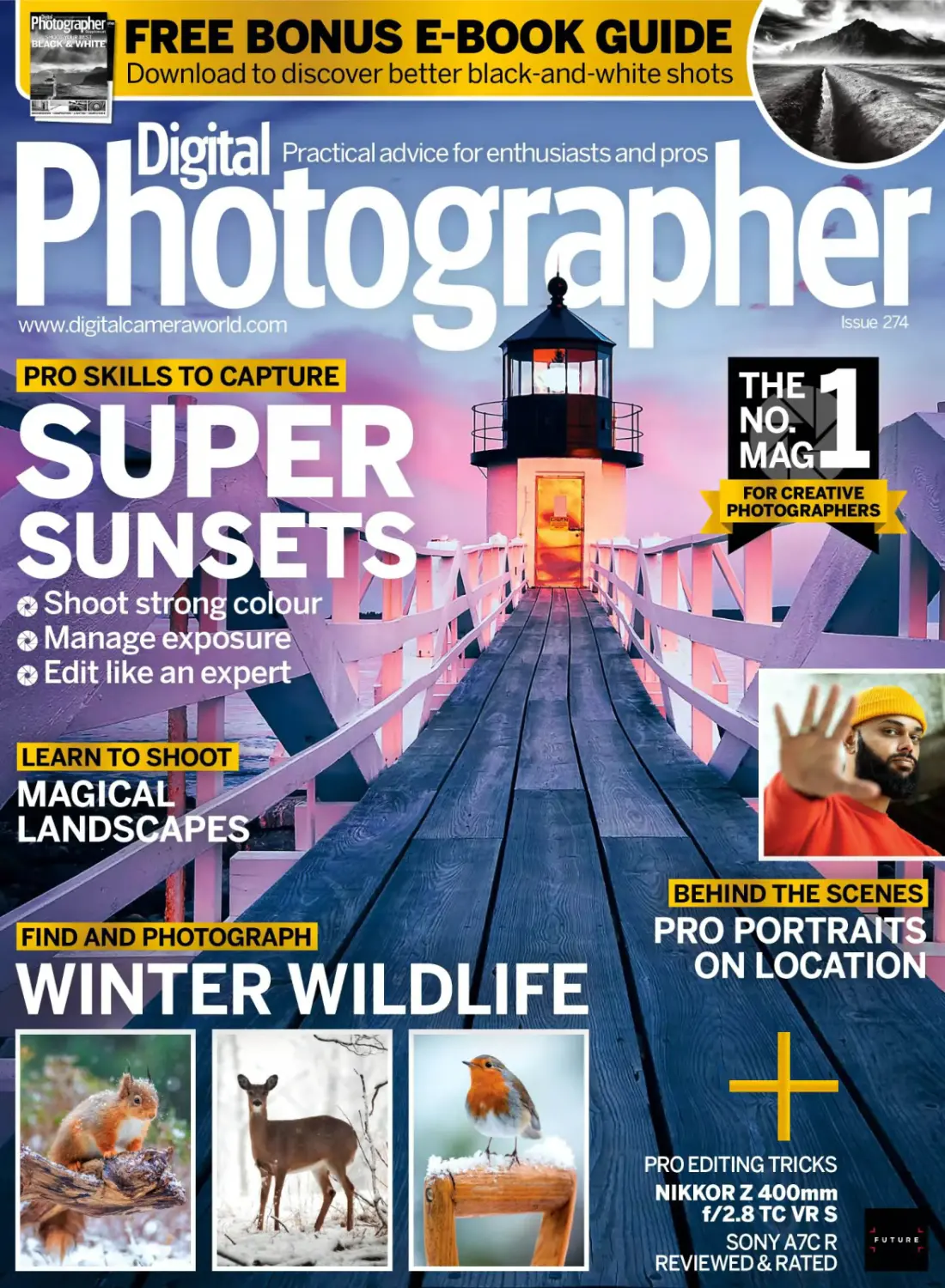
PRO SKILLS TO CAPTURE
SUPER
SUNSE'
О Shoot strong colour
О Manage exposure I
О Edit like an expert

LANDS

{ I

Issue 274
THE
NO. I F
magJL
FOR CREATIVE


WINTER WILDLIFE
PRO EDITING TRICKS
NIKKORZ 400mm
f/2.8TCVRS
S0NYA7CR
REVIEWED & RATED

Buy*Sell*Trade
ф Create
mpb.com
Think selling your
gear is a hassle?
II Pause
MPB is different. Sell camera gear direct to MPB.
It's simple, secure and free of charge.
Go circular. Get paid within days.
Unlock money from your camera gear in one easy
process, with free shipping and zero selling fees.
Fully insured from shipping to payment.
Let's put a price on peace of mind.
Scan for a free
instant quote
mpb.com/sell
“It's said that the best things can be found at boundaries
- of day and night, technology and creative trends"
Many people have a favourite
season but I find something
in each to enjoy, whether it’s
through a camera or simply
soaking up the atmosphere
on a long walk. I appreciate
the transition from one set of
colours and conditions to the
next as it keeps me creatively
inspired. To make the most of the winter season,
check out our feature on seasonal wildlife, starting
on p36. Featuring the wonderful imagery of Reed
Miller, we explore the best ways to capture critters
large and small while making use of the clean winter
landscape as a canvas for creative compositions.
Next up, don’t miss our creative project on p50,
which is about shooting and editing stunning sunset
colour. Time your shots to perfection and capture
dynamic exposures with golden tones and detail.
Al is a big topic in the world of photography right
now but, as award-winning artist and photographer
Nancy Poeran explains, there is much potential for
artistic exploration to be found in the new age of Al
collaboration. Read our interview with her from p76.
In this issue, you’ll also find our usual array of
essential editing tutorials, starting on p58, printing
advice (p64) and detailed reviews of the Sony A7C R
camera and the monster Nikon Z 400mm f/2.8TC
VR S lens on pl04 and pllO respectively.
It’s often said that the best things can be found
at boundaries - of day and night, technology and
creative trends. As we see out the year, I hope this
issue inspires you to look ahead with optimism and
excitement. From all of us at Digital Photographer,
Merry Christmas!
Peter Fenech, Editor
peter.fenech@futurenet.com
GET IN TOUCH Ask a question, share your thoughts or showcase your photos...
@DPhotographer Tweet
your opinions or images
and see them printed
www.facebook.com/
DigitalPhotographerU К
Share your thoughts and shots
(Э)
Instagram:
@dphotographermag
Follow and tag us
Email:
team@dphotographer.co.uk
Newsletter: http://bit.ly/DP-news
Website:
Get news, tips and reviews at
www.djgitalcamefawor1d.com
3
Photographer
Future PLC Quay House, The Ambury, Bath, BAI 1UA
Editorial
Editor Peter Fenech
peter.fenech@futurenet.com
Art Editor Ben Smith
Production Editor Jon Crampin
Technique Editor Kim Bunermann
Head of Art Dean Usher
Content Director Chris George
Contributors
Angela Nicholson, Claire Gillo, James Abbott, Matthew Richards,
Gareth Bevan, Natalia Zmyslowska, Bella Falk
Main cover image
© Lavin Photography/Getty Images Inset images: Michael Heward,
photographer3431, Andrew Howe via Getty Images
Advertising
Media packs are available on request
Head of Market, Advertising Matthew Johnston
matthew.johnston@futurenet.com
Account Manager Matt Bailey
mattbailey@futurenet.com +44 (0)330 390 6272
International Licensing
Digital Photographer is available for licensing and syndication. To find out
more, contact us at licensing@futurenetcom or view our available content
at www.futurecontenthub.com
Head of Print Licensing Rachel Shaw licensing@futurenet.com
Subscriptions
New orders: www.magazinesdirect.com 0330 3331113
Renewals: www.mymagazine.co.uk
Customer service: 0330 333 4333
Email queries: help@mymagazine.co.uk
Group Marketing Director Sharon Todd
Circulation
Newstrade & Retail Category Director Ben Oakden
Production
Head of Production Mark Constance
Senior Ad Production Manager Jo Crosby
Ad Production Coordinator Chloe Whatling
Digital Editions Controller Jason Hudson
Production Manager Vivienne Calvert
Our contributors
KIM
BUNERMANN
As the magazine's
technique editor,
Kim works across
a range of photo
genres. In this
issue, she turns
her attention to wildlife for our main
REED
MILLER
Reed is no
stranger to the
pages of Digital
Photographer
magazine, having
been featured
feature (p36), portrait retouching
in her Affinity Photo tutorial (p62)
and techniques for long-lasting
photographic prints on p64. Kim also
analyses a pro’s image on p74.
Website:
digitalcameraworld.com
PAULA
STOPKA
For our Shoot
Like a Pro feature,
we headed
into London
with portrait
photographer
and graphic designer, Paula
Stopka, to learn how best to use
the environment in a photo to
complement the subject. Turn to pl4
to read Paula's advice on thinking
and shooting like an art editor.
Website:
paulastopka.com
numerous times. This month, his
wonderful images illustrate our
winter wildlife feature from p36
where he also offers some tips and
advice for capturing creatures big
and small when out in the cold.
Management
Managing Director Stuart Williams
Global Head of Design Rodney Dive
Senior Vice President Kevin Add ley
Printed by Buxton Press Limited, Palace Rd, Buxton SK17 6AE
Distributed by Marketforce UK Limited, 121-141 Westbourne Terrace,
London W2 6JR www.marketforce.co.uk
For enquiries, please email: mfcommunications@futurenet.corn
Digital Photographer (ISSN 1477-6650) Б published monthly with an extra issue in March by
Future Publishing. Quay House. The Ambury. Bath, BAI 1UA UK
The US annual subscription price is $175.37 Airfreight and mailing in the USA by agent named
World Container I nc„ c/o BBT 150-15 183rd St, Jamaica. NY 11413, USA
Application to Mail at Periodicals Postage Prices is Pending at Brooklyn NY TI2S&
POSTMASTER: Send address changes to Digital Photographer, World Container Inc., do BBT
150-15183rd St, Jamaica, NY П413, USA
Subscription records are maintained at Future Publishing, do Air Business Subscriptions,
Rockwood House, Perrymount Road. Haywards Heath. West Sussex, RH16 3DH. UK
AU contents 0 2023 Future Publishing limited or published under licence. All rights reserved.
No part of this magazine may be used, stored, transmitted or reproduced in any way without
the prior written permission of the publisher. Future Publishing Limited (company number
2008885) is registered in England and Wales. Registered office: Quay House, The Ambury,
Bath BAI 1UA. All information contained in this publication is for information only and is, as for
as we are aware, correct at the time of going to press. Future cannot accept any responsibility
for errors or inaccuracies in such information. You are advised to contact manufacturers and
retailers directly with regard to the price of products/services referred to in this publication.
Apps and websites mentioned in ths publication are not under our control. We are not
responsible for their contents or any other changes or updates to them. This magazine is fully
independent and not affiliated in any way with the companies mentioned herein.
If you submit material to us. you warrant that you own the material and/or have the necessary
righttvbermissions to supply the material and you automatically grant Future and its licensees
a licence to publish your submission in whole or in part in anyfall issues andfor editions of
publications, in any format published worldwide and on associated websites, social media
channels and associated products. Any material you submit is sent at your own risk and,
although every care is taken, neither Future nor its employees, agents, subcontractors or
licensees shall be liable for loss or damage. We assume all unsolicited material is for publication
unless otherwise stated, and reserve the light to edit, amend, adapt all submissions.
Subscription delays
Disruption remains within UK and International dd ivery networks. Please a How up to seven
days before contacting us about a late delivery to help@magazinesdirect.com
Instagram:
@rh_miller
NANCY
POERAN
Nancy is a
photographer
with a different
viewpoint. While
many are worried
about the impact
of Al on their craft, in our interview
DAN
MOLD
Dan is the deputy
editor for our
sister magazine,
PhotoPlus, and
has tremendous
insight into the
from p76, she explains how she uses
the controversial technology to
create her dreamy, abstract images
and why she feels Al tools have much
to offer the world of photography.
Website:
nancy-poeran.nl
business side of photography. In
our career feature this month, Dan
explores the exciting possibilities
offered by part-time photography,
combining your regular day job with
a passion for shooting great images.
Website:
digitalcameraworld.com
CHRISTY
LEE
ROGERS
Many
photographers
are influenced
by the master
painters of old,
not least Christy, who has built
an international reputation as a
fine-art portrait photographer for
her enchanting underwater shots.
Appearing in our Photo CV on p70,
she recalls her career journey.
Instagram:
@christyleerogers
Future pic is a public	Chief Executive Officer Jon Steinberg
company quoted on the	Non-Executwe Chairman Richard Huntingford
London Stock Exchange Chief Financial and Strategy Officer Penny Ladkin-Brand
(symbol: FUTR)
www futureplc.com	Te<+44 (0)1225 442 244
We are committed to only using
magazine paper derived from
responsibly managed, certified
forestry and chlorine-free
manufacture. The paper in this
magazine was sourced and produced
from sustainable managed forests,
conforming to strict environmental
and socioeconomic standards
4
Photography
& Vide® Show
16-19 March 2024
Birmingham
’•^The destination for
anyone passionate about
photography, video or
content creation.
Tickets on
sale now!
• 250+ exhibiting brands
• 400 live talks & demos
• Endless inspiration
Bring on 2024!
Free entry for professional photographers*
Visit photographyshow.com and apply now!
•Professional photographers, videographers and image-making industry representatives can apply for FREE entry to the show.
All applications must be made before midnight on 15th March 2024 and will be verified against specific criteria.
SUBSCRIBE
TODAY!
GET A FREE BAG
WORTH £95
SEE PAGE 22
Contents
Social space Editing suite
70 Photo CV
We profile renowned fine-art abstract portrait
photographer Christy Lee Rogers for insight
into succeeding in her chosen career path
76 Interview
Al technology is a cause for concern for many
photographers but artist Nancy Poeran has
a far more optimistic view of its potential
84 Gallery
The best of the winning images from The
Northern Photography Prize 2023 contest
114 Pro Column
Bella Falk on how seeing the world through
a camera can enrich everyday experiences
Practical skills
24 Landscape composition
Peter Fenech explores the best ways of
composing magical landscape scenes
for any subject in all lighting conditions
36 Winter wildlife
With advice from seasoned photographer
Reed Miller, Kim Bunermann demonstrates
how to capture cool creatures in challenging
winter weather for awe-inspiring shots
50 Creative project
Sunsets aren’t as easy to shoot as they
might first appear. Master the camera and
editing skills needed for super golden tones
56 Shooting tutorial
Natalia Zmyslowska explains how to add
festive catchlights to your subject's eyes
for portrait images with extra sparkle
58 Photoshop tutorial
Add a popular surreal blur effect to your
woodland shots using a combination of
filters and creative layer masking techniques
60 Lightroom tutorial
Take your cameraphone images up a notch
by mastering RAW editing controls in the
Lightroom Mobile workspace
62 Affinity Photo tutorial
Take advantage of Affinity Photo’s powerful
frequency separation tools to create
impactful portrait images with smooth
but natural skin texture
Pro advice
14 Urban energy
This month, Peter Fenech meets portrait
photographer Paula Stopka on a location
photo shoot to discover her unique style
and her tips for using background textures
and colour for maximum narrative power
64 Print and share
Make prints that last by diving into our five
pro steps for improved photo longevity from
ink choice to paper and storage solutions
66 Career feature
Fancy going pro but short on time? Dan Mold
offers his advice on becoming a part-time
photographer without quitting the day job
72 Career advice
Claire Gillo answers your questions on all
things pro photography, from how much
you need to charge for travel on your shoots
to buying studio lights on a tight budget
6
New kit
and reviews
96 Super-tele zoom lenses
Eight of our best-buy optics for sports, wildlife
and action photography to find your best option
104 Sony Alpha 7CR
It might look identical to the A7CII but is
the increased resolution worth the price?
108 Godox VI flashgun
Could this powerful round speedlight be the best
value flash around? Matthew Richards finds out
110 Lenses
We test the Nikkor Z 400mm f/2.8 TC VR S
and the Canon RF-S 10-18mm f/4.5-6.3 IS STM
112 Accessories
Fun yet functional products for photographers
© Ian Schofield via Getty Images	©Tony Anderson via Getty Images
Gifts & giveaways
Free ebook to download
Shoot your best
Black & White
Black and white photography is as popular as ever thanks
to the huge variety of monochrome editing tools available
today. It’s imperative to shoot for B&W correctly too,
however. In this free guide, pro shooter Lee Frost explains
how to work with simplicity, find beautiful scenes for
colourless treatment and, above all else, how to learn to
see in monochrome to create shots with perfect drama.
To claim your free ebook,
visit https://bit.ly/DPH274
Review test shots
We think test shots
are important when
it comes to reviewing
and comparing the
latest kit, but we know
it’s hard to tell the
difference between test
images when they are
printed in the magazine.
You can open, view and
compare test shots from
our kit reviews anywhere you see the
download icon, pictured on the right.
Enter our Photocrowd
contests online to win
Affinity prizes
Every month, we team up with Photocrowd - the
world’s leading photography competition platform
- to offer you the chance to win an Affinity Photo
editing software licence (worth £60 for Mac or
Windows) and have your images printed in Digital
Photographer. Affinity Photo is a toolset engineered
for modern photography professionals. Whether
you're editing and retouching images or creating
full-blown multi-layered compositions, it has all the
power and performance you’ll need. For a chance to
win, go to Photocrowd and discover our latest contest.
It’s easy, free and fun - we love seeing your entries!
Visit: www.photocrowd.com/digitalphotographer
F YOUR 1
FREE ASSETS
are available to download
on pages where you
see this icon
V DOWNLOAD THE V
TEST SHOTS
https://bit.ly/DPH274
8
EXPLORE THE VERY BEST OF
DIGITAL PHOTOGRAPHER
Packed with our most popular features, masterclasses, tutorials and behind the scenes scoops, the latest Digital Photographer Annual is a
must-have collection for the advanced and aspiring photographer. Make this year the one where you take your photos to the pro-level with our
unmissable career guides and practical advice. Find it in newsagents now or in our online store. Unleash your creativity today!
I	L Ordering is easy. Go online at:
future magazinesdirect •com
I	Г Or get it from selected supermarkets & newsagents
IN FOCUS
SONYA9 III
BOASTS GAME-
CHANGING
FULL-FRAME
GLOBAL
SHUTTER
SENSOR
The next generation of
pro sports cameras is
here! The SonyA9 III
has a game-changing
full-frame global shutter
chip and a top shutter
speed of l/80,000sec
The recently announced Sony
Ж 2 A9 III will feature the first full-frame
global shutter on a professional
mirrorless camera. It will also have a top
shutter speed of l/80,000sec and can shoot
in RAW format at 120 frames per second.
Having a global shutter is a game changer
for mirrorless cameras using an electronic
shutter and for video use. It means that
instead of scanning the sensor line-by-line,
it can process every photosite at the exact
same time to eliminate distortion and rolling
shutter. The full-frame chip is a BSI Exmore
RS CMOS type with a resolution of 24.6MP.
Sony completes its telephoto trinity lineup with new 300mm G Master
The Sony fun continues with the
К Sony FE 300mm f/2.8 GM OSS
- the 73rd lens in the E-Mount
lineup and the 53rd such full-frame lens,
it’s also the 19th G Master lens. It joins
the Sony FE 400mm f/2.8 GM OSS and
Sony FE 600mm f/4 GM OSS, completing
Sony’s trinity of telephoto prime lenses.
The 300mm f/2.8 comprises 20
elements in 16 groups, including a single
extra-low dispersion and a trio of super
extra-low dispersion glass elements to
minimise lateral and axial chromatic
aberration, with a Nano AR II coating to
Dual Bionz XR processors give the Sony A9 III
a ground-breaking continuous burst rate of
up to 120fps and means that flashes can be
synced at up to 1/80.000 sec - these are
simply staggering specs.
A base native ISO of 250 is touted and
goes up to 25,600, though the ISO can be
expanded to a range of 125-51,200. 95.6
percent of the image sensor is covered with
759 phase detect focus points too. In-body
image stabilisation is claimed to offer an
8-stop advantage. The screen takes the form
of a 3.2-in, 2095k-dot, 4-axis angle LCD while
the EVF is a 9.4m dot type.
suppress flare and ghosting.
The lens boasts an ll-blade
aperture for circular bokeh,
with ‘careful control’ of
spherical aberration. A pair
of XD dynamic linear motors
work with an optimised
algorithm to drive fast and
precise AF with low vibration
and minimal noise and tracking
down to an aperture of f/22.
It measures 265mm in length and
weighs 1,470g. Lens stabilisation is built-in
and it supports 40mm drop-in filters.
In terms of video, users can shoot up to
6K video in 60p, or 4K 120p with no crop and
you also have the option of 10-bit 4:2:2 S-Log
3/S-Cinetone. Sony also makes a big deal of
its Real-time Recognition AF, powered by a
dedicated Al processing unit. This employs
‘human pose estimation technology', that
“recognises not just eyes but also body and
head position with high precision. This makes
it possible to track a subject facing away from
the camera or whose face is covered.”
The game-changing Sony A9 III will launch
in spring 2024, priced at £6,100 (body only).
sony.co.uk
The Sony FE 300mm f/2.8 GM OSS is
available from early 2024, priced £5,800.
sony.co.uk
© Sony	© Sony
10
Sigma’s 70-200mm f/2.8 Sports lens is here
The Sigma 70-200mm f/2.8 DG DN OS | Sport telephoto
lands for Sony E and L-mounts - and at an enticing £1,499
The Sigma 70-200mm f/2.8 DG
1 DN OS | Sports lens has been
developed exclusively for full-
frame Leica Alliance L and Sony E-mounts
for mirrorless cameras.
Sigma’s lenses are renowned for
offering exceptional performance, for
a more affordable price than native lenses,
and this new release is no different. It will
be released at an enticing price of £1,499,
especially compared with the native Sony
E-mount equivalent that costs £2,599.
The Sigma 70-200mm f/2.8 DG DN OS
| Sports will be the go-to tool for sports,
wildlife, weddings and live events offering
exceptionally sharp detail. Designed using
ultra-high performance low-dispersion
glass, which includes six FLD and two
SLD elements the lens’s image quality is
consistent throughout the zoom range,
even wide open at f/2.8.
This lens falls into Sigma’s Sports
category and with the performance
features it’s easy to see why. Designed for
use by both professionals and enthusiasts
© Sigma
alike, the unique floating focusing system
is designed to keep up with the most fast-
paced action, whether wildlife or sports. A
combination of two High-response Linear
Actuator motors and Sigma’s OS2 optical
stabilisation algorithm, Sigma claims that
the lens is "able to deliver fast, accurate
and near-silent autofocus”. The OS2
optical stabilisation algorithm enables
the user to shoot handheld in low light
with up to a 7.5 stop advantage at 70mm.
The lens is scheduled for release in
early December, priced £1,500.
sigmauk.com
Sirui launches trio of f/1.2 AF APS-C primes
Sirui announces a trio of f/1.2 AF prime lenses for
under $1,000 in latest crowd-funded Sniper Series
Sirui is launching a new series of lenses named the Sniper Series. The set of APS-C lenses will
be the first autofocus optics set manufactured by Sirui, which usually specialises in anamorphic
and cine lens options, available natively for the Fujifilm X-mount, Sony E-mount and Nikon
Z-mount. This set includes 23mm, 33mm and 56mm focal lengths (35mm, 50mm and 85mm full-frame
equivalent), each with an ultra-fast f/1.2 aperture.
Although available separately, the Sniper Series is marketed as a set - a trilogy of primes that are
almost identical apart from the focal length. Each comes in one of three colour schemes - Black Carbon,
Silver Aluminum or White Ceramic. Each
lens will cost $349 (approx £280) making
this lens set an affordable option for
APS-C users. However, the low price does
not necessarily equal low quality, as the
specs look particularly enticing. The fast
f/1.2 aperture enables great low-light
performance, a shallow depth of field and
rounded bokeh due to the 11 aperture
blades. They also boast STM motors for
quick, quiet and efficient autofocus.
The new Sniper Series is now live on
Indiegogo, with Sirui offering an early bird
discount for backers, meaning that each
lens will cost just $299 (approx £240).
indiegogo.com
In other news
More snippets of photography
news from around the world
VILTROX LAUNCHES BUDGET
20MM FOR SONY E-MOUNT
Viltrox has announced a brand-new
lightweight 20mm f/2.8 lens for
Sony full-frame cameras with an
E-mount. The new lens weighs only
157g, is made up of 10 elements
in eight groups, including two ED
lenses, one lens with a high refractive
index and two aspherical lenses,
and has dimensions of 65x59.5mm.
This affordable super-wide prime is
available to buy now, costing £130.
PHOTOSHOP COMES TO
GOOGLE CHROMEBOOKS
Photoshop announcements at
this year’s Adobe Max were a little
thin on the ground. However, there
was an interesting development in
the shape of the Photoshop web
version, which will soon be available
to Google Chromebook Plus devices.
Chromebooks have seemed a bit of
a blindspot in the Adobe ecosystem
until now, so it’s great news that the
company’s functionality will finally
be available to this user base.
11
YOUR IMAGES
STORY
BEHIND
THE STILI
Photographer: Rico X
@adventures_of_rico
Website: adventuresofrico.com
Image location: Nungwi, Zanzibar, Tanzania
Type of commission: Personal
Shot details Nikon D850,
Nikon AF-S Nikkor 24mm f/1.8G ED
Aperture: f/9, SS: l/200sec ISO: 1600
About the shot: Documentary photography captures
moments from everyday lives that not only show how
people around the world live but can also serve as
a reminder of events in our own lives. By reflecting
on the past, bygone moments are brought back to life
and reflected in our memories. This is particularly true
when the images document aspects of childhood.
‘‘These boys had just finished school and were fooling
around before heading home,” Rico explains. ‘‘Watching
them reminded me of my own childhood memories.
Most days, I would drag out the time from finishing
school to getting home, messing around with friends."
The most interesting images are the ones that allow
the viewer to interpret the scene. In this photo, the
focus is on the interaction between multiple subjects,
creating a sense of intrigue in the viewer. “In this case,
it was important for me to include the boys who were
watching. You have one boy watching me and another
boy watching them, while I am watching them all,” says
Rico. This gives the picture a narrative level.
"When composing this image, I needed to get
everything proportionally in the frame - and especially
the two boys watching,” Rico explains. To do so, he paid
particular attention to the framing of the image in
post-processing. “It was all about the corners," he says.
“I cropped the image in post-processing and converted
it to black and white. I felt that their skin tone against
the school uniform would really make the image pop.”
Right
Sooo, I missed the school bus
"As a documentary photographer,
I click the shutter and just roll
with what the universe presents."
12

URBAN
ENERGY

Peter Fenech meets Paula Stopka
to discover how she selects her urban
locations and uses them to the max
to shoot portraits with a creative edge


All images © Paula Stopka/ Radoslaw Kowalczyk
mpb.com
Buy*Sell*Trade
Create ф
I was recently reading
И ж a book on the history
of photography and,
leafing through its pages,
I couldn't help but appreciate the
freedom digital imaging affords
us. Looking at early portraits
taken on plate cameras - each
of which required exposure times
of several seconds, if not minutes,
due to the low media sensitivity -
it was easy to see how restricting
that equipment was in terms of
composition, backgrounds and
lighting conditions.
While studio photography is
clearly still a large part of the
portrait photographer's workflow,
modern technology allows us to
take our setups outside, making
use of any location as a stage.
Of course, leaving the controlled
conditions of a studio space
introduces its own challenges. It’s
those unique quirks I’m keen to
explore today and Paula Stopka
is the person armed with all the
answers. I’m meeting Paula for a
location portrait shoot in London.
Cities offer a huge variety of
textures and colours to work with
but they are also full of distracting
details, something that Paula
will have to be mindful of when
composing her images. I start
by asking her what she looks for
when first arriving at an outdoor
location and how she plans her
portraits around what is on offer.
"Usually, what I do is I pay
attention to everything that is
going on around me, from the
light to any unique features I see
in the buildings” she explains.
Paula Stopka
Born and raised in Krakow, Poland,
Paula is a London-based graphic designer
and photographer. Having been an
enthusiastic photographer since her
teenage years, Paula is now a full-time
working pro, blending two of her passions
in image creation and graphic design. Her
photography covers a variety of genres
from fashion portraiture to landscapes and architecture.
See more of Paula's work at: paulastopka.com
© @shotsbypaula
15
"Normally, I’ll go to the location
by myself before the shoot.
I might take some pictures on
my phone and scout the area so,
once the client arrives on the day,
I know exactly where I want to
position them. Sometimes, during
the shoot, a few new ideas will
come into my mind and I'll ask
my subject whether they would
like to try a few different poses.
So, while it is quite open and
flexible, the shoot already has
some kind of structure.”
Work with outdoor light
Paula's advice for managing ambience
"I once had a shoot in the middle of the day in completely
harsh lighting. Many photographers would point out that this
is far from the ideal time to shoot portraits, but we were
on-location and it was the only time we had. Instead, I
considered how I could use the light for a unique effect and
placed the subject between the dark and the light. It actually
turned out to be really effective. If you can’t change the
lighting, alter your composition to make a feature of it
and complement this with your post-processing.”
Upon seeing Paula's
subject today, Tahir, my eye
is immediately drawn to his
bright orange jumper, which will
stand out beautifully against
the grey concrete of the urban
surroundings. This is clearly not
a happy accident, so I ask Paula
how she decides what does
and what doesn’t make a great
portrait background out ‘in the
wild’ and how she plans to direct
the subject in that space once
the shoot begins.
‘‘I often come up with a mood
board for the photo session
and discuss this with the model.
We talk about the vision, ideas
and overall mood we aim to
achieve days before the photo
shoot takes place," Paula
explains. “This early planning
helps us understand not only the
purpose of the photo session but
also builds trust and creates a
comfortable atmosphere."
Paula begins to work some
angles, capturing Tahir from
multiple elevations. “On location,
I pay close attention to unique
features that can help me
envisage how I want the final
image to look," she says. "This
could be leading lines, different
colours, backgrounds, symmetry
or any other elements, such as
stairs or flowers - anything that
might give a different look to
the composition really."
Spotting a potential contrast
to complement Tahir’s colourful
outfit, Paula moves him to make
the best use of separation from
the background tone.
"I position the model to
complement these elements
or draw attention to them, for
example, by using lines. If I have
a model who is wearing contrasty
colours, I’ll try to look for
elements that can make it stand
out even more by positioning
the subject in front of the dark
background wall. I’m looking to
make that colour really pop."
Paula asks Tahir to sit on the
wall of a stairwell, which allows
her to shoot up towards him,
exaggerating the perspective.
She then asks him to hold out his
hand, which further introduces
a sense of actively using the
space available and adds depth.
He isn’t simply sitting still but
demonstrating his energy.
I notice this is a far cry from
many traditional portrait sittings
I’ve observed in the past and
Paula is quick to highlight that
it’s an integral part of her style.
"I love to get creative with my
photography. For instance, I might
even suggest dynamic poses
like jumping or leaning forward -
16

Paula’s shoot setup
1 Mirrorless camera While
it is by no means essential
to use a newer mirrorless
camera model for location
shoots, the weight saving
can be highly noticeable
during a long day of taking
images. Meanwhile, the
smaller form and thinner
profile of many mainstream
mirrorless cameras creates
less of an obstacle between
the photographer and the
subject and the 100 percent
viewfinder offers a natural
view of the scene being shot.
2 Constant aperture
zoom A standard focal
length can be more useful for
location portraiture than a
telephoto prime lens, due to
the compositional freedom.
A lens model with a constant
aperture, whether f/2.8 or f/4,
prevents exposure and DOF
changes between frames.
3Lens hood Since you
can’t move the light
source as easily as you can
in the studio, should you
encounter flare, a lens hood
is an essential item when
shooting out on location. In
urban environments, such as
the one Paula was shooting in
today, there are many direct
light sources, both from
artificial bulbs and reflected
points in glass buildings,
for example.
4 Removable strap A
camera strap is useful
for ensuring the safety of your
equipment when shooting in
an unfamiliar environment.
However, the types bundled
with your camera are often
cumbersome and easily
tangled. A removable clip
system, like on Paula’s
PeakDesign model, is
a good compromise.
something different just to trigger
the imagination so that it’s not a
traditional way of taking portraits.
I see it as a collaboration with
the model. Because of my style,
they know that they won’t get the
traditional portrait, but they will
get something that is a bit more
artistic,” she says.
This strikes me as a hugely
effective way of making use of
an outdoor space, truly taking
advantage of the freedom of
being out of the studio. But
how does Paula’s approach
differ between working with
professional and non-professional
models in front of her lens?
‘Tm trying to get into the
fashion field, where I work with
professional models. I’m getting
there but it’s still a learning
process for me. Therefore, a
lot of my portrait photography
is of people who want to have
some images taken for their
own memories. This is why it’s
important to have a proper
conversation with them before
the photo shoot and even meet
face-to-face, if possible. This helps
a lot during the live shoot."
18
Top tips from MPB
IN ASSOCIATION WITH
creative depth of field and
perform well in varying light
conditions, emphasising your
‘‘I think it's important to have
an honest discussion with the
О Compact Mirrorless
Cameras: Opt for
lightweight and compact
mpb.com
Buy»Sell*Trade
Create ф
NERi
model and to be open with them
about your vision. I often have a
very clear idea going in what it is
I want to achieve, so I tell them
how important it is for them
to let me know if something is
uncomfortable."
Paula moves Tahir to another
position, where she uses a
window to capture a split
reflected image, ensuring she
incorporates as much of the
environment as possible. With
such a variety of potential images,
mirrorless cameras for
urban portrait agility. Their
portability ensures quick
and discreet shooting,
capturing candid moments
without being intrusive.
О Versatile Prime Lenses:
Choose versatile prime
lenses with wide apertures
(eg. f/1.4 or f/1.8) for
urban portrait flexibility.
These lenses allow for
subject against dynamic
city backdrops.
О Fast Autofocus
Technology: Prioritise
cameras with fast
autofocus technology to
seize spontaneous urban
moments effortlessly. Swift
and accurate autofocus
ensures you never miss a
crucial expression or gesture,
allowing you to create
mpb.com
Buy»Sell»Trade
Create ф
compelling and authentic
urban portraits. Streamlined
gear choices maximise
your ability to navigate
the cityscape and capture
memorable portraits.
19

I wonder if there is a core set of
shots that a photographer should
capture. "I would say that I usually
start with a few similar, easier
shots each time, just to warm up,"
Paula says. And what about rights
- does she often have to manage
property permissions when she
is shooting on location?
“When I’m working with fashion
brands, yes, this definitely has
to be covered. I think this is
something all photographers
should be aware of. However,
I tend to choose locations that
I know won’t create issues, so
it’s often unnecessary for many
of my sessions."
As Paula places building
elements between her and Tahir
to create a three-dimensional
feel, it's clear that to get as much
from an environmental portrait
as possible, you need to go all-in
with using the space, it’s about
more than backgrounds. But how
does Paula deal with the myriad
aspect ratios of social media
when framing location shots?
“Someone asked me recently
why I was shooting portraits in
landscape format and I said it
was just part of my process.
I wasn’t really thinking about it.
I’m also a graphic designer, which
I feel helps me with planning
layout and presentation." And
what about post-processing?
"Authenticity is important to
me,” says Paula, as our session
draws to a close. "But I believe
we all have a story to tell and if
something isn’t working, I’ll try
and do something about it. There
is no rule that I set myself and
I’m quite open to exploring," she
says. "I load up Photoshop and
just let my creativity flow. I think
that’s what I love about art in
general - it gives both you and
your subject the freedom to
express yourselves."
Paula’s favourite photo gear
1 Canon RF 70-200mm f/2.8L IS USM
“This lens is my all-time favourite, it never
leaves my backpack," says Paula. This RF
mount lens balances the sharpness she
needs for capturing textured environments
with low weight - handy on location shoots.
2 Canon EF 24-70mm f/2.8L II USM
Built for the EF mount, this staple of
many Canon photographer’s kit can be
repurposed on Paula's mirrorless cameras
using the adaptor shown here. The f/2.8
allows creative backgrounds in her portraits.
3LowePro Flipside Backpack 450
Whenever people ask me what
backpack they should get for their photo
gear, I always recommend this one. It's
comfortable and packs pretty much all of
my gear, including my laptop and clothes.
Canon Mount Adapter EF-EOS R
This popular accessory allows older
glass to be mounted on newer mirrorless
camera bodies, such as Paula’s EOS R.
Other brands offer similar products, such
as Nikon’s FTZ II adaptor for DSLR lenses.
5 Godox VI flash This powerful
third-party speedlight offers a fast
1.5-second recycling time, an auto-zoom
feature, a built-in LED modelling lamp and
a versatile swivelling head, allowing easy
and dynamic control of ambient lighting.
6 Canon EOS R Featuring a 30MP full-
frame sensor, Canon’s first RF-mount
body has a solid build for use in a range
of outdoor conditions, an articulated
screen for low-level shooting and an AF
system with 5655 selectable points.
21
UK-only subscription offer
SUBSCRIBE TODAY
AND GET YOUR
FREE LOWEPRO
NOVA AW II BAG
Subscribe and
get essential
pro insight delivered
to your door every
month
Peter Fenech
Editor, Digital
Photographer
•	Fits DSLR with attached 17-85mm lens plus 1-2 additional lenses
•	All Weather AW Cover™, water-resistant zipper & overlapping lid
•	Flexible interior dividers deliver customisable gear protection
4 Carry via adjustable shoulder strap, padded handle or belt loop
•	Interior lid, front & side pockets offer easy access to storage
•	Internal dimensions: 20.5 x 11.5 x 17cm. External dimensions: 26 x 19 x 20cm
22
UK-only subscription offer
Great reasons
to subscribe
to Digital
Photographer
magazine today
•	Free LOWEPRO NOVA AW II
BAG worth £95
Enjoy 6 issues worth of Digital
Photographer for just £27.99 -
that’s just £4.67 an issue
Delivered direct to your door
Treat у ourself or gift a magazine subscription today
YOUR SUBSCRIPTION OPTIONS
PRINT ONLY
£27.99
•	6 issues of Digital Photographer delivered
to your door and a free Lowepro Nova AW 11
camera bag
DIGITAL ONLY
£21.49
•	6 issues of Digital Photographer digital
edition for your tablet or device
(No bag included)
SUBSCRIBE NOW
®	/DPHNOVA23
% PHONE	and quote code ‘C75L’
Terms and conditions: Offer closes 29 February 2024. Offer open to new subscribers only, and only available on print purchases. Direct Debit offer is available to UK subscribers only. Your gift will be delivered
separately within 60 days after your first payment has cleared. Gifts only available to subscribers on the UK mainland with the purchase of a print or premium PhotoPlus subscription. In the unlikely event that we run
out of this gift, we promise to offer you an alternative gift of the same or greater value. Please allow up to 6 weeks for delivery (up to 8 weeks outside of the UK). Payment is non-refundable after the 14-day cancellation
period. For full terms and conditions, visit www.magazinesdirect.com/terms. For enquiries and overseas rates please call: +44 (0) 330 3331113. Lines are open Monday-Friday 8:30am-7pm, Saturday 10am-3pm UK
Time (excluding Bank Holidays) or email: help@magazinesdirect.com. Calls to 0330 numbers will be charged at no more than a national landline call, and may be included in your phone provider’s call bundle.
23
TECHNIQUES
COMPLETE GUIDE TO
LANDSCAPE
COMPOSITION
Take your landscape photography to the next level
with these essential composition techniques
Words by Peter Fenech
24
LANDSCAPE COMPOSITION
Pictured
Uncoventional
Landscape photography may
seem like a formulaic genre,
but with some lateral thinking,
it is possible to create
inspiring, narrative images
In the Digital Photographer office, we
often joke that Ansel Adams ruined
landscape photography for the rest
of us. Long before the first digital
camera was created, Adams produced
masterful scenic shots that would set
the benchmark for almost every landscape
composition for the next half-century. That’s
a tough act to follow. However, the beauty of
photography as a creative medium is that we
can draw inspiration from our idols, including
Adams in many cases, but still find something
original and interesting to try ourselves.
One of the biggest draws of landscape
as a genre is the sheer diversity of colours,
textures, shapes and light conditions on
offer. Every location is subtly different - the
topography varies, the arrangement of
vegetation controls the foreground interest,
the elevation dictates how water flows around
the frame and light refracts and scatters
depending on atmospheric conditions and
direction. This provides the opportunity to
capture shots with a difference every time
we head out, even at a location we’ve visited
many times previously.
However, with this variety comes challenges,
Unlike studio-based photography, or any other
genre that involves predictable conditions,
no single photo formula will suit every scene.
As experienced photographers, we need to
recognise the need to adjust our approach to
composition and exposure to the individual
requirements of the image. In this feature,
we’ll aim to break down the main elements
of different landscape types and explore how
we embrace their graphic properties. And
helpfully, you can use these core techniques
in any scenic image you might encounter.
© Getty Images/ Francesco Vaninetti Photo
25
NATURAL FRAMES
Woodlands are the home
of natural lines and arcs.
Use foliage or branches
to isolate your subject in
a field of diffused colour
EASIER COLOUR
CONTRAST
In the absence of
texture, we can
bring coloured areas
together. This would not
be possible if they were
both equally in focus
Find order amongst the natural chaos of detail-
rich landscape locations such as woodlands
Woodlands and forests are wonderful locations
to explore in search of landscape images. They
are highly atmospheric places, due largely to
the micro-climates you’ll commonly find when
surrounded by respiring trees. Mist, carpets
of flowers and vibrant colour, especially in the
autumn months, mean there is always some
reason to turn your camera on.
With lots of detail comes the risk of overly
‘busy’ images, however. One of the staples of
a landscape image is a clear subject, which
can be difficult to define among the tangle of
branches, ground-level shrubs and colourful
mosses and lichens, all of which compete for
attention. A mistake you’ll often see in forest
photography is a focal length that is too wide,
bringing excess detail around the edges of the
frame. The regimented trees will also feel static
when shot straight-on - there is no symmetry,
yet no identifiably unique elements suggested
as the main focus.
The goal should be to create a sense of
false isolation. We need to find a detail that
represents the colour and texture of the
location, decide on this as the main actor on
our stage and then use camera elevation, focal
length and background to cut most other
details. Think ‘within the frame’, concentrating
on how each object within the viewfinder
complements the others. If something doesn’t
add colour contrast, juxtapose the main
subject in texture or act as a form of leading
line, it should be removed, either by shifting the
frame or zooming in.
If you can’t remove an element through
re-composition, either because you don’t have
an appropriate lens or because there is simply
not enough room in the scene to shift your
framing, try making it a secondary element.
Background leaves might have to be within the
frame boundary for practical reasons, but you
can change how they are represented through
depth-of-field control. Not all landscapes
require front-to-back sharpness. Indeed, it has
become somewhat of a trend on social media
to limit focus in scenic shots. The professional
approach to busy landscape photography is,
if you can’t move a detail, make an asset of it.
CAMERA HEIGHT
Here, we can make the
most of optical distortion
by angling the lens up from
a low position to create a
sense of scale in the trees
BRANCH DIRECTION
Find a position that
appears to show the tree
branches pointing into
the scene, creating a line
for the eye to follow
woodland
26
LANDSCAPE COMPOSITION
EXCLUDED GROUND
Cut the forest floor from
EMPTY SPACES
4 Avoid gaps in the
J canopy. If too much sky
is showing, use a longer
К focal length to avoid
ftp breaking up intentional
patterns and colour
LIGHT GRADIENT
By reducingtexture, we can
use gradients of brightness i
to lead the viewer through
the frame without the risk
of distracting patterns
clean compositions - this
is often the busiest part
of the scene and contains
the most distractions
XT
DISCERNIBLE
SHAPES
Set an aperture that
reveals enough of the
shape of background
objects to suggest at
the wider environment
I
I
f
E
Kit out your kitbag
FAST PRIME
A 50mm f/1.8 on a full-frame
camera body or a 35mm
f/1.8 for a crop-sensor body
will allow a more natural view
of the woodland landscape,
helping you resist the
temptation to go too wide
in your framing.
ND FILTER
A 0.6 ND filter will allow you to
blur distracting details through
a lengthened exposure, which
can also create eye-catching
abstract images. Combine this
with an aperture of around
f/11 for shutter speeds of
0.5 to 2 seconds.
MINI TRIPOD
Use a mini tripod, full-size
legs with a reversible and
removable centre column, or a
bean bag to allow stable ultra-
low-level compositions, that
omit forest-floor vegetation.
Check your model can support
a full load in low configuration.

Colour overlap
Sometimes, it just isn't possible to create a clean frame in a particular location.
If there is lots of high-frequency or densely packed detail, then we must look for
other ways of arranging it into some kind of order. If the texture is rather homogenous,
create some separation by ordering colour in the frame. Position yourself so that you
can capture layers of colour, indicating depth in the scene and giving your viewer
a path to follow through the mass of competing shapes and patterns.
27
TECHNIQUES
Pictured
Heathland study
While subtle colour is visible,
this misty scene is almost
monochromatic. In these
cases, texture becomes far
more prominent so I chose
to contrast the grass with
the diffused trees
© Peter Fenech
LANDSCAPE COMPOSITION
Work in minimalist landscapes
Control your composition for effective shots in detail-sparse locations
Many photographers look for and appreciate
painterly lighting in their images. However,
in many ways, this is where the similarities
between photography and other types of art
end. There are some key differences in the
compositional approach to a photograph and
a painting. For example, a photographer is
accustomed to starting with lots of detail in
the world around them, which they must cut
back and order into a clean frame. A painter,
meanwhile, starts with a blank canvas on which
they must build up the detail. Therefore, while
busy landscapes are certainly a challenge to
get right, it is often the less populated scenes
that cause the most confusion.
Adapt aspect ratio
If you can’t make the scene fit the
frame, make the frame fit the scene.
Many photographers are still locked
into the idea of shooting for traditional
print sizes, which can be limiting.
Straying too far from 10x8 or 8x6
might not be advisable for future-
proofing reasons, but consider whether
a frame shape other than the standard
4:3 or 3:2 output of modern sensors
might better suit your current subject.
If you don’t want to change the ratio
in-camera, consider applying a paper
or card mask to your LCD to help you
preview the final composition.
This is often introduced by the shape and
direction of the landscape. Scenics are usually
quite long, with the majority of detail arranged
laterally. Where all of the detail is bunched up
towards the horizon, it can produce ugly, empty
foregrounds that do not serve to improve the
overall composition and create a disconnect
with the viewer - giving a feeling that the ‘main
event’ is hidden at the back of the picture.
Meanwhile, if the horizon is broken by a sudden
tall object, controlling negative space either
side becomes the biggest consideration.
If you are in doubt as to the best approach
to tackle this issue, use a longer focal length.
Any problems arising from an imbalance of
the interest in a scene will be made worse
by using a wide lens. A setting of 100mm or
greater has a better chance of bringing scene
elements together, minimising negative space
and isolating the intended subject. You will then
have better control over aspects like symmetry,
which can be used to hide the detail weighting
in the frame by making any empty areas feel
natural and intentional.
Flat and tall subjects
Capture scenes punctuated with imbalanced Y-axis detail
Lighthouses and coastal stacks, as just two good examples, take up a small percentage of
the frame. This type of landscape is often defined by lots of empty sky, with the majority
of the interest weighted at the bottom of the composition. One solution is to use portrait
orientation (image 1), which is a clear method of reducing space at the edges. Alternatively,
you could opt to make a feature of the negative areas, using a 7/8ths division, where the tall
subject is shot from a lower angle and its isolation on the horizon line, placed so as just to be
a sliver along the bottom, focuses attention (image 2). Finally, you could use the foreground
texture to contrast against the flat sky or use the shape of the topography for its graphic
properties, making the tall subject feel like a continuation of the land (image 3).
TECHNIQUES
WIDESCREEN CROP
Coastlines are long and
thin, so complement this
with a longer aspect ratio,
minimising unnecessary
foreground or sky
BOUNDARIES
The real subject is the
boundary between
land and water. Shoot
diagonally along the coast
to highlight this element
FULL STOP
Placing an object
along the horizon
provides somewhere
for the eye to settle

Use still or flowing water to add balance and energy to your landscapes
In the UK, we have the fortune of living fairly
close to the ocean wherever we call home.
Furthermore, all of that rain we complain about
has the effect of keeping our lakes, ponds,
rivers, streams, becks and brooks filled for
the majority of the year, so when it comes to
shooting landscapes with water, we are spoiled
for choice. Once you are accustomed to
working bodies of water into your landscapes,
shots without them can seem oddly dull. This
is due to the reflective properties of water,
which bounce much of the light from the sky
back into the scene, filling in shadows and
applying washes of reflected colour.
Reflections add a symmetry that can
produce a feeling of balance in otherwise
sparse frames. Even the smallest of puddles
can fill in a gap, such as an area of dull
concrete or muddy foreground, neither of
which would likely be considered beautiful, and
draw together all zones of the composition. Be
aware that reflected images can take the eye
away from the ‘real’ subject, so use caution in
how much space each takes up in the shot. You
will also have to balance the exposure for both
the reflection and the real surfaces since the
water will absorb a percentage of the light and
underexpose the duplicated detail. Start with
+2/3 EV exposure compensation.
Meanwhile, moving water can give scenes
a more active sensation, reiterating that there
is a living landscape in your pictures. As stills
photographers, we are at a disadvantage
compared to videographers in that we can only
capture a single moment. A longer exposure
of a moving subject breaks that wall and
30
CAMERA PITCH
A three-quarters
foreground/sky division
can work well, with
the area selected to
dominate based on the
interest it contains
Г HIGH
OR LOW X
r Tidal times will impact 1
your composition choices.
At high tide, lots of foreground
detail is lost to the sea, but a
wider lens can be used to capture
i incoming and receding wave
к patterns. Low tides might require
К a longer focal length if there
are large, empty areas of A
beach or dry rocks
simulates the passage of time, something that
surprisingly few photographers think to apply
to a landscape.
With this comes its own considerations, such
as exposure length and placement of the water
to divide up the shot. With long, thin streams
and rivers, avoid splitting the composition
down the middle or into disparate areas.
Having a stream run straight through the frame
can create a visual barrier between the viewer
and the subject, which looks uncomfortable.
First, find a good place for the main subject,
then pivot around this until any water either
leads to this object or wraps around it, creating
a frame in which everything seems joined up.
TECHNIQUES
Compose for contrast
Adjust your framing to account for the direction
and intensity of light at different times of the day
Landscape composition is about more
than simply choosing a spot from which to
shoot a scene. The glory of landscape as
a genre of photography is that, as the light
changes throughout the day and across the
four seasons of the year, the terrain alters
in appearance. The direction, intensity and
brightness of light impact how texture, shape
and colour look in an image and, as such, we
must adjust our camera techniques to match.
Contrast is, by definition, the difference
in luminance or colour of one object or area
of a photo from another. Absolute black and
absolute white might represent the greatest
contrast of exposure, but these are rarely
seen together in the same frame. Similarly,
colours on opposite sides of the colour wheel
provide the greatest contrast but, in a natural
environment, these opposing colour values
are rarely observed in abundance.
Beyond the difference in characteristics
between one zone and another, it is important
to remember the distinction between global
and local contrast. A bright area might be
visible in the same frame as a dark spot,
but if they are located far apart, such as on
opposite sides of the composition, the viewer
might not perceive the image as high contrast.
Place these two areas beside one another,
however, and the image seems far punchier.
Learn how to recognise where best in the
frame to place your light sources and the
shadows they cast in the landscape. You can
then create more intelligently structured shots
that tap into the viewer’s expectations and
elicit the greatest emotional response.
Golden hour contrast
Times close to sunrise and sunset offer the best light quality, but shadows can be
especially directional when the sun is visible. If you are shooting directly towards it, place
the sun disc on a third or close to the intended subject, to draw the eye to that part of the
frame. Be conscious of long shadows running perpendicular to leading lines, as this can
reduce their effect. Where possible, use these shadows themselves as leading elements.
IMAGE SPECS
О Exposure settings:
l/125sec, f/16, ISO 100
О Metering mode:
Evaluative metering
О Focal length: 24mm
IMAGE SPECS
О Exposure settings:
l/800sec, f/3.2, ISO 100
О Metering mode:
Spot metering
О Focal length: 110mm

...


Overcast light
Generally, overcast skies either show up
as a dull grey or, potentially worse, as
solid white. This light is ideal for capturing
saturated foliage colour, so consider a
longer lens to bring trees together and
limit the sky to a maximum of 25 percent
of the frame. Where possible, avoid
portrait format or, alternatively, use a
more square aspect such as 4:3 or even
1:1. This reduces the excess space at the
frame edges and at the top and bottom.
Midday depth
Top-down lighting, as found around midday,
will make foregrounds appear flat, due to a
lack of contouring. Try shooting from a low
position or arrange yourself to place objects at
visibly different distances from the camera, to
re-introduce a sense of three-dimensionality.
Alternatively, find something to frame the
scene and filter the light, such as a tree canopy,
using a tall frame and wide lens to incorporate
the light source and simulate directionality.
33
Advertisement
Car, home and travel insurance plus broadband,
breakdown cover and more. Get more info or
compare quotes, for over 40 products, at go.compare
Photographer
Next issue
The latest kit reviews, tutorials and
projects to hone your photo skills
NEXT ISSUE
PRO SKILLS FOR 2024
HOTTEST
SHOOTING
TRENDS
Essential photo skills
to learn now
Issue 275 is on sale
19th Jan 2024
Read these
essential features:
•	The best photo gear of 2023
•	Urban astrophotography tricks
•	Pet photography essentials
Available at www.magazinesdirect.com
*Content subject to change
Missed an issue? No problem!
Don’t feel left out if you missed a recent issue of Digital Photographer
as you can find our back copies at our online shop. Browse the shop
for single issues and catch up on missed pro advice, gear reviews
and multi-part features and columns. Visit today:
https:j7bit.ly/DPbackissues
© Roberto Moiola/Getty Images
TECHNIQUES
CAPTURE
CAPTURE COOL CREATURES
Achieving the perfect winter wildlife shot
can be a challenging task that demands
patience, skill and perseverance. Waiting
к for hours in the freezing cold isn’t
к exactly a photographer’s dream
Ж scenario, however, once you’ve
^k pressed the shutter and got the
perfect photo, all those difficulties are
quickly forgotten. During the winter months,
some creatures are more active than
usual. As food is scarce, they are drawn
out of their hiding places, making this the
perfect time to see them. In addition, the
environmental changes often give us a
better view of the animals. Bare branches,
trees and bushes allow us to spot wildlife
more easily and also to frame the animals
with fewer distractions.
Winter wildlife photography is a thrilling
experience that not only gives you the
opportunity to observe and understand
animal behaviour in a way that few other
activities can but will also turn you into
a better photographer. Facing freezing
temperatures poses a unique set of
challenges, so we must also consider the
impact of snow on our gear when choosing
the correct exposure. Furthermore, we
need to locate the places inhabited by our
chosen wildlife and make every effort to
remain as unobtrusive as possible, both in
terms of our appearance and behaviour so
that we don’t disturb the animals.
In this guide, we will outline some of the
best methods for spotting and capturing
winter wildlife through your camera lens,
while offering some advice on how to
protect and weatherproof your equipment.
TECHNIQUES
Get winter
Pictured
Curious guy
"The Long-tailed Weasel is
a ferocious and relentless
predator, known for being
fearless. This weasel will
soon have a winter white coat,
except for some yellow on its
stomach and black-tipped tail"
Locate your subjects
and get the gear without
breaking the bank
I
Winter is a wonderful time to spot wildlife,
no matter where you are - either close to
home or in far-flung corners of the world,
in urban areas or even in your back garden.
Commonly found species include squirrels,
birds, owls, otters and deer. However,
before grabbing the camera and heading
out, it’s important to do some research.
By connecting with a local nature reserve
and using helpful resources such as the
RSPB website, forums and apps, you will
learn more about rare sightings and identify
the species you capture. To increase
the chances of capturing winter wildlife,
consider starting a photographic diary
or journal. By keeping track of sightings
and recording all the information in one
place, you will see connections and build
your knowledge. Record important details,
including the date, time, and weather
conditions to create a valuable resource.
As the winter season varies around the
world due to the Earth’s tilted axis, winter
wildlife photography can be done all year
round. When the North Pole tilts towards
the sun, it is summer in the northern
hemisphere, and when the South Pole tilts
towards the sun, it is winter in the northern
hemisphere. This means that north of the
equator, winter runs from December to
February, and south of the equator, it runs
from June to August.
To capture powerful images, travel is not
always necessary. Hidden gems may be
found in local forests or nature reserves.
However, when photographing wildlife in
foreign areas, it is highly recommended to
book an experienced guide. A guide helps
you to stay safe in the cold and sometimes
treacherous winter landscapes, while
also directing you to the best locations.
Additionally, they provide you with essential
knowledge that may otherwise take years
to build. This is especially important when
it comes to wildlife that gives birth to their
offspring since some species do so in the
winter months and so are particularly
sensitive to any disturbances.
TOP GEAR
Winter wildlife photography
can be captured with any camera,
but full-frame cameras have an
advantage. The bigger sensor produces
less noisy high resolution images, so you can
crop frames in editing to get closer to your
subject - even if it’s further away in the frame
- without significantly compromising image
quality. The Canon EOS R8, for example,
boasts a blistering 40fps burst shooting
к mode and 4K 60p video, making it an 1
excellent choice for capturing both A
natural behaviour in stills and
moving images.
38
CAPTURE COOL CREATURES
Weatherproof your kit
Protect yourgear to avoid losing it to mould or damp
When shooting in cold conditions,
it is important to keep an eye on
your gear. Even if the weather
is dry, melting snow can pose
a danger and your kit can get
wet as soon as you are back in
warm temperatures. Therefore,
it’s crucial to dry out your kit
after every shoot to prevent
condensation. Use a towel to
remove any moisture from
the camera and lenses to help
avoid fungi and mould growth.
Once either of these elements
have entered the kit, it’s nearly
impossible to get rid of them.
When purchasing new gear,
always check first whether it is
weather-resistant and sealed.
However, even when using
weather-resistant gear, it’s always
a good idea to use accessories to
protect the expensive equipment.
Using a rain shield for lenses is
an easy solution to keep water
off them, alternatively, a well-
attached and taped plastic bag
will help keep the moisture
out. Lens hoods are also an
inexpensive option that protects
the lens from water droplets
falling on its front element.
Select an optic
Gain more reach and learn how to get closer
without needing to purchase new lenses
To enhance the zoom capabilities of your current lens,
consider investing in an teleconverter. These have different
strengths, with the 2x extender being a popular choice as it
doubles the focal length. Keep in mind that an extender also
reduces the effective lens aperture - a 1.4 extender decreases
the maximum aperture by one stop, while a 2x model reduces
it by two stops. Additionally, they can affect the optical
quality, so it’s recommended that you purchase own-brand
extenders. If you’re looking for a more cost-effective solution,
it’s always worth checking out second-hand gear.
TELEPHOTO ZOOM
A lens such as the Sigma
70-200mm f/2.8 DG
OS HSM is an excellent
option to capture
a broader view of the
surroundings in your shot,
while also providing the flexibility to zoom
in on the subject from a reasonable distance.
SUPER TELEPHOTO ZOOM
For getting really close, a focal length of 200mm plus
is needed. The Sony FE 200-600mm F5.6-6.3 G OSS,
for example, is a
great choice. Bear
in mind that these
types of lenses can
be quite heavy and
aren’t the easiest to
carry around all day.
TECHNIQUES
Blend in
Hide well to capture
rare species and true
wildlife behaviour
To coax winter wildlife to come out in front
of the lens, you must become one with
nature, being almost invisible and blending in
with the surroundings by choosing clothing
with muted colours and avoiding materials
that make noise. Camouflage clothing is
your ticket to remaining unnoticed and
reliable waterproof quality gear will
protect you from the cold and
mud. Accessories such as a
camouflage lens cover or
crim net will help to stay
hidden and protect the J
expensive equipment	i
in unpredictable	I
weather conditions.	9
Waiting for wildlife	1
to appear can be a	’
time-consuming process,
which is why permanent
and temporary hides can be
a better solution. These hides
allow you to blend in seamlessly
with the surroundings, offering extra
protection against the weather. They can even
turn into a more comfortable environment
with preparation. Nature reserves often have
specialist wooden hides that are perfect for
capturing hard-to-see species in a stable
environment. Pop-up hides are similar to
tents and are easy to set up wherever you
decide to get in position. These come in
various colours and patterns and fold away
into a backpack for easy transportation. You
can also create your own hide with a dome
As photographers, we are
guests in the animal’s habitats.
Don’t get too close to the species,
and let them be themselves. For the
most captivating shots, the wildlife
has to accept you and your lens
first. Leave the environment
as it was when you first
arrived and pick up any
litter you see.
Above
Impactful action
A battle of Bighorn Rams
during the rut. Reed used a
shutter speed of 1/2000 sec.
while maintaining an aperture
of f/4 and an ISO value of 100
or tent decorated with leaves.
Finding the perfect spot for the
hide can be challenging. As soon as you
build it up. get the camera out and check the
background and foreground of the frame.
This way, you can rearrange its position to
create a more appealing composition. It is
best to leave the hide in position for several
days before shooting, so the wildlife can
become more familiar with it and accept its
presence. Patience and quietness are key
when photographing, so it's crucial to remain
as quiet as possible upon arrival and when
setting up your equipment.
Essential tools
When capturing wildlife moments with
big lenses, a stable support system for
the camera is essential to avoid blurry
Essential tools
When capturing wildlife moments with
big lenses, a stable support system for
the camera is essential to avoid blurry
shots. A tripod is a reliable choice to
keep the camera set up and ready while
waiting for the perfect shot. This has the
benefit of hands-free use but also limits
your ability to make quick changes in
image composition and framing options.
For those seeking more flexibility,
a bean bag is an excellent alternative,
allowing you to support the camera at
any level. Especially when photographing
out of a built hide, a bean bag can allow
you to position the camera on the open
window frame often found in these
spaces and is the perfect tool to let you
reframe the scene with minimum fuss.
Think ahead
Think comfort and ensure you have enough power when the action happens
Spending a long time in nature can be
a relaxing experience if you prepare
well. As it takes patience to wait for wild
creatures to appear, the last thing you
want to do is leave your position and
risk missing the perfect shot
Bring along some sandwiches,
snacks and plenty of water to stay
hydrated. When packing ready-to-eat
food, make sure to remove it from
the plastic packaging and store it in
containers that won’t make as much
noise when you open them up.
When shooting in cold temperatures,
camera batteries tend to drain faster
than usual. To avoid running out of power,
bring a spare pack of batteries with you.
Have the backup battery in your pocket
to keep it warm. Additionally, consider
investing in a battery grip. This accessory
allows you to store an extra battery,
meaning you can use two batteries to
power your camera. This will prevent
you from needing to change batteries
during important moments and make the
shooting experience smoother. A camera
grip makes it more comfortable to shoot
in portrait orientation, as it has an extra
shutter button and command dials to
enhance the control over your camera.
40
CAPTURE COOL CREATURES
Pictured
Slim pickings
"In the starkness of winter,
a big bull Bison has to take
nourishment where he
can find it That concept
works for mankind both
physically and spiritually."
TECHNIQUES
Pictured
Pine Grosbeak
This species inhabits
coniferous forests
across Alaska, western
US mountains. Canada,
subarctic Scandinavia and
northern Russia to Siberia
Build core skills
The secret to capturing quality winter wildlife
innages is to observe, be patient and practise
i
Build up your skills by capturing starter
subjects that are commonly found, such
as squirrels or robins. Those are often seen
in gardens and therefore accustomed to
human presence. These animals are generally
more hungry during the winter and easy to
attract with some food. With time they will
return to the feeding station and you gain
more chances to practise.
Documenting their winter behaviour,
including food gathering will add an extra
layer to the image, which educates and
provides context to the viewer. Remember
to respect their space and observe their
behaviour. If they move away, don’t harass
and follow them. With patience, you will gain
their trust and the next time they might get
closer to the lens. This is a slow process but in
the end, it will make the experience
even more special and rewarding.
Once you have built a rapport with the
inhabitants of your garden, take it to the next
level by introducing props and fun items to
the scene. An apple or a mini picnic bench
are great examples. You’ll find that squirrels,
in particular, are naturally curious and will
be drawn to these objects, allowing you to
capture more engaging shots.
As a next step, look out for local wildlife
hotspots. Perhaps there is a nature reserve
close by that you can visit regularly to
become more familiar with the environment
and wildlife. By returning to a known place,
you will learn more about the species’
behaviour and how to deal with different
lighting and weather conditions.
Г OBSERVATION
FOR SUCCESS 1
Becoming a skilled wildlife
photographer requires a solid
understanding of both the camera and
animals. Here, a monocular is a great
tool for observing wildlife in close detail.
It lets you study their behaviour and
interactions, giving you an edge in being
able to predict their next moves. This
k preparation gives you an advantage
in framing fast-changing
interactions before л
they pass.
Pictured
The hunt
"A Great Gray Owl
finds a meal as the .
* low sun starts to paint’
I its colourful tones”
42
CAPTURE COOL CREATURES
Be ready
Maximise your chances of
capturing the perfect shot
Speed up your camera
Select the ideal settings to allow you to accurately
capture changing behaviour and movements
When it comes to capturing the
appearance and interactions of
wildlife, time is of the essence. It
is vital to have your camera set
up and ready to go at all times.
Before heading out, take time to
understand the camera, dial in the
menu and check its special features.
An effective way of improving your
workflow is to customise the camera’s
buttons. Under the Custom Key
option, select the most frequently
used features to allow quick access.
This helps you in situations where
pressing the shutter can make
the difference between missing or
capturing a lifetime sighting. Take test
shots to ensure that the exposure is
correct. This will save you time and
allow you to focus on composition and
framing when the wildlife appears.
1 Shoot silent The shutter release
noise of a camera might scare any
wildlife nearby. Compared with DSLRs,
mirrorless cameras produce a much
quieter sound. To further reduce the
noise, activate the electronic or silent
shutter option. If this feature is not
available, some cameras have a lockup
option to minimise noise.
CUSTOM SETTING MENU
'V
a
и
и
и

a Autofocus
b Metering/exposure
c Timers/AE lock
d Shooting/display
e Bracketing/f lash
f Controls
g Movie
3 Select burst mode Using burst mode
is a great way to ensure you never miss
the action. In this mode, the camera takes
2 Shoot in M To achieve sharp results,
select an aperture of around f/8.
The shutter speed should be adjusted
depending on the speed of the subject,
typically ranging from 1/400 to 1/2000
sec. Set ISO for a well-exposed photo. Use
a high ISO if needed. A sharp, noisy image
is better than a blurry one, as noise can
always be corrected at the editing stage.
multiple frames per second, giving you
a better chance of capturing the perfect
shot. Mirrorless cameras are particularly
effective at this, as they have electronic
shutters that perform better than those
found in DSLR cameras.
4 Back button focusing Sometimes,
it can be difficult to control both the
focus and shutter button operations at the
same time. Here, the back-button focus
method is a great solution. This allows you
to control both functions independently,
as the autofocus can now be activated with
the AF-ON button, which is located at the
back of the camera.
5 Detect the animal’s eye Many newer
camera models come with an advanced
feature that automatically focuses on the
subject’s eyes. With the Subject-to-Detect
mode, found in the AF menu, the camera
maintains focus and tracks the subject
even when it moves within the frame.
Alternatively, select the Servo AF, which
acts in a similar way but isn’t as accurate.
6 Adjust tracking sensitivity If the
tracking sensitivity is set to a low value,
the camera may fail to track the subject’s
movements correctly, which can result in
unwanted blurry shots. To avoid this, it is
essential to set the sensitivity to a high
value. This way, the camera can accurately
detect the movement and record the
wildlife’s action in detail.
43
TECHNIQUES
Include and exclude
Discover how to use camera settings to create
mood and narrative in winter wildlife photography
When it comes to capturing wildlife, framing
and aperture settings are crucial factors
to consider. By using the right techniques,
you can convey your message through two
different photographic directions.
Sometimes, it can be challenging to find
the right composition, as the nature in the
background may distract from the subject
but cannot simply be removed. In such cases,
it’s recommended to zoom right into your
subject and work with open apertures like
f/2. The reason is that the lower your f-stop
number, the shallower the depth-of-field
appears, meaning that the background gets
blurred out. This helps in smoothing out any
distracting image elements and keeping the
viewer’s attention on the subject. Take care,
because the shallower the depth of field, the
narrower the focus area, meaning fewer image
elements will be sharp. Frames shot with an
open aperture convey a distinctive, calming
atmosphere that captivates the viewer with
close insights but less sharpness in the
subject. However, focusing on the wildlife’s
main features means that its behaviour and a
narrative layer may be missing.
To create a variety of winter wildlife shots,
it’s best to work with medium apertures
such as f/11 - as long as the surroundings
are suitable. Bigger f-stop numbers have
the benefit of rendering the scene sharp
without significantly blurring other elements.
It’s worth considering to include the
environment, as it plays a significant role in
giving the viewer insights into the subject’s
life. This way. you build a context and even
tell a story. Photographs with narratives are
more informative and educate the viewer by
showing natural behaviour.
Stay flexible
Shift frame sections to show wild subjects in all their facets
When you are shooting
in the wild, change your
photographic approach from
time to time. Rearranging the
frame by zooming in and out
and changing the depth-of-
field intensity will help to keep
the viewer engaged.
For example, one creative
approach could be to go to
the extremes and fill the
frame with only the subject
By zooming right in on the
wildlife, features like the fur
gain new importance. Showing
just a few parts of the subject
can also make the photograph
look more abstract.
On the other hand, there
are situations where it is
necessary to frame the scene
wider for practical reasons.
For example, when capturing a
flying bird or wildlife in action,
you want to be sure that
you have captured the entire
subject, especially if there are
any unpredictable movements.
You can always fine-tune
the cropping to achieve the
desired effect later in post-
processing.
44
Create atmosphere
HIGHUGHTED SUBJECT
The use of a shallow depth of
field expertly draws the viewer's
attention towards the subject
ensuring that it remains the
focal point of the composition
SMALL DETAILS
Here, the viewer has
a detailed view of the
Belted Kingfisher while
the falling snowflakes
add an enchanting touch
to the mesmerising
winter atmosphere
SHALLOW DOF
Reed used aperture

RULE OF THIRDS
Reed applied this classic
rule by placing the subject
off-centre in the first third
of the photograph to create
a pleasing composition
NARRATIVE LAYER
This Mule Deer Doe
taking refuge from a
snowstorm evokes
curiosity, leaving the
viewer to narrate a story
and interpret the scene
WIDE ANGLE
By framing the scene wider,
Reed captured the serenity
of the storm amid the harsh
conditions, displaying the
subject in its natural habitat
CREATE
CAPTIVATING
COMPOSITIONS 1
When framing a shot, it can
be challenging to determine what
should and shouldn’t be included. As
a general rule, prioritise your subject
and avoid adding anything that could
distract from the wildlife. This
may require simplifying your
к composition, but doing so will .
allow your subject to
really stand out.
Pictured
Hard-working fox
"This fox caught several voles
and then did something I’ve
never seen before. He buried
the voles in the shallow snow
with his nose and then came
back later to gather a few
and took them to the den”
MAKE
COLOURS POP
To captivate the viewer,
choosing subjects that boldly
stand out against the white canvas
is a great strategy. Squirrels or foxes
are excellent choices, as their orange
fur adds a splash of colour. During the
46
CAPTURE COOL CREATURES
Fill the white gaps
Learn how to handle exposure in the snow
like a pro to capture magical winter light
During the winter season, natural light is
a precious resource. To frame winter wildlife
at its best, aim to take photographs during
the golden hours of sunrise and sunset. In
the morning, face east and, in the afternoon,
position yourself towards the west to catch
the warm glow of the winter sun - your
smartphone's compass will help locate the
direction in which you should be facing.
The bright snow backdrop can pose
some challenges when it comes to the ideal
exposure. The snow can deceive the camera's
light meter, resulting in underexposed
photographs. To combat this, it’s best to
intentionally overexpose or underexpose
your images in specific situations.
A popular approach is to overexpose
scenes on purpose by using maximum open
apertures. This technique lets you increase
the shutter speed which makes it possible
to freeze wildlife interaction. This way, you
Seeing eye-to-eye
Lower your position to add new
dimensions to your photographs
When you’re taking pictures of winter
creatures, don’t stick to photographing
them from head height. Especially
when you have small subjects in front
of the camera, standing at your normal
height can result in a lack of impact in
the images. Getting down low with the
lens will significantly enhance the visual
appeal of the subject while also adding
foreground interest to the composition.
This way, you include rich details
of the animal’s habitat and provide
additional information to the viewer.
Here, blurring the background with
low f-numbers such as f/2.8 or f/4
is a clever and effective technique to
highlight the main subject.
also avoid pushing the ISO settings to the
extremes. This helps capture more vibrant
colours and prevents the bright snow from
having a grey tint. However, when taking
pictures of winter birds against a bright sky,
it’s better to underexpose the image.
When it comes to pressing the shutter,
there's no room for error in timing. Get your
camera settings ready, frame the subject
first and then remain in one spot for an
extended period. Waiting patiently for the
animal to turn around and make eye contact
with the camera creates a sense of power
and intensity in your composition. When
the wildlife is staring directly at the lens, it
makes a much stronger impact on the viewer,
creating a powerful connection.
Since lots of winter wildlife is typically shy,
capturing this moment is a rare and thrilling
experience that will leave a lasting impression
on you and anyone who sees the image.
Pro advice
Wildlife photographer Reed Miller
laments a lack of winter images
“Have you ever
thought you had
fantastic shots
but downloaded
the images and
they just aren’t
sharp? I learned
this lesson the
hard way... many
times. Heat waves, mirages and
optical distortion can all be difficult
in the heat, however, I believe that
it is a much bigger problem in the
cold, especially if you are shooting
with a long lens. Of course, the more
magnification, the more distortion.
If I’m shooting an animal from my
vehicle (yes, that sounds lazy but
it’s often the best way), I turn off the
engine and roll down every window,
so that the temperature equalises
enough in my vehicle and I don’t get
distortion or blurry images. Believe
me when I say that your passengers
will love this method. Soon you will be
able to put your camera on the seat
next to you, which will increase your
awesome fast camera access skills!”
47
1ALPS, SWITZERLAND
Home of wolves, ibex, wild goats
and red deer. Thanks to reintroduction
programs, large predators such as the
Eurasian Lynx have made a comeback.
2FAKASEL, ICELAND
A powerful winter subject is Icelandic
horses. These are smaller than regular
horses, sometimes even as small as a pony
and are built to survive in harsh climates.
3WEST HIGHLAND
PENINSULAS, SCOTLAND
Scotland’s big five are red squirrels, red
deer, golden eagles, otters and harbour
seals. Additionally, you will find diverse
wildlife, including mountain hares, roe deer,
swans, geese and more.
4	LADAKH, INDIA
Amidst the winter snow, roams the
majestic Snow leopard, a master hunter
with unparalleled tracking skills, always on
the hunt for its next prey.
5	SVALBARD AND
HALLINGDAL, NORWAY
Norway is a haven for winter wildlife, with
species such as the Arctic Fox, Musk Ox,
Polar Bear, and Reindeer thriving alongside
the 7OOkg national animal, the Moose.
6	ISLE OF MULL, UNITED KINGDOM
Known as the otter capital of the UK,
this island is perfect for capturing otters on
the seashore, particularly during the winter
months when they are more active.
7WAPUSK NATIONAL
PARK, CANADA
This national park, spanning over a vast
expanse of 11,475km2, is known as the
world’s premier location for photographing
polar bears and their cubs.
8JIGOKUDANI YAEN-KOEN, JAPAN
Also known as Hell's Valley, this is
a hotspot for Snow Monkeys. When the
snow falls, macaques of Nagano enjoy
soaking in the hot springs.
9 BIALOWIEZA NATIONAL
PARK, POLAND
A global leader in breeding European
bison, with the population almost doubling
to 200. It’s home to roe and red deer,
European mouflon sheep and wolves.
WGIGRIN FARM, WALES
Amidst the serene mid-Wales
countryside lies a haven for bird
enthusiasts. A farm inhabited by
over 400-500 bird species providing
captivating subjects for your next shoot.
MAIN TVMOUKS
Move FAST. 1
with youn help,
we CAN Too!
We're working to create a future where brain tumours are curable.
We urgently need your help to accelerate research.
Text DEFEATS to 70507 to donate £5, please help us to find a cure.
thebraintumourcharity.org
© The Brain Tumour Charity 2020. Registered Charity in England and Wales
(1150054) and Scotland (SC045081)
THEb
BRAIN
TUM«UR
CHARITY
А сине CAN'T WAIT
Г ^4 Registered with
EDI FUNDRAISING
REGULATOR
SHOOTING SKILLS

SUPER SUNSETS
Learn the essential in-camera steps to capture the end-of-day light and
then apply targetted processing to make the best of your sunset shots
best time to shoot landscape
photography. While dawn is the
other golden hour for capturing scenic
images, providing warmer light and softer
shadows than midday, atmospheric factors
often result in more saturated colours
towards the end of the day. The other
- advantage of staying out later, rather than
getting up early, is that the light is getting
progressively better as the sun lowers in
the sky and so the window for the best
images is generally longer.
However, capturing golden hour shots
at the coast comes with several unique
challenges. The close proximity of the sun
to the reflective surface of the ocean often
results in easily blown highlights. To make
matters worse, these clipped areas are
difficult to balance due to the localised
nature of the exposure difference - it’s not
often possible to filter these areas using an
ND grad and HDR blending might require
further local adjustment.
For this project, we’re going to explore
how to balance exposure and colour to
maximise the sunset atmosphere. With
careful camera work, these steps can be
applied to any scene, anywhere. The aim
is to recognise those characteristics that
make the golden hours so attractive to
the eye and learn to make these aspects
as prominent in your images as possible.
SUPER SUNSETS
What you’ll need
RAW-enabled camera
Medium telephoto lens
Camera support
О RAW editor with masks
Golden glow
Sunsets often demonstrate
strong colours and natural
contrast and so require tight
control over dynamic range
SHOOTING SKILLS
ISet metering mode With extreme contrast, there is a risk of
miscalculating the exposure. Spot metering underexposed the
cliffs and beach, but Evaluative gave an exposure that didn’t match
any area well. Center-Weighted ensured zones close to the sun didn’t
overly influence the AE system but highlights weren't ignored totally.
2 Attach a hood To achieve the glowing sunset effect I’m after
in this scene, we need to shoot towards the sun, which is just
out of the frame. However, this opens up the risk of lens flare, so a
hood is essential. If you don’t have a hood for your lens model, use
a baseball cap or similar item to shade the sun-facing side of the optic.
ЗСгор the scene Many sunset images fail because too much of the
scene not illuminated by the golden light is included. To enhance
the effect, a quick and easy solution is to crop into the areas covered
by the directional light. For this image, I used a 70-200mm lens to
compress the illuminated areas and exclude a darker foreground.
4	Control white balance Although we think of sunset lighting
as yellow, other hues are commonly present too. A Shade WB
preset made the landscape too uniformly warm, so I scrolled through
the manual Kelvin settings until a good balance of warm and cool
tones was visible. These can be tweaked further at a later stage.
5	Time the exposure The most effective sunset contrast occurs
when there are clouds in the sky to hold the colour. I shot this
coastal scene on an overcast day and waited for the setting sun to
break through a small gap in the cloud layer, which provided this
tightly focused raking light and contrast with the darker sky areas.
6	Shoot ‘one-over’ While exposure blending will help in this
context, sometimes all that is needed is an extra frame to capture
tones that are most at risk. Since there are lots of shadows in the
middle ground, I captured the ideal exposure for the sky, then used
+1EV Exposure Compensation to reveal extra detail in the darks.
52
The setup
SUPER SUNSETS
BALLHEAD
Offers more rapid
reframing but take
care of precise horizon
angle adjustments
LENS HOOD
This reduces internal
lens reflections, which
is vital for shooting
the exposed sun disc
MEDIUM
TELEPHOTO
A70-200mm or
300mm removes flat
areas that diminish
sunset ambience

Create a sunset glow
Use aperture to introduce some magic
A wide aperture allows
light to flood into the lens
and can create a wash of
colour. Stopping down to
above f/8 may be needed
for depth-of-field but might
also generate harder,
unsightly flare. An f/stop
of f/2.8 to f/5.6 solves this
problem and introduces
an artistic magical glow
effect. A good solution is
to capture a frame at a
smaller aperture, for safer
foreground sharpness then,
with the focus set a third of
the way into the frame or
double the distance of the
closest object, open up the
diaphragm. This captures
softer, diffused light around
the sun itself, where it is
just out of frame, as in this
scene. The two frames can
then be merged in software
for the best of both worlds.
53
SHOOTING SKILLS
ICrop clipped detail The area closest to the sun is slightly clipped,
while the near foreground is missing direct illumination. A little
cropping was applied to remove these problem areas and focus the
composition on the glowing parts of the shot with retained detail.
2	Control the range To compress the tones further, the Black and
White points were set to prevent clipping (drag the sliders while
observing the histogram) and the Highlights and Shadows sliders
were moved until the dynamic range appeared balanced but natural.
3	Sunset toning To highlight the golden theme, I added yellow to
the highlights, magenta to the mid-tones and subtle blue to the
shadows, using Color Grading and adjusting the balance until happy. I
also added Blue Primary Saturation in Lightroom’s Calibration Tab.
4	Local adjustments I didn’t need a +1EV exposure, but used the
Radial Filter to lift the shadows for aesthetic reasons - the detail
was present but dark shadows drew the eye. I added negative Blacks
to maintain natural contrast and dodged the highlights on the stacks.
5	Diffuse the highlights For a subtle boost, select the highlights
using a Luminance Range mask. Use the Eyedropper to choose
the brightest tones and drag the Luminance scale for better precision.
To make the highlights softer, reduce the Clarity and Dehaze sliders.
6	Final contrast To finish the shot, use the Tone Curves to
apply some final tonal adjustments. In this image, I required
only a fairly shallow S-Curve overall, with some minor darkening
of the lower mid-tones for added depth and extra natural contrast.
54

SHOOTING SKILLS
Create catchlights
Use festive lights to create magical reflections
in your subject’s eyes and boost your portraits
When taking a portrait, it is important
to include catchlights. These are
reflections of the light source in the
subject’s eyes that can add life, depth and a
captivating sparkle. They make your subject
look more vibrant and engaging and can turn
a mundane portrait into an eye-catching one.
The shape and intensity of catchlights can
vary depending on the shooting environment.
When shooting in a studio, the most
effective way to create catchlights is to direct
a light source towards your subject. This
can be easily accomplished using a softbox
or beauty dish to diffuse light for flattering
effects. Similarly, when shooting outdoors, the
sun creates natural catchlights, even when the
weather is overcast. In fact, on overcast days,
Insert
Missing sparkle
Here, the eye reflection has
been created by the window
in the room. Though it adds
depth to the subject, the
photo lacks a captivating
element orfestive touch
Main
Christmas catchlight
Ordinary Christmas lights
were arranged in the shape
of a star and positioned in
front of the subject. Using the
optimal exposure settings,
this created a bright and clear
reflection in the subject's eye
the clouds act as a natural softbox, creating
gentle reflections in your subject's eyes.
Catchlights are essentially light reflections
and so they offer limitless potential to
experiment and create unique light shapes
to complement the style of your portrait. At
this time of the year, one technique is to use
Christmas lights to create unique catchlights,
for example in the shape of a Christmas tree
or with festive green and red colours.
To create the outline, we need to attach
a string of lights to a piece of wood or thick
cardboard you may have lying around the
home. Stick the lights down with either nails
or tape into the desired shape. It’s a quick and
cost-effective way of adding a special touch
that makes your festive portraits stand out.
Shooting mode____________
Manual exposure
[aj Fv P Tv Av
Ml BULB Cl7 C2₽ C3p
•REC : Movie rec with settings
ISet the scene Choose a dark or dimly
lit room with minimal ambient light as
this will help make the reflections stand out
more. Gently place the Christmas lights in
front of your model, ensuring they are not
too bright and are evenly distributed.
2	Stay steady When working in low-light
conditions, place your camera on a tripod
to keep it steady. This allows you to use longer
shutter speeds, where more light can enter
the sensor, and also prevents camera shake,
resulting in sharp and well-exposed images.
3	Shoot in Manual Change to M mode to
manually adjust the exposure settings.
Use a slow shutter speed, between 1/4 to 1
sec, to allow the light reflection to stand out.
Select an open aperture of about f/6.3 to
enhance the light and create beautiful bokeh.
56
4	Select ISO value Keep your ISO setting
as low as possible to reduce the amount
of visible noise in the darker parts of the image.
However, if the final result shows significant
noise, you can correct it in post-production
with the Denoise function in Lightroom.
5	Set the focus To ensure both the eye and
catchlight are sharp, go into your camera
menu to bring up the available focus options.
The eye-tracking feature on Canon cameras,
for example, works well and is a great way of
ensuring that the subject’s eyes are in focus.
All images © Natalia Zmyslowska ©theworldwithnat
6	Choose focal length Working with
a versatile lens, such as the Canon
24-240mm f/4-6.3 telephoto lens, allows
you to rearrange the frame with ease.
Work with long focal lengths to achieve an
aesthetically pleasing compressed perspective.
57
EDITING SKILLS: PHOTOSHOP
PHOTOSHOP
TUTORIAL
Add surreal blur
to woodland shots
Meet the editing pro
James Abbott is a
professional photographer
Й	and photography journalist
ДЬ	specialising in shooting and
editing techniques. His first
book was recently released
and covers professional image editing skills
in both Adobe Photoshop and Affinity Photo.
© @jamesaphoto jamesaphoto.co.uk
Use Photoshop’s Motion Blur
Filter for fun and creative effects
With autumn now a not-so-distant
memory, there's a good chance you’ll
^1^ have plenty of woodland images to
edit over the winter months. So, for something
a little different, try this popular and fun
technique where Motion Blur is added to
trees to create a surreal appearance. It’s an
easy technique to apply and one that can be
blended seamlessly using Layer Masking.
What you’ll
be using
О Layer duplication
О Layer Masks
О Mask editing
О Hue/Saturation
О Colour channels
1 Apply Blur With the Background Layer
Active, Press Ctrl/Cmd+J to duplicate the
Layer. The new Layer will be active by default,
so go to Filter > Blur > Motion Blur. When the
dialogue opens, set the Angle to 90° or the
angle of the trees’ growth, then set Distance to
around 900 pixels and hit OK to apply the blur.
2 Set up the Layer Click on the Add a
mask icon at the bottom of the Layers
panel and then press D on the keyboard to set
the palette colours to black and white. If white
is in the foreground, press X to switch to black.
Next, press В to activate the Brush Tool and
set it to a large size with Hardness at 0%.
3Mask out blur Zoom into the image and
use the Spacebar to activate the Hand
Tool to move the image up the screen so you
can see the bottom area. Now paint black over
the bottom area but don’t go too high because
you can refine the mask and overall effect
in the next step using different brush sizes.
All images © James Abbott
KEY TIP
CHANGE BRUSH OPACITY
To paint in a more gradual blend in the
Layer Mask, reduce the Brush Opacity
from 100% to around 55%. You’ll need
four passes of the brush to remove blur,
but this can help to create a smoother
blend between sharp and blurred areas.
4 Refine the Mask Zoom into the image
further and use the left and right square
bracket keys to make the Brush smaller or
larger as required. You can now paint out the
blur in specific areas for a better and more
interesting blend. Press X to switch to white
and paint the blur back in, if required.
5 Adjust saturation This step is a great
way to boost the saturation of individual
colour channels. Click on the Create new fill
or adjustment layer icon at the bottom of the
Layers panel and select Hue/Saturation. Click
on the Master dropdown menu and select
each channel to increase the Saturation.
Insert
Straight trees
Straight trees work best for
this technique because the
Motion Blur makes it look
as though ICM was used
during shooting apart from
the base of thetrunks
Main
Surreal blur
Thanks to simple Layer
duplication and Masking,
the blurred image has been
blended seamlessly with
the sharp image at the
bottom of the scene
58

EDITING SKILLS: LIGHTROOM
LIGHTROOM
TUTORIAL
Make phone shots shine
with Lightroom Mobile
Capture RAW files and enjoy full editing control
jSk With many smartphones featuring
К. Й1 ultra-wide-angle, standard and
telephoto lenses, we have an
incredibly versatile camera with us at all
times. Many modern phones can now capture
images in RAW format, opening up a wealth
of editing options and, ultimately, higher image
quality. And when that RAW image capture is
paired with Lightroom Mobile for editing, that
offers huge potential for creating great shots.
What you’ll be using
О Lightroom Mobile
О Light controls
О Color controls
О Effects controls
О Masking
IMake basic
adjustments
To get started, click
on the Light tab at
the bottom of the
editing interface.
For this image,
Exposure was set
to +0.23, Highlights
to -35, Shadows
to +20, Whites to
+40 and Blacks
to -10. Contrast
was left at zero in
favour of using the
Tone Curve to apply
more contrast
to the image.
2 Add contrast
Scroll down
to below the main
Light controls and
click on the Curve
button to open the
Tone Curve. Create
an S curve by
placing your finger
on the lower third
of the curve and
dragging it down
and right. Do the
same on the top
third of the curve
and drag up and
to the left. Tap on
a point to delete it.
3 Adjust white
balance
This image was
taken late in the
afternoon so the
light was warmer
than it appears.
Click on the Color
tab to open the
White Balance
and other colour
controls. Here, the
Temperature was
set to 6203К and
the Tint to -5 for a
more faithful colour
balance. Saturation
was set to +6.


All images © James Abbott
4 Add Orton-
style blur
Click on the Effects
tab and drag the
Texture and Clarity
sliders to negative
figures. The exact
amount depends
on the resolution
of the image, but
here, Texture and
Clarity were set to
-18 to add a subtle
version of the
Orton Effect that
softens the scene
while maintaining
sharpness.
5 Use Masking
A Linear
Gradient was
applied over the
sky and midground
with Dehaze set to
+35, and another
over the sky with
Exposure at -0.39
and Highlights
set to -24. A third
Linear Gradient
was added to
darken the top of
the sky and an
inverted Radial
Gradient was used
as a subtle vignette.
KEY TIP
SHOW THE HISTOGRAM
Click on the three horizontal dots in the
top right corner of the interface and
select View options > Histogram to bring
up the histogram. This will help you with
maintaining detail in the shadows and
highlights during the editing process.
Insert
Well exposed
Though the image was
carefully exposed to maintain
detail in the highlights, this
RAW file captured with a
Samsung S23 Ultra required
processing in Lightroom
Main
Bursting with life
Thanks to the processing
capabilities of Lightroom
Mobile, this landscape image
looks like it was taken with an
interchangeable lens camera
ratherthan a smartphone
60
AFTER
BEFORE
EDITING SKILLS: AFFINITY
AFFINITY
TUTORIAL
Retouch for
natural results
Use Frequency Separation to maintain skin texture
When editing skin tones, it is best
to avoid too much retouching. We
often focus on removing spots with
the clone or smoothing tools, but these can
affect the skin texture. To avoid unnatural-
looking results, Affinity Photo 2.0 has a
Frequency Separation filter, where low and
high frequencies are separated, so that colour
spots (Low Frequency) and skin texture spots
(High Frequency) can be edited separately.
What you’ll be using
О Frequency Seperation
О High Frequency
О Low Frequency
О Paint brush
ICopy Background layer It is crucial to
keep track of the retouching edits you make.
To do this, start by duplicating the original
background layer. This will create a copy
that you can use to compare the ‘before’ and
‘after’ versions of the photograph. It also helps
identify if any edits you make are too extreme.
2	Select Frequency Separation filter
Go to the top bar, select the Filter option
and choose Frequency Separation filter. Now,
the image is split into two parts. On the right,
you can see the high frequency, which displays
the texture. On the left, the low frequency is
visible, which contains the image colours.
3	Apply filter To adjust the texture, use the
radius slider. By increasing the radius, the
high-frequency side gains structure, while the
low-frequency side appears blurry. This allows
you to enhance the skin texture while blurring
out the structure of spots that only contain the
colours so you can smooth them separately.
All images © Adrienne Andersen
KEY TIP
USE FREQUENCIES
TO EDIT THE SHADOWS
By applying lighter or darker skin
frequencies, you can increase or decrease
the appearance of shadows. Stay on the
Low-Frequency layer, sample a skin tone
and paint it in using the brush tool over
the shadow areas you want to optimise.
4	Work on structure By applying the filter,
two layers are automatically added. To
start retouching, untick the visibility of all layers
while leaving the High-Frequency layer active.
Select the paintbrush tool and make sure black
is selected. Leave the Current Layer option
on and paint over any irregular structures.
5	Correct tone irregularities Activate
the visibility of the Low-Frequency layer.
Duplicate this layer and work on the copy.
Focus on one area that shows spots. Select
the paintbrush with a low flow and hold down
the alt/option key to sample the skin colour.
Paint over the areas that need touching up.
Insert
Smooth nightmare
The skin has clearly
been refined while
editing. Unfortunately,
the smoothing tools also
removed the skin texture,
resulting in an unnatural look
Main
Natural approach
The skin now looks more
natural with retouched
imperfections that
preserve the texture
of the skin, making
it look more realistic
62
AFTER
BEFORE
PRINT & SHARE
MAKE PRINTS LAST
Follow these five pro tips to extend the lifespan of your printed photos
The preservation of printed
images is not only important
on a personal level but also for
museums worldwide that rely on them to
educate society on bygone times. However,
time can take a toll on old photographic
prints, making it a challenge to see the
subject in detail and original colour.
Generally speaking, black-and-white
prints have a longer lifespan than colour
Select archive paper
Even the best ink won’t prevent
your images from fading if the
paper is not up to par. Standard
paper, for instance, absorbs ink
poorly, which can compromise the
quality of your images. However,
professional-grade paper such as
100% cotton or acid-free paper
is designed specifically for image
archiving and helps to maintain
the integrity of your prints. Some
popular and long-lasting choices
in this category include Kodak
Professional Endura Premier
Photo paper and Fujifilm Fujicolor
Crystal Archive Super Type PDN.
Use pigment-
based inks
It’s crucial to choose the right
ink to slow down air exposure
fading. This oxidation process
is inevitable and causes colour
reduction over time, but by
opting for high-quality pigment-
based ink, your prints will last
for around 200 years. Pigment-
based ink provides sharper
details, a wider range of colours,
and ink particles suspended in
a clear resin that decelerates
the fading process. In contrast,
dye-based ink is known to fade
after a mere 25-30 years.
64
ones - this is because most colour
processes use dyes on different standards
that fade at different rates over time. Often,
the blue colour layer fades faster, creating
tints after just a few years. For instance,
prints from the 1950s tend to have a red
tint, while photographs taken in the 1970s
will often now feature a yellow tint.
Technology has evolved, including print
processes, materials and paper quality.
However, the three main enemies of
conservation, namely light, moisture
and air exposure, can still cause fading.
So it’s time to consider both short-term
production and long-term display and
adopt a future-proof
approach to retain
the original
impact of your
photo prints.
F Conclusion
In the digital age, it’s
easier to duplicate images.
We don't have to worry about
losing files due to ageing or
damage but we can still lose
them to technical failure.
Back up your digital photo
files and store them on
different devices.

Reduce ink degradation
After printing, let the ink sink first, so that it can settle and
firmly bond with the paper. Leave the prints to dry in a low-
dust environment first. Here, the drying time will depend
on the combination of ink and paper used. Before touching
the prints, wash your hands thoroughly or, even better, use
cotton gloves. These are affordable and make a big difference
in preventing the transfer of degrading solvents onto the
printing paper. You can purchase cotton gloves in most art
shops or online stores, such as icanFRAME.
©Ezra Korkmaz/Pexels
Prevent light fading
UV light, also known as ultraviolet light, is undoubtedly one of the
biggest enemies of photo prints. Over time, it causes washed out
colours, reduced saturation and misted shadow areas. UV-protected
framing glass can help prevent this issue. When displaying framed
photos, it is strongly recommend that you choose a location with no
direct sunlight
shining on it.
This is also the
reason why flash
photography
is typically not
allowed in art
galleries or
museums, as
this strong light
could damage
the often old and
delicate artworks.

Acid-free storage
Simply storing prints in the attic or
basement increases the risk of moisture
damage and fading. To keep the prints
in optimum condition, store them in a
climate-controlled and dry area that is
neither too hot nor too cold. Protect the
prints further by wrapping them in acid-
free tissue paper, available in most art
stores, and storing them in classic paper
boxes. Avoid dyed and recycled boxes,
instead, choose acid-free or lignin
options for maximum protection.

GO PRO
PART-TIME
PHOTOGRAPHY
Balancing your day job with a photography side-
hustle is a great way to earn some pocket money
and cut your teeth managingasmall business
Making some extra money from
your hobby is a brilliant feeling and,
fortunately for photographers, there
are no shortage of potential clients willing
to pay for your photography services, from
shooting weddings for happy couples to
interior architecture for realtors or product
photography to video drone services.
The good news is you can pick up a lot
of these jobs in your free time around your
full-time working hours. The latest mirrorless
cameras and optics can cost thousands of
pounds, so using your spare time to earn
some extra dosh is a smart way to fund your
next upgrade or photography trip.
It’s good to have a goal in mind - are you
happy with just picking up the odd freelance
job on the side or would you rather build
up your experience and client lists so that
you can eventually take your photography
business full-time? It's also not a bad idea
to let your employer know about your
photography, as many businesses need
marketing materials, headshots or product
photography - they may even be able to give
you your first freelance job.
Even if you’re only applying yourself to it
in your spare time, setting up a photography
business can still be daunting. You will still
need to make sure everything is all above
board when it comes to balancing your
books and accounting. You'll also need to
be careful of working too hard and making
sure you regularly take a well-deserved break.
In this article, we'll cover some of the most
important aspects to consider...
66

Keeping busy
Having a full-time job will provide you with a regular salary and
и picking up additional photography projects on the side is a great
| way to earn some extra pocket money. How much you work in your
>• spare time is completely up to you, whether it’s a wedding once
о a month or studio photography sessions every weekend. Be sure
~ to spread the word around your workplace and fellow colleagues:
| friends and family are likely to be your first clients when you're
$ first starting out. Word of mouth is an effective and low cost way to
| pick up jobs, though if you need more work, it’s worth considering
| marketing options such as advertising on social media. Make sure
| you have a professional website displaying your best work, rates
© and contact information so customers can book you.
Don’t burn yourself out	|
If you’re known as the photographer amongst friends and 3
family, it can feel awkward charging a fee. But remember	|
that all of your camera kit, hard drives, memory cards,	|
insurance and other costs don’t come cheap - and that’s
before factoring in your experience and personal time. J
In the early days, it’s okay to charge ‘mate’s rates’ if it
helps you build up your confidence and put together
a portfolio, but you’ll want to start charging your full
worth as soon as possible. Working overtime and not
charging for it is a surefire way to burn yourself out.
It’s also vital to book in some R&R days and family time.
Put days off in your calendar and stick to them - you
need to be well rested to perform at your top level. Use
photography as a tool to relax too, if you’re shooting high-
pressure weddings as your side-hustle, try going out with
your camera to take landscapes and unwind in nature.
Part-time hours
Depending on how proactive you’ve been with your
photography business, you may find that you have more
clients approaching you with work than you’re able to fulfil
in your spare time, which is certainly a nice problem to have.
| Hopefully, your photography business is more enjoyable (and
£ more lucrative) than your full-time day job. These are two great
g reasons to consider dropping your full-time hours to take on
> more photography jobs and build your photography business.
| Going part-time is a great way of still ensuring a guaranteed
j monthly paycheck and pension contributions from your
| employer, while letting you build up the confidence and client
@ contacts required to dive fully into self-employment.
68
Keep on top of your books
If you aren't already, you’ll need to register for a Self-Assessment
tax return (see the www.gov.uk website). Keep on top of your books
with a spreadsheet that shows all of your income and outgoings
and keep receipts of all your expenses so that you're ready for your
annual tax return. It also helps to have a well organised invoicing
system. You'll then input how much you earned from your full-
time employment as well as your income and outgoings from your
photography business, it will then calculate how much income tax
and National Insurance contributions you need to make. You may
even get money sent back to you if you’ve paid too much.
Working part-time, it’s unlikely that you’ll hit the £85,000 (taxable
turnover) threshold at which your business would need to become
VAT registered, though it’s worth keeping in mind if you were to
take your business full-time. If you’re in any doubt, it’s always worth
paying for an accountant for professional advice: a good accountant
will pay for themselves by finding savings across your business.
Hobo_018 via Getty Images
Conflicting schedules
One of the biggest drawbacks you’ll face from a photography
side-hustle is that you’ll be limited to doing shoots in your free
time. If you work a regular nine-to-five job, that will usually
mean just evenings and weekends, which can be frustrating.
If a photography job pops up that doesn't fall in your usual
spare time, you might occasionally need to use up some of
your annual leave. You’ll also have your family commitments
to consider, such as caring for children or pets, which can
sometimes be a balancing act. Your best bet is to be upfront
and let your clients know what days you are and aren't free
so that you’re not forced to make such a decision.
SOCIAL SPACE
Photo CV
We profile an expert photographer’s career journey
for insight on becoming established in the industry
Renaissance beauty
Rogers’ images make use of the popular Chiaroscuro
style of lighting and resemble master oil paintings
© Christy Lee Rogers x5
Christy Lee Rogers
Location: Nashville, Tennessee, USA
Specialisms
О Abstract
О Portraiture
О Conceptual
To see more of Christy’s work:
christyleerogers.com
@ @christyleerogers
Christy is a visual artist specialising in
underwater photography and videos.
Known for her use of Chiaroscuro
lighting, her style is often compared
to Baroque painting masters such
as Caravaggio. In 2019, she won the
Open Photographer of the Year at the
SWPA and worked for Apple to create
underwater shots with the iPhone 11 Pro.
The deep end
Working underwater presents unique practical and
technical challenges, including lighting and exposure
70
PHOTO cv
Christy’s photo kit
The essential gear she couldn’t
do without for her everyday work
FUJIFILM GFX100
“I love the quality of
the images I take with
my Fuji. They could be
blown up to billboard
size, no problem,”
says Christy of her
102MP medium-
format camera
Left
Inspirations
Christy takes cues from
Baroque paintings
but adds a modern,
cinematic twist
Below
Complex simplicity
When Christy began
experimenting with
water, she had limited
resources but was
fascinated by its effect
CANON EOS
5D MARK III
Christy’s second body
is this popular DSLR.
“This is my ‘everything’
camera. It somehow
captures the colours
and softness that I
love best," she says
CANON EF
24-70MM
F/2.8L II USM
“I love the versatility
of this lens. It allows
me to get all those
wide-angle shots in
super-low lighting”
GOODSMANN
RECHARGEABLE
SPOTUGHT
Christy uses this to
overcome exposure
challenges underwater.
"This 4,500-lumen
waterproof flashlight
has been a great tool
for adding dimension to
my images with light"
Career Path
When did you start out in your
current photographic genres?
When I started to use water as a creative
tool, I had no idea what this feeling was or the
power and allure that it had over me. That
was in Los Angeles in around 2003, and from
there, I continued to experiment with different
lighting, movements and techniques.
Everything was done by eye, I had no light
meters, no proper lights and I was looking for
something that was not quite there yet. But
as soon as I saw the magic that the water
expressed. I was in love and never stopped.
What challenges did you face as a
startup and how did you overcome them?
The biggest challenge was working through
some of my own anxieties about trying to
create something more magical than what
was humanly possible on a limited budget.
Being a starving artist was actually freeing.
There were no outside expectations and no
massive workloads, except for those that I
placed on myself. These things were overcome
by persistence and incredible amounts of
experimentation and hard work. I had to make
some mistakes along the way to get to where
I am today, and I’m so grateful for that path.
What key skills are needed
for your line of work?
I would say that ideas are the most important,
and being able to disconnect from the outside
world for a while to let them surface and take
physical form. It’s as though the building
of these visions are being pulled from a
place that I don’t have full access to. I feel
creative pain until it all really comes together
into this big beautiful clarity and purpose.
Communication is everything; along with
patience, a nurturing ability, technical
know-how and being able to let go.
Which social platforms are you on,
which are your favourites and how
do you use each for your business?
I feel like I’m on all of the social media
platforms, although I don’t really have the
time to keep up with all of their intricacies.
My favourite one is Instagram because
I feel like it’s just a great way to reach out
into the world with my images. I don't
necessarily use them for business, although
I have sold works because of them.
What are your future plans for the
business? Are there any other genres
you’d like to try or expand into?
Yes, I have a few big projects that I’m going
to release soon, as well as notebooks full of
new ideas that I need to find time for. I’m
eager to work with the Save the Children
charity on a new project and to do some
test shoots with a new camera in the ocean.
71
GO PRO
Career advice
This month, Claire Gillo shares her tips on working
part time and what to charge for travel expenses
Working two jobs
Charging for travel
© Getty Images/Astrakan Images
I’ve always wanted to
become a photographer,
however, I simply don’t have
the luxury, as my current
full-time job pays the bills.
I also feel particularly
anxious at the thought of
being self-employed. What
would your advice be?
Lorna Jones
Unless you have financial
security, it is hard to make the
jump. Being self-employed
and running your own
company isn’t for everyone,
as there are many difficult
aspects to it.
Don’t feel bad that you
can't or don’t want to be
self-employed - there's no
point in leaving a steady
income if your mental health
is going to suffer or there’s a
danger you’ll be homeless if
you can’t pay the bills! Many
photographers work multiple
jobs or have multiple revenue
streams coming into their
business - see our interview
with Chantal Macleod-
Holdsworth, who runs two
businesses side by side.
If photography is something
you've always wanted to do,
you will get there in the end
but, if you want to succeed,
you have to make some space
for it. Is there a way you
could drop your hours by one
day a week to free up some
time for your photography?
Have you looked at the
market to see if there are any
employment opportunities in
the photography profession?
Going self-employed is only
one way into the industry.
I’ve never charged for travel
in the past as most of the jobs
I’ve been doing have been close
to home. However, in the last
few months, I’ve had a few
bookings further afield so I’m
wondering what rates other
photographers charge?
Peter, Brighton
In business, there are many
hidden costs and travel is one
of those, so it’s good to get your
policy in order. First, you need
to take into account your fuel
costs and then your time. Most
big companies will compensate
mileage claims at 45p per mile.
This is also, as I’m sure you’re
aware, the amount you can claim
against your taxes. So 45p per
mile is a good place to start. You
also need to take into account
your time. For example, if you
travel 100 miles and it takes you
an hour each way, that’s two
hours of your time plus 100 miles
at 45p. Calculate what two hours
of your work time costs you. what
100 miles at 45p is and then
balance it out. You don’t want to
put your client off by charging
a fortune for travel but, equally,
don’t undervalue yourself as
you need to be making a profit.
Be sure to charge for your travel
costs so you don't miss out financially
Studio lights on a budget
Going self-employed isn’t for everyone, especially if you aren’t financially
secure, however, there are other ways to get into the photography industry
I want to set up a studio as
I’m keen to shoot product shots.
I only have a limited budget,
so what studio lights would
you recommend?
Lacey Bain
The first that springs to mind is
the Godox AD200 Pro 2OOWs
2.4G Flash Strobe. This light is
relatively lightweight so it’s easy
£155 per light. You can also buy
kits from PixaPro that come with
lights and accessories and have
been designed with the budget
studio photographer in mind.
Finally, the Neewer S101-400W
PRO Studio Monolight Strobe
Flash has also been made for
those on a budget, and you can
pick up this model for £142.
Good luck with your venture!
to move about and
has a maximum
power output of
200W, which is
fine for product
photography.
If you're after
something more
powerful, the
PixaPro LU Ml
400 II 400Ws
studio flash light
is a great option
and costs only
If you are just starting to kit out your studio, there are
plenty of lighting options that need not cost a fortune
© Claire Gillo	© Getty Images/Catherine Falls
72
These images are taken from Chantal Macleod-
Holdsworth’s photography business, which combines
her love of animals with her love of photography
How to run two businesses
Chantal Macleod-Holdsworth on balancing photography and dog-walking
Tell me about yourself
and how you got to
where you are today...
I was born and raised in
Germany but moved to
Scotland in July 2005,
when I was 23. For the first
eight years, I worked in hotels, but my health
kept declining due to an autoimmune illness.
I couldn’t handle the hours and stress of
hospitality anymore, and I was really unwell.
I left the hotel scene in around 2012, and
a friend offered me a part-time job in her
grooming salon. It wasn't really for me but
it just reminded me how much I love dogs
and with that, Chantal’s Walkabout, my wee
dog-walking business was born. At the same
time, I took in my dog Jack, who I credit for
the person I am today, and his sister, Kalli,
came along in 2013. Sadly we lost her in 2020.
She was a rescue dog and taught me more
than I could have imagined.
At the start, I just wanted better photos
of the dogs, so I dragged the Nikon D60 my
dad had gifted me a couple of years before
out of the cupboard and a new obsession
was born. I used my own dogs as well as my
dog-walking clients as practice, and Jack and
I especially have a close bond because of it
but I never thought it would go any further
than that. In 2014,1 started taking on paying
clients and the rest, as they say, is history.
Now I enjoy photographing dogs, horses and
sometimes even families!
How do you split your time
between your photography and
your dog-walking business?
The dog-walking business sort of runs itself
now. I’m a solo dog walker, which means,
for the most part, I only take one owner’s
dog (or dogs) at a time. I’ve been going with
that for 11 years and spaces are few and far
between. Changes don’t happen often, and
I don’t have to advertise and all that jazz,
which makes it easier to allocate more time
to my photography business. CMH Photo.
Would you like to go full-time with
your photography business or are
you happy with your setup as it is?
The photography business is where I have
loads of room to grow, but I’m doing it at my
own pace. It's so much more work intensive
with behind-the-scenes stuff, editing, the
website and social media, so I am mostly
keeping to one or two shoots per week. In the
long run, I hope to phase out the dog walking
slowly and eventually just do the photography.
Do you ever find it overwhelming
running two businesses?
Loads of people ask whether being
self-employed is stressful and, sure, it has
its moments! But it’s my stress and I can
take on as much or as little work as I like.
What advice would you give to anyone
else wanting to work as a part-time
photographer alongside their other work?
The best tip I can give anyone who is
considering being a part-time photographer
is to just go for it! Try not to overstretch
yourself though, and don't compare your
progress to anyone else.
To find out more about Chantal go to cmhphoto.co.uk and follow her on Instagram @cmhdogtog and on FB @CMacleodHoldsworth
73
О Nikkor 200mm F2G ED VRII
О Focal length: 200mm
Instagram: @the_roktographer
• “Through my portraits, I delve into human
, ‘ >,<. emotions, capturing untold stories and
revealing their raw essence. At concerts, the
„fusion of music and energy fuels my lens,
enabling me to encapsulate the passion of
the performers and their adoring audience.”
<


?л*.: ’v

E
2
j

I
£


1
£

g
©
Christian
Mayberry
Based in Orlando, FL,
Christian Mayberry
is a professional
music and portrait
photographer who
has become renowned
for his evocative images.
With over 15 years of experience,
Christian has established himself
as a versatile photographer
and his portfolio spans a wide
range of genres, including
fashion, portrait, commercial and
concert photography. His work
is characterised by his creativity,
attention to detail and an ability to
capture the essence of his subjects.
«Г
Foreground interest
For this image, Christian planned a strong visual strategy that
included foreground elements in the image composition. "After
exploring the surroundings, I found the perfect vantage point
through the leaves. This creates a frame that invites the viewer
to peek into a timeless moment,” he says. Christian worked with
a maximum aperture of f/2 so he could shoot through the leaves
and blend the blurred shapes into the shot, adding some colour
and interest without dominating the main subject of the image.
“With my assistant skilfully managing the light to the right, there
was a harmonious collaboration. This resulted in the creation
of a captivating image that weaved a narrative,” he explains.
Splash of colour
By choosing this colour and style of clothing, Christian aimed
to show the natural environment in a different context. "The
choice of dress colour ultimately depends on the mood and
the aesthetics you want from the photo shoot but, here, it
fits perfectly,” he says. The red dress stands out against the
green background and draws the viewer’s attention towards
the subject. "A red dress can add vibrancy and visual appeal to
photoshoots,” Christian says. “The colour red often conveys
emotions such as passion and energy, making it a popular
choice for creating striking and memorable images.”
Telling a story
For this shoot, Christian had a clear vision in mind, “I wanted
to evoke the enchanting essence of a storybook, akin to
a princess anticipating the arrival of her prince." To achieve
this, it was essential to create a narrative layer in this frame,
so the location, styling, composition and lighting were all
key factors in building a fairytale atmosphere. “The scene
unfolds like a clandestine glimpse through distant trees,
capturing a suspended moment where time is standing
still - a spellbinding preview into a world where someone
is about to be whisked away to faraway lands.”
Skilful posing
Capturing the perfect shot of a model requires more than
just photography skills. It’s about creating a comfortable and
welcoming environment that allows the subject’s energy to
shine through. "You have to forge a warm and professional
connection with the model by initiating casual conversation
before the shoot,” Christian explains. “You also have to display
some authentic curiosity in their concepts and preferences,
providing positive reinforcement throughout the session
to instil confidence," he adds. “Cultivating a relaxed and
collaborative ambience not only helps ease the model but
also coaxes their innate expressions out, resulting in a more
authentic and compelling photo session.”
75
INTERVIEW
WHAT
IS
REVLITY?
Dutch artist Nancy
Poeran uses Al
to create images
that explore our
perception of reality
Words by: Kim Bunermann
All images © Nancy Poeran
The medium of photography
is about capturing reality and
depicting it in the form of an
image. But when we come across
a photo where familiar elements
such as shape, colour and texture
differ from the characteristics we experience
in our own reality, how do we process that
information? Imagery that differs from our
reality presents the opportunity to challenge
our brains and learn about ourselves.
The human brain recognises an image in
mere milliseconds, classifies it and attributes
different characteristics to it. That is why
everyone inevitably ends up with different
interpretations and emotions. After all,
one beautiful aspect of visual art can be
that everyone connects it with their own
impressions - we all live in the same reality,
but our perception of it varies. This variation
occurs in our minds and leads some to assign
meaning to things that may not exist. So this
leads to the question: What is reality?
Right
Diversity
"How is it possible
to come up
with a definition
for something-
sometimes in just a
matter of seconds?”
76
WHAT IS REALITY?
77
INTERVIEW
WHAT IS REALITY?
Far left
Complexity
Nancy's work combines
the multifaceted and
heterogeneous nature
of the world with the
human psyche
Left
Visual variety
In her work, Nancy
combines opposing
elements such as
sharpness and blur, light
and dark, and organic
and geometric shapes
Nancy Poeran

After studying
for her Masters
degree, Nancy
Poeran worked for
20 years in various
management
positions. In 2020,
she changed her
career path and
decided to pursue her true passion of
photography. In 2021, her series ‘Any
Body’ was nominated for the Rabo
Portrait Prize Talent Award. In 2022
and 2023, she showcased her series
‘Women Past and Present’ at Nyenrode
University in Breukelen and Amsterdam.
In December 2023, Nancy graduated
from The Photo Academy in Amsterdam.
nancy-poeran.nl
@nancy.poeran.nl
Dutch artist Nancy Poeran raises this
question in her work. She combines a
variety of art forms, including photography,
sketches and other techniques, augmented
by a tool that has proved controversial in
photography - Artificial Intelligence (Al).
Nancy’s work focuses on subjectivity so, when
she engages in a dialogue with Al, her goal is
not to generate purely artificial images but to
enhance aspects of reality.
Nancy's work demonstrates how a machine,
programmed by humans but unable to exist
or operate like us, can effectively augment
our perception of reality.
You use a variety of techniques to bring
your visions to life, so what significance
does photography have here?
In every technique I use, I think as a
photographer. On the one hand, I decide
which settings to use. I determine the input,
composition, light, setting and the pose.
And like photography, it is all about capturing
the decisive moment. Making the judgment
call as to when all the ingredients are the
optimal blend and will result in an image that
perfectly portrays what I have envisaged.
The remarkable thing is now that nearly
everything can be created through Al, I am
abstracting and isolating my subjects to
get back to the essence of an image.
Many photographers believe that Al
will negatively impact the industry,
but how important is it for your work?
I think the introduction of Al is comparable to
the introduction of photography compared
with painting, and in turn, digital photography
compared with analogue photography. There
is a lot of fear around the artistic value and
the perceived ease of use. Of course, in theory,
anyone can start with Al, but it requires
a new set of skills and a different way of
79
INTERVIEW
Right
Light and shadow
Nancy’s series, called
‘We Are All Made of Light
and Shadow', is based on
two images: a self-made
sketch of a female silhouette
and an abstract clay image
thinking to achieve a good quality image with
my signature. Al is constantly developing,
requiring the user to grow and stretch oneself.
For me, Al offers me new artistic possibilities,
stimulates my creativity and therefore
broadens my conceptual framework. It has
also encouraged me to work with other
techniques, such as video and sculpture.
How does your creative process
look from conception to realisation?
The figures I create through Al are inspired
by my own emotions or people in my
surroundings that I observe and try to
understand. I always start the working process
with an image of my own. This can vary from
a sketch, a photo or even a certain texture.
Subsequently, I enter into a dialogue with Al.
I never accept the output outright. I always
keep adapting it to create the image I want
to portray, using elements such as ambiguity,
sensuality and the emotions that I want to
convey. I love every minute of this quest.
Can you give more insight into the
visual strategies you employ to explore
the relationship between inner
perceptions and external reality?
In the series ‘We Are All Made of Light and
Shadow’, I use contrasts in an interplay - black
and white, lines and organic shapes - to
create figures that I abstract and deform. And
despite the same ingredients, we interpret
each individual image differently. We can
observe various human shapes with different
expressions of emotion. This is a process that
takes place in our minds. We give meaning to
something that might not even exist.
You embrace the idea that reality
is subjective and that there are
multiple layers of truth. Could
you expand on this concept?
I have always been interested in human
psychology and identity. When we look at the
other person, we have an opinion based on our
own frame of reference. It all depends on what
we want to see and also on what the other
person wants to reveal. But essentially, we are
all made out of the same elements. Perhaps
this is what we need to be more open to, the
idea that there is not only one reality.
Why is art history, particularly cubism,
a source of inspiration for your work?
What I find interesting about cubism is
that it is about a different way of seeing
“Historically, all art movements face
scepticism and, with the rise of Al,
we are entering a new era. There’s a
misconception that the use of Al is less
creative, but this group does not want to
explore the deeper meaning of the art”
80
WHAT IS REALITY?
Reality does notexist
Everything is subjective,”
says Nancy. “To me, this
»s the start of something
new. A beginning"
INTERVIEW
Pictured
Entering a dialogue
When Nancy starts
work, she has a clear
idea in her mind before
the collaboration with
Al can begin
WHAT IS REALITY?
Right
Blending in
Nancy combines
photography, artificial
intelligence, sketching,
and other techniques
to create her images
Bottom
What do you see?
This image, composed
entirely of lines, conveys
an abstract narrative that
requires the viewer to
interpret for themselves
things. This raises the question, can I trust
my observations? I find elements such as
the simplification of shapes and confusing
perspectives intriguing. With everything
happening in the world today, we need to
be constantly alert to what we observe. Not
through suspicion, but from realising that
there is room for different perspectives
and contrasts that can enrich each other.
You refer to yourself as an Al Explorer.
What is the most impactful aspect that
you’ve discovered so far for your art?
Al is a tool for me to realise my ideas and it
brings me new possibilities and perspectives.
It can sometimes be frustrating because I
don't have 100 percent control. Working with
Al is like being on holiday exploring a new
city and walking into an unknown alleyway.
Sometimes, this results in the most wonderful
experience and, at other times, you might end
up lost. But in the end, you always have to
take control of your own journey.
Do you find that you have experienced
a lack of recognition for your photographic
work due to the involvement of Al?
Over the past year, I have been in contact
with many people, ranging from art collectors,
curators, art critics, scholars and fellow artists.
One thing I have noticed is that, with the rise
of Al, we are entering a new era. Historically,
all art movements and developments within
technology first face scepticism and then the
friction arrives. That is a natural phenomenon.
There's a misconception amongst some
audiences, who think that the use of Al is an
easy route and less creative. This group rejects
it straight away and does not want to explore
the deeper meaning of the art and its creation.
There is also a group that is more neutral
and open-minded, however, they prefer the
medium of photography as the only way to
capture the soul of a person. Then there is
a group that finds it interesting and intriguing.
It is an interesting journey. I think what it
comes down to is that I do not pretend that
my images are real life, I ask the question
‘What is reality’? And is a portrait taken with
a camera ‘reality’ and a good representation
of the person? In the end, I want to present
my vision. For me, the medium does not
matter. I would like my art to be appreciated
because of its conceptual meaning and visual
representation. Art needs to be stimulating
and it needs to be slightly disturbing. I hope
to be able to contribute to this.
Why don’t you name your
artworks or give them titles?
If I gave each image a title, I would label them
for one certain thing. And that is exactly what
I want to prevent - it would be a contradiction
to the conceptual thought of the series. Each
viewer has his or her own version of it, so the
title has to be given by them.
Have you found the answers to any
of the questions raised in your work?
The answer is that reality does not exist, or
at least, there is no single version of the truth.
What has helped me in this process is the
acceptance that everything can coexist side
by side as long as we stay inquisitive.
83
THE GALLERY


The Northern
Photography Prize 2023
Now in its third year, The Northern Photography Prize encourages
budding and established amateur photographers to capture the
spirit and heart of the north-east of England through its people
and places. Founded and sponsored by international best-selling
author LJ Ross through her publishing imprint, Dark Skies
Publishing, the two winners each collected a £1,000 cash prize.
In addition, the 16 photographers who made the prize’s shortlist
this year had their
images showcased at
a special free-to-enter
exhibition held at The
Biscuit Factory in
Newcastle-upon-Tyne.
NORTHERN
PHOTOGRAPHY
Pictured
Counting Sheep
Taken in Harehope Burn
in the Weardale Valley.
Alan Rees captured this
early morning image of
some inquisitive sheep
THE GALLERY
Above
The Heart of
Teesside
Andrew McCardle captured
this fiery image of industrial
Teesside. with the Redcar
steelworks as his subject
Right
Any Port in a Storm
Scott Wynne captures the
sea hitting the breakwater at
Roker. Sunderland, during
Storm Arwen in 2021
86

Left
Sea Fret at Saltburn
The sun pierces through
the fog as it rolls in on one
warm summer’s evening in
Saltburn, North Yorkshire
Below left
Dancing Trees
Julie Smith madethe
most of the dark skies
of Northumberland for
this winning shot in the
Landscape category
Below
The Shopkeeper
Nicola Robley captured this
timeless scene in a period
shop at the Beamish Museum
in County Durham
87
THE GALLERY
88
© Sasha Blythe
89
YOUR IMAGES
СЛ
СЛ
F WIN! SAMSUNG Ж
256GB PRO PLUS 1
MICRO SDXC MEMORY
CARD WITH SD ADAPTER
Every issue, one Digital Photographer
reader wins a Samsung 256GB PRO Plus
MicroSDXC memory card with SD adapter.
Boasting up to 160MB/S and 120MB/S
read/write speeds, the card is perfect for
high-res stills and Ultra HD video. It is the
go-to card for the modern content creator
using mirrorless, smartphone, action
cam and drone cameras. Find out
more at samsung.com/uk/
memory-storage
90
3 8 Utt
MON
Photographer: James Allen
Title: Minimalistic Slow Exposure
Location: Corton Sands, Suffolk, UK
@jamesthephotographeratsnapz
lau
About the shot: “This stretch of coastline in Suffolk
offers a variety of interesting objects, such as battered
and well-worn sea defences that stick up out of the water
when the tides are low, and these can make for some
truly unique compositions. I set up my Nikon D850 with
a 16-35mm F4 VR lens for the slow exposure shot -
I wanted to get that smooth and shiny look on the water
with the reflections and highlights from the sea defences
and bring out the sky and clouds. I exposed the scene
for about four minutes and worked with a 3-stop Soft
Grad ND filter and a 10-stop ND from K&F Concept.
I started photography around 13 years ago as a wildlife
photographer and have since developed a passion for
shooting photos of barn owls. Wildlife is unpredictable,
so I wanted to discover another aspect of photography.
Landscape photography combined with long-exposure
techniques gives me the enthusiasm to go out there,
capture images and share them with the world.”
Tag us @dphotographermag
for a chance to feature here
Every issue, we’ll be sharing the best images from our
Instagram community. Tag us on @dphotographermag
PHOTOCROWD COMPETITION
THE BEST OF AUTUMN ATMOSPHERE
The winners of our latest contest with Photocrowd have been revealed
or our latest competition in association with
Photocrowd, we challenged you to submit your best
Autumn Atmosphere images. After working through
all the entries, the winners have been selected. As a
prize, the expert winners will get a licence for Affinity Photo
professional editing software. Congratulations to all of the
winners - the standard of submitted images was extremely
high, and it was a difficult task to select the best ones.
Ist PLACE WINNER
Beauty in the woods
Photographer Jaz72
What an absolutely gorgeous image! We like the creativity in this image - it’s
an interesting take on the brief, managing to blend landscape and macro
photography into an unusual perspective. The colours are seasonal, but there is
more to the shot than autumnal hues. A well-thought-out and executed shot!
WIN! Prizes from Affinity
Enter our Dark Nights contest before 3rd January
2024for a chance to win Affinity Photo
The days are short at this time of year, so look to capture the
drama of low light. Use high contrast to your advantage for
portraits, cityscapes and even astro. Enter at photocrowd.com/
digitalphotographer from 7th December for a chance to win a
licence to Affinity Photo editing software (worth £49 for Mac or
Windows). Affinity Photo is a toolset for photography professionals.
Whether you’re editing and retouching or creating multi-layered
compositions, Affinity Photo has the power you need, with non-
destructive editing, RAW processing and colour management
as standard. Winners will be notified by email and can choose
between Mac, Windows or iPad versions. Winning images will be
revealed in issue 276 of Digital Photographer, on sale 16th February.
92
2nd PLACE
Untitled
Photographer Robert Juvet
Any image that pushes boundaries is going
to attract the judge’s attention and in this
image, taken from a less-than-ordinary point
of view, the photographer has combined an
engaging composition with the excellently
balanced autumn colours. Despite the elevated
perspective, there is enough depth to lead us
into the shot too. Well done.
3rd place
Early Morning in Siusi
Photographer Madison
This is a wonderfully tranquil shot that
has just enough colour to allow the viewer
to identify the season without the frame
becoming overloaded. The sweeping hills
offer something for the eye to follow and
the looming mountains provide a lovely
compositional full stop. Everything is nicely
placed and the shot feels perfectly balanced.
A classic landscape that ticks all the boxes.
93
PHOTOCROWD COMPETITION
4th PLACE
Autumn in New York City
Photographer Ashley
Autumn photography is often seen as a largely
rural genre but it's important not to forget
the potential of urban locations. This shot of
Billionaire’s Row in New York is a perfect mirror
image composition and it manages to capture
the atmosphere of the famous Fall season in
NYC. The reflection is well placed and overall
exposure is nicely managed.
6th PLACE
Magical morning
Photographer adrianstanica
This shot is filled with autumnal atmosphere
without overdoing it! The colours and
atmospheric conditions give away the season
but it feels as if the specific scene is the
focus rather than just the bold tones. It is a
restrained composition that really tells the
story of autumn. Lovely light, great exposure
and ideal framing. Very well done.
8th PLACE
Amanita muscaria
Photographer Jaz72
We love to see images that are a little different
from the usual and this shot fits the bill. Often,
looking a little closer for detail can tell a much
more impactful story and this macro shot
really captures the atmosphere of the season.
The colour, light and perspective all inspire the
imagination and make us feel like going on a
woodland walk in the autumnal atmosphere.
94
j
1
_	96
у Super-telephoto 1
zooms
When you need to get up close
to the action, a telephoto zoom
is often the ticket. We compare
eight heavyweight contenders
for the best super-tele zoom
к to see which offers the
greatest value
Kit
The expert and independent reviews of gear we’ve bagged this issue
104 Sony A7CR
Peter Fenech takes a close look to see if
the extra resolution is enough to separate
this camera from its A7CII stablemate -
especially as it costs over £850/$800 more
108 Godox VI flashgun
Fully rounded in more ways than one, can this
speedlight offer a genuine alternative to a
studio strobe? Matthew Richards investigates
110 Lenses
Every month, we take two pro optics out into
the field. Matthew Richards tests the Nikon Z
400mm f/2.8TC VR S while Gareth Bevan tries
the Canon RF-S 10-18mm f/4.5-6.3 IS STM
112 Accessories
It’s the little things that can enhance your
photography, so we’ve rounded up the best
photo gadgets and gifts to add to your kitbag
Our ratings
Our team of trusted and expert
reviewers score gear thoroughly to
help you make better buying choices.
Don’t go there
Could be better
Solid performer
Excellent bit of kit
Best on the market
★ ★ ★ ★ ★
★ ★★ ★★
★ ★★★★
★ ★★★★
★ ★★★★
Product awards
Digital Photographer s awards are given out
when a product really catches our attention.
Here are our three most used accolades.
Photographer
чкг
Photographer
О
Photographer
EDITORS
CHOICE
BESTVALUE
AWARD
INNOVATION
AWARD
Lab testing
Some of our product reviews also
have in-depth lab data, graphs and
scores. This means that the kit has
been subjected to more rigorous
testing. Lens tests are carried out
using Imatest, and cameras are tested
in our laboratory using DxO Analyzer
hardware and software to check the
image noise and dynamic range.
95
REVIEWS
Allowing you to punch
right in on distant
subects like this
hungry puffin, super-
telephoto zooms are
go-to lenses for
capturing wildlife.
Super-tele
zoom lenses
When you need to get close to the action,
for sport, wildlife or air shows, one of these
best-buy super-telephoto zooms is ideal
There are many occasions
К Si when we can’t get as close as
we’d like. If you’re shooting
anything from small timid birds to
planes at an air show, from athletes
to motorsports or wildlife on safari,
you'll need a lens that really covers
the distance. A super-telephoto lens
will get you there, and a zoom beats
a prime for flexibility when your
movements are limited.
That's especially true if you’re
confined to a hide for shooting wildlife,
or in a spectators' area at a sporting
event. A super-telephoto zoom can
also come in handy for shooting
candid portraits at events, so you can
be unobtrusive and pick people out
from a distance, while also blurring
the background with a fairly tight
depth of field. They can even provide
a creative alternative for landscape
photography, giving a different look by
compressing the perspective. All in all,
it’s an extremely versatile bit of kit.
Matthew Richards
The contenders
1_	Canon RF 100-400mm f5.6-8 IS USM	£669/8649
2_	Fujinon XF100-400mm F4.5-5.6 R LM OIS WR	£1,549/81.899
3	Nikkor Z 100-400mm f/4.5-5.6 VR S	£2.699/82.697
4	Panasonic Leica DG 100-400mm f/4-6.3	£1.149/81.598
5	Pen tax FA 150-450mm f/4.5-5.6 ED DC AW HD	£1.979/81,897
6 Sigma 150-600mm f/5-6.3 DG OS HSM | S		£1.329/81.999
7	Sony FE 200-600mm F5.6-6.3 G OSS	£1.599/81.998
8	Tamron SP 150-600mm F/5-6.3 Di VC USD G2	£1,249/81.399
96

REVIEWS
Canon
RF 100-400mm
f/5.6-8 IS USM
£669/8649
Compact and affordable RF zoom
Less than a quarter of the price of
Canon's RF 100-500mm F4.5-7.1L IS
USM zoom and much more compact,
this is a tempting proposition. Typical of
Canon’s non-L-series lenses, the
RF 100-400mm doesn't have any
weather-seals but there are plenty of
enticing features nonetheless.
Autofocus is driven by a Nano USM
motor that is super-fast for stills and
delivers smooth focus transitions.
There’s a 5.5-stop optical stabiliser,
boosted to 6-stop effectiveness with
R system cameras that feature IBIS,
and an additional control ring. The
glass includes one UD element and one
precision-moulded aspherical element.
Performance
Autofocus speed and stabilisation live
up to their claims, while image quality
is impressive. Sharpness is good across
most of the frame throughout the
zoom range, while colour fringing and
pincushion distortion are minimal, even
when uncorrected in-camera.
SHARPNESS
Sharpness drops off towards
the comers of the image frame
but it’s mostly very good
- 100mm - 200mm
300mm — 400mm
FRINGING
Short 0.67 Long 1.66
Colour fringing can be
noticeable towards the edges
of the frame at200-400mm
DISTORTION
Short 1.58 Long 1.45
Uncorrected pincushion
distortion is quite slight
and consistent throughout
Digital Photographer verdict
The RF 100-400mm is a real
bargain buy for an own-brand
Canon RF lens, packing good
features and solid performance
into a refreshingly compact
and lightweight build.
Summary
Features	★ ★ ★ ★ ★
Build & handling
Performance
Value
★ ★★★★
★ ★★★★
★ ★★★★
Fujinon
XF100-400mm
F4.5-5.6 R LM OIS WR
£1,549/81.899
X-mount cameras boost its reach
This is the only lens in the group that
is designed exclusively for APS-C
format cameras, on which it gives an
‘effective’ maximum focal length of just
over 600mm. It has a linear motor AF
system, optical image stabilisation and
weather-resistant construction - pretty
much everything on a Fujifilm X Series
photographer’s wish list.
Given that the lens only has to
produce a small image circle, it's more
lightweight. However, it is beautifully
engineered with a high-precision feel
and no hint of zoom creep. The optical
path includes no less than five ED
(Extra-low Dispersion) elements, plus
a Super ED element.
Performance
The autofocus system’s dual linear
stepping motors enable extremely fast
performance and the five-stop stabiliser
is effective, complete with automatic
panning detection. Sharpness proves
best in the short to mid-range sector
of the zoom range.
Digital Photographer verdict
This high-performance zoom
delivers excellent performance
in a tough, strong build and
the APS-C format boosts
the maximum telephoto
reach of the lens.
SHARPNESS
Sharpness is best at the
short end of the zoom range,
but drops off near the long end
FRINGING
Short 0.24 Long 0.41
Colour fringing is
practically impossible to
spot at any zoom position
DISTORTION
Short -0.01 Long 0.07
It’s a non-issue, with the
lens delivering essentially
distortion-free images
Summary
Features
Build & handling
Performance
Value
★ ★★★★
★ ★★★★
★ ★★★★
★ ★★★★
Overall	★ ★ ★ ★ ★
Overall
98
SUPER-TELE ZOOMS
Nikkor
Z 100-400mm
f/4.5-5.6 VR S
£2,699/$2,697
Nikon’s first super-tele Z zoom
Panasonic
Leica DG 100-400mm
f/4-6.3
£1,149/$1,598
Telephoto super-powers for MFT
The Z 100-400mm features high-tech
attractions and plenty of handling
exotica. The autofocus system is driven
by two linear stepping motors. Unlike
the other lenses, this gives smooth
autofocus transitions.
The VR system is equally impressive,
based on voice coil motors that deliver
5.5-stop effectiveness. There's no
holding back in optical quality either,
with no less than six ED elements, two
Super-ED elements and both ARNEO
and Nano Crystal coatings, plus
a fluorine coating on the front. There’s
a multi-function OLED display, one
primary L-fn (Lens-function) button
and four secondary L-fn2 buttons.
Performance
Autofocus speed and accuracy coupled
with the effectiveness of VR guarantee
an excellent hit rate, even when shooting
tricky subjects such as birds. Sharpness
itself is impressively consistent from
the centre of the frame to the extreme
edges and corners.
SHARPNESS
There's a drop-off at 400mm
in our lab teste, but real-world
results proved impressive
FRINGING
Short 0.24 Long 0.41
Colour fringing is negligible at
the short end and still minimal
at medium to long settings
DISTORTION
Short-0.01 Long 0.07
There's pincushion distortion
at mid to long zoom, but auto
correction is available
Like the Fujifilm 100-400mm lens, this
is designed for crop-sensor cameras,
but this time of the Micro Four Thirds
variety. As such, the size of the image
sensor enables a more lightweight
construction and a 2x focal length
multiplier that boosts the effective zoom
range to 200-800mm.
The Panasonic Leica DG Vario-Elmar
100-400mm f/4-6.3 Asph. Power 0.1.S,
to give this lens its full title, boasts the
backing of Leica, aspherical elements
and optical image stabilisation, which
can work with the in-body stabilisers
of various MFTs. The optical path
includes two ED elements, one
aspherical ED element and one Ultra
ED element. A locking ring lets you lock
the zoom ring at any position.
Performance
Autofocus is fast and accurate and
the image stabilisation works well,
although it lacks a switchable panning
mode. The optical performance is highly
impressive all-round.
SHARPNESS
Sharpness tends to be
most impressive when
shooting wide-open
FRINGING
Short 0.79 Long 1.01
There's virtually no lateral
chromatic aberration, even in
extreme corners of the frame
DISTORTION
Short 0 Long 0.08
Helped by firmware, it is an
essentially distortion-free lens
throughout the zoom range
Digital Photographer verdict
Digital Photographer verdict
The lab test results don’t look
too special, and it's quite pricey,
but in real-world shooting tests,
everything comes together to
deliver superb handling
and performance.
Summary
Features	★ ★ ★ ★ ★
Build & handling
Performance ★ ★ ★ ★ ★
Value	★ ★ ★ ★ ★
The Panasonic is well-balanced
on MFT bodies and enables
prolonged periods of handheld
shooting. Performance and
image quality are strong in
all respects.
Summary
Features
Build & handling
Performance
Value
★ ★★★★
★ ★★★★
★ ★★★★
★ ★★★★
Overall
Overall
99
REVIEWS
Pentax
FA 150-450mm
f/4.5-5.6 ED DC AW HD
£1,979/$1,897
A powerful Pentax super-tele
Sigma
150-600mm f/5-6.3
DG OS HSM |S
£1,329/81,999
Hefty but worth the weight
Pentax designed this full-frame
compatible lens when they only made
APS-C format DSLRs. The decision has
come good with the launch of Pentax’s
full-frame DSLRs.
There are both auto and manual
priority ‘Quick Shift’ modes, plus an
AF preset facility and four customisable
buttons. These can act as AF-on or
AF-hold buttons, or select a previously
stored focus distance.
Other attractions include a weather-
sealed construction, HD coatings
and a ‘super protect’ coating on the
front element. One SLD (Super Low
Dispersion) element is fitted, along with
three ED elements.
Performance
Based on a built-in DC motor, autofocus
speed is a little pedestrian compared
with other lenses on test. Sharpness
drops off rather noticeably at the long
end of the zoom range - a situation
that isn’t helped by the lens’s reliance
on in-camera stabilisation.
SHARPNESS
Levels of sharpness are
a little lacklustre towards the
long end of the zoom range
Centre sharpness
— 150m<r — 200mm
- ЗООгтмг — 450mm
FRINGING
Short 1.47 Long 2.34
At the maximum zoom length,
colour fringing can become
noticeable in image comers
DISTORTION
Short 1.45 Long 1.13
Pincushion actually decreases
slightly as you extend through
the zoom range
This Sigma Sports lens is around 1.5x
to 2x the weight of most of the other
contenders on test, tipping the scales at
nearly 3kg. Sigma also makes a smaller
and lighter Contemporary edition of its
150-600mm lens, but this one is better
built. The barrel and hood are metal
rather than plastic and it also features a
full set of weather-seals.
Optical highlights include two FLD
(Fluorite Low Dispersion) elements
and fluorine coatings on the front
and rear. Advanced features include
dual autofocus modes, dual-mode
stabilisation and two switchable custom
modes. The zoom lock can be engaged
at any marked focal length.
Performance
All aspects of image quality are excellent
throughout the entire zoom range.
Autofocus is extremely fast and the
stabiliser works well in both static
and panning modes. It’s a fabulous
super-tele zoom with a suitably
‘sporty’ performance.
SHARPNESS
Even at the extra-long
600mm mark, sharpness
remains impressive
FRINGING
Short 1.99 Long 1.01
There’s little colour fringing
at the short end. and even less
in the mid to long zoom sector
DISTORTION
Short 0.64 Long 0.95
Pincushion remains quite
minimal throughout the
entire zoom range
Digital Photographer verdict
Digital Photographer verdict
A high-tech lens that's ideal
for both APS-C and full-frame
Pentax DSLRs, but it’s pricey
and sharpness could be better,
especially towards the long
end of the zoom range.
Summary
Features	★★★★★
Build & handling
Performance	★ ★ ★ ★
Value	★ ★ ★ ★ ★
It’s a relatively heavyweight
lens, especially compared with
Tamron’s 150-600mm zoom,
but the Sigma wins with
superb performance
and image quality.
Summary
Features
Build & handling
Performance
Value
★ ★★★★
★ ★★★★
★ ★★★★
★ ★★★★
Overall
Overall	★ ★ ★ ★ ★
100
SUPER-TELE ZOOMS
FE200-600mm
F5.6-6.3 G OSS
£1,599/$1,998
A spectacular Sony super-tele
We have been impressed by the Sony
FE 100-400mm f/4.5-5.6 G Master
OSS super-tele zoom for E-mount
mirrorless cameras, but the newer
200-600mm boosts telephoto reach
and with only a minimal narrowing of
the aperture rating.
Handling is excellent with a switchable
triple-mode optical stabiliser, autofocus
range limiter and customisable AF-on/
AF-lock buttons. Unusually, the physical
length remains fixed throughout the
zoom range. The Nano AR coating
reduces the amount of ghosting and
flare and there's a fluorine coating on
the front, along with weather-seals.
SHARPNESS
Sharpness is impressively
consistent throughout
the entire zoom range
— ?00mm — 300mrn
400mm — 600mm
Performance
The DDSSM (Direct Drive Super Sonic
Motor) autofocus system is fast,
accurate and ultra-quiet. The optical
stabiliser works best in conjunction with
in-body stabilisers featured in recent
Sony cameras, and sharpness is both
scintillating and impressively consistent
throughout the zoom range.
FRINGING
Short 1.19 Long 1.38
Chromatic aberrations are
minimal at all zoom settings,
even in the extreme corners
DISTORTION
Short 1.56 Long 1.87
There’s minimal pincushion
distortion, which remains
consistent at all focal lengths
Digital Photographer verdict
Picking up the baton from
the FE 100-400mm G Master,
this Sony lens has similarly
refined handling and delivers
scintillating performance
and image quality.
Summary
Features	★ ★ ★ ★ ★
Build & handling
Performance	★ ★ ★ ★ ★
Value	★ ★ ★ ★ ★

Overall

Photographer
BEST VALUE
AWARD
Tamron
SP 150-600mm
F/5-6.3 Di VC USD G2
£1,249/$1,399
The G2 is a worthy upgrade
The original Tamron 150-600mm
was good, but the G2 edition is a major
upgrade. Two LD (Low Dispersion)
elements and secondary nano-structure
coatings are present, along with better
weather-seals and a fluorine coating
on the front.
New and improved VC (Vibration
Compensation) is rated at 4.5-stops,
with three operating modes. These
include static and panning options,
plus a tracking mode. The autofocus
system is faster and a ‘flex zoom lock'
can be engaged. The G2 also gains
compatibility with Tamron's TAP-in
Console for customisation and firmware
upgrades, and the company’s new 1.4x
and 2.0x teleconverters.
Performance
Everything works well, especially the
revamped autofocus and stabilisation
systems and the handling is refined too.
Sharpness is a little lacking in the short
to medium zoom sector but comes on
strong between 400mm and 600mm.
Digital Photographer verdict
Nearly a kilogram lighter than
the Sigma 150-600mm lens,
the Tamron is more comfortable
for prolonged periods of
handheld shooting. The G2
is a worthy upgrade.
Overall
SHARPNESS
Unusually for this class of
lens, sharpness is best at the
long end of the zoom range
FRINGING
Short 1.61 Long 1.91
It’s fairly minimal at either
end and absolutely negligible
in the mid-zoom sector
DISTORTION
Short 1.59 Long 1.57
Mild pincushion remains at
a constant level throughout
the entire zoom range
Summary
Features
Build & handling
Performance
Value
★ ★★★★
★ ★★★★
★ ★★★★
★ ★★★★
101
REVIEWS
THE WINNER IS...
Sony FE 200-600mm
F5.6-6.3 G OSS
The Sony really delivers with
a great price and performance
Sony has come up trumps with its FE 200-
600mm. Building on the success of the FE
100-400mm G Master, the newer, bigger lens
adds a third stabilisation mode and a more
effective autofocus range limiter switch that
can lock out both the short and long sectors.
Image quality and all-round performance are
superb, as are handling and build quality.
For Canon and Nikon DSLRs, as well as for
full-frame mirrorless cameras via adapters,
the Sigma 150-600mm Sports is our top
choice for performance at a reasonable price.
However, the Canon RF 100-400mm is a
more compact and lightweight option for EOS
R system mirrorless cameras and is relatively
inexpensive. The Nikon Z 100-400mm is an
excellent but comparatively pricey lens for
Nikon’s mirrorless Z system cameras.
The Tamron G2 is an appealing alternative
if you want maximum telephoto reach in a
smaller and lighter package than the Sigma
Sports lens. Taking downsizing to the extreme,
the Panasonic 100-400mm is the most
compact and lightweight lens in the group
but delivers a mighty effective telephoto reach
for MFT cameras, equating to 200-800mm.
The Fujifilm 100-400mm for APS-C format
X-mount cameras is larger and heavier but
a great buy at the price. Finally, the Pentax
150-400mm has some seriously advanced
features and great handling, but lacks optical
stabilisation and comes up a little short on
telephoto reach for full-frame К-mount bodies.
Name	Canon	Fujinon	Nikkor	Panasonic	Pentax	Sigma	Sony	Tamron
	RF100-400mm	XF100-400mm	Z 100-400mm	Leica DG	FA 150-450mm	150-600mm	FE200-600mm	SP150-600mm
	f5.6-8ISUSM	F4.5-5.6RLM OISWR	f/4.5-5.6 VRS	100-400mm f/4-6.3	f/4.5-5.6 ED DC AW HD	f/5-6.3 DGOS HSM |S	F5.6-6.3GOSS	F/5-6.3 Di VC USDG2
Contact	www.canon. co.uk	www.fujifilm. co.uk	www.nikon.co.uk	www.panasonic. com	www.pentax. co.uk	www.sigma- imaging-uk.com	www.sony.co.uk	www.tamron. co.uk
Street price	£669/$649	£1.549/$1,899	£2,699/$2.697	£1,149/$1,598	£1.979/$1,897	£1,329/$1,999	£1.599/$1,998	£1,249/$1,399
Mount options	CRF	FX	NZ	MFT	PK	CEF.NF.Sg	SE	CEF.NF
Elements/Groups	12/9	21/14	25/20	20/13	18/14	24/16	24/17	21/13
Diaphragm blades	9 blades	9 blades	9 blades	9 blades	9 blades	9 blades	11 blades	9 blades
Min aperture	f/32-45	f/22	f/32-40	f/22	f/22-27	f/22	f/32-36	f/32-40
Optical stabiliser	5.5 stops	5 stops	5.5 stops	Yes (unspecified)	None	4 stops	Yes (unspecified)	4.5 stops
Autofocus motor type	Nano USM	Dual linear stepping motors	Dual linear stepping motors	Stepping motor	DC motor	Ultrasonic (ring-type)	Direct Drive Supersonic Wave	Ultrasonic (ring-type)
Internal zoom/focus	No/Yes	No/Yes	No/Yes	No/Yes	No/Yes	No/Yes	Yes/Yes	No/Yes
Angle of view (diagonal)	24-6 degrees	16-4 degrees	24-6 degrees	12-3 degrees	17-6 degrees	16-4 degrees	12-4 degrees	16-4 degrees
Min focus distance	0.88m	1.75m	0.75-0.98m	1.3m	2.0m	2.6m	2.4m	2.2m
Max magnification	0.41x	0.19x	0.38x	0.25x	0.22x	0.2x	0.2x	0.26x
Filter size	67mm	77mm	77mm	72mm	86mm	105mm	95mm	95mm
Weather seals	No	Yes	Yes	Yes	Yes	Yes	Yes	Yes
Included accessories	None	Hood, tripod collar	Hood, tripod collar	Hood, tripod collar, soft case	Hood, tripod collar, soft case	Hood, tripod collar	Hood, tripod collar, soft case	Hood, tripod collar, pouch
Dimensions (dia x length)	80x165mm	95x211mm	98x222mm	83x172mm	95x242mm	121x290mm	112x318mm	108x260mm
Weight	635g	1.375g	1.435g	985g	2,000g	2.860g	2.115g	2.010g
Features	★ ★★★★	★ ★★★★	★ ★★★★	★ ★★★★	★ ★★★★	★ ★★★★	★★★★★	★ ★★★★
Build & handling	★ ★★★★	★ ★★★★	★ ★★★★	★ ★★★★	+ + + + +	★ ★★★★	iritiririr	★★★★★
Performance	★★★★★	★ ★★★★	★ ★★★★	★ ★★★★	★ ★★★★	★ ★★★★	★ ★★★★	★ ★★★★
Value	★★★★★	★ ★★★★	★ ★★★★	★ ★★★★	★ ★★★★	★ ★★★★	★★★★★	★★★★★
Overall	★★★★★	★ ★★★★	★ ★★★★	★ ★★★★	★ ★★★★	★ ★★★★	★★★★★	★★★★★
102
Recycle your magazine and
seven days later it could come
back as your newspaper.
recycle
The possibilities are endless.
www.recyclenow.com
REVIEWS
Price: £2,849/$2,998
Sony Alpha 7CR
It looks identical to the A7CII, but is there enough difference on the inside
to justify its position in the Sony range? Peter Fenech takes a closer look
Sony has long adopted a ‘cover every
К M base' approach to its marketing
strategy. Since the DSLR days, the
company’s business model has seen it flood
the market with an array of outwardly similar
models, the point being that whatever a
prospective buyer may be looking for, in terms
of both spec and budget, there is likely to be
something with an Alpha logo on it to suit.
Occasionally, this involves simply leaving an
older model on sale once a natural successor
is released, essentially repurposing it as a
lower-range option at a newly reduced price.
Every so often, two products appear at the
same time, both of which seem to be aimed
at the same customer, complicating matters
if you thought you knew what you wanted.
Speaking of the compact nature, the
A7CR is tiny and, at times, I forgot I was
shooting with a full-frame camera
This is the case with the A7CR, which at
first glance, seems identical to its A7C II
stablemate. It’s only when you look on the
inside that you spot the difference and can
sort of see what Sony had in mind when
it mapped out its camera roadmap for the
year. When the A7CR was dropped off on my
doorstep, I briefly considered writing this as
a head-to-head review, comparing it with the
similar camera. However, sometimes it can
be better to review a camera in isolation and,
besides, I was keen to discover if this one was
worth my money on its own merit.
As far as handling goes, the A7CR doesn’t
offer any nasty surprises. If you are a seasoned
Sony shooter, you’ll fall right into step with the
control and menu layout. The body is fairly
intuitive and everything is roughly where
you’d expect it to be. The rear control wheel
is a little on the small side, thanks to the
camera’s compact design and this can make
it awkward to use if you happen to have large
hands. However, this is more of a user-specific
niggle and clearly isn't a deal-breaker.
The body itself is quite boxy, featuring lots
of straight lines and sharp edges, just as with
the other members of the A7C lineup. It might
not be the most sexy of designs, but as a tech
reviewer, it is sometimes good to remember
that this is a camera we’re discussing - it’s
functional and does the job of keeping all
of the buttons and dials together. We can’t
reasonably knock marks off for that.
Speaking of the compact nature, the A7CR
is tiny and at times I forgot I was shooting
with a full-frame camera. A chassis of this size
containing a sensor this big would have been
unthinkable a decade ago, so hats off to Sony
on this point. Even so, the grip is deep so with
a standard lens attached you can shoot one-
handed with confidence. This is less easy with
104
SONY ALPHA7CR
FEATURES
FULL-FRAME SENSOR
The imaging sensor measures 35.7 by
23.8mm and is the same unit found on
the Sony A7RIV and A7R V models
MAX RESOLUTION
While the actual resolution of the sensor
is 62.5MP, the effective 61MP images output
by the A7CR have maximum pixel dimensions
of 9504x6336
VIDEO RESOLUTION
The Sony A7CR can shoot Ultra HD 4K (3840
x 2160) video at 23.98,50.00 and 59.94fps.
It can also shoot Full HD clips (1920 x 1080)
at up to 120fps internally.
LOG MODES
S Cinetone, and S-Log 3 modes are available
for application in-camera. This provides
colour-graded footage for use directly on
social media or for further work in processing
DRIVE SPECS
Despite its high-resolution sensor, the
Sony A7CR can still shoot at up to 8fps.
Meanwhile, the shutter speed ranges from
l/8000sec up to 30 seconds
VIEWFINDER
The electronic viewfinder is not the largest model
around at 0.39in but you'll still find a 2,359,296
Dot resolution and 0.7x approx magnification
larger optics, though, which might be an issue
if this is going to be your main camera, for use
with trinity zooms or fast telephoto primes.
The biggest headline difference between
this model and the A7C II, which was released
at the same time, is the pixel count, which is
a little under double the resolution at 61MP
(compared with 33MP on the A7C II). This
clearly offers cropping advantages.
In our test samples, it also didn’t come
with too much of a noise penalty either. I
could confidently shoot up to ISO 12,800
with minimal effect on detail and colour. Only
when the sensitivity was pushed up to ISO
51,200 and beyond did files take on a mushy
appearance with visible coloured speckling. At
the maximum extended setting of ISO 102,400,
this was noticeable, even in JPEGs. My advice
would be to steer clear of these extremes.
Colour straight from the camera is generally
lovely, providing smooth gradations and
natural intensity. Shooting outdoors, under
cloudy skies at low ISO settings, images are
richly detailed and true-to-life thanks to an
x4 © Timothy Coleman
105
REVIEWS
х4 © Peter Fenech
Above
Rich detail
Shooting
outdoors
under natural
light, images
are richly
detailed and
true-to-life
Left
Head start
In low-light
conditions, the
IBIS system
is effective. It
was easy to
handhold with
a 50mm lens
accurate automatic white balance system. Without
processing, images from Sony cameras can be a little
‘sterile’ for my tastes, however, images from the A7CR
offer plenty of scope to play around with at the editing
stage. In darker conditions, the IBIS system is effective
and I could handhold at l/13sec using a 50mm lens
with comparative ease.
Another area where the A7CR excels is autofocus.
It snaps into position quickly when shifting the focus
point between near and far subjects. The viewfinder is
fairly small, which can make judging focus a challenge
on the move but I was confident the camera had done
the legwork for me without much encouragement.
Overall, the A7CR is a great camera that has plenty
of features, a powerful processor, amazing resolution
and workable low-light performance. It's snappy in all
respects and will make a fantastic travel companion.
The question comes down to whether you feel it's £850
($800) better than the A7C II - for many people, 33MP
will be more than enough. While both cameras are good
in low light, the A7C II has an advantage, meaning you’ll
need to use weightier, brighter lenses on the A7CR.
TALKING POINT...
Feature comparison
While this isn’t a direct competition, the presence of the A7C II
can’t be ignored. So what does the extra cost of the A7CR get you
besides extra pixels? Even more pixels! The latter model not only
has a native pixel count advantage, but it also features a pixel-shift
multi-shot High-Res Mode lacking on the A7C II, which blends
several frames into one gigantic 241MP image. That said, while both
models feature 4K video, the A7C II applies less of a crop factor
(1.24x vs 1.5x) which vloggers will definitely appreciate.
The larger files of the A7CR also come at the cost of 2fps in burst
mode, which tops out at 8fps compared with the A7C Il’s lOfps.
It also has slightly fewer autofocus points at 693 (the A7C II has
759) although, in practice, this isn’t likely to have a huge impact.
The native ISO range of the A7C II creeps beyond the A7CR’s
32,000 to 51,200. Besides this, there is little else different. Both
cameras have an anti-aliasing filter-less design and feature seven-
stop IBIS and the same Bionz XR processing engine.
KEEP UP WITH THE LATEST CAMERA RELEASES AT: > @DPhotographer f facebook.com/DigitalPhotographerUK
106
SONY ALPHA7CR
Sony A7CR
Megapixels
61MP
Sensor information
Full-frame CMOS
(35.7x23.8 mm)
Shutter speed
30sec-l/8000sec
Native ISO sensitivity
100-32,000(Native)
50-102,400(Ext.)
Drive speed
8fps
Buffer
36 Frames (RAW)/1000
Frames (JPEG)
Max video resolution
UHD4K (3840x2160)
Metering options
Average. Center-
Weighted Average.
Highlight Weighted.
Multiple, Spot
Log modes
SCinetone. Sony
S-Log3
Connectivity
WiFi.USB-C.HDMI,
headphone in/out
Batteries
Rechargeable Li-ion
(NP-FZ100)
Storage
2xUHS-ll,SDXC/
SD cards
LCD
3-inch,
FEATURES
The A7CR packs in a lot
for the money with plenty
to cater for both stills
and video shooters
★ ★★★★
BUILD QUALITY
The body feels
substantial and
while not up to pro
standard, it’s enough
★ ★★★★
HANDLING
The compact size is
handy for portability
but a struggle with
large lenses attached
★ ★★★★
QUALITY OF RESULTS
The performance nicely
blends resolution and
sensitivity - ideal for
almost any scenario
★ ★★★★
VALUE FOR MONEY
As a standalone, it’s well
priced, although we’re
not sure we’d pay the
extra over the A7CII
★ ★★★★
I could confidently
shoot up to ISO
12,800 with minimal
effect on detail
© Sony
L036.800 Dot tilting.
touch-sensitveLCD
Viewfinder
0.39 inch. 2,359,296
Dot0LED.0.79x
magnification
Weight
515g
(inc. battery/card)
Dimensions
124x71.1x63.4mm
Overall
Value is tricky to judge
against the A7CII, but as
a standalone camera, the
A7CR is an impressive entry
into Sony’s crowded lineup
i STREAMLINED LAYOUT
The dials and buttons offer easy access
to all the everyday settings and functions
П EASY HANDGRIP
“ Despite the small dimentions, the main
grip offers a DSLR-like handheld experience
El LENS MOUNT
и Featuring a full-frame sensor, the camera
can accept all FE-compatible optics
И SINGLE CARD SLOT
M Disappointingly for a multi-media camera,
only one SD UHS-II slot is available
107
REVIEWS
Price: £257/$259
Website: godoxstore.co.uk
Godox VI
flashgun
The Godox VI is a powerful,
feature-packed round-
head flashgun, available
in several versions and
reasonably priced, too.
Matthew Richards finds
out how it works in practice
The Godox VI is nothing if not well-
rounded. Compared with regular
flashguns that have a rectangular
head, the VI has a circular flash tube that
has been designed to give a softer, smoother
and more flattering lighting effect. It's not
just that the head is round, it also features a
panel at the front that spreads the light more
evenly, avoiding the creation of a hot spot at
the centre and giving a more gradual fall-off
towards the circumference.
The VI is arguably more like a miniature
studio flash head, packed into a highly
portable, hot-shoe-mounting package. Even
so, it boasts all of the advanced features that
we’ve come to expect in top-end conventional
flashguns. Indeed, it’s essentially a round-head
adaptation of the Godox VING V860III, which
is one of our all-time favourite flashguns. As
such, it includes TTL (Through The Lens)
automatic flash metering and other camera-
specific functions, thanks to the wide variety
of dedicated versions to suit Canon, Nikon,
Sony. Fujifilm, Olympus, Panasonic and Pentax
cameras. The maximum output power is
quoted as 76Ws - Watt seconds being a more
usual rating for studio flash heads, rather
than the Gn (Guide number) typically
associated with flashguns.
Either way, the maximum output power is
generous and TTL automatic flash metering
is available in all of the different dedicated
versions, along with +/-3EV flash exposure
compensation and fully manual power settings,
with adjustments being available in one-third
and one-tenth EV increments respectively. In
our tests using the Nikon dedicated version
of the VI, we found that TTL accuracy was
excellent and particularly consistent in
different shooting scenarios.
The zoom range is a fairly standard
28-105mm (in full-frame terms), which is
significantly less than the V860III’s oversized
20-200mm coverage. Notably, the Vi’s
round-head design precludes the inclusion of
a catchlight card or wide-angle diffusion panel.
The power range of the VI proved impressive
108
GODOX VI FLASHGUN
and fairly similar to that of the VING V860III
in our tests. That’s perhaps no surprise as
both flashguns are running on the same 7.2V
2600mAh rechargeable Li-ion battery, with
exactly the same rating of 480 full-power
flashes. That said, the nature of the diffusing
lens and its larger circular head give the VI
a little less maximum power. There is also less
power on tap for telephoto shooting, due to
the more limited 28-105mm zoom range.
Our measurements of power output
throughout the zoom range fell a little short
of those from the Godox VING V860III, but
that’s possibly the price you pay for smoother,
more even lighting.
Even the latest, top-of-the-range flashguns
from some camera manufacturers, such as
the Nikon Speedlight SB-5000, lack a built-in
RF (Radio Frequency) transceiver. However,
the VI covers everything off with an RF
transceiver that enables wireless RF master
and slave triggering for multi-flashgun setups,
in no less than five groups with the option
of 32 different channels, and over a mighty
transmission range of up to 100m (330ft).
Meanwhile, another welcome similarity
between the VI and the V860III is that they
have extremely fast recycling speeds. In
terms of handling, the only real room for
improvement is that the control panel and
illuminated rear screen look a little dated and
unimaginative. The context-sensitive menu
buttons work fine but aren’t the best quality.
We often feel that flashguns can be harsh,
delivering less than flattering light. The Godox
VI has a circular head with a built-in Fresnel-
type lens that gives a smoother, softer and
more even lighting effect. It's like a cross
between a regular flashgun and a studio flash
head, yet maintains a compact build. We love
that it runs on a rechargeable Li-ion battery,
giving it great stamina and super-fast recycling
speeds. We’re also impressed by the full range
of flash modes. Overall, it’s a fully tricked-up
bit of kit and a standout bargain at the price.
Flash modes
This Godox flash offers the full range of advanced lighting modes
There’s a full range of flash modes on offer, from regular font-curtain sync to slow sync
and rear-curtain sync. HSS (High-Speed Sync) is also on the menu, enabling shutter
speeds much faster than the camera’s regular sync speed (typically of around l/200th
of a second) right up to l/8000th of a second. As usual, this is based on a rapid firing of
successive flashes with the typical drop in maximum output power. You also get the option
of programmable stroboscopic output, so you can shoot a sequence of an object in motion
at various points along its progress, using a long exposure, with up to 100 flashes at
a maximum rate of 199 flashes per second, depending on which dedicated version you use.
Summary
Ease of use
Value for money
Features
Quality of results
Overall
★ ★★★★
★ ★★★★
★ ★★★★
★ ★★★★
The Godox VI offers plenty to keep mobile
photographers happy. Fast recycling, intelligent
TTL metering, versatile head positioning and
softer light than comparable speedlights make
it a great tool for location work on a budget.
109
REVIEWS
NIKKOR
WEIGHT:
2,950g
r PRICE:
£13,499/$13,997
FOCUS DISTANCE:
2.5m
Nikon Z 400mm f/2.8 TC VR S
Matthew Richards asks if it’s worth selling your car for this feature-heavy lens
Build and handling
Lenses with built-in teleconverters are rare
but not unique. This prime combines a
native 400mm f/2.8 configuration with a
1.4x extender that gives you 560mm at f/4.
Sure, it’s a heavyweight lens but that comes
with the territory. Build quality is exceptional
with a tough, weather-sealed construction
incorporating a magnesium alloy barrel
and fluorine coatings on the front and rear
elements. There are handling refinements
aplenty. The three control rings include
a customisable ring that you can assign
to step-less aperture control, exposure
compensation or ISO, for example.
Performance
The image quality is absolutely spectacular in
all respects. Moreover, while teleconverters
are notorious for downgrading image quality
and all-round performance, the lens remains
scarily sharp at 560mm with epic autofocus
performance and rock-steady stabilisation.
Indeed, the speed of autofocus is breathtaking,
snapping into position and accurately tracking
fast-moving subjects. Colour fringing and
distortion are negligible and the optical design
with its three different coatings does a superb
job of suppressing ghosting and flare.
Verdict
Not many of us could afford to spend almost
£13,500/$14,000 on a lens. The million-dollar
question is does this Nikkor justify its price?
In one word... absolutely. It is two lenses in
one - a 400mm f/2.8 and a 560mm f/4. It
delivers spectacular overall performance and
stunning image quality in both configurations.
Left
Straight and narrow
The 400mm TC is essentially a distortion-free lens
at its native focal length and there is only a touch
of pincushion when adding the 1.4x tele-converter
Below left
Fast tracked
The AF speed keeps up with most subjects and results
are pin sharp. Forthose who wish to invest in one, this
lens ticks the right boxes for pro action shooters
Technical specs
Manufacturer________________________________________N i kon
Model---------------------------------Z400mm f/2.8TC VR S
Web---------------------------------------------nikon.co.uk
Elements/construction
Angle of view
Max aperture________________________________________f/2.8-4
Min aperture
Min focus distance
Mount	Nikon Z
Filter size	-46mm (drop-in type)
Length
Diameter
Weight----------------------------------------------2,950g
BUILD QUALITY
IMAGE QUALITY
VALUE FOR MONEY
FEATURES
★ ★★★★
★ ★★★★
★ ★★★★
★ ★★★★
Overall ★ ★ ★ ★ ★
C Jaw-dropping performance
□	Fast aperture
C Built-in teleconverter
□	Heavyweight build
□	Beyond most budgets
no
LENSES
DOWNLOAD
TEST SHOTS 5 .
https://bit.ly/DPH274 J
Canon RF-S 10-18mm f/4.5-6.3 IS STM
Gareth Bevan tries out this tiny lens with a big field of view for APS-C
Build and handling
Since it first came onto the scene, the RF-S
mount has struggled a little to find its place.
The Canon RF-S 10-18mm f/4.5-6.3 IS STM,
however, has come along to fill a much-
needed hole in the existing lineup. This is one
of the shortest zoom lenses I have used; the
entire zoom range only moves the front of
the lens in and out a couple of millimetres.
This lens is the perfect pocketable-sized
companion for a camera such as the Canon
EOS R50 or Canon EOS R100. Build quality is
good as always with Canon. The lens is made
of robust-feeling plastic, although at this price,
don’t expect to find any weather sealing. The
zoom ring is small, but I found it easy enough
to turn, with a ridged surface to the plastic,
but no rubber or more grippy material.
Performance
The RF-S 10-18mm puts in a strong
performance for a lens of its class, and I was
pleasantly surprised by the results of such a
tiny optic. The photos are sharp with a good
amount of contrast. Diving into the RAW files,
the distortion is not quite as bad as some
recent lenses but the lens does suffer from
peripheral distortion, especially at 10mm. The
sharpness isn’t going to rival bigger, more
expensive lenses, but for the size and price,
it is more than acceptable.
Verdict
The Canon RF-S 10-18mm f/4.5-6.3 IS STM
is the perfect wide-angle lens for Canon’s
smallest EOS R cameras. The lens is compact
and, paired with something like the EOS R100,
it makes an almost pocketable combination.
Left
Uncorrected
CR2 files from a Canon EOS R5 show there is significant
distortion of images out-of-camera. This is largely
remedied with automatic corrections turned on
Below left
Small form
The RF-S 10T8mm lens is the perfect match for smaller
cameras like the EOS R100 and makes an ideal travel
companion when weight reduction is paramount
Manufacturer	_________Canon
Model----------------------------------RF-S 10-18mm f/4.5-6.3
Web----------------------------------------------canon.co.uk
Technical specs
Elements/construction
Angle of view	107° 30’ - 74° 20'
Max aperture______________________________________f/4.5-6.3
Min aperture
Min focus distance
Mounts	Canon RF/RF-S
Filter size	49mm
Length	—44.9mm
Diameter
Weight
BUILD QUALITY
IMAGE QUALITY
VALUE FOR MONEY
FEATURES
-------150g
★ ★★★★
★ ★★★★
★ ★★★★
★ ★★★★
Overall ★ ★ ★ ★ ★
□	Tiny, compact size
□	Solid image quality
□	Quick, silent autofocus
□	Narrow aperture for low-light
E Significant distortion in RAWs
in
REVIEWS
ACCESSARIES
A collection of the bestfun-yet-functional products out there for photographers
DB RAMVERK
PRO BACKPACK
26L & MEDIUM
CAMERA INSERT
dbjoumey.com
(£239+£119/$289+$159)
The DB company was founded in Norway
in 2009 with the aim of designing
bags for people who love travelling and
outdoor pursuits. One of its products
is the Ramverk Pro Backpack, which
is available in two capacities, 26L and
32L. The 26L backpack reviewed here
measures 48x30x15.5cm, weighs 1.58kg
and is compatible with the Ramverk
Medium Camera Insert. The Ramverk Pro
Backpack is fairly unusual these days
in that the zippered main compartment
opens from the front. With this in mind,
you should always ensure that the zip of
the Camera Insert is closed when carrying
camera kit around in crowded areas.
An integrated ‘rib cage’ made from
strong yet lightweight ABS and the
water-resistant coating of the main fabric,
recycled Nylon 500D, help protect your
camera gear. There are straps on the front
and sides of the pack to carry accessories
like a tripod and a fleece-lined pocket at
the top with enough room for a wallet or
purse and other essentials. The main flap
and insert flap also each have three mesh
zip-closed pockets that are useful for
small items like filters. Meanwhile, there’s
a laptop pocket accessible from the side
that can house a 16-inch MacBook Pro.
Although the shoulder straps are
slim, they contain dense foam padding,
which makes a heavy load comfortable.
The customisable position dividers are
also thin but effective, which means you
can make the most of the Ramverk Pro
Backpack’s capacity for carrying kit.
112
ACCESSORIES
SAMSUNG T9
samsung.com
(From £118/$130)
The Samsung T9 is the
latest in Samsung’s
series of portable
Solid State Drives
(SSDs). The new
model measures just
88x60x14mm, weighs
122g and features a USB
3.2 Gen 2x2 interface that
is capable of delivering data transfer
speeds of up to 2,000MB/s. It comes
with both USB-C-to-USB-C and USB-C-
to-USB-A cables so it can be connected
to older computers as well as the most
recent models.
With the T9 connected to an Apple
Studio Ultra via a Thunderbolt 4
connection using the supplied USB-C-
to-USB-C cable, we were able to transfer
9.7GB of images (100 RAW and 100 jpeg)
from a Nikon Z7 II from the computer
to the drive in around 14 seconds.
Transferring the same images from the
drive to the computer took around 11
seconds. To investigate the transfer speeds
further, we fired up the Blackmagic Disk
Speed Test software. This indicated that,
when it’s connected to the Apple Studio,
the T9 is capable of write speeds of up
to around 950MB/S and read speeds of
up to 860MB/S. This reflects the fact
that despite their 40Gbps capability,
Thunderbolt 4 ports cannot exploit the
full potential of a USB 3.2 Gen 2x2 device.
Nevertheless, the T9 performs flawlessly
as a working drive for editing 4K video
and images are rendered in a flash.
RODE WIRELESS PRO
rode.com
(£399/$399)
Rode’s Wireless Pro is an easy-to-use, dual-
channel wireless microphone system that
builds on the excellent Wireless Go II and
Wireless Go, adding 32-bit float onboard
recording (for recovering clipped or quiet
audio) and advanced timecode capability
while maintaining the same compact size.
The kit includes two transmitters and
a receiver, a host of cables, two Lavalier II
microphones, a charging case and three
furry windshields. Basically,
that’s everything you need
to record high-quality audio
wirelessly. The transmitters each
have a microphone built-in, but
the Lavalier II mics can be connected
and
for a more discrete look.
There’s an LCD on the receiver that lets you
check the audio levels and all the settings can
be customised using the Rode Central app on
Photographer
EDITOR'S
CHOICE
your computer or smartphone.
Everything feels well made and
it’s easy to connect the receiver to
a camera or other recording device
start recording from one or both of the
transmitters. Provided there’s a clear line of
sight, you can record over a distance of up
to 250m. If you go beyond that or lose the
line of sight and the connection drops, the
transmitters also have
internal recording
capability so the audio
is still captured.
There are cheaper
wireless microphone
systems available, but
the Rode Wireless Pro
has everything you
need in one package
and also delivers
excellent results.
113
PRO COLUMN
SIGHTSEEING THROUGH A LENS
Travel photography is the best way to experience a destination, says Bella Falk
All images © Bella Falk
Whenever we went on
holiday, my ex-boyfriend
would complain about me
bringing my camera. “Put
it away," he’d say. “Enjoy
the moment! Take in what’s
in front of you with your eyes!" But he couldn’t
have been more wrong. Far from being a
distraction, photography helps you immerse
yourself far more fully in a destination than
aimless sightseeing ever could.
Ever since explorers took photographers
with them to record their discoveries, travel
and image-making have gone hand in hand.
Today, with the rise in quality cameraphones
and digital equipment and picture-sharing
sites like Instagram, photography tourism is
booming. There's a reason - and it isn’t just to
brag about our adventures on social media.
The act of photographing a place makes
me experience it more richly: from the way
I explore, looking for details, colours and
angles, to the interactions I have with people,
chatting to market traders or bonding with
tour guides in my pursuit of the best shots.
I recently did a five-day tour of
beautiful Nova Scotia in Canada.
On the first morning in the capital,
Halifax, I got up before dawn
and walked along the waterfront,
capturing the resplendent sunrise.
Apart from a couple of joggers,
I had the boardwalk to myself -
a vastly different experience from
later in the day once everyone
else had woken up. I discovered
tall ships, their rigging silhouetted
against the tangerine sky, and
several intriguing pieces of public
art - things I’d probably have
walked past with barely a glance
if I hadn’t been looking for images.
I did the same thing the next
day on the mysterious Oak Island,
where my early wandering led me to
a marina with a miniature lighthouse, which
lined up so perfectly with the rising sun that
the beacon seemed alight.
At Hall’s Harbour Lobster Pound, where
they sort and grade Nova Scotia’s most
PRO BIO
Bella Falk is a travel
photographer, documentary
director and writer from
London. She writes the award-
winningtravel blog Passport
& Pixels and won Best
Photography at the Travel
Media Awards 2020. Her
images and articles have been
featured in National Geographic
Traveller, BBC Travel and Lonely
Planet, among others.
passportandpixels.com
(apassportand pixels
famous catch, I got to know Lowell,
the tour guide, while taking
his photo. And in colourful
Annapolis Royal, I ditched my
group and went for a walk to
photograph the historic houses,
discovering hidden gems the
non-photographers missed.
If I never do anything with the
images beyond posting a few
on Instagram, it won’t matter.
For me, the act of photography
is a reward in itself: stumbling
across an unseen corner, feeling
the thrill of perfect light or a
close wildlife encounter. These
are trip highlights, regardless of
whether anyone sees the images.
But there’s a bonus: if I choose
to edit them, I’ll get to relive those
moments all over again and possibly even spot
new details I didn't notice at the time. Some
people love to bask in the sun when they’re on
holiday, but not me. Put the camera down and
‘enjoy the moment’? Not a chance.
114
IF I HAD
SOMEWHERE
TO LIVE...
I COULD GO
ANYWHERE
IN LIFE
When Abi’s mum died, life got tough. She didn’t get on with her
dad and the arguments became violent Abi felt her only choice
was to leave home. With just the clothes on her back, and no
idea where to go, she ended up sleeping on the streets in the
freezing cold.
Right now, you could give a homeless young person like Abi
somewhere to start their future
Thousands of homeless young people like Abi are desperately
trying to find their place in the world - but first they need a
place to start again. You could help right now by sponsoring
a room at Centrepoint for just 40p a day.
We know this support changes lives. 88% of the young
people we help move on positively in life. So please, help
someone like Abi today. Thank you.
Abi’s life changed when she was given a room at Centrepoint.
A safe place to sleep and recover. A place to develop the skills
and confidence she needed to rebuild her life - and leave
homelessness behind for good. Now, Abi believes she can
go anywhere.
Text PLACE to 78866 to donate £3
Call free on 0800472 5798
Visit centrepoint.org.uk/place
Or complete and return the form below
YES, I WANT TO SPONSOR A ROOM
FOR £12 A MONTH
Full Name:___________________________________________________________
Address:_____________________________________________________________
Please collect my payment on the 1st/15th of every month (please circle preferred date).
Instruction to your Bank or Building Society to pay by Direct Debit
To the Manager:
Name and full address of your
Bank or Building Society:
Originators Identifkatton No. ЕЕНИИИ
_________________________________________________Postcode____________________
Name(s) of Account Holder(s)__________________________________________________________
N4P2021CN Registered Charity No 292411.
Bank Sort Code:
Instructions to your Bank or Building Society: Please pay Centrepoint Direct Debits
from the account detailed in this instruction, subject to the safeguards assured by the
Direct Debit Guarantee. I understand that this instruction may remain with Centrepoint
and, if so, details will be passed electronically to my Bank/Building Society.
Signature(s) Date
Banks and Building Societies may not accept Direct Debit Instructions for some types of account.
Increase your donation by 25p for every £1 you donate with Gift Aid yftatd
□ By ticking this box I confirm I am a UK taxpayer and want Centrepoint to Gift Aid
all donations I've made in the last four years and any donations I make in the
future until I notify you otherwise. I understand that if I pay less Income Tax and/
or Capital Gains Tax in any tax year than the amount of Gift Aid claimed on all my
donations it is my responsibility to pay any difference.
Your name and address are needed to identify you as a current UK taxpayer.
Postcode:Telephone:
Email.
Thank you for donating to Centrepoint today.
We'd love to show the impact of your support and share how young people
continue to need your help, through newsletters, fundraising appeals and
information about events. Please let us know how best to stay in touch with
you by adding your details above, and ticking the relevant boxes:
□ Please contact me by email □ Please contact me by phone
Last year our supporters helped us change the lives of over 15,000 homeless
young people. By letting us know we can count on you. we can continue helping
young people with a home and a future.
Your privacy is key.
We promise never to sell or swap your details, and will always keep them secure.
You can view our Privacy Notice in full at www.centrepoint.org.uk/privacy.
You can opt out of post and change how we communicate with you at any
time. Please call 0800 232320 and speak to one of our friendly team or email
supportercare@centrepoint.org to do this and ask us any questions.
Please return this form to: Freepost Plus RTXY-LBEAUTJJ, Angel Fulfilment
Services Ltd, Communication Centre. Par Moor Road. Par PL24 2SQ.
Registered office address: Central House. 25 Camperdown Street. London El 8DZ.
Company no. 1929421. Registered Charity no. 292411. Housing association no. H1869.
VAT registration no. 649 345 018.
Your donation will go towards funding Centrepoint s vital work with young people all year round providing
accommodation and support. We sometimes use models and change the names of the young people we
work with to protect their identity; however all stories are true and as told by the young person.
Г	Registered with
CD) FUNDRAISING
Cry REGULATOR
ive homeless
oung people
future
photoGuord
Serious photography insurance
Insurance
designed to
help you focus
Over 20 gears of experience
protecting the UK’s photographers
In-Vehicle Cover
Cover in the UK and 30 days worldwide
Lend to a Friend equipment cover
1O%
discount off
specialist camera
insurance*
9020
Specialist camera insurance
that ljou can trust
One of the great things about photography is capturing the
unexpected, but no photographer wants to be on the end of a nasty
surprise. With our specialist photography insurance, it doesn’t matter
if you're a professional photographer or someone who takes pictures
in their spare time, we can help you focus on capturing the moment.
Get in touch for a quote today.
"Terms and conditions apply: Available to new UK customers aged 16 and over.
Applicable to first year's premium.
In partnership with
% I Digital ^-c^-Mo.tarer<K««H.ndp,n»|
Photographer
Get a quote online
www.photoguard.co.uk
/digital-photographer
or call us on:
0333 004 6555
photoGuard is a trading style of Thistle Insurance Services Limited. Thistle Insurance Services Limited is authorised and regulated by the Financial
Conduct Authority. FRN 310419. Registered in England under No. 00338645. Registered office: Rossington's Business Park, West Carr Road, Retford,
Nottinghamshire, DN22 7SW. Thistle Insurance Limited is part of the PIB Group.