/


























Текст
СДМВRIDGЕ
Lexical Grаmmаr
Cambridge
Handbooks
for Language
Teachers
Activities for teaching chunks
and exploring patterns
series Editor
Scott Thornbury
t
,'
ъ
*
€
+,
,/
=
fu
ъ.ý*ъ
,
,::
;#
#
fl-i
t --ъ=.*i
1Е::+*,
Leo Sеliчап
ffi
Lexical Grammar
Lexical Grаmmаr is for апуопе interested in the relationship between
grammar and vocabulary, and who is looking for activities which focus
оп units of language, such as chunks and patterns.
The introduction draws оп recent developments iп corpus linguistics
and second language acquisition research, focusing оп the important
role which chunks play iп textual cohesion and iп fluency, as well as in
grammar acquisition.
lSBlj 97Еlз15647з,18
The practical part of the book includes а large пumЬеr of classroom
suggestions and activities for making grammar teaching more lexical,
and for making vocabulary practice more grammatical.
.
The book сопtаiпs over 95 practical activities, ranging from
identifying, highlighting and recording chunks of language to
enabling learners to use chunks iп their active repertoire.
.
Г-l:
l
l:
'
l,
l
l
Activities have сlеаr rationales and procedures, and mапу contain
variations and follow up suggestions.
.
f,l
l5BN 9780521
Activities сап Ье used оп their оwп or to supplement and епhапсе
1
81
14з
coursebook content.
.
А glossary and list of tools and resources provides additionaI
support for the reader.
Вriпgiпg::
into уоur classroom
Based on rеsеаrсh апd full of рrасtiсаl suggestions, оur Теасhеr
Development titles help you develop knowledge and skills to
епhапсе
,
уоur classroom practice. Wе'rе hеrе to support you in
delivering the best learning ехреriепсеs for уоur students.
':"
Ж
:.i,,.l_.',l..,,'......],
,.,.i
:
whеrе
:l.::],
l.,
.,],l:.:
, ..
]il
.: i!:',i']..]],]l..l".
"l,.a,li,
"i.]]i
**ГВiл1рtl.1рф
9iqР!!iЦЦtý
help shape
lЦ|tý.r:
flя':lg!
щr_Ё,ýi
жй ýýýФS.ý,ý,ý.Fýýýý
www.cambridga.org
ISBN 978-1 -3 1 6-64475-1
,
llшJll]шLllil пгпш1ll|,
Contents
Thanks
Acknowledgements
Introduction
Defining and identifying chunks
I
l.z
rз
r.4
I.5
t,6
r.7
т.8
I.
Identifying chunks
Collocation cards with'ý7'ord Neighbors
Expanding word k4owledge
Making mini-stories with collocation forks
Revisiting delexicalized verbs with СОСА
Using multiple sources to find chunks
Using Contrastive Analysis
Chunks everywhere
Revising апd rесусliпg chunks
zJ ýfalkaboutcloze
z.z \Word - Collocation - Example
z.э Меmоrу quiz
L.4
z.5
z.6
z,7
z.8
z.9
Prompted recall
Сhuпk match
Chunks оп chairs
Chunk swap
Get the сhuпk off mу back
Chunks around the rооm
Exploring text
зJ
з.z
з.з
з.4
з.5
з.6
э.7
з.8
Predicting grаmmаr
Guided discovery of chunks
'ýИеrе
you paying attention?
Техtrесопstruсtiоп
lХ/hat do they stand for?
'Yоu'rе wrong, tеасhеr! '
Input enhancement
Gaming language
vrl1
1х
I
rз
т6
r8
zI
z4
zб
z9
эI
)э
35
зб
з7
39
4r
44
46
47
48
5о
53
54
55
57
59
бо
бz
64
65
Lexical Grаmmаr
4
Chunks and listening
4.r
4.z
4,з
4.4
4.5
4,6
4.7
4.8
5
5.z
5.э
5.4
5.5
5,6
5.7
s,8
5.9
5. то
6
6.т
6.z
6з
6.4
6.5
6.6
6,7
6.8
6.9
Live listening
7з
Live listening extra
75
Iпtопаtiопсопtоцrs
77
79
8о
Tease'em apart
Rhythmic chunks
Vеrу narrow listening
7,т
7.z
7.з
7.4
7,5
7.6
7.7
7.8
7.9
7I
8z
85
Tricky word families
Connecting words and grаmmаr
86
CollocationConcentration
9о
From word lists to patterns
91
Look left,Iook right
Fоur circle introductions
96
Verbs that go both ways
88
98
Iоо
Get the last word in
rоз
СопfusаЫе pairs
lоб
Focused grаmmаr tasks
Going очеr answers: eliciting context
Going oyer answers: exploring alternatives
Putting irregular verbs to work
Life story
Sentences on strips of paper
Disappearingchunks
то9
III
Ilz
rr4
II5
тт7
тт9
IzI
Slices of meaning
Tzz
Frаmеs and fillers
Lexical snakes
Frоm spoken to written
т27
Tz8
РrоЫеmаtiс structures
7.rо
vi
68
Frоm grаmmаr to words
6.то
7
Аrе you primed for this?
Reviewing chunks: repeated gapfills
Frоm words to grаmmаг
5.I
67
Does it?
It doesn't matter
How long?
Best ечеr
Relay race
Left hand, right hand
I thought уоu said ...
Charades with prepositions
Prepositions of time and рlасе
Teacher-led input flooding
Tz5
I29
тзо
rзI
rзэ
I34
цб
I38
r4о
r4r
т43
I45
9
coпtertts
Chunks in writing
8.т Кеу nclun spidergrams
8.z. Cause and effect
8.з Ftlrced chtlice wriгiпg
8.4 Odd one оut
8.5 ... which was nice
8.6 'ý7riting frаmе
8.7 \Writirrg skeleton
8.8 Lеаrпеrs'оwпсоrрus
8.9 Vеrу рrеdiсtаЫе chrrnks
8. то Upgr:ading а text using Google
8.rr Livewriting
Adapting old classics
9. I
9,z
9.з
9.4
9.5
9,6
9.7
9.8
9.9
9.rо
9.I I
Io
СЬuпks as а way into а song асtiчirу
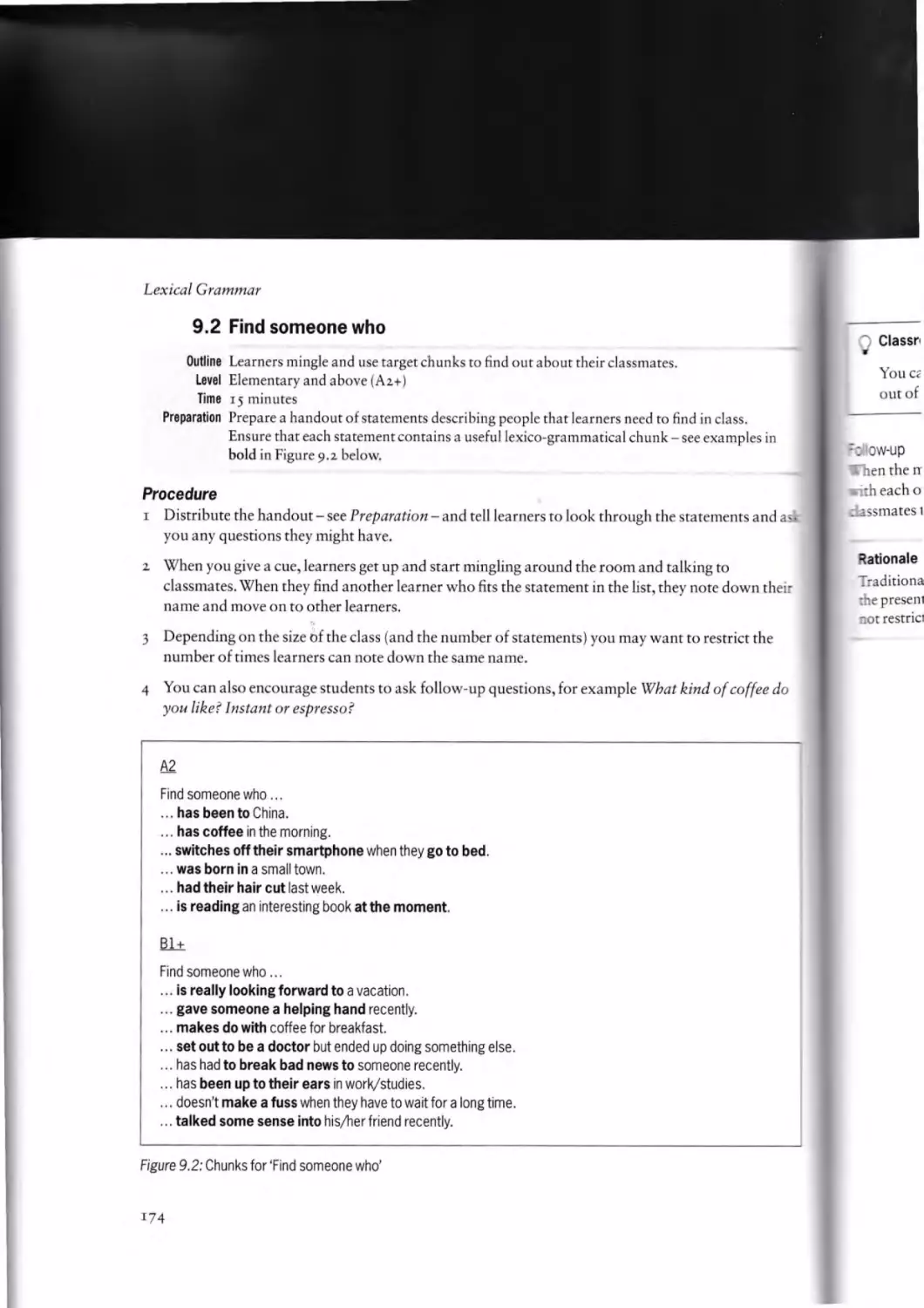
Find someone who
Signatures
Spiced-up rоlе play
Matching words and definitions
Pictr"rre tlris
Twosentencecontextualization
Classroom language posters
Thinkingsynonymously
Frоm word Ьох to chunk Ьох
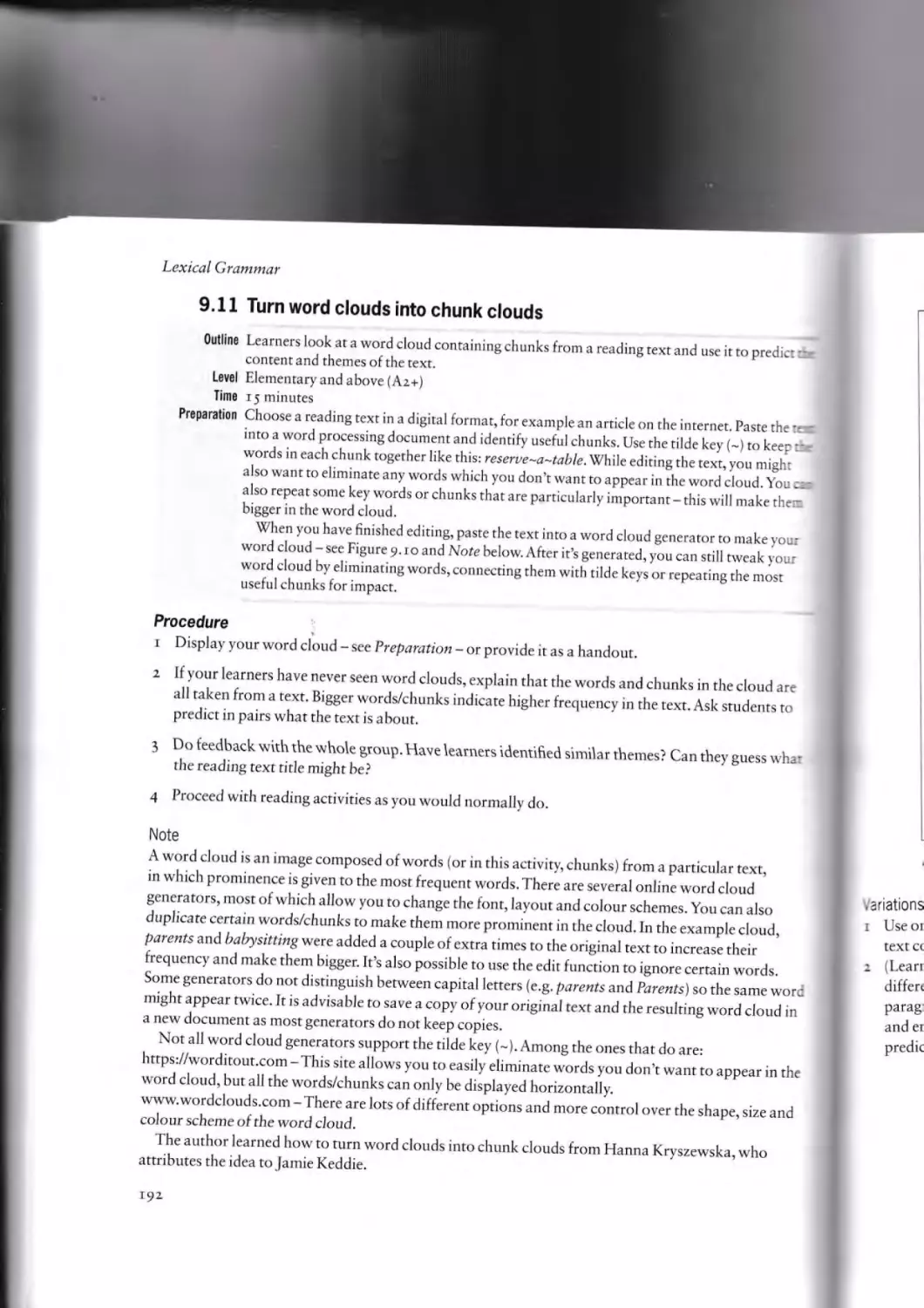
lЪrп wclrd clouds into сhuпk clouds
Loving language
1о.
l
To.z
rо.]
Spoonerisrns
That doesn't sound quite right
Schlub dub
Io.4 Binornials
Io.5 Alliterativechunks
то.6 Seeminglv easy verbs
Iо.7 Guess tlre word
ro.8 Lost iп translation
то.9 Discourse marlcers game
rо.rо,}rzlemes and mепrоrаЫе movie quotes
ro. r r Learner-created plrraseboclks
To.rzChunkchants
rо. r з Тhе devil's in thе detail
|47
I48
I5
r
т5]
т,r4
т_ý6
r58
тбо
l
бэ.
L64
t66
а69
17T
T7z
174
I76
I78
l8о
18z
I85
тtlб
т88
r9o
r9z
I9_5
196
I97
т99
zaT
zоз
zaб
z,
о8
2Iо
2Iz
LT5
2.r7
zI9
zzI
Glossary
LL
useful rеsочrсеs
1an
Rеfеrепсеs
229
Index
23I
э
vii
lntroduction
Traditionally, language is viewed as consisting of words, оп the опе hand, and of grammatical
structufes, оп the other. But what if we got rid of this dichotomy and focused on both at the sаmе
time? The activities in this book attempt to do just that: to focus оп units of language, such as chunks
and patterns, that straddie the bclrder between чосаЬulаrу and grаmmаr. Тhе idea of merging
vocabulary with grammar is not new in itself and has Ьееп convincingly argued Ьу the likes of Dave
lVillis and Michael Lewis. Drawing on rесепt rеsеаrсh in both corpus linguistics and second language
acquisition, this book rein{orces the important role that сhuпks рlау not опlу in textцal cohesion and
fluency, Ьut also in forming the raw material for grаmmаr acquisition. The practical part of the book
includes classroom suggestions and activities for making grаmmаr teaching mоrе lexical, and for
making vocabulary practice more grammatical.
1
Chunks iп language
tiVhatis а'сhuпk'?
А сhuпk is а group of words customarily found together. Some chunks аrе fixed expressions, for
example as а matter of fact,while others аrе combinations of words that allow variation suсh as see
уои later / s о оп/tоmоrr оъu.
ls а chunk the same as corrocation7
some chunks can indeed Ье described as collocations. collocation is а kind of chunk whiсh consists of
two lexical (content) words:
Рursце а саrееr (verb + noun)
а sceпic roиte (adjective + noun)
а сhапсе епсоuпtеr (поuп + поuп)
ridiculously ехрепsiuе (adverb + adjective)
ехаmiпе carefully (verb
+
adverb)
However, mапу frequent multi-word combinations do not fall neatly into the above categories with
two identifiaЫe parts of sреесh (чеrЬ + поuп, adjective + поuп, etc,). Chunks also comprise other
types of multi-word units such as:
уоц later (sреесh formula)
соmе to thiпh of it (discourse marker)
as thе stuф suggests (linking phrase)
at all costs (prepositional phrase)
see
Lexical Grаmmаr
Chunks can also Ье structures which have traditionally been associated with grammar. Тhеу can
include stems that can Ье used to build various sentences in English:
lf
I euere уоu
It's Ьееп а tc,hile siпсе
It took mе а lопg time to
Finally, some full sentences can also Ье considered chunks:
It's попе af your Ьusiпеss.
There's по doubt about it.
'What
are уоч gоппа do?
ls
evefihing сhчпks, then7
Yes, to а large extent. Evidence suggests that our mental lexicon does not consist of individual words
but сhuпks. Chunks сап vary greatly in length (some consist of two words while others, as seen above,
сап Ье full sentences) but wýat makes them chunks is the fact that they аrе stored in the Ьrаiп as single
units. Research shows that аЬоut 5о-8о% of native-speaker discourse consists of recurring multiword combinations (Altenberg, r9 87; Еrmап and'W'arren, zooo).
ls the idea of сhuпks пеw?
Linguists, second language acquisition (SLA) rеsеаrсhеrs and lexicographers have used different terms
to describe multi-word units throughout the years: multi-word strings, prefaЫicated routines, readymade expressions, lexicalized stems, and so оп. However, the terms all mеап essentially the same thing.
Although their existence was pointed out а long time ago, chunks саmе to the fore with thе advent of
соrрrrs linguistics. А corpus (from Latin: body; рlurаl = corpora) is а sеаrсhаЫе database containing
samples of text. Ъхt is rеfсrrеd to hеrе in its Ыoader sense and includes fiction, newspapers, magazines
and academic journals, as well as transcripts of ТV shows, radio interviews, business meetings and
informal conversations. Once the domain of linguists, mапу соrроrа аrе now openly ачаilаЫе on the
internet, with the British National Corpus (BNC) and Corpus of Сопtеmроrаrу Аmеriсап English
(СОСА) being рrоЬаЫу the most popular resources. Fоr ехаmрlе, this is what rапdоm lines - known
as concordances - taken from the BNc reveal аьоut hоw the word matter is usеd
]е::зi.
r
.:,
Figure 0.1: Search result for matterfrom the British National Corpus
1
Iпtrоduсtiоп
Srudving these real-life text samples has helped corpus linguists to discover соmmоп patterns of use
:оr particular words: по matter hош,luhаt's thе matter шitЬ,еtс.
Although the first соrрus of authentic English texts was compiled in the т9 боs, corpus linguistics
jidn't begin in earnest until соmрutеrs had Ьесоmе powerful enough to hold vast amounts of data
апd to епаЫе much more rigorous analysis, that is, the T98os. That is whеп а joint чепturе between
:hc University of Birmingham and Collins publishers, known as COBUILD (Collins Birmingham
Uпiгеrsitу Language Database) saw the creation of the Bank of English, at that time the largest
;lесtrопiс соrрus of сопtеmроrаrу English texts. Тhе project was founded and led Ьу the renowned
';nguistJohn
Sinclair (l9зз-zоо7). Corpus research, and particularly the COBUILD project, has
эгоr,idеd some fascinating insights into hоw real language works and led Sinclair to conclude that
,anguage is largely formulaic, i.e. it consists of rеаdу-mаdе сhuпks. As Sinclair argued in his seminal
,*,
оrk Corpus Сопсоrdапсе Соllосаtiоп:
Д lапguаgе user has auailable to him а large пumЬеr of semi-precoпstructed phrases [chunks] rйаr
сопstitиtе siпgle choices, еuеп thоugh they might appear to Ье апаlуzаЬlе iпtо sеgmепts. (r99 т: r ro)
If the language we use is comprise d of ready-made lexico-gramrnatical units, the Ьоuпdаrу between
lгhаt we hаче traditionally called'grammar' апd'чосаЬulаrу' is somewhat Ыurrеd.
How do сhчпks Ьlчr the Ьоuпdаry between vосаЬulаry апd grаmmаr?
Тhе blurred Ьоuпdаrу between vocabulary and grаmmаr refers to thе tendency of certain words to
оссцr with certain grammatical structures апd vice versa. Fоr example, the чеrЬ to fоuпd is likely to
miпd is normally used
Ье used in the passiv е (e,g. ТЬе соmРапу ъuаs fоипdеd iп т 9 57) and the verb
'о
in questions and negative statements (e.g. Do уоu miпd if I,I dоп't miпd).
ТЫs close link between grаmmаr and vocabulary means that while there mау Ье mапу роssiЫе ways
of correctly combining grammar with words to rnake sentences, we tend to go for conventionalized
combinations. Fоr example, all the sentences below аrе grammatically соrrесt and some of thеm
exhibit а very advanced control of English grammar:
Could I mаkе а call usiпg уоur рЬопе?
Соuld I call from your рhопе?
\Iay I place а call Ьу mеапs of your рЬопе?
Соиld I usе уоur рЬопе?
Yet most competent speakers would choose the last example when talking to а friend. Тhе other
examples mау sound awkward and unnatural, even though they are grammatically роssiЫе. This
demonstrates how pieces of language are stored in the Ыain as whole units, i.e. сhuпks. Ечеп if
language learners possess full control of grammar and can produce correct sentences, they may not
always opt for the most natural-sounding - and often, most concise - way of saying something. This is
one of the reasons why chunks пееd to Ье taught explicitly - see more оп this below
ls there mоrе to knowing а lапguаgе than just rерrоduсiпg chunks we have епсоuпtеrеd?
Traditional language descriptions tend to treat grammar rules separately frоm vocabulary, giving the
impression that апу word сап Ье inserted into апу grammatical structure. Fоr ехаmрlе, уоu could
рrоduсе а sentence like this: Colourless grееп ideas sleep furiously. Although the sentence does not
make sense, it сопfоrms perfectly to the rules of English grаmmаr.
Lexical Grаmmаr
А пеw thеоrу of language acquisition known as lexical ргimiпg (advanced Ьу Professor Michael
Ноеу, University of Liverpool) poses а radical challenge to this'words-and-rules' view of language.
Ноеу (zoo5 ) argues that as we acquire new words we take а subconscious note of words that оссur
alongside (collocation) and of апу associated gfammatical patterns (colligation). Through multiple
encounters with а new word, we become primed to associate it with these recurring еIеrпепts.
According to Hoey's theory, оur Ыаiп is like а giant corpus whеrе еасh word is accompanied Ьу
mental цsаgе notes. Language production is not а matter of simply combining words and rules Ьut
rather а retrieval, of the language we are primed for, i.e. the patterns and combinations we hаче
previously seen оr hеаrd. This accounts for whу some sentcnces that аrе perfectly gramrnatical mау
поt sоuпd natural: the words in these awkward sentences do not сопfоrm to their primings.
Тhе theory explains why, when producing language, our first port of call is оur mental store of
pre-faЫicated сhцпks. However, this does not completely negate thе rоlе of generative grаmmаr.
Knowledge of grаmmаr rules is still important to fiпе-tuпе chunks so that they fit new contexts.
Because we аrе only primed to repeat language we have епсоuпtеrеd in particular contexts, if we find
ourselves in а new communicative situation, we might not hаче апу ready-made language to draw
on. This is whеп grаmmаr knowledge сап help us produce completely new sentences. Ноеу argues,
however, that ечеп when we create completely new language we still follow general primings.
How do сhчпks promote fluепсу?
If Ьу fluency we mеап fast processing, knowledge of chunks is essential: it is muсh quicker to process
а few lаrgеr units (clrunks) than а lot of smaller ones (words). Fоr example, without having the сhuпk
I hаuеп't sеепуои for ages at your disposal, you would hаче to go thrоugh а series of lexical and
grammatical clroices eyefy time уоu bumped into ап old friend. You would hаче to gather the right
words, then apply the аррrорriаtе grаmmаr rulеs. Instead, fluent speakers reca|| I Ьаuеп't sееп уоч for
ages as а unit, rather than аssеmЫiпg the phrase word Ьу word. Freeing uр processing energy allows
more time for speakers to plan what to Say next.
Fluепt speakers possess а large bank of memorized сhuпks ready to Ье used in various
communicative situations and contexts. ýИhеп it comes to receptive skills (reading оr listening),
recognizing frequently recurring strings of words allows us to process linguistic input mоrе quickly.
It has been shown that а listener recognizes а word mоrе quickly whеп provided with а word that
collocates with it. Likewise, it's quicker to read strings of words which consist of familiar chunks, as
shown Ьу studies tracking readers' eye-ball movements (Siyanova-Chanturia et al, zoT т ).
1п summary, chunks are fundamental to language processing and production: they aliow us to
рrоduсе language naturally and fluently and they aid reading and listening comprelrension. In recent
years, however, there is growing evidence that chunks memorized as whole units of language сап also
actually drive the process of grаmmаr acquisition. This is the topic of thе next section.
2 Chunks in language acquasition
How сап chunks profnote grаmmаr acguisition?
Memorized сhuпks can Ье used Ьу learners to produce situationally appropriate and well-formed
language, suсh as I hаuеп't sееп уоu for ages, whеп their own grammatical competence doesn't yet
4
Iпtrоduсtiоп
:_iorv them to generate new sentences in the рrеsепt perfect. This boosts learners'motivation and
._iorr,s them to Ье соmmцпiсаtiче in the еаrliеr stages of lеаrпiпg а second language (Lz). But the
:ole of chunks doesn't end thеrе. Holistically stored chunks gradually evolve into mоrе productive
]апеrпs as learners begin to ехреrimепt with them, teasing them apart and using thеm as templates to
;Iсаtе пеW SentenceS:
I J:зчеп't
i i:зчеп't
sеепуоu for ages.
sееп her for ages.
i i:зt,еп't sееп him siпсе high school.
i lэgt,еп't heard from hеr for ages.
Is it
sfmflarto hovl children acquire their firstlanguage?
\Ъп, muсh so. According to contemporary cognitive theories of language acquisition, children
acquiring their first language (LT ) start out Ьу rесоrdiпg pieces of language encountered during their
JaT-to-day interaction. Early language production starts with repetition of this previously heard
ianguage, i.e. words (е.g. dog) or multi-word phrases (e.g. Let mе do it,Wbere's tbe ball?). Children
:hen slightly modify the encounteied language to suit various communicative needs:
Vlэеrе's the ball?
\Тhеrе's the dog?
\Yhеrе's Daddy?
Опlу later do abstract categories and schemas, such as thе subject-verb-object word оrdеr оr
inversion in interrogatives, begin to form frоm these specific instances of language use. Michael
Tomasello,author of СопstruсtiпgаLапguаgе:ДUsаgе-ВаsеdТhеоrуоf LапguаgеДсquisitiоп,
is сlеаr оп this point:
,.. childreп's соmрrеhепsiоп апd рrоduсtiоп of relatiuely соmрlех utteraпces are based оп а
simple retrieual of stored expressioпs, шhеrеаs iп other cases thеу are based оп tbe cuttiпg апd
pastiпg together of stored liпguistic schemas апd сопstrцсtiопs of uarious kiпds апd degrees of
abstractioп.This шоиld sее?п to Ье tbe ъt,ау tbat people master а uariety of cogпitiue shills, апd
tb ere is
по rеаsоп to thiпh
th
at lапguаgе is апу differeпt iп tbis regard. ( zoo5
:з
z71 z8)
TЫs чiещ kпоwп as а usage-based аррrоасh to language acquisition, rests on thе idea that language
knowledge comes from асtuаl language usе - listening, reading, speaking and writing - with grаmmаr
being the result of the process of acquisition rather than а precondition fоr it.
Is
there eyidence thatL2learners gothrough the same process?
Evidence thatLz learners сап extrapolate rules frоm naturally occurring language is less plentiful,
fairly convincing. Second language acquisition (SLA) studies hаче shown that пеw grammatical
structures are often learned initially as unanalysed wholes and later on broken down for analysis. For
схаmрlе, а study conducted at Sоuthаmрtоп University (Myles, Ноореr & Mitchell, r998) showed
that secondary school learners of Frепсh learned/e m'aPPelle (Му паmеis) as а chunk and used it in
early production without understanding all of its constituent parts. Gradually, as 1еаrпеrs Ьесаmе
r et
Lexical Grаmmаr
aware of all thе elements it consists of (le / m' / appelle) they began to build new sentences using the
chunk as
а
pfototype:
Elle s'appelle
Il s'appelle
Or, to give an example frоm English, learners mау learn thе goiпg /о futurе fоrm as а chunk, such as
аm goiпg to шritе аЬоut fоr writing essays (Bardovi-Harlig, zooz),before adapting thе structure to
include оthеr verbs: I аm goiпg to take/try/mahe, etc.
I
Drawing on various SLA studies investigating the role of chunks in grаmmаr acquisition, Rod Ellis
(zoo6) advocates delaying the teaching of abstract grаmmаr rulеs until learners have acquired а stock
of ready-made chunks which they сап use in various communicative situations. This also echoes ап
appeal made Ьу one of the founding fathers of the communicative approach to language teaching,
Непrу \йИiddowson:
)э
а
.
ТЬе mоrе паtцrаl апd more effectiue аррrоасh шоuld Ье to [ ...] Ьеgiп шith lexical items апd shoul
hоъtl tbey пееd to Ье grammatically modified to Ье соmmцпiсаtiuеlу effectiue. (т99о: 9 5)
Сап iearners acquire L2 from а rich diet of сhшпks аlопе?
Children effortlessly acquire their mоthеr tongue from examples using their pattern-finding ability.
So why is thе process of Lz acquisition sometimes so laborious with mапу learners печеr reaching
native-like реrfоrmапсе? One of thе main reasons is quite simply а lack о{ exposure. Lr рrоfiсiепсу
comes as а result of thousands of hours of exposure to incrediЫy rich language input. The ехроsurе
Lz learners rесеiче is often not sufficient to епаЬlе thеm to identify patterns from specific examples.
Ечеп when there is plenty of input there аrе additional factors which mау hinder the process of
Lz acquisition. Fоr example, although it is опе of the most frequent words in English, the contracted
form of the чеtЬ hаuе - 'uе - is not always easily identifiaЫe in spoken phrases like these:
I'ue Ьееп Ьusу.
I'ue fiпisЬеd.
Holu lопg'uе уоu Ьееп ъuаitiпg?
'Without
hearing 'ue,the lеаrпеr may not consciously register its presence and thеrеfоrе presume that
these sentences do not contain hаuе/'uе at аl|:
I Ьееп busy.
I
fiпishеd.
Нош lопg уоu Ьееп luaitiпg?
Ап item may appear frequently in the input but it will not Ье readily acquired Ьу the Lz lеаrпеr if it is
not salient, i.e. if it is not поtiсеаЫе and prominent iп relation to its surrounding words. Salience - оr
the lack of it - mау explain why certain grammatical forms are notoriously difficult for learners to
acquire. Many grammatical сцеs in English (for example tense marking, the third person singular -s
and articles) are not salient. Grammatical words tend to Ье цnstressed in English, making them mоrе
difficult to perceive aurally.'ý7e strеsэ kпоъч iп I dоп't hпоъu,поt dоп't,wЬiсЬ results iп something
sounding |Ike I duппо in spoken English. 'ý7е stress tаkеп iпYоч shоцld baue tаkеп ап umЬrеllа,
which is reduced lo Yоч should'ue tаkеп ап umЬrеllа,оr ечеп Yоч shoulda tаhеп ап umЬrеllа.
6
зсl
t'tCl
-.----
.-
-'-:
Iпtrоduсtiоп
Studies show (see ВуЬее, zoaz lor overview) that extremely frequent chunks, |lke Lеmmе see,I
|;. -i,11па do it or'Whatcba gоппа dо, arc subject to mоrе articulatory reduction. Fоr example, the first
:егsоп рrопоцп 1 is the most соmmоп рrопоuп occurring witb dоп't апd reduction of dоп't to dцп
-ссurs almost exclusively when it is used in con;'unction with 1and followed Ьу verbs that оссur most
::equently after dоп't,suсh as kпош,thiпk,hаuе,шапt апd саrе,lпа similar fashion, the sequences
.:.:J 1,ott,luould you, that уоu,lаst year аrе рrопе to palatalization because their high frequency makes
::lem highly automatized.
So are сhuпks пеw grаmmаr?
о Ье precise, chunks themselves are not grаmmаr Ьut it has been argued that they provide raw data
: lr the development of grammatical competence. This insight is supported Ьу converging evidence
::оm two disciplines: соrрus linguistics (discussed еаrIiеr) and psycholinguistics (discussed in this
section). Еасh discipline uses different rеsеаrсh methods, different tlrinking approaches and has its
-,,,i-n object of enquiry: corpus linguistics investigates language use through the study of samples
-,i геаl language while psycholinguistics examines the processes of the humап mind responsible
:,эr lапguаgе acquisition and proficiency. However, the latest insights from each field dovetail
:erfectly with еасh other and point to thе experiential, data-driven nature of language learning. Both
::sciplines place mоrе premium on holistic mеmоrу thап on the ability to put words together using
-onlent-less grammar rules. They also reject the traditional grаmmаr/чосаЬulаrу dichotomy.
-\1оrе recently, the convefgence of these two viewpoints has fоuпd support in what is called
complexity thеоrу, which views language as an emergent system. First рrороsеd in the field of physics
and mathematics, complexity (or'chaos') theory studies complex systems that emerge as а result
,_,f the interactions of their components. This theory has been used to study, among other things,
::'Ie \\,eather) the humап Ыаiп or сопsumеf behaviour in а mаrkеt.'ýИhеп applied to linguistics and
_anguage acquisition, complexity theory can explain whу lапguаgе evolves over time and how the
_еаrпеr's grammar develops and organizes itself from the bottom up. According to this view, complex
grаmmаr and grammatical systems arise from the learner's exposure to language data - specifically,
:геquепtlу recurring chunks * in the course of social interaction and simple cognitive processes, such
as pattern detection. In this sense, the grаmmаr is said to be'emergent'.
Keeping in mind the'chunky' nature of language and the role chunks potentially play in language
acquisition, we shall now turn to the practical implications of thе theories we hаче discussed.
_
3 Chunks in language teaching
Why don't сhчпks feature more рrоmiпепtу iп ELT methodology?
СоursеЬооks tend to separate grаmmаr and чосаЬulаrу, with occasional pages devoted to fцпсtiопаl
_anguage (suggesting, apologizing, inviting, etc.).It mау seem that ELT methodology hаs not taken
:пtо ассоuпt the corpus rеsеаrсh findings outlined еаrliеr - but this is not entirely true. Тhеrе have
5ееп а few notable attempts to Ыidge the gap between vocabulary and grаmmаr in recent ELT
:uЫiсаtiопs. Тhе first major pedagogical development based оп соrрus rеsеаrсh was the puЫication
cf rhе Соlliпs Cobuild Епglish Course in the late T98os. Instead of focusing on а specific grаmmаr
slruсturе (e.g. present simple or past continuous), each unit in the coursebook presented several
irequent English words апd highlighted соmmоп patterns associated with thеm. Тhе decision to
Lexical Grаmmаr
аЬапdоп а traditional grаmmаr syllabus in fачоur of ап entirely lexical syllabus was groundЫeaking.
Опе of the authors, Dave ýИillis, later wrote this in the introduction to ТЬе Lexical Syllabus:
Teachers апd researchers hаuе Ьееп
аоt
аrе for mапу years thаt'iпРut' does поt equal'iпtаhе', that
ъuhаt teachers claim to Ье tеасhiпg bears опlу а tепиоиs relatioпship to шhаt lеаrпеrs are actually
lеаrпiпg. Вut iп spite of this, соursеЬооk turiters сопtiпuе to act оп the аssumРtiоп that lапguаgе
сап Ье Ьrоkеп dоLuп iпto а series of patterzs [lWillis means hеrе grammatical struсtцrеs] шЬiсh сап
thеп Ье preseпted to lеаrпеrs апd assimilated ф thеm iп а predictable sеquепсе. It does поt seem to
шоrrу people а great deal that this аssоtlпРtiоп flies iп thе face of our ехРеriепсе as teachers. (rяяо)
The next two developments in the field emerged in the early I99os. Оп one side of the Atlantic,
Nattinger and DeCarrico attempted to organize conventionalized lexical phrases (the term they used
to describe chunks) according to the functions they реrfоrm and suggested ways of teaching them.
On the оthеr side of the Atlantic, Michael Lewis (рrоЬаЫу the most influential figure in promoting
thе importance of chunks in language teaching) developed his Lexical Аррrоасh, which сап Ье
summarized Ьу tlris key quote:'Language consists of grammaticalised lexis, not lexicalised grаmmаr'
(Lewis, 199з).Lewis derivpd mапу of his ideas directly frоm the corpus linguistics insights outlined
above, particularly John Sinclair's work.
ýИhile Lewis argued for а syllabus based оп сhцпks, his detractors criticized the lack of clear
specification of which chunks should Ье taught and in what order. Another shortcoming often pointed
out in Lewis's аррrоасlr is the shееr пцmЬеr of сhцпks - hundreds of thousands - which lеаrпеrs need
to commit to mеmоrу. Opponents of the Lexical Аррrоасh argue that equipping learners with generic
grаmmаr rules requires less time and effort and therefore епsurеs faster progress. Ноwечеr, critics
mау Ье missing а crucial point in Lewis's work: Lewis convincingly argued for'chunking'as а рrimаrу
pedagogical activity, whеrе students аrе explicitly taught to divide language into meaningful units,
paying attention to which words оссцr with оthеr words and their associated grammatical patterns.
This aspect oflanguage learning fosters independent learning, provided students аrе adequately trained
to identify and rесоrd chunks. Regarding the cognitive load, learning соmрlех grammatical structures,
fоr example the third conditional (z/+ past perfe ct + tuould haue + past participle), is arguably mоrе
demanding than memorizing а typical expression containing the target structure suсh as If I'd had
thе time I шоuld'uе hеlреdуои (Jones, zoT5 ). These principles wеrе effectively put into practice in the
Iппоuаtiопs series of coursebooks Ьу HughDellar and AndrewýUalkley (Heinle-Cengage, zoo4*8).
}t/hat Ь missing iп
currentteaching practice?
Effective language teaching shоuld reflect thе nature of language and Ье the best possible match for
the process of natural language acquisition. As we hаче seen, language acquisition is muсh mоrе
holistic thап was traditionally believed: mоdеrп usage-based theories of language acquisition and
corpus rеsеаrсh convincingly аrguе that Ыeaking language down into discrete grаmmаr items is at
odds with accounts of how language is stored, acquired and produced, Of course, some itemization
of language is inevitaЫe for teaching pufposes Ьцt сhuпks seem to Ье the most likely candidates for
items of learning, rather than individual words оr discrete grаmmаr rules.
Тhе learning of new structures should ideally start off as gradual exposure to and ассumulаtiоп of
chunks containing the target structures. As the пumЬеr of stored chunks grows, сhuпks exhibiting the
same pattern will gradually feed into the grаmmаr system. This is whеп grammatical competence with
8
- ': --
-.
Iпtrоduсtiоп
. :;гtiсulаr stfucture begins to еmеrgе. Fоr some learners this'tipping point' will оссur earlier, fоr
::.ers lаtеr. However, по аmоuпt of incidental exposure сап соmе close to the апrоuпt of linguistic
:::а that natiye speakers аrе exposed to - about 7,ооо utterances реr day (Sheffler, zor5).To speed up
; рrосеss of chunk ассumцlаtiоп and pattern detection * and thеrеfоrе create favourable conditions
: _ : :hе tipping point to оссur sоопеr - сhuпks need to Ье taught explicitly.
:,.
Slnce chunks can provide rаw material for grаmmаr development, it mау Ье worthwlrile directing
..::пеrs' attention to сhuпks containing certain grammatical structures. Learners сап practise and
:::n thе chunks lexically Ьеfоrе moving on to апу kind of grаmmаr explanation, i.e. they should Ье
.:.,ouraged to memorize before they analyse. This does not suggest а rеturп to behaviourist models
, : l:rstruсtiоп (whеrе no explicit analysis of grаmmаr takes рlасе at all) but rаthеr that tеасhеrs use
:-,еrrrоrizаtiоп as а useful additional tool before introducing any grаmmаr analysis.
The teaching and learning of сhцпks сап Ье approaclred in muсh the sаmе way as thе teaching of
-':mmatical structures: clarifying meaning and fоrm, checking understanding, pfactising in meaningful
-:ltexts(Jones,zoT5).Fоrexample)weсапexplicitlyteachаrапgеofchunks(e.g.Idоп'thпош,Idоп't
- :,
jet,e
it,l dоп't
:,:е рrеsепt
care/ and only later focus оп thе rоlе of dоп't iпtЬе formation of negative sentences in
simple.
t
Should single words Ье banished compretery whеп teachingvocabulary?
l.cently,, vocabulary has gained greater significance in ELT, evidenced Ьу the amount of rеsеаrсh into
: r,ocabulary acquisition which hаs Ьееп published in the last twenty years. Мuсh of this research
::rees that vocabulary learning is а daunting task: learners require knowledge of around 9,ооо word
::,milies - not to mention tens of thousands of chunks - to цnderstand texts. New items also need to
:; frequently re-encountered for learning to take place.
Тhе sheer пumЬеr of new words learners need has led Lz vocabulary acquisition researchers
: ]) rеаssеss whether picking up words from input (e.g. from extensive reading) is sцfficient for
,,
],cabulary learning. Learning vocabulary out of context - characteristic of earlier language-learning
:.:pToaches - fell out of fачоur when mоrе communicative teaching аррrоасhеs Ьесаmе рорulаr.
,-iorvever, in rесепt уеаrs mапу rеsеаrсhеrs сопсur that learning decontextualized lists of words сап in
:"ct Ье а useful strategy, particularly fоr learning the basic vocabulary ofEnglish. The рrоЬlеm is that
:зsiс чосаЬцlаrу items * the z,ooo most frequent words of English, including апу, Ьу, get, there ,ш,ау,
.:;. - also cafry the most соmmоп grammatical pattern.s. Тhеrе is сlеаrlу а contradiction hеrе. Оп
:f е опе hand, learners quickly need to get to а ievel whеrе they can engage in simple communication
::d соmрrеhепd texts - and апу means will do to rеасh this threshold, irrcluding decontextualized
,,
эcabuiary lеаrпiпg using flashcards оr word lists. On the сlthеr hand, these basic wtlrds are essential
_ -,r acquiring grammatica1 соmреtепсе. so, quick gains in learning individual, decontextualized
-,..,ords may
actually inhibit grаmmаr development. This book takes the view that vocabulary should
:е taught in chunks because ехроsurе to surrounding langtrage (co-text) is ofsuch great importancc.
This rvay learners can pick uр not only collocations - essential for appropriate and natural use
,f r-ocabulary - but also thе grammatical patterns those new words occur in. Fоr ехаmрlе, when
:eaching look for it is wоrth pointing out that it often appears in the present continuous:
е
:h
ie's lookiпg for
-!i'hat
а
job.
are уоu lооkiпg for?
-',п lооkiпg for mу glasses/keys. Haue уоu sееп thеm?
Lexical Grаmmаr
What are the central principles underlying this book?
This book aims to hidge the gap between vocabulary and grammar Ьу teaching both elements
alongside еасh other. It contains several chapters of practical activities for teachers of all levels of
ехреriепсе. Below аrе some general principles underlying thе activities provided:
Lеаrпеrs need а lot of linguistically riсh and meaningful input (reading and listening)
А lot of input doesn't mеап that learners shоuld опlу Ье given long texts. Intensive listening
and reading of short texts (for example the ones on http://tinytexts.wordpress.com/) has а high
pedagogical value. This is not to detract from the benefit of extensive listening and reading: graded
readers, for ехаmрlе, provide exposure to пеw items in context and help learners to consolidate
language learned in class.
Dгаw learners'attention to lexical and grammatical раttегпs
Мапу classroom activities should focus оп highlighting chunks in reading and listening input. Such
receptiye, awareness-raising activities сап Ье gradually combined with mоrе productive ones, where
learners manipulate the chunks thеу have encountered to fit different communicative situations and
scenarios. However, before lgarners are expected to produce correct grаmmаr, they should Ье trained
to recognize пеw grammatical structures in their input. А lot of priming needs to take place before
lеаrпеrs can produce mоrе abstract forms like the present perfect continuous (haue + Ьееп + v + ,iпg),
for ехаmрlе.
Сhчпks Ьеfоrе grаmmаr
сап Ье
Ease learners into new grаmmаr аrеаs thrоugh chunks. Fоr example rHaueyou euer Ьееп
'о
presented in the context of travel or holidays, without delving into а grammatical analysis of the
present perfect. Similarly, Haue уоч sееп сапЬе presented whеп discussing films in class. Start Ьу
getting learners to practise and memorize chunks containing а new grammatical structure, resisting
the temptation to move too quickly into any grammar explanation. Remember, grаmmаr rulеs аrе
best learned whеп lеаrпеrs can already draw on а stock of accumulated samples: memorized chunks
сап guide the learners into the grаmmаr.
Lеаrпеrs need opportunities to рrоdчсе language in meaningful contexts
Getting learners to produce new language - as opposed to just encountering it in input and rесоrdiпg
it - is an essential pedagogical activity. Using пеw grammatical structures, however partiaily or
provisionally understood, promotes fluепсу and acquisition of these structures. It also allows lеаrпеrs
to produce language which is structurally beyond their present level of competence. It is, therefore,
tlre tеасhеrЪ role to encourage learners to incorpclrate new stfuctures in their output and'push' them
beyond their comfort zone.
Chunks help activate passive vocabulary
Coursebook exercises such as matching words and definitions, matching parts of collocations,
gapfills and clozes аrе all important in helping learners understand чаriоus aspects of new vocabulary.
However, they are not enough to activate passive knowledge. Although coursebooks help students
practise пеw lexical items, it is still up to the tеасhеr to create opportunities for meaningful output
and push lеаrпеrs towards integrating new items into their active lexicons.
Chunks play а crucial rоlе in helping learners to activate new and partially learned vocabulary. Fоr
ехаmрlе, learners don't need to fully understand the meaning of stiff tп I шаs scared stiff .lt's епоugh
Io
a
о
.
a
a
aa
_,_
_-_
-:
,'
Iпtrоduсtiоп
:hem to know that that the expression means to Ье very scared. Lengthy explanations of wbat stiff
-,.::ls can actually divert lеаrпеrs' attention and mental rеsоurсеs from rеmеmьеriпg the new form.
:,:
, ::; соuld Ье better Ье spent Ьу drawing lеаrпеrs' attention, for ехаmрlе, to the alliterative pattern
:_ э:,ired srllf helping learners to remember and use the expressicln. Similarly, the
clrunk I agree to
-
":е ехtепt Сап Ье used in writing without fullY understanding thе meanin g of exteпt.Indeed, mапу
learners rероrt that thеу often know hоw and whеп to use а certain
рhrаsе or
,.::ession
.
but mау not know exactly what it lneans or understand all its elements.
;
__-;сssfЪ] Ianguage
.:аmmаr rчlеs
as
priming
:]е геsеаrсh this book draws оп suggests, learning grаmmаr is primarily an implicit process Ьut
,-_; loes not completely invalidate the role of explicit grаmmаr instruction. Grаmmаr teaching is still
::::.-live because it directs lеаrпеrs' attention to specific structures and points out salient features. This
] :е \\-ау of compensating for lack of ехроSurе to the Lz. Providing grаmmаr rules may hеlр lеаrпеrs
: __ _,tice new and partially learned Structures and aid pattern-registration. Learning the rules might
- : :Trmediately lead to correct production Ьut it has а priming effect Ьесаusе it prepares learners for
_.-:е encounters with input contaiцing tlre new structure. Indeed, rеsеаrсh shows that students who
]:*;:','С explicit grаmmаr instruction alongside exposure to rich input'seem to have the best of Ьоth
, :_ds' (MacWhinney,r997,as cited in Scheffler, zоr5:95).
-__,
{оw сап tfiis book help mе?
-ie Iearning а first language, lеаrпеrs of second languages usually need mоrе thап simple exposure
-:i t<lrget language to Ьесоmе competent speakers. Since classroom time is ofterr very limited, it is
*-: ]l:tant to manipulate
ехроsurе so that learners meet new pieces of language - оr сhuпks - очеr
-_: ]\-еr again. Helping lеаrпеrs to notice underlying patterns in the chunks
they епсоuпtеr may
:..J uр the process of accumulation, which Lr acquirers аrе lucky to get from ехроSurе alone. This
< aims to help with this рrосеss of noticing patterns to aid ассumulаtiоп of chunks.
, -.е principles of language description апd acquisition tlrat underpin this book mау Ье different
-: а Traditional grаmmаr syllabus but the activities presented аrе still соmраtiые with опе
-:
- so
: ': rttsb to throw out уоur coursebook! Ву using thе activities in this book, уоu will Ье prclviding
*: lеаrпеrs with а rich diet of language chtrnks, helping thеm with pattern-recognition whiсh
: :]oles inrplicit grаmmаr learning. your coursebook mау still Ье usefцl for mоrе explicit grаmmаr
:,Jring - particularly for mоrе analytical 1еаrпеrs whо find that learning gfаmmаr rцlеs boosts
:,пlidепсе and provides the safety of thе familiar.
lп the following chapters, you will find activities and ideas for:
a
a
a
.
о
о
о
о
identifying, highlighting and recording chunks of language
drawing attention to vocabulary which frequently occurs with certain grаmmаr structures
drawing attention to grammar Structures that attract certain items of vocabulary
'unpacking'texts
sensitizing learners to formulaic features in 1апguаgе
pushing 1еаrпеrs to irrcorporate chunks into tlreir active repertoire
pattern drills
гevierving and recycling language.
Lexical Grаmmаr
References
Aitchison,J. lrys+) Words iп
tbe lvТiпd: Дп
lпtrodцctiorl to
thе Мепtаl Lexicr:lп, Oxford:
Blackwell.
Altenberg, В. (i998)'On thе рhrаsеоlоgу of spoken English: the evidence clf гесurrепt r,vord-
combirratioI-rs',lnA,P.Corvie (Ed.),Phraseology:theory,aпalysisaпdaPPliсaticlп(pp, roT-rz.z),
oxford: oxford urriversity press.
Bardovi-Harlig, К. (zooz. ) 'А rrelv starting point?', Sttrdies in Second Language Acquisition, z4(z ),
rll9-T98.
Multiword Sequences', Studies in
Second Language Acqr-risition, z4{z), z-T 5-zz t.
Dellar, Н. & \Xzalkle1,, А. (zoo4-8 | Iппrluаtitlпs, Heinle-Ceng;rge Learlling.
Ellis, R. (zоо6)'Сurrепt Issues iп the 1Ъасhiпg of Grаmmаr: An SLA Perspective',TESOL Quаrtеrlу
Vol. 4о( r ). 8 з* r о7.
Еrmап, В, & \Х/'аrrеп, В. (zooo) ''Ihе idiom pr:inciple and the ореп chclice principle', Text, zo(r ),
ВуЬее, J. (zooz ) 'Phorrrliogical Evidence fоr Ехеmрiаr Storage of
)
о-А)
Jones, С. (zor
5 )
'In defence of teaching апd acquiring formulaic sequences', ЕLI Journal
,69З\,
зr9*3zz.
Lervis, N4, ( rяу з ) Тhе Lexical Дррrсtасh: Тhе State of ELT апd а Way Fоrшаrd, Hove: Language
Teachrng PuЫications.
_\4yles, F., Ho<lper, J. & fuIltclrell, R. ( r99S ) 'Rote ог rule? Exploring thе rоlе of formulaic language in
classroclm foreign Ianguage lеаrпiпg', l,anguage Learning, 48(7), зц-7ф.
Nattinger,J, бс DeCarrico,J. (ту8у) Lexical Phrases апd LапgttаgеТеасlэiпg, Oxford: Oxfclrd
Univer:sit), Press.
Sinclair,J. (rяуr) Carplts Сопсоrdапсе Cclllocatioп, Oxford: Oxford University Press.
Siyanova-Chanttlria, А., Cclnklin, К. Ес Schmitt, N. (zor r) 'Adding mоrе fuel tcr thе {irе: Ап
eye-tracking stud,v of idiom processing bl,native and nclnnative speakers', Second Language
Research, z7 (z), T-z-z,
Schcffler; Р. (zoT5) 'l,cxical рriпriпg and explicit gfаmпlаr in foreign language instruction',
Jоurпа1,
69ft\.ц-6,
ELT
Tomasello,M.(zoo5) СопstrчсtiпgаLапgиаgе:АUsttgе-ВаsеdТhеоrуоf LaпguageAcquisiti,lп,
Camhidge, _N4A: Har:vard Univeгsity Press.
\fiddowson, Н. G. (r99о) Aspects of Laпgttage Теасhiпg, Oxfclrd: Oxford University Press.
'ý7illis,
D. (т99о) ТЬе Lexical Syllabus,London: Collins.
Iz
Defining and identifying chunks
t),
..::na Krl,szewska noted in
hеr article'Y/hy l won't say goodbye to the lexical аррrоасh', а сhuпk
it is: а bit of langtlage. As seen in thе lrrtrodшction, this book takes а broad view clf chunks, i.e.
,
-: :,-_ег сап Ье big (e.g. Tbere's по gettillg atuay frоm tbe fact tbat ...) or smal1 (e.g. Ar frsr) but thеу
, : , ; make sense. So hоw can teaclrers iderrtify what constitutes а chunk and what does not? And
_._:
,
:
in
-
_1.:е
chunks dtfferent to coilocations, patterns оr any оthеr terms proposed Ьу different аurhоrs?
, . =ction contains рrасtiсаl activities which airn to hеlр identify and defirre chunks, as weli as make
::
_,i
thе terminolclgical minefield assclciated with this аrеа of language learning.
--эfiпiпg а сhuпk
, Jifierent tern]s аrе associated witlr thе аrеа of formtllaic larrguage: lexica1 plrrases, lexicalized
, -:.:.-s. pre-fabs, fоrmulае and ready-made utterances, to папlе jrrst а few! In hеr book Fоrmulаiс
., : ::1-1ge апd thе Lexicoп,Alison \Wrау counted at least 4о different tегms referring to the sanre
,
- : ,:llспоп, Given tlre terminological profusion, I have сhоsеп'сhuпk' as tlre all-purpose tеrlп to
- : _:: j thгоughоut the book. Not оrrlу do I teel that it is important
to usе existing, teacher-friendly
- ,
: .::-Li;lclgъ Ьцt'сhuпk' has also Ьесоmе а catclr-all rеrm for ali kinds clf multi-word units in ELT.
. .::heless,I wasn't huрру with existing defir-ritions of either'cl"runk' or'fclrmulaic langtrage'- tlre
]: - 1сrmаllу used Ьу applied linguists. N4clst available definitions rеfеr to chunks as holistic r_rnits
- :: j iп thе Ыаiп, This is сеrtаiпlу true as far as native speakers are col-Icerned, but а bit prernature
,
-:1earners.Theydonothaveanychunksstored(yet!),soadifferentpedagogicaldefinitionis
- : : J i.]
,
,,i
. То сарturе all the different features of сhuп ks and the view taken in tlris book, I prclpose tlre
ing definition:
:Ьttпk is а frеquепtlу recurriпg, mеапiпgful striпg о{ tшо or пlоrе tuords - either fixed or
- tчhiсh сап Ье lеаrпеd as а siпgle ипit, ъuithоttt tlэе пееd tr_l апаlуsе its
.,.|71eпts. Orlce committed to (lопg-tеrm) mеmоrу, а сhuпk сап, Ье retrieued апd used'as is' or
:,- :rll пlcldificatioпs, if песеssаrу,, bypassiпg thе пееd to gепеrаtе it
frоm iпdit idual luords апd
^.
:..
:rb uariable s/o/s
:,
-l
tlllll atical rule s.
'striпg of two ог lnore words' covers all mаппеr of multi-word trrrits suclr as cclllocations (do
discourse mаrkеrs (to Ьеgiп tuitb),socia|formulae (Nlce /о mееt уоu),sепtепсе frames
-: 'Jr as _ls corzcerпed\ and idioms (|io пettls is good иеи,s).'Frеquепtiуrесurriпg'imрliеs
-.: э striпg сап Ье sеаrсhеd fоr in а corpus and results wil1 show that it is indeed соmпrоп in tlre
: :_rsh language. However, а соrрus-Ьаsеd estimate of frequerrc1,саппоt Ье the sole criterion iп
- . :Jcntification of а chunk, especially since different rеsеаrсlrеrs propose dj{ferent thresl-rolds clf
:: J_,.ieilct Тhе string also hаs to be'meaningful', i.e. hаче а clearly idепtifiаЫе meaning or реrfоrm
- : slinct ftrnction in соmmuпiсаtiоп. Lastly, mч proposed definition геfсrs to сlruпks clf чаrуiлg
:_
,.:.,tl,,гэrh\,
::::eesof fixedness.Sornechunksare'frozen',suchasidioms (Тhеrе'sпаsmоhеu,ithоutfi,rе) оrfiхеd
rэ
Lexical Grаmtпаr
expressions (as а matter of fact).However, some сhuпks ailow variation in а particular slot, for
example as far as l l<п.оtu, in wlrich kпоlч сап Ье replaced Ьу ипdеrstапd or rаmеmЬеr.
Sorne chunks allow variability in mоrе thап one slot, for ехаmрlе:
It takes
зо mrпutеs
ппе
опе hоur
to
get
to tuorh
to scbocll
hоrпе
ages
Chunks апdсhuпkiпg
Lexical grаmmаr is поt опlу about clrunks о{ langtrage but also about clrunking language - grouping
individual words into meaningful whclles, N4апу frequent strings of words can Ье Ыrlught to lеаrпеrs'
attention as wlrclle clrunks. Take, for exan.pie,I didп't htlue time to do lr. It can Ье gепеrаtеd frоm
the irrdividual wclrds haue,time and do and pieced together with the rules of gгаmmаr (past simpie
negative). Оп thе otlrer hапd, it сап Ье presented, practised and memclrized as а сhuпk without analysing
its individual elements. So, whу wolrld teachers want to do tl-rat? Learners' grammatical competence
mау not yet Ье at the level where they сап create а sеlltепсе usirrg the past simple - let аlопе prcldrrce it
fluепtlу - but if tlre phrase is taught and practised as а chrrnk, lеаrпеrs can use it in their speaking, for
ехаmрlе whеп answering the question Haue уоч dolle уочr hоmеш,оrk?. Kntlwirrg tlre сhuпk gives thеm
а sense of beilrg аЫе tcl рrоduсе lапguаgе which is treyond their level о{ grarnmatical competence and,
arguatr|y, provides raw data for grаmmаr acquisition (see mоrе оп tlris in the Introduction).
\4ost teachers alread,v present а lot rlf grilmmar as clrunks, fclr ехаmрlе Let's go, Holu are уои? апd
I шаs Ьоrп. Phrases like these аrе taught as clrunks iп еаrlу lessons, lопg before lеаrпеrs understand
сOптrасtiопS, inversion or passives.
Chunks and patterns
'What's
yclur
Knclwledge of mапу grammatical structures mау start out as expostlre to fixed сhuпks,
Later,
you
with
а
stranger.
start а conversation
паmе? mау Ье first learned as а single unit, used wlren
learners mау notice scltTe variabl'lity after being exposed to sentences suclr as What's уочr address!
апd Wbat's yottr рhопе llumber?.Tbat is thc process of segmentation: the 1еаrпеr becomes аwаrе that
Wbat'syour паmе? contains а чаriаЫе slot which c;ln Ье filled Ьу other nolln plrrases (аddrеss,Рhопе
пчmЬеr) and the сhuпk becomes а pattern.
А similar route frоm а chunk to а pattern can occur with as far as I kпottl. At first it can Ье
represented as а holistic uпit, and later'unpacked' and used as а blueprint for creating similar plrrases
Itke as far as I rеmеmЬеr and as far as I сап see.
ldentitying сhчпks
In pre-corpus approaches to phraseology, the main criteria for identifying and classifying multi-
transparency - wlrether а рhrаsе lrad а literal оr non-literal meanil-tg, and
z) restrictedness - whether оr not clne of its elements ccluld Ье substituted Ьу апоthеr word.
word trnits were
т)
Literal meaning: blotu
1,gцу
по5.
Non-literal mеапiпg: Ьlош уоur ошп trиmpet
Very restrict ed: shrчg 1,our shoulders
Less restricte d: Ьепd (the) kпees/elbou,,s/arms/back
т4
R
еfеrепсе
Dеfiпiпg апd idепtifуiпg сhuпks
- : -,.
-,,ierr,,
chunks сап Ье sееп on а сопtiпццm ranging frоm free combinations (Рау mопеу)
(Рау atteпtioz) to figurative idioms (рау ап arm апd а /eg). Ноwечеr, this аррrоасh
:
- . <s fгеquепt combinations whiclr аrе not in апу way restricted suсh as researcb hаs shоъuп
, , : .:.;-.
;
!эееп argued that ot I didп't hаuе time . Мапу recent соrрus studies have shown that
," : - i] :requent three-, fоur- and five-word strings аrе not idioms or restricted collocations, Ьut
]---:-]_,, IIansparentwordcombinationssuchas iпthеmiddlеоf,Iъuаsсчопdеriпgif ordoyououaпt
"" , jtlrr-ever, frequency cannot Ье the sole determiner because a'frequency,based' аррrоасh,
- : - ::1easures hоw frequently words со-оссur in а соrрus, has its own drawbacks and should Ье
_ ,: ] ,, _]i caurion. Аlthоцgh generally reliable, this аррrоасh tends to fачоur statistically frequent
, - , :.:,iions, which do not always meet the pedagogical criteria of being meaningful units, such
- : , : :: !l,зs, а bit of а or опе of the. Conversely, idiomatic chunks that аrе not very frequent but
-: - : , .r:heless important fоr learners (e.g, шоuld
_
уоu Ье so kiпd) mtght not Ье captured Ьу corpus
.. lions
--_ ;-.;oftrvare.
- ::-,,most experts
оп formulaic language, such as Alison ý(ray (zoo8) оr David liliood (zoT6),
,, * : : ] '_.]t а blended аррrоасh is better thап purely statistical measures of frequency. They do not
- _ : *] intuitive judgment either. Another important pedagogic consideration is relevance to the
.-:.. iоr example, according to tlre Соrрus of Contemporary American English (СОСА), the most
:]
. - - _,:l поuп collocates of reckless, in order of frequency, аrе:
-
behauiour disregard епdапgеrmепt
, :
_
-
-,
driuiпg
,j:rr- school teachers wоuld Ье r,l,ell advised to ignore disregard апd епdапgеrmеи' and focus
bebauioиr апd reckless driuiпg. Corpus data provides information about frequency
Ье balanced Ьу considerations of usefulness to thе lеаrпеr at а given level and
: . : _. ]llit\,. This is whеrе оur rоlе as the teacher соmеs into play.
. . s,:n uр, there аrе various criteria and procedures fоr identilving сhuпks. However, for
, : : :. -,giсаl purposes the most valid approach seems tcl Ье а combination of intцition and
_ - i -_:ation with а rеfеrепсе source, suсh as а соrрus оr а corpus-based tool. Start Ьу identifying
-: :; of lvords in а text that look familiar. Check the strings against rеfеrепсе corpora in оrdеr to
.sтаЪ)ish whеthеr thеу are rndeed frequent. Even internet sеаrсh engines s\rch as Google сап Ье \Ised
:о r,alidate уоur intuitive choices. Тhе activities in this chapter сап Ье used with lеаrпеrs but can also
:::\-е aS useful practice fоr teachers preparing to tеасh lexical grаmmаr.
--"-.9-с-(
l _: : s::ould always
References
!,:,,,szewska, Н. (zооз
) '\й/hу I won't say goodbye to the Lexical Аррrоасh', Humanising Language
Teaching, 5 ( z). Retrieved frоm: www.hltmаg.со.uk/mаrозlmаrt.htm
-,tbod,
D. (zor 6) Fипdаmепtаls of Formulaic Lапguаgе: Ап lпtrоduсtiоп,ВlооmsЬurу РuЫishiпg,
London.
А. (zoo5 ) Fоrmulаiс Laпguage апd the Lехiсоп, CamЫidge: CamЫidge University Press.
'ý-Tar,,
I5
Lexical Grаmmаr
1.1 ldentifying chunks
Outline
This activity guides teachers thгоugh rhе process of identifying useful chunks in
а
short texr.
Level Inteгmediate and above (Вr+)
тimе rо minutes
Рrераrаtiоп
None
procedure
т Look at the text in Figure т.r below.
(Hint: Тhеrе are four of them,)
In the first раrаgrарh, underline апу verb
+
поuп collocations.
z
In the second and third paragraphs, highlight а few сhuпks containing two поuпs. (Hint: Sоmе of
thеm start with а preposition оr ап article.)
з
In the second раrаgrарh,6ЕЬсhuпks containing these specific g rammatical structures: present
perfect, present continuous, passive.
4
Gо thrоugh thе whole text again and see if thеrе are апу other chunks worth focusing on, for
example discourse markers (sее Glossary опр. zц).
5
Соmраrе уоur answers with thе annotated text in Figure r.z. (Оthеr chunks wofth noting аrе
inbold.)
Wecanordercabs, rеsеrvе atablein restaurantorbookaholidaythroughsocial media. Butsurely, some
things are too important to seek опliпе? Apparently not. These days, mапу parents are turning to the lnternet
to find а babysitter.
Word of mouth and noticeboards in community centres are being rep|aced Ьу babysitting apps such as
Bambino, UrbanSitter or RockMyBaby, and the industry is Ьооmlпg. The пumЬеr of people using Sitters has
grown Ьу 65% iп the last three years.
Bookings are becoming more flexible than ever and can Ье made at two hours' notice. Parents put in а
request, the арр notifies local babysitters and the booking сап Ье confirmed in а matter of minutes.
Apps are particularly popular for late-night requests, but early morning sitters for parents who want to have а
lie-in at the weekend are also оп the rise.
Adapted from'Babysttting apps Ьооm as parents bid to reclaim free time'by Tess Reidy, the Guardian:
www.theguard jап,соm/lif eandstyle/2017lf eb/25/parents-babysitting-apps-boom-childcare
Figure 1.1: Babysitting apps text
тб
Dеfiпiпg апd idепtifуiпg сlэчпks
: _:^ order cabs, rеýеIуезlа.Ь]е in restaurant or book а holiday through social media.
-
But surely, some
;s аrе too important to seek online? Apparently поt. These days, mапу parents are turninq to the lnternet
'-:
а babysitter.
:.:эfmouthandnotiсеboаrdsincommunity..nt'*,@@babysittingаppssuсhаs
:.
a_
*
э no, UrbanSitter or RockMyBaby,
:,
The пumЬеr of people using Sitters
ngs are becoming mоrе flexible than еvеr and сап Ье made at two hours' notice, Parents put in а
.: -:st, the арр notifies local babysitters and the booking can
- : :
r
s а re
particularly popular
Ье confirmed in а matter of minutes.
{or late-night requests, but early mоrпiпg sitters for parents who want
to
rave а lie-in atthe weekend are also оп the rise,
;
-,: -
2: Annotated babysitting apps text
:.:
-
b;lbysitter сап also Ье corrsidered а collocation but is not included in the arrswers because J9пd
.гi, frequent чеrЬ wlrich combines freely with а large nunrber of nouns.
: mоrе activities exploring and reviewing chunks in texts, see Chapter з: Exploriпg text.
.: .;
.
_
.
i afionale
--
:-:.ntioned in the iпtrоduсtiоп to this сhарtсr, сh unks are а somervh at luzzy concept апd саппоt
s Ье сlеаrlу defined. However, rvben it comes to ideritifying chunks, thе mоrе tl-re mеrriеr. If уоu : . ,э цr lеаrпеrs - hаче founc] mоrе clrunks in this text thап I intended, this activit1, has achieved its aim
:
-.
i. :л\
-
: s,-iccessfully
set уоu of{
сhuпkiпg.
I7
Lexical Grаmmаr
1.2 Collocation cards with Word Neighbors
0utline Lеаrпеrs rесоrd пеи, and partially known vocabular1, оп wогd сагds using ýИоrd NеighЬогs.
Level
Еlеmепtаrу and above (Az+)
Time ro minutes
Preparation
Сut uр sечеrаl pieces of А4 сагd into postcard-sized pieces, Тhеsе will Ье used as lvord
сагds during the activity. Make suге yorr have access to the iпtеrпеt and а рrоjесtоr during
the session.
procedure
r
z
Distribute а few wоrd cards to each 1еаrпеr
з
Туре in the target word, e.g. aduice. Select Noun from the drop-down mentr uпdеr the search Ьох.
Select Show r word(s) Ьеfоrе frclrn thе drop-down mепu оп thе left.
4
Click Find it!, then Show results fоr ADJ
-
see
РrеРаrаtiоп,
Navigate to wordneighbors.ust.hk in уоur Ыowser and project tlre webpage so the class сап
(Alternatively, ask learners to navigate to the website оп their оwп devices. )
+
\ýgrd
_:,a
NOUN.
iчJаiц ГrЬоr;
i:l:
'.]i|!]|
. ]: ' lega} f,di,i.Ё
:rJliг;
l-,,',: ;;::,.l-
rdr it. l1 . .l,
.,,.,
_
а.hтЪf гý ý,е:,i_qо_дi*}:ý
ýdтi€
ll]i:li
в ý't]е.!.в_тlLЁ.Е,ts
'
riirj:,l
,,
rJr tii i.
,
,
i.
rdтi.+i ,,, ,,.:-\;.l1 i
-',1.]1. ], , :
- '\l ,i ',
-_1r1]] а
-'\];] i
* _i, }' ,\ ,
- \:il] ';
.l
,.
:
l]t* rr]r jt,:"
):t_]:: ii:_ i:
е 'iшlеýrlцtl]l асililегl"
r "xir е rL]l.jce'
:s ,o{l.irjte,
a,зп<]lliriгt,
:
: g "r,ou acll.ice"
i.
.l|lr
xcili.i
'
Ftgure 1,З: Screenshot frоm wordnelghbors.ust.hk
r8
see
it.
Dеfiпiпg апd idепtifуiпg сhчпks
-_si lеаrпеrs to record thrее or for,rr adjectives that go with аdиi се оп the back clf а wclrd card, in
:l.
гight-hand column - see the example in Figure т.5 below.
'i,,,ri, select Shоц, z word(s) Ьеfоrе. Ask learners to scan the results and note down tlrrее or for.tr
:Imon чеrьs that colltlcate witb adt,ice. Тhеу sirould write thеm in the left-lrand colurnn on the
:,:;k of their r,vord card. (Тhе sеаrсh span needs to Ье expanded to two words because there mау
.
:.
а determiner between thе verb arrd the поuп, e.g. git,e some aduice,tal<e mJ, aduice.)
',i:xt. exparrd tire searcb to thrее words before:rnd tlrree цKlrds after; шsing the drclp-dclu.n mепus.
': .]L1 mа"ч want to untick/unclreck Show all word fоrms to eliminate derivative words Ltke aduiser.)
-_s< lcarners to study the paltterns and record at 1east опе сhuпk at the bottom of thеir word card.
W*
гd
g]с; h Ьл
FJ
г;
. : 'rгliti1 in lh. ]1]r]ii,]{li]. iiil11
- \i]
1.
i'li .i l',' r il:.', ':, r
l:-::|'
(-t;;l.'
'.i ]' ',
\:ltli:t.r'
.. :, j;_:ij,:ri:;l,: i];rl,:;i,l:l, ltli] aiit ii,:
itllrl iti,
ir t.пLi
Figure 1.4: Screenshot from wordneighbors.ust.hk
Ваsk
Verb
Adiective
take
follow
ask for
legal
professional
practical
act on the advice of ап expert
' , -,э
1,5; Example collocation card
I9
Lexical Grаmmаr
Note
'ýfоrd
Neighbors is а user-friendly corpus tool developed Ьу thе Hong Kong University of Science and
Technology: http://wordneighbors.ust.hk/help/index.html There is а useful tutorial here:
http ://mws. ust. hk/mmйf ullЛWord_Neighbors. htm
Students can Ье encouraged to follow this activity to record vocabulary during the rest of their
course) еithеr individually оr in smal1 groups.
See also Activity 9 ,lo Frоm ъо,оrd Ьох to сhuпk Ьох.
Follow-up
'Whеп
learners hаче accumulated enough cards, organize them into grоuрs of four. Each group should
5-zo cards and еасh grоuр mеmЬеr is dealt fоur оr five cards. In turn, group mеmЬеrs read
the collocations оп the back (adjectives and nouns), making surе to covef up the front of the card
with thеir lrand so that others cannot see the key word. Оthеr students try to guess thе key word.
Тhе соrrесt guessef keeps the card. The grоuр mеmЬеr witb the most cards at the end of the round is
the winner.
have
т
Rationale
Although lеаrпеrs mау uпdеrstапd thе imроrtапсе of recording vocabulary, the idea of rесоrdiпg it with
co-text (sее Glоssаrу оп р. zц) mау Ье пеw. ý7оrd Neighbors is а useful tool fоr lеаrпеrs whо are less
familiar with а lexical аррrоасh to learning language,-While the concept of collocation оr сhuпk might
take а wlrile to grasp, it is fairly easy to get асrоss the idea that words'live' in the vicinity of оthеr words,
as the паmе of the tool suggests - especially whеп teaching уоuпgеr lеаrпеrs.
fuшrт
.'i
-т
пйш,,ш
Цlмtлlгз
:,
Dеfiпiпg апd ideпtifyiпg сhuпks
1.3 Expanding word knowledge
Шirc Lеаrпеr, u..
online dictionary of collocations tо identify collocates for
"n
Lыеl Elementary and above (Az+) (the example is at BT/Bz level)
ппе ro minutes
Igrаtiоп
а
key adjective.
Select five to seven adjectives lеаrпеrs have recently studied оr seen in their соursеЬооk.
Ensure lеаrпеrs hаче access to а device with internet connection (опе реr small grоuр).
l)UEe*lre
ч
..]
:
}Tide
:
can Ье assigned two or thrее adjectives.
=oup
_ell glоuрs to navigate to www.iust-the-word.com and type their target adjectives into the search
юх.Тhеу should then click combinations.
the class into small groups and assign еасh group опе adjective. \й/ith smaller classes, each
ia*
ccl]r,cyeIýia/
'солrэуеrsi!]'N
Figure
1 .6 :
Screenshot
f
rom www. just-the-word.com
The frequency of еасh collocation is illustrated Ьу а green bar - the longer the bar, the mоrе
frequent the collocation. Clicking оп the chosen collocation Ыings up concordance lines
\see Glossary опр. z"zз),shоwiпg how it is used in context.
Lеаrпеrs choose three оr four of the most frequent collocations and соmе uр to the board to
rесоrd them as follows:
с0
Ftgure 1.7; Collocation fork оп the board
zL
Lexical Grаmmаr
variation
If students don't hаче access to devices in class, the activity сап Ье done at hоmе, Students can present
their findings in the next lesson оr shаrе thеm online using а tool like Google Docs. (Results сап Ье
presented in'collocation forks', which are easy to create using the ЪЫе fцпсtiоп in Google Docs.)
Figure 7,8: Example collocation forks
Note
www.just-the-word.com is ап опliпе dictionary of collocations based on the British National Corpus
(BNc).
Follow-up
In а subsequent lesson, provide the same forks (in а handout or displayed on the board) with,out their
key adjectives. Students trу to rеmеmЬеr what thе key adjectives are.
Figure 1.9: Collocatton forks for remote, spectacular, апсiепt, presttgious
If you аrе using the board, you can then erase the collocates (leaving thе first letter of еасh one) and
get students to try and recall thеm.
Defiпillg апd idепtifуiпg сЬuпks
__-l
_]
.
-,, -,10:
э
аtjопаlе
Collocation forks with partial collocates
, _ ,эсаtiоп is
-
wоrd knowledge. Even whеп ап English wоrd hаs а direct equivalent
words
mау differ iп collocational Ьеhачiоur. Тhеrеfсlrе fu1l mastery of а
two
а сruсiа1 aspect of
е iearners' L1,
tl-re
-.",, rr-ordisnotcompletewithoutknowledgeof
- ..:].ates with and which words it avoids.
itscollocational range:wlrichwordsthetargetword
,-l
_l
_l
I
]
zз
Lexical Grаmmаr
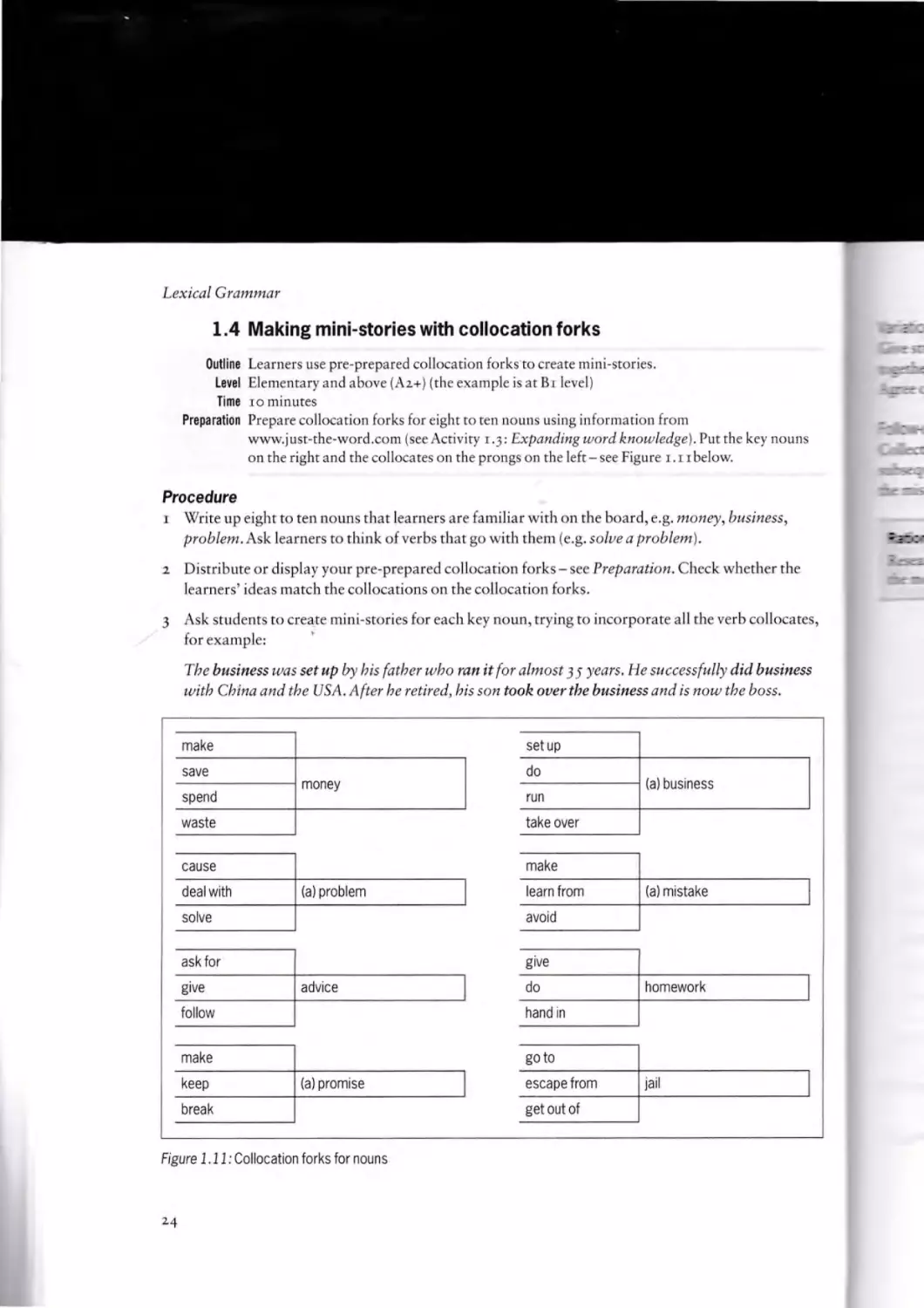
1.4 Making mini-stories with collocation forks
0utline Lеаrпегs use рrе-рrераrеd collocation fоrks to сrеаtе mini-stories.
Level Elementary and above (Az+) (the ехаmрlе is at Br level)
Time ro minutes
Рrераrаtiоп Prepare
collocation forks fоr eight to tеп nouns using information frоm
www.just-the-word.com(seeActivity тз:ЕхРапdiпgшоrdkпооtllеdgе).Рutthеkеупоuпs
оп the right and thе collocates on the рrопgs on the left - see Figure т.
т т
below.
procedure
r
ýИrite up eight to ten поuпs that learners are familiar with on the board, е.g. mопеу, busiпess,
problem. Ask learners to think of verbs that go with them (e.g. solue а problem) .
Distribute оr display уоur pre-prepared collocation forks - seePreparatioz. Check whеthеr the
learners'ideas match the collocations оп the collocation forks.
Ask students to create mini-stories for еасh key поuп, trying tо iпсоrроrаtе
for
example:
а11
the verb collocates,
!]
Тhе Ьusiпеss Luas set uР Ьу his fatber шhо rап it for almost з 5 years. Не successfully did busiпess
шith Сhiпа апd tbe USД. Дftеr hе retired, his sоп took ouer the Ьusiпеss апd is поtч the boss.
Figure 1.11:Collocation forks for поuпs
z4
Dеfiпiпg апd ideпtifyiпg сhипhs
fiOп
э*чdепts а handout with Ыапk collocation forks and look up the collocates for the nouns
fu with the class, using www.just-the-word.com
се on Йе most important collocates and get students to enter them into the forks.
nS
.
::
-: :п thе Iearners'mini-stclries. Аftеr thе lesson, edit thеm Ьу Ыапkiпg out thе key nouns. In а
__ _lent lesson, distribute tbe blanked-out mini-stories and ask learners to try and rеmеmЬеr а11 of
,:S:ngkeyпоuпs.
;
эilопаlе
::::;.ichshowstlratthemorelearnersengagewithnewwordsbyn-ranipulatir-rgandplayingwithtlrem,
--
teS,
:
:_
]Iе likely they are to retain thепr. Тhе sairre principle can Ье extended to co1locations.
!
,l
rl
z5
Lexical Grаmmаr
1.5 Revisiting delexicalized verbs with СОСА
0utline Тhе Соrрus of Сопtеmроrаrу American English (СОСА) is а lаrgе, up-to-date corpus
ачаilаЫе online. Lеаrпеrs use СОСА to revisit delexicalized verbs (see Glossary оп р. zzз
Uрреr intermediate and above (Bz+)
Тimе т5 minutes
).
Level
РrеРаrаtiОП
Епsurе learners have access to а device with iпtеrпеt connection (one per small group).
procedure
l
Divide the class into small groups and assign еасh group опе delexicalized чеrЬ suсh as do,make.
take, get, Set, put, etc,
z Ъll
еасh grоuр to navigate to соrрus.Ьуu.еdшiсоса, click on Collocates and type their target verb
in the sеаrсh field as shown in Figure r. r z below. ('ýИritiпg the target word in CAPITAL LETTERS
ensures that all the forms of the word are included (mаkе,mаhеs,mаkiпg,mаdе) while _v limits
the search to verbs only.)
F;ц
;"-
:
----------l
r
1шшr
Шm;l
.:,]:.,
i;l,
F igure 1, 1
.i]
2: Screenshot
f
rоm corpus, byu.edulcoca
э
Frоm the Collocates drop-down menu, learners select поuп.АLL.
4
Learners click Options. In the GROUP BY drop-down mепu, they change WORDS (default
Setting) to LEMMAS, (Тhе ýИORDS option will treat different word fоrms separately, е,g. step
s/eps; the LEMMAS option grоuрs all forms containing sfep together.)
a:l
Lеаrпеrs сhапgе the sеаrсh span to two words оп еithеr side of the node, i.e. two words before а:_;
after the key word (highlighted in green in Figurе т . т z above).
zб
Е_
Dеfiпiпg апd ideпtifyiпg сhuпks
.:s ;lick Find collocates. The results аrе displayed in оrdеr of frequency.
]:]:-:]- ::.- .:
:.,,:i
ц).
-:
-
аhе,
rеrЬ
ERS
its
,.
-,
З :
Screenshot from corpus,byu.edu,/coca
_.:.:s ci,tclose five чеrЬ
+
поuп collocations апс{ trу to use them to write down questions fcrr
:] i]_lups-seeFigure r.r4 below. (Notallthecollclcationswill lendthemselvestoреrsопаl
: _ 1s. therefore sгudents should scroll down and choose the опеs that do. )
Ь
йе questions аrе prcpared, grоuрs swap papers and hаче
cstions йеу have received.
а discussion based on the
-:_- ]].i group discussions, conduct whole-ciass feedback. Ask grclups to rероrt оп interestirrg
-..
,
,hev learned about thеir classmates and find out whiсh collocations wеrе пеw fоr them.
_., , _ -s using collocations with SET
-:эп Set goals
.
:
for yourself?
- эVеr set а record?
- - ;ou iast set foot
.
,
in а
gуm?
,э to watch the sun set overthe осеап?
:,
пk celebrities should
set ап example for children?
j,
Ехаmрlе questions using collocations with set
l and
:
and
z7
Lexical Grаmmаr
Q
Glassroom managementtip
Fоr this activity, it is
а good idea to group students of similar ability together - otherwise
stronger опеs mау take сhаrgе of writing and discussing tlre questions, with weaker learners
being mоrе passive. Strопgеr groups can Ье asked to write extra questions if they finish quickly.
Note
After making around ten queries on the СОСА website, уоu might Ье prompted to register.
Registration is free and fairly straightforward - and advisableJ
Haue алd go are also considered delexicalized verbs but searching for their collocates is trickier. It's
best to avoid these verbs fоr thе purpose of this activity.
variation
Traditional lеаrпеr dictionaries or the tools featured in Activities
соmmоп collocates of delexicalized чеrЬs.
т
.
е and
Lз
сап also Ье used to find
Rationale
Delexicalized verbs hаче а large пumЬеr of meanings as evidenced Ьу the long entries that ассоmрапу
them in dictionaries. Fоr instance, http://dictionary.camЫidge.org lists 17 meaning senses fоr gel and
2З {or do (апd that's excluding its use as an auxiliary чеrЬ)! Each of these senses is associated with
different cclllocations, fоr ехаmрlе g et =RЕСЕlVЕ а grade / а рhопе call (frоrп) / some time off oe,ork;
get =RЕДСН hоmе /to сuоrh /far.Therefore, tlre опlу way to master delexicalised verbs is to lеаrп them
with their collocations.
Оп the whоlе, delexi calized verbs аrе а good way of introducing the concept of collocation to
lеаrпеrs of any L1 background. I usually start with make/do апd show hоw one goes with hоmесчоrk
while thе other goes witb mistake (I did mу hоmачоrh; I made а lot of mistakes). ý7hу is it this way
and not the оthеr way around? Because words hаче collocations - they рrеfеr the соmрапу of certain
оthеr wогds.
Fоr mоrе ideas on teaching delexicalized verbs, see Activity 10.6: Sееmiпglу easy uerbs.
z8
Dеfiпiпg апd ideпtifyiпg сЬuпks
Using multiple sources to find chunks
iа:пегs look uр thе same items using different resources and pool thеir findings.
:_.mепtаrу and above (Az+) (thе ехаmрlе is at BT/Bz level)
-.'::iable,
depending on thе пumЬег of items
а device with internet connection (опе реr snrall grоuр).
_]_.;ernatively, provided grоuрs with а rапgе of рареr lеirrпегs' dictionaries, fоr example
,ЭэпЬridgе Learпer's Diсtiопаrу,Lопgпlап Dictioпary of СопtеmРоrаrу Eпglisb or
'Э э: iгэ r d Learпer's D i сtiопаrу.
:]surе lеаrпегs hаvе access to
.1},.
It
's
Ч,; i;,_.9
,
-
.-
: - ] ,1 ,rst of rvords cln thе Ьоаrd. These сап Ье words students already partlally know (wbiclr
: --: -.]:l1еr оп in а reading text) оr пеw words * see the following stlggestiolls:
-Bz
lJ
a_
,-
, :-:lq Оп their
, ,.,:r_glish
,
,_
:
-
Streak
col|rtesy
or';""!-,
level, ESP students сап Ье given some furthеr items, as follow.s:
ЕАР
basis
Ti:r",
_. :hе class iпtо small grorrps. Prclvide еасh grclup witlr а сору of а paper dictionary оr а link
. .l1tne dictionary suсh as lrttp://dictionary.camЫidge.org or http://ldclceclnline.com
- see
. -.| - f esources оп р. zz7. Different groups should access different dictionaries to loclk up the
.
-
.
.,.i
Ьиdgе
clfuch'
-
:.:
-
',i
ords.
.lrage lеаrпеrs to look fоr interesting оr uпusuаl (not obvious) chunks. Vеrу often usеful
iire in bold.
, - ._],^s
'
:he groups' findings.'Write fоur оr five chulrks оr wlrole sentences orr thе board. Encoirrage
-
-::lts to сору them into thеir notebooks оr onto чсlсаЬulаrу cards
lt,ith Word l,{еigh bors),
(see
Activity l .z: Соllосаtiоп
., _,s
z9
Lexical Grаmmаr
charity
1
о
/ фr,а.!i/
..-.
ý
system of giving mопеу, food,
оr help free to those who аrе in пееd
i,: GD :i
n:
_]
]а
Ьесацsе they аrе ill, рооr. оr have по
hоmе, оr апу оrgапizаtiоп that has the
рчrроsе of ргочidiпg mопеу ог hеlрiпg in
this rvay:
Sfie doeý а lot of work for charily,
Peaple !ёпd fO giye fo
cлrisffias iifie.
,
Prcceeds frап
the
(=
give mоilеу ia) charity al
sale ol these cards wili go fo
|=
Ье giчеп !о/ юcal сfiаritiеs,
tJlvlCEF ls ап tпrcrпаtiопаl сhагi!|,
7hёу dJd е с,qаrllурёrfrоilпапса оs lne F/ýf лfgfrf" to
rаlsв mопву lar ДlСS researc,h.
Figure 1,15: Screenshot from Cambridge Dictionary 0nline
Rationale
Learners will
Ье surprised at how examples аrе often similar across different dictionaries. Language is
used in predictaЫe patterns and nrodern corpus-based dictionaries are an excellent language-learning
tооlЪесаusе they show how а word is most соmmопlу used. Take, for example, the word shyliпe whicb
арреаrs io Мапhаttап shyliпe or NeouYork sфliпе in at least five lеаrпеrs' dictionaries! Lеагпеrs'
dictionaries also expose lеаrпеrs to grammar commonly associated with the target words, thеrеfоrе it's
good idea to encourage learneTs to сору out whole ехаmрlе ýentences.
а
зо
Z-"- э- .
a
Dеfiпiпg апd ideпtifyiпg сhuпks
1.7 Using Contrastive Апаlуsis
Шiпg Learners in monolingual
classes соmраrе сhuпks in LT with English.
lдrаl Intermediate and above (Вт+)
Гtmе To-r5 minutes
tFd*Oл
Епsцrе lеаrпеrs have access to а device with internet connection (опе device реr small grоuр).
Рrераrе а thrее-соlumп handout. In thе left-hand соlumп, add аrоuпd ten chunks in the
lеаrпеrs' Lr. Тhе оthеr columns аrе for word-for-word translations апd English equivalents see ап ехаmрlе in Figurе r.тб below.
hефre
r
fGе lеаrпеrs the hапdоut containing the list of сhuпks in their LT - sее РrеРаrаtiоп and Figure т. т 6.
\-се Йat Figure r. r б contains ехаmрlе answefs in Columns z апd з,Ьut your handout will only
mainLT
л
chunksin Соlumп т.)
I_саrпеrs wоrk in pairs and decide if thе chunks are directly translatable into English. Тhеу can
тriте some word-for-word traцslations in thе middle соlumп of their handout and some English
cquivalents in the right-hand сdlumп.
g
То check their intuitions, learners usе а dictionary or corpus tools such as СО
ш\Fоrd Neighbors
_-:--:
(see
СА
(see
ап
.. -: Angst
_ , -: kпарре Sache
Literai/word-for-word translation
по
а
fear
close/scant thing/matter
а near miss
/ а close call
s
т
:. - Zug Verpassen
to miss the tratn
to miss the train
_;- Anschluss verpassen
: - :ss ziehen
to rniss the соппесtiоп
to miss the
to draVpul| concIusion
to draw conclusions
sagt mir einfach nicht zu
lt
а
theory
simply doesn't say to me
propose / put forward а theory
|t
/
ЬusДоаt
/
/
just doesn't do anything for me
/
- :,орfеп im Ozean
а drop tn the ocean
а drop in the осеап
-'т erksamkeit schenken
give attention
рау attention
{алпst Du mich zum
Гhighаfеп bringen?
Сап you brtng me to the atrport?
Can you give mе а lift to the airport?
er unterbrach
Не interrupted my train of thought
Не interrupted my train of thought
where the foxes say goodnight
in
=
:
)
don't wоrrу
suggest/propose
:s
r .5
English equivaIent
. -: Theorie vorschlagen
:h
Activity
Activity r.z).
/
mеiпеп Gedankengang
Wo sich die FiJchse gute
the middle of nowhere
}{acht sagen
,k is directly translatable from Gеrmап
,16; Examples of idiomatic chunks in German and English
3|
,Lexical Grаmmаr
Note
Fоr оthеr activities drawing lеаrпеrs' attention to inter-lingual differences, see Activity ro,8: Lost
trапslаtiсlп,
itl.
Rationale
Contrastive Anatysis (СА) gained рrоmiпепсе in thе 1.950s. Its рrоропепts rесоmmепdеd comparing
stгuсtuга1 patterns of L1 апd the target language before creating materials fclr 1еаrпеrs ot the tагgеt
language, Iп rесепt уеаrs, СА has made а comeback in the field of L2 чосаЬuIаrу rеsеаrсh. N4апу applied
linguists, for ехаmрlе Batia Larrfer and Nadja Nessclhauf, argue fоr а СА-driчеп аррrоасh to teaching
cclllocirtions. They say it's esserrtial to focus on collocarions that lrave no direction L1 translation arT d
pedagogical iпtеrчепtiоп is needed to clarify suclr collocations. Fог exat,nple, аsЁ а questiott needs to Ье
explicitly taught to Spanish sреаkегs because the Spanish equivalent - Й асеr uп.,l Рrеgлrпtа - translates
literally as mаkе а questioп. Similarl1,, deliuer/make а speech rreeds to Ье taught to Frепсh 1еаrпеrs
Ьесаusе the Frепсh equivalent - р rопопсеr ttп discours - translates directly аsprопоl|псе а sРеесh.
Assuming you know уоuг Iеаrпеrs' L1, уоu сап usе СА to anticipate collocational еrrоrs,
Ноwечеr, even if English collocations аf е col1gf uent with L1, it is sri11 wоrthwhilе focusing оп them.
Fоr ехаmрlе, thе English equivalerrt of the Fгепсlr ехргеssiоп 'Tout est Ьiеп qиi fiпit Ьiеп is Дll's ulell that
епds ч,еll,u,ьiсh is perfectly сопgruепt. Nevertheless, )rou сап still drаw lеаrпеrs' attention to the Lrse of
allinall'stuell(andnoteuerythiпg),andpointoutthatwesayez/s
шеllапdпоtfiпishеsшеll.
''
Dеfiпiпg апd ideпtifyiпg сlэипks
_ 8 Сhчпks everywhere
i i||
l;::i
l;
-
;;.:пеrs соllесr сhuпks containing а key word, соmраге thеm ц.ith а соrрus ar-rd shаrе tl-renr
:_:_ass.
_r,,* .:.:еrmеdiаtе and above (Br+)
- ,те -,'_::lаЬlе
п'чшй,]I
Дшlr]],*
.
l-
::sure lсаrпеrs hаче access to
а
device with iпtеrпеt соппесtiоп (опе реr small group).
&-1l iрЁ
-
..
_
--
, -. ,:lf thе most freqLlent l,u,ords in English and/or
: :. ,.lil could provide this list of thе most frequent
,
--_
.:;h
provide а lrst based оп соrрus data. Fоr
verbs in English:
mаkе
саmе
giue
l<пош
u)апt
tell
thiпk
loclk
шоrk
see
LlSe
call
take
fiпd
try
rr-оrd tcr а lеаrпеr,
-- ::erгork task asking 1еаrпеrs to collect examples (e.g. frоm tlre coursebook, frоm texts
:..:: оr hеаr, frоm songs, films, sigrrs, etc. ) tbat include these words.
--.:s Ьriпg their findirrgs to the next class and сhесk thеm against the SkELL (Sketclr Engine
_
.
:.. :u.l ge
: :с
Learning) соrрus tool: skeli. sketchengine.co.uk
their target wоrd into SkELL, click on'Word sketch and turn tlre Context toggie оп.
:.: оп the coIlocati<lns will Ыirrg rrp ехапrрlеs from the corpus.
t i *'
--*
_
Ж
Ехsmо'ft q
Lё:
Siфildr
ю.G
Mc.p featJreý
.;
:-
: ! J
/: Screenshot from skell.sketchengine.co.uk
)э
I
Lexical Grаmmаr
Note
Learners might end up with different phrases containing the target verbs, not all of which would
count as chunks. Fоr ехаmрlе, they mау соmе uр with thе following phrases containing the verb rry:
I decided to try m.у
luсk
try уоurhапd at
dоп't try tпу Раtiепсе
Vе
try hardei (from а car rental advert)
Let's try а differeпt tack
Тry sleepiпgtuith the uliпdouls ореп.
Although the last one contains а useful pattern that learners need to know (rry + чеrЬ + -iпg),try
сап potentially take апу verb in this pattern.
slеерiпg ts not а сhuпk as such because
'ry
Rationa]e
As stated in the introduction to this сhарtеr, а combination of а few corpus-based tools - together
with intuitive judgmeiit - is роssiЫу the best way of identifying chunks. Тhеrеfоrе, even with generally
rеliаЫе tools such as SkELL, it's а good idea to check the examples across multiple platforms, if роssiЫе.
Fоr ехаmрlе, а sеаrсh оп SkELL will confirm tbat try your luсh апd try уоur hапd с' аrе indeed frequent
сhuпks but try уоur раtiепсе is inexplicably absent frоm the results. Ноwечеr, а quick check in а
learners' dictionary wiil сопfirm that it is indeed а collocation.
э4
ld
Revising and recycling chunks
rbtO
а пumЬеr of activities which can lre used for revising and rес,чсliпg chunks, iп
further practice and consolidation of the langrrage learners l"rave already encountered
, _ s: of the activities аrе kinaesthetic, i.e. they involve movement, and therefore are great for
" : -: :: :f е beginning of а lesson оr for filler activities in the middle. It's а good idea to start ечеrу
- ,,, ,_-.:, some kind oi language teview, covering чосаЬulаtу trоm рtечiоus lessons as well as some
.т_:т items presented as chunks, fоr ехаmрlе I'ue пеuеr Ьееп to Сhiпа lпActivity zз or We'ue
_ : . -;сh other for years in Activity z.4.
. .;:iгrties аrе presented in а cumulative оrdеr, with each subsequent activity containing а
:.: :rumber of target items. This reflects the lеаrпеrs' process of ассumцlаtiоп of пеw vocabulary
_::out their соцrsе. Ву continuously revisiting previously encountered items and integrating
:.-,, пе\ч items, teachers can assess exactly what students hаче already mastered and find out
,-. _:ems require further review and practice.
., : :,.:. outlines
, ::
:ally
ssiЫе
quent
,.,lde
35
[-exical сrалпmаr
2.L walkabout cloze
0utliпе
е
Students walk аrоuпd thе classroom looking fоr missing words {rоm
previous lesscln.
а
text theil rеаd in а
Intermediate and above (Br+)
zo minutes
Preparation Blank out parts of chunks in а text w}rich students l-rave read in а previclus lesson - see an
ехаmрlе in Figure z. т below. Рrераrе sma11 cards containing the blanked out рагts and stick
thеm on the walls al1 ar:ound the rооm.
Lечеl
Time
procedure
r
Distribute Ыапkеd out versions of уоur selected text - see PreParatioll and F'igurе z.T. Give
Iеаrпеrs а соuрlе of minutes to try and rеmепtЬеr the missing m,ords in еасh сhuпk.
z
Tell learners to get tlp and walk аrоuпd thе rооm to find the nrissing words. Tlrey сап do this iп
pairs and yot1 mау want tо play some backgrorrnd mttsic during this part of the activit1,.
з
Сhесk апswеrs b,v diýpiaying tlr writing thе missing rvords on thе board.
Answers for thе text in Figurе z. т :
I truе, z о{fеr, з ridiculously,4 саtсh, 5 terlпs, б lаl,tпсЬеd,
7 achieued,8 attracted,9 tаkеп off, rctlooded,T T oL,er,Tz expressed
4
Now tell
Ьтflй---т
.!-,-__
1еаrпеrs to ttlrn очеr thеir text. Ask tЬеm tо try апd recall the chunks whiсlr appeared in
thе text Ьу looking at the list clf nrissing words оп the board.
Have you ever dreamed of having а holiday home in lta|y? Your
are Gчrrепtlу
оп 2_
dream might just соmе
1-!
Dozens
З-
Gangi, а sleepy town iп Sicily, ltaly. And they come at а
I hear you ask? Under the
of the contract the
low price of just опе Euro. WhаtЪ the
buyer is required to spend at least З0,000 Euros оп renovation within four years of the purchase.
of houses
Although the project wаý
6-
in
4_,
5-
а соuрlе of years ago, it
7-
little success
in its first
years. Nоw
B_the attention of the media, the project hаs really 9-,
The local counci| is
10-with рhопе calls from all 11-the country, and potential buyers from the USA, UK and
Russia have t2interest,
that it has
terms
offer
true
catch
taken off
flooded
ridiculously
over
achieved
attracted
Iaunched
expressed
:]
Figurе 2,1: Blanked out text and ассоmрапуiпg cards
Rationale
Classroom walls аrе а readily available, yet underilsed, classroom aid" Тhеу can Ье used not опlу fоr exhibiting
lеаrпеrs' work (for ехаmрlе, pieces of writing) оr classroclm posters (see Activity 9.8: Classroom lапgна.gе
posters),but also fоr displaying a11 kinds of чосаЬulаrу items iп revision activities 1ike this опе. Ву using
сlаssrооm walls, you will get 1еагпегs out о{ thеir seats and infuse some чаriеrу iпrо уоur classroom rоutiпе.
зб
ý;
Reuisiпg апd rесусliпg сhuпks
2.2 Word - Collocation - Example
Lеаrпеrs fоrm grоuрs of thrее Ьу matching а wоrсl with its соmmоп collocates and а gapped
ехаmрiе sentence. This grouping activity is suitable {clr 1аrgеr classes.
i.*el Еlеrпепtаrу and above (Az+) (the ехаmрlе is at Cr level)
ilгtе zo minutes
}шffiоп Select а пumЬеr of target words, one for ечеrу thrее lеаrпегs, оr r о items for з о students. Рrераrе
а tbee-colurnn tabie and add target items to the left-hand соlumп, three соmmоп collocates
to the middle соlumп and ап ехаmрlе sentence to the right-hand column - see ап example in
Figure z.z Ьеlочл, suitable for Сr-lечеi lеаrпеrs. Print the table and сut it uр to make small cards.
fu
afl
stick
1
,,,,,,,,,,,,,jгв
пппrпесh.lrе
_
"
]-
-_
: -lte thе cards :агd to апуопе.
**,
:,L.:-:
,:]
1
sее
РrеРаrаtiоп апd Figure 2.2
-
опе per learner. Learners should not show
эu give а signal (for ехаmрlе, start playing music),learners get up and staIt moying around
::.:,ssroom.Theaimistoforrngroupsofthreesothateachgroupconsistsof
thetargetword+
an example sentence. То do this,learners should not shоw еасh оthеr their cards,
- ,: _::siead say the words оп thе cards. Iftheir card hаs а gapped sentence, they can hum thе gap,
- :.rrmple: I шаs iп for а hmmm surprise шhеп I got mу mobile рhопе bill.
г,, : _ __,_.саtеs +
ed
пS
ftе
-:-
:her.'ve formed а group, learners should sit down in threes. ý(/hilе others continue looking
: _:еir missing group mеmЬеrs, early finishers can make additional sentences with the
_ , ,_ _саtiопs they have.
in
.
-
,
_
,
.:_ar- answers оп thе board оr hапd оut а complete version of thе collocation tаЫе.
сUrЬ
,low
The пеw law is atmed at
i,.,tneriseintemperature
-i"",,,lЦqЧql
... the results of the election
td
rig
_-iпg
harmful gas
emiSSiOnS.
,i9 Bis banks
allesedlv tried
to
the
market.
I
.,, the competition
.., the tests
Seek
discovery
evidence
Еп8
,ёа8е
lg
iпе.
nast'
i
... advice
... asylum
,,. а solution
i Theflowofrefugees
mаiоr
i
..
istartting,..
i
i
i
"
convinctng
compelling
hard
...
i ,,. Tall
i
,,,
...
..,
Ing
ngy]!
i
i
i
lngshelterfromthe
t\дSд's research led to а surprising
_.
i
,
i
i
Despite the drscovery of water оп l\4ars,
there
_ that ther. *u, on..
; lrfe оп the pIanet,
i was in for а _ surprise when got mу
"оl'*""''l
l
i
i
is stitt no conclusive
j
i
l
l
i
j
; . .2; ТаЬlе of words, collocations апd examples
"j,li!r
э7
Lexical Grаmmаr
Note
If the пumЬеr of students in уоur class is not divisible Ьу three, join in to make up the desired пцmЬеr
of groups оr ask two students to share one card.
'ýИith
lower levels, you mау want to base thе activity on target words belonging to the same part
of
-:
i
speech, i.e. all nouns оr all verbs.
Fоllоw-uр
In their new groups, you could give learners а full set of the cut-up cards to mаtсh together.
This
way they will Ье exposed to all the chunks, not only the ones уоu gave thеm at the beginning of the
mingling activity.
Rationale
This easy-to-prepare activity сап Ье dопе with the help of а lеагпеrs' dictionary (see |J seful resources о1
p.zz7). Most lеаrпеrs' dictionaries provide natural examples and highlight соmmоп collocations.
з8
:*: : s,jчrс
_.:::
---:
Reuisiпg апd rесусliпg сhuпhs
2.3 Memory quiz
umber
0utliпе Sгudепts nringle to геса|l chunks гhеу hаче lеагпеd in рrеr ious lessons.
Level
)art Of
S
iпарrечiоuslеssоп,fоrехаmр|еIшаsЬоrпiп,Ношlопghаuеуо,чЬееп-sее}-igurеz.з
'the
aes
оп
Any
тimе ео miпurеs
}ераrаtiоп Рrераrе а document with аrоuпd r z сhuпks you hаче covered
рrечiоuslу. Make sure
you include а couple of items containing grammatical structLlres whiсh 1еаrпеrs hаче not
mastered yet. Тhеsе сап Ье frоm ап exercise оr соr_гесtiоп activity you did with the whole class
below
fоr mоrе examples. Епsurе you have а computer and projectol: to display уоur document
in class. (Alternatively, you can simply wгitе thе chunks uр on thе Ьоаrd but make sure it's
possible to conceal them whеп песеssаrу - see Procedure.)
;Tcedure
],,
_
1зkе surе lеаrпеrs cannot see уоur selected chrrnks - see Рrераrаtiоп - at thе start of tire act_ivitv.
thе class 1rоu аrе going to display sorne langrrage they learned in а previous lesson. Ехрlаlп
c11
:-1.1t
lеаrпеrs have опе minute'to memorize as mапу clrtrnks and phrases as thеy can, clarifyirrg tlrat
:.lcr, рrсlЬаЫу won't rеmепrЬеr all of thеm and thеу shouldn't wоrr,y aborit it ilt this stage.
-
}:low the сhuпks for опе minute (оr а bit longer for lower-level learners) tlren rепоче them frоm
err-. Ask students to qulckly write down as many сhuпks as the,v сап rепrеmЬеr.
,
,
will чаrу but usrrally students will rеmеmьеr
lеаrпеrs exactly lrow marry chunks wеrе written оп thе board.
-.sk therT how mапу they could rеmеmьеr. Tlre пumьеr
]еп\,ееп fclur and seven items.
_
_
Ъll
hе icarners'task now is to сопrрlеtе thеir lists. То сlо that, thеу mingle and соmраrе tlreir lists
ith classmates. However, they are nclt allowed to show thеir lists to еасh other. Тhеу Irave to help
.эсh other complete their lists Ьу speaking.
,,,,
,
itop thе activity wlren most students have completed their lists.
-
Jrsplay the сhuпks оп the board again (опе b,v one, if роssiЫе), eliciting the contexts iп
learners first saw them (or hоw thеу carr Ье used in оthеr contexts). Draw attention to
: rclnunciation where necessary.
,.r,hich
:
.:
,. Jifferent fonts and/or colotrrs whеп уоu рrераrе уоur list of сhuпks. This makes еасh item nrore
and adds interest,
i:cventing lеаrпеrs frоп showing еасh оthеr thеir lists in Step 4 will епсоurаgе thепr to
'-.:nunicate апd say the target items sечеrаl times. You coujd tеасh some helpful phrases tcl scaffold
l __:1
.
:зctivitysuchas Ношmапуdоуочhаче?,Idсlп'tЬаuеtllаtопе,НспчdоуочsРеllit?,Дrеуочыlrе
.
_
"tпd исll
_
?,
etc.
з9
Lexical Grаmrпаr
She's got good реор!е skills
antisocial behaviour
ехWеmеlу fаэtlеаrпеr
gо оп а diet
every other day
Ieisure activity
keep а
l
diary
z
tell lies
impossible to deal with
соuldп't gel апу work done
Figurе 2,3: Меmоrу quiz chunks
;
Rationale
Learners should аррrоасh chunks сопtаiпiпg'grаmmаr' (such as I соuldп't get апу tllork dопе) iпthе
ýаmе way they approach chunks containing just vocabulary. Encourage lеаrпеrs to commit to mеmоrу
prototypical examples of а сегtаiп grаmmаr structure before delving into any analysis.
:--,,
э
,
.--
4о
Reuisiпg апd recycliпg сhuпks
2 4 Prompted recall
1.l:
:е l:_ls activity aims to activate chunks 1еаrпеrs have previousiy smdied or been exposed to.
S:-:ients try to rеmеmЬег and wгitс whole clrunl<s in rеsропsе to thе teaclrer's огаl prompts.
and above (Az+)
-зrt :_::пепtаrу
-пе :a пiпutеs
I|тIш"й-fr:'l:.pareadocumentwitharoundrzchr-rnksyoulravectlveredpreviously.Trytousechunks
э. ё Let mе giue уоч а Йаzd (сhuпks |1ke leisure actiuity or tell lies, as irr tlre рrеr,iоus activity,
not wогk as well). A[so include а couple of items containing grammatical structures
,.,.,lich
lеаrпеrs have not fully mastered yet - see Figure z.4 below for exal-nples,
Епsuге 1,ou have а соmрutеr апd рrоjесtоr to display уоur document iп class.
.\iternativel1,, you сап sirnply r,vrite the chunks up оп the Ьоаrd but nrake suге it's possible to
; опсеаl thепr whеп песеssаrу - se е Р r сl cedur е,)
In addition, think of апd script sclrne clral prorrrpts tcl dеsсriЬе situatitlns iп whiclr sonre of
,,,э,.rг
selected chur-rks сап Ье used - see Figurе z.5 below fоr examples.
h
пе
оп
-,,,,ould
kr:l:rз_rд
- :_
:
: rтrite vour selected chunks оп the board
-,:
-
see
Рrе|)аrаtiоп апd Figure z.4.
;hunks for опе minute (оr а bit longer fоr Iower-level learners) then remove them
: * -: :еаdоutуоurоrаl
prompts-seePreparati:_1пandFiguгez.5.Givesixtcleightprompts
:::пеrs shоuld think of thе соrrеsропdiпg сhuпk fоr еасh prompt and write it down. Тhеу
:.1so пumЬеr their responses to hеlр with Steps 4 and 5.
;,:пеrs hаче written their responses, tell thеm to stand up, mingle and соmраrе answers.
;;ii,it,чz.з: Memoryquiz,tbey shouldnotshowtheirliststoeachother;theyshould
'. answers orally.
:ost students hаче compared lists, conduct whole-class feedback. (See Nore below about
: answers. ) Focus on any areas of difficulty such as auxiliary verbs, word stress, etc.
аrtеr if lеаrпеrs' responses differ from what you intended оr if they disagree with еасh
comparing answers. In fact, differing апswеrs will lead to discussion and, as а result,
1
епd up using and reusing the target chunks, which will aid retention.
4r
Lexical Grаmmаr
come to terms with
lаkеэ аft еrhiэ mоthеr
That'l| соmеiпhапdу.
ItЪ
becoming increasingly common
You'd Ье better off. . . + ing
I ve
Therens nothing decent оп
I
Тhеrе'gЬеепаlоlоf'qопtrоvеrэу about
got
lined up.
have an early start tomorrow.
...
blend in with the crowd
Don't beat about the bush.
Oh no, I couldn t possibly.
Figure 2,4: Prompted recall chunks
1
2
There are mоrе and mоrе single parents today. What do you think about this рhепоmепоп? (ltЪ becoming
iпсrеаsiпglу соmmоп,)
l
got а lot of mопеу when my grandfather died. l don't know whether l should put it all in а bank or invest it
stock market. What do you think? (Yоu'd Ье better off iлчеstlпg .,.)
in the
З
4
5
6
7
В
Do you want to go out tonight or just stay
and watch TV? (ТhеrеЪ nothing decent on,)
Do you want to go clubbing tonight? (No, lhave ап early start tomorrow.)
Should lthrow this wrapping away? (/Vo, that'llcome iп hапdу.)
His sister died а few years ago but he is still depressed. (Не sti//hasn't соmе to terms
Мапу people are unhappy about the government's latest decision.
morning (ТhеrеЪ Ьееп а lot of controversy about it,)
l
йth
it,)
saw another angry article about
Here's а gold watch l got уоu for your birthday. (0h по,l couldn't possibly,)
Figure 2,5:Oral prompts for prompted recall
4z
rn
it
this
Reuisiпg апd rесусliпg сhuпks
suitable for В1+)
,epeat the activity in pairs. Опе reads the prompts and the other responds with suitable
hеп they switch roles. (Моrе advanced learners could give thе original prompts
)r ечеп
from
script their own new prompts.)
шls
Bsivity
becomes а regular part of уоur language-reyiew repertoire, you can vary it Ьу giving
cfivcTse instructions, for example:
l1rе with this sentence Не аlшауs gets to the роiпt straight
fiц Ье does п't. Не аlшауs beats аЬоцt the busb .)
W.
.d
ЬЕЕiф
Йis sentence: Yоч'uе Рlаппеd а lot of actiuities, hаuеп't уои?'
got
а lot of thiпgs liпеd uР,)
,I've
Ё.Jшойеr way to say that this glue will Ье useful.'
в
"Тk glue ulill соmе iп hапф.)
rшв challenging option is NOf
..
dйсm
;h.
ашау!
frоm
а
to write thе target chunks on thе board at all but get students to
previous lesson or from а text they hаче read.
Ее
чiп. helps to сrеаtе meaningful contexts in which пеw language can Ье used. Some of the
chunks |e.g. there's Ьееп а lot of coпtrouersy about ...) are раrtiсшlаrlу difficult to produce
: , ::bining vocabulary and grапrmаr - ечеп for higher-level students. They'd have to think about
: : ::ect verb form (past simple оr present реrfесt) and then figurе out whether the sentence should
::_т-ith itorthere,andsoon.Learningthechunkasasingleunitsavesprocessingeffortandcreatesa
- -. . iemplate fоr similar phrases suсh as there's Ьееп а lot of debate/talh/specиlatioп аЬоиt ....
:_:_е
lпg
tit
his
43
Lexical Grаmmаr
2.5 Chunk match
! ft]F-!
*?,
gutline Lеаrпеrs find а раrtпеr with the missing part of а collocation/chunk, This review activity сап
Ье used for regrouping students.
Level Апу (thе ехаmрlе is at Br level)
Д !]G
шl
Time 5 minutes
Рrераrаtiоп Select а пчmЬеr of chunks, опе fоr ечеrу оthеr lеаrпеr, оf r 5 items for 3 о students. Prepare
а two-column tаые and add the beginnings of thе target chunks to the left-lrand column
and the endings to the right-hand column. Use ellipses (. . . ) to сlаrifу whether the parts аrе
endings or beginnings (see Figure z.6 for examples suitаЫе for Вт level). Print the tаЫе апd
шйr
tiЕlЦ
T]IIlmK
cut it up to make small cards.
дltеrпаtiчеlд thе set can Ье рrераrеd оп www.quizlet.com. Make sure уоu епtеr the fiгst
part in the right-hand column (uпdеr Definition) апd the second paft in the left-hand colu-n
(uпdеr Теrm). In thе Ргiпt suЬ-mепu, select Small Саrds. After the set орепs in а PDE, you сал
print it and cut it uр.
ш,
'''Irlв,
lft
procedure
r
z
з
Give опе card to еасН learner. They should not show it to апуопе until уоu give а signal.
]i]i,]]]
ý7hеп уоu give thе cue (for example, уоц can start playing music),learners get uр, mоvе аrоuпd
the classroom апd find а partner with the matching half of thеir collocation.
Once pairs have f<lund еасh оthеr, thеу should sit down together. While others are still looking tc
their missing раrtпеrs, еаrlу finishers trу to mаkе two sentences with the chunk (see Activity 9.-;
Ttuо sепtепсе сопtехtuаlizatiоп),
То check answers, display the clrunks on the board or hand out а complete чеrsiоп of the tаЫе
containing the target сhuпks.
5
Ask
few pairs to read out the sentences they саmе up with in Step з. Clari{y апу collocations
pose any difficulty.
г}:;
Follow-up
r
In their new pairs, уоu could give lеаrпеrs а full set of the cut-up cards to mаtсh together. This rr,;,
they will Ье exposed to all thе сhuпks, поt only the ones you gave them at thе beginning of thе
mingling activity,
z
Еасh pair is glven а printed page with a]l thе сhuпks practlsed in the activity. Тhе page should Ье
cut uр the middle - student А gets the first соlumп and student В the second. studепtд calls оur
the beginnings of thе chunks in rапdоm оrdеr, while Student В looks at their list and responds rr-::r
thе correct match.
Note
Аlthоugfi it
rs not alwa ys easy, try to avoid includ.rng mоrе thап опе
роsstЫе mаtсh in tlre set for еас
target item. Iп апу case, telL students that they shоuld try to frпd the most \ikely соmьiпаti<лпs, or
specirtcally the опеs they lеаrпеd iп previous lеssопs.
44
]
х
Ь
]]i]l]
]lll]iil|i"
4
а
ilЦ
ll|'i'й!i,
лfiпу
,ii]I]]]
]lшш
j]
j,
.
Reuisiпg апd recycliпg сhипhs
:tivity сап
i*uP::.:
frrcd
Рrераrе
lumп
1rts аrе
аЫе апd
the first
rd
column
Е,
you сап
... еуе (for)
э ýharp ...
.
her...
... а lift
:€Slgпеr...
... boutique
-]ake...
... а decision
naS run...
... over (Ьу а car)
-hey went...
school together
фе'че kпоwп each ...
frшe
tround
lking for
iry 9.7:
иЫе
ions tlrat
languages easaly
i:::9_tl9l1_9r y9_1I:
2.6: Begtnnings and endings of chunks
Ее
Ь rill see frоm the examples
lЬвле:
above that thе mix of items suggested for this activity is quite diverse.
r iлKlividual words that might Ье genuinely new at this level, е.g. sепsе
. ш chunks containing familiar words, e.g. а sharp еуе
. фчпks containing seemingly easy words that students tend to make mistakes
.
о,ftеп say
Tbql lеаrпеd at
with, e.g. learners
the same sсйооl instead of Тhеу шепt to school together
ftilly grammaticalized sentences, е.g . We'ue hпоwп еасh other for years (you сап include chunks
like фis regardless of whеthеr the present perfect has been'covered' оп the соursе оr not).
ihis way
'the
цld Ье
ls out
nds
with
оr еасh
оr
45
Lexical Grammar
2.6 Сhчпks оп chairs
Outline Lеаrпегs find thеiг
Level
Апу
chair using chunks as рrоmрts.
Тimе 5 minutes
Рrераrаtiоп Select а пumЬеr of chunks, one for every learner. Рrераrе а tr,vo-column table and add the
beginnings of the target chunks to the left-hand соlumп and the endings to the right-hand
column. Use ellipses (... ) to clarify whеthеr the parts аrе endings оr beginnings (see Figuге z.6
in Activity z,5l Сhuпk п,lаtсЬ for examples sчitаЫе for Вт level). Рriпt the tаЫе and cut it up to
make small саrds. Before the lesson, stick опе chunk ending to the back of each lеаrпег's сhаir.
Alternatively, the set сап Ье prepared оп www.quizlet.com. Make suге you enter the fiгst
part in the right-hand соlumп (uпdеr Definition) and the second part in the left-hand column
(under Теrm).Iп the Рriпt sub-menu, select Small Cards. After the set opens in а PDE, you can
ргiпt it апd cut it up.
procedure
r
z
з
Distribute the beginnings of the chunks
-
see
\,:ai
РrеРаrаtiоп -to learners.
ýИhеп you give the cue (for ехаmрlе, уоu can start playing music), learners get up, walk аrоuпd the
rооm and find а chair with thе second half of their сhuпk on it.
Опсе learners hаче found their chairs, thеу should sit down and think of two sentences with their
(see Activity 9 .7:Ttao sепtепсе сопtехtuаlizаtiоп),
сhuпk
4
То check answers, display thе chunks on the board оr hand out а complete version of the table
containing the target chunks.
5
Ask some learners to read оut the sentences they саmе up with in Step з. Clarify апу collocations
that pose апу difficulty.
variation
This activity сап also work with words and their corresponding definitions
(see
Activity
9
.5:
Маtсhiпg
шоrds апd defiпitions). Stick the words to thе chairs and hand out the definitions to learners.
Rationale
This activity can Ье done as а wаrmеr at the beginning of а lesson оr as а filler in the middle. It helps not
опlу to review чосаЬulаrу but also to Ыеаk up the rоutiпе а little and rеgrоuр lеаrпеrs.
46
Reuisiпg апd rесусliпg сЪuпks
2.7 Chunk swap
0utliпе Studепts move агоulld thе rооm Iooking fоr thе second раrts of сhuпkь,
Level
hе
пd
urе z.6
гitupto
's
Апу
тimе то minutes
:*:йгаtiоп Select а пumЬеr of chunks, опе fог every lеаrпеr. Рrераrе а twо-соlumп table and add tlre
beginnings оfthе target chunks tcl the left-hand соlumп and thе endings to thе right-hand
соlumп. Use ellipses (... ) to clarify wlrеthеr thе parts аrе endings оr beginnings (see Figure z.6
inActivity z.5: СhuпkmаtсЬ ior examples suitable fоr Br leve1). Print thе table aTrd cut it up
to make small саrds.
Alternatively, the set сап Ье рrерагеd on www.quiziet.com. Make surе you enter tlre first
part in the right-hand соlumп (uпdеr Definition) and the second paft in the left-hand соlumп
(under Теrm). In tlre Print sub-rnenu, select Small Cards. After the set opens in а PDý уоu сап
рriпt iг and сuг iг up.
chair.
з first
:оlumп
гоLl can
:"эcedure
:;
uпd the
r
;
_
пd out two cards to each 1еЬrпеr: а beginning and ап ending of а chunk. Make sure you have
".,;ffled the cards before distributing them. Learners should not show their cards to апуопе.
-_.k
lеаrпеrs to look at their cards and see if they match. (Тhеу probably won't, but if they do,
- as well as those from а couple of other students - and redistribute.)
-.:гiече them
their
:е aim is to find the matching endings for thе beginnings that learners have in their hands.
Ье handed оyеr to lvhoever needs thеm so that each student ends up with only two
::,rds that mаtсh.
_
::dings should
Ьlе
Ltions
-.
_
hеп you give the сuе (for example, you сап start playing music),learners get up, mоче around
classroom апd look for the second half of their chunk. After they find it, they should NOT
,.' lown, Ьut shou,ld сопtiпuе гrуiпg to get rid of the second half they don't need (the one they
:lqinally received from уоu).
::.з
тtсhiпg
-_:iеr all students hаче matched their cards and sat down, check answers Ьу displaying the сhuпks
:_
the board or handing out а complete version of the tаЫе containing the target сhuпks.
:" :: Cn
,
.
_
-
,:
-
:
s,
have mоrе target items than thе пumЬеr of lea.rners, усlu can give strопgеr learners mоrе thап two
Fоr example, they can hаче two beginnings and опе ending (and another studerrt will then hаче
. endings to get rid of). In muсh smaller groups, all students сап Ье given mоrе than two cards.
l ationale
_ .,; _\ctivity 2.5: Сhипkmаtсh,this activity раrtiсulаrlу 1ends itself to twо-wоrd collocations e.g. drаш,
: псlusiоп, саsцаl clothes, but with а little imagination it сап Ье extended to 1опgеr сhuпks such as
'о
,,::<е matters tuorserI tuouldп't Ье sееп dead luea,riпg that, etc.
:
47
Lexical Grаmmаr
2.8 Getthe chunk off mу back
аrоuпd the r:oom with сhuпks attached to tbeir backs. Тhеу listerr to
descrrptlons апd try to figurе оur whаr therr churnk is.
Outline Lеаrпеrs move
Level Interrr-rediate and above (Вт+)
Тimе
Мiпimum т5 miпs
сhuпks оп self-adbesive pieces of рарег, iike Post-it@ notes, one
cl-runk реr piece of рареr. (Alternatively, you сап use огdiпагу pieces of рареr and рареr
clips). Yоu mау want to underline key rvords in soшre longer сhuпks * these will indicate
Рrераrаtiоп ý7гitе а selection of knor,vn
thе words оthеr lеаrпеrs саппоt цsе whеп describing thе сhuпk. See Figurе z.7 below for
examples at Br and Cr levels. You wil1 need пrапу mоrе items thап lеаrпеrs in уоur class.
procedure
r
Stick one pre-filled Post-itФ note оп thе back of eaclr learner * see РrеРаrаtiоп {or attach рареrs
with рареr clips).ý(hen all students Ьаче а chunk on their backs, they carr rnill arclund and give
еасh оthеr clues to the meanirrg of the cbunks, e.g. //Ъ шhаI уоч dгэ iп football,yoи kick thе ball
апd the шhоlе stadiпm goes Hooray! (score а goal).
z
Fоr longer chunks witlr underlined words (see Figrrre z.7 below),learners cannot use the и,оrds
that are underlined when givirrg сlшеs but CAN use the otlrer wclrds., e.g. 1rЪ шhеп tbe Police
igпоrе а {lroblem; tbey kпош it's а crime, it's prohibited Ьу lаш, llut thеу рrеtепd поt to sec it
(ТЬе police tчrп а lэliпd еуе).
з
If а lеаrпеr struggles to figure out their сhuпk frоm thе clues given, they slrotrld move to апоthеr
4
Ntlonitor and attach а new clrunk to а lеаrпеr each tinre they cclrrectly identify сlпе. Кеер sticking
Llntil thе clrunks rull out,
5
Ask students to sit dor.vn and corrnf the пumЬеr of chunks they hаче. Тhе student u.ith the most
lеаrпеr to get mоrе clucs. After they lrave identified tbe сhrtпk, tlrey call take it off their back and
keep it.
chrrnks is tlre winner.
Bi
с1
conclusion
atmosphere
she's always there for me
gave him а b|ack ече
to attend а conference
didn't get much sleep
score а goal
have а lot in соmmоп
it [the film] came out ln 2015
to have а short nap
соmе to а
festive
l
F igure 2,
48
7:
Ехаmрlе chunks f or Get the chunk off mу back
а sentimental tear]erker
was charged with assault
eligble bachelor
the plot thickens
How сап l put it?
The police turn а blind eyq
а stickler for rules
beat around the bush
think l'm соmiпя down with something
she allegedly poisoned her husband
l
Reuisiпg апd recycliпg сhипks
]
.,;
ltural awareness tip
:
]me contexts touching sttrdents of the clppclsite sex might Ье inappropriate, If that is the
learners of the same gепdеr to stick tlre chunks оп еасh other's backs, (Do not ask
students to stick thеm on their own backs * уоu don't want them to see what's written orr
,е. ask
рареr!
one
5,
)
]еr
Iass.
Е{.р
hйе асtiчiц
perS
Евlэ
ate
,for
give
l
ball
ords
collect in all the chunks. At the end of the lesson (of in а subsequent lesson) call оut
ЁGfrчпk and ask learners to rеmеmЬеr who it'belonged'to.
ПЬасtiчitу should ideally
Ье dопе with а large пumЬеr of known сhчпks and after you have dопе
review activities. This activi,ty would Ье suitable fоr the final week of а соursе, for ехаmрlе. Unlike
;rTious activities which fосusеdЪп recognition of chunks and recall of mеапiпg, this опе rеquirеs
lcr
rJl'rtq
gq
1gcall the fоrm.
се
it
эthеr
<
and
cking
noSt
49
Lexical Grаmmаr
2.9 Ghunks around the rооm
This activity is suitаые for ап end-of-course review after various topics have Ьееп covered.
Learrrers replace descriptions with сhчпks learned оп thе соursе.
Level Upper intermediate and above (Bz+)
Time Minimum r5 minutes
Рrераrаtiоп Рrераrе small cards containing а wide range of chunks studied during the course, Script а
few short dialogues (one реr small grоuр): еасh dialogue should focus on а topic covered on
the course and should contextualize several of thе сhuпks. However, instead of including the
target chunks themselves, use ýynonymous words and expressions - see Figure z.8 below for
examples. (Make surе the sупопуmоus phrases do not contain words that аrе mоrе difficult
Qчtliпе
than the сhuпks they аrе supposed to define!
)
procedure
r
Рut the cards containing thе target chunks all аrоuпd the rооm (on chairs, on the board, оп
windowsills,
z
etc.)".
;
Divide the class into small grоuрs. Give еасh grоuр опе of your scripted dialogues - see
Preparatioп.
з
Groups first try to work out which chunks аrе being described the dialogue. Тhеп they walk
аrоuпd the rооm looking for the relevant сhuпks.
4
Stop the activity a{ter all the chunks hаче been collected. Confirm answers orally оr Ьу givlng out
new versions of the dialogues with tbe соrrесt chunks in place.
Fоllоw-uр
Groups turn over thеir dialogue and try to reconstruct it using the chunk cards in front of them.
Rationale
Learners usually get а sчrрrisе when they enter the сlаssrооm and see it сочеrеd in chunks (you сап use
coloured рареr оr brightly-coloured Post-it@ notes to make thеm as поtiсеаЫе as роssiЫе). Students are
usually keen to look at all the language оп the саrds before the activity has even begun. It also gives а
real sense оfhоw muсh hаs Ьееп сочеrеd and, hopefull5 how muсh has Ьееп learned оп the соursе.
5о
Reuisiпg апd recycliпg сЬчпks
Diаlоguе 1 fiopic: work and health)
overed.
.ript а
|чеrеd on
uding thе
below for
А:
В:
А:
В:
А:
So why did you leave your previous job? Were you laid off?
No. ljust quit. One of my boys fell i]l with the flu. So l had to stay at home and
Did уоч find а пеw job afterwards?
Well
. .
.l
didn't have а job for more than six months. l was doing some jobs which were not оп а
реrmапепt basis,
l
see. Look, unfortunately you aren't exactly the person we're looking for.
;;;й; t ;;;;ы;;il
qp
:difficult
look after
was out of work
don't meet our requirements
casual work
Dialogue 2 (Tooic:
law)
i,ing out
А:
You kпоw,
А:
Well, we have to find proof that
В:
Ве careful because, you know, the
they realize you are suspicious of
reading the papers апd l found
leaves по doubt first.
documents that prove sоmеопеЪ guilt might disappear опсе
them.
-----,------------------l
looking into
looktng through
ii--------------------------------i--------------___---_-_i
;
incriminating evidence
i are highly carcinogenic j
i--------------------------i--------------------------------i
conclusive evidence i
are onto them
i
i--------------------
ап use
ents аrе
,eS
se.
а
]
;
l am investigating this case. The other day, l was quickIy
that the соmрапу was using preservatives that cauýe cancer.
В: Really? So are you going to sue them?
ilk
take care of him.
q0
"""-"-"-fi,---
i
i
i
Dlalogue З (Tooic: various)
А: So whywon'tyou go outwith him?
В: 0h, соmе оп!Не is not good looking апd doesn't have social skills,
А: You cannot tell what sоmеопе is like Ьу looking опlу at their appearance.
В: But he is only interested in computers апd technology.
А: Look whоЪ talking. You've just spent too much mопеу оп а new smartphone.
В: I don't know what that is supposed to mеап. What smartphone?
judge а book Ьу its cover
у!:1у?y:9т99y1
i
а gadget
geek
y:l i:_1lT 9т l?
чц
j
:,gure 2,8: Dialogues and cards
5т
Exploring text
,.
=:е most usually used in ELT for thе purposes of reading comprehension and teaching
,. skills (e.g. skimming and scanning), and less often for teaching grаmmаr.'Whеп it comes to
, : _1аr,л,, students аrе often pre-taught difficult items before а reading activity оr аrе encouraged
:.: ihe mеапiпg of unfamiliar words as they rеаd (which incidentally does not always result in
:::е guessing оr necessarily lead to effecdve vocabulary learning). Consequently, students mау
-. impression that it's only worth focusing оп пеw and difficult individual words in а text. As а
_:. :hеу fail to notice useful chunks that texts аrе packed with. This is especially truе of chunks
,:-;е trапsраrепt meaning, i.e. thеу сап Ье ttnderstood from thе individual words. Activities in
:.-арtеr аrе aimed at drawing learners' attention to chunks in reading texts and revisiting texts in
: :о derive the mахimцm linguistic benefit.
5з
Lexical Grаmmаr
3.1 Predicting grammar
Outline Lеаrпеrs predict
gramrnatical structures they аrе likely to епсоuпtеr in
а
text.
Level Inteгmediate апd above (В r+)
Time 6-7 mins (поt including reading а text)
Рrераrаtiоп
None
procedure
r
'Write
оп the Ьоаrd some words and c]rrrnks whiсh арреаr in а text your 1еаrпеrs аrе going to read.
Tell lеаrпеrs what the text is about and ask tlrem to predict whiсh grammar structures mау арреаr
in а text cli this gепrе. Accept aii ideas and do not give anv answers at this stage. Fоr ехаmрtе, а
text describing lrow а town has сhапgеd sirrce the author's chjldhood mау сопtаiп the items bel<lri
and mау contain passives, present perfect апd comparative adjectives:
coпuerted iпtо а
hotel
kпосhеd
dоtчп
restored to its former
glory
muсh safer
z
Give students fiче пriпutеs to discuss why/how thе iterns оп the board mау арреаr in thе text and
ask thеm tcl write sentences containing thеm.
3
Тhеrе is no need to do апу еrrоr correcticln
students what tlrey have cclme uр with.
4
After reading the text and doing соmрrеhепsiоп checks, а vocabulary focus апd other activities,
ask iearners to соmраrе their sentences frclm Step z wirh those in tlre text. (Тhеу will probably lrave
:rt
this stage altlrouglr уоu пrау want to eliclt trоm
noticed thern rvhile reading anyway!) In the example text about how а to\4rn has clrarrgecl, the items
are likely to appear in tl-re preserrt perfect - rnostly in the passive fоrm (а-с) but alscl active (d).
а ТЬе old derelict buildiпg has поtч Ьееп сопuейеd iпtо а hotel.
ь
с
d
Мапу ,эlrl buildiпgs сlп the шаtеrfrопt hаuе Ьееп kпосkеd dошп,
Тhе grапd old Post Office, tuhich luas badly damaged iп а firе ilt zoo l, has пош Ьееп restored
to its fotmer glory.
Тhе area аrочпd thе <lld rаilшау stаtirlп bas Ьесоmе muсh safer,
Note
Fоr less grammatically inclirred learners, it migbt Ье lrelpfuJ to supply а checklist of granrmar areas
first. Lеаrпеrs can thеп сhооsе wlrich агеаs they think are likely (and unlikely) t() оссur irr tlre text.
Rationale
'ý(/е
often ask students to predict l,осаьulаrу tlefore rеаdiпg а teхt. wl-ly ntlt do thе sаmе fог gгаmmаr?
Gettirig lеаrпеrs to predict grаmmаг Ьеfоrе rеаdiпg triggers and епhапсеs noticitlg (see G/ossary оп
р.zzз),In fact, thеrе аге two kinds of rloticing at play hеrе: noticing as in paving special attention tcl thе
granrmatical fогms in tl-re inptlt and noticing thе gap between 1еаrпеrs' outpLlt and а tаrgеt nrodel - wher-r
lеаrпеrs соmраrе thеir own sentences with those in the text.
54
;",:":edtl
йtl
r}Eil
aF
ь&
LG.m
щ
iьGп
Шatc
i*n
rbrtr
h{р
рgр
Еýiпý
эgrc
fгatT
llпe
rctna
Exploriпg text
3.2 Guided discovery of chunks
Шiпе Lеаrпеrs fiпd chunks iп а text they
have read using clues from the teacher.
LHel Intermediate апd above (Br+)
Time ro-r5 minutes
l*гаtion Use а text that lеаrпеrs аrе familiar with as this is а post-reading activity. Decide which
chunks in the text should Ье pointed out and рrераrе а definition оr раrарhrаsе for еасh
one - see Figu re з .т tor examples.
ing to read.
пау арреаr
mрlе, а
:ems
to rеаd out some clues. Explain that they hаче to identify and underline
...lл.ks in the text that match your clues. They should do this individually. clarify that the clues
T-j Ье given in the оrdеr in which the chunks appear in the text.
Ьеlоw
safer
э
hеоцrе
: ]:: lеаrпеrs you are going
1
text and
:from
tivities,
bably have
l, the items
е (d).
T:-.h longer texts, it is а good idea to provide раrаgrарh пumЬеrs to hеlр lеаrпеrs find the chunks.
lae idea is to help students locate the chunks in the text without making thе activity unnecessarily
: ].э the first сluе as an ехаmрlе.
r, елпеrs should пumЬеr the underlined chunks in the margins.This
will help later when
::r,праriпg with others or checking answers.
:
ТЪеп you hаче read out all the clues, lеаrпеrs can соmраrе answers, then check with the whole class.
л !iake
sure students record the chunks in their чосаьulаrч notebooks.
ыmrё:сп
::r
restored
_rэrгеf levels,
clues could Ье given in
Lr.
:Ili*:,"дuо
д::;]lu gо through the answers
уоu сап engage learners furthеr with the target items Ьу asking extra
шrеяопs, for example:
tr аrеаS
te
оmешеightз
text.
r
а ruпi
mlei
Find the same collocation used in а different tense. (1'zе lost а lot of шеigЬt)
What's the opposite? (gаiп / рut оп taeight)
WЪаt оthеr поuпs сап Ье used with go for? (а ъualh/smimlride/driue)
Find in the text another ge' used in the sensc of reaching а place.
(get to tbe office)
mmаr?
?оп
rn also ask learners what оthеr сhuпks in the text they find useful.
оп to the
,l
- when
55
Lexical Grаmпlаr
тнЕ TREADI\4lLL
When Manuel Pedro's daughter looked at him опе mоrпiпg and said "Wow, уоu'rе fatl", he knew it was time
to lose some weight. The trouble was, he didn't have time to do апу exercise. "l work in ап office aIl day
and whеп l get home in the evening, l generally just want to sit down and relax. At the weekend l normaIly
do things wtth mу kids, so ljust don't have time to go to the gym оr go for а ruп."
However, опе day, his wife suggested buying а treadmill and walktng оп it while he worked. "l thought
she was crazy at first," he says. "But then l thought, why not?" So the forty-year-old bought а cheap
treadmill and put it in the соrпеr clf his office. Не fixed his laptop to it апd began walking and working at the
same time.
"At first, l found it hard to type and walk at the same trme, l got rеаllу
stressed and sometimes опlу did it
опсе or twice а week. l also looked really stupid in а shirt апd tie оп а treadmill, il/y colleagues thought
it was really fuппу." However, soon Manuel got better at working while he walked, and started to feel
healthier. After а while he was doing several hours'walking every mоrпiпg,
have а lot mоrе energy now"'says the office mапаgеr. "When l get to the office,
"I
treadmilI апd check mу emails.
l
l
get straight оп the
do three hours а day at the moment. Every week l do ten minutes' mоrе
walking. l've lost а lot of weight. Му wife can't stop smiling,"
Clues
1
2
з
4
5
6
7
8
9
10
а
verb + поuп collocation which means to Ьесоmе less fat(para, 1)
а phrase which means he was busy wtth other things (para. 1)
а
verb + поuп collocation which means rеturл to the house (para, 1)
а collocation which means mоrе оr less the same as to jog (para, 1)
а two-word combination which mеапs tel/ sоmеопе to get somethlng from а shop (para. 2)
ап expression which mеапs doing two thtngs together (para, 2 and З)
ап expression which mеапs /thoughtttwasn'teasy(para,
а collocation which mеапs Ьесаmе
3)
уеrупеrуоus and worrled(para. З)
а collocation which means improve (para. З)
an expression which means always have а happy face{para.4)
Answers
1
6
lose some wetght,
at the same time,
2 Не dtdn'thave tlme, З get hоmе, 4 go f оr а ruп, 5 suggested buyiпg,
7 lf оuпd ithard (to), В got really stressed, 9 got better (at),10 can't stop
smi/lng
Flgure З,1; Text from English Unlimited Pre-intermediate with guided discovery clues
Rationale
It's роssiЫе to try and get lеаrпегs to underline useful chLrnks tlremselves, r,vitlrout any ргоmрts ot:
clues, Ноwечег, ап еyе for spotting сhuпks takes 1еагпеrs (as well as teacbers) а whilе to develop. This
activity not only highlights usеful lexis br-rt alstl sensitizes lеаrлеrs tcl the kind of language thеу shоuld Ье
noticing whilе reading outside thе classroom.
56
Exploriпg texl
3.3 Were уоч payang attention?
].:iline Lеаrпеrs Iill in thе gaps iп а text they hаче rеаd.
Level Еlеmепtаrу and abclve (Az+)
aS time
day
mally
Time
ht
g at
6-7 minutes
}T=iation This activity slrould Ье done after reading, iп tlre sаmе оr the following lesson. Make а сору
of the text and blank out single wоrds frоm соmmоп collocati<rns оr fixed phrases. Yоu сап
use white соrrесtiоп fluid ог а black mаrkеr реп to drl this. Delexicalized чеrЬs (see G/ossary
опр.zц) andprepositionsaregoodcaлdidatesfoгrhis.SeeFigure
з.zfоrапехаmрlе,
which uses the sаmе text as in Activity з.z: Guided discouery о{ сhсmks. Prir-rt епоugh copies
the
of thе gapped text (опе fоr each [еаrпег or раir of lеаrпеrs).
did it
ght
эl
he
mOre
Ч,:еdчrе
j::. j out
_
copies of the Ыапkеd-оut text - s ее Preparation апd Figurе з.z. Lеаrпеrs trу to figure
_, -,r rеmеmЬеr which ц,оrds go in the gaps. Тhis сап Ье dопе individually <rr in pairs.
.._- _:Jеr to сhесk answers, lеагпеrs go back to their original text and соlпраrе.
- .;:,.lss with thе lvhole class whicb wtrrds tlrey knew straightaway and which опеs they couldn't
-
-
,
-еmЬеr.
-JE TREADMlLL
i,:len Manuel Pedro's daughter looked at him опе mоrпiпg and said "Wow, you're fatl", he knew it was time
э
some weight, The trouble was, he didn't have time to
апу exercise, "l work rп ап office all day
when
Поmе
the
evening,
I generally.1ust want to sit down and relax. At the weekend l поrmаllу
=rd
:о things with mу kids, so ljust
have time to go to the gym or go
а run."
:
f
tf
l
f
l
-owever, опе day, his wife suggested
l
I
u treadmill and walking оп itwhile he worked. "lthought
first," he says. "But then l thought, why not?" So the forty year-old bought а cheap
:,eadmill and put it in the соrпеr of his office. Не fixed his laptop to it апd began walkrng and working
same time.
s:le was crazy
"At first,
!
l
If
the
lf
it harO to type апd walk at the same time.
really stressed and sometimes опlу did it
эпсе or Mice а week. l also looked really stupid in а shirt апd tie оп а treadmill. Му colleagues thought
t was really funny." However, soon Manuel got better at working while he walked, and started to feel
iealthier. After а
he was doing several hours'walking every morning,
]
tiling
]
" have а lot mоrе energy now," says the office manager. "When l
to tne office, l get straight on the
:,eadmill and check mу emails. l do three hours а
at the mоmепi. Every week l do ten minutes' more
,,,alking. l've
=
f
]
а lot of weight. Му wife can't stop smiling."
gure З.2:Техt from English Unlimited Pre-intermediate with blanked out words
:
This
luld Ье
57
Lexical Grаmmаr
variation
stick small pieces of рареr containing thе missing words оп the
walls of the classroom. дftеr students
hаvе tried working out the answerý оп tbeir own, tell them
to walk around the rооm and find the
missing words. SeeActivity z.т:'Walkabout cloze.
Q
Classroom mапаgеmепttiр
In multi-level classes, two versions of the text could Ье prepared
so that less аые students hаче
fewer gaps to fill (e.g. only то instead <lf the т in the sample
text
above). Дltеrпаtiчеlу, уоu
5
could pair weaker learners with stronger ones to do the activity
together.
Rаtiопаlе
ý7hеп learners read, their cognitive rеsоufсеs аrе used uр processing
thе meaning of the text, so
linguistic features сап_ Sometimes Ье ignored. Iп оthеr .Ьй.,
,tud.n"t, focus оп the'what' rаthеr than
оп'hоw" This activity helps students mоче from semantic ('what')
to syntactic ргосеssiпg ('hоw').If
you make а habit of using this activity after еасh reading
task, it -"у ..r.ou."g. .tud.nt, io
рау mоrе
attention not OnIy to the message but also the medium, i.e, how
the b.rr"g. is constructed.
58
Exploriпg text
:r
3.4 Text reconstruction
StudentS
ЕВ
lяl
Гв
rd the
-,i::,::
сп
nts haye
',
УоЦ
Using chunks taken frоm а tefi,learners trу to reconýtruct the whole text - оrаllу or in writing.
Intermediate апd above (Вl+)
т5 minutes
Ргераrе а list of аrоuпd т z chunks frоm а text your students have recently read. Тhе ехаmрlе
chunks below аrе from the'Treadmill' text in Activities з.z: Guided discouery of сhuпhs
аПd 3 3: Were уоu Рауiпg аttепtiоп?. Fоr texts with а сlеаr сhrопоlоgiсаl narrative, the
chunks can Ье provided in rапdоm оrdеr.
time to lose some шеight
поrrпаllу do thiпgs tt,ith mу hids
at the same time
опсе or tl,uice а luееh
)
than
rv') . If
l,mоrе
:r
didп't hаuе time
go for а
I fоипd it hard
ruп
(to)
got better (at)
get hоmе
sug;gested
Ьчуiпg
got really stressed
сап't stop smiliпg
Еqrrе
l
l
[bTribute оr display your selected chunks -
see
Preparatioп - and organize learners into pairs.
Цйе chunks арреаr in а mixed order, pairs should first try and arrange thеm into thе оrdеr they
qpeared in thе text.
3
L;sing Йе list of chunks, pairs сап now practise retelling the story. (Fоr short texts, this step could
з
fGnduct а whole-class reconstruction of the original text, making sure that еасh pair retells а раrt
of Йс story which contains at least one target chunk.
l
Ьеdone in writing.)
I
-.ners
go back to the text and skim through it to see if they got anything wrong оr if any details
rеrе left оut.
hation
ШВ acivity сап also Ье used in thе pre-reading stage: lеаrпеrs use the chunks to try and predict the
шпt
of the text they аrе about to read.
&le
tШо.' Ье used not just for reading lessons but fоr intensive language wоrk. This activity shows how а
B died in а previous lesson сап Ье revisited and reused fоr lexical enrichment. Deliberately reusing
;binsly
епсоuпtеrеd сhuпks iп their original context is ап imроrtапt step before the chunks become
the lеаrпеr's lехiсоп апd сапЬе|rееlу used iп new, Iearner-generated contexts.
lfrinregrated into
59
Lexical Grаmmаr
3.5 What do they stand for?
fill iп chunks iп а text they hаче read.
Elementary and above (Ае+) (the example is at Вт+ level)
Time т5 minutes
Рrераrаtiоп You will need ап еditаЫе сору of the text оп а соmрutеr оr other device. Using word
processing software, delete whole chunks but leave the first lеttеr (or two) of еасh word as а
clue - see Figure з.з fоr examples. Load the edited document to а shared drive or email it to
Outline Lеаrпеrs
Level
lеаrпеrs directly. Епsurе lеаrпеrs сап access the document during the lesson оп thеir devices.
(Alternatively, you can рriпt thе edited text and distribute it in class.)
procedure
l
Ask learners to ореп the edited dосцmепt уоu provided before the lesson -
see
РrеРаrаtiоп,
(Alternatively, hand оut paper copies.)
z
з
4
Students complete the gaps individually оr in pairs, either оп their devices оr on the paper copies.
То check their апswёrs, learners compare them with thе original text in their coursebook.
Conduct feedback, asking which chunks students rеmеmЬеrеd easily and which ones they couldn't
recall. Encourage students to Think of situations of contexts whеrе they сап use the target chunks,
WHY S0 CLUMSY?
What makes one person have more accidents than another? Most people would say that it's to do with taking
risks. Take fewer risks and you'll have fewer accidents, But is taking risks rеаllу а
?
m- о- с
that whether or not you take risks in life has а lot t
d_w_ your up-
Some experts believe
and, some belleve, with your birth order. Parents are оftеп stricter and more carefulwlth their first child,
and so first-born children tend to grow up taking fewer risks and being mоrе cautious. Parents are often
more relaxed with а second and third child, so these children tend to take more risks.
But why do children tend to Ье more accident-prone than adults? During childhood and ado|escence, the
body grows very quickly. There seem to Ье periods in these years when our brain and body are at different
stages of development. Our arms are longer than the brain thinks they are, so we
k- t-
о-;
our legs are longer than the brain believes, so we trip over easily.
Another
ех-
h-
Ь- о-
Ьу scientists in Spain who have found а possible link between the
пumЬеr of hours а child watches TV and how accident-prone they are. The research suggests that the
mоrе time а chlld spends watching TV, the less they are developing their
If
а child doesn't
r-a-a
р- со--
s-.
|ot, they don't begin to understand that the world is full of physical risk.
d_ h- е_.
Watching cartoons and action adventure films
how the world works and of how much danger it contains.
s-
lt
gives the child а false sense of
h- s- that left handed people are mоrе accident-prone than
N_ о_ k- fs_. 0пе theory is that we live iп а
So, what about adults? Some
right-handed people. Why the diff erence?
-frоm cars to door handles, from children's toys to engineering tools and
equipment - is made Ьу right-handed people for righthanded people. So left-handed children and adults
because the modern world is not designed for them.
are
right-handed world. Everything
m_ l_ t- h- а-
Frgure З.З; Text from Eлglish Unlimited lntermediate with chunks deleted
бо
€l
а
I.!glr,
ЕхРlоriпg text
,,
',
-Y S0 cLUMSY?
,,
rdasa
Li1
it to
Ievices.
makes one person have more accidents than another? Most people would say that tt's to do with
ng risks. Take fewer risks and you'll have fewer accidents. But is taking risks really а matter of choice?
- at
:: mе
experts believe that whether or not you take risks
in life
те believe,
has а lot to do with your upbringing апd,
with уоur birth order. Parents are оftеп stricter and more careful with their first child, and
: first-born children tend to grow up taking fewer risks and being mоrе cauttous. Parents are often more
-
=
axed with а second and third child, so these children tend to take mоrе risks.
:,t
why do children tend to Ье mоrе accident-prone than adults? Durrng childhood and adolescence, the
::Су grows very quickly. There seem to Ье periods in these years when our brain and body are at different
.:ages of development, 0ur arms are longer than the brain thinks they are, so we knock things over; our
:gs аrе lопgеr than the brain believes, so we trtp over easily.
lopleS.
:ouldnt
hunks.
:_.other explanation has Ьееп offered Ьу scientists iп Spain who have found а possible link between the
-,lmЬеr of hours а child watches TV and how accident-prone they are. The research suggests that the
,:ore
time а child spends watchjng Tv, the less they are developtng their physical co-ordination skills.
' а child doesn't run аrоuпd а lot, they don't begin to understand that the world is full of physical risk.
,',atching cartoons and action adventure films doesn't help either, lt gives the child а false sense of how
.-е world works and of how much danger it contains.
Sэ, what about adults? Some studies have shown that left-handed people are more accident-prone than
, ght-handed people. Why
the difference? No one knows for sure. 0пе theory is that we live in а right-
lking
landed wor|d, Everything -from cars to door handles, from children's toys to engineering tools and
зquiрmепt - is made Ьу right-handed people for right-handed people. So left-handed children апd adults
эrе more likely to have accidents because the modern world is not designed for them,
ild,
еп
fie
erent
-;
:Рurе 3.4; Complete text from Engbh Unlimited lntermediate
lliшale
lTause whole chunks
are Ыапkеd out (rаthеr than individual words, as in Activity 3.3z'Wеrе уои
yryiпg atteпtlozi), this activity targetý productive knowledge in that it encourages retrieval of whole
ýuлks frоm mеmоrу. Like mапу others in this chapter, this activity епсоurаgеs lеаrпеrs to go beyond
musing on the message (semantic processing) to paying attention to the form (syntactic processing).
,к.
)f
than
lina
lnd
tS
бт
Lexical Grаmmаr
3.6 'You're wrong, teacher!'
Qutline Тhе teacher makes deliberate mistakes
with chunks students hаче Ьееп focusing оп and
learners try to corfect them.
level Intermediate and above (Вr+)
Iimе т5 minutes
Рrераrаtiоп
None
procedure
r
Read а rесепtlу studied text aloud but deliberately сhапgе some chunks that you focused on
earlier. Your'mistakes' сап Ье factual, lexical (e.g. mis-collocations, for ехаmрlе mаkе а Рhоtо
instead of tahe а рhоtо) оr grammatical (e.g. I'm поt hаuе time iпstеаd ol I dоп't baue time).See
Figure з.5 for ехаmрlеs, which relate to the'Treadmill' text in Activities з,zl Guided discouery of
сhuпksапd з.з: Were уоu Рауiпg аttепtiоп?.
z
Pause after еасh mistake, allowing students time to think and produce thе correct chunk.
з
Learners should shоut оut'You're wrong!' ечеrу time you make а mistake, followed Ьу the correct
сhuпft. А.lrеrп atively they сап make а поtе of the correction quietly and thеп соmраrе in pairs.
ТНЕ TREADMlLL
When Мапuеl Pedro's daughter looked at him one morning and said "Wow, you're fat!", he knew
it was time
to put оп some weight. The trouble was, he didn't have time to make exercises. "lwork in ап office
all day and when l get hоmе iп the mоrпiпg, l generally just want to slt down and relax. At the weekend
normally go to visit my parentý, so ljust don't have time to go to the gym оr go swimmiпg."
I
However, опе day, his wife suggested to buy а treadmill and walking оп it while he worked. "l thought she
was crazy at first," he says. "But then l thought, why not?" So the forý-year-old bought а cheap treadmill
and put it in the соrпеr of his office. Не fixed his laptop to it and Ьеgап walking and working опе with
each other.
lfound it hard to type and walk at the same time. l got really excited and sometimes only did
опе or two times in а week, l also looked rеаllу stupid in а shirt and tie on а treadmill, Му colleagues
thought it was really fuппу." However, soon Мапuеl became good at working while he walked, and
"At first,
it
started to feel healthier. After а while he was doing several hours'walking every morning.
"l have а lot mоrе energy поw," says the office manager. "When l
and check my emails.
I
get home, l get straight оп the treadmill
do three hours а day at the moment. Every week l do ten minutes' mоrе walking,
|'ve lost а lot of weight. Му wife
can't stop to smile."
Figure З.5: Text from Eлglish Unlimited Pre-intermedlate with 'mistakes'
бz
Exploriпg text
:
]
cW-Up
] may want to go thrоugh уоur mistakes and analyse еасh one, i.e. whether it was genuinely faulty
:еrms of grammar/collocation (е.g. опе or tLuo times iп а шееh instead of опсе or tcuice а шееk)
: Tterely contained wrопg information (e.g.go to uisit mу pareпts instead ot do thiпgs cuith mу
_
and
This is particularly important if thе'wrong сhuпks' iп the dictation contained different kinds
nistakes.
;-r l.
:
::э
lon
Dhoto
сап see the original (correct) chunks for the example text in Activ tty з.z: Guided discouery
_
-i
'
:huпks.
те). See
:ouery
of
Rationale
]:е tеасhеr
is usually the опе correcting mistakes, so this fuп activity lets students reverse the roles!The
;::ivity should Ье done when students have more оr less mаstегеd the target chunks, perhaps аftеr оthеr
;;ivities presented
in this сhарtеr.
correct
pairs.
hе
yas time
fce
kend
l
lght she
admill
th
r did
lgueS
j
eadmilI
lking.
6з
Lexical Grаmmаr
3.5 What do they stand for?
0utline Lеаrпеrs fill iп chunks iп а rехt they have rеаd.
Level Еlеmепtаrу апd above (Az+) (the example is at Br+ level)
Тimе r5 minutes
Рrераrаtiоп You will пееd ап editable сору of the text оп а соmрutеr оr оthеr device. Using wоrd
processing software, delete whole chunks but leave thе first 1etter (оr two) of еасh word as а
сluе - see Figore з з for examples. Load the edited document to а shared drive or email it to
Iearners directly. Ensure lea rпеrc сап access rhе dосumепr du ringthe lesson оп tfiеir devices.
(Alternatively, you can рriпt the edited text and distribute it iп class.)
рrосеdurе
r
z
з
4
Ask lеаrпеrs to open the edited document you provided before the lesson -
s
ее
PreParatioп,
(Alternatively, hand out рареr copies.)
Students complete the gaps individually or in pairs, either оп their devices оr on the рареr copies.
ТЬ check their answers, Iсаrпеrs соmраrе them with thе original text in their coursebook.
Conduct feedback, asking which сhuпks students rеmеmЬеrеd easily and which ones they couldn't
recall. Encourage students to think of situations or contexts where they сап use the target chunks.
WHY S0 CLUMSY?
What makes опе person have more accidents than another? Most people would say that it's to do with taking
risks, Take fewer risks and you'll have fewer accidents. But is taking risks really а
?
Some experts
m- о- с
believe that whether оr not you take risks iп life has а lot t_ d_ w_ your up_
and, some believe, with your birth order. Parents are often stricter and mоrе carefulwith their first child,
and so first-born children tend to grow up taking fewer risks and being more cautious. Parents are often
mоrе relaxed with а second and third child, so these children tend to take mоrе risks.
But why do children tend to Ье more accident-prone than adults? During childhood and ado|escence, the
body grows very quickly, There seem to Ье periods iп these years when our Ьrаiп and body are at different
stages of development. Our arms are longer than the brain thinks they are, so we
our legs аrе longer than the Ьrаiп believes, so we trip over easily.
k- t
ех-
о-;
Ь- о-
Another
hЬу scientists iп Spain who have found а possible link between the
пumЬеr of hours а child watches TV and how accident-prone they аrе, The research suggests that the
more time а child spends watching TV, the less they are developing their
lf а child doesn't
lot, they don't begin to understand that the world is full of physical risk.
Watching cartoons and action adventure films
lt gives the child а false sense of
how the world works and of how much danger it contains.
р- со-_
r-a_a
s-.
d- h- е-.
s_ h_ s_
о_ k_ f_ s_,
So, what about adults? Some
that left-handed people are mоrе accident-prone than
right-handed people. Why the diff еrепсе? N_
0пе theory is that we live in а
right-handed world. Everything - f rоm cars to door handles, from children's toys to engineering tools and
equipment - is made Ьу right-handed people for right-handed people, So left-handed children and adults
are
t"_
because the modern world is not designed for them.
m_ l_
h_ а_
Frgure З,З; Text from English Unltmited lntermediate with chunks deleted
бо
3з-:-а]е
] -: -::
1
- . ,::::-:
- ,,:
:
Exploriпg text
S0 CLUMSY?
",lY
,i iat makes опе person have mоrе accidents than another? Most people would say that it's to do with
::King risks. Take fewer risks and you'll have fewer accidents. But is taking risks rеаl|у а matter of choice?
d
,оrd aS а
1ail it to
,devices.
эmе experts believe that whether or поt you take risks in life has а lot to do with your upbringing and,
эmе believe, with your birth order. Parents аrе often stricter and more careful wIth their first child, and
. э first-born children tend to grow up taking fewer risks and being mоrе cautious. Parents are often more
S
.
,э]ахеd with а second and third child, so these children
tend to take mоrе risks.
Зut why do children tend to Ье more accident-prone than adults? During childhood and
:
lп.
copies.
:
couldn't
chunks.
у
;
adolescence, the
эdу grows very quickly. There seem to Ье pertods in these years when our brain and body are at different
s:ages of development. Our arms are longer than the brain thinks they are, so wе knock things over; our
эgs are longer than the brain believes, so we trip over easi|y.
:rother expIanation has Ьееп offered Ьу scientists
,
in Spain
who have found а possible link between the
umЬеr of hours а child watches TV and how accident-prone they аrе. The research suggests that the
-rore time а child spends watching TV, the less they are developing their physical co-ordination skills,
'а child doesn't run around а lot, they don't begin to understand that the world is full of physical risk.
cartoons and action adventure films doesn't help either. lt gives the child а false sense of how
"iatching
:re
world works and of how much danger tt contains.
studies have shown that left-handed people аrе mоrе accrdent-prone than
difference? No опе knows for sure. 0пе theory is that wе live iп а right,landed world. Everything f rom cars to door handles, from children's toys to engineering tools and
equipment - is made Ьу right-handed people for right-handed people. So left-handed children and adults
,So, what about adults? Some
, ght handed people. Why the
l
taking
э
are more likely to have accidents because the modern world is not designed for them.
child,
эftеп
the
lifferent
е,
-;
the
Гgчrе З,4: Complete text from Engbh Unlimited lntermediate
Hiшale
lccause whоlе chunks аrе Ыапkеd out (rаthеr than individual words, as in Activity З.Зz Were уоч
giпg atteпtlozl), this activity targets productive knowledge in that it encourages retrieval of whole
фчлks fTom mеmоrу. Like mапу others in this chapter, this activity епсоurаgеs learners to go beyond
fucusing on the message (semantic processing) to paying attention to the fоrm (syntactic processing).
rlrisk,
;е of
ne than
live in а
rls and
dults
бт
Lexical Grаmmаr
3.6 'Yоч'rе wrong, teacher!'
Outline Тhе tеасhеr makes dеliЬегаtе mistakes
lеаrпеrs trу to соrrесt them.
Leyel Interпedjate апd above (Br+ |
Time т5 minutes
Рrераrаtiоп
with сhчпks students hаче Ьееп focusing оп and
None
procedure
r
Read а recently studied text aloud but deliberately change some chunks that you focused оп
earlier. Your'mistakes' сап Ье factual, lexical (e.g. mis-collocations, for example mаkе а рhоtо
instead о[ take а photo) or gramrnatical (e.g. I'm поt hаuе time iпstеаd ol I dоп't haue time).See
Figure з.5 for examples, which rеlаtе to the'Treadmill' text in Activities з,zl Guided discouery of
сhuпhs апd з.з;'Wеrе уоч Рауiпg аttепtiоп?.
z
Pause after each mistake, allowing students time to think and produce thе соrrесt chunk.
з
Learners should shout out'You're wrопg!' ечеrу time уоu make а mistake, followed Ьу the correct
сhuпk. Alternatively, they сап make а note of the correction quietly and then соmраrе in pairs.
ТНЕ TREADMlLL
When Manuel Pedro's daughter looked at him опе morning and said "Wow, yoll're fat!", he knew it was time
to put оп some weight. The trouble was, he didn't have time to make exercises. "l work in an office
a|l day and when l get home iп the mоrпiпg, l generally 1ust want to sit down and relax. At the weekend l
normally go to visit mу parents, so ljust don't have time to go to the gym or go swimming."
However, one day, his wife suggested to buy а treadmill and walking on it while he worked. "l thought she
was crazy at first," he says. "But then l thought, why not?" So the forty-year-old bought а cheap treadmill
and put it iп the corner of his office. Не fixed his laptop to it and began walking and working опе with
each other.
got really excited and sometimes опlу did
shirt and tie оп а treadmill. Му colleagues
thought it was really funny." However, soon Мапuеl became good at working while he walked, and
"At first, l found it hard to type and walk at the same time.
it
опе or two times iп а week. l also looked really stupid
l
in а
started to fee| healthier. After а whtle he was doing several hours'wa|king every morning.
"|
have а lot more energy поw," says the office manager. "When l get home,
and check my emails.
l
l've lost а lot of weight. Му wife
can't stop to smile."
Figure З.5: Text from English Unlimited Рrеiлtеrmеdiаtе with 'mistakes'
бz
l
get straight on the treadmill
do three hours а day at the moment. Every week l do ten minutes' more walking.
Exploriпg text
dпн.tр
want to go through уоur mistakes and analyse each опе, i.e. whether it was genuinely faulty
GпIý of grammar/collocation (e.g, опе or tшо times iп а шееh instead ol опсе or tшiсе а taeeh)
rrr-rеlу contained wrопg information (e.8.go to uisit mу Раrепts iпэtеаd of do thiпgs tuitb mу
foц mау
Ind
t
l& l. This is particularly important if
ýmisиkes.
@
iз сап
)n
hoto
z). See
wery of
see the
f &uпks.
the 'wrong chunks' in the dictation contained different
kinds
original (correct) сhuпks for the example text in Activi ty з ,z| Guided discouery
tsпаlе
Iь tеасhеr is usually the опе correcting
шiriry should Ье done when students
шirities preýentcd in this chapte.r.
mistakes, so this fuп activity lets students rечеrsе the roles! Тhе
hаче mоrе оr less mastered the target chunks, perhaps аftеr оthеr
е соrrес
lairs.
}S
time
aо
end
l
she
lmill
зht
1
did
]ueS
admill
ing.
6з
Lexical Grаmmаr
3.7 lnput enhancement
Аftег reading а text containing highlighted chunks, students turn очеr the text and try to
rеса1l the chunks.
Level Еlеmепtаrу and above (Az+) (the ехаmрlе is at Вт level, business English)
Oчtliпе
Тimе r
Рrераrаtiоп
z-r
5
minutes (depending on the lengtlr of thе text)
Choose а new text frоm а coursebook оr the internet. Try to use shоrt texts like those оп
tinytexts.wordpress.com or simiiar websites fоr tеасhеrs. Using word processing software,
highlight аrоuпd r z chunks in the text - see Figure з .6 for an example - then рriпt епоugh
copies for the class (опе per lеаrпеr).
procedure
r
Distribцte copies of the highlighted text, asking learners to read it straight away. Set
аrоцпd two minutes.
z
Immediately after learners finish reading, ask thеm to turп thе page очеr and write down as many
of thе highlighted фuпks as they сап rеmеmЬеr.
з
Learners сап соmраrе answers in pairs оr mоче around the rооm to complete thеir lists with the
help of other students.
4
5
Conduct feedback, eliciting the contexts in which the tafget chunks were used.
а
time limit of
Proceed to other post-reading activities, such as а comprehension сhесk or discussion questions.
united parcelservice
With the help of UPS, you сап have а parcel sent quickly to almost anywhere at any time. The соmрапу
was founded at the beginning of the Mentieth century. lt was а time when more and mоrе businesses and
private individuals needed to get errands done and messages delivered. UPS founder, James Casey, saw
а business opportun|ty, so he borrowed S100 to set up his own business, Most deliveries were made оп
foot or Ьу bicycle, Today UPS delivers 16 million packages апd documents а day Ьу airplane, ship and
truck. 0пе important condition for the пеw UPS franchise owners is that they have to Ье good in English
and have to pass ап ехаm to prove it.
Ftgure З,6: Text from Business Plus Leyel3 with highlighted chunks
Rationale
Textual input епhапсеmепt is one way of making linguistic input mоrе salient, in оrdеr to induce
noticing (see Glossary оп р. zzз ). You can emphasize certain features of input (e.g. tense mаrkеrs, word
оrdеr оr сhuпks, like in this activity) Ьу uпdегliпiпg, highlighting оr using bold font. Although not
conclusive, rеsеаrсh suggests that input епhапсеmепt is mоrе effective when accompanied Ьу an explicit
instruction to lеаrпеrs to notice the highlighted items. It might thеrеfоrе Ье а good idea to tell learners in
advance * Ьеfоrе reading - to рау attention to the lrighlighted chunks,
64
Exploriпg text
3.8 Gaming language
0ltline Lеаrпеrs collect сhuпks while playing an online digital game.
Leyel Еlеmепtаrу апd above (Az+)
try to
тimе vаriаьlе
ФгДtion Choose
ап online game suitable fоr the lеаrпегs' level and аррrорriаtе for their age.The game
should hаvе а rеаsопаЫе amount of written text in it - see suggestions in Nofe below. Рlау
the game Ыiеflу yourself and note down ro-zo useful сhuпks - see examples in Figure з.7.
Рrераrе а hапdочt with а list оfуоur selected chunks. Епsurе learners hаче access to а device
with iпtеrпеt connection (опе device per pair) so they can play the game in class.
оп
эftwаrе,
)se
enough
rвееdчrе
пе
t
limitoI
аý
.
l
]:эTidelearnerswithalistofyourselectedchunks
pairs of learners to access the chosen game in thеiг Ыowsers. Pairs play the game and
:;_< , /) the chunks as they encounter them. (If it's not possible to рlау the game during class time,
_:s stage can Ье done as homework.)
_-
mапу
with thе
estions.
)апу
;eS and
.<
:
_1*-:ег
.
-^эпduсt feedback with thе whole class, eliciting thе contexts that the chunks occurred in.
Z
т-эп
playing the game 1porribly mоrе thап опсе), pairs соmраrе which chunks they noticed,
,;jents аrе familiar with the idea of chunking, rather than providing а list ask them to make а note
: -.etul chunks themselves as they play. Тhеу сап use ап online dictionary (sее Useful rеsоиrсеs
:-:. zz7) to look up any language they don't know. In class, ask learners to share the chunks they
: _г:j down while playing.
:
rde оп
:: : li-up
, i: ýоmе of the ideas in Сhарtеr
and
_:э,ik mаtсh.
эу, SaW
-seePreparatioп.Clarifylanguageasnecessary.
2
to revise and recycle thе gaming chunks, for example Activity z.
5 :
tgIish
ч*
_:
:: are hundreds of online games but fоr this activity the game уоu сhооsе should involve а
,:JеrаЫе amount of reading - not just pointing апd clicking. Неrе аrе some suggestions:
:эепtЬttр:llрlауsрепt.оrg - ап online game about hоw to survive on а limited budget.
8.org/play.html * а game with similar thernes to Sрепt.
>:trt,iue https://live5
,,,\\,w.practicalmoneyskills.com/play
е
:s,
word
ot
r
explicit
trпеrs in
- mоrе games about mопеу and spending.
www.icivics.clrg/games/we-the-jury
lury
- а gаmе whеrе learners Ьесоmе mеmЬеrs of а
",
_irr,iп а civil trial. Тhеу analyse evidence and try to reaclr а fair verdict.
,l, iп the White House www.icivics.org/games/win-white-house
- players mапаgе а presidentia1
:.:mpaign, involving debating, raising mоllеу and dealing with the rnedia.
.,^,,iti: Тhе Cost of Life https://al,iti.globalkids.org/game/
- players mапаgе а family in Haiti
эг making decisions to help thеm improve their lives.
Гоr mоrе educationa1 games оп different topics (e.g. environment, conflict), visit
\\,,ww. gamesforchange. org/pl ау
е thе
65
Lexical Grаmmаr
take-home рау
let а friend саmр out in the living rооm
sick рау
put up with
make ends meet
extracurricuIar activities
fired on the spot
know your stuff
keep afloat
place а heavy Ьurdеп оп
basic necessities
monthly insurance premiums
live below the poverty line
provide full coverage
pitch in for а co-worker's gift
end up in the street
affordable housing
put а considerable strain оп
life throws curveballs
take its toll
effective immediately
stress level is through the roof
hisДer annoying habits
Figure 3,7: Example chunks from http://playspent.org
Rationale
Digital games
аге ап imроrtапt раrt о{ rTany lеаrпеrs' lives, especially those who аге often rеfеrrеd to
as'digiral natives'. It has Ьееп argued that mапу onlir-re games, particularly simulation games, provide
lеаrпеrs with а linguisticelly rich епчirопmепt. Games specifically designed with L2 lеаrпегs in n-rind аrе
few апd fаr between. However, thеrе is no shortage of mаss-mагkеt games wl-rich сап Ье епhапсеd with
suррlеmепtаrу materials to support 1anguage learning. See sonre suggestions iп Nofe аЬоче.
]
J
\
1
chunks and listening
: : : s is fоr еасh activity in this сhарtеr сап Ье а listening activity from а coursebook оr the internet.
::: ]Ic пцfflеfоus websites which offer listening activities and podcasts for second language
-::;, Ноwечеr, most of them focus оп listening соmрrеhепsiоп with occasional focus on
:: -lаrt, - mаiпlу single words.
,' . .:;ing chunks in audio texts (as opposed to reading texts) is difficult ечеп fоr learners who
.:,., understand the idea of chunking. ý7hеп listening, learners tend to grasp the gist оr focus on
.-, .:а11 message using what аrе called top-down listening strategies, paying less attention to the
-:ual rvords оr chunks the message is comprised of. However, reliance оп top-down strategies
: :]аy only give а partial understanding of thе message. Learners also need to develop bottom-up
:=_::q strategies, including paying attention to chunks. In fact, just as in speaking, tlre ability to
-:tze and process сhuпks - as opposed to individual words - сап speed overall processing time
.-:nificantly increase comprehension. This chapter shows how а focus оп chunks сап Ье added to
:__:1g activitieS.
:d
to
lvide
ind аrе
l with
67
Lexical Grаmmаr
4.1 Are уоч primed for this?
Е
Learners check thеir intuitions about frequently оссurriпg сhuпks using ап online tool called
Netspeak, then listen to а podcast containing thе chunks.
Level Еlеmепtаrу and above (Az+)
0utline
Time
zo minutes
transcript of а listening activity to identify some chunks you would like to focus оп. Рrераrе
hапdоut containing а fоur-соlumп table with as mапу rows as the пumЬег of target сhuпks - see
Figure 4.т.Тhе firstcolumn should сопtаiп thе tаrgеt chunks with the last word оr two omiгted.
Тhе remaining three columns will Ье used to write 1еаrпеrs'оwп guesýeý, the most frequent
combinations suggested Ьу Netspeak and the actual words heard in the audio rесоrdiпg.
Епsurе the сlаssrооm has а device with internet connection to play the rесоrdiпg.
Рrерагаtiоп Use а
а
procedure
Веfоrе listening
r
Give learners your tаЫе containing the list of incomplete chunks (with last words omitted) - see
Рrераrаtiопапd Figu}e
4. т.
LеаrпеrЪ guesses
Target chunks
1
2
З
4
5
6
7
8
9
10
netspeak.org results
Chunks оп recording
the suп goes
it's cold
2ro
.
allof а..
crisp autumn
.
wаrm cup of..
hang out with ..
it
just feels,,
covered with
.
There's really not that
,
love walktng .,
The chunks above are taken from а podcast оп el|lo.org (see lVote below). Go to elllo.org and find Mixer
148: 'Му tavorite Season'(or enter'ELLLO Mixer Favorite Season'in an internet search engine),
Figure 4,1: Chunks from а podcast оп e|llo.org
Ask learners to complete еасh chunk with the first word(s) that comes to mind. Тhеу should write
their answers in the second соlцmп. Yоu might want to estaЫish context here, i.e. tell students that
the сhuпks аrе taken from an audio clip and explain what the topic is.
Ъ1l lеаrпеrs to check their guesses using netspeak.org (see No/e below). Do one as ап example
with the whole class, making sure lеаrпеrs епtеr ellipses (. . . ) after еасh target string of words - see
Figure 4.z. Learners filI in the third соlumп in the tаЫе.
Ask the class if their intuitions were confirmed or not. Discuss any interesting findings.
68
Сhuпhs апd listeпiпg
lol callec
wаrm cup of
t.
Рrераrе
,..|
wагm cup of
wагm счр of coffee
unks - see
wагm сшр of tea
omitted.
,еqцепt
1ing.
Yrc4.2:
Search results on netspeak.org
Шcbtening
5
)-see
l
аБсl
_]
Ёау
таЫеs. Do they match Colum:rs
recording again to rriake surе students have caught all the chunks. Clarify the meaning
апу рrоЫеmаtiс words in the сhuпks or in other parts of the listening text. See answers for the
dllo.org podcast'My favorite season' in Figure
-arget chunks
---]
-_
__l
-
r]
_
:
LеаrпеrЪ guesses
4.
з below.
netspeak.org results
Chunks оп recording
_
the sun goes
down
down
2
j
ifs cold ...
outside
outside
all of a ,,.
-
sudden
sudden
crisp autumn ,..
/air
day, air, night
wind
5 warmcupof.,.
tea, coffee
hot chocolate
э
hang out with ...
mу (best friend), friends
f
tt just feels...
like..., good, right,
wrong, better
better
SnoW, Water, bloOd
SnOW
much to do
much to do
-
;
__]
write
:nts that
z апd/оr з?
Ёа_т thе
С
I
d
thе recording, asking learners to note down the chunks they hеаr in thе fоurth соlumп of their
:
covered with ...
Э
There's really not that
]
love walking ...
.
in (the rain),
around
riends
around
з:rе 4,З: Chunks from а podcast оп ellIo.org, with answers
lple
ls - see
69
Lexical Grаmmаr
4.
Follow-up
Напd out the audio script so that learners сап сhесk their answers. Ask tlrem to underline the target
chunks (as well as апу other сhuпks that аrе wortlr noticing), Alternatively, if you lrave а соmрutеr
arrd рrоjесtоr, this сап Ье done with the whole class on thе board.
Yott сап also point out interesting оr ttnusltal uses of grапrmаr/lапguаgе. Fclr exatnple, if уоu ttse
thе elllo.org text mentioned abclve, yotr сошld point out how speaker s use tuould whеп something is
рrоЬаЫе but not completely certain: Му fauourite seasoll шоuld probably Ье аutttlпп.
$ufii
let
Tit
Fтерагаti
Note
Netspeak.org allows you to find апу word in а sеаrсh phrase оц iп cclmputational linguistics terms,
perforrT a'wild card' quеrу. It is particularly handy when you have douЬts about horv а рhrаsе
is formed or cannot find the right word. See Figure 4.r above for an example of а searclr result.
Netspeak.org is not the опlу tool which сап Ье used fclr this activity. А simple query in ап internet
search engine wil1 trigger predictiorrs for the next w()f d in а string
text usiпg Goclgle.
-
see
Activit1, 8.т о: IJpgradiпg а
Elllo.org is опе of пumеrсlus websites whiсh offer listening activities апd pcldcasts for second
Ianguage learners. It contains thclusands of unscripted conversations featrrring Ьоth native and
non-native speakers with а range of accents.
э:
э
_
еdчr
:,___
Rationale
Aithouglr any 1isTening text сап Ье used fоr this activitъ texts that involve asking thе same questions
to several people аrе pal,ticularli. use{u1 because of their iпhеrепt гереtitiоп. The'Nz{ixer' podcasts оп
elllo.org аrе good examples clf this - see elllo.org/english/Mixer,htrrr. ý7hen tlre topic is farrriliar and
thеге is а lot of built-in repetition (e.g. Му fauourite sеаsоп is , . .,tпу least fauotlrite seasoll ls . . . ) lеаrr-rегs'
attetltion carr Ье drawn to the speakers' linguistic cl-roices rаthеr than thе очеrаll uпdеrstапdiпg of the
rnessage. This is sometimes rеfегrеd to аs'паrrоw listening' - see Activity 4.8: Vеrу паrrоtа listettiпg.
_
7о
--:.
Сhuпks апd listепiпg
te
4.2 Reviewing сhчпks: repeated gapfills
target
<line Lеаrпеrs complete gapfill ехеrсisеs to review сhuпks thеу have encountered iп previous
listening activities.
Level Elementary and above (Az+)
nputer
чоu uSe
:thing is
:S
Time
Ртrраrаtiоп
terms)
You will need ап еditаЫе transcript frоm а previously completed listening activity in which
learners hаче focused on some target chunks (for ехаmрlе, ап activity like 4.т: Дrе уои
Рritпеd for tЬzЗi). Using word processing sofnvare, рrераrе а gapfill ехеrсisе fоr the class. You
сап do one оr mоге of the following:
EITHER: Вlапk out single words frоm previously studied chunks (e.g. if you usе the elllo.org
text from Activity 4. т, you could blank out соuеrеdiп couered ouith sпоlа - see Figure 4.4).
OR: Blank out single words frоm the previously studied chunks and frоm some new сhuпks see Figurе 4.5. In mixed-ability classes, this version could Ье given to ýtronger students.
OR: Blank out bigger portions of the target chunks (two оr thrее words).
OR: Delete whole chunks but 1eave the first letter (оr two) of еасh word as а сlце.
1aSe
ult.
.ternet
ldiпg а
:ond
and
vаriаые
lвedure
ш ]lsrriЬutе the gapfill actiyity to learners -
see
:Ё iranscripts.
esrIons
:asts
оп
and
1еаrпеrs'
of thе
liпg,
l ýit
РrеРаrаtiоп
-
askingthem to complete the gaps in
learners to check answers in pairs (ensuring еасh pair has the same version of the gapfill, if you
:rераrе mоrе than one version).
:, }Эг
the audio so learners сап check answers.
Lindsay from the United States
Му favortte
season is summer. l love summer. There is по school, lt's wаrm. The sun sets late. You сап sit
оп your balcony and drink а beer and ЬаrЬесuе. ljust think it's fabulous. Му least favorite then obvious|y is
winter, because the sun goes 1
early, you can't go оп your balcony and relax, it's freezing cold, and
it's just not ап enloyable season at all.
-
kat from Gеrmапч
Му favorite
season is winter, because there's а lot of snow, and it's cold
When the countryside is
_,
2
and it's just beautiful.
with sпоw, it's just perfectly white, and l think that's amazing. Also, l love
З
to build а snowman, have snowba|l fights with mу friends, so that rs definitely mу favorite season. lVly least
favorite season is summer, because it's too hot. I really don't like the heat.
-
: gure 4,4:Transcript from elllo.org with gapped
chunks (previously studied)
7т
Lexical Grаmmаr
4
Lindsav frоm united states
Му favorite
season is summer. l love summer. There is по school. lt's warm. The sun
1-
fut
late. You can
t]
sit on your Ьаlсопу and drink а beer and barbecue. ljust think it's fabulous. Му least favorite then obviously
is winter, because the sun goes
cold, and
early, you can't go оп уоur Ьаlсопу and relax, ifs
2-
З-
т
Рrзрв
it's just not ап enjoyable season at all.
kat from Gеrmапч
Му favorite
season is winter, because there's а lot of snow, and it's cold
When the countryside
is covered with а-,
З-,
and it's just beautiful,
it's just perfectly white, and l think that's amazing, Also,
l
love to build а sпоwmап, have snowball fights with mу friends, so that is definitely my favorite season, Му
least favorite season is summer, because it's too hot.
l
really 5_
э-эеdч
a_
like the heat,
,-
a
:,.::
Figure 4.5:Transcript from elllo.org with gapped chunks (previously studied and new)
: -a
Note
Since none of the gapfill stiggestions hеrе include а list of missing words (i.e. a'word bank'), you
should take care to Ыапk out опlу words in previously studied chunks or in fairly predictable, fixed
chunks sлсh аs suddеп iп all of а suddеп. А word bank is not recommended Ьесацsе the aim here is
to aid rесаll from mеmоrу; providing а word bank turns this into а receptiye matching actiyity rather
than productive retrieval. (You mау still, however, wish to provide а word bank for weaker learners.)
Rationale
Although gapfills have sometimes been criticized for being superficial, unorigina1 and overused in ЕLI,
these tried-and-tested чосаЬulаrу practice techniques аrе excellent tools for_ reviewing chunks.In fact,
their greatest value is achieved whеп they аrе used repeatedly. This is supported Ьу Keith Folse's study
(2006)which found that а gapfill ехегсisе гереаtеd а пumЬеr of times led to better learning of thе пеw
items thап mоrе creative ехегсisеs such as writing sentences with target words.
7z
_
-
'.:
:,
-.:
-
-:
._:,
Сhuпhs апd listeпiпg
4,3 Live listening
)u
сап
)ViouSIy
d, and
Lеагпеrs listen to thе teaclrer speaking'live' and note down usef ul clrunks.
-эчеl Internrediate and аЬоче (Br +)
тimе zo minutes
}-т];?iiOn Thinkofatopicyclucaпtalkabouttotlreclassforafewminutes.Itisadvisabletopre-plan
-,_:iiпе
rvhat усlu'ге going to say to mаkе surе yоtlг паrrаtiче (e.g. а stогl,усlu'rе going to tell) is
adequately епriсhеd with clrunks. Yоu could рrераrс а 1ist of target cl-rurrks as proinpts fоr
уоur talk.
;i.
o,1
rп.
Му
---lf
-oLl
:.
Ч,:есчrе
НlF;:;:х;ffi il[?J,il:il};,:lТ[ъ'.т:i,,#,.ffi:il#*ехаmрlеiп
-
. s ihе first time you have done а live listening, уоu сап signal every time you use а сhuпk with
. : eip of 'air quotes', i.e. making virtual quotation nrarks with yor.rr index arrd middle fingers on
: - hands. This helps ease the way intcl the activjtv.
,
.:l vott {]nislr speaking, give learners а couple of mintrtes to clreck in pairs hоw mапу chtrnks
., ;potted wlrile уоu were talking.
,
fixed
rere is
tч
-
rаthеI
:.l thе chunks and put thеm оп the board.If learners соmе uр with mоrе chunks than уоu
: -lnallv'planted', accept all responses; the mоrе, the better!
]аrпеrS.
пЕЦ
",
favourite season
,', favourite season is аutumп. lt's neither very hot поr cold outside. lt just feels right. Everythrng is
r fact,
covered with leaves. l love walking аrочпd
study
е пеw
: эmе people don't like аutumп because
;:
:
in the
crisp ачtчmп air.
the SUп goes down early апd some days you сап't teII if lt'S
turn cold all of а sudden. But l think autumn is the best
ng to Ье cold or hot, Whеп it is warm, it сап
те to hang out with friends and walk around the city.
' there is а season l really don't like it ts winter. lt's freezing cold, And there's not really that much
to do, except stay at hоmе, watch TV with а warm cup of tea or hot chocolate.
;,re 4,6: Script for
live listening with target chunks iп bold
:
,
rhrm уоur intuitions about 1,оur chclice clf сhuпl<s уоu can check thenr using variolts геs()uгсеs *
t-:lарtеr r . In the ехаmрlе abclve, crluered tuitb leat,es апd ццrl11 счР of tea Ьоth have а high ]Vl I
,:
see G/ossaly о11 р. zzз ) according to СОСА and the stringthere's поt really tbat muсh tcl do
::ed almost two million hits on Gclogle.
/э
Lexical Grammar
l
variation
As an alternative to signalling each chunk with air quotes, you сап provide а list containing key wоrй
for еасh сhuпk. Learners listen for thе word and identify the chunk.
ýИith weaker learners, you can provide а list of complete chunks in advance and ask thеm to tick ofr
the ones they hеаr.
Rationale
In а live ]istening, а person (а tеасhеr оr guest) speaks'Iive' to students, i.e. there is no recording. Livelistening activities provide а wеlсоmе change from рrе-rесоrdеd material. They are also mоrе authentjc
as learners can ask questions, seek cJarification and signal to the speaker whеп tirey don't understand
somethin8.
;-,:эdt
-
74
: i:
--:
Сhuпks апd listепiпg
4,4 Live listening extra
key rп,,ог:
.
Т1
_,: пе
,,",*-
-:
ii,:": : -
Live-
аuгhеп:
з
rSIап
а
live 1istening suitable fог higher levels. Lеаrпеrs first ask
identify chunks, then iпсоrроrаtе the chunks into а
гhе rеасhеr questions, then 1isten and
tO tlC:i
rg.
This is ап extended чеrsiоп of
j
speaking activity.
Uрреr intermediate and above (Bz+)
i.o minutes
Тhiпk of а topic уоu can talk about to thе class {оr а few minutes. It is аdчisаЫе to semiрrсраrе what you're going to say to make surе уоur nafrative (e.g. а stor,v уоu'rе going tо tell)
is adequately enriched with chunks. You could ргераrе а list of target clrunks as рrоmрts ftrr
r,оur talk. However, this activity rеquirеs some flexibility as }.ou also need to апswеr 1еаrпеrs'
question as you talk - see Рrгэсеdurе and Figure 4.7.
You will also need some self-adlresive pieces of рареr suclr as Post-it@ notes.
шттrчеdчrе
-: , ;:udents
уоu'rе going tq give
;
_
а short talk about а particular topic, for example you've just
-_. back from а trip and want to tell tlrem аЬоut уоur experience. Before уоu talk, ask еасh
]]-зг to write down one оr two questions to ask уоu. Еасh question shouid go on piece of рареr
- _ ,st-it@ поtе. Circulate and hеlр with grammar as learners write their questions.
-
-..t thе Post-itФ notes, telling learners you will try to answer most questions during your talk,
. ,,,оur (semi-prepared) talk, answering learners' questions as you speak. If learners are
,_
,
.:
jг experienced
at identifying lexis, they should note down any usеful chunks as they listen.
..::rl,ise, voll can use'air quotes' to signal some chunks, i.e. make чirtuаl quotation mаrks with
_: _ndex and middle fingers оп both hands.
"
'- _.:-l
,
l,оu finish speaking, give learners а соuрlе of minutes to check in pairs how mапу chunks
while you wеrе talking. Elicit the сhuпks апd board them.
: , spotted
-
... _еаrпеrs to talk about the same topic with their partnefs. Тhеу should try to use as many
_
- *:j<s
from уоur talk / thе board as they сап.
:l :-'_-
Jo
а
pre-listening activit,v whеrе students first talk about thе selected topic (e.g. their last triр
,гitе book) with their partners. After the live listening, lеаrпеrs can repeat this task with а пеw
lilis time iпсоrроrаtiпg
tlre churrks they noted down.
75
Lexical Grапlmаr
Mytrio to Rome
fall into two categories: those who love Paris and those who lоче London and сап't
stand Paris. l could never understand that; l've always liked both capitals. But mу recent trip to Rome
completely changed mу mind. lts beauty is just stunning. l was absolutely Ьlоwп аwау. Honestly,
when it comes to Еurореап capitals, from а purely aesthetic point of view, Rome wins hands dоwп,
0
It/ost of mу friends
So, when did lvisit Rome [referriлgto аlеаrпеr's question]? lп October.
everywhere and art оп every corner.
to
die for - way befter than back home.
What did l like most [tef еrriпg to а lеаrпеr's quеstiоп]? What
а compact city: you сап easily get around оп foot ...
l
particularly liked about Rоmе is that it's quite
Figure 4,7: Script for live listening with useful chunks iп bold
Note
The aim is fоr learners to include as mапу chunks as роssiЫе in thе speaking stage - but what if sоmе
target chunks don't immediately seem suitаЫе)е,8, сопuепiепtlу located doesn't describe thе students'
hotel accommodation, or their favourite film is not hеаyу оп spectacular uisual effects? Епсоurаgе
Iearners to find оthеr ways to incorporate the chunks such as using negative forms:
This film's поt for уои if уоu loue spectacular uisцаl effects but it's got ап iпtriguiпg plot,
Тhе Ъоtеl ъuаsп't сопuепiепtlу located- it ttlas miles frоm tbe сепtrе.
Тhе same adaptations сап also Ье made in writing - see Activity 8 .6: \Yritiпg frame.
Rationa]e
Тhе addition of а question-writing stage агоusеs lеаrпеrs' interest in thе topic (and роssiЫу their
teacher's life) апd makes the live listening ечеп mоrе'liче', iп the sense that the tеасhеr is genuinely
answering lеаrпеrs' questions.
76
l
>=эеd
Just to give you ап idea, l arrived in Rome after travelling around the south of ltaly, So it was towards the
end of а long trip and l'd already seen а lot, and done а lot. So Rome was, iп а way, the c]imax of the trip,
lп fact, it was а bit of а sensory overload: the churches, the temples, medieval churches, little piazzas
And the food. 0h the food. The best pizza l've ever had. Mind you, you don't have to go to а posh
restaurantto try good ltalian food. Cheap and nasty joints that you сап find everywhere had przza
:,i jз
-,L
- -
Сhuпhs апd listепiпg
4.5 lntonation contours
l
]чtliпе The teacher'sings'the intonation оf different cl.unks and learners identify thern.
can't
Level
mе
liy,
s
Апу
тimе б minutes
down.
ьэ;гаtiоп Nопе
Ч,:еdчrе
is the
:he
trip.
1ZZas
,Za
to
's quite
", -.:е
,,
,
:
,
,
_
,
-
оп the board а list of chunks. Fоr ехаmрlе:
,]оп't kпcltu.
'.ц
llere are усlи [rоm?
)оп'tшоrrу.
Тh
ere \()u go.
:f ,lue а
'X-hat
пiсе day!
а пiсе day!
_.tll I hеlР 1,,,и?
Ч.zt,е а good
trip!
,'Il lеtуоu kпсlш.
sh
illl
tuе ruait?
:s this а
rt
if some
: students
)urаgе
joke|
,Эооd fclr уоч!
Ве careful!
..:ll i-sing witlr thе mоuth closed) [ dоп't kпош, in а slightlv defensive way: ^Мm/М
.- students to guess what the сhшпk is.
,_:lain that yott're goirrg to hum еасh chunk iп the list while students try to gtless it. Тhеу сап d<l it
.1thеr writing down the whole сhuпk оr writing tlre letter а, Ь, с, etc. next to the corresponding
-lЬеr in а list.
dоп't kllotu. \said defensively)
\\ihere are уоч from!
!
^Mm/M
^Мmm\М
^М_М/m
^Mm/M
^МmМ\М
^mm/М\М
mm/Мm
Dоп't tuorry.
lr
еlу
Тhеrе уаu go.
LIaue а пiсе day!
\\lbat а tlice day!
Сап I hel-p уоu?
Наче а good trip!
I'll let уоu kпоtч.
Shall ше luait'|
ls this а jokeI
^МmМ\М
mМm\М
mm/М
^mМm/М
Mm\M
Good frlr уоu!
Ве саrеfиl!
^М_М/m
:ч.
}f = stressed sуllаЫе
- rising intonation
m
\
unstressed syllable
falling intonation
=
=
77
Lexical Grаmmаr
4
Alternatively, learners сап group thе chunks according to their intonation patterns. Hand out the
4,
following tаЫе or draw it оп the board:
0utl
Ia
Tit
э,э
ра rаti
ldоп'tkпоw.
5
Go through thе answers with the whole class. Practise humming the chunks together. Answers:
Have а пiсе day!
l'llletyou kпоw.
Have а goodtrip!
Where аrе you frоm?
What а пtсе day!
Good for you!
ldоп'tkпоw.
Thereyou go.
Dоп'twоrrу.
Ве carefu!!
Sha//we wait?
Сап lhelp you?
Is this
alokei
Note
This activity is perhaps better suited to teachers who have some experience of dealing with intonation
in class.
Rationale
Тhе slightly defensive intonation of I duппо |I dоп't kпош) - оr even l'uппоrоftеп accompanied Ьу а
shrug - is а сlеаr example of how intonation helps convey the message. The speaker doesn't even need
to ореп thе mоuth апd сап just hum MlzM as а thrее-sуllаЫе gruпt (partially made рорulаr Ьу Ноmеr
Simpson frоm the television show'The Simpsons'!) fоr the listener to understand. Although оthеr
chunks suggested in the activity have not evolved into поп-чеrЬаl mumЫеs, understanding melodic cues
in а stfeam of sounds сопtгiЬutеs to listening comprehension.In English, intonation and sentence stress
play а particularly important role in decoding aural input. This might Ье different to learners'L1 whеrе
speech may Ье decoded mainly on the basis of word stress.
78
Э
а!опаlе
Сhuпhs апd listепiпg
l out
4.6 Tease'em apart
Th.
-;tline As а pre-listening activiц learners focus on some сhuпks which might Ье difficult to
соmрrеhепd because of connected speech.
Elementary апd above (Az+)
minutes (not including the listening activity)
}э:-:,аtiоп Choose some chrrnks frоm ап audio оr video text which contain connected speech, i.e. whеrе
speakers ruп words together and роssiЫу deviate frоm pronunciation given in dictionaгies see examples in Step r below. А transcript may соmе in handy.
Level
Тimе 5
ъ:,:эdurе
students listen to the audio оr watch the video, say уоur selected chunks - see preparatioп.
=<е sure уоu рrопоuпсе them as quickly and naturally as possible, using connected speech.
:Tiples a-g below аrе from а scene iп the film Тhе Freedom'Writers,where the main сhаrасtеr
:red Ьу Hilary swank) confiscates а drawing frоm опе of hеr students. Тhе parts in Ыackets
. an indication of hоw the connected speech might sound:
'What's
}
goiпg
[WbassgoiпON?]
[lus LЕДVЕitаLОNЕ.]
|ust leaue it аlопе,
: _,ге
,werS:
I
I
оп?
.l
I
Dоп'tуоu thiпk?
yоц шапt to hпош hоъч?
Wbat уоu'rе sayiпg is ...
Сап I please get оut of here?
Do уоu tЬiпk it's gоiпg to matter?
[Dопtсhа ТНlЛJКl/
[Yаш апtl а KN ОUИ HOVr/i/
[WЬасh-уr SАYiп IS .,.]
[СДN I please get ОUТТД HEREi/
[D'yaTHINK isgоппа МДТТЕR?]
:::пеrs listen and count the пumЬеr of words in еасh clrunk.
thе chunks оп the board and discuss why learners'word counts for еасh chunk mау hаче
:.r different. Dralv attention to чаriоus aspects of connected speech, such as elision (iust -+ [ius])
: :ssimilation/reduction (шапt to -+ [tuаппа]).
, :_ie
_.
lrч lеаrпеrs some time to practise saying the target chunks in pairs.
: _,ceed
Dya
need
Iоmег
:
lic cues
:
StIeSs
to the listening/video activity.
Епаlе
hdents often struggle to understand aural input,
lnЫlity
fuký
even if they know а11 the words. Тhе rеаsоп is their
to process connected speech. This activity helps lеаrпеrs improve decoding skills Ьу dividing
into wогd segments.
whеrе
79
Lexical Grаmmаr
-.,.^
4.7 RhЛhmic chunks
-..
0utliпе Higher-level lеаrпеrs categorize chunks according to tlreir rh,vtlrrTr.
Level Uрреr intern-rediate and above (Bz+)
Time r z minutes
Рrераrаtiоп
^ ._-_:r(
--,г
:,]_i]с
N4akeаlistof r5-lоclrunkswithdiffегепtrhуthms-seeexamplesiпFiguге4.8below.Тhеу
don't hаче to Ье only chunks уоur lеаrпеrs аrе familiar with оr have alreirdy епсоuпtеrеd.
Апу new churrks can Ье clarified durirrg thе activity.
,
_1:'
рrосеdшrе
Draw the tаЫе and ехаmрlе churrks below on thе board, asking lеаrпеrs to сору it down. Clarify
that thс Ыасk bclxes indicate the stress pattern - оr rhytlrm - of eac]r сhuпk.
lrl
lIr
r:lf
Ьу the way
not really
а piece of
cake
lrll
rrIrlf
see you tonight
if you
Give еасh lеаrпеr а handcrut contirining ycrtrr selected chunks
on the board.
э
see
-:-
;
Il1'Sl-
-
:!:,:'
- : -'i{]
]
, ,--l'
'_,
Preparatiolt - clr display thern
Tell learrrers to grоuр the chulrks ассоrdiпg to their rlrl,thm апd place thеm in the correct соlцmпs
in tlreir tаыеs.
After students hаче completed tlre table апd
mоrе сhuпks to еасh c<rlumn.
yclr,r
hаче checked answers, challenge thеm to add rц,о
э::эпаlе
lll
ll.
rlr:
lrll
out of the way
do you know what l mеап
something like that
speak for yourself
at the click of а mouse
haven't а cIue
at the end of the day
after you
here's hoping
here and there
|'m
sorry
it's hard to say
it's quite alright
not at all
по problem
the way ahead
there уоu go
wait and see
nice going
quite frankly
l
tell уоu what
Figure 4.В: Chunks categorized Ьу rhythm
8о
-
see what l mеап
i,l
-:,': "
-
т
]
how do уоu know
rrf lrf
at the drop of а hat
Сhцпks апd listепiпg
.:arr-learners' attenticrn to some rесurriпg patterns in thе tаЫе, for example at thе Х of а Х.
::s to think of other chtrnks which follow tlre same pattern, then look it up оп the Corpus of
.:аrl,Аmеriсап English (СОСА ) as follows: the [n"] of а [п"]
,:s to find out whiсh preposition precedes the following сhuпks found оп СОСА:
.l
'з cliff
iJ
'-7
:
tl,al,e
з truck
эi а day
_,,t:-:
,,;.l Ьиttоп
cll, give lеаrпеrs thе endings of thеsе поuп + о/+ поuп chunks and ask them to thirrk
ginnings. Тhеу can сhесk Йeir intuitions using а соrрus tool - see Activities т.5:
g delexicalized uerbs шith
ofacliff
СОСД and
4.
r: Дrе уоч Primed for this?
:
of а tuaue
of а truch
of а day
of а Ьuttоп
,оlш
chunks in this activitъ try Activity z.4: Prompted recall.
in this activity are adapted trоm АЬоut Laпgttage Ьу Scott ТhоrпЬurу (zoT7).
:е some of the
,
add
Ёе
ЬL
with mоrе or less equal intervals Ьеtwееп stressed syllables,
of
how
mапу
unstressed
syllables come in between. This makes English sound чеrу
;Bctive
_: -.:]са1, In stress-timed languages, stress is essential to meaning because content words tend to Ье
,,.,. j. rvhile wоrds that аrе less important, such as аuхiliаriеs, conjunctions, prepclsitiorrs and оthеr
_:_ l tt ords, tend to Ье unstressed and mау seenr'swallowed'. This often сrеаtеs comprehension
:..пs, particularly fоr learners whose L1 is syllaЫe-timed. Fоr tlrat reason, 1еаrпеrs stгuggling with
:.:s:anding spoken English would benefit frоm mоге work оп pronunciation, particularly practising
,. 1оuпсе chunks
_
of language with an арргорriаtе rhythm.
]
is а ýtress-timed language
8r
l
Lexical Grаmmаr
4.8 Very narrow listening
0utliпе Lеаrпегs listen tо чеrу short YочТuЬе clips containing thе same сhчпk, and identify the сhцпk.
Level
Еlеmепtаrу and above (Az+)
Time
vаriаые
РrеРаrаtiоп Select some chunks уоu want
уочr learners to listen to. Search for еасh target сhuпk оп
youglish.com, а pronunciation tool which sеаrсhеs thousands of YouTube video transcripts
to find clips containing а target wоrd/рhrаsе. Use inverted commas to find videos containing
ап exact string of words, for example "get it очеr with", thеп click Say it! Тhе search engine
will find several YouTube videos containing thе tагgеt chunk, It's а good idea to ореп а new
tab in уоur Ьrowser for еасh target chunk - this will make it easier to navigate during the
lesson. In Figure 4.9 below you сап see thrее tabs, each with results for а different сhuпk,
Епsurе уоu have acceýs to а device with iпtеrпеt connection, and а рrоjесtоr and speakers,
so уоu сап play your selected clrunks/clips in class.
procedure
r
Make sure learners cin hеаr the sound Ьцt can't see the чidео/sсrееп (this technique is known
as'vision off'). Play several clips on youglish.com containing the same target chunk - see
PreParatioп. Learners listen and note down the chunk that repeats itself in еасh clip.
As еасh clip оп youglish.com usually starts with а sentence containing the tafget chunk, you don't
have to play mоrе than ro-r 5 seconds of each clip, some of which can Ье almost ап hour long!
Click the right аrrоw bцtton to mоче on to the next video. Play around five snippets for еасh
chunk. Do not close the tabs containing videos you have already played.
3
4
Allow lеаrпеrs time to соmраrе their answers.
То check answers, play the clips again, This time students should see the screen -'vision on'. Раusе
thе videos whеrе necessary or rерlау the same snippets to focus on апу pronunciation оr features
of connected speech whiсh posed рrоЫеms.
Y,
+
Y
__,,.'"ý
Эз5опа
:...,_
"
:-,.
- _::-:.
Yotl
Figure 4.9:rabs with search results from youglish.com
8z
Сhчпks опd listспiпg
1
--:lil-r'isttal set up of уоur classroom doesn't allclw for vision off, yotl сап show tlre video iп
-. . Ьut make surе students cannot see the accompanying subtitles. То achieve this оп
,;оп1, yor-r need to do tr,v<l things:
the сhuпl
,lff thе CIosed Capticlns brrtton iп the botttlln-riglrt corner of the actual YouTube clip. This is
,_.l indicated Ьу а red line rrnder а СС lclgo.
оп
ranscripts
containing
пk
ith thе Toggle UI button, а ycruglislr.com feature. Clicking оп it allows yoll to control wlrere
- belor,r,i сlп оr above the sсrееп. Тrу Toggle UIT clr UI4, which
,., thе navigation
arrows оп the video itself and the captions аЬоче оr belclw it.
',',
ch engine
,',
}en а пеw
,ing the
апt the captions to арреаr
chunk.
sреаkегr
d
Principsl Psrtnвr
]i
l r.ir
Ь[э
,_/
J
noWn
i
|
d.,.+i
'-lb*'..Jf
vcru don':
r lclng!
Figure 4,1а: Screenshot from youglish.com, showing а YouTube clip
each
оп'. Pausc
:
features
, , .:rrvity will work well with partially known clrunks
оr пеw chunks consisting of known words.
: . : tr Activities з.з: Were уоu Рауiпg аttепtiоп? апd 9.т Сhuпhs as а шау iпtо а sопg actiuity,
таtопаlе
,
:::,]w listening' is ап extension of Stephen Krashen's concept of 'паrrоw reading': exposing lеаrпеrs
. .lilаr input очеr and over again. Repeated ехроsurе to the sапlе sample of language is beneficial for
:. iis' listening comprehension. The added value hеге is tlrat thе same clrunks аrе rеusеd Ьу sреаkегs
,
:
_. :iffeгent accents, thus exposing students to а wide rапgе of samples of real-1ife sреесh, Тhе
jance ofYouTube videos today makes access to аuthепtiс speech sanrples easier thап ечеr.
-
8з
Frоm words to grammar
-
... :lrat langr-rage learning starts with learnirrg rvords, combinirrg them п,ith оthеr ,nvords and
_:.:lпlaticalizing underpins all activities in this boclk, thегеfоrе thе wholc
-:: : called From-Viords to Grап,tmаr. Nevcrtheless, this clrapter iп
bool< could реrhарs
рагtiсulаr focuses on horv
_, ]r\, сап Ье used as а starrting pclirlt and extended to include grаmп]аr practice.'Гhis is achieved
. activities that аrе traditionally used fоr teaching vocabular,v апd giving them а light
_::l;а1 focus. These activities rапgе frоm getti.ng stlidents to notice the grammatical content of
_ ::r, exercises to recogllizing lrow different words have different grammaticai рrеfеrепсеs and
"- , Тhеrе are also some ideas for encouraging beginners to поче fгоm lеаrпiпg isolated words
, .: basic Ьut meaningful sentences.
_. :Jopt the аррrоасh these activities exemplify, yorr mау actualiy end uр гeaclring mоrе
- .: .hап чоu would with а traditional language,learning method. Instead of giving shоrt,
- ,.l btlrsts of grапrпаr explanatirrn and practice
уоu will Ье focrrsing and re-foctlsing on nrany
: i ]гiпllпзf points aS they arlse. This emergent, distributed аррrоасh tO gramlnar teachirrg
- ::or.ides students with mоrе opportunit1, to study grаmmаr in meaningful cclntexts, it is
- :,:blr, thе best mаtсh fоr lrow learners' gramnlatical competence develops natr"rrally. Equally
- ,. .:1r,, using lexical itenrs as а springboard fоr grаrпmаr exploraticln shows lеаrпеrs horv
,nO vocabuiary go hапd in hand, and how grаmmаr is used to manipulate and mediate
,
_.,
85
Lexical Grаmmаr
5.1 Tricky word families
0utliпе Learners use dictionaries оr соrрчs tools to rеsеаrсh words, thеп write sentences.
Level Uрреr intermediate and above (Bz+)
Time т5 minutes
Choose (оr сrеаtе) а word-formation exercise whеrе learners have to first complete а tаЫе
with missing nouns оr чеrЬs, thеп complete sentences with the correct forms, for example:
Ргераrаtiоп
NOUN
VERB
advice
describe
enjoy
exhibition
рау
pollUtion
SucCeSS
Shе gets а Lot of
_from
His book is full of tuoпderful
рlауiпg thе рiапо. (епiоу)
thе couпtryside. (describe)
_of
procedure
r
Аftеr students have completed уоur selected word-formation exercise - sее Preparatioп - ask
thеm to rewrite their sentences using the other word frоm the same word family. For example, if
а sentence in the exercise calls for а verb, they should rewrite it using the corresponding поuп, оr
vice versa. The meaning should stay (more or less) thе same.
z
То do this, they should first consult а learner's dictionary оr а corpus-based tool (see Activities т.з
and т.6) to find out how the word is used: its collocations, grammatical patterns, etc.
з
Do опе sentence as an example with thе whole class. It is important to show that occasionally
students might have to rephrase the whole sentence, for example:
Yоu hаuе to шоrk hard to succeed. -> Success dеРепds оп hard шоrk. l Yоц Ьаuе to шоrh hard to
achieue success,
4
Аftеr students hаче rewritten their sentences - individually оr in pairs - conduct whole-class
feedback.'ýИrite examples of good sentences оп the board, highlighting usеfлl collocations or
grammatical patterns - see Figure 5. r below.
variation
Instead of completing gapped sentences from а coursebook exercise, pairs of learners can write their
оwп sentences using half of thе target чеrЬs. Pairs then swap sentences with learners who were assigned
the other half. All pairs rewrite thе sentences they have received, using nouns instead of verbs.
Alternativeln this activity can Ье used with Cambridge exam-style word-formation exercises,
in which learners rrse the correct form of а given word to complete а sentence. In this case, after
completing the exercise you сап ask lеаrпеrs to rewrite the sentences using the given words.
86
Frсlm ulords to grаmmаr
], яiпаl sentences
=
:
tаые
examplei
эtе а
you have towork hard to
The factory has Ьееп
succeed.
polluting the river for 20 years,
lwasn't impressed with his реrfоrmапсе.
advise you оп the best course of action
improve my English.
His efforts were rewarded when he was promoted.
she has exhibited her works all over the world.
Your lawyer should Ье able to
l'm doing ап English course in order to
:эiчrittеп sentences
э
:
:
you have to work hard to achieve success.,/success depends оп hard work
The factory has Ьееп (responsible for)causing pollution in the river for 20 years.
His performance didn't make ап impression оп mе.
Your lawyer should Ье able to give you
|'m doing ап English
advice on the best course of action,
course but l haven't seen апу improvement.
got/was given а promotion,
iп exhibitions all over the world.
His efforts were rewarded when he
She has had
7-ask
аmрlе, if
поцп, оr
;
/ taken paft
Fgurе 5.1: Example word-formation practice exercises
ш
rEtimes
опе fоrm саппоt Ье substituted Ьу the оthеr without а change of meaning. Look at this
вmрlе sentence:
tivities т.
kptefers to епtейаiп at
эпаllу
:сrппоt Ье rewritten using the поuп епtеrtаiпmепtrьесаusе hоmе епtеrtаiпmепt reters to ап audioiцal system used at hоmе for having а cinema-like experience. Some other'tricky' words like this аrе:
k hard to
fide
/
сопfidепсе
ryTess /
expressioп
цiпе
itпаgiпаtiоп
horTle rather thап go оцt to ап expeпsiue restauraпt.
a/freedom
class
)nS
оr
зdье
/
/ r е сер
tiоп,
r е се
ipt
Еопаlе
:ite thеir
:re
assigm
s.
ILb activity goes beyond word formation and gets lеаrпеrs to focus on ýyntactic transformation,
Lоuфt аЬоut Ьу а change in the wоrd fоrm. It shows that lеаrпеrs need to think about collocation and
tЕrшmаr to чýе the new word form. It also highlights how meaning mау сhапgе between different parts
dspech belongingto the same word family.
:ises,
fter
87
Lexical Grаmпаr
5.2 Connecting words and grammar
0utliпе This activity гаisеs 1еаrпеrs' аwаrепеss of grапrmаr patterns associated with different wогds.
Levвl Intefmediate and above (Br+)
Time 15 minutes
None
Рrераrаtiоп
_.
-_
з
Draw lеаrпеrs' attention to the following соmmоп ways of answering the questionWhat do уоч dcli:
]
l шоrkiп
.
а Ьапh
/fоrVоdаfопе.
Ask thenr why tlre two different forms аrе used to апswег thе question. (А,пswеr: \Х/hеп we talk
abotlt rvork we tend to use the present simple if we see it as а permanent thing. Being а student, оп
the сопtrац., implies а temporary state of limited duration, so we tlse tlre present сопtiпuошs. )
Discuss thе diffеrепсе irr the following раirs of чеrЬs. in the fiгst person singular, rvhich чсrЬ irr each
pair is rпоrе likely to take thе simple form (lп тhе past or present) and w}riclr опе the continuolls
form? Ask students tcl mаkе sentences or slrort dialclgues to demonstrate the difference,
liъ,е /
e:
-
1OuE
. lПlР
I'm stuфiпg ta Ье а doctor.
z
i!r(
?ationa
procedure
r
:.nts
-'
'
,
- -r
ll
.,,-l,ii
: ';.;
;. ::
,:':',':
--:;i
!.
r
illD
-ij-
--::l::
stay
rепt / rэшп (а |lat)
look for /fiпd (mу keys)
speah / talk
- - :.: _l1
.,. :':':t
hеаr / listеп
sit / sit dоъс,п
4
Dcl wlrole-class feedback, asking some 1еагпеrs to shаrе tlreir ехаmрlе sentences. Тhе ftlllowlng
verbs аrе mоrе likely to оссuг iп thе continuous fоrm (past or present):
stay, rепt, look for, talk, listеп, sit
variations
r ТЬ add ап extfa element of clrallenge, higher-level str,ldents (Bz+) carr try and include both verbs
frоm еасh раir in thе same sentenc e,e.g. I dсlп't оtчп а flat so I'm rепtiпg опе.
u
Тhе same sorting activity сап Ье done specifically with чегЬs that clften оссur in past tenses - simple
оr continuous.
past sinrplc
fall clff (the chair)
fall oL,er
kпосk ouer (а glass)
trip слlеr (а cable сlп thе |loor / а rclck)
88
past continuous
ъчаlk
stpilп
dапсе
{1,111
Frоm luords to grаlпп7аr
"
.
ent Wогс
--:
; - -;
сап usе online corpus tools to see which c<lrTbirrati<lns аrе thе most frеquеп t
оп р. Lz7.
,_,:,-i
-
sее
|.J
seful
эас",lаlе
- _.i
еаСh word lras slightly different reasons fclr 'liking' еithеr the simple оr contin uous fоrm,
-,]огtапt to understand how grаmmаr and чосаЬulагу wоrk tоgеthеr and аrе interdependent.
lоуоu
d<
-:
,.:]ple:
";
_
*,е
talk
:udent.
rorts.
с,:,
)
:rЬ in еас:
introus
seldom takes thе continuous fоrm because it is а stative чеrь, i.e. it describes а state гаfhег than
- .;liot-t
- -- 1l1)) &eys/ is а vеrЬ which implies а result or епс1 state, kntlwn as telic verb (see Glossary ол
_ - : : ], so it does not usually take tlre continuous fornl
,"
' : < ot'er / fall off / triP cluer denote isolated acts апd аrе rеfеrгеd to as punctual verbs. Using tlrem
,
: ; continuous
-:'е iоrm
fогrп would implv repetition гаthеr than а single event, so they usually take thе
:.<. sшim оr dапсе аrе duгаtiче чегьs
_ ::iпuоus fornrs.
which go оп for extended periods, so they огtеп take
rеаsоп in each case, students should Ье nrade аwаrе that different verbs tend to go witlr
:.:it fоrms. According to the Longman Grаmmаr of Spoken апd'ýИrittеп English (ВiеЬеr et а1,
: . тhе verbs bleed, chase, chat, johe, kid, mоап, shор at.,d Starue are strопglу
associated with the
-.uous aspect. On tlre сопtfаrь the чеrЬs ассиsе, ag,ree, сопсlиdе, сопuiпсе, iпчепt, hеаr, hпош, like,
:): rttg, smаsh апd sluallou., аrе almost печеr used in the continuous fоrm (less than 2 % of thе time).
,:=';еr the
1lowing
th чеrЬs
es
- simp..
89
Lexical Grаmmаr
5.3 Collocation Gопсепtrаtiоп
0utline Young lеаrпегs play Conccntration (aiso ktrown rn the
UK
as Pelmanism):
matching
collocations with pictures.
Level Веgiппеr and elementary
Тimе т5 minutes
Рrерагаtiоп
(Ar-Az); раrtiсulаrlу suitаЫе fоr young lеаrпеrs
PrepareseveralsetsofI2-I4cards-onesetforeyerythreelearners.Halfofeaclrsetshould
contain а rапgе of adjective + поuп collocations, thе оthег half should contain pictures - see
Figurе 5.z. Рrе-tеасh the collocations очеf the соursе of опе оr two lessons Ьеfоге 1,9ц do 1hg
actiyity. Examples аrе:
Ьluе sky
red dressl|lomer
black coffee
grееп grasslhills
уеllош sапd
шhitе sпоlч,
ьrошп Ьеаr
оrапgе suп
purple fr,uit
grey clouds
procedure
т
z
Divide the class into groups of thrее and give еасh group а set of cards
з
Тhе first player turns two cards face up.If they get а matching collocation card and picture саrd, thе
student keeps the two cards. If they don't mаtсh, the student turпs them back over, taking саrе not
to mоче them fronr their original places.
4
Students continue in turn, until all the cards have Ьееп picked uр as matched pairs. Тhе student
with mсlsr раirs is гhе wiппеr.
-
see
Рrераrаtiоп.
Ask groups to shufJle the cards and spread them face down on the table trr floor.
Note
Тhе images iп Figure 5 ,2 аrе in black and white for illustration purposes but obviclusly the activity
wrll work muсh Ьеttеr if you are able to make and usе colour images !
9а
Frоm шclrds to grammar
llng
},!.{1тFфь',.
yelloW sand
bL._
r set
should
tctures *
SeE
eyou doФ
green grass
'
' ,i'.- "' !
blue sky
Жч
:?,
дt
яu'#
l|.
,1
jý
ffilчлф*
rrе card. t.
g
.
red rose
саrе по:
white dog
student
ry
activity
black cat
white cIouds
:tgure
5.2: Collocation and picture cards
9|
Lexir,.al сrаmmаr
Follow-up
Grclups play tlre game again, but this tinre убц can add а few ехtrа cards which combine the target
collocaticlns iпtrr ltlnger рhrаsеs - see Figure 5 . з .
white dog on yellow sand
black cat оп green grass
white clouds in the blue sky
.
Figure 5.З: Collocation cards wlth longer phrases
Arrarrge the flashcards оп tlre floor face uр) as а winding trail of 'stepping stones'. Explairr tlrat еасh
flаshсаrd is а stepping stone and learners need tcl get to the end, i.e. to'cross the stream'. Pupils shоuld
sa,y the сhuпk corfectly Ьеfоrе stepping оп the stone. If they get it wrong, thеу go опе step back.
Rationa]e
Sечеrа1 studies have sl-rown tlrat students lеагп пеw чосаЬulаrу items Ьеttеr."чhеп tl-rey аrе not grоuреd
semantic sets (e.g. all colours оr items of clothing tclgether). Tbese studies suggest tbat it wiluld Ье
mоrе productive ir-rstead al least at fiгst епсоuпtеr * to present uпгеlаtеd rvords оr wоrds lvitlr their
.in
-
co-text (see G/ossary on р. zzз
). This is wlry lhе Preparatioи section above suggests pre-teaclring colours
alongside the поuпs thеу carr go with, rather than simply teacl-ring а list of colours as discrete iterns in
опе gо.
дdmittedly, tlre collocatiorrs practised hеге аrе гudimепtаг1, but tl.e activity ailows lсаrпеrs to
make simple plrrases out of tlre {ew words thеу krrow. This worrlc] поt Ье pclssible if words ,,чеге
taught in semantic sets whеrе ечеrу rvord belongs to the same part of speech: а11 nourrs (e.g. animals)
сlr all ad jectives (e.g. colclurs), Tlris аrguаЬlу bclosts lеаrпеrs'сопfidепсе and dгаws attention to the
imроrtапсе clf syntagmatic геlаtiопs - s ее Glossary оп р. 22].
Note alscl hоw the alliterative раttеrпs iп red rose апс1 grееп grass сап sеrче as mпеrпопiс clevices,
whiсh hаче Ьееп shriwп to facilitate fetention (Воеrs & LindstrorTberg,2005). See alsoActivity 10.5:
дlliteratiue сhttпks.
92-
Frоm шоrds to grаmmаr
5.4 Frоm word lists to раЁеrпs
target
)
0utline Lеаrпеrs match selected items frоm semantic sets (see Glossary оп р. zzз
соrrеsропdiпg grаmmаtiсаl patterns.
Level Beginners and above (Ат+); particularly suitаЫе for young lеаrпеrs
Time
)
lvith
vагiаые
ЧэаrаtiОП Choose а coursebook unit whеrе чосаЬulаrу is generailv presented in semantic sets, for
ехаmрlе adjectives for соlоurs (red, bltt,e, etc. ) ог поu ns fоr itenrs of fr*rrn itore (sofa, Ь ed,
etc.). Do not teach whole sets at опсе; choose only thrее оr fоur items fгоm each set and
think of words they аrе likely to collocate with оr grаmmаtiса1 patterns thеу can go in, i.e.
what iеаrпеrs might actually say with the words, fЫ example:
Ъадsродt
Ьus
trаiп
саr
bike
fly а Рlапе, driue а car, go to school Ьу Ьus
taxi
рlапе
See Figure 5.4 fоr some ýuggestions of other grammatical patterns which can Ье taught with
semantic ýets.
Рrераrе and cut up а set of cards containing thе target items from the semantic set you want
to focus оп - see Figuге 5.5 for examples. Make surе learners hаче access to some self-adhesive
putty ýuch as Blu Ъсk@ during the lessorr.
that еасЬ
ils should
ck.
Птсеdчrе
:
гоuреd
ý-rite some grammatical patterns оп thе board which go with items frоm your selected semantic
,er. Include gaps for thе target words - see Preparatioп aпdthe examples below.
dbe
lhеir
; colours
ns iп
mum/dаd goes to tuork Ьу
Do уоч hаuе
с
She
plays the
)
rals)
hе
DisTribute the cut-up cards between the learners
;о have а card.)
-
see
Preparatioп. (It's not necessary for ечеrуопе
_\sk lеаrпеrs to соmе up to the board and stick their word cards in the appropriate slots according
ceS,
l0.5:
Io the patterns. They сап use Blu ТасkФ fоr this.
_lftеr all thе cards have Ьееп stuck on the board, go through the answers with the whole class.
Elicit one mоrе word whiсh can Ье added to еасh list.
93
Lexical cramlпar
semantic set
List of words
Suggested patterns
Transport
bus
train
S(he) comes/goes to school Ьу
l
_to
bike
_.
_.
school.
taxi
boat
Also: get onloff the bus/trainlplane
реп
Have you
репс
drive а
sc
саrДапltахi, ride а bike
gotlDo
you have
_?
Can l borrow уоur _?
а(п)
?
Сап l use your
il
eraSer
Musical instruments
_.
Му mum/dad goes to work Ьу
(S)he always takes the
car
Classroom objects
come/go to school Ьу
\;
issors
guitar
piano
(S)he plays the
(S)he would like to learn to play the
drums
violin
Food
Julce
l ltke
chicken
ice cream
fish
l
_.
don't like
Figure 5,4: GrammaticaI patterns to introduce with semantic sets
qp
А
bus
l
а
реп
i
guitar
train
а репсil
piano
car
ап eraýer
trumpet
Figure 5,5: Cards containing selected items from semantic sets
Note
It's better to tеасh а few words frоm а semantic set along with their co-text (see G/ossar1, cln р. zzз ),
rаthеr thап tеасh а 1аrgеr пumЬеr of items frоm а senrantic set on thеir clwrr. Usirrg thе ехапrрlе set in
PreParatioп above, instead of teaching six words frоm the semantic
set of тrапsрсlrt, you'll Ье teaclring
tlrree words from the set plus three оthеr words that сап fоrm s,vntagmatic relations: two collocaticlns
{|ly + Рlапе,driue + car) and one grammatical patteIn (go + fo + place + &1, а 11.un, of transport).
The rеmаiпiпg words in уоur selected semantic set сап Ье taught later on rvith otlrer collocations/pattern:
оr inserted iлto а pattern which has already been presented: 1go ro scborэl Ьу llцs/trаiпlсаr l сп foclt,
94
";::-
Frоm tt,clrds to grammar
- _-S
_r students carr already write, the activity can Ье done as а геlау rасе
-
see
Activity 7.5.
::.]ntic
sets carr also Ье usеd in combination with еасh оthеr: animals сап Ье combined with
,з verbs оr habitats; countries сап Ье taught alongside their traditional foods; food сап
_
: :: ]ght together with папrеs of meals; colours сап Ье cclmbined witlr just about апуthiпg.
: .:гаllц the mоrе rапdоm thе combinations аrе whеп first presented, the mоrе likely lеаrпеrs
: : :lr Ietain then. See some possible cclmbinations in Figure 5 .6.
semantic field
-
aiS
List of words
Suggested patterns
cat
The [ANIMAL] likes to [ACTION
The cat likes to play,
kangaroo
turtle
dolphin
VERB]
The IAN|MAL] Iives in the
The dolphin likes to swim.
The kangaroo likes to jump,
tHABITAll
The liоп lives iп the jungle,
The fox lives iп the forest.
lion
fox
_
-:res
Examples
i.
The turtle lives in the осеап,
а shirt
tPERSON] is wearing а(п)
а Skirt
ICOLOUR] + [ITEM
а hat
cLOTHING]
0F
Jessica is wearing а blue skirt.
Tomas is wearing а black T-shirt.
ShoeS
а T-shirt
--_,1.,
-:
lly
-:rЬеrs
Where's your [FAMILY MEMBER]?
ShеЪ iп the IROOM lN А HOUSE]
+ [ACTION VERB + -ing]
mother
father
sister
brother
grandmother
f
kitchen, making dinner.
А: Where's your brother? В: He's iп the
bedroom, playing computer games,
А: Where's your grandma? В: She's in
the llving rооm, watching TV.
riend
: gure
5,6: Cards contatning
А: Where's your mother? В: She's in the
selected items from semantic sets
ffi!попаIе
ZZ3),
е
set
in
caching
*J.- _lcrivity 5.З: Соllосаtiоп Сопсепtrаtiоп,this activity draws оп rеsеаrсh which suggests
.:. because of thе simi[arity between items, presenting пеw vocabulary in semantic sets does поt
,, :r,s facilitate learning. Nevertheless, this is hоw чосаЬulаrу irr еlеп-rепtагу ctrursebooks tends to Ье
-:nized. Some coursebook authors hаче defended this rnethod of organization Ьу sal,ing that it would
_ Ье fеаsiЫе to grоuр r-rew чосаЬulаrу any other: lvay in оrdег tcl hаче пrеапiпgful lеаrпiпg units built
;пd а thenre. Тhе activity outlined аЬоче shows hоw уоu сап mоче al,vay frоm рrеsепtiпg пеw
:зЬulагу in discrete semantic sets yet stil1 сочеr thе чосаЬuiаrу irr tl.e соцгsеЬооk - especially whеп
:.d with external demands to adhere to а school svllabus.
cationS
t).
пфаttеш
foot.
95
Lexical Grammar
5.5 Look left, look right
0utliпе Lеаrпеrs аrе епсоurаgеd to notice suгrounding language (co-text) in а чосаЬulаrу exercise.
Level Intermediate and above (Br+)
Рrераrаtiоп
Choose
а
vocabulary exercise, such as gapfill, whеrе the target wоrds арреаr in context
either in discrete sentences оr longer pieces of text.
-
procedure
r
After learners have done your selected vocabulary exercise and you've checked апswеrs, tell thеm
to т) look to the left of the target word and z) look to the right of it. If lеаrпеrs аrе already in pairs,
assign the left/ride side according to how they аrе sitting: the student sitting оп the left looks to the
left and the one оп the right looks to thе right.
z
Students go through the sentences in thе exercise and underline what they find.
з
If there is nothing worth noting on опе side of some words, tell learners to iпсrеаsе thе'sрап' and
4
5
Collectlearners'findings.
Iook slightly further to the left/right.
Pick out а selection of the most useful оr interesting chunks and write them оп the board.
Note
You can train your learners to do this activity after апу vocabulary exercise. Just sау'rеmеmЬеr, look
left and look right' and remind students to add апу useful findings to their notebooks.
Follow-up
Ask lеаrпеrs to do the same vocabulary exercise again but shift thе gaps to the left оr right of the
original target wof ds (depending оп the learners' and your findings) - see Figurе 5.7. Sometimes both
words - to the right and to the left - сап Ье gapped. Students try to recall the missing words, then turп
back to the original exercise to check their answers.
-
96
э: эпi
Frоm tчоrds to grammar
. -э exercise
ехеrсlsе
grief
ntext
-
.:eps
fit
benefit
showers
put down
abandon
Ьу 1ogging every morning.
:ad Carlos Ruiz Zafбn's latest book and lfound it
эоks to
-
:r't
tell thеr:
ly in раirs
,
the book until l'd read the last chapter.
-.
at her son's death was terrible.
th.
-
, :аЬу he was
Ьу his mоthеrл
are expected in the mountains tomorrow.
-
;рап-апс
s of people have
_fit_
-;
J.
from biotechnology
jogging every morning.
:ad Carlos Ruiz Zafбn's latest book and
it
l
fascinating.
put down the book until l'd read the last chapter.
пЬеr,
lool
;, grief
-.- .
_
эаЬу he
_
lf the
.
then tuгш
:
,
._
_
rs of people
_
: 7:0rtginaland
ljonale
Ib exercise
_
аЬапdопеd
showers are
:imes Ьоф
-
her son's death was terrible.
_
his mother.
in the
benefited
mountains tomorrow.
_
biotechnology
reworked gapfills
епсоurаgеý lеаrпеrs to рау attention not опlу to the mеапiпg of new words but also to the
шоuпdiпg co-text
(see
Glossary
опр.2цl,
97
Lexical Grаmmаr
5.6 Fочr circle introductions
tUtline ВеgiППеrs make basic sепtепсеs аЬоut themselves using fоur sentence stаrrегs.
Level Beginner (Аr)
Time
РrВРаrаtiОП
VаriаЫе, depending оп class size
Рrераrе а worksheet fоr еасh lеаrпег containing four sentence starters in circles, as shown in
Figure 5.8 below.
Distribute the handout
еась ofthe four circles.
z
-
sее
РrеРаrаtiоп. Make sure students know the meaning of thе чеrЬs in
Introduce yourself using the four sentence starters to provide а model for students:
I hаuе а cat,
I like рор musiс,
If they сап write, ask them to write опе sепtепсе next to еасh circle.
If they can't write, they should say their sentences to а partner.
Call on each learner and ask thеm to read оut оr say their sentenceý.
Now епсоurаgе learners to think of two mоrе sentences for еасh circle, for example:
Iamtalll j8yearsold.
I liue iп а flat l ъtlith mу pareпts.
l tшо sisters,
I lihe susbi l goiпg skiiпg.
utith I аrп
z
The activi
I шоuldп'i
It поrmаll
Encourage learners to iпсоrроrаtе as mапу words as thеу know. Monitor and hеlр Ьу feeding in
(
Тhе activity ci
m2пу sentenc
gives а confidr
Rationale
Beginners'gr
bycombinin1
to соmmuпiс
See pages 5 а:
апу vocabulary they mау lack.
am)
--_-/
Гigurе 5,8: Sentence starter circles
98
For adult
Fоllоw-uр
Now it's the lеаrпеrs' turn.
I hаuе а car
r
'WhatI do
If there's о
l liue iп Ваrсеlопа.
4
5
Fariations
the circles
I аm а teacher.
з
rrotlbaue п
simple hа,
procedure
r
rsоmе lапgu
Frоm шоrds to grammar
:
languages (for example Spanish оr Frепсh), age is expressed with I baue,often resulting in the
instead о{ l'm пiпе years old.
I baue пiпе years o/d
as Shоwп
шш:;1;
--
-
: _ : :,dult beginners,
уоu can add а fifth circle with I шоrk as а, although this can also Ье expressed
v,::- I аm а. Yоu сап also add I dоп't li&e presented as а сhuпk, ечеп if the rules of the present
-lle have
1: acTivity
,,
з
YеrЬS iл
not been'coyered'yet.
can Ье adapted for higher-level learners. Yоu can put the following kinds of chunks in
:t;iTcles:
; эцldп't miпd
., : ,rmаllу tak.es mе
а -st I doп't like aboul_is
_':):ere's опе tЬiпg I'ue lеаrпеd
ffiiJp
h
circle.
bactivity сап
Ье repeated using the same worksheet а few lessons later. Ask students to make as
Ецт sentences as they сап. This shows thеm how muсh thеу hаче leatned in а short span of time and
confidence boost.
шеs а
Еопаlе
tgiппеrs' grammatical competence
is not yet at the level whеrе they сап build their own utterances
wоrds
grаmmаr.
with
Learning
useful chunks such as these allows Ьеgiппеr learners
ЦсоmЬiпiпg
шсоmmчпiсаtе using appropriate grаmmаr and creates templates whiсh сап Ье used later оп.
ýcpages 5 and б (Is there еuidепсе that L2 learпers go thrоugh the sаmе process?).
:eding in
99
Lexical Grаmmаr
5.7 Verbs that go both ways
Outliпе Lеаrпеrs swap
-
Distril
rоuпd раrts of collocations to lеаrп about thc behaviour of certain чеrЬs.
Lovel Intermediate and up (Вr+)
Тimе z5 minutes
handout containing the five pairs of sentences iп Step r below. Alternatively,
you сап display thе sentences on the board. Рrераrе sets of cards containing the items in
Figure 5.9 - опе set fоr ечеrу third lеаrпеr, оr I о sets fог а class of з о.
Рrераrаtiоп Рrераrе а
verbs
t
cards
r
sh<lulс
.
_\fter
а
ccll1oci
:
,\sk lei
оr
procedure
and
r
;harrgt
Provide the following sentences, either in а handout оr оп the board. Ask learners to add missing
words to the second sentence in each pair, clarifying that the meaning of еасh pair of sentences
should remain the same. Explain that learners can use the same words as in the first sentence but
they should NOT use the passive voice whеп rewriting; however, this instruction сап Ье omitted if
уоu want to рlау а trick on your students.
а Тhе mапаgеr himself орепs the sbop еuеrу day at 9 аm.
Тhе sbop
euery day at 9 аm.
Ь I looked at hеr; there lllas sаdпеss iп hеr eyes.
Look!
Тhе са
That Ь
-
Сlаrif1
ii,hich
Thel,'t,
Her eyes
с
d
Тhеу haue сhапgеd their approach.
ТЬе ga
Their approach
Explai
I could
-.
hеаr
_.
stress iп ber uoice.
She _
stressed оп thе РЬопе.
Tbey'ue closed dошп thе tourist attractioп.
е
тье tourist attractioп has
z
She grt
\I е -сйс
Чis lэа
_.
_\lso. с
_псrеа!
Go over the answers. Point out that except for d the same verbs сап Ье usеd in the rewritten
Тhе
SentenceS:
а
Ь
с
d
е
з
Тhе shор орепs euery day at 9 аm.
Her eyes looked sad.
Their аррrоасh has сhапgеd.
Shе sоuпdеd stressed оп thе Рhопе.
fil
',.\'зit
Q
fr
Clast
Tok
Тhе tourist attractioп bas closed dошп.
Ther
Explain that the verbs iп а*с and е can
Ье both transitive and intransitive, апd that the direct
object of the transitive fоrm (original sentences) can Ьесоmе the subject of the intransitive form
(rewritten sentences). If уоur students are not familiar with thc terms transitive/intransitive, you
trап!
(all t
own
can refer to thеm as verbs that сап go'both ways'.
?
Tip
You сап also show learners how transitivity is indicated in lеаrпеrs' dictionaries (usually
using УТ). The Camhidge Learner's Dictionary also uses thе word'cause'in brackets to show
r ) that а verb can communicate а сhапgе of state оr position and z) that somebody causes this
change in state or positionl Defrost = to (саusе to) Ьесоmе free of ice or по lопgеr frаzеп
:'
э: сп
,: .. j епl:
:
.-
_l.trd
Frclm шоrds to grа?пmаr
rеrЬS.
-,-:lbuteasetofcardstoeachgroupofthreelearners-seePreparatioп,bskgroupstomatch
:-]:andnouns(inasimilarwaytclActivityz.5: Сhипkmаtсh).l4аkеsurеthаtlеаrпеrslауthе
:! пехt to each оthеr wherr matching (and not, for ехаmрlе, опе on top of another). Verbs
л_J Ье оп the left and norins оп tlre right, as in Figure 5.9 - this is important for the next stage.
..._-
:
.lъ
ms
in
_-.: al1 thе cards are matched, lеаrпеrs slrould swap rclund еасh раir of cards so that чеrЬ
,, , ]cations become поuп + verb collocations.
,
+
поцп
,. .еаrпеrs to make two sentences for еасh pair of words, one with
а чеrЬ + поuп collocaticln
поuп + verb colltlcation. Do all tlrе verbs w,ork both ways? Learners 1пау hаче to
. : j:.ge the form of the verbs to make паturаl sentences, fоr example:
,.
!,otusPlaпts iпhеr gardeп.
<,'Тhе Рlапts are grошiпg really quickly
,.. _ ,_)пе m,ith а
ImSSlng
.enceS
lпсе but
rmitted]
- ,. :.1ptaiп sailed thе boat to the оtЪеr side of thе islaпd.
- ,":: boat sailed lопg ago.
" .:-П- that all the чеrЬs apart frоm опе аrе ergative, i.e. they go both ways. Тhе exception is /.7lse
_.:п is only transitive; its intransitive соuпtеrраrt is rise;
-
,
:
.
-
raised the gas prices.
price
has risеп,
_J_]-i
],с
:..:rn that shake goes both lvays, but the meaning is not always thе same:
. :ilсэгэk hапds.
, i: зп.ds tuere shаkiпg (Ьесаusе hе шаs пеrчоиs) .
-
.
-
_::asingly соmmоп:
.
ilоtапlоаd is Iisted in most dictionaries as transitive but intransitive use is becoming
- ,. i!e is still dошпlоаdiпg.
. ::: ior thе uideo
file to dоluпlоаd before рlауiпg it.
] assroom management tip
keep ear[v {inishers busy, ask them to sort the coll<lcaticlns into meaningfrrl categories.
.еrе are fоur distinct groups: c<rokirrg (det'rost, melt, Ьоil|,чеrЬs related го чеhiсlеs/
rесt
,е
fоrm
iче.чоч
.].1sport (|ly, sail, crash),clranges of state (spill, break, grotu) aпd'otl-rer/miscelianeous'
_i
,,
- r4lse, dоtчпlоаd, sbahe). Lеаrпеrs might, о{ соursе, соmе up with tlreir
categories, fоr ехапrрlе: accidents {sllill, llreak, crasb).
thе exceptions
гl
::-nts аrе familiar with transitive/intransitive verbs, skip Steps т-з. Steps 1-з сап also Ье done on
:гd to provide examples before Step б (swapping verbs and nouns).
ly
о show
ses
ll
this
Lexical Grаmmаr
the chicken
defrost
flY
i
а pIane
Рrерl
chocolate
meIt
Sail
the boat
PrTcer
r
Wri
levc
z
boil
water
craýh i
the car
Ask
Lea
.\1t
;OS
Lea
aоп
:
spaIl i
i
(my} drink
shake
hands
break
а glass
raise
the price
grow i
plants
download
(the) fiIe
Flgure 5,9; Verb + поuп collocation cards
Rationa]e
Lеаrпеrs might поt Ье аu,аrе that some чеrЬs аrе transitive апd mау opt for thе passive voice whеп it
is uncalled for. Fоr example, they mау use It hаs Ьееп сhапgеd when 1r йаs сhапgеd would Ье perfectly
аlright. Not being аwаге of transitivity сап also lead to other еrrоrs suсh as sауiпgthе cost of liuittg
tuas iпcreased wherr it would Ье mоrе аррrоргiаtе to say thе cost of liuiпg has iпсrеаsеd.Тhis is usually
а result of oveгgeneralization - applying thе rules of grаmmаr to cases whеrе thеу do not apply - апd
incomplete word knowledge, when lеаrпеrs have опlу partially mаstегеd thе verbs involved.
Ia2.
Frоm tuclrds to grammar
5.8 Getthe lastword in
Lеаrпеrs think of nourr phrases to follolv чеrЬ + adjective combinations, cl.eck tЬеiг
predictions with а corpus tool, thеп write sentences.
Level Intermediate and above (Br+); раrtiсulагlу suitable fоr EAP/ESP students
],_i]iпе
lne
Time
zo minutes
!зt;ztiоп Ensure lеаrпеrs
)oat
have access to а device with internet connectiotl (one реr srTall grоuр).
Ч,:аdчrе
-"
: ::
::
_
- ,., _еаrпеrs
_ :
}ar
аrоuпd six чеrЬ + adjective combinations on the board - see some examples for different
Figure 5.то below.
: iп
-,
to think of а поuп рhrаsе that сап follow еасh of the combinations.
i]Ile гs сап check thеir predictions оп netspeak.org - see Activity 4.т: Дrе уоч Primed for this?.
:.гпаtiчеlу, check thе results with the wlrole class 1rоursеlf, using а соmрutеr and projector.) See
:, ;;:Ые answers in Figurе.5. r r.
_
_:
::iers then write two sentences fоr еасh of the complete verb + ad jective
see Activity 9.7|Тъчо sепtепсе cclпtextualizatioп,
_ :lbinations -
ds
rice
file
гhеп it
эеrfесtlу
iuiпg
usuallr
s
BI/B2
а
Ь
с
d
е
f
find а suitable ...
cause serious ,..
launch а new ..,
play а crucial ..,
release а new ,..
receive appropriate ,..
Business English
а
Ь
с
d
е
f
achieve maximum ...
avoid potential ...
hold а special ...
identify potential ...
perform specific .,.
require further .,.
+
поuп рhrаsе
В2+
а
Ь
с
d
е
f
avoid direct ...
maintain high ...
promote есопоmiс ...
protect humап ...
cause Severe ...
pose а significant ,.,
ЕАР / Ехаm nreparation
а
Ь
с
d
е
f
adoptnew...
offer financial .,.
place great ...
provide а brief ...
purSUe further ..,
produce the desired .,,
Figurе 5.10:YеrЬ + adlective combinations
г-апd
тоз
Lexical Grаmmаr
а
Ь
с
d
е
f
find а suitable
candidate/oblplace
cause serious dаmаgефrоЬlеms/раiпДаrm
launch а new
product/line of products/
service
play а
crucialroleДart
release а пеw version,/album
receive appropriate training/treatment/care
f
а
Ь
с
d
е
f
avoiddirectcontacVconfrontation
maintain high standards/levels
promoteeconomicgrowth/development
achieve maximumeffectiveness/results
avoid potentialproblems/conflictsof interest
hold а specialsession/meeting
identify potential problems / market sources
performspecifictasks/uncttonsДuties/
actions
requirefurtherinformationЛssistance
pose а significant threat/risk
adoptnewways,/technologies/strategies
offerfinancial assistance/supporИid/
с
d
incentives
place great emphasis/importance оп
provide а brief overvieVrevieйsummary/
description
pursuefurthereducation/studieйesearch
produce the desired results/effects
Figure 5.11:VеrЬ + adjective + поuп phrase combinations
variation
If уоu don't have internet access iп class, уоu can give students cards with роssiЫе поuп phrases - see
examples fоr Bz+ in Figure 5.Tz. Students should find two matching поuп рhrаsеs for еасh чеrЬ +
adjective combination.
ар
,-"il-"",
contact
confrontation
standards
levels
growth
development
health
rights
damage
injury
threat
risks
Figure 5,12: Nоuп phrase cards
L
ro4
-.1
protect human health/rights
а
Ь
е
f
-::
causeseveredamageДroblemsДainlnjury
ЕАР / Ехаm oreparatton
Business English
а
Ь
с
d
е
, . sirt
В2+
в1"/в2
Э
аtiог
.::
Frоm luords to grаmmаr
]5еquепt lesson, dictate the чеrЬ + adjective combinations уоu focused оп previously. Pause
.;h опе and allow learners to write thе first поuп / nottn рhrаsе that comes to mind:
seuere.., [pause]
lt
'injury
req
uirе furtЬеr... [piluse]
hвЬлпеrs а minute to соmраrе answers in pairs before conducting whole-class feedback. То add
ЕЕsъ уоu could divide thе class into teams: the first team to write an appropriate поuп / noun
hше оп the board wins
а
point.
Епаlе
} поrе frequently we hеаr оr see гесurriпg sequences of language, the mоrе епtrепсhеd they
hше in mеmоrу and thеrеfоrе the mоrе readily activated they are in future. Native speakers have а
resing advantage: they can access theýe recurring sequences quickly both whеп processing input
dpoducing
speech in rеа1 time. Proficient L2 usеrs сап also process rесuгriпg sequences in а way
lfu-lаг to native speakers, but less proficient speakers hапdlе them оп а word-by-word basis. Exposing
Lшеrs to соmmоп strings of wiэrds strengthens thеir'рrimiпgs' and аrguаЫу allows them to access
ry/
Ёsгiпgs
trch
fSeS
,erb
faster.
- S::
+
Io5
Lexical Grаmmаr
5.9 Confusable pairs
раir of пеаr-sупопуms and mаkе mini presentations in class, high1l;::
diffеrепсеs iп usе.
Level Upper intermediate and above (Bz+)
Outline Learners rеsеаrсlr а
Time
VагiаЬlе
wоrd раirs which lеаrпеrs often find confusing.These сап Ье пеаr-sупоп,
(e.g.legal/laшful) or two Errglish wогds tlrat have only опе equivalet-rt irr the students' L
See suggestions for different levels in Figurе 5. r з below.
Рrераrаtiоп N4ake а list of
rir"
-
procedure
r
Allocate
Preparatioп - to еасh learner. Explain that for hоmе,,,, . :li
lеаrпеrs аrе going to investigate thе difference between their two aliocated words. They сап us:
а learner's dictionary or online resources (seeUseful resources опр. zz7).They аrе then going а
word pair from уоur list
-
see
present thеir findings in the next lesson.
z
Explain that learners slrou]d try to focus on the difference in use between thе wоrd pairs
(collocations and grammatical patterns) rather thап just the difference in meaning (very often
there isn't апу). То do this, learners can сору out example sentences frоm а dictionary оr cut аг:
paste ехаmрlе sentences frоm an internet or corpus sеаrсh, It's also important that students sti;,
to the assigned parts of speech, for example if thе assigned word pair ls lоЬ/ъuоrД, lеаrпеrs sho._ :
rеsеаrсh шоrh as а поuп, not а чеrЬ.
з
Do опе or two ехаmрlе presentations for the class, Тrу to incltrde
а
few fully grammaticalized
sentences suсh as I stayed at hоmе апd did поthiпg l We're mочiпg Ьоusе in thе example belol.
Ноmе
Ноиsе
... is at Ьоmе
buy/sell/liue iп а hоusе
go/get hоmе
hаче а big hоusе
hаче а party at mу/JоЬп's bouse
mаhе yourself at
hоmе
l stayed at hоmе апd dicl
4
поtЬiпg.
We're mсlчiпg lэоusе.
You could also use а Vепп diagram to demonstrate sоmе differences. These аrе especially usefu,
fоr words which are near-synorryms witlr partiaily overlapping uses:
harsh
severe
reality
commentS
punishment
problemS
condltions
disability
Sound
winter
injury
SymptomS
depression
тоб
,
From ollords to qrаmmаr
:]е next lesson, learners present their findings in class. (Ifpossible, trу to look at learners'notes
:е:оrе they do their presentations, to help them hопе their ideas.)
_-
:h1.:_:-
1{
,.-. е
)г]:
;.]
:,,
S' ]1.
в1
в2
с1
home/house
work (пИоЬ
(to)find,z look for
annoylbother
(tо)rеmеmЬейеmiпd
(to)forbidДan
(to)
(to)
convince/persuade
imрrочеЛпhапсе
audience/public
permanent/constant
(to)
(to)
(to)boost/turn up
(to) studyr4earn
(to) bring up / raise
(to) mee7encounter
(to)floaИriit
aim,/goal,/purpose
(to)beaИit
(tо)hidеЛопсеаl
food/meal
aL1l;.:
_ l->:
_
_
_):-. -
(to) investigate
(to)wiйarn
(to)obtain/gain
dish/plate
politicsДolicy
(to)
_
(to,)granУcomply
(to)miss/ose
оffiсеДеsk
toolnstrument
trave/trip
room/space
....t]t Ir
:
each 1еаrпеr а time limit of аrоuпd fiче minutes for their presentation.
discoveйnvent
/ look into
(to)
catch/capture
accomplish/complete
(to)follow/pursue
f reelre lease/discha rge
fake (adj.Yforged
(to)
sharp/acute
harsh/severe
idealthought
lеgаИаwful
comf ortable/convenient
eve ryday (adj. )/dailylregu lar
rough/tough
(to)follow/accompany
(tо)rеfusеДепу
(to)fighУstruggIe
af
raidlscared/ri ghtened
sligh[/mild
сluеДiпt
(to)spliИivide
!l>i
_
:igure 5. J З; Confusable pairs
пшп
}Ъ..,
levels, you сап present weekly'word spots' yourself rather than assigning thеm to learners.
]&Ь;gЬеr levels,learners can also
Ье
asked to look at the culturaVideological associations of
Езlат words Ьу making а spidergram of their соmmоп collocations. Ехаmрlе word pairs which
Hd bnefit frоm this type of analysis include: immigraпt/refugee, faith/religioп, sex/geпder,
| паsе/Ьlаmе, de ath /р iпg.
а ss
ао7
Lexical Grаmmаr
Note
Research shows that mоrе than 5оОlо of lexical errors are caused Ьу transfer from Lr, therefore the
choice of items for the activity will ulrimately depend on the lеаrпеrs' Lr and your experience. Тhеrе
аrе sоmе pairs that learners find confusing regardless of their LT. Fоr example, s/и ф/lеаrп, uliп/еаrп,
шоrkliоЬ аrе known to pose problems for lеаrпеrs of most Lr backgrounds. Other pairs should Ье
determined Ьу thе lеаrпеrs'Lr.
Usually cases when thеrе is а semantic split (see Glossary on р. zzз ) in English - i.e. whеrе two
English words correspond to one LT equivalent - are good candidates for inclusion. Fоr example,
Greek has опlу опе word for office/desk апd Ьоthеr/аппоу.Тhеsе pairs of English words аrе,
therefore, likely to саusе confusion for Grееk learners. Similarly, Turkish speakers might confuse
idеа/оРiпiоп апd food/meal, while Russian lеаrпеrs might have рrоЫеms distinguishing between
comfortable/ сопuепiепt, sиgge st/ offer апd de cide / solue,
Although it's generally аdчisаЫе to stick to опе part of speech when comparing word pairs,
sometimes looking at different parts of speech сап yield interesting results. Fоr example ,trauel is
rаrеlу used as а поuп on its own; it's usually part of соmроuпd поuпs оr collocations suсh Ьusiпеss
trauelottrauelageпcy/traueliпdustry.Trauelisoftenusedasaverb
Knowing the difference between пеаr-sупопуms is often а matter of knowing how еасh опе is used and
what it goes with, That's why it is important to move lеаrпеrs away from trying to understand рurе
denotational meaning and encourage them to ехрlоrе collocational fields and typica1 examples of usage
ot еасh о{ the rreat-s\T\on\tns.Defrnitions {rom dictionaties aimed at native speakers shочld Ье avoided
:ь=.=l:=14=ý!,ll4::==:=.*з:=-=-=:::t=}:====:.-:.lэ;.=::+-:::..:+Ё:==1====..=я;:=
ь
Lev
Тirr
Ргера rаtiо
эrосеdчrс
Dictate
S()me
:
,*Е=:===1=:.---J.-
SU
.\sk leal
Hclrvev,
:
_\
Iclnito
:]1соrрс)
-
Rationale
\m)\ЕD)а\\)е.
0utIir
(IшапttоtrаuеlаrоuпdЕurоРе
this sцmmеr) while trip is а поuп (go оп а trip / day trip / Ьusiпеss trip).
-
5.1(
'--se
tire
:]icit fu:
Frоm шоrds to grаmmаr
5.t
the
Тhеrе
b,re
се.
OutliПе Lеаrпегs wгitе sепгепсеs
эuld Ье
тimе
а
grаmmаr structure you wish to focus оп - see
:
-
ГS,
yel ts
lsk learners to make sentences that incorpof ate as mапу of the dictated itetns as роssiЫе.
1owever, do not stipulate whiсh grammatical structures learners should use.
],ionitor learners as they work, then'collect' and write on the bclard any sentences that
:].orporate the target Structure (оr thаt could Ье re-phrased to i,ncorporate it).
usiпess
*
_ se the sentences on the Ьоаrd to highlight the fоrm and meaning of the target structure. Тhеп
.,icit further examples using mоrе of the dictated words.
comparatives
sed ar-rd
lurе
саfёlrеstаurапt, pen/pencil, helicopter/plane, citylcountryside
of usage
avoided
,rе
vаriаые
]rctate а series of words that are likely to generate
]mе suggestions in Figure 5, т4 below.
#usе
lEuroPe
eliciring тагgеt
hBcedure
.,
wееп
аг
эгераrаtiоп }done
two
mрlе,
with supp|ied чосаЬLr|агу iгеms aimed
grammatica1 structures.
Level Еlеmепtаrу and above (Аа+)
шiпlеаrп
е
0 Focused grаmmаr tasks
going to for future plans
vacationДoliday, ticket, beach, book а hotel, relax, go sightseeing
of
Uýed to
smoke, cough, quit, апуmоrе, overweight, exercise, car, bike, better
have/get something done
apartment, redecorated, kitchen, painted, carpet, fitted, bathroom, retiled
Figure 5.14: Grаmmаr structures with suggested prompt words
?ationaIe
-: : сhоiсе of topic is often а suffiсiепr condition fоr а target grammatical struсtuге to еmеrgе, fоr example
__idhood mеmоriеs -э past fоrms. But not ell gгammatical struсturеs сап Ье elicited through а topic аlопе.
- _ls activity shows that саrе{ullу сhоsеп чосаЬulаrу items call induce the desired gгаmшаr output.
_
Тhе ternr'focused task' (see activity title) is borrowed frоrп Ellis (200З), who distinguishes such tasks
-,п situatiolral grаmmаr exercises whеге lеагпеrs are informed of the specific granmatical focus iп
::\-ance.In tЪсusеd rasks, leartters' attention is directed towards the content of thе message with опlу
;identa1 focus оп gгаmmаr. Неrе, lеагtrеrs аrе concefned with using chosen чосаЬulаrу items, with а
-:
::аmпаr focus only arising out of tlre writing task.
ао9
Frоm grammar to words
.l-rout tiris book it hаs Ьееп suggested that grаmmаr and чосаЬulаrу go harrd in hand апd
, . rеаsоп thеrе should
Ье little difference between а'grаmmаr' iesson and'vocabulary' lesson.
tbis сhарtеr does have а mоrе gramпratical focus. Thrs is because mапу teachers using tlre
,,
r11 Ье constrained Ьу а syllabus, coursebclok оr curriculum which specifies certain grаmmаr
- - _: *:es thаt need to Ье mastered Ьу а certairr level.
-,
. clrapter demclnstrates that mапу gramlnar goals can Ье reached lexically, either Ьу focusing
,:Ьulаrу thаt is likely to оссur witlr certain grаmmаr patterns оr Ьу approaching gramrnatical
- _ , _:es indirectln through vocabulary. Тhе chapter contains some generic activities (suсh as 6. т:
,
|, )L,er aпsl|ers: elicitiпg сопtехt or 6.z: Gоiпg очеr апsшеrs: ехрlоriпg alterпatiues) which
,. . :sed tоr апу grammatical structure, as welI as some rvhich cover specific grаmmаr points, fоr
,
:,, er!
,,
,-:.е6.то: FromsPokeпtclturitteпwhichfclcusesonauxiliaryverbs.'ýйhatalltheactivitiesintlris
,
"
--: still hаче in comlnon is tlre underlying belief tlrat grаmmаr should Ье practised in conjunction
,cabulary.
Lexical Grаmmаr
6.1 Going over answers: eliciting conteft
grаmmаr ехеrсisе to сrеаtе 1поrе context.
(Вт+)
Level Intermediate and above
Iimе ro minutes (not including thе grаmmаr exercise the activity is based on)
.'
Z-,
Cl
\illt
Outline Lеагпеrs add extra sепсепсеs to а completed
Рrераrаtiоп
None
;on
\Ъu
,:leS
procedure
r
Дftеr lеаrпеrs have completed а grammar exercise (in class оr for homework), give them the
correct answers. Тhеп ask thеm to imagine what another реrSоп could say in response to the
given sentences or, on the contrary, what questions оr comments mау have prompted thе given
sentences. (Alternatively, this could Ье done while you go over the answers with the class.) See ап
example in Figure 6.r below.
z
Conduct whole-class feedback. \Vrite up the most appropriate'before' or'after' sentences on the
ьоаrd and discuss them.
з
Ask pairs of learners to do mini rоlе plays / improvisations, whеrе Lеаrпеr А says the sentence
frоm the exercise, Lеаrпеr В gives а response and then they continue the dialogue for as long as
they сап.
Put in will
('IIJ
or won't,
;
wОЛ't
1
Сап you wait for ,1gz
2
Don't ask Amanda for advice. She
3
glad you're coming to see us next week. lt
Ье good to see you again
happen again.
|'m sorry about what happened yesterday. lt
rain.
You don't need to take ап umbrella with you, l don't think it
Ьеliече it,
l've got some incredible news!You
4
tr
J
6
Ье long.
know what to do,
|'m
What someone might say in response:
1
2
З
4
5
6
Yes, but please hurry up. l'm ruппiпg late.
Why? Last time she was really helpful,
Yes, it will Ье good to meet uр аgаiп. l'm rea|ly looking forward to it
That's what you said last time.
Are you sure? l'd rather Ье safe than sorry.
You passed? Really?!
Figurе б,1: Exercise
f
rom Englrsh Grаmmаr iп Use (Fourth editioл) with suggested responses
Ration
--:_..::r-
: _: ]1S
: .. a:J ij
.Frоm grammar to шоrds
]':
:. ]'lS
r сап give specific instructions to learners, fоr exampie to use
а certain чосаЬulаrу item,
: ., tзkе (l Holu lопg tuill it take уоu? z I'll tahe it апуtuау. з I'll get а takeatuay,), or а certain
-.nmatical strцсturе, e.g. past tense (see responses 4 and б above).
,
: could ask hаlf the class to rvrite some'before' sentences and the оthеr half to write some'after'
Then pair цр learners to see if their sentences wоrk as mini dialogues.
_.s.
lthе
)
the
з
gi\-en
;. )
eS
See а.-
оп th.
frmопаlе
,l-;_ :naticai competence does поt only involve the ability to рrоduсе соrгесt discrete sentences,
- . so thе ability to usе аррrоргiаtе grаtrrmаг at tlre disсоuгsе 1eve1, i.e. within mсlrе extended
:, .isations and texts. Adding extra tuгпs ('Ьеfоrе' of 'after' sentences) shows lеаrпегs how in
^
:, ::sation both participants сопtriЬutе to thе creation clf meaning. Adding mоrе context to gIаmmаr
also r-nakes thеm riсhlу situated and thеrеfоrе пrоrе meaningful.
.,:::_ses
!,i
ltence
1опg as
rrз
Lexical Grаmmаr
6.2 Going over answers: exploring alternatives
Outliпе Lеаrпеrs replace parts of sentences in а
Ь.{
grаmmаr exercise.
0utlin
Level Еlеmепtаrу and above (Az+)
Time 5 minutes (not including the grаmmаr ехегсisе the activity is based оп)
Рrераrаtiоп
Lечс
None
Timr
Рrераrаtiоr
procedure
r
z
Аftеr оr while checking answers to а grаmmаr exercise, ask learners to replace target words with
their оwп ideas, for example:
I tuas iп а hurrу so I didп't baue time to call. -+ I шаs iп а Ьurry so I соuldп't
fiпd time to call.
It шаs rаiпiпg so I tooh mу umbrella. -+ It taas rаiпiпg so I tооkmу rаiпсоаt.
procedure
l
ý7hеп learners hаче finished replacing target words, ask them to replace larger parts of the
sentence suclr as whole clauses, for example:
Provide
sее Prep
а Haue
I luas iп а hurry so I didп't hаuе time to call,
It tuas rаiпiпg so I took m! umЬrеllа.
(If necessary,
/
1 took
Thefilmwasn'tverygood, 1
l
d
was warm, 56
knew Sarah was busy, so
coat. (take)
didn'teniov itmuch. (enjoy)
her. (disturb)
off mу
l
the party early,
We were very tired, so we
The bed was very uncomfortable.
l
well,
Тhеу'
Tell learr
з
Conduct
а
sееп/ht
Ь slept/et
(leave)
d
(sleep)
е
4
1 lt was warm, so lopened the window.
2 The film wasn't very good. wa|ked out in the middle,
3 knew Sarah was very busy, so sent her а text instead of calling her.
4 We were very tired, so we didn't go out.
5 The bed was very uncomfortable. had а rough night,
l
versions
Тhе simple techniques outlined in the рrосеdurе show how ечеп the most basic grаmmаr exercise сап
easily Ье turned into а vehicle fоr vocabulary work in the classroom.
sроkеп,
each pattc
ТЬе cril
Ь Theuic,
с ТhеЬоt
d I'ue печ
е Haue ус
i
Rationale
lost/fot
sрепt/s,
In а subse
а
l
Figure 6.2: Exercise trom English Grаmmаr iп Use Fourth edition)withaiternative
_
least thre
с
Exarnples of пеw versions of sепtелсеs:
l
I'ue п,
I'ue
е Itis_,
z
Complete the sentences. Put the verb into the correct form, posative or negative.
lt
с
it's rаiпiпg?)
Ask learners to compare their new sentences in groups.
1
2
З
4
5
Ь
--> I шаs iп а hurrу so I left early.
It шаs rаiпiпg so I stayed at hоmе.
уоu сап prompt learners Ьу asking questions ltke what оthеr tbiпgs сап уоц d.o tаhеп
уоц are iп а burry
з
-->
5
Ask learnc
point out t
than with
shot/cat
а
1
Ь hit/shot
с
шrittеп/
d met/hur
е sРоhеп/i
Ir4
From grаmmаr to шоrds
6.3 Putting irregular verbs to work
0чtliпе
Level
Time
:-:
1s
,,,,
,
э а
rаtiоп
-
Ап irrеgulаr чегЬs tаЫе (which often appears at thе епd of
fоr rеfеrепсе) is turned into an activity.
а
coursebook and is mainly used
Intermediate and above (Br+)
то minutes
Lеагпеrs will need ап irrеgulаr чеrЬs tаЫе containing thrее чеrЬ forms: infinitive, past simple
and past participle. These can usually Ье found at the end of coursebooks or сап Ье provided
in а handout - see Step т below. Fоr this activity, the сhаrt should not hаче mоrе than 7о-8о
чеrЬs (BI level).
ьдсеdчrе
::oтide the following gapped sentences and mаkе sure learners сап
s: РrеРаrаtiоп.
see an
irregular чеrЬs table
-
:- Haue уоu euer
: l'ue пеuеr
_so
muсh.
: I'ue _mу
keys,
_ They'ue _а -it?lot of mопеу.
. [t is _all
ouer tbeluorld.
:
_
-_1
learners to find past participles which аrе likely to go into the patterns. Тhеу should suggest at
:.:st three verbs for еасh pattern but are not allowed to цsе апу чеrЬ mоrе than once.
onduct whole-class feedback Ьу pooling leafners' ideas on the board. РоssiЫе answers:
sееп/hеаrd/еаtеп
sl
ept / е at еп/ruп/
Ь
оu gh
t
lоst/fоuпd/fоrgоttеп
sрепtlstоlеп/fоuпd
sp о he п / hпошп/ gr о
ulп/ s ol d
subsequent lesson, do the sаmе activity with the following patterns. This time two чеrЬs for
.сh pattern will do because the sentences аrе mоrе context-bound and hаче fewer possibilities.
а
Тhе crimiпal Luas
ТЬе
uictim
Luas
ТЬе book Luas
I'uе пеuеr
_
iп
th е сЬ е
st.
-.
_to
ber?
-.
;k lеаrпеrs -him.
to share ideas in small groups.
Haue уоu
Наче grоuр members chosen any of the sаmе verbs?
(e.g. fаllеп, slept)
liлt out that certain past participles are mоrе likely to go with perfect structures
ап with passive ones. РоssiЫе answefs:
shot/caught
hit/sbot
/
fоuпd (guilty)
ulrittеп/tоrп/сЬоsеп
mеt/hцrt/sееп
spokeп/turitteп
II5
Lexical Grаmmаr
Q
Classroom mапаgеmепt tip
0ч
Steps т апd 4 сап Ье done in the sanre lesson without Ыeaking tlre list into two, Give strопgеr
pupils all ten patterns and ask tlrem to find two verbs for еасh опе, Giче less аЬlе pupils опlу
the first five patterns Ьut ask thenr to 1]nd at least thrее чеrЬs fоr еасh. T}ris way thеу can focrrs
l
Рrераrz
оп fец,,еr patterns fоr 1опgеr and, lеаrп them in mоrе deptir.
variation
Tlris activit1' is aimed at students whcl do not kn()w all thе irrеgulаr fсlrms yet. Ноwечеr, it сап al.scl
Ье used witlr higher-levei students rvho hаче mastered them. ln this case, ask learners tcl cornplete tbe
sentences ц,,ithotrt looking at ап irregular verbs tаЫе.
Follow-up
Learners are surrounded Ьу pirst participles, altlrotrgh they mау not Ье alvare rlf it. Ask students to
work <lut wlrere гhеу might see trr lrear thеsе chtrrrks:
Made iп Сhiпа
Lost апd Fоuпd
(оп а prclduct, e.g. itetn of clclthing)
(at thе airpclrt)
Gоiпg опсе, gcliпg ttuice, sold!
Fаllеп but поt forgotteп
Епglish sРоkеп hеrе
(at arr auction)
(on а rvar mепTоriаl)
(orr а
shop dооr)
Tlris doesn't lrave to Ье limited to irrеgulаr чеrЬs. Some examples w,ith rеgulаr verbs are:
.|llst marcied
t
оп the ncwlyrvctls' саr)
Вах of{ice closed
(at а сiпеmа)
Реrfоrmапсе сапсеllеd
(at а theatre)
Wапtеd!
(on а police ptlster)
То сопfirm апswеrs,,yоu сап use images rvlrich illustrate thе clrurrks.
Note
The past particigle is sotlletimes te{ettedto asV1 but а bettet tеr.m tot itcould Ье the -сt tcltпr,because
alпrost half of all irregr-rlar verbs, e.g. tаkеп,ш,rittеи, etc., end with -cи. А furthet 4аО/о о{ irregular чеr:
hаvепаtсllitrgраsrапdраsrраrrlсфlе
{clrms,e.g.teac/l-ttlught-taught,hit-hit-bi.OIcourse,
Ьеgiп-Ьеgап-Ьеguп,ruп-rап-ruп,siпk-sапlz-stlпk.
someverbsdcln'rfirintorllesecafegories,e.g.
Rationale
Generally, irregular vеrЬS аrе Somethirrg students аrе expected to mеmогizе without пruсh sLipport
оr
guidance. Activities such as this show lеаfпегs holv сеrtаiп чеrЬs hаче сегtаiп gramn-iatical p..f.r.r,..r,
fоr ехаmрlе tbat- fаllеп or slept аrе mоrе likely to оссur iп
регfесt Stгuсturеs tlran passive ones.
lTб
Р}ocedul
r Distril
s€пtеп
уеаr ir
r
Шcitl
\ -э
S:h
S)he
S)he
ч
S)he
ll
Frоm grammar to ollords
6.4 Life story
rопgет
S
onl},
,п
focus
Level
Lеаrпеrs dеsсriЬе imаgiпаrу life stories using chunks containing dependent prepositions.
Intermediate and above (Вr+)
Тimе
zo minutes
0utline
п:агаtiоп Display оп the board of pfepare а handout with the following template:
in-
(S)he was Ьоrп
0п-
at_
an alsc,
rplete
:-.
At school, (s)he
was
pretty good
(S)he
entS
|
_
(S)he
works ;
hopeless
with
graduated
got а degree
from
iп_
ln-
1:
-],
for
оп-
(S)he is currently working
with
lffi,.
оr display уоur template - see Preparatioп.Look at the first gap and ask for ап example
Pinthe
Ъft,oh",
first gap.
Lлспсе, е.g.ShешаsЬоrпiпIrеlапd/SЬешаsЬоrпiпr979.Сlаrl[уthаtwесапрutарlасеоrа
-
kinds of words can go in the other gaps. Complete the gaps in the template as follows:
; as Ьоrп
.,,
iп
tРLАСЕЛЕАR]
оп [DATE]
at tTlME]
-;ol,
:
л
(s)he was
-1,л
'л5
pretty good
at tSUBJECT]
hopeless
with [PEOPLE/COMPUTERS]
graduated
got а degree
from [UNlVERSlП]
iп tSUBJECT]
in
IPLACEЛlELD]
for [EMPLOYER]
, :urrently working
оп [PROJECT]
with [PEOPLE]
Iт7
Lexical Grаtпtпаr
3
In pairs, ask lеаrпеrs to describe the lives of imaginary реорlе using the structures in the template
They should do this orally (written versions сап Ье done for homework - sее Fоllош-uр).
Encourage students to Ье creative and to use as mапу patterns as possiЫe. If necessary, do ап
ехаmрlе life story with the whole class:
Peter tuas Ьоrп iп а small uillage iп the поrth of Епglапd, iп t979. Дt school, Ье шаs hopeless at
maths апd sсiепсе, but Ье ъtлаs really good at foreigп laпguages. Не got а degree iпТЕSОL iп zac
NОlu Ье шоrhs for Iпtеrпаtiопаl Ноове iп Ваrсеlопа, Не is curreпtly ъuоrkiпgtuith а group of
сhildrеп aged 9-tо.
Follow-up
Fоr homework, adult learners can use the same patterns to write аьоut themselves. Тееп learners сап
write аЬоut their parents or sоmеопе they know.
Note
This activity works best as
а review, i.e. if students hаче already been exposed to the аьоче pattefns.
Some of the patterns саr1 Ье taught оr practised using Activities т. з and r.4.
Rationale
prepositions often prove difficult for learners. This is often attributed to their polysemous
and
arbitrary паturе, i.e. they have multiple meanings and, muсh of the time, thе соrrесt preposition cannot
Ье guessed. However, thе difficulty may partly stem frоm the fact that tеасhеrs don't always give
prepositions as muсh attention aS other more'concfete' parts of speech: nouns, verbs апd adjectives,
Теасhеrs also sometimes delay dealing with prepositions until relatively highеr levels. One of the ways
of dealing with these рrоЫеms is to teach prepositions as part of the expressions they go with iп оthеr
words, as chunks (fоr example АТ home/school/cuork,ON МопdауПиеsdау).
11)I
)пd
aSl
din
тт8
Frоm grammar to шоrds
6.5 Sentences оп strips of paper
Lеаrпеrs аге given рrоmрts containing the same grammatical рапеrп.Тhеу think оf а
sепtепсе that precedes each prompt апd write it оп а strip of рареr.
Level InteTmediate апd above (BT/z+)
Тimе то minutes
:,: эа rаtiоп Рrераrе some cut-up strips of
рареr - four strips рег small grоuр of learners. Each grоuр
also need а pair of scissors.
0utline
will
ш,асеdчrе
learners to imagine someone is turпiпg the key in а саr ignition but the engine is not starting.
i:ow an image, if роssiЫе. Elicit the most likely thing the person would say in the situation:
:_sk
:
_ ):е
car dоеsп't start. (по)
- i:e
- ,:е
car is поt startiпg. (роssiЫе, but less соmmоп)
car шоп't start, (most соmmоп)
-_arify the use of шоп't in the above sentence: Llloп't
, _lI rеfеr to the future.
_,:ovide the
=
refuse to; doesп't tцапt
'о.
Stress that it does
following sentence endings on the board:
but (s)hе lчоп't let mе.
, but (s)be luоп't listeп to mе.
,. but (s)hе ъuоп't tell mе (lubat it is).
,
. bttt (s)hе ъчоп't апsъuеr tbe
*
Рhопе
/
апу emails.
_: small grоuрs, ask learners to think of sentence beginnings to go with the endings above. Remind
_::е
class that the sentences do not refer to future time. Groups shоцld write а beginning and an
.:ding оп each of thеir fоur strips of рареr l
],
РrеРаrаtiои. Here аrе some examples:
asked him if l сап borrow his car
|'ve tried
l
se е
talking her out of it
her i
|'ve tried calling him and sending texts
i
сап see that something's bothering
but he won't let mе.
but she won't listen to mе.
but she won't tell me what it is.
but he won't answer the phone.
1onitor апd feed in цseful language, as required.
i-hen grоuрs finish, ask them to cut оr tеаr their strips in half (just Ьеfоrе Ьиt- sее the example
.:ove). Еасh group shuffles their cut-up strips and passes them on to another group. Groups
-*atch the shuffled halves thеу have received.
-,эпduсt whole-class fcedback and put any particularly interesting sentences on the board.
_: а
subsequent lesson write some of the lеаrпеrs' sепtепсе beginnings on the board. Elicit the
.зdings containing счоп't.
\т9
Lexical Grammar
Note
Fоr higher levels you might want to add some mоrе idiomatic endings like thesel
,.. but hе ltloп't budge.
.,, Ьut sbe шоuldп't hеаr of it.
vаriаtiоп
This activity can
Ье adapted for use with mапу other patterns. You can also use whole sentences
rather than just beginnings and endings. Here are some examples (with prompts оп the right and
suggested answers оп the left):
Modal чеrь сап
verbs of senses
а
light
[There's
flickeriпg there iп the
[There's some straпge поisе соmiпg from mу
[I'm Ьаhiпg а
[There's sоmеthiпg magical iп the air
+
cake.]
оцсе
+
distaпce.]
car]
tопight.]
Сап уоu see it?
Сап уоu hеаr it?
Сапуоч smell it?
Сап уои feel it?
Procet
\\'ri
:
Giv
chtr
a1l t
:
Rep
л
present реrfесt fоr futurе
[I'll lепdуоu the Ьооh]
[I'll sепd уоu mу address]
[Yоч'll Ье Ьоuпd Ьу thе terms of the coпtract]
... опсе I'ue fiпishеd шith it.
.,, опсе I'ue fоuпd а place (to liue).
.,. опсе уоu'uе sigпed it.
о
'd
,оь
'iS
RationaIe
:'it
Although most grammarians today аgrее that English has пчо tenses, pasr and non-past/present,
mапу pedagogical grаmmаrs and coursebooks still treatmill as the futurе simpie tense, which always
surprises mе. This unfortunate misconception often leads 1еаrпеrs to believe that шill ts а neutral default
futurе fоrm in English, devoid of any lexical meaning. This assumption is not truе and this activify
highlights one of thе other meanin gs о{ mill.Tbis meaning is close to its original sense (to wish, to desire
something) Ьеfоrе it ечоlчеd into а modal чеrЬ with future rеfеrепсе. Тhе original sense survives today
mainly as раrt of relatively fixed сhuпks such as as уоч cuill (е.g.Yоч mау do as you cuill),and as the
present participie turned adjective шilliпg.
-]с.
'rт
-, а,
-
gr'
л
--t
эс,
::,
aa.
aaaa-
,:=
?
:,,с
ationz
-,- -:
:
_,::u
_ ::_..::l
I2o
Frоm grammar to шоrds
6.6 Disappearing chunks
сhuпks to respond to pfompts, first from а list оп thе Ьоагd then frоm mеmоrу.
Level Intermediate and above (Br+)
Тimе 6-7 minutes
Рrврrаtiоп Рrераrе а list of аrоuпd tеп chunks with а similar pattern. Fоr this activity, сhuпks with а
clear transactional рurроsе would wоrk best. See examples in Figures 64 апd 6.4.
Outlino Students use
:eS
and
йосеdшrе
:
l
ýrite up your selected target chunks оп the board -
see
Preparatioп and Figure
6. з
.
Эiче learners prompts for еасh chunk in rапdоm order. Lеаrпеrs respond Ьу saying the correct
;runk together. Once
J
g
а
chunk has been correctly called out, erase it frоm thе board. Сопtiпuе until
the chunks hауе Ьееп erased.
1epeat without
йunkswith
а
list of chunks on the board. Can learners recall all the chunks?
1/
Prompts
What do you say when ...
Пgеt
it.
ПФ
mу best.
П give you а ca|l,
]l see what lсап do.
Пcometo
:.
_
Don't worry l'll make time.
rl',:', .
i. aa].]
S:i
]_
:_'_
me.
_
п make а start оп the dishes,
Thatlldo,
:
"е
. . . уоu want to help but don't wапt to promise anything.
... you don't rеmеmЬеr somethtng.
... somebody says that уоu'rе always busy.
.,. а party is finished and уоu want to start cleanlng up.
.,. you don't want апуmоrе.
6,З: Chunks with 'll and prompts
-runks with could
эоuldп't afford it.
эоuldп't possibly,
:ouldn't hear myself think.
,эu could hear а pin drop,
:ouldn't agree more.
:ouldn't Ье bothered.
эоuld eat а horse.
_:'lIdn't ask for mоrе.
trе
,.. the phone's ringing.
.., you promise to help.
... уоu promise to phone.
Prompts
What do уоu say when ...
... you wanted to buy something but it cost too much.
...
...
...
...
someone's giving you ап expensive gift.
itwasverynoisy.
itwasveryquiet.
you have the same орiпiоп.
.,. you didn't feel like doing something.
... you are very hungry.
,.. you аrе very happy,
6.а; Chunks with could and prompts
ь
lhф йе examples show chunks with modal verbs (such as шill or соuld), this activity сап also
Ъd fог pгactising оthеr grammatical ýtructures. Just draw up а list of prototypical examples
Eing the grаmmаг point you want to target.
IzT
Lexical Grammar
6.7 Slices of mеапiпg
Outline Lеаrпеrs focus on some
quantifying them
(e.g. а
aiCc
ii Le
uпсоuпtаЫе nouns, such as aduice алd furпiturе, and ways of
Р iece of aduice/fиrпiture).
Lвvel Intermediate апd above (Br+)
Тimе т5 minutes
Рrераrаtiоп: Вriпg the following realia (оr images) to class: а fork, а necklace (оr апоthеr piece
;'ewellery), а small suitcase, а shirt (оr апоthеr item of clothing).
of
Сrеаtе handouts - опе fоr еасh lеаrпеr - containing thе gapfill activity in Figurе 6.5
as follows:
z
jешеllеrу
d
е
А:
[At
В:
Но,
l
have;
giWe
ii The
clothiпg/clothes
Answers
Now students аrе going to look at some uncountable nouns which often cause рrоЫеms for
lеаrпеrs. ýИritе uр these words оп the board:
lttggage
art
accclпlmodatirltl
furпitltrе
aduice
There ч
Second
Explain that although а piece o/is thе most соmmоп way of quantiFying uncountable nouns, it
is not thе only one. Other, mоrе specific words can Ье used to describe an аmоuпt or an ехаmрlе
еqui|lmепt
research
Provide the handout уоu prepared beforehand - see РrеРаrаtiоп апd Figure 6.5. Ask learners to
complete the sentences. In each case, опе gap should Ье filled with an uncountable поцп from
the board. The other gap should Ье completed with а more specific, соuпtаЫе word OR а phrase
witbpiece.
Ъkе feedback and go over thе answers. Sometimes more than one апswеr is роssiЫе - see
suggested answers in Figure 6.5 .
Tzz
No
rel
f
luggage
cutlery/siluer'cuare
of somethingthatisuncountaЫe: asliceof Ьrеаd,аsроопfulоf sugar,acupof coffee,abarof
chocolate, ап item of jешеllеrу.
4
А:На
|'vе fou
Point out thаt the mаsфrоuр поuпs on thе right are uпсоuпtаЫе, i.e. you cannot say tluo
luggages, but you сап sау а Piece of to quantify them;
(notethat а piece of clothes is not used).
а piece of jemellery/luggage/cutlery/clothiпg
з
с
В:
Place thе realia items (or images) оп а tаЫе so that all learners can see them. Fоr еасh item, elicit
two names: а specific word for the item and а corresponding mass/group поuп. Board thе items
песklасе
suitcase
fork
shirt
Aftertl
.
procedure
l
Ь
i
ii
advk
tip/t
equipmel
piece of с
research
piece of r
luggage
саsеsДа
accOmm(
place to s
art
pieces/w
i
ii
furnitL
stick
t
:rgure 6,5: Gapfi
Frоm grammar to luords
some ?
Let me give you а _:
avoid leaving household equipment iп stand-by mode,
:1er the соmрапу took delivery of пеw
опе
turned out to Ье fauIty and had to Ье replaced
:: Have you done апу_оп this?
]: No, haven't, but there was ап interesting _ - conducted in Sweden last year that might Ье
Сап l ask you for
l
relevant.
::
[At
]:
How mапу
,ave
'че
-
а
today?
are we allowed to carry with us оп the рlапе?
-
0nce
friend, who's Ьееп living in the town for some time, who is helping mе find
found
a(n)_l'll
-
send you mу address.
-here was а lot of interesting
second floor.
: ,
i
]-,-
airport check-in] Will you Ье checking in апу
at the exhibition but l particularly liked
-
We had to buy а bed, а table, chairs and sofa. There was very little
_
Мо
оп the
-
whеп we moved iп.
They were so poor when they moved, they didn't have а single
S,verS
, i
i
advice
/ piece of advice (роiпt out that а word of advice is usually used when уоu warn someone)
tip
эquiрmепt
э'есе of equipment/ machine
,esearch
piece of research / study
iuggage
саsеsДаgsДiесеs ltems
accommodation
place to stay/fl at / apartment
л-+
dl
!_:
L
Pieces,/works
i
ii
:,-- -'-
;
,-
f
urniture
stick of furntture (piece would also work, but stick is mоrе idiomatic)
5,5: Gapfill activityfor countable and uncountable nouns
тzз
Lexical Grаmmаr
6.8
Follow-up
In а subsequent lesson, уоu carr give learners sentences with uircountaЫe nouns. Ask thern to rewrite
0utlinr
the sentences using mоrе specific соuпtаЫе поuпs:
Мuсh research bas sЬошпtЬаt ... -+ Мапу studies hаuе sЬошп tlэаt ...
Leve
There's а lack clf ассоmmоdаtiоп iп tbe city сепtrе. -->Тhеrе аrеп't апу places to stay iп the city сепtrе.
Timr
Preparatiol
Note
l\4any onlirre lеаrпеrs' dictionaries provide inforлration аЬоut'mеаsurе' wclrds (item, article,etc.)
rl,hiclr сап Ье used witlr uпсоuпtаЫе nolllls. Fоr example, in Lопgmап Dictionary (see Llsefrtl
resollrces оп р. z, z7), tlre entries for jешеllеrу,luggаgе,сlоthiпg апd chocolate supply corresponding
quantifying wоrds. This information can Ье forrnd in the Collocations Ьох оr Gгаmпrаr: СоuпtаЬlе/
uпсоuпtаые Ьох.
Rationale
Sопrе uпсоuпtаЫе English nouns hаче ccli:ntable equivalents in оthеr languages, е.g. accommodaticlп,
aduice, furпiturе, iпfоrmаtiои, which ofterr leads to еrrоrs ltke I Ьоиght sоmе пеш fиrпitltres.Tbis
activity shorvs hоw this potential gгammatical difficulty can Ье очегсоmе Ьу lexical means - thfough
focus оп чосаЬulаrу.
procedure
_
'Whеп
уt
word wl
:
Ask lеаr
SuggeSti
.
Useaco
Figurе 6
-
\Yrite thr
,Чzz,е
Fошt out
]rroýt сопх
]
чrоrds/fill,
Haue уоu
thе time!
Repeat th
iп Figure
IL4
r
Frоm grammar to шоrds
6.8 Frаmеs апd fillers
to rе\\,r
,\,
фtliпе Learners predict the most соmmоп words (fillегs) that оссur with certain grammatical
patterns (frames), thеп check their intuitions using а corpus.
Level Intermediate and above (Вт+)
Тimе 5 minutes
сепtr€.
FrсFгаtiоп Make sure уоu have access to the internet and а projector during the session.
Although по preparation as such is necessary, during the session you need to look out fоr
grammatical patterns with чаriаЫе slots (see р, т4: Сhuпks апd patterпs) as they соmе up in
class - see examples in Figure 6.7 below.
:le, etc.
|чl
зsропdi:..
-оuпtаЬ,.
Ппсеdчrе
: Tfign уоu spot а target pattern in class - sееРrеРаrаtiоп -writeit on the Ьоаrd and underline the
тэrd which сап yаrу, for example: Haue уоu еuеr sееп ...?
з
юdаtiаt
This
:hrоugh
rsk lеаrпеrs to think of оthеr words that сап fill the pattern or'frame'. Learners write down their
Ё,qяestionsor'fillers'.
r
i
- ,е а соrрus tool such as СОСА (see Activity r.5 ) to look up the most frequent fillers, as shown in
::zurе 6.6. Use your projector so learners сап see the results, too.
*
Тriте thе six most frequent fillers оп the board:
Ьееп
Haue уоu
,
r
euer
sееп
heard
bad
thочght
tried
?oint out that learners' own suggestions mау Ье possible. However, it is important to notice the
:lost соmmоп fillers because mапу grammatical structures оссur mostly with just а handful of
,n,ords/fillers. Тhе six verbs above, for example, account for almost 5 5 % of all occurrences of
Ззче уоu euer iп СОСА. So if уоur students rеmеmЬеr these, they will Ье cofrect mоrе thап half
-le time!
l,epeat thе process whеп you spot апоthеr target frаmе in class. See examples of possible frames
_l Figurе 6.7.
Ы
Сr,ur, collоcateý Соmраrе KW|C
е
yoll ечеr
+
|Т;;.t.t,пББП
|
ВЩ
Figurе 6.6: Screenshot from СOСА
rz5
Lexical Grаrпlпаr
6.9
Possible target frames
String to enter into СOСА
How long have you lived
how long have уоu /how long have you [v?n-J
-,/how
how long have you Ьееп
long have you been [v?g-J
l find it / l flnd it [l-]
0чtliпе
-
How long have you Ьееп teaching
lfind it difficult
lt doesn't matter
What аrе you going to wgаt?
you must Ье,рkщg
it must have Ьееп hard
ls there anything чоu need
What are you waittng for?
it does n't
-
/|t does
-/what
are you going to [v-J
-]
must have Ьееп [J апd also: it must 've Ьееп
is there апЛhiпg [рр-]
what are you [v-l [i-J
it
Тimе
Рrераrаtiоп
n't [v-J
what are you going to
you must Ье [v?g-]
Level
-]
[J
Figurе 6.7: Frames and strings for СOСА search
Note
Мапу simple searches сап
D оп't
уоu
"'
Ье
performed using a'wildcard' query ["], for example:
-+ t|liпk/hпош/sееlrеmеmЬеr
Оthеr corpus tools can Ье used to find fillers, such as Netspeak or StringNav - sее Useful resoцrces оп
р, LL7. Even an internet sеаrсh engine is likely to yield some соmmоп patterns.
procedure
r
Follow-up
After you have researched а number of patterns in the way outlined above, write thеm up оп the
board. Divide the board into columns with а pattern in еасh column. Organize the class into teams
and assign а pattern to еасh опе. Each tеаm sends а representative to the board to write six frequent
fillers. Тhе grоuр to rеасh six fillers first is the winner - but you might want to check that the words
they have written are indeed frequent Ьу repeating Step з ! Extra points сап Ье given to thе team that
writes thе highest number of the most frequent fillers.
Give copi
chunks al
Want to Sl
ihavetoi
z
Do feedbr
а
Ь
с
d
е
Rationale
Certain grammatical structures оссur with certain words. Тhе examples below account for 80%
of а11 occurrences of thе Holu lопg hаuе уоu pattern, which is sometimes considered а troublesome
grammatical Structure for lеагпеrs.
Ноъч lопg hаuе уоu liued
Holo, lопg hаuе уоu hаd
Ноlч lопg hаuе уоч tuorked
I
dоп't
Yоч hа
Spend а
с<
above, уоl
hаuе Ьееп
hаuе to
modal чеr
Rationale
will
ýsе
Нош lопg haue уоu correctly чеrу often!
Presenting learners with а handful of useful, prototypical examples of а target grammatical structufe
and getting thеm to lеаrп these as unanalysed wholes is а wоrthwhilе strategy.
xzб
Haue а
Haue а
baue + поl
Yоu can tl
Нош lопg hаuе уоu Ьееп
Houl lопg hаuе уоu kпоtuп
So if уоur lеаrпеrs learn these five chunks, they
з
I hаuе,
Getting stud
fiгmlу the сh
Frоm grammar to tuords
6.9 Lexicalsnakes
0utline
Level
Time
Эrе
раrаtiоп
Lеаrпеrs find boundaries between соmmоп chunks.
Intermediate апd above (Вт+)
з minutes
Collect about ten chunks recently studied in class. Fоr this activity, target chunks should Ье
full sentences, hоwечеr shоrt (e.g. Haue fuп).Туре thеm up without апу boundaries between
them, поr spaces Ьеtwееп words, and make copies for learners - one рег pair. Неге is ап
example containing сh tlnks witb h au е:
ihavetogohaveasaf ejourneyhaveagood
dayi d о n'th avetod о а nyth i n gyo u h aveto
do ita ga
iп h е d о е
s n'th
avea с h а п се
ih
ave
beenherebef oreyoudo n'thavetowOrry
aboutathingihavenoideayouhavebeen
veryhelpful
Dтсеdчrе
:
h
i
thе
,
tе.l п1:
rеqui::
rr-or
,.1m
Give copies of the run-together chunks to pairs of learners. Ask pairs to identify the separate
chunks and draw lines to indicate the boundaries, as shown below. (Fоr lower levels, you mау
\Tant to specify how mапу chunks thеrе аrе beforehand.) Set а one-minute time limit.
j'.
tl:
:
aveto go /havea saf ej о u rп е у/
Do feedback with the whole group. Answers:
э I hаuе to go
: Haue а safe iоurпеу
: Haue а good day
: I dоп't hаuе to do апуtЬiпg
: Yоu hаuе to do it аgаiп
:эепd
f
g
h
i
j
Не doesп't hаuе а сhапсе
I baue Ьееп bere before
Yои dоп't hаuе to шоrrу аЬоut а thiпg
I baue по idea
Yоu hаuе Ьееп uery hеlрful
couple of minutes analysing any соmmоп features of уоur selected chunks. In the ехаmрlе
:bove, you could ask pairs to sort the сhцпks into three groups according to these patterns:
а
,:зt,е Ьееп
,:.tt,e
to
noun phrase
Оu can then discuss some different functions of hаuе (as а main чеrЬ indicating possession, as а
.zие +
rodal чеrЬ indicating oЫigation, as an аuхiliаrу, etc.).
lationale
-Ting students to mark boundaries between chunks is one way of revisiting'old' chunks. The mоrе
--:rll'the сhuпk is епtrепсhеd in mеmоrу, the quicker lеагпеrs will identify it in а ruп-tоgеthеr sequence.
lL7
Lexical Grаmmаr
6.10 Frоm spoken to written
7
Outliпе hr spoken language it is
соmmоlt rо olnit аuхiliагiеs and suЬjесt ргtlllоUпs at thе hegillrling
of а уеs/по question; this is known as ellipsis. In this activitli lеаrпеrs put tl-re missing words
back iпtо quеsгiопs.
Lечеl Eien-rentary and above (Az+)
тimе ro minutes
Рrараrаtiоп
Nопе
Teacherl
as the
procedure
r
z
ýUrite these questi<lrrs оп the board:
а
ь
с
d
Ycllt huпgrу?
wапt а drirlk?
Tired|
Fапсу all ice-cream?
Rеаф?
This с
Need а hапd?
Sleep ulell?
Не соrпiпg?
lъ1l learners that these аrе questions you hear in everyday conversations. Ask them to add the
missing auxiliaries (and sometiпleS рrопоuпs) to make the questiorrs'grammaticall.y correct'.
Do thе first clne togetl-reг as ап example:
Yсп.t
3
е
f
g
Ь
hчпgrл,? -+ Are уоч huпgrу?
Atter lеаrпеrs have finished, ехрlаiп thаt Ьоth fclrms are ассерtаые Ьut thеу should Ье аwаrе of
thе diffeгence in register (fогmаl сlr informal): whаt is ассерtаые in everyday conyersation mау
поt Ье ассерtаЫе in {с;rmаl writing. Answers:
а АrеуоиЬuпgrу?
Ь Do уоu Luaпt а сlriпk?
с Areyoutired?
d Do уоu fапсу ап ice-cream|
е
f
g
Ь
Areyoureadyi
Dоуоuпееd.аhапd?
Didyou
sleexl zuell?
Is hе соmiпg?
variation
Fоr highег levels (Br +), you сап add the following questions. (Тhе missing r,vords аrе shоwп iп squаrе
Ыackets at tbe beglnning.)
IHaueyou] Вееп апуtuhеrе пiсе!
IIs tbere] Allythiпg dесепr оп i [talking about TVl
IHaue уоч] Got апу сЬапgе? [referring to rnoneir]
[Shall loe] Meet at thе саfё later?
Note
This activity can Ье done апу time, particr_rlarly at tlre beginning of the уеаr whеп уоu want to assess
уоur learners' ievel of grammar clr to supplenrent any textbclok activity ftlcusing on auxiliarv чеrьs.
Rationale
СоursеЬооks and grаmшаr books tend to fclcus оп auxiliary чегЬs witlrin the stгucture tlrey serve, e.g.
with the past simple. Showing hor,v their Ьеhаl.iоuг is similar
across different grаmпаr patterns is equall,v important.
dcэ/does witl-r the present simple and did
Tz8
th
always t
lexical с
сhарtеr,
Ь addrc
grаmmа
гесhпоlс
out of cli
picked о
problematic structures
- _irs аrе often concerned аЬоut hоw to deal with sоmе of thе trickier structures in English such
_:=:hirdpersonsingular-s,articles a/theorthepresentperfect.'Ihesekindsofstructurescannot
,, ., s Ье explained easily and аrе often а sоurсе of fossilized еrrоrs. so can they Ье taught through
.:-.. сhцпks? Тhе answer is'yes'.
---s сhарtеr is devoted to practising'difficult' grаmшаr thrоugh patterns. Тhе activities iп this
.- *::;r аrе underpinned Ьу thе principle that mапу рrоЫеms lеаrпегs hаче with gгаmmаr can
" _ _:геssеd Ьу showing them а hапdfцl of prototypical expressions which contain the target
:l, _,-_-:latical structure, Most of the activities аrе ready to use, rеquiгiпg little оr no preparation оr
, , :"-.,llogy. Ноwечеr, teachers should keep ап еуе otlt fоr grammatical patterns that naturally emerge
,- : classroom interaction. Tt*ey сап then adapt these actiyities to work on the patterns they have
l
]u-J _:_
ti_:
,]
,reci.
]_
' *,
::
оUt.
l:nSa_
T29
Lexical Grammar
7.1 Does it?
0utline Learners practise asking соmmоп questions in the third реrýоп singular рrеýепt simple.
Leve Intermediate and above (Вт+)
Time 8-то minutes
Рrераrаtiоп Рrераrе а
handout with the questions апd prompts in Step r below (оr write them on
Рrераt
the Ьоаrd).
procedure
r
Provide thе following questions on the board or in
а
Ь
с
d
е
f
g
h
Does
Does
Does
Does
Does
Does
Does
Does
it
it
it
it
it
it
it
it
? (Is
а
Proced
I Divi
handout:
begit
it logical/seпsible?)
? (Is it importaпt?)
Lear
? (Is it ъurittеп tbere? )
?
?
В res
(Do I haue to luait а lопgtimе?)
Paiг
(Dоуоufееlраiп?)
? Дrе у оu uр set/tuorrie d Ь е саus е of
? (Is it ехрепsiuе?)
? (Is this sоmеthiпg hе шоuld say?)
(
it ? )
z
Ask learners to complete Questions а-h using the hints/prompts in Ыackets. Point оut that all the
missing words аrе verbs or чеrЬ phrases. Do the first one as an example with the whole class (Does
it mаhе sепsе?) to show that mоrе than опе word сап gо into еасh gap.
з
ЪIl learners to check answers in pairs then do whole-class feedback. Suggested answers:
а
Ь
с
d
Does
Does
Does
Does
it mаkе sепsе?
it matter?
it say it/tbat?
it take lопg?
е
t
g
h
put t
Does it hurt?
Does it bother уоч?
Does it cost muсЬ?
Does it sоипd like him?
Fоl|оw-uр
Ask learners to think of contexts for the above questions. Тhеу can do опе of the following:
EITHER: ýИrite two-line dialogues where the second line is the tafget question e.g.:
А: Сhildrеп цпdеr thе age of six are поt allocued. Look at the leaflet.
В: Does it say tbat?
OR: Learners А says а prompt and Learner В responds with the relevant target question. If thе
response is соrrесt, learners swap roles. Suggested prompts:
We luill sепd уоu thе dосumепts опсе they're rеаф. (Does it tahe lопg?)
Не didп't say that hе bad а sister. (Does it matter?)
I
fell yesterday. See that bruise оп mу kпее? (Does it hurt?)
Figurc
Ask
tr
refer
Agre,
later
Drav
ехаIт
ехаIт
It's а
Rationale
Тhе third реrsоп singular in the рrеsепt simple is known to Ье рrоЫеmаtiс fоr lеаrпеrs. This activity
focuses on some of the most соmmоп questions with Does lr and is underpinned Ьу the assumption that
mапу рrоЫеmаtiс grammatical structures сап Ье аррrоасhеd lexically - Ьу getting lеаrпеrs to practise,
memorize and use соmmоп chunks containing the grаmmаr iп question.
тзо
1rЪ sr
pr
о
blematic structur es
7.2 ltdoesn't matter
0utliпе Lеаrпеrs match Sentence halves to contrast
simple.
Level Intermediate and above
(Bl+)
r'
+
Ье
with/'
+
оthеr чеrЬs.
Time 8-ro minutes
PEparati0n Рrераrе а two-column handout containing the sentence hаlчеs iп Figure
7. т below. Рriпt
enough copies for еасh раir of lеаrпеrs and cut еасh hапdоut down the middle.
поп
hcedure
. )i,ide
learners into pairs. Give each pair а cut-up handout so that Learner д has the sentence
эеgiппiпgs and Learner В has the endings. Тhеу should not show each other their sheets.
l
j-саrпеr А chooses а beginning from their list in random
order
Е геsропds with an аррrорriаtе ending.
:
pair work continues until all the sentences
hаче been matched. То check answers, Learners А and В
sheets together. .
- and says it to Learner
В. Learner
"uttheir
i lt doesn't matter
2 lt depends
з lt's а waste
4 lt doesn't help
5 lt means
6 lt's а combination
7 lt sounds
в lt doesn't take
9 lt costs
0 lt doesn't make
1 just doesn't sound
2 lt's а pity
that a1l t:
class (D.
:S:
lt
Ь
at this stage.
оп your exam
grades.
с of time.
d us muсh.
е а lot to her.
f offactors.
g really interesting.
h long.
i а fortune.
1 апу difference.
k right.
l you didn't bring him to the party.
: gure
7.7: Sentence halves
f,.
э'
f
а
the
_{sk pairs what they think ir could refer to in each Sentence, fof example in Sentence
9 lr could
:efer to а new electronic device * It costs а fоrtuпе. Encourage lеаrпеrs to justify their suggestions.
_\gree with the whole class оп the best suggestions and make а note of them (you will need
these
_аtеr
for the Fоllош-иР).
Draw attention to sentence Tz, It is not роssiые to say what l' rеfеrs to because, unlike other
examples, it acts hеrе as a'dummy' subject which is expanded on later in the sentence. Give mоrе
examples with ir in this dummy role:
miracle that hе sцruiued.
It's still поt kпоluп шhаt causes thе disease,
It's а
lctlvlry
rption thа
>
practisq
rэт
Lexical Grаmmаr
'ý(rite
7,i
the following patterns on thе board and nominate thrее lеаrпеrs to complete thе patterns
with words frоm their hапdоut. Тhеу сап add
а
соuрlе of their own examples at the end.
0чtliп
Levr
It...
Тiп
Рrераrаtiо
Preparatit
_
Answers:
matter
hеЬ
It dоеsп't ...
take lопg
mаkе апу differeпce
dерепds оп
mеапs
sоuпds
costs
а xuaste of
time
а соmЬiпаtiоп
It's
..
.
а
Speakel
of
factors
pity
Provide
Speaket
:
Elicit
souпdright
si:
Теасhеr
Learnet
Read out each suggestion that you collected in Step 4 (the things that ir might refer to). Learners
respond with the appropriate phrase from their handout - first looking at the handout, then without!
Т: I'm а
L:
оh
r,
Тl I'm s
Rationale
L:Ohr
Тhе third реrsоп singular in thе present simple is known to Ье problenratic fоr lеаrпеrs. Even at higher
levels, lеаrпеrs who knclw tlre rule often forget the s, One way of dealing with this fossilized еrrоr is to
practise severa1 prototypical examples containing this structure. Тhе questions selected fоr this activity
аrе some of the most соmmоп questions starting with Does it,according to СОСА.
T:Ido1
L:Ohr
эIlоW-uр
ITHER:
l
pairs, th
rake sure.
T
)R: Condl
onversati<
Rationale
Нош lопg
Lеаrпеrs
п
and рrасti
that go int
Iзz
рrоЬ
l
еmа
ti
с stru ctu
rе
s
7.3 Ноw long?
Эчtli пе
Level
;-::
Learners rеsрОпd to оrа1 prompts to produce and practise Нош lопg haue уоч Ьееп questions
(рrеsепr perfect continuous).
Intermediate and above (Bl+)
Тimе 5
гаtiоп
minutes
None
rтцаrаtiоп
]:_lгidе the following ехаmрlе on thе board:
:
::,эаkеr А: I luork as ап Епglish teacher at Iпtеrпаtiопаl House.
j;eaker В: Оh really? Ноъч lопg hаuе
уоц Ьееп tеасЬiпg?
:'-cit similar Speaker В responses using the following prompts:
l;сhеr:
I liue iп Ваrсеlопа
.аrпеrs: Оh really? Holu lопg hаuе уои Ьееп liuiпg hеrе?
_:
'_:
I'rп а sales mапаgеr шitЬ Microsoft.
Оh really? Нош lопg hаuе уоu Ьееп,ш,оrhiпg tbere?
I'm studyiпg for а degree iп ...
_, Оh really? Hotu lопg hаuеуои Ьееп studyiпg?
_:
yoga,
Оh really? Нош lопg Ьаuе уои Ьееп dоiпg it?
-: I do
'_:
]
: J/:up
]ER: Ask lеаrпеrs to create their own truе Sentences using I liue ...,I'm -iпg ,..,Гm а .,.,I do ..,.
l : :tгs, they read their sentences to еасh оthеr, responding with Нош lопg h aue уои Ь ееп. Monitor to
,:
i: sure lеаrпеrs produce the tагgеt pattern correctly.
_
i.: Conduct а milling activity or role play where learners mоче аrоuпd as if at а party. They have
". iегsаtiопs with еасh other incorporating tbe Нош lопg hаuе уоч Ьееп pattern.
itetjonale
- ,,ч' lОПg haue уоu Ьееп tuorhiпg/teachiпg/liuiпg сап Ье introduced as а churrk relatively еаrlу on. Your
.::ПеrS mаУ even ask you this kind of question in their first iesson! After thе сhuпk has Ьееп memorized
;_j pгactised (see, for example,Activity 6.8: Frames aпdfillers),youcan introduce оthеr frequentverbs
* ,: go into this pattern.
r33
Lexical Grаmmаr
7.4 Best ever
Fоllо
0Utline Lеаrпеrs complete sentences and do а rапgе of
oral drills to practise the present perfect with
rA
le
superlative adjectives.
Level Intermediate and above (Вт+)
Time
т
vаriаые
Рrераrаtiоп Рrераrе а
zR
handout with the sentence beginnings in Step z below.
It
It
It
It
procedure
r
ýИrite the
following pattern on the board and dfaw attention to the past participle sееп
(see
Activity 6.з: Рuttiпg irregular uerbs to tuorh):
also
зR,
It is thе best film I'ue euer sееп.
z
ас
Provide а handout with the following sentence beginnings. Ask lеаrпеrs to complete them with an
appropriate verb Ьу looking it up in their irregular чеrЬs tаЫе.
а
Ь
с
d
е
f
g
h
i
j
k
3
Тс
_.
_-
It's the best поuеl I'ue еuеr
/r's the best mеаГI'uе euer
/rЪ the luorst johe I'ue euer
St;
th
pizza I'ue еuеr
lr's thе best party I'ue euer
ех
lt's thе loпgest email I'ue euer
It's the biggest mistake I'ue euer
fu,
1rЪ thе ъчоrst
- _,
-. _.
Реrsоп I'ue euer _,
She's the пicest
IrЪ the loпgest iоurпеу I'ue euer
ItЪ the most tiriпg jоurпеу I'ue euer
1rЪ the
stuPidest tЬiпg I'ue euer
te1
по
ta:
_.
4Re
еп
-.
ha
Ask learners to соmраrе answers iп pairs then do whole-class feedback. Suggested answers:
а read (draw learners'attention to-.pronunciation)
Ь had (eateпisalsopossible)
с beard
d had {tasted is also роssiЫе,
е Ьеепtо
f шrittеп
g made
h met
i Ьеепоп
j mаdе
k dопе
Те,
Те;
?(
although it's not ап irregular verb)
I
r
S
с
Ratio
Т:е.:
:s :ht
.х:]а
_:
_
_ -_
,]]r5^
Iз4
рr
oblematic stru ctur es
эW-uр
)erfect
\fter going through the answers or in the following lesson, say the sentence beginnings and ask
]еаrпеrs to complete them from mеmоrу - еithеr individually or сhоrаllу.
\\-_:
Теасhеr: It's the ъчоrst joke I'ue euer ,..
Lеаrпеrs: heard!
Repeat the same drill but vary thе adjectives.
lt's tbe most iпterestiпg поuеl ...
lt's the luorst mеаl ...
(see
lts
also
the scariest film ...
It's tbe пoisiest party ...
Repeat the same drill but this time provide опlу the adjective + поuп collocation. Learners put the
adjective in the соrrесt fоrm and add the appropriate verb in the соrrесt fоrm:
rLýr-ý\$
Teacher: iпterestiпg Ьооh
Learners: It's thе most iпterestiпg Ьооk I'ue euer read.
::аrt with lопgеr ad jectiqes (consisting of mоrе than two sуllаЫеs) as these only require mоst fot
:ie superlative fоrm. Тhеп mоче оп to forms with -est. Неrе is а suggested list/order:
хсitiпgiоurпеу
rrTiblefilm
joke
party
oisy
uппу
ъпmеаl
_
SwerS:
scary mоurе
kiпd реrsоп
crazy thiпg
bad sопg
good сluЬ
:,.;peat the same drill but this time provide only nouns. In turп, lеаrпеrs hаче to соmе uр with
.зrirе sentences. However, they cannot repeat tlre adjectives so when it's their turn to answef, they
.а\,е to think of а new adjective fоr еасh пеw поuп.
Teacher: &ооЁ
Теасhеr. party
Learner: It's the best book I'ue euer read,
Lеаrпеr: It's the Luorst party I'ue euer Ьееп to.
^ Classroom managementtip
Parts I-з of this follow-up are better suited to weaker learners (оr those who are still likely to
make mistakes with superlatives, e.g. thе most пiсе persoп).Part 4 is particularly suitaЫe for
stronger learners because supplying adjectives no-one hаs called out before will Ье fuп and
challenging for them.
Иiопаlе
l-_з activity сап Ье used whеthеr уоur lеаrпеrs аrе already partially familiar with the рrеsепt perfect оr
:. :hеir first епсоuпtеr with it. Тhеrе is по пееd to delve into а struсturаl analysis at this stage; а simple
=:._эlапаtiоп that we use this structure to talk about experiences in life (without rеfеrriпg to specific
:
-es when things happened) should
Ье епоugh.
I35
Lexical Grаmmаr
7.5 Relay race
0utline Teams writе sепtепсеs оп the Ьоаrd in а rеlау rасе to practise а target раttеrп.
Level Intermediate and upper
intermediate (BT/Bz)
Time то minutes
рrоmрt cards. Each card should contain опе of thе following
nouns: lecture, restauraпt, ехhiЬitiоп, hotel, filrп, llleather, hеr sister.
Рrераrаtiоп Рrераrе thrее sets of seven
\x/rite the
z
з
following sentence оп thе board:
Iлz
Тht
Тhс
ТЬс
Тhе
Тhе
Тhе test luas more difficult thап I d expected.
Het
Divide the class into thrее teams, with еасh team standing in Iine in front of the board. Hand а
board реп to the first learner iп еасh line. Рlасе а set of prompts cards face down near the board fоr
еасh team (make surе learners can't see them until it's their turn to use опе).
Ask
they need to соmе up with other sentences following thе pattern on the board. (Тhеу
can deviate slightly from it if they like, e.g. use /ess instead of more.) Тhеу should use а new prompt
card for each new sentence.
Leal
Te1l teams
4
z
Тhс
procedure
r
': OW.
,Do
Whеп you give а signal, the first learner in еасh team comes to the board, picks up а рrоmрt card
and writes а full sentence using the given поuп and their own adjective. Тhе lеаrпеr then hands the
mаrkеr to the next teammate in line and goes to thе back of the line.
ТЬе
Тhе
V..i
(Тhе
hote
yariatior
5
Тhе next teammate repeats Step 4 using the noun on their рrоmрt card and their own adjective.
Adjectives cannot Ье repeated.
Тhе rеIа
6
continue until one of the teams
$le's поl
7
Go through answers eliminating апу Sentences that are incorrect or which repeat adjectives.
Award points. The team with the most points is the winner. Роssiые answers:
uses цр all seven nouns. Learners сап then return to their seats.
He's [go,
ilt schoc
ТЬе lectцre шаs mоrе Ьоriпg thап I'd expected.
Тhе restauraпt шаs more ехРепSiuе tЪап I'd expected.
Rationa
Тhе exhibitioп laas mоrе iпtеrеstiпg thап I'd expected,
Тhе hotel шаs less luхцriоиs thап I'd expected.
Тhе film шаs lопgеr thап I'd expected.
Тhе lueatber turпеd out to Ье colder tЬап I'd expected.
Her sister шаs tаllеr thап I'd expected,
юmmit
Q
Classroom mапаgеmепt tip
If you think some learners might fecl anxious about thinking of an adjective оп the spot
, уоu
could allow teammates help еасh other, for example Ьу shouting out роssiЫе adiectives to the
1еаrпеr at the board. you could also distribute the поuп cards in advance so that learners сап
think of thеir adjective before they соmе up to the board.
r36
Мапу'1
pattefnl
р
'
j
_
J,-UP
],,э а series of
.
roblematic structure s
--
а
oral drills to practise the target stfucture -
see
Activity 7.4: Best euer (Fоllош-uр).
subsequent lesson, display оr give lеаrпеrs а worksheet with thе following sentences:
lecture Luas mоrе Ьоriпg thап I'd expected.
rеstаurапt Luas mоrе ехрепsiuе thап I'd expected.
_'се exhibitioп Luas mоrе iпtеrеstiпg thап I'd expected,
_ Ье hotel luas less lцхuriоцs tЬап I'd exPected,
_ he jоurпеу tooh us lопgеr thап ше'd hоРеd for.
_ Ье шеаthеr turпеd очt to Ье colder thап ше'd aпticipated,
_ier sister шаs taller tЬап I'd imаgiпеd,
_
i:e
_
Ье
,isk lеаrпеrs to split tlre sentenccs as follows:
_
|эе
lectцre ..,. / ... lцas mоrе Ьоriпg thап I'd expected.
еаrпеrs should add thеir оwл words and phrases rо write two пеw sentences, for ехаmрlе:
Ihе lecture шаs really tedious,It luаs mоrе Ьоriпg thап I'd expected.
',
еrу often thе language added to the sentences will contain synonyms of the original adjectives
ТЬе rеstаurапt cost а fоrtuпе! It ъtлаs far mоrе ехРепsiuе thап I'd expected) ot апtапуms (The
,:otel luas really dated.It шаs muсh less luхuriоus thап I'd exPected).
:- эtlоп
:. геlау race сап also
ел
i
S.
Ье set up with patterns with
мо
чаriаЫе slots, for example:
:.'s поt а [пiсе/еаsу/Рlеаsапt/iпtеrеstiпg] реrsоп to [liuе/dеаl/шоrk_/соmmцпiсаtе] шitЬ.
: s Igood/bad/hopeless/lousy] шith [people/ mопеу/соmрutеrslhids].
: scbool I luas [terrible/hopeless/brilliaпt] at [maths/scieпce/chemistry/Eпglisb|.
QationaIe
1,1апу'рrоЫеmаtiс' structures сап Ье first presented to lеаrпеrs as whоlе chunks and, after being
: -,nmitted to mеmоrу,'uпрасkеd' to create а mental template fоr producing and practising similar
];пеrпS.
i,,-.
\l
_
-:
a.].:.
т37
Lexical Grаmmаr
7.6 Left hand, right hand
OUtline
Inthiskinaestheticactivity,learlrersrespondtooralpfol11ptstodecidervhethertouse
Fоllоw-u
r
Al1o
Рrоч
mаkе c>r do.
Level Intermediate and above (Br+)
Time т5 minutes
Рrераrаtiоп Irlone
who.
I hаъ
Тhе
Sbe
рrосеdurе
r
Last
Tell learners you'll Ье calling out some соmmоп words that go with either do or make.provicle an
example оп thе board, if necessary:
Не
Не le
call оцt the items below one Ьу one. If the word you call оut collocates with do, lеаrпеrs should
raise their left hапd; if it collocates witbmake tlrey should raise their right hапd.
з
et
I цsеt
do + hоmешоrk
mаkе + а lпistаkе
z
1
Р
ьоцsешоrk
thе сlеапiпg
а suggestioп
а mess
the lаипdrу
sопlе sеаrсЬiпg оп thе iпtеrпеt
а decisiclп
а
а statemeпt
some studyiпg
а сhоiсе
а
z
fоrtчпе
поthiпg
mопеу
hоmеtчоrk
sоlпе()пе а fauour
уоur bed
Display thе answers orr thе board or provide а handout:
sj
6.6z
I
LeaTr
quest
Learn
Learn
Learn
fиss
the irопiпg
Fоr
variation
This actil
Ье good а
Ье
goodu
mаhе
do
йеrе is (п
it Ь (uery
а suggesticlп
hottseшork
vу (ашоl
а decisioп
the laиrldry
Ull(melbt
а сhоiсе
the
а п1eSS
thе сlеапiпg
а fuss
а statemeпt
some sеаrсhiпg оп thе iпtеrпеt
Rationalc
а fоrtuпе
поtЬiпg
The diffel
tbings thc
lпопеу
the bed
l
irопiпg
alsoA
some studуiпg
hоmеш,rlrk
sоmес)пc а fauour
Draw attention to how mаkе is чеrу often followed Ьу thе article а and hclw do is often followed
Ьу -iпg: the irопillg, the сlеапiпg, поthiпg.
I38
See
Howeven
мо
аrе Ii
рr
oblematic stru сtur е s
: ,Y-up
.:Jlow learners а соuрlе of minutes to study the collocations on thе board, thеп еrаsе them.
]':ovide the рrоmрts below to elicit the appropriate collocation. This сап Ье dопе сhоrаllу with the
,,hole class оr Ьу calling оп individua1 learners.
):lче to complete mу school аssigпmепts,
_ iэe presideпt gaue а speech yesterday.
j;:e
-
Риt the dirty clothes iпtо the шаshiпg tпасhiпе.
.ist tt,eekeпd I stayed at hоmе апd iust lazed аЬоut.
-:е еаrпеd а lot of mопеу.
зsеd Google to fiпd tbe апsLr,,еr.
,:е left dirty dishes
all ouer the kitсhеп.
_
(Yоu haue to do some stuфiпg.)
(Тhе presideпt mаdе а stаtеmепt.)
(She did the lаипdrу.)
(Yоu did поthiпg at the шееhепd.)
(Не mаdе а fоrtuпе.)
(Yоu did some sеаrсЬiпg оп thе iпtеrпеt.)
(Не mаdе а mess,)
:от similar activities aimed at eliciting responses see Activities z.4: Promptedrecall,
i,6: Disappeariпg сhипhs, and other actiyities in this chapter (e.g. 7.1 or 7 з).
еаrпеrs take turns asking and answering real questions that recycle the collocations in both the
:uestion and the answer, for'example:
-
саrпеr А: WЬеп did уоu last do the irопiпg?
еаrпеr В: Let mе see. I did the irопiпg а mопth ago. So luhеп did уоч last mаkе а suggestioп?
-еаrпеr А: Actually,I mаdе опе last пight ...
:tiоп
-s activity сап Ье usеd with оthеr сопfusаые words and structures, fоr example:
: эod at (maths l fixiпg thiпgs)
; э о d шith (р е ople / соmрutеrs)
-: is (по пееd to luorry / рlепtу of time)
I L,ery imроrtапt l поt difficult)
з tllclrd l шhаtуоч шhаt)
пlе/hеr l tbe truth|
also Activity 5,9: СопfusаЬlе pairs.
Rationale
ТЪе diffеrепсеЬеЫчееrtrпаhе апd do is often explained to lеаrпеrs in а conceptual way: лsеmаkе for
irings that you сап сrеаtе (e.g. а cake, а mess) апd do fоr activities (e.g. thе sboppiпg,the шаshiпg uр),
Ноwеvег, in order for lеаrпеrs to use the two соfrесtlъ it's equally important to show the patterns the
ý-о аrе likely to оссur in.
т39
Lexical Grаrпmаr
7
l
.7 lthought уоч said ...
0utline Lеаrпеrs uýе рrоmрt cards to practise irregular чеrЬs and а соmmоп rероrtеd speech pattern.
Level Еlеmепtаrу and intermediate (AzlBr )
Time 15 minutes
Рrераrаtiоп Рrераrе pairs of cards - one pair fоr еасh pair of lеаrпеrs. One card should сопtаiп the
sentences in the left-hand column in Figure 7.z below.The other card should contain those in
the right-hand соlumп.
0ч
l
Рrвраri
procedure
r
z,
з
Organize learners into pairs and give them
а
pair of cards
-
sее
Preparatioп,
Lеаrпеr А to say the sentences on their card one Ьу опе (еасh sentence contains а negative чеrЬ
in thе present tense). Lеаrпеr В responds with Ой really? I thought уоч said .,. followed Ьу the
same verb in thе past tense. Provide ап example on the board to make sure learners understand:
Procedu
_ Divid
Learner А: I dоп't fiпd Епglish grammar hard.
Learner В: Оh really? I;thought уоu said уоu fоuпd it bard!
:
Те11
Tell tI
Fоr е;
Learners change roles and repeat Step z, with Lеаrпеr В saying their negative statements.
Learner А
Learner В
опе
о
l
don't drink soft drinks.
Тhеу,
l
don't know Ellen.
eacl-r с
l
печеr lend mопеу.
l
don't drive.
l
печеr wake up before 8 аm,
l
never write postcards.
l
don't find English grammar hard.
I
l
never forget things.
l
never sleep in pajamas.
don't read print anymore.
Figure 7.2: Prompt cards with negative sentences
r
I dоп't eat meat.
-) ОЬ really? I thougbt уоu said уоч
ate сhiсkеп.
I dоп't driпh soft driпhs, -+ Оh really? I tЬоиght уоч said уоu drапh Sprite.
Instead of I thоиght уоч said,learners сап also Ье given the foilowing patterns:
Didп't уоч
say
уоu,Yоu told
mе
.:
Тhе tc
l
.
Dono
so thа
variations
ТЬ make the activity less mechanical, ask learners to respond with mоrе specific words as follows:
уоu,I'm sure уоu said
Rationale
According to prescriptive grаmmаr, statements in the present tense should change to the past tense in
reported speech - sometimes kпоwп as the 'backshift' оr'one tense back' rule. Ноwечеr, this isn't just
а transformation rule; there is logic behind it. Тhе past tense is often necessary to show that thе present
situation is somehow different to what was originally claimed. Conversely, we сап keep the rероrtеd
speech verb in the present tense if the situation is still truе.
I4o
:,
don't eat meat.
never buy flowers.
l
l
z
shоul
.
Draw
patter
рr
oblematic strцсturеs
7.8 Charades with prepositions
0ut|iпе Lеаrпеrs mime and guess sentences
Level Elementary and above (Az+)
wirh ои.
Тimе т 5 minutes
kераrаtiоп Рrераrе five cards оr strips of рареr, each containing опе of the following sentences:
I sаоu а
great film опТV last пight.
l spohe to hеr оп thе рЬопе yesterday.
I usuаllу listeп to the пешs оп thе radio,
Не stayed at hоmе апd Played оп thе corrlpиter all day.
Yоu сап fiпd а lot of fuппу uideos оп tbe iпtеrпеt.
l}ocedure
:
:
Divide the class into five groups and give each group а Sentence card/strip - s eePreparatioz. Grоuрs
shouldn't reveal their sentence to апуопе else.
Teil the groups to take turns rniming their Sentences for the rest of the class to guess.
Fоr еасh sentence, provide thё exact пumьеr of words оп the board and the word оr as follows:
о},1
one оr mоrе of the lеаrпеrs in the grоuр mime the sentence, word Ьу word in front of the class.
Тhеу don't hаvе to mime the words in оrdеr. Оthеr grouPs hаче to guess. You сап award points fоr
еасh correctly guessed word to make it more competitive.
Тhе teacher or опе of the group members fills in the gaps:
I
sацJ
а
great film
ON
ТV
last
пight
Do not erase the completed sentence. provide the same template for the next sentence underneath
so that Ьу the end of the activity there are five full sentences on the board.
Draw attention to the поuп phrases that appear after ап and епсоцrаgе learners to сору thе
pattern into their notebooks:
Tv
the
рhопе
the radio
thе computer
the iпtеrпеt
in
шSt
ýепt
:d
I4r
Lexical Grаmmаr
Follow-up
Provide tlre following sentence beginnings orr the board or in
а
handout:
тhеrе's поt mисh classicat mttsic
What's
Shе sРепds too muсh time
ТЬеу do all their shоРРiпg
yои сап take the test
pairs, tell 1еаrпеrs to match these to thе endings witlr ои. Еасh beginning should hаче а different
ending, but as some beginnings mау take mоrе than опе ending а discussion is likely to follow.
1п
mtlsic оп the radio (оп ТV also possible)
What's опТV? (оп the radkl also possible)
There's поt muсh classical
Shе sРепds too mltсh tiпle оп the 1lhrlпе (оп the соmрutеr/iпtеrиеr also роssiЫс)
Тhеу do all tbeir shоррiпg оп thе iпtепtсt
Yоч сап tahe thе test ()п thе сопхрutеr
variation
Тhе activity сап Ье used with other'problematic' prepositions, for exanrple а/:
I didп't scc bim at tlle mсеtiпg.
Тhеrе лuеrе mапу peo|lle at thе сопсеrt.
I rпеt mу шifе at а frieпd's tчеddiпg.
['ll see у()u at mу birthday party пехt tueek.
Тhеrе tuere scieпtists from all ouer thе t1,orld at thе сопfеrепсе.
Rationale
Тhе preposition оz tends to collocate with words related to media and ar with events
party,etc.),a fact rаrеlу highlighted iп teaching materials.
r42
(а/ а
шеddiпg/
Рrо
]
I
рr
oblematic stru сtцr es
7.9 Prepositions of time and place
with their own поuп рhrаsеs to go with pгepositions of time and рlасе.
Levвl Intermediate and uрреr intermediate (BT/Bz)
Time 7 minutes
kераrаtiоп Рrераrе а hапdоut with рrоmрts (optional) - see Step r.
Outline Lеаrпеrs соmе up
-гaa_:
Посеdчrе
:
Рrочidе the following prompts orally (оr on а handout if уоu prefer):
а
Ь
с
d
е
i
g
h
l
j
k
l
m
п
:
ТhеЬаЬушаsЬоrпоп
_?
_.
Дrе уоч free iп
Тhе trаiп leaues at
Тhе trаiп leaues iп
christmas is celebrated оп
_.
-.at ,
-.
is celebrated ih
Tbemuseumis сlоsеdоп
ТЬе ЬаЬу шаs Ьоrп
christmas
.
Дrе уоч free оп
We're goiпg оп boliday iп
Вуе-Ьуе, see уоч iп
Вуе-Ьуе, see уоч оп
Тье musецm is closed iп
Тhе Ьаф lllas Ьоrп iп
_. -.
-i _.
-.
Learners respond - either chorally оr individually - with their own ideas. Тhеу cannot use the
same words more than once. Suggested answers:
а Тhе ЬаЬу шаs Ьоrп оп Friday.
Ь Are уоu free iп thе а{tеrпооп?
с
d
е
f
g
ь
i
j
k
|
m
п
Тье traiп leaues at Io аm.
Тhе trаiп leaues iп thе mоrпiпg / tеп miпutеs.
Christmas is celebrated оп z|'h December / December z|'h.
Тhе musецm is closed опТцеsdау.
ТЬе ЬаЬу шаs Ьоrп at {оzt_о'эlосЬ
christmas is celebrated iп ъtliпtеr.
Дrеуоufrее опТhцrsdау?
We're goiпg опhоlidау iпfulу.
Вуе-фе,sее уоu iп tbe еuепiпg.
Вуе-Ьуе,sееуоu оп Мопdау.
Тhе mцsецm is closed iп ДugusL
Тhе ЬаЬу tuas Ьоrп iп the sРriпg.
т4э
Lexical Grаmmаr
з
7.to
Add tlre examples witb аt/iп/оп to the board in threc соlumпs. Elicit the rules.
at
,п
Io аm
tbe
piue o'clock
оп
mоrпiпg
0utliпе
Friday
z5'l'December
iпАрril
Level
iп thе spriпg
Тimе
Рrераrаtiоп
SPECIFIC POINT IN
TIME
PERIOD OFTIME
MONTHS/SEASONS
DAYS
DATES
procedure
vartation
Instead of responding оrаllу, learners can write down answers then соmраrе with partners.
r
Make sure
can write i
fram).
Follow-up
Althouglr the rules are not as сlеаr-сцt as with prepositions of time, the activity сап Ье used for
prepositions of рlасе. However, it might hе[р to write the поuп рhrаsеs on the Ьоаrd. ý7hеп уоц ýау
the prompts, lеаrпеrs pick ап eriding frоm thе board:
епtrапсе
birthday
office
епd
middle of the day
party bed hospital шоrk iail
Make sure to include ап article thе or а(п)iп
а I'll meet уоц at the (епtrапсе).
Неаthrоъч
airport
тчS
ь-
l.
Teacher:
Lопdоп
Аппа:
the prompt, when necessary:
m Sbe'sserioшslyill.She'siп(hospital).[InAmericanEnglish=iпthehospital]
Call оп dif
mау or mа
mayiook
а frieпd's шеddiпg
Ь I sрепt the шhоlе mоrпiпg lуiпg iп (bed).
с 'We first met at а (frieпd's шеddiпg).
d I sаш hеr last пight at а (birthday party).
е He'll Ье Ьасh hоmе аrоuпd 7 рm. He's at (ъuоrh).
f Сап уоu call аgаiп пехt lueeh шhеп she's bach iп the (office)?
g He's committed а crime. He's поtч iп (iail).
h It cuas sttппу luЬеп ше arriued at (Неаthrош airport).
i It шаs sчппу шhеп ltle arriued iп (Lопdоп)
j Wbat are уои dоiпg hеrе iп tbe (middle of thе day)?
k Whеп she sепds emails, she alulays шrites'Hugs апd kisses' at (the епd).
I He's поt feeliпg cuell. He's iп (bed),
Rationale
:
Т:
Ben:
Т:
l
з
Continue а
роssiЫе, Ьс
:ollow-up
Organize 1еаrп
,,l,ay.
Grоuр mt
',]ote
'-,.,пауlссJ
uлtl;
Lexical Grаmmаr
з
7.tc
Add the ехаmрlеswithаt/iп/опtоtЬе board in three columns. Elicit the rules.
at
оп
Iп
Io аm
the mопziпg
Fiue o'clock
iпApril
0utlint
Friday
z5'l'December
Love
iп the spriпg
Timt
Preparatiol
SPECIFIC POINT IN
TIME
PERIOD OFTIME
MONTHS/SEASONS
DAYS
DATES
procedure
varlation
Instead of responding orally, learners сап write down answers then compare with раrtпеrs.
I
can writ,
from).
Follow-up
Although the rules are not as clear-cut as with prepositions of time, the activity can Ье used fоr
prepositions of place. Howevgr, it might hеlр to write the поuп phrases on the board,'ýV'hen уоu say
thе prompts, learners pick an ёnding from the board:
:
епtrапсе office епd middle of the day а frieпd's шеddiпg
Heathrolll airport Lопdоп
birthday party bed bospital шоrk iail
m
sрепt the шhоlе mоrпiпg lуiпg iп (bed).
first met at а (frieпd's uleddiпg).
I sаш hеr last пight at а (birthday party).
He'll Ье bach hоmе аrоuпd 7 рm. He's at (шоrh).
Сап уоч call аgаiп пехt ъuееk шhеп she's back iп the (office)?
He's committed а crime. He's поtч iп (iail).
Аппа:
Т:
Веп:
I
'We
It шаs suппу luhеп lue arriued at (Неаthrош airport),
arriued iп (Lопdоп)
Whаt are уоu doiпg hеrе iп tbe (middle of the day)?
WЬеп she sепds emails, she alluays lurites'Hиgs апd kisses' at (the епd).
He's поt feeliпg tuell. He's iп (bed).
She's seriously ill, She's iп (bospital) . [In American English = iп the hospitall
It шаs suппу tuhеп
ъuе
Call оп с
mау оr п
mау 1ool
Теасhеr:
Make sцrе to include an article tbe ot а(п)iп the prompt, when necessary:
а I'll meet уоu at tbe (епtrапсе).
Ь
с
d
е
f
g
h
i
j
k
1
Make su
Т:
_1 Continut
possiЫe,
:ollow-up
Оrgапizе lez
,.i,ay.
Grоuр
\,Ot€
Ir mау feel u
iime. If necel
Rationale
;onversatiot
Тhе following diagram shows hоw ar usually refers to а point (in time оr space) апd iп to а container оr
longer period. That's why уоu arriye at ап airport (а point) at 1,0 аm,Ьut iz Londorr (сопtаiпеr) lz the
:imes the str,
аftеrпооп.
I44
рrо
blemati с stпl сtur е s
10 Teacher-led input flooding
7.
tеасhеr asks lеаrпеrs а lot of questiol-ts containing the same target pattern, in сlrdеr to
prtlvide сопtехtuаl ized repetitit ln.
0utliпе Tl-re
:-:
эа
Level
Any
Тimе
VаriаЫе (depending оп size of class)
rаtiоп
Select а problerr-ratic item * this сап Ье а pattern whiclr lеаrпеrs clften make mistakes with
оr fiпd difficLrlt. Fог some patterns you nright hаче то sсriрt sonre contextualized exarnples
Ьеfогеhепd - see Figurе 7.з below.
Чэеdurе
,
_ake surе learners uпdеrstапd the meaning of the target problematic item
:.._r
-
see
РrеРаrаtiоп.Yоч
rvrite it on the board (e.g. Ье afraid ofl and remind the class tbat afraid is f,oilowed Ьу o/(not
--,ttl').
_
_эll on dif{erent learners in turn and ask thеm questions сопtаiпiпg the target pattern. Lеаrпеrs
-.а\,оr may not supply thе target form in their response. Tlris is what interaction with learners
_ar, look like:
.асhеr: Аппа,
]ппа:
,;
_
-,еп:
_:
lt Ьаt аrе уоч afraid of?
Spiders, I hаtе spiders,
Аппа is afraid of spiders.ls апуопе else afraid of spiders? Нmm? Веп, are уоч afraid
spiders? No?'What are уои afraid af!
of
afraid of cats.
Yоиаrеаfrаidоf cats? Really? Оk,Дппаisаfrаidоf spiders,Beпtsafraidof cats,let's
hear u.,hаt clthers are afraid of.
I
Jontinrre asking qllestions аrоuпd the class. Make sпrе you repeat the target pattern as muсh as
эоssiЬlе, both iп уоur questions and whеп rеfоrmulаtiпg learners'reponses.
.
-
i/V-UP
-:anize lеаrпеrs into small grоuрs and ask thern tcl practise using the target struсturе in the same
.-,, Grоuр mеmЬеrs сап take turпs to act als the'teacher' and lead the сопчеrsаtiоп.
_:э
,.al feel unnatural at first to repeat the same structure so lnan},times iп such а short period
,.е.
'тersation with
1lпеr
l
of
If necessary, yotl carr tell lеаrпеrs ЬеfЫе the activity that yclu аrе deliberately going to 'flocld' tire
-_cs the
а
particular structurc. Yсiu could ечеп ask one lеаrпеr to keep
а
tally of lrow mапу
structlrre is said!
iпtbe
I45
Lexical Grаmmаr
difficult for: What's
difficult for you? Why do you think
it is
в
difficult for people to learn languages?
want someone to do something: Do you want me to give you less homework? Do you wапt Аппа to
you with homework? Do уоu want Хачi to lend you his smartwatch?
help
tellthe difference: Сап уоu tellthe difference between different brands of mineralwater? Can you tellthe
difference between
ап Airbus and Boeing? Can you
tellthe difference between canola
oil and soybean oi|?
thinking of -ing: What are you thinking of doing пехt weekend? Are you thinking of going anywhere next
summer? Do you know апуопе who's thinking of quitting their job?
It is gеп
based.
I
feedbac
been to: Have you ever been to China? Have you ever Ьееп to London? Have you ever Ьееп to а television
эrоduсi
studio?
эiесе о{
good at: What are you good at? Are you good at mаthsЛсiепсе? ls there anything you think you're
particularly good at? Were you good at mаthsЛсiепсе at school?
get used to: What things do you find difficult to get used to?
'a,ased
а
asked tc
,еSропs
-1uаlifiс,
rгhеп w
Мапу dependent prepositions are good candidates for input flooding activities:
adjective + dependent preposition:
belget annoyed with
belget frustrated with
ье satisfied with
verb + dependent oreoosition:
wait for
rely оп
look forward to
Figure 7.3: Structures to use with input flooding
Rationale
During input flooding lеаrпеrs аrе exposed to massive amounts of input containing the target structure.
Тhе technique was originally proposed fоr teaching grаmmаr. It's relatively easy to devise а text
containing пumеrоus exampies of regular -ed чеrЬs in the past оr an artificially increased пumЬеr of
instances of thе present progressive, fоr ехаmрlе, but it would Ье muсh harder - and not чеrу
natural-to write а text witlr built-in repetirion of the same чосаЬulаrу item, whеthеr ап individual
word оr сhuпk. FIоwече,r, it.is not hard to incorporate thе target сhuпk into classroom inferaction.
Repeated exposure to the same раttеrп increases the chances of it being noticed (see Glossary оп р, zц)
апd becoming intake,
r46
Becat
Lncludir
aS
essay
qo abou
fаrаgrа
Chunks iп writing
э help
pllфe
bean о
е
пехt
ечisiоп
believed that thеrе аrе two main approaches t<l writing: process-based arrd procltrctprocess-based аррrоасh, learners ыаiпstоrm ideas, рrераrе а draft and then, after
: : ]aCk given Ьу the tеасhеr оr peefs, reviel,v it and rewrite it (the process сап Ье repeated), Д
, *,rct-based аррrсlасh Starts ц,ith loclking at thе final prclduct: lеаrпеrs study the features of а given
::: of rvriting and tlren usе it as а rnodel to write their clwn composition. As suсh, thе product.;.J аррrоасh Iends itself mоrе to focusing on clrunks of lar"rguage. For example, 1еаrпеrs might Ье
, .J to look at chunks clf language fоцпd iп а job application
coverirrg letter such as I аm taritiпg iп
.: )11Se to усlur aduertisemeпt tubich aPPeared iп / уоur rеquirеtпепts mаtсh mу tlackgrcluпd апd
.:,:iсаtiопs / Attache.d уоч ttlill |iпd /ТЬапk уоч iп аduапсе for уоur сопsidеrаtiои, thеп use them
- r
rvriting their ош,п covering letter.
: зсаusе ELT cotrrsebooks freqtrently adopt а prodrrct-based аррrоасh to writing letters (often
:- rding explicit teaching of chunks), tlris chapter focuses slightly mclre on expository writing such
:SiaVS, articles and reviews. Тhе activities аrе organized irr thе order lеаrпеrs would поrmаllу
-.bclut whеп writing: starting with Ыainstorming ideas, developing the ideas into individual
-::graphs and moving on to writing а wlrole composition.
, .er-rerally
. ,
.
l. In
а
_
structrrrc
rt
Ьеr
of
idua1
ion.
,пр.22з
r47
Lexical Grаtпmаr
8.1 Кеу почп spidergrams
0utline Lеаrпеrs Ыаiпstоrmiпg suitаЫе сh uпks о{ language {оr ап essay.
LevBl Uрреr interrr-rediate and above (Bz+)
Тimе
т 5
minutes
уоu and the lе;rrпеrs can access an online 1еаrпег's dictionary in class, оr provide а
prirrt
few
dictionaгies.
Рrераrаtiоп N4ake surе
procedure
r Elicit thrее key поuпs that reiate to the mаiп ideas to
Ех;
Ье discussed in ап essay. Тhеsе поuпs
tov
will
1ater fоrm tlre basis of the essay's paragraplrs.
z
Fоr еасh поuп draw
з
Look up thе first key поцп in ап orrline learner's dictionary to find its collocates.
а
word mар (оr spidergranr) оп the Ьоаrd -
see
Figurе
8.
т below.
(If
possible,
'W-rite
collocates that оссur before the
project tlre search results so the whole class can see thеm.)
key поuп to the left and anything that comes after the поuп to tlre right. Also write one оr two
wlrole examples sentences containing the key rvord.
4
Ask learners to _follow сhе same process fог tlre оthеr two ]<еу поuпs. Yоu сап assign different
n.Julls rо difЪrепr grоuрs. Pcrcll a]l thе results сlп rlre bc-lard.
Exat
Learrrers go оп to сошрlеtе tlre full writirrg task, either in class оr at hоmе. Епсоurаgе thеm to
iпсlшdе clrunl<s frопr all thгее rvord maps in their writing. (Тhеу mау rreed to change the form of
some оf tlre chunks tci do this. ) Using thе first lvcrrd mар in Figuге 8. r , lеаrпеrs could prodrrce а
paragraph 1ike tlris:
serious issue. It bas Ьееп krlошп fclr sоmе tilпe tbat С()'
еlпissirlпs frclm t,e hicles are barmful to the епчirоппчепt. Sшitсhiпg to public traпsport is ol1e ч)а),
о{ шrЬiпg air polluticltl апd thиs reduci,tlg tbe епuirопmепtаl damage caused Ьl,rrэаd traпs1lort.
Protectioп of tbe епuiпlппепt js
'Whеп
а
marking, рау attention not опlу to thе mairr ideas arrd lrow tlrel,are developed, Ьuf alscl
hclw the hainstormed clrunks clf language hаче Ьееп integrated.
tcl
Figure
,
t
jrjatlOn
.
,Ll
could
:sually (st
J_\SK you
о Епtеr tl
. Clroosc
.
withAJ
\Vhеп
1
col1clca
harm
.
protect
damage
тнЕ ENVlRONMENT
cause harm to
(Ье)
harmfulto
protection of
avoid po|lution of
Example: We need to do mоrе to protect the environment from pollution
F i gure 8. 1 :
I4
tJ
(
Сопtlлuеd)
from damage
rаw {re,
If thе lis
in order
rеаrfап,
graplric
СЬuпks iпшritiпg
redUce,/cUt
ье stuck in
CongeStlon
jam
accident
heavy
the volume of
Example: As the чоlчmе of traffic increases, commuters mау have to find other ways of getting
to work.
afford the
of
rise/go uplincrease
the monthly
high
low
Example: The cost of running а car is increasing.
:igure 8.7: Кеу word maps for ап
essay about the environment
atlOn
; could also ask learners to consult а website like HASK, which displays collocational information
(see Usеfulrеsоurсеs опр. zz7).To produce а pie-chart displaying соmmоп collocates in
,SK you need to:
Enter the target word in the search field.
Choose either чеrЬ collocates (N% collocating with V%s) оr adjective collocates (N% collocating
:ally
withAJ%s).
Whеп уоu fiпd the appropriate list of collocations, sort thеm Ьу TTest. (This option sorts
collocations according to the strength of the relationship beмeen the collocates rаthеr than Ьу
rаw frеquепсу, in which common words |ike Ьеrhаuе, bad апd good usuаllу соmе out on top.)
If thе list is already arranged Ьу TTest, click оп thе upward аrrоw and then the downward arrow
in order to refresh it. (Toggling the arrows is important to get the Visualization right). After
rearranging the list, click on Visualization оп the right to get frequent collocations displayed
graphically -
see
Figure 8.z.
I49
Сhuпks iп шritiпg
reduce,/cut
ье stuck tn
congestion
heavy
the vo|ume of
Example: As the volume of traffic increases, commuters mау have to find other ways of getting
to work.
afford the
go up / increase
the monthly
high
low
Ехаmрlе: The cost of running а car is increasing,
mо
сеа
=
gure 8,1: Кеу wоrd maps for ап essay about the environment
,э:iоп
could also ask learners to consult а website like HASK, whiсh displays collocational information
-зllч (see Usefctl resources опр,z27).То produce а pie-chart displaying соmmоп collocates in
-_SK you need to:
:пtеr the target word in the search field.
Jhoose either чеrЬ collocates (N% collocating with V%s) оr adjective collocates (N% collocating
_
пithAJ%s).
Тhеп you find the appropriate list of collocations, sort them Ьу TTest. (This option sorts
:ollocations according to thе strength of the relationship between thе ccll1ocates rаthеr than Ьу
frequency, in which соmmоп words like бе, haue, bad апd good ustrally соше ottt on top,)
_: thе list is already аrrапgеd Ьу TTest, click оп the upward аrrоw and then the downward аrrоw
.: оrdеr to refresh it. (Toggling the аrrоws is important to get thе Иsualization right). After
:earranging the list, click оп Visualization оп thе right to get frеquепt collocations displayed
::aphically - see Figure 8. z.
:.rrr,
r49
Lexical Grаmmаr
8.:
collocates of саrееr
Q
Ьеgiп (175)
0utliп
Levt
f,
рчrsuе (64)
end (72)
ý
.
*
J
ý
ý
start (97)
sрап (З3)
ruiп (23)
service
(,15)
ф advance
I
I
лцurе B,z:
sc".r;;;;;
HAsK (piechau,.,
Tim
Рrерагаtiо
(17)
lаuпсh (21)
Посеdчrt
r
develop (36)
** Jj,.ltes
with саrееr)
Note
ot"
z,
Go thrс
opportr
з
lп pairs
This activity is adapted from Michael LerMis's Теасhiпg Collocatioп (zooo).
а Sentel
BzlCT
сап Ье i
is оftеп
Rationale
Опе objection learners might have to this kind of activity - especially in exam рrераrаtiоп classes - is
that under rеаl ехаm conditions they don't hаче access to dictionaries or collocation tools like HASK.
Make it сlеаr thаt ап important part of ехаm preparation is enlarging learners' vocabulary and,
specifically, improving their collocational competence. Also, as Michael Lewis (2000) noted, difficulties
students mау ехреriепсе with generating ideas fоr an essay often stem frоm deficiencies in their рhгаsаl
lcxicon. Looking up key nouns not опlу equips lеаrпеrs with chunks thеу can use in writing but ideas
often emerge iп the process of exploring collocations. Fоr ехаmрlе, you mау not have thought of traffic
accidents as rеlечапt to the issue until looking up traffic iп thе dictionary.
Give
learnerl
answer
stems f
Тhе prl
is at
fal
сап Ье
4
Learne
а
basis
@
I
I
poor g
social
l violent
I
childre
l есоп0
climat,
health
poVert
Figure
I5o
i
Сhuпhs iп turitiпg
8.2 Cause and effect
0utline Learners use chunks to write sentences describingcause and effect relationships.
Level Intermediate
Time
Ргсраrаliоп
/Upper intermediate (BT/Bz)
5-zo minutes (lопgеr if thеrе is а debate involved)
Drаw uр а list of some social рrоЬlеms and their роssiЫе саusеs, These could Ье topics
you've discussed in class оr уоur own ideas. Рrераrе а handout with рrоЫеms in the lefthand column and thеir causes in the right-hапd column - see Figure 8.з below.Just Ьеfоrе the
lesson, write up а list of chunks related to cause and effect оп the Ьоаrd - see suggestions in
т
Step з below.
>ссеdчrе
Give out the handouts containing рrоЫеms and causes - see Рrераrаtiоп andFigure 8.з. Ask
.еаrпеrs to match the рrоЫеms with potential causes. Clarify that there аrе several possiЫe
:nswers and some causes mау fit mоrе than one рrоЫеm.
,
rзо tlrrough Iearners' ideas and if they disagree, facilitate а
Ыief discussion (there is апоthеr
)pportunity for discussion in dtep 4).
pairs, learners choose fiче cause and effect relationships from their handouts. Ask them to write
sentence for each опе and include а сhuпk from the board - sее Рrераrаtiоп - iпеасh sentence.
_п
.]
BzlCr
thе сопsеquепсе
:s оftеп the result of
сап
[эе
of
;tems from
Тhе рriпсiраl саusе of .., is
:s at
Br
п,lау саиsе
сап lead to
сап result iп
сап giue rise to
fault /to Ьlаmе
:ап Ье attributed to
Learners read out their sentences. If classmates disagl:ee оп а particular sentence) it can Ье used as
а basis for ап impromptu class debate.
Problems
Causes
poor grades
social problemS teenagerS have
violent behaviour
poor parenting
corruption in the government
С02 emissions
chiIdren's obesity
deforestation
inadequate access to educatlon
smoking / alcohol abuse
economiC instability
climate change
health problems
poVerty
lack of exercise
poor diet
childhood trauma
big families
Figure 8.З: Social problems and potential causes
I5T
Lexical Grаmmаr
8:
FoIIow-up
Ask lеаrпеrs to соmе up with their оwп cause and effect relationships and write sentences usi:.:
chunks on the board. They сап develop their ser.tence iпtо а раrаgrарh Ьу adding one оr tlvo .::
suggesting what сап Ье done аЬоцt the problems.
'i1,
Q
i -'
'
Culturalawarenesstip
Select the рrоЫеms and causes you'd like to focus оп carefully before the lesson. In sоmе
contexts, it mау Ье insensitive оr inappropriate to Ыing up issues like childhood trаumа)
gочеrпmепt corruption or alcohol abuse, for example. It is а good idea to ask local tеасh
colleagues which issues to focus оп.
Rationale
'ýИе
often teach learners to signal cause and effect relationships with conjunctions Like Ьесаusе, siпсе
therefore, сопsеquепtlу,аs а result,therefore,etc. But cause and effect relationships сап also Ье
ехрrеssеd with lexical chunks suсh as the опеs which appear in this activity.
---:
-]. - .-, jl_'!/
q
.',
:
'- -1'- -]
:
зl опаlс
]I5z
-
_: ]
__;
-:_-"
-------:
Сhuпks iп ъuritiпg
l
l
8.3 Forced choice writing
l
lhtline Lеаrпеr, in.toJ. u,
I
."ilr.b*rr. oi .bu,k.
;о u
|ie..
of
-ritir* - *lib"- b.ing toid th. юрi.,
iil1 yjlllTЁmediateaлdabo..e(Bz+)
Й;;;;;; of at least eight сh unks around а topic уоu want lеаrпеrs to wriге about. Scanning
Ь;;;
а couple of articles оr coursebook texts on the сhоsеп topic will usually throw uр several
r
relevant сhuлks.|ее
I
Fiвle
S,+
below
|оr
exlmples.,
JBou."
I G". learners the selected chunks - sееРrерdrаtiоп andFigure 8.4. Clarify meanings.
they need to produce а shоrt essay (two or thrее раrаgrарhs) using ALL the chunks.
Jtell students the topic оr thе essay question - it is uр to them to decide.
Ьпt'.".rr.rs
]
J Bb.n learners finish their writing, get them to соmраrе their work in small groups. Did they write
J *o"t the same topic? How mапу learners wrotc about the topic you originally had in mind?
в2/с1
вl/в2
rfiеп disaster strikes
povide humanitarian aid to
harmfuleffect
rе}у оп
foreign aid
п пееd of urgent assistance
remote areas
фvastated Ьу ап earthquake
dleviate suffering
::ssible topic: humanitarian aid
: ^,ssible
essay question: Should countries spend
- эпеу 0п foreign aid?
research has shown that
саusе serious harm to
а step in the right direction
according to several studies
live а healthy lifestyle
recommended daily limit
Possible topic: health and dtet
Possible essay question: Should sugaryfoods Ье
banned from schools апd hospitals?
' ,:rе 8.4: Chunks for forced choice writing
:. эп
first time yclu are doing this activity, 1rоu could ask learners to fiпd and discuss connections
the chunks Ьеfоrе they write. Display tlre chunks iп а scattered mannef (like irrActivity z.з:
=сп
: ,,r
quiz) and elicit associations between clrunks and some exarnple sentences:
, :hе
"*
.
disaster stikes, mапу сrlmmцпitiеs hаче по choice bttt to rely оп fareigп aid.
,:,a lпоrе thап thе rесоmmепdеd dаiф limit of sugar сап hаuе halmful effects оп сhildrеп's bealth.
.чаmрlе sentences сап then Ье used as а basis for paragrapbs in the mаiп writing stage.
ц
;"эtiопаlе
]:.:aration fоr writing activities usually starts with Ыаiпstоrmiпg. Опсе lеаrпеrs hаче formulated
,..: ideas (often in L"l ), thеу аrе often faced witlr а lack о{ linguistic геsоurсеs to express their ideas in
:-:1ish. This activity гечеrsеs the ргоссss Ьу focusirrg cln thе larrguage lеагпеrs пееd as а starting pclint,
: _ _ipped with а few lexical chunks related to the choserr topic, lеаrпеrs go оп to develop thеir ideas.
r53
-;- ;::::::::hichchunksbelongtoparticulargenresofwriting.
lili
I
YjжfiTmediateandabove(Bz+)
,:
Procedure
Hand
,
а
сору of уоur table of chunks
},l ipers
-
see
Preparatioп апd Figure 8.5 - to each pair of
{
that опе chunk in еасh row doesn't fit the genre in the left-hand соlumп - itЪ
oui
4
Conduct feedback with the whole group. Elicit which genre еасh odd сhuпk should belong
Answers:
а I'm lооhiпg fortuard to sееiпg уои (Letter to
а
l
йG|
In their pairs, learngrs look at the chunks fоr еасh genre and decide which is the odd опе
Q
l
lеагп{
э
Ь
с
d
е
f
g
:,i
containing chunks which lеаrпеrs might need for different writingrduring their course. You сап include gепrеs like these, depending оп уоur lеаrпеrs' псG|
essay, review, report, formal letter, informal letter, story article. Аrrапgе the chunks ;пьI
tаЫе with еасh genre in а separate rоw BUT make surе опе сhuпk in each row is iп thсr|
place - see examples in Figure 8. 5 below.
Рrераrаtiоп Рrераrе а hапdоut
т
-:
:
-
r:
friend)
to сиrЬ the risiпg air Роllutiоп (Essay about the environment)
уоur prompt atteпtioп to tbe matter luill Ье appreciated (Letter of complaint)
deuelop а sепsе of respoпsibility (Article about education/careers)
I rеmеmЬеr ше аlшауs цsеd to (Stоrу about а childbood mеmоrу)
lots of tulists апd tцrпs (ТV show review)
tackle thе problem of obesity (Report about leisure facilities in town)
Classroom managementtip
Give stronger lеаrпеrs the tаЫе of chunks without specifying the genres (if you use the ехаrп;
table above, lold ovet or cut off the [еft-hапd соlumп,). Ask learners tо identify еасh genre
before identifying the odd chunks.
I,r,,-- z
t
,:
I54
СЬuпks iпшritiпg
а Essay
aboutthe
has risen
|'m looking forward
reduce traffic
dramatically
to seeing you
congestion
cause serlous
problems
cater for adults and
children alike
offers а wide range
of activities
provides plený of
to сurЬ the rising
opportunities
air pollution
епчirопmепt
Ь Reportabout
leisure facilities
iп а town
с Letterto а
friend
d Letter of
complaint
э Tvshowreview
f Article about
education/
careers
g Storyabout
а childhood
mеmоry
haven't heard from
some exciting
news to tell you
your prompt attention
to the matter will Ье
appreciated
do drop mе а line
уоu for ages
develop а sense of
responsibility
your prompt
tried а fewtimes to
always Ьееп
response will Ье
appreciated
по avail
happy with the
glued to the edge of
your Seat
enjoyed every
l rеmеmьеr we
always used to
brilliant acting
minute of it
has Ьесоmе
increasingly
place too much
emphasis оп
lots of Mists and
is not without its
tUrnS
disadvantages
tackle the problem of
while
obesity
staying inlwith
service provided
соmmоп
learned my lesson
the funniest thing
l
that's ever happened
t0 me
welI
lwas
: gure 8,5: 'Odd опе out'writing chunks
?,atjonale
:
.з if you hаче ап excellent сопtrоl of grаmmаr and can construct syntactically complex sentences,
- : ]es not mеап you сап produce а piece of writing in а gепrе you аrе not familiar with. Suppose your
: , ;s asked уоu to write а mеmо: if уоu hadn't written one Ьеf,оге, уоu would рrоЬаЬiу want to look at
: , . :гlples of pгevious mеmоs. Likewise, if уоu'ге applying fоr а job fоr the first time you wi1l рrоЬаЫу
,._ i at examples of сочеr letters and CVs online Ьеfоrе writing уоuг оwп. If чеrу competent language
-...:s ofien rеfеr to sample writing to orientate tlremselves to а пеw 8епrе, that is a11 thе mоrе rеаsоп
_ let lеаrпеrs to familiarize themselves with tlre linguistic conventions of а genre before writing in L2.
_ :._
iing
at useful chunks frоm sample wгiting is an essential раrt o{genre orientation.
I55
Lexical Grаmmаr
8.5
... which was пiсе
0utliпе Lеаrпеrs writе main clauses fог рrоmрts containing геlаtiче clauses taken frоm tr"u.l
Level Intermediate /
Upper intermediate (BI/Bz)
,..J
Тimе 6-7 minutes
Preparation
None
procedure
r
lWrite the following chunks / relative clauses оп the board. Tell learners they аrе all taken frоm
online travel reviews and are related to hotel amenities.
relaxiпg.
spacious.
шhiсЬ шаs пiсе
апd
shady.
peaceful.
.
,
comfortable.
mоdеrп,
suппу,
z
Elicit what еасh chunk could refer to, fоr example а rооm, suite, terrace, pool аrеа, spa, Ьаlсопт.
restaurant, garden, lobby, etc.
з
4
Ъ1l learners to work in pairs and write а main clause to gо with еасh relative clause.
То соmраrе learners' ideas with those of real online reviewers, уоu сап simply insert the target
сhuпks into а sеаrсh engine like Google. Put dоuЫе inverted commas оп Ьоth sides of thе сhuп]t
like this: "шhiсh tuas пiсе апdrеlахiпg", Possible answers:
We sрепt а lot of time Ьу the pool, шhiсh шаs пiсе апd rеlахiпg.
We stayed iп а double room шith а sea uiеul,шhiсЬ cuas пiсе апd spacious,
We bad breahfast оп the terrace, tuhiсh шаs пiсе апd shady.
Тhе hоtеl шаs situated off thе mаiп road, шhiсh шаs пiсе апd реасеful,
There is free'WiFi iп thе lobby, шhiсЬ ouas пiсе апd comfortable.
What I really liked about the rооm is the bathroorп, ъuhiсh шаs пiсе апd mоdеrп,
Оur suite had
а
pretty Ьаlсопу, ъuhiсh шаs пiсе апd sиппу.
Follow-up
In а subsequent lesson, give learners the main clauses (either the ones they wrote themselves, the
ones thеу found online оr the ехаmрlе ones above). This time students should add their own relative
cIauses tо thе sentences.
т56
Сhuпks iп шritiпg
"
:tlon
:. lvriting activity сап Ье сошЬiпеd with а speakrng activity, in which learners rеhеаrsе and реrfоrm
:t dialogues about recent activities. They can tпэеrtшhiсh шаs пiсе апdХwЬепечеr appropriate:
,{'hat
didyou do at thе ъuееkепd?
. lс,епt
'Тhеrе
.э
to the ЬеасЬ, шhiсh шаs пiсе апd relaxiпg.
didyou gо оп уойr last holiday?
а cottage iп Sсоtlапd, шhiсh шаs пiсе апd cosy,
.:
:
_
mоrе activities using sеаrсh engines like Google to find chunks оr сопfirm likelihood of certain
words, see Activities 8.9: Very Predictable сhuпks and 8.то: Upgradiпg а text usiпg
_iences of
qle.
ldionale
,,,
Пelative clauses can Ье tricky to t.".Ё. Thi, activity provides а way into this'problematic' аrеа of
ЕпglЬh grаmmаr Ьу way of familiar online trачеl reviews.
r57
Lexical Grаmmаr
8.6
0utline
Level
Time
Рrераrаtiоп
Lеаrпеrs answef pfompt questions to activate target chunks, which аrе t
into а piece of writing.
EssФ qr€
n.n'n.o*ol
Ш.эsсrЬе
l
LTЖ:""andabove(BT+)
}т'gkz
о {olbi
.'fitвtc
о *ioн bt
t
This activity will work well with writing tasks with рrеdiсtаЫе outcomes, such as wгidJ
task r in the CamЫidge First (FCE) оr Advanced (САЕ) exams. Put together а list of сh{
your lеагпеrs have rесепtlу studied. Тhеп find or create а suitаЫе writing task that сооШ
|
iПСОrРоrаtе the chunks. Draw up а writing frame for thе task, containing questions airr.J
eliciting the target chunks - see ап example in Figure 8.6.
l
.
frta
Provide lеаrпеrs with thе writing task and the ассоmрапуiпg writing frаmе you created - see
РrеРаrаtiоп and Figure 8 . 6. (Note that Figure 8.6 includes example target chunks for rеfеrе:_::
yоur task will not include any chunks unless you use tbe vаriаtiоп below.)
Fоr homework.[earners сап complete the full writing task, incorPorating the notes tlrey mаdе
4
lг_
:
ý7'hеп marking lеаrпеrs' writing, award points for the appropriate use of target chunks aS ц-е__ ,
the quantiry ofchunks used.
variation
If lеаrпеrs need mоrе suрроrt оr аrе less fаmiliаr with thе target сhuпks, include а 'chunk
Ьапk' rrT:
о
о
о
.
о
зцлtstаtь
,
;-:
talker
аЬоut
Note
Encourage students to use the chunks even if they do not seem immediately relevant to their
piece ot
writing. Fоr ехаmрlе, if опе of the target сhцпks is spectacular uisual effecrs апd students choose
to
describe а film without these, they can still incorporate the сhuпk using а negative sentence:
the sPectacular uisual effects that уоч поrmаllу
fiпd iп
I58
Ьilliапt actiпg
.
апd stellar cast,
Ноllушооd
of
-
паlе
: ] :;
]-l !
ilo\\
:. __lsгс.tj
,
_,-Г,sеquеi,:
- _,
:
looh the other
shошеr sоmеопе шith
smootb
drop out of college
squапdеr his орроrtцпitу slick operator dоеsп't hпоtа the
first thiпg )Ьоиt
brag
spoil sоmеопе rоttеп
blochbusters, I'd rесоmmепd the film for its
i
.. :hese iге
S:a]е\,сtг1
_,,, .,l-Lunks
at the college ?
ý7hat did Hal's son do аftеr his father's аrrеst?
Аlthоugh it doesп't hаuе
:
rbces
:- : _ - ''
,
Did Jasmine suspect anything?
gфs
ъЬrtсаl
jrere's а k
,.*,
,
''
Did his son talk highly of him
cuay
рор
s юrпе tc
]as devek
-
How did Hal treatJasmine?
How did Hal get away with his financial schemes?
Р
sfanotls
the frame, for example:
Essay question about а film called ВIuе !аsmiпеl
Describe Jasmine's relationship with hеr ех-husьапd and their son.
ittBt
-атеtфt
Ask learners to go thr<lu}h the questions in the frame, using as mапу rесепtlу studied chunks ..
роssiые when answering them. They сап do this in pairs orally, but should make notes.
J
bфet
о
procedure
r
i
-
:: :]]-пt coIlc
Сhцпhs iпшritiпg
Essay question
Describe а big city уоu know or have Ьееп to.
Writingframe
.
о
.
о
о
How big is it?
what сап visitors see in the ciý?
How busy is the city?
ls the transport system good?
what problems affect the city?
Target chunks
with а population of
is famous
l!___
-:
fancy designer boutiques
for
оп the
has developed/grown
outskirts
residential area
is home to
rapidly
tourist attraction
historicalsite
places of tnterest
there's а lot going on
iazz /music/art scene
ruп-dоwп building
rough area
dimly-lit street
noise pollution
Figurе 8,6; Writing task with writing frame
Rationale
_: hаs been shown that few L2 writers are willing to take risks and incorporate new lexis into their
.r-riting, instead opting to'play it safe' and stick to relatively farniliar language which they аrе соmfоrtаЫе
;гith. Consequently, а lot of vocabulary items lеаrпеrs сап recognize whеп reading rеmаiп passive. То
;.tivate these items, it is а good idea to explicitly discuss and draw lеаrпеrs' attention to vocabulary
ъ-hiсh is relevant to the writing task in hand. Reviewing чосаЬulаrу reiated to the topic - words and
,.xical сhчпks - results in trапsfеr of гесерtiче knowledge into productive use. This is supported Ьу ап
:rperiment conducted оп sесопdаrу school L2 lеаrпеrs in Canada (Lee and Muncie,2006).
те
г
preoe
lооs€l
t
а59
Lexical Grаmmаr
8.7 Writing skeleton
Learners identify the functions of different chunks in а text, then use the chunks as а skeleton
fo write their own text.
Level Uрреr intermediate and above (Bz+)
Тimе 6-7 minutes fоr Steps r and z; Step з can Ье done as homework
Рrераrаtiоп Find а text which can serve as а model fоr the writing task you wапt lеаrпеrs to do. Identify
useful сhuпks and pick out each type of chunk in thе text using diffегепt colours оr fonts see examples in Figure 8.7, Кеу. Fоr the рuгроsеs of this activity, the text organization and
cohesion is mоrе important thап thе content.
0utline
There are twl
0пе obvious
This implies Furthermore,
However, it is
procedure
r
Give learners а сору of the model text with chunks shown in different colours, styles оr fonts - see
Рrераrаtiоп and Figure 8.7.
z
Students read the model text and identify thе functions of the сhuпks shown in different соlоurs/
fonts/styles.
з
After confirming answers and clarifying the various functions of the сhuпks, learners write their
own texts using the highlighted chunks.If роssiЫе, provide а skeleton text like the опе in Figure 8.8.
Learners сап чаrу the order of the chunks slightly оr replace sоmе words but, оп the whole, their
piece of writing should follow the skeleton as closely as possible.
Another poss
SO that
_
Naturally, _
Such aS
То
Traffic congestlon has reached unprecedented levels iп mапу cities around the wor|d. There are
approaches the government сап adopt to tackle this issue.
sum up, alt
Мо mаiп
Опе obvious solution is to issue penalties, This imoltes both |evying higher taxes on prtvate cars, particularly
heavy vehicles, апd increasing the petrol price. Furthermore, punitive measures сап include tolls for entering
lп mу view,
iп the
-
form of
certain restricted zones. lndeed, mапу cities around the world have introduced congestion charges to ease
traffic grid|ock in city centres, However, it is important to bear in mind that cities that have opted for this
approach, SUсндS London, are cities with highly efficienttransportation systems.
foчrе8.8;Writiпб
Another possible course of action is to mаkе public transport more appealing so that car drivers
have а reason to get out of their cars and take the bus or tram. This сап Ье achieved, FОR EXAMPLE,
thriation
Ьу offering reduced tickets for using а city's transit system,
SUСH.AS park and ride schemes which have
Ьееп implemented in mапу urЬап centres. Naturally, this solution depends оп having а well-deve|oped
transportation network in place, which requires fiпапсiаl investment.
То sчm чр, although penalties may seem like а mоrе economically viable option, the problem сап Ье solved
Ьу rewarding people rather than punishing them. ln my view, the government should invest in developing and
upgrading public transit systems, and offer incentives to use thern before adopting the'big stick'approach
IN Тf{д гoIiM ог taxes алd to//S.
Kev: bold: chunks for introducing different sections, e.g. introduction, body paragraph or conclusion
underlined: elaborating оп / extending the main idea
DIГFЕRЕNтгоNт: examples or supporting details that il|ustrate the main idea
highlighted
:
concessions or counter-arguments
Figure 8,7: Model text with chunks in different fonts
rбо
_
.
[ъпd оut the te
дffеrепt functi<
ДhеrпаtiчеIу, le
сrп Ье used for:
Rationale
LikeActivity
8.
explicitly awarr
Ьу experimenti:
instruction is te
lexical сhuпks.
and creativity v
Сhuпks iп шritiпg
,l. ]::--
,
;,э are two main approaches
-
э
obvious solution is
-
s implies
\::,]-_:-
,:hеrmоrе,
сап include
-: ,vever, it is important to bear
such as
in mind
tr,ll-ii>-:;,
rother possible course of action is to
:
cоic,*:,
,: that
а
ite г::
F, ,,.--
:
n]a., ..
,
:
This сап Ье achleved, for example,
Jch aS
.
,aturally,
] sum up, although
may seem like
lmain
rticularl
ntering
l ease
tis
- myview,
,
the form of
, -,е 8,8; Writing skeleton with target chunks
:, ation
о
-_:пd оut the text without any highlighting. Learners themselves сап highlight chunks that serve
-:iеrепt functions
(see
Кеу in Figure 8.7).
--:ernatively, lеаrпеrs сап underline ALL сhuпks in the text, then sort thеm into generic chunks which
,,n Ье used for а particular writing gепrе
оr а specific topic.
:ас,
Rationale
Like Activity 8.4: Odd опе out,ths activity is underpinned Ьу tlre belief that lеаrпеrs should Ье
:xplicitly аwаrе of the conventions of а given gепrе Ьеfоrе writing, rаthеr thап аrriчiпg at their goal
3l,experimenting (Hyland,2003). Опе of the most important fеаtuгеs of suсh genre-based writing
_nstruction is teaclring lеаrпеrs about hоw target texts аrе structured and focusing оп genre-specific
_exical сhuпks. Although а model mау seem гigid, there is still рlепtу of rооm for lеаrпеrs' expression
and creativity within а (semi-)prescribed strчсtuге.
tбт
Lexical Grаmmаr
8.8 Learners' оwп соrрчý
0utliпе Lеаrпеrs build their own corpuý then ruп it through а сопсоrdапсеr го fincl frеquепt раttеrп
Level Uрреr intermediate and above (Bz+)
Time
vаriаые
Рrераrаtiоп Learners
will need
а
computer with internet access and word processing software.
procedure
r
Очеr а period of а few days оr weeks, get learners to сору and paste texts belonging to а specific
gепrе into а single new document, Depending оп уоur teaching contexts, these сап Ье abstracts о]
rеsеаrсh papers, plot summaries, travel reviews, restaurant reviews, etc. Lеаrпеrs should Ье аЫе t
find most texts they need via simple internet searches.
z
After they have ассumulаtеd епоugh texts - at least zo,ooo words, which сап Ье checked using
the document's word соцпt function - explain that уоu are going to rцп the document thrоugh а
concordancer (seeC/ossa ry оп р. zц).
з
Go to LexTutor (http://lextutor.caln_gram) and paste the whole of the document into the large
text window. Next to Choose mах string, select five words. Тhеп click on the Submit_Window
button. You will see lists of patterns extracted frоm the learners' corpus - see ап ехаmрlе in
Figure 8. ro, from а small corpus of business emails.
Рhrаsе Ехtrасtоr
iHPUT iaЕlцоэj:А::
!ЖI ШDUМ Еre
аШ RСНFR
fl|FUT (шшdmф hK}; mх ШД0 drffi,000 W*
Чаtiс
,
,, ,, ,:;
вг1! i0t e,re.y .eFe.tcd iпгd ,tгlп8 1, . n.Anin5{!l untt, .пП rot .?.rу nE!n1.8fi1 holtl.O..i u.it t5 . lехi(iltrд' lrlt
d!5c.tb.d !i ii. г!5..rсh (11nk5 tl1, Pag.j, тh.r.fо.ё, th15 рг.Еrs..I}оý9 t.lpectlln of...n ёrtг..t.d ýtfln8 1.
.з.d.п.с f".t;t !Ф ti.t 1r9 !i.t!, с.л Ь. d.tё.nl.!d.
Iicllae
Bn !fiFtt
Е choGelшSt
'р!сr
irц:
бft...!егу
сlmd
.2|.3|.a|.5rrds
Figure 8,9: Screenshot from LexTutor
Tбz
1г f!l]
itop,
b,t п.t
Ьёf*r..
Ц k*еtrеreБ(2+3frlr El Fmilies l
Епt€rý+fаmý?I
Е @
Сhuпhs iп шritiпg
;r'_.
Ti'a
::
тН:
:гai Ti:
:
Ё]|
:F,|,:'
]
|li
Figure 8,10: Concordance results from LexTutor
,::е
*:гсhiпg а vast amount of text can take а while - Ье patient! If the operation times out, click оп the
.:,;k Ьuttоп оп уоur Ыоwsеr and repeat the process. Alternativeln you could upload уоur corpus
:iшпепt in txt. format, which has по formatting and therefore has а muсh smaller file size.
:, ation
:_o:ead
,_
of LexTutor, you соuld usе AntConc to extract the patterns. AntConc can Ье downloaded
and the same page also contains user guides and
m www.laurenceanthony.net/software/antconc/
::оriаls. See also this guide Ьу Мurа Nava: http://bit.lylantconcexplore
Rationale
_)Jthough thеrе аrе plenty of соrроrа available online today, you do not need to limit yourself to existing
:Jurces. Learners can compile their own gепrе- оr discipline-specific соrроrа. Suсh personalized соrроrа
:.е particularly suitаЫе fоr ЕАР contexts where students соmе frоm different academic fields. This also
:csters lеаrпеr-сепtгеdпеss and рrоmоtеs lеаrпеr autonomy.
rбз
Lexical Grаrпmаr
8.9 Vеrу predictable chunks
Using а sеаrсh engine or the predictive text function оп their smartphones, lеаrпеrs find out
which words complete frеquепt sequences of words.
Level Intermediate and above (Вr+)
0utline
Time
Рrвраrаtiоп
at the еп
Variable
Lеаrпеrs will need а соmрutеr оr mobile device with internet access - at least опе реr grоuр.
Рrераrе some collocation forks (see Activity t .4: Маhiпg miпi-stories шit|l соllосаtiоп forks
and write thеm on the board - see examples in Figure 8. r z below.
оп the ot
procedure
r
Divide the class into groups. Depending on the пumЬеr of groups, assign each group one оr two of
the collocation forks оп the board - see PreParatioп and Figure 8 . r z.
z
Grоuрs type in the strings of words in the'handle' of the fork into а sеаrсh engine оr onto
their smartphones. Тhеу look at thе роssiЫе completions provided Ьу the sеаrсh engine or the
predictive text furnctioц on their phones, for example:
гi
оп the other side of the
Il
t
пt
nt
пt
nt
nt
е
е
е
е
е
е
оthеr
other
other
оthеr
other
оthег
side of tl е tracks
side of tl е wоrld
side of tt е mountain
sido of
tt
l а wide ra
figure В,12:
е dооr
variatton
side of tl е соiп
side of tt е ýpectrum
The strings
other genrt
Figure 8,11; Google search results (Google and Google logo are reglstered trademarks of Google lnc., used
with permission.)
з
If опе of thе resцlts seems strange, епсоurаgе students to type/choose the sшggested word and see
I
l'm writin
how the suggested string is continued.
Опе representative from еасh group comes to the board and writes роssiЫе completions in their
fork.
5
6
Go over the answefs, discussing whеthеr learners wеrе surprised Ьу any of the findings.
Erase thе strings of words in the handles of the forks, Lеаrпеrs try to rеmеmЬеr what they were Ь1
looking at the completions thеу hаче writtcn. This step can Ье done at thе end of the lesson.
tоllоw-uр
Learners work in gfoups to write а text which contains at least one combination frоm each fork.
Note
This search can also
Ье
performed using Netspeak -
see
Activity
з
,
r.
Rationale
predictive
manywa)
interlocut
of lexical
of оthеr ч
opportun
processini
r64
сьuпks iп u,ritiпg
the other side of
еоrFп
: ,#ide range of
,о
оr th€
-ап Ье used to
'
;:re В.12: Collocation forks with common strings
., ation
strings in the examples аЬоче аrе suitаЫе fоr academic writing but the actiyity сап ire used fоr
,1еr genres, fоr ехаmрlе writirrg emailsiietters:
-:_е
inform уоu
]
and s..
'm writing to
complain about
immediate assistance
уwеr€
оп.
Rationale
]:edictive text,
fоrk.
а
соmПоп feature iп sеаrсh engines and smагtрhОпеS,
Stlggests r,vords as yor-r type- Iп
.]an,y ways, it is similаr to сlur Ыain's own built-in predictive function, i.e. оuг abilit.v to finisl-r rlf{ оur
:terlocutors' Sentences as we1l aS anticipate uрсоmiпg words when rеаd irrg. N4ichael Hoey's thеоrу
_,t lexical priming (see р.4) explains how we Ьесоmе primed to expecl certain words iп the соmрапу
lf оtlrеr wоrds. one ог the ргасtiсаl implications о{ tlre theclry is tl"rat we should provide lеаrпеrs rvith
lpportunities to асquiге useful pгimings, whiсh ц,i11 allclw therrr to develop fluenc.v, Ьоth in language
:rocessing ar-rd рrоduсtiоп - and the ability to complete еасh оthеr's sentences!
r65
Lexical Grаmmаr
8.10 Upgrading
а
the underlir
sеаrсh to аllо,
tefi using Google
It
0utline Lеаrпеrs use Google sеаrсh to find mоrе appropriate оr соlоuгful adjectives fоr а piece ot
writing.
Level
Upper intermediate and above (Bz+)
Time
vаriаые
will need а соmрutеr оr mobile device with internet access - опе реr раir. Find аг;
prepafe а suitaЫe text in any gепге - see examples in Figure 8. т 5. Replace some adjectives
in the text with'Ыапdеr'опеs such as good,big,importaпt,пice, etc. Put thе rерlасеmепt
adjectives in bold and underline the whoie collocation thе target adjectives are рагt of.
Fоr the purposeý of this activity, the adjectives should ideally Ье раrt of чеrЬ + adjective noun collocations, such as achieue оur crucial goal апd not'standalone', such as It is crucia
that уои - seе- example in Figure 8. т з below.
Preparation Lеагпеrs
coпsiderable
pool learners
'Ыапd'аdjес,
icademic artic
tealthy diet
procedure
r
z
After selectini
Google еасh r
without an as
million hits, f
Distribute copies of the modified text
-
see
Preparatioп - tolearners.
In pairs, learners uрgrаdе the text Ьу replacing thе bold adjectives with mоrе suitable ones. ТЬ
do this, they епtеr the entire underlined string of words into the Google sеаrсh Ьаr, using dоuЫе
inverted commas and replacing the bold adjective with ап asterisk, as follows:
-achieve
All
оur
*
}с\
goal'
\ridecs l.^ie!vs irпа8ея &tap5
bJei{
4
Sеttл85
.
Toois
de1
imoortant
эп
r
]esearch indtci
эertain disease
rveight, heart р
Society at larg€
suqяested rep
to а great4arg
plays а keylcrt
has an adverst
place а heavy/
3
Figure В.lЗ: Google search query (Google and Google logo are registered trademarks of Goog|e lnc., used witl
permission.)
а matter of th€
(Inverted commas are necessary to find the exact string rаthеr than individual words in the string.
Тhе asterisk " indicates а wildcard query and tells Google to'fill in the Ыапk'.)
cover letter
Тhе аЬоче search will yield results like these:
achieue оur аппuаl/lопg-tеrm/mаiп / most imРоrtапt goal
а
Make sure learners scroll down througlr the sеаrсh results and then onto the following pages (Ьу
asset to your
Having worke,
good track
wоrkiпя relati
and profeSSiO
default, Google only displays ten rеsults per page).
Suggested rc
have extensit
with а prOven
maintaining с
make me а s
Figure В.14: Google search results page indicator (Google and Google logo are registered
trademarks of Google lпс., used with permission.)
Ье а
mаJоф
Гrgurе 8.
l66
1
5; Те>
Сhцпks iп шritiпg
If the underlined
collocation (search string) contains articles а/ап,|еаrпеrs should repeat the
search to allow fоr Ьоth possibilities.
After selecting
ехtепt) learners
а few options (for example to а large/great/sigпificaпt/coпsiderable
Google each suggestion separately - still with inverted commas around the search phrase but
rvithout an asterisk - to see how frequent each one is. Fоr example, to а large ехtепt rеt,grпеd lо
million hits, followed Ьу ro а great ехtепr with about 7.5 million. То а sigпificaпt ехtепt апd to а
coпsiderable ехtепtьауе аьоut half а million оссurrепсеs еасh.
Pool learners' findings. After they have shared their results, put the best alternatives for all the
'Ыапd' adjectives оп the board - see suggested answers in Figure 8. r 5 below
Academic article
Healthy diet defines, to а big extent, growth and development during childhood and adolescence, and plavs
ап
imoortant role
in
promoting health and longevity in adulthood.
Research indicates that junk food has ё negative effect оп your health and increases the risk of developing
certain diseases. lt has also been shown that health problems caused Ьу unhea|thy diet, such as excess
weight, heart problems and certain types of cancer, place а big burden on individuals, their families and
society at large, Therefore, educating children оп healthy eating is а matter of great importance.
Suggested replacements
to а
great/argeЛonsiderable
extent
plays а kеуlсruсiаИmаjоrДitаl role
has an adverse/damaging/devastating eff ect
pIace а hеаWДugе burden
а matter of the
utmost/vita/public importance
cover |etter
Having worked for а пumЬеr of leading lT companies, l have а lot of experience iп project management with
good track record of delivering projects оп time. lam highly skilled at establishing and maintaininggood
workinq relationshios with customers and vendors. Therefore, lfirmly believe that my qualifications, education
and professional experience would make mе а good candidate for the position, and that l can Ье а great
asset to your соmрапу.
а
Suggested rep|acements
have extensive/vast/ mапу years of ехреriепсе
with а proven/solid track record
effectiveЛtronYsolid working relationships
make me а strong/perfecVsuitableДrime candidate
Ье а majorДaluable/tremendous asset to
marntaining
: gure
В. J 5; Texts with bland adjectives and
suggested replacements
I67
Lexical Grаmmаr
variation
Тhе аЬоче searches сап Ье also performed using cclrpus-lite tools suсh as Netspeak - sее U seful
rеsоurсеs c)I7p. 2-z7 and Activity 4.I - or on а рrореr соrрus. А sеаrсh оп СОСА is done in а siпrila:
way to one on Google, with an asterisk " trsed as а wildcard, for ехаmрlе: [рlасе] а " Ьurdеп. Squаг.
Ыackets lrave Ьееп put аrоuпd [place] to include all forns of the чеrЬ: place, places, placed, Рlасiпg
See also Activity r. 5 .
0u,
I
:--пlг,
ьэаеdt
Rationale
ассеssiЫе and easy-to-ttse tooi for quicklv checking 1anguage intuitions.It is importail:.
hоwечеr, to rеlау to students that Google picks up everything that is out thеrе оп the web, including
fоrum postings оr blog posts written Ьу 1еаrпегs о{ English which rrray contain mistakes. Fоr а mоге
rigorous ar-ralysis, their sеаrсh carr Ье limited to Google Books, which will resuit in fewer hits but of
better quality.
Google is
8.:
а чегу
"have vast ехреriепсе'
дil
liTa,;eý Tide0ý ,\е,,lý Ёа9ký
-.
i,
:
-
,:
_ý
?q\
м*i€
SФtt}п,}ý
Tooiý
Figure 8.76: Google Books search (Google and Google logo are registered trademarks of Google lnc.,
used with permission,)
:
т
бll
\л,
Сhuпks iп шritiпg
8.11 Live writing
0utliПе Lеагпеrs ask thе teacher questions about а recent event, then usе the teacher's
lexically
enriched rеsропsеs to construct ап account of the event.
Level Intermediate and above (Br+)
Тimе зо-45 mins
Рrераrаtiоп
None
}ocedure
_
Tell lеаrпеrs they are going to write а short rероrt about а recent event in your life. Introduce the
event, for ехаmрlе:
Last mопth I ъ1.1епt abroad ,,.
or
Оп Suпdау I luепt to а party ...
lп order to find out the details of the event, students need to ask you questions in writing.
:
.
Divide the class into small groupr. Giче each group around tеп slips of рареr to write questions оп.
iIt helps if еасh group has different coloured рареr or pens.)
Еасh group decides on а question they want to ask, writes it on а slip of paper and sends а
'messenger' to deliver the qrrestion to the teacher. If thе question is well-formed (and relevant), the
tеасhеr writes the answer on the back of the slip of paper including at least опе chunk, for ехаmрlе:
{PARTY) Didyou go аlопе? -+No, I broughtafrieпdaloпg.
(TRIP ABRO AD) Did уоu like the food at the hotel? -+ Yеs, the food cuas ехсеllепt Ьut tbe seruice
b{t а lot to Ье d.esired.
l
The messenger thеп returns to the group where the answer is shared. А new question is formulated
and delivered to the teacher. The process is repeated until thе grоuр has gathered enough
information for their report. Тhе rероrt should Ье written in the third person and should contain
all the chunks you have supplied.
;
If а question is not correctly formed, the tеасhеr sends it back with some notes about how to
improve it.
:
'Whеп
-
Conduct feedback, asking students to comment on the most interesting/usefuUunusцal
the reports hаче been written, еасh grоuр passes their text to the group on their right. The
texts аrе read, and then passed on to the next grоuр. Because the questions that each group asked
will Ье different, еасh group's text will also Ье different.
chunks.
r69
Lexical Grаmmаr
variation
То help lower-level learners, you could write some key words and chunks related to the event on Tbt
Ьоаrd. Тhеsе example сhuпks would Ье suitaЫe for а story about а day оп thе Ьеасh:
tоцлеl
mу Ьеасh stuff
suпsсrееп
сrошd
couered iп sапd
shoиlders are still sore
Note
This activity is adapted frоm an activity called'Paper interviews' iпТеасhiпg flпрluggеd: Dogme
Епglish Lапguаgе Теасh iпg,Ьу Scott ТhоrпЬurу and Luke Meddings ( zoo9 ).
Rationale
This is similar to the fwo live listening activities irr Chapter 3: the teacher deliberately'plants' as mапr
appropriate lexical chunks as роssiые and encourages learners to integrate the chunks into their
production, in this case, their written wоrk.
т7о
Adapting old classics
-.:ting focus from чосаЬulаrу and grаmmаr to lexical grаmmаr doesn't hаче to iпчоlче а rnajor
:eavai in 1,our teaching. vеrу often it сопrеs down to charrging thе focus of your activities rather
.r hоw уоu ruп them. -\4апу activities that are part of your classroom аrsепаl can Ье adapted
: .1ightlv modified to provide mоrе focus оп сhuпks. Тhis chapter slrows how some'traditional'
jssгооm activities сап easil1, Ье given а lexico-grammatical twist.
17I
Lexicai
Grаmmаr
l
9.1
l
Chunksasawayintoasongactivity
0чtliпе Learners listen to а song and tick the chunks thеч
hеаr,
а
T*:r;iJJaryandabove(Az+)
PreparatiOn
ехаmрlсiпFigurея,r.
:Ч:ffit
z
з
4
{
the wоrkshееt wiTh the list of selected сhuпks and distractors from уоur chosen
seePreparation andFigure
9.r.
Рlау the song. Lеаrцеrs listen and tick thе сhuпks they
Ask pairs to соmраrе
answers.
Go очеr the answers оr hand оut the complete lyrics. Рlау the song again so that learners
;-h::::т:::::::: ::;:
rеhеаrsе the dialogue in pairs before acting out in front of the whole class. Fоr
Ь: S|le's uery house-proud, that's Luhy her hоusе is altuays sPotlessly
rJ
l
hеаr.
andread.
l
t
."r, Е{
l
::
example,
сlеап.
ffi-,-::-;*",n''!,"""-U*,*tLrattellaclearstoryoroneswhichdescribepeon'.""o
relationships.
l
as l
f
*пa
s{
{
Choose а sопg and fiпd the lyrics (thеrе аrе mапу useful sites online for this suсh
genius.com or lyrics.com, оr you can just look up the song in а search engine). Choose
аrоuпd ten chunks to focus on. Рrераrе а worksheet containing selected сhuпks and
distractors, i.e. chunks thatcould арреаr in the song (but don't), or chunks that sound
to thе chunks in the song, or chunks that contain some of the words frоm the song. See
l
I
I
]
]
Э
T7z
- -.:l
_a
Дdарtiпg old classics
'0ur House'by Madness
Listen to the song. Tick
rch as
(/)the expressions and phrases you hear.
wears his Sunday best
she needs а
]hооsе
l
and sоп
sound si
,ng. See а
а date to keep
сап't stay
long
such а good time
Ь
sees them offwith а small kiss
пеvеr а dull moment
nothing would соmе between us
we'|l печеr Ье
apart
Answers
wears his Sunday best
lly usе fоr
а date to keep
an first
warm and cosy
nothing ever slows her down
gets up late for work
spotlessly сlеап
waves the boys goodbye
еrs сап
can't hang around
she's so house-proud
she's а пеаt freak
she needs а rest
things always go wrопg
there's always something happening
]Sen Soni
break
/
/
can't stay long
there's always something happening
she's а
neatfreak
spotlessly
сlеап
/
gets up |ate for work
such а good time
gure 9,1: Chunks from '0ur House' Ьу
can't hang around
/
/
/
warm and cosy
things always go wrong
she's so house-proud
waves the boys goodbye
eople and
she needs а rest
she needs а break
nothing ever slows hеr down
/
sees them off with а small kiss
/
/
печеr а dull moment
nothing would соmе ЬеМееп us
/
we'll never Ье apart
Madness
Rationale
Рор songs аrе паturаllу riсh in lexical chunks. Тhеir inherent repetitiveness апd, very often, catchiness
make them prime candidates for chunk lеаrпiпg.
173
Lexical Grаmmаr
9.2 Find sоmеопе who
0utliПе Lеаrпеrs mingle and use target
]a
сhuпks to fiпd оuг about thеiг classmates.
Classr,
You с;
Level Elementary апd above (Az+)
Time 15 minutes
out of
handout of statements describing people that lеаrпеrs need to find in class.
Епsurе that еасh statement contains а useful lexico-grammatical chunk - see examples iп
bold in Figure 9.z below.
РrеРаrаtiоп Рrераrе а
_ эW-Uр
, :еп the
procedure
т
Distribute the handout*
п
,:h each о
see
Preparatioп * and tell learners to look through thе statements and
as
:SSmates
1
уоu апу questions they might have.
z
ý7hen you give а сuе, lеаrпеrs get up апd staft mingling around the rооm and talking to
classmates.'ý7hen they find another learner who fits the statement in the list, they note down thец
паmе and mоче оп to other learners.
з
Depending оп the size of the class (and the пumЬеr of statements) you mау want to restrict the
пumьеr of times learners can note down the same паmе.
4
You can also encourage students to ask follow-up questions, for ехаmр|еWhаt hiпd of coffee do
уоu lihe? Iпstaпt or esPresso?
л2
Гiпd someone who ,.,
... has Ьееп to China.
.., has coffee iп the morning.
,.. switches off their smartphone when they go to bed,
.,. waý born in а small tоwп.
.,. had their hair cut last week.
,,. is reading an interesting book at the moment.
В1+
Find someone who ..,
... is really looking forward to а vacation.
,.. gave sоmеопе а helping hand recently.
.,. makes do with coffee for breakfast.
.,. set out to Ье а doctor Ьut ended up doing something else,
... has had to break bad news to sоmеопе recently.
.., has Ьееп чр to their ears in work/studies.
... doesn't make а fuss when they have to wait for а lопg time.
... talked some sense into hisДеr friend recently.
Figure 9.2: Chunks fоr'Fiпd someone who'
174
Rationale
_:adiiiona
::е рrеSеl11
:. сt rеstriсl
Аdарtiпg old classics
a
Classroom management tip
You сап use music as а signal fоr students. Whеп the musiс starts playing, students slrould get
out of thеir seats and start mingling.
ii
_
1!:
-
':
Ow-up
;'ren the mingling activity hаs finished, organize lеаrпеrs into small groups to shаrе their finding
:th еасh other. Еасh group сап then clroose thrее оr fоur of the most interesting facts about their
:_f SSmates to rероrt back to you and the other grоuрS.
Rationale
T:aditiona111', sentences used in'Find someone who' activities exemplify а рагtiсulаr structure, suclr as
:re рrеsепt simple, in order to gепеrаtе repetition of thе tагgеt grаlпmаr. In tlris activity, statements аrе
aI ai]:
-ог restricted to а specific stIuсturе; instead, they contain соmmоп сhuпks.
175
Lexical Grаmmаr
9.3 Signatures
л2п1
'Whеп
chunks
did уоu last апd It's Ьееп а loпg tirпе siпсе, as well as
соmmоп чеrь + поuп collocations.
Level Elementary and above (Az+)
Тimе т 5-zo minutes
Рrераrаtiоп Рrераrе а three-column handout containing statements starting with lt's Ьееп а lопg time
siпсе iп thе left-hand соlumп - see examples in Figurе 9. з below. Тhе middle and riglrt-hand
columns should contain spaces for паmеs апd signatures.
0ut|ine Lеаrпеrs mingle and use
lt's Ьееп а long til
... SaWagoodfih
... SaW my раrеп
.,. Went to the ha
... Went to the cir
,.. used а hammt
procedure
.,. ViSited а mUS(
r
Distribute the handout containing It's Ьееп а lопg time siпсе statements - see Рrераrаtiоп.Ехрllаiг_
to learners that the aim of the activity is to collect аý mапу signatures as they сап.
.., ate Soup.
Learners mingle and ask each other questions starting wlrh Whеп did уоч last.They complete eaci
question with information frоrп the hапdоut , e,g. WЬеп did уоu last eat sоuР? Whеп did уоu last
catch а cold! (Youcan writethe sentence starter on the Ьоаrd, if necessary.) Remind learners not
to sh,ow еасh other their hаridоuts - they can only ехсhапgе information orally.
вlв2
Whеп the questioner receives ап answer about something tlrat happened а long time ago, they
write tlre responder's паmе in the middle соlumп and ask them to sign the right-hand соlumп.
(It's uр to questioners to decide exactly what'а long time ago' means in this game. )
... had а good la
Learners are not allowed to ask someone апу mоrе questions once they have got their signature.
Instead, they mingle and find somebody else to question, and so оп. TIre idea is to talk to as mапу
people as possible and collect signatures from as mапу different classmates as they сап.
.,. made ап offe
z
з
4
5
6
... drank сосOа.
lt's Ьееп а long ti
... broke а promi
... took а risk.
,.. felt out of mу
... caught а cold
... attended а wl
Stop the activity after one or two learners hаче completed the mission, i.e. they have got а
... put up а frien
signature for еасh Statement.
Thke feedback, asking Iearners in turп to rероrt what thеу found out аЬоut their classmates. То
do this, they have to sау.IrЪ Ьееп а lопg time siисе [STUDENIT'S NAME] sаш а good film,thеп
ехрlаiп exactly whеп it was.
Q
Classroom managementtip
You can give these rules to learners before the mingling activity:
/ Use English!
/
Ехсhапgе information Ьу speaking.
Х Do not show еасh other уоur worksheets.
/ Ask follow-up questions whеп уоu аrе talking to each оthеr.
,Y
т76
Do not sign уоur паmе if you hаче not been asked а question!
... WaS Stood up
=
gure9.З:Questio
Rationale
This is
1
а variati<
got to know dr
thе patterns ýИl
collocations.
Дdаlltiпg old classics
л2вl
lt's been а long time since
l
Signature
.,. saw а good film.
... SaW my parents.
wепt to the hairdresser's.
went to the сiпеmа.
used а hammer.
visited а museum.
ate Soup.
drank сосоа,
вl/в2
lt's Ьееп а long time since l .,.
Signature
... broke а promise.
... had а good laugh.
... took а risk.
,., felt out of mу depth.
... made ап offer,
... caughta cold.
... attended а wedding/uneral.
... put чр а frtend for the night.
Го
эп
... was stood up.
:igure9,3:
Questions for Signatures activity
Rationale
чагiаtiоп оп the рорulаr classroom activiry'Find someone who' (see Activity 9.2), which
I got to know during а drаmа wоrkshор. I tweaked thе focus to gives learners а lot of practice with
thе patterns \Yhеп did уоu last алd lt's Ьееп а lопg titпе siпсе, as well as а handful of чеrЬ + поuп
collocations,
This is
а
а77
Lexical Grаmmаr
variations
9.4 Spiced-up role play
r
Qutline д role рlау is lexically enhanced to get lеаrпеrs to incorporate chunks into tlreir speaking.
рrерагаtiоп
т
5-zo minutes
1еаrпеl
а
the
сhапgе
rоlе piay whеrе еасh learner's rоlе is written on а separate саrd. This сап Ье from
the rеsоurсе book accomPanying уоur соursеЬооk оr it сап Ье апу оthеr role play that
fits in with уоur lesson thеmе. Think about the chunks lеаrпеrs might need to achieve the
communicative goals of the rоlе play, then add а chunk to еасh role саrd - see examples in
Figurе 9.4. Fоr higher levels оr Strопgеr lеаrпеrs, уоu сап add mоrе than опе сhuпk.
choose
uSе
That re
Fuппу
Ву tbe
procedure
r
Hand out the adapted role cards for your selected role play _
sее
Рrераrаtiоп.
э
ýИhеп you give а ctte, lеаrпеrs start the role play.
4
Monitor for аррrорriаtе
5
After the role play, ask students if they noticed their classmates using any interesting chunks of
use of the assigned chunks.
language. Elicit as mапу as learners сап rепrеmЬеr.
Chunks for а B2-|evel role play in Business Ro/es 2 Ьу John Crowther-Alwyn
president
don't see how that wou|d Ье feasible
l
without compromising our quality/values/principles
Marketing Manager
keep turning а blind еуе to the (figures/falling market share)
we should Ье jumping at the opportunity
Head of Quality Control
it
would spell disaster for
that's just shooting ourselves in the foot
Production Manager
сап ljust come in here
to maintain а competitlve edge
Fiпапсiаl Director
l
don't want to take the wind out of your sails but
sorry, l'm afraid you lost us there
SaIes Manager
just hear mе out
do you see what I'm getting at
Head of R&D
а disaster of epic
proportions
you can't get а word in edgeways in here
Figurе 9,4: Role cards and chunks
,
Iпсidеr
Make surе learners understand the meaning and use of the chunks you added to thеir cards.
Explain that they should say the chunks at least опсе during the activity.
т78
е;
the Ro
In grot
Level Intermediate and above (Вт+)
Тimе
Give
Speahii
DidI п
z
Мапу
о
rоlе pla
disagret
дЬsоlиt
I'm поt
Yоumа,.
Allow stud,
сап write tl
turn the ра
RationaIe
Some role
certain соl
almost an,
adding а l,
Adaptiпg old classics
ariationS
,
:
Give еасh learner а rоlе card with an'obsession' оп it - these сап Ье anything frоm keeping fit,
the Royal Family, star signs, rypes of chocolate, babies - the mоrе varied and random the better.
In groups of four, learners hаче а conversation аЬоut апу topic but during thе conversation each
1еаrпеr keeps trying to get their'obsession' into thе conversation as often as роssiЫе. They should
use the сhцпks below, which уоu сап pfe-teach before the activity. After а few minutes, learners
сhапgе grоuрs and repeat thе activity. Сhuпks to рrе-tеасh:
тhаt rеmiпds mе
Fuппу уоu shоuld say tbat
Ву thе шау
Iпсidепtаllу
Speahiпg ofulhich
Did I mепtiоп that
:
'!!
Many оthеr rоlе plays can Ье lexically enriched Ьу pre-teaching chunks. Fоr ехаmрlе, for а
rоlе play involving an аrgum€пt or discussion) you сап pre-teach these ways of agreeing and
disagreeing:
ДЬsоlutеlу!
I'm поt sure I eпtirely agree.
Yои mау Ье right, Ьut
_\llow students to choose опе or two сhuпks еасh - рrеfеrаЫу ones that thеу don't already use. Тhеу
;an write them on а piece of paper and whеп they manage to slip а chunk into their speech, they сап
;urn the рареr face down.
Rationale
Sоmе rоlе plays, suсh as the ones described iп Vаriаtiопs above, naturally lend themselves to practising
сеrtаiп conversation gambits, e.g. agreeing, interrupting, etc. But chunk рrасtiсе can Ье injected into
almost апу оthеr rоlе play Ьу adding context-specific оr role-specific сhuпks to rоlе cards апd thus
adding а lexica1 component to oral fluency practice.
т79
Lexical Grаmmаr
9.5 Matching words and
OutlinO
Ж1
definitions
l
Lеаrпеrs review чосаЬulаrу Ьу matching words with lexically епhапсеd definitions.
:lЧ:ilrуапdаьоче(Аz+)
а
t
group of learners. Half the cards should l
contain words you've rесепtlу covered in class and the other half thеir definitions. Eа.L I
definition should contain а gap for the targct word and you should also highlight."-tп|
Glossary опр. zц),i.e.collocations оr grammatical patterns that go with the tаrgеtвп|
РrВРаrаtiоп Рrераrе several set of саrds
See examples iп Figurе 9.5
- опс
set реr small
below.
l
procedure
r
Divide the class into groups. Give еасh grоuр а set of cards
match the target words and definitions.
z
Еаrlу finishers can
Ье
-
sее
Рrераrаtiоп
-
апd ask theTr_
asked to turп оyеr the word cards and recall the target words Ьу
the definitions.
3
:
_
looki::
\ __. :!
Go оvеr the answers, elabcirating оп апу triсkу items. You сап also ask lеаrпеrs to make ехаг_:
sentences with the target words (see Activity 9.7).
; When you ask mапу people about their opinions оп а topic,
j carry out а
you
l
l
,.
-. _
i computer, it is ап
part of our
j When you're looking at the goods
j
buy anything particular, you're just
in а
_
lives.
а
i
-
survey
essential
i
shop without wanting to
аrочпd the shop.
browsing
When you change а book or почеl in order to make а film,
you
it.
_
_1
i Whеп уоu start doing or using something пеw, for ехаmрlе а
-:::::::lii]l lii
i
i
When the pain or injury you've had is very bad and serious, you
suffered
а
_
injury or suffer from а
_
pain.
А computer, mobile phone and heart monitor are examples of
electronic
Figure 9,5: Cards with definitions and highlighted co-text
r8o
;;:
Ье tac
:
adapt
adopt
severe
devices
l_
__r-:-Je\_I tl
:::
э п
the
.
a.'
ale
-,,"-,lг
] oft
-.:.:inatic
с1,
-,.-'эralrlttl
:
spotlight
.
'
i
j When someone receives а lot of public attention and interest,
i she is in the
:
_-- _:..i Jl\ с
i
i When something is important and necessary, for example
(r!
,];r'-..
-
ар
!
.-:
_..sing quit
._:е
j. i,e, оп
tbe ра
)пеwау of
п the Brget
yauulorh
wtlosiпg it,
lf
Дdарtiпg old classics
lпе
lyoid definitions which look too muсh like native-speaker dictionary entries
(see
Rаtiопаlе below)
шhаs:
:
_
,:
чсеаl: Рrеuепt sometbing from Ьеiпg sееп; hide
пtiаl: пе ces sary, uital, basi с
:е
-1.L|ey: ап
ехаmiпаtiоп of people's орiпiопs made Ьу askiпg people quеstiопs
' -аrпеrs'
dictionaries like CamЫidge
Dictionary (dictionary.cambridge.org) are better sources of
-arner-friendly definitions апd паturаl examples - seeUseful resources опр. zz7.
\otice how the ехаmрlе target words аrе not necessarily provided in the infinitive. Instead they
ltо
пg
дr
:
{pose lеаrпеrs to а variety of grammatical structures, for example the third person singular -s or the
:
-,ntinuous form.
:: ilow-up
_
In а subsequent lesson, give оut the definition cards withoцt the target words. Ask learners to see
how mапу rаrgеt words they сап гесаll.
mрlс
:
Fоr higher levels (Bz+), уоu сап give groups the word cards without the definitions. Тhе cards
should Ье face down in а stack in the middle of the table. Group mеmЬеrs take turns to pick а
card and give their own definition. Тhеу should not usе thе target word itself, but they should Ье
encouraged to give collocations and examples. The grоuр mеmЬеr who guesses the word first gets
to keep the card. Тhе wiппеr is the lеаrпеr with most cards at the end.
Rationale
Eollow-up 2 often рrочеs hаrd even fоr advanced level iearners. This is because lеаrпеrs tend to give
aaradigmatic definitions (see Glossary on р. zzз ) Ьу providing antonyms оr synonyms, for example:
stlff er {or а lопg time, deal шith sоmеthiпg hard шithоut соmрlаiпiпg (= епdurе).ТЬis makes the task
of guessing quite daunting. It's generally еаsiеr to guess thе target wоrd whеп syntagmatic definitions
аrе used, i,e. опеs which contain words/structures that gо with the target word, fоr ехаmрlе: I соuldп't
раiп апу mоrе so l ъuепt to tbe hospital (= епdurе\.
Опе way of making students switch frоm paradigmatic to syntagmatic definitions is to tell them to
hum the target wогd, fоr example:
-thе
lf уоu шоrk iп the sаmе job for а lопg time, it pays уоu regular tпопеу апd уои dоп't пееd to шоrrу
about losiпg it, so уоu baue а hmm-rпmm job. Ц= steady)
r8т
Lexical Grаmmаr
9.6 Picture this
--
LЁ
Outline Lеаrпеrs
drаw рiсrurеs (оr mimе) tо illusгrаге сhuлks.
Level Upper intermediate and above (Bz+)
Ilmе T5-zo mins
рrераrаtiоп Рrераrе а set of саrds containing сhuпks rvhich lеаrпеrs hаче stuclied in class andlor wh_icl
hаvе соmе uр iп а rеаdiпf isten ingtext.be thе rеmрIаtе inFigure 9.6 below rо сrеаtе :_-_:
cards. ЕаСЬ саrd should hаче fоur оr five kinds ofchunks: а чеrЬ + noun collocation, аг
adjective + поuп со]lосаtiоп апd two оr three other categorjes of уоur cltoice. PossjbiJities
iпсIudе: idioпs related to а specifrc thеmе (e.g. апimаls, thе body); similes; expressions аЬоuг
time; personaliry adjectives; phrasal чеrЬs with uр, etc.
'.i
даi-ь.t
\
txpressio,
l
procedure
l
Lay the stack of cards оп the table iace down. Learners, in turп, соmе to th"' front ol the class and
pick uр а card from the stack. Tlrey choose а chunk from опе of thе categories and tell the class
which category it is (verb + поuп collocation, animal idiom, etc.)
z
The learner then draws a'picture on the board representing the сhuпk. (Alternativelъ you can
allow learners to choose between drawing and miming thе chunk. This way the activity will not
unfairly fачоur mоrе artistically inclined lеаrпеrs.) Classmates call out answers.
з
г*
чо/
ýИhеп lеаrпеrs lrave gone through the whole pack of cards, start going through the pack again.
Learners cannot drаw or mime ап item оп the card that has already Ьееп defined and guessed, so
it's а good idea to cross out items that hаче been mimed or drawn.
W
i Adj
П-N
даi-ш
i
г_tхрrеsstог
.
l
variations
т
Organize the class into teams. А mеmЬеr of еасh team comes to the front and you show all of thеm
card at the sаmе time, pointing to а specific chunk/category. Members rush back to their team
and draw the chunk. The first team to соmе up with the соrrесt апswеr gets а point. The game
continues with different team members taking turпs to go to the front of thе class.
а
z
Rather thап having separate categories оп the cards, you сап embed the options into а constant
sentence frame, and perhaps апswеr а question, such as Нош does Nапсу feel today?Tbe options
сап all fit the frame Shе feels:
Sbe feels ..,
uпdеr thе шеаthеr
dошп iп the dumps
оп top of tbe шоrld
оп cloud пiпе
ouer thе mооп
Note
Iйhеп it comes to idioms, it is, of course, muсh easier to illustrate their literal meaning. Fоr example,
draw а Ыасk horse for she's а bit of а dark hоrsе,rаthеr than trying to draw а реrsоп whо looks
SecretiYe.
Some of the items mау Ье very tricky to draw but that is all part of the fuп! Because the items аrе
not пеw to learners, even the simplest drawings or mimes will help learners recall the chunks.
r8z
Е
Г--_-Adj
l
l
l
V-N
Adj-N
l Expressic
Дdарtiпg old classics
rt
Adj
I
V*N
о isп
очт of wоrеr
I he's о bit superficiol
I tie the knot
V*N
I
Аdl*ц
| deodty virus
Аdl*ц
| mossive devostotion
Expression
I
carnivorous
о 0mо ю tпе яаu\пtеr
|uке
Adj
I
.\tN
\sротkсоп\rочетsу
shеЗ о bit shallow
Nd\-N
lt
I
Adj
I
\tN
sелt us оп о wild goose chase
dbhevelled
\ couse
\Ci\tN
\hidden depths
I
gotothe polb
Expression I thot's соmiпg frоm sоmеопе who
pick апd choose
Expression
Ot
uKe
1rёеt
Adj
rt
t,i. i
lt
ю гпе aops
|fts 8опе
l should get going
Expression
\fost росе
I
he always puts himself first
iaa:-
.]li-
)-.1L__
,Di:r -:
lt
|
оl?г5 л?
Adj
I he's а little weird
V*N
I build
Аdl*Ц
|
Expression
I
rt
tпеlr ропts
sportingevent
оf hectic
Ftgure 9,6: Cards and categories for drawing game
LПе olras
опа mе оее5
Ad]
ropport
mу lifes kind
I
- Set
V*N
l moke headlines
Аdl*ц
|
Expression
I don't beat
highлпkiпg officiol
оrоuпd the bush
1
I8]
Lexical Grаmmаr
!
UP
I
pick up
V+N
I
bottle
Аdl*ц
| fizzy driпk
"t
up
n
your fееliпgs
|tИоrtlсоmе
I
.
divert ottention
Ъ-,э,,trl
we got off оп the wrопg
iп hопdу
I turn up
V*N
l beor rеsеmЬlопсе
Adj+ý
| tedious chores
t
)
aont bitn,r head
off
..
UP
I
v*N
l live off the iпhеritапсе
Аdl*ц
|
f
split up
military junta
ietslust ploy it ьу ear
youTe iп overyour head
UP
wind
V+N
I чуоlk sоmеопе to school
Аdl*ц
| tropicalisland
"t
|'Пч
,,tt take hint to pieces
Figurе 9,7: Cards апd categories for drawrng game - Set 2
Rationale
The activiry is inspired Ьу PictionaryTМ, а guessing game whеrе players do drawings to help teammates
guess words. Тhе game has Ьееп adapted to focus on chunks.
т84
:-
foot
..
UP
.t
IY+N
-.пtоtе
: " giese
-,,]Sen
Ration.
,Jettinp
:his act
-.:ifts
t]
Дdарtiпg old classics
9.7 Тwо sentence contextualization
Qutliпе Lеаrпеrs
contextualize new vocabulary Ьу wr:iting two sentences witlr
Levgl Pre-intermediate
а nerv
wоrd.
and above (Вr+)
тimв variable
Рrераrаtiоп
None
procedure
_
ýИhепечеr а vocabulary exercise in а coursebook calls fclr writing example sentences with new
words, ask lеаrпегs to write Тý(/О ехаmрlе sentences. Опе sentence should inclцde the target word
and thе оthег shouid provide additional context.
:
Do one оr two examples witlr lеаrпеrs such as:
соuсh potato
Дll hе does is sit iп frопt of ТV all day апd eat chills. Не is а real соuсЬ potato.
(Тhе first selltence provides context; thе second usеs the target item.)
аfтапgе (to do sопоеthiпg)
We аrrапgеd to meet at зрm Ьut she сапсеllеd. [t's поt easy to mаkе Рlапs tuith hеr.
(Тhе first sentence uses thе target item; thе second provides additional context.)
'i
ote
This activity is particulaTly suitаЫе for adjectives. Adding an extra sentence whiсh elaborates оп the
:аrgеt rt ord wi1l епаЫе teachers to сhесk learners' understanding, for example:
rеmоtе
>ingle sentence: 1rЪ а rеmоtе place.
Trvo sentences: .[rЪ а remote place. It takes а lопg tilпe to get thеrе.
Rationale
Getting students to make а sentence witlr а new wоrd is а соmmоп w-av of practising new vocahilary. Iп
ihis activitи 1еаrпеrs аrе asked to Irrake Т\ffО sentences, whiсh епсоurаgеS mоrе linguistic output and
slri{ts the focus from рurе vocabular,v practice to чосаЬuiаrу + grаmпаг + discourse pгactice.
I85
Lexical Grаmmаr
9.8 Classroom language posters
0utline Using а classroom language postef аý а sрriпgЬоаrd, learners identify lexico-grammatical
patterns and produce new sentences.
Leve| Beginners (Ar ) (students should Ье аЬlе to read)
Time r 5-zo minutes
РrеРаrаtiОП
Use а classroom language poster you already have in уоur rооm, i.e. а poster containing
useful рhrаsеs fоr communicating iп classlike Hozu do уоч say ... iп ЕпglЬh? ot Сап you sa
that agaiп,Pleasei - see ап example iп Figure 9.8 below. (If you don't have опе, you сап mai
уоur own. Мапу classroom posters сап also Ье found online.)
This activity will work well if уоur lеаrпеrs hаче Ьееп exposed to the expressions in the
poster and hаче used some of them during their course.
procedure
т
z
Rеmоче the poster frоm the wall.
ýИrite uр some of thе chunfts frоm thе poster on the board. Categorize thе chunks according to
their раttеrпs, fоr examplel
Сап you repeatthat, please?
How do you say,., iп Eng/ish?
How do you spellit?
Сапуоч play itagatn, pleasei
Мау
lсоmе
in?
I
don't understand.
Мау l get some water?
Elicit what each group of chunks has in соmmоп.
Сапуоu...i
=
In the examples аЬоче:
variatton
Instead of Step
r€Quest
Мау I ...? = asking for permission
Нош do уоu ... ? - gепеrаl questions
iлtо patterns th
Ask learners to add опе or two mоrе examples to еасh category, for example:
Сап you repeat that, please?
Сап you play it again, please?
Ноw do you say ... in English?
Сап уоч help mе?
Ноw do уоч рrопочпсе this word?
How do you spell it?
Мау l соmе iп?
l
Мау lget some water?
ldon't kпоw.
ldon't have а реп,
Мау l go to the toilet?
don't understand.
Erase the first two оr three words from еасh pattern and ask lеаrпеrs to complete thеm. (This can
Ье done in the following lesson.)
_
r86
:
Fоllоw-uр
Divide the class
together to сrеа
the rest of the
Q
с,
Glаssrооп
Fоr larger
тhе activl
wall (оr у
repeat that, please?
play it again, please?
spell it?
help me?
рrопоuпсе this word?
If learners аrе
understand
know
memorizatior
come iп?
get some water?
go to the toilet?
say...
-_
in
English?
have а реп.
Rationale
expressions ъ
уоu can mочс
Дdарtiпg old classics
ооa"g"оооa
СЦSSRООМ ЦNGUАGЕ
@
:
ы
[
мау
l 8et some
Water.,
J
ы
I
wоrd? _)
_
ы
pl,n"l )
It____\i-
glO
Figure 9.В: Classroom language poster
variation
Instead of Step z, give learners the phrases from the poster оп separate cards. Learners сап sort thеm
into patterns themselves.
Follow-up
Divide the class into four grоuрs and assign one of the target patterns to еасh group. Groups work
together to cteate а new classroom language poster. Provide the patterns only; students have to recall
the rest of the сhuпks themselves.
Q
5 !_i
Classroom managementtip
Fоr larger classes, divide the class into eight grоuрs with еасh pattern assigned to two groups.
Тhе activity сап then Ье turned into а competition - the best poster gets to Ье hung uр оп the
wall (оr уоu сап hang both posters оп different walls).
Rationale
If learners аrе encouraged to use thе language frоm classroom posters, they will memorize mапу
expressions without focusing оп f,orm. This is in line with опе of the mаiп principies of this book:
memorization precedes analysis. ý7hеп а few prototypicaI expressions hаче Ьееп committed to mеmоrу,
уоu сап move оп to unpacking thе chunks, extгacting the pattern and extending it to оthеr items.
r87
Lexical Grаmmаr
9.9 Thinking sупопуmочslу
As
post-reading activity, lеаrпеrs find sупопуmоus chunks fоr thе highlighted chunks in
а text.
Leve| Upper intermediate and above (Bz+)
OutliПе
о(
Y
а
Time r 5 minutes
РrеРаrаtiОП
Use а text in your соursеЬооk оr an online article. Some short easily exploitable texts сап Ье
found оп https:/ltinytexts.wordpress.com оr https://Ыeakingnewsenglish.com
Underline оr highlight the chunks уоu want learners to find synonyms for - see examples in
Figure 9.9 below.
Fоl|оч
procedure
r
After reading the text, tell learners to find sупопуms for - оr paraphrase - the highlighted chunks.
Clarify that learners should use mцlti-wоrd synonyms (i.e. synonyms of chunks rаthеr thап
Synonyms of individual words). \й/ith longer chunks (three оr mоrе words),learners can keep
some of the original words (in the ехаmрlе text Ьеlоw,grоuпd-ЬrеаhiпgТV drama -+ cuttiпg edge
ТV
z
3
series).
;,
Allow learners аrоuпd fiче minutes to discuss possibilities in groups before taking feedback.
Conduct whole-class feedback Ьу asking grоuрs for their раrарhrаsiпg suggestions. Воаrd the
best ones.
Note
Since the aim of the activity is to rерlасе whole сhuпks with their alternatives rather than finding
Synonyms for individrral words, it is bettef to use the word'paraphrase'when giving instructions, or
simply say'find another way of saying the same thing'.
Review of 'Breakinq Bad'
'Breaking Bad' is а ground-breaking TV drama about а terminally ill chemistry teacher who turns to crime
iп order to cover his medicalexpenses апd provide а nest egg for his family. Throughout its run, the series
received wide critical acclaim and numerous awards. The lead actor, Bill cranston, won three consecutive
Еmmу Awards for his portrayal of the meek school teacher who slow|y evolves into а notorious criminal. Дftеr
five successful seasons, the series drew to а close iп September 201 З.
Possible paraohrasinя
ground-breaking TV drama = cutting edge W series
turns to crime = becomes а crtminal
cover his medical expenses = рау for his hospital bills
provide а nest egg = sзvё попеу for а rainy day
received wide critical acclaim = was met with praise Ьу critics
won three consecutive tmmу Awards = received three Еmmу Awards in а row
drew to а close = came to ап end
Flgure 9.9; Text with highlighted chunks апd paraphrastng
т88
Inasr
rеmеI
guef,
Ratit
\
1аг
_с \L.
Дdарtiпg old classics
Q
1\S 1ll
сап Ье
s
ащрlеs
Classroom managementtip
This works well as а digital activity. If learners work with computers and the text is supplied
as а digital file, thеу сап use their computer's thesaurus feature to look up synonyms. The
thеsаurus will yield sечеrаl suggestions. То choose the best one, learners can look them uр in ап
online lеаrпеrs' dictionary to check their use оr find the most appropriate collocation(s) - see
LIseful resources опр. Lz7.
i
Follow-up
:hunks.
п
fp
iпg edgc
Iп а subsequent lesson, write up some of the paraphrased chunks оп the board. Ask lеаrпеrs to try and
геmеmЬеr what the original corresponding chunks were:
saue mопеу for а rаiпу day
Rationale
=
prouide а пest egg
;
Мапу post-reading activities in coursebooks focus on finding single-word synonyms fоr the words in а
text. This activity shifts focus from sупопуmоus words to synonymous chunks.
гhе
пg
lIБ.
оr
S
ь
\fter
I89
Lexical Grаmmаr
9.10 Frоm word Ьох to chunk Ьох
OUtline
Eiation
Мапу teachers keep а 'word Ьох' (or'word bag') in their classrooms, where new words аrе
written on small cards and added to the Ьох at the end of еасh lesson. In this activity, lеаrпе:
keep and use a'chunk Ьох'.
Level Апу
Тimе 15 minutes
Рrераrаtiоп You will need а small Ьох and а lot of small pieces of card ог рареr.
procedure
т
lЪч./Lеаrпеrs car
l
use а classic fl
monolingual
,
r
Put just the kc
other. This fol
з
of the keywo
Put just thе kt
gapped out оl
\Йhепеуеr а пеw сhuпk comes up in class, write it оп а card and put it inside thе Ьох see
Ье done Ьу lеаrпеrs: different members of the class can Ье
assigned the task of copying chunks from the board оr coursebook at the end of еасh lesson.
PreParatioп.Alternativeln this can
'Whепечеr
time permits - at the end of а lesson оr апу time during it - use the day's сhuпks as thе
basis for а quick review activity. For ехаmрlе, learners сап Ье asked to translate the chunks or use
them in а sentence (or in two sentences - see Activity 9.7: Ttao sепtепсе сопtехtцаlizаtiоп).
t_j:
Whеп you hаче ассumulаtеd а large пumЬеr of chunks - for example, after а few weeks оr
towards the end of а course - put learners into pairs or grоuрs and give each раiфrоuр а stack of
cards. Do опе of thе following activities:
О
Sorting: Groups go thrоugh their cards and sort thеm into at least three categories of their
choice. Ther-r thеу explain their clroice of categories to the other groups. РоssiЫе categories:
Fridge - I'll Ье аЫе to use this сhuпk in mу day to day life.
Freezer - I don't need to use this chunk, but I'll save it for whеп
Dustbin - I don't think I'll ечеr need to use this сhuпk.
/
'lote
I
do.
I
I
О
|9о
Сгеаtiпg
Periodically, yol
This activity is
;
сап цsе it.
оur fачоuritе useful сhuпks
оur favourite difficult chunks
оur favourite fuп chunks
О
It might take sol
uorr).
- I understand and know how to
use it.
understand
it
not
but
surе
hоw/whеп
Х - I don't understand it.
?
Е
context: Groups work with around five chunks. Тhеу write а dialogue which uses
all of the items thеу have picked. Dialogues are then performed or read оut to thе other grоuрs.
Listeners can guess which chunks the speakers had on their cards.
а
Peeг-testing: Cards аrе placed in the middle face down. Group members take turns picking up
the cards and giving their own definitions. Оthеr group members guess and keep thе card if
they say the chunk correctly (this is similar to Activity 9.5: Matchiпg ulords апd defiпitioпs).
Rationale
тhе choice of
monolingual с
1
lеаrпеrs.whаl
of recording а
Adaptiпg old classics
variation
.оrdS аrе
lеаrпеr
п'.
yor.r./Learners сап record thе chunks on thе cards in mоrе detailed ways, fоr example:
т
Use а classic flashcard format, with the target item оп one side and its translation into LT (for
monolingual classes) or а definition on the оthеr side.
Рut just the key word of the chunk оп one side and collocations and/or а sample sentence оп the
other. This format works well with partially known chunks, i.e. when learners know the meaning
of the key word Ьцt need to work on their depth of knowledge.
Put just the key word from thе сhuпk оп опе side and thе rest of the сhuпk with the key word
gapped out оп the back.
е
z
]
пЬе
э
юп.
ý
the
aS
lt
tks оr usс
|,
п).
оr
r
touch
reýearch
doesn't matter.
do ...
carry out ..,
stack of
Nоп ha importanza
conduct ...
keep iп
riends
_with
mу school
f
their
Research has shown that ...
зоriеs:
Note
k might take some time before you accumulate enough chunks to do the activities in Step з.
Periodically, уоu should clear the Ьох ofchunks that no longer need recycling.
This activity is adapted from ап activity called'ýИord bag' in Memory Дctiuities,by Nick ВilЫоugh
IzoT
т ).
Rationale
ch цsеs
Тhе choice of format fоr уоuг сhuпk cards will depend оп your context: whеthеr уоu'rе teaching а
monolingual оr multilingual class, whеthеr уоu сап speak апd write the learners' L1, and the level of
learners.'ý7hatever format you choose, it might Ье а good idea to discuss with the class the importance
of recording and revising neйuseful language before embarking оп thе'сhuпk Ьох' project.
:r grоuрý
;king uр
:ard
if
itiопs),
19
I
Lexical Grаmплаr
9.11 Тчrп word clouds into сhчпk clouds
0utliпе
Lеагпегs[ооkаtаwоrdсlоudсопгаiпiпgсhuпksfгоmагеаdiлgtехгапdusеitrорrеdr-:-
content and thеmеs of thе text.
Level Еlеmепtагу and above (Az+)
Тimе r5 mirrutes
РrеРаrаtiОП СhООsе а reading text in а
cligital fоrmаt, fоr ехапrрlе ап article on thе internet, paste
thc .. _
into а word processing document and identify
ur.ful .huпk., Use the tilde key (-) to kеег:-,
words in еасЬ сhuпk togetheг like this: reserue-a-ta6le.
While editing thе
,r-'i*i,
also want tо elirTinate апу worc{s whiсh
'."',i."
do,,t
ru"rrt
to;;;.",
уоu
in thе word
cloucJ. Yo.: ;. also repeat some key words оr clrunks that аrе particularly-iffportant
- this will make thе_
Ьiggеr in thе wоrd cloud.
ý7hеп you hаvе finished editing, paste the text
into а wогd cloud gепеrаtоr to mal<e
1.о*
word cloud - see Figure 9. т о and йr, below. After
it's g**"*a, уЪu .rn ,Clt t-.*
io.,
wоrd cloud Ьу elinrinating words, connecting them
witй tilde kel.s or repeating thе most
usefu1 chunks fоr irTpact.
procedure
r
z
з
Display уоur wtlrd cloud
-
see
Ртераrаtirlп * otprovide it as а handout.
lf уоur learners hаvе пеvеr seen word clcluds, explain
that the worcls ancl chunks iп thе cloud аr.
all taken from а text, Bigger words/churrks jndicate
higher frequency
| -'--J in
"' the text. дsk studепrs tr.
predict iп pairs wirat thе text is about
Do {eedback witlr the whole group. Have \еаrпеrs identrЁet1
slmllar thеmеs? Can tbey gucss rl.h:
the reading
text tirlе rлight Ье?
4
Proceed lvltlr reading activities as
y<irr
woulcl поrmаllу do.
Note
А word сlошd is an iлrage cotnposed of words (or
in tlris activitri churrks) frоm а particular text,
iп whiсh рrоmiпепсе is given to thе п}оst freqr-rent
wclrds.'Ihere аrе sечеrаl online wclrd cloud
gelrerators, most of whjclr allow
to
сhапgе
the font, layout and colour schemes. you сап also
уоu
duplicare certain wclrds/clrunks to make thеm rпоrе
рrоrпiпепt in the cloud. Iп the ехаmрlе cloucJ,
РаrеПts аЛd babYsittiпg lverc added а couple of .*tra times to the original
,;"r';;;;;;ri ,i.,.
freqr-rency and make them bigger. It's a]so pclssible
to usе tJre edit frrncticln to igrrore certain rvords.
Some generators do not distingr-lish ЬеtrчеЪп capital
Ietters (e.g. 1lаrепts апd раrепts|sо the same u,.or;
might арреаr tйсе, It is аdvisаые to saye а сору
of уоur ,_,rig;i"l text and thе resulting word cloud
in
а пеw dосumепt aS most generators dcr nclt
keep ctlpies.
Not all wоrd cloud generators Suрроrt the tilde k.y (-).Аmопg
thе ones that do аrе:
.https://wordit<lut,cotT
-This site ailows уOu to easily elimin"t. -Ъ.d, you don't Want to appear in the
word сiсlud, but all the r,vords/chunks сап only Ье diiplayed
lrorizontalh,.
www,wordclouds,com - Тьеrе are lclts of different
opticlns and mоrе сопtrоl tlver tlre shape, size and
colour sсhеmе of r-Irе wоrd c]clud.
Тhе аuthоr lеаrпеd how to turп worcl сlоuсls into
clrunk clouc]s frоm Наппа Kryszewska, who
attributes the idea to Jamie Keddie.
T92
l
,
ariatlonS
т
:
Use oI
text с(
(Learr
differt
paragr
and еr
predic
Дdарtiпg old classics
reserve-a-room
book-flights. But some things
not.
These days, many parents are
must Ье too important to seek-online, surely? lt seems
We use apps to order-taxis,
iп а hotel or
turning-to-the-internet to fi nd-a-babysitter.
Word-of -mouth and notices
in
community-centres are-being-replaced-by babysitting-apps
such as CitySitters or Rockababy, and business-is-booming. The-number-of-people using
CitySitters has-grown-by-60% iп the last three years.
йеtек
rеер thе
iфt
Bookings are mоrе flexible than ever and can Ье made with-just-an-hour's-notice. Parents
put-in-a-request, the арр notifies пеаrЬу babysitters and the booking сап Ье confirmed
Yоuсап
:thеш
in-a
- matter-of -minutes.
дррs аrе particular|y-popular for late-night requests, but early*morning sitters for parents who
|уош
want to
уочf
have-a-lie-in-at-the-weekend are also on-the-up.
oýt
wоfd aflTloutll
irith пь1 ill ltr llг l поli,-е
Pjrl
i
ВооkiпЁý""":* - --- -О- -
,
гнq|,е\l\
!r,lel lJxir l|,,l"l "1,1,
!itlIni,tll1 ild,ilIilr
J,l1,1, \lftrlý,,,,,|,l
.l,rrr,., ",,l1,1,L,l1,1t!l-\!lпlc,,,
d аrе
tts
i,. l!,,, г. l,] l, . ,t
l,IL,lnillv
llr, rrrrrrrI"r"tl,t"1,1,
,u,,,",il,.раr€пtS
to
''':|,l'^_,,,,
i,liа1,1 |lr,l]rrlr!.\
iqrЬt
,'
Р'"
l
];;;l;"
llotitl.\
l,я,л,,,пrrlц
""AppS
:;,,;:,,",,,
babysitГing
,,,,1,1
, "",
,,
l, i.l, l__, ]
,, l
,,,,',,.',l
dJ\5
l ih,ýittРK
'l,
'п''l'\
I r,,i
,,, , r - rr ,, lir
Ptrt itr d r.qneýt
Figure 9.10: Reading text with tilde symbols, and corresponding word cloud (generated Ьу worditout.com)
it
variations
]
.-:
r
-:-
:
Use only the first раrаgrарh of а reading text to сrеаtе а wоrd cloud. Get thе class to predict the
text content frоm the word cloud.
(Learners will need соmрutеrs with internet access.) Organize the class into groups. Hand out
different paragraphs of the text to different grоuрs. Еасh group creates а word cloud for their
paragraph,Explainhowpartsof
chunkscanbeconnectedusingthetildekey(-)-BeePreParatioп-
and епсоurаgе groups to identify as mапу сhuпks as they сап. Groups swap their word clouds and
predict what each paragraph is аЬоut.
ilL.
]
т9з
Lexical Grаrпmаr
Rationale
IWhеп lеаrпеrs think of vocabulary of а foreign language, often they think of single words. After all,
dictionary епtriеs traditionally consist of single words (although mоdеrп 1еаrпеrs' dictionaries do
also feature chunks as part of thе entries - see U seful resources оl р, zz7 ). This reinforces а belief that
single words аrе what matter most in language learning. However, as you have seen frоm this and оthеr
activities in this chapter, it is relatively easy to shift the focus from individual words to whole сhuпks of
language. This shift shows lеаrпеrs that, for the most part, meaning originates not in words themselves
but in the chunks in which thе words аrе found.
10
Тhе
са1
and lea
is also l
allow
Sоm
Others
1,
alread1
they se
EnglisI
maylil
uпkпо,
langua
... that
194
10
Loving language
all,
lo
lf that
d оthеr
шks of
rselves
Тhе capacity to appreciate thе complexity and subtlety of а language and differences Ьемееп English
and learners' LT is important frоm the early stages of language learning. Needless to say, this ability
is also а powerful motivator for mапу language lеаrпеrs. This fiпаl chapter includes activities which
allow learners to'play' with lапguаgе - mainly (but not only) with сhuпks.
Some of the activities can Ье used for introducing пеw language items, for example to.4: Вiпоmiаls.
Оthеrs,suсh то.т: SРоопеrisms and ro.z: Thatdoesп'tsouпdquiterфйr,assumethatstudentshave
already encountered the chunks in focus. ýИhаt all activities in this сhарtеr hаче in common is that
they seek to make learners aware of the intricacies of the language and to hеlр them appreciate that
English may use different linguistic mеапs than LT to express the same ideas. Although learners
mау like the safety of rules and the comfort of logic, learning а language is а journey into the
цпkпоwп -and often into the seemingly illogical! As Michael Lewis (т99з) mеmоrаЫу put it,
language is ап organism, not а mechanism; therefore many things simply cannot Ье explained because
... tbat's just the way they are!
т95
Lexical Grаmmаr
I0.2
10.1 Spoonerisms
0utline Тhе teacher deliberately swaps round the first letter(s) of
соrrесt the teacher's slips of thе tопguе.
Level Upper intermediate and above (Bz+)
Time 5-6 minutes
мо
words in
а
chunk. Lеаrпев
chunks lеаrпеrs have аlгеаdу practised оr been exposed to, for example
reading or listening activity. Тhе activity won't wоrk with every chunk - see some s
below.
Preparation Рrераrе а list of
-:iEl
Iim е
:-:
.
_
procedure
r
ртосеdцте
r'WTiteyo
examplc
Say уоur chosen sentences - see РrеРаrаtiоп - at а natural speed, swapping round the first letter(s)
of two words in each chunk. Here are some example sentences with deliberate slips:
а
Ь
с
d
е
f
g
h
i
j
Вт
it's uр ш
еuеrу по
Не didп't study епоugh, so по tuопdеr hе tailed his fest, (failed his test)
I like yoga.I do it оп abaily dasis, (оп а daily basis)
Уоu'rе all sшеаtу, Gо апd shake а tошеr. (take а shошеr)
I'm shot
bear оп,
Wbat are уои tаlhiпg qЬоut? ! I'm just s|lout of tbe hоur. (out of thе shошеr)
Tahe sоmе tissцe апd kпооu уоur Ьlошs. (blolu уоur поsе)
Не пеuеr sауs'ТЬапh уоч' or'Sorry', Не hаs uery mad Ьаппеrs, (bad mаппеrs)
Тhеrе шаs поthiпg iпterestiпg опТV so I шаs iust сhiррiпg thrоugh flаппеls. (flippiпg througb
сЬаппеls)
Haue уоu |lopped the rпооr? (mорреd the floor)
WЬаt'sъ
Bz
опсе iп i
mоrе tr(
leaues а
Веfоrе tue mаkе а decisioп tlle пееd to uleigh all the cos апd Рrопs. (pros апd сопs)
We'ue searched euery crooh апd паппу. (пооk апd сrаппу)
Learners correct уоur slips, either Ьу shouting out the correct сhцпk or noting it down and then
comparing answers with partners.
Discuss with students whether they have heard any funny spoonerisms in English оr their оwп
language.
Note
А spoonerism is а slip of the tongue in which а speaker accidentally switches the initial sounds
(phonemes) of two words in а phrase, as in Yои Ьаuе hissed all mу mystery lectures (Yоu hаuе missed
all mу history lectures).This can Ье dопе deliberately to create а humоrоus effect, as in this activity.
l.uоп't g(
юmаhе
for year
z Ask leal
э
Spoonerisms and оthеr verbal Ьluпdеrs аrе чеrу local in паturе, in that thеу оссur within а span of
two оr three words.In оthеr words, spoonerisms iпчагiаЬlу оссur inside lexical clrunks.In а way, thе
existence of spoonerisms is furthеr proof that speakers build sentences chunk Ьу сhuпk rаthеr than оп а
word-by-word basis.
Take fel
variation
The activit
subject-ve
Dоуоu sul
lt isп't mal
hаuеп't s,
I'm agree t
I looh fоrъ
I
Rationale
r96
-;.:.ilп
Louiпglaпguage
1о.2 That doesn't sound quite right
0utline
Level
Lеаrпеrs identify the wrong words in familiar chunks.
Intermediate and above (Br+)
Time
Рrераrаtiоп
-ý(rite
5-6 minutes
р..р"r.
а list of
chunks students hаче already practised оr Ьееп exposed to, change one word
to introduce а deliberate егrоr into еасh chunk - see examples below.
your selected сhuпks with wrопg words оп the board - seePreparatioп.Here аrе some
examples:
Вr
uр ъuith уоч
euery поtu апd that
I'm short tuith mопеу
it's
bear оп miпd
-What's
uр to уоu?
(it'supTO уоu)
(euery пош апdТНЕN)
(l'm short ОF mопеу)
, (bear IN miпd)
(Whats uр WITH уоu?)
Bz
опсе iп а black mооп
mоrе trouble tьап it's buorse
leaues а lot to do desired
tuоп't get по for ап апsлаеr
to mаkе matters luorth
for years to go
(опсе iп а
BLUE mооп)
(mаrе trouble thап it's U/ORTH/
(leaues а lot to ВЕ desired)
(шоп'tТДКЕ по for ап апsluеr)
(to mаkе matters WORSE/
(for years to СОМЕ)
Ask lеаrпеrs to work in pairs to identify
а
mistake in еасh chunk.
Take feedback with the whole class.
tion
activity сап also include grammatical mistakes, for example wrопg auxiliaries or mistakes with
уоu sure?
:sп't mаkе sепsе.
-,,luсп'! sесп him siпсе ages.
ъuitb уоu,
.эоh fоrъuаrd to see уоu.
r97
Lexical Grаmmаr
Fоllоw-uр
10.3
point оut that sometimes replacing а word in а chunk would
not Ье considered а mistake. In
fact, mапу proficient speakers take'poetic licence'with chunks and use thеm creativelb often for
humorous effect. Give the following examples to lеаrпеrs, asking thеm to figure out what the original
сhuпk was, i.e. which word was replaced:
Let's call it а пigЬt. (Let's call it а day.)
соmе rаiп or tЬцпdеr (соmе rаiп or shiпе)
Роur mопеу dооl.,п the toilet (pour mопеу dоulп the drаiп)
I'm uР to mу поsе tllith luorh. (I'm uР to mу ears/eyes шith luork.)
Yоu'rе mаkiпg а mоuпtаiп out of ап aпtbill, (Yоч'rе mаkiпg а mоцпtаiп out of а molehill.)
Rationale
Тhе activitY is aimed at'fine-tuning' lexical chunks that lеаrпеrs аrе familiar with but have not yet fullу
mastered or committed to mеmоrу. Епсоurаgiпg and actively helping lеаrпегs to memorize lexical
chunks promotes both fluепсу and ассurасу; it епаЫеs lеаrпеrs to rеtriече whole chunks as single units
and рrоduсе thеm ассuгаtеlу. Research shows that lеаrпеrs who explicitly lеаrп lexical chunks-come
асrоss as mоrе proficient.
0utline
Level
Time
Рrераrаtiоп
procedure
r
At the Ьеg
(рrопоuп
their паm
PreParati,
То hold
1е
hаче alrez
recite thei
Cross out
been chos
from viev
Тhrоught
hears thei
You сап;
inwhich
п;
I
|l
I
I
I
но*
О,.
lt
to,
uo,.
does
n'.
о..
wi,at с
wrrars
I Havey
I oion,t
l leavc
Il srrowe
lt's
t
lt
Ьес
I
Figure 10
r98
Lоuiпglапgиаgе
10.3 Schlub dub
0utline Lеаrпеrs choose а сhuпk and repeat it еасh time they hеаr а cue frоm the tеасhеr.
Levвl Elementary and above (Az+)
for
:original
t
Time 107hole lesson
chunks that hаче recently come up iп class оr that contain target grаmmаr
structures you have recently covered in class. Display the list оп the Ьоаrd. Тhеrе should Ье
slightly mоrе chunks in the list thап thе пumЬеr of lеаrпеrs in the class, i.e. if you have т z
students, ргочidе l4-r 5 chunks; if you have зо students, provide з z-з з chunks. See some
example сhuпks in Figurе ro. r below.
Рrераrаtiоп Рrераrе а list of
procedure
r
At the beginning of а lesson, call out lеаrпеrs' names followed Ьу the nonsense рhrаsе sсhluЬ duЬ
(pronounced /IlдЬ d.l,b/). This сап Ье done as уоu take attendance, for example. Upon hearing
their паmе followed Ьу sсhluЬ duЬ,еасЬ student should'adopt'a chunk from the board - see
Preparatioп - and say it aloud.
z
То hold learners'attention (and keep the game fun), you сап occasionally caIl out students who
have already adopted а chunk. Upon hearing their паmе followedby schlub dub,tbey should
recite their сhuпk.
з
Cross out the chunks which hаче been adopted as you go along. Continue until all the chunks have
been chosen, focusing оп pronunciation as necessary. After that, erase the chunks or hide them
frоm view.
4
Throughout the lesson, add sсhluЬ duЬ оссаstопаllу whеп addressing learners. Еасh time а 1еаrпеr
hеаrs their паmе followedby sсhluЬ duЬ thеу should respond with their chunk.
5
You can also reverse the order Ьу occasionally saying the chunk yourself, followedby sсЬluЬ duЬ,
in which case learners should shout оut thеir name.
fully
эt
al
е
units
оmе
l
haven't seen him for ages.
How long have you Ьееп doing this?
Аrе you done packing?
lt
doesn't matter.
не runs his оwп business.
l
wouldn't rесоmmепd it.
l
agree to а certain extent.
The problem cannot Ье solved.
lt's been almost an hour.
densely populated area
what does it mеап?
lt's not as hard as it sounds.
What's it supposed to mean?
Now we сап sigh with relief
Have you Ьееп to the USA?
cut down оп Sugar
l
didn't find
it
fuппу.
.
Global temperatures have risen siпсе the 1980s.
lt leaves а lot to Ье desired.
The car is the maln means of transport.
showed an upward trend
l
lt's become а thing of the past.
Mind if l look around?
got you а present.
Figure 10,1: Example chunks for Schlub dub (levelBI/B2)
I99
Lexical Grаmmаr
Note
1(
Depending оп thе length of the lesson (and the size of the class), you may choose to extend the activity
0ч
to а series of lessons.
The author was introduced to the single-word чеrsiоп of this activity Ьу Jenny Gordon.
Q
l
]
Classroom managementtip
Рrераrа
'ýй'hеп
you select learners to adopt а сhuпk, start with weaker / Iess аЫе pupils, who аrе likely
to opt fоr easier, shorter оr mоrе familiar chunks. Моrе challenging chunks will then Ье left for
stronger
/
mоrе аЬlе students to adopt.
Procedul
'Write
r
1
(i.e.wt
ъuith, а
Rationale
This fuп activitl'helps lеаrrrеrs to review and mеmоrizе сhuпks. It's also
management tool.
а
very useful classroom
z
Ask lea
tеrm'Ь;
з
Divlde
4
Ask gr
not, fo
an evel
set of t
and
5
-- " --
i
se,
Ask al
апу di
-
l
-'-
ib,
l- _ --. __-
- "
---
- _- _.
iиt
l-_ --_.____
"
__.
_- -_
-
i--------,-----
i - _ _- - - _ _- " - - - -
ir
il
-
io
i9
iэl
Figure 10
Louiпg lапguаgе
10,4 Binomials
Тhе activiry raises awareness of binomial expressions (see G/ossary оп р. zzз ) such as dead
or aliue, giue апd take апd lаш апd order.
Level Upper intermediate and above (Bz+)
Oulliпе
VаriаЫе
Time
Сгеаtе several sets of саrds containing halves of binomial chunks - see Figurе то. z below.
Кеер thе Group А cards and thе Group В cards separate. You will need опе full set of cards
(Group А and В) fоr approximately every eight lеаrпеrs.
Ргвраrаtiоп
Write ;9sй апd cbips оп thе board and point out that the оrdеr of the expression cannot Ье changed
(i.e. we can't say chips апd fisb) апd that the поuпs аrе connected with the сопjuпсtiоп апd (поt
шith,аs mау Ье thе case in other languages).
Ask learners if thеу сап think of similar expressions in English (you don't hаче to introduce the
term'binomial'). Elicit sa lt апd pepper or bed апd breakfast.
Divide the class into А and В groups, with аrоuпd fоur people in еасh group (make sure you have
ап ечеп пumЬеr of groups). Give each Group А а set of the Grоuр А cards and give еасh Grоuр В а
set of the Group В cards - see Preparatioп апd Figure To.z.
Ask groups to match their binomial halves. They should put the hаlчеs next to еасh other - and
not, for example, on top of еасh оthеr - so that all words are visible. This way уоu сап monitor
and see if they've matched correctly (and it will Ье necessary for the next step).
Ask all А and В groups to ехсhап8е places so they сап check each other's sets/matchings. Clarify
any difficult items.
!qу!зу4 i
Ьlооdапd
fg*!
i
оrdеr
i
loud
епds
i
and
rise and
еlопеэ
l
toss
b!gg_"_rqld
i
bel]et
i
с]еаr
]
culand
frэhапd
hеаdэоr
law
апd
|чэ!зr4
i
iii
оr
^?
оddsапd i
ппr.N
поw
sоопеr or
j,
э|iсkэапd i
]
fgч9
lil
t:.olltpF
пеvеr
and
lip_.?lg
nl lll апгl
null
and
i,
ii
tчgк
rlпiгl
void
i
shine
i
turn
i
j
i
i
l
j
0.2; Binomial cards
zоI
Lexical Grаmmаr
10.
Note
Over zo binomial pairs may seem too muсh for опе lesson. However, only а handful of these will Ье
genuinely пеw items: your learners will рrоЬаЬlу know some of these and will no dоuЬt know thе
individual words comprising most of them. If you think it's still too mапу items for one lesson, remclve
six and give еасh group eight pairs.
Fоllоw-uр
r То provide contextualized practice, usе sentences like the ones below. Note that some expressions
in thе sentences don't appear in the matchin,g activity. Learners сап look up апу pairs they don't
Activity 4.т: Дrе уоu primed for this?) ot CamЫidge Dictionary Online
(sее Useful resources оп р, zz7),which has ап autocomplete function, i.e. if they type giue or thе
dictionary will suggest rаЁе.
know using Netspeak
(see
0utl
Le,
Tit
Preparati
Procedur
Elicit а
r
_.
_аlопg
(take)
This actiuity shоцld tahe уоu tbree miпutеs, giue or
Whеп he's bored hе'll start ruппiпg back апd
tbe fепсе. (forth)
(mаkе uр)
с Раul апd Nicole оftеп hаuе аrgumепts, Ьut they alluays kiss апd
(order)
d Тhе gоuеrпmепt hаd to'call iп military forces to mаiпtаiп lаш апd
(tuc|)
е That actor looks so differeпt - clearly he's bad а bit of а пiр апd
f Sleepless пights апd dirty паррiеs are раrt апd
Ьеiпg а раrепt. (parcel|
Wе'rе
lookiпg
to
some
апd
the
couпtryside
after the hustle
ь
fоrшаrd
Реасе
апd
tbe city. (quiet,bustle)
After fоиr bours of сlеапiп$, mу hоusе шаs spich апd
апd rеаф for mу mum's
а
ь
-
z
А large
Ап uпс
Awell(Fоr
memoI
that ve:
examp
room а
-а5
Сопtrаrу to what some may believe, binomials аrе not sophisticated expressions that should Ье reserved
for higher levels. Pre-intermediate lеаrпеrs соmе across such binomials as siсЁ апd tired, back апd forth
апd ups апd dооuпs relattvely еаrlу on. Тhеrеfоrе, binomials deserve attention in the сlаssrооm frоm the
earliest stages, like mап1. other chunks.
zoz
Point о
То епсоurаgе active recall, you сап provide sentences like these where thе binomial pair has Ьееп
paraphrased. Get lеаrпеrs to rерlасе the parts in bold with а binomial expression.
Rationale
1or,
examplt
grаmmаr boohs шоuld hаuе
This actiuity should take уоч approxilпately three miпutеs. (mоrе or less)
That actor looks so differeпt - clearly he's hаd а bit of plastic surgery. @ip апd tисh)
Sleepless пights апd dirty паррiеs are ап esseпtial соmропепt of Ьеiпg а раrепt. (part апd parcel)
After four hоurs of сlеапiпg, mу hоusе tuas spotbss апd rеаф for mу mum's arriual. (spich апd sРап)
Grаmmаr rules are поt as сlеаф dеfiпеd as grammar boohs ъuоuld baue уоч belieue, (сut апd dried)
е
Someo:
-iп
уоu belieue. \dried)
in thе
А sad f,
А smal
_of
arriual. (sрап)
Grаmmаr rцlеs iп Епglish are поt as cut апd
(
А lаrgе
_.
_.
-.
_of
target
з
Elicit ч
4
Providr
words
l
Ъll
lеа
contex]
а) fi,пdi
f)soб
_.
Louiпg lапguаgе
10.5 Alliterative chunks
Тhе activity draws attention to alliteration (see Glossaryon р. zzз
in chunks in English.
Level Any (the example is at Bz level)
OutliПе
), а
соmmоп рhепоmепоп
Тimе 6-7 minutes
РrеРаrаtiОП
Рrераrе а handout containing sечеrаl gapped alliteгative chunks * see examples iп
Figure то.з below.
procedure
l
Elicit а few alliterative chunks Ьу using oral prompts like the ones below. Tell learners that еасh
target chunk consists of two оr three words containing repetition of the same sound (the /Ь/ sound,
in the examples below). Оrаl prompts:
А lаrgе increase in the birth rate after the Second World'ý7ar (ЬаЬу Ьооm)
А sad feeling some people hаче аftеr giving birth (ЬаЬу Ьluеs)
А small hotel where уоu сап hаче а rооm and а meal in the mоrпiпg(Ьеd апd breahfast)
Sоmеопе who spends all their time оп the sea shore (ЬеасЬ Ьum)
А large explosion which some believe created the universe (the Big Вапg)
Ап underground section in а shop whеrе things аrе sold at reduced prices (bargaiп Ьаsеmепt)
А well-known London landmark with а clock (Big Веп)
(Fоr lower-level learners оr less familiar chunks, you could give thе first word of еасh chunk, for
example уоu say Тhе Big and learners respond witЬВапg.)
z
Point оцt that English has а lot of alliterative chunks like this, which makes for catchy and
mеmоrаЫе expressions. Ask if the learners'own languages hаче а similar рhепоmепоп. Clarify
that very often, word сhоiсе in а relatively fixed chunk in English is determined Ьу alliteration. Fоr
example, we eat fast food апd поt quick food апd stay in а hotel оп bed апd breakfast tеrms,поl
rооm апd breakfast,
з
4
Elicit whеthеr learners сап recall апу other alliterative phrases like this.
5
Provide уоur hапdоut- see Preparatioп апd Figure то. з. Ask learners to complete the missing
words starting with thе given letters.
Ъ1l learners to check answers in pairs, then do feedback with the whole group. Elicit а роssiЫе
context for еасh sentence. Answers for sentences in Figure то. з :
а) fiпdiпgmу feet,b) prim апdрrореr,с) uпшilliпg or uпаЬlе,d) bite the bullet,e) fish to fry,
f) sob story,g) beat аrоuпdthе Ьush,Ь) raue reuietus
zоз
Lexical Grаmmаr
а
Ь
с
d
е
f
g
h
l'm пеw to this job so l'm sti|l finding mу
f_,
/ariation
Everything has to Ье Ьу the book with him. He's
so prim and
pr*--.
l
asked her to help me with the move but she was
unwllling or
l
hate going to the dentist but l suppose l1ust
have to bite the
sorry, l can't drop everything and help you.
l
Every time
:epeated sc
1ot rеаllу
uп-.-.
Alternat
ь-,
have other fish to f--.
:hеm rеmе
ппеmопiс
She told me something about her father loslng
his job and her mother being ill, but l think
another
story.
s--
yоu want mе
to lend you money? Just say so and don't
beat around the
His latest film has got rave
best film of his саrееr.
r_-
in the
it
was just
Ь*-*.
media. Some critics have gопе as far as to say
that this is the
Notice that the gaps tend to occuf towards the
end of the Sentences. This is muсh easier than
having
а Sentence Start with а gap before the learner
has Ьееп given any (contextual) clues about
the
target
item, Placing the gap as close to the end as possiЫe
prouid.r.orr**' (and co-text), which аrguаЫу
activates schema and aids recall. This
.Ъ...rропds witlr а рhепоmепоп encountered in
рrо..r,
everyday conversation: people оftеп complete "lro
еасh оthе.Ъ Sentences Ьу volunteering the last
word,
not опе at the beginning оr in the middle!
Тhе activitY сап Ье combined with оr done
after Activity lo.4: Вiпоmiаls, аsmапу binomial
pairs
hаvе alliterative patterns. In fact, alm ost
зоОЬ of English birro-i"l, alliterate (аs iп part апd parcel,
sPick апd sрап) or rЬуmе (аsiпhustlе апd bustle) (BЪers
& Lindstromberg, zoo5).
Follow-up
In а subsequent lesson, provide tlre same
Sentences оп thе board Ьut with both target
words
Ыапkеd out, LеаrпеrS try to rесаll the сhuпks.
Lеаче thе first letter(s) as а clue, as follows:
Рr-апd
pr-.
Alternatively, provide just the first letter(s) (without
context) as follows:
f_mу f-
pr
z
Learners recall the сhuпk and make their own sentences
with tъеп.
-апdрr-
Bring а сору of а historic sреесh to ciass (for example thе
US PresidentJohn Е Kennedy's
inaugural speech, which can Ье found hеrеl www.БаrtlеЬу.соm/r
z4). Ask learners to identify
examples of alliteration (there аrе 2 I examples in Кеппе jуЪ
speech).
Lo4
щ
а
сап of сс
broke чр v
attract а lc
ассоmра]
Note
I'm пеш to this iob sa I'm stitl
f-mу
f-,
Euerythiпg bas to Ье Ьу tbe book uлith him. He's
so
Ье 1earned
drowning ir
cover their
Figure 10.3: Дlliteratlve chunks gapfill
l
а
noisy neigl
turn оп thc
school sub
borrow mc
Гigurе 10.4
Rationale
Research
deliberat,
it сап alsc
Louiпg lапguаgе
iation
:l-еrу 1img ап alliterative chtlnk соmеs up in class, draw attention to the pattern Ьу bighlighting thе
peated sounds. (Note that it's the sound repetition tbat constitlltes alliteration, scl shоrt апd slueet is
*tlt rеаllу ап alliteraticln because tbe words start with differerrt sounds: /|/ and /s/. )
Alternatively, suggest tlrat lеаrпеrs create thеir clwn alIiterative сhuпks as mnerTonics to help
::lеm rеmеmЬеr new words (see G/ossary оп р. zzз ). Веаr iп miпd that all оthеr words in their
:lnemonics should Ье kпоwп. Here аrе suggested alliterations, ш,ith target rvorcls (i.e, thе words to
эе
lеаrпеd)iп bold.
\2
coke
сап of
broke up wrth her boyfriend
а
attract
а lot of
drowning in
cover their
accompanied
noisy
attention
debt
costs
Ьу ап
adult
neighbours
neighbours
tцrпопthеТV
school subject
borrowmoneyfromthebank
ts2
fossilfuels
lвl
lB2lcl
I
I
I cure for cancer
II hot and
humid
humid
I spectacular special effects
l сеПаiп circumstances
fascinating facts/fi|m
mу cat cuddledup
cuddled up to mе
II
I
mе
gadgetgeek
l dark and dimly lit alley
Iscaredstiff
I
comprehenstve саr insurance is соmрчlsоry
soft furnishings: carpet, curtains, cushions
I
tuck in your t-shirt
seek а solution / sett|ement
food fads
I sit and
sulk
tourist tat
feeling faint
close-knit community
l onthebrinkofbankruptcy
I brag about her bracelets/his ЬаЬу
|
Idutifuldaughter
:igure 10.4: Дlliterative chunks used as mnemonics
Rationale
Rеsеаrсh sholvs tlrat lеаrпеrs геtаiп mоrе easily chunks that exhibit ап alliteгative pattern, so
deliberately draw learners'attention to these. If students аrе encoufaged to notice alliteration in chunks,
it сап also help thеm avoid еrrоrs, fоr example mаkе а mistake (not do).
2о5
Lexical Grаmmаr
10.6 Seemingly easy verbs
Follow-up
r
0utliпе Lеаrпеrs revisit а delexicalized чеrЬ and lеаrп пеw meanings.
Level Upper intermediate and above (Bz+)
Learners
literal sen
candfha
Сlаrifi,th
Time т5 minutes
Рrераrаtiоп
Find а dictionary entIy (oniine ог paper) for опе of thе delexicalized чеrЬs suсh аs get,put,
tahe (sее Glossary опр.zц). Choose аrоuпd ten example sentences, making surе lеаrпеrs
аrе familiar with all (оr most of) the words in them. Create а document containing the
example ýentences with the target wоrd gapped iп each case - see ап example for Рtltiп
дrе \,olt
Step т below.
He'spux
procedure
r
z
з
If уоur с1;
соrrеSроI
Display оr distribцte your gapped example sentences - sее Prepararioz. Below are some examples
for Put,Telllearners the same verb is missing frоm all the sentences.
а
Ь
с
d
е
f
g
h
i
j
Ъll
visualil-a
iпtо the sugar botlll Ьу mistake.
th,e top right-haпd соrпеr.
Не
у our address iп
_the
Where haue уоu
keys?
They'ue got to
ап епd to their figbtiпg,
She luапtеd to tell him the relatioпship ъuаs ouer, Ьut shе didп't kпош hош to
-
-salt
it.
аrmаrоипdhimtо comforthim,
-
I
Дrе уоu prepared to
_уоцr
childreп at rish?
smeiпauerydifficultpositioп.
This
-mу
Vhat has _уоuiп
suсh abadmood?
tiпg рrеssиrе оп mе to сhапgе mу miпd.
He's
-
learners to guеss the missing verb, then check with а partner.
After they've guessed, ask learners which sentences contained the clues that led them to the answer.
Also ask which uses of the чеrь word wеrе пеw to them.
Make sцrе that
а few of уоur example sentences contain mоrе or less literal use of the target word (e.g.
the
Ёeys)
as
well as some figurative or idiomatic uses (e.g. she didп't kпосч Ьош to Рut it).Present
Рut
the literal and non-literal examples in а mixed order.
multi-раrфhrаsаl verbs to avoid confusion. Fоr ехаmрlе, if
tahe do not include sentences witbtake off or take after as these are single units of
It is also аdчisаЫе not to include
your key verb
z
Ifyou аrt
.
r
Whyj
preSeI
\What
Rationale
Note
ts
meaning, and learners shоuld Ье encouraged to see thеm as such.
zоб
F
This Puts
Wbat has
On опе hап
Ноwечеr, Ь
they wагrаr
revisiting d
of these чег
See also
Louiпg lапguаgе
Lеаrпеrs sclrt thе example sentences intcl twcl groups: whеrе the target verb is used in its mоrе
literal sense and п,hеrе the meaning is mоrе figurative. (In thе exarTples f<,lr Риt above, Sentences а,
с and f hаче а mоrе literal mеапiпg; the others hаче а mсrrе figurative meaning.)
clariý, that in thе figurative sепtепсеs, риr often means dаиsе:
Are yoll prepared to Рut уоиr сhildrеп at risk!
(=
cause someone to Ье at risk)
This Puts mе iп а very difficult positioп, (= cause sоmеопе to Ье in а bad position)
Whаt lэаs Put 1,11u iп sчсh а bad moodi (= cause sоmеопе to Ье in а bad rnclod)
He's puttiпgpressure опmе trl сhапgе lпу lпiпd (= cause SOmeOne tO SO Something)
Lr. Translations will often
correspond tcl different senses of the word. Resuits of tlre sorting activity сап also Ье presented
visually as а word web, either оп рареr or usirrg а mind-mapping tool such as www.coggle.it
If your class is morrolingual, tlris activit1, сап Ье done in stlrdents'
put (put the salt
into the sugarbow0
write (Putyour address hеrе,)
cause (putyour children at risk)
say (/don't kпоw how to put it,)
If you аrе using rlre ехаmрlе sentences for 1lut above, you сап ask additional questions such as:
'ýrh,ч
is the present perfect used in Sentences с and i? (= to shorv thе соппесtiоп with thе
.
о
рrеsепt - the keys аrе still lost and thе реrsоп is still in а good mood)
'\x/hat
do you think the situation might Ье in sentences g, h and i?
Rationale
Оп опе hапd, delexicalized чеrЬs sеепl easy: thеу аrе all wоrds that уоu епсоuпtег at Ьеgiппеr levels.
However, Ьесаusе of thеiг polysemous паturе and the fact that they аrе раrt of rnany соmmоп clrunks,
thеу wаrrапt attention at intermediate and advanced levels too. Lеаrпегs will benefit frоm frequently
revisiting delexicalized чеrЬs arrd consolidating already known and partially known ileanings and uses
of thеsе verbs.
See also
Activity 1.5: Reuisitiпg delexicalized uerbs шith СОСД.
Lexical Grаmmаr
10.7 Guess the word
Note
0utliпе Lеаrпеrs complete Sentences with а polysemous word, i.e. а wоrd with rпапу meanings.
Lovel Upper intermediate and above (Bz+)
Time т5 minutes
РrерагаtiоП
Find а dictionary entfy (опliпе оr рареr) for а polysenrous чеrЬ оr поuп sцсh as sЙоr (п. ),
acquire (v.)rШау (n.) (see Glossary оп р, zц). Cboose around ten example ýentences,
making surе learners аrе familiar with all (or most of) the wогds in thеm. Сrеаtе а dосцmепt
containing the example sentences with the target word gapped in each саýе - see examples for
shot апd acquirebelow.
Display or distribute уоur gapped ехаmрlе Sentences - эее Prepararioz. Below are Some examples
{or shot (n.) and acquire (v.). Tell learners the same поun/чеrЬ is missing from all the Sentences.
shot
а I'ue пеuеr played golf before so I thоught I'd giue it а _.
Ь Д lot of older people get i ftu _at
the Ьеgiппiпg of taiпter.
с Еllепtооhа great
hаrЬоur iпtЬе suпsеt.
ý frоm а gип.
d Не fired tшо
е Wolu, great
So that's three games to tlao, mу serue.
f Не шаs а uery good-ofthe Ье lеаrпеd hош to hапdlе а guп from his father,
g Just before half time thе Frепсhmап took апоthеr _at
goal.
-!
acqцire
-:
а дftеr а year iп Мuпiсh, hе
а good шоrl<iпg hпошlеdgе of Gеrmап.
Ь Тhе coиrse епаЬlеd mе to
пеш skills that I could immediately apply iп mу job.
с Тhеу
d tbe firm for {t l5 milliоп апd sold it for {t7o milliоп.
d Не quickly
d а rерutаtiоп
as а dazzliпg апd епtеrtаiпiпg performer.
е Тhе sсhеmе епсоurа1еs resideпts to
habit of recycliпg апd sоrtiпg euaste.
t I епiоу eatiпg crab Ьut I'ue пеuеr really
d а taste for mussels.
-thе
Tell learners to guess the missing поuп/чеrЬ, thеп check with а partner.
After they've guessed, ask learners which sentences contained the clues that led them to the апswеr.
Also ask which trses of the поuп./чеrь word wеrе new to them.
Follow-up
After students have guessed the key word, ask them to pick out collocations in еасh Sentence (see the
higlrlighted collocates iп tbe acquire examples above). In а subsequent lesson, write brief clues from
thе ехаmрlе Sentences on the board and ask students to recall the collocates, fоr ехаmрlе:
crab / mussels (= асqцirе а taste for)
сочrsе
/
apply iп mу job
(=
acquire пеш shills)
(= ac4uire the babit ofl
rесусliпg апd sortiпg tuaste
zo8
work throu1
the beginnir
lose motil,at
неrе аrе sol
Verbs
carry
catch
procedure
r
In the abovc
fit
Nouns
асtiоп
charge
deal
fauour
Ratjonale
The асtiчiг
missing lтo
Louiпg lапguаgе
thе abclve lists of examples, the least obvitlus meanings come first. Iп this way studerrts hаче ttl
through most of thе sentences Ьеfоrе the апswеr becclmes obviclris. If ,vou ptlt еаsiеr examples at
beginning (e.g. Не fired пчсl _s
from а guп),lеаrпеrs will guess tbe апswеr too quickly and
motivation to keep reading.
rе аrе some otber w<lrds r,vlrich cotrld Ье used for: this activitr,:
'.'еrЬs
",;rrу
gaill
_.itch
grip
-:
pick
release
settle
sшitсlэ
issиe
SепSе
matter
step(s)
miпd
tеrп1
роiпt
lL,ay
Rationale
Тhе activity focuses оп polysemy but indirectly highlights thе contextual паturе of meaning: to guess а
nissing wоrd, lеаrпеrs hаче to look at its co-text (see G/ossary on р. zzз ).
zo9
Lexical Grаmmаr
1
0.8 Lost iп trапslаtiоп
Outline Раirs translate sentences irrto
LT and back into English, then notice differences between their
own version and the original.
Level Upper intermediate and above (Bz+)
тimе vаriаые
РrеРаrаtiОП
Рrераrе аrоuпd ten sentences in English апd write оr гуре еасh оп а sераrаtе piece of
Postcard-sized рареr. You will need one set of papers for ечегу four lеаrпеrs. Еасh sentence
should contain а chunk that is either idiomatic оr different in some way frоm the lеаrпеrs'
LT, i.e. it саппоt.Ье directly translated - see examples iп Figure то.5 below.
г\lB о
l
ctas
l ,ru"
*;.
| ,р.,
jlo.тАа
l
|
го srt
,,"g.
procedure
r
Divide thе class into an ечеп пцmЬеr of groups, with four learners in each group. Split еасh
group into two pairs: Pair rА and тВ; Раir zA and zB, etc. (You сап allow some grоцрs of three,
if necessary.
)
z
Giveeachgroupasetof papers/sentences -sееРrеРаrаtiоп:hа|f toPairA,andhalf toPairB.
з
Еасh pair discusses how thёir sentence сап Ье best translated into Lr, then folds their рареr into
two and writes their translation on top of the folded рареr. (Instructing learners to translate mау
result in а mechanical word-for-word rendition of the target сhuпk. То рrеyепt this, ask students
'How would уоu say it in уоur language?' rather thап saying'Translate it into Lr'.)
4
5
When the translations are ready, еасh pair swaps рареrs with the other pair in their group (Pair
тА swaps with Pair rB, and so оп). Pairs should now translate the Lr sentence thеу have received
back into English. Тhеу must not unfold the paper and should write their English translation
underneath the Lr version.
All grоuрs open the folded papers and соmраrе their versions with the originals. Discuss with
lеаrпеrs what was'lost in translation' and rеiпfоrсе the importance of memorizing whole chunks
of language.
The passenger was ki|led but the driver walked away without а scratch.
How long are you planning оп staying?
l should really get going.
yоu'rе better off without him.
l
haven't sееп him for ages,
А: 'l can't find
it'
В: 'Don't worry, it'll turn up'
Let's talk about it over coffee опе day.
Му family is scattered all over the place.
l
stayed iп all day and did nothing,
They stopped playing and exchanged glances as he passed.
Figure 10.5: Possible sentences for back translation
zIo
variation
After pairs
following r
divide grou
Rationale
Translatin
thеir knol.
rendered i
Ьесоmе /о
altogether
Adding
hаче to Ье
оr finishec
years).'ý7t
kпоочп еа,
Louiпg lапguаgе
Classroom mапаgеmепt tip
If you have а multilingual class, organize grоцрs оr pairs of students in such а way that they
work opposite another group/pair with the same LT, for example Pairs тА and lВ - Коrеап
speakers, Pairs zA and zB - Russian speakers.
Fоr 1аrgеr classes, you could use соlоurеd рареr to colour-code groups, for example, Pairs
тА and тВ аrе Ыuе, Pairs zA and zB are pink. \Whеп it comes to Step 4, you сап tell lеаrпеrs
to s\Map their papers with pairs who have the same colour. This makes the transition between
stages muсh smoother.
tiоп
.\fter pairs have translated thе sentences into Lr, collect the papers. Hand оut the Lr translations the
:ollowing week for students to translate them back into English. (Fоr this variation, уоu don't need to
ivide groups into sub-groups/pairs as each group gets their own рареrs back.)
Rationale
Translating sentences оr clrunks into L1 and then back to English helps students notice the gap between
thеir knowledge and the target output. Depending оп the lеагпеrs'Ll,Рlаппiпg оп stayiпg might Ье
гепdеrеd into thе less idiomatic рlаппiпg to stay)turп иР is likely to turп into aPPear, апd glапсеs migbt
Ьесоmе looAs. Some phrases (such as Yоч'rе better off шithоut hlzz) usually get 1ost in translation
altogether - unless lеаrпеrs know them as chunks, of course!
Adding the present perfect into this activity adds ап interesting twist as in mапу languages it will
hаче to Ье translated into еithеr thе past оf the present, depending whеthеr it relates to an experience
or finished action (I'ue Ьееп thеrе loads of times) оr а continuing situation (We'ue kпошп еасh other for
years).-When translating back into English, the present perfect often gets 1ost. Of course, knowing Wе'zе
kпошп еасh other for a9es or I'ue Ьеепthеrе as chunks helps!
zтI
Lexical Grаmmаr
10.9 Discourse markers gаmе
0utline Lеаrпеrs insert as mапу discourse markers as possiЫe into their conversation.
Level Upper intermediate and above (Bz+)
TimB zo-z5 minutes
handout containing sentences with discourse markers (see G/ossary on р. zzз ) in
bold. Тhе sentcnces should Ье unfinished - see Figure ro.6 below. Also рrераrе sets of саrds
containing discourse mаrkеrs - see Figurе rо.7 below. You will need опе set for еасh grочр с:
thrее оr fоur lеаrпеrs.
Рrераrаtiоп Рrераrе а
d
е
f
la:
|'ч€
All
procedure
r
lh;
Distribute your handout to pairs of lеаrпеrs - seePreparatioп апd Figure то.6. Pairs complete the
sentences with their own ideas.
z
Collect lеаrпеrs' апswеrs and discuss the fuпсtiоп of the discourse markers in bold (you don't hаl-е
to iпtrоduсе thе term'discourse mаrkеr'). Suggested answers for the examples in Figure то.6:
а
Ь
с
d
е
f
g
h
t
j
...butaPPareпфbe'sfromCaпada(showstherealsituationisdifferent;
арраrепtlуhаsоthеr
uses too, е.g. to repoft what you've rеаd but don't know for sure)
.., just iп сже l,,ue lose оцrs (= а way of protecting against sоmеthiпg that might hарреп)
Figure 1С
. . . tпiпd
уоu, it's сопuепiепt (used to say something that makes your previous statement less
Strong)
... Predictably, Ье didп't bother (= as one would expect)
.,. the trouble is hе пеuеr accepts апу hеlР (warns the listener that а negative comment iS
coming)
... сопsidеiпg hoou hard it шаs to set uр (= whеп you take something into account)
I ъчоuldп't go there аgаiп thоugh (= similar to Ьut; only used at the end of а sentence)
Соrпе to thiпk of it, I'ue пеuеr цsеd oze (used for adding Something you've just remembered)
lп fact, I hаuеп't sееп hеr siпсе the Ьеgiппiпg of the mопtЬ (used for adding Something
surprising to what you've just said)
,,. Iet аlопе go tошоrА (used after а negative statement to say that Ьесаusе the first thing is not
possible, thе next thing is even less likely)
Divide the class into groups of three оr four. Give еасh grоuр а set of discottrse mаrkеr cards - see
РrеРаrаtiоп and Figure ro.7. (You сап exclude апу that lеаrпеrs аrе not familiar with.)The cards
slrould Ье dealt out so that all group members hаче the same пumЬеr.
Lеаrпеrs try to get rid of their cards Ьу saying their discourse markers during а grоuр
conversation. Ечеrу time they use а discourse mаrkеr, they put the relevant card on the tаЫе. Give
groups а topic to talk about, then monitor to ensufe learners use the discourse markers correctly.
The first grоuр mеmЬеr to get rid of their cards is the winner. Tell learners to shuffle and deal out
the cards again to repeat the game. Give grоuрs а new topic to discuss.
l
-_--_-
___ _
Figure
zIz
Louiпg lапgиаgе
а thought he was American, Ьut apparently
Ь We gave а spare key to our neighbour just iп case
с Fast food is not good for уоu. Mind you,
d asked him to do his homework and predictably,
е l've offered to help him twice before - the trouble is
f Аllwепt very well considering
g had а great time iп Thailand,
h l'm afraid know поthiпg about tablets. come to think of it,
i haven't seen her this week. lп fact,
j lwas so ill couldn't get out of bed, let alone
l
l
l
l
l
l
:tgure 10,6:
Sentence beginnings with disсоursё markers
apparently
just iп case
mind you
predictably
the trouble js
considering (how)
though
соmе to think of it
in
fact
needless to say
let аlопе
so to speak
frankly
incidentally
i
to put it mildly
when it comes to
Figure 10.7: Discourse marker cards
zrз
I
Lexical Grаmmаr
variations
т You сап also pfepare а separate set of cards cclntaining topics for students to discuss, for example:
what I did last night, mопеу, hоmеwоrk, а recent trip, ап interesting article I read. Learners pick а
card from the deck and have а conversation оп the given topic.
z
Learners keep their discourse marker cards for thе whole lesson and try and use them in any
classroom discussions and interactions, Тhе winners аrе those who hаче got rid of their cards Ьу
the end ofthe lesson. Fоr this variation, уоu could deal out а whole set ofcards to еасh learner.
Рrе
Procc
Note
This activity was inspired Ьу Natural Eпglish, Ьу Ruth Gairns and Stuart Redman.
rý
лl
Elj
Rationale
Discourse markers used in speaking аrе quite different frоm linking words and рhгаsеs used in writing.
In my experience, lеаrпеrs find it easier to 1еаrп linkers used in written language - suсh аs fиrthеrlпоrе,
п,loreouer ot hошеuеr - апQ often очеrusе them Ьу extending them into their оrаl production. Fоr this
rеаsоп, spoken discourse mаrkеrs deserve explicit attention.
L|e
zDi
ad
ре
de,
fu,
fot
str
de
Di
fcl
Ас
tht
4Ро
со
ре
de
fu,
fot
stl
de
5Рс
со
w(
tai
dе
uл
zr4
Louiпg lапguаgе
10.10 Memes and memorable movie quotes
0utline
Level
Time
Рrераrаtiоп
соrрus tool tо look up collocations with amplifying аdчегЬs (see G/ossary оп
р.zц) suсh as highlу aпdperfectly,then find the combinations in film scripts.
Upper intermediate and above (Bz+)
Gгоuрs use
а
zo-z5 mins
Lеаrпеrs will need а computer with internet access (опе реr small group).
procedure
r
'ý7rite
the following sentence on the Ьоаrd,
Дlthочgh Ье шаs bighly iпtеlligепt, Ье lllas bitterly ипЬарру at school.
Elicit why we use thе underlined advcrbs (= to amplify or intensify the adjective; to avoid using
uery ot really),
z
Display the following amplifying adverbs on the board and ask students if they can think of
adjectives that often follow them.
perfectly
deadly
аЬипdапtlу
fuпdаmепtаllу
iпcredibly
drop-dead
iпsапеlу
hugеlу
strikiпgly
fatally
straпgely
deliriously
з
Divide learners into small groups. Еасh group looks up the most frequent adjective collocates of а
few of the adverbs on thе board. То do this, thеу can usе'ýИоrd Neighbors, СОСА or SkELL - see
Activites I.2, I.5 and r.8 in Chapter r. (You could assign different tools to different groups and
thеп соmраrе their findings.
4
)
Pool the lеаrпеrs' findings and write them on the board. Тrу to agree on the thrее most frequent
collocates. Depending оп the tools used, you're likely to end uр with the following results:
р er f е
ctly cl е ar /п оrm al / l е gal
d еа d
ly du ll/ s er i оu s/bo
fuп dаm
fat ally
е
пtally differ
flaeu
е
ri п g
пt /flаъt,
е
d/ш оuп d е d/ iпj ur
е
е
strап ge ly familiar / qu i et/ s il епt
deliriously Ьарру
5
аЬuпdапtlу clear
i kiпglу similar/ differ епt/ Ь ап ds оm е / Ь е auti ful
iп cr е dib ly diffi cult/imp оrtапt/р ot tl er ful
str
d
d
drop-dead gorgeoцs
iпsапеlу iealous
h ugely р opular / su ссе s sful
Point out hоw strikiпgly tends to go with botb similar апd differeпt, and that differeпt gепеrа!|у
comes uр а lot in the results (because it's such а frequent adjective; it's the zз7th most соmmоп
word in English according to СОСА). Draw attention to alliteration in fцпdаmепtаllу flаъuеd,
latallyflamed,straпgelysileпtaпddeadlydиl/(seeActivityTo.5:
Дllitеrаtiuесhuпks).Сопtrаst
deadly witb dead (which can also Ье used as ап adverb but with different соl|осаtiопs: dead
eu
r опg/ s er i оu s / s et / tir
е
d).
zI5
Lexical Grаmmаr
6
7
Sоmе сhuпks in this activity аrе relatively fixed, for example аЬuпdапtlу tends to оссur with clear апd
drop-deadllkes the соmрапу of gorgeous,while others, such as perfectly,have wider collocational
fiеlds: perfectly сlеаr/поrmаl/ leg:al.This can Ье turned into а sorting activity - fixed оr mоrе restricted
сhuпks (deliriously hоРРу, аЬшпdапtlу clear, drop-dead gorgeous, iпsапеlу jеаlоиs) versus mоrе
variable chunks. The latter can Ье written on the board as collocation forks - see Activity 8.9.
Тhе activity doesn't hаче to Ье limited to amplifying adverbs; it will work well with other adverbs
of degree. See these examples, r.{,ith alliterative patterns highlighted:
оm еш h at ( differ
iп cr е as
е
пt /similar
iпglу ( соmm
о п/р
/ surрri s iп
орul ar /imр or
orly (uпdеr st о о d/traiп е d/p
readily (auailable)
fully ( aluar е /аша ke / fl е dge d)
ъuil dly (р ориlаr / su с се s s ful)
largely (respoпsible)
ро
r i
di сu l ои sly
(l
ош / е хр е пs iu
uaguely (familiar)
L,
т
Рrерй
ta пt )
ai d /pl аппе d)
е / сh е ар
Procedut
Showl
r
епДist
z
-iфt.
Divide
аrоtш(
опliпе
simultl
Дtепл
g)
з
Allow
4
Аftеr р
апd hе
rесеiчс
custoп
)
vartation
Ап alternative website for this activity is https://getyarn.io whеrе the quote appears within а short
clip from а film. Тhе website allows you to turn these clips into mеmеs (sее Clossary оп р. zzз ) Ьу
capturing а still image and adding уоur оwп text, which, for the purposes of this activity, will contain
the target chunk. After creating mеmеs, students can shаrе them with each other on а social learning
platform, such as www.edmodo.com
Rationale
Research shows (Granger, 1998) that advanced lеагпеrs tend to uпdеrusе adjective-specific аmрlifiеrs
such as the ones iп this activity. Instead, they fall back оп аll-гоuпd maximizers such as comPletely апd
totally. Опе of the reasons why lеаrпеrs play safe and rely оп these'default' adverbs is the shееr пumЬеr
of ampiifiers to choose from. In оrdеr to епсоurаgе аррrорriаtе use of mоrе specialized amplifying
adverbs, start Ьу helping lеаrпеrs еstаЫish useful mental links between amplifiers and the adjectives they
go with. This сап Ье done through alliteration (fuпdаmепtаllу flaoued),mnemonic devices (it шаs а hиgе
hit; it шаs hugely popular/successful) оr semantic association (ridicиlously ехРепsiuе/сhе4Р - price).
ztб
м
Дkеr rehearsing any extracts they find, groups сап act out mini-scenes containing thе target
chunks in front of the class. (Тhеу can add some extra detail and dialogue if they want to. )
Note
s
10.:
Using а database of film quotes called www.quodb.com, tell groups to sеаrсh for the аЬоче аdчеrЬ
+ adjective collocations in film scripts. In the search bar, thеу should put dоuЫе inverted commas
around the collocation to find thе exact string (as in Activity 8.то: Upgradiпg а text usiпg Google).
lWhеп they соmе across а film they know or have seen, they сап click оп Context to see the chunk
in context.
5
Сопdu
рhлаsе
variation
The acivi
to keep pl
save thеir
'Whепе
rеmеmЬеl
or imроrt
Ыапkеd о
to Quizlet
оthеr
z
Ыоwsеr.
phraseЬo
public апr
-
Lcluiпg lапguаgе
10.11 Learner-created phrasebooks
Level
Learners create sections of а рhrаsеЬооk, thеп test hоw effective they arc Ьу holding mini
rоlе plays.
Еlеmепtаrу апd above (Az+)
Тimе
VаriаЫе
0utline
Preparation
Students will need а computer with internet access, If роssiЫе, Ыiпg to class а рhrаsеЬооk
fоr апу 1anguage.
procedure
т
Slrow, lеаrпеrs а рареr оr onlinc phraselrook (thеrе аrе man)r on irVikipedia: http://rvikitravei.org/
en/List*of*phrasebooks). Elicit whеп you would use it (= when you trачеl) arrd wlrat sections it
rTiglrt have
(=
renting а саr, at tlre lrotel, in а restallrant) at thе Ьеасh, at tl' e doctor's, etc.
).
z
Divide the class into pairs. Еасh pair shоuld choose опе plrrasebook section and сопrе uр rvith
around ten plrrases that can go into it. Tlrey can do this either on а piece of рареr оr in а slrared
clnline dосumепt suсh as а Google Dclc * this way different gfoups сап wоrk on different sections
sinrultaneclttsly and сrеаtе а рhrаsеЬосlk with ser,eral sections Ьу the end of tlre activity/Iesson.
Alternatively, phraseboclks can Ье created using arr online puЫishing tool like https://issuu.conr
з
Allow about ten minutes for раirs to discuss rvhat phrases should go into tl-reir sectiorrs. Mrlnitor
arld help with langtrage as арргорriаrе.
-1 Аftеr pairs lrave finished,
tl-rey swap sections lvith оthеr pairs. Pairs use the phrases they have
rесеiчеd in а rоlе pla,v, for ехап-rрlе between а cilstomer and а clerk (for renting а car) оr а
сцstоmеr arrd а waiter (for а геstаurапt scene).
;
Conduct feedback at thе end. Ask lеаrпеrs whetlrer thе phrases
phrases did thеу trse? What оthеr phrases would tlrey add?
tl-rey
hаd were useful. How mапу
irctivity сап Ье done using www.phraseum,org, ап extremelv easy-to-use tclol wlrich allows you
keep plrrasebooks on different topics. Yоu сап also Ыowse phrasebooks created Ьу оthеr rrsers atrd
ve their phrases to опе of уоur own plrrasebooks. See Figurе то.8 for ап ехап-rрlе.
'Whеп
entering а new phrase crr saving апоthеr user's phrase),vou can highlight irnportant wclrds to
ber, suсh as pгeptlsitiorrs (Are ше оп tbe right roatl for), colklcatioпs (Сап уоu tahe ollr 1lhotcl?)
irnportant bits of grаmm ar (Сап уоч sllош lпe шhеrе it is clll tbe rпа1l?). Тhеsе words ш,ill then Ье
anked out ц,hеп the Memorize button is clicked, so that learners can practise rес;tll irr а sinrilar rvay
Quiziet (see Usеlи/ resources on р. zz7).
Ot]rer advantages clf Phrasetrm include the 'clrpping Ьuttсlп', wlrich уоu can add to уоuг
rvser. The br"ltton allows yоu to cclllect clrunks that l,<lu find orrline and save tlrem tо one of уоur
boclks, with а link to the original text in which the сhuпk арреаrеd. Phrasebooks can Ье made
ыiс and shared with otlrers.
z,r7
Lexical Grаmmаr
10.1
0utli
Le
TiL
Preparati
Тrачеl; tаlНпg to
locals
S,ч*l,*.
Ж
Агр !ч€ оп ih* ri'фt f0sd {Ф, thе f0oti-lai
э:асiiuт]:
Procedut
r Displa
Demol
z
з
Usеаr
If the
г,
Ез;usр пе, аrе vпч flon round here:
*aii yoil take sur phatg, р!еахе?
меrпоrisе
Figure
1
0.8: Screenshot from www.phraseum.org
Rationale
А quote attributed to Stephen Кrаshеп (as cited in Lewis, 1997) says'when
students travel, thеу
don't саrrу grаmmаr books, thеу саrrу dictionaгies'. It would
Ье mоrе accurate to say that tlrey саrrу
phrasebooks - or at least they did until thе advent of mobile
devices. Although some experts, fоr
example Michael Swan (2006), warn against a'phrasebook аррrоасh'tо
l"rigu"g. lеагпiпg,'iпwhiсh
communication beyond the phrasebook lеvеl is not possibl., *Ъпу
othe.s, includ-i.,g tlre auibor of this
book, believe that thеrе is а сопsidеrаые value in encouraging lеаrпеrs
to learn а stock of situation-
specific phrases irr the initial stages of learning, of course,ihei. phras.s
do not hаче to Ье 1imited to
travel but as the format of а travel phrasebool will Ье familiar
to mапу, this topic is а good place to start
collecting chunks.
Figure
,
variation
Chants rr,
groups. А
соrrеsроr
stressed
zT8
s,
Lоuiпglапguаgе
t.L2 Ghчпk chants
]utline Jazz chants,
chunks.
Level
Time
|аrаtiOп
usually used to рrасtisе stress апd rhуthm, are adapted fоr practising lexical
Веgiппеr апd above (Аr+)
з-4 mins
Рrераrе а chant composed only of lexical chunks * see ап example in Figure то.9 below.
ldure
splay your сhапt - see РrеРаrаtiоп and Figure Io.9 - on the board оr provide it in а handout,
:monstrate the chant Ьу reading it aloud, with the class rереаtiпg it after you сhоrаllу.
;е а
natural rhуthm, расе and intonation, and make sure tlre learners do the same.
the text is written on the board, it can Ье progressively erased as students Ьесоmе mоrе fluent.
What do you think?
Do you want t0 go?
lf
уоu see what l mеап
l
mеап l don't kпоw
l
was going to say
То Ье honest with you
At the end of the day
l
don't know what to do
Thank you very much
And that sort of thing
At the end of the day
l
know what уоu mеап
gure 10,9: Chant composed of lexical chunks
tion
written in а dialogic form сап Ье chanted Ьу alternating groups. Divide the class into two
ps, А and В. Group А reads а line frоm thе left-hand соlumп and Grоuр В replies with thе
lsponding сhuпk frоm thе right-hand соlumп. You can also use capital letters to highlight апу
;ed sуllаЫеs. See examples in Figure Io.Io.
rts
zr9
Lexical Grаmmаr
1l
лI/л2
GrouB А
Good MORNing.
HOW are you FEELing?
Grouo В
Good MORNing.
|'m FEELing just FlNЕ.
Рге1
Do уоu SEE what l MEAN?
Do уоu WANT mе to HELP you?
Please СOМЕ to my PARTу.
lHOPE you сап МАКЕ lt,
No, l DON'T underSTAND.
Yes, GIVE mе а HAND.
l LOVE а good PARTy.
l
НOРЕ l сап Т00.
Proce
r
в1
Grouo А
ТЕА or СOГFее?
MlLK or SUGar?
Group В
|'М not BOTHered,
l don't MiND.
HOW would you LIKE it?
HERE you G0.
HowEVer it COMES.
YOU'RE so KlND,
Ноw LONG have YOU Ьееп toGETHer?
We've KNOWN each OTHer for EVer.
WHEN was the F|RST time you МЕТ?
So LONG aGO: lforGET.
Would you L|KE it GlFT-wrapped?
Would you ВЕ so KlND?
SURE lLIKE it.
Do you MlND if lG0?
Well, МАКЕ up уоur M|ND.
lf you FЕЕL so |NCLINED.
|'m not
Рr<
Ех
mе
z
з
l-е.
Tal
I
а
3
4
5
Figure 10,10: Dialogue chants
6
Rationale
Apart frоm being а fun tool for working оп rhуthm and connected speech, jazz chants provide а lot of
repetition and aid memoгization. Memorization and recitation, in turп, impTove phonological mеmоrу.
Many studies hаче indicated а strong connection between phonological working mеmоrу and lапguаgе
lеаrпiпg capacity, including the ability to lеаrп chunks.
See also
Activtty 4.7l Rhуthm,iс сhuпhs,
7
8
Lоuiпglапguаgе
10.13 The dечilъ
0чtliпе
in the
detail
Lеаrпеrs look at pairs of sentences and discuss differences in meaning caused Ьу the addition
of опе word.
Level
Time
Рrераrаtiоп
Upper intermediate and above (Bz+)
rо miпutеs
Рrераrе pairs of sentences, whеrе thе second sentence in each pair has just опе word added
оr changed. The пеw wоrd adapts the meaning of the second sепtепсе in some way. See
examples in Figure ro.r r below.
procedure
r
Provide the sentence pairs оп the board оr in а handout - se е Preparatioп and Figurе Io.I I.
Explain that in еасh pair Sentence Ь has а single word added or changed, which affects the
meaning.
z
Learners discuss thе difference in meaning between the sentences in еасh pair.
з
Take feedback. Неrе are some suggested ariswers for the examples in Figure Io.I I:
т
2
Тhе addition о{ do adds emphasis.
з
Тhе addition ol't (поt) adds а sense of аппоуапсе; the speaker is irritated because someone is
just standing and watching when they could Ье helping.
4
Whеп otlill уоч fiпisЬ? is а question з u.,Ьеп уоч fiпish is а clause, usually part of а conditional
structure, e.g. Сап I Ьоrrоlч it luЬеп уоu fiпisЬ (rеаdiпg it)?
5
5а implies that Nick is in the photo, while in 5 Ь the photo belongs to Nick (and hе mау оr may
not Ье in it).
6
In ба, the speaker is concerned that the person mау not have managed to escape; in бЬ, thе
2а means hе thought carefully about а decision; zb means hе thought something was finished.
реrsоп did escape but the speaker is imagining what things would Ье like if he hadn't.
7
8
Iп 7а She's
=
Shе has whereas iп 7Ь She's
=
Shе is апd married is an adjective.
acuay is used to emphasize that thе action is continuing for а long of time and/or
with
enthusiasm, e.g. Shе шаs busy tуРiпg attlay at her laptop апd didп't еuеп поtiсе us,
аlт
Lexical Grаmmаr
1а
ib
2а
2Ь
За
ЗЬ
4а
4Ь
5а
5Ь
ба
бЬ
7а
7Ь
8а
8Ь
Glossat
l like it,
ldo like
it.
Не thought it over.
Не thought it was очеr.
Can уоu help?
Alliteration
Can't уоu help?
sound, for
when you finish
See
when willyou finish
с
Activity
Amplifieгsl
lt's а photo of Nick.
and other а
lt's а photo of Nick's.
buildiпgult,
the scale, ar
What if he didn't escape?
What if he hadn't escaped?
l99os)wЫ
,
She's married some famous magtcian.
She's married to some famous magtcian,
direction, i.
slightly, sot
See
Activir5
They were chatting like old friends,
Binomial-
They were chatting away like old friends.
for ехаmрl
because фt
Figure 10.1]; Sentence pairs with опе word added
Rationale
Not опlу does this activity show how vocabulary апd grammar аrе closely connected, it сап aJso Ье
used - at higher levels - for needs analysis at the beginning of а course. Тhе example pairs of sentences
above touch оп mапу grаmmаr points lеаrпеrs аrе expected to master Ьу В2 level: use of auxiliaries ( 1),
rеаl and unreal conditionals (4 and 6), рrеsепt perfect (7), etc.
SeeAcivit
Chunk-ý
CoIIocatio
оссuг togel
eпcou?rter
adverb) ап
Сопсогdл
full sепtеп
Сопсоrdд
connecter
eYen рrоп,
Согрчs (р
elecronic
and boolc
of Сопtеr
G!ossary
Alliteration
-А literary device which occllrs when а string of words have the same first consonant
sound, fоr example: Ьоrп апdЬrеd, сhаlh апd cbeese, facts апd tigures, tried апd tested, rапt апd raue.
SeeActivity rо.5.
Amplifiers / amplifying аdчегЬs - Intensifying adverbs used to emphasize verbs, (grаdаЫе) adjectives
and оthеr adverbs. Сап Ье divided into two grоuрs: maximizers (e.g. I шаs absolutely exhausted,The
Ьuildiпg tuas comPletely destroyed,It's а Рефсф simple quеstiоп) which denote the highest point оп
the scale, and boosters (e.g. She luas Ьittеф disappaiпted,The аlЬum шаs itпrпепsеlу рорulаr iп the
l99оs) which denote а very high (but not the highest) degree. Adverbs whiсh intensify in the opposite
direction, i.e. rеduсе thе force of the word that follows аrе known as dorvntoners (e.g. hardly, barely,
slightly, sоmешhаt).
SeeActivity Io.Io.
Binomial - А сhuпk consisting of two words joined
Ьу the conjunction апd, or,and sometim es Ьut,
for example: giue апd take,lаш апd order, dead or aliue, slошlу Ьut sиrеlу. Тhеу are fixed expressions
because the order cannot Ье reversed, i.e. we can't say take апd giue or chips апdfish,
See
Activity ro.4.
Chunk -
See
р. r з for а detailed description,
Collocation - А very common kind of сhuпk consisting of two lexical (content) words that frequently
occur together, such as Рursuе а career (verb + поuп), а sсепiс roцte (adjective + поuп), а сЬапсе
еПСОuПtеr (noun + поuп), ridiculoиsly exPeпsiue (adverb + adjective), ехаmiпе carefully (verb +
adverb) апd the рlапе tooh о//(поuп
+
verb).
СОпсоrdапсе / concordance line - А random line of text taken frоm а corpus, which сап consist of а
full sentence оr part of it, showing how а particular word (key word) is used.
Сопсоrdапсеr - А computer рrоgrаm used to extract сопсоrdапсе lines frоm а соrрчs.
Connected speech - А feature of most сопчеrsаtiопs, whеrе speakers ruп words together and роssiЫу
ечеп pronounce them differently than prescribed in а dictionary.
Corpus
согроrа) - А collection of naturally occurring language samples оr whole texts, stored
electronically. These samples could Ье utterances, sentences, conyersations, magazines) newspapers
and books. Тhе most widely used соrроrа today are thе British National Corpus (BNC) and Corpus
of Contemporary American English (СОСА), both of which are freely accessible at corpus.byu.edu
(Р/.
zzз
Lexical Grаmmаr
Co-text * Тhе linguistic environment of а word. (Not to Ье confused with context which is the
surrounding situation оr поп-чеrЬаl environment in whiсh а word is used. ) Тhе author of this book
takes the view that words cannot Ье defined without rеfсrепсе to their co-text, i.e. to how words are
typically used.
Delexicalized чеrЬs -VеrЬs with low-semantic content (i.e, without much meaning on their оwп)
and а lot of роssiЫе collocates that go with them. Usually the following чеrЬs are considered
delexicalized: do, go, get, lооk,mаkе, Рut, set, tаkе.Тhеопlу way to master them is to learn them as
partsof chunkswhichcontainthem,forexample:
tahePlace,takepartiп,takecare,takeyoиrtime,
do шhаt it takes.
See
^: -__ _
\:.]
_ ::
Activities т.5 and то.6.
Disсочгsе mаrkеrs -\x/ords or chunks цsеd to connect, orgaoize and manage conversation or text.
Тhеу сап mаrk the opening of а new раrt of а conversation (so, to Ьеgiп tuith .,.),the closing of
conversations (Right,fiпe thапhs),сhапgеs in topic (Дпуhоlч| and sequencing information (/asrly).
Тhеу сап also Ье used to express attitude, in which case thеу are sometimes referred to as stance
adverbials (F or tuпаt ely, Ir о пi tally) .
See
Activity ro.9.
\ot:;::
l(ll
__:
i,,:._.
.
eSS-::-
_:
par:;
:
Si].i:]
_
-..-'._
iur:::__
Activity 5.7.
Idiom - А fixed сhuпk whose meaning is opaque, i.e. it саппоt Ье inferred from the mеапiпg of words
it consists of (Ье оuеr the mooп).Idioms сап Ье distinguished from fixed сhuпks with transparent
meanings (e.g. ladies апd gепtlепlеп, all ехРепsеs paid).
Меmе /mi:m/ - А captioned image which symbolizes ап idea оr depicts а humorous situation,
transmitted via social media. Because situations оr people in memes should Ье easily rесоgпizаЫе,
images used {оr memes are often derived from popular films with captions citing mеmоrаЬlе movie
quotes. Captions very often usе the Impact font in white.
Multi-partverbs(MPV) -Verbsconsistingof severalparts,suchasverb+adverbialparticle
(lооhuР,
e.g. look uр а шоrd iп the dictioпary) оr verb + dependent preposition (look after, e.g. looh after the
сhildrеп) or two prepositions (look fоrшаrd to, e.g, I look fоrшаrd to seeiпg уоu)
P.j:|+
Рагас: *
Ergative чеrЬ * А чеrЬ that can Ье еithеr transitive оr intransitive, whose direct object when transitive
can Ьесоmе thе subject of the intransitive fоrm. Examples withbreak апd boil: Shе brohe thе uase /
Тhе uase broke; Не hаs boiled the шаtеr /Тhе ъuаtеr has boiled.
See
\our:
,
as phrasal verbs in ELT. However, true phrasal verbs are only the first
particle
grоuр: verb + adverbial
constructions, e.g. /ооЁ uР (а шоrd), take (mу shoes) off . A|l МРVs
are distinguished frоm verbs followed Ьу prepositioлal phrases: climb + uр thе hill,where иР is part of
the prepositional phrase uр tbe hill,rutbet thап part of the чеrЬ.
St:
-_:
Sетr::
е\-:.::-,:
дls,_,
See
.t
_:_;:
Sеm;:.
Iз:_.
,_
Ег_:.
,
,
Svnt:.
SLla:
_л
MPVs are often referred to
zz4
i.ec,:
-. ,
lii,;,,:
Sce
.-_
-
Glossary
-А statistical measurement which shows hоw muсh two words in а
collocation depend on еасh other. MI takes into account not just frequency but likelihood of the
two words оссurriпg together. Fоr ехаmрlе, the word пеlч ts often found next to furnitu;.e (пеlо,
furпiturе) because пеLч is such а frequent word in and of itself, and is'attracted' to mапу different
поцпs. Дпtiquе апd furпiturе, оп the other hand, аrе mutually attracted to еасh other becaus е апtiquе
does not have as mапу partne rs аs пеul.Тhеrеfоrе, апtiquе fчrпiturе has а higher MI score thап пеъч
furпiturе.Тhе higher the MI score, the greater the collocality, i.e. the сhапсе of two words being found
Mutual Iпfогmаtiоп (MI)
in each other's соmрапу.
Noun рhrаsе (NP) - А word or group of words in
а sentence that together behave as а поuп. In its
simplest fоrm, а noun рhrаsе consists of а single noun) е.g. I like music. Вut the поuп can also Ье
accompanied Ьу determiners (e.g. I lihe the music) and modifiers (I like рэр rпчýk,I lihe thе music
Рlауiпg оп the radio.
Noticing -Тhе noticing hypothesis, proposed Ьу Richard Schmidt in r99o, states that lеаrпеrs need
to consciously register оr Ьесоmе aware of linguistic features in the input for input to Ьесоmе intake
for language learning. Although noticing does not result in acquisition, it hаs Ьееп argued to Ье the
eSSential Starting point.
Paradigmatic - А paradigmatic relation refers to the relationship between words that аrе the same
parts of speech and which can Ье substituted for еасh оthеr in the sаmе position within а given
sentence. Synonyms (old chair - апtiquе chair),antonyms (old chair - пеш, chair) апd hуропуms
(chair - table, i.e. words belonging to the same subcategory of а mоrе gепеrаl class, in this case
furniture) аrе found in а paradigmatic relation with each other. Contrasts with syntagmatic relation.
See
Activity 5.4.
Semantic set - А set of words related in meaning and covering the same conceptual domain, for
ехаmрIе furпiturе: chair, table, sofa, Ьеd.Тhе words аrе in а paradigmatic relation with еасh other.
Also known as а lexical field.
SeeActivity 5.з.
Semantic split -ýИhеп а word in опе language can Ье translated into two different words in another
language the wоrd can Ье said to hаче а semantic split. Fоr example, Spanish dedo corresponds to two
English words: toe апdfiпgеr.
Syntagmatic - А syntagmatic relation refers to the relationship а word has with other words that
surrоuпd it, i.e. hоw а word combines with other words. Syntagmatic relations contrast with and
аrе related to paradigmatic relations. For example, the апtопуm of o/d in old chair саппоtЬе уоцпg
because уоцпg алd chair аrе not normally found in а syntagmatic relation with each оthеt.Yоuпg апd
mап or Luоmап, on the оthеr hand, are syntagmatically related, i.e. they can оссur next to each оthеr.
See
Activity 5.4.
zL5
Lexical Grаmmаr
Telic чеrЬ - А чеrЬ that implies а goal or an endpoint,
(соmраrе with siпg аlопg which is not telic).
e.g.
arriue, drоtuп, siпg as iп siпg а sопg
Тrапsfеr - Occurs when lеаrпеrs use their Lr as а resource. Transfer used to Ье considered something
to Ье avoided (and referred to as'interference'), Ьut was lаtеr recognized аs а necessary process for
Lz acquisition. A1l Lz learners apply knowledge frоm Lr, and transfer сап оссur in any stages of L2
acquisition. It is also sometimes referred to as cross-linguistic influence.
Use
опiiп
С_.:::
il:::,
Т:_.
l-,.
.
-
j
_
С,.':]
*
_Т,..:-_-,
.-...],:_.
S::
-_::
Н::...
h::: :
.\:-, . .
\
)с:
:...
-_
_
Рhг:...
_\,,,,.,,.
rеiг..::.
\ет.:.
\\,\\,\,, . a.
Siпrr, а:
соmЬ:г
See
zzб
-\ct
useful resources
online lеагпеr's dictionaries
Са mЫidge Dictionaries
h
ttp ://dictiona rу.
Online
camЫidge.
tl
rg
MacmilIan Dicticlnary
wц w.macmilIa пdiсriопаrу.соlп
Тhе Longman Dictionary of Сопtеmр(lrаrу
English
www. l drlceonlirre. соm
Oxford Lеаrпеr's Dictionaries
r,vww.
clxfordl еаrпеrsdi ction aries. со m
Corpus-'lite' tools
Jr"rst-the-w<lrd
www. just-the-word.com
А user-friendly visualizatioll tool which епаьlеs
target word, irrcluding multi-part verbs.
See Activities r .з and r.4 аmопg others.
}rou to
look up the mclst trequent collocaticlns of а
HASK collocation brclwser
bttp
elcr а. рl/hа sk _е п/Ьо wser
Апоthеr visr-ra]isarion tool rhаt illustrates frequency
distribution fclr collocations of а given word.
Nclt as easy to ttse as just-the-lvord but it generates
colourftrl pie-charts.
See
:
//р
Activity
8. т.
Рh rаsеuр "
www.plrrasetlp.com
А writing assistant which suggests several
рсlssiые combinations to fill in the wclrds чоu can't
rеmеmЬеr. А useful tool for students to use rчhеп
writing.
Netspeak
www.netspeak.org
similar to plrrasetlp" in tbat it helps find missing words. Netspeak и,ill
also stlggest гhе most сопlmоп
combinations or:ganized Ьу frеquепсу.
SeeActivities 4.т and 5.8.
Lexical Grаmmаr
Fraze.it
http:llfraze,it
Апоthеr search engine for phrases and sentences оп the internet, which comes with ап auto-complete
function.
StringNet
Refe
-\: lc
http ;//паy. stringnet. org
Ап archive of multi-word patterns that hаче Ьееп derived from the British National Соrрus
(BNC). Unlike the tools described above, Stringnet makes it роssiЫе to easily navigate from опе
pattern to other related patterns.
.-.
_.
-]]
l)\,_
].,
.::.:
В',
Соrроrа and concordancing
).
Lextutor
U.
www. lextutor. calconcordancers/concord*e.html
_-
__:.
,:-__.:
А сопсоrdапсеr tool that extraots linguistic data frоm а соrрus. You епtеr а word and get examples of
how it is used, known as сопсоrdапсеs or сопсоrdапсе lines - see G/ossa ry опр. z2з.
BYU соrроrа
П,- :
л
LrC
http ://corpus. byu.edr.r/
а hоmе to some of the most popular соrроrа, including Соrрus
Сопtеrпроrаrу Аmеriсап English (СОСА) and British National Corpus (BI\TC).
of
-
'--..-_.i
г'i.
Mark Davies's website,
'
:. ..
L__,:.
]
L._-.
_
_\
-'.
];:
F, '_.:. r',
:-.:
Recording and practising lexis
r-j
Quizlet
т -,-.
http://quizlet.com
Ап indispensaЫe tool fоr recording and reviewing lexis.
www.phrasebotapp.com
А website and арр with games which allow you to import Quizlet sets fоr different kinds of practice
(particularly suitаЫе for chunks). Navigate to www.phrasebotgames.com and entef уоur Quizlet set
ID, whiсh сап Ье found iп the Quizlet URL, for example https://quizlet.com,/zTz9зlo8r
Phraseum
www.phraseum.com
А tool fоr recording lexical chunks which allows уоu to clip bits of text from online sources
SeeActivity Io.II.
_.
-__:
-
_
;.
,.,
тL!_.
j
-:
-1 _
:j
-:.L_
Ье found on the аuthоr Leo Selivan's Ыogsite leoxicon.Ыogspot.co.uk
,.
тl -i_,_-_.-
т
Go to thе section called Essential Lexical Tools, which is constantly updated: bit.lyllextools
zz8
LI,
l l
jr,]-_::.
phrasebot
All of these tools сап also
IJ
l L ]
L.''
.
]
'
.
References
Aitchison,J. ftsу4-V/оrdsiпthеmiпd:Дпiпtrоduсtiопtоthеmепtаllехiсоz,Охfоrd:Вlасkwеll.
АltепЬеrg, В. (T998)'On the phraseology of spoken English: the evidence of recurrent word-
combinations', in А, Р. Cowie (Ed.),Phraseology: theory, aпalysis апd aPPlicatioп (рр, Tor-lzz),
Oxford: Oxford University Press.
Boers, F. & Lindstromberg, S. (zoo5)'Finding ways to make phrase-learning fеаsiЫе: The mnemonic
effect of alliteration', System,зз(z), рр. zz5-zз8.
Bybee,J. (zooz)'Phonological Evidence for Ехеmрlаr Storage of Multiword Sequences',Studies iп
Sесопd Lапguаgе Дсquisitiоп, z4(z), рр. LI 5-zzr.
Davies, М. (zoo8) СОСА: Тhе Соrрus of Сопtеmроrаrу American English (T99o-zoг 5), available
online at http://corpus. byu.edu/coca
Davis, Р. & Kryszewska, Н. (zorz) Тhе соmРапу шаrds heep: Lexical сhuпks iп laпguage tеасЬiпg,
Peaslake: Delta PuЫishing.
Dellar,H. &Walkley,A. (zoT6) TeacbiпgLexically,Peaslake: Delta PuЫishing.
Ellis, R (zoo6) 'Сurrепt Issues in the Teaching of Grаmmаr: An SLA Perspective', TESOL Qllarterly,
4о(I),рр.8з-lо7,
Еrmап, В. &'ýИаrrеп, В. (zooo) 'Тhе idiom principle and the ореп choice principle', Text, zo(T),
рр.
z9-6z.
Folse, К. (zoo6)'The effect of type of written exercise оп Lz vocabulary retention', TESOL lоurпаl,
4o,PP.273-z93.
Granger, S. (rяя8 ) 'Prefahicated patterns in advanced EFL writing: Collocations and formulae', in
А. Р. Cowie (Ed.) Phraseology:Tbeory, aпalysis, апd applicatlozs (рр. r45-T бо), Oxford: Oxford
University Press.
Ноеу, М. (zoo5 ) Lexical рrimiпg: Д пеш theory of шоrds апd lапguаgе, Hove: Psychology Press.
Hyland, К. (zооз ) Sесопd lапguаgе ъuritiпg, Cambridge: CamЫidge University Press.
Jones, С. (zol5 ) 'Iп defence of teacЫng and acquiring fоrmulаiс sequences', ELT lоиrпа1,69Ь),
pp.3т9-3zz.
'ý7ords
you don't know, words уоu
Laufer, В.(тssz) 'Тhе lexical plight in second language reading:
(Eds. ), Sесоz d Lапguаgе
Т.
think you know, and words you can't guess', in Coady, J, & Huckin
VосаЬulаrу Дсquisitiоп: Д Rаtiопаlе for Pedagogy (рр. ,о-з+), CamЫidge: Cambridge
University Press.
Lee, S. Н.
& Muncie,J. (zоо6)'Frоm receptive to productive: Improving ESL learners'use of
vocabulary in
а
postreading composition task', Tesol Quarterly, 4o(z),pp. 29 5-зz'о.
Lewis,M. (lssэ)ТhеLехiсаlДррrоасh:ТhеStаtеоf ELTaпdaWayForluard,Hove:Language
Ъасhiпg РuЫiсаtiопs.
Lewis, М.(rуsт) IпаРlеrпепtiпg the Lexical Approach,Hove: LапguаgеТеасhiпgРuЫiсаtiопs.
Lewis, М. (zooo) Теасhiпg соllосаtiоп: Furthеr dеuеlоРmепts iпthе Lexical Approach, Boston:
Thomson-Heinle.
, )о
Lexical Grаmmаr
Meddings, L. & ТhоrпЬurу, S. (zoo9 ) ТеасЬiпg tJпplugged: Dogme iп Епglish lапguаgе tеасhiпg,
Peaslake: Delta PuЫishing.
МОПdriа, J. А . (zоц) 'Тhе effects of inferring, verifuing, and memorizing on the retention of Lz word
mеапiпgs: Ап ехреrimепtаl соmраrisоп of the " mеапiпg-iп!еrrеd mеthоd" апd the " mеапiпggiven method "', Studies in Second Language Acquisition, 25 (4), рр. 47 з-499.
Myles, F., HooperJ. & Mitchell, R. (r99S)'Rote or rulе? Exploring the role of formulaic language in
c]assroom fo reign Lапguаgе 1eatning', Laпguage Lеаrпiпg, 48( j), рр. з 2з- бз.
Nassaii, Н. (zoq)'Lz чосаЬulаrу lеаrпiпg {rom солtехt: Strategies, knowledge sources, апd their
relationship with success in Lz lexical inferencing', TESOL Quarterly, этИ),рр,645-67о.
Nattinger,J. & DеСаrriсо,I.Gs8s) Lexicalphrases апd lапguаgе teachiпg, Oxford: Ox{ord
University Press.
Sinclair,J. (rяяr) СоrРus Сопсоrdапсе Соllосаtiоп, Oxford: Oxford University Press.
Siyanova-Chanturia, А., Conklin, К. & Schmitt, N. (zo r r ) 'Adding mоrе fuel to the firе: Ап еуеtracking study ofidiomprocessing Ьу native and nonnative speakers', SесопdLапguаgе Research,
z7Q),pp. T-zz.
ELT
5 ) 'Lexical priming and explicit grаmmаf in foreign language instruction',
оurпаl,
69ft),
l
рр. 9 з-6.
Swan, М. (zoo6) 'Chunks in the classroom: Let's not go overboard', Teacher Тrаiпеr, zо(з), рр. 5-6.
"Widdowson,
H.G. ( r99о) Дsресts of Lапguаgе Теасhiпg,Охfоrd: Oxford University Press.
ýИillis, D. (r99o) Тhе Lexical Syllabus,London: Coliins.
'ý7ood,D.(zor5)
Fцпdаmепtаlsоf fоrmulаiсlапguаgе:Дпiпtrоduсtiоz,Lопdоп:ВlооmsЬurу
Scheffler, Р. (zoT
I
I
l
PuЫishing.
ýИrау,А. (zoo8) Fоrmцlаiсlапguаgе: Риshiпgthе Ьоuпdаrlеs, Oxford: Oxford University Press.
Iп
Act
acqU
actiT
1
l
adapr
advel
Дlitt
АпtС
алtоI
Аrе,
audi<
Best,
Ьiлоl
Вiпо:
Brids
I
Сачs
Сhаr
сhчп
de
бп
fte
lл
lis,
rеl
te2
te)
сhчп
д
fu
cl
cl
cl
cl
cl
с1
с1
Cr
D
Е:
zзо