/

Автор: Martini J. Radin A. Demus A. Marcinek K.
Теги: international relations history of russia history of iran
ISBN: 978-1-9774-1185-3
Год: 2023



Текст
                    Research Report
C O R P O R AT I O N

JEFFREY MARTINI, ANDREW RADIN, ALYSSA DEMUS, KRYSTYNA MARCINEK, DARA MASSICOT,
KATHERINE PFROMMER, ASHLEY L. RHOADES, CHANDLER SACHS, KAREN M. SUDKAMP,
DAVID E. THALER, DAVID WOODWORTH, SEAN M. ZEIGLER

Deterring Russia
and Iran
Improving Effectiveness and Finding Efficiencies

For more information on this publication, visit www.rand.org/t/RRA971-1.
About RAND

The RAND Corporation is a research organization that develops solutions to public policy challenges to help make communities
throughout the world safer and more secure, healthier and more prosperous. RAND is nonprofit, nonpartisan, and committed to the
public interest. To learn more about RAND, visit www.rand.org.
Research Integrity

Our mission to help improve policy and decisionmaking through research and analysis is enabled through our core values of quality
and objectivity and our unwavering commitment to the highest level of integrity and ethical behavior. To help ensure our research
and analysis are rigorous, objective, and nonpartisan, we subject our research publications to a robust and exacting quality-assurance
process; avoid both the appearance and reality of financial and other conflicts of interest through staff training, project screening,
and a policy of mandatory disclosure; and pursue transparency in our research engagements through our commitment to the open
publication of our research findings and recommendations, disclosure of the source of funding of published research, and policies to
ensure intellectual independence. For more information, visit www.rand.org/about/research-integrity.
RAND’s publications do not necessarily reflect the opinions of its research clients and sponsors.
Published by the RAND Corporation, Santa Monica, Calif.
© 2023 RAND Corporation
is a registered trademark.
Library of Congress Cataloging-in-Publication Data is available for this publication.
ISBN: 978-1-9774-1185-3
Cover: (left to right) belterz/Getty Images; KEVIN SMART/Getty Images; KeithBinns/Getty Images.
Limited Print and Electronic Distribution Rights

This publication and trademark(s) contained herein are protected by law. This representation of RAND intellectual property is
provided for noncommercial use only. Unauthorized posting of this publication online is prohibited; linking directly to its webpage
on rand.org is encouraged. Permission is required from RAND to reproduce, or reuse in another form, any of its research products for
commercial purposes. For information on reprint and reuse permissions, please visit www.rand.org/pubs/permissions.

About This Report

The increased prominence of deterrence since 2014 raises the question of how to reinvigorate
U.S. military contributions to deterrence without crowding out investments in other priority
missions, principally competing with China in the Indo-Pacific. The question comes to a head in
Europe and the Middle East, where the U.S. military has substantial requirements to deter Russia
and Iran, but with uncertain return on investment given the difficulty in determining whether
deterrence operations are translating into the desired outcome. This report is designed to support
defense planners in selecting deterrence strategies that are the most promising for achieving their
objectives. It is also designed to identify areas where defense planners may look for efficiencies,
thereby preserving resources for other priorities.
The research reported here was commissioned by then–Brig Gen Adrian Spain, Director of
A5/8/9, U.S. Air Forces Europe, and conducted within the Strategy and Doctrine Program of
RAND Project AIR FORCE as part of a fiscal year 2021 project, “Deterring Russia and Iran as
an Economy of Force Operation.” Sponsorship was subsequently transitioned to Brig Gen Jason
T. Hinds, who became Brigadier General Spain’s successor in summer 2021. This research was
completed before the February 2022 Russian invasion of Ukraine. It has not been subsequently
revised.

RAND Project AIR FORCE
RAND Project AIR FORCE (PAF), a division of the RAND Corporation, is the Department
of the Air Force’s (DAF’s) federally funded research and development center for studies and
analyses, supporting both the United States Air Force and the United States Space Force. PAF
provides the DAF with independent analyses of policy alternatives affecting the development,
employment, combat readiness, and support of current and future air, space, and cyber forces.
Research is conducted in four programs: Strategy and Doctrine; Force Modernization and
Employment; Resource Management; and Workforce, Development, and Health. The research
reported here was prepared under contract FA7014-16-D-1000.
Additional information about PAF is available on our website:
www.rand.org/paf/
This report documents work originally shared with the DAF on September 1, 2021. The draft
report, issued on September 29, 2021, was reviewed by formal peer reviewers and DAF subjectmatter experts.

iii

Acknowledgments
We thank Maj Gen Adrian Spain and Brig Gen Jason T. Hinds, the prior and current directors
of U.S. Air Forces Europe A5/8/9 (USAFE/A5/8/9), for their involvement in this research. We
also thank Col Matthew Hyland, Col Chad Cisewski, and Lt Col Eric Steele for serving as our
primary points of contact within USAFE/A5/8/9, and often as our first sanity check when we
considered how the U.S. military broadly and the U.S. Air Force specifically seek to achieve
deterrence in EUCOM. We thank Col Scott Gunn of U.S. Air Forces Central, who was a
resource as we considered the same questions in U.S. Central Command. We also thank Maj
Seth Poulsen for his assistance in arranging our in-person briefing to USAFE.
One of our research methods was structured roundtables. Because they were conducted under
the Chatham House Rule, which prohibits revealing the identities of speakers at a meeting, we
cannot thank the participants by name, but we are appreciative of their inputs and their patience
with participating in a virtual environment given COVID-19 restrictions. We also thank David
Cherry, Sonia Wellington, Carmen Richard, and Mark Bond for their help in executing the
roundtables. Our quantitative analysis depended on access to data, which was facilitated by 5th
Fleet Public Affairs and by RAND Corporation colleagues Anthony Rosello and Caitlin Lee, to
whom we are grateful.
At RAND, we also thank the management team that oversaw this project within the RAND
Project AIR FORCE Strategy and Doctrine Program, Rafi Cohen and Bryan Frederick, and the
many colleagues who offered advice or pointed us to sources along the way. Laura Poole and
Rosa Maria Torres provided administrative support for the research and helped prepare the
manuscript.

iv

Summary

The United States makes significant investments in military activities intended to deter
Russia and Iran. These investments have only grown in Europe since Russia’s 2014 invasion and
subsequent annexation of Crimea and remain substantial in the Middle East despite the overall
trend of the United States reducing its forward posture in that theater. Juxtaposed against the
priority of competing with China in the Indo-Pacific, extended deterrence requirements in
Europe and the Middle East naturally lead defense planners to consider how the United States
can most effectively and most efficiently deter Russia and Iran while balancing those missions
against its other global priorities.1

Approach
We used a multimethod approach to generate a baseline assessment of deterrence in the two
theaters we considered (U.S. European Command [EUCOM] and U.S. Central Command) to
anticipate the impact on deterrence if U.S. military activities were reduced in these theaters and
to assess the deterrent values of different U.S. operations, activities, and investments (OAIs) on
deterrence outcomes. We accomplished this through a literature review, structured roundtables
with subject-matter experts, quantitative analysis, and a multi-episode case study. We then
organized our results by category of OAI (forward posture, exercises and short-term
deployments, and security cooperation). Finally, we interpreted the results by theater, since the
characteristics of U.S. extended deterrence and the nature of the threat posed by the adversary
vary considerably between Europe and the Middle East.

Findings
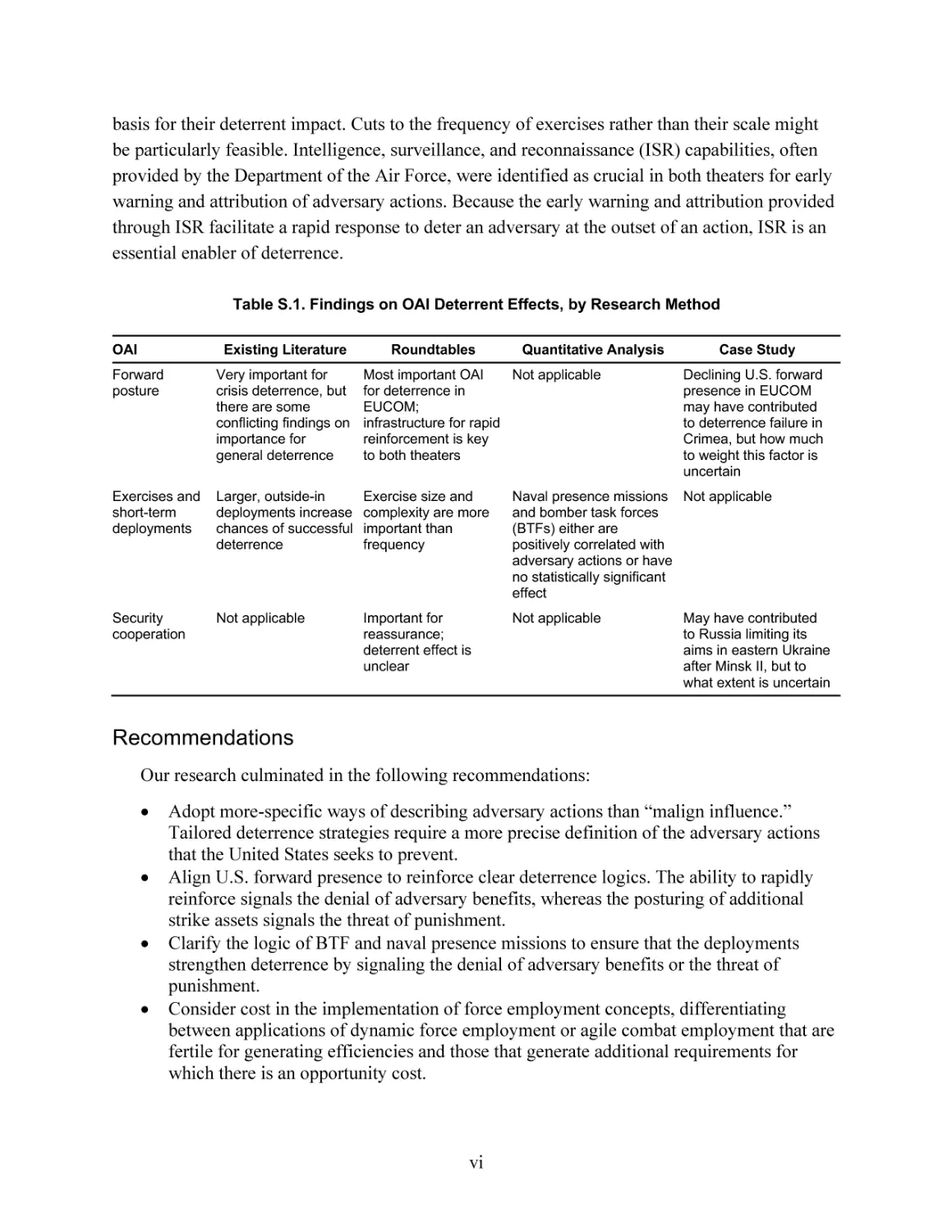
Table S.1 illustrates our findings by OAI category. U.S. forward presence generated the
clearest evidence of deterrent value, although all OAI categories we analyzed may contribute to
deterrence and are fielded for multiple reasons, including to satisfy the interrelated objective of
reassurance. Because deterrence can be achieved via denial of adversary benefits or threat of
punishment, elements of forward posture that communicate these consequences should have the
greatest deterrent effect. Such capabilities could include basing infrastructure that enables rapid
reinforcement during times of crisis or strike capability that holds the adversary at risk.
For strategists and defense planners focused on finding efficiencies in deterrence missions,
exercises and short-term deployments appear most ripe for reductions given the weaker empirical
1

This research was completed in September 2021, before the February 2022 Russian invasion of Ukraine. It has not
been subsequently revised.

v

basis for their deterrent impact. Cuts to the frequency of exercises rather than their scale might
be particularly feasible. Intelligence, surveillance, and reconnaissance (ISR) capabilities, often
provided by the Department of the Air Force, were identified as crucial in both theaters for early
warning and attribution of adversary actions. Because the early warning and attribution provided
through ISR facilitate a rapid response to deter an adversary at the outset of an action, ISR is an
essential enabler of deterrence.
Table S.1. Findings on OAI Deterrent Effects, by Research Method
OAI

Existing Literature

Roundtables

Quantitative Analysis

Case Study

Forward
posture

Very important for
crisis deterrence, but
there are some
conflicting findings on
importance for
general deterrence

Most important OAI
Not applicable
for deterrence in
EUCOM;
infrastructure for rapid
reinforcement is key
to both theaters

Declining U.S. forward
presence in EUCOM
may have contributed
to deterrence failure in
Crimea, but how much
to weight this factor is
uncertain

Exercises and
short-term
deployments

Larger, outside-in
deployments increase
chances of successful
deterrence

Exercise size and
complexity are more
important than
frequency

Naval presence missions Not applicable
and bomber task forces
(BTFs) either are
positively correlated with
adversary actions or have
no statistically significant
effect

Security
cooperation

Not applicable

Important for
reassurance;
deterrent effect is
unclear

Not applicable

May have contributed
to Russia limiting its
aims in eastern Ukraine
after Minsk II, but to
what extent is uncertain

Recommendations
Our research culminated in the following recommendations:
•
•
•
•

Adopt more-specific ways of describing adversary actions than “malign influence.”
Tailored deterrence strategies require a more precise definition of the adversary actions
that the United States seeks to prevent.
Align U.S. forward presence to reinforce clear deterrence logics. The ability to rapidly
reinforce signals the denial of adversary benefits, whereas the posturing of additional
strike assets signals the threat of punishment.
Clarify the logic of BTF and naval presence missions to ensure that the deployments
strengthen deterrence by signaling the denial of adversary benefits or the threat of
punishment.
Consider cost in the implementation of force employment concepts, differentiating
between applications of dynamic force employment or agile combat employment that are
fertile for generating efficiencies and those that generate additional requirements for
which there is an opportunity cost.

vi

•

Should resource considerations lead to a reduction in OAIs for deterrence, be attentive to
how such reductions are communicated and executed so as to reduce potential backlash
from allies and partners and avoid telegraphing opportunities to adversaries.

vii

Contents

About This Report ......................................................................................................................... iii
Summary.......................................................................................................................................... v
Figures and Tables ..........................................................................................................................ix
1. Introduction ................................................................................................................................. 1
Research Questions and Motivation ..........................................................................................................2
Key Concepts ............................................................................................................................................4
Drawing on Existing Literature .................................................................................................................9
Key Findings from Existing Literature on the Effects of U.S. Military Inputs on Deterrence ...............12
Report Structure and Research Design....................................................................................................16

2. Baseline Analysis of Deterrence in EUCOM and CENTCOM................................................. 19
U.S. Deterrence Objectives in EUCOM..................................................................................................19
U.S. Deterrence Objectives in CENTCOM ............................................................................................25
U.S. Extended Deterrence Logics ...........................................................................................................30
Conclusion ...............................................................................................................................................47

3. Roundtables ............................................................................................................................... 49
Workshop Design ....................................................................................................................................49
EUCOM Roundtable ...............................................................................................................................51
CENTCOM Roundtable ..........................................................................................................................61
Roundtable Conclusions ..........................................................................................................................69

4. Quantitative Assessment ........................................................................................................... 72
EUCOM ..................................................................................................................................................74
CENTCOM .............................................................................................................................................80
Summary .................................................................................................................................................85

5. Case Study of Ukraine ............................................................................................................... 87
Crisis in Crimea .......................................................................................................................................88
Crisis in the Donbas ..............................................................................................................................102
Conclusion .............................................................................................................................................113

6. Conclusions and Recommendations ........................................................................................ 115
Key Findings by OAI Category ............................................................................................................117
Possible Efficiencies .............................................................................................................................121
Recommendations .................................................................................................................................124

Appendix A. Russian Strategic Interests and Supporting OAIs .................................................. 127
Appendix B. Iranian Strategic Interests and Supporting OAIs ................................................... 153
Abbreviations .............................................................................................................................. 174
References ................................................................................................................................... 176

viii

Figures and Tables

Figures
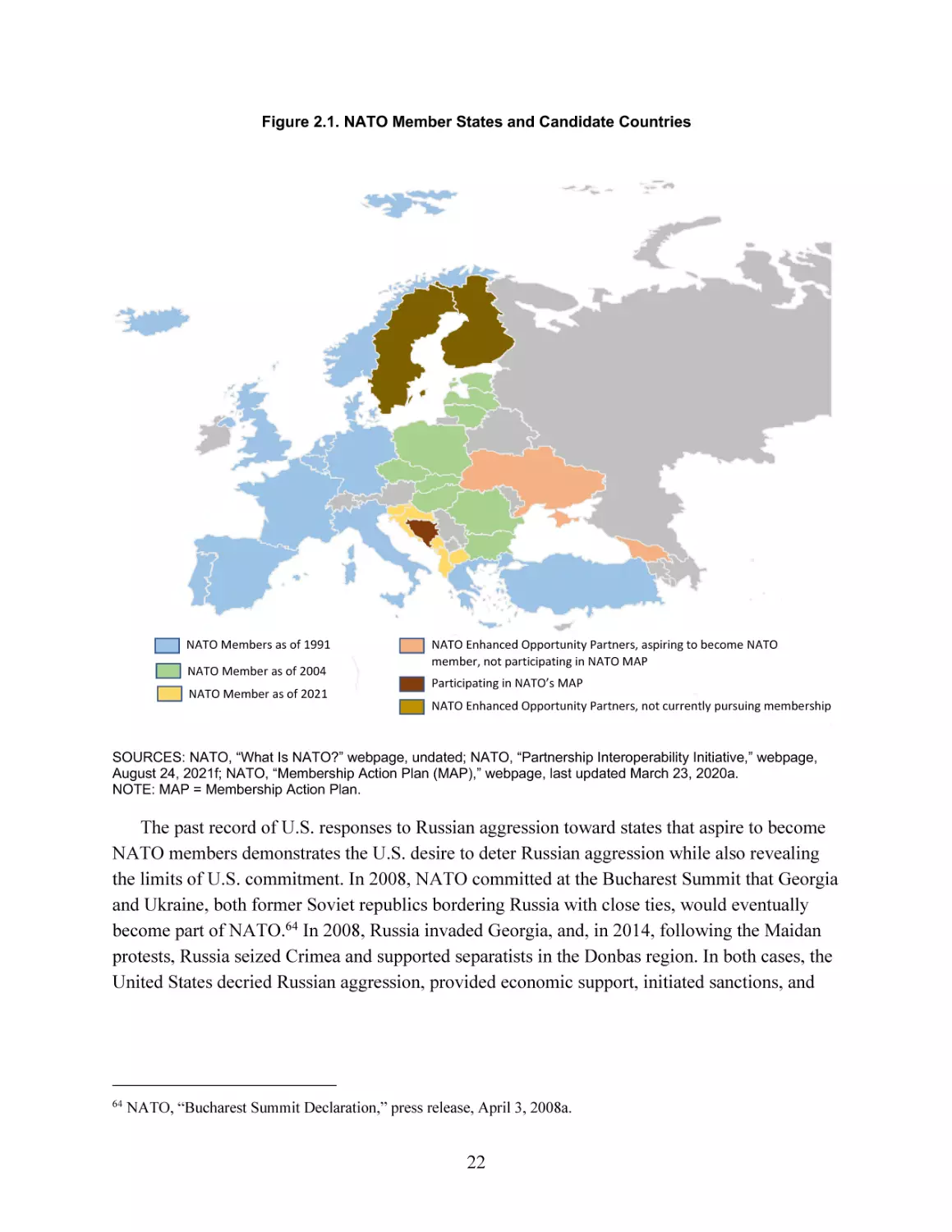
Figure 2.1. NATO Member States and Candidate Countries ........................................................ 22
Figure 3.1. Posture in Western Europe .......................................................................................... 53
Figure 3.2. Baseline U.S. OAIs in the Gulf Cooperation Council States Presented to Workshop
Participants ............................................................................................................................ 64
Figure 3.3. Baseline U.S. OAIs in the Levant States Presented to Workshop Participants .......... 65
Figure 4.1. Russian Uses and Shows of Force in EUCOM, 2014–2020 ....................................... 75
Figure 4.2. Russian Uses and Shows of Force in EUCOM by Domain, 2014–2020 .................... 76
Figure 4.3. BTFs Versus Russian Uses and Shows of Force in EUCOM, 2014–2020 ................. 78
Figure 4.4. Russian Incidents and U.S. Ship Presence in the Black Sea, 2014–2020 ................... 80
Figure 4.5. Iranian Maritime Incidents and U.S. Navy Carrier Presence, 2016–2020 .................. 81
Figure 4.6. Houthi Missile Attacks and U.S. Navy Presence, 2017–2021 .................................... 84
Figure 5.1. Decline in U.S. Forward Presence in EUCOM Over Time ........................................ 96
Figure A.1. Selected Regional Organizations in Which Russia Participates .............................. 131
Figure A.2. Russia’s Desired Sphere of Influence ...................................................................... 133
Figure A.3. Importers of Russian Arms ...................................................................................... 148
Figure B.1. Iranian Ballistic Missile Range Rings and Key U.S. Facilities in the
Middle East .......................................................................................................................... 162

Tables
Table S.1. Findings on OAI Deterrent Effects, by Research Method ............................................vi
Table 1.1. Overview of Empirical Studies Reviewed ................................................................... 10
Table 1.2. Variables Affecting Deterrence .................................................................................... 11
Table 2.1. Summary of U.S. Deterrence Objectives in CENTCOM ............................................. 25
Table 2.2. Timing of Bomber Task Forces in Response to Iranian Attacks or Ahead of Iranian
Threats ................................................................................................................................... 42
Table 2.3. OAIs and Associated Deterrence Logics...................................................................... 47
Table 3.1. Presentation of U.S. OAIs for Poland and Baltic States Breakout Group.................... 54
Table 3.2. Presentation of U.S. OAIs for Black Sea Breakout Group .......................................... 56
Table 3.3. Presentation of U.S. OAIs for Nordic/Arctic Region Breakout Group ........................ 57
Table 4.1. Quantitative Cases in EUCOM and CENTCOM ......................................................... 73
Table 6.1. Findings on OAI Deterrent Effects, by Research Method ......................................... 118

ix

x

1. Introduction

How can the United States continue to effectively deter such adversaries as Russia and Iran
as the military reorients its global footprint to compete with the pacing threat of China?2 The
2021 Interim National Security Strategic Guidance highlights the need “to deter and prevent
adversaries from directly threatening the United States and our allies, inhibiting access to the
global commons, or dominating key regions.”3 The guidance goes on to stipulate the need to
achieve deterrence against state adversaries of different types, reinforce U.S. extended deterrence
commitments to U.S. allies and partners, and apply deterrence to adversaries’ gray zone
activities. The posture statements of U.S. geographic commands also stress deterrence as a key
military mission and are similarly expansive in identifying the scope of the requirement; U.S.
European Command (EUCOM) notes that its “strategy prioritizes supporting NATO’s [the North
Atlantic Treaty Organization’s] deterrence and defense of the Euro-Atlantic area,”4 and a recent
U.S. Central Command (CENTCOM) posture statement underscored, “Deterring Iran from its
destructive and destabilizing activities in the military domain underpins everything we do, and is
CENTCOM’s top priority.”5
Yet deterrence is only one military mission that U.S. military forces must undertake. And
among U.S. adversaries, China has been identified as the long-term pacing threat that resources
should be prioritized against, with CENTCOM already experiencing a drawdown of U.S. forces
and additional reductions in forward presence anticipated to come.6 How, then, can the United
States strike a balance in meeting its deterrence objectives outside U.S. Indo-Pacific Command
(INDOPACOM), finding ways to deter U.S. adversaries without crowding out competition with
China or investment in U.S. military modernization?

2

This research was completed in September 2021, before the February 2022 Russian invasion of Ukraine. It has not
been subsequently revised.
3

Joseph R. Biden, Jr., Interim National Security Strategic Guidance, Washington, D.C.: White House, March 2021,
p. 9.

4

Tod D. Wolters, “Statement of General Tod D. Wolters, United States Air Force Commander, United States
European Command,” Washington, D.C.: U.S. Senate Committee on Armed Services, April 13, 2021a, pp. 1–2.
5

CENTCOM, “Command Priorities,” webpage, undated. See also Kenneth F. McKenzie, Jr., Commander, U.S.
Central Command, “Posture Statement of General Kenneth F. McKenzie, Jr., Commander, United States Central
Command Before the Senate Armed Services Committee, March 12, 2020,” Washington, D.C.: U.S. Senate
Committee on Armed Services, March 12, 2020a.
6

Gordon Lubold, Nancy A. Youssef, and Michael R. Gordon, “U.S. Military to Withdraw Hundreds of Troops,
Aircraft, Antimissile Batteries from Middle East,” Wall Street Journal, last updated June 18, 2021.

1

Research Questions and Motivation
The goal of this research project is to improve understanding of (1) which U.S. military
actions have the desired deterrent effect and (2) where efficiencies may be found by adjusting the
operations, activities, and investments (OAIs) the U.S. military undertakes for deterrence. Our
intent is to support military planners in tailoring deterrence that achieves the objective—
demonstrating to adversaries that “the costs and risks of aggression remain out of line with any
conceivable benefit,”7 in the words of Secretary of Defense Lloyd J. Austin III—while
recognizing that an optimal approach to deterrence would accomplish that objective with a
judicious use of resources. In studying the use of military OAIs for deterrence, we are conscious
that other tools—such as economic or political sanctions or positive inducements—also play a
significant role in deterrence of great-power aggression. Even as other U.S. government
departments and agencies exercise nonmilitary tools, an independent focus on the role of military
OAIs is important because the U.S. Department of Defense (DoD) must formulate appropriate
OAIs for its deterrence role in coordination with other stakeholders.
Since Russia’s seizure and subsequent annexation of Crimea in 2014, establishing deterrence
has become a much-discussed topic among U.S. political and military leadership. Some see
deterrence as a concept that was neglected during the immediate post–Cold War period and look
to raise its prominence as an objective of the U.S. military.8 Others have criticized the surge in
attention to deterrence, which they argue has been used as a catchall for justifying military
deployments that lack well-defined objectives.9 Current officials, including Secretary of Defense
Austin and Under Secretary of Defense for Policy Colin Kahl, have called for new deterrence
concepts and suggested that integrated deterrence, which in its early incarnation appears to be
aimed at achieving deterrence across military domains, across the spectrum of competition and
conflict, integrated with nonmilitary tools, and in tandem with allies and partners, will be
featured in the 2022 National Defense Strategy.10 In the backdrop of these discussions is the
question of how to achieve deterrence without generating requirements that consume readiness
for other missions.
Debates over what constitutes the right level of investment in deterrence often come to a
head in EUCOM and CENTCOM, where the United States faces two state adversaries: Russia
7

Lloyd J. Austin III, “Opinion: The Pentagon Must Prepare for a Much Bigger Theater of War,” Washington Post,
May 5, 2021.
8

For a call to reinvigorate thinking on deterrence prior to Russia’s seizure of Crimea, see Richard K. Betts, “The
Lost Logic of Deterrence: What the Strategy That Won the Cold War Can—and Can’t—Do Now,” Foreign Affairs,
March–April 2013. For a post-Crimea call, see Robert P. Haffa, Jr., “The Future of Conventional Deterrence:
Strategies for Great Power Competition,” Strategic Studies Quarterly, Winter 2018.
9

Mara Karlin, “You Get Deterrence, and You Get Deterrence, Everybody Gets Deterrence!” War on the Rocks,
May 5, 2017.
10

Jim Garamone, “Official Talks DOD Policy Role in Chinese Pacing Threat, Integrated Deterrence,” DoD News,
June 2, 2021.

2

and Iran. Deterring them from undertaking aggression against the United States and its allies and
partners would appear to require significant effort and could result in deterrence requirements
that pull attention and resources away from the priority long-term threat posed by China in
INDOPACOM.11 On the one hand, there is the risk of underinvesting in deterrence in EUCOM
and CENTCOM and thus insufficiently posturing forces and conducting activities (e.g.,
exercises, security cooperation) to deter Russian and Iranian aggressions. On the other hand,
there is the opposite risk of overinvesting in deterrence in these two theaters, thereby depriving
the military of the resources necessary to effectively compete with China, modernize forces, or
build readiness via continental United States (CONUS)–based training.
The challenge of how to resource deterrence missions cuts across commands, and geographic
combatant commands operate as the natural advocates for additional forces to deter adversaries
in their theaters.12 For example, the EUCOM commander has pointed to a need to better match
resources to the evolving nature of the threat environment in Europe,13 and the CENTCOM
commander has described the state of deterrence with Iran as “contested” and has been a strong
advocate for additional forces to restore deterrence in his area of responsibility (AOR).14 As
force providers, the military services have an interest in deterrence missions not overconsuming
readiness or crowding out investment in modernization.15
To explore how to reach a balance of investing in deterrence without generating unnecessary
requirements, we investigate whether and how the concept of economy of force (EoF) can be
usefully applied to deterrence missions in EUCOM and CENTCOM.16 We do not begin this
study from the premise that EoF is a concept that is suitable to all deterrence missions or that
could be applied in the same way to two theaters that have major differences in underlying
conditions (e.g., extent of the adversary’s conventional and nuclear capabilities, existence of U.S.
treaty allies). Instead, we see EoF as a concept that provides a way to explore the potential to
11

Some argue that the different U.S. military capabilities most relevant for each theater (e.g., maritime capabilities
for INDOPACOM, land forces for EUCOM) mean that theaters are not necessarily competing for the same forces.
12

Mackenzie Eaglen, “Putting Combatant Commanders on a Demand Signal Diet,” War on the Rocks, November 9,
2020.

13

U.S. Department of State, “Telephonic Press Briefing with General Tod Wolters, Command (USEUCOM)
Commander and NATO Supreme Allied Commander Europe (SACEUR),” special briefing via telephone, February
3, 2021b.
14

Kenneth F. McKenzie, Jr., “Marine Corps General Kenneth F. McKenzie Jr., Commander, U.S. Central
Command Holds a Press Briefing on Defensive Strikes Against Iran,” transcript, U.S. Department of Defense,
March 13, 2020b.

15

For an example of the trade-offs between service modernization and meeting geographic combatant commanders’
requests for forces, see Rebecca S. Zimmerman, Kimberly Jackson, Natasha Lander, Colin Roberts, Dan Madden,
and Rebeca Orrie, Movement and Maneuver: Culture and the Competition for Influence Among the U.S. Military
Services, Santa Monica, Calif.: RAND Corporation, RR-2270-OSD, 2019, pp. 59–60.
16

This report does not include a cost analysis of deterrence missions, which may be a logical follow-on effort.
Rather, we investigate which OAIs have the greatest deterrent effect, which can help policymakers and defense
planners prioritize investments in OAIs.

3

realize efficiencies in how deterrence missions are executed while also weighing the potential
negative consequences of adopting such an approach.
We investigate our research questions with respect to Russia and Iran because they are the
two state threats identified in U.S. strategic guidance that are not in INDOPACOM, the theater
that is expected to be a strong focus of U.S. military activities in coming years. Russia and Iran
pose very different challenges from each other; key distinguishing factors are the much greater
threat posed by Russia’s conventional forces in its near abroad and the quality and quantity of
Russia’s nuclear arsenal. However, both countries require the United States to engage in
deterrence activities in theaters where policymakers may seek more-efficient approaches to
addressing threats. To sufficiently address the differences between the two adversaries, the
chapters in this report and the appendixes treat each adversary separately, albeit in a parallel
structure.

Key Concepts
Although deterrence has spawned numerous definitions, scholars and practitioners typically
agree on its general characteristics.17 In classic deterrence literature, political scientists
Alexander George and Richard Smoke describe deterrence as “simply the persuasion of one’s
opponent that the costs and/or risks of a given course of action he might take outweigh its
benefits.”18 RAND researcher Michael Mazarr defines it as “the practice of discouraging or
restraining someone—in world politics, usually a nation-state—from taking unwanted actions,
such as an armed attack. It involves an effort to stop or prevent an action.”19 A contested part of
the concept is what range of adversary actions it encompasses. In the narrowest definition, the
actions to be deterred are major aggressions, such as a territorial grab.20 In the broadest
definition, the action to be deterred might encompass lower-level actions below the threshold of
war (e.g., airspace violations), nonkinetic activities (e.g., the use of cyberspace to spread
disinformation),21 or even the adversary’s development of new capabilities (e.g., Russia’s

17

This review of key concepts assumes that the reader has some exposure to deterrence. To keep the discussion as
brief as possible, we do not address the point that, in the literature, deterrence is typically treated as a subset of
coercion.
18

Alexander L. George and Richard Smoke, Deterrence in American Foreign Policy: Theory and Practice, New
York: Columbia University Press, 1974, p. 11.

19

Michael J. Mazarr, Understanding Deterrence, Santa Monica, Calif.: RAND Corporation, PE-295-RC, 2018, p. 2.

20

For an argument against expanding the scope of military objectives that are considered deterrence missions, see
Al Mauroni, “Deterrence: I Don’t Think It Means What You Think It Means,” Modern War Institute at West Point,
October 8, 2019.
21

Michael J. Mazarr, Joe Cheravitch, Jeffrey W. Hornung, and Stephanie Pezard, What Deters and Why: Applying a
Framework to Assess Deterrence of Gray Zone Aggression, Santa Monica, Calif.: RAND Corporation, RR-3142-A,
2021.

4

attempts to acquire hypersonic weapons).22 The bounds of the aggressor activity to be deterred
also encompass the issue of whether the action has already occurred. To distinguish between
aggressor actions that the United States would seek to reverse or prevent a reoccurrence of and
actions that have not occurred, scholars differentiate between deterrence and compellence,23 use
the term roll back to signal the aim of reversing an adversary’s action,24 or note the need to
“restore deterrence” retroactively.25
These conceptual issues are important for our research questions because one potential way
to execute deterrence along EoF principles is to limit the scope of aggressor activities the United
States attempts to deter. This report does not adopt a narrow or broad formulation of the set of
activities the United States should attempt to deter; rather, it highlights that the choice has
implications for finding efficiencies in the deterrence mission and that the broader the conception
of deterrence employed, the harder it will be to realize efficiencies. Simply put, if deterrence is
narrowly defined as preventing adversaries from undertaking large-scale aggressions, that is a
mission that is likely to be achievable with less deterrence inputs than if the deterrence mission is
broadly defined as preventing adversary actions below the threshold of war, such as airspace
violations, or encompasses restoring deterrence in cases in which the adversary has already
established a pattern of behavior (e.g., Iranian harassment of U.S. naval ships in the Persian
Gulf).
In addition to the types of adversary actions the United States is trying to deter, there are
several ways to categorize deterrence according to the adversary capabilities employed, the
target of the aggression, and the stage of the crisis when it takes place. The most common
distinctions are via the type of attack being deterred (i.e., conventional or nuclear attack), the
target of the aggression (i.e., direct deterrence for actions against the United States versus
extended deterrence for U.S. support of an ally or partner), and whether the deterrence is aimed
at an adversary during the absence of a crisis or in the midst of an escalation (i.e., general versus
immediate deterrence).
Our study is primarily focused on conventional deterrence. We acknowledge that in the
EUCOM theater, the nuclear capabilities of the United States and its allies, on the one hand, and
Russia, on the other, are a fundamental characteristic of the regional security system that affects
all sides’ calculations. Yet we focus on conventional deterrence for several reasons. First, for
22

For an example of using deterrence in this way, see comments by Senator Joe Manchin: “It sounds to me as if
hypersonic weapons and other future weapons have been more advanced by other countries such as China, even
Russia coming back into the scene in a real aggressive way. . . are we going to deter them from moving forward?”
(Eunjung Cho, “US Senators Point to ‘Hypersonic Gap’ with Russia, China,” Voice of America, February 13, 2020).
23

Thomas C. Schelling, Arms and Influence, New Haven, Conn.: Yale University Press: 1966, pp. 71–76.

24

Melanie W. Sisson, James A. Siebens, and Barry Blechman, eds., Military Coercion and US Foreign Policy: The
Use of Force Short of War, New York: Routledge, 2020.
25

Michael Eisenstadt, Kori Schake, and David Deptula, “U.S. Strategy Toward Iran: Restoring Deterrence,
Enabling Diplomacy,” Policy Watch 3265, Washington Institute for Near East Policy, February 14, 2020.

5

scoping reasons, the primary interest of the study’s sponsor was on identifying economies of
force associated with OAIs related to conventional forces. Second, existing analysis of the
nuclear dynamics of the region suggests that Russia might have a degree of escalation dominance
that limits the efficacy of U.S. nuclear weapons to deter a potential Russian attack, which
highlights the challenges of a nuclear weapon–focused strategy for deterrence. In particular, in a
2019 RAND study that used a wargame to examine the potential for using a nuclear strategy for
deterrence in the Baltic states, the researchers assessed that “NATO would lack escalation
dominance” in a nuclear exchange emerging from a conflict in the Baltics.26 The report noted
that nuclear weapons and modernization could contribute to a credible deterrence strategy, but it
suggested that the priority is strengthening conventional forces. A third reason for our focus on
OAIs associated with conventional forces is that these capabilities might be especially important
for deterring the initial stages of conflict and for deterring forms of aggression other than a
Russian attack against a NATO member. Nevertheless, some of the OAIs that we explore may
have an impact because they involve dual-use capabilities, such as bomber task forces (BTFs),
although there is a risk of inadvertent escalation, as the roundtables described in Chapter 3
considered.27 In the CENTCOM AOR, although Iran may consider the nuclear capabilities of the
United States in developing its foreign policy, OAIs associated with nuclear weapons do not
appear to play a significant or plausible role in U.S. deterrent missions as we identify them.
Given the scope of this effort, further study of the role of nuclear weapons for deterrence in
Europe, including exploring conventional-nuclear integration and the role of U.S. and NATO
nuclear modernization, is merited. Such study might need to consider factors that are beyond the
scope of this report, including nuclear use doctrine, intra-conflict escalation, and the possible
dynamics of strategic escalation.
In terms of the target of adversary actions, in EUCOM, our research focuses on extended
deterrence requirements because the primary deterrence objective of the United States in that
theater is deterring Russian attacks on its NATO allies. In the CENTCOM theater, U.S.
deterrence is also extended but is somewhat complicated by the fact that U.S. forward presence
is one target of Iranian aggression, whether those assets are based in the sovereign territory of
U.S. partners (e.g., U.S. ground forces in Iraq) or in the global commons (e.g., U.S. naval
presence in the Persian Gulf). And some Iranian attacks specifically target U.S. forces and not
Washington’s regional partners. For this reason, our analysis in this theater covers extended
deterrence and the gray area between direct and extended deterrence in which the target of the
aggression might be U.S. forces—and not necessarily U.S. partners—and might occur in the
global commons.
26

Paul K. Davis, J. Michael Gilmore, David R. Frelinger, Edward Geist, Christopher K. Gilmore, Jenny
Oberholtzer, and Danielle C. Tarraf, Exploring the Role Nuclear Weapons Could Play in Deterring Russian Threats
to the Baltic States, Santa Monica, Calif.: RAND Corporation, RR-2781-RC, 2019, p. x.
27

See also Ulrich Kühn, “NATO’s Options,” Preventing Escalation in the Baltics: A NATO Playbook, Washington,
D.C.: Carnegie Endowment for International Peace, 2018.

6

Scholars have also highlighted a distinction between deterrence by denial—meaning the
application of actions that would prevent an adversary from achieving a particular action—and
deterrence by punishment—meaning threatening the imposition of costs to an adversary for an
action.28 Deterrence by denial is sometimes believed to be more effective because the threat of
punishment might not be credible to a potential adversary. Although this distinction is sometimes
useful in considering the utility of OAIs, we do not organize the articulation of OAIs around
these categories because, in many cases, OAIs can contribute to both deterrence by denial and
deterrence by punishment. For example, as we explain in Chapter 2, intelligence, surveillance,
and reconnaissance (ISR) capabilities can contribute to denying objectives by providing early
warning of adversary aggression and an ability to respond and can facilitate future punishment of
the adversary.
Finally, our research encompasses both general deterrence and immediate (also called crisis)
deterrence.29 Scholars have usefully differentiated between these two types of deterrence to
understand the different requirements of preventing an adversary aggression without advance
warning of an imminent attack versus preventing an adversary from escalating an action during a
crisis.30 On the one hand, there can be an overlap between general and crisis deterrence, as the
military activities and policy positions taken by the defender and aggressor during peacetime will
almost certainly shape the crisis response. Moreover, it can be difficult in the real world to
differentiate between periods of general and crisis deterrence, particularly when relations are
highly adversarial and there are slow-burn crises or frequent small-scale escalations. On the other
hand, the distinction should not be underplayed, as the variety of actions taken by the defender
during crises will almost certainly include much greater enhancements of posture and
demonstrations of capability than during peacetime. Because our intent is for a military planner
to be able to use this research to inform how the United States postures to deter adversary
aggressions, and those aggressions could occur through either pathway, we note this distinction
when addressing prior literature. However, our original research does not code cases as strictly
corresponding to either general or crisis deterrence. A EUCOM or CENTCOM planner must be
prepared to think through how OAIs can be leveraged to prevent adversary actions however the
aggressions develop. And all of our original research deals with the post-2014 EUCOM and
CENTCOM theaters, in which there have been frequent escalations.

28

Schelling, 1966, p. 70.

29

James Fearon identifies general deterrence as occurring when “no threats are issued between states that are
involved in a generally adversarial relationship” and immediate deterrence as “becom[ing] an issue after one state
has decided to threaten or to take other actions that suggest the possible use of force” (James D. Fearon, “Signaling
Versus the Balance of Power and Interests: An Empirical Test of a Crisis Bargaining Model,” Journal of Conflict
Resolution, Vol. 38, No. 2, June 1994, p. 240).
30

Bryan Frederick, Stephen Watts, Matthew Lane, Abby Doll, Ashley L. Rhoades, and Meagan L. Smith,
Understanding the Deterrent Impact of U.S. Overseas Forces, Santa Monica, Calif.: RAND Corporation, RR-2533A, 2020; Mazarr et al., 2021.

7

Because this study examines how deterrence can be achieved while remaining sensitive to
competing demands, our research looks at the intersection of deterrence with EoF principles.
Joint doctrine defines EoF as “the judicious employment and distribution of forces so as to
expend the minimum essential combat power on secondary efforts to allocate the maximum
possible combat power on primary efforts.”31 The concept focuses on two interrelated
considerations. The first is that combat power should be applied “judiciously” or in a manner that
is the “minimum essential” to achieve the task. The second is the idea that applying EoF is based
on a distinction between primary and secondary efforts, with resources surged to primary efforts
and reduced toward secondary efforts. Service-level military doctrine—including U.S. Air Force
doctrine—is consistent in these regards, stressing the same fundamental considerations.32
In considering what EoF means, it is useful to note what it does not mean but is sometimes
confused with. EoF does not mean withdrawal from a conflict or theater of operations, but rather
employing the minimum effort required to achieve a secondary objective. As clarified by the
Chairman of the Joint Chiefs of Staff,
The proper term would be economy of force, which doesn’t mean zero . . . . It
just means you’ve got to right-size it to the tasks and the threats at a level of
effort that’s appropriate to achieve your objectives. . . . Economy of force means
you are going to use the least amount of force to achieve the minimum amount of
objectives that you can achieve in support of the broader main effort.33

Doctrine does not specify the variety of mechanisms that could be used to implement EoF, but,
according to public statements made by U.S. military leadership, the mechanisms appear to
encompass posture (e.g., reducing the scale of U.S. forward presence and capabilities in theater),
force employment (e.g., using concepts that require less than a standard sized military unit, such
as agile combat employment [ACE], which may involve forward deploying less than a squadronsized package of aircraft to forward operating locations), and reliance on contributions from
allies and partners rather than U.S. military capabilities.
Given the current strategic priorities, there are two potential motivations for applying EoF
principles to deterrence in EUCOM and CENTCOM. The first would be to avoid
operationalizing deterrence in the two theaters in ways that would divert military capabilities
from other nondeterrence missions. The second would be to better prioritize deterrence
objectives within each theater so as to focus U.S. deterrence inputs on deterring the adversary
aggressions that are the most threatening to U.S. interests or the most “deterrable” given the
31

Joint Publication 3-0, Joint Operations, Washington, D.C.: Joint Chiefs of Staff, January 17, 2017, incorporating
change 1, October 22, 2018, p. GL-8.
32

U.S. Air Force doctrine states, “To ensure overwhelming combat power is available, maximum effort should be
devoted to primary objectives. At the operational level of war, commanders ensure that any effort made towards
secondary objectives does not degrade achievement of the larger operational or strategic objectives” (Curtis E.
LeMay Center, Volume 1: Basic Doctrine, Washington, D.C.: Chief of Staff, U.S. Air Force, last updated February
27, 2015).
33

Luis Martinez, “Pentagon to Decide Soon on Possible Troop Cut in West Africa,” ABC News, January 16, 2020.

8

defenders’ and aggressors’ respective interests and the local balance of forces. For both
applications, EoF is a relevant principle that could help U.S. military planners avoid the trap of
establishing ever higher deterrence requirements that tie down military capabilities for which
there is an opportunity cost.
However, in applying EoF to deterrence, planners would need to be cognizant of the risk of
underinvesting in deterrence and thereby potentially inviting an adversary aggression that would
have otherwise been preventable. As observed by political scientist Richard Betts, there are two
unintended consequences that can result from poorly executed deterrence: wasting resources on
an unnecessary activity and inadvertently provoking conflict.34 And there is also the risk that the
defender commitment will be insufficient and deterrence will fail. Of these outcomes, Betts
persuasively argues that although overinvesting in deterrence is suboptimal, the other outcomes
are of much greater concern. Thus, while all defense planners and policymakers can presumably
agree that the ideal is to deter without expending unnecessary effort, reasonable people can
disagree on the level of risk they are willing to accept to deter efficiently. And debate is all the
more likely given the uncertain returns on deterrence inputs and the uncertain intentions of U.S.
adversaries to undertake specific aggressions.
Despite these analytic challenges and real-world uncertainties, there will be an increasing
need to make the most of resources across U.S. global commitments. This, in turn, may lead
policymakers to pressure defense planners to find efficiencies in deterring adversaries, forcing
tough decisions on trade-offs between deterrence activities. This research provides a tool for
informing this debate.

Drawing on Existing Literature
Deterrence is a vast field of study that has produced much analysis—and debate—over the
past half century. Because the body of literature on deterrence is extensive and classic deterrence
theory has been thoroughly discussed in other work, we focused our literature review on
empirical analyses of deterrence effectiveness. In particular, we searched for work that offered
operationally relevant findings about the effectiveness of different military inputs on deterrence
outcomes. Additionally, we looked for work that either produced original data sets or analyzed
other data sets related to deterrence in which the United States was the deterrer in at least one
(but preferably more) of the examined cases. We began with recent RAND work and then
expanded our search to include other institutions. We restricted our search to articles in peerreviewed journals, published books, and RAND reports. Our search yielded three RAND reports
and ten other studies that met our strict criteria, as well as a host of other articles that we do not
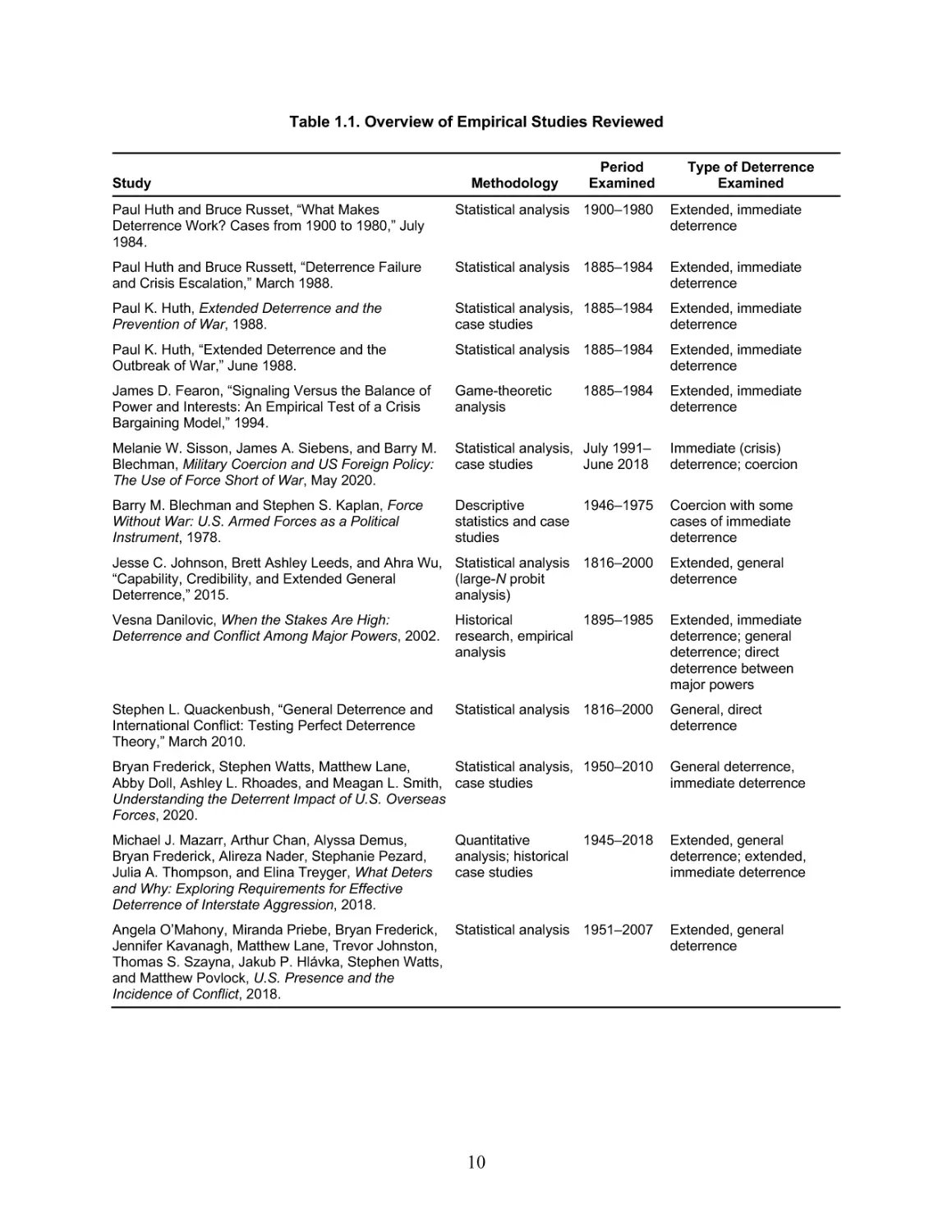
discuss in depth but that provided us with valuable background information. Table 1.1 provides a
snapshot of the studies examined in our literature review.
34

Betts, 2013.

9

Table 1.1. Overview of Empirical Studies Reviewed

Study

Methodology

Period
Examined

Type of Deterrence
Examined

Paul Huth and Bruce Russet, “What Makes
Deterrence Work? Cases from 1900 to 1980,” July
1984.

Statistical analysis 1900–1980

Extended, immediate
deterrence

Paul Huth and Bruce Russett, “Deterrence Failure
and Crisis Escalation,” March 1988.

Statistical analysis 1885–1984

Extended, immediate
deterrence

Paul K. Huth, Extended Deterrence and the
Prevention of War, 1988.

Statistical analysis, 1885–1984
case studies

Extended, immediate
deterrence

Paul K. Huth, “Extended Deterrence and the
Outbreak of War,” June 1988.

Statistical analysis 1885–1984

Extended, immediate
deterrence

James D. Fearon, “Signaling Versus the Balance of
Power and Interests: An Empirical Test of a Crisis
Bargaining Model,” 1994.

Game-theoretic
analysis

1885–1984

Extended, immediate
deterrence

Melanie W. Sisson, James A. Siebens, and Barry M.
Blechman, Military Coercion and US Foreign Policy:
The Use of Force Short of War, May 2020.

Statistical analysis, July 1991–
case studies
June 2018

Immediate (crisis)
deterrence; coercion

Barry M. Blechman and Stephen S. Kaplan, Force
Without War: U.S. Armed Forces as a Political
Instrument, 1978.

Descriptive
1946–1975
statistics and case
studies

Coercion with some
cases of immediate
deterrence

Jesse C. Johnson, Brett Ashley Leeds, and Ahra Wu, Statistical analysis 1816–2000
(large-N probit
“Capability, Credibility, and Extended General
Deterrence,” 2015.
analysis)

Extended, general
deterrence

Vesna Danilovic, When the Stakes Are High:
Deterrence and Conflict Among Major Powers, 2002.

Historical
1895–1985
research, empirical
analysis

Extended, immediate
deterrence; general
deterrence; direct
deterrence between
major powers

Stephen L. Quackenbush, “General Deterrence and
International Conflict: Testing Perfect Deterrence
Theory,” March 2010.

Statistical analysis 1816–2000

General, direct
deterrence

Bryan Frederick, Stephen Watts, Matthew Lane,
Statistical analysis, 1950–2010
Abby Doll, Ashley L. Rhoades, and Meagan L. Smith, case studies
Understanding the Deterrent Impact of U.S. Overseas
Forces, 2020.

General deterrence,
immediate deterrence

Michael J. Mazarr, Arthur Chan, Alyssa Demus,
Bryan Frederick, Alireza Nader, Stephanie Pezard,
Julia A. Thompson, and Elina Treyger, What Deters
and Why: Exploring Requirements for Effective
Deterrence of Interstate Aggression, 2018.

Extended, general
deterrence; extended,
immediate deterrence

Quantitative
analysis; historical
case studies

1945–2018

Angela O’Mahony, Miranda Priebe, Bryan Frederick, Statistical analysis 1951–2007
Jennifer Kavanagh, Matthew Lane, Trevor Johnston,
Thomas S. Szayna, Jakub P. Hlávka, Stephen Watts,
and Matthew Povlock, U.S. Presence and the
Incidence of Conflict, 2018.

10

Extended, general
deterrence

Explanations of Deterrence Success
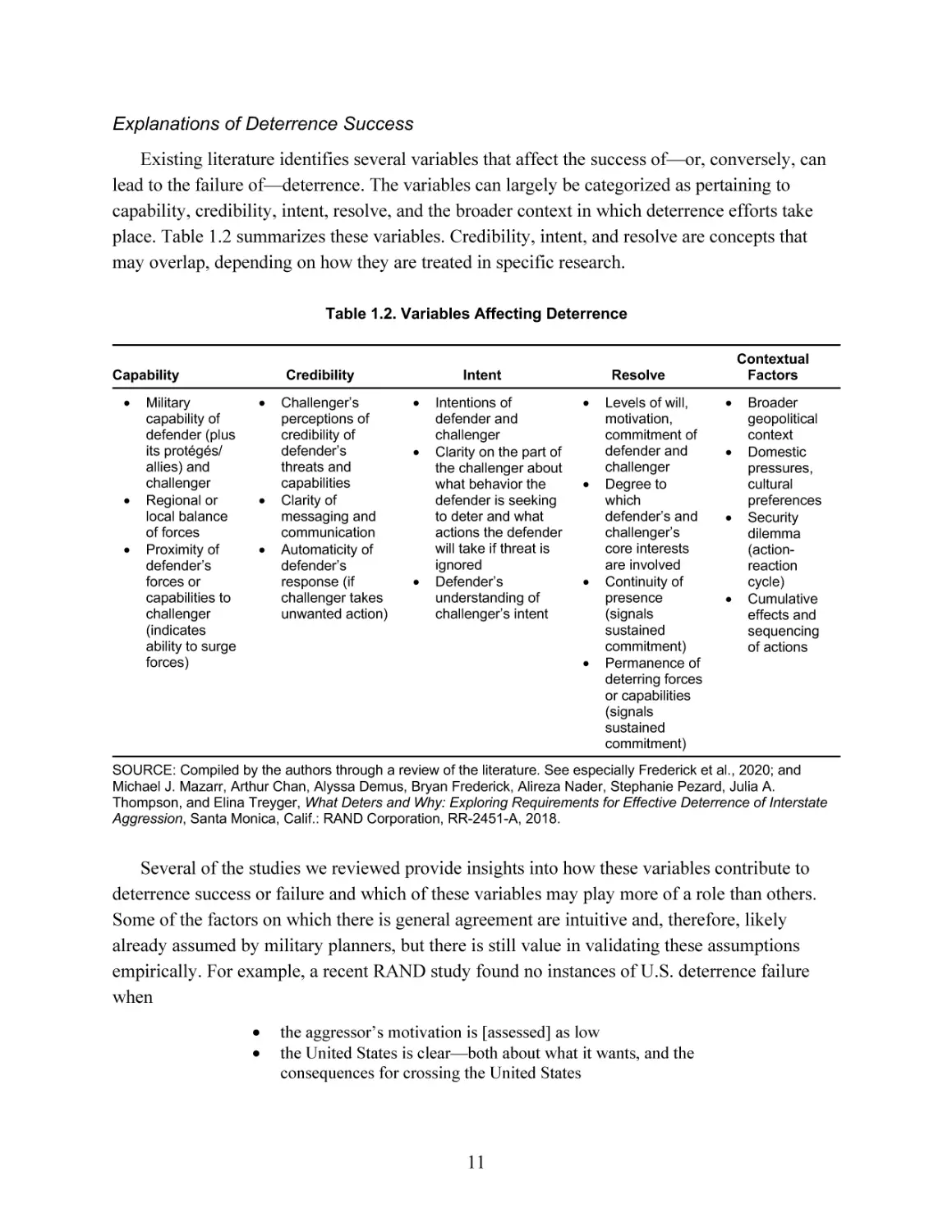
Existing literature identifies several variables that affect the success of—or, conversely, can
lead to the failure of—deterrence. The variables can largely be categorized as pertaining to
capability, credibility, intent, resolve, and the broader context in which deterrence efforts take
place. Table 1.2 summarizes these variables. Credibility, intent, and resolve are concepts that
may overlap, depending on how they are treated in specific research.
Table 1.2. Variables Affecting Deterrence

Capability
•

•
•

Military
capability of
defender (plus
its protégés/
allies) and
challenger
Regional or
local balance
of forces
Proximity of
defender’s
forces or
capabilities to
challenger
(indicates
ability to surge
forces)

Credibility
•

•
•

Challenger’s
perceptions of
credibility of
defender’s
threats and
capabilities
Clarity of
messaging and
communication
Automaticity of
defender’s
response (if
challenger takes
unwanted action)

Intent
•
•

•

Intentions of
defender and
challenger
Clarity on the part of
the challenger about
what behavior the
defender is seeking
to deter and what
actions the defender
will take if threat is
ignored
Defender’s
understanding of
challenger’s intent

Contextual
Factors

Resolve
•

•

•

•

Levels of will,
motivation,
commitment of
defender and
challenger
Degree to
which
defender’s and
challenger’s
core interests
are involved
Continuity of
presence
(signals
sustained
commitment)
Permanence of
deterring forces
or capabilities
(signals
sustained
commitment)

•
•

•

•

Broader
geopolitical
context
Domestic
pressures,
cultural
preferences
Security
dilemma
(actionreaction
cycle)
Cumulative
effects and
sequencing
of actions

SOURCE: Compiled by the authors through a review of the literature. See especially Frederick et al., 2020; and
Michael J. Mazarr, Arthur Chan, Alyssa Demus, Bryan Frederick, Alireza Nader, Stephanie Pezard, Julia A.
Thompson, and Elina Treyger, What Deters and Why: Exploring Requirements for Effective Deterrence of Interstate
Aggression, Santa Monica, Calif.: RAND Corporation, RR-2451-A, 2018.

Several of the studies we reviewed provide insights into how these variables contribute to
deterrence success or failure and which of these variables may play more of a role than others.
Some of the factors on which there is general agreement are intuitive and, therefore, likely
already assumed by military planners, but there is still value in validating these assumptions
empirically. For example, a recent RAND study found no instances of U.S. deterrence failure
when
•
•

the aggressor’s motivation is [assessed] as low
the United States is clear—both about what it wants, and the
consequences for crossing the United States

11

•

there is a clear U.S. and allied advantage in the local balance of
forces.35

Instructive for military planners, the local balance of forces, when viewed in isolation from the
other factors, was not found to be determinative of the deterrence outcome. This underscores that
although adjustments in U.S. military OAIs are an important factor in achieving deterrence,
whether the United States achieves its desired outcome depends on a broader set of conditions,
many of which cannot be easily addressed through a change in forward posture. As will be
brought out in subsequent chapters, one of these crucial variables is political will or depth of
commitment by the defender.

Key Findings from Existing Literature on the Effects of U.S. Military Inputs
on Deterrence
While there are many empirical studies on factors affecting deterrence success and failure,
there are far fewer studies that analyze the effects of specific types of U.S. OAIs on deterrence.
Moreover, there are some conflicting findings among the handful of studies that do analyze the
effects of military inputs on deterrence.
A recent book edited by Melanie Sisson and colleagues provides analysis of 115 cases of
military coercion since the end of the Cold War—meaning cases in which the United States
“used the armed forces to coerce another country without resorting to actual war,” with the U.S.
objective in the majority of cases (83 of 115) coded as deterrence.36 A key finding of the study is
that the “size of pre-existing permanently stationed US forces in-region does not have a
significant effect on the outcomes of immediate coercive events.”37 Put another way, while the
authors did not make a judgment on the value of U.S. forward presence for achieving general
deterrence, they did not find a positive correlation between that presence and the likelihood of
successfully deterring adversaries in cases of immediate or crisis deterrence. However, they did
find that additional U.S. deployments sent from outside the theater—and of various types,
including air, ground, and naval forces—“increase significantly the likelihood that US policy
objectives will be achieved” during crises that require immediate deterrence.38 If these findings
from Sisson and colleagues are correct and hold into the future, this would partially support the
proposition of applying EoF principles to deterrence, since the authors discount the value of
large-scale forward presence for improving outcomes when crises arise.

35

Mazarr et al., 2018, p. 39.

36

Sisson, Siebens, and Blechman, 2020, p. 34. All but one of the remaining cases considered were coded by the
authors as compellence.

37

Sisson, Siebens, and Blechman, 2020, p. 43.

38

Sisson, Siebens, and Blechman, 2020, p. 44.

12

It is also significant that Sisson and colleagues conclude that the scope of the additional
deployments to theater—what they call “outside-in deployments”—matters and that, in general,
larger reinforcements, of 1,000 or more personnel, have a greater deterrent effect than smaller
deployments. Although their research cannot determine why that is the case, it might be that
larger force packages simultaneously address capability gaps while communicating political will.
The one exception is that the research did not show greater returns to additional naval
deployments beyond what were already garnered through the surging of one amphibious ready
group (ARG) or carrier strike group (CSG) to the theater. The implications of the research
challenge applying EoF principles to immediate deterrence—except possibly for naval forces—
since the authors found that a greater scale of additional deployments at a time of crisis has a
greater deterrent value.
The application of the findings to the two adversaries that we consider in this study—Russia
and Iran—must take into account that both adversaries qualify as what Sisson and colleagues
deem “strong” challengers, since the authors’ findings and implications vary according to the
relative power of the challenger. For strong states like Russia and Iran, the authors recommend
that “the US should deploy ground forces and is advantaged by deploying at least a brigade of
soldiers or Marines”; if the challenger is a weak state, then “the US should deploy air or naval
forces; air forces should be sent in relatively large numbers.”39
Another consideration for military planners applying the findings of Sisson and colleagues is
that the cases considered in the study are all from the post–Cold War period. So, if the reader
believes that the future is likely to have considerable continuity with the pattern of U.S.
deterrence over the past 30 years, the lessons of this study will be relevant. Other books, like the
classic text Force Without War,40 by Barry Blechman and Stephen Kaplan, draw from Cold
War–era cases. So, for readers who see greater parallels between the current environment and
that period, Force Without War is a relevant resource. Interpretation of the findings from Force
Without War for our study question, however, presents several challenges. First, although
Blechman and Kaplan draw on a broad sample of cases (215 cases) in which the United States
used military force as a “political instrument” short of war, their findings are presented in detail
for only a small proportion of the total cases (33 cases). Second, while Blechman and Kaplan
note which contextual factors and types of military deployments are associated with positive
outcomes, their approach allowed each overall case to be coded as designed to achieve multiple
actions (i.e., assurance, deterrence, compellence, and inducement), with compellence being the
most frequent, obscuring the relationship between different military inputs and deterrence
outcomes. What can be gleaned from this research is that U.S. extended deterrence efforts from
the end of World War II to 1975 were generally successful; 17 of the 20 cases (85 percent of the
39

Sisson, Siebens, and Blechman, 2020, p. 48.

40

Barry M. Blechman and Stephen S. Kaplan, Force Without War: U.S. Armed Forces as a Political Instrument,
Washington, D.C.: Brookings Institution Press, 1978.

13

cases) that Blechman and Kaplan analyzed that were designed to achieve extended deterrence
realized that goal over the short term. And most of those positive outcomes endured over the
medium term.41
A recent RAND study by Bryan Frederick and colleagues, Understanding the Deterrent
Impact of U.S. Overseas Forces, seeks to answer similar questions as Sisson and colleagues and
Blechman and Kaplan. Frederick and his coauthors examined a large number of deterrence
outcomes to discern the impacts of different military inputs on the success of the deterrence
efforts and supplemented their statistical analysis with case studies. This work encompasses both
the Cold War and post–Cold War periods. Frederick and colleagues found that “the more mobile
forces are, the less evidence we have that they deter, possibly because of the lesser degree of
high-level or long-term U.S. commitment they represent or the greater difficulties in measuring
their effects.”42 Moreover, the RAND study found “consistent evidence for the deterrent effects
of heavy ground forces and air defense capabilities, especially when deployed in the general
theater of interest but not necessarily on the front lines of a potential conflict.”43 The authors
found little evidence to suggest that naval forces have a significant deterrent effect. However, the
study found that light ground forces—when stationed in the country targeted for aggression
rather than near to it—were actually associated with higher levels of escalation (although still
short of full-scale war) rather than deterrence.
An area of agreement between Sisson et al. and Frederick et al. is that the ability to flow
forces into theater rapidly during a crisis has a significant deterrent impact. According to
Frederick and colleagues, “the historical record suggests that crisis deployments are strongly
associated with a lower risk of escalation to major conflict or war. Approximately two-thirds of
crises escalate to major clashes or outright wars, but when the United States deploys forces into a
crisis, little more than one-quarter of crises escalate.”44 The study found that the type of forces
deployed matters, noting that “these effects are particularly strong for ground forces (no crises in
our analysis escalated to major confrontation or war) and air forces (only one crisis escalated).”45
Finally, the authors observe that their case studies reinforce the importance of steady-state,
permanent deployments:
The case studies . . . highlight the somewhat artificial distinction between general
and immediate deterrence (or steady-state posture and crisis deployments).
Steady-state posture is part of the reason that the United States was able to
deploy forces rapidly during a crisis. And if crisis deployments become

41

Blechman and Kaplan, 1978, looks at whether the objective is achieved during the initial six months (the short
term) after the U.S. military input and whether the objective remains realized after three years (the medium term).
42

Frederick et al., 2020, p. 139.

43

Frederick et al., 2020, p. xvii.

44

Frederick et al., 2020, p. 140.

45

Frederick et al., 2020, p. 140.

14

persistent, they can, in turn, help reinforce general deterrence long after a crisis is
over.”46

The evidence for the deterrent effect of rapid reinforcement suggests that, among forward
presence, installations and units that enable the reception, staging, onward movement, and
integration of forces and materiel into the theater are crucial for effective deterrence. Among
U.S. Air Force capabilities, aerial ports of debarkation would be crucial nodes.
The findings of prior empirical studies on specific military contributions to deterrence
provide important insights for our work. Some insights, like those highlighting the deterrent
value of large-scale ground deployments, or work that questions the deterrent effect of smallscale trip wires,47 challenge the premise of applying EoF principles to deterrence. Other insights,
such as those stressing the importance of sending signals during crises, including modest signals,
such as small-scale deployments, suggest potential pathways for applying EoF principles to
deterrence. And because many studies note the unintended consequences of deterrence efforts
provoking escalation,48 there is further motivation for examining the utility of applying EoF
principles to deterrence.
Because we found no existing studies that focused specifically on examining how EoF
principles could be applied to deterrence,49 we conducted original research in Chapters 2–5 that
explores the application of EoF principles to deterrence in EUCOM and CENTCOM, the two
theaters that are often characterized as priority theaters of U.S. national security strategy after
INDOPACOM. Our original research fills a gap in exploring the application of EoF to deterrence
and leverages data not available to prior researchers. For the quantitative component of the
research, we were able to use more-precise data on U.S. Air Force deployments, specifically the
deployment of BTFs, which is a major U.S. Air Force input to deterrence. This is as a result of
efforts by RAND colleagues Caitlin Lee and Anthony Rosello, who shared the Logistics,
Installations, and Mission Support–Enterprise View (LIMS-EV) data encompassing bomber
sorties over time that they have used in their own RAND research. We were also able to use
more-granular data of U.S. Navy deployments over time—down to weekly intervals—for the
presence of ARGs and CSGs in the CENTCOM AOR and guided-missile destroyers in the Black
Sea. Furthermore, in contrast to many of the studies that relied on statistical analyses, case
studies, or a mixture of the two, this report also generates findings from expert elicitation
gleaned from two structured workshops.
46

Frederick et al., 2020, p. 141.

47

Dan Reiter and Paul Poast, “The Truth About Tripwires: Why Small Force Deployments Do Not Deter
Aggression,” Texas National Security Review, Vol. 4, No. 3, Summer 2021.
48

Robert Jervis, Perception and Misperception in International Politics, Princeton, N.J.: Princeton University Press,
1976; Stephanie Pezard and Ashley L. Rhoades, What Provokes Putin’s Russia? Deterring Without Unintended
Escalation, Santa Monica, Calif.: RAND Corporation, PE-338-A, 2020.

49

There is an equivalent literature for nuclear deterrence, which focuses on the concept of minimum credible
deterrence.

15

Report Structure and Research Design
Informed by our literature review, the remainder of this report presents our original research.
We begin in Chapter 2 by analyzing the baseline posture and OAIs by which the U.S. military
seeks to deter Russia and Iran. The analysis identifies the causal logic by which posture and
activities are linked to expected deterrence outcomes. For example, we examine how forward
U.S. Army presence could create a trip wire that might signal U.S. credibility to intervene on
behalf of an ally and how a BTF mission may demonstrate quick response capability with the
ability to deliver standoff fires or a large number of munitions. This review creates a basis for
understanding U.S. investment in deterrence as a mission in these two theaters and a point of
departure for considering the applicability of current deterrence logic to our understanding of the
prevailing threats posed by Russia and Iran.
In Chapter 3, we present the results from two structured workshops that were designed to
elicit subject-matter expert judgments on the effectiveness of different approaches to deterrence.
Specifically, RAND virtually convened ten to 15 subject-matter experts on each theater—
composed of a mix of regional experts and defense planners from inside and outside the U.S.
government—to judge adversary reactions to hypothetical reductions in U.S. posture and OAIs.
The purpose was to test what impact those reductions would have on the adversary’s calculus to
undertake aggression. If reductions did not correspond to an expected increase in adversary
aggressions, this would suggest potential efficiencies that could be gained. If the reductions did
correspond to an uptick in adversary aggressions, this would highlight the strategic risk of
applying EoF principles to deterrence in these theaters. The main limitation of this approach is
that subject-matter experts have only partial insight into the precise calculus that informs Russian
and Iranian decisionmaking around military actions, so the outcomes of these workshops must be
treated as informed judgments only. However, this research approach has the advantage of
allowing us to directly examine the efficiency-versus–strategic risk trade-off to hypothetical
future U.S. defense policies.
In Chapter 4, we take a more quantitative approach by examining the correlation between the
U.S. injection of deterrence inputs (e.g., posture enhancements, BTFs, additional U.S. Navy
presence) and the success or failure of deterrence. The advantage of this approach is that it
allows us to analyze the effectiveness of different deterrence inputs relative to observed
outcomes. The chapter also has the advantage of examining real-world deterrence inputs as
applied to EUCOM and CENTCOM in theater-specific contexts. There are four main limitations
to this analysis that can be only partially mitigated. First, because there are a limited number of
large-scale deterrence failures to analyze, we are forced to consider lower-level incidents (e.g.,
adversary shows of force) as a proxy for adversary aggression. Second, deterrence successes
must be presumed by the absence of an observed incident, although it is almost certain that a
large number of these “successes” are owed not to U.S. deterrence inputs but to the adversaries’
lack of interest in taking the considered aggressions. Third, it is difficult to isolate the effects of

16

the deterrence inputs relative to other explanations because adversary uses of force or shows of
force are likely driven by a host of factors (e.g., changes in the domestic environment, changes in
the regional security environment) that might be more important than and, thus, might drown out
the impact of U.S. military activities preceding and during a crisis. And fourth, because the
United States often surges forces and activities at times of heightened crisis, the introduction of
additional deterrent measures is likely to correspond to observed escalations that can appear to be
deterrence “failures,” even if the larger deterrent objective (e.g., prevent a major attack) is
achieved.
In Chapter 5, to complement the structured workshops and quantitative analysis, we present a
multi-episode case study of deterrence in Ukraine. First, we consider the Russian seizure and
subsequent annexation of Crimea in 2014 as an example of a deterrence failure. Our focus is on
investigating how the U.S. “defender commitment,” as communicated through U.S. military
posture, forward activities, and stated policies, may have affected Russia’s decision to take this
action, but we also consider alternative explanations. The case study on Ukraine then addresses a
second episode, the conflict in the Donbas, focusing on the post–Minsk II period (2015 onward)
to explore whether the relatively modest U.S. investment in deterrence in and around Ukraine
might be contributing to the limits on aggression (i.e., not further expanding the geographic
scope of separatist control) or the forms of aggression (e.g., naval actions, cyber actions) that
Russia has undertaken in this period.
Chapter 6 summarizes the study findings and puts forward recommendations for how to
weigh the costs and benefits of applying the concept of EoF in our two theaters of interest—
EUCOM and CENTCOM. Appendixes A and B explore the nature of Russian and Iranian
interests in the theaters and how these countries’ pursuit of those interests could challenge U.S.
deterrence objectives. These appendixes are designed to help readers understand how
adversaries’ strategic objectives and OAIs could be used to challenge U.S. deterrence of
adversary actions, and they are an important complement to the main body of the report because
they provide more insight into the adversary (vice U.S.) perspective.
The research design is intended to provide policymakers and defense planners with as much
fidelity as possible on the answer of which U.S. military OAIs have the greatest deterrent impact
on the two adversaries considered. For this reason, we present our findings in Chapter 6 OAI by
OAI while also noting which method produced which results. We do this for the sake of research
transparency, understanding that it creates somewhat artificial divides among OAI categories,
whereas real-world deterrence activities often span categories.
This multimethod research design is an important study contribution. Although it did not
yield an easy-to-implement formula for deterring the two adversaries we considered, it did reveal
different ways to think about the challenge, and it problematizes neat answers by revealing that
different methods generate different findings and that many of those findings are dependent on
context. This suggests that the ultimate answer to deterring Russia and Iran is less likely to be the

17

application of a formula and more likely to come from an integrated approach in which activities
rooted in a clear deterrence logic are combined and tailored to the context at hand.

18

2. Baseline Analysis of Deterrence in EUCOM and CENTCOM

This chapter presents a baseline analysis of U.S. extended deterrence requirements in
EUCOM and CENTCOM. First, the chapter identifies the specific deterrence objectives the
United States is committed to in each theater. Then, the chapter introduces the deterrence logics
that undergird U.S. military OAIs, with a focus on how forward posture, exercises and short-term
deployments, and security cooperation are employed by the United States to strengthen
deterrence. Appendixes A and B are available to readers who are interested in how the primary
state adversaries in each theater (Russia and Iran) define their own national security interests,
how those interests might challenge U.S. deterrence objectives, and what each country’s military
development suggests about its priorities and the military challenges they pose to U.S. allies and
partners.

U.S. Deterrence Objectives in EUCOM
U.S. strategic documents, statements by U.S. officials, and observation of U.S. actions lead
us to infer three core U.S. deterrence objectives related to Russia in EUCOM: (1) deter military
aggression by Russia against NATO members, (2) deter further or escalated military aggression
against European countries that are not NATO members, and (3) deter future malign Russian
activity below the threshold of armed conflict in Europe and against the United States.50
Although the United States seeks to discourage Russia from undertaking these actions, U.S.
commitment and willingness to expend resources varies across the deterrence objectives. This is
a crucial consideration because deterrence is based on both capability and will to act.
Deter Russian Aggression Against NATO Member States
The foundational objective in the EUCOM AOR is to deter Russian aggression against
NATO member states through the NATO alliance. Echoing decades of U.S. commitment to
NATO allies, President Joseph Biden has described the U.S. commitment to NATO as a “sacred
obligation,”51 invoking a connection from World War II to reinforce the U.S. resolve to come to
the defense of its European allies. EUCOM Commander Gen Tod Wolters, who is dual-hatted as
NATO’s Supreme Allied Commander Europe, similarly asserts that EUCOM’s “primary mission
is to compete, deter, and respond to aggression with the full weight of the NATO Alliance.”52
50

Biden, 2021; EUCOM Public Affairs, “USEUCOM 2019 Posture Statement,” webpage, March 5, 2019; Tod D.
Wolters, “Key Points: SASC-HASC Written Statement,” April 13 and 15, 2021b.
51
Sabine Siebold, Steve Holland, and Robin Emmott, “NATO Adopts Tough Line on China at Biden’s Debut
Summit with Alliance,” Reuters, last updated June 14, 2021.
52
Wolters, 2021b.

19

Although aggression is not clearly defined in U.S. strategic or policy documents, in this context
it generally seems to refer to an armed attack, such as through large-scale military operations,
seizure of territory, or destructive and deadly attacks on U.S. or allied troops or assets in
Europe.53
Geographically, Wolters identifies Poland and the Baltic states as a “strategic focal point,”
and he argues that these countries could be targets of Russian aggression.54 Western think tanks
have postulated several scenarios for potential Russian aggression in northeastern Europe. A
2016 RAND report described a series of wargames in which players representing Russia attacked
Latvia and engaged in a secondary attack on Estonia.55 The International Institute for Strategic
Studies (IISS) proposes a scenario in which a cycle of exercises leads to misinterpretation and,
ultimately, escalation, in which Russian forces eventually move into Lithuania and Poland
attacks into Kaliningrad.56 The Swedish Defence Research Agency (FOI) considered a conflict
scenario in which Russia pursued an attack into Lithuania from Belarus, securing the “Suwalki
Gap,” the strip of land between Kaliningrad and Belarus.57 Russian aggressions in other regions
against NATO countries are sometimes considered but receive less attention, such as escalation
on the border with Norway or aggression against Bulgaria and Romania from the Black Sea.58
Crisis deterrence and control of escalation are important throughout the theater, as few
hypothesized scenarios anticipate a Russian attack absent prior escalatory dynamics.59
If an armed attack by Russia against a NATO member were to occur, the United States
would be committed under Article 5 of the North Atlantic Treaty to treat it as an attack on the
homeland.60 A failure to respond could cause major damage to the credibility and viability of the
Alliance. However, a NATO military response could escalate to a high-intensity conflict between
53

The term armed attack appears in Article V of the North Atlantic Treaty:
The Parties agree that an armed attack against one or more of them in Europe or North America
shall be considered an attack against them all and consequently they agree that, if such an armed
attack occurs, each of them, in exercise of the right of individual or collective self-defence . . . will
assist the Party or Parties so attacked by taking forthwith, individually and in concert with the
other Parties, such action as it deems necessary, including the use of armed force” (NATO, The
North Atlantic Treaty, Washington, D.C., April 4, 1949).
54
Wolters, 2021b.
55

David A. Shlapak and Michael W. Johnson, Reinforcing Deterrence on NATO’s Eastern Flank: Wargaming the
Defense of the Baltics, Santa Monica, Calif.: RAND Corporation, RR-1253-A, 2016.
56

Douglas Barrie, Ben Barry, Lucie Béraud-Sudreau, Henry Boyd, Nick Childs, and Bastian Giegerich, Defending
Europe: Scenario-Based Capability Requirements for NATO’s European Members, Washington, D.C.: International
Institute for Strategic Studies, April 2019.
57

Eva Hagström Frisell and Krister Pallin, eds., Western Military Capability in Northern Europe 2020: Part I:
Collective Defence, Swedish Defence Research Agency, FOI-R--5012--SE, February 2021, p. 101.
58
Samuel Charap, Alice Lynch, John J. Drennan, Dara Massicot, and Giacomo Persi Paoli, “Threat Perceptions,” A
New Approach to Conventional Arms Control in Europe: Addressing the Security Challenges of the 21st Century,
Santa Monica, Calif.: RAND Corporation, RR-4346, 2020, pp. 15–38.
59
See also Kühn, 2018.
60
NATO, “Collective Defence—Article 5,” webpage, February 8, 2021a.

20

Russia and NATO that could ultimately risk the use of nuclear weapons. To avoid these
outcomes, NATO has pursued a policy of “deterrence and defence.”61
Deter Russian Aggression Against Non-NATO Countries
Discouraging Russian aggression against European countries who are not members of NATO
appears to be a U.S. extended deterrence objective, though one to which the United States is less
committed. The challenge of deterring the threat to non-NATO countries has developed from the
partial and gradual expansion of NATO following the collapse of the Soviet Union and the
Warsaw Pact. Beginning in the mid-1990s, the United States supported the right of European
countries to join the Alliance, first through partnership activities and then through a formal
accession process. NATO expansion in 1999 and 2004 brought members of the former Warsaw
Pact and the Baltic states into the Alliance (see Figure 2.1).62 While U.S. and NATO leaders did
make a firm commitment under Article 5 to come to the defense of NATO members once they
joined the organization, this commitment does not extend to partner countries that aspire to
membership, such as Georgia and Ukraine.63

61

NATO, 2021a.
NATO, “Member Countries,” webpage, last updated September 24, 2020c.
63
For more on aspirant countries, the accession process, and the rationale for NATO enlargement, see NATO,
“Enlargement,” webpage, last updated May 5, 2020b.
62

21

Figure 2.1. NATO Member States and Candidate Countries

NATO Members as of 1991
NATO Member as of 2004
NATO Member as of 2021

NATO Enhanced Opportunity Partners, aspiring to become NATO
member, not participating in NATO MAP
Participating in NATO’s MAP
NATO Enhanced Opportunity Partners, not currently pursuing membership

SOURCES: NATO, “What Is NATO?” webpage, undated; NATO, “Partnership Interoperability Initiative,” webpage,
August 24, 2021f; NATO, “Membership Action Plan (MAP),” webpage, last updated March 23, 2020a.
NOTE: MAP = Membership Action Plan.

The past record of U.S. responses to Russian aggression toward states that aspire to become
NATO members demonstrates the U.S. desire to deter Russian aggression while also revealing
the limits of U.S. commitment. In 2008, NATO committed at the Bucharest Summit that Georgia
and Ukraine, both former Soviet republics bordering Russia with close ties, would eventually
become part of NATO.64 In 2008, Russia invaded Georgia, and, in 2014, following the Maidan
protests, Russia seized Crimea and supported separatists in the Donbas region. In both cases, the
United States decried Russian aggression, provided economic support, initiated sanctions, and

64

NATO, “Bucharest Summit Declaration,” press release, April 3, 2008a.

22

offered limited military aid to the violated countries.65 These actions increased costs for Russia
while also avoiding the potential for a direct confrontation between U.S. and Russian forces. At
the 2021 summit, NATO reaffirmed that Ukraine would eventually join the Alliance and called
on Russia to reverse its aggression, but the limits on U.S. support to the region remain evident.66
We explore the U.S. approach to deterrence in Ukraine in more detail in the case study in
Chapter 5.
Other close NATO partners are the Nordic states of Finland and Sweden, but these countries
are not actively pursuing NATO membership. Although Russian aggression against these
countries is conceivable, their defensive capabilities are robust, and such scenarios seem more
likely to be tied to aggression against other NATO members than these countries on their own.67
Bosnia and Herzegovina (BiH) is another potential target, as it is currently the only European
country that is participating in NATO’s Membership Action Plan, which will enable it to
eventually join NATO.68 However, BiH’s location and political context make Russian malign
influence more plausible than military aggression.69
The U.S. approach to deterring Russian military action against other European countries with
close ties to Russia—Belarus, Serbia, Armenia, Azerbaijan, and Moldova—is more limited.
These countries have close ties with Russian military forces, including basing, security
cooperation, and participation in joint exercises. However, U.S. policy might take a harder line if
Russia were to take military action against these countries in the midst of democratic protests, as
it did in Ukraine after 2014.

65
See Michael Kofman, “The August War, Ten Years On: A Retrospective on the Russo-Georgian War,” War on
the Rocks, August 17, 2018; Jim Nichol, Russia-Georgia Conflict in August 2008: Context and Implications for U.S.
Interests, Washington, D.C.: Congressional Research Service, RL34618, March 3, 2009; Cory Welt, Georgia:
Background and U.S. Policy, Washington, D.C.: Congressional Research Service, R45307, updated June 10, 2021,
p. 2.
66
Samuel Charap, “Expanding the Scope for Statecraft in U.S. Policy,” War on the Rocks, May 14, 2021; NATO,
“Brussels Summit Communiqué,” press release, June 24, 2021e.
67
Christopher S. Chivvis, Raphael S. Cohen, Bryan Frederick, Daniel S. Hamilton, F. Stephen Larrabee, and Bonny
Lin, NATO’s Northeastern Flank—Emerging Opportunities for Engagement: An Overview, Santa Monica, Calif.:
RAND Corporation, RR-1467/1-AF, 2016; F. Stephen Larrabee, Stephanie Pezard, Andrew Radin, Nathan
Chandler, Keith Crane, and Thomas S. Szayna, Russia and the West After the Ukrainian Crisis: European
Vulnerabilities to Russian Pressures, Santa Monica, Calif.: RAND Corporation, RR-1305-A, 2017.

68

Within the Balkans, only Kosovo, Serbia, and BiH are currently not members of NATO. Kosovo has expressed its
desire to join NATO, but its ongoing conflict with Serbia and lack of recognition as a sovereign state by some
NATO members preclude its progress. Serbia, meanwhile, has indicated that it has no desire to join NATO. BiH’s
membership prospects are challenging given Bosnian Serb opposition (Harun Cero, “BIH at the Crossroads:
Membership or Partnership with NATO?” European Western Balkans, March 1, 2021; Hamza Karčić, “Why Biden
Should Fast-Track Bosnia’s NATO Accession,” RUSI, May 24, 2021).

69

Raphael S. Cohen and Andrew Radin, Russia’s Hostile Measures in Europe: Understanding the Threat, Santa
Monica, Calif.: RAND Corporation, RR-1793-A, 2019.

23

Deter Russian Malign Activity Below the Threshold of Armed Conflict
U.S. officials regularly articulate concern with Russian “malign activities,” including
political interference, influence operations (particularly in terms of exploiting cultural, ethnic,
and religious ties), propaganda and information operations, cyber operations, support for proxy
groups, economic coercion or interference (particularly in the energy sector), and military
intimidation or violent coercion.70 Russian malign influence may be directed at any country in
the world; Russian influence in U.S. elections is one of the few examples of a direct impact on
the homeland from Russian activities.71 As Appendix A explains, Russia’s resources and its
desire for malign activities vary, and it tends to have greater interest and influence in its
immediate neighborhood.72 In parallel, the intent with which the U.S. government, and DoD in
particular, is willing and able to respond to Russian malign influence greatly varies. The U.S.
ability and desire to deter Russian malign influence might be highest for activities directed at the
United States and NATO members as compared with non–NATO members, for example.73
A particular concern for DoD is Russia’s use of naval and air forces to challenge borders,
restrict freedom of navigation, or harass deployed military forces. For example, EUCOM
indicated concern over Russian antagonistic behavior toward allied and partner vessels operating
in the Eastern Mediterranean, as well as more broadly across Europe.74 Although such operations
do involve the use of armed forces, they clearly fall below the level of armed conflict. To date,
incidents at sea have been relatively minor, but a larger-scale event—even if unintentional—
could trigger a Russia-NATO conflict at sea that could escalate into a broader conflict. Russia’s
use of exercises as a coercive signal, as in the case of the buildup of Russian military forces on
Ukraine’s border in early 2021, is also concerning. Although EUCOM statements highlight the
risk that these exercises pose for sparking unintentional escalation,75 it might be that there is little
that the United States can do to deter Russian military actions within Russia’s own borders.

70

U.S. Department of State, “Integrated Country Strategy: Russia,” March 11, 2019; Tod D. Wolters, “Statement of
General Tod D. Wolters, United States Air Force Commander, United States European Command,” Washington,
D.C.: U.S. House Armed Services Committee, April 15, 2021c.
71
Center for Strategic and International Studies, “Significant Cyber Incidents Since 2006,” 2021.
72
See Cohen and Radin, 2019; and Larrabee et al., 2017.
73

Previous RAND research has examined Russia’s motivation and capabilities for malign influence and likely U.S.
responses; see Cohen and Radin, 2019; Mazarr et al., 2021; Andrew Radin, Alyssa Demus, and Krystyna Marcinek,
Understanding Russian Subversion: Patterns, Threats, and Responses, Santa Monica, Calif.: RAND Corporation,
PE-331-A, 2020; and Linda Robinson, Todd C. Helmus, Raphael S. Cohen, Alireza Nader, Andrew Radin, Madeline
Magnuson, and Katya Migacheva, Modern Political Warfare: Current Practices and Possible Responses, Santa
Monica, Calif.: RAND Corporation, RR-1772-A, 2018.
74

EUCOM Public Affairs, 2019.

75

EUCOM, “Remarks by General Scaparrotti at Deterrence Symposium,” transcript, July 28, 2016.

24

U.S. Deterrence Objectives in CENTCOM
With the winding down of combat operations in CENTCOM, deterring Iranian aggression
has become the principal military objective in the theater. The command’s 2021 posture
statement affirmed that CENTCOM’s “first line of effort is to deter Iranian aggression against
U.S. forces and interests, and strengthen our partners’ capabilities to defend themselves against
Iranian and proxy and aligned group aggression.”76 This was the second consecutive posture
statement that characterized deterrence of Iran as the command’s top priority,77 underscoring that
this military requirement transcends the different policy approaches taken by the Trump
administration and the Biden administration toward Iran.
Using a review of U.S. strategy documents, statements by U.S. officials, and U.S. actions, we
distilled U.S. deterrence goals in CENTCOM into three key objectives: (1) deter Iran and
Iranian-backed proxies from attempting to restrict access to the global commons, (2) deter Iran
and Iranian-backed proxies from targeting U.S. personnel deployed in CENTCOM, and (3) deter
Iran and Iranian-backed proxies from attacking U.S. partners.78 Table 2.1 summarizes these
deterrence objectives and highlights areas of particular concern within each.
Table 2.1. Summary of U.S. Deterrence Objectives in CENTCOM

Deterrence Objective

Partner Countries or Areas of Highest Concern

Deter Iran and Iranian-backed proxies from attempting to Persian Gulf, Strait of Hormuz, Gulf of Oman, Bab Elrestrict access to the global commons
Mandeb, Red Sea
Deter Iran and Iranian-backed proxies from targeting
U.S. personnel deployed in CENTCOM

Iraq, Eastern Syria, Bahrain, Kuwait, Qatar, Saudi
Arabia, United Arab Emirates (UAE)

Deter Iran and Iranian-backed proxies from attacking
U.S. partners

Iraq, Lebanon, Saudi Arabia, UAE

The first two deterrence objectives in the table are well enshrined in strategy, planning
documents, and real-world precedents. The Biden administration’s Interim National Security
Strategic Guidance explicitly calls for deterring adversaries from “inhibiting access to the global
commons,”79 and the public summary of the 2018 National Defense Strategy flagged the need

76

CENTCOM, “Statement of General Kenneth F. McKenzie, Jr. on the Posture of U.S. Central Command – HASC
Hearing Mar 10, 2020,” webpage, April 22, 2021b, p. 4.

77

According to CENTCOM’s website, “Deterring Iran from its destructive and destabilizing activities in the
military domain underpins everything we do, and is CENTCOM’s top priority” (CENTCOM, undated; see also
McKenzie, 2020a).
78

We do not treat the U.S. policy goal of preventing Iran’s acquisition of nuclear weapons as a deterrence objective.
U.S. and allied efforts have focused on arms control negotiations and undermining the existing program.
79

Biden, 2021, p. 9.

25

for the United States to contribute to “stable global energy markets and secure trade routes.”80
Although the United States has greatly reduced its dependence on foreign energy generally and
on Middle Eastern oil specifically,81 U.S. leaders have claimed an enduring interest in deterring
the closure of strategic choke points because of allies’ dependence on this energy and to uphold
the principle of access to the commons. In April 2021, CENTCOM Commander Gen Kenneth
McKenzie noted, “if the Strait of Hormuz were closed, it would have a significant effect on the
global economy, particularly oil exports to a number of nations, which would ultimately have an
effect on us. So, there’s a lot of good reasons to have the capability [to] keep . . . the Strait
open.”82 In those same remarks, McKenzie noted that the threat to these waterways emanates not
only from Iran but also from Iranian-backed proxy groups. Strategy documents and public
statements that articulate this deterrence objective are further underscored by U.S. military
measures, such as U.S. participation in the International Maritime Security Construct, a coalition
of countries whose operational arm, Coalition Task Force Sentinel, is designed for “deterring and
exposing state-sponsored malign activity that threatens security of the maritime commons in the
Arabian Gulf, Gulf of Oman, Arabian Sea, Gulf of Aden and the Southern Red Sea.”83
The second objective—deter Iran and Iranian-backed proxies from attacking U.S. personnel
in CENTCOM—requires little explanation. As in any other theater, the United States is
concerned about force protection and seeks to deter adversaries from targeting its forward forces.
This objective is of particular concern in CENTCOM given the history of Iran and Iranianbacked proxies waging attacks on U.S. forces deployed to the theater. These attacks have
occurred during military interventions (e.g., the 1983 bombing of the Marine Corps barracks in
Lebanon, Iranian-backed militias targeting U.S. forces with explosively formed penetrators in
Iraq in the late 2000s) and during steady-state deployments at times of crisis (e.g., Iran’s firing of
ballistic missiles at Iraqi bases hosting U.S. military forces in the wake of the U.S. targeted
killing of Islamic Revolutionary Guard Corps–Quds Force [IRGC-QF] commander Qasem
Soleimani in 2020). Given the persistence of the threat, the United States often issues statements
underscoring its commitment to respond to any targeting of U.S. military personnel or civilians
in the theater.84 And in the event of specific intelligence or an attack, the United States
80

DoD, Summary of the 2018 National Defense Strategy of the United States of America: Sharpening the American
Military’s Competitive Edge, Washington, D.C., 2018, p. 9.

81

U.S. Energy Information Administration, “Oil and Petroleum Products Explained: Oil Imports and Exports,”
webpage, last updated April 13, 2021.
82

DoD, “General Kenneth F. McKenzie Jr., Commander, U.S. Central Command, Holds a Press Briefing,”
transcript, April 22, 2021.
83

“International Maritime Security Construct Releases New Bridge Reference Card Edition,” Seapower, May 17,
2021.
84

Former Secretary of State Mike Pompeo remarked, “We must also use this opportunity to remind Iran’s leaders
that any attacks by them, or their proxies of any identity, that harm Americans, our allies, or our interests will be
answered with a decisive U.S. response” (Shawn Snow, “Pompeo Warns of ‘Decisive US Response’ If Iran Harms
US Troops or Allies,” Military Times, December 13, 2019).

26

undertakes actions expressed in deterrence logic. For example, then–Chairman of the Joint
Chiefs of Staff General Joseph Dunford noted that, in response to intelligence in April 2019
suggesting that Iran and Iranian-backed proxies were planning to mount a “widespread almost
campaign like” series of operations targeting U.S. interests in the region, including U.S.
personnel, he recommended the deployment of a second CSG, bomber presence, and additional
missile defense capabilities “to enhance our deterrence.”85
As evidence that this deterrence objective applies equally to Iran and Iranian-backed proxy
groups, the United States has taken a series of punitive strikes against Iraqi militia groups that
have targeted U.S. personnel in attacks using rockets and unmanned aerial systems (UAS) under
the Trump and Biden administrations.86 U.S. military responses are consistently couched in the
language of deterrence. For example, after the June 2021 strikes on Iranian-backed groups on the
Iraqi-Syrian border that were believed to be responsible for an uptick in attacks on U.S. forces in
Iraq, both a DoD spokesman and Secretary of State Antony Blinken noted, “We took necessary,
appropriate, deliberate action that is designed to limit the risk of escalation, but also to send a
clear and unambiguous deterrent message.”87
Although the United States has demonstrably committed to the first two deterrent objectives
identified in Table 2.1, the scope of the third objective—deter Iran and Iranian-backed proxy
attacks against U.S. partners—is less certain. This is particularly so for the extent to which the
United States is committed to deterring Iranian-backed proxy groups’ attacks on U.S. partners.
On the one hand, the United States is working with CENTCOM partners to enhance their selfdefense capabilities, including those relevant to thwarting proxy attacks; thus, an argument could
be made that the United States is contributing to partner deterrence by denial. On the other hand,
U.S. measures generally take the form of security cooperation rather than using the threat of
future punishment or posturing forces to deny these proxies the benefit they seek from an attack
on these partners. Moreover, the United States often takes no kinetic military action against
Iranian-backed proxy groups in the wake of attacks on partners.
An example helps illustrate the ambiguity of the objective. As is explored in greater detail in
Chapter 4, the most-frequent attacks by an Iranian-backed proxy group on U.S. partners are the
Houthis’ use of missile forces, UAS, and remotely detonated boats used as improvised explosive

85

Brookings Institution, “A Conversation with Chairman of the Joint Chiefs of Staff General Dunford,” video, May
29, 2019.
86

For an example of such strikes under the Trump administration, see Eric Schmitt and Thomas Gibbons-Neff,
“U.S. Carries Out Retaliatory Strikes on Iranian-Backed Militia in Iraq,” March 12, 2020. For an example under
President Biden, see the next footnote.
87

John Kirby, “Statement by the Department of Defense,” press release, U.S. Department of Defense, June 27,
2021; “Blinken Says He Thinks Air Strikes Send Important Message to Iran-Backed Militias,” U.S. News & World
Report, June 28, 2021.

27

devices to target Saudi Arabia and the UAE. In the initial phases of the Yemen conflict,88 the
United States enabled its partners’ attempts to neutralize these attacks by providing aerial
refueling, munitions, and targeting assistance.89 Washington also postured missile defense
capabilities in Saudi Arabia to intercept Houthi missile attacks. Whether this is better
characterized as a deterrence mission or as operational support to a partner-led intervention and
security cooperation is debatable, but this would be the outer edge of what the United States
undertakes to deter Iranian proxy attacks against partners. The United States does not, for
instance, undertake aerial strikes against Houthi positions in the wake of attacks on its partners.
Finally, in considering what U.S. deterrence objectives entail and do not entail in
CENTCOM, it is useful to draw an important distinction from the deterrence objectives outlined
for EUCOM. Unlike in EUCOM, where the United States is part of a collective defense
arrangement (NATO) with mutual defense commitments (Article 5), the United States does not
have treaty allies in CENTCOM.90 The absence of a mutual defense obligation should not be
construed as meaning that the United States can avoid extended deterrence requirements in the
theater, but rather that the extent of those commitments is less clear cut than in Europe.91
The United States is viewed as the primary security guarantor in the region; key partners
among the smaller Gulf littoral states (e.g., Qatar, Kuwait, Bahrain) lack the population base,
military capabilities, and strategic depth to provide for their own defense in the case of a serious
military challenge absent external support. It took some time after the United Kingdom withdrew
its forces “East of the Suez” in 1971 before the United States took up the mantle of regional
security guarantor, but since the Carter Doctrine articulated core U.S. interests in the theater in
the late 1970s and committed the United States to intervene to defend them, Washington has
been considered the main security provider for partners that lack sufficient self-defense
capabilities.92

88

Aerial refueling was eventually ended under the Trump administration, and the other forms of support were
subsequently terminated by the Biden administration (Ellen Knickmeyer, “Biden Ending US Support for Saudi-Led
Offensive in Yemen,” AP News, February 4, 2021; Phil Stewart, “U.S. Halting Refueling of Saudi-Led Coalition
Aircraft in Yemen’s War,” Reuters, last updated November 9, 2018).
89

Helene Cooper, Thomas Gibbons-Neff, and Eric Schmitt, “Army Special Forces Secretly Help Saudis Combat
Threat from Yemen Rebels,” New York Times, May 3, 2018; Robert Karem, “SFRC Hearing on Yemen,” testimony
to Senate Foreign Relations Committee,” Washington, D.C., April 17, 2018; U.S. Senate Committee on Foreign
Relations, “U.S. Policy in Yemen,” hearing, Washington, D.C., April 17, 2018.
90

The United States has seven CENTCOM partners designated as major non-NATO allies (Bahrain, Egypt, Jordan,
Israel, Kuwait, Pakistan, and Qatar). However, this designation comes with no explicit mutual defense commitment.
91

We understand that there is considerable debate over how Article 5 commitments would be interpreted under
different circumstances. The point here is simply that a treaty alliance containing mutual defense commitments—
even if gray areas exist—is a stronger commitment than the absence of one.
92

Dalia Dassa Kaye, Linda Robinson, Jeffrey Martini, Nathan Vest, and Ashley L. Rhoades, Reimagining U.S.
Strategy in the Middle East: Sustainable Partnerships, Strategic Investments, Santa Monica, Calif.: RAND
Corporation, RR-A958-1, 2021; Jeffrey Martini, Becca Wasser, Dalia Dassa Kaye, Daniel Egel, and Cordaye
Ogletree, The Outlook for Arab Gulf Cooperation, Santa Monica, Calif.: RAND Corporation, RR-1429-RC, 2016.

28

And although the United States does not have formal treaty allies in the theater, it does have
bilateral defense agreements with CENTCOM partners. The precise contents of these agreements
are not public and thus could include provisions for how the United States would coordinate
responses with these partners during a security crisis.93 In addition, there are public statements
affirming U.S. security commitments to CENTCOM partners, such as former President Barack
Obama’s pledge that the commitment of the United States to its partners’ security is “ironclad,” a
statement he made in a summit with Gulf Cooperation Council (GCC) leaders in 2015.94 Perhaps
most importantly, there are strong precedents demonstrating U.S. commitments to partner
security, including the reflagging and naval convoy mission in the Persian Gulf during the 1984–
1988 Tanker War and the U.S. intervention to restore Kuwait’s sovereignty and defend against
potential Iraqi aggression against Saudi Arabia in the 1990–1991 Gulf War. All of this together
implies a significant commitment by the United States to defend its partners in the case of
aggressors’ attempts to limit access to the global commons or challenge the sovereignty and
territorial integrity of U.S. partners.
Further supporting the perspective that the United States is a provider of extended deterrence,
the scope of U.S. deployments to the theater, and, in particular, to states hosting forward
command headquarters—such as U.S. Army Central (ARCENT) in Kuwait; U.S. Air Forces
Central (AFCENT), Special Operations Command Central, and CENTCOM in Qatar; and U.S.
Navy Central (NAVCENT) and U.S. Marine Corps Forces Central Command (MARCENT) in
Bahrain—along with substantial U.S. deployments to Jordan, Saudi Arabia, and the UAE, makes
it difficult to separate extended deterrence from deterrence of attacks on U.S. personnel in these
countries, since U.S. personnel would be at risk during any large-scale aggression against these
partners. As observed by Daniel Byman and Sara Bjerg Moller, U.S. military presence in Jordan
and the Gulf states
enables them to resist pressure from hostile neighbors while simultaneously
providing protection from outright invasion. So should Iran threaten the Gulf
states with military force or increased subversion, the presence of American
troops is a visible symbol that the United States will aid its allies in resisting
Tehran.95

However, there are genuine questions about the precise scope of U.S. extended deterrence as
it applies to Iranian-backed proxies. This is important because the most frequent use of force in
the theater comes from these nonstate actors rather than from Iran itself. And the depth of U.S.

93

Kenneth Katzman, Iran’s Foreign and Defense Policies, Washington, D.C.: Congressional Research Service,
R44017, updated January 11, 2021a.
94

Aru Pande and Luis Ramirez, “Obama: US Has ‘Ironclad’ Commitment to Gulf Security,” Voice of America, last
updated May 14, 2015.
95

Daniel Byman and Sara Bjerg Moller, “The United States and the Middle East: Interests, Risks, and Costs,” in
Jeremi Suri and Benjamin Valentino, eds., Sustainable Security: Rethinking American National Security Strategy,
Oxford University Press, 2016, p. 36.

29

commitment to this deterrence objective may be further doubted by partners and adversaries
alike given the drawdown of U.S. military forces in the theater.

U.S. Extended Deterrence Logics
In this section, we analyze how the United States leverages different types of OAIs to deter
Russian and Iranian aggression. We begin by identifying the causal logic of how forward
posture, exercises and short-term deployments, and security cooperation contribute to
deterrence.96 This is expressed in three “deterrence logics” that correspond to the three categories
of OAIs we focus on in this report. Because the application of these logics varies by theater, we
analyze each deterrence logic as applied first in EUCOM and then in CENTCOM.
Deterrence Logic 1a: Forward Posture Is Intended to Demonstrate Capability to Quickly
Deny and Punish Russian Aggression
U.S. forward posture in Europe appears to be designed for three objectives: to provide a trip
wire in frontline states, to provide sufficient forces to defend against and deter Russian
aggression, and to provide supporting infrastructure that enables rapid reinforcement of forces if
and when necessary. This makes forward posture one of the more versatile tools for deterrence,
in that it signals both capability and will and can be used in service of both deterrence by denial
and deterrence by punishment. In assessing the impact of U.S. forward posture on deterrence of
Russia, EUCOM Commander General Wolters noted, “Russia monitors the disposition and
assessed readiness of U.S. and NATO forces. Combat forces perceived to be extremely capable,
proficient and able to quickly close on an enemy across all domains represents the most
significant deterrent effect on Russia.”97
U.S. Air Forces Europe (USAFE) posture includes six fighter squadrons and supporting
capabilities, such as aerial refueling, cargo, airborne early warning, battle management, and ISR
aircraft. The main operating bases are Royal Air Force (RAF) Lakenheath and RAF Mildenhall
(United Kingdom); Ramstein Air Base and Spangdahlem Air Base (Germany); Aviano Air Base
(Italy); Lajes Field (Azores); and Incirlik Air Base (Turkey).98 USAFE presence in frontline
states also includes MQ-9 unmanned aerial vehicle (UAV) squadrons in Poland and Romania, an

96

Because unclassified strategy guidance does not typically spell out the full logic of how military activities
advance U.S. deterrence objectives, we infer the underlying logic through our assessment of the military value of
each activity, what adversary activity it would appear to be aimed at blunting or responding to in kind using denial
or punishment, and how the signal to the adversary is explained by senior U.S. defense leaders.
97

U.S. Senate Armed Services Committee, “Advance Policy Questions for General Tod D. Wolters, USAF
Nominee for Appointment to the Position of Commander, United States European Command and Supreme Allied
Commander, Europe,” April 2, 2019, p. 15.
98

U.S. Air Force, “United States Air Forces in Europe,” fact sheet, July 2014.

30

air detachment in Poland for rotational fighter presence, and rotations with other NATO
countries for air policing in the Baltics and Romania.99
Fighter aircraft based in Europe make credible the imminent threats of denial and
punishment. U.S. F-15C and F-16 squadrons could help gain and maintain air superiority. The
strike-capable F-15Es and the eventual F-35 presence in the United Kingdom could be used for
strikes, interdiction, and support of ground forces. The 48th Fighter Wing in Lakenheath is a
dual-capable fighter unit, capable of nuclear and conventional operations.100 The Baltic Air
Policing mission, in which U.S. and NATO fighters visually identify and escort Russian aircraft
that encroach on the airspace of the Baltic states, is a good example of U.S. and NATO allies’
attempts to enhance deterrence of Russia by demonstrating situational awareness and resolve to
defend NATO sovereignty, including control of NATO allies’ airspace. Because of their stealth
capabilities, U.S. fifth-generation F-35 aircraft have particular utility for Suppression of Enemy
Air Defenses (SEAD) and Destruction of Enemy Air Defenses (DEAD), which undermine
Russia’s ability to keep allied airpower from operating near Russian territory.101 Forward-based
ISR platforms complement strike capabilities by providing situational awareness, advanced
warning, and targeting.
With regard to U.S. ground forces, the largest elements in Europe are based in Germany.
These include U.S. Army Europe (USAREUR) headquarters units, training centers, special
forces, a Stryker brigade combat team (BCT), and a combat aviation brigade. An infantry BCT
(airborne) is based in Italy. In Poland, USAREUR provides an aviation and armored brigade on a
rotational basis, as well as a division headquarters and prepositioned materiel. U.S. ground forces
are closely integrated with their NATO allies in deployed units. Rotational elements of a combat
aviation brigade and a Stryker battalion are based in Latvia and Lithuania, respectively, for about
six months out of the year.102 U.S. forces participate in NATO’s enhanced Forward Presence
(eFP) in the three Baltic states and Poland, each of which has a separate eFP battlegroup of

99

Preston Cherry, “MQ-9 Detachment Becomes Fully Operational,” U.S. Air Forces in Europe and Air Forces in
Africa, March 4, 2019; Savannah L. Waters, “MQ-9s Execute New Mission in Romania,” U.S. Air Force, February
5, 2021.
100

RAF Lakenheath Force Support Squadron, “CINC Award: We Won! You Did This,” August 4, 2021.

101

Former Secretary of the Air Force Deborah Lee James and Daniel Gouré write,
Fifth-generation aircraft offer NATO proven means of countering Russia’s massive investment in
layered air defenses, thereby restoring deterrence. In the event of conflict, fifth-generation forces
will be able to penetrate and degrade hostile air defenses and deliver decisive effects (kinetic,
electronic, and cyber) against enemy forces, infrastructure, and networks, thereby helping to
defend Alliance territory and deny Russian forces their objectives. (Deborah Lee James and Daniel
Gouré, The Implications of Fifth-Generation Aircraft for Transatlantic Airpower: A Primer,
Washington, D.C.: Atlantic Council, October 2019, p. 3)

102

For details, see U.S. Army Europe and Africa, “Atlantic Resolve,” webpage, undated (including specific media
releases). This section also draws on inputs from subject-matter experts from the workshops described in Chapter 3.

31

1,000–1,500 personnel.103 They also contribute to NATO’s considerably smaller tailored
Forward Presence (tFP) in Romania for operations in the Black Sea region.104 Finally, Ukraine
and Georgia are Enhanced Opportunity Partners of NATO. U.S. Army presence at training
centers in Ukraine (Joint Multinational Training Group–Ukraine) and Georgia (Georgia Defense
Readiness Program–Training) signals to Russia that the United States supports NATO partners
that have suffered Russian aggression in Crimea and the Donbas region (Ukraine) and Abkhazia
and South Ossetia (Georgia).105
USAREUR’s posture facilitates a concept of operations of providing immediate defense of
contested areas and serves as a trip wire before the arrival of greater U.S. support for countering
Russian attacks. Prepositioning of stock allows reinforcements to quickly fall in on equipment in
forward areas rather than transporting it from CONUS. The logic is not that the United States
and its NATO allies would have overmatch for defeating every conceivable Russian aggression,
but rather that the United States would have forces forward and the infrastructure in place to
rapidly reinforce if necessary. GEN Curtis Scaparrotti, the EUCOM commander from 2016 to
2019, described the strategy as such:
. . . we’ve looked to rapid deployment as really our strategy for deterrence and
defense in Europe. To do that . . . we have to reinforce at the speed of conflict.
And for that to work you have to have mobility . . . . Essentially our strategy rests
on the fact that we have to be able to move large forces quickly to have a credible
deterrent.106

The U.S. naval strategy for Europe appears to be concentrated on providing presence in the
theater and executing multinational exercises with NATO allies. Such maritime activities could
support deterrence by demonstrating to Russia that the United States will not tolerate aggressive
maritime activities and could complicate Russian planning and operations by raising the costs of
Russian aggression in the Black Sea, the Barents Sea, and other waters that are contiguous with
NATO-ally shorelines. There has also been discussion of initiating freedom-of-navigation
operations to challenge excessive Russian maritime claims in the Arctic and unilateral Russian
claims of sovereignty in international waters.107 Like other U.S. activities discussed in this
section, these naval operations are also a form of competition with Russia, and where one
objective (i.e., deterrence) ends and another (i.e., competition) begins is not precisely
identifiable.

103

NATO, “NATO’s Enhanced Forward Presence,” fact sheet, March 2021b.

104

NATO, “Boosting NATO’s Presence in the East and Southeast,” webpage, April 26, 2021c.

105

Ukraine has a partnership agreement with NATO dating back to 1997, and Georgia has had a strategic
partnership with the United States since 2009 and is considered a potential member of NATO.
106

Atlantic Council, “Moving Out: Military Mobility in Europe,” video starting at minute 14:20, April 23, 2020.

107

See Paul McLeary, “Navy Secretary: U.S. Plans Patrols Near Russian Arctic Bases,” Breaking Defense, January
5, 2021.

32

There are four guided-missile destroyers stationed in Rota, Spain, that support the presence
of roughly one U.S. or allied ship in the Black Sea for two-thirds of the year.108 Flagging the
intended deterrent effect of the increased presence of destroyers in the AOR, EUCOM
Commander General Wolters has noted three distinct advantages that this deployment brings:
enhanced ISR capabilities, greater command and control (C2) capabilities, and the ability to
deliver naval fires.109 The U.S. Navy conducts missions in the Black Sea with EP-3 Aries
maritime surveillance aircraft. In addition, deployed naval forces have increased operations in
the North Atlantic. The Navy reestablished the 2nd Fleet in Norfolk, which is the fleet that was
originally designated to confront the Soviet Navy in the North Atlantic during the Cold War, and
is emphasizing anti-submarine warfare. U.S. naval reinforcements from the 2nd Fleet would be
intended to challenge Russia’s operations of its Northern, Black Sea, and Baltic fleets, as well as
to ensure the viability of sea lines for reinforcements sent from CONUS in case of conflict in
Europe. The Marine Corps has returned to preparing for conflict with Russia in Scandinavia and
has established a rotational presence and placed prepositioned equipment in Norway.110
Deterrence Logic 1b: U.S. Posture Is Intended to Demonstrate Capability to Quickly
Deny and Punish Iranian Aggression Against U.S. Interests
In its deterrent role, U.S. force posture in CENTCOM is designed to rapidly react to Iranian
conventional military aggression against U.S. forces and to punish Iranian actions while also
providing escalatory options. Such U.S. actions could be taken alone; with extraregional U.S.
allies, such as the United Kingdom and France; or with regional allies. The posture also provides
the infrastructure to quickly reinforce from outside the AOR, including high-capacity bases to
receive forces and the prepositioning of materiel to fall in on. The bulk of current forward
posture is situated well within operating distance of Iranian territory and airspace and allows ISR
assets to collect intelligence and provide indications and warnings. The posture offers a wide
array of U.S. Air Force capabilities, including strike, ISR, command and control, mobility,
special operations, and agile combat support. Army and Navy capabilities are also considerable
and include such key assets as ballistic missile defenses, minesweepers, and frequent
deployments of CSGs.
However, the United States does not posture forces forward to signal to Iran that it has
conventional overmatch at any given moment. Rather, the critical message is signaling
commitment through the ability to rapidly reinforce. General McKenzie notes,
108

The limitation on U.S. presence appears to be due in part to the limitations of the Montreux Convention (Megan
Eckstein, “USS Porter Heads to Black Sea for Second Patrol This Year,” USNI News, June 17, 2020).

109

General Wolters noted “the need for two additional destroyers in the area of indications and warnings and
command and control, as well as, the lethality that they bring is what we need to continue to work for to have that
competitive edge to ensure that we can continue to deter effectively” (Wolters, 2021a).

110

See Marine Corps Forces Europe, “New Marine Rotational Force Deploys to Norway for Winter Training
Alongside Norwegian Allies,” October 28, 2020.

33

While our steady-state posture does not require offensive forces in theater to
achieve overmatch or unintentionally provoke Iran’s regime, our presence sends
a clear and unambiguous signal of our capabilities and, most importantly, the will
to defend partners and U.S. national interests. This exemplifies the concept of
deterrence.111

In this deterrence logic, there are some parallels to U.S. posture in Europe to deter Russia on
NATO’s eastern flank.
The bulk of AFCENT’s posture is concentrated in the Gulf at al-Dhafra Air Base, UAE, and
al-Udeid Air Base, Qatar, where all of the capabilities mentioned above are based. IISS figures
suggest that there are some six fighter-attack squadrons, including F-35As at al-Dhafra, Global
Hawk and U-2S ISR squadrons, E-3 airborne early warning and control (AWACS) and E-8 Joint
Surveillance Target Attack Radar System (JSTARS) units, and KC-135 and KC-10 tanker wings.
In addition, AFCENT runs an Air Operations Center at al-Udeid to allocate and control U.S. and
allied sorties across the various contingency operations. Moreover, MQ-9 Reapers have operated
from Ali Salem Air Base in Kuwait, and F-15s and F-16s from Prince Sultan Air Base in Saudi
Arabia. Diego Garcia also provides a base for U.S. bomber deployments. The U.S. Air Force
presence in the Levant is much smaller and includes F-15E and MQ-9 squadrons at Muwaffaq
Salti Air Base in Jordan and an MQ-9 squadron in Iraq.112
Air forces in theater can help deter Iran in several ways: They can make credible and
imminent direct strikes against Iranian territory and forces inside and outside Iran, maintain air
superiority over allies and the commons, suppress Iranian air defenses, conduct interdiction
(although Iran does not field a capable air force), and provide air support to U.S. and partner
combat forces on the ground. U.S. F-16s and F-22s can provide air superiority, while F-15Es, F35s, and MQ-9s can threaten strikes with standoff and penetration in contested areas and provide
close air support to ground forces. Global Hawks, U-2s, E-3s, and JSTARS provide U.S. and
allied indications and warning through ISR and airborne early warning missions, while C-17s, C130s, KC-10s, and KC-135s demonstrate the mobility required to sustain and reinforce personnel
and equipment. As emphasized by General McKenzie, “a key part of deterrence is intelligence,
surveillance, and reconnaissance (ISR). While presence can fluctuate based on deterrence needs,
consistent ISR is necessary to identify subtle changes that shape posture and ensure we align our
presence appropriately.”113
There is also a deterrence logic that ISR is of particular value in the case of deterring Iran,
given that Tehran is known for using plausible deniability to complicate U.S. response options.
The U.S. ability to attribute attacks to Iran should increase deterrence insofar as it makes a U.S.
response more credible and improves the chances of the United States receiving partner support

111

CENTCOM, undated.

112

International Institute for Strategic Studies, The Military Balance 2021, London, United Kingdom, 2021a.

113

McKenzie, 2020a, p. 6.

34

through the provision of necessary access, basing, and overflight. For these reasons, attribution
has been a recent focus area for forces operating in the theater.114
Like USAFE, AFCENT has demonstrated the resilience and survivability of U.S. forces to
generate airpower through ACE that would complicate Iranian targeting of U.S. forces with
ballistic and cruise missiles and UAVs. In-theater ACE training and exercises show that assets
can be shifted away from large main operating bases to secondary partner military and civilian
airfields, still generating sorties while operating as smaller units. Some recent examples of ACE
concepts tested in AFCENT are hot refueling,115 converting commercial-grade jet fuel into
military-grade fuel to sustain operations from a commercial airport if necessary,116 and using
fighter aircraft to ferry additional munitions beyond those needed to execute the air tasking
order—“tac ferrying”—to cut down on sustainment times.117
ARCENT maintains key capabilities in the region for deterrent purposes. Its deployment of
Patriot and Terminal High-Altitude Area Defense (THAAD) ballistic missile defense capabilities
serves to protect U.S. and allied forces and other assets in Kuwait, Bahrain, Saudi Arabia, Qatar,
the UAE, Jordan, and Iraq. Some of these deployments were the result of Iranian actions: Four
Patriot batteries went to Iraq following the January 2020 Iranian missile attack on U.S. forces at
al-Asad Air Base and Erbil International Airport, and THAAD was deployed to Saudi Arabia
after the September 2019 Iranian drone attack on a Saudi oil facility.118 ARCENT’s main
presence is in Kuwait, where it has a forward headquarters. IISS figures indicate that U.S. Army
presence in Kuwait encompasses a combat aviation brigade, a support brigade, and prepositioned
materiel for an armored brigade and an infantry brigade. There is also an armored brigade in
Qatar, an area support group in Jordan, and an airborne brigade and an AH-64 Apache squadron
in Iraq to support training and operations of Iraqi forces against the Islamic State of Iraq and
Syria (ISIS). The U.S. Army permanently bases about 100 troops on Israel’s Mt. Keren in the
Negev Desert—the only foreign troops stationed on Israeli soil—to operate a U.S. long-range Xband AN/TPY-2 radar to detect and track ballistic missiles, with data feeds going into both U.S.
and Israeli early warning capabilities.119
The conventional ground threat that Iran poses to U.S. allies and forces in the Persian Gulf
region is less robust than that posed by Russia in the EUCOM AOR. ARCENT’s concept of

114

U.S. Department of State, “Special Briefing with General Kenneth McKenzie, Commander of the U.S. Central
Command,” special briefing via telephone, June 7, 2021e.

115

AFCENT Public Affairs, “Capstone Event Validates AFCENT ACE Capabilities,” U.S. Air Force, March 12,
2021.
116

Kylee Gardner, “AUAB Tests, Proves New ACE Refueling Concept,” U.S. Air Forces Central, June 16, 2021.

117

AFCENT, “Deployed Fighters Utilize ACE Concept, Execute Tactical Munitions Ferry,” April 28, 2021.

118

Lubold, Youssef, and Gordon, 2021.

119

Joseph Trevithick, “US Army Opens Permanent Base in Southern Israel as Trump Slams Iran Deal,” The Drive,
September 19, 2017.

35

operations appears to have emphasized protection of U.S. assets from Iranian missile attack and
the use of relatively mobile combat forces that could respond quickly to aggressive actions by
Iranian forces or Iran-backed militias. ARCENT has also long emphasized the ability to rapidly
reinforce ground forces if needed, and its Army Prepositioned Stock sites in Kuwait are a
manifestation of this concept.
Because the United States is concerned that Iran is developing anti-access/area denial
(A2/AD) capabilities to deny the ability of the U.S. military to rapidly reinforce in a crisis,120
CENTCOM has prioritized the establishment of the Western Sustainment Network, which would
allow the flow of U.S. forces and materiel into the theater through Jordan and Saudi Arabian Red
Sea bases. Articulating the logic behind this move, General McKenzie observed,
The Arabian Gulf would be contested waters under any scenario of armed
conflict with Iran, so you look at the places where you would move your forces
as they enter the theater from being in a contested area . . . . the Red Sea, the
western [part] of the Arabian peninsula presents those opportunities.121

In this way, CENTCOM is improving deterrence by denial by signaling to Iran that, despite its
A2/AD gains, the United States and its partners still have the ability to deny Iran the benefits of
military actions.
NAVCENT provides maritime forces in the region to safeguard freedom of navigation in the
Persian Gulf, the Strait of Hormuz, and the Gulf of Oman; to challenge or respond to aggressive
Iranian activities in these waters; and to serve as a platform for operations—including strike and
over-the-horizon amphibious capabilities—that are relatively free from potential political
constraints that may accompany U.S. land-based air and ground assets in the region. The U.S.
Navy also conducts freedom-of-navigation operations to challenge Iranian claims in the Persian
Gulf and Strait of Hormuz.
As the headquarters of the 5th Fleet, Bahrain provides the center of gravity for U.S. maritime
operations in the region. It also hosts EP-3E Aries for maritime reconnaissance and P-8 Poseidon
aircraft for anti-surface, anti-submarine, and maritime and littoral ISR missions. These aircraft
can provide situational awareness on Iranian activities in the Persian Gulf and the Strait of
Hormuz and can help counter Iranian efforts to conduct aggressive nonattributable actions. In
addition, maritime prepositioning ships stationed at Diego Garcia provide rapid transport of
heavy equipment for U.S. Marine Corps force deployments. Finally, carrier battle groups and
ARGs provide a metered presence in the region—at least one carrier group was present
throughout 2020, and one amphibious group was present for about half the year.

120

Defense Intelligence Agency (DIA), Iran Military Power: Ensuring Regime Survival and Securing Regional
Dominance, Washington, D.C.: U.S. Government Publishing Office, 2019, pp. 32–33.
121

Katie Bo Williams, “Saudis Expanding US Military Access to Airfields, Port, to Counter Iran,” Defense One,
January 25, 2021.

36

Just as the Western Sustainment Network is the most recent CENTCOM initiative to expand
options for flowing forces and materiel into the theater in the event of a contingency, U.S.
investment in port infrastructure in Oman is an important development in the maritime domain.
And the logic is similar. Unlike ports inside the Persian Gulf, which are more vulnerable to
Iranian A2/AD strategies, Omani ports provide the ability for the United States to flow naval
assets into theater and sustain them without having to transit the Strait of Hormuz. This helps
explain the U.S. emphasis on building up the port of Duqm in Oman and exercising forces in
Fujairah (UAE); both have more-defensible geography and would allow amphibious forces to
land in the event that Iran did move to close the Strait. In advocating for unfunded fiscal year
(FY) 2021 priorities, General McKenzie noted that Duqm “supports a more efficient, flexible,
and resilient USCENTCOM posture with dispersed aerial- and sea- port of debarkation
capabilities that mitigate movement constraints through strategic maritime chokepoints.”122
As our research was concluding, the U.S. administration made a decision to reduce key
elements of U.S. posture in the region. According to public reports, the United States would be
withdrawing some ballistic missile defenses from the region, including eight Patriot batteries
from Iraq, Kuwait, Jordan, and Saudi Arabia and the THAAD system from Saudi Arabia. In
addition, fighter squadrons assigned to the region would be reduced.
Deterrence Logic 2a: Exercises and Short-Term Deployments Demonstrate U.S.
Commitment and Readiness to Conduct Countervailing Operations as an Alliance
U.S. military exercises and short-term deployments appear to be intended to provide
deterrence by signaling U.S. commitment, demonstrating an ability for rapid reinforcement, and
increasing local combat capabilities and U.S.-allied interoperability. They are signals of both
U.S. capability and U.S. will to enter a conflict together with U.S. allies and partners should
deterrence fail. The United States regularly exercises with both NATO allies and NATO
partners, and the communication of U.S. commitment is reflected in the messaging incorporated
in these exercises. Exercises also demonstrate new warfighting concepts that are developed to
counteract Russian military advantages and complicate Russian planning. Short-term
deployments, such as BTF missions, in which Europe- or U.S.-based bomber aircraft fly over
selected territory near areas of Russian interest, demonstrate readiness and a potential to strike
Russia if a conflict were to break out.
Major exercises since at least 2018 have included multinational and multidomain events
focused on demonstrating unity with U.S. partners in Europe and showcasing advanced weapon
system capabilities. One of the largest exercises is Trident Juncture, a triennial NATO event in
Norway, the North Atlantic, and the Baltic Sea. In 2018, the exercise included the participation
of more than 14,000 U.S. personnel and a total NATO footprint of more than 50,000 personnel,
122

Paul McLeary, “CENTCOM Asks for More Drones, Money to Build Up Base in Oman,” Breaking Defense,
February 21, 2020.

37

largely focused on maritime and large-scale marine maneuver elements in Norway. Aviation
generally played a supporting role. The exercise involved approximately 250 aircraft, 65 ships,
and up to 10,000 vehicles.123
Saber Strike is an annual land-based exercise executed in Poland and the Baltics that involves
approximately 3,000 U.S. personnel and a combined force strength of 18,000 personnel. This
exercise was incorporated into Defender-Europe 20, which was billed as one of the largest
exercises since the end of the Cold War. Defender-Europe 20 was designed to demonstrate
reinforcement—in particular, the “US military’s ability to quickly deploy a large force to support
NATO and respond to any crisis.”124 As a division-scale exercise, the event was originally
planned to involve 20,000 U.S. personnel, which would have been the largest deployment of
U.S.-based forces to Europe in 25 years, and 17,000 other NATO partner personnel.125 However,
the event was scaled back because of the coronavirus disease 2019 (COVID-19) pandemic.
Defender-Europe 21 commenced in early May 2021. This exercise focused on Southeast
Europe and, like Defender-Europe 20, was intended to demonstrate the ability to rapidly respond
to any crisis in Europe and prepare for large-scale follow-on combat operations if necessary. The
2021 iteration was somewhat larger than Defender-Europe 2020, involving 26 countries and
28,000 personnel. In July, the United States cohosted Sea Breeze 2021 with Ukraine, which
included 32 countries. U.S. personnel noted that the intent of the exercise was to demonstrate
“that the Black Sea is an international sea,” not under Russian control.126 The exercise followed
similar exercises from previous years, including Sea Breeze 2014, which was “a signal of the
alliance’s resolve to support east European members who have been unnerved by Russia’s
behavior in the Ukraine crisis.”127
In addition to large-scale exercises that are conducted with intended predictability, the United
States has applied the concepts of ACE and dynamic force employment (DFE) to demonstrate
new concepts that could be leveraged to respond to Russian aggression. DFE is a DoD-wide
concept developed under U.S. Secretary of Defense Jim Mattis to “more flexibly use ready
forces,” to achieve operational unpredictability.128 ACE enables U.S. air forces to operate from a
variety of partner military and civilian airfields rather than limiting operations to main operating

123

NATO, “NATO Secretary General Briefs on Exercise Trident Juncture,” October 24, 2018.

124

Harry Lye, “Defender Europe 20: Building Bridges and NATO Readiness,” Army Technology, December 12,
2019.
125

Paul McLeary, “Massive NATO Wargame Seeks to Shore Up Fraying Alliance,” Breaking Defense, October 14,
2019.

126

Robyn Dixon, “The U.S.-Ukraine Sea Breeze Naval Exercises, Explained,” Washington Post, July 2, 2021.

127

“Seven NATO Countries End Black Sea War Games,” Reuters, last updated July 17, 2014.

128

DoD, 2018, p. 7; James N. Mattis, “Remarks by Secretary Mattis on the National Defense Strategy,” transcript,
U.S. Department of Defense, January 19, 2018.

38

bases. These short-term deployments in Europe outside of main operating bases complement the
larger-scale multimodal events described above.129
BTFs also employ the ACE concept, and have done so at air stations in Norway and the
Azores.130 BTFs are made up of at least one of the strategic bomber assets, which are the B-52,
B-1, and B-2.131 The concept is not altogether new. In the early 2000s, the United States
launched Global Power missions to demonstrate bomber capabilities. And immediately prior to
the establishment of the BTF concept, the United States had Bomber Assurance and Deterrence
Missions, lasting from 2014 to 2017, when the United States began the BTF missions.132 BTFs
operate either from a forward position, such as RAF Fairford in the United Kingdom or Morón
Air Base in Spain,133 or as a CONUS-to-CONUS mission, relying on U.S. and allied or partner
forces’ refueling capabilities. Often, bombers deployed on BTFs conduct interoperability training
with regional allies and partners.
Deterrence Logic 2b: Exercises and Short-Term Deployments in CENTCOM
Demonstrate U.S. Commitment and Interoperability with Partners
There are several large, recurring exercises in the Levant and the Gulf. Eager Lion is a
multinational, two-week exercise that had been held annually—and is now held biennially—in
Jordan since 2011. In 2019, 8,000 personnel from 30 countries participated in the exercise,
bringing together air, land, maritime, and special operations capabilities to conduct a global
strike mission and combined ground operations.134 Underscoring the challenge of separating out
OAIs that support deterrence from those that support other missions in the theater, the exercise
has addressed conventional threats but also involves training in counterterrorism and
counterinsurgency operations, border security, noncombatant evacuation, reconnaissance
operations, force protection, and logistics.135 Bright Star, last held in 2018, is another longstanding, multinational, biennial exercise. It is held in Egypt and involves a command-post
129

Air Combat Command Public Affairs, “ACC Establishes Task Force to Prepare for High-End Fight,” May 12,
2021.
130

The Air Force Global Strike Command has developed a Bomber Agile Combat Employment concept, which
“uses a global network of bases to complicate adversary targeting, enhance force survivability, enable maneuver
options, generate multiple avenues of attack, and build relationships with joint and international partners” (Keefer
Patterson, “Bomber Agile Combat Employment Gives Air Force Global Strike Command Competitive Edge,” Air
Force Global Strike Command Public Affairs, April 9, 2021).

131

John A. Tirpak, “Ray Claims Big Success with Bomber Task Forces,” Air Force Magazine, February 25, 2021.

132

Kelley J. Stewart, “B-1B Lancers Return to Indo-Pacific for Bomber Task Force Deployment,” U.S. Strategic
Command, May 1, 2020.
133

U.S. Air Forces in Europe and Air Forces Africa, “B-52H Aircraft Arrive in Spain for Bomber Deployment,”
May 17, 2021.
134

“US and Jordan Begin Multinational Training Exercise Eager Lion 2019,” Army Technology, August 27, 2019.

135

Tawfiq al-Marzouq, “Eager Lion Celebrates 10 Years: Jordan Has Successfully Hosted Some of the Middle
East’s Largest Military Exercises for a Decade,” Unipath, last updated March 10, 2021.

39

exercise on multiple conventional and irregular warfare scenarios, as well as combined
training.136
The United States plans and participates in several other multinational exercises in the Gulf
region. The biannual Joint Air Defense Exercise features GCC and coalition partners in a
Combined Air Operations Center to test multilayered, integrated air and missile defense
capabilities, as does the annual Falcon Shield exercise, hosted by the Joint Air Warfare Center in
the UAE. These exercises include live-fly events and simulated scenarios involving air and
ballistic missile attacks.137 The semiannual Air and Missile Defense Exercise (AMDEX) also
focuses on integrated air and ballistic missile defense and tests the abilities to execute distributed
operations from locations in the United States and the Gulf and to transition quickly from the
steady state to active defense of the region.138 Lt Gen Joseph Guastella, commander of AFCENT,
noted, “Of the many missions in the CENTCOM AOR . . . AMDEX is an opportunity to exercise
a critical role: deterrence and defense of our Gulf partners along with US interests in the
region.”139
The International Maritime Exercise (IMX), held periodically since 2012 and last executed in
2019 out of Bahrain, is a large freedom-of-navigation exercise involving some 50 countries. The
fleet-training part of the exercise involves “air, surface and underwater mine countermeasures,
maritime security operations, coordination with industry and commercial shipping, and harbor
force protection scenarios incorporating unmanned underwater vehicles and marine
mammals.”140 VADM Jim Malloy, commander of NAVCENT, emphasized IMX as “an
important demonstration of global commitment to freedom of navigation and the free flow of
maritime commerce in this critical region.”141 Eagle Resolve is another large multilateral
exercise, held in Kuwait between the United States and its GCC partners, that focuses on
asymmetric warfare. Last held in 2017 and postponed in 2020, it includes execution of air
defense concepts, border security, counterterrorism, and consequence management.142

136

Jeffrey Dallin Belnap, “Bright Star Command Post Exercise Pursues Strategic Partnership,” U.S. Army Central,
September 15, 2018.

137

Dustin Mullen, “AFCENT Hosts Regional Joint Air Defense Exercise 21-01,” U.S. Central Command, February
24, 2021.
138

Carrie Volpe, “AMDEX 21-02 Tests AFCENT, Partner Defense Readiness,” U.S. Central Command, April 16,
2021.
139

Ava Margerison, “Strengthening Partnerships Through Air and Missile Defense Exercises,” U.S. Central
Command, October 24, 2018.

140

Collette M. Murphy, “IMX 19 Concludes in U.S. 5th Fleet Area of Operations,” U.S. Naval Forces Central
Command, November 14, 2019.

141

Murphy, 2019.

142

Angel Jackson, “Multinational Forces Wrap Up Exercise Eagle Resolve 2017 in Kuwait,” U.S. Army, April 19,
2017.

40

Multiple smaller bilateral and multilateral exercises are designed to support U.S.-partner
interoperability and signal deterrent value in more-focused ways. For example, the United States
and Israel conduct Enduring Lightning exercises with their F-35 fleets multiple times per year,
with the U.S. F-35s, along with tankers, reportedly coming from al-Dhafra in the UAE.143
Likewise, the two allies conduct biennial two-week ballistic missile defense exercises known as
Juniper Cobra, in which forces respond to simulated cyber and missile attacks and other
threats.144 According to USAFE deputy commander Lt Gen Steven Basham, the exercise
improves U.S.-Israeli “combined ability to deter, and if needed, defend against missile threats by
bolstering the integration and interoperability of our two forces.”145
Some CENTCOM partners take the lead in designing and planning multinational exercises
that involve U.S. forces. For example, in 2018, Saudi Arabia held GCC-focused Gulf Shield-1 in
its Eastern Province with 24 participating countries from the region, as well as the United States,
the United Kingdom, Pakistan, India, and Malaysia. The exercise followed three main phases:
joint operational planning and a command-post exercise, live-fire field training, and consequence
management after a simulated ballistic missile strike. Operations included coastal defense and
irregular warfare.146
In addition to exercises, there are frequent short-term deployments to the theater, often
fielded for crisis deterrence. In recent years, BTFs have conducted dedicated deterrence missions
to the region, accompanied by U.S. Air Force fighters and aircraft from other nations, including
Israel, Qatar, and Saudi Arabia.147 Short-term deployments of fighter squadrons and U.S. Navy
and Marine Corps units have also been used to enhance the deterrent and signal U.S.
commitment to regional allies. BTFs have been one of the main features of U.S. deterrence
activities during the cycle of escalation with Iran that corresponded with the maximum-pressure
campaign (see Table 2.2). For example, BTFs to the theater were generated after the May 2019
Iranian attacks on commercial vessels; after the September 2019 Iranian attack on Saudi oil
infrastructure; and ahead of the one-year anniversary of the Soleimani killing, when an Iranian
attack was feared. In all instances, these short-term deployments were explained in reference to
deterrence objectives.

143

Seth J. Frantzman, “Stealth Allies: Israel Completes Third F-35 Joint Training with U.S.,” National Interest,
October 20, 2020.

144

Jonathan Stefanko, “1st CBCS Return Home from Israel, Juniper Cobra 16,” Ramstein Air Base, March 9, 2016.

145

U.S. Air Forces in Europe and Air Forces Africa, “USEUCOM, IDF to Participate in Exercise Juniper Cobra
20,” March 4, 2020a.
146

Shaul Shay, “Boosting Regional Cooperation: Behind Gulf Shield 1,” Israel Defense, April 22, 2018.

147

CENTCOM, “Bomber Task Force Mission to Middle East,” press release, March 7, 2021a.

41

Table 2.2. Timing of Bomber Task Forces in Response to Iranian Attacks or Ahead of Iranian
Threats
Date

Attack or Threat

Early May
2019

U.S. defense leaders report “‘recent and clear’ indications that the
Iranian military or its proxy forces were making preparations to
possibly attack American troops in the region” (Rempfer, 2019b)

May 12, 2019

Iran is believed to be behind an attack on four commercial vessels
in the Gulf of Oman

May 12, 2019

BTF Deployment

B-52s fly BTF,
operating from alUdeid

June 14, 2019

Iran is believed to have mined two oil tankers in the Gulf of Oman

September 14,
2019

Iran is believed to have executed the cruise missile and UAS attack
on Saudi energy infrastructure

October 24,
2019

B-1Bs conduct BTF
to Prince Sultan Air
Base

December 10,
2020

B-52Hs conduct
CONUS-to-CONUS
BTF

January 3,
2021

One-year anniversary of the Soleimani killing

SOURCES: 28th Bomb Wing Public Affairs, “Bomber Task Force Makes Quick Deployment to Saudi Arabia,”
Ellsworth Air Force Base, October 29, 2019; Lolita C. Baldor, “US B-52H Bombers Fly to Middle East in Mission to
Deter Iran,” Air Force Times, December 10, 2020; Brian W. Everstine, “B-52 Flies First Mission in Task Force
Deployment,” Air Force Magazine, May 13, 2019; Mark Landler, Julian E. Barnes, and Eric Schmitt, “U.S. Puts Iran
on Notice and Weighs Response to Attack on Oil Tankers,” New York Times, June 14, 2019; Vivian Lee, “Claim of
Attacks on 4 Oil Vessels Raises Tensions in Middle East,” New York Times, May 13, 2019; Kyle Rempfer, “B-52
Bombers Are Off to Rebuff Iran After Threats to US Troops; DoD Won’t Say What Those Were,” Military Times, May
7, 2019b.

Deterrence Logic 3a: Security Cooperation Enhances the Position of U.S. Allies and
Partners in the Local Balance of Forces Against Russia
Security cooperation appears to benefit deterrence by increasing the capacity of allies,
partners, and the overall NATO alliance; by signaling military capability through exercises; and
by building, maintaining, or expanding U.S. access to partner bases and information, facilitating
the posture and exercises discussed prior. Enhanced integration and interoperability likely enable
a more coordinated, capable response in the event of a Russian aggression. According to General
Wolters, the European Deterrence Initiative and international security cooperation programs
“enhance U.S. and Alliance readiness and posture to respond in crisis or conflict.”148
For NATO allies, beyond the exercises and forward basing discussed earlier, cooperation
often takes the form of information- and intelligence-sharing, cooperative production, and sale of
advanced arms. For the U.S. Air Force, perhaps the most prominent form of security cooperation
148

Wolters, 2021a, p. 20.

42

is the incorporation of the F-35 into the inventories of several NATO-member air forces,
including those of the United Kingdom, Italy, Denmark, Norway, the Netherlands, Belgium, and
Poland.149 These and other arms transfers of advanced U.S. weapon systems, as well as the
training that accompanies them, enhance partner capabilities while maintaining interoperability.
The U.S. Air Force also participates in personnel exchanges through the Military Personnel
Exchange Program, which also build interoperability and mutual understanding. Cooperation in
specialty fields, such as medical and cyber operations (including an extensive program with
Estonia, for example), improve national-level capabilities and the ability to work with the United
States.150 Note that security cooperation related to intelligence-sharing, cyber defense, and
information warfare could support deterrence of gray zone activity by improving the ability of
partners to deny Russian actions and attribute actions to Russia.151
For non-NATO partners, such as Georgia and Ukraine, security cooperation may play a role
in increasing the partners’ capabilities and insert some level of uncertainty in Russian minds
about potential U.S. involvement in the event of future aggression, including by enabling
partners to employ concepts and systems that are compatible with those of the United States and
NATO. General Wolters has noted that security cooperation with Ukraine “help[s] build
Ukrainian military capability, competence, and interoperability” and “enables Ukraine to defend
its sovereignty against well-armed Russian-backed forces.”152 The Joint Multinational Training
Group–Ukraine, for example, provides collective training to Ukrainian brigades.153 The Georgia
Defense Readiness Program–Training and the Georgia Deployment Program help train select
Georgian units, especially those who are deploying to NATO missions.154 Engagements by
National Guard state partners in 22 European nations also increase temporary U.S. presence and
build long-term relationships that may facilitate crisis action.155
The above security cooperation activities are enabled by bilateral and multilateral defenserelated agreements, which determine the scope of U.S.-ally defense relationships, U.S. military
presence and short-term deployments, and base access. Among these are foundational defense
cooperation agreements, which lay out U.S.-partner defense relationships over a set period;
149

A. A. H. (Tom) de Bok and Erik van de Ven, “F-35, the Backbone of Next Generation NATO Operations,”
Journal of the JAPCC, ed. 18, November 2013.
150

Terri Moon Cronk, “U.S., Estonia Sign 5-Year Road Map of Defense Cooperation,” U.S. Department of
Defense, May 22, 2019.
151

See Radin, Demus, and Marcinek, 2020.

152

Wolters, 2021a, pp. 17–18.

153

7th Army Training Command, “Joint Multinational Training Group-Ukraine,” webpage, undated b.

154

See 7th Army Training Command, “Georgia Defense Readiness Program-Training,” webpage, undated a; and
Defense Visual Information Distribution Service, “Georgia Deployment Program - Resolute Support Mission,”
webpage, undated.
155

See National Guard, “State Partnership Program,” webpage, undated. A map at this website identifies the 22
European countries with state partnerships.

43

status of forces agreements, which determine the legal rights and responsibilities of U.S.
personnel based in partner nations; and acquisition and cross-servicing agreements, which allow
DoD to directly acquire or provide logistics support, supplies, and services in a partner country.
Other agreements determine the scope of information-sharing and communications, and the U.S.
services, including the Air Force, have direct agreements with their foreign counterparts related
to cooperative research and development and personnel exchanges.
One telling example of these agreements is the Enhanced Defense Cooperation Agreement
between the United States and Poland, signed in 2020, which provides the legal framework for
the addition of U.S. troops in Poland, the expansion of U.S. access to Polish military facilities,
and the sharing of logistical and infrastructure costs associated with the U.S. presence. Estonia,
Lithuania, and Latvia each signed bilateral defense cooperation agreements in 2017, as well as
five-year security cooperation roadmaps defining priorities between 2019 and 2024. Together
with the United States and NATO, the Baltics are developing an integrated air and missile
defense command and control network that, according to LTG Stephen M. Twitty, deputy
commander of EUCOM, “will contribute to NATO deterrent efforts [and] the overall combatcredibility of our combined force posture.”156 Likewise, the United States signed a Statement of
Intent in 2018 with non-NATO partners Sweden and Finland “to expand trilateral dialogue on
defense policy, improve interoperability, enhance situational awareness in the Baltic Sea region,
and strengthen military capabilities and defense posture.”157
Deterrence Logic 3b: Security Cooperation Helps Allies and Partners Defend
Themselves Against Iranian Attack and Promotes Interoperability with U.S. Forces
Security cooperation is a key tool that the United States applies in the Middle East to build
the capacity of frontline states against Iran, expand interoperability, and demonstrate ongoing
support for regional allies and partners. DoD, EUCOM, and CENTCOM have prioritized sales of
equipment to the region and have conducted a variety of security cooperation activities with
multiple countries. As in Europe, this has included training, military-to-military contacts and
personnel exchanges, intelligence- and information-sharing, cooperative production of arms, and
extensive contractor logistics support. Security cooperation appears intended to support
deterrence by ensuring that U.S. access to partner bases and information is maintained and
expanded and by seeking to increase the capacity of partners to counter Iranian military attacks
against their sovereign territories and airspace and to operate alongside U.S. forces to deny or
punish Iranian actions against common interests.

156

Commission on Security and Cooperation in Europe, “Baltic Sea Regional Security: A Field Hearing of the U.S.
Commission on Security and Cooperation in Europe,” July 2, 2019, Washington, D.C.: U.S. Government Publishing
Office, 2019, p. 20.

157

U.S. Department of State, “U.S. Security Cooperation with Finland,” fact sheet, Bureau of Political-Military
Affairs, January 20, 2021a.

44

The United States engages partner nations in the region through many billions of dollars in
some of the most advanced military equipment, training, and other security cooperation
activities. In the Levant, security cooperation with Israel has been consistently robust and largely
focused on countering Iran. The cooperation involves the transfer of fifth-generation aircraft,
such as the F-35—Israel was the first foreign country to purchase and operate it—as well as
cooperative development of Israel’s ballistic missile defenses, including its Arrow variants,
David’s Sling, and Iron Dome. Israel is also the second country that was approved to receive the
new KC-46A multirole tanker aircraft. U.S.-Israeli cooperation also covers joint development on
specific areas of interest, such as anti-tunnel technology and counter-drone defenses. U.S. law
requires that the United States preserve Israel’s “qualitative military edge” in the region and
expedited aid and arms sales.158 The United States and Jordan also enjoy a close security
cooperation relationship. At least $350 million in Foreign Military Financing (FMF) and DoD
assistance goes to Jordan to help fund its F-16 and UH-60 Blackhawk capabilities and training
and precision-guided munitions, as well as its state-of-the-art border security system. Designated
as a major non-NATO ally, Jordan has received excess defense articles, training, and loans of
equipment for cooperative research and development. In addition, Jordan receives one of the
largest allotments of funding for International Military Education and Training (IMET). IMET
graduates include King Abdullah II himself and much of the leadership of the Jordanian armed
forces.159
U.S. security cooperation with the GCC states is extensive and features large purchases of
advanced weapon systems and associated training and maintenance support by these countries.
The Royal Saudi Air Force continues to operate the F-15 and the E-3 AWACS. An extensive
training program is overseen by the U.S. Military Training Mission to Saudi Arabia, which has
been active under a special bilateral agreement since the 1950s. It has recently sought to foster
training for special operations and help the Kingdom integrate air and missile defenses, improve
cyber defenses, and enhance maritime security.160 The UAE is also a key recipient of advanced
systems and training; according to one expert source, “The UAE’s ability to project power in the
region is a product of many years of U.S.-UAE defense cooperation that includes U.S. arms sales
and training, strategic planning, and joint exercises and operations.”161 The UAE operates the F158

See Jim Zanotti, Israel: Background and U.S. Relations in Brief, Washington, D.C.: Congressional Research
Service, R44245, updated January 27, 2021, p. 5; and Jeremy M. Sharp, U.S. Foreign Aid to Israel, Washington,
D.C.: Congressional Research Service, RL33222, last updated November 16, 2020b, pp. 5–24.
159

Jeremy M. Sharp, Jordan: Background and U.S. Relations, Washington, D.C.: Congressional Research Service,
RL33546, last updated June 18, 2020a, pp. 14–15.

160

Robert Springborg, F. C. “Pink” Williams, and John Zavage, Security Assistance in the Middle East: A ThreeDimensional Chessboard, Carnegie Middle East Center, February 2020, p. 22. See also Christopher M. Blanchard,
Saudi Arabia: Background and U.S. Relations, Washington, D.C.: Congressional Research Service, R33533,
February 18, 2020, p. 23.

161

Kenneth Katzman, The United Arab Emirates (UAE): Issues for U.S. Policy, Washington, D.C.: Congressional
Research Service, RS21852, updated September 4, 2020a, p. 13.

45

16 Block 60 multirole fighter and the C-17 Globemaster cargo aircraft and has ordered the F-35.
The United States has also helped the Emiratis establish and operate two regional training centers
in the UAE—the Joint Air Warfare Center at al-Dhafra Air Base and the Integrated Air and
Missile Defense Center at al-Bateen Air Base—to conduct continuous training programs for
regional forces to improve common capabilities and help maintain currency of allied forces.
U.S. security cooperation with the other GCC nations—Qatar, Bahrain, Kuwait, and Oman—
is also significant. They all participate in U.S. training programs for the advanced systems that
they purchase. Qatar, Bahrain, and Kuwait have sought advanced fighter aircraft and ballistic
missile defense systems from the United States, which includes a Qatari request for THAAD.
Qatar began receiving F-15s in 2021, Bahrain and Oman fly F-16s, and Kuwait flies F/A-18s.
Bahrain and Kuwait have been designated major non-NATO allies, which entitles them to
increased defense-related research and development cooperation and entitles Bahrain to certain
U.S. arms and excess defense articles.162
Underpinning U.S. security cooperation and presence in the region are several defenserelated agreements and memoranda of understanding (MoUs) that the United States has forged or
renewed with many of the countries under consideration. For example, the U.S.-Jordanian MoU
signed in 2018 (the third between the two allies) commits the United States to providing nearly
$1.3 billion per year in foreign assistance over five years, including $350 million per year in
FMF, and is a 27-percent increase over the previous MoU.163 A ten-year U.S.-Israeli MoU signed
in 2016 commits the United States to annual sums of $3.3 billion in FMF and $500 million in
joint missile defense programs from 2019 to 2028.164 The United States has renewed defense
cooperation agreements with several of its partners, which provide a framework for access for
U.S. forces and the training of partner forces. The ten-year defense cooperation agreement with
Qatar, part of it classified, was renewed in 2013 and “reportedly addresses U.S. military access
to Qatari military facilities, prepositioning of U.S. armor and other military equipment, and U.S.
training of Qatar’s military forces.”165 In 2017, the United States and Bahrain renewed their
defense cooperation agreement for 15 years; the agreement includes access, basing, overflight
rights, and a status of forces agreement.166 The 15-year defense cooperation agreement with the

162

Kenneth Katzman, Bahrain: Unrest, Security, and U.S. Policy, Washington, D.C.: Congressional Research
Service, 95-1013, September 25, 2020b, p. 12; and Kenneth Katzman, Kuwait: Governance, Security, and U.S.
Policy, Washington, D.C.: Congressional Research Service, RS21513, updated October 14, 2020c, p. 8.

163

Sharp, 2020a, p. 12.

164

Zanotti, 2021, p. 5.

165

Kenneth Katzman, Qatar: Governance, Security, and U.S. Policy, Washington, D.C.: Congressional Research
Service, R44533, updated April 7, 2021b, p. 13.

166

Katzman, 2020b, p. 12.

46

UAE, also concluded in 2017, governs the basing of U.S. forces, operation of the Joint Air
Warfare Center, and education and training of Emirati forces.167

Conclusion
This chapter has documented a wide array of U.S. military activities designed to support
extended deterrence in EUCOM and CENTCOM. Although it is not possible to neatly isolate the
OAIs designed for deterrence from those designed for other missions, such as competition or
reassurance, there are clear deterrence logics in each theater that undergird the military activities
discussed (Table 2.3).
Table 2.3. OAIs and Associated Deterrence Logics
OAI Type

Deterrence Logic

Forward presence

Quickly deny and punish aggression

Exercises and short-term deployments

Demonstrate U.S. commitment, readiness, and
interoperability with allies and partners

Security cooperation

Improve local balance of forces and interoperability with
allies and partners

The largest investments in deterrence in EUCOM are aligned with the objective of deterring
aggression against NATO allies. Secondarily, there are modest but growing U.S. investments in
extended deterrence of non-NATO partners, and there are attempts to deny Russia opportunities
for malign activity below the threshold of war, primarily by improving ally and partner resilience
that is consistent with deterrence by denial.
Some of the deterrence gaps in EUCOM appear to be associated more with U.S. will than
with U.S. capability. Simply put, it is not clear what the ultimate extent of U.S. commitment is to
non-NATO partner security should Russia undertake military action against these states that
could escalate into war. Chapter 5 of this report takes up that issue more fully via a multi-episode
case study of deterrence in Ukraine. Where there are gaps in capability, they are confined to
areas close to Russia’s frontier where the local balance of forces favors Russia, particularly in the
early phase of a conflict and in instances of limited warning.
In CENTCOM, the focus of U.S. investment in deterrence aligns with the objective of
preventing Iran from restricting access to the global commons or launching standoff attacks
against U.S. forces or partners via Iran’s missile forces, which may be paired with other
capabilities, such as UAS. The United States engages in efforts to strengthen partners against
Iranian proxy groups but only selectively employs deterrence by punishment against proxy
actors.
167

Katzman, 2020c, p. 14.

47

The United States enjoys a strong conventional advantage over Iran, leaving the main gaps in
deterrence for Iranian subconventional activities targeting U.S. partners. Like in EUCOM, the
gap appears to be owed more to will than to capability, insofar as the United States appears to
have determined that the resources and the potential for escalation outweigh the benefit of
establishing deterrence against the full array of Iranian actions.

48

3. Roundtables

As an alternative methodology to explore which U.S. OAIs were the most effective and
efficient for deterrence, two subject-matter expert roundtables that focused on Russian and
Iranian decisionmaking were convened in April 2021. The roundtables were designed to
elucidate how Russia and Iran might react if there were hypothetical reductions in specified U.S.
OAIs. The intent was to see which OAIs are the most influential on adversary decisionmaking: If
adversaries undertook more aggression in response to reductions in particular OAIs, it would
imply that those OAIs were important for deterrence.
The first section of this chapter describes the design and assumptions of the roundtables in
more detail. The second section summarizes the structure and results of the EUCOM-focused
roundtable, while the third section documents the CENTCOM-focused event. The chapter
provides highlights of the roundtables rather than a detailed account of everything that was said.
The final section offers overarching findings for the two events. It notes that the participants in
the roundtables focused on the political rather than military impact of the hypothetical
reductions, especially because of the potential impact on allies and partners. We also observed an
extended deterrence trap—the idea that once the United States begins OAIs to support extended
deterrence, it becomes politically difficult to reduce these OAIs.

Workshop Design
The premise of our workshops was that understanding how Iran and Russia might shift their
policies in response to changes in U.S. OAIs would shed light about which OAIs are the most
important for deterrence. If the experts believed that there was a greater likelihood or intensity of
adversary aggression if the United States were to reduce its force posture, one can conclude that
force posture is important for deterrence and could pose strategic risk if reduced. Alternatively, if
an OAI, such as exercises, could be reduced without much likelihood of increased adversary
activity, that might indicate that exercises could be reduced with limited impact or risk to U.S.
interests and that possible efficiencies might be realized in that area.
One assumption underlying the design of the workshop is that the subject-matter experts we
identified would have insight into how adversaries might behave in counterfactual scenarios. To
draw on a wide range of expertise, we conducted the workshops at the unclassified level with
subject-matter experts from within and outside the U.S. government, including uniformed and
civilian officials and analysts from allied and partner countries. The Russia-focused workshop
had 12 participants, including one from the U.S. government (others were invited but could not
attend) and representatives from think tanks in the United Kingdom, Norway, Sweden, and
Estonia. The Iran-focused workshop had ten participants; four were from DoD organizations, and

49

the others were from U.S. research organizations. We selected regional subject-matter experts on
Russia and Iran using their prior publications and other professional work, drawing on our own
connections within the Russia- and Iran-focused research community. The experts that we
selected are widely read and closely track the behaviors of these countries. Of course, there are
limits to how accurately subject-matter experts can predict adversary activities. The immediate
influences on Russian President Vladimir Putin or Iranian Supreme Leader Ali Khamenei are
unknown to Western researchers, and these leaders may take actions that are surprising and
difficult to predict from past behavior.
To enable the participants to engage in a frank discussion, we conducted the workshops
under the Chatham House Rule of nonattribution. We also emphasized that the proposed
scenarios were strictly for research purposes and did not reflect any official U.S. government
position. Given the ongoing limitations of the COVID-19 pandemic in April 2021, we conducted
the workshops virtually, using ZoomGov.
Both workshops had a similar structure and method, although some of the organization
varied with the geography and political context of each region. In each workshop, we first
presented a baseline assessment of current U.S. and adversary OAIs. These assessments
informed and reflected the material presented in Chapter 2 and Appendixes A and B, drawing on
open sources, such as the IISS Military Balance and available U.S. military public statements
and documents. We also solicited corrections from the participants, which were invaluable for
revising our assessments of current OAIs.
After the baseline presentations, experts were divided into breakout sessions associated with
the different subregions of the EUCOM or CENTCOM AOR. Each breakout session considered
scenarios of hypothetical reductions in force posture, exercises and short-term deployments, or
security cooperation. The principles of the hypothetical reductions were similar throughout,
although the specific reductions varied depending on the local circumstances. Each hypothetical
scenario was designed to represent a plausible but not currently planned reduction in U.S. OAIs.
To consider a round number, we generally focused on cutting approximately 50 percent of the
OAI. With that target in mind, for each region and scenario, we used current levels of OAIs and
the regional context to develop specific reductions. Although we sought to be as specific as
possible, in some cases we described reductions in purely qualitative terms. In these cases,
providing a specified percentage of reductions was not feasible given available knowledge of the
relevant OAIs, and providing a quantitative estimate would have given false precision.
The political rationale of the reductions proved to be a complicating factor, especially
because participants anticipated that adversaries’ responses would be based on their
interpretation of the political intent. We hoped to encourage the participants to focus on the
military impacts of the reductions rather than on identifying how an adversary might respond to
shifting U.S. political messaging. With this goal in mind, we explained that most of the
reductions were based on increasing demands for U.S. resources in other theaters rather than on
any change in U.S. commitment to allies or partners or change in policy in the respective region.
50

To explain the posited reductions, we noted that increased resources would be needed to face
China in the Indo-Pacific and that this demand would lead to reductions in EUCOM, which does
seem to reflect current U.S. policy discussions.168 In the case of one of the scenarios in the
CENTCOM roundtable, we also assumed that progress in the U.S.-Iran nuclear negotiations
would enable a reduction in U.S. OAIs.

EUCOM Roundtable
As outlined in Chapter 2 and elaborated on in Appendix A, in the EUCOM theater, U.S.
forces are primarily postured in Western Europe, while the greatest threat from Russia is faced
by frontline states bordering Russia. This geography informed the structure of the roundtable—
we assumed that reductions in OAIs would primarily occur from the frontline states, but we
wanted the experts to have an understanding of the current U.S. posture in Western Europe.
Consequently, we organized the roundtable into three sessions (see the box on the next page for a
summary). During the first session, we briefed the participants on current U.S. and Russian
OAIs, reflecting the material presented in Chapter 2 (for example, Figure 3.1 was presented to
display U.S. posture). In the second session, the participants were divided into three breakout
groups that considered different subregions of Europe: the Baltic states and Poland, the Black
Sea, and the Nordic/Arctic region. Each breakout group was briefed on the baseline OAIs in their
respective region and considered two scenarios: a reduction in exercises and short-term
deployments and a reduction in force posture. After the breakout session, the entire group of
experts reconvened to consider several cross-Europe scenarios and provide concluding
comments.

168

See, for example, Office of the Under Secretary of Defense (Comptroller)/Chief Financial Officer, “Defense
Budget Overview: United States Department of Defense Fiscal Year 2022 Budget Request,” briefing slides,
Washington, D.C., May 2021.

51

Summary of Scenarios for EUCOM Roundtable
The Baltic States and Poland
• Scenario 1: Reduction in exercises and short-term deployments
– 50-percent reduction in the size of larger exercises, including Defender-Europe and Baltic Operations
(BALTOPS)
– 50-percent cut in the frequency of smaller exercises and deployments, including by National Guard state
partners
– 50-percent reduction in the frequency of BTF sorties
• Scenario 2: Reduction in force posture
– 50-percent reduction, including size of eFP battalions, MQ-9s deployed, and rotations of combat aviation
brigades and armored BCTs
The Black Sea
• Scenario 1: Reduction in exercises and short-term deployments
– 50-percent cut in the size of larger exercises, including Defender-Europe and Sea Breeze
– 50-percent cut in the frequency of smaller exercises
– Smaller and fewer U.S. Army deployments to Multinational Division Southeast in Romania
– Reduction in the frequency of BTF sorties
• Scenario 2: Reduction in force posture
– Reduced air policing in Bulgaria and Romania
– Cessation of troop rotations and 50-percent cut in MQ-9s in Romania
– End to U.S. deployments in Ukraine and Georgia
– Reduction in naval presence and surveillance flights in the Black Sea
The Nordic/Arctic Region
• Scenario 1: Reduction in exercises and short-term deployments
– 50-percent reduction in the size of large exercises, such as Trident Juncture
– 50-percent reduction of smaller exercises
– Reduce BTF sorties and air patrols around the Arctic
• Scenario 2: Reduction in force posture
– Reduced Marine Corps presence in Norway
– Delay in air and naval investments and reduction in operations from Alaska
Whole-of-Europe Scenarios
• Scenario 1: Cross-Europe cut in exercises, including scenario 1 from each of the three regions above
• Scenario 2: Large curtailment of BTF missions across Europe
• Scenario 3: Combination of increased security cooperation and reduced force posture
– Reduction in force posture as described in scenario 2 in each of the regions above
– Increase in security cooperation, including more-favorable F-35 pricing, enlarged Baltic Security Initiative,
and new Black Sea Initiative

52

Figure 3.1. Posture in Western Europe

SOURCE: IISS, 2021a, Ch. 2, 4.
NOTE: AB = Air Base; APS = Army Prepositioned Stock; AVN = aviation; BDE = brigade; DDG = guided-missile
destroyer; GP = group; HQ = headquarters; MPA = maritime patrol aircraft; SOF = special operations forces.

Findings from Individual Sessions
Poland and the Baltics

The baseline U.S. OAIs in Poland and the Baltic states as presented to the group are shown in
Table 3.1. Key developments include the NATO eFP battlegroups; the U.S. Army rotational
presence in Poland; the UAVs in Poland; large-scale exercises, such as Defender-Europe; and
smaller engagements, such as national readiness exercises and BTF deployments. Russian OAIs
in the region, noted in Appendix A, include modernization in the Western military district,
scheduled and snap exercises, and influence operations among Russian speakers in the Baltic
states.

53

Table 3.1. Presentation of U.S. OAIs for Poland and Baltic States Breakout Group
Baltics Base
Force posture/
regular presence

Poland Land
Poland Air, Sea, Cyber
Atlantic Resolve—
• Air: 1 sqn MQ-9 at
DIV HQ becoming
Łask and additional
Corps FWD
contractor-operated
at Mirosławiec
• Rotational combat
aviation BDE,
armored BDE
• NATO eFP BN
(U.S.-led)
• APS for armored
BCT
Exercises and
• Defender-Europe 20 (division-sized exercise with subexercises reduced because of
short-term
COVID-19)
deployments
• National readiness exercises; BALTOPS (annual multinational maritime), with BTF
component
• Aviation detachment: F-16s, C-130s deploy 4 times per year for 2 weeks to Poland
• State Partnership Program activities
• BTF deployments
Security cooperation
• Support for border
• MILCON at 11
• 32 F-35s,
security, air defense,
facilities
sustainment for 48
ground forces,
F-16s
• ATACMS
facilities (European
• HIMARS
Deterrence Initiative,
• Patriot PAC-3
Baltic Security
Initiative)
SOURCES: U.S. Army Europe and Africa, undated; see also Chapter 2 of this report.
NOTE: APS = Army Prepositioned Stock; ATACMS = Army Tactical Missile System; BDE = brigade; BN =
battalion; DIV = division; FWD = Forward; HIMARS = High Mobility Artillery Rocket System; HQ = headquarters;
MILCON = military construction; sqn = squadron.
•
•

Baltics
3 eFP BN (NATO)
Baltic Air Policing
mission in Lithuania
(6 aircraft) and
Estonia (4 aircraft),
F-15C or NATO
equivalent

•

The first scenario proposed to the Baltics and Poland group specified a reduction in exercises
and short-term deployments: specifically, a 50-percent reduction in the size of larger exercises,
such as Defender-Europe and BALTOPS; a 50-percent reduction in the frequency of smaller
exercises and deployments (such as National Guard state partners); and a 50-percent reduction in
the frequency of BTF sorties.169 Experts said they thought there would be little change in
Russia’s actions. They noted that Russia already operates from a position of strength, given its
conventional capabilities in the Baltic region. In addition, in the current environment, Russia has
not shown a willingness to engage in aggression against NATO countries. Participants still saw
the need for deterrence, especially during a crisis, and they expressed concern that the proposed
reductions in OAIs would weaken deterrence even if they did not foresee these reductions
precipitating a Russian military attack. The group discussed the concept that the U.S. deterrent
signal to Russia was communicated through a host of different activities, but any single
reduction in activities could offer a countervailing signal that would weaken Russia’s belief that
169

The proposed reduction in the size and frequency of exercises was intended to take account of the fact that many
exercises are necessary for units to validate their readiness. Because the intent of the reduction was to reduce only
exercises and not force posture, the proposed reduction sought to leave space for forward-postured units to maintain
necessary exercises.

54

the United States was committed to the defense of its European allies. We pushed participants to
specify a level of exercises that indicates a sufficient U.S. commitment, but experts explained
that they were unable to provide a precise answer. This reinforced the difficulty in determining a
precise deterrent value associated with OAIs, given uncertainty over how Russia updates its
assessments based on changes in U.S. OAIs. Participants speculated that any change or reduction
in U.S. activities would be noticed and taken as a signal of shifting political intent, even if it had
no noticeable impact on the military balance. The participants did not disagree with our
speculation that uncertainty about the right level of capabilities for deterrence has led the United
States to gradually increase its OAIs to provide an increasingly credible signal.
The second scenario involved a 50-percent reduction in force posture, which consisted of a
50-percent cut in the size of the NATO eFP battlegroups, cuts in U.S. Army rotations and Army
Prepositioned Stock in Poland, and reduction in the size of the air policing mission and MQ-9s in
Poland. Experts said they thought that these changes would be less reversible and more impactful
on Russian perceptions than the proposed reduction in exercises. The proposed changes in
posture were perceived to send a stronger political signal of diminished U.S. commitment to the
Baltic states and Poland. Experts also feared that the changes might indicate reduced U.S.
capability to fight a war, especially if there were reductions in infrastructure present in the Baltic
states. One participant noted that reductions in force posture could be mitigated if the forces were
moved elsewhere in Europe. They also suggested that careful strategic messaging would be
necessary to signal continued commitment if such reductions were considered. Experts noted that
frontline allies and partners would be deeply concerned about reductions in U.S. posture and
could undermine NATO unity by protesting the U.S. decision in Brussels. As highlighted earlier,
this is an example of how the roundtable subject-matter experts focused on the political rather
than military impact of OAI changes.
The Black Sea

U.S. posture in the Black Sea region is lower than in the Baltics and Poland (see Table 3.2).
Key deployments include NATO air policing, persistent U.S. battalion rotations, and MQ-9
UAVs in Romania; small training missions, periodic exercises, and security cooperation in
Ukraine and Georgia; and a limited Black Sea naval presence. Short-term deployments also
include occasional BTF missions, with integration into exercises in the region.

55

Table 3.2. Presentation of U.S. OAIs for Black Sea Breakout Group
Bulgaria and
Romania

Black Sea Base
Force posture/ regular
presence

•

•

•

•
Exercises and shortterm deployments

•
•
•
•
•

Security cooperation

•

•
•
•

Ukraine

NATO air
policing at Mihail
Kogalniceanu
AB (Romania)
Persistent BN
rotations at
Mihail
Kogalniceanu
AB
NATO tFP
(multinational
BDE,
multinational
DIV HQ)
MQ-9 at Turzii
(Romania)

•

DefenderEurope 21
Rapid Buzzard
(Bulgaria)
Operation
Porcupine
(Romania)
Novo Selo
Training Area
(Bulgaria)
U.S. BTF
missions and
integration

•
•
•

Procurement of
F-16s (8 for
Bulgaria, 5 for
Romania)
Patriot PAC-2/3
ATACMS
HIMARS

•
•

Joint
Multinational
Training Group–
Ukraine

•

Sea Breeze
Rapid Trident
U.S. BTF
missions and
integration

•
•
•
•

•

•
•

Javelins
Coast Guard
patrol craft
Radios
TPQ-36
Firefinders

Black Sea and
Turkey

Georgia

•
•

Georgia
Defense
Readiness
Program–
Training

•

Noble Partner
Sea Breeze
Saber Junction
Georgia
Deployment
Program (for
AFG)
BTF missions
and integration

•
•

Sea Breeze
Joint naval
exercises with
Turkey

Coast Guard
cooperation
Javelins

•

Not applicable

•

Guided-missile
destroyer
presence
Reconnaissance
flights

SOURCES: Chapter 2; “500 U.S. Troops Arrive in Romania to Bolster Defense,” AP News, February 14, 2017; and
Supreme Headquarters Allied Powers Europe, “Romania’s Multi-National Brigade - Bolstering NATO’s Tailored
Forward Presence,” 2018.
NOTE: AB = Air Base; AFG = ; ATACMS = Army Tactical Missile System; BDE = brigade; BN = battalion; DIV =
division; HIMARS = High Mobility Artillery Rocket System; HQ = headquarters.

The first scenario, focusing on decreasing exercises and short-term deployments, proposed a
50-percent cut in the size of the Defender-Europe exercise and the Sea Breeze exercises with
Ukraine, smaller and fewer Army deployments in Romania, and a cut in or elimination of BTF
sorties. Experts generally anticipated a more hawkish response by Russia in the Black Sea
region, although they offered few ideas on specific actions that Russia would take. They saw
exercises as a principal U.S. deterrent signal in the region, given only small levels of posture and
security cooperation. They anticipated that Russia would be surprised by the reversal,
56

anticipating a U.S. reaction elsewhere or, by one account, a new U.S. weapon system that might
explain the lack of need for activity in the region. However, participants also anticipated that
Russia would see any reduction in the region as potentially only a temporary development. With
that in mind, analysts saw some risk that Russia could exploit the window of opportunity to take
aggressive actions in Ukraine.
The second scenario in the Black Sea region, focused on reduced posture, anticipated smaller
air deployments in Romania, an end to U.S. deployments in Ukraine and Georgia, and reduced
naval presence and surveillance flights in the Black Sea. Experts in the group surmised that
Russia would be emboldened by this scenario, especially since the changes would seem more
permanent and since U.S. posture in the region was already small. From the perspective of
several analysts, Russian decisionmakers would interpret that the United States was “giving up”
on Russia’s challenge to Crimea and the Sea of Azov. Participants particularly focused on how a
reduced presence would hinder U.S. ISR capability in the Black Sea, which they thought would
lead Russia to conclude that the United States no longer sought to maintain visibility of the
region or to become more involved in the future. The participants also flagged allies’ and
partners’ concerns and said they thought allies and partners would heavily lobby NATO and the
U.S. government to reverse a decision for reduced posture in the region. One expert observed
that reduced U.S. ground forces would leave fewer options for escalation, leaving only options
for more-significant escalation.
The Nordic/Arctic Region

In developing the roundtable, we determined that there might be interesting regional
dynamics, both within the Nordic region, including the North Sea and the Nordic countries, and
in the Arctic, especially with regard to the Northern Sea Route, a new maritime shipping route.
Given limited time, and because there might be interconnections between the two regions, both
regions were included for discussion within the same breakout session, although participants
argued that they were separate regions with different dynamics.
The baseline U.S. OAIs presented for the Nordic/Arctic region are shown in Table 3.3.
Highlights include the Marine Corps presence in Norway; exercises in the North Sea; and
increasing U.S. investment in defense of the Arctic, based largely in Alaska.
Table 3.3. Presentation of U.S. OAIs for Nordic/Arctic Region Breakout Group
North Base
Force posture

Norway
•

Marine Corps
Rotational Force and
Prepositioning

Sweden and Finland
•

None

Arctic/Other
•
•

57

U.S. Air Force in
Alaska: 1 sqn F-22, 1
sqn F-35
Icebreaker
investment, 2024

North Base
Exercises and short-term
deployments

Norway
•

•

•

Trident Juncture
(50,000)
Cold Response
(15,000)
Joint Viking (1,000
marines)
Dynamic Mongoose
ASW
BTF 2xB-1s

•

F-35s, F-16s

•

•
•
•

Security cooperation

Sweden and Finland
Aurora (Sweden
21,000)

Arctic/Other
•
•
•
•

•

Cooperation with
Sweden on Gripen
NATO Enhanced
Opportunity Partners

•

Northern Viking
(Iceland) air and
maritime defense
2nd Fleet
reestablished
USS Truman above
Arctic Circle 2018
U.S. Coast Guard
Polar Star to Arctic;
U.S. SAG first time in
the Barents Sea since
1980s
NORAD (Canada)

NOTE: ASW = anti-submarine warfare; NORAD = North American Aerospace Defense Command; SAG = surface
action group; sqn = squadron.

The first scenario on reduced exercises specified a 50-percent reduction in the size of Trident
Juncture, the triennial NATO exercise in the region; a 50-percent reduction in the frequency of
BTFs in the region; and fewer air patrols around the Arctic. Overall, experts noted that the
changes in exercises would be noticed by Russia, but they said that Russia would probably not
increase the frequency or intensity of its own activities in response. They noted that Russia
indicated its discontent with Trident Juncture in 2018 by holding exercises in the same area.
Experts explained that Russia sees exercises as a demonstration of capabilities, and larger events
show greater capabilities than smaller events, so smaller NATO exercises might send a
somewhat weaker signal of NATO capabilities. By contrast, experts saw the frequency of these
exercises as less impactful, implying that NATO could hold fewer exercises without diminishing
deterrence. Experts and the research team also noted that Russia would certainly notice the
change in BTF missions, but even a smaller number of flights would still garner Russian
attention because of the importance of the capability being demonstrated. Some Russian activity
in the Arctic might be curtailed if U.S. bomber flights were reduced, while other activity might
continue, especially because some Russian flights are driven by internal training requirements.
Overall, the group did not voice confidence that any reduction in BTF missions or other missions
would necessarily produce a more accommodative response from Russia.
The second scenario proposed a reduction in force posture, including reductions in the
Marine Corps presence in Norway and aircraft in Alaska. Participants observed that Russia
would likely become bolder in response to any Western reductions, but they also noted that the
force levels that would be present after such a reduction would be similar to pre-2015 levels and
that Russia had been deterred from aggression in the region when forces were at those levels. At
the same time, participants observed that Russia is inclined to interpret any change in U.S.
behavior as intended to undermine its position, even if the shift represented an accommodation to
58

Russian preferences. Participants worried that a reduction in U.S. activities in the region,
particularly if coupled with reductions elsewhere in Europe, could signal a reduced U.S.
commitment to NATO and invite Russia to be more aggressive. Experts further noted that they
saw actions within a NATO framework as less provocative than those outside of NATO. Another
complicating thread is that the Nordic countries seek to engage with Russia; participants noted
that reductions in U.S. capabilities could make it easier to have regional cooperation discussions
with Russia. Finally, the participants argued that Russia tends to be sensitive about maintaining
control over the Northern Sea Route and might react strongly to preparations for freedom-ofnavigation operations.
Whole-of-Europe Scenarios

After the breakout sessions, the entire group convened to briefly consider scenarios involving
a change in U.S. OAIs across the entire European continent. The first such scenario was a crossEurope cut in exercises, including enacting the reductions in the first scenario considered in each
breakout group. Participants reiterated observations from the breakout groups that there would
not be much of a change in the military balance but that Russia would likely take the reduction in
exercises as a mild signal of reduced U.S. commitment and an opportunity for more-aggressive
behavior. There would need to be a strong narrative to avoid Russia interpreting the reduction as
a diminished U.S. commitment. One participant noted that a unilateral U.S reduction was
effectively giving something away for nothing—instead, the United States might be able to
negotiate for a bilateral reduction in activities.
The second whole-of-Europe scenario was a theaterwide curtailment in BTF missions.
Experts generally saw the BTF missions as both unnecessary and provocative, reflecting some
observations from the breakout sessions. Still, experts acknowledged that there were benefits
from BTF missions, including interoperability, a demonstration of operational capability, and
appreciation from allies and partners. One participant noted that BTFs could be reduced by half
without any impact, while recognizing that a minimum level of bomber missions was desirable
to demonstrate capability and maintain interoperability.170
The third scenario focused on security cooperation, particularly whether an increase in
security cooperation could make up for reductions in U.S. exercises and force posture. The group
said that the Baltic states probably could not absorb increased U.S. investments in military
capabilities, while Western European countries might benefit more from additional U.S.
assistance. Several experts described the presence of U.S. capabilities as particularly important
for deterrence and saw European capabilities, on their own, as a weaker deterrent signal to
Russia.

170

The workshops discussed only the deterrent value of BTFs and not their contribution to competition, which may
be another benefit of BTFs.

59

Conclusions and Additional Comments from the EUCOM Roundtable
Overall, participants did not suggest that any of the reduced OAIs would lead to major
Russian aggression in the form of an overt, armed attack. They did anticipate somewhat moreaggressive Russian behavior, especially in the form of intensified measures short of war for some
of the proposed reductions, especially in force posture, on the grounds that Russia would read
these reductions as a signal of reduced U.S. commitment to the European theater. Given the low
trust between NATO and Russia, there was little confidence that Russia would read U.S.
reductions as a positive sign or as a justification for reducing its own OAIs. Rather, Russia would
anticipate that a reduction in one region would likely be accompanied by an increase in another,
or that U.S. reductions were a window of opportunity to gain influence. Hence, while the
participants did not believe that even relatively severe reductions in U.S. OAIs would motivate
major Russian aggression, they also feared the consequences of such reductions. They argued
against the policy implication that the United States should reduce OAIs out of pure efficiency
considerations. In their view, this would be bad policy because it would effectively confer a
benefit to Russia without Russia having to offer anything in return. Rather, the experts argued
that reductions in U.S. OAIs should be part of a negotiated process in which Russia also agreed
to reduce the scope of its military activities.
One potential concern about the experts’ views is that we may have unintentionally selected a
biased group—i.e., experts who believed that Russia is more hawkish or dovish than it is. This is
particularly a concern in running only one roundtable, especially because experts’ views of
Russia can vary substantially—from ascribing particularly malign intentions to Russia to seeing
Russia as responding to aggressive Western behavior. We sought to balance the overall group
and the breakout sessions with experts who, to the best of our knowledge, held a variety of views
of Russia, but our selection may have been imperfect. One potential sign of balance in the
experts’ views is that the participants simultaneously expressed the view that (1) clear U.S.
accommodation in regions of concern to Russia would yield only more-aggressive Russian
actions and (2) reductions in U.S. OAIs would not lead to armed military aggression.
Perhaps the most tangible concern expressed by the workshop participants was that reduced
U.S. OAIs would lead to a backlash among allies and partners. In many cases, experts argued
that it would be a mistake to cut particular U.S. OAIs because of their reassurance value. In
response, we pointed out to the participants that frontline allies and partners lack viable
alternatives to the United States—it is hard to imagine the Baltic states, Poland, Romania, or
Ukraine adopting pro-Russian policies. Experts in multiple breakout rooms argued in return that
the United States should be concerned about allies expressing frustration within NATO and
within Washington, D.C., since this disagreement would undermine Western unity.
Participants did have several concrete suggestions about which U.S. OAIs are the most
important for deterrence. In the case of exercises, participants from multiple breakout sessions
saw the size, scale, and complexity of exercises as more important than how frequently they

60

were held. Experts also tended to see reductions in posture as especially damaging for
deterrence. Participants tended to argue that infrastructure was valuable for permitting the
deployment of follow-on forces and that forward posture was harder to move and so
demonstrated a hard-to-change commitment. This aligns with the deterrence logic, articulated in
Chapter 2, that the infrastructure that allows for rapid reinforcement during security crises (e.g.,
aerial ports of debarkation) is important for deterrence.
Participants raised concerns about the sufficiency of current U.S. strategic messaging about
deterrence, including the degree to which U.S. activities are communicated to Russia or to U.S.
allies and partners. One anecdote from our own experience is telling. The participants, who had
greater knowledge in some areas than we did, noted that our open-source assessment of current
U.S. OAIs missed some activities. For example, for Poland and the Baltic states, we did not
observe the six-month rotation of part of a combat aviation battalion into Latvia or the
deployment of a battalion of the 2nd Cavalry Regiment to Lithuania. These activities are clearly
not intended to be sensitive—Stars and Stripes reported on the latest arrival in Lithuania171—but
a specific search was necessary to find this information rather than it being readily available.172
Russia might already be aware of U.S. activities given its intelligence capabilities, but overt U.S.
deterrence activities might have more impact if they are better publicized.

CENTCOM Roundtable
The CENTCOM roundtable had a similar approach as the EUCOM event, but it had a
different arrangement of regional breakout groups and scenarios. The event was divided into two
regional breakout groups: the GCC states, with a focus on Kuwait, Bahrain, Qatar, the UAE, and
Saudi Arabia; and the Levant, which included Iraq, Jordan, Syria, Lebanon, and Israel. Unlike in
the case of EUCOM, in which most U.S. force posture is in Western Europe, far from Russia, in
CENTCOM, most U.S. posture is positioned in the Gulf, quite close to Iran. Furthermore, U.S.
presence in Iraq, Syria, and Jordan is nominally focused on the counterterrorism mission,
although it is at risk from Iranian proxies and may also play a role in combating and deterring
Iranian activities in the larger region. In particular, Jordan has attractive basing infrastructure for
flowing U.S. forces into the theater that is farther removed from Iran’s most precise missile
forces.
The political context of U.S. policy toward Iran is also changing, which added a wrinkle to
the workshop. The Trump administration rejected the Joint Comprehensive Plan of Action
(JCPOA) with Iran and pursued a “maximum pressure” policy of increased sanctions coupled
with U.S. military forces in the region. For example, from 2017 to 2020, the United States exited
171

“US Cavalry Unit Takes Up Position in Lithuania,” Stars and Stripes, January 5, 2021.

172

USAREUR’s website does provide fact sheets that list the overall level of activities for Atlantic Resolve at an
aggregate level (see U.S. Army Europe and Africa, undated). USAFE does not seem to provide an equivalent fact
sheet, and deployments had to be individually identified.

61

the JCPOA, ratcheted up pressure on Iran through sanctions, and killed Soleimani with a drone
strike in Iraq. By contrast, the Biden administration began negotiations with Iran to return to
compliance with the JCPOA, with the outcome yet to be determined at the time of this writing.173
Because Iran’s response to changes in U.S. OAIs is influenced by the direction of U.S.
policy, we integrated different political assumptions about the JCPOA and U.S. policy into the
scenarios considered in the roundtable. Consideration of different scenarios of reduced OAIs—
with varying assumptions about U.S. policy—and observation of Iran’s recent behavior enable
exploration of how Iran could plausibly respond to varying levels of U.S. OAIs under different
levels of U.S. pressure.
The box on the next page provides a summary of the scenarios. The first two scenarios
involved reductions in force posture, exercises, and, as an excursion of the second scenario, a
reduction in security cooperation. The roundtable used an assumption during these scenarios that
successful negotiations with Iran led to a return to compliance with the JCPOA. We did not
provide specifics of what a U.S.-Iranian agreement might be beyond noting that it might include
sanctions relief and verification by the International Atomic Energy Agency that Iran had limited
its enrichment of fissile material. We hypothesized that the reduction in OAIs could be justified,
given reduced tensions with Iran. Under this assumption, participants considered Iranian
reactions to hypothetical reductions in U.S. force posture, exercises and short-term deployments,
or security cooperation.
For the third scenario, the workshop operated under an assumption that the Biden
administration failed to achieve successful negotiation of a return to the JCPOA, and sanctions
would remain in place. There is a common assumption that higher-pressure policies on Iran
require higher levels of OAIs for deterrence, and that was the apparent decision during the
Trump administration. Instead, under this third scenario, there would be a decision to reduce
U.S. force posture and exercises in the CENTCOM AOR given increased demand for U.S. forces
in the Indo-Pacific.
Prior to the consideration of these scenarios in the breakout sessions, and drawing on
information in Chapter 2 and Appendix B, we characterized U.S. deterrence objectives for Iran
and offered a baseline of U.S. OAIs in the GCC states and the Levant (shown in Figures 3.2 and
3.3). We also presented an assessment of Iranian OAIs in these regions. The U.S. OAIs presented
in Chapter 2 reflect a revision of what was originally presented in the roundtables, in part based
on feedback from participants. Specifically, the posture presented in Figures 3.2 and 3.3 should
be seen as a ceiling—a top-level estimate—of what forces the United States could have in theater
at a given time rather than the current actual force posture.

173

“Can America and Iran Revive Their Nuclear Deal?” The Economist, July 10, 2021.

62

Summary of Scenarios for CENTCOM Roundtable
GCC
• Scenario 1: Force posture reductions, assuming agreement to return to compliance with the JCPOA
– 50-percent cut of strike aircraft across Qatar, UAE, and Saudi Arabia
– 50-percent reduction in ISR and tanker support
– Removal of BCT and combat aviation brigade from Kuwait
– Reduction in CSG and ARG presence by about 50 percent each
• Scenario 2: Reduction in exercises and security cooperation, assuming return to compliance with the JCPOA
– Cut in size and frequency of multinational exercises
– 50-percent cut in BTF missions
– Cut in advanced weapon sales and contractor support to Saudi Arabia, end to participation in training
centers in UAE and Saudi Arabia
• Scenario 3: Force posture and exercise cuts, assuming no return to the JCPOA
– 50-percent cut of strike aircraft across Qatar, UAE, and Saudi Arabia
– 50-percent reduction in ISR and tanker support
– Removal of BCT and combat aviation brigade from Kuwait
– Reduction in CSG and ARG presence by about 50 percent each
– Cut in size and frequency of multinational exercises
– 50-percent cut in BTF missions
Levant
• Scenario 1: Force posture reductions, assuming agreement to return to compliance with the JCPOA
– 50-percent reduction in force posture in Jordan, including strike aircraft
– 50-percent reduction in presence in Iraq
– 50-percent reduction in special operations forces in Syria
• Scenario 2: Reduced exercises and security cooperation, assuming return to compliance with the JCPOA
– Elimination of bilateral version of Eager Lion; United States still participates in multilateral version every
other year
– 50-percent cut in BTF missions
– 50-percent cut in Counter-ISIS Train and Equip Fund (CTEF) in Iraq
– Reduced training and equipment for Lebanese armed forces
• Scenario 3: Force posture and exercise cuts, assuming no return to the JCPOA
– 50-percent cut of strike aircraft across Qatar, UAE, and Saudi Arabia
– 50-percent reduction in ISR and tanker support
– Removal of BCT and combat aviation brigade from Kuwait
– Reduction in CTG and ARG presence by about 50 percent each
– Cut in size and frequency of multinational exercises
– 50-percent cut in BTF missions

63

Figure 3.2. Baseline U.S. OAIs in the Gulf Cooperation Council States Presented to Workshop
Participants

U.S. CENTCOM Operations, Activities, and Investments (OAIs)
(GCC States)
Other U.S.
forces

• Carrier Strike Groups (CSGs) present 379 days in
2020
• Amphibious Ready Group (ARG) present 48%
• Diego Garcia: Marine prepositioning and air
station for bomber deployments

Key ally &
partner air
& air
defense
forces

• Djibouti: 1 sqn MQ-9, SOF aircraft
• Bahrain: 2 sqn F-16; PAC-3 requested
• Kuwait: 2 sqn F/A-18; PAC-2
• Oman: 2 sqn F-16, 1 sqn Typhoon; NASAMS
• Qatar: 1 sqn Mirage 2000; 1 sqn Rafale; PAC-3,
THAAD requested
• Saudi Arabia: 4 sqn F-15C/D, 3 sqn F15S/SA, 3

Exercises
and shortterm
deployments
Security
coop

sqn Typhoon; PAC-2/3, THAAD on order
• UAE: 3 sqn F-16, 3 sqn Mirage 2000; PAC-3,
THAAD deployed
• Handful of large, recurring, multilateral, joint
exercises (Eagle Resolve, Intl Maritime Ex, etc.)
• Multiple integrative bilateral exercises
• Multiple Bomber Task Force missions, other
temporary deployments of F-22, F-35
• Extensive training programs, institutions
• Multiyear bilateral defense agreements
• Billions in sales of advanced combat aircraft,
munitions, air/missile defenses, and associated
training and contractor logistics support
3

SOURCE: IISS, 2021a.
NOTE: AB = Air Base; APS= Army Prepositioned Stock; ASW =anti-submarine warfare; BDE = brigade; coop =
cooperation; HQ = headquarters; NASAMS = Norwegian Advanced Surface-to-Air Missile System; SOF = special
operations forces; sqn = squadron.

64

Figure 3.3. Baseline U.S. OAIs in the Levant States Presented to Workshop Participants

U.S. CENTCOM OAIs (Levant)
Other U.S.
forces
Key ally &
partner air
& air
defense
forces
Exercises
and shortterm
deployments
Security
coop

Greece: Bases in Makri, Souda Bay, Iraklion
Jordan: 2300 U.S. personnel
Iraq: 2500 U.S. personnel
Israel: 3 sqn F-15, 9 sqn F-16, 2 sqn F-35I; PAC-2
and various short range, US-operated THAAD
• Jordan: 2 sqn F-16
• UK: RAF Typhoon in Cyprus
•
•
•
•

• Major bilat/multinat exercise Eager Lion (JOR) plus
smaller exercises; US-Israel exercises incl Blue Flag,
Enduring Lightning, Juniper Cobra, Juniper Falcon
• Multiple Bomber Task Force missions involving
Israel and Jordan (incl Eager Lion); F-35s to Jordan
• Iraq, Syria: Counter-ISIS Train and Equip (CTEF),
plus Iraqi AF equip and training (F-16s, ISR, etc)
• Lebanon: Provision of A-29 & AC-208 light attack,
Scan Eagle, plus training
• Jordan: $350M/year FMF for F-16 upgrade, UH-60,
PGMs, ground systems, plus training
• Israel: 10-year $38B MOU; F-35, F-16, F-15, KC46, C-130J, PGMs; co-development of ballistic
missile defenses

4

SOURCES: Peter Baker and Julie Hirschfeld Davis, “U.S. Finalizes Deal to Give Israel $38 Billion in Military Aid,”
New York Times, September 13, 2016; CENTCOM, 2021a; Defense Security Cooperation Agency, “Iraq,” webpage,
undated; Frantzman, 2020; IISS, 2021a, Ch. 4, 7; Office of the Secretary of Defense, Justification for FY 2022:
Counter-Islamic State of Iraq and Syria (ISIS) Train and Equip Fund (CTEF), Washington, D.C., May 2021; Sharp,
2020b, pp. 5–24; Shay, 2018; Stefanko, 2016; Joseph Trevithick, “Two Air Force F-35s Make Rapid Deployment to
Jordan to Get Closer to Syria Action,” The Warzone, April 20, 2020; U.S. Department of State, “U.S. Security
Cooperation with Jordan,” fact sheet, Bureau of Political-Military Affairs, May 21, 2021c; U.S. Department of State,
“U.S. Security Cooperation with Lebanon,” fact sheet, Bureau of Political-Military Affairs, May 21, 2021d; “U.S. and
Jordan Begin Multinational Training Exercise Eager Lion 2019,” 2019; Zanotti, 2021, p. 5.
NOTE: AB = Air Base; AF = Air Force; coop = cooperation; C-RAM = Counter-Rocket, Artillery, Mortar; EOD =
Explosive Ordnance Disposal; incl = including; JOR = Jordan; NASAMS = Norwegian Advanced Surface-to-Air
Missile System; PGM = precision guided munitions; SOF = special operations forces; sqn = squadron.

Findings from the Gulf Cooperation Council Breakout Session
The first scenario involved a reduction in force posture with the assumption that the United
States would reenter the JCPOA. The reductions proposed were as follows:
•
•
•
•

reducing strike aircraft by approximately 50 percent (from about ten squadrons to about
five squadrons), including eliminating the U.S. Air Force presence at Prince Sultan Air
Base except for short-term deployments
reducing ISR and tanker aircraft by 50 percent
removing the BCT and the combat aviation brigade from Kuwait
reducing CSG and ARG presence to 50 percent for the CSG and 25 percent for the ARG.
This compares with current figures of approximately 379 carrier days in 2020 (including
some periods during which there was more than one carrier present) and about a 48percent presence of an ARG.

Overall, participants were skeptical that there would be much of an increase in Iranian
aggression given these reductions. They anticipated that Iran would be pleased with the

65

reductions and would see an implicit message of reduced U.S. commitment to allies and partners.
But they saw few desirable options for large-scale aggression from Iran’s perspective, especially
given continued U.S. conventional strength, the negative impact of a conflict on Iran’s economic
welfare, and the potential for reintroducing sanctions. The participants noted that Iran would see
support for proxy groups or related subconventional activities as more attractive than major
military aggression.
Participants similarly expressed the view that Iran would be unlikely to change its behavior
given reduced exercises and BTF missions, the second scenario. One participant noted that
“chances are Iran doesn’t know about a lot of things we’re doing anyway,” so it would be
unlikely to react if U.S. activities were reduced, absent a major public announcement. Another
participant noted that Iran had previously not reacted to changes in the intensity of U.S. exercises
over the past 20 years. At the same time, the participant noted that Iran might react to
unpredictable activities—for example, a BTF mission in Azerbaijan might “spook” Iran. Another
participant noted that because Iran and the United States would be returning to compliance with
the JCPOA under this scenario, Iran would be unlikely to find a BTF mission concerning. We
also proposed cutting security cooperation with Saudi Arabia and the UAE to see whether that
changed participants’ views, but experts did not anticipate a reduction in security cooperation
changing Iranian reactions in the short term, especially because security cooperation activities
have a long lead time, and changes in local capabilities or U.S. presence associated with security
cooperation would be slow to materialize.
The final scenario consisted of the United States making the cuts in posture and exercises
specified in the box on p. 63 even though the JCPOA negotiations collapsed and sanctions
remained in place. In this scenario, the participants anticipated that Iran would become more
aggressive around the region through proxies or other subconventional activities but did not
anticipate that Iran would block the Strait of Hormuz or take other overt escalatory actions. One
participant noted that the United States had deterred Iran “fairly well” in terms of strikes against
U.S. facilities in the past, so deterrence of conventional aggression was also likely in this
scenario. Another participant argued that Iran would be inclined to take more risk, which could
include threatening freedom of navigation. Participants focused on reduced ISR in the region as a
particular risk point because it would diminish U.S. awareness of Iranian activities. It was
unclear whether participants fully considered whether reduced ISR would be exploited by Iran,
leading to a greater incidence of deterrence failures—or whether participants were characterizing
ISR as important for U.S. situational awareness, and thus the U.S. ability to respond to security
crises, but did not think that the amount of U.S. ISR in the theater would change Iran’s calculus
for aggression.
Overall, while most experts agreed that Iran would be concerned by the continued sanctions
and that the reduced U.S. presence would be more favorable to Iran’s interests, they emphasized
that overt aggressive action posed many risks for Iran. For example, closing the Strait of Hormuz
could provoke a negative reaction from China, a major purchaser of Iranian oil. Some of the
66

experts also noted that there could be challenges in rapidly moving U.S. forces back into the
theater in the event of a crisis, as demonstrated by the blockage of the Suez Canal by the Ever
Given container ship, and that partners might be less eager to welcome U.S. forces back into the
region after a U.S. withdrawal.
Findings from the Levant Breakout Session
For the first scenario on force reductions in the context of a U.S. return to the JCPOA, we
proposed the following changes:
•
•
•

reducing force posture in Jordan by 50 percent, including the strike aircraft at Muwaffaq
Salti Air Base
reducing U.S. forces in Iraq by 50 percent
reducing special operations forces in Syria by 50 percent.

Participants anticipated that Iran would take advantage of the reduced U.S. forces to
“consolidate its gains” and expand its influence throughout the Levant rather than “picking
fights” with the United States. The experts also noted that Iran’s reactions to these force posture
changes would be based on its assessment of the overall political environment, including whether
the NATO mission in Iraq might replace a U.S. presence and whether the Abraham Accords, an
August 2020 agreement between Israel and several Arab countries, had improved relations in the
region. One expert observed that Iran sees the Levant as one large geographic space of “SyIraq”
and would evaluate the changes across the subregion. Overall, the experts anticipated that Iran
would take a “slow and steady” approach of continuing to build assets and influence throughout
the region. Participants flagged reductions at al-Tanf, a base at the intersection of the Jordanian,
Iraqi, and Syrian borders, as offering a particular opportunity for Iran. Putting the U.S. posture in
the region in context, one participant emphasized that the U.S. presence in Iraq, Syria, and
Jordan is officially intended to combat ISIS, although it also has “second- and third-order”
effects against Iran.
For the second scenario, also in the context of a U.S. return to the JCPOA, we proposed
reductions in exercises and short-term deployments. Because exercises and deployments in the
region are already relatively limited, we proposed limiting the Eager Lion exercises to the
multilateral version, which happens only every other year, and cutting 50 percent of the BTF
missions. The participants doubted whether these changes would have any meaningful impact on
Iran. They noted that Iran had been deterred despite larger U.S. reductions in the past, including
in 2008 and 2011, when two CSGs left the theater, and that BTF missions are unlikely to have
any impact on Iran’s calculations about unconventional escalation.
We also proposed a potential cut in security cooperation to accompany the reduction in
exercises and BTFs. This cut consisted of a 50-percent reduction in the CTEF in Iraq and
reductions in assistance to the Lebanese armed forces. One participant observed that Iran would
likely interpret the cut in the CTEF as a political signal and not see any significant military

67

outcomes, since the effects of the reduction in security assistance would not be immediately felt
in the local balance of power. Furthermore, the CTEF mission is focused on countering ISIS, so
it has only a secondary impact on deterring Iranian activity. Another expert noted that there is a
record of strong U.S. support for Lebanon’s armed forces, so reductions in U.S. support could be
a signal that something has radically changed in the country. A discontinuity in U.S. policy could
thereby risk renewed conflict between Israel and Hizballah. Overall, the expert participants were
skeptical that reductions in security cooperation would have much impact on Iran’s behavior in
the short to medium term.
The third scenario, as in the GCC group, assumed that there was not progress toward
returning to the JCPOA and that U.S. sanctions remained in place but that the United States
proceeded with the reductions in force posture, exercises, and short-term deployments described
above (but not the reductions in security cooperation). The participants agreed that Iranian
behavior might become more aggressive under these circumstances, but they were skeptical that
Iran would turn to conventional escalation given the costs and risks. One participant explained
that even a reduced U.S. posture did not give Iran a feasible military option: “The Iranians aren’t
suicidal; they know they can’t win a conventional war against the U.S.” Iran would instead likely
pursue its nuclear program and its goal of getting sanctions lifted. Iranian conventional escalation
in this scenario would risk coalescing international opinion against Iran, reinforcing the
sanctions. Finally, the participants expected that Iran would fear that provocative action would
lead the United States to return to the region militarily.
Conclusions and Additional Comments from the CENTCOM Roundtable
Experts did not anticipate Iranian conventional escalation under any of the proposed
scenarios—even with significant reductions in U.S. capabilities and continued pressure on Iran.
When pressed, experts said they thought that the only event that might provoke a major Iranian
conventional escalation was a U.S. attack on Iranian nuclear facilities.
Instead of concern about Iranian reactions to reductions in U.S. OAIs in the region, much of
the experts’ concern stemmed from possible reactions from allies and partners. Experts feared
that Israel in particular might take undesired military action if the United States were to reduce
its presence and if the experts were concerned that Iran might still seek to develop a nuclear
weapon. Even with a reduced U.S. presence, Israel might believe that it had U.S. support to
strike Iranian nuclear infrastructure. Other U.S. partners in the region, such as the Gulf states,
might shift their allegiances to Russia and China and be less keen to welcome U.S. forces.
The participants also tended to frame the key U.S. deterrence question in the Middle East as
how to deter Iranian unconventional activities, in part because of a belief that changes in U.S.
conventional forces and activities were unlikely to make a meaningful difference. Participants
consistently indicated that Iran would intensify its unconventional activities in the region under
most of the provided scenarios. One rationale for this observation was that the United States has
not been able to deter such activities with current force levels or with past force levels that were
68

higher than current levels. The participants therefore anticipated that the United States would be
unlikely to deter Iranian activities with fewer forces, arguing that Iran would have continued
interests in the region that would motivate future engagements with proxies and partners.
Finally, the group discussed options for finding efficiencies, especially because, overall, the
roundtable anticipated limited Iranian reaction to reductions in U.S. OAIs. The participants did
not necessarily endorse the proposed reductions, because of their observations about reactions by
allies and partners and concerns about intensified Iranian measures short of war. They did
propose alternative concepts for more-efficient employment of forces: additional temporary
deployments in lieu of permanent posture, and the placement of capabilities in geographic areas
where they could contribute to two theaters, such as in the Eastern Mediterranean.

Roundtable Conclusions
The roundtables provided insight on our question of which U.S. OAIs are the most effective,
generally validating the argument in the deterrence literature that forward deployed forces have a
greater impact on deterrence than exercises and short-term deployments or security cooperation.
Experts generally said that reductions in forward posture would lead to greater adversary
reactions than reduced exercises, short-term deployments, or security cooperation. The
participants also noted that some capabilities appeared to be particularly important for
deterrence, including basing infrastructure to facilitate U.S. forces returning to a region in the
event of a crisis and ISR capabilities to demonstrate that the United States maintains situational
awareness of adversary aggression.
However, the participants questioned any simple, direct relationship between current U.S.
OAIs and deterrence of Russia or Iran. Participants doubted that even significant reductions (of
50 percent or more) in forward presence, exercises, and security cooperation would lead
adversaries to take the aggressions that the United States seeks to deter, with the exception of the
adversaries’ ongoing measures short of war. One reason for this skepticism is that participants
doubted that adversaries had interests in taking the more provocative aggressions spelled out in
Chapter 2 and Appendixes A and B. For example, given Iran’s interest in getting sanctions
relaxed, actions to block the Strait of Hormuz might be counterproductive. Similarly, analysts
doubted that Russia would have an interest in attacking the Baltic states, although it might have
reason to do so in the future.
Participants also doubted that the proposed reductions would change the regional balance of
military power in either theater in a way that would permit a dramatically different adversary
response. In the case of Russia, this meant that Russia would continue to have a significant local
conventional advantage on its borders. In the case of Iran, given the speed with which U.S.
forces could be moved into the theater, significant reductions in OAIs would not change Iran’s
conventional disadvantage. Experts did anticipate some increased adversary response to reduced

69

OAIs but suggested that these reactions were limited to intensifying ongoing hybrid or
subconventional activities, such as working with proxies or conducting information operations.
Instead of a change in the military balance, experts also tended to look for a political signal
implied by the reductions in U.S. OAIs, despite our best efforts to focus the roundtables on the
military implications of the scenarios. Experts anticipated that Iranian and Russian
decisionmaking about how to respond would be largely based on how these countries interpreted
the political message that was implicit in the change in U.S. OAIs. Part of the reason for this
judgment may have been what the participants perceived was the small impact that the proposed
changes in OAIs would have on the overall conventional balance. Another reason might be the
inherent limitations of drawing primarily on civilian regional experts; many of them are more
professionally focused on political issues than on military issues. There were uniformed
participants in both sessions, but greater military participation could have broadened the
perspectives offered.
The roundtables offered conflicting views of some current U.S. Air Force policies. One
participant in the EUCOM roundtable referenced the utility of operational surprise for making
limited deterrence activities more effective, and this point was echoed in the CENTCOM event.
Increased temporary deployments through DFE, from this perspective, could mitigate reductions
in other OAIs. An alternative perspective is that Russia might find these employments to be
unpredictable and possibly linked to escalatory behavior by the United States, which could
increase the risk of Russian aggression. In the CENTCOM event, the experts seemed less
concerned that Iran might respond to unpredicted U.S. activities, perhaps in part because Iran has
less awareness of current U.S. activities.
Perhaps the perceived least effective OAIs were the BTF missions, especially those against
Russia. Some saw these missions in the EUCOM theater as a direct provocation and argued that
reducing them would mean that Russia would also reduce its own aggressive behavior. When
pressed to identify positives from the BTF missions, the participants acknowledged that the
missions are popular among allies and demonstrate the ability of the United States to execute
complex, coordinated operations from long distances. In CENTCOM, these missions were seen
more as a simple, temporary increase in local capabilities that was unlikely to meaningfully sway
Iran.
In both roundtables, there was strong concern about negative reactions from U.S. allies and
partners to U.S. reductions. Participants noted that some of the OAIs were particularly desirable
more for their impact on reassuring allies and partners than for their impact on deterring
adversary aggression. In assessing the implication of these observations, it is worth asking what
allies and partners might do given their increased concerns. Arguably, U.S. policy should be
designed around serving U.S. interests rather than those of U.S. allies and partners while taking
into account the policy priority of building strong alliances and partnerships. In any event, if
there is a decision to reduce U.S. OAIs, it will be important to take measures to mitigate allied

70

and partner reactions to avoid such reactions as increased lobbying by European frontline states
and more-aggressive actions by Israel.
Overall, experts’ reactions at the roundtables point to what we identify as an extended
deterrence trap—that U.S. forward deployments and activities for deterrence are difficult to
reduce, for fear of adversary and allied reactions; hence, the forces that are committed are
somewhat “trapped.” This is not to say that there is no way out of this trap—clearly, the United
States has reduced forces from theaters before, including from Europe following the Cold War.
In the concluding chapter, we will return to the extended deterrence trap and discuss some
potential ways to ease concerns.

71

4. Quantitative Assessment

This chapter presents a quantitative assessment of the effects of various U.S. deterrence
inputs on Russian, Iranian, and Iranian proxy activities in the EUCOM and CENTCOM theaters.
Our purpose is to understand whether changes in U.S. posture and short-term deployments have
the intended deterrent impact on adversary actions. Our effort is different from existing literature
in two ways. First, we leverage data on U.S. military inputs that we believe are more precise—
U.S. Navy presence reported at weekly or biweekly intervals and comprehensive bomber sortie
data—than the data used in the main empirical studies of deterrence that we reviewed in Chapter
1. Second, we narrowly focus on recent history (2014–2020) and dig deep into specific adversary
actions (e.g., Russian actions in the Black Sea and Iranian actions in the Persian Gulf and the
Gulf of Oman). This second choice comes with a clear advantage and a clear disadvantage. The
advantage is that it avoids the concern that analysis derived from different contexts (e.g.,
location, adversary, time period) will limit the portability of findings to specific areas of interest.
The drawback is that our analysis does not encompass the broader period or global scope of other
work,174 limiting our sample of cases to draw from and limiting its applicability to specific
adversary actions in EUCOM and CENTCOM.
To measure changes in U.S. deterrence inputs, we collected data on U.S. Air Force and Navy
forces operating in both AORs. To measure adversary reactions to these deterrence inputs, we
gathered data on specific show-of-force and use-of force activities by Russia, Iran, and the
Houthi rebels in Yemen (an Iranian proxy force) from open-source reporting and social media.
This comparative exercise allowed us to weigh to what degree these OAIs generated deterrence
against specific Russian and Iranian behaviors. The precise relationship between U.S. OAIs and
adversarial behavior is difficult to assess. We therefore limit ourselves to trying to establish
correlations between U.S. inputs and adversary activities as a first and crucial step in
understanding any potential patterns or lack thereof.
Table 4.1 presents a rough schematic of the U.S. OAIs in each theater matched to the
adversary actions against which we are assessing them. Because we cannot probe every possible
type of provocative activity conducted by Russian and Iranian forces, we limited ourselves to a
few key areas and activities. Within EUCOM, we specifically look at Russian use-of-force and
show-of-force actions, which we define below. We examine a possible relationship between
BTFs flown by the U.S. Air Force in EUCOM and levels of Russian aggression across the
theater. In addition to this theaterwide look at Russian actions, we narrow our geographic focus,
examining Russian use-of-force and show-of-force actions in the Black Sea against the presence
of U.S. Navy Aegis Combat System–equipped ships in this body of water.
174

Blechman and Kaplan, 1978; Frederick et al., 2020; Sisson, Siebens, and Blechman, 2020.

72

In the CENTCOM AOR, we look at two adversary actions. The first is maritime incidents
involving Iranian ships directed against the U.S. Navy and the vessels of partner nations in the
Persian Gulf and the Gulf of Oman. The second is the Houthis’ use of missiles against countries
outside Yemen. The Houthis are currently part of a civil war in Yemen. We compare the Iranian
actions with U.S. Navy and Marine Corps presence in the Persian Gulf, an area of strategic
priority for both Iran and the United States and the site of most incidents between the two
countries’ navies. We compare the Houthi actions with U.S. Navy and Marine Corps presence in
the Red Sea and the Gulf of Aden, the two bodies of water adjacent to Houthi-controlled territory
from where the Houthis’ missile strikes are launched.
Table 4.1. Quantitative Cases in EUCOM and CENTCOM
AOR
EUCOM

CENTCOM

Russian or Iranian Action

U.S. Deterrence Input

•

Russian use of force or show of force

•

EUCOM BTFs (CONUS and Europe)

•

Russian Black Sea incidents

•

Aegis-equipped ships in Black Sea

•

Iranian Persian Gulf maritime incidents

•

CSG and ARG presence in Persian Gulf

•

Houthi (proxy) missile attacks

•

CSG and ARG presence in Red Sea or
Gulf of Aden

The choice of these actions was driven by several considerations. First, we wanted to
leverage data that we had access to that other researchers might not have had, including moreprecise data on the number of BTF sorties fielded in Europe, U.S. Navy presence missions in
both the Black Sea and waters in the CENTCOM AOR, and adversary incident data sets that we
compiled for this effort. Second, we needed enough variation in the outcomes (adversary actions)
to conduct correlation analysis with U.S. deterrence inputs. This ruled out the land domain, in
which there are far fewer incidents; as we discuss later, most adversary activity is focused on the
air and maritime domains.
There were some methodological considerations and challenges associated with our effort.
As noted, the potential deterrence relationship between adversary actions and U.S. military
activities is difficult to parse. There are several reasons for this. First, we relied exclusively on
open-source reporting of incidents. Because only those incidents that are reported in news and
social media are included in our data, our incident database is more likely to reflect the mostsevere or most-egregious behaviors. Thus, the adversary incidents that we describe are likely an
undercount of the actual number of incidents and unsafe activities that we are attempting to
catalog. In this regard, our data should be seen as a lower bound of activity.
Second, these observations do not occur in a vacuum. That is, there is a geopolitical context
within which the incidents transpired. This creates a potential selection effects issue given that
the United States might be surging military capabilities to the theater when an escalation is
already underway. Because the United States would presumably take costly measures, such as
73

steaming a carrier to the Persian Gulf, when a crisis is significant, this type of activity could
increase the incidence of this type of deployment coinciding with an adversary action that could
look like a deterrence failure, even if a greater adversary aggression was avoided. Third, the
question of causality looms large. Which way, if any, might the causal arrow point for the
variables that we examine? Do more U.S. military assets and operations in a theater provoke or
discourage certain behaviors from Russia and Iran (or Iran’s proxy forces)? Under what
conditions might we be able to assess such a relationship? These difficult issues notwithstanding,
establishing correlations is an essential first step toward understanding the potential relationship
between adversary actions and U.S. military inputs.175 This is precisely what we present in this
chapter.

EUCOM
For the EUCOM AOR, we present two general assessments: The first considers what we
describe as Russian uses of military force or shows of military force anywhere in the theater
between January 2014 and November 2020, and the second looks specifically at Russian uses of
military force or shows of military force in and around the Black Sea during the same period.
Russian uses or shows of military force involve Russian military behavior against U.S. or partner
forces that is generally understood to be contravening international law or norms of accepted
military operational behavior. Specifically, show-of-force incidents entail provocative military
behavior that does not involve loss of life or damage to military or other assets. For example, in
2016, a Russian fighter jet intercepted a U.S. Navy P8 maritime patrol aircraft in international
airspace over the Black Sea. The Russian jet was armed with missiles and came within roughly
6 m of the Navy plane but did not harm the U.S. aircraft or its personnel. Use-of-force actions
are those against the United States or its allies that result in loss of life or damage to military
assets, such as ships or aircraft. An example of such behavior is the Russian annexation of the
Ukrainian territory of Crimea in March 2014.176 Uses of force are obviously much rarer then
shows of force by the Russian military; there are only five instances of Russian use of force in
our data,177 which encompass 85 Russian actions covering the nearly seven-year span.
175

This also keeps the analytical effort parsimonious and straightforward. Moreover, we are able to probe
correlations without having to gather information on possible control variables (which more-sophisticated
econometric techniques would necessitate).
176

We collected these observations using the following open-source databases: ASP Russia Military Incident
Tracker, Global Zero Military Incidents Database, University of Pittsburgh/European Leadership Network, and IHS
Janes. We supplemented these sources through media searches in LexisNexis and ProQuest, yielding articles from
the following publications: Agence France Press, The Aviationist, the BBC, The Drive, Fox, The Independent,
Interfax, the New York Times, and UNA News. The U.S. Navy provided additional information.
177

The five instances of the use of force in EUCOM are the following: (1) the Russian invasion of Crimea in
February 2014, (2) the downing of a U.S. surveillance drone over Crimea in March 2014, (3) the Russian/proxy
missile downing of a commercial airliner over eastern Ukraine in July 2014, (4) the renewed violence in violation of

74

The EUCOM Theater
Figure 4.1 shows the Russian incidents throughout the theater from 2014 to 2020, broken
down into shows and uses of force. As is evident in the figure, 2014 had the most incidents,
while 2020 had the fewest. Figure 4.2 depicts the same observations but distinguishes between
maritime and air incidents. In all but one year (2020), air incidents far exceeded maritime
aggressions. Of the 85 total incidents, 81 occurred in these two domains (i.e., air and maritime);
only four Russian actions took place by land.
Figure 4.1. Russian Uses and Shows of Force in EUCOM, 2014–2020

SOURCES: Authors’ observations compiled from an analysis of reports and other data retrieved in May and June
2021 from American Security Project, “Russian Military Incident Tracker,” last updated May 6, 2022; Global Zero,
“Military Incidents Project,” database, undated; Janes, “Violent Risk Intelligence Bulletin — 08 March 2019,” Jane’s
Country Risk Daily Report, March 8, 2019; and Denitsa Raynova and Lukasz Kulesa, Russia-West Incidents in the
Air and at Sea 2016–2017: Out of the Danger Zone? London, United Kingdom: European Leadership Network,
October 2018. These data were supplemented through media searches in LexisNexis and ProQuest, yielding articles
from the following media sources: Agence France Presse, The Aviationist, the BBC, The Drive, Fox, The
Independent, Interfax, the New York Times, and UNA News. The U.S. Navy provided additional information.

the September 2014 truce in eastern Ukraine in January 2015, and (5) the ramming of Ukrainian vessels in the Kerch
Strait in November 2018.

75

Figure 4.2. Russian Uses and Shows of Force in EUCOM by Domain, 2014–2020

SOURCES: Authors’ observations compiled from an analysis of reports and other data retrieved in May and June
2021 from American Security Project, 2022; Global Zero, undated; Janes, 2019; and Raynova and Kulesa, 2018.
These data were supplemented through media searches in LexisNexis and ProQuest, yielding articles from the
following media sources: Agence France Presse, The Aviationist, the BBC, The Drive, Fox, The Independent,
Interfax, the New York Times, and UNA News. The U.S. Navy provided additional information.

We examined these Russian actions alongside U.S. Air Force sorties that were part of BTF
missions flown in Europe or from CONUS to Europe during the same period (2014–2020). The
sortie data that we collected for this effort are from the LIMS-EV data set, an unclassified
logistics database maintained by the U.S. Air Force for the purpose of centralizing logistics
data.178 Each observation is an individual line in the LIMS-EV database, corresponding to one
sortie.179 These BTF sorties were conducted by B-1, B-2, and B-52 aircraft and correspond to
bombers that take off from CONUS and then transit EUCOM before returning to CONUS, as
well as bombers that temporarily deploy to EUCOM and conduct multiple sorties while in the
theater. Because the LIMS-EV data set includes more sorties than are relevant for our research
purposes, we narrowed our selection of sorties by including only three TUCs: HHQ DIRECTED
178

The data are accessible via a Common Access Card–enabled Air Force portal at my.af.mil. For the purpose of
our analysis, we pulled database-formatted information on individual sorties. This enabled us to track takeoff and
landing locations and some other information associated with a given sortie. We tied these data to open-source data
on airport International Civil Aviation Organizations, GPS coordinates, and other relevant geographic markers.
179

Sorties that were related to BTF missions are not explicitly called out in the LIMS-EV data. Therefore, we
included all sorties by bombers (B-1B, B-2A, and B-52H) that landed at bases in EUCOM, as well as all flights from
bases in U.S. Northern Command that (1) were longer than 15 hours and (2) were tagged with one of three Type
Utilization Codes (TUCs): O1ZZ (HHQ DIRECTED OPS MISSION), A7HZ (CLASSIFIED/SPECIAL HHQ
MISSION), and A7GZ (CLASSIFIED/SPECIAL DEPLOY/REDEPLOY).

76

OPS MISSIONS, CLASSIFIED/SPECIAL HHQ MISSION, and CLASSIFIED/SPECIAL
DEPLOY/REDEPLOY.180 We selected these codes after we identified several publicized BTF
missions in the press that were explicitly messaged as aimed at deterring Russia. We were then
able to locate or cross-reference these sorties within the LIMS-EV database. Of the publicized
BTF missions that we identified, each was logged in LIMS-EV as corresponding to one of the
TUCs noted above. We believe that they are, therefore, the most relevant for our central research
question of deterrence. While including only sorties categorized under one of these three TUCs
for the CONUS-to-CONUS flights obviously undercounts the number of U.S. Air Force bomber
sorties to the theater, it limits our assessment to include flights with a reasonable expectation of
affecting Russian behavior.181
Figure 4.3 combines the data on Russian incidents with the LIMS-EV BTF sortie data. The
dashed blue line displays the maximum number of sorties in a week.182 The gray areas
correspond to the number of bombers present in the theater. The bomber sorties clearly cluster
around the gray areas indicating bomber presence. The red lines indicate the frequency of
Russian actions covering the seven-year period.183 The primary takeaway is evident from the
visual: There is no strong relationship between U.S. BTF sorties and Russian actions. The
correlation coefficient between the two is –0.02, and it is not estimated to be statistically
significant. Effectively, there is no correlation between Russian uses and shows of force and U.S.
BTFs into EUCOM.

180

Examples of CONUS-to-CONUS bomber sorties with flight times of more than 15 hours that would not be
included in our count are those logged under the following TUCs: OPERATIONS AND CONTINUATION
TRAINING, TEST MISSIONS, and OFS DEPLOY/REDEPLOY.
181

For example, we assume that training flights are less likely to have a deterrent impact than directed operational
missions.

182

We display the sortie data in this manner because they are reported daily, which is not conducive to producing a
figure spanning seven years. Using the maximum number of sorties in a week slightly amplifies the number. Using
the mean or median number of sorties offers similar results.

183

Note that red lines are indicative of any Russian activity within the period.

77

Figure 4.3. BTFs Versus Russian Uses and Shows of Force in EUCOM, 2014–2020

SOURCES: Sortie and bomber numbers come from LIMS-EV database (One Cow Standing, “U.S. Air Force,”
webpage, undated). Russian uses and shows of force are from authors’ observations compiled from an analysis of
reports and other data retrieved in May and June 2021 from American Security Project, 2022; Global Zero, undated;
Janes, 2019; and Raynova and Kulesa, 2018. These data were supplemented through media searches in LexisNexis
and ProQuest, yielding articles from the following media sources: Agence France Presse, The Aviationist, the BBC,
The Drive, Fox, The Independent, Interfax, the New York Times, and UNA News. The U.S. Navy provided additional
information.

Our correlation analysis cannot explain why U.S. BTFs in EUCOM were not associated with
a decrease in Russian uses and shows of force. One potential explanation is that this correlation
analysis does not look at the association between BTFs and Russian actions in a geographically
constrained space, rather, it looks at the aggregate relationship across EUCOM. In other words, if
we had data that included the flight paths of the bomber sorties and compared BTF missions over
a more specific geographic area (e.g., in the vicinity of the Baltics) with adversary actions in the
same area, we might see a stronger relationship between BTFs and adversary actions.
However, it should not be surprising that there might be a weak relationship between BTFs
and observable deterrence outcomes given the broad nature and purpose of BTFs. BTF sorties
remain an important component of flexible deterrent operations. They serve to remind
adversaries—including Russia—of U.S. power projection abroad. They also enhance the limited
force presence of the United States overseas. It is likely that, although they are not correlated
with the Russian behavior examined here, they do impact Russia’s long-term strategic calculus
and planning, and thus contribute to general deterrence. They help frame the set of options
available to Moscow and, in this manner, might be an important factor in reducing risks. It might
very well be, therefore, that these sorties influence Russian behavior in ways that we do not
observe.

78

The Black Sea
If we narrow our scope to a more confined geographic region, we uncover a stronger
relationship between U.S. deterrent inputs and Russian actions. In this subsection, we limit our
examination of Russian activities to those conducted in and around the Black Sea. We compare
these Russian actions to the presence of Aegis-enabled U.S. Navy ships in the Black Sea. We
sourced U.S. naval presence from the Bosphorus Naval News blog, which includes entry and exit
dates for ships in the Black Sea.184 Because all ships entering the Black Sea must transit the
narrow Bosphorus Strait, tracking U.S. Navy warships is relatively simple. We singled out the
presence of U.S. guided-missile frigates, guided-missile cruisers, and guided-missile destroyers
in the Black Sea. Although other types of U.S. Navy warships, primarily from the 6th Fleet, also
transit these waters, we elected to only focus on the possible deterrent effect of ships equipped
with the Aegis Combat System, which is associated with ships that are more highly capable.
Figure 4.4 combines the Russian and U.S. presence data for the Black Sea, again covering
2014 to 2020. The data are broken into two-week segments. The left axis reports the number of
Russian incidents in a given two-week period. The right axis reports the rate of U.S. Navy
presence from 0 to 1 in each two-week segment; 0 corresponds to no presence, and 1 reflects the
presence of U.S. Navy ships in the Black Sea for the entire two-week period.185 As one might
expect, the correlation between Russian actions and U.S. Navy presence in the Black Sea is
positive and statistically significant. The precise correlation coefficient is 0.23. This relationship
reflects the growing tensions between Russia and NATO since the annexation of Crimea in 2014.
It is not uncommon for Russian fighter aircraft, often displaying anti-ship missiles, and patrol
vessels to operate uncomfortably close to U.S. and allied ships. Some of these unsafe encounters
receive attention in the press and in social media, such as the USS Donald Cook incident in
2016, when a Russian Su-24 passed within 30 ft of a U.S. Arleigh Burke–class destroyer. The
U.S. Navy’s 6th Fleet shared a video of the encounter on Twitter. Clearly, more U.S. ships
present more opportunities for incidents with the Russian military. It is worth highlighting that
although the data reflect a pause in Russian activity against U.S. ships in the Black Sea
beginning in 2019, these unsafe encounters resumed in 2021.186

184

Based in Turkey, Bosphorus Naval News aggregates amateur reports of military ships entering and exiting the
Black Sea through the Bosphorus Strait. Data on U.S. military ships entering and exiting the Black Sea begin in
2014 (Bosphorus Naval News, blog, homepage, undated).
185

In the few instances in which the United States deployed multiple Aegis-equipped ships in the Black Sea during
a two-week interval, we code that presence as 1.

186

These more recent incidents are not reflected in our data.

79

1
0.9
0.8
0.7
0.6
0.5
0.4
0.3
0.2
0.1
0

3
2.5
2
1.5
1
0.5

Guided Missile Presence

Sep-20

May-20

Jan-20

Sep-19

May-19

Jan-19

Sep-18

May-18

Jan-18

Sep-17

May-17

Jan-17

Sep-16

May-16

Jan-16

Sep-15

May-15

Jan-15

Sep-14

May-14

0

Presence of U.S. guided
missile ships

3.5

Jan-14

Number of Russian actions

Figure 4.4. Russian Incidents and U.S. Ship Presence in the Black Sea, 2014–2020

Red Actions in Black Sea

SOURCES: All ship data are from Bosphorus Naval News (see Bosphorus Naval News, undated); Russian uses and
shows of force are from authors’ observations compiled from an analysis of reports and other data retrieved in May
and June 2021 from American Security Project, 2022; Global Zero, undated; Janes, 2019; and Raynova and Kulesa,
2018. These data were supplemented through media searches in LexisNexis and ProQuest, yielding articles from the
following media sources: Agence France Presse, The Aviationist, the BBC, The Drive, Fox, The Independent,
Interfax, the New York Times, and UNA News. The U.S. Navy provided additional information.

Although our analysis demonstrates that U.S. Navy presence in the Black Sea is a target of
Russian shows of force, readers should not jump to the conclusion that this presence is
counterproductive for broader U.S. deterrence objectives. On the one hand, deploying U.S. ships
into the Black Sea does correspond to minor Russian actions that could pose escalation risk. On
the other hand, U.S. naval presence may have an unseen deterrent effect that would not be
captured through our statistical analysis. For example, if Moscow considers this naval presence a
signal of U.S. resolve to defend Black Sea partners, such as Georgia, naval presence may have
deterred further Russian actions that would not be apparent in our correlation analysis.

CENTCOM
Iran
In this subsection, we examine Iranian behavior and U.S. Navy presence in the CENTCOM
AOR. We present data on Iranian maritime incidents involving U.S. and partner-nation ships in
the Persian Gulf and the Gulf of Oman. This includes the harassment of ships, the seizure of oil
tankers, or the mining of commercial vessels by Iranian naval and Revolutionary Guard naval
forces. The Iranian Navy conducts operations in the Persian Gulf and in the Gulf of Oman on the
eastern side of the Strait of Hormuz, through which 20 percent of all oil traded passes. By way of
example, the Iranian Navy seized two U.S. Navy patrol boats and their ten crew members in
January 2016, and it seized the Stena Impero, a British-flagged tanker, in the Strait of Hormuz in
80

spring 2019. In addition to such behavior, we track the presence of U.S. aircraft carriers in these
waters. The data on Iranian maritime incidents directed against the U.S. Navy were provided by
U.S. Navy 5th Fleet Public Affairs. The data for U.S. ship presence came from the U.S. Naval
Institute’s Fleet Tracker, which reports CSG and ARG presence by theater. The data on Iranian
attacks against non-U.S. ships were compiled from several sources, including the Center for
Strategic and International Studies Missile Defense Project and IHS Janes.187
Figure 4.5 presents Iranian unsafe and unprofessional maritime incidents in the Persian Gulf
and Gulf of Oman from 2016 to 2020. The red bars reflect incidents against U.S. Navy ships.
The pink bars reflect incidents against non-U.S. ships, most being commercial vessels. The axis
for these incidents is on the left side of the figure. The horizontal blue lines indicate the number
of days per month that the U.S. Navy operated CSGs in these waters. The axis for these days is
on the right side of the figure.
Figure 4.5. Iranian Maritime Incidents and U.S. Navy Carrier Presence, 2016–2020
30

35

25

30
20

25
20

15

15

10

10
5

5
0

CSG Days at Sea per Month

Number of Incidents with Iran

40

0
2016

2017

2018

Iran maritime incidents against USN (unsafe and unprofessional)

2019
Iran maritime incidents against non-US actors

2020
CSG Presence

SOURCES: Authors’ observations compiled from an analysis of data retrieved in May and June 2021 from the BBC,
Bloomberg, Business Insider, the Daily Star, The Independent, IntelliNews, MailOnline, Middle East Business
Magazine and News, the New York Times, Plus Media Solutions, the Syrian Observatory for Human Rights, The
Telegraph, the U.S. Naval Institute, the U.S. Navy, Voice of America News, and the Washington Post.
NOTE: USN = U.S. Navy.

Several findings of note emerge from the figure. First, U.S. carrier presence in these waters is
generally high. The United States averaged 20 or more days of carrier presence per month in the
Persian Gulf or the Gulf of Oman for all the years covered except 2018, when U.S. presence fell

187

We supplemented these sources through media searches in LexisNexis and ProQuest, generating articles from
the following news outlets: the BBC, Bloomberg, Business Insider, the Daily Star, The Independent, IntelliNews,
MailOnline, Middle East Business Magazine and News, the New York Times, Plus Media Solutions, the Syrian
Observatory for Human Rights, The Telegraph, Voice of America News, and the Washington Post.

81

to around ten days per month. (This likely had less to do with the mission of deterring Iran and
more to do with a decrease in airstrikes against the Islamic State, a portion of which were
launched from carriers during the height of combat operations against the group.) Iranian
incidents against U.S. ships fell precipitously from a high of 35 in 2016 to zero in 2018 and
2019. In 2020, there was just one incident. This drop looks to be partially offset by incidents
against non-U.S. vessels. They peak in 2019 at nine incidents but fall to four the following year.
What are we to make of these data and patterns? For one, carrier activity appears to have
little impact on Iranian behavior in these waters. If carrier presence were deterring Iran from
taking actions against U.S. or commercial vessels, then the red and pink bars should be lowest
during the years when the blue line on the graph is highest. This is not the case. Iranian behavior
against U.S. ships has been both high (2016) and low (2018–2020) while the United States has
maintained fairly consistent CSG presence in the area. 2016 in particular presents an interesting
relationship. 2016 was tied with 2020 as having the largest U.S. naval presence for the period
that we reviewed and would appear to be a fortuitous time for potential U.S.-Iran de-escalation
given that the JCPOA was still in effect, the Obama administration generally favored greater
engagement with Iran, and the United States and Iran were both supporting Baghdad in the fight
against ISIS. Yet that year had the highest number of unsafe and unprofessional Iranian actions
against U.S. ships.
Our correlation analysis cannot explain what accounts for the result in 2016. One potential
explanation is that opponents of the JCPOA within Iran were taking escalatory actions in an
effort to hedge against further U.S.-Iran détente or to signal limited scope for cooperation beyond
arms control. This would have supported the institutional interest of the IRGC in preventing any
softening in positions that challenged the IRGC’s harder-line narrative and its elevated place in
the regime as one of Iran’s more capable defense forces.188 Another potential explanation is that
Iran viewed the policies of the Obama administration toward Iran as signaling less political will
to respond to low-level military provocations.
A second striking trend is the change in targets over time. When the United States was party
to the JCPOA in 2016 and 2017, the vast majority of ships targeted by Iran in unsafe and
unprofessional encounters were U.S. naval vessels. After the United States withdrew from this
agreement in 2018 and initiated its maximum-pressure campaign, a part of which was aimed at
bringing Iranian energy exports “to zero,”189 Iran increased its actions—including uses of

188

A Financial Times article suggests that these incidents may have reflected the Iranian military’s antipathy for the
nuclear agreement: “The military’s anger at the nuclear deal was made clear by Islamic vigilantes’ attack on the
Saudi embassy in Tehran and a brief seizure of two US navy command boats in early 2016. ‘All happened to make
the nuclear deal fail,’ [Mohammad Javad] Zarif said” (Najmeh Bozorgmehr, “Zarif Leak Reveals Who Really
Wields Power in Iran Nuclear Deal,” Financial Times, April 28, 2021). Zarif was Iran’s chief nuclear negotiator for
the 2015 deal.

189

White House Archives, “President Donald J. Trump Is Working to Bring Iran’s Oil Exports to Zero,” April 22,
2019.

82

force—against commercial vessels in the Persian Gulf and Gulf of Oman. These actions included
employing limpet mines against ships and seizing vessels, actions that went well beyond the
prior unsafe and unprofessional encounters with the U.S. Navy.
One potential explanation for this trend is that Iran adapted to the Trump administration’s
maximum-pressure campaign by substituting target types. Rather than risk a military
confrontation with the United States at a time of heightened tensions, Iran may have calculated
that its “maximum resistance” strategy would be better served by meting out costs to U.S.
partners (e.g., to UAE and Saudi shipping) and by signaling that attempts to bring its energy
exports to zero would incur retaliatory actions aimed at disrupting global energy markets.190 This
switch in target types could have been motivated by concern in Tehran that the Trump
administration had a low threshold for entering a conflict with Iran.
Iranian Proxy Forces in Yemen
In this final subsection, we examine the possible deterrence relationship between U.S. naval
presence in the waters around Yemen and the use of missiles by the Houthi forces in that
country. The Houthis are a movement from northwestern Yemen’s Saada province. Iran is
known to back the Houthis, providing weapons, training, and financial support. The group has
fought Yemen’s government since 2004 and, as of this writing, controls the capital and most of
the territory formerly known as the Yemen Arab Republic (also sometimes referred to as North
Yemen). In response to these advances, Saudi Arabia and the UAE launched a military campaign
in March 2015. The Houthis responded by launching repeated missile and drone attacks against
Saudi military bases, critical infrastructure, and population centers.
We examine data on U.S. carrier and ARG presence in the Red Sea and Gulf of Aden, the
two bodies of water adjacent to Yemen. Again, the data on U.S. Navy ship activity come from
the U.S. Naval Institute’s Fleet Tracker. It offers roughly weekly information to track CSGs and
ARGs. With this information, we were able to create a timeline of U.S. CSG and ARG activity in
the Red Sea and Gulf of Aden. We contrast these observations with the use of missiles by Houthi
forces on targets outside Yemen. These attacks vary, but they typically target Saudi Arabia and
the UAE, with far fewer attacks in the maritime domain against the vessels of Arab states or the
U.S. Navy. These data were generated via media searches in LexisNexis and ProQuest.191 The
data begin in summer 2017 and continue through March 2021.
Figure 4.6 shows both Houthi missile attacks and U.S. Navy CSG and ARG presence in the
waters surrounding Yemen. The missile attacks are shown in red, and the axis on the left
190

Ali Vaez and Naysan Rafati, “U.S. Maximum Pressure Meets Iranian Maximum Pressure,” International Crisis
Group, November 5, 2019.
191

Once again, our searches generated articles from the following news outlets: BBC, Bloomberg, Business Insider,
the Daily Star, The Independent, IntelliNews, MailOnline, Middle East Business Magazine and News, the New York
Times, Plus Media Solutions, the Syrian Observatory for Human Rights, The Telegraph, Voice of America News,
and the Washington Post.

83

indicates the number of attacks. U.S. Navy ship presence is shown in light blue. The blue bars
indicate CSG or ARG presence in the Red Sea or the Gulf of Aden. Each bar corresponds to a
one-week interval. If there was no U.S. Navy presence during any part of this time frame, the
chart is white. The takeaway from the figure is simple. The Houthis appear to be completely
unaffected by U.S. Navy presence in the waters off the coast of Yemen—at least, the use of
missiles by the Houthis is in no way diminished or lessened on account of U.S. naval forces near
Yemen. The correlation coefficient between U.S. Navy presence and Houthi rocket use is
positive. The precise estimate is 0.10, but it is not statistically significant. It is questionable how
much leverage the Iranians exercise over the Houthis when it comes to the firing of missiles.
What is less questionable is that the Houthis do not appear to be much deterred in their
employment of missiles by U.S. Navy forces operating in the littoral waters of Yemen.
Figure 4.6. Houthi Missile Attacks and U.S. Navy Presence, 2017–2021

SOURCES: Authors’ observations compiled from an analysis of data retrieved in May and June 2021 from the BBC,
Bloomberg, Business Insider, the Daily Star, The Independent, IntelliNews, MailOnline, Middle East Business
Magazine and News, the New York Times, Plus Media Solutions, the Syrian Observatory for Human Rights, The
Telegraph, the U.S. Naval Institute, the U.S. Navy, Voice of America News, and the Washington Post.
NOTE: The left y-axis shows the number of Houthi missile attacks. The right y-axis shows the carrier presence.

The lack of deterrent value from U.S. naval presence on Houthi missile attacks might be
explained by several factors. First, the level of Houthi aggression might be better explained by
the movement’s calculations regarding the Saudi-led intervention. For instance, the choice of
when to increase missile strikes might be driven by Houthi retaliation against Saudi Arabia for
its military intervention, or it might be related to a Houthi view of how pressure against the
Saudi-led coalition could lead to war termination on terms that are more favorable to the
Houthis. Second, there is limited U.S. commitment to achieving deterrence through the threat of
punishment against the Houthis. Although the United States has committed to the defense of its
84

partners and has temporarily increased its missile defense capabilities in Saudi Arabia to combat
the threat posed by missiles from Iran,192 the U.S. Navy has only fired on the Houthis when the
movement targeted U.S. vessels in the Red Sea with cruise missiles. Initially, the U.S. response
was confined to deploying cruise missiles as defensive weapons to intercept Houthi missiles
targeting U.S. ships.193 Subsequently, a U.S. guided missile destroyer did employ Tomahawk
Land Attack Missiles to target Houthi coastal radars used to coordinate actions against the USS
Mason, an Arleigh Burke–class destroyer.194 However, the United States has not employed its
own firepower to strike Houthi units targeting Saudi Arabia or other U.S. partners in their
attacks.

Summary
In this chapter, we have taken a narrow look at the possible deterrent effects of U.S. military
inputs on Russian and Iranian behavior. As noted, this is a difficult relationship to parse. A small
number of major attacks or incidents has forced us to rely on a sample of observations that vary
in type and severity. Yet Russian and Iranian military actions against the United States, its allies,
and its partner nations are not all equally undesirable. A violation of NATO airspace by a
Russian fighter is not equivalent to the seizure of parts of the Donbas by Russian and proxy
forces. And the latter incident might be broadly reflective of shifting political contexts rather
than explainable by the type and scope of U.S. military activities.
These difficulties notwithstanding, there are a few points that emerge from this effort that are
worth highlighting. First, the absence of a clear relationship between U.S. OAIs and adversary
behavior in no way implies that the United States should suspend or reduce such operations. As
acknowledged, the relationship between U.S. military inputs and an adversary’s calculus is
complex; these activities are but one component of this mosaic. Furthermore, U.S. OAIs, such as
conducting BTFs and freedom-of-navigation operations, are more than exercises in deterrence.
They offer assurance to allies and partners alike. Finally, we simply do not know whether the
signals of capability and commitment sent by U.S. military activities in EUCOM and
CENTCOM deterred Russia or Iran from conducting a major attack beyond what each undertook
from 2014 to 2020.
Second, all of the U.S. military activities that we have examined have the capacity to both
provoke and prevent behaviors. Ship presence in the Black Sea can create opportunities for
Russian activity, as our effort in this chapter suggests. But such presence also sends a clear signal
192

C. Todd Lopez, “U.S. Sends Additional Capabilities to Saudi Arabia,” U.S. Department of Defense, October 11,
2019.
193

Sam LaGrone, “USS Mason Fired 3 Missiles to Defend from Yemen Cruise Missiles Attack,” USNI News, last
updated October 12, 2016.
194

Matthew Rosenberg and Mark Mazzetti, “U.S. Ship off Yemen Fires Missiles at Houthi Rebel Sites,” New York
Times, October 12, 2016.

85

regarding U.S. interest in the area. Therefore, a positive and statistically significant correlation is
not only expected, but it might also be a clear indication that the U.S. message is being received.
By contrast, U.S. carrier and ARG presence in the Persian Gulf and Gulf of Oman is not a likely
explanation for the Iranian actions that we investigated in this chapter. Still, both CSGs and
ARGs are a critical component of U.S. presence in an unstable part of the world. They offer
important crisis response capabilities, as well as assurances to allies in the region.
Finally, while the relationships under examination in this chapter are clearly uncertain, it is
impossible to know what adversary behavior might have looked like in the absence of the U.S.
OAIs that we cataloged. When deterrence works, it often goes unobserved. BTFs play an
important role in U.S. relationships with Russia and other adversaries. They send a clear signal
of resolve and capability that likely does not go unnoticed by allies and adversaries alike.

86

5. Case Study of Ukraine

In this chapter, we examine past cases of U.S. deterrence efforts in Ukraine to consider how
varying and low levels of U.S. OAIs may have influenced Russia’s decision to undertake
aggression against Ukraine. We focus on two key episodes: (1) Russia’s seizure and annexation
of Crimea and (2) the absence of further action by the Kremlin to escalate conflict in eastern
Ukraine in the wake of the Minsk II agreement. The first case represents a potential deterrence
failure; to the extent that the United States sought to deter Russian aggression against non-NATO
countries, U.S. OAIs or other actions did not dissuade Russian military action. The second case
represents a potential deterrence success; Russia paused its escalation of the conflict in Ukraine
at the same time that the United States gradually increased its OAIs, although U.S. OAIs in
Ukraine remained relatively low compared with U.S. OAIs in NATO countries. In both cases,
factors other than U.S. military inputs—including Russia’s interests and other, nonmilitary U.S.
policies—played an important role. A key goal of the case studies is to assess the impact of U.S.
military OAIs relative to these other factors to help answer the study question of which OAIs are
more effective and efficient for deterrence.
Building on the literature review in Chapter 1, we explore deterrence by trying to understand
how the Russian and U.S. actions shaped the perceptions of each country. For deterrence to be
successful, the United States must persuade Russia that the costs that it would incur by acting
outweigh any potential benefits that it might secure in doing so and/or that the stated costs
outweigh the risks of inaction.195 Hence, to understand how U.S. OAIs influenced the Kremlin’s
calculus on Crimea and the Donbas, we must understand how Russia perceived U.S.
commitments and intentions in Ukraine. U.S. perceptions are also germane in that the OAIs that
the United States chose to conduct in and around Ukraine were likely shaped by Washington’s
understanding of Russian capabilities and intentions. This chapter also draws on the case study
methodology used by scholars Alexander George and Richard Smoke in their seminal work on
deterrence.196
We begin this chapter by examining the Crimea episode, providing a brief overview of the
case’s background. This is followed by a discussion of whether and how Washington’s and
Moscow’s realized and/or stated commitments, capabilities, and intentions shaped each
country’s perceptions of its rival’s capabilities and intentions at key points throughout the crisis.
We follow the logic a step further in exploring how each state’s perceptions of the other
195

See Robert Jervis, “Deterrence Theory Revisited,” World Politics, Vol. 31, No. 2, January 1979; Amir Lupovici,
“The Emerging Fourth Wave of Deterrence Theory—Toward a New Research Agenda,” International Studies
Quarterly, Vol. 54, No. 3, September 2010; and Stephen L. Quackenbush, “Deterrence Theory: Where Do We
Stand?” Review of International Studies, Vol. 37, No. 2, April 2011.
196

George and Smoke, 1974.

87

ultimately influenced its own behavior, focusing principally on U.S. military OAIs and their
effect (or lack thereof) on Russia’s calculus and subsequent actions. Our treatment of the Donbas
episode unfolds in much the same way. Lastly, we address the findings of our analysis and their
implications for the application of EoF principles to deterrence missions more broadly.

Crisis in Crimea
Overview of the Crisis
In late 2013, after months of work with the European Union (EU) to iron out the details of a
Ukraine-EU Association Agreement, authorities in Kyiv unexpectedly suspended the country’s
preparations to sign the agreement. The decision was met with large protests in the capital and
other cities across Ukraine. In mid-February 2014, after months of peaceful protests, tensions
between anti-government activists and the authorities led to violence. After demonstrators were
killed, Kremlin-aligned Ukrainian President Viktor Yanukovych was removed from office.
The removal of Yanukovych raised the question of how Russia would respond, but Western
leaders did not appear to anticipate the Russian use of force. Just one day after the Ukrainian
leader was ousted, then–National Security Advisor Susan Rice intimated that the Obama
administration considered the use of force unlikely, noting that “see[ing] the country split,”
referring to Ukraine, was not “in the interests of . . . Russia.”197 Rice also signaled that such a
move would be “a grave mistake.”198
Days later, undisclosed troops materialized at strategic sites across Crimea, where they seized
control of the peninsula. Although Moscow denied allegations that the so-called little green men
responsible for the seizure were Russian forces, early signs indicated that the operation was the
Kremlin’s initiative.199 Russia’s operation seemed to surprise U.S. policymakers and the U.S.
intelligence community. As the first territorial annexation by force in Europe since the Second
World War, Russia’s violation of Ukrainian territorial integrity had both tangible and symbolic
security implications for the United States and its European partners and allies.200 As the seizure
was unfolding, then–Secretary of Defense Chuck Hagel warned Russia, “We expect other
nations to respect Ukraine’s sovereignty and avoid provocative action. . . . That’s why I’m

197

NBC News, “Meet the Press Transcript: Feb. 23, 2014,” February 23, 2014.

198

NBC News, 2014.

199

For background on the term little green men and the evidence of their origin early in the crisis, see Mark
Galeotti, “‘Hybrid War’ and ‘Little Green Men’: How It Works, and How It Doesn’t,” in Agnieszka PikulickaWilczewska and Richard Sakwa, eds., Ukraine and Russia: People, Politics, Propaganda and Perspectives, Bristol,
United Kingdom: E-International Relations Publishing, 2015; and Vitaly Shevchenko, “‘Little Green Men’ or
‘Russian Invaders’?” BBC News, March 11, 2014.
200

Lucian Kim, “How People in Crimea View the Union with Russia,” radio segment with Ari Shapiro on All
Things Considered, NPR, March 6, 2018.

88

closely watching Russia’s military exercises along the Ukrainian border, which they just
announced yesterday.”201
If we assume that Washington aimed to deter Russia from forcibly intervening in Ukraine,
this raises the question of why Kremlin leadership then chose to violate Ukrainian territorial
integrity and annex Crimea. And how did the U.S. OAIs devoted to this deterrence mission shape
Russia’s calculus to take the action in Crimea? There are several potential explanations for
Russia’s decision to seize the peninsula and for Washington’s lack of a strong deterrent posture
prior to it. First, Russia may have chosen a response option—quickly seizing Crimea by
capitalizing on surprise—rather than attempting to dissuade Ukrainians from removing a
Kremlin-aligned president and signaling to the West that its support for his removal would lead
to a Russian military response in Ukraine. In this way, the Kremlin may have deliberately
masked its intent. For its part, the United States may have failed to recognize Russia’s
demonstrations of its capabilities and intent, or it could have misread them.
If the United States anticipated the potential for Russian use of force in Ukraine, it could
have failed to articulate its own deterrence strategy clearly. Relatedly, the Kremlin may have
failed to associate U.S. OAIs in allied Europe and the smaller number of OAIs in and
immediately around Ukraine as U.S. commitments to Ukrainian security. Likewise, Russian
leaders could have read the modest number of U.S. OAIs in Ukraine as Western indifference.
Lastly, Putin and his advisers could have weighed possible risks and rewards, deciding that the
benefit of demonstrating Russia’s influence in Ukraine outweighed the potential perils of a U.S.
military response. It is also possible that reality was a hybrid of the above.
To gauge whether the modest U.S. investment in OAIs in and around Ukraine played a role
in the deterrence failure in Crimea, we first explore the capabilities, intent, and commitments of
both the United States and Russia in the prelude to the crisis.
Signals from Moscow on Crimea
Russia’s Position on Ukraine

At various points throughout Ukraine’s history, parts or all of the country have been subject
to Russian (and Soviet) rule.202 Ukraine and Russia share a long land border, and, given the
absence of any natural geographic barriers along Russia’s western frontier, Moscow has long
viewed Ukraine as a buffer state between itself and the West.203 Likewise, the two states’
economies are closely interconnected. In the years preceding the Crimea crisis, Putin had pushed
to further cement these economic ties through the establishment of the Eurasian Economic
201

“Hagel Warns Russia Not to Intervene in Ukraine,” NATOSource, blog, February 27, 2014.

202

Rajan Menon and Eugene Rumer, Conflict in Ukraine: The Unwinding of the Post–Cold War Order, Cambridge,
Mass.: The MIT Press, 2015, pp. 5–7.

203

Andrei Tsygankov, “Vladimir Putin’s Last Stand: The Sources of Russia’s Ukraine Policy,” Post-Soviet Affairs,
Vol. 31, No. 4, February 4, 2015, p. 288.

89

Union.204 On the issue of Crimea, the peninsula has long been home to Russia’s (and formerly
the Soviet Union’s) Black Sea Fleet. Although Russia had been granted long-term access to the
naval base at Sevastopol through an agreement with the government of Ukraine, first in the
1990s and then in 2010, anxieties about naval access in the Black Sea continued to unsettle
Kremlin leadership.205
Moscow did not hide its position on Ukraine, or Crimea specifically, in the years before
2014. Rather, Russia’s expectations for Ukrainian-Russian relations, Ukraine’s role in assuaging
Russia’s own security concerns on its western border, and Russia’s willingness to use military
force to protect its interests were all visible to U.S. leadership from the early post–Cold War
period through the annexation of Crimea.
Russia had long protested the accession of post-Soviet states—particularly Ukraine and
Georgia—to Euro-Atlantic institutions. As far back as the early 1990s, Kremlin leadership
protested any expansion of the Alliance eastward toward Russian borders.206 Speaking to
President Bill Clinton in a private meeting in 1995, then–Russian President Boris Yeltsin shared
that some in Moscow viewed these developments as “a new form of encirclement” contributing
to “a sense of fear” among “many Russians,” including Yeltsin himself.207 And yet, much to the
chagrin of the Russian government, NATO welcomed Poland, Hungary, and the Czech Republic
in 1999; Bulgaria, Slovenia, Slovakia, Romania, and the three Baltic states in 2004; and Albania
and Croatia in 2009. If Kremlin rhetoric is any indication of authentic Russian threat perceptions,
reassurances from the West appear to have done little to placate Russian concerns about U.S. and
Western intentions and posture in the 1990s and early 2000s. The 2004 arrival of NATO troops
and equipment (including F-16s) to states neighboring Russia was characterized as “aggressive”
by then–defense minister Sergei Ivanov and “created a kind of paranoia in Russia,” according to
foreign minister Sergey Lavrov.208
As meaningful as these threat perceptions may have been, the states admitted to NATO in the
1990s and 2000s were not as sensitive as Ukraine is to Russia. Russia’s perception of its
relationship with Ukraine is distinct from its perceived relationship with its Baltic neighbors.209
204

James Marson, “In Ukraine, Economic Ties to Russia Are Hard to Break,” Wall Street Journal, May 17, 2015.

205

Center for Strategic and International Studies, “Crimea’s Strategic Value to Russia,” blog post, March 18, 2014.

206

Although many observers have questioned the authenticity of Russian concerns, evidence suggests that Alliance
expansion has provoked changes to Russian presence and posture (Andrew T. Wolff, “The Future of NATO
Enlargement After the Ukraine Crisis,” International Affairs, Vol. 91, No. 5, September 2015, p. 1107).

207

Elias Götz, “Explaining Russia’s Opposition to NATO Enlargement: Strategic Imperatives, Ideas, or Domestic
Politics?” in Daniel S. Hamilton and Kristina Spohr, eds., Open Door: NATO and Euro-Atlantic Security After the
Cold War, Washington, D.C.: Foreign Policy Institute/Henry A. Kissinger Center for Global Affairs, Johns Hopkins
University SAIS, 2019, p. 486.

208

Steven Lee Myers, “As NATO Finally Arrives on Its Border, Russia Grumbles,” New York Times, April 3, 2004;
“Seven Join NATO in Biggest Expansion,” The Guardian, April 2, 2004.

209

Andrew Radin and Clint Reach, Russian Views of the International Order, Santa Monica, Calif.: RAND
Corporation, RR-1826-OSD, 2017, pp. 9–14.

90

Kremlin leadership has emphatically and consistently voiced opposition to Ukrainian and
Georgian accession to, and close cooperation with, Euro-Atlantic institutions for as long as the
two states have been independent. In 1997, for instance, NATO’s annual Sea Breeze exercise
was set to take place in Ukraine. The exercise’s scenario had U.S. marines “deploy[ing] onto the
plains surrounding” the strategically significant naval base at Sevastopol to “intervene in a
mythical ethnic conflict in which rebels aided by a neighboring power sought to overthrow the
government of ‘the orange country’”—in other words, Ukraine.210 Authorities in Moscow, who
reportedly interpreted this as a forewarning of NATO’s expected response should Russia attempt
to seize Crimea, publicly opposed the scenario. Russian objections were so vocal that NATO
revamped the scenario in response.
When the George W. Bush administration sought support for Ukrainian and Georgian NATO
membership at the Alliance’s 2008 summit, the tone of Russia’s reactions to the prospect of
further expansion shifted from begrudging acceptance to categorical objection. Publicly, Lavrov
vowed to “do everything possible to prevent the accession of Ukraine and Georgia to NATO.”211
The Russian military establishment warned that Russia would take military and “other measures”
to block Ukrainian and Georgian accession to the Western military alliance.212 Behind closed
doors at the summit, an indignant Putin reportedly told Bush that Ukraine would “cease to exist”
if it joined the Alliance.213 Putin reportedly argued to President Bush that “Ukraine isn’t even a
state. What is Ukraine? Part of its territory is Eastern Europe, and part of it, a significant part,
was given by us!”214 Putin’s remarks demonstrate the weight that Ukraine carried within the
Kremlin; the lengths to which Moscow was willing to go to protect its perceived interests in
Ukraine; and the fact that Putin rejected the West’s premise that Ukrainian territorial integrity
was inviolable, since, from Putin’s perspective, Ukraine was not a true state.
At the outset of the 2014 crisis, Russian officials weighed in on the developments in Kyiv,
characterizing the civil unrest in Ukraine as a “violent attempt to seize power” by “extremists”
involving “Nazi elements.”215 According to Moscow, the ousting of Yanukovych was an illegal
move. On the issue of Crimea, however, senior Russian decisionmakers were tight-lipped in the
days before the operation. The Kremlin issued no explicit threats and betrayed few indications
210

Carol J. Williams, “U.S.-Ukraine Military Exercises Rub Russians the Wrong Way,” Los Angeles Times, August
29, 1997.
211

NATO, “NATO Off the Wire: April 9, 2008,” webpage, last updated April 10, 2008b.

212

Steven Woehrel, Ukraine: Current Issues and U.S. Policy, Washington, D.C.: Congressional Research Service,
updated June 23, 2008, p. 8.
213

“Redrawing the MAP in Europe,” The Economist, April 12, 2008.

214

Jeffrey Tayler, “The Next Flashpoint: Ukraine,” The Atlantic, September 2008. See also James Marson, “Putin to
the West: Hands off Ukraine,” TIME, May 25, 2009.

215

Nate Rawlings, “Russia Condemns Ukraine’s ‘Extremists,’” TIME, February 20, 2014; Andrei Soldatov and
Michael Rochlitz, “The Siloviki in Russian Politics,” in Daniel Treisman, ed., The New Autocracy: Information,
Politics, and Policy in Putin’s Russia, Washington, D.C.: Brookings Institution, 2018, pp. 98–99.

91

that it was planning to mount an offensive in Crimea. The same could be said for Russia’s
military activities. Moscow’s preparations for the seizure—from the departure of Spetsnaz and
airborne forces from their garrisons on February 22 and 23, to the arrival of units from the 810th
Naval Infantry in the Sevastopol city square on February 24, to the fabrication of online personas
masquerading as locals calling for Crimea’s separation from Ukraine—were deliberately
shrouded in secrecy.216 This is to say that in the immediate prelude to the crisis, there were few
signals from which the United States could divine Russian intentions. Moscow’s approach would
have challenged the ability of the United States to engage in crisis deterrence, since Russia’s
preparations for the seizure of Crimea were not easily observed.
Signals of Russian Capability and Will

Although the final preparations for seizing the Crimean peninsula were intended to reduce
warning, Russia may have expected that the United States interpreted its position on related
issues as indicative of its stance on Ukraine. Here, the 2008 Russo-Georgian War, which served
as a barometer of Russia’s willingness to mount military operations when the Kremlin perceived
its key interests to be threatened, is a key episode. In August 2008, as violence between Georgian
forces and separatists in the regions of Abkhazia and South Ossetia intensified, the Kremlin
chose to intervene militarily in Georgia in support of the separatists. Although this case is far
from a perfect analogue, there are important parallels between the two cases. First, Russia’s
decision to intervene in Georgia signaled the value that Moscow placed on preserving its position
in states that the Kremlin viewed as within its sphere of interest. Russian discourse on Ukrainian
and Georgian accession to NATO and the EU suggests that these states held equivalent positions
among Russian priorities. Second, as early as late 2008, evidence surfaced that Russia had been
distributing passports to residents of Crimea, a tactic used in advance of Moscow’s incursion into
Georgia as a way to legitimize the Russian invasion.217 The Georgian campaign, therefore,
demonstrated Russia’s will to act if it felt that its core interests, including preserving its role in
Ukraine, were threatened. On the other hand, the Russian military’s performance in Georgia
revealed a force suffering from command and control, manpower, coordination, technological,
and other challenges.218
By early 2014, however, Russia was well into its yearslong program to overhaul the
country’s military forces. These far-reaching reforms—retooling the force structure, revamping
training and exercising, fielding new equipment, and more—had by this point caught the

216

Michael Kofman, Katya Migacheva, Brian Nichiporuk, Andrew Radin, Olesya Tkacheva, and Jenny
Oberholtzer, Lessons from Russia’s Operations in Crimea and Eastern Ukraine, Santa Monica, Calif.: RAND
Corporation, RR-1498-A, 2017, pp. 6–7.
217

Askold Krushelnycky, “Fears That Crimea Could Be Next Flashpoint for Conflict with Russia,” Radio Free
Europe/Radio Liberty, August 24, 2008.

218

Bettina Renz, Russia’s Military Revival, Cambridge, United Kingdom: Polity Press, 2018, pp. 61–67.

92

attention of the U.S. defense establishment. Writing in late 2013, scholar Nikolas K. Gvosdev
noted,
Russian plans for military reform and rearmament have generated some concern,
particularly in the U.S. national-security establishment, which had assumed that
Russia would not be in a position to project much power across its borders. The
resumption of bomber patrols in the Atlantic and Pacific oceans, the dispatch of
task forces (particularly to the Caribbean), the 2008 campaign against Georgia,
and the growing size and sophistication of yearly joint maneuvers with the
Chinese army and navy have all worked to resurrect the image of Russia as a
military threat. Justification for U.S. defense expenditures, which previously
focused largely on increases in Chinese spending, now take into account Russia’s
military buildup as well.219

Thus, some U.S. observers were taking note of Russia’s increased military capabilities. This
could have prompted U.S. decisionmakers to assess the Kremlin as possessing the capability to
invade a neighboring state to protect its core interests, but it does not appear that the specific
contingency (Russia’s seizure of Crimea) was necessarily seen as an important deterrence
requirement.
Signals from Washington on Crimea
U.S. Commitments to European Security and Ukraine

U.S. strategic documents from the first years of the Obama presidency articulate a twopronged approach to Russia—cooperation on areas of mutual interest accompanied by
reassertions of the U.S. position of support for neighboring states’ independence and
sovereignty. The 2010 National Security Strategy and Quadrennial Defense Review Report
identify counterterrorism, countering nuclear proliferation, and arms control as potential avenues
for cooperation. By the same token, both documents hint at Washington’s stance on Russian
interference in Ukraine and other post-Soviet states without explicitly noting what kind of
response such behavior might provoke. For Kremlin leadership who did not view Ukraine as a
separate and autonomous state but rather as a client, as evidenced by previous Russian rhetoric,
the National Security Strategy and Quadrennial Defense Review Report assertions that the
United States would engage with “Russia’s neighbors” as “fully independent and sovereign
states” may have stirred unease in Moscow.220 The documents’ language may have deepened
Russian suspicions that the United States aimed to compete with Russia for influence in the postSoviet space.221

219

Nikolas K. Gvosdev, “The Bear Awakens: Russia’s Military Is Back,” National Interest, October 3, 2013.

220

DoD, Quadrennial Defense Review Report, Washington, D.C., February 2010, p. 59.

221

The 2012 Defense Strategic Guidance strikes a more conciliatory note insofar as it does not include a reference
to engaging with Russia’s neighbors as “fully independent and sovereign states” (DoD, Sustaining U.S. Global
Leadership: Priorities for 21st Century Defense, Washington, D.C., January 2012).

93

In addition to formal U.S. strategy documents, U.S. actions in the years leading up to the
Crimea incursion likely shaped Russian perceptions of U.S. intentions and commitments, though
these may have sent mixed signals. Washington pursued policies in and around Ukraine that
could have been perceived as evidence of Washington’s de-prioritization of European security.
For instance, one of the Obama administration’s early decisions on European security was
jettisoning plans for the U.S. European missile defense shield—a long-standing point of
contention between Washington and Moscow in the post–Cold War era.222 This move could have
been perceived as favorable to Russia and an acknowledgment of its threat perceptions even
though U.S. officials alleged that this was not the policy’s intent. In Moscow, the decision was
celebrated as a positive development in U.S.-Russian relations in the short term.223
In January 2012, the Pentagon took another step that could have been construed as the United
States reducing its military commitments to Europe. DoD leadership unveiled a new U.S.
defense strategy designed to accommodate shrinking budgets, as well as reprioritized threats.224
The global posture and presence of the United States would be reshaped to focus on two
geographic regions—the Asia-Pacific and the Middle East.225 Sizable reductions in DoD’s
overall budget meant that, in practice, DoD would need to economize in other geographic
regions to preserve funding for its new stated priorities. This translated into significant posture
reductions to the U.S. forward presence in Europe.226
As part of this effort, the U.S. Army announced the withdrawal of two of its four forwardstationed heavy brigades in Europe in 2012 and 2013 and announced that its V Corps (a major
component of the U.S. military’s footprint in Europe) would not be returning to the continent
after completing its deployment supporting Operation Enduring Freedom.227 In lieu of the
service’s more robust permanent presence, U.S.-based forces would rotate to the European

222

From Moscow’s perspective, the placement of U.S. land-based radars and interceptors in Poland and the Czech
Republic would allow the United States to target Russia’s nuclear arsenal (and, by extension, other sites with
strategic significance), thereby destabilizing the nuclear balance (Luke Harding and Ian Traynor, “Obama Abandons
Missile Defence Shield in Europe,” The Guardian, September 17, 2009).

223

Russian policymakers later critiqued the Obama administration’s decision to pursue the Phased Adaptive
Approach to missile defense in Europe, which proposed putting off the deployment of interceptors to Romania and
Poland until 2018 (Harding and Traynor, 2009; David M. Herszenhorn and Michael R. Gordon, “U.S. Cancels Part
of Missile Defense That Russia Opposed,” New York Times, March 16, 2013; Angela Stent, “U.S.-Russia Relations
in the Second Obama Administration,” Survival, Vol. 54, No. 6, November 30, 2012).

224

DoD, 2012.

225

Leon E. Panetta, “Statement on Fiscal 2013 Budget,” Washington, D.C.: Pentagon Press Briefing Room, January
26, 2012.

226

Although Pentagon leadership presented these changes in the context of DoD’s new strategy, the cuts to U.S.
forces in Europe were first announced in 2004 as part of the previous administration’s Global Posture Review. That
said, it is not clear from the available evidence whether Russia tracks such nuances. See Stacie L. Pettyjohn, U.S.
Global Defense Posture, 1783–2011, Santa Monica, Calif.: RAND Corporation, MG-1244-AF, 2012, p. 93.

227

Andrew Feickert, Army Drawdown and Restructuring: Background and Issues for Congress, Washington, D.C.:
Congressional Research Service, May 18, 2012.

94

theater for training and exercises.228 For its part, the U.S. Air Force announced that it would
deactivate two squadrons based in Europe. These moves totaled a 50-percent cut to Army forces
in Europe and a 25-percent cut to U.S. manpower in Europe overall.229
The 2012 unveiling of Pentagon posture changes was paired with a U.S. messaging
campaign. Senior policymakers underscored that the new, “leaner” military, in the words of
President Obama, would be equally capable against “a full range of contingencies and
threats.”230 Public remarks by Secretary of Defense Leon Panetta and Secretary of State Hilary
Clinton in the weeks following the announcement reiterated reassurances to European allies,
particularly NATO member states, of Europe’s continued importance in Washington.231 Yet
despite U.S. assurances, the announcement disquieted some observers in Washington, as well as
in capitals across the Atlantic.232 A 2012 Congressional Research Service report outlined the
concerns raised by critics of the withdrawals, noting,
The remaining two BCTs . . . will represent the only remaining European-based
power projection forces. These BCTs and supporting units are also viewed by
some as being a deterrence to potential ‘Russian adventurism’ and also serve as a
form of reassurance and U.S. commitment to former Soviet-controlled states.233

This line of argumentation was not new. In 2010, former EUCOM Commander ADM James
Stavridis told the congressional armed services committees that “deterrence and reassurance
[were] at increased risk” if any of EUCOM’s four BCTs were eliminated.234
The troop reductions announced in early 2012 were reflective of a broader trend in U.S. force
presence in Europe in the post–Cold War era. Spurred by the collapse of the Soviet Union and
German reunification, the services undertook major drawdowns of personnel, as well as the
shuttering or turning over of most installations to their home countries.235 Over the course of the
1990s, the United States withdrew 60 percent of its forces in EUCOM.236 When Putin entered
office in 2000, nearly 114,000 active duty, National Guard, and reservist troops hailing from all

228

Feickert, 2012, p. 23.

229

David Alexander, “Panetta Faces Tough NATO Meeting After Budget Shift,” Reuters, last updated February 1,
2012; John Vandiver, “Marines Gear Up for East European Mission,” Stars and Stripes, December 15, 2011.
230

White House, Office of the Press Secretary, “Remarks by the President on the Defense Strategic Review,”
transcript, January 5, 2012.

231

“US Reassures Europe of Commitment to Security,” Deutsche Welle, February 4, 2012.

232

“US Reassures Europe of Commitment to Security,” 2012.

233

Feickert, 2012, p. 21.

234

Alexander, 2012.

235

Alisa M. Federico, ed., Report 4: Restructuring the US Military Bases in Germany: Scope, Impacts, and
Opportunities, Bonn, Germany: Bonn International Center for Conversion, June 1995.

236

This figure is derived from data from the Defense Manpower Data Center that indicate that the total number of
U.S. forces in EUCOM in 1990 was 291,520, whereas the total in 1999 was 112,742 (Defense Manpower Data
Center, “DoD Personnel, Workforce Reports & Publications,” webpage, undated).

95

four services were stationed in EUCOM.237 By the time the Pentagon’s announcement to enact
further reductions was made in 2012, that number had shrunk to nearly 75,000 (see Figure
5.1).238
Figure 5.1. Decline in U.S. Forward Presence in EUCOM Over Time

SOURCES: Defense Manpower Data Center, undated. The post-2014 DMDC data for parts of Eastern and Central
Europe have been supplemented with RAND U.S. Ground Intervention Dataset (RUGID) estimates to more
accurately reflect additional rotational deployments to deter Russian aggression since the annexation of Crimea (i.e.,
under Operation Atlantic Resolve and NATO’s eFP). These consist of annual estimates for Estonia, Latvia, Lithuania,
Poland, Romania, Hungary, and Bulgaria from 2014 to 2018. For more information on RUGID, see Jennifer
Kavanagh, Bryan Frederick, Matthew Povlock, Stacie L. Pettyjohn, Angela O’Mahony, Stephen Watts, Nathan
Chandler, John Speed Meyers, and Eugeniu Han, The Past, Present, and Future of U.S. Ground Interventions:
Identifying Trends, Characteristics, and Signposts, Santa Monica, Calif.: RAND Corporation, RR-1831-A, 2017.

Although there is little concrete evidence indicating how Russian decisionmakers interpreted
the cuts, the high visibility of large-scale U.S. forward presence suggests that Kremlin leadership
was at the very least aware of these developments on a macro level. Given Russian protestations
over U.S. troop presence in Europe, we assume that the troop reductions were taken as a positive
development in Moscow. That said, the concurrent waves of eastward NATO expansion in the
1990s and 2000s, which inflamed Russian threat perceptions, may have negated any reductions
in Russian threat perceptions engendered by U.S. troop reductions in Europe.
Given Russia’s interests in Ukraine, it is likely that U.S. demonstrations of commitments
specific to Ukraine in the years preceding the annexation of Crimea were also on the Kremlin’s
radar, although the commitments were sparse. First, the United States had very few forces

237

Defense Manpower Data Center, undated.

238

Defense Manpower Data Center, undated.

96

located in Ukraine throughout the 1990s and 2000s. Between 1990 and 2013, overall troop
numbers across the four services (including National Guard and reservist troops) ranged between
five and 28 personnel.239 In 2013, the year preceding the invasion of Crimea, there were 15
personnel.240 Although these figures are considerably smaller than the analogous figures for
several Alliance states in this period, they are consistent with those for other post-Soviet states at
the time.
U.S. and Ukrainian forces were involved in a handful of military exercises and
demonstrations in the years leading up to the invasion of Crimea. In 2010, for instance, the U.S.
Marine Corps established the Black Sea Rotational Force, a Security Cooperation Marine AirGround Task Force that conducted military-to-military engagements with partners in the Black
Sea region, including Ukraine.241 Aside from the existence of the force, the character of the force
might not have signaled close cooperation between the United States and Ukraine. First, the
force was not exclusive to Ukraine but rather involved several regional partners. Moreover, prior
to the annexation of Crimea, the force’s engagements with partner states focused on training and
exercising counterinsurgency and peacekeeping tactics. Thus, these engagements were not
explicitly designed to deter Russian aggression—although it is possible that Russia viewed any
military cooperation between the U.S. military and the forces of the Black Sea states as
threatening. Lastly, U.S. messaging on the initiative did not mention deterrence as an objective
of the engagements in the years before Crimea.242
In 2011, U.S. troops participated in Jackal Stone, a multilateral special operations exercise
with the U.S. Air Force providing air support. Ukraine was one of several participating states.
Safe Skies 2011, a joint U.S., Ukrainian, and Polish exercise involving the Air National Guard,
marked the first time that U.S. military jets touched down in Ukraine in the post–Cold War
era.243 Outside of military activities, U.S. foreign assistance funding to Ukraine had been steadily
declining since the 1990s.
Verbal U.S. commitments specific to Ukraine in the form of public remarks by
decisionmakers were also relatively limited. In 2010, Secretary of State Clinton publicly
affirmed the U.S. position on Ukrainian independence at a joint press conference with then–
Ukrainian President Viktor Yanukovych. The secretary conveyed U.S. hopes that Ukraine would
maintain amicable relationships with Russia and the West but underscored that the United States
did “not believe in the concept of spheres of influence” and restated the U.S. position that Kyiv
had the right to “chart [its] own course.”244 That said, Clinton’s remarks did not explicitly
239

Defense Manpower Data Center, undated.

240

Defense Manpower Data Center, undated.

241

Christopher Flurry, “Black Sea Rotational Force Officially Kicks Off,” Marines, May 18, 2010.

242

Vandiver, 2011.

243

Matthew T. Mutti, “Air Guard Partners Exercise in Ukraine,” Air Force, July 18, 2011.

244

“Clinton Reaffirms Support for Non-Aligned Ukraine,” Voice of America, July 1, 2010.

97

articulate whether the United States was prepared to back its position on Ukrainian sovereignty
with specific actions and, if so, how the United States might respond to a violation of Ukrainian
sovereignty. Then, in 2012, both Clinton and Secretary of Defense Panetta embarked on a
European reassurance tour with the aim of allaying European concerns regarding U.S. troop
reductions in Europe. Neither Clinton’s nor Panetta’s remarks referenced deterrence or
Ukraine.245
In the prelude to the Crimean crisis specifically, U.S. decisionmakers signaled their
commitment to democracy and self-determination in Ukraine, to the ousting of Yanukovych and
to the new authorities in Kyiv, and to the peaceful transition of power. On the issue of external
interference, U.S. leaders issued warnings that Russian intrusion would not be tolerated. But they
stopped short of explicitly detailing what kind of response such interference might provoke.
When confrontations in Kyiv between police forces and demonstrators escalated to violence
on February 19, 2014, President Obama weighed in, signaling the U.S. commitment to peaceful
protests by threatening “consequences if people step over the line.”246 The day after
Yanukovych’s ousting (February 23), then–U.S. National Security Advisor Susan Rice was
asked on NBC’s Meet the Press about the possibility of a Russian incursion into Ukraine to
forcibly reinstall a government sympathetic to Kremlin demands. Rice cautioned that it was in
“nobody’s interest to see violence return and the situation escalate.”247 Two prominent U.S.
lawmakers from the other side of the aisle, Republican senators John McCain and Bob Corker,
also weighed in publicly. Both senators encouraged the Obama administration to firmly
communicate the U.S. commitment to Ukrainian territorial integrity. The “message has to be sent
to [Putin] that . . . the Ukrainian people determine their own future, and a partition of Ukraine . . .
is totally unacceptable,” McCain said on CBS’s Face the Nation. Corker echoed McCain’s
admonitions.248
Although the United States took a handful of diplomatic steps to demonstrate its support for
Ukrainian self-determination—mainly visits to Kyiv from senior U.S. officials and the
imposition of travel bans on Ukrainian authorities responsible for violent crackdowns—
Washington decided against the use of any military OAIs in and around Ukraine in this period.249
In sum, U.S. overtures hinted that there would be repercussions for Russian interference in
Ukraine, but Washington did not explicitly articulate what U.S. policy to deter Russian
245

Elisabeth Bumiller and Steven Erlanger, “Panetta and Clinton Seek to Reassure Europe on Defense,” New York
Times, February 4, 2012.

246

Krishnadev Calamur, “Anti-Government Protests in Ukraine Turn Deadly,” NPR, February 18, 2014; Arlette
Saenz, “Obama Threatens ‘Consequences’ for Violence in Ukraine,” ABC News, February 19, 2014.

247

Will Dunham and Ros Krasny, “In No One’s Interest for Ukraine to Split Apart—US’s Rice,” Reuters, last
updated February 23, 2014.

248

Dunham and Krasny, 2014.

249

Lesley Wroughton, “U.S. Says Imposes Visa Bans Against 20 Ukrainian Officials,” Reuters, last updated
February 19, 2014.

98

provocations in Ukraine consisted of in practice. And yet the Kremlin’s covert approach to its
operation in Crimea offered the United States little to react to immediately prior to the
annexation. This is to say that, in the absence of signaling by Russia of its intentions in Crimea
specifically, the United States did not have a clear signal of what to design a deterrence strategy
against.
View in Washington—U.S. Deterrence Policy and Perceptions of Russian Intentions
As we established in our earlier discussion of Russian signaling, in the years preceding the
annexation of Crimea, the Kremlin had consistently articulated and demonstrated both its
position on Ukraine and its intention to maintain Kyiv in its orbit. U.S. discourse indicates that
Russia’s message was received by some observers in Washington who raised concerns when
senior U.S. leaders deliberated on policies that could be seen as threatening Russian interests in
Ukraine. For instance, in a report prepared for Congress following the NATO Bucharest Summit
in 2008, analyst Steven Woehrel of the Congressional Research Service identified Russian
“efforts to encourage secessionist or other centrifugal forces in eastern and southern Ukraine,
especially in the Crimea,” as a possible Russian response to Ukrainian accession to NATO.250
The Kremlin, he argued, “could make territorial claims against the city of Sevastopol in Crimea
(where Russia has a naval base) or the Crimean peninsula as a whole.”251 Woehrel was not alone
in his observation of Russia’s demonstrations of its intentions in Ukraine.
Others in Washington, however, viewed Russian threat perceptions through a different prism.
At a September 2008 congressional testimony, then–Assistant Secretary of State for European
and Eurasian Affairs Daniel Fried revealed how the Bush administration had interpreted Russia’s
reactions to U.S. campaigning for Ukrainian and Georgian NATO accession. According to Fried,
the Kremlin was intent on “drawing a line down the center of Europe and declaring that nations
on the wrong side of that line belong to Moscow’s ‘sphere of influence’ and therefore cannot join
the great institutions of Europe and the transatlantic family.”252 Fried explicitly identified
“blunt[ing]” Russian efforts to partition Europe as a core U.S. objective, but he did not articulate
how the United States might respond to Russian provocations in Georgia and Ukraine in
practice.
In addition, although Russia had clearly signaled its position on Ukraine, relevant U.S.
audiences may have been dulled to Kremlin rhetoric by early 2014. By this point, observers in
the United States had been inundated with Moscow’s framing of the West as the aggressor and

250

Woehrel, 2008, p. 11.

251

Woehrel, 2008, p. 11.

252

Daniel Fried, Assistant Secretary of State for European and Eurasian Affairs, “U.S.-Russia Relations in the
Aftermath of the Georgia Crisis,” testimony before the House Committee on Foreign Affairs, Washington, D.C.,
September 9, 2008.

99

Russia as the aggrieved party.253 Although Russia’s stated position in Ukraine appears to be
largely genuine with hindsight, it may not have been perceived this way in Washington prior to
the events of 2014.
With respect to Russia’s seizure of Crimea specifically, Washington’s surprise at Russia’s
annexation of Crimea suggests that U.S. decisionmakers largely misjudged Russia’s intentions.
Conclusion of Crimea Episode—Russia’s Decision to Intervene and Perceptions of U.S.
Commitments and Intent
In summary, it appears that Russia found U.S. commitments to Ukraine’s integration into
Euro-Atlantic institutions throughout the post–Cold War era to be highly threatening to its
influence and security. Moreover, U.S. support for democratic grassroots revolutions in the
former Soviet space and during the Arab Spring likely only magnified Russian threat
perceptions. From their seats in the Kremlin, Putin and other elites witnessed the ousting of
friendly regimes by their own publics, emboldened by the overt endorsement of the U.S.
government.254 According to scholars, senior Russian decisionmakers viewed this overt
support—in the form of decisionmaker rhetoric, facetime with senior U.S. leaders, or counseling
for civil society organizations and others—as evidence of covert U.S. efforts to back domestic
opposition to depose objectionable regimes.255 Thus, by the time Washington publicly affirmed
its support for the Maidan demonstrations in Ukraine, Russian decisionmakers were primed to
perceive such developments as threatening. Viewed through this prism, even if traditional
Western military threats to Russia were perhaps waning, threats to Russian interests were not.
This would logically have led to a highly resolved Russia seeking to halt these actions.
Evidence also suggests that U.S. OAIs in European NATO countries did not weigh heavily in
Russia’s calculus on the seizure of Crimea. The bulk of U.S. forward presence was
geographically removed from Russia’s eastern flank and likely was interpreted as a signal of
U.S. commitments to NATO members. Russia’s objections to Kyiv joining the Alliance indicate
that Moscow viewed the distinction between member and nonmember states as a significant one.
Thus, although the reduced U.S. troop presence in Europe, primarily in NATO states, may have
affected Russian perceptions of U.S. commitments to Alliance security, it is unlikely that
Moscow associated this with Ukrainian security. Moreover, the quick seizure of Crimea would
have left no time for even rapid reinforcement from basing infrastructure in Western Europe.
This suggests that reduced U.S. military OAIs in Europe, while perhaps an enabling factor, may
not have been a decisive factor in Russia’s calculus.

253

Katherine P. Avgerinos, “Russia’s Public Diplomacy Effort: What the Kremlin Is Doing and Why It’s Not
Working,” Journal of Public and International Affairs, Vol. 20, 2009.

254

Soldatov and Rochlitz, 2018, pp. 98–99.

255

Soldatov and Rochlitz, 2018, pp. 98–99.

100

Perhaps more important than the capability of U.S. forces forward deployed to Europe was
the absence of a strong signal of political will to use them to defend non-NATO partners. In the
absence of an explicit articulation of the costs that Russia would incur if it violated Ukrainian
sovereignty, Kremlin leaders were left to fill in the blanks, drawing more heavily from their own
perceptions of U.S. intentions and commitments. If, for instance, Kremlin decisionmakers
applied lessons from the 2008 Georgian case to Crimea, they may have assumed that a Russian
incursion into Crimea would not prompt a major U.S. military response.
Ultimately, U.S. overtures signaling Washington’s commitment to Ukrainian territorial
integrity did little to dissuade Kremlin policymakers from pursuing their objectives in Crimea.
On February 26, under the guise of major snap exercises, the Russian military began positioning
forces for the incursion into Crimea.256 In the following days, Russian forces cloaked as local
defense groups seized key strategic locations on the peninsula. The sequence of events in this
period sheds light on Russia’s calculus and its decision to intervene in Crimea.
On February 22, the same night that Yanukovych was removed from office, Putin summoned
the heads of Russia’s security services and defense ministry to discuss developments in Ukraine.
They were tasked with engineering Yanukovych’s safe exfiltration from Ukraine in order to
“save the life of the president of Ukraine,” which Putin has said he believed was at risk with the
installment of new authorities in Kyiv.257 As the all-night meeting drew to a close, Putin pivoted
to a related topic. In his own words, Putin later recounted, “we finished at about seven o’clock in
the morning. As we parted, I will not hide it, I told all of my colleagues, there were four of them:
The situation has unfolded in Ukraine in such a way that we have to start work on the return of
Crimea to being part of Russia.”258
If we take Putin at his word, this narrative suggests that the ousting of Yanukovych and
associates and the subsequent transition of power in Kyiv (against the backdrop of the
Euromaidan movement) served as a turning point in Kremlin decisionmaking. Alternatively,
Putin’s comments—which were released as part of a state-sanctioned documentary a year after
the annexation—could be the product of Kremlin efforts to frame events ex post facto.259
Yanukovych’s ousting at the hands of pro-Western (and anti-Russian) authorities in Kyiv,
specifically, appears to have shifted Russia’s calculus in Ukraine. Not only was the Kremlin’s
main ally now persona non grata in Kyiv, but the 2004 constitution’s resurrection would mean
that any future president—Kremlin associate or not—would have less autonomy to set the
256

Kofman et al., 2017, pp. 8–10.

257

John W. Parker, Understanding Putin Through a Middle Eastern Looking Glass, Washington, D.C.: Institute for
National Strategic Studies, Strategic Perspectives, No. 19, July 2015, pp. 28–29.

258

Parker, 2015, p. 29. See also Carl Schreck, “From ‘Not Us’ to ‘Why Hide It’: How Russia Denied Its Crimea
Invasion, Then Admitted It,” Radio Free Europe/Radio Liberty, February 26, 2019.

259

Either way, Putin’s retelling of the events of that evening does not reveal whether plans for a Crimean operation
existed or needed to be engineered from the ground up (Laura Mills, “Putin Describes Meeting to Take Crimea
Before Referendum,” AP News, March 9, 2015).

101

direction of the country.260 The timing of events suggests that the Kremlin officials also
perceived the transition of power in Kyiv as a serious threat to Russian interests in Crimea, most
notably Russia’s access to the naval base at Sevastopol. As George and Smoke observe, visible
and tailored signaling is a necessary but insufficient factor in successful deterrence policy:
Effective deterrence and effective signaling require . . . that the interests of the
United States be sufficiently engaged by what is at stake in the area or country in
question. Commitments which rest on relatively weak national motivation are
more likely to be challenged. Technical proficiency in signaling commitment
may not compensate in situations in which the motivation of the United States as
the protecting power is weak relative to the opponent’s strong desire to change
the status quo.261

To George and Smoke’s point, there was a strong asymmetry of U.S. and Russian interests in
Ukraine. For the Kremlin, access to Crimea held key military significance, as well as symbolic
importance. U.S. interests, by contrast, were less tangible. Supporting Ukraine represented the
preservation of democracy and the contestation of Russia’s ability to exert influence in postSoviet states. Even if U.S. commitments to Ukrainian security and territorial integrity included
additional military OAIs in and around Ukraine, it is unlikely that the costs they would have
signaled to the Kremlin would have exceeded Russia’s perceived costs in losing access to
Crimea.

Crisis in the Donbas
Overview of the Crisis
Shortly after Yanukovych was deposed and new, pro-Western authorities assumed power in
Kyiv in February 2014, protests contesting the president’s dismissal occurred in cities across
eastern Ukraine. Although observers debate the level to which these demonstrations were
manufactured by Moscow, most agree that some of the protesters were local Ukrainians who
mobilized organically.262 After all, a significant fraction of eastern Ukrainians had voted for the
ousted president. In early March 2014, demonstrators seized government buildings in the eastern
cities of Kharkiv, Donetsk, and Luhansk.263 Then, in early April, figures with ties to Russia
emerged as leaders of the movements.264
260

Likewise, the Kremlin may have perceived these developments as the Ukrainian people’s second rejection of the
kind of “managed democracy” that has emerged in Russia, the first being the Orange Revolution.

261

George and Smoke, 1974, p. 60.

262

Moreover, the largely Russophone populations in eastern Ukraine were anxious about the new, pro-Western
authorities’ decision to remove Russian as an official language, likely one of several factors motivating early
demonstrations (Kofman et al., 2017, pp. 33–36).
263

Kofman et al., 2017, p. 34.

264

Kofman et al., 2017, p. 38.

102

With this development, the character of the events in eastern Ukraine started to evolve from
civil unrest to armed aggression. The groups’ demands also shifted, from calls for increased
regional autonomy to calls for secession.265 Separatist forces mounted offensives to seize
government sites throughout the region in April and May, which brought them into contact with
Ukrainian government forces deployed in response to the unrest. Meanwhile, in Kyiv, proWestern businessman-turned-politician Petro Poroshenko was elected as Ukraine’s new
president on May 25. The battle for the Donetsk airport in late May between Ukrainian
government forces and the separatist forces represents an important turning point for Russia’s
involvement in the emerging conflict.266
The Kremlin chose once again to escalate its involvement in the Donbas in late August 2014.
Russian forces crossed the border, defeating Ukrainian forces at the Battle of Ilovaisk and
opening up a new front toward Novoazovs’k, a Ukrainian border town situated on the Sea of
Azov.267 With its August 2014 escalation, the Kremlin crossed a new threshold, from bolstering
separatist forces to mounting a conventional military incursion. This decision profoundly altered
the course of the conflict in favor of the flagging separatists. Soon after, leaders of the selfproclaimed Donetsk People’s Republic (DNR, for Donec’ka Narodna Respublika [transliterated
from Ukrainian]) and Luhansk Peoples Republic (LNR, for Luhans’ka Narodna Respublika)
convened with Ukrainian authorities in the presence of officials representing Russia and the
Organization for Security and Co-operation in Europe (OSCE). These discussions ultimately
yielded the Minsk Protocol (colloquially referred to as Minsk I), which included a ceasefire, the
withdrawal of all “foreign mercenaries,” and three clauses proposed by Russia granting occupied
Donbas increased autonomy.268 Soon thereafter, fighting in eastern Ukraine resumed, although at
a lower tempo and magnitude.269
In January 2015, separatists and Russian forces mounted a new offensive in the Donbas and
seized control of several strategic sites in the region.270 This escalation in violence and increasing
calls from decisionmakers in Washington to arm Ukraine prompted French and German officials
to hold discussions with U.S., Russian, and Ukrainian leaders on possible peace proposals in
265

Kofman et al., 2017, p. 39.

266

Elena Kostyuchenko, “Battle for Donetsk Airport: The Story of One Russian Fighter,” The Guardian, June 27,
2014.
267

Andrew E. Kramer and Michael R. Gordon, “Ukraine Reports Russian Invasion on a New Front,” New York
Times, August 27, 2014; “‘Significant Escalation’: Russian Tanks Enter Ukraine,” CBS News, last updated August
28, 2014.
268

Duncan Allan, The Minsk Conundrum: Western Policy and Russia’s War in Eastern Ukraine, London, United
Kingdom: Chatham House, May 2020; “Ukraine Deal with Pro-Russian Rebels at Minsk Talks,” BBC News,
September 20, 2014.

269

Kofman et al., 2017, pp. 44–45; and “Ukraine Crisis: Russian Troops Crossed Border, NATO Says,” BBC
News, November 12, 2014.
270

James Rupert, “Russian Troops Lead Moscow’s Biggest Direct Offensive in Ukraine Since August,” Atlantic
Council, January 23, 2015.

103

early February 2015. 271 On February 11, the parties once again convened in Minsk, where they
hammered out an agreement involving a truce and several other provisions.272 Although the
security-related aspects of Minsk II, such as the agreement on a ceasefire and the withdrawal of
“foreign” forces and equipment, were favorable to Ukraine, the deal included a requirement for
the formal “decentralization” of occupied Donbas and the “adopt[ion of] permanent legislation
on the special status of certain areas of the Donetsk and Luhansk regions.”273 However, these
measures were not implemented as of this writing.
The years since have witnessed continued fighting and intermittent flare-ups in violence,
punctuated by ceasefire attempts. Nevertheless, the Russian military has not mounted another
major offensive in the Donbas since Minsk II and, at most, has engaged in intimidation against
Ukraine, including the buildup of forces on Ukraine’s border in April 2021 and the limitation of
freedom of navigation in the Sea of Azov.274 Beginning in fall 2014, and especially after 2015,
the United States bolstered its military commitments to Kyiv as detailed below, at first providing
nonlethal material assistance and deploying small numbers of U.S. forces to train Ukrainian
forces, and, after 2017, providing lethal assistance. In the remainder of this chapter, we explore
what may have shaped Russia’s decision to pause its military’s escalations in eastern Ukraine
after 2015, comparing such factors as Russia’s achievement of its goals, U.S. political and
economic actions, and U.S. military OAIs.
Signals from Moscow on the Donbas
Signals of Russia’s Position on and Intent in the Donbas

As discussed above, the Kremlin clearly and consistently articulated its position on Ukraine’s
status and Kyiv’s formal and informal allegiances throughout the post–Cold War period.
However, on the issue of the Donbas specifically, Moscow’s messaging has been more opaque.
The denied nature of Russia’s operations in the Donbas during peak Russian military
involvement (2014–2015) complicated efforts by the Kremlin to signal its intentions in eastern
Ukraine. It was not until December 2015 that Putin acknowledged the presence of Russian
military specialists in the Donbas, but, even then, the Kremlin leader continued to deny having
sent regular troops into Ukraine.275

271

Neil MacFarquhar, “World Leaders Meet in Belarus to Negotiate Cease-Fire in Ukraine,” New York Times,
February 11, 2015.
272

Allan, 2020.

273

Allan, 2020; “Factbox: Minsk Agreement on Ukraine,” Reuters, February 12, 2015.

274

Tom Balmforth and Matthias Williams, “Russia Orders Troops Back to Base After Buildup Near Ukraine,”
Reuters, April 22, 2021; Paul Goble, “Russia Effectively Seizes Control of Sea of Azov, Threatening Ukraine,”
Eurasia Daily Monitor, Vol. 18, No. 63, April 20, 2021.
275

Shaun Walker, “Putin Admits Russian Military Presence in Ukraine for First Time,” The Guardian, December
17, 2015.

104

In light of these self-imposed constraints, Russian signaling appears to have instead
attempted to frame international discourse on the conflict. Early on, Russia took steps to
legitimize the actions of the separatists’ political arms, the Donetsk People’s Republic and the
Luhansk People’s Republic, by recognizing both bodies’ elections in 2014.276 If we assume that
Moscow’s support was not purely rhetorical, these actions indicate that Russia was throwing its
weight behind increased autonomy for the separatist regions. Furthermore, for the first year of
the conflict, Putin adopted the use of the Tsarist-era term Novorossiya (“new Russia”) when
referencing southeastern Ukraine. By alluding to the substantially larger swath of land conquered
by Tsarist forces in the late 18th century, Putin’s comments fueled concerns that Russia had
designs to expand its military operation in Ukraine.277 But, following Minsk II, Kremlin
references to Novorossiya petered out, which may have been an indicator of evolving Russian
intentions.278
Lastly, the Kremlin’s agenda items at the Minsk negotiations offer indications of Moscow’s
position and intentions in the Donbas. At both sets of negotiations, Kremlin representatives
pushed for provisions that granted the separatist regions greater autonomy; formalized separatist
territorial gains; and normalized the conflict in eastern Ukraine and resultant divisions as the new
status quo.279
Signals of Russian Capability and Will

By the time Minsk II was agreed to in February 2015, Russia had demonstrated its
willingness to use military force in service of its interests in eastern Ukraine. On three occasions,
the Kremlin deliberately chose to respond to unfavorable developments on the ground by
escalating its military support to separatist forces. Russian so-called volunteers first appeared on
the Ukrainian battleground in May 2014, followed by a major Russian effort to supply the
separatists with arms, ammunition, and equipment.280 In late August 2014, Russia sent regular
Russian troops (between 1,000 and 4,000; accounts vary) across the border.281 Lastly, in January
2015, separatists and Russian forces once again ratcheted up the pace and scale of their military
activities in eastern Ukraine, including seizing control of the Donetsk airport and conducting a
276

“Ukraine Crisis: Russia to Recognize Rebel Vote in Donetsk and Luhansk,” BBC News, October 28, 2014.

277

David M. Herszenhorn, “What Is Putin’s ‘New Russia?’” New York Times, April 18, 2014.

278

Paul Sonne, “‘Novorossiya’ Falls from Putin’s Vocabulary as Ukraine Crisis Drags,” Wall Street Journal, May
29, 2015.

279

Allan, 2020.

280

According to a 2017 RAND study on the conflict, “From June until the end of August, Russia trickled in
mechanized equipment, armor, and advanced munitions to the separatist forces, as well as medium air defenses
(such as Buk-M1 capable of high-altitude interception) operated by its own units” (Kofman et al., 2017, p. 44).
Separatists’ use of a Russian-supplied Buk 9M83 surface-to-air missile to down civilian airliner Malaysian Airlines
Flight 17 over eastern Ukraine in mid-July 2014 serves as evidence to substantiate these claims (“MH17 Ukraine
Plane Crash: What We Know,” BBC News, February 26, 2020).
281

Kramer and Gordon, 2014.

105

successful siege against Ukrainian forces in Debaltseve, a significant transportation hub.282 In
late January, separatists and Russian forces began shelling the port city of Mariupol—the last
city in the Donbas under Ukrainian government control.283 The events of late 2014 and early
2015 represented a series of setbacks for the Ukrainian military, including the loss of around 200
square miles of territory since Minsk I.284
Despite Moscow’s official position that any Russians fighting in the Donbas were there of
their own volition, by early 2015, Western officials formally acknowledged the presence of
Russian troops and equipment in the Donbas.285 Effectively, the Kremlin had signaled that it
possessed the capability and will to conduct a flexible but limited military intervention to shore
up separatist efforts in the Donbas as needed. Given the Russian military’s considerable reforms
by 2015 and the relative strength of Russian forces (compared with Ukraine’s), it is unlikely that
any observers questioned Russia’s capability to conduct a more robust campaign in eastern
Ukraine. That said, Moscow’s appetite for mounting an overt or larger-scale operation remained
unclear.
Signals from Washington and Western Allies on the Donbas
When measured against the U.S. approach leading up to the annexation of Crimea,
Washington’s deterrence strategy vis-à-vis Russian provocations in the Donbas was more
appreciable. This may have been because the United States had a better understanding of Russian
intent, with Washington having updated its threat assessment of Russia after the seizure and
annexation of Crimea. It could also be explained by the fact that the crisis in the Donbas allowed
more time for the United States to ratchet up its deterrent posture, whereas the annexation of
Crimea unfolded quickly, limiting U.S. policy options. The U.S. strategy was composed of two
main thrusts: commitments designed to bolster Ukraine’s capacity to defend itself (deterrence by
denial) and those designed to impose costs on Russia in response to its behavior in Ukraine
(deterrence by punishment).286

282

Rupert, 2015.

283

“Rebels Press Ukraine Offensive as Obama Pledges Action,” Reuters, last updated January 26, 2015.

284

MacFarquhar, 2015.

285

“Ukraine Crisis: NATO Images ‘Show Russia Troops,’” BBC News, August 28, 2014.

286

For discussions of these two forms of deterrence identified in deterrence theory, see Glenn H. Snyder,
“Deterrence and Power,” Conflict Resolution, Vol. IV, No. 2, June 1, 1960. While Snyder was the first to distinguish
between these two forms, a robust literature examining the behavior both in theory and in practice has since
emerged.

106

Commitments Designed to Bolster Ukraine’s Capacity to Defend Itself
U.S. Diplomatic Commitments

U.S. decisionmakers verbally articulated their commitment to Ukraine’s territorial integrity
with the decision to formally reject the outcome of the Crimean referendum vote.287 The White
House announced that the United States would not recognize the peninsula as Russian territory—
a position U.S. leaders have maintained since.
U.S. Economic Commitments

Within weeks of the annexation, the U.S. Congress approved a financial package that
extended a $1 billion loan guarantee to Ukraine, in addition to $150 million in direct aid to
authorities in Kyiv.288 Between FY 2015 and FY 2019, the United States increased its
nonmilitary foreign assistance to Ukraine, which rose to approximately $321 million annually,
on average.289 For comparison, these figures are orders of magnitude higher than their pre-2014
equivalents.290
U.S. Military Commitments

Although some U.S. legislators floated various military aid packages for Ukraine in the first
weeks following Crimea’s annexation, the White House had early reservations about providing
Kyiv with any military aid.291 It was not until mid-April, after Ukrainian forces launched their
Anti-Terrorist Operation and first engaged separatists in the Donbas, that the White House
agreed to provide Ukraine with nonlethal materiel, including medical supplies, clothing, and
Meals Ready to Eat.292 This package deliberately excluded such equipment as night vision
goggles and body armor, perhaps because of concerns of Russian escalation.293
With each Russian escalation in the Donbas, the United States began to increase its
assistance and expand the variety of assistance provided. Following Russia’s August 2014
offensive, the White House announced a new $46 million aid package for the Ukrainian military

287

White House, Office of the Press Secretary, “FACT SHEET: U.S. Efforts in Support of NATO Allies and
Partners,” March 26, 2014d.

288

Paul Lewis, “Congress Approves Ukraine Aid Package,” The Guardian, March 28, 2014.

289

This figure includes all U.S. Department of State and United States Agency for International Development
bilateral assistance except FMF and International Military Education and Training funding. See Welt, 2021, p. 37.

290

For instance, U.S. Department of State and United States Agency for International Development assistance,
including FMF, which the figures for FYs 2015–2019 do not include, total about $105 million annually for the five
years preceding Russia’s intervention in Ukraine. See Welt, 2021, p. 37.

291

Seung Min Kim, “Ukraine Bill Sent to Obama,” Politico, April 1, 2014.

292

Richard Sisk, “US Money for Ukrainian Border Guards,” Military.com, May 7, 2014.

293

Julie Pace and Robert Burns, “US Working on Non-Lethal Aid Package for Ukraine,” The Sentinel, April 16,
2014; Sisk, 2014.

107

that would include such equipment as body armor, binoculars, and counter-artillery radars.294
EUCOM announced the creation of the Ukraine-U.S. Joint Commission in October 2014 to help
coordinate future assistance.295 After the January escalation, Obama indicated that his
administration was actively examining “all additional options that are available . . . short of
military confrontation,”296 implying the consideration of lethal assistance, although the
administration ultimately chose not to pursue this course of action.297 In early 2015, the United
States also began to deploy forces to train Ukrainian forces. These rotational U.S. forces later
evolved into the Joint Multinational Training Group–Ukraine, whose mission it is to “reinforce
defensive skills of the Ukrainian Ground Forces in order to increase their capacity for selfdefense.”298
It was not until late 2017, under the Trump administration, that the United States began to
provide lethal aid to Ukraine. In practice, this meant that Kyiv was given the opportunity to
purchase arms, including approximately 210 FGM-148 Javelin anti-tank missiles and around 37
command launch units, which it did in early 2018, and again in 2019.299 According to DoD,
security assistance in the period between 2017 and 2020 also included capabilities for “maritime
situational awareness[;] sniper rifles, rocket-propelled grenade launchers, and counter-artillery
radars; command and control; electronic warfare detection and secure communications; military
mobility; night vision; and, military medical treatment.”300 The United States also provided
patrol boats to the Ukrainian Navy through Excess Defense Articles. 301
In addition to changes in the local balance of forces, U.S. politics around the issue of
deterring Russia had changed substantially from the pre-2014 period. The need to beef up
deterrence in EUCOM gained support from major factions in both main U.S. political parties,302

294

Julie Pace, “Ukraine’s Pleas for Lethal Aid from US Go Unmet,” AP News, September 18, 2014; Warren
Strobel and Patricia Zengerle, “Exclusive: U.S. Increasing Non-Lethal Military Aid to Ukraine,” Reuters, last
updated November 20, 2014.
295

U.S. European Command Media Operations Division, “Readout of Ukraine-US Joint Commission,” Stuttgart,
Germany, October 21, 2014.
296

“Rebels Press Ukraine Offensive as Obama Pledges Action,” 2015.

297

Michael R. Gordon and Eric Schmitt, “U.S. Considers Supplying Arms to Ukraine Forces, Officials Say,” New
York Times, February 1, 2015.

298

Elizabeth Tarr, “JMTG-U Commander Bids Farewell to Ukraine,” U.S. Army, December 9, 2016.

299

Kyle Rempfer, “More Lethal Aid to Ukraine? US Trainers, Javelins Have Already Made Russians a Little More
Nervous,” Military Times, March 6, 2019a; “US Announces Sale of Lethal Aid to Ukraine,” Voice of America,
March 1, 2018.

300

Cory Welt, Ukraine: Background, Conflict with Russia, and U.S. Policy, Washington, D.C.: Congressional
Research Service, R45008, updated September 19, 2019, p. 38.
301

Andrew Strike, “Former U.S. Coast Guard Patrol Boats to Serve Again in the Ukrainian Navy,” DipNote, blog,
July 2, 2021.
302

Chris Van Hollen, “U.S. Policy Toward Russia: A View from Congress,” transcript, Center for Strategic and
International Studies forum, November 21, 2019.

108

leading to increased defense spending on such projects as the European Reassurance Initiative
(ERI) and, subsequently, the European Deterrence Initiative. During this period, there were
notable foreign policy voices pushing back against any residual efforts at resetting relations with
Russia,303 strengthening the message of political will that accompanied these increases in U.S.
military capabilities forward and partner self-defense capacity.
Pentagon commitments in the form of bilateral and multilateral military exercises involving
Ukrainian armed forces appear to have been largely maintained at pre-2014 levels. However, the
U.S. decision to proceed with Rapid Trident and Sea Breeze, the Pentagon’s two annual
exercises with Ukraine, was symbolically significant. The autumn 2014 iteration of Rapid
Trident represented the first time that U.S. military personnel had deployed to Ukraine in
significant numbers since war broke out in the Donbas.304 Sea Breeze 2014, an exercise
involving U.S. and Ukrainian naval forces, was conducted in the Black Sea, home to the then–
recently annexed Crimean peninsula.305 The Pentagon’s decision to press forward with both
exercise series indicated that neither events in Crimea nor the presence of Russian troops in the
Donbas would dissuade the United States from honoring its existing defense commitments with
Ukraine.
The U.S. activities in Ukraine contrast with the U.S. OAIs provided to NATO member states,
as detailed in Chapter 2. For example, in early March 2014, the Alliance began conducting
reconnaissance flights over Poland and Romania—both NATO member states bordering
Ukraine—with AWACS planes in an effort to “enhance the alliance’s situational awareness” on
developments transpiring in neighboring Ukraine.306 Then, in mid-March, the Pentagon deployed
12 F-16s and several hundred airmen to Poland for joint aviation detachment training, at
Poland’s request.307 The higher level of OAIs continued with the early June announcement of the
proposed U.S. ERI, which, although it identified a goal of building partner capacity in Ukraine,
Moldova, and Georgia, focused primarily on bolstering U.S. military presence in European
NATO states.308
303

David J. Kramer, “Opinion: No, Now Is Not the Time for Another Russia Reset,” Politico, August 11, 2020.

304

Peter Apps, “U.S., Allies to Stage Exercises in West Ukraine as Battle Rages in East,” Reuters, September 2,
2014.

305

“Seven NATO Countries End Black Sea War Games,” 2014.

306

“NATO to Fly AWACS Planes over Poland, Romania to Monitor Ukraine Crisis,” Reuters, March 10, 2014.

307

White House, Office of the Press Secretary, 2014d.

308

Although ERI funds dedicated to building up partner capacity grew substantially between FY 2015 and FY
2021, they continue to represent only a small fraction of the overall ERI budget (FY 2015 ~1.3 percent; FY 2016 ~8
percent; FY 2017 ~2.5 percent; FY 2018 ~5.6 percent; FY 2019 [request] ~5.4 percent; FY 2020 ~7.1 percent)
(Office of the Undersecretary of Defense [Comptroller], European Deterrence Initiative: Department of Defense
Budget Fiscal Year (FY) 2016, Washington, D.C., February 2015, p. 1; Office of the Undersecretary of Defense
[Comptroller], European Deterrence Initiative: Department of Defense Budget Fiscal Year (FY) 2018, Washington,
D.C., May 2017, p. 1; Office of the Undersecretary of Defense [Comptroller], European Deterrence Initiative:

109

NATO Commitments

The Alliance rhetorically signaled its support for Ukraine on numerous occasions, including
in 2014, when NATO leaders told Ukrainian President Poroshenko that their “support is concrete
and tangible. . . . Ukraine has stood by NATO. Now in these difficult times, NATO stands by
Ukraine.”309 Beginning in September 2014, NATO and Ukraine established a series of Trust
Funds, formal venues for capability development and capacity-building in Ukraine.310 Following
the 2016 NATO Summit in Warsaw, all NATO-Ukraine efforts were subsumed under the
Comprehensive Assistance Package for Ukraine, whose stated objective was to “enable Ukraine
to become more resilient, to better provide for its own security and to carry out essential reforms,
in particular in the security and defence sector.”311 With the exception of Lithuania, NATO allies
declined to provide lethal aid to Ukraine early in the conflict, although they have relaxed policies
on commercial arms and ammunition sales since the start of U.S. lethal aid provision in 2017.312
Measures Designed to Impose Costs on Russia for Its Provocations in Ukraine

The United States and its allies and partners sought to impose sanctions to penalize Moscow
for its past provocations in Ukraine (retrospective) and to indicate that Russia would suffer
further sanctions if it acted in a similar manner in the future (prospective).
Diplomatic Sanctions

In an effort to diplomatically isolate the Kremlin, the United States announced in late March
2014 that it would pause its participation in the U.S.-Russia Bilateral Presidential Commission
and freeze several joint commission projects.313 In the same vein, multilateral fora, such as the
Group of Eight and the NATO-Russia Council, agreed to suspend Russia’s membership or halt
joint dialogues as a reprisal for Russia’s incursions in Ukraine.314
Economic Sanctions

Economic sanctions were at the center of the U.S. response to Russia’s aggression. Soon
after Russia’s seizure of Crimea, President Obama authorized U.S. sanctions, including visa
restrictions, targeting Russians and Ukrainians who were known to have had a hand in the

Department of Defense Budget Fiscal Year (FY) 2021, Washington, D.C., February 2020, p. 2; White House, Office
of the Press Secretary, “Remarks by President Obama and President Komorowski of Poland in a Joint Press
Conference,” transcript, June 3, 2014e).
309

NATO, “NATO Leaders Pledge Support to Ukraine at Wales Summit,” September 4, 2014.

310

NATO, “Relations with Ukraine,” webpage, April 27, 2021d.

311

NATO, “Comprehensive Assistance Package for Ukraine,” fact sheet, July 2016.

312

Peter J. Marzalik and Aric Toler, “Lethal Weapons to Ukraine: A Primer,” Atlantic Council, January 26, 2018.

313

Alexei Anishchuk, “Russia to U.S. on Crimea Annexation: Accept It and Move On,” Reuters, April 3, 2014.

314

White House, Office of the Press Secretary, 2014d.

110

annexation.315 On March 20, the Obama administration moved to impose sanctions freezing the
property of specific individuals involved in the annexation, and these sanctions expanded in July
to major institutions in Russia’s energy, financial, and arms sectors.316 The United States also
enacted measures prohibiting the issuance of licenses to U.S. firms exporting military products,
defense services, and dual-use products to Russia.317 After Malaysian Airlines Flight 17 was
struck by a Buk surface-to-air missile over separatist-controlled territory in eastern Ukraine,
killing the nearly 300 civilians on board, U.S. and EU officials once again coordinated to impose
additional sanctions on the energy, arms, and finance sectors of the Russian economy.318
U.S. Military Sanctions

For its part, DoD suspended all U.S. military engagements with the Russian Ministry of
Defense, including port visits and joint exercises (save communications between high-ranking
defense officials) in early March 2014.319 As observers familiar with Pentagon norms and
protocols have noted, the dissolution of military-to-military engagements is not a decision the
department takes lightly given these engagements’ central role in preventing dangerous
miscalculations.320 Beginning with the 2015 National Defense Authorization Act, Congress also
restricted bilateral cooperation between the United States and Russia.321
U.S. policymakers drew a stark line between the guarantees to fellow Alliance states and
those to non-NATO member states. Speaking to a Dutch audience at The Hague in late March
2014, for instance, President Obama explained that support to “border countries that are outside
of NATO” like Ukraine included economic support, diplomatic initiatives, and defense
engagements aimed at strengthening these states’ geopolitical standing and defenses.322 But “a

315

U.S. Department of State, “Ukraine and Russia Sanctions,” webpage, 2014.

316

Anishchuk, 2014; Thomas Grove, “Aiming at Russia’s Iconic Arms Firms, U.S. Sanctions Pack a Punch,”
Reuters, July 17, 2014; William Mauldin, “U.S. Levels New Sanctions on Crimea, Putin Supporters,” Wall Street
Journal, December 19, 2014; Arshad Mohammed, “Exclusive: U.S. to Sanction Sberbank, Tighten Limits on Other
Russian Banks: Sources,” Reuters, September 11, 2014; White House, Office of the Press Secretary, “Statement by
the President on Ukraine,” transcript, March 6, 2014a; White House, Office of the Press Secretary, “Statement by
the President on Ukraine,” transcript, March 20, 2014b; White House, Office of the Press Secretary, “Statement by
the President on Ukraine,” transcript, July 29, 2014f.

317

“U.S. Bans Licenses for Military Exports to Russia,” Reuters, last updated March 27, 2014.

318

White House, Office of the Press Secretary, 2014f.

319

Cheryl Pellerin, “DOD Supports U.S., Allied Response to Russia-Ukraine Crisis,” Joint Chiefs of Staff, 2014.

320

Associated Press and Erin Fuchs, “The Pentagon Stops Military Engagements with Russia,” Business Insider,
March 3, 2014; Phil Stewart, “U.S. Halts Military Engagements with Russia in Rebuke over Ukraine,” Reuters, last
updated March 3, 2014.

321

Andrew S. Bowen and Cory Welt, Russia: Foreign Policy and U.S. Relations, Washington, D.C.: Congressional
Research Service, R-46761, updated April 15, 2021; Public Law 113-291, Carl Levin and Howard P. “Buck”
McKeon National Defense Authorization Act for Fiscal Year 2015, December 19, 2014.
322

White House, Office of the Press Secretary, 2014d.

111

potential military response,” Obama clarified, was reserved for NATO member states; “that’s
what NATO is about,” said the President.323
View in Moscow—How Russian Perceptions of U.S. Commitments and Intent
Influenced Kremlin Decisionmaking
Given the opacity of government decisionmaking in general and Kremlin decisionmaking in
particular, sketching out an accurate portrait of Russian perceptions of U.S. commitments and
intentions at any given time with any degree of certainty is a challenge. Russian rhetoric and
behavior offer some indications. Likewise, we can draw inferences about how U.S. OAIs and
messaging may have looked to observers at the macro level, recognizing that these data are often
distorted when filtered through institutional and individual perceptual lenses.324
In the months between Russia’s annexation of Crimea and its August 2014 escalation in
eastern Ukraine, the overall volume and tempo of U.S. OAIs devoted to supporting Ukraine and
reassuring Alliance states increased. This trend was likely observable, including to those in the
Kremlin. Still, Russian perceptions of U.S. intentions and commitments were likely shaped by
more than the sum of U.S. OAIs in and around Ukraine. Interested parties in Moscow would
have likely also looked to the types of U.S. responses and their framing by policymakers in
public discourse as indicators.
Russian reactions offer a window into Moscow’s perceptions of early U.S. overtures and
policies. First, Russian rhetoric suggests that Kremlin officials viewed events in Ukraine, starting
in late 2013 with the Euromaidan revolution, through the lens of their concern about color
revolution.325 From this perspective, the removal of Yanukovych was spurred not by an organic
grassroots movement, but rather by a U.S.-manufactured fifth column.326 Speaking to the Foreign
and Defense Policy Council in November 2014, Russian Foreign Minister Lavrov argued that
Western sanctions were designed to induce regime change in Russia, not policy change toward
Ukraine.327 At around the same time, plummeting oil prices and the accumulating Western
sanctions in Russia sparked a sharp devaluation of the ruble and financial challenges for
Russia.328 And yet, as before, Kremlin decisionmakers chose to escalate Russia’s role in the

323

White House, Office of the Press Secretary, “Press Conference with President Obama and Prime Minister Rutte
of the Netherlands, transcript, March 25, 2014c.

324

For a discussion of cognitive consistency and the implications of cognitive distortion for decisionmaking, see
Jervis, 1976, pp. 118–202.

325

Although some observers have questioned the authenticity of the Kremlin threat perceptions vis-à-vis color
revolutions, Russia’s recent enactment of laws and policies curtailing Russian freedoms of expression serves as
evidence that Moscow’s fears of a color revolution are authentic.
326

See Kremlin, “Address by the President of the Russian Federation,” Moscow, Russia, March 18, 2014.

327

“Ukraine Crisis: Lavrov Warns over Russia ‘Regime Change’ Goal,” BBC News, November 22, 2014.

328

Mauldin, 2014.

112

Donbas in January 2015. This suggests that Russia perceived that the cost of inaction outweighed
the pain of mounting sanctions.
Still, evidence suggests that there was a shift in Russia’s calculus after Minsk II. Following
the agreement, the Kremlin did not mount additional major offensives using a significant number
of regular forces as it had before. This raises the question—why? As is the case with any
examination of potential deterrence success, the latter half of the Donbas episode is complicated
because it involves a counterfactual. That is, we are attempting to explain why some event did
not take place—in this case, why the Russian military did not escalate after Minsk II, including
by pushing fighting into new swaths of Ukrainian territory.
Three things may have changed after Minsk II that might explain the change in Russia’s
behavior. First, the political and military achievements of early 2015 may have convinced Russia
that further aggression was not needed. In principle, the territorial gains, complemented with the
requirement for constitutional reforms in the Minsk II agreement, may have given Russia the
view that the separatist movement could hold off a Ukrainian attack and that the separatist-held
territory would preserve Russia’s influence in Ukraine. If Russia’s satisfaction that it achieved its
interests is the most important factor, limits on Russian action in the post–Minsk II period were
neither a deterrence success nor a failure, since Moscow would have had no intent to further
aggress. Second, increasing U.S. and European sanctions may have also made further aggression
less desirable. If sanctions were the most important factor, then Russia was deterred, albeit via
economic coercion. Third, growing U.S. military OAIs may have given Russia pause either
because they strengthened the Ukrainian forces relative to the Russian-backed separatists or
because they raised the prospect that the United States might become involved if Russia were to
escalate. If growing U.S. OAIs were the most important factor, then Russia was deterred by U.S.
military inputs.
Unfortunately, we lack specific data to adjudicate the relative weight of each of these
factors—and all of them may have been important. Whatever the underlying cause of Russia’s
decision to pause aggression, it did not persuade Russia to cease its intimidation or influence in
Ukraine. For example, in 2021, at the same time as a significant buildup of Russian forces
around Ukraine’s border, Russia announced that it was closing off the Sea of Azov, a body of
water east of Crimea that connects parts of Ukraine to the Black Sea.329 Whatever impact U.S.
OAIs had on Russian-backed military aggression in eastern Ukraine, there appeared to be little
that the existing U.S. OAIs could do to affect Russian military activity around Ukraine.

Conclusion
This chapter focuses on two episodes—the annexation of Crimea and Russia’s decision not
to pursue additional escalations following Minsk II—to offer insight on how U.S. OAIs may
329

Goble, 2021.

113

have played a role in Russia’s decisions about military actions. First, it is unlikely that Russia
viewed U.S. military OAIs in service of broader European security missions as indicators of U.S.
commitments or intentions in Ukraine, particularly when these OAIs took place in and with
Alliance states. In both episodes, the United States clearly articulated two sets of commitments,
those afforded to NATO member states and those to nonmember states, Ukraine being one of the
latter. Given the consistent U.S. messaging underscoring this motif, it is unlikely that Russia
interpreted U.S. assurances directed at NATO as signals of U.S. commitments in Ukraine.
Russia’s relationship with Ukraine is such that any number of perceived threats to Moscow’s
influence in Ukraine would outweigh most costs that the United States would be willing to
impose. Lastly, given available evidence, we are unable to say whether specific U.S. policies,
including Washington’s provision of defensive lethal aid and the uptick in U.S. military OAIs in
and around Ukraine, influenced Russia’s calculus during and after Minsk II. The uptick in U.S.
OAIs, in combination with U.S. sanctions, does appear to be one of several factors that may have
together shifted Russia’s calculus. Russian perceptions of U.S. political will loom large in both
episodes and might be the strongest explanation of the outcomes.

114

6. Conclusions and Recommendations

The final chapter in this report summarizes the main findings from our research and their
implications for more effectively and efficiently deterring Russia and Iran. The broadest
takeaway from this study is that neither existing literature nor our original research provides
definitive answers of how the United States can precisely optimize its deterrence missions
against Russia and Iran. The research is able to highlight U.S. OAIs that appear to have more of
an effect than others and sheds light on OAIs that do not have as strong empirical evidence for
contributing to deterrence. However, these findings should not be interpreted as ironclad rules
for determining deterrence requirements.
What has held back previous research and constrains our original research is the same set of
four confounding issues. First, except in rare instances in which archival material provides a
direct window into adversary thinking or deterrence visibly fails, it is usually unclear whether the
adversary had the intent to take the action that the United States was attempting to deter. This
creates what is known as a type I error, or a “false positive,” in which what appears to be a
deterrence success might have nothing to do with U.S. deterrence inputs but is simply a
reflection of the adversary not having seriously considered taking the action.
The second issue is how to reliably disentangle the effects of multiple factors when
determining what accounts for an outcome. If Russia or Iran does not take a given action that it
has seriously considered, is that owed to U.S. forward presence, security cooperation with
partners, declaratory policy, potential economic impacts that would result from the action,
reputational concerns in the international community, domestic constraints, or something else?
There are qualitative and quantitative techniques to mitigate this challenge, but it is extremely
difficult to render high-confidence judgments about what is driving the observed adversary
behavior, as illustrated in our case study of deterrence in Ukraine (Chapter 5).
Third, there are few large-scale deterrence failures in which the United States was the
provider of extended deterrence from which to distill generalizable lessons, and several of these
are from historical periods that occurred under a different international security order. It is
fortunate that there are few Iraqi invasions of Kuwait and Russian annexations of Crimea to draw
on. But this presents a serious research impediment. As a result, it is necessary to rely on the
study of much smaller-scale adversary actions, including actions well short of war. Yet it is not
clear that the incidences of these smaller-scale adversary actions (e.g., airspace violations, unsafe
approaches at sea) are a reliable indicator of the deterrent impact of U.S. OAIs.
Fourth, notable deterrence successes and failures are often interpreted in light of very specific
context that includes the mindsets of the key leaders and the geopolitical situation that the
episode grew out of. We could partly control for this in our original research, which focuses on
just two adversaries over a short period when many of the national leaders remained the same.
115

But even with this advantageous scoping, it is impossible to control for all of this important
context.
Given the limitations of generating a blueprint for achieving deterrence, attempting to
generate efficiencies in deterrence missions introduces risk that cannot be precisely quantified.
On the one hand, a strong case can be made that the United States is overinvesting in deterrence
against certain contingencies in both theaters (EUCOM and CENTCOM). It could be, for
example, that Russia has no serious intent to invade the Baltics (see Appendix A for a discussion
of this issue). In this case, some U.S. efforts to reinforce NATO allies in northeast Europe—
while having reassurance benefits that might translate into a stronger NATO alliance—might not
be needed to deter Russia. Likewise, it might be that Iran would not seriously consider closing
the Strait of Hormuz except under the narrowest circumstances, which the United States could
avoid through its overall policy toward Tehran. If that statement is true, then U.S. Navy presence
in the theater might be inefficient from a pure deterrence perspective. But because these
propositions are ultimately unknowable, risk-averse policymakers and defense planners are
likely to continue investing in these missions to mitigate against bad outcomes, without being
certain that they are generating the intended deterrent effect or doing so efficiently. This is
another dimension of the deterrence trap, which we highlighted in Chapter 3.
Although our overall message is one of caution to policymakers and defense planners
seeking a definitive answer to how the United States can more effectively deter an adversary
without wasting unnecessary effort in the process, the study did identify some considerations for
what U.S. OAIs could be reduced and how to make these reductions. These considerations can
assist decisionmakers facing the challenge of resourcing deterrence more efficiently. First, U.S.
political and military leadership will need to start with a clearer intra-theater prioritization of
deterrence missions. To apply EoF principles, we find that decisionmakers must first identify
clear priorities among the adversary actions that the United States seeks to deter. And while the
National Defense Strategy identifies a clear prioritization among the different geographic
combatant commands, we did not find a clear articulation of the priority of deterrence missions
within each theater we considered. Relatedly, strategic guidance could help clarify which
military capabilities are effectively zero sum in the sense that allocating these forces to one
geographic command leads to shortfalls in another, and which capabilities are strongly suited to
a specific geographic command, relieving planners of the need to dwell on these trade-offs.
Once a clear hierarchy of U.S. deterrence objectives has been established, then the findings
of this study and others like it can help guide the deterrence inputs that are put against each
objective. Another consideration is how to execute reductions once a decision has been made.
The roundtable discussions make clear that allies and adversaries are likely to respond according
to the implied signal of reductions rather than the actual military effect. Careful execution to
limit any political backlash might make it more practical for the U.S. Air Force and DoD to
implement any desired reductions. The next section of this chapter summarizes these findings.

116

Key Findings by OAI Category
For defense planners looking to make the best use of OAIs to achieve effective deterrence,
Table 6.1 summarizes what each of our research methods suggests about the deterrent effect of
different categories of OAIs. The often conflicting or caveated nature of the findings underscores
the central message of our research, which is that there is no simple formula for identifying
deterrence requirements capable of preventing adversary aggression. With some exceptions
across the research methods we employed, forward posture is seen as an important demonstration
of U.S. commitment that has a deterrent effect. Within forward posture, infrastructure that
enables rapid reinforcement undergirds deterrence logics in both theaters. Among the OAI
categories that can be marshaled by the U.S. military for deterrence, forward posture was seen by
roundtable participants as the most critical signal of U.S. commitment. But as to whether the
inverse logic holds—that declining U.S. forward presence invites adversary aggression—our
Ukraine case study is inconclusive.
Short-term deployments and exercises also generated conflicting findings. On the one hand,
existing literature shows that certain short-term deployments—like those undertaken in the midst
of a crisis—increase the chances of deterring adversary actions. On the other hand, roundtable
participants found this logic less compelling, seeing short-term deployments and exercises as
important demonstrations of capability but as less effective than forward posture for
demonstrating commitment. And our original quantitative analysis found that short-term naval
presence missions and the launching of BTF sorties do not have statistically significant effects on
deterrent outcomes or might actually increase the chances that the adversary would undertake
limit-testing behavior. Security cooperation is the OAI category with the least empirical evidence
to determine whether investments improve deterrence outcomes.330
For readers focused on applications to a specific theater, the following subsection
summarizes findings for EUCOM and then for CENTCOM.

330

However, some would argue that security cooperation is a key enabler of U.S. forward presence and access, and
therefore an entry cost for that OAI.

117

Table 6.1. Findings on OAI Deterrent Effects, by Research Method

Roundtables

Quantitative
Analysis

OAI

Existing Literature

Case Study

Forward posture

Very important for
crisis deterrence,
but there are some
conflicting findings
on importance for
general deterrencea

Most important OAI Not applicable
for deterrence in
EUCOM;
infrastructure for
rapid reinforcement
is key to both
theaters

Exercises and
short-term
deployments

Larger, outside-in
deployments
increase chances of
successful
deterrenceb

Exercise size and
complexity are
more important than
frequency

Naval presence
Not applicable
missions and BTFs
either are positively
correlated with
adversary actions
or have no
statistically
significant effect

Security
cooperation

Not applicable

Important for
reassurance;
deterrent effect is
unclear

Not applicable

Declining U.S.
forward presence in
EUCOM may have
contributed to
deterrence failure in
Crimea, but how
much to weight this
factor is uncertain

May have
contributed to
Russia limiting its
aims in eastern
Ukraine after Minsk
II, but to what
extent is uncertain

a
Frederick et al., 2020, p. xiv, suggests that “at least some types of U.S. forward posture do indeed
generally have deterrent effects when deployed near the ally or partner state to be defended.” Sisson,
Siebens, and Blechman found that the “size of pre-existing permanently stationed US forces in-region does
not have a significant effect on the outcomes of immediate coercive events” (Sisson, Siebens, and
Blechman, 2020, p. 43).
b
Sisson, Siebens, and Blechman found that outside-in deployments “increase significantly the likelihood
that US policy objectives will be achieved” (Sisson, Siebens, and Blechman, 2020, p. 44).This is similar to
findings from Frederick et al., 2020.

EUCOM Findings
Overall, deterrence in the EUCOM AOR, especially of Russian aggression against NATO
countries, appears to be relatively well achieved, given the balance between U.S. objectives,
Russian interests, and U.S. OAIs.
Our baseline assessment in Chapter 2 highlighted that most U.S. OAIs appear to be focused
on the bedrock U.S. deterrence objective—deterring Russian aggression against a NATO
member. These OAIs include increased forward posture in frontline states, large-scale exercises,
and robust security cooperation. By contrast, there are fewer resources available for the second
U.S. deterrence objective, deterring further aggression against non-NATO countries, as shown
by the small U.S. presence in Georgia and Ukraine. Few U.S. OAIs are clearly suited to
deterrence of Russian measures short of war. At the same time, Russia’s interests as detailed in
Appendix A—protecting its security, expanding influence in its periphery, and projecting global
influence—appear to be most focused on preventing NATO expansion in the former Soviet
states, with some resources devoted to strategic deterrence of a perceived risk of Western
118

military aggression. In the sense that Russia appears unlikely under current circumstances to
contemplate aggression against the Baltic states, deterrence in the region appears strong.
One central finding of the roundtable, detailed in Chapter 3, is that no experts anticipated that
there would be Russian military aggression against the Baltic states or other NATO countries
directly in response to the hypothetical reductions in U.S. forward posture or exercises and shortterm deployments that we presented. Experts were concerned that these reductions might weaken
deterrence, but not in a way that would result in a concrete risk of large-scale aggression, like a
Russian territorial grab on NATO’s eastern flank. The experts were also vague about what
actions against non-NATO countries or measures short of war Russia might increase in response
to U.S. reductions. Part of the challenge might be that Russia has already undertaken a variety of
aggressive actions, from seizing and annexing a part of a neighboring state to engaging in
cyberattacks and election interference. Experts were more likely to see Russia as having
exhausted likely targets of aggression (i.e., Ukraine and Georgia) or as undertaking repeat
aggressive actions (e.g., more election interference) than to anticipate new Russian actions
outside of these precedents. But focusing on the core U.S. deterrent objective, preventing
aggression against NATO, the roundtable participants pointed out that there could be reductions
with apparently limited risks.
The quantitative analysis drew on the best available data on U.S. OAIs and Russian actions,
but it reinforced the challenge of determining whether U.S. OAIs are reducing or increasing
small-scale aggressions. While U.S. BTF missions appear to be statistically uncorrelated with
Russian aggressions, there is a positive, significant correlation between U.S. naval presence in
the Black Sea and Russian aggressions. It is impossible to be confident about the direction of
causality between U.S. and Russian actions, but to the extent that the additional U.S. presence is
driving Russian behavior, it appears to be leading to more aggressive Russian behavior at the
lower end of the conflict spectrum. If the pattern in the Black Sea persists, there is some reason
to think that Russian OAIs would reduce if U.S. OAIs were also diminished.
The case study of Russia’s action in Ukraine highlights the difficulty of identifying the
impact of any single factor on Russian decisionmaking. Russian aggression against Crimea did
occur in the context of very limited U.S. OAIs in Ukraine and declining U.S. force presence
elsewhere in Europe, but the decision appears to have been driven especially by the centrality of
Ukraine in Russia’s hierarchy of interests. Similarly, in the case of Russia’s decision not to
escalate further after February 2015, although U.S. OAIs were increasing, the impact of these
limited OAIs—including nonlethal and, later, lethal material assistance; limited training; and
some exercises—appears to have been less important than the fact that Russia may have
achieved its goals with its past aggression. Uncertainty about the impact of U.S. OAIs in Ukraine
does not mean that these OAIs are ineffective or inefficient, especially because they are
relatively inexpensive. They might still be worthwhile if they have any impact on Russian
decisionmaking and might independently be desirable for signaling U.S. support for Ukraine.

119

CENTCOM Findings
The baseline assessment of U.S. deterrence activities in CENTCOM, in Chapter 2, showed
that the United States focused on deterring Iranian attempts to restrict access to the commons and
mount standoff attacks against U.S. forces and U.S. partners. There are three major differences
from the EUCOM theater. The first is that the United States lacks treaty allies with mutual
defense commitments in CENTCOM, and this introduces more uncertainty into the degree to
which the United States is committed to extended deterrence. Second, in recent history, U.S.
forward presence and activities were driven by the need to carry out combat operations against
violent extremist organizations, and, as the United States reduces its prioritization of that
mission, the degree to which the residual military presence will be sufficient to carry out the
three primary deterrence missions identified is unclear. Finally, the United States must contend
with deterring a broad array of militia forces that are aligned with Iran. On the one hand, these
forces possess less threatening capabilities than a state military power. On the other hand, they
raise some unique challenges for how the United States can deter Iranian proxies without getting
pulled into intrastate conflicts.
Appendix B suggests that, because of Tehran’s desire to limit U.S. regional presence and
strengthen Iran’s position as a regional power, Iran and its proxy groups might have a national
security interest in conducting significant actions that require deterrence, although much of
Iran’s behavior can also be interpreted as being designed around the imperative of regime
survival. Should Iran be actively considering major aggression (such as closing the Strait of
Hormuz or using missile forces against a GCC state), the U.S. military capabilities in the
theater—even with the current drawdown—could inflict substantial punishment on Iran. That
capability should lead Iran to reject such aggression under any reasonable cost-benefit analysis.
Whether U.S. posture is well calibrated to deter Iran from backing potential actions by its proxy
groups is less clear cut. In some cases, such as Iraq, the United States has clearly established a
deterrent posture against these groups that encompasses both deterrence by denial and deterrence
by punishment. However, as illustrated in the quantitative analysis in Chapter 4, for other Iranian
proxies, such as the Houthis in Yemen, the United States has communicated only deterrence by
denial—not by punishment—for attacks on U.S. partners. This reinforces a theme across our
study, which is that adversary perception of U.S. political will is just as important as the
demonstration of U.S. military capabilities in achieving successful deterrence outcomes.
The presentation of our expert elicitation exercise, in Chapter 3, casts some doubt on two
important propositions. Some experts questioned whether Iran really had much of an intent to
launch significant attacks on U.S. interests absent a crisis. Effectively, these experts questioned
whether the United States needs to resource a substantial general deterrence mission in the
theater. Second, some experts doubted the relevance of U.S. OAIs for deterring Iran given that
past changes in U.S. forward posture and activities have not achieved the desired Iranian

120

response (i.e., more OAIs leading to less Iranian aggression, fewer OAIs leading to more Iranian
aggression).
Like for EUCOM, the quantitative results for CENTCOM were unable to validate the
expected deterrent effect of U.S. military inputs on adversary activity. Specifically, carrier
presence in the Persian Gulf and the Gulf of Oman was not correlated with levels of Iranian
maritime actions in the form of unsafe and unprofessional actions toward the U.S. Navy or
higher-end aggressions against commercial shipping. And U.S. Navy presence in the Red Sea
and the Gulf of Aden was actually positively correlated with Houthi missile attacks on U.S.
partners, although this result was not statistically significant. However, our correlation analysis is
not able to “credit” the OAIs for unobserved aggression that did not occur, perhaps because these
OAIs were present. Thus, readers should not assume that these U.S. investments did not have
deterrent value. Rather, all we can say from the analysis is that increased U.S. maritime presence
did not correspond to a decrease in Iranian limit-testing at sea or Houthi use of fires, primarily
against Saudi Arabia.

Possible Efficiencies
In considering initiatives aimed at making U.S. deterrence missions more efficient, a strong
distinction should be drawn between the two theaters we analyzed. Russia is a great-power
competitor, it poses significant threats to its neighbors, and U.S. political and defense leadership
have prioritized investments to deter it; the trend line in EUCOM is for more investment in the
deterrence of Russia, at least in the short term. Iran was defined in the last national defense
strategy as a “rogue regional power,” and, although it is of concern, Iran is not judged to be as
significant of a threat to U.S. national security interests as Russia. Furthermore, although the
United States has commitments of various types to allies and partners in both theaters,
Washington seems to place a higher priority on NATO treaty allies, at least as measured by the
existence of mutual defense commitments, the transfer of the most-sensitive military technology,
or the enduring participation in military coalitions. The different features of the theaters mean
that the scope of efficiencies that would likely be under consideration for EUCOM is smaller
than for CENTCOM.
EUCOM Efficiencies
Of the OAIs we considered, U.S. forward posture seems to be the most difficult area to
reduce. This is despite the fact that one of our research methods—expert elicitation—did not
anticipate significant Russian aggression even if the United States undertook a substantial
reduction in forward presence. Such a move is hard to envision for two reasons. First, a U.S.
policymaker or defense planner cannot rule out with certainty that a reduction in U.S. forward
posture would not lead to increased Russian aggression. Second, a reduction in U.S. forward
posture would seem to contradict the positive momentum of increasing U.S. posture in Europe
121

since 2014 and might provoke a strong reaction from allies and partners who seek U.S.
assistance. It may be that efficiencies in U.S. extended deterrence in Europe are ultimately to be
had through increasing these allies’ and partners’ own investments in their security, but it is
unclear whether a reduction in U.S. posture would motivate that outcome or undermine
Washington’s leverage to press for it.
Over the longer term, if the United States does have to consider stark choices around forward
posture given increasing demands in the Indo-Pacific, our study did identify some high-leverage
capabilities, including basing infrastructure and the logistics capability to rapidly reinforce in the
event of a contingency. Preserving ISR also seems particularly important in order to avoid
reducing warning times or sending a signal that the United States is ambivalent about observing
Russian aggression. Having sufficient ISR in the theater might simply enable a more effective
U.S. response should deterrence fail, or it might contribute to deterrence if Russia concludes that
U.S. early warning would deny Russia the benefits it seeks through the contemplated action.
There might be greater efficiencies to be found in exercises and short-term deployments.
Several methods suggested that this might be the best area to seek efficiencies. Specifically, the
roundtable participants argued that Russia focuses especially on the overall capabilities that are
demonstrated within an exercise rather than how often that exercise is held. That might indicate
that major exercises, such as Defender Europe, could be held every other year without much
negative impact on deterrence, although there might be other reasons to hold these large
exercises. BTF missions could also be reduced in number and lead to a perhaps lower tempo of
Russian activities—but, again, this mission might have ancillary benefits for training and
reassurance.
From our findings, it is difficult to anticipate meaningful cuts in security cooperation inside
NATO. Cuts to arms sales appear unlikely because the United States benefits financially from
this security cooperation, including through the sales of advanced aircraft. Aid programs offered
to NATO member states, such as the Baltic Security Initiative, are relatively small, so they might
not offer much in savings—for example, the Baltic Security Initiative is approximately $169
million for FY 2021.331 There is slightly higher savings, and much higher risk, to cutting
cooperation with Georgia and Ukraine—Congress allocated $275 million for Ukraine in FY
2021332—but none of these cuts would make an appreciable difference in overall U.S. spending.
Participants in the roundtable raised serious concerns about the risk of intensified Russian
activities in the event of ending the U.S. training presence in these countries. And the case study
showed that U.S. OAIs in Ukraine increased at the same time as Russia paused its aggression.
But in either method, the impact of security cooperation on Russian aggression is uncertain. It
may be that Russia has little interest to escalate beyond its current actions, since its current
position in Ukraine achieves its main goals, or that the limited level of U.S. OAIs—training and
331

Jari Tanner, “US Grants $169M in Military Aid to Baltic Nations for 2021,” AP News, December 23, 2020.

332

Jeff Seldin, “US Sending Ukraine Millions in Security Assistance,” Voice of America, June 11, 2021.

122

small-scale material assistance—shift Russia’s calculus. On balance, there seems to be little
benefit to reducing U.S. security cooperation given the potential risks and scarce cost savings.
CENTCOM Efficiencies
There is already a visible effort underway to right-size U.S. military activities in CENTCOM
to reflect the U.S. prioritization of the theater relative to U.S. global interests. This effort has
included reductions in U.S. ground forces, some small consolidation of basing infrastructure, and
drawdowns in air and missile defense systems. There was also what appeared to be an initial
reduction in U.S. naval presence, but, as of this writing, that reduction was subsequently offset
by the need to surge naval forces to complete the U.S. withdrawal from Afghanistan.
If the United States is to realize further efficiencies in posture, these efficiencies would have
to occur in the GCC states or Jordan, as these countries are where the bulk of U.S. forward
presence resides, with Bahrain, Kuwait, Qatar, and the UAE hosting the largest contingents.333
Because none of these states faces a credible threat of direct invasion by Iran, a drawdown of
U.S. forces would not be risking such an outcome. However, these countries have already raised
concerns about the depth of U.S. commitment to their security and do face real security threats
from other types of Iranian and Iranian proxy aggression: in the maritime domain, via potential
missile attacks, or in the form of proxy group destabilization. Our research cannot support a
conclusion that further drawing down U.S. forward presence would or would not invite a
significant security risk in these areas. Such decisions ultimately come down to policymaker
judgments that will, unfortunately, need to be exercised with imperfect information. What can be
said is that because Iran often pursues actions seeking plausible deniability in the effort to reduce
its vulnerability to retaliation, ISR for attribution of attacks would appear particularly important
to maintaining or improving deterrence outcomes in the theater. And because Iran, like Russia,
has incorporated A2/AD principles into its strategy, maintaining basing options outside Iran’s
immediate threat rings is necessary for the United States to credibly signal rapid reinforcement.
There are fewer opportunities in CENTCOM than in EUCOM to realize efficiencies in
exercises. The United States previously fielded very large-scale exercises in the theater, such as
iterations of Bright Star that included tens of thousands of participants,334 but exercises have
already been significantly scaled down. Where there might be further efficiencies to be had,
however, are in short-term crisis deployments, such as the launching of BTFs or surging of

333

Personnel numbers for CENTCOM are notoriously difficult to parse. The Defense Manpower Data Center’s
reporting rules result in a substantial undercount on personnel in key locations. For example, the most recent DMDC
figures reported as of this writing, which are for June 2021, are 1,360 and 225 active, reserve, and DoD
Appropriated Fund civilian personnel permanently assigned to Kuwait and the UAE, respectively. Commonly
reported numbers are ten times higher than those, and the difference hinges on the definitions employed. For
example, compare Defense Manpower Data Center, undated, with Miriam Berger, “Where U.S. Troops Are in the
Middle East and Afghanistan, Visualized,” Washington Post, January 4, 2020.
334

GlobalSecurity.org, “Bright Star,” webpage, undated.

123

maritime naval presence. It is not clear how often the United States needs to field BTFs to signal
messages of capability and commitment. For example, Tehran is fully aware of the unique
capabilities that these platforms bring in terms of quick response times, long range, large
loadouts, and, in some cases, stealth capability. As for their signal of commitment during crises,
it is unclear whether the current rate of BTF sorties is necessary to demonstrate U.S. resolve,
particularly given the prior record of the U.S. use of force against adversaries in the region.
Moreover, our expert elicitation and quantitative analysis suggest that these missions may
generate less deterrent value than expected.
There are two main considerations that hinder finding efficiencies in U.S. security
cooperation in CENTCOM as judged against the benefits of the security cooperation. The first is
that, even for readers who might be skeptical of the deterrent value of security cooperation, the
largest CENTCOM arms transfers are conducted via sales and not grants. According to the most
recently available State Department data on foreign military sales, Saudi Arabia, the largest sales
case, recently averaged three times the value of annual arms transfers as Israel, the largest grants
case.335 The second consideration is that the grants provided to the three largest recipients—
Israel, Egypt, and Jordan—were not designed with a deterrence logic in mind. Those grants are
meant to sustain Israel’s peace agreements with “frontline” Arab states while maintaining
Israel’s qualitative military edge, not necessarily to deter Iranian aggression.

Recommendations
The U.S. military appears to be at a fairly early stage of the process of determining how to
find efficiencies in its deterrence missions. That makes sense because, during the Cold War,
deterrence was heavily focused on a single adversary—the Soviet Union—which required less
prioritization across theaters. In one demonstrative example from that case, a focus of efforts to
improve deterrence under the first offset was using nuclear weapons as a potential counter to
Soviet conventional superiority for some contingencies in Europe.336 In the post–Cold War
period, efficiencies were realized in deterrence missions, but under the assumption that the
United States was facing a more benign threat environment—and those efficiencies were
ultimately shifted to new defense burdens in countering terrorism after the attacks on September
11, 2001. Only since 2014 has deterrence reemerged in a major way. If the United States seeks to
decrease its deterrence-related investments in EUCOM and CENTCOM, it will need to develop
new measures to mitigate the deterrence trap, which we outlined in Chapter 3.
In terms of strategy development, our recommendation is that both EUCOM and CENTCOM
adopt more-specific ways of describing adversary activities than “malign influence.” This term is

335

Kaye et al., 2021, p. 25.

336

Gian Gentile, Michael Shurkin, Alexandra T. Evans, Michelle Grisé, Mark Hvizda, and Rebecca Jensen, A
History of the Third Offset, 2014–2018, Santa Monica, Calif.: RAND Corporation, RR-A454-1, 2021, pp. 9–11.

124

too broad and might not be useful for geographic combatant commands and their component
commands to prioritize OAIs within their theaters. For example, if EoF principles are to be
applied to deterrence missions in CENTCOM, than the strategic guidance and resulting planning
must state which adversary action is the highest-priority deterrence requirement. Staying with
CENTCOM as the example, the first-order question is whether the highest priority for the United
States is to deter a potential closure of the Strait of Hormuz, to deter Iranian missile attacks on
U.S. partners, or to deter Iranian proxy activity against U.S. personnel. Of course, the tendency
in these situations is to declare that all of these are priorities, but that would preclude applying
EoF principles to deterrence activities, since the first step is to designate the secondary effort.
Because a clear prioritization risks telegraphing opportunities to Iran and alienating U.S.
partners, we recommend that this prioritization occur in classified planning documents. The
theater campaign plan is one candidate for where to incorporate this prioritization.
In addition to clearer prioritization, short-term deployments, such as the launching of BTFs
and naval presence operations, should be accompanied by a clear deterrence logic that identifies
how the deployment strengthens deterrence by signaling the denial of adversary benefits or the
threat of punishment. If the theater’s deterrence missions are subject to EoF principles, a key
question would be what new capabilities or new signal of commitment the additional BTF or
naval deployment provides that was not communicated by prior iterations. The same logic should
be applied to exercises, with scrutiny on what new information or signal the event sends to the
adversary that would not have been gleaned from recent exercises. If the intent is simply to
reinforce prior signals, then the deployment or exercise might be further scrutinized as to
whether the current security environment necessitates that investment. The deployment might be
valuable for training purposes or some other objective, but it would be useful to understand such
purposes in judging the value of these short-term deployments. There will, of course, be
subjective judgments that enter into this calculus.
Because recent years have seen emphasis on force employment concepts like DFE and ACE,
defense planners will also need to weigh whether these concepts are paths to greater efficiencies
or could inadvertently contribute to the deterrence trap of putting ever greater resources against
deterrence requirements with uncertain return. Our recommendation would be for the Joint Staff
and the relevant services (e.g., the U.S. Air Force for ACE) to consider cost in the development
of these concepts, differentiating between applications of DFE or ACE that are fertile for
generating efficiencies (e.g., deploying smaller than standard sized units) and those that may
generate additional requirements for which there is an opportunity cost (e.g., deploying carriers
to the High North). It may be that new force employment concepts, including applications that
create additional requirements, are worth the investment in terms of their anticipated deterrent
value, but it may be that some new applications of the concepts will not meet this standard and
should be scrutinized with resource considerations in mind.
Furthermore, as it continues exploring potential reductions, the United States should be
attentive to how such reductions are communicated and executed so as to reduce potential
125

backlash from allies and partners and to avoid telegraphing opportunities to adversaries.
Observers will inevitably interpret changes in the U.S. commitment to allies and partners even if
no such changes are occurring. Options for mitigating such risks include articulating the
capabilities that will remain or could be easily deployed, ensuring that any capabilities are
reduced gradually, and expressing both publicly and privately that such reductions will not have
a meaningful impact on the local military balance.
This study has provided a tool to assist policymakers and defense planners with addressing
the hard trade-offs between military activities across theaters. In light of China emerging as the
pacing threat, the issue of how to effectively—but also efficiently—deter secondary adversaries
is a pressing defense policy issue. The analysis that we provide is based on a multimethod
approach that has value for planners thinking through the trade-offs of what military activities to
field and where to field them for deterrence. The results from our analysis cannot replace
practitioners’ judgments and do not provide a ready-made formula for achieving deterrence in all
times and places. Our focus on U.S. military OAIs must also be considered in light of the fact
that political will is arguably an equal factor in achieving deterrence, since no capability or
strategy can compensate for adversary certainty that the United States will not contest an
aggression. The results of this study provide a guide of some of the more promising OAIs while
identifying other OAIs for which the deterrent value is not as well established by the empirical
record. Ultimately, practitioners will need to use the best available evidence to build a deterrence
strategy that follows from a clear logic and likely incorporates multiple categories of OAIs to
achieve the strongest deterrent effect.

126

Appendix A. Russian Strategic Interests and Supporting OAIs

This appendix outlines Russia’s strategic interests and the extent to which those interests
challenge U.S. deterrence objectives. First, drawing on Russian strategic documents, discourse,
and past research, we outline core Russian national security interests. Second, we assess the
extent to which each interest does or does not appear to imply a Russian intent to undertake
activities that challenge the U.S. deterrence objectives outlined in Chapter 2. In making the
assessment of the potential challenge to U.S. deterrence objectives, we consider a variety of
plausible scenarios, especially scenarios motivated by a challenge to Russia’s security interests.
Lastly, we document trends in Russian OAIs (military posture, exercises, security cooperation,
combat operations, and foreign deployments) that Moscow uses to pursue its interests.

Russian Strategic Interest 1: Ensure the National Security, Sovereignty,
and Territorial Integrity of the Russian Federation and Its Government
Russia’s primary national security interest is to preserve the security and sovereignty of the
Russian Federation and its government.337 A first risk identified in Russian strategic documents
is a decapitating nuclear or conventional strike on Russian decisionmaking centers and critical
targets.338 This is not to say that Russian strategists see these events as immediate threats; rather,
these events are seen as persistent challenges in an environment in which strategic stability is
declining. Russian strategy states that, as of 2016, “a large-scale war, including nuclear war,
between major powers remains unlikely” but describes an increased risk of “being drawn into
regional conflicts and escalating crises.”339
Russian strategy and leadership statements also express concern about the buildup of NATO
forces in areas that are contiguous with Russia’s borders.340 Russian officials allege that the

337

Ministry of Foreign Affairs of the Russian Federation, Foreign Policy Concept of the Russian Federation, 2016;
President of the Russian Federation, National Security Strategy of the Russian Federation, Moscow, Decree No.
683, December 31, 2015.
338

Russia defines a critical target, or critical infrastructure target, as a target that is essential for state functioning.
These targets range from military targets, such as bases and early warning radars; to political centers, such as local
municipal government sites; to economic targets, such as factories and other critical production centers (N. V.
Tsygichko, “Obespecheniye bezopasnosti kiriticheskikh infrastruktur v SShA [Ensuring the Security of Critical
Infrastructure in the United States],” Trudy Instituta Sistemnogo Analiza RAN [Proceedings of the Institute for
Systems Analysis of the Russian Academy of Sciences], No. 27, 2006).

339

“Military Doctrine of the Russian Federation,” RG.RU, December 30, 2014; Ministry of Foreign Affairs of the
Russian Federation, 2016.

340

The Russian Federation’s 2014 Military Doctrine explains,

127

buildup of U.S. force posture in Europe is intended to threaten or intimidate Russia from
multiple directions.341 Russia shows the greatest sensitivity to NATO posture buildup in the
Baltics, northeastern Europe, and, increasingly in recent years, the Black Sea. Russia appears to
believe that the presence of NATO equipment (particularly equipment capable of launching
medium- or long-range strikes) in range of sensitive Russian population centers and industrial or
military sites poses a security challenge.342
Another regional concern is control of the Arctic. As outlined in Russia’s Arctic strategy to
2035, Russia will defend its economic interests and northern border in the Arctic by ensuring
year-round navigation throughout the entire area of the Northern Sea Route, creating a
headquarters for maritime operations to manage shipping, and expanding force posture there
because of the “growth of a conflict potential in the Arctic requiring a constant increase in the
combat capabilities of the grouping of forces of the Armed Forces of the Russian Federation.”343
Other Russian policies under consideration include foreign transit requests or notification, and
even a Russian escort during Northern Sea Route transit.344 These actions could be perceived as a
challenge to the principle of freedom of navigation in international waters and global commons.
A final, critical component of Russia’s security interests is the perceived threat from
domestic protests, possibly leading to challenges to regime survival. Russian leadership in recent
years has devoted significant policy attention and state resources to preventing mass protests or
revolutions (what it calls color revolutions) inside Russia that would challenge or overthrow the
government. In the view of Russian leadership, protests can occur organically within Russia, but,
most often in Russian strategy discourse, regime change emerging from protests is considered an

The main external military risks are: buildup of the power of the North Atlantic Treaty
Organization (NATO) and vesting NATO with global functions carried out in violation of the
rules of international law, bringing the military infrastructure of NATO member countries near the
borders of the Russian Federation, including by further expansion of the alliance. (“Military
Doctrine of the Russian Federation,” 2014)
341

“Russia to Form 20 New Military Units in West to Counter NATO,” Euronews, May 31, 2021.

342

V. Gerasimov, “Generalnii shtab i oborona strany [General Staff and Defense of the Country],” Voennopromyshlennyi kur’er [Military-Industrial Courier], February 3, 2014; V. I. Polegaev and V. V. Alferov, “O
neyadernom sderzhivanii, ego roli i meste v sisteme strategicheskogo sderzhivaniya [On Non-Nuclear Deterrence,
Its Role and Place in the System of Strategic Deterrence],” Voennaya mysl’ [Military Thought], No. 7, 2015.
343

President of the Russian Federation, Plan for the Development of the Northern Sea Route to the Period of 2035,
Moscow, December 21, 2019. Russia seeks to ensure
a favorable operational regime in the Arctic zone, including maintaining the level of combat
readiness of the groupings of troops (forces) of the Armed Forces of the Russian Federation, other
troops, military formations and bodies in accordance with the actual and forecasted nature of
military dangers and military threats of the Russian Federation in the Arctic. (President of the
Russian Federation, Plan for the Development of the Northern Sea Route to the Period of 2035,
Moscow, December 21, 2019)

344

Russia claims that the Northern Sea Route passes through several straits that Russia considers internal waters,
and it has already promulgated regulations requiring shipping vessels to request permission to transit with Russian
icebreakers under Article 7.4 of its Regulations for Navigation on the Seaways of the Northern Sea Route.

128

event likely to be fomented by hostile external powers.345 This concern is driven by senior
Russian officials who have a worldview of the West that ranges from pessimistic to
conspiratorial.
Potential Challenge to U.S. Deterrence Objectives from Russian Interest 1: Ensure the
National Security, Sovereignty, and Territorial Integrity of the Russian Federation
and Its Government
Perhaps the greatest concern is that Russia might be motivated to undertake aggression
against a NATO country, challenging the first U.S. deterrence objective outlined in Chapter 2,
deterring Russian aggression against NATO member states. In some Western analysis, Russia’s
interests are hypothetically connected to the potential for military scenarios against a NATO
country in the context of three potentially interconnected issues: the specific military capabilities
of NATO military forces near Russian territory, escalatory dynamics between NATO and Russia
(discussed further after the U.S. OAIs),346 and the Russian population in the Baltic states.347
Concern about NATO forces near its borders, in combination with other interests, does seem to
lead Russia to take such actions as increasing its force posture and intimidating neighboring
countries, as spelled out in the OAIs section below. However, it is important to recognize that
Russian strategic literature does not appear to provide any basis for a Russian intent to seize or
annex portions of NATO countries along the lines of the scenarios proposed by Western
analysts.348 Russian conflict scenarios near the Baltics focus on Western incursions into Belarus
and otherwise defending against an air assault.349 Russian analysts generally reject postulated
scenarios of Russian action against NATO countries, with analysts describing such scenarios as
“sci fi.”350 In addition, although intentions are unpredictable and can always change, it is clear

345

President of the Russian Federation, 2015.

346

Shlapak and Johnson, 2016, p. 4, posits a Russian attack on the Baltic states that is based on a motivation to
“demonstrate NATO’s inability to protect its most vulnerable members.” In the FOI scenario, the intent of a Russian
attack could be to “expand [Russia’s] influence in the ‘near abroad’, and strike a blow against NATO” (Frisell and
Pallin, 2021, p. 101). For IISS, a scenario of a Russian attack develops from a cycle of exercises leading to
misinterpretation and escalation, in which Russian forces eventually move into Lithuania and Poland attacks into
Kaliningrad (Barrie et al., 2019).

347

Russia’s motivation of real or feigned concern about the population in the Baltics is more closely linked with
Russia’s desire for influence in its region, the second Russian interest discussed below. Because potential Russian
aggression in the Baltics is interwoven with Russia’s security interests, we discuss the potential for this interest to
play into a potential military aggression in the Baltics.

348

Agnia Grigas, Legacies, Coercion, and Soft Power: Russian Influence in the Baltic States, briefing paper,
London, United Kingdom: Chatham House, August 2012.
349

Mathieu Boulègue, “Five Things to Know About the Zapad-2017 Military Exercise,” Chatham House,
September 25, 2017.
350

If pressed for what might motivate a Russian attack, Russian analysts acknowledge issues described above, such
as an accident or a miscalculation, a major buildup of Western military forces in the Baltic region, continued NATO

129

that Russia takes seriously the consequences of a war with NATO, which could bring about the
very destruction that Russia is trying to avoid.
Russian security interests in preventing NATO enlargement are connected to the second U.S.
deterrent objective, preventing Russian aggression against a non-NATO country. In examining
aggression against non-NATO countries, there is a challenge in determining whether Russia’s
motivation might be undermining NATO, maintaining influence in Russia’s periphery (a
separate but interrelated interest discussed below), or some combination of the two. To avoid
repetition, in the next section we discuss possible aggression by Russia against its non-NATO
neighbors that might be motivated in part by NATO enlargement, focusing on Russia’s interests
in its periphery. We recognize that Russian motivation for such scenarios might be a
combination of both interrelated interests.
With regard to the third U.S. objective, deterring malign influence, Russia’s security interests
directly connect to its malign influence campaign. Radin, Demus, and Marcinek argue that one
reason that Russia engages in subversion in the West is as a response to its own perception of a
threat of Western involvement in Russia’s domestic politics.351 Russian decisionmakers likely
perceive their own offensive operations abroad as efforts to neutralize or counter such attempts
by hostile foreign powers, including by influencing Western elections to ensure the selection of
leaders who are less likely to enact threatening policies. Russia’s use of intimidation or coercion
through exercises or other demonstrations of force appears designed to deter or counter the
buildup of hostile military forces on Russian borders.

Russian Strategic Interest 2: Maintain and Expand Influence in Periphery
States
Russia seeks to maintain a zone of privileged influence in neighboring states for several
reasons. As the previous section noted, Russia has a security motivation of maintaining a
strategic buffer zone to prevent the approach of NATO, which it sees as an unfriendly alliance
close to its territory, and the stationing of NATO forces in neighboring countries. Beyond this
logic, Russia has defense ties to several non-NATO and former Soviet countries, as well as
political, economic, cultural, and ideological affinity with these countries or populations within
them. Russia seeks to be the leader in the Eurasian region as part of the multipolar world order of
great powers that it predicts will be the future world order. According to President Putin,

enlargement, or a “pogrom” against Russian speakers in the Baltic states (Andrew Radin, “How NATO Could
Accidentally Trigger a War with Russia,” National Interest, November 11, 2017; Andrew Radin, Lynn E. Davis,
Edward Geist, Eugeniu Han, Dara Massicot, Matthew Povlock, Clint Reach, Scott Boston, Samuel Charap, William
Mackenzie, Katya Migacheva, Trevor Johnston, and Austin Long, The Future of the Russian Military: Russia’s
Ground Combat Capabilities and Implications for U.S.-Russia Competition, Santa Monica, Calif.: RAND
Corporation, RR-3099-A, 2019).
351

Radin, Demus, and Marcinek, 2020. See also Cohen and Radin, 2019.

130

Eurasian integration—led by Moscow—is “a chance for the entire post-Soviet space to become
an independent centre for global development, rather than remaining on the outskirts of Europe
and Asia.”352 Russia uses various organizations, such as the Collective Security Treaty
Organization (CSTO), Commonwealth of Independent States (CIS), Shanghai Cooperation
Organisation (SCO), and Eurasian Economic Union, to bolster these ties (see Figure A.1).
Russia’s largest trading partners are its neighbors, and the Russian economy depends on gas
exports through neighboring countries, ties established through the Eurasian Economic Union.
Perhaps the closest cultural affinity for Russia is its connection with the Russian-speaking
population and shared Soviet past in periphery states. A central component of Russia’s policy in
its neighborhood is its compatriot policy, which seeks “to ensure comprehensive, effective
protection of the rights and legitimate interests of Russian citizens and compatriots residing
abroad” and to “consolidate the Russian-speaking diaspora.”353
Figure A.1. Selected Regional Organizations in Which Russia Participates

SOURCE: Compiled from CSTO, “Countries,” webpage, undated; Eurasian Economic Union, “EAEU MemberStates,” webpage, undated; Information Analysis Portal of the Union State, “About Union State,” webpage, undated;
Nuclear Threat Initiative, “Commonwealth of Independent States (CIS),” webpage, undated; and SCO, “Member
States of the Shanghai Cooperation Organisation,” webpage, June 6, 2018.

352

Vladimir Putin, “Vystuplenie na zasedanii kluba ‘Valdai’ [Meeting of the Valdai International Discussion
Club],” September 19, 2013.
353

Ministry of Foreign Affairs of the Russian Federation, 2016.

131

Russia’s influence among neighboring states varies.354 Past RAND work has described
Russia’s desired sphere of influence as a set of overlapping circles (Figure A.2). Although Russia
seeks influence in the Baltics, the Baltics are sometimes excluded by Russian analysts from
being part of the near abroad, a concept used by Russia for Central Asian nations, Belarus,
Ukraine, Moldova, and nations of the Caucasus.355 One potential motivation and means of
Russia’s influence in the Baltic states is the significant Russian speaking population, defined as
the population of Soviet-era migrants from Russia or other Soviet republics and their
descendants. The population of Russian speakers in Estonia during the last census, in 2011, was
30 percent, of which 25 percent were ethnic Russians, and Russian speakers in Latvia made up
35 percent of the population in 2015, of which 27 percent were ethnic Russians.356 Ultimately,
Russian influence in the Baltics is made up of economic ties in certain sectors; the political cooption of certain political groups; cultural and media ties among the Russian-speaking
populations; and, from a hard-power perspective, espionage, frequent military exercises, posture
changes in Kaliningrad, and occasional threats.357

354

Ministry of Foreign Affairs of the Russian Federation, 2016. Russian strategy states that Russia wishes to
“pursue neighborly relations with adjacent states, assist them in eliminating the existing threats and preventing the
emergence of new hotbeds of tension and conflicts on their territory” (Ministry of Foreign Affairs of the Russian
Federation, 2016). Another concept and policy initiative, the “Russian World” (“Russkiy Mir”) concept of the
cultural alignment of Russian-speaking former Soviet states, such as Ukraine and Central Asian countries, met with
mixed success. This strategy states, “While respecting the right of its partners within the CIS to establish relations
with other international actors, Russia expects the CIS member States to fully implement their obligations within
integration structures that include Russia, as well as further promote integration and mutually beneficial cooperation
in the CIS space” (Ministry of Foreign Affairs of the Russian Federation, 2016).

355

Radin, Demus, and Marcinek, 2020.

356

By contrast, only approximately 8 percent of the Lithuanian population were Russian speakers (Agnia Grigas,
“The New Generation of Baltic Russian Speakers,” EURACTIV, November 28, 2014; Andrew Radin, Hybrid
Warfare in the Baltics: Threats and Potential Responses, Santa Monica, Calif.: RAND Corporation, RR-1577-AF,
2017, p. 14).
357

See Cohen and Radin, 2019.

132

Figure A.2. Russia’s Desired Sphere of Influence

SOURCE: Radin, Demus, and Marcinek, 2020.

A key implication of Russian strategy and activity in this region is that Russia believes that
this is its sphere of privileged interest, where neighboring countries must consult with Russia on
security, political, and many economic matters. In practice, this means that Russia aims to curb
what it judges to be hostile third-party military presence or influence in its near abroad—
specifically, the presence of the United States or NATO, and, even more specifically, their
military presence. Russia also seeks to limit the political and economic influence of its
competitors in these regions. It does this by maintaining periphery state dependence on Russia by
providing security to friendly (if beleaguered) regimes, such as the Lukashenko government in
Belarus. Russia is highly resistant to efforts to bring former Soviet states like Belarus into
multilateral Western institutions like the EU, although Moscow’s economic and political
leverage over Ukraine and Georgia has been declining since their military operations over the
past decade. Russia is keenly focused on ensuring that Belarus—which is part of the “Union
State” with Russia—maintains its alignment with Moscow and has politically supported
Lukashenko during protests in 2020 and 2021.358 In Ukraine and Georgia, Russia has sought
dominant influence and the prevention of a Western-aligned government, remaining particularly
opposed to NATO membership for these two countries.
Finland and Sweden are not members of NATO, although they maintain close ties with the
Alliance. Their nonaligned status suits Russian interests, and Russia does not commit the same
level of strategic attention and resources to its Nordic neighbors as it does to strategically critical
countries elsewhere, such as Belarus, Ukraine, and countries to its south. Instead, Russian leaders
make their positions clear. President Putin noted in 2018 about Finland joining NATO that “how
358

“Putin Hails Closer Relations with Belarus in Meeting with Lukashenko,” France 24, May 28, 2021.

133

they assure the safety and independence of their own country is the Finns’ choice. Undoubtedly
we appreciate Finland’s neutral status.” In the same statement, he rhetorically asked whether
Russia would continue to base its troops “1500 kilometres” from Finland’s border if Finland
joined NATO.359 Putin has taken a similar approach when asked how Russia would respond if
Sweden joined NATO: “If Sweden joins NATO, it will negatively affect our relations because it
will mean that NATO facilities will be set up in Sweden so we will have to think about the best
ways to respond to this additional threat. . . . We will consider this as an additional threat for
Russia and will search for ways to eliminate it.”360 Russia notices when these two countries
expand participation with NATO during training events, conclude related access agreements on
airspace or territorial waters, or enhance cooperation with regional NATO allies like Denmark
and Norway.361 Both Finland and Sweden in recent years have expanded defense spending and
plan to increase troop levels primarily because of the threat from Russia, but Russia has yet to
respond with permanent posture changes related to those developments.362
Potential Challenge to U.S. Deterrence Objectives from Russian Interest 2: Maintain
and Expand Influence in Periphery States
With regard to the second U.S. objective—deterring Russian aggression against non-NATO
members—Russia’s security interests and desire for influence within its periphery have led to
aggression in the past. In 2008, Russia took military action against Georgia, where it maintains
military presence in two separatist regions. In 2014, Russia seized and annexed Crimea, and it
continues to support separatists in eastern Ukraine. Russian leaders feared that both countries
would ultimately be welcomed into NATO and sought to prevent the establishment of hostile
military bases adjacent to Russian territory.363 Other areas along the Russian periphery that are
vulnerable to such Russian pressure include the South Caucasus or Central Asia; Belarus;
Moldova, where Russia maintains a small military presence in the separatist region of
359

“Putin Warns Finland: Russia Will Respond If Helsinki Joins NATO,” Euronews, last updated January 7, 2016.

360

“Putin Emphasizes that Sweden’s Entry to NATO Would Jeopardize Ties with Moscow,” TASS, June 1, 2017.

361

Gerard O’Dwyer, “Nordic Militaries Rekindle Old Alliances, as Russia Warms to the Region,” Defense News,
June 22, 2020; “Russia Concerned by Efforts to Draw Finland, Sweden into NATO - Defense Minister,” Sputnik,
July 24, 2018.

362

Finland’s military will grow by 20 percent, and Finland will raise defense spending from 1.4 percent to 1.6
percent of its GDP (“Finland to Ramp Up Troops Levels amid Heightened Russian Tensions,” Deutsche Welle,
February 16, 2017). Sweden will double its military in size by 2030 and increase defense spending by 40 percent, to
around 2 percent of GDP (“Sweden Ups Defense Budget 40% due to Regional Tensions,” Defense News, December
15, 2020).

363

This concern is explicitly named as a danger in Russia’s 2014 Military Doctrine, which describes
the establishment of regimes in states contiguous with the Russian Federation, including as a result
of the overthrow of legitimate state authorities, and having a policy threatening interests of the
Russian Federation; [and the] subversive activities of special forces and organization of foreign
states and their coalitions against the Russian Federation. (Military Doctrine of the Russian
Federation, 2014)

134

Transnistria; and Serbia. Russia’s past behavior in Ukraine and Georgia demonstrates one logic
of influence: If Russia cannot remain the premier economic, political, and military partner for
these nations, and it believes that an anti-Russian, pro-Western government is coming to power,
then it might engage in aggression, in part to create conditions in which periphery states are
undesirable or ineligible for membership in NATO or the EU.
Russia’s desire for influence in its region have also frequently led to malign influence,
challenging the third U.S. deterrent objective—deter Russian malign activity below the threshold
of armed conflict. Russia uses commonalities of language and history as a tool of leverage in
Europe. Russia’s links with Russian-speaking populations and other cultural ties arguably
provide the strongest connection and may offer a strong motivation for Russian influence,
especially through information operations. Russia’s actions in the media environment of the
Baltic states, for example, have ensured that many Russian speakers in Estonia and Latvia live in
a different information space from the rest of the Estonian and Latvian population. In other
countries in Southern Europe, Russia draws on commonalities, such as the Orthodox religion,
Slavic languages, or history.364 Russia has also attempted to use gray zone techniques to
discourage North Macedonia and Montenegro from joining Europe. The OAI section below
details these means of influence that are used in multiple parts of Europe and documents
Russia’s use of its military to coercively signal Ukraine and Belarus.

Russian Strategic Interest 3: Expand Russia’s Position Internationally
The third core Russian national security objective is to expand Russia’s global influence and
“consolidate the Russian Federation’s position as a center of influence in today’s world.”365 This
study focuses on deterring Russia within the EUCOM AOR, so Moscow’s global ambitions are
beyond our research scope. However, the global interest provides additional context for Russia’s
behavior, so we include a brief exploration for the sake of completeness. With the exception of
Russian hybrid activity, examples of which are discussed in the OAI section below, there seems
to be little direct threat from Russia’s global interests to U.S. deterrence objectives in EUCOM,
so we do not include a section linking this Russian interest to U.S. deterrence objectives.
Russia seeks opportunities to improve its freedom of action on the world stage and strengthen
its domestic and international position. While Russian analysts and officials typically recognize
the limits of Russian power, Russia’s National Security Strategy states the beliefs that a unipolar
world order led by the United States is approaching its end and that a multipolar world of rising

364

Cohen and Radin, 2019.

365

Ministry of Foreign Affairs of the Russian Federation, 2016. Russian strategy seeks to “create a favorable
external environment that would allow Russia’s economy to grow steadily and become more competitive”; “to
strengthen Russia’s position in global economic relations and prevent any discrimination against Russian goods,
services and investments.”

135

powers and regional great powers will replace it—with Russia being one of the regional great
powers.366
Russia seeks to compete against U.S. soft power and the “Western liberal order,” which it
argues predominantly serves U.S. and European interests. To this end, Russia devotes resources
to advancing pro-Russian policy positions, its worldview on geopolitics and the international
order, and its preferred narratives using diplomatic efforts, economic or security cooperation
outreach, and media messaging.367 Russia also uses its positions in international fora, such as the
United Nations Security Council, to oppose U.S., NATO, or coalition campaigns or to hinder
others’ efforts to interfere in the internal affairs of other states.368
Although Russia considers NATO and the United States to be its most pressing challenge, it
has many other important national security objectives beyond Europe that demand its attention,
planning, and resources. Russia is building political and financial relationships with other rising
powers to pivot away from the West. It is attempting, with varying degrees of success, to create
alternate coalitions of like-minded states that would serve as a political counterweight to Western
political bloc behavior on the world stage and would lessen the impact of Western sanctions.
Russia is an important member of the SCO and other regional groups in the Middle East, Africa,
and Asia, as well as a founding member of BRICS (Brazil, Russia, India, China, and South
Africa). Russia is deepening ties with China, including through joint military exercises and
energy agreements. Russia’s military activities in Syria and Venezuela in recent years
demonstrate Russia’s goals of using instruments of state power to prevent U.S.-led regime
change among Russian partner states, as well as a desire to maintain or build influence in these
regions.
Russia’s military actions in Syria do not directly affect EUCOM deterrence objectives,
beyond humanitarian-related refugee flows from the Middle East or occasional tensions with
Turkey and harassment of NATO naval assets in the Eastern Mediterranean. One possible
concern is that Russian military action in Syria or elsewhere could lead to accidental escalation
366

President of the Russian Federation, 2015.

367

Ministry of Foreign Affairs of the Russian Federation, 2016. Russia is actively attempting to bolster “the
standing of Russian mass media and communication tools in the global information space and convey Russia’s
perspective on international processes to a wider international community.”

368

According to Ministry of Foreign Affairs of the Russian Federation, 2016, Russia intends to
counter politically motivated and self-interested attempts by some States to arbitrarily interpret the
fundamental international legal norms and principles such as non-use of force or threat of force,
peaceful settlement of international disputes, respect for sovereignty and territorial integrity of
States, right of peoples to self-determination; counter attempts to represent violations of
international law as “creative” applications of such norms; counter attempts to interfere in the
domestic affairs of States with the aim of unconstitutional change of regime, including by
supporting non-State actors, such as terrorist and extremist groups; to prevent military
interventions or other forms of outside interference contrary to international law, specifically the
principle of sovereign equality of States, under the pretext of implementing the “responsibility to
protect” concept.

136

with NATO member states. However, Turkey’s shootdown of a Russian aircraft in 2015, the
U.S. operation against Wagner personnel in 2018, and Syria’s accidental shootdown of a Russian
aircraft during a concurrent operation against Israel in 2018 did not lead to uncontrolled
escalation.369

Overview of Trends in Russian OAIs
Trends in Russian Posture
Changes in Russia’s military posture since 2014 appear to primarily contribute to the first
interest noted above, Russia’s security interests, especially because there are signs from Russia’s
choices about where to station units that it declined to posture more forces close to NATO’s
territory. There are also ways in which the posture plays into Russia’s influence in its periphery,
especially with forces near Ukraine, as well as its global influence.
The Russian posture near EUCOM’s AOR has strengthened since 2014, building on a trend
beginning in 2008 following the war with Georgia. From a Russian perspective, the 2008 war
spurred reform by “highlight[ing] fundamental shortcomings in force composition, training,
command and control, equipment and doctrine.”370 The State Armament Program adopted in late
2010, defining Russia’s procurement plans for 2011–2020, set a goal of providing the military
with at least 70 percent of new or modernized equipment by 2020.371 The arrival to the Ministry
of Defense of Sergei Shoigu in 2012 reinvigorated reform. Shoigu went beyond the prior
investment in low- and medium-intensity local and regional conflicts (like the one in Georgia),372
to emphasize preparation for a high-intensity conflict with NATO.373
Identifying a unique strategic intent for particular Russian military investments is challenging
because forces can be used for multiple purposes. Still, by considering investment priorities and
choices, RAND researchers have sought in previous work to link Russian military developments
to Russian interests, including by proposing five interrelated tasks for the armed forces, with
associated capabilities: (1) strategic deterrence (including such capabilities as nuclear forces; air
defense; long-range strike; and command, control, communications, computers, and ISR); (2)
369

Russian and Turkish bilateral relations did suffer for a time, with Russia cancelling commercial flights, but
within a few years bilateral ties resumed as before (“Putin and Erdogan Mend Ties After Russia-Turkey Jet
Incident,” BBC News, June 29, 2016). Syrian Air Force units fired on what they assumed were Israeli aircraft but
downed a Russian military aircraft instead. Other than sharp rebukes by senior Russian military officials, Russian
and Israeli relations did not suffer after this incident (Oliver Holmes and Andrew Roth, “Moscow Blames Israel
After Syria Shoots Down Russian Military Plane,” The Guardian, September 18, 2018).

370

IISS, “Russia,” The Military Balance, February 3, 2010, p. 211.

371

Keith Crane, Olga Oliker, and Brian Nichiporuk, Trends in Russia’s Armed Forces: An Overview of Budgets and
Capabilities, Santa Monica, Calif.: RAND Corporation, RR-2573-A, 2019, p. 15.

372

IISS, “Russia and Eurasia,” The Military Balance, February 5, 2014, p. 162.

373

Konrad Muzyka, Russian Forces in the Western Military District, Arlington, Va.: CNA, June 2021, pp. 52–53.

137

regional dominance (focusing on rapidly deployable forces in the near abroad); (3) expeditionary
operations (naval capabilities); (4) preparedness in case of major war (requiring large-scale
combat formations and reserves); and (5) domestic stability (primarily executed by internal
security forces).374 RAND researchers observed that Russia has made investments across the
board but has prioritized increasing capabilities for strategic deterrence and regional dominance,
as well as preparation for major war. These choices seem to align with Russia’s greatest
interests—protecting its own security and preserving regional influence.
In terms of ground force posture, force structure changes have focused on the defense of key
cities, as well as increasing posture on the Ukrainian border. The 6th Combined Arms Army,
headquartered in St. Petersburg, was established in 2010, and the 1st Guards Tank Army on the
outskirts of Moscow was stood up in 2014. At the same time, Russian forces were built up near
the Ukrainian border, including the 8th Combined Arms Army in 2017 in Novocherkassk (50
miles from the Ukrainian border) and, in 2015, the moving of the headquarters of the 20th
Combined Arms Army from Nizhnii Novgorod, which is east of Moscow, to Voronezh, closer to
the Ukrainian border. In 2016, the 11th Army Corps was re-created in Kaliningrad and, in 2017,
the 22nd Army Corps in Crimea.375
These units benefited from expanded formations, including the conversion of brigades into
divisions and the creation of new divisions with established armies.376 In Kaliningrad Oblast, for
example, the 18th Motor Rifle Division was formed from the 79th Motor Rifle Brigade, the
275th and 280th Motor Rifle Regiments, and the 11th Tank Regiment (itself created in 2018).377
None of the new divisions joined the 6th Combined Arms Army, which was headquartered near
the Baltic states. According to Muzyka, 2021, the 6th Combined Arms Army, comprising nine
brigades and regiments, is the least developed army in the Western Military District.378 The fleet
of main battle tanks, infantry fighting vehicles, and armored personnel carriers was also

374

Radin et al., 2019.

375

Muzyka, 2021, p. 42. See also Alexandra Kuimova and Siemon T. Wezeman, Russia and Black Sea Security,
Solna, Sweden: Stockholm International Peace Research Institute, December 2018.

376

The formation of those divisions led to the more than doubling of their size, from six motor rifle brigades or
regiments, two tank regiments, two artillery regiments, and two air defense regiments to 12 motor rifle regiments,
eight tank regiments, five artillery regiments, and five air defense regiments (Scott Boston and Matthew Povlock,
“Maneuver Ground Forces,” in Andrew Radin, Lynn E. Davis, Edward Geist, Eugeniu Han, Dara Massicot,
Matthew Povlock, Clint Reach, Scott Boston, Samuel Charap, William Mackenzie, Katya Migacheva, Trevor
Johnston, and Austin Long, The Future of the Russian Military: Russia’s Ground Combat Capabilities and
Implications for U.S.-Russia Competition: Appendixes, Santa Monica, Calif.: RAND Corporation, RR-3099-A,
2019, pp. 70–73; Muzyka, 2021, pp. 9–23).
377

Alexei Ramm and Anna Cherepanova, “On That and the Division: In Kaliningrad Complete the Creation of a
New Compound,” Izvestiya, May 13, 2021.

378

Muzyka, 2021, pp. 18–19.

138

gradually modernized across the Western Military District, as part of a larger plan for
modernization.379
Modernization and reinforcements have also been visible in indirect fires and long-range
strike capabilities. In 2017, the 45th Svir Order of Bogdan Khmelnitskiy Heavy Artillery Brigade
was reinstated. The missile forces have transitioned from Tochka ballistic missiles with a
maximum range of 185 km to Iskander missiles with a declared range just below 500 km (and
with an alleged range of up to 2,000 km).380 The 152nd Missile Brigade, based in the
Kaliningrad Oblast, received the Iskander complex as the next to last missile brigade in the
Russian ground forces.381 Russia gradually updates artillery systems, including the introduction
of new multiple rocket launchers (Tornado-G, Tornado-S, and Uragan-1M) with improved
guidance, accuracy, rate of fire, and/or control systems.382
Russia also invested in lighter, higher readiness and more-professional forces. The Airborne
Forces, or Vozdushno-desantnye voiska (VDV), and the GRU383 Spetsnaz received new
equipment, including tanks (starting in 2016 and expanding gradually from companies to
battalion-level formations384), UAVs, and electronic warfare capabilities.385 According to
Muzyka, 2021, between 2016 and 2020, the VDV received new airborne infantry fighting
vehicles: around 320 BMD-4Ms and 180 BTR-MDMs.386 The size of the VDV was expected to
increase from approximately 42,000 to 60,000 troops by 2020; however, there is no indication
that this happened. Such forces could be used in the event of a conflict with the West, although
the experience in Ukraine suggests applicability for conflicts in the non-Baltic near abroad.

379

Boston and Povlock, 2019, pp. 74–78.

380

Edward Geist, “Long-Range Strike,” in Andrew Radin, Lynn E. Davis, Edward Geist, Eugeniu Han, Dara
Massicot, Matthew Povlock, Clint Reach, Scott Boston, Samuel Charap, William Mackenzie, Katya Migacheva,
Trevor Johnston, and Austin Long, The Future of the Russian Military: Russia’s Ground Combat Capabilities and
Implications for U.S.-Russia Competition: Appendixes, Santa Monica, Calif.: RAND Corporation, RR-3099-A,
2019b, pp. 115–118.
381

Geist, 2019b, pp. 119–120; Muzyka, 2021, p. 45.

382

Edward Geist, “Indirect Fires,” in Andrew Radin, Lynn E. Davis, Edward Geist, Eugeniu Han, Dara Massicot,
Matthew Povlock, Clint Reach, Scott Boston, Samuel Charap, William Mackenzie, Katya Migacheva, Trevor
Johnston, and Austin Long, The Future of the Russian Military: Russia’s Ground Combat Capabilities and
Implications for U.S.-Russia Competition: Appendixes, Santa Monica, Calif.: RAND Corporation, RR-3099-A,
2019a, pp. 91–100.
383

GRU stands for Glavnoe razvedyvatel’noe upravlenie, or the Main Intelligence Directorate.

384

Muzyka, 2021, p. 29.

385

William Mackenzie and Clinton Reach, “Rapidly Deployable Forces,” in Andrew Radin, Lynn E. Davis, Edward
Geist, Eugeniu Han, Dara Massicot, Matthew Povlock, Clint Reach, Scott Boston, Samuel Charap, William
Mackenzie, Katya Migacheva, Trevor Johnston, and Austin Long, The Future of the Russian Military: Russia’s
Ground Combat Capabilities and Implications for U.S.-Russia Competition: Appendixes, Santa Monica, Calif.:
RAND Corporation, RR-3099-A, 2019, p. 147.

386

Muzyka, 2021, p. 32.

139

Russia also made major investments in air defense and air forces, which contribute in large
part to strategic deterrence. In 2015, Russia integrated the air and air defense assets under the
Aerospace Forces, which was followed by the creation of air and air defense armies, including
the 6th Air and Air Defense Army, which is headquartered in St. Petersburg. Organizational
changes were coupled with the delivery of new systems. Between 2008 and 2020, the Aerospace
Forces received 475 fixed-wing combat aircraft, with deliveries peaking in 2014.387 New combat
and airlift helicopters were also delivered, including possibly to the 15th Army Aviation Brigade
in Ostrov, close to the Estonian and Latvian borders.388 In the Kaliningrad Oblast, air assets were
strengthened through the delivery of eight Su-30SM fighters in 2018 and the modernization of
the air base in Chkalovsk.389
Air defense units are gradually strengthened with new S-300V4 and S-400 batteries,
extending the range of air defense to 400 km. New systems were deployed in particular near St.
Petersburg, where five air defense regiments are located; in the Kaliningrad Oblast (most
recently to the 1545th Air Defense Regiment, stationed in Gvardeisk);390 and in Crimea (armed
with an S-400 regiment and an S-300PS regiment under the command of the 4th Air and Air
Defense Army with the headquarters in Rostov-na-Donu).391 S-400 battalions are guarded by
Pantsir-S1 air-defense missile-gun systems, providing layered air defense. Short-range and
intermediate air defense systems are also being upgraded (Tor-M2 and Buk-M3, respectively).392
Posture in the Kaliningrad Oblast was additionally strengthened with new coastal defense
and electronic warfare systems. In the past few years, the Baltic Fleet received two new corvettes
and two small missile ships; deliveries of additional corvettes armed with Kalibr cruise missiles
are expected.393 However, all in all, the Baltic Fleet has shrunk since 2014.394
In the Arctic, the basing region of the Northern Fleet, Russia maintains two-thirds of its
nuclear submarine fleet. The posture in the region was strengthened first by the establishment of
the Joint Strategic Command–North (2014) and then by the elevation of the Northern Fleet to a
full military district (2021). In the past decade, Russia constructed new military bases and
reopened decommissioned Soviet Arctic bases along the Northern Sea Route, arming them with
387

Muzyka, 2021, p. 38.

388

Muzyka, 2021, p. 36.

389

Muzyka, 2021, pp. 50–51.

390

Muzyka, 2021, p. 50.

391

Clinton Reach, “Air Defenses,” Andrew Radin, Lynn E. Davis, Edward Geist, Eugeniu Han, Dara Massicot,
Matthew Povlock, Clint Reach, Scott Boston, Samuel Charap, William Mackenzie, Katya Migacheva, Trevor
Johnston, and Austin Long, The Future of the Russian Military: Russia’s Ground Combat Capabilities and
Implications for U.S.-Russia Competition: Appendixes, Santa Monica, Calif.: RAND Corporation, RR-3099-A,
2019, pp. 173–174.
392

Reach, 2019, p. 175.

393

“Russia’s Baltic Fleet to Receive 4 Ships with Kalibr Missiles and Pantsir Systems,” TASS, May 18, 2020.

394

Muzyka, 2021, pp. 47–49.

140

new radar systems for surveillance and early warning and layered air defense systems (including
S-400 on Kotelny Island and Novaya Zemlya).395 In 2015, an Arctic Brigade was formed from
the 200th Motor Rifle Brigade in Pechenga and the 80th Motor Rifle Brigade in Alakurtti, close
to the Finnish border.396 As of 2019, Russia had opened 14 airfields in the region.397 Russia is
also developing and fielding Arctic-capable and Arctic-specific military capabilities, including
new nuclear-powered icebreakers, 398 armored personnel carriers, and UAVs.399
Russia also expanded its posture in the Black Sea region, with both naval and A2/AD
capabilities. From 2014 to 2018, the Black Sea Fleet received six new Kilo-class submarines,
three frigates, and other smaller vessels.400 The 27th Composite Air Division was formed in
Belbek from the 37th Composite Aviation Regiment, the 38th Fighter Regiment, and the 39th
Helicopter Regiment. Additional air defense assets were deployed (on top of those taken from
Ukraine with the seizure of Crimea), including S-300V4 and S-400 systems guarded by PantsirS1 systems.401 In ground forces, the 22nd Army Corps was re-created with a coastal defense
brigade, a reconnaissance brigade, a logistics and supply brigade, an artillery regiment, and an
electronic warfare center. In 2017, the 171st Separate Air Assault Battalion was created.402
Trends in Russian Military Exercises
The Russian armed forces have an active campaign of large-scale exercises, including
annually scheduled strategic exercises and unannounced combat readiness inspections (also
called snap exercises). One goal of the exercises is to improve capabilities in support of Russia’s
security interests; exercises provide a basis for assessment and improve the ability to conduct
strategic-level, multidirectional, or multidomain operations on short notice, from the top
military-political command and control level down through the chain of command to live-fire
exercises of all armed services.403 Exercises also play a role in enhancing Russia’s security and

395

Stephanie Pezard, Abbie Tingstad, Kristin Van Abel, and Scott Stephenson, Maintaining Arctic Cooperation
with Russia: Planning for Regional Change in the Far North, Santa Monica, Calif.: RAND Corporation, RR-1731RC, 2017.
396

Mathieu Boulègue, Russia’s Military Posture in the Arctic: Managing Hard Power in a ‘Low Tension’
Environment, London, United Kingdom: Chatham House, June 2019, pp. 16–18.
397

Boulègue, 2019, p. 12.

398

Pezard et al., 2017, p. 12.

399

Boulègue, 2019, pp. 21–22.

400

Clint Reach, “The Military Role in Russia’s Black Sea Strategy,” in Stephen J. Flanagan, Anika Binnendijk,
Irina A. Chindea, Katherine Costello, Geoffrey Kirkwood, Dara Massicot, and Clint Reach, Russia, NATO, and
Black Sea Security, Santa Monica, Calif.: RAND Corporation, RR-A357-1, 2020.
401

Reach, 2020, pp. 64–65.

402

Reach, 2020, p. 68.

403

Johan Norberg, Training for War: Russia’s Strategic-Level Military Exercises 2009–2017, Swedish Defence
Research Agency, October 2018, p. 35.

141

influence in its region. The exercises serve as shows of force to convey to potential aggressors
and to Russia’s neighbors that the costs of a potential fight would be high.404
The increase in size and complexity of exercises appears to have been initiated as one of the
elements of Shoigu’s reform of the armed forces beginning in 2012. A surge in exercise activities
was first recorded in 2013, when the Russian Ministry of Defense reintroduced snap exercises—
for the first time since the end of the Cold War.405
Russia’s annual strategic exercises are the largest in scope. They are the culmination of the
annual readiness cycle. Their location rotates between four military districts: Western (Zapad2013, Zapad-2017), Eastern (Vostok-2014, Vostok-2018), Central (Tsentr-2015, Tsentr-2019),
and Southern (Kavkaz-2016, Kavkaz-2020). The Northern Fleet, now elevated to a full military
district, does not host annual strategic exercises; however, its units participate in the effort every
year (except 2010).406 This geographical diversity allows the training of force movement and
strategic-level operations in different terrain and infrastructure.
The scenarios that are officially reported by the Ministry of Defense are defensive, and they
usually start with territorial defense or the neutralization of extremist and illegal armed groups.
The scope of operations indicates that the exercise scenarios simulate a war with NATO (for
example, defense of Moscow against a mass cruise missile attack).407 Some of the key
capabilities trained during the exercise are command and control for joint operations, with civilmilitary cooperation and with coalition forces,408 potentially conducted in two different war
theaters;409 strategic mobility (primarily by rail, but also by airlift),410 including planning,
infrastructure, and equipment; sustainment;411 combat readiness of rapid response forces;412 and
mobilization of the reserve.413 The presence of the Northern Fleet, which hosts two-thirds of
Russia’s nuclear submarine fleet, might indicate that scenarios underpinning the exercises

404

Boulègue, 2017.

405

Johan Norberg, Training to Fight—Russia’s Major Military Exercises 2011–2014, Swedish Defence Research
Agency, December 2015, p. 24.
406

Norberg, 2018, p. 39.

407

Dave Johnson, “ZAPAD 2017 and Euro-Atlantic Security,” NATO Review, December 14, 2017.

408

The latter especially during Tsentr-2015, Tsentr-2019, Kavkaz-2020, see Ministry of Defence of the Russian
Federation, “Maneuvers Kavkaz 2020,” webpage, undated a; Ministry of Defence of the Russian Federation, “The
Strategic Command-and-Staff Exercise Center – 2015,” webpage, undated c; Ministry of Defence of the Russian
Federation, “Tsentr-2019 Maneuvers,” webpage, undated d;.
409

Tsentr-2015; see Norberg, 2018, p. 68.

410

Norberg, 2018, p. 49.

411

Kavkaz-2016; see Norberg, 2018, p. 71.

412

Especially Vostok-2014; see Norberg, 2018, p. 64.

413

Vostok-2014; see Norberg, 2018, p. 66. Kavkaz-2016; see Norberg, 2018, p. 70.

142

include nuclear escalation.414 Exercises also involve the use of dual-capable weapon systems
(strategic bombers and ballistic and cruise missiles).
Norberg, 2018, notes that the reported size of exercises increased from 10,000 to 20,000
personnel in 2009–2012 to between 90,000 and 150,000 personnel in 2013–2017;415 the biggest
exercise so far was Vostok-2018, for which the Ministry of Defense reported the participation of
300,000 servicemen, more than 1,000 aircraft and UAVs, 80 ships, and 36,000 tanks and other
vehicles.416 However, reporting on the size of strategic exercises is somewhat inconsistent. It
appears that the Russian Ministry of Defense underreports the number of troops involved in
exercises in the western part of Russia, likely to avoid the foreign observers that are mandatory
under the Vienna Document 2011.417 At the same time, Moscow overreports figures for exercises
conducted in eastern Russia, probably including Vostok-2018, likely to maximize the political
impact of the exercises.418
Snap exercises can also involve a large number of troops, but they technically do not require
advanced notification of OSCE under the Vienna Document 2011.419 The main purpose of snap
exercises seems to be a combat readiness check, which focuses on the ability of troops to deploy
into the area of operation (which is sometimes far away from their bases) and tests command and
control issues, including the transfer of authority between military districts. According to
Russian general Valery Gerasimov, Russia carries out four to six comprehensive inspections per
year at various levels, including the military district, fleet, service, and branch levels.420 Usually,
a snap exercise immediately precedes a strategic exercise.421
Snap exercises also may be used to intimidate neighbors and, occasionally, to provide cover
for combat operations or support to proxy forces, especially in the context of Russia’s influence

414

Norberg, 2018, p. 46.

415

Norberg, 2018, p. 38.

416

Ministry of Defence of the Russian Federation, “Maneuvers Vostok-2018,” webpage, undated b.

417

Norberg, 2018, pp. 69–70.

418

Dave Johnson, “VOSTOK 2018: Ten Years of Russian Strategic Exercises and Warfare Preparation,” NATO
Review, December 20, 2018.
419

OSCE, Vienna Document 2011: On Confidence- and Security-Building Measures, FSC.DOC/1/11, November
30, 2011.
420

Ministry of Defence of the Russian Federation, “Abstracts of the Speech of the Chief of the General Staff of the
Armed Forces of the Russian Federation at a Briefing on the Preparation of Maneuvers of Troops (Forces) ‘Vostok2018,’” webpage, 2018. It appears that Gerasimov was referring only to large-scale inspections ordered by the
president, because hundreds of military district–level inspections can be carried out in a year. See Ministry of
Defence of the Russian Federation, “In 2016, Formations and Units of the Western Military District Raised the
Alarm More Than 170 Times,” December 22, 2016; Ministry of Defence of the Russian Federation, 2018.
421

Zapad-2017 was somewhat an exception because the Russian Ministry of Defense did not announce large snap
exercises before it; however, Norberg, 2018, p. 84, notes that they might have happened under a different name.

143

in its periphery.422 For example, Russia’s seizure of Crimea in 2014 was preceded by a no-notice
readiness inspection in the Western and Central military districts, involving 150,000 troops.423 In
April 2021, Russia massed 100,000 troops on Ukraine’s border during intensifying clashes in the
Donbas.424 As concern spread throughout Europe and the United States, the Kremlin and the
Russian military offered vague and conflicting accounts before belatedly claiming that the event
was a training exercise and attempting to link it to NATO’s Defender exercise.425 The Russian
“exercise” included field hospitals, signals units, long-range artillery units, and other logistical
equipment, making the event more complex than a typical exercise and difficult to distinguish
from preparations for conducting ground operations.426 Russia’s Ministry of Defense ordered
several units back to their bases at the end of April.427 However, many of the troops remained in
the area.428
In addition, some of the drills are timed to coincide with NATO exercises, especially when
they are conducted in naval and air domains. This timing raises tensions and, at times, creates
dangerous situations of close encounters between the opposing forces. The most recent example
is the Sea Breeze 2021 NATO exercise in the Black Sea, during which Russia tested the
readiness of its air defense systems in Crimea, deploying around 20 warplanes and helicopters,
including Su-24M bombers, as well as S-400 and Pantsir surface-to-air missile systems.429
Russian aircraft and coast guard vessels participating in the exercise harassed the British warship
HMS Defender, which, according to Russia, passed too close to the Crimean peninsula.430

422

For a discussion of exercises as a hostile measure of influence, see Ben Connable, Stephanie Young, Stephanie
Pezard, Andrew Radin, Raphael S. Cohen, Katya Migacheva, and James Sladden, Russia’s Hostile Measures:
Combating Russian Gray Zone Aggression Against NATO in the Contact, Blunt, and Surge Layers of Competition,
Santa Monica, Calif.: RAND Corporation, RR-2539-A, 2020, pp. 19, 43–44.

423

Kofman et al., 2017, pp. 8, 24.

424

Andrew E. Kramer, “Fighting Escalates in Eastern Ukraine, Signaling the End to Another Cease-Fire,” New York
Times, last updated April 30, 2021.

425

Matthew P. Funaiole, Joseph S. Bermudez, Jr., Heather A. Conley, and Cyrus Newlin, “Unpacking the Russian
Troop Buildup Along Ukraine’s Border,” Center for Strategic and International Studies, April 22, 2021; “Russia
Keeps Close Eye on NATO Forces’ Deployment in Europe During Drills—Top Brass,” TASS, April 27, 2021.

426

The amount of force brought to the border was large and included multiple units from the Southern Military
District and more than a dozen from across Russia, including elite airborne units. The Black Sea Fleet was
reinforced with Caspian Flotilla ships (Thomas Bullock and Samuel Cranny-Evans, “Russian Troop Build-Up
Continues on Ukrainian border,” Janes, April 14, 2021; Tim Ripley and Thomas Bullock, “Russian Troop Build-Up
Sparks Concern in Ukraine,” Janes, April 9, 2021).
427

“Russia to Pull Troops Back from Near Ukraine,” BBC News, April 22, 2021.

428

Roger McDermott, “As Russian Military Prepares for Zapad 2021, Heavy Armed Forces Stay Close to Ukraine,”
Eurasia Daily Monitor, Vol. 18, No. 104, June 30, 2021.

429

“Russia Tests Crimean Air Defence Systems as Ukraine, U.S. Hold Black Sea Drills,” Reuters, June 29, 2021.

430

“HMS Defender: Russian Jets and Ships Shadow British Warship,” BBC News, June 23, 2021.

144

Trends in Russian Security Cooperation
Russia’s security cooperation appears to serve each of Russia’s interests. For the security
interests, cooperation bolsters Russia’s partners, such as Belarus, that provide a buffer against
potential Western aggression. Arms sales strengthen Russia’s domestic military industry.
Security cooperation, including through basing and arms sales, also enhances Russia’s influence
in its near abroad and around the world. Below, we summarize security cooperation and Russia’s
agreements with different countries on basing, joint exercises, and arms sales.
Russia has an extensive array of bilateral security cooperation relationships throughout the
world, including agreements with countries in Asia, Africa, and South and Central America.
According to the Institute for the Study of War, since 2014, Russia has signed more than 90
agreements with 73 countries and multilateral organizations, including 45 agreements with Asian
countries, 30 with African states, and 13 with South and Central American governments but only
four with European countries (Belarus, Moldova, and Serbia).431
Perhaps Russia’s most important security cooperation relationship is with Belarus.432 As a
member of the Union State, Russia is committed to respond to aggression against Belarus with
“retaliatory measures.”433 According to the Russian defense minister, Sergei Shoigu, Russia and
Belarus have already adopted a common military doctrine, created the Regional Group of Forces
and the regional Air Defense System,434 and conducted joint military planning.435 Belarus hosts
two Russian military installations: the Vileyka very low frequency transmitter of the 43rd
Communications Center of the Russian Navy and the Hantsavichy radar station, which is a part
of Russia’s ballistic missile early warning system and, as such, has strategic importance, even if
it has a complementary role to radar stations in the Kaliningrad and Leningrad oblasts.436
However, Belarus still refuses to host a Russian air base, claiming that Russian aircraft can use
existing facilities.437

431

Nataliya Bugayova, Mason Clark, and George Barros, with Aleksei Zimnitca, Aidan Therrien, and Kayla Grose,
Russian Security Cooperation Agreements Post-2014, Washington, D.C.: Institute for the Study of War, 2020.
432

Information Analysis Portal of the Union State, Treaty on the Establishment of the Union State, December 8,
1999.

433

“Military Doctrine of the Russian Federation,” 2014.

434

Wilk posits that the Regional Group of Forces consists of the Belarusian land forces and special operations
forces and Russian forces of the Western Military District (Andrzej Wilk, Russia’s Belarusian Army: The Practical
Aspects of Belarus and Russia’s Military Integration, Warsaw: Centre for Eastern Studies, OSW report, March
2021, p. 7). The Belarusian Air Force is a component of the Regional Air Defense System. In both cases, the actual
control is exercised by the Russian Joint Strategic Command–West.
435

Ministry of Defence of the Russian Federation, “Russian Defense Minister General of the Army Sergei Shoigu
Took Part in a Meeting of the Joint Collegium of the Military Departments of Russia and Belarus,” October 27,
2020b.

436

Wilk, 2021, p. 22.

437

“Lukashenko Offered to Place Russian Planes in Belarus,” Kommersant, March 2, 2021.

145

Russia also has military bases in Armenia, Kyrgyzstan, Tajikistan, Kazakhstan, separatistcontrolled regions of Georgia and Moldova, and Crimea.438 Outside the post-Soviet space,
Russia has secured long-term access to an air and naval base in Syria and access to Cam Ranh
Bay Naval Base in Vietnam.439 Reportedly, Russia is seeking to establish military bases in the
Central African Republic, Egypt, Eritrea, Madagascar, Mozambique, and Sudan but has been
unsuccessful to date.440
With regard to joint exercises, Minsk also has a uniquely central role. Every two years,
Belarus joins Russia’s annual strategic exercise; the country cohosts the Zapad strategic exercise
(2009, 2013, 2017) and participates in the operational-level Union Shield exercise conducted
during the Tsentr strategic exercises (2011, 2015, 2019).441 The Regional Group of Forces,
created to increase interoperability between Russian and Belarusian forces, also conducts
tactical-level exercises. In total, Russia and Belarus hold around 60 joint operational and combat
training events annually.442
Other CSTO countries also participated in Tsentr-2011 and Tsentr-2015, as well as the joint
strategic-operational exercise Boevoe bratstvo (“Combat Brotherhood”).443 Since 2017, Boevoe
bratstvo has essentially become an annual event, organized in the fall, comprising several
smaller exercises of a longer tradition, including Vzaimodeistvie (“Interaction,” a training of the
CSTO Collective Operational Reaction Forces444) and Nerushimoe bratstvo (“Unbreakable
Brotherhood,” a peacekeeping forces exercise445). In May 2015, the CSTO Collective
Operational Reaction Forces underwent a surprise readiness inspection.446 Another multilateral
exercise, held annually since 2015, is Slavyanskoe bratstvo (“Slavic Brotherhood”), conducted
jointly by Russia, Belarus, and Serbia (except for Slavyanskoe bratstvo 2020, when Serbia
withdrew its participation because of pressure from the EU447). Russia has also expanded its joint

438

Agnieszka Rogozińska and Aleksander Ksawery Olech, The Russian Federation’s Military Bases Abroad,
Institute of New Europe, 2020.

439

Rogozińska and Olech, 2020.

440

Oliver Towfigh Nia, “Russia Building Military Bases in Africa: Report,” Anadolu Agency, April 8, 2020.

441

Norberg, 2018, p. 68.

442

Ministry of Defence of the Russian Federation, 2020b. In March 2021, the Russian and Belarusian ministers of
defense agreed to create three joint military training centers, two in Russia and one in Belarus (“Russia and Belarus
Agreed on the Creation of Military Training Centers,” Kommersant, March 5, 2021).

443

Ministry of Defence of the Russian Federation, “Combat Brotherhood 2017 CSTO Strategic Exercise,” 2017.

444

Ministry of Defence of the Russian Federation, “Joint Exercise of the CSTO Collective Rapid Reaction Force
‘Interaction-2015,’” 2015.
445

Ministry of Defence of the Russian Federation, “Unbreakable Brotherhood 2020 CSTO Exercise Starts in
Belarus,” October 12, 2020a.

446

CSTO, “CSTO CRRF Raised to Conduct a Surprise Check of Combat Readiness,” May 12, 2015.

447

Nicole Wolkov, “CSTO Military Exercises to Take Place in Belarus,” Caspian Policy Center, September 30,
2020.

146

exercises with other powers, including through China’s participation in the Vostok-2018 exercise
and through the multinational antiterrorism exercises of the SCO.448
Russia’s arms sales are a key component of its global influence. Russia is the world’s second
largest arms exporter, accounting for 20 percent of global arms exports.449 The Ministry of
Defense’s official data approximate the value of Russian arms exports in 2019 at $15.2 billion,
which is consistent with recently reported levels.450 According to estimates from the Stockholm
International Peace Research Institute, between 2014 and 2020, Russia’s biggest arms customers
were India, China, and Algeria, followed by Vietnam, Egypt, and Iraq, as shown in Figure
A.3.451 In that period, aircraft amounted to approximately half of all Russian arms transfers, with
missiles occupying a distant second (12 percent).452 Russia is one of the only arms suppliers to
CSTO countries (approximately 80–95 percent of their arms imports come from Russia), except
Kazakhstan (less than 50 percent comes from Russia).453 At the same time, together, exports to
the CSTO countries amount to less than 8 percent of Russia’s arms exports.454

448

Johnson, 2018; Ministry of Defence of the Russian Federation, “Peaceful Mission 2014—Joint Anti-Terrorist
Exercise of the SCO Member States,” August 29, 2014; Ministry of Defence of the Russian Federation, “Indra 2019
Joint Russian-Indian Exercise,” 2019.
449

Pieter D. Wezeman, Alexandra Kuimova, and Siemon T. Wezeman, “Trends in International Arms Transfers,
2020,” fact sheet, Stockholm International Peace Research Institute, March 2021.

450

Interfax, “The Ministry of Defence of the Russian Federation Assessed the Export of Weapons for 2019,” March
23, 2020.

451

Stockholm International Peace Research Institute estimates do not represent sales prices for arms transfers, but
rather the volume of international transfers of major conventional weapons, converted to a common unit. The
estimates account for sales of new weapons, weapons that have been in service previously (40 percent of a new
weapon value), and weapons that have been significantly refurbished or modified by the supplier before delivery (66
percent of a new weapon value) (Stockholm International Peace Research Institute, “Sources and Methods,”
webpage, undated).
452

Stockholm International Peace Research Institute, “Importer/Exporter TIV Tables,” database, 2017a.

453

Richard Weitz, Assessing the Collective Security Treaty Organization: Capabilities and Vulnerabilities, Carlisle
Barracks, Pa.: United States Army War College Press, October 2018, pp. 123–135.
454

Stockholm International Peace Research Institute, 2017a.

147

Figure A.3. Importers of Russian Arms
Iraq 5.1%
Egypt 8.7%

Kazakhstan 4.2%

Vietnam 8.7%

Azerbaijan 2.4%

Asia 8.7%

Belarus 2.3%
Algeria 12.8%
Europe 0.8%
Other 13.5%

South America
1.0%

China 16.4%
Africa 3.0%
India 25.9%

SOURCE: RAND calculations based on Stockholm International Peace Research Institute, 2017a.

Historically, NATO countries have made up a very small share of Russian arms exports.
Apart from Greece’s purchases of air defense systems in the late 1990s and early 2000s, sales to
NATO countries were in low single-digit percentage points.455 However, in 2017, Turkey signed
a $2.5 billion contract for four batteries of Russian S-400 air defense systems, and the first
shipments reportedly arrived in 2019.456 The Trump administration issued sanctions on Turkey in
response, and, at the time of writing, the Biden administration had not resolved the dispute.457
Trends in Russian Combat Operations and Foreign Deployments
Russia’s foreign deployments and combat operations include “peacekeeping” deployments in
former Soviet countries, in part as a legacy from the 1990s; operations in Ukraine and Georgia;
expeditionary operations in Syria; and Russian aircraft and ships challenging NATO boundaries,
aircraft, and vessels. These missions contribute to the variety of Russian interests—Russia’s
security concerns about NATO enlargement, desire for influence in its periphery, and aspirations
for global influence.
Many of Russia’s foreign deployments developed from what Russia saw as peacekeeping
missions around the Soviet Union in the 1990s. In 1992, in Transnistria, which is part of
455

Stockholm International Peace Research Institute, “Trade Registers,” database, 2017b.

456

Tuvan Gumrukcu and Ece Toksabay, “Turkey, Russia, Sign Deal on Supply of S-400,” Reuters, December 29,
2017; Ece Toksabay, “Turkey’s First S-400 Shipment Complete, Second Planned for Ankara: Officials,” Reuters,
last updated July 25, 2019.
457

Amanda Macias, “Biden Unable to Reach Agreement with Turkey’s Erdogan over Russian Missile System Deal
During NATO Summit,” CNBC, last updated June 17, 2021.

148

Moldova, the Russian 14th Guards Army provided separatist forces decisive support against the
Moldovan government. The 14th Guards Army later stayed in the region as a peacekeeping force
established under the ceasefire signed by the presidents of Russia and Moldova.458 Despite many
calls from the Moldovan government and the international community for the withdrawal of
Russian troops,459 Russia refused to end the mission.460 In South Ossetia and Abkhazia, in
Georgia, Russia’s role during the 1992–1994 wars of secession was more ambiguous; however,
the end state was similar—it led to the creation of Russian-led peacekeeping forces, which
Georgia regarded as occupation.461 Even the Russo-Georgian War of 2008 was dubbed by Russia
as an operation to “coerce Georgia to peace.”462 In the aftermath of the war, Moscow recognized
Abkhazia and South Ossetia as independent and thereby regarded the presence of Russian troops
in the separatist regions as forward basing.463 When the civil war in Tajikistan broke out in the
early 1990s, Moscow did not have a clear policy, and Russian forces spontaneously reacted to
the emerging situation, siding with the communist government.464 In 1993, Russian involvement
in the conflict took the form of a CIS peacekeeping mission.465
In hindsight, Russian peacekeeping troops in Georgia and Moldova contributed to Moscow’s
ability to limit the countries’ aspirations for EU and NATO enlargement. However, Russian
forces in these countries also seemed to be more of a legacy of the Soviet Union than an
intentional strategic deployment.466 Officially, Moscow’s policy toward these civil wars was

458

Sabine Fischer, ed., Not Frozen! The Unresolved Conflicts over Transnistria, Abkhazia, South Ossetia and
Nagorno-Karabakh in Light of the Crisis over Ukraine, Berlin: Stiftung Wissenschaft und Politik, German Institute
for International and Security Affairs, RP 9, September 2016, p. 28.
459

United Nations, “General Assembly Adopts Texts Urging Troop Withdraw from Republic of Moldova,
Strengthening Cooperation in Central Asia,” meeting coverage, GA-12030, June 22, 2018.
460

“Rogozin: Russia Will Not Wind Down the Peacekeeping Mission in Transnistria,” Gazeta, April 15, 2018.

461

Fischer, 2016, pp. 44–46.

462

Roy Allison, “Russia Resurgent? Moscow’s Campaign to ‘Coerce Georgia to Peace,’” International Affairs, Vol.
84, No. 6, November 2008.

463

RIA Novosti, “Military Bases of the Russian Federation Abroad. Reference,” webpage, last updated February
29, 2020.

464

Arkady Yu. Dubnov, “Tadjikistan,” in Jeremy R. Azrael and Emil A. Payin, eds., U.S. and Russian
Policymaking with Respect to the Use of Force, Santa Monica, Calif.: RAND Corporation, CF-129-CRES, 1996, p.
32.
465

“The History of the Participation of Russian Military Personnel in Peacekeeping Missions,” TASS, November
10, 2020.

466

This is perhaps with the exception of Georgia, where the pressure for access to the Black Sea was present from
the start. See Evgeny M. Kozhokin, “Georgia-Abkhazia,” in Jeremy R. Azrael and Emil A. Payin, eds., U.S. and
Russian Policymaking with Respect to the Use of Force, Santa Monica, Calif.: RAND Corporation, CF-129-CRES,
1996, p. 77.

149

neutrality, although in practice it amounted to military involvement because of insubordination,
corruption, and generally weak oversight in the armed forces during the transition period.467
After 2014, peacekeeping missions remained an option, as proven by the ceasefire agreement
of the 2020 Nagorno-Karabakh war.468 However, the Russian modus operandi shifted with the
operations in Ukraine, as detailed in the case study in Chapter 5. Russia seized and illegally
annexed the Crimean peninsula in 2014 and created a new separatist conflict rather than
responding to long-standing ethnic conflict.469 The war in Ukraine also shows an expanded range
of Russian tactics, including intensified influence operations, the provision of proxies with
weaponry, the deployment of advisers, and, eventually, the direct participation of Russian
combat forces—all while Russia denied involvement.470 Despite the signing of Minsk II and the
ceasefire agreement, combat continues. Monthly casualties in the Donbas have been reported in
the single or low double digits.471
Although Russia’s intervention in Syria is outside EUCOM, it also serves as a useful
example of Russia’s capabilities and aspirations for global influence. The mission was launched
at the end of September 2015, first as an air operation. The Kremlin initially insisted that “no
ground troops will be sent,”472 but naval troops were ultimately deployed alongside the
Aerospace Forces. The footprint remains low: on average, 24 to 40 fixed-wing aircraft (a mix of
Soviet and new Russian bombers, fighters, and attack aircraft), 16 to 40 helicopters, and not
more than 5,000 personnel.473 From the Russian perspective, the operation not only prevents the
collapse of a friendly regime and checks the expansion of Islamic extremism but also provides an
opportunity for the Russian armed forces to test new weapons and concepts of operations and to
gain combat experience.474

467

Dubnov, 1996, p. 44; Irina F. Selivanova, “Trans-Dniestria,” in Jeremy R. Azrael and Emil A. Payin, eds., U.S.
and Russian Policymaking with Respect to the Use of Force, Santa Monica, Calif.: RAND Corporation, CF-129CRES, 1996, p. 57.
468

Vladimir Socor, “Russian ‘Peacekeeping’ in Karabakh: Old Model, New Features, Mission Creep (Part One),”
Eurasia Daily Monitor, Vol. 18, No. 11, January 21, 2021.
469

There is no preexisting Novorussian people, language, or culture (Kofman et al., 2017, pp. xii–xiii).

470

Connable et al., 2020, p. 43; Kofman et al., 2017, pp. 38–45; Radin, Demus, and Marcinek, 2020, pp. 9–15.

471

Knyga pam’jati poleglyh za Ukrai’nu [Book of Remembrance of the Fallen for Ukraine], “Zagybli/pomerli po
misjacjah vijny (stanom na 14.09.2021 r.) [Killed/Dead by Months of War (as of September 14, 2021)],” webpage,
undated.
472

“Only Aviation Support Will Be Provided to Regular Syrian Army—Russian Lawmaker,” TASS, September 30,
2015.
473

Robert E. Hamilton, Chris Miller, and Aaron Stein, eds., Russia’s War in Syria: Assessing Russian Military
Capabilities and Lessons Learned, Philadelphia, Pa.: Foreign Policy Research Institute, 2020, p. 51.
474

Samuel Charap, Elina Treyger, and Edward Geist, Understanding Russia’s Intervention in Syria, Santa Monica,
Calif.: RAND Corporation, RR-3180-AF, 2019, pp. 3–6.

150

Conflicts in Syria and Ukraine, as well as in Libya and several other African countries,475
also featured private military companies (PMCs), the most well-known being the Wagner
Group.476 Using PMCs allows the Kremlin to maintain a limited official footprint in foreign
deployments, which is cheaper and politically safer than using regular armed forces.477 At the
same time, these organizations can provide an easily scalable but significant combat capability
with reconnaissance, motor rifle, tank, and artillery units.478 PMCs are involved in training, asset
protection, supply of weaponry, and combat tasks, preparing the ground for future governmentled security cooperation. For example, PMCs have been active in all six African countries where
Russia reportedly seeks to establish military bases, as mentioned in the previous section.
The final notable Russian deployments are hostile provocations conducted by Russian
aircraft and vessels. Russia regularly flies military planes close to the Alliance’s borders. In
2020, NATO reported 350 cases of Russian military aircraft flying with their transponders
switched off, without filing a flight plan, and without communicating with air traffic
controllers.479 Such cases have also been taking place before 2014, but at a 50 percent lower
rate.480 Most of the intercepts happen over Baltic airspace; however, Russian aircraft have also
been intercepted off the coast of Alaska.481 Although many of those intercepts are conducted in
international airspace, Russia also routinely violates the airspace of NATO members, especially
during NATO exercises.482
In international waters and airspace, Russian provocations take the form of harassment of
NATO aircraft and vessels, often via flybys at high speed and in dangerous proximity. Some of
the latest examples have taken place in or over the Black Sea, where, in August 2020, two
Russian Su-27s intercepted a U.S. Air Force B-52 bomber, crossing multiple times within 100
feet of its nose; the afterburner caused turbulence that restricted the bomber’s ability to

475

Brian Katz, Seth G. Jones, Catrina Doxsee, and Nicholas Harrington, Moscow’s Mercenary Wars: The
Expansion of Russian Private Military Companies, Washington, D.C.: Center for Strategic and International Studies,
September 2020.
476

Congressional Research Service, “Russian Private Military Companies (PMCs),” In Focus, September 16, 2020,
p. 1.
477

Congressional Research Service, 2020, p. 2.

478

Chuck Bartles and Lester Grau, Russia’s War in Syria: The Russian Ground-Based Contingent in Syria,
Philadelphia, Pa.: Foreign Policy Research Institute, September 2020, p. 10.
479

NATO, “NATO Intercepts Hundreds of Russian Military Jets in 2020,” December 28, 2020d.

480

Brad Lendon, “NATO Jets Scrambled More Than 400 Times This Year for Russian Intercepts,” CNN,
November 21, 2014.
481

Stephen Losey, “NORAD F-22s Intercept Russian Fighters, Bombers Near Alaska,” Air Force Times, October
20, 2020.
482

Jari Tanner, “Estonia Says Russian Planes Violate Its Airspace, Again,” AP News, June 16, 2021.

151

maneuver.483 In January 2021, a Russian Su-24 flew low over the destroyer USS Donald Cook of
the 6th Fleet at the distance of 100 yards from the port beam.484
The third and most serious form of Russian provocation is restricting freedom of movement,
often around Ukraine. In November 2018, the Russian coast guard fired upon and captured three
Ukrainian naval vessels passing through the Kerch Strait on their way to the port of Mariupol.
Russia claimed that the Ukrainian ships illegally entered Russian territorial waters, whereas Kyiv
considers Crimea and its waters part of Ukraine.485 So far, there has been only one documented
case of such a violation of international norms.

483

U.S. Air Forces in Europe and Air Forces Africa, “Unsafe, Unprofessional Intercept of US Bomber by Russian
Aircraft over the Black Sea,” August 29, 2020b.

484

Geoff Ziezulewicz, “Russian Jet Buzzes US Warship in the Black Sea,” Navy Times, February 1, 2021.

485

“Tension Escalates After Russia Seizes Ukraine Naval Ships,” BBC News, November 26, 2018.

152

Appendix B. Iranian Strategic Interests and Supporting OAIs

This appendix follows the same format as the prior appendix. First, we outline core Iranian
national security interests. Second, we assess the extent to which each interest does or does not
appear to imply an Iranian intent to undertake activities that challenge the U.S. deterrence
objectives outlined in Chapter 2. In making the assessment of the potential challenge to U.S.
deterrence objectives, we consider a variety of plausible scenarios. Lastly, we document trends in
Iranian OAIs that Tehran uses to pursue its interests.

Iranian Strategic Interest 1: Enhance Regime Survival by Limiting U.S.
Military Presence Around Iran
Since the Islamic Republic was established in 1979, the regime has often defined its foreign
and defense policies in opposition to the United States; Western allies, such as the United
Kingdom; and regional powers, such as Israel and Saudi Arabia.486 In 2017, then–Defense
Minister Brigadier General Hossein Dehghan noted, “Today, we regard the system of hegemony,
meaning the Americans, as the main and very real threats against us, and then alongside them,
the Zionists [Israel] and their allies.”487 Iran’s political leadership has put forward the withdrawal
of U.S. military forces from the region as a core demand. Supreme Leader Ayatollah Ali
Khamenei stated in 2020, “What is important is ending the corrupting presence of America in the
region. . . . This region will not accept the presence of America.”488
Unlike Russia, Iran does not publish its military doctrine or strategy documents. Iran’s
constitution provides the foundation for its national security interest in resisting foreign
interference:
The foreign policy of the Islamic Republic of Iran is based upon the rejection of
all forms of domination, both the exertion of it and submission to it, the
preservation of the independence of the country in all respects and its territorial
integrity, the defence of the rights of all Muslims, nonalignment with respect to
the hegemonist superpowers, and the maintenance of mutually peaceful relations
with all non-belligerent States.489

486

For a foundational study on Iranian foreign policy, see R. K. Ramazani, Independence Without Freedom: Iran’s
Foreign Policy, Charlottesville, Va.: University of Virginia Press, 2013.
487

“Defence Minister Describes USA as ‘Main Threat’ to Iran,” BBC Monitoring, February 7, 2017.

488

Parisa Hafezi, “Iran’s Supreme Leader Says Missile Strike a ‘Slap on the Face’ for U.S.,” Reuters, January 8,
2020.
489

Iranian Constitution, Chapter X, Article 152, Tehran, Iran, December 3, 1979.

153

Elements of this stance have deep historical foundations; for example, Persia tapped into
nationalism to avoid being colonized by outside forces. However, portions of Iran were occupied
during World War II, and the Allied powers forced the exile of Reza Shah. American and British
activities in and around Iran throughout the 20th century to support the Shah’s repressive rule
placed the United States and post-1979 Iran in opposing arenas. “Marg bar Amrika”—death to or
down with America—is a foundational element of Tehran’s policies, regardless of whether Iran’s
leaders believe it literally or use it instrumentally to rally the people to the flag.490
Iranian leadership views U.S. military presence and activity throughout the Middle East as
destabilizing to the region and as having the aim of undermining the Iranian regime. Iranian
threat perceptions of the United States and its allies attempting to foment unrest inside Iran have
only increased since the Green Movement protests following the 2009 Iranian presidential
election, which was viewed as being supported by the United States,491 and the 2011 Arab
Spring, which threatened Tehran’s only Arab ally—Damascus. Many Iranians perceive these as
only the latest examples of outside powers attempting to play on divisions within Iran and its
neighboring states to create political outcomes that are favorable to the West. This perception is
further strengthened by the historical example of American and British involvement in the 1953
removal of Prime Minister Mohammad Mossadegh,492 which in Iran is viewed as exposing the
depth of Western ambitions to control the country.
A theme in current leadership statements is that U.S. aggression against Iran has only grown
in the 70 years since the removal of Mossadegh and transcends U.S. party politics. Ayatollah
Khamenei argues,
And the purpose of all their [U.S.] maneuvering was to overthrow the Iranian
government. If today, this idea [to overthrow] is being echoed in the statements
of American officials, this is not a new concept: this was their goal since day one
[of the revolution]. Their previous president [Barack Obama] who kept
announcing that their goal is not to plot a coup, he even pursued a goal to
overthrow [Iran’s governing body].493

This rhetoric also serves the regime’s interest in focusing the public on foreign threats, so it is
likely that statements like this one reflect in part genuine Iranian leadership views of U.S. intent

490

Joshua Keating, “‘Death to America,’ Explained (by Ayatollah Ali Khamenei),” Slate, November 3, 2015.

491

“Conservative Paper Calls Musavi Collaborator of America,” BBC Monitoring, November 3, 2009; “Iranian
Daily Accuses Green Movement Leaders of Coalition with Israel,” BBC Monitoring, December 8, 2012; “Iranian
Official Says ‘America Initiated Green Movement in Iran,’” BBC Monitoring, October 8, 2009.
492

This is according to declassified CIA records of the operation against Mossadegh (Malcolm Byrne, ed., “CIA
Confirms Role in 1953 Iran Coup: Documents Provide New Details on Mosaddeq Overthrow and Its Aftermath;
National Security Archive Calls for Release of Remaining Classified Record,” Washington, D.C.: National Security
Archive, Electronic Briefing Book No. 435, August 19, 2013).
493

“Imam Khamenei Sets 7 Conditions for Europe to Prevent Breaching of Their Commitments,” Khamenei.ir,
May 23, 2018.

154

but also some political calculation aimed at shoring up domestic support while deflecting
attention from any domestic governing or economic failures.
In addition to the threat of the United States attempting to orchestrate an uprising in Iran,
there is a fear that as long as U.S. forces remain forward postured in the region, the potential
exists for those forces to invade Iranian territory and overthrow the regime. Just as Iranian
concerns over U.S. efforts to foment internal unrest are rooted in Iran’s read of history, Iran’s
fears of an invasion scenario are fanned by its being situated between Afghanistan and Iraq and
thus having witnessed large-scale U.S. interventions that removed the regimes of its immediate
neighbors to the east and west.494 Iranian leaders also cite the incursions made by Saddam
Hussein’s Iraq in the 1980–1988 war, which they link to French and U.S. support,495 as another
example of outside powers attempting to occupy Iranian territory.
Potential Challenges to U.S. Deterrence Objectives from Iranian Interest 1: Enhance
Regime Survival by Limiting U.S. Military Presence Around Iran
Iran’s concerns over the perceived threat posed by the U.S. military have reinforced Iran’s
desire to remove U.S. forces from the region. To the extent that Iran attempts to achieve this
objective through military force, its efforts would obviously conflict with the U.S. deterrence
objective to protect U.S. military personnel forward deployed in the theater. Commonly
discussed scenarios by Western analysts of Iranian state threats to U.S. military personnel are
those posed by Iranian naval forces to U.S. Navy, Marine Corps, and Coast Guard assets in the
Persian Gulf and the Gulf of Oman and Iran employing its missile forces against U.S. personnel
located in the GCC states.
In the maritime domain, there is fear that Iran could deliberately attack U.S. personnel at sea
or that inadvertent escalation could lead to naval skirmishes. For example, to advance its interest
in limiting U.S. forward presence, Iran could mount an attack using mines, fast boats, and missile
forces against U.S. Navy assets. Some have speculated that Iran might have the ultimate intent to
sink a U.S. aircraft carrier inside the Persian Gulf, or to at least raise the risk to a level that would
keep the United States from deploying carriers in close proximity to Iran’s coastline.496 Other
analysts argue that Iran lacks the current capability to execute such an attack, given the limited
warhead size of its anti-ship missiles and the strength of U.S. missile defense systems on

494

Frederick Wehrey, David E. Thaler, Nora Bensahel, Kim Cragin, Jerrold D. Green, Dalia Dassa Kaye, Nadia
Oweidat, and Jennifer Li, Dangerous But Not Omnipotent: Exploring the Reach and Limitations of Iranian Power in
the Middle East, Santa Monica, Calif.: RAND Corporation, MG-781-AF, 2009.

495

Annie Tracy Samuel, “Viewpoint Iran: The Past and Present of the U.S.-Iran Standoff,” Origins, Vol. 7, No. 1,
October 2013.

496

Michael Moran, “The U.S. Navy Isn’t Ready to Take On Iran,” Foreign Policy, September 30, 2019.

155

accompanying guided-missile destroyers, but aspires to overcome these constraints in the
future.497
A second high-intensity scenario discussed by U.S. military commanders and Western
analysts is the potential that Iran could target GCC military bases at which U.S. forces are
deployed, such as al-Udeid in Qatar or al-Dhafra in the UAE, with its missile forces. The U.S.
Air Force and CENTCOM, as the relevant geographic combatant command, have already taken
several measures to reduce the vulnerability of U.S. personnel and systems operating in Iran’s
“ballistic missile engagement zone.”498 General McKenzie has noted,
But I will tell you that one of the most disturbing things about Iran over the last
10 years has been their build out of their ballistic missile force. It is large, it is
capable, as we saw in their attack on al-Assad. They have very accurate missiles
as well. I am very concerned about the Iranian ballistic missile force.499

For the purpose of this analysis, the point is not to assert that Iran would undertake such highly
escalatory actions absent a crisis or even necessarily during a crisis, but that Iran’s interest in
reducing U.S. military presence could result in attacks of different types against U.S. forces, with
these representing the highest-end Iranian state attacks generally discussed by Western analysts
and defense planners.
In addition to Iran’s use of state capabilities to aggress U.S. forces that are forward deployed
to the theater, there is already an established pattern of Iran working through proxies to raise the
risk to U.S. personnel in the theater, presumably with the aim of compelling U.S. withdrawals
over time or at least hampering the effectiveness of deployed personnel by reducing their ability
to operate given force protection considerations. The most notable instance of this pattern was
the experience of the so-called Shia militia Special Groups that launched attacks in Iraq in the
late 2000s and are believed to be responsible for the deaths of hundreds of U.S. personnel during
that period in the form of explosively formed projectile attacks on U.S. forces.500 Since the end
of combat operations against ISIS, Iranian-aligned Iraqi militia groups have adopted the tactic of

497

Kyle Mizokami, “Expert: Iran Can’t Sink a U.S. Navy Aircraft Carrier in a War (For Now),” National Interest,
September 15, 2019.
498

Brian W. Everstine, “Iranian Ballistic Missile Launch Briefly Raises Alarm at Al Udeid, Al Dhafra,” Air Force
Magazine, July 28, 2020.

499

Kenneth F. McKenzie, Jr., “General Kenneth F. McKenzie, Jr. Sky News Arabia Interview, May 18, 2021,”
transcript, U.S. Central Command, May 19, 2021.
500

The precise number depends on the attribution of specific attacks, but the lower-end estimate is that 196 U.S.
personnel were killed in Iraq by Iranian-provided explosively formed penetrators between late 2005 and 2011
(Andrew Tilghman, “DoD Discloses Data on Iraq War Deaths Linked to Iran,” Military Times, September 16,
2015).

156

using rockets to attack Iraqi military installations hosting U.S. personnel, having failed to force a
withdrawal of U.S. forces via parliamentary action.501
Iran’s interest in enhancing national security by limiting U.S. forward presence around Iran
could also manifest in Iranian aggression against U.S. partners. The logic is that, because these
partners host key U.S. capabilities, Iran might target them with military attacks to coerce them
into limiting the access, basing, and overflight that the United States seeks. As it pertains to this
Iranian national security interest (enhancing regime survival) and not the second interest,
discussed below (strengthening Iran’s position as a regional power), Iranian aggression against
these partners would be more likely during the period in which the United States would be
pursuing crisis deterrence. Specifically, in the midst of a crisis, Iran might execute an attack on
U.S. partners (e.g., Saudi Arabia, the UAE) to signal to them that they would be the target of
reprisals if they facilitated a U.S. attack on Iran by acquiescing to combat operations being
launched against Iran from their territory.502 In addition, Iranian support to and encouragement of
proxies and opposition groups against regional governments provides another element of
pressure to influence the GCC states against allowing U.S. access, basing, and overflight in their
countries.

Iranian Strategic Interest 2: Strengthen Iran’s Position as a Regional Power
Given the size of its population—which is significantly larger than the combined populations
of the GCC states503—and its technological development, Iran is a natural candidate to be a
leading power in the Persian Gulf. There is some debate within the analyst community as to
whether Iran seeks to become the dominant regional power or simply wants to be recognized as a
regional power.504 Setting aside the issue of whether Tehran seeks regional hegemony, what is

501

The Iraqi parliament did pass a resolution in 2020 calling for the removal of U.S. forces from Iraq, but that
resolution did not compel Iraq’s executive to take the action and has not resulted in a withdrawal, although it led to
arrangements that restrict the role of U.S. forces in country (Jane Arraf, “Iraqi Parliament Votes to Expel U.S.
Troops, Trump Threatens Sanctions,” radio segment with Rachel Martin on “Morning Edition,” NPR, January 6,
2020.)

502

Lynn E. Davis, Jeffrey Martini, Alireza Nader, Dalia Dassa Kaye, James T. Quinlivan, and Paul Steinberg,
Iran’s Nuclear Future: Critical U.S. Policy Choices, Santa Monica, Calif.: RAND Corporation, MG-1087-AF,
2011.

503

The World Bank reports Iran’s population as nearly 84,000,000 in 2020 and that of the six GCC states as totaling
less than 60,000,000, and a significant portion of the GCC population numbers includes expatriates (World Bank,
“Population, Total,” webpage, 2021).

504

According to the DIA, “While attempting to strengthen its deterrence against foreign attack and influence,
Tehran has committed itself to becoming the dominant power in the turbulent and strategic Middle East” (DIA,
2019, p. v). For an alternate perspective, see Justin Logan, “How Washington Has Inflated the Iran Threat,” CATO
Institute, August 4, 2015.

157

clear is that Iranian officials view their country as an important actor in the Middle East and wish
to further strengthen its position.505
Iranian leaders characterize their objectives as defensive in nature, casting Iran as having to
respond to military action initiated against it (e.g., Iraq’s incursions into Iranian territory during
the 1980–1988 Iran-Iraq War) or its partners (e.g., the Saudi-led intervention in Yemen). “Our
[military] doctrine is not a doctrine of war. Our doctrine is a doctrine of defence. Our strategy
has always been a strategy of active deterrence for establishing peace and security in this country
and in regional countries,” then–President Hassan Rouhani noted in 2015.506 However, even
when stressing the defensive nature of its intent, Iran often translates the means of achieving
security into a strategy of enhancing Iran’s influence outside its borders. As noted in a 2019
Iranian military journal article, “Historically, whenever Iran defined its national security within
its political border, its independence and national sovereignty were violated and its territorial
integrity threatened. . . . Therefore, Iran cannot counter external threats absent a robust regional
. . . presence.”507
As will be discussed in greater detail in our section on Iranian OAIs, this regional presence is
achieved through the cultivation of Iranian proxy forces in the Levant and the Arabian Peninsula.
Iran sees these forces as playing multiple roles, ranging from a deterrent against external attack
to a conduit for expanded Iranian regional influence.508 According to an Iranian military journal,
the first aim follows the logic of creating a “threat in response to threat,”509 with Iranian-backed
proxies contributing to the deterrence of external actors (e.g., Israel, Saudi Arabia) from taking
military actions against Iran. In addition, these groups serve as a mechanism for strengthening
Iran’s role in each proxy actor’s home country, providing Iran with a lever for influence in
Lebanon, Iraq, and Yemen, among other states that Tehran judges as fertile for expanding its
reach. In articulating the progress that Iran has made in achieving this interest, Iranian leaders

505

Iran scholar Suzanne Maloney notes, “Under almost any conceivable leadership, Iran would seek to play an
outsized role in the broader Middle East,” highlighting historical, current, and future Iranian leadership mindsets
(Suzanne Maloney, The Roots and Evolution of Iran’s Regional Strategy, Washington, D.C.: Atlantic Council,
September 2017, p. 2).

506

“Iran Has Defensive Military Doctrine—President,” BBC Monitoring, April 18, 2015.

507

Ali Alfoneh, “What Iran’s Military Journals Reveal About the Goals of the Quds Force,” blog post, Arab Gulf
States Institute in Washington, June 9, 2020.
508

Ariane M. Tabatabai, Jeffrey Martini, and Becca Wasser, The Iran Threat Network (ITN): Four Models of Iran’s
Nonstate Client Partnerships, Santa Monica, Calif.: RAND Corporation, RR-4231-A, 2021.

509

Asghar Eftekhari and Fatallah Kalantari, “Evaluating and Defining the ‘Threat in Response to Threat’ Strategy
in Iran’s Defense Policy,” Journal of Defense Policy, Vol. 22, No. 88, Fall 2014; J. Matthew McInnis, “Iranian
Deterrence Strategy and Use of Proxies,” statement before the Senate Committee on Foreign Relations on
“Defeating the Iranian Threat Network: Options for Countering Iranian Proxies,” November 29, 2016.

158

sometimes strike a triumphalist tone, claiming that four Arab capitals (Baghdad, Beirut,
Damascus, and Sanaa) are now aligned with Iran.510
Although this interest (strengthening Iran’s regional position) includes seizing opportunities
to build aligned movements in neighboring countries, it also requires supporting existing allies
that face threats to their control. In recent years, the most significant of these threats was posed
by the Syrian armed opposition to the Assad regime in Syria, which Tehran judged as significant
enough to deploy both irregular and regular forces to support Damascus’s efforts to combat this
threat.511 This intervention has imposed a military and financial cost on Tehran but serves
multiple Iranian objectives. It backstops Iran’s lone Arab ally, protecting a key node in Iran’s
regional influence. It also provides an opportunity for Iran to strengthen a land bridge—
effectively a series of ground lines of communication that stretches from Iran across the
Levant—enhancing Iran’s ability to support aligned groups in Iraq, Syria, and Lebanon.512
Potential Challenges to U.S. Deterrence Objectives from Iranian Interest 2: Strengthen
Iran’s Position as a Regional Power
There are several paths by which Iran’s pursuit of this interest could challenge U.S.
deterrence objectives. The first is that Iranian-backed proxies that are nodes of Iran’s regional
influence could seek to challenge control of a U.S. partner country. The states that are the most
vulnerable to such a scenario, according to the scenarios posited by U.S. defense planners and
Western analysts, are Iraq and Lebanon.513 Bahrain is sometimes flagged as a candidate for such
a scenario, but not in the immediate term given the current weakness of its armed challengers.514
Not coincidentally, all three are either Shia-majority or Shia-plurality countries, a characteristic
that typically enhances Iranian influence given religious ties. And in two of the three countries
(Iraq and Lebanon), Iran has already built up armed groups (Lebanese Hizballah and the Popular
Mobilization Units) that could conceivably challenge state control if they turned their weapons
on the state.
However, as discussed in the U.S. deterrence objectives section of Chapter 2, it is not clear
whether the United States would characterize its current strategy as designed to deter these
outcomes. The United States is explicit that it has an interest in reducing Iranian influence in
510

Samia Nakhoul, “Iran Expands Regional ‘Empire’ Ahead of Nuclear Deal,” Reuters, last updated March 23,
2015.
511

Karim Sadjadpour, “Iran’s Unwavering Support to Assad’s Syria,” CTC Sentinel, Vol. 6, No. 8, August 2013.

512

Fabrice Balanche, “The Iranian Land Bridge in the Levant: The Return of Territory in Geopolitics,” Telos,
September 14, 2018.
513

Renad Mansour, “More Than Militias: Iraq’s Popular Mobilization Forces Are Here to Stay,” War on the Rocks,
April 3, 2018; Lina Khatib, How Hezbollah Holds Sway over the Lebanese State, London, United Kingdom:
Chatham House, June 2021.
514

Michael Knights and Matthew Levitt, “The Evolution of Shi’a Insurgency in Bahrain,” CTC Sentinel, Vol. 11,
No. 1, January 2018.

159

these countries and in supporting government forces as a counterbalance to Iran,515 and it is
engaged in substantial security cooperation with Iraq and Lebanon in particular that would
bolster these states’ capabilities that might prevent such a scenario. But these efforts might be
better understood as a different military mission, such as foreign internal defense, than as
deterrence. And in the event of a crisis in which Iranian-aligned groups challenged state control,
it is unclear whether the United States would attempt to deter them through the threat of military
punishment. The fact that the United States made no overt military threats when Lebanese
Hizballah conducted a show of force in Beirut in 2008 that was designed to demonstrate that the
group’s “capabilities exceed those of the legitimate Lebanese security services and the United
Nations Interim Force in Lebanon”516 suggests that the United States might not consider
deterrence of this outcome as a military requirement.
A second path by which Iran’s pursuit of this interest could challenge U.S. deterrence
objectives would be if Iran used its state-directed military capabilities to coerce U.S. partners.
This might include a campaign of attacks similar to those that occurred in 2019 and 2020, when
Iran targeted Saudi energy infrastructure with its cruise missile and UAS attack on Aramco
facilities and its attacks on commercial shipping in the Persian Gulf and the Gulf of Oman.
Although these events occurred in the midst of the Trump administration’s maximum pressure
campaign against Iran and almost certainly had Washington as a primary audience, they
underscore that Iran has the capability to use its military forces overtly—or covertly in a bid for
plausible deniability—to target U.S. partners. In this escalation, the United States took measures
that it characterized as designed to “restore deterrence,” with former Secretary of State Mike
Pompeo arguing that the restoration of deterrence was achieved with the eventual targeted killing
of IRGC-QF commander Qasem Soleimani.517

515

The U.S. Department of State’s Integrated Country Strategy says the following about Bahrain: “The Mission will
work to support Bahraini efforts to strengthen domestic stability and address security challenges, including
countering Iran-supported militant groups operating in Bahrain” (U.S. Department of State, “Integrated Country
Strategy: Bahrain,” August 19, 2018c, p. 6). The State Department says that Iraq “will remain a critical foreign
policy priority for the United States over the next four years as we seek to help Iraq chart a security and foreign
policy path separate from that of Iran or other neighbors” (U.S. Department of State, “Integrated Country Strategy:
Iraq,” August 13, 2018b, p. 2). The State Department says that Lebanon “is at the forefront of U.S. efforts to . . .
counter Iran’s expanding influence in the Middle East” (U.S. Department of State, “Integrated Country Strategy:
Lebanon,” August 9, 2018a, p. 2).

516

Jeffrey D. Feltman and Daniel Benjamin, joint prepared statement presented before the Senate Committee on
Foreign Relations on June 8, 2010, Washington, D.C.: U.S. Government Printing Office, 2010; Robert F. Worth and
Nada Bakri, “Hezbollah Seizes Swath of Beirut from U.S.-Backed Lebanon Government,” New York Times, May
10, 2008.
517

Michael R. Pompeo, “The Restoration of Deterrence: The Iranian Example,” speech, January 13, 2020.

160

Overview of Trends in Iranian OAIs
Trends in Iranian Posture
Iran recognizes its conventional inferiority to the United States and to its regional
adversaries. It has, therefore, focused its military development on asymmetric tactics and
capabilities, which are difficult to deter and provide plausible deniability. Since 2014, Tehran has
focused on the continued development and improvement of its three core deterrence and defense
capabilities: ballistic missiles, support to proxies,518 and naval capabilities. Iran’s sixth five-year
development plan (2016–2021) focuses on improving Iranian capabilities in the development and
production of missile and naval defenses, along with UAS and electronic warfare systems.519 All
allow Iran to engage and deter adversaries from a standoff position, protecting Iranian territory
from invasion and projecting strength while also conflicting with CENTCOM’s deterrence
objectives when employed against U.S. personnel and U.S. partners. In this section, we will
discuss improvements to the ballistic missile force, UAS development, and development of naval
capabilities in turn.
Developing and building a significant missile force, including ballistic and cruise missiles, is
a foundational element of Iranian defense doctrine. One of the key lessons learned by Iranian
leadership from the “War of the Cities”—a component of the Iran-Iraq War that featured Iraqi
missile attacks on Iranian population centers—was to maintain a missile force with a variety of
ranges to provide a standoff defense capability and deterrence to adversaries.520 Erik Olson
argues,
Tehran’s inability to respond proportionately to the Iraqi missile attacks early in
the war or to deter Iraq from continuing the attacks was not only a further
indictment of the shah’s military doctrine but also left an indelible psychological
mark on the Iranian government, people, and the IRGC—motivating a deep need
to acquire ballistic missiles.521

Iranian military leaders continue to view missile capabilities as a nonnegotiable, core element
of Iran’s national security.522 Despite decades of sanctions against the Iranian regime, the IRGC
has been able to acquire, test, and indigenously develop and produce a variety of cruise and
short-range, medium-range, and intercontinental ballistic missiles. Throughout the 2010s, the

518

Discussion of developments in support to proxies is provided in the section on security cooperation.

519

DIA, 2019, p. 84.

520

“Iran Rejects ‘Concerns’ by UK, France on Missile Programme,” BBC Monitoring, February 20, 2018.

521

Erik A. Olson, “Iran’s Path Dependent Military Doctrine,” Strategic Studies Quarterly, Vol. 10, No. 2, Summer
2016, p. 73.
522

Ali Arouzi and Saphora Smith, “Iran’s Ballistic Missile Program Is Non-Negotiable, President Hassan Rouhani
Says,” NBC News, December 14, 2020; “Iran Guards to ‘Continue Developing Missiles,” BBC Monitoring,
February 9, 2019.

161

IRGC prioritized the development of precision guidance systems,523 which have provided Iran
with ballistic missile capabilities that can target most locations within the Middle East from
bases that are strategically located in western Iran. These locations were originally chosen to
deter against Saddam Hussein’s Iraq, but they currently provide proximity to U.S. forces in the
region (see Figure B.1).
Figure B.1. Iranian Ballistic Missile Range Rings and Key U.S. Facilities in the Middle East

SOURCE: Derived from DIA, 2019.
NOTES: There are several longer-range Iranian missile systems that are excluded from the map. Red dots represent
Iranian military bases, blue dots represent U.S. military and diplomatic facilities, green dots represent partner military
bases, and black dots represent sites against which Iran has fired ballistic missiles.

Although Iran has placed great emphasis on developing its missile arsenal, its use of those
missile forces in combat is limited. Iran has launched ballistic missiles against the United States
once, in retaliation for the assassination of Soleimani in January 2020. This attack illustrated the
improved capability of the Zolfaghar short-range ballistic missile, which is part of the Fateh-110
family and has a precision guidance system.524 Tehran has also launched missiles from bases in
western Iran against nonstate armed groups: the Islamic State in 2017 and 2018,525 and Kurdish

523

Michael Elleman, “Iran’s Ballistic Missile Program,” Iran Primer, blog, January 13, 2021.

524

Elleman, 2021.

525

DIA, 2019, p. 45.

162

militants in 2018.526 When Iran used missiles in 2017, U.S. forces were in proximity to Iran’s
targeting of Islamic State militants in eastern Syria. Finally, Iran used cruise missiles paired with
UAS in its 2019 attack on Saudi energy infrastructure.
Iranian proxies have received and used transferred missile technology more often. Starting in
2016, IRGC-QF transferred short- and medium-range ballistic missiles to Lebanese Hizballah
and the Houthis; Hizballah also received conversion kits to provide guidance systems for its
rockets. In 2018, Iraqi proxies Kata’ib Hizballah and Saraya al-Jihad received short-range
ballistic missiles from IRGC-QF, but, as of February 2021, neither group had launched them.527
The development, usage, and proliferation of missile technology has led to the injuries of
multiple U.S. service members and caused destruction to Iran’s regional adversaries at the hands
of Iranian proxies, particularly the Houthis against Saudi Arabia, supporting both of Iran’s
strategic goals.
The second major technological development in posture has been in UAS capabilities and
usage. UAS partially fill a gap presented by aging aircraft and afford Iran aerial defensive,
offensive, and deterrent capabilities.528 They also provide Iran with more mobility and leverage
in applying asymmetric and unconventional tactics, techniques, and procedures (TTPs) when
interacting with U.S. forces and regional adversaries. Tehran has spent the past decade
indigenously producing more-advanced UAS, including increasing loiter time and integrating
weapons. Iran’s UAS development may have been aided by the acquisition of U.S. remotely
piloted aircraft that crashed or were hacked by Iranian forces.529 In early January 2021, a major
Iranian exercise tested UAS in a variety of roles, which included dropping munitions,
intercepting threats, and carrying out reconnaissance missions.530 In mid-January 2021, the IRGC
conducted exercises in which ballistic missile launches were coordinated with UAS,531 which
was similar to the September 2019 coordinated drone and missile strike against Saudi Arabia.532
Exercises have mirrored IRGC drone activity in the Persian Gulf against U.S. naval vessels,
consisting of UAS harassing and buzzing U.S. aircraft carriers and fighter jets. UAS technology
allows Tehran to buttress its deterrence capabilities while threatening both U.S. forces and
regional adversaries.
526

Missile Defense Project, “Missiles of Iran,” Missile Threat, Center for Strategic and International Studies, June
14, 2018, last updated July 16, 2020.
527

Andrew Hanna, “Iran’s Missiles: Transfer to Proxies,” Iran Primer, blog, last updated February 17, 2021.

528

IISS, Open-Source Analysis of Iran’s Missile and UAV Capabilities and Proliferation, London, United
Kingdom, April 2021b, p. 23.

529

IISS, 2021b, p. 23.

530

“Iran Tests Drones in Military Exercise,” U.S. News & World Report, January 5, 2021.

531

“Iran’s Guards Hold Missile, Drone Drill,” Defense Post, January 15, 2021.

532

Kelly McCleary, Barbara Starr, and Nic Robertson, “Iran Says It Held Military Exercises in Strait of Hormuz,”
CNN, last updated August 5, 2018; Barbara Starr and Ryan Browne, “Iran Readying Massive Military Exercise in
Persian Gulf, Officials Say,” CNN, last updated August 2, 2018.

163

Finally, Iran has developed naval capabilities to protect its southernmost maritime boundary
along the Persian Gulf. Swarm tactics by small, fast boats have been used against U.S., partner,
and commercial vessels on a regular basis; Iran continues to invest in building these boats
domestically.533 Moreover, the development of cruise missiles and the laying of maritime mines
support Iran’s ability to contest freedom of navigation in the Persian Gulf should it choose to.
Trends in Iranian Military Exercises
This subsection focuses on exercises that could be used to challenge the three U.S. deterrence
objectives for CENTCOM, identified in Chapter 2. Like all modern militaries, Iran conducts
exercises to demonstrate capabilities, train, and build force readiness. Given Iranian interests in
deterring U.S. attacks against Iran and raising costs to U.S. forces that would compel the United
States to limit its forward presence around Iran, many Iranian exercises are designed to signal
military capabilities to the United States and its regional partners.
In the 2020 iteration of the Noble Prophet exercise series, the IRGC launched anti-ship
missiles against a mockup of a U.S. aircraft carrier; a similar scenario was used in the 2015
iteration of Noble Prophet.534 IRGC-Navy exercises often incorporate the use of fast boats and
testing of TTPs, which are then implemented in actual operations to harass U.S. naval vessels in
the Persian Gulf. Iran also fields quick-turn exercises that are designed to show readiness when
Iran is faced with new threats. For example, when the United States deployed an Ohio-class
guided-missile submarine to the Persian Gulf in January 2021 and took the unusual step of
announcing it,535 Iran countered with a cruise and ballistic missile test and reinforced the
intended signal by declaring, “Enemies should know that any violation and invasion of Iranian
marine borders will be targeted by the cruise missiles from both coast and sea.”536 Iran’s efforts
to reinforce response options against U.S. military capabilities highlight the threats to U.S. forces
in the region, particularly during cycles of escalation.
Tehran’s exercises can also be interpreted as efforts to coercively signal to regional
adversaries and the United States the repercussions of any potential actions against Iran and its
interests. In 2018, some Iranian exercises began to exhibit offensive tactics, such as amphibious
assault capabilities.537 Traditionally, Iranian military officials have emphasized the defensive
nature of Iran’s military capabilities. However, doctrine began to shift in 2016, with IRGC
officials noting, “Iran’s defence doctrine has changed from [pure] defence deterrence of the

533

“(Corr) Iran’s Navy Hands Warships to Guards Corps—Agency,” BBC Monitoring, March 10, 2016.

534

Kyle Mizokami, “Iran Blows Up Fake U.S. Aircraft Carrier. Again,” Popular Mechanics, July 28, 2020.

535

“US Nuclear Submarine Transits Strait of Hormuz amid Tensions,” Associated Press, December 21, 2020.

536

“Iran Tests Missiles Under Apparent Watch of US Nuclear Sub,” Associated Press, January 14, 2021.

537

DIA, 2019, p. 41.

164

period after Iraq-Iran war to defence and offence deterrence in the current situation,”538 which
echoed Supreme Leader Khamenei’s mandate in the same year to improve offensive capabilities
in defense of the country.539 Exercises that highlight offensive capabilities in addition to
defensive ones signal to U.S. forces and regional partners that Tehran considers offensive
operations part of securing its national security interests. An IRGC exercise in January 2021 with
drones and missiles, the first known exercise of its type, mirrored Iran’s attack against Saudi
Arabia in 2019.540 In addition, some of the capabilities highlighted in naval exercises, such as
fast boat capabilities and TTPs that threaten U.S. forces, can be leveraged against freedom of
navigation in the Strait of Hormuz. An August 2018 naval exercise with multiple fast boats in the
strait delayed the free passage of commercial vessels; this exercise was timed with the
reimposition of sanctions on Iran by the United States and provided a reminder of the IRGCNavy’s ability to impede freedom of navigation.
Iranian naval forces have also conducted multiple port calls and short-term deployments
outside the Persian Gulf. Beginning in 2009, the Islamic Republic of Iran Navy (IRIN) supported
the counterpiracy mission in the Gulf of Aden with short-term deployments. These supplemented
Iran’s efforts to increase defense in depth and deterrence through developing the IRIN’s bluewater capabilities,541 which also expanded the IRIN’s regional reach. The IRIN has also
conducted port calls stretching from the Mediterranean Sea to the Strait of Malacca, including on
the Indian subcontinent and in South Africa.542 These port visits do not yet demonstrate Iran’s
ability to conduct sustained kinetic operations out of theater, but rather might indicate an
aspiration to eventually develop Iran’s navy into a blue-water navy.
Trends in Iranian Security Cooperation
Iran maintains two paths for its security cooperation efforts.543 The first is via Tehran’s
relationships with regional proxies and the second is via cooperation with extraregional powers,
including Russia. We begin by discussing Iran’s assistance to proxy groups, which occupies such

538

“Iran Changes Defence Doctrine to ‘Pose Threats to Enemy,’” BBC Monitoring, October 1, 2016.

539

“Iran’s Khamenei Says Need to Boost Offensive Military Capabilities,” Reuters, last updated August 31, 2016.

540

Jon Gambrell, “Iranian Guard Drones in Drill Mirror Those in Saudi Attacks,” AP News, January 15, 2021.

541

Joshua C. Himes, “The Iranian Navy’s Historic Mediterranean Deployment: Timing Is Everything,” Center for
Strategic and International Studies, March 21, 2011; Office of Naval Intelligence, Iranian Naval Forces: A Tale of
Two Navies, Washington, D.C., 2017, p. 24.
542

DIA, 2019, p. 17.

543

We use the term security cooperation to parallel the OAI categories that we use for the United States and Russia.
We understand that training and equipping proxies is the more common way for Western analysts to describe these
activities.

165

a privileged place in Iranian military strategy that some analysts have dubbed Iran a “proxy
power.”544
Supporting proxy groups is a foundational element of Iran’s national security interests,
initially used to export the 1979 Islamic Revolution and currently used to develop an “axis of
resistance” against the United States and its regional partners.545 Coming from a position of
conventional inferiority, Iran has invested in unconventional and asymmetric capabilities to
ensure the defense of its territory and to coerce neighbors. Proxies, even with the principal-agent
dilemma in which Iran does not exert full control over these groups,546 provide Iran with options
to horizontally escalate in the midst of a conflict. These forces have directly attacked regional
adversaries, such as Israel and Saudi Arabia, and they threaten countries where Iran is seeking to
expand its influence, such as Bahrain, Iraq, and Lebanon. Through IRGC-QF, Tehran has
established, trained, equipped, and financially supported a variety of proxy groups to establish an
in-depth regional defense capability since the early days of the Islamic Republic. These
relationships ultimately allow Iran to target U.S. forces in the Middle East, expand its regional
influence, and maintain a defensive capability and are a force multiplier beyond its borders.547
Since 2014, Iran appears to have changed its approach to selecting candidate proxy groups
for its support. Historically, Iran would often build relationships with existing groups. The
groups might not have been the largest or most influential at the beginning of the relationship,
but, through Iran’s provision of funding, equipment, and training, these groups developed new
capabilities and expanded their influence. Cultivating relationships with group leaders (Hizballah
or Islamic Supreme Council of Iraq and Badr Organization) and splintering organizations
(multiple Iraqi Shia militias in the early 2000s) were staples of Iranian proxy strategy. However,
Iran supported the establishment of the Syrian National Defense Force and Local Defense Forces
soon after the onset of the Syrian civil war and then mirrored that approach in Iraq by helping
stand up militias under the umbrella of the Popular Mobilization Forces.548 In this way, IRGCQF took a more active role in recruiting fighters into proxy groups. Some of these groups were
then integrated into state security organs, such as the National Defense Forces in Syria in 2016,
as well as the Iraqi Popular Mobilization Forces, which operate under a government-sanctioned

544

Ranj Alaaldin, “How the Iran-Iraq War Will Shape the Region for Decades to Come,” Order from Chaos, blog,
October 9, 2020.

545

DIA, 2019, p. 15.

546

Trevor Johnston, Matthew Lane, Abigail Casey, Heather J. Williams, Ashley L. Rhoades, James Sladden,
Nathan Vest, Jordan R. Reimer, and Ryan Haberman, Could the Houthis Be the Next Hizballah? Iranian Proxy
Development in Yemen and the Future of the Houthi Movement, Santa Monica, Calif.: RAND Corporation, RR2551-OSD, 2020.
547

DIA, 2019, p. 15; Tabatabai et al., 2021.

548

Payam Mohseni and Hussein Kalout, “Iran’s Axis of Resistance Rises: How It’s Forging a New Middle East,”
Foreign Affairs, January 24, 2017.

166

commission.549 In addition, IRGC-QF recruited and trained Afghan and Pakistani Shia to fight in
the Syrian civil war as members of the Fatemiyoun and Zaynabiyoun brigades, respectively, over
which Iran maintained operational control.550 Iranian proxy support was adapted to environments
in which national security forces were under extreme pressure and failed to contain violence.
During the past seven years, as circumstances required, IRGC-QF further developed its
proxies as expeditionary forces. Tehran first tested this capability with Lebanese Hizballah to
train and support select Iraqi Shia militia groups in the late 2000s.551 Hizballah and Iraqi Shia
groups also provided training to Yemen’s Houthis and additional battlefield training to the
Afghan and Pakistani foreign fighters. IRGC-QF integrated its capabilities with those of its most
trusted and reliable proxies when present on the same battlefields, such as in Syria. Through the
independent establishment of local militias, Iran expands its response options to increase and
strengthen its regional influence and position and to avoid being reliant on preexisting forces.
This mirrors Iranian internal defense plans, allowing Iranian security forces to refine and test
capabilities while becoming more operationally effective.
Moreover, Iran has expanded proxy activities throughout the region, whether by focusing on
previously low-priority regions or by increasing capabilities against long-standing adversaries.
Support to the Houthis illustrates increasing Iranian attention to groups that previously had
limited relationships with IRGC-QF. In the case of the Houthis, the Yemeni Civil War and the
role of the Saudi-led intervention pushed some Yemeni factions to seek their own external
patron, creating an opening for Iran to expand its influence in Yemen. Through the provision of
ballistic missiles and UAS technology, Iran has boosted the Houthis’ military capabilities,
thereby increasing the political and military costs on Saudi Arabia via Houthi targeting of the
Kingdom’s military airfields, oil infrastructure, and civilian population centers. In addition,
Iran’s provision of mines and explosive-laden boats allows the Houthis to target maritime
interests in the Red Sea and Bab el-Mandeb, as Iran does with its national military forces in the
Persian Gulf and Strait of Hormuz.552
Iranian support to the Houthis is just one instance of increasing technological transfers to
proxies. IRGC-QF also transfers ballistic missiles to its regional proxies in Lebanon, Iraq, and
the Palestinian territories, and it is supporting the development of indigenous missile production
facilities where sustained resupply is most challenging. In January 2021, IRGC Aerospace Force
Commander Brigadier General Ali Hajizadeh remarked that “all the missile power that you see
549

Navvar Saban, “Factbox: Iranian Influence and Presence in Syria,” MENASource, blog, November 5, 2020;
Renad Mansour, Networks of Power: The Popular Mobilization Forces and the State in Iraq, London, United
Kingdom: Chatham House, February 2021.

550

Mohseni and Kalout, 2017; Tobias Schneider, The Fatemiyoun Division: Afghan Fighters in the Syrian Civil
War, Washington, D.C.: Middle East Institute, October 2018.

551

Kimberly Kagan, “Iran’s Proxy War Against the United States and the Iraqi Government,” Iraq Report, August
2007; Dean Yates, “Hezbollah Training Iraqis in Iran: U.S. Military,” Reuters, last updated May 5, 2008.

552

DIA, 2019, p. 53.

167

in Gaza and Lebanon [is] because of the Islamic Republic of Iran’s support.”553 This statement
was echoed by Hamas and Palestinian Islamic Jihad during the 2021 conflict between Israel and
Palestinians.554
In addition to providing assistance to proxies, Iran has been expanding its security
cooperation relationships with state actors. In this realm, Iran is often a recipient rather than a
provider of assistance. Proud of its status as a nonaligned power, Iran has military cooperation
agreements and has conducted limited military exercises with other nonaligned states, including
those in adversarial relationships with the United States. Of note is increased Iranian cooperation
with both China and Russia. Tehran likely has multiple motivations for its expanding security
cooperation with Russia and China. First, these states have been important sources of Iranian
technological advancement given U.S. sanctions limiting the transfer of dual-use technology to
Tehran. Second, Iran might be signaling an alternative security structure for the region—
specifically, looking to rebut the U.S. argument that there is no viable alternative to U.S.
leadership of the regional security order. Third, Iran may calculate that it increases its deterrence
of the United States initiating a conflict with Iran when Russia and China are deepening their ties
with Iran.
To these ends, in March 2021, Iran and China signed a 25-year cooperation program that
focused primarily on economic development, but reports indicate that it also included proposals
to deepen security cooperation efforts, such as joint military exercises and training, research and
weapon development, and intelligence-sharing.555 Iran and China have conducted only two
bilateral naval exercises—in 2014 and 2017556—but have conducted multilateral naval exercises
with Russia in the Persian Gulf beginning in 2019 and have participated in military exercises in
Russia.557
Tehran and Moscow’s cooperation also includes a long-standing bilateral relationship.
Russia’s support to the Assad regime’s fight in the Syrian civil war, while at times leading to
tensions with Iran, has provided for combined military operations,558 along with temporary
553

“Commander: Lebanon, Palestinians’ Missile Power Comes from Iran,” BBC Monitoring, January 2, 2021.

554

Scott Peterson, “From Tehran to Jerusalem via Gaza: A Hamas Rocket’s Trajectory,” Christian Science Monitor,
May 28, 2021.
555

Farnaz Fassihi and Steven Lee Myers, “Defying U.S., China and Iran Near Trade and Military Partnership,” New
York Times, July 11, 2020.

556

Hiddai Segev, China and Iran: Resurging Defense Cooperation? Institute for National Security Studies, May 10,
2021.
557

Najmeh Bozorgmehr and Henry Foy, “Russia, China and Iran Launch Gulf of Oman War Games,” Financial
Times, December 27, 2019; Bhvishya Patel, “Russia Announces Joint Naval Drill with China and Iran in the Indian
Ocean ‘Soon,’” Daily Mail, last updated February 8, 2021; “Iran, China, Others to Be Part of Joint Military Drills in
Russia,” Tasnim News Agency, September 10, 2020; “Russia, China, Pakistan, Iran Start One of World’s Most
Fiercest Military Drills,” EurAsian Times, September 21, 2020.
558

Seth G. Jones, Nicholas Harrington, and Joseph S. Bermudez, Jr., Dangerous Liaisons: Russian Cooperation
with Iran in Syria, Washington, D.C.: Center for Strategic and International Studies, July 2019.

168

Russian use of Iranian air bases.559 Tehran and Moscow have signed multiple bilateral military
cooperation agreements, increasing training exercises and reciprocal port visits, among other
issues.560 Upon the signing of the 2015 agreement, then–Iranian Defense Minister Dehghan
explicitly tied the relationship to U.S. activity in the Middle East, arguing, “since the U.S. and
other Western countries are following the policy on eroding independent states’ capacities and
strategic infrastructures, Iran and Russia can counter their plots by boosting bilateral cooperation
and activating their strategic capacities.”561 Of particular concern for CENTCOM deterrence
objectives is Iran’s interest in purchasing Russian weapons following the October 2020
expiration of the United Nations arms embargo against Iran, enshrined in United Nations
Security Council Resolution 2231.562

Overview of Trends in Iranian Combat Operations and Foreign
Deployments
For a significant period following the Iran-Iraq War in 1988, Iran’s military accumulated no
combat experience outside Iran.563 After the Arab Spring in 2011, two of Iran’s key state allies,
Iraq and Syria, came under threat from different sources. In both instances, Iran responded by
providing conventional military support to the governments while also leveraging its proxies in
supporting efforts. Iran’s interventions serve several purposes. First, they help prevent the loss of
Tehran’s partners via insurgency while strengthening Iran’s position as a reliable security
provider. Second, they provide Iran with opportunities to test the IRGC’s capabilities, facilitating
real-world experience in sustaining overseas deployments, resupplying partners engaged in
combat, and executing foreign internal defense rather than IRGC-QF’s typical mission—
irregular warfare.564 Third, these interventions provide Iran with an opportunity to strengthen the
land bridge that connects Iran to the Levant, enhancing proxy access to Israel and creating
opportunities to target U.S. forces in Iraq and Syria.565

559

Ahmad Majidyar, “Iran Will Allow Russia Limited Use of Iranian Air Bases for Syria Strikes,” webpage,
Middle East Institute, March 28, 2017.

560

Franz-Stefan Gady, “Russia and Iran Sign Military Cooperation Agreement,” The Diplomat, January 21, 2015.

561

“Iran, Russia Sign Defence-Military Cooperation Accord,” BBC Monitoring, January 20, 2015.

562

“Iran Shows Interest in Various Types of Russian Weapons, Says Military Cooperation Chief,” TASS, June 1,
2021; United Nations Security Council, Resolution 2231, July 20, 2015.

563

Iran has faced internal conflict during this period, particularly in minority areas, such as Baluchistan, Khuzestan,
and Kurdish regions. Iranian security services have been used to quell this unrest.

564

Moreover, Iran has incorporated lessons learned from its activities in Syria and Iraq into professional military
education to capitalize on nearly a decade of operations in both countries. See DIA, 2019, p. 34.

565

DIA, 2019, p. 9; Ephraim Kam, “Iranian Military Intervention in Syria: A New Approach,” Strategic
Assessment, Vol. 20, No. 2, July 2017.

169

In 2012, IRGC-QF began sending small numbers of forces to Syria to support the Assad
regime in violently quelling the uprising against it. Although Russia provided additional military
support in 2015, Iran provided ground forces—from the IRGC-GF, Artesh, and Basij—making it
the only country to support Damascus in this manner.566 Operations in Syria allowed Iranian
forces to conduct their first combined military operations with allied forces and capabilities,
including Russian forces.567 Iranian ground forces complemented the support that IRGC-QF
rallied from proxies, such as Hizballah, Iraqi Shia militias, and Shia foreign fighters from
Afghanistan and Pakistan,568 to support Syrian regime offensives in western Syria.569
The Syrian civil war provided Tehran with the opportunity to support an allied government,
demonstrating that it was a reliable partner and enhancing its influence over the future of Syria.
Through these efforts, Iranian forces established or expanded their presence at bases in Syria and
enhanced their ability to resupply Hizballah and other proxies. Iranian resupply to proxies would
have been impeded in the event that Damascus fell to the opposition or in the event that the
United States and its partner forces had secured all ground lines of communication transiting Iraq
and Syria to Lebanon.570 Forward bases also offered opportunities for Iran to collect intelligence
on and threaten Israel. Specifically, forward presence supported Iran’s efforts to open additional
fronts against Israel and to enhance deterrence against potential Israeli strikes on Iran’s nuclear
program.571 Iran’s backing of local militias in Syria also supported Iran’s interests in having
options to impose costs on U.S. military deployments.572
Iran also supported Iraq in its fight against the Islamic State, becoming the first country to
provide military aid, including ground forces, in June 2014.573 However, Tehran primarily
worked through its Shia militia proxy groups that were loosely grouped together under the
umbrella of the Popular Mobilization Forces, which became part of the official Iraqi security
566

Kam, 2017.

567

DIA, 2019, p. 34.

568

Exact numbers of proxy and Shia foreign fighters vary from the high tens of thousands to nearly 200,000 at any
point during the Syrian civil war (Zeina Karam, “Analysis: Iran Role in Syria Key Item at Trump-Putin Summit,”
AP News, July 13, 2018; Reinoud Leenders and Antonio Giustozzi, “Foreign Sponsorship of Pro-Government
Militias Fighting Syria’s Insurgency: Whither Proxy Wars?” Mediterranean Politics, November 24, 2020).
569

Seth G. Jones, War by Proxy: Iran’s Growing Footprint in the Middle East, Washington, D.C.: Center for
Strategic and International Studies, March 2019.

570

Rasha Elass, “Iran’s Military Assets Inside Syria,” Tehran Bureau, October 18, 2020; “Satellite Images Show
Iran Building Military Base in Syria,” SOFREP, March 1, 2018.

571

Dean Shmuel Elmas, “Turkish Study Maps Out Iran’s Entrenchment in Syria,” Israel Hayom, September 8,
2020; Nader Uskowi, The Evolving Iranian Strategy in Syria: A Looming Conflict with Israel, Washington, D.C.:
Atlantic Council, September 2018.

572

Barbara Starr and Nicole Gaouette, “US Forces in Syria Came Under Rocket Fire, a Day After US Carried Out
Airstrikes on Iranian-Backed Militias,” CNN, last updated June 28, 2021.

573

Babak Dehghanpisheh, “Insight - Iran’s Elite Guards Fighting in Iraq to Push Back Islamic State,” Reuters,
August 3, 2014; Farnaz Fassihi, “Iran Deploys Forces to Fight al Qaeda–Inspired Militants in Iraq,” Wall Street
Journal, last updated June 12, 2014.

170

apparatus in 2016.574 In the fight against the Islamic State, Iraqi officials had to balance support
from the Iranian regime in ways the Syrian government did not, because Baghdad received
significant aid from the U.S.-led coalition to counter the Islamic State. Hence, IRGC-QF
leveraged its proxy relationships, such as with the Badr Organization, Kata’ib Hizballah, and
Asa’ib Ahl al-Haq—rather than sending overt deployments of Iranian forces. Since the territorial
defeat of the Islamic State, Tehran has leveraged its influence with Iraqi groups in attempts to
remove U.S. forces from the country politically, as seen following the assassination of Soleimani
outside Baghdad International Airport.575 In addition, the Iraqi Shia militia groups conduct rocket
launches and other attacks against the U.S. embassy and military bases where U.S. forces are
housed, in efforts to hasten their departure—activities which have been consistent over the past
two decades.576

Overview of Trends in Other Iranian Military OAIs
Iran has developed or reinvigorated two additional capabilities that conflict with
CENTCOM’s deterrence objectives: cyber capabilities and the use of Ministry of Intelligence
and Security (MOIS) and IRGC-QF assets to conduct assassinations and bombings. Although
these capabilities most often focus on targeting regional adversaries, as Iranian competency with
these skills increases, the potential for use against U.S. forces and military interests in the Middle
East also increases.
Iranian cyber capabilities have been expanding for over a decade, although they remain
relatively underdeveloped compared with the cyber capabilities of the United States and its
highly capable partners, such as Israel.577 Through hackers affiliated with the IRGC, Tehran has
intentionally targeted U.S. military UAS platforms in the region, beginning with the 2011
purported hacking of an RQ-170 Sentinel.578 More recently, in late June 2019, Iran shot down an
RQ-4A Global Hawk in international airspace over the Strait of Hormuz, a week after shooting at
and missing another surveillance drone in the same area.579 Iraqi Shia militants purportedly

574

Ranj Alaaldin, “To Save Iraq from Economic Collapse and Fight ISIS, Contain Iran’s Proxies,” Order from
Chaos, blog, February 17, 2021.
575

Arraf, 2020.

576

Dan De Luce, “Iranian-Backed Militias Likely Behind Deadly Rocket Attack on U.S.-Led Base, Experts Say,”
NBC News, February 19, 2021; Michael R. Gordon and Jared Malsin, “Iran-Backed Militias Fire Rockets in New
Attack Aimed at U.S. Forces,” Wall Street Journal, last updated June 28, 2021.
577

DIA, 2019, p. 36.

578

Nick Waters, “Has Iran Been Hacking U.S. Drones?” Bellingcat, October 1, 2019.

579

Nasser Karimi and Jon Gambrell, “Iran Shoots Down US Surveillance Drone, Heightening Tensions,” AP News,
June 20, 2019.

171

accessed unencrypted U.S. military UAS feeds in Iraq, likely with the help of Iran.580 Iranian
cyber targeting of U.S. technology is a concern not only because of immediate
counterintelligence and force protection issues but also because Iranian military engineers
reverse-engineered UAS to indigenously produce their own versions of the platforms.581 In
addition, IRGC hackers targeted the U.S. financial system from 2011 to 2013, conducting
coordinated distributed denial-of-service attacks on dozens of major banks.582 Other victims of
IRGC hacking efforts over the past decade include more than 300 U.S. and Western universities,
a dam in New York,583 two U.S. states, and the United Nations.584
Iran’s attacks on U.S. government and private infrastructure mirror Iranian cyberattacks on
regional targets, particularly in Saudi Arabia. In 2012, Iran launched a computer virus to destroy
data on Saudi Aramco’s network.585 The virus has since been utilized multiple times, including
on the Saudi aviation sector in 2016 and on other companies associated with petrochemicals in
2017.586 In August 2017, a separate cyberattack, attributed to Iran, against Saudi oil
infrastructure attempted to halt operations and cause an explosion but failed.587 Iran has also
launched attacks against other regional governments and private industry, often as punishment
for initiatives that run counter to Iranian interests—for example, Iran launched cyberattacks
against the UAE following its normalization of relations with Israel.588 Continued focus on and
development of IRGC cyber capabilities will allow Tehran to asymmetrically confront
CENTCOM’s deterrence goals and to advance its interests against the United States and regional
adversaries.

580

Noah Shachtman, “Insurgents Intercept Drone Video in King-Size Security Breach (Updated, with Video),”
Wired, December 17, 2009.

581

David Hambling, “Clone Wars: Why Iran Will Copy Captured U.S. Global Hawk Drone,” Forbes, July 16,
2020; Scott Peterson and Payam Faramarzi, “Exclusive: Iran Hijacked US Drone, Says Iranian Engineer,” Christian
Science Monitor, December 15, 2011.

582

Federal Bureau of Investigation, “International Cyber Crime: Iranians Charged with Hacking U.S. Financial
Sector,” March 24, 2016; Dustin Volz and Jim Finkle, “U.S. Indicts Iranians for Hacking Dozens of Banks, New
York Dam,” Reuters, last updated March 24, 2016.
583

Tracy Connor, Tom Winter, and Stephanie Gosk, “Iranian Hackers Claim Cyber Attack on New York Dam,”
NBC News, last updated December 23, 2015.

584

U.S. Department of Justice, Office of Public Affairs, “Nine Iranians Charged with Conducting Massive Cyber
Theft Campaign on Behalf of the Islamic Revolutionary Guard Corps,” press release, March 23, 2018.
585

Kate Fazzini, “The Saudi Oil Attacks Could Be a Precursor to Widespread Cyberwarfare—With Collateral
Damage for Companies in the Region,” CNBC, last updated September 22, 2019.
586

Jose Pagliery, “Hackers Destroy Computers at Saudi Aviation Agency,” CNN Business, December 2, 2016;
“Saudi Arabia Warns on Cyber Defense as Shamoon Resurfaces,” Reuters, last updated January 23, 2017.

587

Nicole Perlroth and Clifford Krauss, “A Cyberattack in Saudi Arabia Had a Deadly Goal. Experts Fear Another
Try,” New York Times, March 15, 2018.

588

Center for Strategic and International Studies, “Publicly Reported Iranian Cyber Actions in 2019,” webpage,
undated; Center for Strategic and International Studies, 2021.

172

In addition to cyberattacks, in recent years, both the MOIS and IRGC-QF have increased
their extraterritorial operations in the form of attempted assassinations and bombings. Some
incidents targeting Iranian political dissidents have consisted of Iranian security forces
conducting assassinations and bombings throughout Europe and the United States, albeit with
limited impact.589 However, Iran has also conducted operations against Israeli or Jewish interests
globally (such as the 1992 and 1994 bombings in Buenos Aires, Argentina, with the support of
Hizballah) or against Arab adversaries. One of the most brazen efforts was an IRGC-QF plot to
assassinate the Saudi ambassador to the United States in September 2011, which failed.590 Since
2014, Israeli embassies have twice been the target of Iranian operations,591 and, in 2020, the U.S.
ambassador to South Africa was reportedly considered as a target for assassination following the
U.S. assassination of Soleimani.592

589

Andrew Hanna and Garrett Nada, “Timeline: Iran’s Assassinations and Plots,” Iran Primer, blog, last updated
September 21, 2020.
590

Peter Finn, “Man in Iran-Backed Plot to Kill Saudi Ambassador Gets 25 Years,” Washington Post, May 31,
2013.
591

Hanna and Nada, 2020.

592

Nahal Toosi and Natasha Bertrand, “Officials: Iran Weighing Plot to Kill U.S. Ambassador to South Africa,”
Politico, September 13, 2020.

173

Abbreviations

A2/AD
ACE
AFCENT
AOR
ARCENT
ARG
AWACS
BALTOPS
BCT
BTF
CENTCOM
CIS
CONUS
COVID-19
CSG
CSTO
CTEF
DFE
DIA
DoD
eFP
EoF
ERI
EU
EUCOM
FMF
FOI
FY
GCC
IISS
INDOPACOM
IRGC
IRGC-QF
ISIS
ISR

anti-access/area denial
agile combat employment
U.S. Air Forces Central
area of responsibility
U.S. Army Central
amphibious ready group
airborne early warning and control
Baltic Operations
brigade combat team
bomber task force
U.S. Central Command
Commonwealth of Independent States
continental United States
coronavirus disease 2019
carrier strike group
Collective Security Treaty Organization
Counter-ISIS Train and Equip Fund
dynamic force employment
Defense Intelligence Agency
U.S. Department of Defense
enhanced Forward Presence
economy of force
European Reassurance Initiative
European Union
U.S. European Command
Foreign Military Financing
Swedish Defence Research Agency
fiscal year
Gulf Cooperation Council
International Institute for Strategic Studies
U.S. Indo-Pacific Command
Islamic Revolutionary Guard Corps
Islamic Revolutionary Guard Corps–Quds Force
Islamic State of Iraq and Syria
intelligence, surveillance, and reconnaissance
174

JCPOA
JSTARS
LIMS-EV
MOIS
NATO
NAVCENT
OAIs
OSCE
RAF
SCO
THAAD
tFP
TTPs
TUC
UAE
UAS
UAV
USAFE
USAREUR

Joint Comprehensive Plan of Action
Joint Surveillance Target Attack Radar System
Logistics, Installations, and Mission Support–Enterprise View
Ministry of Intelligence and Security
North Atlantic Treaty Organization
U.S. Navy Central
operations, activities, and investments
Organization for Security and Co-operation in Europe
Royal Air Force
Shanghai Cooperation Organisation
Terminal High-Altitude Area Defense
tailored Forward Presence
tactics, techniques, and procedures
Type Utilization Code
United Arab Emirates
unmanned aerial systems
unmanned aerial vehicle
U.S. Air Forces Europe
U.S. Army Europe

175

References

7th Army Training Command, “Georgia Defense Readiness Program-Training,” webpage,
undated a. As of August 23, 2021:
https://www.7atc.army.mil/GDRPT/
———, “Joint Multinational Training Group-Ukraine,” webpage, undated b. As of August 23,
2021:
https://www.7atc.army.mil/JMTGU/
28th Bomb Wing Public Affairs, “Bomber Task Force Makes Quick Deployment to Saudi
Arabia,” Ellsworth Air Force Base, October 29, 2019.
“500 U.S. Troops Arrive in Romania to Bolster Defense,” AP News, February 14, 2017.
AFCENT—See U.S. Air Forces Central.
Air Combat Command Public Affairs, “ACC Establishes Task Force to Prepare for High-End
Fight,” May 12, 2021.
Alaaldin, Ranj, “How the Iran-Iraq War Will Shape the Region for Decades to Come,” Order
from Chaos, blog, October 9, 2020.
———, “To Save Iraq from Economic Collapse and Fight ISIS, Contain Iran’s Proxies,” Order
from Chaos, blog, February 17, 2021. As of July 11, 2021:
https://www.brookings.edu/blog/order-from-chaos/2021/02/17/to-save-iraq-from-economiccollapse-and-fight-isis-contain-irans-proxies/
Alexander, David, “Panetta Faces Tough NATO Meeting After Budget Shift,” Reuters, last
updated February 1, 2012.
Alfoneh, Ali, “What Iran’s Military Journals Reveal About the Goals of the Quds Force,” blog
post, Arab Gulf States Institute in Washington, June 9, 2020.
Allan, Duncan, The Minsk Conundrum: Western Policy and Russia’s War in Eastern Ukraine,
London, United Kingdom: Chatham House, May 2020.
Allison, Roy, “Russia Resurgent? Moscow’s Campaign to ‘Coerce Georgia to Peace,’”
International Affairs, Vol. 84, No. 6, November 2008, pp. 1145–1171.
al-Marzouq, Tawfiq, “Eager Lion Celebrates 10 Years: Jordan Has Successfully Hosted Some of
the Middle East’s Largest Military Exercises for a Decade,” Unipath, last updated March 10,
2021.

176

American Security Project, “Russian Military Incident Tracker,” last updated May 6, 2022. As of
August 1, 2021:
https://www.americansecurityproject.org/us-russia-relationship/russian-military-incidenttracker/
Anishchuk, Alexei, “Russia to U.S. on Crimea Annexation: Accept It and Move On,” Reuters,
April 3, 2014.
Apps, Peter, “U.S., Allies to Stage Exercises in West Ukraine as Battles Rage in East,” Reuters,
September 2, 2014.
Arouzi, Ali, and Saphora Smith, “Iran’s Ballistic Missile Program Is Non-Negotiable, President
Hassan Rouhani Says,” NBC News, December 14, 2020.
Arraf, Jane, “Iraqi Parliament Votes to Expel U.S. Troops, Trump Threatens Sanctions,” radio
segment with Rachel Martin on “Morning Edition,” NPR, January 6, 2020.
Associated Press and Erin Fuchs, “The Pentagon Stops Military Engagements with Russia,”
Business Insider, March 3, 2014.
Atlantic Council, “Moving Out: Military Mobility in Europe,” video starting at minute 14:20,
April 23, 2020. As of August 23, 2021:
https://www.atlanticcouncil.org/event/moving-out-military-mobility-in-europe/
Austin, Lloyd J., III, “Opinion: The Pentagon Must Prepare for a Much Bigger Theater of War,”
Washington Post, May 5, 2021.
Avgerinos, Katherine P., “Russia’s Public Diplomacy Effort: What the Kremlin Is Doing and
Why It’s Not Working,” Journal of Public and International Affairs, Vol. 20, 2009, pp. 115–
132.
Baker, Peter, and Julie Hirschfeld Davis, “U.S. Finalizes Deal to Give Israel $38 Billion in
Military Aid,” New York Times, September 13, 2016.
Balanche, Fabrice, “The Iranian Land Bridge in the Levant: The Return of Territory in
Geopolitics,” Telos, September 14, 2018.
Baldor, Lolita C., “US B-52H Bombers Fly to Middle East in Mission to Deter Iran,” Air Force
Times, December 10, 2020.
Balmforth, Tom, and Matthias Williams, “Russia Orders Troops Back to Base After Buildup
Near Ukraine,” Reuters, April 22, 2021. As of August 27, 2021:
https://www.reuters.com/world/europe/russia-orders-troops-back-base-after-buildup-nearukraine-2021-04-22/

177

Barrie, Douglas, Ben Barry, Lucie Béraud-Sudreau, Henry Boyd, Nick Childs, and Bastian
Giegerich, Defending Europe: Scenario-Based Capability Requirements for NATO’s
European Members, Washington, D.C.: International Institute for Strategic Studies, April
2019.
Bartles, Chuck, and Lester Grau, Russia’s War in Syria: The Russian Ground-Based Contingent
in Syria, Philadelphia, Pa.: Foreign Policy Research Institute, September 2020.
Belnap, Jeffrey Dallin, “Bright Star Command Post Exercise Pursues Strategic Partnership,” U.S.
Army Central, September 15, 2018.
Berger, Miriam, “Where U.S. Troops Are in the Middle East and Afghanistan, Visualized,”
Washington Post, January 4, 2020.
Betts, Richard K., “The Lost Logic of Deterrence: What the Strategy That Won the Cold War
Can—and Can’t—Do Now,” Foreign Affairs, March–April 2013.
Biden, Joseph R., Jr., Interim National Security Strategic Guidance, Washington, D.C.: White
House, March 2021.
Blanchard, Christopher M., Saudi Arabia: Background and U.S. Relations, Washington, D.C.:
Congressional Research Service, R33533, February 18, 2020.
Blechman, Barry M., and Stephen S. Kaplan, Force Without War: U.S. Armed Forces as a
Political Instrument, Washington, D.C.: Brookings Institution Press, 1978.
“Blinken Says He Thinks Air Strikes Send Important Message to Iran-Backed Militias,” U.S.
News & World Report, June 28, 2021.
Bosphorus Naval News, blog, homepage, undated. As of August 24, 2021:
https://turkishnavy.net/
Boston, Scott, and Matthew Povlock, “Maneuver Ground Forces,” in Andrew Radin, Lynn E.
Davis, Edward Geist, Eugeniu Han, Dara Massicot, Matthew Povlock, Clint Reach, Scott
Boston, Samuel Charap, William Mackenzie, Katya Migacheva, Trevor Johnston, and Austin
Long, The Future of the Russian Military: Russia’s Ground Combat Capabilities and
Implications for U.S.-Russia Competition: Appendixes, Santa Monica, Calif.: RAND
Corporation, RR-3099-A, 2019, pp. 69–88. As of August 20, 2021:
https://www.rand.org/pubs/research_reports/RR3099.html
Boulègue, Mathieu, “Five Things to Know About the Zapad-2017 Military Exercise,” Chatham
House, September 25, 2017.
———, Russia’s Military Posture in the Arctic: Managing Hard Power in a ‘Low Tension’
Environment, London, United Kingdom: Chatham House, June 2019.

178

Bowen, Andrew S., and Cory Welt, Russia: Foreign Policy and U.S. Relations, Washington,
D.C.: Congressional Research Service, R-46761, updated April 15, 2021.
Bozorgmehr, Najmeh, “Zarif Leak Reveals Who Really Wields Power in Iran Nuclear Deal,”
Financial Times, April 28, 2021.
Bozorgmehr, Najmeh, and Henry Foy, “Russia, China and Iran Launch Gulf of Oman War
Games,” Financial Times, December 27, 2019.
Brookings Institution, “A Conversation with Chairman of the Joint Chiefs of Staff General
Dunford,” video, May 29, 2019.
Bugayova, Nataliya, Mason Clark, and George Barros, with Aleksei Zimnitca, Aidan Therrien,
and Kayla Grose, Russian Security Cooperation Agreements Post-2014, Washington, D.C.:
Institute for the Study of War, 2020.
Bullock, Thomas, and Samuel Cranny-Evans, “Russian Troop Build-Up Continues on Ukrainian
border,” Janes, April 14, 2021.
Bumiller, Elisabeth, and Steven Erlanger, “Panetta and Clinton Seek to Reassure Europe on
Defense,” New York Times, February 4, 2012.
Byman, Daniel, and Sara Bjerg Moller, “The United States and the Middle East: Interests, Risks,
and Costs,” in Jeremi Suri and Benjamin Valentino, eds., Sustainable Security: Rethinking
American National Security Strategy, Oxford University Press, 2016.
Byrne, Malcolm, ed., “CIA Confirms Role in 1953 Iran Coup: Documents Provide New Details
on Mosaddeq Overthrow and Its Aftermath; National Security Archive Calls for Release of
Remaining Classified Record,” Washington, D.C.: National Security Archive, Electronic
Briefing Book No. 435, August 19, 2013.
Calamur, Krishnadev, “Anti-Government Protests in Ukraine Turn Deadly,” NPR, February 18,
2014.
“Can America and Iran Revive Their Nuclear Deal?” The Economist, July 10, 2021.
CENTCOM—See U.S. Central Command.
Center for Strategic and International Studies, “Publicly Reported Iranian Cyber Actions in
2019,” webpage, undated. As of July 9, 2021:
https://www.csis.org/programs/technology-policy-program/publicly-reported-iranian-cyberactions-2019
———, “Crimea’s Strategic Value to Russia,” blog post, March 18, 2014.

179

———, “Significant Cyber Incidents Since 2006,” 2021. As of May 21, 2021:
https://csis-website-prod.s3.amazonaws.com/s3fspublic/210430_Significant_Cyber_Events_List.pdf?B21zjJhsoO3qkgQNyGMmZN5IhAE80
S_I
Cero, Harun, “BIH at the Crossroads: Membership or Partnership with NATO?” European
Western Balkans, March 1, 2021.
Charap, Samuel, “Expanding the Scope for Statecraft in U.S. Russia Policy,” War on the Rocks,
May 14, 2021.
Charap, Samuel, Alice Lynch, John J. Drennan, Dara Massicot, and Giacomo Persi Paoli,
“Threat Perceptions,” A New Approach to Conventional Arms Control in Europe: Addressing
the Security Challenges of the 21st Century, Santa Monica, Calif.: RAND Corporation, RR4346, 2020, pp. 15–38. As of August 20, 2021:
https://www.rand.org/pubs/research_reports/RR4346.html
Charap, Samuel, Elina Treyger, and Edward Geist, Understanding Russia’s Intervention in Syria,
Santa Monica, Calif.: RAND Corporation, RR-3180-AF, 2019. As of August 17, 2021:
https://www.rand.org/pubs/research_reports/RR3180.html
Cherry, Preston, “MQ-9 Detachment Becomes Fully Operational,” U.S. Air Forces in Europe
and Air Forces in Africa, March 4, 2019.
Chivvis, Christopher S., Raphael S. Cohen, Bryan Frederick, Daniel S. Hamilton, F. Stephen
Larrabee, and Bonny Lin, NATO’s Northeastern Flank—Emerging Opportunities for
Engagement: An Overview, Santa Monica, Calif.: RAND Corporation, RR-1467/1-AF, 2016.
As of August 20, 2021:
https://www.rand.org/pubs/research_reports/RR1467z1.html
Cho, Eunjung, “US Senators Point to ‘Hypersonic Gap’ with Russia, China,” Voice of America,
February 13, 2020.
“Clinton Reaffirms Support for Non-Aligned Ukraine,” Voice of America, July 1, 2010.
Cohen, Raphael S., and Andrew Radin, Russia’s Hostile Measures in Europe: Understanding the
Threat, Santa Monica, Calif.: RAND Corporation, RR-1793-A, 2019. As of August 17, 2021:
https://www.rand.org/pubs/research_reports/RR1793.html
Collective Security Treaty Organization, “Countries,” webpage, undated. As of February 1,
2022:
https://en.odkb-csto.org/countries/

180

———, “CSTO CRRF Raised to Conduct a Surprise Check of Combat Readiness,” May 12,
2015. As of August 23, 2021:
https://odkbcsto.org/training/ksorodkb2015/ksor_odkb_podnyaty_dlya_provedeniya_vnezapnoy_proverk
i_boevoy_gotovnosti-4878/
“Commander: Lebanon, Palestinians’ Missile Power Comes from Iran,” BBC Monitoring,
January 2, 2021.
Commission on Security and Cooperation in Europe, “Baltic Sea Regional Security: A Field
Hearing of the U.S. Commission on Security and Cooperation in Europe,” July 2, 2019,
Washington, D.C.: U.S. Government Publishing Office, 2019.
Congressional Research Service, “Russian Private Military Companies (PMCs),” In Focus,
September 16, 2020.
Connable, Ben, Stephanie Young, Stephanie Pezard, Andrew Radin, Raphael S. Cohen, Katya
Migacheva, and James Sladden, Russia’s Hostile Measures: Combating Russian Gray Zone
Aggression Against NATO in the Contact, Blunt, and Surge Layers of Competition, Santa
Monica, Calif.: RAND Corporation, RR-2539-A, 2020. As of August 17, 2021:
https://www.rand.org/pubs/research_reports/RR2539.html
Connor, Tracy, Tom Winter, and Stephanie Gosk, “Iranian Hackers Claim Cyber Attack on New
York Dam,” NBC News, last updated December 23, 2015.
“Conservative Paper Calls Musavi Collaborator of America,” BBC Monitoring, November 3,
2009.
Cooper, Helene, Thomas Gibbons-Neff, and Eric Schmitt, “Army Special Forces Secretly Help
Saudis Combat Threat from Yemen Rebels,” New York Times, May 3, 2018.
“(Corr) Iran’s Navy Hands Warships to Guards Corps—Agency,” BBC Monitoring, March 10,
2016.
Crane, Keith, Olga Oliker, and Brian Nichiporuk, Trends in Russia’s Armed Forces: An
Overview of Budgets and Capabilities, Santa Monica, Calif.: RAND Corporation, RR-2573A, 2019. As of August 17, 2021:
https://www.rand.org/pubs/research_reports/RR2573.html
Cronk, Terri Moon, “U.S., Estonia Sign 5-Year Road Map of Defense Cooperation,” U.S.
Department of Defense, May 22, 2019.
CSTO—See Collective Security Treaty Organization.

181

Curtis E. LeMay Center, Volume 1: Basic Doctrine, Washington, D.C.: Chief of Staff, U.S. Air
Force, last updated February 27, 2015. As of August 19, 2021:
https://www.airforcemag.com/app/uploads/2021/04/Volume-1-Basic-Doctrine.pdf
Danilovic, Vesna, When the Stakes Are High: Deterrence and Conflict Among Major Powers,
Ann Arbor, Mich.: University of Michigan Press, 2002.
Davis, Lynn E., Jeffrey Martini, Alireza Nader, Dalia Dassa Kaye, James T. Quinlivan, and Paul
Steinberg, Iran’s Nuclear Future: Critical U.S. Policy Choices, Santa Monica, Calif.: RAND
Corporation, MG-1087-AF, 2011. As of August 24, 2021:
https://www.rand.org/pubs/monographs/MG1087.html
Davis, Paul K., J. Michael Gilmore, David R. Frelinger, Edward Geist, Christopher K. Gilmore,
Jenny Oberholtzer, and Danielle C. Tarraf, Exploring the Role Nuclear Weapons Could Play
in Deterring Russian Threats to the Baltic States, Santa Monica, Calif.: RAND Corporation,
RR-2781-RC, 2019. As of November 16, 2021:
https://www.rand.org/pubs/research_reports/RR2781.html
de Bok, A. A. H. (Tom), and Erik van de Ven, “F-35, the Backbone of Next Generation NATO
Operations,” Journal of the JAPCC, ed. 18, November 2013.
De Luce, Dan, “Iranian-Backed Militias Likely Behind Deadly Rocket Attack on U.S.-Led Base,
Experts Say,” NBC News, February 19, 2021.
“Defence Minister Describes USA as ‘Main Threat’ to Iran,” BBC Monitoring, February 7,
2017.
Defense Manpower Data Center, “DoD Personnel, Workforce Reports & Publications,”
webpage, undated. As of August 1, 2021:
https://dwp.dmdc.osd.mil/dwp/app/dod-data-reports/workforce-reports
Defense Intelligence Agency, Iran Military Power: Ensuring Regime Survival and Securing
Regional Dominance, Washington, D.C.: U.S. Government Publishing Office, 2019.
Defense Security Cooperation Agency, “Iraq,” webpage, undated. As of August 1, 2021:
https://www.dsca.mil/tags/iraq
Defense Visual Information Distribution Service, “Georgia Deployment Program - Resolute
Support Mission,” webpage, undated. As of August 23, 2021:
https://www.dvidshub.net/feature/gdprsm
Dehghanpisheh, Babak, “Insight - Iran’s Elite Guards Fighting in Iraq to Push Back Islamic
State,” Reuters, August 3, 2014.
DIA—See Defense Intelligence Agency.

182

Dixon, Robyn, “The U.S.-Ukraine Sea Breeze Naval Exercises, Explained,” Washington Post,
July 2, 2021.
DoD—See U.S. Department of Defense.
Dubnov, Arkady Yu., “Tadjikistan,” in Jeremy R. Azrael and Emil A. Payin, eds., U.S. and
Russian Policymaking with Respect to the Use of Force, Santa Monica, Calif.: RAND
Corporation, CF-129-CRES, 1996, pp. 31–55. As of August 17, 2021:
https://www.rand.org/pubs/conf_proceedings/CF129.html
Dunham, Will, and Ros Krasny, “In No One’s Interest for Ukraine to Split Apart—US’s Rice,”
Reuters, last updated February 23, 2014.
Eaglen, Mackenzie, “Putting Combatant Commanders on a Demand Signal Diet,” War on the
Rocks, November 9, 2020.
Eckstein, Megan, “USS Porter Heads to Black Sea for Second Patrol This Year,” USNI News,
June 17, 2020.
Eftekhari, Asghar, and Fatallah Kalantari, “Evaluating and Defining the ‘Threat in Response to
Threat’ Strategy in Iran’s Defense Policy,” Journal of Defense Policy, Vol. 22, No. 88, Fall
2014.
Eisenstadt, Michael, Kori Schake, and David Deptula, “U.S. Strategy Toward Iran: Restoring
Deterrence, Enabling Diplomacy,” Policy Watch 3265, Washington Institute for Near East
Policy, February 14, 2020.
Elass, Rasha, “Iran’s Military Assets Inside Syria,” Tehran Bureau, October 18, 2020.
Elleman, Michael, “Iran’s Ballistic Missile Program,” Iran Primer, blog, January 13, 2021. As of
July 12, 2021:
https://iranprimer.usip.org/resource/irans-ballistic-missile-program
Elmas, Dean Shmuel, “Turkish Study Maps Out Iran’s Entrenchment in Syria,” Israel Hayom,
September 8, 2020.
EUCOM—See U.S. European Command.
Eurasian Economic Union, “EAEU Member-States,” webpage, undated. As of February 1, 2022:
http://www.eaeunion.org/?lang=en#about-countries
Everstine, Brian W., “B-52 Flies First Mission in Task Force Deployment,” Air Force Magazine,
May 13, 2019.
———, “Iranian Ballistic Missile Launch Briefly Raises Alarm at Al Udeid, Al Dhafra,” Air
Force Magazine, July 28, 2020.
“Factbox: Minsk Agreement on Ukraine,” Reuters, February 12, 2015.

183

Fassihi, Farnaz, “Iran Deploys Forces to Fight al Qaeda–Inspired Militants in Iraq,” Wall Street
Journal, last updated June 12, 2014.
Fassihi, Farnaz, and Steven Lee Myers, “Defying U.S., China and Iran Near Trade and Military
Partnership,” New York Times, July 11, 2020.
Fazzini, Kate, “The Saudi Oil Attacks Could Be a Precursor to Widespread Cyberwarfare—With
Collateral Damage for Companies in the Region,” CNBC, last updated September 22, 2019.
Fearon, James D., “Signaling Versus the Balance of Power and Interests: An Empirical Test of a
Crisis Bargaining Model,” Journal of Conflict Resolution, Vol. 38, No. 2, June 1994, pp.
236–269.
Federal Bureau of Investigation, “International Cyber Crime: Iranians Charged with Hacking
U.S. Financial Sector,” March 24, 2016.
Federico, Alisa M., ed., Report 4: Restructuring the US Military Bases in Germany: Scope,
Impacts, and Opportunities, Bonn, Germany: Bonn International Center for Conversion, June
1995.
Feickert, Andrew, Army Drawdown and Restructuring: Background and Issues for Congress,
Washington, D.C.: Congressional Research Service, May 18, 2012.
Feltman, Jeffrey D., and Daniel Benjamin, joint prepared statement presented before the Senate
Committee on Foreign Relations on June 8, 2010, Washington, D.C.: U.S. Government
Printing Office, 2010. As of August 24, 2021:
https://www.govinfo.gov/content/pkg/CHRG-111shrg62141/html/CHRG-111shrg62141.htm
“Finland to Ramp Up Troops Levels amid Heightened Russian Tensions,” Deutsche Welle,
February 16, 2017.
Finn, Peter, “Man in Iran-Backed Plot to Kill Saudi Ambassador Gets 25 Years,” Washington
Post, May 31, 2013.
Fischer, Sabine, ed., Not Frozen! The Unresolved Conflicts over Transnistria, Abkhazia, South
Ossetia and Nagorno-Karabakh in Light of the Crisis over Ukraine, Berlin: Stiftung
Wissenschaft und Politik, German Institute for International and Security Affairs, RP 9,
September 2016.
Flurry, Christopher, “Black Sea Rotational Force Officially Kicks Off,” Marines, May 18, 2010.
Frantzman, Seth J., “Stealth Allies: Israel Completes Third F-35 Joint Training with U.S.,”
National Interest, October 20, 2020.

184

Frederick, Bryan, Stephen Watts, Matthew Lane, Abby Doll, Ashley L. Rhoades, and Meagan L.
Smith, Understanding the Deterrent Impact of U.S. Overseas Forces, Santa Monica, Calif.:
RAND Corporation, RR-2533-A, 2020. As of August 17, 2021:
https://www.rand.org/pubs/research_reports/RR2533.html
Fried, Daniel, Assistant Secretary of State for European and Eurasian Affairs, “U.S.-Russia
Relations in the Aftermath of the Georgia Crisis,” testimony before the House Committee on
Foreign Affairs, Washington, D.C., September 9, 2008.
Frisell, Eva Hagström, and Krister Pallin, eds., Western Military Capability in Northern Europe
2020: Part I: Collective Defence, Swedish Defence Research Agency, FOI-R--5012--SE,
February 2021.
Funaiole, Matthew P., Joseph S. Bermudez, Jr., Heather A. Conley, and Cyrus Newlin,
“Unpacking the Russian Troop Buildup Along Ukraine’s Border,” Center for Strategic and
International Studies, April 22, 2021.
Gady, Franz-Stefan, “Russia and Iran Sign Military Cooperation Agreement,” The Diplomat,
January 21, 2015.
Galeotti, Mark, “‘Hybrid War’ and ‘Little Green Men’: How It Works, and How It Doesn’t,” in
Agnieszka Pikulicka-Wilczewska and Richard Sakwa, eds., Ukraine and Russia: People,
Politics, Propaganda and Perspectives, Bristol, United Kingdom: E-International Relations
Publishing, 2015, pp. 156–164.
Gambrell, Jon, “Iranian Guard Drones in Drill Mirror Those in Saudi Attacks,” AP News,
January 15, 2021.
Garamone, Jim, “Official Talks DOD Policy Role in Chinese Pacing Threat, Integrated
Deterrence,” DoD News, June 2, 2021.
Gardner, Kylee, “AUAB Tests, Proves New ACE Refueling Concept,” U.S. Air Forces Central,
June 16, 2021.
Geist, Edward, “Indirect Fires,” in Andrew Radin, Lynn E. Davis, Edward Geist, Eugeniu Han,
Dara Massicot, Matthew Povlock, Clint Reach, Scott Boston, Samuel Charap, William
Mackenzie, Katya Migacheva, Trevor Johnston, and Austin Long, The Future of the Russian
Military: Russia’s Ground Combat Capabilities and Implications for U.S.-Russia
Competition: Appendixes, Santa Monica, Calif.: RAND Corporation, RR-3099-A, 2019a, pp.
89–110. As of February 23, 2022:
https://www.rand.org/pubs/research_reports/RR3099.html

185

———, “Long-Range Strike,” in Andrew Radin, Lynn E. Davis, Edward Geist, Eugeniu Han,
Dara Massicot, Matthew Povlock, Clint Reach, Scott Boston, Samuel Charap, William
Mackenzie, Katya Migacheva, Trevor Johnston, and Austin Long, The Future of the Russian
Military: Russia’s Ground Combat Capabilities and Implications for U.S.-Russia
Competition: Appendixes, Santa Monica, Calif.: RAND Corporation, RR-3099-A, 2019b, pp.
111–138. As of February 23, 2022:
https://www.rand.org/pubs/research_reports/RR3099.html
Gentile, Gian, Michael Shurkin, Alexandra T. Evans, Michelle Grisé, Mark Hvizda, and Rebecca
Jensen, A History of the Third Offset, 2014–2018, Santa Monica, Calif.: RAND Corporation,
RR-A454-1, 2021. As of August 17, 2021:
https://www.rand.org/pubs/research_reports/RRA454-1.html
George, Alexander L., and Richard Smoke, Deterrence in American Foreign Policy: Theory and
Practice, New York: Columbia University Press, 1974.
Gerasimov, V., “Generalnii shtab i oborona strany [General Staff and Defense of the Country],”
Voenno-promyshlennyi kur’er [Military-Industrial Courier], February 3, 2014.
GlobalSecurity.org, “Bright Star,” webpage, undated. As of August 24, 2021:
https://www.globalsecurity.org/military/ops/bright-star.htm
Global Zero, “Military Incidents Project,” database, undated. As of August 1, 2021:
https://www.globalzero.org/crisis-response/military-incidents-project/
Goble, Paul, “Russia Effectively Seizes Control of Sea of Azov, Threatening Ukraine,” Eurasia
Daily Monitor, Vol. 18, No. 63, April 20, 2021.
Gordon, Michael R., and Jared Malsin, “Iran-Backed Militias Fire Rockets in New Attack Aimed
at U.S. Forces,” Wall Street Journal, last updated June 28, 2021.
Gordon, Michael R., and Eric Schmitt, “U.S. Considers Supplying Arms to Ukraine Forces,
Officials Say,” New York Times, February 1, 2015.
Götz, Elias, “Explaining Russia’s Opposition to NATO Enlargement: Strategic Imperatives,
Ideas, or Domestic Politics?” in Daniel S. Hamilton and Kristina Spohr, eds., Open Door:
NATO and Euro-Atlantic Security After the Cold War, Washington, D.C.: Foreign Policy
Institute/Henry A. Kissinger Center for Global Affairs, Johns Hopkins University SAIS,
2019, pp. 481–498.
Grigas, Agnia, Legacies, Coercion, and Soft Power: Russian Influence in the Baltic States,
briefing paper, London, United Kingdom: Chatham House, August 2012.
———, “The New Generation of Baltic Russian Speakers,” EURACTIV, November 28, 2014.

186

Grove, Thomas, “Aiming at Russia’s Iconic Arms Firms, U.S. Sanctions Pack a Punch,” Reuters,
July 17, 2014.
Gumrukcu, Tuvan, and Ece Toksabay, “Turkey, Russia, Sign Deal on Supply of S-400 Missiles,”
Reuters, December 29, 2017.
Gvosdev, Nikolas K., “The Bear Awakens: Russia’s Military Is Back,” National Interest,
October 3, 2013.
Hafezi, Parisa, “Iran’s Supreme Leader Says Missile Strike a ‘Slap on the Face’ for U.S.,”
Reuters, January 8, 2020.
Haffa, Robert P., Jr., “The Future of Conventional Deterrence: Strategies for Great Power
Competition,” Strategic Studies Quarterly, Winter 2018, pp. 94–115.
“Hagel Warns Russia Not to Intervene in Ukraine,” NATOSource, blog, February 27, 2014. As
of May 5, 2021:
https://www.atlanticcouncil.org/blogs/natosource/hagel-warns-russia-not-to-intervene-inukraine/
Hambling, David, “Clone Wars: Why Iran Will Copy Captured U.S. Global Hawk Drone,”
Forbes, July 16, 2020.
Hamilton, Robert E., Chris Miller, and Aaron Stein, eds., Russia’s War in Syria: Assessing
Russian Military Capabilities and Lessons Learned, Philadelphia, Pa.: Foreign Policy
Research Institute, 2020.
Hanna, Andrew, “Iran’s Missiles: Transfer to Proxies,” Iran Primer, blog, last updated February
17, 2021. As of July 12, 2021:
https://iranprimer.usip.org/index.php/blog/2021/feb/03/irans-missiles-transfers-proxies
Hanna, Andrew, and Garrett Nada, “Timeline: Iran’s Assassinations and Plots,” Iran Primer,
blog, last updated September 21, 2020. As of July 9, 2021:
https://iranprimer.usip.org/blog/2020/sep/16/timeline-iran-assassinations-and-plot
Harding, Luke, and Ian Traynor, “Obama Abandons Missile Defence Shield in Europe,” The
Guardian, September 17, 2009.
Herszenhorn, David M., “What Is Putin’s ‘New Russia?’” New York Times, April 18, 2014.
Herszenhorn, David M., and Michael R. Gordon, “U.S. Cancels Part of Missile Defense That
Russia Opposed,” New York Times, March 16, 2013.
Himes, Joshua C., “The Iranian Navy’s Historic Mediterranean Deployment: Timing Is
Everything,” Center for Strategic and International Studies, March 21, 2011.

187

“The History of the Participation of Russian Military Personnel in Peacekeeping Missions,”
TASS, November 10, 2020. As of August 23, 2021:
https://tass.ru/info/9959301
Holmes, Oliver, and Andrew Roth, “Moscow Blames Israel After Syria Shoots Down Russian
Military Plane,” The Guardian, September 18, 2018.
“HMS Defender: Russian Jets and Ships Shadow British Warship,” BBC News, June 23, 2021.
Huth, Paul K., Extended Deterrence and the Prevention of War, New Haven, Conn.: Yale
University Press, 1988a.
———, “Extended Deterrence and the Outbreak of War,” American Political Science Review,
Vol. 82, No. 2, June 1988b, pp. 423–443.
Huth, Paul, and Bruce Russett, “What Makes Deterrence Work? Cases from 1900 to 1980,”
World Politics, Vol. 36, No. 4, July 1984, pp. 496–526.
———, “Deterrence Failure and Crisis Escalation,” International Studies Quarterly, Vol. 32,
No. 1, March 1988, pp. 29–45.
IISS—See International Institute for Strategic Studies.
“Imam Khamenei Sets 7 Conditions for Europe to Prevent Breaching of Their Commitments,”
Khamenei.ir, May 23, 2018.
Information Analysis Portal of the Union State, “About Union State,” webpage, undated. As of
February 1, 2022:
https://soyuz.by/en/about-union-state
———, Treaty on the Establishment of the Union State, December 8, 1999. As of August 21,
2021:
https://soyuz.by/dogovor-o-sozdanii-soyuznogo-gosudarstva
Interfax, “The Ministry of Defence of the Russian Federation Assessed the Export of Weapons
for 2019,” March 23, 2020. As of August 23, 2021:
https://www.interfax.ru/business/700388
International Institute for Strategic Studies, “Russia,” The Military Balance, February 3, 2010.
———, “Russia and Eurasia,” The Military Balance, February 5, 2014.
———, The Military Balance 2021, London, United Kingdom, 2021a.
———, Open-Source Analysis of Iran’s Missile and UAV Capabilities and Proliferation,
London, United Kingdom, April 2021b.
“International Maritime Security Construct Releases New Bridge Reference Card Edition,”
Seapower, May 17, 2021.
188

“Iran Changes Defence Doctrine to ‘Pose Threats to Enemy,’” BBC Monitoring, October 1,
2016.
“Iran, China, Others to Be Part of Joint Military Drills in Russia,” Tasnim News Agency,
September 10, 2020. As of July 12, 2021:
https://www.tasnimnews.com/en/news/2020/09/10/2345822/iran-china-others-to-be-part-ofjoint-military-drills-in-russia
“Iran Guards to ‘Continue Developing Missiles,’” BBC Monitoring, February 9, 2019.
“Iran Has Defensive Military Doctrine—President,” BBC Monitoring, April 18, 2015.
“Iran Rejects ‘Concerns’ by UK, France on Missile Programme,” BBC Monitoring, February 20,
2018.
“Iran, Russia Sign Defence-Military Cooperation Accord,” BBC Monitoring, January 20, 2015.
“Iran Shows Interest in Various Types of Russian Weapons, Says Military Cooperation Chief,”
TASS, June 1, 2021.
“Iran Tests Drones in Military Exercise,” U.S. News & World Report, January 5, 2021.
“Iran Tests Missiles Under Apparent Watch of US Nuclear Sub,” Associated Press, January 14,
2021.
Iranian Constitution, Chapter X, Article 152, Tehran, Iran, December 3, 1979.
“Iranian Daily Accuses Green Movement Leaders of Coalition with Israel,” BBC Monitoring,
December 8, 2012.
“Iranian Official Says ‘America Initiated Green Movement in Iran,’” BBC Monitoring, October
8, 2009.
“Iran’s Guards Hold Missile, Drone Drill,” Defense Post, January 15, 2021.
“Iran’s Khamenei Says Need to Boost Offensive Military Capabilities,” Reuters, last updated
August 31, 2016.
Jackson, Angel, “Multinational Forces Wrap Up Exercise Eagle Resolve 2017 in Kuwait,” U.S.
Army, April 19, 2017.
James, Deborah Lee, and Daniel Gouré, The Implications of Fifth-Generation Aircraft for
Transatlantic Airpower: A Primer, Washington, D.C.: Atlantic Council, October 2019.
Janes, “Violent Risk Intelligence Bulletin — 08 March 2019,” Jane’s Country Risk Daily Report,
March 8, 2019.
Jervis, Robert, Perception and Misperception in International Politics, Princeton, N.J.: Princeton
University Press, 1976.

189

———, “Deterrence Theory Revisited,” World Politics, Vol. 31, No. 2, January 1979, pp. 289–
324.
Johnson, Dave, “ZAPAD 2017 and Euro-Atlantic Security,” NATO Review, December 14, 2017.
———, “VOSTOK 2018: Ten Years of Russian Strategic Exercises and Warfare Preparation,”
NATO Review, December 20, 2018.
Johnson, Jesse C., Brett Ashley Leeds, and Ahra Wu, “Capability, Credibility, and Extended
General Deterrence,” International Interactions, Vol. 41, No. 2, 2015, pp. 309–336.
Johnston, Trevor, Matthew Lane, Abigail Casey, Heather J. Williams, Ashley L. Rhoades, James
Sladden, Nathan Vest, Jordan R. Reimer, and Ryan Haberman, Could the Houthis Be the
Next Hizballah? Iranian Proxy Development in Yemen and the Future of the Houthi
Movement, Santa Monica, Calif.: RAND Corporation, RR-2551-OSD, 2020. As of August
17, 2021:
https://www.rand.org/pubs/research_reports/RR2551.html
Joint Publication 3-0, Joint Operations, Washington, D.C.: Joint Chiefs of Staff, January 17,
2017, incorporating change 1, October 22, 2018.
Jones, Seth G., War by Proxy: Iran’s Growing Footprint in the Middle East, Washington, D.C.:
Center for Strategic and International Studies, March 2019.
Jones, Seth G., Nicholas Harrington, and Joseph S. Bermudez, Jr., Dangerous Liaisons: Russian
Cooperation with Iran in Syria, Washington, D.C.: Center for Strategic and International
Studies, July 2019.
Kagan, Kimberly, “Iran’s Proxy War Against the United States and the Iraqi Government,” Iraq
Report, August 2007.
Kam, Ephraim, “Iranian Military Intervention in Syria: A New Approach,” Strategic Assessment,
Vol. 20, No. 2, July 2017, pp. 9–21.
Karam, Zeina, “Analysis: Iran Role in Syria Key Item at Trump-Putin Summit,” AP News, July
13, 2018.
Karčić, Hamza, “Why Biden Should Fast-Track Bosnia’s NATO Accession,” RUSI, May 24,
2021.
Karem, Robert, “SFRC Hearing on Yemen,” testimony to Senate Foreign Relations Committee,
Washington, D.C., April 17, 2018. As of August 23, 2021:
https://www.foreign.senate.gov/imo/media/doc/041718_Karem_Testimony.pdf
Karimi, Nasser, and Jon Gambrell, “Iran Shoots Down US Surveillance Drone, Heightening
Tensions,” AP News, June 20, 2019.

190

Karlin, Mara, “You Get Deterrence, and You Get Deterrence, Everybody Gets Deterrence!” War
on the Rocks, May 5, 2017.
Katz, Brian, Seth G. Jones, Catrina Doxsee, and Nicholas Harrington, Moscow’s Mercenary
Wars: The Expansion of Russian Private Military Companies, Washington, D.C.: Center for
Strategic and International Studies, September 2020.
Katzman, Kenneth, The United Arab Emirates (UAE): Issues for U.S. Policy, Washington, D.C.:
Congressional Research Service, RS21852, updated September 4, 2020a.
———, Bahrain: Unrest, Security, and U.S. Policy, Washington, D.C.: Congressional Research
Service, 95-1013, updated September 25, 2020b.
———, Kuwait: Governance, Security, and U.S. Policy, Washington, D.C.: Congressional
Research Service, RS21513, updated October 14, 2020c.
———, Iran’s Foreign and Defense Policies, Washington, D.C.: Congressional Research
Service, R44017, updated January 11, 2021a.
———, Qatar: Governance, Security, and U.S. Policy, Washington, D.C.: Congressional
Research Service, R44533, updated April 7, 2021b.
Kavanagh, Jennifer, Bryan Frederick, Matthew Povlock, Stacie L. Pettyjohn, Angela O’Mahony,
Stephen Watts, Nathan Chandler, John Speed Meyers, and Eugeniu Han, The Past, Present,
and Future of U.S. Ground Interventions: Identifying Trends, Characteristics, and Signposts,
Santa Monica, Calif.: RAND Corporation, RR-1831-A, 2017. As of May 17, 2022:
https://www.rand.org/pubs/research_reports/RR1831.html
Kaye, Dalia Dassa, Linda Robinson, Jeffrey Martini, Nathan Vest, and Ashley L. Rhoades,
Reimagining U.S. Strategy in the Middle East: Sustainable Partnerships, Strategic
Investments, Santa Monica, Calif.: RAND Corporation, RR-A958-1, 2021. As of August 24,
2021:
https://www.rand.org/pubs/research_reports/RRA958-1.html
Keating, Joshua, “‘Death to America,’ Explained (by Ayatollah Ali Khamenei),” Slate,
November 3, 2015.
Khatib, Lina, How Hezbollah Holds Sway over the Lebanese State, London, United Kingdom:
Chatham House, June 2021.
Kim, Lucian, “How People in Crimea View the Union with Russia,” radio segment with Ari
Shapiro on All Things Considered, NPR, March 6, 2018.
Kim, Seung Min, “Ukraine Bill Sent to Obama,” Politico, April 1, 2014.
Kirby, John, “Statement by the Department of Defense,” press release, U.S. Department of
Defense, June 27, 2021.
191

Knickmeyer, Ellen, “Biden Ending US Support for Saudi-Led Offensive in Yemen,” AP News,
February 4, 2021.
Knights, Michael, and Matthew Levitt, “The Evolution of Shi’a Insurgency in Bahrain,” CTC
Sentinel, Vol. 11, No. 1, January 2018, pp. 18–25.
Knyga pam’jati poleglyh za Ukrai’nu [Book of Remembrance of the Fallen for Ukraine],
“Zagybli/pomerli po misjacjah vijny (stanom na 14.09.2021 r.) [Killed/Dead by Months of
War (as of September 14, 2021)],” webpage, undated. As of September 14, 2021:
http://memorybook.org.ua/indexfile/statmonth.htm
Kofman, Michael, “The August War, Ten Years On: A Retrospective on the Russo-Georgian
War,” War on the Rocks, August 17, 2018.
Kofman, Michael, Katya Migacheva, Brian Nichiporuk, Andrew Radin, Olesya Tkacheva, and
Jenny Oberholtzer, Lessons from Russia’s Operations in Crimea and Eastern Ukraine, Santa
Monica, Calif.: RAND Corporation, RR-1498-A, 2017. As of August 17, 2021:
https://www.rand.org/pubs/research_reports/RR1498.html
Kostyuchenko, Elena, “Battle for Donetsk Airport: The Story of One Russian Fighter,” The
Guardian, June 27, 2014.
Kozhokin, Evgeny M., “Georgia-Abkhazia,” in Jeremy R. Azrael and Emil A. Payin, eds., U.S.
and Russian Policymaking with Respect to the Use of Force, Santa Monica, Calif.: RAND
Corporation, CF-129-CRES, 1996, pp. 75–83. As of August 23, 2021:
https://www.rand.org/pubs/conf_proceedings/CF129.html
Kramer, Andrew E., “Fighting Escalates in Eastern Ukraine, Signaling the End to Another
Cease-Fire,” New York Times, last updated April 30, 2021.
Kramer, Andrew E., and Michael R. Gordon, “Ukraine Reports Russian Invasion on a New
Front,” New York Times, August 27, 2014.
Kramer, David J., “Opinion: No, Now Is Not the Time for Another Russia Reset,” Politico,
August 11, 2020.
Kremlin, “Address by the President of the Russian Federation,” Moscow, Russia, March 18,
2014.
Krushelnycky, Askold, “Fears That Crimea Could Be Next Flashpoint for Conflict with Russia,”
Radio Free Europe/Radio Liberty, August 24, 2008.
Kühn, Ulrich, “NATO’s Options,” Preventing Escalation in the Baltics: A NATO Playbook,
Washington, D.C.: Carnegie Endowment for International Peace, 2018, pp. 55–66.
Kuimova, Alexandra, and Siemon T. Wezeman, Russia and Black Sea Security, Solna, Sweden:
Stockholm International Peace Research Institute, December 2018.
192

LaGrone, Sam, “USS Mason Fired 3 Missiles to Defend from Yemen Cruise Missiles Attack,”
USNI News, last updated October 12, 2016.
Landler, Mark, Julian E. Barnes, and Eric Schmitt, “U.S. Puts Iran on Notice and Weighs
Response to Attack on Oil Tankers,” New York Times, June 14, 2019.
Larrabee, F. Stephen, Stephanie Pezard, Andrew Radin, Nathan Chandler, Keith Crane, and
Thomas S. Szayna, Russia and the West After the Ukrainian Crisis: European Vulnerabilities
to Russian Pressures, Santa Monica, Calif.: RAND Corporation, RR-1305-A, 2017. As of
August 17, 2021:
https://www.rand.org/pubs/research_reports/RR1305.html
Lee, Vivian, “Claim of Attacks on 4 Oil Vessels Raises Tensions in Middle East,” New York
Times, May 13, 2019.
Leenders, Reinoud, and Antonio Giustozzi, “Foreign Sponsorship of Pro-Government Militias
Fighting Syria’s Insurgency: Whither Proxy Wars?” Mediterranean Politics, November 24,
2020.
Lendon, Brad, “NATO Jets Scrambled More Than 400 Times This Year for Russian Intercepts,”
CNN, November 21, 2014.
Lewis, Paul, “Congress Approves Ukraine Aid Package,” The Guardian, March 28, 2014.
Logan, Justin, “How Washington Has Inflated the Iran Threat,” CATO Institute, August 4, 2015.
Lopez, C. Todd, “U.S. Sends Additional Capabilities to Saudi Arabia,” U.S. Department of
Defense, October 11, 2019.
Losey, Stephen, “NORAD F-22s Intercept Russian Fighters, Bombers Near Alaska,” Air Force
Times, October 20, 2020.
Lubold, Gordon, Nancy A. Youssef, and Michael R. Gordon, “U.S. Military to Withdraw
Hundreds of Troops, Aircraft, Antimissile Batteries from Middle East,” Wall Street Journal,
last updated June 18, 2021.
“Lukashenko Offered to Place Russian Planes in Belarus,” Kommersant, March 2, 2021. As of
August 21, 2021:
https://www.kommersant.ru/doc/4711907
Lupovici, Amir, “The Emerging Fourth Wave of Deterrence Theory—Toward a New Research
Agenda,” International Studies Quarterly, Vol. 54, No. 3, September 2010, pp. 705–732.
Lye, Harry, “Defender Europe 20: Building Bridges and NATO Readiness,” Army Technology,
December 12, 2019.
MacFarquhar, Neil, “World Leaders Meet in Belarus to Negotiate Cease-Fire in Ukraine,” New
York Times, February 11, 2015.
193

Macias, Amanda, “Biden Unable to Reach Agreement with Turkey’s Erdogan over Russian
Missile System Deal During NATO Summit,” CNBC, last updated June 17, 2021.
Mackenzie, William, and Clinton Reach, “Rapidly Deployable Forces,” in Andrew Radin, Lynn
E. Davis, Edward Geist, Eugeniu Han, Dara Massicot, Matthew Povlock, Clint Reach, Scott
Boston, Samuel Charap, William Mackenzie, Katya Migacheva, Trevor Johnston, and Austin
Long, The Future of the Russian Military: Russia’s Ground Combat Capabilities and
Implications for U.S.-Russia Competition: Appendixes, Santa Monica, Calif.: RAND
Corporation, RR-3099-A, 2019, pp. 139–153. As of February 23, 2022:
https://www.rand.org/pubs/research_reports/RR3099.html
Majidyar, Ahmad, “Iran Will Allow Russia Limited Use of Iranian Air Bases for Syria Strikes,”
webpage, Middle East Institute, March 28, 2017.
Maloney, Suzanne, The Roots and Evolution of Iran’s Regional Strategy, Washington, D.C.:
Atlantic Council, September 2017.
Mansour, Renad, “More Than Militias: Iraq’s Popular Mobilization Forces Are Here to Stay,”
War on the Rocks, April 3, 2018.
———, Networks of Power: The Popular Mobilization Forces and the State in Iraq, London,
United Kingdom: Chatham House, February 2021.
Margerison, Ava, “Strengthening Partnerships Through Air and Missile Defense Exercises,”
U.S. Central Command, October 24, 2018.
Marine Corps Forces Europe, “New Marine Rotational Force Deploys to Norway for Winter
Training Alongside Norwegian Allies,” October 28, 2020.
Marson, James, “Putin to the West: Hands off Ukraine,” TIME, May 25, 2009.
———, “In Ukraine, Economic Ties to Russia Are Hard to Break,” Wall Street Journal, May 17,
2015.
Martinez, Luis, “Pentagon to Decide Soon on Possible Troop Cut in West Africa,” ABC News,
January 16, 2020.
Martini, Jeffrey, Becca Wasser, Dalia Dassa Kaye, Daniel Egel, and Cordaye Ogletree, The
Outlook for Arab Gulf Cooperation, Santa Monica, Calif.: RAND Corporation, RR-1429RC, 2016. As of August 23, 2021:
https://www.rand.org/pubs/research_reports/RR1429.html
Marzalik, Peter J., and Aric Toler, “Lethal Weapons to Ukraine: A Primer,” Atlantic Council,
January 26, 2018.
Mattis, James N., “Remarks by Secretary Mattis on the National Defense Strategy,” transcript,
U.S. Department of Defense, January 19, 2018.
194

Mauldin, William, “U.S. Levels New Sanctions on Crimea, Putin Supporters,” Wall Street
Journal, December 19, 2014.
Mauroni, Al, “Deterrence: I Don’t Think It Means What You Think It Means,” Modern War
Institute at West Point, October 8, 2019.
Mazarr, Michael J., Understanding Deterrence, Santa Monica, Calif.: RAND Corporation, PE295-RC, 2018. As of August 25, 2021:
https://www.rand.org/pubs/perspectives/PE295.html
Mazarr, Michael J., Arthur Chan, Alyssa Demus, Bryan Frederick, Alireza Nader, Stephanie
Pezard, Julia A. Thompson, and Elina Treyger, What Deters and Why: Exploring
Requirements for Effective Deterrence of Interstate Aggression, Santa Monica, Calif.: RAND
Corporation, RR-2451-A, 2018. As of August 24, 2021:
https://www.rand.org/pubs/research_reports/RR2451.html
Mazarr, Michael J., Joe Cheravitch, Jeffrey W. Hornung, and Stephanie Pezard, What Deters and
Why: Applying a Framework to Assess Deterrence of Gray Zone Aggression, Santa Monica,
Calif.: RAND Corporation, RR-3142-A, 2021. As of August 24, 2021:
https://www.rand.org/pubs/research_reports/RR3142.html
McCleary, Kelly, Barbara Starr, and Nic Robertson, “Iran Says It Held Military Exercises in
Strait of Hormuz,” CNN, last updated August 5, 2018.
McDermott, Roger, “As Russian Military Prepares for Zapad 2021, Heavy Armed Forces Stay
Close to Ukraine,” Eurasia Daily Monitor, Vol. 18, No. 104, June 30, 2021.
McInnis, J. Matthew, “Iranian Deterrence Strategy and Use of Proxies,” statement before the
Senate Committee on Foreign Relations on “Defeating the Iranian Threat Network: Options
for Countering Iranian Proxies,” November 29, 2016.
McKenzie, Kenneth F., Jr., Commander, U.S. Central Command, “Posture Statement of General
Kenneth F. McKenzie, Jr., Commander, United States Central Command Before the Senate
Armed Services Committee, March 12, 2020,” Washington, D.C.: U.S. Senate Committee on
Armed Services, March 12, 2020a.
———, “Marine Corps General Kenneth F. McKenzie Jr., Commander, U.S. Central Command
Holds a Press Briefing on Defensive Strikes Against Iran,” transcript, U.S. Department of
Defense, March 13, 2020b.
———, “General Kenneth F. McKenzie, Jr. Sky News Arabia Interview, May 18, 2021,”
transcript, U.S. Central Command, May 19, 2021.
McLeary, Paul, “Massive NATO Wargame Seeks to Shore Up Fraying Alliance,” Breaking
Defense, October 14, 2019.

195

———, “CENTCOM Asks for More Drones, Money to Build Up Base in Oman,” Breaking
Defense, February 21, 2020.
———, “Navy Secretary: U.S. Plans Patrols Near Russian Arctic Bases,” Breaking Defense,
January 5, 2021.
Menon, Rajan, and Eugene Rumer, Conflict in Ukraine: The Unwinding of the Post–Cold War
Order, Cambridge, Mass.: The MIT Press, 2015.
“MH17 Ukraine Plane Crash: What We Know,” BBC News, February 26, 2020.
“Military Doctrine of the Russian Federation,” RG.RU, December 30, 2014. As of August 20,
2021:
https://rg.ru/2014/12/30/doktrina-dok.html
Mills, Laura, “Putin Describes Meeting to Take Crimea Before Referendum,” AP News, March
9, 2015.
Ministry of Defense of the Russian Federation, “Maneuvers Kavkaz 2020,” webpage, undated a.
As of August 20, 2021:
https://eng.mil.ru/en/mission/practice/more.htm?id=12312963@egNews
———, “Maneuvers Vostok-2018,” webpage, undated b. As of August 20, 2021:
https://eng.mil.ru/en/mission/practice/more.htm?id=12205609@egNews
———, “The Strategic Command-and-Staff Exercise Center – 2015,” webpage, undated c. As of
August 20, 2021:
https://eng.mil.ru/en/mission/practice/more.htm?id=12055124@egNews
———, “Tsentr-2019 Maneuvers,” webpage, undated d. As of August 20, 2021:
https://eng.mil.ru/en/mission/practice/more.htm?id=12251582@egNews
———, “Peaceful Mission 2014—Joint Anti-Terrorist Exercise of the SCO Member States,”
August 29, 2014. As of August 23, 2021:
https://eng.mil.ru/en/mission/practice/more.htm?id=11980948@egNews
———, “Joint Exercise of the CSTO Collective Rapid Reaction Force ‘Interaction-2015,’”
2015. As of August 23, 2021:
https://eng.mil.ru/en/mission/practice/more.htm?id=12054126@egNews
———, “In 2016, Formations and Units of the Western Military District Raised the Alarm More
Than 170 Times,” December 22, 2016. As of August 21, 2021:
https://function.mil.ru/news_page/country/more.htm?id=12106788@egNews
———, “Combat Brotherhood 2017 CSTO Strategic Exercise,” 2017. As of August 23, 2021:
https://eng.mil.ru/en/mission/practice/more.htm?id=12144354@egNews

196

———, “Abstracts of the Speech of the Chief of the General Staff of the Armed Forces of the
Russian Federation at a Briefing on the Preparation of Maneuvers of Troops (Forces)
‘Vostok-2018,’” webpage, 2018. As of August 21, 2021:
https://function.mil.ru/news_page/country/more.htm?id=12106788@egNews
———, “Indra 2019 Joint Russian-Indian Exercise,” 2019. As of August 23, 2021:
https://eng.mil.ru/en/mission/practice/more.htm?id=12266271@egNews
———, “Unbreakable Brotherhood 2020 CSTO Exercise Starts in Belarus,” October 12, 2020a.
As of August 23, 2021:
https://eng.mil.ru/en/news_page/country/more.htm?id=12318949@egNews
———, “Russian Defense Minister General of the Army Sergei Shoigu Took Part in a Meeting
of the Joint Collegium of the Military Departments of Russia and Belarus,” October 27,
2020b. As of August 21, 2021:
https://function.mil.ru/news_page/country/more.htm?id=12321510@egNews
Ministry of Foreign Affairs of the Russian Federation, Foreign Policy Concept of the Russian
Federation, 2016.
Missile Defense Project, “Missiles of Iran,” Missile Threat, Center for Strategic and International
Studies, June 14, 2018, last updated July 16, 2020. As of July 12, 2021:
https://missilethreat.csis.org/country/iran/
Mizokami, Kyle, “Expert: Iran Can’t Sink a U.S. Navy Aircraft Carrier in a War (For Now),”
National Interest, September 15, 2019.
———, “Iran Blows Up Fake U.S. Aircraft Carrier. Again,” Popular Mechanics, July 28, 2020.
Mohammed, Arshad, “Exclusive: U.S. to Sanction Sberbank, Tighten Limits on Other Russian
Banks: Sources,” Reuters, September 11, 2014.
Mohseni, Payam, and Hussein Kalout, “Iran’s Axis of Resistance Rises: How It’s Forging a New
Middle East,” Foreign Affairs, January 24, 2017.
Moran, Michael, “The U.S. Navy Isn’t Ready to Take On Iran,” Foreign Policy, September 30,
2019.
Mullen, Dustin, “AFCENT Hosts Regional Joint Air Defense Exercise 21-01,” U.S. Central
Command, February 24, 2021.
Murphy, Collette M., “IMX 19 Concludes in U.S. 5th Fleet Area of Operations,” U.S. Naval
Forces Central Command, November 14, 2019.
Mutti, Matthew T., “Air Guard Partners Exercise in Ukraine,” Air Force, July 18, 2011.
Muzyka, Konrad, Russian Forces in the Western Military District, Arlington, I: CNA, June
2021.
197

Myers, Steven Lee, “As NATO Finally Arrives on Its Border, Russia Grumbles,” New York
Times, April 3, 2004.
Nakhoul, Samia, “Iran Expands Regional ‘Empire’ Ahead of Nuclear Deal,” Reuters, last
updated March 23, 2015.
National Guard, “State Partnership Program,” webpage, undated. As of August 23, 2021:
https://www.nationalguard.mil/leadership/joint-staff/j-5/international-affairs-division/statepartnership-program/
NATO—See North Atlantic Treaty Organization.
“NATO to Fly AWACS Planes over Poland, Romania to Monitor Ukraine Crisis,” Reuters,
March 10, 2014.
NBC News, “Meet the Press Transcript: Feb. 23, 2014,” February 23, 2014.
Nia, Oliver Towfigh, “Russia Building Military Bases in Africa: Report,” Anadolu Agency,
April 8, 2020.
Nichol, Jim, Russia-Georgia Conflict in August 2008: Context and Implications for U.S.
Interests, Washington, D.C.: Congressional Research Service, RL34618, March 3, 2009.
Norberg, Johan, Training to Fight—Russia’s Major Military Exercises 2011–2014, Swedish
Defence Research Agency, December 2015.
———, Training for War: Russia’s Strategic-Level Military Exercises 2009–2017, Swedish
Defence Research Agency, October 2018.
North Atlantic Treaty Organization, “What Is NATO?” webpage, undated. As of August 24,
2021:
https://www.nato.int/nato-welcome/index.html
———, The North Atlantic Treaty, Washington, D.C., April 4, 1949.
———, “Bucharest Summit Declaration,” press release, April 3, 2008a. As of July 9, 2021:
https://www.nato.int/cps/en/natolive/official_texts_8443.htm
———, “NATO Off the Wire: April 9, 2008,” webpage, last updated April 10, 2008b. As of
August 1, 2021:
https://www.nato.int/multi/video/now/now080409.htm
———, “NATO Leaders Pledge Support to Ukraine at Wales Summit,” September 4, 2014.
———, “Comprehensive Assistance Package for Ukraine,” fact sheet, July 2016.
———, “NATO Secretary General Briefs on Exercise Trident Juncture,” October 24, 2018.

198

———, “Membership Action Plan (MAP),” webpage, last updated March 23, 2020a. As of
August 1, 2021:
https://www.nato.int/cps/en/natolive/topics_37356.htm
———, “Enlargement,” webpage, last updated May 5, 2020b. As of July 9, 2021:
https://www.nato.int/cps/en/natolive/topics_49212.htm
———, “Member Countries,” webpage, last updated September 24, 2020c. As of July 9, 2021:
https://www.nato.int/cps/en/natolive/topics_52044.htm
———, “NATO Intercepts Hundreds of Russian Military Jets in 2020,” December 28, 2020d.
———, “Collective Defence—Article 5,” webpage, February 8, 2021a. As of July 9, 2021:
https://www.nato.int/cps/en/natohq/topics_110496.htm
———, “NATO’s Enhanced Forward Presence,” fact sheet, March 2021b. As of August 23,
2021:
https://www.nato.int/nato_static_fl2014/assets/pdf/2021/3/pdf/2103-factsheet_efp_en.pdf
———, “Boosting NATO’s Presence in the East and Southeast,” webpage, April 26, 2021c. As
of August 23, 2021:
https://www.nato.int/cps/en/natohq/topics_136388.htm
———, “Relations with Ukraine,” webpage, April 27, 2021d. As of August 1, 2021:
https://www.nato.int/cps/en/natohq/topics_37750.htm
———, “Brussels Summit Communiqué,” press release, June 14, 2021e. As of July 9, 2021:
https://www.nato.int/cps/en/natohq/news_185000.htm
———, “Partnership Interoperability Initiative,” webpage, August 24, 2021f. As of August 1,
2021:
https://www.nato.int/cps/en/natohq/topics_132726.htm
Nuclear Threat Initiative, “Commonwealth of Independent States (CIS),” webpage, undated. As
of February 1, 2022:
https://www.nti.org/education-center/treaties-and-regimes/commonwealth-independentstates-cis/
O’Dwyer, Gerard, “Nordic Militaries Rekindle Old Alliances, as Russia Warms to the Region,”
Defense News, June 22, 2020.
Office of Naval Intelligence, Iranian Naval Forces: A Tale of Two Navies, Washington, D.C.,
2017.
Office of the Secretary of Defense, Justification for FY 2022: Counter-Islamic State of Iraq and
Syria (ISIS) Train and Equip Fund (CTEF), Washington, D.C., May 2021.

199

Office of the Undersecretary of Defense (Comptroller), European Deterrence Initiative:
Department of Defense Budget Fiscal Year (FY) 2016, Washington, D.C., February 2015.
———, European Deterrence Initiative: Department of Defense Budget Fiscal Year (FY) 2018,
Washington, D.C., May 2017.
———, European Deterrence Initiative: Department of Defense Budget Fiscal Year (FY) 2021,
Washington, D.C., February 2020.
Office of the Under Secretary of Defense (Comptroller)/Chief Financial Officer, “Defense
Budget Overview: United States Department of Defense Fiscal Year 2022 Budget Request,”
briefing slides, Washington, D.C., May 2021. As of August 1, 2021:
https://comptroller.defense.gov/Portals/45/Documents/defbudget/FY2022/FY2022_Budget_
Request.pdf
Olson, Erik A., “Iran’s Path Dependent Military Doctrine,” Strategic Studies Quarterly, Vol. 10,
No. 2, Summer 2016, pp. 63–93.
O’Mahony, Angela, Miranda Priebe, Bryan Frederick, Jennifer Kavanagh, Matthew Lane,
Trevor Johnston, Thomas S. Szayna, Jakub P. Hlávka, Stephen Watts, and Matthew Povlock,
U.S. Presence and the Incidence of Conflict, Santa Monica, Calif.: RAND Corporation, RR1906-A, 2018. As of March 3, 2022:
https://www.rand.org/pubs/research_reports/RR1906.html
One Cow Standing, “U.S. Air Force,” webpage, undated. As of August 1, 2021:
http://www.onecowstanding.com/clients/usaf
“Only Aviation Support Will Be Provided to Regular Syrian Army—Russian Lawmaker,”
TASS, September 30, 2015. As of August 23, 2021:
https://tass.com/politics/824875
Organization for Security and Co-operation in Europe, Vienna Document 2011: On Confidenceand Security-Building Measures, FSC.DOC/1/11, November 30, 2011. As of August 20,
2021:
https://www.osce.org/files/f/documents/a/4/86597.pdf
OSCE—See Organization for Security and Co-operation in Europe.
Pace, Julie, “Ukraine’s Pleas for Lethal Aid from US Go Unmet,” AP News, September 18,
2014.
Pace, Julie, and Robert Burns, “US Working on Non-Lethal Aid Package for Ukraine,” The
Sentinel, April 16, 2014.
Pagliery, Jose, “Hackers Destroy Computers at Saudi Aviation Agency,” CNN Business,
December 2, 2016.

200

Pande, Aru, and Luis Ramirez, “Obama: US Has ‘Ironclad’ Commitment to Gulf Security,”
Voice of America, last updated May 14, 2015.
Panetta, Leon E., “Statement on Fiscal 2013 Budget,” Washington, D.C.: Pentagon Press
Briefing Room, January 26, 2012.
Parker, John W., Understanding Putin Through a Middle Eastern Looking Glass, Washington,
D.C.: Institute for National Strategic Studies, Strategic Perspectives, No. 19, July 2015.
Patel, Bhvishya, “Russia Announces Joint Naval Drill with China and Iran in the Indian Ocean
‘Soon,’” Daily Mail, last updated February 8, 2021.
Patterson, Keefer, “Bomber Agile Combat Employment Gives Air Force Global Strike
Command Competitive Edge,” Air Force Global Strike Command Public Affairs, April 9,
2021.
Pellerin, Cheryl, “DOD Supports U.S., Allied Response to Russia-Ukraine Crisis,” Joint Chiefs
of Staff, 2014.
Perlroth, Nicole, and Clifford Krauss, “A Cyberattack in Saudi Arabia Had a Deadly Goal.
Experts Fear Another Try,” New York Times, March 15, 2018.
Peterson, Scott, “From Tehran to Jerusalem via Gaza: A Hamas Rocket’s Trajectory,” Christian
Science Monitor, May 28, 2021.
Peterson, Scott, and Payam Faramarzi, “Exclusive: Iran Hijacked US Drone, Says Iranian
Engineer,” Christian Science Monitor, December 15, 2011.
Pettyjohn, Stacie L., U.S. Global Defense Posture, 1783–2011, Santa Monica, Calif.: RAND
Corporation, MG-1244-AF, 2012. As of August 17, 2021:
https://www.rand.org/pubs/monographs/MG1244.html
Pezard, Stephanie, and Ashley L. Rhoades, What Provokes Putin’s Russia? Deterring Without
Unintended Escalation, Santa Monica, Calif.: RAND Corporation, PE-338-A, 2020. As of
August 17, 2021:
https://www.rand.org/pubs/perspectives/PE338.html
Pezard, Stephanie, Abbie Tingstad, Kristin Van Abel, and Scott Stephenson, Maintaining Arctic
Cooperation with Russia: Planning for Regional Change in the Far North, Santa Monica,
Calif.: RAND Corporation, RR-1731-RC, 2017. As of August 17, 2021:
https://www.rand.org/pubs/research_reports/RR1731.html
Polegaev, V. I., and V. V. Alferov, “O neyadernom sderzhivanii, ego roli i meste v sisteme
strategicheskogo sderzhivaniya [On Non-Nuclear Deterrence, Its Role and Place in the
System of Strategic Deterrence],” Voennaya mysl’ [Military Thought], No. 7, 2015.

201

Pompeo, Michael R., “The Restoration of Deterrence: The Iranian Example,” speech, January
13, 2020.
President of the Russian Federation, National Security Strategy of the Russian Federation,
Moscow, Decree No. 683, December 31, 2015.
———, Plan for the Development of the Northern Sea Route to the Period of 2035, Moscow,
December 21, 2019. As of August 20, 2021:
http://government.ru/docs/38714/
Public Law 113-291, Carl Levin and Howard P. “Buck” McKeon National Defense
Authorization Act for Fiscal Year 2015, December 19, 2014.
Putin, Vladimir, “Vystuplenie na zasedanii kluba ‘Valdai’ [Meeting of the Valdai International
Discussion Club],” September 19, 2013. As of August 20, 2021:
http://kremlin.ru/events/president/news/53151
“Putin Emphasizes that Sweden’s Entry to NATO Would Jeopardize Ties with Moscow,” TASS,
June 1, 2017.
“Putin and Erdogan Mend Ties After Russia-Turkey Jet Incident,” BBC News, June 29, 2016.
“Putin Hails Closer Relations with Belarus in Meeting with Lukashenko,” France 24, May 28,
2021.
“Putin Warns Finland: Russia Will Respond If Helsinki Joins NATO,” Euronews, last updated
January 7, 2016.
Quackenbush, Stephen L., “General Deterrence and International Conflict: Testing Perfect
Deterrence Theory,” International Interactions, Vol. 36, No. 1, March 2010, pp. 60–85.
———, “Deterrence Theory: Where Do We Stand?” Review of International Studies, Vol. 37,
No. 2, April 2011, pp. 741–762.
Radin, Andrew, Hybrid Warfare in the Baltics: Threats and Potential Responses, Santa Monica,
Calif.: RAND Corporation, RR-1577-AF, 2017. As of August 17, 2021:
https://www.rand.org/pubs/research_reports/RR1577.html
Radin, Andrew, “How NATO Could Accidentally Trigger a War with Russia,” National Interest,
November 11, 2017.
Radin, Andrew, Lynn E. Davis, Edward Geist, Eugeniu Han, Dara Massicot, Matthew Povlock,
Clint Reach, Scott Boston, Samuel Charap, William Mackenzie, Katya Migacheva, Trevor
Johnston, and Austin Long, The Future of the Russian Military: Russia’s Ground Combat
Capabilities and Implications for U.S.-Russia Competition, Santa Monica, Calif.: RAND
Corporation, RR-3099-A, 2019. As of August 20, 2021:
https://www.rand.org/pubs/research_reports/RR3099.html
202

Radin, Andrew, Alyssa Demus, and Krystyna Marcinek, Understanding Russian Subversion:
Patterns, Threats, and Responses, Santa Monica, Calif.: RAND Corporation, PE-331-A,
2020. As of August 17, 2021:
https://www.rand.org/pubs/perspectives/PE331.html
Radin, Andrew, and Clint Reach, Russian Views of the International Order, Santa Monica,
Calif.: RAND Corporation, RR-1826-OSD, 2017. As of August 27, 2021:
https://www.rand.org/pubs/research_reports/RR1826.html
RAF Lakenheath Force Support Squadron, “CINC Award: We Won! You Did This,” August 4,
2021. As of August 1, 2021:
https://www.lakenheathfss.com/fss-news/cinc-award-we-won-you-did-this
Ramazani, R. K., Independence Without Freedom: Iran’s Foreign Policy, Charlottesville, Va.:
University of Virginia Press, 2013.
Ramm, Alexei, and Anna Cherepanova, “On That and the Division: In Kaliningrad Complete the
Creation of a New Compound,” Izvestiya, May 13, 2021. As of August 20, 2021:
https://iz.ru/1163060/aleksei-ramm-anna-cherepanova/na-i-diviziia-v-kaliningradezavershaiut-sozdanie-novogo-soedineniia
Rawlings, Nate, “Russia Condemns Ukraine’s ‘Extremists,’” TIME, February 20, 2014.
Raynova, Denitsa, and Lukasz Kulesa, Russia-West Incidents in the Air and at Sea 2016–2017:
Out of the Danger Zone? London, United Kingdom: European Leadership Network, October
2018.
Reach, Clinton, “Russian Air Defense,” in Andrew Radin, Lynn E. Davis, Edward Geist,
Eugeniu Han, Dara Massicot, Matthew Povlock, Clint Reach, Scott Boston, Samuel Charap,
William Mackenzie, Katya Migacheva, Trevor Johnston, and Austin Long, The Future of the
Russian Military: Russia’s Ground Combat Capabilities and Implications for U.S.-Russia
Competition: Appendixes, Santa Monica, Calif.: RAND Corporation, RR-3099-A, 2019, pp.
171–185. As of August 20, 2021:
https://www.rand.org/pubs/research_reports/RR3099.html
———, “The Military Role in Russia’s Black Sea Strategy,” in Stephen J. Flanagan, Anika
Binnendijk, Irina A. Chindea, Katherine Costello, Geoffrey Kirkwood, Dara Massicot, and
Clint Reach, Russia, NATO, and Black Sea Security, Santa Monica, Calif.: RAND
Corporation, RR-A357-1, 2020, pp. 47–74.
“Rebels Press Ukraine Offensive as Obama Pledges Action,” Reuters, last updated January 26,
2015.
“Redrawing the MAP in Europe,” The Economist, April 12, 2008.

203

Reiter, Dan, and Paul Poast, “The Truth About Tripwires: Why Small Force Deployments Do
Not Deter Aggression,” Texas National Security Review, Vol. 4, No. 3, Summer 2021, pp.
33–53.
Rempfer, Kyle, “More Lethal Aid to Ukraine? US Trainers, Javelins Have Already Made
Russians a Little More Nervous,” Military Times, March 6, 2019a.
———, “B-52 Bombers Are Off to Rebuff Iran After Threats to US Troops; DoD Won’t Say
What Those Were,” Military Times, May 7, 2019b.
Renz, Bettina, Russia’s Military Revival, Cambridge, United Kingdom: Polity Press, 2018.
RIA Novosti, “Military Bases of the Russian Federation Abroad. Reference,” webpage, last
updated February 29, 2020. As of August 23, 2021:
https://ria.ru/20100215/209344182.html
Ripley, Tim, and Thomas Bullock, “Russian Troop Build-Up Sparks Concern in Ukraine,” Janes,
April 9, 2021.
Robinson, Linda, Todd C. Helmus, Raphael S. Cohen, Alireza Nader, Andrew Radin, Madeline
Magnuson, and Katya Migacheva, Modern Political Warfare: Current Practices and
Possible Responses, Santa Monica, Calif.: RAND Corporation, RR-1772-A, 2018. As of
August 20, 2021:
https://www.rand.org/pubs/research_reports/RR1772.html
“Rogozin: Russia Will Not Wind Down the Peacekeeping Mission in Transnistria,” Gazeta,
April 15, 2018. As of August 23, 2021:
https://www.gazeta.ru/army/news/2018/04/15/11417125.shtml?updated
Rogozińska, Agnieszka, and Aleksander Ksawery Olech, The Russian Federation’s Military
Bases Abroad, Institute of New Europe, 2020.
Rosenberg, Matthew, and Mark Mazzetti, “U.S. Ship off Yemen Fires Missiles at Houthi Rebel
Sites,” New York Times, October 12, 2016.
Rupert, James, “Russian Troops Lead Moscow’s Biggest Direct Offensive in Ukraine Since
August,” Atlantic Council, January 23, 2015.
“Russia’s Baltic Fleet to Receive 4 Ships with Kalibr Missiles and Pantsir Systems,” TASS, May
18, 2020.
“Russia and Belarus Agreed on the Creation of Military Training Centers,” Kommersant, March
5, 2021. As of August 17, 2021:
https://www.kommersant.ru/doc/4720390
“Russia, China, Pakistan, Iran Start One of World’s Most Fiercest Military Drills,” EurAsian
Times, September 21, 2020.
204

“Russia Concerned by Efforts to Draw Finland, Sweden into NATO - Defense Minister,”
Sputnik, July 24, 2018.
“Russia to Form 20 New Military Units in West to Counter NATO,” Euronews, May 31, 2021.
“Russia Keeps Close Eye on NATO Forces’ Deployment in Europe During Drills—Top Brass,”
TASS, April 27, 2021. As of August 26, 2021:
https://tass.com/defense/1283509
“Russia to Pull Troops Back from Near Ukraine,” BBC News, April 22, 2021.
“Russia Tests Crimean Air Defence Systems as Ukraine, U.S. Hold Black Sea Drills,” Reuters,
June 29, 2021.
Saban, Navvar, “Factbox: Iranian Influence and Presence in Syria,” MENASource, blog,
November 5, 2020. As of July 12, 2021:
https://www.atlanticcouncil.org/blogs/menasource/factbox-iranian-influence-and-presencein-syria/
Sadjadpour, Karim, “Iran’s Unwavering Support to Assad’s Syria,” CTC Sentinel, Vol. 6, No. 8,
August 2013, pp. 11–13.
Saenz, Arlette, “Obama Threatens ‘Consequences’ for Violence in Ukraine,” ABC News,
February 19, 2014.
Samuel, Annie Tracy, “Viewpoint Iran: The Past and Present of the U.S.-Iran Standoff,” Origins,
Vol. 7, No. 1, October 2013.
“Satellite Images Show Iran Building Military Base in Syria,” SOFREP, March 1, 2018.
“Saudi Arabia Warns on Cyber Defense as Shamoon Resurfaces,” Reuters, last updated January
23, 2017.
Schelling, Thomas C., Arms and Influence, New Haven, Conn.: Yale University Press, 1966.
Schmitt, Eric, and Thomas Gibbons-Neff, “U.S. Carries Out Retaliatory Strikes on IranianBacked Militia in Iraq,” March 12, 2020.
Schneider, Tobias, The Fatemiyoun Division: Afghan Fighters in the Syrian Civil War,
Washington, D.C.: Middle East Institute, October 2018.
Schreck, Carl, “From ‘Not Us’ to ‘Why Hide It?’: How Russia Denied Its Crimea Invasion, Then
Admitted It,” Radio Free Europe/Radio Liberty, February 26, 2019.
SCO—See Shanghai Cooperation Organisation.
Segev, Hiddai, China and Iran: Resurging Defense Cooperation? Institute for National Security
Studies, May 10, 2021.

205

Seldin, Jeff, “US Sending Ukraine Millions in Security Assistance,” Voice of America, June 11,
2021.
Selivanova, Irina F., “Trans-Dniestria,” in Jeremy R. Azrael and Emil A. Payin, eds., U.S. and
Russian Policymaking with Respect to the Use of Force, Santa Monica, Calif.: RAND
Corporation, CF-129-CRES, 1996, pp. 57–73. As of August 23, 2021:
https://www.rand.org/pubs/conf_proceedings/CF129.html
“Seven Join NATO in Biggest Expansion,” The Guardian, April 2, 2004.
“Seven NATO Countries End Black Sea War Games,” Reuters, last updated July 17, 2014.
Shachtman, Noah, “Insurgents Intercept Drone Video in King-Size Security Breach (Updated,
with Video),” Wired, December 17, 2009.
Shanghai Cooperation Organisation, “Member States of the Shanghai Cooperation
Organisation,” webpage, June 6, 2018. As of February 1, 2022:
eng.sectsco.org/for_media/20180606/441009.html
Sharp, Jeremy M., Jordan: Background and U.S. Relations, Washington, D.C.: Congressional
Research Service, RL33546, last updated June 18, 2020a.
———, U.S. Foreign Aid to Israel, Washington, D.C.: Congressional Research Service,
RL33222, last updated November 16, 2020b.
Shay, Shaul, “Boosting Regional Cooperation: Behind Gulf Shield 1,” Israel Defense, April 22,
2018.
Shevchenko, Vitaly, “‘Little Green Men’ or ‘Russian Invaders’?” BBC News, March 11, 2014.
Shlapak, David A., and Michael W. Johnson, Reinforcing Deterrence on NATO’s Eastern Flank:
Wargaming the Defense of the Baltics, Santa Monica, Calif.: RAND Corporation, RR-1253A, 2016. As of August 20, 2021:
https://www.rand.org/pubs/research_reports/RR1253.html
Siebold, Sabine, Steve Holland, and Robin Emmott, “NATO Adopts Tough Line on China at
Biden’s Debut Summit with Alliance,” Reuters, last updated June 14, 2021.
“‘Significant Escalation’: Russian Tanks Enter Ukraine,” CBS News, last updated August 28,
2014.
Sisk, Richard, “US Money for Ukrainian Border Guards,” Military.com, May 7, 2014.
Sisson, Melanie W., James A. Siebens, and Barry M. Blechman, eds., Military Coercion and US
Foreign Policy: The Use of Force Short of War, New York: Routledge, 2020.
Snow, Shawn, “Pompeo Warns of ‘Decisive US Response’ If Iran Harms US Troops or Allies,”
Military Times, December 13, 2019.

206

Snyder, Glenn H., “Deterrence and Power,” Conflict Resolution, Vol. IV, No. 2, June 1, 1960,
pp. 163–178.
Socor, Vladimir, “Russian ‘Peacekeeping’ in Karabakh: Old Model, New Features, Mission
Creep (Part One),” Eurasia Daily Monitor, Vol. 18, No. 11, January 21, 2021.
Soldatov, Andrei, and Michael Rochlitz, “The Siloviki in Russian Politics,” in Daniel Treisman,
ed., The New Autocracy: Information, Politics, and Policy in Putin’s Russia, Washington,
D.C.: Brookings Institution, 2018, pp. 83–108.
Sonne, Paul, “‘Novorossiya’ Falls from Putin’s Vocabulary as Ukraine Crisis Drags,” Wall
Street Journal, May 29, 2015.
Springborg, Robert, F. C. “Pink” Williams, and John Zavage, Security Assistance in the Middle
East: A Three-Dimensional Chessboard, Carnegie Middle East Center, February 2020.
Starr, Barbara, and Ryan Browne, “Iran Readying Massive Military Exercise in Persian Gulf,
Officials Say,” CNN, last updated August 2, 2018.
Starr, Barbara, and Nicole Gaouette, “US Forces in Syria Came Under Rocket Fire, a Day After
US Carried Out Airstrikes on Iranian-Backed Militias,” CNN, last updated June 28, 2021.
Stefanko, Jonathan, “1st CBCS Return Home from Israel, Juniper Cobra 16,” Ramstein Air Base,
March 9, 2016.
Stent, Angela, “U.S.-Russia Relations in the Second Obama Administration,” Survival, Vol. 54,
No. 6, 2012, pp. 123–138.
Stewart, Kelley J., “B-1B Lancers Return to Indo-Pacific for Bomber Task Force Deployment,”
U.S. Strategic Command, May 1, 2020.
Stewart, Phil, “U.S. Halts Military Engagements with Russia in Rebuke over Ukraine,” Reuters,
last updated March 3, 2014.
———, “U.S. Halting Refueling of Saudi-Led Coalition Aircraft in Yemen’s War,” Reuters, last
updated November 9, 2018.
Stockholm International Peace Research Institute, “Sources and Methods,” webpage, undated.
As of August 23, 2021:
https://www.sipri.org/databases/armstransfers/sources-and-methods
———, “Importer/Exporter TIV Tables,” database, 2017a. As of August 23, 2021:
https://armstrade.sipri.org/armstrade/page/values.php
———, “Trade Registers,” database, 2017b. As of August 23, 2021:
https://armstrade.sipri.org/armstrade/page/trade_register.php

207

Strike, Andrew, “Former U.S. Coast Guard Patrol Boats to Serve Again in the Ukrainian Navy,”
DipNote, blog, July 2, 2021. As of August 27, 2021:
https://www.state.gov/dipnote-u-s-department-of-state-official-blog/former-u-s-coast-guardpatrol-boats-to-serve-again-in-the-ukrainian-navy/
Strobel, Warren, and Patricia Zengerle, “Exclusive: U.S. Increasing Non-Lethal Military Aid to
Ukraine,” Reuters, last updated November 20, 2014.
Supreme Headquarters Allied Powers Europe, “Romania’s Multi-National Brigade - Bolstering
NATO’s Tailored Forward Presence,” 2018.
“Sweden Ups Defense Budget 40% due to Regional Tensions,” Defense News, December 15,
2020.
Tabatabai, Ariane M., Jeffrey Martini, and Becca Wasser, The Iran Threat Network (ITN): Four
Models of Iran’s Nonstate Client Partnerships, Santa Monica, Calif.: RAND Corporation,
RR-4231-A, 2021. As of August 17, 2021:
https://www.rand.org/pubs/research_reports/RR4231.html
Tanner, Jari, “US Grants $169M in Military Aid to Baltic Nations for 2021,” AP News,
December 23, 2020.
———, “Estonia Says Russian Planes Violate Its Airspace, Again,” AP News, June 16, 2021.
Tarr, Elizabeth, “JMTG-U Commander Bids Farewell to Ukraine,” U.S. Army, December 9,
2016.
Tayler, Jeffrey, “The Next Flashpoint: Ukraine,” The Atlantic, September 2008.
“Tension Escalates After Russia Seizes Ukraine Naval Ships,” BBC News, November 26, 2018.
Tilghman, Andrew, “DoD Discloses Data on Iraq War Deaths Linked to Iran,” Military Times,
September 16, 2015.
Tirpak, John A., “Ray Claims Big Success with Bomber Task Forces,” Air Force Magazine,
February 25, 2021.
Toksabay, Ece, “Turkey’s First S-400 Shipment Complete, Second Planned for Ankara:
Officials,” Reuters, last updated July 25, 2019.
Toosi, Nahal, and Natasha Bertrand, “Officials: Iran Weighing Plot to Kill U.S. Ambassador to
South Africa,” Politico, September 13, 2020.
Trevithick, Joseph, “US Army Opens Permanent Base in Southern Israel as Trump Slams Iran
Deal,” The Drive, September 19, 2017.
———, “Two Air Force F-35s Make Rapid Deployment to Jordan to Get Closer to Syria
Action,” The Warzone, April 20, 2020.

208

Tsygankov, Andrei, “Vladimir Putin’s Last Stand: The Sources of Russia’s Ukraine Policy,”
Post-Soviet Affairs, Vol. 31, No. 4, February 4, 2015, pp. 279–303.
Tsygichko, N. V., “Obespecheniye bezopasnosti kiriticheskikh infrastruktur v SShA [Ensuring
the Security of Critical Infrastructure in the United States],” Trudy Instituta Sistemnogo
Analiza RAN [Proceedings of the Institute for Systems Analysis of the Russian Academy of
Sciences], No. 27, 2006.
“Ukraine Crisis: Lavrov Warns over Russia ‘Regime Change’ Goal,” BBC News, November 22,
2014.
“Ukraine Crisis: NATO Images ‘Show Russia Troops,’” BBC News, August 28, 2014.
“Ukraine Crisis: Russia to Recognize Rebel Vote in Donetsk and Luhansk,” BBC News, October
28, 2014.
“Ukraine Crisis: Russian Troops Crossed Border, NATO Says,” BBC News, November 12,
2014.
“Ukraine Deal with Pro-Russian Rebels at Minsk Talks,” BBC News, September 20, 2014.
United Nations, “General Assembly Adopts Texts Urging Troop Withdraw from Republic of
Moldova, Strengthening Cooperation in Central Asia,” meeting coverage, GA-12030, June
22, 2018.
United Nations Security Council, Resolution 2231, July 20, 2015.
U.S. Air Force, “United States Air Forces in Europe,” fact sheet, July 2014. As of August 23,
2021:
https://www.af.mil/About-Us/Fact-Sheets/Display/Article/104551/united-states-air-forces-ineurope/
U.S. Air Forces Central, “Deployed Fighters Utilize ACE Concept, Execute Tactical Munitions
Ferry,” April 28, 2021.
U.S. Air Forces Central Public Affairs, “Capstone Event Validates AFCENT ACE Capabilities,”
U.S. Air Force, March 12, 2021.
U.S. Air Forces in Europe and Air Forces Africa, “USEUCOM, IDF to Participate in Exercise
Juniper Cobra 20,” March 4, 2020a.
———, “Unsafe, Unprofessional Intercept of US Bomber by Russian Aircraft over the Black
Sea,” August 29, 2020b.
———, “B-52H Aircraft Arrive in Spain for Bomber Deployment,” May 17, 2021.
“US and Jordan Begin Multinational Training Exercise Eager Lion 2019,” Army Technology,
August 27, 2019.

209

“US Announces Sale of Lethal Aid to Ukraine,” Voice of America, March 1, 2018.
U.S. Army Europe and Africa, “Atlantic Resolve,” webpage, undated. As of August 23, 2021:
https://www.europeafrica.army.mil/AtlanticResolve/
“U.S. Bans Licenses for Military Exports to Russia,” Reuters, last updated March 27, 2014.
“US Cavalry Unit Takes Up Position in Lithuania,” Stars and Stripes, January 5, 2021.
U.S. Central Command, “Command Priorities,” webpage, undated. As of August 24, 2021:
https://www.centcom.mil/ABOUT-US/COMMAND-PRIORITIES/
———, “Bomber Task Force Mission to Middle East,” press release, March 7, 2021a.
———, “Statement of General Kenneth F. McKenzie, Jr. on the Posture of U.S. Central
Command – HASC Hearing Mar 10, 2020,” webpage, April 22, 2021b. As of July 15, 2021:
https://www.centcom.mil/ABOUT-US/POSTURE-STATEMENT/
U.S. Department of Defense, Quadrennial Defense Review Report, Washington, D.C., February
2010.
———, Sustaining U.S. Global Leadership: Priorities for 21st Century Defense, Washington,
D.C., January 2012.
———, Summary of the 2018 National Defense Strategy of the United States of America:
Sharpening the American Military’s Competitive Edge, Washington, D.C., 2018a.
———, “General Kenneth F. McKenzie Jr., Commander, U.S. Central Command, Holds a Press
Briefing,” transcript, April 22, 2021.
U.S. Department of Justice, Office of Public Affairs, “Nine Iranians Charged with Conducting
Massive Cyber Theft Campaign on Behalf of the Islamic Revolutionary Guard Corps,” press
release, March 23, 2018.
U.S. Department of State, “Ukraine and Russia Sanctions,” webpage, 2014. As of August 1,
2021:
https://www.state.gov/ukraine-and-russia-sanctions/
———, “Integrated Country Strategy: Lebanon,” August 9, 2018a.
———, “Integrated Country Strategy: Iraq,” August 13, 2018b.
———, “Integrated Country Strategy: Bahrain,” August 19, 2018c.
———, “Integrated Country Strategy: Russia,” March 11, 2019.
———, “U.S. Security Cooperation with Finland,” fact sheet, Bureau of Political-Military
Affairs, January 20, 2021a.

210

———, “Telephonic Press Briefing with General Tod Wolters, Command (USEUCOM)
Commander and NATO Supreme Allied Commander Europe (SACEUR),” special briefing
via telephone, February 3, 2021b.
———, “U.S. Security Cooperation with Jordan,” fact sheet, Bureau of Political-Military
Affairs, May 21, 2021c.
———, “U.S. Security Cooperation with Lebanon,” fact sheet, Bureau of Political-Military
Affairs, May 21, 2021d.
———, “Special Briefing with General Kenneth McKenzie, Commander of the U.S. Central
Command,” special briefing via telephone, June 7, 2021e.
U.S. Energy Information Administration, “Oil and Petroleum Products Explained: Oil Imports
and Exports,” webpage, last updated April 13, 2021. As of August 1, 2021:
https://www.eia.gov/energyexplained/oil-and-petroleum-products/imports-and-exports.php
U.S. European Command, “Remarks by General Scaparrotti at Deterrence Symposium,”
transcript, July 28, 2016. As of July 15, 2021:
https://www.eucom.mil/transcript/35413/test
U.S. European Command Media Operations Division, “Readout of Ukraine-US Joint
Commission,” Stuttgart, Germany, October 21, 2014. As of August 27, 2021:
http://web.archive.org/web/20160328031302/http:/www.eucom.mil/medialibrary/article/28857/readout-of-ukraine-us-joint-commission
U.S. European Command Public Affairs, “USEUCOM 2019 Posture Statement,” March 5, 2019.
As of May 7, 2021:
https://www.eucom.mil/article/39546/useucom-2019-posture-statement
“US Nuclear Submarine Transits Strait of Hormuz amid Tensions,” Associated Press, December
21, 2020.
“US Reassures Europe of Commitment to Security,” Deutsche Welle, February 4, 2012.
U.S. Senate Armed Services Committee, “Advance Policy Questions for General Tod D.
Wolters, USAF Nominee for Appointment to the Position of Commander, United States
European Command and Supreme Allied Commander, Europe,” April 2, 2019. As of August
23, 2021:
https://www.armed-services.senate.gov/imo/media/doc/Wolters_APQs_04-02-19.pdf
U.S. Senate Committee on Foreign Relations, “U.S. Policy in Yemen,” hearing, Washington,
D.C., April 17, 2018. As of August 23, 2021:
https://www.govinfo.gov/content/pkg/CHRG-115shrg40163/html/CHRG-115shrg40163.htm

211

Uskowi, Nader, The Evolving Iranian Strategy in Syria: A Looming Conflict with Israel,
Washington, D.C.: Atlantic Council, September 2018.
Vaez, Ali, and Naysan Rafati, “U.S. Maximum Pressure Meets Iranian Maximum Pressure,”
International Crisis Group, November 5, 2019.
Vandiver, John, “Marines Gear Up for East European Mission,” Stars and Stripes, December 15,
2011.
Van Hollen, Chris, “U.S. Policy Toward Russia: A View from Congress,” transcript, Center for
Strategic and International Studies forum, November 21, 2019.
Volpe, Carrie, “AMDEX 21-02 Tests AFCENT, Partner Defense Readiness,” U.S. Central
Command, April 16, 2021.
Volz, Dustin, and Jim Finkle, “U.S. Indicts Iranians for Hacking Dozens of Banks, New York
Dam,” Reuters, last updated March 24, 2016.
Walker, Shaun, “Putin Admits Russian Military Presence in Ukraine for First Time,” The
Guardian, December 17, 2015.
Waters, Nick, “Has Iran Been Hacking U.S. Drones?” Bellingcat, October 1, 2019.
Waters, Savannah L., “MQ-9s Execute New Mission in Romania,” U.S. Air Force, February 5,
2021.
Wehrey, Frederic, David E. Thaler, Nora Bensahel, Kim Cragin, Jerrold D. Green, Dalia Dassa
Kaye, Nadia Oweidat, and Jennifer Li, Dangerous But Not Omnipotent: Exploring the Reach
and Limitations of Iranian Power in the Middle East, Santa Monica, Calif.: RAND
Corporation, MG-781-AF, 2009. As of August 24, 2021:
https://www.rand.org/pubs/monographs/MG781.html
Weitz, Richard, Assessing the Collective Security Treaty Organization: Capabilities and
Vulnerabilities, Carlisle Barracks, Pa.: United States Army War College Press, October 2018.
Welt, Cory, Georgia: Background and U.S. Policy, Washington, D.C.: Congressional Research
Service, R45307, updated June 10, 2021.
———, Ukraine: Background, Conflict with Russia, and U.S. Policy, Washington, D.C.:
Congressional Research Service, R45008, updated September 19, 2019.
Wezeman, Pieter D., Alexandra Kuimova, and Siemon T. Wezeman, “Trends in International
Arms Transfers, 2020,” fact sheet, Stockholm International Peace Research Institute, March
2021.
White House, Office of the Press Secretary, “Remarks by the President on the Defense Strategic
Review,” transcript, January 5, 2012.

212

———, “Statement by the President on Ukraine,” transcript, March 6, 2014a.
———, “Statement by the President on Ukraine,” transcript, March 20, 2014b.
———, “Press Conference with President Obama and Prime Minister Rutte of the Netherlands,”
transcript, March 25, 2014c.
———, “FACT SHEET: U.S. Efforts in Support of NATO Allies and Partners,” March 26,
2014d.
———, “Remarks by President Obama and President Komorowski of Poland in a Joint Press
Conference,” transcript, June 3, 2014e.
———, “Statement by the President on Ukraine,” transcript, July 29, 2014f.
White House Archives, “President Donald J. Trump Is Working to Bring Iran’s Oil Exports to
Zero,” April 22, 2019.
Wilk, Andrzej, Russia’s Belarusian Army: The Practical Aspects of Belarus and Russia’s
Military Integration, Warsaw: Centre for Eastern Studies, OSW report, March 2021.
Williams, Carol J., “U.S.-Ukraine Military Exercises Rub Russians the Wrong Way,” Los
Angeles Times, August 29, 1997.
Williams, Katie Bo, “Saudis Expanding US Military Access to Airfields, Port, to Counter Iran,”
Defense One, January 25, 2021.
Woehrel, Steven, Ukraine: Current Issues and U.S. Policy, Washington, D.C.: Congressional
Research Service, updated June 23, 2008.
Wolff, Andrew T., “The Future of NATO Enlargement After the Ukraine Crisis,” International
Affairs, Vol. 91, No. 5, September 2015, pp. 1103–1121.
Wolkov, Nicole, “CSTO Military Exercises to Take Place in Belarus,” Caspian Policy Center,
September 30, 2020.
Wolters, Tod D., “Statement of General Tod D. Wolters, United States Air Force Commander,
United States European Command,” Washington, D.C.: U.S. Senate Committee on Armed
Services, April 13, 2021a.
———, “Key Points: SASC-HASC Written Statement,” April 13 and 15, 2021b. As of May 7,
2021:
https://www.eucom.mil/document/41183/key-points-useucom-sasc-hasc-statement210415pdf
———, “Statement of General Tod D. Wolters, United States Air Force Commander, United
States European Command,” Washington, D.C.: U.S. House Armed Services Committee,
April 15, 2021c.

213

World Bank, “Population, Total,” webpage, 2021. As of August 24, 2021:
https://data.worldbank.org/indicator/SP.POP.TOTL
Worth, Robert F., and Nada Bakri, “Hezbollah Seizes Swath of Beirut from U.S.-Backed
Lebanon Government,” New York Times, May 10, 2008.
Wroughton, Lesley, “U.S. Says Imposes Visa Bans Against 20 Ukrainian Officials,” Reuters, last
updated February 19, 2014.
Yates, Dean, “Hezbollah Training Iraqis in Iran: U.S. Military,” Reuters, last updated May 5,
2008.
Zanotti, Jim, Israel: Background and U.S. Relations in Brief, Washington, D.C.: Congressional
Research Service, R44245, updated January 27, 2021.
Ziezulewicz, Geoff, “Russian Jet Buzzes US Warship in the Black Sea,” Navy Times, February
1, 2021.
Zimmerman, S. Rebecca, Kimberly Jackson, Natasha Lander, Colin Roberts, Dan Madden, and
Rebeca Orrie, Movement and Maneuver: Culture and the Competition for Influence Among
the U.S. Military Services, Santa Monica, Calif.: RAND Corporation, RR-2270-OSD, 2019.
As of August 17, 2021:
https://www.rand.org/pubs/research_reports/RR2270.html

214

PROJE C T A I R FORC E

T

he United States makes significant investments in military activities that are
intended to deter Russian and Iranian aggression. These investments have
only grown in Europe since 2014, when Russia invaded and subsequently
annexed Crimea, and remain substantial in the Middle East despite the
overall trend of the United States reducing its forward posture in that

theater. The increased importance of deterrence as a military mission raises the question
of how the United States can most effectively and efficiently deter Russia and Iran
without crowding out investments in its other key military missions—including competing
with China in the Indo-Pacific.
To support defense planners in crafting effective and efficient deterrence strategies,
RAND researchers conducted a multimethod analysis—consisting of a literature review,
roundtables with subject-matter experts, quantitative analysis, and a case study of
Ukraine—to examine conventional deterrence in two theaters: U.S. European Command
and U.S. Central Command. Specifically, the researchers assessed the deterrent
impacts of three categories of U.S. operations, activities, and investments: U.S. forward
presence; exercises and short-term deployments, such as bomber task force missions;
and security cooperation. In this report, the researchers describe their findings and offer
recommendations for defense planners.

$49.95
ISBN-10 1-9774-1185-1
ISBN-13 978-1-9774-1185-3
54995

www.rand.org
RR-A971-1

9

781977 411853