/
















































































































Текст
Firuz Kazemzadeh is Emeritus Professor of History at Yale
University. He has taught at Harvard and Yale universities and
was subsequently appointed Commissioner to the United States
Commission on International Religious Freedom by President
Clinton. Professor Kazemzadeh is also the author of The Struggle for
Transcaucasia.
‘Professor Kazemzadeh’s book is to be welcomed as a major contribution to the
field … a formidable and monumental work that far surpasses any other book
on modern Iranian international relations… . The author has done an outstanding job of research in Russian, Britain and Persian sources … and has presented
a far fuller view of his subject than has hitherto been available. … Both students
and scholars should put it on their must reading lists.’
Nikki I. Keddie, Iranian Studies
‘A first class piece of scholarship.’
A.P. Thornton, American Historical Review
‘A valuable study of Anglo-Russian relations in Persia.’
Ann K.S. Lambton
RUSSIA AND BRITAIN
IN PERSIA
Imperial Ambitions in Qajar Iran
FIRUZ KAZEMZADEH
New edition published in 2013 by I.B.Tauris & Co Ltd
6 Salem Road, London W2 4BU
175 Fifth Avenue, New York NY 10010
www.ibtauris.com
Distributed in the United States and Canada
Exclusively by Palgrave Macmillan
175 Fifth Avenue, New York NY 10010
First published in 1968 by Yale University Press
Copyright © 1968, 2013 Firuz Kazemzadeh
The right of Firuz Kazemzadeh to be identified as the author of this work has
been asserted by him in accordance with the Copyright, Designs and Patent
Act 1988.
All rights reserved. Except for brief quotations in a review, this book, or any
part thereof, may not be reproduced, stored in or introduced into a retrieval
system, or transmitted, in any form or by any means, electronic, mechanical,
photocopying, recording or otherwise, without the prior written permission
of the publisher.
ISBN: 978 1 78076 310 1
A full CIP record for this book is available from the British Library
A full CIP record is available from the Library of Congress
Library of Congress Catalog Card Number: available
Printed and bound by CPI Group (UK) Ltd, Croydon, CR0 4YY
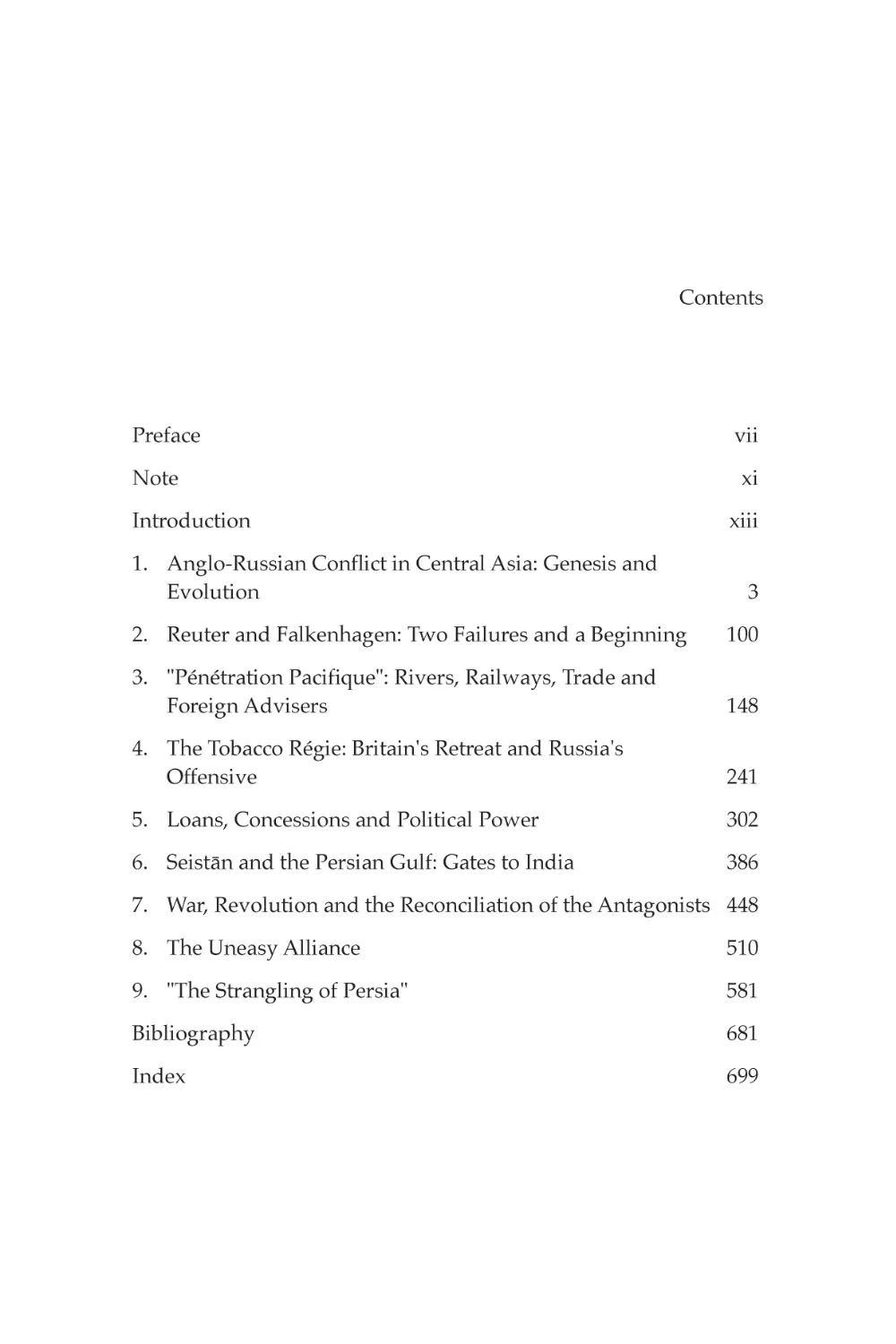
Contents
Preface
Note
Introduction
1. Anglo-Russian Conflict in Central Asia: Genesis and
Evolution
vii
xi
xiii
3
2. Reuter and Falkenhagen: Two Failures and a Beginning
100
3. "Pénétration Pacifique": Rivers, Railways, Trade and
Foreign Advisers
148
4. The Tobacco Régie: Britain's Retreat and Russia's
Offensive
241
5. Loans, Concessions and Political Power
302
6. Seistān and the Persian Gulf: Gates to India
386
7. War, Revolution and the Reconciliation of the Antagonists 448
8. The Uneasy Alliance
510
9. "The Strangling of Persia"
581
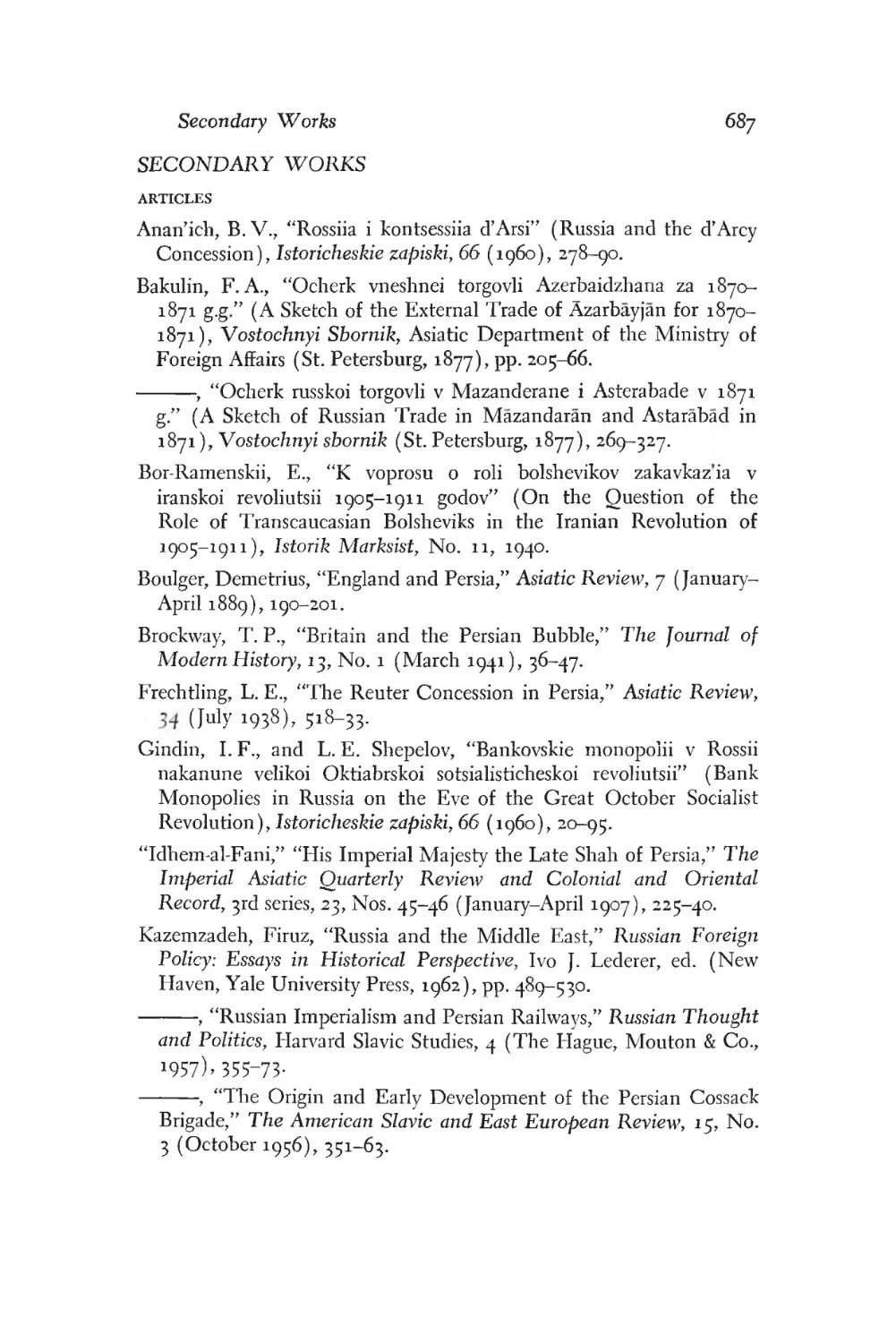
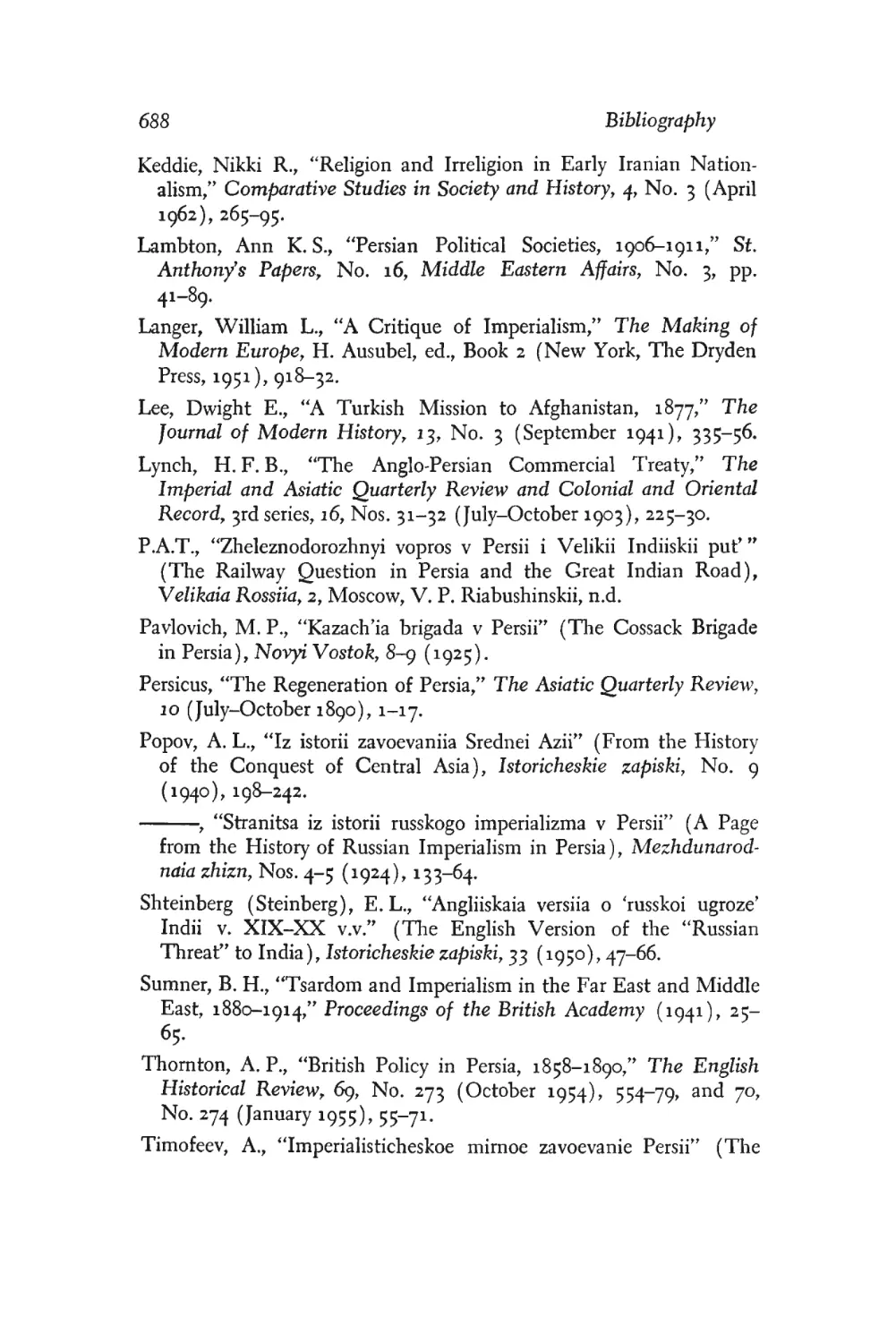
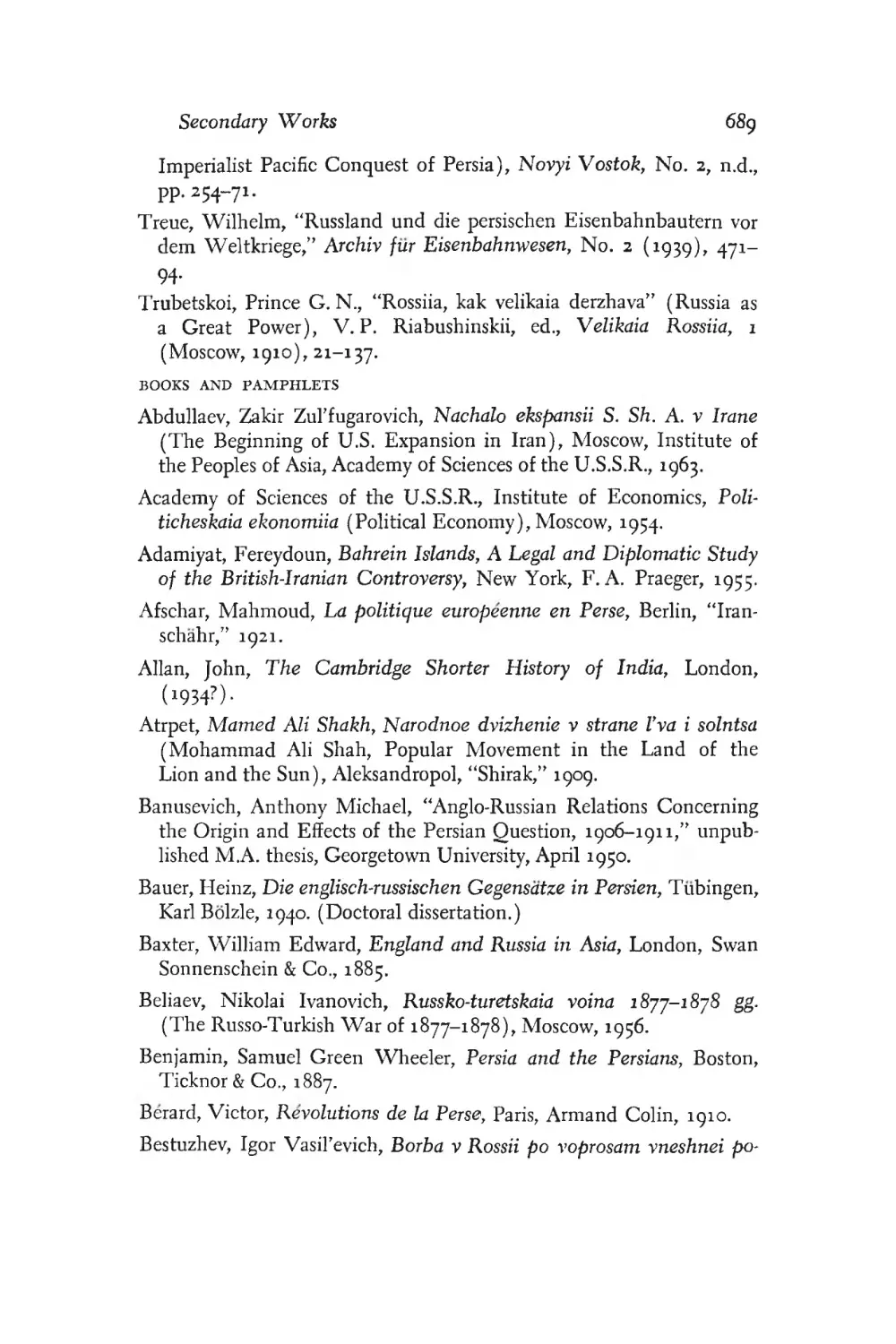
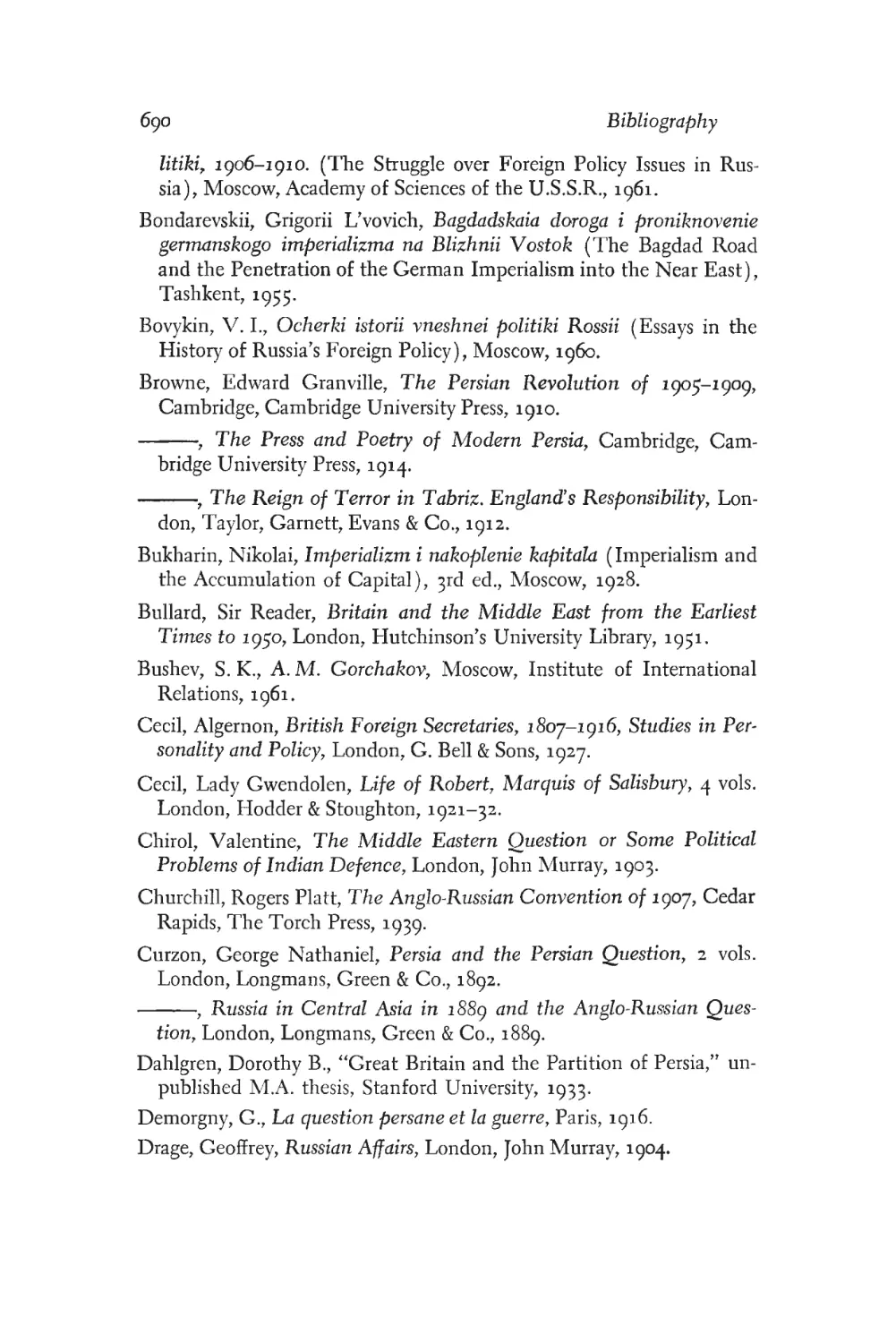
Bibliography
681
Index
699
Introduction
This book was published almost half a century ago and has become
a standard work on the diplomatic history of Anglo-Russian rivalry
in Iran from the middle of the nineteenth century to the First World
War. It pleases me that after many decades out of print, it has been
resurrected in its original English version while an excellent Persian
translation and a pirated Russian edition have made it accessible to
readers of those two languages.
While writing Russia and Britain in Persia, I was painfully conscious that the inaccessibility of Russian archives could make my
work one-sided. Published government sources could not be relied
upon, as I knew from a simple comparison of some of the documents
in a collection produced by the Russian Ministry of Foreign Affairs
in 1911 and the same documents reissued by the Soviet government
after the Revolution of 1917. Would the inaccessibility of original
documents vitiate my narrative and my conclusions? Yet a relative
paucity of original documentation should not stop a historian from
attempting to reconstruct the past to the best of his ability.
Unanticipated radical change in the life of the Soviet Union made
it possible for me in 1990 to work in the archives of the Russian Ministry of Foreign Affairs. An examination of relevant materials relieved my anxiety and persuaded me that the basics of my narrative
needed no modification and neither did my conclusions. Although
a large number of works on Iran has appeared in the last forty years,
few have dealt with the topics covered in Russia and Britain. I felt
that I needed to make no change in the original text.
xiii
xiv
Introduction
The book ends with the onset of the First World War, but the rivalry of the two great powers continued. The Russian government
had not been satisfied with the gains made under the agreement of
1907 and, in 1915, concluded another agreement with Britain that
amounted to a virtual annexation to Russia of her sphere of influence in Persia at the small price of ceding to Britain the insignificant
neutral zone. Exigencies of war muted the old conflict.
The collapse of the Russian Empire and the establishment of the
Soviet regime created an entirely new situation. Russia withdrew
from the War and concluded a humiliating peace with Germany,
creating a grave threat to the Allies on the Western Front. Russian
troops withdrew from Persia and left behind a vacuum that Britain
hastened to fill, out of fear that Persia would descend into anarchy
and open the door to an ideology that called for an armed struggle
against European imperialism and the overthrow of the old colonial order. Appealing to all peoples of colonial and semi-colonial
countries, the Soviet government repudiated various treaties that
had given Russia rights and privileges in countries such as Persia
and China. This would, of course, undermine Britain’s position
throughout the colonial world. Thus the old rivalry was resuming
under new names and new flags.
In 1919, hoping to consolidate Britain’s position and assure the
defense of India, Lord Curzon bribed a number of leading Persian
officials to sign an agreement which, had it come into force, would
have turned their country into a British protectorate. Persia’s parliament, the Majles, refused to ratify the agreement. Curzon’s policy was in shreds. Tribes were in rebellion, the central government
under the ineffective Ahmad Shah was paralyzed, and an anti-colonialist movement established itself in the province of Gilan, attracting the support of communist-leaning radicals and welcoming a
contingent of Soviet Russian troops. A Soviet Republic of Gilan was
proclaimed, hailed by Moscow, and ready to advance on Tehran.
The only force that could stop the advance was the Cossack Brigade
created by Russia half a century before but now commanded by
Introduction
xv
Persian officers headed by Rezā Khan, an energetic and ambitious
young officer.
Britain, exhausted by a long war, evacuated its troops from northern Persia. At the urging of its minister in Tehran, and in spite of
Curzon’s misgivings, the British government decided to back Rezā
Khan and the Cossack Brigade as the only force capable of preventing Tehran, and perhaps all of Persia, from falling to the Soviets.
Rezā Khan marched on Tehran, staged a coup d’état, and succeeded
in stopping the troops of the Gilan Republic. Internal conditions
compelled Soviet Russia to abandon the Gilan Soviet, whose leaders fled to Russia, there to form a nucleus of Persian Communist opposition. Soon the Persian government, now entirely dominated by
Rezā Khan, concluded a treaty that recognized Soviet Russia, established regular diplomatic relations between the two countries, and
helped to stabilize the domestic situation in Persia, permitting Rezā
Khan to consolidate his authority, overthrow the Qajar dynasty and
have a constituent assembly proclaim him Rezā Shah Pahlavi.
Russia’s threat to British interests in Persia was averted, although
Rezā Shah proved not to be Britain’s obedient tool. Even before ascending the throne, he created a national army which he successfully used to centralize the country by destroying the autonomy of
southern tribal leaders such as the Bakhtiāri khans and the Sheykh
of Muhammarah, who had long been Britain’s clients. After 1925, a
balance of Russian and British influence was achieved that lasted
up to the Second World War and a joint occupation of Iran reminiscent of what had occurred in the First World War.
In their sphere of occupation, as elsewhere in Iran, the Soviets
proceeded to encourage the growth of Communist parties, while
in Azerbaijan and Kurdistan they promoted separatist movements
that would, at the War’s end, create a serious crisis, but this time
Russia’s principal antagonist would be the new super-power, the
United States.
Before the Second World War, America had no significant interests
in Persia. Regular diplomatic relations between the two were not established until 1882. A few Protestant missionaries had been active
xvi
Introduction
in Persia since the mid-nineteenth century but Muslims could not
be converted and the missionaries worked mostly among Armenian
and Assyrian Christians. They were allowed to open a number of
schools that educated non-Christian Iranians, including members
of prominent families. An American, Morgan Shuster, briefly Iran’s
Treasurer General, was forced to leave when Russia demanded his
dismissal in an ultimatum and sent troops to occupy northern Persia. The US government neither sponsored nor supported the Shuster mission.
The Second World War and the Cold War changed the situation.
Fear of the Soviet Union became America’s main concern in the conduct of her foreign policy. Britain might have compromised on the
issue of oil and acquiesced in the acquisition of rights to the exploitation of northern Iran’s fields by the Soviets, but the United States
took a strong position. The Soviets, not yet in possession of an atom
bomb, abandoned their demands for an oil concession and left their
protégées in Azerbaijan to their fate.
When an upsurge of national sentiment led to the nationalization
of the Anglo-Iranian Oil Company, Britain had to persuade the US
government, apprehensive of a Communist takeover in Iran, to participate in the overthrow of Mosaddeq and the return of the Shah
from his brief exile. Russia chose not to support Mosaddeq, concentrating instead on cultivating a network of agents within Iran, a
network that was soon smashed by the Shah with the support of the
United States.
The establishment of the Islamic Republic once again dramatically changed relationships among Iran, Russia, Britain and the United
States. For the first time in two hundred years Iran was free to determine its own domestic and foreign policies. Rivalries among great
powers had lost much of their relevance, although the history of
those rivalries determined, and is determining, many of the actions
of the current regime. In novel conditions, under very different circumstances, the past continues to exercise its influence.
In the Preface to this book when it was first published, I gratefully
acknowledged the assistance of several individuals and institutions.
Introduction
xvii
I now take this occasion to add my thanks to Professor Rudi
Matthee of the University of Delaware for suggesting to I.B.Tauris
that they reissue this book.
Firuz Kazemzadeh
2013
R u ssia an d B ritain in P ersia, 1 8 6 4 -1 9 1 4
A Study in Imperialism
1
Angler Russian Conflict in Central Asia:
Genesis and Evolution
Turkestan, Afghanistan, Transcaspia, Persia—to many these words
breathe only a sense of utter remoteness or a memory of strange
vicissitudes and of moribund romance. To me, I confess, they are
the pieces on a chessboard upon which is being played out a game
for the domination of the world.
George Curzon
Russia's advance into Central Asia, the spectacular conquests she
carried out in the second half of the nineteenth century, and the
consequent expansion of her Empire, startled Europe. The de
serts and oases of Central Asia, the unexplored mountains of
Afghanistan, the legendary cities of Khorasan, suddenly invaded
the front pages of the leading newspapers and became a lively
topic of conversation in Berlin, Paris, and London.
As their troops won easy victories over the hordes of Kazakhs,
Uzbeks, and Turkomans, the gap that separated the Russians
from the British, slowly making their way toward Baluchestan
and Afghanistan, narrowed, and conflict threatened the peace
precariously maintained between the major powers. W hen viewed
from London, Russia's penetration of Central Asia seemed dis
turbing, if not frightening. From St. Petersburg it appeared
natural, being only the climax of a long series of efforts that had
begun three centuries earlier in the reigns of Ivan the Terrible,
Feodor Ivanovich, and Boris Godunov. W hile the British, them
selves strangers in Asia, were shocked to discover the Cossack on
the banks of the Oxus, the Russians felt at home among the
Turkic peoples who for hundreds of years had been by turns their
neighbors, masters, and subjects.
The conquest of Kazan opened the way for Russia's approach
3
4
Russia and Britain in Persia
to the Caspian, while the acquisition of Astrakhan inevitably in
volved her in the affairs of Tarki and Kabarda, which in turn led
to contacts with Georgia, Turkey, and Iran.1 In 1560 Russia was
already sending troops to fight against the Mountaineers of
Daghestan. The marriage of Ivan the Terrible to the daughter of
the chieftain Temriuk resulted in the stationing of Russian troops
in Kabarda.2
Russia's attempts to subdue Daghestan failed when Prince Ivan
Andreevich Khvorostinin was defeated in 1594 and forced to re
treat, after losing three thousand men.3 Her first ''Caucasian war"
inaugurated a struggle that was to continue until the capitulation
of the intrepid Sheykh Shamil at Gunib in 1859. Boris Godunov
made another attempt to establish Russian rule over the Moun
taineers, but Turkey and Iran aided the tribes of Daghestan in re
sisting the Streltsy and the Cossacks. By 1605 Russia was too ab
sorbed in domestic troubles to embark upon new conquests. No
further moves were made in the Caucasus until the reign of Peter
the Great.
Under him, the Empire expanded in every direction. W hile
fighting for a foothold on the Baltic, the Tsar nursed dreams of
Asiatic campaigns. "For all the concentration of his main energies
upon Europe," writes B. H. Sumner, "he had from his earliest
years taken a lively interest in Asia. The enthusiasm of the ex
plorer was allied with the gold-dazzled phantasy of the prospector
and the merchant." 4 Khiva, Bukhara, Persia, and beyond these
fabulous India, excited Peter's imagination. He sent a force of
thirty-five hundred men under Prince Bekovich-Cherkasskii to
conquer Khiva and find the road to India. The force fell into a
trap and was exterminated.
About the same time Peter ordered one of his younger officers,
Artemii Volynskii, to travel to Persia to gather political, eco
nomic, and military intelligence. Volynskii was instructed to find
1. For a history of Russia’s first contacts with Daghestan and Kabarda, see Boris
Nolde, La formation de VEmpire Russe, 2 (Paris, 19 53).
2. Ibid., p. 307.
3. Ibid., p. 318.
4. B. PI. Sumner, Peter the Great and the Emergence of Russia (London, 19 56),
p. 17 1.
A nglo-Russian Conflict
$
out, among other things, whether there were in Persia any navi
gable rivers that flowed from India into the Caspian Sea. Upon
his return, Volynskii strongly urged the Tsar to conquer Persia,
which was in a state of anarchy and disorder. Once the Northern
W ar was over, Peter launched an attack on Iran. He met prac
tically no resistance, for the country had been invaded by the
Afghans, the Shah was a captive, and the government nonexistent.
The Russians occupied Baku, Gilan, Mazandaran, and Astarabad. However, Peter's Persian conquests proved ephemeral.
His immediate successors, faced with the resurgent power of Iran
led by Nader Shah, and having no interest in the East, gave up
every bit of the territory Peter the Great had acquired at great
cost in men and treasure.5
, During the closing decades of the eighteenth century Russia
resumed her activity in the Caucasus. In 1801 Georgia was
annexed. Persia, refusing to acquiesce in the loss of a land it had
ruled for centuries, went to war and was badly defeated.6 By the
Treaty of Golestan she lost most of her Caucasian possessions,
including Baku, Darband, Ganjeh, and Georgia, gave up her right
to maintain a navy on the Caspian, which thereby became a
Russian lake, and accepted an unfavorable arrangement in regard
to tariffs. Perhaps the most damaging provision of all was con
tained in Article 5 of the treaty by which Russia recognized Prince
Abbas Mirza as the rightful heir to the throne and promised
him assistance in case succession was disputed, thus obtaining a
useful instrument for direct interference in Iran's internal affairs.
Persian desire for revenge and Russian encroachment along the
newly established frontier led to another war and another Russian
victory. Russian troops captured Erivan and Tabriz, and threat
ened Tehran. In 1828 at the village of Torkamanchay a peace
treaty was signed. It was destined to regulate Russo-Persian rela5. On Peter’s Persian war and his relations with the Turks, the Georgians, and
the Armenians, see V . P. Lystsov, Persidskii pokhod Petra I, 17 2 2 -17 2 3 (Moscow,
19 5 1) , and D. M. Lang, The Last Years of the Georgian Monarchy, 16 5 8 -18 3 2
(New York, 19 57), pp. 1 1 1 - 1 7 .
6. The best account of the complicated situation that led to the annexation of
Georgia is in D. M. Lang, The Last Years of the Georgian Monarchy, Chaps. 9,
1 1 - 1 3 . A&ty sobrannye kavkazskoiu arkheograficheskoiu kommissieiu (12 vols. Tiflis,
18 6 8-190 4), are a rich source for this period.
6
Russia and Britain in Persia
tions until 19 17. In addition to further territorial losses, Persia
had to pay an indemnity of 20 million rubles. A commercial
treaty concluded at the same time set the maximum duty on
Russian goods imported into Persia at 5 percent ad valorem, es
tablished a regime of capitulations for Russian subjects, and ex
tended to Russian merchants many privileges never before en
joyed by foreigners in the domains of the Shah. Thus in one gen
eration Russia had vaulted the Caucasus, absorbed Georgia,
northern Azarbayjan, and a part of Armenia, acquired extensive
commercial rights and strong political influence in Persia, and es
tablished herself in the vicinity of British India. The stage was
now set for a long duel between Russia and Britain, a duel that
was the determining factor in Central Asiatic and Middle Eastern
affairs until British power waned after the Second W orld W ar.7
The complexities of the Eastern question, the savage resistance
of the Mountaineers under Shamil, and the fear of provoking a
major conflict with Great Britain restrained Russia from under
taking any further encroachment on Persian territory west of the
Caspian. The frontier drawn up at Torkamanchay has remained
substantially unchanged to this day. East of the Caspian no
definite frontiers existed between Persia and her nomadic neigh
bors, between the various Central Asiatic khanates, or between
the khanates and Russia. Political instability and economic stag
nation were the lot of the various ephemeral states that periodi
cally sprang up in Turkestan. A vast power vacuum, stretching all
the way from the Caspian Sea to the borders of China, from
Afghanistan to the edge of the Siberian plain, could not fail to
exercise an irresistible attraction upon the Russians.
The European powers, jealously watching every move Russia
made in the direction of Constantinople, seemed almost entirely
unaware of her steady advance in Central Asia. Neither the dis
aster that overtook General V . A. Perovskii in his attempt to
capture Khiva in 1839, nor the victories that gave Russia AqMasjid (Ak Mechet) in 1853, elicited a reaction from the Euro7. The Persian view of the two Russo-Persian wars is presented in Jamil Qozanlu,
Jange dak-sale yd jange avvale Iran ba Rus (Tehran, 19 3 7 ); and his Jange Iran-Rus,
18 25 -18 28 (Tehran, 19 38). For the Soviet interpretation, see M. S. Ivanov, Ocherk
istorii Irana (Moscow, 19 52). For the British view, see Sir Percy M. Sykes, A His
tory of Persia (London, 19 15 ) , 2, Chap. 76.
Anglo-Russian Conflict
7
pean states.8 The Crimean W ar interrupted Russia's activity in
Central Asia; but, after a brief period of recuperation, the forward
movement was resumed.
Its initiator and inspirer was one of the most remarkable figures
of nineteenth-century Russia, though his stature has not yet been
sufficiently recognized. General Dimitrii Alekseevich Miliutin was
a soldier, a teacher, a statesman, a reformer, and a close collabora
tor of Alexander II throughout the latter's reign. It was Miliutin
who played the principal part in reforming the antiquated serf
army of Nicholas I and restoring Russia's military power. It was
he who championed every advance, every conquest in Central
Asia, often against the wishes of the more cautious and Europeanminded Chancellor, Prince A. M. Gorchakov. It was Miliutin
who was responsible for the appointment of K. P. von Kaufmann
to the post of Governor-General of Turkestan in 1867, and who
was intimately connected with the pacification, administration,
and exploitation of Russian Central Asia.9
W hile Miliutin urged the Tsar forward, Gorchakov counseled
caution. Too rapid an advance in the direction of India would
alarm the English to whom even the vastest deserts, highest
mountains, and deepest seas did not seem sufficient to protect
their dearest possession. Ever since Napoleon had toyed with the
utterly impractical scheme of invading India with the help of Tsar
Paul and Fath Ali Shah, the British had been obsessed with fear
and suspicion, which Gorchakov would have preferred not to in
crease. On one occasion, when the Foreign Ministry argued this
point, Miliutin angrily wrote: "it is not necessary to apologize to
the English Minister for our advance. They do not stand on
ceremonies with us, conquering whole Kingdoms, occupying alien
cities and islands; and we do not ask them why they do it." For
the next twenty years Gorchakov, and after him his successor,
N. K. Giers, attempted to restrain the military, while providing
them with brilliant tactical support abroad. The very tension be
tween Miliutin and Gorchakov, the generals and the diplomats,
8. The most recent American contribution to the study of Central Asia is Rich
ard A. Pierce’s Russian Central Asia, 18 6 7 -19 17 (Berkeley, i9 60). See also M. A.
Terent’ev, Istoriia zavoevaniia Srednei Azii (St. Petersburg, 1906).
9. See A. M. Zaionchkovskii, “ D. A. Miliutin: Biograficheskii ocherk,” in Dnevnik Miliutina (Moscow, 19 47), 1, 35.
8
Russia and Britain in Persia
made Russian policies unusually flexible and vigorous. Since there
was no disagreement about ends, and since no one questioned the
final authority of the Tsar to determine policy, there was little
danger from this interdepartmental rivalry.
In 1864 several special ministerial conferences were held in St.
Petersburg on orders of the Tsar to discuss the Central Asiatic
question. Extensive military preparations were made for new
advances. W hen the armies began to march, the diplomats were
ready with justifications. In December, Gorchakov sent to Rus
sian representatives abroad a circular dispatch, requesting them to
use its arguments as a guide ''in any explanations you may give to
the Government to which you are accredited, in case questions
are asked, or you may see credence given to erroneous ideas as to
our action in these distant parts/' The dispatch of November
21/Decem ber 3, 1864, became a landmark in the history of Rus
sian diplomacy. Gorchakov wrote:
The position of Russia in Central Asia is that of all civilized
States which are brought into contact with half savage, nomad
populations, possessing no fixed social organization.
In such cases it always happens that the more civilized
State is forced, in the interests of the security of its frontier
and its commercial relations, to exercize a certain ascendency
over those whom their turbulent and unsettled character
make most undesirable neighbours.
First there are raids and acts of pillage to put down. To put
a stop to them, the tribes on the frontier have to be reduced
to a state of more or less perfect submission.
Once pacified, these tribes have a right to protection against
their neighbors; but "the moral force of reason" will not accom
plish this, since "It is a peculiarity of Asiatics to respect nothing
but visible and palpable force." Thus the civilized state is placed
in a dilemma: it must either abandon all attempts at civilization,
or "lunge deeper and deeper into barbarous countries."
Such has been the fate of every country which has found
itself in a similar position. The United States in America,
Anglo-RussianConflict
9
France in Algeria, Holland in her Colonies, England in India
— all have been irresistibly forced, less by ambition than by
imperious necessity, into this onward movement where the
greatest difficulty is to know where to stop.
Faced with the dilemma common to all civilized states with
“ savage” neighbors, Russia decided to rectify her Central Asiatic
frontier, drawing it in such a way that it should run through a
fertile area, to insure both supply and regular colonization,
“ which alone can prepare a future of stability and prosperity for
the occupied country.” It was urgent to lay down this line defini
tively, so as to escape the danger of being carried away, as is al
most inevitable, by a series of repressive measures and reprisals,
into an unlimited extension of territory.10
Russia wanted to absorb the nomads but not the sedentary
agricultural and commercial populations “ who are good neigh
bors.” The new line
puts us in the immediate neighbourhood of the agricultural
and commercial populations of Khokand. W e find ourselves
in the presence of a more solid and compact, less unsettled
and better organized social state, fixing for us with geographi
cal precision the limit up to which we are bound to advance
and at which we must halt.11
No sooner had the British government been informed of the
Gorchakov circular by the Russian ambassador, Baron E. Brunnow, than events in Central Asia cast doubt on the sincerity of
the document. An attack was launched against Tashkent, a town
inhabited by a sedentary people engaged in agriculture and com
merce. On June 10, 1865, Gorchakov told the British ambassador
in St. Petersburg, Sir Andrew Buchanan, “ that the Russian Gov
ernment would not retain the city, but would act up to their
declarations ‘in regard to that country.’ ”
Tashkent was taken by storm (June 15 - 17 , 1865). W hen the
10. Correspondence, from 1864 to 18 8 1, respecting the movements of Russia in
Central Asia and her relations with Afghanistan; F. O. 65/1202. Hereafter cited as
Correspondence.
1 1 . Id.
Russia and Britain in Persia
IO
victory was publicly announced, a St. Petersburg newspaper,
Russkii invalid, wrote:
Our troops can only occupy the town for a short time, until
its independence of Kokand is no longer menaced. After hav
ing given independence to Tashkend . . . Russia, who has
no desire to annex the place, will only have to watch over the
tranquility and security of her commercial relations with Cen
tral Asia.12
The British were not reassured. Lord John Russell, Secretary of
State for Foreign Affairs, wanted a formal exchange of notes in
which the two powers would "declare that they had no intention
of extending their territories in such a manner that their frontiers
would approach each other more than they then did/' If one of
the powers felt compelled to expand, it would inform the other of
the causes that compelled it to do so "and the extent of the con
templated increase of territory." Both parties would respect the
"present state of possessions" in Central Asia and "both Powers
would respect the independence of the Persian monarchy; would
be careful not to encroach on the territory of Persia; and would
act in concert to support and strengthen the authority of the
Shah." 13
The India Office approved of the spirit of such an understand
ing, though it opposed a formal convention. Russell agreed and
approached Gorchakov, who was handed excerpts from Russell's
dispatch of July 31 expressing the wish of Her Majesty's Govern
ment "to remove every cause of danger which might threaten the
future good understanding between England and Russia." The
two powers would engage not to disturb the status quo in Central
Asia. "Her Majesty's Government will also respect the indepen
dence of the Persian Monarchy, will be careful not to encroach
upon the territory of Persia, and will act in such a manner as may
best support and strengthen the sovereignty of the Shah." 14
12. Correspondence, ibid.
13. Id.
14. Id.
Anglo-Russian Conflict
11
Gorchakov pretended not to understand Russell's point. Had
not Russia already proclaimed her pacific intention in regard to
Central Asia? As for Persia,
His Excellency said that he could not understand the connec
tion between Central Asia and the Persian monarchy which
had induced this declaration.
The declaration itself was of very satisfactory nature, and
one which was quite in accord with the views of the Imperial
Government, but, while receiving it with pleasure, he must
say that he had never suspected Her Majesty's Government
of any intention of encroaching upon the territory of the
Shah.15
One wonders whether Russell sensed Gorchakov's irony. By
affirming with an air of naive innocence his faith in England's
good intentions, he evaded the issue and kept Russia uncom
mitted. W hen, on September 3, Sir Andrew Buchanan intimated
that the terms of Gorchakov's circular of 1864 were not suffi
ciently explicit to reassure the British government in regard to
Persia, which had not even been mentioned in it, Gorchakov
replied that "he could not believe that an unfavourable interpre
tation would be given to that omission, as it was impossible for
any one acquainted with the policy of the Imperial Government
to suspect it of designs against the independence of the Persian
monarchy." Gorchakov added that he was prepared to instruct his
ambassador in London to give Russell confidential assurances that
Russia had no intention to violate the independence and integrity
of Persia, but that the Turkomans were not the subjects of the
Shah, and that Russia found it necessary to punish them for
depredations against her commerce. The significance of this re
mark was not understood by the British for many years.16
The reference to the Turkomans was not fortuitous. Late in
1864 a Special Conference composed of representatives of the
Foreign Ministry, the Army, the Navy, and several other depart
15. Id.
16. Id.
12
Russia and Britain in Persia
ments, met on orders of the Tsar to discuss the question of estab
lishing Russian power in Turkoman lands on the eastern coast of
the Caspian. It was decided to occupy the village of Qizil-Su (Red
Water, Krasnovodsk). The Tsar approved the decision on Feb
ruary 22, 1865.17 The proposed outpost would enable Russia to
control the sea as well as a strip of land stretching the entire
length of the Caspian and, perhaps, to remove her naval station
from the island of Ashuradeh. The station had been established
on Persian territory without Persia’s consent. Its purpose had
been to stop Turkoman piracy and to prevent Persia from evading
the provisions of Article 8 of the treaty of Torkamanchay which
prohibited her from maintaining armed vessels on the Caspian.
Because the naval station was located on Persian territory, it was a
constant irritant which stimulated the Shah’s suspicions of Rus
sian intentions. A base at Krasnovodsk would provide the same, or
even greater, advantages as Ashuradeh, without the disadvantages
of the latter.18 Complications on the borders of Bukhara and
Kokand prevented the immediate implementation of the deci
sion, but Gorchakov was carefully preparing the diplomatic basis
for military action in Transcaspia.
Contrary to its promises of 1865, the Russian government did
not evacuate Tashkent. In M ay 1866, relations with Bukhara hav
ing broken down, General D. I. Romanovskii led his troops
against the Bukharans and routed them at Irjar. In June Khojent
was occupied. On the twenty-seventh, Lord Clarendon, now
Foreign Secretary in Lord John Russell’s cabinet, instructed Sir
Andrew Buchanan at St. Petersburg to let the Russian govern
ment know that, while Britain recognized Russia’s right to use
force to procure the release of her ambassador imprisoned in
Bukhara,
the changes which were being made in Russia’s borders are
scarcely consistent with the professed intention of the Rus
sian Government to respect the independence of the States
of Central Asia. Russia seems to have made a steady advance
17. Minister of Foreign Affairs, A. M. Gorchakov, to the Director of the M in
istry of the Navy, October 15/27, 1869; A. IFiasov, ed., Prisoedinenie Turkmenii
k Rossii (Ashkhabad, i960), No. 1, pp. 19 -23. Hereafter cited as Prisoedinenie.
18. Id.
Anglo-RussianConflict
23
in this direction, taking permanent possession of territory not
required solely for making a good frontier.19
To Buchanan’s question about the limits of Russian conquests,
Gorchakov replied that only the military were competent to
decide such issues, and added that it was absurd to suppose that
Russia’s moves could threaten British India.20
The pattern was now established. Year after year Russian
troops would penetrate deeper into the heart of Asia. A flurry of
alarm would run from Calcutta, or Simla, to Whitehall. The
British ambassador in St. Petersburg would call on Russia’s
Minister of Foreign Affairs, ask for an explanation, receive as
surances of the Tsar’s determination not to annex an inch of land
anywhere, send a dispatch to that effect to Her Majesty’s Prin
cipal Secretary for Foreign Affairs, and leave the matter there
until Russia’s next move reopened the whole issue.
The Government of India was divided in its opinions in regard
to the Russian threat. W hile a number of lesser officials advo
cated strong measures, even to the occupation of Afghanistan, the
Viceroy, Sir John Lawrence, preached the doctrine of masterly
inactivity. “ He belonged to the generation which had drawn
natural but mistaken conclusions from the lamentable war of
1839. He held strongly that Britain had no interests beyond the
line which the Sikhs had formerly held, and that the defence of
India should be based on the Indus.” 21
In a minute dated October 3, 1867, Lawrence, opposing a
British advance, argued that the further Russia penetrated into
Central Asia, the longer her supply line would become, while the
length of the British supply line would remain the same. A British
advance into Afghanistan might be interpreted by Russia as a
challenge. Moreover Russia might actually prove a good neigh
bor.
I am not myself at all certain that Russia might not prove a
safer ally, a better neighbour, than the Mahomedan races of
19. Correspondence; F. O. 65/1202.
20. Id.
2 1. John Allan, The Cambridge Shorter History of India (London, 19 34 ), pp.
804-05.
14
Russia and Britain in Persia
Central Asia and Kabul. She would introduce civilization, she
would abate the fanaticism and ferocity of Mahomedanism,
which still exercises so powerful an influence in India.22
W . R. Mansfield, Commander in Chief in India, shared the
Viceroy's optimism on military grounds:
the alarm testified with regard to Russia, as affecting British
interests in India, is more unreasonable than it is possible to
describe. As a military and vast political Power, we have liter
ally nothing to fear from Russia, whether she stop at her
present limits, or spread her power even to our own borders.
A great mischief is done by those who, from whatever cause,
occupy themselves in preaching the falsehood of our weak
ness in India.
W e are simply invincible in that country against all the
powers in the world, provided only we are true to ourselves. If
we choose to commit ourselves to a policy of aggression, we
can go and establish ourselves wherever we like.23
In London the Cabinet was reluctant to take any but diplo
matic steps. The change from a Conservative to a Liberal govern
ment in 1868 did not result in a change of policy. The new Secre
tary of State for Foreign Affairs, Lord Clarendon, made an
attempt to reach an agreement with Russia by creating a neutral
zone between India and Russian possessions. On March 27, 1869,
Brunnow transmitted to Clarendon a letter from Gorchakov
giving assurances in regard to the neutrality of Afghanistan. Six
weeks later Russian troops entered Samarkand, and the British
ambassador in St. Petersburg once again “ tried to ascertain how
far the conquests of Russia were likely to extend." 24
Clarendon made another attempt to obtain from Gorchakov a
commitment that Russia would not absorb the independent
22. Correspondence; F. O. 65/1202.
23. Minute by Commander-in-Chief in India, suggested by Sir H. Rawlinson’s
Memorandum on the questions connected with Central Asia, December 24, 1868,
No. 1 1 , Foreign Department, Political. Confidential, No. 1, January 4, 1869; Let
ters from India, 4, 1869. Hereafter cited as L.I.
24. Correspondence; F. O. 65/1202.
Anglo-Russian Conflict
*5
khanates of Central Asia. The two statesmen met in Heidelberg
on September 3, 1869. The conversation began with Gorchakov’s
expressing satisfaction that England and Russia had no conflicting
interests anywhere in the world. W hen Clarendon pointed out
that Central Asia was such an area, Gorchakov said that the
Emperor had no intention of advancing further south. Clarendon
replied that the events of the last five years made it impossible to
doubt that Russian armies were "impelled forward either by
direct orders from St. Petersburg, or by ambitions of Generals in
disregard of the pacific intentions of the Emperor.” Gorchakov
promptly agreed and blamed the military "who had all exceeded
their instructions in the hope of gaining distinction.” 25 Thus
Clarendon and Gorchakov jointly created the legend of insub
ordination having been the principal cause of the conquest of
Central Asia. This notion, which had an inexplicable appeal to
British statesmen up to and including Sir Edward Grey, was
extremely useful to the Russians. W ith the passage of time it
assumed the status of a venerable tradition and was enshrined by
statesmen and historians in various articles and books.
The Clarendon-Gorchakov pourparlers neither did nor could
lead to an understanding. St. Petersburg was aware of the inde
cision in London. If anything, Britain’s conciliatory attitude and
the acceptance of Gorchakov’s version of the causes of Russian
conquests in Central Asia encouraged further moves southward
and eastward. Negotiations, exchanges of notes, reminders con
cerning old pledges, and expressions of dissatisfaction on the part
of the British had not the slightest effect upon Russian planning
and execution of conquests. Now that Tashkent and Khojent had
been annexed, it was Khiva’s turn to fall before the armies of the
Aq-Khan (the W hite Tsar). Beyond the deserts and the oases of
Akhal and Marv lay Khorasan and Herat. Neither Persia nor
Afghanistan could escape involvement in the Great Game.
The Persian government was much disturbed by the rapid Rus
sian movement toward Khorasan. Already in 1868 a number of
Tekke Turkomans appeared in Tehran to warn of the Russian
threat. They told Charles Alison, the British minister, that they
25. Id.
i6
Russia and Britain in Persia
would not submit to the Russians but would like to serve Britain
in return for British protection. Alison assured the Turkomans
that Russia would not dare to go beyond the Oxus, advised them
to form a union of tribes, but said nothing about British aid.26
The Persian government could not be put off as easily as the
Tekke.
At an audience granted to Alison shortly before his scheduled
departure for England, the Shah, Naser ed-Din, said that it was
more important than ever “ that the closest intimacy should exist
between the two States now that Russia is making such advances
in Central Asia.” The sentiments of Fath Ali Shah, he went on,
continued to exist. It was Persia’s “ foremost thought . . . to be
guided and supported by England.” However, the Shah com
plained, in his repeated attempts to ascertain clearly the policy of
Her Majesty’s Government, he met “ with some reserve on their
side.” He hoped that during his visit in England Alison would
“ explain fully his anxieties and elicit from the Queen’s Govern
ment such a frank declaration of their views as would enable him
satisfactorily to understand his true position and the best course
to pursue.” 27
The Minister of Foreign Affairs, Mirza Said Khan M o’tamen
ol-Molk, echoed his master’s words. The Shah, he told Alison,
was anxious to place his relations with England “ on the same
cordial footing as they were in the time of Fath Ali Shah.” Naser
ed-Din hoped that Britain would send him military instructors
and was even prepared to pay them, though he knew that once
the English decided on a course of action, money was not a con
sideration.28
Alison’s visit to London did not result in closer Anglo-Persian
cooperation. The Government of India had been for some time
quite sceptical about the idea of British officers serving in the
Iranian army. “ Persia,” wrote Colonel R. Taylor in a memoran
dum prepared for the use of the government, “ appears to me to
26.
1869;
27.
28.
Mr. Charles Alison to the Earl of Clarendon, No. 2, Tehran, January 1 1 ,
F. O. 6 0/318. See also M . A. Terent’ev, 2, 6 1.
Alison to Clarendon, No. 49, Tehran, May 5, 1869; F. O. 60/318.
Alison to Clarendon, No. 50, Tehran, May 6, 1869; ibid.
Anglo-Russian Conflict
J7
be so weak . . . that she is practically under the control of
Russia, and utterly unable to resist the influence of that power.” 29
The British government itself was not disposed to send a mili
tary mission to Iran, and perhaps provoke a violent Russian re
action.
Ever since armed force had been used in 1857 to prevent Persia
from retaining Herat, Britain preferred to employ strictly diplo
matic means in the Middle East. The hope of reaching a formal
agreement with Russia, guaranteeing the independence and in
tegrity of Persia, lived in the hearts even of such “ imperialistic”
Englishmen as Sir Henry Rawlinson, who, in i860, felt that
Russia could not refuse to guarantee the integrity of Persia. T o
refuse would mean to show her hand. The French minister in
Tehran, although he knew how keenly the Shah desired inter
national assurances of Iran’s territorial integrity, realized that
Russia had no reason to tie her hands in the Middle East by
giving such guarantees. The true guarantee of Persia, he told
Mirza Said Khan, reposed less in treaties than in the jealous
rivalry of the two great powers. Acting wisely, balancing one
against the other, Persia could preserve her independence and
integrity.30
British statesmen felt that their policy in Persia was “ very
friendly and very plain.” It consisted of supporting the indepen
dence of Persia. To do this it was necessary constantly to remon
strate with the Russian government at St. Petersburg, thus en
dangering Anglo-Russian relations and, incidentally, exposing the
Shah to ever greater pressure from the north.
I agree with the Shah [Russell wrote in i860] that the use of
our good offices at St. Petersburg must be employed with
great discretion and seldom. There is nothing which the Rus
sian Government would resent so much.
But On the other hand we could not look upon their aggres
sions in silence, and on a sudden make them the ground of
hostilities.
29. Memorandum by Col. R . Taylor, November 23, 1868, Foreign Department,
Political, Confidential, No. 1, January 4, 1869; L. I., 4, 1869.
30. M. le Baron Pichon a M. Thouvenel, Direction politique, 1602, Teheran,
13 fevrier i860; Archive des Affaires Entrangeres, Perse, tome 31.
i8
Russia and Britain in Persia
It is fit that Russia should perceive that her conduct is not
unobserved and that the relations of Great Britain and Persia
are of the most friendly character. Russia may draw her own
inferences. In the mean time we can make no engagements;
nor can we from selfishness or jealousy obstruct the advances
of Russian Commerce in Central Asia, so long as trade is the
main object of such advances.31
It is this kind of “ very friendly and very plain” statement that the
Shah and his ministers had difficulty understanding. How could
they comprehend the meaning of British friendship when the
only action the British minister, Mr. Charles Alison, had been
allowed to promise since his arrival in Tehran in i860 was
intercession before Russia at St. Petersburg? W hat could they
think of the value of British support when year after year the
advice they received from Alison was to take “ a cautious, accom
modating attitude toward Russia” ? 323* W hat was the Shah to
expect from the British now that Russian troops had crushed
Kokand and Bukhara, were preparing to crush Khiva and sub
jugate the Turkomans of Transcaspia?
On November 10, 1869, a Russian ship anchored opposite the
Turkoman village of Qizil-Su. A small force landed on the shore,
occupying the village. For several days thereafter ships brought
more troops. Persian merchants at Astarabad, having learned of
their presence up the coast, asked Russian authorities for permis
sion to trade with them but were turned down lest the Persian
government be informed too soon of what was taking place at
Qizil-Su (Krasnovodsk) ,38
The precaution was superfluous since the Persian government
already knew of the landings and was sufficiently disturbed to
remind the Russian minister that the Persian frontier lay north of
Qizil-Su (Krasnovodsk), the point at which the troops had
landed, and that their action constituted a violation of the
sovereign rights of the Shah. The Russian minister, Aleksandr
Fedorovich Beger, denied that Iran’s frontier extended beyond
3 1. Russell to Rawlinson, No. 24, March 8, i860; F. O. 248/185.
32. Russell to Alison [Instruction], No. 3, April 24, i860; ibid.
33. Report of the Commanding Officer of the Astarabad Naval Station to the
Russian Minister in Iran, November 17/29, 1869; Prisoedinenie, No. 3, pp. 26-27.
A nglo-Russian Conflict
the Atrak River. Moreover, Beger maintained, Persia had never
exercised authority over the Turkomans “ who professed to be,
and in reality were, an independent population.” Mirza Said
Khan retorted that temporary failure to exercise authority over a
nomadic tribe did not imply abandonment of sovereign rights.
“ Russia would not, he supposed, be prepared to admit such
arguments if applied to the Kirghize and other refractory tribes in
Central Asia.” 3435
The British minister at Tehran, Charles Alison, agreed with his
Russian colleague that Persia exercised no influence north of the
Atrak. He informed Clarendon that “ he was not aware upon what
grounds they [the Persians] could claim Kyzyle Su [Krasnovodsk] as part of their territory.” 85 Lacking British support, the
Persian government could not press its claims very far. Rather it
tried to obtain from A. F. Beger written assurances that Russia
would not interfere with the nomads living along the Gorgan
and Atrak rivers, would not build fortifications, and would admit
Persian sovereignty there. On December 25, 1869, Beger in
formed Mirza Said Khan “ that the Imperial Government recog
nizes Persian dominion up to the Atrak and therefore does not
intend to build any fortifications in that area.” 3637In St. Petersburg
the Tsar referred to the occupation of Krasnovodsk in a conversa
tion with Sir Andrew ' Buchanan, the British ambassador. He
implied that no conquest had been made since the territory “ had
been almost without a sovereign,” and informed Buchanan that
most positive assurances had been given to Persia that her Atrak
frontier would be respected.87
The Krasnovodsk issue was closed. The Shah himself admitted
this in a Decree (Farman) to the Governor of Astarabad, stat
ing that Russian presence at Krasnovodsk was not injurious to
Persia and that the Russians were free to build what they pleased
on the right bank of the Atrak.38
34. Mr. Thomson, November 14, 1869, Central Asia, No. 2 (18 7 3 ), Correspon
dence; F. O. 65/ 1202.
35. Correspondence; ibid.
36. The Russian Minister in Iran to the Iranian Minister of Foreign Affairs, De
cember 13/25, 1869; Prisoedinenie, Document No. 6, pp. 3 1-3 2 .
37. Correspondence; F. O. 65/1202.
38. Id.
Russia and Britain in Persia
20
W hatever Russian diplomats might say about the motives that
brought the Tsar's troops to Krasnovodsk, Tehran and Calcutta
felt that Khiva would be the next victim of Russian expansion. In
St. Petersburg itself no one but high government officials pre
tended that this was not the case. Even before Krasnovodsk had
been occupied, St. Petersburg newspapers wrote that the conquest
of Khiva was inevitable. Gorchakov “ denied positively the exis
tence of any such intention/' but Sir Andrew Buchanan obtained
evidence from other sources that a campaign was indeed being
prepared. The Government of India, far less complacent under
Lord Mayo than it had'been under Lawrence, admitted that to
secure her commerce Russia might have to punish the Khan of
Khiva, but would not need to annex the country. However, it was
the possible effect of the conquest of Khiva on Persia that worried
the Government of India most. This was clearly expressed in a
secret dispatch (No. 28, dated May 26, 18 7 1) to the India Office:
“ It is unnecessary to point out . . . that occupation or annexa
tion of Khiva by Russia would be a fatal blow to Persian indepen
dence. Should such an event occur, she must either submit to the
absolute influence of Russia, or seek for protection from British or
Turkish power." 39
No one seemed certain what course of action to take. The con
fused and contradictory advice of Lord John Russell, the selfassured pronouncements of Sir John Lawrence, and the general
optimism of British political outlook made it difficult to admit
that the policies pursued by Britain in Persia since the conclusion
of the treaty of Paris in 1857 had been inadequate. Characteris
tically enough, the man who dared to question and condemn
these policies was a neurotic, though capable, junior diplomat,
Edward B. Eastwick. Unlike many of his colleagues, he mastered
the language and acquired a fairly solid knowledge of the history
of Persia. Generally speaking, British diplomats who served in
Tehran fell into two distinct categories: those who liked or appre
ciated at least some features of Persian life and culture, and those
who did not. Eastwick belonged to the first category. Even after
he left Persia as a result of a sordid clash with his superior,
39. Id.
A nglo-Russian Conflict
21
Charles Alison, Eastwick kept up his interest in Persian affairs.
His concern led him to compose a memorandum which, in the
spring of 18 7 1, he submitted to the Foreign Secretary, Lord
Granville.
Eastwick noted that up to the conclusion of the treaty of
Torkamanchay, British influence in Persia had been paramount.
After 1828 Britain set herself “ to limit Persia to her de facto pos
sessions, inhibiting her from advancing in the direction of A f
ghanistan, Seistan, Mekran, and Arabia, and discouraging every
other effort on her part to acquire or regain territory/'
In 1835 Haji Mirza Aghassi, by birth a Russian subject, be
came the Prime Minister of Muhammad Shah, and when
that Shah in November 1837 laid siege to Herat the change
of policy on the part of the two Great European Powers to
ward Persia had reached its culminating point, and a strange
spectacle was witnessed of Russian officers and a Russian bat
talion serving with the Persian army, and a Russian Minister,
Count Simonich, urging on the operations of that army,
while an English officer was leading the sorties against it, and
the English Minister, Mr. M acNeil, threatened the Shah
with war.40
A few months later all British officers had been dismissed from
Persian service, but relations between the two countries remained
correct until 1855. A year later they were at war, which was
terminated by the treaty of Paris signed in March 1857.
but, except during the short interval that Sir H. Rawlinson
was Minister, and the very brief period in 1862/63 when the
writer of this Memorandum was charge d'affaires there has
been no return to cordiality in our relations with Persia. At
the present moment . . . nothing but the sense of his own
inability to cope with us prevents the Shah from coming to
an open rupture with our Government . . . it is certain that
matters are in such a state that the Shah might easily be in
duced to connive at, or, perhaps, even openly assist a Rus40. The Policy of Great Britain towards Persia [a memorandum by E. B. East
wick], London, June 16, 18 7 1; F. O. 60/340.
22
Russia and Britain in Persia
sian occupation of Herat and advance towards the frontier of
Sindh.41
Anticipating the objections of those who defended this policy
on the grounds that it had prevented war with Russia, and that
Persia would make an extremely unreliable ally, Eastwick argued
that Persia could be made into a "safe outer defence of India,
impenetrable to Russia and to every other power/' The Persians,
Eastwick wrote, were far from degenerate mentally or physically.
Sickly children die early and only the hardy survive. "Hence,
notwithstanding their vices, they are a fine athletic race, with an
amount of nerve, which Europeans might envy." Eastwick urged
a change in Britain's approach to Iran. Herat could not be given
back to Persia as yet, but it could be detached from Kabul. The
Shah could be encouraged to reestablish Persian dominion over
Marv. "Above all, English officers should be sent at once to dis
cipline the Shah's troops." 42
The paper was circulated in various departments of the govern
ment at home and in India. Sir Henry Rawlinson, scholar,
colonial administrator, and diplomat, wrote a memorandum of
his own, expressing general agreement with Eastwick's views.
Placed on the flank of "Debatable Land" between the Caspian
and the Indus, Persia would largely determine "when a contact
may take place between Russia and British India." A strong and
friendly Persia might be able to postpone such contact indefi
nitely, a weak Persia would make it inevitable. "It should then be
to our interest to conciliate her friendship and at the same time to
give her strength and confidence in her own resources, any ex
pense to which we may be put on this account being regarded as a
sort of premium on the Insurance of India." 43
However, Rawlinson did not endorse all of Eastwick's pro
posals for specific measures through which Persian friendship
might be won. He did not doubt that approval "o f her encroach
ments" in Seistan and Mekran, encouragement to occupy Marv,
4 1. Id.
42. Id.
43. Memorandum on the policy of Great Britain towards Persia [by Eastwick],
Comments by Sir H. Rawlinson; July 4, 18 7 1; ibid.
Anglo-Russiati Conflict
23
concessions in the Persian G ulf and the promise of Herat would
make British influence paramount at Tehran; but Rawlinson did
not believe Persia was strong enough to digest such acquisitions.
The result would be rebellion and intervention by both the
Russians and the Turks.
Rawlinson shared Eastwick’s opinion that Britain should fur
nish officers to train the Persian army. He added a suggestion of
his own: strengthen the legation at Tehran. T o Rawlinson, who
had been long associated with the Government of India, the
latter was the proper locus of control over Britain’s Persian policy.
He therefore advocated the transfer of the Tehran legation from
the jurisdiction of the Foreign Office to that of the Government
of India.44
Eastwick’s memorandum was studied with care at Fort
W illiam , where there had developed a feeling of frustration over
the indecisive British attitude toward Russia. Unlike his prede
cessor, Lord Mayo did not want to defend India on the Indus. To
him it was a cardinal point of Anglo-Indian policy that friendly
relations be maintained with Kelat, Afghanistan, Yar-Kand,
Nepal, and Burma, and that their freedom from domination by
another European power be preserved by supporting them with
money, arms, “ and even, in certain eventualities, with men.” 45
His sentiments were shared by many of his subordinates, one of
whom wrote:
W e either pretend not to know, or care not to know this
[the need for proper defense of India’s frontiers] ourselves,
because we are in the hands of irresolute party politicians,
who will not realize what is perfectly well known by Powers
like Russia, whose interests are opposed to our own in every
part of the world, and whose boldness is only the result of our
timidity . . . But the one Power I fear is Russia, which
seems fated to be the disturber of peace through Eastern
Europe and the Eastern world.46
4 4 - Id -
45. Cited in O. T. Burne, Memories (London, 19 07), p. 107.
46. Ibid., pp. 1 18 - 19 .
Russia and Britain in Persia
24
However, the determination to defend the approaches to India
did not extend to the defense of Persia. The Government of India
was just as determined not to provoke Russia, not to seek a con
frontation in the Middle East, as was the Cabinet in London.
Commenting on Eastwick's memorandum, and Rawlinson's
thoughts on it, the Government of India stated that it attached
the greatest importance to the maintenance of Persia's indepen
dence, but refused to encourage the Shah to collide with Russia.
W e cannot too strongly express our concurrence with Sir
Henry Rawlinson upon this point and declare our opinion
that it should be almost a crime upon our part, for the mere
purpose of obtaining a temporary ascendency in Persian poli
tics, to urge her to so perilous a course as any attempt to ex
tend her dominions either in a north-easterly direction, or by
encroachments upon Afghanistan or its feudatory tribes.47
On the issue of British officers for the Persian army, the Gov
ernment of India differed from both Eastwick and Rawlinson. It
felt that British officers should not serve Asiatic countries:
The ways of Oriental Governments are not our ways, and in
peace as well as in war, Officers placed in such a position must
be cognisant of deeds, and participators to some extent in
actions which no man of honour can approve. If British Offi
cers cannot be in supreme command they should not enter
on such service.48
This bit of Victorian cant was followed by the real reason for not
wanting to interfere with the Persian army.
In our present relations with Russia, we should view with
great suspicion the admission of a number of the Officers of
the Russian army to the command of Persian troops. A simi
lar proceeding on our part would probably call forth a strong
remonstrance from the Cabinet of St. Petersburg.49
47.
No. 4
48.
49.
The Government of India to the Duke of Argyll, Secretary of State for India,
of 1872, Secret, Fort William, January 19, 1872; L.I., 1 1 , 1872.
Id.
Id.
Anglo-Russian Conflict
25
It is noteworthy that neither Rawlinson nor the Government of
India in their comments on the Eastwick memorandum made any
serious suggestions for dealing with the Russian menace in Cen
tral Asia and maintaining Britain's position in Persia. The insis
tence of both papers upon the need for "an able and energetic
Anglo-Indian statesman" to take the post of minister in Tehran,
gaining the confidence of the Shah and restoring the balance of
influence in the Persian government, was only an expression of an
unfounded faith in a panacea which, like all panaceas, did not
exist. The discussions and correspondence about Persia bore no
fruit.
As far as the Russian government was concerned, the next im
portant task was the conquest of Khiva. The occupation of
Krasnovodsk had been carried out in preparation for a Khivan
campaign, as had been the careful surveying of the deserts that
protected the khanate better than its ragtag army. Once again
Miliutin, assisted by Kaufmann, was the chief advocate of con
quest. Gorchakov was to play his by now familiar role of laying a
smoke screen of assurances and promises. The final decision to
annex Khiva was made at a meeting "under the presidency of the
Emperor," late in 1872. It was then that Alexander II uttered his
famous sentence to Kaufmann: "Konstantin Petrovich, take
Khiva for me." 50 At the beginning of January 18, 1873, Adjutant
General Count Petr Andreevich Shuvalov, Chief of the Gen
darmes and of the Third Section of His Majesty's Chancery (the
secret police), was sent to London, where he told Lord Granville
that the Emperor not only had no intention of conquering Khiva
but had given special orders that this should not happen. Gran
ville wrote the British ambassador in St. Petersburg, Lord Augus
tus Loftus: "Count Schouvaloff repeated the surprise which the
Emperor, entertaining such sentiments, felt at the uneasiness
which it was said existed in England on the subject, and he gave
me most decided assurance that I might give positive assurances
to Parliament on this m atter."51 Indeed Granville failed to
understand Russia's actions. In a letter to the Duke of Argyll he
stated: "I like to see my way when dealing with such sharp practi50. N. N. Knorring, General Mikhail Dmitrievich Skobelev (Paris, 19 39), P- 26.
51. Granville to Loftus. January 8, 1873, Correspondence; F. O. 65/1202.
i6
Russia and Britain in Persia
tioners as our friends at St. Petersburg. I can conceive the Rus
sians pining for Constantinople; but why they should push on the
extreme East, I cannot understand.” 52
In a tone of contempt which the Russian military habitually
assumed when speaking or writing of civilians, General M. A.
Terent'ev tells of Gorchakov's promise to the English not to
annex Khiva:
Negotiations were conducted by Shuvalov. Our diplomats
apparently trusted in our fighting generals who will always
be able to prove that military circumstances prevent the exact
fulfilment of that which was promised. W hen the English
finally settled down to celebrate their would-be victory, our
troops were already on their way to Khiva.53
By the spring of 1873, General von Kaufmann had concen
trated under his command an army of thirteen thousand men
with sixty-two guns. Among the officers who waited impatiently
for the excitement of an expedition against the "savages” were
such illustrious personages as the Grand Duke Nikolai Kon
stantinovich and the Duke Eugene of Leuchtenberg, who had
traveled to Central Asia for the purpose of enjoying the cam
paign.54 Khiva fell in May. Count Petr Shuvalov, who had to
explain it all to the British, invented far-fetched alibis and put the
blame on that old black sheep of Russian diplomacy— insubordi
nate generals.55 This time it was Kaufmann who was the culprit
in London.
The conquest of Khiva was such a clear case of violation on the
part of Russia of all her recent pledges that even the moderately
Russophile and immoderately optimistic Lord Augustus Loftus,
52. Granville to Argyll, January 6, December 2 [sic], 1872; cited in E. Fitzmaurice, The Life of Granville George Leveson Gower, Second Earl of Granville,
K. G., 18 15 - 18 9 1 (London, 19 0 5), 2 ,4 10 .
53. Terent'ev, Istoriia zavoevaniia Srednei Azii, 2, 83.
54. Various aspects of the conquest of Khiva are described in Terent'ev, 2.
See also Eugene Schuyler, Turkistan (New York, 18 7 7 ), 2> 334; A. Lobanov*
Rostovsky, Russia and Asia (Ann Arbor, 19 5 1) , p. 158; R. A. Pierce, Russian
Central Asia, p. 31.
53. Augustus Loftus, The Diplomatic Reminiscences of Lord Augustus Loftus,
18 6 2 -1879, 2n<^ Series (London, 1894), 2, 105.
Anglo-Russian Conflict
27
British ambassador at St. Petersburg, felt compelled to sound the
alarm. He warned his government that Russia had now acquired a
foothold in the Turkoman steppes from which she could
menace the independence of Persia and Afghanistan and
thereby become a standing danger to our Indian Empire . . .
if events are allowed to pass unobserved and without com
ment, if no preventive measures are adopted, or precautionary
warnings given, England may, at a later period, reproach her
self with having tacitly witnessed the encroachment of Rus
sia to the detriment of her own prestige and power.56
In Tehran the British repeatedly pointed out to the Persian gov
ernment that the Russians would soon begin operations against
the Turkomans of the Atrak and further east in the direction of
Sarakhs and Marv.57 Only Granville stubbornly clung to the
opinion that the Tsar had been "perfectly sincere" when he sent
assurances through Shuvalov that Khiva would not be annexed. It
was out of weakness that Alexander had bowed to the demands of
the military. Replying to a letter of the Duke of Cambridge, who
called for some kind of action, Granville admitted that Britain
had the right to resent Russia's breach of promise; "but your
Royal Highness does not suggest how we are to resent it. Is it to
be by biting or merely by barking?" Indulging in wishful thinking,
Granville continued:
In the meantime the Russians are opening a sore in their
own body; they have excited the bitterest hatred in the in
habitants of Central Asia; they are embarrassing their fi
nances; and if it is to come to a struggle, the nearer that
struggle takes place to Afghanistan, the stronger we are, and
the weaker they must be.58
As if to increase British fears, General N. P. Lomakin, the new
military commander in Transcaspia, addressed a letter to the
khans of several Turkoman tribes, announcing his appointment
56. Lord A. Loftus. No. 304. August 28, 1874, Correspondence; F. O. 65/1202.
57. Correspondence; ibid.
58. Granville to the Duke of Cambridge, December 20, 1873, cited in Fitzmaurice, 2, 4 1 0 - 1 1 .
28
Russia and Britain in Persia
and demanding that delegates from the tribes come to him to
negotiate as to how "the August will” of the Aq-Padeshah
(W hite Tsar) in regard to the establishment of peace and order
could be carried out.59
The Russian government fully anticipated British and Persian
protests against Lomakin's activities. Khiva had been conquered
so recently that the process of consolidation in the khanate was
not yet sufficiently advanced. A respite was needed before a new
move could be made, a move which would carry the Russian flag
to the Akhal oasis and beyond, perhaps to Marv and even Herat.
The problem was discussed at a Special Conference chaired by
Grand Duke Konstantin Nikolaevich, Admiral-General of the
Navy, and attended by the Grand Duke Mikhail Nikolaevich,
Viceroy and Commander in Chief of the Caucasus; General
Miliutin, Minister of W ar; Vladimir Westmann, Acting Minister
of Foreign Affairs; and representatives of other departments. It
was decided to proceed with caution, avoiding the use of force
against the Turkomans, especially those who regularly migrated
from Iranian to Russian territory and back.606
1
The British government was also trying to formulate a policy in
regard to Central Asia and Persia. The starting point was a dis
patch from the British minister in Tehran, W . Taylour Thomson
(No. 136 of June 25, 1874) in which he revived Eastwick's
proposal of 18 71 that aid be given Persia in order to prevent
Russia from taking over the Turkoman lands, including Marv.
Thomson, like Eastwick, felt that British officers should be sent
to Tehran to train and discipline the Iranian army, and that they
should be paid by the British government. Eventually it might
even become necessary to subsidize Persia "for the purpose of
securing that country as a barrier for British India against Rus
sia. 61
59. Address of the Chief of the Transcaspian Section [Lomakin] to the Khans
and Elders of the Tekke. April 2 /14 , 1873; Prisoedinenie, No. 6 1, pp. 155-56 .
60. Journal of a Conference of the Special Committee on questions of strength
ening political and commercial ties with the Turkomans, July 27/August 8, 1874;
Prisoedinenie, No. 67, pp. 16 7-73.
6 1. Minute on Persia by Lord Northbrook, May 30, 1875, Government of
India, Foreign Department, No. 12 3 of 1875; L. I., 4, 1875.
A nglo-Russian Conflict
29
Complying with a request of the India Office for the opinion of
the Government of India on Thomson's proposals, the Viceroy,
Lord Northbrook, wrote that Persia was unreliable. The Shah and
the Grand Vizier spoke of their friendships for Britain, yet
granted a railway concession to a Russian.62 Some Persian poli
ticians look for an English alliance, but there are others, who
represent a strong anti-English party. But even the professed
friends of England cannot be trusted. "From all accounts,"
Northbrook wrote, "there are few Persian statesmen whose in
corruptibility is beyond question, and the elements of an honest
and reliable Government appear to be almost wholly wantmg, ” 63
Britain, Northbrook pointed out, was under no treaty obliga
tion to protect Persia by force of arms, nor should she encourage
her to take any action that might give umbrage to Afghanistan, a
country whose interests were identical with those of India. Even
if Britain desired to do so, she could not protect northern Persia
from a Russian attack. The distance from the G ulf was too great,
the Caucasus was too near, and
Persia is so unable to defend herself, even for a time, that
England, unless by general result of a war in which the prin
cipal scene of operations would be in Europe, would be un
able, in my opinion, to ensure the integrity of those provinces.
It is unlikely that any of the great Powers of Europe would
consider an attack upon Persia by Russia as a casus belli,
and in a war in Europe between Great Britain and Russia,
singlehanded, neither power is in a position to inflict any
serious injury upon the other. Our position therefore does
not appear to be such as to authorize us to encourage Persia
to suppose that she can depend upon receiving material as
sistance from us.64
Northbrook admitted the existence of the Russian threat:
62.
63.
India,
64.
A reference to the Falkenhagen Concession. See below, Chapter 2.
Minute on Persia by Lord Northbrook, May 20, 1875; Government of
Foreign Department, No. 12 3 of 1875; L. I., 4, 1875.
Id.
30
Russia and Britain in Persia
in the event— which, to judge from the recent information
which we have received, I cannot regard as improbable of a
substantial annexation of Persian territory by Russia, I am far
from saying that a just cause of war between England and
Russia might not arise. The interests of England are inti
mately involved in the maintenance of free communication
between England and India, and an attempt to extend Rus
sian territory, or a Russian protectorate, to the shores of the
Persian G ulf would be so direct a menace to India that it
would, in my opinion, justify a resort to arms for the purpose
of securing our present supremacy in the Persian Gulf. But
the action of Her Majesty's Government under such circum
stances should be left free and unfettered by any previous
engagements.65
Having admitted this much, Northbrook failed to suggest any
effective program for the prevention of that very situation which,
in his opinion, would justify war. The best he could do was to
propose the assignment to Tehran of a military attache from the
Indian Service, and vaguely to wish for the opening of communi
cations “ between the Persian G ulf and the interior of Persia."
The Commander in Chief in India, Napier of Magdala,
strongly disagreed with the Viceroy. “ I confess," he wrote, “ I
think there is a great danger in this shrinking policy, which in
creases as it grows old, and would lead us to be inactive, perhaps
fruitlessly protesting and being disregarded, until Russian bases of
action shall have been formed on the salient points around
India." Britain should do everything to keep Russia at arm's
length from Afghanistan and Persia, “ and to this end I would give
Persia the friendship she needs." 66
Turning to Northbrook's moralizing about Persian fickleness,
Napier pointed out that “ it does not become us to condemn her
for her fickleness, as our own policy has not been free from re
proach on that ground." He questioned the usefulness of retain
ing the shores of the Persian G ulf if the northern part of Persia
were occupied by Russia, and concluded with a call to action:
65. Id.
66. Minute by the Commander-in-Chief, Napier of Magdala; Government of
India, Foreign Department, No. 12 3 of 1875; 4, L. I., 1875.
Anglo-Russian Conflict
31
W e should immediately oppose any further encroachment
on Persian territory. By increasing our diplomatic influence
in Persia, we shall best be able to prevent that country from
giving Russia cause for aggression, but should we be driven
to war, the people of Persia, supported by a British contingent
and aided by British arms, supplies, and officers, would render
the task of conquering the country as difficult and exhaustive
as the conquest of the Spanish Peninsula was to France.67
A majority of the members of Viceroy's Council ranged them
selves against the views expressed by Northbrook. E. C. Bailey
put the issue in the simplest possible terms: "As far as Persia is
concerned, the question at present really raised is plainly whether
we are prepared to support or to abandon her." 68 He conceded
that the upper classes of Persia were, "as individuals, almost with
out exception, corrupt, selfish, debased, and shamelessly unprin
cipled to a degree which it is scarcely possible to conceive," but
felt that "even they as a class would doubtless see that their inter
ests lay with us." He supported the proposal to send English
officers to Persia, and noted the success which such missions had
achieved in the past.
In conclusion Bailey stated that, in preparing his argument, he
had assumed that Russia would act loyally toward British posses
sions in the East. If one made no such assumption, the urgency of
the danger would appear much greater. "And I for one having all
my life had opportunities of knowing Russian feelings believe in
no such loyalty at all, either on the part of the Russian Govern
ment, on the part of its officials, or even of the nation gener
ally." 69
The disagreement among the members of the Viceroy's Coun
cil was such that the Government of India was unable to present
a set of concrete proposals and a coherent policy to the Cabinet in
London. At the India Office Lord Salisbury inclined toward
stronger action, but the Foreign Office under Lord Derby dis
67. Id.
68. Minute by E .C . Bailey, Government of India, Foreign Department, No.
12 3 for 1875; L. I., 4, 1875.
69. Id.
32
Russia and Britain in Persia
approved. As a result nothing was accomplished at all. Britain
continued to bombard Russia with memoranda, notes, inquiries,
questions, etc., etc. never to any effect, while Persia was left to
deal with her formidable neighbor to the north as best she could.
The Persian government tried to maintain its claims to the
Turkoman lands and tribes. During his European trip in the
summer of 1873, the Shah told the Viceroy of the Caucasus,
Grand Duke Mikhail Nikolaevich, that action against the Tekke
Turkomans should be undertaken jointly by Russia and Persia.
Early in 1874 Mirza Hoseyn Khan returned to the issue with
A. F. Beger. The latter understood Hoseyn Khan's motives: to
strengthen Persia's position among the Turkomans and also to
"declare to us [the Russians] their pretentions to the Tekke tribe
which never submitted to Persia but was always a threat to her
Khorasan frontier." 70
Persia was not in a position to press the issue. If effective repre
sentations were to be made, Britain's backing was indispensable.
For a short time it seemed to the Persian government that Britain
intended to champion its cause. On November 17, 1874, Lord
Augustus Loftus called on V . Westmann, Acting Minister of
Foreign Affairs, and showed him dispatches from London and
Calcutta requesting explanations of Lomakin's actions. W est
mann claimed that the incident with Lomakin's proclamation
had been a mal entendu resulting from a faulty translation, and
that the Persian government had been perfectly satisfied with the
explanation it received from Russia. Westmann then expressed
his surprise
that an explanation should have been asked by Her Majesty's
Government of an incident of so little importance in itself,
and which solely concerned Russia and Persia. It was not cus
tomary, His Excellency observed, to interfere in the interna
tional relations between two independent States, and he
could not comprehend in what way the incident referred to
could affect Great Britain.71
70. Report of the Russian Minister in Iran to the Viceroy of the Caucasus,
January 23/February 4, 1874; Prisoedinenie, No. 54, pp. 129-30.
7 1. Loftus to Derby, November 17, 1874, Correspondence; F. O. 6 5/1202.
Anglo-Russian Conflict
33
Loftus replied that in Asia Britain had an Empire of two
hundred million people over whose interests she watched. The
conversation grew tenser as the usually mild and friendly Loftus
continued: "the advance of Russia in Central Asia of late years
was a subject of watchful interest, although it was not one of
either jealousy or fear to the Government of India/7 As for inter
ference with Russo-Persian relations, he cited the exchanges
between Palmerston and Nesselrode in 1835 and 1838 in which
both countries agreed to maintain the integrity of Persia. "I did
not, therefore/7 Loftus concluded, "comprehend the surprise ex
pressed by His Excellency on the Communication I had made.77 72
Encouraged by the interest Britain showed in the Lomakin in
cident, the Persian government hoped for additional support
when it received information early in December 1874 that Lo
makin had appeared with six hundred men intending to occupy
Qara Qal7e, a village on the Atrak River. Mirza Hoseyn Khan
turned to W . T . Thomson, British minister in Tehran, for moral
support. Lord Derby, who had succeeded Granville at the head of
the Foreign Office, wrote that Britain regretted Russian inroads
into the Tekke territory as likely to lead to disputes which might
ensue in a misunderstanding between England and Russia, but
doubted that protests in this case would be justified. Once again
Britain refused to intervene.7273
The never-ending barrage of protests and complaints emanat
ing from London did not stop Russia's forward movement in
Central Asia. However, it did annoy the Tsar, the military, and
even the master diplomat, Gorchakov. On April 17 the latter
wrote a long memorandum to Count Shuvalov to be shown to
Lord Derby. This document may be styled the Second Gorchakov
Memorandum and deserves to be quoted at some length.
The Cabinet in London [Gorchakov began] appears to de
rive, from the fact of our having on several occasions spon
taneously and amicably communicated to them our views
with respect to Central Asia, and particularly our firm resolve
not to pursue a policy of conquest or annexation, a conviction
72. Id.
73. Derby to Thomson, January 8, 1875, Correspondence; ibid.
34
R ussia and Britain in Persia
that we have contracted definite engagements toward them
in regard to this matter.
Owing to the fact that events have forced us against our
will, to depart, to a certain extent, from our programme, they
seem to conclude that the Imperial Cabinet have failed to
observe their formal promises.
Lastly, in view of the successive steps which we have been
forced to take in these countries, they infer that it is the right
and duty of England to take on her side measures to re
strain our action, paralyze our influence, and to secure her
self against eventual aggression.
These conclusions, Gorchakov stated, were not in agreement
either with facts or the spirit and letter of the conventions estab
lished between the two governments.
It has always been understood, he continued, that either party
retained complete liberty of action. Russia had made clear since
1864 that she would not expand beyond the limits of necessity.
The British, with their experience in India, knew full well what
such necessities might be. It had been expressly recognized by the
two powers that it was impossible “ to consider the Russian and
English frontiers in Asia as incapable of alterations/' and that
therefore “ an international agreement on that point would be
ineffectual."
To Gorchakov the “ understanding" existing between Britain
and Russia meant that for this purpose it was desirable to have an
intermediate zone between them and that Afghanistan should
constitute such a zone if its independence were secured on either
side.74
Lest the British be too much provoked by the firm tone of the
memorandum, the old diplomat, who did not wish for a full-scale
confrontation with Britain, appended a note which reaffirmed
that
His Imperial Majesty has no intention of extending the fron
tiers of Russia such as they exist at present in Central Asia,
either on the side of Bokhara, or on the side of Krasnovodsk
74. Gorchakov's Memorandum of April 5 /17 , 1875? Correspondence; ibid.
Anglo-Russian Conflict
35
and the Attrek. W e have no inducement to do so. On the
contrary, the Emperor deems any extension of our frontiers
in those parts as being opposed to our interests . . . The
orders of the Emperor are formal in this respect. They have
been notified by His Imperial Majesty to the military au
thorities, who are charged with their execution.75
It took the British government several months to digest Gor
chakov’s April memorandum. In a paper prepared for the use of
the Cabinet, the Foreign Office noted that Russia had reserved to
herself full freedom of action everywhere north of Afghanistan.
The Foreign Office pretended not to doubt the sincerity of Rus
sia’s promises not to expand further, but did not omit to mention
that on previous occasions decfarations fully as sincere as the
present one were followed by actions of quite different sort. Lord
Salisbury, Secretary of State for India, expressed the opinion that
Britain could not accept the inactive role Russia wished to impose
upon her in Central Asia. He suggested that Britain inform
Russia that her interpretation of past agreements was unaccep
table to the British.76 The Government of India listed the
various pledges Gorchakov, Shuvalov, and Alexander II himself
had made, and concluded that, if these were ignored, the agree
ments regarding Afghanistan would also lose their value, “ and the
British Government would be at liberty to adopt whatever policy
beyond the limits of Afghanistan the circumstances of each case,
as it arises, may be deemed to require.” 77
Before the British had time to reply to Gorchakov’s April
memorandum, Russian troops struck again. In July a rebellion
had erupted against the unpopular Khan of Kokand, Khodayar.
He fled to the Russians and the wrath of the rebels turned on the
infidels who protected him. On September 3 General von Kaufmann defeated the main rebel force of some thirty to fifty
thousand men at Mahram. “ The natives left go dead in the
fortress, but Cossacks led by Colonel M. D. Skobelev pursued the
75. Id.
76. F. O. Memorandum, June 22, 1875, Correspondence; ibid.
77. The Government of India to the India Office, Secret, No. 37, August 23,
1875, Correspondence; ibid.
36
Russia and Britain in Persia
fugitives along the bank of the Syr-Daria for several miles and
killed over 1,000 more. The Russians lost only six killed and eight
wounded in the entire actio n /'78
Five months later the following Imperial Proclamation was
issued:
W e, Alexander, II, etc., yielding to the wishes of the Khokandi people to become Russian subjects, and likewise rec
ognizing the absolute impossibility of restoring the Khanate
to peace and tranquility by any other means, command that
the Khanate of Khokand be immediately incorporated with
our dominions and that it shall henceforth form the “ Fergana
province" of our Empire.79
It must be noted that the annexation of Kokand had been
strongly urged by the military. On January 27, 1876, generals
Miliutin and Kaufmann were received by the Tsar. They brought
with them a plan for a final incorporation of Kokand in the Rus
sian Empire and for the strengthening of the army in Turkestan.
The Tsar, whose diplomats had so very recently assured the Brit
ish that no further conquests were contemplated, hesitated but
finally had to accept the inevitable. Gorchakov had not even been
consulted. The Tsar left it to Miliutin and Kaufmann to inform
the Chancellor of the Empire that he had been overruled in
absentia. Miliutin was satisfied. Gorchakov's defeat pleased him
for it was the Chancellor “ who has always opposed any extension
of our possessions in Asia." 80
The annexation of Kokand did not satiate the expansionists but
only whetted their appetite and made them cry out for more.
Russian society was entering a period of prolonged crisis. The
promise of the early years of Alexander's reign had not been ful
filled. His reforms had not sufficed to reverse the process of social
and spiritual disintegration. The irresponsible upper class com
posed of landowning nobles had not lost its political power in
spite of the insecurity of the economic foundations on which that
78. Pierce, p. 35.
79. Correspondence; F. O. 6 5/1205.
80. Dnevnik Miliutina, 2, 1 1 .
Anglo-Russian Conflict
37
power rested. The growing bourgeoisie, deprived by the nobility
of a share in determining the policies of the state, occupied itself
almost exclusively with a narrow and selfish pursuit of wealth.
The intelligentsia, alienated and angry, abandoned its former
liberalism for a radical dogmatism and an intolerance as vicious as
that of the government. From its ranks emerged the first revolu
tionaries, who declared war on the old order and initiated a
campaign of terror that culminated in the assassination of the
Tsar in 1881. In such an atmosphere foreign adventures, colonial
wars, and conquests were irresistibly attractive to the upper strata
of Russian society. They distracted attention from the frightening
domestic situation, created the illusion of national unity and
community of effort, and provided a romantic escape from the
unpalatable reality of a decaying social order. An end to expansion
would have forced the ruling class to cope with problems with
which they were incapable of coping.
No sooner had Kokand been taken over than a suggestion for
the occupation of Turkoman lands in Transcaspia was made to
D. A. Miliutin by Grand Duke Mikhail Nikolaevich, Viceroy and
Commander in Chief of the Army of the Caucasus. Grand Duke
Mikhail wanted to send an expedition in the direction of the
Turkoman village of Ashkhabad (Russian corruption of the
Turkoman Ashqabat, which in turn is a corruption of the Persian
Eshqabad), a point located some four hundred miles from
Krasnovodsk and two hundred miles from Marv.81 Miliutin
replied, "This point lies at a distance of only 360 versts from
Merv, that sore spot of the most recent Central Asiatic policy of
Great Britain.7' A clash with the Turkomans and their possible
flight to Afghanistan could create complications which, consider
ing present relations between Russia and England, should be
avoided.82
The Russian government could well imagine British fears for
Marv and Herat. These half-ruined, dusty cities, once centers of
a flourishing civilization, were considered keys to India. The
81. The Commander in Chief of the Army of the Caucasus to the Minister
of War, January 24/February 5, 1876; Prisoedinenie, No. 85, pp. 204-08.
82. The Minister of W ar to the Commander in Chief of the Army of the
Caucasus, February 19/March 8, 1876; ibid., No. 87, pp. 2 0 9 -11.
Russia and Britain in Persia
Persians had done their best to draw the attention of the British
government to Marv. Already in 1874 the Persian minister in
London, Malkam Khan, had warned Lord Derby that Russia
could establish her rule there "almost without Europe being
aware of it,” though it was a strategically important intersection
of the lines of communications between Mashhad, Bukhara,
Khiva, and Herat.
On the day when the Russian flag restores order and security
in Merv [Malkam Khan wrote], that destined capital will
be re-established; and nature itself, aided by Russian admin
istration, will inevitably render it the most active centre of
new enterprises and certain success; for we may be sure, when
Merv is once in the hands of Russia, all barriers will be broken
down, and all neighbouring states blotted out.83
If in fact the British government was less concerned about Marv
than the Persians hoped and the Russians feared, it was not
known in St. Petersburg.
Gorchakov, cautious as usual but more than usually disturbed
about the possible consequences of a rash move in the direction of
Marv, begged Miliutin to exercise his considerable influence with
the Tsar so as to prevent an expedition into the heart of Turko
man lands. Count Shuvalov, who had returned to St. Petersburg
for a brief stay, joined the Chancellor in pleading for restraint.
"T he cautious and reserved Lord Derby,” Shuvalov reported,
"said in a conversation . . . that our advance toward Merv is a
casus belli.” 84
Unlike many of his military colleagues, Miliutin was a soldierstatesman. He would not rush the Tsar when the goals of expan
sion could be reached just as certainly but at a smaller risk by
waiting a few years. On April 8, 1876, he wrote the Viceroy that
the Tsar persisted in his decision and "ordered me to inform your
Highness that the troops of the Transcaspian region are not to be
permitted under any pretext to make moves in the direction of
83. Malkam Khan to Derby, 1874; as cited in Government of India, Foreign
Department, Secret, No. 21 of 1877, Simla, July 2, 1877; L. I., 17, 1877.
84. Dnevnik Miliutina, 2, 31.
Anglo-Russian Conflict
39
the upper Atrak and to the lands of the Akhal-Tekke in the direc
tion of Askhabad.” 85
The Grand Duke obeyed but did not change his mind, and
neither did Miliutin’s closest collaborator, K. P. von Kaufmann,
Governor-General of Turkestan. A younger officer, M. D.
Skobelev, veteran of several Central Asiatic campaigns in which
he displayed both great military talents and equally great brutal
ity, wrote about the relative positions of Russia and Britain in
Asia. As a Pan-Slavist, Skobelev was uninterested in Turkestan
except as a means for the solution of the Eastern question.
“ Otherwise the hide is not worth the tanning, and all the money
sunk in Turkestan is lost.” 86 From Turkestan Russia must exer
cise pressure on the British, whose position in India seemed weak
to Skobelev. An invasion of India, he admitted, would be a
difficult and risky enterprise, but the stakes were high and the
gamble worthwhile.
Competent English authorities [Skobelev wrote] admit that
an overthrow of the frontiers of India might even produce
a social revolution in England, because for the last 20 years
England has been tied closer than ever to her Indian pos
sessions by reasons and phenomena (including incapacity for
war) identical with those of France. The downfall of the
British supremacy in India would be the beginning of the
downfall in England.87
The decision of the Russian government to abstain temporarily
from the conquest of the Turkoman lands seemed to offer Persia
the last opportunity to establish authority over her nominal sub
jects, the Tekke Turkomans of the Akhal oasis. The task of
persuading them to accept Persian sovereignty fell to Abd olHasan Khan, son of Shoja od-Dowleh, Ilkhani (hereditary
ruler) of Quchan. Abd ol-Hasan was a most unreliable servant of
the Shah. He had for years maintained close relations with the
85. Ibid., p. 263, note 2.
86. H. Sutherland Edwards, Russian Projects Against India from the Czar Paul
to General Skobeleff (London, 18 8 5), p. 285.
87. Ibid., pp. 277-78; a more detailed examination of Skobelev’s position is
given in N. N. Knorring, General Mikhail Dimitrievich Skobelev.
4°
Russia and Britain in Persia
Turkomans, often helping them to raid Persian territory and carry
off his compatriots to Central Asiatic slavery. So closely had Abd
ol-Hasan allied himself with the Tekke that he even married a
Turkoman woman. The nearness of the Russians, or perhaps the
fear that the Shah would not permit him to succeed his father at
Quchan, made Abd ol-Hasan try to mend his ways. He persuaded
a large number of Tekke (forty thousand families according to a
report, undoubtedly exaggerated, by the Russian charge d’affaires
in Tehran), to submit to the Shah and send a delegation to
Tehran to beg His Majesty’s favor.88
The arrival of Turkoman elders in Tehran did not escape the
attention of the Russian legation, which immediately inquired
about it at the Ministry of Foreign Affairs. The Persians were
evasive, saying only that the Turkomans had come to assure the
Shah of their desire to live in peace.89
To prevent Persia from carrying out her designs, the Russian
government, in October 1876, ordered Major General N. P.
Lomakin to march from the sea shore to the Turkoman village of
Qizil Arvat and occupy it, to show to the Tekke tribesmen and the
Persians that Russia did not recognize Persia’s claims to the area
and would not allow an extension of Persian authority there.
Lomakin was admonished not to use force without pressing need
and to hold Qizil Arvat for a short time only. On May 19, 1877,
the Russians occupied the village without opposition, but five
days later the Turkomans attacked.. Lomakin’s force was small,
the outbreak of war with Turkey having made it impossible to get
reenforcements, food was short, and sickness began to spread
among the troops. Though the battle of May 24 was won by the
Russians and the Tekke suffered heavy losses, Lomakin was
forced to retreat. However, he had accomplished his mission. The
Persians dropped their plans to bring the Tekke under their
sway.90
Lomakin urged his superiors to fight on. Never before had so
88. Charge d’Affaires in Iran to the State Chancellor, September 20/October 2,
1876; Prisoedinenie, No. 118 , pp. 253-55.
89. Id.
90. Report of General N. P. Lomakin to the Chief of the Caucasian Mountain
Administration, July 5/27, 1879; ibid., No. 2 13, pp. 4 13-26 .
Anglo-Russian Conflict
41
many Turkomans banded together. Never before had popular
fanaticism, fanned by Turkish agitators and the pro-Persian party,
manifested itself with such force. Exemplary punishment must be
meeted out to the nomads; "it is necessary once for all to beat out
of them all desire to worry not only our troops but our militarycommercial route and our Yomuts as well/' Lomakin asked per
mission to march through the Akhal oasis, sending out raiding
parties
to devastate and destroy Tekke villages, through which ac
tions the Tekke, on the one hand, will suffer due retribution
and will not be likely quickly to regain their wits and to re
cover so as to be able to resume their old looting and raiding,
and on the other hand we would thus demonstrate in fact
our ownership of this territory.91
Lomakin's plea coincided with a turn toward greater belliger
ence on the part of the Russian government. Mr. Ronald F.
Thomson, British charge d'affaires at Tehran, and brother of W .
Taylour Thomson, obtained a copy of a paper which Russia's
W ar Minister, General Miliutin, was reported to have presented
to the Council of State on June 2. The document began with an
attack on Britain: "T he peace of Europe cannot possibly be
secured until the greed and rapacity of the Despot of the Seas
have been restrained. An inordinate desire for gain has extin
guished in the hearts of the English all honourable feeling in
connection with other nations." 92 Britain's only objective was to
destroy the commerce of the nations competing with her. Russia
had long acted in a friendly and sincere manner, but Britain was
not after friendship. She wanted to exclude Russia from commerce
and influence in Asia.
England advances boldly against those who retreat before
her. But it is indispensable now that Russia should abandon
91. The Commander of the Transcaspian Military Sector to the Chief of the
Caucasian Mountains Administration, June 9 /2 1, 1877; ibid., No. 169, pp. 3232 592. R. F. Thomson to Salisbury, No. 16, Tehran, April 26, 1878; Copy to the
Viceroy of India; L. I., 18, 1878.
Russia and Britain in Persia
42
this policy of inaction, that, instead of halting, we should
advance towards the enemy; that we should show the English
that the patience of Russia is exhausted, and that she is ready
to retaliate and to stretch out her hand towards India.93
W hen Russian troops begin to march, the people of India would
rise against the British. The Afghans would take the opportunity
to avenge themselves. Once India was lost, Britain's economy
would collapse and she would no longer be a threat.
Since Russian archives are not generally open to non-Soviet in
vestigators, the authenticity of the above document cannot be
proved. Considering the fact that it was transmitted to the British
minister by someone who stole or bought it from the Russian
legation in Tehran, or may even have forged it for profit, its con
tents must remain suspect. However, its tone is authentic, and
the views it expresses can be found scattered through Miliutin's
writings and the writings of many other Russian officers and gov
ernment officials.
The British had every reason to expect a further Russian ad
vance, this time to the Akhal oasis and thence to Marv. The
usual steps were taken in St. Petersburg, where Ambassador
Loftus, on Derby's instructions, again warned the Russian govern
ment that "so close an approximation of the outposts of the two
Empires" in Central Asia was in itself undesirable, and expressed
the hope that the Emperor would issue the strictest orders to his
officers not to advance in the neighborhood of Marv.94 This
demarche had no more effect than all the others in the past dozen
years. However, in India the temper of the government had
changed.
Lord E. Lytton, who had succeeded Northbrook as Viceroy in
April 1876, was a proponent of the "forward policy." The conclu
sion of a new treaty with the Khan of Kalat and the occupation
of Quetta, opening the road to Qandahar, were signs of a new
and a more aggressive attitude on the part of the Government of
India. In a dispatch to the India Office, dated July 2, 1877, Lytton
9 3 * Id *
94. Correspondence; F. O. 6 5/1202.
Anglo-Russian Conflict
43
revived the issue of British policy in Persia and Central Asia, and
imparted to it an urgency it had never had before.
A review of the history of Russian expansion in Central Asia
led Lytton to believe that the occupation of Qizil Arvat had not
been a random act of aggression but an “ important step in a long
meditated and well prepared movement/' From reports of Cap
tain Napier, who, to the consternation of the Russians95 traveled
among the Turkomans, Lytton learned that Russia's troops were
within 150 miles of Marv and Herat, and that she had estab
lished contacts with the Turkomans whom she was about to sub
due.
For these reasons, Captain Napier regards the occupation
of Kizil Arvat . . . as the most significant, and, in fact, the
most formidable, indication yet given by the Russian authori
ties of definite design, and fixity of purpose, in the notoriously
aggressive character of their Central Asian policy.96
Turning to the importance and the consequences of a Russian
occupation of Marv, Lytton declared that
unless the course of history were suddenly reversed, or the
conditions of the situation materially altered by the active
interference of the British Government, the occupation of
Herat by the Russians would, within no very distant period,
follow as certainly on the occupation of Merv as that of
Tashkend on the occupation of Chemkend . . . The occu
pation of Herat would mean the establishment of Russian
sovereignty or influence throughout Afganistan, and its ex
pansion to the present frontiers of British India, carrying
with it the command of the passes into Northwestern India.
Lytton wanted the government to decide “ at what point in Rus
sia's progress action is to be taken by us, and what the nature of
the action must be." W hen must Britain intervene? W ill Russia
95. The Commander of the Transcaspian Military Section to the Chief of the
Caucasus Mountains Administration, March 2 /14 , 1877; Prisoedinenie, No. 145,
pp. 294-96.
96. Lytton to Salisbury, Government of India, Foreign Department, Secret, No.
2 i of 1877, Simla, July 2, 1877; L. I., 17 , 1877.
Russia and Britain in Persia
44
“ be allowed by Her Majesty’s Government to occupy Merv un
opposed?”
He proposed that Russia be warned clearly that her next ad
vance in Asia would be regarded by England as casus belli. An
understanding should be reached with Persia “ if still practicable.”
She should receive British support in opposing further Russian
encroachments, provided she permitted the stationing of British
agents with military escort at Mashhad or Sarakhs and gave Brit
ain free access to Marv. In the meantime, Lytton suggested,
British arms and officers should be sent to the Turkomans to
stiffen their resistance and prevent Marv from falling to a Russian
coup de main.97
Independently of the Viceroy, W . T. Thomson, British minis
ter in Tehran, urged similar action. He did not doubt that Russia
would occupy the Akhal and Marv. She would connect these by
rail with the Caspian and Turkestan, enabling her to concentrate
her forces and threaten the peace of India. Britain would then be
forced to maintain such large forces on the Northwest Frontier
that her resources would be crippled. Thomson hoped that Marv
could be annexed to Afghanistan or, as a last resort, to Persia to
prevent its annexation by Russia.98
In London, Lytton’s and Thomson’s warnings made little
impression. Even the India Office failed to share the Viceroy’s
fears. Salisbury expressed his doubts as to whether Russia would
attempt a coup de main against Marv. As Dr. R. L. Greaves
points out in her detailed study of Salisbury’s policy, “ The India
Office reply to the Viceroy has some traces of a cavalier tone.” 99
Salisbury lectured Lytton on the reasons why Marv was of no use
to Russia, and claimed that its occupation “ would be a needless
and wanton waste both of money and military force.” Salisbury’s
own analysis of the situation led him to believe that there was no
immediate cause for worry.
97. Id. Cf. Correspondence; F. O. 65/1202.
98. W . T . Thomson to Derby, No. 114 , Tehran, July 26, 1877; L. I., 16,
1877.
99. R. L. Greaves, Persia and the Defence of India, 1884-1892
1959), p. 30.
(London,
A nglo-Russian Conflict
45
Many years must elapse before the Russian frontier can be
pushed forward by safe and gradual advances as far as Merv.
W hen the course shall have been entered upon of which
the conquest of Merv is to be the end, the time will have ar
rived for declaring how far and soon the adoption of corres
ponding military measures may be expedient.
In the meantime any aid given the Turkomans would only expose
them to Russia's vengeance and "would be inconsistent with the
proclaimed policy of Her Majesty's Government," that is neutral
ity in the Russo-Turkish war.100
That Russia's Central Asiatic policy was not a purely local or
isolated phenomenon had been amply demonstrated in the spring
of 1877. On April 24, Russia had declared war on Turkey. Brit
ain's attitude toward Russia was hostile, and the possibility of
active British intervention in favor of the Ottoman Empire could
not be excluded. In May the British government warned Russia
against any attempt to blockade the Suez Canal or occupy Egypt.
In July the British Cabinet decided to go to war if Russia should
occupy Constantinople. Indian troops arrived in Malta, and the
Mediterranean fleet was reenforced. W hen Turkish resistance
collapsed and Russian soldiers reached the outskirts of Tsargrad,
the British fleet moved into the Golden Horn, bringing the two
great powers to the brink of war.
The Russian government had foreseen the possibility of British
intervention. Several weeks before declaring war on Turkey, the
Tsar had called, and presided over, a Special Conference to con
sider measures that would be taken against Britain in case of a
break with her. The one area where Russia could effectively
threaten Britain was Central Asia, Miliutin pointed out. The con
ference was asked to suggest actions that would accomplish the
purpose of intimidating the British, thus keeping them from
entering the war on the side of the Turks.
The Privy Counselor, Baron Tornau, suggested that an alliance
be concluded with Persia, giving her, at Turkey's expense, the dis
100.
Salisbury to Lytton, Secret, No. 68, October i£1877, Correspondence;
F. O. 65/1202.
Russia and Britain in Persia
46
tricts of N ajaf and Karbala, sacred to Shiites, in exchange for the
Astarabad province. The latter could be used as a staging area
for a march across Khorasan to Herat. General K. P. von
Kaufmann, Governor-General of Turkestan, felt that it was
enough to send troops to Shirabad on the Oxus and to Marv,
and to reach an agreement with the Amir, Shir Ali, the antiBritish ruler of Kabul. The Governor-General of Orenburg, Gen
eral N. A. Kryzhanovskii, shared Tornau's view that only a threat
to Herat from Khorasan would suffice to compel Britain to
change her behavior. For this a large force, at least a hundred and
fifty thousand men, would be needed. Assistant Minister of
Foreign Affairs, N. K. Giers, who directed Russian diplomacy dur
ing the last years of Gorchakov's tenure of office, the Chancellor
having grown too old and feeble to carry the burden, pointed out
that an alliance with Persia would bring about quick retaliation
on the part of the British, "which would complicate matters and
deprive us of the advantages which Persia's neutrality could afford
us. 101
Special conferences had a strictly consultative nature. The final
decisions were made by the Tsar together with one or two officials
closest to him. As was so often the case, it was Miliutin whose
recommendations the Tsar adopted. Miliutin felt that under the
existing political and military circumstances a large-scale military
operation for the purpose of shaking British dominion over India
was undesirable. A demonstration in Central Asia would create
enough fear in England to paralyze her forces in India. Persia, ex
posed to British sea power through the Persian Gulf, should not
be involved, Afghanistan should be approached through trusted
individuals, or even an official mission, and assured "that the
forward movement of our detachments is by no means hostile to
Afghanistan but, on the contrary, may be even of advantage to
her in support of her independence against the English, and
under certain circumstances, even as help against th e m ."10
1102
Miliutin's other proposals included the reenforcement of the
”
10 1. Report of the W ar Minister to the Tsar, April 8/20, 1878; Prisoedinenie,
No. 177, pp. 332-36.
102. Id.
Anglo-Russian Conflict
47
Turkestan Military District, the dispatch of a number of troops to
the shores of the Oxus, a move from Transcaspia toward Marv in
order to protect the area and to gain the goodwill of the native
populations of the regions where Russian troops might have to
operate. The Tsar approved all of M iliutin’s proposals and
ordered their implementation.103
Major General N. G. Stoletov, who had commanded the Rus
sian troops that occupied Krasnovodsk in 1869, was appointed to
head a mission to Kabul. On June 7, 1878, General K. P. von
Kaufmann provided him with his Instruction (No. 4407) which
defined the goals of the mission: “ your Excellency’s mission to
the Afghan Amir has for its main purpose the maintenance in the
Amir of distrust of the actions of the English and the encourage
ment of his further resistance to their attempts to establish them
selves in Afghanistan.” 104 Stoletov was to explain to the A f
ghans that Russia, unlike Britain, did not “ buy either the rulers
themselves or their chief advisers,” did not “ attempt to enslave
neighboring countries” either politically or economically, but, on
the contrary, supported the lawful rule of the khans. If the Amir
of Afghanistan took advantage of the conflict between England
and Russia, he could become the head of a mighty Moslem state,
assuming the position and role lost by the Turkish Sultan because
the British bribed his officials and advisers. That the Russians
considered it below their dignity to offer bribes did not mean that
they “ would not or could not help an ally with financial means as
well, should he really need help.” 105 Finally Stoletov was to ob
tain permission for the passage of Russian troops through Afghan
istan; and, in case of need, not only to advise the Amir but even
“ to assume command of that portion of the country’s resources
and forces which, in your [Stoletov’s] opinion, in agreement with
the Amir, would seem the most important defensively or offen
sively against England.” 106
T o British inquiries concerning Stoletov’s mission, N. K. Giers
103. Id.
104. Cited in Terent’ev, Istoriia zavoevaniia Srednei Azii, 2, 428.
105. Ibid., p. 429.
106. Ibid., p. 430.
48
Russia and Britain in Persia
replied that no such mission had been or would be sent either by
the government or by General Kaufmann.107 On July 22 the
general arrived in Kabul. He was received with great honor by
Amir Shir Ali who made him and his companions a gift of 11,000
rupees (equivalent to 10,000 rubles). Instead of sharing the gift,
which he had no right to accept in view of Kaufmann's strong
prohibition of taking money from Asiatic rulers, Stoletov quickly
changed the Indian money into gold and kept it for himself.
Naturally, he did not report this to Kaufmann.108
In the negotiations with the Amir, Stoletov far exceeded the
authority granted him by his superiors. On August 2 1, 1878, he
signed a formal treaty in which Russia promised to give Afghani
stan military help in case it were attacked by "a foreign power'7
(Article 5); regular diplomatic relations were to be established
between the signatories; and Russia was to provide technical assis
tance (to use modern terminology) and military instructors
(Article 9 ).10910 W hen taking leave of the Amir two days later,
Stoletov promised to return with an army of thirty thousand
men. no
Stoletov left Kabul on August 23, arriving in Tashkent on
September 17 after a strenuous and difficult journey. He had al
ready given Kaufmann by messenger highly inaccurate accounts
of what took place in Kabul, creating the impression that Shir
Ali wanted his country to become a Russian protectorate. This
notion greatly pleased Kaufmann, who urged Miliutin that two
infantry divisions and four cossack regiments be sent to Turke
stan.
107. William Habberton, Anglo-Russian Relations Concerning Afghanistan,
18 3 7 -19 0 7 (Urbana, 19 3 7 ), p. 44.
108. Terent’ev, 2, 449. For fascinating details of Stoletov’s activities in Kabul
and the fate of the mission after his departure, see I. L. Iavorskii, Puteshestvie
russkogo posol’stva po Avganistanu i Bukharskomu khanstvu v 18 78 -18 79 gg.
(St. Petersburg, 18 8 2). The author was the mission’s doctor and kept a full
record of everything he saw or heard. E. L. Steinberg [Shteinberg], Istoriia britanskoi
aggressii na Srednem Vostoke (Moscow, 19 5 1) , pp. 120-22, gives a highly
colored interpretation of Stoletov’s mission from the Soviet point of view.
109. The text of the treaty is reproduced in Terent’ev, 2, 4 51-54 .
110 . Ibid., p. 450.
A nglo-Russian Conflict
49
to evade this protectorate means to give up Afganistan not
only to British influence but perhaps to complete subjugation
as well. One must confess that such a turn of events would
harm our position in the East . . . All this will demonstrate
to the population of Afganistan and India England's power
and might and our relative weakness.111
The Viceroy of India, Lord Lytton, was a proponent of strong
measures. In order to counteract the effect of Stoletov's mission,
of whose doings he was well informed, he sent one of his own; but
Shir Ali on Stoletov's advice refused to receive the English or
even to admit them to Kabul. The situation grew tense. In
Tashkent, Kaufmann saw that war might break out at any
moment. He had gathered twenty thousand men under his
command— the largest Russian force ever to operate in Central
Asia. However, Kaufmann did not dare to assume the responsibil
ity for unleashing a war. He sent Stoletov to Livadia, a Crimean
resort, to report to the Tsar personally and to receive his orders.112
The Anglophobe Miliutin rejoiced in Britain's discomfiture in
Afghanistan. On September 22, 1878, he entered in his diary:
In London they cannot digest it that Shir Ali received very
cordially the Russian embassy of Stoletov, while refusing to
admit the British embassy. But what an outcry will be raised
when it is learned that the ruler of Afganistan himself has
sent his embassy to Tashkent with the request to take A f
ganistan under Russia's protection and the declaration that
he will not receive the English in Kabul without General
Kaufmann's “ permission." 113
That summer the European situation had changed as a result
of the Congress of Berlin (June 13-Ju ly 13, 1878). The need for
a diversion against British India had disappeared. The unfinished
task of conquering the rest of Central Asia could be jeopardized
by a clash with Britain over Afghanistan. Moreover, an indepen
1 1 1. Kaufmann to Miliutin, September 9 /21, 1878; cited in ibid., p. 459.
1 1 2 . Dnevnik Miliutina, 2, 93-94.
1 1 3 . Id.
5°
Russia and Britain in Persia
dent Afghanistan was preferable to an Afghanistan controlled by
Britain. Miliutin saw the disadvantages that would accrue to Rus
sia from further provoking the British and decided not to offer the
latter a pretext for an invasion of Afghanistan. On October 4 a
telegram was sent from Livadia to Kaufmann “ to disabuse the
Amir, if the latter is counting upon our material aid.” 114
Kaufmann had been too long absorbed in the immediate affairs
of Turkestan to perceive the correctness of Miliutin’s judgment.
“ This protectorate,” he pleaded with his chief, “ is very tempting.
W ith it we could do everything . . . we could dominate Eng
land and oblige her to execute the will of the Sovereign.” Fur
thermore, Kaufmann warned, to abandon Shir Ali would mean
risking the “ charm” Russia had acquired in Asia.115 However,
Miliutin held Kaufmann to the Instruction the latter had re
ceived from St. Petersburg, informing him that a Special Confer
ence had decided that Russia must under no circumstances “ go
straight to war with England over her present collision with
Afghanistan.” Even secret help to Shir Ali was not permitted, and
Kaufmann was told that the only course of action was to make
every effort to bring about a peaceful solution of the AngloAfghan conflict “ and then to put the English in their previous
solitary position.” 116
It was too late to save the peace in Afghanistan. Urged on by
Razgonov, Stoletov’s successor at the head of the Russian mis
sion, Shir Ali was no less determined to resist than Lytton to
break his resistance. On November 2 the Government of India
issued an ultimatum, demanding apologies for past insults and
the admission of a permanent British mission to Kabul. The
Russians in Kabul knew that Shir Ali would get no assistance
from them, yet Razgonov continued to press for resistance.117
From Tashkent Kaufmann entreated Miliutin not to let Afghani
stan fall to the British. He admitted to his limited knowledge of
European affairs, but thought “ that all the existing and potential
114 . Ibid., 3, 96.
11 5 . Kaufmann to Miliutin, letter dispatched on October 2 1 /November 2, 1878;
cited in Terent'ev, 2, 460.
116 . Terent'ev, 2, 461.
1 17 . Ibid., p. 483.
Anglo-Russian Conflict
51
new difficulties in our affairs in Europe derive from England/' and
that their solution lies in Central Asia. Had Russia been strong
there, she could have achieved all she wanted in the Balkans and
Asia Minor. If the British settle their affairs in India and secure
themselves from external eventualities, they would never yield to
Russia on anything.118
Shir Ali rejected the British ultimatum and saw his country
invaded. Russia did not make a move. In a kind but firm letter,
Miliutin spelled out for Kaufmann the reasons for inaction. He
had read Kaufmann's dispatch to the Tsar. Neither His Majesty
nor the Chancellor, the ancient Gorchakov, denied the validity of
Kaufmann's views concerning the connection between the general
tenor of British policy and Central Asiatic affairs. Undoubtedly
England's success in Asia would make her even more intractable
in Europe. But the Tsar had not changed his decision to maintain
peace.
Our collision with that power [Britain] would be a signal
for a general and stubborn war under circumstances and in
a situation extremely unfavorable to us. The support of the
Afgan Amir would be fitting only if a break with England be
came inevitable. This is what we had in mind at the begin
ning of the current year when we were preparing for war.
Now there can be no question of any active measures on our
part.119
In 1877, while war blazed in the Balkans, Persia was seemingly
quiet. The government watched with mixed feelings the defeat of
one hereditary foe by another, more formidable one. Russian
prestige increased from day to day, correspondingly lowering the
influence of the British, who could not fail to notice the change.
The firm tone assumed by Britain when Russian troops ap
proached Constantinople, the appearance of the British fleet in
the Golden Horn, and the prominent part played by Disraeli and
Salisbury at the Berlin Congress, which deprived Russia of some
of the prizes won by her fighting men, helped improve her posi
118 . Kaufmann to Miliutin, November 19/December 1, 1878; ibid., p. 464.
119 . Miliutin to Kaufmann, December 6 /18 , 1878; ibid. p. 466.
52
Russia and Britain in Persia
tion in Tehran, but, in the eyes of English diplomats it was still
unsatisfactory.
Ronald Thomson, British charge d'affaires in Tehran, com
plained that certain Persian functionaries had the idea that the
British government for various reasons could not use force against
Persia. He foresaw a further deterioration of England's standing
"unless some check is put on the conduct of the officials."
Thomson suspected that Persia had made secret promises to cede
territory to Russia in Transcaspia, finding here an answer to the
question why Turkey had, by the treaty of San Stefano, been
compelled to give over to Persia the district of Kotur. Should this
be the case, Thomson wrote, Britain should occupy the island of
Kharg and threaten Persia with the occupation of Mohammareh
(now Khorramshahr). Such an occupation, if carried out, would
provide Britain with a number of strategic advantages and "T he
Russians would hesitate either to force or allow Persia of her own
will to place herself in a position which would lead to such re
sults." 120
On July 7, 1878, Ronald Thomson telegraphed the Viceroy of
India that his Astarabad agent reported the landing of a Russian
force cat Chikishlar. Two weeks later he informed the Govern
ment of India that an invasion of the Akhal was imminent and
that he proposed to go there himself, as well as urge the Persians
to send a commission to prevent fighting. Thomson spared no
effort to persuade the Persian government to protest against Rus
sian military preparations, to claim sovereignty over the Akhal,
and even resort to "direct action in relation to the tribes." The
Persian government, having learned its lessons, refused to move,
and intimated "that the Shah would, in fact, prefer the Russians
to the Akhal Turkomans as neighbours." A few days later the
Viceroy received an even more disconcerting bit of news. Captain
Napier, still traveling among the Turkomans, gathering intelli
gence, and, undoubtedly, attempting to organize resistance, re
ported that Persian officials in Bojnurd, Quchan, and all along
120.
1878.
R. Thomson to Salisbury, No. 84, Secret, Tehran, July 6, 1878; L. J., 20,
Anglo-Russian Conflict
53
the border, were secretly preparing to supply Russian troops in
Transcaspia.121
Thomson's and Napier's apprehensions were fully justified.
Late in July Stoletov was in Afghanistan. A small force of Rus
sians joined by a cloud of valiant Afghan cavalry could do im
mense damage in an area the loyalty of whose population was
doubtful. Troops had gathered in Turkestan; still other troops
had crossed the Caspian from the Caucasian Military District and
were preparing to start a long march toward Marv and Herat.
The immense country east of the Caspian was quiet under the
piercing rays of the summer sun, but for how long? The successful
conclusion of the Berlin Congress seemed to suggest that the
danger was over. However, Russian preparations for the campaign
continued for another two weeks before the Viceroy of the
Caucasus and the Governor-General of Turkestan received word
that the Tsar had canceled the planned demonstration against
India and ordered that no moves, except of local nature, be
made.122
Thomson did not learn of the withdrawal of Russian troops
until the first week of September. In the interval he continued to
cajole and threaten the Persians into protesting against Russian
preparations for an invasion of the Akhal. He complained to
Mirza Hoseyn Khan, the Minister of Foreign Affairs, that
Russia, unlike Britain, possessed great influence in Iran. Hoseyn
Khan replied truthfully that
he had for years endeavoured earnestly to bring Persia under
the influence and protection of Her Majesty's Government,
and that, if he had not succeeded, and the Shah's sympathies
were with Russia to a great extent, it was because we [the
British] had refused to take Persia by the hand, and had
thrown her aside.123
1 2 1. Various telegrams from Ronald Thomson to the Viceroy of India in L.I.,
19, 1878.
122. The W ar Minister to the Commander in Chief of the Caucasian Army,
Telegram, July 18/30, 1878; Prisoedinenie, No. 180, p. 338.
123. R. Thomson to Salisbury, No. 12 3, Confidential, Tehran, August 14, 1878;
L.I., 20, 1878.
54
Russia and Britain in Persia
Personal appeals to the Shah were equally unsuccessful. On
August 14, Naser ed-Din frankly told Thomson that he could do
nothing to stop Russia from penetrating the Akhal. By giving up
her claims to the territory north of the Atrak, Persia hoped to save
her Turkoman lands south of the river. "T he time for action, and
for England to have concerted measures with Persia to induce the
Russians to withdraw altogether from the Turkoman coast, was,
His Majesty said, when Persia found herself forced to make that
arrangement; but that now it was too la t e / '124
The tone of Ronald Thomson's dispatches turned bitter. He
felt frustrated and failed to recognize the justice of Mirza Hoseyn
Khan's reproaches. The only success he achieved that summer
was ephemeral. Hoseyn Khan promised to send one more note to
I. A. Zinov'ev, Russian minister in Tehran, concerning Qara
Qal'e, the Akhal, and Marv.125 The Shah, who personally edited
the note, struck out Akhal and Marv, leaving only a mild request
that the Russians not occupy Qara Qal'e, an insignificant village
misnamed a fort. Angry and disappointed, Thomson wrote Salis
bury:
It must be obvious now, that the Persian Government will
not only make no objection to the acquisition of the whole
of the Akhal territory by Russia, but that she is willing to
further her views on that country; and that, when the mo
ment arrives for the Russian occupation of Merv, she will
further that design also, either by withdrawing, or failing to
put forward her claim to that territory . . . or by ceding
her rights to whatever extent they should have been mean
while realized. It matters nothing whether this is done by
formal agreement and understanding with Russia, or not.
If the views of Persia harmonise so completely with the de
signs of Russia that she is ready to play into her hands . . .
the result, as far as our own interests are concerned, is the
same as if a definite agreement had been come to between
the two Governments.126
124. Id.
125. R. Thomson to Salisbury, No. 1 3 1 , Tehran, August 17, 1878; ibid.
126. R . F. Thomson to Salisbury, No. 152, Confidential, Tehran, September 8,
1878; ibid.
AnglO'Russian Conflict
55
Thomson's disappointment was natural, but one cannot help
wondering what he expected defenseless Persia to do, when
mighty Britain herself had been unwilling or unable to stop
Russia's advance in Asia. There was an element of the absurd in
Thomson's insistence that Persia should expose herself to grave
danger to protect the approaches to India, while Britain refused
to extend any but "m oral" support.
The Persian note on Qara Qal'e was mild and polite. The
fortress, it stated, belonged to Persia, having been captured by the
Governor of Khorasan, Prince Heshmat od-Dowleh.
Although the Foreign Department feels perfectly assured
that the Russian Government have always been the uphold
ers and protectors of the rights of Persia, and that the sacred
rights of Persia will never be injured or impaired by them,
still it is not considered superfluous to request, with the ut
most respect, His Excellency the Russian Minister to be so
good as to give such informations in the proper quarter as
will prevent the Commander of the Russian expedition from
interfering either through misapprehension or inadventure,
with the territory or in the affairs of Karee Kala [Qara
Qal'e].127
Zinov'ev, who knew that Persian representations were the re
sult of British pressure, assumed a conciliatory tone. He expressed
appreciation of the confidence Persia had in Russian intentions.
As for operations along her frontiers; he wrote,
La Perse ne s'aurait d'ailleur que profiter de ces efforts dont
le succes ne manquera pas de contribuer a l'affermissement
de la securite le long de ces frontiers et a mettre le Gouvernement de S. M. le Schah a l'abri de la necessite d'entreprendre
des expeditions lointaines et couteuse.128
127. Mirza Hoseyn Khan to Zinov’ev, September 5, 1878 (6 Ramazan 12 9 5),
Translation, Enclosure in R. Thomson to Salisbury, No. 166, Confidential, Tehran,
September 26, 1878; L.I., 2 1, 1879.
128. I. A. Zinov’ev to Mirza Hoseyn Khan, Unsigned and undated, Enclosure
in Thomson to Salisbury, No. 166, Confidential, Tehran, September 26, 1878;
ibid.
56
Russia and Britain in Persia
W hile refusing to admit Persian claims to Qara Qal’e, Zinov’ev
promised to transmit Hoseyn Khan's words to Russia.129 Four
days later, he received a reply from the Chief of Staff of the
Caucasian Military District that Lomakin had not been ordered
to occupy Qara Qal’e and that "Until spring next year he has the
right to send toward the Akhal only reconnoitering parties."
Zinov’ev conveyed this information to Hoseyn Khan. Available
records do not show whether he mentioned the words "until next
spring/’ but it can be confidently assumed that he did not.130
On September 6 Ronald Thomson, now minister in Tehran,
learned that Lomakin was withdrawing. He attributed this to his
remonstrances with the Persian Foreign Minister, who was only
too happy to maintain the illusion which flattered Thomson and
was advantageous to the Persian government. According to
Thomson’s cheerful account telegraphed to the Viceroy of India,
Lomakin had counted on provisions promised by the Governor of
Khorasan. Their delivery was prevented by Thomson, and Lo
makin had to retreat. In fact, provisions had been collected in
Khorasan, and their delivery had been prohibited by the Persian
government, but Lomakin’s withdrawal began even before the
prohibition. The Russian minister was annoyed and protested.
Mirza Hoseyn Khan apparently saw an opportunity to make
Thomson happy, and so exaggerated the importance of the inci
dent. He told Thomson that Zinov’ev had threatened him, saying
that the failure of Lomakin’s expedition was due to Hoseyn
Khan’s "intrigue’’ and that "no Government had so long a
memory for good or for evil as that of Russia.’’ This further con
vinced Thomson that he had achieved a major diplomatic vic
tory.131 The Viceroy of India accepted his version and tele
graphed his "special acknowledgements.’’ 132
129. Zinov’ev’s telegram of August 24/September 6, 1878; Prisoedinenie, No.
184, P. 344.
130. Chief of Staff of the Caucasian Military District [Popov] to the Minister in
Iran [Zinov’ev], August 27/September 9, 1878; Russian Minister in Iran to the
Chief of Staff of the Caucasian Military District, August 28/September 10, 1878;
Prisoedinenie, Nos. 185, 186, p. 345.
13 1 . [R.] Thomson to the Viceroy, Telegrams, September 6, October 9, 1878;
L.I., 2 i, 1879.
132. The Viceroy to R. Thomson, Simla, No. 2236P, October 10, 1878; ibid.
Anglo-Russian Conflict
57
Though Lomakin's retreat had not been caused by Thomson's
diplomacy, its consequences were harmful to the Russians. The
rumor spread among the Turkomans that the urus had suffered a
reverse. Masses of Tekke cavalry appeared in front of the Russian
fort at Chikishlar, and Colonel N. I. Grodekov, the future his
torian of Turkmenistan's conquest, who had made a courageous
journey from Tashkent to Astarabad via Herat, reported that
the Turkomans on the Khorasan frontier had become insolent
to the point of capturing some Russian soldiers in the vicinity of a
new Russian fort at Chat.133 English successes in Afghanistan
produced a strong impression in Persia and Central Asia, raising
British and lowering Russian prestige.
St. Petersburg was in an ugly mood. The reforms of the sixties
had not met the aspirations of the progressive elements of Rus
sian society. The radicals launched a campaign of terror, which
would culminate in March 1881 in the assassination of the Tsar.
The gentry and the army, twin pillars of the Tsarist regime, were
bitter over the results of the Congress of Berlin at which Austria
and Britain had robbed Russia, or so they felt, of the fruits of her
victory over the Turks. The ruling class called upon the Tsar to
embark upon new conquests, to compensate in Asia for failure in
Europe. The military saw England as Russia's principal enemy
and believed she could be dealt a serious blow only through
India.
Count Shuvalov, the Tsar's ambassador in London, who had
achieved among the military the reputation of "England's
friend," was among the first to call for a decisive advance toward
Afghanistan. "Aiorally we shall not remain dispassionate wit
nesses of the conquest of Afghanistan," he wrote. "W e shall trade
England blow for blow . . . If up to now we have refrained from
an expedition against Merv, it was only out of respect for
England, in order to avoid a break with her." Shuvalov called for
action, for the occupation of Marv which would be necessary
sooner or later. However, he proposed to take this step only if the
British occupied Kabul.134
133. Dnevnik Miliutina, 3, 108.
134. Shuvalov [presumably to Gorchakov], No. 149, November 27/December 9,
1878, as cited in Terent'ev, 2, 525-26.
Russia and Britain in Persia
Ivan Alekseevich Zinov'ev, Russia's minister in Tehran, em
phasized that brief, indecisive expeditions of the 1877 an<^ *878
type were not only useless but harmful. They did not stop
Turkoman depredations, and produced an unfavorable impression
in Persia, where British agents interpreted them as failures.
British successes in Afghanistan must be answered with an occu
pation of the Akhal if Russian influence in Persia was to be pre
served.135 Zinov'ev was strongly supported by Grand Duke M ik
hail Nikolaevich, Viceroy of the Caucasus and Commander in
Chief of the Caucasian Army.
The Viceroy's views were reflected in a memorandum produced
by his assistant, Prince D. I. Sviatopolk-Mirskii, who argued that
diplomacy could not change "the law of gravitation of political
bodies": Russia and Britain must unavoidably meet in Asia. No
negative measures in Central Asia would bring results. To obtain
them one must move with the current, not against it. The way to
avoid a clash in Asia was not to agree as to what England and
Russia would not occupy, but what they would. Shuvalov was
right in advocating action in reply to British entry in Afghanistan.
Russia must move on to Herat across the Akhal.136 From across
the Caspian General Lomakin, who had led the expeditions of
1877 and 1878, clamored for action. The Tekke were hostile.
They attacked Russian transports and camps. They shot at
Russian soldiers. "Only one thing remains— to exterminate this
nest of bandits, this shame and stain upon our age." 137
One of Lomakin's subordinates, Colonel Petrusevich, listed the
main reasons for decisive action against Akhal. The Akhal lay
across Russian lines of communication from the Caspian to
Turkestan. Russia needed it to open a convenient route to Herat.
The retreat of Russia's armies to Krasnovodsk damaged her
135. Paraphrased in Commander in Chief of the Caucasian Army to the
Minister of War, January 22/February 3, 1879; Prisoedinenie, No. 197, pp.
377-78.
136. Report of the Assistant Commander in Chief to the Commander in Chief
of the Caucasian Army, February 7/19 , 1879; Prisoedinenie, No. 202, pp. 39094. Cf. M. N. Tikhomirov, Prisoedinenie Merva k Rossii (Moscow, i960), p. 40.
137. Report of the Commander of the Transcaspian Section to the Chief of
Staff of the Caucasian Military District, January 2/14 , 1879; Prisoedinenie, No.
1 9 3 » PP- 359 - 6 3 -
Anglo-Russian Conflict
59
prestige, which must be restored. Until now she destroyed bar
barian forces with one blow, but prolonged and indecisive fighting
with Turkomans was making them less fearful of Russians. They
were even taking Russians prisoner, equating them with the
Persians, and inflicting on them barbarous torture. They must be
punished. "Even one pogrom would be enough, because such a
pogrom would demonstrate the impossibility of resistance; but,
without a trial of strength in battle, Akhal will not surrender." 138
It is probable that the octogenarian Chancellor, Prince Gorcha
kov, would have opposed the Akhal venture; but his health
was failing, and he no longer had the strength to influence the
course of affairs. Early in 1879 he left on a prolonged leave, thus
ending his political career. His assistant, now Acting Minister of
Foreign Affairs, N. K. Giers, a gray, cautious, uninspired but
professionally competent diplomat, was not an originator of
policies. He fully accepted D. A. Miliutin's guidance and followed
the W ar Minister's lead. Thus for the next two years Miliutin in
fact directed Russia's foreign policy as well as her armed forces.139
The Tsar continued to trust him and to follow his advice. No
one's opinion had more weight with the sovereign.
On February 2, 1879, a Special Conference was held in St.
Petersburg under the chairmanship of the Grand Duke Mikhail
Nikolaevich, with Miliutin, Giers, the Chief of General Staff, the
Minister of Finance, and several others, including Colonel A. N.
Kuropatkin, the future governor of Transcaspia, war minister and
supreme commander in the war against Japan, in attendance.
Having heard Major General Glukhovskii of the General Staff,
and Colonel Kuropatkin, the conference unanimously decided to
send an expedition to the Akhal in the spring. The main object
would be Geok-Teppe, a Turkoman village which had become a
rallying center for Tekke tribes. Two days later Miliutin, having
noted with satisfaction that even the cautious Giers made no
objections, received the Tsar's confirmation of the decision made
138. Memorandum by Colonel Petrusevich concerning Khorasan, the position of
Akhal in Russia’s policy in the Middle East, and the necessity of its immediate
occupation, 1879; Prisoedinenie, No. 195, pp. 262-74.
139. P. Zaionchkovskii, “ D. A. Miliutin: Biograficheskii ocherk,” Dneynik
Miliutina, 1, 51.
6o
Russia and Britain in Persia
by the conference. Miliutin, with his accustomed care, also
obtained the Tsar's prohibition of any move to Marv or of
crossing into Persian territory. Even operations along the right
bank of the Atrak and over the Kopet-Dagh range could not be
undertaken without Zinov'ev's agreement. Only with his coopera
tion were the Russian commanders allowed to buy food and
camels in Persia. The minister in Tehran was made an informal
political director of the campaign.140
Russian preparations for a new campaign in Transcaspia could
not be kept secret. Ronald Thomson knew that it would begin
some time in 1879 and made every effort to induce Persia to serve
as a shield for India, without Britain's committing herself to any
thing but nebulous friendship and moral support. Believing that
it was his pressure on the Persian government that had caused
Lomakin's retreat the previous year, he would use the same tactics
again.
Thomson complained to the Foreign Minister that Britain's
friendly overtures to Persia were ignored by the latter, and that
Persia did nothing to maintain her rights to the Akhal.141 On
March 2 and 3 the two held conversations which epitomized the
positions of their respective countries in regard to Russian actions
in Turkmenistan.
Mirza Hoseyn Khan told Thomson that he had urged the
Shah to "look to the friendship of England as the only power that
could protect this country [Persia] against Russia." The Shah ad
mitted this but feared that Persian objections to the Russian ad
vance in the Akhal would give umbrage to Russia. "W ould
England therefore in such a case be prepared to protect Persia
against Russian aggression?" If England were prepared to conclude
an alliance, to undertake to defend her against a Russian attack,
Persia "would object to the Russian occupation of the Akhal,
would refuse supplies to the Russian troops, would decline to
employ Russian officers [who had been invited by the Shah to
organize a Persian Cossack brigade], agree to consult England in
all important matters, and would substitute English for Russian
influence in the country." Thomson replied that Hoseyn Khan
140. Terent’ev, 3, 6-7. Dnevnik Miliutina, 3, 1 1 3 .
14 1. R . Thomson to Salisbury, No. 47, Tehran, March 1, 1879; L.J., 22, 1879.
Anglo-Russian Conflict
61
was mixing together matters that had nothing in common. Britain
had the right to expect that Persia, as a friendly power, not allow
her territory to be used for the passage of Russian troops or pro
vide the latter with assistance and supplies.14214
3
The threat implicit in Thomson's words about Britain's right to
expect that Persia prevent Russia from using her territory placed
the Shah in a dilemma. T o protest to the Russians, to make a
gesture of resistance by sending some of his troops into the Akhal, would bring upon him the wrath of the Tsar whom the Shah,
as his father before him, had learned to fear. Moreover, the prac
tical consequences of playing an anti-Russian game would cer
tainly be disastrous. No protest, and certainly no ragtag Persian
regiments, would stop the movement of Russian troops. To
oppose them would be to risk the loss of Astarabad, perhaps of
Khorasan itself. But to ignore Britain was also dangerous. She
might not want to tangle with the Russians, but nothing could
prevent her from taking over Persian islands in the Gulf, pushing
into Seistan, landing her troops at Bushehr, and extending her
protection to the Sheykh of Mohammareh, as she had already
done in Bahreyn. Either way Persia would lose. The only question
the Shah and his ministers had to answer was: which course was
less dangerous; which was the lesser evil?
The conversation which started on March 2 was resumed the
next day. Thomson claimed that Hoseyn Khan's idea of an
Anglo-Persian alliance was vague. The Foreign Minister quickly
showed that it was not.
England, he said, was desirous that Persia should protest
against the advance of Russian troops, and that she should
not employ Russian Military Officers in her service. The
Persian Government was convinced that, if they followed
the course thus suggested, Russia would take offence to the
extent of proceeding to measures of coercion and aggression,
and Persia could not expose herself to such resentment un
less England would engage to defend her against its con
sequences. 143
142. R. Thomson to Salisbury, No. 48, Tehran, March 2, 1879; ibid.
143. R. Thomson to Salisbury, No. 5 1, Secret, Tehran, March 6, 1879; L.I.,
ibid.
62
Russia and Britain in Persia
Again Thomson insisted that an alliance, or its absence, had
nothing to do with Persia's obligation to maintain her claims to
the Akhal and not to supply Russian troops in Transcaspia.
Thomson stubbornly refused to concede Persia's inability to stand
up to Russia. He demanded that she sacrifice herself. Hoseyn
Khan, whose sympathies had always been with England, would
not promise resistance. Thomson turned to threats:
I stated to His Highness that if Persia not only allowed,
without a word of objection, a Russian force to advance
towards Merv and Herat through territory claimed by her,
but also afforded material aid to that force by placing her
resources at its disposal, it would be considered as an act
hostile to England.144
Thomson's language was, in nineteenth-century diplomatic usage,
almost equivalent to an ultimatum.
In reply Hoseyn Khan once again pleaded for friendship. If
only Britain promised to protect Persia, she would consult Britain
and "act in accordance with her advice in all future political, and
commercial relations with Russia"; she would "act in conjunction
with England, and in accordance with her wishes in any action,
military or diplomatic, which Her Majesty's Government might
consider necessary to check Russian advance in the direction of
Afghanistan or India"; she would give every facility to British
trade, open the Karun River to British ships, and grant other
such privileges.145
Thomson made no promise. W ithout any consideration for
Persia's delicate position, he continued to hammer at Mirza
Hoseyn Khan. On March 13 he demanded to be informed at
once what Persia's position was in regard to the anticipated
Russian advance in the Akhal.146 Mirza Hoseyn Khan's answer
was embarrassingly relevant and pathetic. Persia, he wrote, did
not like disturbances on her borders. Russia's advance toward the
Akhal placed her in a difficult position.
144. Id.
145. Id.
146. R. Thomson to Mirza Hoseyn Khan, March 13, 1879* Enclosure in R.
Thomson to Salisbury, No. 75, Tehran, March 22, 1879; ibid.
A nglO'Russian C o nflict
63
As regards your statement that these proceedings of Russia
are taken with a hostile intention against British interests
in Asia, it is a matter of surprise that the British Government
is silent, and does not even make representations to the Rus
sian Government with a view to preventing her [expedition
to Marv]. Although the greatest friendship and cordiality
exists between the two Governments, she nevertheless asks
from, and insists upon, the Persian Government's giving a
promise and so making her position difficult. Moreover,
such proposal made by you, and any steps taken by the Per
sian Government depend on the main question [AngloPersian alliance] of which these are only minor details. You
do not at all notice the main question, but rather have passed
it over in silence and taken no notice of any representations
made by us, but you press and insist upon the performance
of minor details. The fact of the matter is this, that until
the main question between the two Governments is placed
on a firm basis, the Persian Government cannot, and does
not, perceive it advisable that for the carrying out of a branch
subject it should plunge itself into trouble and danger.147
Since the “ main question," that of a formal Anglo-Persian al
liance, remained unanswered, partly because of indecision in
London and partly because of misgivings at Simla,148 the Persian
government chose a policy of prevarication and evasion, the only
policy left open by the intransigence of her great neighbors.
Once Mirza Hoseyn Khan was convinced that Britain would
not protect Persia's territorial integrity, he did his best to assure
Russia of Persia's goodwill. His own position was precarious. For
twenty years he had tried to establish firm ties with Britain. Ad
mittedly, in championing the cause of Julius de Reuter, the Brit
ish businessman who had obtained in 1872 perhaps the largest
concession ever granted by any state to a foreigner, he had been
147. Translation of a memorandum from the Sepeh Salar [sic] to Ronald
Thomson, Esq.,— dated 17th March, 1879, Enclosure in R. Thomson to Salisbury,
No. 75, March 22, 1879; ibid.
148. The Government of India to the Secretary of State for India, Secret, No.
107, Simla, May 1, 1879; ibid.
64
Russia and Britain in Persia
motivated by a strong desire for personal gain, yet his British
sympathies had also played a part. Through the years, as Grand
Vizier and later as Minister of Foreign Affairs, he had demon
strated his pro-British tendencies, while succeeding in establishing
good relations with the Russian legation. Mirza Hoseyn Khan
hoped that Britain would show the same concern for Persia as she
did for Turkey. In view of the events of 1878, when British troops
had been sent to Malta and warships to Constantinople, he may
well have thought that an Anglo-Persian alliance was possible.
Now that the hope was lost, he may have foreseen his own down
fall. Other men, less tainted with British sympathies and more
friendly to the Russian legation, would be called upon by the
Shah to administer the nation's foreign affairs.
In an attempt to propitiate Russia, Mirza Hoseyn Khan told
Zinov'ev that the Shah was willing to cooperate in the planned
Akhal expedition. As long as Russia did not draft the Turkomans,
who were Persian subjects, into her service, the Shah would pro
vide Russian forces in Transcaspia with food and means of trans
portation. Zinov'ev avoided discussing Persia's Turkomans, know
ing that General I. D. Lazarev, who had replaced the luckless
Lomakin in command of Transcaspian troops, had already re
cruited a thousand Ja'farbay and Atabay horsemen, a fact which
Zinov'ev denied.149
It has often been noted that there existed no secrets in Tehran.
One can imagine Thomson's anger upon learning of the Shah's
offer to assist the Russians in their move toward the Akhal, a
move that would undoubtedly constitute only a step on the road
to Marv and Herat. Once again he demanded explanations and
assurances. Hoseyn Khan produced an undated autograph letter
from the Shah in which His Majesty stated: "as regards this
expedition of the Russians against Akhal and the Turkomans, I
now state categorically, and in the form of an oath, that in no
matter whatsoever has the Persian Government had any com
munication respecting a share in the matter." 150
149. Report of the Minister in Iran to the Minister of Foreign Affairs, April
17/29, 1879; Prisoedinenie, No. 207, pp. 403-04.
150. Naser ed-Din Shah to Mirza Hoseyn Khan Moshir od-Dowleh, the
Sepahsalar, undated, received May 5, 1879, Translation, Enclosure in R. Thomson
to Salisbury, No. 122, Tehran, May 17, 1879, L.I., 23, 1879.
Anglo-Russian Conflict
6S
The Shah was no less exasperated than Thomson. He felt not
merely abandoned but betrayed by the British whose insistence
on Persia's opposition to Russia might lead to disaster. He could
no longer contain his feelings, which burst forth in bitter taunts:
"as the British consider the matter of so much importance and so
injurious to themselves, why with all the adequate power which
they possess by land and sea, do they not take steps to prevent the
Russians from undertaking this expedition against the Turko
mans." If the British attach such importance to the expedition,
why don't they stop it? And if it is not all that important, why
threaten the Persians and accuse them of hostility? Moreover, if
Britain deems the situation serious, "and yet she does not con
sider herself sufficiently strong to prevent Russia from carrying
out her design, how could Persia"? And in conclusion: "As I have
already said, it would be better that the British Government, in
stead of discussing and pressing these minor and useless details,
should, if they can, put a stop to the military movement of the
Russians in this direction so as to free themselves of these
schemes."
Having read the letter, Thomson lost his temper and wrote to
Hoseyn Khan that "England will judge for herself what steps
shall be taken in direct action with Russia, and it may be safely
assumed that she will look after her own interests," but she will
also expect Persia to do nothing against such interests. If Persia,
Thomson continued, should fail to protest the interference of
Russia with Qara Qal'e; make no objection to the expedition in
the Akhal; not protest in writing against the employment of her
subjects to assist the campaign; and supply the expedition, "un
dertaken with and avowedly unfriendly motive" toward Great
Britain, with material aid, "and that notwithstanding the as
surances to the contrary given, and conveyed, by her to England,
these will constitute facts from which Her Majesty's Government
will have no difficulty in drawing their own conclusions, and
which are not susceptible of disguise." 151
Faced with what amounted to an ultimatum, Persia pretended
to comply. W hat followed was a farce with sinister overtones.
1 5 1.
Memorandum by Ronald F. Thomson, Esq. [for Mirza Hoseyn Khan],
dated Tehran, May, 1879, Enclosure in Thomson to Salisbury, No. 122, Tehran,
May 17, 1879; ibid.
66
Russia and Britain in Persia
Mirza Hoseyn Khan proposed that Thomson himself draft the
note which he wanted the Persian government to hand to the
Russian legation. This seemed like complete surrender to British
pressure, while in fact it was not. By drafting the note Thomson
deprived himself of the right to complain that Persian protests
were insufficient. Moreover, the moral responsibility for the con
sequences of the protest was laid on Thomson's shoulders. He
must have felt it, for the note he drafted was fully as mild as
those composed by the Persians themselves. Qara Qal'e and
Akhal were mentioned, but not Marv. The tone was friendly and
inoffensive.152 By making Thomson do the work of foreign min
ister, Mirza Hoseyn Khan not only disarmed him but also
created an effective alibi for the Persian government before the
Russians. There can be no doubt that the Russian legation
learned of the authorship of Persia's protest. Mirza Hoseyn
Khan could easily show the Russians that he was not a free agent,
that the note did not represent the views of the Persian govern
ment, and that it could not be held responsible for acts committed
under political duress.
W hile the British minister in Tehran cast thunderbolts, his
counterpart in St. Petersburg, Lord Dufferin, made polite in
quiries at the Foreign Ministry concerning Russian intentions in
Transcaspia. On May 16, 1879, Count Shuvalov gave Salisbury
the traditional assurances about Marv and heard from the Secre
tary of State for Foreign Affairs that “ ‘Her Majesty's Govern
ment would take grave exception to any operations by which
Merv was menaced,' and would, ‘object to any encroachments
upon Persian territory.' " On July 9 Giers repeated the same
bland assurances to Dufferin. However, a new and disturbing note
was sounded by A. G. Jomini, Senior Counselor of the Ministry of
Foreign Affairs, who said to Dufferin:
although we do not intend to do anything which may be in
terpreted as a menace to England, you must not deceive
yourselves, for the result of our present proceedings will be
152.
R . Thomson to Salisbury, No. 122, Tehran, May 17, 1879, and Enclosure
(Translation of a Memorandum sent by the Persian Minister of Foreign Affairs to
the Russian Legation, dated 12th May, 18 79 ); ibid.
Anglo-Russian Conflict
67
to furnish us with a base of operations against England here
after, should the British Government by the occupation of
Herat threaten our position in Central Asia.153
The warning was ominous and clear. Dufferin reported to his
chief that "the language held by Baron Jomini leaves little doubt
as to the nature of the position which the Russians are seeking to
prepare for themselves eastward of the Caspian." 154 Another
assurance, this one given to Dufferin on August 12 by the Tsar
himself, was eagerly grasped by the British government.155 The
very next day Mr. Stanhope, Undersecretary of State for India,
rose in Parliament to say that Russia had given solemn promises
not to march on Marv. On August 25 Giers told Dufferin that
Stanhope had gone too far. Russia did not intend to march on
Marv now, but it was impossible to say that she would not do so
in different circumstances. Russia had not given a pledge of never
going to Marv.156
The Akhal expedition began in an atmosphere of diplomatic
tension and uncertainty. Its appointed commander, General Laz
arev, died on the eve of the campaign, leaving Lomakin to lead
the troops. On September 8 the first skirmishes with the
Turkomans took place. Intelligence was obtained that the Tekke
had massed near the village of Geok Teppe. Lomakin marched
his force of eighteen hundred men over dry sand in merciless
summer heat and, on September 10, threw them into battle
against a Turkoman horde many times as numerous. Both sides
fought bravely, but for the first time in the history of Russia's
Central Asiatic expansion, her troops failed to route the enemy.
Russian losses were heavy: 6 officers and 170 men, almost a tenth
of the force, killed; 20 officers and 248 men wounded; 8 men
missing. The troops could not fight another battle. The trans
portation system had disintegrated. Half of the four thousand
153. Dufferin to Salisbury, No. 321, St. Petersburg, July 15, 1879, as cited in
Correspondence; F. O. 65/1202
154. Same to same, No. 362, St. Petersburg, July 30, 1879, as cited in Cor
respondence; ibid.
155. Correspondence; ibid.
156. Id.
Russia and Britain in Persia
68
camels in the supply train had died. There was nothing Lomakin
could do but retreat.157 The W ar Minister, General D. A. Miliutin, commented in his diary:
Thus fate has decreed for Lomakin for the second time to
show his weakness and inability before the half-savage Turk
omans. Instead of correcting last year's mistakes, he repeated
this year the same shameful retreat before that scum and
thereby definitely stained the honor and decreased the charm
of Russian arms in Central Asia.158
Exactly a week before Lomakin's defeat at the hands of the
Tekke, Sir Louis Cavagnari, head of the British mission estab
lished at Kabul by the terms of the peace treaty which had
ended, or so it seemed, the Second Afghan W ar, was murdered
together with his two secretaries, a doctor, and most of his escort
of eighty-two men. British troops had to return to Afghan soil. On
October 12, 1879, General Sir Frederick Roberts occupied
Kabul. Yaqub Khan, Shir Ali's wayward son and successor, ab
dicated and was deported to India. Afghanistan was in chaos.
Under these circumstances the British government had to work
out as rapidly as possible a policy to be followed in regard to
Herat, the last stage on the road from the Caspian Sea to the
gates of India. Unnerved by the relentless approach of the Rus
sians, grasping at straws, the British conceived the idea of revers
ing their attitude toward Persia, making her "instead of Afghani
stan the main bulwark in Indian defence," and the keeper of
Herat.159
157. Acting Commander of the Transcaspian Section [Lomakin] to the Com
mander in Chief of the Caucasian Army, September 15/27, 1879; Report of the
Commander of the Transcaspian Military Section [Lieutenant General Tergukasov
who relieved Lomakin] to the Commander in Chief of the Caucasian Army,
September 24/October 6, 1879; Telegram of the Commander in Chief to Alex
ander II, September 28/October 10, 1879; Prisoedinenie, Nos. 2 31, 232, 235, pp.
442 57
~
*
158. Dnevnik Miliutina, 3, 168. The term charm, obaianie, was widely used by
the officials of the Tsarist regime when referring to fear and dread, which Russia
inspired. One wonders whether they remembered the Russian saying about the
dog’s love for the stick.
159. Greaves, Persia and the Defence of India, p. 50.
Anglo-Kussian Conflict
69
Lord Salisbury asked for Ronald Thomson's views. On October
28 Thomson wrote that giving Herat to Persia might be expe
dient, but there were also advantages to keeping it as an "inde
pendent" principality under a "dependent" ruler. T o such a ruler,
Thomson wrote, "we could dictate our own terms." He liked the
prospect of gaining the goodwill of Persia too, though with reser
vations.
To cede Herat . . . to Persia, permanently and absolutely,
would, in my opinion, be a hazardous measure. Persia, having
obtained all that we could give would feel no gratitude and
we should have lost our hold upon her. She would then be
more open to Russian advances, in a better position to serve
Russia and her services would be worth a higher price. Russia
would moreover be entitled under the Treaty [of Torkamanchay] to place agents at Herat, if transferred permanently
to Persia, which would in itself make it a hot-bed of Russian
intrigue.160
To prevent such a situation from arising, Thomson advised that
Herat be turned over to Persia on condition that she faithfully
fulfill all her obligations. The latter were enumerated by Thom
son for the Persian Minister of Foreign Affairs:
1. Herat would be provisionally transferred to Persia, "her
occupation to continue only so long as she had the confidence of
Her Majesty's Government."
2. Britain would retain the right of military occupation of
Herat "should there be danger of its falling into wrong hands."
3. England would determine the size of the garrison to be
maintained there.
4. Her officers would train the garrison and supervise the de
fense.
5. "Persia would not allow any Foreign agents or travellers,
excepting English, to reside at, or visit Herat."
6. Persia, with Britain's moral support, would take steps to
prevent the occupation of Marv by Russia.
160.
R. Thomson to Salisbury, No. 255, Secret, Tehran, October 28, 1879;
F. O. 60/422.
7o
Russia and Britain in Persia
7. Persia would "do all she possibly can to check the advance
of Russia in the Turkoman country,” would "object strenuously
to the passage of Russian troops through any territory belonging
to or claimed by her,” and would give "no assistance of any kind
to any military expedition advancing Eastwards from the Cas
pian.”
8. Persia would conclude a commercial treaty favorable to
Britain.161
In addition, Thomson told Mirza Hoseyn Khan that Persia
should give England "a preponderating influence, and be guided
by our [British] advice in important political questions.” She
should also allow the construction of a wagon road from Bushehr
to Tehran and Esfahan to Shushtar, and open the Karun River
to free steam navigation. In the event of the above conditions not
being fulfilled or "of its being found that the continued occupa
tion of Herat by Persia was incompatible with the security of our
Indian frontier, or of its being requisite, in consequence of the
possible occupation of Merv by Russia, that the arrangement
should cease, it should be set aside, and Persia would then revert
to her stipulations with England under the Treaty of 1857.” 162
The conditions attached by England make it quite clear why the
Shah hesitated to accept the offer.
To recover Herat, the center of a Persian-speaking province
tied to the rest of Iran by many bonds, was a dream of every
Persian ruler since the years of anarchy which followed the death
of Nader in 1747. Aqa Mohammad Khan, the first Qajar on
the Persian throne, was too busy elsewhere to attend to Herat.
Under his successor, Fath Ali Shah, Abbas Mirza led a cam
paign against the Sadozai ruler of the city but died without
achieving success. Mohammad Shah laid siege to the city, but was
forced to give it up when Britain threatened war.163 His son,
Naser ed-Din, captured Herat in 1856. Britain struck in the
Gulf. Persia was quickly defeated and promised never again to
interfere with Afghanistan. But the dream lived on. W ould
16 1. Id.
162. Id.
163. See W . K. Fraser-Tytler, Afghanistan (London, 19 50), pp. 8 2-105.
Anglo-Russian Conflict
71
Herat be returned to Persia by the power which had kept it out
of her reach? The temptation to accept Britain's conditions was
intolerably great.
Russian silence gave Naser ed-Din Shah courage to proceed
with the negotiations. In late November the Minister of Foreign
Affairs satisfied one of the eight conditions made by Thomson
when he informed the latter that the Shah "considered Merv as
his territory and that he therefore now declared that if Russia
made any movement upon that place, Persia would not only
protest, but would do all in her power to prevent it." 164 A month
later Thomson informed the Shah that Her Majesty's Govern
ment agreed to the provisional transfer of Herat to Persia. The
Shah expressed his pleasure.
His Majesty further observed that by thus allowing Persia
to occupy Herat, England would place him under an obliga
tion which he should not forget, that Persia would be a sure
barrier to check any intrigues which might be directed . . .
against . . . India, and that he could undertake to do all
that was in his power to protect British interests and to fur
ther the views and policy of Her Majesty's Government.165
The next stage in negotiations about Herat must inevitably in
volve Russia. No major change in Central Asia was possible with
out her. In January 1880, Mirza Hoseyn Khan told Zinov'ev of
Thomson's proposals. The Russian minister telegraphed Giers
who, in turn, communicated them to Miliutin. The latter com
mented that British conditions would make of Persia a vassal of
England and force her to assume an anti-Russian position.166 A
test of strength was in the offing. That it did not develop was due
entirely to British domestic politics. On November 26, 1879,
W illiam Gladstone opened his campaign with a speech at the
Edinburgh Music Hall. For the next several months he and his
party attacked almost every policy, domestic and foreign, of
Beaconsfield's government. On March 31 a general election
164. R. Thomson to Salisbury, No. 248, Secret, Tehran, November 26, 1879;
F. O. 60/422.
165. R. Thomson to Salisbury, No. 4, Secret, Tehran, January 3, 1880; ibid.
166. Dnevnik Miliutina, 3, 202.
72
Russia and Britain in Persia
began, and by April 3 the Liberals had a majority in the new
Parliament. "T he political horizon is clearing up,” the jubilant
Miliutin wrote in his diary.167 Lord Salisbury, who together with
Lord Lytton was a chief advocate of the transfer of Herat to
Persia, was gone. The Viceroy, too closely identified with the
Conservative party to remain in office under a Liberal cabinet,
resigned his post. The Liberals did not intend to follow a forward
policy in Afghanistan. They craved for a return to the old "mas
terly inactivity” of John Lawrence. One of the first actions of
Lord Granville, once again Secretary of State for Foreign Affairs,
was to break off negotiations with Persia concerning Herat.
Whereas Britain under Gladstone momentarily veered away
from imperialism and expansion, or at least tried to, Russia's
imperial policies remained unchanged. No sooner had the news
of Lomakin's defeat been digested than new plans began to be
drawn in St. Petersburg, Tiflis, and Tashkent. Colonel Pozharov,
Chief of Staff of the Twenty-first Infantry Division of the Cau
casian Army, argued in a memorandum that the occupation of the
Akhal by Russia was of the first importance for her struggle
against Britain, a struggle that was determined by the latter's
political aspirations. The Akhal and Marv would allow Russia to
strike at Britain's most sensitive spot. Should Russia succeed in
reaching the Indian frontier with sufficient military forces, two
hundred million natives of India would inevitably manifest their
desire for independence and would probably join the struggle
against England.168 Memoranda advocating the conquest of the
Akhal and of Marv were produced by several other officers,
among them General A. A. Tergukasov and Colonel Malama of
the General Staff.169
Not everyone among Russia's military and government leaders
favored a new advance in Central Asia. The Chief of the General
Staff, Count Fedor Logginovich Heiden [Geiden], felt that
money should be invested in "the construction of a railway from
167. Ibid., p. 248.
168. From a memorandum of the Chief of Staff of the 21st Infantry Division
to the Chief of Staff of the Caucasian Military District, December 21 /January 2,
1880; Prisoedinenie, No. 240, pp. 463-64.
169. Prisoedinenie, No. 240, p. 463, n. 1.
Anglo-Russian Conflict
73
Orenburg to the Turkestan Military District rather than spent on
expeditions in waterless deserts/'170 The Minister of Finance,
Adjutant General Samuil Alekseevich Greig, insisted that during
the contest with the terrorist underground Russia needed “ quiet
and tranquility." The conquest of Turkmenistan would bring no
positive results and lead only to new political, military, and
financial difficulties.171
At a special meeting held on March 9 under the chairmanship
of the Tsar and attended by the heir to the throne, Grand Duke
Aleksandr Aleksandrovich; the Viceroy of the Caucasus, Grand
Duke Mikhail Nikolaevich; Miliutin, Giers, Jomini, Greig, and
generals Heiden, Skobelev, and Obruchev, the Transcaspian ques
tion was discussed at length. N. N. Obruchev and M. D. Skobelev
argued in favor of an active policy. Skobelev in particular em
phasized that an advance was necessary because “ of the aggressive
policy of the English." Heiden spoke against an advance. W hen
Greig, another opponent of the “ forward policy," a term even
more descriptive of Russian activities in Central Asia than of Brit
ish activities in India, suggested that Russia was provoking Eng
land, inviting her to fight, the Tsar rather severely interrupted
him. “ W e parted dissatisfied with one another," Miliutin wrote
in his diary that day.172
Miliutin's own opinion was, as usual, decisive. The Turkoman
lands must be occupied in order to link the Caucasus with
Turkestan. This must be done without delay, for the British were
already intriguing among the Turkomans. “ The occupation by the
English of Quetta and Qandahar, their rapid construction of a
railway to that point from the Indus, and their endeavour rapidly
to ensconce themselves in Herat, clearly indicate that shortest
road on which an Anglo-Russian collision, or reconciliation, must
occur." 173
170. Memorandum of February 7 /19 , 1880, as cited in Dnevnik Miliutina, 3,
297, n. 93.
17 1. Memorandum of February 28/March 12, 1880, as cited in Dnevnik
Miliutina, 3, 293, n. 95.
172. Dnevnik Miliutina, 3, p. 224.
173. Central State Military-Historical Archive, f. V.U .A ., d. 6863, 1 1 . 42-43,
as cited in E. L. Steinberg, “ Angliiskaia versiia o ‘russkoi ugroze’ Indii v X I X -X X
v .v .” Istoricheskie zapiski, 33, 1950, p. 59.
74
Russia and Britain in Persia
Miliutin's memorandum to the Tsar asked for the conquest of
the Turkoman lands, as a preventive measure.
T o judge on the basis of facts, England is still very far from
making peaceful pronouncements. On the contrary, she still
pursues against us a policy of advance, a policy which be
comes more widespread every year. Having subjugated Asia
tic Turkey, having destroyed Afghanistan, having established
close ties with the Turkomans, and trying to win Persia to
her side as well, she is beginning deliberately to threaten the
Caspian region.174
Miliutin knew that Britain had not subjugated Asiatic Turkey,
that her allegedly close ties with Turkomans consisted of a num
ber of visits by British agents, and that she certainly was not be
ginning to threaten Transcaspia. The vehemence and the inac
curacy of his argument may be explained not only by his increased
dislike, or rather hatred, for Britain, but also by the opposition to
his plans for Transcaspian conquests on the part of such impor
tant personages as the Chief of the General Staff and the Minis
ter of Finance. The Tsar accepted Miliutin's views. On March 18
the Chief of Staff of the Caucasian Military District was informed
by telegram that the Tsar had permitted the resumption of mili
tary operations in Transcaspia, that for the years 1880 and 1881
10,000,000 rubles had been appropriated for this purpose, and
that General M. D. Skobelev, a hero of the recent war with
Turkey and an old turkestanets, had been appointed to lead the
expedition.175
The political direction of Skobelev s expedition was entrusted
to I. A. Zinov'ev, the Russian minister in Tehran and perhaps the
ablest representative Russia had ever had in Iran. A graduate of
Moscow's Lazarev Institute, Zinov'ev knew Persian, as well as
some Turkish and Arabic, and was intimately familiar with the
174. Miliutin’s memorandum of February 29/March 12, 1880, as cited in
Zaionchkovskii, “ D .A . Miliutin: Biograficheskii ocherk,” Dnevnik Miliutina, 1,
54
-
175. General Gurchin to the Chief of Staff of the Caucasian Military District,
March 6 /18 , 1880; Prisoedinenie, No. 246, pp. 4 7 1-7 2 .
Anglo-Russian Conflict
75
country where he had made his diplomatic career. His devotion to
Russian imperialist ideals was as great as his mistrust and dislike
of Great Britain. Zinov’ev had worked diligently to prepare the
ground for Skobelev’s campaign. He not only succeeded in keep
ing the Persian government quiet but managed to obtain its
support in the vital matter of supply and transportation.176
Russian officers in mufti arrived in Khorasan to buy large
quantities of wheat and many camels. Where Persian officials
showed signs of hostility, a token of Russian esteem would invari
ably lead to a change of mind. During a conversation with the
chief of the purchasing mission, Colonel N. I. Grodekov, the
Governor of Khorasan, Rokn od-Dowleh, a brother of the Shah,
hinted that he would appreciate the gift of a landau. W hen de
livery was delayed, the prince-governor happily settled for the
cash value of the carriage— 2,000 rubles, the sum coming from
the funds of the Russian military command in Transcaspia.177
Close cooperation between Zinov’ev and Skobelev was one of
the important factors in assuring the success of the expedition.
Unlike Lomakin, Skobelev prepared his campaign with utmost
care. Supply bases were established in Persian territory with pro
visions sufficient to feed an army of over ten thousand men.
Though in command of a force several times the size of
Lomakin’s, Skobelev never became overconfident. He sought help
and cooperation wherever they were to be found. He even sug
gested that Zinov’ev enlist the services of Khorasan Kurds who
would devastate the land between Geok-Teppe and Ashkhabad.
"It is vital to burn the Tekke’s stores and property and to take
their cattle,” he wrote.178 On Zinov’ev’s advice this idea was
abandoned as likely to cause political difficulties in Tehran. Upon
the successful termination of the campaign, Skobelev generously
176. For a detailed account of the conquest of Akhal, the problem of logistics,
and Zinov’ev’s role in solving it, see N. I. Grodekov, Voina v Turkmenii, 4 (St.
Petersburg, 1884).
177. Otchet v raskhode ekstraordinarnoi summy, assignovannoi na Akhaltekinskuiu ekspeditsiiu 18 8 0 -18 8 1 gg., Grodekov, 4, Appendix 106, p. 1 1 2 of
supplementary matter. (Accounts of the expenditures of the Akhal expedition of
18 8 0 -8 1).
178. Skobelev to Zinov’ev, June 20/July 2, 1880; Prisoedinenie, No. 251, p. 478.
76
Russia and Britain in Persia
acknowledged Zinov'ev’s part. "T o his advice and cooperation we
owe to a significant degree the success of the expedition/'179
Skobelev's campaign began in November and centered on
Geok-Teppe, defended by over twenty thousand Turkomans, only
eight thousand of whom had firearms. During the several weeks'
siege, thousands died inside the mud village as a result of the
heavy Russian bombardment. On January 24 the Russians
stormed the fortress. A mine, which was exploded under the
walls, opened a breach into which Colonel A. N. Kuropatkin led
his column. Resistance collapsed. Thousands of Turkomans, men,
women, and children, fled into the desert pursued by Cossack
cavalry. In addition to sixty-five hundred bodies found in the
fortress, eight thousand fugitives "of both sexes" were caught and
hacked to death by a furious soldiery. Only fifty-nine Russians
were killed.180 Thus was civilization introduced to the
Turkomans. Their former nominal sovereign, Naser ed-Din
Shah, received the news of the Russian victory from a special
messenger sent by I. A. Zinov'ev. He expressed great pleasure and
the conviction that the victory would increase the security of the
frontiers and of the population of Khorasan.181
A brief debate flared up among Russian officials concerning the
future of the Akhal. Colonel Grodekov had recommended mas
sacre and devastation. The Tekke survivors would be forced to
surrender their horses, thus ensuring peace in the Akhal. "F u r
thermore approval was expressed of Kaufmann's order for the
extermination of the Yomuds as the most humanitarian decree
ever published." 182 Should such a policy be adopted, the an
nexation of the Akhal would be unnecessary.
The Ministry of Foreign Affairs requested Zinov'ev's opinion
on whether it was necessary to annex the Akhal or possible to
179. General Skobelev to the Minister of Foreign Affairs, N. K. Giers, No. 87,
St. Petersburg, December 9 /2 1, 18 8 1; Grodekov, 4.
180. Journal of the Military Operations of the Akhal expedition for January
1881 [Signed: Major General Grodekov] May 2/14 , 18 8 1; Prisoedinenie, No.
263, PP. 497-529.
18 1. Naser ed-Din Shah to Zinov'ev, 25 Safar 1298 [January 14/26, 1881] as
reported in Zinov'ev to Skobelev, No. 32, January 16/28, 18 8 1; Grodekov, 4, 52.
182. Terent'ev, 3, 227.
Anglo-Russian Conflict
77
bring the Tekke to submission and establish peaceful relations
with them without permanently occupying their territory.
Zinov’ev replied that there could be "no question of any peaceful
understanding with the Tekke" unless it rested on Russian
"military might in the oasis," a might that would constantly serve
as a reminder to the Turkomans that Russia had the ability
severely to punish any recalcitrance on their part. The Tekke did
not constitute a state, and the independence of each individual
precluded the possibility of a stable agreement. Moreover,
Zinov’ev went on, one should not lose sight of the other indepen
dent center of Tekke population, the Marv oasis, whose inhabi
tants were hostile to Russia.
The evacuation of the Akhal, Zinov’ev argued, should lead
logically to the evacuation of Krasnovodsk, since the latter "could
serve only as a military base for expeditions into the steppes, but
would lose all significance as soon as we [Russians] renounce the
spread of our dominion to the east of the Caspian." It should not
be forgotten that one of the causes that had impelled Russia to
move eastward from the Caspian was the need to impress Eng
land and to prevent her from carrying out her anti-Russian de
signs in Central Asia. The turmoil in Afghanistan might lead to a
British annexation of that country.
If Gladstone’s Cabinet rebels against such a turn of events,
the English Conservatives, in case of their return to power,
would probably not hesitate to find in the impossibility of
pacifying Afghanistan sufficient pretexts to begin carrying
out their political program which tends toward the spreading
of England’s influence in Central Asia to extreme limits to
the detriment of the importance of Russia.
Our advanced post on the northwestern edge of Khorasan,
connected with a base on the Caspian Sea by dependable
means of transportation would undoubtedly compel the
English to be more restrained in their ambitious designs,
since all the routes to the east and south-east would be open
to us.183
183.
Zinov’ev as cited in Grodekov, 4, 10 1-0 5 . Grodekov gives neither the
number nor the date of the dispatch. In the margin of the copy of Grodekov’s
7§
Russia and Britain in Persia
Zinov'ev's dispatch, together with Skobelev's proposals on
Akhal's borders, formed the basis of the government's decision.
On May 18, 18 8 1, at Gatchina, one of the Imperial residences
near St. Petersburg, the Tsar issued an ukase proclaiming the
annexation of the lands of the Tekke Turkomans and the forma
tion of the Transcaspian oblast of the Russian Empire.
The extension of Russian power to the Akhal necessitated a
delineation of the Russo-Persian frontier in that area. Secret
negotiations were conducted in Tehran by Zinov'ev and Mirza
Said Khan Mo'tamen ol-Molk, a politician of marked proRussian sentiments who had replaced Mirza Hoseyn Khan as
Minister of Foreign Affairs. The British continued to receive fairly
complete information from their sources in the Persian bureau
cracy and were aware that Persia would give up her old claims to
the various Turkoman lands. The near approach of Russia to
Afghanistan and the extent of Russia's territorial encroachment
on northeastern Persia were matters of considerable interest to
the Government of India. The Secretary of State for India, Lord
Hartington, stated as much in Parliament on August 1, 1881.
Later the same month the India Office communicated to the
Foreign Office Hartington's views in regard to the Persian prob
lem.
Hartington knew that there had never been a formal AngloRussian treaty guaranteeing Persia's integrity, "yet the under
standing reached on this subject in 1834-38 has, up to the
present time, been considered on both sides to subsist in full
force." It was apparent, the India Office wrote, that a modifica
tion of the Persian frontier was likely and that as a result the
Shah's domain might be seriously reduced.
The bearing of any such measure upon British Indian interest
is obvious; and it was with a view to avert complications that
Lord Hartington lately suggested to the Secretary of State
for Foreign Affairs that a British officer should be associated
work at the Sterling Library at Yale University there is a notation in a well-formed
nineteenth-century hand “ dispatch of January 26 [February 7], 18 8 1, No. 7.”
The date and the number fit the case.
Anglo-Russian Conflict
79
with any Boundary Commission that might be appointed by
the Russian and Persian Governments.184
Ronald Thomson felt that the Shah probably would not object
to the inclusion of a British officer on the commission for border
demarcation, but that the slightest hint of Russian displeasure
would make His Majesty exclude the British from participation.
On September 4, 1881, Thomson wrote that there was one
danger the British should guard against: "a direct and secret
understanding between the Russian Minister here and the Shah,
negotiated without reference to the Persian Ministers/' In such a
case the British legation would not be informed until it was too
late, just as it had happened with the agreement on the Atrak
frontier in 1869. To forestall any secret agreements between
Zinov'ev and the Shah, Thomson told the latter on October 24
that Britain would regard them with disfavor.185
The Russian government did object to British participation in
negotiations of the Russo-Persian frontier issue. Though not
entirely secret, the negotiations were conducted without the
British, Thomson being able to do no more than urge Mirza Said
Khan to press Persia's claims to the Akhal and Marv. The Per
sians paid no attention.
Mirza Hoseyn Khan, who had been appointed governor of
Khorasan upon the failure of negotiations regarding Herat, had
addressed a letter to the elders of Marv inviting them to submit
to Persia for the sake of peace and tranquility. The letter included
the usual threats to those who did not obey the commands of the
Shah.186 However, the Marv Turkomans had no fear of Iran. If
they submitted, it would be only to avoid Russian domination.
Naser ed-Din Shah, whose armies had suffered a terrible and
humiliating defeat at the hands of the Marvis twenty years earlier,
had no power to compel submission, as he was fully aware.
184. India Office to Foreign Office, August 26, 18 8 1, as cited in Corres
pondence; F. O. 65/1202.
185. Correspondence, ibid.
186. Mirza Hoseyn Khan Moshir od-Dowleh to the elders of Marv, July 18 8 1;
Prisoedinenie, No. 284, p. 551.
8o
Russia and Britain in Persia
The former governor of Khorasan, Rokn od-Dowleh, the one
who had been bribed by Grodekov, told Thomson that the onlyway Persia could establish her claim to the Turkomans was by
force of arms, "and this the Persian Government would not
attempt/' The Shah had issued orders that for the time being
there should be no further interference with the affairs of Marv.
W hen Thomson asked Mirza Said Khan whether Persia had in
formed Russia of the Shah's decision, the latter replied
that he had received . . . an unsigned Memorandum from
the Russian Minister, stating that, as Persia had failed to
establish her authority over the Tekkeh tribe at Merv, Russia
could not now recognize her claim to that territory, and that
he had replied in the same informal manner that Persia's
territorial rights could not be invalidated on the ground
stated, but that she had no present intention of interfering
with those tribes, and would take no action with respect to
her claim to their allegiance without previous communica
tion with the Russian Government.187
On December 21, 1881, Ivan Alekseevich Zinov'ev, Russian
minister in Tehran, and Mirza Said Khan, Persian Minister of
Foreign Affairs, signed a treaty delineating the border between
the two countries from the Caspian Sea (Bay of Hasan Qoli) to
the vicinity of the village of Baba Dormez. Further east in the
area of Sarakhs some one hundred miles of the frontier remained
undelineated.188 Nine months later the Persian government
secretly promised Russia not to interfere in the affairs of the
Turkomans of Tejen.189
The short distance between Baba Dormez and the point
where the borders of Iran and Afghanistan meet made it certain
that soon the latter would have Russia for a neighbor. The Novoe
187. Paraphrase of Thomson's telegram of January 4, 1882, Correspondence;
F. O. 65/1202.
188. Convention between Iran and Russia delineating the border to the East
of the Caspian; Prisoedineniey No. 327, pp. 602-05.
189. Minister of Foreign Affairs to the Charge d’Affaires at Tehran, October
25/November 6, 1882; Prisoedineniey No. 264, pp. 653-55.
Anglo-Russian Conflict
81
Vremia had already reported that P. M. Lessar, an engineer active
in politics, was surveying the country between Ashkhabad and
Herat. A knowledgeable English observer commented that "This
could have but one meaning, that Russia had in view the
possibility of a further advance, which, of course, was only to be
expected." 190 The British government felt that it was more than
ever necessary to press both Russia and the Shah for a definitive
settlement of the entire frontier question. Thomson was in
structed to raise the issue in Tehran once more. He did so and re
ported to Granville that Mirza Said Khan would be happy to
have the entire frontier demarcated, but that Persia "would not
move openly in the matter, least she should cause umbrage to
Russia." Mirza Said Khan wanted Britain to reach an agreement
with Russia before involving Persia in difficult and dangerous dis
putes. Thomson inferred that Persia was sure of a Russian
advance to Marv and was not willing to oppose it. Persian minis
ters, he wrote, would not risk the displeasure of Russia "without
being assured of something more than moral support from Eng
land." 191
The Government of India pressed London for a settlement of
the Russo-Persian frontier issue. It also felt that the time to nego
tiate a treaty, securing Afghanistan from Russian interference,
was before Russia absorbed the last remaining territories next to
Afghanistan. Should Marv and Sarakhs fall to the Tsar, there
would remain no basis for bargaining, nothing to give Russia in
return for a commitment to keep her hands off Afghanistan.192
Lord Granville talked to the Russian ambassador in London
(Prince Alexei Borisovich Lobanov-Rostovskii, who had suc
ceeded Count Shuvalov) about the still undefined portion of the
Russo-Persian frontier between Baba Dormez and the Hari-rud.
He handed Lobanov an undated, unsigned memorandum propos190. J. F. Baddeley, Russia in the ’Eighties: Sport and Politics (London, 19 2 1) ,
p. 12 1.
19 1. Granville to Thomson, No. 2 1, January 7, 1882; Thomson to Granville,
No. 31, January 12, 1882; Correspondence; F. O. 65/1202.
192. Government of India to Lord Hartington, No. 6 of 1882, Secret, Fort
William, January 16, 1882; L.J., 3 1, 1882.
82
Russia and Britain in Persia
ing demarcation in order “ To promote the stability and integrity
of the Persian Empire/' which was “ a matter of equal interest to
England and Russia"; to obtain a settled frontier; to avoid “ actual
territorial contact between the two powers in Central Asia, or any
collision between the Asiatic states within the circle of their in
fluence." The memorandum further stated that Britain had
demonstrated that she did not want to extend her territory “ but it
is by no means certain that it will be possible for H. M.'s Govern
ment to maintain this attitude, unless Russia will consent, on her
part, to adopt and follow a similar policy." Granville proposed
that the two powers agree “ to aid the Shah in effectively establish
ing his authority over Sarakhs, and the Atak and Tejend lands."
In conclusion Granville warned that in the absence of an agree
ment concerning the tracts between Russia and Afghanistan, “ a
state of things might occur which would not be of advantage to
the continuance of good relations now existing between this
country and Russia." 193
Lobanov took the position that the delineation of Persia's
northern frontier was a matter of exclusive Persian and Russian
concern. Lord Hartington, Secretary of State for India, rejected
this view and stressed the danger that would arise should Russia
reach Afghan borders. Hartington wanted the Russians to con
clude a formal agreement with Persia and Britain, recognizing the
Shah's sovereignty over Marv and thus “ interposing a compara
tively civilized State between the territories of the Czar and our
own uncivilized allies and dependents on the North W est frontier
of India." 194
The India Office was so involved in the Persian frontier ques
tion that Lord Hartington sat in on conversations between Gran
ville and Lobanov in March 1882. Hartington proposed to
Lobanov that the “ undoubted right" of the Shah to the territory
between Baba Dormez and Sarakhs be recognized by Britain
and Russia, and that Persia be encouraged to establish her author
ity over the Tekke in that area. Lobanov replied that Persia had
not been able to control the Tekke, and that she would not be
193. Pro Memoria [no date, number, or signature]; F. O. 65/1202.
194. India Office to Foreign Office, Secret and Immediate, February 21, 1882;
ibid.
Anglo-Russian Conflict
83
able to control them at Marv either. Russia had never interfered
with arrangements between Britain and Afghanistan. On her part
she expected to be left free "to take any measures with regard to
the States within the sphere of her influence which might be re
quired for purposes of security/' Granville said that from Loba
nov's words one might infer that Russia felt free to advance to
Sarakhs. Lobanov did not offer any further explanation. The con
versations achieved nothing.195
Through the rest of 1882 and most of 1883 an uneasy truce
prevailed in Central Asia. Persia had definitely given up hope of
reasserting her sovereignty over Marv; Mirza Said Khan told
Ronald Thomson that too large a force was needed to subjugate
and garrison Teklce lands.196 The Persians were not prepared to
make an effort which, considering Russia's designs on the area,
was doomed to failure. Even diplomatic talk was growing softer.
The rival players in the great game seemed tired.
The apparent calm was deceptive. Russian authorities, carrying
out their long-range plans, succeeded in promoting a pro-Russian
party among the elders of Marv, who received gifts and medals for
their services. Russian agents displayed unusual tact in handling
the Marvis. "T he endeavor to attract the Turkoman leadership
compelled the Tsarist command to show tolerance even toward
the enemies of Russia." 197 The pro- and anti-Russian groups en
gaged in bitter squabbles, but no one had the heart for another
round of fighting which could end only in defeat and, most likely,
in another massacre.198 Rather than face the Russians, the
Turkomans staged looting raids on Persian villages in Khorasan.
Tehran officials believed that the raids had been instigated by
Makhdum Qoli Khan and other Russian partisans at Marv to
show the Persians that they could not control the Turkomans and
should relinquish their claims even to such clearly Iranian areas as
Sarakhs. However, the British agent at Mashhad and his cor
195. Granville to Sir E. Thornton [Ambassador at St. Petersburg], Draft, No.
99, March 22, 1882; ibid.
196. R . Thomson to Granville, No. 23, Tehran, February 13 , 1882; ibid.
197. M . N . Tikhomirov, Prisoedinenie Merva k Rossii, pp. 6 1-6 2.
198. Report of Lieutenant Colonel Nazarov, February 1884; Prisoedinenie, No.
406, pp. 7 15 -16 .
84
Russia and Britain in Persia
respondent at Marv saw no reason to suppose that this was the
case/
On January 13, 1884, the pro-Russian elders, who had prevailed
at Marv with the help of Russian agents, addressed to the Tsar a
petition for admission to the Empire.19
200 It was a foregone con
clusion that the petition would be accepted at St. Petersburg.
Though Alexander II had been assassinated in March 18 8 1, and
his faithful W ar Minister, D. A. Miliutin, the main architect of
Russian expansion, had been dismissed by the new Tsar, the basic
policy of the government in regard to Central Asia had not
changed. The new W ar Minister, General Petr Semenovich Vannovskii, had troops ready to occupy Marv. Giers, uncertain that
the pro-Russian party would be able to prevent resistance by antiRussian elements, advised caution. Bloodshed must be avoided. If
resistance developed, troop movements must be postponed and
"moral pressure" used first.201
On February 14 it was officially announced in St. Petersburg
that General A. Komarov, Chief of the Transcaspian Region, had
informed the Tsar of the formal submission of Marv. Twenty-four
deputies representing four Turkoman tribes had taken the oath of
allegiance at Ashkhabad. "T he Khans and representatives state,"
Komarov reported, "that the Mervees have decided on this step,
because conscious of their inability to govern themselves, and
convinced that your Majesty's powerful Government alone is
capable of establishing and consolidating order and prosperity in
M erv." 202
The next day Giers casually informed the British ambassador,
199. R. Thomson to Granville, No. 167, Tehran, December 5, 1883; Cor
respondence respecting the occupation of Merv by Russia and her proceedings on
the Khorasan frontier of Persia, India, Political and Secret Department, August 15,
1884; F. O. 65/1209; hereafter cited as Correspondence respecting Merv.
200. Vsepoddanneishee proshenie mervskikh turkmen k Aleksandru III ob ikh
priniatii v russkoe poddanstvo, January 1 / 1 3 , 1884 [Petition of Mary Turko
mans to Alexander III to become Russian subjects]; Prisoedinenie, No. 380, pp.
688-89.
201. Giers to Vannovskii, January 28/February 9, 1884, Prisoedinenie, No. 395,
pp. 700-01
202. Extract from the Official Gazette of St. Petersburg in Correspondence
respecting Merv, F. O. 65/1209.
Anglo-Russian Conflict
85
Sir Edward Thornton, that the Emperor had decided to accept
the allegiance proffered him by the Turkomans of Marv.
The moment for the annexation of Marv was well chosen. In
Britain the Liberals were in power, and the Russians relied on
Gladstone and his colleagues not to go beyond the usual weak
remonstrances when confronted with a fait accompli. Russia's
international position was strong, whereas Britain was isolated.
The rapprochement which had occurred between St. Petersburg
and Berlin, and which would result in the renewal of the Alliance
of the Three Emperors in March 1884, secured Russia's position
in the W est.203 Moreover, Britain was in deep trouble in the
Sudan. In November 1883 an Egyptian force commanded by
General Hicks was cut to pieces by the rebellious forces of the selfstyled Mahdi, Muhammad Ahmad. Other British-led Egyptian
detachments were defeated in the months that followed. Soon
Khartum was besieged. It was clear that the Egyptians would not
be able to put down the Mahdi; but if Britain must reconquer the
Sudan, she would not be able simultaneously to offer strong resis
tance to Russia in Central Asia.
The British were well aware that the Egyptian-Sudanese trou
ble was "an encouragement to the Russians as it is to every enemy
of this country." 204 However, they could only complain:
Her Majesty's Government [Granville wrote to Thornton]
are not aware that any new circumstances have occurred
which can be held to create a pressing necessity for the course
that had been decided upon; but even if such were the case,
it seems entirely inconsistent with the whole tenour of the
mutual explanations between the two Governments that one
of them should take a step which appears to be in contradic
tion with the assurances which have on so many occasions
been received both from the Emperor and his Government,
without any previous communication of their change of
views.205
203. Cf. W . L. Langer, European Alliances and Alignments, 18 7 1-18 9 0 (New
York, 19 3 1) , p. 342.
204. Currie to Kimberley, private, January 12, 1884; loose papers, Pte Kimberley
Papers; as cited in R . L. Greaves, Persia and the Defence of India, p. 64.
203. Granville to Thornton, Draft, No. 42c, February 29, 1884; F. O. 63/1203.
86
Russia and Britain in Persia
In reply to Thornton’s note of March 12, embodying Granville’s
complaints, Giers stated that Russia had not assumed any restric
tive obligations in Central Asia but had preserved for herself en
tire liberty of action except in respect of the northeastern frontiers
of Afghanistan. Russian occupation of Marv had for its purpose
the pacification of the steppe “ dans son interet et dans celui de la
Perse.” Giers was not prepared to discuss the probable future ac
tions of Russia in Asia. British interpretations of past Russian
assurances made it necessary for her “ to be very circumspect” in
this regard.206
Though Giers did not refer to the Sudan, the thought that'
Russian action was expertly timed to coincide with Britain’s dis
comfiture there was present in many minds. In an attempt to
clear his country of any suspicion of perfidy, Baron Artur Pavlo
vich Mohrenheim, Lobanov’s successor at the Russian embassy in
London, claimed that the reproach made by Granville that Brit
ain had been treated discourteously in being faced with an ac
complished fact, was undeserved. The Russians would have in
formed the British in advance had they foreseen the submission
of the Marvis. “ They would, at all events, have endeavoured, had
the matter depended upon them, to prevent the decision from
being taken at a moment when Her Majesty’s Government were
embarrassed by the affairs of the Sudan.” 207
In the Parliament the opposition decried the lack of policy and
decision on the part of the government. Lord Lytton “ sarcas
tically observed that if the Liberals would create two new depart
ments of the Foreign and W ar Offices ‘devoted to the careful
preparation of measures to be taken only when too late’ they
would be the busiest in Downing street.” 208 Baron Mohrenheim
tried to win the Liberals by making it appear that the explana
tions he had given the government about the annexation of Marv
were a favor to their party. In a memorandum to Granville he
declared “ that, if any other Government but that of Mr. Glad
206. Giers to Thornton, St. Petersburg, March 17/29, 1884, Enclosure No. 1
in Thornton to Granville, No. 84, St. Petersburg, March 3 1, 1884; F. O. 65/1204.
207. Correspondence respecting Merv, F. O. 65/1209.
208. R. L. Greaves, p. 66.
A nglo-Russian Conflict
87
stone had been in office, the Russian Government would have
formally declined to discuss the matter at all/7 209
Having renounced their claims to Marv, the Persians had held
aloof from the entire issue. They were unpleasantly surprised
when they saw Russian troops advancing toward the right bank of
the Tejen River and the village of Old Sarakhs. There the
Persians, freed of the scourge of Turkoman raids, had planted
crops and established their authority over small groups of Tekke
and Salors. The thought of losing these newly reclaimed lands to
Russia pained Naser ed-Din Shah.
Early in May 1884 the rumor spread in Russia that Persia had
ceded Sarakhs. It had probably originated in a visit which the
Chief of the Transcaspian Region, General A. V . Komarov, paid
to Old Sarakhs on the right bank of the Tejen. As was customary,
the British ambassador in St. Petersburg immediately inquired at
the Ministry of Foreign Affairs into Russia’s intentions and was
assured that "Sarakhs on the W est Side of the Tejend which has
a garrison of Persian troops and to which the Persian Government
lately sent a battalion, has not been and will not be ceded by
Persia to Russia.” 20
210 As for the Sarakhs on the eastern side of
9
the Tejen, that was nothing but a few mud huts inhabited by
Turkomans. “ M. de Giers added that it was to this latter place
that General Komaroff recently went in order to settle disputes
which had arisen about the water supply.” 211
Poor communications made it impossible for the Shah to ascer
tain what was happening in the extreme northeast of his empire.
For all he knew Russia might be preparing to annex all of Khorasan. Fear drove him to seek once more that same British support
of which he had on so many previous occasions despaired. The
Shah privately acquainted Ronald Thomson with the situation to
the extent to which it was known to him, adding that Persia’s
209. Granville to Thornton, No. 81B , April 9, 1884; F. O. 6 5/1205.
210. Thornton to Granville, Telegram, No. 10, St. Petersburg, May 12, 1884;
ibid.
2 1 1 . Thornton to Granville, St. Petersburg, No. 145, May 12 , 1884; Cor
respondence respecting Merv; F. O. 65/1209.
Russia and Britain in Persia
88
right to the entire Sarakhs district was clear, and that “ he would
do all in his power” to maintain it.212
W hen the new Russian minister, Aleksandr Aleksandrovich
Melnikov, learned of Persia’s attempts to secure the Sarakhs dis
trict, he appealed to St. Petersburg to order the Transcaspian
authorities immediately to settle there a number of Turkomans
owing allegiance to Russia.213 Two hundred families of Salor
Turkomans accompanied by two Cossack squadrons under Colo
nel Alikhanov, one of the principal figures in the events which
had led to the annexation of Marv, were sent to Old Sarakhs.214
The Persians were driven out without a fight, and Prince Alek
sandr Mikhailovich Dondukov-Korsakov, Commander of the
Caucasian Military District, wrote Melnikov that the troops had
arrived to establish Russian rule in the area.215
The Shah was not prepared to acquiesce silently in the loss of a
territory that had been long acknowledged as his. The British
minister in Tehran summed up the situation in the following
words:
Persian remonstrances, even if followed by a protest which
I understand the Shah is at present not disinclined to make,
are not likely to have much weight with the Russian Govern
ment in determining their action with regard to Sarakhs, but
it is possible that the feeling of dissatisfaction which has been
produced here by these proceedings may leave an unfavor
able impression on the Shah’s mind which will not readily
be effaced.218
For a Persian protest to be at all effective, it had to have the back2 12. R. Thomson to Granville, No. 78, Tehran, May 23, 1884; Correspondence
respecting Merv; ibid.
2 13. Telegram of the Russian Minister in Iran to the Chief of the Transcaspian
Region, May 13 /2 5 , 1884; Prisoedinenie, No. 420, p. 734.
214. Commander of the Caucasian Military District [Prince A. M. DondukovKorsakov] to the Russian Minister in Iran, May 14/26, 1884; ibid., No. 4 21, pp.
734 35
-
-
2 15. Dondukov-Korsakov to Melnikov, June 9 /2 1, 1884; ibid., No. 425, p.
744
-
216. R. Thomson to Granville, No. 94, June 16, 1884; Correspondence respect
ing Merv, F. O. 65/1209.
Anglo-Russian Conflict
89
ing of the British. The Shah was therefore "anxious to know
whether Persian remonstrances, and formal protest, if made,
would be supported by Her Majesty's Government at St. Peters
burg." 217
The Government of India felt that Persia should be sup
ported.
Retention of old Sarakhs district by Persia [Lord Ripon tele
graphed] would interrupt direct communications between
Akhal and Herat territory and conjointly with Afghan oc
cupation of Panjdeh it would prevent Russia occupying any
part of Heri Rud valley.
It is certain that more than fifty years ago Persia drove
Salors out of Old Sarakhs, and since then the Turkomans
who occupy lands have done so by Persian permission. New
Sarakhs depends on old Sarakhs district and is useless by
itself.218
Upon consulting Lord Kimberley, the Secretary of State for
India, Granville authorized Ronald Thomson confidentially to
inform the Persian government that it would be better for the
latter "to exhaust every means of arriving at an understanding
with Russia before appealing to Her Majesty's Government for
support." However, if in spite of the Shah's protests Russia
should "insist upon appropriating territory which can be shown to
have been under Persian rule at a recent date, Her Majesty's
Government will be ready to consider any application which Shah
may make for their good offices at St. Petersburg." 219
In Tehran the new Minister of Foreign Affairs, Naser ol-Molk,
complained that Persia was not in a position to defend herself and
warned Thomson that "if English interests were not concerned to
an extent which would require the interference of Her Majesty's
Government . . . the only course which the Shah could safely
pursue would be to cease expostulation and allow his claim to be
2 17. Same to same, June 2 1, 1884; ibid.
218. Telegram from the Viceroy [to Thomson] June 24, 1884; F. O. 65/1208.
219. Granville to Thomson, July 3, 1884; Correspondence respecting Merv;
F. O. 65/1209.
9o
Russia and Britain in Persia
set aside/' 220 No understanding could be reached with Russia,
whose minister answered every representation with the statement
"that Persia had undertaken not to interfere with the Turkomans
residing on the right bank of the Tejjen,” from which promise the
Russians inferred that Persia had given up her claims to the terri
tories now or recently occupied by the tribes.221
Thomson noticed the discontent and anxiety of the Persians
over the treatment they had received at Sarakhs.
The knowledge of this state of popular feeling [he re
ported], and the offensive and humiliating manner in which
the seizure of the place was effected, no previous notice hav
ing been given to the Persian Government in order that they
might withdraw their guards instead of leaving them to be
\ expelled from the district by the Cossacks who were sent to
take possession, have probably caused more annoyance to the
Shah than the actual loss of territory which was involved.222
But he was equally well aware of their reluctance to provoke
Russia's displeasure without first obtaining definite and specific
promises of British support.
The British were not anxious to commit themselves in a situa
tion fraught with unknown dangers. Where did the limits of the
Persian Empire in the northeast actually lie? W hich territories
had the Persians given up by secret agreements that they had, ac
cording to rumors, concluded with the Russians in the previous
year? W hen Thomson asked these questions, Naser ol-Molk
pleaded ignorance.223 He requested that Lord Granville give new
assurances of British interest in Persia's territorial integrity, point
ing out that if England allowed Russia to absorb Sarakhs,
the Shah could no longer feel any certainty that further en
croachments by Russia on Persian territory would not be
220. R. Thomson to Granville, Confidential, No. 106, Tehran, July 8, 1884;
F. O. 65/1208.
2 21. Id.
222. Id.
223. R. Thomson to Granville, Confidential, No. 118 , Tehran, July 2 1, 1884;
ibid.
Anglo-Russian Conflict
91
regarded with indifference by Her Majesty's Government.
The Caspian Provinces, or Boojnoord, or Kuchan might next
be appropriated by that Power, and if England did not inter
fere, Persia was powerless to protect herself, and she might
eventually be thrown entirely under Russian domination.224
The Persian minister in London, Mirza Malkam Khan, wrote
Granville that the Shah wanted to know what measures Britain
would take if Russia committed new acts of aggression, and
whether the assurances in regard to Persian territorial integrity
which he had received during his visit to London in 1873 were
still in effect.225 Granville replied that the old promises held
good, except for the territories that Persia herself had given up
since then. The British were prepared to make representations in
behalf of Persia, but— the tone of the memorandum suddenly
changed— they could not conceal from Persia that British support
largely depended "upon the amount of sympathy which is felt by
the British nation toward that country." Then came what
amounted to a series of conditions for extending the support that
had in the past often been offered unconditionally when unasked
for.
This feeling [of sympathy for Persia] is undoubtedly checked
by the almost entire absence of Commercial intercourse be
tween England and Persia and especially by the obstacles
which exist to trade with the southern provinces of Persia,
which if these obstacles were removed would be easily acces
sible to English and Indian commerce.
The repeated efforts of H. M /s Minister at Tehran, to ob
tain the opening of the Karoon river to trade and navigation,
have hitherto been unsuccessful, and the want of good and
safe roads from the interior to the Persian G ulf a serious
drawback to enterprise.
Now the British government wanted the Shah to open the Per224. Id.
225. Malkam Khan to Granville, Confidential, London, August
F. O. 65/1209.
11,
1884;
92
Russia and Britain in Persia
sian G ulf area to British commerce, thus assuring its speedy de
velopment.226
The price set by Granville on British support of Persian claims
to Sarakhs was too high. The Shah did not feel that the strip of
land along the Tejen was worth the sacrifices demanded by the
English. He decided to make one more attempt at direct negotia
tions with the Russians, and sent to St. Petersburg as a special
envoy Yahya Khan, the younger brother of Mirza Hoseyn
Khan. Though much indebted to the latter for his career, Yahya
Khan managed to retain the Shah’s favor at the time of his
brother’s exile to Mashhad in 1881. W hen Hoseyn Khan sud
denly died in mysterious circumstances, his old title, Moshir odDowleh, was bestowed upon Yahya Khan. Yahya’s skill in
palace intrigue and “ adjustment” was such that he won the con
fidence of his late brother’s old rival, the Russophile Mirza Said
Khan.
A t St. Petersburg Yahya Khan requested in the name of the
Shah that Russia withdraw her troops from Old Sarakhs, leaving
the entire district to Persia. Giers firmly refused to comply and
pointed out that only Russia’s conquest of the Turkomans made
it possible for the Persians to cultivate the banks of the Tejen.227
Giers had a point. Ever since 18 6 1, when a Persian army was cut
to pieces by the Marvis, the northern border of Khorasan had
been in perpetual turmoil. Turkoman raids never ceased, thou
sands of Persians were abducted and sold into slavery in Khiva,
Bukhara, Marv, and other Central Asiatic cities. Russian armies
had imposed order on chaos, liberated Persian slaves, and made it
possible to resume peaceful cultivation in the oases along the
Kopet-Dagh and in the river valleys. Yahya Khan capitulated,
winning for himself the goodwill of the Russians.228
226. Granville to Malkam Khan, Draft, August 16, 1884; ibid. The first draft
of the document mentioned the opening of the Gulf to “ the trade of this and
other countries/' In the margin Granville wrote: “ Is there any necessity to mention
other countries? What the Shah wants is our support, and though of course we
should not ask for any exclusive commercial privileges our position in the Persian
Gulf is very peculiar and we have always endeavoured to keep out of the Gulf
the influence of other European nations/'
227. The Minister of Foreign Affairs [Giers] to Russia's Minister in Iran
[Melnikov], September 15/27, 1884; Prisoedinenie, No. 436, pp. 765-67.
228. Id.
A nglo-Russian
Conflict
93
No sooner had Persia renounced her claims to Old Sarakhs, and
settled the issue of her Khorasan frontier, than a conflict of first
magnitude erupted further to the east. W ith Persia out of the pic
ture, Afghanistan became the principal target of the continuing
Russian advance. Every bit of news telling of British difficulties in
the Sudan made the Russian military grow bolder. The political
temperament in St. Petersburg rose sharply with the approach of
winter in 1884.
Miliutin, considered too liberal by Alexander III, was in retire
ment. Gorchakov was dead. The new W ar Minister, General Petr
Semenovich Vannovskii, was strongly influenced by Pan-Slavist
extremists and led the opposition to the cautious Giers.
Monsieur de Giers [Sir Edward Thornton wrote] has un
doubtedly a good many bitter enemies and very few true
friends. His excellency enjoys no social position except that
allowed him by the Office he holds, and has no fortune.
Count Ignatieff [the leading exponent of aggressive PanSlavism] is one of his bitterest and most unscrupulous ene
mies, partly because he attributes it to Monsieur de Giers’
influence that the Emperor called upon him to resign his
post of Minister of the Interior, and partly because he is
extremely desirous of himself occupying the Office of Minis
ter of Foreign Affairs. The strongest opposition is also made
to Monsieur de Giers by the Minister of W ar and all military
men, whose ambitious views are thwarted by His Excellency’s
peaceful policy.229
Giers lacked not only wealth and social position but character
as well. “ Timidity and indecision were perhaps his principal qual
ities.” He was mortally afraid of Alexander III. “ W hen Giers
went to report to the Tsar, his assistant, Lamsdorff, would go to
church to pray for a successful issue of the audience.” 230 His
aristocratic though far less able successor, Prince Lobanov-Ro229. Thornton to Granville, No. 4, Confidential, St. Petersburg, January 10,
1885; F. O .6 5/12 16 .
230. V . M. Khvostov, “ Avstro-germanskii soiuz i vozobnovlenie dogovora trekh
imperatorov,” V . P. Potemkin, ed., Istoriia diplomatii (Moscow, 1945), 2, 56.
94
Russia and Britain in Persia
stovskii, is reported to have quipped: “ Que voulez-vous. II n'a ete
que consul general toute sa vie.” 231
On January 26, 1885, Khartum fell to the dervishes of the
Mahdi. The news of the massacre of General Gordon and the
British garrison was received with unconcealed jubilation in the
military circles of St. Petersburg. The Pan-Slavist press called for
immediate action to take advantage of Britain's embarrassment in
the Sudan and to defy her in Central Asia. On February 13,
Vedom osti wrote:
Europe would calmly receive the intelligence that Heratees, discontented with the rule of the Emir, were desirous
of following the example of the Mervees and requesting the
protection of Russia at a time when all barbarous and semibarbarous nationalities are either seeking or being taken
under the protection of a Great Power.232
The British military attache at St. Petersburg, Colonel F.
Trench, reported that among the Russian military there was no
desire for the settlement of the Afghan border issue. They under
stood well that such a settlement would be to Britain's advan
tage.
At St. Petersburg, however, no secret is made of the fact that
they do not wish to hamper their future movements, and
they do not mean whatever assurances to the contrary they
may make, to be bound to a definite frontier for the very
reason that they fully intend to take the first opportunity of
seizing Herat.233
Trench warned that “ a month or two hence, as soon as a large
portion of our forces are locked up in Egypt and the Sudan,” the
Russians would, under some pretext, occupy Herat.234
The locus of the approaching clash was the Panjdeh oasis near
2 31. K. Skalkovskii, Vneshnidia politika Rossii i polozhenie inostrannykh
derzhav (St. Petersburg, 19 0 1) , p. 20.
232. Enclosure in Thornton to Granville, No. 27, St. Petersburg, January 14,
1885; F. O. 6 5/1236.
233. Colonel F. Trench, February 17, 1885; ibid.
234. id.
Anglo-Russian Conflict
95
Kushk. Amir Abd or-Rahman of Afghanistan had occupied the
area in the summer of 1884, in spite of Russian objections that he
was trying to establish his authority in anticipation of the work of
the boundary commission.235 Sir Edward Thornton defended the
Amir, claiming that Panjdeh had always belonged to Afghani
stan.236 W hile the diplomats talked, the military deployed their
forces. From St. Petersburg, Colonel Trench urged the dispatch
of British troops to Herat. Their presence in the city would be so
distasteful to the Russians that they would be prepared to sign a
border agreement on British terms.237.
W hile the Russian force under General Komarov took up posi
tions in front of Panjdeh, the British continued to drag their feet.
On March 28 in an unpleasant conversation with Thornton, Giers
accused Britain of preparing for war. A force was being assembled
in northern India under Sir Frederick Roberts, with the Duke of
Connaught in command of the reserve. Sir Henry Drummond
W olff, an influential politician, had asked in Parliament whether
a fleet would be sent to the Baltic at the opening of navigation.
The Russian military and naval authorities, Giers continued, were
asking him what all of this meant and whether the army and the
naval base at Kronstadt should be prepared to withstand an
enemy attack. Did Britain really intend to go to war?
Thornton replied that England could do nothing in secret, and
that any movements of her troops would be immediately known
to all. The last thing Britain wanted was war, but she had “ en
gagements with the Ameer of Afghanistan” which she was bound
to maintain and “ could not allow him to be deprived of territory
which His Highness claimed, and which Her Majesty’s Govern
ment believed to belong to Afghanistan, without an impartial in
vestigation” of his rights. “ I added,” Thornton wrote home, “ that
any attempt on the part of the Russian troops to approach or
occupy Herat, would be equivalent to a declaration of war and
would be accepted as such by Her Majesty’s Government.” Giers
235. Undated and unsigned memorandum from the Russian Ministry of
Foreign Affairs to the British Embassy in St. Petersburg, Enclosure in Thornton
to Granville, No. 194, St. Petersburg, June 23, 1884; F. O. 65/1207.
236. Thornton to Granville, No. 201, St. Petersburg, June 24, 1884; ibid.
237. Colonel Trench, February 17, 1885; F. O. 65/1236.
96
Russia and Britain in Persia
disclaimed any intention on the part of Russia of attacking He
rat.238 He put these assurances in writing in a memorandum de
livered to Thornton on March 30, 1885.239
That same day General Komarov's troops lashed out at the
Afghans within sight of General Lumsden, the members of his
commission, and their military escort of several hundred men.
The Afghans fought bravely, suffered heavy losses estimated at
over five hundred dead and several hundred wounded, but were
no match for the disciplined, well-equipped, and well-trained
Russians, who lost only nine men and had forty-seven wounded.
It was all over in a few hours on the banks of the Kushk River.240
For the next several weeks war seemed inevitable. Sir Edward
Thornton told John F. Baddeley, correspondent for the Stan
dard: "Yes, I have just seen de Giers. There had been a battle at
Penjdeh— the Afghans were defeated and five hundred of them
killed. Some of our officers were present . . . There is nothing to
do but to pack up; war is inevitable; I shall be told to demand my
passports tomorrow." 241
The Foreign Office printed documents announcing a state of
war between Britain and Russia. The Viceroy of India was in
formed that the Admiralty had ordered all Russian ships to be
watched. He prepared to send twenty-five thousand men to
Quetta, and was promised reinforcements from home. In the Far
East Vice Admiral Sir W illiam Dowell, Commander in Chief of
the China Station, occupied Port Hamilton, which could be used
as a base of operations against Vladivostok.242
Queen Victoria, who had personally appealed to her "cher
frere,” Alexander III, to avoid bloodshed, was now in a bel
ligerent mood. Even Gladstone, who had been consistently con
ciliatory toward Russia, found it imperative to act. He denounced
238. Thornton to Granville, No. 77, Confidential, St. Petersburg, March 29,
1885; F. O. 65/1238.
239. M. de Giers, Memorandum, St. Petersburg, March 18/30, 1885, En
closure in Thornton to Granville, No. 80, St. Petersburg, March 30, 1885; ibid.
240. Report of the Chief of the Transcaspian region [Lieutenant General
Komarov] to the Commander of the Caucasian Military District, March 30/April
1 1 , 1885; Prisoedinenie, No. 445, pp. 776-88.
241. Baddeley, Russia in the ’Eighties: Sport and Politics, p. 217.
242. R . L. Greaves, Russia and the Defence of India, pp. 72-73.
Anglo-Russian Conflict
97
Russian aggression in Parliament and asked for £11,000,000, a
large sum for that day, "of which six million and a half were to
meet the case for preparations rendered necessary by the incident
of Penjdeh." 243
The forward movement of Russia in Central Asia during the
winter and spring of 1885, culminating in the battle of Panjdeh,
kept the Shah and his ministers in a state of unrelieved fear.
Though continuing to pose as a friend of Russia, Naser ed-Din
sought some guarantee from Britain that she would protect his
territories from Russian encroachment. In February he advised
Britain to occupy Herat, convinced "that if England did not now
take possession of Herat, Russia would certainly do so, and in that
case he considered that Khorasan would no longer be safe/'
Naser ol-Molk urged Ronald Thomson to communicate the
Shah's ideas to Her Majesty's Government.244
In May Thomson asked what course of action Persia would
pursue in case war broke out between the two great powers.
Naser ol-Molk told Thomson, now Sir Ronald, that the Shah
had decided to maintain the strictest neutrality and would resist
all pressure to involve him in hostilities.245 Persia's position was
clear and simple, whereas Britain had not informed the Shah of
her own. Early in June Naser ed-Din asked Sir Ronald for "a
more precise and definite statement of the policy which England
would pursue in event of an unprovoked aggression being made
by Russia upon Persian territory." The Shah said frankly that if
the people of Persia, meaning himself, did not feel that British
friendship could be relied upon, they would realize their helpless
ness before Russia and would not even attempt to resist her any
longer. Reporting the conversation to Granville, Thomson ad
vised that the Shah be reassured.246
243. W .
Habberton, Anglo-Russian Relations Concerning Afghanistan, pp.
53 54
-
-
244. R. Thomson to Granville, No. 26, Secret, Tehran, February 27, 1885;
F. O. 65/1236.
245. Sir Ronald Thomson to Granville, No. 52, Tehran, May 4, 1885; F. O.
65/1242.
246. Thomson to Granville, No. 65, Secret, Tehran, June 9, 1885; F. O.
65/1244.
9s
Russia and Britain in Persia
By this time the danger of war had somewhat receded. Lord
Dufferin, the Viceroy of India, did not relish the thought of a
Central Asiatic campaign. Amir Abd or-Rahman of Afghanistan
had had a sufficient demonstration of Russian power and was
prepared to forget the humiliation of Panjdeh. The resignation of
Gladstone and the formation of a Conservative cabinet on June
23 did not stop the cooling off process, for Lord Salisbury, who
had become Prime Minister and Secretary of State for Foreign
Affairs, was a cautious, rather slow-moving statesman not given to
unreasoned action. No less than his predecessor, he realized the
weakness of Britain’s position, especially in view of the stand
taken by Bismarck, who, loyal to his Russian alliance, made
strong representations to the Porte demanding the closing of the
Dardanelles to the British navy. “ Turkey was compelled to
comply, and the British plan of action in the Black Sea against
Odessa and Batumi was disrupted.” 247 On the other hand, the
verbal violence of the initial British reaction, coupled with con
crete and visible preparations for resistance, convinced Russia that
she could advance no further without provoking a major war.
Alexander III would not repeat his grandfather’s blunder. Faced
with the threat of a tangible force, Russia’s forward movement,
which had not been checked for over twenty years, ground to a
halt.
W hen Mirza Malkam Khan, the Persian minister, raised the
issue of Anglo-Persian relations with Lord Salisbury in August
1885, there was no sense of pressure that would compel the latter
to promise anything. Malkam Khan complained of the lack of
sympathy shown by England toward Persia. He begged for “ ad
vice.” W hether intentionally or not, Salisbury misunderstood
Malkam Khan’s meaning. W hat the latter wanted was a guaran
tee of Persia’s territorial integrity and British advisers in the
Persian government, the advisers serving essentially as a symbol of
British commitment to Iran. Salisbury said that it was not for him
to offer advice; but, as an example of what could be done to help
Persia, he suggested that the capital be moved from Tehran,
247.
F. A. Rothstein (Rotshtein), Mezhdunarodnye otnosheniia v kontse X IX
veka (Moscow, i960), pp, 12 3-2 4 . Also V . M. Khvostov, “ Kolonial’naia ekspansiia velikikh derzhav,” Potemkin, ed., Istoriia diplomatii, 2, 74.
A nglo-Russian Conflict
99
“ where it is constantly in danger of a Russian blow/' to Esfahan,
which is closer to “ the friendly shores” of the Persian Gulf, and
that corruption in the government, especially in the administra
tion of justice, “ be somewhat remedied.” Salisbury was very much
disturbed when he learned that his offhand remarks had been
communicated to Tehran as if they were the official advice volun
teered by the British government.248
In view of the progress of Anglo-Russian negotiations concern
ing the Afghan border and the rapid diminution of tension be
tween the two powers, the Persian problem no longer appeared
pressing. In September the Russian ambassador, Baron Georgii
Staal, and Lord Salisbury signed a protocol defining the frontier
between Russia and Afghanistan. The Russians kept every bit of
ground their armies had conquered, but Afghanistan at least had
a border.249 Diplomacy solved other issues that periodically
cropped up between the two great powers in Asia. W ith the dis
appearance of the power vacuum, the limits of Russian expansion
north of Persia and Afghanistan were set.
248. Salisbury to Sir R. Thomson, No. 75A, August 6, 1885; F. O. 65/1248.
249. For the text see E .A . Adamov, ed., Sbornik dogovorov Rossii s drugimi
gosudarstvami. 18 5 6 -19 17 (Moscow, 19 5 2 ), No. 37, pp. 264-66.
2
Reuter and Falkenhagen:
T w o Failures and a Beginning
The development of an industrial capitalist society in nineteenthcentury Europe made it impossible for non-European nations to
persist in their old isolation. The dynamic, rich, technologically
and militarily superior W est could not even be resisted by those
who sought to keep it out. The paradox of opening the doors, or
windows, to the W est in order to preserve one's political and
spiritual independence was experienced at different times by
Russia, Turkey, Japan, Iran, and many other societies.
Persia's isolation had begun to crumble in the days of Napo
leon. His officers were the first of a long line of military advisers to
the Persian army. Russia, whose own transformation into a
modern society was far from complete, played the role of a
Western nation on the Persian scene. The crushing defeats she
inflicted on Persia in two wars proved the superiority of European
arms and organization. Abbas Mirza, the able heir of a dull
monarch, fully realized this but had the misfortune to die before
his father. In 1834 the throne went to Abbas Mirza's son, the
untalented, narrow, and superstitious Mohammad Shah who was
utterly incapable of dealing with problems of state, which he en
trusted to Haji Mirza Aghasi, a vicious and ignorant opportunist.
For another generation Persia remained relatively unexposed to
the West.
However, the W est continued to exercise its attraction. In the
1850s, Count Gobineau reports, a Persian attended the French
military college at Saint Cyr. Later he made the first Persian
translation of Descartes. But it was not Descartes that fascinated
and attracted Naser ed-Din Shah and the tiny group around him
who ruled and owned Persia. Even a useful invention such as the
100
Reuter and Falkenliagen
id
telegraph did not appeal to the rather limited imagination of the
Shah. The one thing he understood well was money, of which he
never had enough yet, which seemed to flow in abundance in
Europe.
England, France, Germany, were gripped by the moneymaking
fever. The stock exchange, no less than Henry Adams’ dynamo,
was a central symbol of a new age. Banks, countinghouses, fac
tories, railways, spread their influence throughout the world,
carrying misery to millions and unimagined riches to a few. The
exquisite Crown jewels of Persia’s King of Kings, sparkling re
minders of the loot of India, brought no income, but stories of a
new India, an India of stocks and bonds, of coupons and interest,
of concessions and loans, excited his cupidity. Persia could not
long remain unaffected by the moneymaking passion of the age,
nor did her rulers want to stay outside the magic circle of cas
cading gold.
Diplomacy was enlisted in the service of the Shah’s purse. In
Paris and London Persia’s representatives approached a number
of entrepreneurs, painted attractive pictures of easily gained
wealth, and encouraged investment in Iran.
As early as 1864 a certain Monsieur Savalan appeared in
Tehran with a project for the construction of a railway and the
exploitation of mines. Though he failed to win a concession,
in consideration of a money payment to the Persian Minis
ters, he obtained an engagement from the Shah’s Govern
ment, that for a period ending in 1873 . . . no concession
for railways or mines should be given by them without his
having received formal notice thereof, in order that he might
have the option of accepting any proposals made on the same
conditions.1
Two years later Mohsen Khan Moin ol-Molk, Persian minister
in London, persuaded Dr. Strousberg, a Prussian businessman
involved in railway promotion in Rumania “ as well as numerous
other vast undertakings,” to take up a concession for a line from
Tehran to the shrine of Shahzadeh Abd ol-Azim. On arriving in
1.
Mr. R. F. Thomson to the Earl of Granville, No. 8, Commercial; Tehran,
September 12, 1872; F. O. 60/405.
10 2
Russia and Britain in Persia
Tehran, Strousberg's engineers, “ although provided with full
powers and backed by the strong recommendations of the Persian
Envoy/7 found the authorities uncooperative. Negotiations and
bribes removed some of the obstacles, but Strousberg soon de
cided that the risk was too great. He preferred to pay Mohsen
Khan 4,000 pounds sterling as a quitclaim and be rid of a conces
sion that promised nothing but unlimited loss.2 It seems that the
money was pocketed by Mohsen Khan who, upon the failure of
Strousberg's concession, claimed that the Prussian had wanted to
cheat the public and “ proposed gifts/7 a euphemism for bribes.
“ In spite of extreme need, I swear by your dear life that I did not
accept them,77 he wrote to Mirza Hoseyn Khan Moshir odDowleh, the Grand Vizier.3
Next Mohsen Khan offered the same concession to several
other capitalists, among them C. W . Siemens of the firm of
Siemens Brothers, but “ these practical men of business, without
hesitation, firmly declined entertaining the matter or having
anything whatever to do with the project.77 4 The Persian govern
ment was already beginning to acquire a reputation for bad faith
in financial matters.
The £4,000 received from Strousberg had whetted Mohsen
Khan's appetite. Undaunted by Siemens7 lack of interest, he
offered the concession to Sir E. Watkins, a director of Britain's
South Eastern Railway. Watkins consulted the Foreign Office,
stating that he proposed to “ further the scheme, if Her Majesty's
Government would give support.77 The government refused to
encourage him,
as it was not believed that Persia seriously desired any such
development as was foreshadowed in this Concession, but
2. Mr. Shee to the Earl of Granville; London, July 14, 1873; F. O. 3 7 1/ 118 5 .
3. Mohsen Khan Moin ol-Molk to Mirza Hoseyn Khan Moshir od-Dowleh;
London, 22 Rabi os-Sani 1287; The Ghani Collection, Sterling Memorial Library,
Yale University, New Haven.
Already in 18 7 1 the British minister in Tehran, Mr. Charles Alison, had warned
that the Persians had from time to time entertained projects for railways, “ prin
cipally as a means of profit to the Persian Ministers and the agents employed by
them.” Alison’s opinion was that such transactions with Persian agents abroad
“ ought not . . . to be concluded without good advice.” C. Alison, Esq. to the
Earl of Granville, No. 90, Gulahek, July 17, 18 7 1; L.I., 1, 18 7 1.
4. Shee to Granville; London, July 14, 1873; F. O. 3 7 1/ 118 5 .
Reuter and Falkenhagen
103
that the real object of the Shah’s Ministers was the making
of those profits which are incidental to the negotiation of
great contracts, and the acquisition by the Persian Govern
ment of a short railway from Tehran to Shah Abdul Azim
[the shrine] at the cost of the Concessionaire.56
W ithout official backing Watkins lost interest in Mohsen Khan’s
schemes.
The Persian minister redoubled his efforts, claiming that his
repeated failures had been caused by the jealousy and greed of his
colleagues in Tehran and that the construction of a railway in
Persia had become a matter of principle which he would accom
plish in spite of all obstacles. He realized that his government’s
reputation had been lowered in European financial circles: “ Only
the London market had remained unpolluted with our filth, and
that one did not stay clean,” he wrote to Mirza Hoseyn Khan.®
Since reputable firms hesitated to invest in Iran, Mohsen
Khan turned his attention to capitalists of a more adventurous
type, and discovered Baron Julius de Reuter. Born in Germany,
where he achieved considerable success operating a commercial
news service, Reuter moved his business to London, the finan
cial heart of the world. He became a British subject in 1857, pros
pered greatly, and in 18 71 bought the title of Baron from the
Duke of Coburg Gotha. His interests multiplied, and with wealth
came power, until “ by a Royal W arrant dated Nov. 6, 1891 he
was recognized in this country [England] as Baron von Reuter.” 7
However, official recognition did not bring full social acceptance,
and it has been suggested that Anthony Trollope was inspired by
the dazzling career of Baron Julius de Reuter to create the char
acter of Augustus Melmott in T he W ay W e Live Now.
It was to Reuter that Mohsen Khan Moin ol-Molk now took
his scheme. The former was quick to see its inherent possibilities.
Having obtained the backing of the rich and influential firm of
5. “ Railways in Persia/' Memorandum by R, C. Dickie, February 17, 1 9 1 1 ;
Persia No. 6824, February 23, 1 9 1 1 ; ibid.
6. Mohsen Khan to Mirza Hoseyn Khan; London, 22 Rabi os-Sani 1287; The
Ghani Collection.
7. “ Railways in Persia," Memorandum; F. O. 3 7 1/ 118 5 . A brief, laudatory
account of Julius Reuter is found in Graham Storey, Reuter's Century (London,
104
Russia and Britain in Persia
Matthiessen and Jardine, he needed no further financial support
and was "bent on carrying the affair through, so to speak, singlehanded/' 8 To make sure of Mohsen Khan's continued support,
Reuter offered him and his brother, Mohammad Aqa, then serv
ing as secretary of the Persian legation in London, an interest in
the future company.9 It has been claimed that Mohsen Khan
was bribed to the sum of 20,000 pounds sterling.10
Early in 1872 a certain Mr. Edouard Cotte, employed as agent
by Reuter, arrived in Tehran where he laid his proposals before
the Grand Vizier (Prime Minister), Mirza Hoseyn Khan
Moshir od-Dowleh, who had served for several years as ambassa
dor at Constantinople where he acquired a taste for innovation,
especially the kind that promised to add to his fortune. The Shah,
anticipating large profits for himself, was as eager as his Prime
Minister to bring the affair to a successful issue. He feared that
opposition to the proposed concession might develop, and urged
Mirza Hoseyn Khan to keep the plans secret. "Beware of Cotte
being frightened and scared away," the Shah cautioned him, and
added, "Curses upon the fathers of traitors." 11
The Shah had reason to fear opposition, for Reuter's scheme
envisaged the creation of a monopoly that would exploit all the
mineral resources, build and run all the railways, tramways, irriga
tion dams and canals, manage forests, operate banks, etc. Mr.
Cotte was also aware of the need for secrecy. He was careful not
to inform the British legation in Tehran of the exact nature of
Reuter's proposals. Only two weeks before the concession was
granted did Mr. Ronald Thomson, charge d'affaires at Tehran,
convey to Earl Granville, the Foreign Secretary, a brief outline of
the proposed concession, and even then his information was in
complete. Not until July 16, 1872, nine days before the signing,
did Thomson find out that Cotte had proposed "to farm all
Customs throughout the Persian Territory, at a somewhat higher
8. Shee to Granville; London, July 14, 1873; F. O. 3 7 1/ 118 5 .
9. Mr. W . T. Thomson to Granville, No. 28, Confidential, Tehran, February 6,
1874; F- O. 60/406.
10. Ebrahim Teymuri, Asre bikhabari yd tarikhe emtiazdt dar Iran (Tehran,
13 3 2 ), p. 107. Hereafter cited as Teymuri, Asre bikhabari.
1 1 . Ibid., p. 104.
Reuter and Falkenhagen
10 S
rate than is now paid to the Shah's Treasury/' and that he wanted
the Persian government to agree, ''in the event of a bank being
established in this country, that any concession to be given for
such a purchase shall, in the first instance, be offered to him." 12
Before signing the contract, Naser ed-Din Shah ordered a
number of his highest officials to give him their opinion concern
ing this vital manner. Their deliberations did not take long.
Aware of their master's wishes and liberally paid by Mr. Cotte,
the ministers wrote the Shah that the concession was in Persia's
best interests. She would reap enormous benefits without giving
in return anything but some empty lands which had never been,
and were not likely to be, of any use in the future. "Should you
sign your blessed August name to this concession, one stroke of
your pen will bestow upon the land and the people more good
and truer existence than have been given them by all the Kings of
Iran over thousands of years." 13
The concession was signed in Tehran on July 25, 1872. Article
1 authorized Baron Julius de Reuter to form in London "one or
more societies with the object of undertaking and executing
throughout the whole extent of the Empire, the works of public
utility which form the subject of this Concession." For a period of
seventy years Reuter was granted the "exclusive and definitive
right" of constructing and operating a railway line from the
Caspian Sea to the Persian G ulf with "such branch lines as he
shall think fit." His company was permitted to institute tramways
at its discretion.
Article 4 promised the Company "all lands being Crown prop
erty which may be necessary for the construction and working of
the line of double rails, sidings, stations, employes' houses, work
shops, yards, and sheds." Privately owned lands which the com
pany might need would be obtained for it by the government at
current prices, by compulsory expropriation if necessary.
12. R. F. Thomson to Granville, No. 2, Commercial; Tehran, July 9, 1872,
and postscript of July 16; F. O. 60/405.
13. Cited in Teymuri, Asre bikhabari, pp. 106-07. The letter was signed by
Dust Ali Khan Moayyer ol-Mamalek, Minister of Finance; Mirza Said Khan,
Minister of Foreign Affairs; Amin ol-Molk, Minister of Justice; Mohammed
Hoseyn Khan Dabir ol-Molk, Minister of the Interior, and several others.
io 6
Russia and Britain in Persia
Article 5 permitted the company to take gratis, on Crown
property, building and maintenance materials such as stone and
gravel. Utensils, provisions, and beasts of burden would be sup
plied at current prices.
Article 6 exempted from duties all materials the company
would import for the construction of the railway.
The same privilege of exemption shall apply to all the under
takings and works of the Company; their employes shall
be exempt from all taxes in the interior, all their lands shall
be free of all taxes and duty, and the produce of their in
dustry of every kind shall be allowed free circulation of every
kind throughout the Empire and free export, with exemp
tion from all duty.
Article 7 stipulated that the schedule for the completion of the
line would be the subject of a separate agreement.
Article 8, which later proved of major importance, read:
Caution money, to the amount of 40,000 £ sterling, shall
be deposited in the Bank of England in the name of the
Persian Government and of the “ concessionaires” on the day
on which the contract is signed. It shall be confiscated in the
event of the works not having been commenced within fif
teen months of the date of the present contract, except in
case of compulsion or of obstacles over which the Company
has no control, such as war, shipwreck, or suspension of com
munications with foreign countries. The caution money will
be returned to the Company in exchange for a receipt from
the Governor of Resht, reporting the arrival at Enzellee of
the quantity of rails necessary for the construction of the line
from Resht to Tehran.
In Article 9 the company engaged to pay the Persian govern
ment yearly “ 2- per cent, on the net returns of the working of the
line.” At the expiration of seventy years, Article 10 stated, if no
new arrangements were made, all the assets of the company in
Iran would be turned over to the government without reimburse
ment or indemnity.
In Article 1 1 the government granted
Reuter and Falkenhagen
1 07
the said “ concessionaires,” as long as their Concession lasts,
the exclusive and definitive privilege to work, all over the
Empire, the mines of coal, iron, copper, lead, petroleum, etc.,
and every other mine at their pleasure, with the exception
of mines actually being worked by private individuals . . .
The Government reserves the mines of gold, silver, and
precious stones, in respect of which it may come to special
arrangements with the Company.
The Persian government was to receive 15 percent of the net
profit of every mine worked by the company (Article 12 ) , to pro
vide the land gratis, and to provide other privileges in the manner
identical to that stipulated for the railway in Article 10.
Further, the company was given the exclusive right
to execute throughout the Empire the necessary works for
changing the course of rivers or water courses, for making
bars, Artesian wells, canals, reservoirs, taking and bringing
to every point they may judge fit water over which the Gov
ernment shall as yet have granted no right . . .
The Company shall have the right to cultivate and to dis
pose at its will of all barren lands, reclaimed by the water it
has brought to the spot. The Company must come to an
amicable arrangement with the Government as to the price
of the water it sells. The Government shall receive 15 % an
nually of the new profits. [Article 14]
The management and profits of state forests throughout the
country were also turned over to the company (Article 15 ) , and
the government guaranteed it an annual interest of 5 percent on
its investment “ with an additional annual 2 per cent as a sinking
fund” which would eliminate all risk of loss to the investors
(Article 17 ).
In Article 19 the government engaged
to grant the “ concessionaires” the “ regie” of the Customs
for a term of 20 years from the 1st March, 1874. The “ con
cessionaires” shall pay the Government the sum now paid
by the contractors for the Customs, and in addition a yearly
premium of 500,000 fr[ancs]. (20,000 £ sterling).
io 8
Russia and Britain in Persia
These are to be the conditions for the first 5 years. From
the beginning of the sixth year the premium of 500,000 fr.
shall be exchanged for a premium of 60 per cent, of the net
profits over and above the contract price.
Should the government decide to form a bank, the Company
would be "assured preference over any other party" (Article 20).
Moreover,
The "concessionaire" shall have a prior claim over any
other parties as regards such enterprises as gas, the paving
and decorations of the capital, roads, postal and telegraphic
arrangements, mills, manufacturies, and factories for which
privileges might be hereafter requested. [Article 21]
The company was free at any time to transfer its privileges to
other persons (Article 2 2 ).14
Thus without any pressure having been exercised by foreign
powers, without the slightest interference from the British lega
tion, the King of Kings, the Shadow of God, gave away practically
the entire resources of his impoverished and misgoverned nation
to a greedy business manipulator of dubious reputation. For paltry
sums which would not suffice even to maintain the Imperial
Court, Naser ed-Din Shah did not hesitate to sell the future of
generations of his subjects. The pretty phrases about benefiting
the country by bringing the fruits of European progress to Iran
and the pretense at concern for the well-being of the people made
the actions of the corrupt ruler and his equally corrupt ministers
still more offensive by adding hypocrisy to treasonable greed.
The enormity of the deed perpetrated by the Shah and Mirza
Hoseyn Khan aroused immediate opposition in various quarters.
The Russian legation had been suspicious for some time. The
negotiations between Cotte and the Grand Vizier had been en
veloped in secrecy. Since very few people participated in them,
and all had a personal interest in their successful conclusion, no
reliable information could be obtained. Shortly after the contract
14.
Concession of H.I.M . the Shah to Baron Julius de Reuter (Translation),
Enclosure in W . T. Thomson to Granville, No. 36; Tehran, May 20, 1873; F. O.
60/405.
Reuter and Falkenhagen
iog
had been signed, Mirza Hoseyn Khan reported to the Shah that
the Russians were displeased. "Though they do not yet know the
articles and conditions of the agreement, they are enumerating its
shortcomings and dangers/'15 In the margin of the Vizier's re
port the Shah scribbled:
I have well understood the advantages of this [the conces
sion]. Let the Russian Legation be as unhappy as it pleases.
W hat right do they have? Of course, the power of this Com
pany from the Caspian Sea to the Persian G ulf is no good
for Russia, but, God willing, it is good for Iran.16
Reuter had foreseen Russian objections to his concession and
understood the need for official British support, which he re
quested in September 1872. In a letter to Lord Granville he
claimed that
In undertaking this gigantic task it is not only my earnest
desire both to improve the social condition of the Persians,
and to open up the great natural resources of their country
for the benefit of the world at large, but also to render my
concession of the highest value to Great Britain.
Having pointed out that a Select Committee of the House of
Commons had recommended the construction of a railway to the
east via the Euphrates valley, Reuter said:
Your Lordship is doubtless aware that the Russians are
making great progress with their railways toward the Caspian
Sea, having already partly completed three lines, each leading
in that direction . . .
Under these circumstances, I need not point out to your
Lordship the importance of my Concession I have [sic] ob
tained from the Shah, which as before mentioned is of an
exclusive character and secured to me for a period of 70 years.
I desire to serve this my adopted country, by introducing
my enterprise under English auspices alone; and I shall have
15. Mirza Hoseyn Khan to Naser ed-Din Shah, n.d. [1872]. Cited in Teymuri,
Asre bikhabari, p. 114 .
16. Id.
no
Russia and Britain in Persia
pleasure in so doing without soliciting a subsidy or other
material support from Her Majesty's Government. I never
theless desire to feel assured that, in the event of differences
arising between the Persian Government and myself, Her
Majesty's Government will recognize the validity of my
scheme, and protect my rights as a British subject, so far as
may be in their power.17
The Foreign Office did not like the terms of the concession and
was not impressed with Reuter's patriotic effusion. "This gentle
man," as the Foreign Office minutes sometimes designate him,
was not trusted. It was felt that "if wholly repulsed," he "might
renounce his acquired British nationality and place himself under
Russian protection, a course which it appears he had not ob
scurely hinted at." 18 Nevertheless, after a month's delay, the
Foreign Office sent its cold, official answer:
In reply to the letter of September 12 I am to acquaint
you that, whilst Her Majesty's Government would view with
satisfaction the efforts of the Shah's Government to increase
by means of railways and roads, the resources of Persia, they
cannot bind themselves officially to protect your interests
while carrying out your engagements with that Govern
ment.19
Reuter's apprehension in regard to his concession's future was
fully justified. Mr. Cotte, his agent in Tehran, was certainly aware
of the opposition it aroused among the Persians. N ot only the re
actionaries, who would fight any innovation whether harmful or
beneficial, but also those who welcomed progress and had looked
forward to the introduction of railways and industries to Iran,
were dismayed and voiced their dissatisfaction.20 The Russian
legation encouraged the opposition and championed the half
17. Mr. de Reuter to Earl Granville; 18 Kensington Palace Gardens, London,
September 12, 1872; F. O. 60/405.
18. “ Railways in Persia,” Memorandum; F. O. 3 7 1/ 118 5 .
19. Viscount Enfield to M. Julius de Reuter, Foreign Office, October 15, 1872;
F. O. 60/405.
20. W . T . Thomson to Granville, Telegram, Tehran, April 7, 1873; ibid.
Reuter and Falkenhagen
111
forgotten cause of Monsieur Savalan, whose option to build rail
ways would not expire until the end of the year 1872. Russian
intervention in behalf of Savalan was a serious matter. To remove
all legal pretexts for it, the Persian government did not hand over
to Cotte, Reuter’s agent, the signed text of the concession when
he was about to leave Tehran in September 1872, but promised to
deliver the documents later in London.21
Early in 1873 Reuter and the Shah seemed to have surmounted
all obstacles. Though the British minister at Tehran, W . Taylour
Thomson, expressed the opinion that “ The completion of a rail
road between the Caspian Sea and Tehran, under existing polit
ical circumstances,” would involve “ the question of Persia ceasing
to be an independent Power,” by giving Russia military and eco
nomic preponderance in the country, Britain remained officially
silent.22 Nor was there any serious pressure on the Persian gov
ernment from the Russian legation. Mirza Hoseyn Khan Moshir
od-Dowleh, the chief proponent of the concession, was in a
slightly nervous yet optimistic mood when he wrote his brother
Yahya Khan, in London, that Reuter’s engineers had surveyed
the land and were about to start the construction of the railway
from the Caspian shore to the capital. There shall be no opposi
tion, Hoseyn Khan predicted, as “ The advantages and profits
have been explained to the entire people.” Moreover, he would
not allow anyone to obstruct the railway agreement, since such
obstruction would be equivalent to treason. Hoseyn Khan urged
Yahya Khan to exert all his efforts for a speedy arrival on Persian
soil of construction materials, and concluded by boasting that the
Shah left all the affairs of state up to him.23
Urged by his Westernizing Vizier, supplied with ample funds
by Baron de Reuter, Naser ed-Din Shah decided to tour Europe.
Mohsen Khan Moin ol-Molk having been promoted to the
embassy in Constantinople, the new minister of the Shah in
2 1. R. F. Thomson to Granville, No. 8, Commercial, Tehran, September 12,
1872; ibid.
22. W . T . Thomson to Granville (Telegraphic), Tehran, April 7, 1873; and
same to same, No. 10, Confidential, Tehran, April 17, 1873; ibid.
23. Mirza Hoseyn Khan to Yahya Khan; Tehran, 29 Zi Hajjeh 1289 A.H .; The
Ghani Collection, Yale University.
112
Russia and Britain in Persia
London, Mirza Malkam Khan, called on Lord Granville on
March 30, 1873, to tell him that both the Shah and his Prime
Minister were determined to cultivate England's friendship and
to attract British capital. To further this purpose and "to judge
for himself the advanced state of civilization" in Britain, the Shah
proposed to visit that country. Granville replied that the Shah
would meet with a hearty welcome and "that it was a matter of
satisfaction to hear of the encouragement which the Shah was
prepared to give to the introduction of English Capital for the
development of such a naturally rich country as Persia." 24
The Shah was undoubtedly interested in attracting British
capital to Persia, anticipating great profits to himself. He was also
childishly curious about Europe, which had replaced India in the
Persian mind as the land of wonders and wealth. Last but not
least, he hoped to secure from Britain a guarantee of Iran's terri
torial integrity which was threatened by the recent Russian in
volvement in Transcaspia; or, as Hoseyn Khan put it to W .
Taylour Thomson in February 1873, Persia hoped to obtain from
Russia, through the intervention of England, a formal assurance
"that Persian territory would not be encroached upon." 25
In M ay 1873 the Shah, accompanied by Mirza Hoseyn Khan,
the Grand Vizier; a vast number of officials and retainers; his
favorite wife, Anis od-Dowleh, with several female servants; and
Dr. Joseph Dickson, his British physician, left for Russia. At
Anzali, the Shah was met by Prince Menshikov, acting as the rep
resentative of the Tsar.
During a brief stopover in Moscow, the Shah had to deal with
trouble in his traveling harem.
Some said that the Persian women wanted to amuse them
selves, to go to the theatres, and to go about unveiled. Others
said that an embarrassment arose as to the reception of the
Shah's wife at foreign Courts. The Grand Vizier was called
in, and induced the Shah to send them all back to Tehran,
in charge of a high priest and three or four other fanatics,
24. Granville to W . Taylour Thomson, Draft, No. 8, F. O. April 17, 1873;
F. O. 60/358.
25. F. O. to Mr. [W. T.] Thomson, No. 16, April 24, 1873; F. O. 60/348.
Reuter and
213
who would eat nothing but what they had brought with
them.26
Anis od-Dowleh would never forgive Mirza Hoseyn Khan for
this. She turned into one of his bitterest and most persistent
enemies. Her home became a center of political intrigue and
propaganda directed against the Grand Vizier and all his mea
sures.
A t St. Petersburg the Shah was met by Tsar Alexander II who
conducted him to the W inter Palace where he was lodged. The
Tsar decorated his guest with the order of St. Andrew. Thanking
Alexander for the honor, Naser ed-Din
expressed . . . his warm friendship for the Emperor, and
his anxious wish for the continuance of cordial relations be
tween the two countries. The Emperor, after accepting the
friendly assurances of the Shah, turned to M. Jamasoff, the
Russian interpreter, and expressed through him his regret
that there were some persons who were not too friendly dis
posed to Russia, and that his sentiments toward the Shah
had been misinterpreted to His Majesty. This speech was
very embarrassing to the Shah, and still more so to the Grand
Vizier, who felt that the allusion of the Emperor more par
ticularly referred to himself.27
The Shah’s stay in St. Petersburg consisted of two parts: one
was magnificently staged, enjoyable and public, the other ex
tremely unpleasant but more or less private. Russian society,
while turning out for receptions and dinners in honor of the Shah,
sneered at him. After attending a dinner given by Prince Olden
burg, the W ar Minister, D. A. Miliutin, commenting on Naser
ed-Din’s table manners, wrote in his diary: “ It appears that the
ruler of Persia is a complete stranger to European manners; we
have to begin his education and even teach him how to sit at a
European table.” 28
26. Augustus Loftus, The Diplomatic Reminiscences of Lord Augustus Loftus,
2, 72.
27. Ibid., pp. 70 -7 1.
28. D. A. Miliutin, Dnevnik D. A. Miliutina, i, 84.
ii4
Russia and Britain in Persia
Behind the scenes serious conversations were held between the
Shah, Mirza Hoseyn Khan, and Prince A. M. Gorchakov, Rus
sia’s Chancellor. The British ambassador, Lord Augustus Loftus,
learned that strong recommendations had been made to the Shah
against the Reuter concession, but believed that they had failed,
which was not the case.29 W hen Gorchakov complained against
the concession, saying that it violated Persian sovereignty and
independence, the Shah replied:
In any case now the signed Concession is in his [Reuter’s]
hands. If he should carry out his promises and obligations
we would be able to do nothing . . . However, if he should
show the least negligence, in the future we will under no
circumstances give him aid and support and will annul this
agreement.3031
The Shah went further, telling Gorchakov that his country
could not remain without railroads, the building of which would
necessitate agreements with other companies. “ It is up to you to
aid us in such a case.” 81 Gorchakov assured the Shah that he
would try to find a company to suit his purposes. The opportunity
that had suddenly opened before Russia was not missed by the
veteran diplomat. The Ministry of Foreign Affairs immediately
produced an entrepreneur willing to invest in Iran: a retired Rus
sian general, Baron von Falkenhagen (Falkengagen), who came
supplied with the best references. He was invited to go to Tehran
to negotiate a contract.32 Thus with a few words the Shah com
mitted himself to break Reuter’s contract and to transfer at least
a part of the latter’s concession to a Russian subject. Gorchakov
had won an easy but impressive victory.
Traveling through Germany and Belgium, Naser ed-Din
Shah reached London on June 18. The British government,
29. A. Loftus, 2, 110 .
30. Mirza Hoseyn Khan to Saed ol-Molk, Persian minister at St. Petersburg,
22 Jamadi os-Sani 12 9 1, as cited in Teymuri, Asre bikhabari, p. 120.
31. Id.
32. Correspondence between General Falkenhagen and the Persian Minister
of Foreign Affairs, Translated by J. Ibrahim, Enclosure in W . T . Thomson to the
Earl of Derby, No. 2 1 1 , Gulahek, October 8, 1874; F. O. 60/406.
Reuter and Falkenhagen
“ 5
mindful of the Russian threat in Central Asia, hoped to establish
closer relations with Iran. The Shah was therefore received with
great pomp, the Prince of W ales, the future King Edward V II,
being his principal host.33
There were troop reviews, receptions, parties in country houses,
and a visit to Windsor where Queen Victoria, "nervous and
agitated at the great event of the day,” 34 greeted the Shah “ at
the foot of the grand staircase.” 3536Wearing dazzling rubies and
diamonds, the Shah looked impressive as he was led into the state
reception room to be invested with the Order of the Garter and,
in turn, to invest the Queen with the Order of the Lion and the
Sun.3,6 There were no untoward incidents or breeches of manners
at table, the Queen noting in her diary only that “ the Shah ate
fruit all through luncheon . . . and drank quantities of ice
water.” 37
W hile the Shah acted the tourist, Mirza Hoseyn Khan, who
had been unnerved by the bluntness of Russian displeasure with
him, sought to strengthen his and his country’s position by ob
taining some form of British guarantee of the territorial integrity
of Persia. He inquired “ as to the nature of agreements which sub
sisted between Great Britain and Russia as to the integrity of
Persian territory” and was told by Granville that there were none
save the understanding of 1834,
that that understanding was based on the sincere desire of
the two Govts, to maintain not only the internal tranquility,
but also the independence and integrity of Persia; that in
the year 1838 Count Nesselrode adverted to the agreement
entered into by the two Govts, as still subsisting in full
force . . . and that H. M ’s Govt., as they recognized for
themselves the principles which guided the general policy
of Great Britain and Russia in favour of this integrity and
33. Sidney Lee, King Edward V II (London, 19 25), 1, 278.
34. Extract from the Queen's Journal, Windsor Castle, 20th June, 1873;
G. Buckle, The Letters of Queen Victoria, 2nd series (London, 19 26 ); 2, 258.
3$. O. T . Burne, Memories, p. 155.
36. Buckle, 2, 259-60.
37. Ibid., p. 260.
n6
Russia and Britain in Persia
independence of Persia in the year 1834, had reason to be
lieve from information which they had received from Lord
A. Loftus, H. M .’s Amb. at St. Petersburg, that the Russian
Govt, referred with satisfaction to the mutual assurances
that were made on this subject in 1834, and in 1838, and that
PI. M ’s Govt, considered that the best mode of confirming
both Powers in those sentiments was that Persia, while
steadily maintaining her rights as an independent Power,
should studiously fulfil in all respects her treaty engagements
with each, and so ensure the continuance of the friendship
which both Powers even for their own interests should desire
to maintain with her.38
If Mirza Hoseyn Khan, or the Russian ambassador in Lon
don, Baron Brunnow, to whom Granville later repeated the con
versation, understood the sense of this wordy statement, they
realized that in fact no agreement concerning the integrity of
Persia existed, and that Granville’s advice to Persia was to be good
and hope for the best. Neither the Shah nor his Prime Minister
succeeded in turning the many expressions of friendly sentiment
they heard in London into a straightforward promise of support.
Britain’s obvious interest in Iran seemed to conflict with the un
willingness of her government to take a stand. The Persians must
have left England utterly confused. W ould Britain defend
Reuter’s rights against Russian pressure? W ould Britain stand by
Persia and extend to the Shah her protection against Russia’s
wrath?
Of the latter there could be no doubt. The Shah was on his way
home when reports of what had transpired between him and the
Russian government began to reach London in increasing volume.
On July 10, 1873, Granville had a conversation with the Russian
ambassador, Baron F. I. Brunnow, in which he mentioned the
fact that the Reuter concession “ had been made a matter of state
importance” in St. Petersburg. Granville must have suspected
that the Russians saw in that concession a British plot to disturb
the balance of power in Persia. He assured Brunnow that it was a
strictly private venture, that many British capitalists engaged in
38. Granville to Loftus, No. 116 , July 10, 1873; F. O. 60/405.
Reuter and Falkenhagen
117
business throughout the world, "and that it was not the policy of
our Govt, to mix themselves up in their affairs/' The British gov
ernment, Granville said, made this clear to both Baron de Reuter
and the Persian minister in London, Mirza Malkam Khan.39
Granville may have hoped to impress upon the Russian govern
ment his country's disinterestedness in the Reuter concession and
thus to allay Russia's fears. He achieved his purpose but in a
manner that could not have been pleasing to him. Russia had
been preparing for a contest with mighty Britain. Now she was
facing only Reuter, Naser ed-Din Shah, and his Prime Minister,
Mirza Hoseyn Khan. The first must be driven out of Persia, the
second taught a lesson, the third overthrown.
On his homeward journey the Shah had to pass over Russian
territory once more. His party traveled from Poti to Tiflis, and
thence to Baku, accompanied by high Russian officials. Everyone
noted "that the Grand Vizier was received with marked coolness
by the Grand Duke Mikhail, the Viceroy of the Caucasus." 40
Only a few knew that a determined effort was being made in
Tehran to remove Mirza Hoseyn Khan and cancel the conces
sion, though the Russians made no effort to hide their belief that
Mirza Hoseyn Khan would not remain in office much longer.
The Shah's British physician, Sir Joseph Dickson, who had ac
companied him on his European trip, reported: "W hile in Russia
I was told by Russian officials and others in conversation that the
Sadrazam [Prime Minister] would last only until the Shah's
return at Enzellee." 41
At the center of the conspiracy stood the Shah's favorite wife,
Anis od-Dowleh, who had not the slightest concern for conces
sions, patriotism, or politics, but was merely trying to repay
Mirza Hoseyn Khan for the affront and disappointment he
caused her by sending her home from Moscow. Anis od-Dowleh,
being an inhabitant of the Imperial harem, had not the freedom
of movement, the experience, and the knowledge required for the
39 - Id.
40. W . G . Abbot, H. M .’s Consul at Resht to H .E . W.Taylour Thomson,
Minister at Tehran, No. 27; Resht, September 10, 1873; E. O. 6 0/351.
4 1. Sir Joseph Dickson to Mr. W . Taylour Thomson, Resht, September 10,
1873, Enclosure No. 2 in W . T . Thomson, No. 1 15 , Confidential, 1873; ibid.
H. M's
n 8
Russia and Britain in Persia
conduct of a serious political intrigue. However, she had the
services of Mirza Said Khan, the Minister of Foreign Affairs and
a notorious Russophile. Several princes, important officials, and
high mullas participated, as did the Persian consul at Tiflis, where
the conspiracy may have, in fact, originated.42 The harem, the
Minister of Foreign Affairs, the princes, the clerics, and, in the
background, the Russian legation, made a powerful combination
when advocating opposition to a concession that was inherently
vicious. It was easy to persuade the public “ that it [the conces
sion] is a scheme of the Sadr Azem’s [the Prime Minister’s] to
place Persia virtually in the hands of the English.” 43
Early in September eighty “ highly placed persons,” including
Farhad Mirza M o’tamed od-Dowleh, President of the Council of
State (who in the Shah’s absence had performed the duties of
regent), signed a petition for the dismissal of Mirza Hoseyn
Khan. The British minister, aware of the position of Mirza Said
Khan, the Foreign Minister, made an attempt to persuade him
of the untimeliness of such a move since “ the downfall of the
Grand Vizier . . . cannot fail to make the most unfavourable
impression through Europe, being at the very moment of His
Majesty’s return to his own Dominions on the conclusion of a
tour of Europe.” 44 Thomson’s advice was disregarded, and the
petition was telegraphed to Anzali where the Shah received it as
he disembarked.
The telegram which the Shah received on September 7, 1873,
from Farhad Mirza M o’tamed od-Dowleh, told of a large num
ber of princes, clergy, and other dignitaries, taking bast (sanc
tuary) in the house of Anis od-Dowleh. Next day at Rasht the
Shah learned that several more princes took bast in the royal
stables, refusing to leave unless the Grand Vizier were dismissed.
Naser ed-Din Shah, unable to estimate the seriousness of the
situation in the capital, was frightened. Attached though he was
42. W . T . Thomson to Granville, No. 107; Gulahek, September 7, 1873; ibid.
43. “ Memorandum of a confidential conversation which took place this after
noon (Tuesday, October 7th) between H. E. Moetemed el Mulk [Yahya Khan]
and Sir Joseph Dickson, Tehran, October 17, 18 73,” Enclosure No. 13 in
H. M /s Minister at Tehran to the Secretary of State for Foreign Affairs, No.
128, Secret and Confidential, Tehran, October 8, 1873; L.I., 16, 1873, 362-63.
44. W .T . Thomson to Granville, No. 107, Gulahek, September 7, 1873; F. O.
6 0 /351.
Reuter and Falkenhagen
129
to his Grand Vizier, he did not want to provoke a conflict with a
large section of the ruling class. Mirza Hoseyn Khan obligingly
tendered his resignation, which was accepted at once.45 Two days
later the Shah changed his mind. In a brief outburst of courage he
reinstated Mirza Hoseyn Khan and scolded the princes.
They all got frightened, admitted their fault, begged for
pardon and swore that they were ready to obey implicitly
H. M.'s commands. The Shah then desired them to go and
make it up with the Sadr Azam [Prime Minister], which
they did. H. H. asked them all to dinner and swore that he
would retain no rancour against them.46
The Grand Vizier realized that the quick capitulation of the
princes who were in attendance upon the Shah meant very little.
The chief members of the opposition, including Anis od-Dowleh
and the Foreign Minister, Mirza Said Khan, were in Tehran, in
close touch with the Russian legation. He therefore asked the
Shah's physician, Sir Joseph Dickson, to request the British
minister "to let him know by return courier the real state of affairs
in the capital," and to point out to Mirza Said Khan the dangers
of opposing the will of the King of Kings.47
Having learned of Mirza Hoseyn Khan's dismissal but not of
his subsequent reinstatement, the British minister immediately
wrote the Shah:
I venture to trust . . . that as a tried well wisher of this
State Your Majesty will permit me to express the sincere
regret with which I learned that the late Grand Vizier had
deemed it necessary to tender his resignation at the very mo
ment when Your Majesty had completed a tour of such un
exampled brilliance throughout the greater part of Europe
that it is destined, please God, to form one of the bright spots
in the history of the civilized world.48
45. W . G. Abbott to W . T. Thomson, No. 27, Resht, September 10, 1873; ibid.
46. J. Dickson to W . T. Thomson, Rustemabad, September 1 1 , 1873, Enclosure
No. 3 in W . T . Thomson No. 1 15 , Confidential, 1873; ibid.
47. Id.
48. W . T . Thomson to Naser ed-Din Shah [no date], Enclosure in Thomson
to Granville, No. 1 1 3 , Gulahek, September 14, 1873; ibid.
12 0
Russia and Britain in Persia
Thomson’s intervention was in vain. On September 13, the day
before the letter was written, the Shah, who was slowly making
his way to Tehran, had received alarming messages from the lead
ing mojtaheds and commanding officers of the army in Tehran,
repeating their demands that Mirza Hoseyn Khan be removed
from the government. Again the Shah lost his courage, dismissed
Mirza Hoseyn Khan, and ordered him not to enter Tehran.49
Mirza Hoseyn Khan quickly understood the precariousness of
his position. Every victory of the opposition added to its strength.
Every humiliation inflicted upon the King of Kings increased the
Imperial need for a scapegoat, a role which a fallen minister tra
ditionally filled. He may well have recalled the day in March 1861
when, in the midst of a famine, a hungry mob had gathered in
front of the palace, pleading with their ruler for bread.
His Majesty is said to have been in some trepidation upon
the appearance of the tumultuous assembly before the Ark
[citadel]; immediately summoned the Lord Mayor of Teheran
to his presence, and after a few words of Royal censure com
mitted him to the work of the Executioner. The Chief Mag
istrate was thus put to death on the spot, and his body de
nuded and dragged through the streets [and] amidst the
execrations of the multitude was hung up by the heels at one
of the city gates.50
Private favors shown him by the Shah even after his dismissal
did not sufficiently reassure Mirza Hoseyn Khan. W hen Sir
Joseph Dickson spoke with him on September 15 at the Royal
Camp at Aqa Baba, near Qazvin,
The fallen Minister seemed quite disheartened, and with
tears in his eyes said that he did not feel sure of his life. He
has full confidence in his sovereign, who is most gracious
and kind to him, but he fears the enmity of the clergy . . .
Pie particularly requested me to send a courier to inform
49. Dickson to [W. T.] Thomson, Menjil, September 13, 1873, Enclosure No.
4 in Thomson No. 1 1 3 , Confidential, 1873; ibid.
50. Charles Alison, Esq. to Lord John Russell, No. 27, Tehran, March 3, 18 6 1;
F. O . 248/194.
Reuter and Falkenhagen
121
you of his forlorn position. “ Tell the British Minister,” he
continued, “ with my kindest regards, that I have been all
along a friend of England, and remind His Excellency that
I have been invested by Her Majesty the Queen with the
Grand Order of the Star of India and that therefore my per
son should be protected against any violence or undue hu
miliation. Say that I implore His Excellency to address, to
gether with his colleagues, a collective note to His Majesty
the Shah, soliciting an assurance that my life is safe and my
person respected.” 51
That same day Dickson interceded for the fallen minister with
the Shah. W ithout a trace of humor he compared the attack
launched against Mirza Hoseyn Khan to the opposition of the
nobles, the clergy, and the ladies of the court to Bismarck. But
the good Emperor, Dickson said, remained firm and as a result
Prussia was now blessed with a good government, a constitution,
a parliament, and one of the finest armies in the world. “ How I
should wish Your Majesty,” Dickson appealed to the Shah, “ to
follow the example of the Great Emperor and how the whole of
Europe would praise the conduct of Your Majesty.” The Shah
then confided to Dickson that he had no intention to deprive
himself permanently of the services of his Bismarck and would re
turn him to power as soon as he put down “ the movement that
has been organized against him.” 52
Upon his return to Tehran the Shah abolished the post of
Grand Vizier and published a new list of ministers in which
Mirza Hoseyn Khan’s name was not included.53 The latter’s
discharge and the retention of the Russophile Mirza Said Khan
as Minister of Foreign Affairs were designed to placate the Rus
sians and disarm the opposition. A few days later Mirza Hoseyn
Khan was summoned to Tehran, graciously received by the Shah
51. Dickson to [W. T.] Thomson, Royal Camp, Aga Baba near Cazveen, 15th
September 1873; Enclosure No. 5. in Thomson, No. 1 15 , 1S73; F. O. 6 0/351.
52. Dickson to W . T . Thomson, Aga Baba, September 15, Enclosure No. 6 in
Thomson, No. 1 1 5 , 1873; ibid.
53 - “ Persian Official Gazette/' October 3, 1873, Enclosure No. 12, H. M .’s
Minister at Tehran to the Secretary of State for Foreign Affairs, No. 126, Tehran,
October 7, 1873; E.I., 16, 1873.
12 2
Russia and Britain in Persia
but, for the time being, not given any official position. However,
this was enough to alarm the Russian minister, A. F. Beger, who
called on the British minister in an attempt to discover why the
former Prime Minister had come to Tehran. Beger disparaged
Mirza Hoseyn Khan and spoke favorably of the opposition. W .
Taylour Thomson strongly disagreed. In his opinion
the action taken by them was not simply against the Sadr
[Premier] but against the prerogatives of the sovereign . . .
and that it appeared to me those who had brought about the
present state of affairs had laid the germ of clerical preten
tions and popular excitements which, if not speedily quashed,
might eventually lead to the establishment of a form of Gov
ernment by no means to be desired and for which Persia
was altogether unprepared.54
These were, indeed, prophetic words. To break an outrageous
concession Russia had encouraged a reactionary camarilla made
up of princes, mullas, and Imperial wives. Their motives were
private and low, but their rallying cry was independence of foreign
control and the protection of religion. They dared to thwart the
will of the autocrat and won a brief victory. The lesson was not
lost on the Russians, the British, and the Persians. A pattern was
established here which would recur with ever-increasing violence
until the Qajar dynasty’s final downfall.
Such thoughts were far from Taylour Thomson’s mind when,
on October 15, he told the Shah in person and by means of a
memorandum that the attack on Mirza Hoseyn Khan was a
conspiracy against the prerogatives of His Majesty’s Crown “ full
of evil consequences for the future.” 55 He was fighting an oldfashioned political duel with his Russian colleague, supporting a
friendly, pliant Persian, doing his best to maintain British in
fluence and to prevent Russia from scoring a point. He was least
of all concerned with Baron de Reuter and a few of his engineers
54. H. M /s Minister at Tehran to H. M .’s Secretary of State for Foreign
Affairs, No. 134, Secret and Confidential, Tehran, October 13 , 1873; ibid.
55. W . T . Thomson to Granville, No. 137, Secret and Confidential, Tehran,
October 15, 1873; F. O. 6 0/351.
Reuter and Falkenhagen
123
who were at that very time going through the motions of tracing
a railway from Rasht to Tehran.
Mirza Hoseyn Khan was still in fear of his life and begged
Taylour Thomson for protection. The British minister tried to
allay his fears and also pointed out the fatal results of foreign
intervention in the case of Naser ed-Din’s first Prime Minister,
Mirza Taqi Khan Amir Nezam, who was put to death after
the Shah had learned that he had obtained the protection of the
Russian government through the efforts of Prince D. I. Dolgoru
kov, its minister in Tehran.56 However, Mirza Hoseyn Khan’s
fears were greatly exaggerated. The Shah remained loyal to his
favorite. In another two weeks he was again a regular visitor at the
palace and charged with the conduct of the delicate negotiations
aimed at the cancellation of Reuter’s concession.
On November 8, Mirza Hoseyn Khan asked Taylour Thom
son to call on him in connection with some very important
business entrusted to him by the Shah. W hen they met the same
day, Mirza Hoseyn Khan, who was still without an official posi
tion, said that the Shah was in a difficult situation. His European
trip had confirmed him in his desire to bestow upon Persia the
benefits of progress and civilization, but upon his return
he found himself unable to carry out the course he had laid
down for himself in consequence of the events which had
been brought about by the action of traitors left in high posts
during his absence. He [Hoseyn Khan] said His Majesty
found himself in so delicate a position towards his own sub
jects, whose cry was that he had delivered his country and
religion into the hands of the Europeans, and that the op
position of the clergy in particular was so formidable that
contrary to his wishes he believed it was necessary that the
concession should be cancelled.57
Both the Shah and Mirza Hoseyn Khan believed that they
could void the concession on the basis of articles 8 and 23, which
56. W . T . Thomson to Granville, No. 133, Secret and Confidential, Tehran,
October 13 , 1873; ibid.
57. W .T . Thomson to Granville, No. 158, Tehran, November 8, 1873; F . O.
60/405.
124
Russia and Britain in Persia
provided for the commencement of work on the railway line
within fifteen months of the signing of the contract. Mirza
Hoseyn Khan asked for Thomson's opinion on this, but the
latter, realizing that the Persians had already decided the case and
were only looking for loopholes in the text of the contract, ad
vised him to consult some British law firm in London. Thomson
stressed the fact that “ from the time of his [Hoseyn Khan's] de
parture, when he gave me a certified copy of the concession, until
now, I had held myself aloof from the question, speaking neither
in favour nor against it." 58 Reporting to the Shah on his conver
sation with Thomson, Mirza Hoseyn Khan quoted him as
saying:
From the day the negotiations with Reuter began, the British
Government has remained entirely neutral, i.e., it has not
negotiated with the Persian Government on this subject
until today. It has given neither support and encouragement
nor has it objected and placed obstacles. Officially I must
follow the policy of my Government and remain neutral and
silent.59
Mirza Hoseyn Khan correctly interpreted Thomson's attitude
as one of disinterestedness in the fate of the Reuter concession.
On November 10 the Tehran Gazette announced its cancellation.
The Russian minister, A. F. Beger, immediately inquired into the
matter and was advised to seek further information from Mirza
Hoseyn Khan, who had been appointed by the Shah to deal with
Henry M. Collins, now Reuter's agent in Tehran. Mirza Hoseyn
Khan was in turn instructed by the Shah to meet Beger and give
him the desired information. No longer afraid of banishment or
death, Mirza Hoseyn Khan complained that Beger was the only
foreign representative who had failed to call on him since his re
turn to Tehran. He wrote Beger, requesting the latter to call. In
reply Beger claimed to be too ill to leave the legation, but invited
Mirza Hoseyn Khan to visit him there. The latter obliged, and
58. Id.
59. Mirza Hoseyn Khan Moshir od-Dowleh to Naser ed-Din Shah, n.d.; cited in
Teymuri, Asre bikhabari, p. 137.
Reuter and Falkenhagen
125
two days later Beger, completely recovered from his diplomatic
illness, returned the visit.60
The conversation between Beger and Mirza Hoseyn Khan was
not unpleasant. The Russian minister was delighted with the turn
of events. Hoseyn Khan communicated to him the text of a
statement by the Shah reminding Gorchakov that he had lived up
to his promise of canceling the Reuter concession and hoped:
"You [Gorchakov] will not forget the promises of increased
friendship between Iran and Russia which you made in the name
of the E m p eror/'61 The same point was stressed by Hoseyn
Khan.62
The new friendliness between the former Vizier and the Rus
sian minister did not escape the observant Mr. W . T. Thomson.
Evidently the Shah desired to establish good relations between
his favorite and the Russian legation,
but as yet I am unable to form a clear opinion as to the mo
tive for doing so, whether it be with the view of engaging
His Highness to adopt a Russian instead of an English pol
icy, or merely for the temporary purpose of overcoming the
formidable political crisis in which he is involved, and later
to carry out the program of reforms meditated by the exGrand Vizier.63
Whatever suspicions Thomson may have harbored in regard to
Hoseyn Khan's loyalty to Britain were dispelled almost imme
diately by the former Grand Vizier's assurances of continued
friendship. Hoseyn Khan went so far as to consult Thomson as
to whether or not he should accept the post of Minister of For
eign Affairs when it was offered to him by the Shah early in
December. He emphasized that his refusal would mean the reten
tion in that office of Mirza Said Khan, the notorious Russophile.
60. W . T . Thomson to Granville, No. 172, Confidential, Tehran, December
4, 1873; F- O. 60/405.
6 1. Naser ed-Din Shah to Mirza Hoseyn Khan Moshir od-Dowleh, n.d.; cited
in Teymuri, p. 122.
62. Mirza Hoseyn Khan Moshir od-Dowleh to Naser ed-Din Shah [December
3> *873]; cited in ibid., pp. 14 0 -4 1.
63. W . T. Thomson to Granville, No. 172, Confidential, Tehran, December
4> 1873; F. O. 60/405.
126
Russia and Britain in Persia
Thomson did not hesitate: “ I at once counselled its acceptance
and offered him my congratulations on the spot.” 64
One of the first acts of the new Foreign Minister was the dis
patch of a lengthy memorandum to Persian representatives
abroad, explaining in great detail the Reuter concession and giv
ing the official reasons for its cancellation. Though composed to
justify the Shah’s actions, the memorandum threw some light on
the more obscure episodes of the Reuter case.
The memorandum began its review of events with the spring of
1872 when Reuter made his first proposal to build a railway across
Iran, and sent a representative to Tehran to negotiate the project.
The Persian government was willing, since His Majesty the
Shah
is and always has been anxious to promote civilization in his
Kingdom, and was well aware of the great advantages which
arise from a railway and of the wealth which would be de
rived by the public from this source, which would also im
prove the country and be the cause of increasing friendly
intercourse with Foreign Crowns.
The contract was quickly negotiated and signed. Reuter re
ceived “ certain concessions such as mines, waters, and forests,” as
a guarantee for the sums he had to spend for the construction of a
railway from Rasht to Bushehr. W ork had to begin within fifteen
months of the signing of the contract on the penalty of forfeiture
of £40,000 which Reuter had deposited as security in the Bank of
England. In Article 23 of the concession, Reuter engaged to begin
building the railway and working the mines and the forests
simultaneously. The Persian government thought it strange that
such vast tasks should be undertaken all at once,
and yet Mr. Cotte, his Agent, made such statements as to
the wealth, position and riches of Baron Reuter and his
associates, that we entertained no further doubts that this
gentleman would exert himself heartily in carrying out his
engagement faithfully, and that he would not allow any de
lays to take place in the work, thus rendering it useless.
64.
W . T . Thomson to Granville, No. 186, Confidential, Tehran, December
15, 1873; F. O. 60/352.
Reuter and Falkenhagen
127
W hen he visited Europe with the Shah, Mirza Hoseyn Khan
continued, he learned that Reuter
had no associates or partners and that he positively would
not be able to perform the thousandth part of what he had
engaged to do, and that his object in obtaining this conces
sion was nothing but a mere speculation of purchase and sale
with gain to himself, and that no trust or confidence could
be placed on his promises and engagements.
T o illustrate Reuter’s bad faith, Mirza Hoseyn Khan revealed
that Reuter, anticipating his own financial needs in Iran, had
offered to advance £200,000, payable in various European capi
tals, to the Shah during his trip. W ithin six months of each pay
ment, its equivalent would be turned over to Reuter’s account in
Tehran. After the initial payment of £20,000, Mirza Hoseyn
Khan claimed, Reuter had refused to carry out the agreement,
“ thus putting us to great trouble.”
The Persian Government was now convinced of Reuter’s bad
faith but
out of respect for its signature and the promise it had made,
it remained silent, awaiting the expiration of the time fixed
by the contract, and imagining that perhaps he would be
enabled to make his arrangements.
The fact that Reuter’s engineers had leveled the road for a dis
tance of about one mile did not change the government’s opinion,
as they were convinced that this was intended “ merely to confuse
matters.” Moreover, no work had been started on mines, waters,
and forests, not “ even with the object of confusing matters.”
Under the circumstances, the Persian government “ officially
intimated to Baron Reuter, and to Mr. Collins, his Agent at
Tehran, that the contract and its concessions were null and
void.” 66
Hoseyn Khan’s memorandum was, of course, less than com
pletely honest. It failed to mention the eagerness with which the
6 ;. His Highness the Minister of Foreign Affairs to the Persian representatives
Abroad, undated [translated at the British Legation in Tehran], Enclosure in
W . T. Thomson to Granville, No. 9, Tehran, January 2 1, 1874; F. O. 60/361.
128
Russia and Britain in Persia
Shah and his ministers welcomed anyone who would sign a con
tract, no matter what the contract contained. It failed to mention
the enormous bribes received by Mirza Hoseyn Khan himself,
Mohsen Khan Moin ol-Molk, Malkam Khan, and others. Very
understandably, it failed to mention Russian intervention and
domestic difficulties, which were the only causes of the cancella
tion of the government's agreement with Baron Reuter. W hat
ever the legal strength of Persia's case may have been, the last
point of the memorandum was well taken. Reuter had not begun
construction, the one mile of leveled roadway to the contrary
notwithstanding. Had Mirza Hoseyn Khan had access to the
files of the British Foreign Office, he could have cited a dispatch
of his friend Taylour Thomson to Granville, telling of Reuter's
engineers clearing the way through the forest near Rasht: “ But
this," the British minister had written, “ was probably with the
view to their being able to show the Shah on his return from
Europe something which would cause His Majesty to believe that
the Railway to connect the Port with the capital was really
begun." 66
Henry M. Collins, Reuter's agent in Tehran, had been notified
of the cancellation of the concession on November 5. Several
weeks passed before Reuter received the pertinent documents and
could compose a reply. He termed the conclusions reached by the
Persian government erroneous and claimed to have fulfilled all his
obligations. W ork on the railway had begun on September 1 1 ,
1873, in the presence of British and Russian consuls, and Reuter
was in possession of a letter from the Minister of Public Works,
thanking him for it officially in the name of the Shah.67 In an
other statement, Reuter himself, who was now fighting not only
for the dream of future profits, or the recovery of a considerable
investment already made in bribes, surveys, and travel expenses
for his agents, but also for the £40,000 of caution money de
posited in the Bank of England and claimed by the Persian gov
66. W . T . Thomson to Granville, No. 9 1, Confidential, Gulahek, August 2,
1873; F. O. 60/405.
67. Julius Reuter to Mirza Hoseyn Khan Moshir od-Dowleh, Received January
7, 1874, Enclosure in W . T. Thomson to Granville, No. 8, Tehran, January 19,
1874; F. O. 60/406.
Reuter and Falkenhagen
12 9
ernment, wrote a longer rebuttal which repeated the above points
and made additional ones. The new document stressed the fact
that the Persians had indulged in every form of procrastination
from the day the concession was signed in July 1872. The text of
the agreement, Reuter rightfully claimed, was not delivered to
him for a very long time. His engineers could not leave England
until January 1873, and it was spring before they were able to
start surveying. Malkam Khan, appointed to discuss details with
Reuter, dragged things out for months. In spite of lack of co
operation from Persian officials, dense forests, climate, and other
difficulties, work had begun on September 1, as was witnessed on
September 1 1 by the British and the Russian consuls at Rasht.
Rails had been ordered and contracts placed to have them de
livered at Anzali by October 20. Thus before October 2, the date
by which work must begin, “ not only had one kilometre of earth
work been completed, but ballast and sleepers had been laid
throughout a great part of that length. Everything was indeed in
readiness to place and fix the rails on the line as soon as they
might arrive/'68 Reuter's apologia convinced no one, while his
attempt to use the British and Russian consuls as witnesses to the
fulfilment of his obligations to the Persian government provoked
the British minister in Tehran to state in a dispatch to Lord
Granville:
I would observe that although the Consuls were present at
the occasion . . . Mr. Abbot was not there in his Consular
capacity, nor was he in a position to know whether the works
of the Railway were opened in conformity with the Arti
cles of the Concession granted by the Persian Government,
and I am inclined to believe that this observation is equally
applicable to the Russian as well as to the British Consul.69
The British government, which had been sceptical about
Reuter's concession from the first, tacitly approved its cancella
tion. Lord Derby, Foreign Secretary in the government formed by
68. Summary by Mr. Collins, Enclosure in W . T . Thomson to Granville, No.
68, Tehran, March 23, 1874; ibid.
69. W . T. Thomson to Granville, No. 8, Tehran, January 19, 1874; ibid.
i 3o
Russia and Britain in Persia
Disraeli as a result of a Conservative electoral victory in February,
thus expressed its position:
it appears to H. M .’s Govt, exceedingly doubtful whether
the Persian Govt, could ever have carried out the Contract,
as its effect would have been to place the administrative re
sources of the State at the disposal of a single individual who
might have in turn alienated them to others or even to a
Foreign Govt. And although Baron Reuter may have suffered
disappointment and possibly even injustice, from the failure
to secure the Contract, H. M .’s Govt, are not prepared to
say that the Persian Govt, were [here the word “ probably”
had been originally written, then crossed out to strengthen
the sentence] otherwise than well advised in cancelling it,
when they came to appreciate its true bearing, at the earliest
opportunity wh. [which] presented itself.70
In Tehran Henry Collins, Reuter’s representative, in the name
of his employer asked the British legation for assistance. W . T.
Thomson informed him that he was already in receipt of definite
instructions from Lord Derby, that his Lordship “ looked upon
Baron Reuter’s undertaking entirely as a private one in which Her
Majesty’s Government cannot interfere,” and that the British
minister “ was not authorized or instructed to use diplomatic
influence or good offices on his behalf” except in obtaining for
Reuter the hearing before the Persian government to which every
British subject doing business in Persia was entitled.71 Collins,
who was considerably more patriotic than his employer, readily
admitted that “ the construction of the Railway from Resht was
not of the general advantage which was to be desired, as it was
Russia alone which in a commercial point of view would profit by
it.” 72
On April 23, 1874, Collins informed the Persian government
that Reuter had submitted his case to Her Majesty’s Advocate
General, whose opinion it was that there had been no just cause
70. Derby to Mr. [W. T.] Thomson, Draft, No. 34, Confidential, March 27,
1874; ibid.
7 1. W . T . Thomson to Derby, No. 84, Tehran, April 7, 1874; ibid.
72. Id.
Reuter and Falkenhagen
131
for the cancellation of the concession. Reuter had addressed
himself to the Foreign Office and received a reply “ of a favourable
nature.” Mirza Hoseyn Khan frankly inquired of W . T. Thom
son whether such instructions, “ favourable to the pretensions of
Baron Reuter in the matter of his Concession,” had been re
ceived. The British minister’s reply relieved the Persian govern
ment of any apprehensions they may have felt after talking with
Collins. In guarded but clear language, Thomson repudiated
Reuter:
I said that it was the case that I had received an instruction
. . . in that matter; that the term “ favourable” was a very
indefinite one and usually meant more than was applicable
in this case; but that I was instructed to obtain for the rep
resentations of Baron Reuter’s Agent to the Persian Govern
ment the same hearing to which the representations of other
British Subjects who had entered into contracts with the
Persian Government would be entitled.73
In London Reuter was conducting a campaign for the recovery
of his “ rights.” He had written several letters to Lord Derby, pro
testing the actions of the Persian government and demanding
redress. On March 27 he received a reply:
this Government [the Foreign Office told him] could not
bind themselves officially to protect your interests while car
rying out your engagements with the Persian Government.
Lord Derby looks upon the undertaking as an entirely private
one in which H M ’s Govt, cannot interfere.74
On the same day Derby wrote Taylour Thomson concerning
Reuter:
I have informed this gentleman that although prepared to
instruct you to obtain for his representative to the Persian
Govt, the same hearing to which the representatives of any
other British subject who had entered into a contract with
that Government would be entitled, I cannot authorize you
73. W . T . Thomson to Derby, No. 99, Tehran, April 28, 1874; F. O. 60/406.
74. F. O. to Baron Reuter, Draft, March 27, 1874; ibid.
132
Russia and Britain in Persia
to use any diplomatic influence or good offices on his behalf
except in this respect. You will accordingly strictly confine
your proceedings in the matter within these limits.75
Lord Derby was prepared to concede that "although the Persian
Govt, had no doubt done wisely in cancelling the contract, he
could not but feel that the step involved considerable hardship
upon Baron Reuter/' Thomson was even instructed to let the
Persian government know that although the British government
would not support the Baron's contract, it "would be glad if he
were allowed to benefit by any part of it which the Persian Govt,
might think free of objection." 76 The Shah and Mirza Hoseyn
Khan considered the Reuter case closed and paid no attention to
the mild, almost reluctant, representation of the British legation.
Having failed to obtain assistance by pleading, Julius Reuter re
sorted to blackmail. In a private and confidential letter to Derby,
he declared that a Russian company had offered him certain
terms for the transfer of his concession but that if
"high political reason" made it seem advisable to Lord Derby
that he should surrender the concession to the Persian Govt,
in consideration of an indemnity for his expenses and his
labours, and if Lord Derby could bring about an amicable
arrangement between the Persian Government and himself
he should not be disposed to raise objections.77
The threat implied in Reuter's letter had to be taken seriously.
The gentleman had never been trusted by the British, partly
because of religious and social prejudice, Reuter being a Jew,
partly because he was a foreigner, and, last but not least, because
of his own often questionable conduct. Already in the summer of
1873, after Lord Granville's statement of British position in re
gard to his concession, rumors circulated in Tehran that Reuter
"had proposed to the Russian Government to place himself under
its protection." 78 In October 1873, W . T. Thomson telegraphed
75.
76.
1878;
77.
78.
1873;
Derby to T. Thomson, Draft, No. 33, March 27, 1874; ibid.
Foreign Office Memorandum, Baron Reuter’s Concession, August 10,
F. O. 60/416.
id.
W .T . Thomson to Granville, No. 9 1, Confidential, Gulahek, August 2,
F. O. 60/405.
Reuter and Falkenhagen
1 33
the Foreign Office that Reuter had obtained the support of a
number of great European powers and was determined to place
his concession under international protection.79
In the summer of 1874, Reuter traveled to several European
capitals, including St. Petersburg. W ith typical lack of precision,
the Persian minister in St. Petersburg, Mirza Abd or-Rahim
Khan Saed ol-Molk, reported that Reuter stayed in Russia “ for
two or three weeks.”
His main purpose [Saed ol-Molk wrote] was to sell his rights
to the Russian Government if possible; and if this did not
work, to take some wealthy people into partnership. He even
succeeded in softening up several people at the English Club
which he visited every day. As soon as the authorities learned
of this, they suggested to these people to keep away from
him.80
Almost simultaneously W . T . Thomson reported his suspicions
from Tehran. “ I am inclined to believe,” he wrote, “ that an
understanding has been come to directly or indirectly between
Baron Reuter and the Russian Government on the subject.” 81
In his reply to Reuter’s threat to sell his rights to the Russians,
Lord Derby stated that, since the concession had been canceled,
Reuter had nothing to sell. Y et the uneasiness felt at the Foreign
Office showed through in Derby’s suggestion that if Reuter
abandoned all his claims, the British government would be pre
pared to instruct its minister in Tehran to seek compensation for
“ his actual expenses and labours, it being clearly understood that
no claim could be pressed diplomatically.” 82 Had the Foreign
79. W . T . Thomson to Granville, No. 136, Secret and Confidential, Tehran,
October 15 , 1873; ibid.
80. Mirza Abd or-Rahim Khan Saed ol-Molk to Mirza Hoseyn Khan Moshir
od-Dowleh, St. Petersburg, 4 Zel Qa’deh 1290 A.H. Cited in Teymuri, Asre
hikhabari, p. 142.
8 1. W . T . Thomson to Derby, No. 149, Confidential, July 22, 1874; F. O.
60/406.
82. Foreign Office Memorandum, Baron Reuter’s Concession, August 10, 1878;
F. O. 60/416. Derby’s letter dated July 6, 1874. Reuter eventually claimed
£1,000,000 in compensation. Taylour Thomson had telegraphed home on Sep
tember 17, 1874, that Reuter had actually incurred expenses to the sum of
£200,000 and had promised £180,000 as bribes. "The balance therefore would
*3 4
Russia and Britain in Persia
Office been certain that the Russian government would not buy
Reuter's rights, he would not have been offered even this limited
hope of assistance. Reuter, who had utterly failed to gain the
backing of any government in Europe, and whose concession the
Russians would under no circumstances wish to keep alive, re
plied that he did not consider his concession void “ but expressed
his willingness to relinquish it and accepted the assistance
proffered." *83 The Reuter case, which for almost two years had
agitated three capitals, seemed to be coming to an end. Nothing
short of a major change in the political situation at Tehran could
revive it. The sudden appearance of a new concession hunter ac
complished such a change and breathed new life into the dying
body of the Reuter concession.
The Shah's unguarded remark to Gorchakov that it was up to
Russia to help Iran build railways was not forgotten in St. Peters
burg. Once the threat to Russian interests from Reuter's monop
oly of the Persian economy had been removed, the time was ripe
for a countermove. In Russian eyes the indifference displayed by
the British to the fate of a concession that could have given them
complete control of the Shah's vast domain was in itself most en
couraging. W ith Gorchakov's warm support, several projects were
prepared in the latter part of 1873.84 Baron von Falkenhagen, a
retired general who had built railways in Transcaucasia, was put
forward by the government and placed under the direction of the
Ministry of Foreign Affairs.85 Falkenhagen was instructed by the
government to seek a concession for the construction of a railway
from the Russian border at Jolfa on the Araxes to Tabriz, the sec
ond largest city of Persia and provincial capital of Iranian Azarbayjan. In addition he was to secure for the future railway com
pany the right to exploit coal mines in a fifty-mile zone along the
Jolfa-Tabriz track, should deposits of coal be discovered there.86
represent his personal labours.” Evidently the Baron could not resist the temptation
to cheat.
83. Reuter’s reply was dated July 14, 1874; F. O. 60/416.
84. A. Popov, “ Stranitsa iz istorii russkogo imperializma v Persii,” Mezhdunarodnaia zhizn, Nos. 4-5 (19 24 ), p. 134.
85. Cf. G . N. Curzon, Persia and the Persian Question (London, 18 92), 1,
6 15 -16 . A. Popov, p. 135.
86. P. A. Rittikh, Z heleznodorozhnyi put cherez Persiiu (St. Petersburg, 1900),
p. 12.
Reuter and Falkenhagen
*35
Though the Russian legation in Tehran was instructed not to take
part “ openly” in Falkenhagen’s dealings with the Persian govern
ment, it was the legation that carried the main burden of negotia
tions.87
Falkenhagen arrived in Tehran in June 1874. An attempt was
made to keep his mission secret, which served only to increase the
curiosity of the British legation. In his first report on Falken
hagen, W . T. Thomson noted that “ Unlike other Russian officers
visiting this country he has held himself aloof from the European
Society of the place.” 88 Since no secret was ever kept in Tehran
for more than a few days, Thomson quickly found out that
Falkenhagen’s object was to obtain a concession to build a railway
from Jolfa to Tabriz.89 In another few days Thomson discovered
that Falkenhagen had “ a letter of recommendation from the
Russian Department for Foreign Affairs to the Russian Minister
here,” and that he had asked the Persian government to guaran
tee a 6V2 percent return on the capital he would invest in the
railway. From one of his numerous sources, Thomson learned also
that Haji Mirza Javad, “ the influential High Priest of Tabreez,
. . . has warmly recommended to the Shah the concession of this
line and promised to use all his influence in Azerbaijan so that the
requisite land be obtained free of charge from the several pro
prietors.” 90
Shortly after his arrival in Tehran and a friendly meeting with
the Foreign Minister, Mirza Hoseyn Khan, Falkenhagen sub
mitted to the Persian government the draft of a concession for a
railway. He engaged to build and operate one at his own expense
between Jolfa and Tabriz. Article 1 stated:
In order that he may connect this line with those of Europe,
the Govt, of H. M. the Shah promises to induce the Govt.
of H. M. the Emperor of Russia to construct a Railway from
Tiflis to the Persian frontier at Julfa, or at some other point
on the Aras near Julfa.
87. The Chancellor [Gorchakov] to the Minister in Tehran, Secret, February
12/24, *874; as c^ e<^ A. Popov, p. 135 .
88. W . T . Thomson to Derby, No. 135, Gulahek, June 25, 1874; F. O. 60/406.
89. Id.
90. W . T . Thomson to Derby, No. 144, Confidential, Gulahek, July 7, 1874;
ibid.
17,6
Russia and Britain in Persia
The concession could not be transferred to any party except a
company which Falkenhagen himself would form and which
would conform “ to the laws of Russia respecting Railway com
panies” (Article 2).
The construction of the Jolfa-Tabriz line would begin no later
than six months after the commencement of construction of the
Tiflis-Jolfa line. A sum to be specified later would be deposited
by Falkenhagen in a Russian bank as security for the fulfillment
of this obligation (Article 3).
The concession would run for a period specified in Article 3
and for forty-four years from the opening of the line, during
which period the railway would be in the company’s possession
(Article 6).
Article 8 of Falkenhagen’s draft read:
The Govt, of H. M. the Shah guarantees to the Company,
from the day of the completion and the commencement of
the working of the Railway until the expiration of the term of
this Concession, a yearly net profit of 6V2 per cent, upon the
capital of the Company— that is, 223,600 Russian Ducats
[rubles] a year— representing the profit upon the nominal
Capital of the Company and a sinking fund during a period
of 44 years.
If the working of the Tabreez Railway should not produce
a net income of 223,600 Russian Ducats, in that case the
Govt, of H. M. the Shah engages to make good the deficit,
whatever it may be, by paying in cash to the Company every
year half the amount due for the first six months on the l-st
of January and the next half on the l-st of July, according to
the European calendar; and to pay this money to the Com
pany punctually during the whole term of the Concession
from the day of the commencement of the working of the
line.
The Company would in turn engage to pay the Persian G o v
ernment 50 percent of its net profits, whenever such profits are
made, until it got back all the money it may have paid out as
guarantee and 5 percent interest (Article 9). However,
Reuter and Falkenhagen
1 37
to ensure that the annual profit of
percent upon the
whole nominal capital of the Company— which is the mini
mum profit guaranteed by Persia— may be received by the
Company at the periods stipulated in Art. V III, the Persian
Govt, makes over to the Company for the entire period of
the Concession the Customs of Tabrcez, which shall be trans
ferred to an international Board of Customs at the village of
Julfa, or at some other part of the frontier, which will be fixed
in a separate convention between the Govt, of H. M. the
Shah, and that of Russia. The Govt, of H. M. the Shah
promises to make at once an arrangement with that of Russia
for the conclusion of a convention for the purpose of estab
lishing on the River Aras a united Russian and Persian Cus
tom House under an International administration similar to
those which exist on the Great Railways between some of
the European States. [Article 10]
In addition to the guaranteed 6V2 percent return on its invest
ment, Falkenhagen’s company would take 10 percent of net
profits for a reserve fund to be used for repairs, building, etc.
Should any money remain in the fund at the time the concession
expired, it would be distributed to the shareholders (Article 1 1 ) .
A t the expiration of the concession, the Persian government
would take possession of the railway with all its rolling stock,
except for engines and carriages,
which it may have added to those which existed when the
line commenced to work . . . All buildings, and movable
or immovable property, which the Company may have pur
chased or erected with its own money, independently of that
assigned for the construction of the Railway, shall remain
and be considered as the property of the Company. [Article
12]
The company would be entitled to fix passenger and other rates
(Article 1 3 ) , build a telegraph line along the track (Article 14),
and be allowed to mine coal, if any were found, within a fifty-mile
zone along the entire length of the railway (Article 17). The
company would be exempted from customs dues and taxes on
i38
Russia and Britain in Persia
materials and tools needed for building and running the line
(Article 19), as well as from taxes on transactions, land, or
income (Article 20).
The company would appoint a board of directors: “ This agency
and all those in the service of the Company shall be under the
protection of the Russian Legation and consulates in accordance
with sacred treaties” (Article 2 1) . All disputes involving the
company would be adjudicated by a mixed commission, two of
whose members would be appointed by the company and two by
the Persian government, with the Russian consul general presid
ing. Decisions, which would be binding, would be reached by a
majority vote, the president being allowed to break a tie vote
(Article 22). Such were the major provisions of Falkenhagen’s
draft.91
Though Falkenhagen’s proposed concession was much smaller
in scope than the one granted to Reuter, in every other respect its
terms were more onerous. W hat purported to be a private enter
prise was actually an attempt to impose Russian government
control upon a part of Persia and do it at Persia’s expense. Under
Article 8 the Persian government would be obliged to subsidize
the railroad, but since the Shah’s financial resources were at best
uncertain, as Article 9 frankly acknowledged, the customs of
Tabriz would be mortgaged. Indeed, this was the first attempt to
make the Shah hypothecate the customs.
The risk to the investor has been the classical justification of
profit on capital. Falkenhagen, or rather the Russian government,
was not prepared to take any risks. He would get his 6V2 percent
free of all taxes, even if his company never made a single shdhi.
The Persian government could not even look forward to the
acquisition of a railway and rolling stock forty-four years from the
date on which operations began. Article 12 provided that Persia
would take over only those engines or cars which had been in ser
vice for forty-four years, by which time nothing would have been
left of them.
The Persian government was not given any control over the
9 1.
Draft of Concession for a Railway from the Town of Tabreez to the
village of Julfa, Enclosure in W . T . Thomson to Derby, No. 169, Confidential,
Gulahek, August 13, 1874; ibid.
Reuter and Falkenhagen
139
railway, and the commission for settling disputes was so orga
nized, in Article 22, that every dispute must inevitably be won by
Russia. In fact the Russians would sit in judgment on themselves.
Perhaps the most frightening aspect of the proposed concession
was its official character, the need to deal with the Russian gov
ernment, the obligation to abide by Russian laws regulating the
activities of Russian railways, the joint operation of Azarbayjan
customs, the authority of the Russian consul general in settling
disputes.
Both the Shah and his Foreign Minister understood the impli
cations of Falkenhagen’s proposals; neither was patriotic enough
to turn them down outright. The only thing that bothered the
two was the possible loss of money through the obligation to
guarantee Falkenhagen a 6V2 percent return on capital invested
and giving up of control over Tabriz customs. The Shah and his
minister were not prepared to protect the country, but they would
jealously guard the royal purse. Mirza Hoseyn Khan freely ad
mitted this to W . T . Thomson, whom he told that, as long as
Falkenhagen insisted upon the articles on customs and guaran
tees, Persia would refuse to grant the concession, but might agree
to it should these be withdrawn.92
Procrastination seemed the best method of dealing with Falk
enhagen. He was allowed to wait in Tehran but received no
answer to his proposals. Had he been representing a private firm,
as Cotte and Collins had, the method would have succeeded.
However, behind Falkenhagen stood A. F. Beger, the Russian
minister. Repeatedly and insistently he urged the Shah to sign the
contract. On July 30, 1874, at a private audience with the Shah,
with Mirza Hoseyn Khan present, the Russian minister accused
the latter of being hostile to Russia and insisted that the Shah
accept Falkenhagen’s proposals. The scene was immediately re
ported by Mirza Hoseyn Khan to W . T . Thomson.9*
A few days later Beger called upon several Persian ministers
and finally upon Mirza Hoseyn Khan. He complained about the
92. W . T . Thomson to Derby, No. 168, Confidential, Gulahek, August 13,
1874; ibid.
93. W . T . Thomson to Derby, No. 162, Most Secret, Gulahek, August 4, 1874;
ibid.
ljO
Russia and Britain in Persia
suspension of the negotiations, noted that his British colleague,
W . T . Thomson, “ had made frequent visits of late to His High
ness,” and asked whether the suspension of negotiations was
brought about on Thomson’s advice or was the work of Hoseyn
Khan alone. Mirza Hoseyn Khan admitted that Thomson was
kept informed of the negotiations but claimed that he himself,
since Beger’s attack on him in the presence of the Shah, had
withdrawn from them.949
5
The pressure applied by the Russian legation had grown so
intense that the Shah, on Hoseyn Khan’s advice, sent a pathetic
telegram to the Persian minister at St. Petersburg, begging to be
relieved:
Say to Gortchakoff that the Russian Minister and General
Falkenhagen insist upon having an immediate answer re
garding Railway concession; that an affair of this nature can
not be terminated in a few days, and is not a subject for
official negotiation; that full time should be allowed to study
the question; that the Russian Legation interferes as if this
matter were an official one; that in the matter of the Reuter
Concession from the Commencement until now neither the
British Government nor its Legation have interfered either
verbally or in writing.85
As was his custom in times of stress and crisis, Naser ed-Din
Shah left the harrowing task of confronting Beger to his ministers
and departed the capital to indulge in the pleasures of the
chase.
The Shah’s plea had no effect in St. Petersburg. In Tehran,
Falkenhagen demanded a reply to his proposals so that he “ may,
if it be possible meet those [Persian] views, or else return without
further loss of time to my country.” 96 On September 17, 18 7 4 '
94. W . T. Thomson to Derby, No. 168, Confidential, Gulahek, August 13,
1874; ibid.
95. W . T . Thomson to Derby, No. 166, Most Secret, Gulahek, August 1 1 ,
1874; ibid.
96. Correspondence between General Falkenhagen and the Persian Minister of
Foreign Affairs, Enclosure in W . T. Thomson to Derby, No. 2 11 , Gulahek, October
8, 1874; ibid.
Reuter and
141
Mirza Hoseyn Khan informed Falkenhagen that the Shah re
fused to accept the articles dealing with the guarantee and the
customs. “ Whenever these two conditions are removed from the
Convention the Persian Ministers will be ready to negotiate with
you, and will be most happy to enter into the necessary discussion
respecting the other articles.” 97 .
Falkenhagen sensed evasion in Hoseyn Khan’s letter. Pressing
the issue, he wrote back that he was unable to give an answer
concerning the guarantee and the customs without consulting his
“ partners” but would like to have the definitive views of the
Persian government on the other articles before leaving for Russia
and consultations with his “ associates.”
The best plan is for the Persian Ministers to take into con
sideration the whole of the terms of my concession with full
care and justice, whichever is favorable let them accept and
show the difficulties existing in the others, so that I may
place the whole case before my partners at the same time
when the business will be settled at once.
In concluding, Falkenhagen sounded a threatening note:,
I am quite certain that the Persian Ministers will not, in con
sideration of the endeavours made by the Russian Govt, in
carrying out this desire of H. M. the Shah, make any such
exorbitant proposals to me as will be impossible for a com
pany of any nation or country to accept, and the exertions
of the Russian Govt, in this affair will not remain fruitless.98
A t this stage all pretense was dropped, and the dealings of the
supposedly private entrepreneur with Mirza Hoseyn Khan were
revealed as an encounter between hapless Persia and her mighty
northern neighbor.
On September 21 Beger renewed his assault on Mirza Hoseyn
Khan’s already frayed nerves, informing the latter of a telegram
just received from St. Petersburg and reporting that the Russian
ambassador in London had written,
97. Id.
98. Letter dated September 20, 1874; ibid.
1^2
Russia and Britain in Persia
that a foreign influence had been exerted over the Shah to
spoil (gater) the affair Falkenhagen and that this foreign
influence had been instigated (provoquee) by him [the Per
sian Minister of Foreign Affairs] . . . [Beger further stated]
. . . that all this had been made known to the Emperor and
that the Emperor was indignant at his conduct (et que
l'Empereur etait indigne de votre conduite).99
Mirza Hoseyn Khan was coming to the end of his diplomatic
resources. The only way to stop Russia from forcing Falken
hagen's concession on Persia was to appeal for British support. He
had prudently kept Taylour Thomson au courant, finding in him
a sympathetic, though by no means disinterested, listener. At the
Foreign Office Lord Tenderden proposed to use Reuter's claims
to prevent Russia from obtaining that which a British subject had
lost. The Foreign Secretary, Lord Derby, hesitated. From Tehran
came W . T. Thomson's reports, which indicated that General
Falkenhagen, who was now negotiating with the Minister of
Public Works, Hasan Ali Khan, might, for political reasons, sign
the concession without the guarantee clauses.100 Lord Derby
hesitated still. A few days later the Persian minister in London,
Mirza Malkam Khan, saw Lord Tenderden at the Foreign Office
and "pressed him to use every effort" to prevent the realization of
Falkenhagen's concession:
. . 'would the English tamely look
on while such a Concession as that of Baron Reuter was wrested
from her [Britain's] influence at the dictation of Russia and trans
ferred to the Russian Govt.?' " 101
W hile Lord Derby hesitated, W . T. Thomson made some pre
liminary moves for the revival of Reuter's claims as a weapon
against Russian demands. On October 8 he mentioned to Mirza
Hoseyn Khan, in words intended for A. F. Beger at the Russian
legation, that
as improper pressure had been exerted by the Russian Gov
ernment in furthering General Falkenhagen's contract, if it
99. W . T . Thomson to Derby, No. 2 15, Very Confidential, Tehran, October 12,
1874; ibid.
100. W . T . Thomson to Derby, No. 2 1 1 , Gulahek, October 8, 1874; ibid.
10 1. Minute by Lord Tenderden, October 30, 1874; “ Railways in Persia,” Mem
orandum by R. C. Dickie; Persia No. 6824, February 23, 1 9 1 1 ; F. O. 3 7 1/ 118 5 .
Reuter and Falkenhagen
H3
should be conceded to him Her Majesty’s Government would
be entitled to change the employment of their good offices
in the matter of the Reuter Concession, to which they had
hitherto limited themselves, into official intervention on
their part.102
The conversation was followed by a brief note, again intended for
Russian eyes:
Sachant qu’une concession pour la construction d’un chemin de fer entre Djoulfa et Tabriz, a la suite de l’intervention
de la Legation de Russie, est en voie de negotiation . . .
permettez-moi de vous observer que comme toute concession
de cette nature serait nuisible aux inter&ts du Baron Reuter
dont la concession, quoique declaree nulle et vide par le
Gouvt. Persan, reste encore une question ouverte, il est de
mon devoir de vous prevenir par ce moyen que je reserve a
mon Gouvt. le droit de prendre les mesures qu’il jugerait
convenables dans les circonstances ci-dessus mentionn6es.103
Reuter did not need much encouragement to renew his claims.
Henry Collins sent Mirza Hoseyn Khan a protest couched in
legal language, stating:
Now these Presents witness that it having come to the
knowledge of the said Baron Julius de Reuter that the Per
sian Ministers have granted, or are about to grant to a Rus
sian individual, party, Company, or Association a concession
for the construction of a line of Railway from the RussoPersian frontier at Julfa to Tabreez, I, the undersigned duly
appointed Agent to Baron Julius de Reuter at Tehran, declare
such concession to be an infringement and violation of the
right absolutely and exclusively conferred on the said Baron
Julius de Reuter . . . and in his name and on his behalf I
hereby formally and solemnly protest against such a proceed102. W . T . Thomson to Derby, No. 2 1 1 , Gulahek, October 8, 1874; F. O. 60/
406.
103. W . T. Thomson to Moshir od-Dowleh [Mirza Hoseyn Khan], October 17,
1874; Enclosure in W . T. Thomson to Derby, No. 220, Tehran, October 17, 1874;
ibid.
14 4
Russia and Britain in Persia
ing holding as I here do the said Persian Government solely
responsible for all losses and damages which Baron Julius de
Reuter may thereby directly or indirectly sustain.104
Mirza Hoseyn Khan replied that the Persian government had
repeatedly explained the grounds on which the concession had
been annulled, and that in view of its cancellation the Persian
government had complete freedom of action, while Reuter's “ so
called protest" was illegal.105
The British minister, who finally received Derby's instructions
to intervene officially in Reuter's behalf, supported Collins' pro
test with a blunt note, again intended not so much for the Persian
government as for the Russian legation. Thomson recalled that
the British government would not support Reuter's contract “ as it
stood," but now
Her Majesty's Government feel that Baron Reuter has a good
cause to complain that if the Persian Govt, desire or consent
to have a Railway constructed to Tabreez the Concession
should be granted to any one else, and I am therefore in
structed to urge upon the Persian Govt, the propriety of sus
pending any action in regard to the Concession to the Russian
Company until Baron Reuter's claims have been duly con
sidered and a settlement arrived at with him.106
The Russian legation was fully aware that it had a new op
ponent in Tehran. It would be almost impossible to intimidate
the Persian government into signing Falkenhagen's contract now
that it had British support. If a Russian railway were to be built to
Tabriz, a quick compromise with the Shah was necessary. Unfor
tunately, no Russian documents dealing with this affair have been
published, nor are Persian sources sufficient to determine exactly
104. Henry M . Collins, Agent, Baron Julius de Reuter to Mirza Hoseyn Khan
Moshir od-Dowleh, Minister of Foreign Affairs, Undated, Enclosure in W . T.
Thomson to Derby, No. 250, Tehran, November 30, 1874; ibid.
105. Mirza Hoseyn Khan to Henry M . Collins, Tehran, November 15, 1874,
Enclosure in W . T . Thomson to Derby, No. 250, Tehran, November 30, 1874;
ibid.
106. W . T . Thomson to Mirza Hoseyn Khan Moshir od-Dowleh, November 14,
1874, Enclosure in W . T . Thomson to Derby, No. 250, November 30, 1874; ibid.
Reuter and Falkenhagen
H5
what transpired in late November and early December 1874.
Circumstantial evidence suggests that Falkenhagen, without con
sulting Gorchakov, signed a contract with the Persian government
on the basis of the original Draft Concession but without the
guarantee clauses. It is reported that, to induce the Shah to sign
the contract, Falkenhagen gave Mirza Hoseyn Khan
as a douceur, a promissory note for Fifty thousand (50,000)
Russian Imperials to be cashed when the Concession was
made effective, and that this document was immediately
transferred by the Minister to the Shah, who deposited it
in the private coffer which His Majesty reserves for the safe
keeping of documents having reference to matters personal
to himself.107
The Russian government was disappointed. It had planned to
acquire an important concession at no cost to itself. The contract
had been signed, but its implementation involved two extremely
distasteful things— the investment of a fairly large sum without
any guarantee of profit or even a prospect of a return, and the
exacerbation of relations with Britain. Russia's finances were in
the state of perpetual crisis. Her domestic railways were being
built with foreign, largely French, capital. The Ministry of F i
nance must have been strongly opposed to a scheme that prom
ised nothing but loss of money. The old Chancellor, Prince
Gorchakov, must have felt that the gain to accrue to Russia as a
result of controlling a railway to Tabriz would not be commen
surate with the price she would have to pay in antagonizing
Britain. There were other and more important issues on which
the two great empires might clash. Falkenhagen was instructed to
write Mirza Hoseyn Khan that his "Com pany" declined the
railway concession which had been signed by him and the Persian
government but would be prepared to undertake it if the Persian
government would insert into the text the old clauses about the
guarantee and the customs.108 In Tehran the dragoman of the
Russian legation told Mirza Hoseyn Khan that the Tsar was
107. W . T. Thomson to Derby, No. 19, Confidential, Tehran, February 13,
1875;
O- 60/407.
108. W . T. Thomson to Derby, No. 2, Tehran, January 4, 1873; ibid.
i^6
Russia and Britain in Persia
greatly vexed by “ the unacceptable terms on which the Falkenhagen Concession had been concluded.” 109
The Persian government, fearful of the consequences which
might follow the collapse of Falkenhagen’s concession, made
friendly overtures to Russia, even proposing new and more favor
able terms to the general. In a letter to the latter dated January
19, 1875, Mirza Hoseyn Khan wrote that the Shah, “ being de
sirous for certain reasons that this important transaction should
not be set aside,” was willing to guarantee the Company a yearly
income of 102,000 tumans by making up the difference between
that sum and the amount gained from the operation of the JolfaTabriz railway. As for the question of customs, Hoseyn Khan was
willing to assign their revenues to the company. “ But the Persian
Govt, will itself recover the revenue of the place in question and
pay the amount to your Company.” 110 The guarantee now being
offered to Falkenhagen amounted to 3 percent on the Russian in
vestment. Had fear of financial risk been the dominant factor in
Russia’s considerations in regard to the concession, she could have
accepted the offer. However, it had already been decided to aban
don the entire project. On M ay 5, 1875, Falkenhagen telegraphed
Mirza Hoseyn Khan, requesting that the “ Railway Concession
granted to him be considered null and void.” 111
As far as the two rival powers were concerned the concession
issue was closed. Only Reuter failed to understand that once
again he was the loser. He persisted in his attempt to regain at
least a part of his original concession, or be compensated in cash.
Day after day Henry Collins bombarded Mirza Hoseyn Khan
with complaints, claims, and proposals; but the British minister,
who had lost all interest in Reuter’s affairs as soon as Falkenhagen
withdrew from the scene, failed to provide him with diplomatic
support. On October 2, Collins left Tehran. A year later the
French Minister in Tehran noted in a letter:
109. W . T . Thomson to Derby, No. 5, Tehran, January 5, 1875; ibid.
110 . Mirza Hoseyn Khan Moshir od-Dowleh to General Falkenhagen, Tehran,
January 19, 1875, Translation, Enclosure in W . T . Thomson to Derby, No. 16,
Tehran, January 28, 1875; ibid.
1 1 1 . W . T . Thomson to Derby, No. 64, Tehran, May 6, 1875; ibid.
Reuter and Falkenhagen
H7
En y reflechissant, en effet, la concession Reuter a ete dans
les dernieres annees, tres utile a la Legation d’Angleterre pour
combattre toutes les tentatives du meme genre qui ont ete
faites en Perse. C ’est sur les droits du Baron Reuter que M.
Thomson s’est appuye pour protester contre le chemin de
fer Falkenhagen . . . L ’Angleterre ayant toujours cherche
a dominer en Perse a Texclusion des autres nations et luttants
constamment dans ce but avec la Russie, je ne serais pas
etonne que le Cabinet de St. James ait fait comprendre au
Baron Reuter que le maintien de son agence etait necessaire
aux interets britanniques a Teheran.112
112 .
De Balloy a M. le Due Decazes, Ministre des Affaires Etrangeres, Direction
Politique, 16 0 13; Teheran 13 / 2 7 Octobre 1876; Archive des Affaires Etrangeres,
Perse, tome 37.
3
“ Penetration Pacifique” : Rivers, Railways, Trade,
and Foreign Advisers
Unkind fate placed Persia between the Russian hammer and the
British anvil. The struggles of the two giant empires, whether for
Constantinople, Central Asia, or the Far East, were instantly re
flected and echoed at Tehran. Through the two decades of
Russia’s uninterrupted advance in Turkestan and Transcaspia,
Persia felt the pressure from both St. Petersburg and London.
Though truly isolationist in spirit, her government was constantly
threatened, or seduced, into involvement in issues that were not
of her making and could result in nothing but harm.
Neither Russia nor Britain could leave Iran alone. Her richest,
most populous provinces were easily accessible to Russian armies
from the Caucasus, while the G ulf shore lay at the mercy of the
British navy. Both great powers had had diplomatic relations with
Persia for several centuries and, since the time of Napoleon,
maintained permanent missions in Tehran. Trade between Persia
and her two neighbors was conducted on a rather small scale, but
the potential value of her market was recognized, keeping alive
hopes for a great commercial future.
Though driven by different motives, Russia and Britain pursued
somewhat similar policies. Each endeavored to impose her own
hegemony upon Persia, through a combination of means, the
more important of which were: influence over the persons of the
Shah and his chief ministers; commerce; concessions; intimida
tion. To use any of these, Britain and Russia each needed to
provide herself with access to as much of Persian territory as
possible, while denying it to others. This explains the crucial
importance attained by the problem of transportation in the last
quarter of the nineteenth century.
148
“Penetration Pacifique5
14 9
Every major city of Persia was sufficiently distant either from
the Caspian Sea or from the Persian G ulf to make the transporta
tion of goods and persons difficult. On the way from Anzali to
Tehran, the Alborz range must be crossed. Traveling from Bagh
dad to Kermanshah and Hamadan one has to negotiate the
Zagros. It is no easier to climb to the central plateau from the
Persian G ulf coast. In the absence of roads and railways, neither
goods nor armed forces could easily make their way into the
interior. The river Karun provided the only water route of some
length into the southwestern corner of Iran.
As early as 18 7 1, Gray, Paul and Company, an established
commercial firm at Bushehr, felt capable of organizing a steamer
service on the Karun between Mohammareh (now Khorramshahr) and Shushtar. The Company believed that while it took
thirty to thirty-five days for goods to reach Esfahan from Bushehr
by caravan, the Karun would make it possible for the same goods
to reach Esfahan from Mohammareh in ten days. The company
asked the British political resident in the Persian G ulf to request
the British minister in Tehran to negotiate a navigation conces
sion with the Persian government.1 The resident, Lewis Pelly,
forwarded the request to Mr. Charles Alison with a covering
letter supporting Gray, Paul and Company. Having first visited
the Karun with Sir James Outram (presumably during the AngloPersian war in 18 57), Pelly wrote, he had "long been impressed
with the physical advantages of the line." Obviously goods
shipped into the interior of Persia via the Karun would have a
competitive advantage over those shipped by land.2
The Government of India, when informed of Gray, Paul and
Company's request, expressed its interest and asked Alison to
inform it of the results of his negotiations with the Persian gov
ernment.3 The latter refused to discuss the issue. A few years
1. Gray, Paul and Co. to Lieutenant-Colonel Lewis Pelly, H .B .M .’s Political
Resident in the Persian Gulf, Bushire, July 22, 18 7 1; F.O. 60/336.
^
2. Lieutenant-Colonel Lewis Pelly to His Excellency Charles Alison, No. — ~
Bushire, July 31, 18 7 1; ibid.
3. C. Aitchison, Secretary of the Government of India, to C. Alison, No. 2232,
Foreign Department, Political, Simla, October 17, 18 7 1; ibid.
15°
Russia and Britain in Persia
earlier the Persian government, having partly recovered from the
disruption and demoralization inflicted upon the country by the
savage suppression of the Babi movement, and having somewhat
restored its army after it had been shattered by the British in 1857
and the Turkomans in 18 6 1, made an attempt to reimpose its
authority on various border regions where local rulers had become
practically independent. The Shah pressed for the return to
Persian sovereignty of Bandar-Abbas, which had been occupied
by the Imam of Masqat (M uscat), and, simultaneously moved
against the various khans of Seistan, Kelat, and Mekran.
The Persian government felt that its relations with the khans
were a purely domestic matter and tried to keep the British out of
negotiations with them.4 However, when in March 1869 the
Persians advanced on Kelat, the Viceroy of India and the Gov
ernor of Bombay asked Charles Alison to intervene. Mirza Said
Khan, the Foreign Minister, explained in a memorandum that
the territories in question had always been recognized as Persian,
and that the government was only trying to reestablish order.5
The Government of India refused to accept this reasoning. In
1842 it had concluded an agreement with the Khan of Kelat,
promising him assistance against “ foreign powers,” and in 1854
obtained from him the pledge to “ enter into no negotiations with
other States” without British consent. Now the Government of
India urged London to deal firmly with the Shah and settle the
question once for all, otherwise the British position and authority
in Baluchestan would suffer.6
Simultaneously Persia became involved with Britain in a dis
pute, unsettled to this day, over the island of Bahreyn, where the
various members of the ruling Khalifeh family engaged in fratri
cide and practiced piracy as a source of income supplementary to
that derived from pearl fishing. During one of the recurrent
periods of anarchy the British had interfered, and had placed the
4. R. Thomson to the Viceroy of India [Lord Mayo], August 29, 1869; L.I., 5)
1869.
5. W . J. Dickson to Alison, Tehran, March 16, 1869; Enclosure in Alison to the
Earl of Mayo, Tehran, March 23, 1869;
.4,18 6 9 .
L
6. The Government of India to the Duke of Argyll, Secretary of State for India,
Foreign Department, No. 22, Fort Williams, November 13 , 1869; L.I., 5, 1869,
“Penetration Pacifique”
*5 *
son of the recently murdered Sheykh Mohammad in power, get
ting rid of the murderer, who happened to be the late Sheykh's
brother. Lieutenant Colonel Lewis Pelly, British resident in the
Persian G ulf stationed at Bushehr, had conducted the operation
and later prevented Persian authorities from reestablishing their
nominal authority over the island.7
Realizing that the pirate sheykhs of the G ulf could not be con
trolled without sea power, and interpreting an ambiguous state
ment made by Clarendon on April 29, 1869, to mean that Britain
would restore Bahreyn to Persia if the latter were able to exercise
naval control, the Persian government applied to France for
advice and assistance in acquiring a warship.8 In a dispatch to the
Viceroy of India, Charles Alison explained that the Shah con
sidered that the possession of a few ships in the G ulf would
enable him to assert his authority and protect his interests with
greater efficacy against "the designs proceeding from Muscat/'
and might be useful against Bahreyn.9 Mr. Alison felt that
Britain should not create obstacles to the legitimate attempts of
Persia to defend her shores and islands.
The Government of India took a less generous view. It ex
pressed the opinion that it was "neither necessary nor expedient
that the Shah should maintain in the Persian G ulf any number of
armed craft." The British navy was sufficient to keep the peace in
the Gulf. Persia needed ships for the sole purpose of asserting her
"unreasonable claims" to suzerainty over Bahreyn. Under such
circumstances the Government of India felt that it had a duty "to
remonstrate against the organization of such an armed force as
might endanger a State, the independence of which we are bound
to maintain." 10 London followed India's advice. Pressure was
7. Letters from India, volume 6 for 1869, contains the correspondence between
Alison and Clarendon, W . T. Thomson and Clarendon, Pelly and W . T . Thomson,
and various other relevant materials. For a study of the Bahreyn question from the
Persian point of view, see F. Adamiyat, Bahrein Islands (New York, 19 5 5 ). For
the controversial Clarendon note of April 29, 1869, see J. C. Hurewitz, Diplomacy
in the Near and Middle East (Princeton, 19 56), 1, 17 2 -7 3.
8. Thomson to Clarendon, No. 7 1, Tehran, October 19, 1869; L.I., 7, 1870.
9. Alison to the Viceroy, Tehran, May 29, 1870; ibid.
10. Government of India to the Duke of Argyll Secret, Simla, July 22, 1870;
ibid.
152
Russia and Britain in Persia
brought to bear on the Shah and he was compelled to drop the
plan of creating a navy.
Incidents such as these did not endear the British to the
Persian government. Only the greater fear of Russia, who had
occupied Qizil-Su (Krasnovodsk), an area the Shah considered his
own, prevented him from joining Russia against Britain. The
Shah certainly would not open to British steamships the only
navigable river of his Empire, or at least would resist the opening
as long as he possibly could.
The Karun issue was revived in the latter part of 1875. By that
time Russia had conquered Khiva, connected the Black Sea port
of Poti with Tiflis by a railway which was soon to reach the
Caspian at Baku, and established regular steamship service be
tween the mouth of the Volga and Persian ports. Russian goods
appeared in the bazars at Esfahan and even further south.11 The
firms of Gray, Paul and Company and Gray, Dawes Company
urged again that measures be taken for the opening of the Karun,
while the Government of India declared its willingness to sub
sidize the navigation of that river.12
The Persian government was in trouble. It had provoked Rus
sian hostility by granting a monopolistic concession on most of
the country's resources to Reuter, then cancelled the concession
and turned a part of it over to a Russian subject, General
Falkenhagen. This alarmed the British. The Falkenhagen conces
sion fell through, but it, and Reuter's monopoly, left a residue of
anger and suspicion. Persia was unwilling to antagonize the Brit
ish further, especially when her territory in the northeast was
threatened by Russia. In view of all this, the Shah appointed a
council of twenty-one ministers, princes, and high officials to
study the Karun problem. After a month's deliberation the
council endorsed the idea of free navigation.
1 1 . Major B .V . Champain, Memorandum on the proposal to establish com
munication between Central Persia and the Sea by way of the Karoon River, Bushire, March 30, 1876, Enclosure No. 2 in Government of India, Foreign Depart
ment, No. 2 1, Secret; L.I., 8, 1876.
12. Memorandum by L. Pelly on Messrs. Gray, Dawes' scheme for developing
the line of trade via Karoon between Mohammerah and Ispahan, Enclosure No. 1
in Government of India, Foreign Department, No. 21, Secret; ibid.
“Penetration Pacifique”
1S3
The British, who had assumed that the matter had been settled
to their satisfaction, were very much disappointed when Mirza
Said Khan, Minister of Foreign Affairs, informed a Mr. M ac
kenzie of the Gray, Dawes Company that Persia would claim
navigation and port dues customary in Europe. T o Mackenzie’s
protestations that such dues were collected only for the main
tenance of port facilities, docks, and lighthouses, none of which
existed on the Karun, Mirza Said Kahn replied that his govern
ment would build a lighthouse. Commenting on this unexpected
development, an English officer wrote:
No one acquainted with the Persian character can be other
wise than certain that this arrangement is simply a subter
fuge and a pretext for the indefinite postponement of the
whole question. Until the interview mentioned above noth
ing whatever had been said on the subject of dues, and it is
more than probable, if not abundantly clear, that the idea
was suggested by the Russian Legation, who are of course
perfectly alive to the effect which the encouragement of
southern trade would ere long have on Russian commerce and
political influence in the Persian Empire.13
The Government of India was convinced that Russia was be
hind Persia’s refusal to allow free navigation. It brought to the
attention of the Cabinet in London an article from the SanktPeterburgskie Vedom osti of March 18/30, 1876, which dwelt
“ with scarcely concealed satisfaction on the alleged definitive
rejection of the Project by the Shah’s Government.” 14 The Brit
ish minister in Tehran, W . Taylour Thomson, felt that the case
had been badly handled. Acting for Gray, Dawes Company,
Mackenzie had appointed a Persian, Mokhber od-Dowleh, head
of the Telegraph Department, as his agent. This lead to intrigues
among the Persians, and difficulties arose. Though Thomson
never states it in so many words, one suspects that Mokhber odDowleh was bribed to use his influence and to corrupt others to
13 . Major B. V . Champain’s Memorandum, Bushire, March 30, 1876, Enclosure
No. 2 in Government of India, Foreign Department, No. 2 1, Secret; ibid.
14. The Government of India to Lord Salisbury, Secretary of State for India,
Foreign Department, No. 2 1, Secret, Simla, May 1 1 , 1876; ibid.
*54
Russia and Britain in Persia
take a favorable stand on the Karun question. Thomson was
“ determined to await a favorable moment before pressing this
matter further upon the Persian Government/’ but refused to
guess when the favorable moment might arrive.15
The energetic and impatient Viceroy of India, Lord Lytton,
was angered by Thomson’s slow tactics. In a dispatch whose tone
was unusually severe, the Government of India told Thomson
that it regarded the opening of the Karun of importance to the
interests of India. “ And the Governor-General [Lytton] in Coun
cil cannot refrain from expressing his regret that Your Excellency
should not see your way to arriving at an early understanding with
the Persian Government on this subject.” 16 Lytton also com
plained to Salisbury in London. If Britain were to wait for a
favorable opportunity, such an opportunity might never arise.
Thomson should be instructed to create the opportunity.17 Salis
bury transmitted Lytton’s message to Lord Derby at/the Foreign
Office, and Thomson was told that he had not done enough for
the opening of the Karun. Defending his record, he protested
that he had done his best, but that the Persian government was
not always willing to do what was asked of it, especially if Russia
was opposed. “ It is only to be expected that in all matters
favorable to our political and commercial interest in this country
and opposed to their own, the influence of the Russian Mission
here would be adversely exerted.” However, the British had also
had victories. Thomson noted the Falkenhagen concession among
“ the schemes which have been proposed for the benefit of their
trade in the north of Persia,” and which “ have been not unsuc
cessfully opposed by us.” 1S
In obedience to his instructions, Thomson handed the Persian
Foreign Minister, now Mirza Hoseyn Khan Moshir od-Dowleh,
a note in which he reiterated the argument in favor of the open15. W . T . Thomson to the Viceroy, Tehran, July 1, 1876, Enclosure No. 1 in
Government of India, Foreign Department, No. 43, Secret; L.I., 9, 1876.
16. T. H. Thornton, Secretary to the Government of India, to W . T . Thomson,
No. 2186P, Simla, September 25, 1876; Government of India, Foreign Department,
No. 42, Secret; ibid.
17. Government of India to Salisbury, No. 42, Simla, September 28, 1876; ibid.
18. W . T. Thomson to Derby, Commercial, No. 9, Tehran, October 30, 1876;
L.I., 12, 1877.
“Penetration Pacifique’’
*55
ing of the Karun to all flags. The English and Indian govern
ments were anxious, in the interests of commerce, that navigation
be allowed without delay. “ They express also their surprise and
regret that the Persian Government should have deferred so long
the adjustment of a matter gravely affecting the welfare of this
country, and the interest of friendly powers holding commercial
relations with Persia.” 19 Thomson did not go beyond such repre
sentations. The Persian government continued to evade the issue,
and the matter was dropped.
Though Russia concentrated her main efforts on the conquest
of Central Asia, she did not relinquish Persia to Britain. The
problem of access to Persia’s interior was as important to her as it
was to her rival. In 1870 the Russian minister, A. F. Beger, ob
tained from the Shah the long-coveted, permission for Russian
ships to enter the lagoon at Anzali.20 In 1873-74 he fought suc
cessfully against Reuter and unsuccessfully for Falkenhagen. The
failure of the latter’s concession did not put an end to Russian
interest in Asiatic railways. Various schemes were advanced by
capitalists, engineers, and the military, Russian and foreign. Ferd
inand de Lesseps, builder of the Suez Canal, proposed to General
N. P. Ignat’ev, Russian ambassador at Constantinople, to con
struct a line from Orenburg to Samarkand and thence to India.21
Ignat’ev was favorably disposed, but it was more than a year be
fore the Russian government seriously looked at the plan.22
Lesseps’ project of a great Indo-European railway was discussed
in a conference of high officials on January 15, 1875. Prince
Gorchakov, General Miliutin, as well as the ministers of com
munications and finance agreed that the idea was not realistic and
would bring Russia more harm than good. Only the GovernorGeneral of Turkestan, K. P. von Kaufmann, defended the
scheme.23 During the rest of the winter and spring a number of
19. W . T . Thomson to Mirza Hoseyn Khan, Tehran, November 10, 1876; ibid.
20. Ronald Thomson, Charge d’Affaires, to the Earl of Clarendon, No. 16, Teh
ran, February 15 , 1870; F.O. 60/325.
2 1. Lesseps to Ignat’ev, May 1, 1873, Archive des Affaires Etrang&res, Correspon
dence Politique, Perse, tome 36, folio 358-59.
22. Ignat’ev to Lesseps, Pera, April 23/M ay 5, 1873, France, Archive des A f
faires Etrang£res, Correspondence Politique, Perse, tome 36, folio 352-53.
23. Dnevnik Miliutina, 1 , 18 1.
i 56
Russia and Britain in Persia
other projects were looked into. On April 15, 1875, a conference
was held at the home of Prince Gorchakov with the Crown Prince
Alexander; Grand Duke Konstantin Nikolaevich; the ministers of
W ar, Communications, and Finance; Count Petr Shuvalov, Am
bassador to England; and a number of lesser figures in attendance.
It was agreed that a railway to the Persian frontier in the
Caucasus should be built, though different opinions were voiced
as to the exact routing of the line.24 No proposals were made at
the time to extend the projected line into Persian territory.
The parade of concession seekers which had been opened by
Monsieur Savalan in 1864, and in which Reuter was by far the
most conspicuous, continued in spite of repeated disappointments
suffered by European adventurers. Neither Britain nor Russia was
anxious to see enterprises belonging to subjects of other European
nations established in Iran. Britain effectively blocked the
Tholozan concession, while jointly Britain and Russia prevented
Alleon from realizing his.
Dr. Tholozan, the Shah's French physician, used his position to
persuade the Shah to grant him, and a number of Paris entre
preneurs, a concession for mines, irrigation, public works, and
railways. Having learned of Tholozan's proposed concession, W .
Taylour Thomson telegraphed London that Baron Reuter, who
had refused to accept the cancellation of his concession and was
still pressing his claims, be told to include among them the exclu
sive right to irrigation works.25 Tholozan's concession, if granted,
would have resembled the one won and lost by Julius Reuter. The
draft proposal included such wide-ranging statements as the
following: “ le Gouvernement Persan accorde a la Compagnie le
privilege d'etablir en Perse des usines, etc." As W . T. Thomson
pointed out in a dispatch to Lord Derby, the clause included a
great deal, "and to make the clause even more comprehensive, the
general term et cetera, so unusual and inappropriate in documents
of this nature, is inserted." Thomson continued:
Bearing in mind the importance of preventing if possible
the establishment of a French, or other Foreign, colony in
24. Ibid., pp. 184-85.
25. W . T . Thomson to the Foreign Office, Telegram in cypher, Tehran, Decem
ber 30, 1875; F.O. 60/407.
“Penetration Pacifique”
757
the Province of Khuzistan, which might prejudice British
interests there and at Mohammerah . . . I have thought it
advisable to endeavour to impede the acceptance of Dr. Tho
lozan’s scheme until Baron Reuter’s new proposals have been
received and considered by the Persian Government.26
For well over a year nothing further was heard about Dr.
Tholozan’s scheme. It came to light again during Naser ed-din
Shah’s stay in Paris in the spring of 1878, when he was presented
with a new and revised draft concession. Upon returning to
Tehran, Tholozan and several Persian officials interested in the
project, and probably heavily bribed by the good doctor, per
suaded the Shah to grant the concession over the objection of the
British charge d'affaires, Ronald F. Thomson.27 The latter was
told that Tholozan’s concession would profit the country. As far
as Reuter’s claims were concerned, the Persian government felt
that "the sense of justice entertained by Her Majesty’s Govern
ment” would lead them to agree that Reuter had failed to carry
out the provisions of his contract and was "entitled to no conces
sion or privilege whatever.” The Persian government, Mirza
Hoseyn Khan wrote, considered themselves "excused from enter
ing into a discussion of the matter.” 28
Mr. Thomson disagreed. The Persian government claimed that
Reuter had forfeited his rights by failing to carry out the articles
of his contract. "This, however, has not up to the present time
been established, certainly not to the satisfaction of Her Majesty’s
Government.” 29 He was obviously using the defunct Reuter
concession to block Tholozan’s project, therefore no Persian
argument showing the justice of the Persian case had any chance
26. W . T . Thomson to Derby, No. 1, January 1, 1876; F.O. 60/379.
27. R, F. Thomson to Salisbury, No. 16 1, Tehran, September 20, 1878; L.I., 22,
1879. Thomson to the Viceroy of India, Tehran, October 26, 1878; ibid. Thomson
to Salisbury, No. 205, Tehran, November 6, 1878; ibid. Ronald Thomson was
Taylour Thomson’s younger brother.
28. Memorandum of the Persian Minister of Foreign Affairs, Tehran, November
12, 1878, Enclosure in [R. F.] Thomson to Salisbury, No. 225, Tehran, December
5, 1878; L.I., 22, 1879.
29. R. Thomson to Mirza Hoseyn Khan, November 12, 1878, Enclosure in R. F,
Thomson to Salisbury, No. 225, Tehran, December 5, 1878; ibid,
i58
Russia and Britain in Persia
of being accepted by Her Majesty’s Government or its representa
tive in Tehran.
British discomfort over the proposed Tholozan concession was
understandable. The concession would turn over to a French
company that very Karun river that was the only available route
from the Persian G ulf into the interior. Article 8 of the agreement
provided for the building and running of tramways, railways, and
roads along the Karun as well as for navigation. Article 10
granted the company the right to cultivate all land, from Ahvaz,
where the company would build a dam, to the Persian Gulf. Thus
the British were facing the prospect of a French colony being es
tablished at the head of the Persian Gulf.
The Persian government was not deeply committed to the
Tholozan project. Those who had received bribes had already
made their profit. British pressure was increasing, while Russia
had no reason to apply counterpressure in favor of a French
company. On December 15 Mirza Hoseyn Khan told Thomson
that the government had resolved to cancel the Tholozan conces
sion. “ His Highness requested me to state to Lord Salisbury that
this decision was in consequence of the memoranda communi
cated by me to the Persian Government, which had opened their
eyes to the objectionable nature of the scheme.” 30
The Tholozan concession was not the only one the Shah
granted during his European trip of 1878. A certain Monsieur
Alleon, representing a Paris firm, obtained the right to build a
railway from Anzali to Tehran. The terms of his concession fol
lowed the pattern which had become standard by that time. Its
duration would be ninety years. Crown as well as private lands
would be turned over to Alleon for the purposes of railway con
struction. The Persian government would guarantee
percent
on the capital invested, pledging customs receipts for that pur
pose. Of the profits in excess of 6V2 percent on the invested capi
tal, Persia would get 50 percent. Alleon’s company would be en
tirely tax exempt.31
30. R . Thomson to the Viceroy of India, Tehran, December 16, 1878; ibid.
31. Text of the Concession signed at Paris on June 2g, 1878, Enclosure in
R . Thomson to Salisbury, No. 16 1, Tehran, September 20, 1878; ibid.
“Penetration Pacifique’
*5 9
In his classic work Persia and the Persian Question, Lord
Curzon stated that “ The project came to grief because of the
refusal of the Persian Government to give a guarantee for the 7%
interest promised on the capital to be raised.” 32 Actually the
reasons for Alleon’s failure were quite different.
The railway Alleon proposed to build would pay for itself only
if it carried European goods which would have to traverse Russia
and cross the Caspian Sea. A high Russian tariff on transit would
make the whole enterprise unprofitable. To make sure that the
railway would not be paralyzed, Mirza Hoseyn Khan asked the
Russian minister at Tehran, I. A. Zinov’ev, to give the Persian
government a guarantee that “ in the event of their granting the
concession . . . no restrictive conditions would be imposed by
the Russian Custom House authorities upon the transit trade by
that line to and from Persia.” Zinov’ev refused to give such a
guarantee. Moreover, he told Hoseyn Khan that in Russia’s
opinion it was inadvisable to build a line to the Caspian. Russia,
he said, was about to connect the Tiflis-Poti line with Jolfa by a
railway running through Aleksandropol. A branch from the TiflisPoti line would be built to Batum. Persia should take advantage
of this and build a railway from Tabriz to Jolfa. Russia would do
her best to find a concessionaire to undertake such a project.33
For once the Russians and the British were united. Ronald
Thomson also opposed the Alleon concession, though he strongly
objected to Zinov’ev’s plan for a Tabriz-Jolfa line as well.34
Thomson saw a serious threat to British commerce in the Alleon
scheme, or in any other railway running from northern to central
Persia. Russia already had a geographic advantage over Britain in
being much closer to the Persian market. In spite of this, British
merchants competed successfully at least as far north as Esfahan
and even Tehran. They would surely lose out if Alleon built his
railway. In such a case the British government would have to take
“ counteracting measures.” “ It would, in fact, be imperative on
32. Curzon, Persia and the Persian Question,
616.
33. R. Thomson to Salisbury, No. 193, Confidential, Tehran, October 20, 1878;
L.I., 22, 1879.
34. R . Thomson to the Viceroy of India, Tehran, November 4, 1878; ibid.
i6o
Russia and Britain in Persia
Her Majesty's Government to insist upon the opening of the
Karoon to steam navigation or else to give way to Russian
trade." 35 Alleon's scheme stood no chance against the combined
opposition of the two legations. In March 1880, Mirza Hoseyn
Khan informed Thomson that the concession would be canceled.
The latter had the pleasure of going over the text of the agreement
and suggesting to the Persian Foreign Minister the best way of
terminating the contract. Thomson was quite unoriginal, borrow
ing the excuses which Mirza Hoseyn Khan had used in Reuter's
case. Alleon was to be informed that his concession was being
revoked because he had failed to complete all plans, surveys, etc.
within a year of the signing of the contract. A telegram to that
effect was sent to Paris on March 17 .36
Tholozan's attempt to obtain a concession on the Karun
demonstrated to the British the uncertainty of their own position
in that area. In the fall of 1878, Thomson was instructed to raise
once again the issue of freedom of navigation on the river. Ii/ a
memorandum addressed to Mirza Hoseyn Khan on September
2 1, 1878, he repeated arguments that had already been used
without success by the British legation at Tehran.37 It seemed for
a moment that the Persians would give in. Mirza Hoseyn Khan
was favorably inclined and expressed his confidence that the Shah
would agree to the opening of the river. Suddenly the mood of
the Persian government changed. Thomson felt that the Shah
had misgivings that once the British obtained a foothold at
Mohammareh, they would "take advantage of an opportunity to
secure its possession." 38
Thomson continued to press Mirza Hoseyn Khan, and the
tone of the negotiations grew less friendly. W hen the Foreign \
Minister, trying to gain time, informed Thomson that no naviga
tion rights could be granted until after the trip which the Shah
35. R. Thomson to Salisbury, No. 3, Commercial, Tehran, July 30, 1879; L.I.,
32, 1883.
36. R. Thomson to Salisbury, No. 69, Tehran, March 2 1, 1880; F.O. 60/428.
37. Memorandum from R. F. Thomson to the Sepeh Salar [sic] Mirza Hoseyn
Khan, September 2 1, 1878, Enclosure in R. Thomson to Salisbury, No. 216, Con
fidential, Tehran, November 20, 1878; L .J., 22, 1879.
38. R. Thomson to Salisbury, No. 216, Confidential, Tehran, November 20,
1878; ibid.
“Penetration Pacifique’
16 1
was planning to make to Khuzestan, Thomson answered: “ I
cannot conceal from Your Highness my regret and disappoint
ment at having received so unsatisfactory a reply from the Persian
Government, amounting, as it does, to a virtual refusal to accede
to the reasonable and urgent request of a friendly Power/' More
over, Thomson complained, the Shah had granted a concession to
a French subject "giving him a virtual monopoly of the trade of
the Karun.'' There followed more complaints and some thinly
veiled threats.
The present decision . . . cannot fail to be regarded by Her
Majesty's Government in any other light than that of an un
friendly action towards England, the more so that Persia is
actually doing herself an injury in order to give effect to that
unfriendly act.
W hilst offering facilities for trade with Russia, by making
and improving roads and adopting other measures in the
north of Persia; the Persian Government has done nothing
for improving roads or for affording similar facilities for the
trade of England in the south.39
Thomson's importunity offended Naser ed-Din Shah, and
made him lose his temper. He complied with the British request
to give reasons for his refusal to open the Karun. In a letter ad
dressed to Mirza Hoseyn Khan but intended for Thomson, he
wrote:
For fifty years you [the English] have carried on trade with
Persia, and there has never been a word; what has happened
now that you want the Karoon river? Moreover, such rivers
as these, are like the door of one's house; and why should
you desire to enter by force and without consent? W ait until
we have looked around us and visited those places and under
stood the outlet and ingress of the river; then if we see that
it is for the interest and welfare of our country, permission
will be granted.
39.
R. Thomson to H. H. Hajji Mirza Hussein Khan, G .C.S.I., etc., etc., Teh
ran, January 10, 1879, Enclosure in Thomson to Salisbury, No. 20, Tehran, Janu
ary 27, 1879; ibid.
i6z
Russia and Britain in Persia
W ithout any kind of preamble all at once you insist and
precipitate matters. [The following sentence was delected in
the copy given to Thomson but seen by him in the original.]
If my consent is asked for, I decline to give it. Entering by
force is a different thing; but for the present it is better to
have patience.40
Undaunted, Thomson kept up his campaign. He had succeeded
in eliminating the threat posed by Dr. Tholozan and his asso
ciates. Working along parallel lines with Zinov’ev, he had pre
vented Alleon from carrying out his railway project. But the swift
and muddy Karun, so temptingly accessible, eluded all his
efforts to make it a British highway. Desultory talks continued for
months without any effect, except on Thomson’s nervous system.
He began to dispatch hortatory messages not only to Mirza
Hoseyn Khan, who, in this case, was impervious, but to Lord
Salisbury as well. In July 1879 he wrote the latter:
W e have suppressed piracy and maintained full security
along the Persian coast. Persia could not have done this for
herself. She has had all the advantages of our protection, and
we have a right, therefore, to expect that she will not capri
ciously exclude us from a natural highway existing for trade
into the interior of her territory.41
Thomson’s bitterness may have been increased by Persia’s
compliance with Russian demands. It was no secret that Khorasan was used as a supply base by Russian troops operating in
Transcaspia. W ithout stores and camels procured in Persia with
the connivance of Persian authorities, Skobelev would not have
been able to stage his Akhal campaign (18 8 0 -8 1). It was galling
for Thomson to witness the uninterrupted diplomatic successes'
of his Russian colleague, the shrewd, well-informed I. A. Zinov’ev.
The very fact that both had served in Persia for over twenty
years, and were well acquainted, must have added a touch of
personal jealousy and deepened the resentment Ronald Thomson
felt at his utter lack of success.
40. Translation of a letter from H . M . the Shah to the Sepeh Salar (n.d.), En
closure in R . Thomson to Salisbury, No. 20, Confidential, January 27, 1879; ibid.
4 1. R. Thomson to Salisbury, No. 3, Commercial, July 30, 1879; L.I., 32, 1882.
“Penetration Pacifique
163
In March 1881 Mirza Said Khan, Hoseyn Khan’s predecessor
and successor as Minister of Foreign Affairs, requested Britain’s
support in a border dispute with Turkey involving some Kurds.
Foolishly he dangled before Thomson “ as an inducement to such
action a promise that Persia would shape her policy henceforward
in conformity with the views of Her Majesty’s Government, and
would concede the free navigation of the Karun river.” The
Englishman retorted angrily that
it is the duty of the Persian Government to carry them
[measures for the advancement of trade, i.e. the opening of
the Karun] out independently of any question of the Kurds.
Any delay on their part in the execution of their engagements
or attempt to make a bargain for their performance can only
therefore be regarded by Her Majesty’s Government as an
unfriendly act, which is a very unsatisfactory return for the
efforts which they have already made . . . in favor of Persia
as regards the question of the Kurdish insurrection.42
Mirza Said Khan was friendly and conciliatory. He even
showed Thomson some minutes he had written in favor of the
opening of the Karun. He also had suggested to the Shah that
the entire issue be placed in the hands of Zell es-Soltan.43
M as’ud Mirza Zell es-Soltan was the Shah’s eldest son. Since
his mother was a commoner, Zell es-Soltan was excluded from
the succession, which would go to his younger half-brother,
Mozaffar ed-Din Mirza, the V ali Ahd (Crown Prince). The
Shah, who disliked his heir, heaped honors on Zell es-Soltan,
adding province after province to the domain over which the
ambitious and cruel prince ruled from Esfahan. By 1882, Zell esSoltan controlled about one third of Persia. He had raised and
trained several regiments, which he armed with 6,000 MartiniHenry rifles, thus creating a force that was reputed to be the best
in the country. The British, with their special interest in the
south, were very much aware of Zell es-Soltan’s growing power.44
42. R. Thomson’s Memorandum to Mirza Said Khan, Tehran, July 6, 18 8 1; ibid.
43. R. Thomson to Granville, No. 156, Tehran, October 29, 18 8 1; ibid.
44. R. Thomson to Granville, No. 32, Tehran, February 25, 1882; ibid.
16 4
Russia and Britain in Persia
They would undoubtedly have looked for means of winning his
goodwill. Zell es-Soltan made the search easy.
On January 6, 1882, the man who was then British political
resident in the Persian G ulf and consul general for Fars, Lieuten
ant Colonel E. C. Ross, telegraphed the Viceroy of India that he
had received a private message from Zell es-Soltan to the effect
that the latter had been given by the Shah full power to deal with
the Karun question, and “ that he is disposed to meet the wishes
of British Government and hopes in return to receive a decora
tion. It is probable that if decoration is promised point would be
carried.” 45 The Viceroy inquired from Thomson whether he
advised giving Zell es-Soltan the Star of India and whether it was
true that he had the power to open the Karun.46 Thomson
thought it might be expedient to initimate to Zell es-Soltan that
he would receive a present from the Government of India, should
he succeed in opening the Karun. However, Thomson was not
certain that the Prince should be decorated. He telegraphed the
Viceroy: “ fear grant of Star of India to him would be extremely
distasteful to heir-apparent, who regards present position of his
brother with great jealousy.” The Viceroy preferred to bestow
decorations rather than make expensive presents. In reply to
Thomson he said that he understood a decoration would be the
only effective inducement to Zell es-Soltan. “ Moreover present
given must be very costly. I should prefer recommending decora
tion if you could arrange matter to be given only on condition of
success.” 47
Zell es-Soltan wanted the Grand Cross of the Star of India.
The Governor of Bushehr, who served as an intermediary be
tween the Prince and E. C. Ross, showed him a letter he had re
ceived from Zell. It deserves to be quoted at some length:
It is necessary for them to give the decoration and receive
this [grant of the] opening [of the Karun]; either let the
decoration be given or a promise of the decoration be sent me
45. The Resident, Bushire, to Foreign Department, Calcutta, Telegram, January
6, 1882; L.I., 3 1, 1882.
46. Viceroy, Calcutta, to Minister, Tehran; Telegram No. 57 E.P., January 1 1 ,
1882; ibid.
47. Thomson, Tehran, to Viceroy, Calcutta, Telegram, January 1 1 , 1882; Vice
roy, Calcutta, to R. Thomson, Telegram, No. 143 E.P., January 2 1, 1882; ibid.
“Penetration Pacifique”
165
officially and this [grant of the] opening will be received in
exchange . . .
Now you must conduct your negotiations with the resident
to a conclusion. If he be anxious for this opening [up of the
Karun] let the decoration very quickly reach me and the ar
rangement about it be completed by you. In proportion as
the business of the decoration is delayed, the “ opening” is
also delayed.48
One suspects that Thomson was not very happy about relations
between Zell es-Soltan and E. C. Ross. His experience must have
told him that in the last analysis it was only the Shah who would
decide whether the Karun were to be opened. Decorating Zell
would not change the Shah's mind but would alienate Mozaffar
ed-Din Mirza, the heir apparent. Moreover, Thomson may have
felt a pang of disappointment that E. C. Ross should succeed
where he had failed. If Thomson-entertained such sentiments, he
did not allow them to interfere with his duties. In April he gave
Zell es-Soltan to understand that the decoration would be
granted if the Karun were opened. Simultaneously he suggested
to the Viceroy that the award “ be deferred pending the fulfilment
by him of above engagement.” 49 Once again the Shah was
adamant. Neither Thomson nor Zell es-Soltan could make him
change his mind. The evidence now at hand does not fully ex
plain the Shah's stubborn refusal to open the Karun. W hat were
the roles of I. A. Zinov'ev and his successor, A. A. Melnikov? The
full answer will not be known until Russian archives are made
available, but it is probable that the Shah's natural fear of British
encroachment was stimulated and sustained by the Russian lega
tion.
In their preoccupation with the Karun and, after 1879, with
Transcaspia, the British paid little attention to an event of major
importance for the future— the formation of the Persian Cossack
Brigade.50
48. Instructions of H. H. Zil-es-Sultan to Governor of Bushire, communicated by
the latter, March 8, 1882, Enclosure in E. C. Ross to C. Grant, Secretary of the
Government of India, No. 65, Bushire, March 10, 1882; L.I., 32, 1882.
49. Thomson, Tehran, to Viceroy, Simla, Telegram, April 8, 1882; ibid.
50. The following account incorporates portions of my article on “ The Origin
i6 6
Russia and Britain in Persia
Early in the nineteenth century, Persia still possessed consider
able military strength. Her armies, though ultimately defeated by
Russia, put up serious resistance and even won a number of hardfought battles in the Caucasus. In 18 2 1-2 3 Mohammad Ali
Mirza and Abbas Mirza, the Shah’s sons, defeated the Turks.
The general decline of the country in the reign of Mohammad
Shah, however, brought about a catastrophic deterioration of the
armed forces. They were able to cope with Afghan tribesmen, but
were routed by greatly inferior numbers of the English in 1856—
57. After the disastrous campaign against the Turkomans of Marv
in 1861, the Persian army virtually ceased to exist.
In theory Naser ed-Din Shah favored an army reform. During
his first European trip he had been much impressed with the
orderly maneuvers and beautiful uniforms of various armies, par
ticularly the Austrian. However, he had neither the ability nor the
strength of character to act the part of a Peter the Great. Child
ishly fickle and lazy, he never carried any undertaking to a suc
cessful conclusion. On his second European trip, the idea of an
army reform returned to his inconstant mind. The Shah traveled
through Transcaucasia, which teemed with Russian troops after
the recently concluded Turkish war. He was everywhere escorted
by a detachment of Cossacks whose smart appearance, bright
uniforms, and fine horsemanship appealed to Naser ed-Din so
much that he told the Viceroy of the Caucasus, Grand Duke
Mikhail Nikolaevich, that he intended to organize a similar
cavalry unit in his own country.61
The Grand Duke suggested to the Tsar that a number of
instructors be sent to Persia for that purpose. Alexander II gave
his permission, and the Chief of Staff of the Tiflis Military Dis
trict, General Pavlov, selected Lieutenant Colonel of the General
Staff Aleksei Ivanovich Domantovich to head a small military
mission to Iran. Pavlov gave Domantovich extremely vague in
structions. It seems that no one, the Shah, the Grand Duke, or51
and Early Development of the Persian Cossack Brigade/' The American Slavic and
East European Review, 15 (October 19 56 ), 3 5 1-6 3.
5 1.
A. Domantovich, “ Vospominaniia o prebyvanii pervoi russkoi voennoi missii
v Persii,” Russkaia starina, February 1908, pp. 332-33.
“Penetration Pacifique”
167
Pavlov himself, knew what the exact nature of Domantovich’s
assignment was.52
Domantovich arrived in Tehran in January 1879. The Russian
Minister, I. A. Zinov’ev, assigned the dragoman of the legation, a
Russianized Arab, Grigorovich, to act as his guide. Grigorovich,
who had spent many years in Tehran, knew everyone in the
official circles. Mixing his metaphors, Domantovich, whose sword
must have been a great deal mightier than his pen, wrote of
Grigorovich:
It seems that for him there were no secret springs with which
the Persians tried to hide their diplomatic secrets. At difficult
moments he would go to the Persian Ministry of Foreign
Affairs where he would find a way of getting at secrets which
were covered mostly with the English chain of gold.53
The British legation disapproved of the employment of Russian
officers by the Shah. Ronald Thomson complained to Mirza
Hoseyn Khan, but did not press the issue too far, not wishing to
endanger the outcome of negotiations he was then conducting on
the subject of the Karun navigation. The Shah refused to open
the Karun and brushed off Thomson’s objections to the hiring of
Domantovich in the same letter addressed to Mirza Hoseyn
Khan. He wrote:
W e have officers and employes of every nation and sect in
our service. W e also wished to have one single Russian to
drill and instruct a few hundred of our horse as Cossacks.
This is the officer who has come.
Persia is not Afghanistan that they should entertain such
suspicions. She is an independent Power, and always con
siders it her interest to be on friendly and cordial footing
with all Powers, especially with those of England and Rus
sia.54
52. Id.
53. Domantovich, Russkaia starina, March 1908, pp. 578-79.
54. Translations of a letter from H. M . the Shah to the Sepeh Salar (sic, n.d.),
R. Thomson to Salisbury, No. 20, Confidential, Tehran, January 27, 1879, L .I., 2 2 ,
1879.
i6 8
Russia and Britain in Persia
In spite of British objections and the intrigues of some Persian
officers jealous of his position, Domantovich, with Zinov’ev’s
backing, organized a force and trained it so rapidly that at the end
of the summer of 1879, he was able to present it to the Shah.
The Brigade immediately won Naser ed-Din’s admiration, and
Domantovich became a leading member of the governing circle.
I. A. Zinov’ev began to feel that he was losing control over the
Russian officer. A personal quarrel between the minister’s wife
and Madame Domantovich spoiled the relations between the
colonel and the legation to such an extent that the former
accused the latter of attempting to undermine him and his
work.55 In 1881 Domantovich’s contract expired and was imme
diately renewed by the Shah. Having been granted a leave of four
months, Domantovich went to Russia, never to return. Zinov’ev
was a strong man with excellent connections among the military.
The Caucasian Army Command refused to send Domantovich
back to Persia in spite of the insistence of the Shah that he be
permitted to serve out the term of his second contract.56
Under its next four Russian commanders the Cossack Brigade
deteriorated, but even then the French charge d’affaires could
report that it was the only experiment with foreign military in
structors that showed any signs of success.57 The incompetence
of its commanders, the puny and irregular appropriations it re
ceived, and the lack of interest on the part of the Russian legation
may have convinced the British that the Brigade was not worth
bothering about. W hen in 1894 it was put under an exceptionally
capable officer, V . A. Kosogovskii, who speedily turned it into a
disciplined and effective force and an instrument of Russian pres
sure, it was too late to protest. The Cossack Brigade had become
an accepted part of the Persian scene.
British concentration on the Karun issue to the exclusion of
almost all other problems save that of Central Asia was officially
55. V . A. Kosogovskii, “ Ocherk istorii razvitiia persidskoi kazach’ei brigady,”
Novyi Vostok, No. 4 (Moscow, 19 2 3 ), p. 392.
56. Ibid., pp. 392-93.
37. M. Souhart a M. Duclere [Minister of Foreign Affairs], No. 16, 8 Decembre
1882, Teheran, Direction politique; Archive des Affaires Etrangeres, tome 39, folio
80-81.
“Penetration Pacifique”
169
justified by the requirements of commercial competition. Russia,
whose proximity to the Persian market was supposed to bestow
special advantages upon her, must not be allowed to drive British
trade out of Iran. In reality British trade was in no danger from
Russian commercial firms. W hen competition increased in the
closing years of the nineteenth century, and when early in the
twentieth, British goods began to be forced out of most of Persia
by Russian goods, the contest was waged not between Russian
and British private business but between the Russian government
on one side and a few British commercial houses on the other.
Not only in the south, where Britain held a virtual monopoly
on foreign trade, but in the north as well, Russian business found
it difficult to strike roots in spite of the favorable provisions of the
treaty of Torkamanchay. In the 1850s a Russian merchant,
Kokarev, formed a commercial company that soon closed down in
the face of European competition. N. N. Konshin, a man of great
wealth, imported 660,000 rubles worth of goods into Persia be
tween 1884 and 1889, and lost 100,000 rubles in the process.58
F. A. Bakulin, a Russian official well acquainted with Persian
markets, wrote that in 18 70 -71 the main item of Persian import
was cotton goods, most of which came from England. Russia was
not in competition, Bakulin wrote, because British cottons were
cheaper and better satisfied the taste of the consumers. He
complained that while Russia was endeavoring to increase the sale
of her manufactured goods in Central Asia, she neglected the
fanfiiiar Persia, which was open to exploitation by foreign firms.59
Of the five Russian firms operating in Tabriz, every one dealt
directly with Britain, France, Austria, and Turkey. W hat Russian
goods made their way into Persia were imported by petty Ar
menian merchants, Bakulin complained.60 More than thirty years
later an official of the Russian Discount and Loan Bank in Tehran
wrote to the Minister of Commerce and Industry that up to 1901
the import of Russian goods into Persia was not large. Trade was
58. M. L. Tomara, Ekonomicheskoe polozhenie Persii (St. Petersburg, Ministry
of Finance, 18 9 5), pp. 102-03.
59. F. A. Bakulin, “ Ocherk vneshnei torgovli Azerbaidzhana za 18 7 0 -18 7 1 g.g.,”
Vostochnyi Sbornik (St. Petersburg, 18 7 7 ), pp. 205-08.
60. Ibid., p. 208.
lyo
Russia and Britain in Persia
mostly concentrated at Nizhnii-Novgorod, where Persian mer
chants sold their raw materials and stocked up on Russian goods
in relatively modest quantities. Goods of Russian origin spread
mostly in provinces adjacent to Russia— in Mazandaran, Gilan,
Azarbayjan, Khorasan— but even then in limited amounts.61
Clearly in the 1870s and 1880s Russian trade was not endanger
ing Britain’s commercial position in Persia. Y et the alleged need
to equalize Britain’s competitive position with that of Russia was
frequently mentioned as a principal motive in raising the Karun
issue. Her Majesty’s minister in Tehran, Ronald Thomson, wor
ried that the acquisition of Batum would allow Russia to lure to
the Caucasus the European transit trade. In July 1879 he wrote
Salisbury:
The Russians are at this moment in a very favourable
position as regards Persia for the successful prosecution of
their trade. In recent years steam navigation has been greatly
developed on the Volga and the Caspian, and Russia can
now land her goods along the northern coast of Persia at ex
tremely low rates, at Enzeli within 100 miles of Kasveen and
200 of Tehran.62
Transcaucasian railways did not improve Russia’s competitive
position in Persia. On the contrary, they made possible a veritable
invasion of northern Persia by German and Austrian goods carried
over the Black Sea to Batum and thence through the Caucasus to
Tabriz. The transit trade brought Russia 800,000 to 900,000
rubles yearly, even before the annexation of Batum and the con
struction of a railway from Tiflis to the Black Sea.63 But although
the income from this source was increasing rapidly, the Russian
legation in Tehran was unhappy at the sight of Russian railways
serving to facilitate and increase the volume of European trade in
6 1. Memorandum of I. S. Rosenblum to the Minister of Commerce and Indus
try, October 7/20, 19 10 , as cited in A. A. Zonnenshtral-Piskorskii, Mezhdunarodnye
torgoyye dogovory Persii (Moscow, 1 9 3 1 ) , pp. 15 1- 5 2 .
62. R. Thomson to Salisbury, No. 3, Commercial, Tehran, July 30, 1879; L.I.,
32, 1882.
63. P. M . Romanov, Zheleznodorozhnyi v opr os v Persii i mery k razvitiiu russkopersidskoi torgovli (St. Petersburg, 18 9 1) , pp. 3-4.
“Penetration Pacifique'
i7i
Persia. In 1883 I. A. Zinov’ev, then Director of the Asiatic De
partment of the Ministry of Foreign Affairs, submitted to his
superiors a report on the commercial situation, urging that restric
tions be imposed on European goods in transit to Persia as a
measure designed to win the north for Russian commerce.64
Alexander III accepted Zinov’ev’s proposal, and a heavy tariff was
imposed. That the Tsar and his diplomats were politically moti
vated there can be no doubt. The conquest of the north Persian
market was seen from St. Petersburg as a part of the larger task of
establishing Russian hegemony in the Middle East.
This act [wrote a contemporary observer], dictated by the
rivalry in Persia of England and Russia, the latter wishing
to establish its political supremacy there based on economic
domination, dealt the entire foreign trade in Northern Persia
a powerful blow and immediately gave a great advantage to
Russian commerce, which from then on began quickly to
develop and strengthen.65
The primacy of political motives in Russia’s activities in Iran,
and indeed in all Russian imperialism, has baffled Soviet writers
who must, by virtue of adherence to Lenin’s views, profess a
theory that does not always correspond to the facts of history. If
imperialism is the highest stage of capitalism, “ parasitic or decay
ing capitalism,” “ the last stage of capitalism the main feature of
which is the substitution of monopoly for free competition,” then
Russia’s conquest of the Caucasus and Central Asia, her actions
in Persia, her rule over Poland, Finland, and other subjugated
nations, was not imperialism at all,66 at least not until the very
end of the nineteenth century when her economy began to
assume a capitalist character.
The incongruity between the wide scope of Russian political
64. M. P. Pavlovich, Imperialism i borba za velikie zheleznodorozhnye i morskie
puti budushchego (Moscow, 19 1 8 - 1 9 ) , 2, 27.
65. L. A. Sobotsinskii, Persiia (no place of publication given, 19 13 ) , p- 1596 6 . For a number of definitions of the term “ imperialism” in a Soviet textbook,
see Politicheskaia ekonomiia, a collective work published by the Institute of Eco
nomics of the Academy of Sciences of the U.S.S.R. (Moscow, 19 5 4 )’ PP- 2 2 4 > 2 3 ^>
2 54>2 57-
172
Russia and Britain in Persia
activity and the narrow scope of her economic involvement in
Iran was admitted by some Soviet writers. One of them went so
far as to state that the Russian government's “ commercial policy
in Persia was subordinated more to the general foreign policy than
to its immediate economic interests in Persia." 67 In his post
humous work on International Relations at the E n d of the lgth
Century, the veteran Bolshevik diplomat and scholar, F. A.
Rothstein [Rotshtein], states that commercial capital did not
dictate the conquest of new colonies by Russia. The conquests
were motivated by the desire to grab that which could be
grabbed.
History had placed that Empire [Russia] in circumstances
which permitted her to expand with impunity to the east,
where she met no geographic obstacles and did not come up
against serious resistance. Meanwhile the military-feudal na
ture of the tsarist autocracy itself demanded conquests, terri
torial acquisitions, the widening of the sphere of landowners',
fiscal, and bureaucratic exploitation and, not the least, the
widening of the sphere of “ activity" of military officers,
members of the gentry, the pillar of the Tsar's authority.
The desires of the merchants or manufacturers then played
a secondary role in this decisive context.68
Every age has its own language, its own set of slogans, its own
notions of what is and what is not legitimate. Identical phe
nomena, identical motives, find a different expression depending
on the ideological climate of the time and the place. The
primordial human desire to conquer, to dominate, may be justi
fied in one period by the requirements of honor and glory, in
others by the need to convert the heathen, to reach natural
frontiers, to reclaim a lost patrimony, to secure markets, to fulfill
one's destiny, or to take up the “ white man's burden." Nine
teenth-century Europe, awestruck before the power of its own
economy, deified the economic process. The new god was then
called upon either to condemn or to justify any condition, action,
67. Zonnenshtral-Piskorskii, p. 80.
68. F. A. Rotstein, Mezhdunarodnye otnosheniia v konstse X IX xeka (Moscow,
i960), p p . 161-62.
“Penetration Pacifique,f
m
or policy, depending upon the needs of the particular believer
who was making the invocation. W hen Ronald Thomson insisted
upon the opening of the Karun or the construction of roads into
the interior of Persia, he justified his proposals in terms of a
generally accepted economic ethos. Plis counterpart, Ivan Alek
seevich Zinov'ev, who was not at all concerned for the welfare of a
few dozen Armenian merchants in northern Persia, used almost
identical language.
The partial settlement of the Afghan border dispute following
the Panjdeh incident in 1885
1° a temporary relaxation of
tension in Tehran. By that year both I. A. Zinov'ev and Ronald
Thomson had left Persia. For two and a half years the British
legation was headed by a charge d'affaires, Arthur Nicolson, a
man who knew little of Persia and cared less. In the summer and
fall of 1885, London made overtures to Berlin, hoping to involve
Germany in the "development" of Persia, or in plain language to
gain Bismarck's support for British attempts to keep Russia
out.69
The Shah was making attempts in the same direction. In the
spring of 1885, Germany opened a legation in Tehran. In the fall,
Mohsen Khan Moin ol-Molk was sent to Berlin to beg Bismarck
for military instructors and an administrative adviser, that is to try
to involve Germany in Persia. All Mohsen Khan accomplished
was to hire two retired German generals. Sir Edward Malet, Brit
ish ambassador in Berlin, was no more successful. He forwarded
to Bismarck a new proposal by Reuter for an international com
pany for railway-building in Persia, noting that the Chancellor
might favor the scheme. Bismarck refused the bait. His marginal
comment was clear and brief: “ N ein." 70
Anglo-German negotiations concerning Persia encouraged
Reuter to resume his efforts to obtain compensation for his con
cession. On the basis of the latter, several plans for railway con
struction were presented by Britain to Persia in 1886 and 1887.71
69. See R. L. Greaves, Persia and the Defence of India, 1884-189 2, Chap. XI,
pp. 85-100.
70. B. G. Martin, German-Persian Diplomatic Relations, i 8 y ^ - i g i 2 (’S-Gravenhage, 1959), pp. 33-34.
7 1. See, for instance, Draft concession for the Formation of a Railway from
*7 4
Russia and Britain in Persia
Sporadic attempts were also made by the Shah to find a neutral
builder for Persian railways. In the spring of 1886 Yahya Khan
Moshir od-Dowleh negotiated with an American, a Mr. Winston.
Both Melnikov and Nicolson were kept informed. The former
told Yahya Khan that
the establishment in Persia of American capitalists and enterprizes cannot be for us as politically inconvenient as the es
tablishment in Persia of British capital and enterprizes but
that Mr. W inston’s proposal has for us serious commercial
disadvantages since, by connecting Tehran with the Persian
G ulf by a railroad, it would open the way for European goods
to Persian markets and would push Russian goods out of
them.7273
The Winston project was killed by Arthur Nicolson, who told the
Shah that the granting of a concession to the American would
produce the most unfavorable impression in London and that
Reuter would demand the restitution of his rights. The Shah
“ frightened by such representations of the English charge
d’affaires hurried to annul W inston’s concession.” 7S
In the summer of 1886, the Persian minister in London, Mirza
Malkam Khan, returned to Tehran for consultations with his
government on the same railway question. The Russian ambassa
dor, E. Staal, reported from London that Malkam Khan had told
him the Shah was determined to build railways but was not sure
of the direction they should take. Those linking the capital with
the south would necessarily benefit British trade, while those
going north would benefit the Russians. Malkam Khan, the good
friend of the English, did not hesitate to assure Staal that he
would do his best to have railways built from Tehran north
ward.74
Ahwaz to Tehran, via Dizful, Khoramabad, Burrojird, Sultanabad, and Kum, Janu
ary 1 1 , 1887; F.O. 60/485.
72. Melnikov to the Minister of Foreign Affairs, Giers, May 17/29, 1886, as
cited in A. Popov, “ Stranitsa iz istorii russkogo imperializma v Persii,” pp. 156 -37 .
73. Melnikov to Giers, Zargandeh, July 5/15, 1886; as cited in A. Popov, p. 137.
74. Staal to Giers, July 1 1 / 2 3 , 1886; A. Meyendorff, Correspondence diploma
tique du Baron de Staal (18 8 4 -19 00) (Paris, 1929), 1 (18 8 6 ), No. 26, 303.
“Penetration Pacifique”
*7 5
St. Petersburg watched with interest the attempts of the
various entrepreneurs to construct railway lines in Iran. Prince
Nikolai Sergeevich Dolgorukov, the new Russian minister in
Tehran, felt that such lines should be built. He “ understands all
the grandeur of this idea,” the court minister, Count 1. 1.
Vorontsov-Dashkov wrote to K. P. Pobedonostsev, “ and is com
pletely convinced that it could be built without encountering
difficulties on the part of Persia.” Dolgorukov was concerned only
about having the railways built by Russia.75
Moscow merchants who, since the introduction of the restric
tive transit tariff of 1883 had built up a certain interest in the
Persian market, feared the introduction of railways in Persia. A
certain V . P. Osipov wrote to Pobedonostev about his discovery
of a group of Jews in Berlin who had formed a company for that
purpose. Osipov expressed apprehension lest the success of the
“ Jewish scheme” lead Persia into debt and turn her into another
Egypt. The company in question would seek Russian cooperation,
but unless the Government preserved the right to control the
rates, Russian trade would suffer. The interests of the share
holders must not be allowed to predominate over the interests of
Russian commerce. “ As to the question how well our commercial
interests would be represented by a company of Jews in Russian
dress, one hardly needs to expatiate on it.” 76
The Moscow merchants had nothing to fear. Shortly after his
arrival in Tehran, Prince Dolgorukov obtained from the Shah a
precedent-setting document. His Majesty wrote to the Russian
minister in September 1887 that out of friendship and affection
for the Emperor of Russia, who had always shown his friendship
and affection for the Shah, the latter decided
not to give orders or permission to construct railways or
waterways to companies of foreign nations before consulting
with His Majesty the Emperor; and this advice and consul
tation will meet with our consideration, in as much as, should
75. K. P. Pobedonostsev, Pobedonostsev i ego korrespondenty (Moscow, 19 2 3 ),
1,697.
76. V . Osipov to K. P. Pobedonostev, Moscow, October 5 / 17 , 1887; ibid., No.
673, pp. 696-97.
iy6
R ussia an d Britain in Persia
those concessions contain an article or clause detrimental
to Persian interests we can utilize the Emperor’s consultation
and advice in order to avoid it, and protect ourselves against
detriment.77
Thus Russia now held what amounted to a right of veto over
Persian railway construction.
Arthur Nicolson was unable, or perhaps unwilling, to pursue a
vigorous policy. He ingratiated himself with the Shah, encourag
ing him to hope for a British guarantee of his country’s indepen
dence, a guarantee no one in London was prepared to give. The
charge d’affaires felt that Britain should not waste her “ energies
in endeavouring to counter-act Russian influence on the Central
Government at Tehran.” He was perhaps the first British diplo
mat to despair of the possibility of contesting Russia’s position.
This part of the world [he wrote to Lord Dufferin, the V ice
roy of India] is lost to us and we should devote the modicum
of attention which we seem disposed to give to Persia to the
south alone. If we could persuade some other power, say
Germany, to join us in some definite assurances . . . well
and good. But failing this, we could not single-handed under
take so serious a responsibility as any definite commitment.78
Such a policy must inevitably lead to the partition of Persia.
Concentrating on the south alone, attempting to win the friend
ship of Mas’ud Mirza Zell es-Soltan, “ the Satrap at Ispahan,”
would be to invite Russia to divide the country. Nicolson did not
advocate such a course, not yet. Twenty years later, with cold
determination, he would help cut Persia in three parts and give
the largest to Russia. His son and biographer writes:
W hen asked, in later years, why he was so convinced in the
necessity of an Anglo-Russian Convention, he replied un
hesitatingly, “ From what I saw in Persia in 1886.” And al
ready in February of that year he had written tentatively to
77. The Shah to Prince N. S. Dolgorukov, Month of Zi Hajjeh 1304 A.H. (Au
gust 21-September 18, 18 8 7), Memorandum on Persian Railways, Secret, India
Office, June 20, 1 9 1 1 ; F.O. 4 7 1/ 118 6 .
78. H. Nicolson, Portrait of a Diplomatist (Boston, 19 30 ), p. 49.
“ Penetration Pacifique”
177
Sir Philip Currie: "O f course if we could come to a mutual
understanding with Russia on the integrity question— that
would be the best solution of a ll/ '79
The Cabinet in London and the Government of India were un
sure what policy to adopt. Though he gave in to Russia on almost
every issue, the Shah never ceased begging Britain for guarantees,
for an alliance which would offer Iran a firm assurance of support
against Russian encroachments. As a matter of fact, the Shah
pleaded for help against Russia with anyone who came along.
Thus in 1883, when the United States opened a legation in
Tehran, the Persian Minister of Foreign Affairs told Mr. Samuel
G. W . Benjamin, United States minister and consul general, that
Persia was threatened by Russia. He went on to suggest that a
political treaty be concluded between the two nations, demon
strating thereby his total lack of knowledge of the position then
occupied by the United States in the world.80 Five years later the
first Persian minister in Washington, Haj Hoseyn Qoli Khan,
presented to President Grover Cleveland "what must be one of
the most colorful documents in American diplomatic history."
The Persia knows herself capable for any kind of progress,
and she is always desirous for opening every branches of mod
ern civilization and advancement of mankind . . .
And She never refuses any of those advantagious intercources for Her country and the people, But we have two
great neighbours which instead of assisting us in those holy
thoughts, they are always internally endeavouring to prevent
us, the truth and clear is that they are entirely repulsing us
from our progress. And want to do every important and
needful of our affairs according to their own interest not
for both sides, And because they are our neighbours, in any
of those affairs they want to enter with us in an agreement
which is not suitable for us and we cannot carry their pro
poses, because if the Government accepts what they say,
it seems as She wants to hand her country to them. And if a
79. Ibid., p. 50.
80. A. Yeselson, United States-Persian Diplomatic Relations, 1 8 8 3 - 1921 (New
Brunswick, 19 56), p. 27.
iy8
R ussia an d Britain in Persia
company of any impartial nation wants to do with us an
agreement which is convenient for us, they try to hinder and
stop it.81
Malkam Khan continued to agitate in favor of closer ties be
tween Britain and Persia. As a result of a conversation with the
persuasive Persian minister, Lord Cross, Secretary of State for
India, agreed that “ it would be expedient to take measures to
strengthen British influence in Persia.” Since Colonel Murdock
Smith, head of the Persian section of the Indo-European tele
graph, was about to leave London for his post, the government
entrusted him with a special mission to the Shah. He was to
impress upon His Majesty the advantages of a railway connecting
Tehran with Ahvaz and of opening the Karun to steam naviga
tion. He was also to obtain permission to station an agent at
Esfahan, the headquarters of Zell es-Soltan.82
The Viceroy of India, Lord Dufferin, agreed with Cross that it
was “ expedient and important to strengthen British influence” in
Persia, but the years he had spent as ambassador at St. Petersburg
made him pessimistic about the chances of British success.
W e do not conceal from ourselves [he wrote] that the geo
graphical situation of Russia, her energetic policy, and the
rapid development of her military resources in the east, have
given her great power at Tehran; and it seems improbable
that any exertions on our part would now regain for us the
position which we once held at the Court of the Shah.83
In this short passage Dufferin revealed the loss of nerve which
would gradually affect large numbers of English statesmen when
they confronted Russia. The twenty years of empty protests over
Russia’s advance in Central Asia must have undermined their
confidence in their own power. The inability of Britain to stand
up to any great continental power, unless in an alliance with
8 1. State Department Documents, Persia, Notes, 1, October 1888; as cited in
Yeselson, pp. 39-40.
82. The Viceroy to Viscount Cross, Government of India, Foreign Department,
No. 100A, Secret, External, Simla, June 24, 1887; L.I., 50, 1887.
83. Id.
“ Penetration Pacifique”
279
another continental nation, must have created a sense of insecur
ity in the hearts of even the loudest of imperialists. Did Glad
stone, Salisbury, and the rest sense more than a quarter century
before the First W orld W ar that Britain was not a first-rate mili
tary power? Russia's rulers answered this question in the affirma
tive.
W hile giving up hope for a full restoration of England's old
position at Tehran, Dufferin believed "that something may yet be
done to prevent, or at least retard, the complete subjection of
Persia to Russian domination." Like Arthur Nicolson, and per
haps under his influence, for the latter repeatedly expressed such
views in his letters to the Viceroy, Dufferin advocated concentrat
ing on the southern and western provinces "where Russia has at
present made little way." It was advisable to win over Zell esSoltan by bestowing on him the decoration which he had
coveted for years. As for the proposed Ahvaz-Tehran railway,
Dufferin was for it, but felt that a guarantee to investors whose
money would build it "would not be a legitimate application of
Indian revenues, and would meet with hostile criticism from the
Indian tax-payer."84 Again Dufferin revealed a fundamental
British weakness, the profit and loss approach to foreign and
imperial policy, an approach that made Britain militarily weak
and politically timid by comparison with Russia whose industrial,
commercial, and fiscal resources were greatly inferior to her own.
Of the members of the Viceroy's Council, only the Commander
in Chief and a certain Mr. Scoble felt it advisable for political rea
sons to pledge public money as a guarantee on capital to be in
vested in the railway from Ahvaz to Tehran.85
In Tiflis and St. Petersburg, unlike Simla and London, states
men were dreaming of new advances, not of saving some vestiges
of a shattered influence. The confidence in the future, the
dynamic and aggressive character of Russian planning, is evident
from a report of Adjutant General Prince Aleksandr Mikhailovich
Dondukov-Korsakov, Commander in Chief and principal admin
istrative officer of the Caucasus, dated January 14/26, 1887. He
84. Id.
85. Id.
i8 o
R ussia and Britain in Persia
dealt with the role of Transcaspia as “ an advanced post from
which Russia can act successfully against the hostile designs of
England/' and with such problems as
the gradual extension of our influence over the adjoining
countries, the possible extention of material prosperity
throughout the newly acquired territory, with the object of
drawing therefrom the greatest advantage to ourselves, and
of securing the subjugation of the population, not only by
an exhibition of our strength, but by the introduction of new
conditions of life.
Turning to Persia, the Prince stated that the frontier settle
ment of 1881 east of the Caspian was unsatisfactory. The head
waters of the streams that irrigated the fertile valleys along the
border were on the Persian side, and the Transcaspian railway ran
too close to the Persian frontier. Therefore the frontier should be
moved further south. There was also the question of succession to
the Persian throne. At the death of the reigning Shah, dis
turbances would break out everywhere and especially in Khora
san, where the authority of the central government was weak.
The local ilkhans (tribal rulers) would attempt to reestablish
their independence,
and in order to secure the success of their designs, would seek
our assistance and protection, or, what is even more probable,
the inhabitants themselves of the parts of Khorasan adjoin
ing the Russian frontier, being drawn more strongly toward
the north than toward Persia, would turn to the administra
tion of Trans-Caspia with a prayer to be received as subjects
of Russia.
Insisting on the importance of Khorasan, Dondukov-Korsakov pleaded for control over that province since without it
the Herat valley could not be incorporated into the Empire. The
death of the Shah would certainly result in disorders in Persia,
and Russia,
by the force of circumstances, will be driven to active inter
ference in the affairs of that country. The present Shah may
“Penetration Pacifique”
181
. . . rule another ten years, or may die any day. The second
son of the Shah, residing at Tabriz, is acknowledged by Rus
sia as the legitimate heir to the Persian throne, but it is well
known that his elder brother, Zil-i-Sultan, who rules at
Ispahan, and administers about one half of Persia, is an
honorable and determined man, who would not willingly
submit himself to the rule of his younger and weak-minded
brother.
A third son of the Shah, Kamran Mirza Nayeb os-Saltaneh,
Minister of W ar and Governor of Tehran, might take advantage
of his position in the capital and attempt to ascend the throne.
Hence spring the questions: Should we support absolutely
the son whom we have recognized as the legitimate heir to
the Persian Throne, and give him active assistance in troops
and other means, if he should turn to Russia for them? Or
should we remain inactive spectators of civil war in Persia,
only taking measures for the protection of our interests, and
eventually acknowledge as Shah that one of the brothers
who shall have overcome the others? Or lastly, taking advan
tage of these quarrels, should we not, under pretext of pre
serving tranquility in Trans-Caspia, occupy certain important
points in Khorasan, and then offer our protection to that
one of the pretenders to the throne who would consent to
conclude a Treaty with Russia for the delimitation of a new
frontier for the Trans-Caspian Province, in accordance with
the lines I have already laid down? 86
Though Dondukov-Korsakov’s report was not followed in its
entirety, much of its analysis and many of its suggestions were
accepted by the Russian government. The problem of succession
did not arise until 1896 when Naser ed-Din Shah was shot dead
by a follower of Jamal ed-Din Asadabadi (Afghani). The
86.
Report of Adjutant-General Prince Dondukov-Korsakov, St. Petersburg, Jan
uary 14/26, 1887, Enclosure No. 2, Memorandum on the Condition of the TransCaspian Province, Secret (Translation); Mr. Dering to the Marquis of Salisbury,
No. 294, Received August 27, 1888. (Note: This report was obtained and trans
lated by Lieutenant-Colonel Herbert); F. O. 65/1460.
182
R ussia an d Britain in Persia
disorders predicted by Dondukov-Korsakov did not occur. Over
the previous decade the central government had acquired suffi
cient control over Khorasan to prevent serious outbreaks. No
struggle for the throne developed among Naser ed-Din’s sons.
On both these counts Dondukov-Korsakov proved an indifferent
prophet. However, his recommendations in regard to Khorasan
and the extension of Russian influence within Iran were acted
upon. A number of Moslem religious leaders were recruited and
became Russian agents, conducting especially effective propa
ganda at Mashhad, the location of the shrine of Imam Reza,
Persia’s greatest saint.87 Simultaneously anti-Shiite propaganda
was conducted by other Russian agents among Turkoman,
Baluch, and other Sunnite tribes of Khorasan and Seistan in
the hope of securing their adherence to Russia in case civil strife
broke out in Iran. Lord Curzon, a perceptive and well-informed
observer, wrote, after visiting the area:
along the entire circumference of Khorasan, from north-west
to south-east, occur a succession of points at which Russian
interference, influence, or intrigue is being actively pushed
forward; and so the Muscovite toils are steadily and surely
being wound round the body of the intended victim.88
Dondukov-Korsakov’s speculations and proposals were symp
tomatic of a growing Russian interest in and concern for Iran’s
internal affairs. So was the appointment in November 1886 of
Prince Nikolai Sergeevich Dolgorukov, scion of one of Russia’s
most distinguished aristocratic families and personal friend of the
Tsar, to the post of minister in Tehran. Driven by insatiable
87. A British intelligence agent reported from Mashhad: "The Russian Consul
General has given a present of a hundred tumans to a leading preacher at Meshed,
who spoke in favour of the Russian Government in the course of one of his ser
mons. The other Ulemas of the Shrine reported the matter to the GovernorGeneral, who has called upon the preacher to explain why he is in communication
with the Russian Consul General, and what right he had to speak of the Russian
Government in the pulpit/' Memorandum of information regarding the course of
affairs beyond the North-Western Frontier, received during the month of June
1890, Enclosure in Letter to H. M /s Secretary of State for India, No. 81, July 7,
1890, Simla, Foreign Department, Secret, Frontier; L.I., 60, 1890.
88. G . N. Curzon, Persia and the Persian Question, 1, 201.
“ Penetration Pacifique”
i
83
ambition, a sense of his own and his country's superiority, and a
strong dislike for the bureaucrats of the Giers-Zinov'ev type,
Dolgorukov "was convinced that the torch of Russia's historic
mission in the East had been handed to him personally that he
might encompass some great deed by its light." 89 A master of
court intrigue, polished and charming when necessary though
boorish and arrogant by nature, Dolgorukov, upon arriving in
Tehran, assumed with the Shah and his ministers the tone of
ruler of a conquered province.
The Shah was offended and frightened by the high-handed
behavior of the new envoy. He turned for help to the British
charge d'affaires, Arthur Nicolson.
If England would protect him from the consequences and if
she would give him strength to resist the demands of Russia,
which he was convinced would be impossible and exacting
. . . he would do all that Her Majesty's Government desired.
He would be guided absolutely and entirely by us [the
British] and place himself with confidence in our hands. But
without such support, alone and unaided, he could not face
the consequences.90
Thus once again Naser ed-Din was pleading for an alliance or a
guarantee, and once again the British gave an evasive answer.
Nicolson explained that his government could not run ahead of
public opinion which "did not as yet understand the importance
to British interests of the integrity and independence of Persia."
The British public, he continued, thought in terms of trade and
progress, and only if the Shah "opened the southern trade routes
and introduced democratic reforms" would there be enough
support for the government to assume responsibilities for the
protection of Persia.91 The Shah was certainly able to translate
Nicolson's phrases about trade and democratic reforms into the
language of real power relations. Their meaning was plain: Britain
89. A. P. Thornton, “ British Policy in Persia, 18 58 -18 9 0 ,” The English His
torical Review, 69, No. 273 (October 19 4 5), 579.
90. Nicolson to Salisbury, July 5, 1887, as cited in H. Nicolson, pp. 50 -51.
9 1. H . Nicolson, p. 5 1.
184
R ussia and Britain in Persia
might support Persia if the latter opened her gates to British
capital, but no definite promises would be given.
The Shah may have also been alarmed by Nicolson's wooing of
Zell es-Soltan, who, Nicolson hoped, might be able to obtain for
Britain the right to build a railway north from the Persian Gulf.
Once before the British had tried to circumvent the Shah. Ronald
Thomson and E. C. Ross had failed when they attempted to use
Zell es-Soltan to open navigation on the Karun. In his desire to
obtain a railway concession, Nicolson made the same mistake.
Zell es-Soltan still wanted the Grand Cross of the Star of India,
and Nicolson took it upon himself to champion his cause, partly
out of fear that the prince, disappointed in the British, might turn
to Russia.92
In September 1887 the India Office at last decided to decorate
Zell es-Soltan. A few months later he was called to Tehran and
dismissed from all his posts save the governorship of Esfahan.
The supposed strong man, around whom Nicolson would build
the British policy for Persia, proved that he was at least clever
enough to realize his own weakness and made no attempt whatso
ever to disobey his father. His position was ruined but his life was
safe. Zell es-Soltan survived even Nicolson's requests to the Shah
that he be reinstated in all his former governorships.93
If Arthur Nicolson was not a complete failure as charge
d'affaires at Tehran, he was not a success either. It was felt in
London that a stronger personality was needed at the court of the
Shah, and that whoever was appointed to that post must enjoy
some standing at home. The Foreign Office found such a person
in Sir Henry Drummond W olff.
Henry Drummond W olff, son of the courageous traveler who
was among the first Europeans to penetrate Bukhara, was a re
markable and colorful individual. W ell educated, clever, out
wardly cynical, overflowing with energy, he poured forth an un
ending stream of commercial and diplomatic ideas, projects, and
schemes. Sir Henry had ties to both the City and Westminster.
92. Various Foreign Office and India Office documents (including a private letter
of Nicolson to Rawlinson, April 26, 1887) cited in R. L. Greaves, Persia and the
Defence of Indiay pp. 150 -52.
93. Greaves, pp. 153-54 .
“ Penetration Pacifique”
185
He had made a career as a diplomat, sat in the House of Com
mons, was a founder of the Primrose League, and numbered
among his friends the Rothschilds, the Sassoons, Julius de Reuter,
and Lord Randolph Churchill. Indeed he was, or at least seemed
to be, a perfect embodiment of the spirit of Imperialism as de
fined by Lenin. Though it is unlikely that he either knew or read
Marx, Sir Henry firmly believed in the primacy of economics.
Government and diplomacy were only means for the achievement
of economic ends. Yet, contrary to the Leninist view of what an
imperialist should be like, Sir Henry was simultaneously a vocal
exponent of finance capital and an upholder of international
peace. Long association with Lord Randolph Churchill made him
also believe in the need for an Anglo-Russian entente.
Churchill introduced W olff to the Prince of W ales, who en
joyed “ the cynical frankness of W olff's conversation and his
lively epistolary style.” 94 In 1885 W olff left Parliament and
returned to the diplomatic service. At this time the future
Edward V II was exposed to a number of influences in favor of
better relations with Russia. Unlike his predecessors, Shuvalov,
Lobanov, and Mohrenheim, the new Russian ambassador, Staal,
found favor with the Prince of Wales. His “ attractive manner
made him a popular figure in English society, and intimacy with
the Prince developed steadily during the Ambassador’s nineteen
years’ tenure of office.” Sir Robert Morier, a protege of the
prince, to whom he owed his appointment as ambassador at St.
Petersburg, was also inclined toward an understanding with Rus
sia. However, the most vigorous proponent of an Anglo-Russian
agreement was the flamboyant Lord Randolph Churchill. Toward
the end of 1887 he and his American wife visited Russia, where
he “ proclaimed in all Russian quarters— official and social— a
complete identity of interests between England and Russia.” This
was too much even for Sir Robert Morier, who declared that
Churchill was “ a dangerous man.” The Queen herself urged her
son to prevent his friend from expressing in public “ such dan
gerous doctrines.” 95
94. S. Lee, King Edward
95. Ibid., p. 681.
V II (London, 19 2 5 ), 1, 685.
1 86
R ussia and Britain in Persia
W hen in October 1887 Salisbury appointed W olff minister to
Iran, he must have been aware of the latter's Russian sympathies.
Yet, as Dr. R. L. Greaves points out in her study of Salisbury's
Persian policy, "the object of the W olff mission, as the Foreign
Office envisaged it, was the revitalization of the buffer policy." 96
Thus W olff would inevitably have to work against the interests of
Russia. Salisbury explained that the principal questions which
would concern the minister were: "the integrity of Persia, the
development of its resources, and the maintenance of a strong,
independent and friendly Government." 97 Before W olff left for
his post he was given explicit instructions as to the talks he was
expected to pursue.
The main goals of British policy were thus summarized:
It is to the interest of this country that the integrity of
Persia should be maintained, that its resources should be
developed, and that its Government should be strong, inde
pendent, and friendly. It is to the promotion of these objects
that your attention should be directed, and so long, at least,
as there is any reasonable hope of their being realized, the
efforts of Her Majesty's Government would be to frustrate
any policy incompatible with them.98
W olff was told to watch the developments on Persia's north
eastern border, and to encourage the Persians "to do their utmost
in strengthening the administration and police of the frontier
districts." He was also to continue urging the Shah to develop
communications between the capital and the Persian Gulf. This
would involve the opening of the Karun to navigation up to
Ahvaz, from which point a railway could be constructed no
further than the plateau north and northwest of Dezful. The
Persian government should be persuaded to guarantee a fair re
turn on capital invested by pledging the revenue of its customs,
which should be placed under European supervision. There was
not a word about endeavoring to reach an understanding with
Russia.
96. Greaves, p. 157.
97. H. D. Wolff, Rambling Recollections (London, 1908), 2, 337.
98. Salisbury to Wolff, No. 14, Very Confidential, February 29, 1888; F. O.
60/491. This document has been published in Greaves, Appendix IV, pp. 2 56 -7 1.
“Penetration
i8y
Salisbury had raised the Persian question with the Russian
ambassador, Staal, suggesting that the two great powers renew the
assurance that they would respect Persia’s integrity, that their
rivalry over the development of Persian commerce was inex
pedient and an agreement on railways desirable, and that it was
also desirable to settle the question of the Russo-Persian frontier
east of the Caspian. A t Staal’s request, W olff called upon him on
March 3, 1888, to be told that Giers agreed with the first sugges
tion. The question of railways, he felt, should be treated with the
Shah. “ As to the delineation of the Russo-Persian border, Giers
considered this a problem to be dealt with by Russia and Persia
alone.” A diplomat more experienced in dealing with the Rus
sians would have understood at once that St. Petersburg was not
interested in a rapprochement. A person of finer grain would have
sensed Russian reluctance to pursue the subject. W olff’s state
ment to Staal that he was instructed to keep on most friendly
terms with Prince Dolgorukov and, “ as far as possible, to act in co
operation with him” must have sounded alarming to the Rus
sians for whom any departure of the British from their customary
passive policy was a potential threat." Indeed the Russians saw a
challenge in the very appointment of Sir Henry Drummond
W olff, as did the representatives of other nations at Tehran.
Monsieur de Balloy, the French minister, believed that Sir Henry
had come to Tehran with the express idea of combating Russian
influence and reestablishing England’s old hegemony. In his dis
patches Balloy repeatedly attributed to W olff the desire to gain
for England an “ exclusive” influence in Persia. He wanted to
open Persia to British commerce, to create industries, to construct
railways, in order to build up British economic interests to the
point where the Parliament would find it impossible not to sup
port a strong Persian policy. Thus in the opinion of the French
legation, the Foreign Office was promoting commercial interests
in Persia so as to compel the Parliament to support the Cabinet’s
political position there.100
Marie Rene Davy de Chavigne de Balloy may have slightly
99. Wolff, 2, 338-39.
100. Balloy to Ribot, Direction politique, No. 38 [n.d.; stamp of the Cabinet du
Ministre, January 27, 18 9 1]; Archive des Affaires Etrangeres, Correspondance Poli
tique, Perse, tome 42, folio 242.
1 88
R ussia and Britain in Persia
overstated the case, yet he was entirely right in attributing politi
cal motives to British attempts to develop their Persian com
merce. Economically there was not, nor could there be at the
time, much advantage in investing money in Iran when South
Africa, Latin America, Canada, and even the United States were
ready to absorb vast amounts of capital at a fraction of the risk
involved in Persian investments. Sir Henry Drummond W olff,
friend of the Sassoons and of Reuter, would certainly try his best
to promote their business, but the British government, and Salis
bury first of all, looked upon the development of British economic
interests in Persia in the spirit noted by Balloy.
The promotion of economic enterprise in Persia was a thankless
if not an impossible task. The country lacked many of the essen
tial prerequisites of economic development, including the will to
develop. During most of Naser ed-Din's reign, conditions in
Persia were deteriorating. The savage suppression of the Babis in
1848-52 and the systematic persecution of the Baha'is in later
years sapped the strength and prevented the growth of a progres
sive urban middle class. The close cooperation between the
mullas and the government in opposing the Babi-Baha'i move
ment was almost entirely to the advantage of the clergy, which
increased its hold on the Shah and the bureaucracy, and stigma
tized as a Babi any Persian who dared to open his mind to W est
ern influence.
The government was incredibly lawless and corrupt. Even criti
cal foreign observers either did not see the extent of demoraliza
tion that prevailed in Iran, or could not bring themselves to tell
the whole story. Curzon softened the colors when he described
the government of Persia in his classic work. It is in secret diplo
matic dispatches, diaries, and private correspondence that the
depth of the country's degradation is fully revealed. The com
mander of the Persian Cossack Brigade, Colonel V. A. Kosogovskii, who served in Tehran in the mid eighteen-nineties, left a
small gallery of frightening sketches of Persia's rulers. Either
monarchic sentiments or a certain delicacy of feeling prevented
him from saying too much about the new Shah, Mozaffar ed-Din
(the diary entries were made in 1896-97), but of the Crown
Prince, Mohammad Ali Mirza, Kosogovskii says: 'T h e Valiahd's
“ Penetration Pacifique”
mind is not well developed. He is dull, greedy, and takes the most
shameful bribes. Indulging in unnatural vices, he has, according
to his own brothers, been infected with syphilis.” 101
The new Shah’s third son, Salar od-Dowleh, engaged in a
feud with his father’s brother-in-law, favorite and W ar Minister,
Farmanfarma, and without a trace of embarrassment shouted
for the whole palace to hear, “ this pedar-sukhteh [son of a burnt
father], this dog Farmanfarma, has grabbed everything from my
stupid daddy, including the W ar Ministry. I, Salar od-Dowleh,
and not that rogue, that stinking cur Farmanfarma, should be
Minister of W ar.” 102 Prince Farmanfarma, the victim of such
tirades, was characterized by Kosogovskii as “ a jesuit.” W hen the
Shah had suddenly fallen into an anticorruption mood, Farman
farma, famous for looting whole provinces, pretended to honesty,
“ while never letting go of an opportunity to grab wherever pos
sible . . . And the Shah himself . . . quietly sold batallions
from one commander to another for two or three thousand
tumans.” 103
Kamran Mirza Nayeb os-Saltaneh, Kosogovskii wrote, “ has
neither conscience, heart, nor sense of gratitude, and, like a true
Qajar, and Oriental despot, is cowardly and fawning in adversity
and, conversely, heartless and perfidious when in power.” 104 His
elder brother, M as’ud Mirza Zell es-Soltan, G .C .S.I., was a
vicious, unscrupulous tyrant. Ronald Thomson, who had courted
him in the line of duty, described how the prince, anticipating an
increase in the price of grain, bought, or rather took at nominal
prices, a large quantity. W hen the famine on which he had hoped
to make a killing failed to occur, His Imperial Highness “ en
deavored to dispose of this grain at forced high prices.” Dis
turbances broke out and were only quelled with the help of two
army regiments.105
From the capital, the rot spread to the provinces. Life and
10 1. V . A. Kosogovskii, Iz tegeranskogo dnevnika polkovnika V . A. Kosogovskogo
(Moscow, i9 6 o ),p . 13 3 .
102. Ibid., p. 110 .
103. Ibid., p. 105.
104. Id.
105. R. Thomson to Salisbury, No. 130, June 5, 1879; F.O. 60/421.
ig o
R ussia and Britain in Persia
property were nowhere safe. The clergy were as lawless as govern
ment officials. The Emam Jom'e of Esfahan ordered the assas
sination of two prominent Baha'i merchants to avoid repaying a
debt he owed them. The chief mulla of Ardebil terrorized the
town to such an extent that the inhabitants begged the British
consul general at Rasht to save them from the scourge. The list of
swindles, torture, crime, and perversion could be continued in
definitely.106
Under such conditions it was plainly impossible to promote the
economic development of the country. Immediately upon his
arrival in Tehran in April 1888, Sir Henry Drummond W olff,
whose optimism was boundless, devised the means for the reform
of the system. "M y first efforts," he writes in his memoirs, "were
directed towards inducing the shah to issue a proclamation secur
ing the rights and property of his subjects." 107 The Shah, look
ing forward to advantages that would accrue to himself, and hop
ing to secure a British guarantee of his country's integrity, pub
lished the proclamation suggested by W olff. It promised to the
peoples of the Empire freedom and independence in matters of
property. The Shah's subjects now had the right to form com
panies and engage in the promotion of "any branch of the
branches of civilization and wealth." The sovereign himself pro
claimed it his duty to protect this right, and stated that "no one
shall have the right or power to lay hands upon, or take possession
of, or interfere with, the life or property, or punish or chastise the
subjects of the Persian Government, except it be in execution of
the religious and civil laws." 108
As far as the Persian people were concerned, the proclamation
might just as well not have existed. A vast majority of city
dwellers, let alone the peasantry, never heard of it, and those who
did could have interpreted it to mean only that such was the
Shah's momentary whim. Lord Curzon noted that the proclama
tion made very little difference in the provinces. Actually, outside
106. Id.
107. Wolff, 2, 343.
108. Proclamation securing the property rights of the Persians, May, 1888; as
cited in Wolff, 2, 341.
“ Penetration Pacifique”
lg i
the small European colonies in the larger cities, it made no differ
ence at all.109
Sir Henry Drummond W olff felt that the Shah's property
rights' proclamation had been his triumph. The next step in his
private program for Persia, as distinguished from the policy set by
Salisbury and the Foreign Office, was to arrive at an amicable
understanding with Russia, whose minister, Prince Nikolai Dol
gorukov, W olff approached. Dolgorukov showed no interest in in
formal conversations. If Britain was serious, let W olff state his
proposals in writing so that they might serve as a basis for negotia
tions. After exchanging a number of telegrams with Salisbury,
W olff wrote Dolgorukov a confidential letter. "It was," he re
ports, "absolutely personal on my part, and could in no respect
compromise Her Majesty's Government." 110
W olff suggested to Dolgorukov the abandonment of the old
Anglo-Russian rivalry and a new approach to the Persian problem.
The object of the settlement he had in mind was not egotistic,
nor was it designed "for the exclusive advantage of our two Gov
ernments." W olff's aim was rather to "civilize" Persia.
It seems to me [he wrote] that by establishing the prosperity
of this country, and by assisting in the development of her
resources, her two neighbours will interpose between their
frontiers a neutral territory, which, while profiting by their
support and legitimate influence, would remove the friction
which is the inevitable result of a state of uncertainty.111
Dolgorukov would have been blind not to see what W olff's
strategy was. In the long duel between Britain and Russia in the
Middle East, the former was proposing to try new weapons. That
Britain was a world champion in industry, commerce, and bank
ing, while Russia tottered on the brink of insolvency, could not
have been overlooked by W olff when he put forth a policy that
would surely lead to Russia's being pushed out of Iran. Dolgoru
kov read the letter, thanked Sir Henry, and remarked "that the
109. See Curzon, Persia and the Persian Question, 1, 466.
110 . Wolff, 2, 346.
1 1 1 . Ibid., p. 347.
192
R ussia and Britain in Persia
principal difficulty in the way of an arrangement was the fact that
where British commerce flourished, Russian trade failed.” 112
Exchanges of letters and conversations with Dolgorukov did
not stop W olff from pursuing his more concrete tasks, among
which the opening of the Karun River was the most pressing.
More than any of his predecessors in Tehran, Sir Henry was
conscious of the potential wealth of Khuzestan, of which the
Karun was the forbidden highway. He waxed poetic describing
the abundance of the province.
Tobacco, rice, dates, grain— especially barley— cotton, indigo,
and opium could all be grown there. Sugar had, at one time,
been very abundant. Tentcloths and coarse woollens were
extensively manufactured. W hite naphtha and bitumen were
also produced, and there are signs of old irrigation works.
Khuzistan, with little care, could be made a second Egypt.113
Sir Henry found a strong supporter in the Shah's new favorite,
Mirza Ali Asghar Khan Amin os-Soltan. He was a grandson of a
Georgian who had been captured by the Persians during Aqa
Mohammad Khan's campaign of 1795. The Georgian prisoner
was presented to a certain Qasem Khan Qajar in whose household
he remained as a servant to the end of his life. Having embraced
Islam, Zal Khan (the name by which the Georgian was known in
Persia), married an Esfahani woman and raised a family. W hen
Qasem Khan died, the family stayed on with their late master's
daughter. The young lady married Mohammad Shah, and Zal
Khan found himself in the service of the Empress of Iran. W hen
her son, the boy Naser ed-Din Mirza, was appointed Governor of
Azarbayjan, Zal Khan's four sons were sent along to run his
household. The third of these, Ebrahim, was especially liked by
the young Prince. In 1848 Naser ed-Din ascended the throne.
Ebrahim moved to Tehran and married a second wife, an Esfahani
girl who bore him six sons and two daughters. The eldest of these
children was Ali Asghar, the future favorite and Prime Minister of
Naser ed-Din Shah.
1 12 . Ibid., p. 346.
1 1 3 . Ibid., pp. 343-44.
1'Penetration Pacifique”
193
Ebrahim spared no pains or expense in educating his eldest
son. By the time he was sixteen, the bright and good-looking Ali
Asghar was an accomplished Persian and Arabic scholar. It was
said that he was very much attracted to the life of a dervish, to
Sufi poetry, and to learning, but that his father, now an important
Court official bearing the title of Amin os-Soltan (the Trusted
One of the King), prevailed upon him to enter the service of the
Shah. W hen Aqa Ebrahim died in 1883, Naser ed-Din Shah
bestowed the father's title on Mirza Ali Asghar Khan. There
after his rise was swift.
In 1884
was empl°yed in secret negotiations with the British
legation, where he was considered a friend. He was close to
Arthur Nicolson and worked with him against the Russian minis
ter, A. A. Melnikov. By the time W olff arrived in Tehran, Mirza
Ali Asghar Khan Amin os-Soltan was, next to the Shah, the
most important man in Persia.114 Clever, sensitive, wellmannered, ambitious, unscrupulous, and financially corrupt,
Amin os-Soltan remained the Shah's favorite until the latter's
assassination in 1896. Yahya Khan Moshir od-Dowleh, Qavam
od-Dowleh, Amin od-Dowleh, and two of the Shah's sons—Zell
es-Soltan and Nayeb os-Saltaneh— were among the favorite's
enemies. None was able to undermine his position, and the
decline of Zell es-Soltan's fortunes in 1888 was often attributed
to his influence.
It was W olff's good fortune to have such a person for a friend
and collaborator in the Karun matter. Sir Henry appreciated Ali
Asghar Khan's qualities. He wrote that he was a cool-headed,
able, and judicious man, who inevitably inspired regard in all who
knew him.
He was accused of being in favor of Russia; but once he said
to me, "It is absolutely necessary for me to hold the balance
between England and Russia. Russia has a frontier of twelve
hundred miles on the country, and without declaring war she
114 . Note by Nawab Hasan Ali Khan on the Descent, Biography, and Character
of Ali Asghar Khan, Sadre Azam, dated September 22, 1895, Appendix 2 in Mem
orandum by Sir M. Durand on the Situation in Persia, prepared for the use of the
Foreign Office, December 1895, Confidential (6704); F.O. 60/581.
i 94
R ussia and Britain in Persia
can at any time do great injury to Persia by raising against
her some of the numerous Yamoot Turcoman frontier
tribes.” 115
W olff’s trust and confidence in Amin os-Soltan were fully justi
fied. The Shah and his Prime Minister were seeking British
support against ever-increasing Russian pressure. Prince Dolgoru
kov’s behavior in Tehran was offensive, but the cold intransigence
of I. A. Zinov’ev, Director of the Asiatic Department of the
Ministry of Foreign Affairs, formerly minister in Tehran, was even
more frightening. The Persian minister in Vienna once told
Prince A. B. Lobanov-Rostovskii that his government’s English
orientation was due entirely to the behavior of the Russians
themselves. The people were beginning to suspect that Russia
intentionally tried to keep Persia low and “ to obstruct the growth
of her trade and her development out of egotistic considerations
of domination.” Commenting on the Persian diplomat’s com
plaint, Vladim ir Nikolaevich Lamsdorff, assistant to Giers at the
Foreign Ministry, jotted down in his diary: “ These considerations
do not lack justice, and the Minister [Giers] talked about it more
than once, calling Zinov’ev’s attention to the dangerous side of
the system of intimidation and constant refusals of Persian re
quests adopted by him.” 116
For the Persian government, Russian displeasure could be
costly. Thus Amin os-Soltan’s words about Russia’s raising
Turkoman tribes referred to a rebellion that was either still in
progress or had just been put down. It had been provoked, no
doubt, by traditional Persian misgovernment. To suppress it the
government fielded an army of 13,000 men. The governors of
Khorasan and Astarabad and the khans of Quchan and
Bojnurd mismanaged the campaign, stole their soldiers’ pay, and
generally demoralized the men to the point where regiments of
one thousand or two thousand men would run from a few hun
dred Yomuts. The rebellion was finally quelled by diplomacy, or
treachery, when the government succeeded in sowing discord
1 1 5 . W o l f f , 2, 3 2 8 - 2 9 .
116 . V . N. Lamsdorff, Dnevnik V . N .
1926) , p. 9O.
Lamzdorfa
(1886-1890)
(Moscow,
“ Penetration
*95
among the tribes, and the leading rebel, Haji Nazar Khan of the
Atabai tribe, was lured into a trap and murdered. The Russians
did not make a move. However, the Persian government did not
miss the significance of the fact that the Yomuts were armed with
Russian rifles and cartridges.117
For the sake of a British guarantee, Naser ed-Din Shah was
now willing to open the Karun and make other concessions.
Various details which had, in previous negotiations, turned into
insurmountable obstacles were swept away. Amin os-Soltan
asked only for a written document, an insurance policy against
Russian encroachment. On October 24, 1888, W olff, with the
approval of his government, gave Amin os-Soltan a written state
ment to the effect that
In the event of any power making an attack without just
cause or provocation on Persia, or attempting to take posses
sion of Persian territory against the will of the Persian Gov
ernment, Her Majesty’s Government engage to make earnest
representations against such proceedings, and to take such
steps as may in their judgement be best calculated to prevent
any infringement of the integrity of Persia.118
On October 30 the Shah published a firman opening the Karun
to “ commercial steamers of all nations, without exception.” 119
St. Petersburg, which received the news of the opening of the
Karun before the decree had been published, was both angered
and discouraged. It seemed for a moment that all past efforts to
hold the Shah firmly in hand had collapsed. In the margin of a
telegram in which the Russian charge d’affaires in Tehran,
Poggio, suggested means of influencing Naser ed-Din, Alexander
III wrote: “ Unfortunately, we know well how the Shah has put
himself in the hands of the English and does nothing without
1 17 . Curzon, i, 19 0 -9 1.
118 . H. D. Wolff to Salisbury, No. 233, Tehran, October 28, 1888, as cited in
Memorandum on Persian Railways, Secret, India Office, June 20, 1 9 1 1 ; F. O. 3 7 1/
118 6 .
119 . Wolff published the text of the firman of October 30, 1888 (24 Safar
1303) in his Rambling Recollections, 2, 344.
ig6
R ussia and Britain in Persia
their ad vice/'120 The high society and the press were in an
uproar. "British intrigues once again became a favorite theme of
the Russian literature devoted to the Persian question."121
Prince Dolgorukov, who happened to be in St. Petersburg when
the event occurred, was hurt in his pride. A year later Giers ad
mitted to Sir Robert Morier that the storm raised in Russia over
the Karun was partly the result of the fact that
it was a diplomatic struggle between Prince Dolgorouki and
Sir Henry W olff, in which the former, tout fin qu it est, got
the worst of it. I [Morier] said that in that case it was entirely
the Prince's fault, who, instead of accepting the candid and
straight forward cooperation of Her Majesty's Minister, had
suspected tricks, and looked for a midi a quatorze heures.122
The violent reaction of the Russian press elicited no reply from
Tehran, but in Constantinople, a city with a relatively large
colony of Persian merchants, the Persian language newspaper
Akhtar bitterly accused Russia of trying to prevent Persia from
achieving prosperity and progress. In 1873, Akhtar wrote in its
issue of December 5, 1888, Russia had prevented an English com
pany from constructing a railway between Rasht, Tehran, and
Bushehr. Her "real object" was to avoid Persia having intercourse
with the nations of Europe and that she might not be awakened
from her slumber to improve her condition." It was for this same
reason that Russia prohibited the transit of European goods
through the Caucasus, thus preventing Persia's progress and, si
multaneously pursuing her own unjust policy through a Dolgoru
kov, a military man ignorant of diplomacy.
Prince Dolgorouki is rough, proud and ambitious . . . R e
cently it was published in one of the French papers (very
probably at the instigation of the Prince himself) that Prince
120. Marginal note by the Tsar, Alexander III, on Poggio’s secret telegram of
October 14/26, 1888, Ministry of Foreign Affairs file “ O plavanii inostrannykh
sudov po reke Karunu i vdol beregov persidskogo zaliva,” No. 589, 1889-92; cited
in A. Popov, “ Stranitsa . . . ,” p. 138.
12 1. A. Popov, p. 138.
122. Morier to Salisbury, No. 341, Secret and Confidential, St. Petersburg, No
vember 6, 1889; F. O. 65/1379.
“ Penetration Pacifique”
197
Dolgorouki's influence in Persia has attained such a high
degree that Persia has assumed the character of one of the
provinces of Russia and all the internal affairs of Persia are
transacted in the cabinet of the Prince and with his knowl
edge.
The Akhtar expressed its belief in the peaceful intentions of
both the Tsar and his Foreign Minister, Giers. But there were
others who could do things against the Emperor's wishes. Alex
ander II had not wanted to fight a war against Turkey but was
forced into it by General Ignat'ev. The Russians complained that
Persia changed her formerly friendly policy toward Russia.
If the envoy and agents of Russia would restrain themselves
from their autocratic bearing in Persia it is evident that there
would be no change in the policy of Persia toward Russia,
and that Persia would strive more than ever to maintain the
old friendship so long existing between them but what a pity
that this is improbable in as much as the Russian envoy and
agents will not abstain from that misplaced arrogance which
is beyond their duty and role . . . Russian statesmen should
know that Persia's soil is a den of braves and lions and that
the inhabitants of that noble land are not to be compared
with barbarous desert haunting Turkomans devoid of any
spirit of patriotism.123
The article is significant, for it touches upon themes and ex
presses sentiments that will recur year after year. The phraseology
itself, a mixture of whine and Haji Baba bombast, will become
standard in Persian periodicals abroad. W hat is unusual about
Akhtar’s article is the insight into the situation and the largely
correct information it conveyed. One is tempted to speculate on
its sources, for it is not impossible that the article was inspired by
the Persian or even the British embassy at Constantinople.
The opening of the Karun was seen everywhere as a great
victory for Great Britain. The Shah was "alarmed at what he had
12 3.
Translation, From the gazette Akhter [sic], No. 102, December 5, 1888,
Enclosure No. 1 in W olff to Salisbury, No. 25, Tehran, January 22, 1889; F. O.
60/549.
ig 8
R ussia and Britain in Persia
done" and "nervous of the possible demands of Russia." 124 No
one in Tehran doubted that the Russian government would seek
compensation for the advantage gained by its rival in the south.
The Persians had reasons to anticipate fresh demands for exten
sive railway concessions.
In the summer of 1888 a Belgian company had built a narrowgauge railway from Tehran to the shrine of Shahzadeh Abd olAzim. The line, less than six miles long, was opened on June 25 to
the great delight of the Shah, who had at last endowed his Em
pire with this important symbol of progress. The Belgians, who
had large capital at their disposal, then proposed to build a line
from the Caspian to Tehran and southward to the Persian Gulf.
Prince Nikolai Sergeevich Dolgorukov reacted violently, threaten
ing to leave Persia if the government granted such a concession.
The British muttered about Reuter's rights. The Belgians scaled
down their requests and got busy building a horse tramway in
Tehran.125
Dolgorukov, who had for some time favored the idea of a
Russian-built railway in Persia, became the strongest advocate of
Russian entrepreneurs who expressed their willingness to under
take such a venture. Among them was V . P. Osipov, a Moscow
merchant who has been mentioned earlier in connection with his
complaint to Pobedonostsev about some Berlin Jews who in
tended to promote a railway in Persia. In January 1888, Osipov
submitted to Ivan Alekseevich Vyshnegradskii, the Minister of
Finance, a project for the construction of a line from Rasht
through Tehran and Esfahan to Bushehr. Osipov and a number
of his Moscow associates would obtain from the Shah a conces
sion to build the railway if their capital were guaranteed a 6
percent profit. In a memorandum to Giers, Vyshnegradskii said
that in his opinion "the construction of the above named railway
would appear important and desirable in the interests of the
development of Russian trade in Persia." Moreover, it would
furnish "Russian factories work and orders for the manufacture of
railway equipment for the above named road." However,
124. Wolff to Salisbury, No. 16, Confidential, Tehran, January 20, 1889; ibid.
125. A. Popov, “ Stranitsa . . .
pp. 137-38 .
“ Penetration
199
Vyshnegradskii continued, in the interests of Russia the road
should be built in sections, beginning at Rasht. Only after the
traffic on the Rasht-Tehran section developed sufficiently could
the section from Tehran to Esfahan be built.
As for the last section from Esfahan to the Persian Gulf, in
my opinion its construction could be started not before Rus
sian industrial and commercial influence in Persia becomes
so firm, due to the projected railway, that it would not be
endangered by competition from the influence of other states.
The Persian government must guarantee the capital invested in
the railway by pledging its customs revenues, and the Russian
government should participate in this beneficial scheme by open
ing credit for the railway company at the Russian State Bank.126
Later in the year two other proposals were submitted to the
Russian government, one from a wealthy businessman, Lazar
Poliakov, the other from the ubiquitous Baron de Reuter. Lazar
Solomonovich Poliakov came from a poor Jewish family of Orsha.
He displayed his great commercial talents while still a very young
man, when he turned railway contractor and became a million
aire. W ealth enabled him to overcome the disabilities the Russian
government placed on its Jewish subjects. L. S. Poliakov was one
of the very few Jews to have been granted the rank of privy coun
sellor (
ys ovetnik).
in
ta
Under the aegis of M. Kh. Reutern (Reitern), Finance Minis
ter from 1862 to 1876 and an advocate of laissez-faire, Russia’s
economy raced forward. Rapid development led to feverish specu
lation and the emergence of the first industrial-capitalist fortunes.
Lazar Poliakov and his brother Samuil invested their money in a
variety of enterprises. Lazar was the founder of the Banking
House of Poliakov, founder and director of the Moscow and the
Yaroslav-Kostroma Agricultural banks, the Orel Commercial
Bank, the South Russian Industrial Bank, the Riazan Commercial
Bank. He was the animating force behind the Moscow Lumber
Company and the Moscow Housing Construction Society. He in126.
Minister of Finance, I. Vyshnegradskii, to the Minister of Foreign Affairs,
N. Giers, January 1888, Secret; Pobedonostsev, Pobedonostsev i ego korrespondenty,
1, 844-46.
200
Russia and Britain in Persia
vested in paper, railways, rubber, and a number of other indus
tries.127 Poliakov was among the first to rush into the Central
Asiatic market once Turkestan had been pacified. He organized
the Persian and Central Asiatic Industrial and Commercial So
ciety. The company opened a match factory in Tehran, investing
in it 400,000 rubles. Poor location (far from the sources of match
wood), low quality, and high price, however, made it impossible
for Poliakov's matches to compete with the Austrian import. The
Persian venture lost him money.128
Considering his wide business interests, his propensity to take
risks, and his previous connections with Persia, it was almost in
evitable that Poliakov should enter the Persian railway race. He
must have gauged the political situation in St. Petersburg, after
Persia opened the Karun to navigation, and decided that the
Russian government would surely endeavor to counteract this
British coup by promoting railways in northern Persia. In such a
case the government might be reluctant to build railways openly,
and would perhaps prefer to subsidize private builders. Millions of
rubles in government grants would flow to him who knew how to
attract fiscal grace. Poliakov began by recruiting such “ whales” of
the Moscow business community as Rukavishnikov and Morozov.
N. N. Konshin, “ who is a man of good social position,” as an
English diplomat characterized him, undertook to represent their
nascent company in the official world of St. Petersburg. Konshin
had entree to Prince Dolgorukov and to the various ministries.
He guided the latest Poliakov scheme through the bureaucratic
labyrinth of St. Petersburg.129 Poliakov, in a memorandum sub
mitted to the government on December 8, 1888, proposed either
to form a purely Russian company for the construction of a rail
way from Rasht to Tehran, or to enter into partnership with the
already functioning Belgian Societe Anonyme.130
127. P. I. Liashchenko, Istoriia narodnoao khoziaistva S.S.S.R.
1952 )>
2 >
(Leningrad,
179 457
>
-
128. M . L. Tomara, Ekonomicheskoe polozhenie Persii (St. Petersburg, 18 9 5),
pp. 104-05.
129. Memorandum compiled from confidential but official data by John Mitchell,
St. Petersburg, February 6, 1889, Enclosure in Morier to Salisbury, No. 4 1, Confi
dential, St. Petersburg, February 6, 1889; F. O. 6 5/1377.
130. A. Popov, “ Stranitsa . . .
p. 139.
“ Penetration Pacifique”
201
Another group to come forward with a Persian railway project
was that of N. A. Khomiakov, marshal of the nobility of
Smolensk province; Baron P. L. Korff; and S. E. Palashkovskii.
From the technical and economic points of view, this was cer
tainly the group best qualified to build a railway. S. E. Palashkov
skii was a highly talented engineer who had proved his ability in
the construction of the Transcaucasian line, of which he was also
one of the principal shareholders. He had owned some oil wells in
Baku and was the author of a plan to lay a pipeline across Persia
for the conveyance of Baku oil to the Persian Gulf. Cheap Rus
sian oil in the Gulf, he hoped, would drive out American oil from
the Middle East and India. (Though nothing came of the project
when it was submitted to the government in 1883, almost twenty
years later S. Iu. W itte revived the idea.) Having failed to win
government backing for his pipeline project, Palashkovskii sold
his oil wells to Baron Rothschild and devoted himself to the
promotion of Persian railway schemes.
Unlike other promoters, Palashkovskii was technically com
petent and had elaborate blueprints for several railways.131 He
also had connections in France, where he could get financial back
ing. Zinov’ev gave Palashkovskii no encouragement, but his part
ner Khomiakov had friends at Court and succeeded in obtaining
the blessings of His Imperial Majesty for the construction of a
line from Rasht to Chahbahar on the Arabian Sea. The partners
entered into a preliminary agreement with the Parisian Banque
d’Escompte, which undertook to raise 300,000,000 francs. In the
fall of 1888 prospects looked bright.132
As for Reuter, he was aware that Russia considered the opening
of the Karun a blow to her and a victory for Britain. He entered
into communication with the Russian ambassador, Baron Staal.
1 3 1 . Palashkovskii’s reputation was such that his plans were coveted by rival
promoters. They were stolen in 1885 and sold to a certain von Derviz, a well-known
capitalist. Derviz was negotiating with German banks for funds with which to
realize the project, when Palashkovskii, having discovered where his plans were,
claimed them back. Derviz had no choice but to return the blueprints to their
author and owner. Confidential Memorandum on Russian railway schemes in
Persia, by J. Mitchell, February 6, 1889, Enclosure in Morier to Salisbury, No. 4 1,
Confidential, February 6, 1889; F. O. 6 5/137 7.
132. P. A. Rittikh, Z heleznodorozhnyi put cherez Persiiu, p. 13 .
202
R ussia an d Britain in Persia
Supposing that our [Russian] Government would incline to
restore the disturbed balance through the acquisition of new
and greater commercial advantages in Northern Persia, Baron
Reuter proposes to undertake the construction of a railway
from the shores of the Caspian Sea, at points which the Rus
sian Government would indicate, to Tehran. Baron Reuter
himself would provide all the capital necessary for this work,
but would not refuse, if we so desired, to enter into relations
with a Russian banking house.133
The enterprising baron, whose British patriotism was as recent as
his title and much less valued by himself, was perfectly willing to
sell out the interests of his adopted country. One can only wonder
whether his friend and champion, Sir Henry Drummond W olff,
knew anything about such behavior or even suspected it.
Dolgorukov, who was in St. Petersburg when the Karun was
opened, worked actively in favor of a Russian railway in Persia,
but met strong opposition in the Ministry of Foreign Affairs, par
ticularly from the director of the Asiatic Department, the veteran
diplomat I. A. Zinov’ev. Rumor had it that Dolgorukov had ob
tained a million rubles “ for miscellaneous projects” which he
would promote on his return to Tehran; but it was also said that
His return is in direct opposition to the wishes of M. de Giers,
and Monsieur Zinovieff as well as those of all the military
authorities, and is due entirely to the personal influence
which he has brought to bear upon the Czar. He has suc
ceeded in inflicting a heavy blow on M. Zinovieff whose op
position to him he has represented as a piece of class enmity
as that of a man with ultraradical opinions, in a word “ un
rouge,” caring for national ideas only, and hating him, the
“ grand seigneur” whose sole idea was loyalty to the Emperor;
of M . de Giers he has spoken, if not to His Majesty, at least
to His Majesty’s immediate entourage as a “ vieux bonnet de
nuit.” He has made the Emperor believe that all that re
quired to be done was to wipe [sic] out the stains inflicted
13 3 .
Russian Ambassador in London, Staal, to the Minister of Foreign Affairs,
Giers, 4 /16 , 1888; cited in A. Popov, p. 139.
“ Penetration Pacifique”
2°3
on His Majesty’s honor by the Karun concession. If an
“ amende honorable” were made, however small, and if only
one in appearance, an immense hubbub would be made about
it, and Prince Dolgoruky would return to Tehran in tri
umph.134
Dolgorukov’s quarrel with Zinov’ev was long and bitter. The
“ grand seigneur,” scion of a princely family which outshone the
Romanovs themselves, felt contemptuous of Zinov’ev, part intel
lectual, part bureaucrat, whose father had been a professor of
Oriental languages at the Lazarev Institute, and who had to work
for a living. Y et it was whispered in St. Petersburg that Prince
Nikolai Sergeevich was not a disinterested party. The British
ambassador discovered that Dolgorukov was connected with Kon
shin, the front man for the Poliakov group, who was trying to ob
tain a railway concession in Persia.
Prince Dolgorouki [Sir Robert Morier wrote] who would re
gard the grant of such a concession to Russian merchants as
a set off to the opening of the Karun, and therefore as a per
sonal satisfaction to his own amour propre, and who would,
it is asserted, not be averse to combining a moral victory for
Russia with pecuniary profit to himself, is believed to have
undertaken to push this project, and use his influence to
overrule any objection which may be raised to its details at
Tehran, as well as the opposition in principle of the St. Peters
burg Foreign Office to the introduction, under present cir
cumstances, of European enterprise in any form into Per
sia.135
The aristocrat stooped to intrigue and intimidation. He not
only denounced Zinov’ev as a Red, but attacked Prince DondukovKorsakov, against whom he nursed a personal grudge. He told the
Emperor that the Commander in Chief of the Caucasus had
proposed to Drummond W olff, when the latter stopped in Tiflis
134. Sir Robert Morier to Salisbury, No. 6, Secret, St. Petersburg, January 9,
1889; F. O. 6 5/137 7 .
135. Morier to Salisbury, No. 9, Secret, January 1 1 , 1889; ibid.
2C>4
R ussia and Britain in Persia
on his way to Tehran, that Russia and Britain partition Persia.136
Dondukov-Korsakov may not have known what Dolgorukov was
saying behind his back, but Zinov’ev and his chief, Giers, were
informed of every word uttered by the prince. Soon the feud
spilled over onto the pages of the St. Petersburg newspapers.
The Sankt-Peterburgskie Vedomosti ran an article that re
viewed the history of Russo-Persian relations since Torkamanchay. It claimed that Russian interests had been neglected and
Britain had full control until Zinov’ev appeared on the scene. He
restored Russian influence, secured the rights of Armenians,
signed an agreement on the Khorasan frontier, and acquired the
Atak area. Thanks to him Russian troops were regularly supplied
during the Transcaspian campaign. His influence with the Shah
was so great that ministers were not appointed without his sanc
tion and approval. Russian military instructors appeared on the
scene, and the British star waned over Tehran. The appointment
of Dolgorukov changed all this. Since 1886 Russia had suffered a
series of diplomatic defeats. Her good friend Yahya Khan
Moshir od-Dowleh was dismissed from the post of Minister of
Foreign Affairs. The energetic British minister, Sir H. D. W olff,
pushed various British enterprises and obtained the opening of
the Karun, while Dolgorukov looked on.
On January 10/22 Novoe Vrem ia, a nationalist paper close to
Court circles, published a reply by S. Tatishchev. Tatishchev, a
diplomat turned official historian, denied that Russian influence
had been nil before Zinov’ev’s appointment to Tehran. As a
matter of fact, Zinov’ev did not carry much weight with the
Persians, especially during Skobelev’s Turkoman campaign.
Tatishchev quoted a private letter written by Skobelev, stating
that in spite of Zinov’ev’s efforts, Persia either could not or would
not give Russia any sincere support. Tatishchev pointed out
further that Zinov’ev had been minister in Tehran during the un
successful campaigns of Lomakin, Lazarev, and Tergukasov. More
over, if Russian influence in Tehran had been established by
Zinov’ev, "the fabric erected by him could not have been very
strong since it rapidly crumbled to pieces with Prince Dolgoruky’s
136. Same to same, No. 6, St. Petersburg, January 9, 1889; ibid.
“ Penetration Pacifique”
205
arrival, and while furthermore Mr. Zinovieff was the Prince's co
adjutor at St. Petersburg, as Director of the Asiatic Depart
ment." 137
Dolgorukov was hated and feared by the Persians as well.
Mirza Mahmud Khan, Persian minister at St. Petersburg, was
afraid that the Shah would sign anything the prince demanded,
unless the British legation came to the Shah's rescue. He bitterly
complained to Sir Robert Morier of the violent revival of the
Persian question in the Russian press, and blamed “ that scoun
drel Dolgorouki" (“ ce coquin de DoZgoroufci").138 On one occa
sion Mahmud Khan confided to Morier this story:
“ W henever" he said, “ I pay a visit to the old Princess [Prince
Nikolai Dolgorukov's mother], she threatens me with the
anger of the Czar, the Empress, and the Court, if her son
meets with difficulties in Tehran. Madam, I answer (leaving
it to her to interpret the real meaning of my language) the
Shah knows the power of Russia, he understands his position
in relation to her; rest assured that he will act in the manner
most in harmony with the interests of his country.
It was clear to Morier that Mahmud Khan bitterly hated “ ce
polichinelle, cet Achille, ce Boulanger" as he called Dolgorukov.
He ascribed Dolgorukov's hostility to himself to an article, which
the prince attributed to his authorship, outlining quite accurately
Russia's aims. Mirza Mahmud was convinced that Dolgorukov
believed him “ too well informed and too quick to detect Russia's
purpose to serve as a blind devoted tool, which a Persian Minister
at the Russian capital was expected by her diplomacy to be." He
was certain that Dolgorukov would try to undermine him at
Tehran. Morier caught the hint and wrote Salisbury that M ah
mud Khan, though timid and “ sometimes wanting a clear grasp
of probabilities and facts," was an honest and able man. Long
residence in Russia, both in St. Petersburg and the Caucasus, pro
vided him with experience and sources of information “ which a
new Minister could hardly possess, and which even if he did, he
137. Abstract from Russian press by Mitchell, Enclosure in Morier to Salisbury,
No. 2 1, St. Petersburg, January 24, 1889; ibid.
138. Morier to Salisbury, No. 20, Secret, St. Petersburg, January 23, 1889; ibid.
206
R ussia and Britain in Persia
would scarcely place with equal readiness, especially if he owed
his appointment to Russia, at the disposal of Her Majesty’s
Embassy.” 139
Mirza Mahmud’s one hope was that Dolgorukov’s ambition
and vanity would recoil on himself and ruin his career.
“ There was once a man in Persia” he exclaimed, breaking
suddenly into a fable, “ who made his livelihood by the wash
ing of dead bodies before burial. This man in his selfish eager
ness to make his fortune speedily, without regard for the
happiness of others, one day prayed that there might be a
plague. God heard his prayer and sent the plague but the first
person to die of it was himself. So it will be with Dolgorouki.” 140
Sir Robert Morier was uncertain which of the two policies—
“ the ambitious personal schemes of Prince Nicholas Dolgorouki,
or the prudent if somewhat cynical counsels of Monsieur de Giers
and Monsieur Zinovieff” — would prevail with the Emperor.
Mirza Mahmud Khan, much as he hated Dolgorukov, hoped
that railways would be built “ to rebound in the long run to the
advantage of Persia’s progress and independence, and thus recoil
upon the heads of their promoters.” Giers repeatedly told him
that the question of Persian railways was still being studied, but
the Persian minister was convinced that all the efforts of the
Foreign Ministry were directed “ towards shelving the whole
scheme” in opposition to Dolgorukov and his business collabo
rators.141
Neither Sir Robert nor Mirza Mahmud Khan saw the instruc
tions the Foreign Ministry issued to Dolgorukov the day before he
left for Tehran. Giers, who was reluctant to battle the powerful
prince openly, temporized. The instruction read in part:
Having good reasons to doubt the usefulness of railways for
Persia, we cannot, however, lose sight of the fact that our
endeavors to incline the Shah toward an indefinite postpone
139. Same to same, No. 13, Secret, January 16, 1889; ibid.
140. Same to same, No. 32, Secret, St. Petersburg, February 4, 1889; ibid.
14 1. Same to same, No. 9, St. Petersburg, January 1 1 , 1889; ibid.
“ Penetration Pacifique”
20J
ment of the solution of this question could arouse in him
doubts concerning our sincerity. In view of this we should
attempt to eliminate railway projects which are inconvenient
for us and give this affair, as far as possible, a direction com
patible with our politico-economic interests.
This meant first of all the denial of Reuter’s claims and the pre
vention of the construction of any railway that would begin at the
Persian Gulf. The least that Dolgorukov was instructed to do was
“ to make the Persian Government stop the granting of any rail
way concessions for a certain period of time.” 142
W hile Dolgorukov fought his battles with Giers and Zinov’ev,
neither Sir Henry Drummond W olff nor the Russian legation
remained idle. W ith W olff’s arrival in the spring of 1888, political
activity at Tehran accelerated and intensified. Dozens of conces
sion seekers, among them George Reuter, the baron’s son, poured
into the capital. In December 1888 the Foreign Minister, Mirza
Abbas Khan Qavam od-Dowleh, renewed an expiring conces
sion granted originally in 1879 to several Russian subjects to fish
the entire length of the Persian Caspian shore from Astara in
the west to the mouth of the Atrak in the east. The Russian, or
rather Russian-Armenian, businessmen had been paying the Shah
50,000 tumans a year for this profitable privilege. By 1888 only
one of the original partners, Stepan Martynovich Lianozov, re
mained to sign the new ten-year agreement. Few could have fore
seen how lucrative Lianozov’s business would become in another
few years when he would hold what almost amounted to a world
monopoly of caviar.143 The Persian government, or rather the
Shah, received 60,000 tumans, or only a small fraction of
Lianozov’s yearly profit.
On the eve of Dolgorukov’s return, the Russian legation de
manded Persian acquiescence in the opening of a Russian con
sulate general at Mashhad. The Akhal-Khorasan border treaty
of 1881 entitled Russia to maintain agents at Persian frontier
posts. Under this provision the Russians appointed Petr Mikhail142. Secret dispatch from the Minister of Foreign Affairs to Prince Dolgorukov,
December 31, 1888/January 12 , 1889; A. Popov, “ Stranitsa . . . ,” p. 140.
143. Iran, Archives of the Ministry of Foreign Affairs, Shilat [Fisheries] File.
20 8
R ussia and Britain in Persia
ovich Vlasov, formerly consul at Rasht, to Mashhad before the
Persian government agreed to receive him there. The Shah, who
“ was informed that he must ratify the appointment,” resisted for
a while but finally gave in and accepted the inevitable.144 To the
Russians, Mashhad was a valuable listening post. The city was a
great Shiite religious center, attracting tens of thousands of
pilgrims yearly, and it was close to Herat. The British, naturally,
wanted to place their own consul at Mashhad. Once the Russians
had gotten in, the Shah saw no reason to keep out the English. In
fact he invited them to come and balance out the Russian pres
ence.145
The British acted with great dispatch. General C. Maclean of
the Perso-Afghan frontier commission, who was appointed consul
general, reached the city before Vlasov, thus gaining diplomatic
precedence over his Russian colleague.146 However, the Russians
regained the initiative through the purchase of a large residence,
the flying of the flag over the doorway, the stationing of an impos
ing guard, and the assignment to the consul of a mounted
Cossack escort whenever he moved about town. Lord Curzon,
who personally observed the scene, wrote
that the presence of a capable Russian official and staff, and
the impression produced by ample surroundings and an im
posing abode must have done much to augment Russian in
fluence in the capital, and, if that influence is sometimes
exercised with an abrupt and imperious insistence, the effect,
even though it be the reverse of welcome to those on whom
it is produced, will not thereby have been lessened in inten
sity. A vigorous Russian representative in Meshed is a visible
symbol of the great power whose movements and intentions
form the subject of conversation in every Oriental bazaar,
and whose ever-swelling shadow, witnessed with a sort of
paralyzed quiescence by the native peoples, looms like a
thunder-cloud over the land.147
144.
145.
146.
147.
Curzon, Persia and the Persian Question, 1, 170.
Greaves, Persia and the Defence of India, p. 17 1 .
Curzon, 1, 1 7 1 .
id.
“ Penetration Pacifique”
209
Curzon noted that originally the British consulate had lodged
in a building that afforded “ the scantiest possible evidence of the
rank and importance of its inmate. It is little short of discredit
able that the British Consul-General should be compelled to
reside in such attentuated and miserable surroundings/'148 Soon
conditions improved. A better building was obtained, and a
private guard, consisting of five Indian and seven Persian soldiers,
was posted to the consulate.149 In Mashhad for the time being
the score was even.
Sir Henry Drummond W olff was hunting bigger game. He was
determined that his friend Reuter should salvage at least a part of
his concession of 1872. The most suitable part to save seemed to
be Article 20, which had given Reuter priority in opening a bank.
Amin os-Soltan and Qavam od-Dowleh were willing to co
operate, but some high officials opposed the scheme. E'temad osSaltaneh, for instance, pointed out in a letter to the Shah that
while the opening of the Karun had given equal rights and privi
leges to all nations who might wish to navigate the river, a bank
concession would be an expression of preference for one side as
against the other. Is it advisable, E'temad os-Saltaneh asked, to
give up a safe and healthy impartiality and to abandon neutrality
between the two powers? 150
W hether E'temad os-Saltaneh knew it or not, the Shah had
already made up his mind. N ot even the fury of Poggio, Russia's
charge d'affaires, could stop him this time. Poggio demanded that
the Persian government give no concession to Julius de Reuter. As
for his son, George, the Persians should “ either send him away or
strike him in the mouth if he again ventured to open it concern
ing his concession." 151 Poggio's feelings can be readily under
stood when one considers the scope of the banking concession. It
was known, for instance, that Reuter and W olff were pressing not
just for an institution that would engage in financial transactions,
148. Ibid., pp. 17 2 -7 3 .
149. Ibid., p. 173.
150. E ’temad os-Saltaneh to Naser-ed-Din Shah, 23 Jamadi ol-Avval 1306 A.H.,
January 26, 1889; cited in Teymuri, Asre bikhabari, p. 200.
1 5 1 . Wolff to Salisbury, No. 253, Secret and Confidential, October 30, 1888; as
cited in Greaves, p. 170.
210
R ussia and Britain in Persia
but for one that would hold a monopoly on the exploitation of all
minerals save gold, silver, and precious stones. The Russian lega
tion may have been tipped off when on January 15 ,18 8 9 , Amin osSoltan wrote to Joseph Rabino, an agent of Reuter, that the
Shah approved of the bank's organizing a mining company in
Iran.152
On January 30, 1889, George Reuter, Mirza Abbas Khan
Qavam od-Dowleh, and Mirza Ali Asghar Khan Amin osSoltan signed the agreement granting the bank concession. The
concession of 1872 was at last proclaimed void and mutual claims
settled. Article 1 gave Reuter the right to establish a state bank in
Persia under the title “ Imperial Bank of Persia.” The concession
would run for sixty years. The head office and domicile of the
bank would be in Tehran, but branches might be opened in other
Persian towns and abroad. The bank,
outside any operations which appertain to a financial institu
tion, may undertake on its own account or on account of third
parties all matters financial, industrial or commercial which
it may think advantageous to this end, on the condition,
however, that none of these enterprises be contrary to Trea
ties, Laws, usages, or the religion of the country.
Article 2 authorized the bank to issue shares in London, Paris,
Berlin, Tehran, Vienna, and St. Petersburg so that a total of
£4,000,000 could be subscribed. The bank could begin its opera
tions as soon as £1,000,000 became available.
Article 3 stated:
The Imperial Bank shall, as State Bank, have the exclusive
right of issuing notes to bearer payable at sight . . . These
notes shall be accepted by all the agents and employee's of
the Imperial Government, and they shall be legal tender for
all transactions in Persia. But as soon as the Bank be unable
to pay the value of one of its notes, the circulation of bank152 .
Mirza Ali Asghar Khan Amin os-Soltan to Mr. Joseph Rabino, January 15,
1889; Iran, Archives of the Ministry of Foreign Affairs, File 44/Folder 8, Registry
No. 3.
“ Penetration Pacifique'
211
notes shall be prohibited throughout the Empire, and the
Bank shall be compelled to pay all its notes.
Furthermore, the Persian government undertook “ not to issue
any kind of paper money during the term of this Concession, nor
to authorize the creation of any other bank or other institution
possessing a like privilege.”
Article 5 carried the usual stipulation exempting the bank, its
offices, branches, shares, notes, receipts, checks, etc., from taxa
tion, while Article 6 appointed it payments’ agent for the govern
ment.
Further, the bank, after its formation, shall always hold
itself at the disposal of the Imperial Government for all loans
and advances of which the Government may be in need.
These advances or loans shall be made on security to be
agreed upon in each case by the Persian Government and
the bank, or else they shall be considered to form part, pro
tanto, of the reserve fund to be held by the bank as the guar
antee for the paper money.
Article 7 assigned to the Persian government 6 percent of the
Bank’s annual net profit or £4,000, whichever sum was larger. By
curious coincidence Article 1 1 dealt with the same subject as
Article 1 1 of the original Reuter concession, stating in part:
The Imperial Bank being ready to incur forthwith the sacri
fices necessary for developing the resources of the country
by exploitation of its natural riches, the Persian Government
grants to the said bank for the term of the present Conces
sion, the exclusive right of working through the Empire the
iron, copper, lead, mercury, coal, petroleum, manganese
borax, and asbestos mines which belong to the State, and
which have not already been conceded to others . . . All
the mines which the bank has not commenced working
within ten years of its formation shall be deemed to have been
abandoned by it, and the State may dispose of the same with
out consulting the Bank.
Article 13 gave Persia 16 percent of the annual net profit from
all mines worked by the bank, and in Article 15 Reuter formally
212
R ussia an d Britain in Persia
relinquished all claims arising out of his former concession.153
Shortly thereafter the newly formed Imperial Bank of Persia in
formed the government that a mining company would be formed
in London with a capital of £1,000,000. It would have 200,000
shares of stock of which 130,000 would be common and the rest
preferred. Common stock would be held by the bank. Preferred
stock would be offered to the public at £ 5 ^ , except for 14,000
shares which would be given to Persians.154 The language of the let
ter is so vague that it is impossible to determine whether the 14,000
shares were offered to Persians gratis, as a bribe, or at the same
price as on the London exchange.
Considering the strength of Russian opposition to the bank
concession, the Persian government was prepared for a veritable
explosion both in Tehran and St. Petersburg. Mirza Mahmud
Khan mentioned the agreement to Giers and Zinov’ev, minimiz
ing its importance and representing it as a purely commercial
transaction. Both took the news calmly, though Zinov’ev re
marked that this was a very important piece of news. The Persian
minister attributed the unexpectedly reasonable attitude of the
Russian Foreign Ministry to the absence of Dolgorukov, “ the
chief promoter of agitation and disturbance.” Mahmud Khan,
Sir Robert Morier reported, “ seemed to regard the late irritation
of the Russian Government, or rather of the Emperor’s entour
age, whose passions the Foreign Office were compelled to reflect, as
due mainly to the unceasing efforts of the Dolgorouki clique.” 155
The weakness of Russian opposition to the bank was indeed
surprising. Undoubtedly St. Petersburg was fully aware of the
potential power of a bank that had the exclusive right of emission
and also held a monopoly on mining. A dozen years later a Rus
sian writer referred to the Imperial Bank concession as “ allencompassing” and emphasized the fact that the bank was a
153. Translation of the text of the agreement signed by Baron George de Reuter,
in behalf of Baron Julius de Reuter on October 30, 1889, and by Qavam odDowleh and Amin os-Soltan on 28 Jamadi ol-Avval 1306 A.H. (the year of the
Mouse) corresponding to October 28, 1889 a .d .; F.O. 60/576 and F.O. 65/1378.
154. Iran, Archives of the Foreign Ministry, File 44/Folder 8.
155. Morier to Salisbury, No. 32, Secret, St. Petersburg, February 4, 1889; F. O.
65 1377
/
-
“Penetration
2 i3
purely British institution. He singled out Article n as the most
important one but noted with satisfaction that the English had
failed to take advantage of it.156 The Russian legation in Tehran
showed its displeasure. One of its secretaries, son of Russia’s For
eign Minister Giers, told the Shah that the Imperial Bank would
not be able to raise the required capital. Failure to raise the capi
tal within the specified period of time would give the Shah the
right to cancel the concession, and Giers urged that this be done.
Naser ed-Din pretended to accept the advice and promised not
to prolong the time in which the capital must be acquired and the
bank opened. Amin os-Soltan at once reported the matter to
W olff.167
Both the opening of the Karun and the granting of the bank
concession to Reuter occurred while Dolgorukov was absent from
Tehran. His return was anticipated with dread by the Persians
and with some apprehension by that indomitable promoter of
business ventures, Sir Henry Drummond W olff. The latter had
not been certain until the last moment whether Reuter would get
the bank concession. The sudden appearance of an infuriated
Dolgorukov, armed with the confidence of the Emperor, might
ruin W olff’s plans. Moreover, he could foresee the granting of a
railway concession to Russia (and Dolgorukov would un
doubtedly demand one in “ compensation” for the opening of the
Karun). In an attempt to react to an event which had not yet
occurred, W olff telegraphed Salisbury:
I think it would be well if before his [Dolgorukov’s] arrival
articles appeared in English papers saying that England had
no objection to railways even if made by Russia if projected
so as to develop the resources of Persia. This would prevent
the semblance of a sudden diplomatic defeat if they are
granted.
A t the Foreign Office someone wrote on the telegram, over Salis
bury’s distinctive S: “ If we do this before the concessions are
granted, the Russians will increase their demands, the purpose of
156. S. Lomnitskii, Persiia i persy (St. Petersburg, 19 0 2), pp. 192-93.
157. Wolff to Salisbury, No. 12 2, Most Secret and Confidential, Tehran, April
12, 1890; F. O. 6 0 /5 11.
2iq
R ussia and Britain in Persia
which is not to get railways, but to make an appearance of re
covering their position by obtaining some concession to which we
are opposed.” Then in Salisbury’s hand: “ N o action.” 168
W olff’s fears were entirely justified. No sooner had Dolgorukov
arrived than demands began to rain upon the Shah and his minis
ters. In the same dispatch in which W olff informed London of
Dolgorukov’s return, he reported that the latter had already raised
the railway issue. The Shah was afraid to refuse and afraid to
grant the request. “ He proposes to tell Prince Dolgorouki that he
cannot give this concession without granting one to England from
the south. But against this there is the secret agreement the viola
tion of which would entail hostilities. His Majesty wants imme
diate advice before seeing Prince Dolgorouki on Sunday.” 158
159
The next day W olff cabled that a line such as Dolgorukov was
said to have in mind (one running from the southeastern corner
of the Caspian to Shahrud and Tehran) “ would be strategically
dangerous.” To meet this danger W olff advised that Britain build
two lines— Shush tar to Tehran and Quetta to Seistan. Given
Salisbury’s approval, W olff telegraphed, “ I think I could get
Reuter’s Agent at once to apply for the former.” W olff also
needed permission to reassure the Shah, who would be again fac
ing the formidable Dolgorukov. “ If we can now inspire the Shah
with confidence, I think great good may ensue. But it would be
disastrous if he thought that we abandoned him or were luke
warm.” 160
Salisbury’s reply was calm and slightly sceptical. “ His Majesty
ought certainly to represent that he cannot grant this concession
to Russia without giving similar ones to England in the South.”
Should Dolgorukov appeal to the secret agreement, the Shah
might insist that he could not turn down the English without giv
ing them an adequate reason, and that he must let them know of
the agreement. “ W e could then argue the question.” The tele
158. W olff to Salisbury, Decypher, Very Secret, January 24, 1889; F.O. 6 5/137 7.
159. W olff to Salisbury, No. 36, Telegram, Urgent and very secret, Tehran,
February 8, 1889; ibid.
160. Wolff to Salisbury, No. 37, Telegram, Urgent and very private^ Tehran,
February 9, 1889; ibid.
“ Penetration Pacifique”
215
gram ended on a philosophical note: In the past many schemes
had broken down; so might this one.161
On February 13, 1889, W olff and Dolgorukov held a conversa
tion in the course of which the latter admitted that Britain had
long ago informed Russia of her intention to seek the opening of
the Karun. However, he said, “ Russia was not annoyed only with
the action of England but there was altogether a change in the
attitude of Persia for which as well as for the opening of the
Karun some compensative advantage must be given Russia.” The
prince placed the blame for the Persian attitude of noncoopera
tion equally upon the policy of Lord Salisbury and W olff’s per
sonal instigation. Sir Henry tried to show that his activities had
not been directed against Russia, but were merely attempts to
protect British commercial interests. In regard to Reuter, he
argued that the bank was a compensation for the original conces
sion and not a new one. Dolgorukov replied that Russian public
opinion was inflamed by the whole course of affairs in Persia.
W olff detected “ considerable personal annoyance in the language
of Prince Dolgorouki which was not entirely hidden by his desire
to appear cordial. No doubt much of this feeling is derived from
the consciousness that he is not quite so overwhelming as repre
sented by his friends in the Press.” 162
In mid-February Dolgorukov presented his demands. He pro
claimed strong attachment to Persia and declared that, though he
was a Russian official, he wanted Persia to progress. He com
plained that during his absence from Tehran the just balance
between England and Russia had been destroyed by the grants to
Britain of Karun navigation and the bank. He was instructed,
therefore, to make proposals which would help restore the bal
ance. “ If they were rejected he had in reserve some other instruc
tions.”
Dolgorukov wanted ( 1) the right to navigate the Anzali La
goon (M ordab); (2) the right to navigate all other rivers flowing
from Persia into the Caspian; (3) the construction by Persia of a
16 1. Salisbury to Wolff, Draft, No. 22, Telegram, Very secret, February 9,
1889; ibid.
162. Wolff to Salisbury, No. 35, Confidential, Tehran, February 14, 1889; ibid.
2 16
Russia an d Britain in Persia
road from Anzali to Tehran and from Ardebil to Astara; (4) and
an undertaking on the part of the Persian government not to
grant concessions for railways for five years, during which Russia
would draw up a plan of railway construction, “ specifying what
lines she will construct herself, Persia being then free to give
concessions for the remainder to others.” 163
Amin os-Soltan communicated the demands and a draft of the
Persian reply to W olff, though the negotiations with Dolgorukov
were supposed to be secret. Over the next two weeks a final ver
sion was worked out and shown to Sir Henry by the Minister of
Foreign Affairs, Mirza Abbas Khan Qavam od-Dowleh. The
Persian note granted the Russian demand for the navigation of
the Anzali Lagoon, but proposed that the Russians themselves
build highways in the north. As for railways, the Shah would
allow Russia four years to select one line from the north to
Tehran. At the end of that period, or at any time that a conces
sion was granted to Russia, the Shah could grant similar conces
sions to others as he saw fit. W olff told Mizra Abbas Khan that
Britain had three demands of her own to make:
1. That as soon as the concession was given to Russia in
the North a similar concession was to be given for the South
to any Company named by Her Majesty’s Government.
2. That no concession to the South should be granted to
any Company unless approved by Her Majesty’s Govern
ment.
3. That the carriage road already promised in connection
with the opening of the Karun from Shuster [sic] to Tehran
should be carried out forthwith.164
Dolgorukov strongly objected to the four-year term offered by
the Persians, instead of the five years he had asked for. Giers was
disturbed by his “ fatal passion,” but the prince had his way.165
The Persians sent him a new note containing six articles, the last
of which said that the Russians might build a railway anywhere
163. W olff to Salisbury, No. 4 1, Confidential, Tehran, February 18, 1889; ibid.
164. Wolff to Salisbury, No. 49, Tehran, March 4, 1889; F. O. 65/1378.
165. V . N. Lamsdorff, Dnevnik V . N. Lamzdorfa, pp. 1 5 1 , 154.
“ Penetration Pacifique”
217
they found necessary. Five years were allowed for planning and
negotiations. During the five years Persia would give no conces
sion to any other company.166 Dolgorukov triumphantly tele
graphed Giers that complete success had been achieved. Giers’
closest collaborator and assistant at the Ministry of Foreign
Affairs V . N. Lamsdorff, commented:
These telegrams . . . created the impression of a brilliant
success, but the wonderful Prince forgot to inquire whether
the Shah is postponing for five years all decisions in regard to
railways in general, or . . . at the end of this period intends
simultaneously to give England an exclusive concession for
all railways in South Persia . . . Mr. Giers decides to ask
our Minister at Tehran about this before replying to the Shah
who apparently wanted only to pacify us by a ruse, not to
notice which, as Prince Dolgorukii perhaps wished to, would
have been uncautious and impractical.167
On March 25 Dolgorukov telegraphed Zinov’ev that the Shah had
given him an autograph statement confirming the promise not to
grant railway concessions to any but Russian companies for five
years. Thus the British could not get a concession in the south be
fore 1894.168
Having satisfied Dolgorukov, the Persian government must
satisfy W olff as well. Dolgorukov was told that several months
prior to its pledge not to grant railway concessions to non-Russian
companies, Persia had given Britain priority for such concessions
in the south. This meant that Russia would not be allowed to
control a line stretching all the way from the Caspian to the
Persian Gulf. Since actually no such promise had ever been made,
the Shah, Amin os-Soltan, and Sir Henry engaged in a bit of
forgery when the Shah wrote a letter to his Foreign Minister
ordering him to
Convey these commands to H. E. the Minister Plenipo. Even
give him this very autograph in order that he may keep it and
166. Iran, Archive of the Foreign Ministry, File 44/Folder 3, Registry No. 6.
167. Lamsdorff, p. 156.
168. Ibid., p. 177.
2l8
R ussia and Britain in Persia
be satisfied that our former promises with regard to the pri
ority of the English Govt, over others in the construction of
a Southern Railway to Tehran continues to hold good; and
certainly, whenever railway Concessions in the North, etc.
are given to others, immediately a concession for a railway
from Tehran to Shuster, or such a one, will be given to the
English Company.169
Giers and Zinov'ev had been right in their suspicions. Dolgorukov
had failed to achieve his purpose. Should Russia build a railway
from Bandare Gaz to Tehran, Britain would respond by building
one from Bushehr or Mohammareh to Tehran. Such a situation
was a far cry from the monopoly the prince believed he had
gained for his country.
The struggle for railways was not over. Sir Henry Drummond
W olff was no less anxious than Dolgorukov to gain easy access by
railway to Persia's interior. The prospect of a Russian line running
through Khorasan was especially unpleasant. To counter this
potential threat, W olff proposed that a strategic railway be built
from Quetta to Seistan. General Maclean, soon to be appointed
consul at Mashhad, believed that the railway would have a com
mercial purpose, too, carrying Indian goods into Khorasan.
W olff felt that "the railway through Beluchistan would entirely
alter these conditions advantageous to Russia and give to England
such a hold on Persia as would neutralize the commanding posi
tion achieved by Russia by means of the Transcaspian line for
carrying on her designs on Afghanistan and Turkistan.” W olff
recognized that it might be difficult for the Government of India
to finance this project, but Sir Henry had a solution for that: "I
cannot help thinking that Baron Reuter might be induced to
build it if he could obtain from the Persian Government some
concession in Seistan, and if the Indian Government would
undertake to lease the Railway when built or to work it at a fair
rate." 170
169. Wolff to Salisbury, Enclosure in No. 62, Tehran, March 20, 1889; F. O.
6 5/137 7. See also “ Railways in Persia,” F. O. Memorandum by R. C. Dickie,
Persia No. 6824, February 23, 1 9 1 1 ; F. O. 3 7 1/ 118 5 .
170. Wolff to Salisbury, No. 42, Most Confidential, Tehran, February 19, 1899;
F. O. 6 5/1377.
“ Penetration Pacifique”
21
9
The very thought that Russia might build a railway through
Khorasan sent shudders down the spines of the British military.
Almost equally frightening was the idea of a line from the
Caspian to the Persian Gulf. A north to south railway and a line
through Khorasan would, the W ar Office felt, give Russia
“ control of the whole of the Persian Kingdom, and gain [for her]
a position on the Indian Ocean that would necessitate an increase
of British naval forces in the Indian waters, and add to our already
heavy burdens.” 171 General Sir Henry Brackenbury, Director of
Military Intelligence, wrote to the Foreign Office:
Khorasan is not only the base from which serious operations
against India will be undertaken, if ever they should be at
tempted, but its possession is essential to Russia for sustained
operations in Western Afghanistan. This is clearly set forth
in important Russian secret official papers.
Even if we admit that sooner or later Khorasan must be
come a Russian province, and that Herat and Northern
Afghanistan must fall to Russia, it is desirable to postpone
the evil day as long as possible. Nothing would so hasten its
arrival as the construction of such railways as are here con
templated, and nothing would so greatly add to Russia’s
power for still further advances.172
The rivalry over railways was interrupted in the early summer
of 1889 by the Shah’s third European trip. Sir Henry Drummond
W olff was anxious that Naser ed-Din should gain “ a more exten
sive knowledge” of Britain than he had gained in 1873.173 By
“ knowledge of Britain” W olff undoubtedly meant acquaintance
with the business community of the City. The Shah hoped also to
visit St. Petersburg, but in spite of hints dropped in Tehran and
St. Petersburg, no invitation arrived. The Tsar’s anger at Naser
1 7 1 . Paraphrase of the Memorandum of the Intelligence Department, W ar Of
fice, March 15, 1889, in Memorandum on Persian Railways, Secret, India Office,
June 20, 1 9 1 1 ; F. O. 3 7 1/ 118 6 .
172 . Memorandum of the Intelligence Department, W ar Office, March 7, 1889,
as cited in Memorandum on Persian Railways, Secret, India Office, June 20, 1 9 1 1 ;
ibid.
17 3 . Wolff, 2, 351.
220
R ussia an d Britain in Persia
ed-Din stemmed from three telegrams exchanged between Salis
bury and W olff and intercepted by the Russian Intelligence. The
telegrams showed that the Shah consulted W olff on every matter
and kept him informed of all negotiations with Dolgorukov.
From them, Giers, Lamsdorff, and Zinov’ev understood that
“ apparently” the Shah had promised Britain a concession for all
railways in the south if Russia received one in the north. Alex
ander III read the telegrams with Giers’ explanatory note and re
turned them with the written comment: “ And yet the Shah
imagines that we will receive him in St. Petersburg? He will not
set foot in Petersburg until he gives in to us on everything we
demand.” 174
The Court circles were very angry indeed. Prince Dolgorukov,
who belonged to them much more than to the Foreign Ministry,
said to W olff that nothing could be settled with the Persians
without the British minister. “ In fact discussing matters with the
Persian Government is the same as negotiating with the Cabinet
of St. James.” 175 The Tsar talked of Naser ed-Din’s duplicity,
while the Empress claimed that Queen Victoria did not want the
Shah to visit London because “ he damages the palaces and his
visits cost too much.” Giers retorted with unwonted courage that
even if the Queen personally opposed the Shah’s visit, the govern
ment found it very desirable. T o the Tsar’s remark that the Shah
should take some other route to Europe, Giers replied that this
would hurt Russia’s prestige in the East. Alexander gave in,
mumbling something which sounded like “ W e will have to receive
him if he continues to insist.” 176 Actually the Tsar would
have been distressed had the Shah failed to include St. Petersburg
in his itinerary. W hen Dolgorukov telegraphed from Tehran that
Sir Henry W olff (“ Sir W olff” to Dolgorukov) had advised the
Shah to travel to Europe via Turkey, the Tsar wrote in the
margin: “ W hat an animal and an insolent fellow.” 177
174. Lamsdorff, Dnevnik, p. 169.
175. Wolff to Salisbury, No. 60, Confidential, Tehran, March 19, 1889; F. O.
65/1378.
176. Lamsdorff, p. 185.
177. Ibid., p. 19 1.
“ Penetration Pacifique”
221
During the protracted negotiations between Amin os-Soltan
and Dolgorukov, the Grand Vizier conveyed to the Russian min
ister the Shah's wish to spend eight days in St. Petersburg, and his
decision to travel with a suite of thirty-four persons. Dolgorukov
telegraphed home and was informed that the Tsar was willing to
have the Shah for three days and that a suite of twenty was
enough. It was the Persian minister in St. Petersburg who,
through Zinov'ev's intercession, settled the matter to mutual sat
isfaction.178 The Shah's stay in St. Petersburg was memorable
chiefly for its unpleasantness. Russian society laughed at Persian
manners and mocked Naser ed-Din Shah's idiosyncratic French.
The reception at Court was cold. Rumor had it that Dolgorukov,
himself a master of insult, was distressed that the Shah had not
been kept in St. Petersburg longer and that Amin as-Soltan had
not been bribed. Persia would have signed everything Russia
wanted, Reuter's bank concession would have been annulled.
But they did not want to pay one million, dividing it thus:
500.000 as a gift to the Shah, 300,000 to the Vizier, and
200.000 to other persons. The Shah received a most unim
pressive gift— a portrait of the Sovereign set in diamonds.
First they wanted to give a vase costing 50,000, but he has
received so many from Russian tsars that his people laugh
at those vases. . . . Both sides parted dissatisfied.179
On July 1, 1889,
Shah arrived in England, where he was
much more hospitably received. He was more experienced now
than on his first visit in 1873. Under W olff's influence, he learned
to make speeches which delighted the progressive, bourgeois,
optimistic English mind of the late nineteenth century. The very
fact that a "barbarian" was expressing "English" sentiments was
gratifying. W olff, who accompanied the Shah, was proud of his
performance, as a trainer might be proud of the performance of
his talking dog.
The language used by the Shah had been very calm and
statesmanlike. He had expressed a desire of promoting the
178. A .V . Bogdanovich, Tri poslednikh samoderzhtsa (Moscow, 19 24), p. 99.
179. Ibid., pp. 99-100.
222
R ussia an d Britain in Persia
interests of Persia by the introduction of foreign capital and
by the development of her great resources. For this purpose
he felt he must rely on the friendship of England and Russia.
His Majesty said he would be glad if this could be secured by
a binding and permanent arrangement.
The Prince of W ales was much struck with the demeanor
of the Shah, and by his enlightened way of treating public
affairs.180
W olff’s short stay in Tehran, where he observed at close
quarters the operations of Russian imperialism, served to confirm
him in the opinion that an Anglo-Russian understanding in Persia
was imperative for the protection of British interests. Looking
upon politics through a bank note, it was easy to see AngloRussian differences smoothed away to the benefit of the entire
world. W olff tried to persuade himself and others that Russia’s
objective of gaining access to the Persian G ulf was “ legitimate
and praiseworthy if carried out in a peaceable manner.” He pro
fessed not to see “ why England should not give her assistance to
such a project.” 181 W hy not come to a friendly agreement along
the following lines?
1. The neutralization of Persia;
2. The construction, on certain principles, of a network
of railways;
3. An administrative commission of three members, to be
respectively appointed by the three contracting Powers;
4. The construction, in the first place, of the line from
Enzeli to Mohammerah;
5. The institution of certain transit duties, to be devoted
to the service of a loan guaranteed by the three Powers;
6. These duties to be collected at the extremities of the
line with the concurrence of the Russian and English
Consuls.182
W olff discussed Persian affairs with the Prince of W ales and
drew for His Royal Highness enticing pictures of a happy Persia,
180. Wolff, 2, 366-67.
18 1. Ibid., pp. 372-73.
182. Ibid., p. 375.
“ Penetration Pacifique’
223
blessed with the fruits of “ civilization” and invisibly divided into
Russian and English economic spheres. “ The Prince was an at
tentive listener to Drummond W olff’s scheme of an economic
partition of Persia into two spheres of influence, one to be regu
lated by England, the other by Russia.” 183 The two agreed that
the Prince of W ales should arrange for a meeting between Sir
Henry and Tsar Alexander III, avoiding the necessity of working
through such unsympathetic souls as Giers, Zinov’ev, and, per
haps, Salisbury. The latter was not initiated into W olff’s little
plan. Early in the fall of 1889, the prince met the Tsar at
Fredensborg and obtained Alexander’s consent to an interview
with W olff. Salisbury, who had not yet been notified, complained
to Queen Victoria. “ The Prime Minister resented the direct
appeal to the Tsar over his head, but he was not averse to
Drummond W olff’s general principles, though he deprecated the
precipitate action and judged W olff’s Persian dream unlikely to
come true for at least a generation.” 184
Lord Salisbury was not the only one to have misgivings about
W olff’s private diplomacy and his notions in regard to Persia.
General Brackenbury, Head of the Intelligence Department of
the W ar Office, argued forcefully “ that it is in the interests of
Great Britain to delay by every possible means the construction of
lines in the North of Persia.” The general went so far as to declare
that “ it is little short of treason to every interest of our Empire to
connive or assist in any way the promotion of Russian railways in
the North of Persia.” 185 Sir Robert Morier, British ambassador
at St. Petersburg, was convinced that W olff did not understand
the position of the Russian government, or its psychology, and
that his initiative in seeking an Anglo-Russian agreement was
nothing but meddling.
In the second week of October, W olff arrived in Berlin for a
meeting with Alexander III. He told the Tsar of “ the strong ne
cessity which existed for an understanding between England and
Russia,” and of the great “ desire of the commercial community
183. Lee, King Edward V II, i, 686.
184. Ibid., p. 687.
185. Morier to Salisbury, No. 353, Most Secret, St. Petersburg, November 13,
1889; F. O. 6 5/1379.
224
R ussia and Britain in Persia
everywhere for new markets/' the most important of which was in
Persia. European governments, W olff lectured the Emperor,
should second the efforts of their merchants. In Persia, where
Russia and Britain exercised the preponderant influence, it was in
their interests to work harmoniously together instead of engaging
in rivalry beyond the ordinary limits of commercial competition.
Alexander was patient and polite. He claimed that "His feel
ings towards England were of the most friendly nature." If any
difficulties arose in Persia, they would rise from the British side.
The moves which had already been made in the direction of an
understanding, such as W olff's letter to Dolgorukov, were of a
private nature. They would have been looked upon in another
light had they come from the British government. Russia, the
Tsar went on, did not resent the opening of the Karun to naviga
tion, "but where the Russian Government felt hurt was at the
ease with which Persia had adhered to our [Britain's] wishes while
she delayed fulfilling engagements she had undertaken or requests
proferred by Russia such as the completion of the Kuchan road,
the Meshed Consulate and other pending matters." The Tsar
expressed his desire for an understanding with England on the
basis of complete reciprocity in the matter of railways, or other
industrial and commercial undertakings. "W e have no common
interests in Europe," he said. "Our common interests lie in Asia."
Therefore he wanted to establish an understanding that would
enable the two powers to be friends.186
Sir Henry was now prepared to go to St. Petersburg personally
to negotiate with the Russian government. W hen Morier in
formed the Foreign Minister of W olff's intention, Giers made a
terrible grimace ( " epouventable grimace") which the British
ambassador "faithfully reproduced in writing to Sir Henry," thus
effectively dampening W olff's desire to come. Giers confessed
that nothing would have induced him to enter into conversations
on the subject of Persian reforms with Sir Robert's "astute col
league." Morier replied that he had feared this would be so.
This [he said to Giers] is how I explained the matter to Sir
Henry: "Having formed a clear idea of what could be done
186.
Wolff to Salisbury (unnumbered), Secret and Confidential, Vienna, Octo
ber 14, 1889; F.O. 65/1379; Wolff published this letter in his Rambling Recollec
tions, 2, 368-70.
“ Penetration Pacifique5
225
in the way of raising Persia as a whole, to a higher level of
civilization than that which she now enjoys by the coopera
tion of England in the South and Russia in the North, you
believe that such an Utopia would approve itself to the Rus
sian imagination, as it does to yours. But the reverse is the
case. Russia is bent on creating an Utopia of her own within
the ring fence of her Asiatic annexations by the introduction
of the Pax Romana within her own dominions, the estab
lishment of order instead of chaos, the advantages of railways
and all the other great engines of civilization. She believes
thaf she thus makes herself the cynosure of all neighbouring
Asiatic peoples who must sooner or later gravitate towards
her. The worse the condition of these neighbours therefore,
the more helpless their squalor and decadence, the nearer she
is to the attainment of her goal and the less she can look
with equanimity at any attempts made to endow them with
the blessings of civilization otherwise than as annexes of the
Russian Empire; that Persians and other Asiatics similarly
situated should go on stewing in their own gravy is the simple
credo which she opposes to your simple prayers for joint
energetic action.187
Though these blunt words were part of a conversation "in the
form of friendly banter in which His Excellency [Giers] heartily
joined/' Giers could have had no doubt as to the ultimate serious
ness of the accusation thrown in his face by the usually coopera
tive and Russophile Englishman. Morier's analysis of Russia's
motives was extraordinarily perceptive. He had read correctly the
minds of Zinov'ev and the other makers of Russia's Persian policy.
Of course, Giers denied that Russia held such views. He, like
Dolgorukov before him, emphasized the unfairness of the com
petition which Britain was proposing. For Russia to compete with
Britain in Persia on a purely economic level "would be to doom
herself to certain defeat," he said.188
Several days before the dispatch embodying Morier's observa
tions had reached London, Salisbury, encouraged by the inde187. Morier to Salisbury, No. 330, Very confidential, St. Petersburg, October 25,
1889; F-O. 65/1379.
188. Id.
226
R ussia and Britain in Persia
fatigable Sir Henry, wrote to his ambassador in St. Petersburg
that since the Shah's last visit, the British commercial community
had shown increasing interest in Persian trade. The British gov
ernment wished "that the material and political progress of Persia
should be the cause not of discord but of increased friendliness
between England and Russia." Morier was to invite discussions
with the view of arriving at a common policy to be pursued by the
representatives of the two powers in that country. Salisbury ex
pressed the belief that existing jealousies "could easily be re
moved by frank explanations and a conciliatory disposition on
either side." He proposed that the Russian government instruct
its new minister in Tehran, Evgenii Karlovich Biitzow (Dolgoru
kov had just been recalled) to enter into negotiations with
W olff.189
Giers was unenthusiastic. He stated, pro forma, that he had no
objection in principle to Anglo-Russian cooperation in Persia,
but— The construction of railways so dear to W olff's heart re
quired money. Russia had so many railways to build at home that
she was short of capital.
His Excellency then again reverted to his favorite argument,
of the inequality in the conditions of competition between
England and Russia in such a race as that proposed in Persia
by Sir Henry W olff. W e [the British] had capital, knowl
edge, resources of every kind specially fitting us for rapidly
developing barbarous or semi-civilized countries. Russia's
resources were altogether behind ours, and she required them
all for the development of her own Empire.190
Referring to their recent conversation, during which Morier
had accused Giers of preferring that Persia stew in her own gravy
until she would wish to be annexed to Russia, Giers said that
Morier had "unfairly twitted him." He admitted that such ideas
probably "prevailed in certain military heads." He, on the con
trary, wished for an improvement of conditions in Persia, but,
"having been a long time there as Russian Minister and being
189. Salisbury to Morier, Draft, No. 307, October 28, 1889; ibid.
190. Morier to Salisbury, No. 341, Secret and Confidential, St. Petersburg, N o
vember 6, 1880; ibid.
“ Penetration Pacifique”
22J
thoroughly well acquainted with the Government and the people
governed, he had little hope of seeing anything done either from
within or from without." Morier could not resist the temptation
of asking why in such a case Giers had "made such an uproar"
about the opening of the Karun. Giers replied that it was because
of the "tremendous explosion of public feeling on the subject and
the virulence of the attacks made upon him in connection with
this concession." 191 His frankness was commendable, though he
should have qualified the term "public feeling." Giers was ob
viously referring to the imperialist-expansionist segment of Rus
sian society, the one that had gained considerable influence at
Court.
Morier did not share Drummond W olfFs enthusiasm for the
construction of railways in Persia. His scepticism was largely based
on the notion that whatever the Russian military circles wished was
bad for England, and the military, whose influence was very
strong at the court of Alexander III, advocated railway construc
tion in Persia, Central Asia, and the Far East. W hen informed
by the Foreign Office of the alleged agreement between the Tsar
and W olff, Morier wrote:
I cannot but fear that, if this is so, the military party, having
the Emperor with them, will have an easy victory over M on
sieur de Giers and the Russian Foreign Office (for I believe
Monsieur Zinovieff is quite as much opposed to the policy
of railway construction as his chief) and, though they may
find a greater resistance on the part of the Minister of F i
nance, that resistance, if it should cross the Imperial W ill,
must be regarded as a minus quantity.
W ith remarkable clarity of vision, Morier foresaw the pitfalls
which Sir Henry's activities opened at the feet of British policy:
after Sir Henry's great stroke in pushing the Tsar to the foot
of the wall and calling upon His M-y in the name of civiliza
tion to construct these railways . . . a diplomatic situation
will be created, consisting of our using every art to prevent
the construction of these railways, whilst using means to con19 1. Id.
228
R ussia an d Britain in Persia
struct a trunk line from Mohammerah to Teheran, which
will be not only difficult and dangerous but will not conduce
to enhance the national reputation for bona
,192
Alexander III must have realized, or been shown, that his vague
commitment to W olff had been a tactical error. He had never
been a friend of England. Neither his own views nor those of his
entourage disposed him to seek cooperation with the British in
Asia. On the contrary, he and his intimates saw Britain as Russia’s
main antagonist. Only a few weeks after his Berlin conversation
with W olff, the Tsar was given a report on the British position in
India prepared by the Austrian consul in Bombay and somehow
obtained for the Russian government by its ambassador in
Vienna. The Austrian consul had written that the British position
in India was precarious. The Tsar’s reaction was: “ Extremely in
teresting and instructive for us. If, upon checking, all of this
proves even half true, we can completely change our tone in our
negotiations with England on Asiatic affairs.” Lamsdorff com
mented in his diary that the Tsar, who received W olff in Berlin,
agreed to his every proposal, and expressed his desire to reach an
understanding, now suddenly began to talk of “ changing our
tone.” 193
W hen Morier made an attempt further to pursue the negotia
tions which had such a seemingly auspicious beginning in Berlin,
Giers expressed complete surprise and said that the Emperor had
not told him of any commitment to reach an understanding on
Persia. In fact Giers denied outright that the Tsar had made the
statements attributed to him by Sir Henry Drummond W olff.
The denial was so positive that Morier accepted it and decided
that W olff must have misunderstood the Tsar, who was not ac
customed to discuss politics with foreigners in French.194 As far
as Giers and Morier were concerned, this ended the matter of an
agreement on Persia.
In Tehran, however, the irrepressible Sir Henry continued to
192. Morier to Salisbury, No. 353, Most Secret, St. Petersburg, November 13,
1889; ibid.
193. Lamsdorff, Dnevnik, pp. 2 1 2 - 1 3 .
194. Morier to Salisbury, Secret and Private, St. Petersburg, November 27, 1889;
F.O. 65/1379.
“ Penetration Pacifique5
229
battle for an understanding that would allow the construction of
a Trans-Persian railway. He was fully convinced of the advantages
such a line would bring to England. The problem was to persuade
the Russians, who stood to gain a great deal more than the British
themselves. In his dispatches to Salisbury, W olff tried to show
that whereas the Suez Canal saved Britain 2,492 miles between
London and Bombay, a Trans-Persian railway would save Russia
3,072 miles between Baku and Karachi. The savings on transpor
tation would be enormous. "A thriving trade is generally the
earnest of peace/' W olff theorized, “ and the sudden stimulus to
enterprise that would follow on the adoption of the Persian route
would certainly produce great, and it is to be hoped salutary, re
sults, not only commercially but politically." 195 W olff never
explained exactly what it was that Russia would carry to India.
The comparison between the imaginary Baku-Karachi trade and
the very real London-Bombay trade was ridiculous, but W olff
would use almost any argument to make a point, and the point
was that Russia and England should agree that a railway be built
by an international company under Persian charter; that the
British, the Russian, and the Persian governments be officially
represented in such a company; that the railway be declared
neutral, “ much on the same lines as the neutrality of the Suez
Canal"; and that the rates be subject to the approval of the three
governments.196
Russian businessmen had no intention of cooperating with the
City. The Khomiakov and Poliakov groups, originally rivals, drew
closer in the face of the obstacles that must be overcome if a rail
way line were to be built across Persia. Boris Poliakov, a nephew
of Lazar, and Lev Rafailovich, Lazars brother-in-law, appeared in
Tehran supposedly as tourists; but the Shah and Amin os-Soltan,
who made no secret of their mission, admitted to W olff that the
two gentlemen were seeking a concession and made it clear that
the Russian legation was giving them its support.197
As soon as he heard of the application made by the Russians for
195. Wolff to Salisbury, No. 49, Most Confidential, Tehran, February 14, 1890;
F.O. 60/509.
196. Id.
197. Wolff to Salisbury, No. 70, Most Confidential, Tehran, March 3, 1890;
ibid.
230
R ussia an d Britain in Persia
a railway concession, W olff handed Qavam od-Dowleh a note,
reminding the Persian government of the Shah’s solemn assur
ances
1. That whenever a railway concession may be given any
where in Persia, a similar concession shall be granted to an
English Company for a line from Tehran to the Persian
Gulf.
2. That no concession of any kind will be given for a rail
way from Tehran to the south except in agreement with this
Legation.198
Though the note was officially intended as a mere reminder, it
contained a clear warning to the Persian government.
Poliakov and his associates knew that they were not likely to
obtain a concession without the strong support of their govern
ment. Therefore they spent considerably more effort at winning
their case in St. Petersburg, where the all-important decisions
would be made, than in Tehran. A powerful pressure group had
come into being at the Russian capital. In addition to the Polia
kov clan with its great wealth and ramified business interests, it
included Khomiakov, Tret’iakov, Baron Korff, Palashkovskii, and
Konshin. A t Court their champion was Prince Dolgorukov, while
in the government they found a supporter in the Minister of
Roads, Adolf Iakovlevich von Hiibbenet (Giubbenet.) Their
opponents were few, but among them were some powerful indi
viduals such as P. P. Riabushinskii, a leading Moscow textile
manufacturer who claimed that the best defense of Russia’s
commercial interests in Persia lay in “ the elemental monopoly of
roadlessness.” 199 In the government the opponents of Persian
railway schemes had their strongholds in the ministries of finance
and foreign affairs.
Having failed to find support in the Ministry of Foreign Affairs,
where Zinov’ev ran the Asiatic Department, the KhomiakovPoliakov group pressed for a special ministerial conference, a kind
198. Wolff to Qavam od-Dowleh, in W olff to Salisbury, No. 35, Tehran, Feb
ruary 5, 1890, as cited in Memorandum on Persian Railways, India Office, June 20,
1 9 1 1 ; F.O. 3 7 1/ 118 6 .
199. L. A. Sobotsinskii, Persiia, p. 70.
“ Penetration Pacifique”
231
of general cabinet meeting, in which its friends could rally to the
support of the cause of Persian railways. Giers had no alternative
and had to agree to a conference, but Zinov’ev did his best to
delay it as long as he could. He prepared a detailed memorandum
for the Tsar, showing how railways in Persia would harm Russia’s
interests in that country, but Giers, more experienced in the ways
of the Court, talked him out of submitting it to Alexander.200
Fed up with Zinov’ev’s tactics, the Minister of Roads, Hiibbenet, complained to the Tsar about the procrastination and the
ill will of the Ministry of Foreign Affairs. Alexander III was furi
ous. “ The situation is becoming serious,” Lamsdorff entered in
his diary, “ and could really end badly.” 201 The very next day,
November 30, 1889, the Tsar upbraided Giers for the slowness of
his ministry in the Persian railways’ affair, spoke heatedly against
Zinov’ev, and on the spot appointed a committee to discuss the
entire problem. Zinov’ev, the Tsar said, would not be allowed to
participate. The cautious and obedient Giers displayed a high de
gree of courage when he argued with the autocrat that the chief of
the Asiatic Department and former minister to Persia knew the
situation and should not be excluded. At last Alexander relented,
and Zinov’ev was permitted to participate.202
In spite of all the pressure, Giers and Zinov’ev somehow man
aged to postpone the conference another two months. Zinov’ev
preached his doctrine that the Khomiakov project was “ incongru
ous and impossible,” and argued that in the interests of Russia it
was necessary to oppose all railway construction in Persia. A t the
expiration of the current moratorium on concessions, it would be
possible to obtain its extension, “ or, through intimidation, to
compel the Persian Government not to build any railways.” 203
The Special Conference on Persia finally convened on February
16, 1890. It was chaired by the former Minister of Finance, now
200. Lamsdorff, Dnevnik, p. 2 2 1.
201. Id.
202. Ibid., p. 222.
203. Ibid., p. 240. It may be noted that Lamsdorff felt that in principle such
demands on a sovereign state were “ unheard of and impossible,” though he agreed
that from the point of view of practical politics, Zinov’ev’s argument had much in
its favor.
232
R ussia an d Britain in Persia
President of the Department of State Economy of the State
Council, Privy Counselor Abaza, and included the ministers of
Foreign Affairs, Giers; W ar, Vannovskii; Finance, Vyshnegradskii; Roads, Hiibbenet; the Chief of the General Staff, Adjutant
General Obruchev; the Assistant Minister of Foreign Affairs,
Vlangali; the Director of the Asiatic Department of the Ministry
of Foreign Affairs, Zinov’ev; the newly appointed Minister to the
Shah, Biitzow; and the former Minister to Persia, Major General
of His Majesty’s Suite, Prince Dolgorukov.204
As Giers had foreseen, the Finance Minister, Ivan Alekseevich
Vyshnegradskii, opposed Persian railroad schemes. He pointed
out that N. A. Khomiakov and other Russian capitalists did not
have the means to build the proposed railway. They were count
ing on the promises of the Director of the Parisian Banque d’Escomptes, but the bank would provide the funds only if Russia
guaranteed the enterprise. Moreover, to make the Persian railway
useful, Russia would have to build at government expense a spur
line from Vladikavkaz to the railhead of the Persian line, or to
allow a foreign company to do so while guaranteeing its invest
ment. Furthermore, the French bank insisted that all orders for
railway equipment must be placed with factories designated by
the French financial group, showing clearly that the group in
tended to profit from orders and that there was no hope that any
would be placed with Russian factories.205
Vyshnegradskii was followed by the W ar Minister, General
Petr Semenovich Vannovskii. The Persian railway issue was not
new, he said. It arose in 1873 “ after the Shah had been com
pelled, because of our insistence, to cancel the concession for the
construction of a railway which he had given to Baron Reuter
without our knowledge.” A t the time it had been agreed between
the ministries of Foreign Affairs and W ar that in order to coun
teract the British, it was necessary to build a railway from Tiflis
to Tabriz. The strategic importance of such a line would be great,
and he was still of the opinion that it should be built, but by the
Russian government at its own expense. The W ar Minister
204. Minutes of the Special Conference of February 4 /16 , 1890; “ Anglo-russkoe
sopernichestvo v Persii v 1890-1906 g.g.,” Krasnyi Arkhiv, 1(5 6 ) (19 3 3 ), 35 205. Ibid., pp. 36-37.
“ Penetration Pacifique”
strongly opposed the idea of a railway touching the shore of the
Caspian Sea. “ Our policy has always striven to ensure the exclu
sive character of that sea/’ he said, “ and therefore any enterprise
which would assist in attracting foreign interests toward the basin
of the Caspian must be recognized as incompatible with our ad
vantages.” 206
The Minister of Roads, Adolf Iakovlevich Hiibbenet, spoke
in favor of the Khomiakov project, which had been submitted to
him in M ay 1889. He had gotten in touch with the Ministry of
Foreign Affairs, hoping to take advantage of the expected arrival
of the Shah of Persia, and had been told that it was inconvenient
(or embarrassing, “ ne udobno” ) to negotiate with the Shah at
that moment, but that the latter had been informed of the offers
to build railways in Persia and would hear more about it upon his
return to Tehran.
At the expiration of the five-year moratorium on railway con
cessions, Russia must build a Trans-Persian railway so as to gain
control of Indo-European transit. Khomiakov and his associates
were respectable and trustworthy persons. True, Persian railways
would have to be linked with the Russian, but one must not post
pone the building of a Persian railway on that account, or one
might have to wait ten or more years. The British would take ad
vantage and might deal Russia’s position in Persia a heavy
blow.207
Nikolai Karlovich Giers replied that his ministry watched Brit
ish intrigues in Asia with care and always opposed them, but the
mode of its action varied in accordance with circumstances. In
1873 it had been thought desirable to build a railway to Tabriz.
This was not accomplished, yet Russia’s position in Persia was not
weakened thereby.
During the last two or three years, Giers continued, the English
had increased their hostile activities. Sir Henry Drummond
W olff took advantage of the apprehensions aroused in the Shah
by the consolidation of Russia’s position along the Astarabad
and Khorasan borders to convince him that to secure his safety
he must get closer to England. The Shah, with his characteristic
206. Ibid., pp. 37-38.
207. Ibid., pp. 38-39.
234
R ussia an d Britain in Persia
timidity, fell for this suggestion, but Russia on her part won from
him an obligation not to grant railway concessions for five years,
during which she would prepare a project and find a company to
carry it out. W hat Giers wanted the conference to decide was:
( 1) Should Russia seek a concession for a line to Tabriz, or fur
ther south as Well? (2) “ also— and this may be the main thing
— by what means can we prevent the construction of railways in
Persia by the British?” 208
Aleksandr Aggeevich Abaza sided with Vyshnegradskii, Vannovskii, and Giers. In the 1870s a rupture with Britain had been
expected over Central Asia. It was partly this expectation that had
caused Russia to think of a Tabriz railway as a means of securing
her position in Persia. Now that Russian possessions touched
Afghanistan and her railway reached Samarkand, her position in
Persia was no longer of the same importance as it had been in the
seventies. Russia’s task must be to prevent the British from ex
tending their influence from south to central Persia. As for north
ern Persia, nothing could shake Russia’s position there, and the
Shah could not help but realize this.209
The longest and the most carefully thought out presentation
was made by Ivan Alekseevich Zinov’ev. His case was stated under
four headings:
1. A Trans-Persian railway would hardly become the transit
route for the Indo-European traffic, as it would be too long and
too slow. It would not be able to compete with shipping through
the Suez Canal.
2. The preponderance of India’s trade was with Britain. O f the
6,640,832 tons of goods that passed through the Suez Canal in
1888, 5,223,254 tons were carried in British bottoms. It is doubt
ful that Britain would prefer to ship over a Russian railway which
she did not control and which lay on the territory of a power she
suspected. Moreover, England could build an Indo-European rail
way of her own, through Mesopotamia and Asia Minor, such a
line being shorter than the one across Russia.
3. Russia could not protect the southern portion of a TransPersian railway. The British ruled the Persian Gulf, and Russia
would have to establish a naval station there, an extremely com208. Ibid., p. 39.
209. Ibid., p. 40.
“ Penetration Pacifique”
235
plicated problem that could have serious consequences and must
be given serious and mature consideration.
4.
The Tabriz railway was important since the control of Azarbayjan could be crucial in another Russo-Turkish war. However,
without a link to Russia, such a line would be of no value. There
fore it was better, for the time being, to build a highway from
Jolfa to Tabriz and concentrate on preventing the British from
building any railways in Persia.210
The conference then passed a number of innocuous resolutions,
proposing that preliminary research be conducted into the prob
lem of building a railway across Persia, that Caspian shipping be
improved, that Persian roads leading to the Caspian be made
passable for wheeled vehicles, and that research be undertaken
into the building of a railway across the Caucasian chain of
mountains and on to Tabriz.211 Zinov'ev had won a complete
victory. His policy of vetoing railway construction in Persia had
been approved by the most important government departments.
It would be maintained until the downfall of the Imperial regime,
and Iran would remain without railroads for more than a genera
tion.
Zinov'ev, of course, was not concerned with the effects of his
policy on Persia. Even his colleagues in the Ministry of Foreign
Affairs, themselves men of little sentiment or idealism, could not
fail to notice his open cynicism. Lamsdorff reports that once in a
conversation Zinov'ev thus stated his views:
"M y minor interest should be dearer to me than the major
interests of others; in the East principles are inapplicable,
there one must be guided by opportunism alone/' He [Zi
noviev] is of the opinion that any railway would be advan
tageous only to foreign commerce and harmful to the Rus
sian. Therefore it only remains to wish Naser ed-Din Shah a
long life and to think how matters could be arranged so that
he would be succeeded by the most pliable of the pretenders
to the Persian throne.212
The decision reached by the Russian government not to allow
210. Ibid., pp. 45—47.
2 1 1 . Ibid., p. 48.
2 12 . Lamsdorff, Dnevnik, p. 347.
236
Russia and Britain in Persia
any railway construction in Iran was not communicated to the
Russian charge d'affaires in Tehran, A. N. Speyer, for some time.
Himself a proponent of railway building, Speyer hoped for a Rus
sian-owned line running from Rasht to Mohammareh. On
such a line Russia could establish freight rates favorable to her
commerce and unfavorable to Britain's.213 Speyer spared no
effort to obtain a concession for Russian capitalists and worked
closely with Boris Poliakov and Lev Rafailovich.
Amin os-Soltan evaded the issue as long as possible. However,
in April, Speyer called on him and brought up the railway ques
tion. The Russian charge d'affaires reproached Amin os-Soltan
for not granting Poliakov and Rafailovich the concession they
sought. Soon the conversation heated up. “ Monsieur de Speyer
then went on in a very excited manner to declare that it was im
possible for England and Russia to exist side by side in Persia.
Russia would not allow railways to be made by any but herself
and everything should be done to discourage the presence of the
English in the country." 214
Speyer accused Amin os-Soltan of being a partisan of the Eng
lish, and of having been responsible for the establishment of the
Imperial Bank, which would bring ruin to Persia. He urged an im
mediate grant of a concession to the Russian applicants. Amin osSoltan replied that he would do so
on condition that the line should be open to all nationalities
without differential rates. Monsieur de Speyer said that this
was impossible. Any railway in Persia must give Russia a
preference in rates of fifty percent. He went on to say that
Russia would not allow England to expend any money on
railways in Persia. There must either be no railways at all or
they must be Russian. No third countries should make
them for they would be bought by England and even if the
Shah wished to make them himself the capital must be bor
rowed in Russia and he would undertake that within a month
2 13 . French Charge cTAffaires at Tehran, Paulze d’lvoy de la Poype to the Min
ister of Foreign Affairs, Telegram, No. 16 [in cipher], Tehran, March 8, 1890;
Archive des Affaires Etrangeres, Correspondance politique, Perse, tome 42, folio 99.
214. Wolff to Salisbury, No. 122, Most Secret and Confidential, Tehran, April
12, 1890; F.O. 6 0 / 5 11.
“ Penetration Pacifique’
237
the money should be forthcoming. But there must be no
British capital.215
Amin os-Soltan suggested that the Russian government take
up this question directly with the British Foreign Office. The
Shah had obligations to Russia in the north and Britain in the
south and could not break either. Speyer asked why so much en
couragement had been given to the British in Persia, and said
“ that they should be treated in such a manner as to induce them
to leave it.” Should Persia throw off all association with Britain,
Russia would take the Shah and his dominion under her protec
tion. W hen Amin os-Soltan protested that Persia needed no pro
tection against the British, Speyer said that the Grand Vizier was
well known for his Anglophile tendencies. “ If H[is] H[ighness]
would entirely change his policy and espouse the interests of Rus
sia, the Russian Government would entirely espouse his cause and
take him under its protection.” 216
Still uninformed of their government’s decision, Poliakov and
Rafailovich, in close cooperation with Yahya Khan Moshir odDowleh, submitted an application to the Shah. His Majesty was
asked for ( 1) the right to build a railway, (2) a monopoly for the
manufacture of paper and cardboard, (3) a credit
, (4) a
monopoly of opium, (5) the right to refine oil, and (6) the right
to open an insurance company. The Shah was offered in return
7,000,000 francs worth of shares in the railway (6,000,000 francs
for the railway and 1,000,000 for other concessions). The applica
tion was received on April 29. The next day Amin os-Soltan had
dinner with Sir Henry W olff and showed him the letter addressed
by Poliakov and Rafailovich to the Shah. The Grand Vizier told
W olff that he intended to advise the Shah against granting the
railroad, credit fonder, and opium concessions, and for the other
concessions requested by the Russian businessmen.217
Through the spring and summer 1890 the British nervously
waited for the outcome of the negotiations between Persia and
Russia. Though Amin os-Soltan was on the side of the English,
2 15. Id.
216. Id.
2 17. Wolff to Salisbury, No. 156, Confidential, Tehran, April 30, 1890; ibid.
238
R ussia and Britain in Persia
London could not depend on the Shah to withstand great Russian
pressure, were such applied. On May 19, 1890, Salisbury in
structed W olff to resist the construction of a railway across Khorasan, though the Prime Minister himself doubted the efficacy
of such resistance. A Russian attempt to build a railway to Tehran
was not to be resisted but was to be counteracted by a demand on
the Shah to grant the British a concession of equal value.218 Brit
ish fears were constantly stimulated by Speyer who talked loudly
of Russian railways soon to be built. To the Dutch minister,
Knobel, who said that it would be a long time before railways
were built, Speyer replied: "N ot at all, they will be proceeded
with at once. W e intend to make a line from the Caspian to
Mohammerah or to some port further East.” W hen Knobel ob
served that this project would probably be opposed by England,
Speyer said: "Then it will end by a partition of Persia between
England and Russia.” 219
W ith the arrival in Tehran of the new Russian minister,
Evgenii Karlovich Biitzow (Biutsov), Russian demands on the
Persian government underwent a radical change. Poliakov and
other concession hunters were abandoned and the Shah was asked
to promise not to build any railways at all. Though a ban on rail
way construction would deprive Naser ed-Din of a considerable
amount of money, he must have been relieved by the new turn of
events. Inaction, after all, was so much simpler, so much less
dangerous.
W olff continued to agitate in favor of a Russo-Rritish agree
ment, thereby demonstrating his lack of political sensitivity. His
position in Tehran deteriorated without his being aware of it.
On November 12, 1890, Biitzow and Amin os-Soltan signed an
agreement whose first and most important article stated:
The Persian Government engages, for the space of ten
years, beginning from the date of the signature of this agree
ment, neither itself to construct a railway in Persian terri218. Salisbury to Wolff, Telegram, May 19, 1890, as cited in Memorandum on
Persian Railways, Secret, India Office, June 20, 1 9 1 1 ; F.O. 3 7 1/ 118 6 .
219. Wolff to Salisbury, No. 173, Secret and Confidential, Tehran, May 12,
1890; F.O. 6 0 /5 11.
“ Penetration Pacifique”
239
tory, nor to permit nor grant a concession for the construction
of railways to a company or other persons; and after the
expiration of ten years the renewal of the prolongation [sic]
shall be immediately discussed between the two parties.220
The British went through the motions of protesting against the
agreement, which was aptly dubbed “ Sterilizing.” On November
16 Lamsdorff noted in his diary that the British were displeased.
“ Thus,” he wrote, “ even this small, purely negative success of our
diplomatic endeavors in Persia excites jealousy.” Lamsdorff felt
that the British wanted a commitment from Russia to reach an
agreement on the issue upon the termination of the ten-year
moratorium.221 Giers was jubilant.
You will do me the justice to admit [he told Sir Robert
Morier] that from the very first I have opposed railway con
struction in Persia in every form. W hat this resistance cost
me you can have no idea. On all sides and by all parties I have
been pestered to grant concessions, and insisting on Persian
Government granting concessions. All this is over now, and
there will be rest and quiet.222
To the continued British complaints, the Russian government
firmly replied that it intended to maintain its position.223
220. Translation from the Persian of the text of the Russo-Persian Railway
Agreement signed at Tehran on November 12 , 1890 (1308 ) by Monsieur de
Butzow, and the Amin-es-Sultan, Persian Prime Minister. (From the Persian text
in the Persian Foreign Office), Enclosure No. 3 in A. Hardinge, No. 238, Secret,
December 1, 1904; F.O. 60/683. The Soviet historian M. S. Ivanov, in his Ocherk
istorii Irana, p. 189, writes:
The governments of England and Tsarist Russia signed a convention in which
they agreed not to build themselves and generally to oppose the construction
of railways in Iran. England was against railway construction in Iran first of all
because she endeavored to prevent the approach of other powers to India and
to maintain there her monopolistic colonial dominion. Thus, for the sake of
the imperialists, Iran was deprived of the right to build railways.
No such convention existed, of course. Needless to say, M. S. Ivanov does not
cite the mythical documents alleged to have been signed by the two powers.
2 2 1. Lamsdorff, Dnevnik, p. 337.
222. Sir Robert Morier to Salisbury [No. 283?], cited in Memorandum on Per
sian Railways, Secret, India Office, June 20, 1 9 1 1 ; F.O. 3 7 1/ 118 6 .
223. Meyendorff, Correspondance diplomatique du Baron de Staal (1844-1900),
2, No. 48, 120.
240
R ussia and Britain in Persia
Once again, as in the case of Reuter, Falkenhagen, and other
concession hunters, the clash of the two powers produced a dead
lock. However, the rest and quiet for which Giers longed were not
to come to Iran.
4
The Tobacco Regie: Britain’s Retreat
and Russia’s Offensive
Sir Henry Drummond W olff firmly believed that large-scale in
vestment of British private capital in Persia was the surest means
of securing England’s position in that country. Though his dream
of a Trans-Persian railway never materialized, several of his major
endeavors were successful. The Karun River was opened to
commercial traffic, and Reuter was allowed to establish the Im
perial Bank.TIowever, navigation, banking, and railways did not
exhaust Sir Henry’s vivid imagination. Persia was undeveloped
and lacked every amenity of modern Western civilization. There
was hardly any enterprise that might not be introduced into the
country by British capitalists willing to take the risk.
Naser ed-Din Shah lent a willing ear to the British minister,
whose sermons on the virtue of foreign investment provided a
patriotic rationalization of the Shah’s natural greed. The govern
ment and the Court, swept by the moneymaking fever, were
anxious to sell to foreign businessmen any concession or privilege
they might request. The Shah’s entourage, a contemporary Iran
ian historian writes, “ competed in selling the fatherland to for
eigners, and from time to time each one of them, for personal
gain alone, would show the Shah various paths of treason.” 1 The
ease and haste with which the Persian government dispensed con
cessions without regard to consequences proved a source of em
barrassment to the British government, particularly when its own
subjects were involved. The Reuter concession of 1872 was one
such case; another, and even more unsavory one, occurred in
1889-90.
1 . T e ym u ri, A sre bikhabari, p . 2 1 3 .
241
2^2
R ussia and Britain in Persia
The principal actor was Mirza Malkam Khan Nazem olMolk, the Shah's minister to London, a man with a reputation for
wit, intelligence, patriotism, and advanced ideas. To this day his
torians mention him among the precursors of the Persian revolu
tion. (The newspaper, Qanun, which he published in London
from 1890 to 1894, has been called “ a literary enterprise which
undoubtedly was not without its effect in increasing the dissatis
faction at the Shah's extravagances and disregard of the interests
of his people which began to prevail in Persia." 2) Y et this charm
ing, learned, and supposedly patriotic gentleman involved his
country in a sordid scandal that helped ruin Persia's reputation in
European financial circles.
Soon after his appointment as Minister to Britain, Malkam
Khan found his way to London's financial underworld. For over
sixteen years he had been closely associated with Julius Reuter,
who had paid him £20,000 and promised £30,000 more if
Malkairu would obtain for Reuter a bank charter. According to
Malkam Khan's unreliable testimony, Reuter had refused to
honor his pledge and pay the additional sum after the opening of
the Imperial Bank. Malkam's appeal to Sir Henry W olff pro
duced no results.3
However, the enterprising diplomat had other friends and
associates. The Shah had granted a lottery concession to a certain
Buzie de Caerdoel, who was acting in Malkam's behalf and who
transferred the concession to the Persian minister. Apparently
neither the Shah nor Malkam Khan had any doubts as to the
propriety of introducing large-scale gambling into an Islamic
country.4
W ith Malkam's encouragement, a number of rather shady
dealers formed the Persian Investment Corporation whose board
of directors included W . W . Cargill, Director of the New Orien2. E. G . Browne, The Persian Revolution of 19 05-19 09 (Cambridge, 19 10 ) , p.
35
-
3. Wolff to Salisbury, Secret and Confidential, Berlin, October 12, 1889; F. O.
60/551.
4. Almost simultaneously the Shah granted '‘to some Europeans” a monopoly on
the manufacture and sale of wine and liquor. The concession was later bought by
the Societe Generale du Commerce et Industrie de la Perse, a Brussels firm. Cf.
Curson, Persia, 2, 507.
The T obacco Regie
243
tal Bank Corporation and the Anglo-Asiatic Syndicate, organiza
tions of questionable reputation. Another director of the Persian
Investment Corporation was Mikail Khan, "Councillor of the
Persian Embassy/' and Malkam's brother. The corporation's
prospectus proudly stated that "His Highness Prince Malcom
Khan has authorized the constitution of the company" and thus
described the objectives of the corporation:
To acquire any concessions, rights, or privileges for any
objects or purposes whatsoever granted or to be granted by
his Majesty the Shah of Persia . . .
To carry on all kinds of financial and banking business, and
in particular to negotiate loans and advances, to offer for sub
scription, place, buy, sell, and deal in shares, bonds, obliga
tions, stocks, bills, notes, and securities of all kinds.
To carry on all kinds of exploration business.5
The prospectus went on to enumerate the types of economic
activity in which the company would be engaged: drainage works,
road building, markets, lighting of cities, irrigation, construction
of residences and stores as well as of public buildings, construc
tion of tramways, amusement, recreation, instruction.
W hen Sir Henry W olff picked up rumors that Malkam Khan
was connected with the Anglo-Asiatic Syndicate which stood be
hind the Persian Investment Corporation, he was disturbed and
alarmed. The syndicate had issued a number of shares at £100
and saw them appreciate 1,000 percent in a few months "merely
on the mysterious hopes held out by anonymous projectors."
W hile Malkam denied any knowledge of the syndicate or its
affairs, W olff found out that one of the men behind it was a cer
tain Mr., or Colonel, Cloete, "recently recommended by Malkham [sic] Khan for the office of Persian Consul General in
London." W olff also discovered "that the real movers in this
Association are a Mr. W atson who was mixed up with recent
transactions in Hyderabad, and this Colonel Cloete, a man whose
antecedents both in England and the Cape of Good Hope are not
of the first luster." 6
5. The Persian Investment Company, Prospectus; F. O. 6 0 /551.
6. Wolff to Salisbury, Secret and Confidential, Berlin, October 12, 1889; ibid.
24 4
R ussia and Britain in Persia
Though not particularly squeamish about the business ethics of
his friends, W olff strongly disapproved of the lottery concession.
He expressed his misgivings to Salisbury, who agreed that “ It
would divert money from profitable trade to gambling and would
be a serious injury to the Shah's subjects." 7 The Russian legation
was also displeased. Both the Russian charge d'affaires and the
British minister remonstrated with the Shah, who disregarded
their representations.8
On W olff's urging, the Foreign Office asked the law officers of
the Crown whether any of the objectives of the Persian Invest
ment Corporation were illegal or punishable in English law, and
whether persons taking part in the enterprise “ were punishable
under the Lottery Acts, or whether they were indictable for con
spiracy at common law against public morality in fraud of the
public." In reply the law officers expressed doubt that criminal
proceedings against the members of the corporation would be
successful.
W e, however, think [they wrote] that the undertaking is
within mischief contemplated by the Laws relating to lot
teries and gaming, and that persons receiving money for the
purposes of this Company are in fact keeping a lottery within
the meaning of these Statutes.
W e advise that the Public Prosecutor should be instructed
to write to the Secretary of the Company, saying that Her
Majesty's Government are advised that the enterprise is un
lawful, and that, if continued, the Directors and the Secretary
and other persons engaged therein will render themselves
liable to proceedings.9
W hile the British government was preparing action against the
Anglo-Asiatic Syndicate, the New Oriental Bank Corporation,
and the Persian Investment Corporation, the Shah succumbed to
combined Russian and British pressure, and canceled the lottery
7. Marginal note signed S. Wolff to Salisbury, No. 162, Secret and Confidential,
Tehran, November 25, 1889; ibid.
8. Same to same, No. 167, Secret and Confidential, Tehran, November 30,
1889; ibid.
9. The Law Officers of the Crown to the Marquis of Salisbury, Secret, Royal
Courts of Justice, December 5, 1889; ibid.
T he Tobacco Regie
245
concession, informing Malkam of this fact on December 5, 1889,
by telegram. Keeping the cancellation secret, Malkam sold the
concession outright to the Persian Investment Corporation. His
brother, Mikail Khan, received a check for £20,000 which he
deposited in Malkam's personal account at the Burlington
Gardens Branch of the Bank of England. Since His Highness had
already been paid £20,000, his total take from a concession he
knew to be invalid was £40,000, a sum roughly equivalent in
purchasing power to a million dollars in 1967.10
On December 10, 1889, Mirza Abbas Khan Qavam odDowleh officially informed W olff that, after the concession had
been granted to Nazem ol-Molk (Malkam K han),
it appeared that he had put in other games which are contrary
to the noble laws of the Mussulman faith and the estabt. of
which in Persia might give rise to endless troubles, therefore
by obligation the above mentioned concession was annulled
and cancelled.11
The Persian Government was resorting to lies to save face.
Malkam Khan was not prepared to give up without a fight. He
cabled Qavam od-Dowleh that the concession had already been
sold and was now the property of thousands of Europeans. The
owners would sue the Persian government for damages.12 The
concession was not contrary to religious law, and the company
was respectable, having bank directors and members of Parlia
ment on its board. As evidence of his zeal, Malkam Khan had
already arranged "that 30,000 tomans on account of future dues
be immediately laid at His Majesty's feet." He attributed the
cancellation to the intrigues oif "foreign sharpers" and asked,
"W hat harm would there be in taking this 30,000 tomans in
ready money." 13
Foreseeing difficulties with his recent associates, whom he had
cheated out of a large amount of money, Malkam Khan tried his
10. The Law Officers of the Crown to the Marquis of Salisbury; ibid.
1 1 . Minister of Foreign Affairs [Qavam od-Dowleh] to Wolff, Tehran, Decem
ber 10, 1889, Enclosure in Wolff to Salisbury, No. 239, Tehran, December 20,
1889; ibid.
12. Malkam Khan to Qavam od-Dowleh, Telegram, London, December 10,
1889, Enclosure in W olff to Salisbury, No. 239, Tehran, December 20, 1889; ibid.
13 . Id.
2^6
R ussia and Britain in Persia
best to intimidate the Persian government into restoring the con
cession. Y et he had the temerity to press the syndicate for the rest
of the £ 120,000, the sum it had agreed to pay for the concession.
Once the members of the syndicate learned that their concession
was nothing but a piece of paper, they protested to the Foreign
Office, demanding that Malkam Khan be compelled to return
the money he had already received. Again the Foreign Office con
sulted the law officers of the Crown, who advised it that the
British government would not be justified in pressing the claims
of the syndicate for loss of prospective earnings.
It is, however, clear [they wrote] that they [the Syndicate]
have parted with the sum of 40,000b paid by them to General
Mikayl Khan, the brother of the Persian Minister in London,
and stated to be Councillor to that Legation . . .
W e are therefore of the opinion that Her Majesty's Gov
ernment should press upon the Persian Government the
payment to the Memorialist [the syndicate] of this sum7 of
40,000.14
W hile English law slowly and ponderously made its way
through the sordid maze of Malkam’s deals, the Shah, em
barrassed and angered by his minister’s trickery, but unwilling to
satisfy the claims of the syndicate or to return the 30,000 tumans
he had received from Malkam, dismissed him from his post, thus
depriving him of diplomatic immunity. Faced with a suit in a
British court of law, Malkam pleaded with Amin os-Soltan for
assistance in his “ present precarious position,” and simultane
ously began publishing a newspaper, Qanun, attacking despotism
and calling for a constitutional regime in Persia. British advice
that Malkam and the Shah compose their differences “ to avoid
the scandal which might arise out of legal proceedings” was dis
regarded by both sides, neither of which would part with the
money it had received.15
The Persian Investment Corporation brought a suit against
Malkam Khan, but the old fox had already transferred his money
14. The Law Officers of the Crown to the Marquis of Salisbury, Royal Courts
of Justice, March 12 , 18 9 1; F. O. 60/553.
15 . R. Kennedy to Salisbury, No. 320, Secret, Gulahek, October 17, 1890; F. O.
6 0/551.
The Tobacco Regie
247
to the continent. Moreover, the court found that though at the
time of the trial Malkam Khan was no longer protected by
diplomatic immunity, he had had this protection when the
swindle was committed and could not be punished for it. That
Malkam was nothing but a charlatan is further evinced by the fact
that upon Naser ed-Din Shah's death he composed his differ
ences with the Persian government and was appointed by Amin
od-Dowleh, the new Prime Minister, Persian minister to Rome, a
post he occupied till he died a dozen years later. As soon as his
salary was resumed, he forgot every principle he had ever advo
cated in the pages of the Qanun and became once again the
obedient slave of the blessed threshold of the King of Kings. His
subsequent elevation to the pantheon of Persian constitutional
ism is a sad joke.16
The Malkam swindle weakened Sir Henry W olff's position in
Persia. Circumstances conspired to make the last year of his stay
in Tehran disastrous. Since the arrival of Biitzow in midsummer
1890, W olff had lost the initiative. The bitterness the Shah felt
toward Malkam was to some extent reflected in his attitude
toward the British legation. In September W olff fell ill. "L e ft a
clear field, de Butzow forgot all about disinterestedness." He
pushed Amin os-Soltan and the Shah into the "Sterilyzing"
agreement on railways. "Kennedy, the first secretary, found it
hard to get an audience of the Shah at all; Gordon, the military
attache, made an unguarded remark comparing the position of
Persia vis-a-vis Russia with that of the Khan of Bokhara, which
the Shah deeply resented." 17 The strong position W olff had
built in the first few months of his mission was crumbling before
his eyes.
However, W olff's greatest and costliest mistake was his promo
16. It must be noted in this connection that E. G . Browne’s statement that he
was ignorant of the identity of the Persian to whom the Shah had granted the
lottery concession is utterly incredible. The Malkam swindle and his trial were am
ply covered in The Times and had been public knowledge for many years. Reluc
tantly one suspects that Browne, whose passions at times betrayed his scholarship,
was not entirely candid. C f. E. G. Browne, The Persian Revolution, p. 34. For
further materials on the Malkam swindle, see a mass of documents in F. O. 6 0/551,
F . O. 60/553, F. O. 60/557, and Teymuri’s Asre bikhabari.
17 . A. P. Thornton, "British Policy in Persia, 18 58 -18 9 0,” Part III, The Eng
lish Historical Review, 70, No. 274 (January 19 5 5 ), 68.
2^8
R ussia and Britain in Persia
tion of a tobacco concession. This seemingly innocent business
enterprise opened a new chapter in the history of Anglo-Russian
rivalry, a chapter consisting largely of a record of British defeats
and Russian victories.
During the summer of the "Year of Evil/' as E. G. Browne
named 1889, Sir Henry Drummond W olff introduced to the Shah
a friend, Major Gerald F. Talbot, who requested the grant of a
monopoly to buy, sell, and manufacture tobacco throughout the
Persian Empire for fifty years. W o lffs support and the generous
distribution of bribes won Talbot his concession.
The contract, signed on March 8, 1890, promised to pay the
Imperial Treasury £15,000 yearly, irrespective of profit or loss,
and, in addition, 25 percent of net profit, after the payment of a 5
percent dividend to shareholders (Articles 1 and 3). In return the
company was given control over all activities and transactions
connected with tobacco. Article 2 read in part:
Permission for sale etc. of tootoon, tobacco, cigars, cigarettes,
snuff, etc. is the absolute right of the concessionaires and no
one but the proprietors of this concession shall have the right
to issue the above mentioned permits.
The guilds of the sellers of tobacco and tootoon who are
engaged in this trade will remain permanent in their local
trade and transactions, on condition of possessing permits
which will be given to them by the concessionaires.18
Article 5 prohibited the "Removal and transfer of tootoon and
tobacco in the protected provinces [of Persia] without the permis
sion of the proprietor/' except for small quantities travelers might
carry with them for their personal daily use. The company would
buy the country's entire output of tobacco "at prices agreed upon
by buyer and sellers [cultivators]." Disagreements would be
solved by compulsory arbitration (Article 6). The contract carried
a threat: "Anyone attempting to evade rules of these articles will
be severely punished as will be those who are found in possession
of tobacco for sale or trade." 19
18. Text of the tobacco concession given to Major G. F. Talbot on March 8,
1890 (28 Rajab 1307 A .H .), Enclosure in Wolff to Salisbury, No. 104, Tehran,
April 3, 1890; F. O. 60/553.
19. Id.
The Tobacco Regie
249
The concession was one of the most vicious ever granted by
Naser ed-Din Shah. Bad as it was, the Reuter contract of 1872,
had it been implemented, would not have interfered with the
lives of the masses of people. Talbot's concession, on the contrary,
hit at every town and village where tobacco was grown, processed,
sold, bought, or consumed. Thousands of tobacco merchants and
peddlers were virtually sold to a foreign company, and suddenly
found their business confiscated in fact if not in law, and them
selves turned into salesmen working on commission for an E n
glish firm.
Ignorant of the society with which they were dealing, W olff
and his business friends failed to understand the position of the
merchants and the power of the bazar in Persia. Unlike the
peasantry, city merchants were not defenseless. As a class they
enjoyed a much higher status than their counterparts did in
Russia or even in Western Europe. Moreover, they had close and
vital connections with the clergy, a powerful group none could
disregard. Combined and given a modicum of support by out
siders, the merchants and the clergy could throw the country into
turmoil.
Much depended on the attitude of Russia. W hen the tobacco
concession was granted and the Regie established, the Russian
legation was in the charge of its first secretary, Aleksei Nikolae
vich Speyer, Prince Dolgorukov having left and his successor, E.
Biitzow, having not yet arrived in Tehran. Shortly after the
signing of the Talbot contract, Speyer asked Amin os-Soltan
whether the rumors of a tobacco monopoly having been granted
to an Englishman were true. The Grand Vizier admitted that
such was the case. Speyer commented that the Regie would raise
the price of tobacco to an exhorbitant extent and would con
stantly interfere with Persian agriculture. He added that Poliakov
and Refailovich protested against the concession since they had
first to propose a scheme that included tobacco.20
For the next five months the Regie dropped out of sight.
Talbot sold his rights, probably making an enormous profit, to a
syndicate, which organized the Imperial Tobacco Corporation of
20. Wolff to Salisbury, No. 104, Tehran, April 3, 1890; ibid.
250
R ussia and Britain in Persia
Persia. The Regie had high hopes of success, estimating net
annual profits at £371,875, or well over 50 percent on the capital
invested. (The corporation was capitalized at £650,000.)21
In July 1890, the new Russian minister, Evgenii Karlovich
Biitzow, arrived in Tehran. W ithout Dolgorukov’s ill-tempered
histrionics, Biitzow pursued the same policy of fencing off Persia,
or at least her northern provinces, from British commerce and
influence. The tobacco Regie, which would operate in every town
and hamlet of the country, was unpalatable not only to Russian
merchants but to the Ministry of Foreign Affairs as well. Unfor
tunately the Soviet government has not published any documents
dealing with the activities of Russia’s Ministry of Foreign Affairs
and its Tehran legation in the years 1890-92. However, sufficient
evidence is available to show that early in September 1890,
Biitzow lodged his first protest against the Regie, claiming that its
monopolistic position violated Article 1 of the Treaty of Com
merce appended to the peace treaty of Torkamanchay and de
manding the cancellation of the concession.22
A few days later the Russian minister made a formal protest in
writing to the Minister of Foreign Affairs against the Regie and
asked that the concession be rescinded. “ I do not think,” W olff
cabled London, “ the Persians would give way, but should be glad
of instructions.” 23
In his written protest Biitzow stated that
the monopoly, that Concession being so named, is entirely
contrary to the stipulations of the treaties, on that account
the Impl Govt cannot deem that concession valid and regu
lar. I beg respectfully to draw Y . E s’ attention to the afore
said matters and feel certain that the Persian Govt, who at
the time of the granting of that concession, which is entirely
contrary of the Treaties, had overlooked the stipulation of
the Treaties, will give me an opportunity to inform the Impl
2 1. E . G. Browne, p. 33.
22. Amin os-Soltan communicated the protest to Sir Henry; Wolff to Salisbury,
No. 2 2 1, Very Secret, Tehran, September 9, 1890; F. O. 60/553.
23. Wolff, No. 2 3 1, Decypher, Telegram, Tehran, September 16, 1890; ibid.
T h e T obacco Regie
25 i
Govt that the aforesaid Monopoly has been abandoned and
stopped.24
Ordinarily a strong note from the Russian minister, especially
one invoking the “ Sacred Treaty” of Torkamanchay, would have
sufficed to intimidate the Persian government. However, this
time purely diplomatic means failed. W olff was not overly
optimistic when he stated that in his opinion the Persians would
not give way. The main reason for the Shah’s and the Grand
Vizier’s determination to go through with the concession was
greed. His Majesty had been promised (and later paid) £15,000.
Behind his master’s back, Amin os-Soltan had made arrange
ments to receive an equal sum, but in his case payment depended
on performance, thus adding to his zeal in behalf of the Regie.25
It must be noted that Amin os-Soltan and the Shah were not the
only ones to receive money from the Regie. Among the princes
and highest officials, Zell es-Soltan, Nayeb os-Saltaneh, Moshir
od-Dowleh, and E ’temad os-Saltaneh had been bribed.26
Fortified and encouraged by W olff, the Persian government re
plied to Biitzow’s note of September 14 by proclaiming its ad
herence to the treaty of Torkamanchay, and continuing:
but it is not set forth in the Treaty that if the Persian Govt,
in its interior, for the benefit of its agriculture, science, treas
ury or finance should grant a concession to a foreigner it
shall not be at liberty to do so, especially if in those Conces
sions and agreements it should not have prohibited foreign
subjects from commerce.27
Biitzow insisted that the Regie violated the treaty by giving ex24. Biitzow to the Minister of Foreign Affairs [Qavam od-Dowleh], No. 40, 29
Moharram 1308 (September 14, 1890), Enclosure No. 3 in Wolff to Salisbury,
No. 286, Very Secret, Gulahek, September 23, 1890; ibid.
25. For a detailed analysis of who bribed whom and how, see Sir Frank Lascelles
to the Marquis of Salisbury, No. 18, Secret and Confidential, Tehran, January 29,
1892, and enclosure, including a copy of a letter from Amin os-Soltan to the Shah
denying that he received any money in this affair; F. O. 60/554.
26. Id.
27. Persian Government to M . Biitzow, 29 Moharram 1308 (14 September
1890), Enclosure in Wolff to Salisbury, No. 286, Very Secret, Gulahek, September
23, 1890; F. O. 60/553.
252
R ussia and Britain in Persia
elusive privileges to a company and preventing Russian subjects
from trading freely in Persia.
Certainly [Biitzow wrote] the Persian Govt has the right to
make arrangements for the benefit of her agriculture, science,
etc. but those arrangements must not in any way whatsoever
be contrary to the freedom of commerce stipulated in the
Holy Treaty. One of the conditions of free trade is the ability,
without anybody anywhere interfering or troubling, to pur
chase, sell, carry and transport any kind of merchandize of
whatever nature there is and if the Persian Govt grants a
special privilege to an individual or company in the barter of
a commercial commodity and at the same time engages to
execute the stipulations of the privilege the rest are prevented
from trading in that commodity.28
Several days later in a discussion with Mesbah ol-Molk, a high
official of the Ministry of Foreign Affairs, Biitzow argued this
point orally. W hen Mesbah ol-Molk pointed out that tobacco
was not a commodity like others, since all governments controlled
its production and sale, Biitzow retorted that he had nothing to
do with other countries, his only concern being that the RussoPersian treaty should not be violated. "I replied/' Mesbah olMolk reports, "that free commerce in Tobacco and Tumbaku was
not allowed in Russia even and explained to him how Persian sub
jects were obliged in Russia to sell their tobacco and tutun to
certain individuals only." The two diplomats argued inconclu
sively over this and other points. At last Mesbah ol-Molk said
that while Russia considered the Regie a violation of the treaty,
"T he Company and the Legation favouring them will say that it
is in accordance with the Treaty. Where will these discussions
end!" 29
The Russian legation had a variety of means of influencing the
28. Biitzow to the Minister of Foreign Affairs [Qavam od-Dowleh], translation,
No. 44, 4 Safar 1308 (September 19, 1890), Enclosure No. 4 in Wolff to Salisbury,
No. 286, Very Secret, Gulahek, September 23, 1890; ibid.
29. Translation of a report by Mesbah-ul-Mulk of an interview with M. de
Butzow, 7 Safar (September 22, 1890), Enclosure No. 6 in W olff’s No. 286 of
September 23, 1890; ibid.
T he T obacco Regie
253
conduct of the Persian government. Amin os-Soltan, whose
testimony is very unreliable but nevertheless indicative of the
diplomatic methods current in Tehran, told Navvab Hasan Ali
Khan, native secretary of the British legation, that Biitzow, aware
of the friendship between the Grand Vizier and the British lega
tion, “ suggested to M. Zinovieff that it would, under the circum
stances, be advisable to intrigue between the Amin os-Sultan and
the British Legation and to cause the latter to suspect the Amin
of having come to an understanding with the Russians.” Biitzow
was also reported to have proposed to Zinov’ev that Russia form
an “ apparent friendship” with Amin os-Soltan, gaining three ad
vantages thereby:
Firstly this close friendship would rouse the suspicions
of the English against the Amin which is the chief point.
Secondly it would have the advantage of settling current af
fairs amicably and easily, and thirdly on account of this close
friendship the Amin will be more ready to yield to any im
portant proposals that the Russians may in future make to
the Persian Government.30
Russian archives being unavailable, it is impossible to deter
mine to what extent Amin os-Soltan’s statement to Navvab
Hasan Ali Khan was true. However, he was undoubtedly stating
facts when he told Hasan Ali Khan that the Russian minister, his
first secretary, Speyer, and the dragoman, Grigorovich, met with
Yahya Khan Moshir od-Dowleh to plot against the Grand
Vizier. The British charge d’affaires, Mr. R. }. Kennedy, reported
that “ The guarded and significant manner in which the Mushir
ed-Dowleh has, on two occasions, spoken to me about the Amin
confirms, to a certain extent, the Amin-es-Sultan’s informa
tion.” 31
The Russian legation was able to recruit to its cause a number
of Amin os-Soltan’s powerful enemies, among them the Shah’s
30. Memorandum by Nawab of interview with Amin-es-Sultan, Nov. 29.90. Se
cret and Confidential, Enclosure in Mr. R. Kennedy to Salisbury, No. 322, Very
Secret, Tehran, November 20, 1890; F. O. 6 0/512.
31. Kennedy to Salisbury, No. 322, Very Secret, Tehran, November 20, 1890;
ibid.
2 54
R ussia an d Britain in Persia
favorite son, Kamran Mirza Nayeb os-Saltaneh, Minister of
W ar and Governor of Tehran, as well as Haj Mirza Ali Khan
Amin od-Dowleh, a man of great influence and an obvious candi
date to take Amin os-Soltan’s place at the head of the govern
ment.323
Though Amin od-Dowleh’s participation in anti-Regie activ
ities was largely due to his hostility to Amin os-Soltan, it was
motivated to some extent by patriotism and sympathy for the
plight of tobacco merchants, who begged to be helped. In Feb
ruary 1891 Amin od-Dowleh transmitted to the Shah a petition
from tobacco merchants protesting against the Regie. Amin osSoltan was furious. He attributed the protest to personal enmity.
The British legation believed that it had been made “ at Russian
instigation.” 38 The Grand Vizier was acutely uncomfortable and
apprehensive. He may have recalled the events eighteen years be
fore when a combination of princes, mullas, personal enemies,
and the Russian legation overthrew his predecessor, Mirza
Hoseyn Khan. History seemed to be repeating itself.
To test the strength of his position, Amin os-Soltan tendered
his resignation. The Shah would not hear of it. He would rather
part with all his other ministers than with Amin os-Soltan, he
said. A council of ministers was convoked to listen to the Shah
proclaim his determination that the Regie should stand. It fell to
Yahya Khan Moshir od-Dowleh, Minister of Commerce and
one of Biitzow’s closest collaborators, to explain the situation to
the tobacco merchants. A telegram of reassurance was sent to
Major Talbot.34
March was deceptively quiet. The Imperial Tobacco Corpora
tion was getting ready to start operations with the full support of
Amin os-Soltan, who was now the owner of some five hundred
32. See Note by Nawab Hasan Ali Khan on the Descent, Biography, and Char
acter of Ali Asghar Khan, Sadre Azam, Appendix 2 in Memorandum by Sir M.
Durand on the Situation in Persia, December 1895, Confidential (6704); F. O.
6 0/581.
33. Kennedy to Salisbury, No. 25, Telegram, decypher, No. 25, Tehran, Febru
ary 23, 18 9 1; F. O. 60/553. The rivalry between Amin os-Soltan and Amin odDowleh can be followed in the latter's memoirs, Khaterate sidsiye Mirza Ali Khan
Amin od-Dowleh (Tehran, 19 62).
34. Kennedy to Salisbury, No. 25, Tehran, February 23, 18 9 1; F. O. 60/553.
T he T obacco Regie
2SS
shares of its stock. The Russian legation spun its thick web of
intrigue all over Persia and reached to the holy cities of Iraq for
clerical support. The British legation at this delicate moment was
left in charge of a first secretary who had neither the prestige nor
the experience that would have enabled him to extricate his gov
ernment from an unpleasant situation without suffering a visible
defeat.
At the beginning of April, Biitzow learned that the Persian
government intended to remove Mohammad Taqi Mirza Rokn
od-Dowleh from the governorship of Khorasan. The prince had
served Russian interests faithfully for over a decade, and Biitzow
was not willing to see a less accommodating official ruling an im
portant province where Russian involvement was growing yearly.
Biitzow complained to Amin os-Soltan against this “ disagreeable
surprise/' The Russians liked Rokn od-Dowleh, he said, and had
even given him a decoration.35 He did not mention the various
expensive gifts the prince-governor had received.
Monsieur de Butzow went on to warn the Amin us-Sultan
against placing too much trust in English support and Eng
lish friendship. Other nations had done so, and had found
to their cost that they were leaning upon a broken reed.
Turkey was an instance, and Persia would some day experi
ence similar treatment.36
Amin os-Soltan defended his policy of balancing between the
two great powers.
Monsieur de Butzow retorted that his [Amin's] playing off
of one Power against the other was contemptible policy, and
accused the Amin us-Sultan of having contrived that Russian
political and commercial influence which in former years
was predominant in Persia should be ousted by the rival
power.37
The Grand Vizier reported the conversation to the British
charge d'affaires, R. J. Kennedy, the very next day. He made it
35. Kennedy to Salisbury, No. 89, Tehran, April 7, 18 9 1; F. O. 6 5 /14 13 .
36. Id.
37. id.
2 $6
Russia and Britain in Persia
appear that he had bravely stood up to Biitzow, telling him
that
Russia had only herself to thank for losing her position and
influence in Persia. Her arrogant dictation was submitted to
because Persia was a weak Power, but now when a friendly
shield had been interposed between her and a drawn sword
she was able to maintain her just rights.38
Biitzow’s report of this particular conversation not being avail
able, it is impossible to prove one’s suspicions, but the likelihood
of Amin os-Soltan’s having said anything of the sort is very small.
He was probably exaggerating in order to win British favor and to
induce London to give him stronger support vis-a-vis Russian
pressure. Indeed, the satisfaction of the Foreign Office was ex
pressed in a telegram to Kennedy: “ Convey to the Amin esSultan my appreciation of the firm and statesmanlike tone of his
language to the Russian Minister.” 39 Such telegrams and the
constant encouragement to stand firm created in the minds of the
Shah and the Grand Vizier the impression that they could defy
Russia on the issue of the tobacco monopoly.
By late spring the Regie’s activities were visible to the popula
tion of the larger cities. In Tabriz feelings were particularly bitter.
Mr. Robert M. Paton, Acting British consul general, wrote that
the most enlightened Persians estimated the annual profits of the
Regie at £780,000, of which the Shah would receive only £15,000
plus 20 percent. The monopoly was seen as an injustice and was
resented.40 Y et no one seemed to know much about its proposed
methods of operation. Doubt increased fears.
The Armenian tobacco merchants, who were Russian subjects,
inquired at the Russian consulate about the effect the Regie
would have on their business. The consul told them that their
status was determined by the treaty of Torkamanchay, and that
the provisions of the monopoly did not apply to them. They
could, he assured them, continue to buy, sell, and import tobacco
38. Id.
39. F. O. to Kennedy, No. 16, Telegram, April 13, 18 9 1; ibid.
40. R. M. Paton to R. Kennedy, Tabriz, May 6, 18 9 1, Enclosure in Kennedy to
Salisbury, No. 123, Tehran, May 1 1 , 18 9 1; F. O. 60/553.
The Tobacco Regie
2 S7
as before. The representative of the Regie in Tabriz chose not to
tangle with merchants protected by Russia.41
In Shiraz, agitators spread the word that the Regie would
make hundreds of merchants bankrupt and jobless, that the price
of tobacco would rise and the country would be invaded by for
eigners. The newly arrived manager of the Regie, Julius Ornstein,
telegraphed the manager of the Shiraz branch, a Mr. Binns, to let
the public know that "it has never been our intention to deprive
the people of their bread but on the contrary to employ and
otherwise interest them in our undertaking to the largest possible
extent." He argued that the Regie was bringing capital into the
country, that for the first time the cultivator would be paid in
cash for his crops, that people would buy their tobacco at old
prices but fixed in weight and quality, that the company would
use the merchants to buy and sell on commission, that hundreds
would be employed as clerks and workmen, and that no more
than thirty Europeans would be hired. Ornstein instructed Binns
to tell the mullas that the British respected Islam everywhere.42
Ornstein may have been telling the truth. The cultivator might
have benefited from the Regie and the consumer might have
been offered a better product, though hardly at the old price.
However, the merchants would certainly have lost, and it was
they who were the most vocal and, in some ways, the most
powerful segment of Persia's urban population. The agitation
against the Regie kept growing. The Shiraz mullas refused to
enter their mosques until Binns had been expelled from the city.
On May 29, Aqa Mirza Mohammad Ali, a mojtahed, informed
the British consular agent that either Mr. Binns or the clergy
would have to leave the country.43
By midsummer Tabriz was seething. The anti-Regie movement
had acquired an organization and was turning to action. At night
proclamations appeared in the city. One of them read:
W oe to those Ulemas who will not cooperate with the
nation! W oe to those who will not spend their lives and
4 1. Paton to Kennedy, Separate and Secret, Tabriz, May 9, 18 9 1, Enclosure in
Kennedy to Salisbury, No. 128, Tehran, May 20, 18 9 1; ibid.
42. Ornstein to Binns, Telegram, Tehran, May 29, 18 9 1, Enclosure in Kennedy
to Salisbury, No. 138, June 2, 18 9 1; ibid.
43. Kennedy to Salisbury, No. 138, Gulahek, June 2, 18 9 1; ibid.
2$8
R ussia and Britain in Persia
property! Any one of the Ulemas who will not agree with
the people will lose his life. W oe to anyone who may sell
one muskal [sic] of Tobacco to the Europeans! W oe to the
Europeans who may wish to enforce these customs of the
Infidels! W e will kill the Europeans first and then plunder
their property. W oe to the Armenians who will be killed
and will lose their property and their families! W oe to those
who will keep q u iet!44
Amin os-Soltan told Kennedy that the Russian consul general
at Tabriz had instigated the publication of the proclamation.
Biitzow had dealt the Regie a blow and given tacit encourage
ment to resistance when he “ informed all Russian subjects that
they are at liberty to disregard the existence of the Tobacco Regie
and to purchase and sell tobacco without let or hindrance.” 45
That the Russian consul in Tabriz was working actively against
the Regie and providing the movement with guidance and in
spiration was reported also by R. M. Paton. The mojtaheds
preached against the company. During the month of Moharram
unusually large crowds of mourners roamed the streets, taking
part in the commemorative self-infliction of pain. The sight of
blood, the shrieks, the excitement, heightened the tension to the
point where a general massacre of Christians was expected. The
Mayor of Tabriz was strangely quiet. Paton attributed this to the
Russian consul who, it was alleged, had promised to protect the
mullas. “ In fact,” Paton wrote, “ it appears to me that this is just
the opportunity the Russians have been waiting for.” Already
Persian employees were resigning from the Regie under pressure.
I fear [Paton continued] this Tobacco Concession has
done much to raise a hostile feeling against the British who
till recently were undoubtedly looked upon by very many here
as friends of Persia and quite disinterested. Now however
they are suspected by the mass of trying to introduce their
customs and by and bye [sic] themselves in a surreptitious
44. Translation, Kennedy to Salisbury, No. 190, Confidential, Gulahek, July 27,
18 9 1; ibid.
45. Kennedy to Salisbury, ibid.
T he Tobacco Regie
259
fashion to them, and their opinion of the British appears to
have undergone a complete change and every vile epithet is
used towards them.46
In spite of warnings received from Shiraz and Tabriz, Kennedy
continued to encourage the Shah in his dangerous course. It was
believed, quite correctly, that the Tabriz situation had been
brought about through skillful planning and could not “ have
been organized without the secret assistance and knowledge of
the Governor of Tabriz,” who, both the Shah and Amin osSoltan admitted, “ has been a pliant tool in the hands of the
Russians.” The Shah wanted to remove him but was “ averse from
timidity to the adoption of energetic action which may be the
cause of disturbances and intervention of Russia in the Province
of/Azerbaijan.” 47
Tabriz resembled “ a forest smeared with petroleum which
would be set in a blaze by the smallest spark.” The troops were
unreliable. It was said that the life of Mozaffar ed-Din Mirza,
heir to the throne and Governor of Azarbayjan, was in danger.
Amin os-Soltan painted a dark picture for Kennedy when they
met on September 1 in the Shah’s palace. Kennedy’s report read
in part:
The Shah was in an adjoining room and I directed his atten
tion, through the Amin-os-Sultan, to the fact that H. M .’s
sovereignty and not the Tobacco Concession was being at
tacked, and that the other provinces are awaiting the mot
d’ordre from Azerbaijan, and that his yielding would be the
signal for the rapid spread of the spirit of revolution through
out Persia.
In reply to the offer of the Shah, who was most desirous
that the Concession should be cancelled, that he could give
some other valuable concession as an equivalent, I stated that
46. Paton to Kennedy, Tabriz, August 15, 18 9 1. Same to Same, Tabriz, August
29, 18 9 1; both in F. O. 60/553.
47. Kennedy to Salisbury, No. 177, Paraphrase, September 1, 18 9 1; F. O. 65/
1 4 15-
z6o
R ussia and Britain in Persia
His Majesty would be politically committing suicide; that
Persia would be left to decay as no capitalist would again ever
enter upon enterprises in Persia, which is the result aimed
at by Russia, and that no equivalent could be given.48
Pressure from the British legation prevented the Shah from
canceling the concession then and there, but Kennedy could not
help him to put down the disorders which had broken out in
many parts of the country. In desperation the Shah turned for
help to those who had the power— the Russians. Biitzow insisted
that the Regie be abolished before it took root in the country.
The Shah argued that this could not be done since he would have
to grant other concessions in compensation, and they could turn
out to be even more distasteful to Russia. Under pressure Biitzow
promised to instruct the Russian consul general in Tabriz to exert
his influence for the prevention of disorders.49
The British government was nowhere near as intransigent as its
charge d'affaires at Tehran. Kennedy's adamant attitude kept the
Shah from getting rid of the Regie and pacifying the public.
W hen Kennedy, anxious for approval of his actions, requested
guidance, Salisbury replied that it was impossible to judge from
London what course of action was most in the Shah's interest.
The Foreign Office shrank from the use of force in defense of the
Regie.
Severity should only be employed if he [the Shah] thinks it
necessary in the interests of Persia and for the sake of his own
authority. W e do not wish to assume the invidious position
of urging vigorous measures in order that foreigners may
make money.50
The advice came too late. Nothing but capitulation could now
save the Shah from the combined pressure of an aroused people
and a determined Russian legation.
In the fall, violence erupted in Tabriz and Shiraz. The leading
48. Id.
49. Kennedy to Salisbury, Telegram, No. 18 1, Gulahek, September 7, 18 9 1;
F. O. 60/553.
50. F. O. to Kennedy, Telegram, Confidential, September 6, 18 9 1; ibid.
T he T obacco Regie
261
mojtaheds petitioned the Shah against the Regie, saying that, as
the Qur'an forbade Moslems to be under the influence of
infidels, they were "utterly bewildered to see that our Sovereign is
selling the whole body of Muslemans [sic], like slaves, to the
Kafars." The petition asked the Shah to refrain from innovation.
and not to allow the Faith to submit to degradation and
ruinous changes. His subjects are prepared to sacrifice their
lives and property in obedience to his commands but the ad
herents of the Faith will not consent to his causing the creed
to submit to a change. . . . The Moslems prefer death to
being mastered over by the Kafars.51
This was no idle threat. Through the fall and into the winter riots
were an almost daily occurrence in the provinces and even in the
capital itself. The mojtahed of Samarra, Haj Mirza Hasan
Shirazi, issued a decree forbidding the faithful to smoke. The
order was obeyed with remarkable discipline throughout the
country.52
The Regie's chief manager, Julius Ornstein, realized that the
struggle against the combined forces of Russia, the Shiite clergy,
and Persian tobacco merchants would be hopeless unless Britain
fully committed herself on the company's side. Britain's position
was unclear and would not be clarified until the arrival in Tehran
of the new British minister, Sir Frank Lascelles. The Regie
engineered the formation of a French company, Societe du
Tombac, with which it entered into an agreement "to undertake
the whole of the Tobacco Export trade with Persia." The French
ambassador at St. Petersburg was then asked to try to interest the
Russian government in this "French company." Ornstein hoped
"that by this means an end may perhaps be put to the active
Russian opposition against the Persian Tobacco Regie." In a
51. Petition submitted to the Shah by the leading mojtaheds [copy secretly
transmitted to Kennedy by Amin os-Soltan], Enclosure in Kennedy to Salisbury,
No. 225, October 6, 18 9 1; ibid.
52. For detailed accounts of the internal conditions and the resistance to the
R6gie, see Nazem ol-Eslam Kermani, Tarikhe bidariye Iraniyan (Tehran, n.d.); Dr.
Feuvrier, Trois arts a la corn de Perse (Paris, n.d.); Mehdi Malekzadeh, Tarikhe
enqelabe mashrutiyate Iran (Tehran, 1 3 3 1 ) .
262
R ussia and Britain in Persia
memorandum prepared for the Russian government, he argued
that very few Russian subjects were involved in the tobacco trade
in Persia, and therefore no important Russian interests had been
affected by the establishment of the Regie. Leaving the issues of
international law to others, Ornstein pointed out that some day
Russia might want to establish a tobacco monopoly at home, and
would then risk protests by Persia which would cite Russian
opposition to the Regie as a convincing precedent. The Regie
was willing to be accommodating. If Russia dropped her objec
tions, it would transport Persian tobacco to Europe via the
Caspian Sea, providing the Russian government with "permanent
and considerable income".53
Like many a Western capitalist, Ornstein had implicit faith in
the primacy of the economic motive^and acted on that faith.
However, in trying to conciliate Russia by offering her a share in
the profits of the Regie, he demonstrated his lack of understand
ing of Russian expansionist policy. The same mistake would con
tinue to be made decade after decade by most businessmen and
many politicians who, albeit unconsciously, look at international
affairs through the prism of economic determinism. In 1891, as in
1873 with Reuter, the Russian government was not interested in
making money at the expense of its dominant position in north
ern Persia. Ornstein’s proposals did not even elicit a reply.
In the midst of a mounting wave of demonstrations and riots, a
new British minister arrived in Tehran to replace Sir Henry
Drummond W olff, who had returned to England because of ill
ness. Sir Frank Cavendish Lascelles came to Tehran, in Novem
ber 1891, with much diplomatic experience, having served as an
attache in Madrid and as secretary in Berlin, Paris, Copenhagen,
Washington, and Athens. During six years in Bulgaria he had
acquired, at least among the Russians, the reputation of a Russo
phobe. His last post before Tehran was that of minister to
Rumania. Thus, unlike W olff, Lascelles was a professional dip
lomat well acquainted with Russian policies in the Balkans.54
53. Memorandum entitled “ La Regie des tabacs de Perse et le commerce russe,”
by Mr. Ornstein, October 1, 18 9 1, Enclosure in Kennedy to Salisbury No. 226,
October 5, 18 9 1; F. O. 60/553.
54. In 1894 Lascelles was appointed ambassador to Russia, a post he occupied
for less than a year, being transferred to Berlin, where he stayed until 1908.
T he Tobacco Regie
263
Sir Frank's arrival opened a new chapter in the Regie story.
R. J. Kennedy's policy of unqualified support was reversed. W hen
in December Amin os-Soltan found further resistance to Russian
and clerical pressure impossible, he discovered an unexpected ally
in the new British minister. Amin os-Soltan had asked Ornstein
to agree to the cancellation of the Regie concession.
The General Manager refused, stating that his instruc
tions were definite and that nothing short of force would
induce him to depart from them, and to this attitude he
adhered until urgent representations were made to him by
Her majesty's representatives in Teheran, that perseverance
in it would endanger all other European Institutions in Per
sia, and even the lives of the Foreign Colony. The General
Manager feeling that such representations from such a source
would justify him in the eyes of the board [of his Corpora
tion] then yielded.55
Salisbury had all along been opposed to the exercise of undue
pressure on the Persian government for the purpose of maintain
ing the Regie. Had the British charge d'affaires, R. J. Kennedy,
been more sensitive he would have abandoned the cause of E n
glish investors and saved Britain's prestige. In December it was
too late. The proclamation of the cancellation of the Regie on
December 28 had no immediate effect on the masses. The clergy
did not trust the government and communicated its distrust to
the people. The worst outbreak in Tehran occurred a week after
the Regie had been canceled.
On January 4, 1892, all shops were closed in the Tehran bazar.
Crowds ran toward the Palace. It was said that Amin os-Soltan's
house would be sacked. The Shah sent his favorite son, Kamran
Mirza Nayeb os-Saltaneh, Minister of W ar and governor of the
city, to calm the people,
but his appearance had the opposite effect and he was him
self threatened and insulted. He beat a hasty and undignified
retreat, in the course of which he fell in the mud, and on the
55.
R. W . Grosvenor (Chairman of the Board of the Imperial Tobacco Corpora
tion of Persia) to the Permanent Under-Secretary for Foreign Affairs, London,
February 28, 1892; F. O. 60/555.
26 4
R ussia an d Britain in Persia
whole his conduct was such as to give an unfavourable im
pression of his personal valour.
N aib’s personal guard started shooting into the crowd. Sev
eral people (perhaps as many as ten) were killed.56
A t the first sign of trouble, the Shah had sent for Colonel
Schneur, commander of the Cossack Brigade, but the latter,
instead of giving preliminary orders for the cossacks to as
semble and undertake the defense of the Palace, which was
then defenseless, and of the Shah himself, did not even go
to the Shah . . . [Schneur] himself having gathered the
brigade next to the cossack barracks, decided to question
them as to who was for the Shah and the Government and
who was for the clergy, who was obedient and who was not.
Remizov, who was drunk, was shooting his rifle at a target
in the yard of the barracks; his friend, Nikolai Zasypkin, a
Moscow merchant in cossack uniform, “ Muscovite Kabardian” or “ Tula Cherkess,” rolled out a barrel of red wine for
the cossacks, mumbling in a panic: “ Brothers, save me, do
not ruin an Orthodox soul . . .” the Commander, Colonel
Schneur, to whom no one listened any longer, shrugged
[“ makhnul rukoi,” waved his arm as a sign of despair. F. K.]
and went to his wife. Megera Medusovna, known to all Per
sia, who spanked the knight of St. George for leaving her
alone at such a critical moment, slammed all the doors locked
and did not let her spouse out any more until the end of the
mutiny.57
The sad state of the Brigade was a result of neglect and poor
leadership which had afflicted it since the departure in 1890 of
Colonel Kuzmin-Karavaev, the Brigade’s third commander who
had received strong support from Prince Dolgorukov while the
latter was minister in Tehran. However, Schneur’s absurd be
havior is utterly inexplicable unless one assumes that he had
secret orders from Biitzow not to use the Brigade in the suppres
56. Frank Lascelles to Salisbury, No. 2, Tehran, January 14, 1892; F. O. 65/
1 434*
57. Kosogovskii, Iz tegeranskogo dnevnika, pp. 12 4 -2 5.
The Tobacco Regie
265
sion of anti-Regie riots. Everything known of the Russian army in
1891 makes the scene, so graphically described by V . A. Kosogovskii, himself an exemplary officer, incredible without such an
assumption.
The Imperial Tobacco Corporation of Persia sought compensa
tion for damages and loss of potential profits. The Foreign Office
noted that the Persian government appeared "fully to recognize"
the corporation's right to compensation and offered its good
offices to obtain it.58 The Persian government was willing to
reimburse the corporation's expenses and no more. R. W . Grosvenor, Chairman of the Board, felt that it was "the intention of
the Persian Government to cavil at every item with the view of
spinning out negotiations to an interminable length." 59
The corporation's unwillingness to confine its claims to re
imbursement for expenses incurred in setting up the machinery of
the Regie was understandable. Legitimate expenses had consti
tuted only a fraction of the total invested in Persia, large sums
having been paid out in bribes. In a letter to the Foreign Office,
R. W . Grosvenor freely admitted that the outstretched palms of
influential Persians had to be "crossed." 60 If the bribes were not
recovered, the corporation would lose a considerable amount of
money. Thus it was necessary for the investors to collect from the
Persian government at least a part of the "anticipated profits."
Grosvenor proposed arbitration.
The Foreign Office informed him that the Persian government
sincerely desired to settle the claims and had offered to pay the
corporation £300,000 or £400,000. The country was poor and
could afford no more. Sir Frank Lascelles suggested from Tehran
that this offer be accepted, "as even if an arbitrator gave a
decision more favourable to you, there would be great difficulty in
enforcing it." 61
58. P. W . Currie to R . W . Grosvenor, F. O. January 9, 1892; F. O. 60/555.
59. Memorandum submitted to Lord Salisbury in favour of arbitration as the
only means to secure a settlement of the compensation admitted by the Persian
Government to be due to the Imperial Tobacco Corporation, February 10, 1892;
ibid.
60. R. W . Grosvenor to F. Bertie, Brackley, February 2 1, 1892; ibid.
6 1. Francis Bertie to R. W . Grosvenor, F. O., February 27, 1892; ibid.
266
R ussia and Britain in Persia
The Persian government found itself in a difficult and pre
carious position. The Imperial Tobacco Corporation insisted on
compensation. In principle its claims could not be denied, espe
cially since the British government was more inclined to support
the defunct Regie than it had been to help Reuter nineteen years
earlier. The country was in turmoil, with the clergy and the
masses unpacified by the announced cancellation of the conces
sion. Russia was exercising strong pressure on the Shah and Amin
os-Soltan, both officially and through her agents among the
Persians.
Amin os-Soltan's relations with the Russians had deteriorated
to the point of open hostility. Biitzow blamed him for the
Anglophile attitude of the Shah and for the refusal of the Persian
government to cooperate with the Russian legation. During a
conversation with the Grand Vizier on January 10, 1892, Biitzow
said that the Tsar's confidence in the friendship of the Shah had
been shaken. "Formerly His Majesty had been willing to listen to
the advice of Russia but of late he had apparently become hostile
to her and only sought to conciliate England." 62
Amin os-Soltan retorted that the Shah on his part was losing
confidence in Russia, "and this is scarcely surprising when Rus
sian agents had openly declared that Russia meant to annex this
country." Biitzow denied Russia's having any such intention. "It
was however impossible for Russia to remain indifferent, when
she saw Persia handed over to the English through the different
concessions which had been granted to them." 63
A month later Biitzow returned to the issue and spoke even
more bluntly. He told a high Persian official that personally he
liked Amin os-Soltan, "but that it was impossible to do business
with His Highness who at once repeated everything that was said
to him to the British Minister." He had granted British officers
permission to visit the Turkoman frontier, refused to satisfy
Russia on the Sarakhs water question, and would not cede to her
62. Lascelles to Salisbury, No. 31, Secret and Confidential, February 13, 1892;
F. O. 6 5/1435.
63. Id.
T he T obacco Regie
267
the village of Firuzeh.64 Amin os-Soltan could not afford Rus
sian hostility. The government was in need of money with which
to pay off the Tobacco Corporation. The Shah feared revolution
and sought peace above all else. The Prime Minister delicately
began to shift his position and to move closer to Russia.
Amin os-Soltan’s new attitude could not escape the attention
of the English. Lascelles was alarmed that Amin os-Soltan might
go too far in the direction of Russia, thus endangering England’s
position at Tehran. Amin os-Soltan reminded Sir Frank that the
latter had on more than one occasion “ suggested the advisability
of his establishing friendly relations with the Russian Legation”
and that he was only following the British minister’s advice.
Though Amin os-Soltan claimed that his friendship for England
had not diminished “ in consequence of the better understanding
with the Russian Legation,” Sir Frank and his subordinates
“ carried away the impression that the Amin-es-Sultan was keeping
something back from us and that he was unwilling to let us know
the price he had to pay for Russian friendship.” 65
Through March 1892 the Tobacco Corporation kept pressing
for a speedy payment of its claims, calculated at £500,ooo.66 The
Shah offered £300,000, but Amin os-Soltan “ expressed his readi
ness to again urge upon the Shah to accept the terms of the
Company on condition that the £15,000 should be made over to
him which he had paid in cash to the Shah for the shares to that
amount allotted to H .M .” 67 The nation might be the loser, but
the Shah and his Grand Vizier would profit nevertheless.
Finally, on April 3, agreement was reached. The Persian gov
ernment undertook to pay by the end of July £500,000 in cash to
the Tobacco Corporation in London against the cancellation of
the concession.68 The problem now was to find the money. The
64.
1892;
65.
ibid.
66.
Lascelles to Salisbury, No. 30, Secret and Confidential, Tehran, February 12,
ibid.
Lascelles to Salisbury, No. 31, Secret and Confidential, February 13, 1892;
R. W . Grosvenor to P. W . Currie, London, March 8, 1892; F. O. 60/555.
67. T. H. Sanderson to R. W . Grosvenor, F. O., March 1 1 , 1892; ibid.
68. Circular issued to the Shareholders of the Imperial Tobacco Corporation of
Persia, Limited, 8 April, 1892; ibid.
268
R ussia and Britain in Persia
Shah approached his French physician, Dr. Tholozan, who sug
gested that an international company be formed to raise the
requisite sum. The doctor hoped to involve both French and
British capitalists in this scheme, but neither group showed any
interest.69
The attempt to secure money from the French having failed,
the Persians turned to Sir Frank Lascelles for advice and help.
The Finance Minister, Abol Qasem Khan Naser ol-Molk, an
Oxonian and good friend of the British, was advised to try the
Imperial Bank of Persia. W hen he pointed out to Lascelles that
the bank demanded 8 percent interest, Sir Frank retorted that it
might well ask more now that Persia had tried and failed to get
money elsewhere. In reply to Naser ol-Molk's pleas for help,
Lascelles told him
that as he had been educated in England he must be fully
aware that it would be quite impossible for H. M /s Govern
ment to advance the money themselves. They could not do
so without applying to Parliament who would most certainly
refuse its consent. It was equally impossible that H. M /s
Government should arrange the terms upon which any bank
ers should make the loan.70
The Shah was growing desperate. He would not dream of using
his private funds to help his country and looked to all possible
sources save his own treasury. Sensing an opportunity to make a
killing, Lazar Poliakov informed the Russian government that if it
guaranteed him a 6 percent interest, he would immediately pro
vide Persia with £5oo,ooo.71 Biitzow conveyed the offer to Amin
os-Soltan, who informed the officials of the Imperial Bank of
Persia, and the British legation. Lascelles cabled London that the
manager of the bank considered that the acceptance of the
Russian offer would be disastrous 'for the bank and all British
enterprise, and "would practically annul all our work during the
last four years/' Amin os-Soltan was averse to accepting it, and
felt that great damage would be done to English interests if the
69. Lascelles to Salisbury, No. 72, Tehran, April 15, 1892; ibid.
70. Lascelles to Salisbury, No. 74, Confidential, Tehran, April 15, 1892; ibid.
7 1. Id.
The Tobacco Regie
269
money should be provided by Russia. " I have suggested to His
Highness/' Lascelles went on, "that he might inform Russian
Minister that he must delay definitive reply until he receives
answer from Bank, with whom he is negotiating." Amin osSoltan hoped "for the sake of British interests" that the British
government would use its influence to obtain money "on at least
equally favourable terms for Persia, and fears that if they fail to
do so they will have reason for great regret." 72
London was annoyed. Undoubtedly the Russians would seek
control of the G ulf ports' customs as security for any loan they
might issue. "You should state," the Foreign Office instructed
Lascelles, "that it will be your duty formally to protest against the
validity of any such act." Moreover, Lascelles must point out to
the Persians that if at any time in the future the latter should fall
in arrears in paying interest on a Russian loan, "they would be
inviting a Russian seizure of Khorasan or some other part of the
Empire." 73
Amin os-Soltan instructed the Persian minister in London to
tell Salisbury that if the Imperial Bank of Persia refused to
advance £500,000, "another [party] is prepared, for the purpose
of liberation, to do so at six per cent only and without charging a
penny for costs." Sir Frank Lascelles to the contrary notwith
standing, Amin os-Soltan knew that the British government had
the means to extricate the Persian government from its plight. He
wanted an immediate reply.74
On May 2 Amin os-Soltan wrote Lascelles that Biitzow
strongly urged the Persian government to accept a loan from the
Russian bank. Russia would be willing to take forty bills for
annual payments to be made from customs revenues. Should the
Imperial Bank of Persia offer a loan on identical terms, the Shah
would take it, otherwise he would have to deal with the Rus
sians.75 From St. Petersburg, Sir Robert Morier reported rumors
72. Sir F. Lascelles, Decypher, No. 6 1, Tehran, April 19, 1892; ibid.
73. F. O. Draft to Sir F. Lascelles, Telegram, Secret, April 22, 1892; ibid.
74. Translation of a Telegram from His Highness the Amin-es-Sultan to the
Persian Minister in London (n.d.) F. O. notation— April 23, 1892; ibid.
75. Lascelles to Salisbury, No. 84, Secret and Confidential, Tehran, May 1 1 ,
1892; ibid.
2JO
R ussia an d Britain in Persia
of a proposed Russian advance to Persia. There was also talk of
Poliakov’s seeking road concessions in northern Persia on lines
advocated by a military writer, P. M. Romanov, in a recently
published work.76 However, Sir Robert was sceptical. On May 7
he wrote Salisbury:
M y own a priori impression is that any serious intention
on the part of the Imperial Treasury to pay down into the
Treasury of Persia any sum whether quoted in millions or by
thousands is absolutely outside the sphere of the probable.
That Monsieur Wyshnegradski [Russia’s Minister of F i
nance] should have assented to such a proposal is inconceiv
able.77
The management of the Imperial Bank of Persia did not
possess Morier’s sangfroid nor did it share his optimism. From the
point of view of a British financial institution operating in Persia,
a Russian loan would have been a disaster. The bank informed
the Foreign Office that it was now prepared to pay the Imperial
Tobacco Corporation in bonds, but the corporation saw no reason
to give up its agreement with Persia by which it would be fully
compensated in cash no later than July 31.78 Lascelles informed
Amin os-Soltan of British objections, “ from a political point of
view, to a loan being raised in Russia.” 79 He did not share the
suspicions of some of the Foreign Office staff “ as to the genuine
ness of the Russian offer,” nor did he believe that the Persians
were “ playing with him.” 80 Clearly seeing the threat to Britain’s
position at Tehran, Sir Frank was prepared, if necessary, to dis
regard the objections of the Tobacco Regie to being paid in
bonds instead of cash. Lord Salisbury stated firmly that “ H.M .
76. P. M. Romanov, Z heleznodorozhnyi v opros v Persii i mery k razvitiiu russko*
persidskoi torgovli (St. Petersburg, 18 9 1) .
77. Morier to Salisbury, No. 92, St. Petersburg, May 7, 1892; F. O. 65/1420.
78. F. O. to Lascelles, Telegram, April 22, 1892, as cited in Ernest Lehman,
Memorandum respecting the Imperial Tobacco Corporation of Persia, Printed for
the use of the Cabinet, May 1892, Confidential, F. O., May 9, 1892; F. O. 60/555.
79. Lascelles to Salisbury, No. 84, Tehran, May 1 1 , 1892; ibid.
80. F. O. to Lascelles, Private, Telegram, April 25, 1892; Lascelles to F. O., No.
66, Telegram, April 26, 1892; E . Lehman, Memorandum respecting the Imperial
Tobacco Corporation of Persia; ibid.
The T obacco Regie
271
Govt had a decided objection to Russian Loan, Corporation have
a similar aversion to being paid in bonds. If one or other is
inevitable, our influence must support our [underlined in the
original] objections, not th eirs/'81
Bypassing the Tobacco Corporation, Lascelles worked out an
agreement with the Persian government and witnessed its signing
by the Shah, Amin os-Soltan, and Joseph Rabino, Manager of
the Imperial Bank of Persia.82 The Imperial Bank undertook to
pay the Tobacco Corporation £500,000 (Article 1 ) . The Persian
government would repay this sum with 6 percent interest in forty
equal annual installments (Articles 2, 3, and 4). Article 5 stated
that "T he Security for the Payment of the borrowed money will
be the receipts of the Customs of the Persian G u lf Ports." 83
Three weeks later Philip Currie, permanent undersecretary at
the Foreign Office, informed the directors of the Tobacco Corpo
ration of the new method of payment. Protesting in behalf of the
corporation, R. W . Grosvenor wrote that the government's deci
sion was unjust. It was the British minister in Tehran who had
forced Ornstein to disregard the instructions of his board of di
rectors and assent to the cancellation of the concession. The
corporation had accepted this and did not even insist on arbitra
tion. On April 3, 1892, an agreement had been reached that
represented the limit of the corporation's sacrifices. Now the First
Lord of the Treasury was telling Grosvenor that, because Russia
was willing to provide Persia with money, creating a situation
unsatisfactory for Britain, the corporation should accept the
Shah's bonds. The liquidators of the corporation would not
accept this.84 But no one any longer paid much attention to the
unhappy investors in the defunct Imperial Tobacco Corporation.
81. Salisbury to Lascelles, Draft, Telegram, April 30, 1892 (Copies to Balfour
and Goschen); ibid.
82. Lascelles to Salisbury, No. 75, Paraphrase of a Telegram, Tehran, May 15,
1892; ibid.
83. Agreement for the Loan of £500,000 to be made by the Imperial Bank of
Persia to the Persian Government, Enclosure in Lascelles to Salisbury, No. 92,
Tehran, May 18, 1892; ibid.
84. R. W . Grosvenor to the Permanent Under Secretary of State for Foreign
Affairs, June 10, 1892; ibid.
2J 2
Russia and Britain in Persia
As far as Britain, Russia, and Persia were concerned, the case was
closed.
The Tobacco Regie was only the most notorious of the con
cessions granted by the insatiably greedy Naser ed-Din Shah to
foreign capitalists in the closing years of his long reign. The
violent opposition to the Regie had damaged England's position
and impelled Amin os-Soltan to seek accommodation with Rus
sia, who had demonstrated her power and her influence on
Persia's domestic affairs in a most convincing fashion. W hile a
British enterprise had been attacked and driven out of the coun
try, several Russian businesses had been established.
In his book, Persia and the Persians, the Russian writer S.
Lomnitskii pointed out that in the Empire of the Shah, “ as in all
uncivilized countries," the rate of interest was generally very high.
“ This, and the lack of any institution for small credit, gave birth
to wide-spread usury which sprouted deep roots in the life of the
population and is blooming in most horrifying forms without
finding the smallest obstacle either in the laws or the public
opinion of the country." 85 The Poliakov brothers saw an oppor
tunity to make a profit by organizing a loan company which,
unlike the Imperial Bank of Persia, would grant small loans
secured by jewelry, commercial goods, furniture, and so forth.
In 1890 Iakov S. Poliakov, who had long been involved in Per
sian trade, put 2,000,000 francs into the venture. Half of this sum
was spent “ on the concession, i.e. gifts to various Persian officials
who helped obtain it." 86 The terms of the concession obtained
by Poliakov were generous. Its duration was to be seventy-five
years (Article 1) . The Iranian Loan Company, as the new busi
ness was named, was entitled to lend money on any security
except real estate (Article 2). The company was to turn over to
the Persian treasury 10 percent of its annual net profits (Article
7 ), and was to be free of all duties and taxes (Article 8). It was
specified that the interest rate would not exceed 18 percent per
annum (Article 13 ) . The concession was considered important
enough for the Shah himself, as well as his Grand Vizier and the
85. S. Lomnitskii, Persiia i persy, pp. 196-97.
86. M . L. Tomara, Ekonomicheskoe polozhenie Persii, p. 125.
The Tobacco Regie
273
Minister of Foreign Affairs, to sign the contract.87 In spite of
Poliakov's acumen and commercial experience, the Iranian Loan
Company did not prosper. It sustained an early blow from a
sudden fall in the price of silver. By 1893 ^ was n°thing more
than a pawn shop.88
To finance their own commercial activities the Poliakovs estab
lished in Tehran a branch of the International Commercial Bank
of Moscow, an institution they controlled. The Bank's representa
tive, Monsieur Frangois Gunther, was in Tehran in the summer of
1892, talking of the purely commercial and entirely nonpolitical
nature of his business. He said that the sole object of the bank
was to make money for its shareholders, but that could only be
achieved by increasing trade between Persia and Russia, which in
turn depended upon the improvement of roads and transporta
tion.89 Gunther's very protestations indicated that his mission
may have been less innocent than he tried to make it out.
Early in 1894, the director of the Iranian Loan Company, one
Schaskolsky,90 traveled to Moscow to report to his employers
that the business should be liquidated. The Poliakovs decided to
consult the government, and Schaskolsky went to St. Petersburg
to discuss the problem with the new Minister of Finance, S. Iu.
W itte,91 a vigorous and ambitious statesman who would turn the
Ministry of Finance into a rival of the Ministry of Foreign Affairs.
According to Schaskolsky, W itte told him that the Russian
government had decided to buy up all the shares of the Iranian
Loan Company (known also as Banque des Prets) and to carry on
its business in Tehran. A new director would be appointed, but
Schaskolsky could remain, if he wished, at double his old salary.
Schaskolsky telegraphed Joseph Rabino, manager of the Imperial
Bank of Persia, about the development that had taken place.
87. Iran, Archive of the Ministry of Foreign Affairs, File 44/Folder 2 1, Registry
No. 10 (13 2 6 ).
88. Tomara, p. 125.
89. Lascelles to Salisbury, No. 132, July 30, 1892, Gulahek; F. O. 65/1439.
90. This is the only spelling in Foreign Office documents. I have never come
across the name in any Russian source.
9 1. Conyngham Greene to the Earl of Kimberley, No. 176, Confidential, Gula
hek, August 23, 1894; F. O. 65/1487.
274
Russia and Britain in Persia
Next day he had another interview with W itte. The Minister of
Finance held in his hand the text of Schaskolsky’s telegram to
Rabino. It had been intercepted on W itte’s orders. No informa
tion was to be given to the British at the Imperial Bank.92
The new director appointed by W itte was not a financier but a
political official.
[Schaskolsky] therefore presumed that banking pure and sim
ple, was not the primary consideration in the future of the
New Bank, and that the real reason why the Russian Govern
ment had decided to undertake its business was because they
feared the loss of their prestige if a Russian institution were
to be allowed to collapse in Persia, and further lest the Im
perial Bank should take over the business of the Banque
des Prets, which, if liquidated, could be acquired for a mere
song.93
Rabino had been given sufficient information by Schaskolsky to
become alarmed at the prospect of competition from a Russian
institution with practically unlimited funds. He felt that the
move was political and that
there was a grave danger in the establishment of an enter
prise which, though a Bank in name, was in fact purely a
Governmental institution, to be used if needful, as a possible
political weapon. The very constitution of the Bank under
a Director who knows little or nothing of business, and with
the avowed object of resuscitating a commercial venture
which had been tried and found wanting, was in itself sus
picious.
Rabino was afraid that the Russians might buy up in the bazar
enough notes of the Imperial Bank to jeopardize its safety by sud
denly presenting them for payment.94
His fears were not groundless. The infusion of a political
92. Id. The information was nevertheless transmitted by Schaskolsky to Rabino
personally upon the former’s return to Tehran in August. Was Schaskolsky in Rabino’s pay?
93. id.
94. Id.
The Tobacco Regie
2 7S
purpose quickly transformed a failing pawn shop into a powerful
bank. Assured of government protection and guaranteed a profit,
private money flowed in. According to G. N. Il'inskii, who cites
no sources, "Among the shareholders of the Russian Loan and
Discount Bank were the Empress Maria Fedorovna and the
Minister of Finance, W itte / '95 The bank lent money on the one
security which, legally, it was not allowed to accept—land— and
came to control vast areas in northern Iran. "Simultaneously it
spent enormous sums for bribing the Shah, his courtiers and
ministers. In Tehran alone sixteen million rubles were distributed
to such 'debtors.' " 96 Ten years after W itte had taken over the
bank, a British writer noted that through it the Russian Finance
Minister acquired the same influence in the Middle East as he
had gained in the Far East through the Russo-Chinese Bank.
"Both these institutions are really departments of the Ministry of
Finance, and in Persia, as in China, M. de W itte has intended
railways and banks to be the Russian weapons of conquest." 97
The Poliakovs' venture into money lending was but one of the
many enterprises they planned and carried out while Persia was in
turmoil over the Tobacco Regie. On December 26, 1890, Mark
Iakovlevich Mareines, L. S. Poliakov's representative, was granted
a monopolistic concession for insurance and transportation. The
first article stipulated that the concession would last seventy-five
years and that "no one shall have the right within the borders of
our Lands to interfere in affairs which concern insurance. And
likewise no one shall have the right under any pretext whatsoever,
under any title or form to found a transportation company."
Poliakov's new company, named "Comptoire d'assurance et de
transport" ( E dareye bime va naqliyat), was permitted to insure
agriculture, real and personal property, commercial goods, and
vehicles (Article 5). The company's central and branch offices,
warehouses, employees, and transactions were exempted from all
duties and taxes (Article 9). For all these privileges the conces
95. G. N. irinskii’s chapter on Iran in the late nineteenth and early twentieth
centuries in S. N. Rostovskii, I. M . Reisner, G. S. Kara-Murza, B. K. Rubtsov,
eds., Novaia istoriia kolonialnykh i zavisimykh stran (Moscow, 1940), 1, 527.
96. Id.
97. Geoffrey Drage, Russian Affairs (London, 1904), p. 68.
2j6
Russia and Britain in Persia
sionaire must pay the incredibly small sum of 300 tumans per
year for the first ten years, 500 tumans per year for the second
ten years, and 1,000 tumans per year for the remaining fifty
years.98
A transportation agency would be utterly useless in a country
without roads, and Persia in 1891 had none. However, the
Poliakovs were prepared to remedy the situation and build the
road along which their vehicles, insured by their insurance com
pany, would carry their goods from the Caspian to Tehran. The
Russian government, alarmed by the construction of a Britishfinanced road from the G ulf to the capital, was thinking of means
to counteract the English move. In October 1891, Vyshnegradskii, then Finance Minister, wrote the Director of the Asiatic
Department of the Ministry of Foreign Affairs, the former Minis
ter in Tehran, Zinov'ev, about the desirable direction for a high
way that could connect Tehran with the Russian border.99
Meanwhile, Lazar Poliakov obtained the right to build a road
between Tehran, Tabriz, and Jolfa, on the Russian border, with a
branch from Tabriz to Borujerd and Hamadan. He was also
allowed to sail two steamships on Lake Urumiyyeh (Article 1) .
The road was to be completed within four years of the signing of
the agreement (Article 2), and the concession was to run for sixty
years (Article 10 ). Persian mails would pay tolls at one half the
normal rate (Article 7), the Persian government also receiving 5
percent of the net profits (Article 9 ).100 The Russian legation
approved of the concession but was not willing to support
Poliakov's application for a road from Tehran to Rasht and Anzali
on the Caspian. In the absence of Russian archival materials it is
impossible to ascertain the reasons why the necessary support was
withheld. It may be that the Russian government would have pre
ferred a joint Russo-Persian undertaking. Later in 1892 Biitzow
told Amin os-Soltan that "engineers would be sent in the spring
to study the Resht-Tehran road with a view to the construction of
98. Iran, Archives of the Ministry of Foreign Affairs, Persian text of the
concession, File 44/Folder 43, 1326.
99. Vyshnegradskii to Zinov’ev, cited in Popov, “ Stranitsa . . . ,” p. 143.
100. Undated text. Iran, Archives of the Ministry of Foreign Affairs, File
44/Folder 4.
The Tobacco Regie
2 77
a chaussee. The scheme should also include the works necessary
to make Enzeli accessible to steamers in all weather/' However,
Biitzow insisted that both Russia and Persia contribute capital for
the construction. Since no such capital would be forthcoming
from the Persian side, a fact Biitzow must have known perfectly
well, no road would be built on such conditions.101
A very different reason was given to Mr. Conyngham Greene,
now British charge d'affaires, by Poliakov's own representative in
Tehran, Captain Anatolii Bostelman:
He [Poliakov] has up till now been hindered by the Russian
Government from carrying out the work, partly on account
of his being of Jewish extraction, and partly in consequence of
the opposition of the Caucasus and Mercury Steam Navi
gation Company who own practically the whole of the steam
ships plying with mail and passengers on the Caspian Sea
and have up till lately enjoyed a large subvention from the
Imperial Government. Some time ago this subvention was
reduced to about 10% of the original amount, and the Com
pany in order to recoup themselves offered the Russian Gov
ernment to undertake the construction of the Resht-Kasvin
Road in return for a sum of money which would have prac
tically been equivalent to the loss sustained by them in the
matter of the subvention.102
If Bostelman is to be trusted, it would appear that two groups of
capitalists were fighting for government subsidies. In such a
struggle the party with the most contacts in important positions
and the most "gifts" to distribute would win.
That Lazar Poliakov won the contest became evident on June
5, 1893, when Bostelman, now director of the Persian Insurance
and Transport Company, was given an exclusive right to build a
carriage road from Qazvin to the Bay of Anzali. A joint RussoIranian company would be formed for this purpose (Article 1 ) .
The Persian government would claim no taxes for the duration of
10 1. Lascelles to Salisbury, No. 193, Tehran, December 20, 1892; F. O.
65A444.
102. Greene to Kimberley, No. 219, Confidential, Tehran, October 29, 1894;
F .O . 65/1488.
2j8
Russia and Britain in Persia
the concession, set at ninety-nine years (Article 2). The road
must be completed in two years (Article 5). Should the Persian
government wish to build a railroad or a highway from Qazvin to
Tehran, the Persian Insurance and Transportation Company
would have priority in obtaining such a concession (Article 10 ).
Net profits over 12 percent on capital invested would be evenly
split between the company and the Persian government (Article
13 ) . The company would have the right to dredge the bay at
Anzali on conditions that would be established in a separate
agreement.103
Shortly thereafter two supplementary contracts were signed.
One gave the Insurance and Transportation Company the right
to extend the Anzali-Qazvin road to Hamadan, the other to
Tehran. Article 4 of the second supplementary contract specified
that Amin os-Soltan would receive 750 shares of stock in the
Tehran-Azali road.104
In St. Petersburg the Ministry of Finance, now under the
aggressive leadership of W itte, discussed Poliakov's plea that the
government give him financial aid for the construction of the
road.105 In November Bostelman told Sir Frank Lascelles that
the road "had now practically been taken over by the Russian
Government for whom Mr. Poliakoff was acting as a contractor."
The specifications established by the Russian government were
such as to make the venture commercially unprofitable, but
Poliakov would not sustain a loss because the government would
either buy the road at cost plus interest or allow him to collect
tolls.106 A year later the voluble Bostelman told Conyngham
Greene that on his last trip to Russia he had discussed Poliakov's
project with W itte, who did not want Russia to take over the
concession as "there might be practical difficulties with the Shah
and diplomatic questions might be raised if the scheme were con103. Iran> Archives of the Ministry of Foreign Affairs, File 44/Folder 2.
104. Id. In the margin, in Naser ed-Din Shah's hand, “ The document has
been seen. Correct."
105. Report of the Conference in the Ministry of Finance Concerning Trade
with Asiatic Peoples, June 9, 16, and 23 (old style), 1893, as cited in A. Popov,
“ Stranitsa . . . ,” p. 143.
106. Lascelles to the Earl of Rosebery, No. 18 1, Confidential, Tehran, Novenv
ber 1 1 , 1893; F. O. 65/1470.
The Tobacco Regie
279
ducted under the direct auspices of a foreign Government.” 107
The actual construction of the road over high mountains
proved much more difficult and expensive than had been antici
pated. The time allotted for its completion was rapidly running
out. The Russian military felt that the concession should not be
abandoned. The government helped Poliakov by buying all the
new shares he issued, and finally bought the entire venture.108
The Russian charge d’affaires in Tehran freely admitted to his
English colleague that his government “ never expected any road
of theirs to pay, but that they kept up their roads at a loss in order
to maintain the necessary communications and in the hope of
thereby benefitting the country.” 109 W ith the Russian govern
ment paying the bills and Poliakov acting as its agent, the road
was at last completed in October 1899.110
Poliakov’s various enterprises had demonstrated that a foreign
business venture in Persia had but the slimmest chance of success
unless vigorously supported either by England or Russia. Reuter’s
original scheme had not received British backing, and it failed,
whereas his bank concession, which was supported, survived.
Poliakov lost money and would have been forced to give up all
the rights granted him by the Shah. The timely intervention of
the Russian Ministry of Finance turned failure into success and
gave Russia powerful instruments of influence— the Discount and
Loan Bank and the northern highways. General Alfred Lemaire,
who had obtained a concession to build a dam on the Karun at
Ahvaz, failed because of British opposition.111 The so-called
107. Greene to Kimberley, No. 219, Confidential, Tehran, October 29, 1894;
F. O. 65/1488.
108. A. Popov, pp. 14 3-45.
109. Mr. Greene, No. 52, February 19, 1894, as cited in “ Roads in Persia”
(Russian Concessions), Printed for the use of the Foreign Office, January 14,
1902, Confidential; F. O. 60/661.
110 . “ Roads in Persia” ; ibid.
1 1 1 . Upon learning of Lemaire’s concession in April 1892, Salisbury telegraphed
Lascelles: “ W e should strongly object to so comprehensive a concession being
granted to a French Company. It would give to France a power and influence
on the Karun which it is very undesirable that she should obtain.” F. O. to
Lascelles, Telegram No. 32, May 9, 1892; F. O. 60/550. Concession du Barrage
d’Ahvaz, Enclosure in Lascelles to Salisbury, No. 72, Tehran. April 15, 1892;
ibid.
280
Russia and Britain in Persia
Mining Rights Corporation, a child of the Imperial Bank of
Persia,112 struggled for years and finally decided to recommend
to its shareholders to abandon operations in Persia "in conse
quence of the hostile attitude of the subjects and officials of
H.I.M . the Shah, and to make application through Her Majesty's
Government for the reimbursement of the Corporation of all that
they had hitherto expended on the purchase of the concession
and on work which under such circumstances is abandoned." In
the absence of the British legation's support, the corporation
could not even protect its personnel. W hen a Mr. Campbell,
engineer of the corporation, went to the Governor of Sirjan
(Kerman area) to protest against some unlawful exactions,
in the presence and by the order of the Governor of Sirjan,
on some idle pretext, he was seized, stripped, beaten, dragged
by his legs to prison and placed in the stocks with native
criminals, and chained with an iron collar on his neck, and
was only released on the intervention of an influential
Syad.113
Of the minor entrepreneurs who succeeded with the backing of
their government, Cousis and Theophilaktos deserve mention.
The two Greek gentlemen, who were Russian subjects and
shrewd businessmen, obtained from the Shah for the paltry sum
of 1,000 tumans per annum (Article 8) a monopoly of all olive
trees in Gilan for twenty-five years (Article 1 ) . No one else was
allowed to buy, sell, or transport olives, or extract olive oil
(Article 2). The Persian government, anticipating opposition on
the part of growers who were in effect being sold to foreigners,
promised to protect the Cousis and Theophilaktos Company
against agitation, sedition, and so forth.114
At about the same time, Mohammad V ali Khan Nasr osSaltaneh, Governor of Astarabad and Gorgan, who held an
1 12 . The Persian Mining Rights Corporation was formed by the Imperial
Bank of Persia. On April 7, 1890, it signed an agreement with the bank, buying
the mining rights granted to the latter by the Persian government in 1889. Text
of the agreement in F. O. 60/576.
113 . Mining Rights Corporation to Lord Rosebery, October 28, 1893; ibid.
114 . Text of concession of June 1890; Iran, Archives of the Ministry of
Foreign Affairs, File 44/Folder 22 ( 13 2 6 ).
The Tobacco Regie
281
exclusive concession from the Shah to cut down 200,000 boxwood
trees in the subtropical forests of the Caspian seashore, turned his
rights over to the two Russian Greeks. The original concession
lasted four years, with Nasr os-Saltaneh receiving 11,000 tumans
yearly. Undoubtedly Amin os-Soltan and the Shah were cut in on
the profit. The contract bears an inscription in Amin os-Soltan's
hand to the effect that the Shah had seen it and permitted it to be
signed.115 At the end of the four-year period the concession was
renewed. Cousis and Theophilaktos continued for years indis
criminately to devastate the forests of Mazandaran.
The Tobacco Regie fiasco encouraged Russian political and
economic activity, while Gladstone's return to power in August
1892 promised the weakening of British opposition. W ith Amin
os-Soltan slowly moving closer to Russia, the Russian govern
ment proposed to regularize and improve relations between it and
the government of the Shah. Knowing that a rapprochement with
Persia would arouse British suspicions, the Russian charge
d'affaires in Tehran, A. N. Speyer, approached Sir Frank Lascelles
with the suggestion that it would be desirable for the two powers
to come to some sort of an understanding "with regard to their
policy in Asia." Speyer professed to believe that "a frank exchange
of views between the two Governments might lead to most satis
factory results." As things then stood, Speyer said, the two coun
tries being suspicious of one another, "if by any accident it
became necessary for the protection of British interests to send a
gun boat to a Persian port, a Russian force would immediately be
sent to the borders of Khorassan or Azerbaijan." 116
Lascelles replied that he was happy to hear of Speyer's interest
in a frank exchange of views. He attributed some of the suspicion
that existed between the two countries to their agents abroad,
"who were apt on the one hand to attribute every want of success
they might meet with to the intrigues of their rivals, and on the
1 15 . “ In Qararnameh molaheze shod, va az arze khakpaye mobarak gozasht, va
ejazeh farmudand keh emza shavad. Lehaza emza shod va sahihast. Amin osSoltan.” Iran, Archives of the Ministry of Foreign Affairs, File 44/Folder 22.
116 . Lascelles to Salisbury, No. 149, Confidential, Gulahek, September 30,
1892; F. O. 65/1442. When Lascelles wrote his report, Salisbury was no longer
Foreign Secretary, Lord Rosebery having assumed that post in Gladstone’s cabinet
in mid-August.
282
Russia and Britain in Persia
other to claim as a diplomatic victory every advantage they gained
for their country/' He cited Bulgaria as an instance in which the
activities of Russian agents had led to the loss of Russian
influence.
I said that I was aware that one of those Agents, General
Kaulbars, had done me the honor to attribute his want of
success to me personally, and that I had thus obtained the
reputation of being an enemy of Russia. Monsieur de Speyer
admitted that I had such a reputation and said that the Rus
sian Legation here on hearing of my appointment as British
Minister had made preparations to counteract my influence.
Monsieur de Butzow, however, after his first conversation
with me had seen that I was inclined to be conciliatory and
the Russian Legation had not employed the tenth part of the
means at their disposal to oppose my action.117
Probing further, Speyer said that the existence of buffer states
was a mistake, and that Russia and England should have a
common frontier in Asia. Lascelles agreed that buffer states
tended to become hotbeds of intrigue, but even if such states
disappeared, which he doubted, there would still be a point at
issue.
I had always understood from my conversations with Russian
diplomatists [he said], and also from the language of the Rus
sian press, that it was the desire of Russia to have an outlet
on the Persian Gulf, and I was of opinion that such an idea
would be strongly opposed by England. Monsieur de Speyer
replied that such an idea was simply madness on the part of
Russia. It would place her completely at the mercy of Eng
land, as she could never protect such a port against the force
which England could at any time bring against it.118
Though the conversation was not followed up, Speyer had
achieved his purpose. England was interested in establishing a
modus vivendi in Persia. She would not raise strong objections to
an understanding between Persia and Russia. Lascelles' refusal to
11 7 . Id.
118 . Id.
The Tobacco Regie
283
uphold the Tobacco Regie offered empirical evidence that E n
gland was not pursuing a forward policy, at least not at the
moment. Russia could, therefore, consolidate her position at
Tehran without running major risks.
Early in 1893 she suggested that the treaty of 1881, defining
the northern border of Khorasan, be revised, and Russian
occupation of Persian territory at Firuzeh (between Ashkhabad
and Quchan) be recognized as permanent in return for territorial
concessions in Azarbayjan. Russia was also prepared, Biitzow
told Amin os-Soltan, to meet "the Shah's wishes for the aboli
tion of the clause in the Secret Convention of 1881 which per
mitted the passage of Russian troops through Khorassan.” 119
The original English reaction to the proposed new treaty was
unfavorable. The Persian minister in London reported that Lord
Rosebery had confidentially pointed out the importance of
Firuzeh and Kheyrabad owing to their proximity to the Russian
frontier, their strategic location, and economic potential.120 How
ever, the warning was mild and easily disregarded. Amin osSoltan told Sir Frank Lascelles that neither he nor the Shah had
ever favored the cession of Firuzeh; and that in response to Rus
sian suggestions for exchange of territory, the Shah had put
forward conditions which, he thought, Russia would not accept.
Y et Russia accepted them all, and the Shah had no choice but to
sign. Lascelles replied that Britain had no objections.12112
On June 8 the treaty was signed by Evgenii Karlovich Biitzow
for the Tsar and Mirza Ali Asghar Khan Amin os-Soltan for the
Shah. Persia gave up the village of Firuzeh (Article 1 ) . In ex
change she received "a piece of land on the right bank of the river
Aras opposite the former fortress of Abbas-Abad which became a
Russian possession on the basis of Article 4 of the treaty made at
Torkamanchay . . . , and (2) the village of Hesar” (Article
2).122
W ithin the next few days Persia received the rest of the pay
119 . Lascelles to Rosebery, No. 87, Tehran, May 25, 1893; F. O. 65/1464.
120. The Persian Minister in London to the Sadr Azam, 19 Shaval 13 10 ,
Enclosure in Lascelles to Rosebery, No. 74, May 19, 1893; ibid.
12 1. Lascelles to Rosebery, No. 74, Tehran, May 19, 1893; it>id.
122. Text of the Treaty of May 27/June 8, 1893; F. O. 65/1465.
2& f
Russia and Britain in Persia
ment for Firuzeh. At the time of the signing of the treaty, Biitzow
handed Amin os-Soltan a paper stating that he was authorized by
his government to inform the Persians of the nullification of “ the
whole of the Secret and Separate Articles of the Treaty con
tracted on the 9th December . . . ,” articles that permitted
Russian troops to pass over Persian territory in Khorasan.123
Furthermore, Biitzow formally agreed that Russian subjects living
in Persia and employed by various firms operating there might be
taxed by the Persian government equally with their Persian co
workers.124 Finally on June 16 Biitzow replied to Amin osSoltan’s request for a written confirmation of a verbal promise to
allow Persia to station a consular agent at Ashkhabad.
Biitzow’s memorandum began with the reaffirmation of Rus
sia’s intention not to allow foreign agents in Transcaspia. How
ever, he went on, “ After your Highness had conveyed to me H.M.
the Shah’s wish to appoint a person to watch over the subjects of
the Persian Government at Askabad, I transmitted the matter to
my Government, who, in consideration of the friendship and
amity existing between the two Governments, accepted the ap
pointment of an agent there.” 125 Persia was requested to keep in
mind the object of the Russian government in not letting foreign
agents reside in Transcaspia. The Persians undoubtedly under
stood the veiled warning that their consul at Ashkhabad should
not act as an informant for the British, and should, in any case,
watch his step.
Amin os-Soltan’s turn toward closer relations with Russia re
flected a growing loss of faith among Iran’s ruling elite in their
own ability to withstand Russian encroachments and in British
ability, or desire, to protect the Empire of the Shah. Late in 1892
the Minister of Foreign Affairs, Qavam od-Dowleh, admitted to
Lascelles that “ the conditions of affairs could not be worse.” The
12 3. Text of the Memorandum, Enclosure in Lascelles to Rosebery, No. 102,
Secret, Gulahek, June 15, 1893; ibid.
124. Amin os-Soltan to Butzow, May 3 1 /June 12, 1893; Butzow to Amin
os-Soltan, June 3 / 15 , 1893, Enclosures in Lascelles to Rosebery, No. 102, Secret,
Gulahek, June 15, 1893; ibid.
12 5. Butzow to Amin os-Soltan, June 4 /16 , 1893, Enclosure 2 in No. 2,
Lascelles to Rosebery, No. 102, Secret, Gulahek, July 2 1, 1893; ibid.
The Tobacco Regie
285
Minister of Posts said that the Shah himself had no confidence in
his country. Other high officials shared these feelings. “ They all
take a very gloomy view of the situation,” Sir Frank reported,
“ and they all blame the Shah, who seems to have lost much of his
energy and to have become even more avaricious than formerly.”
One of the Shah’s brothers, Molk Ara, compared Persia to “ a
lump of sugar in a glass of water which was gradually melting
away.” 126
Early in 1894 Sir Frank Lascelles was appointed Ambassador to
Russia. Immediately rumors spread through Tehran of a secret
agreement between the two powers for the partition of Persia. A
number of well-informed Persians believed that “ the present
system could not continue and must necessarily result in such a
partition.” 127 The rumors were encouraged by, if they did not in
fact emanate from, Zell es-Soltan, the Shah’s eldest son, who
stated repeatedly that upon Naser ed-Din’s death the country
would be split, with Mozaffar ed-Din Mirza, the Crown Prince,
taking the north, and M as’ud Mirza Zell es-Soltan the south.128
On February 10, 1894, after a farewell dinner given in his honor
by Amin os-Soltan, Sir Frank asked the Grand Vizier for his
views on the situation in Persia. Amin os-Soltan said that he
feared the possibility of change in British policy. He had no doubt
that, had it not been for England’s support, Russia would have
long ago occupied northern Iran. “ The idea had been gaining
ground and had even been entertained by the Shah that Her
Majesty’s Government would not now oppose the annexation of
the northern provinces of Persia by Russia.” Persia would not be
able to resist, but what of England? “ W ould it suit her even if she
took possession of the south to find herself conterminous with
Russia? W as she prepared to abandon Persia altogether? W as she
prepared to support a small Persia which might be formed in the
south and to leave the north to Russia?” Unable to answer the
126. Lascelles to Salisbury, No. 168, Tehran, November 9,
1892; F. O.
6 5 /M 4 3 12 7. Lascelles to Rosebery, No. 18, Confidential, Tehran, January 20, 1894;
F. O. 65/1484.
128. Lascelles to Rosebery, No. 22, Confidential, Tehran, January 26, 1894;
ibid.
286
Russia and Britain in Persia
questions, Sir Frank asked how it would be if England tried to
obtain from the Russians an assurance that they would not en
croach on Persian territory. "His Highness said at once that no
assurances that the Russians might give would be of the slightest
value/' They could always find a pretext for intervention. The
only hope for Persia was in strong British support, lacking which
the Shah "might be inclined to come to terms with the Rus
sians." 129
A month later, in the course of a long conversation with the
Grand Vizier, Mr. Conyngham Greene, left in charge of the Brit
ish legation upon the departure of Sir Frank, asked what could be
done by England to remedy the situation in Persia. Amin osSoltan replied that there was only one way: "that was by insist
ing upon the Shah introducing reforms and, in order to encourage
him to do so, by giving him assurance that, if H.M. consented to
follow the advice of Her Majesty's Government, they on their
side would protect him from attack by Russia or any other
p ow er."130 The Shah, his Prime Minister said, "resisted any
attempt to improve the country and refused to take any thought
for what might happen after his own death." As long as he had
money from the sale of public offices, he wanted only to preserve
things as they were. The principal task of the Prime Minister,
Amin os-Soltan went on, was to prevent the sovereign from
bartering away all of Persia. " I remarked," Greene reported,
"that, if that was so, probably H[is] M[ajesty] would have no
objection to accept a bid for his Kingdom itself, provided the offer
was high enough, and His Highness replied, in all seriousness,
that he really believed that the Shah would part with his throne
for a suitable consideration." 131 Greene pointed out that the
system of selling public posts by auction and the disgraceful con
dition of the army "were two shameful blots upon the administra
tion of the country." Amin os-Soltan agreed. Speaking of the evil
of selling government posts, "His Highness hinted that some129. Lascelles to Rosebery, No. 42; Confidential, Tehran, February 1 1 , 1894;
ibid.
130. Mr. C . Greene to the Earl of Kimberley, No. 67, Secret, Tehran, March
13 , 1894; F. O. 65/1485.
1 3 1 . Id.
The Tobacco Regie
28j
thing could be done in this direction also, provided they were
compensated in some other satisfactory pecuniary m an ner/'132
Thus Iran's Prime Minister stooped to asking the English to pay
the Shah to reform his system of government, to bribe him not to
take bribes.
England was not prepared to assume additional commitments
in Persia. The Liberals' hold on the government was shaky. They
were not at all interested in new confrontations with Russia, nor
were they willing to spend more money in the pursuit of foreign
political goals than was absolutely necessary. W hen Greene's
report of his conversation with Amin os-Soltan made its ap
pointed round of desks at the Foreign Office, an official penned in
the margin the routine "approve language," but another official
wrote: " I think it would be better to abstain from expressly ap
proving Mr. Greene's language . . . If encouraged, Heaven only
knows what he will ask the Sadr Azam next time. Questions of
this kind cannot be asked without leaving an impression of indi
cating a policy. I.W .S." And below: "I agree. Unless we were
prepared to interfere actively in Persian affairs, this sort of conver
sation is misleading. K[imberley] April 9." 133
"Unless we were prepared to interfere actively in Persian
affairs." For over thirty years British policy vacillated between
active interference and passive contemplation. During the Liberal
administration of 1892-95 neither Rosebery nor Kimberley was
able to make up his mind on the course to be pursued in Iran.
Gladstone and Rosebery had enough troubles elsewhere. Egypt
was in turmoil; so were the rest of Africa and the Far East, where
Japan's star was rising unexpectedly and rapidly. The Ottoman
Empire once again seemed about to break up. Russia and France,
Britain's traditional enemies, moved closer together and, in Jan
uary 1894, entered into a full-fledged alliance. Rosebery was
anxious to improve relations with both. In 1895 he proposed to
them joint action in the Armenian question, an undertaking
which could possibly lead to the partitioning of the Ottoman
Empire.
By early summer Rosebery was out of office and Salisbury re132 . Id.
133. Id.
z88
Russia and Britain in Persia
turned as both Prime Minister and Secretary for Foreign Affairs.
The Russian government did not trust the Tories, whether they
were led by a brilliant eccentric such as Disraeli or a solid, oldfashioned statesman such as Salisbury. Giers had died, and the
new Foreign Minister, Prince Alexei Borisovich LobanovRostovskii, was much less interested in a rapprochement with
Britain, or in joint action in Turkey, with whose Armenian popu
lation he did not particularly sympathize. The return of Salisbury
to power in June 1895 was a signal for a reevaluation of the Per
sian situation and of the aims of British policy there. The initia
tive belonged to Sir Frank Lascelles' successor at Tehran, Sir
Mortimer Durand.
Durand was an Anglo-Indian official who had served as political
secretary to Sir Frederick Roberts in the second Afghan W ar, had
been undersecretary and then secretary of state in India's Foreign
Office. Fie read and spoke Persian and knew a great deal more
about the country than most of his predecessors. On his arrival in
Tehran, he had to listen to Amin os-Soltan complain that Russia
wanted to turn Persia into a protectorate, and England could not
always be depended upon, her friendship being sometimes hot
and sometimes cold.134
Durand's early impressions of Persia's rulers were unfavorable:
The Shah is selling appointments and marrying new wives
after his wont. Sadr-i-Azam . . . is, I fear, as bad where his
own interests are concerned as any other Persian. Fact after
fact is coming out which shows him to be deep in all sorts of
shady transactions, and my faith in him is becoming seriously
weakened.
The country is capable of great development. . . . But
all progress and prosperity is made impossible by the universal
sale of governorships and other posts to the highest bidder.
The governors give the Shah a big bribe and then go off to
plunder their respective districts for a year. Pure and patriotic
Sadr-i-Azam makes £50,000 a year by farming the customs
and some more by flooding the country with copper coin,
134.
Sir Mortimer Durand to the Earl of Kimberley, No. 238, Very confidential,
Tehran, November 28, 1894; F. O. 65/1488.
The Tobacco Regie
289
while all the time deploring the villainy of the M int farmer,
with whom I find he is in partnership.
There is no army. The soldiers earn their living as money
lenders. . . . I do not believe a shot would be fired if a sin
gle Russian brigade were to march on Tehran. The Shah is
afraid of the mullas, who do as much as they please, and there
is really no government. The only chance of putting things
right is by an agreement between us and the Russians, and
this I fear is hopeless. The Shah looks to us as the one check
on the Russians, and the Russians in many ways seem cur
iously afraid of us. There is no feeling of inferiority whatever,
though as a matter of fact the real strength is with Russia.135
Further study confirmed Durand's early impressions of the sad
state of the old Empire. In August 1895 the military attache,
Lieutenant Colonel H. Picot, submitted to the minister a series of
papers on the ministries of W ar, Pensions and Charitable Be
quests, Justice, Commerce, Posts, Telegraphs, Customs, and For
eign Affairs, as well as the Accounting Department of the army
and the Council of State. A harrowing picture of decadence,
corruption, and disorganization emerged from the pages of these
dry official reports. The entire system of government was run for
the financial benefit of a small group of individuals. Graft,
bribery, theft reached incredible proportions.136 Picot felt that
British policy in Persia had failed. Nothing short of war could
prevent the spread of Russian influence in northern Persia. ''T he
logic of facts proves this to be a hopeless task," he wrote, "and
there is little doubt she will acquire predominance in the affairs of
the north." 137
Durand's own views were quite similar. In a long, detailed, and
unusually informative memorandum which he submitted to the
135. Cited in P. M. Sykes, The Right Honourable Sir Mortimer Durand
(London, 19 26), pp. 2 31, 232.
136. Memorandum by Lt.-Colonel Picot, Appendix 1 in Memorandum by
Sir M. Durand on the Situation in Persia, prepared for the use of the Foreign
Office, December 1895, Confidential (6704); F. O. 60/581.
137. Memorandum by Lt.-Colonel Picot on Past and Present Policy in
Persia, Appendix 4 in the Memorandum by Sir M. Durand on the Situation in
Persia, December 1895, Confidential (6704); ibid.
2go
Russia and Britain in Persia
Foreign Office in December 1895, he poured out his scorn for the
Persians and their government.
The Administration is, and has been for generations, corrupt
right through. The first idea of every Persian official is illicit
gain. No doubt the proceedings of the Shah and others who
ought to set an example tend to increase the prevailing cor
ruption, but they have not created it. Its roots lie deep in the
national character. Of all the Asiatics with whom I have had
to deal, the Persians appear to me to be the most shameless
liars and thieves.* And there is no patriotism upon which
one can work. Patriotism is replaced here by national conceit,
which makes the Persians look down upon all other countries,
but will not make them sacrifice the smallest personal inter
est for the good of their own.
* The Sadr-i-Azem tells me he has lately found out that
the Minister of Posts . . . personally steals from the post
office parcels which he believes to be valuable.138
Governorships and other high offices were sold by the Shah for
short periods. The country was plundered and the administration
disorganized. The central government was weak, and was defied
not only by the provincial authorities but by the clergy, whose
power had become greater than it should have been. The army
was a rabble. There were no trustworthy courts of justice, no
roads, no stable currency. The Shah's greed was among the prin
cipal causes of this state of affairs.
It is [also] his want of firmness and courage that has led to
the regrettable increase in the power of the priesthood, for
whom the Persians have little love, and his perpetual de
mands for money can only be met by starving the public
Departments. But the Shah is not the only one in fault. The
Heir-Apparent is a man of weak character, and allows his
northern Province of Azerbaijan to be dangerously misruled.
The Zil-es-Sultan is allowing disorder to spread in the south,
if he is not joining with the Mullas to excite it. The Shah's
138.
Memorandum by Sir M . Durand on the Situation in Persia, prepared
for the use of the Foreign Office, December 1895, Confidential (6704); ibid.
The Tobacco Regie
291
third and favourite son, the Naib-us-Sultaneh, who holds the
office of Commander-in-chief, enriches himself at the expense
of the troops whom he neglects and robs.
The Grand Vizier, Mirza Ali Asghar Khan Amin os-Soltan,
Durand went on, had concentrated all government authority in
his own hands. “ Having everything in his own control, he draws
from various sources an income generally estimated at something
between £70,000 and £100,000 a-year; and the removal of any
administrative abuse would almost inevitably deprive him of a
portion of this sum.” 139
Backward, misgoverned, defenseless Persia was exposed to con
stant pressure from the north.
The Shah and his Government seem to be constantly haunted
and oppressed by the sense of their proximity to Russia.
There can, in fact, be no doubt that in Tehran the influence
of Russia is predominant, and I am afraid there can be no
doubt that it is antagonistic to our own. I may add that, ac
cording to general belief, the influence of Russia is steadily
exerted to thwart any measure of reform or progress in Persia
— to prevent anything which could tend to strengthen and.
solidify the country, and arrest its downward course.140
However, Durand pointed out with a measure of pride, Russian
influence was not exclusive: “ England undoubtedly carried great
weight.” In spite of her unfavorable geographic position, in spite
of indifference she had at times shown, Britain had prevented
Persia from falling to Russia. “ Much as the Russians long for the
cool mountain breezes and the fertile plains of Khorassan, they
have had to lay their line of advance in Asia through a sandy
desert.” 141
Durand was convinced that Russia had no intention of step
ping forward in Persia and declaring a protectorate or annexing a
province. She had only scattered and small forces in Asia and was
just as afraid of England as England was afraid of her. A conversa
139. Id.
140. Id.
14 1. Id.
292
Russia and Britain in Persia
tion with General Kuropatkin had greatly reassured him. A. N.
Kuropatkin, Military Commander of Transcaspia since 1890, had
made a brilliant career. He took part in a French expedition in the
Sahara in 1868; fought under Skobelev at Kokand, Lovcha, and
Plevna; directed the Asiatic section of the General Staff; com
manded a rifle brigade in Turkestan; and, in 1881, directed the
main assault on Geok-Tepe. During a visit to Tehran in February
1895 he told Durand that he had always opposed a forward policy
in Asia, and "that in 1885, when selected to command against
Afghanistan, he had said in the Council that war with England
was a great mistake, that even victory with the conquest of India
would weaken Russia, and that defeat would mean the loss of all
her provinces in Asia.” 142 Durand therefore decided that: "Here
after, if, for example, a great war should clear the air in Europe
and set Russia free, as she was set free by the Crimean W ar and
the Turkish W ar, to devote herself to the East, and consolidate
her recent advances, she may be willing to provoke us in Asia.” At
present she did not seem to have any wish to do so; and, if this
view was correct, there was "no reason to anticipate any serious
attempt on her part to disturb the existing situation in this coun
try for some time to come.” 143
If Russia did not intend to encroach on Persia, an agreement
with England should be possible. The Persian government, he
went on, played off Russia and England against each other with
the result that neither could do much, and that Persia remained
misruled and undeveloped. " I f once England and Russia fairly
came together, we might divide Asia between us, and we could do
anything we liked in Persia without the smallest difficulty.”
However, a fair and honest understanding with Russia was only
a dream, and Durand was realistic enough to know it. Russia
would probably refuse to cooperate in the regeneration of Persia.
If she agreed, she would sooner or later betray England. "O ur
ways are not her ways, and in the end we would probably be sorry
we ever tried to work with her. She might perhaps agree to divide
Persia with us, but I do not believe she would seriously help us in
trying to regenerate Persia.”
142. Sykes, p. 230.
143. Memorandum by Sir M. Durand . . . , F. O. 60/581.
The Tobacco Regie
293
W hat policy should Britain adopt? Durand’s prescription was
not at all as confidently made as his diagnosis. He toyed with, but
rejected as impractical and even imprudent, the idea of a vast
league of Moslem states under the leadership of England with her
sixty million Indian Moslems. He despaired of reforming Persia.
Unable to come up with an original plan, he proposed that
Britain "should adhere to the line of policy which we have fol
lowed with more or less energy for many years past/' This would
mean, and here Durand sounded exactly like most of his prede
cessors, that Britain's efforts would be directed toward "preserving
the integrity of Persia, gaining the good-will, respect, and confi
dence of the Persian Government and people, supporting Persia
to resist intimidation, watching the proceedings of the Russians,
developing our trade with Persia, and taking any opportunities
which may occur for advocating measures beneficial to the coun
try." Clearly the minister did not see how meaningless his pro
posals appeared in the light of his own analysis of the Persian
situation.
The only concrete suggestions to emerge from Durand's opus
were of minor importance: to issue a warning that in case of a
Russian invasion of Persia's northern provinces, England would
occupy the south; to establish strong ties with Kurdish, Turko
man, and Bakhtiari tribes; to appoint additional consuls to
provincial towns. He praised the appointment of Mr. Sykes (the
future Sir Percy), "a capable, manly young officer," to Kerman.
"H e has attached firmly to our interests one of the most impor
tant men in Persia, the Firman Firma, and has acquired a great
reputation for himself." 144
Durand felt the Persians lacked sufficient respect for the British
legation. As a former high official in India, he had undoubtedly
been accustomed to being treated as a little god by the "natives."
The Persians, though polite and even ceremonious, were too selfassured for his taste. One of his subordinates, Charles Hardinge,
felt that Durand's appointment to Tehran had been a mistake be
cause of the Persians' dislike of Anglo-Indian officials. "H e was
very stiff in his manner toward the Persians, and I found after a
short time that they disliked him because of his unbending
1 4 4 . Id.
294
Russia and Britain in Persia
manner, his unusual reticence and the bad Persian that he spoke
and which they called 'Afghani/ " 145 The polo-playing minister
had an easy solution for the problem: "A little wholesome fear,
mixed with confidence in our intentions, will tend to make rela
tions between the Persians and ourselves very much more satisfac
tory than they are at present/'146
Money being the mainspring of political action in Tehran,
Durand believed that the Shah's goodwill could be won by reduc
ing interest on the Regie loan to 3 or 4 percent. "This would save
the Persian Government some thousands of pounds a-year; it
would look well in Persian eyes; it would apparently cost us noth
ing, as we could borrow money at a lower rate; and it would put
into our hands a very useful lever." 147 Such an arrangement
would prevent the Persians from appealing to the Russians, who
were ready to lend the money.
Durand's memorandum provoked comments both at the India
Office and the Foreign Office. Lord George Hamilton, Secretary
of State for India, dismissed Durand's fantasy about an antiRussian league of Moslem states as "not only chimerical" but also
"contrary to the true interests and responsibilities of England in
Asia, and dangerous to the peace of the whole continent." Nor
did Hamilton agree with the proposal that England should pro
claim that she would occupy southern Persia in case of Russian
occupation of the north. England should not commit herself
prematurely and leave the initiative in Russian hands. It would,
moreover, be very difficult to determine ahead of time whether
the occupation of points on the G ulf coast would be advan
tageous. "Such a question must evidently depend upon the partic
ular circumstances of the time and upon the general aspect of the
political and military situation." 148
At the Foreign Office the new Undersecretary, George N.
Curzon, then already an expert in the field and author of superb
studies of Central Asia and Persia, commented on both the
145. C. Hardinge, Old Diplomacy (London, 19 47), p. 62.
146. Memorandum by Sir M. Durand . . . , F. O. 60/581.
147. id.
148. A. Godley [in behalf of Lord George Hamilton] to the Under Secretary
of State for Foreign Affairs, India Office, March 2, 1896; ibid.
The Tobacco Regie
29 S
Durand memorandum and Lord Hamilton’s objections. He sup
ported the proposal to warn Russia that aggression in the north
would provoke British action in the south:
There is no necessity to bind ourselves to take the G ulf ports,
or to occupy any territory, or indeed to adopt any specific
course of action. I cannot see why any such intimation need
be so worded (as the India Office seems to fear) as to con
stitute an obligation upon us to strike, whether the moment
is, or is not, opportune. On the other hand, it is surely clear
that Russia cannot be suffered to annex Khorassan, or any
of the northern provinces of Persia, while we sit still and do
nothing. Otherwise, why have a policy and a Minister in Per
sia at all? 149
The future Viceroy of India wanted the Russians to know that
if, taking advantage of civil strife likely to occur at the death of
Naser ed-Din Shah, they should “ slip their troops” into Khorasan, the British would move in the south. “ They [the Russians]
want Persia, not merely for the intrinsic value of the northern
provinces but in order to get to the Gulf; and they will not rashly
take any step that would effectively, and at a blow, prevent the
realization of that dream.”
Looking into the future, beyond the uncertainties of succession,
Curzon wanted to know the long-range policy of the Government
of India in Persia. He agreed with Durand that an understanding
with Russia was “ out of the question.” If she tried to reform
Persia in agreement with Russia, Britain would “ get the kicks and
Russia would pocket the halfpence.” W here rival interests were
frankly divergent, it would be better “ for either party to play its
own game, instead of affecting a community of interest which
does not exist, and which would only be assumed by one party at
any rate as a blind.”
In Curzon’s opinion the only way “ of really benefitting Persian
administration and at the same time strengthening British in
fluence and popularity in the country,” was through a reform of
the custom and finances. If Amin os-Soltan, who made a great
149.
Curzon’s Memorandum on the Persian Situation, April 12, 1896, Confi
dential (6765); ibid.
296
Russia and Britain in Persia
deal of money on customs, should be afraid of changing the sys
tem, it could be shown to him that he stood to make £5,000 a
year more than before. “ It would seem to be a pity to shelve as
impracticable the one real chance of Persian reform simply be
cause the avarice of an individual Minister, and he a Persian,
stands in the way/' But Curzon had no real faith in the success of
Persian reform. He never stopped anticipating the dissolution of
the Shah's Empire. Should this occur, what would Britain do
about Seistan, the province located on the strategically vulner
able flank of India? “ It is certain that when Persia breaks up," he
wrote, dropping the subjunctive mood, “ we cannot allow it to be
quietly absorbed by Russia. If it is so absorbed, she will get to the
Gulf. Seistan is a British interest. . . . In proportion to the inter
est we show in Seistan now will be our opportunity of saving it in
the future." 150
The discussion of Persian policy did not go much further than
the exchange of memoranda. No firm lines were established for
the guidance of Sir Mortimer Durand, no agreement was reached
between W hitehall and the Government of India on the means
and methods of protecting Persia against the Russian threat.
W hat emerged clearly from the memoranda was the divergence
of opinions and the position of George Curzon, which he would
maintain for the next quarter of a century.
Both the English and the Russians had long expected disorders
to break out in Persia at the death of Naser ed-Din Shah, but
that inevitable event was always seen in a distant future. Though
approaching his fiftieth year as King of Kings, Naser ed-Din was
in excellent health, physically vigorous and youthful when, on
May 1, 1896, he was assassinated by a follower of Jamal ed-Din
Afghani.
The news that the Shah had been shot reached the two lega
tions at two o'clock in the afternoon, but it was only to Colonel
V . A. Kosogovskii, commander of the Cossack Brigade, that Amin
os-Soltan appealed in this crisis. In a hastily scribbled note, the
Grand Vizier charged the colonel “ to collect all the cossacks and
appoint them in groups to patrol the city to prevent disorders."
1 5 0 . Id.
The Tobacco Regie
297
The note added that the felicitous being, that is the Shah, was
entirely well. To prevent rumors as to the reason for the ap
pearance of the Cossacks in the city, Kosogovskii announced that
the Turkish ambassador, Monif Pasha, who was expected in
Tehran a few days later, had suddenly arrived and that the Shah
had ordered the Brigade to provide a guard of honor. W ithin
minutes the Cossacks were on their way, and soon the entire city
was in Kosogovskii's hands.151
Having issued the necessary orders, Kosogovskii went to the
palace where he found an assemblage of high officials headed by
Amin os-Soltan, who seemed firmly in control of the situation.
Suddenly, Kamran Mirza Nayeb os-Saltaneh, the Shah's fa
vorite son and Minister of W ar, burst into the room. Pale and in
despair, his eyes wandering wildly, he exclaimed: "Terrible,
straight through the heart . .
Kosogovskii turned to Amin osSoltan and said that, from that moment on, he would execute no
one's orders but those of the Grand Vizier. Amin os-Soltan was
embarrassed in front of Nayeb os-Saltaneh. He suggested with
some hesitation that Kosogovskii should also take orders from the
man who, after all, was still Minister of War. Kosogovskii refused
to have two masters and demanded an unequivocal instruction as
to whose orders he was to obey. Nayeb os-Saltaneh, who under
stood the situation, quickly retreated. "A ct in accordance with
your own understanding and wisdom," he said. "I am so grief
stricken that I don't understand anything . . . Better deal with
his excellency the Sadre A'zam ." 152
Amin os-Soltan's brief message that the Shah had been shot
at, but that there was no cause for alarm, had not satisfied Sir
Mortimer Durand. W hile the Russian legation was being kept in
formed by the commander of the Cossack Brigade, who was
taking an active part in the events of the day, the British minister
had to rely on his own resources in gathering information. The
legation physician, Dr. Scully, accompanied by the oriental secre
tary, Navvab Hasan Ali Khan, drove to Shahzadeh Abdol Azim.
They returned an hour later and reported that the Shah had been
1 5 1. V . A. Kosogovskii, “ Persiia v kontse X IX veka,” Novyi Vostok, No. 3
(Moscow, 19 2 3), p. 458.
152. Ibid., pp. 459-60.
298
Russia and Britain in Persia
killed. Dr. Scully had examined the wound. The bullet, having
passed between the fifth and sixth ribs, had entered the heart.
Death must have been instantaneous. T o prevent panic, Amin osSoltan put the body in the carriage, propped it up with cushions
and took it to the palace as if the Shah were still alive.153
At about four o’clock General Maletta, an Italian aide-de-camp
of Nayeb os-Saltaneh, came to ask Durand to visit the prince.
Since Nayeb os-Saltaneh and Zell es-Soltan had long beeri enemies
and rivals of the heir apparent, Durand felt that the chances of a
peaceful succession depended upon their conduct. Before meeting
Nayeb os-Saltaneh, he sent word of the invitation to Amin osSoltan. Durand thus described the interview:
The Prince was seated on the ground in the middle of the
drive. As I approached he got up from the ground and shook
hands with me, and we were left alone. He looked shaken
and disordered, his face pale and his blue uniform trousers
and pointed patent leather boots covered with dust. I offered
my sincere condolences, for though a man of no character,
he had been his father’s favourite son, and it was evident that
the Shah’s death had been a great shock to him. After a short
time however, I found that grief for the loss of his father was
not his strongest feeling. He was thoroughly frightened on
his own account, and apprehensive of ill treatment at the
hands of the Valiahd if the latter came into power. I tried to
reassure him, urging him to put himself right with his brother
at once. . . . Once he had fully realized the fact that he had
no chance of succeeding to the throne, regarding which he
had evidently entertained some hopes, he broke down com
pletely, declared that he was in fear of his life, and implored
me to protect him . . . Finally he asked whether he could
become a British subject. He was talking Persian, but he
knows a little French and, to make sure that I understood
his exact meaning, the Persian word being rather vague, he
said ‘Sujet Anglais peut-on devenir Sujet Anglais?’ 154
153. Durand to Salisbury, No. 35, Confidential, Tehran, May 14, 1896; F. O.
6 5/1528.
154. id.
The Tobacco Regie
299
A few hours later Colonel Kosogovskii called on the unfor
tunate prince. He found Nayeb os-Saltaneh in a “ deplorable”
condition, talking an incoherent mixture of Persian and French.
Kosogovskii's appearance frightened the timid W ar Minister, but
the colonel reassured him and showed him a telegram from the
new Shah, who wanted from his younger brother a pledge of
loyalty to himself and of obedience to Amin os-Soltan who had
been confirmed as Prime Minister. Nayeb os-Saltaneh swore that
he had already sent a telegram to the Shah, then began to whisper
into Kosogovskii's ear:
Now everything is finished for me . . . I don't know what
the attitude toward me will be . . . Sadre A'zam, you don't
know what an irreconcilable enemy of mine he is . . . M y
only hope now is Russia . . . Convey to the Charge d'A f
faires [Biitzow was on leave] that I seek the protection of
Russia; from now on I place myself entirely in the hands of
the Russians; let them only assure the life and safety of my
self, my family and my property.155
Nayeb os-Saltaneh's last hopes were shattered when the Russian
colonel told him that “ N ot only the Shah, but the Russian and
English representatives as well, have recognized the Sadre A'zam
[Amin os-Soltan] as the ruler of Persia.” 156 Rom a locuta, causa
finita. Like Nayeb os-Saltaneh, Kosogovskii could imagine resis
tance to the new Shah, but neither of them could imagine resis
tance to the representatives of Russia and Britain. Nayeb osSaltaneh was beaten. A potential crisis had been averted.
At the palace, Amin os-Soltan had gathered the highest
officials of the realm and the representatives of the two great
powers whom he wanted to recognize the new Shah, Mozaffar edDin, then Governor of Azarbayjan. At 7 p .m . G .M .T ., the For
eign Office cabled Durand that he could recognize the accession
of Mozaffar ed-Din the moment he heard from the Government
of India that it was in agreement.157 The British minister could
not wait.
155. Kosogovskii, p. 463.
156. Id.
157 . Foreign Office to Durand, May 1, 1896; F. O. 60/578.
300
Russia and Britain in Persia
Any appearance of hesitation would have done much harm.
It would have raised the hopes of others and encouraged
them to put forward their claims, thereby endangering the
peace of the country, and perhaps making the Valiahd
[Mozaffar ed-Din] our enemy for life. It would also have
forced the Sadri Azam [Amin os-Soltan] to turn to the Rus
sians, who were known to be in favour of the Valiahd. I
should in fact have been playing straight into their hands.158
Late at night in the Imperial Palace, standing vigil with Amin
os-Soltan and the Russian charge d'affaires, A. Shcheglov, the
British minister was afraid that opposition to Mozaffar ed-Din
would bring about Russian intervention. The Russians had al
ready assured the heir apparent of their readiness to "help him in
case of need." No pretext whatsoever must be given them for
pushing their troops across the frontier. Before midnight Durand
sent a telegram to Mr. W ood, British consul in Tabriz, instruct
ing him to recognize the new Shah and to accompany him on his
trip to Tehran.159
W ith Russia and England joining in support of Mozaffar edDin, no one was foolish enough to contest the succession. Nayeb
os-Saltaneh obtained a promise of Russian protection by signing a
paper, renouncing all claims to the throne and humiliating him
self before Amin os-Soltan and the Russian legation, assuring
them both "that whenever he acted against their interests in the
past it was by the direct order of his father, whose autograph let
ters he offers to produce."160 The other possible pretender,
Mas'ud Mirza Zell es-Soltan, made no move, though, being the
Shah's eldest son, he had long nursed the ambition to wear the
crown. As Governor of Esfahan and a declared friend of the Brit
ish, he thought he had the means of achieving it. He knew that
within the Government of India there were those who wished to
partition Persia and make him the ruler of a British protected
southern half. Several years earlier, when Zell es-Soltan had in
158. Durand to Salisbury, No. 35, Confidential, Tehran, May 14, 1896; F. O.
65/1528.
159. Id.
160. Id.
The Tobacco Regie
30i
curred the displeasure of his father, it was Sir Mortimer Durand,
then India's Foreign Secretary, who helped save him from certain
ruin.161 Now Durand was in Tehran. Might he not call on Zell esSoltan to contest the succession? The prince waited in silence for
the signal that never came. W hen his hopes died, he sent a mes
sage of submission to Mozaffar ed-Din Shah.
Thus for the first time in the history of the Qajar dynasty, a
new Shah mounted the throne in peace.
16 1. H. D. Wolff, Rambling Recollections, 2, 333-34.
5
Loans, Concessions, and Political Power
Mozaffar ed-Din Shah was a sickly, weak, good-natured, and en
tirely uneducated man when, at the age of forty-three, he as
cended the throne. Dominated by wives, relatives, astrologers,
and chance favorites, he was absorbed in the minutiae of his daily
existence and had little time for affairs of state, which bored and
baffled him. Throughout his reign he sought the goodwill of Rus
sia, realizing fully that his own fate as monarch depended on it.1
Yet the initial impression of the British minister at Tehran was
that the new Shah did not appear "to be under Russian influence
to the extent that was predicted by some who knew him/' 2
For seven months the government continued to function as if
Naser ed-Din were still Shah. Amin os-Soltan's firm espousal of
Mozaffar ed-Din's cause on May 1 had won him the gratitude of
the new sovereign. However, Mozaffar ed-Din was impressionable
and weak, whereas the opposition to the Grand Vizier was strong
and efficient. Its leader, Abdol Hoseyn Mirza Farmanfarma,
"the cousin, son-in-law and brother-in-law" of the Shah, had been
denied the war ministry, which he had long coveted. He therefore
allied himself with Mohsen Khan Moshir od-Dowleh, Mirza Ali
Khan Amin od-Dowleh, and a group of the Shah's cronies from
Tabriz.3 Together they managed to sway the Shah. On November
1. This was acknowledged by Russia’s Foreign Minister, Count Lamsdorff,
in his “ Instruction” to the newly appointed Russian minister in Tehran, A. N.
Speyer, in 1904. See Krasnyi Arkhiv, 4 (5 3), (19 3 2 ), 18 -19 .
2. Durand to Salisbury, No. 5 1, Confidential, Gulahek, August 14, 1896;
F. O. 60/593.
3. Sykes, Sir Mortimer Durand, p. 241.
302
Loans, Concessions, and Power
3 °3
24, the Shah dismissed the man to whom he largely owed his
peaceful accession.4
Amin os-Soltan at once sent messengers to Durand and
Biitzow, requesting the protection of the two legations. That both
responded favorably was a high tribute to his political skill. The
very next day the two ministers drove in one carriage to the
palace, where Biitzow addressed to the Shah a plea that the
former Grand Vizier be treated honorably.56 The Shah had no
desire to molest the fallen minister. However, Amin os-Soltan
had many enemies. The most implacable of them, Farman
farma, is reported to have made several attempts to assassinate
him. The hired killers failed because of the vigilance of some
twenty Cossacks whom Colonel Kosogovskii assigned to guard
him day and night.®
Biitzow was somewhat disturbed by Amin os-Soltan’s fall.
Durand, on the contrary, welcomed the change. He found the
new cabinet “ very satisfactorily constituted, especially in view of
the prominence achieved by Farmanfarma, now Minister of
W ar, and Mokhber od-Dowleh, Minister of the Interior. “ They,”
Durand cabled home, “ are our best friends in Persia and have
both considerable administrative capacity.” 7 The newfound in
fluence of Farmanfarma was especially pleasing to the British.
Almost four years earlier, Captain P. M. Sykes of the Indian
army met Farmanfarma, who had just been appointed Governor
of Kerman. The original encounter led to correspondence, fur4. Colonel Kosogovskii, usually a very well-informed man, reports that the
downfall of Amin os-Soltan was partly caused by his brother’s indiscretion. The
brother, Amin ol-Molk, had frequent parties in his house, with drink, women, and
motrebs (entertainers). One night the motrebs sang a scurrilous song about “ abji”
Mozaffar (“ sister” Mozaffar). A certain Sheykh Morteza Amin od-Divan told the
Shah. The singers were summoned to the palace and ordered to repeat the
performance before His Majesty, who promised them pardon. However, he swore
he would show the others what sort of “ sister” he was. Kosogovskii claims that
this incident decided Amin os-Soltan’s fate. V . A. Kosogovskii, Iz tegeranskogo
dnevnika, p. 93.
5. Durand to Salisbury, Telegram in cypher, No. 8 1, Tehran, November 25,
1896; F. O. 65/1529. Kosogovskii, Iz tegeranskogo dnevnika, p. 85.
6. Kosogovskii, Iz tegeranskogo dnevnika7 p. 1 31 .
7. Durand to Salisbury, Telegram, cypher, No. 81, November 25, 1896; F. O.
65/1529.
3 °4
Russia and Britain in Persia
ther meetings, and a friendship that turned out to be excep
tionally valuable when, in 1894, Farmanfarma was reappointed
Governor of Kerman where Sykes was now British consul,
and thenceforward my position as Consul, [he wrote] was
most enviable, as I merely had to express my wishes for
them to be carried out, while so evident was the friendship
of H[is] Hfighness] for H[er] Bfritannic] M[ajesty]'s Gov
ernment, that all the district officials and local chiefs in
variably came to see me, when they visited Kerman, and told
me that such were their instructions. Furthermore, the fact
that His Highness has invested a considerable sum of money
in British securities means that he is bound to our side, as
he cannot believe but that H.B.M .'s Government would
confiscate his property in England, were he to play us false.8
Farmanfarma had been instrumental in bringing to a successful
conclusion the delimitation of the Perso-Baluch frontier, and
could give England both support and information. Sykes felt that,
“ H.H.'s greatest ambition is to receive an English decoration/'
and recommended that he be given one in view of his services to
the British government.9
Sykes and Durand were too optimistic about the advantages
that would accrue to Britain from the rise of Farmanfarma. The
latter quickly antagonized the Russians. He cut off the funds of
the Cossack Brigade, sent 150 mounted Cossacks on plague
quarantine duty in Khorasan, thereby reducing the Brigade's
effective strength to two hundred or two hundred and fifty men
and winning for himself the undying hatred of its commander,
Colonel Kosogovskii.10 For awhile Russia did not protest, nor did
she give open support to the Brigade and its commander, who
complained of having been abandoned by his legation,11 but she
undoubtedly worked behind the scenes to bring down the power
ful favorite. W ithin five months her attitude toward the entire
8. Letter of Captain P. M. Sykes, November 20, 1896, Enclosure in Durand
to Salisbury, No. 65, Tehran, November 25, 1896; ibid.
9. Id.
10. Kosogovskii, Iz tegeranskogo dnevnikaf p. 132.
1 1 . Kosogovskii, “ Persia . . .
N ovyiV ostok, No. 3 (19 2 3 ), p. 449.
Loans, Concessions, and Power
305
new cabinet^ headed by Mirza Ali Khan Amin od-Dowleh, turned
openly hostile.
On April 1, 1897, there occurred in Tabriz a minor disturbance.
An Armenian employee of the Russian consulate was accused of
having "insulted" the wife of a seyyed,12 who raised an outcry. A
crowd collected and demanded the surrender of the alleged of
fender. The Russian consulate refused to deliver its servant to
the bloodthirsty mob, which then went to the Armenian quarter^
where it sacked three or four houses. Some panic-stricken Ar
menians sought refuge in the French and Russian consulates, and
the Russian consul informed the heir apparent, Mohammad Ah
Mirza, who resided at Tabriz as Governor of Azarbayjan, that
he had permission to call in Russian troops if the authorities
proved powerless to stop the rioting. The British consul, Mr.
Wood, was instructed by his legation to urge the authorities to
maintain order, "and so to avoid any excuse for armed interven
tion." 13
Though order was maintained, the Russian consul informed
the authorities that five thousand troops were ready to cross the
frontier "to protect the,Christians in Tabreez," and demanded a
firman from the prince-governor "assuring the safety of all Ar
menians, compensation to those whose houses had been pillaged,
and the public punishment of the ringleaders in the distur
bance." 14 In the absence of Sir Mortimer Durand, Mohsen
Khan Moshir od-Dowleh consulted Charles Hardinge, the
charge d'affaires, who counseled acceptance of Russian demands.
Russia's menacing attitude in such a minor incident baffled
Hardinge. "T he only explanation that I am able to offer," he
wrote Salisbury, "is that it may have been desired to show the
preponderating power of Russia in a province adjoining to the
frontier or that it may have been inspired by the desire to injure
the present Government to whom the Russians are openly hos
tile." 15
12.
13.
F. O.
14.
15.
A descendant of the Prophet. Most seyyeds, of course, were impostors.
Mr. Charles Hardinge to Lord Salisbury, No. 47, Tehran, April 16, 1897;
60/584.
Id.
Id.
306
Russia and Britain in Persia
Persia's domestic affairs went badly that summer. Disorders
broke out here and there, and minor mutinies in the armed
forces.16 The Shah's health was so poor that his death was
expected at any time. Rumors spread that Farmanfarma had
tried to have the Shah set aside Mohammad Ali Mirza as heir
apparent and nominate Naser ed-Din Mirza, son of Farmanfarma's own sister, thus assuring himself the post of regent in the
probable event of the Shah's death. However, it was said also that
the Shah, who was very much attached to Mohammad Ali
Mirza, refused to go along, and Farmanfarma had to resign.
Charles Hardinge wrote to Lord Salisbury five days later:
Other reasons alleged for the fall of the Firman Firma are
non-payment of the troops and the indifference with which
he regarded the general robbery of the soldiers by their
superior officers, his interference with appointments made
by other ministers, and his acceptance of heavy bribes. Dur
ing the nine months that he has been in office he is said to
have received £100,000 in bribes and to have also made
another large sum of money by robbing the army of their
pay. . . . Nine months have now elapsed since the fall of
the Sadr Azam and the accession of the Firman Firma to
office and although he at the outset enjoyed a most excep
tional position owing to his close relationship with the Shah
he succeeded in wrecking his own position and prospects by
his want of ability and administrative capacity coupled with
unsatiable appetite for intrigue and gain.17
Farmanfarma's resignation was a symptom of a deep crisis.
The government, whose expenditures were steadily growing while
revenues were decreasing, was on the verge of bankruptcy. N ei
ther the troops nor officials had been paid in months. The
authority of the Shah himself was rapidly breaking down. W hen
he tried to get Farmanfarma out of the capital by appointing
16. A mutiny at Bushehr is
ligence for August 1897, Russia
and Korea, Intelligence Branch,
F. O. 65/1549.
17 . C. Hardinge to Salisbury,
1897; ibid.
graphically described in the Summary of Intel
in Asia, Persia, Turkey in Asia, Northern China
Quarter Master General's Department in India;
No. 1 2 1 , Confidential, Gulahek, September 12,
Loans, Concessions, and Power
307
him governor of Alazandaran, Farmanfarma refused the ap
pointment. Neither could the Shah make him leave for P a r s , the
governorship he had accepted. “ In the meantime, the province of
Fars is without a responsible Governor,” Hardinge wrote, “ and
the reports which I have received show that the greatest disorder
prevails on the main roads, and that in some places caravans are
no longer able to pass.” 18
The government found no other way out than to borrow
abroad. Secret negotiations were opened with the firm of Oppenheim of Paris, Cologne, and the Hague. A certain Dr. Ratoul,
Polish oculist resident in Persia, was the go-between. The Persian
government wanted 40,000,000 francs and was prepared to pledge
the customs of Kermanshah and the Persian G ulf ports as
security.19 The British charge d’affaires, Charles Hardinge, who
did not learn of the negotiations until October 13 , notified the
Foreign Office. On the fifteenth, Lord Salisbury instructed him to
remind the Persians of British views on the control of southern
customs as these had been expressed in his dispatch to Sir Frank
Lascelles of April 22, 1892. Hardinge at once drew up a memo
randum, which he presented to the Shah and the Prime Minister,
requesting “ an assurance from His Majesty that under no circum
stances whatever would the control of the Customs of Southern
Persia be ceded to a Foreign Power.” 20 Amin od-Dowleh saw no
difficulty in giving the requested assurances. On the twenty-third;
Hardinge received a letter from Mirza Mohsen Khan Moshir odDowleh, Minister of Foreign Affairs:
You have written that there was a rumor that the Customs
of Southern Persia would be placed under foreign supervi
sion and control as guarantee for a loan. I therefore take
this occasion of informing the Legation that this rumour is
absolutely without foundation, and that they will never be
placed under foreign supervision and control.21
18.
19.
F. O.
20.
2 1.
1897;
Same to same, No. 14 1, Tehran, October 24, 1897; F. O. 60/601.
Same to same, No. 140, Tehran, October 23, 1897; F. O. 60/601 and
65/1549.
Id.
Id. Also, Hardinge to Salisbury, Telegram, No. 68, Tehran, October 23
F. O. 65/1549.
308
Russia and Britain in Persia
The Russian charge d’affaires, A. Shcheglov, who learned of
the loan negotiations even later than Hardinge, made no attempt
to conceal his annoyance. He reproached the Minister of Foreign
Affairs for not having applied to the Russian government, which
would have been ready to lend money to Persia.
He added that as the Russian Government had on previous
occasions offered to make a loan to the Persian Government
which the late Shah had declined they had a priority of right
in the present instance, and he complained bitterly that he
and his Legation had been made to appear in the eyes of the
Russian Government “ comme des imbeciles.” 22
Shcheglov threatened Dr. Ratoul, the go-between, who was a
Russian subject. He also persuaded the French charge d’affaires
(it seems that at the moment every legation in Tehran was with
out its head) to telegraph his government “ to prevent the floating
of the loan on the French Market.” 23 A few weeks later
Hardinge cabled Salisbury that loan negotiations had failed,
“ owing chiefly, as I hear, to the action taken by the French Gov
ernment to prevent its issue in Paris.” 24
The Persian government made desperate efforts to obtain
money elsewhere. It approached the Dutch, but the unusual
combination of Russian and British diplomacy frustrated its
efforts. The Dutch legation turned unsympathetic, after having
been visited by Charles Hardinge.
In order to avoid any possible misapprehension in the
future, I [Hardinge] have thought it best to explain to the
Dutch Charge d’Affaires the views of H .M .’s Government as
to the foreign control of the Customs of the south, and have
shown to him the text of the assurance received from the
Persian Government. He had already strongly urged his
Government to discourage the floating of the loan in Hol
land, and he believes that the negotiations, of which the
22. Hardinge to Salisbury, No. 140; F. O. 60/601.
23. Id.
24. C. Hardinge to Salisbury, Telegram, No. 72, Tehran, November 23, 1897;
ibid.
Loans, Concessions, and Power
3 °9
success had hitherto been doubtful, will now probably end
in failure.25
To add to the government’s distress, the clergy began a cam
paign against the loan and against the cabinet of Amin odDowleh, who, Charles Hardinge reported, had “ repeatedly re
sisted their endeavours to extort money from him,” and had
“ shown himself to be indifferent to their aims and influence.” 26
Ever since the agitation leading to the failure of the original
Reuter concession, the political power of the mullas had grown
and expanded. Whether their zeal had been aroused by devotion
to ideals or to Russian gold, they had violently opposed the
Tobacco Regie, greatly contributing to its downfall. The death of
Naser ed-Din Shah and the accession of his weak son further in
creased their arrogance.
In the spring of 1897 the mullas violently attacked Ala odDowleh, Governor of Arabestan, for having, they alleged, caused
the death of a certain Aqa Sheykh Mohammad Ali, a religious
figure in the town of Shushtar. Actually the Sheykh had left town
(he later showed up very much alive), but his colleagues were
determined to get rid of a governor who intended to assert his
authority. The Tehran clergy took the side of their Shushtar
brethren, demanding the death of Ala od-Dowleh. To break up
the clerical front, the government bribed the chief mojtahed
(leading ecclesiastical dignitary) of Tehran, Haji Mirza Hasan
Ashtiani. Lieutenant Colonel H. Picot, British military attache,
wrote:
Seyid Abdullah [Behbehani], a Mushtahed who stood by this
Legation at the time of the Regie, and with whom we are
still on excellent terms, took the place of Haji Mirza Ash
tiani, and at once sent me messages, to ask the views and
wishes of the Legation, adding that he would throw cold
water on the whole affair if we were so minded. From another
source messages were conveyed to me that if Her Majesty’s
25. Same to same, Telegram, No. 69, Tehran, November 3, 1897; ibid.
26. Same to same, No. 152, Tehran, November 17, 1897; F. O. 65/1549.
3 i°
Russia and Britain in Persia
Legation wished for disorder the Moollahs of Shuster would
carry out our instructions to the letter.27
Thus the clergy, like the government, was breaking up into two
groups: one pro-Russian, the other pro-British.
Ala od-Dowleh had to be recalled, but the cabinet of Amin odDowleh survived, partly because of the moderating influence of
Seyyed Abdollah Behbehani who acted in behalf of the English.
Expecting no advantage from the loan that was being nego
tiated by Amin od-Dowleh, and sensing an opportunity to over
throw the hated Prime Minister, the clergy unleashed a furious
assault on him and his associates. They were described in leaflets
and posters as traitors who sold their country to the foreigners and
destroyed their religion. According to Charles Hardinge, who
observed the situation at close quarters and had excellent sources
of information, “ In this campaign the Moollahs received the
active encouragement and cooperation of the Russian Legation,
who, in addition to their hostility to the proposed loan, make no
secret of their desire for the fall of the Amin od-Dowleh and for
the return to power of the Sadr Azam Amin os-Soltan.” 28 Jews
were violently denounced in the hope that a pogrom would
further discredit the government. Some clerics spoke openly of
their intention “ to upset the Government and even went so far as
to discuss the dethronement of the Shah.” 29
Though the British tacitly agreed with the Russians that Persia
should not borrow money in Europe, they did not relish the pros
pect of clerical domination of the government, nor did they favor
the downfall of Amin od-Dowleh. Charles Hardinge sent a
message to the Shah through the latter’s private physician, Dr.
Adcock, that “ unless he [the Shah] showed a bold front to the
Moollahs at the present moment and supported the Government
in power it would mean the extinction of His Majesty’s authority
and the subservience to the Moollahs of any future Govern
ment.” Hardinge also urged Amin od-Dowleh to remain firm.
27. Memorandum by Lieutenant Colonel H. Picot, Military Attache, May 12,
1897; F. O. 65/1547.
28. Charles Hardinge to Salisbury, No. 152, Tehran, November 17 , 1897; F. O.
65 / 1 5 4 9 29. Id.
Loans, Concessions, and Power
311
Being personally acquainted with Syed Abdullah [Hardinge
wrote] . . . I sent him a message to the effect that I had
heard that he was acting in opposition to the wishes of the
Government, and that in the event of his actions getting him
into trouble with the Authorities I would be unable to afford
him any assistance. This message I am glad to say had an
excellent effect as after ascertaining through one of his emis
saries that the Government were receiving the support of
Her Majesty’s Legation and that my message was intended
as a serious warning, he withdrew within a few days time
from the hostile combination of Moollahs.30
The government took courage, arrested a few troublemakers
and prevented a massacre of the Jews by dispatching a strong
force to the Jewish quarter of the city. But the mullas had not
been fully suppressed. The Shah hesitated to push for a show
down. Then, as later, he preferred compromise and conciliation.
The crisis had only been postponed.31
The identity of Russian and British views on the loan issue did
not escape the notice of the Persian government. Throughout the
country the belief was growing that Russia and Britain wished to
foment disorder as a step preliminary to the division of the
country.32 There were persistent rumors of an impending AngloRussian understanding on the problems of the Far East and the
Middle East. The rumors were not entirely unfounded. In the fall
of 1897 T sar Nicholas II spent several weeks at Wolfsgarten with
his brother-in-law, the Duke of Hesse. One day he spoke to the
British charge d’affaires, George Buchanan, about Asiatic affairs:
30. Id.
3 1. The power and arrogance of the clergy is illustrated by an episode that
occurred a few years later. A cholera epidemic struck Kermanshah in December
1903. Cold weather had stopped its spread in winter, but in the spring it re
gained its virulence. Under combined Anglo-Russian pressure, the Persian govern
ment quarantined the city. However, a great mojtahed from Najaf, Aqa Fazel
Mamaqani, defied all sanitary precautions. With a band of eight hundred pilgrims,
who were joined by four hundred beggars, he set out of Kermanshah toward
Tehran and Mashhad, spreading the disease along the way. The government did
not find the courage to stop the great personage and his entourage. Cf. A.
Hardinge to Lansdowne, No. 7 1, Tehran, April 23, 1904; F. O. 60/732.
32. Memorandum by H. Picot, May 12 , 1897; F. O. 65/1547.
312
Russia and Britain in Persia
He did not, he said, believe in buffer States, unless they were
strong and independent; and Persia, with its effete and cor
rupt Government, was too weak to play the role of such a
State with advantage. Russia had already quite as much ter
ritory as she could manage, and he did not desire to acquire
more; but he personally thought that our relations would be
more friendly and satisfactory were there no Persia between
us.33
A few months later, in January 1898, after Russia had occupied
Port Arthur, Salisbury indicated at St. Petersburg that he would
be prepared to partition China and the Ottoman Empire.
Though nothing came of these moves because “ Russian diplo
macy did not want its hands tied,” 34 the Persians must have
trembled in fear of the consequences of an Anglo-Russian rap
prochement.
Late in November Amin od-Dowleh again complained to
Hardinge that the Russian, French, Dutch, and Belgian legations
in Tehran had frightened prospective lenders in Europe. A.
Shcheglov had offered to obtain money in Russia, but, as the
Minister of Foreign Affairs, Moshir od-Dowleh, sarcastically re
marked, the Persians were unwilling “ to forge new chains for
themselves, having already had sufficient proof of Russia’s benev
olent intentions toward Persia in thwarting every tendency to
ward the development of the country and in placing every
obstacle in the way of progress and reform.” 35
The Persian ministers asked Hardinge whether it would be
possible to borrow in London. Moshir od-Dowleh was even
prepared to allow the British legation to supervise the expenditure
of funds raised in England. Hardinge replied that ever since
Malkam Khan’s swindle, it had become impossible for Persia to
raise money on the London exchange. He pointed out, in moni
tory tones no doubt, that Her Majesty’s Government could not
33. George Buchanan, M y Mission to Russia and Other Diplomatic Memories
(Boston, 19 2 3 ), 1, 169.
34. V . M. Khvostov, “ Nachalo anglo-germanskogo antagonizma,” Potemkin,
ed., Istoriia diplomatii (Moscow, 19 4 5 ), 2, 127-28 .
35. C. Hardinge to Salisbury, No. 157, Tehran, November 24, 1897; F. O.
60/601.
Loans, Concessions, and Power
3*3
guarantee a loan “ without previous recourse to Parliament and
that in England all such ventures were left entirely to private
enterprise and initiative.” 36 Instead of seeking loans abroad,
Hardinge lectured the Persians, the Shah should lend the govern
ment £200,000 worth of his own gold, a sum that would not
exceed a quarter of the estimated total in his private treasury.
Amin od-Dowleh agreed that the proposal was a good one “ but
that the difficulty consisted in the very strong objections felt by
the Shah to opening his Treasury although the gold was lying
there absolutely without profit to anybody.” 37
In December the government turned to the Imperial Bank of
Persia for a loan of £400,000 at 5 percent interest, offering the
customs of Mohammareh and Kermanshah as security. Charles
Hardinge confirmed Amin od-Dowleh’s desperate need for funds,
and Salisbury agreed that there were no political objections to a
loan.38 However, the bank was not anxious to advance the
money, especially since it knew that the Persians continued to
make efforts to obtain funds elsewhere. Hardinge, aware of the
power of the purse, urged: “ I cannot insist too strongly upon the
necessity, in their own interests, of the Bank carrying through this
loan with the utmost rapidity.” 39 The bank was unsure of what
it could or should do. The chairman of the board claimed that the
public doubted the stability and permanence of Persian invest
ment, a doubt “ which is stimulated by the persistent hostility of a
small but influential section of the Stock Exchange which con
siders itself aggrieved by the action of the Persian Government in
the matter of a previous concession.” The bank was convinced
that it was in its own interests, as well as “ those of English
commerce and influence in Persia” that the loan be granted, but
was unable to do so because of the opposition of financial circles
of England and Scotland.
36. id.
37. Id.
38. C. Hardinge to Salisbury, Telegram, No. 85, Secret, Tehran, December
17 , 1897, and Salisbury to Hardinge, Telegram, No. 39, December 19, 1897;
ibid.
39. C. Hardinge to Salisbury, Telegram, No. 26, Tehran, February 20, 1898;
ibid.
3*4
Russia and Britain in Persia
Under these circumstances the Imperial Bank of Persia can
do no more than urge Her Majesty's Government as strongly
as is consistent with propriety, to guarantee a loan of £400,000
[underlined in pencil at the Foreign Office] which we be
lieve will be sufficient to meet the needs of the Persian Gov
ernment and for which the securities offered are amply
sufficient.40
The chairman pointed out that to turn down Persia's request
"would have an extremely unfortunate and far reaching effect"
(underlined at the Foreign Office). However, the only action
open to the bank was to agree to give Persia a small advance if it
were guaranteed by the British government. Thus the former
lottery syndicate, which had been swindled by Malkam Khan,
Amin os-Soltan, and Naser ed-Din Shah, was settling old scores
with the Persian government. The bank notified Persia of the
demands of the former lottery syndicate that they be paid off
before a Persian loan was floated in London. The Persians refused
to pay and turned to the Belgian minister, offering the Belgians
control of customs as security on a 40,000,000-franc loan.
The minister immediately consulted Hardinge and was told
that the bank was negotiating a similar loan. Hardinge "explained
to him the views of H.M .'s Government as to any foreign control
of the Customs of the ports, and showed him the guarantee . . .
received from the Persian Government." The minister assured
Hardinge "that he would tell the Minister for Foreign Affairs that
he would take no action whatever so long as negotiations with the
Bank were in progress." 41 A word from the British sufficed to
keep the representatives of small nations in line. They could not
hope to carry out any action in Persia unless backed by one of the
two great powers. To Amin od-Dowleh's distress no money was
forthcoming from Brussels.
Once again the luckless Grand Vizier approached the Imperial
Bank of Persia. Now he was asking for only £250,000, and
40. Chairman of the Imperial Bank of Persia to the Marquess of Salisbury,
London, March 1 1 , 1898; ibid.
4 1. C. Hardinge to Salisbury, Telegram, No. 31, Tehran, February 26, 1898;
ibid.
Loans, Concessions, and Power
315
offering as guarantee the customs of Mohammareh and Kerman
shah. “ The sum asked for is small, and the guarantee could not
be better,” wrote Hardinge, urging the acceptance of the Persian
proposal.42 The bank wanted the customs placed under the
control of Europeans, otherwise the chances of raising money on
the Exchange would be slim.43 On March 7 Amin od-Dowleh
wrote a letter to the manager of the Imperial Bank, requesting
him to appoint agents to supervise the customs. Again Hardinge
urged London: “ In view of the very unusual concession made by
the Persian Government, for which they have so far nothing in
return, I sincerely trust the Directors [of the bank] may be able to
meet the wishes of the Persian Government and to profit by the
very exceptional advantages offered to them.” 44 The concession
was indeed extraordinary. For the first time Persia was prepared
to turn over to foreigners one of her government departments.
The dubious honor of having been the first Persian minister to
accept such an arrangement went to Mirza Ali Khan Amin odDowleh.
W hile waiting for the results of his appeal, Hardinge managed
to extract from the Imperial Bank £50,000, thereby saving Amin
od-Dowleh from riots which would have broken out on Now-Ruz
(New Year) had he been unable to pay at least some of the
military and civil officials. The customs of Kermanshah and
Bushehr (the latter was substituted for Mohammareh out of
consideration for the feelings of its ruler, Sheykh Khaz’al, a Brit
ish protege) were at once placed under the bank’s supervision, to
the satisfaction of England’s charge d’affaires, who expressed to
Salisbury his hope that the rest of the £250,000 would be forth
coming “ so that the temporary control which they [the bank]
now enjoy at Bushire and Kermanshah may become a permanent
institution.” 45 Loss of control over two important custom houses
and the mortgaging of their revenue was Amin od-Dowleh’s NowRuz present to his country.
In mid-May the loan question had not yet been settled. The
42.
43.
44.
45.
Same to same, Telegram, No. 35, Tehran, March 2, 1898; ibid.
Salisbury to Hardinge, Telegram, No. 2 1, March 5, 1898; ibid.
C. Hardinge to Salisbury, Telegram, No. 37, Tehran, March 7, 1898; ibid.
Same to same, No. 48, Tehran, March 22, 1898; ibid.
3 16
Russia and Britain in Persia
manager of the Imperial Bank of Persia, Joseph Rabino, a man of
vast experience and considerable knowledge of the Middle East,
strongly favored granting a loan. In a memorandum presented to
the British military attache, Rabino attacked what in his opinion
was a series of misconceptions on the loan issue. It was believed in
England that the Shah could resolve the country’s financial crisis
by reaching into his private treasury, that the Persians could not
be trusted to pay their debts, and that the establishment of
British control over the customs in the south would lead to Rus
sian demands for a similar arrangement in the north.
Rabino argued that the Shah had used his own money to settle
government debts but could not be expected to go on doing so. As
for Persian dishonesty, he deplored the “ astounding ignorance of
Persia in England.” W ith the single exception of Curzon’s,
Rabino declared, he knew of no book which made any attempt to
give an impartial view of Persia and her people. In general, he
went on, the Persians did pay their debts.
European honesty and punctuality are proverbial but they
are greatly assisted by the existence of many centuries of leg
islation, of Courts of Justice, or of means of coercion; a sense
of honour plus the policeman.
Let us give some credit to the Persian who with none of
these stimulants still fulfils his monetary engagements, ir
regularly and unpunctually if you will, but still fulfils them
and that without judicial machinery to make him do so. . . .
On the whole my experience of seventeen years spent in
Egypt and Persia is that in overreaching his neighbours the
wily Oriental as he is complacently called is very far from
being a match for the European business man of unimpeach
able morals.46
Turning to the possibility of Russia’s demanding control over
the customs of the north, Rabino claimed that she could not do
46.
This paragraph was crossed out in pencil at the Foreign Office. In the
margin was written the word “ omit,” indicating that someone felt Rabino’s
remarks on the business morals of European capitalists unfit for the eyes even of
high government officials. J. Rabino to Colonel Picot, confidential, Tehran, May
14, 1898; ibid.
Loans, Concessions, and Power
3l7
so without first providing Persia with a loan. He did not entirely
agree with the view that blamed Russia for all lack of progress in
Persia. Britain brought Persia the benefits of the telegraph, but so
had Russia. Economic progress had been supported by Britain,
but now the position of the Imperial Bank was in danger.
Our rivals on the other hand when a small Russian Bank
found itself unable to compete with the Imperial Bank not
only bought up the undertaking but continued to carry it on
at a loss. This may appear an imprudent course, but there
now exists an organisation ready to take our place should
our discouraged shareholders determine to abandon the
business.47
Rabino complained that the British government refused to
help the bank build a road from the Gulf to Tehran, and it had to
be abandoned after £80,000 had been spent. Russia on the other
hand had spent a quarter of a million pounds sterling on the
Rasht-Tehran road. In conclusion he pointed out that
whilst we refuse Persia our assistance even upon conditions
which imply suspicion on our part, a great financial estab
lishment in St. Petersburg has offered a loan upon easy terms,
upon the security of all the customs without any controllers
at all, the funds simply to be transmitted to Tehran and
this offer is a wise and politic one; little risk and immense
advantage to be gained by the operation.
England has great influence in Persia and the Bank has
very considerable power throughout the country but these
would be immediately increased by giving our help pru
dently but unhesitatingly in the critical moment, and would
be greatly impaired if not annihilated by our refusal.48
The directors of the Imperial Bank of Persia were still discuss
ing matters with their Stock Exchange friends when the Russian
legation in Tehran began to move on the loan issue. Seen from
the Russian point of view, the picture was quite unlike that
painted in Rabino’s memorandum. Colonel Kosogovskii, for in47- Id-
48. Id.
3*8
Russia and Britain in Persia
stance, believed that the English were actually hurrying “ to offer
their services, using all their efforts not to lose this brilliant oppor
tunity to entangle luckless Persia in their strong nets, as the spider
entangles the fly.” He marveled at the “ equanimity and lack of
energy” displayed by Russia. W hile the loan question was moving
ahead rapidly, the Russian legation “ condescended to go to picknics in the mountains.” T o Kosogovskii British proposals were
“ predatory” while Russian inaction was inexcusable.49
Kosogovskii, a dedicated soldier, gave too little credit to the
diplomats. He did not know that the legation had already offered
Persia 15,000,000 rubles (which equalled 40,000,000 francs or
£1,586,250) at 5 percent for sixty-five years. Negotiations, as
Rabino pointed out in his memorandum to Picot, were being
conducted with the International Commercial Bank of St. Peters
burg. Russia was proposing that the revenue of all customs be
turned over to the bank, which would pay itself the stipulated
interest and part of the principal that came due, and would turn
the rest over to the Persian treasury. In case the revenue of any
given year was insufficient to meet debt payments, the Interna
tional Commercial Bank of St. Petersburg would have the right to
establish effective control over such revenue. If, in spite of
control, payments were still not made properly, the bank “ aura le
droit de prendre en main la gestion directe de toutes les
douanes.” 50
In July Russia received strong support from the former Prime
Minister, Amin os-Soltan who, sensing the approaching fall of
his hated rival, decided to hasten it in the hope of returning to
power. He met Colonel Kosogovskii and asked him to inform the
Russian minister, Kimon Manuilovich Argyropoulo, that he was
determined to take a desperate step: to sabotage the proposed
British loan. On the twenty-first the Russian minister sent word
to Amin os-Soltan that Russia had the money ready. “ Appar
ently,” Kosogovskii commented, “ in St. Petersburg they have
understood— though one does not know to what extent— the
significance of this loan, since the Minister had received a pro49. Kosogovskii, Iz tegeranskogo dnevnika, p. 166.
50. Draft Agreement, Enclosure in Durand to Salisbury, No. 7 1, June 1, 1898;
F .O . 60/601.
Loans, Concessions, and Power
3*9
posal from the Minister of Finance, W itte, to talk with the Per
sian government about making a loan in Russia.” Though the
colonel did not know all the terms suggested by W itte, who was
using a St. Petersburg bank as a screen, he believed that these
included the revenues of all customs, north and south; a single
controller of all customs; and “ the revenues of all Persia’s Caspian
Sea fisheries (now predatorily exploited by Lianozov).” 61
Amin os-Soltan wanted to know what to do if the English
applied pressure on the Shah. Kosogovskii said that England
would have no right to complain since the money would be pro
vided not by the government but by a private bank. Moreover,
Kosogovskii added,
the Russians propose to issue the shares at eighty-five per
cent from the start without bargaining; they could issue
them higher, up to ninety percent, but do not because they
deduct a part for bribes; if you [Amin os-Soltan] should give
up the bribes, the Russians would probably agree to issue the
loan at ninety percent and perhaps even higher.52
The reemergence of Amin os-Soltan’s influence led the Persian
loan negotiators to change their position. They began to ask the
Imperial Bank for £2,000,000 instead of £1,250,000, but offered
no additional security. Sir Mortimer Durand, back in Tehran after
a prolonged absence, attributed the new difficulties to the ma
chinations of the former Grand Vizier and his followers. He was
only partly right.
Russian activity in Persia increased sharply in 1898. Two of her
subjects, F. E. Enakiev and A. M. Goriainov, were negotiating a
seventy-year concession on mines in the Qarajadagh area of Azarbayjan.53 The Russian government obtained the right to build a
mall and lighthouse at Anzali and to collect tolls from ships using
the harbor.54 In St. Petersburg the Ministry of Finance, animated
by W itte, was moving into foreign affairs on a large scale.
5 1. Kosogovskii, Iz tegeranskogo dnevnika, pp. 166-67.
52. Ibid., p. 168.
53. Iran, Archive of the Ministry of Foreign Affairs, File 44/Folder 27,
Registry No. 5, 1326.
54. Ibid., File 44/Folder 3.
3 2°
Russia and Britain in Persia
Simultaneously, the Russian attitude toward Great Britain be
came daily more negative. The appointment of George Curzon,
former undersecretary at the Foreign Office, as Viceroy of India
was taken as a challenge and elicited a very hostile reaction in the
press. Novoe Vrem ia depicted him
as a member of “ the most extreme Russophobe party, who
close their eyes to everything that does not seem to confirm
their hardly intelligible hatred towards Russia” ; and the
writer urged his countrymen “ to follow with keen eyes the
acts of Mr. Curzon,” and warned them that as Viceroy of
India he would proceed to give effect to the theories which
he had hitherto developed in his books and in the columns
of the press.65
The year 1898 was an eventful though difficult one for the
British Empire. English troops defeated the Dervishes at Omdurman, avenging the memory of General Gordon, but at
Fashoda they almost blundered into a war with France. The
young and impetuous Kaiser W ilhelm II embarked on a policy of
rivalry with Britain and made the Reichstag adopt an ambitious
naval construction program to wrest from Britannia control of
the seas. Russia occupied Port Arthur, spread her influence over
Manchuria, threatened England’s position in central China, and
increased her activity in Persia. Her government-controlled press
spoke of the Anglo-Russian conflict in tones that grew harsher
with each passing month. In the spring of 1899, Novoe Vrem ia
wrote:
Two forces alone are struggling for supremacy on the vast
expanse of the Continent of Asia— Russia and England. The
former founds its claim on the possession of Northern Asia
— the second on India. All the other powers may be strong
in different parts of the world, but in Asia they are only new
comers who are there for the sake of finding fresh markets
for their products and to buy raw materials cheap. They are
only “ guests” as merchants were called in ancient Russia.5556
55. Ronaldshay, The Life of Lord Curzon (London, 19 28 ), 1, 295-96.
56. Novoe Vremia, May 9/21, 1899, translated for the F. O.; F. O. 6 5/159 3.
Loans, Concessions, and Power
321
An understanding with England would be possible only if the two
powers had common aims, but
W hat common object in the sphere of practical politics can
there be in Asia for Russia and England? England whose
commercial interests take precedence of ordinary humanity!
Can this common object be the construction of railroads
over the pathless wastes separating our frontiers and those
of England? But, alas, the road which unites India with
Central Asia carries English goods from India to the Rus
sian markets and brings us Cholera, and Plague as guests.
Novoe Vrem ia then spoke of Persia,
which English politicians have already divided— the South
falling under English influence, and the North under Rus
sian. But are all Russia’s chances counted in this forecast,
and has England sufficient strength to withstand our influ
ence in the south should this influence be supported by three
or four hundred versts of railway . . . Our influence in
North Persia comes from the definite and inevitable fact of
territorial vicinity, while the claim of England to the South
is based on an arbitrary usurpation of the Persian G ulf which
is recognized by no one. England may look on that G ulf as
her own as much as she pleases, and may unofficially call her
resident at Bushire the Ruler of the Gulf, but Russia will
never recognize this claim . . . W ar ships, as is well known,
possess the quality of floating, and if anything causes them
to depart, or if they lose their present exclusive position, the
supremacy of British influence in Southern Persia will no
longer be a fact. W hy do we allow the English to terrify us
with this “ fact” and thus modify our views with regard to
the future.57
Russia’s first important achievement at Tehran was the dead
lock in the negotiations between the Persian government and the
Imperial Bank, the second was the return to power of Amin osSoltan, now an acknowledged partisan of Russia. The British
legation must have felt how quickly its position deteriorated in
57. id.
322
Russia and Britain in Persia
the fall of 1898. General Thomas E. Gordon, a director of the
Imperial Bank of Persia, held several conversations with the
Grand Vizier in October and November and reported him to be
dependent on Russian financial and political support.58 Amin osSoltan made it clear that the Shah needed money for a trip to
Europe as well as for state needs. He knew that assistance ob
tained from Russia would mean loss of independence "and
perhaps the absorption of the country by that powerful neigh
bour.” He knew, or pretended to believe, that Britain had no such
plans. "B u t the occupation of the Customs posts at Bushire and
Kermanshah had alarmed many thoughtful Persians, and raised
doubts in their minds as to England's ultimate intentions.” 59
Amin os-Soltan himself came to feel that the surrender of con
trol over the customs in the south was a provocation to Russia
and voted against the measure in the Shah's Council. Gordon
suggested that it might be possible for Britain and Russia jointly
to lend Persia money, but Amin os-Soltan showed no enthusiasm
for the suggestion.60
The British were seriously worried. They began to perceive
causal connections between a number of seemingly disparate
facts. A run had been organized on the Imperial Bank of Persia
and nearly succeeded in wrecking the institution, "not because
there was no gold in the Bank, but because it was in gold in
gots!” 61 Charles Hardinge was angry with Joseph Rabino, "as the
result to British prestige might have been disastrous if the Bank
had had to close its doors.” 62 The legation also found itself un
able to obtain exact information about Russo-Persian loan negoti
ations and the terms being discussed. W hen Salisbury asked Ala
os-Saltaneh, the Persian minister, whether his country was negoti
ating a loan with Russia, and was told in reply that such was the
case, he instructed Durand to ask the Shah about the terms.
Mozaffar ed-Din sent a message to Salisbury:
58. Notes by General Sir Thomas Gordon on his Mission to Tehran in the
interests of the Imperial Bank of Persia, Confidential, F. O. 60/630.
59. id.
60. id.
6 1. C. Hardinge, Old Diplomacy, p. 65.
62. Id.
Loans, Concessions, and Power
323
You ask to be permitted to see the terms of the loan which
I am now making. This is impossible, as the matter is still
in course of negotiation. However, I now inform you that
I will accept no proposals unless the conditions are more
favourable than those proposed by the Imperial Bank of
Persia. . . .
Now as regards your statement that you will resist any ar
rangement tending to place the Customs of Southern Persia
in the hands of a Foreign Power, I take this to mean that
you have made the statement because the proceeds of the
Customs are placed as guarantee to the Regie loan. I now
state to you positively that this fact will be taken into con
sideration.63
Amin os-Soltan argued that since the English would not give
him the money, he had no choice but seek it elsewhere. "T o for
bid him,” he said, “ would be like forbidding a man when dying of
thirst to drink water, or when bleeding to death to tie up his
wounds. Obedience could not be expected.” 64
In a final attempt to forestall a Russian loan, Durand suggested
to Amin os-Soltan that Russia and Britain act jointly in the
matter. The Russians had long been opposed to any such arrange
ment and evaded conversations on this theme.65 The Shah
refused the offer out of hand, regarding it “ as almost tantamount
to a division of his empire. In this respect, said the Sadr-i-Azam
[Amin os-Soltan], His Majesty was not altogether wrong, and his
views were shared by the Persians generally.” 66 Two days later
the Persian Minister of Foreign Affairs frankly told Durand that
his government was disappointed in England. Had she wanted to
be helpful, she could easily have induced her capitalists to lend
£2,000,000 to Persia. Amin os-Soltan, the Foreign Minister said,
did not believe Durand’s statement “ that without guarantees
such as would satisfy capitalists” he could not raise the funds.
63. Durand to Salisbury, No. 18, paraphrase of cypher telegram, Tehran,
March 31, 1899; F. O. 60/630.
64. Id.
65. Kosogovskii, Iz tegeranskogo dnevnika, p. 168.
66. Durand to Salisbury, No. 57, Gulahek, August 20, 1899; F. O. 60/630.
324
Russia and Britain in Persia
Now Persia had to seek friendship elsewhere. Durand noticed the
unusual tone assumed by the Foreign Minister, a tone which
“ appeared to me to be deliberately intended to warn me that the
Persian [the word “ government” omitted in the original, then
penciled in] would no longer regard us as friendly, or behave in a
friendly manner toward us, unless we found money for them.” 67
The British minister did not heed the warning. All he could see
was that the Grand Vizier hoped “ to force our hand by frighten
ing us.” Durand’s analysis of the situation was simpleminded and
faulty. He was convinced that Amin os-Soltan would still be
prepared to accept £2,000,000 from Britain even at the risk of
Russian annoyance.68 Actually it was too late for England to stop
the Russian loan or to prevent Amin os-Soltan from working in
favor of Russia. He owed her too much, depended too heavily
upon her continued support, and would never be able to extricate
himself from his numerous commitments to her legation.
Through the autumn months of 1899 in Tehran and St. Peters
burg, loan negotiations proceeded with speed and dispatch. So
thick was the curtain of secrecy behind which Amin os-Soltan,
Count Murav’ev, and W itte transacted their business that the
usually well-informed British diplomats were left groping in the
dark. Neither Russian offers nor Persian counterproposals leaked
out, except in the form of totally unreliable rumors.
Russia’s final conditions were presented to Persia by the For
eign Minister, Count Mikhail Nikolaevich Murav’ev in a memo
randum dated December 14, 1899. Persia was asked to undertake
not to borrow money from any other country until the Russian
loan had been paid off. Immediately upon receiving money under
the new loan, Persia must repay all previous foreign debts. “ The
Persian Government will renew the previous engagement and
undertake that for another ten years excepting the Russian Gov
ernment no other Government will be given a concession to build
railways in Persia.” 69 The loan would be guaranteed by the
67. Durand to Salisbury, No. 58, Gulahek, August 2 1, 1899; ibid.
68. Id.
69. Memorandum by Count Muraviev (translation from the Persian), 10th
Shaaban 13 7 1 (December 14, 1899), Enclosure No. 1 in Sir A. Hardinge, No.
238, Secret, December 1, 1904; F. O. 60/683.
Loans, Concessions, and Power
325
revenues of all customs, except those of Fars and Persian G u lf
ports. Should such revenue prove insufficient, all other revenue of
the Persian government would serve as a guarantee for the loan.
The last provision was the only one rejected by the Shah, who
wrote in the lower margin of the memorandum below Murav’ev’s
signature that it must be canceled.70
The agreement was signed in St. Petersburg in January 1900,
some of the provisions being made public on January 31. Officially
it was a contract between the Persian government, represented by
General Mirza Reza Khan Arfa’ od-Dowleh, Envoy Extraor
dinary and Minister Plenipotentiary, and the Discount and
Loan Bank (the Russian bank in Tehran). Persia borrowed
22,500,000 rubles at 5 percent repayable over seventy-five years
(Article 1 ) . The loan was guaranteed by the revenue of all
customs except those of Fars and the ports of the Persian G ulf
(Article 4 ). Should annual payments made by Persia fall below
the minimum of 1,156,288 rubles, the bank would have the right
to “ exercise effective control” over customs’ receipts (Article 6).
If the Persian government continued to be late in its payments,
the bank would have the right to take over the direct administra
tion of all Persian customs, except those of Fars and the G u lf
ports, on the following conditions:
a. The bank would choose the personnel but they would be
Persians, except for twenty-five men, concerning whom the bank
would have complete liberty of choice.
b. The bank must maintain legal tariffs and would have no
right to raise them without government consent.
c. The Persian government would have the right to control the
bank’s administration of customs.
d. The expenses of administering customs, and the loan pay
ments having been met, the rest of the revenue would be turned
over to the Persian government (Article 7).
From the funds supplied by the bank would be deducted the
amount Persia still owed the Imperial Bank on its 1892 and other
loans. The bank would pay them off (Article 9). The Persian
government could pay off the loan of 1900 at any time after
70. I d .
326
Russia and Britain in Persia
January 1, 19 10 , provided six months’ notice had been given
(Article 13 ) . Until the complete redemption of this loan, Persia
would not borrow abroad (“ n’emettra pas aucun emprunt exterieur” ) without prior agreement with the Imperial Government
of Russia, nor would it lower tariffs which served as security for
the loan (Article 14 ) .71
Strange as it may seem, the announcement of the Russian loan
surprised the British government and public opinion. Though the
danger of Russia’s establishing monopolistic control over Persian
finances had been present for over two years, it had not been
taken seriously. The business mentality of the London Stock E x
change and of the directors of the Imperial Bank of Persia was
allowed to prevail over reasons of state that had been clearly ex
pressed in the dispatches of Charles Hardinge from Tehran.
Russia, on the contrary, had entirely subordinated economic to
political considerations. It was immaterial to W itte or Murav’ev
whether Persia could make regular payments. It mattered not
whether the loan was profitable or resulted in a heavy loss. The
important consideration was to gain exclusive control over Persian
finances, which meant exclusive control over the government.
Now that it was too late, the British went through the motions
of objecting. A t St. Petersburg, Ambassador Sir Charles Scott
expressed his government’s “ profound astonishment” that the
loan had been negotiated without an exchange of views with
England.72 Count Murav’ev claimed he had little to do with the
loan and suggested that Scott see W itte. The latter assured him
that the loan was a private business venture of the Discount and
Loan Bank which was under the direction of “ Monsieur
Poliakoff” and in which neither the State Bank nor the Ministry
of Finance had any direct interest. Moreover, W itte went on,
Russia had neither sought nor obtained any political advantages,
monopoly, or exclusive privileges in connection with this loan.
W hen Scott feebly pointed to the fact that Persia was prohibited
from borrowing abroad without the consent of the Russian gov7 1. Loan contract of 1900, Enclosure No. 2 in A. Hardinge to Lansdowne,
No. 186, Confidential, Tehran, December 9, 19 0 1; F. O. 60/645.
72. Secretary of State to Viceroy, February 1, 1900, Foreign, Secret, L .I., 70,
1900, No. 335.
Loans, Concessions, and Power
327
eminent, W itte dismissed the objection: Persia could pay off the
Russian debt any time and was then free to borrow anywhere.
Scott, who must have been aware that W itte’s every statement
was an out and out lie, chose silence, since altercation would ob
viously have lead nowhere. W itte was firm.
The loan had been signed and completed and the present
wants of Persia had thus been satisfied, there was therefore
no occasion for further negotiations in the matter; if there
had been any misunderstanding which had led H. M .’s Gov
ernment to think they had been treated with any want of
consideration in not being communicated with again before
the negotiations for a loan were completed, he was not re
sponsible for it, and he felt sure that neither Count Lamsdorff nor Count Muraviev had willingly misled me. The mat
ter had been dealt with by him purely on its financial merit
and being a private loan not undertaken by the Government,
seemed to require no political treatment.73
The Russian loan was, W itte to the contrary notwithstanding,
a purely political transaction. Poliakov and his partners had not
negotiated it, nor would they have risked such a sum. The Dis
count and Loan Bank had long ago become a branch of the
Russian State Bank at the service of S. Iu. W itte, who was the
loan’s principal architect. Russia had sought and attained several
political advantages. She had become Persia’s sole source of credit
at least until 19 10 , and probably in perpetuity since Persia was
not likely to repay the debt by 19 10 but would certainly seek
additional funds either before or after that date. This in itself was
an enormous political advantage, albeit not the only one.
The promise of money had been dangled before the eyes of the
Shah and the Grand Vizier to extract from them an engagement
to prolong the “ sterilizing” agreement in regard to railway con
struction. Foreseeing the end of the moratorium, Khomiakov,
Tretiakov, and other entrepreneurs dusted off their old plans.
Palashkovskii, a talented engineer, submitted a memorandum to
the Ministry of Finance advocating the construction of an Indo73.
Scott to Salisbury, No. 70, Confidential, St. Petersburg, March 10, 1900;
F. O. 60/630.
328
Russia and Britain in Persia
European line through Persia. He frankly admitted that there
could be no economic advantage from Persian trade: “ W hat
interest do we have in trading with seven or eight millions of lazy
ragamuffins . . . ? The task of developing Russo-Persian trade
must retreat . . . to the background before the task of monopo
lizing in the hands of our government the possession of all railway
communications.” Palashkovskii strongly advocated the construc
tion of a line that would connect either the Caspian Sea or Rus
sian railheads with the shores of the Indian Ocean or the Persian
Gulf. Khomiakov and Tretiakov had a similar goal.74
W hat the Russian capitalists wanted was a chance to make
money out of railway construction irrespective of the economic,
political, or strategic considerations. Technical difficulties of span
ning that rugged land would have been enormous, building ex
penses staggering, and profits to the builders correspondingly
high. The capitalists were therefore willing to use any argument
to persuade the government to begin the work. However, the
Minister of Finance did not agree. Together with a number of
most influential Russian statesmen, W itte was fascinated by the
Far East, where he hoped for higher returns at lower risk. He
wrote: “ In the opinion of the Minister of Finance, we should for
the time being limit ourselves to the improvement of these roads,
for wheeled vehicles or pack animals, which at present connect
the economic centers of Persia with the borders of Russia and the
Caspian Sea coast.” 75 German involvement in the Ottoman
Empire and the rising specter of the Baghdad railroad provided
the Russian government with additional motives to seek a pro
longation of the moratorium on railway building in Persia.
The Ministry of Foreign Affairs urged K. M. Argyropoulo, Rus
sian minister in Tehran, to obtain the Shah’s written consent to
an extension of the “ sterilizing agreement.” In his annual report
to the Tsar for 1899, the Foreign Minister stated that, “ The
completion of the Persian loan was conditioned upon the satisfac
tion of our demands on this issue. The Shah hurried to accept
them and to give our Minister a personal promise in the desired
74. A. Popov, “ Stranitsa . . . ,” pp. 145-46.
75. Cited in ibid., p. 146.
Loans, Concessions, and Power
329
sense/'76 In fact, Russia insisted upon obtaining the Shah's
written promise before the completion of the loan negotiation.77
His compliance with Russian demands elicited an expression of
august satisfaction on the part of Nicholas II. This was duly
conveyed to Argyropoulo, Amin os-Soltan, and Mozaffar ed-Din
Shah.78
Sir Mortimer Durand knew he had lost the battle and perhaps
the war. 'T h e Russian loan is an accomplished fact," he wrote,
"and for a time at least, probably for good, we shall greatly suffer
in consequence. Sadr-i-Azam [Amin os-Soltan] had simply sold
himself, and I have no doubt he has made various engagements
which will militate against u s ." 79 The Shah's younger son,
Shoa' os-Saltaneh, sent a message to the British minister saying
that the Grand Vizier had systematically deceived and mislead
His Majesty by convincing him of England's unfriendly attitude.
"It was only under the impression that Russia was his only hope
and that financial aid was absolutely necessary that His Majesty
had finally with great reluctance acceded to the loan." Shoa' osSaltaneh, who would soon become a close friend of the Russians,
a Turkish subject, and a source of grave troubles for his country,
complained that the government "was in the hands of a man who
was more Russian than Persian" and that "no foreign advice
could possibly reach the Shah from any but Russian sources if
conveyed through the official channel." 80
If Sir Mortimer blamed himself for having contributed to the
Russian victory, he was certainly right. In various memoranda,
starting in 1895, he lucidly exposed the dangers that threatened
England's position in Persia and proposed many measures that
could have improved it. He had received little support from
76. Ibid., p. 147.
77. Draft of a secret telegram to Privy Councillor Argyropoulo. Notation by the
Tsar: “ I agree. Tsarskoe selo, December 25, 1899/January 7, 1900; Krasnyi
Arkhiv, 1 (56) (19 3 3 ), 48.
78. Draft of a secret telegram to Argyropoulo, with the Tsar's notation: "I
agree. St. Petersburg January 6 /19 , 1900"; ibid., p. 49.
79. Cited in Sykes, Sir Mortimer Durand, p. 245.
80. Memorandum of conversation [between C. Spring Rice and Shoa' osSaltaneh], Enclosure No. 1, Durand to Salisbury, No. 13, Secret, Tehran, March
6, 1900; F. O. 60/630.
33°
Russia and Britain in Persia
London and, at least until 1899, from India; yet his own actions
had been far from wise.
Curzon wrote Sailsbury, "In view of Russian mala fides in
respect of Persian loan . . . the moment is favourable for an
intimation both to Russian and Persian Governments of our
interest in Southern Persia, and our inability to acquiesce in any
detriment to it.” 81 But the old statesman, tired and in ill health,
could only complain in an "injured tone” to General Mirza
Mohammad Khan Ala os-Saltaneh, Persian minister in London,
about the Russian loan.
In a dispatch to Ala os-Saltaneh, which he was instructed to
show Salisbury, Amin os-Soltan explained his behavior and
placed the blame for Persia's acceptance of the Russian loan on
the British. "It appears to us that we are more justified to com
plain than Lord Salisbury,” the Grand Vizier wrote.
In the matter of the loan we are not at all to blame— cir
cumstances, on which we had no control, turned out thus.
In fact, the blame rests with their own representatives.
For nearly two years we tried every means of persuasion,
and we even addressed entreaties in all directions: through
the British Legation, through General (Sir T .) Gordon, who
was in Tehran last year, and Mr. Rabino (Director and
Manager respectively of the Imperial Bank of Persia) . . .
hoping that we may obtain a loan of 60,000,000 fr. which we
were in need of. . . .
British representatives treated our words as nonsense, and
pretended that everything we said was fiction. They believed
that it was impossible for Persia to secure a loan on those
conditions in any other quarter.
The British, he went on, now complained that the loan had been
obtained without their knowledge, but they had been warned.
They had even had conversations about it with the Russians at St.
Petersburg.
In conclusion Amin os-Soltan unburdened himself of his old
resentment of the studied arrogance affected by Sir Mortimer
8 1.
335-
From the Viceroy, Foreign, Secret, February 3, 1900; L.I., 70, 1900, No.
Loans, Concessions, and Power
331
Durand, an arrogance that had been disapproved even by the staff
of the British legation, and which the Persians would not forgive.
The Shah himself had been repeatedly offended. Amin os-Soltan
wrote that the Shah once said to him:
"Y ou remember a few months ago the British Minister
asked me for an audience, and he presented himself before
us with a walking-stick in his hand and dressed in a costume
such as people wear when they go out for recreation or take
a walk in the market place. Is it usual for any Representa
tive to appear at an audience before a Sovereign in such a
manner? The fact that we have borne everything in silence
is a strong evidence of our great desire to maintain our
friendly relations with Her Britannic Majesty's Govern
ment." 82
Even the most optimistic English statesmen saw that the
Russian loan to Persia was a severe blow to Britain's position in
that country. Russian statesmen had no doubts on this score. The
dislike, or even hatred, of England had long been one of the
dominant emotions of Russian political life. The Crimean W ar
left painful scars. Even a Turgenev, even an Apukhtin, could
write venomous anti-English poems. Pan-Slavist propaganda in
tensified these feelings by stressing the pro-Turkish and therefore
anti-Christian policies of perfidious Albion. Among the extreme
nationalists and in certain military circles the idea of a march on
India persisted over the decades. The successors of Kaufmann and
Skobelev dreamed and made plans. As late as 1898 a Captain V .
Lebedev of the Grenadier Guards published a work entitled To
India. A Military, Statistical, and Strategic Sketch. A project of a
future campaign. Lebedev anticipated the occupation of Herat,
Qandahar, and Kabul or perhaps, as a result of future victories
over the English, "the creation of a Russo-Indian Empire, or a
series of independent principalities, or an alliance of States under
Russian suzerainty, or finally, an English retention of supremacy
on the condition of a close alliance between Russia and En82.
The Sadr-i-Azam to General Mirza Mohammed Khan, (Translation), un
dated telegram, communicated to Lord Salisbury February 28, 1900; F. O.
60/630.
332
Russia and Britain in Persia
gland.” Lebedev's own views were relatively moderate. He wanted
to establish a protectorate over Afghanistan and the area west of
the Indus, leaving England in possession of the rest of India, and,
of course, at the mercy of Russia.83
Right-wing Russian newspapers promoted hostility and created
an atmosphere of tension by conducting a ceaseless campaign
against the English, who were represented as murderous, deca
dent, and utterly contemptible. Moskovskie Vedomosti wrote:
The English are shrieking "the Russians are at the gates
of India,” but at any rate the cry is premature. W hen our
Ruler orders us we will go to that gate, but why cry out so
early? Put your sentries at the gate, but do not venture out
and occupy Afghanistan— our Buffer State— or else it will
be the beginning of the end and "Finis Britanniae.”
Remember that our army is a united one, and as one man
believes in God, the Czar, and Fatherland, and that the men
are healthy and used to tropical climates, and are different
to your siphilitical [sic] English, and the crowd of Natives of
every creed and tribe.84
Even in works with scholarly pretentions one could read lines
such as these:
They [the English] looted directly, grabbing ships at sea,
massacring villages of peaceful Negroes and Polynesians,
and they looted indirectly— selling opium, preaching freedom
of trade, concluding commercial treaties, promoting the
abolition of slavery, unceremoniously establishing their col
onies on alien land, sending their emissaries, organizing work
ers' strikes, finding "English interests” everywhere, etc.,
etc.85
The outbreak of war in South Africa brought anti-English
sentiments to the boiling point. The Sankt-Peterburgskie
83. Enclosure A 14 1, India Office, September 1, 1899; F. O. 6 5/159 3.
84. Moscow News of September 9 /2 1, 1897, Enclosure in Goschen to Salisbury,
No. 233, St. Petersburg, September 28, 1897; F. O. 65/1534 .
85. K. Skalkovskii, Vneshniaia politika Rossii i polozhenie inostrannykh derzhav,
p. 116 .
Loans, Concessions, and Power
333
Vedomosti ran an article by a military writer who proclaimed that
it was time “ that we, using the opportune moment, achieve our
ancient dreams of reaching the open ocean in the Near East.”
Bandar Abbas, Qeshm, Hormoz, Larak, and Hengam must be
acquired on the same basis as Port Arthur had been the year
before. The Persian government was unlikely to raise obstacles,
“ it is too much in need of money, and therefore a considerable
one-time payment and yearly subsidies will guarantee the success
of our cause.” However, if Russia failed to act, Britain would
occupy the islands of the Persian G ulf as soon as the Transvaal
question was settled.86
Even moderate papers joined the discussion. Russakia M ysl ran
an article by “ Old Diplomat” who argued that Afghanistan was of
no use to Russia:
W hat Russia wants is an outlet to the Indian Ocean, but
the natural outlet is not through Afghanistan and India, but
on the northern shore of the Persian Gulf. . . .
Russia wants no territorial acquisitions in Persia. The
uniting of many millions of Mussulmans under the Russian
sceptre would only promote Panislamism. W e can reach the
Persian G ulf without encroaching upon the integrity of
Persia.
In view of historical and geographical conditions, Russia
has already peacefully conquered the northern, and England
the southern, part of Persia. The competition between Rus
sians and English has up to now been a peaceful one, and if
both parties strive for peace they can well work hand in hand
in the half civilized land. If the Shah, recognizing that Rus
sia wishes to maintain the national existence of Persia, and
that a “ rapprochement” with that powerful state would be
advantageous, were to renew the Treaty concluded ten years
ago, by which Russia was given the exclusive right to build
railways in Persia [no such right had been given, of course],
then all protests on the part of England would be of no avail,
and without striking a blow we would acquire some port on
86. P. A. Rittikh in Sankt-Peterburgskie Vedomosti, No. 287, 1899, reprinted in
his Z heleznodorozhnyi put cherez Persiiu, Appendix, p. x.
334
Russia and Britain in Persia
the Persian G u lf suitable for the outlet of a railway running
through Persia from north to south.87
“ Old Diplom at/’ who sounded more like a railway promoter, felt
that the maintenance of buffer states between Russian and
English possessions in Asia was a mistake. If England would give
Russia an outlet on the Persian Gulf, Russia would not object to
British “ exploitation” of Afghanistan.
A young American diplomat in St. Petersburg heard a great
deal of war talk but felt it was mostly bluff. British reverses in
South Africa, he wrote, made many Russians wonder what would
happen to England if she were confronted not with a bunch of
Dutch peasants but with a great power such as Russia.
These considerations cause a certain party here a strong feel
ing for an aggressive move by Russia at the present time
against India, Persia and China, and I think it not at all un
likely that such would be made if another Emperor were on
the throne. This one, though, hates war, and I think nothing
will be done by Russia.88
The Russian government gave serious consideration to the
possibility of using Britain’s embarrassment in South Africa to
further its own interest in the East. In January 1900 the Minister
of Foreign Affairs, Count Murav’ev, presented to the Tsar a long
paper that analyzed the situation and set forth a number of policy
recommendations. Murav’ev wrote that over the last half century
England had antagonized almost all states of continental Europe
through her selfish policy. Taking advantage of their insular posi
tion and the might of their navy, “ the English sowed discord and
trouble among European and Asiatic peoples, always extracting
some material advantage for themselves.” No wonder the news of
English reverses in South Africa “ produced everywhere a feeling
of moral satisfaction, not to say pleasure.” The more deeply
Britain got involved, the more clearly public opinion began to
preach the necessity of taking advantage of the favorable mo
87. Russkaia Mysl of March 26/April 8, 1900, Enclosure in Scott to Salisbury,
No. 103, St. Petersburg, April 14, 1900; F. O. 65/1598.
88. H . Hagerman, Letters of a Young Diplomat (Santa Fe, 19 37 ), pp. 1 3 1 - 3 2 .
Loans, Concessions, and Power
335
ment. As usual, the foreign press exaggerated the vague desires of
the Russian public and wrote about vast Russian plans for the
occupation of Kabul, Herat, Persian G ulf ports, etc., “ certain that
Russia who considers England her ancient and most dangerous
rival, would take advantage of her difficulties to deal her a sensible
blow in Central Asia or the Far East.” Such conclusions,
Murav’ev stated grandly, had no basis in Russia’s traditions. She
had gone to war many times “ in defense of oppressed peoples of
the same faith” but had never been guided by self-interest, nor
had she ever looked for gain from the misfortunes of her neigh
bors. However, since England’s difficulties had already led other
European states to seek their own gain, Russia should consider
the question whether she too should take advantage of favorable
circumstances for the solution of certain political issues.
Looking at other great powers, Murav’ev saw the United States
definitely and openly refusing to get involved in any alliance.
France, where they still remembered Fashoda, reached advan
tageous agreements with Britain in the old disputes in Shanghai
and elsewhere in China. There was reason to suppose that Italy
had received promises of British support for her aspirations in
North Africa. Austria had no conflict with Britain. The German
Emperor, in spite of pro-Boer public opinion in his country,
decided to stay neutral. Thus each great power had made her own
deals, and Russia could not get allies against England. W hat goals
should she pursue?
The press was mentioning acquisitions in the Mediterranean,
the Black Sea, and the Persian Gulf, but Murav’ev felt that
Russia should occupy the Bosphorus only if some other power
intended to move in. Turning to Persia, he reviewed recent Rus
sian policies there. On the railway question he favored the “ steri
lizing” agreements since railways would only help British goods to
invade northern Persia. In view of British desire to establish
themselves firmly on the shores of the Persian Gulf, should not
Russia take measures such as ( 1) the occupation of a port on the
Persian Gulf, (2) a formal declaration that Russia would not
tolerate any violation of Persia’s territorial integrity, or (3) a
friendly agreement with Britain on a division of Persia into
spheres of influence? Murav’ev rejected the first possibility be-
$36
Russia and Britain in Persia
cause a port on the G ulf could not be defended. An open
declaration that Russia would not tolerate violations of Persian
territorial integrity would “ to some extent moderate England's
expansionist designs, especially now when all her forces and her
attention" were concentrated on the African continent.
However, our promise at any moment to come to the defense
of Persia's territorial rights would place upon us the quite
heavy necessity of maintaining upon our border troops in
perpetual war readiness, and, in any event, would deprive us
of freedom of action in the north of Persia, where we are at
present the only and complete masters.89
An agreement with Britain to divide Persia would not only be
“ contrary to the traditions of Russian policy" but would arouse
the most harmful discussion in Tehran without bringing Russia
any practical gain. In fact, a division of Persia into spheres of
influence would give Russia the north and Britain the south,
but, as has been said above, the north of Persia is in Russia's
hands any way and is entirely inaccessible to foreigners; by
acknowledging officially England's right to act unilaterally
in the south, where her influence is far from being firmly ex
clusive, we thereby, ahead of time, voluntarily put up a bar
rier to our further entirely possible movement beyond the
limits of Persia's northern provinces.
Murav'ev's prose was turgid and confused, but his intentions were
simple and clear. Russia must not in any way erect obstacles to
her future southward movement in Persia.
The most effective means of fighting the British on Persian soil
was the encouragement of Russian enterprises, the construction
of roads leading to Russia, the development of shipping on the
Caspian, the improvement of the harbor at Anzali and of postal
and telegraphic communications. The recent loan gave Russia a
powerful instrument for the strengthening of her economic posi
tion and of her “ political charm in Persia." 90
89. Copy of a memorandum of the Minister of Foreign Affairs, “ 1900. Personnel
et tr&s-secret. No. 29,” Krasnyi Arkhiv, 5 (18 ) (19 26 ), 4 -18 .
90. Id.
Loans, Concessions, and Power
337
Murav’ev listed specific proposals:
The Sultan should be stopped from fortifying the Bosphorus
and prevented from granting concessions in the provinces on the
Black Sea shore. The British government should be informed that
Russia would establish direct relations with Afghanistan. Later
on, a diplomatic mission should be sent to Kabul. Russia should
continue to bring her Turkestan and Transcaspian troops to the
state of war readiness.
Such measures always produce an impressive effect upon
the British Government, which is aware of the vulnerability
of its possessions bordering on Russia and the weakness of
its dominion over the freedom loving Indian tribes, whose
hostile attitude toward England would, in all probability,
increase after her unsuccessful war in the Transvaal.
Russia should speed up railway surveys in Persia and begin the
construction of lines in Transcaucasia which would eventually
serve as links to a Persian railway system. She should also speed
up the construction of the Orenburg-Tashkent line “ because of
the specially important political, strategic, and commercial sig
nificance of this road.” She should encourage and cooperate in the
development of Russian industrial and commercial enterprises in
Persia, promote the construction of highways, which, according to
the W ar Ministry, were of greatest strategic importance, and
develop Caspian fishing as well as postal and telegraphic commu
nications.
Russia should continue to strengthen her troops in the Amur
Military District and the Kwantung peninsula, and should de
velop and equip Port Arthur and build a railway over Kwantung.
She should not lose sight of the fact that a strong navy was neces
sary to keep up her might in the Pacific.91
Murav’ev’s memorandum was circulated to the ministries of
the Navy, W ar, and Finance. Admiral P. P. Tyrtov took a dim
view and was sorry that “ Russia gains nothing from England’s
present difficult situation,” while all the other powers were mak
ing substantial gains. Only Russia would remain vis-a-vis England
9 1. Id.
33§
Russia and Britain in Persia
in the same position as before, and would be certain to find her in
the enemy camp. Any weakening of England was to Russia’s
advantage, yet Murav’ev had proposed no action except the open
ing of direct relations with Afghanistan and the attempt to pre
vent Turkey from fortifying the Bosphorus. Tyrtov agreed with
Murav’ev that distant naval bases were useless, meaning bases in
the Persian Gulf. His own interests lay in the Far East. He
wanted a naval base in Korea.92
General Aleksei Nikolaevich Kuropatkin began his comments
with a ringing declaration of faith: “ I recognize the firm military
occupation of the Bosphorus as the most important task of Russia
in the present twentieth century. . . . Before this task all other
tasks listed in the memorandum have relatively small significance
in the nearest historical period.” Kuropatkin generally agreed with
Murav’ev on Persia but felt that sooner or later Russia would
have to reach an agreement with Britain. He deemed it his duty
to warn that the military could not give support to negotiations
with England in regard to Persia until the completion of a railway
connecting European Russia with Central Asia.93 Like Tyrtov,
Kuropatkin was listening to his own thoughts and conducting a
monologue in the guise of a critique of Murav’ev’s paper.
The Minister of Finance, S. Iu. W itte, pointed out that the
measures advocated by Murav’ev would cost a great deal of
money. The Siberian railway, a line across Manchuria to Vladi
vostok, a South Manchurian line, the Orenburg-Tashkent or the
Uralsk-Charjuy line, the occupation of Port Arthur and the
defense of occupied territories, all were important but expensive
tasks. Excessive strain on the productive capacity of the people,
the only source of wealth, would weaken Russia even if particular
successes were achieved here and there. The expansion of military
forces in Central Asia would make new demands on funds, which
were needed elsewhere, and would provoke Britain to increase her
own armaments. Thus even if Russia built up a force larger than
she had now she would be no stronger relative to other powers.
92. Director of the Ministry of the Navy to the Minister of Foreign Affairs,
February 14 /2 7 ,19 0 0 , No. 341, Very secret; Krasnyi Arkhiv, ibid., 18-20.
93. Letter of the W ar Minister to the Minister of Foreign Affairs, February
16/29, 1 900>Very Secret, ibid., pp. 2 1-2 2 .
Loans, Concessions, and Power
339
In regard to Persia, W itte, who was much more interested in
that country than either Kuropatkin or Tyrtov, wrote that his
ministry was already considering building highways and assisting
in the development of Russian enterprises. In conclusion, W itte
flung Murav'ev a challenge to achieve his ends through purely
diplomatic means: "O f course, it is hard to create anything with
out money; but in the political sphere much can be achieved
through the art of diplomacy, which is proved by the Ministry
entrusted to your excellency.” 94
The Tsar, who was the final arbiter of foreign policy, was un
decided. W eak and selfish, Nicholas saw himself at one moment
as a great promoter of universal peace, at the next as a world
conqueror. In 1898, out of dire necessity, he championed the
cause of peace and disarmament; through most of his reign he
dreamed of conquest and had no compunctions about going to
war. His W ar Minister, General Kuropatkin, recorded in his
diary:
I told W itte that our sovereign had grandiose plans in his
head: to take Manchuria for Russia, to move toward the an
nexation of Korea to Russia. He dreams of taking under his
orb Tibet too. He wants to take Persia, to seize not only the
Bosphorus but the Dardanelles as well.95
The Tsar, according to Kuropatkin, felt that his ministers were
preventing him from realizing his dreams because, unlike him,
they failed to understand what would redound to Russia's ad
vantage and glory.
In the end caution prevailed. Murav'ev, though a strong im
perialist, was not an adventurer. He sounded out the French as to
whether they would join Russia against Britain. Theophile
Delcasse professed interest but wanted assurances of safety from
Germany. Berlin was willing to participate provided St. Peters
burg and Paris joined it in a mutual guarantee of each other's
possessions. Russia got nowhere in Europe. In Asia she acted
alone. The troops in Turkestan and Transcaspia were reenforced,
94. Letter of the Minister of Finance to the Minister of Foreign Affairs,
February 10 /23, 1 9°°> No. 28, Very secret; ibid., pp. 22-25.
95. “ Dnevnik A. N. Kuropatkina,” Krasnyi Arkhiv, 2 (19 2 2 ), 31.
34°
Russia and Britain in Persia
and, in February, Russia informed Britain that needs of com
merce and territorial proximity no longer allowed her to abstain
from direct political relations with Afghanistan. Russian troops
had already been concentrated on the Afghan frontier. Britain,
isolated and mired in South Africa, bowed to the inevitable.
Peace was preserved.
The intensification of Russian activity in Persia, plainly ob
servable ever since the death of Naser ed-Din Shah, worried
many an English statesman but none more than the Viceroy of
India, George N. Curzon. He was exceptionally well informed
about Persia, having diligently studied the country and produced
a two-volume work which has never been surpassed. He was also a
convinced and avowed imperialist.
"Rightly or wrongly/' he told his constituents . . . in
1893, "it appears to me that the continued existence of this
country is bound up in the maintenance— aye I will go fur
ther and say even in the extension of the British Empire."
In glowing sentences he proudly proclaimed himself the con
vinced and fervent apostle of new Imperialism. W hen in
some distant future Great Britain stood at the bar of history,
upon what, he asked, would she be judged? . . . She would
be judged, not by her achievements in the domain of domes
tic legislation, but by the marks she has left on the peoples,
the religions, and the morals of the world.96
Curzon's appointment to India had been greeted by the Rus
sian press as a challenge to Russia in Central Asia and the Middle
East. The press had been right. Less than a year after assuming
the post of Viceroy, Curzon dispatched to the Cabinet a long
memorandum on Persia, pointing out that there existed in Britain
no clear definition of principles upon which a policy toward Persia
could be based. Persia was in decay, saved from extinction mostly
by the rival ambitions of two great powers who were the real
arbiters of her destiny.
A nation and a government, such as the Persian, may trem
ble for long upon the verge of certain dissolution, from the
96. Ronaldshay, The Life of Lord Curzon, 1, 192-93.
Loans, Concessions, and Power
341
absence of the particular impulse that is required to propel
them over the brink. But in the last resort, and often by ac
cident, the impetus is communicated, and the already shat
tered structure tumbles into irretrievable ruin.97
British interests in Persia, Curzon wrote, fell into three cate
gories: commercial, political, and strategic. The latter were of the
greatest concern to the Government of India, yet he insisted that
he did not contemplate the establishment of a protectorate or the
defense of any part of the Shah's realm by force of arms. Not yet,
at any rate.
W e can conceive of circumstances that might some day
tempt both the Indian and the home Governments from this
attitude of reserve, and that would, in a case where the vital
interests of the Empire were at stake, force us to consider a
burden for which our shoulders are still unprepared. But for
the present our ambitions are exclusively limited to making
secure the interest which we have already built up, and still
more to preventing it from being undermined or taken from
us by others, with the result not only of a considerable accre
tion of strength to them, but a positive detriment to our
selves.98
Geography and history gave Russia a dominant position in
northern Persia. Britain would do best to concentrate her efforts
in the center and south. It was there that she had made the
largest investments in trade, shipping, roads, and telegraphs, and
it was there that her main strategic interest lay. Curzon gave a de
tailed account of recent Russian penetration into central and
southern Persia and to the shores of the Persian Gulf.
W e desire deliberately to say to Your Lordship, with full
consciousness of our responsibility in so saying that difficult
as we find it in existing circumstances to meet the financial
and military strain imposed upon us by the ever increasing
proximity of Russian power upon the northern and north97. Curzon’s Memorandum of September 2 1, 1899; F. O. 60/615. Published
in full in J. C. Hurewitz, Diplomacy in the Near and M iddle Easty 1, 219-49.
98. Id., 10.
342
Russia and Britain in Persia
western frontiers of India from the Pamirs to Herat, we could
not contemplate without dismay the prospect of Russian
neighbourhood in Eastern or Southern Persia, the inevitable
consequence of which must be a great increase of our own
burdens."
Britain and Russia had repeatedly stated their desire to main
tain the integrity and independence of Persia, but
W ithin the limits of a nominally still existing integrity and
independence so many encroachments upon both these at
tributes are possible, that by almost imperceptible degrees
they pass into the realm of constitutional fiction, where they
may continue to provide an excercise for the speculations of
the jurist, long after they have been contemptuously ignored
by statesmen.9
100
9
In the past the English had often hoped for the regeneration of
Persia under the joint auspices of the two great powers. This
policy had been discussed and rejected by Sir Mortimer Durand
in his memorandum of September 1895.
W e concur with Her Majesty’s Minister [Curzon wrote] in
believing that the reform of Persia by a policy of cooperation
between Russia and ourselves is out of the question; and we
do so in the main for the reason, which no one familiar with
Persia will deny, that Russia is interested not in the reform
of Persia, but in its decay; that in the background of her am
bition is the vision of a country and a people falling from in
herent debility into her grasp; and that any policy which
might tend to strengthen the country or to revivify its people,
is to be resisted as tending to thwart the fulfillment of those
ambitions.101
W hile Russia would not cooperate in regenerating Persia,
might she not be induced to divide the country into spheres of in
terest such as had been recently established by the great powers in
99. Id., 48.
100. Id., 52.
10 1. Id., 53.
Loans, Concessions, and Power
343
China in regard to railway concessions? Curzon saw the many
advantages division would bring, but also the drawbacks. How
would one divide the country, and where would the line be
drawn? W hat of Tehran, which was located in the north and
would fall into the Russian sphere, making a puppet of the Shah
and a proconsulate of northern Persia?
we do not conceal our anticipation that in the long run such
a partition might involve the permanent break up of the
Persian Kingdom, and, if it did not ultimately lead to rival
Russian and British Protectorates in the north and south,
might at any rate result in the selection of another capital,
and the rule of more than one native prince in Persia.102
Moreover, Russia would still be able to reach the Persian Gulf,
either via Mesopotamia or by simply disregarding her promises, as
she had done in the past in Central Asia. In spite of all these res
ervations. Cuzon expressed the opinion that “ the experiment of
an understanding with Russia as to future spheres of interest
. . . is worthy of being made, in the interests both of Persia it
self, and still more of harmony between the two great Powers,
upon whose relations the peace of Asia may be said to de
pend.” 103
Curzon then proceeded to make dozens of specific recom
mendations for British and Indian actions in Persia: the increase
of the consular establishment, the furtherance of naval visits to
the Persian G ulf ports, the better organization of the telegraph
service, and so forth. The all-important question “ as to the steps
that require forthwith to be taken in order to safeguard British
and Indian interests in the so-called British sphere in Persia” he
left to the government in London.
Persia had long held an important place in Curzon’s mind. In
the spring and summer of 1899, when Britain was preoccupied
with events in South Africa, he wrote that Kruger was a mere
speck of froth on the surface of the ocean.
If only I could transfer a little of the misplaced anxiety about
the Transvaal to Persia and the Persian Gulf, and could get
102. Id., 59.
103. Id., 62.
54 4
Russia and Britain in Persia
people at home to see that every month, and still more every
year, spent in doing nothing is aggravating a danger that will
shortly be at our doors, I should be glad.104
In the midst of African troubles few members of the Cabinet
were prepared to accept the Viceroy's view, least of all Lord
George F. Hamilton, Secretary of State for India.
Upon reading the memorandum, Hamilton wrote Curzon pri
vately that his whole argument was based on the assumption that,
"in certain eventualities, we should exercise force to maintain our
position in that country" [Persia]. Could Britain possibly resort to
force and win in Persia? Hamilton believed not.105
Curzon was losing patience. Ever since his arrival in India he
had been trying to alert the government. London paid no atten
tion, and he began to sound like a prophet of doom: "One day
the crash will come, and then my Despatches will be published
and in my grave I shall be justified. Not that I care for that. But I
long to see prescience, some width of view, some ability to fore
cast the evil of tomorrow, instead of bungling over the evil of
today." 106
Months passed, and the India Office maintained a disconcert
ing silence. The Viceroy watched the Russians grant Persia a
monopolistic loan, appoint consuls to new areas, and even invade
the quiet waters of the Persian Gulf. On March 16 he telegraphed
a reminder to Lord George Hamilton that he had been waiting for
six months for a reply to his memorandum. The time had arrived to
make "some clear announcement to the Persian Government
concerning the nature and extent of the interests of Great Britain
and India in Southern Persia." In an obviously sarcastic tone he
added: "Presumably it is intended that they should be main
tained." 107
Sir W . Lee Warner, Undersecretary of State at the India
Office, wrote a minute suggesting a number of possible actions.
104. Viceroy to the Secretary of State, May 3, 1899, cited in Ronaldshay, 2,
67.
105. Hamilton to Curzon, November 2, 1899, cited in Ronaldshay, 2, 10 0 -0 1.
106. Curzon to Mrs. Cragie, cited ibid.
107. Telegram from Viceroy, March 16, 1900; L.I., 70, 1899.
Loans, Concessions, and Power
345
The English, he stated, might be content to limit their sphere of
influence to the Gulf south of Bushehr.
This would leave Russia and Germany elbow room in the
N. of the Gulf. Then, as regards the part of the G ulf in which
we mean to claim interest, I would suggest that we inform
Persia of our desire to see her independence maintained,
and add that if, despite our wishes, it were jeopardized by
the intrusion of Russian control on the sea line near to and
below Bushire we should be obliged to take precautionary
measures. Of course, Persia might say, “ W ell, if you are
interested in my independence join me in an attack on Rus
sia/' but we need not lay ourselves open to that challenge.
W e sincerely desire Persian independence, and will not our
selves begin the game of scramble and take. But if Persia
does begin to give way, we shall reserve a veto and an occu
pation.108
The strikingly new element in the above paragraph was the
willingness to give up the monopoly of the G ulf and to concede
to both Germany and Russia certain rights at least in its northern
part, a decisive retreat from the traditional British position. Sir
W . Lee Warner was not alone in his views. A sharp difference of
opinion developed between the proponents of firmness and the
advocates of accommodation, activist imperialists and those who
felt that Britain at best could hope to hang on to her possessions
but should on no account extend her commitments.
Lord George Hamilton, Secretary of State for India, belonged
to the small but increasingly influential group which took the sec
ond view. It was inevitable that he should clash with the Viceroy
of India, an open and devoted imperialist. Stimulated by Curzon's
telegram of March 16 and W . Lee Warner's minute, Hamilton
composed a memorandum apparently intended for circulation
within the India Office. This remarkable document deserves to be
quoted at length.109
108. Minute Paper, Register No. 338, Secret Department, Telegram from the
Viceroy dated 16th March, 1900, By W . L. W . Subject: Persia, The maintenance
of British influence; ibid.
109. As far as I know it has never been published.
S46
Russia and Britain in Persia
In our constant struggle against the growth of Russian
influence in Turkey, China, and Persia [Hamilton began],
we recently have not sufficiently acknowledged the changed
conditions under which the contest proceeds. As Russia an
nexes territory she contrives with adroitness and determina
tion to so assimilate the territory absorbed that in a short
time it becomes a reliable stepping stone for a fresh move.
Our base of operations is the sea. W e remain where we are:
Russia steadily moves on. Our influence stands still: Russia's
progresses. W e lay down a policy asserting the independence
of the country we wish to preserve: Russia gains on land so
dominant a position near the capital of the country so guar
anteed that the use the sovereign independence is put to is
to give to her under cover of concessions and monopolies
practical control over a large portion of the country. . . .
Our influence in Northern Persia is gone. Do what we like
Russia could annex that part of Persia without our being
able to effectively resist her. Shall we play the same game
in Southern Persia, with the probability of the same result
in the future? A nebulous policy supported mainly by bluff
must fail when it comes in contact with fixed objects sup
ported by superior material force.
Looking at the past, Hamilton saw England's successes based
on her power to concentrate naval forces which no one nation
could withstand. Railways had made it possible for others to
enjoy on land advantages the British used to enjoy on the sea. But
the English had not adapted their policies to new conditions.
They constantly asserted their interests over more territories than
they could absorb, utilize, or protect. In consequence their asser
tions, even if acknowledged in theory, were ignored in practice.
England enjoyed a monopoly of trade in the Persian Gulf, but
could it be maintained? Did England have the right "to say that
the civilized world is to be deprived of the benefits of railway
access to the Persian Gulf, because it will infringe on the
monopoly of sea-borne traffic we there possess?" Could England
exclude others from Persia because Persia was next to Baluchestan and Baluchestan next to India? Facts must be faced.
Loans, Concessions, and Power
347
Britain had interests in the G ulf and in eastern Persia and a prior
right to control or annex that territory if Persia broke up. She
could not allow Bandar Abbas or any port east of that town to
become a coaling station for a foreign navy. England might even
claim Bushehr.
Let us concentrate our attention on that which is essential
to us, which we can hold, and let us not interfere with Ger
many getting her foot in the region. Let us, without in any
way encouraging Russia to get a port in the Gulf, avoid basing
our whole policy upon the idea that we ought to and can
ultimately prevent her from accomplishing this object. By
more definitely stating what we want and what Russia is not
to have, we may quicken the extension of Russian influence
outside the area upon which we have a lien, but we shall
avoid the double mortification of knowing that we are pursu
ing a policy which not only must fail, but which in the process
of its failure unites foreign nations against us.110
Hamilton's basic assumptions failed to win the day. However,
they were largely adopted by men who shaped Britain's foreign
policies during the decade immediately preceding the First
World W ar.
It was July 1900 before Curzon received Hamilton's reply to his
memorandum of September 1899. Essentially, Hamilton repeated
and amplified the views expressed in his intradepartmental memo
randum dated April 3, 1900. Russia had already won northern
Persia and dominated most of the rest of the country by virtue of
her geographical position. As for the Gulf, Hamilton drew the
Viceroy's attention to "events . . . which have already modified
that theory of 'unchallenged supremacy both naval and commer
cial' " to which Curzon had referred in his memorandum of
September 1899.
France has recently asserted her right to a joint protectorate
over Muscat. . . . Germany is interested in the development
of railway enterprise and her agents have lately proceeded
110 .
i 89 9 -
Memorandum by Gjeorge] Hamilton], No. 338, April 3, 1900; L.I., 70,
348
Russia and Britain in Persia
to Kowait. Russian ships have visited Bunder Abbas and ad
joining islands, as well as other ports in the Gulf. In these
and various other ways the unquestioned position which was
formerly asserted and exercised by us, has, even in the G ulf
itself, been encroached upon.111
Hamilton saw no purpose in opening negotiations with Russia
to delimit spheres of interest in Persia. The Russians might
inform the Shah, who would take it to mean that Britain was
ready to partition his realm. However, the government had taken
certain measures to protect British interests in the south. On
April 15, 1899, Lord Salisbury informed the Persian government
“ that it would not be compatible with the interests of the British
Empire that any European power should exercise control or
jurisdiction over the ports of the Persian G u lf/' Moreover, on
March 20, 1900, Her Majesty's charge d'affaires in Tehran was
instructed to remind the Persians of their written promise of
October 23, 1897, that the southern customs “ shall never be
placed under foreign supervision or control." In conclusion
Hamilton wrote:
Your Excellency may be assured that all vigilance will be
exercised in closely watching the course of affairs in Persia,
and that whilst Her Majesty's Government do not propose
to adopt for the moment any departure from their past line
of action, they readily admit that conditions there may so
alter as to necessitate some change in the procedure and
measures required for protecting Indian interests in Persia.112
The Viceroy and the Government of India had clearly been
defeated, but Curzon was not one easily to acknowledge defeat.
In an official dispatch of September 6, 1900, he denied that
Russia's position in the north allowed her “ to dominate and
threaten the whole of Persia." In the name of the Government of
India he wrote: “ W e think that the extent to which she is
permitted to do so still depends even more upon the action of
1 1 1 . To H. E. the Right Honourable Governor-General of India in Council,
Secret, No. 14, India Office, London, July 6, 1900; ibid.
1 1 2 . Id.
Loans, Concessions, and Power
349
Her Majesty's Government than it does upon her own." 113 In
private letters Curzon was even more emphatic. He was prepared,
if Russia struck in the north, to strike back in the south. “ I would
at once send a force and seize and hold Bunder Abbas, Bushire, or
Mohammerah, or all three. That would bring matters to a head."
To St. John Brodrick, Secretary of War, Curzon wrote that the
whole explanation of Britain's troubles was that "for years no
British Minister has consented to look one year ahead." There
had been no foresight and no policy. "You have none now for
China, Persia, Morocco, Egypt, or any place in the world." Lord
Salisbury, Curzon claimed, was adept at handling the present, but
the future to him was anathema. Salisbury must have been grow
ing impatient with the learned but passionate Viceroy, of whom
he quipped: "H e wants me to negotiate with Russia as if I had
500,000 men at my back, and I have not." 114
His correspondent, St. John Brodrick, tried to moderate
Curzon's outbursts.
You may say that inaction spells future trouble; but, if you
were here, I doubt if you would give France, Germany, and
Russia a chance of coming together on anything even if that
anything were Muscat, Koweit and Bunder Abbas. Don't
resent my saying this; I am, as you know, of the forward
school and am oppressed by the sometimes needless inertia;
but your views, which are well known, rather perturb Arthur
[Balfour, First Lord of the Treasury, soon to succeed Salis
bury as Prime Minister] and others who are as keen as your
self, because times are difficult.115
Both Curzon's desire for a firm policy and Hamilton's discour
agement in the face of Russian achievements in Persia could exist
side by side in the same mind. Cecil Spring Rice, a secretary of
the British legation in Tehran, fully realized in 1899 that Persia
was crumbling. "T he harvest is in," he wrote, "but the price of
11 3 . The Government of India, Foreign Department, Secret, to Lord George
F. Hamilton, Secretary of State for India, No. 127, Simla, September 6, 1900;
L.I., 76, 1900, No. 10 17 .
114 . Ronaldshay, The Life of Lord Curzon, 2, 206.
1 15 . St. John Brodrick to Curzon, August 8, 19 0 1, as cited in ibid., p. 207.
35°
Russia and Britain in Persia
bread keeps up . . . The people are exasperated and talk of
looting the Imperial Bank to attract attention of the Govern
ment.” A new governor cut off the ears of three bakers, which
reduced the price of bread for a short time. The Jews were perse
cuted, but that too proved ineffective. “ Between Persia and revo
lution is the Cossack regiment, officered by Russians, but they are
not paid and there is no money to pay them with.” 116
Spring Rice knew that in England they talked about partition
ing Persia. Europeans in Tehran, as well as the Persians, laughed
at the idea. Russia did not seem to want to annex any part of
Persia.
But if she wants anything she wants the whole. Persia is the
route by which she intends to reach the sea, and one end of
a road is not much use without the other. Everyone here
says “ Russia wants the whole and not the part, and you can
never come to an agreement with her to stop anywhere.” She
has been sending agents south and pressing her influence
for all it is worth, and wherever there is an enemy of British
power or commerce, the agent of Russia is sure to be in com
munication.
But Russia was not in a hurry. She would not occupy the north
for fear of a British occupation of the south, “ so that while she
opened one door we locked the other.” Russia’s best policy,
Spring Rice felt, was “ gradually to prepare the ground, to dis
integrate Persia, and prevent Persia improving. T o wait an oppor
tunity when England is engaged somewhere and to make a
pounce.” 117
Spring Rice had the feeling that Britain would not defend her
interests, that she would make declarations while Russia acted. As
for Persia, “ The Government here is so bad and corrupt and
hopelessly disorganized that the people would almost welcome a
foreign ruler— at any rate at first.” 118 There was really nothing
Britain could do to save the situation.
1 1 6. S. Gwynn, ed., The Letters and Friendships of Sir Cecil Spring Rice
(London, 19 29), 1, 283.
11 7 . To Villiers, August 23, 1899; ibid., pp. 285-86.
118 . Same to same, January 19, 1900; ibid., p. 313.
Loans, Concessions, and Power
35*
W hen the predominance of one power over the other is so
marked as that of Russia over England here; it is best to
acknowledge it. This does not suit the papers or perhaps
Foreign Office, but it is safer to stick to facts. Order is kept
in this town [Tehran] by a Russian colonel and his Russian
drilled troops, by the guns which the Czar gave and by the
advice which the Russians are giving. Finances have been
for a time set in order by a Russian loan. Corn is brought
into the starving city by a Russian road. W e have done
nothing and given nothing and we cannot expect to get any
thing. W ill Lord Salisbury insist on English officers being
employed in the Persian Army? W ill Parliament lend Persia
two million, or vote another million for a road from the sea
to the north? No, because it won't pay.119
The debate on Persian policy continued for the next several
years. However, in the spring and summer of 1900 it was over
shadowed by immediate dangers that threatened Britain's posi
tion in Asia. Rumors of Russian troop movements were confirmed
by British Military Intelligence whose director, Sir John Ardagh,
stated that, “ The anticipation that Russia would profit by our
embarrassments in South Africa is already fully justified." He
informed the Cabinet that from sixty to one hundred and fifty
thousand troops were to be concentrated on the Afghan border.
This displacement of troops is capable of no other interpre
tation than that of a menace designedly made at the moment
when we are least capable of resenting it. . . . It is an act
of insolence on the part of the powerful faction of military
adventurers who have so large an influence over the policy
of Russia, and is proportioned to the opportunity and the
temptation afforded by our military position, to remedy
which should now engross our whole attention.120
Sir Charles Scott, British ambassador in St. Petersburg, be
lieved that the rumors of troop movements should not be treated
lightly. The “ military party" was extremely powerful, and “ since
119 . To Ferguson, May 28, 1900; ibid., pp. 319-20.
120. Memorandum by Sir John Ardagh, Director of Military
Secret, Intelligence Division, February 5, 1900; F. O. 6 5 /16 14 .
Intelligence,
352
Russia and Britain in Persia
the Crimean war it has never been so violently hostile to E n
gland" as at that moment. Nothing would be more popular “ in
that part at least of the Russian army which is situated in TransCaspia and the Caucasus than a decision of the Emperor to take
advantage of our present entanglements to make some advance
southwards either into Afghan or Persian territory." The ambassa
dor reported rumors that munitions factories in Kolomna and
Mytishchi had received large orders from the Ministry of W ar for
delivery the next spring, and that British merchants noticed
unusually large troop traffic across the Caspian Sea.121
The visit of the Russian gunboat Giliak to the Persian G ulf
stirred up further excitement in India and London. Curzon asked
for instructions that could be issued to the navy “ in the event of
the Russians landing men and either hoisting their flag or en
deavouring an occupation." The Viceroy suggested that in such a
case the naval officer in command of the area should protest to
the Russians and, if the protests were disregarded, proceed to
occupy the islands of Hormoz, Qeshm, or any others the navy
considered suitable for a base. Salisbury requested the Admiralty
to issue such instructions to the Senior Naval Officer in the
Persian Gulf. The navy was to keep the instructions absolutely
secret and not to act unless the Russians took steps “ clearly
indicating the intention to effect an occupation or to hoist the
Russian flag on Persian territory." 122 No Russian troops landed
in the Persian Gulf; none crossed the Persian or the Afghan
frontier. Russia looked to the Far East for new territorial acquisi
tions. She chose to fight Britain in Persia by other than military
means.
The money the Shah had borrowed from Russia in 1900 lasted
but a few months. Early in 1901 the Persian government was once
again on the verge of bankruptcy. In March, Amin os-Soltan
approached the Imperial Bank of Persia for an advance of £200,000. Sir Arthur Hardinge, Durand's successor as British minister
at Tehran, urged his government to make it possible for the bank
12 1. Scott to Salisbury, No. 42, Very confidential, St. Petersburg, February 7,
1900; F. O. 65/1598.
122. T. H. Sanderson to the Admiralty, Very confidential, F. O., February 14,
1900; F. O. 60/733.
Loans, Concessions, and Power
353
to lend the requisite sum by depositing to its credit in London
£200,000 and authorizing an advance of the same amount to
Persia.123 The British government did not find it possible to
subsidize the proposed advance. However, unlike its response in
1899, it did promise to recognize as binding any engagements the
Persian government might make to guarantee the loan.124
From the outset the negotiations between Amin os-Soltan and
Sir Arthur Hardinge took a familiar form. The Imperial Bank
worried about its charter, which prohibited the lending of an
amount larger than one third of its total capital. The Foreign
Office complained of its inability to guarantee the loan. The
minister in Tehran urged that money be found. Amin os-Soltan
repeated that he must have funds. And the Russians bided their
time.
The Grand Vizier knew that another large loan from Russia
would be unpopular and would push his country further into the
ever-tightening embrace of its northern neighbor. He would have
liked to balance things out by borrowing from the Imperial Bank
which, as a Persian institution, could lend to the Persian govern
ment without violating the restrictive provisions of the Russian
loan agreement of 1900. He asked Sir Arthur whether it would be
possible for the bank to lend money at 8 instead of 12 percent
interest. Hardinge replied that it was in Persia's interest to
support the bank by giving it business. Should the bank fail,
Russia would have a financial monopoly, and Persia would be at
her mercy.125
Unknown to Hardinge, Amin os-Soltan had begun in M ay
new loan negotiations with Russia. However, he encountered
serious difficulties because of Russia's resentment of a concession
recently granted an Englishman in the South. That another con
cession had been bought from the Shah by foreigners was not in
itself a matter to worry the Russian government. Hardly a year
123. A. Hardinge to Lansdowne, Telegram, No. 36, July 13, 19 0 1; Memo
randum on the Financial Assistance to Persia, Confidential; F. O. 60/645.
124. Francis Bertie [at the Foreign Office] to the Imperial Bank of Persia,
August 3, 19 0 1; Memorandum on the Financial Assistance to Persia; ibid.
125. A. Hardinge to Lansdowne, No. 138, Confidential, Gulahek, September
16, 19 0 1; ibid.
354
Russia and Britain in Persia
passed without some privilege or other being surrendered for
cash.126 Y et the manner in which this particular concession had
been granted and its very nature were bound to arouse the ire of
the Russian government and most of all of the Minister of
Finance, W itte.
In 1892 Jacques de Morgan, French archaeologist, published a
paper in Les Annales des M ines claiming that oil deposits existed
in southwestern Persia. Edouard Cotte, once Baron de Reuter's
agent in Tehran, brought Morgan's findings to the attention of
General Ketabchi Khan, Persia's Commissioner General at the
Paris Exposition of 1900. The latter approached Sir Henry
Drummond W olff, who introduced him to W illiam Knox
D'Arcy, an Englishman who had made a fortune in Australian
gold.127 D'Arcy sent Ketabchi Khan, Cotte, and Alfred M.
Marriott, onetime French diplomat, now D'Arcy's agent, to
Tehran to negotiate an oil concession. The trio was equipped
with a letter of introduction to the British minister written by Sir
Henry Drummond W olff. The methods used by Marriott, Cotte,
and Ketabchi Khan were the same as those of all concession
hunters in Tehran: bribery and political pressure. W hen asking
Sir Arthur Hardinge to use his influence in furthering D'Arcy's
application, Marriott frankly told him that a number of shares in
the future oil company would be offered to the Persian Prime
Minister.128 Hardinge understood the potential significance of
the venture but was quite sceptical about its chances of success.
126. As a matter of fact, that same spring the Discount and Loan Bank
negotiated to build a road from Tabriz to Qazvin, a commercially important
undertaking with clear military implications. The contract was signed in July
19 0 1. The Russian bank would build the highway and hold rights to coal and
oil within an area of 10 farsakhs (60 kilometers) stretching all along the road.
The bank would set the tolls. Profits above 15 percent of capital invested would
be equally divided yearly between the bank and the Persian government. Iran,
Archive of the Ministry of Foreign Affairs, File 44/Folder 4, Registry 10, 1326.
127. There exists no detailed history of the Anglo-Persian Oil Company.
B. Shwadran gives a brief account of its early years in his book, The M iddle East
Oil and the Great Powers (New York, 19 5 5 ), pp. 15-4 0 . S. H. Longrigg’s Oil
in the Middle East (London, 1954) conceals more than it reveals. N. S. Fatemi,
in Oil Diplomacy (New York, 19 5 7 ), is quite partisan, as are most of the writers
on the subject be they English or Persian.
128. A. Flardinge, A Diplomatist in the East (London, 19 28 ), p. 278.
Loans, Concessions, and Power
355
If the hopes of the concessionaires are realized, and pe
troleum is discovered, as their agents believe will be the case,
in sufficient quantities to compete with Bakou, the Conces
sion may be fraught with important economic and, indeed,
political, results. But the soil of Persia, whether it contains
oil, or not, has been strewn of late years with the wrecks of
so many hopeful schemes of commercial and political re
generation that it would be rash to attempt to predict the
future of this latest venture.129
Soon after the opening of negotiations between D'Arcy's repre
sentatives and the Persian government, Hardinge "took an oppor
tunity, as an important British enterprise was at stake, of intimat
ing to the Atabeg-i-Azam [a new and higher title recently be
stowed upon Amin os-Soltan by Mozaffar ed-Din Shah] his
conviction that the investment of a large amount of British
capital in Persia would be greatly to the advantage of that
country/' Amin os-Soltan replied that he had been all along in
favor of the scheme and promised to do "his best to promote
both this and all other British commercial undertakings." 130
So great was Amin os-Soltan's personal interest in the conces
sion that he kept the entire transaction secret, "as it was felt that
if the Russian Legation got news of the project, it would attempt
to crush it, and would almost certainly succeed in doing so." 131
In his memoirs, Hardinge tells an amusing story of how Amin
os-Soltan, wishing to insure himself against the wrath of his
friend, the Russian minister Argyropoulo, suggested that a letter
be drawn up by Hardinge embodying the main features of the
proposed concession. This was submitted to the Russian legation
at a time when its Oriental secretary, Stritter, was away on a brief
vacation. Since no one else at the legation could read the Persian
shekasteh script, no objections were made by the Russian minister
for several days, giving the Persian government enough time to
sign the contract.132 In fact it was Amin os-Soltan himself who
129. Sir A. Hardinge to Lord Lansdowne, No. 16, Commercial, Confidential,
Gulahek, May 30, 19 0 1; F. O. 60/660 and F. O. 60/731.
130. Id.
13 1 . Id.
132 . A. Hardinge, pp. 278-79.
Russia and Britain in Persia
356
broke the news to an unhappy Argyropoulo. Since the Russian
minister was convinced of Amin os-Soltan's Russophilia, he tried
to explain the Grand Vizier's action to St. Petersburg in the most
favorable light. Amin os-Soltan, he wrote,
was undoubtedly guided by the desire to lessen English dis
satisfaction with him so as to stop their participation in in
trigues directed against him. . . . by pleasing the English
he was probably counting on eliminating the opposition,
be it even indirect, of A. Hardinge to the commercial agree
ment with Russia and compelling him to forgive the severity
of customs regulations introduced in Southern Persia.133
The Russian Foreign Ministry reacted angrily and crudely.
Argyropoulo was instructed to make Amin os-Soltan understand
that "as long as he is in power, the repetition of anything like
that, will not be forgiven by the Imperial Government." 134 A
few months later E. K. Grube, the manager of the Russian Bank
and W itte's agent in Tehran, telegraphed that D'Arcy had paid
50,000 tumans in bribes to get the concession. That, in Grube's
view, explained "why the Sadr [Amin os-Soltan] not only gave in
to British pressure so easily and did not seek Russian aid but
concealed from them the fact of negotiations with the representa
tives of the English concessionaire." 135
The contract "between the Government of His Imperial
Majesty the Shah of Persia, of the one part, and W illiam Knox
d'Arcy, of independent means, residing in London at 42 Grosvenor Square (hereinafter called 'the Concessionaire'), of the
other part," granted the latter "a special and exclusive privilege to
search for, obtain, exploit, develop, render suitable for trade, carry
away and sell natural gas, petroleum, asphalt and ozokerite,
throughout the whole extent of the Persian Empire for a term of
sixty years as from the date of these presents." 136
133.
zapiski,
134.
135.
Cited in B .V .
66 (i9 6 0 ), 281.
Ibid., p. 281.
Id.
Anan'ich, “ Rossiia i kontsessiia
d’Arsi,” Istoricheskie
136. The text in the original French, Enclosure in A. Hardinge to Lansdowne,
No. 16, Commercial, Confidential, Gulahek, May 30, 19 0 1; F. O. 60/660. The
Loans, Concessions, and Power
357
The concessionaire would have an exclusive right of laying
pipelines (Article 2), their course to be determined by the con
cessionaire and his engineers (Article 5). Article 6 was of crucial
importance. In the original French it read:
Nonobstant ce qui est contenu cidessus, le privilege accorde par les presentes ne s’etendra pas aux Provinces d7Azerbaidjan, Ghilan, Mazandaran, Astrabad, et Khorassan, mais
a la condition explicite que le Gouvernement Imperial Persan
n’accordera a aucune autre personne le droit de construire un
''pipe-line77 aux fleuves du sud ou a la cote meridionale de la
Perse.137
Article 9 authorized the concessionaire to form one or more
companies to exploit the concession. Article 10 specified that
within a month of the formation of the first of such companies,
the latter would pay the Persian government £20,000 in cash and
£20,000 in paid-up shares of the first company. "It shall also pay
the said Government annually a sum equal to 16 per cent of the
annual net profits of any company or companies that may be
formed in accordance with the said article.77
The workmen employed by the company would be Persian, but
the technical staff could be foreign (Article 12 ) . The concession
would become void unless the first company authorized under
Article 9 were established within two years of the date of the
original agreement (Article 16 ). Conflicts and disputes between
the contracting parties would be submitted to two arbitrators, one
chosen by the company, another by the Persian government, and
an umpire chosen by the two arbitrators. "T he decision of the
arbitrators or, in the event of the latter disagreeing, that of the
umpire, shall be final.77
Such was the contract that turned out to be one of the more
English version has been published in Hurewitz, Diplomacy in the Near and
Middle East, 1, 249 -51.
137.
“ Notwithstanding what is above set forth, the privilege granted by these
presents shall not extend to the provinces of Azerbaidjan, Ghilan, Mazendaran,
Astrabad, and Khorassan, but on the express condition that the Persian Imperial
Government shall not grant to any other person the right of constructing a pipe
line to the southern rivers or to the South Coast of Persia.”
35«
Russia and Britain in Persia
significant documents of the twentieth century. Its subsequent
fate, the vast industrial complex to which it gave rise, the pas
sionate hatred it evoked, the conflicts it precipitated, could not
have been guessed by its signers, who, in a city remote from the
centers of world power, in almost total secrecy, acted out a drama
of the implications of which they were only half aware.
Russia's oil interests, with whom the manager of the Discount
and Loans Bank in Tehran, E. K. Grube, had close personal ties,
were apprehensive lest they lose a previously noncompetitive, and
therefore very profitable, market. Russian oil products had begun
to appear in Persia in the 1870s. In a few years the Russians had
conquered the entire market because of the ease and cheapness
with which their products could be delivered from Baku. High
excise taxes on oil derivatives led Russian producers to export
crude oil, which was turned into high-grade kerosene by a number
of small refineries in Persia. Under the pressure of international
competition the Russian government, after 1896, began to refund
the taxes on kerosene exported to Persia, thus making possible
considerable price reductions. Though by 1900 Russia had
achieved a near monopoly of the Persian kerosene market, the
amount of oil she sold there was not large. In 1901 Russia ex
ported a total of 95,079, 0 17 puds (approximately 1,557,489 tons
of oil products, of which only 34,991 tons went to Persia).138
Russia sold oil products beyond Persia as well. The journal of
the oil industry, Neftianoe delo, claimed that in 1901 90 percent
of kerosene used in India was of Russian origin.139 Moreover,
India was the main transit point for Russian oil shipments to the
Far East. Even southern Persia was supplied with kerosene from
Bombay. This distribution pattern explains the interest which
Russian oil men showed in building a pipeline across Persia to the
Gulf. The first pipeline project had appeared almost simulta
neously with the birth of the Russian oil industry. In 1884 S. E.
Palashkovskii, the engineer who promoted railway and other
projects in the Caucasus and Persia, proposed to build a pipeline
from the Caspian Sea to the Persian Gulf, claiming that it would
138. Obzor vneshnei torgovli Rossii za 19 01 god (St. Petersburg, 19 0 3), Table
IV , pp. 76-78, as cited in B. V . Anan’ich, “ Rossiia i kontsessiia d’Arsi,” p. 279.
139. Neftianoe delo, No. 8, 1902, p. 58, as cited in Anan’ich, p. 279.
Loans, Concessions, and Power
359
bring 10,000,000 rubles in profit in its very first year of operation
and eventually 100,000,000 rubles a year. Palashkovskii was so
enthusiastic about the Persian G ulf that he was even willing to
forget about Constantinople.
Is it not simpler [he asked], leaving Constantinople to the
jealous surveillance of our European friends, to turn where
the goal is both nearer and more easily attainable? In Turkey
we have to deal with all of Europe, but in Persia, where we
can easily reach the ocean at the G ulf of Oman, we would
have to deal with England alone.140
In February 1884, a special ministerial conference (Russia at
the time had no cabinet in the familiar sense of the term, and
ministers seldom met as a group) discussed the project and re
solved to leave it “ without consequences.” The consensus was
that the Russian government could not very well assume respon
sibility for an undertaking on foreign territory, “ without confi
dence in the perpetual sympathy of the Persian government
toward it.” 141
The news of the D ’Arcy concession produced an immediate
and vigorous reaction in St. Petersburg. The threat of British
competition appeared at a time when Russia’s oil industry was
going through a crisis. In January 1901 the price of crude oil
began to fall catastrophically at Baku. The average for 1900 had
been 15.7 copecks per pud (a pud equaled 40 pounds or 16.3 kg.),
for 1901 it was 8 .11. The drop would continue with the 1902
average falling to 6.72, while at the bottom of the decline, in
January 1902, crude oil went for 4.6 copecks a pud. According to
B. V . Anan’ich’s excellent account, one of the causes of the price
decline was the inability of Russian oil producers to compete on
world markets because of poor and expensive transportation
facilities. The oil had to be carried from Baku to Batum by rail
and thence by ship through the Suez Canal to India or the Far
East.
The new pipeline project submitted to the Tsar in August 1901
stated that the cost of shipping a pud of oil from Baku to India,
140. Cited in Anan’ich, p. 279.
14 1. Cited in ibid., pp. 279-80.
360
Russia and Britain in Persia
even with a Baku-Batum pipe, would come to 17 copecks,
whereas if oil were pumped across Persia the cost would not
exceed 6 copecks. A pipeline to the G ulf would give Russia a
"brilliant position" and free her of the fear of American competi
tion. The political aspects of the issue were not neglected either:
The laying and working of the kerosene pipeline would in
any case create in the Persian G ulf real Russian commercial
interests which no power would have the right to ignore . . . ,
and therefore would result in the growth of our influence in
Persia and on the shore of the Indian Ocean.142
Nicholas II declared the pipeline proposal "A question of great
importance which requires serious thought." The thinking was
done by W itte, who asked Lamsdorff for an opinion as to whether
there were any political obstacles to obtaining for the Loan and
Discount Bank a concession for a pipeline from the Caspian to
the Persian Gulf. W itte was so impatient that he instructed his
agent in Tehran, Grube, to act before Lamsdorff had had time to
alert Argyropoulo.
The idea of gaining a foothold on the Persian G ulf appealed to
Witte. He had long hoped to break England's monopoly there.
Only a few months before the pipeline issue had come up, he had
appointed a committee on Persian G ulf trade. The committee
included the director of the merchant marine department of the
Ministry of Finance, Konkevich; the representative of the Minis
try of W ar, Major General Demianovich; the representative of
the Moscow Exchange Committee, a leading Moscow merchant,
Aleksandr Naidenov; the representatives of the St. Petersburg and
Odessa exchange committees; and others. It recommended that
regular steamship communications be established between
Odessa, Bushehr, and Basra with a subsidy of 3 rubles per mile,
since the line would otherwise lose money.143
The committee also recommended that a consulate and a bank
be opened at Bushehr, and that they be guarded by Russian
soldiers with a naval vessel permanently stationed in the Persian
142. Cited in ibid., p. 283.
143. Many Russian shipping lines were regularly subsidized.
Loans , Concessions, and Power
361
G ulf.144 These recommendations had been acted upon. Now
another step must be taken by W itte firmly to establish Russia in
the Gulf.
W itte's haste, his reliance on his own agents, and insufficient
coordination with the Ministry of Foreign Affairs created some
antagonism between Grube and Argyropoulo. Sir Arthur
Hardinge wrote:
M. Grube is inclined to talk rather too frankly, and I think
that his consciousness of the important political position
which he occupies here, as the de facto equal of the Russian
Minister and holder of Persia's purse strings, may have led
him to exaggerate the greatness of his influence, but the views
expressed by him are I venture to think worth noting in so
far as they indicate, which within certain limits they probably
do, the inner mind of M. de W itte.145
The assumption of equality of status by Grube must have been
extremely offensive to Argyropoulo, a taciturn diplomat of the old
school.146 Friction developed between the two as soon as Grube
arrived in Tehran early in 1901. However, the minister quickly
realized that his own superior, Count Lamsdorff, was dominated
by W itte and that resisting Grube would be dangerous. He
therefore became cooperative to the point of supplying the bank
manager with information even before reporting it to the Minis
try of Foreign Affairs.147
Argyropoulo had originally opposed the pipeline project on the
grounds that it would have serious political consequences, that
144. Memorandum by Consul-General John Michell, January 3, 19 0 1, En
closure No. 1 in Scott to Lansdowne, No. 5, Commercial, Confidential, St. Peters
burg, January 7, 19 0 1; F. O. 65/1628.
145. A. Hardinge to Lansdowne, No. 32, Very confidential, Tehran, March 14,
1902; F. O. 60/660.
146. K. M. Argyropoulo was a professional diplomat schooled in the traditions
of the Asiatic Department of the Ministry of Foreign Affairs. 'T h e diplomatists
of the Asiatic Department . . . were distinguished as a class by excessive reticence
and were therefore reluctant to allude to any local political topics; and Mr.
Argyropoulo was no exception to this depressing rule.” A. Hardinge, A Diplomatist
in the East, pp. 274-75.
147. A. Hardinge to Lansdowne, No. 32, Tehran, March 14,
60/660.
1902; F. O.
362
Russia and Britain in Persia
the line would be expensive, and that it could not be protected
“ from attempts of any voluntary or hired malefactor who, on a
dark night and in a deserted spot, should put under it a small
dynamite or power charge.” W itte did not appreciate Argyropoulo’s caution. In a letter to Lamsdorff he expressed his regret
that “ a concession of similar sort had been granted to the English
without our minister’s knowledge.” Pressing forward his attack,
W itte wrote:
Apparently the latter [the English], while endeavoring to
obtain their recently acquired concession for the develop
ment of Persia’s oil wealth, did not hold opinions such as
have been expressed by Privy Councilor Argyropoulo and
were not afraid of the political consequences of laying a pipe
line across Persia, for otherwise they would not have persisted
in obtaining this concession and would not have gained it.148
Argyropoulo was not prepared to fight the Minister of Finance.
Whatever his private feelings may have been, he would hence
forth give Grube his complete cooperation.
The campaign for a pipeline concession was linked to the loan
issue. In September 1901, when Amin os-Soltan’s need for funds,
both to pay government officials and satisfy the Shah who wanted
to go to Europe, became acute, Grube expressed willingness to
provide 10,000,000 rubles. Russia’s conditions were: the conclu
sion of a new commercial treaty, the elimination of British
influence from the Tehran mint, and the granting to the Loan
and Discount Bank of a pipeline concession.149 All three were
hard to meet because of inevitable British opposition, yet Amin osSoltan felt that he had no other choice but to comply. Having
played false to the Russians in the matter of D ’Arcy’s oil conces
sion, he had to give them something in return to keep their
goodwill. If the price was high, it was the nation, not Amin osSoltan, who would pay.
On learning of Russo-Persian loan negotiations, Sir Arthur
Hardinge addressed a note to the Grand Vizier stating:
148. Cited in Anan’ich, pp. 283-84.
149. Cf. Anan’ich, p. 284.
Loans, Concessions, and Power
3^
the rapid decision to conclude a loan with Russia, after you
had repeatedly assured me that one was not comtemplated
at present, and the intimation which I received from you
on Thursday that the matter had been practically settled be
fore His Majesty’s Government had had time to suggest any
alternative course, would produce a regrettable impression
in London, especially as the renewal of conditions of the
former loan might exclude for another two years the ex
clusive financial dependence [sic] of Persia upon Russia, and
thus prolong the disturbance of the equilibrium and equality
of influence between the two powers of which we had right
to complain.150
Hardinge bent every effort to prevent further strengthening of
Russian control over Persian finances. On October 5 he asked
Argyropoulo about the loan negotiations and was told that none
were in progress and that the Russian minister had not even
written about it to St. Petersburg. In an attempt to draw him out,
Hardinge suggested that Persia’s attitude on the tariff question
might determine whether or not Russia gave her a loan. Argyro
poulo denied this, claiming that the two questions were separate
and that tariffs had nothing to do with loans.151
The first overt act, showing Persian acceptance of Russia’s
three demands, occurred on October 10 when a Belgian financial
adviser to the Persian government, Engels, officially informed the
Master of the Mint, Maclean, a British subject, that he, Engels,
had been appointed administrator of the mint.152 Engels asked
Maclean to call on him on the thirteenth and “ hand over various
papers connected with that institution.” Sir Arthur Hardinge,
suspecting political intrigue, advised Maclean to act cautiously
because an attempt might be made to provoke or force him into
resigning his post. The advice proved superfluous. During their
brief interview, Engels simply handed Maclean the letter of
dismissal from the Grand Vizier. “ Mr. Engels at the same time
informed Mr. Maclean that it had been decided in consequence
150. Sir A. Hardinge to the Grand Vizier, September 22, 19 0 1; F. O. 60/645
1 5 1 . A. Hardinge to Lansdowne, No. 1 5 1, Gulahek, October 5, 19 0 1; ibid.
152. Belgian advisers habitually collaborated with the Russian legation.
364
Russia and Britain in Persia
of Russian representations to grant the Russian Bank the exclu
sive right of minting silver for the Persian Governm ent/'153
Hardinge was infuriated by Maclean's account of the treatment
he had received. On the same day he called on the Grand Vizier,
spoke very strongly to him, stating that he "considered this
summary dismissal of an English official, on no other ground than
that of his nationality, as a slap in the face to His Majesty's
Government" and to himself as the representative of England,
and that he "especially resented the precipitous and uncere
monious way in which it had been effected," without giving him
time for friendly remonstrance.
I pointed out that though the Shah had a perfect legal right
to dismiss his own servants at his discretion, the political posi
tion of England and Russia in relation to Persia rendered the
treatment by the Persian Government of their respective offi
cials in its service to some extent a political question, regarded
as it was by the Persian people as a criterion of the Govern
ment's views and tendencies in the domain of foreign policy,
and that the least I had the right to expect was that if a
change of thinking had to be made, it should be carried out
in a tactful and considerate manner. The Shah would not
dream, though he had the abstract right to do so, of dismiss
ing a Russian Cossack officer from the Persian army in such
fashion.154
Amin os-Soltan could have had no illusions as to Hardinge's
knowledge of the facts in the Maclean case, yet he maintained
that Russia had nothing to do with the Englishman's dismissal.
The government had acted because of merchants' complaints of
the unsatisfactory state of coinage. The Russian legation and
bank had also complained of the number of cracked coins in cir
culation. Amin os-Soltan showed Hardinge a letter from the
merchants, but Sir Arthur thought it had been "paid for with
Russian money." 155'
On the same day Hardinge asked Argyropoulo whether the
153. A. Hardinge to Lansdowne, No. 155, Tehran, October 15, 19 0 1; ibid.
154. id.
155. id.
Loans, Concessions, and Power
365
Russian bank would be given a monopoly on minting. Argyropoulo replied that he knew of no such project and did not believe
Grube contemplated it. Hardinge now felt that Engels “ had
committed an indiscretion" and had “ unwittingly betrayed an
arrangement which M. de W itte may have authorized M. Grube
to make with the Persian Government" but which had not been
formally concluded. The Belgian financial administrator had not
been as secretive as the Russian diplomats, but even without his
statement to Maclean the British had enough facts to perceive
the pattern. So did everyone else in Tehran. The dismissal of the
English Master of the M int was interpreted as a moral victory for
Russia, “ indicating that the Grand Vizier's financial necessities
had compelled him to capitulate to Russia." 156 Sir Arthur had
learned his first lesson.
From that moment . . . [he says in his memoirs] I began
to realize that where the interests of Russia were concerned
I could not rely on the Grand Vizier, that the Shah, who was
merely an elderly child, was himself a broken reed, and that
the Persian monarchy itself was an old, long-mismanaged
estate, ready to be knocked down at once to whatever Foreign
Power bid highest, or threatened most loudly its degenerate
and defenceless rulers.157
British diplomacy in Persia was still failing. The Grand Vizier
was not telling Hardinge the whole truth and paid relatively little
attention to English representations and protests. Argyropoulo
feigned ignorance. Belgian financial advisers recently hired by the
Persian government, seemed to sense the decline of British power
in Tehran and entered into friendly, even close, relations with the
Russians. Lord Lansdowne, Salisbury's successor at the Foreign
Office, decided to deal directly with St. Petersburg and instructed
Charles Hardinge, who had previously served in Tehran, to
propose to the Russian Foreign Minister, Count Lamsdorff, that
the two powers issue a joint loan to Persia.
To Charles Hardinge's initial inquiry about Russo-Persian loan
negotiations, Lamsdorff had replied by denying that any such
156. Id.
157. A. Hardinge, A Diplomatist in the East, p. 280.
366
Russia and Britain in Persia
negotiations were conducted. W hen confronted with overwhelm
ing evidence, he promised to ask W itte whether there was any
truth to the reports. The comedy went on for weeks. On Novem
ber 2 Lamsdorff told Charles Hardinge that,
M. W itte had replied that the Persian Government, in one
of those periodical phases of desperate impoverishment, had
applied in terms of despair for a loan, and that he had com
plied with their request by the Russian Bank entering into
negotiations with the Persian Government, and had even
granted them quite a small sum in advance.
Count Lamsdorff said that he had reproached M. W itte
with having kept him in the dark respecting these negotia
tions, and for having been the indirect cause of his denial to
me of the existence of any such negotiations for which he
now expressed to me his regret.158
He further said that he had mentioned to W itte the British
proposal of a joint loan to Persia, but that “ in view of the present
state of negotiations it could be of no practical utility to discuss
it.” Lamsdorff refused to reveal the amount of the proposed loan
or its terms, while admitting that it had been concluded. The
next day he reversed himself and claimed that the talks were still
continuing.159
In his November 3 meeting with Lamsdorff, Charles Hardinge
used much plainer language than before. W hen Lamsdorff made
some pious statements about the independence of Persia, and
pointed to “ the fact that the Persian Government could of its
own free will apply to Russia for a loan” as a proof of such
independence, Hardinge asked
whether it could not be fairly said that the independence of
Persia was compromised when a foreign power availed itself
of a moment of financial necessity to wring concessions from
the Persian Government which were not only injurious to the
interests of Persia but to those of other foreign governments.
I mentioned the case of the recent tariff negotiations, and
158. Charles Hardinge to Lansdowne, No. 314, St. Petersburg, November 3,
19 0 1; F. O. 60/645.
159. Id.
Loans, Concessions, and Power
said that there appeared to be no doubt that M. W itte's
agents in Persia had threatened the Persian Government with
withholding any further financial assistance for them unless
concessions were made in favour of Russian commercial en
terprises by imposing heavy duties on articles of foreign im
portation such as Indian tea etc., a proceeding which was
contrary to the interests of Persia and to those of other
Powers.160
Lamsdorff denied the facts and maintained that there was no
connection between Persian tariff revisions and loan negotiations.
Charles Hardinge found himself in the same position vis-a-vis
Lamsdorff as Sir Arthur Hardinge was in vis-a-vis Argyropoulo.
Having been rebuffed at St. Petersburg, the English returned to
the attack in Tehran. Sir Arthur Hardinge gathered that the
Persian government needed £1,200,000 or even £1,500,000 to
cover the following expenses:
Budgetary deficit for 1901
Debt to the Imperial Bank of Persia
Debt to the Russian bank on account
of advances received in August and
September
Cost of the forthcoming trip of the
Shah to Europe
Construction of the Qazvin-TabrizJolfa road
£300,000
£216,000
£150,000
£300,000
£250,000
He also learned that the loan negotiations with Russia had not
been concluded, partly because of the Shah's resistance to a
Russian demand for a concession for the Qazvin-Tabriz-Jolfa
road.
The Russians had on several occasions asked the Persians to
grant them that concession. T o avoid it, the Shah had promised
some years earlier that Persia would herself build the road within
five years and that if she did not, Russia could have the conces
sion. Now the time was almost up, and the Russians were
demanding that the Shah live up to his promise. Hardinge urged
16 0 . I d .
S68
Russia and Britain in Persia
Amin os-Soltan to grant the concession rather than borrow more
money from Russia to build the road in the remaining time.
However, the Shah for once fought hard against giving foreigners
more privileges. Hardinge was surprised.
I cannot well account for H. M .’s obstinacy on this matter.
It may be, of course, that he feels that to give the Russians
the right to build the road through Azerbaijan would be a
more visible and therefore a more dangerous Concession
than the alienation on paper of some new source of revenue
which his subjects would not know of. It may be that he
shares the belief, which I have heard expressed in other quar
ters that the road if built by the Russians will be so con
structed as to be easily convertible into a light military rail
way.161
The British proposal of a joint Anglo-Russian loan greatly
alarmed the Shah and the Grand Vizer. The latter confessed to
Sir Arthur “ that the day that he most dreaded for Persia was that
on which the Russian and the British Governments came to an
agreement.” Moreover, the Shah and Amin os-Soltan evidently
feared that the Russians would resent their having discussed the
loan with the English. If the Shah was afraid of anything more
than of Russia’s wrath, it was of being denied the loan and left
without money. “ The English refuse me all assistance themselves
and try to interfere with my obtaining it from others!” was his
constant complaint during those tense days. Mozaffar ed-Din was
entirely absorbed in his plans for a tour of Europe and nagged at
Amin os-Soltan for money without which it could not be under
taken.
“ W hen I go,” said His Highness, “ to the palace I hear His
Majesty laughing and talking with his courtiers, but as soon
16 1. A. Hardinge to Lansdowne, No. 173, Very confidential, Tehran, Novem
ber 3, 19 0 1; ibid. (If the Shah’s opposition was real and not a mere bargaining
device, and if it was he rather than Amin os-Soltan who foresaw the conversion
of the Jolfa-Tabriz road into a railway, he must be given credit for possessing
a higher degree of intelligence than his contemporaries were willing to allow
him. In 19 14 the Russians did convert the Jolfa-Tabriz highway, which had been
suitably built, into a railway.)
Loans, Concessions, and Power
369
as I come in there are long faces; the Shah assumes a mourn
ful air, says that so much more albumen has been found that
morning in his water, that it is a crime to prevent him from
going to Contrexeville, and that he wants to know the last
news about the lo a n / '162
Though Hardinge had been repeatedly disillusioned in Amin osSoltan, he fully appreciated the Grand Vizier's predicament. The
only way to make it possible for him to break away from Russia
was to provide him with enough money to satisfy the whims of
the Shah and to increase his own already enormous wealth. Sir
Arthur's dispatches to Lansdowne were very emphatic on this
point. Like Charles Hardinge before him, Sir Arthur was trying to
overcome the apathy and the balanced budget mentality that
reigned in London. His strongest support came from the Viceroy
of India.
Curzon learned of the Russian loan negotiations late in the
game. Unlike London, he was prepared to do everything in his
power to prevent Persia from sinking ever more deeply into
Russian debt. In spite of its strained financial circumstances, the
Government of India would find the money. On October 1, 1901,
Curzon telegraphed the India Office: "W e are not only willing to
provide 500,0001, and can do so without inconvenience, but we
think that the present opportunity one of the greatest political
importance, which should not be lost." 163 On November 8 he
requested the India Office that all Foreign Office dispatches to
the minister in Tehran be repeated to him so as to keep him fully
informed. Sir W illiam Lee Warner, Undersecretary of State, who
was in perpetual disagreement with the Viceroy, felt that the cost
of sending a copy of every dispatch to India by telegram would be
too high and that security would be endangered. "I think that
when the loan is accepted, if ever, it will be time enough to tell
the Viceroy all particulars." This time, however, Lord George
Hamilton overruled his budget-conscious subordinate. A t the
bottom of the sheet on which W . L. W . defended His Majesty's
162. Id.
163. From Viceroy, October 2, 19 0 1; L.I., 89, 19 01, No. 1407.
37°
Russia and Britain in Persia
exchequer he wrote, “ I think the Viceroy should have the tele
grams but through us.” 164
The Viceroy's offer was eventually transmitted to Hardinge in
Tehran, and, on November 7, he communicated it to Amin osSoltan. The first question the Grand Vizier asked was whether a
British loan would not violate the Russian loan contract of 1900
in which Persia had promised not to borrow from other sources at
least until 1910. Hardinge replied that he understood the 1900
agreement to mean that foreign loans "in the sense of the sale of
Persian securities to the general public on the open market” were
prohibited, but not transactions such as Britain was now propos
ing, namely a direct governmental loan to Persia. Amin os-Soltan
was nervous.165 It was well and good for the British minister to
spin sophistries, he must have thought, but how could he con
front Argyropoulo with such a specious argument? He promised
to consult the Shah and bring His Majesty's answer the same
afternoon.
Mozaffar ed-Din's reply, provided undoubtedly by the Grand
Vizier himself, stated that the British government was aware that
the 1900 loan contract prohibited Persia from borrowing abroad
except in Russia.
He [the Shah] must have an assurance that the acceptance
of the proposed advance was not contrary to that engage
ment. If the Persian Government could receive such an as
surance direct from Russia, or if His Majesty's Government
could obtain it for them, they would be only too glad to dis
cuss with us an arrangement which was, he admitted, in the
highest degree advantageous to them. But without some
guarantee of the kind the risk of a serious misunderstanding
with Russia was too great.166
The Persians were saying in effect, if you want us to borrow from
you rather than from the Russians, you should protect us from
their wrath. Hardinge agreed.
164. I. O. Minute Paper, Secret Department, Register No. 13 16 , Subject:
Persia, November 1 1 , 19 0 1, L.J., 78, 19 0 1.
165. A. Hardinge to Lansdowne, No. 175 , Confidential, Tehran, November 13,
19 0 1; F. O. 60/645.
166. Id.
Loans, Concessions, and Power
371
There followed a long conversation in which Amin os-Soltan
reminded the British minister that it was England's refusal of
assistance that drove him to seek Russia's aid in 1899. The equal
balance of influence between the two great powers was thus de
stroyed.
His greatest wish was to restore that balance in the interests
of Persia, but he could not do so at the risk of a quarrel with
Russia, in which Persia would be placed in the wrong, as
breaking her engagements. Russia was their neighbour along
an immense line of frontier from Armenia to Afghanistan,
and there were a thousand ways in which, if they really of
fended her, she could injure them.167
Since the British ambassador at St. Petersburg got nowhere
with his proposals of a joint Anglo-Russian loan, the English
finally made Persia a unilateral offer. Sir Arthur wrote Amin osSoltan on November 20 that he was authorized to inform His
Highness of the British government's readiness to advance Persia
a sum "not exceeding half a million pounds out of the revenues of
India, repayable in ten years, or earlier by agreement, and secured
on the customs of Fars and the coast of the Persian G u lf."
Hardinge further stated that these customs, "being excluded from
the operations of the Russian loan of 1900 could be assigned for
this purpose without conflicting with Persia's contract with the
Russian Bank or diminishing the latter's security." In regard to
Persia's desire that Britain obtain Russia's agreement to the
proposed loan, Hardinge wrote that while the British government
was always glad to discuss with Russia terms of a joint advance to
Persia, it "does not regard it as within its province to request the
consent of the Russian Govt, in respect of an agreement to which
it is not itself a party." In conclusion Hardinge said that he would
have no objection to his memorandum being shown to the
Russian government, if the Persian government "deems it neces
sary to obtain the consent of the latter to the acceptance of the
offer of a British loan." 168
Hardinge knew that Argyropoulo would turn down any request
167. Id.
168. A. Hardinge to the Grand Vizier, Tehran, November 20, 19 0 1; ibid.
37 2
Russia and Britain in Persia
from Amin os-Soltan to help obtain the consent of the Russian
government to a British loan. To force the Russian minister's
hand, Hardinge worked out an ingenious scheme. The Shah
should send for Argyropoulo and Hardinge and, "after calling
upon me [Hardinge] to formulate it [the offer] so as to preclude
all possibility of misunderstanding, should invite M. Argyropoulo
to obtain the necessary consent of the Russian Government."
Hardinge himself realized that his plan was a bit too clever for
Mozaffar ed-Din Shah, who was unlikely to accept the role
assigned to him by the British minister. Monsieur Joseph Naus, a
Belgian financial expert in the service of the Persian government,
agreed, when told of the scheme, that the old Shah would have
gone along, but the present one was too shy and nervous.169 The
Russian legation was immediately informed of Hardinge's plan by
Naus himself, who claimed that the British minister had tried to
make him persuade the Shah to call in the two ministers and ask
them to request their governments to issue a joint loan to Persia.
According to Naus' version as transmitted to St. Petersburg,
Hardinge told him that he "wished to obtain the Shah's initiative
in order to achieve common action of England and Russia in
Persia." 170 That Naus' version of Hardinge's plan, or rather
Naus' version in Russian transmission, differed from Hardinge's is
not surprising. W hat is surprising is that the British minister
confided in the Belgian, who had already acquired the reputation
of a friend of Russia.
The developments of the next few days closely approximated
Hardinge's anticipation. Amin os-Soltan showed the British note
to Argyropoulo, who refused to transmit it to St. Petersburg. The
manager of the Russian bank, E. K. Grube, transmitted the text
by telegram to W itte, who replied that the advance offered by
Britain "was a loan by a foreign government and that he would
not authorize the Persian Government to accept it." However,
W itte promised to conclude the negotiations which had been
dragging on for months and issue Persia a loan on the same
169. A. Hardinge to Lansdowne, No. 184, Tehran, November 29, 19 0 1; ibid.
170. Central State Historical Archive in Leningrad, as cited in Anan’ich,
“ Rossiia i kontsessiia d’Arsi,” p. 285.
Loans, Concessions, and Power
373
conditions as those of 1900.171 Grube reported that the Grand
Vizier urged the Shah to reject the offer of the British govern
ment because its control over southern customs would create
complications with Russia, which was exactly what Hardinge
wanted in order to force Russia to agree to divide Persia into
spheres of influence, bringing about the destruction of the Shah’s
authority.172
W hile awaiting Persia’s decision, Sir Arthur raised several other
issues with Amin os-Soltan: one concerned a new tariff, the other
Seistan. For the past several months Persia had been negotiating
with Russia a revision of tariffs. W hen asked for specific informa
tion on the proposed new convention, Amin os-Soltan was
evasive, saying only that the new tariffs “ would prove highly satis
factory” to Britain.173
The second issue was that of Seistan. The British had heard
rumors that the Shah would pledge the revenues of that strategi
cally important province as a guarantee for a new Russian loan.
Sir Arthur requested of the Persian government a formal state
ment signed by the Shah to the effect that Seistan’s revenues
would never be “ alienated to a foreign power.” W hy did Lansdowne want such a guarantee, Amin os-Soltan asked on Novem
ber 28. Hardinge explained
that the peculiar position in which the loan contracts had
placed Persia toward Russia . . . made it natural that we
should demand special securities for our own interests, in
case these should be in danger of being mortgaged or sacri
ficed as the price of fresh Russian financial assistance. It
would be moreover a protection to Persia to place them be
yond such risk, by being able to invoke previous engagements
with ourselves. As regards independence, the declaration I
had asked for in no way encroached upon it. The Persian
Government had accepted the loan contract which did really
1 7 1 . A. Hardinge to Lansdowne, No. 184, Tehran, November 29, 19 0 1; F. O.
60/645. A. Hardinge, No. 80 (in cypher), 19 0 1; L.I., 89, 19 0 1, No. 1407
(2674).
172. Anan’ich, p. 285.
173. A. Hardinge to Lansdowne, No. 184, Tehran, November 29, 19 0 1; F. O
60/645.
374
Russia and Britain in Persia
limit Persian sovereign rights and practically placed her in a
position not unlike that of Afghanistan or the late Transvaal
Republic, which could not make foreign treaties, any more
than she could make foreign loans, without the consent of a
third power.174
W hether he realized it or not, Hardinge's taunting words,
which visibly wounded the feelings of the Grand Vizier, testified
to his own frustration. Like Mortimer Durand in 1899, and
Ronald Thomson twenty years earlier, he was venting his spleen
on the Persians because they were subservient to Russia. But what
had he or his predecessors done to back the Persians in moments
of crisis? They had long walked the tightrope between the two
powers. However, in 1901, much more than in 1879 or even in
1899, putting one's trust in British aid or protection would have
been foolish. Amin os-Soltan, though selfish and venal, was
doing his best to prolong the life of his country, begging and
buying for her at least a few years of apparent independence. Iran
was still alive, at least in name, and if it had to be kept alive at the
expense of British interests, so much worse for British interests.
Weeks passed without a Persian reply to the British loan offer.
Hardinge must have sensed that it would be turned down in the
end. He urged Lansdowne to negotiate with Russia directly since
"W e can discuss the matter with Russia as equals, but Persia
cannot." 175 He had learned another lesson:
I am so convinced that the financial question dominates
others, with a corrupt and spendthrift Government like this,
that I regard the recovery of our right to lend money to Persia
as an absolute condition of our doing anything, or even main
taining our position here, and therefore as an advantage
worth purchasing by pretty heavy concessions and risks.
Once that is regained, everything else follows: as it is, we
are ploughing the sands. Reasoning, arguments, the interests
of their country in the future are nothing to the Persian M in
isters; they understand only two things— force and money.
W ith the latter we can do anything with them; but it must
174. Id.
175. Lord Newton, Lord Lansdowne (London, 1 9 2 9 ) ^ . 235.
Loans, Concessions, and Power
375
be given, not bargained about. Had we been willing so to
arrange our offer that it could have been accepted by them
without conflicting with their Russian engagements, we
should have won the trick; but, as you say, the India Office
and Treasury would not see the thing from the point of view
of "Nothing venture, nothing have/' and we must be content
with having at least made a proposal, which has shown them
that they can still turn to us in an emergency.176
At last, on January 7, 1902, Amin os-Soltan told Hardinge that
W itte would not permit Persia to borrow from England and that
he demanded, as a condition for issuing a Russian loan, the right
to build a pipeline across Persia. Hardinge at once pointed out
that this would conflict with Article 6 of the D ’Arcy concession,
which specified that "the Persian Imperial Government shall not
grant to any other person the right of constructing a pipeline to
the southern rivers or to the South Coast of Persia." Amin osSoltan said that W itte had consulted his lawyers and had been
assured that Article 6 did not prohibit the construction of a
pipeline to the G ulf "for the conveyance in transit of petroleum
originating outside Persia." Hardinge noted that "The Grand
Vizier spoke with extreme bitterness of the treatment of the
Persian Government by M. de W itte. He was weary he said of the
difficulties, obstacles and fresh demands which that Minister was
continually putting forward." 177 The official letter, declining the
British loan offer, was delivered to the legation on January 8. It
was dated December 5, 1901, and stated that the Shah expressed
his gratitude for the kind offer of assistance,
but owing to the loan Contract of 1900 with the Russian
Bank according to which the Persian Govt, is precluded from
raising a foreign loan for 10 years without the consent of
Russia, which consent the Russian Govt, on being approached
declined to give, it is not possible for the Persian Govt, to
accept it, and there is no doubt that the British Govt, will
not admit any difficulty prejudicial to the friendly intercourse
176. Id.
177. A. Hardinge to Lansdowne, No. 3, January j , 1902; F. O. 60/660.
376
Russia and Britain in Persia
between the two countries, Persia and Russia, to arise on this
account.178
Amin os-Soltan refused to give any information on the pro
posed tariff revision. However, he softened the blow by including
in a separate note a paragraph concerning Hardinge's demand for
a guarantee that the internal revenue of Seistan would not be
"pledged to any other Government or its subjects/' The Shah,
Amin os-Soltan, wrote, "was much astonished at this request,
since the Persian Government had never had and has not any
such intention, and is of opinion that any formal documentary
guarantee to this effect is unnecessary and inconsistent with the
dignity of an independent sovereign." 179 Thus Persia in fact
acceded to England's demand on Seistan revenue, while osten
sibly rejecting it and avoiding giving needless offence to Russia.
There was little Sir Arthur Hardinge could do to improve
Britain's position in Tehran. He had Lansdowne's support, but
the Foreign Secretary confessed that his own attempts to find
money for Persia had failed. "T he Treasury met us with an
absolute non-possumus," he wrote, and "the India Office was
suspicious and could not be induced to move at more than half
speed." 180 In January 1902 Hardinge made another attempt to
stir his government into action.
I am bound to inform His Majesty's Government [he wrote
in a long dispatch] that the position of affairs here is in the
highest degree unsatisfactory, and even dangerous to British
interests; that the decomposition of Persia is proceeding with
great rapidity; and that unless the country, including the
northern shores of the Persian G ulf and south-western land
frontier of our India Empire, by which the Russians can turn
the flank of Afghanistan, is to become in all but name a Rus
178. Atabeg-i-Azam [the title granted to Amin os-Soltan by Mozaffar ed-Din
Shah] to Sir A. Hardinge, December 5, 1901 [Delivered on January 8, 1902],
Enclosure in A. Hardinge to Landsdowne, No. 7, January 8, 1902; ibid.
179. The Atabeg-i-Azam to Sir A. Hardinge, Translation, December 5, 19 0 1,
Enclosure in A. Hardinge to Lansdowne, No. 9, Confidential, Tehran, January 13,
1902; ibid.
180. Newton, Lord Lansdowne, p. 233.
Loans, Concessions, and Power
377
sian dependency, we must be prepared not merely to risk
money in the form of advances on inadequate security, but
perhaps also expend it on a fairly large scale for exclusively
political, as distinct from financial returns.181
Hardinge compared Russia's power over the Persian govern
ment to that of the Parliament in Britain:
Like our Parliament in the seventeenth century, M. de
W itte, when he grants Supply, requires of the Shah, as a
preliminary condition, "redress of grievances," in other words,
the surrender to Russia of some fresh political advantage. The
leverage thus acquired by him is being used without scruple
or mercy in the present instance for the purpose of extorting
from Persia a preposterous Concession for pipe-lines to the
Persian Gulf, which will probably never be carried into actual
effect, but will, nevertheless, afford an excuse for covering
Southern Persia with surveyors, engineers, and protecting
detachments of Cossacks, and preparing a veiled military
occupation.182
Hardinge had not lost hope. The Shah's proposed European
visit might give Britain an opportunity to save her position in
Tehran. The Shah might be "emancipated from the overshadow
ing influence of Russia," the financial circles in the City "might
help to extricate her [Persia] from her financial embarrassment,"
and Hardinge himself might gain an opportunity to establish a
better personal relationship with the Shah during his stay in
England. Hardinge was very much disturbed by the hesitation of
the government to receive the Shah right after Edward V IP s
coronation. A postponement of the trip in the summer of 1903
would offend the touchy ruler. Moreover, "Russian influence
might have grown in the interval so dangerously strong that a
situation susceptible of being repaired to-day might prove much
harder to repair a year hence." 183
18 1. A. Hardinge to Lansdowne, No. 1 1 , Confidential, Tehran, January 29,
1902; F. O. 60/660.
182. Id.
183. Id.
378
Russia and Britain in Persia
British prestige in Tehran was low. It was generally felt that a
second Russian loan would transform Persia into a Russian
dependency similar to Bukhara. Many Persians "could not under
stand the apparent indifference of England to her own interests/'
and her assumption of the role of a silent spectator of Russia's
advance. Mokhtar os-Saltaneh, former chief of police, told Mr.
Grahame, the vice consul, that the time had come for energetic
action. "You should put heart into the Shah, for he has none.
Throw a stone. W ake him up; he is asleep. Now is the time.
. . . Make direct representations to him that a fresh loan from
Russia means binding Persia hand and foot— the entire sacrifice
of his own independence." 184
A t St. Petersburg the British ambassador, Sir Charles Scott,
continued his wearisome representations on the loan issue. He
expressed to Lamsdorff his surprise that Russia would not permit
Persia to borrow from Britain, and asked on what grounds she did
so. Lamsdorff promised to speak to W itte. Scott reported that he
had pointed out
frankly to the Russian Government that according to the re
ports that had reached them [the British] of the use which
was being made of Persia's embarrassed condition, and of the
clause attached to the Loan Contract with the Persian Gov
ernment, of which I was able to give him instances by the
information transmitted in Sir A. Hardinge's telegrams . . .
it was calculated to particularly [sic] reduce Persia to a con
dition of complete dependence on, and subserviency to,
Russia, which was scarcely compatible with the assurances
repeatedly exchanged between our two Governments and
with Count Lamsdorff's expressed desire to respect the per
fect freedom of action in that State.185
Lamsdorff listened patiently, made a few quiet objections, and let
the matter drop.
By the middle of January 1902 all but one question in regard to
the Russian loan had been settled, the remaining issue being that
184. Enclosure in A. Hardinge to Lansdowne, No. 17, Confidential, Tehran,
February 4, 1902; ibid.
185. Scott to Lansdowne, No. 59, St. Petersburg, February 20, 1902; ibid.
Loans, Concessions, rmd Power
379
of the pipeline. Political and economic motives combined to
make W itte insist on getting the concession. A pipeline across
Persia would gain for Russia a foothold on the G ulf almost as
effectively as if she had built a railway. Pumping stations, repair
depots, and other installations along the pipeline would have to
be guarded, offering an excuse for stationing Russian troops from
one end of the country to the other. The Baku oil industry would
also benefit. In recent years it had suffered greatly at the hands of
its most ruthless competitor, Standard Oil, which was driving
Russian oil products out of European and Asiatic markets.186 In
a memorandum addressed to the Minister of Agriculture and
State Properties, the Baku oil producers bitterly complained of
their plight: the position of the oil processing industry in Baku
had reached the point at the end of 1901 where many refineries
were compelled to decrease and even suspend production, while
quite a few of the refineries worked at a definite loss, leading to
destruction and ruin.187 A pipeline to the Persian G ulf would
lower the costs of transportation to the point where Russian oil
products would be competitive once more.
In Tehran the negotiations were conducted by Grube and
Argyropoulo, though the latter played a subordinate role. On
February 4, 1902, Grube telegraphed St. Petersburg that Amin osSoltan had agreed to the concession. A week later the Shah
signified his assent with the proviso that the Russian government
assume responsibility for the violation of the D ’Arcy conces
sion.188 Amin os-Soltan was fully aware that the British would
see in the pipeline concession an infringement of D'Arcy's rights.
Several weeks earlier D'Arcy had obtained an opinion from Mr.
Crackenthorp, King's Counsel, that "the construction by Russia
of the suggested pipe-line from Baku to the Persian G ulf would,
unless consented to by Mr. D'Arcy, be an unlawful interference
186. For documents on the position of Russia's oil industry in international
competition, see Akademiia Nauk S.S.S.R., Monopolisticheskii kapital v neftianoi
promyshlennosti Rossii, 18 8 3 -19 14 (Moscow, 19 6 1), pp. 155-29 6.
187. Memorandum of the X V Ith Congress of Baku Oil Producers to the
Ministry of Agriculture and State Properties, July 18 [31], 1902; ibid., p. 263,
document No. 103.
188. Anan'ich, “ Rossiia i kontsessiia d’Arsi,” p. 286.
3 So
Russia and Britain in Persia
with the exclusive right conferred on him by the Concession." 189
Sir Arthur Hardinge so informed Amin os-Soltan. In a conversa
tion with the Persian Prime Minister he pointed out that his chief
objection to the Russian demand was political:
As a business scheme it [the pipeline] is absurd, and cannot
pay; probably the line will never be laid down. But it will
afford the concessionaires an excuse for sending a host of en
gineers and surveyors (accompanied by small Cossack de
tachments for their protection) on the coast of the Persian
Gulf, and if they get into trouble with the natives there, for
establishing a disguised military occupation.190
Hardinge further explained that the D'Arcy concession gave
Persia a good excuse for refusing the Russian demands on the
ground of legal complications. The British government and the
Parliament were "alive to the importance of affairs in Persia/' and
it would be a pity to alienate them before the Shah's forthcoming
trip to England.191
Amin os-Soltan confided to Hardinge that he was still urging
St. Petersburg to abandon the demand for the pipeline. He felt
that Count Lamsdorff shared the view that Persia should be
granted the loan without insisting on this concession, but the
Russian Foreign Minister "was not strong enough to prevail
against M. de W itte, who, on these matters, was apparently all
powerful with the Emperor." The Grand Vizier suggested that
the British ambassador at St. Petersburg
might find means of representing to His Imperial Majesty
the expediency of not making its acceptance a sine qua non
of the loan. He had told the Russian Government that if it
was so treated the negotiations would have to be abandoned,
but the Shah and Court insisted on having the money for
189. Enclosure in Hardinge to Lansdowne, No. 14, Confidential, Tehran,
February 1, 1902; F. O. 60/660.
190. Memorandum for guidance of Abbas Kuli Khan (Assistant Oriental
Secretary) in conversation with the Grand Vizier, dated January 26, 1902, En
closure No. 1 in A. Hardinge to Lansdowne, No. 14, Confidential, Tehran, Feb
ruary 1, 1902; ibid.
19 1. Id.
Loans, Concessions, and Power
381
their European tour, and he might, therefore, however un
willingly, be forced to yield.192
Though ostensibly Amin os-Soltan had already yielded, he was
still trying to block the concession by using the English as a
shield. Hardinge seized the opportunity, promised to forward the
Persian request to Lord Lansdowne, and offered to raise the ques
tion with Argyropoulo. Amin os-Soltan, not wanting the Russian
minister to know that he was working against Russia, declined the
latter offer.193
Having received instructions from Lansdowne, Sir Charles
Scott, British ambassador to Russia, called on Lamsdorff to tell
him that Article 6 of D ’Arcy’s concession bound the Persian gov
ernment not to grant to any other party the right to construct
pipelines to the southern rivers or the Persian Gulf. Lamsdorff, as
usual, promised to take up the question with W itte and noted in
passing that doubts were entertained as to the interpretation of
Article 6. Scott retorted that the British government had no
doubts and was not aware that the Persians did. There the con
versation ended. Once again Lamsdorff evaded the issue. Scott
reported to the Foreign Office that the Persian minister at St.
Petersburg had made no progress either. W itte was personally
conducting the negotiations, while Lamsdorff kept repeating that
he “ did not like to interfere with M. de W itte.” 194
Argyropoulo confirmed “ that M. de W itte absolutely refused
to afford Persia any financial assistance unless the pipe-line asked
for to the Persian G ulf were conceded, and that Count Lamsdorff
was powerless to alter this decision.” W hen Persia needed money
two years ago, he said, “ England and France had both refused to
help her,” but “ Russia had generously come to her rescue.” Since
then Persia had given a telegraph line in Baluchestan and an oil
monopoly to England. Now Russia made a “ very innocent and
moderate” request, yet the Persian government would not grant
it. The pipeline itself might not be built for years, if at all, “ but
M. de W itte attached importance to the promise that the con
192. Id.
193. Id.
194. Scott to Lansdowne, No. 53, St. Petersburg, February 15, 1902; ibid.
3 8z
Russia and Britain in Persia
cession should be given, if only as a proof of the goodwill of the
Persian Government.” Amin os-Soltan expressed fear of British
displeasure and “ insistently asked, in the name of the Shah and
on his instruction, to ease the terms of the loan and postpone for
a time the decision on the pipe-line.” 195
W itte, who had, in fact if not in name, taken over the func
tions of Minister of Foreign Affairs, paid little attention to Sir
Charles’ representations of February 13. He simply advised Lamsdorff to inform the British ambassador that the concession
was sought by a private institution, the Discount and Loan
Bank of Persia, and therefore the Russian Government is not
in a position to give any exact explanations as to its content;
but, as far as the Ministry of Finance knows, this concession,
concerning exclusively the export and transit of Russian oil,
cannot violate the rights of d’Arcy who, according to the
sense of his agreement with the Persian Government, ac
quired a monopoly only in regard to native oil.196
A memorandum to that effect was transmitted to Sir Charles
Scott.197
On February 17 W itte made the final decision to go ahead. It
was calculated that a pipeline with a yearly capacity of 60,000,000
puds (nearly 1,000,000 metric tons) could be built in four years.
The cost to Bushehr would be 80,000,000 rubles (about £8,000,000 or $40,000,000), to the Indian Ocean 110,000,000 rubles.
The project would pay for itself in twenty years. Great savings
would be effected on transportation. Oil pumped across Persia
would sell in the Far East at 14.5 to 20 kopecks cheaper than the
same oil carried through the Suez Canal, even if the pipeline
functioned at only half its capacity. Thus Russia would gain a
great advantage over its American competition.198
195. Amin os-Soltan reported this conversation to Hardinge. A. Hardinge to
Lansdowne, No. 27, Confidential, Tehran, February 16, 1902; ibid.
196. Argyropoulo to Lamsdorff, February 3/16, 1902, as cited in Anan’ich,
“ Rossiia i kontsessiia d’Arsi,” p. 286.
197. Witte to Lamsdorff, ibid., pp. 286-87.
198. Enclosure in Scott to Lansdowne, No. 63, February 20, 1902; F. O.
60/660,
Loans, Concessions, and Power
383
The text of the agreement was ready in St. Petersburg by late
February. It specified that the concession would remain secret
and no work would be done during its first two years. In two years
the concessioner, the Loan and Discount Bank of Persia, would
notify the Persian government whether it would go through with
the project. From the date of such notification the bank would
have three years in which to begin construction and fifteen years
in which to complete it. The text was general and vague. It did
not even specify at what point on the southern shore of Persia the
pipeline would terminate. W itte approved it on March 1 and
forwarded it to Grube to be transmitted to the Grand Vizier.199
Grube had done his best to obtain the concession for W itte.
He had used every means of persuasion to win Persian statesmen
to his cause. On February 25 he urgently telegraphed St. Peters
burg that "the English concessionaire of the southern pipe-line
. . . [one word undeciphered] paid up to 50,000 tumans." Grube
requested W itte's permission "to promise similar reward" if the
requested concession were granted. W itte replied: "Y ou can
promise 50 thousand tumans." 200
On February 26, unknown to Grube, Amin os-Soltan received
word from the Persian minister in St. Petersburg that Russia
would issue the loan without her demands for a pipeline having
been met. In his article "Russia and the D'Arcy Concession,"
B. V . Anan'ich, who had access to Russian archives, notes the
difficulty of establishing how and where the Persian minister
picked up such information. "It is unlikely that he could have
received it from the Ministry of Finance. Most probably it came
from the Ministry of Foreign Affairs." Anan'ich feels that Lamsdorff had given up the notion of a pipeline across Persia, and
points to Lamsdorffs letter to W itte of February 15/28, 1902, in
which the Minister of Finance was warned that in view of British
intervention one must keep in mind "the probability of our con
senting to ease some of the conditions of the loan and even of
exchanging in the future the above mentioned concession for
some other conditions." 201
199. Anan’ich, p. 287.
200. Cited ibid., pp. 287-88.
201. Ibid., p. 288.
384
Russia and Britain in Persia
Russo-Persian pipeline negotiations continued into early
March, when Grube and Argyropoulo learned that D'Arcy had
offered the Persian government a private loan. The original pro
posal of £100,000 had been made through Hardinge on January
3 1.202 By the end of February D'Arcy was willing to give £300,000, and the Grand Vizier used the offer to make W itte abandon
his concession demands. The pressure on the Finance Minister
must have been great. He not only had to deal with Sir Charles
Scott and the Persians, but also to withstand Lamsdorff, who
forgot his usual docility and insisted that the loan be issued to
Persia without her granting the pipeline concession in return.
News of D'Arcy's proposal decided the issue. “ M. de W itte,
fearing that the Persian Government might borrow from English
sources, and thus escape from his grasp, withdrew the demand for
the pipe-line to the Persian G u lf / '203
Since the sum offered by D'Arcy was less than a third that
offered by Russia, and since borrowing from an English concern
would have been politically dangerous, considering W itte's mood,
Amin os-Soltan accepted a Russian loan of 10,000,000 rubles at 5
percent interest, repayable over seventy-five years. If Persia failed
to meet her regular payments, Russia would be entitled to take
over the administration of customs, except those of Fars and the
Persian G ulf.204
More than sixty years after the diplomatic battles of 18991902, it is hard to decide who was the victor. The loan of January
1900 was W itte's greatest achievement, giving him a tight control
of Persian finances and, to a large extent, of the government. The
D'Arcy concession, though privately initiated, afforded the British
an opportunity to fight back. In the face of indifference or even
opposition from the India Office, Sir Arthur, supported by the
Viceroy of India, prevented W itte from gaining a foothold on the
Persian Gulf. A Soviet historian wrote that the renunciation of
202. A. Hardinge to Lansdowne, No. 14, Confidential, Tehran, February 1,
1902; F. O. 60/660.
203. A. Hardinge to Sir Edward Grey, Separate and Confidential, London,
December 23, 1905; F. O. 3 7 1/10 2 .
204. Persian text of the 1902 loan agreement. Iran, Archive of the Ministry
of Foreign Affairs, File 44/Folder 1.
Loans, Concessions, and Power
38?
the pipeline concession by Russia and the affirmation of the
English concession "was one of the first serious defeats of W itte's
economic policy in Persia on the eve of the Russo-Japanese war;
and only a few years were needed to enable the Russian govern
ment fully to appreciate the significance of this defeat." 205
W hile the victor may be hard to identify, there is no doubt
about the loser. When Mozaffar ed-Din Shah left his country for
Europe in the spring of 1902, Persia was in a worse condition than
she had known under any of his Qajar predecessors.
205. Anan’ich, “ Rossiia i kontsessiia (TArsi,” p. 289.
6
Seistan and the Persian Gulf:
Gates to India
The weakness of Britain’s international position became manifest
during the Boer W ar. Splendid isolation had been based on over
whelming industrial and economic superiority which had lasted
till 1890, the year the United States outproduced Britain in steel.
By 1900 both the United States and Germany had forged ahead
of England. Though London was still the financial center of the
world, industrial power passed into other hands.
To maintain her political position and protect the Empire,
Britain needed allies. She had repeatedly tried to establish close
relations with Germany, but the Kaiser, dreaming of sea power,
refused the offers of friendship. Moreover, he encouraged Russia
to act against Great Britain to the extent of telling the Russian
ambassador, Osten-Sacken, during the Boer W ar, that he would
protect Russia from attack in Europe if the Tsar chose to march
on India.1 Relations with France were strained, and not only
because of the encounter in Africa: France was Russia’s ally and
financier. W hen Britain at last found a friend, it was in the Far
East.
The Anglo-Japanese alliance signed on January 30, 1902, was a
result of common fear of Russian expansion in Asia. Though
ostensibly confined to the Far East, it had far-reaching conse
quences for the Middle East as well. It freed Japan for a war with
Russia, thus diverting the latter from the Middle East and en
abling England to pursue a more active policy at less risk.2
1. Osten-Sacken’s report cited in F. A. Rothstein (Rotshtein), Mezhdunarodnye otnosheniia v kontse X IX veka, pp. 31-34 .
2. For a Soviet Russian view of the alliance, see A. Galperin, Anglo-iaponskii
soiuz. 19 0 2 -19 2 1 (Moscow, 19 47).
3 86
Seistan and the Persian Gulf
387
Sir Arthur Hardinge appreciated better than any of his prede
cessors the strength of Russian influence in Tehran and the
relative inefflcacy of English measures to stay its growth. Cossack
uniforms were everywhere, and the city had "a very 'RussianAsiatic' aspect/' The Russians, he complained, took the line “ of
being 'at home' in Persia and of just tolerating the other Euro
pean representatives as Western strangers, alien from Asia, who
have no real business or raison d’e tre ” 3
Many Russians were convinced that Persia would not remain
an independent nation much longer. They argued that the coun
try was tired and that the entire population of Persia looked to
Russia for change.4
Undoubtedly many Russians had persuaded themselves that
they were loved by the Persians, but Persian sources show a rather
different attitude. In the summer of 1901 there circulated in
Tehran a leaflet which accused Amin os-Soltan of betraying his
country. “ His every effort has been to make Persia a portion of
Russia, and to make a Russian official Lord and master of the
Persians." The leaflet charged that the Grand Vizier had armed
the Armenians, squandered 20,000,000 gold coins from the trea
sury on wine, prostitutes, and boys, “ bestowed large sums on
Dervishes besotted with opium, bribed the clergy with govern
ment money and the blood of the country to win them over to his
side," and handed the country over to the Russians.5 Through the
summer of 1901 Hardinge reported many instances of printed
attacks on the Grand Vizier and even on the Shah himself. “ All
alike reproached the government with having sold out to Russia
and threatened both the Shah and his Prime-Minister with death
unless they speedily amend their ways." 6 Another leaflet pro
claimed:
The two-headed eagle of Russia has laid its eggs in the Gulistan Palace of the Ruler of the East. These have brought
3. Newton, Lord Lansdowne, pp. 232-33. Hardinge would have appreciated
a popular but untranslatable Russian saying: Kuritsa ne ptitsa, Persia ne zagranitsa.
4. Lomnitskii, Persiia i persy, p. 77.
5. Leaflet entitled “ Geyrat,” Enclosure in A. Hardinge to Lansdowne, No. 124,
Confidential, Gulahek, August 18, 19 0 1; F. O. 60/661.
6. A. Hardinge to Lansdowne, No. 124; ibid.
388
Russia and Britain in Persia
forth fledglings which are cherished by the Atabeg [Amin
on-Soltan]. In a year’s time, when these fledglings have found
their wings, they will swallow up the whole of Persia from
east to west. The Atabeg has cut off the hands of England
from protecting Persia. The English nation is a thousand
farsakhs distant, and the thread of English policy has been
broken and tangled.7
The campaign against the Grand Vizier was violent, and many
began to expect his dismissal by the Shah. Hardinge felt that he
would last another few months, and that the moment was not
ripe for his downfall and for the formation of an anti-Russian
ministry. Such a government would have a poor chance of success.
If it were to fall from inherent weaknesses, “ its failure would be
considered ours and the tide of Russian reaction would flow more
strongly and quickly than before.” 8 To forestall Amin os-Soltan’s
premature downfall, Hardinge offered him to let the Shah know
that the British had nothing against the Grand Vizier, and that
Hardinge himself “ found him very friendly and desirous of
promoting friendly feelings between our two countries.” 9
During the winter of 19 0 1-0 2 popular discontent focused on
rumors about the new Russian loan then under negotiation. The
mullas were beginning to stir. An unnamed seyyed told Hardinge
that the clergy should obtain a condemnation of the proposed
loan from the mojtaheds of Karbala and Najaf; “ and, if this did
not deter the government, should start a movement like that
against the [Tobacco] Regie.” 10 In February a bitter, threaten
ing letter, attributed to the clergy and addressed to the Shah,
circulated in Tehran:
Your Imperial Majesty,
All the Persian nation and the whole of Islam throughout
the world congratulate your Imperial Majesty from the bot
tom of their hearts on your glorious reign!
7. Enclosure in ibid.
8. Same to same, No. 130, Confidential, Gulahek, August 22, 19 0 1; ibid.
9. Id.
10. A. Hardinge to Lansdowne, No. 186, Confidential, Tehran, December 9,
19 0 1; F. O. 60/645.
Seistan and the Persian Gulf
3 89
From the day when you ascended the throne of the ancient
and puissant Kings of Persia till now five years have passed.
You have expended 150 korours [75,000,000 tumans] in cash,
and, moreover, you have contracted debts to the amount of
70 korours, and now, by a further loan of 22 korours of
tomans from Russia, you are about to sell the Government
and the faith of Persia to Christians by your own whim and
caprice. A hundred thousand congratulations on your Im
perial glory and justice. Truly you have merited the title of
“ Glory of the Sovereigns of Iran.” . . . Alas! a thousand
times alas! You have brought down the time-honoured name
of Persia to dust, cast the ruins of the Kingdom of Persia be
neath the foot of the Emperor of Russia, and darkened the
day of Islam and of Persia. . . .
By God Almighty and the Holy Ones of Islam, we all,
loyal and true subjects of your Majesty, have sworn an oath
that, so far as in us lies, this dishonour shall not be thus
quickly brought upon the throne. W e warn you before hand
that in these few days you have still time. Hasten to abandon
this second loan, and cast off this son of a Georgian [Amin
os-Soltan] from the Government of the Kingdom and the
nation. . . . but if you continue, at the instigation of your
son of a Georgian, to fall into this and that fancy, we swear
by the Creator that your throne and power will go to the
winds in such fashion that no trace of yourself or your chil
dren shall be left upon the earth.11
The government was acutely conscious of the danger of clerical
opposition. It tried to bribe important mullas. Seyyed Ali Akbar, a
leading ecclesiastic, had an audience with the Shah and emerged
with a valuable ring and a large sum of money.12 Amin os-Soltan
remembered the Tobacco Regie. So did the British. A decade ago
the clergy, supported by Russian officials, had broken up an
English concession. Could it not, with English encouragement,
break up a Russian loan?
1 1 . Seditious letter sent to H. M . the Shah, Translation, Enclosure in A.
Hardinge to Lansdowne, No. 19, Tehran, February 4, 1902; F. O. 60/660.
12. A. Hardinge to Lansdowne, No. 23, Secret, Tehran, February 14, 1902;
ibid.
39°
Russia and Britain in Persia
On February 5, the British vice-consul, Mr. Grahame, had an
interview with one of the great mojtaheds, Seyyed Abdollah
Behbehani, long a friend of the English. The Seyyed complained
that his condolences on the death of Queen Victoria and con
gratulations on the accession of Edward V II had been ignored.
To create rapport, Grahame presented to Seyyed Abdollah ''a very
small souvenir and unworthy token" of esteem, a silver clock.
'T h e Seyyed took the clock out of its case, wound it up, played
with it, and appeared pleased, although he referred to the gold
watch [a gift of the late Queen] as having been valued for him by
a friend from Stamboul at 200 1." Clearly the silver clock was not
as rich a gift.13
When Grahame mentioned the Russian loan, Seyyed Abdollah
expressed his disapproval and the determination of the mojtaheds
to prevent it. The only trouble was that some clerics were
timorous, others venal. "H e required money to bring them over,
and he wished to feel assured that their actions on this matter
would be appreciated by England, in whose interests, as much as
in those of Persia, he was acting in this matter." Grahame was in
no position to make promises, but said he would transmit the
message to his superiors. The Seyyed indicated that opposition
was being organized, “ 'but there are too many lukewarm fellows
who must be bought and we must feel that we have some support
at our back in case of need/ 'Moral support?' 'Yes moral support.
Secret of course!' "
The visit lasted an hour and a half. W hen Grahame rose to
leave, Seyyed Abdollah said he hoped they would meet again
soon. His parting words were: " 'I have been casting about to see
from whom I could raise a loan of, say, 2,000 tomans. That ought
to be enough to assure the others, to stop their m ouths.'" 14
Hardinge reported the interview to Lansdowne, who had the
dispatch printed for circulation to various government depart
ments, omitting an important passage:
Your Lordship will observe that the Seyid, after deploring
the venality of his reverent brethren, suggested in a soliloquy,
13. Memorandum by Mr. Grahame, Tehran, February 5, 1902; Enclosure in
ibid.
14. Id.
Seistan and the Persian Gulf
391
or "aside/' that the sum of 400 pounds, if placed in his own
hands might enable him to bring them into line. I told Mr.
Grahame that it was out of the question for me to give so
large an amount out of secret service funds, with no security
as to its proper employment, but that he might take an early
opportunity of leaving 50 pounds (in Russian rouble notes)
with the Seyid, hinting delicately that more might be forth
coming should any practical result, in the form of a clerical
protest against the loan, appear.15
Amin os-Soltan knew of the rising clerical opposition, nego
tiated with the mullas, and made efforts to bribe them over to his
side. The mojtahed Seyyed Ali Akbar was invited to the palace to
interpret a dream of the Shah's, though some said it had been
made up to test the mulla's sentiments.
"In my dream," he [the Shah] told the Seyyid, "I saw you
appear before me clad in the Ihram . . . [a linen cloth worn
by pilgrims in Mecca] and bearing on your back a heavy
bag. I was angry and rebuked you for entering my presence in
such scanty attire, when suddenly the sack fell from your
shoulders and from its mouth flowed gold and silver. Im
mediately there was a dazzling light and I saw in the heavens
a moon of extraordinary brightness. I awoke greatly agitated
and now call on you to explain this vision."
The Seyyed replied:
Your Majesty saw me in the primitive Moslem garb throw
a sack at your feet whence flowed gold and silver, this means
that my ancestor the Prophet bids you to make no fresh
loans from unbelievers, but to trust for the restoration of
your finances to your subjects and fellow servants of the faith.
And the brilliant moon which Your Majesty beheld is His
Highness the Atabeg-i-Azam [Amin os-Soltan], who draws
his light from yourself as his sun.
The Shah was angered at the mention of the loan and accused the
clergy of neglecting religion in favor of politics. The Seyyed
15 .
A. Hardinge to Lansdowne, No. 23, Tehran, February 14, 1902; ibid.
Typewritten and signed in Hardinge’s hand.
392
Russia and Britain in Persia
denied this, but added that pious Moslems were disturbed at the
idea of a fresh Russian loan.16 Seyyed Abdollah's statement to
Grahame was not idle talk. The clergy had taken the offensive.
The British vice-consul and the mojtahed met again on Feb
ruary 23. The mulla reported that Amin os-Soltan had tried to
ascertain his views on the loan but that he had refused to express
an opinion. He proceeded to talk of the need for collective action
on the part of the clergy. Emissaries must be sent to Mashhad,
Rasht, Najaf, Esfahan, and Shiraz, where a number of mullas
were prepared to act. "In fact throughout the country the ulema
[divines] are like a train of gunpowder, awaiting a spark to pro
duce an explosion/' Funds were needed for traveling expenses.
Grahame replied that the minister had foreseen the needs and
sent 250 tumans, which he turned over to Seyyed Abdollah on
the understanding "that any action taken must be consistent with
loyalty to the Shah and the Govt. (Shah-parasti ve Doulatparasti)." The Seyyed accepted both money and hypocrisy. "O f
course," he said. "W hat other means are open to us?" He then
spoke of the necessity of warming the hearts of certain clerics in
Tehran.
I pointed out [Grahame reported to Hardinge] that the
Minister before spending any large sums would have to see
a sign or token from such people, that however much confi
dence might be felt personally by the Minister in Seyyid
Abdullah it might be necessary to furnish our Govt, with
some proof that collective and not individual action was
being taken.
The Seyyid said that of course receipts were not to be
thought of. It must be carefully concealed that there were
any foreigners interested in the movement, otherwise certain
people might say— "you are only taking us from one set of
Kuffar to hand us over to another."
Before leaving I repeated that the sum of 250 tomans
16.
A. Hardinge to Lansdowne, No. 32, Tehran, February 27, 1902; ibid.
One is tempted to give an alternative interpretation of the Shah's dream. Mozaffar
ed-Din was hinting that the clergy should open its heavy bags and let some of
the gold and silver flow to him. Of course, the Seyyed would be careful not to
suggest such an interpretation.
Seistan and the Persian Gulf
393
handed to the Seyyid was intended to cover working expenses
such as travelling charges and gratuities and that further sums
which might be given by the Minister would depend on what
satisfactory symptoms might show themselves.17
Whether Vice-Consul Grahame knew it or not, he was watching
the first steps of the Persian revolution. The country was indeed a
train of gunpowder, but only the clergy could produce the spark
to set off the explosion. Hardinge's action in providing Seyyed
Abdollah Behbehani with a few hundred pounds did not cause
the upheaval. W ithout his connivance, however, the clergy might
have hesitated. Had Hardinge assumed an adamantly pro-Shah
position in full harmony with his Russian colleague, the clergy
almost certainly would have drawn back, and the course of events
would not have been the same.
Hardinge's encouragement of anti-Russian, and therefore antiShah, agitation extended to the provinces. The consul general in
Esfahan, Mr. Preece, was instructed to exercise great care in deal
ing with the clerical movement. The governor, Mas'ud Mirza
Zell es-Soltan, was a friend and, though a brother of the Shah,
was prepared to act against him. He had even asked Preece for
money for that purpose, but the legation hesitated to pay. “ The
sum asked by Zil is absurdly large/' Hardinge wrote, “ but if you
want 400 tomans to stimulate local mollahs you can have them.
Only nothing must pass in writing which would indicate this, and
your dealings with them must be direct not through Zil who had
better not know of any presents we may give to clergy." 18
Consul General Preece found that though the clergy were willing
to work against the Russian loan, not even their leader, Aqa
Najafi, would do a thing for fear of the governor, the ruthless and
cruel Zell es-Soltan. “ Unless Zil es Sultan tells them to preach
and work," Preece telegraphed the legation, “ you may be certain
that nothing will be done here [even if I spent 20,000 tomans
17. Memorandum by Mr. Grahame, February 23, 1902, Enclosure in A. Hardinge
to Lansdowne, No. 32, Secret, Tehran, February 27, 1902; ibid.
18. A. Hardinge to Preece, No. 4, Tehran, March 16, 1902, Enclosure in
A. Hardinge to Lansdowne, No. 55, Secret, Tehran, April 1, 1902; ibid. The
above passage was bracketed at the Foreign Office. In the margin was the notation:
“ Omit.”
394
Russia and Britain in Persia
among Mollahs I should not succeed in getting Mollahs to move,
it rests entirely in Zil’s hands.]” 19
A t the end of April, Hardinge himself visited Esfahan where
he conducted personal discussions with several powerful clerics.
Sheykh ol-Araqeyn, a wealthy mulla and a relative of the cele
brated Aqa Najafi, told him that the authority of Zell es-Soltan
was so great that the clergy would hesitate to participate in any
political movement without his approval. Zell es-Soltan, the
mulla said, was sympathetic but did not want the trouble to start
in Esfahan, “ as he might be suspected of having encouraged it.”
However, Aqa Najafi and others were prepared to appeal to the
Sultan of Turkey and ask him to convey to the Shah the strong
objections of the Persian clergy and people to any further conces
sions being made to Russia. Hardinge advised against such an
appeal, in which he saw the influence of Pan-Islamic ideas of
Seyyed Jamal ed-Din Afghani.20
Eventually Zell es-Soltan permitted the clergy to act and even
joined the movement in the hope of supplanting his incapable
brother on the Persian throne. There can be little doubt that in
the absence of British encouragement he would not have done
so.
As the clerical movement gathered momentum, the Tehran
divines appealed for support to the mojtaheds of the holy cities of
Iraq: N ajaf and Karbala. The appeal, which was circulated in
Tehran, was strongly anti-Russian. The Persian government, it
said, was yielding to the infidels. “ If once we fall into the grasp of
Russia our wives and children are no longer our own. The most
sacred ties are under the control of the foreigners. All power is
taken from the Ulema [divines]. How is Islam humbled!” 21
The leaders of the movement maintained constant contact
with the British. They felt the need for an informal agreement
whereby the English would guarantee their safety. Haji Mirza
19. Preece to Hardinge, March 17, 1902; Enclosure in A. Hardinge to Lans
downe, No. 55, Secret, Tehran, April 1, 1902; ibid. Brackets added to the original
document at the Foreign Office. In the margin the notation: “ Omit.”
20. A. Hardinge to Lansdowne, No. 77, Confidential, Tehran, May 5, 1902;
ibid.
2 1. A. Hardinge to Lansdowne, No. 55, Secret, Tehran, April 1, 1902; ibid.
Seistan and the Persian Gulf
395
Seyyed Abu Taleb Zanjani, one of the most influential and, in
Hardinge’s view, one of the most enlightened, of the Tehran
mojtaheds, met with the British minister and Vice-Consul
Grahame to ask them what protection the clergy could expect if it
were persecuted for opposing the loan. Hardinge gave an equivo
cal answer:
I thought it best to state frankly that with the exception
of bast (sanctuary) we were not in a position to guarantee
protection to Persian subjects against the consequences of
acts by them displeasing to their Government. No doubt if,
as a consequence of a protest by them against concessions to
Russia of a nature to endanger the national independence,
the authors of the protest were to be arrested and exiled, I
could and would make a strong remonstrance to the Persian
Government, but it is not probable that such a step would
be taken.22
It was more likely, Hardinge went on, that the Grand Vizier
would use other pretexts and opportunities to remove them, in
which case the legation would be powerless to intervene. It was
impossible for the minister “ to give any undertaking as to what
the British Government might or might not do, in the event of
the Shah’s calling in Russian aid to put down possible risings
against an anti-national policy.” He had his own ideas on the
subject, and personally thought that if the Russians invaded
Persia on the pretext of reestablishing order, Britain might pos
sibly, by cooperating with Russia on the same lines in regions
nearer her borders, “ neutralise the more dangerous consequences
of such intervention,” but he “ should not be justified in express
ing such an opinion to a Persian Minister much less to a private
person without distinct authority” from Lord Lansdowne. He
repeated that he could not countenance “ anything in the form of
violence or uprisings against lawful authority.” W ith this proviso,
Hardinge was prepared to cooperate with the clerical movement.
He even offered small sums of money “ to induce others to join
the national party in constitutional and loyal protest, as distinct
from anything like a revolutionary movement.” Since Hardinge
22.
Id.
396
Russia and Britain in Persia
knew that the Russian loan had already been concluded, he felt
that no action of the clergy would affect it. Riots would only help
the enemies of Persian independence.23
Step by step a secret alliance between the British legation and
the clerical leadership was forged in Tehran, Esfahan, and elsewhere. Hardinge did not doubt the value received for small pay
ments which the legation made from time to time. In the case of
the second Russian loan, the clergy's protest had come too late.
But with a timid and superstitious Prince like the present
Shah the warning against further concessions to Russia may
not prove ineffective, and it is therefore I think very desirable
with this end in view that we should maintain the relations
which I have endeavoured to establish with them, and thus
to some extent control their action and keep it if possible
within safe and reasonable bounds.
Hardinge conceded that there were "very few leaders among them
whose religious zeal is proof against bribes," but an open commit
ment now would make it harder for the clergy to change their
position in the future without risking a loss of prestige.24
Hardinge's words about nonviolent and constitutional methods
of opposition were nothing but cant. His agents reported that on
the eve of the Shah's departure for Europe, tension was rising.
Everywhere there was talk of demonstrations and riots. A French
merchant was told by a member of the Russian legation to shut
up his shop when the Shah left, "as there would be riots 'and an
other China in Tehran.' " In the presence of Amin os-Soltan's
own secretary, a mulla declaimed "against the sale of the country"
to Russia "and declared that the Shah on his return from Europe
would not be permitted to reenter his dominions unless he signed
a pledge to make no further Russian loans and grant no more
concessions to Russia." He recalled how Naser ed-Din Shah had
been forced to dismiss his Grand Vizier twenty-nine years before.
The people would be equally firm with his successor. "T he Gov
ernment no doubt relied on the Cossack Brigade," the mulla con
tinued, "but the men composing it were in the main Persians and
23. Id.
24. Id.
Seistan and the Persian Gulf
397
Moslems and the clergy had but to remind them of their duty to
their faith to make them turn and kill their Russian officers."25
In his attempts to save Britain's position in Persia, Hardinge
was prepared to use every available means of influencing the
ruling circles and, most of all, the Shah himself. He believed that
Mozaffar ed-Din should visit England. 'T h e sight of London, of
our resources, etc., and a cordial reception by the King and British
Government would, I am sure, have an excellent effect," he wrote
Lord Lansdowne.28 Sir Arthur also wanted the Shah to be
awarded the Order of the Garter as his father had been before
him. Lansdowne agreed, and Hardinge intimated to Mozaffar edDin that he would receive the honor.
Through some oversight, Edward V II had not been informed
of the plan until shortly before the Shah's arrival. The King was
very much upset by this lapse. He may even have felt that the
government was attempting to abrogate one of the few remaining
royal prerogatives, the granting of decorations and titles. Ignoring
the precedents set in the cases of Naser ed-Din Shah in 1873 and
the Sultans Abdul Majid in 1856 and Abdul Aziz in 1867, he
declared that it was undesirable to confer the Garter on nonChristians.27
Hardinge and Lansdowne urged the King to confer the decora
tion. Sir Nicholas O'Connor, British ambassador in Constanti
nople, protested that if this were done the Sultan, Abdul Hamid,
bloody tyrant and murderer of Armenians, would also covet the
honor. Disappointment might even drive him into an alliance
with Germany or Russia. Hardinge argued that "although
Mozaffar ed-Din Shah could not be regarded as a great Sovereign,
he was not, like his father, stained by the horrible persecution of
the Babis; and that his short reign had, generally speaking, been if
not brilliant, at least unstained by any atrocious acts of cruelty." 28
The Shah arrived in London on August 18. Two days later he
visited the King on his yacht at Portsmouth. Lansdowne, still try
ing to resolve the issue, produced a memorandum stating that the
25.
26.
27.
28.
A. Hardinge to Lansdowne, No. 62, Tehran, April 9, 1902; ibid.
Cited in Newton, Lord Lansdowne, p. 234.
Lee, King Edward V II, 2, 155.
A. Hardinge, A Diplomatist in the East, p. 289.
398
Russia and Britain in Persia
statutes of the Order of the Garter would be amended to admit
non-Christians and that the Shah would be one of the first to be
so honored. Knowing full well that his own father and two sultans
of Turkey had been admitted to the order in the past, Mozaffar edDin took the whole thing to be a way of refusing him member
ship, and King Edward was furious at his Foreign Secretary who,
he felt, was forcing his hand. The King offered the Shah a
"jewelled portrait/' which he promptly refused and left the coun
try a very unhappy man.29
The Bishop of Rochester; Lord A. Knollys; Lord Lansdowne;
Sir Arthur Hardinge; the Prime Minister, Mr. A. J. Balfour; and
the King himself hotly debated various trivia in the statutes of the
order and spent a great deal of energy and time on the problem of
whether a Moslem prince was worthy of being admitted to the
sacred community of the Knights of the Garter. However, when
the King refused to give in, letting the Shah leave garterless, the
incident assumed major proportions. Sir Arthur Hardinge, who
had promised the Shah the Garter as an inducement for him to
visit England, threatened to resign. A Cabinet crisis was in the
making. "T he consequences of repudiating an assurance to the
Persian Government were too dangerous, however, to allow the
King's objections to prevail." Balfour concealed from the Cabinet
the letter full of complaints against Lansdowne which His M aj
esty had written him; and in reply sent the King "a strongly
worded memo" which pointed out "that Lord Lansdowne had
acted under a misapprehension, and commented upon the dis
astrous results which would follow if the promise were repudi
ated." 30 In November the King surrendered " 'from patriotic
motives and a high sense of duty though with the greatest
reluctance,' " as he put it.31
On February 2, 1903, a special mission headed by Lord Downe
arrived in Tehran to invest the Shah with the Order of the
Garter. Several prominent Persians, including Amin os-Soltan,
were also decorated amid general enthusiasm.32 It was a brilliant
29. Lee, 2, 155 -5 6 ; Newton, pp. 236-37.
30. Newton, pp. 237-38.
3 1. Lee, 2, 156.
32. A. Hardinge to Lansdowne, No. 31, Tehran, February 9, 1903; F. O.
60/679. The entire volume is devoted to the Garter Mission.
Seistan and the Persian Gulf
399
occasion, but it stirred up further trouble for the King. The
Emperor of Japan learned of the Downe Mission. "This naturally
created . . . 'a very bad feeling' in Japan, and eventually it be
came necessary to send a similar Mission to Tokio." 33 In view of
the treatment the Shah had received in London, it is doubtful
whether the eventual bestowal of the Garter produced the desired
effect on him and his ministers. One must rather conclude that
the entire episode was only a bit of comic relief in an otherwise
deadly serious play.
The grimness of the situation in Persia was conveyed to Lord
Lansdowne in detail by Sir Arthur Hardinge when he came to
London during the visit of the Shah in August 1902. Having al
ready gone quite far in supporting the clerical movement,
Hardinge wanted more precise instructions on the extent to
which it should be encouraged, "if they asked our assistance or
advice, to promote either a constitutional or a revolutionary agita
tion against the further Russification of Persia." Hardinge wanted
to know whether, " I f money for instance were requisite, should
we give it sub rosa, as the Russians did at the time of the Regie,
to the leaders of the Clerical party?" The question was not set
tled, but Sir Arthur put on record his view that he "should have
funds for the careful payments to the principal men of the
Church party, both in Persia and at N ajaf and Karbala." Later
Lansdowne commented: "W e could not mix ourselves up in a
cabal against the Shah, but a moderate sum might well be spent
in establishing closer relations with the Church p a rty ."34
Hardinge conceded that the difficulties he foresaw might not
arise, "that the clergy, though they may talk, will not act, or that
they will be bought by Russia (as has happened before), both in
Persia and Arabia, and that the Persian Government will muddle
along for a few months longer." But Britain must be prepared for
all eventualities, and he must have definite instructions.35
The clergy might arise and even excommunicate the Shah,
precipitating disorders such as had occurred during the Tobacco
33. Newton, pp. 239-40.
34. A. Hardinge to Lansdowne, Most Secret, Rosenau, Datchet, August 27,
1902; F. O. 60/733. Lansdowne’s comment written in the margin of Hardinge’s
memorandum.
35. id.
400
Russia and Britain in Persia
Regie. 'T h e Shah, threatened with deposition, may be unable to
put down trouble. The Russians might then come in." On hear
ing this Lansdowne said he thought
that if Russian troops crossed into Persia to repress a popular
movement such as that described above, His Majesty's Gov
ernment would be prepared to intervene pari passu in the
South and in Seistan, the parts nearest to our own bases, and
to occupy— ostensibly on the same principle as Russia was
acting upon in the North, and with the same professed ob
ject, viz., the maintenance of internal order— the various
ports of the Persian Gulf, remaining there as in China, till
we had, jointly with Russia, whom we should then oblige to
discuss the Persian question with us, re-establish the author
ity, solvency, and independence of the Shah's Government,
or, should this prove impossible, till we had found other
means of securing British interests in those regions.36
The substance of Lansdowne's conversations with Hardinge
was embodied in a most secret memorandum the latter wrote and
the former circulated to a number of interested persons. The
Prime Minister, Arthur Balfour, generally agreed with the points
made by the minister in Tehran and the Secretary of State. He
did not expect a clash with Russia, but if the troops of the two
powers met in Persia, war might result. "Given a war between
England and Russia, in which Persia was involved;— would Persia
be a suitable theatre in which to utilize our small army in an
offensive movement against the enemy, or ought we to content
ourselves with holding seaports and organizing native resistance to
the invader?" No dogmatic solutions were possible, "B u t the W ar
Office should certainly be turning it over in their minds." Balfour
concluded his comments with a word of caution: "It goes without
saying that even the smallest appearance of military activity on
our part, whether by way of massing ships or otherwise, should
follow, not precede, any threatening language or movement on
the part of Russia, but it should follow it immediately." 37
36. Id.
37. Mr. A. J. Balfour to the Marquess of Lansdowne, Whittingehame, Prestonkirk, September 6, 1902; ibid.
Seistan and the Persian Gulf
401
The W ar Office received a copy of Hardinge's memorandum of
August 27 and gave much thought to the problem of what to do
in case of Russian aggression in Persia. Lieutenant Colonel W . R.
Robertson, of the Military Intelligence, stated the essence of Brit
ish policy in Persia as being "the maintenance of the status quo;
and, in case of the status quo being disturbed, to prevent any
other Power establishing its supremacy in the Persian Gulf, or in
Southern Persia/' Russia's aims, on the other hand, were the seas
— in Persia, in the Mediterranean, and in China. In the Mediter
ranean Russia had to reckon with Germany as well as with Brit
ain. In the Far East the Anglo-Japanese alliance had checked Rus
sia's progress. Persia was the only area where Russia confronted
England alone.
Russia's position with regard to northern Persia was "one of
over-whelming superiority." A strong position on the flank of
India, even if not used for invasion, would constitute a constant
threat and "tend to make us more amenable with regard to the
Black Sea and the Persian G u lf." Should Russia reach the Persian
Gulf, Britain would be entirely excluded from Persia. Therefore it
was necessary to decide on the line beyond which Russia would
not be allowed to advance. Robertson suggested that such a line
could be drawn across Persia from Seistan, via Kerman, Yazd,
and Esfahan, to Kermanshah. "Assuming that Russia would
consent to such a division, our share must be either annexed out
right, or formed into a protectorate, or turned into a buffer State
under the best Persian Chief we could lay hands on." However,
division of the country would not assure everlasting peace. Britain
would have to maintain armed forces sufficient to repulse a Rus
sian attack. At least fifty thousand and perhaps as many as a hun
dred thousand troops would be needed. Robertson knew that no
such forces were available. "It hardly seems necessary to say
more," he noted sadly, "in order to show that, unless our military
system be revolutionized, we cannot carry out the policy laid
down."
Moreover, there was no sign that Russia was willing to divide
Persia into spheres of influence. Robertson quoted the Birzhevye
Vedomosti of St. Petersburg to the effect that "There can be no
division of spheres of influence in Persia, which, together with the
402
Russia and Britain in Persia
waters which bathe its shores, must remain the object of Russian
material and moral protection.” And the Novoe Vremia: “ Let
England once understand that we do not want India, but only the
Persian Gulf, and the whole question is settled.” The only way to
confront Russia, Robertson went on, was to hold at least Bandar
Abbas and the G ulf islands. W hen it came to specific sugges
tions, Robertson had none to offer. Britain must make prepara
tions for Persia’s “ dismemberment,” pending which she should
push her influence and “ endeavour to prevent Russia from
strengthening her present dominating position.” 38
Lieutenant Colonel E. A. Altham generally concurred with
Robertson. “ W ar with Russia . . . would probably entail also
war with France.” Such a struggle would inflict upon the British
Empire “ a period of humiliating disasters, from which recovery
will be most difficult.” He saw the dilemma facing Britain as
follows:
If we take steps to counteract a Russian advance into Persia,
we risk a war in which our chances of success are very doubt
ful; if we do nothing and let Russia gradually absorb Persia,
the evil day is but put off to a time when we shall be forced
to fight Russia for India under still more unfavourable con
ditions.
Altham advocated military reorganization and the conclusion
of alliances. Specifically he wanted an agreement with Germany
on Asia Minor and Persia similar to the one with Japan on the Far
East. Under such circumstances Russia would not risk war, “ or, if
the war ensued, it would be a war the results of which we need
not fear.” 39
Lieutenant General Sir W . G . Nicholson, Director General of
Military Intelligence, forwarded his subordinates’ papers to Lord
F. Roberts, the Commander in Chief, with a brief note stating
that it seemed impossible to maintain British interests in Persia
38. Strategic Relations between England and Russia with regard to Persia,
Lieutenant-Colonel W . R. Robertson, A.Q .M .G. Intelligence Division (2 ), October
4, 1904, W ar Office Memoranda on Sir A. Hardinge’s Letter of August 27,
1902 and Papers annexed to it; ibid.
39. Lieutenant-Colonel E .A . Altham, A.Q.M .G., Intelligence Division (2),
October 14, 1902, W . O. Memoranda . . . ; ibid.
Seistan
an d the Persian Gulf
4 °3
unless an understanding was arrived at with either Germany or
Russia. He preferred the German alternative since “ the interests
of England and Russia are so obviously antagonistic that any
agreement as to spheres of influence in Persia would probably be
infringed by Russia whenever it suited her purpose to do so.”
Nicholson felt that Seistan must be held. However, “ Any idea of
the military occupation of Southern Persia cannot, I think, be en
tertained, as the requisite troops could not be provided without
dangerously weakening the garrison of India.” 40
Finally, the Secretary of W ar, St. John Brodrick, read the pa
pers. Being a civilian, he saw the issue in an entirely different
light. First, he refused to admit that the British army was as weak
as the military claimed. Second, he felt that they had concen
trated too much on Persia. “ Any engagement with France and
Russia would, in the very unlikely contingency of our having no
ally, be conducted in a good many spheres besides Persia.” More
over, Brodrick did not believe that France would fight on Russia’s
side:
It is not clear [he wrote] that it is to France’s interest to
establish Russia in the Persian Gulf, while it is very clear that
it is not to Germany’s interest that these two powers [France
and Russia] should monopolize the trade of that region, and
in the event of hostilities we are exceedingly unlikely to stand
alone.41
The India Office under Lord George Hamilton was in its usual
pessimistic mood. Sir W illiam Lee Warner, Undersecretary of
State, insisted that Britain must be prepared to act alone in case
of war. Should any other power intervene, Russia would have
northern Persia in her sole occupation, while England would be
sharing the south with other European powers. Hamilton did not
believe that Britain could hold all of southern Persia, and advised
that this limitation of capabilities be faced “ at the beginning of
any new departure of policy.” 42 The India Office wanted a con40. Lieutenant-General Sir W . G. Nicholson, D .G .M .I., October 16, 1902,
W . O. Memoranda . . . ; ibid.
4 1. St. J[ohn] Bfrodrick], November 4, 1902, W . O. Memoranda . . . ; ibid.
42. Persia, Most Secret, India Office Minutes on Sir A. Hardinge’s Letter of Au
gust 27, 1902, and Papers annexed to it; ibid.
4°4
Russia and Britain in Persia
ference with the Foreign Office, the W ar Office, and the Ad
miralty to discuss the Persian problem.
The conference was held at the Foreign Office on November
19, 1902. The Admiralty was represented by Prince Louis of Battenberg, Director of Naval Intelligence, and Captain Armstrong;
the Foreign Office by Sir Thomas Sanderson; the India Office by
Sir W . Lee Warner and Sir A. Godley; the W ar Office by Lieu
tenant General Sir W . Nicholson and Lieutenant Colonel
Altham. It was agreed that in the event of war with France and
Russia, Britain would seize Bandar Abbas and occupy the G u lf
islands of Qeshm, Hengam, and Hormoz. In case of disorders in
Persia leading to Russian occupation and the entry of British
troops into Persian territory, though not against Russia, it was
decided to limit action by the following conditions:
(i) W e have no troops available for the effective occupation
of Persian territory, or even of any large number of Persian
ports; and it is by troops and not by ships that positions on
the sea coast must be held.
(ii) W e should run the risk of creating a most unfortunate
impression upon India if we occupied any ports or districts
from which we might probably be forced to retire, either in
view of an impending collision with Russia, or subsequently
to an out-break of hostilities.
(iii) Whatever steps we might take should be such as to in
volve as little as possible the risk of further complications by
the intervention of other foreign Powers in any temporary
measures taken to preserve order in Persia.43
If need be, Britain would occupy Bandar Abbas, the islands,
and Seistan, but it was held that no other occupation of territory
or operations inland should be attempted. T o prepare for the
possible occupation of Seistan, it was decided to extend the
Baluchestan railway beyond Nushki and encourage the growth of
British trade.
It was [also] agreed that in reality the most effective check
to Russian progress towards South Persia lay in the comple43.
The Persian Question, Secret, Minutes of a Conference held on Wednesday,
November 19, 1902; ibid.
Seistan
an d the Persian G u lf
4 °S
tion of the railway from Constantinople to Bagdad, as it
would bring the Turks in force on the flank of a Russian ad
vance, and that it would be a great mistake to oppose the
project, which we ought on the contrary to encourage to the
best of our power, provided we can acquire our proper share
in the control of the railway and its outlet on the Persian
G ulf.44
The decisions of the conference ratified the policy of abandon
ment and withdrawal long urged upon the government by Hamil
ton and several of his subordinates at the India Office. It is sig
nificant that of those present no one shared either Lord Curzon’s
or Sir Arthur Hardinge’s views on Persia, nor was any of them
except Lee Warner and Godley particularly well informed in re
gard to the Middle East. The policy established on November 19
was not that of the Viceroy, the Secretary of State for Foreign
Affairs, or the minister in Tehran, yet it proved prophetic of
things to come. Three years later the Liberals would come back to
power after ten years in the wilderness of loyal opposition. Their
Foreign Secretary, Sir Edward Grey, would endorse most of the
decisions of November 19.
Sir Arthur Hardinge was entirely disappointed in the outcome
of consultations to which he had given rise by his memorandum
of August 1902. He found the conclusions of the interdepart
mental conference of November 19, 1902, “ almost tantamount to
an abdication” of Britain’s position in Persia. His worry was in
creased in the summer of 1903 when the domestic situation in
Persia deteriorated still further, and the Russian Minister inti
mated to the Grand Vizier “ that if the helplessness of the Persian
Government should occasion more serious troubles at Tabreez
and in other parts of Azerbaijan, Russian troops may be obliged to
cross the frontier.” 45
General war was one thing, but the entry of Russian troops into
Persia occasioned by local events was something else again. If
British intervention were confined to the G ulf ports and Seistan,
the Russians would take over the rest of the country by default.
44. Id.
45. A. Hardinge to Lansdowne, No. 88, Secret, Gulahek, June 17, 1903; ibid.
406
Russia and Britain in Persia
Persia would become a Russian Egypt, "and English influence
would be as completely dead and buried, not merely at Tehran,
but throughout the length and breadth of the land, as French
influence has been in the Nile Valley since the day when Colonel
Marchand hauled the tricolour down at Fashoda.” Hardinge
would not abandon Persia but rather would enter into an alliance
with Bakhtiari, Arab, and other tribes of the southwest and hold
it, together with Esfahan, "the old, historical metropolis of
Persia/' depriving Russia "o f any excuse for advancing further
south on the pretext of preserving the Shah's authority in the
southern portion of his kingdom." Russia, Hardinge felt, would
not consider "British participation in the pacification of Persia a
casus b e lli” 46
Government machinery was slow. It was February 1904 when
the Government of India made its contribution to a debate now
two and a half years old. Many things had happened since
Hardinge penned his memorandum. Russia had become heavily
involved in a Far Eastern adventure that would soon explode in
war with Japan. W itte, one of the prime movers of Russia's
Persian policy for over a decade, was no longer Minister of
Finance. But the British government was still operating along the
lines arrived at by the interdepartmental conference of November
19, 1902, Hardinge's letter to Lansdowne not having had much
effect.
The Government of India shared St. John Brodrick's view that
in case of war Persia was unlikely to be the main theater of opera
tions. Furthermore, Curzon did not believe that Russia intended
to annex Persia. He proceeded to give an astonishingly correct
analysis of Russia's modus operandi. Russia, he argued,
greatly prefers to control the Government of the countries,
which she desires to influence, through the prevailing form
of government and dynasty, and to utilize them as the instru
ments through whom she may obtain supreme political in
fluence and unchallenged commercial control. . . . For
these purposes it is necessary that the unit with which she
is dealing for the time being be so weak as to be dependent,
46. Id.
Seistdn
an d the Persian Gulf
407
but not so weak as to fall absolutely to pieces. The screen
of the native Government must be kept intact, so as to cover
what might otherwise have the appearance of hostile designs.
If Russian troops entered Persia to suppress internal disorders
and establish military occupation, British forces should follow
suit.
W e should enter as the supporters of the dynasty, in order
to insure a return to the status quo ante, and to save those
parts of the country lying nearest our borders or in which
our interests are paramount, from the risks of disorder .. . .
Above all, though this may sound paradoxical, we should
enter in order to accelerate, under proper conditions, evacua
tion by the Russians as well as ourselves.
Curzon agreed with Hardinge that, in addition to Bandar
Abbas and Seistan, Britain should, in the event of a Russian
move, occupy Bushehr and Mohammareh, the latter being
nearest Tehran. However, the surest preventive against a Russian
move into Persia was her knowledge of the consequences of her
actions. " I f she is fully convinced that a move upon Tabreez or
Meshed will be at once followed by a British move in the South,
and particularly upon the G u lf ports, she will probably think
twice about a step that would risk so much for so problematic a
gain.” 47
Whatever differences of opinion existed between British states
men, soldiers, and diplomats on the proper policy to be pursued
vis-a-vis Russia in Persia, and the differences were great, they all
agreed at least on the proposition that Seistan and the Persian
G ulf were vitally important to Britain and must be protected in
case of a Russian attempt to occupy the rest of the country.
“ Seistan is practically a badly tilled oasis in the midst of deserts
and swamps.” 48 It is a vast land, stretching along the Afghan
47. Government of India to Mr. Brodrick, Fort William, February 4, 1904, E n
closure No. 1 in I. O. to F. O., Most Secret, February 20, 1904; ibid. The letter
was signed by Curzon, Kitchener, and others, but the thoughts as well as the style
are Curzon’s.
48. L. Fraser, India under Curzon and After (New York, 1 9 1 1 ) , p- 116 .
408
Russia and Britain in Persia
and Baluch borders, isolated from the rest of the world by hun
dreds of miles of almost impenetrable sand and rock. Once upon
a time Seistan was prosperous. Legend made it the home of
Persia’s great champion, Rostam, the “ grave” of whose mytholog
ical father, Zal, is shown to this day to interested travelers by the
main highway between Qaen and Zahedan.49 W ith the rise of
Afghan power, Seistan temporarily fell under the rule of various
petty princes of Herat, Qandahar, and Kabul, but in the second
half of the nineteenth century, Persia reimposed her authority on
a major part of the province. The dispute with the Afghans was
settled in 1872 by an arbitration commission headed by Sir
Frederic Goldsmid.
T o the English, Seistan was of great strategic value. “ It’s pos
session would be an important preliminary to a comprehensive
advance upon India, or an invasion of Afghanistan.” 50 Russian
advances in Central Asia in the 1880s had provoked much fear in
India that Khorasan, Seistan, and Afghanistan might be next to
fall. However, British counteraction had been confined largely to
intelligence gathering.
A network of native agents spread all over Central Asia. Some
worked for the British, some for the Russians, and some for both.
The Government of India was extremely sensitive to spies and
infiltrators. Its own intelligence center in Mashhad constantly
reported on Russian troop movements in Turkestan as well as on
the movements of seemingly insignificant individuals in Khora
san. The opening of Russian and British consulates in Khora
san and Seistan was a part of the same game of secret politicking
and spying.
Both Russians and Englishmen found Khorasan and Seistan
difficult assignments. Isolation and loneliness were hard to bear in
such places as Birjand, Qaen, or Nosratabad, small dusty towns
where society consisted of a couple of provincial officials, a mulla,
and the consul himself. There was almost no work to do, and
time had to be killed playing cards or drinking. Occasionally a
consul would study Persian language and literature and escape the
demoralizing routine of consular life.
49. The author visited the spot in 1943 and noted that Zal had been thoroughly
assimilated by the local population to the pantheon of Moslem saints.
50. Fraser, p. 116 .
Seistan
an d the Persian G u lf
4°9
Under such conditions spies provided welcome relief and ex
citement. W hile British agents quietly made their way north,
Russian agents, posing as merchants, cruised along the Afghan
and Indian borders. The first permanent Russian agent in Sei
stan, a certain Rahim Khan, seems to have arrived there in
1891. He was arrested and flogged by order of the local chief, Mir
Ali Akbar Khan Heshmat ol-Molk, for “ unnatural offences,” and
his property was confiscated. The Russian legation in Tehran
openly intervened in his behalf. Rahim Khan’s property was
restored to him, and he was allowed to live in Seistan to the
humiliation of Heshmat ol-Molk. Rahim Khan engaged in prop
aganda, telling people that the Russians would soon come and
show favor to those who helped him. The chief mulla, “ a man of
great influence amongst the people,” was recruited by Rahim
Khan, and helped him to incite the people against the govern
ment.5152
In 1895 Lieutenant Colonel H. Picot, Britain’s military attache
in Tehran, and Colonel C. E. Yate, on a visit from Mashhad, dis
cussed “ the advisability of extending our Agency system of espio
nage in Central Asia and the Caucasus.” During the war scare of
1895, Picot pointed out in a memorandum to Sir Mortimer
Durand, then British minister, the only information about Rus
sian troop movements into Transcaspia came from Mr. Peacock,
consul at Batum. Since then the consulate general at Mashhad
had been established and kept watch on Central Asia as far as
Samarkand but could report on Russian troops only after they had
arrived in Central Asia. There was a need for intelligence from
Baku, Petrovsk, Astrakhan, and Tiflis.5’2
In 1897 the Russians took a long step in extending their own
intelligence in eastern and southeastern Persia. Under the pretext
of preventing the plague, which had broken out in Bombay, from
reaching Russia, her minister in Tehran, Evgenii Biitzow, re
quested that the Persian government allow a number of Russian
5 1. Government of India to I. O., Foreign Department, No. 137, Secret, Fron
tier, Simla, July 24, 1894; L. I., 1894.
52. Memorandum respecting News Agencies in Central Asia and the Caucasus
by Lt. Col. H. Picot, Tehran, July 1, 1895, Appendix 5, Enclosure in Memoran
dum by Sir M. Durand on the Situation in Persia, December 1895, Confidential
(6704); F. O. 60/581.
4 10
Russia and Britain in Persia
doctors to establish quarantine posts along the Perso-Afghan
border and the highways leading into Khorasan from Seistan.
No sooner had the Persian government acceded to this request
than General A. N. Kuropatkin, disregarding the agreement
reached by Biitzow and the Persian Foreign Minister, Mohsen
Khan Moshir od-Dowleh, that the doctors would be protected by
a Persian military escort, began to insist upon an escort of one
hundred and twenty Russian Cossacks. The Persian minister at
St. Petersburg pointed out to the Minister of Foreign Affairs,
Count M. N. Murav’ev, that Kuropatkin’s demand contravened
the agreement already reached, and that the British legation at
Tehran had protested against the stationing of Russian troops on
the Perso-Afghan border.53
Charles Hardinge, who was in charge of the legation in the ab
sence of Sir Mortimer Durand, believed that “ The object of the
Russians was to penetrate as far south as Seistan in order to be
able to turn the flank of the frontiers of India.” In his memoirs he
took credit for having thwarted the Russians and forced them to
decamp by bringing some Indian troops to the frontier.54 Lord
Hardinge of Penshurst, reminiscing in his old age about the
diplomatic feats of young Mr. Charles Hardinge, may be forgiven
a few inaccuracies. Indeed, he had tried to take vigorous action
against the Cossacks, but Salisbury, who was then hoping for a
detente with Russia, advised him not to emphasize the Cossack
escort. Thereafter Hardinge remained silent, especially since he
had learned “ that Count Muravieff had informed the Persian
Minister in St. Petersburg that Her Majesty’s Government had
consented to the entry of Russian troops into Persia for service on
the Afghan frontier.” 55
Once the Cossacks had arrived, they stayed. Gradually their
officers began to assume administrative functions and issue orders
to local civil and military authorities. They intervened in local
affairs, usually taking the side of the population against corrupt
government officials. A British secret agent testified that the
Russians took up “ the cause of the people against their own [the
53. C. Hardinge to Salisbury, No. 23, Tehran, March 14, 1897; F. O. 60/584.
54. C. Hardinge, Old Diplomacy, p. 64.
55. C. Hardinge to Salisbury, No. 23, Tehran, March 13 , 1897; F. O. 60/584.
Seistdn and the Persian Gulf
411
Persian] government.” This made the Russians popular, though
it distressed local officials.56
The Persian government, when pressed by the British, agreed
that the object of the Cossack cordons “ was not so much the ex
clusion of plague as the placing of every conceivable obstacle in
the way of commercial intercourse between India and Khorasan.” 57 But it was utterly incapable of forcing the withdrawal of
the Cossacks.
The quarantine system was a continuous annoyance to the
British. Its two dozen stations strung along the Afghan border
were so many thorns in the side of the Government of India.
Captain H. Smyth of the Cheshire Regiment reported to Consul
General Trench in Mashhad that the posts were commanded by
Captain Iyas (?), an officer of the Russian Imperial Guard.
He is a very capable officer, speaking French, English, Persian
very well, and some Urdu and Pushtu. He is high-handed
and arbitrary, interfering freely with the Persian officials.
He is well supplied with excellent Russian maps, far better
than any we possess, and he does a large amount of intelli
gence work, being able to cross-examine men coming from
every direction.58
The British tried to get the Russians out. In 1902 Lord
Lansdowne personally spoke about it to Amin os-Soltan. The
latter blamed Amin od-Dowleh, during whose brief administra
tion the Russians had been admitted. They were interfering in
Persia's internal affairs and disrupting Indian trade, but it was
difficult, if not impossible, to dislodge them.59
In the summer of 1898 Russia appointed a consul to Seistan.
56. Memorandum of Information received during the month of August 1897, re
garding affairs beyond the North-West Frontier of India, Enclosure in Government
of India to the I. O., Foreign Department, Secret, Frontier, No. 129, Simla, Sep
tember 8, 1897; L. I., 45, 1897.
57. Government of India to Hamilton, No. 110 , Simla, July 3, 1902; L. I., 146,
1902, No. 967.
58. Captain H. Smyth's Report to Consul General C. Trench, Meshed, May 2,
1902, Enclosure in ibid.
59. See various papers concerning the Russian sanitary cordon in Khorasan ir
F. O. 60/732.
^12
Russia and Britain in Persia
Since there were no Russian subjects anywhere near, and no Rus
sian trade or any other interests, the step was clearly calculated to
demonstrate to the British that they had no monopoly on south
eastern Persia. The British consul at Kerman, Captain Percy M.
Sykes, urged the Foreign Office immediately to appoint an E n
glish consul. Soon Sykes himself was transferred to Seistan,
where his principal task was to watch his Russian colleague.60
That same summer three Englishmen, engaged in a “ topo
graphical survey” in the vicinity of Panjdeh, crossed into Russian
territory. They were discovered and conducted back across the
frontier. In September a Russian surveyor and three assistants
appeared on the Perso-Baluch border near Mirjaveh.61 The great
game went on.
The arrival of George Curzon in India coincided with increased
Russian activity in East Persia. The new Viceroy, reversing the
cautious policy of his predecessor, urged that Britain protect
Seistan. He began to build a railway from Quetta to Nushki and
a road thence to the Persian frontier. Postal and telegraph service
was opened, and posts established for the military protection of
trade.626
3*But Curzon’s principal goal in Seistan was the exclusion
of Russia, a formidable task at a time when Britain was diplo
matically isolated and militarily involved in Africa.
In the tense atmosphere of 1900 and 1901 rumors spread far
and wide, and truth was often hard to distinguish from fancy. The
Russian consul in Seistan, A. Miller, was known for his extreme
Anglophobia. Several Russians were traveling through the land
and one of them, named Zarudnyi, was reported to have dis
tributed rifles as presents to tribesmen.66 In April 1901 the Gov
ernment of India was alarmed at the persistent rumors picked up
by the Major Chevenix Trench, consul general at Mashhad, that
Persia intended either to let Russia “ farm” Seistan’s revenues or
sell the province outright.
60. See various documents in L. I., 106, 1898, Register No. 870, September
1898.
6 1. Ibid., No. 1023, November 4, 1898.
62. L. Fraser, India under Curzon and After, p. 12 1.
63. From the Viceroy [Telegram], No. 273, February 20, 19 0 1, Foreign, Secret;
L. I., 130. 19 0 1.
Seistan
and the Persian G u lf
4*3
W e think [Curzon cabled London] that in no circumstances,
direct or indirect, ought Seistan to pass under Russian con
trol. An intimation to the Persian Government of the interest
that we take in Seistan, and of our inability to acquiesce
in its extinction, might forestall any such move, if contem
plated.84
Similar intelligence was received later concerning Khorasan,
where Shoja’ od-Dowleh, Governor of Quchan, was known as a
Russian puppet who kept his money in Russian banks. It was re
ported that all along Khorasan’s northern border Persian offi
cials were in Russia’s pay, Russian-Armenian money lenders were
buying up agricultural land, letters and telegrams were opened
and their contents communicated to the Russian agent in
Quchan. The agent himself was said to be “ the governor’s chief
adviser” and the districts of Daregaz and Quchan “ already re
garded by the Russians as part of Russian dominions.” From
Tehran orders had reportedly been sent to the governor to sell the
Crown lands to Persian subjects, “ and Russian subjects had been
adopting the plan, so usual in Persia, of buying land in the name
of some Persian subject.” 6
65 The India Office reacted with great
4
calm. Britain had Persia’s promise that the customs of the south
would not be turned over to foreign control. An undersecretary of
state (probably W . Lee Warner, the signature is illegible)
thought that Seistan was included in “ Southern Persia,” and, if
not, there was no objection to asking Persia to include it. As for
the rumor itself, Chevenix Trench had “ proved somewhat
bombastic and inaccurate,” and it was improbable that Russia
was about to move as alleged.66
The India Office called Lord Lansdowne’s attention to Curzon’s telegram of April 28, and the Foreign Secretary instructed
Sir Arthur Hardinge to verify the rumors. “ W e cannot, of
64. Viceroy to India Office, Telegram in cypher, Simla, April 28, 19 0 1; L. I.,
132 . 19 01.
65. Memorandum of information received during the month of December 19 0 1,
regarding affairs on and beyond the North-West Frontier of India; L. I., 14 1 , 1902,
No. 199.
66. India Office, Minute Paper, Register No. 513; ibid.
414
Russia and Britain in Persia
course,” he added, “ tolerate any tampering with Seistan by Rus
sia.” 67 Hardinge quickly discovered that in the spring of 1901
the Persian government, desperately looking for cash, decided to
sell a portion of Seistan’s Crown lands, which made up most of
the province. The British minister believed it possible that the
Russians had considered a plan to buy these lands. The hereditary
governor of Seistan, Heshmat ol-Molk, a friend of the British,
suggested that, as a way of preventing the Russians from acquir
ing the Crown lands, the English help him buy them. Hardinge
favored the scheme but warned that it must be concealed from
the Persian government.68
Heshmat ol-Molk’s proposal did not meet with approval among
Indian officials. Colonel C. E. Yate, governor-general’s agent in
Baluchestan, wrote that if Britain were “ to purchase the country
in Hashmat-ul-Mulk’s name, we should have no hold upon him
after the purchase was completed, but to purchase it in our own
name would be quite a different matter.” 69
Yate did not believe that the Persian government would sell
the land but hoped the Government of India could get it on a
ninety-nine years’ lease. Curzon was willing to grab Seistan under
any arrangement. Hearing that a couple of Mashhad merchants
had bid for Crown lands, the Viceroy telegraphed Sir Arthur
Hardinge: “ Whatever course is proposed, whether purchase or
lease of Seistan lands, or farm of Seistan revenues, our desire
would be to outbid all others.” 70 Next day Hardinge replied that
it was impossible either to buy Seistan lands outright or to secure
them through Heshmat ol-Molk.71 Curzon confessed that he too
doubted the advisability of working through Heshmat ol-Molk;
but he already had a new plan. Let Hardinge, taking advantage of
the Shah’s pecuniary difficulties, offer Persia a loan on the security
of Seistan revenue. As for Hardinge’s suggestion that he obtain
67. Lansdowne to A. Hardinge, No. 12 , May 6, 19 0 1; L. I., 134, 19 0 1, No. 769.
68. A. Hardinge to the Foreign Secretary of the Government of India, Telegram,
May 7, 19 0 1; same to same, Telegram, May 9, 19 0 1; ibid.
69. Col. C. E. Yate to the Secretary of the Government of India, Foreign De
partment, No. 81, Confidential, Quetta, May 20, 19 0 1; ibid.
70. Curzon to A. Hardinge, Telegram No. 2384F, Simla, May 28, 19 0 1; ibid.
7 1. A. Hardinge to Curzon, Telegram, May 29, 19 0 1; ibid.
Seistan
and the Persian Gulf
4J 5
from the Persian government a promise not to alienate lands
without giving notice to the British, it had only negative value,
since such a promise “ would imply that alienation to Russia is
possible— a contingency which we would not accept.” 72 Thus
the British, who started out by reacting to a mere rumor of Rus
sia’s alleged plan for buying land in Seistan, found themselves
seriously considering precisely such a course of action.
The whole scheme was abandoned as rapidly as it had orig
inated. The only loser was the unfortunate Heshmat ol-Molk who
had earned himself the distrust of his own government and the
hatred of Russian agents in Seistan and Khorasan. W hile
Hardinge and Curzon exchanged telegrams, the Persian govern
ment, encouraged if not instigated by the Russians, demanded
from Heshmat arrears of revenue. The British consul at Mashhad
urged Hardinge to authorize the vice-consul at Seistan to make
Heshmat ol-Molk a “ present of £2000 to relieve present pres
sure.” He feared that “ otherwise Heshmat may be led to accept
pecuniary help from Russia and become her dependent instead of
ours.” 73
The first signs of trouble for Heshmat ol-Molk had appeared
earlier that year. In his official diary for the period ending April
1 1 , Captain R. A. E. Benn, vice-consul in Seistan, had reported
the local rumor that Heshmat ol-Molk had been “ severely cen
sured” for allowing British officers to obtain so much influence.
Moreover the Russian consul, A. Miller, succeeded in intimidat
ing him to such a degree that he had “ somewhat modified the
friendliness of his conduct” toward the English.74
H. S. Barnes, India’s Foreign Secretary, wrote Hardinge that
the Government of India attached the highest importance “ to the
assertion of the paramount interest of Great Britain in Seistan.”
It held
that in no circumstances should Seistan be permitted to pass,
like the northern provinces of Persia, under the control or
72. Curzon to A. Hardinge, Telegram, No. 13 19 F , Simla, May 31, 19 0 1, ibid.
73. A. Hardinge to Secretary of the Government of India, Foreign Department,
Telegram, No. 12, May 22, 19 0 1; ibid.
74. From H. S. Barnes to A. Hardinge, No. 12 9 1F , Simla, May 29, 19 0 1, L. L,
134, 19 0 1, No. 723.
416
Russia and Britain in Persia
even the preponderating influence of Russia, and that British
prestige and influence in that quarter should be constantly
and actively maintained.
Barnes freely admitted that though commercial considerations
were important, “ the object of the Government of India in open
ing the route to Quetta and pushing trade had been mainly
political/' (In the original document someone other than its
writer underlined the word “ political" and put a cross next to
it.)
In these circumstances [Barnes went on] the downfall of the
present Governor of Seistan would be a serious blow to the
plans which the Government of India have in view, since
the substitution of a less friendly and accommodating Gov
ernor could hardly fail to affect the trade injuriously, and in
this way to weaken our claim to regard Seistan as manifestly
and exclusively within our sphere of influence.75
The letter contained an interesting admission. It had become
the fashion in the nineteenth century to justify aggressive action,
interference in the internal affairs of nations, and even war, by the
supposed interests of commerce. Industry and trade had been
raised to the status of gods in the new bourgeois mythology, and
the presence of commercial interests was believed to bestow the
right to intervene in their defense. Once this ethic became estab
lished, all sorts of noneconomic interests were justified or de
fended in the guise of commerce and trade. Britain’s position in
Seistan was a case in point. The profits a few Indian merchants
derived from trading in Seistan would not have sufficed to main
tain British consulates and secret agencies in eastern Persia, let
alone pay for highways and railways over hundreds of miles of
desert in Baluchestan, the military outposts, the telegraph lines,
and the salaries of hundreds of Englishmen involved in the effort.
Only in a secret letter would a high Indian official admit to the
minister in Tehran the obvious truth that “ the object of the
Government of India in opening the route to Quetta and pushing
trade had been mainly political.” Thus the British, whose various
7 5 . Id.
Seistan
and the Persian G u lf
4*7
representatives in Tehran loved to lecture the Persians on the
autonomy, if not the primacy, of business, were acting, at least in
Seistan, exactly the way the Russians did in every province of
northern Persia, making an artificially created commerce serve as
a screen for, and a justification of, political penetration and
intervention.
Curzon was determined to save Heshmat ol-Molk, whose
“ friendly attitude toward the British Government, particularly in
the matter of encouraging trade with Quetta,” had been “ mis
represented by A. Miller, the Russian Consul,” and who was, “ in
consequence, likely to incur the displeasure of the Persian G ov
ernment.” The Viceroy asked Hardinge to use his influence in
behalf of Heshmat ol-Molk, who had been ordered by his govern
ment to go to Tehran, though it was “ more than doubtful
whether he will obey the summons.” 76 Consul General Trench,
himself an official agent of the Viceroy, also urged prompt
action.
Sir Arthur was prepared to talk to Amin os-Soltan about
Heshmat ol-Molk. On June 22 he cabled Lansdowne:
The Persians always reproach us with not supporting our
friends, and say that this is why we have lost so many. I fear
that, if we let him [Heshmat ol-Molk] fall, we shall lose our
influence in Seistan to Russia. A hint that, if trouble arose
there in consequence of his recall, an Indian military detach
ment might . . . be sent over the border for protection of
Indian traders would, in the last resort, probably prove effec
tive.77
On the twenty-third the Foreign Office replied that in talking to
the Grand Vizier, Hardinge should dwell “ on importance of our
commercial interests in Seistan, which we cannot afford to ne
glect.” The Foreign Office deprecated any action on the part of
the Persian government that would cause disturbances in Seistan
and thereby compel the British “ to take measures for the protec
tion of those interests.” However, London was not as firmly de76. Government of India to Lord Hamilton, No. 9 1, Secret, Simla, June 6,
19 0 1; ibid.
77. A. Hardinge to F. O., Telegram, No. 30, June 22, 19 0 1; ibid.
418
Russia and Britain in Persia
voted to Heshmat ol-Molk as was Simla, and did not wish to
insist “ in so many words on retention of Heshmat who may after
all prove a broken reed.” 78
There was no agreement between Whitehall and Simla on how
far Hardinge should go in pressing the Persian government on
various matters concerning Seistan. Curzon had entered into
direct communications with Hardinge and had tried, with some
success, to conduct England’s foreign policy from India. Since
Hardinge’s own views were on the whole closer to Curzon’s than
to Lord George Hamilton’s, the Viceroy preferred not to go
through the India Office where his recommendations were likely
to be disregarded entirely or, at best, modified beyond recogni
tion. Neither the Foreign Office nor the India Office approved of
Curzon’s methods. Hamilton undertook to point out to him that
the instructions Hardinge had from the Foreign Office in regard
to Seistan did not go as far as the Government of India wanted
and asked for in the Viceroy’s dispatches to the Minister at
Tehran.
I take this opportunity [Hamilton went on] to point out
that inconvenience must inevitably arise from direct corre
spondence with Tehran on a matter of Imperial policy, in
respect of which the British Minister is receiving his instruc
tions from the Foreign Office, while Your Excellency is in
communication with myself upon it. In these circumstances
it seems to me manifestly preferable that any suggestions
which the Government of India may consider it desirable to
make in similar circumstances should be made to this Of
fice.79
The courtesy of the traditional ending, “ I have the honour to be,
M y Lord, Your Lordship’s most obedient humble Servant,” could
not palliate the pain which the sensitive, proud, and ambitious
Viceroy must have felt at having been administered this blunt
reprimand.
Heshmat ol-Molk was saved by the British, but their position
was still precarious. The angry, muffled struggle between the
78. F. O. to A. Hardinge, Telegram, No. 22, June 23, 19 0 1; ibid.
79. Hamilton to Curzon, No. 10, Secret, July 5, 19 0 1; ibid.
Seistan and the Persian Gulf
4i 9
representatives of the two great powers involved Baluch tribes
men, whom the British wanted to protect from Russian influence
and whom the Russians supplied with guns; Cossacks, who used
quarantine procedures to disrupt Indian trade; Belgian customs
officials, who were supposed to be neutral but served Russia; and
the plain people of small, poverty-ridden Persian towns, who
suddenly became an object of solicitude on the part of for
eigners.80
Though appeal to the masses had not yet become a major
aspect of Anglo-Russian rivalry, psychological warfare was prac
ticed on a small scale at Nosratabad, where Consul Trench,
before having been transferred to Mashhad, used to hold weekly
tent-pegging practices for the horsemen of his Indian escort as a
means of impressing the people.
As Major Trench has already reported, this weekly “ gym
khana” is generally attended not only by the local inhabitants,
but by villagers from outside Nasratabad. Tea, kalian [water
pipes], are always served, and keen interest is displayed in
the proceedings. The Russian Vice-Consul and his party are
always invited and invariably attend. To-day Mr. Miller ex
cused himself on the plea of ill health, and before long it was
evident that he had prepared a counter attraction in the
shape of a native band with a performing monkey, etc. A
crowd of boys and children from the Fort took up its posi
tion a few yards behind my darbar tent, which does duty for
a "grand stand” on these occasions, and began the most dis
tracting programme. Men, who were recognized as Russian
servants, were also sent round among our spectators to draw
attention to the rival show; but I am glad to say without
result. N ot a man even left his place and the band retired to
the city. I trust I may be pardoned for recording so trivial an
occurrence in an official diary; but the incident affords a good
example of the childish schemes Mr. Miller resorts to to be
little my appointment here and damage our popularity.81
80. See the various documents in L . I., 140, 19 0 1, Nos. 1475* and 14 8 1.
8 1. April 6th, Diary No. 6 of Captain R. A. E. Benn, His Britannic Majesty’s
Vice Consul for Seistan and Kain for period ending 11th April, 19 0 1; L. I., 133,
19 0 1, No. 645.
^20
Russia and Britain in Persia
One would give much to see the Russian counterpart of this
unique document; one would give even more for a film, recording
for posterity this particular encounter of the two empires.
The episode with the monkey may seem amusing in retrospect,
but it was taken seriously by the participants. Personal relations
between Miller and Benn deteriorated, reaching the breaking
point early in 1902. In tones befitting important matters of state,
Captain Benn reported to his superior in Mashhad that at a
dinner party in January Miller had drunk too much, become
boisterous, and related “ indelicate incidents which had occurred
to him in Kirman." In May Miller arrived drunk at Benn's party
in honor of the King's birthday. “ After dinner in the drawing
room, M. Miller very rudely insisted on interrupting the conversa
tion, and finally fell asleep in his chair." Benn interpreted Miller's
behavior as an insult to His Majesty's Government and requested
that it be brought to the notice of the minister in Tehran so that
“ such measures as may be deemed necessary by His Excellency
may be taken to prevent the repetition of it." In the meantime,
Benn would neither invite Miller nor accept his hospitality.82
Reading these sad reports one can imagine the tensions within
the European community consisting of half a dozen people thrown
upon its own entirely inadequate spiritual resources in a small,
hot, isolated town on the edge of a great desert, full of boredom
and gossip, seething with intrigue, rancor, and hate. Perhaps in its
own grotesque way the European community at Nosratabad
symbolized the vast world of imperialist politics of which it was a
reflection.
The excessive sensitivity of Captain Benn must have resulted
partly from the prominent role Consul Miller was then playing in
the Mirjaveh dispute, also known as the Dozdab question.
Late in 1901 a small detachment of Anglo-Indian troops under
Captain W ebb W are established an outpost at Mirjaveh, a
village on the right bank of the Talab River in what was generally
acknowledged as Persian territory. The initiative came from
British officials on the Northwest Frontier who believed that
82.
R .A . E . Benn to Lt. Col. J. F. Whyte, Consul-General in Khorasan and
Seistan; No. 105, Confidential, Seistan, June 4, 1902; L. I., 146, 1902, No. 1038.
Seistan
and the Persian G u lf
421
Mirjaveh, as a source of supplies for the Seistan trade route, was
of the utmost importance to the British, whereas Dozdab (now
Zahedan) would be of greatest importance to Russia should she
plan to build a railway through eastern Persia to the Persian Gulf.
For the British, wrote Colonel C. E. Yate, governor-general’s
agent in Baluchestan, the possession of Dozdab “ would be a
spoke in the wheel of the projected Russian Railway.” 83
Immediately after the British arrived at Mirjaveh, Persia
lodged a vigorous protest with Sir Arthur Hardinge, who sus
pected that the Russians may have given Amin os-Soltan the
courage to demand the prompt withdrawal of British outposts
from Persian territory. The Government of India ordered W ebb
W are to retire to the left bank of the Talab, enabling Hardinge to
inform the Persians that the captain, who had occupied some
Persian territory “ under a misapprehension,” had been instructed
to withdraw.84
The Government of India was anxious to negotiate with Persia
on “ rectification” of the border in such a way as to obtain both
Mirjaveh and Dozdab. Hardinge advised against it. The Shah
was very suspicious of British designs on Baluchestan, and the
Grand Vizier would probably consult the Russian legation, which
would almost certainly advise him to insist on retaining Dozdab,
and promise him the support of the Russian government. “ As the
tract in question is, in the words of your dispatch under reply, ‘not
worthy to be subject of sustained controversy,’ I think it would be
simpler to accept and mark out by cairns or pillars the line indi
cated on the map.” 85
The Persian government adopted a firm, yet conciliatory line. It
stated that the right bank of the Talab was as Persian as Qom or
Kashan and that it expected the British government to recog
nize the undoubted rights of Persia, “ and instruct its officials not
to interfere in the frontier which would be contrary to the
83. Col. C. E. Yate to the Secretary to the Government of India in the Foreign
Department, No. 233, Confidential, Camp Ziarat, June 27, 1902; L. I., 149, 1902,
No. 1526A.
84. A. Hardinge to Moshir od-Dowleh, April 6, 1902; L. I., 14 5, 1902, No. 854
85. A. Hardinge to Barnes, No. 14, Tehran, April 1 1 , 1902; ibid.
<f22
Russia and Britain in Persia
friendly relations of the two Powers.” At the same time Persia did
not reject Hardinge’s suggestions for a boundary-marking com
mission.86
Russia entered the Mirjaveh-Dozdab question at the start.
Her ambassador to Britain made inquiries in regard to the
dispute, indicating his government’s interest and concern. Fishing
for information, Hardinge mentioned this to the Belgian Director
of Persian Custom, M. Joseph Naus, who worked closely with the
manager of the Russian bank, Grube, and knew much. Hardinge
expressed his regret that the Persians had involved the Russians in
the Mirjaveh issue. Naus said that the Persian government had
not appealed to Russia, but that the Russian legation had itself
approached and pressed them on the subject.
He added in the strictest confidence, that the Russians had
informed them that if they allowed us to occupy Mirjawar
[sic] or to rectify to our advantage the frontier as shown on
the map attached to the Holdich Protocol, the Russian Gov
ernment would insist on a corresponding rectification of the
boundary and the cession of territory in Northern Khorasan.87
The Russian archives being closed, Naus’ claims cannot be
verified. It is possible that Persia would not have raised the M irja
veh issue had not the Russians threatened to demand compensa
tion in Khorasan. It is equally possible, and more probable, that
in the face of the unceremonious behavior of Captain W ebb
Ware, Amin os-Soltan requested Russian support, which was
promptly granted. Naus may have been instructed by the Persians
or the Russians to give his version to the British in order to pro
tect the Persian government from retaliation and to impress upon
Plardinge Russia’s determination not to allow Britain to annex
Mirjaveh and Dozdab. If the latter surmise is correct, Naus
achieved his purpose.
86. Mushir-ed-Dowleh to A. Hardinge, May 14, 1902, Enclosure in C. L. des
Graz, Charge d’Affaires at Tehran, to the Secretary to the Government of India in
the Foreign Department, No. 20, Gulahek, May 26, 1902; L. I., 149, 1902, No.
1526A.
87. A. Hardinge to Lansdowne, No. 65, Confidential, Tehran, April 10, 1902;
L. I., 250, 1902, No. 1 7 1 3A.
Seistan
and the Persian Gulf
423
In M ay the Russian press chimed in. N ovoe Vrem ia ran an
article attacking Hardinge and the methods of British diplomacy
in general:
W e have already called attention to the endeavours of Eng
land to lay hands on Persian Baluchistan, and, if possible,
on Seistan also, in view of the considerable political and
strategic importance of these provinces. W ith this object we
find them constantly full of British Agents, sowing discon
tent among the tribes, and suborning them and the authori
ties. . . .
Undoubtedly, all the representatives of the Persian Ad
ministration along the borders of British Baluchistan have
been bought with British gold. Many of them have long been
in British pay, as have also some of the Baluch Chiefs.
If the question of the occupation by sepoys of points in
Persian territory is left to the examination of British Agents
only, in communication with the local Governor, or even
with Persian Plenipotentiaries, sent from Tehran, it may
easily be shown that the English acted correctly, and only
occupied what belonged to them by right.
The next paragraph had an ominous ring:
It is therefore necessary that, to the point where the terri
torial rights of Persia have been infringed upon, we should
send Russian Plenipotentiaries to carry out, in conjunction
with the Persian authorities, a precise examination of the
whole question in dispute. . . . W e cannot continue to
leave South-Eastern Persia to the mercy of England— the
question affects our most vital interests. W e have long tried
to avoid a “ Seistan question,” but circumstances demand it,
we must bring it forward.88
The warning to Britain was unmistakable. The article in Novoe
Vremia, the inquiries made by the Russian ambassador in London,
and the ostensibly sincere confidences of Monsieur Naus were all
88.
Extract from “ Novoe Vremya” of the 7th May 1902 (Translation), Enclo
sure No. 1 in Scott to Lansdowne, No. 162, St. Petersburg, May 7, 1902; L. I.,
149, 1902, No. 1526A.
424
Russia and Britain in Persia
part of the same campaign designed to bring Russia into the
Mirjaveh-Dozdab question. Another warning was given to the
British by Consul Miller. Accompanied by a sizable and wellarmed escort, he traveled along the Perso-Baluch frontier in open
defiance of the English, challenging their pretentions to a special
position in Seistan. The British response was half-hearted. The
Foreign Office called the attention of the Russian ambassador,
“ in the most moderate language,” to Miller’s demonstration
under conditions which were likely to disturb the minds of
the population on both sides of that frontier, and we had
intimated that, if M. M iller’s action should unfortunately
have this result, it might be necessary for us to strengthen our
forces on the British side of the frontier, which we did not
at all desire to do.
The Russian ambassador was also told that even if the British had
encroached on Persian territory at Mirjaveh, it was a dispute
between England and Persia, and that it was “ somewhat singu
lar” that “ Baron Von Graevenitz [the ambassador] had come to
this office in order to protest against it, before we had heard any
thing on the subject from Tehran.” 89
England’s bluster did not frighten Russia in the least. An
increase in Indian troops in Baluchestan was of no consequence
and did not have to be taken seriously. Having diagnosed British
threats as a bluff, Russia objected in rather strong terms against
British complaints about Miller. The correctness of her diagnosis
was borne out by Lansdowne’s instructions to Sir Charles Scott,
British ambassador in St. Petersburg, not to refer any more to
troops in his discussions with the Russian government.90
Scott continued to complain about Miller, saying that the
British government thought it “ eminently undesirable that an
impression should be allowed to prevail that the Russian ViceConsul’s movements are directed in a spirit of antagonism to the
tranquility of the adjoining British territory.” On May 28 Scott
repeated his complaints against Miller to Count Lamsdorff. “ His
89. Lansdowne to Scott, No. 14 1 A, May 10, 19 01; ibid*
90. Same to same, No. 145, May 2 1, 1902; ibid.
Seistan
and the Persian G u lf
425
Excellency listened in silence, and evinced no desire either to
invite discussion or to take note of my remarks.” 91
Vice-Consul Benn, M iller’s enemy, accused him and his
brother, Dr. Miller, of fomenting trouble all along the frontier.
British officials across the border in Baluchestan were angrily
demanding that action be taken against him. A t the India Office
Sir W . Lee Warner commented that Benn had said nothing new
about Miller. “ It is M. M iller’s duty to stir up trouble.” He was
doing the British all the mischief he could. The English protest
had been received with surprise. “ W e returned to the charge and
met with silence . . . I venture to think that we had better leave
it alone.” 92
Months passed before Lord Lansdowne obtained full docu
mentation on the Mirjaveh-Dozdab case. Having read all the
papers and correspondence, Lansdowne saw how flimsy Britain’s
position was. The officers on the Northwest Frontier had acted on
their own and embarrassed the government. Sir Thomas H.
Sanderson, Undersecretary of State at the Foreign Office, wrote to
the India Office that Lansdowne could very well understand the
dissatisfaction of the officers with the frontier established by a
joint commission in 1896. However, it must be respected until
modified by mutual agreement.
The map attached to Colonel Holdich’s report of 5th April
1895 . . . shows what was the line intended by the Com
missioners, and the argument advanced by Captain W ebb
W are for giving their decision a different interpretation ap
pears to Lord Lansdowne to be scarcely worthy of serious
discussion. His Lordship cannot but think that Captain
W ebb W are’s action in establishing a military post on the
other side of the line marked on the map without any refer
ence to the Government of India for instructions was alto
gether indefensible. His action has not unnaturally given rise
to much irritation and suspicion on the part of the Persian
Government, and Lord Lansdowne, after reading these pa
9 1. Scott to Lansdowne, Telegram, No. 47, St. Petersburg, May 28, 1902; ibid.
92. Note on the question of protesting to Russia against M. Miller's behavior,
28 V II 1902, Signed W .L.W .; L.I., 146, 1902, No. 1038.
426
Russia and Britain in Persia
pers, is not surprised at the observations which have been
addressed to him in recent conversations both by the Shah
and the Persian Grand Vizier [both were visiting England
in August 1902] as to the necessity for strict control over
British officers stationed in the neighbourhood of the fron
tier.93
Hamilton forwarded a copy of Sanderson's letter to the Vice
roy, with a note of his own requesting His Excellency to issue
such instructions as he might consider necessary to insure the
boundary laid down by the Joint Commission in 1896 being
scrupulously respected by officers on the frontier until it was
modified by mutual agreement between the governments con
cerned.94
Only Consul Miller emerged with an enhanced reputation
from the events of 1902. If his superiors ever learned of his
allegedly ungentlemanly behavior at Captain Benn's dinner party,
they must have secretly savored the Englishman's embarrassment
and discomposure. Moreover, it is possible that Miller was a
gentleman and, as such, never insulted anyone unintentionally.
His boorish behavior may have been a part of a well-calculated
campaign to rattle the English. Miller's reward was the Order of
St. Anne and a promotion to the post of consul at Kerman.95
British retreat in the Mirjaveh-Dozdab dispute stabilized the
situation in southeastern Persia but did not diminish the rivalry be
tween the great powers. The British subsidized tribal chiefs, the
Russians controlled the Belgian customs' administration, whose
Director in Seistan, Molitor, confessed that his actions, which
the British interpreted as hostile, had been, as Benn reported,
the result of specific orders received from his superiors in
Tehran; that these orders were the result of Russian intrigue
generated by M. Miller in Seistan; that the customs work
here is being subjected to an interference by the Russian Vice93. F. O. to I. O. August 26, 1902; ibid.
94. Hamilton to Curzon, No. 39, September 5, 1902; ibid.
95. Memorandum of information received during the month of July 1902, re
garding affairs on and beyond the North-West Frontier of India; L. I., 147, 1902,
No. 115 5 .
Seistan
and the Persian Gulf
427
Consul, which, if allowed to continue will develop into sur
veillance, which must eventually prove hostile to the pros
pects of the Department [Customs] and to the growth of
British trade; and finally he would convince us that the un
scrupulous nature of M . Miller’s intrigues in Seistan is a fac
tor in the general situation which demands the serious
attention of his own Department, and in the interests of the
embryo trade route, he ventured to add, of His Majesty’s
Government also !96
Molitor’s expression of dissatisfaction with Miller may have
been genuine: the Russian consul was not a particularly pleasant
or attractive individual. However, it may have been a ruse de
signed to avert British anger and make it easier for the Belgians to
function in an area where English influence was overwhelmingly
strong. W hatever Molitor may have felt, he acted in close concert
with the Russians, while one of his assistants, Cesari, was even
suspected of being in M iller’s pay.97
The Persian Gulf, no less than Seistan, was an area in which
the British were eager to maintain a monopoly of influence and
power. No one has ever expressed the imperialist position more
clearly or eloquently than George Curzon.
A Russian port in the Persian Gulf, that dear dream of so
many a patriot from the Neva or the Volga, would, even in
times of peace, import an element of unrest into the life of
the G ulf that would shake the delicate equilibrium so labo
riously established, would wreck a commerce that is valued
at many millions sterling, and would let loose again the pas
sions of jarring nationalities only too ready to fly at each
others’ throats. Let Great Britain and Russia fight their
battles or compose their differences elsewhere, but let them
not turn into a scene of sanguinary conflict the peaceful
field of a hard-won trade. I should regard the concession of
a port upon the Persian G ulf to Russia by any power as a
96. Benn to Trench, No. 3, Confidential, Seistan, August 2, 1902; L. I., 145,
1902, No. 826.
97. Diary No. 14 of Major R. A. E. Benn for the period 16th to 31st October
1902; L. I., 150, 1902, No. 1650A.
428
Russia and Britain in Persia
deliberate insult to Great Britain, as a wanton rupture of the
status quo, and as an intentional provocation to war; and I
should impeach the British minister, who was guilty of ac
quiescing in such a surrender, as a traitor to his country.98
Man and nature seemed to have conspired to turn the Persian
G ulf into one of the most desolate and horror-filled areas in the
world. Unbearable heat, sand storms, insects, and disease had
their human counterpoint in slavery, piracy, corruption, and
general lawlessness that had few parallels anywhere. From the
narratives of occasional travelers and the reports of British offi
cials, one receives the impression of general decay, disorder, and
violence.99
The most important local ruler on the Persian shore of the
Gulf, Moezz os-Saltaneh, chief of the Ka’b Arabs and hereditary
governor of Mohammareh, opposed the extension of British
commerce because it brought Persian officials in its wake and
threatened to diminish his medieval autonomy.100 In the spring
of 1897
was murdered by his own brother, Khaz'al, who
thereupon assumed the dignity of the Sheykh of Mohammareh.
The British, fearful of disturbances that might endanger their
interests or threaten English lives, sent a gunboat to the Karun
River, for which they received the Shah's thanks.101
The Persian government, showing full understanding of the
realities of the situation, telegraphed the fratricide, whose acces
sion it did not dispute, that his chief duty was, and his very
existence depended upon, "the good services you render to British
98. Curzon, Persia and the Persian Question, 2 , 465.
99. Cf. the excellent report by Percy Sykes, consul at Kerman, who visited the
Gulf in late 1896: Report by Consul Sykes on the Karun Question, Enclosure in
Durand to Salisbury, No. 5, January 19, 1897; F. O. 6 5/1547.
100. Id.
10 1. C. Hardinge to Salisbury, No. 80, Gulahek, June 20, 1897; F. O. 65/1548.
Charles Hardinge, then charg6 d’affaires in Tehran, in his memoirs written years
later, commented briefly that when the Sheykh of Mohammareh was murdered,
No general disturbance followed as, at the request of the Shah, I sent a British
ship to maintain order. Twenty years later, when Viceroy of India, I met the
Sheikh at Mohammerah and could hardly realize that such a courtly old gentle
man could have been the direct instigator of the murder of his brother. [Old
Diplomacy, p. 65.]
Seistan
andthe Persian Gulf
429
trade.” If Khaz’al wished to gain the favor of the Persian govern
ment, he would “ act in such a way for the maintenance of the
peace and for the security of British traders that they, and
especially Messrs. Lynch . . . may telegraph to the British
Charge d’Affairs an expression of their satisfaction with you.” 102
Khaz’al, who had little respect and less liking for the Persian
government, accepted this particular piece of advice. It stood him
in good stead. Several years later, when the Persian government
had disintegrated further and the whole Empire seemed about to
fall apart, an Englishman thus described the Sheykh’s position:
He is wealthy and has already shown himself able to
mobilize 25,000 cavalry and infantry in some operations
against turbulent tribes. He renders nominal fealty to the
Shah, possesses a Persian title, married a Persian princess,
flies the Persian flag, and tries to keep on good terms with
Tehran; but he levies his own taxes, maintains his own troops,
and in practice is more than semi-independent . . . He is
a warm friend of the British and looks to them for advice
and support.103
When, at Russia’s urging, Persia established a modern customs
administration directed by a group of Belgian experts, Khaz’al felt
threatened. In January 1901 Monsieur Simais, a customs official,
came to Mohammareh from Tehran to negotiate with the Sheykh
the establishment of government control of customs in the area
under his jurisdiction. Sheykh Khaz’al had been paying Tehran
60,000 tumans a year for the privilege of farming the customs.
Now the government offered him 30,000 a year to give up the
privilege, and promised another 12,000 to 15,000 as pension.104
W hen Khaz’al showed no intention of obeying Tehran, the
British saw the difficulty of the situation:
102. Nezam os-Saltaneh to Sheykh Khaz'al, Enclosure in C. Hardinge to Salis
bury, No. 80, June 20, 1897; F. O. 65/1548.
103. Fraser, India under Curzon and After, p. 105.
104. Lt. Col. C .A . Kemball, Officiating Political Resident in the Persian Gulf,
to the Secretary of the Government of India, Foreign Department, No. 50, Confi
dential, March 9, 19 0 1; L. I., 132 , 19 0 1, No. 508.
43°
Russia and Britain in Persia
W e cannot but admit that the desire of the Persian Govern
ment to establish their Customs in the place is reasonable
and their right to do so unquestionable, but on account of
our trade interests and of the possibility of serious trouble
and dislocation of trade being occasioned by the introduc
tion of the new regime, we are undoubtedly within our rights
in claiming an interest in the matter and in ascertaining
from the Persian Government what their proposals are.105
Sheykh Khaz’al stood firm. He had served the British long and
faithfully. Now it was their turn to support him. He enumerated
the favors he had rendered the English: he took off the Shatt olArab boats which his brother had run in competition with the
British firm of Lynch Brothers; he patrolled the Shatt and made it
safe from pirates; but he must look out for himself and his family.
As the British Vice-Consul reported from Mohammareh,
Circumstances have changed: Russians and French fre
quently come here. It is well known that Russia is omnipo
tent in Tehran, and can do what it likes with the Persian
Government; if he [Khaz’al] persists in encouraging British
trade, the Russians will use their influence in opposing him
and encouraging the Persians in establishing customs and
other measures for undermining his power.
Ten years before, the Persians had sent a Kargozar (agent of the
Foreign Ministry) to Mohammareh, followed by a passport agent;
then they established a quarantine station.
Next the customs will come. Then the Persians might begin
selling his lands . . . Is he to sit still and let all this happen?
He has promised to support our [British] trade and to take
our advice, but, if we do nothing for him, he will have to ask
to be released from this promise. W hat do we advise him to
do? 106
The British vice-consul at Mohammareh, who had to listen to
105. C .A . Kemball, Consul General for Fars and Khuzistan, to A. Hardinge,
No. 55, April 25, 19 0 1; L. I ., 13 3 , 19 0 1, No. 446.
106. Kemball to Hardinge, No. 92, Confidential, Bushire, July 2, 19 01; L. I.,
136, No. 989.
Seistan
and the Persian Gulf
43*
Khaz’al’s complaints, said that Britain would “ never allow this
country to pass into the hands of a foreign Power.” W ith irre
futable logic Khaz’al replied that this might be so, but if the
English allowed the Persians to destroy him, the future would
“ have no interest for him or his family.” He wished, of course, to
be loyal to the Persian government, but if they attacked him,
what would the English do? Interpreting the Sheykh’s position
for Hardinge, Lieutenant Colonel C. A. Kemball, Officiating
Political Resident in the Persian G ulf and Acting Consul General
for Fars and Khuzestan, wrote that Khaz’al had kept the
customs out of Mohammareh until now by bribing the right
people; but such a state of affairs could not last much longer, and
he was hinting that if the British did not help he might have “ to
place himself in the hands of others,” although he would prefer to
stay with the British.
Kemball was aware that it had been the professed policy of
Britain not to assist the Sheykh in resisting legitimate demands of
the Persian government. A t the same time he thought that
“ recent events may have caused His Majesty’s Government to
reconsider its policy in regard to Persia, more particularly with
reference to British interests in the south, and the preservation of
a friendly Power at Mohammerah might certainly be of impor
tance to us.” 107
Kemball, like many other Anglo-Indian officials, would have
gladly taken up the cause of any local lord, whether Heshmat olMolk in Seistan or Khaz’al at Mohammareh, against the central
government. Sir Arthur Hardinge, himself a proponent of strong
action, would not go that far. He instructed Kemball to tell
Khaz’al that he hoped to visit the Sheykh at Mohammareh. The
Sheykh should “ come to fair arrangement” with the Persian
government in regard to customs. “ There is no question of taking
away or undermining your political authority over your tribesmen.
Be patient,” Hardinge advised Khaz’al. The British minister was
uncertain whether the Arab ruler would listen to advice. He
bluntly asked Kemball: “ If Sheikh were to resist Persians forcibly,
how many men could he put in the field?” 108
107. Id.
108. Hardinge to Kemball, Telegram, No. 46, Tehran, July 28, 19 0 1; L. I., 137,
19 0 1, No. 115 4 .
432
Russia and Britain in Persia
W hile trying to prevent Khaz’al from resisting the government
by force, Hardinge looked for a method of satisfying him and
keeping his allegiance. He proposed to the British government
that it guarantee to Khaz’al the payments the Persian government
promised to make to him in compensation of his loss of the
privilege of farming the customs.109
Khaz’al accepted the government’s demands for a new customs
regime, but hesitated about admitting Belgian administrators. T o
the British vice-consul at Mohammareh it seemed that the
Sheykh was “ doubtful if he had acted right in giving way to a
certain extent in the matter of Customs.” He claimed that the
khans of Dashtestan and the Bakhtiari chiefs had promised him
support if he resisted by force the establishment of Persian
customs.110 Hardinge again urged that it was “ wiser to come to a
compromise than to create disturbances the ultimate conse
quences of which it is not easy to calculate.” 111
Hardinge’s proposal that Khaz’al be given support was strongly
seconded by George Curzon, Viceroy of India, who felt that the
Karun River was of the utmost importance and that “ A main
cause of our weakness in Persia is our failure to support those
chiefs and officials who are disposed to side with us.” 112 Lansdowne shared Curzon’s and Hardinge’s views but was afraid of
making a positive commitment. He thought that Hardinge
should go no further “ than to say that so long as Sheikh acts in
accordance with our advice and remains a faithful subject of the
Shah, he will have our good offices and support.” 113 This was
exactly the kind of wording which infuriated those who dealt with
British diplomats: ambiguous, self-contradictory, and binding
upon one party only, with the other given complete freedom to
judge whether the bargain had been kept.
The Persian government knew of the close relationship existing
109. Hardinge to Kemball, Telegram, No. 52, Tehran, August 15, 19 0 1; ibid.
110 . The Resident, Bushire, to the Minister, Tehran, No. 20, March 28, 1902;
L. I., 144, 1902, No. 6 71.
1 1 1 . Minister, Tehran, to Resident, Bushire, No. 23, March 29, 1902; ibid.
1 1 2 . Telegram from Viceroy, November 26, 1902; L. I., 150, 1902, No. 1562A .
1 1 3 . F. O. Draft of telegram to Viceroy, n.d. Never sent, drafted about the end
of November 1902; ibid.
Seistan
andthe Persian Gulf
433
between Sheykh Khaz’al and the British. It could not avoid dis
cussing the issue of customs at Mohammareh with the British
minister. During his meeting with Amin os-Soltan on December
i, 1902, Sir Arthur Hardinge was brutally frank. He thus reported
the conversation:
I had no wish to call in question the Shah’s sovereignty over
the Chief or the people of Mohammerah, which His M aj
esty’s Government had always recognized. Our experience
in Seistan had, however, been a lesson in the effects on our
interests which the presence of a Russian Consul, and of
Belgian Customs officials, who were not always judicious,
could produce . . . On the Karun, as in Seistan, the Rus
sians had no bona fide commercial interests, and their recent
appointment of a Consul could have only political objects.
W e were determined not to have, if we could help it, another
Seistan in Mohammerah, and to let Sheikh Khazal, therefore
understand that if Russian Agents attempted to intimidate
him, or insinuate that they could bring pressure to bear on
him owing to the influence which they exercised at Tehran,
we on our side were ready to support him. It was because
threats of this kind had been made by Prince Dabija, Russian
Consul at Isfahan, when he visited Mohammerah, that I had
felt obliged to intimate to the Sheikh that our naval forces
in the G ulf were more powerful than those of Russia, and
that they might be employed in certain eventualities for the
purpose of maintaining the status quo in which he and we
were equally interested.114
Hardinge’s statement, stripped of diplomatic verbiage, meant
that Mohammareh and the lower Karun had been virtually re
moved from Persian sovereignty and placed under British protec
tion. Amin os-Soltan told Hardinge that the Shah would be dis
tressed if he reported this to His Majesty. The Grand Vizier could
not resist assigning the blame for the growth of Russian influence
to the British themselves. It was the “ unsympathetic policy”
pursued in Tehran during Hardinge’s predecessor’s time “ and the
114 .
A. Hardinge to Lansdowne, No. 167, Confidential, Tehran, December 5,
1902; F. O. 60/660.
434
Russia and Britain in Persia
British Government's refusal to help Persia financially, notwith
standing the urgent representations made by Sir M. Durand him
self/' that had driven the Persian government into the position of
which the English now complained.115
Later in the year Sheykh Khaz'al again asked whether the
British would protect him against attempts by foreign powers (he
was not afraid of the Shah) to overthrow him. Hardinge replied
that if Mohammareh were attacked, "we should, I believe, inter
fere, provided you had acted in accordance with our advice, and
our fleet, which is the strongest of any in the Gulf, would be
employed to prevent any forcible measures against you." 116
The first Russian incursions into the Persian G ulf area had
occurred in the summer of 1899. On June 4 three Russians, the
consul in Esfahan and two Cossacks, arrived in Bushehr from
Shiraz. The British political resident, uncrowned king of the
Gulf, telegraphed Hardinge that the purpose of their mission was
to inspect the island of Hormoz "as to suitability for a coaling
station." 117 The Russian consul at Esfahan, Prince Dabizha,
scion of a Moldavian family that had settled in Russia in 18 12 ,
belonged to the same school of active imperialists as Miller. In
Hardinge's opinion Dabizha and his Cossacks, as well as other
Russian travelers reported in the vicinity of Bandar Abbas, were
the spearhead of a dangerous enemy force. He telegraphed the
political resident at Bushehr: "Y ou should watch his movement
and the movements of other Russians in the G ulf ports. You may
be quite certain that Russia and France are working in uni
son." 118
Hardinge's reference to France was prompted by the fact that
Dabizha was the guest in Bushehr of the French vice-counsul, but
the British had been worrying about French activity in the
Persian G ulf for at least the past five years. In 1894 France had
1 1 5 . Id.
116 . A. Hardinge to the Sheikh of Mohammerah, December 7, 1902, Enclosure
in A. Hardinge to Lansdowne, No. 167, Confidential, Tehran, 1902; ibid.
11 7 . Political Resident in the Persian Gulf to A. Hardinge, Telegram No. 79,
Bushire, June 5, 1899; L. I., 114 , 1899, No. 692.
118 . A. Hardinge to the Resident in the Persian Gulf, Telegram, No. 6 1, June 7,
1899, ibid.
S e is ta n
a n d the Persian Gulf
435
opened a consulate at Masqat (M uscat). Her consul, Ottavi,
was fluent in Arabic and an able diplomat (to the British “ in
triguer” ). He turned the ruler of Oman, Sheykh Seyyed Faysal,
against the British and obtained from him the right to establish a
French coaling station there. W hen the British made inquiries in
Paris, the Minister of Foreign Affairs, Theophile Delcasse,
claimed that he knew nothing about it.
In 1899 the Government of India instructed the political resi
dent in the Persian Gulf, Colonel M. J. Meade, to insist with the
Sultan that the concession for the coaling station be revoked.
Meade went to Masqat accompanied by Admiral Douglas in
H.M.S. Enterprise, flagship of the East Indies Squadron. The
Sultan refused to listen to Meade’s demands, and Admiral Doug
las let him know that “ if he did not come off to the flagship at a
given time and accede in full to British demands, he would
bombard his palace, which stands at the water’s edge. The Sultan
came off. That was the end of the French coaling station.” 119
Throughout his stay in the south, Prince Dabizha was sur
rounded by British spies who observed his every movement and
overheard many of his conversations. It was reported that he
asked a merchant, Aqa Mohammad Shafi’, whom the British had
prosecuted for fraud and who had spent time in jail on their insis
tence, to build a house on the outskirts of Bushehr for a Russian
consul who would soon arrive there.
In Mohammareh, Dabizha was treated most unceremoniously.
He was placed in quarantine on the pretext that Bushehr, whence
he had come by ship, had been declared a plague zone. Dabizha
protested vehemently, “ saying that there was no plague in
Bushire, and demanded to be shown an authority from the Shah
or the Sadr Azam.” Knowing that he had been quarantined on
orders of an English doctor, Dabizha gave the incident a political
interpretation.
After remaining a few days, he threatened to leave the quar
antine station by force and proceed up the Karun. As it was
not considered advisable to use force to keep him in quaran
119 .
Fraser, India under Curzon and After, p. 88. C f. Ronaldshay, The Life of
Lord Curzon7 2 7 45-46.
436
Russia and Britain in Persia
tine, the Chief of Mohammerah, Sheikh Khazal, arranged
to give him a steam launch to convey him to Ahwaz, on the
understanding that he did not communicate with the shore
until the remaining period of quarantine.120
If the English were high-handed in causing Dabizha \s virtual
imprisonment and expulsion, the Russian consul was inquisitive,
and arrogant. In a conversation with one of Sheykh Khaz’al’s men
he remarked that the Sheykh “ was a servant of the English, that
the British Consul was the real Governor, and in support of his
statement he added that H .B .M .’s Consul General at Bushire had
offered to give him a letter of introduction to Sheikh Khazal, but
that he had refused to take it.” That no such offer had been made
by the British consul in Bushehr bothered Dabizha not in the
least as long as the story served to enhance his stature.
W hen Dabizha met Khaz’al, he told the Sheykh that Russia
intended to have a port in the G ulf but that England was raising
obstacles. British quarantine stations on Hormoz and Qeshm
islands had been established “ with the intention of fortifying
them,” but Russia would not consent to such arrangements. The
people of the northern provinces were happy “ and the ‘Mujtaheds’ had made overtures to Russia to take the Northern Prov
inces of Persia under her protection.” 121
British apprehensions were further aroused by the demands in
the Russian press for the acquisition of a port on the Persian
Gulf, preferably Bandar Abbas. Few threats had a stronger effect
on the English, especially on those whose careers had involved
them closely with India. For such Englishmen the Persian G ulf
was
marenostrum, and any foreign intrusion a violation of rights
bought by centuries of exertion and blood.
For nearly three hundred years [one of them wrote] our flag
has flown upon its waters . . . It was flying in the G ulf of
Oman before the Mayflower sailed from Plymouth. W e have
120. Memorandum on a visit of Prince Dabija, Russian Consul at Ispahan, to
Bushire and Khuzistan, Enclosure in Lt. Col. M. J. Meade, Political Resident in
the Persian Gulf, to the Secretary of the Government of India, Foreign Depart
ment, No. 107, Bushire, July 10, 1899; L. I., 1 1 5 , 1899, No. 791.
1 2 1. Id.
Seistan
and
thePersian Gulf
437
sacrificed and fought and traded and ruled throughout the
narrow seas of the Middle East until every rival has gone
down before us. By innumerable sacrifices of blood and trea
sure, by the unflinching valour of our seamen, by the lonely
and forgotten graves upon those burning shores, by the very
merit and restraint of our control, we have earned thrice over
the right to keep our paramountcy inviolate.122
In the midst of the Boer W ar, when Britain’s forces were
committed elsewhere, Russian ships appeared in the Persian Gulf.
One of them, the gunboat
Giliak,quietly entered t
Bandar Abbas on February 14, 1900. The British Admiralty had
already been instructed to observe the Russians. Should they hoist
their flag on the shore, or contemplate establishing a base, land a
force, or attempt to control a port, the British Senior Naval
Officer would protest. If his protest were disregarded, he would
“ hoist the British flag on Hormuz or Henjam or Kishm.” 123
The
G iliak’scaptain asked for coal, three hundred tons having
been ordered by the Russian authorities from Bombay. The coal
was delivered, but Giliak could not take that much aboard.
The Captain therefore began negotiations with the local governor
to leave part of the coal in Bandar Abbas, thus making of it a
Russian coaling station.124 The Giliak sailed away, leaving be
hind twenty-five tons of coal. “ This looks like thin edge of the
wedge, and is in remarkable contradiction of Muravieff’s as
surances,” Curzon telegraphed. A t the India Office an unsigned
and uninitialed minute was attached to the Viceroy’s telegram,
saying in part: “ I think that we ought to stop this,” and below,
“ All we want to do is to show that we have and mean to assert
interests in Bunder Abbas if the Persians are selling off.” 125
The local governor had refused the Russians permission to store
coal. W hether he had “ developed healthy suspicions,” as an
English writer states, or was frightened by the sudden and un122. Fraser, p. 82.
12 3. Secretary of State for India [Hamilton] to the Viceroy [Curzon], February
14, 1900; L. I., 120, 1900, No. 355.
124. The Viceroy [Curzon] to the Secretary of State for India [Hamilton], Se
cret, February 17 , 1900; L. I., 119 , No. 244.
125. From Viceroy, March 3, 1900, in Cypher, Foreign, Secret; ibid., No. 298.
438
Russia and Britain in Persia
expected arrival of H.M.S. Pomona, which “ took absorbing inter
est in the proceedings/' he decided that it was safer to refuse dis
tant Russia than Britain, which was observing him through
Pomona7s gunsights.126
The Giliak called at several other G ulf ports and steamed away,
leaving the British in expectation of the coming of other ships to
establish a base at Bandar Abbas. A voluminous correspondence
was carried on between the Foreign Office, the India Office, the
Admiralty, the Government of India, the British minister in
Tehran, and the political resident in the Persian Gulf. Investiga
tions were conducted into the political situation of the various
coastal sheykhs with whom deals could be made over the head of
the Persian government. Sites of possible naval bases were sur
veyed on several islands, and new telegraph lines were planned.127
That no major steps to implement the plans were taken may be
explained partly by official inertia, partly by a lull that fell on the
G ulf after the brief storm caused by Dabizha and the Giliak.
Prince Dabizha returned to the G ulf in March 1901 in connec
tion with the expected arrival in Bushehr of the Russian merchant
ship Kornilov.128 He began to negotiate the purchase of a house
for a Russian consulate.129 Once again telegraph wires between
London, Tehran, the Persian Gulf, and India came alive with
messages, instructions, and warnings. Once again the Russian
press beat the drums, evoking a clear and, for the English,
ominous echo in Paris. The Journal des Debats wrote that the
English were strengthening their position by building new coaling
stations, interfering with the local rulers, intriguing in the Najd,
Kuwayt, and Yaman, and consolidating their sovereignty in
Baluchestan. The Russians too were active. They established
consulates in Basra and Bushehr and inaugurated steamship
communications between Odessa and G ulf ports. The Journal des
Debats deplored the fact that the French did not take part in this
activity. Novoe Vremia welcomed France to the Gulf. “ It is not
126. Fraser, pp. 9 1-9 2.
127. Cf. various documents in F. O. 60/733.
128. Lt. Col. Kemball to A. Hardinge, No. 31, Confidential, Bushire, March 8,
19 0 1; L. I., 12 2, 19 0 1, No. 542.
129. Same to same, No. 5 1, Confidential, Bushire, March 9, 19 0 1; ibid.
Seistdn and the Persian Gulf
439
easy for us to carry on the struggle against the English, who
hitherto have been all powerful in these regions, and we gladly
welcome our good friend and ally, who by working with us will
obtain exactly identical advantages/'130
Indeed Russian activity in the G ulf increased sharply in the
spring and summer of 1901. Commerce, shipping, and consulates
were the means of establishing the Russian presence there. The
British consul general in St. Petersburg, Michell, reported that on
orders of Grand Duke Aleksandr Mikhailovich, Syromiatnikov, a
staff writer on the Novoe Vremia who signed his articles with the
name “ Sigma," had been sent to the Persian G u lf in the summer
of 1900 to study the trade of the G ulf ports. Upon his return, he
submitted a report to W itte, stating that there was a potential
market for Russian sugar. The only sugar currently sold in the
G ulf was French, of inferior quality. There was also a market for
kerosene, cotton and wool goods, grain spirits, and so forth. Such
trade, however, would necessitate the establishment of a steam
ship line which would have to be subsidized by the government in
order to compete with the British. Russian banks and consulates
should also be opened. Finally, Syromiatnikov recommended that
a Russian man-of-war be stationed in the G ulf at all times and
coaling stations established at Bushehr and Basra.131
The voyage of the old merchant ship Kornilov, which excited
the admiration of the Parisian press, raised hopes at St. Peters
burg, and frightened the English, was uneventful and unprofit
able. In October the Kornilov called at Bandar Abbas and landed
5,000 cases of kerosene. At Langeh she landed three bales of cot
ton goods, at Bushehr 12,000 cases of kerosene and 100 cases of
glassware. She then touched at Basra, returned to Langeh, and
finally left, carrying 4,600 bags of tobacco for Beirut, 60 cases of
gum tragacanth for Odessa and London, 17 bales of cotton for
Odessa, and 2 cases of opium for Alexandria.132 This was just
130. C. Hardinge to Lansdowne, No. 277, St. Petersburg, September 27, 19 0 1;
F. O. 6 5/16 22.
1 3 1 . Memorandum by Consul-General Michell, St. Petersburg, January 3, 19 0 1,
Enclosure No. 1 in C. Scott to Lansdowne, No. 5, Commercial, Confidential, St.
Petersburg, January 7, 19 0 1; F. O. 65/1628.
132. Memorandum by Vice-Consul Sequeira, December 18, 19 01, Enclosure in
44°
Russia and Britain in Persia
about the sum total of Russian trade in the G ulf for the year
1901.
The opening of Russian consulates in the G ulf ports was an
easier matter. The consul at Basra, Adamov, received detailed
instructions from the ambassador at Constantinople, that old
master of Middle Eastern diplomacy, former Director of the
Asiatic Department of the Ministry of Foreign Affairs and, before
that, Minister at Tehran, the strong Anglophobe, I. A. Zinov’ev.
In a survey of English malefactions “ Zinov’ev stressed that Russia
could not remain indifferent toward English intrigues in this
region and that therefore it was necessary to struggle in every way
against English political and economic dominance in the Persian
G ulf zone.” 133 Or, to adopt W . Lee W arner’s pronouncement
on Consul Miller: It was Monsieur Adamov’s duty to stir up
trouble.
In August 1901 Curzon heard talk of Russia’s appointing a
consul to Masqat. The British political agent there wanted to
know how to advise the Sultan, since one had to consider that a
French consul was already in Masqat. Curzon felt that the rela
tionship of France and Russia to Masqat was not analogous. The
former had had relations with the Sultanate for many years and
signed a treaty concerning it with Britain in 1862. Russia had
neither old ties nor new interests, her total trade with Masqat for
1900-01 being valued at $io,ooo.134 In the end no Russian
consul was appointed to Masqat. The English hold there was far
too strong.
The sight of Russian ships and consulates in the Persian G u lf
made Curzon resume his old battle with Whitehall. On Novem
ber 7, 190 1, he sent to London a dispatch in which he referred to
his memoranda of September 2 1, 1899, and September 6, 1900.
“ Subsequent events,” he wrote in the name of the Government
of India, “ have more than confirmed the forecasts that were con
tained in our earlier letter, and have lent additional weight to our
Kemball to A. Hardinge, No. 17 3, Bushire, December 22, 19 0 1; L. I., 1 4 1, 1902,
No. 214.
13 3 . Foreign Policy Archive cited by G. L. Bondarevskii, Bagdadskaia doroga i
proniknovenie germanskogo imperializma na Blizhnii Vostok (Tashkent, 1955),
p. 194.
134. Curzon to Hamilton, No. 142, Simla, August 8, 19 0 1; L. I., 126 , 19 0 1,
No. 1005.
Seistan
and the Persian Gulf
441
appeal for a clear and emphatic enunciation of British policy in
regard to that country.” Curzon enumerated the advantages
Russia had recently gained. The events of the past two years
strengthened his conviction that “ the question of Persia and the
Persian G u lf is on the verge of becoming the most critical issue in
Central Asian politics.”
Turning to the G ulf specifically, the Viceroy wrote:
W e take it to have been a commonplace of British states
manship throughout the past century that in Southern Per
sia and the Persian G ulf British influence should remain
supreme; and that while at no time could the commercial
competition of other Powers be reasonably resented, or le
gitimately opposed, yet, the creation of rival political inter
ests in that quarter could not be permitted, without seriously
compromising the interests of India and therefore of Great
Britain. W e know of no Indian Administration and of no
responsible British statesmen, who have not subscribed to
these views.
In a frontal attack on Lord George Hamilton and a number of
high officials at the India Office, Curzon stated:
More recently we have observed indications of a willingness
in some quarters to recede from this attitude, and to argue
that the political predominance which has been acquired by
Great Britain in the region in question, at so great an ex
penditure of energy and treasure, may with impunity be
challenged by others, and can safely be shared with them.
The Government of India, Curzon reiterated., had no objections
to the granting of commercial access to the Persian Gulf, by rail
ways or other means, to Russia, but felt strongly that
the acquisition of political interests or rights by the Russian
Government in those quarters would be fraught with posi
tive danger to the security of the Indian Empire; and we
hope that any such idea or proposal may continue in the fu
ture, as it had done in the past, to meet with the strenuous
opposition of His Majesty’s government.135
13 5 .
The Government of India to Lord Hamilton, No. 183, Secret, Simla, N o
vember 7, 19 0 1; L. I., 139, 19 0 1, No. 1376.
442
Russia and Britain in Persia
Curzon’s memorandum was circulated in the India Office and
the Cabinet with a long note by Hamilton, who accused the
Viceroy of never descending from the level of generalities and
failing to propose practical measures that could be enacted in
Persia. Indulging in some generalizing of his own, Hamilton
argued that "Our pretentions and policy in that country are based
upon an order of things that is passing away, whilst the Russian
advance has behind it modern forces and agencies that are becom
ing more and more potent/' He repeated his contention that the
development of a network of railways had altered the balance of
power in the Middle East in Russia's favor.
The forces in the north behind Russia, military, diplomatic,
and financial, are on the wax, ours on the wane. So conscious
is Russian diplomacy that time is on their side, that they
play a wary and cautious game, giving us no opportunity even
if we wished it, of overtaking their progress by threat of war.
The very independence of Persia, Hamilton went on, had become
a Russian instrument for gaining concessions and monopolies.
It is self-evident that so long as we adhere to our old policy
and methods of recognizing and supporting an independence
that does not exist, our position will become worse and
worse, and we shall neither maintain Persia's liberty of action
nor protect our special but limited interests.136
Hamilton disagreed with Curzon's suggestion that Britain issue
a warning to Persia not to grant Russia any concessions or
privileges that might endanger British interests in southern Persia,
yet he, even less than Curzon, whom he reproached for it, had no
concrete proposals to offer. Pushed to its logical conclusions, his
position would require a total abandonment of Persia and the
Persian Gulf. Hamilton represented a defeatist element, or a
pessimistic streak that was not uncommon in English statesmen.
However, his views were shared more by the opposition than by
his own colleagues in the Cabinet. Lord Lansdowne felt closer to
Curzon and did not admit that England was as weak as Hamilton
136.
Minute by Gfeorge] Hfamilton], December 27, 19 0 1; Persia, I. O., No.
1376/07; ibid.
Seistan and the Persian Gulf
443
claimed. Moreover, like Curzon, he found it difficult to believe in
the “ natural” or “ inevitable” advance of Russia. W hen in March
1899, Sir A. Godley, who was Undersecretary of State at the India
Office and who shared many of Hamilton's and W . Lee Warner's
views, used the terms in a letter to Curzon, the Viceroy replied
that such remarks only excited horror in his mind.
You reason from what you regard as the inevitable; and it is
a familiar argument in modern politics. . . . I will no more
admit that an irresistible destiny is going to plant Russia in
the Persian G ulf than in Kabul or Constantinople. South
of a certain line in Asia her future is much more what we
choose to make it than what she can make it herself.137
Lansdowne would have approved this language. W hen it was
time to speak, his own voice was more moderate than the Vice
roy's^ but it reflected Curzon's rather than Hamilton's thinking.
Rising in the House of Lords on May 5, 1903, Lord Lansdowne
declared that Britain's policy was to promote and protect British
trade in the Persian Gulf. Britain's efforts, he said, were not
directed toward the exclusion of the legitimate trade of other
nations; however, “ we should regard the establishment of a naval
base or of a fortified port in the Persian G ulf by any other power
as a very grave menace to British interests, and we should cer
tainly resist it with all the means at our disposal.” 138
Curzon was elated. On M ay 14 he wrote to his principal
opponent and immediate superior, George Hamilton:
You may judge how satisfied I was when . . . I read the
statement of a British Foreign Minister in Parliament, that
Great Britain would in no circumstances tolerate the crea
tion of a naval base by any foreign Power in the Persian
Gulf. This is what I contended for in a language which has
since become famous in my book eleven years ago; it is what
I have argued and pleaded for in scores of letters to you dur
ing the last four years. . . . and therefore if at the end of
all these discussions I find that the view that I have so re137 . Curzon to Godley (private), dated April 12, 1899; cited in Ronaldshay,
The Life of Lord Curzon, 2, 99.
138. Parliamentary Debates (Lords), 4th series, 1 2 1 , 1348.
444
Russia and Britain in Persia
peatedly pressed has at length prevailed in the highest quar
ters, I cannot help feeling some personal sense of congratula
tions.139
The Russian ambassador in London “ unused to such directness
of speech by British statesmen on delicate subjects" spoke to
Lansdowne the day after the latter's famous declaration and
denied any desire on the part of Russia to establish a naval base in
the Persian Gulf. However, he refused to be drawn into a discus
sion of the possibility of an understanding between Britain and
Russia on Persian matters and expressed doubt that “ the time
had come for any such general discussion, or for consideration of
any Agreement under which the respective spheres of influence of
the two countries would be formally recognized." 140
George Curzon was not a man quietly to enjoy his hour of
triumph. Lansdowne's declaration in the House of Lords, “ our
Monroe Doctrine in the Middle East," 141 must be dramatized
so as to make it absolutely convincing for friend and foe alike. He
decided to make a tour of the Persian Gulfi, visit its various ports,
and display the might of the British navy. Sir Arthur Hardinge,
who wondered how to present the proposed voyage to the Per
sians, was instructed by the Foreign Office that “ It would be a
mistake to regard Viceroy's tour as a threat to any one; it is the
natural outcome of the friendly interest which we take in Persian
affairs, and our existing relations with the Sultan of Muscat and
the chiefs of the W est side of the Persian G u lf." 142
Sir Arthur had already informed the Persian Foreign Minister,
Mirza Nasrollah Khan Moshir od-Dowleh, of the proposed
visit. He hoped that the Viceroy would be suitably received in
Persian ports, and that the Persian government would see in the
visit “ a fresh proof of the determination of the British Govern
ment to maintain its rights and interests which are in harmony
with those of His Majesty the Shah." 143
139. Curzon to Hamilton (private), dated May 14, 1903; cited in Ronaldshay,
2, 3 11-12 .
140. Ronaldshay, 2, 312.
14 1. Fraser, India under Curzon and After, p. 83.
142. F. O. to A. Hardinge, cypher, No. 92, October 2, 1903; F. O. 60/730.
143. A. Hardinge to Mushir od-Dowleh, Tehran, September 26, 1903, Enclosure
in A. Hardinge to Lansdowne, No. 152, September 27, 1903; ibid.
Seistan
a n d the Persian Gulf
445
The Shah and his ministers did not see Curzon’s tour in such a
light. To them it was a disturbing and embarrassing affair. The
Russians would undoubtedly make compensatory counterdemon
strations, heavy expenses would be incurred in entertaining the
distinguished visitor and his staff, commitments might have to be
made or turned down, antagonizing one or the other great power
in the process. Mozaffar ed-Din and Amin os-Soltan would have
preferred to be left alone.
Curzon toured the G ulf in November and December 1903 in
grand style. The fleet, consisting of the steamship Hardinge, four
cruisers, and several smaller boats, sailed from port to port,
dazzling the Arab sheykhs and assuring them of Britain's superior
might. On the Persian side of the G ulf things did not work out so
well.
Sir Arthur Hardinge, who accompanied the Viceroy on most of
the trip, had made arrangements that Curzon would be received
by the Persian government at Bandar Abbas and Bushehr. Ala
od-Dowleh, Governor of Fars, begged that Bandar Abbas not be
included. He gave no reasons, but the distance of that town from
Shiraz, the hardships of travel, and the enormous expense of
moving the governor, a large ceremonial staff and military guard,
were sufficient to explain his reluctance to go. Curzon agreed to
be met at the landing in Bushehr but refused to accept an official
residence from the Persian government. A long hassle developed
about whether Ala od-Dowleh should call on Curzon first in the
Viceroy’s residence, or the Viceroy on the governor in his. A n
other difficulty arose over the gun salute. Curzon would have a
thirty-one gun salute. Ala od-Dowleh asked for equal treatment,
but the British admiral, who would do the firing, refused to give
him more than nineteen.
On December 2 the glittering armada entered the harbor at
Bushehr. Curzon was planning to land, proceed to the British
residency, and there receive a visit from Ala od-Dowleh. The
latter refused, saying that he would visit Curzon if the Viceroy
stayed at a place provided by the Persian government, thus giving
him the privileges of a guest. Otherwise Curzon should call on the
governor first. From Tehran, Ala od-Dowleh received orders to
stand pat. Negotiations lasted all day while the British naval
squadron lay at anchor and Curzon fumed at the Persians for the
446
Russia and Britain in Persia
insult inflicted upon a representative of His Britannic Majesty.
The next day the Viceroy of India sailed away without having
been welcomed to Bushehr.144 His Persian visit had been a total
fiasco. English writers who have claimed that this so-called
"triumphal tour" increased Britain's prestige were either un
informed or indulging in wishful thinking.
The meeting between Curzon and Sir Arthur Hardinge gave
them an opportunity to discuss British policy and to discover that
they agreed on its general lines but not on some important
specifics and not on the means of achieving mutually desired end.
Curzon's great failing was arrogance. Himself sensitive to every
slight, quick to feel insults, always on guard against any attempt
to lower or humiliate him, he was largely indifferent to the feel
ings of others. Of his affection for Persia, a country he knew
better than almost any European then alive, there could be little
doubt; yet he blamed Hardinge "for being too courteous and
diplomatic with the Persians, and treating mendacious Asiatics
as if they were European statesmen." Curzon felt that the Per
sians should be treated "with the frank, and, if need be, brutal
directness" that he found successful with the rulers of Afghanistan
and Nepal. Hardinge saw the flaw in Curzon's logic:
He forgets that India overshadows them in a manner to which
the position here affords no parallel, and that he has not to
deal with the active competition on the spot of intriguing
Russian diplomatists, not to speak of Frenchmen and Ger
mans, all meddling in the vortex of Persian politics.145
There was another flaw in Curzon's logic, which Hardinge did not
see: "brutal directness," which usually meant brutal manners,
made the Persians hate the English almost as heartily as they
hated the Russians, those other masters of "brutal directness."
How the Persians felt did not matter to either power in 1903, but
would matter a great deal some fifteen years later. Persia, which
144.
Memorandum on the Bushire Incident by Lord Curzon [countersigned b}
Sir A. Hardinge], December 3, 1903, off Bushire, Enclosure in A. Hardinge tc
Lansdowne, No. [illegible], December 4, 1903; ibid.
143. A. Hardinge to Lansdowne (private), February 1904, as cited in Newton.
Lord Lansdowne, p. 243.
Seistan and the Persian Gulf
447
Curzon knew so well and to whose welfare he was not indifferent,
would see in him only an enemy; and when his dream of a Persia,
safe under British protection, would be about to come true, she
would rise and shatter it forever, inflicting upon him a humiliat
ing and painful defeat.
7
W a r, Revolution, and the Reconciliation o f the Antagonists
The Shah's trip to Europe in the summer of 1902 had cost Persia
an enormous sum of money. The 10,000,000 rubles borrowed
from Russia in April were spent before the end of the year. W hen
Amin os-Soltan went to the Russian bank for another loan, the
manager, E. K. Grube, “ used very plain language," telling him
“ that he had orders from M. de W itte to grant no further loan
without a guarantee that the money would be employed for
definite public purposes, and not squandered amongst the court
iers and h.H.'s own worthless dependents." 1 The Belgian D i
rector of Customs, J. Naus, on the contrary, claimed that W itte
was “ not indisposed" to extend additional aid to Persia, though
he agreed with Hardinge's view that the Russians would probably
demand a reorganization of the “ maliat" (taxes).2
Hardinge was sceptical about the success of reforms and felt
that another loan was inevitable. Should Amin os-Soltan get
another Russian loan, he would have to pay heavily for it in
political concessions to Russia, “ such, for instance, as placing of
Russian controllers over the 'maliat,' or the granting of the pipe
lines to the Persian G u lf," unless Britain again come forward with
a counteroffer, “ either by means of an advance through the
Imperial Bank or from Mr. D'Arcy, and thus beat down the Rus
sian terms by obliging M. de W itte to lower them, or to see Persia
borrow elsewhere." 3
This time the British government backed its minister, making
1. A. Hardinge to Lansdowne, No. 183, Confidential, Tehran, December 30,
1902; F. O. 60/660.
2. Id.
3 . id.
448
War, Revolution, and Reconciliation
449
it possible for him to offer Persia a loan through the Imperial
Bank. The sum was small, but it staved off a total collapse of the
Persian government. The agreement, signed by Amin os-Soltan
and Joseph Naus for Persia and Joseph Rabino for the Imperial
Bank on April 4, 1903, provided for a loan of £300,000 at 5
percent, repayable over twenty years from the income of Caspian
fisheries. If such income proved insufficient, postal revenues, as
well as the customs receipts of Fars and the Persian G ulf ports,
would be used.4
Anticipating future financial battles, Sir Arthur proposed that
the British government buy the controlling interest in the Im
perial Bank of Persia, an institution without which England
would be in no position to compete with Russia. Lord Lansdowne
wrote back that a number of objections to Hardinge’s proposal
had been raised. It was said, first, that the Bank was “ concerned
in transactions which, from an English point of view, would be
regarded as usurious and somewhat shady.” Second, “ If such
transactions were discontinued shareholders’ profit would be
largely diminished, and they would have a grievance.” Third, the
prices of shares would go up if it were known that the British
government was buying. Fourth, the prospects of the bank’s fail
ing were remote while the possibility of its falling into other than
English hands was excluded, “ Since the majority of directors
must be English under the Charter.” 5
Patiently and in great detail, Sir Arthur tried again to explain
the reasons for his proposal that the British government buy a
controlling interest in the Imperial Bank of Persia. Though the
bank had showed profit every year since its foundation, except
1894-95, one or two unfavorable annual balances could lead to its
liquidation by the owners. Moreover, there was nothing that
would prevent foreigners from gaining control over this private
institution.
I believe that last year it was intimated to Monsieur de W itte
. . . that he could influence the policy of the Bank by buying
4. Iran, Archive of the Ministry of Foreign Affairs, File 44/Folder 1, year 1326
A. H.
5. Lansdowne to A. Hardinge, Telegram, No. 31, Secret, March 28, 1903; F. O.
60/668.
45 °
Russia and Britain in Persia
some [shares], upon which Monsieur Grube declared that
the Russian Banque d’Escompte was strong enough to de
stroy its rival without incurring this unnecessary outlay. M on
sieur Grube has indeed stated to a diplomatic colleague of
mine that the blows which he is dealing will achieve this end
in another four or five years at most, and the persistent re
ports which he spreads of the insecure position of the Impe
rial Bank have not been without effect on the timid, credulous,
and suspicious Persian merchants, several of whom have ob
served to me that our English Bank is after all a mere private,
and they hear somewhat shaky, concern, whilst the Banque
d’Escompte is as firm as the Russian Government.6
Since loans meant political power, Hardinge went on, Russia
was in a better position than England. The former could be com
pared in its powers in Persia to the House of Commons, the latter
to the House of Lords, "and accordingly in any determined strug
gle between the two, it is Russia which is almost sure to win.”
The balance of power would not be righted until Russia’s control
of "supply” was broken. Her power of the purse dominated Per
sian politics and confronted Britain at every turn.
It would be of less importance if the Shah and his advisers
were enlightened and public spirited enough to economise,
to develop the resources of their country, and by paying off
. . . the Russian debt to regain their freedom of borrowing
in the open market. But they are . . . extravagant, fatalistic,
and careless of the future beyond belief. Even the Atabegi-Azam [Amin os-Soltan], the only statesman among them,
is a kind of political Micawber, buoyed up, like that hero,
after brief periods of acute depression, by cheery hopes, be
gotten of a singularly sanguine and genial temperament, that
at the last moment "something will turn up” to save Persia
from the ruin she is courting.
The only way by which, so it appears to me, we can miti
gate the grave dangers of this situation is to take a lesson
from Monsieur de W itte and place the Imperial Bank in a
6. A. Hardinge to Lansdowne, No. 38, Secret, March 29, 1903; F. O. 60/665.
War, Revolution, and Reconciliation
451
position as nearly analogous as possible to that of the Banque
d’Escompte de Perse.7
The struggle of the banks went on year after year, with the
English usually on the defensive. In the summer of 1902 the Rus
sian bank was about to open a branch in Mashhad with a manager
and staff of twelve assistants. Plans were being made for another
branch office in Seistan. Curzon saw “ what opportunities for
Russian interference would be created, and how largely Russian
interests in Seistan would increase, by the establishment of a
Russian banking business.” The Government of India did not
know whether the Imperial Bank of Persia would find it profitable
to open a branch in Seistan, but, Curzon wrote, “ the measure
would be of great advantage to our interests, and we would sug
gest that . . . the Bank should be approached on the subject.” 8
Though the Imperial Bank of Persia had an official monopoly
on the issuance of bank notes, the Russian bank, in October 1903,
began to circulate what it called “ bons de caisse.” Being payable
to the bearer and backed by an institution whose credit was of the
highest order, these notes were as good as money, and an infringe
ment on the rights of emission held by the Imperial Bank. The
Imperial Bank’s manager, Joseph Rabino, complained to Hardinge, who protested to the Foreign Minister, Nasrollah Khan
Moshir od-Dowleh. On October 1 1 a meeting was held to
discuss the problem. Hardinge, Moshir od-Dowleh, Naus, Rabino,
and others, agreed on nothing.9 The issue would remain alive for
years.
A t times the financial rivalry of the two banks exploded in open
warfare. On Wednesday, March 14, 1906, the manager of the
Russian bank, E. K. Grube, invited a number of sarrafs (petty
money changers who performed most of the day-to-day banking
functions in the bazar) to a meeting at the bank. They were
persuaded to stage a run on the Imperial Bank of Persia. If
enough notes were presented, Grube thought, the Imperial Bank
7. Id.
8. Curzon to Hamilton, No. 104, Simla, June 26, 1902; L.I., 146, 1902, No.
937*
9. A. Hardinge to Lansdowne, No. 164, Tehran, October 1 1 , 1903, and enclo
sures 1, 2, and 3; F. O. 60/666.
452
Russia and Britain in Persia
would run out of coin and would have to stop payments until
additional supplies could be brought in. The closing of the bank’s
doors, even if temporary, would be a blow that could ruin its
standing forever.
On Monday, March 19, the run began. A crowd of people
presented notes to the sum of 540,000 qerans (54,000 tumans).
In the midst of the hubbub there arrived a messenger from the
Russian bank with notes for another 800,000 qerans. Counting
coin is a slow job. So anxious was the Russian bank messenger to
exhaust the Imperial Bank’s supply of silver, that he proposed to
take the money without counting it.10 By the end of the day the
bank had paid out 1,340,000 qerans. On Tuesday it paid 500,000
more, on Wednesday 378,000. Thursday was Now-Ruz (New
Year’s D ay), and Friday, as usual, no business was transacted. On
Saturday, March 24, a further 329,000 worth of notes were cashed
in. The total withdrawn in four days reached 2,547,000 qerans, of
which 1,647,000 had been claimed by “ the public” and 900,000
by the officials of the Russian bank. The resources of the Imperial
Bank proved adequate, and the run failed.11
The British charge d’affaires in St. Petersburg complained
against the Russian-engineered run on the Imperial Bank in a
private letter to Lamsdorff. The latter denied everything. The
British charge d’affaires in Tehran, Grant Duff, Lamsdorff wrote,
had privately mentioned to Grube Rabino’s allegations. Grube
had replied that had such complaints been made officially, they
would have provoked an equally official action by the Russian
bank through the Russian legation against Mr. Rabino on the
grounds of calumny.12
Sir Arthur’s advice of March 1903 that the British government
should acquire control of the Imperial Bank and treat it as a
10. Tradition has it that the employees of the Imperial Bank on that particular
day took a long time counting money so as not to pay out too much before closing
time, thus giving the bank's agents an opportunity to collect more silver for the
next day.
1 1 . Joseph Rabino, manager of the Imperial Bank of Persia, to E. Grant Duff
[Charge d'Affaires], Tehran, March 26, 1906, Enclosure No. 3 in E. Grant Duff to
Sir Edward Grey, No. 74, Confidential, Tehran, March 27, 1906; F. O. 37 1/10 8 .
12. Lamsdorff to Spring Rice, April 10 /23, 1 9°6> Enclosure No. 1, Spring Rice
to Grey, No. 281, Confidential, St. Petersburg, April 24, 1906; ibid.
' War, Revolution, an d Reconciliation
453
political rather than a commercial venture had not been accepted.
In spite of periods of severe difficulty, the bank somehow survived
as a private institution in competition with the Russian Ministry
of Finance.
Through the spring and summer of 1903, Persia’s internal
situation continued to deteriorate. The Court was utterly de
moralized, corrupt, and rife with intrigue. Rumor had it that the
Shah’s favorite wife, sister of Abdol Hoseyn Mirza Farmanfarma, was plotting her husband’s overthrow. It was said that
Amin os-Soltan had lost his influence because he had opposed
the Shah’s wish to go on a pilgrimage to Mashhad. Some attrib
uted the decline of the Grand Vizier’s influence to the fact
that
when the Shah recently ordered a pension of £ 3000.- a year,
besides a large lump sum down, to be paid to his favourite
astrologer, because His Majesty had dreamt that he had saved
him from drowning, the Atabeg [Amin os-Soltan], who was
struggling at the time with the usual loan difficulties, lost his
temper and said that he had raised large sums to pay for the
Shah’s tours and toys, but must protest against paying for
his dreams.13
By the end of April the various factions at Court eagerly antici
pated Amin os-Soltan’s fall. The Russian minister, Petr Mikhail
ovich Vlasov, who had succeeded Argyropoulo in 1902, and
Monsieur Naus, his close collaborator, expected Soltan Majid
Mirza Eyn od-Dowleh, an extreme reactionary, to take power.
The British would have preferred the more patriotic Amin odDowleh, who made overtures to the English, even offering to
overthrow his long-time rival. In a letter to Hardinge, Amin odDowleh expressed the sentiments of a number of Persians who
grieved over the catastrophic decline of their nation and feared its
probable extinction. He wrote:
I deplore the fall of my country into the clutches of Rus
sia and cannot understand how it is that you are silent. Are
you not aware of the actual facts, or, being aware of them
13 .
A. Hardinge to Lansdowne, No. 64, Confidential, Tehran, April 27, 1903;
F. O. 60/665.
454
Russia and Britain in Persia
is the British Government content to see Persia turned into
a Russian dependency like Bokhara? I am neither a partisan
of England nor am I a servant of Russia, but I am proud to
be a patriot.14
Hardinge replied that he could not work against the Prime Minis
ter but that England stood ready to help Persia whenever she
asked for help.15
In the capital there was at least peace and a semblance of order,
but in the provinces anarchy spread from town to town. The
regular machinery of government broke down in Azarbayjan,
where the governor, Mohammad Ali Mirza, heir to the throne,
resorted to criminal elements to help him keep his hold on the
province. The notorious brigand, Rahim Khan, a tribal chieftain
from Qaradagh who had been condemned to death a year earlier
but whose life had been spared by the prince-governor,, was ap
pointed commander of the prince's horsemen.16 The Russian
consul general at Tabriz, Ivan Fedorovich Pokhitonov, wielded
great influence over the Valiahd (Crown Prince). An extreme
nationalist and imperialist, crude and violent in his methods,
Pokhitonov had "the reputation of detesting everything English."
W hen the British acting consul, H. F. Stevens, tried to establish
friendly relations with Pokhitonov, he was not only given no en
couragement, Stevens reported, but was publicly slighted.17
W hen antiforeign riots broke out in Tabriz, Acting Consul
Stevens suspected Turkish agents of instigating them. Unlike
Stevens, who was not privy to all the secrets of the Tehran
legation, Hardinge knew that the movement was headed by
Persian clergy. He had been almost a charter member of that
movement himself. W hat alarmed him was Pokhitonov's loud
declaration that Russian troops, which had massed along the
Persian border, would be used in Persian territory to protect
Russian engineers working on the Jolfa-Tabriz-Qazvin road.18
14. Id.
15. Id.
16. Acting Consul H. F. Stevens to A. Hardinge, No. 7, Secret and Confidential,
Tabriz, June 25, 1903; F. O. 60/666.
17. Id.
18. A. Hardinge to Lansdowne, No. 10 1, Secret and Confidential, Gulahek,
July 6, 1903; ibid.
W ar , Revolution , and Reconciliaton
455
He communicated with Lansdowne and was authorized to tell
Amin os-Soltan that any entry of Russian troops into Persia for
the purpose of suppressing revolutionary disturbances would
oblige the British "to take identical measures in the south and
east/' There can be no doubt that this information was com
municated to the Russian legation at once.19
Lacking the necessary documents it is impossible to say
whether the Russian government intended large-scale armed in
tervention in Persia in the summer of 1903. W ar clouds were
rapidly gathering in the Far East, diverting to some extent the at
tention of Russia's rulers from other areas of potential imperial
expansion. However, small-scale incursions into Persian territory
did take place. As far back as December 15, 1894, the Tsar had
approved a set of regulations permitting Russian border guards to
cross into Persia in pursuit of bandits and to operate in Persian
territory until such bandits were destroyed. The regulations were
reaffirmed and amended on August 7, 1903. Furthermore, Rus
sian troops were authorized, when operating in Persian territory,
to punish those who were "guilty of sheltering fugitive criminals."
In his "Instruction" to the newly appointed minister at Tehran,
Aleksei Nikolaevich Speyer, Lamsdorff explained that such mea
sures resulted from the inability of the Persian government to
keep order on the frontier.20
In December a punitive expedition was sent to Persia over the
protests of her government. In March 1904, a month after the
outbreak of the Russo-Japanese W ar, the Russians suspended the
regulations allowing her troops to enter Persia, but soon restored
them "because of continued banditry" along the frontier.21
Antiforeign agitation in Tabriz and elsewhere easily trans
formed itself into outbursts against minorities. In Tabriz and
other towns of Azarbayjan, Christians were threatened. In
Hamadan the Jews lived in constant fear of their lives. Through
out the country Baha'is became the target of hostility instigated
19. Sir A. Hardinge to Sir Edward Grey, Separate and Confidential, London,
December 23, 1905; F. O. 3 7 1/ 10 2 .
20. LamsdorfFs “ Instruction,” “ Tsarskaia Rossiia i Persiia v epokhu russko
iaponskoi voiny,” Krasnyi Arkhiv, 4(53) (19 3 2 ), 23. (Krasnyi Arkhiv shall hence
forth be cited as K. A.)
2 1. Id.
456
R ussia and Britain in Persia
and directed by the more fanatical of the clergy. The bloodiest
incidents of the summer occurred in and around Yazd, where the
governor, Mahmud Mirza Jalal od-Dowleh, son of Zell es-Soltan, inspired by the prominent Esfahan divine, Aqa Najafi, un
leashed a mob of several thousand against the Baha’is. In a few
days of horror over one hundred men, women, and children were
tortured and put to death, houses looted and burned, fruit trees
uprooted, and field crops trampled out.22
Amin os-Soltan admitted that the Yazd massacres “ had been
traced to Agha Najafi, who had attempted to provoke similar
massacres in many other towns of Persia, and had sent emissaries
for this purpose to Sultanabad, Kazvin and Tehran.” The Persian
government was taking military measures to preserve order, he
claimed. T o reassure all Western representatives that Christians
were not in danger, the Grand Vizier told Sir Arthur Hardinge of
a telegram that had been received by the Shah from the four chief
mojtaheds of Karbala and N ajaf, “ disavowing the anti-Christian
and anti-European agitation at Tabriz, but approving the execu
tion of Babi [Baha’i] heretics at Isfahan and Yezd and expressing
a hope that the Persian Government would encourage their repition [repetition] in other cities.” 23 Amin os-Soltan said that he
was satisfied with the stand taken by the clerical leaders, “ since
attacks upon Christian schools and officials might have greater re
sults than a mere outcry against Babism,” 24 which was a way of
saying that whereas attacks on Christians might lead to European
protests and interference, the massacre of a few hundred Baha’is
would not and therefore would have no importance in the eyes of
the Persian government.
The dismissal of Amin os-Soltan by the Shah in September
was greeted with joy. The old Vizier had wielded enormous power
for a quarter of a century. He had grown rich, fat, and cynical. For
22. For a detailed account see M .T . Malmiri, Tarikhe shohadaye Yazd (Cairo,
1342 A .H .).
23. A. Hardinge to Lansdowne, No. 102, Secret and Confidential, Gulahek,
July 9, 1903; F. O. 60/666. (A letter of E . Eldred, British consular agent in Yazd,
attached to the above dispatch, reported that the governor had a Babi (Baha'i)
blown from a cannon and another's throat cut “ to appease the crowd." The gov
ernor refused to take any measures to stop the murders.)
24. Id.
W ar, Revolution, and Reconciliation
457
Mozaffar ed-Din he felt only contempt, for his country a love too
weak for sacrifice. Unprincipled, shrewd, charming, and selfish, he
was feared, envied, and hated by many of his compatriots who
saw in him the embodiment of every vice of the old regime.
His successor, Soltan Majid Mirza Eyn od-Dowleh, was a
grandson of Fath Ali Shah and Mozaffar ed-Din's son-in-law. Born
about 1847, he had occupied a succession of provincial governor
ships, becoming Minister of the Royal Domain and Governor of
Tehran in 1901. Like most of his contemporaries in government,
he amassed a large fortune by speculation and extortion, and
gained a reputation for narrow-mindedness, ignorance, xenopho
bia, and cruelty that shocked even the hardened commander of
the Persian Cossack Brigade, Colonel Kosogovskii, who charac
terized the prince as “ a man of low morality, and, evidently,
cruel: during his two months stay in Mazandaran [in 1896]
among his original punishments was that one of the guilty men
was shod, like a horse, with horseshoes, nails having been driven
into his bare heels, into the flesh /'25 His only apparent qualifica
tion for high office was the influence he wielded over the Shah.
In normal times Russia would have been satisfied with the ap
pointment of Eyn od-Dowleh and with the increasingly chaotic
conditions in Persia. However, times were not normal. On Febru
ary 9, 1904, Japan struck, and Russia found herself embroiled
with an unexpectedly powerful enemy. Her limited financial, in
dustrial, and military resources were strained. It was no longer
possible to pour millions of rubles into Persia or to risk a clash
with England while the Japanese invested Port Arthur and
pushed into Manchuria. It was Russia's turn to reevaluate her
Persian policy.
On June 20 a Special Conference was called at the Ministry of
Foreign Affairs under the chairmanship of Count Lamsdorff to
determine the proper economic and financial policy in Persia
under conditions imposed by the war in the Far East. Among the
participants were: the Minister of Finance, V . N. Kokovtsov; the
Ambassador at Constantinople, I. A. Zinov'ev; the Senior Coun
selor of the Ministry of Foreign Affairs, K. M. Argyropoulo; the
25. Kosogovskii, Iz tegeranskogo dnevnika, p. 79.
45 s
R ussia and Britain in Persia
Director of the First Department of the Ministry of Foreign
Affairs, N. Hartwig; the Chairman of the Board of the Discount
and Loan Bank of Persia, P. Bark.
Lamsdorff and Kokovtsov brought to the attention of the con
ference that the first Russian loan to Persia (22,500,000 rubles)
had been made in 1900, the second (10,000,000) in 1902, and
that since then the Persian government had been constantly ask
ing for more loans or delays in payments of the accumulated
debts. Because of political considerations, most of her requests
had been satisfied, and Persia now owed Russia 3,000,000 rubles
in short-term credit. Since the Persians had proved their inability
to fulfill their financial obligations, and since “ the existing system
of management of state economy in Persia can in no wise serve as
a guarantee of a more correct attitude toward affairs on the part of
the government of the Shah,” it was necessary to adopt a policy in
case of new requests of the Persian government for financial aid.
Persia, whose richest and most populous provinces were located
along the Russian border, had been naturally exposed to the influ
ence of a state that was culturally superior to her. In recent years
special efforts had been made to widen this largely commercial in
fluence. Russia did not stop with loans to the Shah but actively
participated in the economic life of the nation.
The most outstanding Russian enterprise in Persia was the Dis
count and Loan Bank, on which the Russian Treasury had spent
11,300,000 rubles in addition to credits of 10,000,000 rubles ex
tended to it by the State Bank. The ever-widening activity of the
bank demonstrated the strength and purposefulness of this enter
prise. Its political importance was determined by its ability con
siderably to hamper the activities of the British Imperial Bank of
Persia. Other Russian enterprises included road building, trans
portation and insurance, and the commercial shipping line to the
Persian Gulf, the latter costing the government 200,000 rubles a
year in subsidy.26
The conference agreed with Kokovtsov that all questions of fi
nancial policy in Persia must be approached with great caution.
To spend money there, while many of Russia’s most important
26. Special Conference on economic policy in Persia, June 7/20, 1904; “ Anglorusskoe sopernichestvo v Persii v 1890-1906 g.g.,” K. A., 1(5 6 ) (19 3 3 ), 49 - 5°-
’ War, Revolution, an d Reconciliation
459
domestic needs remained unsatisfied, was permissible only if such
spending brought real advantages. One must distinguish between
investment in banks, roads, and transportation and loans to the
government. In the first instance sacrifice was justified by the re
sultant growth of Russian commerce, in the second Russia reaped
only popular dissatisfaction, which endangered her prestige.
Kokovtsov stated that the Russian Treasury must not give direct
assistance to the Shah except in extraordinary circumstances
where some specific advantage was sought from the Persian gov
ernment. Investment in productive enterprises should be al
lowed,
but even that should be limited as far as possible to Northern
Persia, no further than the line passing through Esfahan;
to the south of that line competition with other powers, es
pecially England, appears to us extraordinarily difficult and
capable of unfavorable influence upon our relations with
those powers.27
The conference took note of the fact that Persia was in disarray
and that no amount of purely financial help would rescue her.
The Persian government had worked out a reform project but, “ It
is not open to doubt . . . that without outside help Persia will
be unable to . . . realize the reforms.” They would affect mostly
the governing class and the clergy, who would oppose them. The
intervention of Russia in favor of reforms, which would probably
fail, would only decrease Russia’s “ charm” (
). They
could succeed if England and Russia simultaneously pressed for
them, but then considerable internal upheavals would occur. “ At
the present time, however,” the conference concluded, “ any sig
nificant complications in the countries neighboring on Russia
must be recognized as extremely undesirable.” 28
Since the conference discussed economic issues at a time of
great financial stringency brought about by the war, the tone of
the discussions and the decisions reached were cautious and con
servative. The overall policy of the Russian government was much
27. Ibid., p. 51.
28. Ibid., p. 52.
460
R ussia and Britain in Persia
more comprehensively stated in the instructions written by Lamsdorff in October 1904 for the guidance of the new Russian minis
ter at Tehran, A. N. Speyer.
Lamsdorff acknowledged that the war in the Far East was not
going well and that rumors, exaggerating Russian reverses, circu
lated in Tehran.29 He continued:
the Ministry of Foreign Affairs in its instructions to the
Legation in Tehran, as well as in its relations with other de
partments in connection with Persia, has undeviatingly main
tained the basic principle that Russia cannot and must not
go back and give up active work wherever her real interests
are concerned, especially when the established aims have al
ready been partly achieved. As a result, the Persian govern
ment was soon convinced of the absence of any change in the
relations of Russia toward Persia even in financial questions,
since it was able last spring to take advantage of our financial
assistance in its pressing budgetary needs.30
The steadiness and perseverance with which the Russians pur
sued their goals in Persia were truly impressive. About a year be
fore the outbreak of war, the able and knowledgeable correspon
dent of The
es, Valentine Chirol, wrote of the “ persevering
im
T
hands of Russian statesmen, whose breadth of grasp and continu
ity of purpose are liable to no disturbance from the fluctuations of
public sentiment or the precariousness of parliamentary majori
ties.” 31 N ot even war could deflect the Russian Government
from its Persian goals
to preserve the integrity and the inviolability of the posses
sions of the Shah; without seeking territorial accretions for
29. Three days after Japan attacked Russia, the Shah asked Hardinge to provide
him with accurate news of the war. Hardinge promised to keep him informed.
"News of the Japanese success/' he wrote, "produced an immense impression here,
and appears to have given much satisfaction to the Persian Court." A. Hardinge
to Lansdowne, No. 19, Telegraphic, February 12, 1904; F. O. 60/684. If the
reputedly Russophile court rejoiced in Japanese victories, one can imagine the ju
bilation in the openly anti-Russian circles.
30. "Instruction," "Tsarskaia Rossiia i Persiia v epokhu russko-iaponskoi voiny,"
K. A., 4(53) (19 3 2 ), 13 - 14 .
31. V . Chirol, The M iddle Eastern Question or Some Political Problems of
Indian Defence (London, 19 03), pp. 1 7 - 18 .
W ar, Revolution , and Reconciliation
461
ourselves, without allowing the hegemony of a third power,
gradually to subject Persia to our dominant influence . . .
In other words, our task is to make Persia politically an obe
dient and useful, i.e. sufficiently powerful, instrument in our
hands, and, economically, to preserve for ourselves the large
Persian market for a free application of Russian labor and
capital. The close interrelationship and interaction of politi
cal and economic results which have already been achieved
by us, will create that firm basis upon which we must develop
our fruitful activity in Persia.32
The struggle between Russia and Britain went on. The two
agreements, those of 1834 and 1888, affirming the territorial in
tegrity of the Shah's domain could not be interpreted extensively,
as far as St. Petersburg was concerned. Any attempt to see in
them "some condominium of Russia and England in Persia," or a
definition of spheres of influence was, "self-evidently, a basic vio
lation of the above stated main task" of Russia and therefore in
admissible.
Sir Henry Drummond W olff had been the main proponent of
Anglo-Russian understanding. However, "A ll attempts of this
statesman to induce Russia to enter into a definite agreement
with England in regard to Persian affairs have not achieved, and
could not have achieved, success due to the reasons expressed
above and which lie at the basis of the old Russian policy." 33
England's chase after concessions, through which she hoped to
ensure her domination over most of Persia, had not been success
ful either. The British had looked to railways to establish their in
fluence, but railway construction was postponed, first to 1900
then to 1910. The Tobacco Regie was a complete failure; Karun
navigation did not return expected profits. Even a viable institu
tion such as the Imperial Bank had not been able to withstand
serious Russian competition. It was able to maintain its position
vis-a-vis the Discount and Loan Bank only because it enjoyed
extraordinary privileges such as the right to issue bank notes. On
the contrary, Russia, because of certain economic and financial
32. “ Instruction,” K. A., 4(53) (19 3 2 ), 14.
33. Ibid., p. 16.
462
R ussia and Britain in Persia
measures, had been able not only to strengthen her position in
northern Persia but even to gain a firm foothold in the Persian
G ulf.34
Far from desiring a detente, Lamsdorff was apprehensive lest
Russian defeats in the Far East prompt Britain to press Russia
into an agreement in Persia.
It should not be overlooked that merely to enter into ne
gotiations with Great Britain could do us very serious harm
by undermining confidence toward Russia, which we have
undoubtedly been able to create in the Persians.
Wherever Russian and English interests collided, Russia must
consistently and firmly follow her aims, proving to the Persians
and the British that her determination to defend her rights had
not weakened.
Finally, for the extreme eventuality of aggressive measures
on the part of the English in Seistan, where in recent years
their work has assumed an especially active character, we are
taking military precautions in Central Asia in order to be
ready for every eventuality.35
Lamsdorff proceeded to deal with specific aspects of policy.
Russia feared that on the death of the sick Mozaffar ed-Din, Zell
es-Soltan, his half-brother, would try to ascend the throne. The
Russian legation and the commander of the Persian Cossack
Brigade, now Colonel Chernozubov, had taken appropriate meas
ures to prevent this. Since Mohammad Ali Mirza was the lawful
heir, it was hoped that Britain could be induced not to support
other claimants. For Russia the Valiahd (Crown Prince) was the
most suitable candidate
because in Tabriz he not only proved his constant atten
tion to Russia's very important interests in Azarbayjan, but
demonstrated visible inclination toward everything Russian,
having even learned, with the help of his teacher, Mr. Shapshal, the Russian language to a sufficient extent. In conse34. Ibid., p. 17.
35. Ibid., p. 18.
W ar , R evolution , and Reconciliation
463
quence of this, and taking into account the future, the
Imperial government on its part has tried to establish the
best relations with the heir to the Persian throne, and last
spring cooperated in the liquidation and consolidation on
more favourable terms in the Discount and Loan Bank of
all of the Valiahd's debts, simultaneously guaranteeing him,
through a secret agreement, the immediate issuance of a
loan in case of extraordinary events and the need quickly to
leave Tabriz.36
The British, Lamsdorff continued, were anxious to shake loose
the ties between the capital and the provinces, but the Russians
used the Shah to foil their intrigues and supported the govern
ment in Tehran. As long as a Persian Prime Minister was not
openly anti-Russian, he would receive Russia's backing.
Lamsdorff noted that Tehran rumors predicted the fall of Eyn
od-Dowleh and the return to power of Amin os-Soltan. In N o
vember 1902 the latter had expressed to the Russian minister,
Vlasov, his deep conviction of the inevitability of an alliance be
tween Persia and Russia.
In such an alliance, correctly established, one could not fail
to see that last step which would entirely and finally ensure
us the achievement of our basic aims and therefore this
thought received in principle the august approval of the
Sovereign Emporer; however, the practical realization of the
alliance appeared premature mainly because we did not dis
pose in the vicinity of Persian frontiers of sufficiently impres
sive forces, which would guarantee the distant southern
regions of Persia from any encroachment, and therefore
would free from risk our allied obligations.37
The Russian government knew that its position in Persia rested
essentially “ upon the forces with which we are capable of defend
ing that position." The continuing construction of the OrenburgTashkent railway and other measures, such as the concentration
of troops in Central Asia, made it ever more firm.
36. Ibid., pp. 19-20.
37. Ibid., pp. 2 0 -2 1.
464
Russia and Britain in Persia
Lamsdorff was aware that Amin os-Soltan’s proposal of alli
ance was motivated by his desire to maintain his own power, yet it
was consonant with the “ slowly ripening demands of life” and
rested on firm, real foundations. The moment for its conclusion
had not yet arrived, but Lamsdorff suggested to Speyer that he
base his activity in Tehran on the idea of a closer union between
the two countries, without touching upon the forms which the al
liance might assume. “ You will find fertile ground for preparatory
work in this direction both in the numerous negative aspects of
Persia’s internal life, and in her lack of security from external
dangers,” Lamsdorff preached.38
Speyer was to seek the appointment of Russian officers as in
structors in the Persian army. However, the appearance of a gen
eral army reorganization must be avoided. Persian finances were
incapable of supporting real military reform which, moreover,
would not correspond to our own interests, since on the
question of any basic reforms— if, contrary to expectations,
Persia found the money and the government capable of mak
ing them— our aim does, not consist in accepting the un
known . . . and assuming an active role in the cares for the
complete revitalization of that country.39
Any intervention in Persian internal affairs would inevitably
arouse against Russia the hatred of the population, and harm
Russian interests through complications of an international char
acter.
Even minor advantages and minor dangers should not be over
looked. Speyer was to seek the appointment of a Russian doctor
to the Court, “ which circumstance would bring us undoubted po
litical advantage.” The minister must also concern himself with
anti-Russian propaganda conducted by Armenian agitators who
found a protagonist in the British consul, Churchill. However,
Speyer must avoic antagonizing the Armenians, because many of
them were “ a useful conductor of our economic influence.”
38. Ibid., p. 2 1.
39. Ibid., pp. 22-23.
War,Revolution, and Reconciliation
465
Wealthy Armenians had a material interest in Russian trade and
were unlikely to approve of anti-Russian propaganda.40
Russia's economic policy, which had been determined by an interministerial conference in June 1904, was summed up by Lamsdorff in six points:
1. To reject as far as possible all Persian requests for economic
aid.
2. To make loans only in most extraordinary circumstances,
out of political and economic considerations and with sufficient
guarantees.
3. N ot to seek unprofitable concessions.
4. To develop and improve the already existent Russian enter
prises such as the bank, the roads, transport agencies, etc.
5. To oppose railway construction.
6. T o participate in the development of the telegraph network
as an enterprise supplementary to road building.41
In spite of diminished credits for the year 1904, sizable sums
had been appropriated for the principal construction projects.
The Jolfa-Tabriz and Qazvin-Hamadan highways were assigned
3,500,000 rubles, while 400,000 were granted for the equipment
of the harbor at Anzali.42
In discussing eastern Persia, Lamsdorff stressed the importance
of Seistan, where the British and the Russians came into closest
contact. The former had bribed Showkat ol-Molk and Heshmat olMolk, rulers respectively of Qaenat and Seistan. The same sys
tem of bribery and threats was practiced by the English through
out Baluchestan as well. They built roads to the Persian frontier
and telegraph lines in Persian territory. They made a display of
force by sending Major MacMahon with an escort of 1,000 men
to delimit a section of the border.43
Speyer’s goals were mutually contradictory: he was instructed
to improve relations with Heshmat ol-Molk, and strengthen the
authority of the Shah. Some steps had already been taken, Lams40. Ibid., pp. 24-25.
4 1. Ibid., p. 34.
42. ibid.,Pp. 34-35.
43. Ibid., p. 25.
466
Russia and Britain in Persia
dorff wrote. On Russian initiative postal service and a telegraph
line under secret Russian control had been established between
Mashhad and Nosratabad. The customhouse in Seistan ham
pered the Indian merchants. A permanent representative of the
Discount and Loan Bank had settled in Nosratabad. The guard
at the Russian vice-consulate had been increased to match that at
the British. An army officer was attached to the Seistan vice
consulate and another stationed at Torbate Heydari.44
Finally, in connection with Seistan, Speyer was instructed to
press the Persian government for the establishment of plaguecontrol stations, and to have his consular agents travel through
the countryside, developing contacts with local khans. The agents
would supply Speyer with information, and he would be in a posi
tion to advise the Persian government and guide its activity in ac
cordance with Russia's views.45
Southern Persia, Lamsdorff believed, presented a wide sphere
for Russian activity. British pretentions to exclusive domination
in that area had been proved baseless. However, Russia's recent
Far Eastern reverses had a particularly unfavorable effect in South
Persia because the region was full of open and secret British
agents who had extensive connections and spread Arabic and IndoPersian newspapers with most tendentious stories about Russia.
Still, Russia's position was basically firm. The central govern
ment, which feared for the integrity of its rule in the Gulf, for its
authority and dignity; local rulers such as Sheykh Khaz'al of
Mohammareh or officials such as the Kargozar of Langeh, who
had suffered more than once from clashes with England and had
become her enemies; and, finally, the masses of the population,
all had welcomed the Russians as a counterweight to the Eng
lish.46
The time had arrived to open a branch of the Discount and
Loan Bank in Bushehr, permanently to station a Russian naval
vessel in the G ulf (one was being built expressly for that pur
pose), and to appoint a Russian doctor to the customs at Bandar
Abbas. The latter port was of special importance. Situated at the
44. Ibid., pp. 26-27.
45. Ibid., pp. 27-28.
46. Ibid., p. 28.
War, Revolution, and Reconciliation
467
entrance into the Persian Gulf, it was visited by all Russian ships
and served the provinces of Larestan, Kerman, and Bam, as well
as certain districts of Baluchestan, Seistan, and Yazd. The Rus
sian government was determined to establish a consulate at
Bandar Abbas. Commerce and shipping alone would justify this
step, "but political considerations further move us to accept this
measure as necessary/' Lamsdorff wrote. Moreover, Bandar Ab
bas was a good intelligence outpost, close to the island of Qeshm
where the British had a naval station.47 To establish an agency
there was worth spending money even while an unsuccessful war
was being waged with Japan.
Undoubtedly with Curzon's recent tour of the G ulf in mind,
Lamsdorff advised Speyer to think of a trip south. The visit, of
course, would have to be made in suitable style. It would have
great moral and political effect:
in the sense of a visible affirmation of the equality of rights
of Russia and England and a demonstration of the impor
tance we attach to our own interests in those regions, such
a measure would have the best consequences for our consular
representatives, agents among the native inhabitants, and all
persons who in any way come into contact with the Russian
element, in the sense of unifying and strengthening their ac
tivity, raising their personal prestige, and creating a more
palpable consciousness of the work in which they, albeit in
different ways and degrees, participate.48
As for western Persia, its significance lay in its proximity to the
holy cities of Mesopotamia. The British, who fully appreciated
the influence the leading mojtaheds of N ajaf and Karbala
exerted on Persia's internal affairs, stopped at nothing, not even at
fraud, to use it to their own advantage. Though the British system
of bribery, Lamsdorff thought, was least effective in the fanatical
milieu of the Shiite clergy, the English had influenced the
mojtaheds against Amin os-Soltan and even tried to have them
provoke ferment among the Shiites of Transcaucasia. Speyer was
47. Ibid., pp. 29-30.
48. Ibid., p. 30.
4 68
Russia and Britain in Persia
given overall responsibility for guiding the activity of Russian
agents who watched for British intrigues.49 The principal city of
western Persia, Kermanshah, could not be neglected not only
because of its proximity to N ajaf and Karbala but also because of
the person of its governor, Abdol Hoseyn Mirza Farmanfarma,
and the role that city would play in the future, when the Baghdad
railway was constructed, in the spread of German commercial and
political influence.
In accordance with above-mentioned circumstances we have
rejected for ourselves, in spite of attempts of Farmanfarma to
ingratiate himself, any participation in his concession for the
construction of the road Khaneqin-Kermanshah-Hamadan,
the very construction of which we have attempted to prevent
in Tehran, since such a road would only facilitate the admis
sion of Germany into the internal Persian market.50
LamsdorfFs style was atrocious, but the clarity of aims belied
the confusion of language. N ot even military defeat in the Far
East would make Russia give up her traditional goals in Persia. It
would take a revolution and the German threat to force her to
abandon the dream of absorbing the entire country rather than
only its northern half. Even then the renunciation would be in
complete, and secret hopes would not die.
In the light of LamsdorfFs instructions to Speyer, Curzon's and
Hardinge's pleas for a stronger British policy in Persia become
more understandable. One also comes to appreciate the insights
of a journalist whose analysis of Russia's aims and methods was
unusually penetrating.
As surely as Russia's ascendency is to-day impregnably estab
lished in the North of Persia, so will it gradually, and with
the increased momentum of acquired speed, be established
throughout Persia down to the G ulf and to the confines of
India, if it is given time to extend the sphere of its operations
through all different agencies which it controls, either di
rectly or through the nominal rulers of the country.51
49. Ibid., p. 3 1.
50. Ibid., p. 31.
51. Chirol, The Middle Eastern Question, pp. 303-04.
War, Revolution, and Reconciliation
469
W hy does not Russia annex Persia? “ Russia prefers a feeble and
bankrupt Oriental neighbour to an annexed dependency. She has
learned the secret of ruling an Eastern State through its nominal
owners, if only they are weak, corrupt, and in her pay.” 52
On April 8, 1904, after prolonged negotiations, Britain and
France signed an agreement settling their differences over M o
rocco, Egypt, and Siam. Though Germany was not even men
tioned, Berlin did not miss the significance of the agreement,
which laid the foundation of an alliance of great consequence to
the fate of Europe and of the world. W ith the sensitivity peculiar
to the frightened and the persecuted, Persian statesmen saw in
the agreement a prelude to a wider entente that would include
Russia. Early in May, Ala ol-Molk, former ambassador at Con
stantinople, came to ask Hardinge whether the rumors of an
impending Anglo-Russian agreement were true. Sir Arthur said
that such an agreement would be good for all concerned. Ala olMolk argued the opposite.
His remarks [Hardinge wrote] were of no special interest
and I should not have mentioned them or alluded to the
subject had I not thought it worth while again to note the
extreme anxiety displayed by the ruling classes in this country
at the merest rumour, however slight, that the Russians and
ourselves may make up our differences in Asia.53
Persia’s fears were premature. If there was some inclination on
the British side, an inclination which increased as Japanese vic
tories made Russia look less formidable and dangerous, to reach
an agreement with her, no corresponding desire was discernible
on the Russian side. In a summary of events in Persia during
1905, the British legation in Tehran listed Russian activities:
1.
Russia made demands that a lighthouse be built in the
Persian G ulf and buoys placed in ports. She would survey the
coast and do the work. (The Shah turned it down and did the
work himself.)
52. Ibid., p. 298.
53. A. Hardinge to Lansdowne, No. 81, Confidential, Tehran, May 10, 1904;
F. O. 60/682.
470
Russia and Britain in Persia
2. Opened consulates at Langeh and Bandar Abbas.
3. Had Prince Amatouni, of the Ministry of Commerce, travel
through the south promoting Russian trade.
4. Russian citizens were buying up land around Mashhad and
Anzali.
5. Russian agents stirred up the population against the Seistan
border commission.
6. Interfered in the case of an American missionary, Labaree,
who had been murdered in Urumiyyeh.
7. Promoted schemes for automobile traffic along her roads in
the north.
8. Made an attempt to get absolute control of the MashhadSeistan telegraph.54
9. Through financial pressure attempted to gain complete
control of the Persian army.
10. To secure the favor of Mohammad Ali Mirza, the heir
apparent, advanced him £100,000 with no strings attached.
1 1 . Intrigued against the Indian Commercial Mission.
12. Spread rumors.55
The list shows how energetically and systematically Lamsdorff’s
instructions were being carried out. The opening of the consulate
in Bandar Abbas had been accomplished with amazing speed.
The consulate at Langeh and Amatouni’s travels were part of the
same expansion of commitments in the Gulf area. Stirring up the
population in Seistan, promoting automobile transport, pressing
for the control of the army, lending money to the Valiahd, all
these were tasks given to Speyer in the summer of 1904. His
success would have been impressive under any circumstances.
That he was able to achieve it while his country was losing a war
was truly remarkable.
Russia’s attempts to weaken or embarrass Britain were not
confined to Persia. Even South Africa was considered a proper
arena for striking a blow at England, thus diverting her attention
54. Russia already had control, but the British apparently did not know it yet.
See supra, p. 466.
55. Report on the Events in Persia in 1905, Enclosure No. 1 in E . Grant Duff
to Sir Edward Grey, No. 53, Confidential, Tehran, February 27, 1906; F, O. 3 7 1/
106.
War, Revolution, and Reconciliation
471
from the Middle East and Far East. A Boer general, JoubertPiennaar, proposed to the Russian minister in Lisbon, Koiander,
“ to organize in South Africa an uprising of the Blacks,” who were
allegedly ready for it, because of the influx of the Chinese into
South Africa. Canadian and Australian riffraff who had been
brought in “ to exterminate us,” were also ready to rise up against
their own government.56
Lamsdorff told the Tsar that the project could be useful.
Nicholas hated the English, often using expressions “ in which no
distinction was made between the Jews and the English or the
English and the Jews.” 57 He was delighted at the prospect of
giving them trouble. The question was discussed with the M in
ister of Finance, Kokovtsov, who would have to provide the
£80,000 for which Joubert had asked. The Russian ambassador in
Paris, Nelidov, advised Lamsdorff against involvement in Joubert’s scheme. W hat did Russia know about him? How could he
be trusted with £80,000? W hat if the British discovered Russia’s
participation? W hat would be the advantage to Russia of an
uprising in South Africa? Japan did not need British help, and a
diversion of this sort would serve no useful purpose.58
Lamsdorff’s caution and good sense, which must have tempo
rarily deserted him under the stress of the Japanese war, even
tually triumphed, making him drop the plan and its author.
However, this minor episode shows how far Russia would go in
her search for means to strike at Britain. If the Russian govern
ment seriously contemplated giving £80,000 to an unknown ad
venturer who made dubious promises of an uprising in South
Africa, it would certainly not hesitate to spend ten or twenty
times as much in Persia, where it already controlled most of the
ministers and the heir apparent, if not the Shah himself.
In February 1905 the Persian government, needing money for a
reorganization of the army, which had virtually ceased to exist,
approached Russia for another loan. In spite of the poor state of
56. Koiander to Lamsdorff, Lisbon, February 10/23, 1 9 ° 5 i “ Nikolai II, ‘Imperator Kafrov/ ” K. A., 2-3 (69-70) (19 3 5 ), 242, 243-47.
57. Witte, Vospominaniia (Moscow, 19 2 3), 2, 372.
58. Nelidov to Lamsdorff, Secret, Paris, March 17/30 , 1905; K. A., 2 -3 (697 ° ) , 250-52.
472
Russia and Britain in Persia
her own finances, Russia offered £350,000 on condition that
instead of hiring Austrian officers, as the Shah intended, the
Persian army be placed under Russian control. "T he scheme
practically amounted to the extension to the whole Persian army
of an organization similar to that of the present Cossack Bri
gade.” 59 W hen the Shah hesitated, the Russian Bank applied
pressure, demanding payment of arrears on old debts. In their
distress the Persians turned to the British. The Imperial Bank
"dallied with the proposal for some time, but finally informed the
Persian Government that they were warned by their legal adviser
that, by the terms of their charter, they were not legally entitled
to make further advances to the Persian Government.” 60 In May
the British government offered £200,000 if Persia would grant
England control over irrigation works on the Karun. The Shah
refused.61 In June the Persian minister in London, Ala osSaltaneh, told Lord Lansdowne that Russia was making new
efforts to bring the Shah under her influence. The point of it all
was that the Shah needed £150,000 or £200,ooo.62 Once again
no money was forthcoming from the British, and the Persians
went, hat in hand, to the Russians.
Russia was in turmoil. In February 1905 Kuropatkin, the
Commander in Chief in the Far East, was defeated at Mukden.
In June Admiral Z. P. Rozhestvenskii’s fleet, which had traveled
half way around the world from the Baltic to the China Sea, was
destroyed in the Straits of Tsushima. Every defeat reverberated
throughout the vast, sullen land of Russia. Strikes, demonstra
tions, riots, and armed uprisings broke out in the two capitals and
through most of the provinces. By midsummer it was evident that
a revolution was in progress. Yet even then the Russian govern
ment refused to neglect Persia.
On August 25, 1905, Lamsdorff told a special ministerial
conference that the Shah was on his way to Russia. The Prime
59. Report on the Events in Persia in 1905, Grant Duff, No. 53, Tehran, Feb
ruary 27, 1906; F. O. 37 1/10 6 .
60. Id.
6 1. Id.
62. Lansdowne to A. Hardinge, Draft, No. 100, Secret, June 20, 1905; F. O.
60/697.
War, Revolution, and Reconciliation
473
Minister, Eyn od-Dowleh, had informed the Russians that the
Shah had reached a final decision “ to renounce the policy of
vacillation between English and Russian influences and irrevo
cably to turn to the side of Russia.” There was no doubt that upon
arrival the Shah would ask for money. Kokovtsov, the Minister of
Finance, expected the request to be for £1,000,000.63
Russia had already invested 69,526,918 rubles in Persia. She
had made the following distributions :
3.
4.
1.
2.
5.
6.
y.
8.
highways and Anzali harbor
The Tabriz highway
The Persian Insurance and
The Discount and Loan Bank
The Anzali-Tehran and Hamadan
Transport Society
Persian G ulf shipping
Long-term loans
Short-term loans of 1903,
1904, 1905
Loans and credit to the Persian
heir apparent
10.632.000
2.535.000
21.350.000
200,180
1.180.000
29,n4,738
2.975.000
1.540.000
Should she now give the Shah another 10,000,000 rubles?
The loan would be purely political. A country with a budgetary
deficit of 3,000,000 rubles a year would not be able to repay it.
Should the loan be made, it must be hedged with guarantees that
Persia would not come back for more, or turn to Britain. The
conference agreed that a pledge on the part of Persia henceforth
not to borrow from England (the Imperial Bank) would consti
tute a real guarantee. “ Such an obligation should, it would seem,
also correspond to the intentions of the Shah as declared to the
Imperial government, if he has sincerely decided in the future to
avoid dependence upon England.” 64
The conference agreed that under existing circumstances Rus
sia should not attempt an extensive reorganization of the Persian
63. Special Conference of August 12 /2 5, 1 9 ° 5 > “ Anglo-russkoe sopernichestvo v
Persii,” K. A., 1 (56) (19 3 3 ), 55-56.
64. Ibid., pp. 56-57.
474
Russia and Britain in Persia
army, an expensive undertaking fraught with dangerous complica
tions. The Persians had recently placed orders for arms in France
and tried to get the requisite sum of 5,000,000 francs from the
Paris-Netherlands Bank. Russia intervened, and on her advice the
bank declined the request. Russia would not cooperate in the
financing of such purchases abroad, but the W ar Minister sug
gested that she “ could provide Persia with weapons, preferably
old models, from her own stores.” 65
The conference decided that:
1. Persia would be given a loan of up to 10,000,000 rubles.
2. She would undertake not to borrow from England (the
Imperial Bank).
3. The Discount and Loan Bank should be given the exclusive
right of supplying the Tehran mint with silver.
4. The Persian government would undertake not to grant
concessions in provinces bordering on Russia without her con
sent.
5. The Persian government would undertake not to enter any
negotiations in regard to railway construction before the expira
tion of the current moratorium, and would not reach any further
decisions on that score without reaching an agreement with
Russia.
6. Russia must assume a negative attitude toward any pur
chases of arms by Persia. Really necessary arms could be provided
by Russia from her old stores.
7. Russia should strengthen somewhat the Persian army with
Russian cadres, without increasing the total number of its foreign
instructors.66
British statesmen could not believe their eyes. A beaten coun
try, its army demoralized, its cities seething with the violence of
strikes and pogroms, its countryside aflame with peasant revolt,
could not possibly pursue a forward policy abroad and subsidize a
foreign government. Y et the Persian minister at St. Petersburg,
Moshir ol-Molk, told the British charge d’affaires, Cecil Spring
Rice, that a new loan was being negotiated.
65. Id.
66. Ibid., p. 59, Notation by Nicholas II: “ Agreed. Peterhoff, August 18 [51],
1905.”
War, Revolution, and Reconciliation
475
It would appear to be a somewhat remarkable step for Rus
sia to take, in her present financial condition [wrote Spring
Rice], to offer a pecuniary advance to Persia; but the idea
cannot be dismissed as incredible with regard to a Govern
ment which, on the eve of the conclusion of peace with Ja
pan, appointed a Committee to consider the question of
forest regulations in the Liaotung Peninsula.67
W hen Spring Rice wrote his dispatch to Grey in January 1906,
his diagnosis was already out of date. In October 1905 a general
strike broke the resistance of the Tsar. W itte, who had signed the
peace treaty with Japan on September 5, was put at the head of
the government. He prevailed on the Emperor to publish a mani
festo granting the nation a number of democratic freedoms and
modifying the regime to the extent of instituting an elective
assembly, the Duma. The revolution seemed to have triumphed.
The old-line statesmen of the Empire were bankrupt. Deeply
shaken, they lost for a moment their self-assured and combative
spirit, and accepted the sad need of changing the course of Rus
sia’s foreign policy.
Great changes had occurred in Britain also. The Conservatives
who, under Salisbury and Balfour had ruled the Empire for over
ten years, lost their mandate and were succeeded by the Liberals.
Sir Henry Campbell-Bannerman, the new Prime Minister, and Sir
Edward Grey, his Foreign Secretary, approached old problems in
a spirit quite different from Salisbury’s or Lansdowne’s.
Persia was stirred, too. In December 1905 Tehran merchants,
inspired by leading mullas, Seyyed Abdollah Behbehani, Seyyed
Mohammad Tabatabai, and Aqa Seyyed Jamal ed-Din, de
manded the dismissal of the hated Grand Vizier, Eyn od-Dowleh.
The Government reacted by arresting or exiling some of the
leaders and breaking up street mobs. Through the winter and
spring of 1906 the situation continued to deteriorate. In July the
ecclesiastical leaders staged an exodus from the capital and took
refuge in the holy city of Qom. Between July 19 and 23 more
than 5,000 persons took bast (sanctuary) in the British legation.
67.
103.
Spring Rice to Grey, No. 12 , St. Petersburg, January 12 , 1906; F. O. 3 7 1 /
476
Russia and Britain in Persia
In another week their numbers swelled to between 12,000 and
14,000. On July 30 the Shah dismissed Eyn od-Dowleh, but the
crowd in the British legation made a new demand— a Constitu
tion. Mozaffar ed-Din Shah had neither the power nor the in
clination to suppress the movement. On August 5 he capitu
lated.68
Both in St. Petersburg and Tehran the political situation was
highly unstable. Sir Edward Grey felt that the instability and
uncertainty could be utilized to effect a rapprochement with
Russia. The idea was not new. Even at the height of Russophobia
under Disraeli, a substantial segment of English opinion favored
an understanding with Russia. Liberal statesmen had consistently
leaned in that direction and found support among a portion of
conservatives.
On more than one occasion between 1889 and 1900 the British
government, directly and through private channels, hinted at a
rapprochement. Sir Henry Drummond W olff, whose inept efforts
to introduce Persia to the “ benefits” of European capitalism had
exacerbated the rivalry between England and Russia, had been an
ardent champion of Anglo-Russian cooperation. Rebuffed by
Dolgorukov and Giers in 1889, he remained an optimist. W hen
relations between the two countries reached their nadir in 1900,
he wrote a confidential letter to Baron Staal, Russian ambassador
in London, proposing an agreement. The best place for the two
powers to start resolving their differences, he wrote, was Persia.
Russia wanted an exit on the Persian G ulf and W olff felt that
“ this object is legitimate and laudable provided it is pursued'
peacefully.” The three governments concerned would sign a
convention on the basis of a neutralization of Persia; the construc
tion of a network of railways, among them the line from Anzali to
Mohammareh; the collection of transit dues to service a loan
68.
There is a growing literature on the Persian revolution. Of older works, E. G.
Browne’s The Persian Revolution of 19 05-19 09 is the best in spite of serious short
comings. Tarikhe enqelabe mashrutiyate Iran by Mehdi Malekzadeh is a sevenvolume compendium containing much useful information. Ahmad Kasravi’s Tarikhe
mashruteye Iran must also be mentioned. M. S. Ivanov’s Iranskaia revoliutsiia 19 0 51 9 1 1 godov, though published in 1957, is a good example of Soviet history writing
of “ the period of the cult of personality,” or, more plainly, of the Stalin era. Dr.
Nikki Keddie of the University of California at Los Angeles is currently engaged in
a detailed study of the revolution.
War , Revolution, and Reconciliation
477
guaranteed by the three powers; and so forth.69 Staal showed no
interest.
Upon the death of Queen Victoria, the British government had
made new attempts to improve relations with Russia. W hile
planning an alliance with Japan, Britain calculated its probable
effects on Anglo-Russian relations and hoped that it would make
Russia more amenable to an understanding in regard to the
Middle East. In fact, Manchuria was not a principal area of AngloRussian conflict. The British government was much more con
cerned about Russia's relations with Afghanistan and her south
ward movement in Persia. Lansdowne discussed Persia with the
Russian ambassador in October 1901, suggesting that the division
of the country into spheres of influence might provide a solution
to the Persian problem.
His Excellency [the ambassador] observed that the Rus
sian Government had never been in favour of the virtual
partition of Persia into British and Russian spheres of in
terest. They believed that Great Britain had interests in
Northern Persia just as Russia had interests in the southern
portion of that country, through which she hoped some day
to obtain an outlet for her trade.70
For Russia the price of an agreement with Britain would have
been the renunciation of newly established relations with Afghan
istan and, what was much more important, the renunciation of
southern Persia. “ The Russian government wanted neither to
break with Afghanistan, nor to give to the English a part of
Persia. The tsarist government found English proposals unaccept
able." 71
The Anglo-French entente of 1904 made it more desirable than
ever that Britain and Russia compose their differences. King
Edward V II was anxious to move in this direction, but the out
break of war in the Far East prevented any immediate improve
69. Sir H. Drummond Wolff to M. de Staal, Confidential, London, January
20, 1900; Enclosure in Appendix IV , Memorandum on Persian Railways, I. O.,
June 20, 1 9 1 1 ; F. O. 371/18 8 6 .
70. Lansdowne to Hardinge, No. 287, Draft, October 29, 19 0 1; F. O. 6 5/16 18 .
7 1. V . M. Khvostov, “ Zavershenie borby za razdel mira,” Potemkin, ed., Istoriic1
diplomatic 2, 158.
478
Russia and Britain in Persia
ment of Anglo-Russian relations. However, in April 1904 in
Copenhagen, where he had gone to celebrate King Christian's
birthday, Edward V II talked to Aleksandr Izvolskii, who repre
sented the absent Tsar. After lunch the two discussed affairs for
three quarters of an hour, and the King "found a new coadjutor"
in Izvolskii's person. Edward promised that his new ambassador
to Russia, Charles Hardinge, would apply himself to the task of
establishing cordial relations between the two countries.72
Sir Charles Hardinge arrived in St. Petersburg in May. Russia
was at war with Japan, and Britain was widely blamed for having
made it possible for the Japanese to fight. British aggression in
Tibet, where Colonel F. Younghusband had occupied Lhassa,
increased the anti-British sentiment in the government and at
Court. The Dane Mission to Afghanistan, sent by the Govern
ment of India in October 1904, gave rise to additional suspicions
and bad blood. However, it was the Dogger Bank incident that
marked the low point of Anglo-Russian relations, bringing the
two nations nearer to war than they had been at any time since
1885. On the night of October 2 1-2 2 the Russian Baltic Squad
ron was steaming across the North Sea on its way to the Far East.
Admiral Zinovii Petrovich Rozhestvenskii was in command of an
ill-disciplined, insufficiently trained crew. Rumors of Japanese
torpedo boats and destroyers lurking off the coasts of Sweden,
Norway, Denmark, Germany, and Britain did not seem ridiculous
to the admiral and his officers. W hen they met a fleet of some
fifty British fishing boats in the dark of the night, panic seized the
armada. Ships began to fire in every direction, sinking one and
hitting several others, and inflicting considerable damage on
one another. The "battle of Dogger Bank" which lasted for about
twelve minutes, could have triggered a war with England.73
However, wars seldom, if ever, start accidentally. Russia could
not afford to fight England and Japan simultaneously. England
had no desire to fight anyone at all. There was a great public out
72. Lee, King Edward V II, 2, 284-85.
73. Rozhestvenskii’s name is persistently misspelled by Western writers who in
sist on adding a d to it, no doubt by analogy with rozhdestvo (Christmas). A
vivid description of the panic is given in the novel Tsushima by N. Novikov-Priboi,
who was a sailor on the battleship Orel at the ''battle of the Dogger Bank.”
War, Revolution, and Reconciliation
479
cry, threats were uttered freely, but in the end the incident was
referred to arbitration and quietly settled. Through it all Sir
Charles Hardinge continued to pursue a cautious and friendly
course.
W hen he was charge d'affaires in Tehran, during a prolonged
absence of Sir Mortimer Durand in 1897-98, Charles Hardinge
had tried but failed to induce the British government to provide
the Shah with money to prevent him from accepting a Russian
loan. He thus had had firsthand experience of Anglo-Russian
rivalry in Persia. It is probable that the experience disheartened
him and made him feel that Britain's old influence at Tehran
could not be regained, that it was to Britain's advantage to arrive
at an understanding with Russia, thus saving at least Seistan and
most of the Persian G ulf coast from absorption by Russia.
Before leaving St. Petersburg in January 1906 to assume his
new post as permanent undersecretary at the Foreign Office,
Hardinge did all he could to impress on the Russians Britain's
goodwill and his own sympathy. A defeated and humiliated Rus
sia, paralyzed by revolution, did not seem frightening or dan
gerous any longer. Hardinge told Lamsdorff that English public
opinion had changed in favor of Russia. " I had been particularly
impressed [he said] at hearing prayers offered up in a small coun
try church a few weeks ago for the restoration of peace and tran
quility in Russia and I regarded such an incident as an indication
of the feeling of all classes." 74
He mentioned that Grey expected Russia not to try to modify
the status quo in Persia. Lamsdorff agreed that "there was no fear
at present of any policy of adventure being adopted in Persia or
elsewhere." Hardinge observed
that it was not so much the action of officials or of the M in
istry for Foreign Affairs which was to be feared as that of
persons such as M. Grube, who, though belonging to the
Ministry of Finance, acted in Persia quite independently of
the Russian Legation.
Count Lamsdorff assured me that with the present Min74. C. Hardinge to Grey, No. 32, St. Petersburg, January 6, 1906; F. O. 3 7 1/
480
Russia and Britain in Persia
ister of Finance [Vladimir Nikolaevich Kokovtsov] I need
feel no alarm on that score, and that it was not likely that
anything would now be done in Persia without his being
previously consulted.75
Several months earlier, when W itte was returning to Russia
from Portsmouth, New Hampshire, where he had signed the
peace treaty with Japan, he had met the first secretary of the Rus
sian embassy in London, S. A. Poklewski-Koziell, "a person very
close to King Edward V I I .” Poklewski told W itte that he had
come to invite him in the name of the King, and with the knowl
edge of the Russian ambassador, Count Benckendorff, to visit
England. Since the purpose of such a visit would have been to
discuss a possible Anglo-Russian agreement, W itte declined the
invitation.76 He would have preferred talks with France and
Germany, leading to a continental coalition, though he was
willing to maintain correct relations with Britain:
however, should I be in power [he wrote] I would not consent
to the conclusion with Britain of conventions the content
of which was reported to me by Poklewski. I would not
consent because I feel that Russia, in spite of the incautious
war with Japan, has still remained such a great country that
she must have her hands free and not bind herself with
treaties.77
During his brief service as Prime Minister, W itte refused to move
closer to Britain, though he strongly disapproved of the Bjorko
treaty imposed by the overbearing Kaiser W illie on the befuddled
Tsar Nikkie.
The Tsar's Bjorko gaffe was totally rejected by his own minis
ters, and he was compelled to repudiate it, thus removing a
momentary obstacle to the improvement of relations with Brit
ain. In December 1905 a Liberal government was formed in
England. It proceeded to work with vigor and determination for
the achievement of an agreement with Russia.
In the first part of 1906 several important changes in diplo
75. Id.
76. Witte, Vospominaniia, 2, 3 7 1-7 2 .
77. Ibid., p. 372.
War, Revolution, and Reconciliation
481
matic personnel took place. A. N. Speyer, an Anglophobe of long
standing, was recalled from his post in Tehran. The Persian
minister at St. Petersburg, Moshir ol-Molk, said that Speyer was
persona grata neither at St. Petersburg nor at Tehran, where his
conduct was regarded as 'Violent and tactless/'78 It was said in
the Persian capital that the main reason for removing Speyer was
his poor management of the Russian legation, "which has for the
last year been the scene of most unedifying and most public
quarrels." The minister and his first secretary, Somov, had clashed
when the former invited the legation staff to a picnic immediately
after the destruction of the Russian navy by Admiral Togo.
Somov had refused to attend, and, Speyer believed, had planted a
story critical of the minister in the Russian press.79 Speyer was
replaced by N. G. Hartwig, who had been Director of the Asiatic
Department of the Foreign Ministry. Before leaving for Tehran,
he called on the British charge d'affaires, Cecil Spring Rice. His
attitude seemed friendly, and he talked of cooperation "in the
good work of improving the relations" between the two coun
tries.80
Spring Rice himself left St. Petersburg for Tehran in June. He
had previously served in Persia for a number of years and had
learned the language, a rather unusual accomplishment for a
European diplomat. He was sceptical about an Anglo-Russian
understanding and was not in sympathy with the policies of Sir
Edward Grey. Lord Kitchener, Commander in Chief in India,
who, like most Anglo-Indian civil and military officials, was
opposed to a rapprochement with Russia, said in a letter to
Spring Rice: "W e out here are indeed glad that you are in Persia,
and we feel the utmost confidence while you are there, that all
that can be done, will be done, to protect Indian and Imperial
interests, and to follow the line of policy in accord with British
traditions." 81
78. Spring Rice to Grey, No. 12, St. Petersburg, January 2, 1906; F. O. 3 7 1/
1 0 379. E. Grant Duff to Grey, No. 66, Tehran, March 2, 1906, Confidential; F. O.
37i/i°7.
80. Same to same, No. 187, St. Petersburg, March 14, 1906; F. O. 37 1/12 4 .
81. Kitchener to Spring Rice (private), Simla, June 17, 1907; Gwynn, Letters,
2, 10 1.
482
Russia and Britain in Persia
In M ay the colorless, competent, timid Lamsdorff resigned
under a barrage of abuse from certain groups at Court and a
section of the press. The new Foreign Minister, Aleksandr Petro
vich Izvolskii, had made a brilliant career by happening to be in
the right place at the right time to please the right persons.
Careful of dress and appearance, ingratiating of manner, he pro
duced an excellent impression on those who knew him not too
well. An English diplomat wrote:
He is not without vanity and ambition; nervous, somewhat
timorous of responsibility, and most susceptible to criti
cism. He is quick and intelligent, and though unused to hard
work, he loyally endeavours to master the subjects with which
he has to deal. . . . His amiable social qualities render him
very popular at the Court and in society, but I should doubt
if his opinions carry much weight with them. His means are
slender, and both he and his charming wife would, for many
reasons prefer a comfortable well-paid Embassy to the drudg
ery and responsibility of a Cabinet Minister, with a com
paratively inadequate salary. . . . He is loyal and sincerely
anxious for an understanding with Great Britain.” 82
Two weeks after Izvolskii had assumed the post of Foreign
Minister, Sir Arthur Nicolson, the new British ambassador, ar
rived in St. Petersburg. Like Sir Charles Hardinge who had pre
ceded him at the St. Petersburg embassy, Nicolson had briefly
served in Persia and had neither liked nor understood the country.
Over the years he had come to feel that Germany, not Russia,
constituted the greatest threat to Britain. In this he was at one
with Hardinge, now permanent undersecretary at the Foreign
Office, and Sir Edward Grey. Together the three men had con
siderable freedom in shaping Britain’s foreign policies in the
crucial years before the First W orld War. All three were singleminded in their determination first to gain, then to retain, the
Russian alliance. W ith Nicolson the desire for Russian friendship
became an idee fixe, an obsession to which he would sacrifice not
82. Sir A. Nicolson to Grey, No. 4, St. Petersburg, January 2, 1907; F. O. 3 7 1/
War, Revolution, and Reconciliation
483
only abstractions such as truth, fairness, or honor, hut at times
even the concrete interests of his country. It would seem that he
was afflicted with the need to believe in the righteousness of one’s
allies and the evil of one’s enemies.
Shortly after his arrival, Nicolson opened negotiations that
would last over a year. The intricacy of the problem, the enor
mous quantity of details that had to be mastered, discussed, and
agreed upon, the unexpected complications that arose from time
to time, made the negotiating of the Anglo-Russian agreement a
classic example of the art of diplomacy. As diplomatic technicians
Nicolson, Izvolskii, and the rest proved that they possessed skills
of a high order. Though Persia was the most important question
at issue between the two powers, their rapprochement was a re
sult of the pressure of forces that lay entirely outside Persia. She
was only an obstacle, an unfortunate impediment that had to be
removed somehow. The same was true of Afghanistan and Tibet,
the two other areas of Anglo-Russian conflict in Asia.83
For Russia an agreement with Britain on Persia meant a radical
departure from an old and firmly established tradition. Izvolskii,
who was primarily interested in the Balkans and the Straits,
hoped that by sacrificing potential domination over all of Persia,
Russia would gain control of Constantinople. Sir Edward Grey
had dropped meaningful hints that England “ might no longer
object” to the reopening of the Near Eastern question.84 How
ever, anti-English sentiments in the Russian governing circles
were strong and tenacious.
The Tsar himself was essentially pro-German, as was the
Empress Aleksandra Fedorovna. Grand dukes Mikhail Nikolae
83. Since the Anglo-Russian agreement of 1907 was a major link in the chain of
events leading to World W ar I, it has received a great deal of attention from his
torians. A vast number of documents has been published. Gooch and Temperley
devoted most of Vol. 4 of their British Documents on the Origin of the W ar to
the agreement. R. P. Churchill's The Anglo-Russian Convention of 1907 is a de
tailed factual study. Most works on the diplomatic history of the prewar period or
on the origins of the war give a resume of the convention and of the negotiations
that led to it. I do not propose to tell the familiar story again, but shall give only
an outline sufficient for the purposes of this study.
84. Grey to Nicolson, Private, November 6, 1906; E. Grey, Twenty-five Years:
18 9 2 -19 16 (London, 19 25), 1 ,1 6 2 - 6 3 .
484
Russia and Britain in Persia
vich and Nikolai Mikhailovich; the Minister of the Court, Baron
V . B. Fredericks; his assistant, Prince N. S. Dolgorukov; the
Court's Marshal, Count P. K. Benckendorff, inclined toward
Germany. Among ministers and members of the State Council,
A. V . Krivoshein, P. Kh. Schwanebach, I. L. Goremykin, and
P. N. Durnovo had German sympathies. At the Foreign Ministry
the "Germ an party" included K. A. Gubastov, Assistant Minister
of Foreign Affairs in 1906-07; Baron M. A. Taube, Counselor of
the Ministry; Iu. P. Bakhmetev, Ambassador to Japan; R. R.
Rosen, Ambassador to the United States; Count N. D. OstenSacken, Ambassador to Germany; Prince L. P. Urusov, Ambas
sador to Austria; and others.85
The diplomatic service was an especially traditionalist branch
of government. Most of the important posts were occupied by old
men with personal contacts at Court. (Grand Duchess Maria
Pavlovna was known for her ability to secure desirable appoint
ments.) The personnel of the diplomatic service was heavily
German. In 1907, of the 315 Russian diplomats stationed abroad,
138 were Baltic German nobles. A vast majority of the diplomats
were extremely conservative. Most of the ambassadors were be
tween seventy-five and eighty years old, with fifty years of service
behind them, relics of another epoch, representing the mentality
and the outlook of the Russia of Nicholas I.86
The military, too, were generally opposed to an English orien
tation. The traditions of Turkestan were strong, and the memo
ries of the Crimean W ar had not disappeared completely. Sir
Arthur Nicolson, who did his best to cultivate the government
and Court circles and in the process had become an apologist for
almost everyone and everything Russian, was afraid of the in
fluence of the military. He defended the Tsar against imputations
of weakness and despotism ("I do not imagine that any impartial
man of whatever shade of politics could deny to His Majesty the
possession of qualities which are admirable and exemplary"), but
admitted that "T he military party is a powerful one, and its senti
ments cannot be ignored. I anticipate that it is in that quarter
85. I. V . Bestuzhev, Borba v Rossii po voprosam vneshnei politiki (Moscow,
19 6 1), p. 46.
86. Ibid., p. 63.
War , Revolution, and Reconciliation
485
that serious obstacles to a good understanding with Great Britain
will be fo u n d /'87
Izvolskii was also uneasy about the Russian military:
l'Etat Major General [he complained] semble n'avoir rien
appris et rien oublie et parle du Seistan, du Golfe Persique,
de l'Ocean Indien etc. exactment comme on parlait avant
la guerre avec le Japon— de la Mandchourie, de la Coree, de
l'Ocean Pacifique. . . . La lutte entre tout ce monde et moi
sera chaude et malheureusement je suis tres mal seconde par
mon propre personnel dont les uns me sont ouvertement,
les autres sourdement hostiles.88
The Foreign Minister's apprehensions were well founded. The
General Staff had discussed the possibility of an understanding
with Britain in an extremely negative spirit. The military declared
their opposition to an agreement with a nation that had always
acted as "the energetic, pitiless, and harmful" enemy of Russia.
The Tsar's one-word comment, penned in his own hand, was:
"Correct." 89
The issue was discussed at great length in the various minis
tries. I. A. Zinov'ev, ambassador at Constantinople, submitted a
memorandum in which he gave it half-hearted conditional ap
proval. He enumerated the measures that had been taken in years
past to increase Russian influence in Persia: the formation of the
Cossack Brigade, the organization of the Russian bank, the estab
lishment of plague quarantine in Khorasan (which, he added,
should be extended to Seistan "due to the ambitious views of
England"), the opening of consulates in Bushehr and Bandar
Abbas. Russia had rejected every British proposal for the division
of Persia into spheres of influence. Such a division would hurt
Russia's prestige; but, on the other hand, she could not compete
with Britain in the south because her industry was not strong
87. Nicolson to Grey, No. 4, St. Petersburg, January 2, 1907; F. O. 3 7 1/3 18 .
88. Izvolskii to Benckendorff, Strictly personal, St. Petersburg, September 14 /
27, 1906; A. Iswolsky, Au service de la Russie (Paris, 19 37 ), 1, 378.
89. Document from the Central Main Military-Historical Archive (fond 200c,
opis 1, delo 155, listy 9 5 -12 4 ) as cited in A. V . Ignat’ev, Russko-angliiskie otnosheniia nakanune pervoi mirovoi voiny (Moscow, 1962), p. 59.
486
Russia and Britain in Persia
enough. An agreement with Britain was desirable. W ould it not
be possible, Zinov’ev asked, to obtain British support for Russia’s
interests in the Straits by making certain concessions on Afghani
stan? Clearly the old diplomat did not want an agreement. He
was proposing to give up nothing substantial in exchange for
Constantinople.90
A t a special ministerial conference held on September 20, 1906,
Izvolskii argued in favor of the proposed agreement.
It must not be forgotten [he said] that a choice must be made
between an agreement capable of firmly securing at least a
part of our interests and rivalry under circumstances in which
we lack the assurance that questions which concern us would
not de decided without us and to the detriment of all our ad
vantages [sic; “ v ushcherb vsem nashim
” ].91
The Minister of Finance, Kokovtsov, gave Izvolskii strong
support. Russia, he said, must admit that her importance in Persia
had decreased. It was correspondingly necessary to change one’s
views in regard to Eastern policy, a policy whose basic flaw was
that the forces at Russia’s disposal had not been commensurate
with the aims she had set herself. The policy of reaching the
Persian G ulf had been erroneous. Britain dominated the Gulf,
and Russia’s strength was insufficient to challenge her.92
In view of the current situation in Persia, Kokovtsov went on,
“ the establishment of an exclusive Russian influence would
threaten to lead to military suppression of the entire country.”
Therefore Russia should not get deeper into Persia. However,
Russian interests in the northern provinces were too great to be
abandoned. They must be defended against British as well as
German penetration. A line drawn from Qasre Shirin through
Hamadan, Tehran, and Mashhad to Ashkhabad would indicate
the limits of the natural Russian sphere. This line
90. Zinov’ev’s secret memorandum of August 25, 1906, on the question of agree
ment between Russia and England; “ K istorii anglo-russkogo soglasheniia 1907
goda,” K.
A.,2-3(6 9 -70 ) (19 3 5 ), 5 -18 .
9 1. “Anglo-russlcoe sopemichestvo v Persii v 1890-1906 g.g.,” K. A., 1(5 6 )
(19 3 3 ), 60.
92. Ibid., p. 6 1.
War, Revolution, and Reconciliation
487
on the one hand closes the entrance to Persia to the Bagh
dad road and protects the approaches to the Transcaspian
railway; and on the other, taking in the capital of the country,
draws a natural limit to the sphere in which we have already
obtained concessions and, in general, have firmly planted
our feet. W e must limit ourselves to this line and make a firm
decision not to go further.93
Kokovtsov wanted Russia to stop giving Persia money. It was
time to get back some of the 72,204,754 rubles Russia had already
invested there. The government of the Shah owed Russia 28,972,124 rubles in long-term and 3,223,810 in short-term debts. The
Crown Prince had been advanced 1,627,500 rubles. Against her
total debt of 32,823,434 rubles to Russia, Persia owed Britain no
more than 2,000,000 rubles. In Kokovtsov’s opinion the financial
sacrifices of the two great powers were not proportionate to their
respective influence. Indeed, one must spend money, but one
“ must [also] possess moral strength, otherwise one cannot gain
firm influence in an exotic land.” 94
The Chairman of the Board of Directors of the Discount and
Loan Bank of Persia, formerly its Tehran manager, E. K. Grube,
explained that monies lent to the Shah had been spent on his
whims or to enrich his favorites. “ The universal system of tax
farming is ruining the country, and Persia needs not new loans
but new men who could put the country in order . . .” Grube,
who had found it easy to make a Russian tool of Monsieur Joseph
Naus and his Belgians, felt that they were best qualified for this
task.95
The W ar Minister, Lieutenant General A. F. Roediger, agreed
with Izvolskii and Kokovtsov and spoke in favor of an understand
ing with England. Lieutenant General F. F. Palitsyn, Chief of the
General Staff, whom Sir Arthur Nicolson regarded “ as one of the
chief obstacles to the agreement,” 96 said that Russian military
interests in Persia had nothing to do with Persia as such, since
93.
94.
95.
96.
Ibid., p. 62.
Ibid., p. 6 1.
Ibid., p. 63.
Nicolson to Grey, No. 4, St. Petersburg, January 2, 1907; F. O. 3 7 1/ 3 18 .
4 88
Russia and Britain in Persia
that country posed no threat to Russia. It was England that
Russia was concerned with, and it was English insistence on
controlling Seistan that would constitute the subject matter of
forthcoming negotiations. Acting Chairman of the Council of
State Defense, Lieutenant General A. P. Protopopov, added that
Russia’s
drang nach Persian G u lf could not be explained by
economic considerations alone. Russia needed intermediary naval
stations in that part of the world, and the navy was interested in
Chahbahar, a port at the entrance of the Persian Gulf. Thus the
position of the military was ambiguous. On this occasion they did
not openly state their opposition to an agreement but rather put
forward terms that would make it impossible.97
Izvolskii argued his case again on February 14, 1907, at a
conference which included V . N . Kokovtsov; the Russian Ambas
sador in London, Count A. K. Benckendorff; the Minister of the
Navy, I. M. Dikov; the Minister of Commerce and Industry,
D. A. Filosofov; generals Palitsyn, Polivanov, and Ermolov; K. M.
Argyropoulo; and others. Up until recently, Izvolskii began, the
idea of an understanding with England found no support in
Russian public opinion, and in the governing circles there existed
the conviction that
Persia must fall entirely under Russian influence and that
we must strive for a free exit on the Persian G ulf, with a rail
way line running across all of Persia and the creation of a
fortified point on the said Gulf. However, the events of the
last years have made clear the unfeasibility of this plan and
have posed the question of the necessity of removing the
grounds of conflict with England, the most suitable means
for which is the delimitation of spheres of influence.98
Izvolskii also pointed out the close connection between the pro
posed agreement and Germany’s project of the Baghdad railway.
The Russians had been quick to see the threat that the Baghdad
railway would pose to their dominant position in Persia. As early
as 1900, V . A. Sakhanskii, an engineer concerned with railway
97.
K. A.,1(5 6 ) (19 3 3 ) , 63.
98. Journal of the conference of February 1/ 14 , 1907, “ K istorii anglo-russkogo
soglasheniia,” K. A., 2-3(6 9-70) (19 3 5 ), 19.
War , Revolution, and Reconciliation
489
projects in Persia, called for the construction of a road from
Russia to Central Persia before Germany, “ a competitor more
dangerous than Britain,” built a line across Turkish territory."
The Soviet historian, A. Popov, has claimed that “ the concrete
question which laid the basis for the review in principle of the en
tire line of Russian foreign policy was the question of railways,
particularly the question of railway construction in Persia, imme
diately related to the question of the Baghdad R .R .” In Popov’s
opinion, the reappraisal began with a memorandum submitted in
1903 by the Russian ambassador in Peking, P. M. Lessar, who had
served in Central Asia and in London, and was well acquainted
with Middle Eastern problems. Lessar was afraid of the effects of
a German-built Baghdad railway and advocated the construction,
in agreement with Britain, of a line running from Transcaspia to
India across eastern Persia. Argyropoulo and Zinov’ev had op
posed his scheme, while the Russian minister at Tehran, Vlasov,
and the consul in Bombay, Klemm, favored it. W itte went even
further, advocating a railway from Central Asia to India across
Afghanistan. Ill feeling between Russia and Britain prevented the
realization of this' plan, Popov wrote.100 Though Popov exagger
ates the importance of the Baghdad project in bringing about the
Anglo-Russian understanding, it is true that fear of German
penetration of the Middle East was felt sharply in St. Petersburg,
at least in the circles whose principal spokesman was Izvolskii.101
A t the conference of February 14, 1907, Izvolskii invited his
colleagues’ comments and views on the Persian question and the,
Baghdad railway. The response was unenlightening. The assem
bled statesmen, soldiers, and diplomats seemed uncertain. Many
either expressed no opinions or failed to have them recorded.
Kokovtsov spoke at some length. He believed that the construc
tion of the Baghdad railway was inevitable and that it remained
for Russia to seek compensations from Germany. The Minister of
99. V . A. Sakhanskii in Lieutenant P. A. Rittich’s confidential report, Otchet o
poezdke v Persiiu i persidskii Beludzhistan v 1900 godu (St. Petersburg, 19 0 1) ,
P- 35 100. A. Popov, “ Stranitsa . . . ,” pp. 150-52.
10 1. For a discussion of German policy in Persia from 1890 to 1905, cf. Brad
ford G. Martin, German-Persian Diplomatic Relations, i 8 j ^ —i g i 2 f Chap. 2, pp.
50-91.
49°
Russia and Britain in Persia
Trade and Commerce agreed with the Minister of Finance, and
added that while the Baghdad railway was bad enough, a branch
line to Persia would be worse. In negotiating with Britain and
Germany, Russia should make sure that no such branch lines
would be built, and that the “ sterilizing” agreement prohibiting
railway construction in Persia would be extended for another ten
years (to 1920).
The demarcation line between the Russian and British spheres
of influence was also brought up for discussion. Kokovtsov pro
posed that it run from Qasre Shirin through Hamadan, Tehran,
and Mashhad, to Gowdan on the Russian border. General
Palitsyn, Chief of the General Staff, wanted it to run much
further south, from Qasre Shirin to Esfahan, including Kermanshah in the Russian zone, to Yazd and thence to the Afghan
border. All of Khorasan would fall into the Russian zone, and
Russia would ensure for herself “ the existing strategically very
important roads to Afghanistan which run through northeastern
Persia.” 102
Izvolskii accepted Palitsyn’s suggestion in regard to the de
marcation line and incorporated it in a counterdraft which he
handed to Nicolson on February 20. On March 10 the British
replied that they would not agree to Russia’s zone touching the
Afghan frontier.103
W ith the arrival of spring the negotiations gathered speed. An
obstacle arose in June when the British suggested that in the
preamble to the proposed convention mention be made “ of the
special interests which Great Britain had in the maintenance of
the status quo in the Persian G u lf.” Izvolskii objected strongly,
arguing that the Anglo-Russian convention should not touch the
interests of other powers, since he had given Germany assurances
to that effect. “ M. Izvolsky did not deny, and this was stated in
writing, that Great Britain had special interests in the Persian
Gulf, but he declined to insert any allusion to the above in the
102.
K.A., 2-3(6 9 -70 ) (19 3 5 ), pp. 2 1-2 5 .
103. For a summary of negotiations, cf. General Report on Russia for the Year
1907, Enclosure in Nicolson to Grey, No. 57, St. Petersburg, January 29, 1908;
F. O. 3 7 1/ 5 14 .
War , Revolution, and Reconciliation
491
Convention itse lf/'104 Nicolson, believing that insistence on this
point might endanger the ultimate success of the negotiations,
"willingly gave up the quest." 105 Izvolskii on his part agreed that
the convention should be supplemented by a note from Grey
reaffirming England's special position in the G ulf and Russia's
assent to it.106
W hile negotiations went on in St. Petersburg, revolution had
broken out in Tehran, complicating the issues and threatening to
demolish the intricate structure of compromise painstakingly
reared by Nicolson and Izvolskii. It was natural for the national
ists to seek sanctuary in the garden of the British legation in
August 1906. The charge d'affaires, E. Grant Duff, could not very
well have refused the traditional right of bast to a throng one of
whose leaders was Seyyed Abdollah Behbehani, an old friend of
the English. For several years the British had encouraged the
clergy to oppose Russian loans and concessions. The distinction
between "constitutional" and other means of opposition may
have been clear to the Oxonian and Cantabrigian English diplo
mats in Tehran; it was utterly meaningless for Persians, who, as
subjects of a despot, knew that opposition was the equivalent of
sedition and loyal opposition a contradiction in terms. The
encouragement they had received from Sir Arthur Hardinge was
understood by the clergy as a promise of support, and no qualify
ing clauses made any impression. W hen the revolutionaries
sought protection behind the tall brick walls of the legation
garden, Grant Duff could not shut its gates to them.
The Russian legation was aware of the friendly relations be
tween the mullas and the English. The Soviet historian, M. S.
Ivanov, refers to a document in the Central State Historical
Archive of Leningrad which shows that in August 1906 Grant
Duff handed Seyyed Abdollah Behbehani a letter thanking him
and Seyyed Mohammad Tabatabai “ for their closeness to the
British Legation." The letter is alleged to state that each of the
104. Id.
105. R. P. Churchill, The Anglo-Russian Convention of 1907 (Cedar Rapids,
1 9 3 9 )> P- l6 6 106. General Report on Russia for the Year 1907, F. O. 3 7 1/ 5 14 .
492
Russia and Britain in Persia
two mojtaheds was granted a pension of 1,500 tumans per
month by the British.107 That the English in Tehran sympa
thized with the nationalist movement was, of course, an open
secret.
The new Russian minister, N. G. Hartwig, formerly Director of
the First (Asiatic) Department of the Ministry of Foreign
Affairs, had only recently arrived from St. Petersburg, where he
had posed as a friend and supporter of Izvolskii. Once in Tehran,
he began to conduct himself exactly like a Dolgorukov, a
Zinov’ev, or a Speyer. He felt he should uphold the Shah. “ He
also knew that Persia was not yet ready for a constitution, and
that the Shah and only the Shah, was the foundation stone of
order in his country.” 108
The sight of over ten thousand Persians taking bast in the
British legation was proof enough for Hartwig that the British
government had launched an attack on Russian positions in
Persia. He firmly believed that Britain sought to create complica
tions in pursuit of an aggressive plan. The Russian ambassador in
London, Count Benckendorff, denied that England had any such
intention. The policies of the new Cabinet were clear. The reduc
tions in the army and the navy, the granting of a constitution to
Transvaal, the various ministerial speeches, were indications of a
policy of peace and appeasement.109 Sir Edward Grey, Bencken
dorff wrote, knew nothing about Persia. “ Pourtant si, evidemment, il est constitutionnaliste en Russie, il n’en est pas de meme
pour la Perse, il trouve cela folie.” 110
Benckendorff pleaded for cooperation between the Russian and
British legations in Tehran. The Foreign Office had admitted to
him that the granting of bast to the nationalists in the legation’s
garden had been a mistake. Hartwig and the new British minister,
107. M. S. Ivanov, hanskaia revoliutsiia 19 0 5 -19 11 godov, p. 202. It should be
noted that M . S. Ivanov is generally extremely tendentious.
108. E . Schelking, Recollections of a Russian Diplomat (New York, 19 18 ) ,
p. 240.
109. Benckendorff to Izvolskii, West Cowes, July 25/August 7, 1906; Iswolsky,
Au service de la Russie, 1, 339-40.
110 . Ibid., p. 341.
War, Revolution, and Reconciliation
493
Spring Rice, should frankly discuss the situation.111 However,
Benckendorff had no confidence in Hartwig and did not consider
his conduct “ sound.” He accused the minister in Tehran of turn
ing the possible into the probable and the probable into the cer
tain. Hartwig was uncritical and failed to check the information
that reached him. He wanted Benckendorff to ask the Foreign
Office whether the Tehran rumors that King Edward had sent
“ incendiary telegrams” to the Persian revolutionaries were true.
To ask Benckendorff to do such a thing, “ c’est vouloir me mettre
dans la situation qu’on se moque de moi et ce qui est pire, de
notre credulite!” W hy did not Hartwig do the simple thing and
ask Grant Duff? “ Savez-vous qu’on repand le bruit de tele
grammes du Roi; savez-vous qu’on pretend que c’est vous et
l’Angleterre que etes a la tcte de l ’agitation; savez-vous qu’on
vous accuse d’avoir invite et paye les refugies? Je vous en
/
110
previens.
Britain, Benckendorff argued, though sympathetic to constitu
tionalism in Russia, did not consider Persia ripe for the same
thing. The English believed that Persia should have reforms
“ imposed by common Anglo-Russian action.” Russia on her part
should not be hostile to all reform; she already had enough of a
reputation for that: “ Intervenir en tout, a coup de conseils con
stants, comme l’indiquent les rapports de Hartwig, n’est-ce pas
exactement pratiquer la politique d’ingerence egoiste que nous
reprochons de tout temps a 1’Angleterre, la taxant sans hesitation
d’intrigues constantes?” 113
The British knew that Hartwig was an old hand at provocation
and intrigue. Grey, no less than Izvolskii, “ was afraid of Hartwig
spiking Isvolsky’s guns before the latter got under way.” 114
Actually Hartwig was much more opposed to the Persian revolu
tionary movement than to an agreement with the British, unless
the agreement were to promote revolution. W hen Spring Rice
arrived in Tehran at the end of the summer, he found Hartwig at
in .
112 .
11 3 .
114 .
Benckendorff to Izvolskii, London, July 26/August 8, 1906; ibid., p. 343.
Same to same, London, July 27/August 9, 1906, ibid., pp. 345-46.
Ibid., p. 348.
Grey to Spring Rice, November 30, 1906; Gwynn, Letters, 2, 83
494
Russia and Britain in Persia
least outwardly friendly. He, the French minister, and Spring
Rice desired the entente. The Persians hated it, and so did many
English officials. As Spring Rice wrote his journalist friend Chirol,
“ all the staff here, and especially all the Indian Consuls, are dead
set against reconciliation which is contrary to all their traditions
and also takes away their occupation. So you see that the task
even of getting on with the Russians here without friction is a
very hard one.” 115
A few months in Tehran produced a marked change in Spring
Rice’s sentiments. He had been met with open arms by Persian
nationalists, who hoped he would “ continue the support which
they believed they had already received.” Spring Rice told them
that the British government sympathized with their cause but
would not promise any assistance.
I quoted the Koran to prove that if liberty was not won by the
people for themselves it was not worth having. But I can’t
say I gave satisfaction. The general belief is that we have
given Persia up as a bad job and that we have sold her to the
Russians as a part of a general scheme of buying and selling,
which we call peace negotiations.116
A month later he wrote to Chirol: “ I can’t tell you how refreshing
it is to hear the Persians talking about their new liberties and the
things they are ready to do for their country.” 117
Spring Rice’s admiration for the national movement led him to
join the ranks of the opposition to Grey’s policy of partitioning
Persia. His dispatches, full of eloquent arguments against buying
an ephemeral agreement at the price of cutting Persia in pieces,
only annoyed Sir Edward, whose mind had been made up even
before he had become Foreign Secretary and whose stubbornness
was utterly unshakable.118 In his private correspondence, Spring
Rice revealed some of the bitterness he had begun to feel toward
11 5 .
116 .
117 .
118 .
Vol. 4,
Spring Rice to Chirol, November 6, 1906; ibid., p. 85.
Same to same, December 5, 1906; ibid., p. 86.
Same to same, January 3, 1907; ibid., p. 88.
Cf. various documents in British Documents on the Origin of the W ar,
and Churchill, The Anglo-Russian Convention of 1907, pp. 164-65
War, Revolution, and Reconciliation
495
the ruthless politician with the deceptively mild exterior who was
conducting Britain’s foreign affairs.
Politics here are highly amusing [he wrote). The Russians
are engaged in spoiling their own Duma at home and teach
ing the Shah how to spoil his Mejlis here. The dear Liberals
at home are trying to get social recognition from the Rus
sian Emperor, and to obtain this are encouraging him in his
policy of extinguishing the liberties of Persia. Some day I
shall have the great amusement of showing the whole game
up. I shall be dead then; but won’t my ghost have a good
tim e!119
Russia was a “ predatory bureaucracy” and no agreement with
her could be relied upon, wrote Spring Rice, using language
almost identical with that of a then obscure Russian Emigre in
Switzerland, V . I. Lenin.120 Moreover the forthcoming AngloRussian agreement would do little to protect British interests.
The agreement meant little unless backed by force; and if backed
by force, it was needless. All it would do would yield to Russia
without a struggle what Britain used to yield after a struggle.
“ You can’t keep an elephant out of a potato plot by tying a
parchment to his trunk. The defence of India must be men, not
paper.” Spring Rice was willing to be as Machiavellian as any.
Persia was “ a damned hole hardly worth an outside sheet of the
Times,” he wrote a friend. “ If he [Grey] can get real agreement
with Russia, it is well worth sacrificing Persia— though,” and here
his Machiavellianism sagged, “ I doubt whether a great country
can afford to be mean even in the smallest things.” 121
On January i , 1907, Mozaffar ed-Din Shah signed the Consti
tution. He died a week later and was succeeded by Mohammad
Ali Shah, who promised to uphold the new constitutional order.
Almost immediately friction developed between the autocratic
Shah and the Majles (Parliament). Every reform proposed by the
latter was opposed by the former. Most of the reforms were also
119 . Spring Rice to Helen Ferguson, April 23, 1907; Gwynn, Letters, 2, 98.
120. Spring Rice to Chirol, May 24, 1907; ibid., p. 100.
1 2 1 . Spring Rice to Ferguson, June 2 1, 1907; ibid., p. 102.
496
Russia and Britain in Persia
opposed by Hartwig because of their anti-Russian and libertarian
tendency.
The Cossack Brigade was attacked in the Majles by the
Mojtahed Aqa Seyyed Mohammad Tabatabai, who protested
against its Russian-style uniforms, epaulets, and decorations, and
against its practice of showing military honors to the Russian
minister in Tehran but not to the Persian Minister of W ar.122
Seyyed Mohammad might have gone further and questioned the
effectiveness of the Brigade, which had greatly deteriorated in the
past few years under Colonel Chernozubov. Its Persian officers,
discontented and restive, tried to limit the power of the com
mander in such matters as pay and promotions. A committee
elected by them investigated the Brigade’s finances and were said
to have discovered that Colonel Chernozubov had been stealing
their pay. Russian officers confirmed the allegation. Chernozubov
left for Russia, and on September 1 5 a new commander, Colonel
Vladimir Platonovich Liakhov, arrived in Tehran.123 Under him
discipline was tightened, efficiency improved, and the Brigade was
able to play its inglorious role in the suppression of the revolu
tion.
The attack on the hated Director of Customs, Joseph Naus,
was another proof of the anti-Russian tendency of the Majles.
The Belgians in the customs’ administration had been working
hand in hand with Russia ever since their arrival on the Persian
scene in Amin od-Dowleh’s administration.124 British officials
throughout Persia, Anglo-Indian officials, English and Indian
merchants, ceaselessly complained to Sir Arthur Hardinge about
them, but Hardinge deemed it wiser not to conduct a frontal
12 2. G .P . Churchill of the British legation in Tehran wrote that Seyyed Abdollah Behbehani joined the national movement out of personal motives. “ Seyyed
Mohammad, another prime mover among the Mojtaheds in opposition to the
Government, had other and less sordid motives, a real desire for reform being one
of his objects.” Memorandum by Mr. G. P. Churchill, April 14, 1906, Tehran;
Enclosure in Grant Duff to Grey, No. 10 1, Confidential, Tehran, April 22, 1906;
P. O. 3 7 1/10 9 .
12 3. Lt. Colonel J. A. Douglas to Grant Duff, No. 53, Gulahek, September 20,
1906; Enclosure No. 1 in Grant Duff to Grey, No. 246, Confidential, Tehran,
September 26, 1906; F. O. 3 7 1/ 10 5 .
124. Cf. Lamsdorff’s instructions to Speyer, K. A., 4(53) (19 3 2 ), 33.
War, Revolution, and Reconciliation
497
attack on Naus.125 The Russians in Tehran, especially the
voluble E. K. Grube, made no secret of their power over the
Belgians. As he said to the United States minister, “ he had them
all under his thumb, including M. Naus.” 126
Though the new Shah dismissed Naus, he would not continue
indefinitely to obey the will of his subjects sitting in the Majles.
He was determined to rule as his ancestors had before him,
autocratically and arbitrarily. As a first step toward the restoration
of royal authority, he recalled from Europe the old Amin osSoltan who had been living abroad in retirement that looked very
much like exile. In early M ay 1907 he returned to the post of
Prime Minister. The more extreme elements among the national
ists interpreted his reappearance on the political scene as the first
blow against their cause. Amin os-Soltan was cordially hated by
most nationalists. He was identified in the popular mind with the
endless series of concessions that Mozaffar ed-Din Shah, and his
father before him, had granted to Europeans. He was identified,
above all, with the Russian loans of 1900 and 1902. It was against
him and his policies that the clergy had originally agitated; and,
much earlier, it was he who had been the target of the bitterest
invectives in Malkam Khan’s Qanun. As the summer wore on, it
became apparent that a confrontation between the Shah and the
Majles was inevitable. The atmosphere was charged with tension
and heavy with forboding of strife and bloodshed.
Rumors of an Anglo-Russian entente added to the fears and
anxieties of the Persians. They had suspected as early as Novem
ber 1905 that a rapprochement might be in the offing. Since
Persia saw in the rivalry of the two great powers her only guaran
tee of survival, she trembled at every sign of improved relations
between them. The Persian minister in London, Mohammad Ali
Khan Ala os-Saltaneh, asked Lord Lansdowne whether there
was any truth to the rumors that Russia and Britain were about to
arrive at an understanding in regard to their interests in Persia. “ I
told Ala es-Sultaneh that the report was without foundation,”
125. A. Hardinge, A Diplomatist in the Eastf p. 85.
126. A. Hardinge to Lansdowne, No. 32, Very confidential, Tehran, March 14,
1902.
49s
Russia and Britain in Persia
Lansdowne telegraphed Grant Duff. However, he did tell the
Persian minister that with the end of the Japanese war “ many
quarters” manifested a desire “ to bring back a better understand
ing between the two countries.” If these ideas ever took shape,
“ the Persian Government might rest assured that we had no
intention of in any way encroaching upon the integrity and
independence of Persia.” 127 From then until September 1907
Persia was kept in the dark as to the intentions of the two powers
in regard to her.
The Anglo-Russian convention on Persia, Afghanistan, and
Tibet was signed in St. Petersburg on August 31, but the Foreign
Office feared to the very last moment that Russia might back out
and wreck their dreams. On August 25 Sir Charles Hardinge
warned that though the Russians were apparently ready to sign,
“ we must take care that they do not back out during the in
terval.” 128
Russia had no intention of backing out. W itte, the opponent of
agreement with Britain, had had a short tenure as Prime Minister.
His successor, Goremykin, lasted a little over a year and was in
turn succeeded by Petr Arkad’evich Stolypin, a man primarily
concerned with domestic affairs and willing to leave foreign policy
to Izvolskii. On August 24, only a week before the signing of the
convention, Stolypin presided over a Special Conference at which
the Foreign Minister reiterated the reasons for the understanding.
The goal of Russian foreign policy, he said, was to shield Russia
from the threat of a war with Japan and her ally, England. Great
upheavals could be expected in Europe, in Austria or the Balkans
for instance.
If Russia should be tied up by the ambiguous situation in
the Far East and unable to raise her voice at such a moment
of solution of European problems, she would immediately
descend to the level of a second-rate power. W e must put
our interests in Asia in their proper place otherwise we would
127. Lansdowne to Grant Duff, No. 159, Draft, November 15 , 1905; F . O. 60/
697.
128. C[harles] Hfardinge] to Mallet, F. O., August 25 [1907], Russia No.
28647; F - O. 371/32 5 .
War, Revolution, and Reconciliation
499
ourselves become an Asiatic state, which would be the great
est calamity for Russia.129
Izvolskii was seconded by a member of his own ministry,
Stolypin’s son-in-law, Sergei Dmitrievich Sazonov, who stressed
the domestic necessity of insuring external tranquility.
Our internal situation does not allow us to pursue an aggres
sive foreign policy. The absence of alarm from the point of
view of international relations is extremely important for us
since it would give us an opportunity with perfect calm to
dedicate all our strength to the ordering of affairs within the
country. Under these conditions the conclusion of an agree
ment on Eastern affairs must be recognized as most conso
nant with our interests.13013
A t this late date there was no longer any overt opposition to the
convention. It remained for Izvolskii and Nicolson to affix their
signatures to the document. On August 31 Sir Arthur trium
phantly telegraphed: “ Convention with the supplementary docu
ments was signed today by the Minister for Foreign Affairs and
myself.” 181
The Anglo-Russian Convention of 1907 is too well known to
require detailed exposition. The preamble made the traditional
bow to the “ integrity and independence of Persia,” while the text
cut up the country into three unequal spheres. The northern, and
largest, was reserved for Russia, Britain promising “ not to seek for
herself, and not to support in favour of British subjects, or in
favour of the subjects of third Powers, any concession of a politi
cal or commercial nature.” The line defining the Russian sphere
ran from Qasre Shirin through Esfahan and Yazd to the point on
the Persian frontier where the Afghan and Russian borders inter
sected. Britain promised also “ not to oppose directly or indirectly,
demands for similar Concessions in this region which are sup
129. Journal of the Special Conference of August 11/ 2 4 , 1 9 ° 7 concerning the
conclusion of an agreement with England on the Afghan question; K. A., 2 -3 (6 9 7 ° ) ( i 9 3 5 )» 3 6-
130. Id.
1 3 1 . Nicolson to Grey, No. 178, Telegram; F. O. 371/325.
500
Russia and Britain in Persia
ported by the Russian Government.” Russia on her part under
took identical obligations in regard to the zone beyond the line
running from the Afghan border through Birjand and Kerman
and ending at Bandar Abbas. The remaining articles on Persia
dealt with loan issues and were, relatively speaking, of minor
significance.132
The British minister in Tehran was mortified. He had received
no official notification about the signing of the agreement and had
been denying its existence when the Persian government already
had a copy of the text.
They have thrown a stone into the windows here and left me
to face the policeman. Neither Nicolson nor the F. O. in
formed me that the agreement was signed till three days after
it had been published here. This was, I suppose, a sign that
the Persian public opinion was not to be considered.133
Unwilling to hide his feelings or to conceal from his superiors
the true state of affairs in Tehran, Spring Rice wrote Sir Edward
Grey that it was impossible to ignore the disorganization of the
Persian government, the feud between the Shah and the people,
the conviction that Russia was secretly on the side of the Shah
who was determined to organize disorders so as to provoke foreign
intervention, and the belief that the two great powers knew the
Shah's plan and had made arrangements to profit by it. “ W e are
worse off than the Russians because we are not feared as they are,
and because we are regarded as having betrayed the Persian
people.” British and Russian assurances were not believed since it
was well known that “ those who are supposed to be in the con
fidence of Russia and are known to frequent the Russian Legation
are the open enemies of the new order of things.” The English
were seen as the accomplices of Russia and of Persian reaction
aries. Mincing no words, Spring Rice went on:
132 . The text of the convention has been published many times. The part on
Persia appears in Hurewitz, Diplomacy in the Near and Middle East, 1, 266-67.
The Russian text, with minor deletions, was published in Iu. V . Kliuchnikov and
A. Sabanin, Mezhdunarodnaia politika noveishego vremeni v dogovorakh, notakh i
deklaratsiiakh (Moscow, 19 2 5 ), Part I, No. 326, pp. 333-36.
13 3 . Spring Rice to Chirol, September 1907; Gwynn, Letters, 2, 103.
War, Revolution, and Reconciliation
501
I am, of course, quite incapable of judging the political situa
tion in England. But it would seem that there is at least a
prima facie case for those who are ready to criticise you for
all you do either in cooperation with an autocratic power or
in opposition to the liberties of smaller nations. . . . And
I need not remind you of what you said yourself, namely that
the value of the agreement will depend on the manner in
which it is carried out. It is possible that Russia will use the
agreement as she used the agreement with Japan about Corea,
in order to carry on her old designs under a new cover. It will
be more serious from the point of view of public opinion if
the old policy is still carried on under the new Convention.
For the breach by treachery of a formal agreement is a far
more serious matter than the open prosecution of a policy of
undisguised hostility.134
Persian reaction was one of desperate anger. Its bitterness was
directed much more at Britain than at Russia. The latter had
been known for a long time as a brutal enemy. In Russia the Tsar
was torturing, exiling, shooting, and hanging thousands of domes
tic revolutionaries. That was to be expected. W hat was un
expected, incomprehensible, and painful was Britain’s participa
tion in the rape of Persia. The deep indignation of the Persians
was in part a result of the moralizing tone British diplomacy had
always assumed in Tehran. The two Thomsons, Sir Mortimer
Durand, Sir Arthur Hardinge, and the various charges d’affaires
never tired of lecturing the Persians on probity and honor, never
missed a chance to point to England as a paragon of virtue.
England was the home of constitutionalism and democracy. Her
Parliament was the mother of parliaments. It is easy to under
stand why Persian nationalists expected British support and were
shocked by the Anglo-Russian convention.
The influential nationalist newspaper Habl ol-Matin published
a series of articles on the agreement, attempting to explain the
motives behind it and in the process condemning it.135
134. Spring Rice to Grey, September 13, 1907; ibid., pp. 103-05.
135 . The four articles are reprinted in E. G . Browne, The Persian Revolution,
pp. 175-90.
502
Russia and Britain in Persia
On September 30 it printed a long article showing that the
agreement was of enormous advantage to Russia and that in the
future Britain would suffer defeat. Persia, betrayed by England,
would join Russia. “ In this matter the British Government has
proved herself to be the enemy of civilization and humanity. In
other words, England has now acquired the title of 'enemy of
civilisation and justice’ which for ages was only applicable to
Russia.” 136
It was in September 1907 that the modern Persian image of
England crystallized. Grey and Nicolson had been dishonest.
R. P. Churchill, on the whole a sympathetic chronicler of the
negotiations of 1906-07, states that “ Even in diplomacy Nicol
son had used most deceitful language,” when he assured the
Persian minister at St. Petersburg “ 'that the arrangement was
eminently favourable to Persia, and how baseless were the reports
that Russia and Great Britain had contemplated a partition of
Persia.’ ” 137 Such instances of deceit could easily be multiplied.
However, it was not any single act of dishonesty that mortified
the Persians. W hat shocked and oppressed them was the atmo
sphere of uncertainty and hypocrisy that Sir Edward Grey man
aged to create, and the sudden realization that Britain was not the
moral force they had believed her to be. Justifiably or not, most
Persians would, from then on, be prepared to believe only the
worst of England. Perfidy, greed, the blackest crimes against
humanity, would be attributed to her. The image of a cynical
people totally indifferent to the sufferings of the rest of mankind,
buying and selling entire nations, trading in opium, purposely
starving millions of its colonial subjects, and secretly controlling
the destinies of the world, would survive the departure of British
power from the Middle East, Indian independence, and the
decline of Britain to the rank of a secondary power.
In Britain opinion was sharply divided. Sir Henry Drummond
W olff claimed credit for the agreement, which to some extent
followed the lines he had advocated eighteen years earlier. He
boasted that both Nicolson and Izvolskii were his old colleagues,
136. Translation of an article in the Habl ul-Matin, No. 1 1 , dated Calcutta,
September 30, 1907; Russia, No. 39793; F. O. 371/325.
137. Churchill, The Anglo-Russian Convention of 1907, p. 315.
War, Revolution, and Reconciliation
5 °3
perhaps implying that he had in some measure influenced their
views.138
Sir Edward Grey spent years defending the agreement of which
he and Nicolson were the principal English authors. “ The cardi
nal British object . . . was to secure ourselves forever, as far as a
treaty would secure us, from further Russian advances in the
direction of the Indian frontier.” 139 Grey firmly believed that he
had achieved this purpose. Like Lord George Hamilton, Curzon’s
one-time antagonist at the India Office, Sir Edward had no faith
in Britain’s ability to defend herself against Russia in Asia. Russia
was too strong, Russia’s advance was inevitable, Russia could not
be stopped. Y et he believed that a scrap of paper would prevent
the inevitable. Grey never bothered to resolve the contradiction.
He would only play variations on the same theme: “ W e are freed
from an anxiety that had often preoccupied British Governments;
a frequent source of friction and a possible cause of war was
removed; the prospect of peace was made more secure.” 140
Grey believed, moreover, that the agreement of 1907 was onesidedly in Britain’s favor. “ W hat we gained by it was real— what
Russia gained was apparent.” Such a view made sense only to
those who shared Grey’s premises, the same premises from which
Hamilton had argued against Curzon seven years before, namely
that Russia’s hold on northern Persia was permanent and could
under no circumstances be shaken; that the British hold on south
Persia was tenuous and could not be maintained by force. The
strange thing was that Grey held on to this view through Russia’s
defeat in war and through her revolution of 1905-06. W hen
Russian power failed at Port Arthur, Mukden, and Tsushima,
when the government of the Tsar was repudiated in the streets of
St. Petersburg and Moscow, in the factories of IvanovoVoznesensk, and on the decks of the Potemkin, Grey continued
to seek Russia’s friendship. Unlike the leader of his own party,
Campbell-Bannerman, he never expressed sympathy for the revo
lution, but wrote, “ I am impatient to see Russia reestablished as a
factor in European politics. W hether we shall get an arrangement
138. H. D. Wolff, Rambling Recollections, 2, 378.
139. Grey, Twenty-five Years, 1, 159-60.
140. Id.
5 °4
Russia and Britain in Persia
with her about Asiatic questions remains to be seen; I will try
when she desires it and is ready.” 141
Grey’s views were fully shared by Nicolson, Charles Hardinge,
Sanderson, and a number of other Foreign Office professionals.
Sir George Buchanan, writing after the First W orld W ar, felt
that the agreement had paved the way for Anglo-Russian collabo
ration in European questions.
It proved, indeed, in the end more successful in promoting
an understanding, that was outside the purview of the written
agreement, than in reconciling their conflicting interests in
Persia, which up to the very eve of the Great W ar occasioned
constant friction.142
Here, indeed, was the answer to the question of Grey’s motives.
He was not a world statesman. His horizon was limited to
Europe. European problems occupied his mind, often to the ex
clusion of all else. He saw the Convention of 1907 from a purely
European and largely anti-German point of view.
Opposition to the agreement came from many sources. There
was, for instance, Professor Edward G. Browne, a lover of Persia
and her culture, friend of a number of leading nationalists and
vociferous defender of the popular cause. There was Mr. H. F. B.
Lynch, of Lynch Brothers, the firm that ran the steamers on the
Karun and traded in Mohammareh, Bushehr, and throughout
the south. There were the imperialists and the Government of
India. Last but not least, there were numerous groups and asso
ciations, including labor organizations, which execrated the al
liance with a despot who had just dispersed Russia’s first parlia
ment, the Duma, and instituted a regime of counterrevolutionary
repression. Dozens of petitions and letters of protest were sent to
Sir Edward Grey. They came from all over the country; from the
South Place Ethical Society, the Cowdenheath Branch of the
Social-Democratic Federation, the Society of Friends of Russian
Freedom (forwarding a resolution adopted at a meeting in Tra
falgar Square), the W ales District Council of the Social Demo
14 1. Grey to Spring Rice, February 19, 1906; Gwynn, Letters, 2, p. 65.
142. George Buchanan, My Mission to Russia, 1 , 9 1 .
War, Revolution, and Reconciliation
5°5
cratic Federation, the Oxford Branch of the Independent Labour
Party, the Fabian Society at Edinburgh University, and many
more. Grey did not comment, but Sir Charles Hardinge wrote in
the margin of the letter from the Streatham Women's Liberal
Association "It looks as though this was inspired by a Jewess
Secretary." 1431
Eight years later the radicals were still denouncing the AngloRussian agreement. In 19 15 , in one of its Labour and W ar
Pamphlets, the Independent Labour Party declared:
From the standpoint of British interests the Convention
was an obvious and, we must suppose, a deliberate surrender.
Russia was a beaten Power, with an empty Treasury, a de
moralized army, and a people seething in revolt, while her
footing in Persia had been lost by the victory of the Persian
democracy. W e proceeded to place the greater part of the
country under her influence, presumably because we wished
to buy her goodwill in our European rivalry with Germany.144
The imperialists found their strongest voice in Lord Curzon. In
his view the convention was deplorable:
It gives up all that we have been fighting for for years, and
gives it up with a wholesome abandon that is truly cynical
in its recklessness. Ah, me, it makes one despair of public life.
The efforts of a century sacrificed and nothing or next to
nothing in return.145
Curzon led the attack on the agreement in the House of Lords,
while Earl Percy spoke against it in the Commons. The debate
sounded like an attenuated echo of the old exchanges between
Lord Curzon, the Viceroy, and Lord Hamilton, the Secretary of
State for India. The same arguments, in a form suitable for the
public, were brought forward; but it seems that no one, except the
debaters themselves, paid much attention. The issue had been
settled long in advance, the Liberals had a solid majority, and
143.
144.
Labour
145.
No. 37605; F . O. 371/324.
Independent Labour Party, “ Persia, Finland, and Our Russian Alliance/'
and W ar Pamphlets, No. 12 (London, 19 15 ) .
Cited in Ronaldshay, The Life of Lord Curzon, 2, 38.
506
Russia and Britain in Persia
Curzon’s eloquence could do nothing to change that basic and
decisive fact.146
As an epitaph to the debate in England one might quote the
opinion of Harold Nicolson, Sir Arthur’s son and admiring biog
rapher:
Even as an Asiatic agreement the Anglo-Russian Conven
tion was a feeble and artificial growth. It was popular neither
in England nor in Russia. It was cordially disliked by the
Government of India as well as by all the Russian and British
officials on the spot. It proved unworkable and damaging in
Persia, and it was never recognized by the Amir of Afghani
stan.147 It was in essence an attempt to reconcile two funda
mentally divergent attitudes, to reconcile the Slav tendency
toward disintegration with the Anglo-Saxon tendency toward
preservation— to combine the British policy of creating a
chain of self-supporting and independent States on the bor
ders of India with the Russian policy of “ spontaneous
infiltration.” It was a regrettable alliance between the sanddune and the sea.148
Russian public opinion was by and large hostile to the agree
ment. The Duma, which had no power over the conduct of
foreign affairs, heard a brief statement by Izvolskii and some
favorable remarks by P. N. Miliukov.149 The press was either
sceptical or unfavorable. Rech, the organ of Miliukov’s own Con
stitutional Democratic party, approved the convention but felt
that Britain had received greater advantages than Russia. Speak
ing for Moscow capitalists who were directly involved in Persia,
Golos Moskvy disapproved and deplored the diminution of Rus
sia’s prestige in the eyes of the Asiatics.150
146. R. P. Churchill, in The Anglo-Russian Convention of 1907 is too critical of
the opposition and too favourable to the government spokesmen in this debate.
Even a close reading of Parliamentary Debates (4th series, 183 and 184) fails to
convince that Fitzmaurice, Sanderson, Reay, or the Earl of Crew got the better of
the opposition.
147.
148.
149.
150.
19 6 1),
Nor was it recognized by the Persian government.
H. Nicolson, Portrait of a Diplomatist, p. 19 1.
Cf. Churchill, The Anglo-Russian Convention of 1907, pp. 332-33.
P. N. Efremov, Vneshniaia politika Rossii (19 0 7 -19 14 gg.) (Moscow,
p p .65-66.
War, Revolution, and Reconciliation
S° 7
Few Russians defended the convention. Prince G. N. Trubet
skoi felt that Russia had gained from the recognition of her
preponderant interests over a large territory that was a natural
market and a field for the application of Russian enterprise.
Neither Britain nor Russia, but tertium gaudens (Trubetskoi
borrowed Lansdowne’s expression) could derive an advantage
from the competition, rivalry, and enmity of the two powers.
“ Our renunciation of an active policy in the south of Persia was
not accompanied by real material losses.” 151
Some expressed the view that Russia could dominate all of
Persia commercially, agreement or no agreement.
Two or three railway lines within the limits of the Russian
sphere of influence from our borders into the depth of Per
sia would play a decisive part in the cause of the strengthen
ing of commercial position all over Persia; it is an old truth
that commercial success is the most mighty and solid con
ductor of political influence.153
The anonymous writer, reversing Sir Edward Grey’s reasoning,
argued that Britain had not gained a comparable advantage. Her
sphere was important strategically but barren commercially.153
Old-line Russian imperialists were as much distressed by the
agreement as their English counterparts. I. A. Zinov’ev, who had
spent most of twenty-seven years (1856-83) in Persia, and eight
more (18 8 3 -9 1) as Director of the Asiatic Department of the
Ministry of Foreign Affairs, felt that
Only those international agreements are reliable and fruit
ful which in an equal measure ensure the dignity and the
rightful interests of both contracting parties, but not those
which subordinate the interests of one party to the benevo
lent judgment of the other. The agreement of February 1907
[signed in August] between Sir Edward Grey and A. P. Izvolskii belongs undeniably to the second category. Such an agree15 1 . G .N . Trubetskoi, “ Rossiia, kak velikaia derzhava,” V . P. Riabushinskii, ed.
Velikaia Rossiia (Moscow, 19 10 ) , 1 , 76.
152. P. A. T., “ Zheleznodorozhnyi vopros v Persii i Velikii Indiiskii put,”
Velikaia Rossiia, 2, 253-54.
15 3 . id.
508
Russia and Britain in Persia
ment would hardly satisfy even a secondary power. A first-rate
power like Russia can reconcile itself to it even less.184
However, because of his official position as ambassador at Con
stantinople, Zinov’ev had to remain silent, at least in public, until
his retirement in 19 12 , when he poured out his scorn of Izvolskii’s
policies in a 174-page book called Russia, England and Persia.
S.
Iu. W itte, who had done a great deal to bring Persia under
Russian domination, saw his efforts dissipated and his positions
abandoned.
One could say that Persia [he wrote in retirement], especially
all its northern part, the most populated and most productive,
had long been under our dominant influence. W ith the con
quest of the southern parts of the Caucasus, which had once
been provinces of Persia and Turkey, the entire northern
part of Persia was, as if naturally, destined in the future if
not to become a part of the great Russian Empire, then, in
any event, to become a country under our complete protec
torate.
For such a result we have sacrificed our Russian blood.
W itte was convinced that the destiny of Persia should have been
left to history and that Russia should not have tied her own
hands. She should have patronized Persia and “ just as the other
provinces of the south of Caucasus united with Russia, the
northern part of Persia must in the near future gradually become
provinces of the Russian State.”
The convention gave both Britain and Russia influence over
the central government, W itte wrote, but since the government
resided in Tehran, Britain acquired a means of exercising influ
ence in the north.
W hat have we got in the end? W e can’t annex Persia
politically because that would contradict the agreement with
England. W e can’t have any economic advantage at all be
cause obviously we cannot compete with the Germans in the
north of Persia under the condition that Persia should give154
154. Zinov’ev, Rossiia, Angliia i Persiia (St. Petersburg, 19 12 ) .
War , Revolution, and Reconciliation
5° 9
the Germans the same economic conditions as she gives us.
As a result it is clear that we have signed a convention under
which we shall lose Persia in the future.155
The similarity of W itte's and Zinov'ev's views is not surprising.
W itte knew and respected Zinov'ev and referred to him as "a very
honorable outstanding diplomat who has excellent knowledge of
the affairs of the Middle East." 156 In a certain sense W itte and
Zinov'ev shared the view of Grey and Nicolson. They too believed
that Britain could not stop by force the southward march of
Russia and that therefore an agreement securing southern Persia
to Britain was entirely to the latter's advantage. Therefore for
Russia the agreement was a great and unnecessary sacrifice.
Paradoxically, those Russians whose analysis of the relative
strength of the two great powers in Persia coincided with that of
Grey, and who agreed with him that what Britain had renounced
was only apparent, whereas what Russia had given up was real,
would never have signed the convention.
155. Witte, Vospominaniia, 2, 407-08.
156. Ibid., p. 423.
8
The Uneasy Alliance
The Russian government believed that the Persian clauses of the
Convention of 1907 contained an implicit British promise not to
interfere with any Russian activity in the Russian sphere and that
the words of the preamble about the independence and territorial
integrity of Persia were no more than a ritualistic tribute to a
popular idea. Sir Edward Grey tacitly encouraged such an inter
pretation. Years later he wrote:
I had never expected that the Agreement would diminish
Russian activity in the north of Persia. It was impossible
that the hands of the clock, which had already marked so
much time in the lapse of Persian independence, should
be put back, but I hoped that the clock might be stopped.
And so in a way it was, for the Russians kept their interfer
ence strictly to the north. Russian Foreign ministers, freed
from the apprehension of British rivalry at Tehran, were
ready to be easy and to go slow, but Russian agents were apt
to regard themselves as having a free hand in the Russian
sphere, and in that sphere things were frequently done that
were not consistent with the “ integrity and independence.” 1
Thus Grey had hoped to stop the clock, and in a way it did stop,
but frequently it did not. Such was Grey’s logic.
The Persian revolution followed its stormy course. On the day
the Anglo-Russian convention was signed, Amin os-Soltan was
shot dead by a Tabriz fanatic, Abbas Aqa, member of a terrorist
political club
(anjomati). The life of the Shah himself was openly
threatened in the press.
1. Grey, Twenty-five Years, i, 167.
510
The Uneasy Alliance
511
The tyrant falleth aye by self-wrought ill:
The Rook is lost: the Pawn advances still:
Bishop and Knight we to the task will bring:
The Premier’s slain— ’tis check-mate to the King.2
The Shah and his supporters had no intention of coming to terms
with the Majles. They were encouraged in their anticonstitu
tionalist attitude by the Russian minister, N . G . Hartwig. Reared
in the atmosphere of the Asiatic Department of the Ministry of
Foreign Affairs and firmly committed to its imperialist traditions,
Hartwig
was one of those who considered at the time of the signature
of the Convention, that his country was being deprived of the
ripe fruit which was ready to fall into her lap, and he seems
to have thought that the only way in which the results of
Russian diplomacy of past years were to be secured was in
the retention, at all costs, on the throne of Mohammed Ali
Shah, who, as Valiahd at Tabriz, had shown himself thor
oughly amenable.3
The Russian minister would have used force to suppress the
revolution; but for the moment Izvolskii was anxious not to dis
turb the British, whose support he needed in the Balkans. The
Persian revolution was discussed at a Special Conference in
November 1907. Izvolskii spoke against measures “ equivalent to
the establishment of a protectorate” over Persia and called for a
solution “ on the basis of the agreement with England.” This was
unpalatable to the military, who argued that joint action with
Britain was especially undesirable, since “ having established her
self on the shores of the Persian G ulf with our help, she will kill
the last of our influence in Persia and will forever bar our move
2. E . G . Browne, The Persian Revolution, p. 152. Browne writes: “ All the
pieces in the game of Chess are here mentioned; the King (Shah), the Queen
(called Farzin or Wazir, ‘The Prime Minister'), the Rook or Castle (R ukh), the
Pawn (Piyada), the Bishop (called Pil ‘the elephant'), and the Knight (Asp,
‘the horse')/'
3. Sir G . Barclay to Sir E . Grey, No. 18A, Confidential, Tehran, February 10,
19 10 ; F. O. 371/956.
5 12
Russia and Britain in Persia
ment to the Persian G u lf.” 4 The military refused to entertain
the idea of joint Anglo-Russian “ pacification” of Persia, while
Izvolskii, supported by Stolypin and Kokvtsov, did not want to
engage in unilateral military action at the risk of breaking the
agreement with England.5 It was decided to refrain from open
intervention.
Secret intervention was not barred, and Hartwig was busy,
urging the Shah to get rid of the Parliament, the Constitution,
the free press, and all the democratic trappings that both he and
the Shah ardently hated.6 For several weeks past the Cabinet had
4. Minutes of a Special Conference chaired by Izvolskii as cited in Bestuzhev,
Borba v Rossii po voprosam vneshnei politiki, p. 149.
5. In his Borba v Rossii po voprosam vneshnei politiki, I. V . Bestuzhev claims
that one of the two most important motives for the conclusion of the Anglo-Russian
agreement of 1907 was the ' ‘need for a joint struggle against the revolutionary
movement in Persia” (p. 14 8 ). This would indicate that Britain was at least as
guilty as Russia of suppressing the Persian revolution. However, a page later, having
either forgotten his thesis or failed to see the inconsistency, Bestuzhev writes: “ It
was becoming evident that intervention in Persia could be undertaken [by Russia]
only at the price of breaking the agreement which had just been concluded with
England” (pp. 14 8 -4 9 ).
The source of Bestuzhev's view is Lenin's article “ Inflammable Material in
World Politics,” published in Proletarii in Geneva on August 5, 1908. Lenin wrote:
Shamefully defeated by the Japanese, the armies of the Russian tsar are taking
their revenge by zealously serving the counter-revolution. The exploits of the
Cossacks in mass shootings, punitive expeditions, manhandling and pillage in
Russia are followed by their exploits in suppressing the revolution in Persia.
That Nicholas Romanov, heading the Black Hundred landlords and capitalists,
scared by strikes and civil war, should be venting his fury on the Persian rev
olutionaries, is understandable. It is not the first time that Russia's Christian
[in the original “ Christ-loving,” Christophilous] soldiers are cast in the role of
international hangmen. That Britain is pharisaically washing her hands of the
affair, and maintaining a demonstrably friendly neutrality towards the Persian
reactionaries, is a somewhat different matter. The British Liberal bourgeoisie,
angered by the growth of the labour movement at home and frightened by the
mounting revolutionary struggle in India, are more and more frequently, frankly
and sharply demonstrating what brutes the highly “ civilized” European “ poli
ticians,” men who have passed through the high school [in the original “ higher
school” ] of constitutionalism, can turn into when it comes to a rise in the mass
struggle against capital and the capitalist colonial system, i.e. a system of en
slavement, plunder, and violence. [Collected Works (English translation. 4th
ed., Moscow, 19 6 3), 15 , 182.]
6. David Fraser, an English correspondent unsympathetic to the Persians and
their constitutional movement, wrote:
It was notorious in Tehran that while Monsieur de Hartwig . . . acted osten-
The Uneasy Alliance
5*3
been headed by the mildly liberal Abol Qasem Khan Naser olMolk, an Oxonian who numbered among his friends Sir Edward
Grey (who had been his classmate), Lord Curzon (with whom he
used to debate at Balliol), Spring Rice, and many other leading
figures in English political and diplomatic circles. On December
14 Naser ol-Molk resigned. Next morning he was in jail with a
heavy chain on his neck. Only his personal friendships with
prominent Englishmen saved him from the vengeance of the
Shah. The British legation intervened, and Naser ol-Molk was
allowed to leave for Europe. Meanwhile the streets had filled with
a mob demonstrating against the Majles, which was accused of
being an assembly of Babis and infidels. The Cossack Brigade was
called out, but not to put down the demonstration. The Shah
used it to intimidate the Majles and its supporters.
If at this psychological moment the troops had moved to
occupy the mosque [Sepahsalar’s mosque next to the Parlia
ment building] and the temporarily closed Parliament build
ing, complete victory would have been on the side of the
Shah. Instead he called the Ministers, who had already re
signed, for negotiations; it became clear to everyone that the
Shah, unsure of his power, was seeking a compromise. . . .
The temper changed radically: the supporters of the Con
stitutional regime, together with revolutionaries, seeing the
balance of material power tipping in their favor, raised their
heads, while the Shah and his entourage began to lose their
spirit.*7
sibly with the British charge d’affaires in the matter of joint representations to
the Shah relating to the restoration of the Constitution, he habitually spoilt
the effect of the joint action in subsequent private interviews with the Shah or
his advisers. . . . M. de Hartwig in fact belonged to the old school which only
knew the traditional forward policy. He represented the reactionary and mili
tary party in Russia which looks with scant favour upon the Anglo-Russian
agreement and all that it implies. [Persia and Turkey in Revolt (London,
19 10 ), p. 9. Hartwig was reflecting the attitude of the Tsar himself. C f. note
39, infra.]
7.
Hartwig's dispatch of December 7/20, 1907; Russia, Ministry of Foreign A f
fairs, Sbornik diplomaticheskikh dokumentov kasaiushchikhsia sobytii v Persii s
kontsa igo6 g. po iiul 1909 g. (St. Petersburg, 1 9 1 1 - 1 3 ) , 1, 57-58. Hereafter
cited as S.D.D.
SH
Russia and Britain in Persia
That Hartwig’s sympathy was all with the Shah can be seen
even from the expurgated version of those of his dispatches which
the Russian government found fit to publish. He was disap
pointed that the Shah had not dealt the final blow to the Majles
when he had the opportunity. An unnamed correspondent wrote
to E. G . Browne from Tehran:
The blow came as a surprise to the Assembly . . . Heaven
only knows what stopped the Shah from following up his
first coup, and dealing the decisive blow. Perhaps it was only
a part of the irresolute policy of this wretched man. Perhaps,
and this seems the true reason, he could not count on his
troops. . . . On the morrow the Majlis and the anjumans
recovered from their inaction.8
The Shah's forces melted away, leaving him no other choice
but negotiation with the Majles. On orders from St. Petersburg
and London, the Russian and British legations stepped in. On
December 20 their dragomans were received by the Shah. They
advised him to come to terms with the Majles. He thanked them,
promised to achieve pacification, but said that he deemed it
necessary to remove from the Majles certain members who par
ticipated in the activities of the political clubs (anjomans). How
ever, he had lost the opportune moment. The Majles was receiv
ing reenforcements, and its power grew as that of the Shah
declined.9
On December 22 Hartwig and Charles Marling, British charge
d’affaires, made additional representations to the Shah, advising
him to abide by the constitution which he had sworn to up
hold.10 His Majesty promised to follow their suggestions, without
specifying whether he was referring to the joint advice given
publicly or to the advice he received from Hartwig behind closed
doors. Though he lost a battle against the nationalists, Moham
mad Ali had good reason to feel he could win the war. On the
very day that Hartwig and Marling urged him to cooperate with
the Majles, the Russian minister received a telegram from Izvol8. Browne, The Persian Revolution, p. 165.
9. Two telegrams from Hartwig, December 7/20, 1907; S.D.D., 1, 49-50.
10. Hartwig to Izvolskii, December 9/22, 1907; ibid., pp. 52-53.
The Uneasy Alliance
5*5
skii authorizing him to inform the Shah that while “ respecting
the inviolability and integrity of Persia, the Imperial Government
will contribute by all available means to the personal safety of
Mohammad Ali and his family.” 11
Hartwig’s restraint in public was a result of the position as
sumed by his government under the mild urging of Sir Edward
Grey, who preached nonintervention. Grey wrote to Count
Benckendorff that Persia should be left alone to work out her own
form of government. He was anxious to cooperate with Russia
toward noninterference, which Persians would appreciate. “ They
will then look to us both with confidence instead of attempting to
intrigue with others against us.” 12 Relations between the Shah
and the Majles did not improve, but a certain detente was
achieved. Hartwig told Marling that he had been acting the
peacemaker, discussing matters with the leaders of the national
ists and also urging the Shah to demonstrate his goodwill.13
From St. Petersburg Sir Arthur Nicolson spread optimism. In
his annual report to Sir Edward Grey (for 1907) he pointed out
that Russia had abandoned her offensive policy and wished “ to
concentrate her energies in consolidating her position in the
northern portion of Persia . . . The anxiety lest Russia should
aspire to obtain a footing in the G ulf has apparently been shown
to be groundless.” 14 Nicolson reluctantly admitted the existence
of some difficulties with Russia, but to him these served only to
emphasize Izvolskii’s good faith and that of the military who had
joined him in refusing to allow a movement of Russian troops
toward Persian frontiers.15
Nicolson had referred to the Russian local officials in Persia as a
source of trouble. The most troublesome of them all was un
doubtedly Ivan Fedorovich Pokhitonov, consul general at Tabriz.
1 1 . Izvolskii to Hartwig, Telegram, December 9/22, 1907; ibid., p. 54.
12. Grey to Benckendorff, Fallodon, Christon Bank, Northumberland, December
28, 1907; Iswolsky, Au service de la Russie, 2, 109.
13 . Hartwig to Izvolskii, telegrams of January 1/ 14 and 9/22, 1908; S.D.D., 1,
7 9 -8 !.
14. General Report on Russia for the year 1907, Enclosure in Nicolson to Grey,
No. 57, St. Petersburg, January 29, 1908; F. O. 37 1/5 14 .
15. Id.
516
Russia and Britain in Persia
Day after day he sent messages to Hartwig and directly to St.
Petersburg— for he had the privilege of bypassing the minister
whenever he wished— describing the alleged depredations of the
revolutionaries and the resulting anarchy. In January 1908 he
complained that party strife had compelled the closing of the
Tabriz bazar for twelve days. Pokhitonov was afraid that Russian
toll collectors of the Tabriz-Jolfa highway would leave their job.
“ Russia,” he telegraphed St. Petersburg, “ as the party which has
the greatest interest in general and specifically in the highway, is
suffering considerable losses.” Pokhitonov called for Cossacks to
guard the highway. “ All foreigners openly express their surprise at
our seeming indifference to our interests.” 16
The eager consul did not get the Cossacks, but Izvolskii in
structed Hartwig to draw Persia’s attention to the disorders in
Azarbayjan. The message to the Persian government contained
an open threat:
Be good enough . . . to call the most serious attention of
the Shah’s Ministers to the fact that their continued in
activity in this question might lead to consequences equally
undesirable for Russia as well as Persia and might force us
to take all measures which might seem necessary for the pro
tection of our subjects and interests.17
Disappointed in Izvolskii’s reaction, Pokhitonov made another
request. Could he have permission to recruit the mayor of
Marand, a small town in Azarbayjan, to guard the highway? The
mayor had a number of horsemen who were his “ relatives” and
were for hire.18 Izvolskii agreed that such a method of raising
troops would be cheaper and, he might have added, less trouble
some vis-a-vis Britain. He asked Hartwig’s opinion.19 The latter,
seeing eye to eye with Pokhitonov, replied that he had no objec
tions.20 The consul was now ready to recruit a private army on
Persian soil.
16. Pokhitonov to Izvolskii, Tabriz, January 16/29, 1908; S.D.D., 1, 8 1-8 2.
17 . Izvolskii to Hartwig, Telegram, St. Petersburg, January 17/30, 1908; ibid.,
pp. 88-89.
18. Hartwig, Telegram, January 31/February 13, 1908; ibid., p. 90.
19. Izvolskii, Telegram, February 1 / 1 4 , 1908, ibid., p. 90.
20. Hartwig to Izvolskii, Telegram, February 3/16, 1908; ibid., p. 9 1.
The Uneasy Alliance
5 *7
In the highest governmental and court spheres there was talk of
restoring Russia’s position in Asia. The Viceroy of the Caucasus,
Count 1. 1. Vorontsov-Dashkov, wrote to the Tsar: “ Our in
fluence on the East close to the Caucasus— on Persia and Asia
Minor— has been shaken; but we will regain it, and with great
interest, when Russia gets stronger.” 21
From July 1908 to March 19 10 the government held more than
ten special conferences on the Persian question. The Viceroy of
the Caucasus advocated intervention. Kokovtsov, who had earlier
sided with Izvolskii, grew more belligerent and interventionist as
time passed. Izvolskii continued to argue that
such measures as the dispatch of our troops to Persia, toward
which English public opinion and, following it, the London
Cabinet, tend to react with a certain sensitivity, ought to
be undertaken with special caution in order not to disrupt
the good understanding existing between the two powers.22
It seems that the Tsar tended toward aggressive unilateral action,
whereas Stolypin favored cooperation with the British.23
The agreement with England prevented large-scale interven
tion against the constitutional authorities in Tehran but did not
prevent local military action along the Russo-Persian border.
W hen on April 13, 1908, a Russian officer, Dvoeglazov, accom
panied by some soldiers, crossed into Persian territory and was
killed by Shahsavan tribesmen, the Russians blew up the inci
dent to major proportions. Hartwig lodged a protest with the
Persian Foreign Minister, claiming that the Shahsavans had
crossed into Russia and killed Dvoeglezov on Russian soil.24 On
May 16 Izvolskii informed Hartwig that three tribal chiefs in the
Astara area, where the shooting had occurred, had received
Russian demands to pay compensations and a warning that “ in
case banditry is not stopped, our detachments will burn the
2 1. 1. 1. Vorontsov-Dashkov to Nicholas II, Tiflis, February 24/March 9, 1908;
K. A., 1 (26) (19 2 8 ), 110 , No. 6.
22. Document from Central State Historical Archive of Leningrad, fond 1276,
opis 3, delo 700, list 243, as cited in Bestuzhev, Borba v Rossii, p. 3 13.
23. Bestuzhev, Borba v Rossii, p. 3 13 .
24. Marling to Grey, No. 95, Tehran, April 23, 1908; F. O. 37 1/516 .
5 l8
Russia and Britain in Persia
villages of all who participate in looting or hide the bandits and
will punish the guilty without pity.” 25
From Batum the British consul, Stevens, reported that Russian
troops had entered Persia under orders to burn villages along the
line of the expedition.
Accordingly, so far as report goes, several villages within a
radius of 12 versts [7.9548 miles] from the frontier which
were visited by the troops were razed to the ground, and the
expedition having thus far attained its object, General Snarsky and his detachment are withdrawing to Russian terri
tory.26
Before Snarskii’s troops withdrew to Russia, the general issued an
ultimatum to the governor of Azarbayjan. He announced that
he had been sent by the Viceroy to exact retribution. “ The inso
lent seizure of Russian land has been punished. The constructed
village— annihilated.” The governor was given six days to pay cer
tain sums decided upon by the Russian frontier court, to promise
to pay to the families of Dvoeglazov and the others compensation
in the sum to be designated by the Russian government, to pay
for damages resulting from the occupation of Russian territory
near the post Dymanskii, and to pay the expenses of Snarskii’s
own punitive expedition. “ In case of a late answer or a negative
answer to even one point, I shall consider myself entitled to cross
the frontier and seek satisfaction on all the enumerated issues
with force of arms.” 27
The Persian government bowed to the ultimatum. The Minis
ter of Foreign Affairs complained to Hartwig that Persia could
not raise the required sums at once and asked whether they could
be added to her long-term debt.28 The case was closed but resent
ment against Russia among Persian constitutionalists increased
further. Hartwig freely admitted to Charles Marling that the
Russian version of Dvoeglazov’s death had been incorrect, “ and
25.
26.
27.
1908;
Izvolskii to Hartwig, St. Petersburg, May 3/16, 1908; S.D.D., 1, 153.
Consul Stevens to Grey, No. 5, Batum, May 13 , 1908; F . O. 3 7 1/5 16 .
Text of Snarskii’s ultimatum, transmitted by Kokhanovskii, Tiflis, May 25,
S.D.D., 1, 177 -7 9 .
28. Hartwig to Izvolskii, Tehran, May 10/23, 1908; ibid., pp. 163-64
The Uneasy Alliance
519
that the incident really took place on the Persian side of the
frontier, which the unfortunate officer crossed with some of his
men in pursuit of a runaway horse.” 29 Marling wrote:
It appears from all the Persian official accounts of the inci
dent that the Russian soldiers committed most serious
excesses to avenge the death of the Russian officer at Belaswar, who, moreover, was admittedly in the wrong in crossing
the frontier. This is confirmed by the meager independent
testimony I have received. That Russia should demand com
pensation for injuries which are insignificant as compared
with the murders and damage committed on Persians by
her own troops has consequently aroused great indignation
here.30
A Salisbury or a Lansdowne would have given the Persian
government at least verbal support in a case such as that of
Dvoeglazov. Grey chose to ignore it completely. W hen Sir
Charles Hardinge met Izvolskii at Reval in June he did not even
mention the incident until Izvolskii said that he was preoccupied
with the state of affairs along the Perso-Russian frontier, and that
“ it might be necessary to exact some compensation from the
tribes” for the murders they had committed. That Sir Charles was
aware of all the facts in the Dvoeglazov case is evident from the
appearance of his initials in the margins of all the dispatches from
Batum, Tehran, and St. Petersburg dealing with it. Y et he en
dorsed Russian behavior:
I replied that it was not a matter in which we wished to inter
fere, that since the conclusion of our Convention we had
confidence in Russia’s intentions toward Persia but that we
earnestly hoped that a satisfactory and amicable solution of
the difficulty could be found.31
The Reval meeting between King Edward V II and Tsar
Nicholas II was another step toward a closer Anglo-Russian
29. Marling to Grey, No. 1 1 5 , Gulahek, May 20, 1908; F. O. 3 7 1/5 16 .
30. Marling to Grey, No. 128, Tehran, May 30, 1908; ibid.
31. Memorandum by Sir Charles Hardinge, Secret, 20885/08, H. M. Yacht
Victoria and Albert, June 12, 1908; F. O. 3 7 1/5 17 .
520
Russia and Britain in Persia
entente. The visit of the King to Russia evoked strong protests
from a large segment of British society. Radical and Labour
members of Parliament “ regarded the visit as unjustified . . .
and there was a growing popular impatience . . . with the Tsar’s
autocratic methods of government and corresponding sympathy
with the revolutionary movement.” 32 In an article published in
the Labour Leader toward the end of May, Ramsay MacDonald
described the Tsar as a “ ‘common murderer’ and objected to the
King, as the head of a state which prided itself on its constitu
tional freedom, ‘hob-nobbing with a blood-stained creature’ like
the Tsar.” 33 A debate was held in the House of Commons with
Labour members, Keir Hardie and James O ’Grady, and the
Liberal, Arthur Ponsonby, speaking against the visit, and Grey
defending it. W hen the vote was taken, it showed 225 for and 59
against the visit.34 The Foreign Office received a large number of
letters from individuals and from labor groups objecting to the
proposed trip.35
Secure in its majority in the House of Commons, the govern
ment could disregard popular sentiment. The King and Queen
made their voyage and were welcomed by the Tsar aboard his
yacht, Shtandart. Edward was accompanied by Charles Hardinge
and Nicolson, Nicholas, by Stolypin and Izvolskii. The latter held
several long conversations with Hardinge, who pointed out that
Britain deeply distrusted Germany because of her naval arma
ments.
In seven or eight years’ time [Hardinge said] a critical situa
tion might arise, in which Russia, if strong in Europe, might
be the arbiter of peace and have more influence in securing
the peace of the world than at any Hague Conference. For
this reason it was absolutely necessary that England and Rus
sia should maintain toward each other the same cordial and
friendly relations as now existed between England and
France.36
32. Lee, King Edward V II, 2, 587.
33. id.
34. Ibid., pp. 587-89.
35. Many of the letters are in F . O. 3 7 1/ 5 17 .
36. Memorandum by Sir Charles Hardinge, Secret, H. M . Yacht Victoria and
Albert, June 12, 1908; ibid.
The Uneasy Alliance
521
If the Reval meeting produced no concrete results, it certainly
helped to confirm the impression in the minds of Russian states
men that Britain placed great value on her new-found friendship
with Russia. Izvolskii had plans for the revision of the status of
the Straits and various other Balkan matters for which he would
need British support, or at least abstention from opposition. He
was therefore gratified by the attitude of the King. Ten days after
the two monarchs had parted, a third put their cooperation to a
severe test.
Mohammad Ali Shah never achieved a satisfactory relationship
with the Majles. To his Qajar mind all constitutionalists were
traitors. A large number of his subjects agreed, not because they
loved him but because they too were convinced that resistance to
the Shah, Shadow of God, Kiblah of the Universe, could never be
legitimate. Hartwig adroitly exploited the Shah’s despotic senti
ments. “ Between the abortive coup d’etat and the destruction of
the Medjliss in June,” the British legation reported, “ his advice
and efforts were directed, not to trying to effect any reconciliation
between the sovereign and the assembly, but merely towards
strengthening the material forces upon which His Majesty’s
throne depended.” 37
Hartwig’s closest associate in making plans for the overthrow of
constitutional government was Colonel Vladimir Platonovich
Liakhov, commander of the Cossack Brigade. Six feet four inches
tall, “ with a small bullet-shaped head and a trimmed yellow
beard,” he looked youthful at thirty-nine. “ He wore a beautiful
dark uniform and walked with graceful, light movements that
gave him an air of great distinction . . . He had blue, deep-set,
gentle eyes, and a strong chin.” 38 He had also an iron will and
was completely devoted to autocracy.
Liakhov and Hartwig advised the Shah “ to abolish the Consti
tution, disperse the Majlis, and, by means of a whole series of
manoeuvres, so as to escape the insistence of the European
Powers, to return to the former absolute form of government.” 39
37. Barclay to Grey, No. 18A, Confidential, Tehran, February 10, 19 10 ; F. O
371/956.
38. J. M . Hone and P. L. Dickinson, Persia in Revolution (London, 19 10 ) , p
X17‘
39. Report No. 59, Secret, “ To the General Staff of the Military District of
522
Russia and Britain in Persia
The Shah was willing to accept Russian advice, which cor
responded so perfectly with his own views and inclinations. On
June 3 Mohammad Ali left Tehran and camped at Baghe Shah,
a large garden on the outskirts of the city. From there he made his
demand that the press and popular orators stop attacking him.
The Majles countered with the request for the dismissal of Amir
Bahador Jang, the Shah’s close friend; Shapshal, his Russian
tutor; and four other extreme reactionaries.*40 Since neither side
would give in or compromise, force seemed the only way out of
the impasse.
Encouraged by his Russian advisers, the Shah demanded that
the Majles expel and exile eight deputies whom he found espe
cially obnoxious, including the popular orators Malek olthe Caucasus. To the Quartermaster General/' As cited in E. G. Browne, The
Persian Revolution, p. 2 21. Four of Liakhov’s reports, which are reproduced in the
original Russian on pp. 432-36 of Browne's book, were obtained and sent to the
English Orientalist by a Bulgarian, Panov (Panoff), who was in Persia as cor
respondent for the Russian newspaper R ech. The Russian government repudiated
the reports as forgeries. However, before the revolution even Marxist writers
accepted their authenticity without question. Only in the 1950s did Soviet histor
ians return to the Tsarist position and accuse Browne of spreading forgeries. The
Soviet government has not published any documents on the coup d'etat of June
1908. A careful study of the reports reproduced by Browne shows their great
accuracy in describing events that neither Panov nor Browne witnessed. Practically
every statement made by Liakhov in Report No. 60 (p. 434) can be confirmed
from independent sources. Report No. 62 and evidence for its possible authenticity
are dealt with below. If positive proof were available that Liakhov's reports were
forgeries, one would still have to conclude that the forger was a person very
close to either Liakhov or Hartwig to have been able to compose papers which
reflected their sentiments and actions with such accuracy.
That Nicholas II himself advised the Shah to act against the Constitution is
admitted by M . S. Ivanov, who quotes the Tsar's own words: " 'The Shah can
save the throne only by an immediate dispersal of the Majles and other such
revolutionary gatherings. This is my only answer.'" (M. S. Ivanov, Ocherk istorii
Irana, p. 223.)
40.
Of Shapshal, very little is known. E. G. Browne writes on the authority
of an unnamed Englishman long resident in Russia:
Shapshal is a Karaite Jew. His relatives are proprietors of a well known tobac
conist firm. I know no details of his early life, except that he was a pupil at a
private grammar-school in St. Petersburg (Gurevich's), and that he completed a
course at the Oriental Faculty of the St. Petersburg University. It is very pos
sible that he was intended for the Consular Service, since most of the students
of the Oriental faculty work with a view to entering either the Consular or the
Diplomatic Service. [Browne, The Persian Revolution, pp. 419-20.]
The Uneasy Alliance
S2 3
Motakallemin and Seyyed Jamal ed-Din Esfahani. During the
next several days, while fruitless negotiations continued, the Shah
marshaled his forces and prepared for a trial of strength.
On or about June 22 he appointed Colonel Liakhov military
governor of Tehran. Martial law was proclaimed, and the Cossack
Brigade began to concentrate in the city. On June 23 the Brigade,
commanded by Liakhov, Perebinosov, Blaznov, and Ushakov, sur
rounded the Majles.41 Sharp fighting broke out. Liakhov, a firm
believer in the therapeutic value of bloodshed, ordered artillery to
be brought up. Shells were fired into the Baharestan (Majles
building) and the adjoining mosque of Sepahsalar. Several
hundred persons were killed before nationalist defenses collapsed.
Through the rest of the day the Shah’s troops, especially those
under Amir Bahador Jang, looted private houses and arrested
scores of nationalists. The next morning Malek ol-Motakallemin,'
the orator, and Mirza Jahangir Khan, the editor of a national
ist newspaper, were strangled. Seyyed Jamal ed-Din fled the city,
but he too was caught and put to death.42
At the very moment of Hartwig’s triumph, when he was ready
at last to extirpate the revolution root and branch, the minister
was informed that a number of constitutionalists had found
refuge in the British legation. Hartwig would not allow the old
tradition of bast (sanctuary) to interfere with his plans. T o
prevent hundreds of men from running to the English for protec
tion, he ordered Liakhov to surround the British legation with
Cossacks. This was an unprecedentedly bold step. The English
gasped at the Cossack Colonel’s arrogance but could not help
admiring the man’s determination.
The only Russian for whose behaviour I have the slight
est admiration [an English resident of Tehran wrote]— rather
the sort of admiration one would accord to Judge Jeffreys of
Claverhouse— is Liakhov. He has just gone straight ahead
4 1. The names are given in Pavlovich’s preface to V . Tria, Kavhazskie sotsialdemokraty v persidskoi revoliutsii (Paris, 19 10 ) , p. 5.
42. These events were reported with barely suppressed glee by Hartwig to
Izvolskii, Zargandeh, June 18 / 3 1 , 1908; S.D.D., 1 , 224-26. See also Annual
Report on Persia for the year 1908, Enclosure in Barclay to Grey, No. 18A,
Confidential, Tehran, February 10, 19 10 ; F. O. 371/956.
524
Russia and Britain in Persia
without caring what anyone cared, thought, or said. He makes
no secret of it; he has played for the greater glory of Russia
and what is to him, and to many others of his kidney, the
natural corollary— the humbling of England. He carried out
the coup d’etat; he determined that his work should not be
spoilt by a Bast at the British Legation; he deliberately in
sulted the Legation by posting his many Cossacks round it,
perfectly indifferent of the consequences, quite heedless of
any paper agreements or humbug of that sort; he let go, even
if he did not send, all his Cossacks round the town to say
that if there was a Bast chez nous he would bombard the
Legation; he did his damnedest to make us eat dirt, to de
stroy our name among the people, in the evidently justifiable
conviction that his Government would take no notice of his
extraordinary action.43
The English were aware that Liakhov had not acted on his
own. The posting of Cossacks around the legation park to prevent
Persians from entering was a serious matter. It was Hartwig who
had ordered the step when he saw that thirty or forty nationalists
had found refuge at the British legation and others might follow,
preventing him from finishing the job of killing the revolution.
“ M. de Hartwig’s disappointment at the obstacles which now
arose in the way of the thorough execution of his scheme to re
establish the Shah as an absolute monarch, then vented itself on
His Majesty’s Legation.” 44
Hartwig openly accused the British charge d’affaires, Charles
Marling, of supporting the nationalists against the Crown. His
language was immoderate and offensive. “ For several days the
tension was so great as not only seriously to endanger the relations
between the two Legations, but even to jeopardize the success of
the Anglo-Russian accord.” 45 In London the Foreign Office
complained of Hartwig’s actions. It rejected his allegations of
Marling’s intervention on the side of the nationalists as absurd:
43. One of the British Legation Staff to Spring Rice, Tehran, July 16, 1908;
Gwynn, Letters, 2, 106-07.
44. Barclay to Grey, No. 18A, February 10, 19 10 ; F. O. 7/956.
45. w .
The Uneasy Alliance
5^5
"the last thing we want is a lot of refugees in the Legation but it
is impossible always to refuse." It was pointed out that "A com
plication of this kind would be most unfortunate at this moment
and would have a very disastrous effect on our Entente." 46
Among themselves the Russians admitted Hartwig's role in the
coup d'etat of June 23 and his responsibility for posting Cossacks
around the British legation. In Benckendorff's opinion the cause
of the trouble lay in the difference of interpretation Hartwig and
Marling gave to the term "nonintervention." "M ais j'avoue," he
wrote Izvolskii, "que Interpretation de Marling me semble
s'etre maintenue beaucoup plus pres de celle qui a ete stipulee
entre vous et Grey, que celle qui ressort et de telegrammes de
Hartwig et des paroles que Marling lui attribue." 47 Marling had
precipitated the crisis by doing nothing; Hartwig had achieved the
same result by doing too much. He had organized and encouraged
the Shah's supporters, and had treated Marling as if he were an
inferior or even a subordinate. Hartwig's behavior had been so
brazen that even the French ambassador in London, Cambon,
found it necessary to discuss it with Benckendorff.48
British pressure was unusually strong. Engrossed in Balkan
matters, Izvolskii did not want to see the collapse of the AngloRussian agreement. Hartwig was ordered to lift the guard from
the British legation, but his usefulness in Tehran had been
gravely impaired. He was persona non grata to the British. King
Edward himself bluntly told Benckendorff that new ministers
were needed in Tehran. Since Spring Rice had already left Persia,
this could be interpreted only as a request for the recall of
Hartwig. Benckendorff agreed that "N o matter what he [Hart
wig] did, his judgement would be mistrusted as would be his
understanding of cooperation and non-intervention." 49
Both Izvolskii and Benckendorff felt that S. A. PoklewskiKoziell, counselor of the embassy in London, would make a good
minister in Tehran. Benckendorff characterized him as intelligent,
46. Mallet to Benckendorff, London, June 25, 1908; Iswolsky, Au service de
la Russie, 2, 17 0 -7 1.
47. Benckendorff to Izvolskii, London, June 19/July 2, 1908; ibid., p. 174.
48. Same to same, London, June 23/July 6, 1908; ibid., p. 178.
49. Id.
526
Russia and Britain in Persia
energetic, and deeply versed in political affairs. Moreover, in
English eyes he was above suspicion of double dealing.50
Stanislaw Alfonsovich Poklewski-Koziell, a rich Polish noble
man, was a good friend of Izvolskii under whom he had served in
the Russian legation in Tokyo before the Japanese war. W itte
attributed to “ evil tongues” the rumor that Poklewski helped
Izvolskii financially. During the several years he spent in London,
Poklewski made himself popular in English society. Like Benckendorff and Izvolskii, he displayed moderately liberal tendencies
and advocated Anglo-Russian friendship; in fact he was a prin
cipal go-between in the early exploratory stages of the negotia
tions that led to the conclusion of the convention of August 31,
1907.51
Izvolskii “ showed the greatest anxiety to maintain the coopera
tion between the two powers in Persia, and the Emperor himself
subsequently conveyed to Sir A. Nicholson [sic] a message re
iterating his desire that the Anglo-Russian accord should be ob
served.” 52 However, getting rid of Hartwig was more difficult
than making Nicholas “ reiterate his desire” for Anglo-Russian
friendship. Madame Hartwig, “ a lady of great force of character,”
was close to the “ grand ducal circles in St. Petersburg.” 53
Hartwig had powerful friends, which explains his independence of
Izvolskii and his disregard of the latter’s instructions.
Nothing demonstrated Hartwig’s exceptional strength better
than the incident of the Cossacks of the British legation and his
subsequent defiance of the policy of his own superior, Izvolskii.
Though it was “ generally admitted” in Tehran that the officers of
the Cossack Brigade had been under Hartwig’s orders and that
“ the real responsibility for the surrounding of the legation by
Cossack patrols rested with no less a person that Hartwig,” 54 it
was Liakhov who had to answer for the action. In a report to his
military superiors in the Caucasus he stated that he had been
called to the Russian legation by the minister on June 18 and told
50.
5 1.
52.
53.
54.
id.
Witte, Vospominaniia, 2, 372.
Barclay to Grey, No. 18A, February 10, 19 10 ; F. O. 371/956.
Id.
Id.
The Uneasy Alliance
527
that the English had guessed that a coup was being prepared and
that they “ intended to give sanctuary to malcontents, so as
thereby to weaken the effects of our action.” Measures were to be
taken to prevent bast in all foreign legations, but Hartwig advised
Liakhov “ that more special measures should be taken against the
British Legation than against the rest.” 5556
Hartwig continued in his post for several more months, playing
a double game of cooperating with the English in public while
urging the Shah in private to extend the counterrevolution. The
minister was concerned about the role played by Caucasian
revolutionaries in Persian political affairs. After the dispersal of
the Majles on June 23, 1908, the nationalists of Tabriz refused to
recognize Mohammad Ali as the legitimate ruler. The authority
of the royal governor collapsed, the nationalists political societies
(anjomans) took over and prepared to defend the city against the
Shah’s army. The nationalists also appealed to the Social Demo
crats in the Caucasus for help against despotism. The Oblast
Committee of the Social Democratic party decided to recruit a
number of experienced revolutionaries and former soldiers skilled
in fighting and send them to Persia armed with guns and bombs.
Soon dozens of Georgian Social Democrats were in Tabriz. The
Dashnaktsutiun (Armenian Revolutionary Federation) did not
immediately join the nationalists. It had to take into account the
possible reaction against Armenian populations in other Persian
towns. As the struggle in Tabriz intensified, the Dashnaks tended
to give up their neutrality. A t last in October 1908 they joined in
the defense of Tabriz and contributed greatly to its success.6*
55. Liakhov's Report No. 62 of June 12 (25), 1908; Browne, The Persian
Revolution, p. 224.
56. Tria, Kavkazskie sotsial-demokraty, pp. 9 -10 . The participation of Russians
and Caucasians in the Persian revolution has been given great prominence by
Soviet writers. M . S. Ivanov creates the impression that Bolsheviks were one of
the major forces in the struggle against the despotism of the Shah. See his
Ocheck istorii Irana and Iranskaia revoliutsiia 1 9 0 5 - 19 11 godov. See also E. BorRamenskii, “ K voprosu o roli bolshevikov zakavkaz'ia v iranskoi revoliutsii 19 0 51 9 1 1 godov," Istorik marksist, No. 1 1 (19 4 0 ). Ivar Spector in his book, The
First Russian Revolution, Its Impact on Asia (Englewood Cliffs, 19 6 2), has
relied on Russian sources, mostly secondary. It should be pointed out, however,
that while Caucasian revolutionaries undoubtedly played a major role, the
Bolsheviks did not. They remained until after 19 2 1 a minority, overwhelmed by
528
Russia and Britain in Persia
Hartwig regularly reported the doings of the Caucasians to St.
Petersburg.57
Though Tehran was firmly held for the Shah by Liakhov and
his Cossacks, large areas of the country were falling into the hands
of the nationalists. Mohammad Ali was unable to impose his
authority on Tabriz. Rasht, the principal city of Gilan, was taken
over by the nationalists under the leadership of the Dashnak
Yefrem Khan Davidiants. In central and southwestern Persia,
Bakhtiari and other tribesmen were restless and ready to ex
plode.
The British felt strongly that the only way to preserve order was
to make the Shah keep the fundamental laws and convoke the
Majles. Sir Arthur Nicolson urged the Russians not to waste time
and invited them to make a joint communication to the Shah.58
The Assistant Minister of Foreign Affairs, N. V . Charykov, re
plied that he was asking Hartwig to do so jointly with Marling.59
The willingness of the Russian Ministry of Foreign Affairs to
cooperate in restraining Mohammad Ali Shah, and, by implica
tion, Hartwig, was caused by the need to have British support in
an intricate Balkan game. Early in 1908 Austria’s Foreign Minis
ter, Count Alois von Aehrenthal, proclaimed his country’s inten
tion to build a railway from Bosnia through the Sanjak of
Novibazar and on to Salonika. Izvolskii urged his government to
pursue a more aggressive policy in the Balkans. He wanted to
obtain for Russian warships the right of passage through the
Straits. Relations with Japan had improved, and peace was as
sured in the Far East. The situation in the Near East, however,
demanded vigorous action. Russia must not neglect her interests
there; otherwise “ 'she risked losing the fruits of centuries of
the Georgian Mensheviks, Armenian Dashnaks, and Azerbaijani Musavatists. On
the relative strength of the various parties in Transcaucasia before and during the
Russian revolution, see F. Kazemzadeh, The Struggle for Transcaucasia, 19 17 - 1 9 2 1
(Oxford, 19 5 1) . Moreover, in Russia itself the distinction between Bolshevik and
Menshevik was, until after 19 17 , not as clear as Soviet historians made it appear
during the Stalin era.
57. Various telegrams from Hartwig in S.D.D., 1.
58. Nicolson to Charykov, August 21/September 3, 1908; S.D.D., i , 249-50.
59. Charykov to Nicolson, August 21/September 3, 1908; ibid., p. 250.
The Uneasy Alliance
529
effort, losing the role of a Great Power, and assuming the rank of
a second rate State whose voice is inaudible.’ ” 60
The Chief of the General Staff, Palitsyn, was the only one to
support Izvolskii. The Assistant Minister of W ar, General
Polivanov, and the Naval Minister, Dikov, said that Russia’s
armed forces were not ready to fight a war. The Finance Minister,
Kokovtsov, vehemently objected to taking risks, and Stolypin ex
pressed the same view. The Prime Minister felt that it was not
time to pursue an adventurous foreign policy. “ ‘A few years from
now, when we will have achieved complete tranquillity at home,
Russia will start again to speak in her old language.’ ” 61 A week
later the Council of State Defense emphatically repudiated any
policy which might involve Russia in a war in the Balkans.62 To
achieve his ambitious project, Izvolskii had to rely on diplomacy
alone. British goodwill and support were indispensable. Izvolskii
would gladly sacrifice Mohammad Ali Shah to unrestricted Rus
sian navigation of the Turkish Straits.
In September 1908, when Nicolson proposed that Britain and
Russia jointly advise the Shah to maintain the Constitution and
reconvoke the Majles, Izvolskii was on his way to Austria and
negotiations with Aehrenthal. In July a revolution had erupted in
Turkey. Both Austria and Russia were ready to take advantage of
the fall of Abdul Hamid, but Izvolskii wished to avoid for the
time being any further complications in Persia.
The Izvolskii-Aehrenthal meeting at Buchlau resulted in a
verbal agreement between them that Austria would annex Bosnia
and Herzegovina, after informing Russia of her intention to do so.
In return Austria would assume a friendly “ benevolent” position
should Russia deem it necessary to take steps to gain free passage
for Russian warships through the Dardanelles. Izvolskii then pro
ceeded to Germany, Italy, and France. At a railway station near
Paris he learned from a newspaper that Austria was planning to
annex Bosnia and Herzegovina. On October 6 the annexation was
60. Vestnik N .K .I.D ., No. 1, 19 19 , p. 20 as cited in Efremov, Vneshniaia
politika Rossii, p. 79; cf. also V . M . Khvostov, “ Borba Antanty i avstro-germanskogo bloka,” in Potemkin, ed., lstoriia diplomatic 2, 187-88.
6 1. Vestnik N .K .I.D ., No. 1, 19 19 , p. 22, as cited in Efremov, p. 80.
62. Ibid., p. 8 1.
530
Russia and Britain in Persia
proclaimed in Vienna, but Aleksandr Petrovich Izvolskii had not
been notified.
In London he was badly disappointed by Grey’s refusal to
support Russian plans for the revision of the status of the Straits.
Indeed, Sir Edward would have found it difficult to explain to the
English public why Britain should support Russia against Turkey
at the very moment when her bloody Sultan had been overthrown
and a revolutionary government installed.
In the next several months Austria, Serbia, Russia, and Ger
many took Europe to the brink of war. On March 22, 1909, the
German ambassador in St. Petersburg, Count F. L. Pourtales,
demanded that Russia recognize the Austrian annexation of
Bosnia-Herzegovina. It was clear to Izvolskii that Russia must
either accept the fait accompli or fight a war against Austria and
Germany in defense of Serbia. Russia complied with the German
ultimatum.
Through the tense months from October 1908 to April 1909,
Russia either left Persia more or less to herself or cooperated with
the British in maintaining an uneasy balance between the Shah
and the nationalists. In November Hartwig finally left Tehran,
though his wife remained and continued to exercise a great deal of
influence on the Court. The Russian charge d’affaires, Sablin,
learned that the Shah would publish a manifesto expressing his
“ intention not to restore the Majles which contradicted religion
and the views of the people.” The two legations at once called
His Majesty’s attention to the promises he had earlier given to
Britain and Russia.63 Later that day the manifesto was published.
It was addressed to the mojtaheds of Tehran who were told that
the Shah would defend Islam and protect the law of the Prophet.
Now that you have proved that the institution of the Majles
is contrary to Islam and have declared the Majles haram
(forbidden), and the Mojtaheds in the provinces have
adopted a similar decision, W e give up Our previous inten
tion and there will be no more talk of such a Majles.64
63. Sablin’s telegram, Tehran, November 9/22, 1908, S.D.D., 2, 5.
64. Dastkhatt [manifesto] of November 22, 1908, Enclosure in Sablin’s dispatch,
Tehran, November 14/27, 1908; ibid., p. 28.
The Uneasy Alliance
S3 1
The dragomans of the two legations called on His Majesty,
who met them with complaints about the dangers of the reconvocation of the Majles. He claimed that the clergy opposed it and
the Persian people were not ready for it. The dragomans sug
gested that a stricter electoral law could prevent the election of
ignorant deputies. The Shah pretended to be interested and
promised to appoint a consultative council to work out a new
electoral law. “ According to my conviction’', Sablin telegraphed,
“ shared by the British Minister also, there is no basis for taking
any energetic measures of pressure upon the Shah at this time.” 65
Looking back at the events of 1908, Sir Arthur Nicolson
summed up Russia’s policy as one of return to European affairs.
If the results of the war with Japan had been other than what
they were, it is possible that Russia would have lost much of
her interest in the questions which agitate South-Eastern
Europe and would have sought to create for herself a vast
Asiatic Empire. The Japanese war effectively dissolved these
dreams.66
Defeat and revolution forced Russia to reorganize her system of
government, her army, her navy, and her general administration.
She saw the need of liquidating as rapidly as possible all outstand
ing questions with Japan and of coming “ to an arrangement with
Great Britain, the great neighbour of Russia in Asia.” W hen all
this had been accomplished, the Russian government
could endeavour to re-establish Russia in her position in
Europe, and to return, perhaps subdued and chastened, to
their former field of political interests and activity which
they had abandoned in the pursuit of the mirage of Asiatic
predominance.67
Turning to Persia, Nicolson pointed out that Russia was very
much alarmed at the connection between the leader of Tabriz
nationalists, Sattar Khan, and the Young Turks, and feared the
65. Sablin’s telegram, Tehran, November 15/28 , 1908; ibid., pp. 1 2 - 1 3 .
66. Annual Report on Russia for the year 1908, Enclosure in Nicolson to Grey,
No. 92, St. Petersburg, February 8, 1909; F. O. 371/72 7.
67. Id.
532
Russia and Britain in Persia
establishment in Azarbayjan of an independent socialist repub
lic. "This nervousness on the part of the Russian Government
proved that their anxiety was sincere.” Having satisfied himself
that nervousness was a proof of the sincerity of anxiety, whatever
that meant, Nicolson praised Russia for her “ patience and forebearance in not adopting active measures of intervention.” 68
The Russian government had acted loyally in the spirit of the
understanding with Britain.
It is inevitable that on certain points their views may not
have been in exact harmony with those of His Majesty’s
Government, but I think that they have shown always a
desire to meet the wishes of Great Britain, and when the
traditions, habits, and methods of Russian bureaucracy and
diplomacy are taken into consideration, it is in my mind re
markable and satisfactory that the co-operation of Russia
has been so cordial and of so liberal a character. The AngloRussian Convention, in so far as Persia is concerned, has led
to more beneficial results than the most sanguine could have
been anticipated [sic].69
Thus the ambassador dismissed as insignificant and unimpor
tant the bombardment of the Majles by Liakhov’s Cossacks, the
posting of guards around the British legation, the arrests and
executions of nationalists, and all the other measures either
proposed or encouraged by the Russian minister in Tehran.
Hartwig’s departure somewhat eased the tension between the
British and Russian legations. The new British minister, Sir
George Barclay, was well disposed toward the agreement of 1907.
The Russian charge d’affaires, Sablin, was not strong enough to
pursue an independent policy and followed Izvolskii’s line. The
unusually friendly relations between the two legations permitted
them to reach an agreement on the situation in Tabriz in the
spring of 1909.
The principal city of Persian Azarbayjan had risen against the
Shah on the day it learned of the Tehran coup d’etat and the
68. Id.
69. Id.
The Uneasy Alliance
533
dispersal of the Majles. Mohammad Ali was determined to crush
all resistance. He concentrated around Tabriz large forces under
the command of the ruthless and reactionary Eyn od-Dowleh and
the unprincipled Sepahdar, a wealthy landowner from Gilan.
The investment of the city was completed on February 3. For the
next three months Tabriz was cut off from the rest of the country
and received no supplies.
The leaders of the nationalist-revolutionary forces, Sattar
Khan and Baqer Khan, had fewer than two thousand men at
their command, while the Shah’s troops numbered perhaps six
thousand, consisting of some four hundred well-disciplined Cos
sacks and a few detachments of other regular troops.
But the main force consisted, not of soldiers, but of savage
tribesmen . . . bloodthirsty brigands who, by terrorizing
villages and wayfarers from time immemorial, have gained a
a reputation for fierceness, which should not be mistaken for
a reputation for bravery. . . . They were out for loot with
the minimum of risk. T o starve Tabriz and then to pillage it
was the dazzling prospect which kept them in their camps.70
Calling upon the nomads to subdue a city, inviting the tribes to
murder and loot townspeople, were actions every Tehrani, Esfahani, or Shirazi could understand. The Shah had betrayed his
trust; he now appeared in the eyes of millions of his subjects as a
promoter of anarchy, a traitor to the sacred duty of ruler and
protector of his people.
Tabriz was starving. Sattar Khan tried to break through the
ring of the Shah’s troops and the hordes of tribesmen, but his
forces were inadequate. Only a handful of nationalists and the
Caucasian revolutionaries were willing to fight to the death.71
The Russian acting consul general, A. Miller, appealed to his
government for Russian troops to “ protect” the foreign colony
and open the road to Tabriz so that food might be brought in.
70. A r t h u r M o o r e , The Orient Express ( L o n d o n , 1 9 1 4 ) , p. 4.
7 1 . In late April Sattar Khan’s forces were joined b y Arthur Moore, a British
newspaperman, and Howard C. Baskerville, an American schoolteacher (B.A.
Princeton, 19 0 7). Baskerville was killed in battle on April 2 1. Cf. Browne, The
Persian Revolution, pp. 440-41.
534
Russia and Britain in Persia
The foreigners were not in any danger of violence, but the famine
was a real threat to everyone. Barclay and Sablin decided to ask
the Shah for a six-day truce during which the population could be
supplied with food.72
Izvolskii instructed Sablin to tell the Shah in “ a categorical
form” that the actions of his troops endangered the peaceful
population and foreign consulates in Tabriz. The Shah’s “ most
serious attention” was to be called to the immediate need to order
Eyn od-Dowleh to permit the entry into the city of food sup
plies.
A t the same time warn the Shah that if the commander of
the Shah’s troops does not immediately fulfil this demand,
we would be forced at once to take decisive measures for the
opening by armed force of a road for the transportation of
food and for the defense of foreign subjects and institutions
in Tabriz, while all the responsibility for the consequences
would fall on His Majesty.73
Russia gave the Shah twenty-four hours to make up his mind,
but the emphatic tone of Sablin’s demarche compelled Moham
mad Ali to give his consent that same day. He telegraphed Eyn odDowleh an order granting the truce and permitting a specified
amount of food to be brought into Tabriz.74 Before learning of
the Shah’s compliance, the Russian government instructed the
Viceroy of the Caucasus to send “ by forced march a detachment
of sufficient strength for the protection of Russian and foreign
institutions and subjects.” 75 Before the troops had crossed the
border, St. Petersburg received notice that its demands had been
met. The Viceroy was told to keep the expeditionary force in
readiness in case of need.76
72. Sablin to Izvolskii, Telegram, Tehran, April 7/20, 1909, S.D.D., 2, 132.
73. Izvolskii to Sablin, Telegram, St. Petersburg, April 7/20, 1909; ibid., p.
J 3374. Sablin to Izvolskii, Telegram, Tehran, April 7/20, 1909, ibid., p. 135.
75. Izvolskii to the Acting Consul General at Tabriz, Telegram, St. Petersburg,
April 7/20, 1909; ibid., p. 135.
76. To H. M /s Viceroy in the Caucasus, Telegram, St. Petersburg, April 8 /21,
1909; ibid., p. 138.
The Uneasy Alliance
535
In his camp outside Tabriz the proud, stiff-necked Soltan
Majid Mirza Eyn od-Dowleh, Governor of Azarbayjan, claimed
that he had received no orders to lift the siege. Fighting con
tinued in spite of joint representations made by the Russian and
British consuls, A. Miller and A. C. Wratislaw. The former then
requested that Russian troops be dispatched immediately to open
the Jolfa-Tabriz road.77 The troops were ordered to march on
April 22,78 and Izvolskii sent to his envoys in London, Berlin,
Paris, Washington, Rome, Madrid, and elsewhere, a circular tele
gram explaining the motives of Russian armed intervention.79
Tabriz was in agony. People ate grass. M any died of starvation,
“ and in every street lay fearsome figures, all but naked, scarcely
recognizable as human beings.” 80 Another few days and the
nationalists would have to surrender to Eyn od-Dowleh and open
the gates to the wild tribesmen of the bandit Rahim Khan. The
Shah begged Russia to stop her troops. Izvolskii said they would
not be stopped now that they were on their way. However, he
promised to keep them from entering Tabriz if by the time they
reached its outskirts the Shah, faithful to his promise, established
the truce and lifted the blockade.81
On the twenty-ninth of April one hundred and twenty Cos
sacks, sixty-five riflemen, and twenty-four machine gunners with
two machine guns reached the Aji-Chay bridge at Tabriz. Since
the Shah had not lifted the blockade, Acting Consul Miller
ordered the detachment to enter the city.82 Wagons loaded with
food rolled in behind Russian troops. The English correspondent,
Arthur Moore, who had participated in the defense of Tabriz,
acknowledged that the city had been saved by the coming of the
Russians.
77. Miller’s telegram of April 9/22, 1909; ibid., p. 14 1.
78. Telegram to the Viceroy in the Caucasus, St. Petersburg, April 9/22,
1909; ibid., p. 14 1.
79. Circular Telegram of the Minister of Foreign Affairs to Russia’s Repre
sentatives in London, Berlin . . . , St. Petersburg, April 10/23, 1909; ibid., p.
M4 80. Moore, The Orient Express, p. 20.
81. Izvolskii to Miller, Telegram, April 14/27, 1909; S.D.D., 2, 152.
82. Telegram from Miller, Tabriz, April 16/29, 1 9 ° 9 J ibid., p. 153.
536
Russia and Britain in Persia
Their entry into the town was the direct cause of the opening
of the roads, the dispersal of the disappointed armies of the
Shah, the promulgation of the Constitution and the appoint
ment of a Constitutionalist Ministry. It saved Tabriz from
a surrender which could not otherwise have been delayed for
three days longer, and thereby it averted the complete col
lapse of the Constitutional movement.83
Moore exaggerated the importance of the arrival of the Rus
sians. Tabriz was relieved on April 29. About a week earlier
nationalist detachments from Rasht had occupied Qazvin and
continued on to Tehran. The anti-Shah Bakhtiari tribesmen
under Samsam os-Saltaneh and Sardar As’ad approached from
the south. These were the forces that eventually overthrew
Mohammad Ali, while the presence of Russian troops in Tabriz
neutralized that city, taking its nationalists out of the revolu
tionary struggle. It is true, however, that the arrival of Russian
troops saved Tabriz and its nationalist defenders. Though Russian
troops behaved badly and rapidly antagonized the population,
which had welcomed them with open arms, the Tabrizis were
fortunate not to have been conquered by Rahim Khan’s cut
throats.
Russia’s intervention appeared paradoxical, since it was to the
advantage of the nationalists and hurt Mohammad Ali. Published
Russian documents do not fully explain her course of action. It
would seem that the dispatch of troops was motivated by fear for
the fate of the consulate staff and other Russian subjects in
Tabriz. On April 17 the Tabriz anjoman (political society or
council), which was the de facto revolutionary government of the
city, met with consuls Miller and Wratislaw, who were told that
the supply of grain
was all but exhausted; the great majority of the population of
over two hundred thousand souls was starving; and they
feared that it would not be possible to hold them in check
much longer. They might break out at any moment into
83. Moore, pp. 2 0 -2 1.
The Uneasy Alliance
537
rioting and pillaging the richer houses, in which they hoped
to find food.84
On the eighteenth and nineteenth hungry crowds roamed the
streets, and there was talk of attacking foreigners. “ The Russian
subjects, conscious of their unpopularity, were in a state of panic,
and crowded into their Consulate and the houses round it.” The
consulate was guarded by thirty Cossacks with two machine guns
and could have withstood a mob attack, but Miller may have re
called the fate of Griboedov and decided not to take the risk.
Once the two consuls stepped in, Russian troops broke the block
ade in a few days.85
The arrival of Russian troops in Tabriz put an end to the
fighting there. Royalist bands, bitterly disappointed that they
would not have the pleasure of sacking and looting the city, dis
persed. Elsewhere in the country revolutionary activity rose ever
higher.
Mohammad Ali Shah had failed to consolidate his position
after the coup d’etat. His greatest single problem was financial.
Already in 1906 the Persian government had opened negotiations
for another foreign loan, but the revolution intervened. The
Majles consistently refused to borrow abroad. In October 1908
the British charge d’affaires reported from Tehran: “ The Trea
sury is empty. . . . the taxes are being paid with the greatest
irregularity.” 86 By February 1908 the Majles realized the neces
sity of borrowing, but Russia preferred to advance money to the
Shah rather than to the government now that the distinction
between state funds and the Shah’s privy purse was real. On
October 7, 1907, the counselor of the Russian embassy in Lon
don, Poklewski-Koziell, suggested to Sir Charles Hardinge that
Britain and Russia give the Shah a personal loan,87 but Britain
“ refused to be party to any loan not made publicly and not
84. A. C. Wratislaw, A Consul in the East (Edinburgh, 19 24 ), p. 253.
85. Ibid., pp. 254-55.
86. Marling, No. 230, October 10, 1907, as cited in Memorandum respecting
Question of Joint Anglo-Russian Advance to the Persian Government (August
1907 to February 19 10 ) ; F. O. 371/947.
87. Poklewski to C. Hardinge, October 7, 1907; ibid.
538
Russia and Britain in Persia
recognized by the Persian Government.” 88 Hardinge believed
that a loan granted directly to the Shah without the Majles’ en
dorsement “ might easily lead to his deposition or assassination.” 89
In April 1908 the newly appointed French financial advisor,
Monsieur Bizot, testified that Persia had reached the end of her
resources.90 “ Such was the position when the coup d’etat of the
23-d June converted a penniless constitutional Government into a
bankrupt despotism.” 91 Two weeks after the coup the Shah was
asking for a loan. The British replied that
“ so long as the Constitution is suspended” they could not
lend money to Persia on the double ground that, in the event
of the revival of the Constitution, the Assembly might re
pudiate such a loan, and that under the personal government
of the Shah no confidence could be felt that the money lent
would be employed for the good of the country.92
The Russians pressed the British to give the Shah money, but
from Tehran Marling recommended that “ far from giving assis
tance to the Shah, his position should be made as difficult as
possible— that every source of revenue should be cut off, and that
His Majesty’s Government should press for the overdue interest
on the 1903-4 loan.” 93 The Russians warned that the Shah
would fall if not helped. “ Mr. Marling was rather of opinion that
his deposition would ‘not be a bad solution’ of the problem.” 94
In St. Petersburg Hartwig exploited Nicolson’s exaggerated fear of
Germany, telling him that, if driven to despair, the Shah would
borrow in Germany, allowing her to enter the Persian situation.95
The British government informed Marling that it was willing
to advance money to the Shah jointly with Russia, but on certain
conditions: “ The loan shall not be employed for the suppression
88.
89.
90.
9 1.
92.
93.
94.
95.
C. Hardinge to Poklewski, October 15, 1907; ibid.
C. Hardinge to A. Nicolson, No. 397, November 19, 1907; ibid.
Marling, No. 103, April 30, 1908; ibid.
Id.
Telegram to Marling, No. 166, July 8, 1908; ibid.
Marling, No. 253, September 10, 1908; ibid.
Marling, November 18, 1908; ibid.
Nicolson, No. 604, December 22, 1908; ibid.
The Uneasy Alliance
539
of the Constitution, but advanced in such a manner as will allow
of its being used as a lever for supporting it.” 96 Nicolson was
told that one of the conditions of the loan would be the restora
tion of the Constitution.97 The Russians did not like the British
conditions. Hartwig and Izvolskii, as well as the new Persian
minister at St. Petersburg, Eshaq Khan, and the Shah’s special
envoy, Ala ol-Molk, urged Nicolson that funds be advanced
immediately on the promise of steps being taken later toward the
restoration of the Constitution.98
Fruitless negotiations continued through the winter and spring
of 1909. Though he received no cash, Mohammad Ali was given
much advice. On April 8 Izvolskii and Nicolson reached an agree
ment that the Russian and British governments would jointly
advise the Shah, ( 1) to remove immediately his ultrareactionary
Prime Minister, Moshir os-Saltaneh, and his equally reactionary
friend, Amir Bahador Jang; (2) to restore the Constitution; (3)
to appoint a cabinet composed of worthy persons selected from a
list of candidates privately supplied by the two legations (“ ob
viously, should the Shah’s choice fall upon persons who do not in
spire the necessary confidence,” Izvolskii wrote to Nicolson,
“ Persia will not be granted an advance of any kind” ); (4) to
grant an amnesty to his opponents; (5) to fix a date for the elec
tion and the convocation of the Majles. As soon as the Shah ac
cepted all five conditions, Russia might give him a loan of
2,500,000 francs. Britain would advance the same amount upon
the approval of the new Majles.99
The terms agreed upon by the two powers were presented to
the Shah, who was reminded that he had repeatedly broken his
promises and listened to bad advice. He could have been recon
ciled with his people and bettered his country. Instead disorder
reigned throughout the land. Now the two powers declared that if
96. To Mr. Marling, Telegram, No. 244, September 5, 1908; ibid.
97. To Nicolson, Telegram, No. 672, December 23, 1908; ibid.
98. Telegrams from Nicolson, Nos. 604, 605, 6 13 of December 1908; ibid.
99. Memorandum transmitted to the Embassy of Great Britain in St. Peters
burg, March 26/April 8, 1909; S.D.D., 2, 1 1 5 - 1 7 . Cf. A. Nicolson, No. 232,
April 8, 1909, cited in Memorandum respecting Question of Joint Anglo-Russian
Advance . . . ; F. O. 371/947.
540
Russia and Britain in Persia
Ilis Majesty did not accept in all its details the program recom
mended by them, they would refrain from giving further advice,
and His Majesty would “ not be in a position to count upon any
support from them or their agents.” 100 The Shah had no choice
but to obey. Russian troops had crossed the border in Azarbayjan. Nationalist bands were marching toward the capital from
the north, while Bakhtiari tribesmen approached from the south.
He only pleaded that in case of serious disorders “ during which he
personally, his family, and the Qajar throne could suffer,” the
two powers guarantee his safety. Barclay and Sablin replied “ that
the very best written guarantee to the Shah will be the Memo
randum which we transmitted . . . on April 9.” 101
For several days Mohammad Ali Shah evaded the issue. He
dismissed from the government Moshir os-Saltaneh and ap
pointed his own uncle, Kamran Mirza Nayeb os-Saltaneh, in
his place. But he also dismissed Russia’s favorite, Sa’d od-Dowleh,
and refused to appoint the English protege, Naser ol-Molk. The
two legations, working in unusually close accord, protested against
the appointment of Nayeb os-Saltaneh.102 From St. Petersburg
the Acting Minister of Foreign Affairs, N . V . Charykov, insisted
on the reinstatement of Sa’d od-Dowleh and the appointment of
Naser ol-Molk.103
On May 4 the Shah capitulated. On the fifth he published a
rescript fixing the date of elections to the Majles.104 On the
tenth another decree completely restored the Constitution.
“ Anglo-Russian representations took effect,” Sablin telegraphed.
“ The Cabinet suggested by the Legations with Nasr [sic] ol-Molk
at its head and Sa’d od-Dowleh as Minister of Foreign Affairs is
making a serious impression.” 105 The new Minister of Foreign
100. Enclosure in Sablin, Tehran, April 11/ 2 4 , 1 9 ° 9 » S.D.D., 2, 160-65.
10 1. Sablin, Telegram, Tehran, April 11/ 2 4 , 1 9°95 ibid., p. 146.
102. Sablin, Telegram, April 18/M ay 1, 1909; ibid., pp. 154 -55.
103. Acting Minister of Foreign Affairs to the Charg6 d’Affaires in Tehran,
Telegram, St. Petersburg, April 20/M ay 3, 1909; ibid., p. 156.
104. Sablin, Tehran, April 22/M ay 5, 1909; ibid., p. 158.
105. Sablin, Telegram, Tehran, April 27/May 10, 1909; ibid., p. 164.
Foreigners, including scholars, often fail to perceive the distinction between Nasr,
Naser, and Nasir.
The Uneasy Alliance
541
Affairs addressed a letter to the two legations reminding them
that on December 22, 1908, they had given the Shah verbal
guarantees. "Since there is no document about this and since His
Majesty does not remember the content of those guarantees/'
Sa'd od-Dowleh wrote, "I have the honor most humbly to request
of you to communicate to me their written text signed by you." 106
The British were not anxious to make written commitments,
but a letter to Sa'd od-Dowleh was drafted and signed by Barclay
and Sablin. The guarantee was given with certain qualifications.
To the extent to which Your Majesty shall sincerely per
form the duties of a constitutional Monarch, You will have
the support and the good will of England and Russia, and
both States shall, in case of need and of your request in this
connection, give protection to your Person. However, both
representatives are convinced that the best guarantee against
the danger which Your Majesty anticipates, would be the
restoration of the constitutional regime and sincere coopera
tion in its regular functioning.107
W ritten guarantees were not enough. At the end of May, Rus
sia advanced Mohammad Ali Shah 2,500,000 francs at 6 per
cent.108 But money was not enough either. The Rasht na
tionalists led by Yefrem Khan, a Turkish Armenian with consid
erable revolutionary experience, captured Qazvin. The figurehead
leader of the Rasht contingent, Mohammad Vali Khan Sepahdar, was no constitutionalist. Until the spring of 1909 he had
been a faithful servant of Mohammad Ali. He had even partici
pated in the unsuccessful siege of Tabriz; but a personal quarrel
with the insufferable Eyn od-Dowleh drove him home to his vast
estates in Gilan. There he was intimidated by the nationalists
into joining their cause. In Qazvin the Russian consul, Ovseenko,
tried but failed to persuade Sepahdar to abandon the march on
106. Sa’d od-Dowleh’s letter
May 2 /15 , 1909; ibid., p. 179.
107. Barclay and Sablin to
Sablin, Tehran, May 2 /15, 1909;
108. Sablin, Telegrams Nos.
202—03.
of May 10, 1909, Enclosure in Sabin, Tehran,
Sa’d od-Dowleh, May 10, 1909; Enclosure in
ibid., pp. 179-80.
1 and 2, Tehran, May 17/30, 1909; ibid., pp.
542
Russia and Britain in Persia
Tehran.109 Indeed, Sepahdar could not have stopped the ad
vance of the columns whose nominal commander he was. The
Caucasian revolutionaries, whether Social-Democrats or Dashnaks, would have shot him without hesitation had he attempted
to play false. On June 29 the mojahedin ( “ holy warriors” — the
name given to members of revolutionary fighting units) began to
advance on Yenge-Emam on the Qazvin-Tehran road. Simulta
neously armed bodies of Bakhtiari cavalry were making their way
toward the capital from the south.
Messrs. Churchill and Romanovskii, representing the two lega
tions, warned both the fadaiyan ( “ those who sacrifice them
selves” — another name given to the revolutionary fighting men)
and the Bakhtiari leaders that “ The only means of avoiding
foreign intervention” was the immediate restoration of order.
Armed demonstrations were unjustifiable mutinies, which served
only to complicate an already critical situation.
Neither Russia nor England threaten the independence of
Persia by the advice they give, being guided only by a feeling
of friendship for their neighbour. The Shah has really restored
the Constitution and confirmed extremely liberal electoral
laws. The Government, which could under no circumstances
be reproached with nursing reactionary schemes, is approach
ing reform on the firm basis of law. Those to whom Persia is
dear must patiently and quietly wait for the convocation of
the Majles.110
The Shah was desperate. Barclay and Sablin had repeatedly
assured him that the restoration of the Constitution would end
sedition and heal the country.
“ I did everything you told me [Mohammad Ali complained].
You see the results. The country is in complete anarchy, and
I am openly threatened. N ow I call upon your friendship.”
109. Survey of events in Tehran from June 12/25 to June 19/July 2, 1909,
Enclosure in Sablin, Zargandeh, June 19/July 2, 1909; ibid., pp. 242-43.
110 . Sablin, Telegram, Tehran, July 4, 1909; ibid., p. 232. Churchill and
Romanovskii talked to Sardar As’ad, the Bakhtiari leader, in this sense on July 5.
Sardar As’ad made only a few remarks and, when saying good-bye, added “ do
svidaniia v Tegerane” (“ until we meet in Tehran” ).
The Uneasy Alliance
543
W e [Barclay and Sablin] replied to His Majesty thus: “ For
ten months we kept persuading Your Majesty to give the
Constitution back to the country. For eight months you did
not heed our advice. Meanwhile your adversaries . . . grew
stronger and armed themselves. Both Legations have done
everything possible to prevent the crisis.111
Their audience with the Shah depressed both Barclay and
Sablin.112 The latter must have felt especially uncomfortable
since his legation had been primarily responsible for exacerbating
the relations between the Shah and the Majles. Sablin certainly
knew what sort of advice Hartwig had been giving before his
departure. A t this late date the best Izvolskii could do for Russia’s
trusted friend, Mohammad Ali, was to instruct Benckendorff to
raise with Sir Edward Grey the question of giving the Shah
sanctuary in one of the legations.113
Russia was not opposed to intervention. Tabriz was already
held by her troops. A special ministerial conference decided on
July 3 that the entrance of the fadaiyan and the Bakhtiaris in
Tehran might endanger Russian residents and institutions. The
Russian government felt a moral responsibility to protect them.
W ith this in view the Conference has resolved to send at once
a detachment composed of one Cossack regiment, one infan
try battalion, and one battery, from Baku to Anzali. This
detachment shall be moved no further than Qazvin, ensuring
communications between that point and the Caspian Sea.
Further movements of units of this detachment shall depend
upon the course of events and shall take place only upon the
demand of the Imperial Legation in Tehran.114
W ithin a few days Russian troops began to arrive in Qazvin.115
The Gilan nationalists and the Bakhtiaris joined forces near
i n . Sablin, Telegram, Tehran June 19/July 2, 1909; ibid., p. 224.
1 12 . Id.
1 1 3 . Izvolskii to Benckendorff, Telegram, St. Petersburg, June 20/July 3, 1909;
ibid., p. 228.
114 . Same to same, St. Petersburg, June 20/July 3, 1909; ibid., pp. 227-28.
1 15 . Izvolskii to Sablin, Telegram, June 23/July 8, 1909; ibid., p. 234.
544
Russia and Britain in Persia
Tehran. After some indecisive fighting, they outmaneuvered
royalist troops and entered the capital on Tuesday, July 13. The
Shah sought refuge at the summer residence of the Russian
legation a few miles north of the city. The episode was described
in a dispatch of the Russian charge d’affaires, Sablin:
The Shah’s suite arrived in Zargandeh at 8 o’clock in the
morning. The Shah with his children arrived a half hour later.
I am not eloquent enough to describe the solemn sadness of
the moment when the Shah, pale and thin, entered the Lega
tion garden on horseback. I and the members of the Legation
greeted His Majesty, the Cossacks of the convoy presented
arms. The Shah said to the guard in Russian “ Zdorovo.” W ith
visible excitement the Shah shook my hand and entered the
Minister’s house.116
The Cossack squadron guarding the Shah was soon joined by
the Sepoys from the British legation. Russian and British flags
were raised. During the night, while “ A cossack and a sepoy
guarded His Majesty’s rest,” his treasures were transported from
Tehran to Zargandeh to the safety of the Russian legation. W ith
the jewels and the money came the Shah’s servants, retainers, and
some five hundred faithful troops.117
On the sixteenth Mohammad Ali was formally deposed and his
twelve-year-old son, Ahmad Mirza, proclaimed Shah. On the
eighteenth the fat little boy left the sanctuary of the Russian
legation and drove to Tehran escorted by Cossacks and Sepoys, to
take the oath to uphold the Constitution.118
Now that they were victorious, the Constitutionalists began to
116 . Sablin, Telegram, Tehran, July 3/16 ; ibid., p. 255.
1 17 . Id.
118 . Survey of events in Tehran from 3/16 to the 10/23
J uty> 1 9°9>
Enclosure in Sablin, Zargandeh, July 11/ 2 4 , 1 9 ° 9 J S.D.D., 3, 2. The Soviet
writer, Il’inskii, stressed Mohammad Ali's closeness to the Russians. “ The slavish
admirer of Russian tsarism, Mohammad Ali was a faithful servant of the Russian
government/' He was heavily subsidized by Russia. “ However, Mohammad Ali
stopped at nothing to obtain money: during his governorship over Iranian
Azarbayjan he secretly directed bands of highwaymen who shared with him theii
loot." (Rostovskii et ah, Novaia istoriia kolonialnykh i zavisimykh stran, 1, Chap.
24,541).
The Uneasy Alliance
545
settle old scores. Large-scale arrests of Mohammad A li’s sup
porters, among them the reactionary mojtaheds Sheykh Fazlollah, Ali Akbar Borujerdi, and Akhund Amoli, were carried out on
July 30. Several of the former Shah’s military aides and the chief
of police, Sardar Afkham, were also jailed. The next day, before a
jubilant crowd that included his own son, Sheykh Fazlollah was
hanged. The former artillery commander who had participated in
the bombardment of the Majles, Ajudan Bashi Esmail Khan,
was hanged on August 1 .119 The Russian charge d’affaires,
Sablin, asked the new Persian government not to indulge in
vengeance, but the Persians paid no attention. Sablin complained
to the Acting Minister of Foreign Affairs, S. D. Sazonov, who in
structed the Russian ambassador in London to tell Grey that
since the Persians had no desire to accept the advice of the two
powers “ we shall probably have to resort to threats in order to
prevent manifestations of political vengeance.” 120
Far more important to the Russian legation than the lives of a
few reactionaries was the fate of the Cossack Brigade and its
officers. On the very day of Mohammad A li’s overthrow, the lega
tion’s dragoman, Baranovskii, met with Sepahdar, Sardar As’ad,
and Yefrem Khan, leaders of the provisional government, and
demanded that the Brigade be left under its Russian colonel.
Furthermore, Baranovskii insisted that all Cossack officers and
enlisted men who had defended the Shah be granted complete
amnesty. He obtained a written promise that
provisionally the Persian Cossack Brigade will remain as be
fore under the command of the Colonel [Liakhov] on condi
tion of his complete subordination to the responsible Minister
of W ar who will be appointed today, and that he execute all
orders which would be given to him by this Minister.121
119 . Survey of events in Tehran from July 17/30 to July 24/August 6, 1909,
Enclosure in Sablin's dispatch, Zargandeh, July 25/August 7, 1909, S.D.D., 3, 26.
120. Sablin to the Acting Minister of Foreign Affairs [Sazonov], Tehran, August
12/25, 1 9°9- Sazonov to the Ambassador in London [Benckendorff], St. Peters
burg, August 12 /2 5, 1909; ibid., pp. 56-57.
12 1. The Engagement of Sepahdar and Sardar As'ad in regard to His Majesty
the Shah's Cossack Brigade, Tehran, 27th of Jamadi os-Sani 132 7 (July 16,
1909), Report of the First Dragoman of the Legation, Baranovskii, to the Imperial
546
Russia and Britain in Persia
The survival of the Cossack Brigade having been assured, the
Russian legation undertook the task of securing the position of its
agents at Court. The Constitutionalists were anxious to remove
the boy-shah from the exclusive influence of his Russian tutor,
Captain Smirnov, and his physician, Sadovskii. The former was
refused admission to the Shah. “ There is no doubt/' Sablin tele
graphed home, “ that the government spheres do not wish to see
Staff Captain Smirnov in the Palace any longer. However, I sup
posed that we should insist that Mr. Smirnov be kept as the tutor
of the Shah." 122 W hen the English doctor, Lindley, was offi
cially appointed first physician to Ahmad Shah, both Sablin and
Barclay tried to restrain the Persian government from flouting
Russia's wishes. Sablin repeatedly pointed out how patient Russia
had been. He had had so many pretexts to call Russian troops to
Tehran, but had not done so “ out of respect for the national
movement" and in the hope “ that the new people would under
stand and appreciate Russia's policy." Sablin was disappointed:
“ They . . . have not understood, have not appreciated it." Use
less governors had been appointed to provinces contiguous with
Russia; Smirnov and Sadovskii had not been confirmed in their
positions; the Russian bank had received no cooperation in suing
its Persian debtors; the right of bast had not been respected.
Sablin asked his government to instruct him as to what strong
means he could use to influence the Persians so that “ they would,
once and for all, understand that our nonintervention is not
synonymous with connivance." 123
The new Russian minister, Stanislaw Poklewski-Koziell, arrived
in Tehran on September 21. Liberal in his inclinations and
friendly to the British, Poklewski intended to pursue a concilia
tory policy. The Smirnov-Sadovskii case was one of the first he
had to deal with, and he brought to it a reasonableness and
tolerance seldom displayed by his predecessors. He would be
satisfied if Captain Smirnov relinquished his position as exclusive
Charge d’Affaires in Persia, Enclosures in Sablin’s dispatch, Zargandeh, July 11/ 2 4 ,
1909; ibid., pp. 4 -5, 7.
122. Sablin’s telegram, Tehran, August 17/30 , 1909; ibid., p. 76.
12 3. Sablin’s telegram, Tehran, August 18 / 3 1, 1909; ibid., pp. 77-78.
The Uneasy Alliance
547
tutor to the Shah and remained as instructor of military science.124
Izvolskii had other views. He saw in Persia's attempt to remove
Captain Smirnov and Dr. Sadovskii an unfriendly act. Poklewski
was to make this clear to the Persians and to demand the restora
tion of the status quo.125 Poklewski immediately changed his
tone, and the Persians gave in at once, stating that they “ would
never dare to take such a hostile step as the firing of Messrs.
Smirnov and Sadovskii." 126 However, Smirnov's monopoly was
broken. He remained at Court as one of several tutors of the
young Shah. Izvolskii changed his mind and accepted the solu
tion. He claimed to understand “ that with the change of the
entire political regime in Persia one cannot expect the education
of the Shah to be entrusted to a foreign officer." 127
Another issue between Persia and the Russian and British lega
tions concerned the status and finances of the former Shah.
Mohammad Ali and his friends were hated by a great number of
people. Even the Tsar's diplomats conceded that the reactionaries
who had found refuge in the Russian legation compound at
Zargandeh were “ the representatives of the camarilla which had
brought the country to utter ruin and which had for centuries
oppressed all of P ersia."128 Clearly Mohammad Ali and his
entourage would have to leave Persia and find refuge in Russia.
Therefore it was in the interests of the Russian government to
obtain for the former Shah a financial settlement that would take
care of his expenses and would prevent his becoming a burden on
the Russian treasury.
The negotiations were conducted in behalf of Mohammad Ali
124. Poklewski-Kozieirs telegram, Tehran, September 17/30 , 1909; ibid., p.
'll125. Telegram of the Minister of Foreign Affairs [Izvolskii] to the Minister in
Tehran [Poklewski-Koziell], St. Petersburg, September 18/October 1, 1909; ibid.,
p. 138.
126. Poklewski’s telegram, Tehran, September 20/October 3, 1909; ibid., p.
! 44.
127. Telegram of the Minister of Foreign Affairs [to Poklewski], Yalta, Sep
tember 24/October 7, 1909; ibid., p. 150.
128. The bast of Mohammad Ali Mirza in the Imperial Legation in Tehran
from July 3/16 to August 27/September 9, 1909, Enclosure in Sablin’s dispatch,
Zargandeh, September 5/18, 1909; ibid., p. 119 .
548
Russia and Britain in Persia
by Sablin. Under his pressure a protocol was signed on September
7, specifying among other things that Mohammad Ali would
return to the State any Crown treasures he may have taken with
him (or, to put it bluntly, stolen). The Persian government
would assume the Shah’s debts (1,413,434.00 tumans to the
Russian bank alone). The government would take over the
Shah’s estates but would pay him and his family 100,000 tumans
per annum, starting from the day he left the country. Britain,
which associated herself with the agreement, and Russia promised
to make representations to the former Shah to abstain from
political activity abroad. Moreover, the Russian government
promised
to take all effective measures not to allow such agitation on his
part. If His Majesty Mohammad Ali Mirza should leave Rus
sia, and if it should be proved to the satisfaction of both Lega
tions that he conducted political agitation against Persia from
a country other than Russia, the Persian Government would
have the right to stop the payment of his pension.129
The protocol stated that Mohammad Ali would leave Persia
forty-eight hours after its signing. At four o’clock in the afternoon
on September 9 the former Shah, accompanied in behalf of the
Russian legation by Vice-Consul Nekrasov and in behalf of the
British legation by Vice-Consul Cowan (the Russian document
gives his name as Kovan) departed from Tehran.130 The Persian
government proceeded to count the Crown jewels and other
treasures the Russian legation turned over to it on the Shah’s
departure and discovered that many items were missing. A special
committee showed that the Shah had given some Crown jewels to
his uncle, Kamran Mirza Nayeb os-Saltaneh, to sell to European
dealers. Kamran Mirza had stolen them. Other valuables had been
disposed of by the Shah through his favorite, Mojallal osSaltaneh. The Government wanted to sue Kamran Mirza for
1,000,000 tumans, but the chances of recovery were small. The
first dragoman of the Russian legation felt that “ the missing
129. Article n of the Protocol of September 7, 1909, Enclosure in Sablin’s
dispatch, Zargandeh, September 5 /18 , 1909; ibid., pp. 123-26 .
130. Sablin’s telegram, Tehran, August 27/September 9, 1909; ibid., pp. 92-93.
T he Uneasy Alliance
549
treasures must apparently be considered forever lost to the Shah’s
treasury.” 131
The financial plight of the new Persian government was such
that it could hardly pay its day-to-day expenses. The additional
burdens of supporting the former Shah and paying the nationalist
forces now in Tehran exhausted its already meager reserves.
W hen Mohammad Ali had applied for a joint Anglo-Russian loan
in the spring of 1909, Russia, wishing to strengthen his position,
had approved the draft agreement, but the Shah fell before the
advance had been made.132 Almost immediately upon assuming
power, the new government asked the Imperial Bank of Persia for
£100,000. The English were agreeable but did not want to
antagonize the Russians, who had every reason to feel that the
Persian government harbored anti-Russian sentiments.133 In
September the Persians applied to the two powers for an advance
of 400,000 tumans. Again Britain was willing, but Russia made
demands for economic concessions with strong political implica
tions. Persia would have to permit her to introduce motor vehicles
on the Tehran-Rasht road, to grant a concession for mining
copper in the Qarajadagh, and to permit Russian subjects to orga
nize shipping on Lake Urumiyyeh. The Persians let the negotia
tions die.134
On December 13 the Persian government once again asked
Britain and Russia for money to help restore order in the coun
try.135 Eventually a large loan would be needed, but for the
moment £500,000 would suffice. On December 26 Nicolson
wrote Izvolskii that Britain was not disposed to make a large loan,
but that “ the most urgent question was to provide the Persian
government with sufficient funds to enable them to introduce
1 3 1 . Bast of Mohammad Ali . . . , Enclosure in Sablin’s dispatch, Zargandeh,
September 5/18 , 1909; ibid., pp. 1 1 4 - 1 5 .
132 . Sir G. Barclay, No. 4 3 1, Telegram, June 1, 1909, cited in Memorandum
respecting Question of Joint Anglo-Russian Advance to the Persian Government
(August 1907 to February 19 10 ) ; F. O. 371/947.
133. Memorandum respecting Question of Joint Anglo-Russian Advance . . . ;
ibid.
134. id.
135. Barclay to Grey, No. 2 21, Confidential, Tehran, December 27, 1909; F. O.
371/950.
55°
Russia and Britain in Persia
some order into the administration and to re-establish their
authority/'136 Izvolskii replied that an advance of £400,000
which Nicolson had suggested would accomplish nothing. The
money would be spent paying off the bureaucrats and the mili
tary. Russia would rather tie the advance to a larger loan to be
jointly issued by the two powers on certain conditions.137 In a
telegram to Benckendorff, Izvolskii explained that he opposed
giving Persia a small advance because desirable conditions could
not be attached to it.138
Sir Edward Grey had asked Izvolskii to instruct PoklewskiKoziell to work out mutually agreeable conditions with Barclay.
Izvolskii informed his minister that Russia wanted a control
commission to be set up in Tehran. It would include the directors
of the British and Russian banks and would ( 1) control the ex
penditure of government funds, (2) supervise the budget, and
(3) cooperate with the Persian Ministry of Finance in a revision
of tax laws.139 In addition previous Russian demands must be
satisfied and the advance must be made part of a larger loan.
After a month of negotiations Barclay and Poklewski presented
their joint proposals to the Persian government. These embodied
the original Russian position without any serious modifications.
Barclay had retreated before Poklewski on every point.
The Persian government was told that its request for an
advance would be granted on following conditions:
1. The Persian government would prepare a program of ex
penditures for the approval of the two legations. Disbursements
would be made under the control of a commission made up of the
government's financial adviser and the chief administrator of
customs (or their deputies), two members of the Majles, and two
Persian officers, the Minister of Foreign Affairs presiding.
136 . Nicolson to Izvolskii, St. Petersburg, December 13/26 , 1909, Enclosure 1
in Nicolson to Grey, No. 676, Confidential, St. Petersburg, December 27, 1909;
F. O. 371/947.
137. Aide-Memoir communicated to Sir A. Nicolson by M. Izvolsky, Enclosure
No. 1 in Nicolson to Grey, No. 1 1 , Confidential, St. Petersburg, January 6, 19 10 ;
ibid.
138. Minister of Foreign Affairs to the Ambassador in London, St. Petersburg,
January 9/22, 1909; S.D.D., 4, 1 0 - 1 1 .
139. Minister of Foreign Affairs to the Minister in Tehran, Telegram, January
3/16 , 19 10 ; ibid., p. 6.
The Uneasy Alliance
55
*
2. The Persian government must hire seven French financial
experts. No money would be paid to Persia until her government
officially requested the French for such experts.
3. Persia must establish a military force sufficient to provide
security of commercial communication. The government would
invite foreign instructors but only with the prior approval of
Britain and Russia.
4. Persia undertakes not to give any concession for the
building of railways in Persia without first offering an option
to the Imperial Russian Government and the Royal British
Government. This right of option shall not apply in cases of
concessions being granted to Persian subjects for the construc
tion and exploitation of railway lines exclusively with Persian
capital if it is proved to and accepted by the Russian and
British Governments that such capitals are really of native
origin.
5. The Society of the Jolfa-Tabriz Road shall get a conces
sion for the navigation of lake Urumiyyeh.
6.
The advance would constitute the first payment of a larger
loan, if Russia and Britain should agree to grant one. Otherwise
the advance would be repayable in ten annual installments. The
interest would be 7 percent per annum and the customs revenues
would serve as guarantee of repayment.140
The Persian government could not accept such onerous condi
tions. Poklewski reported that the proposed terms
made a crushing impression on the Persian Government. The
terms indicated by the powers seem to a majority of ministers
quite heavy. The Government has not dared to submit the
joint note to the deliberations of the Majles but rather care
fully hides from the public the demands of Russia and Eng
land.
The press commented that until then no Prime Minister had ever
dared “ to foist upon Persia such heavy and humiliating condi
140.
Translation of a joint note communicated to the Acting Minister of
Foreign Affairs of the Shah, Saqat ol-Molk, by the Imperial and the British
Ministers on February 3/16, 19 10 , Enclosure in Poklewski-Koziell’s dispatch,
Tehran, February 6 /19 , 19 10 ; 4, ibid., pp. 50-52.
552
Russia and Britain in Persia
tions, which would deprive Persia of her independence.” The
newspaper Irdne N ow , one of whose editors was the Caucasian
revolutionary, the future leader of the Musavat Party and of the
independent republic of Azerbaijan (19 18 -2 0 ), Mohammad
Amin Rasulzadeh, protested against the loan and advised the
sale of Crown jewels to raise funds. Another newspaper, the
Majles (No. 77), said that Russian troops remained in Persia in
order to force the government to accept the terms proposed by
the powers.141
Persia made several attempts to secure money from private
sources, bypassing the British and Russian governments. In De
cember 1909 Barclay learned of the arrival in Tehran of a Mr.
Joseph W oolf and a Mr. Osborn. "T hey gave out that they had
come for sport but had had the misfortune to lose their rifles in
Russia . . . it was some days before my suspicions were aroused/'
the minister telegraphed London.142 Soon he discovered that
W oolf was discussing financial matters and had suggested a loan
secured by Persian shares of the Anglo-Persian Oil Company.143
W hile the Persian government tried to keep things secret,
W oolf contacted the London firm of Samuel & Co., which had
sufficiently large sums at its disposal to finance the loan. Samuel
and his partner, W alter Levy, who had interests in many Asiatic
countries, wanted to obtain the support of the British govern
ment. In February they informed the Foreign Office of their plans
and were promised that this information would not be repeated
to the Russians.144 The diplomats betrayed the money lenders.
No sooner had Grey learned of the scheme than he instructed
Nicolson to reveal it to Izvolskii and to suggest that both govern
ments stop Persia from securing the loan.145 In Tehran Barclay
had already warned the Persians against dealing with W oolf and
his associates.
14 1. Survey of events in Tehran from February 5/18 to 12/25, 1 9 1 °i Enclosure
in Poklewski’s dispatch, Tehran, February 12 /2 5, 19 10 ; ibid., pp. 60-62.
142. Barclay to Grey, No. 36, Very Confidential, Tehran, March 15, 19 10 ;
F. O. 371/954.
143. Memorandum by Mr. Churchill, Enclosure in ibid.
144. Mr. J. Woolf to Sir C. Hardinge, International Oriental Syndicate, Ltd.,
London, April 8, 19 10 ; ibid
145. Grey to Nicolson, No. 118 , Telegram, March 18, 19 10 ; ibid.
The Uneasy Alliance
553
His Majesty’s Government [he wrote] cannot agree to the
hypothecation by the Persian Government of any sources of
its public revenue to any advance except that now under ne
gotiation between the British and the Russian Governments
on the one side and the Persian Government on the other.146
The Persians protested that negotiations with the two powers
“ cannot do away with the full power of the Government over its
uncharged resources/’ 147 and the two powers agreed to recognize
Persia’s right to borrow from third parties provided the customs
revenues pledged to Russian or British loans were not pledged to
new loans, and provided that Persia entered into an agreement for
the regularization of payments to Britain and Russia on her old
debts.148
Messrs. Samuel and Co. were duly notified by the Foreign
Office that Britain and Russia had instructed their ministers in
Tehran to oppose private loans.149 W oolf was furious. The For
eign Office had not only broken its promise and informed the
Russians, it had directly opposed the entrepreneurs in Tehran. In
a letter to Sir Charles Hardinge, W oolf declared that two sepa
rate financial groups were prepared “ to carry through with my
syndicate the reorganization of Persian finances.” Defying the
Foreign Office, he added: “ Whatever the view of the Foreign
Office on this matter as a result of the Anglo-Russian Convention
may be, I am compelled to point out that the consolidation of the
Persian debt will be undertaken at once.” 150
146. Barclay to the Persian Government, March 15 , 19 10 , Enclosure No. 1
in Barclay to Grey, No. 43, Tehran, March 24, 19 10 ; ibid. Poklewski issued an
almost identical warning on the same date. He repeated Barclay’s arguments,
adding that under the agreements of 1900 and 1902 the Persian government had
no right to borrow abroad without the prior consent of the Russian government.
Cf. Translation of the Note of the Russian Minister in Tehran to the Acting
Minister [Director] of Foreign Affairs of March 2 /15 , 19 10 (3 Rabi ol-Avval
13 2 8 ), Enclosure in Poklewski’s dispatch, Tehran, March 5/18 , 19 10 ; S.D.D., 4,
97-98.
147. Persian Government to Sir G . Barclay, Enclosure 2 in Barclay to Grey, No.
43, F. O. 371/954.
148. Joint Note Communicated to the Persian Government, Tehran, March
25/April 7, 19 10 , Enclosure No. 1 in Barclay to Grey, No. 50, Tehran, April 8,
19 10 ; ibid.
149. Louis Mallet to Messrs. Samuel and Co., F.O., March 12, 19 10 ; ibid.
150. See note 144 on p. 552.
Russia and Britain in Persia
554
Russian diplomats were quick to take advantage of the opening
made by Grey. Count Benckendorff proposed that the two powers
press the Persian government to promise not to grant any conces
sions to foreigners without the approval of Russia and Britain.
The projected note to Persia would contain a threat: " If the Per
sian Government do not act in conformity with this desire of the
two Powers, the latter will not fail to take such measures as they
might find it necessary to defend their interests/'151 Grey hesi
tated. How would one justify such an action to other powers and
to the Parliament? He felt that it was enough to impose limita
tions on Persia's freedom in regard to her means of communica
tions, telegraphs and ports. The last sentence of the proposed
note sounded like an ultimatum to him and should be softened,
he felt.152
Nicolson presented Grey's view to Izvolskii, who produced a
modified version of the original draft. The softened redaction
read:
before granting any concessions for means of communication
telegraphs and ports [no punctuation marks in the original]
to a foreign subject, the Persian Government will enter into
an exchange of views with them [Britain and Russia] in order
that measures may be devised whereby the political or strate
gic interests of the two Powers may be duly safeguarded. Any
act in contravention of this principle would be regarded as
contrary to the traditional friendship so happily existing be
tween Britain and Persia.153
The note was delivered to the Persians by Poklewski and
Marling. The Foreign Minister, Hoseyn Qoli Khan Navvab, re
plied that Persia would never agree to any concession not con
sonant with her friendship with the two powers. Yet, he added,
"T he Persian Government is obliged to protect its independence
151.
Cited in Grey to Nicolson, No. 233, Telegram, May 15, 19 10 ; F. O.
371/954-
152. Id.
153. Aide-memoire: Proposed Amended version for communication to the
Persian Government, Enclosure No. 1 in Nicolson to Grey, No. 233, St. Peters
burg, May 17, 19 10 ; ibid.
The Uneasy Alliance
555
and the undoubted rights of freedom possessed by this coun
try/' 154 Even this mild assertion of independence was not al
lowed to pass unchallenged. Both legations returned the note to
the Foreign Minister on the next day.155 Before the summer was
over W oolf and his associates withdrew from the field.
Other capitalists appeared on the scene even before W o o lfs
scheme had fallen through. In May the London firm of Seligman
Brothers wrote to the Foreign Office that their group was pre
pared to negotiate with Persia for a loan. C. D. Seligman wanted
the Foreign Office to allow him to mention in the prospectus that
the loan was approved by the Government.156 Louis Mallet
replied for the Foreign Office that if the terms of Seligman's
contract were satisfactory to His Majesty's Government, Sir
Edward Grey would “ consider favourably" the request for the
mention of government approval. “ He [Grey] could not, how
ever, give his approval to any contract which was not agreeable to
the Russian Government" Mallet concluded.157
Grey would not approve of anything or anyone objectionable to
Russia. He made it clear to Count Benckendorff that Britain was
not encouraging the loan and that Seligman was working inde
pendently of the Foreign Office.158 The Russian government
confessed that it would be “ disturbed" by a large loan from
British sources.159
On October 10, 1910, the Persian government formally applied
to Seligman Brothers for a loan of £1,200,000. This would be
enough to pay off old debts and free Persia from the tight noose
of Russian and British financial control. C. D. Seligman notified
154. Hussein Kuli Khan to Sir G . Barclay (Translation), September 3, 19 10
(28 Shaaban 13 2 8 ), Enclosure No. 1 in Barclay to Grey, No. 169, Gulahek,
September 6, 19 10 ; ibid.
155. Joint Note communicated to Hussein Kuli Khan [refusing to accept his
note of the previous day], September 4, 19 10 , Enclosure No. 2 in Barclay to
Grey, No. 169; ibid.
156. Messrs. Seligman Brothers to the F. O., London, May 13 , 19 10 ; F. O.
371 / 958-
157. F. O. to Messrs. Seligman Brothers, May 2 1, 19 10 ; ibid.
158. Sir Edward Grey to Mr. O’Beirne [charg6 d'affaires at St. Petersburg],
No. 184, Confidential, July 5, 19 10 ; ibid.
159. O’Beirne to Grey, No. 275, Telegram, St. Petersburg, October 9, 19 10 ;
ibid.
556
Russia and Britain in Persia
the Imperial Bank of Persia's intention to pay off her debt with
money borrowed from him. His letter was left unanswered. On
October 21 he wrote again, informing the Foreign Office that the
loan would be floated in England only. He received no reply until
the twenty-fourth when a Mr. Maxwell at the Foreign Office
wrote him that the Imperial Bank of Persia was interested in
furnishing Persia a loan and that Sir Edward Grey would not be
able to support Seligman Brothers until the results of the bank's
negotiations with Persia were known. Maxwell also admitted that
the Foreign Office would prefer the Imperial Bank of Persia as a
lender to the government of the Shah. Like Reuter, Talbot,
W oolf, Samuel, and many others, Seligman tasted the bitterness
of international politics in Persia.
In the future [he wrote to the Foreign Office] should the
Persian Government ever require a fresh loan, no responsible
firm would negotiate, knowing that at the eleventh hour the
Foreign Office is liable to be used in support of a competing
house, in spite of the fact that a formal application has been
made by the Persian Government and the fact noted by the
Foreign Office; in other words, it means that the Imperial
Persian Bank can dictate what terms they like to the Persian
Government.160
Originally the Imperial Bank of Persia had no intention of
lending Persia any more money. W hen on September 14, 1910,
almost a month before making a formal application to Seligman
Brothers, the Persian government requested £100,000 on the
security of Crown jewels, the Imperial Bank "regretfully" de
clined the business "in view of the large sums outstanding with
the Persian Government." 161 As late as October 6 its board of
directors refused to issue even a small loan.162 Then on October 7,
after one of the directors had talked with Seligman, the bank de
160. Messrs. Seligman Brothers to the F. O., London, October 25, 19 10 ; ibid.
16 1. Telegram of the Imperial Bank of Persia in Tehran to the Imperial Bank
of Persia headquarters [in London], September 14, 19 10 ; Telegram of the Bank’s
board in London to the Bank in Tehran, same date, Enclosures in Imperial Bank
of Persia to the F. O., London, October 24, 19 10 ; F. O. 371/965.
162. Imperial Bank, London, to A. O. Wood, Tehran, October 6, 19 10 ; ibid.
The Uneasy Alliance
557
cided that its interests were threatened.163 The manager in Teh
ran, A. O. W ood, was asked to find out what terms Seligman had
proposed to the Persians.164 He cabled the terms, adding that
“ Persian Government much prefer Imperial Bank of Persia ar
range business instead of Seligman Brothers.” 165 The next day he
was instructed to assure the Persian government that the bank
could “ issue a loan on as favourable terms as anyone.” Further,
the directors let W ood know that it was “ all-important in the in
terests of the Imperial Bank of Persia to prevent the business
going into other hands.” 166
The Persian government must have been anxious to explore the
possibility of getting money from the Imperial Bank. After all,
Seligman, through no fault of his own, could not be relied upon.
W oolf and his associates had been frozen out by the Foreign
Office, and there was nothing to prevent it from getting rid of
Seligman as well. A high government official, Vakil or-Roaya,
hinted to W ood that the Persian government would prefer to
borrow from the Imperial Bank rather than from Seligman. He
claimed that he had been authorized by the government to ask for
a loan of £1,200,000. On October 25 A. O. W ood learned that
the Persians had not broken negotiations with Seligman. He
wrote to the Finance Minister and, having received no answer,
requested a meeting with him and the Minister of Foreign Affairs.
The two admitted that they had asked Vakil or-Roaya to ap
proach W ood “ with a view of obtaining a quotation.” W ood re
plied that if Persia wanted the money, she would have to apply in
writing.167
Seligman’s representative in Tehran, W . A. Moore, learned of
Vakil or-Roaya’s conversations with Wood. The ministers as
sured him, however, that Vakil or-Roaya had acted on his own
and that they were still dealing with Seligman.168 On the
163. Same to same, October 7, 19 10 ; ibid.
164. Same to same, October 18, 19 10 ; ibid.
165. A. O. Wood, Tehran, to the Bank, London, October 18, 19 10 ; ibid.
166. Imperial Bank, London, to A. O. Wood, Tehran, October 19, 19 10 ;
ibid.
167. Barclay to Grey, No. 198, Tehran, October 31, 19 10 ; F. O. 371/958.
168. Mr. Moore to Sir G . Barclay, Tehran, October 28, 19 10 ; Enclosure No. 3
in Barclay to Grey, No. 198; ibid.
55«
Russia and Britain
Persia
thirtieth Moore discovered that the Foreign Office had hacked
the Imperial Bank of Persia against Seligman. He wrote to Sir
George Barclay, the British minister in Tehran: “ I wish it clearly
understood that I do definitely bring a charge of bad faith against
the Foreign Office . . . The whole facts will be put before
Parliament the moment it meets.” 169
Actually the British legation had not even begun to exercise
pressure in favor of the Imperial Bank of Persia, though Grey had
instructed Barclay to do so and to prevent Seligman from placing
his loan. Sir George felt that his intervention “ at this juncture
would tend rather to prejudice than to further negotiations.” He
would act “ only if it appears to me that the Persian Government
wish to deal with Seligman Bros, rather than with the Bank.” He
saw no evidence of such a desire, but felt that, on the contrary,
the Persians were anxious to come to terms with the Imperial
Bank.170
The Imperial Bank of Persia had deep roots in Persian eco
nomic and political life. Even without Foreign Office support it
probably could have won against Seligman. Moreover, the mem
bers of the bank's board in London belonged to the establish
ment. Sir T. Jackson, Chairman, and Sir T. Gordon, member of
the board, dealt easily with high government officials who trusted
them to act in the interests of the Empire. Seligman, on the
contrary, was an outsider. Jackson and Gordon delicately pointed
out to Sir Edward Grey that the Seligmans’ “ chief house was in
New York.” 171 Grey came to look upon Seligman Brothers as a
foreign firm which should be opposed in favor of British com
panies.172 Though no one said a word about it, the fact that
Seligman and his associates, as well as W oolf, Samuel, and Levy,
were Jews and had international connections, probably militated
against them. Sir George Buchanan, British ambassador in St.
Petersburg, pointed out to Grey that Russia’s financial agent in
169. Same to same, October 31, 19 10 ; ibid.
170. Barclay to Grey, No. 4 15 , Telegram, Tehran, October 22, 19 10 ; F. O.
371/965.
17 1 . Grey to Barclay, No. 43, April 1 1 , 1 9 1 1 ; F. O. 3 7 1/ 118 .
172. Grey to Sir George Buchanan, No. 120, Telegram, April 13 , 1 9 1 1 ; ibid.
The Uneasy Alliance
559
Washington, Vilenkin (W ilenkin), was married to a Miss Seligman.178
Though a subtle anti-Semitism may have played its part, the
main reason for Grey’s support of the Imperial Bank was the po
litical reliability of an institution that could be, and had been at
times, an instrument of British policy. Before permitting the bank
to go ahead with the loan, the Foreign Office approached the
Russians. K. M. Argyropoulo, senior counselor at the Ministry of
Foreign Affairs, said he knew all about the proposed loan and had
no objections “ provided, of course, that the conversion of the
Russian Bank debt is first concluded.” 173174
Grey was anxious to obtain Russian consent to the Imperial
Bank loan as quickly as possible and without waiting for the
conversion of old Persian debts to the Russian bank. “ Unless this
is done,” he telegraphed the charge d’affaires at St. Petersburg,
Mr. Hugh O ’Beirne, “ either some other house will step in or the
bank will conclude the business in spite of our dissent.” 175 The
Russians refused to be rushed. K. M. Argyropoulo knew the game
well, having served for five years (18 9 7-19 0 2) as minister in
Tehran.
In trying to make the Russians give their immediate assent to
an Imperial Bank loan, the British charge d’affaires at St. Peters
burg made the mistake of saying that the bank could issue the
loan without the consent of the British government. The new
Minister of Foreign Affairs, Sazonov, reacted strongly to what he
must have perceived as an implied threat.
His Excellency observed [O’Beirne reported] that if the loan
were concluded the impression created here would be very
bad, and, further, that to withdraw Russian troops from Kazvin would then be quite impossible. The Russian Government
would have to keep the force in north Persia for years, a mea17 3 . Buchanan to Grey, No. 103, April 13, 1 9 1 1 ; ibid
174. O’Beirne to Grey, No. 297, Telegram, St. Petersburg, November 4, 19 10 ;
F. O. 371/965.
175. Grey to O’Beirne, No. 667, Telegram, November 4, 19 10 ; ibid.
560
Russia and Britain in Persia
sure which would be unpleasant for the Russian Government,
and, he supposed, equally so to us.176
Grey wanted Sazonov to understand the general lines of British
policy in Persia. England supported Russia in everything involv
ing the latter's vested interests. However, British trade in the
south was suffering “ and the Russian Government would be plac
ing us in an invidious position were they to expect us to use all our
influence to prevent the Persian Government from obtaining the
means to restore order, which is essential to our commercial inter
ests." Britain had consistently supported the Russian minister in
Tehran and expected “ equal consideration at the hands of the
Russian Government."
As to troops, it might be remarked that, when their presence
is no longer necessary, or is unnecessary, in the places where
they are, their indefinite stay in full strength would be incon
sistent with the maintenance of any native government at all
in Persia, especially when combined with refusal or prevention
of all financial help to Persian Government.177
Grey did not specify the instances of Russian obstruction, but
they were numerous. In addition to her refusal to give Persia a
loan jointly with Britain, Russia opposed all other measures that
could improve Persia's financial position. In May 1910, when the
British legation in Tehran had asked the Russian legation
whether it would agree to a joint loan, the Government of India
providing £200,000 and Russia £200,000, the Russian govern
ment had stated that it would not “ unless the payments of capital
and interest on this sum are duly guaranteed by reliable sources of
income of the Persian Government." 178 This meant that Persia
would have had to accept the same terms she had already re
jected. Three months later, when the British had proposed to
have the Anglo-Persian Oil Company lend the Persian Govern
ment £500,000, a Sazonov had told O'Beirne “ That the said deal
176. O’Beirne to Grey, No. 315 , Telegram, St. Petersburg, November 15, 19 10 ;
ibid.
177. Grey to O’Beirne, No. 692, Telegram, November 18, 19 10 ; ibid.
178. Memorandum transmitted by the Ministry of Foreign Affairs to the Charge
d’Affaires of Great Britain, St. Petersburg, June 3/16 , 19 10 ; S.D.D.,
206-07.
The Uneasy Alliance
56 j
was inconvenient for us, as it would probably have repercussions
upon the question, very important for us, of the consolidation of
small debts which the Shah's Government owes us." 179
Now, in the fall of 1910 , Anglo-Russian relations were visibly
deteriorating. Russia was seeking a better understanding with
Germany. Izvolskii, known as a Francophile and Anglophile, had
been removed from the Ministry of Foreign Affairs and sent to
Paris. In November Nicholas II and his new Minister of Foreign
Affairs, Sergei Dmitrievich Sazonov, went to Potsdam to nego
tiate an agreement with Germany in regard to the Baghdad rail
way and Persia. The British were not at all sure how far the Tsar
would go and what secret understanding he and W ilhelm might
conclude.
In Tehran, Poklewski and Barclay did not deal with problems
of grand political strategy. Y et their relations reflected the increas
ing tension between the two powers. The Imperial Bank's pro
posed loan and Sazonov's open threat of indefinite military
occupation of northern Persia made it necessary for the British to
take a stand, a thing Grey hated to do. W hen Barclay told
Poklewski that the Imperial Bank was ready to go through with
the loan, the Russian minister was "considerably annoyed." The
priority of the conversion of Persia's debts to Russia had not been
waived by his government, he said, "and spoke of sending in an
ultimatum to the Persian Government in the event of signature
of Imperial Bank loan contract threatening seizure of customs if
conversion was not completed without delay." 180
At the Foreign Office there was no agreement on how to deal
with the loan question. Russia's position was clear. She did not
want anyone to lend Persia money unless Russian terms were first
met. Money in the Persian treasury would reduce the dependence
of the Persian government on Russia and make it less docile. Sir
Edward Grey could not make up his mind. W hile some of his
subordinates felt that it was too late to retract the promise of the
loan, others wanted to wait and see. Arthur Nicolson, as usual,
179. Acting Minister of Foreign Affairs [Sazonov] to the Minister in Tehran,
Telegram, St. Petersburg, August 3/16 , 19 10 ; S.D.D., 5, 59.
180. Barclay to Grey, No. 492, Telegram, Tehran, November 28, 19 10 ; F. O.
371 965
/
-
562
Russia and Britain in Persia
championed the Russian cause with obstinate singlemindedness.
Grey agreed that it was too late to go back on the loan. “ On the
other hand/’ he wrote “ we cannot object to the Russians putting
pressure on the Persians about the Conversion, if the Persians are
obstinate after getting their loan.” 181
In the end the Russians won. The Imperial Bank did not sign
its loan contract with Persia until the Russians achieved what
they wanted, namely a favorable consolidation of the various
debts Persia owed them. A treaty to that effect was signed on
January 10, 1 9 1 1 , in Tehran. The consolidated debt was to be
paid off over the next fifteen years. Interest was set at 7 percent,
and the receipts of all customs, except those of Fars and the
Persian G ulf ports, were pledged as security.182
The Imperial Bank was at last free to issue the loan. On M ay 8,
1 9 11 , the contract was signed by A. O. W ood and Esmail Khan
Momtaz od-Dowleh. The bank agreed to give Persia £1,250,000
at 5 percent. Customs receipts served as security.183 Comment
ing on the terms, Poklewski stated that they were unfavorable to
the bank, considering Persia’s poor credit. He explained the will
ingness of the bank to make the loan in terms of its fear of Seligman’s firm. The Imperial Bank had accepted not only the burden
and expense of floating the loan but even undertook to pay “ the
old claim of the London Exchange on the Persian Government in
connection with the swindle perpetrated by one of Persia’s Minis
ters in London in connection with a proposed issue of Persian
lottery tickets on that Exchange.” 184
For the Persian government, money was essential for the res
toration of order and the resumption of normal activities. How
ever, neither end could be achieved as long as Russian troops re
18 1. Minutes by R C L , LM , and E G , Persia No. 43277, November 28, 19 10 ,
Imperial Bank proposed loan; ibid.
182. Text of the Treaty in Poklewski’s dispatch, Tehran, January 6 /19 , 1 9 1 1 ;
S.D.D., 6, 5-8.
183. Imperial Bank of Persia to the Foreign Office, London, June 1, 1 9 1 1 ;
F . O. 3 7 1/ 118 4 .
184. Minister in Tehran to the Acting Minister of Foreign Affairs, Neratov;
June 15/28 , 1 9 1 1 ; Mezhdunarodnye otnosheniia v epokhu imperializma, 2nd series,
19 0 0 -13 (Leningrad, 19 39 ), 18 (Part 1, document No. 13 8 ), 14 9 -5 1. Hereafter
cited as M . O. The reference was to Malkam Khan, cf. supra, Chapter 4.
The Uneasy Alliance
563
mained on Persian territory, at Tabriz, Rasht, and Qazvin. The
British, too, would have liked the Russians to evacuate Persia.
During the Tsar’s visit to King Edward V II at Cowes in August,
1909, Izvolskii and Benckendorff had discussed Persian problems
with Asquith, Grey, and Nicolson. Grey urged the Russians to
withdraw their troops: “ The longer they stayed the greater was
the risk of an anti-Russian agitation in Persia, and, if such an
agitation did spring, it would be more difficult than ever to with
draw the troops.” 185 Izvolskii professed his desire to recall the
troops but wanted guarantees that commercial roads would re
main open, and “ that affairs in Tehran would not become worse
than ever.” Izvolskii stressed the role of Caucasian revolutionaries
in “ recent disturbances” and pointed out “ that the new chief of
police in Tehran was a Russian revolutionary who had committed
terrorist outrages in Russia, and had fled from the Russian
police.” 186
From Tehran, Poklewski added his voice to that of Sir Edward.
The new Persian government had established correct relations
with Russia. The issue of the young Shah’s doctor and tutor had
been solved; the officers of the Cossack Brigade were well treated;
the Cabinet took into account not only the rights but even the
wishes of the Russian legation; and there was no threat to the
foreigners. England, once the hope of the nationalists, had dis
appointed them by cooperating loyally with Russia in the affair of
Mohammad A li’s bast and by refusing to lend money without
Russian approval. The continued presence of Russian troops
would only feed discontent. The Majles, which was about to
reconvene, would discuss the topic to the exclusion of everything
else.
From within the walls of the Majles agitation would spill over
to the street, spread through the country, assume a strong
anti-Russian character; and we would then not only be unable
to recall our troops from Persia and maintain with Persia
normal friendly relations, but would be compelled to take
185. Sir Edward Grey, Memorandum, Secret, August 16, 1909, 30520, August
13 , 1909; F. O. 371/732186. Id. The reference was to Yefrem Khan, who was an Armenian from
Turkey, not from Russia as Izvolskii implied.
564
Russia and Britain in Persia
measures which could take us too far in the business of active
intervention in Persian affairs.187
Poklewski's analysis was confirmed at once by the behavior of
the press. Irane N ow and Sharq were especially vociferously antiRussian. The publishers of all Tehran papers had been told to
change their tone. The ministers and deputies of the Majles were
discussing the introduction of censorship. In the meantime the
publisher of Sharq, Seyyed Zia ed-Din, was removed from his
post, it having been discovered that he was only nineteen years
old whereas the law required a publisher to be at least thirty.188
Izvolskii was willing to recall the troops at least from Qazvin
and even telegraphed Poklewski that this would be done, leaving
only fifty Cossacks as the consulate's convoy. Though the total
number of Russian soldiers would not decrease, the rest of the
Qazvin force being assigned to the consulates at Rasht and
Anzali, Izvolskii wanted the step advertised in Persia as an expres
sion of Russian friendship.189 But Izvolskii himself was under
pressure from the right-wing circles and their press.
In Tehran it is our duty to start speaking Russian once again
[thundered Moskovskie Vedomosti on September 6 (19 ?),
1909]. And if England should want to prevent it, the Ministry
ought immediately to break the agreement which ties hand
187. Poklewski-Koziell’s telegram of October 11/ 2 4 , 1 9°9> S.D.D., 3, 18 1-8 2 .
188. Survey of events in Tehran from October 23/November 5 to October 30/
November 12, 1909, Enclosures in Poklewskfls dispatch, Tehran, October 3 1/
November 13 , 1909; ibid., p. 2 21.
Sir George Barclay had written in his annual report that Sharq was actually
run by an Armenian who was a reactionary and a provocateur. It was he
who had stated to the Russian Minister that, in his view, there is no hope
whatever of Persia saving herself, and had urged that the Russian troops at
Kazvin should be brought on to Tehran. He appears to be working for the
latter end by endeavouring to inflame public opinion against Russia. The daily
attacks against Russia which appear in this paper must therefore be considered
in this light. [Annual report on Persia for the year 1909, Enclosure in Bar
clay to Grey, No. 19, Confidential, Tehran, February 10, 19 10 ; F. O. 3 7 1/
956.]
One wonders whether the owner of Sharq was paid by some Russians without
Poklewski’s knowledge.
189. Minister of Foreign Affairs to the Minister in Tehran, Telegram, St.
Petersburg, October 17/30, 1909; S.D.D., 3, 19 1-9 2 .
The Uneasy Alliance
565
and foot the freedom of our national policy and which should
not have been concluded at all.190
At a St. Petersburg salon a Russian diplomat told a lady
that at this time our Minister of Foreign Affairs is not Izvolskii but George [sic] Grey, that we do everything to please
England: we have overthrown the Shah in Persia, we are sup
porting the party of “ progress and union,” we are helping to
overthrow the King of Greece.191
Russian troops lingered on in the north, and the Majles, which
had convened on November 15, made their prolonged stay its
chief subject of debate. W hy did not the Russian army go home,
the deputies asked. Adib ot-Tojjar declared:
their presence and their unexpected actions are little by little
destroying all hopes of the Persian people. In Ardebil for in
stance, a gang of Shahsavan brigands rides out to plunder.
Immediately the Government sends a detachment to restore
order and punish the outlaws. No sooner had the detachment
approached Ardebil and the moment of the thieves’ ruin ar
rived, a Russian detachment appears and misunderstandings
arise. Rahim Khan, the famous bandit who won fame through
brigandage and violence, has always done this. No sooner had
a government . . . army appeared in Qarajadagh and the
moment of his complete defeat arrived, than a Russian de
tachment appeared in Ahar. W hy these appearances? 192
Seyyed Hasan Taqizadeh, deputy from Azarbayjan, said that
the presence of Russian troops caused disorder in the state. Ten
Cossacks in a Persian town were enough to halt the administra
tive machine. The Russians occupied various cities in the north
under false pretexts, but the Cabinet had not done all it should.
He [the Minister of Foreign Affairs] says that he has taken
steps. At the usual Wednesday receptions in the Ministry of
190. Cited in Bestuzhev, Borba v Rossii . . . , pp. 3 1 1 - 1 2 .
19 1. Bogdanovich, Tri poslednikh samoderzhtsa, entry for October 30/N0vember 12, 1909, p. 469. The diplomat in question was Schelking.
192. Majles session of February 5, 19 10 [Russian text], Enclosure in Poklewski’s
dispatch, Tehran, January 30/February 1 1 , 19 10 ; S.D.D., 4, 31-4 4 .
566
Russia and Britain in Persia
Foreign Affairs, when all the ministers call on him, he, per
haps, asked the Russian Minister during a conversation over
a cup of tea: “ W hen will your troops leave Persia?” and heard
in reply, “ Enshaollah!” [God willing].193
Though the tone of the debates in the Majles had been
moderate and no insults had been flung at Russia, her govern
ment found in them a pretext for postponing evacuation. W ith
feigned sorrow Izvolskii wrote Poklewski-Koziell that Russia had
been prepared to discuss the slow withdrawal of her troops.
The more saddening is the rude interference of the extreme
nationalists in this question in the Majles, since under any
kind of threat we would be deprived of opportunity to carry
out our intentions.
Kindly bring this to the attention of the Shah’s Govern
ment and induce them to take all measures . . . toward the
cessation of the harmful agitation begun by the nationalists.194
Poklewski spoke to the Assistant Minister of Foreign Affairs,
Saqat ol-Molk, about the “ tactless and aimless gesture of the
Majles.” 195 Sepahdar, the Prime Minister and a revolutionary
malgre lui, told the dragoman of the Russian legation, Baranovskii, that in his opinion Persia could exist only in friendship with
Russia. He and a majority of ministers would resign rather than
follow any other policy toward her. Sepahdar wanted to know
whether Russia would withdraw her troops if the Persian govern
ment were friendly. Poklewski sent word that he wanted to see
Persian deeds. As long as the Persian government had not acceded
to Russian demands on four or five issues, he would not conduct
even private conversations on the subject of the evacuation of
troops.196
Upon learning of the Majles’ decision to seek the withdrawal of
193. Id.
194. Minister of Foreign Affairs to the Minister in Tehran [copy to London],
Telegram January 25/February 7, 19 10 ; ibid., p. 28.
195. Poklewski used the strong and insulting term
“ o bestaktnoi i
bestselnoi
vykhodkeMedzhlisa.”
196. Poklewski’s telegram, Tehran, January 26/February 8, 19 10 ; S.D.D.,
29-30.
The Uneasy Alliance
567
Russian troops and to protest if they remained, Grey instructed
Barclay to declare to the Persian government that while “ sym
pathizing with its desire for the evacuation, the London Cabinet
has complete confidence in the promises of the Imperial Govern
ment [Russia] and does not believe that the proposed protest
would achieve its aim.” 197 Barclay had no choice but to carry
out policies decided upon in London. However, he did not con
ceal from Grey his misgivings. “ The Persian Government are, I
feel,” he telegraphed, “ being driven to desperation by the line
that Russia is pursuing, and I believe there is a danger of the
Cabinet tendering its resignation, a step which might again bring
about chaotic conditions.” 198
Sir Charles Hardinge was also disturbed. Something might be
said to Count Benckendorff. “ It cannot be to the real interests of
Russia that chaos and hostility toward Russia should reign in
Persia,” he wrote.199 In fact he did speak to Benckendorff about
the need for adopting a generally conciliatory attitude, pointing
out specifically the presence of Russian troops and the desperate
financial situation as possible causes of a downfall of the Tehran
Cabinet.200
From St. Petersburg Sir Arthur Nicolson rushed to Russia’s de
fense.
It cannot be denied [he wrote upon reading Barclay’s dis
patch of February 1 1] that the retention of the Russian troops
in Persia has continued for a longer period than would seem
to be justified by the circumstances, but the proceedings in
the Medjliss occurred at the very moment when M . Izvolsky
was on the point of proposing their withdrawal. I would sub
mit that we should be careful to avoid giving the impression
here that we have any inclination to disapprove of Russia’s
attitude, or that we are falling in with the views of the Persian
Government.
197. Ibid., p. 28.
198. Barclay to Grey, No. 62, Telegram, Very Confidential, Tehran, February
1 1 , 19 10 ; F. O. 371/952.
199. Attitude of Russian Government towards Persia, Minutes, Persia, No. 4956,
February 1 1 , 19 10 ; ibid.
200. Grey to Barclay, No. 28, Telegram, February 12 , 19 10 ; ibid.
$ 68
Russia and Britain in Persia
The Russian government had always been patient with Britain. It
said not a word when British troops were landed at Bushehr, or
when the British seized a depot of arms.
If we were now led to take any action, or make use of any
language, whereby the Persians might be induced to believe
that there was a divergence of views between the two Govern
ments, the good and cordial feeling which has up to now
characterized the execution of our convention would thereby
be impaired.201
Three separate conversations on the subject of the evacuation
of northern Persia showed Nicolson that Izvolskii’s reasons for
keeping the troops in Persia were not convincing. He admitted as
much in two telegrams to Grey,20220
3but persisted in his view that
Russia was right and that no objections should be raised to her
actions in Persia. Later in the year, as relations between Britain
and Russia deteriorated, Russian behavior in Persia grew more
and more arbitrary and insolent.
Complaint after complaint poured in upon Downing
Street. Nicolson was at pains to defend Russian misdeeds. It
is still recounted in the Foreign Office that he minuted a bulky
memorandum on Russian violations of the Convention [of
1907] with the words: " I have not read this document. But
if, as I assume, it contains criticisms of Russian procedure in
Persia, it is largely based on prejudice and false assump
tions/7203
Persia’s charge d’affaires at St. Petersburg, Ali Qoli Khan
Moshaver ol-Mamalek, addressed a note to Izvolskii asking for
the evacuation of Russian forces in view of the fact that the
Persian government had secured order, thereby eliminating the
causes that had originally brought in the troops. Ali Qoli Khan
was given to understand that the raising of the issue appeared to
201. Nicolson to Grey, No. 55, Telegram, St. Petersburg, February 13 , 19 10 ;
ibid.
202. Same to same, No. 95, St. Petersburg, February 19, 19 10 , and No. 100,
St. Petersburg, February 2 1, 19 10 ; ibid.
203. H. Nicolson, Portrait of a Diplomatist, p. 258.
The Uneasy Alliance
569
Russia quite unfortunate “ since our troops would under no
circumstances be evacuated from Persia under any pressure.”
Poklewski was instructed to tell the Persians that Izvolskii would
not even give a written reply to Ali Qoli Khan’s note.204
Russia’s adamant position on the issue of troop withdrawal and
its unreserved defense by Nicolson decided Grey to abandon his
brief attempt to support Persia. On February 12 he had agreed
with Charles Hardinge that “ something” should be said to
Benckendorff. On the fifteenth he showed Benckendorff the text
of a telegram he had just sent to Barclay, instructing him
to remind the Persian Government of the respect to which
the Russian and the English Governments are entitled, and to
state that in the opinion of the Government of Great Britain
the Russian Government cannot take any measures in regard
to the troops issue under any pressure, and that the Majles
should correct its last gesture through some kind of pacifica
tory demonstration.205
Dreary negotiations over the issue of the troops continued for
more than a year. A t no time did the Russian government admit
that it had in fact imposed a permanent occupation on northern
Persia. There were always incidents that provided excuses for
keeping the detachments in Qazvin, Rasht, Tabriz, and else
where. Late in February 19 10 there occurred in Gilan a dispute
between Lianozov, the Russian entrepreneur who controlled the
fishing rights, and local authorities about the limits of his fisheries
and his right to sublet to Russian subjects. The Persians organized
a boycott of Lianozov’s enterprise. Poklewski saw in this an at
tempt to force Lianozov to give up his concession, and asked St.
Petersburg to dispatch one hundred Cossacks from Baku to
Anzali to augment the force of fourteen Cossacks already on the
204. Minister of Foreign Affairs to the Minister in Tehran, Telegram, St.
Petersburg, January 31/February 12 , 19 10 ; S.D.D., 4, 44-45. (Twenty years later
Moshaver ol-Mamalek served as Persian ambassador in Moscow. Though I was
only seven years old when I saw him last, I have preserved a vivid memory of his
strikingly handsome and majestic appearance. F.K.)
205. Count Benckendorff s telegram, London, February 2 /14 , 19 10 ; S.D.D., 4,
48-49.
570
Russia and Britain in Persia
spot.206 The Persian government immediately gave in and prom
ised to “ punish the guilty.” 207
In Tabriz Russian officials picked up every rumor of trouble to
justify continued military occupation. Early in March 19 10 the
Turkish acting consul told the Russian consul general that the
nationalist leader, Sattar Khan, was abnormal and capable of
wild acts. Disorders could occur in Tabriz. No less a personage
than the Chairman of the Council of Ministers, P. A. Stolypin,
showed interest in the gossip and forwarded the information to
the Viceroy of the Caucasus, Count 1. 1. Vorontsov-Dashkov,
who would be called upon to suppress an anti-Russian movement
in Azarbayjan should one break out.208
W aiting for Sattar Khan to go mad and furnish a pretext for
further intervention did not suit the Russian government. The
nationalist leadership must be removed. “ Insolent sallies of the
fadaiyan, Sattar and Baqer, and agitation against our detach
ment in Tabriz continue to grow without meeting the necessary
retort,” Izvolskii telegraphed. Poklewski was to demand that the
Persian government disarm and expel the fadaiyan and their
leaders. “ If this demand is not fulfilled,” Izvolskii threatened, “ we
shall be forced to take the necessary measures on our own.” The
Viceroy of the Caucasus was sending to Jolfa two infantry bat
talions with two guns and a Cossack hundred, “ and if the Persian
Government does not immediately take the measures indicated
above, they will be moved to Tabriz.” 209 Poklewski obeyed his
orders but could not conceal his doubts. Miller, in charge of the
consulate at Tabriz, was an old Anglophobe who believed in the
maximum use of force and belonged to the same school as
Zinov’ev and Hartwig. Poklewski had difficulty sharing his appre
hension of a Persian attack upon the Russian detachment at
Tabriz.210
206. Poklewski’s telegram, Tehran, February 15/28 , 19 10 ; ibid., pp. 64-65.
207. Same, Tehran, February 19/M arch 4, 19 10 ; ibid., p. 67.
208. Chairman of the Council of Ministers to the Viceroy of the Caucasus, St.
Petersburg, Telegram, February 23/March 8, 19 10 ; ibid., p. 78.
209. Minister of Foreign Affairs to the Minister in Tehran, St. Petersburg,
February 25/March 10, 19 10 , ibid., pp. 78-79.
210. Poklewski’s telegram, Tehran, February 27/March 12 , 19 10 ; ibid., p. 8 1.
The Uneasy Alliance
S 71
Again the Persian Government had no choice but to comply.
Sattar and Baqer were invited to come to Tehran. For the two
revolutionary adventurers this meant the loss of power and
position. Their refusal to go was gleefully communicated to
Izvolskii by Miller, who probably secretly hoped they would stay,
causing more Russian troops to enter Tabriz.211 Only a few hours
later Poklewski was instructed by Izvolskii to warn the Persian
Prime Minister, Sepahdar, that Russia expected “ decisive action
from him, otherwise the detachment in Jolfa will cross the
border.” 212 The government did all it could, and the two na
tionalist leaders promised to leave Tabriz, whereupon Stolypin
asked the Viceroy of the Caucasus to halt his troops.2,13
The failure of the Persian government to obtain the withdrawal
of Russian forces contributed to a Cabinet crisis in mid-April.
The Russian legation feared the formation of a more radical
ministry and advised St. Petersburg to threaten Persia with re
pressive measures. Russia could tell the Persians that she would
refuse to maintain relations with any Cabinet which did not have
her confidence; increase the strength of the Russian army of
occupation; demand an immediate payment of old debts; and
even occupy Tehran. “ Though the last measure,” Poklewski
wrote, “ is, of course, very undesirable, because extreme, it seems
to me that such a threat would of itself suffice.” 214
Following closely Grey’s policies, the British legation in Tehran
attempted to induce the Persians to assume a more conciliatory
attitude toward Russia. On June 27, 1910, the charge d’affaires,
Charles M. Marling, told the Bakhtiari leader and cabinet mem
ber, Sardar As’ad, that he “ could not understand the extraor
dinary folly” of Persian nationalists.
Could they not realise that as Persia must have relations with
Russia, it was well that these relations should be good and
friendly, and were they so insensate as to imagine that they
2 1 1 . Miller’s telegram, Tabriz, March 4 /17 , 19 10 ; ibid.
2 12. Minister of Foreign Affairs to the Minister in Tehran, St. Petersburg,
March 4 /17 , 19 10 ; ibid.
2 13 . Chairman of the Council of Ministers to H .I.M .’s Viceroy of the Caucasus,
St. Petersburg, March 6 /19, 19 10 ; ibid., p. 105.
214. Poklewski’s telegram, Tehran, April 6 /19 , 19 10 ; ibid., p. 146.
5 72
Russia and Britain in Persia
could struggle against a Power whose armed forces alone were
equal to one-third of the entire population of Persia?
Marling advised As’ad to restrain the Majles Russophobes such
Taqizadeh, Hoseyn Qoli Khan Navvab (former Minister
Foreign Affairs), and Hakim ol-Molk, who formed the majority
the foreign affairs committee.
Sardar A s’ad tried to present to Marling the Persian point
view, or as the Englishman put it,
as
of
of
of
to ventilate some of the grievances of Persia against Russia,
but I cut short his tale of woe saying he was doing exactly what
I had tried to warn him against, namely expatiating on Persia’s
wrongs instead of going to discuss them with the Russian
Minister, who would always meet him in a most conciliatory
spirit.215
Sardar As’ad dutifully went to Poklewski who repeated to him
old demands which Persia must satisfy before the Russian govern
ment agreed to withdraw its troops. These included an extension
of the Qarajadagh mining concession, the right to import free of
duty sixty automobiles to work on the Rasht-Tehran road, and
the return of the Cossack Brigade to its original privileged
status.216
The domestic situation in Persia was greatly influenced by for
eign affairs, reflecting their every change. Russian intransigence in
the troops issue produced a conflict in the nationalist camp. The
radicals demanded defiance of Russia, while the more conserva
tive pleaded for caution and accommodation. The clergy, who
until then had been supporting the revolution, began to have
doubts. In Najaf, a holy city in Iraq, the mojtaheds denounced
Seyyed Hasan Taqizadeh, a Majles deputy from Azarbayjan, of
whose radical nationalism they disapproved. On July 15 Seyyed
Abdollah Behbehani, a cautious and opportunistic cleric, was
assassinated in his own home. Some said that the murder had
been committed “ on the instigation of Taqizadeh and his party
who were seeking revenge for the deceased’s refusal to intercede
2 15. Marling to Grey, No. 1 1 7 , Gulahek, July 4, 19 10 ; F. O. 371/962.
216. Id.
The Uneasy Alliance
573
for Taqizadeh before N ajaf mojtaheds.” Others were convinced
that the Russians had killed Seyyed Abdollah to provoke dis
orders which would serve as a pretext for the occupation of
Tehran.217 Sharq reprinted an article from a Constantinople
newspaper, Shams, about the relations of the Russian consul in
Baghdad with the mojtaheds, whose negative attitude toward the
anti-Russian policy of the radicals it attributed to the influence of
the consul.218
Sepahdar’s cabinet finally resigned and was succeeded by a
more radical, or anti-Russian one, headed by Mostowfi olMamalek, with Hoseyn Qoli Khan Navvab as Minister of For
eign Affairs and Ahmad Khan Qavam os-Saltaneh as Minister of
W ar. To balance “ the radicals” and keep the support of the con
servatives, Abdol Hoseyn Mirza Farmanfarma was made M in
ister of the Interior. Charles Marling commented in a dispatch to
Grey that “ to be reduced to enlisting the services of such a
notorious exponent of government by tyranny and extortion as
Farman-Farma is in itself a confession of failure.” 219 Marling
noted that Mirza Hoseyn Qoli Khan Navvab was “ violently
anti-Russian.” Poklewski also noted that the members of the new
Cabinet had “ at all times supported anti-Russian agitation in the
country and tirelessly got in the way of the previous ministry in its
attempts to establish normal relations with us.” 220
Mr. Charles M. Marling undertook to enlighten Mirza Hoseyn
Khan on the subject of Russian friendship. His report of the
conversation he had with the new Persian Foreign Minister is an
incredible document, which deserves to be quoted at some
length.
I think [Marling wrote] that I succeeded in mitigating, at
least for the moment, the Nawab’s mistrust of Russian mo2 17 . Poklewski’s telegram, Tehran, July 3/16 , 19 10 ; and Survey of events in
Tehran from July 2 /15 to July 9/22, 19 10 , Enclosure in Poklewski’s dispatch of
July 10 /23, 19 10 ; S.D.D., 5, 3, 1 0 - 1 1 .
218. Survey of events in Tehran from August 1 / 1 4 to August 7/20, 19 10 ,
Enclosure in Poklewski’s dispatch, Zargandeh, August 7/20, 19 10 ; ibid., p. 67.
219. Marling to Grey, No. 138, Confidential, Gulahek, July 29, 19 10 ; F. O.
371/950.
220. Polclewski’s telegram, Tehran, July 21/August 3, 19 10 ; S.D.D., 5, 30.
574
Russia and Britain in Persia
tives. His Excellency is, I am sure, ready to admit M. Poklewski’s personal goodwill, but he is less than half convinced of
the sincerity of the Russian Government’s professions of
friendliness, while as for the Russian officials in Persia, he
regards the great majority of them as “ agent provocateurs,”
whose sole business is to provide excuses for the retention of
the Russian troops.
Marling insisted that in every case he had investigated he found
that the Russian officials gave essentially correct accounts of
events.
I fear, however [he went on], that the Minister’s confidence
in his official information— so remarkable in an official who
cannot but have had a large experience in his countrymen’s
inventive talents— was not in the least shaken, and in this
case I fear that discussion of incidents between him and M .
Poklewski cannot fail to be difficult.221
Through the rest of the summer the Persian government
pleaded with Russia to withdraw her troops. The answer was
always the same: Russia awaited “ real proofs of the willingness of
the Shah’s Government to establish firm, sincere relations with
Russia, which would be possible only if it met our wishes.” 222
The Russian position grew harsher every day, and St. Petersburg
began to talk about “ the necessity of entering the path of re
prisals.” 223
Sir George Barclay on his return from a trip home tried to
restrain the Russian legation, but Russia was now determined to
bring down the Cabinet. Poklewski wanted the Majles dissolved.
A new Majles might be more reasonable, he felt. Barclay was
doubtful. “ Unless it were packed at our instigation— which is, of
course, out of the question— I see no ground for this hope.” 224
2 21. Marling to Grey, No. 144 [last paragraph Confidential], Gulahek, August
4, 19 10 ; F. O. 371/963.
222. Acting Minister of Foreign Affairs [Sazonov] to the Minister in Tehran,
Telegram August 20/September 2, 19 10 ; S.D.D., 5, 79-80.
223. Same to same, St. Petersburg, September 6 /19 , 19 10 ; ibid., p. 104.
224. Barclay to Grey, No. 383, Confidential, Tehran, September 26, 19 10 ; F. O.
371/964.
The Uneasy Alliance
575
In a conversation he had with his British colleague, Poklewski
“ spoke with bitterness” of England's “ desire to come to the assis
tance of the Persian Government with financial aid, which, he
said, would go to the support of a Cabinet which was hostile to
Russian interests.” 225
Barclay's appeals for moderation and conciliation made no
impression on Poklewski, who grew more and more agitated and
blunter in expression as the conversation went on.
M. Poklewski spoke with some asperity [Barclay wrote] of
the support I was lending a Cabinet which was hostile to Rus
sia by not discouraging the offer of loans to it.
He spoke of this legation as a nest of nationalists, and ob
served that the attitude of certain persons in England— he
had just read a foolish letter from Professor Browne to the
“ Manchester Guardian” and a leading article upon it in that
paper— was calculated to give the Persian Government the
impression that the cooperation of the two Powers in Persia
was apparent rather than real. Russia could not stand much
longer the total disregard with which the present Cabinet
treated her interests.226
Had the fall of the Persian Cabinet been likely to relieve the
tension between the powers in Persia, Barclay would have been
225. Barclay to Grey, No. 385, Telegram, Gulahek, September 26, 19 10 ; ibid.
At the Foreign Office Mr. H . Norman commented:
M. Poklewski is becoming daily more irate and unreasonable.
The money is wanted to restore order and unless this is done no progress
can be made. It is not wanted to support the Cabinet though indirectly it
would have that effect.
It looks as though M. Poklewski and his Govt, did not really wish to see
Persia orderly and prosperous but wanted her to remain weak and disturbed so
that she may be more completely dominated by Russia. This is a reversion to
the attitude to which it was hoped that the Anglo-Russian Agreement had put
an end and is entirely opposed to the letter and the spirit of that instrument.
[Persia, No. 34960, September 26, 19 10 , Oil Company Loan Negotiations,
Minutes.]
226. Barclay to Grey, No. 184, Very Confidential, Gulahek, October 3, 19 10 ;
ibid. Professor Edward G . Browne of Cambridge University, a distinguished
Orientalist and author of books on Persian literature, the Babi religion, and his
own travels in Persia, was a passionate defender of the Persian revolution, about
which he wrote extensively.
S76
Russia and Britain in Persia
happy to see it fall. However, he was made uncomfortable by
Poklewski’s hints that the idea of intervention was gaining ground
in Russia. “ I must point out,” he telegraphed to Grey, “ that
Russia could at any moment create a situation which would, in
the eyes of the world, be sufficient ground for intervention, by
permitting intrigues among her influential proteges in this coun
try.” The particular protege whom Barclay had in mind was
Mohammad V ali Khan Nasr os-Saltaneh, Sepahdar, leader in
spite of himself of the Gilan revolutionaries in 1909, cautious
Prime Minister, and secret collaborator with the Russians.227
London did not want to hear evil, see evil, or speak evil. “ The
suggestion that Russia, through Sipahdar, is stirring up trouble in
Persia in order to justify intervention is most unpleasant,” wrote
Mr. Norman, an undersecretary at the Foreign Office. “ In the
present state of Anglo-Russian relations I find it hard to believe
that it can be the case.” 228 Sir Edward Grey was ready to believe
in but not to admit Russia’s bad faith. Unilateral Russian action
in Persia might lead to the collapse of the 1907 agreement and
must therefore be prevented at all cost.
It is absolutely essential [he instructed Barclay], on Euro
pean and not merely on local grounds, that the solidarity of
action of the two Powers in Persia should be maintained, and
care should be taken not to allow any divergence of views with
your Russian colleague, to assume undue proportions. If joint
action of the two Powers should lead to resignation of Cabinet
it would be unfortunate, but consideration should not be al
lowed to impair the harmony now existing between the two
legations.229
Simultaneously in St. Petersburg Mr. O ’Beirne, the charge
d’affaires, communicated to the Acting Minister of Foreign
Affairs, Sazonov, the contents of Grey’s instruction to Barclay
(Telegram No. 283 of September 28). O’Beirne pointed out that
227.
tember
228.
ibid.
229.
Barclay to Grey, No. 384, Very Confidential, Telegram, Gulahek, Sep
26, 19 10 ; F. O. 371/964.
Persia, No. 3495, September 26, 19 10 ; Russo-Persian Relations, Minutes;
Grey to Barclay, No. 283, Telegram, September 28, 19 10 ; ibid.
The Uneasy Alliance
577
Grey "H ad gone a long way to meet the views held by M.
Poklewsky," to the extent of being willing to exercise pressure on
the Persian government to make it accept all Russian demands.
Grey was prepared to do so, O'Beirne told Sazonov, "at the risk of
bringing about the fall of the present Persian Cabinet/' 230
Russia's growing intransigence in Persia reflected the general
deterioration of Anglo-Russian and the corresponding improve
ment of Russo-German relations. W ithin the ruling circles at St.
Petersburg, powerful forces worked for the reversal of Izvolskii's
policies of alliance with France and friendship with England,
compelling the minister to resign in the autumn of 1910. The
reactionary press baited France and Britain and praised Germany.
"It is time to recoil at last from he nightmare created through an
excessive closeness to the universal corrupter, France, and the
ancient enemy of Russia, England," wrote Russkaia Zem lia on
October 24, 19 10.231
To strengthen the position of the Anglophile elements at the
Tsar's Court and in the government, and to prevent the Germanophiles from destroying the Agreement of 1907, Grey was willing
to force the Persians into granting all Russian demands. On the
occasion of a visit to London of the Regent-Elect of Persia, Abol
Qasem Khan Naser ol-Molk, a political moderate with an Ox
ford education, Sir Arthur Nicolson "took the opportunity of
impressing on . . . him the folly of the Persian Government in
adopting an antagonistic attitude to Russia." 232 Grey himself
urged his old friend and schoolmate not to oppose Russian inter
ests in the north. Cynically and perversely, Grey reiterated his
faith in Russia's good intentions. "I assured him," he wrote, "that
Persia could safely adopt a policy of conciliation towards Russia,
as Russia had no incentive to pursue a forward policy in Persia,
since all suspicions of us have been removed by the Anglo-Russian
Agreement." 233 Two weeks later at a special ministerial con
ference the new Minister of Foreign Affairs, Sergei Dmitrievich
230. O’Beirne to Grey, No. 397, St. Petersburg, September 29, 19 10 ; ibid.
2 31. Cited in Bestuzhev, Borba v Rossii . . . , p. 331.
232. Grey to Barclay, No. 174, October 15, 19 10; F. O. 371/964. The con
versation took place on October 8.
233. Same to same, No. 296, Telegram, October 12, 19 10 ; ibid.
Russia and Britain in Persia
57s
Sazonov, stated that “ the manifestly unfriendly tone which has
been adopted toward us by the Government of the Shah . . . ,
as well as the complete ignoring of our demands compel us to
take certain punitive measures in regard to Persia.” 234 The
measures themselves were being discussed with Poklewski-Koziell.
Quickly and without debate the conference decided, “ in conform
ity with circumstances, to take such repressive measures as he
[Sazonov] may find most convenient at any given moment.” 235
Russian determination further to increase intervention in
Persia was strengthened, perhaps unwittingly, by British com
plaints against brigandage in the south and threats to use force for
the protection of commerce. The old system of law enforcement
had broken down completely, and the roads were left unguarded.
In July in Barclay’s absence Charles Marling, the charge d’affaires,
proposed to Grey that an ultimatum be issued to Persia stating
that if order were not restored by September, Britain would act
on her own.236 Barclay, who was on leave in London, wanted the
Persians either to restore order by September or create under
British-Indian officers a special force similar to the Cossack Bri
gade.237 His advice was accepted, and the decision communicated
to Sazonov, who replied that Russia had no objections as long
as the proposed force stayed out of the Russian zone.238
The Persian government was unable to restore order through
out its vast and underpopulated country. Revolution had upset
and disorganized the old system and freed the tribes of their fear
of Tehran. To control them and to police thousands of miles of
roads would have required large sums of money which the govern
ment did not have. Though the British were aware that Persia
lacked the means to organize a special force in the south, they
234. Journal of a special conference on Persia, October 15/28 , 19 10 ; K. A., 3
(5 8 )
933
('
)> P- 57235. Id.
236. Marling to Grey, No. 114 , Gulahek, July 2, 19 10 ; F. O. 371/958.
237. Persia, No. 25923, July 18 , 19 10 ; Present Situation in Persia, Minutes;
ibid.
238. Aide-memoire communicated to Mr. O’Beirne by Mr. Sazonov [on August
22, 19 10], O’Beirne to Grey, No. 355, St. Petersburg, August 24, 19 10 ; F. O.
371/958. C f. O’Beirne’s Memorandum to Sazonov, August 12 , 19 10 ; S.D.D., 5,
42-45.
The Uneasy Alliance
579
persisted in demanding it. W hen in October bandits threatened
the town of Langeh, on the G ulf shore, and the Persian govern
ment could do nothing against them, the British landed one
hundred and sixty sailors and four guns.239
British pressure made it more difficult for the Persian govern
ment to resist Russia’s demands and withstand her hostility. The
appointment of Ivan Fedorvich Pokhitonov to the post of consul
general in Tehran must have struck fear into the hearts of Persian
nationalists, for Pokhitonov, who had served for many years in
various Russian consulates in northern Persia, was known as a
fanatical monarchist, imperialist, and ardent supporter of the
deposed Shah. Upon his arrival in Tehran, Pokhitonov set up “ an
establishment apart from the legation,” and equipped himself
with “ his own staff, Cossack escort, and gholmas [servants].” 240
Hoseyn Qoli Khan Navvab, the Minister of Foreign Affairs,
could no longer continue in office. He resigned at the end of
December. Sir George Barclay attributed Hoseyn Qoli Khan’s
departure from the Cabinet to “ his despair of maintaining the
independence of Persia in the face of what he calls the arbitrary
acts of Russia, and to his anxiety lest the scheme of policing the
southern trade routes should be insisted on by His Majesty’s
Government.” Barclay did not conceal from London that his own
letter of December 24 to Hoseyn Qoli Khan, demanding an
answer to the British request for the formation of a force to
restore order in the south, had pushed the Foreign Minister into
resigning.241
Mr. H. Norman, an undersecretary at the Foreign Office,
understood that Hoseyn Qoli Khan’s departure was a regrettable
loss. No better man was likely to be found for the job, though it
was clear “ that agreement between him and M. Poklewski was
impossible.” Norman also realized that little could be done to
solve the dilemma: “ The worst is that any Persian Minister of
239. Poklewski’s telegram, Tehran, October 18 / 3 1, 19 10 ; ibid., p. 164.
240. Monthly summary of events by Mr. G . P. Churchill, Enclosure 1 in
Barclay to Grey, No. 244, Confidential, Tehran, December 27, 19 10 ; F. O.
3 7 1/ 118 4 .
241. Barclay to Grey, No. 512 , Telegram, Confidential, Tehran, December 28,
19 10 ; F. O. 371/967.
580
Russia and Britain in Persia
F. A. who shows a more complaisant spirit towards Russia runs a
very good chance of being driven from office by public opinion, so
that something very like a deadlock is to be feared.” Arthur
Nicolson’s comment was brief and typical: “ I hardly think Hus
sein Khan is a great loss to us.” 242
Hoseyn Qoli Khan’s despair of maintaining his country in in
dependence was well justified. But before they gave up the un
equal struggle, the Persian government and the Majles made a
last valiant attempt to raise the nation to its feet.
242.
Persia, No. 46829, December
M. F. A., Minutes; ibid.
29, 19 10 ; Resignation of the Persian
9
“ The Strangling of Persia”
In August 19 10 Poklewski and Barclay learned that the Majles
intended to invite a number of foreign advisers to reform Persia’s
financial administration and civil service. St. Petersburg and
London did not like the prospect of Frenchmen running Persia’s
ministry of finance, Italians training a gendarmerie, and Austrians
the army. Assistant Minister of Foreign Affairs, A. A. Neratov,
and British charge d’affaires, Hugh O ’Beirne, agreed that the
Persian government should be prevented from hiring subjects of
any but minor powers.1 In reply to the Italian ambassador’s
question whether Britain and Russia had objections to Italians’
serving the Persian government, Grey wrote that the engagement
of Italian subjects “ would place the two Powers in a most difficult
position.” 2
After a long debate on the relative merits of the Belgians, the
Italians, and the Swiss, the Majles decided to invite Americans.
As citizens of a great power they would not be intimidated by
Russia or Britain; yet, as Americans, they would not pose a threat
to anyone since, to quote the Russian minister in Tehran, “ the
United States are not a great European power and have no politi
cal interests here.” 3 Neratov, now Acting Minister of Foreign
Affairs, also felt that the invitation of American advisers did not
threaten Russian interests. However, he felt that the Persian
1. O’Beirne to Grey, No. 349, St. Petersburg, August 20, 19 10 ; F. O. 371/963.
Parts of this chapter have appeared in my article “ Russia vs. Morgan Shuster,"
Ventures, 4 (196 4 ), 4 1-48
2. Grey to the Marquis Imperiali, August 19, 19 10 ; F. O. 371/963.
3. Poklewski’s telegram of August 28/September 10, 19 10 ; S.D.D., £, 87-88.
5 Sl
582
Russia and Britain in Persia
government’s decision to disregard Russian and British advice,
and engage citizens of a great power, constituted a dangerous
precedent.4
The British assumed a favorable attitude toward the Persian
project of inviting American advisers, even defending it in St.
Petersburg. Reluctantly Neratov acquiesced, though he hated
giving way to Persia, and “ to avoid the appearance of so doing”
instructed Poklewski “ to inform the Persian Government in a
peremptory form that the Russian Government ‘authorized’ them
to employ Americans as proposed.” 5 Simultaneously the Russian
ambassador in Washington, Roman Rosen, in an aide-memoire to
the United States Department of State, expressed Russia’s con
cern and the hope that America would refuse the Persian invita
tion to send advisers to Tehran.6
On December 25, 19 10 , Ali Qoli Khan Nabil od-Dowleh,
Persian charge d’affaires in Washington, was instructed to request
the United States Secretary of State to put him in communica
tion “ with impartial American financial people” for the purpose
of employing experts for the Persian Treasury.7 The Secretary of
State, Philander C. Knox, promised to take the matter under
kindly consideration.8 The Russian embassy in Washington re
ported to St. Petersburg that Knox had consulted the British and,
finding that they did not object to the employment of American
technical experts by the Persian Ministry of Finance, recom
mended five. “ The American Government,” the report said, “ is
not taking part in the negotiations which are being conducted
4. Acting Minister of Foreign Affairs to the Minister in Tehran, St. Petersburg,
August 26/September 8, 19 10 ; ibid., p. 87.
5. O’Beirne to Grey, No. 379, St. Petersburg, September 14 , 19 10 ; F. O.
371/963.
6. A. Yeselson, United States-Persian Diplomatic Relationsf pp. 108-09.
7. The Minister of Foreign Affairs to the Persian Minister in Washington,
Telegram, Tehran, December 25, 19 10 , Inclosure in the Persian Charge cFAffaires
to the Secretary of State, No. 2 1, Washington, December 28, 19 10 ; File No.
38 9 1.51/37, Papers Relating to the Foreign Relations of the United States, 1 9 1 1
(Washington, 19 18 ) , p. 679.
8. The Secretary of State to the Persian Charge d’ Affaires, No. 34, Washington,
January 5, 1 9 1 1 ; ibid.
“The Strangling of Persia”
583
concerning the conditions under which the Americans will enter
Persian service.” 9
On January 26 the officials of the Foreign Office read in their
morning papers a brief dispatch from New York stating that the
N ew York Tim es of January 25 carried a telegram from W ashing
ton to the effect that Secretary of State Knox had conferred with
the Secretary of the Treasury, Franklin MacVeagh, who sub
mitted to him names of five financial experts for transmittal to
the Persian minister. A sheet of Foreign Office paper was clipped
to the little piece of newsprint and sent on its appointed round.
“ Have we heard of this?” scribbled Lfouis] Mfallet], “ N ot till
this morning, except from the papers,” replied Afrthur] Nficolson], “ I have told Count Benckendorff of this,” added Efdward]
G[rey], On the same day Mr. James Bryce, British ambassador in
Washington, confirmed the accuracy of the New York dis
patch.10
Russia complained mildly. Benckendorff informed Grey of a
letter from the Minister of Foreign Affairs, Sazonov, who was said
to have raised “ serious objections.” 11 Sir Arthur Nicolson noted
that Sazonov had previously agreed to the employment of Ameri
cans by Persia and had so informed Tehran. “ I do not see how we
could change this attitude now, even if there were time to stop
the appointments.” 12 Grey instructed Sir George Buchanan, the
British ambassador in St. Petersburg, to tell Sazonov that it was
now too late to reopen the question.13 Even the Russian minister
in Tehran, Poklewski, felt that matters had “ advanced too far to
upset the engagement of American advisers, and that a bad effect
would be produced by doing so in view of our [Russian and
British] previous statements.” 14
9. Prince Kudashev’s telegram, Washington, January 13/26 , 1 9 1 1 ; S.D.D.,
12 .
10. Persia, Confidential, No. 3 116 , Minutes, Clipping of Reuter’s New York
Dispatch. Mr. Bryce to Sir Edward Grey, No. 10, Washington, January 26, 1 9 1 1 ;
F . O. 3 7 1/ 118 5 .
1 1 . Benckendorff to Grey, London, January 29, 1 9 1 1 ; ibid.
12 . Persia, No. 3823, Minute by A. Nicolson, January 30, 1 9 1 1 ; ibid.
13 . Grey to Buchanan, No. 32, Telegram, February 4, 1 9 1 1 ; ibid.
14. Barclay to Grey, No. 36, Telegram, Tehran, February 3, 1 9 1 1 ; ibid.
5 S4
Russia and Britain in Persia
The principal adviser suggested by the State Department on
the recommendation of the Secretary of the Treasury was W .
Morgan Shuster, of whom the British ambassador in Washington,
wrote:
He is described as a man of considerable force of character
and unquestioned integrity. He seems to be also rather un
bending in temper and rigid in methods. He enforced the
customs regulations in the Phillippine Islands with a strin
gency which occasionally became vexatious, and certainly
rendered him unpopular. He is said to have also taken up the
cudgels for the natives with a vigour which caused some little
embarrassment to the administration, and which would ap
pear to have led to his return home.15
Energetic, idealistic, and honest to a fault, Morgan Shuster
swept into the summer heat of Tehran like a thunderstorm. No
sooner had he been appointed Treasurer General and received
authority from the Majles to reorganize the nation’s finances than
he found himself in a head-on collision with all the vested inter
ests that profited from the confusion and corruption of the old
administration. The Russian legation noted with certain satisfac
tion that the Americans were being accused of planning to stop
paying pensions and various other grants to individuals, thus
creating much dissatisfaction. Appealing to “ the fanaticism of a
benighted population,” Shuster’s enemies loudly accused the
Americans of being Babis.16
W hen, in accordance with law, Shuster requested the Belgian
head of Persian customs, Mornard, to deposit custom receipts in
the treasurer’s account, Mornard refused. Thereupon the Imperial
Bank of Persia, whose manager was “ warmly in favour of the new
arrangement,” would no longer honor Mornard’s checks. The
Russian legation took Mornard’s side, offering him “ moral sup
port and accusing Shuster of seeking popularity with the na
tionalists.” 17 The Russian minister himself sought to intimidate
15. Bryce to Grey, No. 45, Confidential, Washington, February 16, 1 9 1 1 ; ibid.
16. Survey of events in Tehran from June 8 /21 to June 14 /27, 1 9 1 1 , Enclosure
in Poklewski’s dispatch, Tehran, June 15/28 , 1 9 1 1 ; S.D.D., 4, 178-79.
17. Survey of events in Tehran from June 15/28 to June 21 /July 4, 1 9 1 1 ,
Enclosure in Poklewski’s dispatch, Tehran, June 29/July 5, 1 9 1 1 ; ibid., pp. 189-90.
“ The Strangling of Persia ’
5%
Shuster by talking about him "in the most bellicose and un
measured terms” in front of the British minister and the manager
of the Imperial Bank. Indeed, Poklewski's language had been so
abusive that he found it necessary later to apologize to Sir
George.18 The British legation took no part in the dispute, and
Sir Edward Grey approved of Sir George Barclay's neutrality,
"merely judging from the merits of the case.” Moreover, Grey
believed that Shuster should be allowed to establish financial
order from which both Russia and Britain would gain.19
To Russia, Britain's benevolent neutrality in the ShusterMornard case was a veiled form of support for the former. In a
telegram to Benckendorff, Neratov complained that American
advisers had taken over the conduct of all affairs in Persia, which
was "undoubtedly dangerous.” Grey "leans to the side of Shuster,
who is supported by Barclay, in spite of what he told Poklewski.” 20
Following Poklewski's lead, the German minister, Count
Quadt zu Wykradt und Isny, addressed a note to the Persian
government upholding Mornard and containing a "somewhat dis
courteous reference to Mr. Shuster.” 21 The French and the
Italians also rallied to Mornard's defense, but Shuster had gained
the complete confidence of the Majles and was assured of its en
thusiastic backing. Mornard retreated and grudgingly accepted a
truce.
The Mornard case had not yet been settled when Shuster
found himself in another and much more serious conflict with
Russia. T o make possible the collection of taxes in a country
verging on anarchy, the Majles had authorized Shuster to organize
a Treasury gendarmerie.22 He immediately offered the command
18. Extract from a letter from Mr. Wood, June 24, 1 9 1 1 ; F. O. 3 7 1/ 119 2 .
Minute by Mr. Norman in Persia, No. 29939, Iuty 3*» 1 9 1 1 ; ibid.
19. Barclay to Grey, No. 232, Telegram, Gulahek, July 5, 1 9 1 1 , and Grey to
Buchanan, No. 319, Telegram, July 6, 1 9 1 1 ; F. O. 3 7 1/ 119 2 .
20. Acting Minister of Foreign Affairs to the Ambassador in London, Bencken
dorff, Telegram No. 855, June 26/July 9, 1 9 1 1 ; M . O., 2nd series, 18 (Part 1, No.
18 4 ), 201-02. The same document was published with omissions in S.D.D., 6,
199-200.
2 1. Barclay to Grey, No. 37 1, Telegraphic, Gulahek, August 2, 1 9 1 1 ; F. O.
3 7 1/ 119 2 .
22. Barclay to Grey, No. 234, Telegraphic, Tehran, July 7, 1 9 1 1 ; ibid.
5 86
Russia and Britain in Persia
of the new force to the British military attachd, Major Charles
Stokes, who had the reputation of knowing Persia and her
language better than any other foreigner in Tehran.
That the Foreign Office was ambivalent in regard to the Stokes
appointment is evident from intradepartmental memoranda.
“ From the Russian point of view the choice of Major Stokes is
most unfortunate as he is fanatically anti-Russian,” commented
Undersecretary Norman. “ On the other hand,” he added, “ the
appointment will be a good one from the general point of view.”
Unless the Government of India objected (Stokes’ commission
was in the Indian army), and it should have no reason to do so,
Britain should acquiesce in the appointment, for “ to throw
obstacles in its way would look like opposing the efforts of the
Majles, who have approved of it, to reform Persia.” Louis Mallet
wrote that the Russian government would suspect Shuster of antiRussian designs. “ It would be very unfortunate if Mr. Shuster
. . . [one word illegible] this hostility of the Russian Govt who
can thwart him and make his task impossible, if they wish to do
so.” Sir Edward Grey added that
If M ajor Stokes is appointed, he should be cautioned to sup
press all anti-Russian feeling & Sir G. Barclay might tell Mr.
Shuster . . . [a word illegible, perhaps “ delicately” ] what
the situation is and point out how essential it is that no em
ploye in Shuster’s administration should show anything but
complete impartiality between nations.23
On July 10, 1 9 1 1 , Neratov told Buchanan that while he had no
objections to the gendarmerie as such, he would prefer its com
mand being given to an officer representing a minor power. “ If it
were possible, on the other hand, to split up the command, he
thought that the posts might be filled by Russian and British
officers respectively.” 24 Grey was willing to accept Neratov’s
solution25 and instructed Barclay to suggest to Shuster that he
appoint a Swede instead of an Englishman.
23. Persia, No. 26457, July 7, 1 9 1 1 , Treasurer-General, Minutes; ibid.
24. Buchanan to Grey, No. 148, Telegraphic, St. Petersburg, July 1 1 , 1 9 1 1 ;
ibid.
25. Grey to Buchanan, No. 199, Telegraphic, July 13 , 1 9 1 1 ; ibid.
“ The Strangling of Persia”
587
Shuster refused to be guided by Barclay’s advice and told the
British minister that he needed Stokes, who was the only man
capable of accomplishing the difficult task of forming a gendar
merie. Barclay reported that the Persian government would not
accept the two-command solution “ unless under compulsion,”
in which case Shuster would resign.26
The longer the Foreign Office studied the Stokes case, the less
it liked it. A director of the Anglo-Persian Oil Company, Charles
Greenway, called on Norman and said he hoped the British Gov
ernment would “ forbid” the appointment of Major Stokes as
contrary to British interests,
because Major Stokes was entirely identified with the most
extreme nationalists in Persia and attended the meetings of
their anjutnans. He was nearly as anti-British as he was antiRussian and lost no chance of denouncing the iniquity of
British policy in Persia especially as regards the difficulties
which have been put in the way of loans. In his new position
he will have every opportunity of damaging the position of
Great Britain in Persia and of spreading his opinions among
Persians.27
Norman, who had been aware of Stokes’ views, admitted that he
had no idea that the military attache had gone so far as to join a
Persian revolutionary society. T o a Foreign Office private tele
gram inquiring about Stokes’ opinions and actions, Sir George
Barclay replied that the major had often expressed to him “ in
private strong condemnation of the policy of H. M. Govern
ment.” Barclay had never heard of Stokes’ attending anjomans,
but “ He has always been in close touch with extreme nationalists,
and is in the general opinion closely identified with that party.” 28
Russia could not permit an English officer to command a Per
sian force in the north. “ It seems to me,” Poklewski telegraphed
home, “ that we could agree to the appointment of Mr. Stokes
26. Barclay to Grey, No. 252, Tehran, July 14, 1 9 1 1 ; ibid.
27. Persia, No. 27787, July 17, 1 9 1 1 , Treasury Gendarmerie, Minute by Norman;
ibid.
28. Decypher telegram from Sir G. Barclay, Tehran, July 18, 1 9 1 1 , Private and
Confidential, File No. 28250; ibid.
588
Russia and Britain in Persia
only if a Russian officer is given the same position in our sphere of
influence, or if the organization of Persian military forces is en
trusted to our instructors.” 29 Benckendorff had several conversa
tions with Nicolson, who was very unhappy over the Stokes affair.
He did not know how Britain could stop Stokes from entering
Persian service if he chose to resign his commission.30 Neratov
pressed the issue. “ W e consider it impossible in principle to
remain indifferent to the invitation of Stokes to the post of chief
of financial gendarmerie which would function in our sphere of
influence.” 31
The Russian press opened a campaign against the Stokes
appointment. On August 3 Novoe Vrem ia warned that the
appointment could adversely affect the 1907 Anglo-Russian agree
ment. W hen the London Times stated that the British govern
ment had no legal means of preventing Stokes from resigning
from British service, Novoe Vremia retorted that the only pos
sible conclusion was that the Agreement of 1907 was “ a merci of
any adventurer and, therefore, remained a scrap of paper without
real significance.” 32 Sir George Buchanan reported from St.
Petersburg that public opinion had been aroused and official
circles disturbed. Neratov insisted that Grey issue “ a declaration
of the readiness of His Majesty’s Government to support any
demand for compensation that the Russian Government might
eventually put forward in order that Russian public opinion
might receive some moral satisfaction.” 33
Grey tried to compromise. On August 8 Barclay warned the
Persian government that it could insist on employing Stokes only
if his activities did not spread to the Russian sphere of influence.
Otherwise Britain would recognize Russia’s right to defend her
interests in the north. But Russia grew ever more intransigent.
29. Poklewski’s telegram, Tehran, June 25/July 8, 1 9 1 1 ; S.D.D., 6, 198.
30. BenckendorfFs telegram, London, July 4 /17 , 1 9 1 1 , ibid., pp. 6-7.
31. Acting Minister of Foreign Affairs to the Ambassador in London, Telegram,
St. Petersburg, July 11/ 2 4 , 1 9 1 1 i S.D .D ., 1, 25-26.
32. Novoe Vremia No. 12699
August 3 and No. 12704 of August 2, 1 9 1 1 ,
as cited in M. O., 2nd series, 18, (Part 1 ) , 312, note 1.
33. Buchanan to Grey, No. 228, St. Petersburg, August 9, 1 9 1 1 ; F. O.
3 7 1/ 119 2 .
“The Strangling of Persia”
589
Even the appointment of a Russian officer to an equivalent post
in the gendarmerie would not do. "T hat would return us to the
policy of rivalry/' wrote Neratov.34
Count Benckendorff feared that the Stokes incident might
seriously harm Anglo-Russian relations. In a conversation with
Grey on August 15 he emphasized that the Russian government
did not blame Britain. However, the Russian public was con
vinced that the Stokes appointment was a violation of the "parallelisme de notre situation reciproque en Perse." Grey said that he
would not be the cause of deterioration of friendly relations be
tween the two powers over such an issue as the Stokes case; but
he did not know what to do except postpone the acceptance of
Stoke's resignation from the Indian army. Benckendorff was con
vinced of Grey's good faith.35 In a long letter to Neratov he ex
pressed his certainty that England had no secret designs on
northern Persia. Grey had already repudiated Stokes but did not
want to oppose Shuster, wishing to avoid the inevitable reproach
that the powers always put obstacles to any serious reforms in
Persia. Benckendorff concluded with a warning that Germany
would take advantage of a rift between Britain and Russia.36
"Little Neratov," as his colleagues called him,37 finally suc
ceeded in provoking the phlegmatic Sir Edward Grey. Replying
to the threats reported by Buchanan on August 15, Sir Edward re
peated that Stokes had acted independently of the British govern
ment. Neratov must realize this.
He has not, as far as I am aware, made any objections at
Tehran, and it seems to me time that he should make some
communication there . . . in support of my warning. . . .
At present the Persian Government must look on me as
more Russian than the Russians. . . . The Acting Minister
of Foreign Affairs should explain to the public that the sole
reason why the appointment has not been made has been
34. Neratov to Benckendorff, Telegram, No. 1079, August 2 /15 , 1 9 1 1 ; M . O.,
2nd series, 18 (Part 1, No. 320), 323-24.
35. Benckendorff to Neratov, Letter, August 2 /15 , 1 9 1 1 ; ibid. (No. 322), pp.
325-26.
36. Same to same, Letter, August 2 /15 , 1 9 1 1 ; ibid. (No. 323), pp. 327-30.
37. Eugene de Schelking, Recollections of a Russian Diplomat, p. 230.
590
Russia and Britain in Persia
our action, and do in the present case what I have done in
this country in keeping public opinion patient over the con
tinued presence of Russian troops in Northern Persia and the
actions of Colonel Liakhov in past years.
I have had to defend these matters several times, and if
I had been as exacting over them as Russia is now the good
understanding between Great Britain and Russia would have
come to an end long ago.38
Grey’s fortitude vis-a-vis Russia was exceedingly limited. On
August 16 he blustered, on August 17 he gave in and told
Benckendorff that Stokes would not be allowed to resign from the
Indian army, thus preventing him from accepting the appoint
ment as commander of Shuster’s gendarmerie. Grey said that he
could be attacked in Parliament for occupying himself more with
Russian interests in the north than British interests in the south.
His performance, as reported by Benckendorff, was undignified.
He had surrendered unconditionally and now pleaded for Russian
initiative in Tehran to protect himself against embarrassment in
the Parliament.39
On the nineteenth Poklewski transmitted to the Persian gov
ernment a formal note, protesting Stokes’ nomination as com
mander of the gendarmerie and reserving the right to take the
necessary measures to safeguard Russia’s interests in northern
Persia. On the same day Barclay made a similar brief statement,
adding only “ that His Majesty’s Government cannot accept
Major Stokes’ resignation in view of the well-founded Russian ob
jections to his appointment.” 40
The very next day Shuster paid a visit to Poklewski and put
before him a new proposal— to hire Stokes but not keep him in
Tehran for more than six months, at the expiration of which the
major would be sent to Shiraz. Shuster explained his plans for
reform, intimating that he had, if not the support, at least the
sympathy of the British. Should Russia continue to frustrate his
38. Grey to Buchanan, No. 44 1, August 16, 1 9 1 1 ; F. O. 3 7 1/ 119 2 .
39. Benckendorff to Neratov, Telegram No. 189, August 4/ i 7 > 1 9 1
2nd
series, 18 , (Part 1, No. 3 3 1) , 343—4440. Barclay to Grey, No. 162, Gulahek, September 4, 1 9 1 1 , Enclosures 4 and
5; F. O. 3 7 1/ 119 2 .
“The Strangling of Persia”
S91
every effort, he would have to resign and leave the country. “ I
must confess that the conversation with him impressed me,”
Poklewski wrote home.41 He was even willing to contemplate a
compromise such as Shuster was proposing, though he told
Barclay that he did not think the Russian government would
change its policy.42 The Russian ambassador in London, Count
Benckendorff, suggested the acceptance of the compromise to
spare Grey political difficulties.43
The conversations between the Treasurer General and the
Russian minister continued. “ W ould it be possible,” Poklewski
asked, “ to arrange that, after six months, one of the Swedish
officers should be put in command of the whole Gendarmerie and
that Major Stokes should then work nominally under him and
outside the so-called Russian zone . . . ?” 44 Shuster found it
difficult to formulate an agreement with Stokes to the satisfaction
of both the Russians and the Majles. However, increased personal
contact with Poklewski was making it easier to find an acceptable
middle ground. Shuster pleaded that the Russian government, as
a gesture of generosity, agree to a contract of nine months which
Stokes would spend in Tehran. In the margin of Poklewski’s tele
gram reporting Shuster’s request, the Tsar wrote, “ No yielding.
Peterhoff, August 26 [September 8], 1 9 1 1 .” 45 Though negotia
tions continued a while longer, the issue was permanently closed.
Russia’s policies in Iran in 19 10 and 1 9 1 1 were closely related
to European and even African affairs. Her opposition to Shuster
and Stokes was the result not only of Persian developments but of
the general international situation in which Russia found herself
after the Bosnian crisis. Germany in particular exercised a power
ful influence on the course of events in Tehran.
4 1. Poklewski to Neratov, Telegram No. 702, August 8 /2 1, 1 9 1 1 ; M . O., 2nd
series, 18 (Part 1, No. 3 5 1) , pp. 36 1-6 2.
42. Barclay to Grey, No. 348, Telegraphic, Gulahek, August 2 1, 1 9 1 1 ; F. O.
3 7 1/ 119 2 .
43. Benckendorff to Neratov, No. 192, August 9/22; 1 9 1 1 ; M . O., 2nd
series, 18 (Part 1 ) , 365, note 3.
44. Poklewski to Shuster, Tehran, September 2, 1 9 1 1 ; W . M. Shuster, The
Strangling of Persia (New York, 19 12 ) , pp. 391-92.
4 ;. Poklewski to Neratov, No. 739, August 25/September 7, 1 9 1 1 ; M . O.,
2nd series, 18 (Part 1, No. 4 1 1 ) , 4 15 .
592
Russia and Britain in Persia
German involvement in Persia in the nineteenth century and
the early years of the twentieth had been small. Russia and
Britain were too well entrenched to be seriously challenged.
However, the construction of the Baghdad railway aroused grave
fears in both Russia and England. The former was especially
sensitive to the possibility of a German-owned branch line con
necting Baghdad and the Shiite holy cities of Karbala and N ajaf
with Khaneqin, on the Perso-Turkish border. W hen Ivan Alek
seevich Zinov'ev, now ambassador in Constantinople, first learned
of the plans for such a line in March 1902, he told the Persian
ambassador that a railway from Persia to the holy cities of Iraq
would greatly increase the flow of Persian pilgrims, which would
constitute an additional drain on Persian finances. Persia should
demand of Turkey, under the threat of closing the borders to the
pilgrims, that she postpone the construction of the line.46 Russia
was equally alarmed at the prospect of the extension into Persia
of the British railway from Quetta to Nushki. Lamsdorff wrote
that the realization of such projects was “ in contradiction to
Russia's tasks." 47
Defeat in the Japanese war momentarily weakened Russia's
determination to prevent all railway construction in Persia. On
August 25, 1905, a Special Conference presided over by Lams
dorff agreed that it was inexpedient to press Persia to extend the
“ sterilizing" agreements of 1890 and 1900 beyond 19 10 .48
It was the German threat in Europe that made Britain and
Russia compose their differences over Iran. Shortly before the
conclusion of the Anglo-Russian Convention of 1907, Germany,
trying to forestall the formation of a hostile combination directed
against her, informed the Russian government that she was will
ing not to seek concessions for railways, highways, or telegraphs in
northern Persia if Russia allowed her commercial freedom and
46. G. L. Bondarevskii, Bagdadskaia doroga i proniknovenie germanskogo imperializma na Blizhnii Vostok, pp. 244-45. Bondarevskii refers to the Foreign
Policy Archive of the Ministry of Foreign Affairs of the U.S.S.R., Dossier No.
3625, pP. 329/31.
47. Project of a secret instruction to Vlasov [Minister in Tehran], September
10/23, 1 902> as cited in Popov, “ Stranitsa . . . ,” p. 148.
48. The Journal of the Conference in “ Anglo-russkoe sopernichestvo v Persii v
1890-1906 g.g.” ; K. A., 1 (56) ( 19 3 3 ), 57-58.
“The Strangling of Persia”
593
built a line from Tehran to Khaneqin to connect with the
Baghdad railway.4950
The Russian government was particularly unhappy over the
prospect of a German railway penetrating Persia from the west
and opening the door to an influx of German goods into an area
that was commercially an exclusive Russian preserve.60 The
military raised the strongest objections, stating their firm belief in
the “ impossibility of reconciling the Baghdad Railway with Rus
sia’s strategic interests.” 51
Between 1907 and 19 10 Russia, whose relations with Germany
were cool, could not fail to be alarmed at the evidences of the
continued growth of German influence in the Middle East. After
the Bosnian fiasco, pro-German circles in St. Petersburg made a
determined effort to improve relations between the two countries.
In 19 10 they succeeded in forcing Izvolskii’s resignation from the
post of Minister of Foreign Affairs and initiating negotiations
with Berlin.
On October 10, 1910, Hugh O ’Beirne telegraphed Grey that
the Russian and German emperors would meet at Potsdam and
that Persian problems would be discussed.52 A week later
O ’Beirne was informed by the new Minister of Foreign Affairs,
Sazonov, that the Russians had already been negotiating with the
Germans and had “ bound themselves to agree to the junction of
the Baghdad-Khanikin branch with a railway to be eventually
built by Russia from the frontier to Tehran.” 53
The Persian question was discussed in detail at a ministerial
conference presided over by Sazonov on October 28. The Foreign
49. Erusalimskii, “ K istorii potsdamskogo soglasheniia 1 9 1 1 g ” ; K. A., 3 (58)
(19 3 3 ), 47. Some of the material on the railway question appears in my article
‘'Russian Imperialism and Persian Railways/' Russian Thought and Politics,
Harvard Slavic Studies, 4 (The Hague, 19 57 ), 355—73.
50. Protocol of deliberations of the Council of Ministers of October 15/28, 19 10 ;
B. de Siebert, Entente Diplomacy and the W orld, Matrix of the History of Europe,
19 0 9 -19 14 (New York, 19 2 1) , p. 477. Hereafter cited as E . D.
5 1. Id.
52. O'Beirne to Grey, No. 276, Telegraphic, St. Petersburg, October 10, 19 10 ;
British Documents on the Origin of the W arf 18 9 8 -19 14 , 10 (Part 1 ) , 549.
Hereafter cited as B. D.
53. Same to same, October 17 ; ibid. (No. 599), pp. 5 5 0 -5 1.
Russia and Britain in Persia
594
Minister reviewed for his colleagues the course of RussoGerman negotiations. Russia had proposed to conclude an agree
ment with Germany on the following principles: ( 1) Russia
would not oppose the construction of the Baghdad railway; (2)
the Baghdad railway would not be linked with future Persian lines
without prior agreement with Russia; (3) Germany would declare
that she had no political interests in Persia, would accept the
existence of special Russian strategic and commercial interests in
the northern zone of Persia, and would not seek concessions in
that zone. On the basis of these proposals Sazonov hoped to arrive
at an understanding which would lead to improved relations, for
“ A t present one could say that the hostile influence of Germany is
felt, in one form or another, everywhere, assuming at times forms
extremely unpleasant for us.” 54
The news of pourparlers with Germany concerning Persia
evoked a storm of indignation in the Russian business commu
nity, which knew it could not compete with Germany without the
help of such political measures as preferential tariffs, discrimina
tory freight rates, or even outright export subsidies. A group of
Moscow industrialists led by P. P. Riabushinskii, one of Russia’s
wealthiest men, met with several sympathetic Duma deputies to
question a representative of the Foreign Ministry on the govern
ment’s position in regard to German penetration of Persia. He
stressed the volume and importance of Russo-Persian trade and
noted that 80 percent of Russian exports to Iran consisted of
cotton goods in which Moscow businessmen, as owners of textile
mills, were especially interested. The achievements of Russian
commerce in Persia were due to customs and tariff agreenfents
which were extremely disadvantageous to Persia and favorable to
Russia. But even with all the one-sided agreements, Russian trade
would not prosper without constant government subsidies. The
extension of a German railway into Persia would upset old ar
rangements, make it impossible to continue business as usual, and
lead to disastrous consequences for Russian commerce. Riabushin
skii wanted Persia to have no railways, considering any and all of
them a potential threat to the interests of Russian business. A
54.
Jo u r n a l o f a sp e c ia l c o n fe r e n c e
“ K isto rii p o tsd a m sk o g o s o g la sh e n iia
o n P e rsia n affairs, O c to b e r
1 9 1 1 g .” ; K . A ., 3 (58) (19 3 3 ), 5 3 .
15/28 , 19 10 ;
“ T h e Strangling of Persia”
595
Soviet writer commented that “ The Russian bourgeoisie de
manded that tsarism conduct in Persia the usual politically reac
tionary line of keeping Persia roadless, and stubbornly insisted
that feudal-military protection secure its interests in Persia.” 65
Sazonov himself felt that it would have been better if no rail
ways were built in Persia. He hoped that Russia, while promising
Germany to construct the Tehran-Khaneqin line, would be able
to evade this obligation. Moreover, he believed that the German
railway would not reach Baghdad for another ten to fifteen years.
The Khaneqin line will not be started before that time
elapses [Sazonov said]. Thus we will have much time to
take measures firmly to consolidate our Persian markets and,
should we be successful in treading this path, we need not
fear the Khaneqin line at all. In the meantime the Germans
are apparently attaching great significance to our agreement
to link the network [nonexistent] of Persian railways with
the Baghdad line. This agreement, which under certain cir
cumstances could easily turn out to have been fictitious, will
achieve for us a very essential result, namely a general im
provement of our relations with Germany.5556
It is abundantly clear that, given freedom of choice, the
Russian government would have preferred to keep Persia without
railways. However, fearing a further deterioration of her relations
with Germany, Russia felt compelled to placate her powerful
western neighbor by promising to connect Tehran with the
projected Baghdad line. It would have been possible to allow the
Germans themselves to build this line, but that would have lead
to the establishment of important permanent German interests in
the Russian sphere. Russia was understandably reluctant to spend
money to facilitate German commercial competition, nor was she
willing to turn the construction over to some international con
cern, for that would have only hastened the disaster. The policy
that seemed the most satisfactory was to dodge, procrastinate,
55. E ru sa lim sk ii, “ K isto rii p o tsd a m sk o g o so g la sh e n iia 1 9 1 1 g ” ; ib id ., p . 50.
56. Journal of a special ministerial conference; ibid., p. 54. Cf. S. D. Sazonov,
Vospominaniia (Paris, 19 2 7 ), p p . 3 4 - 3 5 -
596
Russia and Britain in Persia
and hope that something would come up to change the inter
national situation in Russia's favor.
The British failed to understand Sazonov's game. The ostensi
ble willingness of the Russian Foreign Minister to accept German
demands in regard to the Khaneqin-Tehran line struck them as
foolish and harmful. Even the experienced Sir Arthur Nicolson
did not appreciate Sazonov's gamble or understand his motives.
It seemed to him that Sazonov had “ light-heartedly surrendered
to Germany all that Izvolsky was determined to withhold from
her/' and that he seemed “ to have made this surrender without
receiving anything at all in exchange for it." Baffled by it all,
Nicolson wrote: “ I cannot understand how he [Sazonov] can be
so completely blind to the consequences of what he is doing." 57
Sir George Buchanan thought that the agreement was a diplo
matic victory for Germany and attributed its conclusion to
Sazonov's mistake “ in allowing himself to be entrapped during his
conversations with M. Kiderlen-Waechter into giving verbal as
surances, of which he did not at the time realize the full signifi
cance." 58
The emperors W ilhelm and Nicholas met at Potsdam in
November 1910, but the final agreement on Persia was not signed
until August 1 9 11 . It formally acknowledged Russia's “ special
interests" in Iran, whereas Germany was declared to have only
“ commercial ends" there. Germany promised not to seek railway,
highway, or telegraph concessions in the Russian zone, and Russia
in return pledged herself to build the Tehran-Khaneqin line
within a specified period of time from the completion of the
northern section of the Baghdad railway.59 Germany also secretly
promised not to construct branch lines leading from the Baghdad
railway in the direction of either the Caucasus or Persia. Turkey,
which was vitally interested in such lines for the prosperity of her
eastern provinces, had not been consulted.60
57. A. Nicolson to Sir F. Cartwright (private), F. O. February 6, 1 9 1 1 , B. D.,
10 (Part 1, No. 678), p. 650.
58. Buchanan, M y Mission to Russia, 1, pp. 97-98.
59. Buchanan to Grey, St. Petersburg, August 23, 1 9 1 1 ; B. D., 10 (Part 1,
No. 7 14 ).
60. Neratov to Benckendorff, August 25/September 7, 1 9 1 1 ; E . D., No. 643,
p. 576.
“ The Strangling of Persia”
597
"T he government of the tsar decided to compensate itself for
the concessions made to Germany by strengthening its positions
in Persia at England's expense/' writes a Soviet historian.61 The
connection between Russia's improved relations with Germany
and her increased belligerency in Persia is quite clear. It is equally
clear that Russia was able to take advantage of the Moroccan
crisis to advance her interests in Persia in the knowledge that
Britain would not dare to engage in simultaneous conflicts with
Germany and Russia.
On April 27, 1 9 11 , Moulai Hafid, the Sultan of Morocco,
appealed to France for help against rebels in the cities of Fez,
Rabat, and Meknez. W hen French troops went to the Sultan's
rescue, Germany, realizing that the country had fallen entirely
into French hands, demanded compensation. On July 1 the
gunboat Panther appeared off shore at Agadir. A Franco-German
war seemed about to break out. The British reacted with unusual
firmness. In a speech at the Mansion House, Lloyd George placed
Britain squarely on the French side. W hen the German ambassa
dor, Metternich, protested to Grey, the latter sent for the First
Lord of the Admiralty and told him to have the navy in readiness,
since it might be attacked at any time. Germany had to choose
between war and retreat. Like Russia in the Bosnian crisis, she
withdrew.
Taking advantage of the critical situation in Europe, Russia
made a great effort that summer to regain the dominant position
she had occupied in Tehran in the reigns of Mozaffar ed-Din Shah
and Mohammad Ali Shah. The simplest and the least dangerous
way of achieving this end was to restore the latter to the throne.
In his exile at Odessa the former Shah ceaselessly worked to
regain the Crown. Dozens of ardent supporters came to him for
instructions and returned to Persia to intrigue and plot in favor of
their deposed master. Mohammad Ali's propaganda was espe
cially effective among the Turkoman tribes of the Gorgan, where
rumors of his impending return spread as early as March 19 10 .62
The Persian government informed Sir George Barclay that M o
hammad Ali was inciting the tribes to rebellion and that he had
6 1. EfremovyVenshniaia politika Rossii (Moscow, 19 6 1) , p. 119 .
62. Telegram of Dolgopolov, Astarabad, March 17/30 , 19 10 ; S.D.D., 4, 124.
598
Russia and Britain in Persia
invited two chiefs on the Ja ’farbay Turkomans to Baku where
they were given large sums of money for distribution in Persia.63
Such actions, the Persian government claimed, were incompatible
with the stipulations of the protocol signed by England, Russia,
and Persia.64 The Russian government, of course, denied every
thing, but promised nevertheless to warn the former Shah against
any such actions.65
St. Petersburg was well aware of Mohammad A li’s plans and
activities. Being totally dependent on his hosts, the former Shah
did not even try to conceal from them his desire to return to
Persia. He had on several occasions approached the Russian
government through his closest collaborators, including the
former Prime Minister, Sa’d od-Dowleh, in regard to his restora
tion.
At the Russian Foreign Ministry the Persian revolution was
seen as an English plot to undermine the authority of the shahs,
who had over the years become obedient tools of Russia. There
fore Mohammad Alfis dreams of restoration found a sympathetic,
though somewhat equivocal, response. He was devoted to Russia
and "under the skilled guidance of the Imperial Russian Lega
tion" could become a "useful" ruler. However, the Foreign
Ministry realized that the partisans of the Shah were disunited
and disorganized. There was no certainty that Mohammad Ali
and the tribes loyal to him could take Tehran without the open
support or large financial aid from Russia. Yet, anarchy and dis
order in Persia could produce an independent movement in favor
of Mohammad Ali. His partisans might gain strength and be
joined by the young Ahmad Shah. Then the appearance of
Mohammad Ali on Persian soil would be timely, and Russia
"should not create any obstacles to it." 66
63. Poklewski’s telegram of September 25/October 8, 19 10 , Tehran; S.D .D .,
5, 129-30.
64. Hussein Kuli Khan [Hoseyn Qoli Khan] to Sir G . Barclay (Translation),
October 2, 19 10 , Enclosure in Barclay to Grey, No. 185, Gulahek, October 5,
19 10 ; F. O. 371/996. A Foreign Office official wrote in the margin 'T h is is not
our concern and probably is not true/’
65. Captain Khabaev’s telegram, Odessa, October 6/19, 19 10 ; S.D.D., 5, 113 .
Acting Minister of Foreign Affairs to the Minister in Tehran, St. Petersburg,
October 6/19, 19 10 ; ibid., p. 145.
66. Neratov to Poklewski, St. Petersburg, July, 1 9 1 1 , M. O., 2nd series, 18 (Part
1, No. 13 3 ) , 143-46.
“The Strangling of Persia”
599
In reply to Mohammad Ali's questions about Russia's position
vis-a-vis his restoration, the Foreign Ministry replied that in
principle Russia had nothing against it, but doubted its possibil
ity. He should not count on Russian aid. If he wanted to go back
to Persia he would have to do so at his own risk.
However, if the movement in his favor assumed serious pro
portions, if the people really demanded his return and his
own son and successor, having joined his partisans, abdicated
in his favor, then, of course, we would be the first to hail
him and would, on our part, give him all the cooperation
which depended on us.67
The former Shah knew that the Russian government would
welcome his return to Persia. In mid-October he expressed the
desire to travel incognito to western Europe, ostensibly for medi
cal treatment. The Tsar gave his permission, and Mohammad Ali
left Odessa for Vienna on October 3 1.68
The Persian government, having accumulated a vast amount
of evidence of Mohammad Ali's intrigues, stopped paying his
pension. The Russian and British ministers protested, claiming
that the allegations made against the former Shah had not been
proved. Hoseyn Qoli Khan Navvab, Minister of Foreign Affairs,
refused to comply with the demand of the two powers to resume
payments, whereupon Poklewski and Barclay sent legation ser
vants to deliver to him another note.
They were to go to the Ministry of Foreign Affairs and wait
till the money was paid. If it was not paid, they were to
follow Minister for Foreign Affairs to his house or elsewhere.
This is a custom followed by creditors in Persia for recovery
of debts.69
For three days the legations' servants dogged the steps of the
minister until, humiliated and disgusted, he paid.
67. Id.
68. Acting Minister of Foreign Affairs to Captain Khabaev, assigned to the
person of H. M. the Shah, Telegram, St. Petersburg, October 16/29, 19 10 ; ibid., p.
159. Captain Khabaev’s telegram, Odessa, October 18 / 3 1, 19 10 ; ibid., p. 164.
69. Barclay to Grey, No. 447, Telegraphic, Tehran, November 3, 19 10 ; F. O.
371/966.
6 oo
Russia and Britain in Persia
W hen the Persian minister in London complained about the
indignity inflicted upon Hoseyn Qoli Khan, Nicolson replied
that the complaint's "tone was injudicious/' though he admitted
to his colleagues that the incident had been unfortunate. Grey
agreed.70 He instructed Barclay "not to cooperate in steps of that
nature," and so to inform his Russian colleague in Tehran.71
In Vienna Mohammad Ah met one of his younger brothers,
Abol Fath Mirza Salar od-Dowleh, and his devoted supporter,
Arshad od-Dowleh. Plans were made for the former to invade
Persia from Turkish territory, while the latter would raise the
Turkomans around Astarabad. N. G. Hartwig, former Russian
minister in Tehran now serving at Belgrade, came to Vienna to
discuss the former Shah's project. In an army camp near Varamin on the eve of his execution by government troops, which
had defeated and captured him on September 5, 1 9 11 , Arshad odDowleh recalled the discussion.
The Russian Minister came to see us, and we asked for help.
He told us that Russia could not help us. Russia and Eng
land had an agreement in regard to Persia, from which neither
would depart. They had resolved not to interfere in any way
internally. "But, on the other hand," he said, "the field is
clear. If we can do nothing for you, we equally will do nothing
against you. It is for you to decide what are your chances of
success. If you think you can reach the throne of Persia, then
go. Only remember, we cannot help you, and if you fail we
have no responsibility."
They asked Hartwig for money. He said Russia could not provide
any but suggested they raise money on the receipt for some jewels
the former Shah had deposited at the Russian Bank in Tehran.72
70. Translation of a telegram received October 31, 19 10 (Communicated by
Mirza Mebdi Khan), November 2; Nicolson’s minute, Persia No. 39970, No
vember 3, 19 10 , Ex-Shah’s pension; Grey’s Minute, Persia, No. 40066, November
4, 19 10 ; ibid.
7 1. Grey to Barclay, No. 187, November 8, 19 10 ; ibid.
72. Arshad od-Dowleh’s confession was recorded on the spot by Arthur Moore,
a correspondent of the London Times who knew Persian. (Moore, Orient Express,
pp. 33-34.) Cf. Ambassador in London Benckendorff to the Acting Minister of
Foreign Affairs, Neratov, Telegram No. 273, October 29/November 1 1 , 1 9 1 1 ;
“ The Strangling of Persia”
601
Since the Soviet government has not published the relevant
documents, it is impossible to determine exactly when and under
what conditions Mohammad Ali was allowed to begin his counter
revolutionary campaign. However, by December 5 he was receiv
ing diplomatic support from Sazonov, who informed the British
charge d'affaires, Hugh O'Beirne, that an emissary had come to
Russia with the proposal to restore the former Shah. Sazonov
claimed that he had discouraged the unidentified emissary, but
did not see the scheme as altogether impracticable. O'Beirne
reported to the Foreign Office:
W hen I remarked that it would be madness on the part of
the ex-Shah to have anything to do with it, and that the only
result would be the loss of his pension, Monsieur Sazonov
replied that he was not so sure that there might not be some
thing in the idea, or words to that effect, adding that things
in Persia were going very badly.73
Having received this information, Grey sent word to Sazonov that
"the return of the late Shah might have most embarrassing con
sequences." 74
W hile the Russian government pretended to know nothing
about it, the former Shah's agents were active in the Caucasus
and in Transcaspia. The bandit leader Rahim Khan, who had
retreated to Russia after Mohammad Ali's overthrow, was prepar
ing to return to Persia at the head of a rebel force. W hen the
Persian government asked Russia to stop him from crossing the
border, Sazonov telegraphed the Viceroy of the Caucasus, Count
Illarion Ivanovich Vorontsov-Dashkov, that Russia could not
M. O., 2nd series, 18 (Part 2, No. 860), 354. Cf. also Shuster, The Strangling
of Persia, p. 107.
After Shuster published Moore’s record of Arshad od-Dowleh’s confession in a
letter to the London Times (October 2 1, 1 9 1 1 ) , the Russian government issued
an official communique denying the alleged meeting in Vienna between Mohammad
Ali and the Russian ambassador, M. M. Giers. Technically the Russians were
correct. Shuster learned later in Vienna that Mohammad Ali had negotiated not
with Giers but with his old friend Hartwig. (Shuster, p. 107.)
73. O’Beirne to Grey, No. 475, Secret, St. Petersburg, December 6, 19 10 ; F. O.
371/967.
74. Grey to Buchanan, Draft of a telegram, No. 317, Secret, December 20,
19 10 ; ibid.
602
Russia and Britain in Persia
prevent Rahim Khan, who was not a captive, from returning to
his own country. The Viceroy was also asked to warn Rahim
Khan that if he went to Persia and engaged in antigovernment
activities, he would not be readmitted to Russia since it was
impossible to allow him to use Russian territory as a base of
operations.75
Early in July, in front of a large number of people at a dinner
party, the Russian minister, Poklewski-Koziell, predicted that the
Persian government would cease to exist within a few weeks.76
Lacking documentary evidence, it is impossible to tell whether he
had received secret information from St. Petersburg, or was only
engaging in prophecy like the rest of Tehran. The city was full of
rumors.
On July 12, having learned that Sardar Arshad (Arshad odDowleh), Leys os-Soltan, and Mansur ol-Molk, three prominent
supporters of Mohammad Ali, had been seen in Baku, the Persian
government through its charge d’affaires in St. Petersburg, Ali
Qoli Khan Moshaver ol-Mamalek, requested their detention.
The Russian government agreed to inform the authorities in the
Caucasus, but told Ali Qoli Khan that “ the arrest of the persons
named by him was inadmissible under law; as long as they have
done nothing prejudicial they can only be placed under surveil
75. Poklewski-Koziell, Telegram, Tehran, November 22/December 5, 19 10;
Consul A. Miller, Telegram, November 22/December 5, 19 10 ; Minister of Foreign
Affairs to H.I.M .'s Viceroy in the Caucasus, St. Petersburg, November 22/D e
cember 5, 19 10 ; S.D.D., 5, 2 18 - 19 . Until then the infamous bandit chief, Rahim
Khan Chelebiani of Qaradagh, had been freely permitted to use Russian territory
as a sanctuary where he could hide from government troops. Occasionally he looted
Russian property in Persia, and the Persian government would receive Russian
demands that it pay for the damage. Sir George Barclay wrote to Sir Edward Grey:
"It is more than unusually difficult for Persian Government to give satisfaction for
depredations of rebel chief, in view of the fact that his plunder is stored in Russia.
M. Poklewski has on more than one occasion brought this to the attention of
his Government, and suggested the confiscation of Rahim Khan's ill-gotten prop
erty." (Barclay to Grey, No. 95, Telegraphic, Tehran, March 10, 19 10 ; F. O.
371/952.) Needless to say, Poklewski’s suggestions were ignored, the Russian
government having decided in January 19 10 that Rahim Khan could not "be
considered a common bandit" but "rather an insurgent." (Minister of Foreign
Affairs to the Minister in Tehran, Telegram, December 29, 1910/January 1 1 ,
19 10 ; S.D.D., 3, 310.)
76. Shuster, The Strangling of Persia, p. 108.
“ The Strangling of Persia”
lance.” 77 In a telegram to the diplomatic officer assigned to the
Viceroy of the Caucasus, the Ministry of Foreign Affairs defined
Russia's position thus:
Strictly observing the principle of non-interference in in
ternal affairs and, in particular, in the struggle of parties in
Persia, and being by no means hostile in principle to the
return of Mohammad Ali, we must abstain from any opposi
tion to his partisans in their endeavor for his restoration. At
the same time it is very important for us that no proof of
Mohammad Ali's direct intrigues should fall into the hands
of the Persian Government since it would then have a basis
for depriving him of his pension and we would have to take
care of him.78
The authorities in the Caucasus willingly entered the spirit of
the game. Colonel Pastriulin, chief of the secret police in Baku,
telegraphed the Viceroy's office in Tiflis that he had no informa
tion concerning the presence in Baku of Sardar Arshad and the
others.79
Persia's Regent, Abol Qasem Khan Naser ol-Molk, privately
inquired at the British legation whether the English would
oppose the return of the former Shah or remain neutral. The
British informed Poklewski, who asked them to tell the Regent
that Russia was giving Mohammad Ali neither moral nor material
support. Having thus admitted by implication that the former
Shah was making attempts at restoration, Poklewski indicated to
Barclay that in his opinion barring the Shah from passing through
Russia on his way to Persia would constitute a departure from
neutrality and "active assistance to the present Persian govern
ment.” 80
77. Telegram to the Diplomatic Official assigned to H .I.M ’s Viceroy in the
Caucasus, St. Petersburg, June 30/July 13, 1 9 1 1 ; S.D.D., 6, 207.
78. Telegram to the Diplomatic Officer assigned to the Viceroy in the Caucasus,
No. 877, July 1/ 14 , 1 9 1 1 ; M . O., 2nd series, 18 (Part 2 ), 146, note 1.
79. Telegram of Kokhanovskii [Viceroy’s office], Tiflis, July 2 /15 , 1 9 1 1 ; S.D.D.,
7> 3-
80. Minister in Tehran, to the Acting Minister of Foreign Affairs, Neratov,
Telegram, No. 556, July 4 /17 , 1 9 1 1 ; M . O., 2nd series, 18 (Part 1, No. 2 1 1 ) ,
223-24.
604
Russia and Britain in Persia
The Russian ambassador in London feared that his government
was going too far. Mohammad Ali had proved that he was not a
strong man. Should he be restored, he would have to resort to
Russian financial assistance and would stay on the throne only
through Russian protection. English public opinion would never
rally to the Shah, and Russia would lose Britain's support and
cooperation. Benckendorff advised Neratov to declare that Russia
recognized the young Shah and that allowing Mohammad Ali to
use Russia as a base of operations in a Persian civil war was
incompatible with the obligations she had assumed. " I f there is to
be a civil war, we should not have contributed to it." 81 Bencken
dorff did not know that the former Shah had already arrived in
Persia.
Accompanied by a few faithful companions, Mohammad Ali,
carrying a Persian passport in the name of Khalil, made his way
from Vienna to Petrovsk, a small Caspian port north of Baku.
There he and his party boarded a Russian chartered steamer
Christopher, to which were transferred boxes labeled "Mineral
W ater," containing two machine guns and a good supply of
ammunition purchased by Arshad od-Dowleh in Austria and
transported across Russia without the slightest interference from
the police.82 On July 17 the former Shah landed at the Turko
man village of Gomoshtappe, near Astarabad. A small group of
supporters welcomed him at the shore. Later they were joined by
some Turkomans. A brief meeting was held and it was decided to
march on Astarabad without delay. The Shah's younger brother,
Malek Mansur Mirza Shoa' os-Saltaneh, who was in command
of the expedition, sent messages to various Turkoman tribes to
come to the aid of the returned King.
The next day the authorities at Astarabad received Moham
mad Ali's letter demanding submission and stating that he would
grant an amnesty to those who had fought against him in the
past, preserve the Constitution, maintain security, and punish
inciters of disorder. The town officials, leading merchants, clergy,
and the local anjoman (revolutionary society) decided to submit.
8 1. Ambassador in London to the Acting Minister of Foreign Affairs, Neratov,
Telegram, No. 152, July 5/18, 1 9 1 1 ; ibid., pp. 227-28.
82. Arshad od-Dowleh’s confession, Moore, Orient Express, p. 34.
“The Strangling of
ersia”
P
605
A number of frightened Constitutionalists took bast in the Rus
sian consulate.
“ To the thunder of cannon and joyous shouts of the crowd the
Shah entered Astarabad today at the beginning of the tenth
hour/’ the Russian consul, Ivanov, telegraphed on July 22.83 The
consulate became the nerve center of the town and Ivanov its
“ master.” W hile maintaining the fiction of noninterference in
Persian affairs to the extent of abstaining from visiting Moham
mad Ali, he aided and encouraged him in every way. The former
Shah “ found no words to express his gratitude for all the atten
tion which I [Ivanov] gave him.” 84
The Persian government found itself in a most difficult situa
tion. Even before the telegraph had brought the news of M o
hammad A li’s landing at Gomoshtappe, anarchy had been wide
spread. Kordestan had been invaded, in accordance with the plans
of the former Shah and his friends, by Abol Fath Mirza Salar odDowleh. Azarbayjan, Gilan, Khorasan, Fars— the fairest provinces
of the Empire— seethed with discontent. Governors often refused
to obey Tehran. Bandits made all highways, except those patrolled
by the Russians, unsafe. A Cabinet crisis of late June was a symp
tom of deep sickness which held the country in its morbid grip.
There was virtually no force that could oppose the bands of the
former Shah. The Cossack Brigade was useless since its com
mander, Prince Vadbolskii, took his orders from the Russian min
ister who had been empowered by St. Petersburg to decide in
every instance whether the Brigade’s Russian officers would or
would not obey the Persian government.85 Diplomacy seemed to
be the only instrument left to the Persians.
83. Ivanov's telegram, Astarabad, July 9/22, 1 9 1 1 , S.D.D., 1 , 2 1 .
84. Report of the Collegiate Counselor Ivanov, Astarabad, July 20/August 2,
1 9 1 1 ; ibid., pp. 59-73.
85. Acting Minister of Foreign Affairs to the Minister in Tehran, Poklewski,
St. Petersburg, July 6/19, 1 9 1 1 ; ibid., p. 14. In October Poklewski wrote 'T h e
Brigade is now almost independent of the Persian government, which not only
exercises no control over its finances and operation but also lacks the ability to
dispatch any part of it without the consent of the Colonel, and often of the
Legation or of St. Petersburg." (Minister in Tehran to the Acting Minister of
Foreign Affairs, Neratov, Telegram No. 941, October 1/ 14 , 1 9 1 1 ; M. O., 2nd
series, 18 [Part 2, No. 6 31], 168.)
6 o6
Russia and Britain in Persia
In a note transmitted to Poklewski on July 19, the Persian
government reminded him that it had repeatedly brought to his
attention Mohammad Ali's intrigues. Contrary to the expecta
tions of the Government of the Shah, the note said, His Excel
lency had not deemed it necessary to help apprehend Arshad odDowleh, Mansur ol-Molk, and Leys os-Soltan, thus permitting
them to go to Petrovsk, negotiate with the Turkomans, and enter
Persian territory.
Considering the good neighbourly and friendly relations
of the two countries, the Government of the Shah does not
know to what to ascribe the prejudice and the indifferent
attitude expressed to it under these circumstances by the
Government of His Majesty the Emperor. It is hard for the
Government of the Shah to believe that for a year the Rus
sian Government could not take measures toward the ces
sation of the agitation organized by Mohammad Ali Mirza
and his agents.
The Persian government, the note continued, in accordance with
the Protocol of September 7, 1909, would no longer pay Moham
mad A li’s pension and divested itself of all responsibility for the
damages that might result from the landing of Mohammad Ali
"who arrived on the Persian shore from Russia in a Russian
ship.” 86
The Russian government did not reply to the Persian note for
nine days. In the interim it discussed the issue of Mohammad
Ali's return with the British and took measures to assure the
success of the former Shah, or at least further to weaken the
Persian government. On July 19 Neratov instructed Benckendorff
to propose to Grey that the two powers abstain from any action
that might aid either party in the Persian struggle.87 Bencken
dorff spoke to Nicolson, who expressed surprise at the appearance
of the former Shah in Persia and added that he must have
86. Note addressed by the Imperial Minister of Foreign Affairs to Russia's
Minister in Tehran, July 19, 1 9 1 1 , No. 116 78 , Enclosure in Poklewski's dispatch
of July 13/26 , 1 9 1 1 ; S.D.D., 7, 29-32.
87. Acting Minister of Foreign Affairs to the Ambassador in London, St.
Petersburg, July 6/19, 1 9 1 1 , ibid., p. 15.
“ The Strangling of Persia”
6 oy
traveled through Russia under an assumed name. Nicolson had
prepared a dispatch to Buchanan, which he now showed to the
Russian ambassador, proposing that the two powers issue a
statement denying recognition to Mohammad Ali, supporting the
Persian government, and agreeing that it need no longer pay his
pension. W hen Benckendorff suggested that the former Shah
might achieve a quick victory, Nicolson replied that it was impos
sible. There would be a long and bloody civil war, the responsibil
ity for which would fall on the former Shah. Benckendorff tele
graphed home that it was necessary to dissociate Russia from any
responsibility for the latter's actions. This could be achieved only
by going along with the British and issuing a declaration hostile to
Mohammad Ali. "U ne declaration differente de celle de l'Angleterre soulignerait une difference principelle, favoriserait lutte
intestine en Perse et rendrait, je crains, impossible sincere co
operation ulterieure anglaise." 88
Neratov did not accept Benckendorff's advice but asked him to
tell Nicolson "that the appearance of Mohammad Ah in Persia
was as much of a surprise for us as for the London Cabinet." The
Shah had received no subsidies from Russia, and his travel
incognito over Russian territory could hardly have been pre
vented. Now that he was in Persia Russia could only remain
strictly neutral.89 Neratov had talked with Sir George Buchanan
about the proposed joint declaration and accepted the point
about the former Shah's pension. However, he was not prepared
to take any action against Mohammad Ah or to make prior
declarations of nonrecognition. "Having entered Persian territory,
Mohammad Ali has burnt his boats and only one thing is left for
him: to go forward, either to win or to perish. Therefore I remain
of the opinion that in this affair it is best to remain neutral." 90
Though negotiations between St. Petersburg and London con
tinued for another ten days before an agreement was reached on
88. Ambassador in London to the Acting Minister of Foreign Affairs, Neratov,
Telegram No. 154, July 6 /19 , 1 9 1 1 ; M . O., 2nd series, 18 (Part 1, No. 2 19 ), 237.
89. Acting Minister of Foreign Affairs to the Ambassador in London, St. Peters
burg, July 7/20, 1 9 1 1 ; S.D.D., 7, 17.
90. Same to same, Telegram No. 926, July 7/20, 1 9 1 1 ; M. O., 2nd series, 18
(Part 1, No. 228), 246-47.
6o 8
Russia and Britain in Persia
what to tell the Persians, Neratov suggested that Poklewski reply
to the Persian note of July 19 that the Russian government had
not ignored Persian representations concerning intrigues in favor
of Mohammad Ali. Russia had repeatedly warned him against
actions inimical to the existing regime.
Plowever, since the Persian Government never buttressed its
statements with any proof and since Mohammad Ali Shah
claimed to be innocent of any agitation, there was good rea
son to suppose that the latter was conducted without His
Majesty's knowledge and only in His name by other persons.
The Russian government was not responsible for the Shah's
transit through Russian territory since he traveled incognito.
Significantly enough, the note kept referring to Mohammad Ali
as the Shah and His Majesty.
Having exhausted his defensive resources, Neratov went over to
the attack. The Imperial government could not but note that dur
ing the two years since the exile of Mohammad Ali Shah, the
Persian government had done almost nothing for the pacification
of the country. “ Constant cabinet crises, petty party struggles,
and the mostly fruitless activity of the M ajles" characterized this
period and undoubtedly prepared the ground for the return of the
former Shah.
In view of these considerations the Imperial Government
does not deem it possible to divest the Persian Government
of responsibility for damages which might be suffered by
Russian subjects from the appearance of Mohammad Ali
Shah and will continue to consider it responsible for any
loss which might be inflicted upon Russian governmental and
private interests by Persian internal disorders.91
Though Poklewski and Barclay officially announced that their
9 1.
Acting Minister of Foreign Affairs to the Minister in Tehran, Poklewski, Tel
egram, St. Petersburg, July 15/28 , 1 9 1 1 ; ibid. (No. 256), pp. 268-69. The Soviet
historian IPinskii writes: “ The Tsarist government decided that the time had now
come to restore Mohammad Ali. Having supplied the former Shah with a false
passport, money and a guard of detectives and policemen in mufti, the Russian
authorities sent this gang from Petrovsk to Iran on the steamer ‘Christopher/ ”
(Rostovskii et al., Novaia istoriia kolonialnykh i zavisimykh strati, 1, Chap. 24,
550.)
“ The Strangling of Persia’
609
governments would not interfere in the struggle between the
Persian government and Mohammad Ali, Russian military and
consular authorities paid no attention to such declarations. On
the contrary they interfered directly and effectively. A certain
Rashid ol-Molk, Russia's friend and former Governor of Ardebil,
had been sent to fight Shahsavan tribesmen who had always
supported Mohammad Ali. In spite of the superiority of his force,
Rashid ol-Molk was defeated and fled in disgrace back to Tabriz.
There he was accused of high treason. The local anjoman wanted
to hang him in order to intimidate the former Shah's sympa
thizers. The Russian consul, A. Miller, who felt that Rashid olMolk's execution would produce an impression disadvantageous
to Russia, asked Poklewski for instructions.92 Poklewski replied
immediately that Russia could neither allow his execution nor the
infliction "o f any punishment without a prior impartial trial." 93
On July 27 Miller demanded that Rashid ol-Molk be released
at once. The acting governor informed him that the prisoner was
held on orders from the government in Tehran, whereupon Miller
"sent 300 Russian soldiers, fully armed, to the Governor's palace,
beat off the Persian guards, insulted the Acting Governor, liber
ated Rashidu'l-Mulk and took him away." 94 He made his way to
the armed camp of the reactionary Governor of Maragheh,
Samad Khan Shoja' od-Dowleh, who was preparing to conquer
Tabriz in the name of the former Shah.
Shoja od-Dowleh had gathered a considerable force between
Tabriz and Sarab.95 In Tabriz some one thousand nationalists
were ready for defense, when once again Miller interfered, in
forming both Samad Khan and the Tabrizis that Russia would
not tolerate any fighting capable of damaging Russian property or
endangering foreign lives in the city.96 Thus the defenders would
Q2. State Counselor Miller [Consul], Telegram, Tabriz, July 13/26 ,
S.D.D., 7, 28.
19 11;
93. Poklewski’s telegram, Tehran, July 13/26, 1 9 1 1 ; ibid.
94. Shuster, The Strangling of Persia, pp. 12 2-23.
93. Miller claimed that Samad Khan Shoja’ od-Dowleh had three thousand
horsemen, but this is undoubtedly an exaggeration. (Report of the State Counselor
Miller, Tabriz, August 17/30, 1 9 1 1 ; S.D.D., 7, 1 1 3 - 1 3 .)
96. Same, telegram, Tabriz, August 27/September 10, 1 9 1 1 ; ibid., pp. 12 2 -2 3 .
6 io
Russia and Britain in Persia
have to meet Samad Khan's force in the open country, where his
cavalry would have a clear advantage, whereas in the narrow
streets of Tabriz the nationalists would have had the edge.
The Russians knew that hundreds of Armenian, Georgian, and
Azerbaijani revolutionaries who had fled the Caucasus would join
the fight against Mohammad Ali as they had done in 1908-09.
Poklewski even expected a fresh influx of Russian subjects from
Transcaucasia. He requested his government to increase the
surveillance over the border both east and west of the Caspian.97
He also asked the Persian government to turn over to Russian
consuls for repatriation all suspicious persons, and he threatened
"that in case of non-compliance of the Persian Government with
such demands our Consuls would arrest such undesirable Russian
subjects independently." He authorized Russian consuls in
Tabriz, Ardebil, Qazvin, Rasht, and Mashhad so to act-98
Persia's new Foreign Minister, Mirza Hasan Khan Vosuq odDowleh, tried to mollify the Russian government in the hope of
preventing its agents in the north from giving open support to
Mohammad Ali. He suggested to Poklewski that leading mem
bers of the Cabinet and Majles had come to the conclusion that
the policy of hostility to Russia was ruinous. They would like to
know "on what conditions would Russia assume a benevolent
attitude toward the present Government." Poklewski replied that
the question could have been answered much more easily before
civil strife had begun, but that essentially Russia wanted Persia to
pursue a friendly policy in harmony with the spirit of the 1907
Anglo-Russian agreement. Vosuq od-Dowleh then requested an
answer to a last question:
If the Imperial Government became certain that the Gov
ernment of the Shah would henceforth follow a friendly
policy toward Russia, consonant in everything with the let
ter and the spirit of the Anglo-Russian Agreement, could the
Imperial Government provide all its agents in Persia with
such instructions that our [Russian] present neutrality could
97. Poklewski’s telegram, Tehran, July 10/23, J-Q1 1 ; ibid., p. 22.
98. Ibid., p. 23.
“ The Strangling of Persia'
611
not be interpreted in a sense hostile to the Government of the
Shah and favorable to Mohammad Ali Shah? 99
As Mohammad A li’s bands advanced on Tehran, the coalition
of disparate groups, parties, and interests that had ruled the
country for the past two years showed signs of breaking up. The
Bakhtiari khans, who had been instrumental in overthrowing the
Shah, were no longer certain that he would not return to the
capital in triumph. Russia’s obvious support of his cause made
them fear for their future. One of their leaders, Samsam osSaltaneh, the Prime Minister, approached Poklewski privately
and told him that both he and his brother, Sardar As’ad, sought
an understanding with Russia. They, as well as the other khans,
were dissatisfied with the Majles and would demand that it in
crease the powers of the Crown and the government. If the
Majles refused, they would withdraw from politics, opening the
way for the restoration of Mohammad Ali. The British minister,
Samsam os-Saltaneh said, had been kept fully informed of their
views.100
The Bakhtiari khans could desert the Constitutionalist cause,
obtain Mohammad Ali’s pardon, and withdraw to the safety of
their mountains. The majority of nationalists, however, had no
hope of surviving the former Shah’s triumph and were deter
mined to fight. Military affairs were entrusted to the chief of
Tehran police, the Armenian revolutionary Yefrem Khan. Much
of the work of organizing and supplying combat units, which
marched eastward to meet the advancing cavalry led by Sardar
Arshad (Arshad od-Dowleh), fell to Morgan Shuster. By virtue of
his position as Treasurer General, his loyalty to the regime that
employed him, and his personal identification with the revolu
tionary cause, he became a central figure in organizing resistance
and a symbol of defiance and hope. His leading role in thwarting
99. Minister in Tehran to the Acting Minister of Foreign Affairs, Neratov, Tele
gram No. 664, July 27/August 9, 1 9 1 1 ; M. O., 2nd series, 18 (Part 1, No. 309),
3 12 - 13 . In the margin someone, most probably Neratov, wrote: “ In my opinion
the Government in Persia is now an empty sound. Soon we will be definitely con
vinced of this/' The same document, with omissions, appeared in S.D.D., 7, 8 1-8 2 .
100. Same to same, Telegram No. 683, August 4 /17 , 1 9 1 1 , Secret; M. O., 2nd
series, 18 (Part 1, No. 388), 350 -51.
6l2
Russia and Britain in Persia
Mohammad Ali’s attempt at restoration has been acknowledged
by friend and foe alike.101
On September 5, 1 9 1 1 , near Varamin, Sardar Arshad was
defeated and captured by government troops. The next morning
he was executed by a firing squad and with him died Mohammad
A li’s hopes of entering Tehran.102 A desultory struggle continued
for many weeks, but it was clear that only direct Russian interven
tion could reverse the course of events in Persia.
In spite of the sympathy the former Shah evoked at the Rus
sian Court and in the government, the latter was not prepared to
use armed force to put him back on the throne. British opposition
to Mohammad Ali’s person was unequivocal. Not only old Benckendorff but also Izvolskii argued against “ nonintervention,” a
term used by Russian diplomats to describe their policy of aiding
the former Shah. Izvolskii admitted that a victory of the govern
ment would ruin Russia’s position in Tehran. But the restoration
of Mohammad Ali would only get the powers back to their old
difficulties. “ It seems to me,” he wrote, “ that it would be more
advantageous to accept the English proposal to support the
present regime, but on such conditions and with such guarantees
as would make us and England masters of the situation.” 103
The Russian government had no intention of withdrawing
support from Mohammad Ali or aiding the Persian government
10 1. Minister in Tehran to the Acting Minister of Foreign Affairs, Neratov, No.
739, August 25/September 7, 1 9 1 1 ; ibid. (No. 4 1 1 ) , p. 4 15. In a recent violently
anti-American propaganda pamphlet, Nachalo ekspansii S. Sh. A. v Irane (The
Beginning of U. S. Expansion in Iran) (Moscow, 19 6 3), pp. 30 -31, Z. Z. Abdul
laev represents Shuster as an agent of American imperialism, and a rather sinister
figure. Yet even he says that though “ the principal role in repulsing the counter
revolutionaries was played by the progressive forces of the Iranian people, one
cannot deny that the actions of Shuster and his assistants also contributed to the
ruin of the counterrevolutionary plans of the ex-Shah.”
102. Unlike most of Mohammad Ali’s friends and supporters, Arshad od-Dowleh
was both faithful and brave. The Times correspondent, Moore, witnessed the execu
tion. “ When he heard the command 'Ready’ he shouted 'Zindabad Vatan’ (Long
live my country). Fire! The volley rang out and he fell, but rose again to his knees
with no sign of injury, and cried twice 'Zindabad Mohammed Ali Shah.’ The
second section fired, and all was over. I could not watch again, but I heard his
gallant cry.” (Moore, Orient Express, p. 36.)
103. Ambassador in Paris to the Acting Minister of Foreign Affairs Neratov;
M. O., 2nd series, 18 (Part 1, No. 332), 345.
“ T h e Strangling of Persia f
6l3
in restoring order. St. Petersburg reacted negatively to every
attempt made in Tehran to reestablish a modicum of security in
the country. Early in October the Persian government proposed
to hire a number of Swedish officers to train the army. Neratov
admitted that Russia had no legal right to protest, though he felt
that the Persian plan was harmful for Russia. In the margin of
Neratov’s dispatch Nicholas II wrote: "Since it is harmful to
Russia, it is therefore impermissible. W e are the masters in the
North of Persia/7104
St. Petersburg had concluded that the most harmful thing for
Russia, and therefore the most inadmissible, was the continued
presence in Tehran of the Treasurer General Morgan Shuster. A
final conflict between him and the Russians was inevitable, its
outcome predetermined. St. Petersburg could never forgive him
the role he had played in thwarting Mohammad A li7s at
tempted restoration, and searched for a pretext for his removal.
Shusters own inexperience and zeal provided Russia with an
opportunity for decisive intervention.
Malek Mansur Mirza Shoa7 os-Saltaneh, one of Mohammad
A li7s younger brothers and a leader of counterrevolutionary forces,
had been outlawed by the Majles. On October 4, 1 9 11 , the
Council of Ministers instructed Shuster to seize his property. To
avoid possible complications with foreign legations, the Minister
of Foreign Affairs, Vosuq od-Dowleh, informed both Barclay and
Poklewski that the properties of several persons who had partici
pated in the rebellion would be confiscated. Poklewski drew
Vosuq od-Dowleh7s attention to the fact that the prince was a
Turkish subject (he had assumed Turkish citizenship to protect
himself against possible prosecution by Persian authorities), and
that if the Persian government took over his properties it would
become responsible for the debts of the owner to the Russian
bank. On October 9 Shuster formally took possession of Shoa osSaltaneh7s house and garden in the city, as well as a suburban
estate at Dowlatabad, thus unknowingly precipitating an inter
national incident of major proportions.
104.
Acting Minister of Foreign Affairs to the Minister in Tehran, Poklewski,
Telegram No. 1407, September 23/October 6, 1 9 1 1 ; ibid. (Part 2, No. 537), p.
84. The Tsar’s marginal notation dated Livadia, September 28/October 1 1 , 1 9 1 1 .
614
Russia and Britain in Persia
The Treasurer General's action was immediately reported to
the Russian consul general, Ivan Fedorovich Pokhitonov, who
had arrived in Tehran less than a year before. Pokhitonov had had
a long career in Persia and belonged to the extreme nationalist
group that deplored the Anglo-Russian understanding of 1907
and yearned for a return to the glorious days of unrestrained
rivalry. During the chaotic years of the Persian revolution,
Pokhitonov had been Consul General in Tabriz where his doings
were virtually uncontrolled. Now in his new post he acted as if he
were still his own master. George Churchill, the old and experi
enced English official, had noted in a report to his minister that
"H e [Pokhitonov] is setting up an establishment apart from the
legation and will have his own staff, Cossack escort, and
gholams." 105 Pokhitonov rarely consulted his superior, Poklewski. Their relations had long been unpleasant and strained.
Having been informed of Shuster's move, Pokhitonov acted on
his own initiative and authority. "In view of the fact that this
house, as well as the Prince's estates, serve as collateral for his
debt to our Bank, and that its seizure without the knowledge of
the Consulate General was contrary to the treaty, I sent Petrov
and Hildebrand with four cossacks with instructions to remove
the violators of our rights, which was accomplished by those I
sent without a clash." 106
Shuster at once sent a telegram to Poklewski at Zargandeh,
informing him of the incident and explaining the circumstances
under which the government order for the confiscation of Shoa'
os-Saltaneh's property had been carried out.
I feel sure [Shuster stated in conclusion] that Your Excel
lency will recognize that this action of your officers is wholly
unwarranted and unlawful and I therefore request you in this
friendly manner to give immediate orders to your Consulate
to have their force withdrawn and to inform me of their
withdrawal.107
105. Barclay to Grey, No. 244, Confidential, Tehran, December 27, 19 10 , En
closure No. 1; F. O. 3 7 1/ 118 4 .
106. Pokhitonov’s telegram, September 28/October 1 1 , 1 9 1 1 ; S.D.D., 7, 17 1 - 7 2 .
107. Shuster, The Strangling of Persia, pp. 13 9 -4 1.
“ The Strangling of Persia”
6l5
W ithin an hour Poklewski replied that if all rights of Russian sub
jects were safeguarded, the legation would not oppose the Persian
government’s measures against Shoa’ os-Saltaneh’s properties but
would hold it responsible for any claims Russian subjects might
have against the prince.108 Later that afternoon Poklewski tele
phoned Pokhitonov and asked him why he had intervened be
tween Shoa’ os-Saltaneh and the Persian government. "A heated
argument took place over the wire, at the conclusion of which the
Russian Minister demanded to know what justification
Pokhitanof [sic] had for his action. The latter replied that he had
his reasons.” The conversation was overheard by a Persian em
ployee of the telephone exchange who knew Russian and who
reported everything to Shuster that same evening.109
Having received Poklewski’s telegram, Shuster notified him
that he would make a second attempt to take over Shoa’ osSaltaneh’s property. On October 10 the Treasurer General’s two
assistants, F. S. Cairnes and J. N. Merrill, called on Pokhitonov,
read to him the government order of confiscation, and requested
the withdrawal of Cossacks. Pokhitonov, who was angered by
Cairnes’ demeanor, replied that the prince’s property was mort
gaged to the Russian bank and that no measures should be taken
against it until the issue was clarified between the Persian govern
ment and the Russian legation. He flatly refused to withdraw the
troops from Shoa’ os-Saltaneh’s house and garden.110 Thereupon
Cairnes informed him that he would take possession of the
property by force. This was done immediately and without injury
to anyone.
In the afternoon Pokhitonov’s subordinates, vice-consuls Petrov
and Hildebrand, accompanied by a Persian officer of the Cossack
Brigade, made an unsuccessful attempt to intimidate Shuster’s
gendarmes and enter the garden. There exist several mutually
contradictory versions as to what took place at the gate.
Pokhitonov sent his version to Neratov in St. Petersburg without
notifying Poklewski. It claimed that the Persian gendarmes had
108. Ibid., p. 142.
109. Ibid., p. 1 5 1 .
110 . Ibid., pp. 14 5-4 7. Pokhitonov’s version in his telegram of September 28/
October 1 1 , 1 9 1 1 ; S.D.D., 7, 17 3-7 4 .
6i6
Russia and Britain in Persia
aimed their rifles at the uniformed officials of the Russian con
sulate and publicly insulted them.111 Poklewski's version was com
municated to St. Petersburg in three separate telegrams on Octo
ber 12 and 13. It pointed out that Shoa' os-Saltaneh was a Turk
ish subject and not under Russian protection. The prince was
not in debt to the Russian bank, though he had given it a false
document mortgaging some of his estates. This had been done
in 1908 for the purpose of protecting his property, but the ficti
tious character of the transaction was known to everyone in
Tehran.112
Persian officials had informed the legation of their intention to
confiscate Shoa' os-Saltaneh's properties. Pokhitonov's interven
tion was unauthorized, and he was given "categorical orders" not
to meddle. Next day Shuster's gendarmes took over Shoa' osSaltaneh's house and removed five Persian Cossacks who had
been stationed there by Pokhitonov. The latter did not dare to act
openly this time, but requested the commander of the Cossack
Brigade, Prince Vadbolskii, to send a detachment to restore
Cossack occupation of the house. Vadbolskii refused.
I find that the action of the Consul General constitutes not
only a rude and inexplicable insult to the Persian Govern
ment, but also a grave offense against the Legation. . . . in
case of a new act of insubordination or of any scandal, I would
be compelled, for the restoration of service discipline, to take,
independently and on my personal responsibility, necessary
measures against individual officers or even the entire staff
of the Consulate General.113
The Persian government, Poklewski went on, sent him a note
complaining against the consulate general and asking that
Pokhitonov and Petrov be recalled. Poklewski replied orally that
the inability of the Persians to protect Russia's flag and her
subjects against insults from government forces "places Persia so
1 1 1 . Pokhitonov’s telegram of September 28/October 1 1 , 1 9 1 1 ; ibid.
1 1 2 . Minister in Tehran to the Acting Minister of Foreign Affairs, Neratov, Tele
gram No. 924, September 29/October 12, 1 9 1 1 ; M. O., 2nd series, 18 (Part 2,
No. 603), 146-47.
1 1 3 . Same to same, Telegram No. 924, September 30/October 13, 1 9 1 1 , Per
sonal and Very Secret, No. 2; ibid. (No. 6 16 ), pp. 154 -55.
“ The Strangling of Persia”
6iy
to speak outside the law/' He therefore refused to accept the
protest but promised to investigate the case, report it to St.
Petersburg, and act "according to my conscience." 114
Neratov reacted sharply. He knew that the document purport
ing to show Shoa' os-Saltaneh's indebtedness to the bank was
fictitious, but he felt that Pokhitonov had to protect Russian
interests "without entering the question of the fictitious nature of
the Bank document, since it is entirely clear that we would never
admit that this document is fictitious." All the blame in the
incident belonged to the Persians, whose insolence in demanding
the recall of Pokhitonov and Petrov was "unexampled" and
necessitated "the sharpest repulse." Poklewski was instructed to
demand that the Persian government remove its gendarmes from
Shoa' os-Saltaneh's house and put it under the protection of the
Russian officered Cossack Brigade and that, irrespective of the
results of the investigation, the Persians apologize for threatening
the officers of the consulate general. Finally, Poklewski was to
return the note in which Persia had requested the recall of
Pokhitonov and Petrov and declare "that if the Persians should
once again permit themselves anything of the sort, you would
cease communicating with the Cabinet." The draft of Neratov s
telegram was shown to Nicholas II at Livadia and bears his
notation: "G ood ." 115
Poklewski did not obey his instructions. He telegraphed
Neratov that Shuster was in the right, and that the matter should
not be pushed any further. Russia would only be accused of trying
to create an incident because of the failure of Mohammad Ali to
regain the throne. The future would provide many "good pre
texts" which would "allow us to break the obstacles we meet on
our path under the present regime." The regime itself might be
indirectly modified.116
Further reflection on the events of the last several days only
114 . Same to same, Telegram No. 924, September 30/October 13, 1 9 1 1 , No. 3;
ibid. (No. 6 17 ), pp. 155-56 .
115 . Acting Minister of Foreign Affairs to the Minister in Tehran, Poklewski,
Telegram No. 1498, October 2 /15 , 1 9 1 1 ; ibid. (No. 6363), 17 0 -7 1. A garbled
version of this document appears in S.D.D., 7, 182.
116 . Minister in Tehran to the Acting Minister of Foreign Affairs, Neratov, T el
egram No. 957/b, October 5/18 , 1 9 1 1 ; M . O., 2nd series, 18 (Part 2, 6 6 1),
182-83.
6 i8
Russia and Britain in Persia
increased Poklewski’s anger against the insubordinate Pokhitonov
and against Neratov who gave the consul tacit approval by endors
ing his actions. Pokhitonov had taken it upon himself to decide
Russian policy in Persia, completely disregarding the minister.
Moreover, his actions had been so blatantly unjust, so crude and
arrogant, that Poklewski could no longer stomach them. How
could he, a wealthy Polish aristocrat, friend of Izvolskii and of the
late King Edward V II, bow to such indignities? He sent another
telegram to Neratov, his third that day, stating that he did not
share the views of the Ministry of Foreign Affairs (read Neratov)
on the Shoa’ incident and did not feel it possible to carry out his
instructions. He would rather resign his post and return to St.
Petersburg.117
From London Count Benckendorff conveyed to Neratov Brit
ish fears that, as a result of Russian pressure, an ultranationalist
government might come to power in Tehran and that the Regent
might resign. Nicolson had complained that anarchy in Persia
hurt British interests in the south and that Grey was vulnerable in
Parliament.118 Benckendorff called for a policy of compromise
between the two powers and Persia, but Neratov, backed by the
Tsar, disregarded his advice. He paid no more attention to
O’Beirne, British charge d’affaires in St. Petersburg, to whom he
intimated on October 19 that though Russia had not yet decided
to take “ extreme measures,” the possibility of sending troops to
Persia, if the situation did not improve, was not excluded.119
In a telegram to Poklewski dispatched on October 22, Neratov
reiterated his support of Pokhitonov, in whose actions he saw
“ only an entirely correct understanding and execution by him of
his duties.” 120 Neratov felt that there had been no disagreement
in principle between the minister and the consul, though Poklew
ski had assumed a milder tone. The Persians must be taught a
117. Same to same, Telegram No. 957V, October 5/18 , 1911; ibid., p. 183,
note 1.
118 . Ambassador in London to the Acting Minister of Foreign Affairs, Neratov
Letter, October 7/20, 1 9 1 1 ; ibid. (No. 674), pp. 193-95.
119 . British Charge d’Affaires in St. Petersburg to the Acting Minister of Foreign
Affairs, Neratov, Letter, October 7/20, 1 9 1 1 , Urgent; ibid. (No. 6 7 1) , p. 192.
120. Acting Minister of Foreign Affairs to the Minister in Tehran, Poklewski,
Telegram No. 1567, October 9/22, 1 9 1 1 ; ibid. (No. 6 9 1), p. 206.
“ The Strangling of Persia”
619
lesson, and Poklewski would be provided with Russian troops to
enforce all his demands. As for Persian opinion, "one should not
forget that the Persians bow only to force and explain every con
cession by the weakness of the opposite side." (The Tsar noted in
the margin, "Very good.") 121
In a fourth telegram of the same date Neratov instructed
Poklewski to inform the Persian Foreign Minister of Russia's
views, return the Persian note asking for the recall of Pokhitonov
and Petrov, and demand the immediate withdrawal of Shuster's
gendarmes as well as apologies to the Russian consulate for the
insults inflicted on its officials.122 Finally, in a personal telegram,
he stated that the presentation of Russian demands could no
longer be postponed. As for Poklewski's request to leave Tehran,
he could not accept it without the Tsar's permission, which could
not be obtained quickly.123
Poklewski found himself in a most unenviable situation. N ot
only Pokhitonov in Tehran but also Miller in Tabriz, Dabizha in
Mashhad, Nekrasov in Rasht, and others, began to go over his
head directly to Neratov. The consuls advocated a hard line and
in unison called for Russian armed intervention. A full month be
fore the Shoa' incident, Consul Nekrasov had appealed for a
gunboat and a squadron of Cossacks with machine guns.124
Poklewski objected, pointing out to Neratov that Nekrasov re
fused to pay attention either to the situation in Persia or to the
aims pursued by the Russian government there. Were the mea
sures proposed by him adopted, Russia would have to occupy and
assume direct rule over Gilan. "T he possibility of such an issue
is, of course, not excluded for the future, but as of now there is no
sufficient basis for i t . " 125 Neratov delayed his answer until
October 25. W hen he finally wrote to Poklewski, the latter saw
1 2 1. Same to Same, Telegram No. 1572, October 9/22, 1 9 1 1 , No. 3; ibid. (No.
6 9 3)
, pp. 207-08.
122. Same to same, Telegram No. 1568, October 9/22, 1 9 1 1 , No. 4; ibid. (No.
694)
, pp. 208-09.
123. Same to same, Telegram No. 1569, October 9/22, Personal; ibid. (No.
695)
, P. 209.
124. Nekrasov's telegram No. 135, August 29/October 1 1 , 1 9 1 1 ; ibid., p. 233.
125. Poklewski to Neratov, Telegram No. 777, September 2 /15 , 1 9 1 1 ; ibid.
620
Russia and Britain in Persia
that the Ministry of Foreign Affairs had sided with Nekrasov.
Neratov had accepted the latter's evaluation of the situation,
indirectly accused Poklewski of passivity, and declared that if the
Persians failed to meet every Russian demand, the Russians
would take such measures as they considered necessary for the
protection of their interests. In such a case the Cossacks stationed
in Rasht, who would have been reinforced by another squadron,
would be ordered to act.126
Pokhitonov's insubordination and the aggressive behavior of
the other consuls, who acted in complete disregard of the minister
in Tehran, laid the foundation for the legend promoted and ex
ploited by Edward Grey, Arthur Nicolson, George Buchanan, and
other proponents of Anglo-Russian friendship at any price. The
legend proclaimed that the Russian government tried loyally to
live up to the letter and spirit of the Anglo-Russian Agreement of
1907 but was often frustrated by its own agents in Persia, agents
who represented the unregenerated remnant of the old Asiatic
Department school.
As with all legends, this one contained an element of truth. An
overwhelming majority of Russian agents in Persia, whether
consular, financial, or military, were anti-British, anti-Constitutionalist, and imperialist. However, they did not subvert the
polices of St. Petersburg. On the contrary, they were much more
sensitive to the real feelings of the top policy makers, and of the
Tsar himself, than the unfortunate Poklewski-Koziell.127
Pressed by Neratov for stronger action, and aware of the
weakness of his own standing with St. Petersburg, Poklewski once
more stated his views on the Shoa' case. He repudiated
Pokhitonov's version of the incident, relegating “ to the realm of
fantasy" the complaint about the gendarmes aiming their rifles at
the officials of the consulate.128 Poklewski stressed that Po126. Neratov to Poklewski, Letter No. 760, October 12 /2 5, 1 91 1 » Secret, Ur
gent; ibid. (No. 7 2 1) , pp. 2 33-35.
127. On October 24 Neratov submitted to the Tsar a report on the Shoa’ case
(based on the Pokhitonov version of the incident) together with copies of his own
correspondence with Poklewski. In the margin of Neratov’s report the Tsar wrote:
“ I entirely approve your instructions. Livadia, October 16/29, 1 9 1 1 -” (Report of
the Acting Minister of Foreign Affairs to Nicholas II; ibid. [No. 706], pp. 219-20.)
128. Minister in Tehran to the Acting Minister of Foreign Affairs, Neratov, Tel
egram No. 993, October 14 /27, 1 9 1 1 , No. 1; ibid. (No. 745), pp. 258-59.
“ The Strangling of Persia”
6 21
khitonov knew his views on the question of Shoa’ os-Saltaneh’s
properties, knew that the entire affair concerned the legation ex
clusively, yet interfered in it.
for the maintenance of service discipline and for the preven
tion in the future of dangerous play with military force on the
part of the Russian Consulate, I find it absolutely necessary
( 1) that Pokhitonov be ordered to follow the instructions
issued to him by the Legation on the 27th of September
[October 10] last . . . (2) that the Consulate General be
ordered from now on to present to the Legation copies of all
its telegraphic and other reports to the Ministry of Foreign
Affairs.
Poklewski explained Pokhitonov s motives thus:
After Mohammad Ali's failures, Pokhitonov, who is strongly
inclined toward him, arrived at the conviction that the
Imperial Government should give up the policy of non
intervention and give active aid to the ex-Shah and his local
supporters. Seeing that in this question the Legation, with
out special directives of the Ministry, does not transgress the
limits of legal defense exclusively of the interests of Russian
subjects and persons who are really under our protection,
the Consul General took advantage of the Shoa’ affair for
independent action, hoping to carry with him the Legation
and the Imperial Government. Having been ordered to stop
intervening in this affair, he did nothing to prevent the pos
sibility of an incident with Persian cossacks, but on the con
trary, either himself or his dragomans, tried to create a big
misunderstanding between the Cossack Brigade and the Per
sian Government. W hen they failed in this, the Consulate
General wanted to blow up the incident between the drago
mans and the gendarmes and thus to achieve our active in
tervention in the Shoa’ case. Having failed in this also, the
Consulate General sent to the Ministry, over the head of the
Legation, a report evidently complaining about the Minister
and in the unconcealed hope of achieving his replacement.129
129.
Minister in Tehran to the Acting Minister of Foreign Affairs, Neratov, Tel
egram, No. 993, October 14 /27, 1 9 1 1 , Personal, No. 2; ibid. (No. 746), pp.
259-60.
622
Russia and Britain in Persia
Neratov’s reply was a curt reprimand. He expressed his regret
that, in spite of twice-repeated instructions, Poklewski had failed
to act. As for Poklewski’s latest telegram, “ I see neither in it nor
in the letter anything that could change my point of view on the
affair.” 130 Poklewski had no further choice. On November 2 he
returned the Persian note to the Foreign Minister, Vosuq odDowleh, and presented Neratov’s demands.
Vosuq od-Dowleh confessed to Poklewski that the Cabinet dis
approved of Shuster’s methods and would like “ to bridle him.”
However, Russia should not hurry the Persian Cabinet since
pressure would only increase Shuster’s popularity “ among un
balanced Persian politicians.” Poklewski stated that he had for
mal instructions and needed a quick reply.131
The Majles was fully committed to Shuster. Vosuq od-Dowleh
himself, as well as his brother, Ahmad Khan Qavam osSaltaneh, had been originally friendly to him. However, the
Treasurer General had investigated “ the gross frauds and mal
versations” that had occurred in the tax system in Azarbayjan.
Private sources informed him that the tax collector had made a
fortune and that he sneered at the government and the Treasurer
General. “ That he thought himself safe in so doing,” Shuster
wrote, “ was perhaps due to his being the father of the two
ministers just referred to: W uthuqu’d-Dawla and Ghavamu’sSaltana. That they should become suddenly hostile to me . . . is
perhaps explainable by the same relationship.” 132
Vosuq od-Dowleh’s hostility to Shuster may have been caused
by personal considerations, but many Persian politicians were
beginning to feel that the Treasurer General had gone too far.
Shuster himself did not fully appreciate the seriousness of the
situation he had unwittingly created. He probably did not even
know that Russia had raised with Britain the question of his
removal from Persia. Benckendorff suggested to Nicolson that a
stop must be put to Shuster’s activities. Nicolson agreed, and
130. Acting Minister of Foreign Affairs to the Minister in Tehran, Poklewski,
Telegram No. 16 4 1, October 18 / 3 1 , 1 9 1 1 ; ibid. (No. 764), pp. 276-77.
1 3 1 . Minister in Tehran to the Acting Minister of Foreign Affairs, Neratov, Tel
egram No. 10 15 , October 20/November 2, 1 9 1 1 ; ibid. (No. 784), pp. 290-91.
132 . Shuster, The Strangling of Persia, p. 210.
“ The Strangling of Persia’
623
added that Shuster had taken the wrong road the moment he ar
rived in Persia. However, Sir Arthur did not want to force him
out, preferring to see him resign. This would avoid polemics in
the press, in Parliament, and especially in America.133 W hile the
stage was being thus set for an attack on the Treasurer General,
and with the Shoa’ incident still unresolved, Shuster added oil to
the fire by appointing an Englishman, Lecoffre, to the post of
financial inspector at Tabriz in the heart of the Russian zone of
Persia.
The Lecoffre appointment demonstrated Shuster’s lack of
sensitivity to the realities of power politics. He had learned
nothing from the Stokes case, and provoked a new crisis at the
most inappropriate time imaginable. Lecoffre had lived in Persia
for several years, working first for the Imperial Bank and later for
the Ministry of Finance. He had attracted the attention of the
Russian legation as a Russophobe and a “ participant in the na
tional revolutionary movement.” 134 Poklewski immediately sug
gested to Neratov that Russia should protest against the Lecoffre
appointment.135136Neratov agreed and expressed the hope that Sir
George Barclay would support the protest. The Tsar was impa
tient. “ Such protests,” he commented in the margin of Neratov’s
draft, “ can only elicit smiles.” 186
On November 6 the Persian government gave a negative reply
to Russian demands for the withdrawal of gendarmes from the
Shoa’ country estate, house and garden. It pointed out that the
Russian legation had received prior notification that the rights of
Russian subjects would be protected. The consul general had
been asked in accordance with law to abstain from interference.
13 3 . Ambassador in London to the Acting Minister of Foreign Affairs, Neratov,
Letter, Very Confidential, October 12 /2 5 ,
M2nd series> 18 (Part 2>
No. 722), 235-36.
134. Sablin’s review of events, No. 38, July 11/ 2 4 , 1 9 ° 9 > as cited in Minister in
Tehran to the Acting Minister of Foreign Affairs, Neratov, Telegram No. 1023,
October 21/November 3, 1 9 1 1 ; ibid. (No. 79 3), pp- 296-97.
13 5 . Id.
136. Neratov to Poklewski, Telegram, St. Petersburg, October 22/November 4,
1 9 1 1 ; S.D.D., 7, 209 (incomplete version). The Tsar’s marginal comment dated
Livadia, October 29/November 1 1 , 1 9 1 1 ; M. O., 2nd series, 18 (Part 2 ), 297,
note 1.
624
Russia and Britain in Persia
In view of the innocence of the Persian officials, it would be
harmful and undignified for the Persian government to accept
Poklewski's demands.137
On the same day Sir Arthur Nicolson instructed Sir George
Barclay to express to Shuster strong disapproval of any appoint
ment of an Englishman in northern Persia and to tell him “ that
the English Government considers any appointment of such a
nature as could evoke doubts in Russia about the good faith of
the English Government to be contrary to the spirit of its agree
ment with R u ssia/'138 Barclay called on Shuster and read him
the text of Grey's telegram.
I replied to Sir George Barclay [Shuster reports in his book]
that I always had been and was still most anxious to observe
all the legitimate interests of Russia and the other powers
in Persia, but that I could not, as he well knew, in this case,
any more than in the Stokes case, recognize the existence in
Persia of foreign “ spheres of influence," a thing which the
Persian Government had officially forbidden me to do on
more than one occasion.139
Neither the Persian government nor its Treasurer General were
prepared to surrender to Russia. Neratov eagerly pressed forward,
ordering Poklewski to repeat the demands in writing and to let
the Persians know that in case of a negative reply Russia would
take any measures she considered necessary for the protection of
her interest. A Russian force would be sent to Qazvin where it
would await Poklewski's call to march to Tehran and remove
Shuster's gendarmes from Shoa' os-Saltaneh's property. Neratov
also informed Poklewski that the above instructions had been
approved by the Tsar and their execution must be reported to St.
Petersburg by telegram.140
Suddenly the Russian press opened a violent attack on Shuster.
137. Minister in Tehran to the Acting Minister of Foreign Affairs, Neratov,
Telegram No. 10 15 , October 24/November 6, 1 9 1 1 ; ibid. (No. 8 15 ), p. 316.
138. Ambassador in London to the Acting Minister of Foreign Affairs, Neratov,
Letter, October 25/November 7, 1 9 1 1 ; ibid. (No. 823), pp. 32 0 -2 1.
139. Shuster, The Strangling of Persia, pp. 16 0 -6 1.
140. Acting Minister of Foreign Affairs to the Minister in Tehran, Poklewski,
Telegram No. 1734, October 26/November 8, 1 9 1 1 ; M. O., 2nd series, 18 (Part 2,
No. 8 35), 330.
“The Strangling of Persia”
625
The United States ambassador in St. Petersburg reported that the
newspapers were “ accusing him of being a Jew and having been
unnecessarily offensive to both the British and the Russians.” 141
Obviously the decision to break Persian resistance, by force if
necessary, had been made and was being implemented. Poklewski
was completely discredited at St. Petersburg, and no one listened
to the pleas of old Benckendorff not to permit Pokhitonov to
decide Russian policy and ruin the Anglo-Russian understand
ing.142 Pokhitonov’s policy was that of the Tsar and Neratov.
Both were prepared to risk British displeasure for the sake of
gaining firm control of “ their” sphere of Persia.
The Russian ultimatum was handed to Vosuq od-Dowleh by a
secretary of the Russian legation on November 1 1 . It contained
familiar terms: the substitution of Persian Cossacks for Shuster’s
gendarmes and an apology to the officers of the Russian consul
ate.143 The Persian government was given forty-eight hours to
reply, but the very next day Neratov began making preparations
for the use of force. He asked the Chairman of the Council of
Ministers, Vladimir Nikolaevich Kokovtsov, to instruct the Vice
roy of the Caucasus to have a detachment ready for transportation
to Qazvin.144 Simultaneously the Information Bureau of the
Russian government published an official version of the Shoa’
incident based on Pokhitonov’s dispatches. “ Having considered
the said affair,” the release stated, “ the Russian Government
recognized the actions of the Consul General and the officials
subordinate to him as correct and consonant with circum
stances.” 145
The Persian Prime Minister, Samsam os-Saltaneh, frightened
14 1. Cited in Yeselson, United States-Persian Diplomatic Relations, p. 1 1 7 .
142. Ambassador in London to the Acting Minister of Foreign Affairs, Neratov,
Letter, Personal, October 26/November 8, 1 9 1 1 ; M . O., 2nd series, 18 (Part 2,
No. 836), 3 3 1-3 3 .
143. Minister in Tehran to the Acting Minister of Foreign Affairs, Neratov, Tel
egram [unnumbered], October 29/November 1 1 , 1 9 1 1 ; ibid. (No. 866), pp. 359—
60.
144. Acting Minister of Foreign Affairs to the Chairman of the Council of
Ministers, Kokovtsov, Letter No. 803, Secret, Urgent, October 30/November 12,
1 9 1 1 ; ibid. (No. 868), p. 364.
145. Government bulletin, St. Petersburg, October 30/November 12, 1 9 1 1
S.D.D., 7, 224-27.
626
Russia and Britain in Persia
by open Russian military activity, ordered Shuster to withdraw
the gendarmes from Shoa’ os-Saltaneh’s properties. The Trea
surer General refused, arguing that the confiscation order having
been signed by the entire Cabinet, its revocation must be signed
by the entire Cabinet as well.146 There was no agreement among
the ministers on the course the government should follow, nor
did the Majles have much confidence in a Cabinet headed by a
Bakhtiari chieftain. In an attempt to gain time, Samsam osSaltaneh and Vosuq od-Dowleh resigned, and the rest of the
Cabinet followed. There was now no one who could reply to the
Russian ultimatum.147
Neratov, who learned of the fall of the Persian Cabinet from a
telegram sent by the Tehran correspondent of the London
,
urged Poklewski to announce immediately the termination of his
relations with the Persian government, “ whereupon we shall give
orders for the dispatch of a detachment to Qazvin.” 148 He chose
to interpret the resignation of the Prime Minister and the M inis
ter of Foreign Affairs as a refusal to submit to Russian de
mands.149 On November 16 Kokovtsov instructed the Viceroy of
the Caucasus to send four thousand men to Persia. O f these, two
thousand would march on Tehran and two thousand stay in re
serve at Qazvin.150 Simultaneously Neratov sent a note to Grey
enumerating Russia’s grievances against Persia and informing the
British government of the dispatch of troops to Qazvin and, if
need be, to Tehran.151
The news of a major invasion of Persia pained Sir Edward
Grey. He told Benckendorff that Russia should have been satis146. Shuster, pp. 16 1-6 2 . Minister in Tehran to the Acting Minister of Foreign
Affairs, Neratov, Telegram No. 10 9 1, November 1/ 14 , 1 9 1 1 ; M. O., 2nd series, 19
(Part 1, No. 9 ), 1 0 - 1 1 .
147. Poklewski to Neratov; ibid.
148. Acting Minister of Foreign Affairs to the Minister in Tehran, Poklewski,
Telegram No. 1773, Urgent, November 1/ 14 , 1 9 1 1 ; ibid. (No. 1 ) , p. 1.
149. Same to same, Telegram No. 1782, November 2 /15 , 1 9 1 1 ; ibid. (No. 10 ),
p. 1 1 .
150. Kokovtsov to the Viceroy, Telegram [unnumbered], November 3/16 , 1 9 1 1 ;
ibid., p. 14, note 5.
15 1 . Acting Minister of Foreign Affairs to the Ambassador in London, Bencken
dorff, Telegram No. 1798, November 3/16 ; ibid. (No. 16 ), pp. 15 - 16 .
The Strangling of Persia”
62
7
fled with a seizure of customs and reserved more energetic
measures for the support of further demands “ such as the recall of
Shuster, for instance.” The British government would not object
to that, but Grey was anxious to protect Russian moves from
adverse criticism of an alarmed public.152 On November 18 Sir
George Buchanan, who had just returned to St. Petersburg from a
prolonged leave, told Neratov that Grey understood Russia’s
demands and felt they were consonant with Russia’s position in
Persia. However, the dispatch of troops was undesirable because
of the adverse effect it could have on Anglo-Russian relations,
which Grey cherished. There was not a problem in the world on
which England and Russia did not see eye to eye except Persia.
“ English public opinion,” Buchanan said, “ is extremely sensitive
of the latter question, and the English Government cannot dis
regard this.” The current Russian invasion of Persia, taking place
while Britain’s new King, George V , was visiting India, might
produce manifestations of sympathy among his Moslem subjects.
Buchanan expressed the hope that Russia would give the Persians
time to change their minds before sending troops to Tehran. He
pointed to the existence of British sympathies for the Regent,
Abol Qasem Khan Naser ol-Molk, and added that the restora
tion of Mohammad Ali would not be favorably received, espe
cially if it appeared to be the result of Russian military interven
tion.
Neratov replied that Russia valued her relations with Britain,
that she had carefully considered the measures which had been
taken in Persia, and that further developments depended on the
situation which would obtain after Russian troops reached
Qazvin. The Anglo-Russian agreement remained in full force, and
Russia would avoid everything capable of creating difficulties for
the British government. However, the longer Russia’s troops
stayed in Persia, the longer would grow the list of her demands.
Russia might then insist on the dismissal of Shuster “ even though
we understand that measures which are ordinary in Persia, cannot
be applied to him as a foreigner.” Neratov also mentioned
Pokhitonov, saying that the consul general knew Persia and her
152.
Ambassador in London to the Acting Minister of Foreign Affairs, Neratov,
Telegram No. 279, November 4 /17 , 1 9 1 1 ; ibid. (No. 30), p. 29.
628
Russia and Britain in Persia
customs. If his subordinates had been too zealous, they would be
reprimanded, but that was a purely domestic Russian issue. As for
Mohammad Ali, Neratov said that Russian actions were in no
way connected with his fate.153 Buchanan reported that
Kokovtsov had repeated this assurance to him the next day and
made a formal promise that Russia would not annex any Persian
provinces or violate her territorial integrity.154
The Russians were prepared to make promises concerning
Persia as long as the British left them free to do what they
pleased. Kokovtsov assured Buchanan that “ Russian troops would
be recalled as soon as her two demands were satisfied, i.e. formal
apologies of the Persian M[ inis try of] F[oreign] A[ffairs] to the
Russian Minister in Tehran and the substitution of Persian
Cossacks for the gendarmes at Shoa’ os-Saltaneh’s estate.” 155
However, on the same day Neratov telegraphed Poklewski that
Russia would not be satisfied with a Persian acceptance of the two
demands. The Acting Minister of Foreign Affairs was actually
afraid that Persia might accede to them before the arrival in
Anzali of the Salianskii Regiment, which had left Baku the day
before, thus compelling the troops to return home.
Should the Persian Minister of Foreign Affairs request that
you receive him so that he could comply with our demands,
kindly use some well-sounding pretext such as the necessity
of asking for additional instructions to postpone meeting him
until the arrival in Anzali of the Salianskii Regiment. . . .
This is necessary in view of my statement to Buchanan that
if the acceptance of our previous demands did not occur
before the arrival of our troops in Persia, we would put
forward new demands, including, probably, the firing of
Shuster.156
153. Acting Minister of Foreign Affairs to the Ambassador in London, Benckendorff, Telegram No. 18 10 , November 5 /18 , 1 9 1 1 ; ibid. (No. 3 1) , pp. 30-32.
154. Buchanan to Grey, Telegram No. 288, November 19, 1 9 1 1 , deciphered at
the Russian Ministry of Foreign Affairs; ibid., p. 32, note 3.
155. Acting Minister of Foreign Affairs to the Minister in Tehran, Poklewski,
Telegram No. 18 33, November 7/20, 1 9 1 1 ; ibid. (No. 42), pp. 4 0 -4 1.
156. Same to same, Telegram No. 1840, Urgent, November 8 /2 1, 1 9 1 1 ; ibid.
(No. 47), p. 43.
“The Strangling of Persia'
629
Shuster had become Russia's bete noire. Neratov wanted him
removed from Tehran and inquired how this could be done
“ without any direct action against Shuster personally" since he
was a citizen of the United States, whose intervention in Persian
affairs should be avoided.157 If Neratov had misgivings about the
position of the United States, they were dispelled by the Ameri
can ambassador in St. Petersburg, Guild, who told him that the
United States government was “ not at all interested in the fate of
Shuster . .
whose course of action it did not approve. Should
the Russian government demand Shuster's removal from Persian
service, the United States would refrain from any interference.158
Poklewski, perhaps trying to restore his standing in the eyes of
the Foreign Ministry at St. Petersburg, urged his government to
take advantage of the invasion of Persia to ensure future “ nor
mal" relations with that country. One of Shuster's basic goals was
the rupture of the Anglo-Russian agreement, which his actions
had already endangered.159 How to get rid of Shuster? One could
hardly count on his voluntary resignation or on the consent of the
Majles, which hoped that foreign powers would prevent Russian
troops from entering Tehran.
However, the movement of our troops on Qazvin and es
pecially on Tehran will encourage all the opponents of the
present discredited regime and the enemies of Shuster, and
the removal of the latter will be achieved by means of a coup
d'etat in one of three ways: first—by the Bakhtiaris in their
157. Same to same, Telegram No. 1805, November 4 /17 , 1 9 1 1 ; ibid. (No. 26),
pp. 26-27.
158. Same to same, Telegram No. 1830, November 7/20, 1 9 1 1 ; ibid., p. 26,
note 6. A month later in a conversation with Guild, the Russian Minister of
Foreign Affairs, Sazonov, stressed that "M r. Shuster’s selection was particularly dis
agreeable to Russia, not only on account of his action, but because he is a Jew.
I ventured to say,” Guild reported, "that in this at least I thought he was mistaken,
but he insisted upon it with great emphasis.” (The American Ambassador to
Russia to the Secretary of State, No. 129, St. Petersburg, December 15, 1 9 1 1 ;
Papers Relating to the Foreign Relations of the United States, 1 9 1 1 , p. 685.)
159. From London Benckendorff telegraphed that according to "established” lo
cal opinion, "the main thought of the Majles and Shuster is the rupture of the
Anglo-Russian agreement.” Telegram No. 289, No. 3, November 12 /2 5, 1 9 1 1 ;
M. O., 2nd series, 19 (Part 1 ) , 49, note 1.
630
Russia and Britain in Persia
own interests . . . , second— in case of complete withdrawal
of the Bakhtiaris from affairs [of state], by the partisans of
Mohammad Ali Shah with the purpose of restoring him to
the throne, and third—by ourselves at the occupation of
Tehran, in which case we would probably have to retain the
present Shah and Regent.160
Urged by Sir George Barclay, who transmitted to them Kokovt
sov’s promise to Buchanan that Russian troops would not invade
Persia if she fulfilled the two original demands, the Persians
formed a cabinet that included members who until then had been
objectionable to the Majles. Poklewski reported that in all prob
ability Russian terms would be accepted immediately.161
Neratov replied that Buchanan had misrepresented Kokovtsov’s
position. The Chairman of the Council of Ministers had not
stated positively that Russia would be satisfied with Persian
acceptance of the original demands after the entry of Russian
troops in Persia.162 On that very day, November 22, 1 9 1 1 , the
first contingent of the Russian expeditionary force landed at
Anzali.
Sir George Buchanan brought to Neratov’s attention the fact
that the new Persian Cabinet had already accepted the original
Russian demands. W ould Russia be satisfied and halt her troops
or recall them if they had already landed in Persia? Neratov
answered that it was too late. The troops had reached Anzali the
day before, the situation had changed, and Russia could no longer
be satisfied with the acceptance of her original ultimatum by
Persia. W ould Russia at least refrain from advancing beyond
Rasht, Buchanan asked.
I did not conceal from Buchanan [Neratov wrote] that the
resistance which we could meet on this issue [the dismissal
of Shuster] on the part of the Persians might compel us to
160. Minister in Tehran to the Acting Minister of Foreign Affairs, Neratov,
Telegram [unnumbered], November 8 /2 1, 1 9 1 1 ; ibid. (No. 55), pp. 48-50.
16 1. Same to same, Telegram No. 112 4 , November 8 /2 1, 1 9 1 1 ; ibid. (No. 56),
p. 50.
162. Acting Minister of Foreign Affairs to the Minister in Tehran, Poklewski,
Telegram No. 18 5 1, November 9/22, 1 9 1 1 ; ibid. (No. 59), p. 55.
“ The Strangling of Persia
63 i
decisive action. Buchanan replied that with all the confidence
the London Cabinet had in us, it was doubtful that the latter
could sympathize with the realization of our goals by nonpeaceful means because secret intentions would be immedi
ately seen in our violent actions.163
Russia's wrath was further increased by the publication in
Tehran of a Persian translation of a letter Shuster had written to
The Times denouncing Russian policies. Neratov brought this
"offence" to the attention of the Russian Cabinet, which decided
to use force against the recalcitrant foreigner.164 He also in
structed Poklewski to resume relations with the Persian Cabinet
now that it had accepted the original Russian demands in the
Shoa' case, but to warn it that since the publication of Shuster's
letter and the arrival of Russian troops at Anzali, Russia could no
longer be satisfied with that. Persia must dismiss Shuster and
Lecoffre. She must undertake not to invite foreign advisers with
out the prior consent of Britain and Russia, and the advisers must
be subjects of minor powers. Finally, "the Persian Government
must, without procrastination, undertake to solve through nego
tiations all the accumulated affairs and questions." For Poklewski's eyes Neratov added:
If the present Persian Government deem these demands
unacceptable or declare them impossible of fulfillment be
cause of opposition on the part of radicals, we would have
to move a detachment to Tehran, propose to the Regent to
dismiss the ministers and form a new cabinet, which would
first of all dissolve the present illegally sitting Majles and
order new, strictly legal, elections with the simultaneous for
mation of the Senate, and then would fire Shuster and fulfil
the rest of our demands. . . . Should the Majles refuse to
dissolve at the bidding of the Government, we would have
to compel it by force in a way that appeared best according
to local circumstances. In case of the Regent's resignation
163. Same to same, Telegram No. 1856, Urgent, November 10 /23, 1 9 1 1 J ibid.
(No. 70), pp. 65-66.
164. Same to same, Telegram No. 18 6 1, November 10 /23, 1 9 1 1 J ibid., p. 66,
note 3.
6%2
Russia and Britain in Persia
we would have to appoint one in agreement with the English
or carry out the above-mentioned measures on our own.165
In London and in St. Petersburg, through Benckendorff and
Buchanan, Grey pleaded for moderation. Already under pressure
in Parliament because of his decision to defend Russia's actions in
Persia, he could not go further and condone a Russian occupation
of that country. Benckendorff advised his government to help
Grey by giving assurances that the Russian expeditionary force
would be quickly withdrawn. It could always be sent back to
Persia.166 Buchanan told Neratov that Grey had instructed him
to point out that the Persians had accepted the two Russian
demands, and that therefore Grey considered it necessary "that
Russian troops should not land, or, if they had already landed,
should be recalled as soon as possible." 167 Still, Neratov would
not be moved. Buchanan attributed his position to "public
opinion," a tired concept that helped British diplomats explain to
their own satisfaction the hard policies of the Russian govern
ment. "In Russia," Buchanan recorded his memoirs, "the des
patch of troops to Kaswin and the contemplated occupation of
Tehran were regarded as measures which it was incumbent on her
to take for the vindication of her outraged honour." 168
The British ambassador was under the impression that Neratov's position in the Persian issue was harder than that of his
chief, the Chairman of the Council of Ministers, Kokovtsov.169
However, Neratov was prepared, in deference to English senti
ments, to halt the Russian troops at Rasht at least for a while;
Kokovtsov felt that in the question of troop movements deeper
into Persia, Russia should think not in terms of the attitude of
the British government but in terms of the preservation of her
own dignity and the satisfaction of the just demands of her public
opinion. A withdrawal could take place only if the Persians
165. Same to same, Telegram No. 1859, Urgent, November 10 /23, 1 9 1 1 >
(No. 7 1 ) , pp. 66-67.
166. Ambassador in London to the Acting Minister of Foreign Affairs, Neratov,
Telegram, November 10/23, 1 9 1 1 ; ibid. (No. 70), pp. 68-69.
167. Ibid., p. 66, note 2.
168. Buchanan, M y Mission to Russia, 1, 10 1.
169. Cf. ibid., pp. 99-100.
“The Strangling of Persia’’
6 33
acceded not solely to the original demands made in the Russian
ultimatum but also to any others Neratov might find it expedient
to make at any given moment. “ In particular, I entirely share your
Excellency’s opinion of the necessity of presenting to the Persian
Government in one form or another of a demand for the dismissal
of Morgan-Shuster.” 170
Russian troops had begun their march from Anzali to Rasht
when Sir George Barclay succeeded in bringing together Vosuq
od-Dowleh, Foreign Minister in the reconstituted Cabinet, and
Poklewski. The Persian minister made his apologies for the
“ insults” inflicted on the officials of the Russian consulate general
and informed Poklewski that Shuster’s gendarmes had already
been withdrawn from the Shoa’ property. It was 3 p .m . on
November 24. Poklewski replied that the step now taken by the
Persian government made possible the resumption of relations
between him and the Cabinet. However, he added, Russian
troops had already landed in Persia. This was an expensive and in
convenient measure. Moreover Shuster had spread in Tehran his
letter full of lies and insults. “ In view of all this,” he concluded,
“ I do not think that the Imperial Government could be satisfied
now with the fulfillment of our first two demands.” 171
The Persians had not expected such a turn of affairs. They had
been assured by Barclay that the acceptance of the two Russian
demands in the Shoa’ incident would spare their country a Rus
sian occupation. “ It was only too plain that Russia proposed to
keep pouring her cossacks into Northern Persia, whatever the
British or the Persian Government might do or say.” 172 In
Tehran “ almost everybody” attributed the Shoa’ incident and its
consequences to Russia’s desire to restore Mohammad Ali.
Poklewski pointed out to Neratov that “ indeed, the entry of our
troops in Tehran could, given certain preparation, lead to such a
result.” The supporters of the former Shah had already ap
170. Chairman of the Council of Ministers to the Acting Minister of Foreign
Affairs, Neratov, Letter No. 774, Urgent, Secret, November 10 /23, 1 9 1 1 ; M . O.,
2nd series, 19 (Part 1, No. 85), 8 0-81.
17 1 . Minister in Tehran to the Acting Minister of Foreign Affairs, Neratov, Tel
egram No. 1 1 4 1 , Urgent, November 11/ 2 4 , 1 9 1 1 i Ibid., No. 90, p. 85.
172. Shuster, p. 166.
634
Russia and Britain in Persia
proached the Russian legation. However, Poklewski felt that
without Russia’s “ active and direct support” Mohammad A li’s
cause could not win.173
Clutching at straws, the Persian government turned to the
United States. Vosuq od-Dowleh knew that the next Russian
demand would be for the dismissal of Shuster; “ and in this matter
the affairs of Persia and Russia will reach the point of extreme
difficulty,” he cabled Ali Qoli Khan Nabil od-Dowleh in W ash
ington, “ in such a manner that we might either consent to Mr.
Shuster’s removal or to the actual, immediate destruction of the
country.” Vosuq od-Dowleh wanted to know what, in the opinion
of the United States government, Persia should do in such
circumstances.174 The American reply was short, cold, and, to
the Persians, heartbreaking:
In view of the circumstances under which the Persian Gov
ernment selected and engaged Mr. Shuster, an American citi
zen, to fill an important post as an official of Persia, the
Government of the United States recognizes that the diffi
culties indicated present for the decision of the Government
of Persia political questions in regard to which the Secretary
of State does not find it appropriate to offer any sugges
tions.175
If the State Department was cold, the Congress was frivolous:
the Majles appealed to the House of Representatives. But
this ideological plea to the generosity of a sister democracy
was not even answered. In fact, it was the cause of some
jocularity in Congress. After a clerk read the message in
French (its original form) to the accompaniment of laugh
ter, a translation was read, and the document was referred to
the Committee on Foreign Affairs.176
173. Acting Minister of Foreign Affairs, Neratov, Telegram No. 114 6 k Personal,
Very Secret, November 12 /2 5, 1 91 1 i
O., 2nd series, 19 (Part 1, No. 1 0 1 ) , 96.
174. Minister of Foreign Affairs to the Persian Legation in Washington, No
vember 25, 1 9 1 1 , Enclosure in the Persian Charge d’Affaires to the Secretary of
State, No. 64, Washington, November 25, 1 9 1 1 ; Papers Relating to the Foreign
Relations of the United States, 1 9 1 1 , p. 683.
175. Aide Memoire, The Department of State to the Persian Legation in Wash
ington, November 27, 1 9 1 1 ; ibid., pp. 683-84.
176. Yeselson, United States-Persian Diplomatic Relations, p. 119 .
“The Strangling of Persia
63 5
Sir Edward Grey continued to play his game of publicly defend
ing Russian actions in Persia while complaining against them in
private. On November 28 he told the Parliament that the Agree
ment of 1907 had not been violated. Next day he appealed to the
Russian government not to violate the agreement by occupying
Tehran, which 'would in fact reduce this independence of Persia
to simple fiction /'177 Neratov thanked Grey for his speech to
the House of Commons and totally disregarded his requests for
moderation.178
At noon on November 29 the dragoman of the Russian lega
tion handed to the Persian Minister of Foreign Affairs a new
ultimatum. Persia was given forty-eight hours to dismiss Shuster
and Lecoffre, undertake not to hire foreign advisers without the
"prior consent" of the Russian and British legations, and agree
to idemnify Russia for the expenses of her current military ex
pedition in Persia.179
Sir Edward Grey told the Persian minister in London that "the
Persian Government must submit to Russian demands without
d elay ."180 Identical advice was proffered to the Persians in
Tehran by Sir George Barclay.181
Time was rapidly running out. On December 1 the Cabinet
urged the Majles to accept the ultimatum. The deputies sat in
deep silence. The tension was almost unbearable when the voting
began.
And when the roll call was ended every man, priest or layman,
youth or octogenarian, had cast his own die of fate, had
staked the safety of himself and family, and had hurled back
into the teeth of the great Bear from the North the unani
mous answer of a desperate and downtrodden people who
177. Ambassador in London to the Acting Minister of Foreign Affairs, Neratov,
Letter, November 16/29, 1 9 1 1 ; M . O., 2nd series, 19 (Part 1, No. 1 1 4 ) , 103-05.
178. Acting Minister of Foreign Affairs to the Ambassador in London, Benckendorff, Telegram No. 1903, November 16/29, 1 9 1 1 ; ibid. (No. 1 1 2 ) , p. 102.
179. Copy of the Note of the Imperial Russian Minister in Tehran to the Shah's
Minister of Foreign Affairs of November 16 [29], 1 9 1 1 , No. 158; S.D.D., 7, 266.
180. Telegram of Count Benckendorff, London, November 18/December 1,
1 9 1 1 ; ibid., p. 270.
18 1. Minister in Tehran to the Acting Minister of Foreign Affairs, Neratov,
Telegram No. 118 8 , November 19/December 2, 1 9 1 1 ; M . O., 2nd series, 19 (Part
1, No. 14 2 ), 125.
636
Russia and Britain in Persia
preferred the future of unknown terror to the voluntary sacri
fice of their national dignity and of their recently earned
right to work out their own salvation.182
The streets of the city filled with people. Shouts of “ death or
freedom” were heard on all sides. Russia was loudly cursed.
Poklewski’s good friend, Ala od-Dowleh, well known for his
Russophile proclivity, was shot dead in front of his house. Power
less and frightened, the Cabinet tendered its resignation.183 Its
last act was the dispatch of a melancholy note rejecting the Rus
sian ultimatum and proclaiming Persia’s readiness to begin nego
tiations for the modification of Russia’s demands.184 Neratov at
once instructed Poklewski to order the Russian troops at Rasht to
march on Qazvin.185
Caught between rising domestic opposition and the intransi
gence of the Russians, Grey spared no effort to salvage the Agree
ment of 1907. He urged Benckendorff “ that Russian troops
should not go to Tehran except in the very last resort.” Nor
should any more demands be put forward by Russia without con
sulting Britain.
I was afraid [Grey wrote] that Government of Russia did
not realize how suddenly Persian question, if it was mis
managed, might raise the whole question of foreign politics.
If further demands were to be put forward with regard which
[sic] we might be obliged to say that they were not justified
or inconsistent with the entente, the Persian question would
disappear and the much more serious question of foreign
politics, both for us and Russia, would take its place.186
182. Shuster, p. 182.
183. Minister in Tehran to the Acting Minister of Foreign Affairs, Neratov, Tel
egrams No. 117 5 and 118 0 , November 18/December 1, 1 9 1 1 ; M . O., 2nd series,
19 (Part 1 ) , 119 .
184. Translation of the Note of the Shah’s Minister of Foreign Affairs of 9th
Zi-hajjeh 1329 [December 1, 1 9 11 ] , No. 14545, Poklewski’s telegram No. 119 3 ,
November 20/December 3, 1 9 1 1 ; ibid. (No. 14 6 ), pp. 128-29.
185. Acting Minister of Foreign Affairs to the Minister in Tehran, Poklewski,
Telegram No. 19 16 , November 18/December 1, 1 9 1 1 ; ibid. (No. 12 6 ), p. 1 15 .
186. Grey to Buchanan, copy handed to Benckendorff, Ambassador in London
to the Acting Minister of Foreign Affairs, Neratov, Telegram No. 307, November
19/December 2, 1 9 1 1 ; ibid. (No. 14 0 ), p. 122.
“The Strangling of Persia’
637
Neratov pretended not to understand the cause of Grey's
apprehension. He was willing to order Russian troops not to
advance beyond Qazvin but noted that circumstances might
compel them to enter Tehran. New demands might also be made
in case of Persian armed resistance. These, however, would be
confined to the Russian sphere and would relate to such questions
as railway construction in northern Persia, the organization of a
Russian controlled armed force in Tabriz, and so forth. Of course,
he added, "no demands of general political character" would be
made without prior agreement with the British.187
Sensing the insecurity of Grey's position at home, Benckendorff
warned Neratov that the British Foreign Secretary might resign,
bringing about the formation of a new Cabinet and a new politi
cal orientation. W ould Russia risk a return to the old rivalry for
the sake of secondary issues? All Grey wanted was an assurance
that Russia would remain faithful to the preamble of the 1907
convention. For him this was not a question of prestige only, but a
practical necessity if he were to maintain himself in power.188
Grey had the support of a majority in the country and of the
press, but within the Liberal party opposition was growing. The
Liberals advocated better relations with Germany. Should Grey
fall, a rapprochement with Germany would follow. "It is evident
that for those who desire the breach of this [Anglo-Russian]
entente the Shuster affair is a powerful lever." 189
A. P. Izvolskii added his voice to that of Benckendorff in sup
port of the Anglo-Russian entente which had demonstrated its
efficacy the previous summer:
there can be no doubt that Germany, who had thought of
establishing herself at Morocco, retreated only before the
perspective of a clash with France, England, and with us. I
understand all the difficulty of harmonizing our present ac
tions in Persia with English wishes. Nevertheless I implore
187. Acting Minister of Foreign Affairs to the Ambassador in London, Bencken
dorff, Telegram No. 19 5 1, November 21/December 4, 1 9 1 1 ; ibid. (No. 14 8 ), p.
130.
188. Ambassador in London to the Acting Minister of Foreign Affairs, Neratov,
Telegram No. 3 1 1 , November 21/December 4, 1 9 1 1 ; ibid. (No. 15 0 ), p. 1 3 1 .
189. Same to same, Letter, same date; ibid. (No. 1 5 1 ) , p. 134.
638
Russia and Britain in Persia
you not to lose sight of the incalculable consequences of a
break with England over Persian affairs.190
Having turned down the Russian ultimatum of November 29,
the Persian Cabinet tried to resign, but the Regent refused to
accept the resignation, and Samsam os-Saltaneh, Vosuq odDowleh, and their colleagues had to carry on the best they could.
Russian actions had evoked an outburst of national sentiment.
Meetings and demonstrations were held in Tehran as well as the
principal provincial towns. The Democratic faction of the Majles
called for armed resistance. Pleas for support were sent to the
parliaments of all nations, including the Congress of the United
States. However, Poklewski, who carefully observed the situation,
felt that the decision rested largely with the N ajaf clergy and the
Bakhtiari khan, Sardar As'ad.191
The Bakhtiari leaders had grievances against Shuster and the
Majles. Samsam os-Saltaneh, Prime Minister and brother of
Sardar As'ad, would have accepted all Russian demands long be
fore had it not been for the Treasurer General and his radical sup
porters. Two of the Bakhtiari khans told Poklewski in November
that they were debating whether to stage a coup d'etat, getting
rid of Shuster and the Majles, or to withdraw from the capital,
leaving the country prey to Mohammad Ali. They assured Poklew
ski that a government formed by the Bakhtiaris after a coup
d'etat would be prepared to act in agreement with Russia and
England, fire Shuster, disband the Majles, and make one of their
own khans regent. They had discussed the entire scheme with
Barclay, who refused to give advice.192
Before meeting the Bakhtiari khans, Poklewski had discussed
the matter with his English colleague. The two ministers agreed
to assure the tribes that they would be justly treated by any cen
tral authority if they returned to their home land. For the time
being they would not be encouraged to stage a coup d'etat.
The khans were politically sensitive. Though for half a century
190. Ambassador in Paris to the Acting Minister of Foreign Affairs, Neratov,
Letter, November 24/December 7, 1 9 1 1 ; ibid. (No. 17 0 ), p. 158.
19 1. Minister in Tehran to the Acting Minister of Foreign Affairs, Neratov, Tel
egram No. 1206, November 23/December 6, 1 9 1 1 ; ibid. (No. 16 6), p. 155.
192. Same to same, Telegram No. 112 5 , Urgent, November 8 /21, 1 9 1 1 ; ibid.
(No. 57), pp. 5 0 -51.
“ The Strangling of Persia”
639
they had been on friendly terms with the English, though many
owned shares of the Anglo-Persian Oil Company or received out
right subventions from the British government, the Bakhtiaris
came to feel that their future depended largely on their ability to
establish good relations with Russia. To buy her favor they offered
Poklewski to withdraw their old opposition to Mohammad Ali.
They told him that the torrents of blood recently spilled pre
vented them from taking an active part in the restoration of the
former Shah. However, they would not oppose it if they were
allowed to leave Tehran with guarantees of safety. After the pas
sage of a year or so, they would be prepared to participate in the
affairs of state once more as faithful servants of the Shah.193
Grey refused to encourage any action by the Bakhtiaris, and
Neratov, who did not wish to antagonize him on this score also,
instructed Poklewski to deal with the khans in close agreement
with Barclay, though he was to make sure "not to repulse the
Bakhtiaris and not to impel them to give up energetic actions
against Shuster and the Majles desirable from our point of
v ie w /'194
On December 5, after Persia had rejected the Russian ulti
matum, several Bakhtiari khans called on Poklewski and told
him that they would try to press the Majles to accept Russian
demands. "In case of failure," Poklewski telegraphed, "they will
try to close down the Majles, and, should this fail too, they will
withdraw from affairs entirely and will try to leave Tehran before
the arrival of our troops." 195 Though the Russians were willing
to use the Bakhtiaris against Shuster and the Majles, they did
not trust the khans, whose economic and political interests tied
them closely to the British. Moreover, the Russians feared that
Sardar As'ad might attempt to usurp the throne, a contingency
"most undesirable" in the eyes of Russia, whose government was
firmly committed to the Qajars.196
193. Id.
194. Neratov to Poklewski, Telegram No. 1879, November 13/26 , 1 9 1 1 ; ibid.,
p. 5 1, note 1.
195. Minister in Tehran to the Acting Minister of Foreign Affairs, Neratov,
Telegram No. 119 9 , November 22/December 5, 1 9 1 1 ; ibid. (No. 16 0 ), p. 150.
196. Acting Minister of Foreign Affairs to the Ambassador in Paris, Izvolskii, for
Sazonov, Telegram No. 1958, November 22/December 5, 1 9 1 1 ; ibid. (No. 15 4 ),
p. 14 1.
6 ^o
Russia and Britain in Persia
The Russians were determined "to appoint a government
which would fire Shuster, dissolve the Majles, and restore or
der/' 197 Both the Persians and the British feared that this meant
the return to power of Mohammad Ali. Sir George Buchanan went
so far as to tell Neratov that Grey would rather risk the fall of the
Cabinet than recognize the former Shah. Moreover, Russian
recognition of Mohammad Ali's restoration would, in the eyes of
the English public and Parliament, lead to the destruction of
Anglo-Russian agreement. Grey wanted the Russian government
to let him announce in the Commons that neither government
would, under any circumstances, recognize the former Shah.
Neratov was willing to promise only that Russia would refrain
from recognizing him as long as her expeditionary forces remained
in Persian territory. "W e cannot," Neratov stated, "now under
take not to recognize him, when he independently returns to the
throne and is recognized by the people, which would perhaps
realize that this was the only way to restore order in the coun
try." 198
Taking advantage of Sazonov's presence in Paris, the British
government through its ambassador, Sir Francis Bertie, commu
nicated to him a memorandum expressing Grey's views on the
Persian question. Grey admitted that "the outcome of the present
situation must be to secure the establishment of a Government in
Persia that will conform to the principles of the Anglo-Russian
agreement and pay proper regard to the special interests of Great
Britain and Russia respectively." However,
2. It would not be consistent with the dignity of England to
recognize a restoration of the Ex-Shah after the manner in
which he disregarded the warnings given to him by both the
Russian and the British Governments not to return to Per
sia. . . . Sir E. Grey therefore trusts that the Russian Gov
ernment will not add to the embarrassments of the situation
by permitting the restoration of the Ex-Shah to be the out
come of the present crisis.
197. Id.
198. Same to same, for Sazonov, Telegram No. 1959, November 22/December
5, 1 9 1 1 ; ibid. (No. 15 5 ) , p. 14 1.
“The Strangling of Persia”
641
Sir Edward wanted Poklewski and Barclay to agree on a
financial adviser to Persia, the two powers providing her with a
loan as a measure for the prevention of chaos. However, financial
assistance would have no effect if Russia insisted upon exacting
from Persia an indemnity for the current military expedition. "Sir
E. Grey hopes/' the memorandum continued, "that when the
present crisis is past the Russian Government will find means of
avoiding the difficulty which would be caused by an insistence on
the payment of an indemnity/' Finally,
6. Sir E. Grey understands that as soon as the Russian de
mands have been complied with and order in Northern Per
sia has been restored, the military measures and occupation of
Persian territory which are now in progress and are stated to
be provisional and not permanent will cease.199
In spite of mounting British pressure, St. Petersburg stood firm.
Buchanan continued to protest against the possible Russian occu
pation of Tehran and the restoration of Mohammad Ali. He
emphasized again and again that the occupation of the capital
would "be regarded in England as a blow struck at the indepen
dence of Persia, and consequently at our understanding with
Russia." Neratov "remained obdurate on this point, and at the
same time refused to sanction a statement being made in the
House of Commons to the effect that the two Governments had
agreed under no circumstances to recognize the ex-Shah." 200 He
restated his position in a memorandum which declared that Rus
sian military operations had nothing to do with the affairs of the
former Shah. Should he take advantage of the presence of
Russian troops to achieve his ends, the Russian government
would not recognize him without previous agreement with Brit
ain. Russian troops concentrated at Qazvin would not march on
Tehran before December 21 unless an emergency compelled the
Russian minister in Tehran to call them before that date. Russia
199. Memorandum transmitted by the British Ambassador in Paris to the Rus
sian Minister of Foreign Affairs, November 25/December 8, 1 9 1 1 ; ibid. (No. 17 6 ),
pp. 163-64; also Telegram No. 186 in S.D.D., 7, 296.
200. Buchanan, M y Mission to Russia7 1, 100.
642
Russia and Britain in Persia
wished to withdraw the Qazvin detachment as soon as possible
and would do so when the Persians accept her demands. The
Russian government hoped, Neratov concluded, that no new
incidents such as 'Violence against the person of a Russian agent,
an attack on Russian institutions or our troops, acts of provoca
tion toward Russia, troubles in general, etc/' would occur.201
The caveat was so broad as to make the promise of withdrawal
meaningless. The exchange of memoranda and personal negotia
tions in St. Petersburg, London, and Paris had failed to restrain
Russia.
Incidents were, of course, unavoidable. They were also easily
provocable by men such as Pokhitonov, Miller, or Prince Dabizha.
The latter telegraphed Neratov from Mashhad that the situation
there was "extremely serious." The authorities were paralyzed.
Caucasian emigres, local revolutionaries, and the clergy were
agitating against the foreigners and arming the people to resist the
Russian ultimatum concerning Shuster. The population was ex
cited, and Russian troops were needed to prevent complications.
The seventy Cossacks with two machine guns already stationed at
Mashhad were not enough. Dabizha wanted two more Cossack
squadrons and an infantry battalion as well as an infantry bat
talion with four machine guns for Quchan.202
The Persian government was rapidly losing all hope of outside
support. Foreign parliaments ignored the appeals of the Majles.
European cabinets were too deeply absorbed in their own prob
lems and not at all interested in the fate of Persia. The domestic
coalition of nationalists, clergy, and Bakhtiari chiefs, which had
governed the country since the overthrow of Mohammad Ali, was
coming apart at the seams. Vosuq od-Dowleh did everything pos
sible to modify the Russian ultimatum. He assured Poklewski
that the Cabinet was willing to fire Shuster and pay an indemnity.
However, he begged for a change in the phrasing of the second
201. Memorandum of November 27/December 10, 1 9 1 1 , Enclosure in Acting
Minister of Foreign Affairs to the Chairman of the Council of Ministers, Kokovtsov,
Letter No. 885, Secret, November 28/December 1 1 , 1 9 1 1 ; M . O., 2nd series, 19
(Part 1, No. 18 9 ), 175-76 .
202. Consul General in Mashhad to the Acting Minister of Foreign Affairs,
Neratov, Telegram No. 146, November 24/December 7, 1 9 1 1 ; ibid. (No. 17 5 ),
pp. 16 2-63.
“ The Strangling of Persia”
%
article of the Russian ultimatum. The article in question required
Russian and British prior “ consent" to the appointment of for
eign advisers by the Persian government. Both Vosuq od-Dowleh
in Tehran and Moshaver ol-Mamalek in St. Petersburg tried to
substitute for it the word “ agreement." 203 Neratov felt that
Russia should not be lenient. If Persia accepted all three points of
the ultimatum, and if no further incidents occurred, Russian
troops would withdraw from Qazvin. The general improvement
of Russo-Persian relations, according to Neratov, depended en
tirely upon Persia. However, the Majles, as then constituted,
would never allow the government to reestablish order. There
fore, if the Cabinet were able to do so, Russia could only recom
mend that it dissolve the Majles immediately and set a date for
new elections.204 On December 12 Poklewski informed Vosuq
od-Dowleh that the ultimatum was not subject to negotiation.205
The Persian government procrastinated and tried to induce the
Russians to negotiate on the demand concerning foreign advisers.
Vosuq od-Dowleh offered to promise that “ in questions pertain
ing to the invitation of foreign functionaries and officers the
Persian Government will be ready for a prior exchange of opinions
with the Russian and British legations in Tehran." 206 On
December 13 Sazonov returned to Russia and next day resumed
the direction of the Foreign Ministry. His position on Persia was
essentially the same as Neratov’s but without Neratov’s rigidity.
He telegraphed Poklewski that Russia would accept Vosuq odDowleh’s phrasing of Article 2 of the ultimatum with a small
change, the pertinent part reading, “ The Persian Government,
wishing to reach agreement on questions relating to the above
named functionaries." Thus Sazonov in fact was making no
203. Various telegrams exchanged between Neratov and Poklewski, ibid. (Nos.
104, 18 3 ); also S.D.D., 7, 295.
204. Acting Minister of Foreign Affairs to the Minister in Tehran, Poklewski,
Telegram No. 2000, November 26/December 9, 1 9 1 1 ; M . O., 2nd series, 19 (Part
1, No. 18 5 ), 17 2 -7 3 .
205. Minister in Tehran to the Acting Minister of Foreign Affairs, Neratov,
November 29/December 12, 1 9 1 1 ; ibid., p. 18 1, note 1.
206. Persian proposals cited in Minister in Tehran to the Acting Minister of
Foreign Affairs, Neratov, Telegram No. 1242, November 29/December 12, 1 9 1 1 ;
ibid., note 2.
644
Russia and Britain in Persia
concession at all, though seemingly assuring a more reasonable
attitude than Neratov’s.207
Since the Persians still had not accepted the ultimatum, Poklewski made preparations for the occupation of Tehran. He
asked for instructions concerning his relationship to the future
Russian military commander of the city, inquired into the course
of action to be pursued in case the Persian government remained
in the capital and in case it left Tehran, asked what to do with
Shuster and how to treat Yefrem Khan, the Dashnak chief of
Tehran’s police.208
Russian forces were spreading steadily over the north. They
appeared at Khoy and moved toward Urumiyyeh to the con
sternation of the Turks, whose troops also began to encroach on
Persian territory.209 The Viceroy of the Caucasus, Count 1. 1.
Vorontsov-Dashkov, believed that Turkey would fight for the
Persian districts she had occupied. Turkish preparations for war
could not be ignored, and Russia must immediately begin similar
preparations, he advised.210
Late at night on December 20 the Majles found itself sur
rounded by armed Bakhtiaris and Yefrem Khan’s police. Under
the muzzles of their pistols, the deputies accepted Russia’s ulti
matum.211 Poklewski was notified the next day. On the twentyfourth the Majles was disbanded and Shuster dismissed. W ithin a
few days he left Persia. “ His aims were admirable and just,” Sir
Edward Grey commented years later, “ but he had not realized
that Russian interference in the north of Persia could only be
ousted by force. . . . He attempted what was good, but what
could only be done by force; and there was no force available for
the purpose.” 212 Sir George Barclay, who had faithfully carried
207. Minister of Foreign Affairs to the Minister in Tehran, Poklewski, Telegrams
Nos. 2043 and 2044, December 1/ 1 4 , 1 9 1 1 ; ibid. (No. 200), p. 186.
208. Minister in Tehran to the Minister of Foreign Affairs, Telegram No. 1268,
December 5/18 , 1 9 1 1 ; ibid. (No. 222 ), pp. 207-08.
209. Consul General in Erzerum, Stritter, to Sazonov, December 9/22, 1 9 1 1 ;
ibid., p. 209, note 1.
210. Viceroy of the Caucasus to the Minister of Foreign Affairs, Telegram No.
7666, December 5 /18 , 1 9 1 1 ; ibid. (No. 224), pp. 208-09.
2 1 1 . Survey of events in Tehran from December 8/21 to December 14/27, 1 9 1 1
(Poklewski’s dispatch of December 15/28 , 1 9 1 1 ) , S.D.D., 7, 370 -71.
212. Grey, Twenty-five Years, 1, 169.
“ The Strangling of Persia”
645
out Grey's policy of undermining Shuster, admitted that "It is
enough to make the angels weep to see all Shuster's machinery
fall into incapable hands. . . . I really liked that man." 213
W ith the dispersal of the Majles and Shuster's departure,
Persia virtually ceased to exist as a state. A small group of men,
some patriotic others traitorous, tried to control events the
magnitude of which dwarfed them and revealed their impotence.
In northern Persia Russian troop commanders and consuls ig
nored the local authorities and assumed the functions of govern
ment. The consuls were especially vociferous and aggressive in
promoting Russian imperialist interests and relying on force.
Pokhitonov had done so in Tehran and Miller in Tabriz. In
Rasht, Astarabad, or Mashhad, they were always the hardest,
most belligerent of Russian officials.
Consul Nekrasov in Rasht complained directly to Sazonov that
the Persians boycotted Russian goods and even made attacks
upon Russian forces. The Minister of Foreign Affairs suggested
the arrest and court-martialing of Russian subjects who took part
in such attacks, the disarmament of Persian revolutionary units
"and other disorderly elements," and the arrest and exile to
Russia of the leaders of the nationalist movement.214 Nekrasov
acted even before receiving instructions. On December 21 the
Cossacks sacked a printing plant suspected of printing antiRussian leaflets. The Cossacks claimed that someone, perhaps a
Persian gendarme, had fired a shot. No one had been injured, but
Russian fire killed or wounded thirty Persians.215
Nekrasov arrested a number of Persians, including members of
anjomans and clergy, and planned to ship them to Baku. "W hile
admitting that this measure is not foreseen by the existing
juridical norms, I deem it my duty," he wrote, "to call the atten
tion of the Imperial Legation to the fact that existing circum
stances utterly preclude the application of such norms intended
for normal international relations."216 He predicted a catas2 13 . Cited in Nicolson, Portrait of a Diplomatist, p. 259.
214. Minister of Foreign Affairs to the Consul in Rasht, Nekrasov, Telegram
No. 2 117 , December 10 /23, 1 9 1 1 ; M . O., 2nd series, 19 (Part 1, No. 245),
235-36.
2 15 . Consul in Rasht to the Minister of Foreign Affairs, Sazonov, Telegram No.
330, December 13/26 , 1 9 1 1 ; ibid. (No. 267), pp. 248-49.
216. Id.
646
Russia and Britain in Persia
troplie unless more Russian troops were sent to Rasht, and ac
cused the British and Turkish consuls of inciting and protecting
Persian authorities against Russia.217 "In general/' Nekrasov
claimed, "one must regard the attack of December 8 [21] as an
ambuscade prearranged by Persian government troops which were
aided by fanatical Persian and Turkish Armenians and, morally,
by the Turkish and British consuls." 218
Poklewski was afraid that Nekrasov's doings would provoke a
mass uprising in Gilan. "Moreover, his fantasy is apparently
limitless, and he finds it possible to ignore the norms of both
[local] law and international la w ."219 Having been taught a
lesson by Pokhitonov, Poklewski was not as peremptory with
Nekrasov.
However [he telegraphed the consul], further arrests of Per
sian subjects on the basis of suspicion alone, searches in the
houses of the Moslems, and especially any measures against
the clergy seem to me utterly undesirable and capable only
of inflaming public passions. Neither should you arrest Tur
kish subjects, nor deport Persian subjects to Baku unless you
receive specific permission from St. Petersburg.
Poklewski expressed his "deep conviction" that tranquilization
could be achieved only through common action between
Nekrasov and the Kargozar (representative of the Persian M in
istry of Foreign Affairs).
The Cabinet is doing everything possible in this direction,
and the new governor, who should soon arrive in Rasht
with an escort of two hundred Persian Cossacks, is equipped
with corresponding instructions. You, on the contrary, evade
meeting the Kargozar, who has been ordered to cooperate
in every possible way in the restoration of the normal state
of affairs in Gilan.220
2 17 . Same to same, Telegram No. 343, December 14 /27, 1 9 1 1 ; ibid. (No. 343),
PP- 2 53 “ 54 *
218. Same to same, Telegram No. 360, December 17/30 , 1 9 1 1 ; ibid., p. 254,
note 1.
219. Minister in Tehran to the Minister of Foreign Affairs, Sazonov, Telegram
No. 1306, December 15/28 , 1 9 1 1 ; ibid. ^No. 278), p. 258.
220. Poklewski to Nekrasov, Enclosure in Minister in Tehran to the Minister of
“ The Strangling of Persia”
647
Perceiving the contradiction between Sazonov's suggestions
and Poklewski's instructions, Nekrasov complained that the latter
were imprecise. W hat should he do about those already arrested
and deported to Baku, among whom only three had actually
participated in an attack on Russian troops? W hat about those
whose role in the attack had not been clearly established? W hat
about a man who had been "active in the crowd which attacked
our troops and had the temerity to traduce the August name
[Nicholas II] and received a bayonet wound but of whom it is not
known whether he was armed or not?" *221 Obviously Nekrasov
was hoping that St. Petersburg would overrule Poklewski once
again and institute a reign of terror in Rasht. In his clash with his
superior, he had every reason to feel confident. How could
Poklewski's instructions of December 29 be reconciled with
Sazonov's, who had telegraphed on the same day that
Punitive measures against those guilty of attacks on our
troops must be carried out with all necessary severity and
speed by agreement between the commanders of our detach
ments and the consuls. Among punitive measures the com
manders of the detachments, in agreement with the consuls,
should be permitted . . . to make monetary exactions from
the population which supports actions hostile to us.222
In Tabriz, Consul Miller, who had served in the same capacity
in Seistan, was even more belligerent than Nekrasov. He be
longed to the extreme imperialist wing of the consular service,
was a friend of Pokhitonov and an old enemy of the British. Like
most of his colleagues he felt nothing but dislike and disdain for
the Persians. Miller's experience in Tabriz, the most staunchly
revolutionary city in Iran, had been unhappy until he managed to
have Russian troops enter it in 1908. However, they had not
Foreign Affairs, Sazonov, No. 1305, December 16/29, 1 9 1 1 ; ibid. (No. 283), p.
261.
2 21. Consul in Rasht to the Minister of Foreign Affairs, Sazonov, Telegram No.
372, December 19, 1911/Janu ary 1, 19 12 ; ibid. (No. 294), pp. 2 7 1-7 2 .
222. Minister of Foreign Affairs to the Minister in Tehran, Poklewski, Telegram
No. 2156, December 16/29, 1 9 1 1 , copies to Miller and Nekrasov; ibid. (No. 279),
p. 258.
648
Russia and Britain in Persia
completed their task: Mohammad Ali had not been restored, a
tame Persian had not been appointed governor of Azarbayjan,
the administration of the province had not been taken over by
himself, and Caucasian revolutionaries had not been returned to
Russian jails. A minor incident with Russian troops created an
opportunity for the achievement of most of Miller's goals.
About ten o'clock in the evening on December 20, ten Russian
soldiers were repairing a telegraph line in Tabriz. A few had
climbed the roof of a private building next to the local police
headquarters. Persian gendarmes drove them away. The Russians
returned with reenforcements and entered into a loud quarrel
with the gendarmes. There are several versions as to who pro
voked whom, but all agree that in the ensuing fight one Russian
was slightly injured and two Persians fell dead to the ground.
Next day shooting broke out in several parts of the city. Shortly
after 9:30 p .m . six Russian mountain guns stationed in the Baghe
Shomal began to shell the citadel. Armed revolutionary bands,
joined by the populace, attacked the Russian consulate, but were
thrown back. Consul Miller reported to St. Petersburg that the
Persians tortured captive Russian soldiers.223 The Persian gover
nor and foreign eye-witnesses on their part accused the Russians
of committing brutalities on a large scale. An English traveler
wrote:
In some cases houses were entered and men, women, and
children were shot indiscriminately. There were a great many
women and children killed, but most of this happened during
the shelling by the Russians of certain houses from which
Persians had been firing. The Russian soldiers systematically
looted and destroyed every house from which they had been
fired upon.224
The Viceroy of the Caucasus, Count 1. 1. Vorontsov-Dashkov,
proposed an immediate march on Tehran. He urged the most
223. Report of the State Counselor Miller, Tabriz, December 27, 1911/Janu ary
9, 19 12 ; S.D.D., 7, 4 10 -25.
224. G. D. Turner in the Manchester Guardian, September 3, 19 12 , as cited in
E. G . Browne, The Reign of Terror in Tabriz (London, 19 12 ) , pp. 9 -10 . Also cf.
Shuster, The Strangling of Persia, pp. 219-20.
“ The Strangling of Persia”
649
energetic measures against strikes, boycotts, looting, and disorder.
Nationalist fighters, the fadaiyan, should be arrested, and, in
case of resistance, exterminated. It was Russian procrastination in
moving on to Tehran, he said, that gave courage to the Persians to
attack Russian Troops.225 Vorontsov-Dashkov called for ven
geance:
the insolent attack on our detachment in Tabriz and the
tortures inflicted on the wounded demand the most severe
retribution, in view of which I would propose to General
Voropanov, upon his arrival with the detachment, to blow
up the citadel and to set up courts-martial which would try
all the instigators of the attack upon our detachment, those
guilty of torturing our wounded and also all our subjects hid
ing in Persia who have joined in the armed attack upon our
detachment. The sentences to be executed immediately.
And in another telegram on the same day:
I hotly insist upon the measures of repression which must be
applied in Tabriz and Rasht in retribution for the spilled
Russian blood. All the guilty must be court-martialed and in
Persia, on the spot where the crimes were committed; and
they should under no circumstances be sent to Russia to be
confined in the prisons of the Caucasian Military District
where all the prisons are full to overflowing and where the
trial of these heavily accused criminals would be infinitely
prolonged and the verdict might be relatively mild.226
The Russian Council of Ministers met on December 26 to
discuss the Tabriz situation and decide on the policy to be pur
sued there. It was reported that from the twentieth to the twentyfifth one Russian officer and thirty-nine enlisted men had been
killed, five officers and forty-two enlisted men had been wounded.
Reenforcements had been sent, including four infantry regiments,
225. The Viceroy of the Caucasus to the Minister of Foreign Affairs, Sazonov,
Telegram No. 7637, December 10 /23, 1 9 1 1 i
O., 2nd series, 1 9 (Part 1, No.
257), 236-37.
226. Two telegrams from the Viceroy of the Caucasus to the Minister of Foreign
Affairs, December 11/ 2 4 , 1 9 1 1 > ibid., p. 239; see also note 4 on that page.
650
Russia and Britain in Persia
five Cossack squadrons, three batteries of three guns each, a
mortar platoon, and half a company of sappers. Another force of
four thousand men had been sent from the Caucasus to Anzali,
Rasht, and Qazvin. The gunboats Kars and Ardahan had been
dispatched to Anzali. The Chairman of the Council of Ministers
had instructed the Viceroy of the Caucasus to institute courtsmartial to try the instigators of attacks on Russians, those who
tortured Russians, and Russian revolutionaries who took part in
anti-Russian activities in Persia.227 The Council of Ministers
confirmed previous actions of the Ministry of Foreign Affairs,
issued additional instructions, and stated that Russian troops
should be withdrawn from Persia upon the restoration of order,
but in the meantime authorized punitive measures against the
Persians.
The Viceroy of the Caucasus was not satisfied with the Cabi
net’s stand, which he considered too mild. In a telegram to the
Tsar he described the struggle in Tabriz and the heroism of
Russian soldiers, and called for vengeance. “ Any procrastination
and the show of excessive humanity in this case would be inter
preted as a manifestation of weakness on our part and our
dependence on powerful outside influences.” The hint was clear:
the Persians must not be allowed to think that Britain had the
power to moderate Russian behavior.228 The Tsar replied:
I am indignant at the insolent attack of the Persians on our
troops in Tabriz. Entirely approve of the order you gave
to General Voropanov to act harshly and quickly. Convey
to the units which have suffered losses my cordial thanks.
Nicholas.229
Encouraged by the Tsar himself, Consul Miller proceeded to
execute prisoners. On December 31, corresponding to the Ashura
(the tenth of Moharram), a holy memorial day in the Shiite
227. Special journal of the Council of Ministers, December 12/26, 1 9 1 1 ; ibid.
(No. 264), pp. 242-47.
228. The Viceroy to the Tsar, December 16/29, 1 9 1 1 i ibid., p. 263.
229. Court Minister [Baron Fredericks] to the Minister of Foreign Affairs, Sazonov, Telegram No. 3225, Livadia, December 16/29, 1 9 1 1 i ibid. (No. 286), pp.
263-64.
“ The Strangling of Persia”
651
calendar, the Russians hanged the chief mojtahed of Azarbayjan,
Saqat ol-Eslam. Several others, both clergy and lay, shared his
fate on the same day. Hangings continued for more than a week,
Haji Ali Davafurush, a leading nationalist, being put to death
on January 6, 19 12. Miller felt that the executions were bene
ficial:
Among the population this punishment has produced the
very best impression for us and considerably alleviated the an
ger of our military personnel evoked by the sight of the sol
diers and Cossacks bestially tortured to death by the fadaiyan.
Altogether fifteen have been executed. Of those arrested and
court-martialed twenty-six have been released and pardoned
on my request.230
W hile the Russians were pounding the center of Tabriz with
their cannon and court-martialing their enemies, the notorious
reactionary Samad Khan Shoja' od-Dowleh, hovered on the out
skirts with his tribesmen. A devoted follower of Mohammad Ali
since the latter's years as governor of Azarbayjan, he was waiting
to be admitted by his Russian friends into Tabriz where he hoped
to be recognized as governor and formally to proclaim the restora
tion of his royal master. Buchanan, who knew of this plan, asked
Sazonov not to permit Shoja' to carry it out. It seems that the
British government had made of Mohammad Ali a symbol of
their own humiliating failure in Persia. Russia could not be
effectively opposed and would inevitably achieve her aims, but
one could turn the fat and vicious former Shah into a scapegoat
and achieve a certain satisfaction from preventing his restoration.
Opposition to the person of the former Shah absorbed most of
their energies and became the principal task of the British in
Persia.231 Sazonov paid little attention to Grey's wishes. Russia,
he claimed, could not oppose Shoja' od-Dowleh's entry into the
city, to which he had been invited by the population, without
committing an act of intervention in Persia's internal affairs.
230. Miller’s telegram, Tabriz, December 24, 1 9 1 1 /January 6, 19 12 ; S.D.D., 7,
206-07.
2 31. Benckendorff to Sazonov, Telegram No. 336, December 19, 19 11/Jan u ary
1, 19 12 ; M . £?., 2nd series, 19 (Part 1 ) , 273, note 3.
652
Russia and Britain in Persia
However, Sazonov was willing not to extend to him formal
recognition, which would not prevent Miller from dealing with
Shoja' as the de facto governor. "M iller could suggest to Shoja'
to refrain from a solemn proclamation of Mohammad Ali [as
S h a h ]/'232
Consul Miller had not waited for either Sazonov or Poklewski
to instruct him about Shoja', who entered the city on January 1
and proceeded to massacre his enemies and loot the population,
while promising to act in everything in accordance with the direc
tives of the Russian government.233 The indiscriminate killings,
tortures, and vandalism of Shoja' od-Dowleh's followers far
surpassed the brutality of Russian troops.
Sir George Barclay was shocked by the reign of terror in Tabriz.
In his opinion the execution of Saqat ol-Eslam had been a
"catastrophe of such major importance that it is impossible to
foresee all its consequences." 234 Sir Louis Mallet showed Bar
clay's telegram to Benckendorff, who begged Sazonov to publish
justificatory documents showing that Russia had resorted to re
prisals because of attacks on her soldiers. Across Benckendorff's
dispatch Nicholas II wrote "T he nervousness of the English is
beginning to bore me." Sazonov replied to Benckendorff that
Russian public opinion was indignant over the "bestialities"
committed by the Persians on Russian soldiers. Harsh punish
ment was inevitable, and could fall upon the members of the
clergy such as Saqat ol-Eslam. "However, precedents of execution
of such persons can be found both in Persia and in Turkey." 235
Ali Qoli Khan Moshaver ol-Mamalek, Persian minister in St.
Petersburg, tried to protest against the Tabriz massacre. He asked
Sazonov for the withdrawal of Russian troops, the removal of
232. Minister of Foreign Affairs to the Minister in Tehran, Poklewski, Telegram
No. 2194, December 20, 19 11/Jan u ary 2, 19 12 ; ibid. (No. 296), p. 273.
233. Miller’s telegram No. 796, December 22, 1911/Janu ary 4, 19 12 ; ibid., p.
273, note 4. Also Miller’s telegram of December 19, 1911/Jan u ary 1, 19 12 ; S.D.D.,
7 > 395 *
234. Ambassador in London to the Minister of Foreign Affairs, Sazonov, Tele
gram No. 341, December 2 1, 19 11/Jan u ary 3, 19 12 ; M . O., 2nd series, 19 (Part 1,
No. 3 0 1), 276.
235. Sazonov to Benckendorff, Telegram No. 2206, December 22, 1911/Janu ary
4, 19 12 ; ibid., p. 276, note 3.
“The Strangling of Persia”
6 53
Shoja' od-Dowleh, and the punishment of those guilty of hang
ing Saqat ohEslam on a holy day. Otherwise the Persian Cabinet
would resign and declare that it had been compelled to do so by
Russian actions. Sazonov rudely replied that the Persian protest
was out of place and warned Ali Qoli Khan of the serious con
sequences that would follow the resignation of the Persian Cabi
net. He also instructed Poklewski to make it clear to the Regent
and the ministers that they "would bring upon the country only
immeasurably greater calamities/' Should they listen to reason,
Poklewski could indicate to them that Russian troops would not
remain in Persia "beyond the time necessary for the establish
ment of a normal state of affairs." 236
The Persian government stopped protesting but continued its
feeble efforts to reestablish at least the outward forms of its
authority in Tabriz. The Bakhtiari khans who had forced M o
hammad Vali Khan Sepahdar out of the Cabinet, proposed him
for the governorship of Azarbayjan, hoping to weaken through
him the power of Shoja' od-Dowleh who had plans for the
conquest of the capital and the restoration of Mohammad Ali.
Sazonov had instructed Consul Miller to let Shoja' od-Dowleh
know that his expedition against Tehran would be utterly aimless
and "would not meet with our [Russian] approval" because of the
promises made to Britain not to recognize Mohammad Ali's
restoration so long as there were Russian troops in the vicinity of
Tehran.237 Shoja' od-Dowleh obeyed his masters, but the Per
sian government nevertheless preferred to have the weak
Sepahdar rather than the violent tribesman at the head of the
phantom government in Azarbayjan.
Sazonov was willing to let Sepahdar come to Tabriz but
wanted Shoja' od-Dowleh to be assured that "his goodwill
toward us has earned him our sympathy and he can count on our
support in the future." 238 Poklewski told Vosuq od-Dowleh, the
236. Minister of Foreign Affairs to the Minister in Tehran, Poklewski, Telegram
No. 2216, December 23, 1911/Janu ary 5, 19 12 ; ibid. (No. 320), pp. 295-96.
237. Minister of Foreign Affairs to the Consul General in Tabriz, A. Miller,
Telegram No. 66, January 11/ 2 4 , J 9 1 2 ; Ai. O., 2nd series, 19 (Part 2, No. 384),
39 238. Minister of Foreign Affairs to the Minister in Tehran, Poklewski, Telegram
No. 218, February 2 /15 , 19 12 ; ibid. (No. 4 7 1) , p. 132.
6 54
Russia and Britain in Persia
Foreign Minister, that Russia would agree to Sepahdar’s ap
pointment if Persia formed a Cossack brigade in Tabriz and
granted an amnesty to Shoja’ od-Dowleh’s supporters. The Cabi
net accepted both conditions.239
Shoja’ od-Dowleh had no intention of giving up the post
granted him by the Russians. He accused the Tehran authorities
of fomenting disorder and threatened to “ resign.” 240 Poklewski
felt that Shoja’ had misunderstood Sepahdar’s intentions and
failed to realize that “ they both serve not only the Persian but the
Imperial [Russian] Government as well.” 241 Sazonov was not
certain of Sepahdar’s loyalty, and was afraid that the abandon
ment of Shoja’ od-Dowleh by Russia would be interpreted as a
sign of her weakness.242 His apprehensions were fed by Russian
consuls who were firmly committed to Shoja’ od-Dowleh and
resented the prospect of Sepahdar’s participation in the govern
ment of Azarbayjan. Consul Beliaev in Ardebil and Acting
Consul General Preobrazhenskii in Tabriz tried their best to block
Sepahdar’s appointment and to sabotage the policies of their
chief in Tehran.243
Poklewski must have relived his bitter experience with Pokhitonov in the Shoa’ incident when he read copies of Preobrazhenskii’s telegrams to Sazonov. In hot anger at his agents in Azarbay
jan, he accused Shoja’ od-Dowleh of arrogant lying and Preo
brazhenskii of excessive credulity.
In general it is time [he telegraphed Sasonov] that the Con
sulate General begin to display a more critical attitude toward
the statements of Shoja’ and stop transmitting his nonsensical
opinions about the person of Sepahdar who is much better
239. Minister in Tehran to the Acting Minister of Foreign Affairs, Neratov,
Dispatch No. 33, July 5/18 , 19 12 ; ibid. (Part 1, No. 329), pp. 335-37.
240. Ibid. (Part 2), p. 409, note 3.
241. Minister in Tehran to the Minister of Foreign Affairs, Sazonov, Telegram
No. 522, June 17/30 , 19 12 ; ibid., 20 (Part 1, No. 247), p. 239.
242. Minister of Foreign Affairs to the Minister in Tehran, Poklewski, Telegram
No. 1229, June 19 /July 2, 19 12 ; ibid. (No. 253), p. 246.
243. Acting Consul General in Tabriz to the Minister of Foreign Affairs, Sazo
nov, Telegram No. 350, June 22/July 5, 19 12 ; ibid. (No. 2 7 1) , p. 264.
“ The Strangling of Persia”
655
known to the Legation than to the Consulate General and
to Shoja’.244
This time Poklewski’s old antagonist, Neratov, came to his aid.
In a letter to the Assistant to the Viceroy of the Caucasus,
Nikolai Pavlovich Shatilov, he wrote that Sepahdar was still
judged as the former leader of revolutionary bands which had
marched from Gilan to Tehran to help overthrow Mohammad
Ali Shah. However, it was forgotten that he had been forced to
assume that role and that he had not only never been a revolu
tionary but not even a convinced Constitutionalist. On the con
trary, Neratov continued, there were ample reasons to think “ that
he had been one of the secret partisans of the former Shah during
the latter’s recent unsuccessful attempt to regain his lost
throne.” 245 The problem was finally settled when Shoja’ odDowleh accepted the post of assistant governor, retaining the sub
stance of power, under Sepahdar— the perennial figurehead.
The real issue in the case of Shoja’ od-Dowleh was the restora
tion of Mohammad Ali. After the defeat of his forces, the former
Shah had retreated to the Gorgan plain, where he sought addi
tional Russian help and made arrangements for the protection of
his person. The Governor General of Turkestan, A. V . Samsonov,
was instructed by Neratov to take the Shah to the Caucasus and
thence to Odessa. In case of extreme need he could be trans
ported to Astrakhan or Petrovsk in a naval ship, though a private
vessel would be preferable. W ithout obtaining the opinion of the
Foreign Minister, Neratov added, he could not say who would pay
the expenses, but he had no doubt that the Russian government
would take care of them.246 Mohammad Ali was not evacuated
in October 1 9 11 . He and his entourage lingered on, hoping for
Russian intervention on their behalf. “ Here everything is held
together by the hope of Russian aid,” wrote Consul Ivanov from
244. Ibid., note 3.
245. Acting Minister of Foreign Affairs to the Assistant to the Viceroy of the
Caucasus, Shatilov, Letter No. 926, Secret, August 7/20, 19 12 ; ibid. (Part 2, No.
5 15 )> 54 - 5 5 -
246. Acting Minister of Foreign Affairs to the Governor General of Turkestan,
Samsonov, Telegram No. 1559, October 8 /2 1, 1 9 1 1 ; ibid., 18 (Part 2, No. 682),
201.
656
Russia and Britain in Persia
Astarabad. “ The Turkomans are always ready to desert the Shah
and could even make an attempt on his life. The Shah in turn
cannot continue without the Turkomans who are his best sup
port.” 247
Russian officials, military and diplomatic, did everything pos
sible to keep up Mohammad A li’s spirit and hope. Ivanov himself
turned over to him 267 rifles and much ammunition. On October
29 the former Shah was entertained at dinner aboard the Russian
naval vessel Astarabad. W hen he went ashore, he was given a
Russian military escort to guard his person. Poklewski felt that
should such acts of Russian officials become known, Russia would
be badly compromised. The Tsar disagreed. Having read Poklewski’s report, he wrote in the margin, “ There is nothing special in
this.” 248
Poklewski was not kept fully informed of the activities of his
own consuls, but he suspected that they had secret instructions
from St. Petersburg to work for the restoration of Mohammad
Ali. Miller in Tabriz was smart enough to give to his installation
of Shoja’ od-Dowleh the appearance of Persian action. Neither
Nekrasov at Rasht nor Beliaev at Ardebil had gone too far. How
ever, the Astarabad consulate under Ivanov devoted itself
openly and entirely to Mohammad A li’s cause.
In general both Ivanov and the consular agent in Bandare
Gaz render open services to the ex-Shah and visibly cooperate
in the strengthening of his authority in the Astarabad prov
ince. This is reported from Persian sources, by the English
agent at Astarabad, and by Belgian customs officials.
Moreover, Poklewski wrote to Sazonov, a Russian adventurer,
Amirajibi, was recruiting Ingush and other Caucasian moun
taineers for Mohammad A li’s forces. Several hundred had already
arrived in Persia. None of this, Poklewski felt, was compatible
with the dignity and prestige of Russia,
and it is in our interests to terminate this abnormal situation
either by placing the ex-Shah on the throne, or by asking him
247. Telegram from Ivanov, Astarabad, December 4 /17 , 1 9 1 1 ; S.D.D., 7, 330.
248. M . O., 2nd series, 1 9 (Part 1 ) , 318, note 3.
'The Strangling of Persia”
657
to leave Persia. If the Imperial Government chose the second
decision, it would be necessary thereafter to take serious
measures to uproot the official laxity that has recently devel
oped in our consular practice here, which reflects harmfully
upon the dignity of the Imperial legation and makes unifica
tion of the activities of all our agents in Persia impossible for
it.249
Russia's decisions on the fate of Mohammad Ali were ulti
mately based on considerations of political grand strategy. Late in
1 9 1 1 Benckendorff began to see signs of British desire to improve
relations with Germany. He warned Sazonov in December that
Persia was not the only problem between Russia and Britain, but
that there was a considerable body of opinion in England that
viewed relations with Germany as unnecessarily tense. The Rus
sian Ministry of Foreign Affairs intercepted and deciphered
Grey's telegram to Buchanan, informing the latter of Lord
Haldane's mission to Berlin for a “ frank exchange of views with
the German Government." France had made an agreement with
Germany over Morocco; Russia had settled some of her problems
at Potsdam. Therefore, Grey went on, “ it is very desirable that we
should also settle now our questions, or our relations with Ger
many might become worse." 250 However, even without such
telegrams Sazonov had begun to feel that the time for aggressive
action in Persia had passed. Russia had taken full advantage of
the Moroccan crisis to consolidate her position in northern Persia.
Britain had remained virtually silent while Russia succeeded in
getting rid of Shuster, occupying Persia's northern provinces, de
stroying the revolutionary movement in Tabriz, and killing her
enemies. Now the European situation was improving and Britain
was turning her attention to Persia once more.
Benckendorff feared that a full-fledged discussion of the Persian
question between St. Petersburg and London might lead to the
collapse of Grey's entire foreign policy. Sir Edward's position was
249. Minister in Tehran to the Minister of Foreign Affairs, Sazonov, Telegram
No. 1373, December 31, 19 11/Jan u ary 13 , 19 12 ; ibid. (No. 344), pp. 3 18 -19 .
250. Secretary of State for Foreign Affairs, Grey, to the English Ambassador in
St. Petersburg, Buchanan, Telegram No. 96, January 25/February 7, 19 12 ; ibid.
(Part 2, No. 429), p. 85.
6 y8
Russia and Britain in Persia
not particularly strong, and no foreign secretary could remain in
power long if attacked by members of his own party and the
opposition.251 An informal coalition of dissident Liberals, Con
servatives, and Labourites used Russian activities in northern
Persia to discredit Grey's policies and push for better relations
with Germany. Many Englishmen were particularly unhappy over
the situation in southern Persia where Britain could either pursue
a policy of strength, leading to military occupation, or of non
intervention. The Conservatives preferred the first alternative, the
Liberals the second. Grey hoped to solve the south Persian
problem by strengthening the central government to the point
where it could restore and keep order on its own. Such was
BenckendorfFs analysis.252
Sazonov began to move toward moderation. He told Buchanan
that understanding with Britain was the alpha and omega of his
policy.
In order to maintain it and to meet the wishes of His M aj
esty’s Government [Buchanan wrote to Grey], he had, in
defiance of Russian public opinion, stopped the advance of
the Russian troops on Tehran, facilitated an amicable arrange
ment with the Persian Government, consented to the joint
advance of £200,000, sacrificed the ex-Shah, and, in fact, done
everything which we had asked him to do. . . .
N ot only had he been attacked in the Press, but he had
been reproached in other quarters with sacrificing Russia’s
interests at our dictation. He had had to overcome consider
able opposition in the Council of Ministers, and after the at
tacks made on the Russian troops at Tabriz last December he
had received three letters telling him that he was not fit to
direct Russian foreign policy and threatening his life.253
On January 29 Buchanan received a formal note on the normal
ization of the situation in Persia. It proposed that the Persian
2 5 1. Ambassador in London to the Minister of Foreign Affairs, Sazonov, Letter,
January 15/28, 19 12 ; ibid., No. 397, pp. 50-52.
252. Ambassador in London to the Minister of Foreign Affairs, Letter, January
3/16 , 19 12 ; ibid. (No. 350), pp. 3-5.
253. Buchanan to Grey, Private letter, n. d., cited in Buchanan, M y Mission to
Russia, 1, 1 1 1 .
“The Strangling of Persia”
659
government enter into direct negotiations with Mohammad Ali
with a view to putting an end to their struggle. The Russian gov
ernment could empower its consul at Astarabad to mediate
between the two sides. The former Shah did not consider his
cause hopeless but might withdraw if offered a pension. Further
more, Russia felt that Persia needed money and an improved
military force.
The existing Persian forces were useless or worse. The fadaiyan (mojahedin) consisted of "local dregs and those newly
come, predominantly Caucasian anarchists, criminals, and such
like refuse.” They should be disbanded and the foreigners exiled.
Persian armed forces should be no larger than was absolutely
necessary, and Russia and Britain should have some say as to
where they would be deployed.
Other specific demands which Russia put forth included the
preservation of the Qajar dynasty, the granting to Russia of
additional concessions in her zone, the settlement of all claims of
the Russian Discount and Loan Bank, the solution of the prob
lem of land ownership (Persian law forbade foreigners to own
land), and so forth.254 W hat the Russian government was asking
for was the acceptance by Britain of the Russian interpretation of
the Persian clauses of the Agreement of 1907. Northern Persia
was to be handed over to Russia, and neither Britain nor the
Persian government in Tehran was to interfere with it.
Britain was prepared to accept Russia’s proposals, but wanted
assurances that Mohammad Ali would be removed from Persian
soil and never recognized as Shah. A written statement by him to
the Russians that he would not try to return to Persia in the
future would, the British thought, provide some security against
his reappearance on the Persian scene. Sazonov was prepared to
sacrifice Mohammad Ali, but not forever to destroy his useful
ness. He refused to ask the former Shah for a promise never to
return. “ Equally we do not consider it possible to undertake an
obligation never and under no circumstances to recognize the
Shah in case of his return to the throne,” he wrote to Bencken254.
Note of the Minister of Foreign Affairs to the English Ambassador in St.
Petersburg, Buchanan, January 16/29, 19 12 ; M. O., 2nd series, 19 (Part 2, No.
398), 34-56.
66 o
Russia an d Britain in Persia
dorff, but crossed out the sentences and added a promise and a
threat. Russia would make a new attempt to establish firm
friendly relations with the Persian government. However, “ should
the latter prove unworthy of our confidence this time as well, we
would have to discuss the . . . situation with the London Cabi
net.” 255
On September 6 Poklewski offered to mediate between the
former Shah and Tehran. The offer was accepted, and Consul
Ivanov was instructed “ to offer Mohammad Ali Shah in behalf of
the Persian Government a pension of 50,000 tumans a year and a
full amnesty to his supporters on condition that he voluntarily
and immediately leave Persia.” Poklewski advised Ivanov to tell
the former Shah that Russia considered these conditions very
favorable. If he refused to accept them, he was to be told bluntly
that Russia had decided to end the disturbances in Persia by
supporting the government, thus increasing the latter’s chances of
winning the struggle against him.256
Ivanov, obeying his instructions, conveyed to a stunned M o
hammad Ali the wishes of the Russian government. The former
Shah wrote out a statement which he gave to the Consul. It read
in part:
I had begun this affair [the counterrevolutionary attempt
of 19 11 ] supposing that the sympathies of Russia were with
me and wanted to act here in accordance with the wishes of
the Russian Government. Unfortunately I did not succeed
in my intentions and efforts. In any case I shall undertake
nothing contrary to the will of His Imperial Majesty, and if
such is the wish of the Russian Government I am ready to
stop and leave. But when my victory is near, when Khorasan,
Azarbayjan and the entire Caspian seashore are for me, and
perhaps all of Persia, it is unfair to compel me to give up my
rights in favor of people who style themselves the government
255. Minister of Foreign Affairs to the Ambassador in London, Benckendorff,
Telegram No. 78; January 13/26 , 19 12 ; ibid. (No. 392), pp. 43-44.
256. Minister in Tehran to the Minister of Foreign Affairs, Sazonov [copy to the
Consul in Astarabad], Telegram No. 75, January 25/February 7, 19 12 ; ibid. (No.
430), Pp. 85-86.
“The Strangling of Persia”
661
and whose offer to me I do not consider befitting my dig
nity.257
Mohammad Ali made a last attempt to salvage his shattered
cause. In a letter given to Consul Ivanov for transmission to the
Russian government, the former Shah promised in writing that he
would act in all affairs of state in accordance with the wishes of
the Tsar, even in the British zone. The Russian minister in
Tehran, Mohammad Ali added, “ must under no circumstances
know [about it]; for the time being it would be of no advantage
either to the Russian Government or to me [if Poklewski knew].”
Verbally the Shah explained to Ivanov
that he had long ago arrived at the conviction of the necessity
for Persia of a Russian protectorate and was therefore willing
to give the Russian Government a written obligation concern
ing his acceptance for Persia of a Russian protectorate in any
form.258
Mohammad A li’s stratagem was too simpleminded and trans
parent to be taken seriously at St. Petersburg. He had nothing
more to offer the Russian government, and it withdrew support.
It was Ivanov’s painful task to explain to the former Shah that
“ upon mature reflection” the Russian government had come to
the conclusion “ that under the present circumstances the restora
tion of His Majesty to the throne was impossible.” 259 The
Russians were careful not to shut the door to the possibility of
future cooperation. It was “ under present circumstances” that
restoration was impossible. W hen the Persian government begged
the two powers to issue a statement that Mohammad Ali would
never be recognized, Sazonov refused to assume an obligation
“ which under certain conditions might turn out to be unfulfillable.” 260 However, this was only a safety measure intended for
257. Consul in Astarabad to the Minister in Tehran, Poklewski, Telegram No. 9,
January 27/February 9 , 19 12 ; ibid., p . 8 6 , note 1.
258. Consul in Astarabad to the Minister of Foreign Affairs, Sazonov, Telegram
[number lacking], January 31/February 13 , 19 12 ; ibid. (No. 465), p. 127.
259. Minister of Foreign Affairs to the Minister in Tehran, Poklewski, Telegram
No. 210, February 1 / 14 , 19 12 ; ibid. (No. 467), p. 128.
260. Minister of Foreign Affairs to the Minister in Tehran, Poklewski, Telegram
No. 169, January 27/February 9, 19 12 ; ibid. (No. 4 4 1), p. 98.
66z
Russia and Britain in Persia
the distant possibility that the Persian situation underwent a
radical change some time in the future. At the moment the
former Shah had nothing more to do than bargain for money.
Abandoning every vestige of imperial dignity, Mohammad Ali
quibbled over his pension. He even wanted the Persian govern
ment to pay off his Turkoman and Caucasian mercenaries.261
Poklewski, who wanted to save the Anglo-Russian agreement and
the appearance of Persian independence on which it was predi
cated, worked out a compromise between the former Shah and
the government. On February 29, 19 12 , the manager of the
Bandare Gaz branch of the Russian Discount and Loan Bank,
sent home a brief telegram: “ The Shah’s affairs are being settled.
He is leaving Persia today.” 262
The Russian ultimatum of November 29, the dismissal of
Shuster, and the Tabriz massacre had brought Khorasan to the
verge of explosion. Prince Dabizha, Russian consul general in
Mashhad, was as much of an imperialist as Pokhitonov, Miller,
and Nekrasov. Like them, he was a proponent of the use of armed
force and a strong partisan of Mohammad Ali. Anticipating an
anti-Russian outbreak, he wrote to the Governor General of
Turkestan, Aleksandr Vasilievich Samsonov, that the Persians
were preparing for holy war.263 Samsonov obtained Sazonov’s
consent for the dispatch of troops to Khorasan, but met with
opposition on the part of Poklewski, who felt that such action was
untimely, “ the more so since the appearance of our armed forces
in these fanatical places could serve precisely to increase antiRussian agitation.” 264
The relative quiet was broken more than a month later not by
the nationalists and revolutionaries but by the partisans of M o
hammad Ali and Russian agents. Vosuq od-Dowleh complained
to Barclay that Russian officials were recruiting Turkomans for
Mohammad A li’s force, and agitating in his favor. On Grey’s
instructions, Buchanan brought this to the notice of the Russian
261. Ibid., p. 175, note 4.
262. Ibid., p. 180, note 2.
263. Governor-General of Turkestan to the Minister of Foreign Affairs, Sazonov,
Telegram No. 788, December 14 /27, 1 9 1 1 ; ibid. (Part 1, No. 274), p. 254.
264. Poklewski to Sazonov, ibid., p. 254, note 2.
“The Strangling of
663
government.265 He also complained to Sazonov about Prince
Dabizha, whose attitude, he wrote, had “ not been a strictly
impartial one.” Agents of the consulate general in Mashhad had
been accused of agitating in favor of the former Shah and leading
Mashhad mobs in defiance of the police.
The accumulation of evidence [Buchanan went on] show
ing that the ex-Shah is being encouraged by Russian agents
— acting, as His Majesty’s Government are well aware, in dis
regard of the orders of the Imperial Government— causes
grave anxiety to His Majesty’s Government, and compels
them to ask the Imperial Government to send further urgent
instructions to their Representatives in Persia on this subject.
His Majesty’s Government trust that the Russian Represen
tatives will be at once instructed to refrain from giving assis
tance, either direct or indirect, to the ex-Shah or to his sup
porters. His Majesty’s Government further trust that some
serious notice will be taken of the action of Prince Dabija at
Meshed.266
Consul Dabizha claimed that he had done his best to prevent
“ ferment” at Mashhad. He had even expelled from the consulate
a certain Sardar Yusef upon becoming aware of the latter’s con
nection with agitation. As for Russians’ leading mobs and being
otherwise active in behalf of the former Shah, Dabizha wrote: “ I
do not deny the participation of Russian subjects in the ferment,
but I have given them timely orders to abstain from such partici
pation; but I cannot, nor do I have the right, to prohibit them
from visiting mosques.” In the margin of Dabizha’s telegram
there is a curious notation which reads, “ In accordance with the
wish of Mr. Minister [Sazonov] this telegram is not being sent to
the Tsar. S. P.b. January 29 [February 1 1 ] , 19 12 .” 267 Perhaps
265. Memorandum of the English Embassy to the Russian Minister of Foreign
Affairs, January 22/February 4, 19 12 ; ibid. (Part 2 ), p. 81, note 5. Also Memoran
dum of the English Embassy of January 24/February 6, 19 12 , Urgent; ibid. (No.
424), pp. 8 1-8 2 .
266. Memorandum of the English Embassy at St. Petersburg to the Minister of
Foreign Affairs, January 24/February 6, 19 12 , Urgent; ibid.
267. Dabizha’s telegram No. 5, January 25/February 7, 19 12 ; ibid., p. 83,
note 2.
664
Russia and Britain in Persia
Sazonov felt that Nicholas might take a favorable view of the
activities of the consul who, after all, was only continuing to do
that which, until a few days ago, had been encouraged by the
highest authorities in St. Petersburg. Sazonov and the Cabinet
had decided not to cause any further deterioration in AngloRussian relations and had abandoned Mohammad Ali. Dabizha
must accept the decision.
The Mashhad situation was growing tenser. On February 19 a
notorious bandit and partisan of the former Shah, Mohammad of
Nishapur, arrived in the city with a band of twenty followers and
took bast at the shrine of the eighth Imam, Reza, for the Shiites
the holiest spot in Persia. The bandit Mohammad and Sardar
Yusef Khan now jointly demonstrated in favor of Mohammad
Ali. They were encouraged by Shoa’ os-Saltaneh, who sent a
telegram to the clergy announcing the early arrival of the former
Shah in Mashhad.268 Dabizha had been too deeply committed to
Mohammad Ali to reverse himself as rapidly as Poklewski and
Sazonov demanded. He continued to provide secret support to
the reactionaries who had taken bast at the holy shrine. The
British consul, and future historian of Persia, Major Percy M.
Sykes, reported that Dabizha had transmitted to the clergy Shoa’
os-Saltaneh’s telegram, and that he refused to cooperate with
Sykes. St. Petersburg politely inquired whether this was so, while
Poklewski, who knew the truth, bluntly ordered Dabizha “ to put
an end to the agitation which is now taking place in Mash
had.” 269
News of Dabizha's support of Mohammad Ali was picked up by
foreign correspondents in Tehran and St. Petersburg. The Prime
Minister, V . N. Kokovtsov, asked Sazonov, “ in view of the ex
treme undesirability of the spread of such information,” to repeat
to the Russian consuls, Dabizha in particular, that their actions
must strictly conform to their instructions and the government’s
attitude toward the former Shah.270
268. Consul General in Mashhad to the Minister of Foreign Affairs, Sazonov,
Telegram No. 17, February 9/22, 19 12 ; ibid. (No. 5 17 ) , p. 172.
269. V . Klemm to Dabizha, Telegram No. 279 [St. Petersburg], February 11/ 2 4 ,
19 12 . Poklewski to Dabizha, No. 130, February 13/26, 19 12 ; ibid., p. 178, note 1.
270. Chairman of the Council of Ministers to the Minister of Foreign Affairs,
Letter, Confidential, February 10 /23, 29 12 i ibid. (No. 524), p. 178.
“ The Strangling of Persia”
665
Only three days before he left Persian soil for the last time,
Mohammad Ali sent a telegram to Dabizha, asking him to inform
the mojtaheds, the merchants, and the entire population of
Khorasan that they had been right to turn to the Tsar without
whose help there could be no order in Persia. "G od willing/' the
telegram continued, "I will soon be in Mashhad, bow before the
grave of the holy Imam and, together with you, march on
Tehran." Dabizha did not dare to transmit the telegram without
permission from St. Petersburg. He asked for instructions and
reported that the Shah's supporters were growing in number, that
they now held the compound which included the shrine of the
Imam, but that they had changed their attitude toward Russia,
which had become another enemy in their eyes.271 Sazonov
replied that he must not transmit the former Shah's telegram but
must, together with Sykes, take all measures to stop the activities
in favor of Mohammad Ali.272 Poklewski went even farther,
instructing Dabizha to let Mohammad Ali's partisans know that
the Russian detachment in Mashhad was there to maintain order
and that any acts of violence would be put down by military force.
"In case of extreme need this threat may have to be carried out."
However, Poklewski believed that agitation in favor of the Shah
could have developed only in the hope of support from the
Russian consulate and Russian troops. Therefore, as soon as the
parties concerned were convinced that Dabizha followed his
instructions, the danger of disorders would diminish.273
The former Shah left Persia as he had arrived, aboard a Russian
ship. His fanatical followers in Mashhad refused to accept the
inevitable. T o the great embarrassment of the Russian govern
ment they sat in the sanctuary of the shrine, untouchable and
protected by ancient tradition. It was said that someone had fired
a shot at a Russian soldier. Consul Dabizha was nervous. Negotia
tions with the Governor of Khorasan, consultations with the
insurgents in the shrine, unsatisfactory encounters with Major
271. Consul General in Mashhad to the Minister of Foreign Affairs, Telegram
No. 18, February 13/26 , 19 12 ; ibid. (No. 5 4 1), p. 19 1.
272. Sazonov to Poklewski, Telegram No. 310, February 16/29, 19 12 ; ibid.,
note 4.
273. Minister in Tehran to the Minister of Foreign Affairs, Telegram No. 134,
February 16/29, 1 9 12 > ibid. (No. 564), pp. 2 15 -16 .
666
Russia and Britain in Persia
Sykes, and the abandonment, to some betrayal, of Mohammad
Ali by Russia, must have embittered the consul general. Like
Miller, Nekrasov, and Pokhitonov, he preferred to rely on Russian
troops.
I deem it necessary [he telegraphed on March 4] immediately
to take authority into our own hands and to put the city
under martial law; I see no other means for the establishment
of order and therefore request instructions in that sense.
Otherwise I cannot answer for any consequences.274
The partisans of the Shah turned the great mosque and its
companion buildings into a fortress from which they emerged to
harass the population, shoot at the police, and loot houses and
shops in the center of the city. The governor admitted that he
could not restore order. On March 24 Dabizha asked General
R ed’ko to take over.275 Next morning the streets were patrolled
by Russian soldiers, order was restored, and the Persian governor,
Rokn od-Dowleh, resigned. Only the shrine remained in the
hands of the reactionary fanatics.276
From his sanctuary in the shrine, Sardar Yusef Khan, Russia’s
erstwhile friend and protege, threatened and blustered. He even
telephoned the Russian consulate and told Dabizha “ that the
hour was near when he would emerge from the sanctuary with his
men and hang and slash all Russians and other Europeans.”
Dabizha tried to negotiate with the mojtaheds, but their de
mands, such as the abolition of the constitutional regime, could
not be met. The number of people in the bast increased in the
last days of March when some two hundred armed men joined
Sardar Yusef Khan. The bast also attracted hundreds of fright
ened townspeople who sought safety in the “ shadow” of the
martyred Imam.
About 3 p .m . on March 30, Dabizha had the shrine surrounded
by Russian troops. General Red’ko made a last attempt to
274. Dabizha to Poklewski, Telegram No. 2 1, February 20/March 4, 19 12 ; ibid.,
p. 235, note 2.
275. Consul General in Mashhad to the Minister of Foreign Affairs, Sazonov,
Telegram No. 512 , March 11/ 2 4 , 19 12 ; ibid. (Telegram No. 679), pp. 3 17 - 18 .
276. Same to same, March 25, 19 12 ; ibid., p. 318, note 1.
“ The Strangling of Persia”
667
persuade Sardar Yusef Khan and his crowd to leave. Secure in
the belief that no one would ever dream of invading the holy
precincts, they defied the Russians. It was artillery's turn to speak.
Deliberately and methodically General Red'ko's cannon shelled
the sanctuary.277
Clouds of brown dust rose from shattered old brick walls. Their
heavy boots crunching delicate splinters of blue, green, and gold
tiles, Russian soldiers rushed through the breach into the court
yards and on toward the grave of the Imam. Though there was
almost no resistance, the soldiery, unrestrained by the officers,
intoxicated with the sound of the cannonade and the urge to
destroy, shot at and bayoneted everyone in sight. According to
Dabizha's report, "Among the Persians thirty-nine were killed." 278
The Persians claimed that several hundred, including women and
children, lost their lives.
Persia stared in stunned disbelief at the great desecration per
petrated by the Russians. “ O wind," cried the poet Malek oshShoara Bahar, "carry the smell of blood from Tus [Khorasan]
to Yathrib [Medina], tell the Prophet of the blood-stained grave
of his son!" Expressing the anger and grief of millions, the poet
called on Moslems to come and see the devastation wrought by
Russian guns.279 But the spirit of the people had already been
broken. There was no uprising; there was only a feeble protest
277. Consul General in Mashhad to the Minister of Foreign Affairs, Telegram
No. 572, March 18 / 3 1, 19 12 ; ibid. (No. 7 17 ) , pp. 36 1-6 2.
278. Same to same, Telegram No. 592, March 21/A pril 3, 19 12 ; ibid. (No.
7 2 5)>P- 3 7 1279. See how this pure sanctuary was turned into a slaughterhouse . . .
Come for a moment and hear of the violence of the enemy . . .
See once again how these arrogant defenders of civilization perpetrated that
which a savage would not believe.
Eight hundred men and women, local inhabitants and pilgrims, lost their
lives under the attack of Russian infidel troops.
If the sanctuary of Reza was the gathering place of rogues, why have they
[the Russians] demolished the dome?
W hy did these bandits, thieves, and villains loot the palace and the shrine
of Reza?
The fire of the cannon of profanation hit not the dome but the hearts of
Ali and the Prophet.
— Malek osh-Shoara Bahar, “ Tupe R us” [The Russian Cannon]
668
Russia and Britain in Persia
from the government and the usual expression of apprehension on
the part of Sir Edward Grey who talked to Benckendorff of the
importance of Mashhad in the eyes of many Moslems who were
British subjects and went there on pilgrimages.280
Grey’s remonstrances had become so routine that they bored
the Tsar and impressed hardly anyone except Benckendorff. He
was one of the very few Russian diplomats who felt that his
country was going too far, and that too much strain was being
placed on Anglo-Russian friendship. In this he was wrong because
Grey’s elasticity vis-a-vis Russia had no limits. As long as no
Persian territory was formally annexed nor the Persian govern
ment openly abolished, Russia could do anything in her zone.
Long years of residence in England, and perhaps age too, had
dimmed Benckendorff’s political sight. He even accepted to some
extent the theory, so carefully cultivated by Russian diplomats for
foreign consumption, that Russian consuls were pushing the
Ministry of Foreign Affairs into situations and positions “ which
are not those foreseen by ministerial policy.” 281
Similar thoughts were expressed by Sir George Buchanan who
believed, or out of sheer necessity pretended to believe, that
“ while the two Governments were doing their best to act loyally
together, the Russian consuls in Persia acted in a contrary spirit.”
Buchanan told Sazonov that
W hen, as had more than once been the case, he had told
me that disorders had broken out at Meshed or at Tabriz
that had necessitated the intervention of Russian troops, I
had never felt quite sure whether those disorders had not
been wilfully provoked by one or the other of the consuls in
order to provide an excuse for intervention.
Sazonov declined to admit this. He declared that Muller
[Miller], his consul at Tabriz, who is now on leave, was an ex
cellent man, and contended that the version given by Dabija
of the Meshed incident was correct.282
280. Ambassador in London to the Minister of Foreign Affairs, Sazonov, Tele
gram No. 94, March 21/A pril 3, 19 12 ; M . O., 2nd series, 19 (Part 2, No. 724),
370.
281. Same to same, Letter, April 3/16 , 19 12 ; ibid. (No. 767), pp. 4 10 - 1 1.
282. Buchanan to Grey, Private letter, n.d., as cited in Buchanan, My Mission
to Russia, 1, 112 .
“The Strangling of
669
Seeing that it was safer to question the conduct of individuals
than to protest against Russian actions in general, the Persians
complained against Russian consuls who had virtually taken over
the government of the northern provinces. However, the Persian
minister in London was administered a stinging rebuke by Sir
Arthur Nicolson, whose Russophilia had not been shaken by the
events of the last year. He expressed his surprise that the minister
should take such a step.
Moreover, he finds that in Persia they should be grateful to
Russia; that it would be enough for Russia to stretch her arm
and Persia would cease to exist; that Russia had proved many
times her respect for the independence and integrity of Persia;
that she had not interfered in the revolution which substi. tuted the present Shah for the ex-Shah Mohammad Ali; that
it was thanks to Russian as well as English action that the
recent attempt of Mohammad Ali had ended in failure.
Thus on and on Nicolson lectured the Persian envoy, pouring
forth a stream of sentences each of which was a lie and an insult.
The British government, he concluded, did not occupy itself with
the role of Russian consuls in the north any more than the
Russian government occupied itself with that of the British in the
south, “ and it was therefore out of the question that one of the
two powers communicate with the other on this subject.” T o add
to the discomfiture of the Persian minister, Nicolson violated his
confidence and repeated the conversation to Benckendorff.283
The Mashhad massacre was the last major crisis before the out
break of the W orld W ar. Minor crises succeeded one another
with such regularity as to become an expected feature of Persian
existence.
Abol Fath Mirza Salah od-Dowleh raised a rebellion in west
ern Persia. He made Kermanshah his base of operations and
threatened to march on Tehran. The government sent Yefrem
Khan with fifteen hundred men to meet the prince. The old
Dashnak, who had played such a prominent part in the Persian
revolution, fell in battle. A week later, as if in response to Salar
283.
Ambassador in London to the Minister of Foreign Affairs, Sazonov, Letter,
April 28/M ay 1 1 , 19 12 ; M. O., 2nd series, 19 (Part 2, No. 886), 526-27.
6 jo
Russia and Britain in Persia
od-Dowleh’s successes, the Russian Cabinet decided “ to maintain
the strictest neutrality” between the government and the rebels,
and ordered the evacuation of a part of the Qazvin detachment,
thus opening for Salar od-Dowleh the way to Tehran.284 The
situation did not become truly serious only because on M ay 29,
19 12 , government forces commanded by Farmanfarma defeated
Salar od-Dowleh and drove him out of Kermanshah.285
The suppression of Salar’s rebellion led to a breakup of the
Cabinet which included disparate elements united only by their
fear of Mohammad Ali and his brothers. Poklewski marveled at
its survival through such upheavals as the attempt of the former
Shah to regain his throne, the Shuster incident, Russian ultima
tums, the Tabriz and Rasht events, the dissolution of the Majles,
monetary difficulties, the forced recognition by Persia of the 1907
Anglo-Russian agreement, and, finally, the Mashhad incident.
The Cabinet, Poklewski felt, had found an honorable way out of
a tragic situation and courageously removed various obstacles to
cooperation with Russia. He had high hopes that, having learned
its lessons well, the Cabinet would make it easy for Russia to
secure all her interests in Persia. However, the desire of some
Persian politicians to get rid of the Bakhtiari khans had led to a
clash between the Premier, Samsam os-Saltaneh, and the Minis
ter of the Interior, Qavam os-Saltaneh, who tendered his resigna
tion. The Regent refused to accept it, hoping to postpone the
crisis until he himself could leave the country. Neither Britain nor
Russia could allow such irresponsible behavior and demanded
that Naser ol-Molk, the Regent, stay in Tehran.286
Poklewski was right to worry about Naser ol-Molk’s regency
and the Cabinet of Samsam os-Saltaneh. Russia no longer
needed to oppose them. They had been tamed, proving it by
recognizing the Anglo-Russian Agreement and promising to con
284. Poklewski to Sazonov, Telegram No. 424, May 6 /19 , 19 12 ; ibid., 20 (Part
1 ) , 22, note 3. Minister of Foreign Affairs to the Minister in Tehran, Poklewski,
Telegram No. 988, May 14/27, 19 12 ; ibid. (No. 87), p. 81. Poklewski to Sazonov,
Telegram No. 430, May 7/20, 19 12 ; ibid., p. 89, note 4.
285. Ibid., p. 90, note 4.
286. Minister in Tehran to the Minister of Foreign Affairs, Sazonov, Letter,
Confidential, May 16/29, 19 12 ; ibid. (No. 10 2 ), pp. 89-91.
“ The Strangling of Persia”
6j i
form to its principles.287 The resignation of the Premier or the
flight of the Regent would reopen the whole question of authority
in Tehran.
The idea of restoring Mohammad Ali had not been entirely
abandoned. The Tsar had always sympathized with him, and
continued to recognize his titles.288 In the Ministry of Foreign
Affairs, as well as among the military, Mohammad Ali had many
friends and admirers. In Persia itself he had supporters whose
number grew with each new difficulty experienced by the govern
ment. Already in July 19 12 Buchanan told Neratov that rumors of
Mohammad Ali's intention to return to Persia had reached
London.289 Benckendorff reported that Sir Edward Grey's atti
tude toward Mohammad Ali seemed to have changed since Sir
W alter Townley had taken over Sir George Barclay's post in
Tehran. Though Grey still felt that restoration of Mohammad Ali
would be pointless, he admitted that anything could happen in
the Orient. However, for such a thing to occur, a powerful
movement must come into being. Another clandestine passage
through Russia would be fatal for the former Shah, for Persia, and
consequently for Anglo-Russian friendship. Benckendorff com
mented that a return of Mohammad Ali through Russian terri
tory would make the British feel they had been deceived by
Russia, and the government would not be able to make the
country swallow such a pill. One should not forget that in English
eyes their government's policy in Persia had been nothing but a
string of concessions to Russia, he warned.290
If Grey wanted a mass movement in favor of the former Shah,
the Russians were happy to create one. Suddenly signs of activity
287. Same to same, Telegram No. 124 (2), February 9/22, 19 12 ; ibid., 19
(Part 2, No. 5 16 ), 172.
288. During Mohammad Ali's first exile in Russia the Tsar himself ordered that
his title of Shah be recognized and that he be addressed as His Majesty. Cf. Circu
lar Letter of the Senior Counselor of the Ministry of Foreign Affairs [K. M. Argyropoulo], St. Petersburg, November 26/December 9, 1909; S.D.D., 3, 269.
289. Acting Minister of Foreign Affairs to the Minister in Tehran, Poklewski,
Telegram No. 1325, July 4 /17 , 19 12 ; M. O., 2nd series, 20 (Part 1, No. 3 15 ) ,
32 1-2 2 .
290. Ambassador in London to the Minister of Foreign Affairs, Sazonov, Letter,
July 15/28, 19 12 ; ibid. (No. 377), pp. 380-81.
6~J2
Russia and Britain in Persia
in favor of Mohammad Ali began to appear everywhere. In
September 19 12 the former Shah’s private secretary, Heshmat odDowleh, informed the Russian authorities in Tiflis that Sepahdar
and Shoja’ od-Dowleh had agreed to invite Mohammad Ali back
to Persia, and that he might appear in the Caucasus.291
The Viceroy asked for instructions and was told that indeed a
serious movement in favor of the former Shah had developed in
Persia, and that there was reason to believe that Sepahdar was
one of its main inspirers. Mohammad Ali had done nothing about
it, being determined “ to return to the throne only with the con
sent of Russia and England.” And finally: “ In principle we do not
at all consider Mohammad Ali our prisoner and have no intention
of raising obstacles to his return to Persia should the Persians
themselves wish it.” 292
Mohammad A li’s supporters in Iran and Russia needed a
minimum of encouragement to plunge into new activities in his
behalf. The acting consul general in Tabriz, Preobrazhenskii, re
ported that the population of Tabriz was preparing telegrams to
the Cabinet in Tehran, King George V , and Tsar Nicholas II,
requesting the return “ to his ancestral throne” of Mohammad
Ali, “ who alone can bring tranquility to a country torn by civil
strife.” 293 Preobrazhenskii was instructed that “ he should not
evade receiving the petition of the population concerning the
return of Mohammad A li.” 294 On September 26 Neratov cabled
Sazonov, who was visiting the King of England at Balmoral, that
the Tsar had received a telegram signed by influential persons,
clerical and lay, requesting restoration. Four days later a similar
plea arrived from the population of Zanjan.295
291. Lisovskii to Neratov, Telegram No. 635, Tiflis, September 8 /2 1, 19 12 ; ibid.
(Part 2), p. 295, note 3.
292. Acting Minister of Foreign Affairs to the Viceroy of the Caucasus,
Vorontsov-Dashkov, Telegram No. 1950, September 15/28 , 19 12 ; ibid. (No. 798),
pP. 295-96.
293. Acting Consul General in Tabriz to the Acting Minister of Foreign Affairs,
Neratov, Telegram No. 490, September 10/23, 19 12 ; ibid. (No. 745), pp. 249-50.
294. Neratov to Poklewski, Telegram No. 19 0 1, September 11/ 2 4 , 19 12 ; ibid.,
p. 250, note 2.
295. Neratov to Sazonov, Telegrams No. 1920 of September 13/26 and No.
1977 of September 17/30, 19 12 ; ibid.
“ The Strangling of Persia”
673
The agitation in favor of Mohammad A li’s restoration co
incided so perfectly with the crisis brought about by the reluc
tance of Naser ol-Molk, who was in Europe, to return to Persia
and resume the duties of Regent that in the absence of docu
mentation one is tempted to see a connection between these
events. Abol Qasem Khan Naser ol-Molk never sought the
regency. Timorous and weak-willed, he was pushed by his British
friends to assume a position for which he had no capacity. In the
summer of 19 12 he left for Europe and refused to return, being
convinced that if he did he would be assassinated by one or an
other political faction. Sazonov raised the question of finding a
new Regent with Grey in London, suggesting that Sa’d odDowleh be appointed to that post.296 Poklewski, whose views
had been solicited by Sazonov, felt that Sa’d od-Dowleh was a
capable and energetic person but had a reputation for greed and
shameless bribe-taking. He was suspected of being Germanophile
and of having had a hand in the murder of Amin os-Soltan.
In my own opinion, considering the present situation in Persia
and the now general disillusionment with the results of the
revolution of 1909, the return of Mohammad Ali Shah to
the throne would be easier and more popular among wide
circles of the population, than making Sa’d od-Dowleh R e
gent.297
On his trip to England Sazonov held several discussions with
British statesmen on the Persian question. He was received by
King George V at Balmoral on September 18. The audience
lasted more than an hour. The King stressed the sincerity of his
feelings toward Russia and his desire for cooperation with her.
Grey pursued the same line. T o Sazonov’s question whether in
case of war with Germany Russia could count on Britain to draw
the German navy away from her Baltic shores, he replied that
296. Sazonov to Poklewski, unnumbered telegram, London, September 14 /27,
19 12 ; ibid., p. 3 1 1 , note 3.
297. Minister in Tehran to the Acting Minister of Foreign Affairs, Neratov,
Telegram No. 762, September 16/29, 1 9 1 2 > ibid. (No. 820), pp. 3 1 1 - 1 2 . Cf.
Browne, The Persian Revolution, pp. 154 -55 for the alleged involvement of Sa’d
od-Dowleh in the murder of Amin os-Soltan Atabake A ’zam.
674
Russia and Britain in Persia
"England would make every attempt to deal the most severe blow
to German naval might/' The King himself said: "W e shall sink
every single german [sic] merchant ship we shall get hold of." 298
It was within this framework of European politics and the
German threat that Persian problems were considered.
Grey argeed with Sazonov that Persia needed a strong central
authority but made it clear that Mohammad Ali was unac
ceptable to the British. Disregarding Poklewski's advice, Sazonov
proposed that the British not insist upon the return of Naser olMolk to Tehran and that Sa'd od-Dowleh be appointed Regent.
The conversation was inconclusive but clearly showed that the
Persian crisis had passed; that in spite of a milder tone assumed
by Grey, Britain would not accept the restoration of Mohammad
Ali; that in his Persian policy, as in all his other policies, Grey was
dominated by fear and hatred of Germany and would do nothing
to alienate Russia; and that Russia could expect further conces
sions and retreats.299
The two years immediately preceding the First W orld W ar
brought about no major changes in the Persian situation. The
government was still drowned in a sea of problems but had no
means of solving any of them. It was perpetually bankrupt.
Poklewski estimated in June 19 12 that Persia owed foreign
countries about 12,500,000 tumans.300 The two powers con
ducted long and intricate negotiations between themselves and
with Persia's new Treasurer General, Shuster's old antagonist and
successor, the Belgian Mornard. Russia was willing to provide the
docile Tehran government with funds, but always at a price.
The Russian government, after long discussions between vari
ous ministries, approached Tehran with a demand for a railway
concession from Jolfa to Tabriz, reviving the old and forgotten
Falkenhagen scheme.301 The Persians agreed to negotiate but
298. Report of the Minister of Foreign Affairs to Nicholas II, October 2/15,
19 12 ; M. O., 2nd series, 20 (Part 2, No. 10 34 ), p. 458.
299. Ibid., pp. 459-60.
300. Poklewski’s letter of June 14/27, 19 12 (no number or addressee given);
ibid. (Part 1 ) , p. 295, note 2. (A tuman was then roughly equivalent to an
American dollar.)
301. Neratov’s correspondence with Kokovtsov; ibid., pp. 239-95, and 4 10 - 12 .
“ The Strangling of Persia”
675
gently expressed “ the hope that the Imperial Government will
take into consideration the situation of the Government of this
country relative to the fundamental laws of the state.” 302
Poklewski bluntly told the Cabinet that such statements were
“ vague” and “ out of place.” 303 From then on to all further
Persian pleas for money Russia made the same reply— a demand
for a railway concession.304
Finally on February 6, 19 13 , the Persian Cabinet signed an
agreement with an engineer, M . Podgurskii, and the Russian Dis
count and Loan Bank for a concession to build and operate for
seventy-five years a railway from Jolfa to Tabriz with a branch to
Urumiyyeh. The bank was also given the right to exploit coal and
oil deposits if such were to be found in a zone of sixty miles on
either side of the railway line. The company that would operate
the railway and mining would be exempt from Persian taxes and
would pay the Persian government half of its net profit from the
operation of the road and 5 percent of the net profit from the
extraction of coal and oil.305 All the shares of the Jolfa-Tabriz
railway company were held by Russia and the board of directors
consisted of Russians only, most of them functionaries of the
Ministry of Finance. It included also an aristocratic name, Prince
Aleksei Golitsyn.
Thus we have before us [commented an early Soviet expert
on imperialism, M. Pavlovich] a type of Russian government
railway built on the territory of a foreign state. But does con
temporary Persia, at least in her northern provinces, consti
tute foreign territory for the Russian government? 306
Indeed, most Russians no longer thought of Persia as an indepen
dent state and expressed this view in a jingle which proclaimed
302. Persian note to Poklewski, No. 6936 of August 16, 19 12 , in Minister in
Tehran to the Acting Minister of Foreign Affairs, Neratov, Telegram No. 647,
August 4 /17 , 19 12 ; ibid. (Part 2, No. 492), 35-36.
303. Poklewski to Neratov; ibid.
304. Memorandum of the Ministry of Foreign Affairs to the English Ambassador
in St. Petersburg, Buchanan, September 15 / 18 , 19 12 ; ibid. (No. 697), p. 218.
305. M. Povlovich, Imperializm i borba za velikie zheleznodorozhnye puti budushchego, 1 (Part 2 ), 58-59.
306. Ibid., 62.
6y6
Russia and Britain in Persia
that Persia was not a foreign country just as a hen was not really a
bird.307
The disappearance of Persian independence and, in the north,
of any Persian government authority, was so clear, the actions of
Russian consuls so brazen, that the British found themselves,
albeit reluctantly, making representations to Sazonov and even to
the Tsar. In June 19 14 Buchanan warned Nicholas II that the
trend of affairs in Persia “ might prove fatal to the Anglo-Russian
understanding.” He pointed out that
Unforeseen events had led to the occupation of certain dis
tricts in North Persia by Russian troops, and, little by little,
the whole machinery of administration had been placed in
the hands of the Russian consuls. The Governor-General of
Azerbaijan was a mere puppet who received and carried out
the orders of the Russian consul-general, and the same might
be said of the Governors of Resht, Kazwin, and Julfa. They
were one and all agents of the Russian Government and acted
in entire independence of the central government at Tehran.
Vast tracts of land in North Persia were being acquired by
illegal methods, large numbers of Persians were being con
verted into Russian-protected subjects, and the taxes were
being collected by the Russian consuls to the exclusion of
the agents of the Persian financial administration. The above
system was being extended to Ispahan and even to the neutral
zone. W e had not the slightest desire to dispute Russia’s
predominant interest and position in the north, but we did
take exception to the methods by which that predominance
was being asserted and the attempts which were being made
to extend it to the neutral zone.308
The Tsar claimed that the entire situation had been forced
upon him by circumstances and against his will. He was willing to
withdraw his troops from Persia, and would have the activities of
his consuls investigated by a committee of the Ministry of
Foreign Affairs.309
307. Kuritsa ne ptitsa,
Persiia ne zagranitsa.
308. Buchanan, M y Mission to Russia, 1, 1 1 5 - 1 6 .
309. Ibid.
“ The Strangling of Tersid1
677
O f course, no investigation ever took place. The Persian gov
ernment continued to be disregarded. Russian citizens continued
to buy up large tracts of land in every northern province, circum
venting the law which prohibited foreigners from owning real
estate by bribing officials or registering the land in the name of
Persian partners.310 Even its own employees paid no attention
to the wishes of the Cabinet. The Cossack Brigade refused to
obey orders and would not conduct any operation of which its
Russian commander, Prince Vadbolskii, did not personally ap
prove. Vosuq od-Dowleh’s nagging finally compelled Sazonov to
write to the Russian charge d’affaires in Tehran to investigate the
complaints and talk to Vadbolskii, “ who should, as far as possible,
satisfy the just demands of the Government.” Thus Vadbolskii
was left free to decide in each case which government order was
just and which was not.311
The British took slightly greater pains to follow the forms of
international intercourse. However, in practice they too paid scant
attention to the Persian government. They dealt with the Sheykh
of Mohammareh and the Bakhtiari and Baluch khans as if the
Tehran government did not exist.312
W hen the First W orld W ar broke out, Britain made a feeble
attempt to induce Russia to respect Persian neutrality. Grey
argued that the difference between Germany and the Entente lay
in the manner in which they treated neutral nations, whose rights
and integrity should be protected. “ To give up this principle
would mean that we, like Germany, attach only relative signifi
cance to it.” 313 Such representations had not the slightest effect,
and Persia was turned into a battleground of Russians, British,
and Turks.
On March 4, 19 15 , in a memorandum addressed to the British
310. Ter-Gukasov, Ekonomicheskie interesy Rossii v Persii (St. Petersburg,
19 15 ) , pp. 84-85. Cf. various documents in M . O., 3rd series.
3 1 1 . Minister of Foreign Affairs to the Charge d’Affaires in Tehran, Sablin, Tel
egram No. 34, January 4 /17 , 19 14 ; M . O., 3rd series, 1 (No. 28), 36-37.
312. See Arnold Wilson, South W est Persia, A Political Officer's Diary, 19 0719 14 (London, 19 4 1), passim.
313. Ambassador in London, Count Benckendorff, to the Minister of Foreign
Affairs, S. D. Sazonov, Telegram No. 664, October 31/November 13, 19 14 ; E. A.
Adamov, Konstantinopol i prolivy (Moscow, 19 25), 1 (No. 22), 232. Cf. Bu
chanan, 1, 224.
6y8
Russia and Britain in Persia
and French ambassadors, Sazonov raised the issue of Russian
annexation of Constantinople. Buchanan gave an affirmative reply
to Russian proposals and stressed how great a departure from
traditional policies was Britain’s assent to the Russian occupation
of Constantinople and the Straits. Britain wanted a Russian
promise that upon gaining that city Russia would establish a free
port and guarantee free commercial navigation. Sir Edward Grey
was not able at the moment to state definitely British demands
elsewhere, but one such demand would be for the revision of a
part of the 1907 Convention, turning over to Britain the neutral
zone of Persia.314
On March 14 Buchanan discussed the matter with the Tsar.
Sazonov, who was present, remarked that Russia must be allowed
complete freedom of action in her sphere; “ not . . . that she had
any desire to annex North Persia, but because she wanted an end
put to representations which we were so constantly making about
her actions there.” Buchanan made a speech about the integrity
of Persia in which he suggested that Russian and British represen
tatives in Tehran “ might work out an agreement under which
Russia could obtain sufficient liberty of action in her own sphere
without violating the principle of Persian independence.” Turn
ing to the Tsar, he said
that after the war Russia and Great Britain would be the two
most powerful empires in the world. W ith the settlement of
the Persian question the last cause of friction between them
would disappear and the world’s peace would then be as
sured.315
On March 20 Russia accepted British proposals.316 Letting
Britain take over the neutral zone of Persia was a low price to pay
for the acquisition of Constantinople.
Significant as it seemed, the agreement of 19 15 was destined to
314. Memorandum of the British Embassy in Petrograd to the Russian Ministei
of Foreign Affairs, S. D. Sazonov, March 12, 19 15 ; Adamov, 1 (No. 77 ), 275-77
315. Buchanan, 1, 227.
316. Minister of Foreign Affairs, S. D. Sazonov, to the Ambassador in London
Count A. K. Benckendorff, Telegram No. 1265, March 7/20, 19 15 ; Adamov, 1
(No. 8 3), 284.
“ The Strangling of Persia”
679
last less than three years. Russia’s defeat on the Western front
weakened an already discredited monarchy. A violent and farreaching revolution swept away not only the Tsar and his minis
ters but the whole structure of Russian state and society. The
Soviet regime promptly repudiated unequal treaties, agreements,
and concessions which Tsarist Russia had forced upon Persia.
Simultaneously it sent units of the Red Army to occupy and hold
Anzali and Rasht.
The collapse of Russia provided Britain with a unique oppor
tunity to regain her position in Iran. Lord Curzon, who had been
closely associated with Persian affairs in his many government
capacities, was now Foreign Secretary. He was free to fashion and
implement a policy that reflected his ideas and experiences gained
over the previous quarter century. The Anglo-Persian treaty of
1919 was Curzon’s own handiwork. It failed almost immediately.
Curzon’s thought belonged to another world, a world which had
died in the fires of the W orld W ar.
New problems, new ideas, and new men emerged everywhere.
A Persian officer of the Cossack Brigade staged a coup d’etat and
established the first strong government Persia had had in a cen
tury. The downfall of Imperial Russia and the unwillingness of
Britain to hold Persia by force saved Persian independence, but
the essential configuration of forces had not changed. AngloRussian rivalry was resumed as soon as Russia recovered from the
chaos and devastation of the revolution and civil war. It would
continue for many more years and after the Second W orld W ar
would be absorbed into the larger struggle between Russia and
the West.
B IB L IO G R A P H Y
P R IM A RY SO U RCES
ARCHIVAL M ATERIALS
France, Archive des Affaires Etrangeres, Perse (various volumes).
Great Britain, Public Record Office, The Foreign Office Archives,
series: F.O. 60, F.O. 65, F.O. 248, F.O. 251, F.O. 371.
-------- , Commonwealth Relations Office,
Letters from India.
India Office Records,
Iran, Ministry of Foreign Affairs Archives (various files).
Yale University Library, The Ghani Collection (containing letters of
a number of nineteenth- and twentieth-century Persian statesmen).
-------- , Boone, Turin Bradford, Persian Diary, 19 11-19 12 (typewritten
copy).
PUBLISHED DOCUMENTS
Adamov, E. A., Konstantinopol i prolivy (Constantinople and the
Straits), 2 vols. Moscow, Peoples Commissariat of Foreign Affairs,
19 2 5 -
Adamov, E. A., ed., and I. V. Koz'menko, compiler, Sbornik dogovorov
Rossii s drugimi gosudarstvami. 1856-1917, Moscow, 1952.
Aitchison, Charles U., A Collection of Treaties, Engagements and
Sanads Relating to India and Neighbouring Countries, 14 vols.,
Calcutta, Government of India, Central Publications Branch, 1933.
Buckle, George Earl, The Letters of Queen Victoria, 2nd series, Vols.
2 and 3, London, John Murray, 1926 and 1928.
Gooch, G. P., and H. Temperley, British Documents on the Origin of
the War, 1898-1914, Vols. 4 and 10, London, His Majesty's Sta
tionary Office, 1926-38.
Great Britain, British and Foreign State Papers, various volumes,
London, His Majesty's Stationary Office.
681
682
Bibliography
Great Britain, Parliament, Sessional Papers, various volumes dealing
with Persia between 1864 and 1914.
Grey, Sir Edward, Speeches on Foreign Affairs, 1904-1914, Paul
Knaplund, ed., London, George Allen & Unwin Ltd., 1937.
Gwynn, Stephen, ed., The Letters and Friendships of Sir Cecil Spring
Rice, 2 vols. London, Constable & Co., 1929.
Hagerman, Herbert J., Letters of a Young Diplomat, Santa Fe, The
Royal Press, 1937.
Hertslet, Sir Edward, Treaties, etc., Concluded Between Great Britain
and Persia and Between Persia and Other Foreign Powers, Wholly
or Partially in Force on the 1st April, 1891, London, Harrison &
Sons, 1891.
Hurewitz, J. C., Diplomacy in the Near and Middle East, Vol. 1,
Princeton, D. Van Nostrand Co., 1956.
Il'iasov, A., Prisoedinenie Turkmenii k Rossii (The Annexation of
Turkomania to Russia), A Collection of Archival Documents,
Ashkhabad, Academy of Sciences of the Turkoman S.S.R., i960.
Iswolsky, Alexandre, Au service de la Russie, Correspondance diplo
matique, 1906-1911, 2 vols. Paris, Editions Internationales, 193739-
Kliuchnikov, I. V., and A. Sabanin, Mezhdunarodnaia politika
noveishego vremeni v dogovorakh, notakh i deklaratsiiakh (Inter
national Politics of Most Recent Times in Treaties, Notes, and
Declarations), 3 parts in 4 vols. Moscow, People's Commissariat
of Foreign Affairs, 1925-29.
Meyendorff, Alexandre, Correspondance diplomatique du Baron de
Staal (1884-1900), 2 vols. Paris, Marcel Riviere, 1929.
Napier, George Campbell, Collection of Journals and Reports Re
ceived from Capt. G. C. Napier, on Special Duty in Persia, London,
G. E. Eyer and Spottiswoode for Her Majesty's Stationary Office,
1876.
Pobedonostsev, K. P., Pobedonostsev i ego korrespondenty (Pobedonostsev and His Correspondents), 1, Moscow, 1923.
Rittikh, P. A., Otchet o poezdke v Persiiu i persidskii Beludzhistan v
1900 godu (A Report on a Trip to Persia and Persian Baluchestan
in 1900), St. Petersburg, Military Scholarship Committee of the
General Staff, 1901.
Primary Sources
683
Russia, "Anglo-russkoe sopernichestvo v Persii v 1890-1906 g.g.”
(Anglo-Russian Rivalry in Persia in 1890-1906), Krasnyi Arkhiv,
5
1 ( 6) (*
933)> 33- 64-
-------- , "Doklady b. ministra inostrannykh del S. D. Sazonova
Nikolaiu Romanovu. 1910-1912 gg." (The Reports of the Former
Minister of Foreign Affairs S. D. Sazonov to Nikolai Romanov.
1910-1912.), Krasnyi Arkhiv, 3 (1923), 5-28.
-------- , "K istorii anglo-russkogo soglasheniia 1907 goda" (Toward
the History of the 1907 Anglo-Russian Agreement), Krasnyi Arkhiv,
2-3 (69-70) (1935), 3-39.
-------- , "K istorii potsdamskogo soglasheniia 19 11 g ” (Toward the
History of the Potsdam Agreement of 19 11) , Krasnyi Arkhiv, 3
5
( 8) (
1933)-
-------- , Materialy po izucheniiu Vostoka (Materials for the Study of
the Orient) First issue, Confidential, 1909; Second issue, Secret,
1915, St. Petersburg, Ministry of Foreign Affairs.
-------- , Mezhdunarodnye otnosheniia v epokhu imperializma (Inter
national Relations in the Era of Imperialism), 2nd series, Leningrad,
1939. (Vol. 18, parts 1 and 2, and Vol. 19, parts 1 and 2, were
especially relevant.)
-------- , Monopolisticheskii kapital v neftianoi promyshlennosti Rossii,
1883-1914 (Monopoly Capital in Russia's Oil Industry), Moscow,
Academy of Sciences of the U.S.S.R., 1961.
-------- , "Nikolai II, ‘Imperator Kaffrov' ” (Nicholas II, "Emperor of
the Kaffirs"), Krasnyi Arkhiv, 2-3 (69-70) (Moscow, 1935), 24156.
-------- ■, "Pis'ma 1. 1. Vorontsova-Dashkova Nikolaiu Romanovu"
(Letters of 1. 1. Vorontsov-Dashkov to Nikolai Romanov), Krasnyi
Arkhiv, 1(26) (Moscow, 1928), 97-124.
-------- ■, Ministry of Foreign Affairs, Sbornik diplomaticheskikh dokumentov kasaiushchikhsia sobytii v Persii s kontsa igo6 g. po iiul
1909 g. (Collection of Diplomatic Documents Relative to the
Events in Persia from the End of 1906 to July 1909), 7 vols. St.
Petersburg, 19 11-13 .
-------- , "Tsarskaia diplomatiia o zadachakh Rossii na Vostoke v 1900
g.” (Tsarist Diplomacy on the Tasks of Russia in the East in 1900),
Krasnyi Arkhiv, 5(18) (Moscow, 1926), 3-29.
-------- , "Tsarskaia Rossiia i Persiia v epokhu russko-iaponskoi voiny"
684
Bibliography
(Tsarist Russia and Persia During the Russo-Japanese War),
Krasnyi Arkhiv, 4(53) (Moscow, 1932), 13-37.
-------- , Ministry of Finance, Department of Commerce and In
dustries, Ekonomicheskoe polozhenie Persii (The Economic Situa
tion of Persia) [Report of an officer of the Department, M. L.
Tomara, upon his investigations conducted during a trip to Persia
in 1893-1894], St. Petersburg, 1895.
Siebert, B. de, Entente Diplomacy and the World, Matrix of the
History of Europe, 1909-1914, New York, The Knickerbocker Press,
1921.
Solov'ev, A. G., and A. A. Sennikov, Rossiia i Turkmeniia v X IX veke,
Ashkhabad, Turkoman Branch of the Academy of Sciences of the
U.S.S.R., 1946.
United States of America, Department of State, Papers Relating to
the Foreign Relations of the United States, 19 11, Washington,
Government Printing Office, 1918.
AUTOBIOGRAPHIES, DIARIES, M EM OIRS
Amin od-Dowleh, Mirza Ali Khan, Khaterate siydsiye Mirzd Ali Khan
Amin od-Dowleh (The Political Reminiscences of Mirza Ali Khan
Amin od-Dowleh), H. Farman-Farmaian, ed., Tehran, Persian
Book Co., 1962.
Baddeley, John F., Russia in the 'Eighties: Sport and Politics, London,
Longmans, Green & Co., 1921.
Blunt, Wilfred Scawen, My Diaries, London, Martin Seeker, 1932.
Bogdanovich, A. V., Tri poslednikh samoderzhtsa (The Last Three
Autocrats), Moscow, L. D. Frenkel', 1924.
Bompard, Maurice, Mon Ambassade en Russie, Paris, Plon, 1937.
Browne, Edward Granville, A Year Among the Persians, 2nd ed.
London, Adam and Charles Black, 1950.
Buchanan, Sir George, My Mission to Russia and Other Diplomatic
Memories, 2 vols. Boston, Little, Brown & Co., 1923.
Burne, Sir Owen Tudor, Memories, London, Edward Arnold, 1907.
Chirol, Sir Valentine, Fifty Years in a Changing World (London?),
Jonathan Cape, 1927.
Daneshvar-Alavi, Nurollah, Tdrikhe mashruteye Iran va jonbeshe
Primary Sources
685
vatanparastane Esfahan va Bakhtiari (The History of Iran's Con
stitution and the Movement of Esfahan and Bakhtiari Patriots),
Tehran, Danesh, 1335.
Domantovich, Aleksei Ivanovich, “Vospominaniia o prebyvanii pervoi
russkoi voennoi missii v Persii” (Reminiscences of the Stay in Persia
of the First Russian Military Mission), Russkaia starina, February
and March 1908.
Eastwick, Edward B., Journal of a Diplomatss Three Years' Residence
in Persia, 2 vols. London, Smith, Elder & Co., 1864.
E ’temad os-Saltaneh, Mirza Hoseyn Khan, Vaqayeye ruzdneye darbdre
Naser ed-Din Shah (Daily Events at the Court of Naser ed-Din
Shah), Tehran, Elmi, n.d.
Feuvrier, Dr., Trois arts h la cour de Perse, Paris, F. Juven, n.d.
Gordon, Sir Thomas Edward, Persia Revisited, London, Edward
Arnold, 1896.
Grey, Sir Edward, Twenty-five Years: 1892-1916, 2 vols. London,
Hodder& Stoughton, 1925.
Hardinge, Sir Arthur H., A Diplomatist in the East, London, Jonathan
Cape, 1928.
Hardinge, Charles (Lord Hardinge of Penshurst), Old Diplomacy,
London, John Murray, 1947.
Iavorskii, Dr. I. L., Puteshestvie russkogo posol'stva po Avganistanu
i Bukharskomu khanstvu v i8y8-i8yq gg. (The Trip of a Russian
Embassy Through Afghanistan and the Khanate of Bukhara in
1878-1879), 2 vols. St. Petersburg, M. A. Khan, 1882.
Kosogovskii, V. A., Iz tegeranskogo dnevnika polkovnika V. A. Kosogovskogo (From the Tehran Diary of Colonel V. A. Kosogovskii),
G. M. Petrov, ed., Moscow, Institute of Orientology, Academy of
Sciences of the U.S.S.R., i960.
-------- , “ Ocherk istorii razvitiia persidskoi kazach'ei brigady” (A
Sketch of the History of the Development of the Persian Cossack
Brigade), NovyiVostok, No. 4 (Moscow, 1923).
-------- , “ Persiia v kontse X IX veka” (Persia at the End of the XIXth
Century), Novyi Vostokf No. 3 (Moscow, 1923).
Kuropatkin, A. N., “ Dnevnik A. N. Kuropatkina” (The Diary of A. N.
Kuropatkin), Krasnyi Arkhiv, 2 (1922) (Moscow, 1922), 9-122.
686
Bibliography
Lamzdorf (Lamsdorff), Vladimir Nikolaevich, Dnevnik.t 1891-1892
(Diary), Moscow, Academia, 1934.
-------- , Dnevnik V .N . Lamzdorfa (1886-1890) (The Diary of V. N.
Lamsdorff, 1886-1890), Moscow, Tsentrarkhiv, 1926.
Loftus, Lord Augustus, The Diplomatic Reminiscences of Lord
Augustus Loftus, i862-i8yg, 2nd series, 2, London, Cassell & Co.,
l894Miliutin, D. A., Dnevnik D .A . Miliutina (The Diary of D. A.
Miliutin), P. A. Zaionchkovskii, ed., 4 vols. Moscow, State Library
of the U.S.S.R. named after Lenin, 1947-50.
Moayyer ol-Mamalek, Dust Ali, Yadddshthai az zendeganiye khosusiye
Noser ed-Din Shah (Some Notes on the Private Life of Naser edDin Shah), Tehran, Elmi, n.d.
Moore, Arthur, The Orient Express, London, Constable & Co., 1914.
Mostowfi, Abdollah, Sharhe zendeganiye man yd tarikhe ejtemai va
edariye Qdjariyyeh (The Story of My Life or the Social and Ad
ministrative History of the Qajar Period), Tehran, Elmi, 1323.
Polovtsev, A. A., "Dnevnik A. A. Polovtseva" (The Diary of A. A.
Polovtsev), Krasnyi Arkhiv, 4 (1923), (Moscow, 1923), 63-128.
Sazonov, S. D., Vospominaniia (Reminiscences), Paris, E. Siiabskaia,
1927Schelking, Eugene de, Recollections of a Russian Diplomat, New York,
Macmillan, 1918.
Shuster, W. Morgan, The Strangling of Persia, New York, Century
Co., 1912.
Tcharykov, N. V., Glimpses of High Politics through War and Peace,
1855-1929, New York, Macmillan, 1931.
Wilson, Sir Arnold, South West Persia, A Political Officers Diary,
1907-1914, London, Oxford University Press, 1941.
Witte, Count Sergei IuPevich, Vospominaniia (Reminiscences), 2
vols. Berlin, 1922, and Moscow, 1923.
Wolff, Sir Henry Drummond, Rambling Recollections, 2 vols. London,
Macmillan, 1908.
Wratislaw, A. C., A Consul in the East, Edinburgh, W. Blackwood
& Sons, 1924.
Secondary Works
68y
SECO N D ARY W ORKS
ARTICLES
Anan’ich, B. V., "Rossiia i kontsessiia d’Arsi” (Russia and the d’Arcy
Concession), Istoricheskie zapiski, 66 (1960), 278-90.
Bakulin, F. A., "Ocherk vneshnei torgovli Azerbaidzhana za 18701871 g‘g ” (A Sketch of the External Trade of Azarbayjan for 18701871), Vostochnyi Sborniky Asiatic Department of the Ministry of
Foreign Affairs (St. Petersburg, 1877), PP* 205—66.
-------- , "Ocherk russkoi torgovli v Mazanderane i Asterabade v 1871
g.” (A Sketch of Russian Trade in Mazandaran and Astarabad in
1871), Vostochnyi sbornik (St. Petersburg, 1877), 269-327.
Bor-Ramenskii, E., "K voprosu o roli bolshevikov zakavkazia v
iranskoi revoliutsii 1905-1911 godov” (On the Question of the
Role of Transcaucasian Bolsheviks in the Iranian Revolution of
190 5-1911), Istorik Marksist, No. 11, 1940.
Boulger, Demetrius, "England and Persia,” Asiatic Review, 7 (JanuaryApril 1889), 190-201.
Brockway, T. P., "Britain and the Persian Bubble,” The Journal of
Modern History, 13, No. 1 (March 1941), 36-47.
Frechtling, L. E., "The Reuter Concession in Persia,” Asiatic Review7
(Ju]y m *)* 5 i 8~33-
34
Gindin, I. F., and L. E. Shepelov, "Bankovskie monopolii v Rossii
nakanune velikoi Oktiabrskoi sotsialisticheskoi revoliutsii” (Bank
Monopolies in Russia on the Eve of the Great October Socialist
Revolution), Istoricheskie zapiski, 66 (i960), 20-95.
"Idhem-al-Fani,” "His Imperial Majesty the Late Shah of Persia,” The
Imperial Asiatic Quarterly Review and Colonial and Oriental
Record, 3rd series, 23, Nos. 45-46 (January-April 1907), 225-40.
Kazemzadeh, Firuz, "Russia and the Middle East,” Russian Foreign
Policy: Essays in Historical Perspective, Ivo J. Lederer, ed. (New
Haven, Yale University Press, 1962), pp. 489-530.
-------- , "Russian Imperialism and Persian Railways,” Russian Thought
and Politics, Harvard Slavic Studies, 4 (The Hague, Mouton & Co.,
*
957 ) > 355- 73 -
-------- , "The Origin and Early Development of the Persian Cossack
Brigade,” The American Slavic and East European Review, 15, No.
3 (October 1956), 351-63.
688
Bibliography
Keddie, Nikki R., "Religion and Irreligion in Early Iranian Nation
alism/' Comparative Studies in Society and History, 4, No. 3 (April
1962), 265-95.
Lambton, Ann K. S., "Persian Political Societies, 1906-1911/' St.
Anthony's Papers, No. 16, Middle Eastern Affairs, No. 3, pp.
41-89.
Langer, William L., "A Critique of Imperialism/' The Making of
Modern Europe, H. Ausubel, ed., Book 2 (New York, The Dryden
Press, 1951), 918-32.
Lee, Dwight E., "A Turkish Mission to Afghanistan, 1877," The
Journal of Modern History, 13, No. 3 (September 1941), 335—56.
Lynch, H. F. B., "The Anglo-Persian Commercial Treaty," The
Imperial and Asiatic Quarterly Review and Colonial and Oriental
Record, 3rd series, 16, Nos. 31-32 (July-October 1903), 225-30.
P.A.T., "Zheleznodorozhnyi vopros v Persii i Velikii Indiiskii put'"
(The Railway Question in Persia and the Great Indian Road),
Velikaia Rossiia, 2, Moscow, V. P. Riabushinskii, n.d.
Pavlovich, M. P., "Kazach'ia brigada v Persii" (The Cossack Brigade
in Persia), Novyi Vostok, 8-9 (1925).
Persicus, "The Regeneration of Persia," The Asiatic Quarterly Review,
10 (July-October 1890), 1-17 .
Popov, A. L., "Iz istorii zavoevaniia Srednei Azii" (From the History
of the Conquest of Central Asia), Istoricheskie zapiski, No. 9
(1940), 198-242.
-------- , "Stranitsa iz istorii russkogo imperializma v Persii" (A Page
from the History of Russian Imperialism in Persia), Mezhdunarodnaia zhizn, Nos. 4-5 (1924), 133-64.
Shteinberg (Steinberg), E. L., "Angliiskaia versiia o ‘russkoi ugroze'
Indii v. X IX -X X v.v." (The English Version of the "Russian
Threat" to India), Istoricheskie zapiski, 33 (1950), 47-66.
Sumner, B. H., "Tsardom and Imperialism in the Far East and Middle
East, 1880-1914," Proceedings of the British Academy (1941), 2565.
Thornton, A. P., "British Policy in Persia, 1858-1890," The English
Historical Review, 69, No. 273 (October 1954), 554—79, and 70,
No. 274 (January 1955), 55-71.
Timofeev, A., "Imperialisticheskoe mirnoe zavoevanie Persii" (The
Secondary Works
689
Imperialist Pacific Conquest of Persia), Novyi Vostok, No. 2, n.d.,
pp. 254-71.
Treue, Wilhelm, “Russland und die persischen Eisenbahnbautern vor
dem Weltkriege,” Archiv fur Eisenbahnwesen, No. 2 (1939), 471-
94Trubetskoi, Prince G. N., “Rossiia, kak velikaia derzhava” (Russia as
a Great Power), V. P. Riabushinskii, ed., Velikaia Rossiia, 1
(Moscow, 1910), 21-137.
BOOKS AND PAM PH LETS
Abdullaev, Zakir ZuFfugarovich, Nachalo ekspansii S. Sh. A. v Irane
(The Beginning of U.S. Expansion in Iran), Moscow, Institute of
the Peoples of Asia, Academy of Sciences of the U.S.S.R., 1963.
Academy of Sciences of the U.S.S.R., Institute of Economics, Politicheskaia ekonomiia (Political Economy), Moscow, 1 9 5 4 .
Adamiyat, Fereydoun, Bahrein Islands, A Legal and Diplomatic Study
of the British-Iranian Controversy, New York, F. A. Praeger, 1955.
Afschar, Mahmoud, La politique europeenne en Perse, Berlin, “ Iranschahr,” 1921.
Allan, John, The Cambridge Shorter History of India, London,
(1 934?)Atrpet, Mamed Ali Shakh, Narodnoe dvizhenie v strane Vva i solntsa
(Mohammad Ali Shah, Popular Movement in the Land of the
Lion and the Sun), Aleksandropol, “ Shirak,” 1909.
Banusevich, Anthony Michael, “Anglo-Russian Relations Concerning
the Origin and Effects of the Persian Question, 1906-1911,” unpub
lished M.A. thesis, Georgetown University, April 1950.
Bauer, Heinz, Die englisch-russischen Gegensatze in Persien, Tubingen,
Karl Bolzle, 1940. (Doctoral dissertation.)
Baxter, William Edward, England and Russia in Asia, London, Swan
Sonnenschein & Co., 1885.
Beliaev, Nikolai Ivanovich, Russko-turetskaia voina 1877-1878 gg.
(The Russo-Turkish War of 1877-1878), Moscow, 1956.
Benjamin, Samuel Green Wheeler, Persia and the Persians, Boston,
Ticknor & Co., 1887.
Berard, Victor, Revolutions de la Perse, Paris, Armand Colin, 1910.
Bestuzhev, Igor Vasilyevich, Borba v Rossii po voprosam vneshnei po-
690
Bibliography
litiki, 1906-1910. (The Struggle over Foreign Policy Issues in Rus
sia), Moscow, Academy of Sciences of the U.S.S.R., 1961.
Bondarevskii, Grigorii L'vovich, Bagdadskaia doroga i proniknovenie
germanskogo imperializma na Blizhnii Vostok (The Bagdad Road
and the Penetration of the German Imperialism into the Near East),
Tashkent, 1955.
Bovykin, V. I., Ocherki istorii vneshnei politiki Rossii (Essays in the
History of Russia's Foreign Policy), Moscow, i960.
Browne, Edward Granville, The Persian Revolution of 1905-1909,
Cambridge, Cambridge University Press, 1910.
-------- , The Press and Poetry of Modern Persia, Cambridge, Cam
bridge University Press, 1914.
-------- , The Reign of Terror in Tabriz. England's Responsibility, Lon
don, Taylor, Garnett, Evans & Co., 1912.
Bukharin, Nikolai, Imperializm i nakoplenie kapitala (Imperialism and
the Accumulation of Capital), 3rd ed., Moscow, 1928.
Bullard, Sir Reader, Britain and the Middle East from the Earliest
Times to 1950, London, Hutchinson's University Library, 1951.
Bushev, S. K., A. M. Gorchakov, Moscow, Institute of International
Relations, 1961.
Cecil, Algernon, British Foreign Secretaries, 1807-1916, Studies in Per
sonality and Policy, London, G. Bell & Sons, 1927.
Cecil, Lady Gwendolen, Life of Robert, Marquis of Salisbury, 4 vols.
London, Hodder & Stoughton, 1921-32.
Chirol, Valentine, The Middle Eastern Question or Some Political
Problems of Indian Defence, London, John Murray, 1903.
Churchill, Rogers Platt, The Anglo-Russian Convention of 1907, Cedar
Rapids, The Torch Press, 1939.
Curzon, George Nathaniel, Persia and the Persian Question, 2 vols.
London, Longmans, Green & Co., 1892.
-------- , Russia in Central Asia in 1889 and the Anglo-Russian Ques
tion, London, Longmans, Green & Co., 1889.
Dahlgren, Dorothy B., "Great Britain and the Partition of Persia," un
published M.A. thesis, Stanford University, 1933.
Demorgny, G., La question persane et la guerre, Paris, 1916.
Drage, Geoffrey, Russian Affairs, London, John Murray, 1904.
Secondary Works
691
Edwards, H. Sutherland, Russian Projects Against India from the Czar
Peter to General Skobeleff7 London, Remington & Co., 1885.
Efremov, P. N., Vneshniaia politika Rossii (1907-1914 gg.) (Russia's
Foreign Policy), Moscow, Institute of International Relations, 1961.
Entner, Marvin L., Russo-Persian Commercial Relations, 1828-1914,
Gainesville, University of Florida Press, 1965.
Fatemi, Nasrollah Saifpour, Oil Diplomacy, New York, Whittier
Books, 1957.
Fitzmaurice, Edmond, The Life of Granville George Leveson Gower,
Second Earl Granville, K. G., 1815-1891, 2d ed., 2 vols. London,
Longmans, Green & Co., 1905.
Fraser, David, Persia and Turkey in Revolt, London, William Blackwood & Sons, 1910.
Fraser, Lovat, India Under Curzon and After, New York, Henry Holt
& Co., 19 11.
Fraser-Tytler, W. K., Afghanistan, London, Oxford University Press,
1 95°Gail, Marzieh, Persia and the Victorians, London, George Allen & Un
win Ltd., 1951.
Galperin, A., Anglo-iaponskii soiuz. 1902-1921 gody (The AngloJapanese Alliance. 1902-1921), Moscow, 1947.
Gleason, John Howes, The Genesis of Russophobia in Great Britain,
Cambridge, Harvard University Press, 1950.
Greaves, Rose Louise, Persia and the Defence of India, 1884-1892: A
Study in the Foreign Policy of the Third Marquis of Salisbury, Lon
don, University of London, The Athlone Press, 1959.
Grodekov, N. I., Voina v Turkmenii (The War in Turkomania), 4
vols. St. Petersburg, 1884.
Grunwald, Constantin de, Trois siecles de diplomatie russe, Paris,
Calmann-Levy, 1945.
Habberton, William, Anglo-Russian Relations Concerning Afghanis
tan, 1837-1907, Illinois Studies in the Social Sciences, 21, No. 4, Urbana, University of Illinois, 1937.
Hamilton, Angus, Problems of the Middle East, London, Eveleigh
Nash, 1909.
692
Bibliography
Hannekum, Wilhelm, Persien im Spiel der Machte, Berlin, Emil Eberling, 1938.
Hobson, }. A., Imperialism, London, George Allen & Unwin Ltd., 1938.
Hone, J. M., and P. L. Dickinson, Persia in Revolution, London, T.
Fisher Unwin, 1910.
Independent Labour Party, Persia, Finland, and Our Russian Alliance,
Labour and War Pamphlets, No. 12, London, 1915.
Ignat'ev, Anatolii Venediktovich, Russko-angliiskie otnosheniia nakanune pervoi mirovoi voiny. (1908-1914 gg.) (Russo-English Rela
tions on the Eve of the First World W ar), Moscow, 1962.
Iskandarov, B. I., Vostochnaia Bukhara i Pamir v period prisoedineniia
Srednei Azii k Rossii (Eastern Bukhara and the Pamirs in the Period
of the Uniting of Central Asia to Russia), Stalinabad, i960.
Ivanov, Mikhail Sergeevich, Iranskaia revoliutsiia 1905-1911 godov,
(The Iranian Revolution of 190 5-1911), Institute of International
Relations, Moscow, 1957.
-------- , Ocherk istorii Irana (A Sketch of the History of Iran), Mos
cow, 1952.
Kazemzadeh, Firuz, The Struggle for Transcaucasia, 1917-1921, Ox
ford, George Ronald, 1951.
Keddie, Nikki R., Religion and Rebellion in Iran, London, Frank Cass
& Co., 1966.
Korff, Sergei Aleksandrovich, Russia's Foreign Relations during the
Last Half Century, New York, Macmillan, 1922.
Knorring, N. N., General Mikhail Dmitrievich Skobelev, Paris, 1939
(printed in Tallin).
Lang, David M., The Last Years of the Georgian Monarchy, 16581832, New York, Columbia University Press, 1957.
Langer, William L., The Diplomacy of Imperialism, 2 vols. New York,
Alfred A. Knopf, 1935.
-------- , European Alliances and Alignments, 1871-1890, New York,
Alfred A. Knopf, 1931.
Lee, Sir Sidney, King Edward V II, 2 vols. London, Macmillan, 192527*
Lenin, V. I., Sochneniia, 3rd ed., 19, Moscow, 1935.
-------- , Collected Works, 15, Moscow, 1963.
Secondary Works
693
-------- , Polnoe sobranie sochinenii (Complete Works), 5th ed., 17,
Moscow, 1961.
Liashchenko, P. I., Istoriia narodnogo khoziaistva S.S.S.R. (The His
tory of the People's Economy of the U.S.S.R.), 3rd ed., 3 vols. 2,
"Capitalism," Leningrad, 1952.
Litten, Wilhelm, Persien yon der *penetration pacifique’ zum ‘Protektoraty Urkunden und Tatsachen zur Geschichte der europaischen
*penetration pacifique9in Persien 1860-1919, Berlin, Walter de Gruyter & Co. 1920.
Lobanov-Rostovsky, A., Russia and Asia, Ann Arbor, George Wahr
Publishing Co., 1951.
Lomnitskii, S., Persiia i persy (Persia and the Persians), St. Petersburg,
A. S. Suvorin, 1902.
Longrigg, Stephen Hemsley, Oil in the Middle East, Its Discovery and
Development, London, Oxford University Press, 1954.
Lutz, Hermann, Lord Grey and the World War, London, George Al
len & Unwin Ltd., 1928.
Lystsov, V. P., Persidskii pokhod Petra I, 1722-1723 (The Persian
Campaign of Peter I), Moscow, 1951.
M. A., Poslednee politicheskoe dvizhenie v Persii (The Latest Political
Movement in Persia), St. Petersburg, Trud, 1906.
Mahmud, Mahmud, Tarikhe ravabete siydsiye Iran ba Englis dar qarne
nuzdahome miladi (The History of Anglo-Iranian Diplomatic Rela
tions in the 19th Century a .d.), 5 vols. Tehran, 1328-29.
Malekzadeh, Mehdi, Tarikhe enqelabe mashrutiyate Iran (The History
of the Constitutional Revolution in Iran), 7 vols. Tehran, Soqrat,
n.d.
Malmiri, Haji Mohammad Taher, Tarikhe shohadaye Yazd (The His
tory of the Martyrs of Yazd), Cairo, Farajollah Kordi, 1342 A.H.
(lunar).
Markham, Clements R., A General Sketch of the History of Persia,
London, Longmans, Green & Co., 1874.
Martin, Bradford G., German-Persian Diplomatic Relations, 18731912, The Hague, Mouton & Co., 1959.
McCarthy, Mary M., Anglo-Russian Rivalry in Persia, University of
Buffalo Series, 4, No. 2 (June 1925).
694
Bibliography
Moezzi, Najaf Qoli Hesam, Tarikhe ravabete siyasiye Iran ba donya
(The History of Iran's Diplomatic Relations with the World), Teh
ran, Elmi, 1325.
Mokhtari, Habibollah, Tarikhe bidariye Iran (The History of Iran's
Awakening), Tehran, 1326.
Monnypenny, W. F., and G. E. Buckle, The Life of Benjamin Disraeli
Earl of Beaconsfield, 2 vols. London, John Murray, 1929.
Moon, Parker Thomas, Imperialism and World Politics, New York,
Macmillan, 1926.
Nakhai, M., Devolution politique de Vlran, Bruxelles, J. Felix, 1938.
Nazem ol-Eslam Kermani, Tarikhe bidariye iraniyan (The History of
the Awakening of the Iranians), 2nd ed. Tehran, Sina, n.d.
Newton, Lord, Lord Lansdowne, London, Macmillan, 1929.
Nicolson, Harold, Portrait of a Diplomatist Boston, Houghton Mifflin,
1930.
Nolde, Boris, La formation de VEmpire Russe, 2 vols. Paris, Institut
d'Etudes slaves, 1952-53.
Notovitch, Nicolas, La Russie et Valliance anglaise, Paris, Plon, 1906.
Panikkar, K. M., Asia and Western Dominance, London, George Allen
& Unwin Ltd., 1959.
Pavlovich Mikhail (Vel'tman), Botha za Aziiu i Afriku (The Struggle
for Asia and Africa), Leningrad, 1925.
-------- , Imperializm i borba za velikie zheleznodorozhnye i morskie
puti budushchego (Imperialism and the Struggle for the Great Rail
ways and Seaways of the Future), “ Kommunist," 1 (1918); 2
(1919), Moscow.
-------- , Ekonomicheskoe razvitie i agrarnyi vopros v Persii X X veka
(Economic Development and the Agrarian Question in TwentiethCentury Persia), Moscow, 1921.
Pierce, Richard A., Russian Central Asia, 1867-1917, Berkeley, Uni
versity of California Press, i960.
Pokrovskii, M. N., Diplomatiia i voiny tsarskoi Rossii v X IX stoletii
(The Diplomacy and Wars of Tsarist Russia in the Nineteenth Cen
tury), Moscow, “ Krasnaia nov,' " 1923.
Pokrovskii, S. A., Vneshniaia torgovlia i vneshniaia torgovaia politika
Secondary Works
695
Rossii (The Foreign Trade and Foreign Trade Policy of Russia),
Moscow, Mezhdunarodnaia kniga, 1947.
Poletika, N. P., V ozniknovenie mirovoi voiny (The Origin of the
World W ar), Moscow, 1935.
Popowski, Josef, The Rival Powers in Central Asia, London, Archibald
Constable, 1893.
Potemkin, V. P., ed., Istoriia diplomatii (The History of Diplomacy),
3 vols. Moscow, 1945.
Qozanlu, Jamil, Jange dak-sale yd jange avvale Iran bd Rus (The Ten
Years' War or the First Russo-Persian War), Tehran, Markazi, 1315.
-------- , Jange Iran-Rus, 1827-1828 (The Irano-Russian War, 18251828), Tehran, Tolu, 1316.
Ramazani, Rouhollah K., The Foreign Policy of Iran, 1500-1941, Char
lottesville, The University Press of Virginia, 1966.
Reisner, I. M., Pervaia russkaia revoliutsiia i probuzhdenie Azii (The
First Russian Revolution and the Awakening of Asia), Moscow, Znamia, 1955.
Reisner, I. M., and N. M. Goldberg, eds., Ocherki po novoi istorii stran
Srednego Vostoka (Sketches in the Modern History of the Countries
of the Middle East), Moscow, Moscow University Press, 1951.
Reisner, I. M., and B. K. Rubtsov, eds., Novaia istoriia stran zarubezhnogo Vostoka (The Modern History of the Foreign Countries of the
East), 2 vols. Moscow, Moscow University Press, 1952.
Rittikh (Rittich), Petr Aleksandrovich, Z heleznodorozhnyi put cherez
Persiiu (Railway Across Persia), St. Petersburg, Porokhovshchikov,
1900.
Romanov, P. M., Z heleznodorozhnyi vopros v Persii i mery k razvitiiu
russko-persidskoi torgovli (The Railway Question in Persia and Mea
sures for the Development of Russo-Persian Trade), St. Petersburg,
Iu. N. Erlikh, 1891.
Ronaldshay, the Earl of, The Life of Lord Curzonr Being an Autho
rized Biography of George Nathaniel Marquess Curzon of Kedleston7 K.G., 2 vols. London, Ernest Benn, 1928.
Rostovskii, S. N., I.M. Reisner, G. S. Kara-Murza, B. K. Rubtsov, No
vaia istoriia kolonialnykh i zavisimykh stran (The Modern History
of Colonial and Dependent Nations), 1, Moscow, Institute of His
tory, Academy of Sciences of the U.S.S.R., 1940.
696
Bibliography
Rotshtein (Rothstein), F. A., Mezhdunarodnye otnosheniia v kontse
X IX veka (International Relations at the End of the Nineteenth
Century), Moscow, Institute of History, Academy of Sciences of the
U.S.S.R., i960.
Rouire, Dr., La rivalite anglo-russe au X IX siecle en Asie, Paris, Armand Colin, 1908.
Russia, Ministry of Foreign Affairs, Ocherk istorii ministerstva inostrannykh del, 1802-1902 (A Sketch of the History of the Ministry of
Foreign Affairs), St. Petersburg, 1902.
Sasani, Khanmalek, Daste penhdne siydsate Englis dar Iran (The Hid
den Hand of British Policy in Iran), Tehran, Espander, n.d.
-------- , Siyasatgarane dowreye Qdjar (The Politicians of the Qajar Pe
riod), Tehran, Tahvori, 1338.
Schumpeter, Joseph A., Imperialism and Social Classes, New York,
August M. Kelley, Inc., 1951.
Schuyler, Eugene, Turkistan, 2 vols. New York, Scribner, Armstrong &
Co., 1877.
Seeley, J. R., The Expansion of England, Boston, Little, Brown & Co.,
1902.
Shteinberg (Steinberg), E. L., Istoriia britanskoi aggressii na Srednem
Vostoke (The History of British Aggression in the Middle East),
Moscow, Ministry of War of the U.S.S.R., 1951.
-------- , Ocherki istorii Turkmenii (Essays in the History of Turkomania), Moscow, 1934.
Shwadran, Benjamin, The Middle East Oil and the Great Powers,
New York, Frederick A. Praeger, 1955.
Siassi, A. Akbar, La Perse au contact de VOccident, Paris, Ernest Leroux, 1931.
Sidorov, A. L., ed., Ocherki istorii S.S.S.R. (Essays in the History of
the U.S.S.R.), Moscow, Ministry of Education, 1954.
Skalkovskii, K., Vneshniaia politika Rossii i polozhenie inostrannykh
derzhav (Russia's Foreign Policy and the Situation of Foreign Pow
ers), St. Petersburg, 1901.
Sobotsinskii, L. A., Persiia, n.p., 1913.
Spector, Ivar, The First Russian Revolution, Its Impact on Asia, Engle
wood Cliffs, Prentice Hall, 1962.
Secondary Works
697
Storey, Graham, Reuter's Century, London, Max Parrish, 1951.
Sumner, B. H., Peter the Great and the Emergence of Russia, London,
English Universities Press, 1956.
Sykes, Sir Percy M., A History of Persia, 2 vols. London, Macmillan,
W
-------- , The Right Honourable Sir Mortimer Durand, London, Cassell
& Co., 1926.
Taherzadeh-Behzad, Karim, Qiyame Azarbayjan dar enqelabe mashrutiyate Iran (The Rise of Azarbayjan in Iran's Constitutional Revolu
tion), Tehran, Eqbal, n.d.
Tarle, E. V., Evropa v epokhu imperializma (Europe in the Epoch of
Imperialism), Moscow, 1927.
Taube, Baron M. de, La politique russe d1avantguerre et la fin de
VEmpire des tsars, Paris, Ernest Leroux, 1928.
Taylor, A. J. P., The Struggle for Mastery in Europe, Oxford, Oxford
University Press, 1954.
Terent'ev, M. A., Istoriia zavoevaniia Srednei Azii (The History of the
Conquest of Central Asia), 3 vols. St. Petersburg, V. V. Komarov,
1906.
Terenzio, Pio Carlo, La rivalite anglo-russe en Perse et en Afghanistan
jusque'aux accords de igoy, Paris, Rousseau & Cie., 1947.
Ter-Gukasov, G. I., Ekonomicheskie interesy Rossii v Persii (Russia's
Economic Interests in Persia), St. Petersburg, Ministry of Finance,
1915. The second edition of this work appeared under the title
Politicheskie i ekonomicheskie interesy Rossii v Persii in 1916.
Teymuri, Ebrahim, Asre bikhabari yd tarikhe emtiazat dar Iran (The
Silent Age or the History of Concessions in Persia), Tehran, Eqbal,
1 332-------- , Qarardade 1890 rezhi, Tahrime tanbaku, Avvallin moqdvemate
manfi dar Iran (The Regie Agreement of 1890, the Prohibition of
Tobacco, the First Passive Resistance in Iran), Tehran, Soqrat,
i 328(?).
Tikhomirov, M. N., Prisoedinenie Merva k Rossii (The Annexation of
Merv to Russia), Moscow, Institute of Orientology, Academy of Sci
ences of the U.S.S.R., i960.
Trevelyan, George Macaulay, Grey of Fallodon, Boston, Houghton
Mifflin, 1937.
69 S
Bibliography
Tria, V., Kavkazskie sotsiahdemokraty v persidskoi revoliutsii (Cauca
sian Social-Democrats in the Persian Revolution), with a Preface by
M. Vel'tman-Pavlovich, “ Sotsial-demokrat,” Paris, 1910.
Trollope, Anthony, The Way W e Live Now (any edition).
Vaks, L., Ocherki istorii natsionaVno-burzhiiaznykh revoliutsii na Vostoke (Sketches of the History of the National-Bourgeois Revolutions
in the East), Moscow, Moskovskii Rabochii, 1931.
Vambery, Arminius, Central Asia and the Anglo-Russian Frontier
Question, London, Smith, Elder & Co., 1874.
-------- , The Coming Struggle for India.t London, Cassell & Co., 1885.
-------- , Western Culture in Eastern Lands, New York, E. P. Dutton &
Co., 1906.
Ward, A. W., and G. P. Gooch, The Cambridge History of British
Foreign Policy, 3 vols. Cambridge, Cambridge University Press,
1923*
Whigham, H. J., The Persian Problem, New York, Scribner & Sons,
19° 3-
Winslow, E. M., The Pattern of Imperialism, New York, Columbia
University Press, 1948.
Yaganegi, Esfandiar Bahram, Recent Financial and Monetary History
of Persia, Ph.D. dissertation, Columbia University, 1934.
Yeselson, Abraham, United States-Persian Diplomatic Relations, 18831921, New Brunswick, Rutgers University Press, 1956.
Zaionchkovskii, A. M., Podgotovka Rossii k mirovoi voine v mezhdunarodnom otnoshenii (Russia's Preparation for the World War in the
International Aspect), Leningrad, Staff of the Workers' and Peas
ants' Red Army, 1926.
Zinov'ev, I. A., Rossiia, Angliia i Persiia (Russia, England, and Persia)
St. Petersburg, 1912.
Zonnenshtral-Piskorskii, A. A., Mezhdunarodnye torgovye dogovory
Persii (Persia's International Commercial Treaties), Moscow, Mos
cow Institute of Orientology, 1931.
Index
Abaza, Aleksandr Aggeevich, 232, 234
Abbas Mirza Qajar, 5, 70, 100, 166
Abbot, 129
Abd ol-Hasan Khan of Quchan, 39-40
Abd or-Rahim Khan Saed ol-Molk,
Mirza, 133
Abd or-Rahman, Amir, 95-98
Abdul Hamid, Sultan, 397, 529
Abdullaev, Z. Z., 612 n.
Abu Taleb Zanjani, Haji Mirza Seyyed,
394 -95 , 399
Adams, Henry, 10 1
Adib ot-Tojjar, 565
Aerenthal, Count Alois von, 528, 529
Afghani. See Jamal ed-Din Asadabadi
Afghanistan, 49-51, 57, 68, 78, 81, 86,
93, 95, 98, 99, 219; Stoletov’s mis
sion to, 47-51, 53
Afkham, Sardar, 545
Aghasi, Haji Mirza, 100
Ahmad Shah Qajar, 544, 546, 598
Ahvaz, 186, 279
Akhal: expeditions, 67-68, 74-76, 163;
oasis, 28, 4 1, 42, 44, 53-56, 58-62,
66, 72, 78, 89
Akhal-Khorasan border treaty, 207
Akhtar, 196-97
Ala od-Dowleh, 309-10, 445
Ala ol-Molk, 469, 539
Ala os-Saltaneh, General Mirza M o
hammad Ali Khan, 322, 330, 472,
497
Aleksandr Aleksandrovich, Grand Duke.
See Alexander III
Aleksandr Mikhailovich, Grand Duke,
439
Aleksandra Fedorovna, Empress, 483
Alexander II, Tsar, 12, 25, 27, 36, 37,
4 6> 53 > 57 - 59 - 73 - 74 - 84 - ” 3 - M 5
Alexander III, Tsar, 73, 78, 84, 93, 98,
156, 17 1 , 195, 197, 219-20, 223-24,
227-28
Ali Akbar, Seyyed, 389, 391-93
Ali Asghar Khan. See Amin os-Soltan
Alikhanov, Colonel, 88
Alison, Sir Charles, 15-16, 18, 19, 2 1,
102, 149, 150, 15 1
Alleon, concession, 158-60, 162
Altham, Lieutenant Colonel E .A .,
402, 404
Amin od-Divan, Sheykh Morteza, 303
Amin od-Dowleh, Haji Mirza Ali Khan,
2 47 > 2 54 > 3 ° 2> 3° 5> 3° 7 > 3 ° 9 > 3 10 >
3 1 2 > 3 1 3- 3 *4 - 3 1 5- 453 54 - 4 9 6
Amin ol-Molk, 303
Amin os-Soltan, Mirza Ali Asghar
Khan, Atabak, 192-94, 195, 209,
210, 216, 2 17 , 229, 236, 237, 246,
2 47 > 2 5 J - 2 53 > 2 54 - 2 55 - 2 56- z6 3 '
72, 28l, 283-84, 285-86, 288, 29I,
296-97, 299-3OO, 302, 3O3, 3IO, 318,
319, 322-23, 324, 329, 330-31, 352,
353-56, 362, 364, 365, 368-76, 37984, 387-89, 4 17, 4 21, 433, 445, 448,
449, 450, 453, 455-56, 463-64, 497,
510, 673
Amir Bahador Jang, 522, 539
Amoli, Akhund, 545
Anan’ich, B. V ., 359, 383-85
Anglo-Asia tic Syndicate, 243-44
Anglo-French Entente, 469, 477
Anglo-Japanese alliance, 386, 477
JOO
Index
Anglo-Persian Oil Company, 560, 587,
639. See also D ’Arcy concession
Anglo-Russian agreement, 497, 498500, 588, 592, 610, 620, 627, 629,
637, 640, 659, 662, 670; British re
action to, 502-06; early discussions
of, 3 11- 12 , 480, 489; Persian reac
tion to, 501-02; Russian reaction to,
506-09; views on, 495, 512 n.
Anglo-Russian agreement of 19 15 , 678-
Bakulin, F. A., 169
Balfour, Arthur James, 349, 398
Balloy, Marie Rene Davy de Chavigne
de, 187-88
Baluchestan, 150; railway, 404
Bandar-Abbas, 150, 404; Russian con
sulate at, 467, 470
Banque d’Escompte of Paris, 201, 232
Baqer Khan, 533, 570-71
Baranovskii, 545, 566
Barclay, Sir George, 532, 534, 540,
Anis od-Dowleh, 112 -13 , 11 7 , 118
Anzali, lagoon, 154, 216; Russians
landing at, 630
Apukhtin, Aleksei Nikolaevich, 331
Aqa Mohammad Khan Qajar, 192
Ardagh, Sir John, 351
Arfa’ od-Dowleh, General Mirza Reza
Khan, 325
Argyropoulo, Kimon Manuilovich, 318,
541, 542-43, 550, 552, 558, 561,
567, 569, 574-76, 579, 581, 585,
79
328-29, 355-56, 361-64, 367, 37172,381,457,488,489,559
Armenians, 464, 527, 646
Armstrong, Captain, 404
Arshad od-Dowleh (Sardar Arshad),
600, 602, 604, 606, 6 11-12
As’ad, Sardar, 545, 571-72, 6 1 1 , 638,
.639
Ashtiani, Haji Mirza Hasan, 309
Asquith, Herbert H., 563
Astarabad, province, 46, 61
Atabak. See Amin os-Soltan
Atrak, river, 19, 27, 33, 60
Babi-Baha’i movement, 188
Babis, 188, 445-46, 513, 585
Baddeley, John F., 96
Baghdad railway, 405, 488, 489, 561,
592-93,596
Baha’is, 188, 190, 455-56
Baharestan palace, bombardment of,
523
Bahreyn, 150
Bailey, E. C., 31
Bakhmetev, Iu. P., 484
Bakhtiaris, 528, 536, 540, 542, 6 1 1 ,
626, 629-30, 638-39, 642, 644, 653,
670
586, 587, 590, 597, 599, 600, 602,
608, 623-24, 630, 633, 635, 639,
641, 644-45, 652, 662, 671
Bark, P., 458
Barnes, H. S., 4 15-16
Bast in the British legation, 475-76
Battenberg, Prince Louis of, 404
Beaconsfield, Lord. See Disraeli
Beger, Aleksandr Fedorovich, 18-19,
122, 124-25, 139-42, 155
Behbehani, Seyyed Abdollah, 309-10,
475,491,49611., 572-73
Beliaev, Consul, 654
Benckendorff, Count Aleksandr Kon
stantinovich, 480, 488, 492, 525,
543 - 554 > 555 > 5 6 3 > 567 > 5^9 . 5§ 3 588, 589, 59O, C9I, 604, 606-O7,
6 l2, 6l8, 622, 626, 632, 636-37,
652, 657-60, 668, 669, 671
Benckendorff, Count P. K., 484
Benjamin, Samuel G. W ., 177
Benn, Captain R. A. E., 4 15, 419-20,
426
/
Berlin Congress, 51, 53, 57
Bertie, Sir Francis, 640
Bestuzhev, I. V ., 512 n.
Binns, Mr., 257
Bismarck, Prince Otto von, 173
Bolsheviks, 527
Borujerdi, Ali Akbar, 545
Bostelman, Captain Anatolii, 277
Brackenbury, General Sir Henry, 219,
223
Brodrick, St. John, 349, 403
Browne, Edward G., 247 n., 248,
476 n., 504, 514, 522 n., 575
Index
Brunnow, Baron (later Count) E., 9,
14, 116
Bryce, James, 583, 584
Buchanan, Sir Andrew, 1 1 , 12, 13, 19,
20
Buchanan, Sir George, 3 1 1 , 504, 558,
583, 588, 589, 596, 620, 627, 628,
630, 632, 641, 6 51, 658, 662-63,
668, 671, 676, 678
Burne, O. T., 23
Bushehr, 6 1, 70; special importance for
Russia, 466-67
Biitzow, Evgenii Karlovich, 226, 232,
238, 247, 250-52, 255, 256, 264,
266-67, 2^8, 283-84, 303, 409-10
Cairnes, F. S., 615
Cambridge, Duke of, 27
Campbell-Bannerman, Sir Henry, 475
Cardoel, Buzie de, 242
CargiH, W . W ., 242
Caspian fisheries, 207
Caspian Sea-Persian Gulf pipeline proj
ect, 201
Cavagnari, Sir Louis, 68
Charykov, N. V ., 528, 540
Chernozubov, Colonel, 462, 496
Chirol, Valentine, 460, 468-69
Christians, 455
Churchill, George P., 464, 496 n., 542,
614
Churchill, Lord Randolph, 185
Churchill, Roger P., 502
Clarendon, George William Frederick,
Lord, 12, 14, 15 , 19
Clergy, Persian, 309-11, 388-97, 454,
4 67 > 4 7 5 . 4 9 3 -9 4 . 572> 642
Cleveland, President Grover, 177
Cloete, Colonel, 243
Collins, Henry M., 124, 127, 128, 130,
131,139,143,146
Connaught, Duke of, 95
Cossack Brigade, Persian, 166-67, 2646 5> 3° 4 > 3 5 *. 396 -97 . 49 6. 5 * 3 . 52 1 >
52 3- 544. 545-46. 572, 6 0;, 616,
617, 6 21, 677, 679
Cotte, Edouard, 104-05, 108, 1 1 0 - 1 1 ,
i 26, 139,354
Cousis and Theophilaktos, 280-81
jo i
Cowan, Vice Consul, 548
Crackenthorp, Mr., 379
Cross, Lord, 178
Currie, Philip, 271
Curzon, George N., Lord, 156, 188,
190, 208-09, 294-96, 330, 347-49,
35 2. 369. 4 12 . 4 1 4 ' 1 5 . 4 ! 7 . 4 l8 >
427, 432, 437, 443-44, 4 5 1, 505,
679; as seen by Novoe Vremia, 320;
memorandum of September 1899,
340-44; memorandum of August
19 0 1, 440-41; memorandum of F eb
ruary 1904, 406-07; Persian Gulf
tour, 444-47
Customs of Southern Persia, hypoth
ecation, 307-08, 313-15
Dabizha, Prince, 433, 434-36, 619,
642, 662-68
D ’Arcy, William Knox, 354, 355, 356,
384,448
D ’Arcy concession, 356-57, 379-81
Dashnaks, 527, 528, 542
Dashnaktsutiun, 527
Davafurush, Haji Ali, 651
Delcass£, Theophile, 339
Demianovich, Major-General, 360
Derby, Edward, Lord, 31, 33, 38, 12933, 142, 144, 153
Derviz, 201 n.
Dickson, Dr. (later Sir) Joseph, 1 12 ,
11 7 , 119 -2 1
Dikov, I. M., 488
Discount and Loan Bank of Persia,
2 75 . 3 2 5> 326, 3 2 7 . 3 8 3 . 4 5 ° . 4 5 1 4 5 2 , 4 5 8> 466, 472, 4 7 3 . 4 7 4 . 6 59 .
675
Disraeli, Benjamin, 51, 130, 288, 476
Dolgorukov, Prince D. I., 123
Dolgorukov, Prince Nikolai Sergeevich,
175, 187, 19 1, 194, 197, 198, 200,
202, 203, 204-07, 2 12 -13 , 214-18,
220-21, 225, 230, 232, 484
Domantovich, Colonel Aleksei Ivano
vich, 166-68
Dondukov-Korsakov, Prince Aleksandr
Mikhailovich, 88, 203-04; Persian
policy proposals, 179-82
Douglas, Admiral, 435
702
Index
Dowell, Admiral Sir William, 96
Downe mission, 398-399
Dozdab question. See Mirjaveh dispute
Dufferin, Blackwood Frederick, Lord,
66-67, 98
Durand, Sir Mortimer, 288, 293, 297,
298, 300, 301, 303, 304, 305, 319,
323-24, 329-31, 410, 434; memoran
dum of December 18 95, 289-96
Durnovo, P. N., 484
Dvoeglazov incident, 517-19
Eastwick, Edward B., 20-25
Ebrahim Aqa, 192-93
Edward V II, King, 11 5 , 185, 222-23,
397-98,477-78,493,519,525,563,
6x8
Ermolov, 488
Eshaq Khan, 539
Esmail Khan, Ajudan Bashi, 545
Esmail Khan Momtaz od-Dowleh, 562
Espionage in Central Asia, 408-13
E ’temad os-Saltaneh, 209
Eyn od-Dowleh, Soltan Majid Mirza,
4 5 3 - 4 5 7 - 4 6 3> 4 7 3 - 4 7 5 - 4 7 6- 534 535
Falkenhagen, Baron von, 114 ,
134,
i 35 . i 39 -4 2> 144 -4 7 . i 5 2- J 53 - 6 7 4 ;
concession terms, 136-39
Farhad Mirza M o’tamed od-Dowleh,
118
Farmanfarma, Abdol Hoseyn Mirza,
189,302,303-04,306-07,453,573,
670
Fashoda, 320
Fath Ali Shah Qajar, 16, 70
Fazlollah, Sheykh, 545
Filosofov, D. A., 488
Firuzeh, 267, 283-84
Franco-Russian alliance of 1894, 287
Fraser, David, 512 n.
Fredericks, Baron V . B., 484
Geok-Teppe, 59, 67, 75, 76
George V , King, 627, 672-74
German threat in Persia, 592-93, 59596
Giers (legation secretary), 2 13
Giers, Nikolai Karlovich, 7, 46, 47-48,
59, 66, 67, 73, 84, 86, 87, 92-94,
95, 96, 187, 198, 202, 206, 2 12,
217-18, 220, 223-28, 230-34, 239
Giliak, 352, 437-38
Gladstone, William Ewart, 7 1, 72, 77,
85, 96, 98, 287
Glukhovskii, Major General, 54
Gobineau, Arthur, Comte de, 100
Godley, Sir A., 404-05, 443
Goldsmid, Sir Frederic, 408
Golestan, Treaty of, 5
Golitsyn, Prince Aleksei, 675
Golos Moskvy, 506
Gorchakov, Prince Aleksandr Mikhailo
vich, 7, 1 1 , 13 , 14, 15, 20, 25, 26,
36 ,38, 51 ,59 ,93 ,11 4,1 25 ,1 34,
145, 155, 156; memorandum of D e
cember 1864, 8-9; memorandum of
April 1875, 33-35
Gordon, General Charles George, 320
Gordon, General Sir Thomas E., 247,
32 2 ,5 5 8
Goremykin, Ivan Logginovich, 484,
498
Grahame, Vice Consul, 378, 390-93,
395
Grant Duff, E., 452, 491, 492, 493
Granville, George Granville LevesonGower, Lord, 2 1, 25, 27, 72, 81,
82, 86, 89, 9 1, 97, 112 , 115 - 17 , 128,
129, 132
Gray, Dawes Co., 152
Gray, Paul and Co., 149, 152
Greaves, Dr. R. L., 44, 186
Greene, Conyngham, 286-87
Greenway, Charles, 587
Greig, Adjutant-General Samuil Alek
seevich, 73
Grey, Sir Edward, 405, 475, 476, 479,
481,483,492,493,494,495,502,
503-04. 509, 510, 515, 519, 525,
53 ° ,
560,
585,
600,
543 - 55 ° . 552, 554 561-63, 567, 576-77,
586, 587, 588-91,
601, 602, 606, 6l8,
555 - 558,
581, 583,
593, 597,
620, 626-
27, 632, 635, 636-37, 639, 64O-4I,
644, 645, 6 51, 657, 658, 662, 668,
671,673
Grigorovich (Arab Saheb), 167, 253
7°3
Index
Grodekov, Colonel (later General)
Nikolai Ivanovich, 57, 75, 76, 80
Grosvenor, R. W ., 265, 271
Grube, E. K., 356, 357-58, 361, 372-
73. 379. 38 3- 4 4 8. 4 5 ° . 4 5 1-5 2> 4 79 .
4 87> 4 9 7
Gubastov, K. A., 484
Guild, Ambassador, 629
Gunther, Francois, 273
Habl ol-Matin, 501-02
Hamilton, Lord George, 294, 344, 347-
48,369,403,405,418,426,44243; memorandum of April 1900,
346-47
Hardie, James Keir, 520
Hardinge, Sir Arthur H., 352-54, 36265, 367-81, 384, 387-88, 393-400,
405-06, 414, 4 15, 418, 4 2 1, 431-34,
444, 445, 446, 448-51, 454-56,
460 n., 469, 491, 496
Hardinge, Charles (later Lord Hardinge
of Penshurst), 293, 305, 306, 307,
308, 310-13, 314, 315, 322, 326,
365, 366-67,410,478,479,498,
504,505,519,520,537,553,567,
569
Hartington, Lord, 78-79, 82
Hartwig, Madame, 526
Hartwig, Nikolai Genrikhovich, 458,
481, 492-94, 496, 511-12, 51311.,
514, 515, 516, 517, 518-19, 521,
522 m, 523,524,527-28,530,539,
54 3 . 5 7 °. 600
Hasan Ali Khan, 142
Hasan Ali Khan Navvab, 253, 297
Heiden (Geiden), General Count Fe
dor Logginovich, 72, 73
Hengam, 404
Herat, 2 1, 46, 53, 58, 73, 95, 97, 219;
return to Persia, 22, 28, 68, 70-71
Heshmat od-Dowleh, 55
Heshmat ol-Molk, Ali Akbar Khan,
409, 414 -15, 4 17-18 , 465
Hildebrand (Gildebrand), 614, 6 15
Hormoz, 352, 404
Hoseyn Khan Moshir od-Dowleh (later
Sepahsalar), Mirza, 32, 33, 53, 54,
56, 60-66, 70, 78, 79, 92, 102, 103,
104, 108-09, 1 1 0 > 1 1 1 > 1 1 2 > 11 3 ,
114 , 1 1 5 , 116 , 117 , 118 , 119-26,
127-28,131,132,135,139-42,14446, 158-63, 167
Hoseyn Qoli Khan, Haji, 177
Hoseyn Qoli Khan Navvab, Mirza, 55455 . 5 7 3 7 4 . 579 -8 ° . 599 -6 ° °
Hiibbenet (Giubbenet), Adolf Iakov
levich von, 230, 2 3 1, 232, 234
Iavorskii, Dr. I. L., 48 n.
Ignat’ev, General Nikolai Pavlovich,
* 55 , 197
IPinskii, G. N., 275
Imperial Bank of Persia, 268, 270, 2 71,
3 i 3 -i7, 322, 448-52, 549, 556-59,
561-62, 584; concession terms, 21012
Imperial Tobacco Corporation of Per
sia, 249-50, 254, 265, 267, 270, 271
India, dangers to and defense of, 1314, 22-24, 28 '3L 2 1 9
International Commercial Bank of
Moscow, 273
Irane Now, 552, 564
Iranian Loan Company, 272-73
Ivanov, Consul, 605, 655-56, 660-61
Ivanov, M . S., 239, 476 n., 491, 522 n.,
52 7 n *
Izvolskii, Aleksandr Petrovich, 478,
482, 483, 485, 486, 488-92, 493,
498-99, 5 11- 12 , 515, 516, 519, 520-
21 , 5 2 5, 5 3 °, 534, 535, 539, 543,
547. 5 5 °. 55 2> 554. 56 l > 56 3. 564566, 568, 570, 571, 577, 596, 612,
6l8, 637
Jackson, Sir T ., 558
Jahangir Khan, Mirza, 523
Jalal od-Dowleh, Mahmud Mirza, 456
Jamal ed-Din Asadabadi (Afghani),
Seyyed, 18 1, 296
Jamal ed-Din Esfahani, Aqa Seyyed,
4 75 , 52 3
Javad, Haji Mirza, 135
Jews, 3 10 - 11, 455
Jolfa-Tabriz railway, 134-36, 146, 674-
75
Jolfa-Tabriz-Tehran
276-77
road
concession,
Index
7°4
Jomini, Baron Aleksandr Genrikhovich,
66-67, 73
Joubert-Pienaar, 471
Kabul, 47*50, 57, 68
Kamran Mirza Nayeb os-Saltaneh, 18 1,
189, 193, 2 5 1, 254, 263-64, 297-99,
300, 540, 548
Karun River, 91, 149, 152, 153-54,
158, 160-65, 186, 192, 195, 196,
197, 200, 201, 279
Kasravi, Ahmad, 476 n.
Kaufmann, General Konstantin Petro
vich von, 7, 25, 26, 35, 36, 39, 465 1 - 7 6’ *5 5
Keddie, Nikki, 476 n.
Kemball, Lieutenant-Colonel
Konstantin Nikolaevich, Grand Duke,
28, 156
Korff, Baron P. L., 201, 230
Kornilov, 438-39
Kosogovskii, Colonel (later General)
V . A., 168, 188-90, 265, 296-99,
303, 304, 317-19, 457
Krasnovodsk. See Qizil-Su
Krivoshein, A. V ., 484
Kryzhanovskii, General Nikolai Andree
vich, 46
Kuropatkin, Colonel (later General)
Aleksei Nikolaevich, 59, 76, 292,
339; memorandum of February 1900,
33 8
Kuzmin-Karavaev, Colonel, 264
C. A.,
431
Kennedy, R. J., 253, 255-56, 258-60,
263
Ketabchi Khan, General, 354
Kharg, 52
Khaz'al, Sheykh, 315, 428-34, 466
Kheyrabad, 283
Khiva, 15, 20, 28; conquest and annex
ation of, 25-27
Khodayar, Khan of Kokand, 3 5
Khojent, occupied by Russia, 12
Khomiakov, Nikolai Alekseevich, 201,
230, 232, 327-28
Khorasan, 46, 56, 6 1, 76, 77, 79, 87,
97, 162, 180-81, 182, 219, 269
Khuzestan, 192
Kimberley, Joseph Woodhouse, Lord,
89, 287
Kitchener, Horatio Herbert, Lord, 481
Klemm, Vasilii Oskarovich, 489
Knollys, Lord A., 398
Knox, Philander C., 582, 583
Koiander, 471
Kokand, annexation of, 36
Kokarev,
(Vasilii Aleksandrovich?),
169
Kokovtsov, Vladimir Nikolaevich, 45759 . 4 7 1 - 4 7 3 - 4 8°- 4 88- 49 °> 5 * 7 625, 626, 628, 63O, 632
Komarov, General A. V ., 84, 87, 95, 96
Konkevich, 360
Konshin, N. N., 169, 200, 230
Labour Leader, 520
Labour Party, Independnt, 505
Lamsdorff, Vladimir Nikolaevich, 194,
217. 235, 239, 361, 366-67, 378,
380,381,383,424,452,471,472,
479, 482, 592; Instruction to Speyer,
460-68
Langeh: British landing at, 579; Rus
sian consulate at, 470
Lansdowne, Henry Charles, Lord, 376,
390, 397-400, 4 13-14 , 424, 425, 432,
4 4 3 - 4 4 9 - 4 5 3 - 4 5 7 - 497 ' 9 8
Lascelles, Sir Frank Cavendish, 261,
262, 263, 265, 267, 268-69, 281-83,
285-86
Lawrence, Sir John, 13-14, 20, 72
Lazarev, General I. D., 64, 67
Lebedev, Captain V ., 331-32
Lecoffre, Mr., 623, 6 31, 635
Lemaire, General Alfred, 279
Lenin, Vladimir Il'ich, 17 1 , 185, 495,
512 n.
Lessar, Pavel Mikhailovich, 8 1, 489
Lesseps, Ferdinand de, 155
Leuchtenberg, Duke Eugene of, 26
Levy, Walter, 552
Leys os-Soltan, 602, 606
Liakhov, Colonel Vladimir Platonovich,
496, 521, 522 n., 523-24, 526, 528,
545 - 59 °
Lianozov, Stepan Martynovich, 207,
569; fisheries, 319
Index
705
Lindley, Dr., 546
Lloyd George, David, 597
Loans, 307-08, 312, 319, 3 2 1-3 1, 448-
Maria Fedorovna, Empress, 275
Maria Pavlovna, Grand Duchess, 484
Marling, Charles, 514-15, 518-19, 524-
51,458,471-75,537-39,541,549-
2 5 > 554 - 5 7 1 ' 7 2- 573 ' 74 > 57 8
Marriott, Alfred M., 354
Marv, 22, 27, 28, 38, 42-45, 53, 54,
57, 66-67, 69, 70-72, 77, 79, 8 1, 82,
83, 86-88; annexed to Russia, 84-85
Marx, Karl, 185
Mashhad, consulates at, 208-09
Masqat (Muscat), 150
Maxwell, Mr., 556
Mayo, Lord, 20, 23
Meade, Colonel M. J., 435
Melnikov, Aleksandr Aleksandrovich,
88, 165, 174, 193
Merrill, J.N ., 615
Mesbah ol-Molk, 252
Michell, Consul, 439
Mikail Khan, 243, 245
Mikhail Nikolaevich, Grand Duke,
Viceroy, 28, 32, 37, 39, 58, 59, 73,
11 7 , 166
Mikhail Nikolaevich, Grand Duke, 48384
Miliukov, P. N., 506
Miliutin, General Dimitrii Alekseevich,
7, 28, 36, 37, 38, 46-47, 48, 49-50,
51, 59, 60, 68, 7 1, 72, 73, 84, 93,
1 1 3 , 155; champions conquests in
Central Asia, 7, 25, 41-42, 74
Miller, A., 4 12 , 4 15, 4 17, 419-20, 424,
6 1, 674-75; Russian of 1900, 32427; negotiations of 19 0 1, 362-63,
365-78
Lobanov-Rostovskii,
Prince Aleksei
Borisovich, 81-83, 86, 93-94, 194,
288
Loftus, Lord Augustus, 25, 26, 32-33,
42, 114 , 116
Lomakin, General N. P., 27-28, 32, 33,
40-41, 56, 58-59, 64, 67-68, 72
Lomnitskii, S., 272
Lumsden, General Sir Peter, 96
Lynch, H. F. B., 504
Lynch Brothers, 430
Lytton, Lord E., 42-44, 49, 56, 72,
*54
MacDonald, Ramsey, 520
Mackenzie, Mr., 153
Maclean, 363, 365
Maclean, General C., 208, 218
MacMahon, Major, 465
MacVeagh, Franklin, 583
Mahdi, Muhammad Ahmad, 85, 94
Mahmud Khan, Mirza, 205-06, 212
Majles, 495, 496, 497, 5 1 1 , 5 13 , 514,
521, 522-23, 527, 530-31, 537, 539,
54 °> 5 6 3- 56 5> 566- 57 2> 5 8o< 5 8 l >
584, 585, 59I, 6lO, 6 ll, 613, 6 2 2 ,
629, 63O, 63I, 635, 638, 639, 64O,
643, 644
Majles, 552
Makhdum Qoli Khan, 83
Malama, Colonel, 72
Malek ol-Motakallemin, 522-23
Malek osh-Shoara Bahar, 667
Malekzadeh, Mehdi, 476 n.
Malet, Sir Edward, 173
Malkam Khan, Mirza, Nazem od-Dowleh, 38, 9 1, 98, 1 1 2 , 11 7 , 128, 142,
174, 178; his swindle, 242-47
Mallet, Sir Louis, 555, 583, 652
Mansfield, W . R., 14
Mansur ol-Molk, 602, 606
Mareines, Mark Iakovlevich, 275
4 2 6 -27 > 533 - 535 -37 - 57 ° . 57 1 - 6o9 -
619, 642, 645, 647, 648, 65O, 65I,
652, 653, 666, 668
Mining Rights Corporation, 280
Mirjaveh dispute, 420-27
Moezz os-Saltaneh, 428
Mohammad Ali, Aqa Mirza, 257
Mohammad Ali Mirza. See Moham
mad Ali Shah
Mohammad Ali Shah Qajar, 166, 18889, 305, 306, 454, 462, 470, 497,
5 11 , 512, 514, 515, 521, 522, 523,
527 , 528 , 530 - 31 , 534 , 53 6 , 53 7 -4 5 -
547-48,549,597-601,603-12,617,
621,627,628,630,633-34,638-39,
641, 642, 648,651,653,655-57,
659-66, 669-74
Index
yo6
Mohammad Aqa, 104
Mohammad of Nishapur, 664
Mohammad Shafi’, Aqa, 435
Mohammad Shah Qajar, 100
Mohammad Vali Khan Nasr os-Saltaneh. See Sepahdar
Mohrenheim, Baron Artur Pavlovich
von, 86, 185
Mohsen Khan Moin ol-Molk, Mirza,
101-04, 1 1 1 , 128, 173, 302, 305,
307, 3 12 , 409
Moin ol-Molk. See Mohsen Khan
Mojallal os-Saltaneh, 548
Mokhber od-Dowleh, 153, 303
Mokhtar os-Saltaneh, 378
Molitor, Monsieur, 426-27
Molk Ara, 285
Moore, Arthur, 535-36
Moore, W . A., 557-58
Morgan, Jacques de, 354
Morier, Sir Robert, 185, 205-06, 22328, 239, 269-70
Mornard, Monsieur, 584-85
Moroccan crisis and Persia, 597
Morozov, 200
Moshaver ol-Mamalek, Ali Qoli Khan
Ansari, 568-69, 602, 643, 652-53
Moshir od-Dowleh. See Hoseyn Khan;
Mohsen Khan; Nasrollah Khan; Yahya Khan
Moshir ol-Molk, 474, 481
Moshir os-Saltaneh, 539, 540
Moskovskie Vedomosti, 332-33, 564-65
Mostowfi ol-Mamalek, 573
M o’tamen ol-Molk. See Said Khan
Mozaffar ed-Din Mirza. See Mozaffar
ed-Din Shah
Mozaffar ed-Din Shah Qajar, 163, 165,
188, 259, 290, 299-301, 302, 322-
23,328,329,367-68,370,372,373,
377, 383, 388, 391, 4 4 ;, 453, 456,
460 n., 476, 495, 497; the Garter
affair, 397-99
Murav’ev, Count Mikhail Nikolaevich,
324, 326, 327, 339, 410; memoran
dum of January 1900, 334-37
Nabil od-Dowleh, Ali Qoli Khan, 582,
634
Nader Shah Afshar, 70
Naidenov, Aleksandr, 360
Najafi, Aqa, 393-94, 456
Napier, Captain George Campbell, 43,
52> 53
Napier of Magdala, 30
Napoleon, 7, 100
Naser ed-Din Mirza, 306
Naser ed-Din Shah Qajar, 16, 19, 32,
54, 60, 6 1, 64-65, 70-71, 79, 80, 81,
87, 88-89, 90, 92, 97, 104-05, 10809, 1 1 1 , 117 -2 1, 123, 125, 126, 12728, 132, 134, 139-41, 16 1, 163, 166,
167, 168, 173, 174, 180-81, 183-84,
187, 189, 190, 192, 193, 195, 198,
208, 209, 210, 2 17, 229, 233, 23738, 241, 242, 246-47, 259-60, 26768, 272, 283, 285, 286; assassination,
296-98; first trip to Europe, 1 1 1- 16 ;
third trip to Europe, 219-22
Naser ol-Molk, Abol Qasem Khan, 89,
90,97,268, 513, 540, 577,603,
627, 670-71, 673
Nasrollah Khan Moshir od-Dowleh,
Mirza, 445, 451
Naus, Joseph, 372, 422, 423, 448, 449,
453, 487, 496-97
Nayeb os-Saltaneh. See Kamran Mirza
Nazar Khan, Haji, 195
Nekrasov, Vice Consul (later Consul),
548, 619-20, 645-47, 666
Nelidov, Ambassador, 471
Neratov, Anatolii Anatolievich, 581
82, 586, 588-89, 604, 606-08, 6 13,
618-20, 622-23, 625-33, 635, 63637, 639, 640, 642-43, 655, 6 71, 672
Nesselrode, Count Karl von, 33, 1 1 5
New Oriental Bank Corporation, 24344
New York Times, T he, 583
Nicholas II, Tsar, 3 11- 12 , 329, 339,
360, 475, 480, 483, 484, 485, 512 n.,
519, 522 n., 561, 563, 591, 596, 599,
6 13, 6 17, 619, 620, 625, 647, 65O,
652, 664, 665, 668, 6 71, 672, 676,
678
Nicholson, Lieutenant-General Sir
W . G., 402-03, 404
Nicolson, Sir Arthur, 17 3, 176, 183-
Index
7 °7
84, 482-83, 484-85, 490-91, 499,
502, 504, 509, 515, 520, 528, 5313 2> 539 . 549 , 554 ^ 5 6 l' 62> 5 6 3> 567 68, 577, 580, 583, 588, 596, 600,
606-07, 618, 619, 620, 622-24, 669
Nicolson, Harold, 176 n., 506
Nikolai Konstantinovich, Grand Duke,
26
Nikolai Mikhailovich, Grand Duke,
484
Norman, H., 576, 579-80, 586, 587
Northbrook, Lord, 29-30
Novikov-Priboi, N., 478 n.
Novoe Vremia, 204, 320-21, 423, 43839
O’Beirne, Hugh,
559,
576-77,
581,
593,601
Obruchev, General N. N., 73, 232
O'Connor, Sir Nicholas, 397
O’Grady, James, 520
Old Sarakhs, 87, 89, 92
Oppenheim (banking firm), 307
Ornstein, Julius, 257, 261, 262, 263,
271
Osborn, Mr., 552
Osipov, V . P., 175, 198
Osten-Sacken, Count N. D., 386, 484
Outram, Sir James, 149
Ovseenko, Consul, 541
Palashkovskii, S. E., 201, 230, 327-28
Palitsyn, Lieutenant-General F. F., 487,
488, 490
Palmerston, Lord, 33
Panjdeh, 89, 94, 95-97, 98
Panov, 522 n.
Paton, Robert M., 256, 258-59
Pavlovich, M . P., 675
Pelly, Lieutenant-Colonel Lewis, 149,
150
Percy, Earl, 505
Perovskii, General V . A., 6
Persian Insurance and Transportation
Company, 275-76, 277
Persian Investment Corporation, 243-44
Peter I, Tsar, 4-5
Petrov, Vice Consul, 614, 6 15, 616,
6 17
Petrusevich, Colonel, 58
Pichon, M . le Baron, 17
Picot, Lieutenant-Colonel H., 289, 309,
4°9
Pobedonostsev, Konstantin Petrovich,
175
Podgurskii, Engineer, 675
Poggio (Podzhio), 195, 209
Pokhitonov, Ivan Fedorovich, 454, 51516, 579, 614-21, 625, 627, 642, 645,
646, 647, 666
Poklewski-Koziell, Stanislaw Alfonsovich, 480, 525-26, 537, 546-47, 550,
55 1 , 554 . 56 l> 56 3> 566, 5 69 , 57 °.
57 1 , 57 2> 573 - 574 ' 77 , 578, 581,
583, 584-85, 590-91, 599, 602,
606, 608-H, 613-26, 629, 6 3I,
34, 636, 638, 639, 64I, 642,
644, 646-47, 652-56, 660, 662,
665, 67O, 673
Poliakov, Boris, 229
Poliakov, Iakov, 272
Poliakov, Lazar Solomonovich,
200, 229, 230, 236, 237, 268,
603,
633643,
664,
199270,
2 7 6' 77 > 3 26> 327
Poliakov, Samuil Solomonovich, 199
Poliakovs’ enterprises, 199-200, 229,
275-78,279
Ponsonby, Arthur, 520
Popov, A., 489
Potsdam, negotiations and agreement,
56 l > 593 -9 4 , 59 6
Pozharov, Colonel, 72
Preece, Consul General, 393
Preobrazhenskii, Acting Consul Gen
eral, 654, 672
Protopopov, Lieutenant-General A. P.,
488
Qanun, 242-47
Qarajadaq mining concession, 319, 549,
57 2
Qara Qal’e, 33, 54-56, 66
Qavam od-Dowheh, Mirza Abbas
Khan, 193, 207, 209, 216, 245, 284
Qavam os-Saltaneh, Ahmad Khan, 573,
622
Qazvin, Russian troops at, 641-43
Qazvin-Anzali road concession, 277-78
jo8
Qeshm, 352
Qizil-Arvat, 40, 43
Qizil-Su, 12, 18, 19, 20, 25, 58, 77
Quadt zu Wykradt und Isny, Count,
585
Rabino, Joseph, 210, 271, 273, 274,
316-18, 322, 449, 4 51, 452
Rafailovich, Lev, 229, 237
Rahim Khan (the spy), 409
Rahim Khan Chelebiani (the bandit),
4 5 4 » 535 - 5 6 5 > 6 o i-°2
Railways in Persia, 101-05,
1 1 1 , 114 , 126, 127, 128, 129, 130,
1 34 ’ 4 °> »4 3 > l 4 4 > M 5> ^ 5’ »58-6°’
1 73_76, *79> 184, 198-202, 214-19,
2 2 8 - 3 9 ,3 2 7 - 2 9 ,4 7 4 ,4 8 9 - 9 0 ,5 5 1 ,
592-96,674-75
Rashid ol-Molk, 609
Rasulzadeh, Mohammad Amin, 552
Ratoul, Dr., 307-08
Rawlinson, Sir Henry, 17, 21-25
Razgonov, 50
Rech, 506
Red’ko, General, 666-67
Reuter, George, 209-10
Reuter, Baron Julius de, 63, 103-05,
10 8 -11, 117 , 12 2, 124, 126-34, 142-
44, 14 6, 147,152,155,156,157,
173, 201-02, 209, 218, 242
Reuter concession, terms, 105-08
Reza, Imam, shrine of, 182, 666-67
Riabushinskii, P. P., 230, 594
Ripon, Lord, 89
Roberts, General Sir Frederick, 68,
95
Robertson, Lieutenant-Colonel W . R.,
401
Rochester, the Bishop of, 398
Roediger, Lieutenant-General A. F.,
487
Rokn od-Dowleh, Mohammad Taqi
Mirza, 75, 80, 255
Romanovskii, General D. I., 12
Rosebery, Lord, 283, 287
Rosen, R. R., 484, 582
Ross, Lieutenant-Colonel E. C., 164-65
Rothstein (Rotshtein), Fedor Arono
vich, 172
Index
Rozhestvenskii, Admiral Zinovii Petro
vich, 478
Rukavishnikov, 200
Russell, Lord John, 10, 17, 20
Russian Bank. See Discount and Loan
Bank of Persia
Russian designs on India, 42
Russian pipeline project, 358-62, 375,
378-85
Russian quarantine on the Perso-Afghan border, 4 10 -11
Russkaia Zemlia, 577
Russo-Afghan Treaty of 1878, 48
Russo-Chinese Bank, 275
Russo-Japanese War, 457, 478-79
Russo-Persian frontier issue, 18 8 1-8 2 ,
80-83
Russo-Persian Treaty of June 8, 1893,
283-84
Russo-Turkish W ar of 1877, 45
Sablin, 530-31, 532, 534, 540-41, 5424 3 ’ 544 > 545 - 54 6> 54 8
Sa’d od-Dowleh, 540-41, 598, 673
Sadovskii, Dr., 546-47
Saed ol-Molk. See Abd or-Rahim Khan
Said Khan, Mirza, M o’tamen ol-Molk,
16, 17, 19, 78, 80, 81, 83, 92, 118 ,
119 , 125, 150, 153, 163
Sakhanskii, V . A., 488
Salar od-Dowleh, Abol Fath Mirza,
189, 600, 605, 669-70
Salisbury, Robert Cecil Lord, 3 1, 35,
51, 66, 98, 154, 162, 186-87, 1 9 1 »
214, 223, 225, 238, 244, 263, 270,
279,287,288,307,312,330,348,
349, 352, 410; Marv policy, 44-45
Salor Turkomans, 87, 89
Samsam os-Saltaneh, 536, 6 11 , 625-26,
638, 670
Samsonov, General A. V ., 655, 662
Samuel and Co., 552-53
Sanderson, Sir Thomas H., 404, 425,
504
Sankt-Peterburgskie V edomosti, 204
Saqat ol-Eslam, 6 51, 652-53
Saqat ol-Molk, 566
Sarakhs, 27, 81, 82, 83, 87, 90
Sattar Khan, 531, 533, 570-71
Index
Savalan, 10 1, 1 1 1 , 156
Sazonov, Sergei Dmitrievich, 499, 545,
559-60,561,576-78,583,593,59596, 601, 629 n., 640, 643, 645, 647,
651-54, 657, 658-59, 661-65, 668,
672, 673-74, 676-78
Schaskolskii, 273-74
Schneur, Colonel, 264
Schwanebach (Shvanebakh), P. Kh.,
484
Scoble, Mr., 179
Scott, Sir Charles, 326-27, 351, 378,
38!, 384
Scully, Dr., 297-98
Seligman, C. D., 555-58
Seligman Brothers, 555-58
Sepahdar, Mohammad Vali Khan Nasr
os-Saltaneh, 280-81, 541-42, 545,
566, 571, 573, 654-55, 672
Shamil, Sheykh, 4, 6
Shams, 573
Shapshal, 522
Sharq, 564, 573
Shatilov, Nikolai Pavlovich, 655
Shcheglov, A., 300, 308, 312
Shir Ali, Amir, 46-51
Shirazi, Haji Mirza Hasan, 261
Shoa' incident, 619, 620, 623, 624
Shoa' os-Saltaneh, Malek Mansur Mir
za, 329, 604, 613-18, 621, 624, 628,
664
Shoja' od-Dowleh, Ilkhani of Quchan,
3?> 4 * 3
Shoja' od-Dowleh, Samad Khan, 60910, 651-55, 672
Showkat ol-Molk, 465
Shushtar, 70, 149
Shuster, W . Morgan, 584-87, 589-91,
6 11-12 , 6 13-15, 617, 622-29, 6 31,
633, 634, 637, 638, 639, 640, 642,
644,657
Shuvalov, Count Petr Andreevich, 25,
26, 27, 38, 57, 66, 156, 185
Siemens, C. W ., 102
Skobelev, General Mikhail Dmitrie
vich, 35, 39, 73, 74-76, 78, 162, 204
Smirnov, Captain, 546-47
Smith, Colonel Murdock, 178
Snarskii, General, 518
7 °9
Social Democrats, Caucasian, 527
Societe Generate du Commerce et In
dustrie de la Perse, 242 n.
Somov, 481
Speyer (Shpeier), Aleksei Nikolaevich,
236,237,238,249,253,281,455,
4 64 . 4 6 5> 4 66> 467, 481
Spring Rice, Sir Cecil, 349-51, 452,
4 7 4 7 5 - 4 8 i - 4 9 3 ' 9 5 > 50°-0 1> 52 5
Staal, Baron Georgii (Egor Egorovich),
99, 174, 185, 187, 201-02, 476-77
Stanhope, 67
Steinberg (Shteinberg), E. L., 48 n.
Stevens, Consul H. F., 454, 518
Stokes, Major Charles, 586-91
Stoletov, Major General Nikolai Grigor’evich, 47-50, 53
Stolypin, Petr Arkad'evich, 498, 512,
51 ?, 520, 570, 571
Strousberg, Dr., 101-02
Sudan, 85
Sviatopolk-Mirskii, Prince Dmitrii Ivan
ovich, 58
Sykes, Sir Percy M., 293, 303-04, 4 12,
664, 665-66
Syromiatnikov (Sigma), 439
Tabatabai, Seyyed Mohammad, 475,
491,496
Tabriz, 169, 170; siege and relief of,
532-36; Russian terror at, 648-52
Talbot, Major Gerald F., 248, 249, 254
Taqi Khan Amir Nezam (later Amir
Kabir), Mirza, 123
Taqizadeh, Seyyed Hasan, 565-66, 573
Tashkent, 9-10
Tatishchev, S., 204
Taube, Baron M. A., 484
Taylor, Colonel R., 16 -17
Tehran-Rasht motor transportation con
cession, 549
Tehran-Shahzadeh Abd ol-Azim rail
way, 10 1, 103
Tekke Turkomans, 15-16, 40-41, 57,
58-59, 67-68, 75-77, 78, 80, 82, 87
Tenderden, Charles Stuart, Lord, 142
Terent'ev, General M. A., 26
Tergukasov, General A. A., 72
Teymuri, Ebrahim, 241
Index
y io
97 > 1 57> 1 59 ’6 5^ l6 7 > ! 7 0» x7 2> i 8 9
Thomson, W . Taylour, 28, 33, 44,
1 1 1 , 1 1 2 , 120, 122, 12 3, 124, 12526, 128, 130, 1 3 1 , 132-33, 140, 142,
601-03, 625, 644, 648-5O, 672
Voropanov, General, 650
Vosuq od-Dowleh, Mirza Hasan Khan,
610, 6 13, 622, 626, 633, 634, 638,
642, 643, 653, 662, 667
Vyshnegradskii, Ivan Alekseevich, 19899, 232, 270
J 53 > 154 -55 - ! 56
Thornton, Sir Edward, 85, 93, 95, 96
Times (London), The, 588, 631
Tobacco Regie, 248-67, 271-72; Ar
menian merchants and, 256-57; con
cession terms, 248-49; situation in
Shiraz, 257; situation in Tabriz, 25759; violence, 260-62, 263-65
Torkamanchay, Treaty, 5, 6, 69, 169,
Wales, Prince of. See Edward V II
War Office, on policy in Persia, 400-03
Warner, Sir W . Lee, 344-45, 369, 403,
404-05, 4 13, 440
Watkins, Sir E., 102-03
Watson, Mr., 243
Webb Ware, Captain, 420, 4 21, 422,
Tholozan, Dr., 156-58, 160, 162, 268
Thomson, Sir Ronald F., 4 1, 52-57,
60-66, 7 1, 79, 80, 83, 87, 89, 90,
250,251,256
Tornau, Baron, 45
Townley, Sir Walter, 671
Treasury gendarmerie, Persian, 585-86,
590
Trench, Chevenix, 4 13
Trench, Colonel F., 94-95
Tret’iakov, S. M., 230, 327-28
Trollope, Anthony, 103
Trubetskoi, Prince G. N., 507
Turgenev, Ivan Sergeevich, 331
Turkomans, 194-95; Russian encroach
ments upon, 11- 12 , 27, 32
Tyrtov, Admiral Pavel Petrovich, mem
orandum of February 1900, 337-38
Urumiyyeh, shipping concession, 549,
551
Urusov, Prince L. P., 484
Vadbolskii, Prince, 616, 677
Vakil or-Roaya, 557
Vannovskii, General Petr Semenovich,
4 25
Westmann (Vestman), Vladimir, 28,
32
Wilhelm II, Kaiser, 320, 386, 596
Windsor, 1 1 5
Winston, Mr., 174
Witte, Count Sergei IuPevich, 273-74,
275, 318-19, 326-27, 360-62, 366-
67 > 37 2> 375 > 3 8o' 84 - 4 o6> 4 4 8> 4 4 9 ,
450, 475, 480, 489, 498, 508-O9,
526; memorandum of February
1900, 338-39
Wood, A. O., 557, 562
Wood, Consul, 305
Wolff, Sir Henry Drummond, 95, 1-8488, 190-92, 193-94, 195, 196, 20203, 204, 207, 209, 213-24, 226-30,
237-38, 241, 242, 243-44, 247> 248>
250, 251, 354, 502-03; champions
Anglo-Russian agreement, 222-24,
238,476-77
Woolf, Joseph, 552, 553-57
Wratislaw, Consul A. C., 535, 536
84,93,232
Victoria, Queen, 96, 1 1 5 , 185, 223,
477
Vilenkin (W ilenkin), 559
Vlangali, 232
Vlasov, Petr Mikhailovich, 207-08, 453,
463
Volynskii, Artemii, 4-5
Vorontsov-Dashkov, Count Illarion
Ivanovich, 17 3, 517 , 334, 570, 571,
Yahya Khan Moshir od-Dowleh, 92,
1 1 1 , 174, 193, 204, 237, 2 51, 253,
2 54
Yaqub Khan, Amir, 68
Yate, Colonel C. E., 409, 421
Yefrem Khan Davidiants, 528, 541,
545, 6 11, 644, 669
Yomuts. See Turkomans
Index
Younghusband, Colonel Sir Francis,
478
Yuself Khan, Sardar, 663, 666-67
Zal Khan, 192
Zell es-Soltan, Mas’ud Mirza, 163-65,
178, 18 1, 184, 189, 193, 2 5 1, 285,
290, 300-01, 393-94, 462
7 11
Zia ed-Din, Seyyed, 564
Zinov’ev, Ivan Alekseevich, 54-56, 60,
64, 7 1, 74-80, 159, 162, 167, 168,
1 7 1 , 173, 194, 201, 202-04, 2°6>
2 12, 217-18, 220, 2 21, 223, 225,
227, 230-31, 232, 234-35, 253, 440,
457,485-86,489,507-09,570,592
Zonnenshtral-Piskorskii, A. A,, 172 n.