/







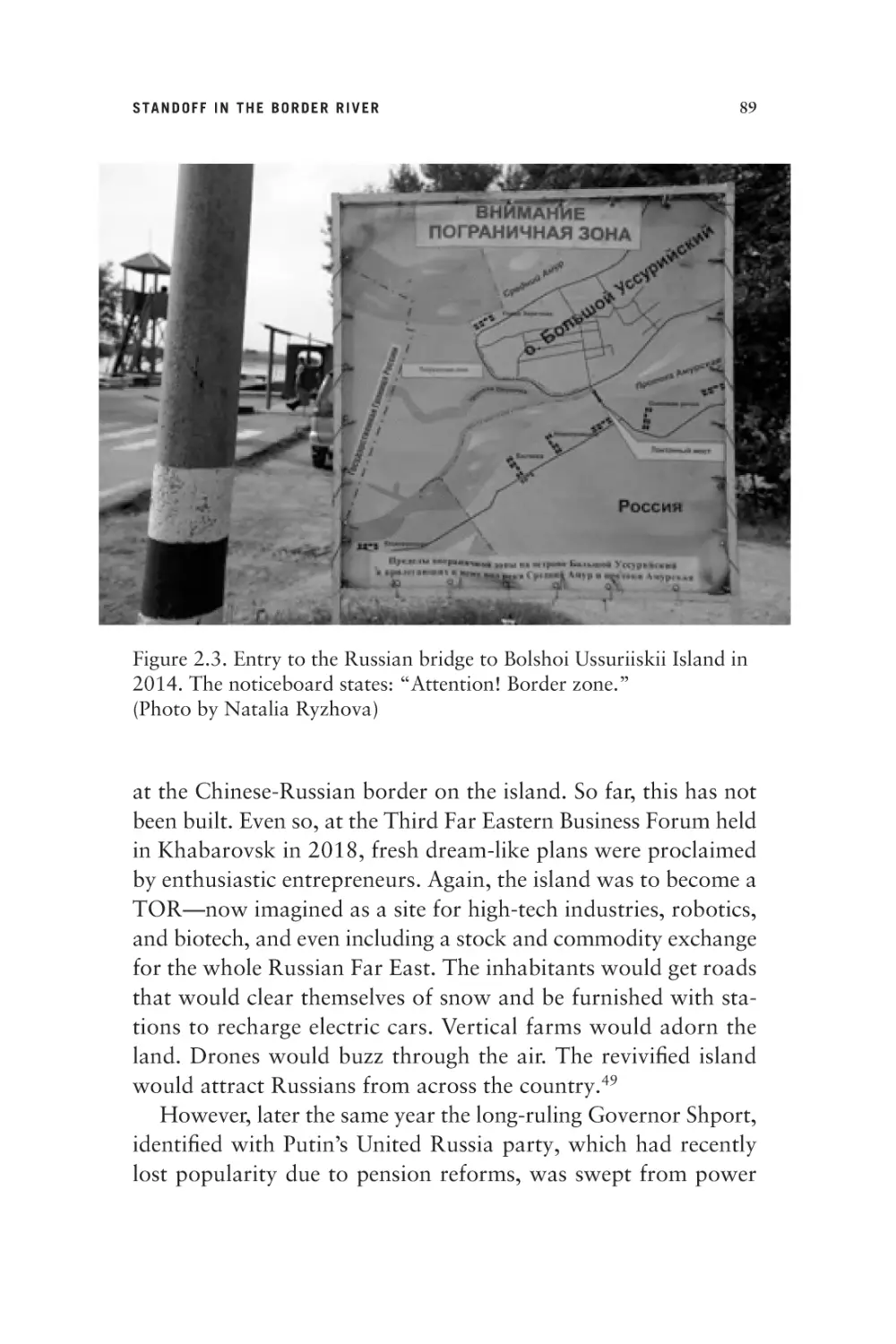
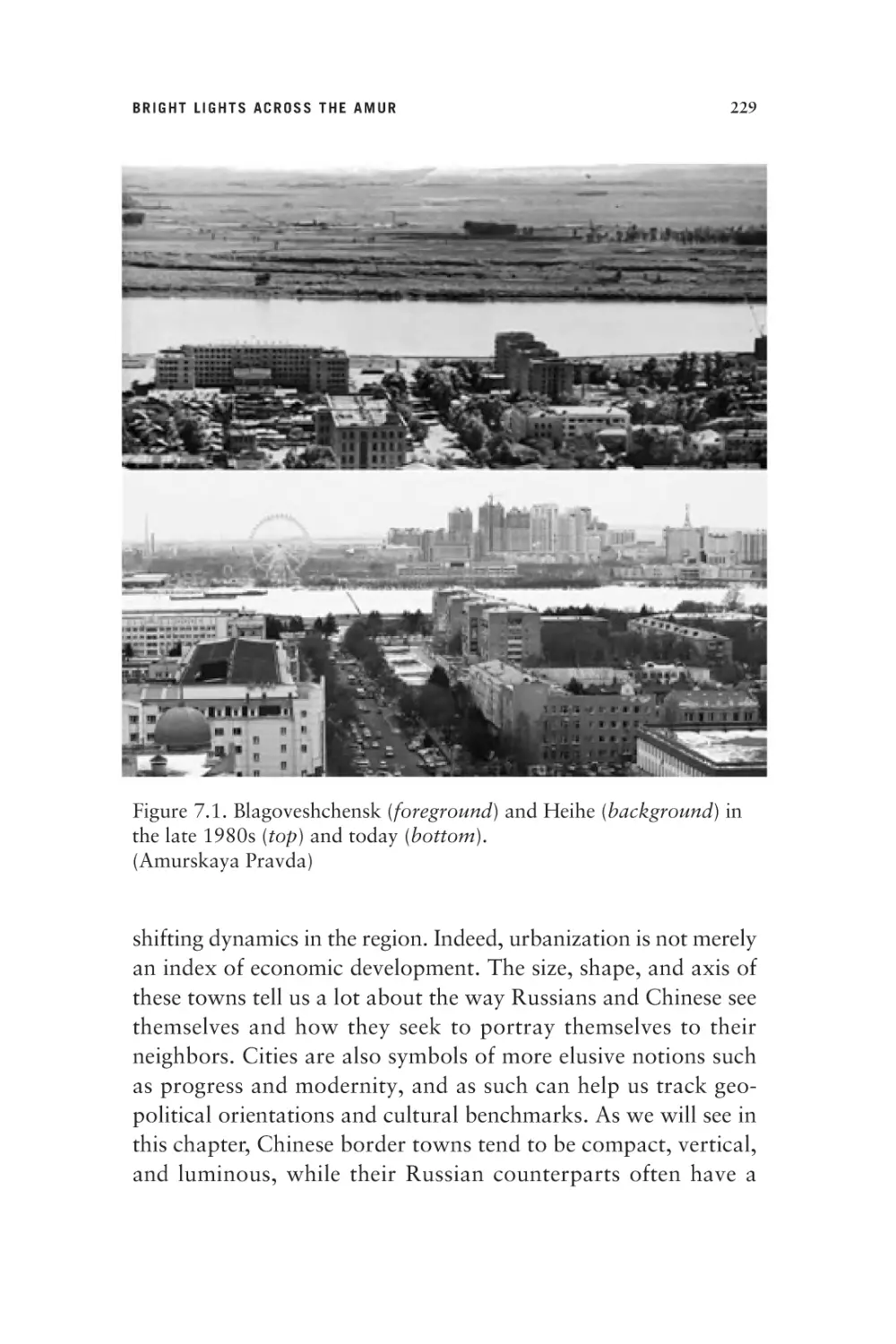
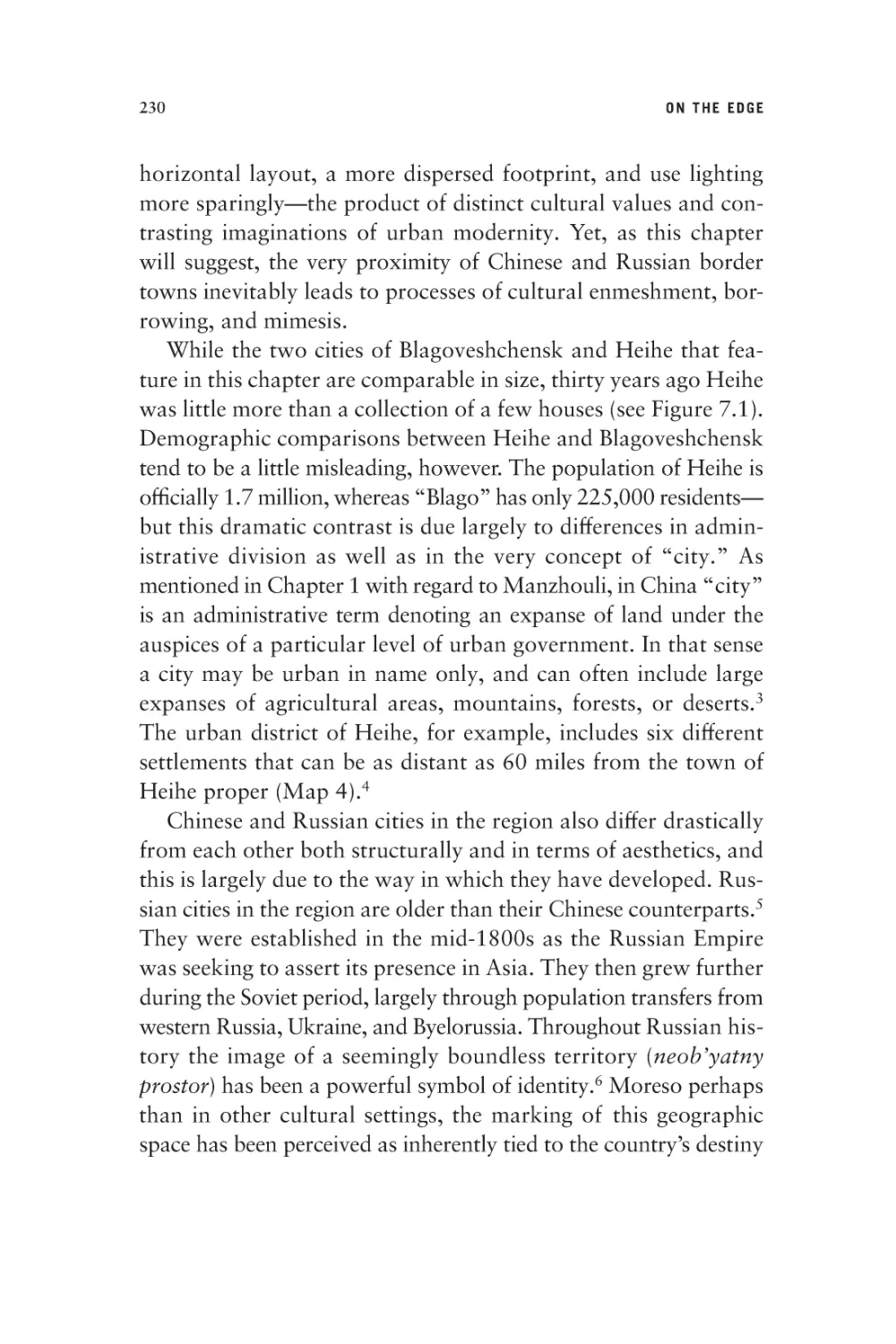
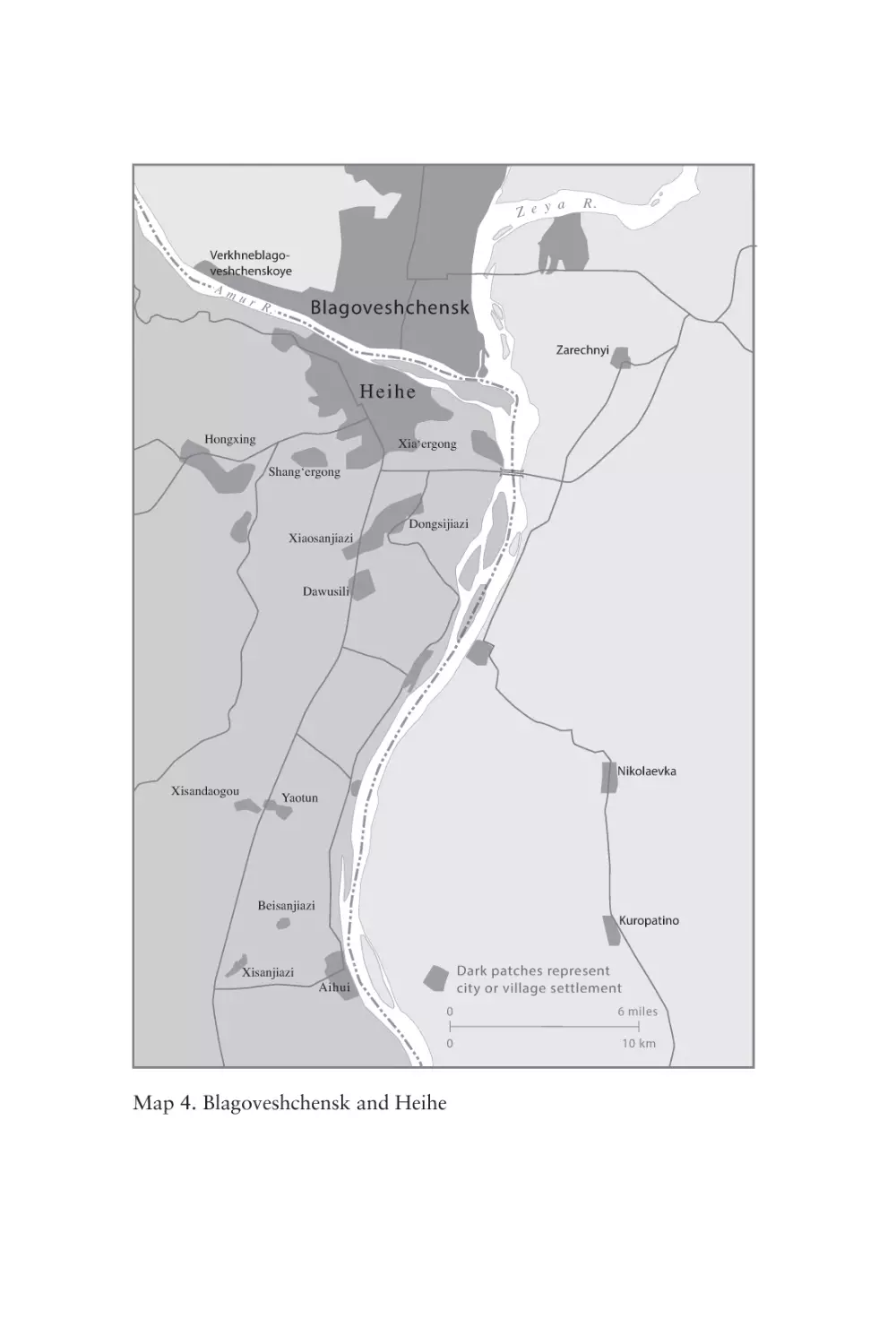
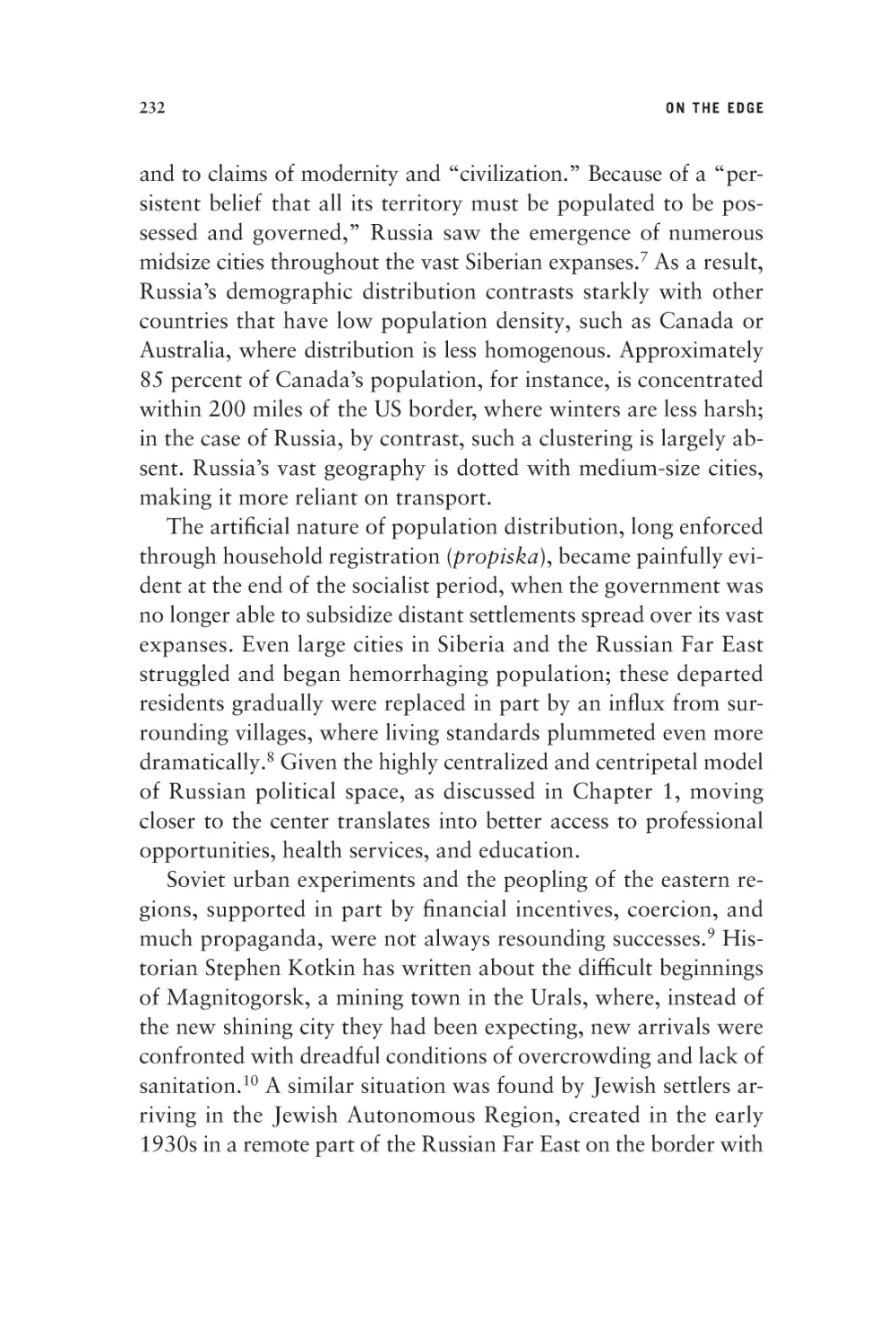
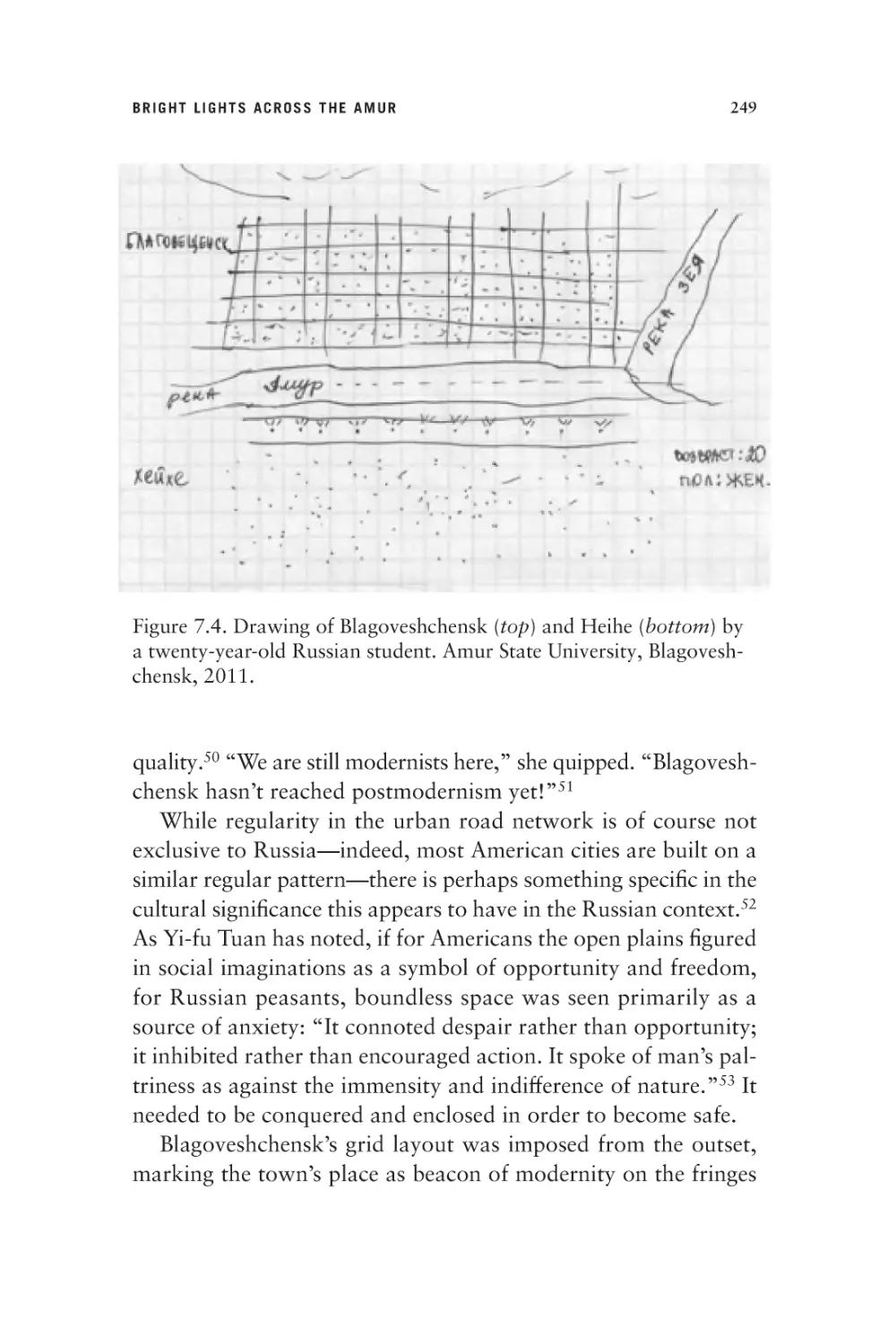
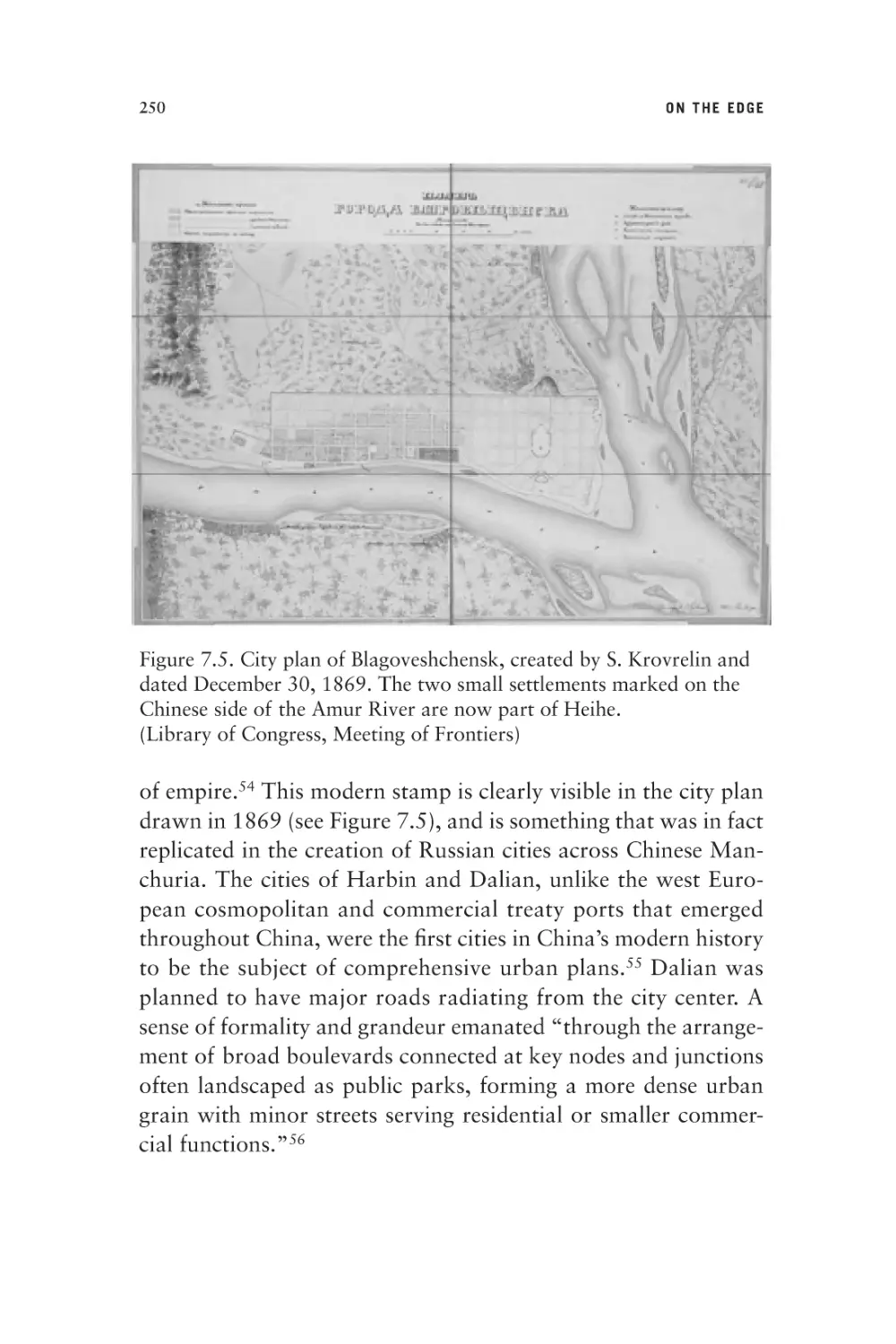
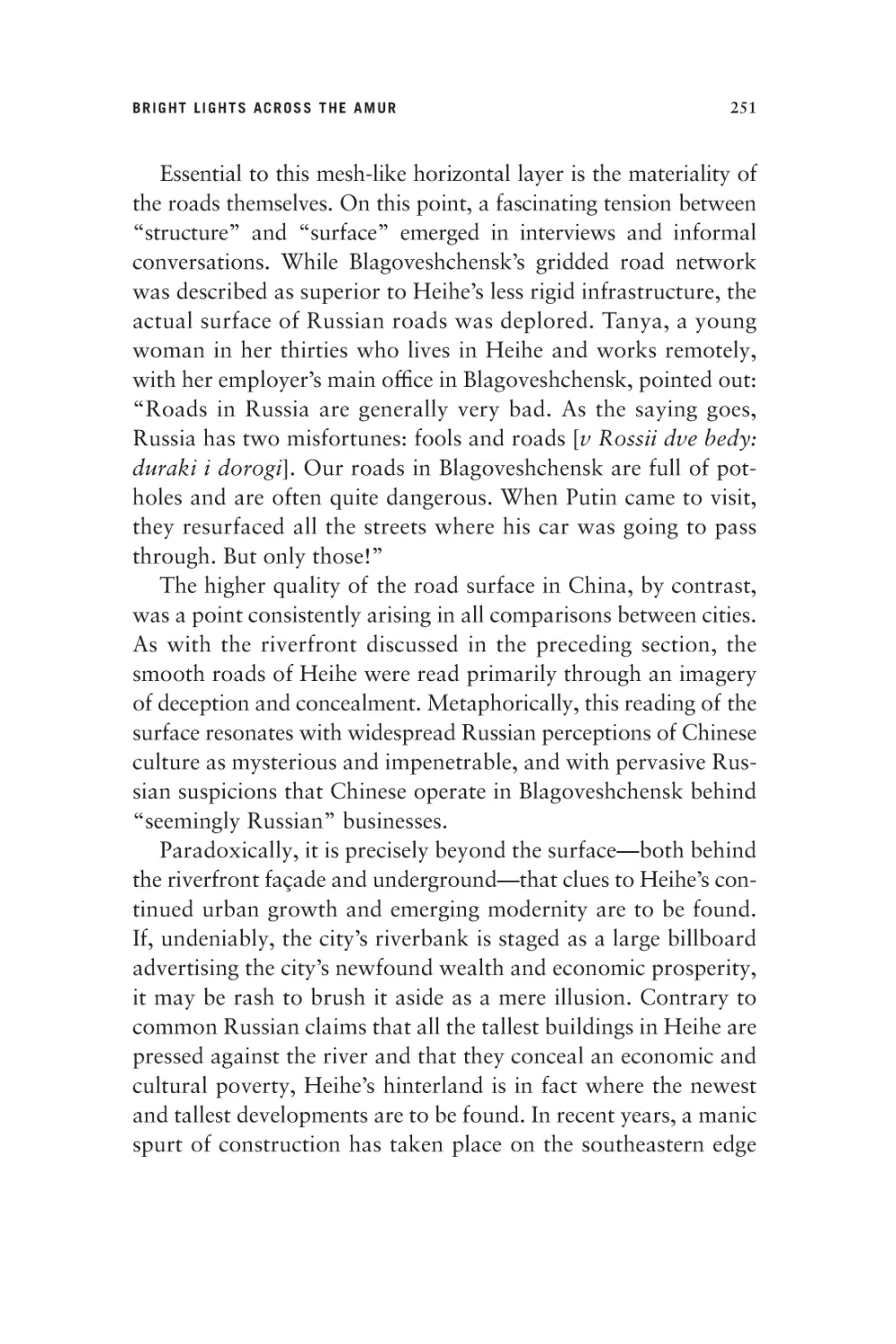
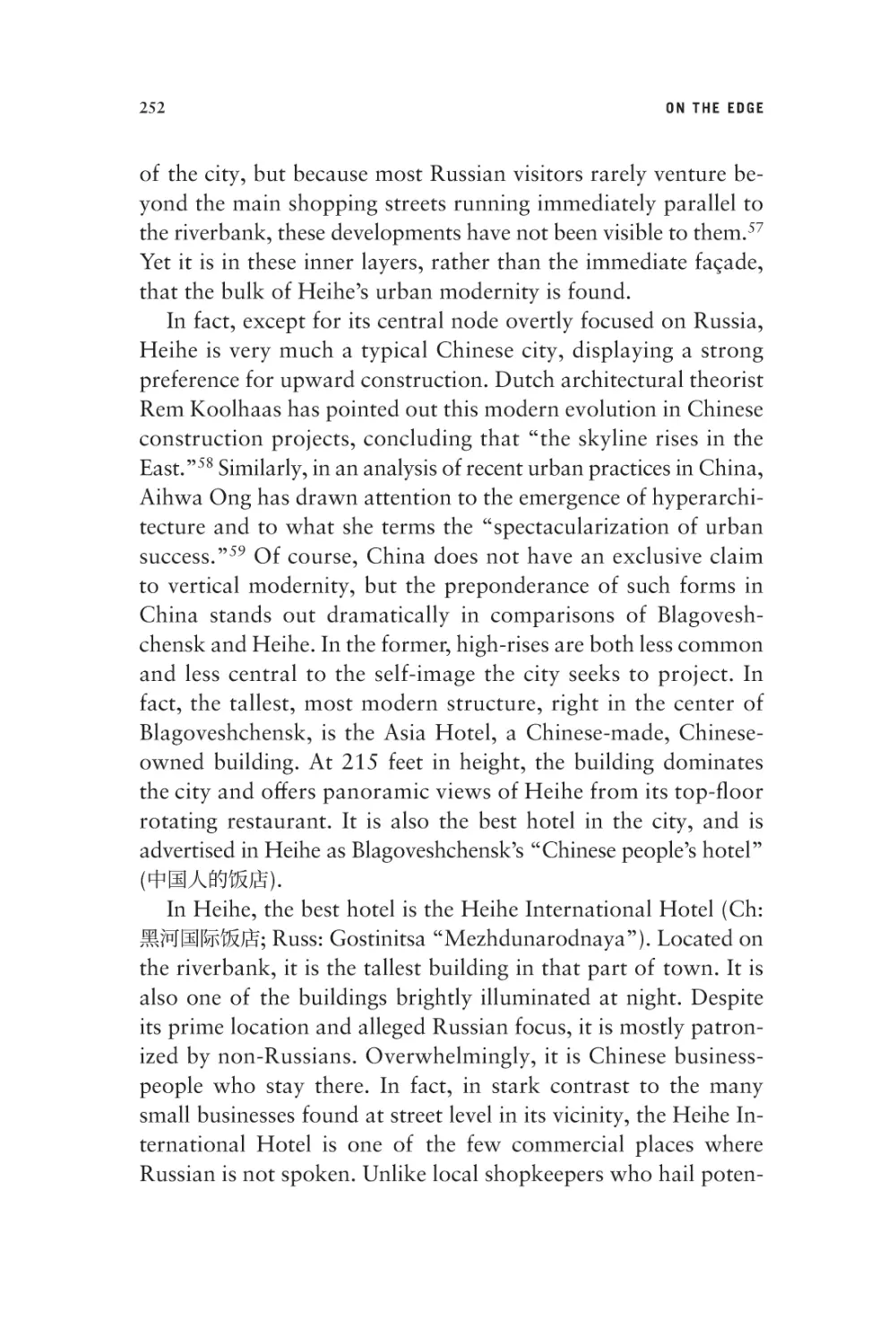













Автор: Billé F. Humphrey C.
Теги: international relations chinese history russian history
ISBN: 9780674979482
Год: 2021


Текст
ON THE EDGE
ON THE EDGE
L I F E A L O N G T H E R U S S I A - C H I N A B O R D E R
Franck Billé and Caroline Humphrey
HARVARD UNIVERSITY PRESS
Cambridge, Massachusetts & London, England 2021
Copyright © 2021 by the President and Fellows of Harvard College
All rights reserved
Printed in the United States of America
First printing
Jacket photograph: Juliet Butler / Alamy Stock Photo
Jacket design: Annamarie McMahon Why
9780674269491 (EPUB)
9780674269538 (PDF)
The Library of Congress has cataloged the printed edition as follows:
Names: Billé, Franck, author. | Humphrey, Caroline, author.
Title: On the edge : life along the Russia-China border / Franck Billé and
Caroline Humphrey.
Description: Cambridge, Massachusetts : Harvard University Press, 2021. |
Includes bibliographical references and index.
Identifiers: LCCN 2021017869 | ISBN 9780674979482 (cloth)
Subjects: LCSH: Borderlands—Russia (Federation) | Borderlands—China. |
Boundaries—Anthropological aspects—Russia (Federation) | Boundaries—
Anthropological aspects—China. | Russia (Federation)—Boundaries—China. |
China—Boundaries—Russia (Federation)
Classification: LCC DK68.7.C6 B55 2021 | DDC 957/.7—dc23
LC record available at https://lccn.loc.gov/2021017869
To our families
CONTENTS
List of Maps
ix
Note on Language and Spelling
xi
Introduction
1
1. Border Spaces
23
2. Standoff in the Border River
65
3. Making a Living in the Cross-Border Economy
95
4. Indigenous Peoples of the Borderlands
131
5. Friends, Foes, and Kin across the Border
171
6. Resources and Environment
205
7. Bright Lights across the Amur
228
Coda: Bridging the Gap?
269
Notes
277
References
333
Acknowledgments
357
Index
359
MAPS
1 The border region
xii–xiii
2 Svobodny and the Vostochny Cosmodrome
36
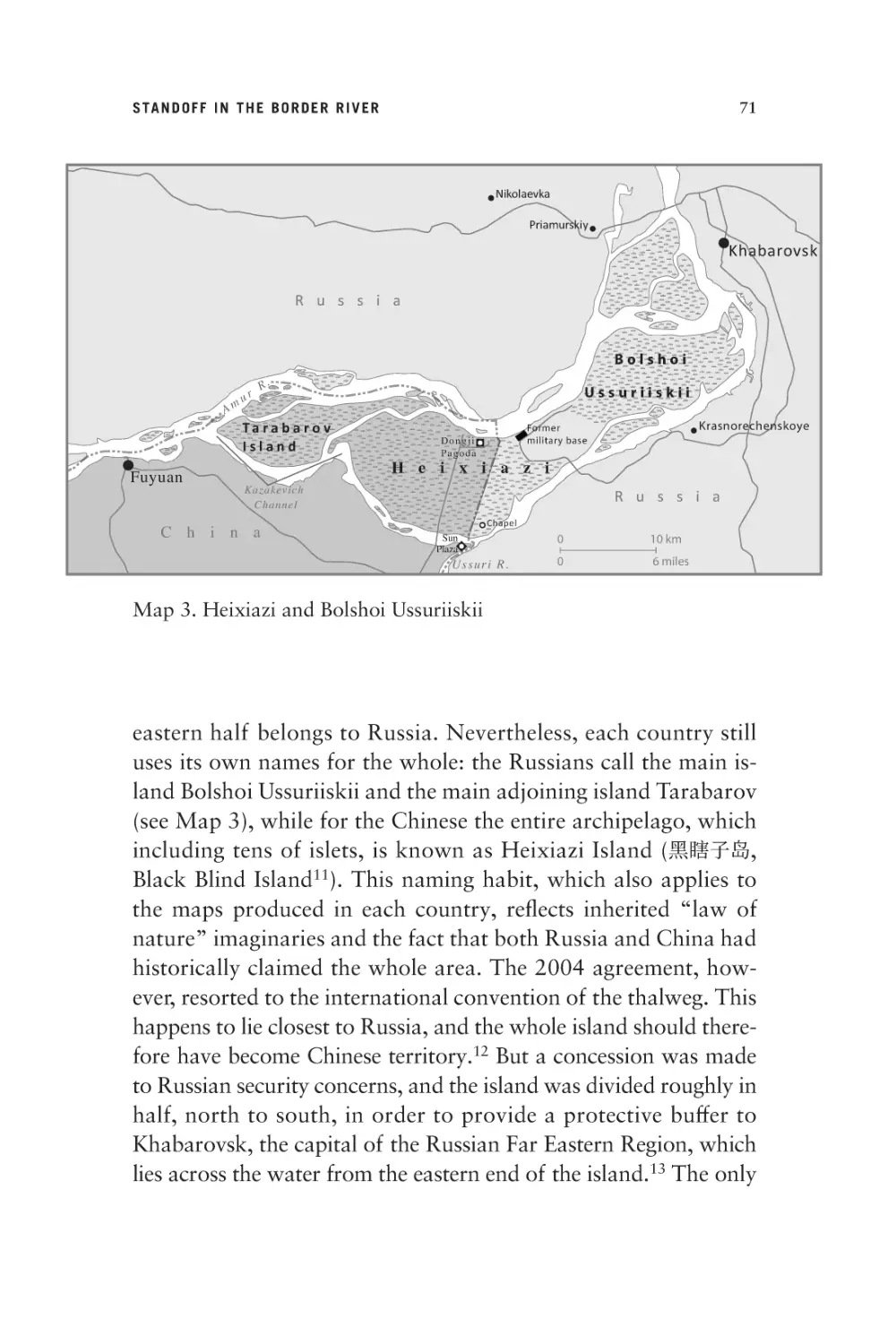
3 Heixiazi and Bolshoi Ussuriiskii
71
4 Blagoveshchensk and Heihe
231
NOTE ON LANGUAGE AND SPELLING
We use pinyin / simplified characters for all Chinese terms in the
text, without tone marks. For Russian we follow a simplified version of the American Library Association and Library of Congress
system. This system usually includes a number of diacritics as well
as two-letter tie characters, such as “ĭ” and “i͡a ” (for the letters
“й” and “я,” respectively), but for reasons of legibility we have
decided to omit them. Thus “ya” is used to denote “я,” and “yu”
to denote “ю,” while an apostrophe denotes both “ь” and “ъ.”
For terms in Mongolian, Buryat, and other minority languages
for which no standard system exists, we have followed the most
common practices in anthropology. For the names of rivers and
mountains, rarely the same in Russian and Chinese, we provide
both names on first mention and then use the term that is most
appropriate depending on the side of the border we discuss.
Unless specified, all translations are our own.
B AR GUZIN
Irkutsk
S
S
I
A
Z A B A I K A L S K Y
Mohe
BURYATIA
!
ka
ke
La
l
Sh i
!
Ulan-Ude
!
!
Chita
l
Aginsk
Kyakhta
Ar
K R A I
gun
U
Ba
ika
R
!
Krasnokamensk
!
!
Zabaikalsk
Manzhouli
!!
Hailar
!
B A R G A
Ulaanbaatar
M O N G O L I A
Capitals
Ci�es/Towns
Railways
Administra�ve Boundaries
Rivers
0
0
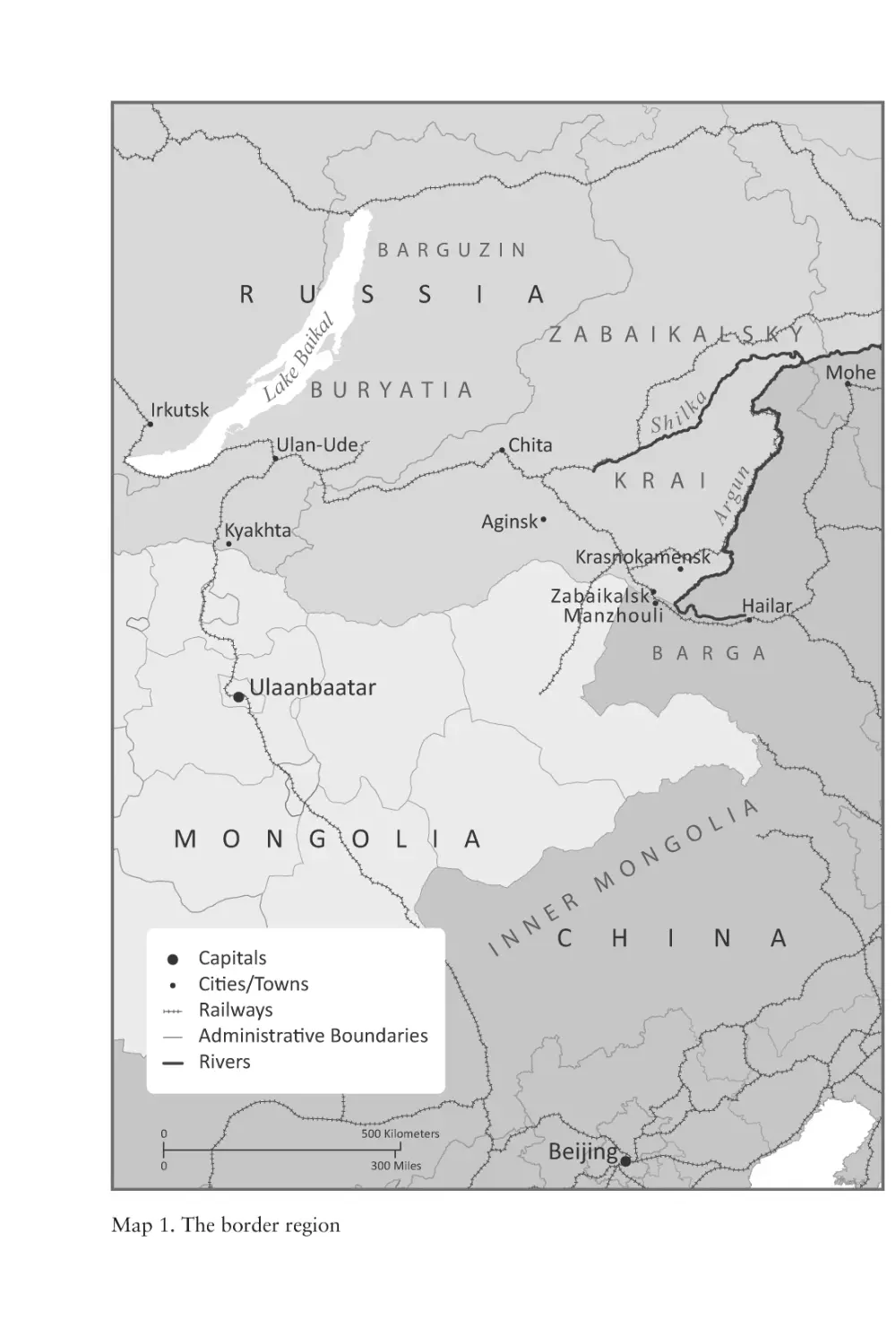
Map 1. The border region
500 Kilometers
300 Miles
IN
ER
N C
M
O
H
Beijing
!
A
LI
O
NG
I
N
A
R
M
Mohe
!
!
U
R
O
B
L
S
A
I
A
S T
ur
Am
Shibazhan
S
ur
Am
A
U
Svobodny
Heihe Blagoveshchensk
Aihui
!!
P R I M O R S K Y
Birobidzhan
!
HEILONGJIANG
Sikachi-Alyan
Khabarovsk
!
!
!
Fuyuan
Nizhneleninskoye Tongjiang
!
C
H
I
A
K R A I
S on g h u a
Us
!
sur
Harbin
N
i
Pogranichny
! !
Suifenhe
Ussuriisk
Bolshoi
Vladivostok Kamen
Hunchun
Yanbian
!
!
!
!
!
P a c i f i c
NORTH
KOR EA
Oc e an
INTRODUCTION
For thousands of miles, Russia and China are hard up against
each other, on e ither side of a border that consists mainly of rivers.
This long meandering borderline with Mongolia at one end and
North Korea at the other, the location for our book, reveals much
about the two countries and their actual relationship that is not
obvious from their metropolitan capitals. Unlike the geopolitical
setting of most historical empires and current world powers, such
as the United States or the European Union, here there is no buffer
zone, no intervening territory of client or hybrid states, and no
ocean to soften the sovereign conjunction of Russia and China.
The economist Branko Milanovic has observed that capitalism
comes in two variants: a democratic “liberal” form and a “po
litical” or authoritarian one that encompasses both China and
Russia.1 This is a helpful broad framework, but our book questions the validity of the “political capitalism” category. Russia
and China are utterly different from each other in the way systems are organized and things are done. This is not just a political
matter, with the Chinese single-party-ruled, well-oiled bureaucratic system contrasting starkly with the personalized, irregular,
and fitful way power operates in Russia. These two countries are
unlike “all the way down” and to their very peripheries. Indeed,
without wishing to venture into historical teleology, we suggest
that it is no accident that China and Russia have come up with
2
ON THE EDGE
variants of the politics of capitalism that are poles apart. It is such
“civilizational differences” (an idea that is current in both countries) that make the long border shared by the two countries in
northeast Asia so interesting.
The world has been somewhat taken by surprise by the ways
in which Russia and China have developed since the demise of
Soviet socialism in 1991. Instead of a homogenous, default-mode
capitalism, we find two contrasting, competing, yet to some extent mutually interdependent economic models in which the state
and hierarchical structures are deeply involved. The interpretation of national interest in China radically diverges from the path
adopted in Russia, and both are strange, even mystifying, in a
Western political context. The interior organization of these two
societies is also difficult to understand. One reason for this is that
both governments are highly active in information management—
from hopeful projections of the future through manipulation of
the media to plain disinformation. This makes the facts on the
ground difficult to discern, and not only for observers in the West.
It also means that Moscow and Beijing can maintain their own
skewed or paranoid ideas about what goes on in their own peripheries. Furthermore, it obscures each country to the other, and
gives a never-never-land quality to their joint communiqués. The
aim of this book, based on recent firsthand field research along
the border, is to penetrate these gaps in understanding. We describe what is actually happening, record real-life events, and explain the experience of citizens of Russia and China as they deal
with both the policy injunctions from above and their encounters with one another.
The last two decades have seen dramatic transformations in
China, in directions that have not always been consonant with
the changes occurring in Russia and that frequently have been
starkly at odds with them. From the early 1990s, when the border
with Russia reopened after decades of hostility, China showed
much eagerness to expand beyond its borders and to trade—but
to trade worldwide, not only with Russia. China is now putting
I ntroduction
3
e very effort into increasing domestic consumption, private sector
innovation, investment in emerging technologies, and infrastructure projects linked with global markets, all as a means of progressing beyond its e arlier unbalanced cheap labor economy. In
this context Siberia’s empty spaces have suddenly acquired new
value, not only for their resources of oil and gas but also for their
potential incorporation into China’s economic orbit to supply
other essentials such as w
ater and agricultural products that China
will need. Yet Russia as a country appears to China as an unreliable partner with a too rigid and centralized economy, too dependent on its role as global energy provider.
These tectonic shifts have suddenly placed in the spotlight the
region of northeast Asia, where the two g iants share one of the
world’s longest international borders.2 Yet surprisingly, in spite of
its strategic significance, the Russia-China border remains one
of the least studied borders in the world. Informed by a multidisciplinary and multi-sited research project running at the University of Cambridge between 2012 and 2015 and by our own
research in the region, On the Edge focuses on this zone of interaction as a way to supplement, as well as challenge, international-
relations studies that have traditionally privileged top-down centrist views.3 As a number of analysts have remarked, Russia and
China can act as each other’s buffer against the geopolitical might
of America. However, their border, more than 2,600 miles long,
has become a thin line of direct engagement, extraordinary contrast, and frequent tension. By looking at what is happening on
the ground, this book suggests that the changes occurring in the
region are harbingers of larger trends. The border, where people
are embedded in dissimilar social systems on e ither side and mostly
cannot speak each other’s language, is where conflicting versions
of history and attitudes to the future become starkly visible. Since
each state exercises full sovereignty right up to their mutual border,
there is no better place to compare the two remarkably dissimilar ways that economic development, the rule of law, citizens’
rights, migration, and inequality are managed. As border scholar
4
ON THE EDGE
Alessandro Rippa writes, “The borderlands are a particularly
compelling place from which to observe the state. As junctures
and points of friction, borderlands offer a particular perspective
on the complexities of contemporary global development—one
that arrives not from the centers nor necessarily from below, but
rather from multiple edges and corners.” 4
For almost all of its length the northeastern border consists of
great rivers: the Argun, the Amur, and the Ussuri. Yet, despite the
distance spanned and the fact that large cities lie right on the
banks, it is telling that at the time of writing there is no functioning road or rail bridge to connect the two countries. One of
the stories we tell in this book is about the phantom bridges—
projects planned, announced, and started countless times and yet
to date not put into practical effect. We explore the complex mix
of competing businesspeople, bureaucrats, and security agencies,
who at times act in ways that seem to belie the repeated glowing
announcements of thriving cross-border partnership. In addition,
China’s border with Russia lacks the huge wholesale bazaars and
the vast, often illegal, commerce that one finds at its borders with
Central Asia and Southeast Asia.5 Without the presence of prosperous trader groups sympathetic to China or important mediator communities (such as the Chinese-speaking Dungans in the
case of Kazakhstan), the chances of cultural misunderstandings
are greater.6 As a result, there is more of a break at the China-
Russia border, with few dual-loyalty intermediaries and a relative
absence of thriving economic cross-border activity on the ground.
All of this might seem to imply that the two peoples are
turning their backs on each other. But t here have to be interactions at the border. We argue that t hese are important and can
tell us much about how the situation is changing in ways that
are not (yet) perceptible in macro analyses. Many Russian and
Chinese citizens are happy to develop relationships with one
another. Local initiatives have encouraged Chinese investment
in the Russian hinterland, whatever Moscow might say. And
there are marriages, friendships, sexual encounters, small joint
I ntroduction
5
businesses, underground deals, and smuggling networks. As we
describe in Chapter 3, some of the indigenous peoples of the
borderlands (but not all) eagerly seek to “revive” supposed historical cross-border social groupings that are spread through
northeast China, Mongolia, and south Siberia, and they orga
nize religious events and popular festivals with tens of thousands of attendees. None of these interactions are straightforward. There is an added edge to these encounters that our book
seeks to elucidate.
In writing the book we have drawn gratefully on recent studies
of China’s contemporary borderlands. These include perceptive
travel accounts, monographs, and edited collections dealing with
particular themes.7 Among the latter, there are studies focusing on
nationalism and its varieties in the region, the “agonistic intimacies” brought about by “neighboring” across borders, the intricacies of “border work” and the ways in which actors make borders
“work” for them, trust and mistrust in cross-border trade and
business relations, sovereignty and the territorial imagination,
gender and identity, migrations and diasporas, and political loyalty and disloyalty.8 In this book, however, rather than focus on
a particular theme, we want to present a general picture of many
interrelated phenomena. Although we are anthropologists, we do
not intend to propose or defend an anthropological theory, or to
see diverse material through the lens of a single encompassing
idea, such as “neighboring” or “border work”—even though both
of these are multifaceted and productive concepts. Instead, this
book has a more straightforward descriptive aim, mainly based
on field research carried out in person and in collaboration with
colleagues.
These lived realities of the border tend to be obscured in official accounts and are in fact palpable only at the border, through
extended investigations in the field spearheaded by researchers native to the region. T
hese experiences are crucial if we are to understand the attitudes of the local populations, sentiments that
in the end are likely to shape the trajectories of their respective
6
ON THE EDGE
countries, given that the “big picture” is actually made up of
myriad local initiatives and the incremental results of decisions by
ordinary people. These micro effects will to a great extent determine the f uture of the region. It is b
ecause these are not straightforward but rather involve different values (such as “face” and
“honor”), each side’s political scare stories, the pervasive agency of
social media, dissimilar views of gender and family, and abiding
cultural ways of d
oing t hings that t here is a need for an account
of actual practices on the ground. H
ere anthropology can play a
crucial role in bringing to light internal structures and incipient
trends that have not yet percolated into large-scale analyses.
THE GEOPOL ITIC AL CONTEXT
As we enter the second decade of the twentieth c entury, relations between Russia and China are the strongest they have been
for a very long time, and China has become one of Russia’s most
important economic partners. Up 27.1 percent from the previous
year, the value of trade between them reached $107 billion in
2018, and the two countries hope to double that number over
the next five years, to $200 billion by 2024, by implementing
joint projects in energy, industry, and agriculture. Chinese president Xi Jinping and Russian president Vladimir Putin reportedly
enjoy excellent personal relations, with Xi even calling Putin his
“best friend” during a state visit to Russia in 2019. With around
thirty visits over six years, Russia has indeed been the state
most visited by the Chinese president, and the two leaders are
committed to developing a strategic cooperation and comprehensive partnership, as well as to strengthening global strategic
stability.
This current state of affairs is, however, largely uncharacteristic of the relations between the two countries over the modern
period. Save a brief interlude of warmth in the 1950s when, having
adopted a socialist government in 1949, China modeled itself
politically and culturally after the Soviet Union, relations between
I ntroduction
7
the two countries have been tense, if not downright bellicose.9
Following Stalin’s death in 1953, Khrushchev’s de-Stalinization
political reforms led to an ideological rift between the two countries. The Chinese accused the Soviet Union of emasculating,
betraying, and revising Marxism-Leninism, while Khrushchev
reviled Mao Zedong as an ultra-leftist, an ultra-dogmatist, and
a left revisionist. With this ideological rift, lingering resentment
about territorial disputes reemerged. The Chinese labeled the
Soviet Union an imperialist power, just like the old Russian Empire that in the mid-nineteenth century had seized more than
580,000 square miles of Chinese territory through unequal treaties. Unwilling to give up land or compromise, the Soviet government denied that the treaties signed between the two countries were unequal, and all subsequent negotiations on border
issues proved unproductive. Memories of traumatic events, such
as the massacre of 5,000 Chinese citizens in Blagoveshchensk at
the turn of the twentieth century, discussed in Chapter 5, also
reemerged.10
The years 1964–1968, characterized by border skirmishes and
military reinforcements on both sides, reached a climactic point
on March 2, 1969, when Chinese troops ambushed Soviet border
guards on Damansky Island (Ch: Zhenbao Island), a marshy islet
of just 0.29 square miles in the Ussuri River.11 Over the next few
months, both sides suffered losses, and the b
attle threatened to
erupt into a more generalized conflict between the two countries.12
An informal meeting between Soviet premier Aleksei Kosygin
and Chinese leader Zhou Enlai in September 1969 and their agreement to solve border problems through peaceful negotiations
led to the end of the military confrontation, but relations between the two countries remained frosty.13 Other islands subject
to dual claims have also been points of extraordinary tension,
way beyond the practical significance of these waterlogged patches
of ground; in Chapter 2 we focus on the curious fate of another
such island, Bolshoi Ussuriiskii / Heixiazi in the Amur River.
8
ON THE EDGE
The border remained closed until the late 1980s, and only since
the collapse of the Soviet Union have more cordial relations resumed.14 The reopening of the border at a few crossing points
led to an intense flurry of commercial activity—new market opportunities for the Chinese, and the chance for Russians to purchase items that were not, or were no longer, locally available.
With bilateral relations continuing to improve—and relations
with the United States continuing to deteriorate—in 2008 Russia
announced a “pivot to the East” (povorot na vostok), the focus
of which has essentially been China.
Of course, geography plays a significant role in this partnership, in that it is crucial to have good relations with a neighbor
with whom you share a long border.15 Russia’s abundant natural
resources, notably in natural gas, oil, and timber, and China’s
rapid economic development have ensured that the relationship
is mutually beneficial. In the Arctic, Chinese investment has
been essential to extract natural resources under the permafrost
and monetize Russia’s long Arctic coast.16 China, in turn, needs
Russia’s cooperation if it is to gain a foothold in a fast-thawing
natural environment and open up a new sea passage—what
Beijing refers to as the “Polar Silk Road.” With climate change,
drought in parts of China, and restive millions still remaining in
rural hinterlands, the empty swaths of the Russian Far East that
are now becoming suitable for agriculture look, in principle, like
an ever more inviting prospect, as we discuss in Chapter 3.17
However, this strategic partnership must also be seen in a
global context of increasing friction with the West, especially after
the sanctions imposed following Russia’s annexation of Crimea
in 2014 and the United States’ current trade war with China. In
many ways it is the very tension with the United States and the Eu
ropean Union that is bringing the two countries together.18 Brought
together through what Gilbert Rozman has called “parallel identities,” Russia and China embrace the vision of a multipolar world
free of American meddling.19 It is by combining forces that China
I ntroduction
9
and Russia can outcompete the West and counter America’s
political and cultural dominance.20 Their relations have therefore been largely contingent on a broader international context,
a phenomenon historian Sergei Radchenko traces back to a much
earlier period. The Sino-Soviet rapprochement of the early 1980s
after two decades of hostility was, he writes, greatly aided by
the fears and hopes both countries had for their relations with
Washington.21 In fact, Russia’s foreign policy toward Asia has
traditionally been subordinate to Western dynamics, with the
country turning to Asia whenever it was stonewalled or stalemated in Europe.22 These analyses are largely supported by our
research at the border, where official statements of friendship
and collaboration, while symbolically important, are rarely accompanied by genuine popular engagement.23
Russia and China’s pragmatic approach has prompted foreign
policy analyst Bobo Lo to call the partnership a “marriage of con
venience,” unlikely to survive tensions and divergences inherent
in the relationship.24 In a more recent publication, political scientist Yu Bin writes that bilateral ties are not as solid as officially
articulated and that too many sociological and psychological hurdles remain for a genuine and healthy strategic partnership to
flourish.25 Even professor of international affairs Alexander Lukin,
who is generally dismissive of the “marriage of convenience”
analysis, concedes that Russians and Chinese know surprisingly
little about each other, and the knowledge they do have tends to
be filtered through imported negative Western biases.26
This is complicated by an inherent imbalance between the
two partners. If for Russia, China is at the very top of the foreign
policy agenda, for China, Russia is just one of many aspects of
its foreign policy.27 The population of China is roughly ten times
that of Russia and continues to increase, whereas Russia faces a
natural demographic decline (particularly marked in Siberia and
the Far East) that is compensated for only by in-migration.28 The
disparity in wealth and trade between the two countries is also
10
ON THE EDGE
widening. In 2018, Russia’s trade with China—both imports and
exports—was greater than its trade with any other state; by
contrast, Russia accounted for a tiny 1.9 percent of China’s overall
exports.29 If The Economist’s comparison of the relationship to
that of a rabbit and a boa constrictor is a bit of an exaggeration,
Russia is nonetheless clearly the “weaker partner that needs China
more than the other way around.”30 Optimistically, Alexander
Lukin writes that Russia continues to outstrip China in terms of
military might and that it is premature to “speak of China’s
overall superiority or of any broad asymmetry,” but the economic
disparities are certain to eventually chip away at Russia’s remaining military and technological advantages, especially when
one considers China’s proficiency at reverse-engineering foreign
products.31
Similarly, Russia’s capacity to leverage its vast natural gas reserves (amounting to around a quarter of the world’s proven reserves) will be limited in relation to China. Although Russia has
been able to wield considerable power and influence as a dominant
supplier of piped gas—notably in Central and Eastern Europe,
the Caucasus, and Central Asia—a well-diversified importer such
as China can be in a position of strength and play the politics
of demand for gas even vis-à-vis a sizable exporting state such
as Russia.32 It is thus increasingly clear, political scientist Agnia
Grigas writes, that “Beijing, not Moscow, will dictate the terms
of the emerging Sino-Russian gas relationship.”33 As we discuss
in Chapter 1, these issues are compounded by a wholly inadequate
transport infrastructure, which prevents Russia from capitalizing
on economic opportunities, particularly with its Asian partners.
The dense railway and road network, including high-speed lines,
that exists in the northeast of China is lacking in the Russian Far
East, where there are only a few overburdened routes and more
than 46,000 settlements are not connected to the broader transport system. Russia is therefore finding it challenging, if not impossible, to position its Far Eastern region as a logistics hub that
will facilitate closer links to Asia and Europe.34
I ntroduction
11
hese geopolitical shifts are particularly evident in Central
T
Asia, traditionally considered Russia’s backyard, or “near abroad”
(blizhnee zarubezh’e). This term, professor of government and
international affairs Gerard Toal explains, simultaneously indexes
a new arrangement of sovereignty and an old familiarity, a long-
standing spatial entanglement, and a range of geopolitical emotions. It does not merely, as many in the West assume, indicate
reluctance on the part of Russia to acknowledge the full sovereignty of the new post-Soviet states.35 Central Asia is therefore a
region where China treads carefully, while continuously extending
its economic interests. Former Chinese ambassador to Russia Li
Fenglin, addressing Russian concerns about China’s growing role
there, stated ambiguously that China had no intention of becoming a leader at e ither the regional or global level—at least for
the immediate f uture: “China understands Russia’s desire to preserve its traditional influence in Central Asia. . . . Central Asia
is like Russia’s backyard. . . . We understand that, but you have
to take care of your backyard, water the flowers, so that it does
not become overgrown with weeds.”36 Some changes in the dynamic have already been seen with Chinese investments in the
China–Central Asia Gas Pipeline, which for the first time broke
the effective control that Russian giant Gazprom enjoyed over
export routes. Until 1990, professor in international relations
Daniel Markey writes, Central Asia’s energy pipelines (as well
as transportation and communications networks) all ran to and
through Russia, giving Moscow an overwhelming advantage in
its negotiations with former Central Asian republics.37 That looks
set to change. China’s place in the region is undeniably growing,
and this role w
ill increasingly spill beyond the purely economic.38
The same is true of the two countries at e ither end of the border.
Mongolia, whose imbalanced economy based on herding and
mining has been faltering, is now increasingly propped up by
its economic dependence on China. Meanwhile, Russia’s influence in North Korea is declining. Embroiled in confrontations
with the West, Russia can no longer play an effective mediator
12
ON THE EDGE
role in North Korea’s relations with the world and is unwilling
to subsidize its economy.39 Even if it is not directly evident at the
border we studied, this growing competition over influence in
Central Asia, Mongolia, North K
orea, and the Arctic is a momentous development.40 It offers a larger backdrop for the growing
disparities between the two countries and the attendant geopo
litical shift in the balance of power. The economic and demographic disparities have made collaborative development of the
Russian Far East difficult. Thirty-eight million Chinese live in Heilongjiang province, which abuts the Russian border. By contrast,
the entire Russian Far East region, an enormous landmass encompassing 2.3 million square miles—slightly over a third of the
entire territory of the Russian Federation—has only 6 million
residents. This demographic imbalance between China and Russia
and their starkly divergent economic trajectories are exacerbated
by China’s hunger for natural resources such as timber, gas, minerals, w
ater, and animal products—all found in significant quantities in the Russian Far East. E
ager to trade, Russia is nonetheless
anxious about becoming China’s “natural resources appendage”
and wary about becoming dependent on Chinese payment systems.41 It is even more concerned about mass in-migration. These
anxieties manifest themselves through the bottlenecks in the
border-crossing infrastructure (notably a persistent absence of
bridges across the river boundaries, as we discuss in Chapter 1, as
well as the interdiction on crossing the border in personal vehicles).
Russia’s restrictive foreign migrant labor quota system has resulted
in the majority of guest workers in the Russian Far East being
ex-Soviets from Central Asia rather than people from the neighboring provinces of China, and in a comparative dearth of genuine collaborations overall.42 Scholars agree that the partnership
between Russia and China is dominated by lost opportunities—
an analysis largely supported by our own research.43 Furthermore, while the Kremlin may have a clear vision of Russia’s close
future relations with China, this vision is not shared throughout
I ntroduction
13
Russian society. Indeed, as Viktor Larin, a leading Russian expert
on China, has argued, “the lower you go, the worse it gets.”44
As we discuss in Chapter 7, Russia has found it difficult to reconcile itself with the fact that it is being increasingly sidelined on
the global chessboard, outranked status-wise by China. As China
continues to grow, Daniel Markey writes, it threatens to leave
Russia at the margins of international decision-making—an especially frightening prospect for a country like Russia, eager to
assert its status on the world stage.45 These anxieties are further
fueled by unresolved historical issues, notably the unequal treaties signed by China with tsarist Russia in 1858–1860 and the
enduring Chinese resentment at having thereby lost large swaths
of territory. T
hese territorial histories, compounded by the huge
demographic disparities, create a climate of suspicion in Russia,
where the presence of Chinese individuals is often interpreted as
an attempt to colonize the vast and sparsely populated Russian
Far East. The very term “Chinatown,” for instance, evokes anx
ieties of ethnic, cultural, and geographical intrusions.46 As po
litical scientists Harvey Balzer and Maria Repnikova note, “Rus
sians’ preoccupation with an impending Chinese influx derives
from a deeply held belief that demographic imbalance generates
migration.” And yet, in spite of a very long border, Russia has
received less than 3 percent of post-1978 Chinese migration. Indeed, Chinese migrants prefer to go to other Asian countries, such
as Singapore, where they can earn multiples of what they would
earn in Russia. When they do go to Russia, they predominantly
settle in the cities to the west rather than in the Far Eastern regions.47 The media stories that depict the Chinese as migrants
eager to move to the rich and underpopulated Russian Far East
are thus not reflected on the ground. Not only is the number of
Chinese residents in the region nowhere near the alarmist levels
mentioned in the Russian media (there are in fact more Russian
citizens living in China than the other way around), but as we
describe in Chapter 3, the Chinese who do work in the Russian
14
ON THE EDGE
Far East are there predominantly for short stints before returning
home. They see the region’s unforgiving climate and the challenging economic and political environment as reasons not to
make it a permanent home—echoing, in fact, many of the local
Russian population’s own concerns.
Russian anxieties are in any case not assuaged by China’s current geopolitical assertiveness, particularly its expansion in the
South China Sea with the creation of artificial islands.48 Such extensions of sovereign rights are frequently about access to resources rather than about extensions of sovereign territory, but
the boldness of the moves made by China in the South China Sea,
in Hong Kong, and at its borders with India stokes suspicions that
it may one day seek to assert dominance over long-lost territories
such as a large part of the Russian Far East.49 Ultimately, international relations expert Marcin Kaczmarski argues, China and
Russia understand regionalism differently and have divergent
views about international cooperation at the regional level:
“China defines regionalism in functional rather than territorial
terms and sees its project as an inclusive one. . . . Russia, by contrast, interprets regionalism in spatial and historical terms, seeing it
primarily as a way to maintain its influence in the post-Soviet space
and as a barrier to the exercise of influence by other actors.”50
In the last decade, China has embarked on a gigantic and
unprecedented infrastructural project seeking to place itself at the
center of a global trade network. The Belt and Road Initiative
(BRI) was announced to the world in September 2013 in a speech
by Xi Jinping.51 A project stretching across more than sixty countries and incorporating almost two-thirds of the world’s population, the BRI has taken the historical Silk Road “as a metaphor
for regional trade networks, cultures of diplomacy, and the harmonious relations that come from the free movement of ideas,
people, technologies, and goods.”52 Focusing on connectivity and
movement, the BRI is notably amorphous.53 Its spatial and temporal boundaries are unclear and its objectives vague—a flexibility
that has allowed China to situate virtually any project within its
I ntroduction
15
remit. At the heart of the BRI is the concept of rejuvenation and
renewal—overcoming a “century of humiliation” and placing
China once again at the center of the universe.54 If, as sociologist
Tim Winter notes, signed contracts do not necessarily lead to
finalized projects given that the BRI covers harsh landscapes
where political and economic conditions can change rapidly, the
force of the narrative lies in proposing a new geocultural imaginary beyond the concept of the nation-state.55 The amorphousness and elasticity are precisely the point: China envisages the
BRI as open and inclusive, a malleable network with unspecified
borders.56
Russia, by contrast, aims to create an exclusionary space with
clear boundaries, framed by a Soviet geopolitical imaginary with
Russia at the center. Russia’s Eurasian Economic Union (EAEU),
the landmark project of the Putin administration, was launched
in 2010 as a customs union between Russia, Kazakhstan, and Belarus, with Armenia and Kyrgyzstan acceding in January and
August 2015.57 While not as ambitious as China’s BRI, the EAEU
is still a trade bloc with significant clout: it has an integrated single
market of 180 million people and a GDP of over $5 trillion. The
goal is to develop the EAEU into a powerful supranational union
of sovereign states, uniting economies, legal systems, customs ser
vices, and military capabilities in order to form an entity to balance the European Union and the United States.58 Putin has further stated that his aim is to enlarge the customs union to all
post-Soviet states, excluding the three Baltic EU member states,
prompting former US secretary of state Hillary Clinton to describe the EAEU as a move to re-Sovietize the region.
These ambitions do indeed appear to be motivated by a desire
to reestablish Russia’s standing as a world leader following the
collapse of the Soviet Union, which Putin famously described as
the “greatest geopolitical catastrophe of the century.”59 Attempts
to resurrect a defunct geopolitical entity on an old-school political
imaginary of containment and border nationalism have not helped
Russia in Asia, however. As professor of law and politics Sergei
16
ON THE EDGE
Radchenko writes, in order to truly become a Eurasian power,
Russia should focus instead on opening borders, on removing
barriers to the flow of goods, capital, and people, and on encouraging cross-border communities that would “tie Russia to this
region linguistically and culturally in ways that would support
the notion of an Asian identity.” For all intents and purposes,
he concludes, Russia has been left on the sidelines of the “Pacific
century.” 60 Because of its insistence on border control, even to
the detriment of a more flourishing economic climate (discussed
in Chapter 3), Russia has also failed to fully benefit from China’s
BRI project.61 Russia’s eagerness to trade with China, tempered
as it is by anxieties regarding an influx of Chinese migrants, has
led to the feeling in Russia that it has been left in the cold, and
to the sentiment in China that Russia is a difficult country to do
business with.62
Paradoxically, the very ambitions of the BRI to establish connections have also created pockets of remoteness. Roads and corridors do not always annihilate distance—they create nodes of
legibility and state presence, but in the process they also increase
the remoteness and illegibility of border areas outside their immediate scope. As new hubs are created, facilitating the collection of customs taxes and centralizing logistics, they bypass local
economies and border trading posts.63 In the rugged Pamir Mountains of Tajikistan, anthropologists Martin Saxer and Ruben Andersson write, “newly disconnected communities tend to the
scraps left behind by the Soviet regime, while China’s new Silk
Road is roaring past only miles away.” 64 Even large cities such
as Tashkent are fearful of becoming just a conduit for Chinese
products transported to Eu
ro
pean markets, with
little local
65
capture.
China’s growing influence is felt and discussed well beyond the
borders of the People’s Republic of China. In places that have a
long and complex history of imperial relations with China, such
as the Hunza Valley, in the autonomous Gilgit-Baltistan region
of Pakistan, the PRC’s renewed engagement in development and
I ntroduction
17
infrastructural investments evokes not just promises and expectations but also doubts and fears.66 These anxieties are shared
with most of China’s neighbors: recipients of BRI projects, both
near to and far from China, have concerns about mounting debts
to Beijing and erosion of sovereignty.67 The example of Sri Lanka,
which, owing more than $8 billion to state-controlled Chinese
firms and unable to repay the loans, was recently constrained to
hand over its port of Hambantota to China on a ninety-nine-year
lease, has sounded alarm bells for other recipients of Chinese investments. China’s global investment and lending program can
amount to a debt trap for vulnerable countries around the world,
simultaneously fostering a climate of corruption and autocratic
behavior in struggling democracies.68 For Kazakhstan and Mongolia, neighboring China but traditionally in the Soviet / Russian
orbit, suspicions regarding China’s geopolitical objectives have a
long genealogy. In a context where for decades the Soviet Union
used the specter of China to ensure loyalty, fostering deeply entrenched Sinophobic sentiments, China’s shrewd tactics to gain
territorial footholds are only confirming assumptions about
China’s ambitions.69
These fears are not unfounded. China, like Russia, has witnessed the rise of authoritarianism in a context of rising nationalism on a global scale.70 Following its policy of “peaceful rise”
(中国和平崛起), which characterized Hu Jintao’s leadership and
which sought to assure the international community that China’s
growing political, economic, and military power would not pose
a threat to international peace and security, China has demonstrated more assertiveness both at home and abroad. Since 2016,
the Chinese government has been pursuing a ruthless policy of
assimilation of the Uyghurs and other Muslim minorities in
Xinjiang through political indoctrination, reeducation internment camps, biometric mass surveillance, and forced sterilizations
of women.71 China’s heavy-handedness in its attempts to suppress
Tibet, assimilate Hong Kong, and quell even mild signs of national sentiment in Inner Mongolia also speaks to Xi Jinping’s
18
ON THE EDGE
authoritarian leadership and to China’s newfound confidence in
achieving its political aims.72
To an extent, these tactics find a counterpart in Russia’s expansionist and territorial ambitions, notably its takeover of Crimea
in 2014, carried out through information warfare, coercion, and
the systematic distribution of Russian citizenship, or “passportization.”73 However, the many parallels conceal markedly dif
ferent forms of authoritarianism. As political scientist Maria
Repnikova writes, “Russia projects its strength mostly through
aggression and political interference, while China is pursuing an
intentional authoritarian governance model.”74 Russia’s political
regime has evolved into a system “described by scholars and
observers as a ‘no-participation pact,’ with citizens exchanging
silence for stability.”75 The vertical character of the personalized
Russian system means that the country is under the Kremlin’s
“manual control” in that “very little gets done on any issue unless
the president intervenes directly and forcefully”—
something
that is increasingly openly resented in Siberia and the Far East.76
Anti-Kremlin restiveness in these regions has many c auses, notably growing poverty (even destitution in some places), ethnic
tensions, and lack of opportunity for the educated even in cities,
as we discuss in Chapters 3, 4, and 7.
The Chinese system, by contrast, remains far more collective,
institutionalized, and above all coordinated by means of the
continued authority and pervasive reach of the Chinese Communist Party (CCP). Its governance structures are more complex and multifaceted than Westerners imagine, in that the CCP,
while predominant, does not hold a total monopoly in domestic
and economic power.77 The Chinese political system has been
more adaptive to public opinion, and the party in fact obsessively
studies and responds to it, as we mention in the Coda. Regional
leaders have been allowed greater freedom of maneuver than
their Russian equivalents. Chinese journalists frequently cover
critical social and political issues by deftly navigating the minefield of Chinese politics. On several occasions in past years they
I ntroduction
19
have been able to build relationships of fluid collaboration with
party officials while engaging in guarded improvisation.78
China and Russia have also a dopted different forms of personality cults. Putin has been keen to portray himself as a macho
hero fearlessly standing up to Western aggression, h
andling wild
animals and riding bare-chested—leading to a whole slew of
memes depicting him riding tigers, bears, and eagles.79 His image
has been carefully curated to transform him from a gray KGB
man into a sex symbol, with the aid of pop songs such as “A Man
like Putin” as well as media stories about “women who have had
erotic dreams about him.”80 Xi, by contrast, has adopted the
image of a f ather figure and is often referred to as “Big Daddy Xi”
in the public arena.81
These divergent political formations have important reverberations for the p
eople living at the border. Many of the social,
cultural, and political identities that had already taken shape and
ossified during the last two decades of the Soviet period have
hardened further.82 Public and even some practical interactions
at the border are informed by national, rather than international,
logics and become fragile, difficult, transient, or even oppositional
(see Chapters 3 and 4). The long border between these two gigantic, nationalistically oriented countries is not merely a line between two countries—it separates two entirely different worlds.83
ON THE RUSSIA-C HINA BORDER
In one way, however, Russia and China seem alike: both share
the high-flown discursive style adopted by their leaders, which,
floating unmoored to reality, evokes unpredictable reactions from
ordinary listeners. There are subtle differences here too, which
can be sensed from the words with which the phenomenon is
described. In China, official public speech is often described as
guanmian tanghuang (冠冕堂皇), meaning grandiloquent, ostentatious, dignified in form but insincere in substance. Such speech
may be criticized when not face to face as daguanqiang (打官腔),
speaking empty officialese. But a more prevalent reaction is likely
20
ON THE EDGE
to be shuner bucong (顺而不从), smiling apparent acquiescence
that conceals inner nonagreement. All of this is part of the ancient tradition of li (礼), propriety, the creation of elegant, ritualized, and harmonious relations. In Russian, although the days of
creaky Soviet officialese are over, leaders’ napyshchennnyi (bombastic) and vysokoparnyi (high-flown) speech retains a certain
habitus from the past. Splendid and magnificent, but with hints
respectively of fluffiness and steaminess, this language inhabits its
own political-discursive sphere, unchecked by raw actuality. Pokazukha (“put on for show”), a term that has deep foundations
in Russian history, is designed to impress persons higher in the
hierarchy, as we describe in Chapter 4, or indeed to bedazzle a
foreign dignitary. In conferences between the two countries, the
politicians’ diverse habits of impression management have become
part of the scene (Chapter 3), obscuring mutual understanding.
Just as important, they separate leaders from the ordinary inhabitants of rough reality. The half-believed-in declarations and promises seem to have the effect of blinding officials’ eyes to what they
are not interested in seeing—everything that contradicts or cannot
be made to seem a positive contribution to the plans announced.
We discuss this phenomenon at several points in the book, especially in Chapter 3, regarding “unseen” labor migrations, smuggling, and poaching.
As our book demonstrates, significant, largely undocumented
processes in the borderlands are happening outside of the purview of metropolitan powers in Beijing and Moscow. Their reverberations look set to go the other way—from the periphery to
the center. One of these is arising through a combination of global
climate change and population dynamics. As ever-increasing
swaths of Siberia and the Far East undergo warming, with permafrost shrinking year by year, animal habitats, forestation, and
water resources are shifting, often with unpredictable local effects,
as we discuss in Chapter 6. We document how local populations
are dealing with this situation: by economic invention, through
new religious activities, or simply by uprooting themselves and
I ntroduction
21
looking for work elsewhere. And we bear in mind the observation that in the long run, perhaps only a fter decades but more
or less inevitably, mass migrations are due to follow when certain previously inhospitable lands are rendered habitable and
fertile. Historically, migrations and refugee catastrophes have been
common in this region, including as recently as the early twentieth century. Will Russia “win the climate crisis,” as environmental reporter Abrahm Lustgarten claims?84 We cannot claim
to answer this question; we can only point out that it will be resolved by whatever happens in future decades in the g reat expanses of the Russian northeast border region. H
ere the land
suitable for agriculture and other kinds of production expands
year by year, just as the population gradually contracts. Meanwhile, unsanctioned, inventive, fly-
by-
night ways of making a
living are everywhere.
Some emergent interactions across the border bely a simple
picture of two estranged worlds. As we mentioned e arlier, one
of these is occurring among the indigenous p
eoples that inhabit
the borderlands. Chapter 4 describes vibrant movements among
some of these p
eoples to reach for ancient common ethnic identities that predated the imperial-colonial impositions of Russia
and China. Cross-border allegiances are emerging, along with
historicizing and religious ways of thinking that are foreign to
both the Chinese and Russian mainstreams. Both governments,
especially China’s, may succeed in placing a lid on these movements. But with the new webs of connectivity afforded by the internet and social media, this may prove difficult.
Ultimately, we find that the very existence of the border and
the proximity of the two groups in this vast contact zone inevitably lead to cultural enmeshments. The stark urban contrasts we
discuss in the book (especially in Chapter 7) conceal a complex
cross-cultural process of borrowing, inspiration, and mimesis.
Russian and Chinese border cities, while in many respects emblematic of their own nations, are becoming similar in different
ways, making their differences commensurable. A
fter decades
22
ON THE EDGE
when the international border remained closed, the mirroring effect provided by the juxtaposition of two dramatically different
urban environments is leading to significant blurrings that challenge one-dimensional representations of the Russia-China interface. While they frequently fail to dispel mutual misunderstandings, cultural frictions at the border remain nonetheless productive
insofar as they generate spaces of dialogue and collaboration.85
By penetrating what is actually happening b
ehind the glowing
stories put out by each government, On the Edge offers a unique
analysis of the evolving Sino-Russian relationship. Each chapter
focuses on one particular aspect of the interface between the two
countries, incorporating the personal stories of borderlanders,
both Russians and Chinese. This approach brings a human dimension to the analysis of a poorly known region and aims to
reveal the complexity of local experiences and the ways in which
people imagine a future for themselves.
B O R D E R S PA C E S
1
The two sides of the northeastern China-Russia border are
roughly comparable in their far-flung distance from their respective centers. It is impossible not to sense this remoteness as one
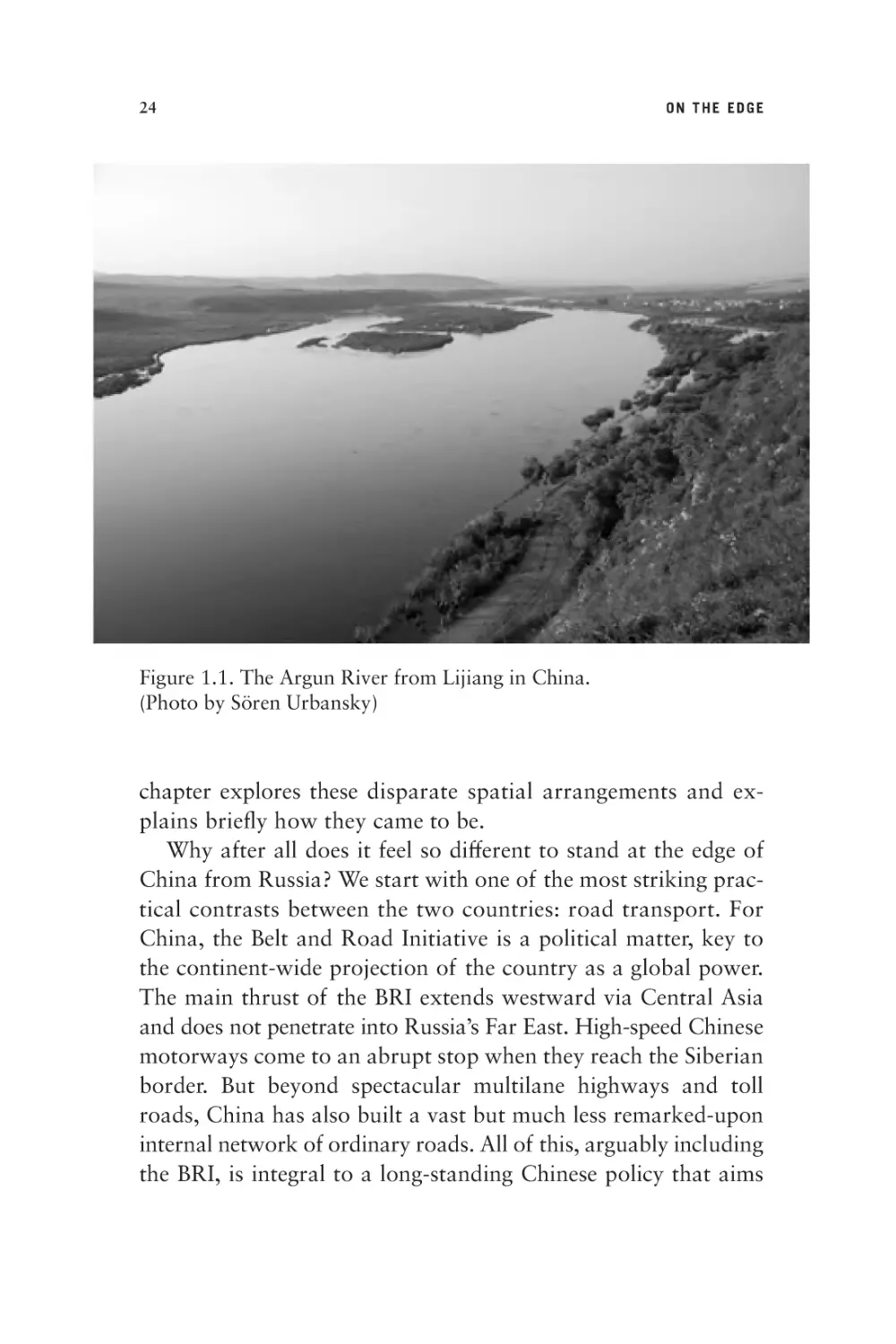
surveys the lonely, watery expanses of most of the border (see
Figure 1.1).
But the sensation that one is standing at the edge of a country
is still remarkably different in Russia from in China. This is
because the two states have created utterly incongruent administrative and infrastructural systems. T
hese have been built up over
the centuries and are salted into p
eople’s accustomed practices
and their assumptions about the way things should be. It is true
that scholars have drawn attention to what these two great countries currently have in common—political centralization, authoritarian government, rapacious capitalism, multiethnicity, and the
problem of control of the peripheries.1 But it is also true that this
generalization obscures the fact that each of these features can be
variously understood and acted upon. The divergence between
Chinese and Russian aims and methods has become particularly
apparent in the twenty-first century, and the border makes them
starkly visible. The routes and communication networks by which
the periphery is linked to the respective metropolitan centers form
increasingly dissimilar and differently weighted patterns. This
24
ON THE EDGE
Figure 1.1. The Argun River from Lijiang in China.
(Photo by Sören Urbansky)
chapter explores these disparate spatial arrangements and explains briefly how they came to be.
Why after all does it feel so different to stand at the edge of
China from Russia? We start with one of the most striking practical contrasts between the two countries: road transport. For
China, the Belt and Road Initiative is a political matter, key to
the continent-wide projection of the country as a global power.
The main thrust of the BRI extends westward via Central Asia
and does not penetrate into Russia’s Far East. High-speed Chinese
motorways come to an abrupt stop when they reach the Siberian
border. But beyond spectacular multilane highways and toll
roads, China has also built a vast but much less remarked-upon
internal network of ordinary roads. All of this, arguably including
the BRI, is integral to a long-standing Chinese policy that aims
B order S paces
25
at development via investment in transport infrastructure. A famous saying is often quoted in this context: “If you want to create
wealth, first build roads” (yao zhi fu, xian xiu lu). Along with efficient economic integration, the increasingly authoritarian government under Xi has intensified control over far-flung localities,
including through road building for upgraded border patrols. As
a consequence, even though China now has relatively few security concerns over its border with Russia, there are serviceable
“national defense roads” running along much of the Chinese side
of the border rivers, the Argun, Amur, and Ussuri. T
here are still
some areas of roadless forest, but wherever there is settlement,
all towns, villages, or local industries on the Chinese side are connected to one another by well-surfaced roads and linked to highways leading to the interior.
On the opposite bank in Russia, by contrast, no road runs
consistently beside the border, and the few tiny villages mostly have
to make do with dirt roads. In fact, Russia’s main routes—the
new Amur Highway, Route 297, opened by President Putin in
2010, and the nearby Trans-Siberian railway—were both planned
to run at a distance of some 25 to 40 miles from the border.
This means that settlements on the Russian side of the Amur are
marooned at the end of their own transport spurs. To go from
one to another it is necessary first to go inland to the main road,
travel along it, and then set out again. In other words, it is impossible to journey along the thousands of miles of this border on
the Russian side the way one can in China. One reason for this
situation is very s imple: the difficulty and expense of constructing
a road through dense forests, cliffs, and swamps in a landscape
that is hardly populated. A more weighty reason is the Russian
preoccupation with sovereignty and security, heightened in Soviet times, which saw the great border rivers as convenient barriers, preventing p
eople from e ither entering or leaving. Thus,
border security is maintained not by building roads, as in China,
but by their absence. T
here are in fact very few places where this
long border can be crossed. Only the three land border crossing
26
ON THE EDGE
points have substantial traffic, by rail for freight and by bus for
passengers, while the two river crossings, at Blagoveshchensk and
Khabarovsk, have to make do with more inconvenient ferries.2
Cross-border bridges over the rivers have been notably absent.
This lack is symbolic; somehow the rivers themselves remain both
physical and conceptual dividers, liminal spaces of separation. As
we explain in what follows, a less immediately evident f actor in
this situation, but structurally important, is the geopolitical rationale upheld by Russian governments over a long history that
established a particular “remoteness-creating” relationship to jurisdictional borders.
In China, by contrast, a far denser network of both railways
and roads covers all inhabited land (Map 1). The result is a grid-
like infrastructure, which in the 2000s was tirelessly updated and
extended, with new roads driven even into unfriendly terrain,
often in advance of projected settlements. This network serves a
far denser population: the population of China’s northeast is
now about thirteen times that of the Russian Far East.3 But it also
reflects a different state attitude toward outlying lands, which
seems to be shared by many ordinary Chinese—namely, that it is
a good thing to expand into unused spaces, support new enterprises there, and discover and exploit any possible sources of income. These days the towns on the Chinese side of the border
feel not like a lonely periphery but more akin to the avant-garde
of a comprehensive civilization. Yet a paradox of the situation,
which is similar in other Chinese frontier lands, is that while
actual geographical remoteness and cultural difference is being
erased in China as fast as possible, the center is simultaneously
exaggerating the idea of there being exotic “natural wilderness”
at its edges, both as its own desirable complement and also as
carefully tended economic resources from which income may
be drawn.4
In comparing the two systems, we want to connect the organ
ization of material space (administration, communication, and
infrastructure) with discursive space (how these entities are
B order S paces
27
imagined and talked about). We first describe the existing Rus
sian setup, turn to the contrasting case in China, and then take a
look at rivers as borders and explain why bridges over them,
linking the two countries, have been so notably absent. Finally,
we discuss the changes taking place right now and the tensions
between the results of the new thinking—new projects with
vaulting, global-scale ambitions—and long-standing social values
and obdurate realities. In this way, we set the scene for the themes
explored in the rest of the book, which concern how life is actually lived on both sides of this border.
THE CREATION OF BORDER SPACE IN RUSS IA
The unorthodox but insightful Russian geographer Boris Rodoman
argued that Russia is an “administrative-territorial monster”
that creates a specific kind of vacant space at borders.5 What he
had in mind was the historical hypercentralized hierarchy of
government and its associated radial infrastructure. This was
first established during the reign of Catherine the G
reat in the
eighteenth century, then became standard throughout the empire, and went on being reproduced up to the present day, even
though it became out of sync with population movements and
new centers of industry. T
here must be a vital motif that renews
itself, Rodoman writes, that is written into the land like a matrix. But what is this? His answer is that the pyramid of subordinated places encapsulated within one another springs from the
“anisotropic” character of Russian society. In physics an anisotropic object is one that has different properties in different directions, such as wood, which is stronger along the grain than
across it. Such an object can be tough in one aspect but also apt
to break up or dissolve when approached from a different angle.
The anisotropic aspect of Russian society is that its vertical links
are strong and its horizontal ones weak. It is this that is manifest
in the administrative structure and in fact in the entire sociocultural landscape. The vertical power relationships are reflected in
the radial roads that link the metropolis to the regional capitals,
28
ON THE EDGE
thence to provincial centers, to district centers, and finally to villages on the periphery. The drive comes from the center, to capture more resources on a linear trajectory in which what is in
front is seen as open wilderness, conceptually “lower,” and ready
for the taking. Looking back from the periphery, the center is
what m
atters. The only roads kept in good shape are t hose leading
“upward” to the bosses. Meanwhile, the roads r unning “horizontally” between small towns or villages are neglected (often becoming impassable in bad weather) or simply do not exist. Similarly, bus service, mobile phone signals, and so on fan out from
Moscow and from each provincial center, but they become more
exiguous and may give out at the edge of each jurisdiction. The
“monstrous” aspect of this is that it creates “remoteness” in the
gaps between the skeletal radial lines, which can exist sometimes
even quite close to a major city.6 It is in the peripheries of each
jurisdiction that the spaces involved are most stretched and the
minor roads most likely to peter out.
Anyone who has travelled even a little in our country knows that to
penetrate across the boundary between oblasts [provinces] in the
countryside, not on the main road that leads to Moscow but somewhere away from it, is like crossing a mountain ridge. You get the
very feeling of being on a mountain pass, the place it’s most difficult
to get to, where there are no roads at all. . . . Everyone talks about
the difference between Moscow and the rest of the country. Which
of course is substantial; but more important is the socio-economic difference between the center and the edge of each district, however
small. This is specific to Russia. . . . In each of our regions, whether
an oblast or a krai, there exists a depressed zone at their borders and
a vacuum that forms between them.7
This entire system goes with a sharply felt hierarchy of esteem.
Anna Kruglova, a native of Perm in the Urals, writes that in
Russia’s highly spatialized politics, the significance of a city recedes according to its distance from Moscow. So Perm is mocked
for its European pretensions: “It is indeed the last European city
B order S paces
29
as one moves east and accordingly down in social position on
one’s way both from Moscow and Europe to Asian Siberia.”8
With some exceptions that we discuss later, state funding, which
issues almost entirely from Moscow, follows this hierarchy.
In a process that accelerated after 2004 when Rodoman was
writing, the state got rid of much of its rural support apparatus.
Subsidized collective and state farms, mines, and rural industries
were left to sink or swim on their own resources and collapsed
one after another. During Soviet times, distances had been to a
remarkable extent “conquered” by subsidized low-cost air travel,
but now only one-sixth of Siberian airports and landing strips
that had operated in the Soviet era still are used. Local air service
is rare, expensive, and unreliable; buses and taxis refuse routes into
the back of beyond. Along the Siberian borders with Mongolia
and China this has left many p
eople stranded in former production brigades, reachable only a fter hours (or days) on dirt roads
and crossing rivers on pontoon rafts. Furthermore, when the
Soviet enterprises gave up the ghost, with them went the entire
social system they had supported and much of the associated
employment: machinery workshops, co-ops buying the farms’
produce, medical and veterinary services, bakeries, accountancy
offices, public bathhouses, local shops, clubs, libraries, kindergartens, public transport services, and local road maintenance
departments. People flooded out of the villages to nearby towns.
If a village population shrank too far, the school closed, and
with that the settlement was likely to decline into complete
decrepitude.
Rodoman’s “depressed zones” at borders expanded, while
the ribbons of relative prosperity narrowed. Next to the Rus
sian border with Mongolia, there are vast empty lands. The remaining Buryat and Russian villages of former collective farms
are often hidden down twisting sandy tracks; any surfaced roads
in the vicinity are kept maintained not for them but because the
roads run between more important centers. When I (Caroline)
30
ON THE EDGE
was traveling in the area, my eyes dwelt on the boundless luxuriant grasslands, sparkling rivers, and forested hills from which
a few enchanting pine trees spread into the plains. I wondered
aloud, “Why does no one live in this beautiful place?” But immediately I saw that this was a stupid question: who would want
to live alone and vulnerable in the midst of nowhere, with no
electricity and no road? The vacant land is owned by the Forestry
Department, I was told, and it would be a bureaucratic nightmare to even attempt to buy a plot from them. As for the pines,
a Buryat villager cried, “How can you say they are beautiful? I
hate them. Each one sprung up out there reminds me that this is
where we used to have our fields—our good productive fields.”
Many of the h
ouses are boarded up. The p
eople who remain
depend on their links “upward” to the district and provincial
capitals for pensions, medical services, banks, child benefits, remittances from their adult c hildren, and purchases of all kinds.
A similar situation exists in other vast rural sections along the
border as it winds its way along the Argun, Amur, and Ussuri
Rivers.9
In Siberia, the railways have been more important than the
roads as routes along which settlements have been established.
The roads of Trans-Baikal were separated from those of the Far
East by “the Gap,” a 1,300 mile section of notoriously boggy and
treacherous unpaved throughway between Chita and Khabarovsk.
In 2010 the gap was eliminated by the construction of an asphalted
highway, Route 297, the opening of which was celebrated by Putin
driving along it in a Russian-made Lada Kalina car. As Dominic
Ziegler writes in Black Dragon River, “The road was above all a
political project, made in Moscow. The Russian Far East had for
too long hung off the edge of the realm. The new road in symbolic more than practical terms, was intended to winch it back
in.”10 But, already buckling in places after only ten years, Route
297 epitomizes the uncertainty of road infrastructure in a climate
beset by b
itter subzero storms, glaring heat, melting permafrost,
drought, and flooding, in which the best-constructed roads can
B order S paces
31
become impassable rubble virtually before one’s eyes. The new
highway passes for the most part through wild, uninhabited lands,
and hundreds of miles separate the filling stations and cafes along
it. By contrast, a glance at the map shows hundreds of small stations strung along the Trans-Siberian and the Baikal–Amur Mainline (BAM) railways. T
hese are vital points in the wilderness.
Along the busy Trans-Siberian each station has accreted a settlement of houses, shops, garages, bars, and perhaps a school or a
club. Villagers anticipate the trains and gather to sell produce to
travelers, and they can take the slow local trains to visit neighbors
or sell their produce in the nearest city. The railways are slow and
overburdened, have been little modernized, and t hese days are held
to constitute a hindrance to Russia’s economic expansion in the
east, but socially, to travelers, they are linear and easily understandable, unlike the wandering and often impassable roads that
wind their way through forests to distant mining, hunting, and
logging settlements.11
Several films about disorienting journeys have been produced
in Russia, somewhat akin to the American road movie.12 The
Soviet-era theme of triumphant conquest of nature has long been
abandoned. Now the idea is to embrace the journey as revelation,
self-discovery, and cultural critique. It usually begins in a violent /
degenerate Moscow, but it leads to nothing idyllic: the car or truck
takes the protagonists to grim places with no signposts, where
there is no sense of location or destination. They wind up in
places that represent the past, where people are stuck in the
stupor of provincial life or pointless religious rituals. The car
stalls, or the road leads into an impasse—to entrapment and
death. In Zviagintsev’s The Return (2003), Fedorchenko’s Silent
Souls (2010), and Igumentseva’s Bite the Dust (2013), the road
is no longer a vital link between center and periphery but a
human-made path that leads to a place where the car can go no
farther—to w
ater (a lake, a river, a drowned island), which stands
for death. As it happens, none of these films refer to the g reat
Siberian border rivers, the Argun, the Shilka, the Amur, and the
32
ON THE EDGE
Ussuri. But these rivers do in fact, not only in imagination, function in one particular sense as a journey’s end: in a state security
sense.
CLOSED PLACES: POGRANZONA AND ZATO
Even in tsarist times the government regarded borderlands as po
litically suspect and from time to time carried out policies to
move or forcibly assimilate frontier populations deemed potentially disloyal.13 The subsequent Soviet government’s attitude was
if anything more security-conscious, and it likewise removed suspect peoples (Chinese, Koreans, Buryats, Nanais) from immediate proximity to the border in Siberia and the Far East. Fear of
emigration, regional separatism, and Stalin’s determination to
take control over peripheries turned the Far East into a militarized
garrison province.14 Between 1934 and 1936 the entire international border strip of the USSR was designated a closed security
zone (pogranzona). Officially known as the Restricted Access
Border Zone (RABZ), it continues to this day. In 2004 this strip
was placed u
nder the control of the Federal Security Service (FSB),
which operates directly from Moscow with little coordination
with the regional and local authorities. Fences mark its boundary,
and barriers with guard posts are stationed on all access roads.
Neither Russian citizens nor foreigners may enter u
nless they are
registered residents or have FSB permission. In places the pogranzona is only around 3 miles wide. But elsewhere the FSB, which
not only regulates but also benefits from all enterprises within the
zone, has taken the opportunity to broaden it up to 62 miles (or
to change the zone’s boundaries from time to time as it sees fit).
Currently, all the land along the Amur between the river and
Route 297 is in the closed area.15
On land, the physical border is a complex structure. Military
bases, some of which have short-range nuclear weapons whose
only purpose must be to “contain China,” are situated in the
rear.16 The border itself starts with a light fence marking the outer
edge of the closed zone. A considerable distance beyond is the
B order S paces
33
a ctual border: a low fence with warning notices, followed a variable length away by a plowed-up strip to show footprints, then
a strong high fence, and in places lights, security cameras, and
radar. Beyond this there is usually a further no-man’s-land before
the border fence of the foreign country. In the case of the rivers the
border runs along the thalweg (deepest channel). The existence
of the pogranzona / RABZ makes the situation at river and sea
borders complicated and erratic. Whereas some formerly entirely closed port cities, such as Vladivostok, w
ere “opened” after
the collapse of the USSR (though certain restricted military pockets
were retained within), other inhabited areas, including all riverside villages and parts of major cities such as Blagoveshchensk,
remained closed—in the latter case subsequently opened, then partially closed again. In principle, this means that a casual traveler,
particularly a foreigner, cannot enter these areas or travel down
the rivers by boat without obtaining special permission beforehand. And yet, and yet . . . given the fitful changes to the boundary,
the fact that thousands of people actually live and work inside
the closed zones, and the high chance that road checkpoints are
unstaffed, the a ctual enforcement of the restrictions is unpredictable. It is sometimes strict, sometimes not. The RABZ is essentially a buffer zone, and only the real border at the edge is truly
hard. At its final perimeter, Russia does not shade off into an indeterminate and permeable remoteness but ends at a hard, multiply reinforced boundary.17 The center may neglect vast tracts
of in-between lands inside Russia, but the rim of the country is
an object of focused attention and concentrations of diverse
security-related installations.
If the pogranzona is a continuous strip of land, the “closed
administrative-territorial formation” or ZATO (zakrytoe administrativno-territorial’noe obrazovanie) is different, a delimited site
for secret operations. In Soviet times, whole cities had this status,
and today it continues for military bases, prison camps, uranium
mines, military exercise grounds (polygony), secret research facilities, and factories for the production of weapons, especially
34
ON THE EDGE
nuclear ones. Such sensitive operations and penal zones are
often located in less-populated remote areas, and this means, as
Rodoman would have predicted, they are often close to borders.18
Not by accident, different kinds of screened-off operations are
often located in a single place. An example is the closed town of
Krasnokamensk near the Chinese border, which is the site of both
a uranium mine and a labor camp, the one where the magnate
Mikhail Khodorkovsky was imprisoned in the 2000s.
However, the multifunctionality of Krasnokamensk’s ZATO is
nothing compared to the diversity of operations found in the
border region as a whole. It contains places that are totally off-
limits and others that are in principle maximally open. The dense
untouched forests enclose boggy wastes, sad wreckages, crude
logging camps, and desultory agriculture redolent of the past.
But at the same time, this is a field of miracles. For one can turn
a corner and see the shiny steel grids and fluorescent high-vis
uniforms of new construction. They are the advance markers
of Russia’s pivot to the East, of its urge to make itself a major
player, economically, diplomatically, and politically, in the Asia-
Pacific. Most of the Soviet military bases and factories that used to
dot the frontier zone with China have long since been decommissioned. Their ruins may be a physical reminder of e arlier hostilities, but discursively they have been cast into oblivion by the
vibrant future now aspired to.19 Media and websites display
glowing images of technically advanced edifices u
nder construction. One of these is the huge Amur Gas Processing Plant being
built at Svobodny, near Blagoveshchensk, to service the Power
of Siberia pipeline that in 2019 began to convey gas from northern
Siberia to China.20 The 1,850 mile pipeline and the plant are both
heroic enterprises, built amid awesome difficulties of climate, geology, and distance. The plant w
ill supply Siberian towns as well
as process helium, ethane, propane, and butane for export. It w
ill
be one of the largest such plants in the world and is being constructed to international standards, with German, Chinese, and
B order S paces
35
other international participation. So far $22.1 billion has been
invested in the project, and at present 15,000 p
eople, including a
contingent of Chinese, are employed in the construction. The permanent workforce is planned to eventually drop to 3,000, with
use of automated equipment control and local renewables-based
power systems. In short, Russia’s attempt to switch to a high-tech,
value-added economic future is a reality, not a mere aspiration.
Yet it is not easily disentangled from the Soviet and post-Soviet
geographies in which it is taking shape.
This can be seen from the circumstances surrounding another
spectacular project located near the Amur Gas Plant. This is the
Eastern Cosmodrome (Vostochnyi Kosmodrom), the spaceport
that is being constructed to replace Russia’s aging facilities at
Baikonur on land rented from Kazakhstan. The Cosmodrome,
with its aspiration to vertical mastery of space and possibilities for
panoptic surveillance, is a “hyperspace of sovereignty,” a star in
Putin’s “global player” thinking.21 But the spaceport’s siting is
also related to the old Soviet order. The spaceport was originally planned for the Far East coast, but that site was rejected on
the grounds that falling debris would disturb ports and shipping;
it was then decided to locate the spaceport near military facilities
that were already producing and launching rockets and missiles.
The Eastern Cosmodrome is being built near a Soviet rocket
launch site at Svobodny (closed in 2007) and next to the small
ZATO of Tsiolkovsky. This town, renamed in 2014 after Konstantin Tsiolkovsky, the
great pioneer of astronautics, was
formerly called Uglegorsk, and it manufactured the ICBM missiles launched from Svobodny.22 Many of the Cosmodrome construction workers are housed in former military barracks at
Tsiolkovsky.
The Cosmodrome can be accessed by the Trans-Siberian
railway and Route 297, but even so, it has proved difficult to
overcome the problems of remoteness for the construction of a
complex, ultra-modern facility (Map 2). Air freight is expensive,
Vostochny
Cosmodrome
R 297
Tsiolkovsky
Dark patches represent city,
village, or industrial site
lwa y
Tra nss ibe ria n Rai
0
6 miles
0
10 km
R 297
Z e
Gazprom
Complex
y
a
R.
Svobodny
R 297
Map 2. Svobodny and the Vostochny Cosmodrome
B order S paces
37
and supplies proved difficult to assemble. T
here were delays. Contractors went into debt. The spiraling costs w
ere swollen by corruption involving both officials and contractors. Many of the
workers originally hired for the project fled the loneliness and
mosquitoes; students had to be drafted in, but they went on strike
when they were not paid for their work. Several unpiloted rocket
flights have nevertheless been successful, but as of 2019 the
Cosmodrome project was far from finished. T
here are Russian
critics who say that the original idea was misguided and that the
project now has “no meaning.”23
A practical problem such critics may have in mind is that the
project of turning the Eastern Cosmodrome into a vital regional
center is at odds with Rus
sia’s continuing “administrative-
territorial monster.” The space industry’s research and development facilities are centrally concentrated in European Russia,
thousands of miles away.24 The idea had been for the new Cosmodrome to boost the economy of the depressed Amur region,
to create an innovation cluster that would attract bright young
specialists. Instead, the accompanying “innovation hub” was
built near Moscow, and only a skeleton crew was sent to Svobodny, the nearest sizable town to the spaceport. Located as it is
in archetypal isolation, the spaceport, notwithstanding its ultra-
modernity, cannot avoid being entangled in the former uses of
these remote lands. And Svobodny, despite its name, which
means “free,” was also a ZATO, the site of the Baikal-Amur Lager
(Bamlag), one of the largest camps of the Gulag system in the
Stalin era.
The name Svobodny in fact refers to an agglomeration of facilities with an extraordinary multilayered history. It started as a
small fishing-hunting settlement on the Zeya River, then became
a gold rush town, then a Soviet labor camp for building the Baikal–
Amur railway, and then, after the camp was closed in 1953, a
town with a single factory manufacturing automotive parts and
military equipment. The rocket launch site was built some 9 miles
to the north of the town. As a ZATO, it was in some ways blessed.
38
ON THE EDGE
During the Soviet period one of Svobodny’s charms was its narrow-
gauge “children’s railway,” built to link the town to idyllic Young
Pioneer summer camps; almost all the railway’s jobs (cashiers,
conductors, station attendants) w
ere performed by schoolchildren.25 But after the factory closed in the 1990s, the town’s
population fell from 80,000 in 1989 to 54,000 in 2016. Svobodny became the town it is today: a quiet, dilapidated, melancholic place. Yet because of its transportation advantages—it
has an airport, two stations on the Trans-Siberian railway, a road
link to the Baikal–Amur railway, and a port on the river Zeya—the
plan is for it to be transformed into a fast-growing industrial hub
and dormitory town for the Gas Processing Plant and the Cosmodrome (see further discussion in Chapter 3).
However, it is the local authorities that actually have to bear
the costs of the projected regional refurbishment. For example,
Tsiolkovsky (population around 5,000), given priority b
ecause it
is a ZATO, was supplied with an extra-large central heating plant
in the expectation that the town would grow. But so far there has
been no great inflow of residents and no corresponding income,
and the cost is a drain on the local state budget. The result is that
other projects are stalled. A nearby town, Romny, languishes in the
forest at the end of 12 miles of earth road, and the entire Romny
district, with 8,000 residents, is no better off. “There is no money
for your road,” said the embattled Amur governor, Vasilii Orlov,
to a meeting of angry residents in August 2018. “It would cost
around 700 million rubles and the entire income of Romny is
barely a quarter of that. We have to pay for central heating plants
for many settlements around h
ere—and what happens, the population just goes on leaving. Leaving. Leaving. But we c an’t shut
off the heating while people are still living t here. And we cannot
close down the villages and deport the residents e ither. That would
be political illiteracy. Everything must be on a voluntary basis.”
To this despairing speech from the governor (who apologized for
its frankness), a bitter voice from the hall responded: “So there are
plans. And plans for what to do about the population. But poten-
B order S paces
39
tial investors are saying almost openly, ‘First quit drinking and
observe the law.’ What with the traditions of Svobodny—the
center of the Bamlag, the Amurlag, and later also the Svobodlag—
not everyone has the strength for that.”26 We see from this that
attempting to conform to Moscow’s projections for the future in
an obscure, depopulated location brings a host of contemporary
problems and cannot silence memories of what happened in t hese
same places before.
Strangely, from an outsider’s point of view, the p
eople living
in ZATOs seem relatively content with their lot. Why do they not
object to living in what might seem a prison-like enclosure? The
stark fact is that the Russian Far East, which includes the vast
area from Lake Baikal to the Pacific, is losing population.27 People
are moving away, generally to western parts of Russia. This is
despite the fact that the main towns, Chita, Blagoveshchensk, and
Khabarovsk, have many pleasant aspects of the typical Russian
provincial city: they are unhurried, spacious, friendly, and unpretentious, with tree-lined streets, fine nineteenth-century mansions and cathedrals, and plenty of stores. But the 1998, 2008,
and 2014 economic crises hit hard; there is a lack of opportunities and a feeling of insecurity and decline (see Chapter 3). By
contrast, people living in “closed zones” have always had protected jobs, special supplies, and good-quality housing. Regionally speaking, they are privileged. As soon as their town loses its
ZATO status, the benefits and security vanish. This has happened
to a number of towns along the border after changes in military
priorities and decommissioning of stocks of nuclear arms.
CHINESE GEOPOL ITIC AL SPACES AT THE BORDER
Black Dragon River (Heilongjiang) is the Chinese name for the
Amur. Along with different names for rivers, towns, and mountains, a distinctively Chinese history of the region is taught in Chinese schools and displayed in Chinese museums (see Chapter 5).
The Chinese and Russian accounts are very different, and extend
even down to what ordinary p
eople on either side of the border
40
ON THE EDGE
accept as truth about the source of the Amur River. In one Rus
sian version, the source is the Ingoda, the northernmost of the
inflowing rivers from the west, and definitely located inside
Siberia; in certain Chinese publications, by contrast, the origin is
the Songhua (also known as the Sungari), a river that has its
source deep in the Changbai mountains, on the border with North
Korea.28
With this Chinese attribution, a different geography swings
into view: that of a vast river basin opening to the sea and encompassing both sides of the border. The physical reality is
subject to a powerful representational structure very different
from that found north of the border. If the Russian idea of the
Far East is based on its history of west-to-east advances out of
Moscow, subduing territories and indigenous peoples in linear
moves until the Pacific coast is reached, the Chinese one is not
linear but a series of concentric circles expanding outward from
an inland central zone. Takeshi Hamashita has provided one of
the best analyses of this Chinese vision.29 Challenging Eurocentric history, he argues that this was a space combining a landed
and maritime world. “The seas and the land should be understood . . . as part of a larger whole in which the land is part of
the seas (and vice versa). The sea forms, in short, a road, a basis
for communication and network flows, not a barrier.”30 The major
principle that brought this far-flung and disparate world into a
kind of unity was the system of tribute and trade relations that
functioned from the Tang dynasty (seventh century) to the end of
the Qing dynasty (1911). This was a conception of hierarchical
order sustained by the Confucian “rule of virtue” in the person
of the emperor / ruler. Backed by military force, it nevertheless
allowed subordinate realms such as Korea, Japan, Laos, and
Vietnam to assert themselves as “centers” vis-à-vis the smaller
states and areas under their sway. Tributary states sent periodic
tribute missions to the Chinese capital. These were not only
political-diplomatic operations, involving exchanges of valuable
gifts, but involved trade as well, since licensed merchants accom-
B order S paces
41
panying the envoy w
ere entitled to engage in commerce at allocated places in the capital. China’s land-sea orbit included settlements in lands that are now part of Russia, and the current
major towns all had earlier Chinese names: Vladivostok, for example, was called Haishenwai (海参崴, “sea-cucumber cliffs”)
and was reached by boat.31 Today, China’s ancient sea-embracing
vision is being brought to the fore again with its installations in
the South China Sea.
China’s vision of itself changed over the centuries, but at no
point did it involve a single definite border; rather, it consisted of
a cultural core in central China ringed by an expanding series of
nested realms, gradually incorporating land on the margins via
the Sinification of surrounding barbarian groups. The line between self and other lacked clarity and was subject to contestation and revision.32 On land, imperial China had “inner” and
“outer” realms, divided first by the Great Wall in its various
manifestations. The G
reat Wall separated the zhongyuan (central
plain) from the saiwai (beyond the pale), which was conceptualized as a zone of bleak deserts and bitter cold. Past that, beyond
the mountains and stretching up to Siberia, was beidahuang, the
dreaded Great Northern Wilderness. Exiles w
ere regularly dispatched to languish in this outback, and in this respect the frontier region was used in a way similar to the Russian use of Siberia.
However, the Manchu conquest of China in the 1640s brought
a vision different from that of the Han Chinese, since the Manchu’s own lands were in these outer realms and were designated
sacrosanct ancestral territory. Manchuria, known in China as
Dongbei (the Northeast), was separated from central lands by
the Willow Palisade, beyond which Han were not permitted to
settle.33 The G
reat Wall had no particular significance for the
Manchus—the allied princedoms of Inner Mongolia lay in an arc
around it, and Outer Mongolia was an important component of
the empire lying beyond even that. Yet fundamentally, once the
Manchus had ensconced themselves in Beijing, they conformed
to the Han Chinese vision. The legitimacy of the great Qing
42
ON THE EDGE
empire they founded, whose dimensions were inherited first by
the Republic of China (1912–1949) and later by the People’s
Republic of China, rested on the Manchus’ claim to status as
members of the traditional Chinese order, which “enabled them
to win the confidence of other Inner Asian peoples and bring them
into the fold.”34
Russia, from its first missions to China in the seventeenth
century to establish trade relations, had difficulty—like Britain in
the eighteenth century—in extracting itself from the Chinese conviction that the country was another gift-bearing tributary. At
issue was the clash of two utterly different conceptual principles:
the old East Asian hierarchical tributary order extending outward
from the Middle Kingdom (Zhonghua) versus the treaty relations
between sovereign states that underpinned international relations
in Europe.35 In the end, after elaborate one-upmanship ploys by
both sides, the pacts that established the northeastern border, the
Treaty of Nerchinsk in 1689 and the Treaty of Kyakhta in 1729,
were defined as agreements between equally ranked sovereigns,
an outcome attributable to the relative flexibility of the Manchu
rulers, with their Jesuit advisors, compared to Han Chinese officials. But this did not prevent the Manchu Qing rulers from
subsequently high-handedly cutting off trade with Russia, sometimes for years, as was customary with tributary states that
displeased China. The Qing government needed to keep its
northern frontier quiet while it dealt with new acquisitions and
disturbances in the far west and south of its empire (a situation
that has parallels today). Eventually, the Manchus came to the
conviction, acquired from Han political thought, that their rule
constituted the center of a world order, a historically evolved
hierarchy of civilization surrounded by variously ranked barbarian peoples.
As their dynasty weakened in the late nineteenth century, the
Qing were unable to prevent a trickle and then a flood of millions of Chinese immigrants into Manchuria, which became
“perhaps . . . the greatest peaceful migration in history.”36 Still,
B order S paces
43
it was images of Manchuria as a pristine land of “primitive” peoples
unrelated to the Chinese that encouraged early twentieth-century
imperialist incursions into the region by Japan and Russia.37 Both
countries, first Russia and then Japan, built railways across Manchuria with primarily military-strategic aims. For a period, this
gave Manchuria, unlike the rest of China, an infrastructure similar
to Russia’s: scattered towns linked by railways that snaked through
great areas of neglected underdevelopment. But after World
War II, the old Chinese vision of expansion outward through concentric circles reappeared: peasant farmers w
ere encouraged to
settle in all empty lowlands. Further out in the G
reat Northern
Wilderness Mao Zedong sent “class enemies” to state farms and
prison labor camps near the border with Russia, making a far
more determined effort to re-educate and transform minds by
socialist labor than was attempted in the Soviet Gulag.38
Meanwhile, in the south of Manchuria and closer to China
proper, the Communist Party took advantage of Japanese construction and established state-owned heavy industry, manufacturing, and mines. This zone became socialist China’s “cradle of
industrialization” and its wealthiest area from the 1950s to the
1970s. However, in the post-Mao era many of these factory towns
declined into the country’s largest rust b
elt, unable to adapt to
rapidly changing markets and technology. Privatization led to millions of layoffs in the 1990s, and the subsequent economic growth
was less vibrant in this area than elsewhere. The northeast as a
whole is still known as the nation’s “last fortress of a planned
economy” and a relatively deprived region.39 It was hard hit in a
downturn between 2013 to 2017, prompting an exodus of young
people to other parts of China.40 China’s high-tech industry and
space facilities are located elsewhere.
Bitter memories of these violent swings lie behind the policies
that inspire current Chinese structures of center-periphery relations. The problems look analogous to those in Russia’s Far East,
but the solutions are very different. With a more multicentered view
than that in Russia, g rand plans were issued to turn Manchuria
44
ON THE EDGE
into China’s “Fourth Economic Engine,” to rival the three
capitalist-style powerhouses in the south. But President Xi in a
state visit to the northeast in 2018—a deliberate mirroring of
the inspection tours of Chairman Mao—declared that not private
enterprise but the region’s great state-owned enterprises (SOEs)
would be supported and encouraged to become global players.
The idea is to shore up the country’s self-reliance in the face of
US intransigence instead of relying on an open and liberal trade
regime for continuing growth. Many regional leaders are glad.
They have had to live with the effects of the previous policy of
privatization, foreign investment, and corporatization of public
assets and are nostalgic for a past when SOEs dominated the
economy. In short, the new regional policies aim to shore up state
employment and to even out economic and ethnic inequalities.
Even more broadly, this is an aspiration to homogenize and “fill
in” the entirety of China with harmonious “civilization.” At least
seven types of administrative entity are involved in this plan, and
their nesting and ranking vis-à-vis one another create dense, impenetrable, and overlapping relations extending right up to the
border.
In the 2000s, reforms aimed broadly at three areas: decentralization of power and delegation of rights, simplification and rationalization of administration, and gradual building of a government ruled by law. Fiscal decentralization in particular brought
about de facto “taxation federalism,” in which local governments
acquired significant powers not only to retain a large portion of
the taxes they collected but also to sell and rent out land, charge
fees, create local legislation, and engage independently in investment, even outside China. This system of dispersion has been relatively fluid, in constant negotiation with central government.41
Nevertheless, the general trend was in many ways the opposite
of that ongoing in Russia, which has continued to be focused on
centralization in the hands of the presidential apparatus, with
reduction of the number of levels between the top and the bottom
B order S paces
45
of the system, almost all taxes paid to Moscow, and a weakening
of local self-rule. Decentralization was a key impetus for the astonishing innovation and growth that has taken place in China
over the last two decades.42
However, Xi Jinping has recently recentralized many aspects
of power, focusing especially on fiscal reform, security, military
investment, control of the internet, and campaigns against corruption. In economic policy, there has been a move away from
labor-intensive activities and toward value-added high-tech production, development of services and internal consumption, and
attention to the environment, as we discuss further in Chapter 2.
New high-speed roads and railways cut out spectacular routes,
sweeping to the border with Russia, where they abruptly stop.
This ultra-modern infrastructure ties in certain points on the
periphery to central China, but as I (Caroline) observed, in Inner
Mongolia it also has an undesired effect. P
eople with low incomes
avoid the new toll roads and expensive railways, the h
umble
local roads become clogged with trucks, and inequality is in fact
reinforced. In the cheery sociality of cheap roadside cafes there
is a distinct feeling of separation from the well-off people who
thunder past on the elevated motorways. Meanwhile, towns
chosen for “redevelopment” become unrecognizable forests of
high-rise apartments, inducing a sense of disorientation among
older residents.43
Along with the massive infrastructural development, Xi has
returned to older Chinese traditions of statecraft, calling for a
merging of Confucian with Communist morality and the responsibility of officials toward “the people.” Now, he reiterates, the
market is to be firmly managed by the state. Overly hasty or unscrupulous entrepreneurs, including those investing abroad, are
to be reined in. For disadvantaged regions, such as the northeast,
investment has been poured in, not only for roads, railways, and
new housing, but also for w
ater supplies, sewage works, hospitals, cultural facilities, and telecommunications—but inequality,
46
ON THE EDGE
Figure 1.2. The two sides of the border at Tongjiang.
(Google Earth)
low wages, and lack of employment persist. Now the demands
for socioeconomic justice that come with rising incomes are more
urgent than before.44
A glance at Google Earth reveals sharply different patterns on
either side of the border. Figure 1.2 shows the border between
the largely empty Jewish Autonomous Region in Russia and the
uniformly settled Jiamusu county of China. Central to the picture
is Tongjiang town, located near the confluence of the Songhua
River with the Amur.
How are these densely populated Chinese borderlands orga
nized internally? Two sets of statist players came to dominate
B order S paces
47
a fter the reforms of the 1970s–1980s: state institutions inherited
from socialist vertical organization (central government, party
and military bodies, and the enterprises owned by them) and municipal governments. China’s internal politics unfolded as “an
intra-state struggle over land between these two sets of statist
players.” 45 Their relative fiscal freedom encouraged the municipalities to become far more enterprising than the socialist land
masters. From the early 2000s, their jurisdictions were extended
out from town boundaries to include swaths of the countryside
beyond.46 The idea was to reduce differences between urban and
rural citizens, as well as between various ethnic groups, and to
spread economic enterprise. As geographer Youtien Hsing argues,
such an expanded municipal region is not just a spatial unit defined by economic integration but should be understood as a “territorial dynamism, in which the administrative order sets the
parameters for the restructuring of state power.”47 The dynamism
was apparent through the municipality’s engagement with a third
element: private, non-state commerce. In other words, the municipality, rather than being a passive object of state policy, has become an active constructor and integral engine of the local state.
Manzhouli, the Chinese town on the Russian border, which
we discuss further in Chapter 6, shows t hese processes in action.
Its municipal boundary extends out to embrace a number of
“zones”: an industrial processing zone, a Russian industrial economic zone, a Russian-themed tourist park, a free trade zone
3 miles away, and the open-cast coal mines at Zhalainuoer (Jalan
Nuur) 15 miles away, all of which are integrated by rail and road.
In the free trade zone, small businesses include Russians selling
such things as honey, cakes, and wooden carvings to Chinese
tourists. Zhalainuoer, by contrast, is an archetypal state-owned
location for heavy industry, with the accompanying environmental pollution. It was built, in fact, by the Soviets during the
“friendship” period of the 1950s.48 When we visited in 2014,
steam engines of antique appearance still puffed slowly past faded
concrete buildings. The place indeed had a rust belt appearance.
48
ON THE EDGE
But coal is still needed, and long chains of dusty wagons clank
their way to factories in the region. Zhalainuoer’s enterprising
citizens have taken the paradoxes of their situation in hand. With
an eye to tourist income, they have opened a large modern
Museum of Mining (with popular exhibits of steam engines),
have built a colorful replica of St Basil’s Cathedral in Moscow,
and have also reached back in time to concoct an almost surreal
“archaeological park” for tourists, with statues of dinosaurs and
mammoths. We see from this that in China the complex arena
called “the state” includes more inventive, self-reflective, and
subtly multivocal local initiatives than the monocentric and rigid
equivalent in Russia.
In its way, the landscape along the Chinese side of the border
is almost as heterogenous as the Russian one. In Manzhouli,
downtrodden rubbish-strewn shacks from the Maoist era still
exist not far from gleaming shopping malls. In Hunchun, smart
new apartment complexes stand alongside the already peeling entrance arch to the deathly quiet Russian enterprise zone. But any
shabby remnants of the past are insignificant beside the towering
ramparts of the new housing and industrial estates that have been
funded by large-scale debt and land revenue machinations on the
part of municipalities. The incentives for officials to demonstrate
“development” (and then move on to a higher post) has resulted
in the construction of “ghost towns”—whole schemes that are
largely deserted (see Chapter 7). Projects to create impressive
public buildings and elite housing in order to increase land prices
and hence enhance municipal revenues occur all over China.49 On
the border they are particularly striking, in contrast to the more
modest and often faltering schemes in Russian areas where such
large credits are not available.50 Caroline visited one elite gated
development outside Yanji, near the border with North Korea
and Russia. Hoping to attract ambitious business buyers, it was
named Davos City and constructed in “Spanish style,” with red
tiled roofs, classical gazebos, and flowery gardens. The developers
B order S paces
49
ere falling over themselves to sell, for purchasers at this incon
w
venient out-of-town spot had been very few. The chances of
coming across such globally attuned exotica across the border in
Russia are close to zero.
However, the description given so far of two different life-
worlds ranged across from each other is only part of the story.
For one thing, China and Russia have in common both a practical problem and a potential opportunity: the rivers themselves.
Even if “natural borders” are never entirely natural—they must
be negotiated, and the seemingly obvious dividing line does not
signify the same t hing to the different parties involved—we should
not forget that g reat rivers have their own physical properties and
can never just be borders.51
THE RIVERS: WATERY EXPANSES OF CONTACT
AND DISRUPTION
According to international agreements, the line of the riverine
border runs along the thalweg, which forms the main navigation
route. Because of border regulations and the exclusion zone on
the Russian side, the rivers cannot serve as an ordinary public
transport route for either country.52 Yet the Shilka, Argun, and
Amur are navigable, though they are shallow in parts, and confusing with their twists and turns. Historically, these rivers were
some of the main routes by which the Cossacks first explored
the Far East in the seventeenth century. It was possible simply
to float people, animals, and goods down them on rafts. Waterways became the lines of flight for peasants escaping serfdom
and religious persecution in central Russia. Later, political leaders
reimagined the rivers as supreme passageways for Russia’s achievement of its Eurasian destiny. By the mid-nineteenth century,
when Moscow turned away from Europe, Russian leaders were
projecting a route to the Pacific, and the glow of the Amur, one
of the very few rivers in Asiatic Russia flowing eastward, came
to transcend the grim connotations of the name Siberia. H
ere lay
50
ON THE EDGE
a land from which wealth would be garnered from gold, coal,
and productive agriculture.53 Even though the a ctual prospects
for shipping at the Amur’s mouth w
ere only sketchily mapped, a
bonanza in exports and imports was anticipated. Regaining control of the Amur from the Chinese became an obsession. This
was achieved first by military expeditions and then by the “unequal treaties” negotiated with the weakened Qing by General
Nikolai Muraviev-Amurskii in 1858 and 1860. Russian peasants were encouraged to settle the land as fast as possible, and
the rivers became busier than any toilsome road on land.
Until the Trans-Siberian railway was built, passengers took to
river steamers for the 1,428 miles between Sretensk on the Shilka
and Khabarovsk on the Amur. Mail also traveled this way, tossed
into the hold in vast leather sacks. Convicts bound for Sakhalin
were towed behind in prison barges.54 By 1900 the summer
months saw regular boat service taking motley passengers to and
from the river ports: Russian fur merchants, Chinese traders,
peasant settlers, gold miners, Cossacks, engineers, river officials,
European and American prospectors, adventurers, priests, brigands, and generals. Zigzagging between villages on either side,
small mail boats would drop anchor to take on local passengers.
Evidently cultural influences went back and forth across the river
at this time: a British traveler describes “slither-limbed, pale-
faced” Chinese with no money wanting a cheap passage, some
“dressed in native attire, blue-bloused, baggy-breeched, with
greasy l ittle skull caps, others in ill-fitting Russian caps and leather
boots, and one wearing Chinese lower garments but with a red
and yellow striped blazer and an old English straw hat with a
yellow and blue band.”55
Over its history, the Russia-China border has opened and
closed—or more accurately, its operation has enabled some
people to pass and barred o
thers in variable ways at different
times.56 The period at the beginning of the twentieth c entury,
when China was weak and subject to imperial advances on all
sides, was a time of maximal opening. The Amur hardly func-
B order S paces
51
tioned as a border. Instead, it is better understood as a system of
arteries draining great rivers from inside China as well as Russia,
and thus connecting a rich array of cultures and lifestyles and facilitating the flow of goods. Nevertheless, the passage was always somewhat treacherous: in many places the rivers divided
into tortuous side channels or snaked around looping bends. In
winter, they would be heaped with lumpy ice; in summer, there
were fast-running currents in some places, whereas in others the
flow was interrupted by countless islands, shoals, and sandbanks.
Both torrential rains and droughts could unpredictably change
the river’s course, so it became unclear where the border actually
was. Every couple of years, heavy thunderstorms, premature
freezing, epidemic diseases, or floods would wreak disaster. The
hazards of such changeable natural conditions interfered with imperial colonization policies. The settlements along the Amur ordered by Muraviev-Amurskii “started out as tiny, bleak villages
and they have remained like this to the present,” while flourishing
cities elsewhere on this vast drainage system, such as Harbin, on
the Songhua, owed little of their prosperity to their proximity to
the river.57 In this riverine landscape, islands w
ere places of uncertain sovereignty, and the chaotic movement of people and illegal trade were constants (see Chapter 2).58
The river’s haphazard activity not only disturbed international
relations but also could turn ordinary lives upside down. The following Russian account from a village near Khabarovsk gives
some insight into local attitudes, both to the river and to ways of
gaining a living in these parts:
My friend, now a land surveyor, was de-mobbed from the army with
his party ticket in his pocket and he needed work. As bad luck had
it, the village shop had no keeper and our brave sergeant was sent to
take over. He hadn’t a clue about trade. . . . No surprise, my friend
was ruined. Fearing an inspection, he pored over the accounts time
and again, and was reduced to drying out crusts of bread. Who knows
if they’d have been useful, b
ecause suddenly there was a massive flood
and the shop got washed away with all its provisions. “I stood on a
52
ON THE EDGE
hillock,” he said, “and saw the boxes and bottles swept away down
the current, and I grimaced, but my soul was singing. Hey, that time
was ended! I bowed deeply to Old Father Amur and vowed never to
have anything to do with trade again. . . .
The Amur has various names, and one of them, “Black Dragon,”
is as good as any. It expresses the snake-like form of the river, its
brownish water, and its uncontrollable, unpredictable character. And
the gloomy black of the basalt rocks on its shores.59
CROSSING THE AMUR: PHANTOM BRIDGES AND
AMBIVALENT INFRASTRUCTURE
If transport today along the rivers is sparse, what about the connections across the border? In 2020, by far the majority of cross-
border traffic is by rail. Railways have long been established in
Russian political culture as a means of “opening up” (osvoeniye)
lands to be taken over and developed. There is something g rand,
solid, and admirable about railways as they plow through the tunnels, mountains, and seemingly endless forests of Siberia. Built
at such harsh cost, at first by convicts and later by volunteer labor,
they were national (all-Soviet) endeavors that at least by the
1960s–1970s invoked comradely “socialist internationalism.”
The station architecture of the Baikal–Amur Mainline represents
this concept.60 The imaginative and exuberant styles of each
station represent the sponsoring cities throughout the Soviet Union
that sent crews and designers to the heroic enterprise. But the
Russian railways have not been modernized, and now the idea
of railways trailblazing on behalf of the whole country has been
taken up by China. A rail freight line was the vanguard of China’s
New Silk Road link to Europe in 2017. However, there is a hindrance at the Rus
sian and Mongolian borders: the technical
problem of different gauges (Russia’s wide, China’s narrower).
This is one reason the main crossing point between the two countries, the land border between sleepy Zabaikal’sk and bustling,
brightly lit Manzhouli, tends to be a bottleneck. Long freight
B order S paces
53
trains trundle slowly through, carrying timber, minerals, and
metals southward, but there are vast marshaling yards where hundreds of train cars wait for customs clearance or to have their
bogies (chassis) changed.
Building bridges over the border rivers has been a much more
fraught m
atter. At the time of writing (winter 2020–2021) there
is no functioning bridge for road passenger traffic over the Amur.
It is not just that such bridges require technical feats of engineering, or that they are costly because their foundations alter
currents and make further water management schemes necessary.61 Bridges are politically symbolic in a way that does not
seem to apply to land crossings.
Water systems shared between countries, such as the Tigris and
the Euphrates, the Mekong, and the Rio Grande, create possibilities for cooperation or obstruction, but almost always one nation holds the advantage. T
oday in our case, that is China. The
Chinese, unlike the Russians, do not see the Amur in terms of defensive security. Rather, aware of increasing water scarcity in
China, Beijing is interested in harnessing the river for intensive
manufacturing use (paper and pulp production, chemical pro
cessing) and for irrigation of intensive agriculture. Beyond that,
building cross-border bridges has a quite different resonance in
the twists and turns of each country’s history of political thought.
The contemporary official Chinese discourse screens off the historical conflicts associated with boundaries such as the G
reat Wall
or the Amur River. The G
reat Wall, for example, has now been
reimagined as a “cradle of communication and fusion” and a
“bond” linking different civilizations.62 Once such a vision is
conceived, China has the political and financial means to try to
make it something like a reality. Reimagining borders as “bonds”
can be seen as a natural outcome of the attachment of outer
realms to China as the center. Hints in Chinese media—never fully
official but often recurring—allude to the possible “return” of lost
lands to China.63 For Russia, on the other hand, the state border
54
ON THE EDGE
has historically been a sacrosanct closure, and it is an advantage
if it happens to run along such a powerfully un-cozy river as
the Amur; any bridge would pose the risk of uncontrolled
incursions. The saga of the Blagoveshchensk–Heihe bridge, long
since announced but still not yet functioning, is testament to
these antinomies.
We should clarify first that Russia under Putin has been an energetic builder of many ambitious, beautiful, and excellently engineered bridges inside its own territory. So is not the difficulty
of construction but the destination of this bridge that seems to
have been the problem. The Blago–Heihe bridge has been held
up for more than thirty years, as a condensed record sent to us in
2015 by a former resident of Blagoveshchensk describes:
A railway bridge across the Amur (Heilongjiang) was proposed in
1988, when two border cities Blagoveshchensk (Russia) and Heihe
(China) saw the start of the great cross-border shuttle trade. In 1991
the Chinese National Planning committee approved the bridge. In
November 1992, a company called Most [“Bridge”] Ltd. was created
in Blagoveshchensk. The idea was that this company would accumulate money from ordinary p
eople in return for vouchers and invest
them in the building of the cross-border bridge. In 1994 Presidents
Yeltsin and Jiang discussed and supported the construction of the
bridge. In 1995 Russia and China signed an agreement—but that was
the high point of the bridge-dream. In 1996, in the government’s program for social and economic development of the Russian Far East
there was only one short sentence: “The geography of Eurasian transit
might be affected by the construction of a bridge across the Amur.”64
This unclear statement was repeated in various strategies and programs, while the bridge still existed only on paper. In 2003 China
proposed building the bridge, both railway and vehicle, at their own
expense. In 2004 all relevant Russian committees approved the construction of the bridge, including even the FSB. A start date was set—
December 2004—and in 2005 Heihe officials said they hoped to finish
the bridge that year. But straightaway Russia became “anxious” about
the monopolistic position of China if China were to be the sole investor. In 2008 Amur Oblast saw the appointment of a new governor,
B order S paces
55
and he started his term with an announcement of the necessity of the
bridge. He was replaced by the next governor, who made the same
announcement. In 2012 a real bridge appeared—but it was only a
seasonal affair of floating pontoons. And that bridge did not work
for months, b
ecause its use (not construction) was not approved by
Moscow. In 2013 the mayor of Heihe announced that everything
was ready for the construction of a proper bridge and the Amur governor was also e ager to start the project. Nothing happened. Russian
expert advisors were warning that “a bridge is not only a connection
between states, but also a tool of intrusion,” and regional officers of
the FSB made the same objection. However, in summer 2014 the Amur
governor reverted again to the possibility of bridge construction.
The Black Dragon too played a role—a great flood in 2013
swept away early stages of construction. But by 2018, the Chinese
side had built their approach road and some spans of the bridge.
The Russians also had started construction, but then their builders
stopped, b
ecause they had not received instructions from Moscow
on how to set up the border crossing controls. The next Amur
governor, Kozlov, worried that this border sovereignty issue would
take far longer to agree than building the bridge. Meanwhile, talks
had to be held with anxious private investors.65 And Kozlov had
yet to reach agreement with Lu Hao, the governor of Heilongjiang,
about whether people driving personal cars would be allowed to
use the bridge, something for which there was considerable demand from middle-class Chinese tourists visiting Russia.66
This saga reveals first that the building of this bridge involved
a multifarious assemblage of actors, from presidents through regional governor to local mayors, as well as the FSB, private
funders, construction companies, and “Russian expert advisors.”
The various Chinese agencies were consistently in favor of construction, but the Russian side was divided and hesitant. A major
pattern that emerges is a disjunction between the provinces and
Moscow: while the Amur Oblast governors w
ere in favor of the
bridge, or at least publicly declared themselves so, the powers in
the capital, including the FSB, had a more erratic and / or negative
56
ON THE EDGE
attitude toward it. One Russian high advisor told us in 2015
that this par
tic
u
lar route was problematic: military strategists
were warning that this was the route by which Chinese tanks
might enter Siberia.
After years of waiting for the proclaimed bridge to appear,
the inhabitants of Blagoveshchensk were cynical. In 2015, the
same author saw the bridge as just one fantasy created in the hot
air of international relations:
The story of the phantom bridge across the Amur is not the only one
in the chronicles of cross-border cooperation. Amur Oblast has an
imaginary free economic zone, while Primorsky Kray [the region on
the Pacific coast] has a dreamlike trade and economic zone, as well
as the illusory “Tumen River Triangle” development [a long-running,
unrealized plan to link the economies of China, North and South
Korea, Russia, and Japan].67
By spring 2021, the bridge was finally built on the initiative of
the regional governors of Heilongjiang and Amur. Each side was
constructed separately, but the Russian part was financed from
China, the debt to be repaid by fees charged for crossing. Currently it is planned to be a freight bridge only, and, due to the
COVID-19 pandemic border restrictions (see Coda), it is not yet
operative. Our local informant said she thought Russia’s concern
with border security would continue to hold up its opening to
passenger traffic. She added that the citizens of Blagoveshchensk
were glad that the bridge would not link the two cities directly
(it crosses the river some 20 miles away from Blagoveshchensk),
as p
eople do not want the pollution, heavy-goods storage depots,
and marshaling yards associated with freight transport in their
city. The citizens would make do with the present arrangement
(ferries in summer, buses across the ice in winter) to reach the
Chinese side, with cable cars as an enjoyable pipe dream for the
future.
One Chinese perspective on the long delay reaches back into
history. An article in the government-linked Global Times sug-
B order S paces
57
gested that the holdup was not due to lack of economic demand
on each side but more a question of “collective consciousness
shaped over the long course of history.” It reminded readers that
Chinese tour guides tell their groups not to photograph the Triumphal Arch in Blagoveshchensk b
ecause it celebrates the visit of
Crown Prince Nikolai in 1891, which was associated with Rus
sia’s victory in acquiring Chinese-occupied territories along the
Heilongjiang River. The massacre of these Chinese in 1900 “left a
scar” (see Chapter 5), even if the two sides “now enjoy a clear
border.” Noting that the population of Heilongjiang is 38.12 million, while that of Amur Oblast is barely 800,000, the article
quotes a Chinese expert who observed, “While the Chinese think
about how to develop faster, the Russians prioritize security.” In
this view from China, the bridge would “heal old wounds.”68
So what made the Russians overcome security fears and actually build their side of the bridge? And not just this bridge—the
final spans on the Russian side of another railway bridge across
the Amur w
ere erected in March 2019, connecting Tongjiang
with the tiny Russian settlement of Nizhneleninskoe in the Jewish
Autonomous Region (see Figure 1.2). This bridge too had been
delayed for years, to the g reat annoyance of the Chinese companies who built their side of it.69 Why the unlocking? The answer
to this question lies with Russia’s bold new development policy.
“OVERTAKING”
In 2014, President Putin signed federal law No. 473-FZ, authorizing
“Territories of Advanced Socio-Economic Development” (TORs;
sometimes translated as “Advanced Development Zones,” ADZs).70
The idea was to jump-start development in the disadvantaged
Russian Far East, and soon other impoverished regions, by selecting certain small enclaves for unbridled capitalist investment.71
Putin’s previous policies had had a different, inclusive approach,
aimed at giving state support both to vast underdeveloped regions of Siberia and the Far East and to their opposites, the richest
and most technically innovative spots in the country, such as the
58
ON THE EDGE
Skolkovo business area in Moscow. But the results of such programs in the impoverished regions were minimal. How on earth
to turn around Russia’s perennial problem? The program of TORs
was a radical and bold idea: abandon most of those vast tracts in
the Far East to their fate and focus instead only on certain chosen
spots to attract large investments—including, or even mainly,
investments by foreigners.
Immediately, some commentators called the law an “act of national betrayal.”72 What shocked attentive Russians is that t hese
new entities would be “spaces of exception,” administratively and
legally detached from the rest of the country. When early versions
of the plan were unveiled, people complained that TOR territories would not coincide with existing boundaries; that they would
be exempted from regular civil law and would not be subject to
the local authorities; and that they would have different regulations regarding taxation, privatization, town planning, forestry,
customs, licensing, employment of foreigners, l abor laws, ecology,
and licensing. Nevertheless, the new formations went ahead u
nder
the direct oversight of the president. In the Russian Far East,
TORs are managed by a vast Moscow-based state company, the
Far Eastern Development Corporation (FEDC), which is in charge
of all investment flowing into the designated spots.73 Combining
the idea of the internationally competitive special economic zone
with state-approved development projects, the aim is to create
maximally attractive conditions for global investment, including
attracting back to Russia money oligarchs had taken abroad.74
The incentives include zero tax on land and property, virtually
no tax on business profits for the first five years, and provision
of infrastructure by the Russian state. It so happens that the g reat
majority of the current eighteen TORs are located on Russia’s
land and sea borders, including the border with China. In fact,
we have already touched on three of them: two were set up specifically for the construction of the bridges over the Amur and
the associated infrastructure, and the third was created for the
gas facility and other associated plants at Svobodny.75
B order S paces
59
Typing “Lenin’s road” in Russian search engines unleashes an
ironic cornucopia of photographs of upended cars, muddy tracts,
and potholes. But what do local actors say about TORs? A TOR
is not merely a set of contracts; it is also just as ideological a fantasy as Lenin’s road. A key word h
ere is operezhayushchii, which
is usually translated as “advanced” but means “overtaking,” a
term associated with imagery that leaves the old Soviet posters
looking tame by comparison (Figure 1.3).
Wild words have been flying back and forth regarding the
TOR system, both for and against. The optimists invoke the idea
of Hong Kong (“one country, two systems”), and some suggest
that ambitious TOR projects are the Russian Far East’s only chance
for development.76 But critics talk of “black holes.” According to
the economist Yury Boldyrov,
it [law 473-FZ] is a complete crime. The statement that our power
has no strategy is absurd, there is an unambiguous strategy in absolute continuity with the “wild 1990s.” The goal is to hand over every
thing under long-term contracts, in such a way that international
and not Russian law w
ill protect the oligarchy. And further, this law
473-FZ is full of falsity. For example, “socioeconomic development.”
What has this law got to do with that? In today’s world, socioeconomic development is [things like] the scientific and medical advances at Akademgorodok in Novosibirsk or Arzamas [site of a
large machine-building plant]. But what this law in fact introduces,
in one or another form, is dictatorship.77 TORs are brought into
being in order to draw resources from the earth or set up manufacturing processes that are too expensive and ecologically problematic
to be done under ordinary conditions. Morally, this is a crime against
the people, and the realization of the program w
ill be parasitical on
all sorts of other funds.78
It was further objected that the incoming “residents” of TORs
would be able to eject existing inhabitants at will, since normal
legal safeguards on property would be lifted, and rather than
hiring locals, they could bring in foreign workers in the numbers
and under the conditions they chose. Meanwhile, the state would
60
ON THE EDGE
pour in money to fund the necessary infrastructure. The benefits
would go to the investors, and would they—especially foreign
investors—care about the interests of the local population? Each
TOR is to last for seventy years. But the arrangement is renewable, and this has raised alarmist fears on sovereignty grounds.
Some journalists, TV talk show hosts, and others have speculated
that “the Chinese” w
ill regard the territories as their own and
start “behaving as masters” inside Russia. A different prediction
was that people prepared to invest in the “remote corners”
(glukhie ugolki) of Russia would be thin on the ground, for the
TORs would still be poorly insulated from the prevailing, off-
putting local conditions: foot-dragging bureaucracy, corruption,
B order S paces
61
Figure 1.3. TOR poster (facing page): “We are setting off to overtake.”
Soviet poster (this page): “Our road was shown by Lenin, All others are
crooked and dirty, We will be green only in years, but in deeds and
life we w ill be red.” (politrussia.com; yaplakal.com)
and lack of trust in the provincial leadership.79 The TORs might
be set up on paper, but nothing much would happen.
In the event, t here was a fierce scramble as Far Eastern districts
competed for the right for their places to be included in the list
of TORs. But few foreign “residents” came forward. Over the
past decade Chinese businesspeople have been happy to trade
with Russia, but not to invest in companies located there under
Russian jurisdiction.80 An article by one of China’s foremost experts on cross-border cooperation, based on firsthand research,
was blunt about the reasons: unclear legal security, crumbling
62
ON THE EDGE
infrastructure, poor transport, weak management, corruption,
and a lack of mutual understanding and language skills.81 Even
when investment is directed toward the theoretically welcoming
TORs, enterprises face problems: as well as the general economic
downturn in Russia, there is a lack of trained local workforces
and the likelihood of extraction of “administrative rents” (bribes,
kickbacks) by the FEDC. Thus while the eighteen TORs in the
Far East licensed in 2019 contained around 330 declared enterprises, only 79 of these could claim to be operational—and in
practice, even fewer were working.82 However, the TORs for Svobodny and the two bridges over the Amur did attract Chinese
companies and have actual achievements to their credit. How
should this be understood in relation to the central theme of this
chapter, the contrasting administrative-territorial orders of Russia
and China?
On the one hand, the TORs can be seen as breakthroughs in
several ways. Since they directly link Moscow with the enclaves,
they cut through the layers of the Russian administrative hierarchy. Instead of the “nineteenth-century thinking” that Victor
Larin suggests lingers within the government, TORs insert, or
hope to insert, a frankly global capitalist rationale.83 As territorial-
legal exceptions, they breach the age-old spatial order that condemns the lacunae between the regular administrative jurisdictions to neglect and inconsequentiality. Most significant of all,
these internal “offshore” projects, each personally vetted by
Putin’s executive manager, Yury Trutnev, w
ere intended to bring
China over the border. It is the president’s sovereign might that
enabled him to do this. His close connection with the FSB is crucial here, for many of the TORs are inside the pogranzona controlled by the security service, and some of them have been set
up in the very places that are most redolent of the old defensive
thinking—the closed ZATOs. Amid the many and varied kinds
of “out-of-bounds” places along the border, some ZATOs have
metamorphosed into TORs. The formerly closed city of Vladivostok is now a free port.84 The nearby ZATO of Bolshoi Kamen’,
B order S paces
63
where previously nuclear submarines w
ere manufactured, has
been transformed into a TOR, into which international funds are
poured for the decommissioning of nuclear arms, as we discuss
further in Chapter 3. Thus, the most prohibited and secretive of
places have become in a sense the most open—that is, open to
global “residents” wielding substantial capital. In several sites,
closedness and openness are intertwined in ways that are difficult to disentangle. For example, the military rocket / missile sites
at Svobodny remain closed ZATOs, yet people in Blagoveshchensk hopefully anticipate that free-spending Chinese tourists
might be attracted over the border to excursions around the
Eastern Cosmodrome nearby.85
On the other hand, Russia’s historical standoff between economic development and the politicized security of the periphery
remains. Natalia Ryzhova, one of the foremost experts on the
region, argues that it is the metropolitan perception of “national
space” that gave rise to the experiment with TORs in the first
place. To counter the substantial regional autonomy grabbed
during the 1990s under Yeltsin, Putin declared in 2000 that the
Far East region was “an inseparable part of Russia,” and in 2002
he emphasized its “enormous strategic significance for the w
hole
country.” The region’s serious demographic, migratory, infrastructural, and environmental problems, the president said, hindered Russia’s ability to achieve its duly prominent role in the
Asia-Pacific area.86 Thus, Ryzhova argues, it was continental regional security understood in realistic terms, not economic feasibility, that in fact inspired the TOR scheme. The hypercentralized
political will, hierarchical personal patronage, and disregard
for local social circumstances characteristic of the Russian system
remained central to their implementation. In this light, we can
see the TORs not so much as an anomaly with regard to the old
spatial order but rather as an example of a new version of it, or
a resetting that still has to struggle to free itself from active aspects of the old one (see also Chapter 3). The two bridges over
the Amur are cases in point. For while the TOR investment w
ill
64
ON THE EDGE
enable the building of storage facilities, logistics centers, and so
on, thus creating jobs near the bridges, it remains to be seen if,
when, and in what way the FSB w
ill authorize crossings at w
ill
by ordinary citizens of Russia and China. The legislation created
to manage the TOR is an example of “a state’s struggle with itself,” as Ryzhova aptly remarks.87
TORs are a sign of a far wider process. By sovereign right
Moscow has created a “state of exception,” and by the same
stroke of the pen Putin legitimated a notable erosion of Russia’s
border exclusivity.88 By contrast, the international “development
zones” in China, while seemingly similar to t hose in Russia, did
not spring from an abrupt edict but were an established model
going back to the 1970s, and they were set up not by Beijing but
by provincial and local governments in fierce competition with
one another for mobile capital.89 The theme of local initiative provides a link to Chapters 2 and 3, which will look at political and
economic relations in the borderlands “from below.” In many diverse kinds of spaces and activities, these borderlands are witness
to mixings and contacts—this time initiated by the local people
themselves.
S TA N D O F F I N T H E B O R D E R R I V E R
2
PRESSURES ON THE BORDER
Geographers have argued against the popular assumption that
borders arise inevitably as boundaries between populations that
are “naturally” different from one another.1 The China-Russia
border in general, and in particular the island in the Amur that is
the subject of this chapter, confirm how mistaken that assumption can be. There was nothing inevitable about the borders established in the seventeenth and eighteenth centuries, for there
were no consolidated culturally different populations to be separated. The sparse indigenous inhabitants w
ere herders, farmers,
fishers, and hunters who lived scattered throughout the river basins and forests, and for them the border was nothing but an alien
imposition. It was not u
ntil the twentieth c entury that the borderlands were populated en masse by Russians and Chinese. We
discuss the dislocation of the indigenous peoples in Chapter 4.
Here we attend to the complex m
atter of the ways in which the
two dominating political cultures, each having its distinctive
imagination of history, intersect at the border with ongoing local
processes of security, economic development, and ecological concerns. Our case study—a small island that was divided in 2008
into a Russian half and a Chinese half—shows how these multiple
countervailing pressures came to be crystallized in particularly
concentrated and symbolic forms in one locale.
66
ON THE EDGE
State governments are often called on to justify the location
of their borders, and in this regard the political geographer Anne-
Laure Amilhat Szary makes a seemingly arcane but actually very
pertinent distinction between the “law of nature” and “natural
law.”2 The former refers to whatever exists on the ground and is
justified empirically, but “natural law” is in effect a moral claim:
not what is, but what ought to be. Though the expression “natural
law” is not used by either Chinese or Russian statesmen, something like “natural law” is what both countries had in mind
throughout the nineteenth and twentieth centuries when each of
them claimed the entirety of the Amur up to the opposite bank
(if not farther) as rightfully theirs.3 All islands in the rivers were
thus subject to irresolvable dual claims. In the end, when seeking
to put an end to numerous disputes about islands in the Argun,
Amur, and Ussuri, the politicians had to reach for an alternative
to the deeply felt views of their compatriots, an alternative that
they found in the “law of nature”: the border would follow the
thalweg wherever it happened to be. Yet, as this chapter will show,
natural law–type moral sentiments have not disappeared.
The island discussed in this chapter exists u
nder the awkward
dual name Heixiazi (Chinese side) and Bolshoi Ussuriiskii (Rus
sian side). Its two sides are administered by the authorities on
each bank. It has ceased to be subject to any common policy, and
the separate parts are inevitably drawn into the disparate local
processes and policy swings in each nation. If we zoom out to
consider the whole region, we can see that the tensions inherent
in the situation arise in g reat part b
ecause both postimperial formations struggle to control their underdeveloped peripheries.
There are panicky Russian fears about a flow of migration spilling
over from China that might combine in some disastrous fashion
with independence movements in the Russian Far East. Meanwhile, China’s rapid but uneven economic growth is putting pressure on employment, land, and the environment in the northeast,
resulting in the emergence of dissatisfied marginalized citizens
who have little alternative other than to exploit local resources
S tandoff in the B order R iver
67
even more intensively in order to try to achieve the prosperity
found in other parts of the country. The Chinese government has
become aware of this problem and is seeking to curb the negative
effects through policies u
nder the banner of Xi Jinping’s “China’s Dream.” These envision eradicating deep poverty and at the
same time building an “ecological civilization.” This is no empty
slogan: virtually all of the lands bordering Russia have been designated as specially protected “ecological function areas” supported
by a budget increase from 6 billion yuan in 2008 to 62.7 billion
yuan in 2017. The new policy is to prioritize biodiversity, soil
conservation, and flood mitigation in these areas while restricting
farming, mining, and logging, and forbidding them altogether in
nature reserves.4 However, taking land out of circulation or limiting its use only creates increasingly intense competition for the
remainder, and this has obvious implications for the seemingly
empty areas over the border in Russia. We discuss the wider economic and environmental issues further in Chapters 4 and 6;
here we describe the effects of such pressures as they are concentrated in one small place.
The very oddity of the position of this small, bounded, and yet
“unnaturally” divided island has made it a focus of both states’
attention and a target for their changing policies. T
here is therefore something systemic (or “state embedded”) about the way
each side of the island has evolved, but the a ctual implementation has occurred through the activities of a variety of individual
actors. T
hese people, as we will show, can be found from the very
top to the very bottom of the sociopolitical hierarchies in each
country, and they have had differing motivations. The result has
been that even over a short period, the very status of the two parts
of the island—what they are said to be for—has undergone a
chameleon-like metamorphosis. If anything, the differences between the sides have only intensified. A main reason for this is that
the Chinese side of the island has become a showcase for environmental policies, whereas the Russian side has not. In Russia,
ecology is barely mentioned in regard to the status of the island,
68
ON THE EDGE
while dreamlike international economic investment looms large.
In the most general sense, the conjunction at this border of two
radically dissimilar ways of relating population, economic
development, and environmental damage is part of the global
ecological crisis of humanity in the twenty-first century. But
the pressures are made actual through the effects of individual
decisions.
DIPLOMATIC MANEUVERINGS
It is useful first to understand ethnographically how these two
states operate strategically in relation to each other. In recent years,
after countless preparatory meetings, agreements between Russia
and China and joint planning decisions have been shown off in the
glare of publicity at international meetings, such as the Eastern
Economic Forum (EEF), hosted by Russia annually in Vladivostok
since 2013. The stated aim of the EEF is to encourage investment
in Russia’s resource-rich yet underpopulated Far East, but this goal
is secondary to Russia’s global political aims. Consequently, bilateral talks between Russia and China now take place against the
backdrop of potential multilateral alternatives.5 Russia has recently been playing the Indian card, attempting, for example, to
attract investment from Delhi in the Vladivostok area. A flavor of
the ambience can be seen in the language of an Indian observer’s
assessment. “Russia’s evolving Asia-Pacific strategy,” he writes,
is premised on the following postulations: the West is on a path of
irreversible decline, and Asia will remain the engine of growth in the
near future; a strong partnership with China is key to its growth and
to offset the US influence in Eurasia and Pacific; it must reinforce ties
with key regional players such as Japan, South Korea, Vietnam and
India to attract capital and to prevent China from becoming a regional hegemon; and finally, a close integration of Siberia and the
Far Eastern region to the economies of the Asia-Pacific is essential
for its regional stability. . . . Bringing India on board can be seen as a
part of Russia’s broader strategy to balance China’s expanding influence in the region.6
S tandoff in the B order R iver
69
This statement exposes a hovering contradiction: Russia needs
China economically, even as it strategizes to forestall China’s
“regional hegemony.” In these ambiguous circumstances, we
can begin to see why a seemingly important element of the 2018
EEF, the drawing up of a new program of Chinese-Russian
cross-border economic collaboration for the period 2018–2024,
ended up being sidelined. President Xi Jinping had arrived in
Vladivostok with an imposingly, almost threateningly large suite
of regional officials, with their many proposals and big budgets.
Meanwhile, Russia was holding massive military exercises with
Chinese participation at its Tsugol proving ground near the
border. But despite the “trusting relationship” with China proclaimed by Putin at the 2018 EEF in the spheres of politics, security, and defense, the new economic program was modest. In the
words of a Russian observer:
In the end, the EEF fell into a well-trodden rut . . . : the same record
number of attendees, the same dozens of agreements worth astronomical sums that are far from certain to be implemented, the same hype
around the top restaurants, and the endless closing of major roads to
the public to allow official corteges to pass unhindered by traffic. In
terms of these parameters, the forum is a complete success.7
The bureaucrats delayed publication of the proposed cross-
border projects. There was also silence on the disappointing
results of the previous 2009–2018 program. And the new program
avoided mention of key issues: the ambitious Russian TORs (see
Chapter 1) w
ere left out, as was the construction of cross-border
expressways requested by the governments of Heilongjiang and
Jilin. And barely mentioned was the long-planned collaboration
on the island in the Amur that is the subject of this chapter.
According to knowledgeable insiders, the decision to omit these
points was made on the advice of the Russian Ministry of Foreign Affairs, the reasons being that the Russian side doubted the
economic gains to Russia of the proposed ventures, and in any
case was unsure about the possibility of getting agreement for
70
ON THE EDGE
them from the security powers.8 After delays during which several previously agreed plans were quietly dropped from the final
document, only a tiny number of joint projects already under
way, notably the two bridges mentioned in Chapter 1, w
ere given
definite dates for completion, while other promising undertakings
were vaguely worded. Even the official joint report, Russian-
Chinese Dialogue 2018, concludes that, compared to political
and strategic cooperation, economic interaction has always been
the weakest link in Russian-Chinese relations.9
Presiding over all this for Russia was the supremo Yuri Trutnev,
whose recently centralized role combines mastery over both the
development of the Far East and regional cross-border collaboration. During the years of negotiations he faced an array of
powerful—yet changing—Chinese regional leaders. Furthermore,
as political journalist Ivan Zuenko remarks, despite Russia’s readiness to hypercentralize power in a single pair of hands, the “traditional bureaucracy” (the Ministries of Finance and Foreign
Affairs and the Federal Security Service) “are fully capable of
blocking any initiative Trutnev and his team might come up
with.”10 In short, the high-level deliberations at the EEF, so resonant regarding global governance, left the cross-border economic
investments hanging in the air. Almost all of the joint projects in
the new plan are just potentialities that might or might not produce results. The border economy was left in a state of irresolution; in this situation, each region has had to make do as best it
can. This chapter describes one such case.
ONE ISLAND IN TWO COUNTRIES
Let us now focus attention on the island, a desolate, sandy place
of marshes, shrubs, and glinting waters near the m
iddle of the
long border. Covering approximately 130 square miles, it is the
largest of many islets at the confluence of the Ussuri and the Amur.
By an agreement in 2004 that was put into practice in 2008, the
western half of it, along with the nearby smaller Tarabarov,
Vinogradnyi, and Koreiskii islands, belongs to China, while the
71
S tandoff in the B order R iver
Nikolaevka
Priamurskiy
Khabarovsk
R u s s i a
Bolshoi
Am
Fuyuan
ur
R.
Ta r a b a r o v
Island
Ussuriiskii
H e i x i a z i
Kazakevich
Channel
C h i n a
Krasnorechenskoye
Former
military base
Dongji
Pagoda
R u s s i a
Sun
Plaza
Chapel
Ussuri R.
0
10 km
0
6 miles
Map 3. Heixiazi and Bolshoi Ussuriiskii
eastern half belongs to Russia. Nevertheless, each country still
uses its own names for the w
hole: the Russians call the main island Bolshoi Ussuriiskii and the main adjoining island Tarabarov
(see Map 3), while for the Chinese the entire archipelago, which
including tens of islets, is known as Heixiazi Island (黑瞎子岛,
Black Blind Island11). This naming habit, which also applies to
the maps produced in each country, reflects inherited “law of
nature” imaginaries and the fact that both Russia and China had
historically claimed the whole area. The 2004 agreement, however, resorted to the international convention of the thalweg. This
happens to lie closest to Russia, and the whole island should therefore have become Chinese territory.12 But a concession was made
to Russian security concerns, and the island was divided roughly in
half, north to south, in order to provide a protective buffer to
Khabarovsk, the capital of the Russian Far Eastern Region, which
lies across the water from the eastern end of the island.13 The only
72
ON THE EDGE
Chinese town in the vicinity, the smaller Fuyuan, lies a short distance from its western point.
Manchu Qing Dynasty maps marked a swath of land on both
sides of the Amur as theirs, including the island, where a border
post was set up in 1854. In 1901 fifteen families of the Hezhe
indigenous group moved onto the island. Others soon migrated
from both Russia and China, and a total of 47 families lived on
the island in 1928.14 At some point a Russian village quietly appeared on the east bank of the island, opposite Khabarovsk. This
place, and indeed the w
hole island, was called by Russian locals
Chumka, meaning “plague-struck.” This was probably because
it was used as a quarantine base for ships and livestock from
China. Locals also say that the name arose b
ecause in tsarist days
there was a strict rule that dogs dying from rabies could only be
buried away from the city on the island.15 In e ither case, for local
Russians, the island was “ours,” but a place apart.
In 1929, however, the island was invaded by the Soviet Union.
The weak National Government of China ceded it and the adjoining islands as part of the Khabarovsk Protocol, by which the
Soviets reasserted the e arlier tsarist control over parts of Manchuria. After 1949, the Communist government of China rejected
the protocol and claimed the islands as part of Fuyuan county,
the easternmost province of the country. However, the Soviets
ignored this claim and built an army base on Bolshoi Ussuriiskii,
aiming to control the Amur and Ussuri waterways and protect
Khabarovsk against potential Chinese invasion. The indigenous
families were removed (see Chapter 4), and the Soviets refused
to grant China navigation rights in the adjoining w
aters. Hostility
between Maoist China and the USSR subsided after the demise
of the Soviet Union. Nevertheless, there was popular anger in
both countries at the 2004 agreement. This was especially the case
in Russia, for after the breakup of the USSR, the country’s redefined contours evoked in the public mood nothing but a sense of
loss, and “giving away” even half of a small island was sharply
felt as a loss of sacred Russian land.16 In 2005 Siberian Cossacks
S tandoff in the B order R iver
73
demonstrated in Khabarovsk. Alarmist maps appeared on the
Russian internet illustrating various alleged nefarious Chinese activities, such as setting fire to Russian dachas (summer cottages)
on the island and provocatively waving flags in their newly re-
acquired territory. Characteristically, such maps show Khabarovsk
but not Fuyuan.
Leading up to the 2004 agreement, a so-called irrigation war
had been brewing. Both countries had been carrying out hydrotechnical construction to strengthen the riverbanks but also, and
more importantly, engineering works to induce the main currents
to flow along particular lines desirable to themselves, providing
legitimation for the eventual border.17 But the Black Dragon was
also following its own bent, whatever human efforts were made.
A Russian blogger wrote anxiously:
The channel dividing the island from Kazakevich village on our bank
got shallower and shallower, no matter how many attempts were
made to deepen it, and this reduced any small chance of Russia establishing its international l egal rights to the island. And on the other
side the Chinese filled the channel with bargeloads of sand, so as to
attach their bank more quickly to the developed parts of the islands.
Our neighbors did as they wanted, silently, without emotional declarations, unlike us.18
The island, the subject of so much emotion, is controlled at a
distance by two cities that embody the Russian-Chinese political-
cultural difference. Khabarovsk, with a population of about
570,000, is an archetypally governmental place. The site was
seized by the Cossacks from the native population in the seventeenth century (and today the town is named after one of them,
Yerofei Khabarov); it was soon recaptured by the Manchus, however, who called it Boli, and it remained part of the Qing Empire
until the Aigun Treaty in 1858, whereupon it was ceded to Russia.
The city then became a military base and industrial center, with
state offices, cathedrals, a university, museums, theaters, high-tech
medical centers, and a TV station added over the years. The
74
ON THE EDGE
palatial residence of the tsarist governor-general of Siberia was
located there. When President Putin decreed in 2000 that Russia
would be divided into seven new federal districts (okrugs),
Khabarovsk was made not only the seat of the governorship of
the Khabarovsk region (krai) but also the seat of the plenipotentiary presidential representative for the entire vast Far Eastern
okrug, which now stretches from Lake Baikal to the Pacific, from
the Arctic Circle to the North Korean border. Khabarovsk spreads
spaciously along the riverbank, disperses into villages, and then
peters out as deserted marshes and dark forest take over.
Fuyuan, by contrast, was a tiny outpost in the Great Northern
Wilderness (beidahuang), a speck in an expanse of untouched
forest and wetlands. But a fter 1949 four waves of “land reclamation” saw northeast Manchuria intensively populated, first by
100,000 demobilized soldiers sent to “support the border regions” (zhibian), then by 450,000 “educated youths” sent for
reeducation during the Cultural Revolution, then in the 1970s
and again in the 1980s when thousands more reclaimed expanses
for agriculture (wheat, rice, soybeans) by advanced mechanized
methods.19 For many years the life of frontier people was hardship and toil: living in primitive housing heated by wood-fired
stoves, farming and fishing surrounded by a primal forest realm
of black bears, deer, tigers, snow hares, leopards, and wild boar.
But by the 1980s most of the forest had been cut down and the
wetlands drained. More migrants arrived. The population of
Fuyan town r ose from 27,000 in 1985 to 50,000 in 2000 and is
well over 100,000 t oday, with an additional 70,000 still working
in the state farms established by the soldiers in the 1950s.20 In
short, the area became an important part of China’s “rice basket,”
the region that feeds the whole country. The town proper became
the center of a densely populated county that borders Russia
along both the Amur and the Ussuri.21 Heixiazi Island lies to the
northeast of this well-farmed plain. In short, the island straddles
a riverine zone between two towns that embody quite different
S tandoff in the B order R iver
75
histories and interests: centuries-old government in Russia and recent agricultural expansion in China.
For decades, the island had dozed as a Soviet militarized border
zone, without a bridge to the mainland (though the ice was crossable in winter). Part of it was made a Soviet collective farm with
a village. In 2008 the army moved out of its base, though the
empty ruined barracks and some former support staff still remain.
Russian residents on the Chinese side had to move, and most left
the island altogether. The former collective farm village, which
once had around 500 inhabitants, steadily lost population. Many
of the houses w
ere converted into dachas for the townsfolk of
Khabarovsk. So a fter it was divided and the border established,
the island began to lose most of its inhabitants. Yet it remains a
potent symbol. For the Chinese, it is the easternmost point of their
country. For the Russians, it is land valiantly won and rightfully
theirs. It is in this symbolic-cultural vein that diverse structures
have been erected on the island (a tall pagoda on the Chinese side
and a Christian chapel on the Russian) and that local bloggers
from the two countries expostulate about it.
BUILDING SYMBOLIC MARKERS
A Chinese blog, prefaced by a phantasmagorical map of the vast
territory that o
ught to belong to China, including much of
Central Asia, southern Siberia, the Russian Far East, and Sakhalin,
complains that the whole of Heixiazi should be Chinese land.22
The accompanying photographs—of Russians raising cows,
erecting warning signs, planting potatoes, visiting a grand
mother—are implicitly an affront to Chineseness. Next, photo
graphs of the island’s “enchanting scenery” and a hillock said to
be a sacrificial site of the Daur people are interspersed with pictures of a Russian gunboat and soldiers measuring off the border
line. Photos of “fertile pasture” and “fresh flowers wilderness”
follow. Russia’s state boundary marker is then shown, with the
small brick Orthodox Christian chapel in the background. In the
76
ON THE EDGE
foreground is the river with a fishing boat and the caption “The
Chinese fishermen are near at hand . . . [but] cannot [land] on the
island.” The chapel was deliberately constructed in 1999, says
the blog, and it became the real Sino-Russian boundary marker.
No one goes to this church. The building is just “an excuse,” the
blog claims, because in truth the w
hole island should return to
China.23
Mirroring this picture of an idyllic, sun-drenched, fertile island,
unfairly divided and marred by signs of alien culture, Russian
blogs focus on the foreignness and astonishing smartness of Chinese installations on the tragically lost land.24 The chapel has been
given an inscription: “And one in the field is a warrior” (i odin v
pole voin). This alludes to its lonely role as an outpost. The phrase
works by reversing a well-known Russian saying (also the title of a
film about World War II): “One [man] in the field is not a warrior”
(odin v pole ne voin). The inscription is saying that one lone fighter
can be a warrior. As for the golden cross on top of the chapel, a
Russian blogger observes that it is “easily visible from the Chinese
bank—either as a symbol of God’s protection of us from foreigners, or alternatively, as a sign of Christian humility.”25
In fact, every so often a regiment of soldiers and their families
are transported to the lonely chapel for a krestnyi khod, a Christian procession. And this is but one of several activities that mark
this rim of Russia as the boundary of a religious realm. Two communities are particularly zealous in upholding this idea: Trans-
Baikal Cossacks, who after decades of repression for their desperate anti-Bolshevik stand in the civil war have reappeared as a
patriotic volunteer militia, and the Old Believers, historically exiles in Siberia, who have always upheld the ideal of a sacred space
separated off from the realm of the Antichrist. Activists from t hese
two groups have gotten together in recent years to educate young
acolytes by reenacting the heroic journeys of their seventeenth-
century founder heroes. On one occasion, using two handmade
rafts named a fter two of these heroes, Pyotr Beketov, the Cossack explorer and fortress builder, and Archpriest Avvakum,
S tandoff in the B order R iver
77
Figure 2.1. The team of the Old Believer raft starting their journey on
the river Shilka.
(Photo by Dominic Martin)
the exiled Old Believer martyr who was burned at the stake for
his opposition to secular and foreign influences, the groups sought
to reconstitute the ancient idea of sacred Russian territory. Sailing
down the Shilka and on along the Amur, they sang hymns, visited churches on the Russian shore, and studiously ignored the
Chinese bank (Figure 2.1).
On the island, apart from building the chapel, the Russians left
things almost as they w
ere. The Chinese, however, carried out
plans to turn their side into an ecological tourist park. This was
an ideological as well as commercial venture, and the pagoda was
an important symbolic feature. Built of shining white stone with
nine stories and a pinnacle, the Dongji (East Pole) pagoda rears
78
ON THE EDGE
up 81 m high, reached by a flight of stairs leading from a wide
circular platform. Guarded by statues of giant chimerical beasts,
the whole edifice is edged with tall pillars intricately carved with
dragons. As architectural structures, pagodas originated historically as the Sinified form given to Buddhist stupas containing
sacred relics. However, the new pagoda on the island has no religious meaning. It stands, rather, as a reification of Chineseness,
of cultural magnificence, of the notion of a vista from on high.
The same ideas are reiterated at a second towering monument
known as Dongji Plaza (Sun Plaza), constructed at Wusu, a hamlet
on the mainland just across from the chapel on the island. The
plaza was designated a prime national ceremonial destination,
and a new “expressway” was built to access it from cities to the
south. It is called Sun Plaza because, being the easternmost tip of
China, it is the first place in the country to receive the sun’s rays
in the morning. Advertised across the country, it has received
thousands of visitors; no doubt older generations remember the
revolutionary song “The sun is red, the sun is rising, from China
appears Mao Zedong.” Visitors are also encouraged to take tours,
crossing to the island on a newly constructed bridge. They stroll
along raised walkways winding through the ecological vistas and
tended wetlands, admiring the tall, elegant pagoda rising among
the marshes.
How would an external eye see the island’s curious bifurcated
situation? In 2016 Bruno Maçães, a Portuguese diplomat, visited
the Russian side. Entering was “as difficult as you might imagine.
You must be accompanied by Russian border guards and before
anything else a long interview with a secret service agent awaits.
I was asked about every imaginable detail about my previous life
and all the papers I had with me were examined and photographed.” Portugal, he was informed, is an enemy country. Why
so? Because Portugal is a member of NATO. Following an elaborate political discussion with the FSB officer, Maçães talked
briefly with the less sophisticated border guards. They seemed to
agree with the idea that the main reason for the division of the
S tandoff in the B order R iver
79
Figure 2.2. The monumental Chinese character for “east” at Sun Plaza.
(CGTN)
island was the implicit promise that China would help Russia develop the w
hole area with strong investment and millions of
tourists.26 However, Maçães’s razvedchik (the FSB security officer)
said all this was nonsense, and that sometimes he could not understand what the people in Moscow were aiming to do.27 Certainly no Chinese cash had reached Bolshoi Ussuriiskii, which
was almost completely deserted and mostly still in ruins. What
struck Maçães most forcibly was the symbolism: the tiny Christian chapel, which is surrounded by wilderness, is dedicated to
St. Victor the Martyr, to commemorate the soldiers who died
fighting to defend the borders in the Far East. The g iant Sun Plaza
on the promontory opposite features an enormous sculptural
representation of the Chinese character for “east” (dong) topped
by a golden ball (Figure 2.2). “Is this a proclamation that the east
is Chinese?” Maçães wonders. He concludes his article with a
final thought on this symbol. The plaza, he writes, with the monumental Chinese character pointed at Khabarovsk, looks from
above unmistakably like a warship, a destroyer named East. This
interpretation is supported by at least one Chinese website, which
80
ON THE EDGE
describes the plaza promontory, with the motherland at its back,
as looking like “a sharp-edged warship bow cleaving through the
waves towards the east.”28
But symbols such as the chapel, the pagoda, and the dong character obscure the fact that neither country is a monolith, and
there have been practical disagreements and swerves over policy
in both of them. In far northeast China, these have focused on
the conflict between agricultural productivity and ecological preservation of the wetlands. In Russia, the clash is over economic
development of any kind versus the demands of security. H
ere
we try to piece together via the specific case of the island how
the process of decision-making in different administrative structures produces such divergent effects.
CHINESE DEVELOPMENTS
The Chinese central government began to consider taking action
over its environmental problems in the late 1990s. There was a
new understanding of the importance of wetlands in flood control and of the pollution caused by agricultural chemicals. The
country was opening to the world, becoming aware of international NGOs and donor agencies, and seeking to repair its image
in the post–Tiananmen Square era. Importantly, regional officials
were willing to take leadership and learn from mistakes in
handling the environment.29 Severe problems had become apparent in the vicinity of Fuyuan: the reclaimed land was losing
fertility, sometimes drying out, and streams w
ere polluted. Excessive tree-cutting, overfishing, and overhunting had slashed
wildlife populations—the population of magnificent Amur tigers
was down to single figures (see Chapter 6). The Fuyuan county
government took action. In 1993 it proposed creating a nature
reserve—though perhaps less for altruistic reasons than as a way
of attracting funding and as a career opportunity for the officials.30 The project was approved at the provincial level, and in
1994 the director of the county’s forestry bureau, Zhang Xixian,
was appointed to establish and manage the reserve, which was
S tandoff in the B order R iver
81
called Sanjiang (Three Rivers) Reserve. Its headquarters in Fuyuan
now manages three reserve areas along the Amur and Ussuri,
though initially this did not include Heixiazi Island. Zhang was
a true enthusiast for environmental values, and the reserve was
set up as a local initiative. But soon it met an answering warmth
from the capital. Zhang was encouraged and instructed by Ma
Zhong, a professor of environmental studies in Beijing, who
had been one of those youths “sent down” to Fuyuan for reeducation after the Cultural Revolution.31 Ma became the linchpin
connecting the reserve to the central government. A
fter one of
his reports, the Finance Ministry and the National Environmental Protection Agency sent a team to Sanjiang, and following
their report the reserve was elevated to a national-level nature
reserve.32
This sudden rise in status brought conflict with several agencies (the state farms, the Land Reclamation Bureau, and the State
Forestry Administration). It also caused a turnaround in the attitude of Fuyuan’s municipal officials, for Sanjiang Reserve was
no longer u
nder their authority; in fact, its management had
priority over them. Moreover, the municipality stood to lose tax
income from the farmers in the b
elts around the protected
zones, who now paid rent to the reserve. Logging and fishing w
ere
prohibited in
these zones. Increases in population w
ere no
longer to be welcomed. Farmland was not to be expanded—in
fact, it was to be reduced and converted back to wetland. In other
words, all the previous indicators of “success” as far as the town
officials w
ere concerned were beginning to look negative, and
this was bad for their careers.33 Local migrant workers, desperate
to make a living by farming, hunting, and fishing, were also
opposed to the reserve. Economic prosperity and environmental
protection were at loggerheads, and there were regular infringements on the reserve. But in practice, many small crises were resolved by “talking things over,” helped by the fact that leaders
of the different organizations in Fuyuan w
ere sometimes close
relatives.34
82
ON THE EDGE
Interestingly, the proximity of the border was a key f actor in
the complex set of relations involved in this standoff. The People’s
Liberation Army (PLA), whose units were stationed in the area
to reinforce the border with Russia, took on extra duties. The
army not only enforced the government’s nature protection policies but also became a surprising champion of the new environmental values. Soldiers took up planting trees, rescuing animals,
making nesting sites for birds, and participating in environmental
education projects. For them, protecting nature was linked to
patriotism—they were encouraged to see love for the land itself
as part of their Chinese identity. The army’s hierarchical military structure became an efficient conveyor in disseminating the
new values cultivated in Beijing to the local populace. But they
also injected a patriotic-military interest: the soldiers instructed
villagers that proper use of land is connected with border defense. This produced a striking counter to the Russians’ “irrigation war” fear that the Chinese were dumping sand in the river
to attach the island to their side. Perhaps the trucks espied from
afar had in fact been d
oing the opposite, for it seems that Chinese civilians had been digging out riverbank sand for domestic building purposes. Now, however, b
ecause of the Sanjiang
Reserve, this practice was forbidden. The soldiers reinforced the
ban with patriotic argument, teaching that when the bank became eroded the river’s central line moved toward China and
hence reduced the national land area. They proclaimed, “Digging
sand means selling our homeland for private gain.”35 Meanwhile,
military resources (boats, telescopes, personnel, offices and observation stations) were made available to the management of
the reserve.
Both the reserve and the Fuyuan municipality w
ere underfunded by the government and had to seek external income
wherever they could. The reserve managed to obtain international
grant aid, but the town encountered difficulties on all sides.36 The
vigilance of the PLA limited the municipality’s usual income from
illicit “fees” for turning a blind eye to illegal logging, fishing, and
S tandoff in the B order R iver
83
land grabs; the state farms were under a separate jurisdiction and
contributed nothing to the budget, meanwhile tarnishing local
reputation by infringing on the reserve lands. With e very legitimate square meter of farmland crammed full, yet tax income from
agriculture down, one official raged, “Fuyuan wants economic
development. . . . What bonuses come out of your reserve?”37 It
is not surprising that municipal officials put two and two together
and realized that the riverine ecology could be put to use for
development—via promoting commercial ecotourism. Heixiazi
Island was the ideal spot. It was too marshy for agriculture, and
near enough to benefit from the glamour of the reserve without
actually being in it. The w
hole district was included in an “ecological function area,” which gave a cover narrative to the ecotourism project. Less strictly regulated than the reserve, Heixiazi
had prospects for what some would see as an oxymoron: intensive “ecological development.”
Then in 2013 the Black Dragon thrashed its tail. The Amur
burst its banks in a vast flood. Virtually the whole island dis
appeared under water. The Chinese “ecological walkways” and
bird-watching platforms w
ere swept away; many of the Russian
cottages were upended. Most of the Russian population was re
housed in Khabarovsk, leaving only a defiant fifty or sixty permanent residents on the island. But the Chinese quickly repaired
their structures and finished construction of two bridges to the
island. Tourism revived, and it was said that 600,000 visitors
were arriving every year.38 The Russians also built a fine bridge,
but seemingly as part of some project that evaporated, for the asphalted bridge turns into a dirt road leading to the former army
base and does not reach the populated area of the island. As for
the border fence dividing the island in two, it is a dead zone. Chinese and Russian roads do not go near it, nor do they meet at
any point. It is not possible to cross the border from one side of
the island to another.
Soon the power of Beijing descended over Fuyuan again. In
2016 President Xi Jinping decided on an inspection visit to the
84
ON THE EDGE
far northeast, including to the island. Alarmed at the economic
decline in the region, he declared that t here were too many inefficient small household farms around Fuyuan; they should be
amalgamated into cooperatives and “revitalized” by advanced
technology in order to provide food security for China. During a
tour of nearby indigenous Hezhe villages (see Chapter 4), Xi
dropped a bombshell about commercial logging: it was to be
drastically curtailed. “Lumbering in the past was necessary,” he
said. “Protections are now also necessary.”39 Though Xi mentioned that alternative employment would be sought for the
thousands of forestry workers who would be out of a job, clearly
the full stop to logging would increase the population pressure
on the border area mentioned e arlier. Proceeding to Heixiazi, Xi
made another devastating announcement: the island was not to
be used for development of any kind, including for leisure. He
instructed: “All existing infrastructural objects must be rebuilt in
such a way as to service only the preservation of ecology. The
environment must be preserved in pristine form.” 40 One can only
imagine how these pronouncements were received by the municipal authorities. But they had to obey, as the island was now included in the reserve territory. Visits were restricted to Chinese
citizens only, and even they needed to obtain special permission
to visit.
As it happened, Xi’s strictures coincided with central party and
state campaigns, also masterminded by him, that pushed patriotism as a means of bolstering authoritarian government and could
not be ignored by any citizen and especially not by officials. What
next happened in Fuyuan revealed that however pressing the need
was to keep the economic machine turning, that took second
place to the power play involved in demonstrating regional loyalty
to Beijing. So for several months before the triumphant celebration
of the seventieth anniversary of liberation in October 2019,
Fuyuan laid on, or was instructed to lay on, an outburst of popular
national fervor. An ecstatic flag-raising ritual was held at Sun Plaza
and daily in the Fuyuan town center.
S tandoff in the B order R iver
85
The enthusiastic media endowed Fuyuan with new epithets
(China’s “East Pole” and “Oriental First Whistle”) and redescribed it as a “patriotism education base” as well as being a
“national ecological demonstration” area. Large numbers of
tourists, local cadres, students, soldiers, and “the masses” w
ere
gathered to watch the first ceremony. The attendees, wearing
smart uniforms or colorful ethnic dress, pinned flag badges on
one another’s chests, waved small national flags, and sang anthems to express their devotion to China. It is not known how
long the daily flag-raising rituals, which also seems to have been
seen as a greeting to the rising sun, continued a fter the anniversary on October 1, 2019, but it is significant that similar ceremonies were held in Mohe, now designated “Arctic Village,” the
small town on the Amur that is China’s northernmost tourist attraction, just as Fuyuan is the most easterly. In both cases, their
peaceful freshness, beautiful scenery, and ecological purity w
ere
hailed as points of national pride that every year would attract
“hundreds of thousands of people from all over the world”—and
presumably also provide a flow of income.41
No public event on China’s borders happens by accident. In
Hunchun, for example, the bank that f aces across the river to the
grim poverty of North K
orea hosts a children’s fun area, a dance
floor where c ouples sway slowly u
nder lanterns in the trees in
the evenings, and many cheerfully noisy roast-meat-and-liquor
joints—all surely intended to demonstrate China’s prosperity, so
lacking in the dark huddle of the village across the w
ater. Similarly, the performances of optimistic flag-waving patriotism in
Mohe and the Sun Plaza face across the river to Russia.
President Xi’s strictures may have consigned Heixiazi to a
strictly ecological purpose, but this did not put a halt to projects
in the area. Wusu, the site of Sun Plaza, was scheduled for development into a large town. On the island, a stylish saucer-shaped
conservatory was designed for a botanical garden. Also recently
added to the existing border barracks and watch tower are a
carefully tended lotus lake and an “ethnographic village” of the
86
ON THE EDGE
Hezhe people.42 As a further tourist attraction and to match the
island’s name, one hundred black bears w
ere introduced in 2020.
If they are housed in the new “zoo” mentioned scornfully by Rus
sian observers, the bears may suffer a similar fate to wildlife held
in enclosures elsewhere in the borderlands, such as the miserable
squawking birds in cages in a nature reserve at Zhalong or the
dejected tigers languishing in a field near Harbin witnessed by Ben
Whately in 2005.43 It is more likely, however, that the island will
indeed become an ecologically appropriate sanctuary for endangered black bears, even though elsewhere in China these bears
are farmed in grim conditions to produce medicinal substances,
and across the border in Russia they are hunted extensively
and the parts smuggled across to eager Chinese customers (see
Chapter 6). In other words, by presidential edict, the “bear park”
looks set to become an artificially “pristine enclave,” a lesson, and
a showcase to neighbors. In anticipation of increased outreach,
in 2017 an expressway was built to the island, accompanied by
hopeful statements that it “will eventually connect a new transnational road crossing over the Amur to the Jewish Autonomous
Oblast and to Khabarovsk.” 44
In contrast to what was happening on the Chinese side of the
island, the Russian side was sunk in a far more profound uncertainty. For the question of its fate brought the metropolis and the
periphery into contact in a configuration different from that seen
in China—one that is more contradictory and more confusing.
ON THE RUSS IAN SIDE OF THE ISLAND
In Khabarovsk, the governor since 1992, Viktor Ishaev, had opposed handing over any territory to China, and in protest of the
2004 agreement he had limited freedom of navigation on the
Amur and Ussuri. He had proclaimed the need for economic development of the island, which technically was part of the city.
The federal decision to cede half of it hit the public “like thunder
in a clear sky.” 45 The city erupted in protest, meetings w
ere or
ganized, dissenting letters with tens of thousands of signatures
S tandoff in the B order R iver
87
ere sent to Moscow, and student movements were in ferment.
w
But suddenly and strangely, Ishaev disappeared from public view,
said to be “on leave” (though it is recorded that all governors of
Russian regions had signed the handover documents for the island, according to protocol). It thus appears that he had deserted
his constituents in their protests. As pointed out in a local online
article, his silence was related to the fact that 2004 was also the
year in which governors ceased being elected and would henceforth be appointed from Moscow. Why get into a conflict with
“the power vertical”? Before long, possibly as a reward for his
loyalty to the center, Ishaev was promoted—he was appointed as
the presidential representative (polpred) for the entire Far Eastern
Region. Now he came out in favor of not developing the island.
“The builder of the Russian bridge to Bolshoi Ussuriiskii should
be given the award Hero of China, not Hero of the Far East,” he
snarled. “It’s a joke that constructing a bridge w
ill lead to economic development of our region. They [the Chinese] are building
their bridge to use the island for transit and trying to push us to
do the same. What w
ill we carry over this bridge? We have
nothing to take. Should we become just a transit territory?” Evidently, he was attending to voices from the security services in
Moscow.
The next governor of Khabarovsk was Vyacheslav Shport, and,
being keen on promiscuous economic advances, he took a dif
ferent view. In 2011, he supported an imaginative cornucopia of
projects for development of the island, including a business center,
a port for large and small shipping, a hippodrome, a Cossack village, a Russian-themed amusement park, an aquapark, an ethnographic center focusing on the indigenous p
eoples of the Amur,
and a w
ater leisure complex. He was hopeful that all of this would
be done jointly with the Chinese, perhaps even funded by them.
Russia promised to invest 19.3 billion rubles, but it never found
the investors. The 2013 flooding put paid to this plan. In any case,
there were high-ranking security officials in Moscow whose clout
projected downward through the presidential representative,
88
ON THE EDGE
Ishaev. It seems that Shport, who was one rung down the hierarchy, was kept in the dark about their discussions. An article that
alludes to these details concludes that the governor was stymied:
“If Shport takes any step—the polpred [Ishaev] will block it. For
Viktor Ishaev that’s a matter of principle, of philosophy.” 46
So what to do with the island? In 2014, there was talk of
housing refugees from eastern Ukraine on Bolshoi Ussuriiskii. A
year later, the federal authorities came up with another plan that
would have built docking piers for domestic and foreign tourist
cruise ships envisaged as sailing north up the Amur all the way
to the Sea of Okhotsk. Once again, investors could not be found
for this project. As for following China’s ecological vision for
the island, this had low priority. There was no need; Russia
already had a countrywide system of reserves, protected areas,
and national parks (see Chapter 7), including the vast Bolshekhekhtsirskii Reserve near Khabarovsk, located in a forested
mountain range with a rich concentration of flora and fauna,
including tigers.
Still, ambitious plans for development continued to be generated. In 2014, Aleksandr Galushka, minister for development of
the Far East, declared that Bolshoi Ussuriiskii would become a
TOR (see Chapter 1); it was to be designated for tourist recreation and celebration of the national traditions of the people of
Russia.47 However, in a contrary move in the same year, that path
was firmly closed and Moscow’s security-conscious policy was
confirmed when the Russian bridge to the island was closed—
even though it had been ceremonially opened only a year before.
Travelers encountered concrete blocks, guards, and a barrier, and
only residents holding permits were allowed through (Figure 2.3).
In other words, Bolshoi Ussuriiskii returned to its old state of exception, the status of a particularly neglected restricted-access
border zone.48
By 2017, although the Russian bridge to the island had been
reopened, it became clear that no development on Bolshoi Ussuriiskii would be possible without the installation of a checkpoint
S tandoff in the B order R iver
89
Figure 2.3. Entry to the Russian bridge to Bolshoi Ussuriiskii Island in
2014. The noticeboard states: “Attention! Border zone.”
(Photo by Natalia Ryzhova)
at the Chinese-Russian border on the island. So far, this has not
been built. Even so, at the Third Far Eastern Business Forum held
in Khabarovsk in 2018, fresh dream-like plans w
ere proclaimed
by enthusiastic entrepreneurs. Again, the island was to become a
TOR—now imagined as a site for high-tech industries, robotics,
and biotech, and even including a stock and commodity exchange
for the whole Russian Far East. The inhabitants would get roads
that would clear themselves of snow and be furnished with stations to recharge electric cars. Vertical farms would adorn the
land. Drones would buzz through the air. The revivified island
would attract Russians from across the country.49
However, later the same year the long-ruling Governor Shport,
identified with Putin’s United Russia party, which had recently
lost popularity due to pension reforms, was swept from power
90
ON THE EDGE
in elections. Meanwhile, his predecessor, Ishaev, was arrested for
corruption. There was still no news about the checkpoint. Now
there was a sudden change of plan. Immediately a fter his inauguration the newly elected governor of Khabarovsk, a local populist named Sergei Furgal, cancelled all extravagant projects. Instead, declaring the need for grassroots economic development,
he ordered the restoration of the Zarya (Dawn) collective farm
on the island, saying that livestock should be a priority.50
Around one hundred Russians are now said to keep houses on
the island, determined to remain where most of them have spent
all their lives. But most housing units are deserted; there is no
running water, central heating, or indoor plumbing; electricity is
uncertain; and schools, medical centers, and shops are all on the
mainland. Access to the city is not straightforward: there is a
summer ferry (which does not operate every day), an unofficial
pontoon bridge, and a track laid over the ice in winter. The island’s dirt road to the new bridge is not always passable, and in
any case, the mainland end of the bridge is located some 12 miles
from the center of Khabarovsk. Marauders and thieves wander
with impunity, as there is no police presence on the island. Aged
residents were prostrated with despair when their cottages were
burned down by arsonists scrounging for scrap metal.
People look out of upper-floor windows and envy the “garden
town” on the Chinese side. Their first wish is a modest one: that
the pontoon bridge across the strait, which serves as a de facto
road to the Russian mainland, would be officially licensed as a
road and thus available for use by a school bus. But try as they
might, they w
ere unable to get access to any officials in the
Khabarovsk administration, let alone to the governor.51 “Since
the flood I’ve become disillusioned with the powers [vo vlasti],”
said one man. “I was faced with the indifference of the administration, and since then I rely only on myself.” Some are struggling in the courts for recompense for their losses in the 2013
floods, but “not everyone has the strength to fight. Some agreed
to be resettled, but many w
on’t leave their homes.”52 The is-
S tandoff in the B order R iver
91
landers are quintessential examples of the ordinary p
eople who
feel that the earlier social contract with the government, based
on substantial pensions, tax concessions, and subsidies, was
broken when Moscow oversaw the transfer of huge sums to tax
havens and elite projects in the Far East, with no benefit to them.
It was such alienation from the higher “powers” that lay b
ehind
the rout of Shport and the election of Furgal in 2018.
A recent report highlights two residents whose stories are
telling.53 Lyubov Suslova worked as a teacher on the island for
forty years. She lives on a retirement pension now and has no intention of leaving. Her house was ruined, not by the flood but by
a crooked demolition crew that removed most of the roof. Part
of the house soon became black with mold and uninhabitable.
When the authorities sent a bulldozer to pull down the house,
Lyubov stood bodily in its path. She moves onto the balcony
during the summer and lives in her old bathhouse during the
winter. In this tiny dwelling, “behind the padlocked door, a
changing-room serves simultaneously as Suslova’s entrance way
and kitchen. She doesn’t have much. There’s a teapot, a single
burner hot plate, a dim lamp, and bedding spread out over the
sauna bench where she sleeps.”54 The islanders struggle together
to live with the mud, the lack of supplies, the lapping water, the
absence of drainage, and the aggravation of being cut off and
ignored. We are reminded that these very malfunctions are what
bring a sense of belonging and relating in many remote Russian
communities—feelings not only of anger but also of unity and
camaraderie.55
Valentina Adelbaeva migrated to the island seven years ago
with her family. They sold their previous apartment in Yakutsk
and brought the building materials for their house to the island.
Not defeated by the flood, they rebuilt their h
ouse and it is now
a rare comfortable, well-furnished two-story place with a farm
and a sturdy fence. The floods, Valentina recalls, brought President Putin to visit the island, together with his envoy Trutnev and
Governor Shport. Where else would the three dignitaries come
92
ON THE EDGE
to tea but at her h
ouse? At one point, Putin turned to the Adelbaevs and said, “Will a million [rubles] be enough for the repairs?”
Amazed, they replied, “Yes!” Putin then looked at his envoy and
said, “If it’s not enough, add some more.” But as Valentina
summed up, “I d
on’t know how many years have passed and we
never saw any million. They [the Khabarovsk authorities] say,
‘Putin made the promise. Go and ask him.’ ”56
In autumn 2019, the governor of Khabarovsk announced a
state of emergency: the Amur had flooded again and thousands
had to be evacuated along its banks. Russian houses on Bolshoi
Ussuriiskii w
ere inundated. It is not known how Lyubov Suslova
or Valentina Adelbaeva fared in this latest disaster. A year later
the Chinese pagoda was standing strong. Meanwhile, the Russian
authorities w
ere still “limply” (vyalo) talking of introducing c attle
farming to the island, or alternatively, in complete contrast, a financial center for cryptocurrency.57
STATE HIERARCHIES AND CREATED WILDERNESSES
Through the example of Heixiazi / Bolshoi Ussuriiskii, we have
tried to show that a view from the border illuminates how China
and Russia actually work across the distances between the metropolis and the distant rim. Of course, this is a specific site that
is not representative of the whole border. Yet it does illustrate
some important points. On the very broadest of criteria, it is prob
ably true that China is beginning to look more like Russia: in
both countries there is increased centralization, nationalism, patriotism, and state authoritarianism. But, by definition, Chinese
and Russian nationalisms have their own trajectories; they are
pulled apart by the dissimilarity of the established ways in which
each hierarchical system works.
The case of the island demonstrates that the “social stuff”
between the border and the capital is different in the two countries. In China, this space is filled with a dense complex of multiple and overlapping agencies. Between the president himself
and the penniless laborer there intervene tiers of party and state
S tandoff in the B order R iver
93
officials, ministers, academic advisors, specialized bureaus and
administrations, banks, municipal go-getters, state farm bosses,
company directors, tourist guides, soldiers, border guards, man
agers of the nature reserve—and countless office workers, farmers,
fishing folk, and lumberjacks struggling to make a living. Jostling and striving, the p
eople running the midlevel organizations
are also in intense communication and are prepared to make adjustments to one another—while at the same time being lassoed
in by the high command. This elastic interaction enables them to
work out how each can obtain some benefit from a common enterprise. The repeated speedy transformation of Hexiazi and
the turning of Fuyuan into a site for demonstration of frontier
patriotism is an example of this.
The material from Russia suggests, by contrast, a starker, linear
structure, with many fewer players having effective agency. It is
by virtue of their posts, more than their energy or character, that
individual politicians can take action. T
hese positions are ultimately uncertain, dependent on political protection from above
in the narrow line of the power vertical. This means that priorities emanating from the secretive space above have to be sensed
in advance—each official’s antennae face upward. But this does
not help when there is a sudden shift in the hierarchy. As we have
shown, when a crack opens between the Kremlin and the distant
province, Moscow normally turns the screw. Three months after
Furgal’s electoral victory over the president-supported candidate
in Khabarovsk, which was a shocking affront to Moscow, Putin
abruptly decided to switch the seat of the Far East okrug from
Khabarovsk to Vladivostok, thus significantly curtailing Furgal’s
power and financial resources. In the Russian system, as Alexey
Chadaev, a former Kremlin aide, wrote, money from Moscow
whistles over the heads of regional bosses like ordnance aimed at
some other target.58 And for officials down the line, support from
the tiers below cannot be counted on—not from provincial organ
izations, political parties, or even in any straightforward or conclusive way electorates. This means that links lower in the chain
94
ON THE EDGE
become attenuated or wildly variable, or even break off almost
entirely. For example, when Furgal was arrested and replaced by a
Kremlin nominee in summer 2020, the city of Khabarovsk erupted
into mass protests against Moscow’s “theft” of “our man.” In
sharp contrast to the patriotic fervor paraded at Fuyuan across
the river, it was anti-Kremlin defiance that flared in Khabarovsk.
The reedy, windswept expanse of Heixiazi / Bolshoi Ussuriiskii
demonstrates how the differences between China and Russia are
manifested materially, architecturally, socially, and emotionally
in the island’s changing state. The island’s old Russian name,
Chumka (plague-stricken), has not been forgotten. It seems to express something of the no-man’s-land quality of the place. Most
recently, airy plans having evaporated, the island has again become a liminal place for both countries—more precisely, set up
as two different kinds of wilderness—leaving it with a primarily
symbolic role. The Chinese half somehow contrives to combine
its sequestered ecological status with showy tourist attractions
such as the pagoda, but the Russian side is complex in a different
way. The chapel with its defiantly Christian and military associations stands alone, but this side of the island is also inhabited.
The people living there cannot be characterized as abandoned or
apathetic. On the contrary, b
ecause they have individually chosen
to remain in the midst of “nothing,” they have an independent
spirit. They push back on the central system from its edge, a position where, as Chapter 3 will show, obedience is not a virtue.
MAKING A LIVING IN THE
C R O S S -B O R D E R E C O N O M Y
3
Chapter 2 ended on a note of stalemate and separation at the
Amur River island under divided sovereignty. But such disconnections are only part of the story. Russia and China also interact
economically in numerous ways, and the overall trajectory shows
an increase in such engagements. This bland statement tells us
little, however, about which parts of the two economies extend
across the border, and consequently little about the nature and
scale of interactions. In both countries t here have been a number
of surges of enthusiasm, followed by periods of disengagement,
but the Russians and Chinese have not experienced t hese surges
at the same time. As a result, there have been times of misunderstanding and tension in economic interactions. Lying b
ehind this
is the shifting balance between official, large-scale, and in principle
legal operations, on the one hand, and the numerous undocumented, small-scale, and legally dubious activities, on the other.
In China, the relation between t hese two has been fairly constant,
with a tendency to submerge or close down the latter. But in
Russia, the picture is more turbulent and confusing, and this affects cross-border as well as regional economies. Our focus in this
chapter will be on these informal dealings as ways of making a
living, with farming, the jade trade, and sea fishing as examples.
But none of these can be understood only as ethnographic examples divorced from the larger patterns lying beyond economics.
96
ON THE EDGE
The “cultures of capitalism” differ in Russia and China, if only
because culture in general, from conceptual-linguistic categories
to work ethics, from gender relations to religion, is so different
in the two realms.1 The cultures of capitalism differ also because
current capitalist activities take place amid the remnants of previous non-capitalist structures and involve p
eople whose habits
were formed in t hose earlier eras. If everyday commerce (or “petty
capitalism,” in the expression of anthropologist Hill Gates) has
arguably been a thread throughout Chinese history with only a
brief gap during the Cultural Revolution, after which it was supplemented by mass state-managed capitalism, Russia established
a far longer regime (seven decades) that was not just non-capitalist
but anti-capitalist.2 The USSR created an entire socialism-inspired
environment (and culture) of resource extraction, wealth distribution, built structures, communal services, and labor trained to
work in certain ways, much of which abruptly became redundant
in the 1990s. In contrast to the virtual tabula rasa on which China
built new border trading cities (see Chapter 7), Russian capitalism, which took up a no-holds-barred version of neoliberal
capitalism, operates amid inescapable socialist vestiges: visible
physical ruins and human habits that still cling. This is the complex terrain that interests us in this chapter: not only the contrast
between Chinese and Russian ways of doing business, but also
their inevitable entanglement with processes that lie beyond a
narrow understanding of capitalism.
In the broader historical picture, the importance of its enormous Far Eastern territory for Russia was political, not economic.
As an economy, the region never paid its way and had to be subsidized even in the relatively prosperous 1970s and 1980s. On
top of support for the civil economy, the Soviet state devoted huge
sums to the military complexes located there and to the upkeep
of the troops that formed a large part of the region’s population.
In a long historical view, we can see a pattern of subsidy followed
by neglect. Injections of workers and finance for production and
infrastructure went in waves. The 1930s–1950s introduction of
M aking a L iving in the C ross - B order
E conomy
97
Gulags and forced settler labor was followed by a lull, then
succeeded in the 1960s–1970s by “organized labor” (orgnabor),
construction troops, and Communist Youth League (Komsomol)
volunteers for projects such as road building and the BAM
railway. When authoritarian socialist forms of peopling the
economy ceased in the 1990s, and particularly when most of the
military were withdrawn, a period of neglect followed; resource
flows and employment withered, and p
eople started to move back
to central regions. A skeleton state sector was left when Moscow’s
solicitude evaporated. Meanwhile, what were the options for the
remaining ordinary (non-state-employed) inhabitants? They had
little choice but to turn to informal and illegal means of survival.
These activities were “invisible,” as the political scientists Leonid
Blyakher and Vasil’eva argued, in the sense that the state turned
a blind eye and the people engaged in them w
ere no longer mentioned in official reports.3 When the central government’s attention was directed elsewhere, “the region’s population declined
perceptibly (sometimes by almost a third), but the ‘invisibles’
came into their own. More precisely, the entire intraregional space
became ‘invisible’ to the state. The only essential task that remained was that of defending the border.” 4
In China, by contrast, interest in the northeast has always been
as much economic as political. It has also been more sustained
than in Russia, with the central government support for heavy
industry that was initiated by Mao being reiterated by Xi in recent years and the increase in the farming population more or less
constant. But now farmlands are full up and also subject to competing pressures (Chapter 2). T
oday, the hukou household registration system continues to tie rural p
eople to their place of birth
even if they go elsewhere to find work. The rules are assiduously
followed up with the help of digital technologies that regulate mi
grants’ limited access in a host of life decisions, such as obtaining
health care, good-quality education, property rights, and insurance. People with an urban hukou are comprehensively privileged
over villagers. As writer Xiaowei Wang observes, “The hukou
98
ON THE EDGE
system reveals the unabashed directedness of socialist central
planning.”5 The millions of rural migrants who wash up in great
cities are not “invisible” to the state in the same way as in Russia,
and although they are infrequently mentioned in glowing reports
of achievements, officials and factory managers are well aware
that China’s economic miracle depends on their work and on
maintaining control of their conditions of existence. However, the
priority given to economic growth, while intended to achieve loyalty through increased prosperity, also creates a potential threat
to the country’s stability. Digital technology and complex logistical systems of supply and transportation are advancing not only
in manufacturing but also in farming, drastically reducing the
need for h
uman labor. For this reason millions of “peasants” (see
discussion later in this chapter) look set to become unemployed,
and most of them do not have the education or technical training
to access opportunities in the formal workplace.6
On both sides of the border, therefore, there have been good
reasons for “hustling” of various kinds to have flourished: illicit
casual labor, selling scrap, hunting, fishing, forestry, gold mining,
shuttle trade, and so forth. But each of these is an engagement
with the global circulation of commodities. And that is not mediated through Moscow or Beijing, as the ideal of a coherent national economy would stipulate; rather, it often works sideways,
directly across the borders, particularly between Russia and
China, but also via networks extending to Japan, Mongolia, and
Korea. How would the central powers deal with all this intraregional activity? And is t here any point of articulation between it
and major state projects?
If we stand back, it is evident that the main flows of cross-
border trade are dissimilar: the majority of Russia exports to
China are hydrocarbons and other raw materials, whereas China
supplies Russia with financial resources, migrant labor, business
start-ups, electronic equipment, advanced machinery, and a multitude of consumer goods.7 Furthermore, although these twoway flows have approximately the same dollar value, they have
M aking a L iving in the C ross - B order
E conomy
99
very different importance for each country: China is Russia’s main
trading partner, whereas Russia is only the twelfth in China’s list
of partners and receives less than 2 percent of its exports, well
behind countries such as India, Singapore, or the Netherlands
(2018 figures). Chinese businesses are far more active inside
Russia, in farming, construction, the timber industry, real estate,
import-export trade, and the provision of food, than the other
way around. For this reason, the chapter focuses primarily on
economic activity inside Russia.
Russia’s oil and gas pipelines and rail freight transport are run
by huge metropolitan companies that involve little cross-border
face-to-face contact, particularly with local inhabitants. The
Transneft company’s East Siberia–Pacific Ocean (ESPO) pipeline
carrying oil from Western Siberia to the Pacific has two spurs to
China branching off at Skovorodino, but it produces scant employment at this somnolent leafy town in Amur Oblast. Similarly,
Gazprom’s Power of Siberia gas pipeline snaking from northern
Siberia via Blagoveshchensk into China is a big player in the Rus
sian export economy, as we mentioned in Chapter 1, but it employs mainly non-local experts and specialist workers; plans to
extend its range for the “gasification” of the scattered settlements
of the Russian Far East have hardly started.8 Other major exports
to China, such as petroleum products, machinery, valuable ores,
and coal, are produced elsewhere in Russia, and the goods are
then merely transported through the borderlands on long trains.9
Military production also fails to support the regional economy
as it used to: the Soviet army bases and factories that used to employ hundreds of thousands of p
eople almost all closed down in
the 1990s. Some military enterprises focused on export continue
in Vladivostok, but most production was moved to central Russia
and modernized.10 Thus, the border regions do not necessarily
benefit from the fact that Russia’s overall economy is dependent
on exports and that China figures so large as a major purchaser.
Russia’s fears of becoming a “resource appendage” of China
sit uneasily alongside anxieties over the looming uncertainty of
100
ON THE EDGE
f uture demand for natural gas from its g iant southern neighbor,
which is developing its own sources of gas. The Russian government is now directing attention to other export sectors.11 In par
ticular, responding to China’s trade war with the United States,
Russia is expecting to increase its agricultural and food exports
to China exponentially.12 This is important for the borderlands,
since much of the new production is being done not by Russians
but by Chinese farmers working inside Russia, as we discuss later
in this chapter.
“HUNTING GROUNDS” AND LAW-F REE HINTERLANDS
The larger picture, however, is that economies in the Russian
borderlands are dominated by the appropriation of natural resources by Russian citizens themselves. State agencies, mega-
companies, small businesses, and individual foragers all take
part in activities that exist in parallel to their lawful operations.
Beyond the hydrocarbons, more readily accessible resources also
come from the land: timber, gold, gems, ores, herbs, “medicines”
from wild plants and animals, hunting products such as fur and
meat, ginseng, wild cannabis, fish and crustaceans, and even fresh
water to be bottled for export. To this we can add detritus of the
socialist era left for the picking, such as scrap metal, copper wire,
or disused railroad ties. The situation could be understood theoretically as a resource frontier of capitalism or as “salvage accumulation,”13 but we introduce instead the more closely focused
and political analysis of a regional specialist. Leonid Blyakher, a
political theorist resident in Vladivostok, envisages the country
as made up of “hunting grounds” in which the lowly “hunters”
are preyed on by “stationary bandits”—that is, state or state-
linked actors.14 Everything in such a territory is divided among
three actors: the higher predators (the “stationary bandits”), the
hunters (the producers), and the enemies (anyone able to prevent
appropriation of the “food,” such as honest policemen). The
rest is just a neutral environment. The base extraction consists of
the everyday, routine practices of the population—in other
M aking a L iving in the C ross - B order
E conomy
101
words, the thoroughly informalized economy. In the 1990s mafia-
like local crime bosses set up “food chains” of extraction on their
territories that amounted to social hierarchies, and soon some of
these were robust enough to acquire regional dominance, all the
while preserving their partial invisibility to the state.15 But beginning in the 2000s, with the general improvement of the economy
following the rise in the price of oil, many midlevel informal
enterprises—fishing boats, forestry plots, sawmills, small manufacturers who had established themselves in sections of bankrupt factories, cinemas, bakeries, private clinics, transportation
and storage services, or motor repairs—were able to find a more
solid footing. Now they needed to make links outside their territories and to acquire a degree of stabilization and legalization,
sometimes with a view to cross-border trade. This need the
crime bosses could not satisfy: they were themselves outside the
law, and conflict between them kept their sway limited to their
own territories. But “stationary bandits” on the rungs above,
especially the regional barons (governors, mayors), were able
to provide what was needed. They “sold” a certain security of
economic transactions in return for the political loyalty of the
producers and a due cut of the profits (bribes and kickbacks).16
Insofar as the regional barons themselves were legitimate figures, all those gathered within their cartels now w
ere to some
degree legalized. However, as Blyakher continues, the barons’
desire to monopolize their own “feeding troughs” required setting in place strong controls and the expansion of the apparatus
of repression—and this put increased pressure on the small businesses.17 The barons took enthusiastic—if self-interested—part
in the government’s “war on corruption,” and the result was
that although tiny operations resolutely distanced from the state
largely remained in place in rural areas, they declined in the cities.
Meanwhile, the midlevel businesses that had entered into relationships with the barons w
ere caught up in a murky multilevel system
of control. Yet this too was informal and resulted in a paradox:
only those who carried out the conditions of informal agreements
102
ON THE EDGE
(beyond the law), demonstrating their loyalty by illegal payments
upward and support for the right electoral candidates, were able
to carry out legal business.18
By the 2010s, the system had changed yet again—thanks to
Putin’s reforms, the regional barons were losing power to appointees of the centralizing state. Harsh controls w
ere put in place
to prevent “theft”—that is, the appropriation of serious spoils by
“enemies,” or anyone other than the nominated predators. The
latter w
ere now backed by a solidifying high-level network made
up of the mega-companies tied to the central powers, with support from the state agencies that extracted “administrative rent.”19
The increased pressure on resources from these larger and
stronger predators left the struggling subordinate firms down the
chain unable to maintain their legalized operations. The result
was that many of them revived the old shadowy practices of the
1990s. A
fter 2014, with the sanctions and the fall in the ruble,
the mega-companies were propped up by state subsidies and contracts, and for this reason they were deeply concerned to keep up
their legal status. But for small businesses, retreat into the shade
into concealed forms of predation was increasingly attractive.
Sometimes this was the only way to survive—anything to avoid
the eye of the state and the heavy “costs of legality.” We later
describe two examples of this process, in the jade trade and in
fishing.
According to extensive interviews carried out by Blyakher, economic rationalities have changed even in the quasi-legal operations. Small firms have abandoned long-term planning. Immediate
returns and “living cash” (rather than bank transfers) are what
count. Rather than use their own workshops and personnel to
produce goods, they have started to farm out the work. For example, a business producing snacks and hot meals does not have
its own chefs or kitchen but gets the food made “to order” by
unregistered folk cooking at home. The firm thus saves on wages,
rent, and equipment, and the cooks—who might be underpaid
teachers, librarians, or students—get a sporadic source of addi-
M aking a L iving in the C ross - B order
E conomy
103
tional income. Even more precarious than gig economy contracts
in the West, this “to order” system has spread to many spheres
where the talents of underemployed people can be drawn on. And
it links in with the lowliest economic sphere of all: the dacha
where chickens, sheep, or pigs are reared ostensibly for one’s own
use, the garage used to make furniture, the repair business in a
back room, or the one-person transport firm. The profits from
each individual enterprise are tiny; to control all of this is practically impossible, even though the hungry security and policing
services roam the land. Much of the population is simply providing for its own subsistence.
These activities in such alegal hinterlands proliferate in ways
that are invisible to officialdom. Mobile phones with exchangeable SIM cards are used to make arrangements; barter can sometimes be used instead of money, which helps to keep deals out of
view. For example, Ayuna, a retired Buryat former teacher, used
her village dacha near the border as a base for her potato business. She would employ a local man with his battered truck for
a month in autumn to collect sacks of potatoes from even more
elderly h
ousebound Russians in nearby villages. Selling the potatoes for money in Ulan-Ude, she bought supplies of oil, sugar, detergent, salt, cigarettes, and other basic supplies, and during the
year she packed them into her decrepit car and took them around
to her clients as payment in advance for next year’s potatoes. Wiry
and active, Ayuna lived on her own, and she enjoyed the bargaining. She kept the entire business in her head—names, dates,
prices, verbal agreements. Her barter business thrived and expanded to include a Kyrgyz partner and exchange of potatoes
for meat over the border in Mongolia. Incessant calls on a number
of mobile phones kept all this going, with a careful eye to changing
prices across the region. In remote spots phone signals from Rus
sian suppliers may be absent, so borderland folk regularly also
keep Chinese phones and SIM cards.
Chinese phones are particularly useful in the shuttle trade
operating across the border, another way that local people can
104
ON THE EDGE
obtain money income. T
here are two main methods. One is for
individuals to sign up as “shopping tourists” with a local transport company, aiming either to make purchases on their own
account or on order for someone e lse. They book seats online on
a packed bus going to a Chinese border town such as Manzhouli,
scour the town for bargains, lug the goods back through Russian
customs (with which the tour company has normally made some
arrangement), and then sell the items at a higher price back home.
An alternative is to hire oneself out as a shopper-carrier for a
Russia-based (but these days usually Chinese-owned) retail com
pany. In this case, the boss takes the o
rders, hires a van and
around six or seven carriers, and the same weary team may shuttle
across the border several times a day, purchasing mostly bulk
items ordered for resale by o
wners of stores in Siberian towns and
villages. In both cases, the device to avoid customs charges renders the whole operation illegal: the pretense is that the goods are
for personal use by each carrier. Bribes are routinely paid to
border and customs officials. Phones are essential to t hese operations: checking on prices, making orders, contacting helpers in
China, arranging storage, alerting friends to customs officers’
schedules, and so forth. They are also integral to a third way in
which the shuttle trade has evolved to integrate with internet
shopping. Russian customers increasingly buy goods online
through Chinese platforms such as Taobao. The problems here
are how to pay when Chinese firms do not recognize Russian
credit cards and how to ensure delivery of the goods when the
Russian postal service takes lengthy routes and involves considerable expense at customs. The shuttle service can bypass these
problems, especially collection and delivery of the items, which
is carried out by the same informal methods (after a quick call,
“Sasha” will meet you at a specified place to hand over the items
you ordered) as the non-internet orders.20
Some of the trade formerly carried out by shuttle folk has been
taken over by larger import-export companies—for example, the
informal trading that used to extend to South Korea or central
M aking a L iving in the C ross - B order
E conomy
105
China.21 But Russia’s shifting of customs inspections for w
holesale
businesses away from the Siberian border to a central site near
Moscow, ostensibly to curb local corruption, has resulted in delayed orders and higher prices in Siberia, since many legally imported goods from China have to travel on extraordinarily long
and illogical journeys to reach a destination just across the border.22
A consequence is that the informal cross-border shuttle trading
is still needed. True, it has lessened in recent years with the decline in the ruble’s purchasing power. It remains backbreaking
and risky, for there is always a chance of devastating fines or
even arrest.23 But it still is a way to obtain goods cheaply, and for
uncounted people in almost any ill-paid profession it is a means
to make extra income. Meanwhile, the same hard-pressed population faces a countersurge of shoppers coming from China. The
ruble slump after 2014 made Russian goods attractively cheap for
the citizens of Heihe, Manzhouli, and other north Chinese towns.
For the first time, large numbers of ordinary Chinese tourist-
shoppers w
ere visibly present in Russian streets—and they were
disconcertingly confident, well-dressed, and affluent.24 Simulta
neously, incoming Chinese farm workers w
ere becoming a known-
about but far less visible presence in outskirts and villages. With
this observation, let us turn to the tenor of social life in the rural
borderlands, the inescapable weight of history on it, and the ways
it is, and is not, being affected by its proximity to China.
SUSPENDED ECONOMIES, B ITTER MEMORIES,
AND INCOMERS
In a village called Voskresenovka, perched above the Amur, the
main street is quiet—no Chinese, indeed almost no one at all. Vegetable plots and a winding path slope down to the shore. But the
riverbank is empty. Two iron pipes, with planks fixed on top,
project into the water. The steamer from Blagoveshchensk used
to dock at this contraption. But for a long time now the steamer
has not come. The villagers say that a cutter arrives in autumn to
take their potatoes to sell in the city. But right now, in summer,
106
ON THE EDGE
no boat stops h
ere. The river slides slowly past. It is not beautiful or grand, write two melancholy Russian journalists: “The
Amur does not have to be attractive; it is enough that it divides
us [from China], just as the line of the sunset divides day and
night.”25
The Voskresenovka school once had 600 students from the
surrounding villages, all them founded by Cossack settlers more
than a hundred years ago. But there are barely 200 pupils now
and only seven in the class for the youngest students. Irina Nikolaevna teaches t here. She longs to leave, and she stays only to look
after her sick m
other. She carries a pail of slops to feed the pigs
and gives breakfast to the two journalists, potatoes fried with tomatoes and tea with honey, and then she puts on a smart suit and
blouse before setting out down the muddy street for the school.
“That is how a rural teacher should go to work,” comments the
village head, Olga Gavaga, “like a princess surrounded by pages.”
Standards are kept up in this village. But it is telling that one of
the pupils has painted a mystically sad painting that hangs on
the school’s canteen wall. It depicts the sacking of Moscow by
Napoleon. Nothing remains of the old capital except two church
domes rising out of smoking ruins. All the inhabitants have been
killed or fled, as have the French soldiers, too. But Napoleon himself has survived. The young artist pictured him in his legendary
bicorn hat sitting in a little boat in the Moskva River, angling
for fish.
The lifeblood of Voskresenovka has almost stopped flowing,
write the journalists. Once t here was a large state farm (sovkhoz)
here. Old Ivan Dolgerev, who was born in a Gulag lumber camp
and battled his way through a career in hard-bitten collective
farms to end up as a party man and director of the state farm,
remembers his achievements: how he managed to build up a herd
of 500 breeding cattle, and how, by hook or crook (employing
Armenian builders), he established a tractor station, cowsheds,
pigsties, schools in each village, kindergartens, clinics, housing
for the villagers. There was even a telephone exchange with 600
M aking a L iving in the C ross - B order
E conomy
107
subscribers. “We lived! We lived!” he exclaimed. But soon a fter
Dolgerev retired in 1998 the sovkhoz was dead. “In two years—
an empty space. I went round to the villagers begging everyone:
‘Take what you worked for, privatize it, become independent.’ But
no one responded. The new boss handed over our forest to the
Chinese. The c attle were slaughtered—all just for money. I could
not sleep, I thought I would die, it was so sad. The village had
had ten years of good life. Is that a lot? Or a little? But I did come
to understand one thing,” said Dolgerev with a contorted smile.
“It’s true that I put in so much effort, and another threw it to the
wind. But my heart is not rotting in vain. B
ecause the truth
[pravda] is with me, and no one can take that away from me.”26
There are other places in the Russian borderlands where t here
is not just quiet poverty but true despair. Zabaikal’skii Krai is one
of the most deprived of the border regions, and here people write
blogs with titles such as “From the Bright Past—to the Dark
Future,” giving descriptions of closed schools and shops, broken
bridges, roads washed away, ruined farm equipment, boardedup houses, and everywhere the scourges of alcoholism and illness.27 In such places, there is chronic indebtedness and people
easily fall prey to the mirage of pyramid schemes and multilevel
marketing scams.28 Villagers perforce depend on their “private
subsidiary plots,” a term lingering from Soviet days when these
patches were allotted as concessions from the primary collective
farms. Potatoes, vegetables, perhaps a few chickens, a pig or a
cow, together with hunted meat, mushrooms, and berries from
the forest—the mostly elderly villagers can conjure a decent subsistence from very little. But even so, this is a terribly harsh way
of life.29 Water has to be pulled up by hand and carried from
wells, a mountain of firewood sawn for winter, snow shoveled
by hand even to reach a neighbor’s house. Floods, long bone-hard
winters, animal epidemics, and mosquito-ridden summers have
to be endured. Roads may be impassable for lengthy periods.
Even electricity may be uncertain. Physically this life is not so dif
ferent from how things were fifty years ago—except that now
108
ON THE EDGE
t here are no jobs and villagers still have to find some way to pay
for the outside help they need for plowing their plots, buying gasoline and fertilizer, transporting firewood, et cetera. Many rely
on occasional sales of hunted meat, fish, and berries from the
forests. As for regular income, pensions and state allowances are
the main source—if we do not count illegal activities, on which
more l ater.
In many villages, there are also one or two larger commercial
farmers (fermery) who may employ a few local people as laborers.
These commercial holdings are often based on privatized sections
of a former state or collective farm and owe their existence to po
litical connections giving access to initial credit. But in regions
like Zabaikal’skii Krai even this more prosperous class is on the
edge of going under. People say that since “the crisis”—which in
Russia could refer to several dates since 2000—fodder and fuel
prices have risen two-to threefold, and shop prices too, but not
the prices the farmers get for their products. Dealers with access
to transport take advantage of the remoteness of farms from
markets.30 If these larger farms fail, all the tiny h
ousehold
farms dependent on them for machinery, fuel, and fodder may
collapse too.
Finally, in some places incoming wealthy investor companies
and agribusinesses intervene from on high. Throughout Russia,
these external investors, dubbed “Muscovites” no m
atter where
they actually come from, form a separate class that hardly interacts with local society.31 They lease relatively large holdings to
managers, with the products often aimed for export. Many of
these companies and managers are Chinese, as we describe later.
Very often they employ Chinese migrant labor.
MIGRATIONS
The rural depression affects cities such as Chita, the capital of
Zabaikal’skii Krai. Even the most enterprising people are affected
by a general sense of futility, and many of them decide simply to
abandon the cities of these border regions. But as they move out,
M aking a L iving in the C ross - B order
E conomy
109
a greater number of villagers and inhabitants of smaller towns
move in.32 This migration is in many ways similar to that in rural
China, but with one important difference: the Russian villagers are
better educated than their Chinese equivalents.33 With the stable
and varied c areer structures of the collective and state farms gone,
farming looks more than ever a dead end and young p
eople are
better equipped to grasp urban opportunities.
Russian scholars call seasonal labor migration otkhodnichestvo, from the word otkhod, “to depart” or “to break with,”
originally a nineteenth-century term that has its roots in serfdom,
when people were legally tied to a domain. When peasants ran
away, this “departure” was understood as a problem for government. An echo of that old system is the fact that, as in China,
Russian citizens today are registered with a permit to live in a
given place and otkhodnichestvo is still seen as problematic—
people strike out from their villages and towns, fail to reregister
anywhere e lse, and are effectively lost to state governance and statistics (there is far less surveillance of migrants than in China).
Today, rural “departure” is a mass phenomenon. Sociologists
have calculated that there are some 15–20 million such migrants
seeking their fortune throughout Russia.34 From villages, they
flood into cities such as Chita, Khabarovsk, and Ulan-Ude. And
if they find no way of gaining a living t here, they set off seeking
work, anything from housebuilding in western Russia to cleaning
fish in Kamchatka. It is not only dire necessity that impels people
to move. Other reasons are a desire for education and a life away
from farming, youngsters’ dreams of “conquering the city,” or
simply the wish to escape personal problems and find happiness
in a new place.35 Mobile, enterprising, prepared to live far from
families, adept at escaping state controls, independent-minded,
these “departed” (otkhodniki) are largely ignored in public
policy—even as sociologists warn of the sociopolitical tensions
they create by accepting low pay.36
Let us briefly make a comparison with China, where t here has
also been a mass rural-to-urban migration, but with far higher
110
ON THE EDGE
numbers of p
eople involved. In 2002, Zhang’s classic study
Strangers in the City estimated China’s “floating population” at
100 million rural migrants. By 2017, the number had grown to
230 million, about 17 percent of the population.37 Many of these
are farmers displaced by land grabs of municipalities, mines, or
expanding businesses (or an unholy combination of all three).
Whereas Russia’s cities have been able to absorb the migrants
fairly easily, accommodating them in dormitories, cheap communal apartments, and limited social housing, China’s huge
flood is more indigestible and presents a threat the government
is determined to avoid: a potential “Latin American scenario” of
unruly shantytowns. This is why, as we mentioned e arlier, the
government has consistently tried to contain the flow, by refusing
to allocate the migrants residence rights (hukou) in the city.38 Discriminated against as “peasants” (nongmin), they experience unfairly low pay (even non-payment), harsh and dirty conditions
of work, and little access to medicine and education for their
children. Even after several reforms and the abolition of the
formal difference in rights given by urban and rural hukou, the
expression “eating bitterness” (chi ku) remains apt; it refers to
enduring hardships yet somehow managing to forge ahead.39 In
China, the multifarious precarious ways of earning a living, such
as being a street vegetable seller, itinerant bicycle repairer, garbage recycler, storekeeper’s drudge, occasional prostitute, and so
on, have until recently been more visib
le than their equivalents
in Russia, where public order is more officious and the police
more intolerant.
Under Xi Jinping matters have been changing. The “New Urbanization” policy now embraces a fresh wave of rural migration, rethinking it not as an untidy flow but as a planned process
masterminded by the state. The goal is to equalize and harmonize the population of the whole country (see Chapter 1). Unlike
in Russia, where starkly different standards of living hardly figure
in Moscow’s priorities, in China they are a source of concern and
M aking a L iving in the C ross - B order
E conomy
111
action. For example, “radical poverty”—mostly diagnosed among
indigenous peoples in remote areas (see Chapter 4)—is to be eliminated by forcefully relocating “backward” farmers to nearby
cities and training them for “civilized work.” To prevent the
emergence of an underclass in g reat cities, access there is regulated, while a new middle class is to be created in smaller towns.
The idea is that these people will buy homes, buy durable goods
to fill t hose homes, and keep the economy turning by stimulating
domestic demand.40 A second goal of the “New Urbanization”
is the transformation of rural life: to do away with scattered plots
and old-fashioned methods and bring in agribusinesses and scale
up high-tech production. But the transformation is far from complete. Meanwhile, countless people are caught grasping at thin
air—dispossessed from their homesteads or pastures, or stuck in
villages and unemployed for most of the farming year, and having
no contacts to smooth entrance to a city. T
hese p
eople are available for alternative work, including contracts across the border.
So let us return to Russia. It was in the context of emptying
villages that in 2015 the Zabaikal’skii authorities announced the
plan to rent out 115,000 hectares (285,000 acres) of underused
agricultural land to Chinese investors at a symbolic rate of US $5
per hectare. There was an immediate storm of protest, since people
were convinced that the work on t hese farms would be given to
Chinese and not to Russians.41 Fears were inflamed by the media,
in particular a terrifying film released the same year, China—a
Deadly Friend, which became an instant online hit. It features the
dire prediction of a long-bearded priest, Archimandrite Seraphim
Vyritskii, that Russia will be split asunder: Japan will take over
the Pacific Rim, while Chinese men w
ill swarm into south Siberia,
marry Russian women, and by tricks and deception come to dominate up to the Urals. Taking advantage of Russian kindness and
hospitality, the incomers w
ill force local p
eople out of their homes
and take over their farms. The country w
ill be driven to destitution, but the Chinese will make big profits.42 Despite such scares,
112
ON THE EDGE
the Zabaikal’skii plan was seen on high as a potential savior for
the region and was approved w
hether residents liked it or not.
After all, no one e lse wanted to take up farming or to invest there.
Perhaps we can see these abandoned lands as the antithesis of
the “hunting ground.” The predator has eyes on other places than
weed-choked former fields and semi-abandoned villages of elderly
folk. Putin’s 2016 scheme to give one hectare (2.5 acres) of free
(but remote) land to attract new active settlers to the Russian
Far East has not been a success.43 So, in the absence of other interest, the Chinese w
ere invited in. A look at how Chinese live and
work in Russia explains much—not only their motivations, way
of life and effectiveness, but also why the villagers in places such
as Voskresenovka see so little of them.
CHINESE FARMERS
A detailed research study by a team from BBC News Russian
covering all five regions of the Russian Far East calculated that in
2019 Chinese farmers were working a total of 872,000 acres.44
This is approximately 16 percent of the land presently suitable
for agriculture.45 Most of that land is leased; only 15 percent
held in ownership.46 The largest single concentration of Chinese
farmers is in the Jewish Autonomous Region. Throughout the
Russian Far East, there simply are not enough Russians able or
willing to cultivate the swaths of empty land u
nder present conditions. But while the governor of Amur Oblast refused to accept Chinese, the governor of the Jewish Autonomous Region
welcomed them. A local official commented with a b
itter laugh,
“I’m not sure how many Chinese are farming here. But it’s certainly more than the number of Jews!” She counted two Jewish
families in her district.
The invasion of Chinese people presaged in Deadly Friend has
not materialized. The huge and growing demographic imbalance
on either side of the border does not necessarily translate into
large-scale migration. The sources vary wildly on the numbers of
Chinese migrants involved—from the official 29,000 said to live
M aking a L iving in the C ross - B order
E conomy
113
in the Russian Far East (census of 2010) to the 300,000 to
500,000 mentioned in other estimates as present in Russia as a
whole.47 It is clear that the vast majority of Chinese citizens arriving in Russia by legal routes come as tourists, as students, or
in transit and leave quickly. Relatively few have visas lasting over
nine months, and only a tiny number apply for citizenship.48 Since
2006, Russia has imposed quotas on work visas. In any case,
whether their presence is legal or not, a large proportion of the
Chinese farmers are seasonal workers, staying for the growing
months only. O
thers may live in Russia for a number of years
but maintain their hukou and smallholding at home, aiming to
return to China. Meanwhile, t here are also Russian citizens “with
Chinese roots,” as the media puts it—that is, p
eople who settled
after earlier waves of migration. But even they have been emigrating back to China.49 So overall, clearly a mass influx does
not threaten Russia. Yet Chinese farming has a big economic impact and even more a social and political one.
Putin-era Russian policy has consistently prioritized capitalist
large-scale farming over private smallholdings. Most Chinese
farmers arrive in Russia as contract workers for big Chinese-
owned companies. This means that the migrant workers face a
situation different from what they were used to in China, where
peasant family farms still predominate, especially in the center
and south of the country. Many had become used to the broadly
egalitarian village communities of the household responsibility
system introduced in the 1980s, when communes were replaced
by family-based farming with long-term land-use rights. Even
though the household plots became unequal over time and some
“peasants” (nongmin) moved from subsistence farming to higher-
value, market-oriented agriculture, the rural Russian setup establishes a more definite social inequality, as we mentioned e arlier.
But taking on a low social status in Russia means little to the
Chinese workers when the money to be earned is weighed against
the precariousness of and discrimination against internal migration at home. One reason for taking on migrant work is that
114
ON THE EDGE
a verage farm sizes in China over the past decades have been
shrinking: from 1.7 acres in 1985 to less than 1.2 acres in the
2010s.50 And in almost all parts of the country there are pressures on the availability of any land for farming, notably from
urban and industrial expansion and soil degradation. Another
push factor is that agribusinesses, which are spreading in northeast China, dispossess people of family farms but do not provide
alternative work. Instead, the nongmin are moved to newly built
town apartments with compensation payments—and there they
are left marooned, often to vegetate.51 The remaining villagers
find their tiny plots an ever more exiguous safety net for their
families.52 All the more reason, then, for a family member to take
time away to earn money in Russia.
The major pattern is for the Chinese enterprise to lease farmland as a joint venture with a Russian company. On this land it
establishes a fenced compound, locked at night, in which the
Chinese workers sleep, eat, and socialize. The main crop is soybeans, though there are also wheat, rice, maize, vegetables, and
pigs.53 People work hard ten-or twelve-hour days; there is little
drinking or partying. The workers, the vast majority male, do not
try to make friends with Russian women. They go back to China
for festivals, holidays, and slack periods. They keep in touch by
phone with relatives in their home villages. Far from expropriating Russian houses, as predicted by the grim priest of Deadly
Friend, the workers hardly visit Russian villages, except to buy
cigarettes or a bottle of beer if there is a local store. Most do not
speak Russian, not even the night guards of the compounds,
whose task it is to deal with Russian intruders. And those who
do know a few words clam up when Russians try to start a conversation. Furthermore, these farms are not usually connected
with one another. Gathering workers for the Russian farms is usually done on a village basis all over China by local recruiters who
take charge of all expenses (travel, food, visa, accommodation).
It has been estimated, for example, that around 10 percent of the
population of one small area of Dongning county in Heilongjiang
M aking a L iving in the C ross - B order
E conomy
115
province works in Russia.54 This kind of recruitment encourages
the formation of almost closed Chinese communities inside
Russia, which some locals describe as kreposti (fortresses).55 Increasingly, the Chinese in Russia do not use rubles but the Alipay
and WeChat online payment systems to access their bank accounts
at home; t hese systems have been adopted by some Russia-based,
though often Chinese-owned, companies, restaurants and stores,
but are unavailable to ordinary Russian citizens.56 Such economic and social separation is why it could be said in Voskresenovka, “There are Chinese in the Amur lands, but in a way,
there are not.”57
There is an important downside to the closed-off contract labor
system: the more “invisible” workers are, the more they are liable to exploitation by their Chinese supervisors. This happens
as follows. Russia imposes annually changing quotas on workers
from China, with specific numbers being allocated to each district for particular types of work: commercial agriculture, construction, restaurant jobs, and so forth. Since these numbers do
not accord with the a ctual work that needs to be carried out, mediators arrange illicit swaps between the districts; for example,
fifty “farm laborers” accredited to an area where t here is no demand for agricultural work may well end up d
oing construction
work in a different district. This renders their presence and activity illegal. The bosses take the workers’ passports and conceal
the activity from the Russian authorities. In such a situation, reports Sayana Namsaraeva, who worked as an interpreter for one
such Chinese team, the remarkable efficiency hides the fact that
the workers are vulnerable to many abuses, such as bullying,
overwork, squalid living conditions, or arrears of pay, and there
have been several cases of Chinese workers r unning away in desperation, suddenly appearing “visible” as bedraggled protesters
on roadsides, appealing to Chinese consular officials in Russia
for help.
With the fall in the value of the ruble, it has become more difficult to attract Chinese workers to the large soybean farms. But
116
ON THE EDGE
there is plenty of room for individual commerce, particularly in
vegetable growing and greenhouse horticulture, in which Chinese
skills far outpace t hose of Russians. Land rent is much lower than
in China and the demand for fresh fruit and vegetables is high.
By hard work and ingenuity, a lone entrepreneurial Chinese mi
grant can “save” his whole village back home.
An example is an “insignificant peasant” from poverty-ridden
Yongli village, near Harbin, a place where farm sizes were down to
three-quarters of an acre per capita and there was no additional
land to distribute to growing families with children. In 1994, this
man joined a group organized by the township sent to grow vegetables in Russia, and later he struck out on his own, negotiated a
lucrative greenhouse vegetable contract, and began to finance and
recruit seasonal laborers from his village. By 2005 he had brought
over eleven production teams. He had become a “big boss in
Russia” (Eluosi da laoban); almost all of the earliest villagers who
left for Russia under his direction became bosses of their own
too.58 Famed in Russia for their determination, hard work, and
frugality, Chinese farmers succeed in creating businesses b
ecause
commercial know-how is passed on within families and personal
networks can be used to raise credit.59 Furthermore, they also
bring with them intensive agricultural techniques unknown in
rural Russia. They import fertilizers, pesticides, advanced machinery, hothouse technology, and animal feeds. According to
Russian locals, Chinese vegetables grow inconceivably fast and
pigs swell to unheard-of sizes. Complaints are loud that the land
is being polluted by plastic sheeting and chemicals and degraded
by overuse, since the incomers are said to have no stake in the
long-term health of the land (see also Chapter 6).
Russian policy has made it hard for individual Chinese incomers to establish themselves as a legal business entity. Obtaining a visa to work as a market trader has been impossible
since 2006. Yet w
hether as a farmer, an artisan, or a trader, ways
can be found through mediators and undercover payments for
incomers to insert themselves into the chain of an existing market.
M aking a L iving in the C ross - B order
E conomy
117
This can be done by taking out a sublease, by setting up with a
Russian partner who fronts a new enterprise, or by using local
villagers to sell the produce. Or, even better, by marrying a Rus
sian citizen under whose name the business can be run. If we
return to the banks of the Amur, an example is the conjugal pair
Sasha and Angela, who have become successful marketeers in
Magdagachi, a small town along the river from Voskresenovka.
Sasha started life as Qin Chuanzhao, deliverer of newspapers.
When he was eighteen he went to Russia in search of work, and
in ten years much of the business of the town was in his hands.
Angela, half Cherkess and half Russian, arrived in t hese parts as
a child when her father was thrown off the Trans-Siberian for
some misdemeanor. Together the pair came to own several markets and shops, and they are building a restaurant and h
otel in
nearby Shimanovsk. In the opinion of locals, marriage to Angela
changed Sasha—he became “a different kind of Chinese.” Now
open and sociable, he abandoned the characteristic caution and
evasiveness, they say. As for Angela, she was looking forward to
the time when they could emigrate to China—“to Dalian, to the
Yellow Sea! I went there once and have never forgotten it.” 60
THE JADE BONANZA
A Sino-Russian marriage also lay at the heart of one of the saddest and most remarkable economic ventures in cross-border
trade. Jade (Ch. yu) has a supreme and sacred value in China,
but in Russia the same mineral, called nephrite, is merely a cloudy
stone, long ignored and at best used in cheap jewelry. The yawning
gap in prices gives rise to an extraordinarily valuable trade (or
“salvage accumulation”). In the early 1990s, Evenki hunters and
reindeer herders (see Chapter 4) realized that the forests of Baunt
in northern Buryatia contained a treasure trove. They were the
only people native to these wild lands; they knew where it was
possible to cross the rivers, where a path could be found through
the forest, and where there was enough shelter to survive during
the winter. An Evenki family was panning for gold when they
118
ON THE EDGE
realized they could also sell nephrite stones. It so happened that
the wife was of Chinese origin (from a family settled for decades
in Siberia), and she knew that the white nephrite found in Baunt
had prime value in China—fetching prices many times higher than
the more common green jade. Her own Chinese f amily in Russia
could not access the deposits themselves; physically they were
not able to venture into the forests. However, they were able to
act as mediators to establish connections with buyers from China.
Soon a network was set up to sell the stones and convey them
across the border. The Evenkis set up a company called Dylacha
(Sunshine), which operated at first as a “family-clan commune,”
a legal category set up in Russia and freed from taxes in order to
support “small p
eoples of the North” in traditional employments
(see Chapter 4).61 Later, when Sunshine made big profits from
mining, it changed its status to that of a regular business, applied for and obtained a license to mine for the nephrite at Kavokta in Baunt, and became one of the leading taxpayers of the
region.
The raw stones were transported by truck over the Russia-
China border with all necessary paperwork, in which the nephrite was documented as a stone for building and decorative purposes. The p
eople who did understand the value of nephrite, the
Chinese buyers, were kept at a distance and never allowed to visit
the mining areas. Meanwhile, the Evenki miner-employees were
forbidden to set up separate relations with the traders or to visit
Chinese jade mines, jade workshops, or jade trading centers.
Ignorant about the prices paid t here, they w
ere willing to accept
very low wages. So it was the establishment of mutual social and
geographical distance, ensuring ignorance at several points along
the trade network, that lay b
ehind the first ten years of commercial success of the Sunshine company.62 The border officials did
not identify the stones as jade, and the purchasers in China, located in Manzhouli, where the raw stones were cut and polished,
also “had no idea” where the stones came from. This was conve
nient for them, since lack of knowledge meant they could claim
M aking a L iving in the C ross - B order
E conomy
119
the stones originated from a more prestigious site in China
and therefore they could receive a higher price for the finished
products.
By 2008, when the rest of the world was struggling with the
global economic crisis, the sun was shining brightly on the Sunshine company. The Beijing Olympic Games created a jade fever
in the market. It was decided to use jade in the winners’ medals,
with the precious white jade prominently inserted in the gold
medals. Jade merchandise was mass-produced to sell to the hordes
of visiting tourists. The Sunshine company made wonderful
profits. It built an office in the nearest big settlement to the mines,
set up other local businesses for Evenki, and gave up its gold prospecting altogether, deciding to focus on jade exports. Now, however, it was becoming evident that jade deposits had turned into
a paradigm example of the “hunting grounds” mentioned at the
beginning of this chapter.
What happened then was very dramatic. Beginning around
2008, the criminal world in Buryatia became aware of the im
mense profits to be made from the sale of nephrite. Illegal mining
spread to several other mountainous areas of Buryatia. Criminal
bosses hired teams of desperate and hard men and sent them out
to the “hunting grounds” deposits. There was fierce competition
between the gangs, and prime mining areas w
ere divided up
among different groups. These new teams were armed and
guarded. Miners who strayed into the territory of another group
were killed, and by 2010 there were assassinations among the
criminal leaders. This became known as the “nephrite war.” 63
Bosses from the city of Irkutsk took over the deposits in Oka district, and from Ulan-Ude they advanced on Baunt. On top of
their own profits, they forced any local “illegals” to pay them a
tribute. Soon the profits w
ere so immense that the sale of nephrite became by far the largest income for the entire Republic of
Buryatia. Now the “roving bandits” began to be joined by the
stationary kind—corrupt officials w
ere determined to receive their
share. The Chinese intermediaries w
ere forced to pay, and not
120
ON THE EDGE
just once but twice: they bought stones from the “bases” set up
by the criminal gangs, and then were also made to pay a “tax”
(state levy) for each truckload they transported. In such ways, the
“nephrite mafia” achieved a strength and organization that was
unheard of previously in the Buryat Republic. At this point the
criminal world in Russia as a whole, which was highly interconnected, got interested, including the most powerful mafia boss in
Moscow, Aslan Usoyan, known by his nickname “Grandfather
Khasan” (Ded Khasan). Soon, though, the Grandfather was dead,
assassinated in an interclan war in 2013.
The Russian legal and security organs determined to put a stop
to the violence and criminality—and also to benefit from the
nephrite trade themselves.64 The Moscow-based state organ
ization Rostekhnologiya set up some daughter companies in the
region, under the patronage of the security services. Their first
target was the most successful local operator, the Sunshine com
pany. A legal case was filed against Sunshine on the grounds that
it was mining outside its legally licensed territory. The Sunshine
leaders argued that this was not true. They started a campaign
that attempted to involve international agencies and even the Cree
indigenous rights lawyer Wilton Littlechild. The Udege activist
Pavel Sulyandziga, appearing with a defiantly non-Russian mustache and embroidered clothes, spoke publicly in support of the
Evenki enterprise (see Chapter 4).65 But by 2014, unable to contend with the Russian power hierarchy, they lost the case, despite
many appeals.66 Sunshine’s huge store of nephrite was confiscated,
the firm was closed down by force, and soon the directors fled
to China.
However, with the takeover by a state-run company, the sky-
high profits slackened. The old cultural distinction between
“nephrite” and “jade” lost its commercial edge. Under state-
regulated trade conditions, the old secrecy, the mislabeling of
the stones at the border, and the pretense by Chinese traders that
Russian stones come from somewhere in China have all ended.
Now there is just one playing field in which everyone recognizes
M aking a L iving in the C ross - B order
E conomy
121
that the Buryat product is jade aimed for the Chinese market. The
costs of taxes, customs, equipment, transport, and miners’ wages
rose to the point that Rostekhnologiya gave up and sold the Baunt
deposit to another company, Zabaikal Mining Enterprise (ZME).
Now there is a single, more or less transparent, but far less profitable cross-border sphere of extraction, processing, and trade.
This can be seen from two facts: first, that there is Chinese investment in the ZME, and second, that Chinese specialists in selecting, carving, and polishing the stones are employed at the
ZME’s base in Ulan-Ude and are training Russian apprentices to
learn this very culturally specialized set of skills.
POL ITIC AL AND SOCIAL REPERCUSSIONS OF THE
CHANGING ECONOMIC SCENE
At the beginning of the chapter, we mentioned the history of
Russia’s alternating policies of subsidy and abandonment of the
Russian Far East. The current era is one of subsidy—but, as we
described in Chapter 1, only a few spots are subsidized, with the
result that the cycle of subsidy and abandonment now forms a
territorial pattern of glaring differences in wealth and opportunities. In this situation, we are reminded that economic activities
are performed not in a vacuum but in a sociopolitical matrix in
which whatever is actually carried out serves to benefit some actors and to exclude or damage o
thers (and among these others
we include animals and other living entities; see Chapter 6). In
these final sections we examine briefly some of the political, social, and moral consequences of the recent trajectory of borderland economies.
Let us return first of all to the Territories of Advanced Socio-
Economic Development (TORs) and examine the case of Bolshoi
Kamen’ (Big Stone), a formerly closed (ZATO) port town near
Vladivostok. Even though it has no port of its own on the Sea of
Japan, China has so far been hesitant to commit to large investments in this (or any other) Russian port.67 Foreign companies
complain that municipal authorities often prevent them from
122
ON THE EDGE
working and that customs offices do not properly observe the
zones’ tax concessions.68 It is becoming clear that the Russian
government is heavily subsidizing the Far Eastern TORs, if only
because the state is legally responsible for providing TOR infrastructure and these enclaves are currently functioning mainly as
platforms for Russia’s state-linked giant companies.69 Nevertheless, in some ways, the Bolshoi Kamen’ project is a success. Big
Stone is being utterly transformed by Moscow’s designation of
the town as a TOR. Six new micro-region housing developments
are being built, with more than 5,000 new apartments and a population rise of 20,000 people expected in the next five years. The
state has earmarked 25 billion rubles for infrastructure development, with a new central heating plant, electricity station, hospital, and schools. The Kremlin is providing 99 percent of this
funding, with the aim of making the city attractive to future
workers of the TOR’s main accredited company (rezident), the
Zvezda (Star) shipyard. This yard, which as of 2020 is being reconstructed, is to be the biggest in Russia, building nuclear-armed
ships for the navy and tankers to exploit the Arctic routes.70 Numerous smaller companies have been applying to join the TOR.
Vladivostok, just across the bay, is also thriving by regional standards: by 2018, 141 new enterprises had been set up in the
sprawling territories of the city’s f ree port, of which 95 w
ere in
a TOR.71
In this new entrepreneurial situation, a value reorientation is
taking place, especially in education. Unlike in the past in the Rus
sian Far East (and elsewhere in Russia today), the new school
funding is not provided by the municipality but by the private
corporations of the TOR. There is now a Zvezda-supported
shipbuilding college, and there are “school-institute-enterprise”
courses where pupils join “the big team of Rosneft” (the oil g iant)
even as schoolchildren. The local university has a close connection with Gazprom (the state-owned natural gas company), with
the explicit aim of producing “market-competitive graduates for
our base partner.” Gazprom provides thousands of internships
M aking a L iving in the C ross - B order
E conomy
123
and training programs throughout Russia. This is a move t oward
the “human capital” approach, in which the student is encouraged down a single track into employment in the energy industries. In t hese privileged pockets the younger generation seems to
be making a cultural shift, which is a historic one for Russia—
leaving b
ehind the old Soviet reverence for the intellectual and
creative professions (see also Chapter 7), which are now seen as
superfluous, and eagerly targeting the so-called world skills in
mathematics, computing, business, and engineering that are in demand. Furthermore, they are beginning to conceive of themselves
as subjects in the global market for specialist skills. This market
is now dominated by China, especially in the Asia-Pacific region.
Classes in Chinese language are in high demand. Students are
imagining a future for themselves that embraces not just collaborating with China but migrating there for well-paid work.
Yet, looking at the wider sociopolitical matrix, we see that all
of this is bringing tensions. First, despite the legislative “state of
exception” that characterizes TORs (see Chapter 1), the resident
companies have not in practice been able to extricate themselves
from administrative entanglements, from both above and below.72
And second, the actual operation of the TOR is proving socially
divisive in a way that reflects and exacerbates rather than heals
differentiations already present in the border economy. It is not
just that not all of the trained and hopeful students can find jobs
in Zvezda and other mega-companies but also that the “global
players” tend to avoid hiring locals for a w
hole swath of ordinary jobs. A study of the personnel sections of newly established
firms in the Bolshoi Kamen’ TOR found that department heads
see the local labor force as “marginalized people,” untrained and
unwilling to work. “The dearth of labor forces us to search for
qualified people in central Russia, in other regions where we
have branches. Actually, we just take our own people and relocate them. That is because there are no good workers here in the
Far East,” said one TOR manager in 2017.73 These recruits, including migrant shift-working otkhodniki, have to be paid a
124
ON THE EDGE
special regional hardship allowance, 1.5 times the salary paid
for the same job carried out for the firm in central Russia. The
companies expect locals to accept lower pay packages. Even so,
they are not hired, and this is not just b
ecause of company
policy, as one company director planning to join the TOR explained in 2017:
Locals do not want to work for us. At all. How come? In some locations, we did not find even one man who wants to work for us. Just
one w
oman, she comes, cooks and goes away. All our other employees
are shift workers. Maybe t here is an alternative employer, other positions? No, it’s just us for a hundred kilometers. In fact, the only alternative is illegal fishing or poaching. Everyone h
ere earns money in
this way. They tell us they can work for us only in winter—from May
to October they are all busy. This means they must earn more [than
we would pay them] during the fishing season. I’m not sure it’s that
much more, but yes, they get money from these activities. Moreover,
that is their habitual way of living. . . . They have always lived h
ere.
But they started poaching predominantly only a fter the collapse of the
Soviet Union. And I think that ethnicity does not really matter. Some
of them may be Evenki, o
thers Russian, it makes no difference.74
We learn from this that having had to adjust to a new reality
after the end of the Soviet Union, twenty years later many disadvantaged people were thoroughly accustomed to their new way
of life and not e ager to abandon it. They took to informal niches,
from teaching, taxi driving, and trading to poaching the diverse
natural resources around them (gold, nephrite, coal, fish, forest
berries, wild-growing cannabis, astragalus roots). They processed,
transported, and smuggled, sending most salable items to China.
In Vladivostok, they also imported used or stolen cars, trucks,
and heavy equipment from Japan, creating a w
hole sub-economy
of gas stations, repair shops, pools of mechanics and drivers, and
sales agencies employing tens of thousands of p
eople.75 One way
or another, interwoven with trade and transport, most of the
economy of the region came to depend on the informal automobile business. Networks were flexible yet robust, tightly tied to
M aking a L iving in the C ross - B order
E conomy
125
local social relations at one end, roping in border guards and inspectors, and ending with agents in other Asian countries at the
other.76 For informally employed people the creation of the TORs,
with their unfamiliar structures, was not a solution. On the
contrary, as happened in villages near Svobodny, it could leave
the excluded and disadvantaged feeling “like lepers.”77 And
sometimes it was a catastrophe. For the g reat new companies
might well be intent on capturing the very same resources the ordinary folk were taking informally—as we showed in the case
of the jade trade.
THE PACIFIC COAST: ANOTHER “HUNTING GROUND”
The emerging social divisions are more complex, of course, than
a face-off between mega-companies and locals, for there are also
enterprises that are squeezed in between. They are caught in a
shifting limbo between metropolitan lawmaking, regional bureaucratic machinations, and local brigandage. To illustrate this
point, we take the case of a fish processing company in Bolshoi
Kamen’. A subsidiary of the partly state-owned Dobroflot, this
firm found itself subject to President Putin’s “investment for
quotas” law launched in 2017.78 The idea was in principle a good
one: to allocate fishing quotas to companies only if they invested
in constructing factory ships and canning factories in Russia rather
than selling their unprocessed fish to China, as they had been
doing (with the result that Russian consumers were buying the
less-than-fresh, and needlessly expensive, cleaned fish imported
back from China).79 But a problem soon hit the Dobroflot subsidiary: it built the factory but did not get the quota. This was a
“bureaucratic” matter, allegedly a question of a minor technicality—an altered specification in the filleting machinery. This
hitch meant that Dobroflot’s booming fishing and canning operation went ahead on an illegal basis, without a quota, and only
after an expensive court case in Moscow did the company receive
a quota for 2020.80 Further squeezing came when all the companies in the Bolshoi Kamen’ TOR received a dressing down from
126
ON THE EDGE
the new governor of the krai, Oleg Kozhemyako (appointed in
2018 by Putin to replace the bribery-tainted previous governor). He accused them of moral faults: lack of transparency in
pricing and ignoring their “social obligations” in the city. To t hese
ironies—for Kozhemyako was no stranger to the usual machinations of regional officials—we can add the most crucial Achilles’
heel of the “investment for quotas” scheme, which is that the
quotas are impossible to police in practice. The seas off the Rus
sian coast are beset with poachers and even armed pirates. Some
of these are desperate North Korean fishers, some Chinese, some
from Japan, but a large number—in tiny boats, adept at hiding
amid the fogs and island creeks, and well capable of fending off
foes—are Russian citizens.81 Dobroflot’s fishing quota, obtained
at such cost, was undermined from below by the other participants in the maelstrom of the Far East coast, a restless population
of ordinary folk who have turned alegal, with some even becoming
outlaws.
The criminal barons contesting one another in the wild 1990s
may have been killed—such as Grandfather Khasan, mentioned
earlier in connection with the jade boom—but their successors
have started to reappear.82 The defiant culture of the underground
world has not disappeared. Notably the veneration of the criminal “king” (known as the “thief-within-the law,” vor-v-zakone),
the observance of strict rules of behavior including a vow to avoid
any contact with agents of the state, and the “crowning” of successor “thieves” so the tradition can be carried on. The clothes,
the slang, the aggressive style, and the inter-gang fighting spread
from the “zone” (the prison camp system) into villages in the
borderlands.83 Beaten back by the siloviki (police and security
forces) in the 2000s, these attitudes still permeate certain circles,
such as those engaged in cannabis gathering and the drug trade
or in illicit mining, where participants often circle in and out of
prison camps.84 One of these areas is illegal fishing off the coast
of Vladivostok. We have chosen this as an example b
ecause it
M aking a L iving in the C ross - B order
E conomy
127
illustrates how “criminal acts” emerge in what is more generally
a way of earning a living.
The individually owned small boats operating visibly (quasi-
legally) in Russian waters face bankruptcy. In 2016, fishers in
Vladivostok received 75 rubles per kilo (34 rubles per pound) for
their catches of pollack, while the retail price was 200 rubles. Most
of the difference in price went into the “gray schemes” of fly-by-
night firms mediating between the non-VAT-paying fishers and
the VAT-paying Russian buying companies (although frozen fish
is 60 percent of Russia’s food exports to China, the export
trade is highly monopolized and not open to individual fishers
unless by smuggling).85 Meanwhile, from their meager 75 rubles
the fishers had to pay for their ships, fuel, nets, cold storage, and
packing materials, and in many cases for various forms of help
given to their home villages.86 The temptation to turn illegal, to do
everything as invisibly as possible, is almost impossible to resist.
As is also the case with the widespread illegal fishing in the Amur,
there is no shortage of Chinese firms willing to take part in cross-
border schemes.87 Furthermore, they pay in cash, unlike most
Russian fishmongers.
On August 9, 2017, as the Vladivostok media reported, Roman
Klimenko, Valerii Dvortsov, and Dvortsov’s son-in-law set off in
their cutter, deliberately failing to inform the border control and
coast guard, taking forbidden nets on board for trawling salmon.88
They were not supposed to be fishing for salmon at this time of
year, which was set aside for the fish to spawn. They relied on a
“cuckoo,” an informer paid to follow the movements of border
patrols and send a signal to the poachers to move to a safe cove;
with the cutter’s 300-horsepower engine, they reckoned they
could make a fast escape. But this time heavy fog blinded the
“cuckoo,” two inspectors’ boats appeared out of nowhere, and
an officer boarded the cutter. Normally, the fishers could have expected a fine. But the problem was that Dvortsov had just been
let out of prison on probation, and therefore he now risked a new,
128
ON THE EDGE
more severe sentence. He seized the inspector, intending to throw
him overboard. Miraculously, the official managed to jump from
the cutter back to his own boat. Klimenko then gave the cutter
full throttle, rammed the inspectors’ vessel, and disappeared rapidly into the ocean, hiding in the fog. The inspectors returned to
shore and witnesses w
ere sought. A fisher said he had observed
the incident from afar, just as described. But then, threatened by
Dvortsov’s allies, he changed his testimony, saying that he what
he had actually seen was the officers firing at the men in the cutter.
Further, it seems that Dvortsov had phoned a friend on land, reporting that it was his cutter that had been rammed by the inspectors’ ship and that he had been wounded. This friend failed to
inform the police about the phone call. On August 11, the bodies
of Klimenko and Dvortsov washed up on a beach. Dvortsov’s
son-in-law disappeared without trace.
The consequences of this murky incident are interesting with
regard to the theme of this chapter, making a living. The fishing
folk of the coast raised a storm of protest on social media sites,
threatening and insulting the border guards. They even planned to
picket the office of the local branch of the border section of the
FSB, though they had second thoughts and gave up the idea. They
were supported by considerable local opinion, with many citing
the lack of work, high prices, and general poverty. It was then
pointed out that though not everyone has an expensive cutter and
specialized fishing nets, everyone has to make a living. “Just try
offering such a man stable work for 50–60 thousand rubles a
month” was one comment made in an online forum. “He’ll refuse!
Because in one good season fishing salmon or crab he can earn
enough to spend the whole winter lying on his sofa and spitting at
the ceiling. That’s why anyone who prevents him fishing, like the
border inspectors, is an enemy with whom it’s necessary to fight.”
It is significant that in respect for t hese realities, the local courts
do not punish poachers and smugglers with the full force of the
law. They do not confiscate the fishers’ boats, for instance, which
would deprive them of a living. Fines are used where the law stip-
M aking a L iving in the C ross - B order
E conomy
129
ulates prison. As of 2018, the poachers were subject only to “administrative” law, not criminal sanctions, according to the local
media.89 A way of life is thus allowed to continue. In fact, it seems
to suit a great many people very well.
So perhaps we can conclude this chapter with the thought that
Russian citizens have managed to create their own more or less
satisfactory economies “from below.” Whatever the statistics
might say, “the poor” are not actually so poor. The eminent sociologist Simon Kordonskii even suggested that t here is something
mythicized about the “algorithm of poverty” automatically employed by ordinary p
eople when addressing officials. Among
themselves, however, people will not say they are poor, just that
“we live like everyone else.” This means cobbling together something extra—whether by hook or crook, like Ayuna the potato
trader, or by money sent by a “departed” son or d
aughter, or
through a hunter’s sheer toughness and determination in the
snowbound forests.90 The idea that village physical conditions
have not improved since the 1970s can be indignantly denied.
“We have made improvements,” people say. These are small but
important things, such as a new (Chinese) type of insulation for
the walls, or an ingenious method of heating the outside toilet.
The extra income does not always come via chains of transactions leading to China, though a great deal of it does.
In coming years, the intercountry situation is likely to change.
As global warming makes swaths of Siberian wilderness suitable
for large-scale agriculture and at the same intensifies migratory
pressure from dry regions of Asia, notably including part of
China, a warmer Russian Far East with a longer growing season
may well become an irresistible target for Chinese investment.91
However, in the present, big Chinese investors are not pushing
as hard at the Russian door (nor is it being held open as wide) as
the two Great Leaders like to proclaim. In this situation, the regional economies in the Russian Far East have to sustain their
own momentum. As the jade and fishing cases show (and these
are only two of many other possible examples), the Russian
130
ON THE EDGE
everyday borderland economy keeps itself alive through its own
specific form of capitalism, by means of densely interknit webs
of informal economic setups that link municipal officials, businesspeople, lawyers, the siloviki, and the people. Sayana Namsaraeva, a member of our research group, told us that her experience of living in Russia through the 1990s made her aware that
in the absence of the state, what r eally mattered w
ere human relationships. That, we confirm, is still true today even though the
state has made a comeback, and it is to these relationships, in
particular among indigenous peoples, that we turn in Chapter 4.
I N D I G E N O U S P E O P L E S
OF THE BORDERLANDS
4
In 2014, I (Caroline) was researching cross-border contacts in
towns and villages along the Russian border with Mongolia and
China. One brief encounter was memorable for its unexpectedness. In the solemn emptiness of the newly built Orthodox Christian cathedral in the border town of Kyakhta I noticed a smiling,
Asian-looking man acting as a servitor to the priest. Intrigued, I
started chatting with him, thinking he might be Mongolian; but
no. “I am Nanai,” he said, naming an ethnic group that lives far
away to the east, along the lower reaches of the Amur River. I
asked if his relatives back at home had contacts with the Nanais
on the other side of the river. He replied simply, “There are no
Nanais in China.” The response surprised me because the people
called Nanai have always inhabited both banks of the border
river. Admittedly, the population living in China is known in Chinese as Hezhe (Hezhen), but still, the man’s comment seemed
remarkable. Was it that there had been such an absence of contact over the border that he simply did not know of their existence? Or was it that he did know about the Hezhe but saw them
as so unlike his own p
eople that they no longer counted as “us”?
The puzzling question of the different ways in which indigenous
peoples position themselves in relation to the wider world is the
main theme of this chapter.
132
ON THE EDGE
Many ethnic groups, of greatly varied size and political weight,
are native inhabitants of the borderlands. What happened to t hese
various peoples is enormously revealing about the values and
structures of the Russian and Chinese modes of government.
While they now live lives very different from their ancestors’, the
indigenous peoples have maintained their own distinctive ways
of “going about things”—at a tangent to the majoritarian Rus
sians and Chinese, and with kinds of sensibilities, memories, attitudes to the world, the landscape, and social relations that we
have not met so far in this book. What is interesting is that this
is now enabling a rethinking of identities and the potential for
an overall shift in the interethnic pattern established during the
twentieth century.
The indigenous peoples belong to two major linguistic and
cultural groupings. Using the names commonly accepted today,
they include the Mongolic-speaking, previously mainly nomadic
pastoralist and Buddhist peoples, the Buryat, Barga, Horchin,
Khamnigan, and Daur; and the Tungusic-speaking, shamanist,
and formerly hunting, reindeer-
herding, fishing, and farming
groups, the Manchu, Evenki, Nanai, Hezhe, Oroch, Oroqen,
Negidal, Ulch, and Udege.1 In using the term “indigenous,” we
do not wish necessarily to imply autochthony or origin in this
territory—for these peoples were all mobile and in the depths of
history may have come from other areas—but simply refer to the
ethnic groups whose forebears w
ere present in the area of the pre
sent border before the advent of Russian and Manchu-Chinese
rule in the seventeenth c entury.2 From that time, they began to
be incorporated into social statuses, places, and institutions not
of their own making. This has been a continuous process extending to the present, eroding languages and cultures, and the
indigenous peoples can be seen in this sense as postcolonial subjects. But it is important to point out that they took initiatives
to strengthen or change their situation—adopting new identities, migrating, attempting to secede, adapting their economies,
switching language or religion, setting up trade links, and inter-
I ndigenous P eoples
of the B orderlands
133
marrying with other groups. The result today is a complex mosaic of indigenous p
eoples, often living not only adjacent to but
also mixed among older and newer settler populations. We have
chosen to discuss some p
eoples of the borderland rather than
survey them all, and our main focus, amid all the possible topics
of interest and importance, is on their engagement in what the
anthropologist Madeleine Reeves calls “border work”—that is,
on the ways in which they maintain the border as a line of separation or, on the contrary, make strenuous efforts to bypass or
overcome it.3
Sheer numerical size of population m
atters in the strategies
open to different groups, as we discuss later.4 But it is also
important that the numerically larger peoples (Buryats, Bargas,
Khorchins, and Manchus) have long traditions of literacy in their
own languages and scripts, and their own scholars who composed
historical, religious, ethical, geographical, ethnographic, and
medical works, as well as translating sacred texts from other languages. If the smaller, non-literate, now separated groups such
as the Nanai-Hezhe or the Oroch-Oroqen had local transborder
cultures, these more numerous peoples had been part of far wider
transcontinental networks for centuries.5 That long, complex history is not adequately represented by the tropes of “minorities”
and “tribes” used in the standard Marxist accounts found in the
USSR and China. In this context, our use of the word “indigenous” for these larger peoples has to be carefully nuanced. Many
Buryats, for example, have long viewed themselves as cosmopolitans, citing the long history of their Buddhist links with Mongolia
and Tibet, and they would reject the connotations of “indigenous” as implying traditional, backward, or in need of being
saved.6 Nor would they all agree with being characterized as “autochthonous”: for although some Buryat groups’ earliest history
is located in the area around Baikal, many o
thers know the precise dates in the seventeenth or eighteenth centuries when their
ancestors arrived from distant parts of the Mongol world. Never
theless, all Buryats are devoted to the places, mountains, rivers,
134
ON THE EDGE
and steppes they now regard as their homeland, not that of incomers of other ethnicities, and in this sense would agree they are
korennyye (Russ: “rooted,” “indigenous”). When their kind of
indigenous history-making, which combines attachment to precise
spots with a tradition of transnational journeying, is reinvigorated,
as is happening now, it produces a completely different perspective from that of the imperial / colonial rulers.
The remark from the Christian Nanai in the cathedral opens
up several themes important for this chapter. Our aim is not only
to give some information about the indigenous p
eoples living
along this border but also to convey a sense of their various perspectives, feelings, and hopes for the future. Understanding their
various pasts is crucial. Until the 1930s–1940s, the two sides of
the Argun and Amur were culturally and economically a common
frontier space.7 The border was too porous, too long, too thickly
wooded, or too marshy to be effectively patrolled. For fishing
people such as the Nanai-Hezhe, with their boats and relocatable
dwellings, the rivers and their islands were the vital center of their
lives, not a dividing line. And in this they w
ere not alone, for as
we mentioned in Chapter 1, in the early twentieth century traders,
bandits, gold prospectors, Cossack detachments, opium growers,
smugglers, and o
thers, of a variety of ethnicities, also crossed back
and forth over the state boundary more or less at will.
In the countless arrivals and departures of this border very few
groups have been able to remain in one place over generations.
There is, though, an almost invisible layer of old settlers who are
just as “rooted” as any indigenous group. Arriving as banished
or resettled peasant farmers, they had to build h
ouses and clear
the land with their own hands; they hunted, fished, and gathered,
turning the land into their own. Villages of exiled Old Believers
have clung to the same places in Zabaikalia since the early eigh
teenth century, and the same is true of the tiny remote settlements
of peasants sent in the nineteenth c entury to colonize the area that
is now the Jewish Autonomous Region. Hardy and self-reliant,
their descendants stay out of public life and count themselves as
I ndigenous P eoples
of the B orderlands
135
korennyye in relation to all the later waves of incomers: farmers,
miners, teachers, administrators, merchants, and builders of cities.
Along the Amur many of these “rooted settlers” rebelled against
the Soviet in the 1920s, were defeated, and emigrated, leaving almost empty land behind. This explains the strange formation
of the Jewish Autonomous Region: the Soviet solution was to
send tens of thousands of “working Jews,” people whose accustomed artisan and trade occupations w
ere now forbidden, to farm
and populate the vacant lands. A year or two of grim deprivation
and lack of promised supplies was enough, and most of these
Jews fled. In the 1950s–1960s further (non-Jewish) cohorts were
sent in, now mainly for mining and manufacturing.8 Analogous
turnovers happened elsewhere in the borderlands, above all as a
consequence of punitive exile and deportation in the 1930s–1950s,
but throughout it all, in hamlets h
ere and there, there are Slavic
small farmers living much as their ancestors had done, at arm’s
length from the authorities, and they are just as “rooted” as the
peoples whom we are terming “indigenous” in this chapter.9
The repeated settlements of Slavic and Han farmers pushed the
small reindeer-herding, fishing, and hunting p
eoples into remoter
areas but did not cement state control. Between 1911 and 1925
a series of bitter uprisings of (and between) indigenous p
eoples
undermined state sovereignty in the w
hole region. Several insurgencies erupted in Barga, in Inner Mongolia, after the mass arrival of Chinese settlers from the east had pushed Horchin Mongols westward, dislodging other Mongols in turn and arousing
much mutual resentment.10 In Barga (see Map 1), Mongol and
Daur leaders periodically attempted to wrest autonomy from
China up to the late 1920s. But by far the larger migrations were
from north to south, as indigenous p
eople fled Russia in waves.
Some of these crossed into Mongolia, and more migrated into
China. The northeastern Manchuria steppes and forests came to
be dotted with the incomers’ hunting camps and herding settlements. Soon they were to be joined in this capacious land by hundreds of thousands of central Russian refugees fleeing the Soviet
136
ON THE EDGE
regime, in this case mostly settling in cities, such as Harbin, Hailar,
and Dalian (Russ: Dalny).
Three long-term consequences of this period of uprooting
reach into the present day. First is the continued determination
of the states, especially Russia, to clamp down on the border,
both physically and ideologically, and never allow such a loss of
population again (see Chapter 1). Second, there is the metropole’s never quite extinguished fear that remote regions contain
“wild” indigenous people who might appear from out of the
Siberian forests and create havoc in Russia. One such person is the
shaman Aleksandr Gabyshev. In 2019 Gabyshev undertook a
Pied P
iper–like journey on foot from Yakutia-Sakha, via Buryatia,
heading for Moscow with the intention of exorcising the “demon”
Putin from the land. As he trudged slowly on, Gabyshev conducted rituals, gained publicity, and collected a band of followers. But he only got as far as Lake Baikal. Moscow’s extraordinary overreaction was evident: he was arrested, diagnosed with
insanity, and forced to return to confinement in Yakutia, and
armed, masked OMON forces w
ere sent to beat and arrest his
supporters.11 The incident sparked outrage in the Buryat capital, Ulan-Ude, where shamans are respected as spiritual healers
of illness and misfortune. Gabyshev’s arrest, combined with unrest about electoral corruption, gave rise to angry demonstrations by thousands of people, all of which revealed the gulf of
suspicion that separates Moscow from the remote provinces
(see also Chapter 3).12 The third consequence to reach out from
the past is the renewed sense of their own vulnerability that
took lasting hold among the native border dwellers. They saw
how easily they could be suspected of the disloyal desire to separate themselves yet again, and to this day extreme caution is
their watchword.13 In the next section, we delve further into
this situation, showing that it was never constituted simply by a
center-
periphery relation, but also featured unstable articulations that either involved a third player (the foreign “other side”)
or shifted the par
ameters altogether by turning the ethnic
I ndigenous P eoples
of the B orderlands
137
eriphery into its own kind of center. We suggest that it is this
p
equivocal field that is now the arena for the emergence of new
social groupings.
A REBELLIOUS PERIPHERY?
It is legitimate to ask if the indigenous peoples, poised in such a
historically volatile borderland, pose a threat to the stability of
the Russian or Chinese states. In both countries, metropolitan
fears of uprisings in the peripheries w
ere compounded by attributing an alien, “irrational” and “easily influenceable” nature to
the indigenous peoples.14 Kristina Jonutytė’s examination of the
media furor in Russia around the case of the shaman Gabyshev
shows that this attitude is still current today, and we suggest that
it cannot be divorced from the twentieth-century history of the
elusive practices of the border people.15 Even before the advent
of the socialist regimes, the two central governments were anxious
about “their” people succumbing to the attractions of the other
side. Late Qing and Early Republican Chinese officials noted
with alarm that Tungusic Solon hunters living near the Argun
and Amur spoke Russian, gave their children Russian names,
had been widely converted to Christianity by missionaries, and
were engaged in trade across the border; some had even taken
Russian citizenship.16 Fearing that Russia could make use of these
people in its steady expansion in Manchuria, a series of measures
were undertaken to counteract Russian influence and win back
the Solons. They were to be converted from “primitive” hunting
to farming, educated in “civilized habits,” and given land, livestock, equipment, and schools. But it turned out that the Solons
were not just potentially disloyal; they w
ere also unruly. A good
number refused to become farmers and escaped to the forests. In
1922–1923 there was an armed uprising of Solon against oppressive Han Chinese governors and merchants, which killed several
officials and disturbed much of the border region.17 Shortly after,
there were similar uprisings in Russia, such as the “Tungus Republic” set up in northeast Siberia by Tungus and Sakha-Yakut
138
ON THE EDGE
groups in 1924–1925 in revolt against the local Bolsheviks’ racist
terror tactics and expropriations. Its declared, though doomed,
aim was to secede from the USSR.18
The secessionist Pan-
Mongolian Government initiated by
Buryats, Bargas, and other Inner Mongols in 1918 in Dauria, a
station on the Trans-Siberian railway, threatened to throw aside
the entire binary imperial rule of the borderlands. Supported by
the rabidly anti-Soviet Cossack general Grigorii Semenov, its goal
was to set up a great theocratic Buddhist state invoking the spirit
of Chinggis Khan, encompassing the whole of Mongolia as well
as large sections of Russian and Chinese territory. No government
in the region or the world at large supported the Pan-Mongol enterprise, and it rapidly collapsed. But amid the violent, chaotic
fighting of the civil war, Buryat Buddhists set up another secessionist theocratic state under the leadership of a charismatic lama
ascetic, Samdan Tsydenov, who assumed the title Nomun Khan.
This was put down by the Bolsheviks, but its pacifist and Tantric
religious ideals, under the name “Balagat movement,” remained
vital for thousands of Buryats throughout the 1920s (and despite
decades of repression the ideals were revived in the 1980s).19
These very diverse movements—the militaristic Semenovites, the
peace-loving Balagats, and the Pan-Mongolists—became potent
bogeymen for Moscow, all of them signaling native insurrection.
Stoking the fears in the metropoles was the continued flight of
Buryats, Khamnigan, and Evenki across the border.
However, beginning in 1931 the Japanese invasion of Manchuria enforced militarization of the Chinese side. Indigenous
hunting peoples such as the Oroqen were treated with contempt.
The Japanese colonizers forced them to provide hunted meat for
their troops, enslaved men and women, and used them in human
experiments. The Japanese oppression, together with epidemic
diseases, reduced the Oroqen population by at least half. Meanwhile, the Soviet imposition of the border security zone, internal
passports, and other security measures in effect sealed off the
border from the north. As historian Sören Urbansky writes,
I ndigenous P eoples
of the B orderlands
139
“During the 1930s, the Soviet-Japanese arms race . . . transformed the borderland into a no-man’s-land strung with barbed-
wire fences.”20 Both countries worked hard to infiltrate spies secretly into the other side. They favored indigenous hunters and
herders as agents b
ecause of their knowledge of the land and their
tracking skills. Those who had fled the USSR for China became
particularly suspect, each country fearing that their respective
spies planted among them were double agents.21 L
ater, with the
Stalinist purges of 1937–1938 and hysterical accusations of Pan-
Mongolism and “spying for the Japanese,” the leaders of large
indigenous p
eoples such as the Buryats w
ere decimated. It was at
this time also that most of the Chinese remaining in the Soviet
Union were deported and virtually all of the 171,000 Koreans in
the Russian Far East w
ere moved to Central Asia. The indigenous
herders and hunters living in the immediate vicinity of the border,
such as Buryats, Nanai, and Oroch w
ere forced into resettlement
in the interior. Hundreds of Buryat Buddhist lamas in monasteries
close to the border were executed or sent into exile in distant
Gulag camps.22 In the Russian Far East, place names derived from
local languages or Chinese were systematically changed to Rus
sian names (see Chapter 5). In Maoist China, “class enemies,”
including more prosperous members of minority groups, w
ere
“sent down to the countryside” for reeducation by labor in the
harsh semi-famine conditions of the communes in northern
areas.23 The border became a sterile militarized environment and
more or less impenetrable. By the time of the Sino-Soviet split in
the 1960s, for indigenous people the merest hint of “nationalism”
or contacts with kin living over the border became a punishable
crime (see also Chapter 5). Thus, local p
eople’s experiences of dislocation, fear, harassment, ideological dragooning, and sometimes terror went hand in hand with the strengthening of state
sovereignty and a divide-and-rule approach to administration. In
the long run, the border sterilization policy proved highly effective: the two governments ensured that this region could not be
as culturally independent or rebellious as Tibet or Xinjiang.
140
ON THE EDGE
here have been no large-scale migrations of indigenous people
T
across the border in this region for almost a hundred years. At
present, while some leave their native lands for another location
elsewhere in the same country, very few migrate to the spaces
right across the border. Instead, upward mobility enables energetic and better-educated individuals to merge into the urban society of nearby towns and metropolitan cities. But this vertical
integration, which usually goes with loss of native languages, coexists with something very different: the emergence of new “horizontal” subjectivities and previously unknown kinds of wider
social association. This implies not physical migration but a shift
in perspective. There are mental alignments and disjunctions that
did not exist earlier. One of these is the disconnect between ethnic
attachment to a locality and the fact that economic opportunities
are far away (see Chapter 3). But others concern the more psychosocial questions that are the themes h
ere: self-understandings
that are distinct from state-imposed identities; the emotional
presence of hitherto buried memories that differ from public
memorialization; the spiritual devotion to homeland places but
at the same time the emergence of new cross-border quests; and
a desire for globalized liberal modernity that grates against renewed conservatism in certain cultural patterns. These complex
processes have brought into the open vibrant, unofficial associations that do not match the state administrative entities, even when
the latter, such as “autonomous” provinces and districts, w
ere designed to represent ethnic populations.
Absent, dormant, or barely thinkable in earlier periods, the
new attachments have been made actualities in people’s lives by
the pervasive spread of digital technologies. T
hese days, p
eople
can manage without running water in their homes, they can cope
with snowed-in roads, but cellphones, TVs, and laptops are essentials.24 Cellphones enable close kinship relations to be maintained at a distance, and they help labor migrants cope with
loneliness and hostility.25 But most significant in relation to the
theme of this chapter is the almost universal use of smartphones
I ndigenous P eoples
of the B orderlands
141
to create social groups with their own conversations. Most of
these are personal circles: associations of school classmates,
co-villagers, members of a profession, or graduates of a college.
Often they are closed to outsiders, operate in e ither Russian or
Chinese, and are specific to one country or the other. But some
are platforms for new cross-border social groupings, which, as
we describe later, switch back and forth between virtual and very
real physical existence.
While digital technology helps people reorder and extend their
views of the world, it is also policed by the metropolitan powers
that be. Once an online group has been set up with its own name
and rationale for existence, its registration immediately places it
in the digital public sphere. This is heavily monitored in both
countries, but particularly in China, which not only has a firewall to prevent access to Western search engines but also allows
government access to personal data on messaging systems. Controlling media of all kinds is central to all state-led projects, but
particularly relevant to this chapter is the state’s patrolling of historical memory in the service of current visions of national integration. Personal identities and online communications therefore
intersect with the political sensitivities of states and may (or may
not) adapt to their unpredictable swerves. For people trying to
navigate their daily lives, the situation recalls Ismail Kadare’s evocation of the dilemma of an Albanian translator in the 1970s.26
A former bourgeois, he had adapted to Soviet domination and
perfected his Russian—till his country fell out with the “revisionist” USSR and sided with China in the 1960s. He then laboriously learned Chinese and made a fine living, only suddenly to
become aware that the rigid Albanian Communist Party had
quarreled with Mao too, over his rapprochement with Nixon.
Chinese translations were no longer required. He despaired to
himself: “Henceforward he would be doubly undesirable, as a
survivor of two detested eras—that of the bourgeoisie and that
of the Chinese. People would point to him as the worst of
time-servers.”27 In pointing to this example, we concur with
142
ON THE EDGE
the approach taken by Martin Fromm, the historian of East Asia—
to move away from the conventional dichotomy of “state propaganda” versus “empirical truth” and seek instead to describe
the interpenetration of local experience with the official enterprise of producing history.28
One main reason both governments see the now globalized
“politics of indigeneity” as problematic and even dangerous is
because in both China and Russia the sine qua non of state sovereignty is complete control of territory.29 But indigeneity rests
on narratives of autochthonous or prior settlement, on “belonging”
to a particular land, as distinct from abstract citizenship, and it
undermines state claims based on conquest, imperial purview,
international treaties, superior civilization, and so on. Seeking to
deal with such ineffable claims in their own ways, both states resent the interest of international organizations and NGOs and
decry their depiction of the “plight” of indigenous peoples. Both
countries claim that their constitutions already provide carefully
planned support for their minorities. But what do they provide
and for whom exactly? Are the constitutional rights different in
China and Russia, and are they legally enforceable? These questions are so fundamental that we need to address them first, before turning to the main theme of the chapter, which is to show
how border peoples understand their present situation by means
of the production of “situated historical truths” along with flickering new imaginaries.
STATE CLASSIFICATIONS, RIGHTS,
AND DEVELOPMENT POLICIES
The contemporary list of different “peoples” is essentially the outcome of successive governments’ attempts to create order among
mobile and amorphous groupings that historically split up or consolidated, and sometimes changed their ways of life and ethnic
allegiances. During this long process the various populations w
ere
given a confusing variety of names, mostly quite different from
those used today in either China or Russia.30 It would be funda-
I ndigenous P eoples
of the B orderlands
143
mentally incorrect to see any of these p
eoples as “pristine.”31
Even today’s smallest and most peripheral-seeming groups, such
as the Oroqen and Khamnigan, w
ere closely tied to, or took
active part in, imperial hierarchies, trade, fur tax or tribute (see
Chapter 6), and military formations. Effacing such traces and
memories was integral to the twentieth-century Communist campaigns to transform these societies, and then subsequently to recast their e arlier history as romantically pure but also as savage,
illiterate, dirty, disease-ridden, and generally in desperate need of
progress.
The two socialist governments began with similar tasks. Jettisoning earlier imperial ways of categorizing their populations,
new projects of ethnic classification were carried out in the 1920s
and 1930s in the USSR and in the 1950s in China, in both cases
according to principles laid out by Stalin: he had decreed that a
stable “nationality” is determined by a common language, territory, economic life, and culture.32 The problem was that in these
border areas Stalin’s four elements did not necessarily coincide.
Nevertheless, the two socialist governments ordered that classification be carried out and appropriate names given; these classifications remain the basis of the state-recognized nationalities
today.33 Over time, however, the policies in each country toward
these groups diverged, and today they differ greatly.
For the people themselves, while the given ethnic categories are
recognized in official contexts, other identities that are just as
deeply felt surface on other occasions.34 This availability of alternatives is why many indigenous people easily switch who they
say they are, depending on whom they are talking to. To foreigners
they are likely simply to use the broadest category, rossiyanin
(“citizen of Russia,” as distinct from russkii, “ethnic Russian”) or
zhongguoren (“Chinese citizen,” as distinct from hanren, “ethnic
Chinese”). In local contexts t here are a variety of nuanced alternatives to suit the occasion. Khamnigans, for example, may call
themselves Buryat in the Buryat capital city but would never
do so back in their home village. Even for officially recognized
144
ON THE EDGE
ethnicities in both Russia and China there has been a certain
possibility of choice. Many indigenous people in the past, inventing a suitable ancestry, sought registration either as ethnic
Han or as Russian to avoid repression or enhance social status.
Conversely, majority nationals have sought registration as minorities to obtain access to economic and social benefits, in partic
ular exemption from the one-child policy in place in China from
1979 to 2015. In Russia from 1997 on, ethnicity was no longer
entered on passports. Welcomed by most as a sign of equality of
citizenship, the measure was opposed by many from among indigenous groups who feared that with no documentary proof of
their status they would lose benefits.35 At present, Russia, but not
China, allows its citizens to acquire dual nationality.36
In Russia the result of the ethnic categorizations was a hierarchy of political-administrative representation, roughly according
to population size. Larger groups such as the Buryat w
ere recognized as nationalities and allotted Autonomous Soviet Socialist
Republic (ASSR) status, which meant they had a governmental
apparatus with a president, ministries, a judiciary, and their own
constitution. In the 1920s, the Buryat-Mongol ASSR was the only
ASSR in the borderland. It was therefore designated as a beacon
of socialist progress, ideally placed to shine its progressive light
on neighboring China and Mongolia, which of course made
the implementation of policies for reeducation, collectivization, hygiene, and urbanization all the more urgent there.37 The
less numerous Evenki w
ere assigned an autonomous district
(okrug) in central Siberia, while the other Tungus peoples, including Evenki living widely scattered outside their okrug, were
accorded the status of “indigenous small p
eoples of the North”
(korennyye malochislennyie narody severa, KMNS).38 This last
status continues to this day and is a cornerstone of Russian policy.
Experienced anthropologists have shown convincingly that the
numerical benchmark of KMNS status, conditional on having a
population under 50,000, has “forced a dichotomization into
small-numbered and non-small-numbered people and created a
I ndigenous P eoples
of the B orderlands
145
peculiar type of identity politics based on group size.”39 We suggest in this chapter that these divergent strategies are central not
only to identity politics within Russia but also to intraethnic relations across the border.
The rights and privileges of KMNS apply only to people living
in territories recognized as “indigenous homelands.” Therefore,
obtaining registration of such lands is central to small-group
strategies. The privileges are substantial. Provided they are engaged in “traditional pursuits,” KMNS are exempt from land
tax, military service, and income tax; they have a lower pensionable age and special priority rights to hunt, fish, and gather resources in their lands. All of this is so attractive that since the end
of the USSR the number of groups applying for and succeeding
in attaining KMNS status in the Russian Federation almost doubled, from twenty-six to forty-five. Central to the policy is the
right to form “family-clan communes” (rodovaya obshchina) to
use ancestral lands for traditional economic pursuits, as we mentioned in the case of the Evenki company Sunshine in Chapter 3.40
Such recognized community organizations have the right to take
part in public affairs, but in practice they exercise very little po
litical power. And while they can take legal action, regional power
structures make it difficult for them to obtain justice.41 Furthermore, some KMNS groups lack designated territories altogether,
or have them allocated in desolate areas, or have their precious
wildlife resources trampled by commercial companies with impunity. The consequence is that people belonging to the most
precarious, smallest, or most scattered indigenous groups often
have to seek illegal or dangerous sidelines for extra income. Their
villages suffer from far greater unemployment, sparse medical ser
vices, poorer education, and more alcoholism than the Russian
population as a whole.42 All of this influences the ethnic politics
of the “small-numbered.” They center their efforts on getting
good-quality land registered as indigenous territory, keeping
away outsiders and predators, and jealously guarding the land’s
resources as well as the equipment (vehicles, fuel, guns, fishing
146
ON THE EDGE
tackle) needed to use it as they would like. As we will discuss later,
this exclusivist focus is very different from the expansive, inclusive attitude of the large peoples of Siberia, such as Buryats,
Altaians, and Yakut-Sakha.
In China all of the indigenous p
eoples, whatever the size of their
population, w
ere classed as “small ethnic minorities” (少数民族,
shaoshu minzu), and some of the less numerous groups were
artificially amalgamated with dissimilar o
thers.43 Most, but not
all, achieved recognition in the form of “autonomous” districts
(mostly called Banners in northeast China) within a unified, hierarchical system. However, unlike in Russia, this ethnic representa
tion is structured in such a way that it does not provide enforceable land rights.44 The irony here is that China has not hesitated
to sign international agreements to protect indigenous rights.
Such protocols present no problem, since China simply declares
that it has no indigenous peoples (tu zhuren, “people of the
land,” is a term applied only to foreign cases, such as Australian
Aboriginal peoples)—all its own citizens are majority or minority Chinese and equally native to the country.45 This stance
has been adopted to forestall any accusation that China itself is
a colonial power in regions such as Tibet and Xinjiang. Repre
sentation in local government and encouragement of minority
culture is expected to provide sufficient protection. The statewide policy of equal and harmonious development described in
Chapter 1 dictates overriding any indigenous opposition in the
interests of the economic modernization of China as a whole.
Since the early 2000s, the “ecological migration” (shengtai
yimin) policy has demonstrated that minorities have no priority
in rights over land. All over China, any peasant farmers, herders,
or hunters seen to use land extensively in non-modernized, eco
nomically low-profit ways have been liable to compulsory relocation. The claim is that their traditional methods keep them in
poverty and cause ecological damage—the opposite of the KMNS
policy in Russia. Although one declared aim is to rehabilitate environmentally affected areas, in practice the effect of “ecological
I ndigenous P eoples
of the B orderlands
147
migration” is often to create openings for industrial development,
mining, tourism, and so forth.46 The indigenous minorities have
been greatly affected by these various policies. For example, three
culturally and economically diverse groups, now all called Evenki,
were subject first to titular amalgamation into an ill-assorted and
scattered ethnic category; then, during the commune period, they
were both swamped by Han incomers and relocated; finally, “ecological migration” dislocated some of them into further newly
built sites beginning in 2003.47 Some indigenous peoples are glad
to leave isolated villages u
nder ecological migration programs,
but others miss beloved places and dread the move to towns or
concentrated settlements. They are afraid they will be faced with
inadequate compensation payments and e ither unemployment or
low-level uncongenial work such as street cleaning. A consequence of these programs in steppe regions near the border is
that grasslands may be cleared of people and herds for “rehabilitation,” which in practice often means that the land becomes host
to forests of wind turbines. In Inner Mongolia in 2011, there were
protests when local governments failed to curb ecologically destructive mining companies in former pastures.48
A distinctive feature of Chinese policy, far more pervasive than
in Russia, is the encouragement and commodification of “cultural
heritage.” Items such as clothing, artwork, utensils, architecture,
musical instruments, epics, songs, and dances, so long as they
are “traditional,” are recognized as having a museum-cum-
commercial value. Immense work is put into collecting, preserving,
and reproducing such items. Some of them are designated for museums and archives, but most minority artifacts are now also up
for general sale. Only recently have indigenous people been
able to sue for intangible cultural heritage rights.49 Local festivals
and ceremonies have become key events to promote the wearing
of ethnic dress, performance of traditional dances, and so forth.
At the larger festivities, Chinese officials posted to indigenous
areas often appear in benign patron / funder mode.50 The festivities
then take the form of the staged joyful presentation of community
148
ON THE EDGE
“culture” in its most brilliantly colored form to the officials, and
ideally also to the external world, with TV filming and interviewing of elders an essential part of the proceedings. The “cultural heritage” extracted and performed in this way is the c ulture
as far as state institutions are concerned, and it is increasingly
valued by them primarily as a way of attracting Chinese and international tourism. “Ecological” and “ethnographic” tourism
has become a central state policy for economic development.
Well aware of this, ethnic minority leaders in some places, such
as Oroqen townships, are able to use the cultural heritage policy
creatively, diverting funding to their own more practical projects
for local communities.51
There are many complexities and ambiguities to this situation.
On the one hand, with minorities caught up as they are in the
immense, rapidly enriching, and fast urbanizing networks of
China, it is politically a lost cause for them to hope to have full
control over particular territories and work them in traditional
ways. Furthermore, they may not even want to do that. Barga
Mongols, for example, often hire Chinese to do the tough herding
work for them and scheme hard to educate their c hildren in the
hope that they will leave the countryside forever.52 No one lives
in a felt yurt any longer. Yet at social gatherings they sing heartfelt songs about nomadism and the beautiful and beloved pastureland. And the very same largely invented festivities to which
the officials are invited usually have a religious core, or perhaps
a separate private ritual sequence, that stems from the old culture passed down by elders.
This is the case especially at the oboo rites that are devotedly
performed by all of the Mongolic peoples in the Chinese, Rus
sian, and Mongolian borderlands. Oboos are cairn shrines where
prayers and offerings are made to ancestors and spirit-masters of
the land, as we discuss in detail later. Oboo cairns can be moved
if absolutely necessary, and new ones can be set up. But still, in
all cases the rites show the persistence of a deeply felt relationship between a given community and a homeland. What is inter
I ndigenous P eoples
of the B orderlands
149
esting is that while some ceremonies are socially circumscribed
to a particular clan or village, the same kind of oboo ritual can
be a vehicle for the gathering of p
eople from thousands of miles
away across the border.
We hope by this point to have given a preliminary sketch of
some factors that lie b
ehind the different situations and diverse
attitudes of indigenous peoples in Russia and China. But a fuller
understanding can only be conveyed by more detailed case studies.
A P EOPLE SPLIT APART: NANAI AND HEZHE
In both Russia and China a few settlements have been given special status as “ethnic villages” and set up to support indigenous
culture and attract visitors. But the two countries do this very differently. First, we should note that history has scattered the
Nanai and Hezhe and that they do not all inhabit ethnic villages,
nor is the population of these places entirely made up only of
the designated ethnicity. This is particularly the case in China,
where villages were integrated into huge multiethnic communes
in the Mao era and are now incorporated in wide “townships” in
which Han p
eople and the Chinese language dominate almost
everywhere.53 Throughout the frontier zone it is rare to find a
monoethnic settlement. Indigenous people tend to be multilingual. In Shenehen near Manzhouli we met, for example, a Daur
driver who took for granted his own fluency in Chinese but also
spoke Buryat, Evenk, Manchu, and Mongolian along with his
native Daur. Furthermore, even in the ethnic villages, the old
life of hunting and fishing in the wild is long gone. Now both
activities are strictly limited and only legal at certain times for
people with licenses. The restrictions are similar in both countries, but otherwise there are many divergences.
In the Hezhe ethnic village Zhuajizhen (抓吉镇) on the Ussuri
River 7 miles south of Fuyuan, residents’ prospects have transformed since it was included in the tourism complex of Heixiazi
Island (see Chapter 2). The villagers had lived from modest
fishing, farming soybeans, rice, corn, potatoes, and raising a few
150
ON THE EDGE
sheep and goats. Now the mudbrick-thatched roof or concrete
cottages have been replaced by showpiece varnished wooden
houses, white stucco villas, and four-story apartment blocks. The
Square of the One Hundred Cooking Pots, a paved area in the
shape of a giant fish, was constructed for the tourists. The fish’s
eye is represented by a giant decorated cauldron swinging from
tall poles, and the outer contour of the fish consists of a curved
awning that shades the 100 brick cooking stoves—designed, it
seems, for mass feasting on fish. The center of the plaza is adorned
with bronze-painted sculptures depicting Hezhe people engaging
in their traditions: fishing, wrestling, sitting round a campfire, and
so forth. This fanciful construction was much damaged in the
2013 floods, and a Russian tourist visiting it a year later found it
deserted.54
The plaza has since been repaired, and when the governor of
Fuyuan arrived on a visit, he gave an unclear speech that nevertheless revealed the true purpose of the village’s transformation: “To
preserve the ethnic customs of the village for future projects for
greening and improvement of the territory and infrastructure. Officials should support village rebuilding and the developments
on Heixiazi Island; they should integrate tourism with rural and
urban policies and play their part in the district [Fuyuan] and
province [Heilongjiang] in order to achieve urbanization.”55 A
Russian blog describing the transformation pictured a tipsily grinning Hezhe villager, happy with his lot; a sour Russian comment
was that the splendid new housing in Zhuajizhen village was just
pokazukha (put on for show) to impress the Nanais on the other
side of the border.56
Indeed, this relentless improvement contrasts with the Nanai
settlement of Sikachi-Alyan, likewise designated a “national
village” and tourist site, located on the Amur not far from
Khabarovsk. Urbanization is not the goal h
ere. Instead, Sikachi-
Alyan is advertised as a place to see ancient relics: engravings of
whorls, fish, animals, and human-like faces on the black basalt
boulders on the river shore. Unlike the tourist attractions in the
I ndigenous P eoples
of the B orderlands
151
Chinese village, these are genuine, and Russia is applying to
UNESCO to accord them international recognition. The petroglyphs are many thousands of years old, made by unknown pre
decessors, and the Nanai revere them as the placings for spirits.
The village, which contains people of several ethnicities as well
as Nanai, is half deserted. Its ethnographic focus is a small, informative museum located in the basement of the only new construction, the Culture Center—a multifunctional building also
containing the administration, the club, and the kindergarten. In
the museum the brilliant intricate embroideries of the old Manchu-
esque ceremonial attire jostle strangely with rough-hewn utensils
and wooden images of spirits.57 Nearby, empty reconstructed traditional houses and fish-drying sheds form an “ethno-tourist
complex.” Otherwise, the village has been left in all its post-Soviet
authenticity—battered wooden houses, rutted roads, rusting car
wrecks, and TV antennas (Figure 4.1).
A Russian adventure tourist, videoed picking his way among
the boulders excitedly discovering engravings here and there,
commented that no doubt in China such a place would be full of
counterfeits, but, he said with a laugh, “in Russia we haven’t got
anyone to make fakes.” In this place, he said, looking around,
people live extremely poorly.58 The villagers too complain that
there is no work, and fishing is strictly limited. Much of their income comes from selling souvenirs—embroidered slippers, dolls,
mats, and, at the pricey end, shaman’s costumes and fish-skin
coats—in the Culture Center; occasionally c hildren put on a dance
or elders perform ceremonies for tourists for a fee.
The petroglyphs are left unguarded. When the villagers were
informed that the engravings w
ere valuable “cultural heritage,”
they set someone to guard the site and charged 100 rubles per
visitor; instantly, though, they were forbidden to do this by the
district administration on the grounds that permission had not
been given and the fee not agreed with the Ministry of Economic
Development.59 Each season, the boulders disappear from sight
when the murky Amur is at high w
ater. When they reappear, the
152
ON THE EDGE
Figure 4.1. A house in Sikachi-Alyan, 2013.
(Photo by Natalia Ryzhova)
most visible engravings are the bright new ones chipped by tourists (“Oleg and Tanya were here”).
The “ethnic villages” in each country are indicative of the general situation of the two groups: the Hezhe in China are engulfed
in development, while the Nanai in Russia are languishing for the
lack of it. The Nanai villages of the lower Amur are depopulated,
the fishing stocks are depleted, the w
aters are polluted, and the
people are racked by the social ills of unemployment, alcoholism,
drug addiction, and premature mortality.60 In sharp contrast, the
Hezhe have become a tourist attraction, but they are also part
of a diversified regional economy, including agriculture and
small business along with fishing. It is relevant to such comparisons that there are only 4,600 Hezhe (as of 2018) and they are
scattered in small groups across Manchuria, whereas there are
I ndigenous P eoples
of the B orderlands
153
12,000 Nanai (as of 2010), most of whom live in villages strung
along the lower Amur. But still, why do the two populations hardly
recognize each other?
Borderland people are not necessarily enthusiastic about esta
blishing relations across the frontier just because they have been
told that people of their own ethnic group are living on the other
side. And if they do travel across for business, belonging to the
same ethnic group does not in itself ensure mutual trust.61 For
such relations to thrive there have to be other powerful factors at
play. We have already mentioned the role of population size and
Russia’s KMNS policy in identity politics. The “small-numbered”
groups define themselves exclusively, assert their uniqueness, and
almost perforce emphasize the “traditional” aspects of their culture, whereas for the larger peoples it is advantageous in the politics of their titular republics to be more numerous and powerful.
They cannot forget Moscow’s history of splitting them apart, and
therefore they include in their self-definition all related groups,
even those living in other regions.62 However, sheer size and the
corresponding stance in the regional political situation is not a
sufficient explanation. The Khamnigan, one of the smaller, more
obscure and downtrodden of borderland groups, provide a counterexample. Despite lack of numbers and with no recognized administrative unit to call their own in China, Russia, or Mongolia,
Khamnigan enthusiasts are currently embarking on the expansive
version of identity politics. To explain this, we suggest that a
second crucial factor is the nature of the historical dispositions
present in some groups but not others.
Among today’s (Tungusic) Nanai-Hezhe, there is little knowledge of the Manchu-dominated past. Their common ethnic history is not taught in schools. In the 1980s and 1990s one elderly
Nanai shaman was the subject of several earnest Russian ethnographic expeditions as a rare repository of memories of customs
and rituals.63 However, in the last few years the handful of aged
shamans have died and attempts to replace them failed (the initiates all met untimely ends). Shamanic practice in its ancestral
154
ON THE EDGE
variant has been forgotten, and the younger generations have no
interest in it.64 It has been replaced with New Age spirituality,
evangelical or Orthodox Christianity, or new Russian-language
versions of shamanism using a vocabulary of “energy points,”
“extrasensory perception,” and “cosmic powers.” 65 It is t hese recent enthusiasms and not ancestral traditions that now define
Nanai concern for their lived environment of rivers and forests.
These “situated truths” link Nanai to contemporary modes
of spirituality that have burgeoned across many postsocialist
regions. But New Age faiths are far less evident in China. The
spiritual worlds of the two peoples are increasingly distinct. Most
Hezhe seem content to acquiesce in the state-defined definition
of “culture,” with shamanism defunct and “native lore” consigned to festivals and museums or tourist attractions. Unlike in
Russia, mystical shamanic oneness with nature was never a strong
element of their official image. This image recalls, rather, a soldierly past when, like the Chinese Evenki, they were sent to guard
the border with Russia.66 For all their occasional sardonic comments, Hezhe people recognize that the state has indeed been
good to them. In Jiejinkou village, party leaders from Harbin
turned up one day with Chinese workers who started painting
lurid aquatic murals on the walls of the houses. “This is your
history!” they said. “These are Hezhe legends!” A Hezhe resident said to anthropologist Ed Pulford, “We d
idn’t have a clue
what they w
ere talking about,” but he was not annoyed and
just laughed cheerfully.67
A brief flare of popular interest in visiting the people of the
other side when the border was reopened is now virtually extinguished. T
hese days contacts between Nanai and Hezhe are largely
reduced to official cultural deleg ations, invariably headed either
by a Russian or a Han Chinese, and usually consisting of the same
“important people.” In fact, such meetings serve as separators,
since the p
eople attending them “act as citizens of the PRC or
Russia, not in the mode of Nanai-Hezhe shared identity.” 68 Crucial in the evaporation of common identity is the lack of interest
I ndigenous P eoples
of the B orderlands
155
in cross-border kinship links. These used to be sustained by the
overarching system of clans (hala), which had been used by the
Qing as structures for local rule and tax-gathering.69 But the hala
lost those functions with the demise of the empire and socialist
reorganization. Today ordinary p
eople’s knowledge of their hala
is sketchy, and Nanai talk instead of their rod, a Russian term
denoting a few generations of immediate kin living close by.70
When in 2014 the ethnologist Shiro Sasaki asked members of the
Udinka clan (hala) on the Chinese side whether they knew that
there were clan kin on the Russian side, no one knew and no one
was interested.71 In 2012–2013, he found a similar response from
Udinka people living in Russia near Khabarovsk: they had no
idea about clan relatives in China.
Like other Tungusic p
eoples such as the Evenki, Udege, and
Orochon, the Nanai use informal exchange networks to solve immediate practical problems.72 These are necessary, especially for
clandestine hunting and fishing (getting equipment, selling the
meat or furs or fish) and for smuggling, but they are not a vehicle
for regular group relations to bridge the bureaucratic-political
barrier of the border. Sporadic and tolerant of mishaps, such links
between individuals are easily broken off, as anthropologists have
shown from fieldwork among Evenki living on the fringes of
Buryat settlements in Russia. They describe stubborn personal
independence and attachment to idiosyncratic refractory ways,
such as the Evenki preference for walking on foot through the
forests rather than using vehicles on roads.73 Sometimes Evenki
isolate themselves. One group of reindeer herders living near the
BAM railway refused, to everyone’s amazement, to have a bridge
built to their village. They talked about the “peace” of the taiga,
their objection to aggressive outsiders, and their desire to maintain their own culture.74
With such habits of stubborn disengagement, the tiny number
of activists among the Tungusic peoples have little open support. One is the Nanai campaigner Leonid Sungorkin, based in
Khabarovsk, who is leader of the Union for the Protection of the
156
ON THE EDGE
Culture, Rights and Freedom of the Indigenous Peoples of Priamur
Region, founded by himself. In 2014 Sungorkin told anthropologist Ed Pulford of his dream to reunify the Nanai and the Hezhe
by creating a joint ethno-park on Bolshoi Ussuriiskii Island.75
The unreality of this, given the political high stakes of the stalemate on the island (see Chapter 2), went along with Sungorkin’s
atypical evocation of ancient history, which depicted the Nanai
as oppressed by the Chinese, like all Manchu-Tungus peoples.76
Sungorkin’s dream evinced little interest among his fellow Nanai.
His hassling the authorities about the dire situation of Nanai in
the here and now is another matter. Oddball nonconformist
though he is, Sungorkin follows the KMNS pattern of territory-
focused identity politics. The first problem was that the main
area of Nanai settlement, historically called Boli, was now occupied by a major Russian city, Khabarovsk. The task was to get
that area of land registered as a pre-Cossack indigenous homeland, for without this, no KMNS organization could be set up.
Surprisingly, this was successfully negotiated, but Sungorkin’s
other petitions for guaranteed fishing quotas, forest land for settlement, special pensions, and care for invalids have fallen on
deaf ears.77 Successive ministers of culture e ither refused to meet
Sungorkin or brushed him aside when he pleaded for state
support for Nanai-language schooling, dedicated publications,
and a theater troupe. He wanted to stand for election but, amid
xenophobic abuse, was turned down by one party a fter another,
even the opposition parties. The ostensible grounds for the rejections were that he was the subject of a pending lawsuit for
alleged offenses committed in his youth.78
In relation to minority politics in Siberia, Sungorkin’s unsuccessful battles fall in the same category as that of the Evenki head
of the Sunshine Company (see Chapter 3) and the Udege indigenous rights activist Pavel Sulyandziga. In the 1990s, Sulyandziga
successfully organized protests against Hyundai’s attempt to exploit virgin forest for logging79 and he helped establish prosperous
reindeer-herding, hunting, and fishing enterprises in the Far East.
I ndigenous P eoples
of the B orderlands
157
He became a leader of the RAIPON indigenous rights association and spoke at international conventions. But his support for
Sunshine and outspoken allegations of “present-day serfdom” of
indigenous peoples drew the wrath of the authorities (“go and
sit in the tundra,” they said, and tore the page with a US visa out
of his passport). Soon he was suspected of spying for the West
and accused of separatism for advocating an indigenous zone free
of military presence. Like the head of Sunshine, Sulyandziga was
indicted for corruption and forced to flee Russia.80 All three indigenous leaders failed in their attempts, but in their awareness
of international indigenous rights struggles and their support for
one another they are perhaps a harbinger of the emergence of a
new platform.
Precarious though the situation of indigenous activists is in
Russia, they have been able to publicize legitimate concerns in
the context of volatile electoral politics. In China, by contrast,
numerous low-level protests are hidden as much as possible by
the state-run media.81 True, the Chinese government’s recent “rule
of law” policy (fazhi) and law popularization campaigns (pufa)
enable local l awyers to use the courts—sometimes successfully—
to argue on moral grounds for justice on behalf of peasants and
other disadvantaged p
eople such as minorities.82 But even if some
Hezhe have taken the step of g oing to court to defend their cultural intellectual property, we have no evidence that they take any
interest in the struggles of their former brethren over the border.
Let us now turn to p
eople seeking, on the contrary, to overcome the separation forced on them by the border. Many Buryats
now actively cultivate contact between the dispersed populations of Buryats living in Russia, Mongolia, and China, and
some of them also welcome identification with the Barga, who
are officially considered a separate nationality settled in China and
Mongolia. T
hese are large populations: there are some 500,000
Buryats and 88,600 Bargas.83 Yet this is not an overtly political
movement. Rather, it is seen by participants as a way to assert
a new broader identity, revitalize culture, and create occasions of
158
ON THE EDGE
common sociality. After 1991, the Buryats’ regional status as a
beacon of socialist modernity fell away. Now it is the presocialist
past they turn to, and the talk is of recovering lost unity with
other Mongol populations. What lies behind this enthusiasm, and
how does it manifest itself?
BURYATS AND BARGAS: COMING TOGETHER?
In 2013 I (Caroline) used to drop in to Solbon’s Buryat restaurant in the Chinese border town of Manzhouli, themed to attract
customers from across the Russian and Mongolian borders.
Solbon is a Shenehen (Shinehen) Buryat, the grandson of refugees
who fled from Russia to Manchuria to escape revolution and
war. On the wall, beside a bar stacked with b
ottles, hung an im
mense genealogical chart (ugiin bichig) (Figure 4.2). It detailed
the patrilineal descendants of Khoredoi, the mythical ancestor of
the eleven clans of the Khori Buryats. It was unusual among such
charts, however, since it showed how the same clans are shared
by the Barga people. Dating the first historical ancestors of the
combined people to the eighth c entury CE, it named the key descendants, numbering the degrees of distance of each from the
origin and culminating in sixty-one generations from the first
ancestor. Proudly announced at the top was that this is the genealogy of the nagatsnad (mother’s b
rothers) of the Golden Clan of
Chinggis Khan.84 I stopped by the restaurant frequently and I
saw how people would go up to the diagram to peer at it and
point to their putative place in the scheme.85 I noticed other details as well: that the genealogy had been put together by experts
from two Buryat associations, that it referenced nine academic
histories and genealogical compilations (though it disclaimed completeness), that Barga Mongols were its key financial backers, and
that its designer was one Baldandorzhiin Ad’yaa of the Bayaud clan
(obog). In other words, it was the creation of multiple cross-border
collaborations.
The chart shows that these collaborators are able to use patrilineal kinship as a way of conceptualizing the relations between
Figure 4.2. The genealogy in Solbon’s restaurant, Manzhouli, 2013.
(Photo by Caroline Humphrey)
160
ON THE EDGE
many thousands of p
eople living in three different countries and
classified t oday as different ethnicities, an immense feat of historical imagination. The Barga Mongols are people of the same
ethnic stock as the Khori Buryats. In the sixteenth century a large
body separated off and migrated from the Baikal area into east
Mongolia. Later, in the eighteenth century, the Qing settled some
of these people in two waves in the region of Manchuria now
known as Barga (see Map 1).86 China counts them as Mongols,
not as Buryats. Thus, by folding them in with the Buryats, this
chart is creating new “knowledge” for ordinary p
eople (non-
scholars). We use the word “knowledge” rather than “myth”
because Buryats, at least on ritual and rhetorical occasions, hold
that genealogies ideally can and should be true, which is a relevant fact from a social point of view. Having a skeleton map of
the eleven clans in their heads and knowing themselves to be a
member of one of them, Khori Buryats can use such genealogies
to place themselves in a transborder “world” that is an alternative to territorial, state-administrative, or class divisions. Furthermore, such kinship schemes have their own internal hierarchy
and political-relational logic—this means, for example, that the
Barga Buryats are able to think of themselves as the “mother’s
brothers” (a senior and honored status) in respect to the acclaimed
Khalkha Mongols’ Golden Clan that ruled in Mongolia. Now,
this is a claim, and not many Khalkhas would agree with it, for
the ethnic belonging of the early ancestors is disputed. It rests on
shaky historical evidence and is a m
atter rather of the idealizing
and localizing of ancient personages and of a habit of thought
that classifies w
hole groups of p
eople as being related in the same
ways as individuals. The important point here, though, is that
such mega-genealogies ignore the national categories assigned by
twentieth-century Russia and China, instead shifting the reference
points for identity centuries back.
What, though, was the impulse that lay behind the making of
this genealogical chart? It has no relevance in contemporary official politics.87 Nor was it of any practical use as Solbon sat
I ndigenous P eoples
of the B orderlands
161
ehind the bar organizing his business dealings on his mobile
b
phone. Aged around thirty, cheerful, a dept, and multilingual, he
was the center of an ethnically diverse web of clients, organizing
transport and contacts for transactions across the Mongolia-
Russia-China borders. He also owns a h
otel where his traveling
contacts can stay. His muttered tones and indirect allusions suggested the confidential, possibly illicit nature of many of these
deals. The menu in Solbon’s restaurant was adapted to a cosmopolitan clientele: Russian dishes, Chinese concoctions, Buryat
dumplings, Korean kimchi, and all kinds of drinks w
ere plunked
down on the wooden tables by his cooks, who seemed to know
most of the diners and stopped to chat with them.
In contrast to this multiethnic business life, the notion of the
clan is brought to bear in a monoethnic register, that of the countless social and religious events that Buryats cram into the short
summer months. They include calendrical festivals, weddings,
oboo rituals, memorial gatherings for the deceased, birth cele
brations, song festivals, sports competitions, and ethnic get-
togethers that revive the yokhor circular folk dance.88 Clan kinship is increasingly meaningful for many Buryats, a basis for a
feeling of identity with people beyond the immediate family; it
exists alongside other collective identities such as living in the
same village or having been in the same class in school or college. Let us give an example, which shows the essential and structuring role of the mobile phone in bringing the abstract idea of
“the clan,” one of the same ones mentioned in the chart, into
real-life existence.
Tsyben, a middle-aged man from the Aga district in Chita
Oblast, Russia, is a member of the Bodongud clan of the Khori
Buryats. He decided to organize a group to participate in a
Sagaalgan (Lunar New Year) festival at which the clans would vie
in sportive competitions, such as mass tugs-of-war and “breaking
the bone.”89 However, apart from relatively close kin, Tsyben
did not know who the descendants of the ancestor Bodon were.
He sent out a message on the Viber app to around five fellow
162
ON THE EDGE
clan members, asking them to pass it on. In the first hour twenty
others had signed up; this became more than eighty in the first
day, and three days later he had almost a thousand. In this way
Tsyben discovered that a large number of Bodonguds, previously
unknown to him and mostly living in Mongolia, were keen to
join the festival in Aga in Russia. However, Viber is not used in
Shenehen, the main area of Buryat settlement in China, and no
Bodonguds answered his call from there. The same would have
been true if Tsyben had used Facebook, which is popular in Mongolia but blocked in China. If he had used the Chinese WeChat
application (Ch: Weixin), popular with the younger generation,
he would have had many responses from the Shenehen Buryats,
but fewer from Mongolia.
The summer festivities (naadam) of the Buryats and Mongols
have always featured masculine competitive games (horse racing,
wrestling, archery), and the tradition was gratefully taken over
by the Communist Party in the Soviet era as a popular platform
for speeches, exhortations, and “socialist emulation,” which
pitted collective farms or factories against one another. At these
events the formulaic recital of production results was sweetened
by song contests, dances, and oratory, along with the traditional
sports events. Today, it is usually villages (selo) and districts
(raion) that replace the Soviet enterprises as the competing groups.
But clans also appear and are even becoming the initiators. They
are socially innovative precisely because they bypass administrative structures, are non-territorial, and branch out beyond the
borders of Russia.
The return to public life of clans, subclans, and local lineages—
all disapproved of and half-
forgotten during Soviet
times—has been encouraged by shamans. Their occult abilities
enable them to perceive and disclose that offended ancestors are
behind their clients’ problems. The shamans therefore require
people to search in family and state archives to find out about
these long-dead people and make ritual recompense. Meanwhile,
the overarching large clans of the Khoris and other groups have
I ndigenous P eoples
of the B orderlands
163
become the subject of intense genealogical interest. Each of the
eleven Khori clans, for instance, has been equipped with a unique
colored banner, an emblem, a totem animal or bird, a war cry,
and a verse summarizing the clan’s unique moral character. The
clan’s name is written in vertical Mongolian script, thereby asserting Buryat belonging within the greater Mongol sphere. Each
clan has its own forum on social media, as do most subclans.
Scholars produce detailed histories of clan migrations, settlements, battles, and heroic figures. All of this is producing new
knowledge for young people, many of whom barely knew about
clans previously or thought of them as just obscure preoccupations of aged relatives.
Clan leaders dressed in ceremonial silk gowns parade the flags,
making a splendid phalanx at public events (Figure 4.3). The most
notable of these is the all-Buryat Altargana naadam, a great cross-
border celebration that takes place every two years, rotating
among the regions where Buryats live.90 The festival was initiated
in 2004 by Buryats living in Mongolia. By 2012 the Altargana
held in Aga, Chita Oblast, had around 10,000 participants, and
more recent celebrations have also drawn in Buryats from all over
the world, including the United States, Australia, Hungary, and
Britain.91 Each delegation holds up a banner and parades its identity. Such showing oneself to the “outside world” in one’s own
cultural manner is a matter of pride for formerly marginalized
indigenous peoples.92
This expansiveness combines with deep roots in communities.
Even small villages prepare for the Altargana. Local dance troupes,
singers, and sports teams compete in preliminary rounds, performing before traveling commissions that choose the winners
to take part in the great event. Winners of the h
orse races, wrestling matches, beauty competitions, and contests in other skills
get tremendous kudos and publicity. Organizers comment on the
difficulty of reconciling the resulting fierce rivalry with the idea
that the festival is about Buryat unity. Setting up the festival largely
as a series of competitions inevitably emphasizes differences (of
164
ON THE EDGE
Figure 4.3. A group of Buryats pose with clan flags, Altargana, Dadal
Somon, Mongolia, 2014.
(Photo by Jargaliin Chinggis)
dialect, precedence, genuine “Buryat-ness”) among the various
components of “the Buryats.” However, this is no problem to
many participants, since it enables them to celebrate the precolonial, pre-border tribal entities that they counterpose to the “artificial” present-day situation.93 Somehow there prevails a spirit
of openness, fun, generosity, eagerness to meet unknown distant
relatives, and willingness to overcome the difficulties of reaching
the event across borders and windswept steppes. There is strong
social pressure to attend, partly b
ecause taking part is believed to
have a collective spiritual benefit—it not only raises the hii mori
(“wind-horse,” or inner spirit, fortune, or luck) of every individual
who, for example, touches the winning wrestler or racehorse but
also uplifts the confidence, well-being, and strength of all groups
that take part.
I ndigenous P eoples
of the B orderlands
165
The Altargana is framed as an ethnic event, and what is original about it is that, unlike the g reat Mongolian naadam, which
is based on Mongolia as a territorial country, it is conceived as
a transborder or even global experience of ethnicity. The model—
creating community by seeking quasi-mythical shared ancestry—
was copied by other historically minded Mongolic p
eoples: the
Bargas set up their own annual cross-border naadam, called Bargazhan, and even the Khamnigan are attempting the same.94
Altargana has its own “people’s” geography, which periodically
superimposes itself on state boundaries. Attendees use their own
native cross-country routes to reach the festival rather than making
a detour to the few official border crossing points. They arrange
for the border guards to let people through illicitly. This practice points to the ambivalent relation the Altargana—and other
facets of Buryat ethnic resurgence—has with the state.
One of the high patrons of the Altargana is Damba Ayusheev,
the Khambo Lama, who officially presides over all Buddhists in
Russia, including the Tyvans, Kalmyks, and others. However,
he has a particular take on his role. Rather than seeing himself
as manager of a federation of regional Buddhist organizations,
he is an ardent advocate of the supremacy of “indigenous Buryat
Buddhism.” In his view, this version of the faith should not only
saturate Buryatia and dominate the other Buddhist regions of
Russia but also act as an attractor to Buddhist devotees across
Mongolia and north China. His idea seems paradoxical: Buryat
Buddhism should be rooted in archaic rural life, with small
monasteries founded at the heart of each village, along with the
reintroduction of indigenous livestock species, traditional herding
practices, and patriarchal forms of kinship, but at the same
time, it should form a center that fans outward and claims “religious sovereignty” by outperforming shamanism, other Buddhist
schools, Christianity, and New Age movements.95 The Khambo
and his followers aim to achieve this goal by recreating a strong
monasticism and by revealing their own more powerful, intrinsically Buryat miracle-working deities. Two of Ayusheev’s sacred
166
ON THE EDGE
revelations have indeed proved extraordinarily popular: the deity
Yanzhima, discovered in Barguzin, who grants fertility to couples
unable to conceive, and the preserved remains of a previous
Khambo Lama, Itegelov (1852–1927), who, sensationally still
“alive,” grants believers’ wishes and sacred protection against
misfortune. Increasingly, believers do indeed flock from Mongolia
and China to these miracle-working sites. The forthright Ayusheev does not aspire to prominence through religious learning;
rather, his project is ambitious in a different way. It positions itself as a moral system, relying on its conservative interpretation
of indigenous (i.e., Buryat) traditions. Thus, it stands implicitly
against all “foreign” (Tibetan and Western) Buddhist influences
and adherents. This stance places Ayusheev as a would-be competitor to the Dalai Lama for religious influence in north Asia.96
It is not surprising that, in practice, Ayusheev’s “traditional
sangha” is contested by many in Buryatia and throughout Russia.
But he has a trump card: possession of the supreme treasure, the
sacred body of Itegelov.97 With this beacon and other recently discovered holy sites to attract adherents, he has been able to cast
the Tibet-supporting Kalmyks into the shade and at the same time
configure a new Buryat-centered temporal and spatial world for
his followers.
We have described high aims that circulate across the border,
but how do people put them into practice? An occasion that reveals the kind of pitfalls that can occur in cross-border ceremonial events occurred in 2015 in Kurumkan, a Buryat village some
250 miles north of Ulan-Ude. Kurumkan, tucked away between
craggy snow-topped mountain ranges, is in the Barguzin Valley,
which has long been identified with Bargujin Tukum, a place mentioned in the thirteenth-century Secret History of the Mongols as
the homeland of the legendary ancestress Alun Goa; it is also the
Bargazhan held by the Barga Mongols to have been their ancestral homeland. Beginning in the early 2000s, the Bargas had
started holding their own Bargazhan naadam festivals, rotating
between Mongolia and Chinese Inner Mongolia. But then, by
I ndigenous P eoples
of the B orderlands
167
reaching deeper into history and hence beyond the state-defined
ethnic categories, Barga intellectuals started to publish histories
and genealogies that unified the Barga with the Buryats, like the
one we found in Solbon’s restaurant. In 2014, a relaxation of the
border regime enabled visa-free group travel to Russia, opening
the opportunity to hold the next Barga naadam in the distant
homeland itself. The event was organized by Gombo, a Barga
elder from Mongolia. The goal was for the Bargas to make contact with and pay respects to their ancestral protector deity, the
spirit-master of Baragkhan Uula, the holy mountain that looms
over Kurumkan. The local Buryats welcomed the idea, seeing a
chance to elevate their status with other Buryats; some even
started reinventing themselves as “Barga Buryat.”98
However, Gombo’s phones and social media had been working
too well. Hundreds of people arrived in Kurumkan from far and
wide, completely overwhelming the supplies of food, accommodation, and gasoline available in the village. The ATM machine
ran out of cash, credit cards w
ere unusable, and the guests w
ere
unable to change their Chinese and Mongolian money into rubles. Furthermore, one of the visitors’ buses broke down on the
rough road to Kurumkan, meaning that a large group arrived too
late for the mountain ritual at the Gulmakta oboo. And the difficult situation continued: since all the gasoline had been used up,
no one could leave, and the overly numerous guests were forced
to stay longer than anyone had planned. The hosts w
ere humiliated by this disaster. Soon afterward, complaints began to surface.
Why had the Chinese Bargas brought their own shaman to conduct the rites at the Gulmakta oboo instead of asking a local
shaman or getting a blessing from the resident Buddhist lamas
who worship there regularly? Why had they done their ritual on
the wrong (inauspicious) day and erected a serge (ritual post)
without permission? They had polluted the sacred site by digging
latrines for the crowds too close to the oboo, and they had rudely
driven their cars right up to the monument and churned up the
land. After the guests had left it was further alleged on local
168
ON THE EDGE
social media that the many who spoke only Chinese among themselves must include spies who dressed up in Mongol clothes as
Bargas but in fact w
ere strangers inspecting Barguzin for the
chance to exploit the natural resources there later. Soon that dry
summer a dangerous forest fire flamed uncontrollably close to the
village, covering everything in ash. It was concluded that the
spirit-master of Baragkhan Mountain had been angered and was
punishing the Kurumkan villagers. Opinions varied about the
reason for his fury. Either it was because the villagers had failed
to ensure that their guests behaved in the ritually correct way, or
it was b
ecause the Bargas, whose ancestors w
ere accepted to have
been the more ancient inhabitants, had now established themselves as the legitimate custodians of the holy site, and the mountain spirit had therefore ceased to give protection to the locals.99
Either way, we see on what delicate grounds the new ethnic links
are being made. Not that the problems in Kurumkan caused the
cross-border ties to be broken; the next Barga naadam was held
in eastern Mongolia in 2018, and some “Barga-Buryats” of Barguzin made the long journey to take part.
What is remarkable is that practical reasons do not explain this
kind of extension of relationships. The groups involved, who live
up to 2,000 miles apart, have few meaningful economic interests
in common. In terms of national politics, there is nothing to be
gained from setting out on the uncomfortable and expensive journeys involved, or from hosting the crowds of visitors. Perhaps
the explanation for these events is that by working through their
own historical-mythical time, the Buryats and Bargas are taking
“time out” from all the major state structures of Russia, Mongolia, and China. The ceremonies take place within a completely
different rationality, and the identities they celebrate are sprawling
indigenous, non-state-regulated ones. “We were split apart by
borders,” is the underlying thought, “and now we will meet together in our own way.”
All of these cross-border festivals, pilgrimages, oboo rituals,
and so forth are avowedly “non-political.” Yet the respective gov-
I ndigenous P eoples
of the B orderlands
169
ernments recognize that there is something self-generated, anarchic, and potentially subversive about these gatherings. Once
again, China and Russia have approached this issue differently.
China does not allow Altargana inside its borders. The event
cannot be controlled by the Chinese Communist Party; it involves
a conception of Buryat that cannot be confined to the “Chinese
minority” idea, and no doubt it is seen to smack of dangerous
nationalism. Altargana is too multitudinous and freighted with
foreign politicians to be classified along with the events that China
does allow, such as ice festivals or beauty contests. The Russian
government, in contrast, allows the gatherings, but whenever pos
sible tries to defuse their specific ethnic content. It does this by
top-down domination, attempting to reframe Altargana as a
Soviet-style “international” event by sending state representatives
to make speeches and award prizes, as well as by trying to insist,
to Buryat annoyance, that all regional residents (Armenians,
Ukrainians, Russian Old Believers, e tc.) should be invited to
take part.
These emergent transborder Buryat-Barga-Mongol worlds
have an interesting relation to the official nation-building policies of Russia and China. In present conditions, they cannot be a
reprise of the early twentieth-century Pan-Mongolian political
alliance, which is the unmentioned elephant in the room. Nevertheless, it cannot be an accident that the enthusiasm for cross-
border sociality has arisen among the Buryat and Barga, for sections of both p
eoples had risen in flashes of independence-seeking
that played on cross-border alliances several times in their history.100 These “cultural” movements run counter to the socialistera dogmas, but, curiously, they seem to have an affinity with the
era of Putin and Xi Jinping. The Soviet policy had been to position the Buryats as a “progressive” Siberian p
eople and cut them
off from their “backward” Mongolian ancestry. As mentioned
earlier, many were moved from immediate border areas, their national name was changed from Buryat-Mongol to Buryat, a dialect
markedly different from Mongolian was chosen as the official
170
ON THE EDGE
language, and the history taught in school stressed their voluntary
adherence to the tsarist empire and their admiration for Russian
civilization. Chinese policy, meanwhile, enclosed the Bargas and
Shenehen Buryats in a China-centered world in which they had
to demonstrate their loyalty to China. This was done, contrary
to the Russian narratives, by producing a history of the Buryats
that stressed their Mongol origins.101 Following the government
line, the Chinese Buryat historian Abida presented all Mongols
as an integral part of the long and glorious heritage of the Chinese nation. He depicted the Russian Buryats as victims of colonialism, a sad fate analogous to Chinese humiliation at the hands
of rapacious European imperialism. But both of these socialist-era
official histories contradicted the memories of elderly Buryats.102 It
was in starting to speak again about their own understanding of
historical loyalties that the way was opened for the appearance of
the transborder assemblages we have described. Today, when
state alternatives to the socialist-era accounts have yet to be
devised, Buryats can present the festivals for public purposes as
a reflection of the warm Sino-Russian relations u
nder Xi and
Putin. Meanwhile, Ayusheev’s Buryat Buddhism project chimes
well both with China’s hostility to the Dalai Lama and with Rus
sia’s attempt to regain its soft-power clout in Inner Asian spheres.
However, the underlying impetus of the festive events is actually
completely different: to create a separate celebratory space in
their own lands for people divided by the great imperial powers.
FRIENDS, FOES, AND KIN
ACROSS THE BORDER
5
NINO’S STORY
I (Franck) met Nino on my second visit to Blagoveshchensk’s
Confucius Institute. Nino was a minor celebrity at the institute,
where she had been attending Chinese language classes for a few
years. Her connection to China was unusual, and Nikolai, the institute’s director, had arranged a meeting so that she could tell
me her story. Nino was as warm as she was eccentric. Dressed in
bright colors, an unusual choice for a Russian woman of sixty-
four, she explained that she d
idn’t quite fit in Russian society—a
comment indirectly supported by the eye-rolling and sideways
glances frequently exchanged by the members of the staff as I
chatted with her.
Nino was born in Ukraine. When she was twelve and a Young
Pioneer, she began exchanging letters with Deng Shuhua, a Chinese girl of seventeen from Bei’an, a small village in Heilongjiang
province, halfway between the city of Harbin and the Russian
border. The two girls became good pen friends, exchanging letters for about two years. Then, in 1966, letters s topped coming.
With China in the grip of the Cultural Revolution, it had become dangerous for Shuhua to write to someone in the Soviet
Union. She had to destroy all the correspondence, pictures, and
presents Nino had sent her. But Nino hung on to everything and
for years wondered what had happened to her friend. Over the
172
ON THE EDGE
Figure 5.1. Deng Shuhua and Nino, reunited in 2013.
(Courtesy of Nino Dulskaya)
years Nino and her husband lived in many countries around the
world, and in 1986 they eventually settled in Blagoveshchensk,
across the river from China.
As relations began to thaw between the two countries, Nino
decided to study Chinese, and she enrolled at the local Confucius Institute. Asked to choose a Chinese name for herself, she
picked Shuhua. Moved by Nino’s story and hoping to help her
find her friend, the institute’s director at the time, Lu Chunyue,
mobilized her friends, acquaintances, the local police, and news
organizations in the neighboring province of Heilongjiang. A
fter
several months, in 2013, Shuhua’s picture was eventually spotted
by the son of an acquaintance, and the two friends w
ere once
again in touch. The story was later picked up by a local Chinese
TV station, which did a short documentary on their reunion (see
Figure 5.1).
Nino was eager to stay in touch with Shuhua, and she cherished their friendship. During our chat she repeated several times
F riends , F oes , and K in across the B order
173
that she felt more at ease in China than in Russia, where she felt
judged and not socially integrated. Eager to show off her Chinese
friend, she suddenly decided to call Shuhua in the middle of our
conversation, and passed the phone to me. The person at the
other end spoke no Russian and was clearly confused, so I gave
her the phone back. Unfazed, Nino repeated the few Chinese
words she knew and eventually hung up.
THAWING RELATIONS
Nino’s story, well known in Blagoveshchensk, is in many ways
emblematic of the relations between Russia and China in the
second half of the twentieth c entury.1 It echoes the familiar stories of broken friendships and estranged family members following the Sino-Soviet split that led to the closure of the border
between the late 1960s and the collapse of the Soviet Union in
1989. As the relations between the two countries deteriorated,
the existence of cross-border kinship and social ties suddenly became a liability. One of our interlocutors, Andrei, explained that
his f amily had successfully concealed their Chinese heritage during
the latter part of the Soviet period. For Andrei, who had red hair
and typical European features, it had been reasonably easy to do
so. But for Russians who had phenotypically Asian features, alternative family stories had to be painstakingly reconstructed.
Many tried to pass as members of another Asian group—Koreans,
for instance. Maria’s family, ethnically very mixed, had to resort
to such practices, especially b
ecause of her grandfather’s high social position. The political atmosphere was such in those years
that her grandfather even concealed his heritage from his own
wife, who only found out after several years of marriage. On the
Chinese side of the border, similar pressure existed. The few small
Russian communities scattered in Heilongjiang province gradually became monolingual, with only a handful of Russian words
such as lieba (from the Russian khleb, “bread”) surviving in
domestic contexts. As in Russia, individuals with mixed heritage
also sought to conceal their background, some dyeing their hair
174
ON THE EDGE
black in order not to attract undue attention.2 In recent years,
these fully Sinicized Russians have garnered widespread attention.
Dong Desheng (董德升), also known online as “Uncle Petrov”
(彼得大叔), is one of China’s 15,000 ethnic Russian citizens. His
video feed has more than a million subscribers who enjoy his “unsophisticated humor and unconstrained optimism” delivered in
perfect northeastern Chinese dialect (dongbeihua). His videos
have also generated much interest because they challenge assumptions about Chinese culture and identity.3
The period of border closure was characterized by pervasive
suspicion and constant propaganda on both sides. In border cities
such as Blagoveshchensk, slogans such as “Border u
nder lock”
and “You are living on the border, stay vigilant!” w
ere continually reiterated. During the Cultural Revolution (1966–1976), Chinese counterpropaganda was blasted across the Amur River. In
recounting stories about this difficult period, interlocutors in Blagoveshchensk recalled that even innocuous behaviors such as
looking at the other side of the river with binoculars could potentially lead to being questioned by the police. By the time the
border reopened in the late 1980s and it was safe again to reestablish contact with the other side, in many cases all details about
relatives had long since been lost.4 For Andrei and Maria, China
was as mysterious as it was for most of Blagoveshchensk’s inhabitants. In the late socialist period, study of the Chinese language
had been actively discouraged and many faculties of Sinology in
both Russia and Mongolia w
ere closed down. With the border
hermetically sealed, borderlanders knew virtually nothing about
their neighbors on the other side, in spite of living a few hundred
yards from them.5
It was precisely this sense of the unknown that drove so many
Russians to cross the border in the early 1990s to see for themselves what China was like. This ethnographic curiosity was compounded by the sudden opportunity for Russians to purchase
items that were not, or no longer, locally available. For both sides,
the sudden opening of the international border meant a propi-
F riends , F oes , and K in across the B order
175
tious meeting of complementary needs. Over the last two decades
this intense flurry of commercial activity has been a defining f actor
of dynamic development for the two towns. For Russian border
towns such as Blagoveshchensk, Khabarovsk, and Ussuriisk,
whose financial support from Moscow had suddenly evaporated,
the Chinese goods and produce available across the border provided a veritable lifeline. From a Chinese perspective, the presence of a large community of consumers was a godsend. Tiny
hamlets such as Heihe, opposite Blagoveshchensk, or Suifenhe,
neighboring Ussuriisk and Vladivostok, turned into sizable towns
(see Map 1). Manzhouli, a once sleepy Chinese town close to the
Russian and Mongolian border, is now China’s busiest land port
of entry, through which 60 percent of all imports from and exports to eastern Europe transit.
Over the last three decades, Russian and Chinese border towns
have existed in symbiosis, and local governments on both sides
of the border have sought to foster closer ties and further cooperation. An annual swimming event across the Amur River is
organized between Heihe and Blagoveshchensk every spring, and
numerous events such as art exhibitions are organized jointly by
the municipalities of sister towns. Throughout this border region
haunted by history, a narrative of Sino-Russian friendship is consistently employed by local authorities, and all negative aspects
of recent history are silenced for the sake of good neighborly
relations—at least officially.6 Thus, neither Blagoveshchensk’s nor
Heihe’s museums mention the tragic events of June 1900, when
thousands of Chinese men, women, and c hildren lost their lives
at the hands of the Russians (but see further discussion later in
this chapter).7 In fact, the only museum in Heihe is dedicated to
Sino-Russian friendship, specifically to the numerous Chinese students and migrants who studied and worked in Russia and the
Soviet Union.
This sense of goodwill and common desire to move past the
trauma that characterized much of the second half of the twentieth century is clearly visible in border cities, particularly on the
176
ON THE EDGE
Chinese side. The Chinese cities of Heihe and Manzhouli prominently feature Russian symbols such as bears and Russian nesting
dolls in what is also partly a cultural appropriation for their own
domestic tourists. Russian border towns such as Blagoveshchensk
have a very different emphasis, with an accent placed on Russian
historical presence in the region (see Chapters 1, 4, and 7), but
the discourse of friendship is also prominent there. Slogans professing eternal Sino-Russian friendship, ubiquitous for a few years
following the establishment of China’s Communist regime, are
enjoying a second wind, excising from history the decades of suspicion and enmity.
If these narratives of friendship are dominant in public spaces
and tourist brochures, Sino-
Russian friendships remain uncommon at a personal level. Both communities have grown accustomed to each other, and Russians in particular were spending
a lot more time in China, at least until a few years ago, when
Western sanctions—and the consequent devaluation of the ruble—
made it less economically profitable. For residents of border towns
such as Blagoveshchensk, weekend trips to Heihe meant access
to goods not easily available in Russia, as well as access to entertainment such as restaurants, karaoke bars, and saunas. Over
the last decade, Russians in the Far East have gained familiarity
with Chinese culture. Russian infatuation with Chinese food in
particular has led to a proliferation of Chinese restaurants in Blagoveshchensk, which are now three times as numerous as establishments serving Russian food. This transformation of the local
dietary landscape has brought with it a slew of new practices and
tastes, such as competence in the use of chopsticks and a fondness for Chinese alcohol (baijiu).
The preferential visa regime that allows Russians to spend up
to thirty days in Chinese border towns without a visa has also
meant that, to many Russian borderlanders, China no longer feels
exotic.8 In conversation, many Blagoveshchensk residents emphasized the sense of familiarity and closeness they associate with
Heihe: “It’s not r eally China. Heihe is an area of Blagoveshchensk
[Heihe—eto rayon goroda]. It’s a place where you go spend a
F riends , F oes , and K in across the B order
177
weekend, have nice Chinese food, and have fun with your friends.”
The liminality of Heihe is tied largely to the fact that one can navigate it without knowing a single word of Chinese, since most
Chinese in Heihe, like in Manzhouli or Suifenhe, know at least
basic Russian. And although the city may differ in its cultural
outlook, the frequency with which Russian visitors bump into
friends and encounter familiar f aces there lends the experience a
certain sense of familiarity.
This very familiarity has been encouraging deeper forays into
China by Russian borderlanders in the last decade. Whereas in
the first few years Chinese border towns such as Heihe provided
one-stop destinations for all commercial and leisure needs, Rus
sians who are now more economically savvy and equipped with
a better knowledge of China have been keen to travel further
afield, to Harbin, Beijing, and even cities in the south. Increasingly, Heihe is seen as too provincial: poor, “backward,” and with
a limited range of goods. It is also no longer seen as exotic. The
restaurants have adapted their menus to Russian tastes, but that’s
precisely what is making them increasingly unattractive. However, in the early days this hybridity eased Russian familiarization
with a neighbor from whom they had been estranged for decades
and whom they were curious to discover.
The first few years of the 1990s were characterized by a mad
rush, Andrei explained, with more than 2,000 people a day
pushing and shoving to get on boats to cross the river.9 “It was
really crazy. You d
idn’t see many intellectuals [intelligenty] then.”
At the time, as described in Chapter 7, Heihe was little more than
a village. The only restaurants available were street stalls, and
most commercial activities also took place by the roadside. As
Andrei recalled:
You would see old ladies sewing Adidas trousers right there on the
street. On one side they would have the material, on the other the
trousers ready to wear. They sold these to Russian visitors who knew
full well they were fake goods, but they were very cheap. They were
very bad quality, though, and w
ouldn’t last long. At times the seams
would fall apart even before you had reached the Russian shore.
178
ON THE EDGE
Andrei began his import-export career as a shuttle trader, or
kirpich (literally “brick”), purchasing large amounts of goods in
China and carrying them back across the border—the commercial activity that, as discussed in Chapter 3, characterized the early
1990s. Like other traders, Andrei realized in the late 1990s that
delegating the a ctual cross-border transport and having a team
of kirpichi bringing goods from China would lead to higher returns. These managers of brigades of kirpichi are commonly
known as “lamps” (fonari).10
These different ways of operating also require closer personal
ties between Russian and Chinese businesses. Andrei’s Chinese
partners became good friends, p
eople he could trust fully. Given
the way local Chinese businesses operate, trust is crucial—even
if, as we will discuss later, trustworthiness does not necessarily
equate with friendship. Deals are rarely made in writing, and payment tends to be in cash, which is carried in suitcases. Despite
strong cultural reluctance, Russians trading with China have thus
learned of the necessity to keep commercial and personal relations deeply intermeshed.11
Trust and connections are also crucial to deal with the frequently corrupt customs and border officials on the Russian side
who have the power to hold up shipments indefinitely.12 Maxim,
a local businessman, explained that he owned no fewer than six
companies, precisely as a way of coping with unpredictable issues. Russian customs officials sometimes freeze the accounts of
a company while they investigate it, or confiscate merchandise.
You can take them to court; Maxim, for instance, won several
cases against them. But if the goods are intended for a specific
event, such as New Year or International W
omen’s Day, then
having your merchandise returned to you at a later date is useless. “This is why I own several companies,” explained Maxim.
“This way I can ensure I remain operational.”
Here the Russian concept of blat and the Chinese system of
guanxi (connections) operate in commensurable ways. Through
friendship, Russian businesspeople are able to access and benefit
F riends , F oes , and K in across the B order
179
from existing Chinese networks. Similarly, Russian friends can
facilitate for Chinese businesspeople the acquisition of property
in Russia. T
hese partnerships have largely emerged out of mutual
need, through commercial collaboration. Most traders, like Rus
sian shoppers in Chinese border towns, started their business with
the help of pomogaiki (helpers), Chinese intermediaries with sufficient knowledge of Russian to facilitate commercial transactions. Over time, some of these connections have solidified into
friendships.13
Personally, Maxim had few Chinese friends. His experience so
far had been that friendships between Russians and Chinese go
through various stages. T
here is a lot of enthusiasm (vostorg) at
the beginning, but these friendships are rarely strong; they tend
to remain unsteady. Because his friends were also business contacts, he felt that he never knew to what extent he could trust
them. The only Chinese he considered a true friend was someone
who studied Russian at university in Nanjing. But despite their
friendship, this Chinese friend once confessed to Maxim that even
a bad Chinese would still be closer to him than a good Russian.
For Maxim this was a perfect example of Chinese nationalism:
“They make a big distinction between Chinese and non-Chinese.”
When I asked him whether that was not the case for Russians too,
he was emphatic that nationality didn’t come first in the friendship equation with Russians. “If he’s a friend, then he’s a friend
[esli drug, znachit drug].”14
The experience of Ivan, a PhD student in economics at Blagoveshchensk’s state university, was more positive. He spent a lot
of time in China and spoke fluent Chinese. He had a close Chinese friend who considered him his best friend and even asked
him to be the best man at his wedding—not a common occurrence in China, as Ivan proudly pointed out. Ivan previously
worked as a manager for a number of firms, and his insights into
local business practices convinced him that informal networks
were key to the trade between China and Russia. He gave me the
example of car and truck imports from China, which witnessed
180
ON THE EDGE
a sharp rise in 2006. Such equipment is very expensive, and t here’s
no money in the Russian Far East to buy and resell it. Pointing
to the image of a huge truck adorning the cover of his recently
completed doctoral thesis, he told me that such a truck costs no
less than 1.5 million rubles, well beyond what local companies
can afford. However, thanks to their informal networks, Russian
businesses in the region w
ere able to obtain this equipment
without providing any money up front; they would pay the Chinese once the truck had been resold. The need for such equipment in the Amur oblast is limited, so businesses act as intermediaries between China and cities in western and central regions
such as Moscow and Saint Petersburg, to which the connections
of local Chinese businesses rarely extend. As Ivan was keen to
emphasize, such trade would be simply impossible without trust
and strong friendship networks.
Cultural and linguistic fluency is crucial to the success of Sino-
Russian friendships and continued commercial connections, and
the importance of the Chinese language is something the city of
Blagoveshchensk has been recognizing more and more. Chinese
has become one of the most popular foreign languages there,
ranking a close second a fter English. Around 1,000 students study
Chinese full-time, while another 1,500 study it as a minor subject in evening classes. Another 250 students are enrolled at the
Confucius Institute, including a class of retirees who study free
of charge twice a week. In addition, the institute is providing free
classes for government customs and administration officials, with
a view toward facilitating international contact and exchange.
In part, this growth reflects a stronger interest in Chinese language and culture, but for the majority it simply represents a key
to f uture success. It is also the recognition that the future of the
Russian Far East is firmly tied to China. For residents of the region, working with China is a given (zdes’ bez Kitaya nekuda)—
something that interlocutors were keen to stress. The growing
interest in the Chinese language is therefore mostly strategic.
F riends , F oes , and K in across the B order
181
Chinese is seen primarily as a useful tool to guarantee access to the
international labor market as well as a means of outmigration.
SHIFTING WORLDVIEWS
Irrespective of individual motivations, linguistic and cultural engagement with China has led to better knowledge of the country,
and this has significantly impacted local Russian worldviews and
geopolitical imaginations. A closer examination of attitudes of
Blagoveshchensk’s residents, particularly those of the younger
generations, highlights the current coexistence of two competing
geopolitical mental maps, one with Moscow as the primary reference point, the other resolutely turned toward China. Interviews
carried out with three classes of students at Amur State University suggest that differences in worldviews are to an extent tied
to social background. Students who have had little or no personal
experience of China are predominantly from families of the
former “socialist intelligentsia”: their parents are educated professionals such as teachers and doctors, who had a high social
status during the socialist period but have limited financial resources today. The fact that the vast majority of these students
have been to Moscow and cities in western Russia suggests that
their worldviews (or at least those of their parents) remain firmly
anchored to Moscow and the West. By contrast, for children of
traders who have had extensive contact with China, Moscow appears to have lost much of its relevance as a cultural benchmark.
Most of these students have not visited Moscow, and their responses overall underscored the sense of unbridgeable distance
they felt separated them from the capital. For this group, the future
was unquestionably found in the East, specifically in the cities of
eastern and southern China such as Shanghai or Shenzhen.
The growing importance of China as cultural benchmark
has been paralleled by a decrease in Moscow’s capacity to
shape ideas of the future and modernity. Particularly among
Blagoveshchensk’s economically more successful social strata, the
182
ON THE EDGE
megalopolises of southern China have largely eclipsed the lure
previously emanating from Moscow and Saint Petersburg. While
some segments of Russian society remain attached, culturally
and geopolitically, to the models inculcated during the socialist
period, it is likely that the current trend favoring China will continue to expand given that the old socialist intelligentsia tends to
be less financially successful. Chinese and Asian cultural models
are also gaining ground among the younger generation through
anime and martial arts. And it is from China that fashion trends
predominantly originate—although, as we discuss later, these
trends tend to be global rather than specifically Chinese.15
These differences emerged sharply in interviews conducted
with high school and undergraduate students at several educational establishments in Blagoveshchensk. T
hese differences were
also conveyed graphically through drawings they were asked to
make of the two border towns. In addition to the physical differences between Blagoveshchensk and Heihe, which are explored
in more detail in Chapter 7, representations also shed an impor
tant light on mutually held cultural assumptions. The children of
the old intelligentsia tended to emphasize differences, depicting
the twinned cities of Heihe and Blagoveshchensk as separated by
an abyss or even as distinct planets (Figures 5.2 and 5.3).
By contrast, the students who w
ere more familiar with China
focused on the links between the two sides, in terms of either economic exchange or cultural relations. Being more knowledgeable about China, and in some cases proficient in Chinese, they
held views of China that w
ere more nuanced than those of the
other group. Their assessments tended to be positive, and many of
them had also traveled to the southern cities of Shanghai or Shenzhen. Nastya, a twenty-year-old female student, was especially enthusiastic about China. “I love China, I love everything about it,”
she explained. “I c an’t wait to move there after I graduate.”
The majority of the children of traders spoke some Chinese,
and a c ouple of them w
ere fluent. One, Alexei, worked as an interpreter for a number of local companies. In the m
iddle of my
F riends , F oes , and K in across the B order
183
Figure 5.2. Drawing of Heihe and Blagoveshchensk by a twenty-year-old
Russian student.
discussion with the class, his phone rang, and he left the room
for a few minutes—another booking. For Alexei, as for most of
his classmates with his social background, interaction with China
had always been part of his life: “People who come to Blagoveshchensk find it strange that we live on the border with China. But
China is not exotic to us.” Another student added she had been
going to China on a regular basis since the age of five. Like Alexei,
she spoke Chinese and planned to relocate to southern China
after graduation. T
here are just more opportunities t here than in
the Russian Far East. A c ouple of students explained that they
felt that Russians were actually more compatible with Chinese
than with western Europeans or Americans: “The Chinese have
184
ON THE EDGE
Figure 5.3. Drawing of Blagoveshchensk and Heihe by a twenty-year-old
Russian student.
similar ideas about culture, family, friendship. They are not that
different from us.” The consensus is that the cultural differences,
while substantial, are not unbridgeable.
Familiarity and similarities in worldviews do not extend to romantic entanglements, however.16 When I (Franck) asked the
children of the traders whether they could imagine marrying a
Chinese, I was met with resounding nos, including from Nastya,
the student infatuated with China. When I pressed her for the
reasons, she explained that “the Chinese don’t know how to love”
(Kitaitsy ne umeyut lyubit’). Nastya, like the majority of her class,
felt that the Chinese are not as open as Russians emotionally.
Their notion of love is not the same, according to her; they are
less romantic, more instrumentalist and transactional. Her views
reiterated in this sense what other interlocutors in the Russian Far
F riends , F oes , and K in across the B order
185
East told us and the other researchers in our project. For most
Russians, the assumption is that a marriage between a Russian
and a Chinese will be pragmatic. For the Chinese partner, in most
cases a male, marrying a Russian signifies higher social status in
China as well as access to permanent residence and better economic opportunities in Russia.17 For a Russian woman, marrying
a Chinese is also perceived to be a marriage of convenience, as
Chinese men tend to drink less and be more helpful around the
house. In the eyes of many Russians, a Chinese husband is a safe
strategy, but rarely a first choice. Igor, a Russian businessman in
his late twenties, explained, “Russian w
omen who marry Chinese
men are usually older and less attractive.”
These assessments reflect, in part, a reluctance to acknowledge
the very real transformations that have taken place across the
Sino-Russian interface, as well as the rise of China internationally. As anthropologist Ivan Peshkov writes, Russians have found
it difficult to accept that Chinese forms of modernity have come to
challenge the cultural hierarchy taken for granted over the course
of the twentieth c entury.18 In the early 1990s, Chinese media
started reporting the growing number of international marriages—
primarily between Chinese men and Vietnamese w
omen. About
a decade later, stories about the growing number of successful
Sino-Russian families in northeast China began to be published.
As anthropologists Elena Barabantseva and Caroline Grillot note,
whereas Vietnamese brides are regularly depicted negatively as
opportunists and sources of national insecurity, Russian brides
have been welcome as a positive development, helping to raise the
quality of the population.19 One particularly popular story in December 2014 described the happy marriage of a self-made Chinese
businessman in Ukraine who made many Chinese netizens jealous
of his beautiful Ukrainian wife.20
While the economic standing of that particular Chinese businessman might suggest a transactional type of marriage based on
financial resources, interviews with Russian and Ukrainian brides
carried out by Elena Barabantseva reveal that their unions were
186
ON THE EDGE
prompted primarily by physical attraction and romantic love
rather than economic factors or, as many Russians assume, the
inability to find a husband at home.21 However, Russian women
living in China with their Chinese husbands commonly expressed
that “they felt objectified by the Chinese marriage culture, were
not fully accepted by their Chinese family and struggled to adapt
to their foreign migrant wife status in China.”22
The notion that the Chinese marry for pragmatic reasons,
in order to stay in Russia or b
ecause of social status, is well entrenched. The stereotype that the Chinese—and Asians overall—
are long-term planners is one that is not specific to Russia but is
largely shared with the West. Chinese anthropologist Yunxiang
Yan writes that when he was doing research for his book on love
and intimacy in a Chinese village, he encountered difficulties in
framing the results of his study.23 As he recounts, in Western lit
erature the Chinese way of life is conventionally depicted as a
corporate model in which rationality prevails to the detriment
of emotion.
These stereotypes were not supported by interviews carried out
with Chinese students. On the contrary, the idea of romantic love
recurred in several of their depictions of Blagoveshchensk, which
included trees, flowers, and animals (Figures 5.4 and 5.5). T
hese
positive associations w
ere confirmed by follow-up interviews with
the students. Several of them emphasized the more prominent
place of nature in the Russian city, with its wide leafy avenues
and many trees. One Chinese student also explained she felt freer
in Russia, and several of her classmates said they wanted to stay
in Russia after graduation.
The positive associations with Russia made by the Chinese students in their drawings are due in part to their personal experience as young adults enjoying freedom away from home. Indeed,
interviews with their counterparts—a class of young Russians
studying Chinese in Heihe—also revealed positive views about
China, and to some extent about Heihe as well. The romantic
Figure 5.4. Drawing of Blagoveshchensk by a twenty-year-old Chinese
student.
Figure 5.5. Drawing of Blagoveshchensk by a twenty-year-old Chinese
student.
188
ON THE EDGE
aspect, however, was entirely missing in Russian drawings as
well as in interviews.
Wei, a Chinese girl in her early twenties from Changchun, in
Jilin province, who was completing her degree in economics, was
very forthcoming about her love for Russia and Russians. She had
convinced her parents to let her study in Russia. She didn’t speak
Russian before coming to Blagoveshchensk, but she had been interested in the country for a long time. She said she loved being
in Russia and wanted to stay in the country—though perhaps not
in Blagoveshchensk itself—after she finished her course. She
cooked Chinese food in the dorm for herself and her roommates.
Her best friend, a vivacious Russian girl, taught her how to cook
Russian food. The last time she had gone back home she prepared
Russian food for her family, but the experience was not exactly
a success: her dad said it was OK (hai keyi), while her mom preferred not to comment. When I asked her w
hether she had a boyfriend, she said no, but she added that she much preferred Rus
sians; Chinese boys are too sly (khitry), while Russians are kind
(dobry).
Wei appears to be an outlier, however, and differences between
Russian and Chinese students remain vast. When questioned
about Sino-Russian romance, Russian students struggled to think
of even one mixed couple among their acquaintances. The few
examples given were invariably between Russian women and
Chinese men, never the reverse. Interestingly, this particular
gender configuration is also the dominant one in other parts of
the former Soviet world, including Mongolia, and it does not appear to be a recent phenomenon.24 Unlike the typical colonial
situation where intermarriage normally meant Western men
taking native wives, historian Mark Gamsa writes, the main arrangement at the Sino-Russian border, in both urban and rural
settings, was Russian women marrying Chinese men. The reverse,
while not unknown, was much rarer.25 When asked to reflect
more deeply about these sexual arrangements, students in the
various classes initially suggested that the gender imbalance prev-
F riends , F oes , and K in across the B order
189
alent in the region, with more Chinese men than women (see
Chapter 7), favors this particular configuration. But Sino-Russian
romantic entanglements are also clearly inflected by gender ideologies. The consensus among the Russian students as well as
throughout local Russian society was that while Chinese men
tend to make good marriage partners, Chinese w
omen do not.
As mentioned previously, it is widely believed that Chinese men
drink less on average than their Russian counterparts, and that
they also help with domestic chores, such as cooking and cleaning.
By contrast, unlike in the West, where Asian w
omen tend to be
imagined as docile and submissive, Russians view Chinese women
as difficult and capricious.26 A c ouple of students also believed that
Chinese women, at least the ones living in the northern borderlands of Heilongjiang, did not sufficiently take care of their appearance. Blushing, a young female student explained, triggering
embarrassed giggles in the class: “Many of them don’t shave.”
On a purely aesthetic level, both sides agreed that Russian women
are beautiful—at least when they are young.27 As they get older,
the students said, they tend to get fat.28
The low incidence of marriages is clearly not the w
hole story,
and the numbers of official registrations conceal many pragmatic
arrangements such as Chinese businessmen taking young Russian
women as lovers. Prostitution is also common on both sides of
the border.29 In the late 1990s, several casinos opened in Blagoveshchensk, attracting many Chinese from across the border.
As these businesses developed, the Russian city, then nicknamed
“Blagovegas,” also witnessed a rising number of local Russian
women engaging in prostitution. As both the Chinese and Rus
sian governments decided to crack down on casinos—the Chinese
because of the illegality of gambling, the Russians b
ecause of the
growing levels of attendant criminality—the bulk of the social
interaction between the two populations shifted to Heihe.30
Prostitution still exists in Blagoveshchensk, but it is now less
overt. Russian sex workers are able to attract higher prices in
China, where their exoticness is highly prized, and Russian “girls”
190
ON THE EDGE
have become prominent in the big northern cities of Harbin,
Dalian, and Beijing, as well as further afield, in Shanghai and Shenzhen. A number of Russian women in China also work in the entertainment industry as acrobats, dancers, models, and singers.
Even though the majority of them may not engage in prostitution, the line is not always clear, and financial rewards are often
part of an equation that includes protection and semi-legal immigration status.31 In addition, the propensity for Russian women,
both at home and abroad, to “dress sexy” and “weaponize” their
femininity has led to an unfortunate mental association for many
Chinese between Russian women and prostitution.32
Chinese sex workers are, I was repeatedly told, totally absent
in Blagoveshchensk, as “no one would even look at them.” While
our research appears to largely support t hese statements, it does
not mean that Chinese women do not engage in prostitution.
Heihe, like all Chinese cities, has its fair share of saunas and massage parlors, which both Chinese and Russians patronize. Some
Russian women also engage in sex work in Heihe, where they
advertise as strippers. But Heihe is less attractive in terms of financial rewards, and it is also too close to home, so Russian sex
workers prefer to travel further south, to the Russian quarter
of Yabaolu in Beijing, as well as to Shanghai, Shenzhen, and
Singapore.
EXOTICISM AT THE BORDER
Despite claims of expertise by both sets of borderlanders on the
basis of their geographic location, there is actually a lack of
knowledge about each other, and cultural stereotypes on both
sides of the border are still strong. In a 2019 study, Ed Pulford
writes that Russian and Chinese tourist consumption patterns
privilege an engagement with simulacra and stereotypical repre
sentations of their neighbor over direct contact.33 If the drawings made by the students suggest an incipient fracturing of
worldviews and geopolitical orientations—notably among the
children of traders who are linguistically competent and have
F riends , F oes , and K in across the B order
191
grown accustomed to Chinese cultural norms—the assumptions
made by several of the teachers show that in the general population the cultural gap remains wide. Before I interviewed the Chinese students studying Russian in Blagoveshchensk, I explained
to their teachers that I would ask the students to draw the two
cities. Independently of one another, all three teachers assured
me that the drawings would not be interesting for me, and all
gave me the same reasons: “The students w
ill draw things as
they are; the Chinese can’t think symbolically.”34
Older than their students, the teachers first experienced China
as young adults, a fter many years of intense propaganda. It was
therefore not surprising that their ideas of China tended to be
both more negative and more entrenched. Interviews carried out
with a group of retired women at the Association for Elderly
People (Assotsiatsia pozhilykh lyudyei) was in that sense illuminating, as during their formative years they had been subject to
more polyvocal views—both the intense hostile propaganda of
the 1960s and the earlier positive narratives of Sino-Soviet friendship. The chairman of the association, Sergei, was a very friendly
man in his seventies. He had been running the association as a
volunteer for many years and was protective of his flock of retirees, mostly women, who attended the classes run by the association. With sparkling eyes and a wide smile exposing a mouthful
of gold teeth, he explained that the classes w
ere run on an ad hoc
basis: “People come and ask w
hether a particular class is available. If there is enough of a demand, then we’ll try and source a
volunteer to teach the class.” For the Chinese language classes,
the two instructors w
ere loaned by the city’s Confucius Institute
(Figure 5.6).
In addition to Chinese language, other classes r unning at the
time of my (Franck’s) visit were computing, psychology, flower
arrangement, and Chinese paper-cutting. Sergei explained that the
Chinese language classes were really conversation classes, intended to familiarize p
eople with the language and to make it
easier to travel to China and buy things. But occasionally someone
192
ON THE EDGE
Figure 5.6. A Chinese language class at the Association for Elderly P
eople,
Blagoveshchensk, 2014.
(Photo by Franck Billé)
would register with a desire for deeper knowledge. One man, for
instance, attended classes for a while and then decided to pursue
his study more seriously at the Confucius Institute. He was determined to learn Chinese in order to go to Sochi as a volunteer
to help with foreign visitors during the 2014 Winter Olympics.
There was a lot of demand for such spots, but he knew English
and Chinese, so he was successful in securing one. At sixty-four
he was one of the oldest volunteers. He is a bit of a local hero.
F riends , F oes , and K in across the B order
193
Two of the chattiest students, Marina and Lyudmila, w
ere
eager to respond to my questions—and to ask questions of their
own. Both had been studying Chinese for a couple of years and
greatly enjoyed it. “We only study how to speak, not write, unfortunately,” explained Lyudmila. But Marina was satisfied with
the way the class was organized, as she felt they were too old to
learn the script. They both expressed regret they had not had the
possibility to study Chinese sooner, although it was something
they hadn’t really considered u
ntil recently. Lyudmila wished
there were classes every day—twice a week was not enough, and
her progress had been slow. With China so close, having a better
command of Chinese would be very useful, she felt.
Both Marina and Lyudmila were very positive in their views
of the Chinese. Their imaginary of the country is one of a hardworking and resilient people. Interviews with other people in their
late fifties and sixties suggest that Marina and Lyudmila are not
outliers. Irina, who worked at Blagoveshchensk’s city library, recalled that in the 1950s and early 1960s t here was a fir tree (ëlka)
in the middle of the river. “Chinese and Russians would meet
there for celebrations,” she explained. “At the time they were
friends. But then the events at Damansky Island happened [see
Introduction] and the two sides became enemies.” Her colleague,
also called Irina, recalled that her grandmother used to cross the
frozen river on foot in the winter when she was ten (so just before the Revolution). She would go there to buy candy and other
things. Heihe was dreadfully poor then. At the time it was called
Sakhalian (萨哈连), which is the Manchu equivalent of Heihe
(meaning “black river”).
This older generation grew up at a time when the two countries enjoyed friendly relations, and when Russia was routinely
described as the “elder brother” benevolently guiding a less enlightened “younger sibling.” Despite China’s meteoric economic
development, the notion that China is somehow less advanced is
an enduring one that permeates analyses and punctuates discus-
194
ON THE EDGE
sions. And if some journalists have warned about a complete
reversal of economic and cultural hierarchies, in which China is
no longer Russia’s “younger sibling” but has now become the
“wise elder s ister” (mudraya starshaya sestra), the dominant sentiment for this older generation is one of camaraderie, a feeling of a
common socialist history, of common struggle, and of common
battles against a common e nemy, Japan, during World War II.35
A CULTURAL CHASM YET UNBRIDGED
Regardless of a ctual attitudes, whether China inspires fascination
or anxiety, the border marks a sharp fracture between the two
countries, a fault line between two cultural and racialized worlds.
Despite its proximity to the border—it is in fact the Russian city
closest to China—there is little indication that Blagoveshchensk
is located in the Far East. Unlike Heihe’s street signage, which is
trilingual, in Chinese, English, and Russian, street signage in the
Russian town is in Russian and English.36 Chinese influence is
also conspicuously absent from the city’s soundscape. Radio and
TV stations play Russian, American, and European music, never
Chinese. No Chinese movies are shown in the cinemas, and no
bookstore or kiosk carries Chinese books or newspapers. In any
case, most Russians would be hard pressed to name a single Chinese writer.37 In spite of the presence of the Confucius Institute,
established in 2007 and located within the State Pedagogical University, China’s soft power appears limited.38
Surprisingly, this is also true for the many Russian students
studying Chinese. The interviews conducted with them suggest
that while China is perceived primarily as a place where forms of
modernity are visible and deployed, these forms are not seen as
specifically Chinese. If the hypermodern megacities of the south
such as Shanghai and Shenzhen are attractive, it is predominantly
because of the cosmopolitan aspects that they appear to offer.
These cities are consistently described as international, places
where you might bump into Europeans, Americans, or Africans.
In other words, it is not Chinese culture itself that is perceived as
F riends , F oes , and K in across the B order
195
modern, but the space in which t hese forms of international and
cosmopolitan modernity are found.39 I was even surprised to hear
Marina and Lyudmila admit they would happily swap their Chinese classes for English ones if a teacher for those classes suddenly
became available. While they enjoyed studying Chinese as a
window to opportunities beyond Russia, English remains the premier linguistic passport, capable of providing access to international travel and exotic experiences.
On the Chinese side of the border, where Russian is spoken by
most borderlanders at least at a rudimentary level, the situation
is not substantially different. There too, Russian is important for
pragmatic reasons, but a real dialogue appears to be lacking.
Heihe residents’ knowledge of the Russian language is essentially
commercial.40 It allows traders to interact with customers but
does not extend much beyond basic exchange. In interviews, local
Russians were keen to emphasize the existence of a Sino-Russian
pidgin that is used by traders to communicate.41 What was especially striking in these discussions was perhaps not the existence
of specific terms but the persistent affirmation that a form of
pidgin was in use between the two cities. This insistence concerning the emergence of a Sino-Russian pidgin has been the subject of recent articles and book-length studies by several Russian
scholars.42 While the classification of these linguistic forms as
true pidgins remains somewhat contentious, what these scholarly
discussions do index is the embryonic emergence of local identities that diverge from national norms and bridge the cultural
and linguistic divide.43 The enthusiasm of academics for the topic
clearly extended beyond actual practice, however, as only a few
interlocutors w
ere able to cite more than two or three words of
44
this pidgin.
Druga was a term routinely given as example of the emerging
linguistic hybridity of the Sino-Russian borderlands. A Chinese-
accented form of the Russian drug (friend), druga is a term heard
ubiquitously in markets—the standard word used by Chinese
traders to hail customers. While it is also used by some Russians
196
ON THE EDGE
to address Chinese, its usage by Russians and Chinese is situated,
and resonates, very differently. For Chinese traders it is one of a
handful of Russian words that they have acquired to conduct
their commercial activities; for Russian customers it is a corrupt
form of a common word, funny-sounding and signaling illiteracy.45 But it indexes a genuine intermingling of influences, a
mimetic back-and-forth that we can also see deployed in the
context of urbanization, as described in Chapter 7. The Russia-
China border, so distant from Russia’s and China’s capitals, is a
place of immanent hybridity—despite the entrenched mutual distrust and cultural incomprehension.
SIMMERING RESENTMENTS
While taking a stroll in Heihe on the frozen surface of the Amur
River, I (Franck) was hailed by a young Chinese woman carrying
an infant. “It’s OK, you can walk home, it’s not far,” she joked
in Russian, assuming I was from the other side. As we exchanged
greetings, she took her baby’s hand and waved: “Say hello, say
hello to our Soviet friend [sulian pengyou].” The usage of the
term “Soviet,” especially in the mouth of someone so young who
had no personal memories of the Soviet Union, is testament to
the enduring good-neighborly sentiments that prevailed in the
1950s between the Soviet Union and the newly formed People’s
Republic.46 In fact, in contrast to other European powers, Russia
continues to occupy a privileged position vis-à-vis China. Despite
the territorial losses associated with the 1860 Treaty of Beijing,
Russia is rarely placed in equivalence with Britain or France in
Chinese narratives of national humiliation.47 China and Russia,
as mentioned previously, are acutely aware of their common socialist history and common political struggle, and the current joint
narrative of “eternal friendship” does resonate with many p
eople
at a certain level.
Resentment and antipathy nonetheless exist, stoked by ste
reotypes, ignorance, and occasionally condescending attitudes,
especially on the part of Russians. In spite of China’s meteoric
F riends , F oes , and K in across the B order
197
development, most Russians continue to view their Chinese
neighbor as less developed and less cultured, and these attitudes
frequently color social exchanges. Russians in Heihe and other
Chinese border towns can be heard addressing Chinese traders
and middlemen with the familiar pronoun ty, for example.48
Unequal status was also embedded in the very discourse of fraternal relationship at the height of Sino-Russian friendship. China’s position as the younger sibling was coded as one of political
guidance and cultural nurturance, but it also had more derogatory undertones. The expression “our lesser b
rothers” (brat’ya
nashi men’shie), occasionally used in contemporary Russia to
refer to the Chinese, can also be used to refer to animals. This
discourse goes both ways, however, with the Chinese referring to
the Russians as da maozi [大毛子], the “big hairy ones.”
Even when they hold no sentiments of cultural superiority,
Russians’ directness can easily be misinterpreted as haughtiness
or as a lack of friendliness. Largely in reaction to this, traders in
Heihe have in turn become more abrupt and less amenable to bargaining. Over the three decades since the border reopened, relations have never reached the levels of friendship and mutual
understanding official narratives suggest. Below the surface,
one finds palpable levels of apprehension, anxiety, and resentment in both border communities. Rather than a meeting point
for a mutually beneficial relationship, the 2,500-mile border remains, despite the few rather exceptional cases discussed earlier, a
line dividing two worlds, two civilizations.49
As previously mentioned, the only museum in Heihe is dedicated to Sino-Russian cooperation and specifically to the Chinese
who studied and worked in the Soviet Union. But another museum, in the Chinese village of Aihui, 25 miles downstream of
Heihe, has a very different focus.50 The Aihui museum is dedicated to the infamous “Blagoveshchensk massacre” of June 1900,
when, in retaliation against the Qing army for firing at Russian
military boats sailing along the Amur River, a group of Russian
volunteers and Cossacks armed with axes and bayonets drove
198
ON THE EDGE
the Chinese population out of the town and forced them across
the river. Many Chinese were brutally killed before they were
thrown into the water; others either drowned or were shot while
swimming. On that fateful day, up to 5,000 Chinese died—with
fewer than 200 managing to cross the river.51
The Aihui museum displays photographs of old Blagoveshchensk, a multimedia diorama, and a chronology recounting the
fateful events. Unlike most museums in China, there is no entrance fee, but tickets are issued only upon presentation of a
passport, since Russian nationals are not allowed to enter. As I
(Franck) approached the modern structure housing the displays,
walking on a sinuous path along which were erected memorial
stones bearing the names of the “Sixty-Four Villages East of the
River,” I was met with hostile gazes from several Chinese visitors.52 “Russians are not allowed h
ere,” hissed a man as I walked
past him, prompting my taxi driver, an outspoken woman in her
early forties who had decided to accompany me into the museum,
to snap back, “He’s not Russian, he’s allowed to come in!”
To Russians, the museum remains shrouded in mystery, rumored to include terrible photographs as well as anti-Russian
statements. The museum’s exhibits, hidden from Russian view
and excluded from the dominant political narratives of Sino-
Russian eternal friendship, constitute an important point of articulation of Chinese historical memory and source of underlying
resentment. Russians also have heard that yearly commemoration
of the event takes place on June 2, when residents of the neighboring city of Heihe allegedly deposit into the river little paper
boats containing a candle, one for each departed soul.53
On the Russian side of the border, if anti-Chinese sentiments
are not especially strong, significant levels of anxiety are nonetheless present. To pursue a theme already mentioned in Chapter 3,
in the early 1990s, a number of Russian political figures frequently warned that “Chinese migrants w
ill flood, or have already
flooded, into the country’s vast and increasingly less-populated
Far Eastern region.”54 These statements, particularly when they
F riends , F oes , and K in across the B order
199
ere made by politicians based in Moscow or Saint Petersburg,
w
were often based on ignorance. As Russian scholar Viktor Dyatlov has pointed out, p
eople in Moscow tend to imagine the
Russian Far East as a wild place where bears and illegal Chinese
immigrants are ubiquitous.55 Xenophobic narratives were also
promoted for political gain, with some politicians from the Rus
sian Far East purposely exploiting anti-Chinese sentiments to
obtain political and economic support from Moscow at a time
when subsidies w
ere dwindling. If these anxieties remain potent
in Moscow and in regions of Russia far from the border, they
have considerably abated in the Russian Far East itself—in part
because the threat of impending waves of Chinese overrunning the
Russian Far East has failed to materialize, and also b
ecause of the
realization that China is inescapably part of the region’s f uture.56
The potent brand of Sinophobia witnessed elsewhere—in
Mongolia or Vietnam, for instance—is largely absent in the Rus
sian Far East, but the years of propaganda and decades of insulation have left their marks.57 Russian fears of becoming a “resource appendage” (see Chapter 6) are strong, as is the sense of
demographic imbalance between the Chinese side and the Rus
sian side. This imbalance has been one of the factors impeding
the erection of a bridge across the Amur River (see Chapter 1),
as Russians feel a permanent structure would allow free passage
for untold numbers of Chinese. Anxieties about China’s vast population and the comparative emptiness of the Russian Far East
are also voiced through half-serious, half-facetious claims that
the Chinese are penetrating into Russia “in small groups of a
hundred thousand each” (nebolshimi gruppami po sto tys’ach
chelovek v kazhdoi). Demographic imbalance accounts as well
for Chinese culture’s lack of visibility in Russian border towns
and for the emphasis on historical markers. In the city of Blagoveshchensk, as noted earlier, very few public signs are found
that include Chinese characters. The statues that dot the urban
landscape overwhelmingly celebrate explorers and military
leaders. Unsurprisingly, there are no model Chinese villages in
200
ON THE EDGE
Russia, and no counterparts to Heihe’s “Russian tourism streets”
(see Chapter 7).
A similar reluctance to engage with the Chinese presence is perceptible in depictions of the region’s past. The main museum of
Blagoveshchensk is the Amur Regional History Museum (Amurskii oblastnoi kraevedcheskii muzei).58 A large two-story building,
the museum retraces the history of the city and the region from
prehistoric times to the present. It describes at length the Manchu,
Nanai, and other ethnic groups in its history of the region prior
to the arrival of Russian settlers, but makes no mention of the
Chinese. Yet most of the major Russian cities in the region, such
as Vladivostok, Khabarovsk, and Ussuriisk, originally emerged
around 600 CE as Chinese settlements. Traditionally, the Chinese
name for Vladivostok was Haishenwai (海参崴); Khabarovsk was
called Boli (伯力), and Blagoveshchensk was known as Hailanpao
(海兰泡). In contemporary Chinese official documents, t hese cities
are now referred to by their Russian names—that is, Fuladiwosituoke, Habaluofusike, and Bulageweishensike—but these transliterations have not wholly displaced their former names; in informal conversation, older Chinese names often resurface. T
hese
older names index the enduring national “body map” held by
some Chinese, who are imagined by the Russians of the Russian
Far East as remembering the exact location of the old ginseng
patches abandoned by their ancestors and yearning to reclaim
possession of them.59
As historian John Stephan noted, in the 1970s, as the relations
with China deteriorated, Soviet archaeologists and historians
began cleansing the territories included within Russia’s borders of any Chinese historical presence by renaming more than a
thousand locales.60 If until then scholars had been vocal in arguing
that Chinese sources were essential to reconstruct the prehistory
of the region, notably of the Priamur, Primorye, and Sakhalin,
references to Chinese presence contracted into cryptic footnotes,
and by the 1980s students were being taught that until the nine-
F riends , F oes , and K in across the B order
201
teenth century no Chinese had ever stepped into the Russian Far
East.61 In our conversations with museum staff and academics,
this reluctance to acknowledge the presence of Chinese in the region was routinely emphasized. “The region is claimed by the
Chinese but not on the basis of a Han historical presence,” explained a history professor at the State Pedagogical University.
“Many indigenous groups lived here, such as the Evenki, Daurs,
and Mohe. Because China is a multiethnic state which includes
these nationalities, Chinese claim the land is Chinese.” For Rus
sians this is at best an indirect claim. And because the Russian
Federation itself is a multiethnic nation, of which many of these
groups form an intrinsic part (see Chapter 4), Chinese claims are
seen as essentially baseless.
Russian reluctance to acknowledge cultural and geographic
overlaps also extends to Russian communities within China. One
of the fifty-six ethnic groups that make up China is the Eluosi
zu, a Russian national minority based primarily in northern Xinjiang but also found in Manchuria, in Heilongjiang province.
Many of the Russians who live t here are descended from refugees
who fled Communist violence in the 1930s and then married locals. Now mixed and mostly monolingual, like Dong Desheng,
the farmer presented at the beginning of this chapter, they tend
to be seen by the Russians as Chinese.
In China, however, they are classified as ethnically Russian, on
a par with Tibetans, Mongols, and other minority groups (shao
shu minzu). During and after the Cultural Revolution, most
ethnic Russians switched their ethnic affiliation to Han and sought
to assimilate as completely as possible in order to avoid being seen
as spies and traitors.62 By the 1964 census, the Russian population in China had plummeted to a mere 1,326. Russians now
number around 15,000, many having changed their ethnic category again, partly to benefit from programs of affirmative action, in particular in their university entrance examinations. No
longer a threat to national unity, the Russian minority (Eluosi zu)
202
ON THE EDGE
is viewed favorably and with much curiosity, as testified to by
the popularity of the fully Sinicized “Uncle Petrov,” as discussed
at the beginning of the chapter.
The two governments’ official narratives are keen to portray the
Sino-Russian interface as one of close friendship, but a ctual interactions suggest a lack of genuine engagement as well as “plenty
of mutual distrust behind the curtains.”63 On the Russian side the
dominant drive is to keep the two communities separate and distinct. This can be seen in the reluctance to build a bridge or issue
visas, and in the heavy militarization of the border zone, reinforced by the creation of exclusion zones.64 On the Chinese side,
by contrast, we see a process of blurring of distance and co-
optation of otherness whereby the exotic qualities of Russia are
adopted and exploited for commercial and touristic purposes. On
neither side do we sense an authentic affection for the other that
is based in social interaction or personal experience. Overall it
merely feels like the two sides are trying to make the most of their
geographic position.
Nino’s story offers in this sense a narrative of international
friendship that is neither threatening nor destabilizing for e ither
country’s view of itself. It celebrates the reunion of long-lost
friends but does not touch on the traumatic history that defined
much of the recent history of the two countries. It does not hint at
the hybridity and messiness that exists in the borderlands, the loss
of family members, or the alienation experienced by borderlanders
on both sides. The focus on the long-distance friendship between a
Russian and a Chinese also obscures the complex ethnic entanglements that are inherent to the region. As discussed in Chapter 4,
the ethnic landscape along the sinuous Sino-Russian border is a
patchwork of ethnicities, languages, and cultures. Many of these
straddle the international border. When the border closed, it not
only sliced through w
hole communities but also transformed
people into Chinese and Russian citizens, socializing them into
differing languages, worldviews, and geopolitical orientations.
F riends , F oes , and K in across the B order
203
In an article about the Shenehen Buryats, a community of
Mongolian-speaking exiles in China, Marina Baldano retraces the
attempts at reunification that followed the reopening of the international border. She shows that the initial burst of excitement
at the prospect of reconnecting with kin and acquaintances was
quickly followed by the realization that the two communities had
developed very differently.65 Furthermore, the role of cultural
and linguistic intermediaries that the Shenehen Buryats had assumed they would adopt as a matter of course was complicated
by divergent cultural expectations and different ties to their respective governments, although as the example of the restaurant owner
Solbon showed (Chapter 4), a few individuals have been able to
become successful mediators in the Mongol-Barga-Buryat middle
ground between China and Russia. A situation not dissimilar to
that of the Shenehen Buryats in China was experienced by the
“old Chinese,” tiny communities left in Siberian Russia a fter most
of their compatriots had been repatriated in the 1930s. They likewise managed to retain a distinctive culture and even occupation
(they specialized in vegetable growing in Buryat collective farms).
On occasion some of them became intermediaries between cultures, as we described in the case of the Sunshine jade business,
which did not end well. The focus of intense Russian mistrust as
well as a takeover, the Sunshine leaders had to flee Russia for
China in the end. If ethnic division and cultural alienation are inherent to the operation of most political borders, the experience
of the communities living in the Soviet Union and the rest of the
socialist world was particularly intense. The creation of very dif
ferent groups on both sides of the border is something that was
experienced in other socialist regions—between Mongolia and
China, for instance, or between Georgia and Turkey.66 In the case
of Russia and China—two countries with very little cultural
overlap—differences appear especially difficult to bridge.
Though we have discussed the challenges experienced by the
numerous ethnic groups indigenous to the region in renewing
former ties, the vast majority of inhabitants on both sides of the
204
ON THE EDGE
border are members of their nation’s respective majority groups.
Large population transfers—from Ukraine and the western regions in the case of Russia, from southern Heilongjiang and other
northern provinces in the case of China—have reinforced differences between the Chinese and Russian populations. The immediately visible somatic differences in the population of cities at
the Russia-China border make the two environments oddly bipolar: apart from Russians and Chinese, one sees very little distinctive ethnic diversity. This contributes to the peculiar feeling
of crossing from one world into another. In both Heihe and Blagoveshchensk, the idea that the river marks a civilizational fault
line is very much present in the minds of local people. The assumption of both Russians and Chinese that they are fundamentally different from each other is in fact shaping interactions between the two groups. As a result, one frequently hears from
Russians who live a stone’s throw from the bustling markets of
China that they inhabit a remote place, abandoned, far from
everything.67 If this feeling is due in part to the hub-and-spoke-
like spatial formation of the Russian Federation (discussed in
Chapter 1), these statements also index a sense of unbridgeable
rupture—a rupture that ubiquitous political narratives of eternal
friendship or heartwarming stories about two pen friends reunited
after decades of absence ultimately fail to alleviate.
RESOURCES AND ENVIRONMENT
6
Manzhouli, China’s largest land port, through which close to
60 percent of all Chinese exports transit to Europe, is known informally to Russians as the city of cupolas and matryoshka dolls.
A full-size Chinese rendering of Russian culture (see Chapter 7), it
is also a center for trade and processing of Russian raw materials
and natural resources, particularly timber. A visitor to this Chinese border boom town is immediately struck by the ubiquitous
smell of wood. For Russians, the mounds of sawdust also speak
to a worrying trend: that of a fast-developing and energy-hungry
neighbor eager to tap into Siberia’s vast—but finite—resources.
The massive quantities of timber omnipresent in Manzhouli that
hail from Russia are processed in China, by Chinese workers, for
Chinese and other non-Russian customers.1 The Chinese are also
involved in the timber industry in remote villages throughout the
region, specifically with sawing, transport, and marketing.2
If China’s recent breakneck economic development has transformed the Russian Far East into an important extractive zone
in the last couple of decades, the region has long been a crucial
source of raw materials for both China and Russia. Indeed, the
pristine forests of northeast Asia have been at the core of empire-
making for both countries. From ermine and sable pelts to tiger
skins, from ginseng to fungi, pearls, gold, and more recently jade,
medicinal herbs, and timber, the wealth of natural resources found
206
ON THE EDGE
in this part of the world has been a great source of state and
personal enrichment as well as a way to bind indigenous populations to empire through well-developed systems of tributes and
vassalage.
As was discussed in the preceding chapters and w
ill be developed further in this one, much anxiety at the prospect of seeing
the Russian Far East overrun by Chinese intent on acquiring
natural resources continues to pervade Russian media and informal conversation. In fact, however, the harsh physical environment of beidahuang (Great Northern Wilderness) itself long
proved a discouraging factor for Chinese migrants. As James
Reardon-Anderson’s historical study showed, Heilongjiang was
populated gradually and reluctantly: “These pioneers were reluctant to move in the first place, t hose who moved w
ere reluctant to
stay, and those who stayed were reluctant to change the world
around them or their own ways of adapting to it. They expanded
the realm of China more by replication than by device.”3 Russians
themselves are also greatly ambivalent about the region. The
Russian Far East—and Siberia as well (their fates are closely intertwined)—is perceived on the one hand as a vast territory full
of untold riches key to ensuring Russia’s place in the world as a
global power, and on the other as a terribly harsh environment.
Securing and retaining control over such a vast geographical expanse has always presented important challenges for Russia, especially given its location on the edge of an overpopulated China.
Convincing Russians to relocate east during the socialist period
required financial incentives and other advantages. Since the collapse of the Soviet Union, the region has hemorrhaged demographically, losing around 20 percent of its population over the last two
decades. The Russian Far East, just like the northeast (Dongbei)
for the Chinese, thus sits at a juncture of contradictions. It is a place
of fantastic wealth but also one of banishment. It is a natural
reserve of pristine nature, but also one witnessing the steady depletion of unique fauna, flora, and reserves of minerals, as well as
the pollution of Lake Baikal, the largest freshwater lake in the
R esources and E nvironment
207
world. Previously on the remote edges of empire, the Russian Far
East now finds itself at the center of new infrastructural geographies, crisscrossed by roads, railways, and pipelines.
A LAND OF VAST NATUR AL RESOURCES
When I (Franck) met Igor, he was in his late twenties. A c ouple
of years e arlier, with few job prospects after finishing university
in Blagoveshchensk, he decided to try his luck in Heihe. He
moved to the Chinese border town, learned to speak fluent Chinese, and gradually built up a network of Chinese friends and
business partners. When I spoke to him, he was making a living
as an intermediary, buying Chinese goods for Russian customers
and helping Chinese businesses trade with Russia. Gesturing at
store signs displaying nonsensical strings of Cyrillic letters, he
explained that he had helped various Chinese store owners correct and reprint their signs. “In the early 1990s, you would see
store signs with random arrangements of Cyrillic and Latin letters that perplexed and amused Russian visitors, but most make
sense now.” However, a few still remain, and Igor pointed out to
me a sign displaying an uninterrupted string of twenty Russian
consonants.
As we sat down to have dinner at a local restaurant over a
mountain of jiaozi dumplings, he launched into one of his favorite
topics: hunting. As he explained, the coincidence of abundant
wildlife on the Russian side and an increasing demand for animal
organs on the Chinese side offers people like him valuable economic opportunities. “Bear paws are very expensive on the Chinese market; one single paw can be sold for as much as $500.
Bear meat is another resource, as it sells at $100 a kilo. Russians
rarely eat bear meat, but for the Chinese it’s a valuable medicine.4
The gallbladder [in Russian zhelch’, in Chinese dan] is especially
valuable and therefore expensive.”5 One time he was approached
by a Chinese who asked him if he could find one. “He was ready
to buy it for ¥20,000. So I asked several p
eople I know in Russia
and one guy said he could sell me one for the equivalent of
208
ON THE EDGE
¥10,000. I bargained, got it for ¥8,000 and so I made a ¥12,000
profit. It’s easy to bring it; you just put it in your pocket. It’s not
metal, so they don’t detect it.”
The pride he expressed in having duped the customs agents
was somewhat jarring in a context where he was frequently critical of Chinese smugglers who “stole” precious Russian resources.
This particular irony speaks to the complex entanglement of legality, informal state practices, individual enrichment, corruption,
and personal networks (blat in the context of Russia, guanxi in
the context of China), that defines the Russia-China borderland.6
As will be shown in this chapter, the line between legality and illegality is not always clear. Practices that are formally illegal are
often ignored by authorities who recognize the realities of economic survival (see Chapter 3), but laws can suddenly become applicable when someone falls afoul of a powerful individual. This
state of affairs is not exclusive to postsocialist Russia, having been
a defining feature of both the socialist era and prerevolutionary
Russia. While this situation is not unique to the Russian Far East,
the rich natural environment of northeast Asia, with its wealth of
animals, dense forests, and minerals, has placed natural resources
at the center of social, economic, and cultural relations t here.
Nature as Imperial Resource
The fur trade had long been crucial to Russian imperial aspirations.
As early as the fifteenth century, Moscow secured its political ascendency over Novgorod through the fur trade. Russians exploited
the existing antagonism between indigenous groups such as the
Komi, gradually turning these communities into tribute-paying
vassals.7 The tribute system in turn led to the establishment of a
network of fortified towns all across Siberia and the Far East. The
Muscovites employed brute force to exact regular tribute (yasak)
from the indigenous population, taking chiefs or members of their
families as hostages to ensure that the required number of pelts
would be delivered. This system of extortion was “accompanied
R esources and E nvironment
209
by government regulations which were intended to prevent arbitrary violence” toward the natives, and to ensure they would not
attempt to rebel.8
As the global demand for fur increased, notably in Renaissance
Europe, sable and marten pelts gave Muscovite Rus its principal
commodity of foreign exchange and provided the means for purchasing goods from abroad such as precious metals, textiles, or
firearms.9 Sable, with its dark color and luxurious texture, commanded the highest prices, and “the possession of a few pelts . . .
could make a man in Russia prosperous for the rest of his life.”10
As a result, the opening up of Siberia led to a “fur fever” comparable to the nineteenth c entury’s gold rush, and by the sixteenth
century the value of Siberian pelts accounted for around 10 percent
of the Russian state’s total income.11 As hunting grounds became depleted, the Russians moved farther and farther east. In
fact, the rapidity of Russian advance eastward can be attributed
precisely to this process of extermination of sable resources.
It was the pursuit of fur, not land, that drove much of Russia’s
rapid eastward advance and led to the encroachment upon Chinese imperial frontiers, eventually resulting in the establishment of
state borders. A defining moment for the frontier history of northeast Asia was the establishment of the Albazin Fort near presentday Blagoveshchensk in 1650, but this event was preceded by many
incursions by hunter-trappers and Cossacks who took advantage of
the ill-defined limits of China.12 As Russian incursions into Dongbei
became more frequent, the relations Qing China entertained with
its northern neighbors, and in particular with Mongolia and with
Chosŏn, had to be reframed.13 Until then, Dongbei—and to some
extent Mongolia as well—had not been fully integrated in the
Qing territory. The region was a special frontier protected by the
Manchu court through a “policy of closing off” (fengjin zhengce),
and Han Chinese w
ere excluded.14
For the Qing, natural resources shared some of the meanings
and values they had in the Russian Empire. They were a way to
210
ON THE EDGE
bind indigenous populations to empire as well as a means for
state enrichment. Some goods, such as fur, had a true global reach
and were “enmeshed in networks that extended from Beijing
to Lake Khövsgöl, the Amur delta, Sakhalin Island, Siberia,
Hokkaido, Alaska, and even Baja California.”15 But fur and other
goods were also important symbolic objects. For the Jurchens, a
Tungusic people who established the Jin dynasty (1115–1234)
and who were ancestors of the Manchus and other local peoples,
ginseng became a unique symbol of their identity.16 For the
Manchu rulers of the Qing Dynasty, pearls, sable, and ginseng
initially were the primary items gifted to their neighbors and
later became symbolic objects of Manchu ethnicity. T
here was
intense demand for furs at the Manchu court itself. Local tribes
were contracted to hunt for them and supply the capital, where
they w
ere carefully graded by a dedicated bureau and then
used as payment to courtiers, officials, and Mongolian princes
according to rank.17 All of these resources w
ere dependent on
activities such as hunting and gathering, which were seen as integral to Manchu identity. T
hese traditions required the preservation of a space separate from the rest of the Han population; the
Qing divided Manchuria into several regions, confining the Han
Chinese to Shengjing, the Manchus to the northeast, and the
Mongols to the northwest.18 This goal of this policy was to protect local tribes from the majority Han Chinese population and to
preserve untainted Manchu ethnic traits and practices in Manchuria.19 Historian David Bello and o
thers have argued that this
division also made ecological sense given the mutual incompatibilities between Han agriculture and alternative practices, such
as Mongol pastoralism, more suited to borderland ecologies.20
The ecological conditions of Manchuria and Mongolia, Bello
writes, “dominated by comparatively dry and cold forest and
steppe, precluded agriculture as the primary means of environmental interaction.”21 While t hese analyses are somewhat problematic given that Han settlers have managed to farm larger areas
of Manchuria, including the region near Tongjiang right on the
R esources and E nvironment
211
border with Russia, the different ecology and the harsh climate
conditions certainly made this more challenging than for central
regions of China.
Beginning in the eighteenth century and intensifying in the
nineteenth, changes in the political environment of northeast Asia
led to a dramatic shift in the conceptualization and management
of borders. Initially, Mongolia and the borderlands between Qing
and Chŏson had functioned as buffer zones, but gradually settlers began moving into them.22 Throughout most of the Qing
period, the Manchurian provinces of Jilin and Heilongjiang “were
kept off-limits to Han civilians in order to preserve the region as
the sacred birthplace of the imperial court and the last bastion
of the Manchus.”23 Mongolia, though formally under Qing
sovereignty, had been placed u
nder similar restrictions and was
off-limits to Han settlers. But in the last decades of dynastic rule,
largely in response to Russian territorial ambitions, the Qing reversed the policy and encouraged the settlement of sparsely populated Mongolia by Han farmers and traders.24 Russian encroachment also compelled the Qing to incorporate its northern territories
in less ambiguous terms.25 The vast expanses of Inner Mongolia,
largely settled by Han Chinese at the beginning of the twentieth
century, and later those of Manchuria, proved increasingly attractive to Han farmers looking for arable land. On the eastern
borders, the Qing had agreed with Chŏson to keep their common
borderlands off-limits to civilian settlers. However, as ginseng
became more and more scarce and people started to s ettle there,
the two neighbors had to reconsider their agreement, as well as
their understanding of territory and boundary.26
Thus, just as the expansion of the Russian Empire was directly
tied to fur hunting, the boundaries of the modern Chinese state
emerged through the exploitation of—and competition over—
natural resources. The full integration of what w
ere until then
remote borderlands was accompanied by important population transfers. As indigenous populations were displaced (see
Chapter 4), both the Chinese and the Russian states encouraged
212
ON THE EDGE
and sponsored the resettlement of their respective majority groups
in the region, largely as a way to strengthen their borders. Known
as chuang Guandong (闯关东; literally “crashing into Guandong”),
the late eighteenth-century rush into Manchuria witnessed the resettlement of many Han Chinese farmers to the area along the Liao
River, as well as Han refugees from northern China who w
ere suffering from famine, floods, and drought.27 The subsequent migrations of Han Chinese into Manchuria between 1890 and 1942 was
one of the largest population movements of the twentieth-century
world.28 On the Russian side, population transfers w
ere motivated
less by the search for virgin lands than by a desire to populate
empty territories as a way to secure them (see Chapter 1). They
also came later, during the socialist period, when a combination
of social and financial incentives and deportations led to the creation of a string of medium-sized cities (Chapter 7).29
Transfers of population to the borderlands were made possible
and sustained by the wealth of natural resources, but this human
presence also led to dramatic ecological collapses. Based on a
study of Chinese, Mongolian, and Manchurian archives, historian Jonathan Schlesinger describes the steady disappearance of
countless species of animals from the forests of Qing Manchuria,
with sables first vanishing in the 1820s and 1830s, then squirrels
in the 1860s, and all other valuable fur-bearing animals soon afterward.30 This extinction process extended well beyond the region. Fueled by Qing demand for natural resources, animal populations in Southeast Asia and the greater Pacific began to face
similar challenges.31 In Inner Asia itself, trade in furs was soon
supplemented by commercial exchanges around other natural
resources, such as pearls, fungi, sea cucumbers (known as trepang in Russia and as haishen in Chinese), and precious metals
including gold.
The preceding discussion suggests the existence of an intense
competition between Russians and Chinese, and this is indeed the
view often portrayed by economists and scholars working in
R esources and E nvironment
213
international relations. However, this has not always been the case
on the ground. When gold was first discovered, in 1883, in a tributary of the Amur, Russians rushed to set up “wild” (unlicensed)
mines, including the settlement of Zheltuga, located on Qing territory, in the far north of present-day Heilongjiang province
(around the location of Mohe, China’s northernmost village). In
dependently governed, it became known as the “Zheltuga Republic.” Zheltuga is the first recorded case of shared life in Manchuria, more than a decade before an influx of Russian settlers
turned Harbin into a cosmopolitan city. In spite of the intense
competition that prevailed, and although the Chinese constituted
no more than 10 percent of the overall population in Zheltuga,
the Russians made no attempt to exclude them socially or politi
cally. On the contrary, “the Chinese are said to have participated
in the election of Zheltuga’s first ruler, and to have been represented by two of the ten appointed foremen.”32
Natural Resources in the Present Day
Many contemporary situations present similar partnerships between Russians and Chinese. While there is limited social interaction between the two groups, as earlier chapters have shown,
and certainly less than the official narratives of eternal friendship
suggest, there is also comparatively l ittle hostility. In the Russian
Far East, the bulk of ethnic antagonisms is directed at recent arrivals from Central Asia and the Caucasus rather than at the
hardworking and politically invisible Chinese. As a result of Rus
sia’s stringent immigration quotas and the drop in the value of
the ruble, migrants to the Russian Far East are now increasingly
coming from Central Asia, where they have come to dominate
street markets—a development that has not been welcomed by
all.33 As a high school teacher named Maria confided, Central
Asian migrants are Muslim, they tend to be uneducated, and
typically they don’t integrate. “Actually, their presence has made
it much easier for Chinese,” she said. “People think that the
214
ON THE EDGE
Chinese are by far preferable. They work, d
on’t create any prob
lems, and they integrate easily in Russian society.”
As will be discussed in the next section, fears of Chinese encroachment are recurrent in the media and informal conversation,
but in no way do they compare to the vitriolic narratives that
pervade the Mongolian media.34 On the Chinese side, the quotidian friction caused by cultural misunderstandings has not
translated into Russophobia, and apart from the occasional
fistfight—mostly fueled by overconsumption of alcohol—the attitudes of Chinese borderlanders t oward their northern neighbor
are generally neutral, if not positive (see Chapter 5). Even in the
1960s, at the height of hostilities, there is anecdotal evidence that
some form of commercial exchange continued to take place and
that trade persisted, informally, across the Amur River.35 Exchanges have therefore been informed by strong pragmatism,
and this complicates Russian official reports and media represen
tations, which generally tend to place blame squarely on Chinese
poachers.
Research by sociologist Natalia Ryzhova on practices of illegality and semilegality demonstrates that Russian businesses
and intermediaries are fully involved in poaching taking place
at the border (see Chapter 3).36 In a study of fishing practices in
the Amur River, Ryzhova shows that Chinese poaching is made
possible through the bribing of a number of Russian actors. Paying
off inspectors ensures that fish caught illegally are not confiscated and can be traded. The shipment is then prepared for export through the procurement of quality control and veterinary
certificates, which are submitted to customs for approval. An
exporting firm, registered in the name of a Russian citizen but
often just a front for the a ctual Chinese owner, can then export
the shipment “legally” to China.37
The involvement of a large network of people who play at least
some role in the “Chinese poaching” of Russia’s natural resources
is testament to the entanglement of traders, hunters, and fishers
on both sides of the border, as well as to the difficulty of identi-
R esources and E nvironment
215
fying who is a poacher and who is not (see also the discussion of
sea fishing in Chapter 3). As in the case of Igor at the beginning
of this chapter, fears of Russia becoming a “resource appendage”
for China can become muted when the opportunity arises to make
extra income, or when it represents economic survival. The general pattern for all informal resource business, whether it involves
jade, wild animal parts, medicinal herbs, fish, gold, ginseng, scrap
metal, or timber, is for the tough primary extraction to be carried out by impoverished Russian citizens, while most of the management, finance, transport, and processing, and of course the
end purchase, is done by Chinese.
The collapse of state support for the logging industry a fter the
demise of the Soviet Union has similarly led to the emergence of
timber operators who export around 60,900 cubic meters of
hardwoods to China annually.38 The timber industry presents
many similarities with the fishing industry described by Ryzhova.
Illegal logging takes place in many forms, and includes logging
without a license, logging in protected areas, logging outside
of concession boundaries, illegal domestic movement of timber,
undergrading timber, transfer pricing, and incorrectly classifying
species to avoid taxation.39 A common loophole h
ere has been for
people to apply for a so-called sanitary logging license allowing
them to remove dead or dying trees, and then use this license as
legal cover for the felling of valuable hardwood. As in the fishing
industry, “customs inspections can easily be sidestepped through
the use of forged legal documents or fraudulent declarations.” 40
A recent Russian documentary entitled Dark Forest claims the
timber industry is now fully in the hands of criminal gangs, beyond federal control.41 New legislation was enacted in 2007 to
combat this widespread corruption in the hope of saving the for ere imposed on unprocessed timber but waived
ests.42 Tariffs w
for processed timber, with the aim of encouraging the development of a wood processing industry within Russia. However, Rus
sians proved largely uninterested in developing such an industry.
By 2010, only a c ouple of Russian processing factories were in
216
ON THE EDGE
operation. By contrast, close to 10,000 small-scale Chinese sawmills had mushroomed at the border. B
ecause of imprecisions
in the law (it does not adequately define “processed”), Chinese
workers have been able to bypass the new regulations simply by
cutting the trunks into planks, which then can be exported legally and tariff-free.43
By exposing a c ouple of prominent corrupt officials, Dark
Forest was successful in bringing the situation to the attention of
the Russian public. However, b
ecause of the region’s endemic
levels of corruption, it has proven extremely difficult to pursue
lawbreakers. Moreover, the “cost of operating ‘legally’ in Russia,
with its heavy burden of taxes and unofficial ‘fees,’ makes legal
forestry largely unprofitable.”44 The illegal logging that takes place
in the region in fact goes a long way to sustain the local population. As one of the Russian residents interviewed explained:
“We live on the timber while it’s still around [My za schët lesa
zhivëm, poka est’ les]. If there’s no forest, w
e’ll die.” So dire is
the situation for some locals that they are remunerated for their
work in food and alcohol.
The view from the Russian capital—and the western regions
overall—is that the Chinese are guilty of predatory practices that
are decimating these primeval forests.45 Yet if Chinese demand
for timber has certainly exacerbated the issue, the situation on
the ground is far more nuanced. As a recent analysis shows, the
radical transformation of Russia’s timber industry in 1992, when
the Russian government privatized all state forest industry enterprises, led to an explosion of small private firms and exporters.
“State agencies, due in part to declining budgets, have been largely
unsuccessful in controlling these enterprises.” 46 In fact, Russian
forest service units (leskhozy), the very government bodies responsible for monitoring logging operations and maintaining
forest health, are directly involved in illegal activities. They themselves cut, or issue licenses for others to log commercially, valuable ash, Korean pine, and oak forests.47 Losses are compounded
by extremely wasteful and destructive practices, with 40 to
R esources and E nvironment
217
60 percent of all cut timber estimated to be lost in the production process.48
Assigning blame to Chinese “greediness” is an oversimplification obfuscating the responsibility that Russian companies, and
the state overall, bear for the rapid destruction of Siberian forests.49 The wildfires that consumed vast swaths of Siberia and the
Russian north in the summer of 2019—consuming over 12 million acres—were caused in part by high temperatures, gusts of
wind, and dry thunderstorms.50 But they w
ere also made worse
by a slow response by Russian authorities, who felt the projected
cost of extinguishing them exceeded the projected damage that
they would cause, and w
ere compounded by changes in forest
conservation laws. Indeed, following the adoption of the new
forest code in 2006, forestry staff plummeted from 70,000 to
12,000. The forest itself was turned into “movable property”—a
legal category making it easier to transfer to private ownership
or rent—which directly contributed to placing it outside state
control. Unsurprisingly, in 2008, only one year a fter the new law
was passed, the number of fires in Russia was already forty-one
times higher than in the previous year.51 Official explanations,
however, placed the blame squarely on illegal loggers, who were
accused of using arson to conceal their activities.52
We saw in Chapters 3 and 5 that despite generally positive
relations—and ubiquitous narratives about an eternal friendship—
between Russians and Chinese, social exchanges remain limited.
But local Russians tend to feel respect for the hardworking Chinese, whose presence has given remote villages in the region a new
lease of life.53 Thus, despite the illegal nature of logging, as well
as the risk of heavy fines and confiscation of equipment, this industry has grown to supersede farming as the main source of income for the rural population in parts of the Russian Far East,
such as in certain districts of Buryatia.54
This state of affairs is hardly surprising if one considers the
extent to which Chinese economic involvement in the Russian Far
East has provided a veritable lifeline for locals. Vladimir Putin’s
218
ON THE EDGE
strengthening of the state’s hierarchical power structure (the
“power vertical,” vertikal’ vlasti) has seen the Russian state recapture some of its influence on its long-forgotten eastern borderland, but disparity between the two sides of the border continues to grow. Russian anxieties regarding China’s increasing
involvement in the extraction of natural resources are by no
means baseless. China’s hunger for Russian fauna, flora, and mineral wealth has shaped the Russian Far East’s economic and po
litical landscape, and nowhere has this been more dramatic than
with the jade mining business. As discussed in Chapter 3, jade is
considered to be the essence of Chinese culture. In Russia, by contrast, where jade is known as nephrite, no cultural or economic
value is attached to it. If this incongruence in value undeniably
presents economic opportunities, the value of jade in China is attached to its geographic and cultural provenance: “To be valuable, jade objects should e ither be from archaeological excavations or antiquity collections or should be made from the same
material as famous historical objects.”55 Russians who trade in
this mineral need therefore to maintain a gap of misunderstanding
and discrepancy in values.56 They navigate a liminal space of trust
and mistrust, knowledge and ignorance, authenticity and forgeries.57 Overall, as anthropologist Tobias Holzlehner notes, cultural differences in consumption and specific ecological conditions
play a crucial role, most particularly across the Russian-Chinese
border, “where certain species of flora and fauna flourish in
Russia that are in high demand in China.”58
These cultural misalignments also contribute to a large extent
to Russian anxieties about their borders. The Chinese not only
want things that Russians also want (which would make things
comparable and commensurable) but also are interested in goods
that have no value locally. This creates an environment where
anything is liable to being desired, commodified, and spirited
away—in a manner that remains often opaque to locals. An example is the plant Saposhnikovia divaricata, which grows as a
R esources and E nvironment
219
weed in abundance in Buryatia and Zabaikal’skii Krai. It was recently discovered to be highly valued for its medicinal properties
in China, where it is known as fangfeng (防风, lit. “protect against
the wind”). Now w
hole villages scour the countryside, dig up the
roots, and make a good income, though the precise means whereby
the roots are whisked across the border is not known to the people
who harvest them. Russian governmental anxieties about precious
Siberian resources leaking out in this way are compounded by very
different cultural and social conceptualizations of “bordering”—a
considerably thorny issue for two countries sharing such a long
land border, as discussed in Chapters 1 and 2.
Perhaps nowhere else are t hese issues so dramatically evident
than in Asia’s northeast—the vast region bisected by the Sino-
Russian border. From a Russian perspective, as can be seen in
the monument to the history of Russian presence in the region
(Figure 6.1), the demarcation line is imagined to be r unning south
of the river rather than through it. U
ntil Sino-Russian territorial
disputes were finally settled, Moscow insisted on a China-bank
boundary. While this is no longer the case, in the Russian popular
imaginary the Amur River is Russian rather than shared, and
this plays a significant role in discussions involving river usage
(as in fishing) as well as in cases of water pollution—a genuine
issue given the significance of the border river for Chinese local
agriculture.
Narratives of “leakiness” are partly sustained by the feeling
of having been bypassed by China (see Chapter 7), but the analogy
extends beyond a mere metaphor. In 2017, China was reportedly
considering plans to build a 620-mile pipeline that would transport water from Lake Baikal to parched Gansu province.59 While
ambitious, such a huge hydrologic project would not be China’s
first. In 2014, China inaugurated its South-North Water Diversion, a gigantic web of canals and reservoirs shifting trillions of
gallons of water from the south to its northern provinces. It is
also an eerie echo of Soviet mega-projects that saw the alteration
220
ON THE EDGE
Figure 6.1. Monument to the history of Russian presence in the Amur
region. The title reads “The Amur land was, is, and will always be
Russian” (Zemlya amurskaya byla, est’, i budet russkoi).
(Photo by Franck Billé)
of the physical environment on a grand scale. One of the most
ambitious plans—eventually rejected by the Soviet leader Mikhail
Gorbachev in the mid-1980s—was to divert part of the rivers
Ob and Irtysh to Central Asia, notably to replenish the desiccated Aral Sea.60 The fact that such huge projects are now being
implemented by China certainly generates considerable anxiety
for Russia. But such ambitions to control and shape nature on a
massive scale underscore the many similarities the two countries
share, in spite of their vast cultural differences. The contradictions
are in fact frequently internal, on both sides.
POLLUTION
While they recognize the hard work carried out by Chinese mi
grants, local Russians are frequently ambivalent about Chinese
agricultural practices (see Chapter 3). Plënka, the plastic sheeting
commonly used by Chinese farmhands, was a recurrent topic in
R esources and E nvironment
221
conversations and interviews. Plastic sheeting is used as protection against frost but should be removed after the harvest. However, strict annual work visas imposed by the local authorities
make this difficult to implement. As local businessperson Dima
explained, “If they [the Chinese] w
ere allowed to come h
ere for
longer periods, if they used the land for, say, ten years, then they
would be more careful. But they come h
ere for one year, so they
feel it’s not their land. And if you don’t remove the plënka, in
winter it breaks up with the cold, then bits of it fly all over the
place. But it doesn’t degrade biologically, it stays here.”
His perceptive analysis that environmental degradation is directly linked to quotas is not self-evident to the Russian majority.
In fact, the claim that Chinese practices are inherently deleterious
to the environment is routinely expressed by local Russians and
dominates discussions of the shared border river. Of course, these
narratives are not free-floating and are tied to common Chinese
practices.61 But they are also framed by a wider discourse associating China with unbridled and environmentally noxious forms
of capitalism.62 Just like Western publics, Russians have become
familiar with images of Beijing shrouded in thick dust storms—
said to be the outcome of desertification and poor management
of fragile landscapes in southern Mongolia.63 In interviews and
informal conversation, Russians voice concerns about a neighbor
they perceive to be uninterested in environmental issues and therefore unlikely to introduce meaningful changes. An explosion at a
petrochemical plant in Jilin province in November 2005 that led
to benzene contamination of two border rivers, the Sungari (Ch:
Songhua) and Amur, and to the death of local aquatic life confirmed Russian fears about the deleterious effects of Chinese economic growth. Water monitoring by Khabarovsk regional authorities indeed found phenol levels in the Amur River to exceed
permitted levels by nearly 100 percent.64 Russian regional officials have repeatedly voiced concern over China’s industrial plants,
estimated to be around 100 in total on the banks of the Sungari.
On account of demographic pressure (the Chinese population near
222
ON THE EDGE
the Sungari is in excess of 50 million, while there are around 5 million people living in the entire Russian Far East), the total area of
farmland in northeast China has increased dramatically, making
use of large quantities of chemical fertilizers and pesticides.65
However, such Russian complaints make short shrift of similarities as well as complexities.66 As discussed earlier in this
chapter, the Russian Far East also b
attles with environmental degradation, as does Russia in general. The rapid loss of forest cover
throughout the northeast may be fueled by Chinese demand, but
Russian poverty, corruption, venality, and administrative inefficiency make that possible. Russia is in fact home to some heavily
polluted towns. Norilsk, an industrial city in Krasnoyarsk Krai,
within the Arctic Circle, is one of the most polluted in the world—
by some estimates its nickel mines are responsible for 1 percent
of global sulfur dioxide emission.67 In the Russian Far East, the
small village of Oktyabrskiy, on the outskirts of Krasnokamensk
and located just 60 miles from the Chinese border, is another environmental catastrophe zone. The site of a uranium mine that
for a time was the biggest in the world, today Oktyabrskiy lies
neglected and poisoned. Radon gas and radiation coming from
the uranium works as well as from natural mineral deposits in
the soil are responsible for a high incidence of c hildren born with
malformations—three times higher than normal.68
The notion that China is incapable or unwilling to find solutions to alleviate its pollution levels is also misrepresentative of
the situation on the ground. Beijing has made a lot of efforts in
that direction in recent years, shutting down industries on certain days, restricting the number of cars on the road, closing coal
mines, and prohibiting new coal-fired power plants in the country’s most polluted regions. In the first four years after China declared war against pollution in 2014, the results w
ere impressive, with cities having cut concentrations of fine particulates in
the air by 32 percent on average.69 Concurrently, China has been
investing massive sums in renewable energy, both at home and
abroad. A recent report by the Institute for Energy Economics and
R esources and E nvironment
223
Financial Analysis cites a global investment of $44 billion in 2017
alone. Indirectly aided by the Trump administration—the United
States’ decision to withdraw from the Paris climate agreement
was an important catalyst for China’s growing renewable energy
dominance—China will increasingly be providing technology
leadership and financial capacity in the growing green sector.70
These positive measures come, however, at high human costs associated with environmental migration, as discussed in Chapter 4.
Having a centralized government able to dictate and implement new policies has certainly been helpful in effecting these
changes, but it would be amiss to view China as a single-minded
entity. On the contrary, as legal scholar Rachel Stern explains,
the Chinese state is “a heap of loosely connected parts” with divergent perspectives on the wisdom of suing polluters. Her recent study about environmental litigation in China shows that
pollution cases, while politically sensitive (you yidian min’gan),
enjoy a “sliver of political opening that renders them less risky
to complainants than other rights-related cases.”71 Politically
touchy but not taboo, environmental cases sit near the boundary
of the politically permissible.
According to Stern, grassroots action does not necessarily indicate nascent environmental consciousness. Most environmental
cases are in fact filed out of desperation and compelled by an
immediate threat: “So-called ‘typical cases’ (dianxing anli), a
prominent phrase in the Chinese legal lexicon, nearly always involve compensation for economic losses.”72 Her assessment is
consonant here with political scientist Maria Repnikova’s findings on the limits of “speakability” in China and Russia.73 In her
2017 book on Chinese media, Repnikova highlights the “within-
the-system nature” of China’s societal activism. In other words,
criticisms published in the Chinese media tend to have a collaborative rather than antagonistic form.74 Repnikova shows that the
system carries both consultative and fluid dimensions, as the state
creates “some input channels in policy-making while keeping the
rules of the game intentionally ambiguous.”75
224
ON THE EDGE
In Russia, by contrast, the limits of critical reporting are clear
to journalists—as are the penalties for overly harsh criticisms. Unlike in China, the objectives of Russian journalists and those of
officials are frequently at odds: the state’s management of media
does not include mechanisms for people to let off steam, which
contributes to the evolution of specific relations between journalists and the state.76 Whereas in Russia criticisms are voiced more
openly but are subject to harsh repression, journalists in China
attempt to work within the acceptable limits of “speakability”
and play a delicate game of cat-and-mouse. This complex positioning of environmental litigation and investigative journalism
in both Russian and Chinese contexts highlights the similarities
that bind the two countries despite an apparent stark contrast—a
situation attributable, in part, to a similar authoritarian political
trajectory over several decades.
A further hurdle has been the difficulty for both sides to collaborate on what are essentially issues affecting entire ecosystems
not confined to national jurisdictions, such as the Amur basin.
While there are grassroots movements in both Russia and China,
they often lack the linguistic skills to join forces. The ties of Rus
sian and Chinese environmental groups to large Western foundations are also different in both depth and nature. Groups in the
Russian Far East tend to be professional, well-established, and
skillful in securing international grants. Organizations in China’s
northeast, by contrast, are mostly environmental groups run by
local college students, with larger Chinese NGOs mainly concentrated in places such as Beijing, Shanghai, or Yunnan. Whereas
the Russian Far East, with its vast pristine forests, is considered
a “hot spot” deserving attention from Western foundations and
environmental NGOs, Heilongjiang province is primarily agricultural and industrial “as a result of industrialization and the
state-organized large-scale land reclamation campaigns from the
late 1950s to the 1970s.”77 Even when engaged on the same environmental project in a given biosphere, NGOs in China and
Russia each tend to be better connected to the Western head of-
R esources and E nvironment
225
fice than they are to each other.78 In recent years, NGOs in both
Russia and China have found themselves on shaky ground,
potentially labeled as “foreign agents.” As Emily Yeh notes, NGOs
in minority areas especially are weak and in retreat. Young
Tibetans prefer instead to open companies that incorporate
some social goals, since companies are regarded as commercial
and therefore not subject to the same scrutiny.79
There are nonetheless a number of success stories. For example, in spite of these structural and political issues, both the
Amur leopard and the Siberian tiger have made an impressive recovery. In 2000, there were only thirty leopards in Russia and
just two in China, but at this writing they number close to ninety
across both countries. The Siberian tiger was on the verge of
extinction in 1940, with only forty individuals left, but as of
2019 there were as many as 540. While both species remain
under threat due to poaching, habitat loss and fragmentation,
excessive land exploitation, and unsustainable consumption of
large tracts of virgin forest for the sake of development, recent
binational efforts are starting to pay off. Cooperation between
the two nations began in 1998 when Russian and Chinese biologists and scientists walked the border together and entered
into a partnership. In 2001, Jilin province established the Hunchun National Nature Reserve, close to the border with Russia
and North Korea, and there are plans to combine it with the
nearby Wangqing Nature Reserve in Jilin province and Laoyeling Nature Reserve in neighboring Heilongjiang province,
making it a huge nature reserve, 60 percent larger than Yellowstone National Park in the United States. More recently, the Chinese have created a bear park on Heixiazi Island, the Chinese
section of the river island, as discussed in Chapter 2. One hundred northeastern black bears have been introduced, and the
bear park has been widely advertised as a “bear paradise.”80
Support for tiger and leopard conservation has also grown in
Russia, with the creation of a system of protected areas that together cover the majority of the leopard range, thanks in part to
226
ON THE EDGE
support from Sergey Ivanov, the former chief of staff of Vladimir
Putin. In June 2019, presidents Xi Jinping and Vladimir Putin
signed a joint declaration that included reference to creating a
transboundary park to protect Amur leopards and Siberian tigers,
joint monitoring, and establishing nature corridors on the
border.81 In both Russia and China, the Siberian tiger is the flagship animal of the boreal forest ecosystem and a metaphorical
figure standing for the environmental protection and benevolent
paternalism that both governments seek to project.82 The political
persona of Xi and Putin are also intimately enmeshed in t hese narratives of national pride and strength evoked by the Siberian
tiger. Putin in particular has used the tiger for various photo opportunities, seeking to portray himself as a hypermasculine hero.83
While such strategies have been made fun of on the internet,
where there are countless memes of a shirtless Putin riding tigers,
eagles, sharks, and polar bears, the personal involvement of po
litical leadership at the highest level has been decisive in these environmental success stories. As Barney Long, director of species
conservation for the World Wildlife Fund, said in 2015 with re
spect to the Siberian tiger, “We’re talking such a vast area in the
Russian forest, that to make impacts across that entire area you
really need high-level political support.”84
In May 2014, Kuzya, a twenty-three-month-old Siberian tiger,
gained wide popularity in Russia. Nicknamed “Putin’s tiger” a fter
President Vladimir Putin, who had a personal hand in reintroducing it into the wild, in October Kuzya—disappointingly for the
Russians—swam across the Amur River into China. According to
ecologists, the endangered Amur tiger was probably looking for
better nutrition, but popular Russian and Chinese reactions to this
opportunistic border-crossing also echoed very common narratives. Some in China joked Kuzya might be a spy, while some
Russians suggested that he was seeking to escape Putin’s authoritarian grip. Many Chinese microblog users predicted an unhappy
ending—“How long before this poor tiger becomes a rug in some
rich official’s house?”85 These facetious comments tapped into
R esources and E nvironment
227
very real differences between the two sides of the border, notably in land use. Ecologists worried that while the tiger knew
how to avoid people in Russia, it would be more difficult in that
agricultural area of China. Overall, Russians saw their side as
“more natural,” a better place for a tiger.86
Matters pertaining to the environment, as discussed in this
chapter, extend well beyond cultural attitudes to “nature” and
“development,” and are indeed metaphors of how the two sides
see and imagine each other, and of the dynamics of their relationship overall. Thus the notions that China threatens to seep
beyond its borders through poorly managed unruly rivers, or that
its polluted atmosphere cannot be contained within its national
boundaries, speak to entrenched ideas of an imperialist China
eager to extend its territorial footprint. Chapter 7, on border urbanism, will continue this exploration of differences and similarities, highlighting the ways in which urban forms are metaphors
for broader notions of modernity and development.
BRIGHT LIGHTS ACROSS THE AMUR
7
URBAN CONTRASTS
The borderlands between Russia and China tend to be seen by
both countries as remote and undeveloped. While it is true that
both the Russian Far East and the furthermost reaches of the Chinese northeast (Dongbei) are peripheral to their respective states,
the borderlands are nonetheless a strategic region that has witnessed tremendous changes over the last three decades. One of
the most remarkable changes over that period has been the mushrooming of sizable cities on the Chinese side. In Russia, Vladivos
tok, Khabarovsk, and Blagoveshchensk are important population centers of 600,000, 580,000, and 250,000 inhabitants,
respectively. On the Chinese side, cities such as Manzhouli, Heihe,
and Suifenhe, morphing out of mere villages, have grown rapidly.
While modest in comparison to Chinese megapolises, they are
important trade nodes, and in many cases have grown larger than
their Russian counterparts (Figure 7.1).1 Manzhouli in particu
lar, on the border of both Russia and Mongolia, is a commercial
hub of a quarter million residents and China’s busiest land port
of entry, accounting for 60 percent of all imports from and exports to eastern Europe. By contrast, its Russian counterpart,
Zabaikalsk, is a small, largely defunct military outpost.2
An analysis of urban developments, particularly in the context
of new and older border towns, is essential to understand the
B right L ights across the A mur
229
Figure 7.1. Blagoveshchensk (foreground) and Heihe (background) in
the late 1980s (top) and today (bottom).
(Amurskaya Pravda)
shifting dynamics in the region. Indeed, urbanization is not merely
an index of economic development. The size, shape, and axis of
these towns tell us a lot about the way Russians and Chinese see
themselves and how they seek to portray themselves to their
neighbors. Cities are also symbols of more elusive notions such
as progress and modernity, and as such can help us track geo
political orientations and cultural benchmarks. As we will see in
this chapter, Chinese border towns tend to be compact, vertical,
and luminous, while their Russian counterparts often have a
230
ON THE EDGE
horizontal layout, a more dispersed footprint, and use lighting
more sparingly—the product of distinct cultural values and contrasting imaginations of urban modernity. Yet, as this chapter
will suggest, the very proximity of Chinese and Russian border
towns inevitably leads to processes of cultural enmeshment, borrowing, and mimesis.
While the two cities of Blagoveshchensk and Heihe that feature in this chapter are comparable in size, thirty years ago Heihe
was little more than a collection of a few h
ouses (see Figure 7.1).
Demographic comparisons between Heihe and Blagoveshchensk
tend to be a little misleading, however. The population of Heihe is
officially 1.7 million, whereas “Blago” has only 225,000 residents—
but this dramatic contrast is due largely to differences in administrative division as well as in the very concept of “city.” As
mentioned in Chapter 1 with regard to Manzhouli, in China “city”
is an administrative term denoting an expanse of land under the
auspices of a particular level of urban government. In that sense
a city may be urban in name only, and can often include large
expanses of agricultural areas, mountains, forests, or deserts.3
The urban district of Heihe, for example, includes six different
settlements that can be as distant as 60 miles from the town of
Heihe proper (Map 4).4
Chinese and Russian cities in the region also differ drastically
from each other both structurally and in terms of aesthetics, and
this is largely due to the way in which they have developed. Rus
sian cities in the region are older than their Chinese counterparts.5
They were established in the mid-1800s as the Russian Empire
was seeking to assert its presence in Asia. They then grew further
during the Soviet period, largely through population transfers from
western Russia, Ukraine, and Byelorussia. Throughout Russian history the image of a seemingly boundless territory (neob’yatny
prostor) has been a powerful symbol of identity.6 Moreso perhaps
than in other cultural settings, the marking of this geographic
space has been perceived as inherently tied to the country’s destiny
a
Z e y
Verkhneblagoveshchenskoye
Am
ur
R.
R.
Blagoveshchensk
Zarechnyi
He ihe
Hongxing
Xia‘ergong
Shang‘ergong
Xiaosanjiazi
Dongsijiazi
Dawusili
Nikolaevka
Xisandaogou
Yaotun
Beisanjiazi
Xisanjiazi
Kuropatino
Dark patches represent
city or village settlement
Aihui
0
6 miles
0
10 km
Map 4. Blagoveshchensk and Heihe
232
ON THE EDGE
and to claims of modernity and “civilization.” B
ecause of a “per
sistent belief that all its territory must be populated to be possessed and governed,” Russia saw the emergence of numerous
midsize cities throughout the vast Siberian expanses.7 As a result,
Russia’s demographic distribution contrasts starkly with other
countries that have low population density, such as Canada or
Australia, where distribution is less homogenous. Approximately
85 percent of Canada’s population, for instance, is concentrated
within 200 miles of the US border, where winters are less harsh;
in the case of Russia, by contrast, such a clustering is largely absent. Russia’s vast geography is dotted with medium-size cities,
making it more reliant on transport.
The artificial nature of population distribution, long enforced
through h
ousehold registration (propiska), became painfully evident at the end of the socialist period, when the government was
no longer able to subsidize distant settlements spread over its vast
expanses. Even large cities in Siberia and the Russian Far East
struggled and began hemorrhaging population; these departed
residents gradually w
ere replaced in part by an influx from surrounding villages, where living standards plummeted even more
dramatically.8 Given the highly centralized and centripetal model
of Russian political space, as discussed in Chapter 1, moving
closer to the center translates into better access to professional
opportunities, health services, and education.
Soviet urban experiments and the peopling of the eastern regions, supported in part by financial incentives, coercion, and
much propaganda, w
ere not always resounding successes.9 Historian Stephen Kotkin has written about the difficult beginnings
of Magnitogorsk, a mining town in the Urals, where, instead of
the new shining city they had been expecting, new arrivals were
confronted with dreadful conditions of overcrowding and lack of
sanitation.10 A similar situation was found by Jewish settlers arriving in the Jewish Autonomous Region, created in the early
1930s in a remote part of the Russian Far East on the border with
B right L ights across the A mur
233
China. Here again, the promised land turned out to be swamplands and forests completely lacking in infrastructure.11
Blagoveshchensk, the Russian city that features prominently
in this chapter, was established in 1858 at the location of the
Albazin Fort, the first Russian settlement on the Amur River.
The foundation of Blagoveshchensk, whose name means “annunciation” in Russian, was symbolic. It not only marked Rus
sian territorial advance eastward but represented a beacon of
progress and Christian Orthodox civilization in a continent perceived as feudal, despotic, and stagnant. Blagoveshchensk, just
like the similar outposts of Khabarovsk and Vladivostok, became in the space of a few decades a vibrant “center of economic
life of the Russian Far East, matching the cities in European Russia
in terms of size and architecture.”12 It grew especially rapidly
in the 1940s through population transfers from western Russia
and especially Ukraine. As a military town on the border with
China, it had a surplus of men. In order to redress the gender
imbalance, it was decided to create a local industry that would
bring in women workers. As a result, the city became an impor
tant center for the textile industry. However, by the end of the
Soviet Union and the planned economy, the textile industry had
floundered.
Chinese settlement of the region, by contrast, has been more
recent, only taking place at the turn of the twentieth century,
when Han migration was encouraged in response to Russian encroachment.13 As a result, a large influx of migrant settlers, mainly
landless peasants from nearby Hebei and Shandong provinces,
relocated to the region, and by the 1930s the population had
grown to over 20 million.14 Today the population of the northeast has grown to over 100 million. However, while Russians in
the Russian Far East frequently assert that millions of Chinese
are pressing at their border, the vast majority live in the southern
part of the region, in the large cities of Harbin, Shenyang, and
Changchun. As mentioned in Chapter 5, Chinese cities in the
234
ON THE EDGE
region’s north developed much later, predominantly after 1990,
in response to market demand. It is r eally after the reopening of
the border in 1989, with new commercial opportunities, that
China’s very north began to truly transform.
While new Chinese cities do benefit from state incentives and
tax breaks, their development post-1989 has been more organic
insofar as their growth has not been reliant on large state-directed
population transfers.15 In spite of the region’s bitterly cold winters, the prospects of economic opportunities and escape from the
pollution of large cities have proven very attractive. As a result,
unlike cities in the Russian Far East, which have developed very
slowly in the last couple of decades, Chinese border towns have
grown at breakneck speed.16
Outlooks also differ significantly. Residents of Russian border
towns often complain of being in a remote place, far from every
thing, at the edge of the world. This is true even for a city such
as Blagoveshchensk, even though it has been one of the principal
conduits of trade for the Amur region. Chinese border cities, by
contrast, have enthusiastically embraced their position on the
border with Russia as a development tactic. As discussed later in
this chapter as well as in Chapter 3, cities such as Heihe and Manzhouli have a dopted a variety of strategies to attract both Rus
sian and domestic customer bases. They have also been highly
adaptable, knowing how to anticipate and respond to demand.
Two cities dominate this chapter: the “twin cities” of Heihe and
Blagoveshchensk.17 Standing across from each other on the Amur
River, Heihe and Blagoveshchensk are the point along the 2,500-
mile border where Russian and Chinese urbanisms come closest
together. As cities of comparable size, they constitute a good
case study for the urbanization trends and models currently seen
at the Russia-China border. As an extreme case of cultural appropriation and mimesis, Manzhouli w
ill also be discussed insofar as its characteristics have provided a blueprint for other
border towns such as Heihe.
B right L ights across the A mur
235
Economically codependent and culturally enmeshed, the twin
cities of Blagoveshchensk and Heihe are nonetheless very different
kinds of siblings. Structural differences between the two are
immediately evident. Blagoveshchensk appears inward-looking,
almost turned in on itself. The main avenue, Ulitsa Lenina, runs
parallel to the Amur River, but at some distance from it. There
are no large unobstructed vistas looking onto the other side. To a
visitor, it feels as if the river w
ere largely irrelevant. Similarly,
the few hotels that are situated near the river do not capitalize
on their location, with the best rooms facing away rather than
toward the river. This could not contrast more with Heihe’s
layout. There, the entire city appears to be facing Russia, with
the tallest and most modern buildings, including the best hotel
in the city, standing right on the riverbank. This marked imbalance prompted a Chinese architect we interviewed to remark
on the contrast, describing it as “yi zhang re lian tie zai leng pigu
shang” (一张热脸贴在冷屁股上, lit. “a hot face pressed against a
cold butt”).
To a large extent, differences in layout are due to the two cities’
respective histories.18 Heihe is a new city that has grown and developed in response to cross-border trade with Russia. By contrast, Blagoveshchensk is much older and for the largest part of
its history had no neighbor to look at. Originally founded as a
military outpost in 1856, and heavily guarded and militarized in
the second half of the twentieth century, architecturally the city
retains a certain defensive quality, exemplified by the lookout
posts found all along the riverbank, a legacy of the Sino-Soviet
split (Ch: zhong-su jiaowu, 中苏交恶; Russ: sovetsko-kitaiskii
raskol), and a reminder of the restricted access border zone.
In the first twenty years after the border reopened, Blagoveshchensk’s riverbank remained undeveloped. Heihe’s embankment,
on the other hand, much like those of Hunchun and Fuyuan
(Chapter 2), has been turned into a pedestrian promenade lined
with trees, small parks, and, in the summer, cafés and small
236
ON THE EDGE
restaurants. The contrast becomes even more evident at night,
for at nine o
’clock every evening, Heihe’s entire riverbank lights
up. All the high-rise riverbank buildings suddenly sparkle in a
wide array of bright colors, and a laser light dances across the
sky. With pop m
usic blasted through loudspeakers, the Chinese
city takes on an air of festivity. Yet this is an ordinary day: two
hours later the lights and the music will go off, only to return the
next evening at the same time. To Russian onlookers, this is a
light show clearly designed to impress them and lure them to
visit the city. In a stark contrast, with no lights and no tall structures, Blagoveshchensk is barely visible from the Chinese bank.
These Chinese displays of urban modernity are not unique to
the Sino-Russian interface and are indeed characteristic of Chinese frontier development overall, as several chapters in the collection by anthropologists Martin Saxer and Juan Zhang make
explicit.19 The kinds of cityscapes put forth by China at its borders are meant to be consumed differently: at a distance, and by
various publics, including local and international audiences. This
notion of distant enjoyment reminds us of the work of architects
and urban theorists Robert Venturi, Denise Scott Brown, and
Steven Izenour on Las Vegas. In their pathbreaking book Learning
from Las Vegas (1972), they argued that the city was designed to
be consumed at speed in an automobile. The common comparison
of Heihe and Manzhouli with Las Vegas, while somewhat facetious, is thus certainly on point. Russian anthropologist Kapitolina
Fedorova makes this very argument, noting that many parts of
Manzhouli are not functional but rather are designed to be seen
from the car or bus window on the way from or to the border.20
Similarly, just as in Las Vegas, where the replica of an Egyptian
pyramid or an Eiffel Tower—typically housing a casino and hotel
complex—is employed for its exotic value, Russian churches or
outsized matryoshka dolls index playfully the international and
cosmopolitan nature of Manzhouli. Voided of its original meaning,
the shell (the “duck” in the typology of Venturi, Scott Brown,
and Izenour) is self-referential.21
B right L ights across the A mur
237
More than simply denoting a lack of interest in its neighbor,
the prevalent mood in Blagoveshchensk is one of protection and
securitization. In contrast to the playful matryoshka and bear
statues that dot Heihe’s riverside walk, the Russian town’s central symbols reflect an unambiguous intent to draw a clear separation between itself and its neighbor. Through its museums,
monuments, and memorials, including a remaining Lenin statue
pointing the way forward, the city is structurally insistent on defining itself as Russian rather than liminal. Thus, the architectural element that dominates Ploschad’ Pobedy (Victory Square),
Blagoveshchensk’s central plaza, is a monumental arch bearing
the inscription “The land of the Amur was, is, and w
ill be Rus
sian” (zemlya amurskaya byla, est’ i budet russkoi). The same inscription is also found on a monument on the edge of the city,
erected by Governor-General Korsakov in 1868—a large mural
depicting the Amur River marking the border with China (see
Figure 6.1). On the Russian embankment, a naval ship, a statue
of a border guard facing China (Figure 7.2), and the presence of
armed soldiers patrolling along the river further emphasize this
insistence on protection and historical presence.
Russia’s wariness of Chinese intentions is perceptible in the
lack of a bridge directly linking the two cities. Despite repeated
Chinese offers to bear the entire cost of the project, construction
has been endlessly postponed for decades. While a bridge can be
an undeniable economic boon to a border town such as Blagoveshchensk, Russian reluctance has been due in large part, as
discussed in Chapter 1, to security concerns, since a bridge could
facilitate the movement of Chinese troops across the border in
the event of a conflict.22 As a result, passenger crossings between
Blagoveshchensk and Heihe have been handled by two services
(one Russian and one Chinese) with complete monopoly over
their respective citizens.23 In the summer crossing is done by ferry,
in winter by a special bus service over the frozen river. With the
two cities only 500 yards apart, foot crossing in the winter could
easily be done if it was allowed. But it is in the summer months,
238
ON THE EDGE
Figure 7.2. Blagoveshchensk’s embankment, with Heihe in the background,
2014. The statue is of a border guard with his vigilant dog.
(Photo by Franck Billé)
when demand is highest, that the transport link is physically most
cumbersome. As traders comment, “The goods have to be transported to the wharf, loaded onto boats, off-loaded on arrival and
then loaded on trucks for their final journey—a triple process on
both river banks.”24 As this book goes to press, a bridge has fi
nally been built, though at some distance from the towns and not
yet operative. As can be seen on Map 4, the bridge can only be
reached via a 20 mile detour g oing east from Blagoveshchensk,
across the Zeya River, and looping back south of Heihe.25
B right L ights across the A mur
239
Blagoveshchensk, like Vladivostok and other sensitive sites
along the border, was a closed city for much of the Soviet period. Not only was it closed to Chinese visitors, but Russians
themselves, if they lived elsewhere, were able to enter the town
only with a special permit. The city is no longer closed today,
but this is an exception in the region. Indeed, neighboring villages and even suburbs of Blagoveshchensk have not seen a
change in their closed status. While this situation often renders
life along the border difficult for local Russians, it is generally
accepted as a price worth paying to guarantee the security of the
country. It also bestows a special status on those who reside in
these zones, since the very lack of human access to the land
abutting the border transforms the outer limits of the polity into
a sacred space. An epigram attributed to communist revolutionary
Sergey Lazo famously reminds Russian citizens that “not everyone
is granted the right to tread the last meters of Fatherland.” On
the Chinese side, where no such protective zones are in place,
neither Chinese nor foreigners are restricted from approaching
the border. As one Russian interlocutor recounted, it was only
when he stood on the Chinese side that he got to see two bears
on the Russian bank. “The wildlife there is rich b
ecause people
are not allowed to go. In fact, only our border guards get to
see it.”
AUTHENTICITY AND MODERNITY
As the city of Heihe lights up every evening, its sleepy Russian
neighbor looks upon this spectacle with a certain level of ambivalence. “It looks really beautiful from here,” “It’s just a show to
attract Russian tourists,” and “They’re powering t hese lights with
Russian electricity they buy at discount prices; it makes me angry”
were some of the comments our questions elicited. While the
majority of respondents did not necessarily voice positive assessments, the importance of the light show for the city of Blagoveshchensk was undeniable. The topic regularly came up in conversation, and views of nighttime Heihe even featured among the
240
ON THE EDGE
very small selection of postcards, fridge magnets, and souvenirs
available in Blagoveshchensk.
The symbolic significance of nighttime Heihe for Blagoveshchensk residents extends, of course, well beyond the image of economic success that the city of Heihe is celebrating and advertising.26 For some, it is nothing but a glitzy façade of modernity,
barely concealing poverty, dirt, and a rural, uneducated population. For others, it is the trademark of a new frontier town, built
with the purchasing power of its Russian neighbor, and symptomatic of a renewed, economically confident China. For most,
Heihe’s bright riverbank is also a reflective surface, a mirror reminding uneasy onlookers of their own failings. Indeed, while
Heihe is booming and expanding ever more rapidly, Blagoveshchensk remains beset by a host of administrative and political
hurdles that together cohere into severe growth inhibitors (see
Chapter 3).
However, unlike Blagoveshchensk, which is wholly visible to
the external gaze, Heihe’s exposed face tends to be perceived and
described by Russian onlookers as a façade, a mirage.27 This meta
phor of surface as a cover extends seamlessly to ideas of deception
and trickery, and to the binary opposition between superficiality
and depth. By concealing the inner workings of the self / city, the
visible surface remains a mere illusion. This dimension was made
explicit by many residents of Blagoveshchensk in my (Franck)
conversations with them. Heihe’s riverfront development—the
only surface of Heihe visible from the other side of the Amur—
was consistently described to me as a Potemkin village, a visual
trick performed by the Chinese. It was nothing but pyl’ v glaza
(sleight of hand), I was told—a show intended to attract Russian
customers. Russian interlocutors pointed out the discrepancy
they saw between the surface image of the city as a success story
and emergent modernity, on the one hand, and the “real” Heihe,
poor, dangerous, and with a low level of “culture,” on the other.
For them this discrepancy was reflected in the very structure of
the city, with the tall modern buildings and the main pedestrian
B right L ights across the A mur
241
Figure 7.3. Drawing of Blagoveshchensk (left) and Heihe (right) by a
twenty-year-old Russian student who had never traveled to China. Amur
State University, Blagoveshchensk, 2011.
street along the Amur River contrasting with the roads further
inland, where, allegedly, houses are falling apart and people
are dressed shabbily.28 The façade of Heihe was depicted as an
elaborate sham, a commercial lure without any substance—and
in fact, although Heihe may not have the suspected failings,
much of the city’s life is concealed from Russian view, as we describe later. The dual nature of the riverbank as advertising platform and concealment device was made especially clear in a
drawing produced by one of the students (Figure 7.3). This student’s depiction of Heihe, a city she had not visited, was limited
242
ON THE EDGE
to four buildings. As an explanation, she added, “I c an’t see any
further” (a dal’she ne vidno).
The newness of Heihe and its rapid evolution from a settlement into a town also featured among the criticisms. Far from
seeing this as a consequence of economic dynamism or a sign that
China was able to catch up, the fact that “twenty years ago t here
was nothing t here” appears to confirm for many Blagoveshchensk
residents that this newfound modernity has no basis, no realness,
that it is nothing but a billboard without any depth.29 The presence of a supermodern city on the other side of the border is perceived not as a success story for China but as an abnormal humiliation of Russia.30 As anthropologist Ivan Peshkov explains,
this perception of Chinese border towns as inauthentic and non-
modern is due in part to their newness but also in part to their
location.31 Writing about Manzhouli, he notes that the town is
seen as a phantom that only imitates modernity—appearing artificially in a region that is ultimately incapable of real progress.
In such a perspective, he adds, “the border region is seen as inherently a ‘zone of depression,’ distant even from Siberian cultural centres. Anyone g oing to live in Manzhouli is ranked among
the lowly, non-prestigious class of small traders.”32
By contrast, for all its faults, Blagoveshchensk is described by
its residents as real and authentic. In spatial terms, the horizontality of the city, with its wide tree-lined avenues and numerous
parks, is regularly emphasized.
The opposition between horizontality and verticality, according
to Chinese American geographer and theorist Yi-fu Tuan, is fundamental to the h
uman understanding of place. T
hese two dif
ferent axes stand “symbolically as the antithesis between transcendence and immanence, between the ideal of disembodied
consciousness (a skyward spirituality) and the ideal of earth-
bound identification. Vertical elements in the landscape evoke a
sense of striving, a defiance of gravity, while the horizontal ele
ments call to mind acceptance and rest.”33 Thus, as he explains
B right L ights across the A mur
243
in a more recent article, very tall buildings in a city’s skyline
mostly cater to the needs of business and financial aspirations,
while “work[s] devoted to the body and to the r unning of government seem to require a feeling of stability and gravitas that is
best projected by low-lying buildings.”34
This equation of elevation with modernity does not seem to
hold true in Blagoveshchensk. The surface of the city, and especially what is g oing on at ground level, appears to take precedence
in assessments of development and modernity. In the early 1990s,
as Sino-Russian trade was thriving, street markets started to appear in both Heihe and Blagoveshchensk. But if Russian buyers
did not seem to mind the lack of quality and the ad hoc stalls and
kiosks they saw in Heihe, the emergence of similar economic phenomena at home in Blagoveshchensk proved far more problematic. In Blagoveshchensk, just as in the rest of Russia, markets
(pejoratively called “bazaars”—with clear orientalist connotations) were, and are, perceived as ”dangerous places.” Yet their
footprint in the city kept expanding. As Caroline noted in an
earlier text, “Bazaars, widely condemned as shady places of speculation, unmoral behaviour and lack of civilization, (re-)emerged
as central nodes in trade networks and the universal centre for
private consumption.”35 Market traders w
ere seen by middle-class
citizens as shady characters, particularly in the first decade after
the collapse of the Soviet Union, when economic and commercial
exchange remained heavily inflected by socialist moral precepts
and a deeply internalized repugnance for “non-productive”
profit obtained from buying and reselling. In a later article, Oleg
Pachenkov suggests that t hese associations remain largely current.
The open-air market is perceived as a shameful, almost criminal
place, inhabited by the “downtrodden who feel that they do not
measure up to social standards.”36
This socialist morality was also linked with an ethnic dimension, since members of Soviet ethnic minorities often came
to dominate economic exchange, with Russians relegated to the
244
ON THE EDGE
more passive role of buyers. Although Blagoveshchensk is not a
rich city and therefore does not draw many incomers, it had attracted numerous Chinese market traders. However, they fell
victim to regulations introduced in March 2007 prohibiting “foreigners” from selling at the market as well as near places where
medicine and alcohol w
ere sold.37 Local Russians generally supported the new rule because they wanted Russians to trade; however, this decision merely led to the closure of the majority of
open-air markets, their numbers plummeting from a total of
around eighty to fewer than ten. During that time, consumer demand for goods never ceased. When the Chinese began to vanish,
traders from former Soviet nations appeared. As a rule, each
group has a specific niche: the few remaining Chinese sell goods
produced in China, Tajiks sell goods from Europe, and Armenians and Azeris sell what Russians produce. Uzbeks focus on
export, specifically to Yakutia, in the very far north of the country,
since the city of Blagoveshchensk functions as an informal corridor for Yakuts. In Ulan-Ude, Chita, and other Siberian towns,
the Kyrgyz have come to be major traders in cheap shopping
malls where they sell goods mostly from China.
Another important aspect of these new economic spaces has
been the overwhelming presence of women. As a group, women
were hit particularly badly by the collapse of the Soviet Union
and the resulting rise in unemployment and non-payment of
wages.38 Initially, many of them started selling items they owned
at makeshift flea markets, and later they took a more active role
in shuttle trade, importing goods from other towns as well as
abroad. It is likely that the preponderant role played by w
omen
contributed in some way to the negative evaluation of open-air
markets and bazaars in postsocialist Russian society. Women
acting as independent, feisty, moneymaking traders jarred with
the reappearance of conservative gender norms in the 1990s.39
Indeed, the reversal of social roles attendant to political cataclysms appears to have been an important factor.
B right L ights across the A mur
245
But if gender and social role upheavals are certainly central
factors b
ehind the Russian aversion to bazaars and open-air markets, what we wish to suggest here is that the very place where
these exchanges occur has also contributed to the low status
of these commercial forms. In both official and informal discussions, the driving argument that bazaars are primitive, uncivilized,
and transitory and so need to be replaced with “modern” trading
arrangements has frequently highlighted the lack of a physical
structure for housing these economic exchanges.40 Indeed, one of
the reasons the March 2007 decision to close the Blagoveshchensk
markets in the hands of the Chinese received widespread support
was the related intention to introduce a more “civilized format”
(tsivilizovannyi format), specifically a move from the street to an
indoor space, and including a formal division between selling areas
and storage areas / staff rest areas, as well as the presence of cash
registers. The separation between “living area” and “shop” is
often absent in Heihe, particularly in small commercial establishments, where the presence of a bed close to the cash register
is a common occurrence. This lack of formal division is a partic
ular point on which several informants commented during interviews. These were the kind of examples our Russian interlocutors would provide when discussing “primitive” and “uncivilized”
commercial practices, the most primitive of all being the practice
of selling goods directly on the street. In other words, the division between “uncivilized” and “civilized” was predicated on the
space where the activity was carried out rather than on differences between economic systems (which tend to remain shrouded
in mystery for most non-specialists, anyway). It is important to
note here the dual meaning of the Russian expression na ulitse,
meaning both “on the street” and “outside.” The commercial
activities are taking place not simply on the roadside but “outside,” that is, outside of ordered human-made structures. This
distinction is not merely linguistic; it is essential to the ways in
which urban modernity is conceptualized in Russia.
246
ON THE EDGE
When Chinese traders (often coming on tourist visas) started
operating in Blagoveshchensk, they began by selling their goods
and produce on the street, directly on the ground, on a tarp. Later,
with some pressure from Russian municipal authorities, they
started selling on stalls; in the last few years, most exchanges have
been taking place inside dedicated trade centers. The shifts have
been structural rather than economic, suggesting that ideas of
“commercial modernity” are predicated primarily on the space
in which exchanges take place.
To an extent, this is also true in the Chinese context, where a
similar trajectory from open-air markets to shopping malls has
occurred. However, the coexistence of both forms appears to be
less problematic in China, where street markets remain common.
Every morning between 6:00 and 9:00, for instance, Hailan Street
in central Heihe is closed to cars and turns into a large street
market. Farmers from all around the district come to sell fruit,
vegetables, clothes, and other household goods, displaying their
goods on tarps placed on the pavement. By 9:00 all the traders
have gone and the “normal” urban activities of Heihe resume.
The temporal bracketing of street market activities is ensured
through a special time window enabling farmers to sell their produce without incurring fiscal liabilities. Without this tax break
or indeed the possibility to sell directly on the street, it is unlikely
farmers would be able to sell their goods in Heihe.
If these markets are not necessarily the image of successful
urban modernity that Heihe municipal authorities are keen to
project, open-air markets are not as problematic there as they
seem to be in Russia. In Heihe such spaces tend to cater to the
needs of a “modern,” urban workforce—providing a breakfast
of fried pancakes on the way to work, or access to fresh and inexpensive fruit and vegetables directly from farmers. In fact, even
in large Chinese cities such as Höhhot (Huhehaote), the administrative capital of the Inner Mongolia Autonomous Region, the
cohabitation of large avenues and street markets is common. In
Russia, by contrast, these markets are largely perceived to be in-
B right L ights across the A mur
247
compatible with ideals of urban modernity. To a degree, these
ideals bear the imprint of Western economic models introduced
in the early 1990s, but in some cases they seem to have developed earlier.41 During the Soviet period, for example, there was
a large kolkhoz (collective farm) bazaar in Blagoveshchensk at
the intersection of two central avenues, on the location of the
principal yarmarka, or trade center.42 Deemed too close to the city
center and to administrative and government buildings, it was
moved three blocks away. This reluctance to tolerate open-air
markets in central locations continues to be seen with the general displacement of shopping precincts away from city centers
that is taking place in a number of Russian cities, such as Irkutsk
and Saint Petersburg.43 This consistent drive to displace and / or
contain bazaars (in the literal sense of placing them into containing structures) appears to be predicated less on a reluctance
to participate in the bazaars’ loosely organized form of economic
exchange than on their cultural associations with nonmodernity. This was indeed the official rationale b
ehind the closure in
2003 of the dozens of flea markets that had emerged in Saint
Petersburg about a decade earlier. In preparation for the cele
bration of the 300th anniversary of the city, open-air markets
were eliminated in order ”not to disgrace and shame the city in
the eyes of the respectable foreign guests.” 44 The sole surviving
market, the Udelniy flea market, located in the city’s outskirts, is
not even mentioned in tourist guides.45 Seen as incompatible
with the modern face of the city, it simply does not figure in official discourse.
The numerous kiosks and other private commercial spaces that
came to punctuate the urban landscape of postsocialist Russia in
the 1990s, while not as problematic as bazaars, were also seen as
not fully integrated within the city’s fabric. Informally referred to
as “lumps” (komok, from kommercheskii kiosk) or “commercial
dots” (kommercheskie tochki), they tended to be perceived as
“something that broke out of the existing environment (lumps)
or as something that only punctuated it (dots).” 46 The disjunctive
248
ON THE EDGE
nature of these new commercial forms was also visible through
the new naming practices that accompanied their emergence.
Unlike the generic and descriptive names (such as Secondary
School Number 17) that had previously mapped out the urban
environment, private shops and kiosks w
ere given exotic names
in French or Italian, a tendency that anthropologist Sergei
Oushakine sees as symptomatic of an attempt to “reconfigure
public space by establishing new historical and geographic
connections.” 47
As historian Dipesh Chakrabarty has argued, modernity is a
notion that stubbornly eludes definition.48 If in both Russian and
Chinese contexts terms such as “progress” (Russ: progress; Ch:
jinbu) and “backwardness” (Russ: otstalost’; Ch: luohou) continue to bookend the teleological march t oward a modern society,
what modernity itself might be remains very cloudy. What is perhaps clearer, for Russians and to a large extent for Chinese as
well, is where that elusive modernity might be located. For Rus
sians, modernity is undeniably “the West,” or more precisely a
fantasy of the West, imagined as sanitary and rational, that is,
without street markets, and with all commercial activity contained within structures. The imaginary dimension is fundamental h
ere: if in their urban development both Russia and China
have global cities such as New York or Dubai in mind—an imaginary of these global cities, given that few in the region have
visited them—they are not following a single, linear path.49 In
fact, structurally Heihe and Blagoveshchensk differ fundamentally from each other.
In their conversations with me (Franck), Blagoveshchensk residents routinely pointed out the town’s rectilinear quality, and
this aspect was frequently emphasized in drawings made by students (see Figures 7.3 and 7.4). According to Maria, a political
scientist working at Amur State University, the Russian cultural
preference for grid-like regularity as a marker of progress and modernity is particularly strong in a town such as Blagoveshchensk,
which was a military outpost and retains this “Roman fort”
B right L ights across the A mur
249
Figure 7.4. Drawing of Blagoveshchensk (top) and Heihe (bottom) by
a twenty-year-old Russian student. Amur State University, Blagoveshchensk, 2011.
quality.50 “We are still modernists here,” she quipped. “Blagoveshchensk hasn’t reached postmodernism yet!”51
While regularity in the urban road network is of course not
exclusive to Russia—indeed, most American cities are built on a
similar regular pattern—there is perhaps something specific in the
cultural significance this appears to have in the Russian context.52
As Yi-fu Tuan has noted, if for Americans the open plains figured
in social imaginations as a symbol of opportunity and freedom,
for Russian peasants, boundless space was seen primarily as a
source of anxiety: “It connoted despair rather than opportunity;
it inhibited rather than encouraged action. It spoke of man’s paltriness as against the immensity and indifference of nature.”53 It
needed to be conquered and enclosed in order to become safe.
Blagoveshchensk’s grid layout was imposed from the outset,
marking the town’s place as beacon of modernity on the fringes
250
ON THE EDGE
Figure 7.5. City plan of Blagoveshchensk, created by S. Krovrelin and
dated December 30, 1869. The two small settlements marked on the
Chinese side of the Amur River are now part of Heihe.
(Library of Congress, Meeting of Frontiers)
of empire.54 This modern stamp is clearly visib
le in the city plan
drawn in 1869 (see Figure 7.5), and is something that was in fact
replicated in the creation of Russian cities across Chinese Manchuria. The cities of Harbin and Dalian, unlike the west Euro
pean cosmopolitan and commercial treaty ports that emerged
throughout China, were the first cities in China’s modern history
to be the subject of comprehensive urban plans.55 Dalian was
planned to have major roads radiating from the city center. A
sense of formality and grandeur emanated “through the arrangement of broad boulevards connected at key nodes and junctions
often landscaped as public parks, forming a more dense urban
grain with minor streets serving residential or smaller commercial functions.”56
B right L ights across the A mur
251
Essential to this mesh-like horizontal layer is the materiality of
the roads themselves. On this point, a fascinating tension between
“structure” and “surface” emerged in interviews and informal
conversations. While Blagoveshchensk’s gridded road network
was described as superior to Heihe’s less rigid infrastructure, the
actual surface of Russian roads was deplored. Tanya, a young
woman in her thirties who lives in Heihe and works remotely,
with her employer’s main office in Blagoveshchensk, pointed out:
“Roads in Russia are generally very bad. As the saying goes,
Russia has two misfortunes: fools and roads [v Rossii dve bedy:
duraki i dorogi]. Our roads in Blagoveshchensk are full of potholes and are often quite dangerous. When Putin came to visit,
they resurfaced all the streets where his car was going to pass
through. But only those!”
The higher quality of the road surface in China, by contrast,
was a point consistently arising in all comparisons between cities.
As with the riverfront discussed in the preceding section, the
smooth roads of Heihe were read primarily through an imagery
of deception and concealment. Metaphorically, this reading of the
surface resonates with widespread Russian perceptions of Chinese
culture as mysterious and impenetrable, and with pervasive Rus
sian suspicions that Chinese operate in Blagoveshchensk behind
“seemingly Russian” businesses.
Paradoxically, it is precisely beyond the surface—both behind
the riverfront façade and underground—that clues to Heihe’s continued urban growth and emerging modernity are to be found.
If, undeniably, the city’s riverbank is staged as a large billboard
advertising the city’s newfound wealth and economic prosperity,
it may be rash to brush it aside as a mere illusion. Contrary to
common Russian claims that all the tallest buildings in Heihe are
pressed against the river and that they conceal an economic and
cultural poverty, Heihe’s hinterland is in fact where the newest
and tallest developments are to be found. In recent years, a manic
spurt of construction has taken place on the southeastern edge
252
ON THE EDGE
of the city, but because most Russian visitors rarely venture beyond the main shopping streets r unning immediately parallel to
the riverbank, these developments have not been visible to them.57
Yet it is in these inner layers, rather than the immediate façade,
that the bulk of Heihe’s urban modernity is found.
In fact, except for its central node overtly focused on Russia,
Heihe is very much a typical Chinese city, displaying a strong
preference for upward construction. Dutch architectural theorist
Rem Koolhaas has pointed out this modern evolution in Chinese
construction projects, concluding that “the skyline rises in the
East.”58 Similarly, in an analysis of recent urban practices in China,
Aihwa Ong has drawn attention to the emergence of hyperarchitecture and to what she terms the “spectacularization of urban
success.”59 Of course, China does not have an exclusive claim
to vertical modernity, but the preponderance of such forms in
China stands out dramatically in comparisons of Blagoveshchensk and Heihe. In the former, high-rises are both less common
and less central to the self-image the city seeks to project. In
fact, the tallest, most modern structure, right in the center of
Blagoveshchensk, is the Asia H
otel, a Chinese-made, Chinese-
owned building. At 215 feet in height, the building dominates
the city and offers panoramic views of Heihe from its top-floor
rotating restaurant. It is also the best hotel in the city, and is
advertised in Heihe as Blagoveshchensk’s “Chinese people’s h
otel”
(中国人的饭店).
In Heihe, the best hotel is the Heihe International Hotel (Ch:
黑河国际饭店; Russ: Gostinitsa “Mezhdunarodnaya”). Located on
the riverbank, it is the tallest building in that part of town. It is
also one of the buildings brightly illuminated at night. Despite
its prime location and alleged Russian focus, it is mostly patronized by non-Russians. Overwhelmingly, it is Chinese businesspeople who stay there. In fact, in stark contrast to the many
small businesses found at street level in its vicinity, the Heihe International Hotel is one of the few commercial places where
Russian is not spoken. Unlike local shopkeepers who hail poten-
B right L ights across the A mur
253
tial customers with emphatic calls of “Druga! Druga!,” the h
otel
staff, from the reception desk to the bellboys, do not speak even
rudimentary Russian.60 A vivid symbol of the reduced role played
by Russian purchasing power in the development of Heihe, and
emblematic of the opposition between the economic realms of
the horizontal and vertical planes, is that the Russian-language
sign for the hotel lies on the roof, discarded and forgotten.
Interestingly, the “rooftop view” of Sino-Russian economic exchange finds an unlikely mirror image in the activities taking
place below ground. Running directly under one of the main commercial streets where Russians come to shop is a long under
ground corridor focused largely on Chinese customers. The corridor is about 10 feet wide, with small commercial outlets on both
sides, each side occupying roughly the same footprint as the main
passageway. It extends for several blocks under Xing’an Street
(兴安街), from Ying’en Road (迎恩路) to Dongxing Road (东兴路),
with a food court at its western end. The corridor runs along a
single east-west axis, except for a short section branching out
from the middle of the corridor and extending south for one
block. Unlike the space just above it at street level, where Rus
sian shoppers are constantly hailed by shopkeepers and intermediaries (pomogaiki) and where shop windows display various
signs in Russian, shoppers below ground are rarely greeted and
nearly all signs are in Chinese. There are very few Russian shoppers. Below ground, as in Heihe’s best hotel or around the urban
development taking place on the southern edge of the city, Rus
sians are conspicuous by their absence.
In fact, the majority of the goods on display, particularly in
underground spaces but also more and more at street level, are
now intended for the internal Chinese market. A clear indication
omen enof this trend is the increasing difficulties Russian w
counter when searching for clothes that fit them. Whereas in the
early 1990s clothes were produced specifically for the Russian
market, in recent years the focus has shifted in favor of local consumers. In part, this shift is attributable to changes in Russian
254
ON THE EDGE
customs regulations. In the early 1990s Russian shuttle traders
could take home up to 100 kg (220 pounds) of goods per trip, but
over the last decade the quota has been significantly reduced, down
to a mere 10 kg a day. Recently the quota was again increased to
50 kg a day, provided the carrier has stayed for a minimum of
three days in China. This means that the e arlier kirpichi activity
is no longer as profitable. At present, when individuals do work
as kirpichi, it tends to be because they happen to be going to
Heihe anyway, so they might as well bring the maximum quota
of goods back with them and offset the cost of the trip.61
While the implementation of these new customs regulations
has had wide repercussions for Blagoveshchensk residents, Heihe
does not appear to have suffered. According to Ivan, an economics
professor at Amur State University, currently only 5 percent of
goods on sale in Heihe are targeted at Russian customers, with
the remaining 95 intended for Chinese consumers. “Russia has
merely been an accelerator for Heihe’s development. The city has
now gained its own momentum. Should the border close tomorrow, Heihe would continue to thrive. For Blagoveshchensk,
however, things would become much more difficult.”
If these economic trends are evident to economists such as
Ivan, they tend to remain invisible to the general Russian population. Recurrent in interviews was the notion that Heihe was
heavily reliant on Russians and that all construction was geared
to them. And yet, as mentioned e arlier, most of the construction
currently carried out in Heihe takes place inland, well away from
the riverbank. These misperceptions may be due to the lack of
visibility of the new construction sites, found in parts of the city
rarely visited by Russians, but they also index a reluctance by
Russians to accept China’s very real economic progress.62
Similarly, in interviews and discussions with Russians, verticality was rarely emphasized, even though the city of Blagoveshchensk also has a number of high-rise buildings, notably the
hypermodern Asia Hotel. Instead, the elements consistently accentuated as markers of progress, modernity, and civilization
B right L ights across the A mur
255
ere all located on the horizontal plane. They were the gridded
w
structure of the transport system, the broadness of the roads,
and the cleanliness of the pavements. This emphasis on a brand
of modernity reliant on Soviet norms and the reluctance to engage with the forms of modernity deployed in Heihe have been
partly sustained by the realization that Blagoveshchensk lacks
the financial resources to compete with its Chinese neighbor.63
FRACTURED TIMELINES
“When visitors come to our city, they like to look at Heihe’s lights
from the Russian embankment,” explained Dasha, a student at
Blagoveshchensk Pedagogical Institute. “But because the two
cities are so close, occasionally a visitor w
ill not realize they’re
looking at China. They point at Heihe and ask how they can
reach the city center.”
Such misunderstandings feel particularly insulting to Blagoveshchensk residents. Originally an outpost of European presence in an uncharted East, the Russian city long perceived itself
as a beacon of enlightenment in Asia, shining a light onto a dark
and mostly empty space. Over the last two decades, as the small
village of Heihe grew into a full-size city, Blagoveshchensk has
seen its place as a model of modernity challenged and significantly
weakened. This notion of being a beacon extends well beyond
the metaphoric. The issue of physical illuminations is in fact crucial given the importance of electrification campaigns in the early
socialist period and their significance with regard to modernity.
Electric light, through its powerful association with notions of
higher understanding and culture, was seen as the metonymic emblem of a single grand narrative, that of modernity itself.64 The
common power outages and thefts of copper and aluminum wire
that since the early 1990s have occasionally plunged sections of
Siberian cities into darkness are thus frequently seen as nothing
less than the failure of this modernist g rand narrative. As anthropologist Sergei Oushakine writes, p
eople routinely complain
of having been left in the dark (ostavili v temnote) and of being
256
ON THE EDGE
cut off from the rest of the world (otrezali ot mira).65 In the context of Blagoveshchensk, the fact that it is the Chinese side that is
now brightly illuminated is therefore symbolically potent as well
as a destabilizing factor.
In spite of its relatively modest size, Heihe is one of the forty
or so Chinese cities that announced, as early as the 1990s, their
intention to become “global cities” (quanqiu chengshi).66 In fact,
Heihe’s daily spectacle of lights is directed at the Russian city
across the Amur just as much as it is at a domestic audience. With
an equivalence between lighting and modernity that holds true
in the Chinese context as well as in Russia, Heihe—and China
overall—is challenging its subaltern position with respect to
Russia. If until 1989 China was the Soviet Union’s “younger
brother”—a familial order that also described the relationships
of the other Soviet republics to Russia—this hierarchy has now
been upended.
For Russia, this reversal of hierarchies is much more significant than simply a loss of cultural relevance. It also implies the
breaking down of a developmental model and a particular sense
of unfolding history. With the collapse of the Soviet Union, Russia
experienced an important loss, that of a promised bright future
that has failed to come to fruition.67 In a cultural and political
context where Russia was imagined to be on the cusp of attaining
socialism, future and present had come to be coextensive. This
was aptly described by anthropologist Nikolai Ssorin-Chaikov
with respect to his field site in subarctic Siberia, which was perceived as being in a constant process of construction “in which
the end is constantly deferred, the initial point almost forgotten,
and the most stable constructs are not what is being built but
structures that are supposed to be mere tools of construction.” 68
In an environment where the present was always about to materialize and where the temporary was permanent, the end of the
socialist era led to a temporal fracture difficult to resolve, a break
with its past as well as with its future. The current desire to rein-
B right L ights across the A mur
257
vigorate Russia and to reinstate its global standing is thus the
yearning for a glorious past, but it is also the mourning of an incomplete utopia, a nostalgic longing for a lost future yet to be
realized.69
The Soviet Union’s view of history was a long teleological
march from feudalism to socialism by way of capitalism, along
which the Soviet Union—and specifically Russia—would lead the
world proletariat. For most Asian nations such as Mongolia (but
also China, which many classified as “feudal”), the assumption
was that the transition to socialism could bypass capitalism altogether. In such a context, the recent meteoric transformation of
China into a global power while retaining Communist Party rule,
rendering Russia’s benevolent guidance obsolete, constitutes in effect a complete overturning of Russian assumptions regarding
cultural hierarchies and linear development. T
hese fractures in
evolutionary timelines go a long way to account for Russia’s general reluctance to accept China’s claims of modernity at face
value, and for its tendency to interpret China’s urban development as an illusion without any depth.
In recent years, there has been much discussion in the global
media about Chinese “ghost towns”—brand-new but barely inhabited cities. The origins of the term with respect to China—
specifically the Kangbashi New District, a coal-mining boomtown
in China’s Inner Mongolia Autonomous Region—are traceable
to two news reports, one by Al-Jazeera and the other by Time
magazine.70 These initial reports led to many media stories, accompanied by striking shots of endless urban vistas with not a
single person in sight. T
hese eerie photographs—some of them
contrived, all eminently Instagrammable—have fed into a global
imaginary unwilling to take China’s rapid pace of development
as genuine.71 But as journalist Wade Shepard has noted, the planning of new cities is a long-term game whose natural timeline
doesn’t exactly match that of the global economy. The Chinese
“ghost cities” that were so prevalently showcased in 2013 and
258
ON THE EDGE
2014 are no longer global stories t oday: they have filled up to the
point of being functioning, normal cities.72 And rather than such
new developments being a sign that infrastructure is outpacing
demand, fueled by unsustainable debt and overinvestment, some
analysts suggest that the Chinese Communist Party is instead attempting a “carefully controlled mode of urbanization and social
transformation that is designed precisely to avoid the unpredictable effects of ad hoc and informal urbanization.”73
Interestingly, this urbanization phenomenon, frequently criticized by Russians, was also the model on which Dalian was
developed. As Edward Denison and Guangyu Ren write, at the
turn of the twentieth century Dalian was a boomtown without
any reason for a “boom,” signaling ambitions that were novel
and audacious, but also chimerical:
ehind ambitious plans and exorbitant budgets there was an omniB
present sense of ephemeral opportunism lingering over Russian Dalian. The harbour had been built, but there were no ships. Not yet at
least. Macadamised roads criss-crossed the empty plain on which the
city had been laid out on paper but had yet to be built in brick or
stone. One road had even been carved through mountains at considerable expense so as to reach the sandy coastal beaches where “future
millionaires of Dalny will have their summer bungalows.” But the
millionaires were nowhere to be seen.74
MIMETIC RIVALRY
In spite of stark cultural and ethnic differences, the very proximity
of Heihe and Blagoveshchensk, in combination with the distance
that separates them from their respective political centers, brings
the two cities closer together. Declared twin cities by their respective municipalities, they form an exceedingly odd pair. Structurally dissimilar but sharing a common geographical space, they are
evolving along contrasting paths, and yet details in their development often betray the cultural influence each exerts on the
other. The two cities are caught in a dynamic tension between integration and separation. In a financially symbiotic relation, the
B right L ights across the A mur
259
two administrations constantly seek to foster cooperation and
goodwill. This mutual desire for integration is visible at many
levels, particularly cultural. A strong partnership is seen by both
parties as a guarantee for future success and development. To reinforce existing links, more and more international cultural events
are being organized by the two localities, such as Sino-Russian
art exhibitions or an annual swimming competition across the
river, the Sino-Russian Heilongjiang Friendship (中俄友谊黑龙江).
Each city also stands to the other as representative of its nation. Their urbanization models and decisions extend therefore
beyond the local: Heihe stands in for China, just as Blagoveshchensk is shorthand for Russia.75 As mentioned earlier in this
chapter, one of the core differences between these two cities is the
extent to which Heihe (as well as other Chinese border towns)
has sought to integrate Russian imagery into its development.
From statues of bears to g iant matryoshka dolls, Heihe markets
itself as a liminal space, halfway between China and Russia. While
to outsiders it looks like a typical Chinese city, to a Chinese audience the presence of Russian symbols (and visitors) feels exotic.
For Russians living on the other side, this appropriation of their
cultural symbols is not always seen positively, as when Heihe’s
municipal authorities introduced a new design for the city’s trash
cans in the shape of matryoshka dolls—eliciting much anger from
Russians, who interpreted this choice as the making of a visual
equivalence between Russian culture and garbage. In conversations with Blagoveshchensk residents, two assumptions dominate:
that this urban furniture is t here to attract tourists, and that these
symbols are meant to make Russians feel at home and therefore
spend more time and money on the Chinese side.
If this cultural liminality is clearly commercially motivated, the
object of these seductive practices is, somewhat surprisingly, not
China’s Russian neighbors but a domestic audience. When Chinese border towns such as Heihe, Manzhouli, and Suifenhe mushroomed in the early 1990s, their prime resource was initially the
Russian population just across the border. But with the ruble
260
ON THE EDGE
falling in value against the yuan (in 2008, 2014, and again in
2020), China is no longer the attractively cheap destination it
once was.
The same foreign flavor dominates in all Chinese border towns,
and perhaps nowhere more evidently than in Manzhouli. From
a bustling hub for Sino-Russian trade, Manzhouli has now
been transformed into a prime destination for domestic tourists.76 Chinese traders who had spent time acquiring conversational Russian to conduct their business have switched their
focus to the well-to-do from central and southern China who
visit Manzhouli for its less polluted air and the chance to sample
the foreign and mysterious culture of China’s northern neighbor.77
Some of the key items now sold in town to Chinese tourists are
matryoshka dolls, exotic fur coats, and Russian chocolate.78 As a
result, Manzhouli now plays the role of “Russia” for the Chinese
and “China” for the Russians.79 With each side seemingly preferring a “simulacrum of the other over direct contact,” it has
become a phantasmatic city, a “place for constant intercultural
dialogue as well as constant and inevitable miscommunication
and misunderstanding.”80
Albeit on a much smaller scale, Heihe has followed the same
strategy to try to capitalize on its location and attain greater visibility. Heihe has a much smaller footprint than Manzhouli, and
unlike Manzhouli, it is not positioned at a commercial crossroad
between three countries. However, its location, right across from
Blagoveshchensk, is unique. It offers Chinese tourists the opportunity to observe Russia up close without having to apply for a
tourist visa. The boat experience offered to them takes them close
to the Russian embankment before bringing them back safely to
Heihe where, on an entire block of Hailan Street, they can purchase Russian souvenirs and delicatessen items. On the edge of
the city, a model Russian village was also erected, presenting in
idealized form a traditional Russian environment, complete with
windmill, bakery, and even a small cathedral—a scaled-down
model of Harbin’s St. Sophia.81
B right L ights across the A mur
261
hese particular Chinese representations of Russia are largely
T
positive, but they are not based in any real dialogue. The imaginary of Russia they project has been filtered through state narratives rather than representing the outcome of a lived experience.
The model Russian village is in fact located next to another
exhibit of “traditional Russia”—a full-scale replica of wooden
barracks that served as the location for the filming of a famous
story of wartime Sino-Russian friendship. The movie set has been
turned into an exhibition space, and each building features props
such as guns and uniforms as well as pictures of the main actors.
Like other Chinese representations of Russia in the particular
context of Chinese commercial consumption, this one portrays
Russians as friends and allies.82
Geographer Joseph Rykwert refers to such miniaturizations as
“mimetic condensation.” He notes that even centuries ago, “pilgrimages to remote and sacred places w
ere replicated for those
who could not afford to leave home. The fourteen stations of the
cross, which you may find in any Roman Catholic church, are a
miniaturized and atrophied version of the pilgrimage around the
holy places in Jerusalem.”83 This process was employed as a way
to control, tame, and appropriate what was alien and remote.84
In China’s contemporary context, this important insight is
only a partial explanation for these replications. An excellent
study of Chinese mimesis by journalist Bianca Bosker illustrates
how Chinese mimetic practices—particularly in the context of
architecture—are much more than s imple reproductions.85 Even
in the case of faithful imitations, they frequently incorporate key
living features that Chinese residents refuse to relinquish, such
as auspicious orientation (fengshui). Overall, Chinese mimetic
architecture appears to be less concerned with exact replication
than with achieving a particularly Chinese vision.86 This is visible
to some extent in Heihe, but is especially evident in other border
towns, such as Manzhouli.
Mimetic architecture is of course more than a border town
phenomenon—the German Anting Town, British Thames Town,
262
ON THE EDGE
and Swedish Luodian Town in Shanghai’s vicinity are good examples of this. But whereas these Shanghai suburbs were designed explicitly to convey a sense of living in Germany, Britain,
or Sweden, border towns such as Heihe or Manzhouli have styled
themselves as liminal places where local Chineseness is enmeshed
with, and enriched by, the culture across the border.87 These
border liminalities extend well beyond the idea of overlapping
frontiers between two cultural realms; they tend to draw on a
wide range of Western architectural heritage, including Greco-
Roman. Rather than try to achieve faithful copies, they have
used Russia as one among several European inspirations to foster
a convivial environment. Manzhouli has similarly capitalized on
its position at the border between China, Russia, and Mongolia,
and its buildings mimic European architecture. Interestingly,
Mongolian culture, such as Buddhist monastic architecture, is not
one that China is attempting to emulate, despite Manzhouli’s
proximity to the Mongolian border. Instead, Mongolia is represented by horse rides and yurt camps for the benefit of tourists. A
number of theme parks have also sprung up close to the border
gates (guomen)—for instance, Matryoshka Park features repre
sentations of famous Russian and Western personalities as disparate as Charlie Chaplin, Audrey Hepburn, and Jesus.
This surprising combination of heterogenous influences again
indicates that Chinese mimesis is not a matter of slavish reproduction. The models t hese architectural copies have followed are
all from the West, and largely from countries that at one point or
another in history were China’s colonizers. Chinese mimetic practices may thus be seen as a reappropriation and transcendence,
on Chinese terms, of this colonial past. The confidence that underpins these practices is clear in view of the very scale of these
reproductions. The largest matryoshka in the world is found
in Manzhouli, not in Russia, and the fact that the Chinese lay
claim to such an emblematic Russian symbol is certainly not lost
on Russians.88 Similar processes of “mimetic rivalry” are also at
work in Heihe, where a massive Ferris wheel has been erected on
B right L ights across the A mur
263
the riverbank.89 Not only is it much larger than the one in Blagoveshchensk, but it is also perfectly situated to be visib
le from
the center of the Russian city. As a young student at Amur State
University explained, “The new wheel t hey’ve built, twice as high
as the one in Blagoveshchensk, is just across from 50th October
Street, so that when p
eople come to our city, the Chinese wheel
is the first thing they see.”
Chinese replication practices often seem very alien to Russians.
There are, to our knowledge, no similar recreations of Chinese
environments on the Russian side of the border. On the contrary,
the subject of Chinatowns in the Russian Far East is presented as
a nightmarish prospect and has been actively mobilized by Russian
actors seeking to restrict Chinese presence in the region. Blagoveshchensk, like other cities in the Russian Far East, has thus
not sought to style itself as a liminal space. The Russian city has
also been very resistant to adopting practices seen in Heihe, such
as the use of lights on prominent buildings.
Similarly, while Heihe’s embankment had been turned into a
pedestrian promenade, the Russian riverbank long remained undeveloped. It was only following Putin’s visit to Blagoveshchensk
in summer 2011 that funds were finally allocated to revamp the
city. By October, excavation had begun and trucks were dumping
sand all along the banks of the Amur to create prime riverfront
real estate. A little over a year later, the first section of the new
embankment opened to the public.90 This came as a pleasant surprise for the majority of Blagoveshchensk residents, who had
been steadfastly convinced the project would never go ahead. The
popular consensus deemed the new riverbank development a resounding success, “much better than Heihe’s.”
Comparisons with Heihe are of course inevitable. As anthropologist Aihwa Ong has argued, urban transformations involve
“unavoidable practices of inter-city comparison, referencing, or
modeling.”91 In twin cities, and especially cities such as Heihe and
Blagoveshchensk, which are located on a fault line between two
different “civilizations,” these processes are even more manifest.
264
ON THE EDGE
The recent evolution of urban practices in Blagoveshchensk suggests that the Russian city has not been altogether immune to its
neighbor’s cultural influence. Local newspaper articles covering the
design and inauguration of the new embankment thus made explicit reference to Heihe’s, with no small dose of revanchist glee.
Sometimes urban influences are also traceable to the materiality of objects. Old Blagoveshchensk was built of solid dark red
brick, but that is hardly used today. Because so much building
material is imported directly from China rather than manufactured locally, new urban developments often have a very Chinese
flavor. A case in point is the new trash cans that adorn the revamped embankment. Bought from China, they not only are
identical to the trash cans found all over China but also bear
Chinese-language instructions that distinguish recyclable items
from non-recyclable ones, as well as Chinese-language stickers indicating the compartments where old batteries and cigarette
butts should be deposited. Such aspects rarely register as “cultural influences,” and in fact none of our interlocutors appeared
to have noticed them. Yet it is precisely such material elements
that together aggregate into a city’s overall image and branding.
What makes a city immediately recognizable as American, Rus
sian, or Chinese is often seemingly insignificant elements such as
road markings, mailboxes, and street signage.92 Here Blagoveshchensk’s very proximity to China, combined with an economic
imbalance favoring imports from China, greatly facilitates the
bleeding across the border of these Chinese urban forms.93
Other dramatic transformations in the course of the last few
years have been the city’s policies with regard to public illumination. Having long criticized Heihe’s practice of nighttime “light
shows” as garish, Blagoveshchensk now appears to be following
suit. As the municipality’s principal architect explained in a newspaper article, the city should elicit a festive mood (prazdnichnoe
nastroenie) when you walk around it at night. If ideally the local
authorities would like all buildings to be lit, precedence should
first be given to historically significant buildings found on the
B right L ights across the A mur
265
principal thoroughfares. That these measures are Blagoveshchensk’s “tailored response to its Chinese counterpart” (svoeobrazny otvet kitaiskoi storone) is clear from the priority given to
the riverbank: even before the two central thoroughfares, Lenin
Street and 50th October Street, the very first place to be illuminated was Krasnoflotskaya Street, a minor road running along
the embankment, right across from central Heihe.
As mentioned e arlier, a military feel and a strong emphasis on
patriotism and national pride pervade Blagoveshchensk’s new embankment. The fact that the construction of this kind of embankment has taken place at a time when Russia appears to be
regaining confidence and is exhibiting the political will to stand
up to the United States and Europe is not coincidental. In conjunction with this emphasis on nationalist and patriotic drive,
Blagoveshchensk has also been witnessing a recent surge of interest
in traditional architecture, as well as new constructions inspired
by the first buildings erected in Blagoveshchensk in the mid-
nineteenth century. According to Olga, an economics professor
at Blagoveshchensk’s Amur State University, these urban forms,
just like the new embankment, are somewhat Disneyesque in their
approach. “I don’t like the new embankment,” she confided. “It
reminds me of Chinese copies, in the sense that they too try to
mimic traditional architecture, but all they end up with are bad
copies.” In her opinion, the old buildings found in Blagoveshchensk were already poor copies of the imperial architecture
found in western Russia. “The prerevolutionary residents of the
town were rich merchants but not necessarily well educated. They
had often more money than taste. As a result, the buildings they
erected in Blagoveshchensk had different aesthetics. The colors
were too bright, even garish, not subdued like in Europe. The
buildings w
ere also inspired by different periods and styles—New
Russian and Modern—but were in fact neither.” For her, the new
architectural forms currently seen in Blagoveshchensk seek to
emulate the noble aristocratic style of Blagoveshchensk’s pre-
revolutionary period but are just poor thirdhand copies. In our
266
ON THE EDGE
conversation, Olga was especially critical of the embankment’s
gazebo (besedka), which she described as a parody—an attempt
at projecting an image of aristocracy and taste, but ultimately
tasteless and vulgar.
Her interpretation of this “neo-traditional” architecture is in
teresting, as it suggests that Blagoveshchensk’s urban development, despite trying to convey an impression of historical weight,
in fact closely resembles the mimetic practices typical of Chinese
border towns such as Heihe or Manzhouli. As in Chinese border
towns, the impetus is not to recreate faithfully a certain style but
to draw inspiration from it. While in Heihe and Manzhouli the
aim of including Russian architectural elements is to convey a
sense of international flavor, in Blagoveshchensk the mimetic pro
cess serves to reinforce Russia’s cultural and historic hold on the
region. The presence of traditional architecture speaks both to a
150-year-old presence on the banks of the Amur and to a cultural
predominance over China. These new, faux-traditional buildings
in Blagoveshchensk constitute an attempt to reiterate the old architectural tropes of cultural dominance.
In spite of these ambitions, Blagoveshchensk’s recent architectural projects clearly betray China’s increasing power to influence and mold urban evolution in the region. In the last c ouple
of years, the municipal authorities have reclaimed 110 acres of
the riverbank’s alluvial grounds with the view to building a complex of iconic buildings and hypermodern infrastructure, such as
tall skyscrapers and a cable car linking the Chinese and Russian
banks. Rather grandiose, especially given the modest size and
regional importance of Blagoveshchensk, this ambitious project—
just like the new policy concerning city illuminations—is clearly
a signal being sent to Heihe.94
Other projects currently under consideration and / or u
nder
construction in Blagoveshchensk, such as Little Venice and Little
Holland, are testaments to the significant influence exerted by
China with respect to urban developments. A
fter all, it is Chinese
B right L ights across the A mur
267
real estate companies who have access to the necessary funds, and
the influence of their aesthetic can be seen in other border cities
such as Vladivostok.95 Little Venice is to be developed on a 22-acre
vacant lot opposite Druzhba Park. The plans envisage the construction of a large complex encompassing trade, exhibition, and
sport centers, hotels, cafés, and restaurants. The site, to be built
in a Venetian style, will come complete with a canal and gondolas.
The project is the brainchild of He Wen’an, the Chinese owner
of the Asia Hotel in Blagoveshchensk. A further project called
Little Holland, also owned by He Wen’an, is currently u
nder consideration. If it goes ahead, it will create a residential complex of
Dutch-style buildings over a network of canals in one of the city’s
riverside areas.
At first glance, Heihe and Blagoveshchensk are two very dif
ferent cities, each one in many respects emblematic of its own nation. Yet a closer look at the recent evolution of their urban
practices reveals considerable overlap through a dialogical pro
cess of borrowing, inspiration, and mimesis. This mutual cross-
pollination does not mean that the two cities are becoming
fundamentally more similar. But they are clearly employing an
increasingly similar architectural vocabulary and becoming ever
more commensurable. Blagoveshchensk’s decisions to redesign
its riverbank and to illuminate the buildings that line the Amur
River are a sign of engagement and competition as well as self-
redefinition. One-upmanship is not simply a passive copying of
the other, but a more complex and inherently dialogical process
whereby the “groups concerned are making claims to equality as
well as to superiority.”96
After decades of hermetic closure of the international border,
the mirroring effect provided by the twinning of two dramatically
different urban environments is leading to significant cross-
fertilizations. The evolving relations of this odd urban pairing
are perhaps best understood through anthropologist Anna Tsing’s
fertile metaphor of friction.97 “Friction” in this context denotes
268
ON THE EDGE
primarily an affective force, not reducible to negative or positive
outcomes, but potentially spanning both. Friction stands h
ere as
the generative energy produced through the physical and involuntary coming together of two different cultures. It is perhaps
precisely through this friction at the border, in the jostling of
bodies, ideas, and cultural values, that Russia’s declaration of a
“pivot to the East” (povorot na vostok) is gaining weight and
momentum.
CODA
Bridging the Gap?
Given the fluidity and rapidity with which current events are
evolving, the explosive nature of social movements, the changes
under way as a result of climate warming, the unpredictability of
the trajectory of the current coronavirus pandemic, and the increasingly authoritarian quality of many world governments, we
would be hard put to make even short-term predictions about the
relationship between Russia and China.1 It w
ill continue to evolve
in line with geopolitical developments, and notably with Russia’s
and China’s own relationships with Washington, and these can
change rapidly.2
It is unlikely, however, that a f uture rapprochement with Washington will cause either China or Russia to jettison their partnership. China’s diplomatic support of Russia’s domestic system is
an existential issue for the Putin regime, and “as long as China
treats Russia as an equal, never criticizes it publicly, and is careful
about not challenging it directly in their shared neighborhood,
the partnership will continue to meet both sides’ interests.”3 But
as Bobo Lo has argued, this remains a marriage of convenience:
privately, Chinese experts do not share Putin’s belief that Russia
is a global power equal to the United States or China.4 For its
part, Russia is careful to avoid taking a clear position in the dispute between China and the United States.5 Anxious about being
suffocated in China’s embrace and reluctant to be seen as overly
270
ON THE EDGE
dependent on its southern neighbor, Russia has also been eager
to diversify its relationships and has been actively courting other
partners, in particular India.6 In its development specifically of
the Far East region, Moscow has recently sought investments
from states other than China—for example, looking to attract
Japan and South Korea—a move that bears “testimony to its uneasiness about China’s rise and the Kremlin’s hedging strategies
against the possible negative consequences of Beijing’s increase
in power.”7 China, meanwhile, is seeking to restructure its production away from a reliance on Western markets and to use its
financial, technological, and consumption d
rivers to promote regional Asia-
sited manufacturing and services—
all of which
would draw a penumbra of countries into China’s orbit.
Political predictions are always a difficult endeavor. Fortunately, this is not what this book is about. As anthropologists
and border specialists, we are less concerned about the policies
and “turns” announced from the capitals than about what happens on the ground. We speak of Russians and Chinese in all their
variegated complexities, not about disembodied “Moscow” and
“Beijing.” Our focus on the border and the people who reside
there offers a useful distance from officialdom, and indeed, the
dynamics we encountered at the border were frequently at odds
with the narratives dominating national news. Social relations between Russians and Chinese, while they do evolve, change at a
much slower pace than the political situation. As a result, the diversified picture that emerges in this book provides cultural context crucial to triangulate the significance, reverberations, and
limitations of larger geopolitical shifts.
Perhaps the most revealing story the border has to tell about
how the two countries actually function is that of the continuing
absence of fully working bridges across the Amur. This is where
China’s Belt and Road Initiative peters out upon meeting the
reality of Russia. The two spurs of the BRI crossing the border
at Tongjiang and Heihe were intended to be thriving corridors,
accelerating transport and shortening journey times from China
C oda
271
to Russia and onward to Europe. But a bridge linking two significantly different political entities is always more than just a
matter of engineering. When pondering the idea of res publica
(public matters), Oleg Kharkhordin, a trenchant and original commentator on Russian political thought, argued that the materiality implied by the word res (things) should be taken seriously,
and he used the bridge as a prime example. Examining the medieval Great Bridge of Novgorod, which linked the Kremlin side of
town (governing, mercantile) with the religious side, he wrote,
“The bridge is an obvious example of a thing that the whole city
shares, an example of res publica, common affairs or concerns.”8
Our book has tried to probe the significant differences between
China and Russia and the problem of sharing res publica between two sovereign states by examining a ctual practices. We
have shown that a key difference is the Chinese propensity for
real (albeit authoritarian) participatory assimilation, in contrast
to the Russian predisposition for top-down bureaucratic control
and misleading claims. This is illustrated in the way each country
has dealt with local volunteering in emergencies such as wildfires,
earthquakes, and floods. In both countries, citizens’ immediate
response was to set up helplines and websites that would match
a list of the needs in the disaster area (fire-fighting equipment,
transport, food, shelter, e tc.) with a list of the volunteers able to
provide help. In China, at least in the recent past, the reaction by
local authorities has been flexible and participatory. With the idea
“we must learn from this,” in some places they invited the volunteers to meetings to share their experience and know-how. In
2012 a fter the floods in Beijing the officials used experimental interactive communication with the media to manage the crisis,9
and after the 2008 Wenchuan earthquake the provincial government provided accessible new public spaces that enabled volunteers to organize popular disaster relief.10 In Russia, the government forbade citizens’ spontaneous efforts, even though they had
been effective a fter wildfires in 2010. Instead, a state-affiliated
organization set up its own platform for which all potential
272
ON THE EDGE
volunteers had to register, but without specifying what help
they could provide or what crisis was at issue. The façade presented to the public was official support for local response in
emergencies, but what was created was a registry that controlled
potential volunteers and rendered independent self-regulated
crowdsourcing illegitimate.11
With these differences between China and Russia in mind, let
us return to the question of bridges. Kharkhordin noted that the
bridge that linked the two halves of Novgorod involved a host
of further relations: an entire surrounding economy to pay for
its periodic replacement, repair, and functioning; social institutions to ensure peace (for battles were fought on this bridge and
sinners and enemies were thrown off it); and even God (for this
bridge was where God revealed the Word by occasionally sending
floods that swept away the structure or fires that destroyed it).
Furthermore, the very existence of a bridge bringing together two
communities was a sign of the political idea Novgorod stood for,
a form of consultative democracy.12 And one historical fact about
the Great Bridge of Novgorod makes it a distant forerunner of
our case: for centuries it was the only bridge over a great river in
Russia that operated all year round. Everywhere e lse people made
do with crossing the ice in winter and floating pontoon bridges
in summer—just like the situation in Blagoveshchensk-Heihe
when we visited. True, a bridge between t hose two towns has now
been built. But it is closed—“due to coronavirus,” they say—with
no date for opening.
However, it is the Tongjiang bridge linking China with Nizhneleninskoe, a hamlet in the wilds of the Jewish Autonomous
Region, that best epitomizes the structural differences and the
quagmire of actual relations. This long railway bridge stretches
7,200 feet, of which 6,200 feet traverse shallows and sandbanks on
the Chinese side, leaving only 1,000 feet to be built over the thalweg
by the Russians. After twenty years of delay, an agreement to proceed was signed in 2013. Officials of the Heilongjiang regional
government sourced the funding and liaised smoothly with the
C oda
273
China Railway Major Bridge Engineering Company. The Chinese
then immediately built their stretch of the bridge. Years passed
while the incomplete bridge loomed over the water, posted with
what Russians saw as a mysterious and slightly threatening sign
in Chinese.13 After complaints from China and fears for the interstate friendship, President Putin took an interest, and suddenly
the Russians started construction. Eventually it was announced
that the bridge was complete. But in summer 2020, it turned out
that this was not the case. Each side then produced its own statement, at curious cross-purposes. Rostislav Goldshteyn, head of
the Jewish Autonomous Region administration, still spoke in fantasy future mode, concerned that his own bridge should outperform the one at Blagoveshchensk. When it opened, he said, the
Jewish Autonomous Region would have the best prospects in the
entire Russian Far East. But although he also extolled (absurdly)
the project’s “pivotal positional in the global construction” of
the Chinese, Goldshteyn gave l ittle impression of closeness to his
neighbors over the river when he called them “Asian dragons.”14
Meanwhile, Chan Di, a Chinese economic advisor, commented
diplomatically that he did not want to blame the delay on the laziness of Russian workers: “On the contrary, they are hardworking.
But sometimes bureaucrats get in the way.”15
Both of these comments miss the point, we would suggest,
since what seems to have happened in Russia was a concatenation of multiple effects gathering around the bridge, similar to
the ones mentioned in the case of the bridge at Novgorod. One
element was the economic underpinning—the bridge on the Rus
sian side was to be financed by an unreliable Kazakh magnate,
whose investments were to be repaid by a toll collection company
appropriately called Rubicon. The Kazakh dropped out and Rubicon never got to work. Then, in the absence of an overall arbiter, fears arose that one side would prevail at the expense of
the other: the Chinese would monopolize not only the bridge but
also the Russian iron ore mining complex that was due to be its
main user. And there was even an “act of God,” since the Amur
274
ON THE EDGE
suddenly wreaked havoc by changing and deepening its course
at just the place where the Russians were finishing their construction. There were gloomy predictions that the bridge might collapse. The result of all this was the same as before: delay and
confusion. Moscow took over and Yury Trutnev, presidential
envoy to the Russian Far East, halted the construction, saying that
fresh funding would have to be found and a new contract would
have to be negotiated.
In 2021, as we were completing this book, the two countries
were proceeding in their accustomed ways. China, with its propensity to flexible participatory activity, had developed Tongjiang
in anticipation: they had built a logistics center for the expected
iron ore imports, another for agricultural produce, and even a
passenger station. On the Russian side, Trutnev flew in to Nizhneleninskoe by helicopter (the only convenient means of transport to such a spot) for a meeting with the stakeholders in
March 2021. While the construction company said the bridge
was only 80 percent ready and would take u
ntil late 2022 to
finish, Trutnev told the media that he had the companies and investors “under control” and that trains would be crossing by
August 2021. Goldshteyn offered his point of view: the bridge
should not just take iron ore to China; the trains should travel
both ways and benefit the whole district. A passenger station
would be a good idea, and should be discussed, as “quite a flow
of tourists could be expected.”16
The reactions of ordinary folk to all this are also revealing. The
locals among the hard-working Chinese farmers in the Jewish Autonomous Oblast mentioned in Chapter 3 are now getting on
well with the twelve Russian neighbors remaining in the village
of Dimitrovka, having laid a new road, fixed the electricity, and
organized the only bus stop in the district. They are actively planning for the bridge to open so they can expand their soybean fields
and pig farms. Meanwhile, they even have anticipated good
neighborly relations and have proposed to build a high fence to
shield the village from the noise and dirt of the rushing trains.17
C oda
275
By contrast, Russian comments tend to be more disbelieving and
mocking. As one person observed, Goldshteyn’s plea that the
trains should go both ways across the bridge was a thought of
“sheer genius.”18
The unfinished bridge is still the subject of glowing promises.
In both countries the officials look more to their own hinterlands
than they do over the w
ater. Three decades after the reopening of
the border, and despite countless declarations of friendship, the
sharing of this important and symbolic res publica has not yet
quite come about, and the border rivers of the Amur, Argun, and
Ussuri remain just as difficult to cross.
NOTES
INTRODUCTION
1. Milanovic (2019).
2. The border is currently the sixth longest in the world. However,
prior to Mongolia’s and Central Asian nations’ independence, it stretched
7,500 miles, from the Central Asian mountain ranges to the Sea of Japan.
3. Headed by Caroline, the project at Cambridge included twenty
scholars from China, Russia, Mongolia, the United Kingdom, France,
Denmark, Hungary, Germany, Poland, South K
orea, and the United
States. For details, see the project’s website at https://www.miasu.socanth
.cam.ac.uk/projects/where-rising-powers-meet-china-and-russia-their
-north-asian-border.
4. Rippa (2020: 25).
5. See Saxer and Zhang (2016) and Rippa (2020) for discussion of
such large marketplaces in Kazakhstan, Kyrgyzstan, and Xinjiang.
6. Dungans, known as Hui in China, are Muslims who fled China in
many waves during the nineteenth c entury. Today, up to 80,000 Dungans live in Kazakhstan and Kyrgyzstan.
7. For travel accounts, see Iwashita (2004); Legerton and Rawson
(2009); Pulford (2019); Ziegler (2015).
8. Nationalism: Bulag (2010). “Agonistic intimacies”: Saxer and
Zhang (2016). “Border work”: Reeves (2014). Trust and mistrust: Humphrey (2018). Territorial imagination: Billé (2020). Gender: Lacaze (2017).
Migrations: Dyatlov (2010). Political loyalty: Humphrey (2017).
9. While the Soviet Union’s political and economic influence over
China is well known, what is often overlooked is the level of Russification that took place in the 1950s. Along with reforms in school education,
new architectural and artistic styles emerged, transforming people’s
278
N O T E S T O PA G E S 7 – 8
tastes in everything from music, dance, and fine arts to food, clothes, and
hobbies, while new concepts of gender, youth, family, and social relations
gained traction. As Yan Li (2018) explains, this cultural shift reverberated well beyond the 1950s, into the Sino-Soviet split. The Russian language also served as an important bridge, providing access to a wide
range of literary works from the Eastern bloc (Volland 2017).
10. Dyatlov, Guzey, and Sorokina (2020).
11. Damansky Island (Ch: Zhenbao dao, 珍宝岛) was originally
connected to the Chinese bank, but water erosion separated it to form
an independent island in 1915. It currently lies about 650 feet from the
Chinese side and 1,000 feet from the Russian side.
12. According to Chinese sources, loss of life amounted to 58 Rus
sians and 29 Chinese. According to Russian sources, 248 Chinese soldiers died and 32 Soviet border guards were killed.
13. China gained full control of Zhenbao / Damansky Island in 1991
when a new border settlement was agreed upon. Even though the island is
regularly flooded and of very little use, the Russian military continues to
regret the loss and assiduously maintains honor lists of the soldiers who
took part in the fighting.
14. See Iwashita (2004) for an assessment of the Sino-Russian relations in the decade 1990–2000.
15. Writing about the significance, but also limitations, of geography,
Chris Miller concedes that geography does create enduring realities, yet
insists that it may not be the best guide to understanding Russian engagement with Asia (Miller 2021, 11–12). As he explains in his recent book,
Russia’s level of interest in foreign policy in Asia has been episodic and
erratic (12).
16. Somini Sengupta and Steven Lee Myers, “Latest Arena for China’s Growing Global Ambitions: The Arctic,” New York Times, May 24,
2019.
17. See Abrahm Lustgarten, “How Russia Wins the Climate Crisis,”
New York Times, December 16, 2020.
18. A number of Chinese, Russian, and Western scholars have argued this convincingly. See, for instance, Radchenko (2014); Kaczmarski
(2015); Grigas (2017); Pieper (2018); Yu (2018); and Markey (2020).
Ironically, in a book where he insists on the genuine and potent nature
of the relationship between Russia and China, Alexander Lukin (2018)
devotes an inordinate amount of space to the fraught relations of both
Russia and China with the United States. As Marcin Kaczmarski (2015:
45) writes, the United States remains for Russia the “most important
point of reference for Russia’s identity—its major ‘other.’ ”
N O T E S T O PA G E S 8 – 1 1
279
19. Rozman (2014).
20. This rejection of Western “values” as a Trojan horse for cultural
and political hegemony has been witnessed in Russia’s anti-gay legislation, where the “gay agenda” is declared incompatible with traditional
Russian values.
21. Radchenko (2014: 11).
22. Radchenko (2014: 305).
23. Examining Russia’s numerous Asian pivots throughout its history, from Peter the Great to Putin, historian Chris Miller concludes
that “diplomatic energy, military power, and economic leverage in Asia
has been deployed in spasms,” driven largely by subjective factors: hopes
and dreams of what might be accomplished in Asia; perceptions of opportunities, some real, many imagined. When these overoptimistic expectations are dashed, claims that Russia has a unique Asian role are
promptly rolled back or abandoned. The only enduring feature that unites
Russia’s various Asian pivots is the role of the excessive optimism in
launching them (Miller 2021, 15).
24. Lo (2008).
25. Yu (2018: 12–13).
26. Lukin (2018: 51), citing a 2007 interview with Liu Guchang,
Chinese ambassador to Russia.
27. Kaczmarski (2015: 46).
28. Lilya Palveleva and Robert Coalson, “Echoes of War and Collapse: Russia’s Demographic Decline as Small 1990s Generation Comes
of Age,” Radio Free Europe / Radio Liberty: Russia, January 12, 2020,
https://www.rferl.org/a/russia-demographic-data-dip-as-small-1990s
-generation-comes-of-age/30373049.html.
29. Markey (2020: 111).
30. “Putin Pivots to the East,” The Economist, May 24, 2014;
Grigas (2017: 343).
31. Quotation: Lukin (2018: x). Technological advantages: Markey
(2020: 111). On reverse engineering, see Lee (2018).
32. Grigas (2017: 24, 27).
33. Grigas (2017: 337–338).
34. Ferris and Connolly (2020).
35. Toal (2017: 3).
36. Cited in Lukin (2018: 57).
37. Markey (2020: 89).
38. Raffaello Pantucci, “Is China Prepared for a New Mantle in
Central Asia amid the Roll-out of Its B
elt and Road?,” South China
Morning Post, March 19, 2017.
280
N O T E S T O PA G E S 1 2 – 1 4
39. Andrei Lankov, “Russia’s Waning Influence on North Korea,”
commentary, Carnegie Moscow Center, December 21, 2020, https://
carnegie.ru/commentary/83506.
40. Russia and China also have a short mountainous and mostly
snow-covered 62-mile border to the west between the Altai Republic
(Russia) and Xinjiang (China). This section is not discussed in the book.
41. Ministers in both countries often reiterate the aim to jettison US-
and EU-based payment systems and avoid sanctions by trading directly
through new direct cross-border arrangements. Vladimir Soldatkin,
“Russia Eyes Unified Payment Systems with China,” November 4, 2016,
https://www.reuters.com/article/uk-russia-china-payments-sanctions
-idUKKBN12Z1RV. But the idea has been moot for several years without
much in the way of implementation. Russians are aware of the far greater
global clout of Chinese payment systems and want to retain freedom of
maneuver.
42. “Kitaitsy ukhodyat s rossiiskogo Dal’nego Vostoka,” Vzglyad, August 9, 2017, https://vz.ru/society/2017/8/7/881774.html; Ivan Zuenko,
“Aihui za rekoi. Krai surovyi tishinoi ob’yat. Kak kitaiskaya ekspansiya
spotknulas’ o rossiiskoe prigranich’e,” CentrAsia, February 16, 2016,
https://centrasia.org/newsA.php?st=1455616020.
43. Chatham House (2015).
44. Andrew Higgins, “An Unfinished Bridge, and Partnership, between
Russia and China,” New York Times, July 16, 2016.
45. Markey (2020: 115).
46. Dyatlov (2008); Billé and Urbansky (2018).
47. Balzer and Repnikova (2010: 4, 22).
48. Hayton (2014).
49. The primary ambition of China, as well as other coastal states in
the region, is to define areas in which they have sovereign rights, with the
view to exploit natural resources (Billé 2020). In some cases, such as at its
border with India, China is specifically seeking to extend its territory—
though largely for strategic reasons of connectivity than for the land itself,
which is not suitable for h
uman habitation.
50. Kaczmarski (2017: 1359).
51. The BRI was formerly known in English in its direct translation
from the Chinese as One Belt One Road (一带一路).
52. Winter (2019: 10).
53. A number of analysts have argued that China’s BRI is less a new
policy than the “elevation of existing policy goals and practice to the national level” (Summers 2016). Many of what are considered BRI projects
in fact precede the launch of BRI.
N O T E S T O PA G E S 1 5 – 1 7
281
54. Winter (2019: 16). “Century of humiliation”: Callahan (2010).
55. Winter (2019: 34, 182).
56. Kaczmarski (2017: 1374).
57. Pieper (2018: 222).
58. Jon Henley, “A Brief Primer on Vladimir Putin’s Eurasian
Dream,” The Guardian, February 18, 2014.
59. That the motivation is political rather than purely economic is
suggested by the inclusion of cash-strapped Belarus.
60. Radchenko (2014: 312, 304).
61. Mongolia, only belatedly identified as a partner state, has also felt
sidelined. Anxious it might be excluded from the new Eurasian connectivity plans, “Mongolia began to work on ways to be included in the Silk
Road Economic B
elt, as this was seen as a way to update its generally poor
rail and road infrastructure and mitigate disadvantages of its landlocked
status” (Pieper 2020, 6).
62. Some in Russia have also embraced local deployments of remoteness. Villagers living along the Baikal–Amur railway line have thus willfully opted out of having a bridge built to their village in order to avoid
unwanted connections and outsiders flowing in (Schweitzer and Povoroznyuk 2019). Some Russian residents of closed cities and zones of restricted access have demonstrated similar attitudes (see Chapter 1).
63. At the border between China and Kazakhstan, for instance, hermetically closed for more than two decades, commercial exchange was
brisk when it resumed in the late 1980s. It was short-lived, however. Trade
turnover in consumer goods between the two countries is now conducted
primarily via the hub bazaars of Urumqi, in China, and Almaty, in
Kazakhstan, several hundred miles inland from the border. As a result,
the borderland community has found itself peripheralized, largely bypassed by commodity flows (Alff 2016).
64. Saxer and Andersson (2019: 141).
65. Pantucci, “Is China Prepared for a New Mantle?”
66. Rippa (2018).
67. Go Yamada and Stefania Palma, “Is China’s B
elt and Road
Working? A Progress Report from Eight Countries,” Nikkei Asia,
March 28, 2018, https://asia.nikkei.com/Spotlight/Cover-Story/Is-China
-s-Belt-and-Road-working-A-progress-report-from-eight-countries.
68. Maria Abi-Habib, “How China Got Sri Lanka to Cough Up a
Port,” New York Times, June 25, 2018.
69. See Billé (2015).
70. The rise in authoritarian populism has not been limited to
“typical” undemocratic states such as China and Russia. The election
282
N O T E S T O PA G E S 1 7 – 2 2
of Donald Trump in the United States, of Boris Johnson in the UK, and
of populist governments in Turkey, Israel, India, Hungary, Poland, and
elsewhere speaks to a broader political shift. It is increasingly clear that
the very notion of “authoritarianism” is labile and slippery, and that it
is no longer evident where to draw the line between “authoritarian” and
“nonauthoritarian.” See Billé, Min, and Makley (in preparation).
71. See Byler (2018); Zenz (2020).
72. See, for instance, Alice Su, “Threats of Arrest, Job Loss and
Surveillance: China Targets Its ‘Model Minority,’” Los Angeles Times,
September 23, 2020.
73. Grigas (2016).
74. Maria Repnikova, “Why China’s Xi Is Not ‘Putin-Plus,’ ” Al
Jazeera, March 9, 2018.
75. Kaczmarski (2015). Quotation: Repnikova, “Why China’s Xi Is
Not ‘Putin-Plus.’ ”
76. Higgins, “An Unfinished Bridge.”
77. Lee (2018); Kaczmarski (2015).
78. Repnikova (2017b).
79. Repnikova, “Why China’s Xi Is Not ‘Putin-Plus.’ ”
80. A survey conducted during Putin’s first year in office ostensibly
found that 3,500 out of 5,000 Russian women thought Putin was “the
sexiest man in Russia” (Sperling 2015: 44–45).
81. Repnikova, “Why China’s Xi Is Not ‘Putin-Plus.’ ”
82. Thus Kazakhs are generally uninterested in keeping up social
and kinship links with coethnics in Xinjiang, even though they do trade
with Xinjiang. For a study of the Kazakh population of Mongolia
and their largely unsuccessful attempts to emigrate to Kazakhstan, see
Diener (2009). On the lasting rupture between Georgia and Turkey, see
Pelkmans (2006).
83. Zuenko, “Aihui za rekoi.”
84. Lustgarten, “How Russia Wins the Climate Crisis.”
85. Thus the new trash cans in the shape of Russian matryoshka
dolls introduced in the Chinese border city of Heihe did not lead to the
desired feeling of closeness and friendship the Chinese municipality was
hoping for. On the contrary, Russians were offended by what they saw as
an equivalence made between Russian culture and trash (see Chapter 7).
A productive comparison can be made h
ere with the evolving Sino-
Mozambican relations in which the materiality of Chinese projects has
led to the production of mutual incomprehension across the social and
cultural terrain (see Nielsen and Bunkenborg 2020).
N O T E S T O PA G E S 2 3 – 3 4
283
1. BORDER SPACES
1. Struve (2004: 42); Millward (2004: 113).
2. The major land crossings are at Zabaikal’sk–Manzhouli, Zarubino–
Hunchun, and Pogranichny–Suifenhe. See Map 1.
3. Urbansky (2020: 318).
4. Luo, Oakes, and Schein (2019).
5. Boris Rodoman, “Rossiya—administrativno-territorial’nyi monstr,”
lecture published on Polit.ru website, November 4, 2004, http://polit.ru
/article/2004/11/04/rodoman/.
6. Rodoman thus anticipated the argument recently explored by
anthropologists that remoteness is a politically created process and
not simply a primordial geographical condition (Saxer and Andersson
2019).
7. Rodoman, “Rossiya.”
8. Kruglova (2019: 463).
9. For a discussion of the Soviet neglect of Siberia and the question
of whether Russia can free itself from the economic habits and structures it inherited from the USSR, see Hill and Gaddy (2003).
10. Ziegler (2015: 227).
11. For an overall analysis of the problems of Russia’s current infrastructure, see Ferris and Connelly (2020).
12. Beumers (2016: 25–39).
13. See Brown (2003) for an insightful study of this policy in Russia’s
Ukrainian-Polish borderlands.
14. Ryzhova (2019).
15. “Pogranichnaya zona,” Wikimedia.ru, https://dic.academic.ru
/dic.nsf/ruwiki/320416/Пограничная_зона, accessed May 2021.
16. Guy Plopsky, “Why Is Russia Aiming Missiles at China?,” Diplomat, July 12, 2017, https://thediplomat.com/2017/07/why-is-russia
-aiming-missiles-at-china.
17. Billé (2012).
18. Pallot and Piacentini (2012: 50–54).
19. Some bases are maintained in outdated premises with no clear defense purpose beyond training. Plans to close them were reversed after
local protests that their removal would have a disastrous effect on local
economies.
20. The Power of Siberia gas pipeline travels under the Amur near
Blagoveshchensk and began to supply gas to China in December 2019;
https://www.gazprom.com/projects/power-of-siberia/, accessed May 15,
2021.
284
N O T E S T O PA G E S 3 5 – 4 1
21. Panoptic surveillance: Agnieszka Joniak-Lüthi, “Orbital,” Society
+ Space, July 9, 2019, https://societyandspace.org/2019/04/09/orbital.
“Hyperspace”: Ong (2011a).
22. The Soviet town, founded in 1961, was given the name Uglegorsk
(“coal town”) to mislead enemies, when in fact its mining-like facilities
were designed to mask the production of rockets. From 1969 to 1994,
the closed territory was called Svobodnyi-18 according to the usual system
of designating ZATO locations by a number.
23. Alexey Eremenko and Alexander Smith, “Vostnochny Cosmodrome: Russian Space Project I sn’t Going to Plan,” NBC News, July 31,
2016, http://www.nbcnews.com/science/space/vostochny-cosmodrome
-russian-space-project-isn-t-going-plan-n618846.
24. Russia also has an active spaceport and missile launch site at
Plesetsk, only 500 miles from Moscow.
25. For a history and atmospheric photographs of Svobodny, see
Mikhail Alekseevsky, “Svobodny,” trans. Maxwell Koopsen, Strelka
Mag, December 6, 2017, https://svobodniy.strelka.com/en.
26. Vasilii Orlov, “Delat’ vse chtoby lyudi ostavalis,’” Vzglyad Delovaya Gazeta, August 30, 2018, https://vz.ru/politics/2018/8/30/939687
.html.
27. The Far Eastern Federal District extends northward to the Arctic
and includes vast areas that are almost uninhabited. Most of the population is concentrated near the border in the south, but even t hese regions
have been losing population, especially from rural areas. The population in 2018 was around 8.2 million.
28. Globally the accepted source is an anonymous stream that trickles
into the Onon River in northeast Mongolia. The Onon joins the Shilka
in Russia.
29. Hamashita (2003). We should add that Chinese geographical visions have varied over history and in some periods w
ere more limited
and land-based than the account given here; see Mosca (2019).
30. Hamashita (2003: 17).
31. Billé (2016: 102). During the Ming Dynasty (1368–1644) a town
called Yongmingcheng (“city of light”) existed at this spot, inhabited by
predecessors of the Manchus.
32. Billé (2016c: 96).
33. “Manchuria” is a disputed name, not used in contemporary China
because it suggests a separate realm and is uncomfortably close to “Manchukuo,” the name used by the Japanese when they occupied the region
in the 1930s to 1940s and set up a colonial state there. The Willow Palisade was a ditch and earth wall topped with willows. Its aim was not only
to preserve a Manchu sense of identity tied to a homeland but also to
N O T E S T O PA G E S 4 2 – 5 1
285
prevent an alliance between the Han and indigenous nomadic peoples
who might pose the same threat to imperial rule that they themselves
had done (Duara 2003: 42). The Willow Palisade has now virtually entirely disappeared as a physical structure, and Chinese farmers plowing
the fields where it lay are hardly aware of its former existence (Meyer
2015). See also Bulag (2012).
34. Elliott (2001: 357).
35. Hamashita (2003: 24). By the nineteenth century global political
relations had come to be based on the Westphalian concept of sovereignty (that is, territorially defined nation-states), but in Hamashita’s view
the result in East Asia up to the beginning of the twentieth century was a
“mere correspondence of forms.” “The concepts of East and West did not
spatially overwrite one another, but rather it can be said that the tribute
concept, that is the concept of a hierarchical order, remained primary,
with the treaty relationship subordinated to it” (Hamashita 2003: 24).
36. Lattimore (1934: 3–4).
37. Duara (2003: 49).
38. Wang (2017: 13).
39. Li (2004).
40. Tom Hancock, “China’s Shrinking Cities,” Financial Times
Magazine, April 27 / 28, 2019, 24–29.
41. Guo (2014).
42. Libman and Rochlitz (2019: 2–5).
43. Joniak-Lüthi and Bulag (2016: 2–3).
44. Makarov (2017: 82–83).
45. Hsing (2008: 58).
46. Bulag (2006).
47. Hsing (2010: 12).
48. Urbansky (2020: 298).
49. Yu (2016: 157–158).
50. Humphrey (2020).
51. On negotiating borders: Amilhat Szary (2020: 11).
52. Fishing or public navigation by each country has to take place
on its own side of the thalweg line.
53. Bassin (1999).
54. Fraser (1904: 160).
55. Fraser (1904: 168).
56. Delaplace (2012).
57. Zatsepine (2007: 154).
58. “The river does not behave as a fixed border; it moves when not
frozen. The Amur changes shape at least twice each year during spring
floods and summer drought. Demarcating and monitoring the Amur
286
N O T E S T O PA G E S 5 2 – 5 8
became a constant source of confusion for border authorities and for
political centres” (Zatsepine 2007: 158).
59. Vezhenovets (2010: 140–141).
60. The Baikal–Amur Mainline (BAM) runs for 2,700 miles from
Eastern Siberia to the Pacific some 250–300 miles north of and parallel
to the Trans-Siberian.
61. Simonov et al. (2016).
62. Quoted from exhibits at the Hohhot City Museum, Inner Mongolia, 2019.
63. Akshay Narand, “ ‘This Is Our Land,’ China Now Claims Rus
sia’s Vladivostok as Part of Its Territory,” TFI Post, July 4, 2020,
https://tfipost.com/2020/07/this-is-our-land-china-now-claims-russias
-vladivostok-as-part-of-its-territory.
64. Minakir (2006: 741).
65. “Stroitel’stvo mosta mezhdu Blagoveshchenskom i Kheikhe otslezhivaet kvadrokopter,” Amurskaya Pravda, February 20, 2018,
https://www.ampravda.ru/2018/02/20/080298.html.
66. “Kitaiskim turistam khotyat razreshit’ ezdit’ po Blagoveshchensk
na lichnykh avtomobilyakh,” Amurskaya Pravda, September 27, 2017,
https://www.ampravda.ru/2017/09/26/077435.html.
67. Park (2016).
68. Gang Ding, “China-Russia Bridge Will Heal Old Wounds,”
Global Times, September 20, 2017. See also Billé (2014).
69. “Building Bridges: What Does Russia’s Slow Progress on a Transport Link to China Reveal?,” Week in China, September 18, 2015,
https://www.weekinchina.com/2015/09/building-bridges-2/.
70. TOR stands for “Territoriya operezhayushchego sotsial’no-
ekonomicheskokogo razvitiya.”
71. In 2018 the Buryat Republic and Zabaikal Krai, both economically
on their knees, were transferred from the Siberia Federal Okrug to the Far
East Okrug, thus enabling them also to benefit from the TOR policy.
72. “Territorii operezhayushchego razvitiya: zachem oni nuzhny i
komu eto vygodno?,” February 3, 2019, https://inance.ru/2019/02/tor/.
73. TORs have been established not only in the Far East but also in
poverty-stricken towns across Russian where the former supporting industry has now closed. The total number of TORs in Russia in 2019
was ninety-nine. “Territorii operezhayushchego razvitiya. Spisok 2019,”
http://f incan.r u/a rticles/8 6_t erritorii-o perezhayushchego-razvitiya
-spisok-2019/, accessed May 2021.
74. In the 1990s some regions of Russia, such as Kalmykia and Altai,
set up “offshore” zones with low or zero tax rates to attract capital.
N O T E S T O PA G E S 5 8 – 6 4
287
Though officially to support development, these w
ere the outcome of
privileges granted by the federal government to support loyalty in the
context of center-periphery bargaining (Libman and Rochlitz 2019:
19–20). Abolished during Putin’s centralization project, these early offshores were widely seen as corrupt. A further series of broader special
economic zones w
ere subsequently established to encourage specific industries in certain regions, but with little success (Yankov et al. 2016).
These SEZs are different from TORs in that they coincide with, rather
than crosscut, the existing administrative boundaries and do not involve
the lifting of such a wide range of laws.
75. These newly injected funds pay not only for the agreed-upon “Chinese side” of the bridges but also for the spans that were supposed to have
been provided by Russia. “Tri v odnoi: v Amurskoi oblasti sozdana tret’ya
TOR,” June 5, 2017, https://ampravda.ru/2017/06/06/075196.html.
76. “Krai surovyi tishinoi ob’yat,” February 16, 2016, https://lenta
.ru/articles/2016/02/16/gde_kitaicy.
77. The fear of a “dictatorship” u
nder the FED Corporation had already been raised in 2012 in relation to an earlier project law, “On the
Assimilation of Siberia and the Far East.” To some critics in the business
world, the FEDC raised the specter of the Stalin-era Gulag organization
Dal’stroi, run by the NKVD (security service). Dal’stroi similarly overrode
normal civil law and was ruled directly from Moscow. The organization
used convict labor to develop vast swaths of the Far East. Within its territory it was supreme master, exempt from the usual party and state
controls. See “Novyi dalstroi,” April 23, 2012, https://www.forbes.ru
/sobytiya-column/vlast/81507-novyi-dalstroi, accessed April 2019 (this
article has since been removed from the internet).
78. Quotation from “Kak zhizn’ rasshifruet TORy?,” December 24,
2015, http://www.sovross.ru/articles/1325/23194.
79. “Territorii operezhayushchego razvitiya: zachem oni nuzhny i
komu eto vygodno?,” February 3, 2019, https://inance.ru/2019/02/tor/.
80. Stronski and Ng (2018); Ferris and Connolly (2020).
81. Cheng (2015: 224).
82. Ryzhova (2019: 12).
83. Larin (2014: 40).
84. A free port is a type of SEZ akin to a TOR but with a slightly less
advantageous tax regime. See Ferris and Connolly (2020: 13).
85. “Zachem Blagoveshchensku nuzhen most s Kitaem?,” October 5,
2018, https://vz.ru/society/2018/10/5/944733.html.
86. All quotations are from Ryzhova (2019).
87. Ryzhova (2019: 16).
288
N O T E S T O PA G E S 6 4 – 7 3
88. Quotation from Agamben (2004).
89. Libman and Rochlitz (2019: 20).
2. STANDOFF IN THE BORDER RIVER
1. Amilhat Szary (2020).
2. Amilhat Szary (2020: 51).
3. See Widdis (2004) for a fascinating discussion of the culture of Rus
sian national identity in relation to space. The imperative to conquer territory by means of osvoyenie (“making one’s own”) and the denial of limits
was seen as intrinsic to Russia’s “natural” identity and gave Russia its
pride, its freedom, and its power; but this urge was matched by the might
of physical nature itself. Siberia, ending only at the Pacific Ocean, was
where this antinomy was archetypally played out.
4. Ouyang (2018).
5. Menon (2009) provides a well-rounded analysis in the long term of
the multilateral geopolitical interests of both Russia and China.
6. Kumar (2019).
7. Alexander Gabuev, “Why Foreign Investors Steer Clear of Russia’s Far
East,” Carnegie Moscow Center, September 9, 2019, https://carnegie.ru
/2019/09/09/why-foreign-investors-steer-clear-of-russia-s-far-east-pub-79802.
8. Ivan Zuenko, “Kak Kitai budet razvivat’ Dal’nii Vostok,” Mir Peremen,
October 29, 2018, http://mirperemen.net/2018/10/kak-kitaj-budet-razvivat
-dalnij-vostok.
9. See Russian-China Dialogue: The 2018 Model, Report no 39 /2018,
Russian International Affairs Council, Institute of Far Eastern Studies of
the Russian Academy of Sciences, and Fudan University, https://russian
council.ru/papers/Russia-China-Report39-En.pdf.
10. Zuenko, “Kak Kitai budet razvivat’ Dal’nii Vostok.”
11. The eponymous Heixiazi bear, literally “black blind bear,” earned
its nickname on account of its allegedly poor vision.
12. Taiwan does not recognize border treaties signed by the PRC and
continues to assert title to all parts of the Heixiazi islands.
13. Iwashita (2004).
14. Zhang et al. (2020: 3).
15. “Ostrov. Strakh i nenavist’ na Bol’shom Ussuriiskom,” February 11, 2015, http://blog.dyos.ru/2015/02/ostrov.html.
16. Billé (2014); Richardson (2017: 11).
17. “Irrigatsionnaya voina s Kitaem,” July 9, 2001, http://www
.vremya.ru/2001/119/4/11645.html; “Reabilitatsiya Rossii. Ili ‘Kemska volost’ dlya Kitaya,” Politforums.net, June 6, 2013, https://www.politforums
.net/russkiyvzgliad/1370504171.html.
N O T E S T O PA G E S 7 3 – 8 2
289
18. Anna Leonova, “Bol’shoi Ussuriiskii razdor,” Khabarovskii
Ekspress no. 39 (September 26, 2012), http://www.debri-dv.ru/article
/5639.
19. Liu et al. (2006: 60–61); Gottschang and Lary (2000).
20. Liu et al. (2006: 65).
21. Fuyuan County is subordinate to the prefecture-level city of
Jiamusi.
22. See Billé (2014) for a discussion of the affect associated with lost
lands as metaphorically akin to “phantom pains.” Both Billé (2014)
and Purdue (2010) argue that the possibility of imagining such lost territories depends greatly on the existence of maps. Consequently, maps,
as sources of collective imagination, can also become threatening objects (Purdue 2010: 284).
23. “Heixiazi Island,” Windwing blog, October 16, 2008, http://
wiudwing.blogspot.co.uk/2008_10_01_archive.html.
24. “Reportazh o kitaiskoi pogranzastave na ostrove Bol’shoi Ussuriiskii,” October 26, 2021, https://aleonkin.livejournal.com/293474
.html?page=2#comments.
25. Leonova, “Bol’shoi Ussuriiskii razdor.”
26. This tallies with an e arlier “State Program of Russian Far East
Development,” which highlighted three projects for investment: the
Eastern Cosmodrome, the Kamchatka tourist complex, and Ussuriisk
Island. The last of these is said to have political and socioeconomic
significance for both Russia and China.
27. Bruno Maçães, “Signs and Symbols on the Sino-Russian Border,”
The Diplomat, May 5, 2016, http://thediplomat.com/2016/05/signs-and
-symbols-on-the-sino-russian-border.
28. “Heixiazi Island in Fuyuan, a Pure Land Bordering China and
Russia,” China.com, August 8, 2016, http://english.china.com/special
/arctic/14168/20160808/726918.html.
29. Liu et al. (2006: 61–62).
30. Liu et al. (2006: 65).
31. Professor Ma remembered, “Nature seemed vast, the snow deep,
the trees straight and tall”; when he revisited the north in 1988, he was
appalled by the destruction, and he became one of China’s most influential environmental advocates (Liu et al. 2006: 60).
32. Liu et al. (2006: 66–68).
33. Zuenko (2017a, 2017b) discusses the internal career politics of
Chinese officials based on his own research in northeast China.
34. Liu et al. (2006: 73).
35. Liu et al. (2006: 71).
290
N O T E S T O PA G E S 8 2 – 8 8
36. Between 2005 and 2013, the Asian Development Bank gave
grants and loans totaling over US $27 million for ecological preservation
in the Sanjiang Plain wetlands area. The project included converting
farmland to wetland and resettlement of indigenous people. Asian Development Bank, 2017, “China, P
eople’s Republic of: Sanjiang Plain Wetland Protection,” Project Data Sheet (pdf), https://www.adb.org/projects
/35289-013/main#project-pds-collapse.
37. Quoted in Liu et al. (2006: 75).
38. Ekaterina Vasyukova, “Two Countries, One Island,” trans.
Kevin Rothrock, Meduza, November 1, 2018, https://meduza.io/en
/feature/2018/11/02/two-countries-one-island. The Chinese bridges
give vehicular access, but private cars are forbidden for environmental
reasons. Visitors have to walk or use buses supplied by the tourism
organization.
39. Li Kun, ed., “Cartoon Commentary on Xi’s Heilongjiang Visit:
Guiding New Green Development Concepts,” Looking China, CCTV,
May 25, 2016, http://english.cctv.com/2016/05/25/ARTIPFBzOxSU
obglBXPYf8lB160525.shtml.
40. “Ostrov Bol’shoi Ussuriiskii nel’zya prevrashchat’ v ploshchadku
dlya razvlechenii—predsedatel’ KNR,” Novosti Khabarovsk, May 26,
2016, http://www.dvnovosti.ru/khab/2016/05/26/50946/.
41. “Today, the ‘East,’ ‘North’ They Wear the Badge to Salute the
Flag,” Fuyuan Wusu town post, April 10, 2019, http://flag.hackworry
.com/blogpost/432061.
42. “Bol’shoi Ussuriiskii ostrov. Zachem nash prezident otdal ego
kitaitsam?,” April 20, 2021, https://zen.yandex.ru/media/varandej
/ b olshoi -ussuriiskii-ostrov-zachem-nash-prezident-otdal-ego-kitaicam
-5e8d95728e13467f02b3707c. Chinese sources on recent developments
on the island are scant, and we refer here to reports from Russian
visitors.
43. Vasyukova, “Two Countries, One Island”; Whately (2005: 44–46,
95); “In Pics: Bear Park on Heixiazi Island in Heilongjiang,” Global
Times (China), August 8, 2020, https://www.globaltimes.cn/content
/1197070.shtml.
44. “G1012 Jiansanjiang-Heixiazi Island Expressway,” https://en
.wikipedia.org/wiki/G1012_Jiansanjiang–Heixiazi_Island_Expressway,
accessed October 2019.
45. From http://www.dvnovosti.ru/khab/2016/05/26/50946/, accessed
May 26, 2016 (no longer available).
46. Leonova, “Bol’shoi Ussuriiskii razdor.”
N O T E S T O PA G E S 8 8 – 9 8
291
47. “Galushka: territoriami operezhayushchego razvitiya stanut
Kyrily i Bol’shoi Ussuriiskii Ostrov,” December 16, 2014, https://tass.ru
/ekonomika/1651424.
48. “Bol’shoi Ussuriiskii ostrov v prigorode Khabarovska snova okazalsya otrezan ot mira,” March 21, 2014, http://amurmedia.ru/news
/344492/.
49. Vasyukova, “Two Countries, One Island.”
50. Vasyukova, “Two Countries, One Island.”
51. “Zhiteli zabytogo vsemi Bol’shogo Ussuriiskogo ostrova prosyat
pereselit’ ikh,” October 20, 2016, https://regnum.ru/news/society/2194
864.html.
52. Quoted in “Ostrov Bol’shoi Ussuriiskii spustya god posle potopa:
byt’ ili ne byt’?,” July 17, 2014, https://ria.ru/society/20140717/10163
60445.html.
53. Vasyukova, “Two Countries, One Island.”
54. Vasyukova, “Two Countries, One Island.”
55. Orlova (2021).
56. Vasyukova, “Two Countries, One Island.”
57. “Bol’shoi Ussuriiskii ostrov. Zachem nash prezident otdal ego
kitaitsam?”; “Teper’ s innovatsami: Bol’shomu Ussuriiskomu opyat’
poobeshchali razvitie,” November 13, 2020, https://rg.ru/2020/11/13
/reg-dfo/bolshomu-ussurijskomu-ostrovu-opiat-poobeshchali-razvitie
.html.
58. Leonid Bershidsky, “Kremlin Has Problem in the Far East That It
Can’t Solve by Its Customary Methods,” Weekly Blitz, September 25,
2018, https://www.weeklyblitz.net/oped/kremlin-has-problem-in-the-far
-east-that-it-cant-solve-by-its-customary-methods/.
3. MAKING A LIVING IN THE CROSS-B ORDER ECONOMY
1. On “cultures of capitalism”: Laura Bear et al., “Generating Capitalism,” Fieldsights, Society for Contemporary Anthropology, March 30,
2015, https://culanth.org/fieldsights/series/generating-capitalism.
2. Gates (1996).
3. Bliakher [Blyakher] and Vasil’eva (2010).
4. Bliakher and Vasil’eva (2010: 87).
5. Wang (2020: 18).
6. Rozelle and Hell (2020).
7. Russia’s arms exports form a relatively small part of total sales to
China. Wary of a Chinese military buildup and China’s capacity to copy
the latest technology, Russia’s defense chiefs have only recently agreed
292
N O T E S T O PA G E S 9 9 – 1 0 0
to sell high-tech weapons and combat aircraft to China. A considerably
larger volume is sold to other countries such as India and Vietnam.
China’s defense industry has learned from Russia, but it is likely that
China’s current superiority in electronics, advanced materials, and the
shipbuilding industries will enable it to surpass Russia in military production. Siemon Wezeman, “China, Russia and the Shifting Landscape of
Arms Sales,” Stockholm International Peace Research Institute, July 5,
2017, https://sipri.org/commentary/topical-backgrounder/2017/china
-russia-and-shifting-landscape-arms-sales.
8. Sergei Kapitonov, “Zapusk ‘Sila Sibirii.’ Chto oznachaet dlya Rossii
vykhod na gazovyi rynok Kitaya,” Carnegie Moscow Center, May 12,
2019, https://carnegie.ru/commentary/80477.
9. China is Russia’s major coal buyer, purchasing 3.38 million tons in
2018, rising 32 percent year on year. “Russia June Coal Exports Increase
23.37%, Top China,” Shanghai Katalor Enterprises, November 30, 2018,
http://www.ice-steels.com/News/Russia-June-Coal-Exports-Increase
-2337-a-Top-China.html.
10. China and India are Russia’s main destinations for high-tech arms
and military aircraft. Both countries are moving toward self-sufficiency or
also seeking new suppliers, and Russia is therefore also looking for new
world markets; its defense industries remain big employers and produce over 16 percent of Russia’s exports (2015 data). Amelia Heathman,
“What You Need to Know about Russia’s Arms Exports,” Verdict, GlobalData PLC, London, March 20, 2017, https://www.verdict.co.uk/need
-know-russias-arms-exports/.
11. Kapitonov, “Zapusk ‘Sila Sibirii.’ ”
12. “Russia to Double Global Food Exports, Ready to Replace US
Agricultural Products in China,” RT, June 7, 2019, https://www.rt
.com/business/461297-russia-food-exports-china/.
13. In Jason Moore’s (2015) ambitious Marxist work on the subordination of nonhuman nature to capital accumulation, he distinguishes
between resource-rich “external frontiers,” where appropriation of uncommodified nature yields short-term profits, and “internal frontiers,”
sites where greater income can be extracted by eliminating inefficiencies
and restructuring production. The Sino-Russian borderlands could be
seen as an arena of competition between these two, the former more prevalent among Russian economic actors and the latter among Chinese.
Tsing argues for the need to investigate the edges of capitalism, where
noncapitalist forms of values are constantly being converted into
capitalist value. “Salvage accumulation” refers to the conversion of
material with other histories of social relations, h
uman and nonhuman,
into capitalist wealth. Anna Lowenhaupt Tsing, “Salvage Accumula-
N O T E S T O PA G E S 1 0 0 – 1 0 6
293
tion, or the Structural Effects of Capital Generativity,” Fieldsights, Society for Cultural Anthropology, March 30, 2015, https://culanth.org
/fi eldsights/salvage-accumulation-or-the-structural-effects-of-capitalist
-generativity.
14. Blyakher (2015). “Stationary bandit” is a term invented by economist Mancur Olson. He argued that unlike “roving bandits,” who take
100 percent of the victim’s wealth and move on, “stationary bandits”
have an interest in repeated grabs; they therefore reduce the percentage
levied and start to provide certain public goods that benefit the economy,
which in the long run enhances their take. In this way, they become local
autocrats. Russia, according to Olson, was a country ruled by roving bandits (the oligarchs) until Putin reined them in and replaced them with stationary bandits close to, or part of, state power. Branko Milanovic, “Oligarchs and Oligarchs,” Global Policy opinion, July 4, 2019, https://www
.globalpolicyjournal.com/blog/04/07/2019/oligarchs-and-oligarchs.
15. Elena Shulman, “Verkhovenstvo prava: Volki i kormovaya baza,”
Vedomosti, November 8, 2013, https://www.vedomosti.ru/newspaper
/articles/2013/11/08/volki-i-kormovaya-baza.
16. Because the criminal bosses were still around, to ensure loyalty
the cut had to be less than that taken by the mafias. And the price of the
“administrative rent” had to conform to the small businesses’ ability
to pay. When Sergei Darkin was governor of Primorye and sharply
raised this price, almost a quarter of businesses in the region moved
out and registered themselves elsewhere (Blyakher 2015: 10).
17. Blyakher (2015: 13–14).
18. Blyakher (2015: 14).
19. Ryzhova (2014b).
20. Ryzhova (2018).
21. Andrei Lankov, “The Golden Age of Korean-Russian Shuttle
Trading,” Russia Beyond, October 26, 2015, https://www.rbth.com
/blogs/2015/10/24/the_golden_age_of_korean-russian_shuttle_t rading
_50171.html.
22. Another consequence of Russia’s tightening of customs controls
and lengthy delays on the Siberian border is that Chinese firms prefer to
export via Kazakhstan or Kyrgyzstan, where border checks are much
lighter. From large marts in these countries, merchants take the goods
to markets throughout Siberia.
23. Humphrey (2018a).
24. Ryzhova and Zhuravskaya (2015). See also discussion in Chapter 7.
25. Aleksandr Rokhlin and Aleksandr Gronskii, “Na vysokikh
beregakh Amura,” part 1, Travel.ru, September 1, 2006, http://guide
.travel.ru/russia/124107.html.
294
N O T E S T O PA G E S 1 0 7 – 1 1 0
26. Quotations from Rokhlin and Gronskii, “Na vysokikh beregakh
Amura.”
27. “Sdelano v SSSR: mertvyi kolkhoz ‘Pogranichnik,’” July 5, 2012,
https://www.chita.ru/articles/40864/#to_marker.
28. Schiffauer (2018).
29. “Sdelano v Zabaikal’e: fermer kotoromu nekodga rugat’ vlast,’ ”
February 15, 2016, https://www.chita.ru/articles/83323/#to_marker.
30. “Sdelano v Zabaikal’e.”
31. Kordonskii et al. (2011: 15).
32. Khabarovsk is a good example of this process. Its population
grew from 577,400 in 2010 to 629,600 in 2019. Meanwhile, every other
town in the Khabarovsk Krai saw a sharp fall in population. “Russia:
Khabarovsk Krai,” CityPopulation.de, Thomas Brinkoff, https://city
population.de/en/russia/chabarovsk/, accessed December 2019.
33. According to OECD data for 2016, 47.7 percent of Russians
have completed a full secondary education (eleven years), 26.5 percent
have completed nine years, and 8.1 percent have only an elementary
education (four years). This contrasts with China, where, according to
the 2015 census, only three in ten members of the workforce have attended senior high school, meaning that some 500 million p
eople, almost
all of them from rural communities, have only attended elementary
school. This creates a large gap between the well-educated youth of
China’s cities and the rural inhabitants (Rozelle and Hell 2020).
34. Plyusnin et al. (2013: 8).
35. Kordonskii et al. (2011: 14).
36. Zhidkevich (2016); Plyusnin et al. (2013). A
fter Chinese traders
were excluded by government policy from 2006 onward, their place in
local markets was taken by incomers from the Central Asian republics.
Highly visible, the Kyrgyz and other Central Asian merchants, being
former Soviet subjects “like us,” have been less resented than the Chinese were, however, not everywhere. By contrast, the teams of construction workers brought in by developers from China and North K
orea
tend to be secluded in fenced-off building sites and dormitories to avoid
the prying eyes of officialdom and xenophobic locals alike.
37. Looney and Rithmire (2017: 204).
38. The hukou system was established in 1958. It registers h
ouseholds
(not individuals, as in Russia) to a given place, which is where they must
access rights to land, education, or social insurance. U
ntil recently, the
rights were far greater in cities than in rural areas; for example, urban
citizens were guaranteed housing, whereas rural dwellers had to build
their own h
ouses. Today, schools and hospitals are absent in many rural
areas. To access them, villagers need a relative with a town hukou.
N O T E S T O PA G E S 1 1 0 – 1 1 3
295
39. Loyalka (2012).
40. Looney and Rithmire (2017: 206).
41. Zakharov (2015).
42. This video is no longer available online.
43. The “Far Eastern Hectare” scheme, set up in 2016 to offer free
land to people who guaranteed to make economic use of it, has had few
takers; this was because the property rights were l imited, and because—
absurdly—the plots had to be located far from any town and consequently were usually lacking roads, electricity, and so on (Ryzhova et al.
2017).
44. The five regions are Amur Oblast, the Jewish Autonomous Region,
Primorskii Krai, Khabarovskii Krai, and Zabaikal’skii Krai.
45. This is only 3 percent of the land officially designated as “agricultural,” but as the report states, much of this land is actually unusable
(abandoned, waterlogged, overgrown with bushes and trees, etc.). In
Russia as a whole, only 64 percent of such “agricultural land” is actually
used. Andrei Zakharov and Anastasiya Napalkova, “‘Uyedut Kitaitsy—
vse zarastet’ kak fermery in KNR osvaivayut rossiiskii Dal’nyi Vostok,”
BBC News, October 21, 2019, https://www.bbc.com/russian/features
-49978027. A Chinese study, based on data supplied by the China and
Russia Agricultural Cooperative Association of farmers, gives higher figures. It states that in 2013 Chinese members were already cultivating
around 500,000 hectares (1.2 million acres) in Russia, and the total would
be even higher (well over one-sixth of useable agricultural land) if informal arrangements w
ere counted (Zhou 2017: 619). However, the chaotic management of cadastral registers in Russia makes it impossible
to understand who rents which land, and all of these figures should
be taken as highly approximate.
46. The Farm Land Bill of 2002 allowed foreigners to lease Rus
sian agricultural land for up to forty-nine years. Companies where the
majority of shareholders are Russian are allowed to purchase land.
47. Ivan Tselichtchev, “Chinese in the Russian Far East: A Geopolitical
Time Bomb?,” South China Morning Post, July 8, 2017. See also Carlsson
et al. (2015: 53).
48. In the first half year of 2019, 863,000 Chinese citizens entered
Russia and 805,000 departed, with most of those remaining holding
short-term visas. In 2018, only 477 arrived intending to stay for a long
period. The number of Chinese applying for Russian citizenship was
even smaller: 196 p
eople between 2017 and mid-2019. “Masshtab
kitaiskoi migratsii v rossiyu yavno preuvelichen,” October 8, 2019,
https://365info.kz/2019/10/masshtab-kitajskoj-migratsii-v-rossiyu-yavno
-preuvelichen.
296
N O T E S T O PA G E S 1 1 3 – 1 2 1
49. “Masshtab kitaiskoi migratsii v rossiyu yavno preuvelichen.”
50. “Farming the World: China’s Epic Race to Avoid a Food Crisis,”
Bloomberg News, May 22, 2017, https://www.bloomberg.com/graphics
/2017-feeding-china/. For comparison, the Russian “subsidiary plot” is
limited by law to 0.5 hectares (1.2 acres).
51. Meyer (2015: 208).
52. Zhou (2017: 615).
53. Zakharov and Napalkova, “Uyedut Kitaitsy.”
54. Zhou (2017: 620).
55. Zakharov and Napalkova, “Uyedut Kitaitsy.”
56. The Russian technology company Yandex began to use WeChat
for its own payment system in 2019; the service is useful to Russian
businesses such as hotels, duty free shops, and travel companies working
with Chinese customers. “Yandex Checkout Launches Online Payments
via WeChat Pay in Russia,” Finextra, June 25, 2019, https://www.finextra
.com/pressarticle/78917/yandexcheckout-launches-online-payments
-via-wechat-pay-in-russia. See also Kuzmina (2018).
57. Rokhlin and Gronskii, “Na vysokikh beregakh Amura.”
58. Zhou (2017: 620).
59. A Chinese manager of a sawmill in Buryatia commented that
she was amazed that Russian and Buryat villagers “did not understand
money.” They had not been brought up from childhood to figure out
savings, running costs, interest rates, and profit margins. This was
why they were left with the toilsome labor of cutting the wood in the
forest, whereas she was able to garner the value added from the sawmill and also provide local employment. Olga Shaglanova, personal
communication.
60. Rokhlin and Gronskii, “Na vysokikh beregakh Amura.”
61. Donahoe et al. (2008); Schweitzer and Povoroznyuk (2019: 243).
62. Safonova, Sántha, and Sulyandziga (2018).
63. Makhachkeev (2018: 208).
64. For more information, see “Kammennyi gost’: zachem Vitalii
Mashchitskii pomogaet Rostekhu osvaivat’ dobychu,” May 31, 2016,
https://www.forbes.ru/kompanii/resursy/321435-kamennyi-gost-zachem
-vitalii-mashchitskii-pomogaet-rostekhu-osvaivat-dobychu.
65. “Istoriya zashchitnika korennykh narodov, kotoryi sbezhal v
SShA ot rossiiskikh spetssluzhb,” December 27, 2019, https://snob.ru
/entry/186908/.
66. Safonova, Sántha, and Sulyandziga (2018).
67. Prospective interstate cooperation has focused on the construction of “transport corridors” for Chinese cargo, including the building
N O T E S T O PA G E S 1 2 2 – 1 2 4
297
of a new port at Bolshoe Zarubino, south of Vladivostok. During the
2014 APEC summit an agreement of intent was signed by Russia’s Summa
Group and the Chinese state-owned China Merchants Group; but, having
failed to receive government funding, Summa froze construction of the
port. The problem was one of trust: the investors wanted guarantees from
the Chinese exporters, and the exporters wanted to see an actual port and
the road to it. Chinese hesitation more broadly is caused by Russia’s lack
of modern border posts, cumbersome procedures, and underdeveloped
infrastructure. “It is easy to understand the Chinese perspective,” writes
Ivan Zuenko. “A container sent from Mudanjiang to Shanghai via Dalian
completes the journey in 85 hours at a cost of $1,200. Though the distance through Vladivostok is three times shorter, the travel time grows
to 220 hours, mostly because of customs procedures. The cost is 5–15%
higher.” Ivan Zuenko, “The Chimera of Chinese Investment in Russia’s
Far East Ports,” commentary, Carnegie Moscow Center, July 5, 2017,
https://carnegie.ru/commentary/71427. For Chinese businesses, the attractiveness of Vladivostok is also compromised by the fact that their
own Dalian too is a f ree port; they bear in mind that Russian law allows
the status of TOR and free port to be canceled at any time and hence
does not provide stability for investors. Indeed, some unsuccessful
TORs in the far north of the RFE were annulled in 2019.
68. Ferris and Connolly (2020: 13).
69. Ryzhova (2019).
70. Dominic Martin, personal communication.
71. “Rezidenty TOR i svobodnogo porta Vladivostok investirovali
440 mlrd rublei v proekty,” September 2, 2019, https://tass.ru/ekonomika
/6834659. The free port comprises the city of Vladivostok as well as fifteen surrounding, mostly depressed municipalities, but it does not include Big Stone, which is a separate TOR. “The Free Port of Vladivostok:
Special Investment Regime,” Deloitte, January 2016, https://www2
.d eloitte .c om /c ontent /d am /D eloitte /r u /D ocuments /t ax /f ree -p ort -o f
-vladivostok-special-investment-regime-en.pdf.
72. Mega-companies such as Zvezda can bulldoze through the bureaucracy of the Far East Development Corporation (FEDC) set up to manage
the TORs, but Moscow takes a large slice in administrative rent.
Meanwhile, smaller potential investors trying to obtain plots in a TOR
lose out through inexplicable delays mainly caused by the fact that the
municipality and the army challenge the FEDC in claiming rights to
the land.
73. Ryzhova (2019).
74. Quoted in Ryzhova (2019: 17–18).
298
N O T E S T O PA G E S 1 2 4 – 1 2 6
75. Holzlehner (2018). Bliakher and Vasil’eva (2010) discuss the mass
protests in Vladivostok, when the authorities raised the customs tax on
imported cars.
76. See Ryzhova (2012) for a detailed example.
77. Maryana Rimskaya, “Like ‘Lepers’: Big Plans in Russia’s Far East
Leave Locals on Wrong Side of the Tracks,” RadioFreeEurope / RadioLiberty, December 8, 2018, https://www.rferl.org/a/big-plans-in-russian
-far-east-leave-locals-on-wrong-side-of-the-tracks/29645054.html.
78. Throughout the Far East, thousands of the rural otkhodniki are
employed in industrial fishing companies like Dobroflot. Even as regular
inhabitants of coastal towns and remote places like Kamchatka seek to
emigrate to “the mainland,” as they call central Russia, people are
streaming in the other direction to take up precarious temporary contracts
filleting, salting, canning, and transporting fish; they come from even
more deprived corners of the vast country and from Central Asia.
79. As the Dobroflot chair commented: “We are buying back much of
our exported fish as ready products. On our side, the w
hole chain of fish
production is strongly monopolized, from access to the bio-resources to
the infrastructure to retailing. The result is that the goods go to a foreign
buyer, even if Russian consumers would be prepared to pay a good price
for wild fish. . . . And when it is imported back, you are interacting with
Rossel’khoznadzor, Rospotrebnadzor, Rosryblovstvo, and the border and
customs services. While you are filling in all the paperwork, the fish may
become unsellable.” “Pryamoi navodkoi,” July 24, 2018, https://rg.ru
/2 018 /0 7 /2 4 /r eg -s zfo /p omogut -l i -i nvesticionnye -k voty -r ossijskim
-rybopromyshlennikam.html.
80. “Pererabotchika ostavili bez ryby,” November 25, 2019, https://
www.kommersant.ru/doc/4170686.
81. In the 2010s, Chinese fishers in Russian waters were regularly
arrested by Russian guards and occasionally shot at and killed. The Chinese media adopted an affronted stance: the action was violent, unacceptable, and contrary to international law. The People’s Daily observed,
“Generally, Chinese society is friendly toward Russia and supports the
two countries’ strategic cooperation. The aggressive behavior by some
Russians at the grass-roots level not only harms Chinese confidence in
fostering a long-term friendship with Russia, but also provides excuses
for forces seeking to undermine China-Russia ties.” “Russian Fire at
Civilian Ship Unacceptable,” People’s Daily (China), July 18, 2012,
http://en.people.cn/90883/7879005.html.
82. In December 2019, the Russia media reported the reappearance in
Irkutsk of Il’ya Simoniya, a “criminal king” known as Makho. He had
N O T E S T O PA G E S 1 2 6 – 1 2 9
299
been “dethroned” twenty-six years before by Grandfather Khasan and
Yaponchik, another crime boss, in part b
ecause he was held not to merit
the title of vor (thief), having been a member of Komsomol in his youth.
He became a fugitive and a prisoner. But by 2018 Makho’s enemies had
been either assassinated or arrested. At a great criminal meeting held
that year in Italy, his crown as vor was given back to him, and soon he
returned to hold sway in Irkutsk. “Neproshchennyi,” December 16,
2019, https://lenta.ru/articles/2019/12/16/vvz/.
83. Makhachkeev (2018).
84. Cannabis grows wild in Buryatia in abundance, and occasionally is
also cultivated in areas further along the border. Village w
omen gather it
at night, often selling it to prisons and labor camps, saying they are
ashamed but have no other way of supporting their c hildren. Gangs of
young men make a more determined business of this, and some of the
drugs then find their way to China. Nadezhda Tsoi, “Anasha,” Ard,
June 11, 2014, http://asiarussia.ru/blogs/3125/
; “V Buryatii detei vse
chashche lovyat s konoplei,” October 26, 2019, https://gazeta-n1.ru/news
/incidents/79697/.
85. Frozen fish figure for 2016: “China and Russia Food Trade:
What’s on the Menu?,” ITE Group, Food and Drink, October 19, 2017,
http://w ww.f ood -e xhibitions .c om /M arket -I nsights /R ussia /C hina
-Russia-food-trade.
86. “Kvoty v obmen na investitsii,” http://tyum-pravda.ru/sport-main
/20-newspaper-articles/press-obzor/24857-kvotyi-v-obmen-na-investitsii,
accessed December 2019.
87. Ryzhova (2012).
88. “Brakonery protiv predstavitelei pravoporyadka,” http://vladmama
.ru/forum/viewtopic.php?f=1258&t=236788, accessed December 2019.
89. All quotations from “Brakonery protiv predstavitelei pravoporyadka.”
90. Quotation from Kordonskii et al. (2011: 15–16).
91. Abrahm Lustgarten, “How Russia Wins the Climate Crisis,” New
York Times, December 16, 2020. A different global crisis, the COVID-19
pandemic, saw Chinese agricultural workers in Russia retreat home. To
the surprise of many, the soybean farms in the RFE w
ere able to keep
up decent, if reduced, production by employing Russian workers in the
2020 season. The main problem was their lack of training with high-tech
machinery, but companies set up rapid training courses, determined not to
lose the great profits to be made. So far, Russia has not succeeded in getting companies to invest in processing plants, so soy and corn reinforce
Russia’s role as a raw materials supplier. Possibly as a consequence of
300
N O T E S T O PA G E 1 3 2
c limate change, corn and even rice are becoming other key agricultural
exports to China. Ivan Zuenko, “Pandemic Changes Face of Farming in
Russian Far East,” commentary, Carnegie Moscow Center, December 18,
2020, https://carnegie.ru/commentary/83484?utm.
4. INDIGENOUS P EOPLES OF THE BORDERLANDS
1. The Daur (Ch: Dawoer) and the Khamnigan speak languages that
are grammatically Mongolic but with admixtures of Tungusic vocabulary.
The Manchus, having established the Qing Dynasty, spread out over
northwest China and became widely Sinicized. At the end of the dynasty
only some 100,000 w
ere able to speak Manchu more or less fluently. By
the 1980s, self-recognized Manchus w
ere reduced to a few villages with a
few hundred speakers of the language (Janhunen 1996: 48). Communist
excoriation of the Manchus as exploiters kept self-identification as
Manchu to a minimum. However, preferential policies for minorities in
recent years have encouraged large numbers to register as Manchu. There
are now 10.4 million in China, ranking as the fourth-largest ethnic
group a fter the Han (1.2 billion), Zhuang (16.9 million), and Hui (10.5
million).
It often seems arbitrary whether people alike in language, economy,
and way of life were or were not categorized as the same group. The
Evenki, for example, today numbering around 38,500 in Russia, 31,000
in China, and 600 in Mongolia, are known as one p
eople, although they live
scattered over vast distances from west and north Siberia to Manchuria,
have different economies, and speak diverse Tungusic languages (Balajieyi
2016). Meanwhile, the Oroqen in China are held to be distinct from
the approximately 600 Oroch (or Orochon) living across the Amur in
Russia and on Sakhalin Island. The Ulch group (population 2,765 in
2010), living near Khabarovsk in Russia, call themselves Nani and speak
practically the same language as the Nanai (with a population of about
12,000), so it seems strange that they have been granted separate status
and their own subdistrict. By far the largest of the non-Russian, non-
Chinese p
eoples of the border are the Buryats and the Koreans. The
Buryats, total population around 500,000, are an amalgam of Mongolic-
language groups that formed inside Russia from the eighteenth century
onward, incorporating sundry western and southern Mongols, Daurs,
and Tungus over time. Large numbers of Buryats fled in waves to live
in Mongolia (currently around 45,000) and China (currently around
10,000). The Khamnigan have been described as “Mongolized Tungus”
in Wikipedia, but historical investigation has shown them to be an
ancient Mongolian p
eople (as they themselves claim), later joined by
N O T E S T O PA G E S 1 3 2 – 1 3 7
301
Tungus migrating from the north (Janhunen 1996). According to unofficial figures, around 5,000 Khamnigan live in Russia, 3,500 in Mongolia,
and 2,000 in China, where they are known as Tungus Evenki (Lavrillier
et al. 2018: 38).
2. We do not discuss Koreans in this chapter since, although they are
historically ancient inhabitants of the Pacific Far East, they are not “indigenous” to these borderlands in the sense in which we use the term.
Korean farmers only began moving from the peninsula to Russian and
Chinese territories in the nineteenth century, often to escape famine.
Now some 1.8 million live in China, where they are called Joseonjok,
and have their own autonomous prefecture, Yanbian, adjacent to the
North Korean and Russian borders. In Russia, the Koreans go by a dif
ferent name, Koryo-saram. Suspected of disloyalty by Stalin, they were
deported away from the border en masse to Central Asia in the 1930s.
The majority of Russian Koreans still live in Kazakhstan and Uzbekistan, but some 170,000 have returned to the border area on the Russian
side (Park 2017; Pulford 2019).
3. Reeves (2014).
4. See Donahoe et al. (2008) for a detailed analysis of the politics of
indigeneity in Russia and the factor of population size.
5. We adopt the shorthand neologism “Nanai-Hezhe” following
Pulford (2017; 2019).
6. On links with Mongolia and Tibet: Bernstein (2013: 34); Zhanaev
(2019: 19).
7. Urbansky (2020: 39–122); Pulford (2019: 35–36).
8. Blyakher (2018).
9. On the deportations: Humphrey (2019).
10. Sneath (2008).
11. OMON is a branch of the Russian National Guard that is used
to put down disturbances.
12. Andrew Roth, “Siberian Shaman Arrested on Trek to Exorcise
Vladimir Putin,” Guardian, September 19, 2019; Maria Chernova, “A
Warrior Shaman and a Disputed Mayor: Russia’s Buryatia Is on Edge,”
Radio Free Europe / Radio Liberty, September 19, 2019, https://www
.rferl.org/a/tensions-russia-buryatia-shaman/30173368.html. For an illuminating analysis, see Jonutytė (2020).
13. Peshkov (2014).
14. Scott (1998); Humphrey (2015).
15. Jonutytė (2020).
16. Under the Qing, the term Solon referred to a military formation,
whose members, as with the Cossacks in Tsarist Russia, included people
302
N O T E S T O PA G E S 1 3 7 – 1 4 3
of various indigenous groups. During the twentieth c entury, Solon
became an ethnic identity.
17. Shan (2006: 188).
18. Lavrillier et al. (2018: 7).
19. Nikolai Tsyrempilov, “Samdan Tsydenov and His Buddhist Theocratic Project in Siberia,” December 13, 2014, Tibetan Buddhist Encyclopedia, http://www.tibetanbuddhistencyclopedia.com/en/index.php?title
=Samdan_Tsydenov_And_His_Buddhist_Theocratic_Project_In_Siberia
_by_Nikolay_Tsyrempilov; Damdin Shulunov, “Narod odinnadtsai
rodov. Pochemu u khori-buryat net klanovosti?,” Ard, August 13, 2017,
http://asiarussia.ru/articles/17286.
20. Urbansky (2020: 167).
21. A few of these displaced indigenous people may indeed have
been forced to become double agents (Namsaraeva 2017).
22. Zhanaev (2019).
23. This experience was to be depicted later in the bestselling semi-
autobiographical novel Lang Tuteng (Wolf totem, 2004), by Jiang Rong.
Jiang, whose real name is Lu Jiamin, used the episode to make a rhetorical
contrast between the Mongols, caricatured admiringly as courageous,
cruel, and determined (wolf-like, close to nature) and the Han Chinese,
who are disparaged as meek (sheep-like, overly urbanized).
24. As in Russia, in China cellphones and satellite television spread
in Evenki and Daur villages before h
ouses were supplied with running
water (Legerton and Rawson 2009: 29).
25. Ruget and Usmanalieva (2008).
26. Kadare (1998).
27. Kadare (1998: 119).
28. Fromm (2010: 2–3).
29. The politicized concept of indigeneity arose in 1970s debates on
Western colonialism and racism. It is not native to either Russia or China,
and its spread to those countries can be seen as an aspect of cultural
globalization.
30. Janhunen (1996); Lavrillier et al. (2018).
31. The ancestors of the indigenous p
eoples had been incorporated
in successive empires: the Liao dynasty (916–1125), ruled by the proto-
Mongol Khitan (Qidan) p
eople; the Jurchen Jin empire (1115–1234),
from whose Tungusic rulers the Manchus claimed descent; and the
Mongol Yuan empire (1271–1368). From the mid-seventeenth c entury
they paid tribute to or served as auxiliary soldiers in either the tsarist or
the Manchu Qing empires.
N O T E S T O PA G E S 1 4 3 – 1 4 4
303
32. In tsarist Russia, the native peoples of Siberia w
ere subject to
classification on non-ethnic principles (Slezkine 1994: 81). Seen as too
primitive to qualify as “nations,” the natives were classified as “aliens”
(inorodtsy, literally “people of other birth”) and grouped into three subcategories according to their way of life: “settled,” “nomadic,” and
“wandering.” The categories had different rights and obligations to the
state and, more broadly, w
ere part of the tsarist system of estates (soslovie), which lasted u
ntil 1917. For discussion of Chinese principles of
classification in different periods, see Purdue (2009). Under the Qing,
neither language nor ethnicity w
ere decisive. For example, the Solon
was a military formation of reserve troops (Banners) consisting of
Tungus / Evenki, Orochen, and Daurs living adjacently in northwest
Manchuria. Considered uncivilized in Chinese eyes b
ecause they w
ere
nomadic, lived in the wilderness, and did not have their own writing systems, “the Solon” w
ere reconceptualized in the twentieth century as a
“people” (minzu). In 1957, they were divided up and moved to scattered
new locales; at this point they were reclassified along ethnic lines that
took into account differences in language and economy. Many of the
former Solon (with a present population of about 25,000) were merged
with Reindeer Evenki and Khamnigan under the umbrella Evenki label.
As with the Daur (population about 132,000), another territorially divided p
eople, the majority of Solon now live in the interior of Manchuria,
not in the borderlands (Shan 2006; Dumont 2017; Lavrillier et al. 2018).
33. Guldin (1994).
34. Dumont (2017).
35. Donahoe et al. (2008: 998–999).
36. These policies change from time to time in accordance with international relations. In recent years, the good relations with China have
meant that Buryats living in China can claim “ancestral right of return”
to Russia, whereas those descended from the refugees to Mongolia cannot.
In 2020, hoping to reverse falling population, Moscow proposed removing its former demand that incomers renounce the citizenship of their
country of birth in order to get a Russian passport. See Marc Bennetts,
“Putin Relaxes Citizenship Laws to Reverse Falling Population,” The
Times, April 20, 2020, 28; Ksenia Zubacheva, “Does Russia Allow Dual
Citizenship?,” Russia Beyond [Rus
sian state-
owned publication], September 18, 2018, https://www.rbth.com/lifestyle/329151-dual-citizenship;
and “Dual Citizenship China,” dualcitizenship.com, n.d., https://www
.dualcitizenship.com/countries/china.html, accessed March 2020.
37. Bashkuev (2015).
304
N O T E S T O PA G E S 1 4 4 – 1 4 6
38. In the Russian Federation, forty-six p
eoples have the status of
“indigenous small-numbered peoples of the North, Siberia and the Far
East.” The criteria are that they must not number over 50,000, should
maintain a traditional way of life, should live in areas traditionally inhabited by their ancestors, and should self-identify as a distinct ethnic
group (Koch and Tomaselli 2015: 7).
39. Donahoe et al. (2008: 993).
40. The “small p
eoples” have the right to use “territories of traditional use of nature” (TTP) f ree of charge. However, Federal Law 118-FS
of 2007 made use of TTP subject to the Land and Forest Codes and thus
subject to payment of licenses. The “small p
eoples” now must compete
with far richer enterprises for licenses (Koch and Tomaselli 2015).
41. The Russian Association of the Indigenous Peoples of the North
(RAIPON) provides information to the small peoples about their rights,
organizes courses on legal changes, and so forth. When indigenous groups
are in conflict with large companies over rights to resources, such as fish
or timber, the courts usually decide in f avor of the companies, and rights
to compensation tend to be blocked. A
fter several failed cases brought
by indigenous groups, RAIPON sent a critical report to the UN, but
RAIPON was then pursued by the Russian authorities and closed down
for a period. It was only allowed to reopen a fter an international outcry
in 2013. For a description of several examples, see Koch and Tomaselli
(2015).
42. Available datasets go back to 2002, when life expectancy for males
had dropped to 49.1 years when the national average was 59.6 years,
with females at 60.5 years, significantly less than the national average of
72.4 years. The unemployment rate reached 50 percent in some communities, according to 2010 data. Around 48 percent of the “small
people” population have only elementary education, and 17 percent
are illiterate. Many of the smallest groups face extinction of their languages, as very few schools teach in the native languages. Koch and
Tomaselli (2015).
43. Dumont (2017).
44. The recognition of an administrative unit as an ethnic autonomy
depends on having sufficient Chinese population as well as that of the
titular minority. Given that the ruling Communist Party is held to have
transcended ethnicity and that minority representation is supposed to
be proportional to the percentage of population and is always a minority, the balance of power is always in Chinese hands.
45. A representative of China made the latest statement repeating this
standing point at the UN General Assembly (Third Committee, Seventy-
N O T E S T O PA G E S 1 4 7 – 1 5 1
305
fourth Session) on October 11, 2019, while responding to the accusations made by the representative of the United States on the h
uman
rights of Uyghur people in Xinjiang.
46. On rehabilitation aim: Nakawo, Konagaya, and Shinjilt (2010);
Fraser (2010); Xie (2018).
47. Dumont (2017).
48. Jonathan Watts, “Inner Mongolia Protests Prompt Crackdown,”
Guardian, May 30, 2011.
49. Chinese scholars have pointed out the lack of a clarity in the legal
grounds for intangible cultural heritage (ICH) suits brought by indigenous
people. They hail, however, a landmark case in which Sipai, a Hezhe
ethnic village, won copyright damages from CCTV for the commercialization of one of their folksongs (Lin and Lian 2018). In contrast to the legal
path pursued in China, in Russia, where ICH rights of indigenous p
eople
are even more neglected, specialists point to the need for government officials to “take responsibility” (Koptseva and Kirko 2014).
50. Dumont (2017).
51. Fraser (2020).
52. Paula Haas, personal communication based on fieldwork in
2011–2012.
53. Detailed figures are hard to come by. But let us cite one case for
which there is information, which, although dated, shows how multiethnic remote border settlements can be. Shibazhan is an “Oroqen
township” located near the Amur consisting of several villages. Not including the government forestry company and a military unit nearby,
the township in 1994 had 1,357 households, with a total population of
4,458, including 546 Oroqen, 194 Manchu, 21 Mongol, 17 Daur, 13
Korean, 6 Evenki, 6 Hui Muslim, 2 Sibe, and 1 Russian. The remainder,
the majority, were Han Chinese (Noll and Shi 2009: 126, quoting
Guan and Wang 1998: 24).
54. “Nanaiskaya derevnya Chzhuatszi,” http://fuyuan.ru/attractions
/chzhuatszi/, accessed April 2020.
55. “Nanaiskaya derevnya 抓吉镇 naprotiv Rossii,” May 19, 2021,
https://aleonkin.livejournal.com/283333.html.
56. “Nanaiskaya derevnya Zhuatszy,” November 21, 2012, https://
aleonkin.livejournal.com/297924.html.
57. In the late nineteenth century, the Nanai-Hezhe were prosperous
and firmly attached to the Manchu Qing, both economically and socially.
They received imperial rewards of h
orses, cattle, servants, and clothing in
return for their valuable tribute in furs. Tribute gave the right to trade.
As well as their plentiful fish, they sold furs, ginseng, and deer horns to
306
N O T E S T O PA G E S 1 5 1 – 1 5 5
Chinese and Manchu merchants. Classified into four ranks, each rewarded with appropriate symbols of status, the highest were clan chiefs
(hala i da), who were given judicial rights and entitled to wear silk coats
with embroidered dragons and buttons of rank on their hats. The
wealthy could pay to have marriages arranged for them with d
aughters
of Manchu aristocrats. With such close and relatively profitable integration, it is not surprising that many Nanai-Hezhe continued to pay tax
to the Manchus into the late nineteenth c entury, long after most of the
land they lived on was ceded to Russia (Sasaki 2016: 170–178).
58. See revealing documentary photographs in “Selo Sikachi-Alyan,
Khabarovskii Krai,” https://golovko.livejournal.com/202225.html, accessed March 2020.
59. See http://trip-dv.ru/object/84. This website, accessed in March
2020, can no longer be located, but a similar tourist’s view can be seen at
“Sikachi-Ayan,” February 21, 2021, https://ku-ku-lena.livejournal.com
/37770.html.
60. Pulford (2019: 138–139).
61. Humphrey (2017); Park (2017).
62. Donahoe et al. (2008: 999). National-minded Buryats have bitter
memories of the division and reduction of the Buryat-Mongol ASSR in
1937, the removal of “Mongolian” from its name in 1958, the loss of
the republic’s autonomy in 2002, and the absorption of the two split-off
Buryat enclaves into Russian provinces in 2006.
63. Sem (2017: 217–226).
64. Bulgakova (2013: 220).
65. Neo-shamanism is contested by some Nanai leaders, who say it
is a dangerous smattering of knowledge picked up from everywhere,
and “we are atheists” (Bulgakova 2013: 222).
66. Chi (2005).
67. Pulford (2019: 176–177).
68. Pulford (2017; 2019: 140).
69. Smolyak (2001) and Sasaki (2016) concur that Nanai clans (hala),
which were divided into exogamous patrilineal subgroups (mokon), w
ere
not territorial or residential units. The hala was used by the Qing as the
administrative unit for tax collection among all border populations and it
was not a strictly genealogical body (Sasaki 2016: 171–172). Smolyak
argues that villages, which always contained members of several clans,
were more socially important. They regulated hunting and fishing
grounds, whereas the clans, after their political-administrative function ended in 1911, kept a role only in marriage arrangements and
certain religious traditions. By the 1960s–1970s the main role of clans
was to regulate exogamy (Smolyak 2001: 178–181).
N O T E S T O PA G E S 1 5 5 – 1 5 7
307
70. However, some enthusiasts and folklorists have resurrected or
perhaps invented clan symbols that are painted on shields displayed in
the Sikachi-Alyan museum.
71. We are grateful to Professor Sasaki for supplying this information from his field notes.
72. Historically such networks extended to Sakhalin, Hokkaido,
and even Alaska (Pulford 2019: 137).
73. Safonova and Sántha (2013).
74. Schweitzer and Povoroznyuk (2019).
75. Pulford (2019: 136).
76. Sungorkin sees the Sinified Hezhe as worse off than the Russian-
dominated Nanai, b
ecause “the Chinese have not forgiven the Manchus
for ruling over them as the Qing dynasty and so they punish all Tungusic
people. Us and the Manchus—we used to be known as the Jurchen and
we harassed and ruled over the Chinese for centuries!” (quoted in Pulford 2019: 138).
77. Ol’ga Appolonova, “Leonid Sungorkin: ne ryboi edinoi zhiv
nanaets,” June 5, 2015, https://hab.aif.ru/society/leonid_sungorkin_ne
_ryboy_edinoy_zhiv_nanaec.
78. “Nanaitsy idut v sekty: pochemy pravitel’stvo Furgala ignoriruet
korennye narody,” October 18, 2019, https://www.dvnovosti.ru/khab
/2019/10/18/105852/#comments. An interesting insight into Russian
minority politics is revealed by Sungorkin’s protest staged in 2014 in
support of the rights of “indigenous Russians” in Crimea. Part of the
motive may have been to curry favor with the authorities. But Sungorkin
was too much of a troublemaker in official eyes for this to be an effective move. Paul Goble, “Citing Defense of Ethnic Russians in Crimea,
Small Nationality in Russian Far East Demands Moscow Intervene,”
Interpreter, March 21, 2014, https://www.interpretermag.com/citing
-defense-of-ethnic-russians-in-crimea-small-nationality-in-russian-far
-east-demands-moscow-intervene/.
79. Newell (2004: 134–135).
80. “New Report Highlights Indigenous Rights Violations in Russia,”
Cultural Survival, July 11, 2019, https://www.culturalsurvival.org/news
/new-report-highlights-indigenous-rights-violations-russia; “Istoriya
zashchitnika korennykh narodov, kotoryi sbezhal v SShA ot russkikh
spetssluzhb,” December 27, 2019, https://snob.ru/entry/186908/.
81. For the period prior to Xi’s tightening of control, Johan Lagerkvist
(2015) argued that “staggering numbers” of unnoticed social protests
took place in China e very year. Although they mostly concerned general
problems such as corruption or socioeconomic inequality, they did not
spread, in part b
ecause the institutions of government still scored high
308
N O T E S T O PA G E S 1 5 7 – 1 6 3
on legitimacy, despite intrusive surveillance. Lagerkvist’s examples come
from south China, not the minorities of the far northeast. It is inter
esting nevertheless, given the concerns of this chapter, that he shows
how unofficial social groupings, such a clans, figured strongly as the organizers of protest.
82. Brandtstädter (2020: 8).
83. Approximately 440,000 Buryats live in Russia, 46,000 in Mongolia, and 70,000 in China; 86,000 Bargas live in China (Inner Mongolia) and 2,600 live in eastern Mongolia.
84. The mythical ancestress (mother) of Chinggis’s clan, Alan Goa
(Alun Gua), is claimed to have been the d
aughter of Khoridai, the prime
ancestor of the Khoris.
85. The chart is in the Cyrillic script used in Buryatia (Russia) and
Mongolia but not in China, where the vertical Mongol script is still
employed. The restaurant therefore used it to attract transborder customers rather than locals, who would find it difficult to read.
86. Lattimore (1934: 159–161).
87. Around one-third of all Buryats count themselves as Khoris. Most
live in a cluster of districts to the east of Lake Baikal, but subgroups are
found all over Buryat lands, as well as in Mongolia and China. Shulunov
argues that Khoris think of themselves as a “great people” spread through
Inner Asia and like to position themselves as standing for the Buryats as a
whole. In regional politics they are therefore not narrowly “clannish” in a
genealogical sense. They are challenged by the Tsongol-Sartuul groups
living in the south of Buryatia, whose ancestors migrated to the Baikal
area more recently and speak a different dialect. Political life in Buryatia
is based on alliances between such ethno-territorial amalgams. Their
leaders are mostly preoccupied with their standing vis-à-vis the Russian
majority in the Republic. Sometimes they line up with, and at other times
they attempt to oppose, the varyagi (imperious placemen delegated
from Moscow), so called a fter the Viking warrior leaders (varyagi) who
ruled the early Slavs. Shulunov, “Narod odinnadtsai rodov.” See also
Zhanaev (2019).
88. On weddings: Humphrey (2017). On oboo rituals: Dumont
(2017); also Charleux and Smith (2021).
89. A traditional male feat is the ability to break a big livestock
femur with a chop of the hand.
90. The festival is named a fter the altargana plant (goldenrod) because
it is hardy and has strong, deep roots that spread far underground.
91. Zhanaev (2019: 26).
92. Bernstein (2008: 25).
N O T E S T O PA G E S 1 6 4 – 1 7 0
309
93. Metzo (2002) describes similar dynamics in the festivals of the
Khongodory, another ethnic group akin to the Khori that sprawls
across the Buryat, Mongolian, and Tyvan borders.
94. The Khamnigan are among the most genuinely autochthonous
of the indigenous p
eoples, and they claim ancient, pre-Chinggisid Mongolian ancestry. The twentieth century treated them harshly. Splintered into three countries, discriminated against by the Buryats for
their alleged Tungusic character, they became a kind of satellite ethnicity: poor, marginalized, often ending up as laborers for others. However, of late, Khamnigan activists have crept out of the shadows. Now
they too extoll their ancient clans, fashion emblems and flags, and attempt to organize their own cross-border festival.
95. Bernstein (2013).
96. Tibetan monks have become prominent teachers in Russian
and Mongolian Buddhist regions, which they tend to see as steeped in
superstition (Bernstein 2013: 95). Ayusheev counteracts their influence
as best he can and speaks scornfully of the Dalai Lama in comparison
to President Putin. Exclaiming that Putin is a deity, the White Tara, in
his eyes, he said: “Listen, dear comrades, who feeds me, who gives
money to my old p
eople—a foreign big lama or the president of the
country?” Ol’ga Andreeva, “Tak govorit Khambo Lama,” Russian Reporter, May 13, 2013, https://expert.ru/russian_reporter/2013/19/tak
-govorit-hambo-lama/.
97. Bernstein (2013: 103).
98. The p
eople of the Barguzin Valley are not Bargas by the usual
reckoning. Their ancestors migrated from west of Lake Baikal three centuries ago and belong to different clans from the Khori-Barga. Their
Barga identity could not be claimed through ancestry but only by residence in the spirit-domain of the “grandfather” (baabai) of Baragkhan
mountain.
99. For a detailed description of this event, see Namsaraeva (2020).
100. The history and relative geographical remoteness of the Chinese Bargas and Buryats give them a different perspective on the central
state from that adopted by most of the Southern (Inner) Mongols. See
Han (2011) for an insightful discussion of the quiescence of the latter
and the cooling of their cross-border relations with the Mongols of
Mongolia.
101. Abida (1985).
102. For example, Abida’s text painted the Shenehen fugitives as victims of “White Terror,” when in fact elders remembered well that their
parents had fled from the Bolsheviks (Namsaraeva 2012: 235).
310
N O T E S T O PA G E S 1 7 3 – 1 7 6
5. FRIENDS, FOES, AND KIN ACROSS THE BORDER
1. An eccentric who claims she has extrasensory powers, Nino is well
known at the Confucius Institute. Her fame now also extends beyond
the institute thanks to local newspapers publishing her story. “ ‘Ya iskala ee vsyu zhizn’: Blagoveshchenskaya ekstrasens nashla kitaiskuyu
podrugu po perepiske spustya polveka,” Amurskaya Pravda, April 4,
2013, http://www.ampravda.ru/2013/04/04/038129.html.
2. Patricia Shishmanova, “Bereg Byvshikh Russkikh,” Vokrug Sveta,
February 28, 2011, http://www.vokrugsveta.ru/vs/article/7374.
3. Tianyu Fang, “Who’s Chinese? The Farmer-Turned-Livestreaming
Star Who’s Challenging China’s Ideas of Racial Identity,” Radii, April 4,
2019, https://radiichina.com/farmer-livestreaming-star-china-identity.
4. Beginning in August 1985, this reopening was gradual, with only
a few border posts open to travelers. Manzhouli was one such land port
(Peshkov 2018: 128). For people living in Blagoveshchensk, which did
not reopen until 1991, this involved traveling about 1,000 miles west to
be able to cross the border, despite living in a town located merely 500
yards from China.
5. The closure was such that from 1970, China would appear only
sporadically in the local newspapers. For twenty-six years the Soviet regional press would refrain from mentioning Chinese cities just across the
border. As a result, Russian border dwellers learned surprisingly little
about China during the period of conflict (Urbansky 2020: 243–244).
6. A recent Russian-language tourism advertisement prepared by the
municipality of Heihe branded the town as a bridge between China
and Russia, with the slogan “One City Two Countries. Enchanting
Heihe” (一城两国,魅力黑河).
7. For a full account of the events, see Dyatlov (2003), Qi (2009),
and Zatsepine (2011).
8. A visa is required, however, for visits further inland. In 2014, the
city of Vladivostok launched a visa-free travel regime with South Korea
for stays of up to sixty days. This has led to a rapid rise in the number
of South Korean visitors, thus transforming Vladivostok’s cityscape and
helping local businesses develop. There are now more daily flights between Vladivostok and Seoul than with Moscow, and nine airlines currently operate flights to South K
orea. Suggestions of extending this regime to Chinese citizens have not been well received: “Alarmists say an
inflow of Chinese could lead to ‘ethnic crime,’ environmental catastrophes, and even the Far East’s secession from Russia.” Ivan Zuenko,
“The Vladivostok Phenomenon: Should Russia Eliminate Visa Requirements for Chinese Tourists?,” Carnegie Moscow Center, September 1,
2019, https://carnegie.ru/commentary/78084.
N O T E S T O PA G E S 1 7 7 – 1 8 8
311
9. For more details on Sino-Russian trade in the early 1990s, see
Kuhrt (2007).
10. In other parts of the Russian Far East, notably in the Primorskii
krai, kirpichi are referred to as “camels” (verblyudy).
11. Anthropologist Vera Skvirskaja notes that for Russians the idea
of friendship implies a selfless emotional relationship of trust, but in
their eyes the Chinese do not share this cultural understanding. For the
Chinese, “friendship is said to be a façade that disguises calculations of
benefits” (Skvirskaja 2018).
12. On the question of trust and mistrust in the China-Russia borderlands, see Humphrey (2018c) and Peshkov (2018).
13. Humphrey (2018b).
14. See also Pulford (2019).
15. Ed Pulford (2019: 133) notes that new trends such as bikes and
in-line skates originated in China, and that vegetables coming from
China have made vegetarianism possible in the Russian borderlands.
16. While, as we discuss later, there is a greater number of intimate
exchanges than is publicly acknowledged or imagined, research carried
out on HIV genetic variants in the Russian Far East does indicate closer
links with other regions of Russia and former USSR countries. Despite
close cultural and commercial relationships with China and Japan,
researchers confirmed the relationship of subtype A viruses with the
IDU-A variant predominating in Ukraine, Russia, and other former
Soviet Union countries, and only one sample possibly related to Chinese
variants. See Kazennova et al. (2014).
17. Barabantseva and Grillot (2019).
18. Peshkov (2018: 133–134).
19. Barabantseva and Grillot (2019: 296). By “raising population
quality” (人口素质, renkou suzhi) is meant “improving the general civility of the Chinese population as a whole, including education, manners, and habits” (Barabantseva and Grillot 2019: 293).
20. Barabantseva and Grillot (2019: 293).
21. Barabantseva (2021: 5).
22. Russian w
omen living in China with their Chinese husbands
also have to face challenges with regard to parental rights. According to
Chinese law, children born of such unions automatically have Chinese citizenship. As China does not allow for dual citizenship, this bestows far
more rights on the f ather and thus increases feelings of precariousness for
the foreign wife, particularly in cases of divorce (Barabantseva 2021).
23. Yan (2003).
24. Billé (2015).
25. Gamsa (2018: 48).
312
N O T E S T O PA G E S 1 8 9 – 1 9 4
26. On the stereotype of the docility of Asian women, see Billé (2018a).
27. Representations of Russian women in the Chinese media are consistently positive. Modern and civilized, they tend to be placed at the top
of a hierarchy of “foreign brides” (Barabantseva and Grillot 2019: 296).
28. “Krepkaya kitaiskaya druzhba. Chto kitaitsy dumayut o Rossii,”
Varlamov, January 29, 2015, http://varlamov.ru/1264197.html.
29. The increased flow of migration and trade across northeast
Asia, especially from North Korea to China and South Korea, and between China, Mongolia, and Russia, has had repercussions for the spread
of HIV in the region. L
ittle is known about infection rates among mi
grants since studies in Asian countries are “rarely carried out among mi
grant communities and, if they are, the risk of stigmatization is high”
(Iredale, Zheng, and Ko n.d.).
30. Casinos nonetheless remain attractive propositions to lure gamblers from China and other Asian countries. Russia’s biggest gambling
complex was recently built in Artëm, 25 miles from Vladivostok, financed largely by a Hong Kong company. Andrew Higgins, “In Rus
sia’s Far East, a Fledgling Las Vegas for Asia’s Gamblers,” New York
Times, July 1, 2017.
31. For an analysis of similar trends at the border between Mongolia
and China, see Lacaze (2012).
32. This is not limited to the Russian-Chinese interface. Russian
women, and indeed w
omen from the former Soviet Union generally, are
also widely perceived as hypersexualized in Turkey where, referred to as
“Natashas,” they are frequently equated to prostitutes (Bloch 2017:
6–8, 125–126).
33. Pulford (2019: 81). See also Chapter 7.
34. Needless to say, t hese preconceptions were not borne out by the
drawings made by the students.
35. “Wise elder sister”: Andrei Piontkovskii, “Mudraya starshaya sestra,” Radio Svoboda, May 28, 2014, http://www.svoboda.org/content
/article/25399746.html.
36. In recent years, some tourist signs bearing Chinese script have
appeared in a few spots in central Blagoveshchensk, but locals are resistant to seeing too much of a Chinese cultural imprint in Russian public
spaces, feeling that it looks like China is going to take over.
37. Étienne Bouche, “Fleuve Amour: le jeu en eau rouble de Pékin,”
Libération, April 21, 2017.
38. Close to half of the total number of Confucius Institutes in
Russia (seven out of eighteen) are found in the Russian Far East, a region that accounts for only 4.6 percent of Russia’s population.
N O T E S T O PA G E S 1 9 5 – 1 9 8
313
39. In his personal blog, Russian Sinologist Ivan Zuenko notes that
the majority of graduates find the cultural differences too big and end up
returning from China. Ivan Zuenko, “Pro Kitai i proforientatsiu,” Radio
Gvadalkvivir: Zametki praktikuyushchego kitayeveda i prochaya labuda,
July 19, 2019, https://ivan-zuenko.livejournal.com/2
06202.h
tml.
40. Some Chinese do speak excellent Russian, but they tend to be
those working as pomogaiki. In many cases, these intermediaries began
their careers as traders, learning to speak fluent Russian through interaction with their clients.
41. The most common examples given w
ere chifanit’ (“to eat,”
from chifan, 吃饭) and chifan’ka (restaurant), but other terms such as
fanzi (“apartment,” usually of poor quality, from fangzi, 房子) and
laovaiskii (“foreign,” from laowai, 老外) w
ere also mentioned. Other
expressions such as mne mafanno (“it’s inconvenient to me,” from mafan,
麻烦), khaovarit’sya (“fun” or “to have fun,” from haowanr, 好玩儿),
and tinbudun (“cannot understand” or “someone a little dumb,” from
tingbudong, 听不懂), while less common, w
ere also known to some
respondents.
42. Oglezneva (2007); Perekhval’skaya (2008); Fedorova (2018).
43. For an interesting comparison with emerging forms of Sino-
African pidgins, see Driessen (2020).
44. See Billé (2016a).
45. See Fedorova (2017).
46. See Li (2018).
47. Callahan (2010).
48. Ty is the informal form of “you,” equivalent to the French tu,
and normally used with family members, close friends, and children.
A similar observation was also made by Russian linguist Kapitolina
Fedorova (2018).
49. Ivan Zuenko, “Aihui za rekoi. Krai surovyi tishinoi ob’yat. Kak
kitaiskaya ekspansiya spotknulas’ o rossiiskoe prigranich’e,” Centrasia,
February 16, 2016, https://centrasia.org/newsA.php?st=1455616020.
Zuenko gives the example of Hunchun, a Chinese city on the border
with Russia where not a single one of the ten richest business o
wners
carries out any business with Russia.
50. See also Adda and Lin (forthcoming).
51. Zatsepine (2011: 111–112). In his book, historian Victor Zatsepine argues that the massacre was not an accident “but rather a
calculated display of imperial power that Russian colonial authorities
on the frontier allowed to happen” (2011: 108). Indeed, the choice of
a quiet place on the river, in the village of Verkhne-Blagoveshchensk,
314
N O T E S T O PA G E S 1 9 8 – 2 0 2
seven miles up the Amur River from Blagoveshchensk, was certainly
made in order to avoid accidental witnesses (2011: 111).
52. The Sixty-Four Villages East of the River were a group of Manchuand Han Chinese–inhabited villages located on the north bank of the
Amur River opposite Heihe and on the east bank of the Zeya River opposite Blagoveshchensk. Recognized as Chinese enclaves in Russia according to the Aigun Treaty, they were annexed by Russia during the
Boxer Rebellion. Their inhabitants w
ere expelled and suffered the same
fate as the Chinese living in Blagoveshchensk. The town of Aihui itself
was destroyed during the events, making the location of the museum
symbolically potent.
53. Dyatlov (2012: 16).
54. Balzer and Repnikova (2010: 2).
55. Viktor Dyatlov, personal communication.
56. Leonid Yuzefovich, “Zheltorossia: dalnevostochnaya utopia
Rossii,” Russkii Zhurnal, June 15, 2009, http://www.russ.ru/Mirovaya
-povestka/ZHeltorossiya-dal-nevostochnaya-utopiya-Rossii. Stringent visa
and work quota restrictions have contributed to reducing numbers of Chinese in the region.
57. There has been a resurgence of nationalism and xenophobia in
western Russia, and the presence of skinheads in Moscow and elsewhere
has negatively impacted the flow of students from China. On the virulence
of anti-Chinese sentiments in Mongolia specifically, see Billé (2015).
58. There are other small museum spaces in the city, such as a display
of prehistoric artifacts at the Pedagogical Institute and another small
display at Amur State University, in both cases a single room with objects found in the region.
59. Alexseev (2006: 111).
60. “The Ussuri River tributaries Iman, Waku, and Li Fuzin became Bolshaya Ussurka, Malinovka, and Rudny respectively. Suchan
became Partizansk, Iman Dalnerechensk, and Tetyukhe Dalnegorsk”
(Stephan 1994: 19). As Elizabeth Wishnick elaborates, this 1973 decree
was followed by a second one that renamed some 250 rivers and mountains that had Chinese names (Wishnick 2011: 55).
61. “Cryptic footnotes”: Stephan (1994: 18). Teaching in 1980s:
Ziegler (2015: 297–298).
62. For an interview with a couple of Russian settlers, see Qi Yue,
“Mixed Blood on the Black Dragon,” Sixth Tone, Shanghai United
Media Group, October 12, 2016, http://www.sixthtone.com/news/1268
/mixed-blood-on-the-black-dragon.
63. Ziegler (2015: 332). See also the recent collection edited by Caroline Humphrey (2018c).
N O T E S T O PA G E S 2 0 2 – 2 0 9
315
64. Billé (2018b).
65. Baldano (2012).
66. Mongolia and China: Billé (2015); Bulag (1998). Georgia and
Turkey: Pelkmans (2006).
67. A similar situation is described by Guzel Sabirova (2016, 61) in the
context of a Kyrgyz town on the border with China, where local p
eople
often use the term tupik (dead end) when speaking of their town.
6. RESOURCES AND ENVIRONMENT
1. “Man’chzhuriya, kotoruyu my ne znali,” ZabKrai, July 18, 2016,
http://z abkrai .r u /a rticles ?p ath =% 2Frfguidecontent -9 50%2 F man
chguriya-kotoruyu-my-ne-znali.
2. Shaglanova (2011).
3. Reardon-Anderson (2005: 80). Much of the migration to Manchuria, as Diana Lary (2017: 35) has noted, was in fact seasonal, and
this fluctuation has also been characteristic of Chinese presence in the
Russian Far East. Open-cast mines and construction work shut down
as the winter comes on; logging, on the other hand, is largely a winter
occupation, since it is difficult to move cut timber when the ground is not
frozen.
4. Liz Chee (2021, 4) dates the widespread use of animal parts in Chinese pharmacopeia to the early communist era. Many of the new animal-
based medicinals or therapies w
ere “new innovations, some were locally
specific practices suddenly promoted on a national scale, and some represented new powers and efficacies suddenly bestowed on old and familiar
substances.” On traditional medicine in Russia, and in particular in
Buddhist Siberia, see Chudakova (2021).
5. Although Chinese law makes it illegal to hunt and buy any of the
country’s 420 protected endangered species (which include Asiatic
black bears, South China tigers, golden monkeys, and giant pandas),
the statutory language is highly ambiguous. “An IFAW report on the
illegal wildlife trade says that it’s the fourth most profitable criminal
activity in the world, a fter drug smuggling, financial counterfeiting, and
human trafficking. China is the world’s largest consumer of illegal wildlife
products, which include rhino horn, bear bile, and tiger bone.” Kayla
Ruble, “China Outlaws the Eating of Tiger Penis, Rhino Horn, and Other
Endangered Animal Products,” Vice, May 2, 2014, https://www.vice.com
/en_us/article/nem9ez/china-outlaws-the-eating-of-tiger-penis-rhino
-horn-and-other-endangered-animal-products.
6. On blat, see Ledeneva (1998, 2006); on guanxi, see Kipnis (1997).
7. Forsyth (1992: 28).
8. Forsyth (1992: 41).
316
N O T E S T O PA G E S 2 0 9 – 2 1 1
9. Forsyth (1992: 40).
10. Forsyth (1992: 40).
11. Fisher (1943: 122).
12. Forsyth (1992: 203).
13. On Mongolia, see Schlesinger (2017). The Chosŏn dynasty was
a Korean dynastic kingdom that lasted for approximately five centuries.
It was founded in 1392 and was replaced by the Korean Empire in October 1897. For a study of its environmental relations with Qing China,
see S. Kim (2017).
14. Jonathan Schlesinger (2017: 67) warns against the assumption that
Manchuria was ethnically coherent: the environmental history of Manchuria, he writes, “is illegible without taking seriously categories like
[ethnic groups] Solon, hojihon, and butha.” This is also true of the category of “Russian” hunters and Cossacks, who w
ere a mixture of Rus
sians and native populations.
15. Schlesinger (2017: 11).
16. The Jurchens combined with their neighbors as the Manchu
and went on to rule China as the Qing Dynasty (1644–1912). Not all
symbols were translatable across cultures. As discussed in Chapter 3,
while jade has traditionally been culturally valuable in China, this was
never the case in Russia.
17. S. Kim (2017: 5–6). As Ning (2018) has recently argued with re
spect to the Solon (索伦), the largest sable-hunting group of the Qing dynasty in Heilongjiang, the political use of fur tribute items at the Qing
center reveals how the privilege of wearing fur defined the boundaries of
the ruling hierarchy. Sable tribute, therefore, functioned throughout the
dynasty as a mechanism for maintaining relations between the Manchu
court and the hunting population.
18. S. Kim (2017: 43).
19. S. Kim (2017: 78). See also Ning (2018).
20. Bello (2015: 39).
21. Bello (2015: 48).
22. Border-making in East Asia has involved complex political, social,
cultural, and ethnic interactions. For a detailed history of the border between Korea and China, see Song (2018). See also Kim (2019) for the
lasting role played by minorities such as the Oroqen in the establishment of the border between Russia and China. On the understanding of
“borders” from a Manchu perspective, see Elliott (2014).
23. S. Kim (2017: 157).
24. Billé (2015: 18).
25. Bello (2015: 74).
N O T E S T O PA G E S 2 1 1 – 2 1 5
317
26. S. Kim (2017: 135).
27. Guandong is an older name for Manchuria. As historian David
Bello notes, thousands of inhabitants in the Amur basin found themselves
undergoing a not entirely voluntary removal southward u
nder Qing auspices. “Like the ginseng, river pearls, and sable pelts enriching their
forest habitat along the . . . tributary of the Sungari River, thousands
of indigenous peoples were being hunted and gathered by both the multiethnic Romanov and Qing empires” (Bello 2015: 74). On the Russian
side, the removal of indigenous populations was occasionally genocidal
(see Forsyth 1992).
28. Gottschang and Lary (2000).
29. These deportations occurred from western Russia to the Gulags
of Siberia and the Russian Far East, but also from the eastern borderlands to more “central” areas. The deportation of Koreans, forcibly
moved in the 1930s from the Soviet-Korean border to Central Asia, is
one of the better-known cases (see Park 2017).
30. Schlesinger (2017: 161).
31. Schlesinger (2017: 53).
32. Gamsa (2003: 257–258). See also Zatsepine (2018: 64–65);
Kurto (2011).
33. These quotas have made it difficult for Chinese restaurants as
well, often unable to bring Chinese cooks and having to rely on a local
workforce with a lesser knowledge of Chinese culinary traditions and
practices.
34. Billé (2015).
35. Urbansky (2020).
36. Ryzhova (2012).
37. For a visual representation of this complex network, see Ryzhova
(2012: 106).
38. The region boasts an unusual profusion of hardwood species,
including variet ies of ash, maple, elm, and oak. The World Wildlife Fund
believes the annual total is closer to at least 1 million a year. Sebastian
Strangio, “Russia’s Far East Forest Mafia,” Diplomat, April 21, 2011,
https://thediplomat.com/2011/04/russias-far-east-forest-mafia.
39. Newell and Lebedev (2000: 23).
40. Strangio, “Russia’s Far East Forest Mafia.”
41. Tëmnyi Les (Dark forest), https://www.youtube.com/watch?v=zM
CLC52xSH4.
42. The 2006 Forest Code of the Russian Federation came into force
on January 1, 2007, and is the basic law regulating forest management,
control, and protection in Russia (Hitchcock 2011).
318
N O T E S T O PA G E S 2 1 6 – 2 1 7
43. Similar practices are also employed by Russian car dealers importing vehicles from Japan. “One specific form is the practice of cutting
the purchased cars in half, thus creating a hybrid commodity that can be
declared as spare parts for customs purposes, a trick which substantially
reduces the import tax. Back in Russia, the parts are reassembled and
the cars refitted with new titles thus legally re-entering the market”
(Holzlehner 2014: 25).
44. Strangio, “Russia’s Far East Forest Mafia.”
45. The view from China about Russian accusations has been met
with incomprehension. According to an article published on the Chinese web and published in Russian translation at Inosmi.ru, this trade
was carried out legally and honestly, and criticisms are therefore undeserved. “Kak vyshlo, chto Kitay okazalsya vinovatym? Pochemu na
‘kitayskoy territorii’ 250 tysyach chelovek sobrali podpisi s tsel’yu
boykotirovat’ Kitay?,” Inosmi, September 5, 2018, https://inosmi.ru
/politic/20180905/243154870.html. The original Chinese link no longer
works, but another copy is available at the news aggregator Meiri
Toutiao, “Zhongguo zenme dezui ta le? Weihe ‘zhongguo tudi’ shang 25
wan ren, lianming ‘dizhi’ zhongguo,” August 31, 2018, https://kknews
.cc/news/3orrglg.html.
46. Newell and Lebedev (2000: 13).
47. Newell and Lebedev (2000: 7).
48. Newell and Lebedev (2000: 15).
49. A Chinese bottling factory at Lake Baikal has attracted negative
media coverage as well, even though other similar enterprises already operate there. Netalya Telegina, “Xenophobia Masquerading as Environmentalism,” trans. Kevin Rothrock, May 17, 2019, Meduza, https://
meduza.io/en/feature/2019/05/17/xenophobia-masquerading-as-environ
mentalism.
50. See “Huge Wildfires in Russia’s Siberian Province Continue,”
National Aeronautics and Space Administration, August 16, 2019,
https://www.nasa .gov /image -feature /goddard /2019 /huge -wildfires -in
-russias-siberian-province-continue
51. Sergei Vilkov, Viktoria Nemis, and Irina Kapitanova, “‘Eto byla
porokhovaya bochka’: kakiye resheniya priveli k pozharam v Sibiri,”
news.ru, August 7, 2019, https://news.ru/incidents/eto-byla-porohovaya
-bochka-kakie-resheniya-priveli-k-pozharam-v-sibiri.
52. Rachael Kennedy, “‘Low Chance’ Siberia Wildfires Will Be Brought
under Control: Greenpeace Fire Expert,” Euronews August 11, 2019,
https://www.euronews.com/2019/08/06/siberian-wildfires-engulf-area
-almost-the-size-belgium-as-states-of-emergency-are-declared; Vilkov,
Nemis, and Kapitanova, “Eto byla porokhovaya bochka.”
N O T E S T O PA G E S 2 1 7 – 2 2 2
319
53. Shaglanova (2011: 298).
54. Shaglanova (2011: 298).
55. Safonova, Sántha, and Sulyandziga (2018: 209).
56. There
are also of course significant cultural differences between
the majority groups (Russians and Chinese) and their respective minorities. See, for instance, Ssorin-Chaikov (2000).
57. Humphrey (2018c).
58. Holzlehner (2014: 14).
59. Tom Phillips, “‘Parched’ Chinese City Plans to Pump W
ater from
Russian Lake via 1,000km Pipeline,” Guardian, March 7, 2017.
60. Part of a high-modernist imaginary, Natalie Koch writes, “the
image of the Soviet man conquering nature figured centrally in the USSR’s
nationalist tropes. Spectacular projects to control landscapes and natural
forces were seen as advertisements for the glories of the communist
system over that of capitalism” (Koch 2018: 80).
61. Maria Repnikova and Alexander Gabuev, “Why Forecasts of a
Chinese Takeover of the Russian Far East Are Just Dramatic Myth,”
South China Morning Post, July 14, 2017. The use of aggressive fertilizers
by Chinese farmers in the Russian Far East is also indirectly encouraged
by the short-term nature of lease agreements. Étienne Bouche, “Fleuve
Amour: le jeu en eau rouble de Pékin,” Libération, April 21, 2017.
62. In 2008, milk produced by the Sanlu Group was found to be
contaminated with melamine, as a result of which six babies died and
thousands were hospitalized. The general lack of trust in Chinese food
products has led to a number of fake stories being disseminated on the
internet, such as the case of fake eggs made from plastic. In countries
neighboring China in particular, such as Mongolia, rumors of food-
related Chinese malfeasance abound (Billé 2015).
63. See Lauren Bonilla, “Voluminous,” Fieldsights, Society for Cultural Anthropology, October 24, 2017, https://culanth.org/fieldsights
/1243-voluminous; Zee (2017, 2020).
64. Sergei Blagov, “Khabarovsk Voices China Chem Pollution Concerns,” Independent Commodity Intelligence Services, November 10,
2006, https://www.icis.com/explore/resources/news/2006/11/10/1104943
/khabarovsk-voices-china-chem-pollution-concerns.
65. Jen (2003).
66. Russian and Chinese majority groups also frequently differ from
minority groups with respect to their relation to the environment. In
China, minorities in Xinjiang, Tibet, and Inner Mongolia have addressed
ecological collapse through popular songs (Baranovitch 2016). In the current context however, most particularly in Xinjiang, such critiques of
China’s central government are more difficult (and dangerous) to voice.
320
N O T E S T O PA G E S 2 2 2 – 2 2 4
67. See “Norilsk, Siberia,” Terra Satellite, National Aeronautics and
Space Administration, July 8, 2008,https://www.nasa.gov/multimedia
/imagegallery/image_feature_1124.html.
68. Catherine Belton, “For Russia, Dependence on ‘A Man-Made
Disaster,’ ” New York Times, January 12, 2006; Katarzyna Wysocka,
“Rus
sia: Radiation Contamination Facts Shrouded in Controversy,”
Radio Free Europe / Radio Liberty, October 9, 1996, https://www.rferl
.org/a/1081934.html.
69. Michael Greenstone, “Four Years after Declaring War on Pollution, China Is Winning,” New York Times, March 12, 2018.
70. Patrick Caughill, “China Is the New World Leader in Renewable
Energy,” Futurism, New York, January 16, 2018, https://futurism.com
/china-new-world-leader-renewable-energy.
71. Stern (2013: 2).
72. Stern (2013: 8).
73. See Repnikova (2017b). “Speakability” is borrowed h
ere from
Judith Butler’s (1997) work on publicly acceptable speech.
74. This of course must be taken in a context where speech censorship
is very extensive. As Xinyuan Wang writes: “Generally speaking, censorship in China is implemented in a ‘three-layer-filtering’ system that includes at least three types of approaches simultaneously: Great Firewall,
keyword blocking and manual censoring. The first filter is so-called the
‘Great Firewall,’ which blocks off certain websites and social media ser
vices (such as Facebook, Twitter and YouTube) from mainland China.
The second filter is ‘keyword blocking,’ which automatically prevents
people from publishing content containing banned keywords or phrases
online. Given the nature of the Chinese language, however (different
characters can have the same pronunciation, and many characters look
similar), p
eople can easily replace t hose banned characters with alternatives, either possessing similar sound (homophones) or similar shape
(homographs). The third filter is thus the last line of defence, in which
‘improper’ information that slipped through the cracks of the previous
two filters will be censored manually. Given the huge amount of information online, the labour invested in ‘manual censoring’ is remarkable: it includes 20,000–50,000 internet police (wang jing) and internet monitors
(wang guan) nationwide, around 250,000–300,000 ‘50-cent party members’ (wu mao dang), and up to 1,000 in-house censors hired by each individual website for the sake of ‘self-censorship’” (Wang 2016: 127).
75. Repnikova (2017b: x). See also Sorace (2017).
76. Repnikova (2017b: 125).
77. Sun and Tysiachniouk (2008: 187–188).
N O T E S T O PA G E S 2 2 5 – 2 2 8
321
78. Sun and Tysiachniouk (2008).
79. Emily Yeh, “The Cultural Politics of New Tibetan Entrepreneurship in Contemporary China: Valorization and the Question of Neoliberalism,” lecture given at the Mongolia and Inner Asia Studies Unit,
Cambridge, UK, on June 1, 2021.
80. Telegina, “Xenophobia Masquerading as Environmentalism.”
81. Lily Hartzell, “Land of the Big Cats: China and Russia Collaborate
in Comeback,” China Dialogue, London, November 27, 2019, https://
www.chinadialogue.net/article/show/single/en/11693-Land-of-the-Big
-Cats-China-and-Russia-collaborate-in-comeback. The park, “Land of
the Big Cats,” would combine China’s Northeast Tiger and Leopard
National Park with Russia’s Land of the Leopard National Park and
Kedrovaya Pad Nature Reserve.
82. Positive protection of megafauna can, however, obscure a progressive and incremental climatic damage that is more difficult to track
(see Cons 2020). See also Mathur (2021) on tigers in the context of con
temporary India.
83. Sperling (2015). A few years ago, state media reported he had personally immobilized one with a tranquilizer dart as it charged toward a
nearby camera crew.
84. Laura Dattaro, “Vladimir Putin R
eally Loves Tigers—And It’s
Actually Making a Difference in the World,” Vice, June 3, 2015, https://
www.vice.com/en_us/article/59eznn/vladimir-putin-really-loves-tigers
-and-its-actually-making-a-difference-in-the-world.
85. Andrew Jacobs, “‘Putin’s Tiger,’ in a Territory Grab All His Own,
Swims to China,” New York Times, October 10, 2014.
86. Describing the reintroduction of a type of vulture called the lammergeyer in a natural reserve located on the mountains between France
and Italy, geographer Julie Fall shows that fauna tend to be conceptualized in terms of national belonging: “One bird was released each year, in
alternate countries. French managers repeatedly noted that the ‘French’
birds, bearing French names, inevitably went to live in Italy. . . . For
the French managers, this implied that the neighbours had ‘stolen’
the French birds; for the Italians this meant that the birds preferred to
live in Italy b
ecause ‘nature was more natural’ there” (Fall 2005: 251).
7. BRIGHT LIGHTS ACROSS THE AMUR
1. Manzhouli and Heihe are approximately the same size, with
250,000 inhabitants each, while Suifenhe is a little smaller, with 100,000.
2. Originally known as Railroad Siding 86, Zabaikalsk was dubbed
Otpor (Repulse) in 1929 during an early Sino-Soviet conflict. In 1953,
322
N O T E S T O PA G E S 2 3 0 – 2 3 4
provincial authorities tried to persuade Moscow to rename the little
settlement to better reflect the friendly relations between the two states.
As late as 1958, historian Sören Urbansky writes, it was rumored that it
would soon be renamed Druzhba (Friendship). But perhaps nervous
that the relations might sour later and require another renaming, “the
principal decision makers opted for the neutral geographical choice” of
Zabaikalsk (Transbaikalia) in 1958 (Urbansky 2020: 199).
3. Wade Shepard, “China’s Largest Ghost City Is Now Almost Completely Full—But T
here’s a Twist,” Forbes, April 23, 2016. See also
Hsing (2010).
4. Kirill Il’in, “Ogni obmana: Eksperty o spornom kosmicheskom
snimke Blagoveshchenska i Heihe,” Amurskaya Pravda, February 16,
2017, https://www.ampravda.ru/2017/02/16/072838.html.
5. However, many of them grew out of earlier settlements, often
established by indigenous populations.
6. Widdis (2004: 33).
7. Hill and Gaddy (2003: 15). Some cities, however, are sited remotely
because they emerged in relation to the extraction of specific resources
and materials, o
thers because they were connected to military industries.
8. As Ed Pulford writes, “ghost villages,” numbering possibly as many
as 20,000, are found all over Russia’s horizonless taiga and tundra, and
especially in the Russian Far East (2019: 125).
9. On propaganda, see, for instance, Shulman (2007).
10. Kotkin (1995).
11. Weinberg (1998).
12. Zatsepine (2011: 107).
13. As discussed in earlier parts of the book, during the Qing Dynasty
(1644–1912) Manchuria was largely off-limits to Han Chinese settlers.
See also Schlesinger (2017).
14. See Gottschang and Lary (2000).
15. Significant population movements were actively encouraged in
the early part of the twentieth century to counter territorial encroachments by Russia, Japan, and Western powers, and the Sino-Japanese
War of 1894–1895 and the Russo-Japanese War of 1904–1905 both intensified the drive to colonize Manchuria (Li 1989: 511). Spontaneous
migration from central China into Manchuria continued into the 1950s,
supplemented by planned relocations to Xinjiang and Inner Mongolia,
as well as to other border regions. During that decade, the main flows
of internal migration were toward the northeast provinces and the major
cities, and some 13,000 people from Beijing, Tianjin, and Shenyang were
relocated to Inner Mongolia and Manchuria (Li 1989: 512).
N O T E S T O PA G E S 2 3 4 – 2 3 8
323
16. This is of course not specific to Heihe, or even to border towns.
On Chinese urbanization, see Campanella (2008) and Hsing (2010).
17. As Mikhailova, Wu, and Chubarov (2019: 289) note, the use of
the twin-city label on the two riverbanks has been asynchronous and
asymmetrical: “while the term made its debut in official political discourse in Heihe over a decade ago, the Russian side incorporated it only
five years later.” If the two sides participate in joint tourism promotion
events and trade fairs, they continue nonetheless to promote projects
independently or even in competition with each other (297).
18. Bruno Maçães writes that the “border between Russia and China
comes closer to our ideal concept of a border than any other contrasting
case. The s imple act of crossing an arbitrary line is h
ere equivalent to
entering a separate cultural world, with no gradients or transition, and
the fact that the border has neither an eventful nor a rich history is
surely a result of the fact that both countries have so far lived with their
backs turned to it” (Maçães 2018: 157).
19. Saxer and Zhang (2016).
20. Fedorova (2017: 99). Another parallel with Las Vegas is the theme
park quality of cities such as Manzhouli. Pulford writes that central sections of the town “resemble an effort to reproduce the streets of Paris with
only Disney’s cartoon Hunchback of Notre Dame as a source” (Pulford
2019: 75).
21. The architects use the term “duck” to denote buildings that explic
itly represent their function through their shape and construction. By contrast, “decorated sheds” are generic structures with added signs and decor
that indicate their purpose (Venturi, Brown, and Izenour 1977).
22. Victor Larin, a leading Russian expert on China at the Far East
branch of the Russian Academy of Sciences in Vladivostok, discussing
how efforts in building a bridge have stalled for decades, writes that finance officials in Moscow regularly complain about the cost, and military officers ask, “Why build a bridge over which Chinese tanks can
come?” Andrew Higgins, “An Unfinished Bridge, and Partnership, between Russia and China,” New York Times, July 16, 2016. Given that the
river is frozen solid for several months e very year and that it would therefore be relatively easy for troops to move across it, it seems that the main
issue is primarily symbolic rather than pragmatic.
23. In fact, not only do they not travel in the same vessels, but Chinese and Russian travelers are funneled through wholly different immigration channels and do not encounter one another at any point of the
crossing.
24. Mikhailova, Wu, and Chubarov (2019: 288).
324
N O T E S T O PA G E S 2 3 8 – 2 4 2
25. This road bridge w
ill allow both freight and passenger transport,
but not the passage of private vehicles, whose traffic is regulated by bilateral agreement. At present, no such agreement exists between Russia
and China.
26. David Nye writes that electricity was, from the very beginning,
associated with ideas of modernity and spectacle (Nye 2010: 66). While
the use of electricity has become commonplace, it continues to track
elusive notions of modernity. Thus nighttime photos of the Korean Peninsula, with a bright South Korea and virtually invisible North K
orea,
position the two halves on a spectrum of modernity and development,
27. These criticisms are not without validity. One of the very first
large buildings in Heihe, while the rest of the town was still undeveloped, was the tall Heihe International Hotel. Describing Astana, Kazakhstan, Natalie Koch notes that “many of the colorful new façades are literally just façades: one can walk around to the back of a building and see
the old Soviet structure. B
ehind massive metal barricades along the city’s
broad new avenues, one can find neighborhoods of decrepit shacks just
like t hose found in the country’s provinces” (Koch 2010: 774).
28. There is much truth to this assessment, and the contrast between
what is visible to tourists and the residential areas farther away is indeed
often dramatic. However, the vis
ible parts of Heihe, Manzhouli, and
other border towns do not necessarily have a Russian audience in mind;
they are also, indeed increasingly, part of the cities’ branding for a domestic audience. In recent years, the residential areas beyond the tourist
centers have also developed rapidly, thereby attenuating this contrast.
29. Such Russian assessments echo global associations of China with
fake products (see Yu 2011). In the early 1990s fake Adidas trainers
were sold in Blagoveshchensk as “Abibas.” The name has stuck as
shorthand for fake goods. Acknowledging that “China fakes” stories
operate as a kind of framing device for Euro-America to cope with the
perceived threat of China, Fan Yang (2016) writes that the cultural
context from which they emerge is decidedly more complex, and that
“real” and “fake” are enmeshed in larger concepts of branding, counterfeiting, and questions of property rights.
30. Peshkov (2018: 133).
31. Natalie Koch writes that “the spectacular and the unspectacular
are contextually co-produced. . . . The spectacle of the center can only
be intelligible when contrasted with something markedly different beyond its spatial and temporal confines” (Koch 2018: 136).
32. Peshkov (2018: 134).
33. Tuan (1974: 28).
N O T E S T O PA G E S 2 4 3 – 2 4 9
325
34. Tuan (1974: 29).
35. Humphrey (2002).
36. Pachenkov (2011: 191). See also Spector (2017).
37. “Foreigner” is often a code word for Chinese; the term generally excludes Central Asians, who, although formally “foreigners,”
are former Soviet citizens and thus have a more ambivalent status.
38. Ashwin (2000).
39. Mandel and Humphrey (2002).
40. See Humphrey (2000: 260); Spector (2008: 47).
41. Humphrey (2000: 260).
42. Paradoxically, the word yarmarka, derived from the German
words for “year” and “market,” originally meant an annual open-air
trade fair where foreigners would come to sell their goods and rowdy
entertainments were put on as attractions. Recently, trading establishments of various kinds have a dopted the word for its popular folk
connotations.
43. In various cities such as Vladivostok, Ussuriisk, and Ulan-Ude,
the Chinese were compelled to relocate to trade centers, which they disliked b
ecause of high rents and stricter regulations. In Vladivostok and
Ussuriisk this virtually ended Chinese small trade in the town.
44. Pachenkov (2011: 198).
45. Pachenkov (2011: 182).
46. Oushakine (2009: 20).
47. Oushakine (2009: 17).
48. Chakrabarty (2002: xix).
49. See Ferguson (1999); Hosagrahar (2005).
50. Geographer Natalie Koch notes that this was especially clear in
Central Asian cities, such as Tashkent, which “were i magined by early
Russian settlers as dangerous and unhealthy because of their labyrinthine nature, allegedly fostering ‘fanatic ism, disease, and rebellion.’
Soviet planners . . . often spoke derogatorily about the non-gridded
urban patterns, which were cast as a symbol of an outdated social order”
(Koch 2018: 53).
51. Early in Blagoveshchensk’s history, travelers paid compliments
to the city’s wide streets and orthogonal layout (Mikhailova, Wu, and
Chubarov 2019: 290). Ed Pulford reports that Blagoveshchensk’s appeal for contemporary Chinese visitors continues to lie in its perpendicular streets that “offer ‘European’ vistas that would not look out of
place in Berlin, Prague or Budapest” (Pulford 2019: 121).
52. Chita’s central section also “follows a strict grid pattern reflective
of the notional order and civility that an influx of Decembrists, more
326
N O T E S T O PA G E S 2 4 9 – 2 5 2
numerous h
ere than in Nerchinsk, reputedly brought when they arrived
in 1827” (Pulford 2019: 64). However, the grid is not a feature of all
Russian cities. Older cities such as Moscow or Irkutsk, having evolved
organically over time, are not built on such a regular pattern. Moscow’s
layout is organized on a radial-concentric road pattern. See discussion in
Campanella (2008: 100). Despite having been founded in the 1850s, Blagoveshchensk developed into its current form largely in the 1940s and
1950s, when, as mentioned previously, industries were established and
many people were relocated there from western Russia.
53. Tuan (1977: 56). This Russian reluctance to embrace the vastness
of Siberian geography was analyzed with great humor by Richard Stites
in a wonderful article entitled “Crowded on the Edge of Vastness” (Stites
1999).
54. In The Soviet City, James Bater (1980: 10) notes that, unlike in
western Europe or North America, the development of cities in Russia
was very much under the thumb of officialdom from the middle of the
seventeenth century until well into the nineteenth. Saint Petersburg was
developed on a grid, and its “obvious rectilinearity . . . was further emphasized by regulations pertaining to street widths and building heights.
Canals and fountains were liberally incorporated, both as safeguards
against flooding and fires and as aesthetic features” (11).
55. Denison and Ren (2016: 12).
56. Denison and Ren (2016: 21–22). On Harbin, see Koga (2016)
and Gamsa (2020).
57. Kapitolina Fedorova reports that near Manzhouli’s city center,
at a distance from usual touristic routes, “there are residential areas
with apartment houses, markets, schools, hospitals and other typical
city infrastructure. Costs of living are considerably lower than in the
center, and most of the resident population lives there. But this ‘real
Manzhouli,’ with its much more traditional way of life for China, is almost invisible to Russian tourists; it does not exist for them. On every
Russian map of Manzhouli both published and circulating on the web,
street names are given only for the central part of the city, while other
areas are either left blank or not represented at all” (Fedorova 2017: 97).
58. Koolhaas (2004). In a study of the geographic imagery of Asia
portrayed in James Bond movies, Lisa Funnell and Klaus Dodds note
that while “East Asian cities like Tokyo, Hong Kong and Shanghai are
depicted as highly developed, modernized, and cosmopolitan spaces,
which are defined vertically . . . South, Southeast, and Southwest Asian
cities Bangkok, Udaipur, Istanbul, and Ho Chi Minh City are presented
as being lesser developed, pre-modern, and unsophisticated; they are
N O T E S T O PA G E S 2 5 2 – 2 5 8
327
defined horizontally and primarily on the street level, more chaotic in
feel, and through more natural materials and lighting” (Funnell and
Dodds 2016: 110).
59. Ong (2011a: 207).
60. See discussion of druga in Chapter 5.
61. See also discussion in Chapter 3.
62. Sociologists Natalia Ryzhova and Tatiana Zhuravskaya (2015:
212) note that owners of Russian luxury-goods stores continue to assume that their Chinese customers are intermediaries buying for others
and cannot reconcile themselves to the fact that the Chinese have gained
the necessary wealth and social status to acquire t hese goods.
63. The precedence given to horizontal functionality did not always
dominate Soviet-era architecture. As Vladimir Paperny (2002) has argued in a seminal study of socialist architecture, trends in fact oscillated
between horizontality and verticality—the former indexing the values
of equality and homogeneity while the latter accompanied the rise of
personality cults.
64. Sneath (2009: 87).
65. Oushakine (2009: 21).
66. Gu and Sun (1999). These ambitions are clearly visible in the
recent Russian-language tourism advertisement prepared by the municipality of Heihe. “Iz nebolshogo poselka v simvol epohi—Chto kitaitsy
rasskazyvayut o Kheikhe,” Amur.life, December 22, 2020.
67. See Lam (2013); Boym (2002).
68. Ssorin-Chaikov (2003: 207).
69. On the glorious past, see Gaidar (2007).
70. Woodworth and Wallace (2017: 1271–1272).
71. See, for instance, https://www.instagram.com/kaicaemmerer. In an
interview with the Independent newspaper, photographer Kai Caemmerer
points out that unlike cities in Europe or America, “new Chinese cities are
built to the point of near completion before introducing people. Because
of this, there is an interim period between the final phases of development
and when the areas become noticeably populated, during which many of
the buildings stand empty.” Sarah Jacobs, “12 Eerie Photos of Enormous
Chinese Cities Completely Empty of People,” Independent, October 4,
2017, https://www.independent.co.uk/travel/empty-china-cities-12-eerie
-photos -e normous -c hinese -c ompletely -e mpty -p eople -g host -t owns
-abandoned-a7982646.html.
72. Wade Shepard, “Ghost Towns or Boomtowns? What New Cities
Really Become,” Forbes, March 19, 2018.
73. Looney and Rithmire (2017).
328
N O T E S T O PA G E S 2 5 8 – 2 6 1
74. Denison and Ren (2016: 23).
75. Writing about Manzhouli, Fedorova writes that for most
dwellers of the border zone, “Manzhouli is the only Chinese (and foreign as well) city they can visit, so it functions as a significant other, as
a foreign space, different from home but known from personal experience. In a sense Manzhouli belongs to them, it is treated as their own.”
Frequent visitors to Manzhouli tend to call it by its familiar names:
Man’zhurka or Man’ka (Fedorova 2017: 107).
76. On the entanglement of tourism and modernity, see Oakes (1998).
77. Manzhouli has also used prehistory as branding strategy. Previously the site of one of the largest coal mines in the country, Manzhouli
has sought to capitalize on archaeological finds, including the bones of a
giant mammoth (“the king of Asian mammoths”) discovered in 1984.
“Man’chzhuriya, kotoruyu my ne znali,” ZabKrai, July 18, 2016, http://
zabkrai .ru /articles ?path =%2Frfguidecontent -950%2Fmanchguriya
-kotoruyu-my-ne-znali. A tourist park, complete with g iant statues of mammoths, is now one of the prime tourist sites in the city. See also Chapter 1.
78. Matryoshka dolls are produced locally, out of the unused pieces
of timber imported from Siberian forests.
79. Peshkov (2018: 129).
80. Pulford (2019: 81); Fedorova (2017: 108).
81. The presence of a cathedral is noteworthy given the significance
of religion in the Russian Far East both for Russian (Christian) and Buryat
(Buddhist) identity. As discussed in Chapter 2, the one new building
erected on Bolshoi Ussuriiskii Island is a chapel.
82. As discussed in Chapter 5, and also perceptively analyzed by
Iacopo Adda (2020), these positive representations of Sino-Russian relations are the public side of the actually ambiguous views of state ideologues, which are represented in certain limited access museum displays.
The museum in Aihui is a pertinent example of this. In both Russia and
China, one finds a tension between, on the one hand, an official promotion of friendship and trust-building and, on the other, also official but
concealed entrenched antagonisms.
83. Rykwert (2000: 150).
84. The idea of the miniature has been explicitly mobilized by some
heads of state, notably in Central Asia. In 2010, Kazakh president Nursultan
Nazarbayev described the newly founded capital, Astana, as Kazakhstan
in miniature (Koch 2018: 25).
85. Bosker (2013).
86. Similarly, Kai-Fu Lee writes, Chinese copying practices in the technological realm have often been “derided as cheap knockoffs, embarrass-
N O T E S T O PA G E S 2 6 2 – 2 6 9
329
ments to their creators and unworthy of the attention of true innovators.”
However this Western reluctance to copy has also led to complacency in
that the first mover is ceded a new market because others don’t want to be
seen as unoriginal. “Chinese entrepreneurs have no such luxury. If they
succeed in building a product that people want, they don’t get to declare
victory. They have to declare war” (Lee 2018: 28, 45).
87. See the recent photo essay by Karolina Koziol (2020).
88. The largest matryoshka, 100 feet tall, contains a church, a Rus
sian restaurant, and a music hall.
89. On mimetic rivalry, see Kenzari (2011).
90. The opening of the new embankment was staggered, in three sections, over the space of six months.
91. Ong (2011b: 4).
92. In recent years, the number of large stores selling gold, fur, or electronics displaying signs in Chinese has become significant in Blagoveshchensk (Ryzhova and Zhuravskaya 2015: 210).
93. Other examples of this are the roofing material and tiles used in
many buildings.
94. Such hyperprojects are, in journalist Peter Pomerantsev’s analysis,
perfect vehicles for siphoning off the budget. He gives as examples the
Russian Winter Olympics in Sochi, which, costing £30 billion, was £18
billion more expensive than the previous summer games in London, as
well as the brand-new bridge connecting Vladivostok to Russkii Island
(Pomerantsev 2015: 241–242).
95. Humphrey (2020).
96. Harrison (2006: 46).
97. Tsing (2005).
CODA: BRIDGING THE GAP?
1. Various Western analysts see Russia’s rapprochement with China
as a temporary aberration, a result of Western (and primarily American)
policies. However, as Marcin Kaczmarski notes, “the idea that China
and Russia are strategically aligned against the West often obscures
relevant details and exaggerates negative implications of Sino-Russian
ties for the West” (Kaczmarski 2020: 208). In the context of the
COVID-19 pandemic, China’s decisive action has convinced Russia
that its f uture lies in strengthening the relationship with China. In the
opinion of Alexei Maslov, director of the Institute of Far East Studies
at the Russian Academy of Sciences, it demonstrated to Russia not
only that China had defeated the virus but that it was able to overcome
the resulting economic hardships as well. “Hal takun Rusia al-khāsir
330
N O T E S T O PA G E S 2 6 9 – 2 7 3
al-facli fil-
ḥarb al-
bārida al-
jadīda bayna ‘Amirka wa as-
Ṣiin?,” Al-
Jazeera, May 4, 2020, https://www.aljazeera.net/news/politics/2020/5/4/
أميركا-روسيا-صين-كورنا-فيروس-باردة-حرب. In parallel to this, COVID-19 has also
reinforced anti-Chinese fears of disease and epidemics that long preceded the recent coronavirus pandemic, such as the severe acute respiratory syndrome (SARS) outbreak of 2002. As a recent collection shows,
these fears are global, even though they play out differently in the Amer
icas, Europe, Africa, and Asia (Billé and Urbansky 2018).
2. Even before the November 2020 US elections, China had already
considerably softened its criticisms of the United States, sensing that
presidential candidate Joe Biden would emerge the winner and that it
would be important to rebuild bridges. Maria Repnikova, “Otnoshenia
SShA i Kitaya,” interview with Russiantown Atlanta, August 24, 2020,
https://w ww.f acebook .c om /r ussiantown .a tlanta /v ideos /7 7771980
6345611.
3. Stent (2020).
4. Stent (2020).
5. “Hal takun Rusia.”
6. Ferris and Connolly (2020: 20).
7. Kaczmarski (2015: 53).
8. Kharkhordin (2005: 282). See also Kharkhordin (2009).
9. Repnikova (2017a: 716).
10. Gao (2020). See also Sorace (2017). This flexibility may be disappearing in the more authoritarian era of President Xi. In 2020, as
critics in China have deplored, the COVID-19 outbreak was managed
very high-handedly, with stern bans on the reporting of accurate information about the virus, and bureaucrats shrugging off responsibility for
the unfolding crisis (Xu 2020: 7).
11. Gregory Asmolov “Vertical Crowdsourcing,” Global Informality
Project, 2014, https://in-formality.com/wiki/index.php?title=Vertical
_Crowdsourcing_(Russia).
12. Novgorod’s nascent democracy was bitterly opposed by its eventual conqueror, the tyrannical government of Moscow. Kharkhordin
(2005: 286–289).
13. The sign merely reads “China Railway Major Bridge Engineering
Company.”
14. “Vrio glavy YEAO rasskazal o perspektivakh stroyashchegosya
mosta v Kitai,” RIA Novosti, June 20, 2020, https://ria.ru/20200620
/1573219410.html.
15. Vladimir Vorsobin, “My za tsenoy ne postoyali: Rossiya vse-taki
dostroila pervy v istorii avtomost v Kitai,” Komsomolskaya Pravda,
May 15, 2020, https://www.kp.ru/daily/27131.5/4218012/.
N O T E S T O PA G E S 2 7 4 – 2 7 5
331
16. “Zh-D most iz Yevreiskoi AO v KNR namereny vvesti v ekspluatatsiyu v avgusta,” March 19, 2021, RAI Novosti, https://ria.ru/20210319
/most-1602011214.html.
17. “Vsegda s perepravoi: chto dast Kitayu most cherez Amur,” March
19, 2019, https://iz.ru/856946/ignat-shestakov/vsegda-s-perepravoi-chto
-dast-kitaiu-most-cherez-amur.
18. “Gotovnost’ mosta Nizhneleninskoe—
Tuntszyan sostavlyaet
menee 80%,” Vremya Birobizhan, February 11, 2021, https://vremya-bir
.ru/2021/02/11/gotovnost-mosta-nizhneleninskoe-tuntszyan-sostavlyaet
-menee-80/.
REFERENCES
Abida, Baodungude. 1985. Buliatemenggu jianshi. Hailaer: Hulunbeier
men lishi yanjiuhui.
Adda, Iacopo. 2020. “Sino-Russian Relations through the Lens of
Russian Border History Museums: The Nerchinsk Treaty and Its
Problematic Representations.” Eurasian Geography and Economics,
doi: 10.1080 / 15387216.2020.1831938.
Adda, Iacopo, and Yuexin Rachel Lin. Forthcoming. “Geopolitics in
Glass Cases: Nationalist Memory-Making versus the (Re-)
construction of Sino-Russian Rapprochement in Chinese Border
History Museums.” Europe-Asia Studies.
Agamben, Giorgio. 2004. State of Exception. Chicago: University of
Chicago Press.
Alexseev, Mikhail A. 2006. Immigration Phobia and the Security
Dilemma: Russia, Europe, and the United States. Cambridge:
Cambridge University Press.
Alff, Henryk. 2016. “Getting Stuck within Flows: Limited Interaction
and Peripheralization at the Kazakhstan–China Border.” Central
Asian Survey 35 (3): 369–386.
Amilhat Szary, Anne-Laure. 2020. Géopolitique des Frontières:
Découper la terre, imposer une vision du monde. Paris: Le
Cavalier Bleu.
Ashwin, Sarah. 2000. Gender, State and Society in Soviet and Post-Soviet
Russia. London: Routledge.
Balajieyi Keladanmu [芭拉杰依· 柯拉丹木]. 2016. Xunlu jiao shang de
caidai. Beijing: Zuojia Chubanshe.
Baldano, Marina. 2012. “People of the Border: The Destiny of the
Shenehen Buryats.” In Billé, Delaplace, and Humphrey 2012:
183–198.
334
R eferences
Balzer, Harley, and Maria Repnikova. 2010. “Migration between
China and Russia.” Post-Soviet Affairs 26 (1): 1–37.
Barabantseva, Elena. 2021. “Losing Self to Discover National Citizenship:
Contestations over Parental Rights among the Post-Soviet Foreign
Wives in China.” Geopolitics 26 (2): 444–463.
Barabantseva, Elena, and Caroline Grillot. 2019. “Representations and
Regulations of Marriage Migration from Russia and Vietnam in the
People’s Republic of China.” Journal of Asian Studies 78 (2): 285–308.
Baranovitch, Nimrod. 2016. “Ecological Degradation and Endangered
Ethnicities: China’s Minority Environmental Discourses as Manifested in Popular Songs.” Journal of Asian Studies 75 (1): 181–205.
Bashkuev, Vsevolod. 2015. “An Outpost of Socialism in the Buddhist
Orient: Geopolitical and Eugenic Implications of Medical and
Anthropological Research on Buryat Mongols in the 1920s.”
Études mongoles et sibériennes, centralasiatiques et tibétaines 46.
Bassin, Mark. 1999. Imperial Visions: Nationalist Imagination and
Geographical Expansion in the Russian Far East, 1840–1865.
Cambridge: Cambridge University Press.
Bater, James H. 1980. The Soviet City: Ideal and Reality. London:
Edward Arnold.
Bello, David A. 2015. Across Forest, Steppe, and Mountain:
Environment, Identity, and Empire in Qing China’s Borderlands.
New York: Cambridge University Press.
Bernstein, Anya. 2008. “Remapping Sacred Landscapes: Shamanic
Tourism and Cultural Production on the Olkhon Island.” Sibirica 7
(2): 23–46.
Bernstein, Anya. 2013. Religious Bodies Politic: Rituals of Sovereignty
in Buryat Buddhism. Chicago: University of Chicago Press.
Beumers, Birgit. 2016. “Crossing Borders / Road Movies in Russia:
The Road to Nowhere? Destinations in Recent Russian Cinema.” In
Eurasia 2.0: Russian Geopolitics in the Age of the New Media, ed.
Mikhail Suslov and Mark Bassin, 25–40. Lanham, MD: Rowman
and Littlefield.
Billé, Franck. 2012. “Concepts of the Border in the Russian and Chinese
Social Imaginaries.” In Billé, Delaplace, and Humphrey 2012: 19–32.
Billé, Franck. 2014. “Territorial Phantom Pains (and Other Cartographic
Anxieties).” Environment and Planning D: Society and Space 31:
163–178.
Billé, Franck. 2015. Sinophobia: Anxiety, Violence, and the Making
of Mongolian Identity. Honolulu: University of Hawai‘i Press.
Billé, Franck. 2016a. “Bright Lights across the River: Competing
Modernities at China’s Edge.” In The Art of Neighbouring:
R eferences
335
Making Relations across China’s Borders, ed. Martin Saxer and
Juan Zhang, 33–56. Amsterdam: Amsterdam University Press.
Billé, Franck. 2016b. “Futurs non linéaires: Modernité et imaginaires
géopolitiques à la frontière sino-russe.” Études mongoles et
sibériennes, centralasiatiques et tibétaines 47.
Billé, Franck. 2016c. “On China’s Cartographic Embrace: A View
from Its Northern Rim.” Cross-Currents: East Asian History
and Culture Review 21 (December): 88–110.
Billé, Franck. 2018a. “Introduction.” In Yellow Perils: China Narratives
in the Contemporary World, ed. Franck Billé and Sören Urbansky.
Honolulu: University of Hawai‘i Press.
Billé, Franck. 2018b. “Skinworlds: Borders, Haptics, Topologies.”
Environment and Planning D: Society and Space 36 (1): 60–77.
Billé, Franck. 2020. “Voluminous: An Introduction.” In Voluminous
States: Sovereignty, Materiality, and the Territorial Imagination,
ed. Franck Billé. Durham, NC: Duke University Press.
Billé, Franck, Grégory Delaplace, and Caroline Humphrey, eds. 2012.
Frontier Encounters: Knowledge and Practice at the Russian,
Chinese and Mongolian Borders. Cambridge: Open Book.
Billé, Franck, Lisa Sang-Mi Min, and Charlene Makley. In preparation.
Redacted: Ethnography in the Negative Space of Political Power.
Billé, Franck, and Sören Urbansky, eds. 2018. Yellow Perils: China
Narratives in the Contemporary World. Honolulu: University of
Hawai‘i Press.
Bliakher [Blyakher], L. E., and L. A. Vasil’eva. 2010. “The Russian
Far East in a State of Suspension: Between the ‘Global Economy’
and ‘State Tutelage.’ ” Russian Politics and Law 48 (1): 80–95.
Bloch, Alexia. 2017. Sex, Love, and Migration: Postsocialism,
Modernity, and Intimacy from Istanbul to the Arctic. Ithaca, NY:
Cornell University Press.
Blyakher, Leonid E. 2015. “Ochen’ malen’kii biznes v ochen’ bol’shom
gosudarstve, ili na chto nadeyat’sya, kogda nadeyat’sya ne na chto.”
Politeia 4 (79): 5–24.
Blyakher, Leonid E. 2018. “Kto takie ‘Yevreitsy,’ ili opyt kul’turnogo
sinteza na Amure.” Idei i Idealy 4 / 38 (1): 172–186.
Bosker, Bianca. 2013. Original Copies: Architectural Mimicry in
Contemporary China. Honolulu: University of Hawai‘i Press.
Boym, Svetlana. 2001. The Future of Nostalgia. New York: Basic
Books.
Brandtstädter, Susanne. 2020. “Rising from the Ordinary: Virtue, the
Justice Motif and Moral Change.” Anthropological Theory 21 (2):
180–205.
336
R eferences
Brown, Kate. 2003. A Biography of No Place: From Ethnic Borderland
to Soviet Heartland. Cambridge, MA: Harvard University Press.
Bulag, Uradyn E. 1998. Nationalism and Hybridity in Mongolia.
New York: Clarendon Press.
Bulag, Uradyn E. 2006. “Municipalization and Ethnopolitics in Inner
Mongolia.” In Mongols from Country to City, ed. Ole Bruun and
Li Narangoa. Richmond: NIAS and Curzon Press.
Bulag, Uradyn E. 2010. Collaborative Nationalism: The Politics of
Friendship on China’s Mongolian Frontier. London: Rowman and
Littlefield.
Bulag, Uradyn E. 2012. “Rethinking Borders in Empire and Nation at
the Foot of the Willow Palisade.” In Billé, Delaplace, and Humphrey 2012: 33–54.
Bulgakova, Tatiana. 2013. Nanai Shamanic Culture in Indigenous
Discourse. Fürstenberg / Havel: Verlag der Kulturstiftung Sibirien.
Butler, Judith. 1997. Excitable Speech. New York: Routledge.
Byler, Darren. 2018. “Violent Paternalism: On the Banality of Uyghur
Unfreedom.” Asia-Pacific Journal 16 (4): 1–15.
Callahan, William A. 2010. China: The Pessoptimist Nation. Oxford:
Oxford University Press.
Campanella, Thomas J. 2008. The Concrete Dragon: China’s Urban
Revolution and What It Means for the World. New York:
Princeton Architectural Press.
Carlsson, Marta, Susanne Oxenstierna, and Mikael Weissmann. 2015.
China and Russia—A Study on Cooperation, Competition and
Distrust. Report FOI-R-4087-SE, Ministry of Defence, Sweden.
Chakrabarty, Dipesh. 2002. Habitations of Modernity: Essays in the
Wake of Subaltern Studies. Chicago: University of Chicago Press.
Charleux, Isabelle, and Marissa Smith, eds. 2021. “Points of Transition:
Ovoo and the Ritual Remaking of Religious, Ecological, and
Historical Politics in Inner Asia.” Special issue, Études mongoles
et sibériennes, centrasiatiques et tibétaines 52.
Chatham House. 2015. “Russia and China: Entanglements and Points
of Tension.” Russia and Eurasia Programme Roundtable Summary,
Chatham House, London, October 23, www.chathamhouse.org.
https://www.chathamhouse.org/sites/default/files/events/2015-10
-23-russia-and-china-event-summary.pdf.
Chee, Liz P. Y. 2021. Mao’s Bestiary: Medicinal Animals and Modern
China. Durham, NC: Duke University Press.
Cheng, Yang. 2015. “Do National Policies Contribute to Regional
Cross-Border Integration? The Case of the Program of Cooperation between Northeast China and Russia’s Far East and Eastern
R eferences
337
Siberia (2009–2018).” In International Cooperation in the
Development of Russia’s Far East and Siberia, ed. Jing Huang and
Alexander Korelev, 202–228. Basingstoke: Palgrave-Macmillan.
Chi Zijian. [迟子建]. 2005. E’erguna He you’an. Beijing: Beijing
Chubanshe.
Chudakova, Tatiana. 2021. Mixing Medicines: Ecologies of Care in
Buddhist Siberia. New York: Fordham University Press.
Cons, Jason. 2020. “Seepage: That Which Oozes.” In Voluminous
States: Sovereignty, Materiality, and the Territorial Imagination,
ed. Franck Billé. Durham, NC: Duke University Press.
Delaplace, Grégory. 2012. “A Slightly Complicated Door: The
Ethnography and Conceptualization of North Asian Borders.”
In Billé, Delaplace, and Humphrey 2012: 1–18.
Denison, Edward, and Guangyu Ren. 2016. Ultra-Modernism:
Architecture and Modernity in Manchuria. Hong Kong: Hong
Kong University Press.
Diener, Alexander C. 2009. One Homeland or Two? The Nationalization and Transnationalization of Mongolia’s Kazakhs. Stanford,
CA: Stanford University Press.
Donahoe, Brian, Joachim Otto Habeck, Agnieszka Halemba, and
István Sántha. 2008. “Size and Place in the Construction of
Indigeneity in the Russian Federation.” Current Anthropology
49 (6): 993–1009.
Driessen, Miriam. 2020. “Pidgin Play: Linguistic Subversion on
Chinese-Run Construction Sites in Ethiopia.” African Affairs
119 (476): 432–451.
Duara, Prasenjit. 2003. Sovereignty and Authenticity: Manchukuo
and the East Asian Modern. Lanham, MD: Rowman and Littlefield.
Dumont, Aurore. 2017. “Oboo Sacred Monuments in Hulun Buir:
Their Narratives and Contemporary Worship.” Cross-Currents:
East Asian History and Culture Review, e-journal no. 24, September. http://cross-currents.berkeley.edu/e-journal/issue-24.
Dyatlov, Viktor. 2003. “Blagoveshchenskaya ‘Utopia’: Iz Istorii
Materializatsii Fobii.” In Evrazia: Lyudi i mify, ed. S. A. Panarin,
123–141. Moscow: Natalis.
Dyatlov, Viktor. 2008. Rossiya: v predchuvstvii chainataunov. Irkutsk:
Irkutskii gosudarstvennyi universitet.
Dyatlov, Viktor. 2010. Migratsii i diaspory v sotsiokul’turnom,
politicheskom i ekonomicheskom prostrantsve Sibirii: Rubezhy
XIX–XX I XX–XXI vekov. Irkutsk: Ottisk.
Dyatlov, Viktor. 2012. “Chinese Migrants and Anti-Chinese Sentiments
in Russian Society.” In Billé, Delaplace, and Humphrey 2012: 71–88.
338
R eferences
Dyatlov, Viktor, Yana Guzey, and Tatiana Sorokina. 2020. Kitaiskii
pogrom: Blagoveshchenskaya “Utopia” 1900 goda v otsenke
sovremennikov i potomkov. Saint Petersburg: Nestor-Istoria.
Elliott, Mark C. 2001. The Manchu Way: The Eight Banners and
Ethnic Identity in Late Imperial China. Stanford, CA: Stanford
University Press.
Elliott, Mark. 2014. “Frontier Stories: Periphery as Center in Qing
History.” Frontiers of History in China 9 (3): 336–360.
Fall, Juliet. 2005. Drawing the Line: Nature, Hybridity and Politics
in Transboundary Spaces. Aldershot, UK: Ashgate.
Fedorova, Kapitolina. 2017. “Manzhouli or Manchzhuriya? Linguistic
and Cultural Hybridization in the Border City.” In Intercultural
Communication with China: Beyond (Reverse) Essentialism and
Culturalism?, ed. Fred Dervin and Regis Machart, 91–110.
Singapore: Springer.
Fedorova, Kapitolina. 2018. “The Russian-Chinese Pidgin: An Attempt
at the Sociology of Grammar.” Language Ecology 2 (1 / 2): 112–127.
Ferguson, James. 1999. Expectations of Modernity: Myths and
Meanings of Urban Life on the Zambian Copperbelt. Berkeley:
University of California Press.
Ferris, Emily, and Richard Connolly. 2020. “Networks and Links: Why
Russia’s Infrastructure Is Holding Back Its Pivot to Asia.” Research
Paper, Russia and Eurasia Program, Chatham House, London, July.
https://www.chathamhouse.org/sites/default/files/2020-07-27
-networks-links-russias-infrastructure-ferris-connolly.pdf.
Fisher, Raymond H. 1943. The Russian Fur Trade, 1550–1700.
Berkeley: University of California Press.
Forsyth, J. 1992. A History of the Peoples of Siberia: Russia’s North
Asian Colony 1581–1990. Cambridge: Cambridge University Press.
Fraser, John Foster. 1904. The Real Siberia. London: Cassel.
Fraser, Richard. 2010. “Forced Relocation amongst the Reindeer-Evenki
of Inner Mongolia.” Inner Asia 12 (2): 317–346.
Fraser, Richard. 2020. “Cultural Heritage, Ethnic Tourism, and
Minority-State Relations amongst the Orochen in North-East
China.” International Journal of Heritage Studies 26 (2):
178–200.
Fromm, Martin. 2010. “Producing History through ‘Wenshi Ziliao’:
Personal Memory, Post-Mao Ideology, and Migration to
Manchuria.” PhD diss., Columbia University.
Funnell, Lisa, and Klaus Dodds. 2017. Geographies, Genders and
Geopolitics of James Bond. London: Palgrave Macmillan.
R eferences
339
Gaidar, Yegor. 2007. Collapse of an Empire: Lessons for Modern
Russia. Washington, DC: Brookings Institution Press.
Gamsa, Mark. 2003. “California on the Amur, or the ‘Zheltuga Republic’ in Manchuria (1883–86).” Slavonic and East European
Review 81 (2): 236–266.
Gamsa, Mark. 2018. “Mixed Marriages in Russian-Chinese Manchuria.”
In Entangled Histories: The Transcultural Past of Northeast China,
ed. Dan Ben-Canaan, Frank Grüner, and Ines Prodöhl, 47–58.
Heidelberg: Springer.
Gamsa, Mark. 2020. Harbin: A Cross-Cultural Biography. Toronto:
University of Toronto Press.
Gao, Huan. 2020. “The Power of the Square: Public Spaces and
Popular Mobilization a fter the Wenchuan Earthquake.” Journal
of Chinese Political Science 25 (1): 89–111.
Gates, Hill. 1996. China’s Motor: A Thousand Years of Petty Capitalism.
Ithaca, NY: Cornell University Press.
Gel’man, V. Ya. 2010. “Podryvnye” instituty i neformal’noe upravlenie v
sovremennoi Rossii. Preprint M-13 / 10. Saint Petersburg: Izdatel’stvo
Evropeiskogo universiteta v Sankt-Peterburge.
Gottschang, Thomas R., and Diana Lary. 2000. Swallows and Settlers:
The Great Migration from North China to Manchuria. Ann Arbor:
Center for Chinese Studies, University of Michigan.
Grigas, Agnia. 2016. Beyond Crimea: The New Russian Empire.
New Haven, CT: Yale University Press.
Grigas, Agnia. 2017. The New Geopolitics of Natural Gas. Cambridge,
MA: Harvard University Press.
Gu, Chaolin, and Ying Sun. 1999. “Jingji quanqiuhua yu zhongguo
guoji xing chengshi jianshe.” Urban Planning Forum 3: 1–6.
Guan Xiaoyun and Wang Honggang. 1998. Elunchunzu saman jiao
diaocha. Shenyang: Liaoning People’s Publishing House.
Guldin, G. E. 1994. The Saga of Anthropology in China: From
Malinowski to Moscow to Mao. Armonk, NY: M. E. Sharpe.
Guo, Baogang. 2014. “New Trends in China’s Administrative Reform.”
China Currents (China Research Center), October 16. http://www
.chinacenter.net/2014/china_currents/13-2/new-trends-in-chinas
-administrative-reform/.
Hamashita, Takeshi. 2003. “Tribute and Treaties: Maritime Asia and
Treaty Port Networks in the Era of Negotiation, 1800–1900.” In
The Resurgence of East Asia: 500, 150 and 50 Year Perspectives,
ed. Giovanni Arrighi, Takeshi Hamashita, and Mark Selden, 17–50.
London: Routledge Curzon.
340
R eferences
Han, Enze. 2011. “The Dog That Hasn’t Barked: Assimilation and
Resistance in Inner Mongolia, China.” Asian Ethnicity 12 (1): 55–75.
Harrison, Simon. 2006. Fracturing Resemblances: Identity and Mimetic
Conflict in Melanesia and the West. New York: Berghahn Books.
Hayton, Bill. 2014. The South China Sea: The Struggle for Power in
Asia. New Haven, CT: Yale University Press.
Hill, Fiona, and Clifford Gaddy. 2003. The Siberian Curse: How
Communist Planners Left Russia Out in the Cold. Washington,
DC: Brookings Institution Press.
Hitchcock, Ellen. 2010. “The 2006 Forest Code of the Russian Federation: An Evaluation of Environmental Legislation in Russia.”
Australian Slavonic and East European Studies 24 (1–2): 19–39.
Holzlehner, Tobias. 2014. “Trading against the State: Il / legal Cross-
Border Networks in the Russian Far East.” Etnofoor 26 (1): 13–38.
Holzlehner, Tobias. 2018. “Economies of Trust: Informality and the
State in the Russian-Chinese Borderland.” In Trust and Mistrust
in the Economies of the China-Russia Borderlands, ed. Caroline
Humphrey, 65–86. Amsterdam: Amsterdam University Press.
Hosagrahar, J. 2005. Indigenous Modernities: Negotiating Architecture
and Urbanism. London: Routledge.
Hsing, You-tien. 2008. “Socialist Land Masters: The Territorial Politics
of Accumulation.” In Privatizing China: Socialism from Afar, ed.
Li Zhang and Aihwa Ong, 57–70. Ithaca, NY: Cornell University
Press.
Hsing, You-tien. 2010. The Great Urban Transformation: Politics and
Land and Property in China. Oxford: Oxford University Press.
Humphrey, Caroline. 2000. “An Anthropological View of Barter in
Russia.” In The Vanishing Rouble: Barter Networks and Non-
Monetary Transactions in Post-Soviet Societies, ed. P. Seabright.
Cambridge: Cambridge University Press.
Humphrey, Caroline. 2002. The Unmaking of Soviet Life: Everyday
Economies after Socialism. Ithaca, NY: Cornell University Press.
Humphrey, Caroline. 2015. “Is Zomia a Useful Idea for Inner Asia?”
Mongolian Journal of Anthropology, Archaeology and Ethnology
18 (1): 92–107.
Humphrey, Caroline. 2017. “Loyalty and Disloyalty along the Russian-
Chinese Border.” History and Anthropology 28 (4): 399–405.
Humphrey, Caroline. 2018a. “Introduction: Trusting and Mistrusting
across Borders.” In Trust and Mistrust in the Economies of the
China-Russia Borderlands, ed. Caroline Humphrey. Amsterdam:
Amsterdam University Press.
R eferences
341
Humphrey, Caroline. 2018b. “To Smile and Not to Smile: Mythic
Gesture at the Russia-China Border.” Social Analysis 62 (1):
31–54.
Humphrey, Caroline, ed. 2018c. Trust and Mistrust in the Economies
of the China-Russia Borderlands. Amsterdam: Amsterdam University Press.
Humphrey, Caroline. 2019. “Deportees in Society: ssyl’ka and
spetsposelenie in Soviet Buryatiya.” Inner Asia 21 (1): 38–60.
Humphrey, Caroline. 2020. “Real Estate Speculation: Volatile Social
Forms at a Global Frontier of Capitalism.” Economy and Society
49 (1): 116–140.
Iredale, Robyn, Zheng Zhenzhen, and Sung Ho Ko. n.d. “The
Vulnerability of Migrants to HIV / AIDS in China and Mongolia.”
https://www.hivpolicy.org/Library/HPP001248.pdf.
Iwashita, Akihiro. 2004. A 4,000 Kilometer Journey along
the Sino-Russian Border. Sapporo: Slavic Research Center,
Hokkaido University.
Janhunen, Juha. 1996. Manchuria: An Ethnic History. Helsinki:
Finno-Ugrian Society.
Jen, Khak Mun. 2003. “Pollution of the Amur River Attains Crisis
Proportions.” Erina Report vol. 55. Economic Research Institute
for Northeast Asia. https://www.erina.or.jp/wp-content/uploads/2003
/01/pp5521_tssc.pdf.
Jiang Rong [姜戎]. 2004. Lang tuteng. Wuhan: Changjiang Wenyi
Chubanshe.
Joniak-Lüthi, Agnieszka, and Uradyn Bulag. 2016. “Introduction:
Spatial Transformations in China’s Northwestern Borderlands.”
Inner Asia 18 (1): 1–14.
Jonutytė, Kristina. 2020. “Shamanism, Sanity, and Remoteness in
Russia.” Anthropology Today 36 (2): 3–7.
Kaczmarski, Marcin. 2015. Russia-China Relations in the Post-Crisis
International Order. London: Routledge.
Kaczmarski, Marcin. 2017. “Non-Western Visions of Regionalism:
China’s New Silk Road and Russia’s Eurasian Economic Union.”
International Affairs 93 (6): 1357–1376.
Kaczmarski, Marcin. 2020. “The Sino-Russian Relationship and the
West.” Survival 62 (6): 199–212.
Kadare, Ismail. 1998. The Concert. Trans. Barbara Bray. New York:
Arcade.
Kazennova, Elena, Vita Laga, Ilya Lapovok, Nataliya Glushchenko,
Dmitry Neshumaev, Alexander Vasilyev, and Marina Bobkova.
342
R eferences
2014. “HIV-1 Genetic Variants in the Russian Far East.” AIDS
Research and Human Retroviruses 30 (8): 742–752.
Kenzari, Bechir. 2011. “Construction Rites, Mimetic Rivalry, Vio
lence.” In Architecture and Violence, ed. Bechir Kenzari. Barcelona:
Actar.
Kharkhordin, Oleg. 2005. “Things as Res Publicae: Making Things
Public.” In Making Things Public: Atmospheres of Democracy, ed.
Bruno Latour and Peter Weibel, 280–289. Karlsruhe: ZKM Center
for Art and Media; Cambridge, MA: MIT Press.
Kharkhordin, Oleg. 2009. “Introduction.” In The Materiality of Res
Publica: How to Do Things with Publics, ed. Dominique Colas
and Oleg Kharkhordin, 1–7. Newcastle: Cambridge Scholars
Publishing.
Kim, Loretta E. 2019. Ethnic Chrysalis: China’s Orochen People and
the Legacy of Qing Borderland Administration. Cambridge, MA:
Harvard University Asia Center.
Kim, Seonmin. 2017. Ginseng and Borderland: Territorial Boundaries
and Political Relations between Qing China and Chosŏn Korea,
1636–1912. Oakland: University of California Press.
Kipnis, Andrew. 1997. Producing Guanxi: Sentiment, Self, and
Subculture in a North China Village. Durham, NC: Duke University Press.
Koch, Anna, and Alexandra Tomaselli. 2015. “Indigenous Peoples’
Rights and Their (New) Mobilizations in Russia.” European
Diversity and Autonomy Paper (EDAP), EURAC Research, Bozen,
Italy, February. http://www.eurac.edu/en/research/autonomies
/minrig/publications/Documents/Tomaselli_FINAL.pdf
Koch, Natalie. 2010. “The Monumental and the Miniature: Imagining
‘Modernity’ in Astana.” Social and Cultural Geography 11 (8):
769–787.
Koch, Natalie. 2018. The Geopolitics of Spectacle: Space, Synecdoche,
and the New Capitals of Asia. Ithaca, NY: Cornell University Press.
Koga, Yukiko. 2016. Inheritance of Loss: China, Japan, and the
Political Economy of Redemption after Empire. Chicago: University of Chicago Press
Koolhaas, R. 2004. “Beijing Manifesto.” Wired, August 1, 120–129.
Koptseva, Natalia, and Vladimir Kirko. 2014. “Modern Specificity of
Legal Regulation of Cultural Development of the Indigenous
Peoples of the Arctic Siberia (the Altay Region, the Zabaikailsky
Region, Republic of Buryatia, Russia).” Life Sciences Journal 11
(9): 114–119.
R eferences
343
Kordonskii, S. G., Yu. M. Plyusnin, Yu. A. Krashennikova, A. R.
Tukaeva, O. M. Morguniova, D. E. Akhunov, and D. V. Boikov.
2011. “Sotsial’nyye real’nosti i sotsial’nyye mirazhi.” Mir Rossii 1:
3–33.
Kotkin, Stephen. 1995. Magnetic Mountain: Stalinism as a Civilization. Berkeley: University of California Press.
Koziol, Karolina. 2020. “Representing ‘Russianness’ in the Chinese-
Russian Borderland.” Eurasian Geography and Economics 61 (1):
100–108.
Kruglova, Anna. 2019. “Driving in Terrain: Automobility, Modernity,
and the Politics of Statelessness in Russia.” American Ethnologist
46 (4): 457–469.
Kuhrt, Natasha. 2007. Russian Policy towards China and Japan: The
El’tsin and Putin Periods. London: Routledge.
Kurto, Olga I. 2011. “Zheltuga Republic: The Case of Social Development at the Chinese-Russian Border.” Archaeology, Ethnology and
Anthropology of Eurasia 39 (3): 135–142.
Kuzmina, Anna. 2018. “WeChat Pay in Russia.” https://medium.com
/what-the-money/wechat-pay-and-its-russian-adventure-de24c
98197e7.
Lacaze, Gaëlle. 2012. “Prostitution and the Transformation of the
Chinese Trading Town of Ereen.” In Billé, Delaplace, and Humphrey: 111–136.
Lacaze, Gaëlle. 2017. Femmes en quête d’identité(s). Paris: Editions
Pétra.
Lagerkvist, Johan. 2015. “The Unknown Terrain of Social Protests in
China: ‘Exit,’ ‘Voice,’ ‘Loyalty,’ and ‘Shadow.’” Journal of Civil
Society 11 (2): 137–153.
Lam, Tong. 2013. Abandoned F
utures: A Journey to the Posthuman
World. London: Carpet Bombing Culture.
Larin, V. L. 2014. “Tikhookeanskaya Aziya v rossiisko-kitaiskikh
otnosheniyakh: zatyanuvsheeyesya ozhidanie propryva.” Rossiya i
ATP 2014 (3): 5–21.
Larin, Victor. 2015. “Pacific Russia’s Energy Resources in the Geopolitics of Northeast Asia in the Early 21st Century.” In International
Cooperation in the Development of Russia’s Far East and Siberia,
ed. Jing Huang and Alexander Korelev, 38–60. Basingstoke, UK:
Palgrave-Macmillan.
Lary, Diana. 2017. “Manchuria: History and Environment.” In
Empire and Environment in the Making of Manchuria, ed.
Norman Smith, 28–52. Vancouver: UBC Press.
344
R eferences
Lattimore, Owen. 1934. The Mongols of Manchuria. New York: John
Day.
Lavrillier, Alexandra, Aurore Dumont, and Donatas Brandišauskas.
2018. “Human-Nature Relationships in the Tungus Societies of
Siberia and Northeast China.” Études mongoles et sibériennes,
centrasiatiques et tibétaines 49, http://journals.openedition.org
/emscat/3088.
Ledeneva, Alena V. 1998. Russia’s Economy of Favours: Blat, Networking,
and Informal Exchange. Cambridge: Cambridge University Press.
Ledeneva, Alena V. 2006. How Russia R
eally Works: The Informal
Practices That Shaped Post-Soviet Politics and Business. Ithaca,
NY: Cornell University Press.
Lee, Kai-Fu. 2018. AI Superpowers: China, Silicon Valley, and the
New World Order. Boston: Houghton Mifflin Harcourt.
Legerton, Colin, and Jacob Rawson. 2009. Invisible China: A Journey
through Ethnic Borderlands. Chicago: Chicago Review Press.
Li, Cheng. 2004. “China’s Northeast: From Largest Rust-Belt to
Fourth Economic Engine.” China Leadership Monitor 9: 1–15.
Li, Rose Maria. 1989. “Migration to China’s Northern Frontier,
1953–82.” Population and Development Review 15 (3): 503–538.
Li, Yan. 2018. China’s Soviet Dream: Propaganda, Culture, and
Popular Imagination. London: Routledge.
Libman, Alexander, and Michael Rochlitz. 2019. Federalism in China
and Russia: Story of Success and Story of Failure? Cheltenham,
UK: Edward Elgar.
Lin, Qing, and Lian Zheng. 2018. “On Protection of Intangible
Cultural Heritage in China from the Intellectual Property Rights
Perspective.” Sustainability 10 (12): 4369.
Liu, Yu, Pan Wei, Shen Mingming, Song Guojun, Vivian Bertrand,
Mary Child, and Judith Shapiro. 2006. “The Politics and Ethics of
Going Green in China: Air Pollution Control in Benxi City and
Wetland Preservation in the Sanjiang Plain.” In Forging Environmentalism: Justice, Livelihood and Contested Environments, ed.
Joanne Bauer, 25–102. London: M. E. Sharpe.
Lo, Bobo. 2008. Axis of Convenience: Moscow, Beijing, and the New
Geopolitics. Washington, DC: Brookings Institution Press.
Looney, Kristen, and Meg Rithmire. 2017. “China G
ambles on Modernizing through Urbanization.” Current History 116 (791): 203–209.
Loyalka, M. D. 2012. Eating Bitterness: Stories from the Front Lines
of China’s Great Urban Migration. Berkeley: University of California Press.
R eferences
345
Lukin, Alexander. 2018. China and Russia: The New Rapprochement.
Cambridge: Polity.
Luo, Yu, Tim Oakes, and Louisa Schein. 2019. “Resourcing Remoteness and the ‘Post-Alteric’ Imaginary in China.” Social Anthropology / Anthropologie Sociale 27 (2): 270–285.
Maçães, Bruno. 2018. The Dawn of Eurasia: On the Trail of the New
World Order. New Haven: Yale University Press.
Makarov, Igor A. 2017. “Transformation of the Economic Model in
Asia-Pacific Region: Implications for Russia’s Far East and
Siberia.” In The Political Economy of Pacific Russia: Regional
Developments in East Asia, ed. Jing Huang and Alexander
Korolev, 77–102. London: Palgrave Macmillan.
Makhachkeev, Aleksandr. 2018. Kriminal’naya Istoriya Buryatii.
Ulan-Ude: NovaPrint.
Mandel, Ruth, and Caroline Humphrey, eds. 2002. Markets and
Moralities: Ethnographies of Postsocialism. Oxford: Berg.
Markey, Daniel S. 2020. China’s Western Horizon: Beijing and the
New Geopolitics of Eurasia. Oxford: Oxford University Press.
Mathur, Nayanika. 2021. Crooked Cats: Human-Big Cat Entanglements in the Anthropocene. Chicago: University of Chicago Press.
Menon, Rajan. 2009. “The Limits of Chinese-Russian Partnership.”
Survival 51 (3): 99–130.
Metzo, Katherine. 2002. “Xongodory and Homeland: Manipulating
Identity in a Multi-Ethnic Region.” Kroeber Anthropological
Society Papers 88: 61–76.
Meyer, Michael. 2015. In Manchuria: A Village Called Wasteland and
the Transformation of Rural China. London: Bloomsbury Press.
Mikhailova, Ekaterina, Chung-Tong Wu, and Ilya Chubarov. 2019.
“Blagoveshchensk and Heihe: (Un)contested Twin Cities on
the Sino-Russian Border?” In Twin Cities: Urban Communities,
Borders and Relationships over Time, ed. John Garrard and
Ekaterina Mikhailova, 288–300. Abingdon, UK: Routledge.
Milanovic, Branko. 2019. Capitalism, Alone: The F
uture of the System
That Rules the World. Cambridge, MA: Harvard University Press.
Miller, Chris. 2021. We Shall Be Masters: Russian Pivots to East Asia
from Peter the Great to Putin. Cambridge, MA: Harvard University Press.
Millward, James. 2004. “The Qing Formation, the Mongol Legacy,
and the ‘End of History’ in Early Modern Central Eurasia.” In
The Qing Formation in World Historical Time, ed. Lynn Struve,
92–120. Cambridge, MA: Harvard University Asia Center.
346
R eferences
Minakir, Pavel A. 2006. Ekonomika regionov. Dal’niy Vostok.
Мoscow: Economica.
Moore, Jason W. 2015. Capitalism in the Web of Life: Ecology and
the Accumulation of Capital. London: Verso.
Mosca, Matthew. 2019. “Introduction: Empire and Information in
Late Imperial Chinese History.” Frontiers of History in China 14
(1): 2–18.
Nakawo, Masayoshi, Yuki Konagaya, and Shinjilt Chimedyn. 2010.
Ecological Migration: Environmental Policy in China. New York:
Peter Lang.
Namsaraeva, Sayana. 2012. “Saddling Up the Border: A Buriad
Community within the Russian-Chinese Border Space.” In
Frontiers and Boundaries: Encounters of China’s Margins, ed.
Ildikó Bellér-Hann and Zsombor Rajkai, 223–246. Wiesbaden:
Harrassowitz.
Namsaraeva, Sayana. 2017. “Caught between States: Urjin Garmaev
and the Conflicting Loyalties of Trans-border Buryats.” History
and Anthropology 28 (4): 406–428.
Namsaraeva, Sayana. 2020. “Rhythms of Nutag: Slowness and
Deceleration in Inner Asian Mobilities.” Inner Asia 22 (1):
87–110.
Newell, Josh. 2004. The Russian Far East: A Reference Guide to
Conservation and Development. McKinleyville, CA: Daniel and
Daniel.
Newell, Josh, and Anotoly Lebedev. 2000. “Plundering Russia’s Far
Eastern Taiga: Illegal Corruption and Trade.” Report, Bureau
for Regional Oriental Campaigns, Vladivostok, Friends of the
Earth–Japan, Tokyo, and Pacific Environment Resources Center,
Oakland, CA. https://www.yumpu.com/en/document/read
/36663127/bureau-for-regional-oriental-campaigns-vladivostok
-russia-.
Nielsen, Morten, and Mikkel Bunkenborg. 2020. “Monumental
Misunderstandings: The Material Entextualization of Mutual
Incomprehension in Sino-Mozambican Relations.” Social
Analysis 64 (3): 1–25.
Ning, Chia. 2018. “The Solon Sable Tribute, Hunters of Inner Asia
and Dynastic Elites at the Imperial Centre.” Inner Asia 20: 26–63.
Noll, Richard, and Shi Kun. 2009. “The Last Shaman of the Oroqen
People of Northeast China.” Shaman 17 (1–2): 117–140.
Nye, David E. 2010. When the Lights Went Out: A History of
Blackouts in America. Cambridge, MA: MIT Press.
R eferences
347
Oakes, Tim. 1998. Tourism and Modernity in China. London:
Routledge.
Oglezneva, Elena. 2007. Russko-kitaiskii pidzhin. Blagoveshchensk:
Amur State University Press.
Ong, Aihwa. 2011a. “Hyperbuilding: Spectacle, Speculation, and the
Hyperspace of Sovereignty.” In Worlding Cities: Asian Experiments and the Art of Being Global, ed. Ananya Roy and Aihwa
Ong, 205–226. Chichester: Blackwell.
Ong, Aihwa. 2011b. “Introduction: Worlding Cities, or the Art of
Being Global.” In Worlding Cities: Asian Experiments and the Art
of Being Global, ed. Ananya Roy and Aihwa Ong, 1–26. Chichester: Blackwell.
Orlova, Vasilina. 2021. “Malfunctioning Affective Infrastructures:
How the ‘Broken Road’ Becomes a Site of Belonging in Post-
Industrial Eastern Siberia.” Sibirica 20 (1): 28–57.
Oushakine, Sergei A. 2009. The Patriotism of Despair: Nation, War,
and Loss in Russia. Ithaca, NY: Cornell University Press.
Ouyang, Zhiyun. 2018. “Mainstreaming Ecosystem Service Accounting
onto Conservation Policy in China.” Natural Capital Policy Forum,
Paris, November 26–27. https://seea.un.org/sites/seea.un.org/files
/03-session_5-ouyang_zhiyun_nca_and_mainstreaming_ecoservice
_in_china_paris_2018_11_26g0.pdf.
Pachenkov, Oleg. 2011. “Every City Has the Flea Market It Deserves:
The Phenomenon of Urban Flea Markets in St. Petersburg.” In
Urban Spaces after Socialism: Ethnographies of Public Places in
Eurasian Cities, ed. T. Darieva, W. Kaschuba, and M. Krebs,
181–206. Frankfurt am Main: Campus Verlag.
Pallot, Judith, and Laura Piacentini. 2012. Gender, Geography and
Punishment: The Experiences of Women in Carceral Russia.
Oxford: Oxford University Press.
Paperny, Vladimir. 2002. Architecture in the Age of Stalin: Culture
Two. Cambridge: Cambridge University Press.
Park, Hyun-Gwi. 2016. “One River and Three States: The Tumen
River Triangle and the Legacy of Postsocialist Transition.” Asian
Perspective 40 (3): 369–392.
Park, Hyun-Gwi. 2017. The Displacement of Borders among Russian
Koreans in Northeast Asia. Amsterdam: Amsterdam University
Press.
Pelkmans, Mathijs. 2006. Defending the Border: Identity, Religion,
and Modernity in the Republic of Georgia. Ithaca, NY: Cornell
University Press.
348
R eferences
Perekhval’skaya, E. 2008. Russkie Pidzhiny. Saint Petersburg: Aleteiya.
Peshkov, Ivan. 2014. “Useable Past for a Transbaikalian Borderline
Town: ‘Disarmament’ of Memory and Geographical Imagination in
Priargunsk.” Inner Asia 16 (1): 94–115.
Peshkov, Ivan. 2018. “The Trade Town of Manzhouli: Trust Created
and Undermined.” In Trust and Mistrust in the Economies of the
China-Russia Borderlands, ed. Caroline Humphrey, 121–142.
Amsterdam: Amsterdam University Press.
Pieper, Moritz. 2018. “Mapping Eurasia: Contrasting the Public
Diplomacies of Russia’s ‘Greater Eurasia’ and China’s ‘Belt and
Road’ Initiative.” Rising Powers Quarterly 3 (3): 217–237.
Pieper, Moritz. 2020. “The New Silk Road Heads North: Implications
of the China-Mongolia-Russia Economic Corridor for Mongolian
Agency within Eurasian Power Shifts.” Eurasian Geography and
Economics, DOI: 10.1080 / 15387216.2020.1836985.
Plyusnin, Yu. M., Ya. D. Zausaeva, N. N. Zhidkevich, and A. A.
Pozanenko. 2013. Otkhodniki. Moscow: Novyi Khronograf.
Pomerantsev, Peter. 2015. Nothing Is True and Everything Is Possible:
Adventures in Modern Russia. London: Faber and Faber.
Pulford, Ed. 2017. “The Nanai, Hezhe and Mobilized Loyalties along
the Amur.” History and Anthropology 28 (4): 531–552.
Pulford, Ed. 2019. Mirrorlands: Russia, China, and Journeys in
Between. London: Hurst.
Purdue, Peter C. 2009. “Nature and Nurture on Imperial China’s
Frontiers.” Modern Asian Studies 43 (1): 245–267.
Purdue, Peter. 2010. “Boundaries, Maps and Movement: Chinese,
Russian and Mongolian Empires in Early Modern Eurasia.”
International History Review 20 (2): 263–286.
Qi, Xuejun. 2009. Heihe shihua. Harbin: Heilongjiang People’s
Publishing House.
Radchenko, Sergey. 2014. Unwanted Visionaries: The Soviet Failure in
Asia at the End of the Cold War. Oxford: Oxford University Press.
Reardon-Anderson, James. 2005. Reluctant Pioneers: China’s Expansion
Northward, 1644–1937. Stanford, CA: Stanford University Press.
Reeves, Madeleine. 2014. Border Work: Spatial Lives of the State in
Rural Central Asia. Ithaca, NY: Cornell University Press.
Repnikova, Maria. 2017a. “Information Management during Crisis
Events: A Case Study of Beijing Floods of 2012.” Journal of
Contemporary China 26 (107): 711–725.
Repnikova, Maria. 2017b. Media Politics in China: Improvising Power
under Authoritarianism. Cambridge: Cambridge University Press.
R eferences
349
Richardson, Paul. 2017. “Geopolitical Cultures, Pragmatic Patriotism,
and Russia’s Disputed Islands.” Eurasian Geography and Economics 59 (1): 7–27.
Rippa, Alessandro. 2018. “Old Routes, New Roads: Proximity across
the China-Pakistan Border.” In Routledge Handbook of Asian
Borderlands, ed. Alexander Horstmann, Martin Saxer, and
Alessandro Rippa, 114–126. Abingdon, UK: Routledge.
Rippa, Alessandro. 2020. Where China Ends: Trade, Infrastructure
Development and Control in the Borderlands of Xinjiang and
Yunnan. Amsterdam: Amsterdam University Press.
Rozelle, Scott, and Natalie Hell. 2020. Invisible China: How the RuralUrban Divide Threatens China’s Rise. Chicago: University of Chicago
Press.
Rozman, Gilbert. 2014. The Sino-Russian Challenge to World Order:
National Identities, Bilateral Relations and East versus West in the
2010s. Stanford, CA: Stanford University Press.
Ruget, Vanessa, and Burul Usmanalieva. 2008. “Citizenship, Migration, and Loyalty towards the State: A Case Study of the Kyrgyz
Migrants Working in Russia and Kazakhstan.” Central Asian
Survey 27 (2): 129–141.
Rykwert, Joseph. 2000. The Seduction of Place: The History and
Future of the City. Oxford: Oxford University Press.
Ryzhova, Natalia. 2012. “The Case of the Amur as a Cross-border
Zone of Illegality.” In Billé, Delaplace, and Humphrey 2012:
89–110.
Ryzhova, Natalia. 2014a. “Freedoms, the State and Security: Border
Exclusion Zones in Post-Soviet Russia.” Master’s thesis, University
of Cambridge.
Ryzhova, Natalia. 2014b. “National Border, Administrative Rent and
Informality: Market Entrance for Chinese Traders and Farmers.”
Eurasia Border Review 5 (1): 77–94.
Ryzhova, Natalia. 2018. “The Emergence of Cross-Border Electronic Commerce: Creativity and Declining Trust.” In Trust and
Mistrust in the Economies of the China-Russia Borderlands, ed.
Caroline Humphrey, 229–249. Amsterdam: Amsterdam University
Press.
Ryzhova, Natalia. 2019. “Development / Security Dilemma of the
Russian Far East: How Experiments become Agents of Degradation.” Unpublished manuscript.
Ryzhova, Natalia, and Tatiana Zhuravskaya. 2015. “Transgranichniy
shoping na rossiisko-kitaiskoi granitse: Krizis, performativnost’
350
R eferences
i vospriyatiye ‘sebya.’ ” In Etnicheskie rynki v Rossii: Prostranstvo
torga i mesto vstrechi, ed. Viktor I. Dyatlov and Konstantin V.
Grigorichev, 202–213. Irkutsk: Izdatel’stvo IGU.
Ryzhova, Natalia P., T. N. Zhuravskaya, and K. I. Feoktistova. 2017.
“ ‘Dal’nevostochnyi gektar’: eksperiment po formirovaniyu instituta
prav sobstvennosti na zemliu?” Oikumena (4): 40–54.
Sabirova, Guzel. 2016. “ ‘Dead End’: A Spatial History of a Border
Town in Post-Soviet Kyrgyzstan.” In Eurasian Borderlands:
Spatializing Borders in the Aftermath of State Collapse, ed. Tone
Bringa and Hege Toje, 59–86. New York: Palgrave Macmillan
Safonova, Tatiana, and István Sántha. 2013. Culture Contact in
Evenki Land: A Cybernetic Anthropology of the Baikal Region.
Leiden: Global Oriental.
Safonova, Tatiana, István Sántha, and Pavel Sulyandziga. 2018.
“Searching for Trust: Indigenous People in the Jade Business.” In
Trust and Mistrust in the Economies of the China-Russia Borderlands, ed. Caroline Humphrey. Amsterdam: Amsterdam University
Press.
Sasaki, Shiro. 2016. “A History of the Far East Indigenous Peoples’
Transborder Activities between the Russian and Chinese Empires.”
In Northeast Asian Borders: History, Politics, and Local Societies,
ed. Yuki Konayaga and Olga Shaglanova, 161–193. Osaka: National
Museum of Ethnology.
Saxer, Martin, and Ruben Andersson. 2019. “The Return of Remoteness:
Insecurity, Isolation and Connectivity in the New World Disorder.”
Social Anthropology / Anthropologie Sociale 27 (2): 140–155.
Saxer, Martin, and Juan Zhang. 2016. The Art of Neighbouring:
Making Relations across China’s Borders. Amsterdam: Amsterdam
University Press.
Schiffauer, Leonie. 2018. “Dangerous Speculation: The Appeal of
Pyramid Schemes in Rural Siberia.” Focaal: Journal of Global and
Historical Anthropology 81: 58–71.
Schlesinger, Jonathan. 2017. A World Trimmed with Fur: Wild Things,
Pristine Places, and the Natural Fringes of Qing. Stanford, CA:
Stanford University Press.
Schweitzer, Peter, and Olga Povoroznyuk. 2019. “A Right to Remoteness? A Missing Bridge and Articulations of Indigeneity along an
East Siberian Railroad.” Social Anthropology / Anthropologie
Sociale 27 (2): 236–252.
Scott, James C. 1998. Seeing like a State: How Certain Schemes to
Improve the Human Condition Have Failed. New Haven, CT: Yale
University Press.
R eferences
351
Sem, T. Yu. 2017. Shamanizm Evenkov: Po materialam Rossiiskogo
etnograficheskogo muzeya. Saint Petersburg: Humanitarian
Academy Publishing Centre.
Shaglanova, Olga. 2011. “Chinese Labour Migration in the Context of
a Buryat Village.” Inner Asia 13: 297–313.
Shan, Patrick Fuliang. 2006. “Ethnicity, Nationalism and Race Relations: The Chinese Treatment of the Solon Tribes in Heilongjiang
Frontier Society: 1900–1931.” Asian Ethnicity 7 (2): 183–193.
Shulman, Elena. 2007. “ ‘Those Who Hurry to the Far East’: Readers,
Dreamers, and Volunteers.” In Peopling the Russian Periphery:
Borderland Colonization in Eurasian History, ed. Nicholas
Breyfogle, Abby Schrader, and Willard Sunderland, 213–237.
London: Routledge.
Simonov, Eugene, Oxana Nikitina, Peter Osipov, Evgeny Egidarev, and
Andrey Shalikovsky. 2016. “We and the Amur Floods: Lessons
(Un)Learned.” Report sponsored by WWF and others. Summary
(English) and full version (Russian) at https://amurinfocenter.org
/en/directions/water/we-and-the-amur-floods-lesson-un-learned/.
Skvirskaja, Vera. 2018. “ ‘Russian Merchant’ Legacies in Post-Soviet
Trade with China: Moral Economy, Economic Success and
Business Innovation in Yiwu.” History and Anthropology 29
(supp. 1): S48–S66.
Slezkine, Yuri. 1994. Arctic Mirrors: Russia and the Small P
eoples of
the North. Ithaca, NY: Cornell University Press.
Smolyak, A. V. 2001. “Traditional Principles of Natural Resource Use
among Indigenous Peoples of the Lower Amur River.” Journal of
Legal Pluralism and Unofficial Law 46: 176–184.
Sneath, David. 2008. “Competing Factions and Elite Power: Political
Conflict in Inner Mongolia.” In Conflict and Social Order in
Tibet and Inner Asia, ed. Fernanda Pirie and Tony Huber, 85–112.
Leiden: Brill.
Sneath, David. 2009. “Reading the Signs by Lenin’s Light: Development, Divination and Metonymic Fields in Mongolia.” Ethnos 74
(1): 72–90.
Song, Nianshen. 2018. Making Borders in Modern East Asia: The
Tumen River Demarcation, 1881–1919. Cambridge: Cambridge
University Press.
Sorace, Christian P. 2017. Shaken Authority: China’s Communist
Party and the 2008 Sichuan Earthquake. Ithaca, NY: Cornell
University Press.
Spector, Regine A. 2008. “Bazaar Politics: The Fate of Marketplaces in
Kazakhstan.” Problems of Post-Communism 55 (6): 42–53.
352
R eferences
Spector, Regine A. 2017. Order at the Bazaar: Power and Trade in
Central Asia. Ithaca, NY: Cornell University Press.
Sperling, Valerie. 2015. Sex, Politics and Putin: Political Legitimacy in
Russia. New York: Oxford University Press.
Ssorin-Chaikov, Nikolai. 2000. “Bear Skins and Macaroni: The Social
Life of Things at the Margins of a Siberian State Collective.” In
The Vanishing Rouble: Barter Networks and Non-Monetary
Transactions in Post-Soviet Societies, ed. Paul Seabright, 345–361.
Cambridge: Cambridge University Press.
Ssorin-Chaikov, Nikolai V. 2003. The Social Life of the State in
Subarctic Siberia. Stanford, CA: Stanford University Press.
Stent, Angela. 2020. “Russia and China: Axis of Revisionists?”
Washington, DC: Brookings Institution, February. https://www
.brookings.edu/wp-content/uploads/2020/02/FP_202002_russia
_china_stent.pdf.
Stephan, John J. 1994. The Russian Far East: A History. Stanford,
CA: Stanford University Press.
Stern, Rachel E. 2013. Environmental Litigation in China: A Study in
Political Ambivalence. Cambridge: Cambridge University Press.
Stites, Richard. 1999. “Crowded on the Edge of Vastness: Observations on Russian Space and Place.” In Beyond the Limits: The
Concept of Space in Russian History and Culture, ed. Jeremy
Smith, 259–270. Helsinki: Finnish Literat ure Society.
Stronski, Paul, and Nicole Ng. 2018. “Cooperation and Competition:
Russia and China in Central Asia, the Russian Far East, and
the Arctic.” Carnegie Endowment for International Peace,
February. https://carnegieendowment.org/files/CP_331_Stronski
_Ng_Final1.pdf.
Struve, Lynn. 2004. “Introduction.” In The Qing Formation in World
Historical Time, ed. Lynn Struve, 1–56. Cambridge, MA: Harvard
University Asia Center.
Summers, Tim. 2016. “China’s ‘New Silk Roads’: Sub-National
Regions and Networks of Global Political Economy.” Third World
Quarterly 37 (9): 1628–1643.
Sun, Yanfei, and Maria Tysiachniouk. 2008. “Caged by Boundaries?
NGO Cooperation at the Sino-Russian Border.” In China’s Embedded
Activism: Opportunities and Constraints of a Social Movement,
ed. Peter Ho and Louis Edmonds, 171–194. Abingdon, UK:
Routledge.
Toal, Gerard. 2017. Near Abroad: Putin, the West, and the Contest
over Ukraine and the Caucasus. Oxford: Oxford University Press.
R eferences
353
Tsing, Anna Lowenhaupt. 2005. Friction: An Ethnography of Global
Connection. Princeton, NJ: Princeton University Press.
Tuan, Yi-Fu. 1974. Topophilia: A Study of Environmental Perception
Attitudes and Values. Englewood Cliffs, NJ: Prentice-Hall.
Tuan, Yi-Fu. 1977. Space and Place: The Perspective of Experience.
Minneapolis: University of Minnesota Press.
Urbansky, Sören. 2020. Beyond the Steppe Frontier: A History of the
Sino-Russian Border. Princeton, NJ: Princeton University Press.
Venturi, Robert, Denise Scott Brown, and Steven Izenour. 1977.
Learning from Las Vegas: The Forgotten Symbolism of Architectural Form. Cambridge, MA: MIT Press.
Vezhenovets, A. F. 2010. “Chelovek i Amur.” Dal’nevostochnyi
Kraeved 48 (3): 140–146.
Volland, Nicolai. 2017. Socialist Cosmopolitanism: The Chinese
Literary Universe, 1945–1965. New York: Columbia University
Press.
Wang, Ning. 2017. Banished to the Great Northern Wilderness:
Political Exile and Re-education in Mao’s China. Ithaca, NY:
Cornell University Press.
Wang, Xiaowei. 2020. Blockchain Chicken Farm and Other Stories
of Tech in China’s Countryside. New York: Farrar, Straus and
Giroux.
Wang, Xinyuan. 2016. Social Media in Industrial China. London:
UCL Press.
Weinberg, Robert. 1998. Stalin’s Forgotten Zion: Birobidzhan and the
Making of a Soviet Jewish Homeland. Berkeley: University of
California Press.
Whately, Ben. 2005. Black Dragon River. Milton Keynes, UK:
Lightning Source.
Widdis, E. 2004. “Russia as Space.” In National Identity in Russian
Culture, ed. S. Franklin and E. Widdis, 30–50. Cambridge:
Cambridge University Press.
Winter, Tim. 2019. Geocultural Power: China’s Quest to Revive the
Silk Roads for the Twenty-First Century. Chicago: University of
Chicago Press.
Wishnick, Elizabeth. 2011. Mending Fences: The Evolution of
Moscow’s China Policy from Brezhnev to Yeltsin. Seattle: University of Washington Press.
Woodworth, Max D., and Jeremy L. Wallace. 2017. “Seeing Ghosts:
Parsing China’s ‘Ghost City’ Controversy.” Urban Geography 38
(8): 1270–1281.
354
R eferences
Xie, Yuanyuan. 2018. “From Hunters to Herders: Reflections on the
‘Ecological Migration’ of the Chinese Evenki Reindeer-Herders.”
Études mongoles et sibériennes, centrasiatiques et tibétaines 49.
Xu Zhangrun. 2020. “Viral Alarm: When Fury Overcomes Fear,”
Journal of Democracy 31 (2): 5–23.
Yan, Yunxiang. 2003. Private Life under Socialism: Love, Intimacy,
and Family Change in a Chinese Village, 1949–1999. Stanford,
CA: Stanford University Press.
Yang, Fan. 2016. Faked in China: Nation Branding, Counterfeit
Culture, and Globalization. Bloomington: Indiana University Press.
Yankov, K. V., A. K. Moiseev, and D. A. Efgrafov. 2016. “Problems
and Prospects of Economic Zones in Russia.” Studies on Russian
Economic Development 27 (3): 311–317.
Yu Bin. 2018. “Between Past and Future: Implications of Sino-Russian
Relations for the United States.” Asia Policy 13 (1): 12–18.
Yu, Hong. 2016. “Urbanization and Its Impact in China.” In Understanding Chinese Society, ed. Xiaowei Zhang, 2nd ed., 149–164.
Abingdon, UK: Routledge.
Yu Hua. 2011. “山寨 Copycat.” In China in Ten Words. London:
Duckworth Overlook.
Zatsepine, Victor. 2007. “The Amur: As River, as Border.” In The
Chinese State at the Borders, ed. Diana Lary. Vancouver: University
of British Columbia Press.
Zatsepine, Victor. 2011. “The Blagoveshchensk Massacre of 1900:
The Sino-Russian War and Global Imperialism.” In Beyond
Suffering: Recounting War in Modern China, ed. James Flath
and Norman Smith, 107–129. Vancouver: University of British
Columbia Press.
Zatsepine, Victor. 2018. Beyond the Amur: Frontier Encounters
between China and Russia, 1850–1930. Vancouver: UBC Press.
Zee, Jerry. 2017. “Holding Patterns: Sand and Political Time at
China’s Desert Shores.” Cultural Anthropology 32 (2): 215–241.
Zee, Jerry. 2020. “Downwind: Three Phases of an Aerosol Form.” In
Voluminous States: Sovereignty, Materiality, and the Territorial
Imagination, ed. Franck Billé, 119–130. Durham, NC: Duke
University Press.
Zenz, Adrian. 2020. “Sterilizations, Forced Abortions, and Mandatory
Birth Control: The CCP’s Campaign to Suppress Uyghur Birthrates
in Xinjiang.” Jamestown Foundation, Washington, DC. https://
jamestown.org/wp-content/uploads/2020/06/Zenz-Sterilizations
-IUDs-and-Mandatory-Birth-Control-FINAL-27June.pdf?x71937.
R eferences
355
Zhanaev, Ayur. 2019. The Human Being in Social and Cosmic Orders:
Categories of Traditional Culture and the Problems of Contemporary
Buryat Identity. Warsaw: Wydawnictwa Uniwersytetu Warszawskiego.
Zhang, Zhenqing, Thomas Bianchette, Meng Caihong, Qinghai Xu,
and Ming Jiang. 2020. “Holocene Vegetation-Hydrology-Climate
Interactions of Wetlands on the Heixiazi Island, China.” Science of
the Total Environment 743: 1–10.
Zhidkevich, N. N. 2016. “Sotsial’nyi portret sovremennogo rossiiskogo otkhodnika.” Zhurnal sotsiologii i sotsial’noi antropologii
19 (1): 73–89.
Zhou, Jiayi. 2017. “Chinese Agrarian Capitalism in the Russian Far
East.” Third World Thematics: A TWQ Journal 1 (5): 612–632.
Ziegler, Dominic. 2015. Black Dragon River: A Journey down the
Amur River between Russia and China. New York: Penguin.
Zuenko, Ivan. 2017a. “Byurokraktiya v usloviyakh frontira: Problema
effektivnosti regional’nykh vlastei v rossiisko-kitaiskikh otnosheniyakh.” Zhurnal Frontirnykh Issledovanii 1): 51–64.
Zuenko, Ivan. 2017b. “Ukreplenie ‘vertikali vlasti’ po-kitaiski:
Kadrovaya politika v otnoshenii regional’nogo rukovodstva v
sovremennom Kitae.” Outlines of Global Transformations 10 (3):
30–46.
A C K N O W LE D G M E N T S
On the Edge would never have seen the light of day without our many
interlocutors in China and Russia who kindly shared their expert views
and, in some cases, their experiences and life stories with us. Thank you
to Boris V. Bazarov, Bi Aonan, Chen Xiangjun, Yang Cheng, Nikolay and
Olga Kukarenko, Nina Namsaraeva, Alina Novopashina, Altan Ochir,
Darima Ochirova, Daria Palmer, Igor Putilov, Sargai Sha, Portia Spinks,
Nikolai Tsyrempilov, Olga Vasilyeeva, Wang Yisha, Xing Guangcheng,
Yi Tang, Tatyana Zhuravskaya, and the many others who for various
reasons had to remain anonymous.
We are also extremely grateful to the many colleagues who have generously provided feedback, additional materials, suggestions, and criticisms as we w
ere writing this book, in particular Dominic Martin, Sayana
Namsaraeva, Hyun-Gwi Park, Ed Pulford, Natalia Ryzhova, and Sören
Urbansky, who have become good friends. Thanks also go to the members of our research project, “Where Rising Powers Meet,” which ran
at the University of Cambridge between 2012 and 2015: Nasan Bayar,
Mikkel Bunkenborg, Grégory Delaplace, Gaëlle Lacaze, Morten Axel
Pedersen, Ivan Peshkov, Maria Repnikova, Ivan Sablin, Tatiana Safonova,
István Sántha, and Olga Shaglanova. For more information on this project,
see https://www.miasu.socanth.cam.ac.uk/projects/where-rising-powers
-meet-china-and-russia-their-north-asian-border. Libby Peachey provided unstinting administrative support during both the project and
the writing of the manuscript. This book also benefited from valuable
insights from our colleagues, both at Cambridge (Uranchimeg Borjigin,
Uradyn Bulag, Adam Chau, Elvira Churyumova, Paula Haas, Kun-Chin
Lin, Nayanika Mathur, Tim Reilly, David Sneath, Baasanjav Terbish, Hürelbaatar Ujeed, Piers Vitebsky, Tom White, and Ruiyi Zhu) and beyond
358
A cknowledgments
(Marina Baldano, Elena Barabantseva, Viktor Dyatlov, Natalie Koch,
Adam Levy, Ekaterina Mikhailova, Lisa Sang-Mi Min, Paul Richardson,
Aimar Ventsel, Aleksei Yurchak, Victor Zatsepine, and Yong Zhou). We
are grateful to Ed Pulford for taking the time to read the manuscript
and for offering comments and suggestions.
We thank our editor at Harvard University Press, Ian Malcolm, for
his enthusiasm and unwavering support for the project, his many helpful
suggestions, and his great patience. Thank you also to John Isom at the
University of California, Berkeley, for the maps. We acknowledge with
gratitude the grant from Economic and Social Sciences Research Council
(UK) that funded the research project, and the Mongolia and Inner Asia
Studies Unit at the University of Cambridge for its financial support in
the writing of this book.
Franck also wishes to thank his wonderful colleagues at UC Berkeley’s
Institute of East Asian Studies, particularly Martin Backstrom, Shane
Carter, Karen Clancy, Dylan Davies, Sanjyot Mehendale, and Angel
Ryono. Special thanks also go to his family—his husband, Valerio, and
their son, Milo, his parents, Jean-Pierre and Josiane, and his sister, Lori.
Caroline is, as always, deeply grateful to her husband, Martin Rees,
for his unwavering support and loving care.
INDEX
activism, 76, 120, 223, 309n94
administration, 92–93; “administrative rent,” 101, 297n72;
reform in China, 44; in Russia,
44–45. See also bureaucracy;
hierarchies; regional leaders;
state
agriculture, 6, 8, 34, 50, 74–75, 83,
210, 217, 224, 227; agribusiness,
108, 111, 114–115; Chinese
farming in Russia, 112–116,
274, 295n45; exports, 100;
indigenous, 132, 152; intensive, 53, 80, 116, 129, 230;
land for, 21; “peasant,” 115;
pollution in, 116, 319nn61–62;
practices, 220; products, 3, 274,
299–300n91; soybeans, 114–115,
299n91; vegetable, 116; workers,
113, 299n91
Aihui (瑷珲), 197–198, 314n52,
328n82. See also museums
Albazin Fort, 209, 233
alcohol, 216, 244; alcoholism, 107,
145, 152, 185, 189, 214;
Chinese alcohol (baijiu), 176
Amilhat Szary, Anne-Laure, 66
Amur Gas Processing Plant, 34–38,
58, 99
Amur Highway (Route 297), 25,
30, 32, 35
Amur River (Heilongjiang 黑龙江),
4, 25, 31–32, 39, 66; character
of, 49–52; memorial journey
down, 76–77; navigation, 49–51,
105; source of, 40. See also
bridges
anger, 72, 91, 96–97, 259; of
mountain deity, 168
architecture, 228–268; Manzhouli,
47–48, 52, 176–177, 234, 236,
262, 266, 323n20, 324n28,
326n57. See also urban features
Arctic, 8, 12, 74, 122, 222; “Arctic
Village,” 85
Argun River (Erguna he 额尔古纳河),
4, 24, 31, 49, 66
Armenia, 15, 106, 169
Association for Elderly People
(Blagoveshchensk), 191
authoritarianism, 1, 17–18, 23, 92,
97, 224, 226, 307–308n81;
increasing, 17, 25, 84, 92, 269,
281n70, 330n10
360
Baikal, Lake, 39, 74, 133, 136, 160,
219; pollution in, 206
Baikal–Amur Mainline (BAM), 31,
37, 38, 52, 155, 281n62
barbarians, 42
Barga (people) (Ch: Ba’erhu
bu 巴尔虎部), 132, 133, 135,
138, 148, 157–160, 165–170,
203
Barga (region), 135, 166–170
bazaars. See markets
bears, 19, 71, 74, 86, 176, 199,
225–226, 237, 239, 259, 315n5;
meat, 207; paws, 207
Beidahuang (北大荒 Great Northern
Wilderness), 41, 74
Belarus, 15, 281n59
Belt and Road Initiative (BRI
一带一路), 14, 17, 270–271;
road building, 24–25
Blagoveshchensk (Ch: Bulageweishensike 布拉戈維申斯克 or
Hailanpao 海兰泡), 26, 34, 54,
56–57, 105, 171–200, 209,
228–268. See also bridges
blat, 178, 208
Blyakher, Leonid, 97, 100–103
Boli (伯力). See Khabarovsk
Bol’shoe Kamen’ (Big Stone),
62–63, 121–125
Bolshoi Ussuriiskii Island, 7, 66,
86–92, 156, 290n38. See also
Heixiazi Island
border: “borderwork” concept,
133, 277n8; bottlenecks at,
52–53; concepts of, 40–41;
confusion, 285n58; crossing
points, 8, 25–26, 55, 89, 165; on
divided island, 83, 89; guards,
7, 78, 93, 125, 127–128, 165,
239; and indigenous people,
INDEX
134; land, 283n2; “natural,”
49, 55–56; physical structure
of, 34–35, 83; rivers as, 49–51;
and Russian restricted access
zone (see pogranzona); sacrosanct, 54, 239; sea, 40–41;
skirmishes, 7; surreptitious
crossing, 165, 199; thalweg, 71,
272, 285n52
BRI. See Belt and Road Initiative
bridges, 4, 70; absence of, 12, 26,
54–56, 270–275; attitudes to, 53;
Heihe-Blagoveshchensk, 54–57;
to island, 83, 87, 90; of
Novgorod, 272; “phantom,”
56; pontoon, 55, 90, 272; rail
freight, 54–55, 272; refusal of,
155, 281n62; as res publica,
271–272, 275; Tongjiang-
Nizhneleninskoe, 57, 272–275
buffers, 1, 3, 71
bureaucracy, 1, 4, 61, 69–70, 125,
155, 271, 273, 297n72. See also
administration
Buryat (Ch: Buliyate 布里亚特,
Mong. Buriyad): and Buddhism,
138–139, 165, 170, 328n81;
Buryat-Mongol ASSR, 144,
306n62; in China, 155–170,
303n36; groups, 158–170,
203, 300n1; internal politics,
308n87; Khori, 160–165; language, 149, 308n85, 308n87;
in Mongolia, 155–170; oppression of, 306n62; people, 30, 32,
103, 132, 133, 136, 138–139,
143, 146; population number,
300n1; resettlement, 169; in
Russia, 155–170, 303n36;
Shenehen, 149, 158, 162, 170,
203; villages, 29, 166
INDEX
Buryat Republic (Buryatia),
117–121, 144, 217, 219–220,
286n71, 296n59, 299n84
business, 5, 16, 47, 58, 87, 100–105,
123, 153, 161, 203, 214–215,
218, 243, 296n56, 296–297n67;
agribusiness, 108, 111, 114;
barter, 103; contrasting ways
of d
oing, 96, 99, 116, 178–179;
forum, 89; initiatives, 6, 98;
joint, 4, 117, 251; networks,
124, 179–180, 207; people, 48,
61, 130, 161, 185, 189, 221, 252,
260, 313n49. See also economy;
fishing; jade; partnerships; trade
cairns. See oboos
cannabis, 100, 124, 126
capitalism, 1, 2, 62, 96, 100, 257,
319n60; authoritarian, 1;
Chinese, 44; “cultures of capitalism,” 96; democratic, 1;
“petty,” 96, 296n59; Russian,
113, 130; unbridled, 23, 57, 221
casinos, 189, 236
censorship: in China, 223; in Russia,
224. See also telecommunications
Central Asia, 4, 244; borders,
277n2; BRI, 24; and China, 12,
75; cities, 325n50, 328n84; gas,
10; Koreans, 139, 301n2,
317n29; migrants, 213, 294n36,
298n78, 325n37; and Russia,
11–12, 220
central heating, 38, 90, 122, 129
centralization (of administration),
23, 45; and recentralization in
China, 45, 92; in Russia, 44–45,
63, 287
“Century of Humiliation,” 15,
170, 196
361
Changchun (长春), 188, 233
China, Republic of, 42
Chinatowns, 13, 263
Chinese Communist Party (CCP
中国共产党), 18, 84–85, 92, 169,
304n44
Chinese villages, 97, 105, 113–116,
171, 177, 197, 300n1; on the
border, 25, 228, 255; migration
from, 109–111. See also villages
Chita, 30, 39, 108, 109, 161, 163,
244
Chosŏn, 209, 211. See also Korea
citizenship. See law
civilization, 2, 26, 142, 170, 197,
204, 263; Chinese ideas of, 42,
44, 53; “ecological,” 67; Russian
ideas of, 179, 232–233, 243,
245, 254–255, 263
clans, 155, 158–165; character
attributed to, 163; cross-border
extension of, 158–160, 162;
role in protest, 308n81; symbols,
307n70
class: enemy, 43, 139; middle-class,
55, 111, 243; social, 181–183
climate change, 20–21, 269, 278n17,
299–300n91; harsh, 14, 30, 51,
234
closed areas, 32–39, 62–63, 88, 121,
239, 281n62, 284n22, 294n36.
See also Gulags; pogranzona;
ZATO
coal. See mining: coal
collective farms, 29, 75, 90,
106–109, 162, 203, 247
collectivization, 144
colonialism, 21, 134, 146, 170, 188,
262, 284n33, 302n29, 313n51
Confucius Institutes, 171–172, 180,
191–194, 310n1
362
construction, 24, 34, 37, 48, 97,
151, 297, 315n3; bridge, 54–56,
83, 237, 273–274; Chinese
in Russia, 35, 99, 294n36;
Chinese urban, 251–252, 254;
Japanese, 43; river works, 73;
Russian urban, 256, 265–267;
workers, 115, 294n36
consumption, 3, 45, 190, 218, 243,
261, 270; domestic, 3
cooperation. See partnerships
corruption, 17, 37, 45, 61, 116,
119–120, 157, 209, 222,
286–287n74, 307n81; “administrative rents,” 62, 297n72;
anti-corruption, 105, 215–216;
border officials, 178; bribes, 62,
101, 104, 126, 214; electoral,
136; in Russia, 62, 90; war on,
101
Cossacks, 49, 50, 72, 73, 76, 87,
106, 134, 138, 156, 197, 209,
301–302n16, 316n14
COVID-19/coronavirus, 56, 269,
272, 299–300n91
credit, 48, 108, 116. See also
debt
crime: bosses, 100–101, 126;
culture of, 126–127; on island,
90; in jade trade, 119–120
Crimea, annexation of, 8, 18
Cultural Revolution (1966–1976),
74, 81, 96, 171, 174, 201
culture: heritage, 147–148, 149,
153–154, 155–157, 174, 218;
hierarchies, 256–257; incomprehension, 251, 259, 260,
282n85, 311n11, 316n16,
318n45; partnership, 259;
relevance, 256; rights, 157,
305n49. See also mirroring
INDEX
customs, 15–16, 53, 58, 104, 105,
121, 122, 214, 254, 293n22,
298n75; avoidance, 104, 208,
215, 318n43; delays, 178–179,
293n22, 297n67, 298n79;
officials, 180; quotas, 254
cynicism, 38–39, 56, 90, 150, 275
Dalai Lama, 166, 170, 309n96
Dalian (大连, R: Dalny), 117, 136,
190, 250, 258, 296–297n67
Damansky Island (Zhenbao
Island 珍宝岛), 7, 193, 278n11,
278n13
Daur (people) (达斡尔), 75, 132,
135, 149, 201, 300n1, 302n24,
303n32, 305n53
Dauria, 138
debt, 17, 37, 48, 56, 107, 116, 258;
and pyramid schemes, 107
decentralization, 44–45
demographics, 144, 157; decline,
9, 38–39, 75, 97; imbalance, 12,
57; of Khabarovsk, 294n32;
life expectancy, 304n42. See also
migration
demonstration (spectacle) at border,
84–85
deportations, 212, 317n29
desertification, 219, 221
development, 152, 274; demonstration of, 48; imagined
projects, 87, 89, 92; joint
projects, 69–70, 87, 272–275;
offshore, 286n74; policy in
Russian Far East, 57–58, 87,
289n26; prohibition of in
China, 84; urban, 85; zones,
64, 286n74. See also TORs
digital technology, 98, 104,
140–141; in emergencies, 271;
INDEX
state control, 141. See also
telecommunications
diplomacy, 40; cultures of, 14;
ineffective, 68–70; “strategic
cooperation,” 6
discourse: of friendship, 176, 197;
political, 19–20, 53–54, 176,
197, 221, 247, 323n17
disputes, territorial, 7, 14, 66, 219,
328n82
Dongbei (Northeast region of
China, 东北), 41, 43, 206, 209,
228
Dungans, 4
earthquakes, 271
Eastern Cosmodrome, 35–37, 38,
63, 289n26
Eastern Economic Forum (EEF),
68–69
ecology, 80, 84; “ecological
civilization,” 67; “ecological
development,” 83; “ecological
migration,” 146–147; ecological
tourist park, 77; nature reserves,
80–84, 88, 290n36; wetlands,
80–82, 290n36
economy: centralized, 3; credit, 108;
crises, 39, 108; development
policy, 3, 80; dynamism, 242;
integration of different spheres,
98; legal, 95; planned, 96;
rustbelt, 43, 47; semi-legal,
214; shadow / illegal, 95, 102,
127–129. See also informal
economy; specific economic
sectors
education, 109, 122, 148, 181–182,
213, 232; China-Russia differences, 294n33; indigenous,
304n42; language learning (see
363
language); in patriotism, 85;
schools, 106, 156, 161; Sinology
departments, 174; training,
122–123, 299n91; universities,
122, 179, 181, 201, 207, 241,
248, 254, 263, 265
elections, 90, 91, 156, 213; US,
330n2
emergencies, dealing with,
271–272. See also wildfires
energy: electricity supply, 107,
239; gas pipelines, 11, 34, 99,
207, 283n20; oil pipeline, 99;
projects, 6, 34–35; provider, 3.
See also coal; gas
environment: advocate for in China,
289n31; degradation, 220–223;
litigation, 223; policy, 67.
See also ecology
equality, 63, 267; policies to create,
47, 144, 327n63. See also
inequality
Erguna he (额尔古纳河 Argun
River), 4, 24, 31, 49, 66
ethnicity, 131–133; activists,
155–157; autonomy in China,
304n44; Chinese citizens with
Russian ethnicity, 116, 201–202;
classification of, 143–144,
300n1; identity, 154–155, 167,
288n3; Russian citizens with
Chinese ethnicity, 113; separated by border, 168
“ethnic villages,” 149–153
“ethnographic villages” and
“museums,” 85, 87. See also
villages: model
Eurasia, 16, 49, 54, 68, 281n61
Eurasian Economic Union (EAEU;
Evraziiskii Ekonomicheskii
Soyuz), 15
364
Europe, 173, 183, 233, 255, 262;
businessmen in, 150; imperialism and, 170; markets in, 16;
music in, 194; powers, 196;
pretensions of, 28–29
European Union, 1, 15
Evenki (people), 117–124, 132,
138, 144–147, 154–156, 201,
300–301n1, 302n24, 303n32,
305n53
exile, 41, 135
expansionism, 18; ethnic, 153,
157–158, 163, 168
Facebook, 162, 320n74
fake goods, 151, 177, 218, 319n62,
324n29
families, 6, 117–118, 161, 162, 173,
184, 186, 188, 202, 277–278n9,
313n48
“family-clan commune,” 118, 145
family farms, 91, 113–114
Far Eastern Development Corporation (FEDC), 58, 62, 287n77,
297n72. See also TORs
Federal Security Bureau / Service
(FSB / FSS), 32, 54, 55, 62, 64,
70, 76, 78–79, 87, 103, 126,
128. See also KGB
Ferris wheels, 262–263
festivals, 154, 161; Altargana,
163–165, 169; Barga, 166–167,
168; cross–border, 5, 114,
147–148, 161–166, 168, 170,
309n93; Khamnigan, 309n94;
New Year, 161, 178
films, 31, 76, 111–112, 148, 261;
documentaries, 172
fishing, 74, 93, 95, 106, 108, 109;
armed confrontations, 298n81;
boats, 76, 101; competition
INDEX
over, 76, 219, 285n52, 298n81;
illegal, 82, 98, 102, 124–129,
155, 214–215; indigenous, 37,
65, 132, 134, 135, 149–152,
304n41, 305n57, 306n69;
industry, 298nn78–79; migrant
labor in, 298n78; overfishing,
80; prohibition of, 81; quotas,
125–129, 156; Russians, 145
flooding, 30, 51, 67, 80, 90–91, 107,
212, 272, 326n54; as act of
God, 272, 273–274; of Amur,
55, 83, 87, 90–92, 150, 278n13,
285n58; of Amur in 2013, 83,
87, 90–91; of Amur in 2019, 92
fonari. See traders
food security, 84
forests, 20, 25, 30, 34, 38, 74, 80,
317n38; fires in, 168, 217, 271;
loss of, 222; protection of, 84.
See also timber
free ports, 62, 122, 296–297n67
Furgal, Sergei, 90–91, 93–94
Fuyuan (抚远), 72–74, 80–85, 93,
94, 149, 150, 210–211, 235
Gansu province (甘肃), 219
gas, natural: China–Central Asia
pipeline, 11; Power of Siberia
pipeline, 283n20; resources, 3,
8, 10, 12, 99. See also Amur
Gas Processing Plant; energy
gathering, 108, 126, 134; by
indigenous peoples, 145, 210;
of scrap metal, 90, 98
gazebos, 48, 266
Gazprom, 11, 36, 122–123;
pipelines, 99, 283n20
gender, 6, 96; imbalance, 188–189;
norms, 171, 188–189, 244
ghost towns, 48, 257–258
INDEX
Gilgit–Baltistan, 16
ginseng, 100, 200, 205, 210–211,
215, 305n57
gold. See mining: gold
Great Northern Wilderness (Ch:
Beidahuang), 41, 43, 74
Great Wall of China, 41, 53;
reconceptualization of, 53
greenhouses, 116
grid: railways, 26. See also urban
features
guanxi, 178, 208
Gulags, 37, 39, 43, 97, 106, 139,
287n77, 317n29
Hailanpao (海兰泡). See
Blagoveshchensk
Hailar (海拉尔), 136
Haishenwai (海参崴). See
Vladivostok
Hamashita, Takeshi, 40, 285n35
Harbin (哈尔滨), 51, 86, 116, 136,
154, 171, 178, 190, 213, 233,
250, 260
Hebei province (河北), 233
Heihe (黑河), 54, 175–177, 182–200,
207, 228–230, 234–268, 270,
272, 282n85, 310n6, 321n1.
See also bridges
Heilongjiang 黑龙江 (River).
See Amur River
Heilongjiang province(黑龙江 ),
150, 171–173, 189, 201, 213,
224–225; population, 12, 57,
114, 204, 206, 211; regional
government, 55–56, 69, 272;
Russian communities, 173
Heixiazi Island 黑瞎子, 7, 66–68,
80–86, 149, 290n38; name,
288n11. See also Bolshoi
Ussuriiskii Island
365
Hezhe (people), 72, 84, 131–134,
149–150, 157, 305n49;
prosperity u
nder Qing, 305n57;
view of from Russia, 307n76.
See also Nanai (people)
hierarchies, 2; administrative in
China, 44, 92–93; political, 42; in
Russia, 88, 93–94; spatial, 28–29
history: Chinese invocation of,
56–57; consciousness of, 153,
165, 306n62; disputed, 41;
monuments, 199, 237; mythical,
159–160, 168, 308n84; production of, 141, 167, 170,
309n102; teaching of, 39–40,
153
homeland, love of, 133–134, 140,
147
Hong Kong, 14, 17, 59
hospitals, 45
hotels, 117, 161, 235–236,
252–254, 267, 296n56, 324n27
housing, 31, 45, 48, 90, 106, 114,
134, 150, 294n38; in closed
zones, 39; developments, 122;
dilapidated, 30, 90–92, 107, 241;
simple, 74, 108, 230, 304n24;
social, 110; wooden, 150, 151.
See also hotels
Hu Jintao, 17
hukou (户口, Chinese household
registration), 97–98, 110, 113
hunting, 81, 100, 107, 108, 112,
129, 146; of endangered species,
86, 315n5; illicit, 98, 207–209,
214; by indigenous peoples, 37,
65, 117, 132, 135–139, 149, 156,
210, 306n69, 316n14; overhunting, 80, 155, 211; by
Russians, 31, 134, 145. See also
poaching
366
“hunting grounds,” 100–112, 119,
125–129
Hunza Valley, 16
imperialism, 50, 132, 134, 138,
142, 143; and China, 16, 21, 41,
50, 208–213, 227, 302n31,
305–306n57, 317n27; Euro
pean, 170; Japanese, 43; Rus
sian, 21, 43, 208–213, 265,
313n51; and Soviet Union, 7
India: China’s border with, 14,
280n49; investments, 68; trade
with, 99, 270, 291–292n7
indigeneity, 142, 302n29; not recognized in China, 304–305n45
indigenous peoples, 5, 21, 65,
131–170, 300n1; activism, 120,
156–157, 304n41, 305n49,
307n78; and citizenship,
143–144; cross-border ties,
157–170; life expectancy,
304n42; and natural resources,
208–213, 317n27; non-ethnic
classification of, 303n32; policy
in China, 135, 137–138,
146–148; policy in Russia,
132–133, 136, 139, 144–146,
304n38; resettlement of, 290n36,
317n27; rights organization
RAIPON, 157, 304n41. See also
specific peoples
“indigenous small peoples of the
North” (korennyye malochislennyie narody severa, KMNS),
144–146, 153, 156; criteria,
304n38; rights, 303n40
industry, 6; Chinese heavy, 43, 47,
97; Chinese high-tech, 43,
292n7; industrial zones, 47;
rustbelt, 43, 47–48
INDEX
inequality, 3; economic, 44, 45;
ethnic, 44; rural in Russia,
107–108, 113; social, 113;
socioeconomic, 123–125,
307n81; territorial, 121
informal economy, 95, 98, 100–103,
107–108, 109, 116–117, 124–125,
127–128, 129; in China, 110;
and global circulation of commodities, 98, 118–119; invisibility of, 97, 102–103, 115;
short-term thinking, 102–103.
See also specific informal
economic sectors
infrastructure: projects, 3;
transport, 10. See also specific
types of infrastructure
Inner Mongolia Autonomous
Region (内蒙古自治区), 17, 41,
135, 147, 309n100; ecology,
319n66; Han migration to,
322n15
investment, 3, 270; in agriculture,
108, 111; in bridges, 55, 62;
Chinese, 17; Chinese in Russia,
56, 61–62, 99, 121, 129,
272–273; Chinese overseas, 45;
“foreign,” 60; global, 62, 270;
illusions of, 68, 87, 297n67;
Indian, 68; in TORs, 58, 61–62,
64
Irkutsk, 91, 119, 247, 298–299n82,
325–326n52
irony, 59, 87
jade, 95, 102, 117–121, 126, 129,
203, 205, 215, 218, 316n16
Japan, 40; economic networks, 68,
98, 124, 126, 311n16, 318n43;
invasion of China, 43, 138–139,
284n33; investment by, 56,
INDEX
111, 270; Russo-Japanese War
of 1904–1905, 322n15; Sino-
Japanese War of 1894–1895,
322n15; war with Soviet Union,
138–139; World War II, 194
Jewish Autonomous Region (JAR),
46, 57, 86, 112, 134–135, 232,
272–274, 295n44
Jilin (吉林) Province, 69, 188, 211,
221, 225
joint ventures, 114, 117
journalism: Chinese, 18–19, 224;
Russian, 61, 106, 224
Kaczmarski, Marcin, 14, 278n18
Kazakhstan, 4, 15, 17, 273; kinship across borders, 173–174,
282n82; Koreans in, 301n2;
markets, 277n5; territory, 35;
trade with China, 281n63,
282n82, 293n22; urbanization
in, 324n27, 328n84
KGB (Komitet Gosudarstvennoi
Bezopasnosti, Committee for
State Security), 19; NKVD,
287n77. See also Federal
Security Bureau / Service
Khabarovsk (Ch: Habaluofusike
哈巴罗夫斯克 or Boli 伯力), 39,
50, 51, 79, 83, 86–94, 150,
155–156, 221, 228; border-
crossing, 26, 175; islands,
71–75; migration, 109; population, 233, 294n32; previously
Chinese, 200; road and rail
connections, 30, 50
Khamnigan (people), 132, 138,
143, 153, 165, 300–301n1,
303n32
Kharkhordin, Oleg, 271–272
Khrushchev, Nikita, 7
367
kinship, 159–164, 165, 282n82;
genealogies, 158, 160
kirpichi. See traders
Korea: deportation, 301n2, 317n29;
Korean Empire, 316n13; Korean
pine, 216; Koreans, 32, 40, 139,
173, 301n2, 305n53. See also
North Korea; South Korea
Kosygin, Aleksei, 7
Krasnokamensk, 34, 222
Kremlin, 12, 18, 93, 94, 122, 270,
271
Kruglova, Anna, 28
Kyakhta (Ch: Qiaketu 恰克图),
131; Treaty of, 42
Kyrgyzstan, 15; markets in, 277,
293n22
land: allocation of free land in
RFE, 112; competition for, 67;
empty land, 29, 30, 295n45;
leasing in Russia, 295n46; “lost
lands,” 53, 72–73, 75–76, 82,
289n22; shortage of in China,
114; “subsidiary plots,”
296n50
language: Chinese, 4, 172, 179,
180, 182–183, 207, 253, 273;
Chinese classes for Russians,
123, 191–195; dialects, 174;
English classes for Russians, 192,
195; ethnic, 156; extinction,
304n42; lack of skills, 62, 114,
224; Manchu, 300n1; Russian,
173, 179, 188, 252–253;
Russian classes for Chinese, 191;
scripts, 133, 163, 193, 199,
308n85, 312n36; Sinicized
Russians, 174; Sino-Russian
pidgin, 195–196; translation,
141
368
Larin, Viktor, 13, 62, 323n22
law, 44, 156; in China, 157;
citizenship, 3, 18, 113, 137, 142,
144, 311n22; “costs of legality,”
102; cultural heritage rights,
147; exemption from, 58–59;
Law 473-FZ (authorizing
TORs), 57–59; “law of nature,”
66, 75; legalization, 101–102,
116–117, 120–121; lenient in
Far East, 128–129; “natural
law,” 66; property rights, 59,
295n43; recompense, 90
“Lenin’s road,” 59, 61
leopards, Amur, 74, 225–226
Li, Fenglin, 11
Lo, Bobo, 269
logging. See timber
love, romantic, 184–189. See also
marriage
Lukin, Alexander, 9, 10,
278n18
Manchu people, 41, 300n1. See also
Qing Dynasty
Manchuria, 41, 42–43, 74; as
“Fourth Economic Engine,”
44; name of, 74, 284–285n33,
317n27. See also Dongbei
Manzhouli (满洲里, Russ: Manchzhuriya), 149, 158; architecture,
47–48, 52, 176–177, 234, 236,
262, 266, 323n20, 324n28,
326n57; at the border, 104–105,
175, 228, 259, 310n4, 328n75;
boundary of, 230, 321n1; commerce in, 118, 175, 205, 228, 242,
260–262; prestige of, 242,
328n77
Maoism, 139
Mao Zedong, 7, 43, 78, 141
INDEX
markets, 4, 15; flea, 244, 247;
street, 243–248; yarmarka, 247
marriage, 4, 111, 117, 185–189,
305–306n57, 306n69; of
convenience, 9, 269; interethnic, 4, 111, 117, 133, 173,
184–189, 201, 305–306n57;
and parental rights, 311n22
massacre in Blagoveshchensk, 7,
57, 175, 197–198, 313n51
matryoshka dolls, 205, 236–237,
259–262, 282, 328n78, 329n88
media: in China, 157, 185, 223,
271, 298n81, 312n27; in
Mongolia, 214; in Russia, 13,
19, 34, 111, 113, 127, 137, 206,
214, 224, 298n81, 318n49;
social, 6, 21, 271–272. See also
films; journalism; television
migration, 3, 5, 63, 72, 132, 140,
163; from Central Asia, 213;
from China, 12, 13, 16, 42, 66,
108, 112, 113, 175, 198, 199,
206; to China, 117, 123, 135,
186, 313n39; ecological, 146–147,
223; emigration, 32, 181;
immigration to Russia, 9, 12,
13, 66, 190; internal Chinese,
42–43, 74, 81, 91, 98, 109–110,
212, 233; internal Russian, 20,
38, 108–109, 110, 123, 160,
298n78; mass migrations, 21, 42,
109–110, 135–136; migration
pressure, 129; otkhodniki
(labor migrants), 108–109, 123,
298n78; from Russia, 32
Milanovic, Branko, 1
militarization, 69, 284n22; arms
sales, 291n7, 292n10; of border,
31–32, 72, 82, 85; exercise
grounds, 33, 69; garrisons, 32;
INDEX
and local economy, 283n19;
missiles, 63, 284n24; nuclear
decommissioning, 63; Soviet,
96, 99; of towns, 233
mimesis, 21, 196, 230, 234,
258–268
miniaturizations, 261–262, 328n84
mining, 31, 118, 135, 147, 284n22;
coal, 47–48, 50, 99, 124, 222,
257, 284n22, 328n77; as
economic activity, 11, 67; gold,
37, 50, 98, 100, 118–119, 124,
134, 205, 209, 212–213, 215,
329n92; illegal, 119, 120, 126;
iron ore, 273; jade, 218; museum
of, 48; towns, 232; uranium,
33–34, 222
minorities. See indigenous peoples;
law: citizenship
mirroring, 22, 44, 76, 260, 267
mistrust, 5, 61, 153, 196, 202–203,
218, 311n12, 319n62
Mohe (漠河), 85, 201, 213
Mongolia, 1, 29, 41, 165–167,
169–170, 281n61, 302n23;
Buddhist links with Tibet, 133;
Pan-Mongolist movement, 138,
169
morality: Chinese, 157; Communist,
45, 243–244; Confucian, 40,
45; “crime against the people,”
59; indigenous, 163, 166;
Russian, 126
multiethnicity: in business, 161; in
communes, 149; in state / nation,
23, 201, 317n27; in villages,
305n53
multilateralism, 68–69
municipalities, 47, 110, 122,
297n72; revenues of, 48, 82–83
Muraviev-Amurskii, Nikolai, 50–51
369
museums: Aihui, 197–198, 314n52;
Chinese, 39, 147, 175; indigenous, 151, 154, 307n70; Museum of Mining, 48; Russian, 73,
200–201, 237, 314n58, 328n82
music, 147, 194, 236, 277–278n9
music hall, 329n88
naming: of divided island, 71; of
peoples, 142–144; of places, 39,
85, 284n33; renaming, 139,
169, 200–201
Nanai (people) (Ch: Hezhe 赫哲), 32,
72, 131–134, 139, 149–156, 200,
300n1, 305–306n57, 307n76;
campaigner Sungorkin, 155–157
nationalism, 5, 139, 179, 314n57;
celebration of national traditions, 88; increased, 92
NATO, 78
nature reserves: in China, 80–84,
86, 88; in Russia, 88, 290n36.
See also ecology
nephrite. See jade
NGOs, 80, 142, 224–225
North Korea, 56, 85, 98, 324n26;
border of, 1, 40, 48, 74, 225;
relations with Russia, 11, 12;
trade with, 312n29; workers,
126, 294n36
oboos (shrines), 148–149, 161,
167–168
October Revolution, 158, 193, 208
oil, 3, 8; price of, 101. See also
energy
oligarchs, 56, 58, 59, 273, 293n14
One Belt One Road. See Belt and
Road Initiative
otkhodniki (labor migrants). See
migration
370
Pakistan, 16
Pamir Mountains, 16
partnerships: commercial, 179;
cross-border, 4; cultural, 175;
economic, 6; strategic, 6, 9
patriotism, 82, 92, 265; frontier
patriotism, 93; ritual in China,
84–85; ritual in Russia, 76–77
payment systems, 12, 115, 167,
280n41, 296n56; credit cards,
104, 167
“peaceful rise” (中国和平崛起), 17
penal facilities, 34, 126–127.
See also Gulags
pensions, 30, 89, 91, 156; as
source of income, 108
People’s Liberation Army (PLA), 82
peripheries, 1; and relation to
metropolis, 26–28, 86, 137
permafrost, 8, 20, 30. See also
climate change
personality cults: Vladimir Putin,
19, 226; Xi Jinping, 19
pivot to the East (povorot na
vostok), 8, 268, 279n23
place names. See naming
poaching, 20, 124, 125–129, 214,
225, 298n81
pogranzona (restricted access
border zone of Russian Federation), 32–33, 62, 75, 88,
138
pokazukha (“put on for show”),
20, 150
pollution, 47, 56, 220–223; air,
227, 234, 260; land, 80, 116,
167; water, 152, 206, 219.
See also agriculture
pollution, religious, 167–168
pomogaiki. See traders
postcolonialism, 132, 134
INDEX
poverty, 91, 103, 107–108, 114,
116, 129, 145, 240; eradication
of in China, 67, 110–111,
146–147; “radical poverty,” 111
“power vertical,” 18, 27–28, 47,
87, 93, 140, 218
precariousness, economic: in China,
110, 113; in Russia, 102–103.
See also poverty
privatization: in China, 43–44; in
Russia, 58, 107
production brigades, 29
propaganda, 174, 191, 199,
232
property rights, 59, 295n43
propiska (Russian household
registration), 232
prostitution, 110, 189–190
protests, 86–87, 94, 111, 136,
156–157, 298n75, 307n78; in
China, 307–308n81
Putin, Vladimir Vladimirovich, 19,
30, 35, 57–58, 63, 74, 112,
293n14; as deity, 309n95; as
demon, 136; era of, 169; as sex
symbol, 19, 282n80; visit to
Bolshoi Ussuriiskii Island,
91–92
Qing Dynasty, 40–42, 50, 155, 160,
197, 322n13; ethnicity, 300n1,
302n31, 303n32, 305n57,
306n69, 307n76; maps, 72, 73;
and natural resources, 209–213,
317n27; officials, 137
quotas. See visas
RABZ (Restricted Access Border
Zone), 32–33, 88. See also
pogranzona
Radchenko, Sergei, 8, 16
INDEX
railways: Baikal-Amur Mainline
(BAM), 31, 37–38, 52, 97, 155;
bridge, 54, 57, 272; children’s,
38; Chinese, 273; connections,
4, 35, 47, 99, 100; gauges, 52;
highspeed, 45, 52; Japanese,
43; network, 10, 26, 31, 52,
207; Russian, 43, 52; Trans-
Siberian, 25, 30, 38, 50, 138
rebellions, 135, 137–142, 325n50;
Boxer, 314n52
refugees, 21, 88, 135, 158,
201, 212, 303n36. See also
migration
regional autonomy: ethnic regional
in China, 135, 304n44; regional
separatism, 32, 66, 310n8; in
Russia, 46, 63, 93–94, 135,
137–138, 306n62
regional leaders: appointment of,
87; in China, 44, 54–55, 69, 81,
83, 272–273, 289n33; in Russia,
38, 54–55, 86–90, 93, 126,
273–275
religion: activities, 20, 166–168;
Buddhism, 78, 133, 138,
165–166, 167, 309n96; Buddhist
autonomy movement, 302n19;
Christian Orthodoxy, 75, 94,
134, 154, 165, 233; miracle-
working deities, 165–166;
mountain deities, 167–168,
309n98; neo-s hamanism,
306n65; New Age faiths, 154,
165; Old Believer, 76–77, 134,
169; Shamanism, 136–137,
153–154, 162, 167
remittances, 30
remoteness, 108, 111, 205, 207,
261, 309n100, 322n7; of borderlands, 103, 204, 211, 228,
371
232, 305n53; increase in, 16,
23–28, 281n62, 283n6; in Russia,
33–37, 61, 91, 112, 134–136,
217, 234, 298n78
replicas, 48, 236, 261–263
Repnikova, Maria, 13, 18, 223
resettlement, 90, 139, 212,
290n36
residence registration in Russia,
100. See also hukou; propiska
resources: animal, 12; mineral,
12, 99; natural, 3, 8, 12, 14;
“natural resources appendage,”
12, 99, 199, 299n91. See also
gas; ginseng; oil; timber;
water
restaurants, 177; Chinese, 207
rights: citizens’, 3. See also law:
citizenship
Rippa, Alessandro, 3–4
rivers: attitudes to, 51–52; banks
of, 72–77, 82–85, 105, 235–236,
239–241, 251–254, 278n11,
314n52; as barrier, 26, 131;
borders of, 4, 54, 66, 106, 219,
285n58; as contact zones, 117,
221; embankments of, 235,
237–238, 255, 260–267, 329n90;
islands, 66; as passages, 49–50;
thalweg, 71, 82, 285n52. See also
specific rivers
roads: dirt roads, 29, 38, 90; “the
gap,” 30; high-speed, 69, 78,
86; highways, 25; maintenance,
29; network, 10; radial, 27;
Route 297, 25, 30–31, 32, 35;
toll roads, 24, 45
Rodoman, Bori, 27–28, 34;
“anisotropic society,” 27–28,
37; “depressed zones,” 28–29
Rozman, Gilbert, 8
372
Russian villages, 51, 72–75, 103,
105–109, 125–127, 131, 162;
migration from, 29, 38, 232, 274;
neglect, 28, 111–112, 129, 222;
Old Believers, 134; remote, 205,
217. See also villages
Ryzhova, Natalia, 63, 64, 89,
152, 214–215, 327n62
sacred lands / places, 72, 76, 77, 78,
211, 239, 261; shrines, 165–166,
167
“salvage accumulation,” 117,
292–293n13
sanctions on Russia, 8, 102, 176,
280n41
Saposhnikovia divaricate (Ch:
fangfeng 防风), 218–219
Saxer, Martin, 16, 236
Sea of Japan, 40, 121, 277
secrecy, 63, 93, 102, 115, 118–119,
120, 155, 157, 198, 284n22
security, 4, 69–70, 80, 87, 88, 138;
national defense (China), 25,
45, 82; Russian concern, 25,
32–33, 53, 56–57, 62–63,
70–71, 88, 237, 239. See also
Federal Security Bureau / Ser
vice; militarization; sovereignty
sex: Putin as sex symbol, 19,
282n80; sexual attractiveness,
188–190; sexual encounters, 4,
114
Shandong province ( 山东 ), 233
Shenyang (沈阳), 233, 322n15
Shenzhen (深圳), 181, 190, 194
Shilka River (Ch: Shileika 石勒喀),
31, 49, 50, 77, 284n28
shuttle trade. See u
nder trade
Siberia: Asian Siberia, 29, 288n3;
South Siberia, 5; Soviet neglect
of, 283n9
INDEX
signs: on stores, 207, 323n21,
329n92; on streets, 194, 199,
253, 264, 312n36
Silk Road, 14; Economic Belt,
282n61; new, 16, 52; Polar, 8.
See also Belt and Road Initiative
Singapore, 13, 99, 190
Sinophobia, 111, 174, 199; in
Kazakhstan, 17; in Mongolia,
17, 199. See also xenophobia
Sino-Soviet split (Ch: zhong-su
jiaowu 中苏交恶; Russ:
sovetsko-kitaiskii raskol), 139,
173, 235, 277–278n9, 278n12.
See also Damansky Island; war
“Sixty-Four Villages East of the
River,” 198, 314n52
smuggling, 5, 20, 86, 124, 127–128,
134, 155, 208, 315n5
socialism, 2, 96, 123, 169
Solon (索伦), 137, 301n16,
303n32, 316n14
Songhua River (松花; Russ:
Sungari), 40, 46, 51, 221,
222, 317n27
South China Sea, 14, 41
South Korea, 56, 68, 98, 324n26;
trade with, 104, 270, 312n29;
travel to, 310n8
sovereignty: Chinese, 280n49;
“religious,” 165; rights, 14;
Russian concerns about, 25, 35,
55, 60; Westphalian, 285n35
Soviet Union, 35, 135, 171, 175,
197, 203, 283n9; collapse of,
206, 215, 233; Communist Party,
162; friendship with China, 47,
196; influence in China, 6,
277–278n9; internationalism,
169; military, 96. See also
collective farms; socialism;
state
INDEX
space: contrast between Russian and
Chinese vision, 40, 258; discursive, 26–27, 284n21; empty,
3, 27–28, 107, 249; liminal, 26,
218, 259; Russian spatial order,
15, 27–29, 63, 230, 232, 288n3;
“spaces of exception,” 58
space industry. See Eastern
Cosmodrome
spies, 139; double-agents,
302n21; suspicion of, 168,
201
Sri Lanka, 17
Stalin, Josef, 7
state: avoiding structures of,
168–169; control of volunteers,
272; end of support by, 29–30;
funding by, 57, 96–97, 121–122,
156; officials, 272; power, 47;
Soviet, 29; “struggle with itself,”
64; “turning a blind eye,” 97,
100. See also administration;
centralization; law
state farms: in China, 43, 74,
81, 83, 93; in Russia, 29,
106–107
subsistence, 103, 107–108
subsistence farming, 113
Suifenhe (绥芬河), 175, 177, 228,
259, 283n2, 321n1
Sungari (Ch: Songhua 松花), 40,
46, 51, 221, 222, 317n27
Sungorkin, Leonid, 155–157
superiority: cultural, 142, 196–197,
251, 267; economic, 10,
291–292n7
Svobodny, 34–39, 58, 62–63,
125, 284n22, 284n25
symbolism, 65, 75–76, 79–80; of
Buryat clans, 163; ethnic, 150;
ideological in China, 84–85; of
island, 94; of martyrdom, 79; of
373
Nani clans, 307n70; of pagoda,
77–78; of Russia, 176, 259
Taiwan, 288n12
Tajikistan, 16
Taobao (淘宝), 104
Tashkent, 16, 325n50
taxation, 45, 58, 121, 216; concessions, 58, 91, 122; customs,
16, 178, 298; exemptions, 118,
215, 234, 246, 286n74; federalism, 44; fiscal policy, 44, 145,
287n84; income, 81, 83. See also
customs; tribute
telecommunications, 45, 114,
128, 173; cell phone coverage,
302n24; cell phones, 28,
103–104, 140–141, 161,
167; Facebook, 162, 320n74;
firewall, 141, 320n74; telephone exchange, 106; Viber,
161, 162; WeChat (Weixin
微信), 115, 162, 296n56.
See also digital technology;
television
telescopes, 82
television, 61, 73, 140, 148, 151,
172, 194, 302n24
territorial loss, 72, 196
Territories of Advanced Development (TORs). See TORs
theme parks, 47, 87, 158, 262, 265,
323n20
Tibetan Buddhist teachers in
Russia, 309n96
Tibet Autonomous Region
(西藏自治区): Buddhism, 166,
309n96; Buddhist links with
Mongolia, 133, 301n6; ecology,
319n66; minority, 201, 225;
rebellion, 139; suppression,
17, 149
374
tigers, 19, 74, 80, 86, 88, 205,
226–227, 315n5
timber: forest industry / logging, 58,
84, 99, 156, 215–217, 328n78;
resources, 8, 12, 100, 205,
215–217, 304n41; transport,
53, 315n3. See also forests
Toal, Gerard, 11
Tongjiang (同江), 43, 46, 57, 270,
272, 274
TORs (Territories of Advanced
Socio-Economic Development),
57–64, 121–125; Bolshoi
Ussuriiskii Island as a TOR,
88–89; cancellation of,
296–297n67; criticism of, 58–59,
69; employment in, 123–125.
See also Far Eastern Development Corporation; free ports
tourism, 147–154, 202, 274,
290n38, 306n59, 323n17;
attractions, 85–86, 88, 94, 262;
Chinese tourists, 47, 55, 63,
176, 200, 260, 312n36; ecotourism, 77, 83, 151; guides,
93, 247, 310n6; income from,
48, 79; patterns, 190; Russian
tourists, 151–152, 239, 259,
324n28, 326n57, 327n66;
shopping tourism, 11, 104–105,
113; tourist parks, 47–48,
289n26, 328n77; tourist visas,
246
trade, 2, 6, 40–41; arms sales,
291n7, 292n1; attitudes to,
51–52; barter, 103; cannabis,
299n84; cross-border, 98–99,
118–121, 127, 161, 281n63;
food, 100, 292n12, 298n79,
299n85; free-trade zone, 47; fur,
50, 100, 143, 155, 208–213;
illegal, 51; import-export,
INDEX
179–180; missions, 42; monopolies, 298n79; online, 104;
quotas, 254; shuttle trade,
103–105, 244; trade war, 100;
used cars, 124–125, 318n43
traders, 4, 120, 178, 179, 181,
190, 195–197, 242–244, 246;
Central Asian, 294n36; intermediaries, 119, 180, 214, 253,
313n40, 327n62; pomogaiki
(assistants / intermediaries),
179, 253, 313n40; shuttle
traders (kirpichi, fonari), 178,
254, 311n10; women, 244
Transbaikalia, 30. See also
Zabaikal province
transport: air, 29, 35; aircraft,
291–292n7, 292n10; airlines,
310n8; airports, 29, 38; air
routes, 310n8; buses, 26, 28,
29, 56, 90, 104, 167, 236, 237,
274, 290n38; cable cars, 56,
266; car usage, 222; corridors,
296n67; delays, 297n67;
electric cars, 89; ferries, 56, 90,
177, 237; freight, 56; helicop
ters, 274; private cars, 30, 31,
54, 55, 236, 246, 251, 290n38,
298n75, 318n43, 324n25;
riverine, 33, 38, 49–50, 52, 77;
taxis, 29, 124, 198; trucks, 238.
See also railways
treaties, 285n35; Khabarovsk
protocol, 72; of Kyakhta, 42;
of Nerchinsk, 42; “unequal,”
7, 13, 50
tribute, 119, 143, 206, 208,
285n35, 302n31, 305n57,
316n17; tributary states, 40, 42
troops: Chinese, 7; Russian, 96
Trump, Donald J., 223,
281–282n70
INDEX
trust, 5, 69, 153, 178–180,
183–185, 218, 296–297n67,
311n11, 328n82
Trutnev, Yury, 62, 70, 91, 274
Tsiolkovsky, 35, 36, 38
Udege (people), 120, 132, 155
Ukraine, 169, 171, 185; population transfers from, 88, 204,
230, 233
United Russia party (Russia), 89
United States, 1, 3, 8, 163, 223,
225, 269, 282, 305; and China,
223, 330n2; relations with
Russia and China, 9, 269, 278;
and Russia, 8, 183, 265; trade
war with China, 100
uranium, 33–34, 222
urban features: aesthetics, 230;
construction, 251–252, 254;
clustering, 232; furniture, 259,
264, 282n85; grid, 245–255,
325n50, 325–326n52; horizontality, 230, 242–243, 251–255,
326–327n58, 327n63; layout,
240; lighting, 230, 236, 239,
255–256, 263–264; modernity,
245; skyline, 243; surface, 251;
verticality, 229, 242, 252–253,
266, 326–327n58, 327n63.
See also mimesis
urbanization, 111, 150, 196, 234
Ussuri River (Wusuli jiang
乌苏里江), 4, 7, 25, 66, 70–71,
74, 81, 86, 149
Uyghurs (Ch: Weiwu’er 维吾尔),
17, 304–305n45
vassalage, 206, 208
Viber, 161, 162
Vietnam, 40, 68, 185, 199,
291–292n7
375
villages: “arctic,” 85; Buryat,
165–168; closed, 33, 313n51;
ghost, 322n8; Hezhe, 84,
305n49; indigenous, 147,
149–155, 161, 163, 306n69;
Khamnigan, 143; model, 199,
260–261; multiethnic, 305n53;
Potemkin, 240; riverine, 50;
Siberian, 104. See also Chinese
villages; Russian villages
visas, 157, 167, 202, 246, 260,
295n48, 310n8; manipulation
of, 115; quotas, 12, 115, 156,
317n33; work, 113–114,
125–126, 213, 221, 314n56
Vladivostok (Ch: Fuladiwosituoke
符拉迪沃斯托克 or Haishenwai
海参崴), 68, 69, 93, 99, 100,
296–297n67, 298n75, 310n8,
312n30, 325n43, 329n94; and
the border, 175, 233, 267;
Chinese name, 41, 200; closed
city, 33, 121, 239; and TORs,
122–127. See also free ports
war: “irrigation war,” 73, 82;
Japan-Russia, 139, 194, 322n15;
“nephrite war,” 119–120;
Russia-China (1960s), 7, 8, 193,
278n12; Russian civil war,
138; Second World War, 43,
76, 322n15; symbolism and,
79–80
water: diversion of, 219–220;
resources, 3, 12
WeChat (Weixin 微信), 115, 162,
296n56
“Western values,” 279n20,
302n29
wildfires, 217, 271
wildlife, 74, 86, 88, 239. See also
bears; leopard, Amur; tigers
376
women: forced sterilization, 17;
representation of, 312nn26–27;
traders, 244–245; workers,
233. See also gender; sex
worldviews, 43, 66, 181–193, 197
Wusuli jiang (乌苏里江). See
Ussuri River
xenophobia, 156, 197–199,
294n36, 314n57. See also
Sinophobia
Xi Jinping, 14, 25, 45, 69, 110; as
“Big Daddy,” 19; and “China’s
Dream,” 67; visit to northeast,
83–84
Xinjiang, Uyghur Autonomous
Region (新疆维吾尔自治区), 139,
146; border with Russia,
280n40; ecology, 319n66; Han
migration, 322n15; human
rights, 304–305n45; internment
camps, 17; Kazakhs, 282n82;
markets, 277n5
INDEX
Yanji (延吉), 48
Yeltsin, Boris, 63
Young Pioneers, 38, 171
Zabaikal province (R: Zabaikal’skii
Krai), 107, 108, 111, 112, 134,
219, 286n71
Zabaikal’sk, 52, 228, 283n2
ZATOs (zakrytoe administrativno-
territorial’noe obrazovanie),
32–39, 62–63, 121, 281n62,
284n22
Zeya River (Jieya 结雅), 37, 38,
238, 314n52
Zhalainuoer (Mong. Jalan Nuur),
47–48
Zheltuga Republic, 213
Zhenbao Island 珍宝岛 (Damansky
Island), 7, 193, 278n11, 278n13
Zhou Enlai, 7
Ziegler, Dominic, 30
Zuenko, Ivan, 70, 289n33,
296–297n67