/


Автор: Fath M.




Текст
                    , ppigcttg epeggio ^ееЛнёднел lieoe A 'ie&xlic ^xeeciiei
M^H|
Contents
3 Stade#/
6 Stade #2
9 £fadr*3
/ / Stade #4
13 Stade #S
i e £e-ude iffi
f*J t-ftaie#/
20 Sfsede#8
21 Siudc^Q
22 Stude 10
24 Ctude 4> 11
26 £е^/е^12
28 Stade
29 Stude 414
3 1 Stade /fl5
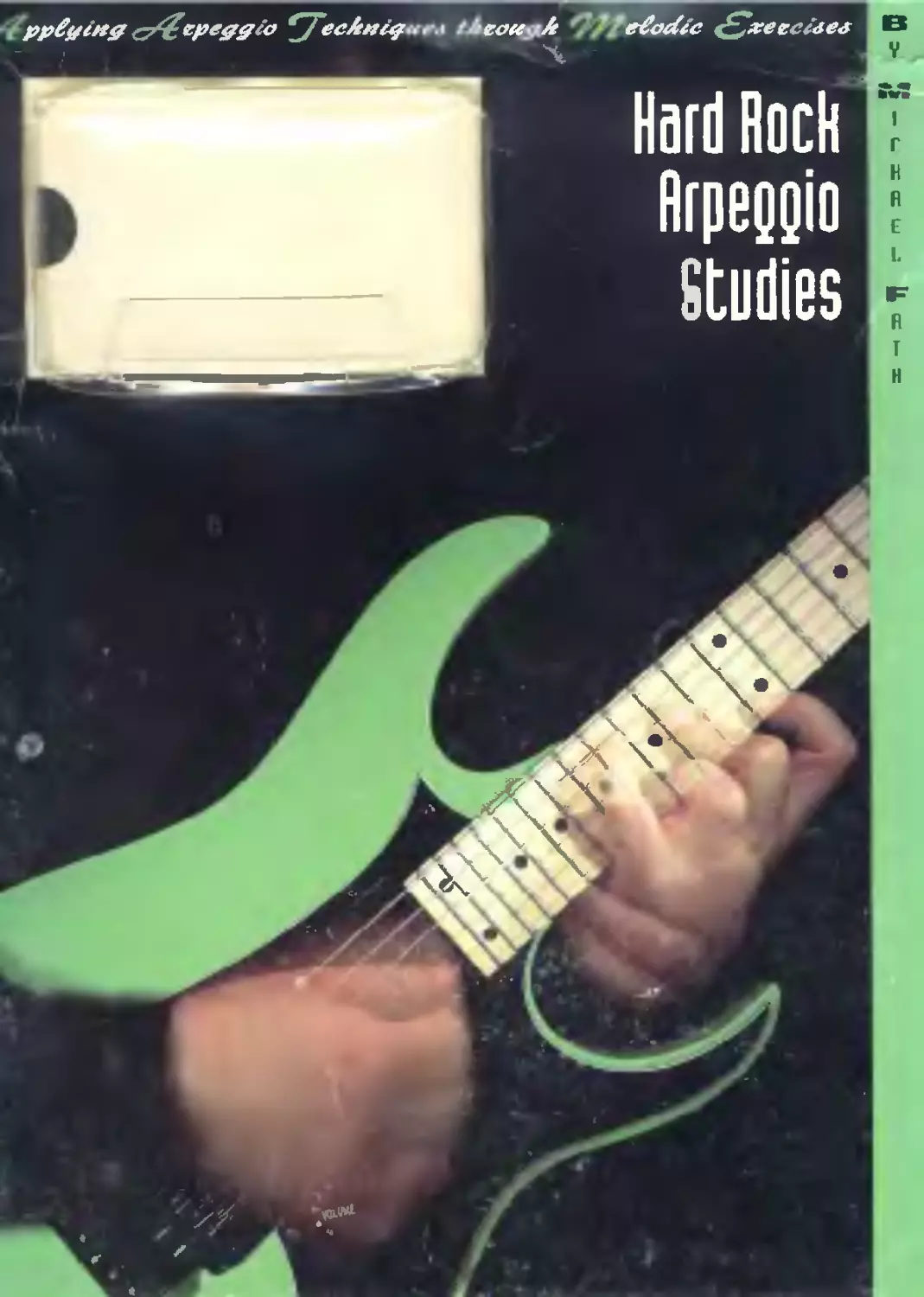
Hord Hoch
Hrpeggio
Studies
.Hif lemri IWisluDg Carjuratim
An arpeggio is the consecutive playing of the notes in any given chord. They are an
invaluable part of harmony in that they are absolute chord statements, and in
improvising you can’t go wrong with the right arpeggio over the right chord!
I chose to emphasize a variety of techniques with simple harmonic structures. With
the guitar, there are so many possibilities that as a teacher I stress a wide range of
technique with basic harmony so that any student can more easily express his or herself.
As more harmonic principles are learned, these techniques can be readily applied or
adapted to create an even greater range of stylistic approaches to the instrument.
In this set of etudes, you will find sweep-picking patterns, arpeggios in fifths, diatonic
triads, embellishments, reharmonization ideas, tremolo picking, triad-stacking, three
octave patterns, single-string ideas, pedal-tones, double-stops and more!
Practice slowly with a metronome, and take it wherever you can - best of luck -
Michael Fath
Spring, ’91
2
Etude #1
This etude incorporates a "barre form" sweep technique in sixteenth note rhythms. Try
to picture the chords as you play through the arpeggios - this will help with
improvising. A general guide of sweep-picking arpeggios is to use only a downstroke
(П) to ascend the arpeggio, hammering on any additional notes that fall on the same
string. At the apex (highest point) of the arpeggio, use an upstroke (V ) and pull-off
any additional notes on the same string, while continuing with the upstroke to finish.
3
4*

д П	  			—	tS- r?	1
n	—
	Л	4 Л	n
	и	12	и

0 _ л			и A
9			9
	 л	10
IU
	8	^2				—
5
Etude #2
This study covers arpeggios in fifths only. This will sound very modem because of
the huge interval leaps, very functional in that these can imply major or minor!
6
ВЬ5	В5	Bb5
о
СП
:> ь	> b cj	> >	c b b >	1 b b > >	□	ip O\l r	I Osl	□ □ LH Ъ

						’ТТЛ»
						if uni
						Г'ТТЛ» —п»
c> ь	> b	>			□	|P u ’ оД	□
		4	ь			"4
			cj	1		”T>
				b b	!< 1	_ТЛ1»
			b b	> >
	й	a >	>		1	"1>
— к
00

Etude #3
This is an alternate picking study using A diatonic major triads ascending and
descending in whole steps. I prefer muting on these lower strings.
Articulations simile


4		n
Л	J J	4 4	Л	9	У -GO		д	a	4	a
8	11	11	8 	Q		b 9	У и —a		U 9	9	8 —3		4	г	4	/ —E	-	E	-
9
Gjfdim
A


		4Q
4f	40	4 0	4Л	47	44	47	1 V - —		4Q	ЧП	4fi
iz	lb	Iz	lb 	4-4	4-4		14	If	14	If —4-0	4-0		1U	19	19	1U —4-3
10
Etude #4
This etude uses an arpeggio embellishment technique called lower neighbor tones
(always 1/2 step below the arpeggio note), along with pattern arpeggio technique.
Am
G	picking simile
□ X n V
11
12
Etude #5
This exercise is an example of reharmonization. We are using the "C" note as a basis
for some of the many chords of which it is an element.
13
14
15
16
Etude #6
This is a study in tremolo picking technique, which is a rapid playing of notes
emphasizing a slower moving melody. The rhythm is 32nd notes at 8 per beat!
Am	picking simile
nVnVnVnV
у
	lu 1U 1U iu 1U lu lU 1U QQQQOOQQ
Д 2222222255b5bbb5	УУУУУУУУ
n
D
G#dim7 (Bdim7)
17
		э—з—з—з—о—о—о—0— f .	f	г	9>
7	7	7	77	7	7	7	4	4	Л	4	4	4	4	Л	5 v 5 з ₽	е	е	г
Г Г г Г 1 Г Г /	44444444	V 5	5	5


	4f	•1 С 4 С.•4 Г!.	4 04 04 04 0
IV IV IV IV lw IV lv IV 	4 С 4 С 4 С	4С 40 40 40 40	4 П 4 Л 4Л 4 Л	т
10 13 13 13 1Z 1Z 1£ 1£	1U 1U 1U 1U 40 40 40 40	7 л
	12 1Z	1Z 7 г 7 г з 3	3	3	0
18
19
Etude #8
This is called pattern playing. Note the repetition of certain strokes during chord
changes.
20
Etude #9
This is a very effective way of covering 3 octaves from the root position of each triad.
There is only 1 position shift in both major and minor!
21
Etude #10
This etude incorporates open string technique with alternate picking and muting. Note
that the root note is not always used as the open string note.
22

		•

	 J	Л	A	7	Л	Л	<0	А	Л	4Г	Л	А	JC	А	А	А	А	4А	А	А	Т	А	А	*
	QUUfUUizUUiUUU	ISUUluuUlzUU/UU
	-	Л	Л	А	7	Л	Л	10	Л	Л	4Л	Л	Л	1П	Л	Л	if	Л	Л	40	Л	л-	7	Л	А
	. 4UUrUUlZUU1uUU	17 и U 1и U U 1г U 0	7	0	0.

	•	•

23
Etude #11
This study utilizes reharmonization with pedal tone technique. As well as alternate
picking, I suggest playing with your fingers to open other possibilities.
24
с
25
Etude #12
This etude employs a technique called upper neighbor tone embellishment. Upper
neighbor tones are always the next scale degree above the arpeggio note. Here we are
being consistent for the most part with the "C" Ionian mode.
C	picking simile
T	8 “10 8	x-	“v. -F	8	10—8	7^-^:	 —л	a <a__a	*" — _		—
Л	У	IV У	\ —M		4Л ИЛ 4Л
g	1 u i Z i U	-10--12 To	/ — V	— V	— V	 	12 1Э 12	8	ie—8	3	5	3
26
				с	’\	”^\п
				с	о	ты
				G	J
			с
			с	3		1
			с
		<1			 -	"Г
		с	>		 -	1 к 1
		<1			--	1 '
	с
	h	>			, __	’1
	с					1
				с	’\	”^\5-
				с	)	--1ФI
				с	,/
			с		. [	П>\
			с	>	1	1
			с
					|-
		U	>	1		"1
					1 __
	с
	с	>			1_	1
	с
04=—34-—01-94.—£4—94—1-91—03—91-91—£4-—91-04.——04
с	с к с с с с	) > >' 1 с с G	) ) ’N 1 ь 4 h	1 с	> с с с	:) )	/Ш- W л	:i 1. 1 1. /1 ч i	। I- L L 1 1 i: i	1 1	нп ‘\ г
				G		Г^\п
				С	ч
				G	J	L1V
			G
			С	>
			С
		<1			г -	"Г
		с	>		' -	71 I
		а	У		L_
	с					•>
	h	>			__	} 11
	с					1'
С					Jl
г	>				I	1
с					4l	__ 1
к5\					/U_
- L С)					l_
— к/ ь>					4-
					/vl
— Ь с>
с>^
°\					/<J-
л
Etude #13
This is a study in double-stops. I suggest practicing 2 ways:
1. Use just the pick and play through the double-stop.
2. Practice playing the double-stops with a combination finger and pick technique.
X g' 4 				F	1 1								p			9
TrtV -ft t "					-4
™	4^
		IU 1Л	1Л			0	IU
	"U	lu		A	о	о	1J	17 a
Д	III!			У 4Д	4 Л	9
7?	12	12 D	to		10	Q	R	Q	10	IU 7	1П	4 П
D	12		12	9	0	9 44		5	16		r	IU	IU L~fl
I		Em f £ -	ff	d		A I	«						» ж			(		2#dim7 Ё 1	-		j		ft	1		D
у	1	1	1
							к						—
													1П	10
IU	14 17	10	1O						4 A	4 7							13	12					IU >« П	4 Л
lr	12	12 		4-tj	4-fi							14	1 Г 1Л	4 A	10							1 r~  "14_ " 14 ‘	11 4 Г	4 0					IU	ш 4 4	4 4
12	12 1 Л						14	14	10 14	14							lb	12					11 11 А А	А Л
14						14	14 4Г												12	12 4
						lu												12
		c										•	**				£		1 :		Вт ft	ft .
И tfL			1	 E	 E	*	ж
Zt	.			09	9	 *
		i
vu	9	fl		9	~
				J	•				L
													О	14	IU О	О	40	ч7					14	IU	/ 4С	4Й
						0							U	о	1J	17 Q					15	12	7	7 "7
						У 4Л	4Л							У					(
	4 0	Q	Г	Q							IU	IU 7	1П	1П
12	9	0	9 	H	16	5	W							f	IU	IU -e	ft
14	17	ТО	14 17	44	44	44
14	If	1 Г	14	14	11 1 г	4 0	4 0	О	П	О	л
14	14	10 14	14	10	12	12	9	и	J 4 Л	А А	Л	Г	2
14	14 1 г		14	11	и	о	4 с
10			0
28
Etude #14
This is an example of a full diminished sweep technique, one of many, for Bdim7
(also known as Ddim7, Fdim7, and Ab dim7). The ending is in one octave moveable
major patterns.
29
Г	V	П	V	П	V	П	V
dl.,„	Д“»	л	- *	л ”*		лл	фе	juia	фа	фе	фа
14	17	14	14	1 f 14 л л	л л	4 А	4Л	1Z 13 1Z	1Z 13 1Z 	ФО		фО	ФО			фО
14	14	14	14	1Z	1Z	1Z	1Z <п		фа
14	14	1Z	1Z

		ФО	фЕ	-*л	«а	фе	фа
14	17	14	14	1/	14 АЛ	АЛ	АЛ	<М	1£	13 1Z	1Z 13 1Z 	ФО			фо	ФО	-	4-9
14	14	14	14	1Z	1Z	1Z	1Z 4П		ФО
14	14	1Z	1Z

30
Etude #15
This is a study in octave technique. As with double-stops, practice both plucking with
pick and fingers, and strumming, dampening the string between notes. Emphasize
vibrato and tone, not speed!
	10 17- 	 1Л		4-Д	4-3		‘10 ‘	--- 	4J3
14	If	If	14 4 0	4	14	If	If	14 	4-0	4-C
13	16	Id	lb 4 A	44	Id	lb 	4-4	4-4		Id	10 	4-4	4-4
II	14 4 4	4 A	14	11 4 Л	11	14 4 4	4-4			14	11 	4-4
it	14	14	11	14	14
31