/


Текст
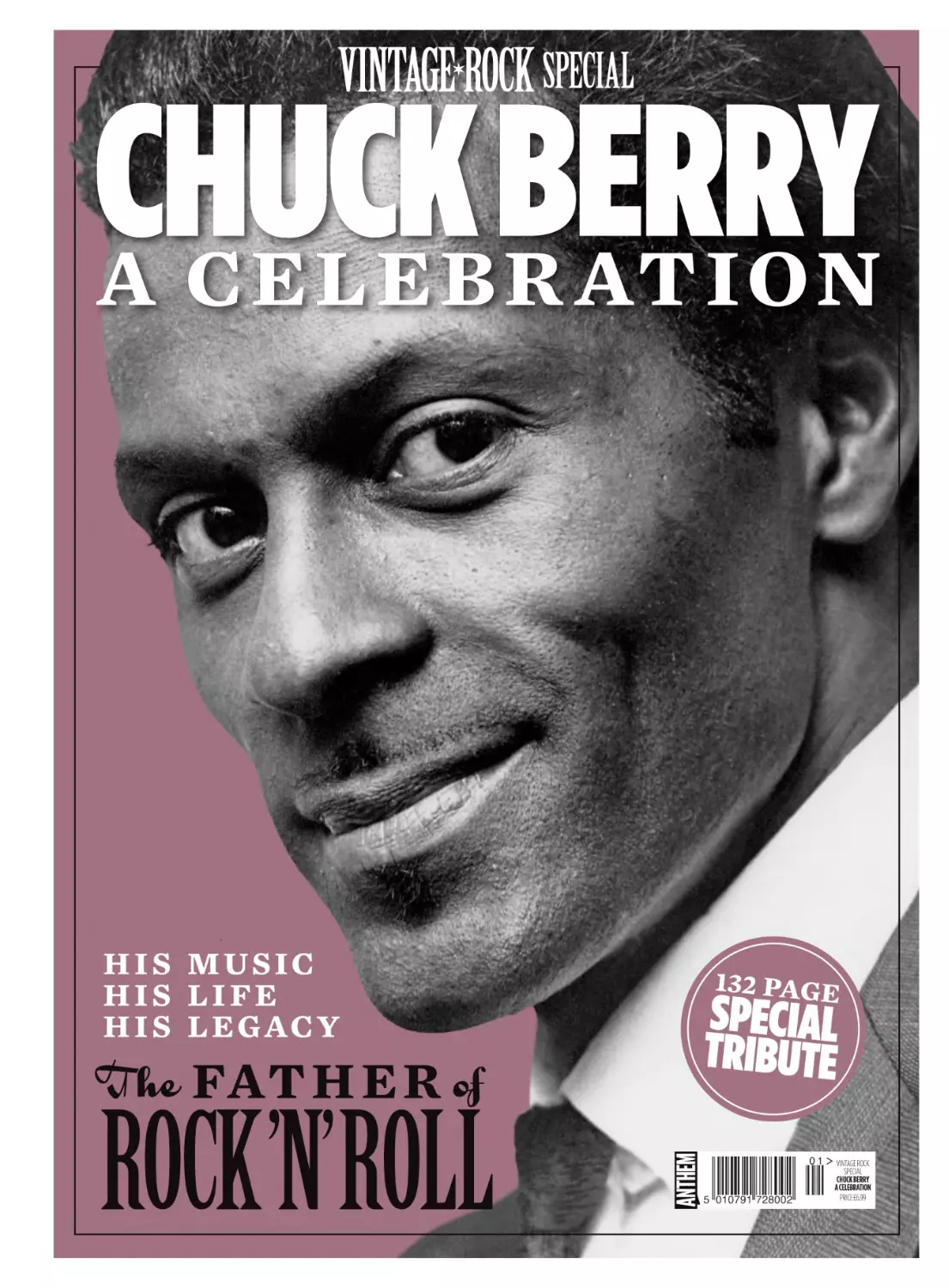
VINTAGE ROCK SPECIAL CHUCK BERRY A CELEBRATION
SPECIAL
chuck
berry
a celebr ation
WWW.VINTAGEROCKMAG.COM
his music
his life
his legacy
The father of
ROCK’N’ROLL
132 PAGE
SPECIAL
TRIBUTE
01
01
5 010791 728002
5 010791 728002
VINTAGE ROCK
SPECIAL
CHUCK BERRY
A CELEBRATION
PRICE £6.99
WELCOME
Anthem Publishing, Piccadilly House,
London Road, Bath, BA1 6PL
Tel 01225 489 984
Email vintagerock@anthem-publishing.com
www.facebook.com/vintagerockmag
EDITOR Rik Flynn
ART EDITOR Kai Wood
PRODUCTION EDITOR Rick Batey
ADVERTISING MANAGER Adrian Major
adrian@majormediasales.com
CHIEF EXECUTIVE Jon Bickley
jon.bickley@anthem-publishing.com
MANAGING DIRECTOR Simon Lewis
simon.lewis@anthem-publishing.com
CREATIVE DIRECTOR Jenny Cook
jenny.cook@anthem-publishing.com
MARKETING EXECUTIVE Verity Travers
verity.travers@anthem-publishing.com
CONTRIBUTORS
David Burke, Julie Burns, Bill Dahl, Randy Fox,
John Howard, Jeremy Isaac, Douglas
McPherson, Michael Stephens, Phil Millard,
Jack Watkins
Head Office Anthem Publishing Ltd, Suite 6,
Piccadilly House, London Road, Bath BA1 6PL
Tel +44 (0) 1225 489 984
Fax +44 (0) 1225 489 980
Email enquiries@anthem-publishing.com
Printed by William Gibbons
Tel 01902 730011
Distributed by Marketforce (UK) Ltd,
The Blue Fin Building, 110 Southwark Street
London SE1 0SU Tel +44 (0) 203 148 3000
Licensing enquiries Jon Bickley
Tel +44 (0)1225 489988
jon.bickley@anthem-publishing.com
Subscription enquiries Dovetail Services UK Ltd
Tel 0844 815 0042 */+44 (0) 1795 414674
/ +44 (0) 333 777 7018
vintagerock@servicehelpline.co.uk
*Calls cost 7 pence per minute plus your
’phone company’s access charge
All content copyright Anthem Publishing Ltd 2016, all
rights reserved. While we make every effort to ensure
that the factual content of Vintage Rock magazine is
correct, we cannot take any responsibility nor be held
accountable for any factual errors printed. Please
make every effort to check quoted prices and product
specifications with manufacturers prior to purchase.
No part of this publication may be reproduced, stored
in a retrieval system or resold without prior consent of
Anthem Publishing Ltd. Vintage Rock magazine
recognises all copyrights contained within the issue.
Where possible, we acknowledge the copyright holder.
Anthem Publishing is the proud home of
Vintage Rock. Anthem was established in 2003
and also publishes Classic Pop, Guitar & Bass
Magazine, Music Tech Magazine and
Music Tech Focus.
www.anthem-publishing.com
Welcome…
Chuck Berry had it all – the music, the vernacular, the
charisma and the drive to take him to the top. Over the
years, he’s been called many things: the father, the poet
laureate, the real king of rock’n’roll… but does any of that
really matter when you can simply give Johnny B Goode
or Maybellene or Roll Over Beethoven a spin?
Put the songs aside, and there’s no doubt that Chuck
was one tough customer. “This is Chuck Berry’s club,” he barked at Keith
Richards on the set of the movie Hail! Hail! Rock’n’Roll, while the director
described him as a “Brahma bull”. But however you spin it, the vast
majority of rock guitarists have borrowed from Berry in one way or other.
We’re reticent in saying that this gave Chuck carte blanche to treat people
as he wished, but this is rock’n’roll, after all…
Berry demanded cash up front, stowing the loot in his guitar case for
safe keeping – a mite suspicious, perhaps, but it isn’t hard to see what
made the man. Naive to the business in the early days, he was robbed
blind, and while most of his peers accepted this inconvenient ‘norm’
through gritted teeth, his mother’s voice rang in his ears: “Don’t let the
same dog bite you twice”. And he didn’t. It’s no wonder he took charge of
his affairs as soon as he could, and kept the cash where he could see it –
and rightly so. He left an estate worth an estimated $50 million.
Chuck’s run-ins with the law often paint him in a questionable light, but
as far as we’re concerned he paid his dues and the matter is now in the
hands of an entirely different judge altogether. So, inside this celebration
of the man and his career, you’ll find everything there is to know about
that jubilant catalogue of rock’n’roll, as we do our best to show just how
important one human being can be to the rest of us.
He was prodigious, for sure, but look for the real Chuck and you’ll find a
family man from St. Louis with a defiant grin; an artful storyteller who cut
to the chase, a wise man who sought racial union and a fair deal – and a
passionate, handsome-voiced rock’n’roller. What Chuck has left behind is
far, far more than most artists could even dream of, and when he’s slingin’
his Gibson, right in the pocket, it really is Chuck Berry’s club…
Rik Flynn
Editor
DON’T
MISS OUR
GREAT
SUBS
OFFER!
TURN TO
PAGE 62
Images © Brian Smith
SPECIAL
CHUCK BERRY VINTAGE ROCK SPECIAL 3
54
08
20
30
120
46
4 VINTAGE ROCK SPECIAL CHUCK BERRY
80
IN THE ISSUE
CONTENTS
BROWN EYED HANDSOME MAN ______ 8 GUITAR BOOGIE _______________ 86
One morning in 1955, Chuck Berry walked into the office of
Chess Records in Chicago. It was the start of an astonishing
11-year burst of creativity that would cement the reputation
of the singer, guitarist and songwriter
ST LOUIE TO FRISCO TO MEMPHIS_____ 20
In the 1960s Berry jumped ship to Mercury Records. It’s a
period often held as being inferior to the one that went
before, but there are gems to discover
BACK HOME _________________ 30
86
110
From the end of the ’60s to the mid-’70s Berry found
himself once again at Chess Records. Both the label and
the music world had changed – but there was still one
spectacular stroke of luck waiting in the wings…
From the Rolling Stones to The Beatles, from the Beach
Boys to AC/DC, Chuck Berry’s music had a life-changing
effect on the generation of musicians that followed. We
hear their tributes – and take a look at the man’s choice of
six-stringed weapons
COMPETITION ________________ 94
We’ve got five copies of the fabulous 32-track Bear Family
compilation Chuck Berry Rocks to give away, with songs
including Maybellene, School Day, Rock And Roll Music,
Roll Over Beethoven, Johnny B Goode, Sweet Little Sixteen,
Nadine and many, many more!
TOP 20 HIDDEN GEMS ___________ 96
AFTER SCHOOL SESSIONS _________ 40
Chuck Berry’s debut long-player gathered a bunch of early
singles including the classics Brown Eyed Handsome Man,
Too Much Monkey Business and School Days
SCHOOL DAYS ________________ 46
Chuck didn’t emerge from nowhere: he grew up on the
big band era, classic guitar jazz, blues and – the secret
ingredient – downhome country music
From hits-that-should-have-been to B-sides and album
tracks, these songs show that there’s far more to Berry
than most people think: there’s blues, country, even laidback instrumentals and Latin influences
BLOWIN’ LIKE A HURRICANE ______ 102
Berry was driven to play in public, even in his later life. We
look at his live recordings and recall his long-awaited – and
not entirely incident-free – first UK tour…
YOU CAN’T CATCH ME ___________110
HAIL! HAIL! ROCK AND ROLL _______ 54
The star-studded 1987 documentary contained some great
music and also revealed perhaps more about Chuck Berry’s
character than the star would have liked…
SUBSCRIPTIONS _______________ 62
Take advantage of a special subscription offer for Vintage
Rock and our sister magazine titles!
GALLERY ___________________ 64
A selection of special moments and great photographs from
the Godfather of Rock’n’Roll’s life and career
There may have been lawsuits to deal with, but far from
sinking into obscurity, in his final years Berry’s back
catalogue earned him the plaudits of the great and good
CHUCK BERRY IS ON TOP ________ 120
With Carol, Maybellene, Sweet Little Rock & Roller, Johnny
B Goode, Little Queenie and Roll Over Beethoven, this 1959
album is virtually a mini greatest hits
LONG LIVE VINYL _____________ 126
Interest in original Chuck Berry records has grown since his
passing. Here’s our guide to some of the most important
ones to pick up and add to your collection
TOP 40 ESSENTIAL TRACKS ________ 70 TRIBUTES __________________ 128
From 1955 to 1972, from Maybellene to that love-it-or-hateit #1 hit single, we choose the numbers that have to be in
any respectable best-of selection
Everyone from musicians and politicians were united in
their praise after Berry’s death on March 18. Here are just
some of the compliments that were paid…
ONE DOZEN BERRYS ____________ 80 CODA ____________________ 130
The man’s second LP ran the stylistic gamut from teen
dramas to cool instrumentals – plus some surprises
SAVE 25%
Berry’s final album, Chuck, recorded with the help of family
and guest stars, is due out soon
WHEN YOU SUBSCRIBE
TURN TO PAGE 62
CHUCK BERRY VINTAGE ROCK SPECIAL 5
6 VINTAGE ROCK SPECIAL CHUCK BERRY
CHUCK BERRY VINTAGE ROCK SPECIAL 7
B
rown
eyed
handsome
man
FROM 1955 TO 1966, CHUCK BERRY RECORDED HIT AFTER HIT FOR
CHESS RECORDS, SHAPING THE SOUND OF ROCK’N’ROLL IN HIS
IMAGE. RANDY FOX CHRONICLES THE RISE, FALL AND RETURN OF
CHUCK BERRY ON CHESS OVER 11 SPECTACULAR YEARS
O
n a Monday morning in
May 1955, a tall, thin,
well-groomed black man
walked into the offices of
the Chess Records Company
in Chicago. From his
manner and appearance, the
receptionist immediately tagged him as a
musician. As one of the top independent
R&B labels, Chess Records was a magnet
for aspiring musicians.
“I would like to speak with Mr.
Leonard Chess,” the man said, as
Leonard Chess stepped into the
reception area. Chess invited the young
man into his office.
Once inside, the man introduced
himself as Chuck Berry, the leader of a
8 VINTAGE ROCK SPECIAL CHUCK BERRY
R&B combo from St. Louis. The night
before he had met one of Chess’ biggest
stars, Muddy Waters, at a nightclub in
Chicago. Berry had asked Waters about
recording contracts, and Waters had
recommended Chess.
Leonard Chess was immediately
impressed. Berry was well-spoken and
educated. As he described his music, his
passion was obvious, and it seemed to be
coupled with a seriousness and a degree
of ambition rare in musicians.
From Berry’s perspective, Chess
seemed straightforward, respectful and
genuinely interested in Berry’s music.
When he spoke to Berry it was without
the condescension one usually heard
from a white man.
Fresh-faced and nattily
dressed, Chuck Berry looks
every inch the entertainer
ready for stardom
CHUCK BERRY VINTAGE ROCK SPECIAL 9
Courtesy of Bear Family
It was the beginning of one of the
most successful musical partnerships – a
partnership that transformed the shape
of American music and would make
Chuck Berry a superstar.
Charles Edward Anderson “Chuck”
Berry was born in St. Louis, Missouri
on 18 October 1926. He was one of six
children born to Henry and Martha
Berry, a middle-class couple who made
their home in the African-American
neighbourhood of St. Louis known as
the Ville. As a thriving locus of black
entrepreneurship, the Ville somewhat
insulated the Berrys from the prejudice
and segregation endured by blacks in
many parts of the US at the time.
Both of Berry’s parents were firm
believers in black educator’s Booker T
Washington’s philosophy that the path
to racial progress was through education
and entrepreneurship. Henry Berry was
a living example of the latter. He built
a successful carpentry business that
provided a steady income for his family.
Martha Berry, meanwhile, was a collegeeducated school teacher who impressed
the importance of education on her
children as well as encouraging their
artistic endeavours.
Martha Berry’s love of music had the
biggest influence on her son Charles. She
often invited the choir from the Antioch
Baptist Church to practice in the front
room of the Berry home, where she
accompanied them on piano. Charles and
his siblings joined in the singing from a
very early age.
Musical Beginnings
While in high school, Berry began
playing guitar. His studies advanced
quickly after he met a local aspiring
jazz guitarist, Ira Harris, who taught
him jazz and blues chord progressions
and introduced Berry to the basics of
song construction. Although Berry
was an apt music pupil, his rebellious
nature torpedoed his other studies.
In 1944, shortly before the start of his
10 VINTAGE ROCK SPECIAL CHUCK BERRY
© Bear Family
Courtesy of Bear Family
Courtesy of Bear Family
Chuck, with telescope,
in 1937 aged just 11
As a teenager, Berry (fourth
from right) was a keen
photographer and joined his
high school’s camera club
Chuck pictured in
the late 1940s
senior year of high school, Berry and
two friends decided to take their leave
of St. Louis for California, without their
parents’ permission. Their adventure
was short-lived when they ran out of
money in Kansas City, Missouri. Armed
with the broken frame of a .22 pistol, the
trio attempted banditry. Berry ended up
in the hands of the law, with a 10-year
sentence for armed robbery.
While in prison, Berry continued his
musical education, singing with a gospel
quartet and performing with a jump
blues combo. In October 1947, on his 21st
birthday, he obtained an early release
from prison and returned home. About a
year later, he married Themetta “Toddy”
Suggs, and over the next few years,
Berry supported his growing family by
factory work and odd jobs. He eventually
attended cosmetology school and
secured a steady job as a beautician.
Throughout that time, Berry never
gave up on his dream to play music
professionally. He picked up small
gigs, playing house parties and in local
nightclubs for just a few dollars. He also
took formal guitar lessons, looking to
sharpen his technique. Eventually he
began to develop his own style based on
his three favourite guitarists – jazzman
supreme Charlie Christian, bluesman
T-Bone Walker, and jump blues stringbender Carl Hogan, the lead guitarist of
Louis Jordan’s Tympany Five.
In 1952, Berry joined a local jump
blues combo and quickly learned to
please audiences. He tried different stage
Courtesy of Bear Family
Courtesy of Bear Family
These early publicity pictures
were snapped in Leonard
Chess’s apartment
His wild stage antics and covers of
country hits made the Chuck Berry
Trio one of the top acts in the area
gimmicks, like a squatting “duck walk”
during guitar solos, and added novelty
to the band’s repertoire by adapting
popular country songs. As his reputation
increased, he came to the attention of
pianist Johnnie Johnson, the leader of
the popular local group, the St. John’s
Trio, offering Berry a full-time position
in his band.
With Berry’s forceful personality
and stage presence he soon took over
leadership of the band, a role the
less-ambitious Johnson was glad to
relinquish. Berry’s wild stage antics
and covers of country hits made the
rechristened Chuck Berry Trio one of the
top acts in the St. Louis area. The next
step was a record contract.
Heading North To Chicago
In May 1955, Berry travelled the 300
miles to the Windy City, ending up
in Chess Records’ office on a fateful
Monday morning. An immediate
camaraderie developed between Chess
and Berry. Both were serious, ambitious
and well-acquainted with the obstacles of
racism. Chess shared Berry’s conviction
that financial success and independence
was the key to overcoming many
CHUCK BERRY VINTAGE ROCK SPECIAL 11
aspects of institutionalised racism in
American society, whether one was
Jewish or African-American. Chess
requested a demo tape, and within a
week, Berry was back in Chicago with a
tape of two original songs.
The first song, Wee Wee Hours, was
a pleasant blues number but similar to
the hundreds of other blues combos that
approached Chess on a regular basis.
The second song, Ida Red, was one of
Berry’s original “hillbilly” songs and
a different case entirely. With its hard
driving R&B beat and lyrics of fast
cars and a two-timing woman, Chess
knew it was unique and filled with hit
potential. When Chess’ brother and
business partner, Phil and Chess Records
producer and songwriter Willie Dixon
heard the song, they agreed.
All three men were well-aware of the
growing popularity of up-tempo R&B
records among white teenagers, and
Chess had already scored hits by The
Moonglows and Bo Diddley that made
the crossover from R&B to pop. Berry’s
hillbilly tune promised even greater
potential – if they could capture the
perfect recording.
On 21 May 1955, Berry returned to
Chess Studios with the members of his
band, Johnnie Johnson on piano and
Ebby Hardy on drums. Since Ida Red was
the name of a well-known fiddle tune,
Leonard Chess suggested the change
to Maybellene. The Chuck Berry Trio,
with the addition of Willie Dixon on
bass, worked through dozens of takes
of the song before they finally found the
right mix of R&B rowdiness and hillbilly
lyricism. Berry’s almost flawless diction
was another important factor. He didn’t
sound like a hillbilly or a bluesman. His
voice had a pop sheen and would appeal
to pop and R&B audiences equally.
Released in July 1955, Maybellene
took off immediately when the popular
New York disc jockey Alan Freed began
pushing the record on his nightly show
(as we’ll find out later, he may have had
a vested interest). The single shot to #1
R&B and crossed over, reaching #5 Pop,
eventually selling over a million copies.
Other artists seldom noticed shady
practices as long as money was flowing
their way. Berry noted every penny
Chart success quickly prompted offers
for live appearances and tours, and Berry
signed with a New York management
and booking company – yet by the end of
his first tour, he had already observed the
many ways his managers were stealing
from him. Other artists seldom noticed
the kick-backs and shady practices as
long as money was flowed their way.
Berry noted every penny and eventually
extracted himself from the contract,
Chuck Berry’s Mystery
Maybellene Collaborators
When Chuck Berry’s first single, Maybellene, was released in
July 1955, and the label of the record plainly credited
Berry as sole composer. Several months later, Berry
received his first songwriter royalty statement.
Two names had been added to the credits: Alan
Freed and Russ Fratto. In Berry’s
autobiography, he recalled his discovery of
these mysterious collaborators…
“When I later mentioned to Leonard
Chess the strange names added to the
writer’s royalties, he claimed that the
song would get more attention with big
names involved,” Berry wrote. “With
me being an unknown, this made sense
to me, especially since he failed to
mention that there was a split in the
royalties as well.”
Alan Freed was the famous New York
disc jockey who had been instrumental in
making Maybellene a hit. The assignment of
12 VINTAGE ROCK SPECIAL CHUCK BERRY
becoming one of the first rock’n’roll
artists to manage his own career.
At the same time, tours through the
Deep South exposed him to a degree
of prejudice and racism he had never
witnessed. Drawing from his early
lessons on economic independence, he
developed a reputation as a frugal star
– often sleeping in his car and cooking
his own meals to avoid dealing with
segregated hotels and restaurants.
one third of the song’s royalties to Freed was a clear case of
what became known as “payola” – compensating deejays
directly for promoting a record. Payola wasn’t strictly illegal
at the time, but it was certainly questionable. The practice
eventually landed Freed in hot water and led to his downfall.
Although Berry claimed no foreknowledge of the
arrangement, Leonard Chess’ son, Marshall, later claimed
Berry had full knowledge of the “gift” to Freed.
The reason for the second beneficiary of Maybellene’s
royalties is a little more mysterious. Russ Fratto was Chess
Records’ landlord and the Chess brothers’ partner in Midwest
Pressing, a record pressing plant in Chicago. It’s possible that
Chess gave the credit to Fratto as a way of repaying a debt.
Others have theorised that Berry sold a portion to Fratto for a
cash advance.
Whatever the truth, both Freed and Fratto made thousands
of dollars from their “collaboration”. As for Berry, he learned
an important lesson about the value of music publishing –
and it would be 31 years before he regained full ownership of
the song that launched his career.
© Getty Images
Chuck strums his Gibson Les
Paul onstage with his band
including Johnnie Johnson
on piano, circa 1957
CHUCK BERRY VINTAGE ROCK SPECIAL 13
In September and December 1955, the
Chuck Berry Trio returned to Chess to
record Berry’s next two singles. Thirty
Days (To Come Back Home) and No
Money Down both followed the same
formula of artfully combining elements
from R&B, country and pop to create
rock’n’roll excitement. Both sold well,
rising to the Top 10 on the R&B chart,
but failed to duplicate the pop success of
Maybellene. Both songs, it seems, were
missing an important element – the extra
factor that made all the difference with
the teen audience.
In January 1956, Berry returned to
Chess with the vital element in hand. Roll
Over Beethoven spoke directly to younger
music fans with its celebration of the big
beat and rebellion against the days of old.
The song was supercharged by the first
appearance of Berry’s signature guitar
sound. The flurry of double-stop notes
that introduced Roll Over Beethoven
leapt out of radios and sent would be
guitar heroes scrambling to music shops
to slap down allowance money as down
payments on electric guitars. Released in
May 1956, Roll Over Beethoven reached
#2 R&B and brought Berry back to the
pop charts at #29. More importantly, it
defined the sound of rock’n’roll in a way
no other hit single had to that point, and
14 VINTAGE ROCK SPECIAL CHUCK BERRY
Family
Courtesy of Bear
Courtesy of Bear Family
Another from the apartment
photographs, this time
displaying Berry’s penchant
for the Hawaiian style
revealed the key to success with the teen
market was to speak directly to them.
That conclusion was confirmed when
Berry’s next two singles, Too Much
Monkey Business and You Can’t Catch
Me, both underperformed with the
former making it to #4 R&B but failing to
score on the pop chart, while the latter
missed both charts entirely. Both were
drawn from earlier sessions and lacked
the direct teen appeal and electrifying
guitar sound of Roll Over Beethoven.
Berry Goes To School
Toward the end of 1956, Berry decided to
dissolve the Chuck Berry Trio. Hardy’s
and Johnson’s drinking was a liability
on the road, and the ever-frugal Berry
preferred working solo and hiring
local backing bands at union scale. The
decision proved an economical one, but
the quality of his live performances often
suffered. Johnson frequently returned to
the studio with Berry and continued to
be an important collaborator, but Hardy
did not record or tour with Berry until
years later.
With Berry’s busy tour schedule, it
would be the end of the year before he
returned to Chess with new material
informed by the success of his new
sound and subject matter. In January
1957, he cut School Day (Ring! Ring!
Goes The Bell) a masterpiece of typical
lyricism, wit and guitar mastery. Berry
combined sly observations on everyday
Courtesy of Bear Family
teenage life with the excitement of
the big beat, culminating in simple but
electrifying praise for the soundtrack
of the new generation – “Hail, hail
rock’n’roll!” Released in March 1957, it
shot to #1 R&B and #3 Pop, making it
Berry’s biggest hit to date.
On the heels of that success, Chess
released Berry’s first album, After School
Session, in May 1957. Since arriving at
Chess, Berry’s cosmopolitan musical
tastes had been a regular part of his
sessions as he explored blues, jazz, Latin,
months of Berry’s career. In January
1958, he recorded Johnny B Goode. The
opening guitar signature was a perfect
refinement of the sound he introduced
on Roll Over Beethoven, and the rags-torock’n’roll riches story told by the lyrics
With each new song, Berry was
adding to the rock’n’roll equivalent of
the Great American Songbook
calypso music and more, in addition to
cutting rock’n’roll hits. Many of these
tracks remained unreleased or were
delegated to the B-sides of singles. The
LP format gave Berry the opportunity to
reveal his multiple musical personalities.
His subsequent albums often followed
the same pattern, a mix of hot rockers
with explorations in other styles.
Berry cut three more hit singles in
1957 – Oh Baby Doll, Rock And Roll Music
and Sweet Little Sixteen – but the year
proved to be just a warm-up for the
most productive and creative twelve
was a triumph of Berry’s ability to write
songs that tapped into universal themes
and dreams. Making the song a musical
autobiography would have been simple;
instead, Berry created an archetypal
showbiz fantasy that every would-be
rock’n’roller could insert themselves
into. Released in March 1958, Johnny
B Goode scored #2 R&B and #8 on the
Billboard Top 100 – but its long term
success far surpassed its immediate
chart performance.
With Berry racking up hits, Leonard
Chess decided to double Berry’s single
release
schedule from three to six a year.
Through the remainder of 1958,
Berry recorded one great rocker after
another, including Beautiful Delilah,
Carol, Anthony Boy and Sweet Little
Rock’n’Roller. Some fared better than
others on the charts, but all proved to
have long lives, as other artists eagerly
covered Berry’s compositions. With
each new song, Berry was adding to
the rock’n’roll equivalent of the Great
American Songbook. Aware of the long
term potential profits of his songs, Berry
launched his own music publishing
company in mid-1958, Chuck Berry
Music, Inc., making him one of the first
rock’n’roll composers to take control of
his publishing.
The move was especially good timing
with the release of Memphis, Tennessee.
Recorded in September 1958 and released
as the B-side of Back In The U.S.A.
in May 1959, the song was a brilliant
mid-tempo ballad, demonstrating the
ongoing influence of country music on
Berry’s songwriting and featuring a
charming plot twist in the last verse.
Although the song never charted for
CHUCK BERRY VINTAGE ROCK SPECIAL 15
XXXX
© Getty Images
Berry with his number-two
Gibson ES-350T in a shot
taken on set during the 1959
movie Go, Johnny, Go!
16 VINTAGE ROCK SPECIAL CHUCK BERRY
Go, Johnny, Go!
Chuck Berry in the Movies
– Berry, The Moonglows and The Flamingos. Only eight of the
album’s dozen tracks actually appeared in the film.
Berry’s second film appearance came in 1958 when his
complete performance from the Newport Jazz Festival was
featured in the documentary Jazz On A Summer’s Day. Shot in
Technicolor, the footage is a rare opportunity to see Berry
perform in his prime.
Berry’s final film appearance from the 1950s was another
Alan Freed film, Go, Johnny, Go! (1959). As with Rock, Rock,
Rock, the flimsy plot merely served to tie together musical clips.
From a Hollywood soundstage, Berry lip-synced three musical
numbers – Johnny B Goode, Memphis, Tennessee and Little
Queenie – in addition to having a small speaking role.
Berry, it inspired scores of cover versions
by both rock’n’roll and country artists.
It also heralded a new era for Berry’s
songwriting as he began to step away
from his teen audience, writing more
lyrically complex songs.
Berry’s talent as a performer and
instrumentalist was also receiving
attention from beyond the teen set. In
July 1958, Berry played the prestigious
Newport Jazz Festival. Famed producer
and talent scout John Hammond
arranged Berry’s appearance over the
objections of some of the festival’s
organisers. Berry managed to win over a
sizable portion of the crowd, while some
attendees were horrified by the intrusion
of “low brow” music.
After the successes of 1958, Berry
slowed his recording and touring pace.
He continued cutting great singles and
scoring hits, including Almost Grown,
Back in the U.S.A., Let It Rock and others,
but other ventures occupied his time.
In March 1959, he opened the Club
Bandstand, an integrated nightclub
in one of St. Louis’ wealthiest (and
predominately white) neighbourhoods.
Also vying for his attention was the
construction of Berry Park. Built
on 30 acres of farmland just outside
Wentzville, Illinois, the amusement
park/entertainment complex included a
nightclub, offices, a campground and a
luxury residence for the Berry family.
mere fact that he was a successful black
musician, drawing large audiences of
white teenagers made him a target for
racists and opportunistic politicians.
In December 1959, while on tour
in El Paso, Texas, Berry met Janice
Escalanti. A full-blooded Apache Indian,
Escalanti passed for 21 but was actually
a 14-year-old runaway from Mescalero,
New Mexico. Since leaving home a year
earlier, she mainly supported herself
with prostitution. Berry offered her a job
as a hat check girl at Club Bandstand and
she accepted, travelling with him for the
rest of the tour and staying with him in
his hotel room.
After a week of working at Berry’s
club, Escalanti was fired. Berry bought
her a bus ticket back to El Paso and gave
her money for expenses. She remained
in St. Louis, returned to
prostitution and eventually
told police her story and that
she and Berry had sex on
numerous occasions.
Berry was arrested and
charged with violation of
the Mann Act, an antiquated
Federal law originally
enacted to combat interstate
prostitution but frequently
used to prosecute
interracial and extramarital relationships. To
complicate matters further,
he was also charged with
two violations of the Mann
Act stemming from a June
1958 arrest for carrying
a handgun in St. Charles,
Missouri. Police had
noted the fact that he was
travelling with his white
girlfriend, Joan Mathis.
I Fought The Law
Berry’s success seemed indestructible,
but trouble had been brewing for some
time. While on tour, Berry experienced
several minor scrapes with law
enforcement officials. Although Berry
distanced himself from the Civil Rights
Movement to avoid controversy, the
News of the arrest immediately
affected Berry’s record sales and live
bookings. In a racially prejudiced
trial held in March 1960, Berry was
convicted of violating the Mann Act
with Escalanti. He was fined $5,000, and
sentenced to five years in prison. Berry’s
lawyer immediately appealed, citing
the obviously racist conduct of the trial
judge. While waiting on the outcome,
Berry returned to Chess and recorded
several first rate songs, including a sequel
to Johnny B Goode with the darkly ironic
title, Bye Bye Johnny.
In May, Berry was tried on the
charges involving Joan Mathis. This
time the jury found Berry not guilty. In
November, the Eight Circuit Court of
Appeals overturned the verdict from
the first trial, citing the hostile and
In Mississippi in
August 1959 Berry
was questioned
about “trying to
date a white girl”
and was shown out
of town by police
© Getty Images
As Chuck Berry was conquering the airwaves and scoring hits,
he also made the jump into motion pictures. His first movie role
was in the 1956 film, Rock, Rock, Rock. Starring Alan Freed and
a large cast of rock’n’roll stars including The Moonglows, The
Flamingos and Frankie Lymon and the Teenagers, the film was a
low-budget quickie with a tissue-thin plot, mainly designed to
cram as many musical performances as possible into its
85-minute running time.
The movie was shot in New York City, and Berry’s appearance
consisted simply of him lip-synching along to You Can’t Catch
Me on a barren soundstage. The so-called soundtrack for the
film was the first LP released by Chess Records, and it featured
four songs each by the three Chess artists featured in the film
CHUCK BERRY VINTAGE ROCK SPECIAL 17
prejudicial conduct of the original court.
While Berry’s legal problems appeared
to be over, Federal prosecutors chose to
retry the first case. A new trial was held
in April and May of 1961. This time, the
trial was free of the overt racism that
tainted the first verdict, but Berry was
convicted and received a shorter threeyear sentence.
Once again Berry appealed. While he
was waiting, he returned to Chess for
what might have been his final recording
session. With his future uncertain, Berry
recorded great rockers, including the
frustration-filled Come On and the third
and final chapter of the Johnny B Goode
story, Go Go Go.
In January 1962, the Eighth Circuit
denied his appeal, and on 19 February
1962, Berry entered the federal prison
in Terre Haute, Indiana. He spent
the next 18 months earning his high
school diploma and attending courses
in business management, law and
accounting. Berry never abandoned hope
of rebuilding his career. He had faced set-
Berry playing the famous
Star-Club in Hamburg, Germany
Berry discovered eager fans wherever
he played, and was hailed as rock’n’roll
royalty on his first UK tour in 1964
backs before, and he was determined to
return to music upon his release. When
he was paroled on 18 October 1963, he
had a notebook full of new songs and was
ready to rock.
Berry soon found help from
unexpected sources. On both sides of
the Atlantic ocean, a rock’n’roll revival
was rumbling, led by a new generation of
rockers with Berry as one of their prime
influences. In the U.S., garage rock and
surf rock bands regularly covered Berry’s
songs or re-wrote them entirely – as was
the case with the Beach Boys’ 1963 smash
hit, Surfin’ U.S.A., which was simply
Sweet Little Sixteen with new lyrics.
In the UK, the new “beat groups” led
by The Beatles, The Rolling Stones, The
Animals and others elevated Berry’s
music to the level of Holy Scripture.
Berry-mania was ably assisted by Chess
18 VINTAGE ROCK SPECIAL CHUCK BERRY
Records’ lucrative distribution deal with
UK-based Pye Records. In the summer of
1963, Pye began releasing singles and LPs
of Berry’s older recordings and many of
them zoomed up the UK charts.
Berry returned to Chess in 1964 and
placed five new singles on the charts,
including some of the finest recordings
of his career – Nadine (Is That You?), No
Particular Place To Go, You Never Can
Tell, Little Marie and Promised Land. His
musical acolytes filled their albums with
covers of Chuck Berry songs, resulting in
a windfall of publishing royalties. Berry
also returned to the road, discovering
eager rock’n’roll fans wherever he
played, especially in the UK. He was
hailed as rock’n’roll royalty on his first
UK tour in May 1964.
Although Berry’s career seemed
mainly unscathed by his incarceration,
© Getty Images
XXXX
many noticed a change in his personality
and manner. As Johnnie Johnson later
observed, “[Chuck was] a different
person after he got out of prison. He
was angry how the law had treated him,
and he thought that everyone wanted
to cheat him.” Berry’s cold and often
surly attitude toward promoters, fellow
musicians and even fans became the
stuff of legends. He was a consummate
entertainer, but he was not a man to trifle
with, willing to walk away from a packed
house if the precise demands in his
contract were not met to the letter.
In 1966, with Berry’s Chess recording
contract nearing its end, Mercury
Records approached him with the offer
of a three-year contract, including a
higher royalty rate than at Chess and
a sizable advance. After discussing the
deal with Leonard Chess, Berry accepted
Mercury’s offer. On 13 April 1966, Berry
recorded at Chess for what he thought
was the final time. Berry and the Chess
brothers ended their successful 11 year
relationship on good terms. After Berry
left, Phil Chess made a comment that
proved to be prescient. “He’ll be back in
three years.”
TRIAL SUBSCRIPTION OFFER
3 ISSUES
*
FOR £5
SAVE
72%
SUBSCRIBE
AND SAVE...
★ Try 3 issues for just £5*
★ Continue on Direct Debit paying
£12.50 every 3 issues
★ Save 30% after the trial
★ Free UK delivery
★ Never miss an issue
*UK DD ONLY
2 EASY WAYS
TO ORDER...
ONLINE
ANTHEM.SUBSCRIBEONLINE.
CO.UK/COUNTRYMUSIC
ENTER CODE VRPP1703
BY PHONE
0844 826 5031**
QUOTE CODE VRPP1703
** CALLS COST 7P PER MINUTE PLUS YOUR PHONE COMPANY’S ACCESS CHARGE
Overseas customers can subscribe too! USA readers please visit: imsnews.com/countrymusic
and for rest of world visit: anthem.subscribeonline.co.uk/countrymusic
* 3 issues for £5 on UK Direct Debit only. The price will increase to £12.50 every 3 issues after you have received your first 3 issues.
You can cancel your Direct Debit at any time. Savings are calculated off the cover price.
VR_CM_A4_Subs.indd 24
04/04/2017 10:52
St Louie
to Frisco
to Memphis
CHUCK BERRY’S MID-’60S MOVE TO MERCURY BROUGHT CHANGES
THAT MANY OF HIS FANS REVILED. WHILE CHART SUCCESS ELUDED
HIM, THE MUSIC REVEALED A VITAL ARTIST STILL INTERESTED IN
EXPLORING NEW SOUNDS AND STYLES. RANDY FOX TAKES A LOOK
AT THE MAN’S MOST MISUNDERSTOOD RECORDINGS
I
n the early months of 1966, Chuck
Berry found himself at a crossroads.
In the past two years, he had secured
his release from prison and achieved
a spectacular career comeback. In
1964, he placed no less than five
singles on the charts – a remarkable
feat that proved he could hold his own
with the new generation of rockers, both
British and domestic. His bank account
also profited as the latest wave of British
blues and beat bands topped up their
albums with covers of Berry’s songs,
generating sizable royalty checks. The
next year was less profitable in terms
of record sales, but money continued to
pour into Berry’s bank account from the
lucrative tours he undertook in both the
U.S. and abroad.
20 VINTAGE ROCK SPECIAL CHUCK BERRY
As the calendar flipped over to 1966,
Berry’s contract with Chess Records
was nearing its end. Although Berry
and Leonard Chess had differences
over the years, they enjoyed a mutual
respect. Chess stood by Berry during his
incarceration and provided the means
for him to restart his career. Loyalty
motivated Berry to arrange a meeting
with Chess after receiving a generous
offer from major label Mercury Records.
After hearing the amount Mercury was
offering (between $60,000 and $150,000,
according to varying accounts), Chess
said, “Take it and run, baby!” So with a
handshake and good wishes, Berry and
Chess ended their 11-year partnership.
A 6 August 1966 article in Billboard
magazine announced Berry’s contract
Chuck Berry onstage
in the East Village in
New York, 1966
CHUCK BERRY VINTAGE ROCK SPECIAL 21
St Louie
to Frisco
to Memphis
with Mercury as part of the company’s
plans to increase their profile in the
profitable R&B market.
With the ink on the contract dry and
Berry’s considerable advance safely
stashed in his bank, the first order of
business for Mercury Records’ newest
artist was a new single and a return to
the past. It had long been a practice for
successful artists to record an album of
their older hits when changing record
labels; it was simply a way to get product
on shelves swiftly and start income
flowing as quickly as possible.
For Berry’s convenience, Mercury
booked time at Technisonic Studio in
the St. Louis suburb of Clayton. It would
be the first time Berry had produced his
own sessions. Hoping for a taste of past
glories, Berry recruited former Chuck
Berry Trio members Johnnie Johnson
and Ebby Hardy, along with several local
St. Louis musicians.
On 20 September 1966, the group cut
four new tunes, including a version of
the old R&B novelty My Ding-A-Ling,
rewritten by Berry as My Tambourine.
The next day the band ran through some
new versions of several of Berry’s classic
hits, bit it quickly became apparent
that Berry had little interest in crafting
polished new versions. While the energy
level was high on most of the six songs
cut that day, the performances were
sloppy and filled with false starts, weak
endings or distracting and unneeded
instrumental fills.
Slightly over a month passed before
Berry and the other musicians returned
to Technisonic on 26 October to
complete the album. After the band
warmed up on a few new songs, they
returned to the remakes. The same
energetic but chaotic attitude ruled on
the eight remakes produced that day and
the next.
BERRY GOES TO MEMPHIS
In March 1967, Mercury released Chuck
Berry’s Golden Hits, featuring 10 remakes
from the Technisonic sessions, along
with one new selection, Club Nitty Gritty,
which preceded the album as a single
three months earlier. The few reviews
that appeared about the album, however,
were dismissive. Many compared it to a
new collection released by Chess, Chuck
The first order of business for
Mercury’s newest artist was a
single – and a return to the past
Tambourines,
Toy Bells and
Ding-A-Lings
My Tambourine, recorded during the sessions for Chuck Berry’s Golden Hits,
was Chuck Berry’s first attempt at the song that eventually became his only #1
pop hit. Although the authorship of My Tambourine was credited solely to Berry
on the album From St. Louie To Frisco,, the double-entendre ditty had been inspiring
laughs for many years.
The first recorded version was cut by New Orleans bandleader and record producer Dave
Bartholomew in 1952 for King Records. Under the title My Ding-A-Ling, the song chronicled the adventures and condition
of the narrator’s “ding-a-ling” and the girl that loved to play with it. That same year Bartholomew also recorded the
song for Imperial Records under the title Little Girl Sing Ding-A-Ling.
In 1954, the vocal group The Bees recorded the song for Imperial under the title Toy Bell, changing the lyrics to
eliminate the helpful girl and transforming ding-a-ling playing to a solitary pursuit. This version also added a prologue
verse plainly explaining that the subject matter of the song was a toy bell given to the narrator by his grandmother
— just to avoid any embarrassing misunderstandings.
Toy Bell was the version that Berry re-wrote as My Tambourine and recorded in September 1966 at his first session for
Mercury. By 1969, he added the song to his live sets, changing the title and subject matter of his re-written version back
to My Ding-A-Ling. It remained a crowd-pleasing part of his live performances for many years, proving that a good
smutty joke never goes out of style.
22 VINTAGE ROCK SPECIAL CHUCK BERRY
Berry’s Golden Decade, that featured the
original recordings of the songs. Rolling
Stone magazine deemed the Chess
collection “the album you must get”.
After the weak reception for their first
Chuck Berry LP, Mercury decided to
tighten control over his next sessions.
Berry’s fellow first-generation rocker
Little Richard was staging a minor
comeback with soul-influenced material
on Okeh Records, and Mercury hoped
to duplicate that success with Berry. In
March 1967, Berry headed to successful
soul label Hi Records’ Royal Recording
Studio in Memphis for three days of
sessions, overseen by the soul production
team of Boo Frazier and Roy Dea. The
band was selected from the cream of
the new generation of Memphis session
musicians and included Reggie Young
on guitar, Tommy Cogbill on bass,
Jerry “Satch” Arnold on drums and
Bobby Emmons on piano, with
Andrew Love on tenor saxophone
alongside other members of the
famed Memphis Horns.
On the first day the band
clicked immediately, warming
up with a fine and mellow cover
of the Nat “King” Cole hit Ramblin’
Rose before cutting two hot rockers —
Check Me Out and Berry’s next Mercury
single, Back To Memphis. Both songs
bore the classic Chuck Berry hallmarks
of strong guitar leads and clever lyrics.
The addition of a horn section gave
the numbers an extra soul oomph that
marked them as new and exciting
additions to the basic Berry blueprint.
For the second day of sessions, Berry
returned to his mellow side, exploring
his love of big band swing, cocktail
jazz and sophisticated blues with four
© Getty Images
Berry was happy with
his Mercury move – but
sales figures would
change his mind
CHUCK BERRY VINTAGE ROCK SPECIAL 23
© Getty Images
St Louie
to Frisco
to Memphis
fine covers. The line-up included a
smouldering cover of the Ruth Brown
love song So Long, the jazzy blues
standard It Hurts Me So, another Nat
“King” Cole cover entitled Bring Another
Drink, and a loose jazz reimagining
of the 1954 Spaniels’ doo-wop hit,
Goodnite, Sweetheart, Goodnite. With the
alternative title Goodnight, Well It’s Time
To Go, Berry had been performing the
24 VINTAGE ROCK SPECIAL CHUCK BERRY
song as the penultimate number in his
live shows for many years.
The final day of sessions started with
a slow blues workout on My Heart Will
Always Belong To You, before sliding
into full on swing mode with the Benny
Goodman/Lionel Hampton instrumental
Flying Home, giving Berry a chance to
demonstrate his Charlie Christian chops
on lead guitar.
To conclude the sessions, Berry and
band gave a Southern soul infusion
to two classic numbers — Sweet Little
Rock’n’Roller and Oh Baby Doll. Both
songs stood head and shoulders above
the remakes for the Golden Hits LP in
regards to both energy and craft.
Released in September 1967, Chuck
Berry In Memphis collected all the
tracks from the Memphis sessions
(with the exception of Flying Home)
into one of the strongest and most
focused studio albums of Berry’s
career. It wasn’t strictly rock’n’roll, but
the album expanded Berry’s musical
palette. He was making creditable
stabs at the current soul market and
exploring beloved older genres, all
while maintaining his musical voice
and personality. Despite the artistic
triumphs, neither rock nor soul fans
flocked to the album and Chuck Berry In
Memphis failed to reach the charts.
FLYING TO THE GOLDEN STATE
Mercury had begun making plans for
Berry’s next album before Chuck Berry
In Memphis hit the shelves. The week
before the Memphis sessions, Berry
was booked to play at the Fillmore
Auditorium in San Francisco. The former
big band dance hall and chitlin’ circuit
theatre was fast gaining a reputation
as one of the premier rock’n’roll venues
on the West Coast, thanks to the work
of promoter Bill Graham. Graham, a
long-time rock’n’roll fan, had a special
affection for booking classic rock’n’roll
or rhythm & blues acts on the same bill
with up-and-coming rock bands.
© Getty Images
Berry adopts one of
his classic showman
poses, late 1960s
“We backed up Chuck Berry at his
first solo New York concert,” said
Blues Project organist Al Kooper. “He
was a scary guy and a tough leader”
Berry’s first appearance at Fillmore
Auditorium was an overwhelming
success, and he soon became a recurring
attraction. In late June 1967, he returned
for six more dates, and Mercury Records
dispatched sound engineers to record
two of the shows. The Steve Miller Blues
Band was booked as Berry’s backing
band. Recently signed to Capitol Records,
they were not yet stars, but had garnered
a reputation as a first rate blues rock act.
One of the most notable features
of Berry’s performances and the live
album that Mercury compiled from
the recordings was Berry’s refusal to
become a nostalgia act. Both nights were
filled with explorations of blues and jazz
standards as Berry relied on his talent
as a musician and performer to win the
crowd, rather than simply trotting out
recognisable hits.
For the first show, recorded on 27
June 1967, Berry opened with a lively
version of his 1957 instrumental Rock
At The Philharmonic (retitled Rockin’ At
The Fillmore for the occasion) and slid
immediately into an upbeat version of
the blues standard, Everyday I Have The
Blues. He moved on to two more blues
standards, CC Rider and Driftin’ Blues
and closed the performance with a pair
of instrumentals, the Berry original
Feelin’ It and Flying Home.
Two nights later, on 29 June,
Mercury again rolled
tape at the Fillmore as
Berry performed for a
packed house. This
time, Berry focused
primarily on blues
— performing blues
classics such as
Muddy Waters’ I’m
Your Hoochie Coochie
Man, Elmore James’
It Hurts Me Too and Big
Joe Turner’s Wee Baby Blues,
show and four tunes from the 29 June
performance. Like the Chuck Berry
In Memphis album, it was a solid and
entertaining record showcasing musical
areas that had long fascinated Berry but
that he had seldom highlighted. The
album, unfortunately, failed to find an
audience. Many reviewers and music
fans brought their expectations
of Berry’s past glories rather
than simply enjoying his
current focus, while
others seemed to
expect Berry to follow
current musical
trends. Rolling
Stone publisher
Jann Wenner,
in an astonishing
demonstration of
missing the point,
dismissed the album by
Live At The Fillmore was a solid
record showcasing musical areas
that had long fascinated Berry
along with a funky instrumental original
that Berry titled Fillmore Blues. Near
the end of the show, Berry finally turned
his attention to his hits, delivering a
mid-tempo version of Reelin’ And Rockin’
along with his standard show closing
medley of Goodnight, Well It’s Time to Go
and Johnny B Goode.
Mercury released Live At The Fillmore
Auditorium in November 1967, combining
all the tracks recorded from the 27 June
saying, “If you judge the album on the
basis of what’s happening today, the
judgment isn’t favourable.”
Berry returned to San Francisco for
more shows at the Fillmore in August
and December 1967 and began spending
more time on the West Coast. At this
point, he was enjoying his position as an
elder statesman of rock’n’roll. Although
he had dabbled with soul influences on
his recent records, he also began to pay
CHUCK BERRY VINTAGE ROCK SPECIAL 25
St Louie
to Frisco
to Memphis
more careful attention to the new breed
of white rockers with whom he was
sharing live bills.
THE COLUMBUS SESSIONS
Those influences appeared directly on
his next recording sessions for Mercury.
In December, after a five-night run at
the Winterland Arena in San Francisco,
Berry entered the Columbus Recorders
studio. Housed in the basement of
the historic Sentinel Building in San
Francisco, the Columbus was owned by
the folk group The Kingston Trio and
was considered the top studio in the Bay
Area. Backing Berry on the session was
the Texas rock band, the Sir Douglas
Quintet. Since relocating to the West
Coast, the group had become a fixture
in the San Francisco rock scene. With
their mixture of rock’n’roll, blues and
soul influences, they seemed the perfect
choice for backing Berry.
Unfortunately only two songs were
recorded — the slow blues number I
Can’t Believe and a sprightly rocker
called Soul Rockin’. According to Berry’s
autobiography, the session was cut short
when he became tired of the constant
mistakes by the band due to their
continual pot intake.
In July 1968, Berry returned to
Columbus Recorders for a marathon
session with a presumably less-stoned
group of musicians. The session resulted
in eight songs covering the mix of styles
that were becoming Berry’s usual output
,
Chuck Berry
at the Fillmore
The Fillmore Auditorium in San Francisco was not only the venue for
Chuck Berry’s first live album, but it also played an important role in
reenergising his career as a live performer during the late 1960s.
Between 1967 and 1971, Berry played the Fillmore 36 times. Berry, who
was notoriously combative with concert promoters, reached a relatively
friendly relationship with Fillmore promoter Bill Graham, as long the
rules were followed.
As Graham recalled in his autobiography, Bill Graham Presents: My
Life Inside Rock And Out, their relationship began on very rocky
ground. For Berry’s first appearance at the Fillmore, Graham was
forced to travel to Berry’s Wentzville, Illinois nightclub to pitch his
offer in person to the recalcitrant star. Berry agreed under very precise
requirements — a Cadillac would be waiting for him at the airport, Graham supplied the
backing band and a Fender Dual Showman amp for Berry’s use, and Berry’s $800 fee would be paid in cash up front
before the show.
The night of Berry’s first appearance at the Fillmore, he arrived at the theatre, knocked on the door to Graham’s office
and stood there staring at Graham, waiting for him to make the next move. After writing a check to use as a receipt,
Graham slid the check across his desk for Berry’s endorsement.
“He signed the check on the back,” Graham wrote, “then moved it halfway over to me… he still hadn’t said a word. I
pushed $800 in cash over to his side of the desk. He counted it in front of me. He took the money in one hand, slid the
check all the way over to me, and put out his other hand for me to shake. ‘Mellow,’ he said.”
The formalised exchange of payment became a ritual that Berry and Graham reenacted at each Fillmore appearance.
Although Berry’s rules had to be followed, he eventually varied the ritual in one way; he added a knowing wink of the
eye at the end of the transaction, a small gift to one of Berry’s favourite concert promoters.
for sessions. Ma Dear and I Love Her,
I Love Her were both soul-seasoned
numbers propelled by horn section
accompaniment. The Love I Lost was
another slow blues number, while Louie
To Frisco was a chugging country blues
workout in the style of Jimmy Reed’s Big
Boss Man. Rock Cradle Rock and Little
Fox were both catchy Berry rockers,
with melodies derived from earlier hits
(Brown Eyed Handsome Man and Back In
The U.S.A.).
The most charming and unique
number cut in the session was Song Of
My Love. Written by Mexican composer
Chucho Monge, who specialised in
traditional-sounding Mexican ballads,
Berry recorded the song with harmony
vocals from his 17-year-old
daughter Ingrid. Earlier
in the session she had
contributed some minor
background vocals to Little
Fox, but with Song Of My
Love she stole the show.
ST LOUIE TO FRISCO
In November 1968, Mercury
released their fourth
Chuck Berry LP, From St.
Louie To Frisco. The album
included seven tracks from
the July Columbus session
(the lovely Song Of My Love
was excluded and was not
released until 1989 as a bonus
26 VINTAGE ROCK SPECIAL CHUCK BERRY
track for the CD reissue of the album),
along with two songs from the December
1967 Columbus session. Four songs lifted
from the 1966 Technisonic sessions
completed the album — two hot rockers,
Misery and Oh Captain, the R&B workout
Mum’s The Word, and the naughty
novelty tune My Tambourine.
While the album contained many
highlights, it was less cohesive than the
previous two LPs and it failed to even
dent album charts. With only one year
and one more album required by Berry’s
Mercury contract, the label clearly
gave up on Berry as a source for hits.
For his final Mercury album, the label
relinquished control. Berry had carte
blanche to record whatever and however
he wished. The resulting album was the
most divisive of Berry’s career.
THE FINAL MERCURY CONCERTO
With Berry in total control and a much
smaller recording budget, he returned
to Technisonic Studio in January 1969.
Berry recruited his protégé, Billy Peek,
to play guitar, keyboards and harmonica
on the sessions. Peek, a diehard fan from
the St. Louis area, had befriended Berry
in 1959. Berry frequently booked Peek’s
band at Berry’s nightclub in Wentzville,
and often sat in with Peek during
performances. Keeping the band line-up
simple, Berry also hired local musicians
Kermit Eugene Cooley on bass and Dale
Gischer on drums.
© Getty Images
,
Berry chats backstage at Madison
Square Garden with Mick Jagger in 1969.
The Stones would release a live album
from this tour, Get Yer Ya-Ya’s Out
CHUCK BERRY VINTAGE ROCK SPECIAL 27
XXXX
Over several days in January 1969,
Berry and the assembled band cut two
slow blues originals (My Woman and Put
Her Down), a R&B stomper (Good Lookin’
Woman) and a humorous funk blues
ballad, flavoured with the trademark
Berry wit (It’s Too Dark In There). While
none of the tunes were masterpieces,
they were all solid Berry compositions
served with sizeable portions of
unpretentious charm.
With side one of the projected album
complete, Berry indulged himself on
Side 2. Concerto in “B Goode” was an
18-minute instrumental jam obviously
influenced by the psychedelic rock bands
he shared bills with on the West Coast,
but injected with playful charm and
Chuck Berry musical economy.
Released in June 1969, the album
Concerto In B Goode elicited a wide
spectrum of critical reaction. Some
critics loved it, most notably Lester
Bangs. His review for Rolling Stone
praised it as, “…happy, driving, and
exuberant, everflowing with the spirit of
life joyously lived.”
Alas, other critics took a much dimmer
view, eviscerating the album as selfindulgent and hapless, the product of
a once great musical talent who had
completely lost his way. A third camp
praised elements of the record, but
regarded the whole as an interesting but
failed experiment.
No matter the critical reaction, saleswise it was the fifth and final flop for
Berry at Mercury. Even before the album
was released, Berry saw the writing
28 VINTAGE ROCK SPECIAL CHUCK BERRY
Chuck Berry in concert
at the Felt Forum in
1969 in New York City
© Getty Images
St Louie
to Frisco
to Memphis
on the wall. Shortly after completing
the January 1969 sessions, he began
talks with Leonard Chess to return to
the label. In a May 1969 Rolling Stone
interview, Berry unequivocally stated,
“I shall be going back, soon, to Chess.”
Although he would not officially sign a
first of his Mercury releases to chart,
reaching #185 on the Billboard 200.
Chuck Berry’s Golden Hits stayed in
print for many years. With Mercury’s
superior distribution network, the
album was more widely stocked than
collections of Berry’s original Chess
Chuck Berry’s Mercury
recordings are filled with gems
and interesting explorations
new contract with Chess Records until
7 May 1970, before 1969 was over he
returned to Chicago to cut new tracks
for the label. Mercury had no objections,
even though he was still technically
under contract.
After Berry’s departure from Mercury,
all of his albums for Mercury, with
the exception of Chuck Berry’s
Golden Hits, were allowed to go
out of print. In 1972, after the #1
pop success of the My Ding-A-Ling
single on Chess, Mercury released
a two-LP set titled St. Louie To
Frisco To Memphis.
Disc one was a straight reissue
of the Live At The Fillmore
Auditorium album while disc two
was a compilation of tracks pulled
from Chuck Berry In Memphis,
From St. Louie To Frisco and
Concerto In B Goode. With Berry’s
increased popularity due to his
#1 single, the album became the
hits. Many U.S. radio stations, not
aware of the difference, played tracks
from Golden Hits instead of the original
Chess versions. The album’s reputation
declined further in the late 1970s when
the dissolution of Chess Records left the
Mercury LP as the only version of classic
Chuck Berry songs in print, leading to
Chuck Berry’s Golden Hits being widely
reviled by many disappointed fans.
Chuck Berry’s recordings for Mercury
have long been considered failures,
an example of a major label’s clueless
bumbling of the career of a major talent.
The mid-’60s were a difficult and
challenging time for many older artists
and it’s doubtful that Berry’s record sales
would have fared better had he remained
with Chess. Upon closer examination,
Berry’s Mercury recordings are filled
with gems and interesting explorations
that prove he may have missed the
charts, but was still on target for great
rock’n’roll music.
VINTAGE ROCK PRESENTS
HAVE YOU MISSED
A SPECIAL EDITION?
FROM
£7.99
(INC P&P)
ORDER ONLINE
anthem.subscribeonline.co.uk/vintage-rock-presents
or call us on 0844 815 0042*
*Calls cost 7 pence per minute plus your phone’s service charge
(Alternatively, you can call from the UK or overseas on +44 (0)1795 414 674)
VRSP01.Back Issues.For Print.indd 78
04/04/2017 10:50
© Getty Images
RETURNING TO CHESS BROUGHT A #1 RECORD, A VISIT TO THE
WHITE HOUSE AND ROCK’N’ROLL REVIVAL TOURS. JULIE BURNS
TRACKS THE 1970S – A FRUITFUL TIME FOR THE LEGEND
30 VINTAGE ROCK SPECIAL CHUCK BERRY
VRS01.back_to_chess_PMFINAL.indd 30
05/04/2017 15:20
f course, Chuck
Berry had
first triumphed
at Chess Records
with millionselling R&B #1
smash Maybellene,
closely followed by Roll Over Beethoven,
and a hit run of a dozen chart singles.
Back then, firing high on his ’50s blaze of
glory, he offered a canny comment on the
subject of his distinctive driving sound:
“It came out at the right time when AfroAmerican music was spilling over into
the mainstream pop”. Berry had hit the
zeitgeist and in doing so, expanded the
public’s then-decreasing desire for rootsy
rhythm and blues, and boy did he know
it. His hunch to return to Chess, scene of
so much of his early unparalleled success,
was, it turned out, a case of hit and miss.
Still a feisty 40-something years old,
Chuck recorded for Chess from the end
of 1969 into ’75. Though he went along
with things, it transpired that the label
was now more commercially-minded,
less creative. It was no longer helmed
by the Chess brothers including most
notably Leonard, whom Berry’s good
buddy Muddy Waters had advised him
to contact in the early days. In fact in ’69,
the siblings had sold the label to General
Recorded Tape (GRT) for millions, while
in autumn that year, Leonard had died.
Second time round, the label failed to
inspire Chuck as much. The winds of
change were blowing.
Nevertheless, he kicked off in Chicago,
immersing himself as artist and producer
on his nine-track ‘welcome back’ album.
Chronologically sandwiched between
(Mercury’s) Concerto in B Goode and
subsequent Chess fare San Francisco
Dues, his genius signature was still writ
large across end product, Back Home. Yet
it simply, mysteriously, failed to deliver
any hit. This, despite the master blaster
duo, Tulane and Have Mercy Judge
– (also released together as a single)
– the former containing the immortal
could-have-only-come-from-Berry
CHUCK BERRY VINTAGE ROCK SPECIAL 31
VRS01.back_to_chess_PMFINAL.indd 31
05/04/2017 15:21
© Getty Images
Another blast of showmanship
from the ’70s in front of a
hard-concentrating pickup band
only #1 single in the US – and cause a
furore in the process. My Ding-a-Ling
was originally penned as Little Girl Sing
Ding-a-Ling in 1952 by multi-talented
songwriter and bandleader David Louis
“Dave” Bartholemew, of Fats Domino
partnership fame. The pair wrote more
than 40 hits for Imperial Records in the
mid-’50s alone and, according to music
historian Robert Palmer, Dave and his
original dance band the Dew Droppers
was a “model for early rock’n’roll bands
the world over”.
It has to be said that for
a man who also composed
Chuck fires up his
Gibson in the studio
greats such as Ain’t That
A Shame, I Hear You
Knocking, I’m Walkin’, One
Night and Witchcraft, My
Ding-a-Ling was not his
finest moment. No matter;
Chuck took a shine to
this earworm ditty and
made it his own in 1972.
Unlike some of his other
offerings, it did not gain
a coveted spot in Rolling
Stone’s list of 500 Greatest
Songs Of All Time.
© Getty Images
shock lyric, “This rotten, f***ing jail”,
prettied up with some seriously smoking
harmonica. Presumably it must have
irked him later on in the decade that his
short and sublime Tulane later became
a big eight-week hit in the UK for Steve
Gibbons (it resurfaced twice more by
Joan Jett then Chris Smithers, in ’88 and
’91 respectively).
Equally, it may have amused him that
his next offering, an unpredictable,
atypical novelty, would become his
The chart climate of the ’70s was
especially unpredictable for rocking
pioneers. Even Chuck Berry’s former
breakthrough peer Elvis had changed
tack and gone from ’68 Comeback
Special mode into more anthemic/ballad
territory. Amongst the diverse – divisive?
– landscape of platters came Clair by
Gilbert O’Sullivan, Ben by Michael
Jackson, Nights In White Satin by the
Moody Blues and, ahem, Long Haired
Lover From Liverpool by Jimmy Osmond.
The 1972 Coventry concert where
Berry recorded My Ding-a-Ling nearly
did not go ahead as Berry turned up 90
minutes late and in a tanked-up state.
Luckily, he went on to provide a hat-trick
of songs for subsequent release, with first
of the three, My Ding-a-Ling, earning
him a cool $200,000 cheque. The song’s
consequent ranking as #15 song for the
year by Billboard was thanks to Boston
radio station DJ Jim Connors having
discovered the song, and pushing it to
prime position in the US.
Like the very term “rock’n’roll”, double
entendres in the genre were nothing new,
even in the Disney-innocent ’50s. Think
of Bill Haley’s saucy Shake, Rattle &
32 VINTAGE ROCK SPECIAL CHUCK BERRY
VRS01.back_to_chess_PMFINAL.indd 32
05/04/2017 15:21
Berry performing at
the Felt Forum in
1969 in New York
© Getty Images
It may have amused
Chuck Berry that an
unpredictable, atypical
novelty song would
become his only #1
single in the US
CHUCK BERRY VINTAGE ROCK SPECIAL 33
VRS01.back_to_chess_PMFINAL.indd 33
05/04/2017 15:22
© iStockphoto.com
The best of Mr Berry on camera!
Chuck Berry: Rock’n’Roll Music (1969)
With footage taken from the Toronto Rock and Roll Revival
held in front of 20,000, Berry’s special was one of the
Warner Reprise Classic Rock series.
The Mike Douglas Show (1972)
Chuck with John Lennon on a rare TV special, together
performing Memphis, Tennessee and Johnny B Goode.
Roll line, “I’m like a one-eyed cat peeping
in a seafood store”, to Little Richard’s
ribald original lyric: “Tutti frutti,
good booty/ If it’s tight, it’s all right…”.
However, My Ding-a-Ling with its
nudge-nudge-wink-wink Carry On film
style references ostensibly to the
singer’s toy of “silver bells hanging
on a string” – referred to by his
grandmother as his “ding-a-ling”,
basically about a boy discovering
his manhood, was something else.
In the live version, Berry’s calland-response chorus encourages
the women in the audience to sing
“my” while the men shout “ding-aling!” When some men mistakenly
or otherwise, start singing the
women’s parts, with the women
adding in a harmony line, Berry keeps
it going. “It’s a free country!” he roars,
“Live like you wanna live!” By the final
verse he tells off “those of you who will
not sing” by suggesting that they “must
be playing with [their] own ding-a-ling”.
In Britain – where the song enjoyed
a full month’s chart run – it caused a
sensation. It became the first #1 song
not to be performed on popular BBC TV
chart show Top Of The Pops. Morality
campaigner Mary Whitehouse famously
tried to ban it, and some radio stations
refused to play it. Likewise in the US,
whether #1 in the charts or not, some
stations would refuse to give it the usual
airtime on American Top 40.
Satirised in the ’90s on an episode
of The Simpsons, its uproarious impact
was seen to remain. Berry more recently
maintained he was proud of the song
as he “liked a laugh”, and – joke in itself
or not – at one time he had apparently
even considered being a comedian. His
official website even posts his favourite
comedienne as Lucille Ball.
As a swift postscript on the unlikely
massive success of the Ding-a-Ling
platter, it was the one song that took the
Chess label to the top of the Billboard
Hot 100, and it was also its goodbye
theme. Parent company GRT moved
the label to New York under the mantle
of Janus Records, its remains
later being sold to New
Jersey’s All Platinum
Records in 1975.
A little later
in 1972, a newly
Let The Good Times Roll (1973)
Compelling rockumentary/concert film of notable US
artists of the ’50s. Ends with a rare duet between Berry
and Bo Diddley. Great split-screen technique at times
compares artist appearances ’50s to ’70s. Bell Records
released a soundtrack album – minus any performances
by Berry, then contracted to Chess.
Bo Diddley and Chuck Berry
performing at Madison Square
Garden in the concert movie Let
The Good Times Roll
London Rock and Roll Show (1973)
British-produced concert film of a major rock’n’roll revival
gig at Wembley Stadium held in ’72. Features key
performances by Bo Diddley, Jerry Lee Lewis, Bill Haley,
Little Richard – and a great eight-song finale by Berry.
American Hot Wax (1978)
© Getty Images
Appears as himself in fictionalised film bio about Alan
Freed, and features the Brooklyn Paramount shows where
Berry first found fame. A box office flop, but the A&M
double soundtrack LP scored #31 on the Billboard charts.
Berry on the TV special
Dick Clark Presents The
Rock & Roll Years,
November 28, 1973
34 VINTAGE ROCK SPECIAL CHUCK BERRY
VRS01.back_to_chess_PMFINAL.indd 34
05/04/2017 15:22
The London Chuck Berry Sessions
succeeded in sounding authentic,
yet contemporary and relevant. The
“studio” side boasted half of The Faces
in organist Ian McLagan and drummer
Kenney Jones; Berry was on playful and
freewheeling form, from Let’s Boogie to
I Love You, and the record also featured
a specially-written tongue in cheek
number, London Berry Blues. Pye Studios
band, Pink Floyd, access to the stage.
The crowd’s reaction? Constant cries
of “We want Chuck!” Enough to make
Chuck himself chuckle and keep it in as
testament of his pulling power.
Recorded back at Missouri’s
Technisonic studios, meanwhile, the
next Chess move was to release Chuck’s
intriguing, all-original album Bio. The
title track plus a crop of six others – Hello
Howlin’ Wolf and Muddy Waters both
recorded albums at the capital’s Olympic
Studios, yet Berry scored highest of them
all with The London Chuck Berry Sessions
in London was the chosen location; the
Pye mobile unit also recorded his hit
Lanchester Arts festival material for the
“live” side. Diehard Chuck Berry fans
will know the fun bit comes right at the
end of this: festival management are
heard trying hard to get the audience
to clear, in order to allow the following
Little Girl, Goodbye, Woodpecker, Rain
Eyes, Aimlessly Driftin’, Got It And Gone
and Talkin’ About My Buddy were all new
compositions (collectors may like to note
that Bio was released on several different
45s for the US, German, French and
British markets). Backing for the majority
of the album was by the strangely
© Getty Images
edited My Ding-a-Ling was included on
the part-live, part-studio album, The
London Chuck Berry Sessions, as was
follow-up single, the infinitely superior
and ever-rollicking Reelin’ And Rockin’
b/w Johnny B Goode, both live. It would
be Berry’s last Top 40 hit both in the UK
and Stateside.
Yet 1972 continued to prove a vintage
year for the singer’s chart resurgence and
reclaimed status. In 1970, the towering
blues legend Howlin’ Wolf had set
something of a new trend by travelling
all the way from the US to Britain to
record with a dream-team of UK players
at the capital’s famous Olympic Sound
Studios. The result was the extremely
well-received Billboard R&B #28 album,
The London Howlin’ Wolf Sessions.
Similarly, rediscovered Chicago blues
bandleader Muddy Waters followed
suit the following year, yet Berry scored
highest of all of them in 1972 with The
London Chuck Berry Sessions. Within
a month of its release, Berry’s London
LP was certified gold by the Recording
Industry Association of America with
sales of 1,000,000 units – his only album
ever to be RIA certified.
CHUCK BERRY VINTAGE ROCK SPECIAL 35
VRS01.back_to_chess_PMFINAL.indd 35
05/04/2017 15:23
© Getty Images
Performing on the Sounds
For Saturday show filmed
at BBC Television Centre in
London, May 1972
named Elephant’s Memory, a New York
formed rock band well respected in the
industry, and best known for backing
rock’s most famous couple, John Lennon
and Yoko Ono, from ’71 to ’75.
The performer’s second shot at Chess
culminated in 1975 with an offering
as back to basics as its title, Chuck
Berry (the UK pressing is titled Chuck
Berry 75, with the number enhanced in
Cadillac candy pink). In the safe hands of
producer Esmond Edwards and recorded
once again in St. Louis, Missouri, it was
Berry’s 18th album, and his bittersweet
swansong with Chess, a connection that
stretched back 21 years. Berry can be
heard firmly back in command across
guitar, piano and some versatile vocals.
There are nice “keep it in the family”
touches – his daughter Ingrid, then
25, graces the backing vocals, while
Jimmy Johnson Jr gives it some on the
drums. Other personnel included Wilbur
Bascomb on bass, Billy Peek and Elliot
Randall on guitar.
The content, though fresh and fulsome
in delivery and covering genres from
blues, rhythm and blues and rock’n’roll to
country, contain in contrast to previous
LP Bio, hardly any self-penned numbers.
Still, the 13 tracks, diverse in feel, are a
lucky pick and mix: something to appeal
to most punters. They range from a
traditional Berry-adapted and arranged
Swanee River to Willie Dixon’s slyly
seductive I Just Want To Make Love To
You; a rhythmic Hi Heel Sneakers and
Jimmy Reed’s Baby What You Want Me
To Do to the plaintive-made-pacey You
Are My Sunshine, South Of The Border,
and a golden take on that old chestnut
Shake, Rattle & Roll.
Acting as companion to the theatrical
film Chuck Berry: Rock’n’Roll Music, in
1978 Magnum Records finally brought
out Chuck Berry Live In Concert, years
after it was recorded at the 1969 Rock
and Roll Revival Concert at Varsity
stadium in Toronto, Canada. Featuring
a stripped-back Chuck and guitar, it
was a fitting breakneck foray across the
classics Rock And Roll Music, Nadine,
Hoochie Coochie Man, Memphis, a Johnny
B Goode/Carol/Promised Land medley,
Sweet Little Sixteen, Maybellene, Too
Much Monkey Business, Wee Wee Hours,
School Days, and more.
36 VINTAGE ROCK SPECIAL CHUCK BERRY
VRS01.back_to_chess_PMFINAL.indd 36
05/04/2017 15:23
The last of his Berry’s ’70s studio
output came to fruition with 1979’s Rock
It on Atco Records. Unique in being
his one and only release for the label, it
would – significantly – be his last studio
album for 38 years, not to mention the
final album released in his long and
illustrious lifetime. Recorded in two
days flat in Berry Park’s in-house studio
with the participation of his longtime
collaborator Johnnie Johnson, it
manages to strike a balance between his
well-worn (but never worn-out) driving
rockers tempered by a few blues. Though
the production is tighter and cleaner, an
indicator of more contemporary times,
Johnston’s ivory-twinkling and Berry’s
endearing swagger are much in evidence.
Here, he bequeaths a set of 10 sure-fire
winners, eight of them newly-written,
and all dispensed with easy charm.
there are all manner of obscure gems,
bootlegs and “lost broadcasts” floating
around: a great source of insider info is
the website www.crlf.de/Chuck Berry/
BackatChess.html.
Trouper that he was – not to mention
wild crowd-pleaser, if somewhat erratic
in this era – Berry spent much of the ’70s
on tour – including 70 to 100 punishing
one-nighters per year. According to Icons
Of Rock: An Encyclopaedia (Greenwood),
his standard performance contract
required promoters to provide “two
Fender Dual Showman amplifiers, a
back-up band and cash upfront”. Berry
would not otherwise agree to perform.
Quirkily for a musician of his calibre,
Berry did not feel the need to cherrypick
his own band. Instead, with only his
trusty Gibson guitar – favouring the
ES-355 model – he would rock up to
Rock It would be the last studio album
released in Berry’s lifetime, and it
was recorded in two days flat with his
longtime collaborator Johnnie Johnson
Always at his best when crooning and
swooning over the highway, the car song
Move It (not to be confused with Cliff
Richard’s seminal same-named hit) is a
well-honed honey, while If I Were treads
on the robustly romantic side. Standouts
on the revived side has to be Wuden’t Me
(formerly It Wasn’t Me, given new lyrics)
– a smart stab about fleeing racism in the
South, no less. Overall a solid affair, Rock
It still reveals flashes of the old master
on the cocky get-up-and-dance rocker Oh
What A Thrill – plus, on the visual front,
the savvy artwork makes a memorable
addition to any record collection. Like
some souped-up instrumental rocket
(hence the pun in the title), Berry’s
Gibson is seen orbiting the moon – a
fun post-modern nod to space age
exploration, somewhere between Star
Trek and Star Wars.
More recently, special compilations
have become available. Look out for the
definitive 4-CD set of Chuck’s entire
Chess output on the Hip-O label (Have
Mercy – His Complete Chess Recordings
1969-1974). This content also forms an
essential part of Bear Family’s 16-CD
extravaganza Rock And Roll Music – Any
Old Way You Choose It. For this still
important later phase of Berry’s career,
whatever destination, with whichever
promoter charged with finding a local
bands to back him, in the faith that
everyone knew his music. Unfortunately,
familiarity with the rock maestro’s
back catalogue far from guaranteed the
perfect collective to complement his
talent. In fairness to the backing bands,
they were often hired at short notice
for not much money, with little if any
rehearsal, with Berry turning up casually
a scary five minutes before showtime.
At this time back-up bands for Berry
also included exceptional newcomers
Steve Miller and Bruce Springsteen. In
the decade-later documentary film, Hail!
Hail! Rock’n’Roll, Springsteen would
detail yet another artistic idiosyncrasy
of Berry’s: the band could never expect
a set list; instead they had to follow his
lead after each guitar intro. Springsteen
recalled he never thanked the band nor
spoke to them after the show.
There’s more: an amusing apocryphal
story that does the rounds in Chuck
Berry aficionado circles and on the net. It
goes like this: while playing in Australia,
Chuck’s playing with the latest bunch of
perhaps not the best musicians in town,
as usual booked at the last minute by
the local promoter for low dollars.
VOX
POPS
On that infamous #1 single…
‘It wasn’t sophisticated enough for us – his other stuff was
so much better. But popularity has changed the song…
21,000 rock’n’roll revivalists filling Madison Square Garden
to shout along with a fourth-grade wee-wee joke
constitutes a cultural event as impressive as it is odd, a
magnificent and entirely apposite triumph in Chuck Berry’s
own tradition” – Rolling Stone reviewer Robert Christgau
“One teacher told us of how she found a class of small
boys with their trousers undone, singing the song and
giving it the indecent interpretation which – in spite of all
the hullabaloo is so obvious… We trust you will agree with
us that it is in no part of the function of the BBC to be the
vehicle of songs which stimulate this kind of behaviour
– indeed quite the reverse” – campaigner Mary
Whitehouse in writing to the BBC’s Director General
On the album Back Home…
“Berry comes back true-to-form reconstituting his 1950s
sound. He keeps his reputation for shaping the English
language his own way, only in a late 1960s setting…
there’s not a bad track here, even if none of it is what he’s
known for” – AllMusic reviewer Bruce Eder
On the album The London
Chuck Berry Sessions…
“This gold-selling, Top 10 album represents Berry’s
commercial, if not artistic, peak” – online reviewer
William Ruhlmann
On the album Rock It…
“Even if this is not a great record, it is a fitting final record
since it stays true to the strengths and weaknesses of
Chuck’s albums since the very beginning” – Stephen
Thomas Erlewine
On some of his ’70s shows…
“Live performances became increasingly erratic… working
with terrible backup bands and turning in sloppy, out-of
-tune performances… tarnished his reputation with
younger fans and oldtimers” – AllMusic
On Berry’s influence overall…
“No one can deny that his music has endured because of
its sleek, perfect, air-streamed brilliance, as beautifully
crafted as those great old cars and guitars he rhapsodised”
– Neil McCormick, rock critic
CHUCK BERRY VINTAGE ROCK SPECIAL 37
VRS01.back_to_chess_PMFINAL.indd 37
05/04/2017 15:24
Berry putting on one of his
customary audience-grabbing
shows in the mid-’70s
Music Association gig in Washington,
Berry pleaded guilty to tax evasion. He
was sentenced to four months in prison
plus 1000 hours of community service: at
least it was time spent performing, even
if they were benefit concerts.
In addition, and as per the Americans
saying, adept at turning lemons into
lemon-juice, while imprisoned in
Lompoc, California, Berry began writing
his autobiography, published in 1987.
Conveying his rollercoaster exploits in
some detail, interestingly it fought shy of
revealing deeper issues. It was as if the
author, like in his music, wanted to put
his individual spin on it all.
When NASA launched the unmanned
Voyager 1 spacecraft in 1977, an album
was stowed away with the bright idea
of explaining music on Earth to aliens.
Chuck classic Johnny B Goode had the
distinction of being the only rock song
onboard. This final cut may not have
come from Chuck’s Chess or other
output of the era, but the accolade was
there all the same. His definitive brand
of rock’n’roll had rocketed far into the
future, taking us all with him.
© Getty Images
As they take the stage, Chuck, allegedly
a man of few words with such one-off
acquaintances, tells the bass player, “No
walking”. The beleaguered bass player
doing his utmost to please this living
legend plays the left-hand piano patterns
he recollects from all the 12-bar blues
he’s ever heard. Between numbers,
expression rapidly agitated, Chuck hisses
again, “No walking!” Inwardly quaking
now, the bass player valiantly carries on.
In the next song space, all 6ft 2” of Chuck
comes on over and rasps, “I told you
twice, no walking!” In desperation the
bass player dares to speak up and says,
“But mate, I’m rooted to the spot.”
Moving on, and late ’60s onwards,
Berry’s UK appearances included
Liverpool’s cult Cavern club – still
hungry for raw rock’n’roll, having
witnessed in situ the rocking Quarrymen
morph into the Beatles pop phenomenon.
Debbie Greenberg, daughter of the
manager at the time, recalls Berry
waiting outside in a chauffeur-driven
car until he was paid cash upfront before
breezing onstage and bringing the house
down. In spring ’72, filming also took
place at the BBC Television Theatre in
London’s Shepherd’s Bush, for Chuck
Berry In Concert, part of a 60-date tour.
On this he was (fairly ably) backed by
British band Rockin’ Horse. By now
Berry appeared to enjoy regularity on the
nostalgia-rife rock’n’roll circuit, often
headlining multi-act line-ups. Some were
filmed for the popular 1973 documentary
Let The Good Times Roll.
Onto June 1979, and by some
wonderful irony, Berry was invited to
play the White House for President
Jimmy Carter while at the same time
being chased by the federal government
for not paying his taxes. Berry’s penchant
for being paid in undocumented cash
while touring only served to further the
Internal Revenue Services accusations
that he had absconded from payment.
For the third time up against the law and
three days after performing his Black
38 VINTAGE ROCK SPECIAL CHUCK BERRY
VRS01.back_to_chess_PMFINAL.indd 38
05/04/2017 15:24
ON SALE NOW!
OM
AVAIL ABLE FR
PENDENT
E
D
N
I
D
E
T
C
E
L
AND SE
ILABLE IN
A
V
A
.
S
P
O
H
S
RECORD
SEAS TOO.
R
E
V
O
S
E
R
O
T
SELECTED S
FROM THE MAKERS OF
LLV02 ad A4.indd 101
31/03/2017 09:27
Classic Album
CHUCK BERRY
After School Session
“THE SONGS ARE ALL ORIGINAL COMPOSITIONS WRITTEN BY CHUCK, FOR
CHUCK, AND AS ONLY CHUCK CAN PERFORM THEM,” READ THE SLEEVENOTE.
JACK WATKINS ANALYSES ONE OF THE GREAT ALBUMS OF THE ERA…
I
n the summer of 1955,
Chess, a label specialising
in selling R&B and blues
to black record buyers,
released a new single by
a still unknown Chuck
Berry. Maybellene had been
recorded at the Chicago company’s South
Side studios a couple of months earlier,
but boss Leonard Chess had left it in the
can, afraid its release might spoil sales of
two other Chess singles which were doing
well on the Billboard R&B charts – Bo
Diddley’s I’m A Man and Muddy Waters’
Mannish Boy.
When they did get round to putting out
the disc, after the urgings of New York DJ
Alan Freed, it proved an instant smash,
with its sales surpassing anything the
label had previously achieved. Maybellene
not only made No. 1 on the R&B chart, it
spent 16 weeks on the pop chart, peaking
at No. 5, giving the label its breakout from
the black-only sales market into that of
the more lucrative white teens.
40 VINTAGE ROCK SPECIAL CHUCK BERRY
Over the following months Chess
would release a steady stream of Berry
singles, including Thirty Days, Roll Over
Beethoven and School Day (Ring! Ring!
Goes The Bell). However, they didn’t
exactly rush to cash in on the album
market. Berry’s first effort After School
Session did not come out until May 1957,
the sleeve note hailing him as “Rock-aBilly Troubadour”.
In reality, in the days when the money
was in singles not long players, Berry
hadn’t gone into the studios to “cut an
album” in the modern sense. The 12
tracks were lifted from the tapes of six
sessions spread out between May 1955
and January 1957 – and some buyers at
the time may have been disappointed at
the omission of Maybellene and Roll Over
Beethoven, and the fact that it included
only three real rockers, School Day, Too
Much Monkey Business and Brown Eyed
Handsome Man.
Yet Berry was never, in his own mind at
least, just the swaggering, duck-walking,
guitar-toting pioneer of straight down
the middle rock’n’roll that some painted
him as being. John Lennon once said that
if you’d tried to give rock’n’roll a name,
you might have called it Chuck Berry, and
that, musically speaking “before Elvis,
there was nothing,” but Chuck knew
better. When he walked into the studios
and hitched the strap of his Gibson
ES-350T over his shoulder to record
School Day in 1957, he was already 30 and
effectively from a different generation
to the likes of Presley, Gene Vincent,
Jerry Lee Lewis and Eddie Cochran, all
at least nine years younger. He knew that
raucous, up-tempo music didn’t just begin
when Elvis, Scotty Moore and Bill Black
walked into the Sun Studios in 1954.
Born in 1926, Berry had grown up in a
respectable neighbourhood of St Louis,
Missouri, listening to swing-era giants
like Lionel Hampton and Tommy Dorsey.
His guitar heroes were sophisticated jazz
operators like Charlie Christian, who
played in both Benny Goodman’s big
© Getty Images
Classic
Album
Berry in playful mood for a
portrait session, circa 1958
CHUCK BERRY VINTAGE ROCK SPECIAL 41
Classic
Album
LISTEN UP!
After School Session (1957)
Rock’n’roll obsessives would have to wait until July
1959 for the first outright rocking LP from our man –
Berry Is On Top, featuring gems like Carol, Johnny B
Goode, Little Queenie, Almost Grown, Sweet Little Rock
and Roller, Maybellene and Roll Over Beethoven.
This LP and After School Session – along with Berry’s
other first Chess albums, One Dozen Berrys, Rockin’ At
The Hops and New Juke Box Hits – have recently been
re-released on strikingly coloured vinyl, with up to
date sleeve notes, on Easy Action’s Vipvop label.
See more at www.easyaction.co.uk
Chuck swaps his usual
Gibson for a Kay Thin Twin
electric on stage, circa 1956.
band and his bop-pioneering sextet, and
Carl Hogan, a member of Louis Jordan’s
Tympany Five. As far as Berry was
concerned, as he told Goldmine in 1983,
Jordan “was playin’ it [rock] long before
me, Fats, any of us.”
He also loved the songs of hillbilly
performers like Kitty Wells, and Bob
Wills and his Texas Playboys, and
admired the stylish pioneer of electric
blues, T-Bone Walker. When he made
his first professional performance as
a member of boogie pianist Johnnie
Johnson’s Sir John’s Combo at the
Cosmopolitan Club in East St Louis in
1952, he recalled he was playing more
“blues than rock”. He even hankered to be
a crooner in the smooth style of Nat King
Cole. What Berry, unlike his more stilted
heroes, appreciated was the visual side of
music, and that youngsters wanted “some
getting’ down, and some wigglin,” as he
put it – but After School Session with its
stylistic diversity might well be the album
he’d personally chosen as reflecting his
rich musical heritage.
42 VINTAGE ROCK SPECIAL CHUCK BERRY
Even so, the LP had plenty of examples
of what have come to be regarded as
his signature riffs. The biggest track,
chartwise, was School Day (Ring! Ring!
Goes The Bell), which had already been
released as a single, reaching No. 3 in
the pop chart in April 1957, Berry’s
highest placing up to that point. It hasn’t
impressed all his biographers and critics
over the years. Fred Rothwell, author
of the authoritative Long Distance
Information: Chuck Berry’s Recorded
Legacy, felt that “deliberately tailored
for the white teenage market, it doesn’t
quite ring true”. Even so, it had an
irresistible shuffle beat and featured
Berry’s anthemic line “Hail! Hail!
Rock’n’roll,” which would be the title of a
documentary on his career in 1987.
The classic bell-like guitar intro to
School Day may sound like pure Chuck,
but it’s also an example of how much
he owed to his musical collaborator and
original mentor Johnnie Johnson, whose
boogie woogie piano was an integral,
though often overshadowed part of
© Dezo Hoffman/Getty Images
If some of Berry’s mouldshaping rock riffs were actually
“borrowed” from the likes of
Carl Hogan – though amped
up and delivered with the
visceral attack that makes the
Berry Chess recordings sound
so elemental – his lyrical
awareness and wit was surely
sharpened by listening to
Louis Jordan. The jump blues
maestro brilliantly utilised jive
talk on such songs as Beware!
and Open The Door, Richard,
inventing words such as
“obnoxicated”, just as Berry
would give us “motorvatin’”
in Maybellene. And No Money
Down was Berry’s take on
the smart, street-savvy
young black dude, turning
the tables on a would be
slick car salesman to “head
on down the road” in his
power-steering yellow
convertible De Ville.
© Getty Images
his sound. Johnson later recalled how,
when they came to record the track,
they struggled to find a suitable intro.
In a moment of inspiration, Johnson
suggested lifting the short intro of an
old song by 1920s boogie man Mead Lux
Lewis called Honky Tonk Train Blues.
“That was supposed to sound like a train
whistle,” he remembered. “Well, when
Chuck played it on guitar, we thought it
sounded like a school bell ringin’.”
If Berry’s jangly guitar interjections on
School Day, achieving a call and answer
effect with his vocal, are memorable
enough, Brown-Eyed Handsome Man is
an undoubted masterpiece, with semiautobiographical overtones. For “browneyed man,” read black man, as near as
you could get in the still colour-conscious
US of the 1950s to an “I’m black and I’m
proud” statement – though that didn’t
stop Buddy Holly cutting a more than
respectable demo in Clovis, New Mexico
in 1956, which, with overdubbing by the
Fireballs, became a much bigger hit, in
the UK at least, in 1963.
CHUCK BERRY VINTAGE ROCK SPECIAL 43
Classic
Album
© Getty Images
Still looking sharp as
ever, Chuck lays down
some licks in the studio
AOn theSTELLAR
CAST
road Chuck Berry was notoriously happy to rely
on unrehearsed pick-up bands. On After School
Session, however, he had a solid cast of sidemen with
him in the Chess recording studios. Key were Johnnie
Johnson on piano and Ebby Hardy on drums – cohorts
from Chuck’s early days in St Louis, though Hardy
would make way on the later sessions for Fred Below,
and there has been debate that Johnson was replaced
on No Money Down by Otis Spann. Even Muddy Waters
band member Jimmy Rogers and Hubert Sumlin,
Howlin’ Wolf’s finest guitarist, were present on some
of the sessions. Another important figure was double
bass man Willie Dixon, a major figure in Chicago blues
who not only backed the likes of Muddy Waters, John
Lee Hooker and Bo Diddley but also penned classics
like Wang Dang Doodle and Little Red Rooster.
44 VINTAGE ROCK SPECIAL CHUCK BERRY
After School Session was a
multi-flavoured album, while
retaining classic rockin’ touches
Although Berry wasn’t alone in waxing
lyrical about cars – the subject had
become a theme in rock’n’roll almost
instantly with Jackie Brenston/Ike
Turner’s Rocket 88 in 1951 – automobiles
would form a strong part of Berry’s
songs, from Maybellene to his 1964 hit No
Particular Place To Go.
For all the glory of his guitar – which
had a thicker, rougher sound than many
great players of the time, like the stinging
Telecaster of James Burton, or the
nimbler, jazz-toned playing of Cliff Gallup
– it was Berry’s lyrical skills that really
made him different, and he certainly
never wrote anything than better than
three of the songs on After School Session,
namely Brown Eyed Handsome Man,
No Money Down and Too Much Monkey
Business (the latter also includes one of
his greatest guitar breaks – listen to the
thrilling way his solo after the fourth
verse suddenly seems to catch fire). But
Johnnie Johnson, present on most of
his recording sessions, would later file
a lawsuit claiming co-authorship of 57
Berry songs.
The case was thrown out, but one
track on After School Session clearly
bears Johnson’s imprint – Wee Wee
Hours, an atmospheric blues-at-midnight
type piece, knocked out by Berry and
Johnson in 15 minutes at the same session
as Maybellene. Johnson had actually
expected “a serious blues label like Chess”
would go for it as the A-side. Johnson
would also contribute a lovely Chinatown
flavour to the rhumba-rhythmed album
closer Drifting Heart.
In fact, After School Session was a
multi-flavoured Berry album, from the
Caribbean patois of Havana Moon to the
narrative drama of the up-tempo country
ballad Downbound Train, while retaining
plenty of classic rockin’ touches. And 60
years later it still stands up.
Fred Rothwell
on Chuck Berry
Fred Rothwell’s Long Distance Information: Chuck Berry’s Recorded
Legacy is a meticulous and entertaining book – and the only
comprehensive publication of its type on the subject of Berry’s songs
Why did you decide to write Long
Distance Information?
I’ve been an R&B fan since my early
teens, and more than just listening to
the music, I wanted to contribute some
little thing to it. My first attempt was
a Muddy Waters discography, which
was good, but it needed more meat on
the discographical bones. I’d also been
hooked on Chuck Berry since the 1964
release of No Particular Place To Go on
Pye International which grabbed me and
wouldn’t let go. Berry is a fascinating
guy who has led a controversial life, but
my main interest is his music, by whom
he was influenced, and who he himself
influenced in return.
The mid-’50s threw up a rich harvest
of distinctive electric guitarists. What
made Chuck’s sound so unique?
His musically formative years were
the ’40s, when big band swing began
mutating into the smaller R&B combos
like Louis Jordan’s. Many of his
recordings were in keys familiar to
common jazz tunings, but less familiar
in rock and roll. His choice of guitar has
always been the hollow-bodied Gibson, in
particular the ES-350T, the “T” standing
for the two and a quarter inch “thin”
body as opposed to the fatter-bodied
models often favoured by the jazzers.
It gave him a more mellow sound than
the harder edge of the solidbody Fender
Stratocasters or Telecasters used by many
rock and roll guitarists.
Berry has always been very open
about his musical influences. Are
there any tracks you could cite as
antecedents of his guitar style?
There are so many. For examples of
him sounding like jazz guitarist Charlie
Christian, check out his single-string
runs on sides such as Air Mail Special,
Solo Flight and Flyin’ Home. The perfect
example of Carl Hogan’s guitar prowess
can be heard at the start of Louis Jordan’s
1946 recording of Ain’t That Just Like A
Woman, which Chuck would adopt note
for note and adapt on Johnny B Goode
and numerous other songs. T-Bone
Walker’s style is reflected in Chuck’s
blues, and the famous Elmore James
famous riff can also be heard on a bunch
of Berry compositions. Muddy Waters is
omnipresent in Berry’s blues, not least in
No Money Down.
Do you think Johnnie Johnson really
co-authored these songs, as he claimed
in a lawsuit in 2000?
His contribution can’t be underestimated.
It’s a fact they were collaborators on
many of the songs, though not equal
partners. The pair had a musical synergy
which was nothing short of telepathic
– something perfectly illustrated in the
melancholy blues of Wee Wee Hours on
After School Session, which is as much
Johnnie’s as Chuck’s. In Johnnie’s words,
Chuck was a go-getter, whereas he was a
more laid-back character who, had he
been more astute, might have claimed
part-credit for some compositions. But
Berry’s guitar solos were all his own, and
there can be little doubt his magnificent
lyrics were all his own making.
Is it true Otis Spann rather than
Johnnie Johnson played piano on the
Chess session of 1955 which included
the recording of No Money Down?
It’s impossible to be categorical, as both
had a powerful boogie style, but the
archetypal stop-time Chicago blues of
No Money Down persuades me it’s more
likely Spann, Muddy Waters’ pianist and
first call piano-man at the Chess studios
at this time. His playing on Muddy’s
Hoochie Coochie Man, on Bo Diddley’s I’m
A Man and Muddy’s take on the same on
Mannish Boy, all within recorded within
17 months of each other, all point in
Spann’s direction.
Which for you are the seminal tracks
on After School Session?
Half the cuts on the album are premium
Berry, but Too Much Monkey Business and
Brown Eyed Handsome Man, which also
appeared first on a superb Chess single,
are imbued with Chuck’s lyrical genius
and are crammed with dense narrative.
He still finds space for a perfectly crafted
guitar solo in each song, while Johnnie
Johnson’s piano sparkles throughout.
These compositions are all the more
extraordinary in that they were cut at the
same time as my all-time favourite, Roll
Over Beethoven. Wow, how the creative
juices flowed that day!
Long Distance Information: Chuck Berry’s
Recorded Legacy by Fred Rothwell is
published by Music Mentor Books
CHUCK BERRY VINTAGE ROCK SPECIAL 45
© Getty Images
46 VINTAGE ROCK SPECIAL CHUCK BERRY
VRS01.influences_PMFINAL.indd 46
05/04/2017 15:51
SCHOOL DAYS
CHUCK BERRY’S MUSIC WAS A MÉLANGE OF STYLES FROM BIG
BAND TO BLUES TO HILLBILLY, FILTERED AND POLISHED FOR A
HUNGRY TEENAGE AUDIENCE. MICHAEL LEONARD LOOKS AT THE
KEY INGREDIENTS OF BERRY’S ROCK’N’ROLL RECIPE
C
his uncle, Harry Davis, a professional
photographer, and was noted for having
the latest Polaroid cameras. His early
work in an automobile factory fed his
taste for glamorous rides which helped
fuel his pioneering lyrics...
Although Berry sometimes acted as
if he’d “invented” rock’n’roll singlehandedly, even he knew that wasn’t
really true. While his own inimitable
style and swagger made a massive
impact, here are just a few of the major
influences on the music and art of the
late, great Chuck Berry...
© Bear Family
huck Berry was one of the
prime architects of rock’n’roll,
but even architects need plans
and bricks to see their dreams
fulfilled. Although Chuck
Berry’s music arrived like a
big bang, it didn’t come out of
nowhere. He was singing with a church
choir at the family home – on Goode
Street (note the spelling), The Ville, St
Louis – from the age of six, had a keen
ear for all manner of different music, and
after taking up guitar made sure he had
lessons. He learned photography from
CHUCK BERRY VINTAGE ROCK SPECIAL 47
VRS01.influences_PMFINAL.indd 47
05/04/2017 15:52
© Getty Images
The Big Band Sound
G
iven his penchant for teen
anthems at the dawn of
rock’n’roll, Chuck Berry’s age
wasn’t at first really noted.
But he was a grand ol’ 29
when he hit with Maybellene,
nine years older than Elvis,
and his true tastes were actually
somewhat different to many teen
rock’n’rollers. Chuck loved big bands
primarily, and he adored the smooth
singing of Nat “King” Cole and Frank
Sinatra, who he called “the greatest
singers of all time”.
Berry once famously said, “Rock’n’roll
accepted me and paid me… even though
I loved the big bands, I went that way
because I wanted a home of my own. I
had a family. I had to raise them. Let’s
Singer Nat “King”
Cole performs with a
big band in the 1940s
“The big band era is my era. People say,
where did you get your style from? I did
the big band era on guitar. That’s the best
way I could explain it” – Chuck Berry
don’t leave out the economics. No way.”
Does that make Berry a rock’n’roll
opportunist? You could look at it that
way. In reality, he was just moving with
the times. Anyway, he recorded enough
blues, Latin, calypso and crooning tunes
outside of his big rock’n’roll hits – they
just didn’t get as much attention.
When promoting his book in 1987
on The Tonight Show, as the show’s
theme music ended, Chuck exclaimed:
“All I wanted to do was comp chords
behind a big band!” Then he called
out to bandleader Tommy Newsom,
“Tommy, Tommy! Gimme a job! That was
rock’n’roll, and that ain’t gone away.”
48 VINTAGE ROCK SPECIAL CHUCK BERRY
VRS01.influences_PMFINAL.indd 48
05/04/2017 15:52
© Getty Images
Charlie Christian
(with Benny Goodman)
“Guitarmen, wake up
and pluck – wire for sound,
let ’em hear you play!”
– Charlie Christian, 1939
C
Charlie Christian with
his Gibson ES-150
electric guitar
harlie Christian is a pivotal figure
for all guitar players of Berry’s
era: along with Eddie Durham,
Oscar Moore and George Barnes,
he’s widely credited as being one of the
first to record with the electric guitar,
and is famous for his work with the
Benny Goodman Orchestra from ’39 to
’41. Berry was more than just a passing
admirer – when Berry took guitar lessons
in The Ville from neighbourhood player
Ira Harris, he asked to be taught some
licks of Charlie Christian’s.
T-Bone Walker
“All the things people
see me do on the stage
I got from T-Bone Walker”
– Chuck Berry
© Getty Images
T
-Bone (Aaron Thibeaux) Walker
was a guitar hero to Chuck,
just like he was to BB King.
Call It Stormy Monday (1947)
was Walker’s most enduring hit (later
covered by Bobby Bland and The Allman
Brothers) and he was one of the first
blues/jazz players to really put the
guitar centre-stage. T-Bone was always
dapper in smart suits, but was also a
wild showman – playing guitar behind
his head, doing the splits, and coaxing
feedback from his guitar onstage.
Blues maestro and scholar Duke
Robillard reckons: “A lot of the technique
and the little T-Bone phrases that
define his style, Chuck Berry, when
he rearranged the beat, they became
rock’n’roll guitar licks. So in essence,
T-Bone was not only the first electric
blues guitar player, but he was the first
electric rock’n’roll guitar player, really.”
Texas-born guitarist
T-Bone Walker in a classic
crowd-pleasing pose
CHUCK BERRY VINTAGE ROCK SPECIAL 49
VRS01.influences_PMFINAL.indd 49
05/04/2017 15:53
Carl Hogan
(with Louis Jordan)
© Getty Images
A
particularly strong influence on
Berry was Louis Jordan’s guitarist
Carl Hogan and his primitively
rockin’ rhythm style in Louis
Jordan’s Tympany Five. “He stuck to
the I-IV-V, played mainly quarters and
eights, and played right on the beat,”
Berry told Tom Wheeler in Guitar Player
magazine. Berry covered the Tympany
Five’s proto rock’n’roller of 1946 Ain’t
That Just Like A Woman on his 1965
album Fresh Berry’s, and it’s killer.
The fabulous Louis
Jordan band, with
guitarist Carl Hogan
“Chuck Berry once told me if it wasn’t for Louis Jordan, then he wouldn’t have probably
ever even got into music” – Robbie Robertson, guitarist with The Band
Poetry and motion!
B
erry is widely regarded as
the genius lyricist of his
generation, the first poet of
rock’n’roll. Berry’s vocal lines
barely relied on melody at
all: he was all about meter,
alliteration, clever wordplay
and brilliant storytelling.
It’s probably fair to say that until
Bob Dylan came along in the early ’60s,
Berry was completely unrivalled as a
“rock” lyricist. Music critics may say
that Berry’s songs all sounded the same.
Maybe they did, but who cares: every
one of them was a different story, and
brilliantly told. Berry not only invented
his own words — “motorvatin’ over
the hill” when he “saw Maybellene in a
Coupe de Ville” — but he could also find
the poetic in seemingly mundane life.
In You Never Can Tell’s tale of the
“teenage wedding” couple’s start in
life, he sings: “They furnished off an
apartment with a two-room Roebuck
sale/ The Coolerator was crammed with
TV dinners and ginger ale”... Namechecking specific brands in a pop song
as signifiers of wealth and status (or lack
thereof) was unheard of at the time.
It’s not even that common now. But it
certainly resonated.
In Nadine, a seemingly simple tale of
trying to win his girl back, Berry isn’t
just calling after his woman, oh no. “I
saw her from the corner when she turned
and doubled back/ And started walkin’
toward a coffee coloured Cadillac/ I
was pushin’ through the crowd to get
to where she’s at/ And I was campaign
shouting like a southern diplomat.”
“Campaign shouting like a southern
diplomat”? That, aspiring wordsmiths, is
genius. This evocative imagery didn’t go
unnoticed by his followers. In Hail! Hail!
Rock’n’Roll, Bruce Springsteen praises:
“I’ve never seen a coffee-coloured
Cadillac, but I know exactly what one
looks like.”
So where did this unique way with
words and rhyme come from? Nobody
really knows; in his autobiography of
1987, Berry claimed he had read no more
than six books in his entire life.
“I liked Chuck Berry as a guitar player, but
I liked him better as a lyricist. There was
a lot more depth there, and the rhythm
of his lyrics was fabulous” – Sterling
Morrison, The Velvet Underground
50 VINTAGE ROCK SPECIAL CHUCK BERRY
VRS01.influences_PMFINAL.indd 50
05/04/2017 15:54
Johnnie Johnson
“He gave me a break…
my best turned into a mess.
I stole the group from
Johnnie” – Chuck Berry
J
© Getty Images
Johnnie Johnson
(1924-2005) was a
vital ingredient in
Chuck Berry’s sound,
style – and writing
ohnnie Johnson is the unsung
hero in Chuck Berry’s success.
Johnson gave Berry his first
paying gig with his Sir John Trio
and kept him on. As the Trio developed,
Berry was very much “the piano player’s
guitarist”... until the hard-hustling
Chuck took over band control. A lot of
Berry’s songs, as Keith Richard and
many others have noted, were in guitarunfriendly keys such as B flat or E flat.
It didn’t take a leap of logic to guess
that many of these boogie tunes had
maybe come from the fingers of Johnnie
Johnson. Example? The Berry-credited
Wee Wee Hours [the B-side to Maybellene]
was a simmering blues tune Johnson had
playing for years.
Berry’s obsession with cars and cruising held-up a perfect
mirror to teen dreams in ’50s America. He undoubtedly knew
what he was doing: in the USA in 1941, 29.5 million
automobiles were registered, yet by 1950 it was 49.3 million.
Berry’s words echoed teenage dramas like no one else, and he
was certainly the first rock lyricist to be inspired by teen
consumerism as well as teen romance, and it usually involved
cars (or, for the less fortunate Lothario, a Greyhound bus).
His Route 66 certainly fitted the bill – covering another
prime inspiration, Nat “King” Cole – but his own songs were
even better. In You Never Can Tell, there’s a wonderful example
of careful attention to a seemingly humdrum detail: “They had
a souped-up jitney/ ’Twas a cherry red ’53.” (A “jitney”, if you
didn’t know, is a “dollar van” used primarily in African
American/Latino inner-cities.)
No Money Down is the blues expressed via motor-lust.
Berry’s “motorvatin’” again, in search of upgrading to another
Cadillac Couple de Ville (yellow, this time!) from his
“broken-down, raggedy Ford”. “I want air condition/ I want
The new American dream:
college kids gather around
their convertibles in Long
Beach, California, 1949
automatic heat/ And I want a full Murphy bed/ In my back
seat!” It was sheer poetry to the guys who needed the wheels
to the get the girl.
If I Were from 1979 was from when Chuck’s musical mojo
was all at sea, but lyrically he was still a hoot. It’s full of
metaphors about the ordinary guy (Chuck) chasing after a girl
who’s out of his league – and the last car-fixated verse is
another Berry masterstroke of metaphor and innuendo.
© Getty Images
Cars and
girls, girls
and cars
“If you were a Mercedes-Benz/ I’d have to be a
Fleetwood Brougham
“And ev’ry time I saw you rollin’ on the freeway/ I think
I’d have to follow you home
“You could let me lodge in your double garage/ Bumper
to bumper out of the weather
“Nobody home but the Benz and the Brougham/ Really
rarin’ to roll off together.”
CHUCK BERRY VINTAGE ROCK SPECIAL 51
VRS01.influences_PMFINAL.indd 51
05/04/2017 15:54
Leonard Chess, mastermind
behind the great blues,
R&B and soul label
© Getty Images
The legendary Chicago
bluesman recording in the
Chess studio, early ’50s
© Getty Images
Leonard Chess
Muddy Waters
“I wanted to play blues.
But I wasn’t blue enough. I
wasn’t like Muddy Waters”
– Chuck Berry
A
s the leading figure in electric
Chicago blues, Waters was an
influence on every aspiring blues/
R&B songwriter and guitar player
of the early ’50s, but he was a key figure
in Berry’s career, as Chuck went to him
for specific advice. When Berry travelled
to Chicago in May 1955 and scraped
together 50 cents to see Waters play, he
got to meet him but didn’t waste time
fawning over one of his idols. “I listened
to him for his entire set,” Berry recalled.
"When he was over, I went up to him, I
asked him for his autograph and told him
that I played guitar: ‘How do you get in
touch with a record company?’ He said,
‘Why don’t you go see Leonard Chess
over on 47th?’” That information would
change Chuck’s life – and rock’n’roll as
we know it.
I
t’s typical of the record industry
both then and now for artists to
be “steered” by their label owners.
Chuck Berry was no different.
When Berry first went to see
Leonard Chess at Chess Records,
Berry was pretty sure his bluesy
Wee Wee Hours would be the song to
impress at the home of Muddy Waters,
Howlin’ Wolf and songwriting supremo
Willie Dixon. But Leonard Chess could
see the blues/R&B market faltering,
and it was he who picked Berry’s cover
of Ida Red instead. Berry had slightly
rewritten the song and called it Ira
Mae, but Chess didn’t like that title
either: “too rural”, apparently. And he
didn’t wanted any copyright hassle. He
also told Berry to rewrite some lyrics:
“the kids want the big beat, cars and
young love.”
But what should they call the new
song? “Nobody could think of a name,”
Johnnie Johnson recalled later. “We
looked up on the windowsill, and
there was a mascara box up there with
‘Maybelline’ written on it. And Leonard
Chess said, ‘Why don’t we name the
damn thing Maybelline?’” Chess made
the spelling change, too. Repeat: he
didn’t want copyright hassle, especially
not from a huge cosmetics company.
All of this was no problem for Berry,
who cared more that the beat of the
song remain intact. He later explained:
“Maybellene has the same rhythm as
Ida Red, like dah-di-dah, you know... So
[the] rhythm I had, but I had somebody
else’s title, you know. So that’s how
Maybellene came up."
Leonard’s son, Marshall Chess, went
on to become Chuck’s tour manager.
Marshall Chess told Sabotage Times
of a meeting with Berry years later,
where Marshall was telling Chuck how
he’d revolutionised the fortunes of
Chess Records. “Chuck said, ‘It wasn’t
one-way traffic, Marshall. You guys
made my life great. I couldn’t have gone
anywhere without Chess Records.’ That
was an emotional meeting for me. I
think it was emotional for Chuck too.”
If Berry had gone to anyone else
but Leonard Chess on Muddy Waters’
say-so, things could have turned out a
whole lot different...
“The kids want
the big beat, cars
and young love!”
– Leonard Chess to
Chuck Berry
52 VINTAGE ROCK SPECIAL CHUCK BERRY
VRS01.influences_PMFINAL.indd 52
05/04/2017 15:55
© Getty Images
Bob Wills & His Texas Playboys
entertain the crowd at the DJ
Convention, Nashville, 1956
Hillbilly Hits and Country Classics
“The music played most around St. Louis was countrywestern and swing. Curiosity provoked me to lay a lot of
the country stuff on our predominantly black audience.
After they laughed at me a few times, they began
requesting the hillbilly stuff” – Chuck Berry
B
erry may have started playing
country and hillbilly as a light
experiment, but he was genuinely
a fan. Berry’s own songs often
have a much more major key feel than
the average blues, and many could
essentially be country tunes (see Country
Covers Chuck, right). His songs also told
stories, with more of a country-esque
narrative than a trad blues. Playing
hillbilly songs early on also meant Berry
could crossover to white audiences, even
if clubs that booked him sometimes even
turned him away, because of his colour.
As well as turning Ida Red – a country
tune made popular by Bob Wills and
his Texas Playboys – into his own
Maybellene, Berry was well aware
of Hank Williams’ Move It On Over
(1947) – a big influence on him, and
many other notable rock’n’rollers, too.
The breakthrough of rock’n’roll may
have originally petrified the Nashville
hierarchy in 1956, but Chuck didn’t really
care for such supposed boundaries:
the “Father of Country Music” Jimmie
Rodgers was one of his favourite artists.
“Chuck knew every [Rodgers] Blue
Yodel, and most of Bill Monroe’s songs as
well,” Carl Perkins remembered. In 1971,
Berry cut Hank Williams’ Jambalaya
as Bordeaux In My Pirough, truer to his
Creole/Louisiana roots (and partly sung
in French patois). Berry’s music really
was a melting-pot of flavours.
It’s all just labels, really. But it used to
be important as so many country stars
were vocal in their loathing of rock’n’roll,
and skin colour used to be such a
demarcation between the two. In Arnold
Shaw’s 1978 book Honkers And Shouters:
The Golden Age Of Rhythm & Blues, blues
singer Jimmy Witherspoon is quoted as
saying, “Chuck Berry is a country singer.
People put everybody in categories,
black, white, this. Now, if Chuck Berry
was white… he would be the top country
star in the world.”
Country
Covers Chuck
Just as Berry loved hillbilly music,
the cowboys weren’t averse to
covering Chuck Berry originals...
If country music was an early influence on Berry, it
eventually went the other way, too. Although Chuck’s
second single Thirty Days (To Come Back Home) wasn’t a
huge hit for him, it was a hit for Ernest Tubb, hitting #7 in
the Country chart in 1955. Buck Owens covered Johnny B
Goode and Memphis, Tennessee.
In 1965, Jim & Jesse McReynolds, paragons of
traditional bluegrass, even took on an album’s worth of
Chuck with their LP Berry Pickin’ In The Country: The Great
Chuck Berry Songbook.
Johnny B Goode on mandolin, banjo and fiddle actually
sounds better than it reads and in many ways that Jim &
Jesse album is a precursor of current “rockgrass” bands
like Hayseed Dixie (AC/DC songs, bluegrass-style) and Iron
Horse (who do a bluegrass-style take on songs by
Metallica, Led Zeppelin and Nirvana).
CHUCK BERRY VINTAGE ROCK SPECIAL 53
VRS01.influences_PMFINAL.indd 53
05/04/2017 15:56
H
A
IL!
!
L
I
A
H
Mr. ROCK & ROLL
© Getty Images
IT WOULD BE A MOVIE UNLIKE ANY OTHER. DAVID BURKE
RECALLS ITS STAR’S BEHAVOUR – AND SOME GREAT MUSIC…
54 VINTAGE ROCK SPECIAL CHUCK BERRY
H
ollywood may have thrown up
some destructive characters
in its time, yet Chuck Berry
was “more complicated, more
difficult, more diabolical” than
any movie star, according to
Taylor Hackford, the man who
was given the onerous task of directing
him in Hail! Hail! Rock’n’Roll, the 1987
documentary that chronicled a brace of
1986 concerts celebrating the icon’s 60th
birthday. It also featured a stellar cast
including such global names as Keith
Richards, Eric Clapton, Etta James,
Bo Diddley, The Everly Brothers, Jerry
Lee Lewis, Roy Orbison, Little Richard
and Bruce Springsteen.
All the same, for all the trouble his
subject caused, Hackford claimed he
“totally loved” the destructive Chuck
Berry. “It was like trying to ride a
Brahma bull – you can ride him, but he’s
going to buck you off,” the filmmaker
said of the experience. “Keith Richards
and I soon learned that we would have to
wing it if we wanted to get anything on
screen. But still, I loved Chuck, because
he was the real deal, an original genius
who created a true American art form.
Why shouldn’t he be difficult?”
An illustration of Berry’s thorny
character was provided even before
shooting began. Universal Studios
had given the artist $500,000 for
the rights to his music in the film,
but Berry wouldn’t show up on set
the first day until more money was
produced, this time in a brown
paper bag.
“He wanted $2,500,” Hackford
explained. “It was Saturday. All
the banks were closed. It took all
morning and early afternoon to get
it. Chuck showed up at three o’clock.
That was his modus operandi. Here
we are to celebrate him – and he did
everything to sabotage us.”
Hackford, who also helmed the Ray
Charles biopic Ray, was aware of Berry’s
troublesome reputation.
“We didn’t have any idea if time had
softened him, but we found out that even
at 60, he was still the original rock’n’roll
bad boy. He was impossible.
“We were all there because he’d
changed our lives. But it was intrusive
in his life. We all descended on his
place and he did everything
possible to sabotage what
we were trying to do.”
“He was the
real deal, an
original genius
who created a
true American
art form”
Chuck Berry’s 60th birthday
concert: laying down the law to
Keith Richards and Robert Cray
while Johnnie Johnson looks on
CHUCK BERRY VINTAGE ROCK SPECIAL 55
H A IL ! H A IL !
Mr. ROCK & ROLL
Hail! Hail! Chuck Berry, his
all-star band – and his red 1973
Cadillac Eldorado convertible
Further problems arose when Keith
Richards, musical director on the
project, wanted Berry to rehearse with
the all-star band he had assembled. “You
can see scenes in the film where they’re
rehearsing and Chuck is actually giving
Keith a lot of shit,” Hackford laughed.
“In reality, most rock’n’roll stars would
walk – they’re spoiled. But Keith took it.
He knew what Chuck was doing. He took
it and he forced Chuck to deliver.
“The reality is, here’s Keith Richards
who basically said, ‘I stole every one of
Chuck Berry’s guitar licks’, and Keith
Richards and the Rolling Stones have
made millions of dollars. Everyone who
came afterwards paid homage to Chuck
Berry in their music and they freely
admitted it. The difference was they
were white. Chuck Berry, who created
it all, although he made money, he was
nowhere close to that success, and I
think he resented it.”
In his book Brown Eyed Handsome
Man: The Life and Hard Times of Chuck
Berry, writer Bruce Pegg suggests a
rivalry had existed between Berry and
56 VINTAGE ROCK SPECIAL CHUCK BERRY
Richards since the former’s debut UK
appearance in 1964. It simmered in 1972,
when Berry kicked Richards off stage at
a Hollywood concert because the Stones
guitarist was playing too loudly. At a New
York show in 1981, Richards dropped by
Berry’s dressing room to say hello, only
for Berry to punch him square in the
face. Two years later, Berry’s reaction to
encountering Richards at Los Angeles
airport was to light a match and throw it
Richards didn’t hesitate. “I wanted to
serve Chuck up with a good band. I
never heard him play in tune. I’ve been
so disappointed with Chuck Berry’s live
gigs for years and years and years, every
time I’ve seen him. But if anybody was
going to do it, I wanted it to be me.”
FLASH POINT
Richards might have regretted his
decision, as tensions surfaced early in
“Every time we get in contact,
whether intentional or not, I end up
getting wounded” – Keith Richards
down his shirt. “Every time him and me
got in contact, whether it’s intentional
or not, I end up getting wounded,”
remarked Richards wryly.
But when, in 1986, producer Stephanie
Bennett approached him to become
involved in Hail! Hail! Rock’n’Roll,
the process over Berry’s guitar sound.
He liked everything on the amplifier set
at nine – volume, treble, bass and middle
– and the guitar volume reduced to such
an extent that if it was turned down
anymore, it would go off. Consequently,
engineer Mark Slocombe hatched a plan.
Punch it black
They may not have come to blows on
the set of Hail! Hail! Rock’n’Roll, but
Chuck Berry and Keith Richards’ spiky
relationship has spilled over into
violence – most notoriously, when the
Rolling Stone was given a shiner by his
hero. It happened when Richards dared
to touch Berry’s guitar backstage at a
gig. “He went out to collect the money,
I think – he was a tightwad,” Richards
recalled. “But his guitar was laid out in
its case like, ‘Aw, c’mon, Keith, just a
touch. Just let me give it an E chord’.
He walks in and goes, ‘Nobody touches
my guitar!’”
At this point, according to Richards,
Berry landed a peach of a punch on his
face, leaving him with a black eye.
“But the thing is, he didn’t know it
was me. A few months later, I get this
apologetic, ‘Keith, I didn’t know it was
you’. I said to him, ‘Chuck, you did the
right move. I wouldn’t let nobody
touch mine either!’”
Fellow Rolling Stone Ronnie Wood
had his own take on the episode,
believing that Berry, who had a habit
of stashing his concert cash in his
guitar case, suspected Richards of
trying to pilfer it.
“I used to play with Chuck quite a
lot, and he’d always have the money
up front in his guitar case. He’d leap
straight from the stage with the guitar
case full of money, throw it offstage
and into a cab.”
Berry and Richards: “He
walks in and goes ‘Nobody
touches my guitar!’”
© Getty Images
© Getty Images
“We’d turn the amplifier volume
down on him to about five. That would
cause him to pull his guitar volume up,
and then the sound would get brighter.
We kept doing this to get the tone to be
better, and finally the shit hit the fan.”
Berry went into a rage, yelling, “I’m
Chuck Berry. This is Chuck Berry’s club.
This is a Chuck Berry movie, and I don’t
know who’s messing with my stuff,”
before storming off.
Richards defended the engineering
crew, thus drawing him into another
confrontation with Berry – footage
which features in the final edit.
“Leave the amp as I set it. It’s my amp
and I’m setting it the way I wish it,”
Berry informs Richards, who responds,
“That’s going to be how it sounds on the
film. Why it’s being done is because it’s
not recording well.”
Berry declaims, “If it winds up on the
film, that’s the way Chuck Berry plays it.
You understand?”
“I understand. I understand,” replies
Richards, adding warningly: “You’re
gonna live with it afterwards.”
The master bosses his fans Keith
Richards and Eric Clapton in the
movie’s main musical segment
© Getty Images
CHUCK BERRY VINTAGE ROCK SPECIAL 57
H A IL ! H A IL !
Mr. ROCK & ROLL
“I been living for 60 years with it,”
Berry snaps heatedly, pointing accusingly
at Richards.
“I know that.”
“Then realise it.”
“This is gonna be here after we’re all
dead and gone. It ain’t just you and me,”
points out Richards.
“I ain’t dying. Go on and sing your
song,” barks Berry, sitting down to
indicate that as far as he’s concerned, the
matter is closed.
He continued to play it his way in the
run-through for the concerts at St Louis’
Fox Theatre that were the fulcrum of
the production. Berry seemed content to
let Richards set the tempo when other
artists were singing his material, but
became irked when the Stone extended
that leadership role on Berry’s slots.
“You’re gonna have to let me lead
on the songs I sing,” he snapped. “I’m
responsible for how they go over.”
Richards, in response, laid down his
instrument and walked away.
Backstage, Hackford was diplomatic
in downplaying the friction between the
men. “When you deal with Chuck, there
is conflict and tension. He has a way of
doing things only his way. And Keith is
also a very strong personality, and he’s
a band leader. This is a labour of love for
58 VINTAGE ROCK SPECIAL CHUCK BERRY
SPANNER IN THE WORKS
In the concerts themselves, Berry
interfered with the song charts as they
had been meticulously transcribed from
the original Chess recordings, causing
confusion among the ranks of musicians.
As Richards tells the camera, it was then
“My aim was to capture the brilliance
and the difficulty of this man”
Berry takes a refreshing
swig during filming at the
Fox Theatre in St Louis
© Getty Images
both of us, an attempt to capture some
of the magic that we know Chuck has.
My aim was not to create a kind of glossy
commercial-like movie that had all these
kind of nice angles and stuff, but to try
to capture some of the brilliance of this
man and at the same time the difficulty
of this man. It’s all going to be there.”
he realised that any control he exerted
over proceedings had evaporated.
“Everybody’s looking at me on stage
once we got up there, totally different
arrangements, some in different keys,
and I just looked at them, you know –
‘Wing it, boys!’”
Mark Slocombe recalled, “We had
so many false starts. They’d intro the
band, the curtain opens, the crowd goes
wild and we’d get halfway into the song.
Chuck would muff it so bad we’ve got to
stop, clear the stage, close the curtain,
do it all over. We did that like six times in
one concert.
“So about five or six songs into it, Keith
Richards sent a message back for Robert
Cray, and all of a sudden Robert Cray,
with no rehearsal, jumps onto the stage.
Now he’s part of the band.
“I was standing behind his amp for
most of the show, and I could hear – it
was an open-back amp – I could really
hear what he’s playing, and I’m just
hearing him nail this stuff.”
At one point, on Roll Over Beethoven,
Berry ambles over to Richards and
announces a key change, before walking
away, an impish grin on his face.
However unintentionally, the
acrimonious scenes between Berry
and Richards make for comedy gold
on screen. But there’s much more to
Hackford’s homage than just the all-star
show: he also captures Berry and his
1950’s outfit performing a bluesy set at
the Cosmopolitan Club in East St Louis,
Illinois, with pianist Johnnie Johnson’s
rolling rhythms emphasising his
importance to the Berry oeuvre.
Disciples Clapton and Richards
– both bearing vintage Gibson
ES-350T’s in tribute to Berry
© Getty Images
CHUCK BERRY VINTAGE ROCK SPECIAL 59
XXXX
H A IL ! H A IL !
Mr. ROCK & ROLL
Berry’s contemporaries chip in, too. In
a round table discussion with Bo Diddley
and Little Richard, the erstwhile Richard
Wayne Penniman pontificates on the
airbrushing of African Americans from
the annals of rock’n’roll.
“They didn’t want that black image
over their kids,” he claims. “They didn’t
want the white kids looking at a big, old,
greasy black guy. They wanted a smooth
white boy looking pretty and on duty and
looking rutti.”
Elsewhere, the talking heads talk
about Berry’s legacy. Jerry Lee Lewis,
hardly given to humility in assessing
his own place among the pantheon
of rock’n’roll, admits it’s Berry who
deserves the title – even Jerry Lee’s own
mother reckoned so, announcing to her
son, “Well, you and Elvis are pretty good,
but you’re no Chuck Berry.” Eric Clapton
credits Berry with laying down the law
“for playing that kind of music”, adding
that “there aren’t a lot of other ways to
play rock’n’roll than the way Chuck plays
it”. For Roy Orbison, what Berry did was
like “free-form expression, and he did
the same thing with the guitar that he
did with his voice and with his writing”.
An awestruck Bruce Springsteen fastforwards to his dotage and revealing to
his grandkids that he “backed Chuck
Berry up one night”.
The Boss notes, “I learned my first
Chuck Berry riff from Keith Richards.
I think that his influence on my own
writing came out more later on, when
I wanted to write the way I thought
people talked, because that’s how I felt
he writes.”
PUTTING ON THE SHOW
Despite the vagaries that threaten
to derail it, the live segment of Hail!
Hail! Rock’n’Roll showcases some
When The Boss met Berry
Bruce Springsteen was a relative
unknown when he played in a pick-up
band that backed Chuck Berry in the
early ’70s.
“About five minutes before the
show was timed to start, the back door
opens and he comes in,” Springsteen
remembered. “He’s by himself, he’s
got a guitar case, and that was it. I
said, ‘Chuck, what songs are we going
to do?’ He says, ‘Well, we’re going to
do some Chuck Berry songs’. That was
all he said!”
A couple of decades later, at the
opening of the Rock and Roll Hall of
Fame Museum in Cleveland, Ohio,
Springsteen and The E Street Band
jammed with Berry on stage, when the
rock’n’roll legend was at his
mischievous worst.
“A minute or two in, he shifts the
song in gears and a key without
talking to us,” said E Street Band
guitarist Nils Lofgren.
Berry continued to change keys
four or five times, before things took
an even more bizarre turn. “Chuck
looks at us all and starts duck-walking
off the stage, away from us,” Lofgren
laughed. “He leaves the stage, leaves
us all playing in six different keys with
no band leader, gets in the car – and
drives away.”
Springsteen and the E
Street Band backed Berry
on Johnny B Goode – and
the disastrous finale
© Getty Images
60 VINTAGE ROCK SPECIAL CHUCK BERRY
inspirational performances, among
them a slow-burning Clapton on Wee
Wee Hours (Berry kneeling before him
on the solo, and entreating him to carry
on for another 12 measures), Etta James
whooping it up on Rock’n’Roll Music, and
the indefatigable Cray burnishing Brown
Eyed Handsome Man with effortless cool.
Linda Ronstadt also somehow
managed to salvage Back In The USA,
with which she’d enjoyed a huge US
hit in 1978, from near-disaster after a
disruptive Berry once again decided to
change the key. Slocombe remembered,
“We rehearsed it in C, which is really
high but that’s where she wanted to sing
it. We get to the stage, they bring her out,
they strike the first chord – but instead
of playing it in C, chuck plays it in G. And
the band is so hot you never hear it in the
film. The band autocorrects and we’re
now in G. Linda Rondstadt’s such a pro,
you really don’t hear her strain or muff it.
“But I will tell you, she was so pissed
off when she walked off stage she went
right through the green room, right out
the stage door, climbed into her limo and
never came back for the second show. I
heard that they had a hard time getting
her to sign the release for the song
because she was so pissed off.”
Hackford tries to broach the more
controversial aspects of Berry’s life,
not least his prison record, only for the
subject to declare that particular subject
closed. Berry does however boast about
his fondness for groupies, asserting, “If
you have a conviction at your home, if
you keep those home fires burning, you
do what you want to do. As I always said,
use discretion, be sensible about it, keep
the home fires burning.”
His long-suffering wife, Themetta, is
allowed to speak for a matter of seconds.
“My name is Themetta Suggs Berry.
I have been married to Charles Berry
for 38 years. We have had a wonderful
marriage. We love each other as much as
we did the day we met.” Her testimony,
wrote Richard Harrington in The
Washington Post, comes across “like a
hostage’s speech”.
Hackford, out of view, attempts a
question. “You had been married for
about five years…”
But before Themetta can reply, Berry
cuts in. “Come on,” he says, at which
point Themetta looks toward him
expectantly, as if waiting for a cue of
some sort. “Next!” her husband exclaims.
And that is that.
The critical reception of Hail!
Hail! Rock’n’Roll was mixed. The
Chuck Berry and director
Taylor Hackford at the
premiere of Hail! Hail!
Rock’n’Roll, October 8, 1987
© Getty Images
aforementioned Washington Post
concluded that “you may learn more
about Chuck Berry than you want to
know (and a lot less than he’ll let you
know), but you’ll also find yourself
rocking and rolling, any old way you
choose it”.
The New York Times was less
convinced, finding Berry “an irascible
and difficult figure, a man who’s bitter
about the past and so stubborn about
the present that the film’s subject,
rather than its director, appears to
be holding the reins”. The LA Times
described it as “a fascinating character
study”. And Robert Christgau, a doyen
of rock commentators, thought it was
“a wickedly funny and moving rock-doc
classic, exposing Berry the moneygrubbing control freak without devaluing
his genius in the process”.
On the money-grubbing theme, Berry’s
hometown newspaper, The Riverfront
Times, was merciless in a piece entitled
Hail! Hail! The Bankroll that lambasted
“I’m feeling happy… he’s given me more
headaches than Mick Jagger, but I
still can’t dislike him” – Keith Richards
the local hero for his dollar bill fetish. Its
author, Cliff Froelich, argued that the
principal theme of Hail! Hail! Rock’n’Roll
was Berry’s greed, going on to criticise
Hackford for euphemistically dealing
with his “penuriousness”.
For many of those who worked on
Hail! Hail!, Berry left a deeply negative
impression. Or, as Mark Slocombe put it
more bluntly, “Everybody pretty much
grew to hate him.”
It was left to Keith Richards to proffer
mitigating circumstances for Berry’s
erratic conduct on set. “I feel sorry for
him. He’s a very lonely man. After living
that secluded one-man show for so many
years, he probably wasn’t prepared
himself for how he was going to act.”
The Rolling Stone’s coda in Hail! Hail!
Rock’n’Roll is, given the considerable
trials he had endured throughout the
shoot, even more magnanimous.
“I’m walked out of this gig feeling very
happy. I wanted to serve Chuck up with a
good band, and I did it,” he mused. “That
was my gig, no matter what happened. I
cannot dislike him, even so. He’s given
me more headaches than Mick Jagger,
but I still can’t dislike him. I love him.
I love his family. And I’ve done what I
wanted to do for him. Now I’m going to
sleep for a month.”
CHUCK BERRY VINTAGE ROCK SPECIAL 61
ORDER FORM
VRCHUCK17
YES! I would like to subscribe to Vintage Rock
UK Direct Debit – just £23.36 every 6 issues – saving 35%*
(please complete the Direct Debit mandate below)
I would like to buy a gift subscription
(please fill out recipient’s details on a separate sheet of paper)
INSTRUCTION TO YOUR BANK OR BUILDING SOCIETY TO PAY DIRECT DEBIT
Originator’s Identification Number
8 3 7 1 8 1
1 Name of your Bank or Building Society
2 Name of account holder(s)
3 Branch sort code
4 Account number
5 Instruction to your Bank/Building Society Please pay Anthem Publishing Direct Debits from the
account detailed in this instruction subject to the safeguards assured by the Direct Debit Guarantee. I
understand that this instruction may remain with Anthem Publishing and if so, details will be passed
electronically to my Bank or Building Society.
Signature(s)
Date
YOUR DETAILS
Title
Initial
Email address
Surname
+
Address
Postcode
Country
Tel no. (inc.STD)
Mobile +
OVERSEAS OFFERS (BY CONTINUOUS CREDIT CARD)
COMPLETE YOUR DETAILS ABOVE
UK Credit/Debit Card – £26.90 for 6 issues – saving 25%
Europe continuous Credit Card – €51 every 6 issues
USA/Canada continuous Credit Card – $65 every 6 issues
Australia continuous Credit Card – $85.20 every 6 issues
Rest of world – £52 every 6 issues
SUBSCRIPTION
OFFER
• SAVE 35%
ON SHOP PRICE*
• PAY JUST £23.36
EVERY 6 ISSUES BY
DIRECT DEBIT
• FREE UK DELIVERY
DIRECT TO YOUR DOOR
• NEVER MISS AN ISSUE
PLEASE DEBIT MY CARD:
Visa
Mastercard
Maestro
American Express
Card no
Valid from
Expiry date
Signature
Issue no
Date
I enclose a cheque made payable to Anthem Publishing Ltd for £
SEND YOUR COMPLETED FORM TO
Anthem Publishing Ltd, FREEPOST RRBS-LRRG-CTBJ,
800 Guilliat Avenue, Kent Science Park, Sittingbourne ME9 8GU
No stamp required
Offer ends 31 DEC 2017 Code VRCHUCK17
*35% saving is available to UK Direct Debit orders only. Your subscription will start with the next available issue.
+Please enter this information so that Anthem Publishing Ltd, publisher of Vintage Rock, can keep you informed
about your subscription. You may unsubscribe from these messages at any time.
Anthem Publishing Ltd may contact you with details of our products and services or to undertake research.
Please tick here if you prefer not to receive such information by post phone email . We occasionally pass
your details on to carefully selected companies whose products and services we feel may be of interest to you.
Please tick here if you prefer not to receive such information by post phone
VRSP01.Subs.For Print.indd 50
04/04/2017 10:37
VINTAGE ROCK
SAVE 35%
*
SPECIAL
SUBSCRIPTION
OFFER
3 EASY WAYS TO SUBSCRIBE
ONLINE
ANTHEM.SUBSCRIBEONLINE.CO.UK/
VINTAGEROCK
ENTER VRCHUCK17 IN THE PROMO CODE BOX
VRSP01.Subs.For Print.indd 51
BY PHONE
0844 815 0042**
PLEASE QUOTE VRCHUCK17
OVERSEAS READERS PLEASE CALL
+44 (0) 1795 414 674
BY POST
COMPLETE THE FORM AND
SEND FREEPOST
** CALLS COST 7 PENCE PER MINUTE PLUS YOUR TELEPHONE
COMPANY’S ACCESS CHARGE
04/04/2017 10:37
VINTAGE ROCK
64 VINTAGE ROCK SPECIAL CHUCK BERRY
© Getty Images
A STA R A B R OA D
Berry in typical pose with his Gibson guitar backstage at the
world-renowned Star-Club in Hamburg where he performed
for two nights in early June 1964. Chuck had travelled over to
Germany having just set the UK alight with Kingsize Taylor and The
Dominoes as his – excellent – backing band
Courtesy Of Brian Smith
VINTAGE ROCK
T R I P L E AC T I O N
Ever the showman, Berry performs on the Legends Of
Rock’n’Roll tour at Liverpool’s King Dock on 12th July,
2000. The concert series was kickstarted at New York’s
Paramount Theatre back in 1958 with Jerry Lee Lewis
as a co-headline and continued right up until 2004,
with Little Richard added from the 1970s onwards.
CHUCK BERRY VINTAGE ROCK SPECIAL 65
VINTAGE ROCK
C H U C K ’ S B E AT
© Getty Images
Though his sartorial choices never featured much as a major talking
point during his life, this St. Louis boy could cut a fine dash when he
wanted to, as vindicated in this slick studio shot. Whether dressed
to the nines in sharp suit, white shirt and bolo ties, or sporting the
Hawaiian look he loved so much, Chuck was certainly no slouch…
66 VINTAGE ROCK SPECIAL CHUCK BERRY
S I D E BY S I D E
© Getty Images
Muddy Waters and Chuck Berry share a joke at the Capital Jazz Festival
at Knebworth in 1981 – Benny Goodman and Ella Fitzgerald also
performed at the event. Waters played a catalytic role in Chuck’s career
when he recommended the young blues fan pay a visit to Leonard
Chess, and the two stars would go on to become great friends.
CHUCK BERRY VINTAGE ROCK SPECIAL 67
VINTAGE ROCK
68 VINTAGE ROCK SPECIAL CHUCK BERRY
© Getty Images
MEET AND GREET
Chuck appeared on the TV show Omnibus in 1980, when the programme
was briefly revived by ABC. Created by the Ford Foundation, the
show was an eclectic mix of features about science, the arts and the
humanities, as well as live theatre performances. At its peak in 1957
Omnibus attracted 5.7 million viewers and won eight Emmy Awards.
VINTAGE ROCK
R I G H T O N P ITC H
© Getty Images
Berry throws the first pitch prior to the St. Louis Cardinals game
against the Chicago Cubs at Busch Stadium in 2011. A lifetime Cardinals
fan, he used the game to make a wry point: “It was a brown-eyed
handsome man that won the game,” he sang in 1956, later revealing
that his protagonist was based on Jackie Robinson and that the lyric
was his way to confront the ‘50s Jim Crow laws of segregation.
CHUCK BERRY VINTAGE ROCK SPECIAL 69
40
ESSENTIAL
Chuck
Berry
TRACKS
FROM 1955 TO 1965 (AND, OKAY, THAT ONE FROM ’72),
BILL DAHL PICKS THE BEST OF CHUCK’S CHESS YEARS
L
imiting a list of classic Chuck
Berry songs to only 40 selected
titles is a difficult assignment
indeed. The primary architect of
rock and roll in its formative years
cut a great many essential recordings
during his golden decade-plus-one-year
(1955-1966) at Chicago’s Chess Records.
He wrote all but a precious few of those
seminal rockers himself. The fact that so
many of them subsequently became hits
all over again for other artists testifies
to the brilliance of his songwriting and
the eternal appeal of his groundbreaking
music, laced with wry, witty wordplay
that qualifies as genuine urban poetry.
Chuck provided the blueprint for the
genre’s rapid development more than
any of his peers, and nothing would
ever be the same from the moment
Chess pressed up his first release in the
summer of ’55.
70 VINTAGE ROCK SPECIAL CHUCK BERRY
Muddy Waters, the label’s flagship
blues artist, had recommended Chuck
stop by Chess Records on South Cottage
Grove Avenue a couple of months earlier
after Berry went to see him perform at a
South Side nightspot and asked him how
he might secure a recording contract.
Leonard and Phil Chess weren’t sure
what to make of Berry’s combination of
country and blues, but they’d recently
taken a chance on another unknown
visionary, Bo Diddley, and that had
paid off with a major hit that broke
new ground. Between their two new
acquisitions, the blues-trafficking Chess
brothers would find themselves leading
players in the rock and roll explosion
sweeping the nation.
On nearly all of his Chess sessions,
Berry was joined by pianist Johnnie
Johnson, who had given Chuck his first
break by hiring him to replace saxist
Alvin Bennett (he had been felled by
a stroke) on a New Year’s Eve 1952 gig
at the Cosmopolitan Club in East St.
Louis. The two developed a stylistic
empathy that was telepathic in its
depth, the quiet, self-effacing Johnson
impeccably anchoring Berry’s straight
four rhythms with his rolling 88s while
Chuck supplied the flashy guitar licks,
the lyrics that so acutely summarised
the ’50s teenage experience (even
though Chuck was pushing 30 when he
joined the Chess roster), and onstage,
the loose-limbed showmanship.
While there isn’t room to hit all of
the highlights in Berry’s vast recorded
canon, this rundown touches on most
of them. Listening to these seminal
recordings back-to-back provides the
ultimate insight as to why Chuck’s fans
happily joined in his chant, “Hail! Hail!
Rock and Roll!”
© Courtesy of BEAR FAMILY RECORDS
CHUCK BERRY VINTAGE ROCK SPECIAL 71
,
40 ESSENTIAL CHUCK BERRY TRACKS
MAYBELLENE
THIRTY DAYS (TO COME BACK HOME)
Record Label Chess
Recorded May 21, 1955
Record Label Chess
Recorded September 1955
When Chuck first visited Chess Records in May of
1955 hoping for an audition, he brought with
him a country-rooted original entitled
Ida May.. The Chess brothers recognised
its potential but knew they needed to
steer it closer to the R&B mainstream.
Retitled Maybellene, this breakneck
account of a careening auto chase
introduced Chuck’s gift for wordplay
and his blasting guitar, abetted by
bassist Willie Dixon and drummer Ebby
Hardy and augmented by maracas likely
shaken by Bo Diddley’s man, Jerome Green.
Chuck lost two-thirds of his writer’s credit to deejay Alan Freed and Chess
landlord Russ Fratto but it became a cornerstone of the rock and roll
explosion, blasting up to the top of the R&B hit parade and making major
pop inroads. Johnny Rivers made it a hit all over again in 1964.
Berry’s first raucous follow-up sported much
the same country-tinged rocking flair as
its predecessor Maybellene and was a
sizable hit as well, though this time the
subject matter detailed the singer’s
humorous plans to track down an
absent lover. Chuck’s guitar picking
is so rapid-fire during his solo that
it almost resembles the sound of an
electric mandolin. The maracas are
back in action, and the overall sound and
mix is so similar to that of Maybellene that it
lends a fair bit of credence to Berry’s claim in his
autobiography that it was cut at the same date (official accounts,
however, have it being waxed four months later). Ronnie Hawkins chose the song as his
1958 debut single on Roulette, though the Hawk raised his deadline to “Forty Days” and
claimed he wrote it himself.
NO MONEY DOWN
YOU CAN’T CATCH ME
Record Label Chess
Recorded December 20, 1955
Record Label Chess
Recorded December 20, 1955
A keen commentator on societal mores, Berry
brought the lyrical action to a used car
lot on No Money Down, describing
with great wit and delicious detail
his fantasy encounter with a sharp
salesman as he sketched out an
options-crammed specification for a
vehicle so luxurious that it boggles the
mind (the odds of an African American
tracking down an attentive employee at
such a lush showroom would most likely
be excruciatingly high, adding to the sharp
irony). The song was considerably closer to the blues
tradition so dear to Chess than Chuck’s rocking hits, poured
over a series of stop-time breaks somewhat reminiscent of the main riff of
Muddy Waters’ Manish Boy, anchored by Berry’s longtime cohort Johnnie
Johnson on piano. There was no guitar solo this time.
Tearing down an open road in a lightning-fast
set of wheels would prove to be a recurring
motif within Berry’s rockingest work,
and in You Can’t Catch Me he hit the
wide-open highway once again, this
time in a flying car with “hideaway
wings” cleverly dubbed the Flight De
Ville, a name Cadillac should surely
have pinched. Chuck brags about his
outrageously fine ride (he even outpaces
the state cops on the turnpike) before
delving into a romantic tryst that went on
inside that car (hopefully he kept one hand on the
wheel). Despite Chuck animatedly lip-synching the song in the flick Rock,
Rock, Rock! while wearing a white suit and using his small-bodied Gretsch
Duo-Jet guitar as an expressive prop (he even did his famous duck walk on
the vamp out), You Can’t Catch Me failed to pierce the charts.
ROLL OVER BEETHOVEN
IN NO MONEY DOWN, BERRY
DESCRIBES WITH GREAT
WIT AND DELICIOUS DETAIL
HIS ENCOUNTER WITH A
SALESMAN AS HE SKETCHES
OUT THE SPECIFICATION FOR
A VEHICLE SO LUXURIOUS IT
BOGGLES THE MIND
72 VINTAGE ROCK SPECIAL CHUCK BERRY
Record Label Chess
Recorded April 16, 1956
Not only was Roll Over Beethoven an empowering
call to action for teenagers to toss aside the
staid European classics in favour of the
liberating sound of rhythm and blues,
but it also marked the first time Berry
utilised the straight four rhythm
that will forever define precisely
what constitutes a Chuck Berry song.
For the recording, the band was
augmented by saxist L.C. Davis, though
he’s inaudible until the long note at the
song’s end. Chuck’s mention of “rockin’
pneumonia” inspired Huey ‘Piano’ Smith to write
a song around the contagious phrase down in New Orleans.
A major hit during the summer of ’56, Roll Over Beethoven
certainly appealed to the Beatles, who included it on their second album with
George Harrison handling the vocal.
TOO MUCH MONKEY BUSINESS
Record Label Chess
Recorded April 16, 1956
The laundry list of everyday frustrations that
Berry adroitly addressed on Too Much Monkey
Business could be construed as urban
poetry of the highest order. He lashed
out at his mounting bills, salesmen
pushing never-never payment schemes,
conniving girlfriends, broken pay
phones, the Korean War, and toiling
at a gas station in splendidly concise
couplets, releasing some of his pent-up
aggression with a vicious two-chorus guitar
solo midway through. The song was a solid
R&B hit during the fall of ’56 but avoided the pop
charts entirely (its anti-establishmentarian sentiment
may have been deemed a little too “uppity” for a black performer for mainstream
consumption). The Hollies, Kinks, and Yardbirds all chimed in with mid-’60s revivals,
though, and ensured its place in pop history.
IN TOO MUCH MONKEY
BUSINESS BERRY LASHED
OUT AT MOUNTING BILLS,
CONNIVING GIRLFRIENDS
AND THE KOREAN WAR,
RELEASING SOME OF HIS
PENT-UP AGGRESSION IN
A VICIOUS GUITAR SOLO
BROWN EYED HANDSOME MAN
SCHOOL DAY (RING! RING! GOES THE BELL)
Record Label Chess
Recorded April 16, 1956
Record Label Chess
Recorded January 21, 1957
No less daring from a lyrical standpoint was the
flipside of Too Much Monkey Business,, where
Chuck examined the role of the handsome
lothario – ostensibly of the African
American persuasion, though Berry
never said for sure – that triumphs
over all sorts of hardships thanks to his
famously good looks, whether on the
witness stand of a courtroom, causing
ladies to go a-quiver three millennia
ago, attracting a Greek goddess, or blasting
a home run in a baseball game. Johnson’s
distinctive piano style received welcome solo
space this time. Brown Eyed Handsome Man was just about as healthy of a seller as its
plattermate Too Much Monkey Business in the R&B arena, giving Chuck his first two-sided
hit. Buddy Holly and his Crickets dug the rocker, laying down a nice cover in Clovis, New
Mexico shortly after Chuck’s original hit.
Even though he was no spring chicken but
relatively long in the tooth at 30 years of
age in January of 1957, Chuck always had
the happy knack of keeping his long
finger squarely on the pulse of teenage
culture. He deftly translated the highs
and lows of a typical day in the life of
a high school student into the lyrics
of School Day (Ring! Ring! Goes The
Bell), from studying American history
and practical maths to the many perils of
lunch hour to finally sprinting to the malt shop
after class let out for the day for an enervating blast
of life-giving rock and roll. This #1 R&B smash almost
managed the same lofty feat over on the pop side and gave rise to the clarion call “Hail!
Hail! Rock and Roll” that would serve as the title of his autobiographical movie three
decades down the line.
DEEP FEELING
OH BABY DOLL
Record Label Chess
Recorded January 21, 1957
Record Label Chess
Recorded May 6, 1957
Tucked away on the reverse side of School Day
(Ring! Ring! Goes The Bell) was a dreamy,
downbeat instrumental showcasing Berry’s
new-found prowess on another stringed
instrument that would have been
totally foreign to the great majority of
his legion of teenaged followers. Chuck
had purchased a steel guitar, a top
of the range Gibson Electraharp, for a
rather pricey $585 only two weeks prior
to going into Chess’ onsite studio and
waxing the highly atmospheric Deep Feeling.
Its lights-out blues ambience was miles away
from what a Grand Ole Opry steel ace would have coaxed
from the same rig. Berry only made a handful of additional
recordings on the steel guitar at Chess (notably Mad Lad), none of them any more
perfectly designed than this one.
The power of Chuck Berry’s music was universal.
Just ask southpaw Chicago blues guitarist Eddy
Clearwater, who was driving his Ford down
South Michigan Avenue in 1957 when Oh
Baby Doll came blasting out of his car
radio. “I said, ‘Oh, boy! That’s really
a different sound from anything I’ve
heard!’” exclaimed Eddy, who for a
time became the Windy City’s leading
Chuck Berry imitator. And no wonder
– Oh Baby Doll’s elegant guitar solo,
thundering backbeat, and nostalgic storyline
were a perfect combination for another solid hit.
Berry lip-synched the number in the film Mister Rock And
Roll, a movie which purportedly relayed the story of Alan Freed’s
life but was really just an excuse to line up a galaxy of rockers and showcase them
performing one song apiece.
CHUCK BERRY VINTAGE ROCK SPECIAL 73
,
40 ESSENTIAL CHUCK BERRY TRACKS
ROCK & ROLL MUSIC
SWEET LITTLE SIXTEEN
Record Label Chess
Recorded May 6, 1957
Record Label Chess
Recorded December 29-30, 1957
Putting pen to paper in a quest to
chronicle the simple joys of rock and
roll might have been an impossible
task for his contemporaries, but it
didn’t faze Berry in the slightest.
His Rock & Roll Music beautifully
summarizes its appeal, its full-bodied
rhythmic thrust a perfect backdrop
for lines like “it’s got a backbeat,
you can’t lose it”. The band, still
featuring the eternally reliable
Johnson on piano, breaks into a
zesty Latin-tinged groove for the
final bridge as Berry sings about eschewing the tango and
the mambo. It was one of Chuck’s biggest sellers of 1957, cracking the pop and R&B
Top Ten, and it intrigued the Beatles enough to include a John Lennon-led remake
on their ’64 U.K. album Beatles For Sale.
Supposedly inspired by a prepubescent autograph hound that he
witnessed at a concert in Ottawa,
Canada, Chuck crammed as many
U.S. destinations into the expansive
narrative of Sweet Little Sixteen as
possible. St. Louis naturally got a
shout-out, as did Dick Clark’s TV
program American Bandstand. Berry
ceded the instrumental space to
Johnson, who threw in several Jerry
Lee-like piano swoops at the behest
of Leonard Chess (the label sped
the master tape up a half-step prior
to release). It was a monster hit, peaking at #1 R&B and #2 pop during the early
months of 1958. Brian Wilson dug the format and melody so much that he rewrote
the song as Surfin’ U.S.A. for the Beach Boys in 1963 (cue the lawyers).
REELIN’ AND ROCKIN’
ROCKIN’ AT THE PHILHARMONIC
Record Label Chess
Recorded December 29-30, 1957
Record Label Chess
Recorded December 29-30, 1957
In his autobiography, Berry describes
a teenaged jaunt to Chicago’s
South Side where he and a pal
surreptitiously witnessed mighty
shouter Big Joe Turner belt out a
stop-time blues built around time
ticking away on a clock while
engaging in lusty lovemaking.
Chuck borrowed that concept and
refashioned it into Reelin And
Rockin’, retaining Big Joe’s breaks
but relocating the storyline from the
bed to the dance floor so parents
wouldn’t disapprove (early takes were
noticeably earthier). Johnson unleashed more gliding swoops on the ivories
behind his boss, though the passing hands of time were so persuasive that there
was no room for an instrumental passage from either Johnnie or Chuck.
Often overlooked are Berry’s
uncommonly inventive instrumentals,
which were usually saved for EP and
LP duty. Rockin’ At The Philharmonic,
originally out on Berry’s Sweet Little
16 EP and One Dozen Berrys album,
was one of his jazziest, offering
both Chuck and Johnnie ample time
to imaginatively stretch out over a
tenaciously swinging groove powered
on the bottom by Dixon’s upright
bass (he grabbed a little solo room,
too). The idea of presenting rock and
roll in a stuffy Philharmonic setting
was an unusual one, but cultural barriers were falling daily so it wasn’t altogether out of
the question. Berry would recycle the theme’s distinctive melody note for note into his
rockier instrumental Liverpool Drive in 1964.
GUITAR BOOGIE
BERRY WITNESSED SHOUTER
BIG JOE TURNER BELT OUT
A STOP-TIME BLUES. HE
BORROWED THE CONCEPT
AND REFASHIONED IT INTO
REELIN’ AND ROCKIN’,
RELOCATING THE STORY FROM
THE BED TO THE DANCEFLOOR
74 VINTAGE ROCK SPECIAL CHUCK BERRY
Record Label Chess
Recorded December 29-30, 1957
The other instrumental masterpiece
put on tape during those marathon
year-end dates was quite a bit more
in Berry’s rock wheelhouse, full of
hip musical quotes and sizzling,
ear-grabbing licks (its only weakness
was its generic title, which had been
employed on countless six-string
workouts by other fretsmen in
various genres including, most
notably, hillbilly boogie pioneer
Arthur Smith all the way back in
1945). Chuck’s uncommonly long
fingers were put to the test throughout this one, and
he proved his mettle demonstratively. Guitar Boogie was featured on the same EP and
LP as Rockin’ At The Philharmonic, proving that Berry was every bit as masterful of an
instrumentalist as he was a lyricist.
JOHNNY B. GOODE
Record Label Chess
Recorded January 6, 1958
Chuck claimed that he originally
wrote his signature theme tune
Johnny B Goode as a tribute to his
piano-pounding sidekick Johnnie
Johnson, maybe even for Johnson to
record himself (ironically, Lafayette
Leake rattled the ivories on the
recording itself). But it’s impossible
to imagine anyone but Berry singing
the immortal saga of a country boy
rocking his way out of a rural log
cabin to fame and fortune now. Willie
Dixon pulverises his double bass
under Chuck’s supple rhythm guitar lines,
and Berry’s lead licks are nothing short of iconic. Johnny B Goode was another major hit
for the duckwalker in ’58, and the composition would later be covered by everyone from
Jerry Lee to Dion to Johnny Winter… but never equalled.
IT’S IMPOSSIBLE TO
IMAGINE ANYONE OTHER
THAN CHUCK BERRY
SINGING THE IMMORTAL
SAGA OF A COUNTRY BOY
ROCKING HIS WAY OUT
OF A RURAL LOG CABIN
TO FAME AND FORTUNE
AROUND & AROUND
CAROL
Record Label Chess
Recorded February 27, 1958
Record Label Chess
Recorded June 12, 1958
DIY was a concept Berry believed
in long before it became the norm.
Dispensing with his usual sidemen,
Chuck played all the instruments on
Around & Around via the miracle
of overdubbing, saving Chess
considerable session fees, and it
worked out just fine (although
the track sounded very different
from Berry’s typical Chess output).
Three other sides, including two
instrumentals, were done the same
way that day. The Rolling Stones
took a particular shine to Around & Around (which
Chess hid away on the B-side of Chuck’s Johnny B Goode), inserting it on both their
Five By Five EP and 12 X 5 LP in 1964 (the Swinging Blue Jeans and The Animals turned
in their own covers the same year).
Named after the pint-sized daughter
of a friend of ex-Drifters lead singer
Clyde McPhatter that Berry had met at
the Paramount Theater in Manhattan,
Carol cast Chuck as a lovesick teen too
shy to ask the lass he pines for to dance.
Built around another killer guitar hook,
the rocker was pushed to the boiling
point by the slapped double bass of
one credited on the recording as “G.
Smith,” which was most likely Willie
Dixon thinly clad in a generic disguise
(a common move in those days, and
Dixon was certainly working for rival Cobra Records
at the time) and drummer Jasper Thomas, who had taken over on the skins from Hardy
as Chuck’s chief timekeeper. The Stones cooked up a remake of Carol very early in their
existence, issuing it in early 1964.
MEMPHIS, TENNESSEE
SWEET LITTLE ROCK AND ROLL
Record Label Chess
Recorded July 1958
Record Label Chess
Recorded September 28, 1958
There’s a lot of confusion about this
one. Some sources have it being
recorded at Chess, but Berry said in
his autobiography that it was another
homemade effort, done in his St.
Louis office on a $79 Sears reel-to-reel
recorder with Chuck overdubbing the
guitar parts, electric bass, skittering
drums, and the vocal, which seems
most likely. The sad storyline has
Chuck trying to call his brokenhearted
six-year-old daughter long distance
after a family breakup. Chess sat
on Memphis for almost a year, then
squandered it as the B-side to Back In The U.S.A. Flying V-wielding guitarist Lonnie
Mack transformed it into a hit guitar instrumental in 1963, then Johnny Rivers sang the
tune and scored his own smash with it the next year.
Berry’s fascination for underage
females continued on Sweet Little
Rock And Roll, but this particular
music fan was only “nine years and
sweet as she can be”. Cut at Chess’
new Ter-Mar studio located at 2120
S. Michigan Avenue, it has the same
rampaging straight four feel as
most of its immediate predecessors,
with Johnson, Dixon, and Thomas
providing all the muscular backing
necessary. As usual, there’s a
blazing guitar solo from Chuck, who
beautifully describes the breathless anticipation of
the multitudes awaiting the entrance of their favourite rock star (ostensibly Berry
himself). Rod Stewart recut the stormer on his ’74 Smiler album under the slightly
amended title Sweet Little Rock’n’Roller.
CHUCK BERRY VINTAGE ROCK SPECIAL 75
,
40 ESSENTIAL CHUCK BERRY TRACKS
JOE JOE GUN
RUN RUDOLPH RUN
Record Label Chess
Recorded July 1958
Record Label Chess
Recorded November 19, 1958
Yes, that’s how the song’s title was
spelled on the original Chess 45, and
it seems as reasonable as calling
it Jo Jo Gunne later on. This one
was really a departure from Berry’s
conventional output, a humorous
jungle fable concerning a feisty
monkey that insists on taunting a
lion and nearly gets gobbled up as a
result. It’s a takeoff on a toast that
Chuck had heard in far bawdier form
when he was locked up in Algoa, a
reformatory for young men, back in
the 1940s; Willie Dixon had traversed
very similar ground with his Big Three Trio under the title Signifying Monkey in 1946,
though Willie didn’t include the snazzy musical quotes that Berry did between acts in
his little African interlude.
Rock and roll Christmas ditties seldom
hold up for year-round listening, but Run
Rudolph Run does because it rocks every
bit as hard as Chuck’s non-holiday fare
(it’s a delight even in mid-July). Berry
uncorks a savage guitar break and Willie
Dixon pushes hard from the bottom on
Chuck’s imaginative homage to Santa’s
red-nosed reindeer. Chuck didn’t
generally employ writing collaborators,
but Run Rudolph Run lists a certain
Marvin Brodie as his co-writer. Brodie,
however, didn’t actually exist. Anyone
who combined “Rudolph” and “reindeer”
in a public performance had to pay a fee to the original copyright holder, the folks that
introduced the character in an illustrated children’s book for Montgomery Ward in the
late ’30s. Brodie was their creation.
LITTLE QUEENIE
ALMOST GROWN
Record Label Chess
Recorded November 19, 1958
Record Label Chess
Recorded February 17, 1959
When he lip-synched the piledriving
number Little Queenie in the 1959
rock flick Go, Johnny Go!, Chuck had
Alan Freed making believe he could
play drums behind him. Happily, the
record itself created no such musical
limitations, with Jasper Thomas
on the traps and Johnnie Johnson
hammering the ivories. In the lyrics,
Berry’s trying to work up his nerve
to ask the title character to hit the
dancefloor with him, and she’s
so hot that two entire stanzas are
spoken asides to himself as he searches for some additional courage.
Little Queenie slipped out on the B-side of Almost Grown but still managed to chart
briefly for Berry on the pop side. His frequent rival Jerry Lee Lewis waxed a killer
cover for Sun, released in September 1959.
For the first time in his career, Berry
incorporated a vocal group when he
entered the Ter-Mar recording facility
to lay down a number called Almost
Grown. Not just any aggregation,
either: it was his longtime labelmates,
The Moonglows. Harvey Fuqua
had reformed the group around a
Washington, D.C. crew called The
Marquees, whose ranks included
a young Marvin Gaye. They were
augmented by Harvey’s girlfriend,
Etta James, about to sign with Chess
herself. Their hearty responsorial chants spiced Almost Grown, where
Chuck demands respect from the elder generation and claims he’s old enough to take
his rightful place in society. Johnson took the first solo, Berry the second, and it was a
sizable hit during the spring of ’59.
BACK IN THE U.S.A.
BACK IN THE U.S.A.
WAS CHUCK’S PAEAN TO
EVERYTHING WORTHWHILE
ABOUT LIVING IN AMERICA
– A RAMPANTLY PATRIOTIC
STANCE HE’D HAVE PLENTY
OF TIME TO RETHINK WHILE
COOLING HIS HEELS IN PRISON
76 VINTAGE ROCK SPECIAL CHUCK BERRY
Record Label Chess
Recorded February 17, 1959
The backing chants of Harvey, Etta,
and the new Moonglows were similarly
integral to Back In The U.S.A., Chuck’s
paean to everything worthwhile
about living in America – a rampantly
patriotic stance that he’d soon have
plenty of time to rethink while
cooling his heels in prison. Berry
showered praise on drive-ins,
hamburgers, and corner cafes and
rattled off the names of major
American cities like a train conductor,
making sure to tip his cap to his
hometown of St. Louis. Once again, Chuck democratically
split the solo honours with Johnson. It was a reasonably healthy seller, but it achieved
nothing like the numbers that Linda Ronstadt’s comparatively tame 1978 cover racked
up. Check out our Hail! Hail! Mr Rock’n’Roll feature for a tale about that - poor Linda…
LET IT ROCK
Record Label Chess
Recorded July 27/29, 1959
Speaking of throwing away a potential
hit, Chess wasted the excellent number
Let It Rock by primarily promoting the
inferior novelty rocker Too Pooped To
Pop ‘Casey’, penned by future Chess
soul producer extraordinaire Roquel
“Billy” Davis, as its A-side. Let It Rock
was chock-full of rapid-fire tonguetwisting wordplay as Chuck captured
the backbreaking daily routine of
a railroad work gang sweating in
the scorching sun. Johnson’s rolling
ivories were more prominent than
Berry’s axe on Let It Rock, which Chuck
registered under the alias of E. Anderson, reflecting his two middle names. Both sides
of the single managed to slip into the charts, but Chess’ miscalculation meant that they
cancelled one another out for the most part.
CHUCK BROUGHT THE
SAGA OF JOHNNY B
GOODE UP TO DATE
ON BYE BYE JOHNNY.
ALAS, THE MAJORITY OF
BUYERS ALLOWED THIS
PROGRESS REPORT TO
PASS THEM BY
BETTY JEAN
BYE BYE JOHNNY
Record Label Chess
Recorded July 27/29, 1959
Record Label Chess
Recorded February 12, 1960
Backed by a short-lived vocal group
called The Ecuadors that cut their
own Berry-penned Argo single at the
same bountiful dates (it’s rumoured
their all-star ranks included Harvey,
Etta, and Roquel), Chuck sang about
another cutie, this one answering
to Betty Jean, over a very elastic
band track driven by Johnson’s
barrelhouse piano and Dixon’s
rippling bass (they play through
the numerous breaks under Chuck’s
singing while he and drummer
Thomas lay out). Among the Ecuadors’ interjections was the
line “Keep singin’, Chuckie boy!” Chess really should have rewarded Betty Jean by
issuing it as a single, but as it turned out they limited its availability to an appearance
on Berry’s album Rockin’ At The Hops.
“Answer songs” were a frequent
presence on the record racks during
the ’50s and ’60s, occasionally
outselling their original inspiration
(Rufus Thomas’ Walking The Dog
comes to mind). Chuck brought the
saga of Johnny B Goode up to date
on Bye Bye Johnny, revealing the
pivotal role that Goode’s mother had
played in the rags-to-riches story
by drawing out all her savings to
pay for a bus ticket to California,
and relaying the news that the
guitar slinger had fallen in love. Berry’s guitar was cranked to the max,
providing a thick and crunchy undertow (the presence of Matt Murphy on
second guitar may have had a bit to do with that too). Alas, the great majority
of record buyers allowed Chuck’s progress report to pass them by unnoticed.
JAGUAR AND THUNDERBIRD
DOWN THE ROAD APIECE
Record Label Chess
Recorded February 12, 1960
Record Label Chess
Recorded February 15 or April 12, 1960
Car chases were a recurring motif for
Berry, and few of them any more
finely drawn than the one involving
the Jaguar And Thunderbird. It took
Chuck a while to get this one exactly
right on tape; he’d previously waxed
it as County Line, complete with the
Ecuadors providing background
vocals, at the same July ‘59 date that
produced Betty Jean and Let It Rock,
but that one languished in the Chess
archives. This time he floored the gas
pedal and turned on the afterburners,
depicting a race between two hot rods and a county sheriff
hellbent on nabbing them over a country-tinged rhythm reminiscent of Maybellene.
Chuck was running out of gas on the charts – the single barely scraped the bottom
end of the hit parade.
Suffering through one serious legal
skirmish after another during the
early months of 1960, rock and roll’s
bard scarcely had time for trifles
like creating fresh material, so he
reached back to his youth for some
classics to freshen his repertoire. He
revived Down The Road Apiece, a
1940 boogie-woogie hit for the Will
Bradley Trio (blues pianist Amos
Milburn had torched it in ’46); Don
Raye’s lyrics were meaty enough to
be worthy of Berry himself. Chuck
actually ceded the first guitar solo
to Murphy on his glorious revival before stepping up for the second one; they duelled
it out on the closing vamp. Chess didn’t hear it as a single, placing it on Rockin’ At The
Hops. The Rolling Stones revived the rocker faithfully in 1965.
CHUCK BERRY VINTAGE ROCK SPECIAL 77
,
40 ESSENTIAL CHUCK BERRY TRACKS
I’M TALKING ABOUT YOU
COME ON
Record Label Chess
Recorded January 19, 1961
Record Label Chess
Recorded August 3, 1961
In search of fresh sounds to engineer
a triumphant return to the hit parade,
Chuck devised a tough opening riff for
I’m Talking About You and gave the
song a choppy, chunky groove that
was modern yet instantly identifiable
as a Berry record. His studio band was
sliced down to rhythm section only,
with Reggie Boyd’s churning electric
bass leading the rhythmic charge and
Berry supplying a stabbing, minimal
solo. With all the negative publicity
surrounding his arrest for violating
the Mann Act and the subsequent
courtroom trials, the single simply didn’t stand a chance. Rick Nelson gave the song a
valiant revival in 1965 for his Spotlight On Rick album, with James Burton’s blazing lead
guitar bathed in echo.
Good gracious… a Chuck Berry song that
deviates from the I-IV-V progression
central to his rock and roll approach?
Yep – Come On is constructed around
the I-to-minor-VI gospel chord change
that was then endemic (think the Isley
Brothers’ Shout). Chuck brought his
younger sister Martha along to sing
some harmony on the chorus; Reggie
Boyd’s busy bottom end belied his
guitaristic roots, and there were
two saxes on board. Either Berry’s
sped-up axe was overdubbed in spots,
or Murphy played the answering riffs
uncredited. The crackly distortion during Chuck’s solo sounded as though he may
have had a short in his guitar cord. The Stones chose to revive Come On as their
U.K. debut single in 1963.
NADINE (IS IT YOU?)
YOU NEVER CAN TELL
Record Label Chess
Recorded January 7-9, 1964
Record Label Chess
Recorded January 7-9, 1964
When Berry was sprung from federal
prison in October of 1963, he wasted
little time in getting back inside the
studio for Chess. He must have spent
plenty of his sentence crafting fresh
material; the songs he waxed during
his first comeback sessions rate with
his best ever. Particularly striking
was Nadine (Is It You?), its cool,
slinky groove buttressed by Chess
house bassist Louis Satterfield, a pair
of saxes, and Johnson’s rumbling
piano. Berry’s lyrics were positively
poetic in their nuanced complexity as he relayed a riveting tale
of hailing a taxicab to chase a wayward lover, effortlessly rhyming “coffee coloured
Cadillac” with “Southern diplomat”. Just like that, Chuck found his way back onto the
hit parade, Nadine proving his biggest pop seller since Carol back in ’58.
There was a strong hint of Crescent City
R&B to You Never Can Tell – entirely
fitting, since Chuck set the scene
of his charming ode to newlyweds
Pierre and his mademoiselle in New
Orleans. Apart from the briefest of
solo guitar intros, Johnson’s is the
primary instrumental voice, rolling
his ivories Huey Smith-style, and a
pair of horns further reinforce the
fragrant Big Easy ambiance. Chuck’s
verbiage is exquisite, describing the
young couple’s heartwarming love
affair so vividly that you’d swear you were right there with them
(he slyly refers to the duo buying a “coolerator” rather than a refrigerator). Berry was
hotter than he’d been before his stretch behind bars – You Never Can Tell would prove
his third major hit of 1964.
PROMISED LAND
PROMISED LAND WAS PURE,
UNADULTERATED BERRYSTYLE ROCK AND ROLL
TRACING A PERILOUS CROSSCOUNTRY JOURNEY VIA BUS,
TRAIN AND PLANE FROM
NORFOLK, VIRGINIA ALL THE
WAY WEST TO LOS ANGELES
78 VINTAGE ROCK SPECIAL CHUCK BERRY
Record Label Chess
Recorded February 20, 1964
Although Chuck’s immediate
post-prison recordings were a more
varied lot than ever, Promised Land
was pure, unadulterated Berry-style
rock and roll, tracing a perilous
cross-country journey via bus, train,
and airplane from Norfolk, Virginia
all the way west to Los Angeles and
peppered with three lickety-split
guitar solos (Berry’s chops were at
their zenith). In his autobiography,
Chuck complained that prison
officials wouldn’t grant him access
to a road atlas when he was brainstorming the lyrics
behind bars, leery of any prisoner planning an escape route! Promised Land would
be Chuck’s last pop hit during an amazing comeback year that saw him guest on
network TV as he had before his court-enforced vacation.
NO PARTICULAR PLACE TO GO
Record Label Chess
Recorded March 26, 1964
Who better to recycle the basic
structure of a Berry classic than
Chuck himself? The guitarist took the
start-and-stop format of School Day,
dreamed up a whole new vignette
involving a secluded rendezvous and
a trouble-giving seat belt, and had
himself a smash with No Particular
Place To Go (singing each line
acappella harked back to No Money
Down, but positioning a two-chorus
guitar solo at the end of the song
was a new development). Berry was
now utilising veteran Chicago blues drummer Odie Payne, Jr.,
formerly a mainstay of blues slide guitar wizard Elmore James’ Broomdusters, in the
studio. No Particular Place To Go crashed the pop Top 10 for Berry, the first time he’d
managed that feat since Johnny B Goode.
BERRY TOOK THE
FORMAT OF SCHOOL
DAYS, DREAMED UP A
SECLUDED RENDEZVOUS
AND A TROUBLE-GIVING
SEATBELT, AND HAD
A SMASH WITH NO
PARTICULAR PLACE TO GO
LITTLE MARIE
I WANT TO BE YOUR DRIVER
Record Label Chess
Recorded August 16, 1964
Record Label Chess
Recorded December 15, 1964
Since Berry had previously given
us an update on the latest comings
and goings of his Johnny B Goode
character with Bye Bye Johnny, it was
high time to check back in on the
latest news from Memphis, Tennessee
with Little Marie – especially since
Johnny Rivers’ remake of Memphis
had been a smash a scant few months
earlier. Instead of going it alone,
Berry waxed Little Marie with Payne,
an unknown bassist, and either
longtime Dixon cohort Lafayette
Leake or Paul Williams on piano – an eminently solid unit.
On the recording, Chuck’s voice and guitar are both double-tracked. This time,
there’s a happy ending for Little Marie’s phone-calling parents, who reunite at the
end of the song.
Instead of booking the usual Chess
session aces to act as his backup crew,
this time Chuck brought in a fellow
St. Louis rocker’s band for support at
a marathon session near the end of
1964. Guitarist Jules Blattner was an
unabashed Berry fan – his two 1959
singles for St. Louis-based Bobbin
Records displayed a strong Berry
influence, and he revived Chuck’s
very own No Money Down for the
Coral label in ’64 – so Blattner and
his boys already knew the territory
well. I Want To Be Your Driver was one of the toughest rockers laid down that
day. Strangely and somewhat misleadingly Chess included the song on the album
Chuck Berry In London, so for decades his fans mistakenly believed that it was
recorded in the UK, as much of the LP actually was.
IT’S MY OWN BUSINESS
MY DING-A-LING
Record Label Chess
Recorded September 1, 1965
Record Label Chess
Recorded February 3, 1972
There was a secretive side to Chuck
Berry’s real-life character that
sometimes got him into hot water
offstage, so maybe It’s My Own
Business reflected his personal
credo rather more than we realised
at the time it hit the streets. Chuck
certainly sounded a little cranky as he
demanded his privacy over a grinding
rhythm, his gift for alliterative
wordplay as incisive as ever. Johnson
was back tinkling away merrily
on the piano the way he had a full
decade earlier, and Berry squeezed two slashing solos
into the proceedings. The song’s availability was limited to Fresh Berrys, Chuck’s last
LP for Chess before he jumped ship to sign with Mercury Records (where he would
instantly sink from sight).
It’s strangely ironic that the weakest
single Chuck ever released on Chess
was also the only one to sit at the
very top of the pop hit parade in
both the US and UK. Recorded live
at the Lanchester Arts Festival in
Coventry, England, My Ding-A-Ling
was presented as a Berry original, but
it wasn’t – New Orleans bandleader
Dave Bartholomew wrote and cut it
back in 1952 for the King label (he
also produced the Bees’ 1954 version
for Imperial as Toy Bell). Berry
clearly found the double-entendre piece amusing.
He’d waxed it in the studio in 1966 for Mercury as My Tambourine, then tried it again
at his initial Chess comeback session in ’69. Chuck no doubt laughed all the way to
the bank when the live version took off like a rocket.
CHUCK BERRY VINTAGE ROCK SPECIAL 79
Classic Album
CHUCK BERRY
One Dozen Berrys
A DYNAMIC AND INNOVATIVE SOPHOMORE OUTING, OR MERELY
A CLUTCH OF PEDESTRIAN FILLERS WITH A FEW HITS TACKED
ON? JEREMY ISAAC DEBATES THE MERITS OF CHUCK BERRY’S
CONTROVERSIAL AND MULTI-INFLUENCED SECOND ALBUM
B
y the end of 1957
Chuck Berry had
become a rock and
roll star. Having come
from obscurity in
1955 as a member of
Johnnie Johnson’s
Sir John Trio, of which he soon became
leader, by September of ’57 Berry
had scored no less than a dozen hit
singles, appeared in two movies (Rock,
Rock, Rock! and Mister Rock And Roll,
starring DJ Alan Freed) and released
a powerful debut album, After School
Session. Only the second album ever to
be released on the Chess Records label,
After School Session boasted three of the
aforementioned hit singles and a cool
sleeve photo, and it helped transform
the young guitar player into a major
figurehead in the newly-established rock
and roll mainstream.
80 VINTAGE ROCK SPECIAL CHUCK BERRY
So where to next? Running off a string
of catchy singles thick and fast between
impossible tour dates was one thing,
but the traditionally difficult second
album could present a bigger challenge.
However, the forward-thinking Berry
and his producers, brothers Phil and
Leonard Chess, didn’t even blink, as work
on a follow-up, eventually to be called
One Dozen Berrys, had begun as early as
January 1957.
Comprising 12 Berry originals
spanning a broad range of rock and roll,
blues, ballads, instrumentals and even
calypso, After School Session had struck
a perfect balance, boasting a second
winning formula with its line-up of
musicians, specifically the keyboard and
rhythm section, who brought what had
become known as the Chess Records
backbeat sound to Chuck’s impressive
debut. There seemed no reason not to
repeat the process. Ebby Hardy (a Sir
John Trio original) and former Aces tubthumper Fred Below shared drumming
duties, future blues legend Willie Dixon,
a Chess recording artist since 1948, was a
stonking upright bass player, and Johnnie
Johnson, founder of the Sir John Trio,
would provide inimitable jazz and blues
piano. Newcomers included Chess regular
Lafayette Leake, who spelled Johnson on
piano, and Howlin’ Wolf axeman Hubert
Sumlin on electric guitar.
Session information is too
contradictory or incomplete to know
which musicians played on which tracks.
For instance, in places Johnson gets a
shared general credit with Leake, but
elsewhere is listed only on two or three
tunes. The same goes for Hardy, whose
general credit is contradicted by data
suggesting he may only have played on
tunes that didn’t make the final cut,
© Getty Images
Classic
Album
CHUCK BERRY VINTAGE ROCK SPECIAL 81
Classic
Album
A promo shot to
publicise the single
Sweet Little Sixteen
LISTEN UP!
One Dozen Berrys (Chess 1958)
SIDE A
Sweet Little Sixteen
Blue Feeling
La Juanda (Espanola)
Rockin’ At The Philharmonic
Oh Baby Doll
Guitar Boogie
except as bonus tracks on later reissues.
However, Johnson and Hardy are known
as long-term Berry band members and
it’s probable that they made a major
contribution to the recordings.
Dates for the studio sessions are
also hard to pin down, as sources differ.
There is certainty about Blue Feeling/
Low Feeling and La Juanda (Espanola),
which were recorded on January 21
1957. Similarly, It Don’t Take But A Few
Minutes is listed as being laid down on
February 28, 1958. The remaining tracks
are not so certain: Oh Baby Doll and Rock
And Roll Music were cut on either 6 or
15 May 1957, while dates ranging from 29
and 30 December 1957 to February 1958
are offered for the numbers Sweet Little
Sixteen, Rockin’ At The Philharmonic,
Guitar Boogie, Reelin’ And Rockin’, In-Go
and How You’ve Changed.
What seems clear from this diverse
range of session dates is that there could
not have been an original ‘concept’ for
One Dozen Berrys, whereby certain tracks
were specifically recorded for the album
– or if there was one, it was simply the
same balanced formula found on After
School Sessions, of multi-influenced
Berry originals hung on three smash-hit
singles, whose success suggested a repeat
performance would be a good idea. After
all, with three tracks appearing as singles
82 VINTAGE ROCK SPECIAL CHUCK BERRY
© Getty Images
SIDE B
Reelin’ And Rockin’
In-Go
Rock And Roll Music
How You’ve Changed
Low Feeling
It Don’t Take But A Few Minutes
Dates for the sessions are hard
to pin down as sources differ
up to seven months before the album’s
release, and other tunes being recorded
up to 14 months earlier, it seems unlikely
that such a concept was in place much
before the album’s release in March 1958.
However, it is also clear from the finished
product that Chuck and the Chess
brothers felt something slightly more
sophisticated was required, something
that retained the rootsy rock sensibilities
of Sessions, but which also took the music
to a mellow, more esoteric level through a
further diversity of stylings.
The order and juxtaposition of the
12 tracks would be crucial to the album’s
mood, pacing and ultimate impact. One
Dozen Berries opens with Chuck’s most
recent hit, Sweet Little Sixteen, which was
released in January 1958, just two months
before the album was unveiled, reaching
#2 on the Billboard Hot 100. The song
starts on a catchy guitar intro that leads
into a steady, mid-paced rhythm featuring
some casually delivered drum changes
behind solid boogie-style piano.
Berry got the idea for the song from
an autograph-hunting female fan he had
seen backstage at a show at the Ottawa
Coliseum in Canada. The song’s lyrics,
about a popular but ordinary teenage
heard on the B-side of the hit single Rock
And Roll Music, released in September
1957. After a few slippery opening guitar
passages, the piano cuts in with some
frantic, swirling runs reminiscent of blues
great Memphis Slim, before handing back
to Chuck’s fussy and at times grating
guitar licks. As a blues workout Blue
Feeling may be somewhat routine, and it’s
definitely the piano that is the star here;
nevertheless, it demonstrates perfectly
Berry’s understanding and mastery of
traditional blues.
Originally released on the flip of
single Oh Baby Doll in June 1957, La
Juanda (Espanola) is the album’s first
departure from more traditional black
music into some of the diverse genres that
comprised Berry’s influences, in this case
the rumba sound of Latin music. Sung in
both English and Spanish to an acoustic
guitar accompaniment, and featuring an
appealing chorus with sweet harmonies
and a clever lyrical twist at the end, it’s
a gentle if whimsical love story about a
smooth-talking guy and his attempts to
steal a kiss from a young senorita who
speaks no English.
The
first of four
instrumentals,
Rockin’ At The
Philharmonic
features a
relentless shuffling
brush rhythm
and Willie Dixon’s
slapback upright bass to
underpin some jazzy guitar
licks from Berry. Having spent
the opening passages lending
underlying rhythmic support, the
piano suddenly takes off halfway through,
incorporating wild, discordant high notes
into the increasingly frenetic keyboard
runs while Chuck inserts some crafty
licks in between times. Things then
quieten down briefly before the guitar
returns and the two duelling instruments
fight it out to a ragged close.
Oh Baby Doll was Berry’s ninth single,
and the earliest of the three included
here, having been released in June
1957 and reached #57 on the charts.
Opening with a short guitar introduction
reminiscent of his earlier hit School
Berry recording guitar and
vocals in the studio in the
late ’50s/early ’60s
girl with “about a half a million framed
autographs”, have what is now considered
typical Berry teen appeal: “She’s got
the grown up blues/ Tight dresses and
lipstick/ She’s sportin’ high heel shoes/
Oh, but tomorrow morning/ She’ll have
to change her trend/ And be sweet
sixteen/ And back in class again”. At the
same time, a series of widely scattered
geographical name checks (Boston,
Pittsburgh, Texas, San Francisco, St Louis,
New Orleans, Philadelphia) coupled with
references to Dick Clark’s nationally
broadcast TV show American Bandstand
(on which Berry had appeared the
previous November) hailed rock and roll’s
universal supremacy
Blue Feeling is a slow blues of the
kind that Berry thought would impress
the Chess brothers when he brought his
first demos to them, and had already been
CHUCK BERRY VINTAGE ROCK SPECIAL 83
Classic
Album
BERRY PICKIN’: IN THE
STUDIO WITH CHUCK
GUITARS AND VOCALS: CHUCK BERRY
On One Dozen Berrys the Brown Eyed Handsome Man
stuck to the solid keyboard and rhythm section that had
helped him find success with his debut album After
School Session. Not limited to guitar and vocals, Berrys
also found him overdubbing piano and drums.
ELECTRIC GUITAR: HUBERT SUMLIN
Known for his “wrenched, shattering bursts of notes,
sudden cliff-hanger silences and daring rhythmic
suspensions”, Sumlin became a lifetime member of
Howlin’ Wolf’s band in 1953, also playing with Muddy
Waters. Berrys appears to be one of very few recordings
made with Chuck. When Sumlin died in 2011, Jagger and
Richards paid for his funeral expenses.
PIANO: JOHNNIE JOHNSON AND LAFAYETTE LEAKE
Johnson played in Bobby Troup’s jazz band, the
Barracudas, before working with Muddy Waters and
Little Walter. After Berry took charge of the Sir John
Trio, Johnson continued to play sporadically with
Chuck until his death in 2005. Leake joined the Big
Three trio in the 1950s and became a Chess sideman,
working with Berry, Willie Dixon, Junior Wells, and
Sonny Boy Williamson. He died in 1990.
Days from the previous March, the song
picks up the relentless beat of Maybelline,
his debut chart smash from 1955,
featuring understated piano keys in the
background and giving way to two overamplified guitar breaks, the first picked
and stuttering, the second more grating
but, disappointingly, shorter, and fading
out at the end of the record. Again, this
showcased Berry’s ability to play outside
the blues/R&B box and experiment
with other styles; he would later appear
miming to the song in the movie Mister
Rock And Roll.
Guitar Boogie is the second
instrumental to be included on Berrys,
and is probably best-known for having
been ‘adapted’ by British guitarist Jeff
Beck as Jeff ’s Boogie on the self-titled
1966 Yardbirds album usually known as
Roger The Engineer. It’s been covered
many times by numerous artists, and
has also been confused with a song of
the same name by South Carolina-born
musician and producer Arthur ‘Guitar
Boogie’ Smith (some say Berry’s tune was
actually a new take on Smith’s original,
although this is belied on listening).
To some, Guitar Boogie comes across
as derivative, with Berry’s by now wellBerry poses for a portrait at
Leonard Chess’s home in
Chicago circa 1958
BASS: WILLIE DIXON
The legendary blues musician is the most influential
figure in post-World War II Chicago Blues after
Muddy Waters. Proficient on guitar and upright bass,
his classic compositions include Hoochie Coochie
Man, I Just Want To Make Love To You, Little Red
Rooster, Back Door Man and Spoonful. A huge
influence on The Rolling Stones and The Yardbirds,
he died in 1992.
Hubert Sumlin
with Howlin’
Wolf in 1964
84 VINTAGE ROCK SPECIAL CHUCK BERRY
© Getty Images
© Getty Images
DRUMS: FRED BELOW AND EBBY HARDY
Ebby Hardy was in the original Sir John Trio with
Berry and Johnson, and after Chuck became band
leader in 1955, shared drums with Fred Below until
1964. Below became a fixture at Chess after working
with the Aces from 1951, playing with Little Walter,
Bo Diddley, Howlin’ Wolf and Elmore James. Having
created the distinctive Chess backbeat sound, he
remained a part of Berry’s rhythm section until 1964,
passing in 1988.
worn guitar passages from Sweet Little
Sixteen and Johnny B Goode flicking in
and out of a rhythm track that could
have been lifted from Too Much Monkey
Business. As the belting rhythm section
thunders away to the accompaniment
of some well-placed piano, the grinding
guitar chords give way to a series of short,
innovative and over-amped but delicately
delivered fills. Sadly, as with the second
guitar break on Oh Baby Doll, the track
tails off rather abruptly as it closes the
album’s first side.
Side two opens with Reelin’ And
Rockin’ – a song which, by the time the
album was released, had already been
heard on the flipside of Sweet Little
Sixteen. From its low, doomy opening
guitar notes and Leake’s omnipresent
ivories to its thinly disguised sexually
suggestive lyrics, framed in the course
of an exhausting evening’s dancing, this
is pure rock and roll. The only criticism
is that the story is too wordy, clocking
in at 10 verses, but with no instrumental
breaks at all. The song was later covered
by Gerry and the Pacemakers and,
famously, the Dave Clark Five.
Instrumental number three is InGo, a mid-paced blues foot-tapper. As
After all’s said and done there’s
no doubt: the original One
Dozen Berrys stands alone as a
triumphant rock and roll record
with Blue Feeling, it’s a fairly standard
blues workout featuring some interplay
between barrelhouse-style piano and
Berry’s chirpy picking, as well as some
run-of-the-mill guitar lines. As with
several tunes here, it’s a little short and
could have allowed more room for some
interesting improvisation.
Next up is the album’s jewel in the
crown. Rock And Roll Music was the
second single to be included on Berrys,
having been released in September 1957
and reached #8 on the Hot 100, with
the more traditional Blue Feeling on the
B-side. Chuck is at his best here, going
straight in after a minimal intro, extolling
rock and roll over all other music forms
to a pounding syncopated rhythm track
that switches in and out of a Latin tempo,
interspersed with playful keyboard work.
How You’ve Changed, on the other
hand, is a moody tale of love gone bad
that again highlights the diversity of
Berry’s approach and his versatility as a
songwriter, using a lazy blues background
to deliver a slow love ballad in the style
of one of his musical idols, Nat King
Cole. The piano is once again to the
fore, taking turns with Chuck’s dreamy,
underlying guitar licks. Later covered
by The Animals, the song boasts one of
the sparsest sets of lyrics ever – just nine
lines – as the singer mourns the loss of his
former lover: “You scolded me, caring not
how my heart grieves…”
If there is a low point to One Dozen
Berrys, it’s the aptly-titled instrumental,
Low Feeling. So-called “studio wizardry”
has figured frequently in popular music
over the years with varying degrees of
success. Sadly, Low Feeling is something
of a travesty in this oeuvre, as producers
Phil and Leonard Chess took the tasteful
Blue Feeling, slowed the tape to half
speed and did some extra editing for good
measure. Rather than evoking a darker,
moody feel – presumably the original
intention – this funereal-sounding rerendering simply sounds like a record
running at the wrong speed, doing no
favours to the otherwise sensational
guitar and piano work.
Studio tinkering is more successful
on the closing It Don’t Take But A
Few Minutes, on which Berry himself
overdubbed the original track with
second guitar, piano and drums as he
knocks out a jaunty debt to his country
music roots, its rhythm mimicking the
sound of a banjo, and featuring more
guitar/piano interaction and the usual
tale of young love featuring the nowfamiliar geographical touchstones (San
Diego, Portland, Maine, Hollywood). It’s
something of a curiosity, but nevertheless
it contributes a cool, foot-tapping close to
an impressive album.
When One Dozen Berrys was released
in March 1958, Billboard pictured the
sleeve and described the album as “a solid
package of rock and roll sides”. Opinions
seem to have held pretty fast since, with
AllMusic writer and reissue producer
Bruce Eder opining that, hit singles aside,
the set was “slightly more sophisticated
than its predecessor”, giving “a close-up
look at some of the types of music that go
into brewing up the Chuck Berry sound”.
Similarly, many web users have described
One Dozen Berrys as ‘excellent’, ‘highly
recommended’ and simply ‘great’. By
comparison, others conclude that Berrys
is “a pleasant sophomore, but not as
strong as his debut After School Session
or his third release Berry Is On Top”, that
apart from three rock and roll tracks, the
album has “too much filler and is lacking
in energy and diversity”, observing
that “the production could have been
stronger”, and adding that “a remaster
would have been nice”.
But after all’s said and done there’s
no doubt: the original One Dozen Berrys
stands alone as a triumphant rock and roll
record. It’s true that a few tracks – In-Go,
the possibly over-rated Guitar Boogie and
the outrageous Low Feeling – smack of
rehash with their familiar rhythm and
guitar patterns, but the presence of three
rockin’ smash hit singles, plus essential
cuts Blue Feeling, La Juanda, Rockin’ At
The Philharmonic, Reelin’ And Rockin’
(later released a single in its own right),
How You’ve Changed and It Don’t Take
But A Few Minutes, ensure that One
Dozen Berrys is a real one-off (for those
not enamoured of the original fruity
cover, Vipvop’s 2014 vinyl reissue offers
the original 12 track album in a new,
nicely illustrated sleeve).
In these days of CD reissues and
downloads, it was inevitable that this
essential album would fall victim to
the viral impact of the bonus track.
Consequently, the myriad versions
available include Vinyl Lovers Eu’s
limited edition vinyl import which also
features Brown Eyed Handsome Man and
You Can’t Catch Me, and a 1997 Japanese
reissue that includes alternate takes
and remixes of Johnnie B Goode, Little
Queenie, Nadine (Is It You?) and You Never
Can Tell. There’s also a further extended
2010 version of this on Universal
Japan, whose incredible 26 tracks add a
profusion of alternate takes and overdubs
from both the Berrys and other unrelated
sessions, some of which find Chuck
scolding his band for coming in late. The
relevance of these various releases and
whether they add to or detract from the
original is debatable.
However, one thing is certain: despite
the relentless surge of today’s streamed
and downloaded extras, the original 12
tracks contained on One Dozen Berrys, as
unleashed on an unsuspecting public in
March 1958, represent a glorious fusion
of blues, boogie, country, swing and Latin
which place it deservedly on the high
pedestal of Classic Album. It’s not hard to
grasp – the clue is in the title.
CHUCK BERRY VINTAGE ROCK SPECIAL 85
GUITAR
BOOGIE
“CHUCK WAS MY MAN. HE WAS THE ONE WHO MADE ME SAY,
‘I WANT TO PLAY GUITAR.’ JESUS CHRIST! SUDDENLY, I KNEW
WHAT I WANTED TO DO.” MICHAEL LEONARD CHARTS THE EFFECT
CHUCK BERRY HAD ON GUITAR PLAYERS BOTH THEN AND NOW
K
eith Richards – who said
the above – is now of an age
where he’s perhaps atypical
of most living, breathing
guitar players. These days,
young players are more
likely to idolise the Rolling
Stones guitarist rather than Chuck Berry,
but every hero has their own hero… and
Keith – still living, still breathing, last
time we checked – is old enough to recall
the explosive impact of Chuck Berry in
his prime.
When Chuck Berry released his first
single, Maybellene, young Keith was just
11. He’d already a guitar, one-handed
down to him (literally) from out of reach,
hung on his grandfather’s wall. Keith’s
grandpa had told him, “OK, all you need
to know is a learn little piece called
Malagueña. It’s a Spanish piece.” Nice
enough… but it wasn’t Chuck Berry.
The First Guitar Hero
If you go back to the mid-’50s, it’s easy to
understand why Chuck meant so much.
Rock’n’roll was in its infancy, and while
there were other early heroes – Elvis,
Billy Haley, Buddy Holly – they didn’t
have the guitar gravitas of Chuck Berry.
As an aspiring guitarist, Richards was
even looking beyond Elvis – “Everyone
else wanted to be Elvis, I wanted to
be Scotty [Moore]”– and what was
crucial to kids like Keith was that Chuck
was both singer and guitarist, frontman
and songwriter. Stars of the day often
played a guitar, sure, but maybe not
much more than as a “prop” while
the real guitar star lurked
in the background. We’d
never suggest that Elvis
was just the Justin
Timberlake of
his day, but...
well, Elvis
86 VINTAGE ROCK SPECIAL CHUCK BERRY
VRS01.chucks_guitars_PMFINAL.indd 86
05/04/2017 15:39
© Getty Images
CHUCK BERRY VINTAGE ROCK SPECIAL 87
VRS01.chucks_guitars_PMFINAL.indd 87
05/04/2017 15:40
© Getty Images
was well-known for his dancing. Chuck
Berry? He was out front, on his own,
the first guitar hero, playing guitar like
he was a-ringin’ a bell. Listen up, kids!
The school of rock’n’roll guitar is in. For
the ’50s kids who mimed with a tennis
racquet not a hairbrush, Chuck Berry
was the man they wanted to mirror.
Berry was also a window onto a
whole new world, and how it was all
interconnected. Richards also recalled,
“I went into this thing of finding out –
where did he get it from? And without
actually being able to call up Chuck
Berry – I was 15! – and say, ‘Hey, Chuck,
where do you get that from?’, you went
through record labels and [found out]
Muddy Waters had been the guy to
introduce Chuck Berry to Chess Records.
Then there's a connection. Then I got
into Muddy Waters and then, before I
© Getty Images
XXXX
The Silver Beatles – with
Stu Sutcliffe and a stand-in
drummer – in 1960
knew it, that leads you immediately to
Robert Johnson...” That’s true enough,
but these grandees of the blues sounded
like a rich past: Chuck Berry sounded
like rock’s riotous future.
In his Life autobiography, Richards
adds, “I could never overstress how
Berry pictured around 1958
with his classic blonde
twin-P90 Gibson ES-350T
important he was in my development. It
still fascinates me how this one guy could
come up with so many songs and sling
it so gracefully and elegantly.” It’s no
coincidence that the Stones’ debut single
of 1964 was a cover of Chuck Berry’s
Come On.
Bigger Than The Beatles?
The Beatles were also listening, and
listening hard. The nascent Fab Four
started playing Berry’s raucous Rock
And Roll Music as early as 1957, when
they were still called The Quarrymen.
Roll Over Beethoven was another regular
cover, and right up to 1966 The Beatles
performed more songs written by Berry
(15) than any other artists.
Everyone still loved Elvis, of course,
but for guys with guitars it was Chuck
who was King. John Lennon stated
during that time, “When I hear rock,
good rock, like the calibre of Chuck
Berry, I just fall apart and have no
“When I hear rock,
good rock, like the
calibre of Chuck
Berry, I just fall
apart and have no
other interest in life,
you know?” —
John Lennon
88 VINTAGE ROCK SPECIAL CHUCK BERRY
VRS01.chucks_guitars_PMFINAL.indd 88
05/04/2017 15:41
© Getty Images
All Chuck’s Children
Long before he passed away, musicians were queueing up to pay
awed tribute to Chuck Berry – and this is what they said...
JERRY LEE LEWIS
JOHNNY RAMONE
KEITH RICHARDS
JOHN LENNON
STEVIE WONDER
BRIAN WILSON
ANGUS YOUNG
TED NUGENT
“My mama said, ‘You and Elvis are pretty
good. But you’re no Chuck Berry’”
“It’s very difficult for me to talk about Chuck
Berry, because I lifted every lick he ever played”
“There’s only one true king of rock’n’roll.
His name is Chuck Berry”
© Getty Images
“Even on a bad night, Chuck Berry is a lot
better than Eric Clapton will ever be”
AC/DC’s Angus Young,
paid-up member of
the Berry fanclub
“I never liked blues and I really didn’t
like jazz. I liked Chuck Berry”
“If you tried to give rock and roll another
name, you might call it Chuck Berry”
“He wrote all of the great songs and
all the rock’n’roll beats”
“If you don’t know every Chuck Berry
lick, you can’t play rock guitar”
JOE PERRY
“Chuck Berry’s On Top is probably my favourite
record of all time; it defines rock’n’roll. A lot of
people have done Chuck Berry songs, but to get
that feel is really hard”
ERIC CLAPTON
“There’s not a lot of other ways to play
rock’n’roll other than the way Chuck plays it.
He’s really laid the law down.”
other interest in life, you know? The
world could be ending if rock and roll is
playing.” Playing. Not just singing.
A funny Beatles/Berry story? The
late George Harrison had always kept
his Beatles history low-key from his
son when Dhani Harrison was a child:
George wanted to be as “normal” a father
as possible. Inevitably, Dhani got to know
a little about the Beatles, but the first
time he saw his Fabs dad play in front
of a crowd was at 1987’s Prince’s Trust
charity concert in London. “I did my
two cute songs, Here Comes The Sun and
While My Guitar Gently Weeps,” George
told Rolling Stone magazine. “He came
back after the show, and I said, ‘What
did you think?’ He said, ‘You were good,
Dad, you were good [slight pause]. Why
didn’t you do Roll Over Beethoven, Johnny
B Goode and Rock And Roll Music?’ I said,
‘Dhani, that’s Chuck Berry’s show you’re
talking about!’”
Dhani had discovered Chuck Berry
through a roundabout route. His mother,
Olivia, is a California girl and after Dhani
heard a song he loved in the movie Teen
Wolf she dug out the Beach Boys’ Surfin’
USA for Dhani to listen to again. George
Harrison recalled, “I said, ‘That’s really
good, but you want to hear where that
came from,’ and I played him Sweet Little
Sixteen.” It was love at first listen. “I
made him a Chuck Berry tape,” Harrison
laughed, “and he takes it to school with
his Walkman.”
So, the son of a Beatle didn’t listen
to the Beatles but he did listen to
CHUCK BERRY VINTAGE ROCK SPECIAL 89
VRS01.chucks_guitars_PMFINAL.indd 89
05/04/2017 15:43
XXXX
Chuck Berry? That was more than okay
with George. “Little Richard, Chuck
Berry, Jerry Lee Lewis — there hasn’t
been any rock’n’roll better than that,”
Harrison replied.
The Beatles’ history – collectively
and individually – was always entwined
with their love of Chuck Berry. Paul
McCartney’s Back In The USSR was a
riposte, in title at least, to Berry’s Back
In The USA. The Lennon-written Come
Together is clearly ‘influenced’ by Berry’s
’56 hit You Can’t Catch Me, with the lyric
“here come old flat-top” a straight steal.
Although Berry was an admirer and
friend of Lennon, Chuck’s publishing
company sued, while Lennon’s 1975
Rock’n’Roll album of covers, including
You Can’t Catch Me, was the Beatle’s way
of paying back the money owed.
Cherry Picking Berry Licks
Chuck Berry was by no means the world’s
greatest guitar player. He was rough, he
was raw, and on-stage he’d sometimes
make a total hash of solos. But that was
all right, because that meant that copping
his licks was also achievable. Early on,
The Beatles’ sped-up Chuckisms sounded
positively wild, and they were simple
enough to play, too.
The “Chuck Berry lick” – the “doublestop” lick you’ll hear at the beginning of
Johnny B Goode (and variations thereof
throughout many other Chuck numbers)
– is rock’n’roll guitar personified. Ask
someone what rock’n’roll guitar is, they’ll
likely spin you that. Get asked if you play
guitar, play that Chuck Berry lick. It’s
that simple. No one else had such a brief
musical statement that so thoroughly
encapsulated a whole genre, a whole
world, a whole vocabulary. The “Chuck
Berry lick” is rock’n’roll.
It’s not just there in covers of his songs
either. As George Harrison would have
told you, The Beach Boys’ Surfin’ USA
begins with a variation of the ‘Chuck
lick’ – the whole song, dammit, is pretty
much Chuck Berry apart from words and
credit. (Oh, credit too, in fact: Berry’s
people sued again, and settled for a
co-writing credit and a share of Surfin’
USA’s royalties.)
Rolling Stone magazine once asked
Joe Perry of Aerosmith to write his
own tribute to Chuck Berry’s guitar
influence, for a series understandably
called Immortals. Perry wrote; “It’s not
so much what he played, it’s what he
didn’t play. His music is very economical.
His guitar leads drove the rhythm, as
opposed to laying over the top. The
economy of licks and his leads – they
pushed the song along. And he would
build his solos so there was a nice little
statement taking the song to a new place,
so you’re ready for the next verse.”
Angus Young of AC/DC may be tiny
but his Chuck Berry fandom is kingsized.
“He brought together blues, country
music, folk music, and a bit of jazz, and
put it all together and blended it into
what we call rock’n’roll. He started it,”
Young argued back in the ’80s. “From
that little well, a lot of people have
drunk from that. Great songwriter,
great lyricist, really great player, great
entertainer... a lot of elements, all in one
man. That’s a pure talent.”
Along with the likes of Elvis sidekick
Scotty Moore, Chuck Berry dragged
the sound of Gibson’s jazz guitars
into the age of rock’n’roll…
The young Chuck Berry, like most kids, started playing on
acoustic guitar. He wrote in his autobiography; “Clarence
Richmond, a classmate of mine, got more friendly and
loaned me his father’s abandoned four-string tenor guitar
to learn on. It was my first touch of the strings of this
strange instrument and it kept me busy exploring the
many songs I could pick out on it.”
When Berry started to get good, he bought a Kay
electric model sold to him for $30 by Joe Sherman, a local
R&B performer in his hometown of St Louis. In early Chess
Records photos, Chuck has an Epiphone archtop, though he
claimed he never recorded with it. Prior to his first
recording session for Chess, Chuck bought a 1955 blonde
Gibson ES-350T electric with single-coil P90 pickups from
Ludwig’s Music back in St Louis. It was a nominal upgrade
on an Epiphone and, given Gibson’s nomenclature, cost
$350 – this is the one used on most of his legendary
mid-’50s recordings. He then bought the 1957 upgrade,
with a different tailpiece and “PAF” (Patent Applied for)
humbucking pickups for a louder, thicker tone. In truth,
that second ES-350T was used more for photoshoots than
actual recording.
Gibsons were the natural choice for Chuck. They were
beautiful, they were flashy, and they were played by his
own jazz and blues heroes. Plus, the more workmanlike
Telecaster and Stratocaster solidbody electrics by rivals
Fender were still relatively new (the Stratocaster debuted
in 1954), and more often found in the hands of purer
country players who craved a more crystalline twang.
As soon as they came out, Berry moved onto the
instruments he’s most associated with: red Gibson ES-345s
and 355s. Gibson’s 335 debuted in 1958, its upmarket
sisters the 345 and 355 in 1959; these were less unwieldy
than the 350, with a solid centre-block to reduce feedback
at volume and those higher-output humbuckers again.
Even though Chuck couldn’t have played the ES-345s
and ES-355s on his early hits (the guitars didn’t exist), it’s
these Berry-alike wine red guitars that most guitarists
came to crave. Owners of similar guitars include:
Cream-era Eric Clapton, bluesmen Otis Rush and Freddie
King, Ten Years After’s Alvin Lee, Gov’t Mule’s Warren
Haynes, Johnny Marr, Suede’s Bernard Butler, The Black
Crowes’ Rich Robinson, jazz-blues virtuoso Eric Johnson...
335/345/355s are superb guitars in their own right, but buy
a cherry red Gibson thinline and, subliminally at least,
you’re “quoting” Chuck Berry.
© Getty Images
Chuck struts his stuff with
his later. lesser-used
humbucking ES-350T
Chuck Berry’s
Gibson Guitars
90 VINTAGE ROCK SPECIAL CHUCK BERRY
VRS01.chucks_guitars_PMFINAL.indd 90
05/04/2017 15:43
© Getty Images
Left to right:
1961 Gibson ES-345
1957 Gibson ES-350T
1960 Gibson ES-355
CHUCK BERRY VINTAGE ROCK SPECIAL 91
VRS01.chucks_guitars_PMFINAL.indd 91
05/04/2017 15:44
© Getty Images
XXXX
Indeed, Berry’s guitar playing is so
ingrained in the vocabulary of rock’n’roll
you may even end up playing like he did
without even realising: because whoever
you are copying has probably themselves
taken from Chuck. Eric Clapton said
in the Hail! Hail! Rock’n’Roll movie, “If
you’re a guitar player, and you want to
play rock’n’roll or any upbeat number,
you end up playing like Chuck. There’s
very little other choice! There’s not a lot
of ways to play rock’n’roll other than the
way Chuck plays it.”
In the movie interview, Clapton then
bends out the double-stop Chuck lick
and adds, “You play that with just single
notes, one string. It’s just not right.
It sounds thin. Or it sounds ‘fiddly’.”
Clapton then plays it again, this time
double-string Chuck Berry-style. “And
now, it sounds right to me. Chuck laid the
law down for playing that kind of music.”
Angus Young did more than just steal
Chuck’s licks, of course. He admits
Duckwalking in 1969
with one of his many
Gibson ES-345s
You may even end up playing like he did
without even realising: because whoever
you are copying has probably themselves
taken from Chuck
his “call and response” riffing (with
an ear cupped to the crowd) is a stage
move lifted from Chuck. As, of course,
is Angus’s duckwalk. Angus prefers a
sort one-legged hopping variation, but
there’s no question as to the move’s true
genealogy. Manic Street Preachers’
James Dean Bradfield, by turn (literally),
does a one-legged hopping circular “duck
walk” when he’s sometimes in mid-solo.
You might be thinking that it’s pushing
credibility to link Berry, the writer
of ’50s teen anthems, to the Welsh
firebrands who pen torrents of polemic
called The Masses Against The Classes.
And it would be, were it not for the
fact that said Manics single had on its
B-side... a blistering cover of Berry’s Rock
And Roll Music, with Bradfield cranking
up his finest Chuck licks. Bradfield
himself is a big fan of punk and of Guns
N’ Roses. The Sex Pistols’ Steve Jones
has described his guitar style as “just
Chuck Berry, really,” while Slash says:
“As soon as I could put together the three
or four notes that made up [the] sort of
a rock and roll lick, like a Chuck Berry
kind of thing, I was off and running. Just
completely taken over.”
The truth is that Chuck Berry is
everywhere for guitar players. That lick,
the slurring, sliding riffs, that boogie-ing
bass pattern – Chuck gets passed along,
down the generations, across genres...
probably for ever.
Chuck Berry: The Godfather
How influential was Chuck Berry?
Bruce Springsteen – maybe the USA’s
designated “rock’n’roll poet” of modern
times – wrote the foreword to Berry’s
autobiography. It starts; “I met Chuck
Berry once…” It ends after the Boss
ends up playing guitar for Chuck, the
“Godfather”. In closing, Springsteen
writes, “When I’m 65 or 70, I’ve got to
tell my grandkids. Yeah, I met Chuck
Berry. As a matter of fact, I backed up
Chuck Berry one night… it’s a story you’re
always going to tell.”
What Bruce didn’t tell in his foreword
is this. According to Craig Statham, in
his book Springsteen: Saint In The City:
“When the time came to play the first
songs, the band was nearly quaking in
their boots and things would only get
worse when Berry called the first song
in the key of B flat. He then proceeded
to castigate [the E Street Band’s rhythm
section] Garry Tallent and Viny
Lopez for playing too fancifully, and
Springsteen for playing his lead on his
acoustic guitar, turning down the volume
on his amp and telling him, ‘Only Chuck
Berry plays Chuck Berry licks.’”
Chuck Berry knew that wasn’t the
case. Berry knew full well how much
other guitarists had taken from him,
that everyone was now playing Chuck
Berry licks. Even so, once in a while,
the boy who could “play a guitar just
like a-ringin’ a bell” liked to put his foot
down. And not even the future “Boss”
was about to argue.
92 VINTAGE ROCK SPECIAL CHUCK BERRY
VRS01.chucks_guitars_PMFINAL.indd 92
05/04/2017 15:44
MASTER
LIVE!
W itH
n
e
K
CAN YOU SPOT
A DEPECHE
MODE OR DEAD
OR ALIVE INTRO
IN SECONDS?
E
C
U
Br
COULD YOU
NAME THE
GROUP THAT
FOUND A RAT IN
MI KITCHEN ?
100% 80s
22 APRIL
LONDON
STANDARD TICKET
£30
SPECIAL VIP PACKAGE
£70
Limited number available - book now to avoid disappointment
Music fans will get the
chance to test their
knowledge under the
steely gaze of Radio
2’s Ken Bruce at the
first ever Classic Pop Presents –
Popmaster Live!
Join us for the first Popmaster quiz
dedicated solely to 80s music and
pit yourself against your peers at our
amazing live experience.
Come as a team or sign up as an
individual and we’ll fix you up with
a team.
Visit our events page now for more information and to book your place
WWW.CLASSICPOPMAG.COM/EVENTS
CP.PM.Ad A4_2.indd 88
02/02/2017 16:50
WIN
5X BEAR FAMILY
COMPILATIONS
CHUCK BERRY ROCKS…
IN THIS SPECIAL TRIBUTE EDITION OF VINTAGE ROCK, WE’RE GIVING
READERS THE OPPORTUNITY TO WIN BEAR FAMILY’S EXCEPTIONAL
CHUCK BERRY ROCKS ANTHOLOGY FEATURING OVER 20 HITS AND MORE…
A
ll this talk of Chuck’s essential rock’n’roll
offerings will almost certainly prompt
our readers to revisit those sides to revel
again in the man’s primal guitar style and
sophisticated wordplay. Well, we’ve decided
– with the help of the ever-generous souls at Bear
Family Records – to offer up a handful of copies of
their excellent Chuck Berry Rocks compilation to give
away. This cracking 32-track anthology features over
20 of Chuck’s Hot 100 hits including Maybellene,
School Day, Rock And Roll Music, Roll Over Beethoven,
Sweet Little Sixteen, Johnny B Goode, Nadine, No
Particular Place To Go, and plenty more besides. It’s
basically a one-stop-shop for Chuck fans everywhere,
and an enduring monument to his genius. For a full
tracklisting head over to Bear Family Records’s
website at www.bear-family.com.
We’ve got five copies of Chuck Berry Rocks up
for grabs. Get involved, and you could win over 80
minutes of Chuck at his finest. To be in with a chance,
just answer this simple question…
BERRY WAS BORN IN WHICH CITY?
A) NEW YORK
B) CHICAGO
C) ST. LOUIS
To be in with a chance of winning any of the prizes, simply email your answers to vintagerock@anthem-publishing.com, or visit www.vintagerockmag.com/competitions, click on the relevant
question and fill in your answer and email. By entering your details, you will automatically be added to the Vintage Rock email newsletter mailing lists, keeping you informed of news, special offers
and promotions via email. Prize is for selected UK shows only, travel not included and subject to availability. Anthem Publishing will not pass on customer email addresses to other companies.
You may unsubscribe from these messages at any time.
The Editor’s decision is final. The competition is open to UK residents only. Closing date: 30 September 2017. Full T&Cs are at w.w.w.anthem-publishing.com/about
94 VINTAGE ROCK SPECIAL CHUCK BERRY
Courtesy Of Brian Smith
CHUCK BERRY VINTAGE ROCK SPECIAL 95
TOP 20
LESSER KNOWN
Chuck
Berry
TRACKS
A ‘SECOND-BEST OF’ BY CHUCK BERRY WOULD DESTROY MOST
ARTISTS’ GREATEST HITS, RECKONS DOUGLAS MCPHERSON…
N
o rock’n’roller except Elvis
has a bigger catalogue of alltime classics that everyone’s
heard of than Chuck Berry.
The difference is that Chuck
wrote nearly all his own material, and
the reach of his songbook has been
spread even further by countless covers
by everyone from Buddy Holly (Brown
Eyed Handsome Man) to ELO (with their
rockin’ orchestral version of Roll Over
Beethoven), the Rolling Stones (Come On)
and even Elvis (Promised Land).
But even though greatest hits compilers
have never had trouble putting a muchloved favourite on every track of a Chuck
Berry collection, those classics only
scratch the surface of a body of work
that he assembled between signing his
first record deal with Chess in 1955 and
recording his last studio album in 1979
(excluding his soon-to-be-released final
album, cut shortly before his death).
Among the often overlooked gems are
brilliant singles such as Tulane and Back
To Memphis, which stand with his finest
compositions and performances but
96 VINTAGE ROCK SPECIAL CHUCK BERRY
which, due to the year they were released,
fell through the cracks of fate and fashion
and never received the airplay or chart
action they deserved.
Then there are a slew of B-sides and
album tracks that show many more sides
to his talent than his signature Chuck
Berry guitar intro and songs about cars,
Chuck Berry never stopped rocking.
He gave his fans the good-time grooves
they wanted, and when he launched into
a song like Oh What A Thrill in 1979, he
sounded no different to what he had done
25 years before. But, as the 20 tracks on
the following pages prove, there was a lot
more to his songbook than his average
THESE OVERLOOKED GEMS STAND WITH HIS
FINEST COMPOSITIONS YET FELL THROUGH
THE CRACKS OF FATE AND FASHION
girls, jukeboxes and going to school.
Slowies like Blue Feeling and Wee Wee
Hours prove he was an exquisite blues
man. His rock’n’roll songs, after all, just
show what the blues sounds like when
it’s sped up. Other tracks reveal his grasp
of the other main root of rock’n’roll
– country music. He also liked Latin
rhythms and sentimental love songs like
Time Was.
show or compilation CD suggested. In
fact, when he sat down in the middle of
filming his 60th birthday documentary
Hail! Hail! Rock’n’Roll and casually
unfurled the melancholy standard Cottage
For Sale, as covered by hundreds of
artists great and small, his spellbinding
performance suggested there was a
storehouse of music within him that he
never even committed to tape.
HAVANA
MOON
Record Label Chess
Recorded 1956
huck Berry’s
songs are
often described
as musical novellas, and
this brooding, atmospheric
B-side to You Can’t Catch Me attests to his
novelist’s knack of crafting characters and a
sense of place, as well as a compelling story. It
also proves his imagination wasn’t confined
to teenage lives and American highways.
Inspired by a trip to New York where he first
encountered the Cuban community as well as
by the Latin rhythms of songs like Nat King
Cole’s Calypso Blues, which was popular on the
club scene at the time, Chuck adopts a local
patois (“Me all alone, me open the rum”) to
tell the story of a Cuban man slowly realising
his American girl won’t be coming back. The
original recording made another appearance
in 1966 when it was resurrected as the flip to
Berry’s Ramona Say Yes single.
C
COUNTY LINE
Record Label Chess
Recorded 1959
his is the same
song, but a very
different
arrangement to
Chuck’s low-charting
1960 single Jaguar
And Thunderbird,
and surfaced as the
B-side of a late-1970s
bootleg release of
Carol. Whereas Jaguar
And Thunderbird has quite
a hillbilly flavour, thanks to the busy piano
tinkling, County Line has a distinctly beat
group feel, established by the opening flourish
of “Ya, ya, ya” backing vocals. Get past the
novelty packaging, however, and it’s a typical
Berry car race song, with a lot of Maybellene
in its DNA, but also a subplot about a county
sheriff trying to catch the racers. Mystery is
added by having no mention of the drivers, as if
the Jag and ‘Bird are driving themselves.
T
TIME WAS
LA JUANDA
Record Label Chess
Recorded 1959
Record Label Chess
Recorded 1957
t’s one of the gifts of the internet
that you can call up on YouTube a
truly obscure little gem like Time
Was, which was never released at the time of
recording, without having to invest in a box
set such as The Chess Years. Although a cover
of a song written by Bob Russell, Gabriel Luna
and Miguel Prado, the nostalgic references
to a schoolyard romance make this slow and
smoochy dance hall jazz number sound like it
could have come
from Berry’s pen.
Chuck is at his
most smooth and
mellow on a lazy
song full of bluesy
changes that
would have fitted
perfectly into
Willie Nelson’s
standards album,
Stardust.
t’s tempting
to wonder
what an
excitable middle
school kid who’d just
dashed out to buy the
guileless dancefloor
filler Oh Baby Doll would
have made of it when they
flipped the 45 to find La Juanda
on the B-side. With its slow, swaying Latin
rhythm and part-Spanish lyric, rock’n’roll it
most certainly is not! There are probably a lot
of platters worn smooth on the Baby Doll side
and good as new on the flip. But Chuck’s tale of
two slow dancers who can’t speak each other’s
language is worth a listen if only as an early
example of his interest in employing foreign
phrases – “Habla solo la langua de Ingles y
no comprenda Espanol” – a method which
he would later deploy so effectively on the
timelessly charming You Never Can Tell.
I
I
CHUCK BERRY VINTAGE ROCK SPECIAL 97
TOP 20 HIDDEN GEMS
DEAR DAD
GO, GO, GO
Record Label Chess
Recorded 1965
Record Label Chess
Recorded 1961
ongs of cars and teenage lives were
key to Chuck’s appeal, and of course
his young fans didn’t all drive “coffeecoloured Cadillacs” or some other dreammobile in which the worst problem a driver
might face would be a safety belt that wouldn’t
budge. Many record-buyers would have driven
junkers, and been only too familiar with the
frustrations of trying to impress their friends
and girls with the sort of clapped-out car that
the narrator of this solid rocker is begging his
dad to replace. With typical use of
detail, Berry mentions almost
getting a ticket under a
“freeway traffic rule”
which means “it’s now
a violation driving
under 45.” But the
real stinger is the
young driver’s signoff: “Sincerely, Henry
Junior Ford”.
ith references
to duckwalking,
Maybellene, Sweet
Little Sixteen and
Johnny B Goode, this
was Chuck Berry paying
tribute to Chuck Berry in
a year when the world wasn’t
listening. But, as with Jerry Lee
Lewis, Chuck’s hardcore fans have always
forgiven his more self-regarding moments
because, well, there’s no denying he’s every bit
as good as he thinks he is. George Thorogood
and the Destroyers supercharged Go, Go, Go
in a throbbing rock’n’roll version on their
1985 album Maverick, but Berry’s laid back
original has a charm of its own. The tick-tock
pace perfectly evokes him duck-walking and
“peckin’ like a hen”, while his staccato vocals
lay down the blueprint for rap – including the
self-aggrandisement.
S
W
BACK TO MEMPHIS
OH WHAT A THRILL
Record Label Mercury
Recorded 1967
Record Label Atco
Recorded 1979
he late
’60s were
a long dry
spell for Chuck
when it came
to the matter of
chart action, and
it wouldn’t be
until the next
decade that he
would return to massive airplay with his
unlikely, purloined comeback My Ding-a-Ling.
But he really deserved to have got some action
with this seriously funky tribute to the Bluff
City, replete with blasting horns and a fuller
production than he’d used in previous years.
Gritty lines about “struggling up here, trying to
make a living” and “going hungry in New York
and Chicago” perhaps reflected the mileage he
was still putting in on the road, but although
now an oldies act, this tough R&B song proves
he’d lost none of his bite or creativity.
ecorded on the Atco
label, Rock It
was the last
Chuck Berry studio
album released during
his lifetime, and this
was his final single.
Some might say he
was fast running out
of ideas, and from the
opening “Oh well, well,
well,” it was clear he looked
no further for inspiration than his own Back
In The USA, which begins “Oh well, oh well,”
to the very same tune. All the same, Berry’s
melodies and grooves were so strong and so
likeable that he could afford to reuse them now
and again. With his old pal Johnnie Johnson
back on piano duties, the nostalgic lyric is a
fine farewell: “I could stay here all evening
listening to the music you play, those same
sweet songs of a golden yesterday.”
T
98 VINTAGE ROCK SPECIAL CHUCK BERRY
R
TOP 20 HIDDEN GEMS
IT WASN’T ME
THIRTEEN QUESTION METHOD
Record Label Chess
Recorded 1965
Record Label Chess
Recorded 1961
xtracted from his
last album for
Chess before
jumping to Mercury
(although he would
eventually return to
Chess) this unjustly
ignored single features
a suitably sly halfspoken vocal to describe
a series of suspicious
circumstances in which Chuck
assures us, with all the shiftiness of a man in
the dock, that he was most certainly not the
man involved. Chuck liked the chorus enough
to couple it with a completely different set of
verses that told the story of an escaped felon
in Wuden’t Me, on his 1979 album Rock It. But
his mid-’60s original is by far the funkier cut,
and guest star Paul Butterfield’s harmonica
drips from the track like a helping of extra-hot
barbeque sauce.
f you want to chat up the girl or guy of
your dreams, follow Chuck’s Thirteen
Question Method, which allocates a
question to each line: “Question number nine is
where to dine” etc. A stickler would point out
that there are only 12 questions, but “thirteen”
obviously sang better, and the final query is
all the better for being left to our imagination:
“Question number twelve is when we’re by
ourselves.” Nuff said. Recorded for his 1961 LP
New Jukebox Hits,
Hits
shortly before he
went away for an
18 month (ahem)
vacation at Uncle
Sam’s expense, the
playful lyric and
cha-cha rhythm
would make this
period piece ripe
for revival by The
Mavericks.
E
I
BLUE FEELING
TULANE
Record Label Chess
Recorded 1957
Record Label Chess
Recorded 1969
urn over Chuck’s classic single Rock
And Roll Music and you’ll find a slice
of pure blues in the form of this
languid instrumental. Essentially, it’s a duet
between Berry and his musical conjoined twin
Johnnie Johnson, whose piano was always
the perfect foil for Chuck’s guitar. Buyers
of Chuck’s second album One Dozen Berrys
would have found two versions of Blue Feeling.
The second, which forms the penultimate
track on Side 2, is the same
recording, just noticeably
slowed down and retitled Low Feeling.
The Blue Feeling
version is the best,
though, capturing
the lean twang of
Berry’s guitar and,
in particular, the
intensity of Johnson’s
ivory tinkling.
hat a day in
musical
history it
was when Tulane
and Johnny opened
their novelty shop,
as commemorated in
this typically colourful
and convoluted lyric
about a couple of drug pushers
being busted by the cops. Chuck never really
changed his style to reflect passing trends, but
this song cut on the cusp of the ’60s and ’70s
is nevertheless given a refreshingly different
sound by the harmonica of Bob Baldori, which
blows strongly throughout, while subtle
variations on Berry’s trademark guitar into
and closing lick keep things unmistakably
Berryish. If recorded six years earlier this
would have been a hit, but it took a faithful
1977 cover by the Steve Gibbons Band to crack
the charts.
T
W
CHUCK BERRY VINTAGE ROCK SPECIAL 99
TOP 20 HIDDEN GEMS
HAVE MERCY JUDGE
STILL GOT THE BLUES
Record Label Chess
Recorded 1969
Record Label Chess
Recorded 1963
ut at the same session as Tulane, and
released as its B-side, Have Mercy
Judge continues the tale of Johnny,
caught by the law for “trading in forbidden
substances” while his gal Tulane escaped.
In contrast to the rollicking Tulane, this is
a grinding blues. Berry, of course, knew all
about judges, and as Johnny languishes in a
cell awaiting trial, Chuck perfectly conveys
the cold fatalism of a prisoner who isn’t
expecting any mercy. He fully expects
to be sent to a “stone mansion”
and isn’t relying upon
Tulane to be faithful
while he’s away. In an
interesting insight into
the criminal mind,
however, he doesn’t
begrudge Tulane’s
“needs” – he’ll love her
all the more when he
gets home.
ontrary
to what
the title
suggests, the 1963
album Chuck Berry
On Stage wasn’t a
live recording. Half
the tracks were
previously issued
studio recordings,
such as Memphis, Tennessee, overdubbed
with audience sounds. Just to confuse buyers
even further, Sweet Little Sixteen was listed
on the sleeve as Surfin’ USA (a song the Beach
Boys had written to the melody of Sweet Little
Sixteen). As well as a previously unreleased
alternative take on Brown Eyed Handsome
Man, however, the rest of the songs were new
studio cuts, including Chuck’s reading of Willie
Dixon’s I Just Want To Make Love To You, and
the breezy original Still Got The Blues – an
enjoyable slice of jump jive.
LIVERPOOL
DRIVE
WEE WEE HOURS
C
Record Label Chess
Recorded 1964
n 1964 Chuck
emerged
from prison
to find his generation
of American
rock’n’rollers had been
pushed off the charts by British bands like The
Beatles and The Rolling Stones. The good news
was that those British invaders were partial
to covering Chuck Berry songs, as with the
Stones’ version of Come On. Chuck responded
with the album St Louis To Liverpool, which
yielded some of his biggest hits, such as No
Particular Place To Go and Promised Land, as
well as this engagingly lively instrumental.
Nothing about it brings to mind Liverpool or
Merseybeat, but as much as his playing has
influenced every guitar player who came since,
it’s remarkable that absolutely nobody else
actually sounds like him.
I
100 VINTAGE ROCK SPECIAL CHUCK BERRY
C
Record Label Chess
Recorded 1 955
n later years, this languorous little
blues song may have brought to mind
Berry’s settlement of a class action by
women who accused him of filming them as
they sat on the toilet of his restaurant. Apart
from the title, it’s hard to miss the double
entendre in lines like, “In a wee little room, I
sit alone and think of you”. In fact, it was the
B-side of his first single, Maybellene, and also
on the audition tape he gave to Leonard Chess,
perhaps suggesting he always considered
himself first and foremost a
blues singer. The world,
of course, wanted
him for Maybellene,
but this is a
fine, sensuous
performance
reinforced by
intense piano
rattling from
Johnnie Johnson.
I
TOP 20 HIDDEN
XXXXXXXX
GEMS
WOODPECKER
COTTAGE FOR SALE
Record Label Chess
Recorded 1973
Record Label None
Recorded 1987
n 1973 Chuck teamed up with
the Greenwich Village rock band
Elephant’s Memory, who had
previously backed John Lennon and Yoko Ono,
to record the album Bio. Chuck, of course,
could have teamed up with the New York
Symphony Orchestra and it wouldn’t have
made him sound any different. Bio’s title track
was literally a biography set to music, which
leaves no doubt that he went into the project
to remind the world of his own Chuckness.
He did, however,
find a different
groove with the
funky instrumental
Woodpecker, with
syncopated handclap
rhythm and the sax
of Stan Bronstein,
over which the guitar
licks are pure Chuck
Berry blues.
s such a prolific
writer, Chuck is
seldom associated
with covering other
people’s songs, but during
the filming of his 60th
birthday documentary
Hail! Hail! Rock’n’Roll
he sat on a couch with
his guitar, and the
piano accompaniment
of Johnnie Johnson,
and unprompted sang a touchingly quiet and
sensitive rendition of this American standard.
Penned in 1929 by composer Willard Robison
and lyricist Larry Conley, the melancholy tale
of a relationship that’s come to an end has been
cut by artists from Frank Sinatra to Peggy Lee,
Nat King Cole and even James Brown. Chuck’s
heartfelt version, consigned to the film’s DVD
extras, begs the question of why he never made
an album of standards.
I
A
THE DOWN BOUND TRAIN
LONDON BERRY BLUES
Record Label Chess
Recorded 1955
Record Label Chess
Recorded 1972
huck always had one
foot in the blues
and one foot
in country music, and
never was that more
evident than on his
fourth single. The
A-side No Money Down
was a talking blues,
while its flipside, The
Downbound Train,, with
its lickety-spit rockabilly
rhythm, ghostly echo and general
air of foreboding, was so country it might
have been recorded over at Sun by Johnny
Cash. Inspired by Berry’s Baptist upbringing,
the lyric describes a drunk who passes out
and dreams he’s on a train being driven by
the devil. When he wakes up, he swears off
the demon drink. The nightmarish feel is
enhanced by the way the song fades in at the
beginning and out at the end.
ollowing
“London
Sessions”
albums by Howlin’
Wolf and Muddy
Waters, Chuck
travelled to the
capital in 1972 to grab
a piece of the action
and scored his first
million-selling LP – thanks to the infamous My
Ding-a-Ling. Despite a gutsy, blues-rock feel, the
rest of the album didn’t contain Berry’s strongest
songs and his voice sounded throaty and strained,
but it did include this scorching instrumental
which burns with the spirit of all his best
rock’n’roll performances steamrollered into a
wordless amalgam of what he does best. Coming
on like an end of concert jam, with his guitar
sounding slightly fuzzier than usual, the track
includes a neat three-quarter mark lull before
surging back for the finale.
C
F
CHUCK BERRY VINTAGE ROCK SPECIAL 101
© Brian Smith
Chuck Berry made a return
to the UK in 1967. Here
he’s playing the Princess
Club in Manchester
102 VINTAGE ROCK SPECIAL CHUCK BERRY
Blowin’
Like A
Hurricane
MANY CLAIMED THE TITLE OF KING OF ROCK’N’ROLL: BILL HALEY,
ELVIS PRESLEY, LITTLE RICHARD… BUT NO WRITER, SINGER AND
GUITARIST, SUGGESTS JOHN HOWARD, ENCAPSULATED THE ’50S
TEEN EXPERIENCE BETTER THAN CHUCK BERRY
I
t’s ironic that the general
public will remember
Chuck Berry for one of his
worst-ever recordings. It’s
similarly ironic that it is
a live recording, because
Chuck lived on stage, and spent more
or less the whole of his life touring the
world. The recording that most will
remember – and it was a UK#1 best-seller
– is My Ding-A-Ling, a throwaway calland-response number that was not even
a Berry original. It was first recorded
as Toy Bell, by its writer and Fats
Domino producer and collaborator Dave
Bartholomew for the King label in 1952.
When Bartholomew moved to Imperial
Records in 1954, he recorded it again,
with a new title, Little Girl Sing Ting-aLing. Why Chuck decided to include it in
his set on a regular basis is a mystery, but
its status as a million-seller – and it’s in
the Top 20 of record sales for the whole
of 1972 worldwide – shows that Chuck,
on occasion, knew what he was doing.
Maybe it was the audience response
at the Locarno ballroom in Coventry
during the Lanchester Arts Festival that
was the selling point. After all, Berry
had recorded the number earlier, in 1968,
under the title of My Tambourine, and it
was not even selected for single release.
He had also recorded it with Steve Miller
backing him at an historic concert in
San Francisco. Hardcore Berry fans, like
myself and former TV personality Mark
Lamarr, know Ding-a-Ling at his live
shows is our cue to nip outside and have
a swiftish cigarette, but not too swift
because of the length of the number.
The single was an edit of a far longer
track, to be heard in its entirety on the
London Chuck Berry Sessions LP. The
backing musicians behind
CHUCK BERRY VINTAGE ROCK SPECIAL 103
© Brian Smith
Chuck Berry in a shot from Brian
Smith’s excellent book Boom Boom,
Boom Boom: American Rhythm &
Blues In England 1962-1966
Mr Duckwalk on this occasion are
worthy of note. It was the Roy Young
Band, fronted on piano by Mr Young
himself, one of the few respected UK
rock’n’roll musicians who made his name
with credible covers of Larry Williams
and Little Richard numbers, standing up
at the piano on TV shows like Wham and
Oh Boy. In Roy’s line-up that night were
guitarist Onnie McIntyre and drummer
Robbie McIntosh – who both, later the
same year, went on to form The Average
White Band – and bassist Nic Potter from
Van der Graaf Generator.
Chuck was not the only person to get
a gold disc for the recording. Boston
radio disc jockey Jim Connors from
station WMEX who was credited as
being the first to get behind the track
and repeatedly play it was also accorded
the honour. The unknown writer of the
melody, also known as Little Brown Jug,
got nothing. They don’t give gold records
to “anonymous”.
Treat, I Just Want To Make Love To You,
Still Got The Blues and a previouslyunreleased alternative take of Brown
Eyed Handsome Man. An oddity on the
original release is Sweet Little Sixteen,
re-titled Surfin’ U.S.A; the Beach Boys’
tune is undeniably the same as Sweet
Little Sixteen, and after Chuck’s legal
team sued, subsequent reissues of the
number gave Chuck a composer credit on
the label. It was a similar tale with John
Lennon’s Beatles-era composition Come
Together, which borrowed from Chuck’s
song You Can’t Catch Me. Again, Berry
won the legal argument (and talking of
live recordings, Berry and Lennon had a
further connection, as we shall see).
Four years after the so-called “live”
album, Berry, backed by the
Steve Miller Blues Band, made
an actual live album which
LIVE AND NOT-SO LIVE
Chuck, the master showman, was no
stranger to “live” recordings. One of his
biggest sellers in the ’60s was entitled
Chuck Berry On Stage, an album which
came out in 1963 on Chess – but all
but five of the tracks were previouslyreleased studio recordings with
overdubbed audience sounds. The five
new songs were All Aboard, Trick Or
Berry captured
backstage in the
UK, sometime in
the mid-’60s
Berry The Wordsmith
© Brian Smith
104 VINTAGE ROCK SPECIAL CHUCK BERRY
was destined to make him part of the
contemporary market once more. Live At
The Fillmore was the title, and the sleeve
was psychedelic in style. The Fillmore
Auditorium at this point was one of
the most famous rock music venues
in the world, based in San Francisco
and owned by the late music industry
hyphenate Bill Graham. While not at that
particular concert, this writer did once
visit the Fillmore and found himself to
be the only person in the queue with a
six-pack of beer under his arm. Neither
the Fillmore, nor San Francisco’s other
main venue The Avalon, was licensed to
serve alcohol, which did not bother the
attendees, who preferred smoking pot to
drinking Schlitz.
Berry concentrated on his blues side
for his choice of material for this show,
leaving behind most of his rock’n’roll
The beauty of Chuck Berry’s songwriting was not just
subject matter, cars, girls, dating and dancing, but also
their very specific nature. Let It Rock, for instance, is set
in a railroad work gang in Mobile, Alabama. You don’t
need to know Mobile was chosen since it was the US
centre of the railroad industry – but it was. Similarly, in
Brown Eyed Handsome Man, Chuck says he is “flying
across America in a TWA”, which stands for the
now-defunct Trans World Airlines, and TWA was based in
St. Louis, where Chuck lived. That same song suggests the
Venus de Milo lost both her arms in a wrestling match. Did
anyone ever come across a more bizarre suggestion in a
song? His later period hit You Never Can Tell features a
character named Pierre, who really loves a madamoiselle,
and a line in French, “C’est la vie”. The couple obviously live
in the French-speaking Cajun country of Louisiana, but you’d
need to know New Orleans to twig that.
He is also very specific in his choice of accessories for his
Cadillac in No Money Down, including not only wire chrome
wheels but also a TV and a phone, so he can talk to his baby
while driving alone. Cadillacs also pop up in Nadine, this time
coffee-coloured. Why? No reason other than to be specific and
to add more reality to the tale.
Of course, Berry’s lyrics could be updated as time passed.
Run Rudolph Run originally featured a Sabre jet, which was
later updated to a Phantom jet. Too Much Monkey Business
had a soldier returning from Yokohama, who had been
fighting in the war; later, he returned from Vietnam.
British fans who had
been buying Chuck Berry
singles since 1956 had to
wait eight years to see
their idol in person
© Getty Images
Chuck Berry performs on
stage at the Star-Club in
June 1964 in Hamburg
CHUCK BERRY VINTAGE ROCK SPECIAL 105
compositions apart from Reelin’ And
Rockin’ and Johnny B Goode, instead
choosing songs composed by blues greats
Memphis Slim, Ma Rainey and Willie
Dixon. In step with contemporary live
acts of the mid- to late -’60s, Chuck
extended some three-minute originals,
with his opening medley of Rockin’ At
The Fillmore into Every Day I Have The
Blues clocking in at eight minutes plus,
and even Reelin’ And Rockin’ runs to
more than five minutes. This longer
format allowed Chuck to display his
guitar virtuosity beyond the 20-second
solos heard on record up until this time.
But hold on, what’s this? Our old friend
My Ding-a-Ling is included, the first time
Chuck has put it on record. At this point
Berry was signed to Mercury Records,
who decided against releasing the cut as
a single. By the time it came out on a 45,
he was back with Chess – so Mercury
missed out on a gold record.
This was not Berry’s last live recording
of the ’60s. In 1969, he was one of the
headliners – along with John Lennon,
Little Richard and Gene Vincent – in
front of a 20,000 strong audience at a
12-hour one-day festival in Toronto.
Although Lennon and Yoko Ono’s
performance was released almost
immediately on record, it was another
nine years before Chuck’s segment of the
show saw the light of day. The event, now
known as Live Peace In Toronto, was
filmed by Don Pennebaker, famed for his
Bob Dylan documentary Don’t Look Back,
and the movie features Chuck in full
flow. By the time the album came out it
was entitled Chuck Berry Live In Concert,
and its track listing was absolutely
typical of the show that Berry presented
every time he worked. Opening,
appropriately, with Rock And Roll
Music, it included School Day, Memphis,
Maybellene and, ahem, My Ding-a-Ling.
Of course, anyone who read any of the
mainstream obituaries of Chuck Berry
might believe the 90 year-old was some
street urchin tearaway always one step
ahead of the law. True, he was jailed for
armed robbery as well as immorality
with a minor and tax evasion, but he
came from a solidly middle class family;
As the ’50s turned into the
’60s, the Beatles and the Stones
revived Berry’s back catalogue
his father was a Baptist deacon, his
mother a school principal. Anyone who
followed his career in the music press
could think he was careless of the quality
of the pick-up bands who backed him at
live shows, and a meanie who demanded
his money upfront, and would not
perform a minute beyond his contracted
time. There is little doubt his early
mistreatment by the white world resulted
in his very clear terms of business, and if
you treated him right, you could rely on
him to deliver the goods as advertised.
Another shot from
February 1967 catches
Berry in concert at the
University of Sussex
© Getty Images
BERRY IN THE UK
106 VINTAGE ROCK SPECIAL CHUCK BERRY
It’s amazing to think that the British fans
who bought every Chuck Berry single
from No Money Down in May 1956 had
to wait almost exactly eight years to see
their idol in person. The man to blame
was piano-pounder Jerry Lee Lewis,
thanks to his ill advised marriage to his
13-year-old cousin Myra and the press
furore that followed.
In July 1958, London agent David
Rabin signed disc jockey and presenter of
the TV show American Bandstand Dick
Clark to host a 21-day concert tour the
following October for a package similar
to those criss-crossing America under
the title Dick Clark’s Caravan of Stars. It
was to feature Chuck Berry, Danny and
the Juniors, Screamin’ Jay Hawkins, The
Champs, and Jo Ann Campbell. There
was an option clause in the contract
which gave Rabin only limited time
to pay the upfront money to seal the
© Getty Images
1969 was a big year for Chuck
Berry – he supported The Who
to enormous acclaim and played
the Royal Albert Hall and, as
shown here, the Paris Olympia
deal, but the Lewis scandal broke in the
interim, souring the enthusiasm of UK
promoters, concert bookers and agents
for original US rock’n’rollers.
As the ’50s turned into the ’60s
British beat groups like The Beatles and
The Rolling Stones had been reviving
Berry’s back catalogue, even if the
words “rock’n’roll” had become totally
unfashionable. There was an alternative;
Berry was now being described as
rhythm’n’blues, the term coined
by Billboard magazine writer Herb
Abramson to replace “race” to describe
what we now know as Music of Black
Origin. Many of the British acts who had
hits with Berry material added a sheen
of authenticity to their sometimes weedy
efforts by name-checking their source.
At around the same time, the British
label conglomerate Pye-Nixa-Mercury
had gained the rights to issue releases
from Chicago’s Chess label, emblazoning
their distinctive red and yellow offerings
“Pye International”, and alongside
releases from the likes of Bo Diddley,
Sonny Boy Williamson and Howlin’ Wolf,
were back-catalogue items from Chuck
Berry, starting with I’m Talking About
You as the R&B series’ first release. Let It
Rock, Go Go Go and Johnny B Goode were
the topsides that followed, and these
were eagerly snapped up by both sets of
teenage tribes prevalent at the time – the
rockers, who thought they were buying
rock’n’roll, and the mods, who thought
they were buying R&B.
As a result, promoter Don Arden,
father of rock manager and TV talent
show judge Sharon Osbourne, knew he
was on a good thing when he booked
Chuck Berry for a tour. Starting in 1960
as a compere on rock’n’roll package
shows, and subsequently as a tour
promoter, the controversial Arden had
hit paydirt by bringing US artists to the
UK, particularly Gene Vincent, but also
including all the major names whose
lights, in the US at least, had been hidden
by the bushel of the British invasion, led
by The Beatles.
So when the tour, starting in May 1964,
was announced, a whirlwind of publicity
ensued, and to add to the appeal, yet
another US rocker who had never been to
Blighty was added to the bill, excitement
reached fever pitch. Carl Perkins may
have challenged Elvis in 1956, but by 1964
the Americans had almost forgotten him
in their moptop mania, while Brits had
continued to seek out all of Carl’s Sun
label recordings, and followed his move
to US Columbia with interest.
Also on the bill were the Swinging Blue
Jeans (who’d had a hit with an anaemic
cover of Little Richard’s sublime Good
Golly Miss Molly and were due to muck
up Chan Romero’s Hippy Hippy Shake),
The Animals, and more appropriately
one of the few respected UK rock’n’roll
bands, Liverpool’s Kingsize Taylor and
the Dominoes. Don Arden thought
CHUCK BERRY VINTAGE ROCK SPECIAL 107
Chuck Berry shown midway
through a later UK tour,
this time at the Manchester
Apollo, November 24, 1991
© Brian Smith
108 VINTAGE ROCK SPECIAL CHUCK BERRY
© Getty Images
Chuck Berry and Bob
Dylan hang out in
New York, 1990
he was covering all bases with two US
originals and a few of the leading pop
groups of the day. Unfortunately, he was
wrong, and it was the Swinging Blue
Jeans who eventually paid the price… as
we shall see.
RIOT AT THE ASTORIA
Berry’s live shows were familiar to
British fans thanks to appearances
on celluloid in such films as Mister
Rock’n’Roll, Go, Johnny, Go! and Rock
Rock Rock, and some even sat through
what seemed like hours of boring
jazz just to catch a fleeting Chuck
appearance in Jazz On A Summer’s
Day, filmed at Newport Jazz Festival.
However, in person he was a revelation,
confident, relaxed, and with two notable
– a dark suit rather than a drape jacket
– suggested a bank clerk rather than a
rock’n’roll wildman, and he was backed
by Liverpool’s Kingsize Taylor and the
Dominoes, with the surprise addition of
Roy Young on piano. This was actually
a wise choice of sideman, since Berry’s
recorded output was always heavy on
piano thanks to the input of Johnnie
Johnson, or Otis Spann.
Chuck Berry’s set list in 1964 was
about the same as it would be in 1974,
1984, and onwards into the future…
Johnny B Goode, Maybellene, Sweet Little
Sixteen, School Day, Nadine, You Can’t
Catch Me and Worried Life Blues, just for
some contrast. The crowd, as anticipated,
went wild, but at this point there was no
stage invasion.
Berry was backed by Kingsize
Taylor and the Dominoes, plus
Roy Young on piano
ways of moving onstage… one of which
was adopted by British rock’n’roll bands,
and the second of which was more
elusive. Chuck had a way of kicking
each leg out sideways, one at a time,
which anybody could do. The duckwalk,
however, was pure Berry and difficult to
master. It involved Chuck bobbing down
and marching across the stage playing
his guitar, while making duck-like
motions with his head. Why? Because he
could, that’s why.
The tour opened on May 9 at the
Finsbury Park Astoria, subsequently The
Rainbow, and today the headquarters of
a religious organisation. Chuck’s outfit
It was a huge success, and all
concerned believed that would be
the template for the rest of the tour
– at least until the following night, at
Hammersmith Odeon. The response to
Chuck’s duckwalk was so enthusiastic
that many of the fans left their seats and
ran to the front of the stage. Hysteria
reigned. Someone, apparently, let off
a fire extinguisher. The management,
nervous of a repeat of the rock’n’roll riots
of 1956, brought down the iron safety
curtain, curtailing Chuck’s act after just
a quarter of an hour.
If Chuck Berry and Carl Perkins had
proved to be conquering kings, then
Two-way
influence
Chuck Berry did not arrive fully-formed, like Athena
springing from the head of Zeus. He was the sum total
of his influences, which he was always happy to name.
His vocal style often resembles one of his heroes, Nat
“King” Cole, particularly on ballads. Havana Moon, for
instance, could have been a Cole recording. Chuck also
name-checks Louis Jordan, whose rollicking ’40s
recordings are full of humour and drive, and deal in
specifics – Five Guys Named Mo, for instance. His
guitar style owes a debt to pioneering bluesman
T-Bone Walker, from whom he also picked up tips on
stage craft. T-Bone did not duckwalk, but with a long
guitar lead he wandered the whole stage.
Chuck Berry himself had a huge influence on
others. Without Too Much Monkey Business there
could never have been Bob Dylan’s Subterranean
Homesick Blues – compare the unmistakable rhythm
of the words, and even the subject matter (both songs
talk of the army, and then there’s Berry’s “Runnin’ to
and fro, hard workin’ at the mill”, Dylan’s “Twenty
years of schoolin’ and they put you on the day shift”).
The Beatles and the Rolling Stones happily
covered Berry tunes by the hatful in their early
careers, even if the Stones bowdlerised Berry on their
debut Decca release Come On, replacing the line that
mentioned “some stupid jerk” with “some stupid
guy”. The Beatles took Roll Over Beethoven higher in
the US charts than even the man who wrote it, and
The Kinks proved you could also do Berry badly with
their appalling rendition of Chuck’s Beautiful Delilah.
it was an entirely different story for
the Swinging Blue Jeans, who’d had
the temerity – no, worse than that, the
damned cheek – to attempt a Little
Richard cover. Now they felt the whole
horror of the rock’n’roll community’s
view of long hairs, people from
Liverpool, and those that watered down
the music of the masters. They were
faced with heckling, cat-calls and booing
from the first night onwards, and more
than a few Teds went to the stage door
to ask them, no doubt politely, what they
thought they were doing.
The Animals, fronted by feisty, stocky
Novocastrian Eric Burdon, suffered
less. Burdon was heard to offer hecklers
the opportunity to discuss their views
outside with him, and few doubted he
meant it, winning him grudging respect.
The Blue Jeans, by their own request or
otherwise, decided to quit, and by the
time the caravan arrived at the Southend
Odeon at the end of May, they had gone.
Meanwhile, Chuck’s latest release, a
new song, No Particular Place To Go, was
released in the same month, putting him
back in the Top 10 on both sides of the
Atlantic, re-establishing a career that
kept him at, or near, the summit of the
rock world for the next 50 years.
CHUCK BERRY VINTAGE ROCK SPECIAL 109
© Courtesy of Brian Smith
110 VINTAGE ROCK SPECIAL CHUCK BERRY
YOU CAN’T
CATCH ME!
CHUCK BERRY’S FINAL YEARS MAY HAVE BEEN
DOGGED BY TROUBLE, BUT HE WAS DRIVEN TO
KEEP ON PERFORMING – AND THE PLAUDITS STILL
ROLLED IN. DAVID BURKE HAS THE STORY
T
he artist is immortalised in
death as seldom in life. At
least, that’s mostly the way
of things… but not when it
came to Chuck Berry. Prior
to his passing on 18 March
2017 at the grand old age of
90, the father of rock’n’roll’s influence
on a genre and those generations of its
disciples who came in his thrall had been
fittingly – and regularly – acknowledged
by both critics and contemporaries,
and by a music industry in whose
success he played no small part. During
the last decades of his life, Berry was
the recipient of a Grammy Lifetime
Achievement Award. Not only that, but
he was made a laureate of the Polar
Music Prize, lauded as a BMI Icon, and
was brought to the big screen in the
Universal Studios documentary Hail!
Hail! Rock’n’Roll.
Typically, through it all he caught
planes, trains and automobiles to
the next gig, whether that was at the
Blueberry Hill restaurant and bar in
St Louis (where he had a residency
one Wednesday each month from 1996
to 2014), or across the Atlantic in the
ancient cities of Europe, giving the
people what they wanted – the songs
that he had composed and that would
endure long after his demise, songs that
belonged to the air.
In the 1980s alone, Berry’s diary
was filled with between 70 and 100
all-nighters a year. He travelled solo
and used local bands, a cheaper option
than maintaining a salaried outfit, and
a measure of his notorious parsimony.
Footage on the internet of a date to mark
the opening of a Chevy car dealership
with a group of hired guns illustrates
the unpredictability of such an
CHUCK BERRY VINTAGE ROCK SPECIAL 111
CATCH ME!
arrangement, as the musicians struggle
to identify which key Berry is in and
fumble simple changes. By the turn of
the century, however, he favoured a more
permanent combo, including his son,
Charles Jr, on guitar.
“He used pick-up bands at spot shows
where there was an issue of the local
promoters not bringing the right kind of
bread, but his habit of using local guys
pretty much stopped,” said Charles.
“He was not a tough bandleader with
us. Those shows were straight up, right
on the spot, no rehearsals, nothing.
James Brown used to run a very tight
ship. We didn’t know what my dad was
going to do next. When we saw the guitar
neck drop, everyone stop. When he slams
his foot on the ground, stop. We never
had any problems.”
Charles recalled doing 17 shows over
a gruelling 18-day period in 2007. “We
started in Moscow,” he said. “We went
from Moscow and did all these shows,
and ended up on the Canary Islands –
below zero to 80 degrees in two weeks.
“It would wear on him, but when it was
time to do that show, he was rolling. He
always gave 110 per cent when he was on
stage. To see a true professional – at that
point, somebody 80-something years old,
with the energy of a 10-year-old child – it
was inspirational.
“My dad didn’t like to fly on small
planes, so there’s no private jet, no
charter plane. It’s driving. A Mercedes in
Europe; in the US, a Lincoln or a Cadillac.
Most of the time it was him driving. My
dad didn’t like people driving him. He
thought he was an expert driver.”
While Berry was on what Bob Dylan
might have called the never-ending tour
in the mid-’80s, Oscar-winning film
director Taylor Hackford was conceiving
a documentary for cinema release that
would pay homage to him on his 60th
birthday. Apart from its biographical
focus, the centrepiece of Hail! Hail!
Rock’n’Roll was a concert to be filmed in
his hometown of St Louis, Missouri, in
1987, featuring an all-star cast from Bo
Diddley, Little Richard and The Everly
Brothers, to Keith Richards, Eric Clapton
and Bruce Springsteen.
“What I’m most happy about is that we
were able to capture Chuck when he still
112 VINTAGE ROCK SPECIAL CHUCK BERRY
© Getty Images
YOU CAN’T
Troubled times: Berry follows
one of his attorneys into court
in St. Louis to face charges of
tax evasion, 1979
had all pistons firing – an auto illusion
that’s perfect, because no one could
write a song about America’s love of the
automobile better than Chuck, or a song
about the sexiness of a 16-year-old girl,
or a love song about a Havana moon,”
Hackford enthused years later.
In the same year, Berry published his
autobiography, rather unimaginatively
titled Chuck Berry: The Autobiography,
which was largely penned in 1979, when
he was serving his third prison sentence,
a brief stretch at Lompoc Prison Camp,
California, for the offence of tax evasion.
THE AWARDS FLOOD IN
His lurid memoir may not have won any
literary prizes, but elsewhere Chuck
was finally getting the recognition he
deserved. In 1982, after many years
of being covered by country acts from
Buck Owens, Marty Robbins and George
Jones to Waylon Jennings and Emmylou
Harris, he was inaugurated into the
Nashville Songwriters Hall of Fame.
In 1985, the US Recording Academy
honoured him with a Grammy Lifetime
Achievement Award, presented by
“He always gave 110 per cent when
he was on stage. To see a true
professional, it was inspirational”
The book offers a unique insight on
rock’n’roll’s early years and the state
of the union for African Americans in
the pre-Civil Rights era, contrasted
by rather too much of Berry’s petty
personal prejudices and some clunky
prose detailing his sexual conquests.
“I embraced her in disbelief that I was
about to enter the garden that she had
spread before me,” he writes. “I was
ready as a sturdy log twixt two rolling
stones.” And this from a man once
described by Dylan himself as “the
Shakespeare of rock’n’roll”.
George Thorogood and Stevie Ray
Vaughan. “Long live rock’n’roll!” he
triumphantly declared at the end of a
brief acceptance speech.
In 1986, Berry was among the first 10
inductees into the Rock’n’Roll Hall Of
Fame, where he joined such names as
Ray Charles, Sam Cooke, Fats Domino,
The Everly Brothers, Buddy Holly, Jerry
Lee Lewis, Little Richard and Elvis
Presley. The citation credited him with
internalising “country, blues and R&B
influences to create a singular guitar
technique”, pairing these skills “with
© Getty Images
Legends: Berry with Jerry
Lee Lewis and Ray Charles at
his Rock And Roll Hall Of
Fame induction, 1986
CHUCK BERRY VINTAGE ROCK SPECIAL 113
YOU CAN’T
CATCH ME!
Chuck – accompanied by his
daughter Ingrid Berry Clay –
receives his Hollywood Walk Of
Fame star, 1987
dashing charisma, magnetic stage moves
and an expressive voice that resonated
with both teenagers and anyone young
at heart, ensuring his status as one of
rock’n’roll’s first great hitmakers”.
Keith Richard made the induction,
admitting, “It’s very difficult for me
to talk about Chuck Berry, because I
lifted every lick he ever played”, before
introducing “the gentleman that started
it all, as far as I’m concerned”.
In 1987 and 1989 respectively, Berry
attended the unveiling of his own star on
Hollywood Boulevard in Los Angeles and
Delmar Boulevard in his native St Louis.
Yet even during this halcyon period,
the stink of scandal surrounded him. In
1987 he was arrested on assault charges
at the Gramercy Park Hotel in New York
after a woman claimed he had beaten
her up. Berry pleaded guilty, and was
fined $250. Then, in 1990, he found
himself sued by several women who
alleged he had installed a video camera
in the bathroom of the Southern Air, a
Wentzville, Missouri eatery under his
114 VINTAGE ROCK SPECIAL CHUCK BERRY
ownership. Berry protested that the
purpose of the camera was to catch a
worker suspected of stealing from the
premises. Though his guilt was never
proved in a court of law, he opted for a
class action settlement with 59 women
– a settlement that, according to his
biographer Bruce Pegg, cost him an
was dropped when Berry entered
a plea bargain, and he was given a
six-month suspended jail sentence,
placed on two years’ unsupervised
probation and ordered to donate $5,000
to a local hospital. He was especially
relieved by his exoneration on the
child abuse charge, telling reporters at
“To us, he was a magician making
music that was exotic yet normal at
the same time” – Paul McCartney
estimated $1.2 million in addition to
substantial legal fees.
Also in 1990, the authorities raided
his home and uncovered 62 grams of
marijuana along with videotapes of
women – one of whom was apparently
a minor – using the restroom in his
restaurant. He was hit with drug and
child abuse charges. The latter charge
a press conference the day before the
Thanksgiving holiday, “I feel fantastic.
This is the part that hurt me most.”
JOHNNY B GOODE CHANGES HIS TUNE
Ten years later, Berry became embroiled
in another legal battle, this time with
his former mentor, pianist Johnnie
Johnson. Berry had joined Johnson’s
© Brian Smith
Sir John Trio in 1952, and the two men
subsequently worked on arrangements
for many of Berry’s songs, including
School Days, Carol and Nadine. The song
Johnny B Goode was supposedly about
Johnson. Near the end of 2000, Johnson
filed a lawsuit against Berry in a St
Louis Federal District Court, alleging
they were equal collaborators on early
material such as Roll Over Beethoven,
No Particular Place To Go and Sweet
Little Sixteen. Johnson maintained that
Berry registered the copyrights in his
name alone, and was therefore the sole
recipient of royalties. He wanted public
accreditation for his compositional role.
Johnson once said of his songwriting
ability, “I can hear something and keep
it in my mind until such point as I can
get to a piano, and then I’ll play it. That
is a gift, the ability to do that.” This
“gift”, his publicist explained, was the
reason Johnson hadn’t filed the lawsuit
sooner: “He’s a savant. He doesn’t know
how to write music – he retains it in
his head. Aside from having no sense
of what the music business was at the
time, he would compose the music in his
head and not realise that he composed
the songs. Chuck would take advantage,
and register the copyright in his name.
For many years [Johnson] was a serious
alcoholic and it’s taken him a long time
to realise that these contributions still
constitute songwriting.”
On Berry’s behalf, his agent, Dick
Allen, expressed disappointment that
Johnson would choose to press a lawsuit.
“It’s 45 years after the songs were
written,” he pointed out. “Chuck has
been friendly with Johnnie since the
early days. He just sent a letter to the
Rock’n’Roll Hall of Fame [in support of
Johnson’s admittance]. It sounds like
ST LOUIS TO LIVERPOOL
“It’s a memory I will cherish forever,” said Paul McCartney
of meeting Chuck Berry, one of The Beatles’ formative
influences, in the rock’n’roll legend’s hometown of St
Louis in 1993. From first hearing the guitar intro to Sweet
Little Sixteen as a young boy in Liverpool, McCartney –
like John Lennon – was hooked.
“To us, he was a magician making music that was
exotic yet normal at the same time,” McCartney mused.
“We learnt so many things from him which led us into the
dream world of rock’n’roll music.”
The Beatles covered Roll Over Beethoven on With The
Beatles, their second album, and Rock’n’Roll Music on
Beatles For Sale.
It was Joe Edwards, Berry’s friend and owner of
Blueberry Hill, the bar and restaurant where he played
once a month, every month, for 18 years, who arranged
the sit-down with McCartney.
“Chuck and I went down to Busch Stadium [where
McCartney was playing] and had dinner with Paul and his
late wife, Linda, and their kids,” Edwards recalled.
“It was a great time listening to them discuss so
much of their shared history in music. I also remember
that halfway through the concert, Chuck and I were both
starving. Then it dawned on us that Paul and Linda were
both vegetarians, and so was our dinner! We, on the other
hand, were meat-and-potatoes people.”
CHUCK BERRY VINTAGE ROCK SPECIAL 115
YOU CAN’T
CATCH ME!
Berry performs at Liverpool’s
‘Legends Of Rock’n’Roll’ in 2000
116 VINTAGE ROCK SPECIAL CHUCK BERRY
© Brian Smith
RESIDENCY AT BLUEBERRY HILL
Chuck Berry may have been one of the
20th century’s pivotal cultural figures,
but he wasn’t about to rest on his laurels
in the new millennium. He continued
to tour as usual, though by 2011, the
nomadic life was taking its toll on the
octogenarian legend. He collapsed at a
gig in Chicago due to exhaustion, but
returned after some medical treatment to
finish his set.
Whatever Berry’s touring
commitments from 1996 until his
retirement in 2014, he always kept his
monthly date at Blueberry Hill in St
Louis’ Delmar Loop neighbourhood.
The venue with which he became
synonymous was opened in 1972 by Joe
Edwards and wife Linda, who wanted to
create “a welcoming place that was all
about music, pop culture memorabilia
and great food to share a beer over”.
Berry was the star attraction when, in
1997, Edwards launched the 340-capacity
© Brian Smith
the suit was meant as an embarrassment
for Chuck.” Indeed, it would be an
embarrassment at a time when Berry
was due to collect yet another accolade,
this time from the Kennedy Centre,
whose annual honours were given out
to those in the performing arts for their
lifelong contributions to American
culture. President Bill Clinton and his
wife, Hillary, attended the ceremony at
the Kennedy Centre’s Opera House in
Washington, as Berry – “one of the most
influential artists in the history of rock
music” – joined other honourees Placido
Domingo, Mikhail Baryshnikov, Clint
Eastwood and Angela Lansbury.
And still the awards kept coming.
In May 2002, alongside his peers, Bo
Diddley and Little Richard, he became a
BMI Icon.
In October, Johnnie Johnson’s case
against Berry was finally thrown out
of court, the federal ruling having
concluded that too many years had
passed since the songs in dispute had
been written. Outside the courthouse,
Berry attorney Martin Green said that
his client harboured no hard feelings
towards Johnson.
“He likes him very much, considers
him a friend and expects to play with
him in the future. He doesn’t blame
Johnnie for the lawsuit. He blames
some of Johnnie’s advisers, specifically
The Rolling Stones’ Keith Richards and
bluesman Bo Diddley for recommending
that Johnson pursue the case.”
Elvis attends the press
Chuck strum
s his Gibson ES-335
confer
ence
1 August 1969,
on stage in on
Bradfo
rd 1995
after his first
Interninationa
l
Hotel show the night before
“For him to play in a small room
showed how much he appreciated
connecting with the fans”
Duck Room. It would be the first of 209
consecutive monthly appearances.
“I met Chuck for the first time in the
mid-’60s after a concert,” said Edwards.
“It wasn’t until the early ’80s that the
friendship really started and he started
to let his guard down and a trust built up.
The trust was reciprocal. I trusted him.
“One night in 1996, he was reminiscing
about the smaller clubs he used to play
when he was just starting out, and how
much he would love to play an intimate
club again in contrast to large stadiums.
There was a split-second pause. We
looked at each other and said, ‘Let’s do
it’. That’s how Chuck Berry came to
play once a month at Blueberry Hill in a
legendary concert series.
“For him to want to play in a small
room like the Duck Room showed how
much he appreciated connecting with
the fans. It was a worldwide respected
concert series, legendary, where people
would come from Japan, Europe, Brazil.”
Before each show Berry dined on
chicken wings and French fries, washed
down with orange juice, and appeared at
ease during his sets, often handing the
microphone to audience members.
“Sure, he’d forget some lyrics – he
didn’t use a teleprompter like other stars
– but he’d also catch fire. He had these
hands. They were great for the guitar.
“I don’t think either of us thought he’d
do those Blueberry Hill shows for nearly
20 years. I remember before he played
CHUCK BERRY VINTAGE ROCK SPECIAL 117
YOU CAN’T
CATCH ME!
© Getty Images
his 200th show he joked about how we’d
celebrate the next 200.”
In 2012, Berry and Leonard Cohen
became the first two recipients of PEN
New England’s Song Lyrics of Literary
Excellence Award. Elvis Costello and
Keith Richards performed a tribute to
Berry, while the great man, then 85 years
old, looked on.
“This is one of the more intimidating
things you’ll do – play a Chuck Berry
song in front of Chuck Berry, without a
band,” quipped Costello. After his version
of No Particular Place To Go, Costello
passed his guitar to Berry, who, fumbling
through a burst of feedback, delivered a
muted Johnny B Goode. “That’s the way
rock’n’roll is – it’s funky,” he said.
In 2014, Berry was made a laureate of
Sweden’s prestigious Polar Music Prize.
His music, the prize committee wrote,
“has transcended generations. He earns
respect to this day because he is truly
an entertainer”. Songs like Johnny B
Goode, Maybellene and Memphis, they
added, “have become anthems to an
integrated American youth and popular
culture. Chuck Berry is a musical icon
who established rock’n’roll as a musical
form and brought the worlds of black and
white together in song.”
Berry was unable to attend the
presentation, but an acceptance speech
was read out by British guitarist Dave
Edmunds: “Unfortunately I am unable
to travel, but my heart is in Sweden. I
want to thank the King and the Royal
Family for awarding me the Polar Prize.
I understand what a great honour it is to
be a recipient.”
Elvis Costello with Chuck Berry at
the 2012 Awards for Lyrics of
Literary Excellence in Boston, MA
Berry’s old sparring partner, Keith
Richards, sent a video message. “Chuck
Berry, he just leapt out of the radio at me.
I ate him, basically. I mean, I breathed
him. It wasn’t just food – he was the air
I breathed for many years when I was
learning guitar and trying to figure out
how you could be such an all-rounder.
Such a great voice, such a great player
and also such a great showman. It was all
in one package, so basically I listened to
Chuck Berry. I was full for the day.
“Chuck, congratulations,” the
Rolling Stone concluded. “And
“Chuck Berry leapt out of the radio
at me. It wasn’t just food… he was
the air I breathed” – Keith Richards
118 VINTAGE ROCK SPECIAL CHUCK BERRY
© Courtesy of Tom Ingram
In 2010, Chuck Berry headlined
at the 13th annual Viva Las Vegas
Rockabilly Weekender
CHUCK THE FINAL ALBUM
When fire swept through St Louis compound
that housed his recording studio in 1989, Chuck
Berry lost 20 years’ worth of music. It was a
setback that could have pushed a lesser man
into giving up, but not Berry. “My dad was
determined to recreate as much of it as he
could,” said Berry’s son Charles.
And so the rock’n’roll icon learned to use
Pro Tools, often inviting band members to play
the parts he’d written on piano. “He’d be
waving his long fingers, encouraging the guys
to try things,” recalled close friend Joe
Edwards. Bassist Jimmy Marsala remembered,
“He’d say, ‘This is it’, and we’d just play along
with him live. Sometimes he’d show us the bass
line or the piano line that he wanted. He heard
things differently than most people do.”
In 2012, Berry told reporters he had “six
songs that have been ready for 16 years now”,
and that when he could get “someone to guide
me in that, I’m gonna come back and push
them out”.
Three years later, he brought those songs
and some others, all collated on what would
turn out to be his final, posthumous album,
Chuck, to Edwards.
“You could tell he was really happy it was
finally done,” remembers Joe. “He said, ‘Joe,
this might be my last album’. And he got a look
on his face. Not the whimsical, joking Chuck
Berry – real serious.”
Chuck is being released by Dualtone
Records out of Nashville, whose president, Paul
Roper, enthused, “Even before we heard it, we
were talking about a deal. We didn’t have to
evaluate the music to know we wanted to do it.
It’s icing on the cake the record turned out as
strong as it did.”
also, congratulations to Sweden for
recognising Chuck Berry for what he is.’”
On his 90th birthday in October, 2016,
Berry, who had quit the road two years
previously, announced that he would
finally be releasing the belated follow-up
to his 1979 album, Rock It, in 2017. Chuck
would, he said, be his last recording.
“This record is dedicated to my
beloved Toddy [his pet name for wife
Thelmetta]. My darlin’, I’m growing old!
I’ve worked on this record for a long
time. Now I can hang up my shoes.”
Son Charles and the rest of Berry’s
Blueberry Hill band – daughter Ingrid
(harmonica), Jimmy Marsala (bass),
Robert Lohr (piano) and Keith Robinson
(drums) – provided the backing. “We fell
right into the groove and followed his
lead,” said Charles. “These songs cover
the spectrum from hard driving rockers
to soulful, thought-provoking time
capsules of his life’s work.”
The sessions for Chuck were actually
completed in 2014, after which Charles,
Ingrid and Charles’ son made further
contributions. “My son and I went
to Nashville. It was the first time I’d
recorded in a studio – same with my son,
who had just played some high school
get-togethers. It was very special. My
son blew his solo out of the water. The
grin on my face was obvious. The people
in the control room just freaked out. It
was excellent. And I think I understand
how my dad may have felt when I started
playing with him.”
Joe Edwards has heard several
tracks and reported that they were
“sensational” – an assertion borne out
by the single, Big Boys, featuring Tom
Morello (of Rage Against the Machine)
Berry and daughter Ingrid
delivering the national
anthem at a baseball game at
Busch Stadium, St. Louis, 2011
SONGWRITER TO THE END
© Getty Images
News of the album may have surprised
the rest of us, but not Charles, who
revealed that his father “was always
recording at home. He would come
upstairs and say to my mom, ‘Listen to
this’. And she would give a thumbs up
or a thumbs down. Thumbs up, he was
done. Thumbs down, ‘I got more work to
do’. He was always looking for feedback.”
Nor Marsala, who remembered his
boss “always had a pad and a pencil with
him. On the airplanes, when we’d be
flying somewhere, he’d be writing. And
he was changing the words constantly.”
and Nathaniel Rateliffe. The track listing
includes Lady B Goode, a companion
piece to Johnny B Goode, Jamaica
Moon (a rewrite of Havana Moon), the
rollicking Wonderful Woman and the
gospel-fused Darlin’, a love letter to
Ingrid about what to expect from old age.
Two days after Berry’s passing, the
family issued a statement to the effect
that “working to prepare the release
of this record in recent months, and
in fact over the last several years,
brought Chuck a great sense of joy and
satisfaction. While our hearts are heavy,
we know that Chuck had no greater wish
than to see this album released to the
world, and we know of no better way to
celebrate and remember his 90 years of
life than through his music.”
CHUCK BERRY VINTAGE ROCK SPECIAL 119
Classic Album
CHUCK BERRY
Chuck Berry Is On Top
IT CONTAINED BOTH HIS FIRST HIT AND ARGUABLY THE MOST
FAMOUS SONG IN ROCK’N’ROLL, PLUS A HOST OF OTHER MINOR
CLASSICS. JACK WATKINS EXAMINES AN ALBUM WHICH PLAYS
LIKE A MINI-SAMPLER OF CHUCK BERRY’S GREATEST HITS…
T
here’s a certain
unplanned irony in
the title of Chuck
Berry Is On Top, album
number three from
the St Louis-raised
rocker. Released in
July 1959, it came just months before his
career went into a sharp nosedive, with
his arrest for alleged sexual offences and
a subsequent jail sentence. It would take
him nearly five years to climb back to
anything close to his former heights.
In posterity’s terms, though, the
album lives up to its name, offering the
listener a vastly superior collection of
songs to its immediate predecessor One
Dozen Berrys. And though its lesser
known tracks are arguably not of the same
quality as those on Berry’s Chess debut
album After School Session, it was more
120 VINTAGE ROCK SPECIAL CHUCK BERRY
satisfying to fans of the big beat, with
eight outright rockers. These included
several of the songs on which he built his
lasting reputation, namely Maybellene,
Roll Over Beethoven, Johnny B Goode,
Carol and Little Queenie.
Once again, the 12 tracks were
assembled from a range of recording
sessions for the Chess label spread across
almost four years, and all the songs
had been previously released either as
singles A or B sides, with the exception
of the closer, the instrumental Blues For
Hawaiians. The song with the oldest
vintage was Maybellene, which surely
vies with Johnny B Goode and Roll Over
Beethoven as the supreme expression
of Berry’s rock’n’roll. Arguably, it’s the
most distinctive, the finest realisation
of the artist’s avowed desire in his early
days to fuse the closely related genres
of black blues and white country music.
“Maybellene was my effort to sing
country-western, which I had always
liked,” Berry related in his un-ghosted
autobiography, published in 1987.
When he’d started playing with
pianist Johnnie Johnson’s band the Sir
John’s Trio at the Cosmopolitan Club
in St Louis in 1953, curiosity had led
him to try out some country songs on
the clientele, prompting the oft-quoted
query: “Who’s that black hillbilly at the
Cosmo?” Among the numbers he’d sing
were Mountain Dew, a traditional hillbilly
favourite, Jambalaya, written by Hank
Williams and Moon Mullican, and Ida
Red. The latter provided inspiration for
Maybellene. “I’d heard it sung before
when I was a teenager and thought it
was rhythmic and amusing to hear,”
wrote Berry. “I’d sing it in the
© Getty Images
Classic
Album
CHUCK BERRY VINTAGE ROCK SPECIAL 121
Classic
Album
Berry captured in a scene from
the movie Go, Johnny, Go!,
released in June 1959
LISTEN UP!
Chuck Berry Is On Top
(Chess 1959)
SIDE B
Little Queenie
Jo Jo Gunne
Roll Over Beethoven
Around And Around
Hey Pedro
Blues For Hawaiians
yard gatherings
and around the
home when I was first
learning to strum guitar in
my high school days.”
The band most famously associated
with the song was the western swing
outfit Bob Wills and the Texas Playboys,
who recorded it in 1938, and then again
in 1949, as Ida Red Likes To Boogie.
But Cowboy Copas’s recording may
have been more influential on Berry’s
actual delivery, although one of Berry’s
biographers Bruce Pegg, has pointed out
that Wills’ 1949 recording could have
contributed musically because “its guitar
parts featured a double-stopped bend”
which Berry would also have heard in the
records of another of his early guitarplaying influences, the stylish Chicago
bluesman T-Bone Walker.
Arriving at the Chess studio for his
first session along with Johnnie Johnson,
and drummer Ebby Hardy, it was label
boss Leonard Chess who advised the
song title change to avoid confusion – but
who came up with the name Maybellene?
Like so much about the Berry recording
sessions, it’s been the subject of
conjecture. Possibly it was the name of a
cow in a book Berry had read and loved as
a child. Or was it named after a brand of
122 VINTAGE ROCK SPECIAL CHUCK BERRY
© Getty Images
© Getty Images
SIDE A
Almost Grown
Carol
Maybellene
Sweet Little Rock & Roller
Anthony
Johnny B Goode
© Getty Images
cosmetics which, as a former hairdresser,
Berry would have been aware of and, ever
the businessman, spotted as a possible
marketing opportunity? Others say it was
simply the suggestion of Chess’s in-house
bass player Willie Dixon, himself no
stranger to writing memorable songs.
Apparently, it took 36 takes to
come up with something satisfactory, a
testimony to Berry and Johnson’s studio
inexperience, but also because nobody
in the studio that day was quite sure
what they were looking for. According
to co-producer Phil Chess, the number
was “like nothing we’d heard before. We
figured if we could get that sound down
on record we’d have a hit… the song had a
new kind of feel about it.”
If fatigue was setting in by take 36,
it didn’t show. The track burns with
intensity, Chuck’s playing is mean and
rugged, Ebby Hardy thumps away on
the skins, and Johnson’s piano wafts
across the back of the song as if the
recording tape caught the sound of music
floating through an open window from
a bar across the street. Berry’s licks are
economical, propulsive and powerful,
made more so by the coarse quality
of the recording. The lyric was sharp,
and introduced an entirely new word,
“motorvatin’”, as well as what would
be the recurrent theme of cars, laced
with the humour of Berry’s old V-8 Ford
duelling with a competitor in a sleek
Cadillac de Ville.
An instant hit, Maybellene shot to the
top of the R&B charts in the summer of
1955, and crossed over onto the Billboard
pop charts, reaching #5. The song’s
charm is imperishable, owing to the
shrewd melding of the curious country
two-four rhythm and the roaring electric
guitar, blazing away like a car horn, along
with a quiverfull of unforgettable lines.
Roll Over Beethoven had been hit
number two for Berry, marking his return
to the pop charts nearly a year after
Maybellene, after misses with Thirty
Days and No Money Down, two strong
songs which had nevertheless not been
picked up by Berry’s new teen audience.
Roll Over Beethoven is marked by a killer
opening guitar riff, and compellingly
loose, almost ramshackle, rhythmic
backing. Above all, it had a lyric to
send shivers down the spine of Middle
America. “Roll Over Beethoven and tell
Tchaikovsky the news” must have seemed
like a declaration of war by the nation’s
youth, not just on classical music, but
on long held cultural values. “Rockin’
pneumonia” sounds innocuous enough
today, but in 1956, it sounded like a
frighteningly contagious disease.
Yet the song was also rooted in the
past, as was all Berry’s music. Johnson
was a pianist in the proud boogie woogie
tradition, and Roll Over Beethoven rested
on the back of it. Johnson’s “choppin’ bass
left hand figure,” as he described it, was
endlessly adaptable to slow blues, or more
uptempo
material,
and playing
alongside him
at the Cosmo
Club, Berry,
after stepping
forward to deliver
a solo, would then
drop back to follow a
similar rhythmic pattern
on the guitar. Johnson’s own
Johnnie’s Boogie was a big club
favourite. All they did on Roll Over
Beethoven, according to Johnson, was
take the “choppin’ bass left hand” from
Johnnie’s Boogie “and speed it up a little
bit so it had more of a drive to it instead
of that bounce.”
When the NASA Voyager 1 left
Earth in 1977 to travel into interstellar
space, it was armed with copies of the
American Constitution, the Declaration
of Independence and, most crucially of
all, a recording of Chuck Berry’s Johnny
B Goode. That says it all. They could
have taken Rock Around The Clock or any
number of Elvis Presley songs, but no,
they chose Johnny B Goode. Even though
it only made it to #5 in the Billboard pop
charts in May 1958, this is the song that
is considered to define the essence
Above all, Roll Over Beethoven
had a lyric to send shivers down
the spine of Middle America
NASA’s ‘Sounds of Earth’
recording on Voyager 1
included Mozart, Blind Willie
Johnson, Azerbaijani folk
music – and Chuck Berry
Classic
Album
© Getty Images
MYSTERY MEN
The personnel on Chuck Berry’s seminal Chess sessions
has long been the subject of conjecture. Was it Jerome
Green, Bo Diddley’s lynchpin, who played maracas on
Maybellene, for instance, or was it producer Leonard
Chess? On which tracks did Fred Below, one time
member of Muddy Waters’ band, play drums, and when
was it Johnnie Johnson, Lafayette Leake or Otis Spann,
another Waters associate, tickling the ivories?
On Johnny B Goode, it’s generally thought to have
been Leake, a favourite of Willie Dixon, who played
piano. In his biography, Father Of Rock’n’Roll, Johnnie
Johnson recalled that the first time he heard the song
was at a gig, Berry glancing back over his shoulder as he
introduced the number, saying “This is one I did for
you.” “I had no idea he’d recorded it… Chuck wrote it
as a surprise for me.” Yet recent academic research
involving an inspection of the Chess recording contracts
suggests that Johnson did indeed play on the studio
recording. Surely even he wasn’t so sozzled he’d have
forgotten that? Do these things matter? Not really; it
doesn’t spoil our enjoyment of the songs. But given
they are all-time classics, it would be nice to know for
sure, and to be able to give credit where it’s due.
Did Johnnie Johnson play
piano on the recording of
Johnny B Goode?
124 VINTAGE ROCK SPECIAL CHUCK BERRY
of rock’n’roll, from its rags to riches story
about a boy from the backwoods, to its
mean and nasty machine-gunning guitar
runs, which say so much with so little.
“‘Johnny’ is more or less myself,
although I wrote it intending it to be
a song for Johnnie Johnson,” wrote
Berry who, being abstemious himself,
disliked his musical partner’s boozy
ways, hence the injunction: “Johnny
be good!” But it quickly became semiautobiographical as he painted a picture
of a boy with ambitions to be a great
guitar player, stirred by his own mother’s
exhortations – “Go, Johnny, go!” With
its placement in New Orleans, it also had
racial connotations to the days of slavery.
“The gateway to freedom, I was led to
understand, was somewhere close to
New Orleans where most Africans were
sorted through and sold,” wrote Berry in
his autobiography. “I had driven through
New Orleans on tour and I’d been told
my great grandfather lived ‘way up back
in the woods among the evergreens’ in a
log cabin. I revived the era with a story
about a ‘coloured boy named Johnny B
Goode’… but I thought it would seem
biased to white fans to say coloured boy,
and changed it to country boy.”
But it was the extended guitar
soloing that made the song. “Without
the Chuck Berry Riff, we’d lose not just
the Beach Boys, but essential elements
of the Beatles, the Rolling Stones, Bob
Dylan, Bob Seger and Bruce Springsteen,”
wrote Dave Marsh in The Heart of Rock
& Soul: The 1001 Greatest Singles Ever
Made. Recorded without echo or reverb,
it became the rocker’s riff, endlessly, in
fact tediously, revived through the 1960s
and beyond. Yet once again Berry had his
sources. The opening solo was actually a
note for note, though rocked up and more
stinging, rehash of Carl Hogan’s guitar
playing on Louis Jordan’s 1946 R&B hit
Ain’t That Just Like A Woman.
The stop-time Around And Around,
which was on the flipside of Johnny B
Goode, apparently sprung from a preconcert jam session. It’s a likeable but
fairly middling sort of Berry rocker, but
was apparently the first song Mick Jagger,
accompanied by Keith Richards, sang
before a public audience.
Blues For Hawaiians was cut at the
same session, with Berry ditching the
trademark Gibson for a pedal steel guitar.
It’s not great, and you can hear very loud
feedback just past the two-minute point,
yet it would have meant something to
its creator. Marshall Chess, in the Chess
studio at the age of 16 having just started
working for his father Leonard, years
later recalled Berry’s Hawaiian leanings.
“He had his sort of persona of wanting to
© Getty Images
Chuck Berry performs on
the Alan Freed-hosted TV
show The Big Beat in New
York City, 1959
be Hawaiian, his hair, his shirts. He would
say he was part Hawaiian, and in a way he
could look Hawaiian.”
Hey Pedro and Carol were laid
down in the same recording session in
September 1958 and paired as a single
which would make #18 in the charts in
September that year. Hey Pedro had Berry
affecting a silly Spanish accent across
some nice Latin percussive effects, and
is largely unmemorable, but Carol was
a decidedly hot little number, right up
with his finest work, even if Bruce Pegg in
Brown-Eyed Handsome Man: The Life And
Hard Times Of Chuck Berry opined that
“lyrically, the song is hardly one of Berry’s
best”. The session personnel is once
again unclear, but may have included
Willie Dixon on bass and Odie Payne on
drums. Whoever it was, they provide
the thumping rhythm to a completely
infectious number, made distinctive by
evoked the world of the teenage hop, a
guy slyly eyeing up his desired honey
“standing over by the record machine,
looking like a model on the cover of a
magazine”, his agonising indecision
cleverly signified by the repeated use
of the word “meanwhile”. The clincher
with this song, however, is the chugging,
almost stately, mid-paced rhythm, not
merely because it mimicked the shy guy’s
leaden feet, but because it exemplifies the
way so many 1950s rock’n’rollers were
able to rock out without needing to have
all the guns blazing.
Inevitably, Berry the commercial
operator was at work here, admitting that
he’d created a story aimed squarely at
the teen market that had worked so well
for him in the past – although, incredibly
it was only released as the B-side to the
rather tedious Almost Grown, and thus
only achieved a #80 chart placing. One
On the standalone classic Little
Queenie, Berry perfectly evoked
the world of the teenage hop
the stop-time moment just as it heads into
and out of the chorus.
Jo Jo Gunne reflected a penchant
for story songs, being derived from an
African folk tale, but it was inferior to a
number such as Downbound Train, the
thoroughly successful example of a Berry
narrative song which had graced the After
School Session album.
Around the same time, Sweet Little
Rock & Roller was cut – a song which on
its release as a single had been greeted
by Billboard as “another good jumper
right up the teeners’ alley”. Berry wrote
it on the urgings of Leonard Chess “to
bring something in for teenagers that
could be a Christmas song,” hence the
song’s reference to being “dressed up
like a downtown Christmas tree”. But it
smacked too much of Sweet Little Sixteen,
a much better song and a bigger hit that
had reached #2, whereas Sweet Little
Rock & Roller only managed #47.
Anthony Boy, one of the weakest
tracks on the album, emerged at the
same session. Berry recalled that it was
“directed towards Italians at the request
of Phil Chess who encouraged me to give
‘Mama Mia’ a little something to rock on.”
Little Queenie, however, is a
standalone classic. Despite being 32 years
old when he recorded it, Berry perfectly
element of interest on Almost Grown was
that, for once, Berry had backing singers
on board – and they weren’t just any
session vocalists, being The Moonglows,
led by Harvey Fuqua, and including a
very young Marvin Gaye, Etta James,
Fuqua’s girlfriend at the time, and Chuck
Barksdale, later a member of the great
doo-wop and soul group The Dells.
Of course, the calculating approach
to his work meant many of the lines in
Berry’s greatest songs became dated as
teen culture moved on. Yet the images
he created have not, and neither has the
thrill of the sound of that old Gibson –
so strangely metallic, like the cars he
so loved singing about. Of all the great
rockers, probably only Bill Haley was as
limited a vocalist, but while there may
have been more eloquent guitarists, the
visceral attack and fluidity of Berry’s
double string solos goes beyond words,
and Chuck Berry Is On Top, while not
faultless, supplies plenty of examples of
it. The album also reminds the listener
of the fact that, even if he didn’t invent
rock’n’roll, as so many have claimed,
Chuck Berry was one of several
progenitors, along with the likes of
Haley, Presley, Jerry Lee Lewis and Little
Richard, who sounded like no-one else.
It’s why he’ll always be on top.
CHUCK BERRY VINTAGE ROCK SPECIAL 125
Long
Live
Vinyl!
F
ew ’50s acts were more collectable, nor more prolific,
than the man they called The Godfather of Rock’n’Roll,
Chuck Berry. Although the majority of his best
recordings were made for the Chess label in Chicago, he
also appears on myriad other labels, not least Mercury
and Atlantic (and now Dualtone, for his final vinyl release, due
in June, and available for pre-order along with stacks of Chuckrelated merchandise, and a CD option). His single releases
on Chess, London-American and Pye International never
reach astronomical prices, but if you have a fairly complete
collection of good-condition 45s and wish to replace them with
money, you can look forward to a healthy payday. Interest in
the world’s first, and indeed only, Duckwalker has increased
following his sad death at the grand old age of 90, and this has
given secondhand values of his recorded work a bump upwards.
Similarly, the interest in his latest release, which also features
new songs, will also cause an upward shift in the value of his
back catalogue. Everything he recorded came out on vinyl and
only latterly was repackaged, licensed and collected on CD.
EPs
CHUCK BERRY HAS GONE TO THE GREAT GIG IN THE
SKY, BUT HE’S LEFT US WITH A VAST TREASURY
OF RECORDED WORKS. FOR MANY, HOWEVER, IT’S
ALL ABOUT THE VINYL – AND THERE’S PLENTY OF
MIGHTY WAXINGS TO GET EXCITED ABOUT…
BILL DAHL/JON HOWARD
ROCK AND ROLL MUSIC
(CHESS EP 5119)
Chess pressed up two more
EPs by its flagship rocker the
following year. Rock And Roll
Music offered two of Berry’s
storming hits (the title track
and Oh Baby Doll), the moody
late-night instrumental Blue
Feeling, and the exotic La
Juanda (Espanol). A VG+ copy
of the EP with its blue-tinted
cover of a dancing throng and
a tiny circular photo of Berry
moved for $430 in 2007, though
a range of $150-300 seems to be
more common for reasonably
clean copies.
SWEET LITTLE 16 (CHESS EP 5121)
AFTER SCHOOL SESSION (CHESS EP 5118)
As popular as he was straight out of the gate with his 1955
debut Maybellene burning up the R&B and pop charts, rarities
on the Chess imprint by Chuck Berry are few and far between.
His Chess EPs are a notable exception; all of them are relatively
hard to secure and worth serious money. The cardboard jacket
housing 1957’s After School Session, his first EP, sports a hip
cover by graphic artist Don Bronstein, and it contained three
of Berry’s best early rockers – School Day (Ring Ring Goes
The Bell), Brown Eyed Handsome Man and Too Much Monkey
Business – and the atmospheric after-hours blues Wee Wee
Hours, the B-side of Maybellene. A pristine copy was auctioned
for more than $400 last autumn, another sold for just shy of
$400 in 2012, and several more have changed hands over the
last few years in the $200-300 range.
126 VINTAGE ROCK SPECIAL CHUCK BERRY
The label placed a red-hued photo of a couple heading into a high school entrance on the
cover of Berry’s Sweet Little 16 EP in 1958. It was another mixed bag, the title item and an
equally relentless Reelin’ And Rockin’ joined in its grooves by two of Chuck’s finest
instrumentals, the swinging, jazzy Rockin’ At The Philharmonic and a slashing Guitar Boogie.
Top price paid in recent times for a mint-minus copy with its cover in the same shape was a
little less than $350, but highly acceptable copies complete with their cardboard jackets can
be found for $100-200.
ONE DOZEN BERRYS (Chess LP 1432)
In the ’50s, big long-player
sales came from the
musicals and middle-of-theroad crooners. LPs, at their
higher price, were believed
by the record industry to
sell to adults rather than the
teenagers who were Chuck’s
market, but Elvis Presley
had proved that wrong, so
when March 1958 rolled
around, Chuck had a second
LP released, One Dozen Berrys. This featured the six numbers
released on single since the first album. La Juanda was remixed
for the LP version, and new songs included It Don’t Take But
A Few Minutes, Guitar Boogie, and How You’ve Changed. Blue
Feeling is on the LP twice, once at its original speed, and once at
half speed to underline the bluesiness of the business, under the
title Low Feeling. Prices for the original LP start at around £60,
but you’ll pay more for one in superior condition.
Chuck’s first four 45 releases on the
London-American label are all worth a
chunk of change, the most valuable being
the triangular-centred coupling of No
Money Down/The Downbound Train, which
was Chuck’s first UK release in 1956. It’s
more common on 78rpm 10-incher, and you
can expect to pay £70 if you can find a copy
– but if you have the 45, then you are
holding £400/$500 in your hands. The
others range from You Can’t Catch Me/
Havana Moon with gold lettering on the
label, worth £350, to Roll Over Beethoven/
Drifting Heart, going price £50. None sold
well in the UK on first release, and the
Decca-owned London label passed on the
anthemic School Day, so EMI-owned
Columbia were given an option to put it
out, and they grabbed it. The song even
attracted a cover by Six Five Special resident
Don Lang, so Chuck’s song got TV exposure.
School Day, on a mint Columbia 45, is worth
£50 and up. London continued to exercise
their option of first refusal on Chess
recordings, so Rock And Roll Music and
Sweet Little 16 were released, and are each
worth £50.
Bigger sales compressed the value of the
follow-ups to these, with Johnny B Goode,
Beautiful Delilah and Carol worth between
£30 and £40.
ROCK, ROCK, ROCK
(CHESS LP 1425)
BERRY IS ON TOP
(CHESS LP 1435)
1958 is regarded as the high point for
rock’n’roll, and Chuck was particularly
prolific and seldom out of the Billboard
charts. Chess put out half a dozen singles,
which were then compiled for his third
album, Berry Is On Top. They included
Beautiful Delilah/Vacation Time, Carol/Hey
Pedro, and Sweet Little Rock And Roller/Jo
Jo Gunne. For no known reason,
London-American in the UK put out Sweet
Little Rock’n’Roller under the title of Sweet
Little Rock’n’Roll, and it was not until years
later that UK Chuck fans cottoned on to the
mistake. Also included were two Christmas
songs, Merry Christmas Baby/Run Rudolph
Run. The topside of the Christmas single
was written and originally recorded by
smooth bluesman Charles Brown, often
named by Chuck as an influence, and the
cool vocals are reminiscent of Nat King Cole.
LONDON-AMERICAN 45s
Not so the rollicking flip which has Santa
travelling at the speed of the then-current
USAF fighter, the Sabre jet (which, in later
recordings by Chuck and others, was
updated to a Phantom jet). Just one new
song made it onto this collection, which
could equally well be titled Chuck’s Greatest
Hits, and that’s Blues For Hawaiians. This
was unreleased in the UK at the time, and is
worth upwards of $200 for an original.
THE ECUADORS
There’s one rare Berry record that you won’t find listed
anywhere under his own name. In November 1959, a release on
the Chess subsidiary Argo credited The Ecuadors on a double
sider, Say You’ll Be Mine/Let Me Sleep Woman. The vocal group
were Etta James, Harvey Fuqua from The Moonglows, and
Billy Roquel Davis, the man who wrote Jackie Wilson’s Reet
Petite and The New Seekers’ I’d Like To Teach The World To
Sing. Backing was by Chuck and his band, and The Ecuadors
returned the favour by singing back-up for Chuck on Betty Jean,
Childhood Sweetheart, Broken Arrow and others. Chuck wrote
both sides of the Ecuadors release, using his
nom de disque of E. Anderson. On the Argo
label, the composer is “R. Butler”, but
the copyright belongs to Chuck
Berry Music Inc. You can pick
this up on a single for a fiver
on either side of the Atlantic,
and to hear it, check out one of
Chuck’s later compilations.
Chuck landed a cameo in the
film Rock Rock Rock, so in
1956 Chess released his first
album which borrowed the
title of the film, and it was sold
as the soundtrack. It was not,
of course, since the film had
many acts not on Chess and
Chuck has just one film song
on the LP, You Can’t Catch Me.
Also included were Maybellene, Thirty Days and Roll Over
Beethoven. The other eight are
by Chess artists The Flamingos
and The Moonglows, who both
appear in the film. A first pressing fetches around $80.
CHUCK
And so to Chuck, Mr Berry’s final,
posthumous and new release. The sleeve
features an old black and white shot of our
man onstage, and it’s how we would like to
remember him, with a full head of hair and
without the sailor’s cap he affected for the
last 20 years of his performing life. Several
years in preparation, it features 10 tracks,
eight of which are Berry compositions. It’s
Chuck’s first studio album in 38 years, and
was recorded in and around St. Louis, with
his son Charles Berry Junior on guitar, and
daughter Ingrid Berry on harmonica and
vocals. “Working to prepare the release of
this record in recent months and in fact over
the last several years brought him a great
sense of joy and satisfaction,” said a Berry
family statement. “While our hearts are
very heavy at this time, we know that he
had no greater wish than to see this album
released to the world, and we know of no
better way to celebrate and remember his
90 years of life than through his music.”
The album’s first single Big Boys is already
available, and a complete Berry package of
memorabilia associated with the release is
available to fans. For $130 there’s the
ultimate bundle with includes a red vinyl
copy of the record, a T-shirt featuring the
cover art, a photo book and other goodies.
Of course, for $25 you can buy the LP, and
for $15 get the CD.
CHUCK BERRY VINTAGE ROCK SPECIAL 127
TRIBUTES
AS SOON AS THE NEWS SPREAD, THE GREAT AND GOOD
GATHERED TO PAY THEIR RESPECTS
BAR ACK OBAMA
RONNIE
WOOD
“CHUCK BERRY ROLLED OVER
“He was
EVERYONE WHO CAME BEFORE
HIM – AND TURNED UP EVERYONE one of the
WHO CAME AFTER. WE’LL MISS YOU, best and my
inspiration, a
CHUCK. BE GOOD.”
true character
indeed.”
BRUCE SPRINGSTEEN
“Chuck Berry was rock’s
greatest practitioner, guitarist,
and the greatest pure
rock’n’roll writer who ever
lived. This is a tremendous
loss of a giant for the ages.”
BR I A N M AY
“I was shocked to hear he’d
gone. And then you get that
haunting feeling that you
didn’t think of him for ages,
even though he was a massive
influence on your life. I never
met Chuck Berry, sadly, but
in a way maybe it’s better I
remained the fan at a distance
that I always was, from the
very beginnings of my own
love affair with the guitar.”
© Getty Images
LENNY
K R AV I T Z
“Hail Hail
Chuck Berry!!!
None of us
would have
been here
without you.
Rock on
brother!”
ALICE
COOPER
“RIP #ChuckBerry, the
genesis behind the great
sound of rock’n’roll. All
of us in rock have now
lost our father.”
JOAN
JETT
“Hail hail rock’n’roll.
I’m glad I had a
chance to know,
love, and work with
Chuck Berry during
my life and career.
Original pure
rock’n’roll.”
SLASH
“Heartbroken to
hear of the passing
of Chuck Berry. He
was undisputedly
the king.”
NASA
“Chuck Berry's Johnny B Goode included
in music headed to the stars on
@NASAVoyager's Golden Record”
128 VINTAGE ROCK SPECIAL CHUCK BERRY
VRS01.tributes_PMFINAL.indd 128
05/04/2017 15:07
THE ST LOUIS
CARDINALS
BASEBALL TEAM
BRIAN
WILSON
“You’ll always be the Father of Rock & Roll to us,
Chuck. Our thoughts are with the Berry family.
#Legend #ChuckBerry”
RUSH
“Rest in peace Chuck Berry… one of the original rock
and roll guitar legends… thank you for the music!”
“I am so sad to
hear about Chuck
Berry passing – a
big inspiration! He
will be missed by
everyone who loves
rock’n’roll. Love &
Mercy.”
R INGO STA R R
“JUST LET ME HEAR SOME OF THAT
ROCK’N’ROLL MUSIC ANY OLD WAY YOU USE IT
I’M PLAYING ‘I’M TALKING ABOUT YOU’. GOD
BLESS CHUCK BERRY”
STEPHEN
KING
“Chuck Berry
died. This
breaks my
heart, but
90 years old
ain’t bad
for rock and
roll. Johnny
B Goode
forever.”
PAU L SI MON
“I would say no songwriter
influenced my generation
to a greater degree than
Chuck Berry… For me, it was
like a magical place to hear
about this description of
rural America. It’s like Zora
Neale Hurston territory — an
amazing bit of writing for the
’50s and something that left a
powerful impression with me,
who was just beginning to
play guitar.”
THE
DOOBIE
BROTHERS
“Chuck Berry
was the father
of rock’n’roll.
He was an
influence to
us all. He will
forever be
remembered.
#RIP
ChuckBerry”
PR ESIDENT A ND SECR ETA RY CLINTON
“Hillary and I loved Chuck Berry for as long as we can remember. The man was inseparable from his music - both were utterly original
and distinctly American. He made our feet move and our hearts more joyful. And along the way he changed our country and the history
of popular music. Chuck played at both my inaugurations and at the White House for my 25th Georgetown reunion, and he never slowed
down, which is why his legend grew every time he stepped on stage. His life was a treasure and a triumph, and he’ll never be forgotten.
Our hearts go out to his family and his countless friends and fans.”
JOHN FOGERTY
“GREAT SONGWRITER, GREAT
GUITAR PLAYER, GREAT SINGER.
ONE OF A KIND. THANK YOU MR.
CHUCK BERRY FOR TEACHING ME
HOW IT’S DONE. HAIL, HAIL ROCK
AND ROLL! RIP MY FRIEND.”
SAMMY
HAGAR
“Rock’n’roll would
not be what it is
today without the
influence of Chuck
Berry! Thank God
for his rock and roll
presence on this
planet!”
HUEY
LEWIS
PETER FRAMPTON
“He had a guitar style that influenced so
many generations of players. Oh yes, and
how to write a great rock and roll song.
Rest in peace dear Chuck.”
"Maybe the most
important figure in all of
rock and roll. His music
and influence will last
forever."
THE GR ATEFU L DE A D
For Chuck Berry,
who “never
stopped rocking
till the moon went
down...” We are
forever Grateful.
AC/DC
“Chuck Berry IS rock
and roll! It’s a sad day
for rock and roll, but
his music will live on
forever. Hail, hail rock
and roll!”
KEITH RICHARDS
“One of my big lights has gone out.”
BOB SEGER
DAV E M U S TA I N E
One of the first solos I ever learned was Chuck
Berry’s. I’m truly saddened this morning, as
we’ve lost another legend. RIP Mr. Berry!
“A true pioneer, a brilliant writer, great guitar player, one of the rock’n’roll
creators. How many people have played his riffs? His Johnny B Goode is on the
Voyager spacecrafts heading for the stars — how many rockers can say that!
Chuck had tremendous influence on my work and could not have been a nicer
guy. One of the all-time greats. RIP #ChuckBerry”
THE
JACKSONS
“Chuck Berry
merged blues &
swing into the
phenomenon of
early rock’n’roll.
In music, he
cast one of
the longest
shadows. Thank
you Chuck.”
CHUCK BERRY VINTAGE ROCK SPECIAL 129
VRS01.tributes_PMFINAL.indd 129
05/04/2017 15:08
CODA
Chuck Berry may have left us, and while he’s no doubt bartering
a generous deal at the Pearly Gates, we’re left with a poignant
memento. When he announced on his 90th birthday that a new
album of his first new material in almost four decades was close
to completion, it seems he knew it was to be his last… and by
all accounts he put everything he had into it. Cut in St. Louis
(where else?) and featuring 10 brand-new songs, the
eloquently-named Chuck features Berry’s longtime Blueberry
Hill Club band as well as various family
members and guests. From the straight
up rock’n’roll of Big Boys featuring
Rage Against The Machine’s Tom
Morello through to Darlin’, a country
duet with daughter Ingrid, Chuck is
sure to be a fitting tribute to one of
the great rock’n’roll originals.
The Chuck album is due to be
released on Dualtone on June 16
© Getty Images
A PARTING GIFT…
130 VINTAGE ROCK SPECIAL CHUCK BERRY
VRS01.coda_PMFINAL.indd 130
05/04/2017 15:47
© Getty Images