/
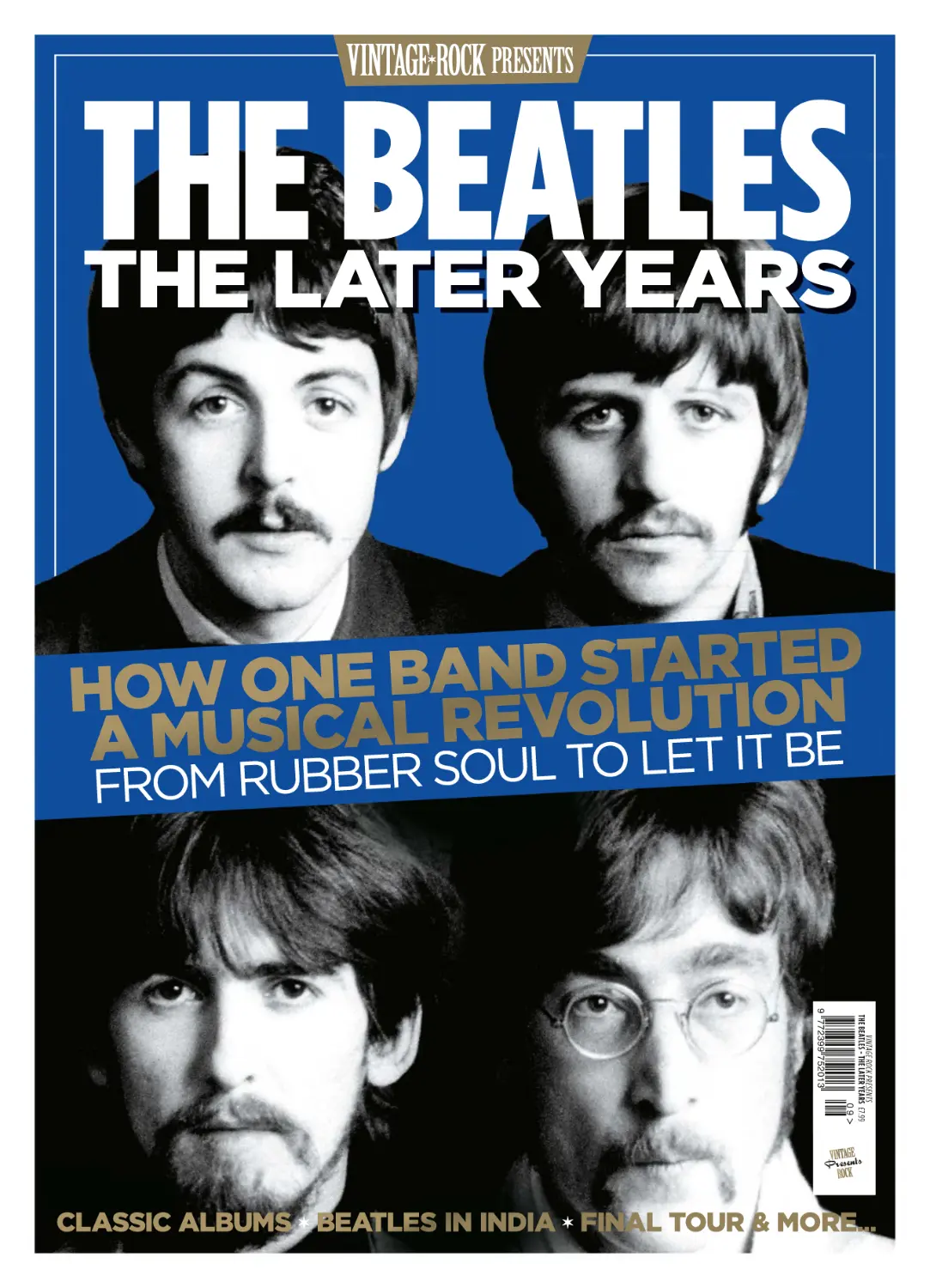


Теги: magazine music musical art magazine vintage rock presents
Год: 2018
Текст
09
VINTAGE ROCK PRESENTS 0 9
THE BEATLES - THE LATER YEARS £7.99
25/05/2018 10:49
VRP09.covers_foil_ifc_ibc_obc.sent.indd 7
9 772399 752013
9 772399 752013
Presents
© Getty
VRP09.covers_foil_ifc_ibc_obc.sent.indd 4
22/05/2018 11:03
Anthem Publishing
Piccadilly House,
London Road, Bath, BA1 6PL
+44 (0)1225 489984
vintagerock@anthem-publishing.com
www.vintagerockmag.com
www.facebook.com/vintagerockmag
EDITOR Rik Flynn
ART EDITOR Andrew McGregor
PRODUCTION EDITOR Rick Batey
ADVERTISING
ADVERTISING MANAGER Adrian Major
adrian@majormediasales.com
+44 (0) 1453 836257
AD PRODUCTION Craig Broadbridge
craig.broadbridge@anthem-publishing.com
ANTHEM PUBLISHING
CHIEF EXECUTIVE Jon Bickley
jon.bickley@anthem-publishing.com
MANAGING DIRECTOR Simon Lewis
simon.lewis@anthem-publishing.com
CREATIVE DIRECTOR Jenny Cook
jenny.cook@anthem-publishing.com
MARKETING MANAGER Gemma Bailey
gemma.bailey@anthem-publishing.com
CONTRIBUTORS
David Burke, Julie Burns, Steve Harnell, Douglas
McPherson, Ian Ravendale, Johnny Sharp, Ian Wade
PRINTED BY
William Gibbons & Sons Ltd
+44 (0) 1902 730 011
DISTRIBUTED BY
Marketforce (UK) Ltd,
5 Churchill Place, Canary Wharf, London,
E14 5HU +44 (0) 20 378 79001
LICENSING
Regina Erak
+44 (0) 7753 811 622
regina.erak@googlemail.com
SUBSCRIPTIONS & BACK ISSUES
0844 856 0642* (UK)
+44 (0)1371 853 609 (US)
anthem-publishing.com/vintage
shop@anthem-publishing.com
*Calls cost 7 pence per minute plus your
phone company’s access charge
WELCOME
The Beatles all agreed that it was Elvis
who set the ball rolling when his brand
of illicit rock’n’roll gave newly
christened ‘teenagers’ their virgin
thrills. And when John, Paul, George and
Ringo finally got their act together, they
rode his riotous wave into a bright and
breezy future, feeding that youthful appetite for more,
more, more with their addictive Merseybeat hooks.
But it was the band’s output after they’d outgrown the
mop tops and left the nubile screams of Beatlemania
echoing around the stadiums that shifted the poles
permanently and changed music forever. With 1965’s
Rubber Soul, pop music tipped its hat to adolescence, left
home and danced into a new unknown. It can be argued
that with that album, a set of beautifully-crafted, grownup – and most importantly entirely original – songs, that
the pop musician was finally granted ‘artist’ status.
After that, of course, pop’s floodgates were whipped off
their hinges and lost to the storm. With the rapid-fire
arrival of Revolver and Sgt. Pepper, the world of music
bust its seams and was suddenly, irrevocably ablaze,
buzzing to a boundless, transcendental new vibration.
The Beatles were discovering new plains to explore on a
daily basis and the Abbey Road studio became the conduit
through which they could explore their innermost
creative ideas. And boy, did they… with ‘The White
Album’, Abbey Road and, finally, Let It Be, the world was
treated to the finest musical era that’s ever been…
Rik Flynn
Editor
DON’T
MISS OUR
GREAT
SUBS
OFFER!
TURN TO
PAGE 48
The Professional
Publishers Association
Member
All content copyright Anthem Publishing Ltd 2018, all rights reserved.
While we make every effort to ensure that the factual content of Vintage
Rock magazine is correct, we cannot take any responsibility nor be held
accountable for any factual errors printed. Please make every effort to
check quoted prices and product specifications with manufacturers prior
to purchase. No part of this publication may be reproduced, stored in a
retrieval system or resold without prior consent of Anthem Publishing Ltd.
Vintage Rock magazine recognises all copyrights contained within the
issue. Where possible, we acknowledge the copyright holder.
3
VRP09.intro.sent.indd 3
21/05/2018 15:05
contents
p6
p 40
p 58
p 18
p 30
4
VRP09.contents.sent.indd 4
21/05/2018 15:47
CONTENTS
1965-1966: BOYS TO MEN
..........................
06
After the deafening screams of Beatlemania, endless songs
about girls and the staid rock’n’roll cover versions that filled
out their sets, the mop tops grew out. Armed with a pioneering
album of their own original songs, The Beatles set upon a new
phase of creativity, existentialism and excitement
ALBUM INSIGHT: REVOLVER
........................
18
Rubber Soul may have announced that change was very much
in the air for the foursome, but their next studio project would
go on to be regarded an experimental pop classic. With the
studio transformed from functional recording space to a house
of sonic wizardry, Revolver dispensed with the rulebook
THE END OF THE ROAD
................................
24
After the band’s final UK show at the NME Poll Winners’
party, The Beatles embarked on the calamitous final world
tour– across Germany, Japan, the Philippines and the US – that
ensured the band would never again set foot on the live stage
P 24
ALBUM INSIGHT: SGT. PEPPER’S LONELY
HEARTS CLUB BAND
30
....................................
Perhaps their finest musical achievement, Sgt. Pepper’s Lonely
Hearts Club Band ushered in yet another era for the band and
revealed four musical minds free of convention and at the
height of their creative powers. Effervescent pop and fizzing
psychedelia sat alongside overblown majesty to create an
album that’s still very much an influence to this day
TO EARTH WITH LOVE
..................................
36
It was the satellite TV link-up that united the world via farflung visions of culture, technology and industry. Representing
the UK contingent, The Beatles were at the centre of the Our
World TV special, harbouring a powerful message of peace and
love that would become far more than that…
P 106
ROLL UP, ROLL UP
......................................
40
They boarded the Magical Mystery Tour bus with their
technicolour entourage to plenty of good vibes, but without
any semblance of a plan. What transpired was a haphazard –
yet strangely pioneering – film and yet more great songs
UNPEELING THE APPLE
...............................
50
After the taxman had swallowed huge chunks of their income,
the band decided to form Apple Corps as a convenient – and
creative – way to dispense of excess funds via investment in
music, fashion and electronics. But without a business head
between them, chaos ensued
THE LIFE AQUATIC
.......................................
58
Somewhere amidst their attempts to rid Pepperland of the Blue
Meanies, The Beatles helped create an animated sub-aquatic
slice of psychedelia that reinvented the format. We join the
crew on the infamous Yellow Submarine
40 GREATEST BEATLES LATER CLASSICS
.....
64
We offer our pick of 40 of the finest Beatles songs from Rubber
Soul right through to Let It Be
P 122
3 FOR £3
GALLERY
......................................................
74
Each of the four Beatles captured on film: at the launch of Sgt.
Pepper, at the start of the Magical Mystery Tour, in a hip LA
clothing boutique and on the set of an historical TV show
EASTERN PROMISE
......................................
78
When the foursome embarked on their travels to the East, a
deeper philosophy awaited them. In India the band expanded
their minds via music, mysticism and Transcendental
Meditation, all under the watchful eye of their newly-appointed
guru the Maharishi Mahesh Yogi
MAKING WAVES
..........................................
86
For some, she was the thorn in The Beatles’ side, but Yoko Ono
proved herself a genuine libertine, an expressive musician and
an artist of the highest degree – plus, importantly, a guiding
influence on John Lennon’s musical future
ALBUM INSIGHT: THE BEATLES
....................
92
Known universally as ‘The White Album’, the Liverpudlians
showed no fear whatsoever with their epic 1968 double album
The Beatles. Housed within that minimalist white cover was
everything from simple pop to experimental chaos, from
fingerpicked beauty to an eight-minute sound montage
BEATLES ILLUSTRATED
.................................
98
We investigate The Beatles’ timeless sleeve art and its creators
– Klaus Vormann, Peter Blake and Jann Haworth, Richard
Hamilton, Iain Macmillan and others – while examining the
band’s own artistic enterprises
ALBUM INSIGHT: ABBEY ROAD
..................
106
Although released before the ill-fated Let It Be album, Abbey
Road was their true swansong. Housed within its grooves were
classics of every nature, from Lennon’s lurching anthem Come
Together and Harrison’s masterpiece Something, through to
Starr’s underwater classic, Octopus’s Garden
TIMES OF TROUBLE
.....................................
112
Paul tried his best to steer the band back into calmer waters
via the making of a back-to-their-roots documentary film and
album, but the waters it seemed were far too agitated. All four
knew it was pretty much over well before their 1970 album
made the shopfloor. We revisit Let It Be and the end of an era
ANOTHER DAY
.............................................
122
When the four Beatles finally went their separate ways, the
world received an unexpected double album opus from George,
politicised majesty – and a pacifistic masterpiece – from John,
acoustic solo simplicity and the all-powerful Wings from Paul
and, amongst his various guises, Ringo’s rock album, plus a
musical love letter to country & western
CODA
..........................................................
130
Though the band screened many promo videos and made
many pre-recorded appearances on Top Of The Pops
throughout the mid to late ’60s, it took unprecedented public
demand to finally persuade The Beatles to appear in person…
WHEN YOU SUBSCRIBE
TURN TO PAGE 48
5
Untitled-18 5
22/05/2018 08:36
I
t’s often remarked what an
incredible personal and creative
evolution The Beatles underwent
in the short four-year period
between the release of Please Please
Me and Sgt. Pepper. And that journey
accelerated to warp speed after the
band broke America, as a world of
possibilities seemed to open up to them
creatively, socially and philosophically.
Such was The Beatles’ cultural impact
by the middle of 1965 that the media
and entertainment establishment had
increasingly realised that there was
some real substance behind the
startling phenomenon of Beatlemania
– and the British Invasion of the US
that had followed.
All four members of the Beatles were
now based in London, rubbing
shoulders and rolling joints with a hip
and sophisticated crowd that may have
been hanging out only a couple of
hundred miles down the road from
The Cavern, but might as well have
been on a different planet.
Meanwhile, across the Atlantic, the
influence of the counter culture’s
leading lights was beginning to tell,
whether it be Bob Dylan’s invitation for
the band to join him in a New York
hotel room in August 1964 and their
subsequent introduction to marijuana,
or a highly enlightening visit to the
west coast of America a year later.
It was also becoming very clear that
this was not just a music thing
anymore: they’d tapped into a cultural
revolution that would cause them to
contemplate and address questions
more profound than where the next hit
record was coming from. They were
even considering writing some songs
that weren’t about girls…
It’s little wonder that they began
pinching themselves, wondering if they
were really here at all when they
played some of those insane shows to a
keening banshee wall of wailing teens.
The Beatles actually played Shea
Stadium twice in the space of one year
– and the second time they didn’t even
sell it out – but it was their first visit to
the recently built home of the New
York Mets baseball team that both
invented ‘Stadium Rock’ and provided
possibly the single most enduring
snapshot of Beatlemania.
Happy days: The Beatles gather at the
London Palladium, 18 February 1965.
On this day, Northern Songs was
floated on the Stock Exchange, netting
John and Paul nearly £100,000 apiece
Evening Standard/Getty Images
From mop tops to songwriting sophisticates,
Rubber Soul signalled a sea change for The
Beatles. Johnny Sharp investigates
6
VRP09.boystomen.sent.indd 6
18/05/2018 10:52
This was not
just a music
thing anymore
– They’d tapped
into a cultural
revolution
7
VRP09.boystomen.sent.indd 7
18/05/2018 10:51
the beatles 1965–1966
Bettmann Archive/Getty Images
The band’s record-breaking appearance
at Shea Stadium on 15 August scooped
what was at that time the largest gross
in the history of showbiz
The fact that they played barely half an
“At Shea Stadium, I saw the top of
hour on stage that night and that they
the mountain,” Lennon declared a few
would have been little more than
years later, but in truth the band were
ant-sized to most spectators –
baffled by the distance between
without the big screens
them and the audience
we’re now
and the relentless
accustomed to
hysteria of 56,000
– only reinforces
fans – to the
the idea that
point where
The band were
Beatlemania
they could
baffled by the
had become a
have snuck off
distance between
phenomenon
to leave four
by now barely
miming
them and the
rooted in
moptop stunt
hysteria of
reality.
doubles to
56,000 fans
As if to
gyrate on stage,
crystallise that
for all the
idea, within days
difference it
of that US tour
would have made.
ending, the Beatles’
The 100-watt amplifiers
metamorphosis into cartoon
that Vox had designed for
characters was complete, as a US
the show proved inadequate so the
Saturday morning TV show, The
band played through the PA system,
Beatles, became the first animated
but still few could hear much over the
show to be based on real people. Or
ear-splitting din of screaming teens.
Bettmann Archive/Getty Images
The emergence of a bootleg soundboard
recording in 2007 let us hear more than
the Shea Stadium crowd ever did – and
The Beatles were in lethal form
8
VRP09.boystomen.sent.indd 8
18/05/2018 10:51
xxxxx
9
VRP09.boystomen.sent.indd 9
18/05/2018 10:51
the beatles 1965–1966
f r o m LSD s t a r t a r i f t ?
Up until 1965, there was an undeniable
feeling of strength in numbers within The
Beatles. But after the introduction of acid
into their world, a hairline crack in their
unified front seemed to appear.
In the 1995 Anthology documentary,
George Harrison explained that he and
John wanted their bandmates to try acid
on the US tour in 1965: “We couldn’t relate
to them on any level, acid had changed us
so much. So the plan was that when we
got to Hollywood, on our day off we were
going to get them to take acid.”
Ringo did so, but Paul demurred,
resulting in mocking from the other three.
“We were all a bit cruel, like, ‘We're taking
it and you're not!’” Lennon remembered.
“Within a band, it’s more than peer
pressure, it’s fear pressure,” Paul told
biographer Barry Miles. “It becomes
trebled, more than just your mates, it’s,
'Hey, man, this whole band’s had acid, why
are you holding out?”
Indeed, you could interpret John’s lyrics
on Day Tripper, and their subtle dig at
part-time hipsters, as partly aimed at Paul.
And when he finally took the plunge,
rather than dropping acid with his fellow
Beatles, Paul chose the company of
Guinness heir Tara Browne and his wife
Nicky in December 1965. The fact that Paul
chose to take a trip away from his
bandmates was surely his way of saying
he was doing it for himself, not for them.
And later he would demonstrate a
different approach again when he
admitted to taking acid in a June 1967
magazine interview. He soon ended up
being grilled on national TV, and the band
feared that after the Rolling Stones drug
bust of that year, they’d be the next target
for the authorities. George Harrison in
particular felt that Paul was simply
attention-seeking. And what right had he
to boast? After all, he had been the one
that wouldn’t join them on those first,
momentous trips into the unknown.
Chemical differences? If so, it wouldn’t
be the last time that those helped drive a
great rock’n’roll band apart.
The Beatles' roadie Neil Aspinall (far
right) would go on to become the
Managing Director of Apple Corps
acid test
There was no sign of the creative
journey they were about to embark on.
Even when they toured the world the
following year, a few weeks after the
release of Revolver, the set was
similarly conservative, with the
exception of Paperback Writer and Day
Tripper. The live stage was clearly an
arena where progress was slowing to a
standstill compared to their studio
breakthroughs. But that tour was still a
mind-blowing new peak. And then, just
a few days later, at the aforementioned
residence, they would have their heads
tampered with even more profoundly.
John Lennon and George Harrison
had already inadvertently been
exposed to LSD while having dinner at
dentist friend John Riley’s house a few
months previously, when their host
had spiked their after-dinner coffee.
And although they were outraged and
more than a little terrified when Riley’s
trick was revealed and the drug’s
effects took hold, once they had time to
take in what had happened to them,
they were keen to try it again, like
children who had been on a scary but
exhilarating fairground ride that had
left them breathless and disorientated,
but which shortly afterwards had them
exclaiming: “Again! Again!”
The ideal opportunity arose during a
five-day break in the middle of the
same US tour that the Shea Stadium
show had kicked off – and this time a
third Beatle would take the plunge.
The setting could hardly have been
more apt: they had rented a mansion in
Benedict Canyon, previously owned by
Cary Grant and now the home of Zsa
Zsa Gabor. “It was a horseshoe-shaped
house on a hill,” Harrison recalled. “It
was like something out of Disneyland,”
remembered Lennon. They invited
over a few showbiz pals such as Joan
Pace/Getty Images
fear
pre
ssu r e
d i d Pa u l’ s a b s t i n e n c e
was it? After all, John, Paul, George
and Ringo weren’t really the lovable,
innocent lads portrayed therein, and
even epoch-making live shows like
Shea Stadium seemed firmly rooted in
the ‘old Beatles’ – the matching suited
moptop incarnation of shaking heads
and twanging beatpop stompers. A
third of the songs they played that
night were covers, and only three
originals came from the Help! LP they
were promoting.
10
VRP09.boystomen.sent.indd 10
18/05/2018 10:51
xxxxx
Baez, Help! actress Eleanor Bron,
Byrds Roger McGuinn and David
Crosby and actor Peter Fonda, all of
whom had to give police outside a
secret password, as details of The
Beatles’ residence in LA had leaked
and the gates were besieged by fans.
Once inside, they swallowed the
dosed sugar cubes they’d had burning
holes in their pockets, while lying in a
giant empty bathtub. Paul chose not to
partake, but Ringo and Neil Aspinall
joined in. Soon George was taking little
time in reclaiming his chemical
memories: “As it kicked in again, I
thought, ‘Jesus, I remember!’ I was
trying to play the guitar, and then I got
in the swimming pool and it was a
great feeling; the water felt good.”
However, being in The Beatles was
never going to provide you with peace
and quiet for long. Aspinall had to get
rid of Daily Mirror reporter Don Short
at one point, and then Fonda started
being, to quote Harrison, “really
uncool”. Fonda claimed George’s trip
took a scary turn, and he attempted to
reassure the youngest Beatle by
explaining that he needn’t fear passing
over to the next dimension, because, as
the Easy Rider star put it, “I know what
it’s like to be dead.” Fonda based this
on the fact he’d accidentally shot
himself as a child and his heart
stopped beating on the operating table.
It’s fair to say the band weren’t
buying into this notion. “Who
put all that shit in your
head,” spat John.
“You’re making me
feel like I’ve
never been
“I was trying to
born.” A more
play guitar, then
lasting
I got into the
impression,
meanwhile,
swimming pool
was
made on
and it was a great
George by
feeling”
McGuinn and
Crosby when the
two Byrds
introduced the
Englishman to the music
of Ravi Shankar. Within
months, George would be seeking out
the Indian maestro’s tutelage as he
aimed to learn the instrument himself.
Momentous encounters were coming
thick and fast around this time. Three
days after the trip, the band were
11
VRP09.boystomen.sent.indd 11
18/05/2018 10:51
the beatles 1965–1966
Keystone/Getty Images
The Beatles' new album Rubber
Soul comes off the EMI factory
production line in Middlesex
invited to meet Elvis Presley at his
Bel-Air mansion. Though McCartney
admitted that they had told the King
“We don’t like his new stuff”, and
Lennon had openly questioned his
insistence on making lame romantic
movies rather than hard-edged
rock’n’roll, it was a big thrill for them.
Meanwhile, in interviews, the band
were letting the PR act slip and
revealing what they really thought.
Lennon poured scorn on the myth of
their early years, telling DJ Gerry
Bishop they regarded The Cavern as “a
dirty old cellar” and expressing
exasperation at fans who “only turned
up just to riot”.
single steps
Even the reigning monarch wasn’t
awarded much reverence. In October,
they would receive MBEs and when
the Queen enquired as to
how long they’d been
together, Ringo replied,
“Forty years”.
Lennon would claim that
they smoked a joint in the
loos, but George would
later doubt this, claiming it
was a regular cigarette.
At the same time, The
Beatles were taking heavy
influence from the more
exotic folk they were
mixing with. It won’t have
escaped notice that
Lennon’s words to Peter
Fonda on that fateful night
in August 1965 would later
seep into the lyrics of She
Said, She Said on Revolver. Before that,
though, he and McCartney were
drawing on experiences and emotions
far more complex than “I wanna hold
your hand”.
When they entered the studio in
early October 1965, faced with the
unenviable task of writing and
recording an album in just six weeks to
meet the planned December release
date and catch the Christmas market,
all this bled into the songs, which they
were increasingly writing separately
before offering extra ideas, bridges,
lyrics and instrumental flourishes to
create the finished product.
If any of your favourite bands
announced a new direction based
around “funny songs, songs with jokes
in”, you’d break out in a cold sweat. But
that’s what Paul told Melody Maker
shortly before the release of Rubber
Soul. Still, if anyone could pull it off, it
would be The Beatles, and as it turned
out, all they meant was getting back to
having fun playing as a band. Fun
meant creativity, and increasingly,
creativity meant experimentation,
helped by the home-made cigarettes
passing round in the studio.
12
VRP09.boystomen.sent.indd 12
18/05/2018 10:51
xxxxx
The Beatles show off their MBEs at the
Saville Theatre after the presentation
ceremony at Buckingham Palace
Keystone/Getty Images
John and Paul
were drawing on
experiences more
complex than “I
wanna hold your
hand”
13
VRP09.boystomen.sent.indd 13
18/05/2018 10:51
the beatles 1965–1966
Keystone/Getty Images
Paul McCartney and his girlfriend
Jane Asher return from holidaying
in Portugal on 12 June 1965
14
VRP09.boystomen.sent.indd 14
18/05/2018 10:51
xxxxx
picture the paramour of the title to be
Not long after Yesterday had proved
someone not truly committed to the
that this was a band that could write
proposed relationship. Or you could
ballads to rival anything produced for
see it as the by-now habitual acid
the generation of crooners that had
consumer Lennon later admitted he
come before – enhanced by a classical
intended: a dig at part-time hipsters,
string section – we heard Day Tripper,
who only tripped occasionally and
released as a standalone double-A side
weren’t prepared to fully embrace the
for the Christmas market with We Can
lifestyle change it offered. “You’re just
Work It Out. The latter number
a weekend hippie… get it?” Lennon
presented a complicated romantic
explained later.
stand-off, which is widely believed to
be based on McCartney’s battle of wills
with Jane Asher, who had gone to
soul music
Bristol to join the Old Vic company,
Rubber Soul was released on the same
against his wishes. Before this, The
day as the double A-side, but contained
Beatles had been largely imagining the
neither track. Yet it clearly signposted
romantic rejections they sang
the musical leaps the band
about, but this had the
were working towards.
ring of experience
From the
about it. Musically
disorientating first
it was also more
bars of Drive My
adventurous,
Car, where
From the first
with the “Life
we’re not quite
disorienting bars
is very short”
sure which
middle eight
beat the
of Drive my car,
segueing back
opening guitar
rubber soul was
into the verse
motif and
full of surprises
via a disarming
drum fill are
switch to a
aiming for,
waltz-time
Rubber Soul was
tempo, a trick
full of thoughtsuggested by George,
provoking surprises.
showing the band’s most
The lo-fi intro of
junior member was becoming
Norwegian Wood was
increasingly important as a creative
intriguing, but then… what was that
force within the band.
thing?! To the average pop-picker in
On the flipside, Day Tripper was built
1965, the sitar must have sounded
on a twanging, propulsive riff as the
exotic, if not downright abrasive.
lyric spoke of a young lady who was “a
Musical experiments seemed to lace
big teaser” (John wanted to use the
every track, even if they were relatively
phrase “prick teaser” but the label said
modest at this point, such as the fuzzy
no) who “should be half the way there
organ on Harrison’s Think For Yourself,
now”. The sexual interpretation was
or the faintly medieval, lute-ish guitar
only one way of understanding it. A
solo on Girl. George Martin was also
more innocent reading would be to
contributing from the recording desk,
helping create the
harpsichordstyle break on
In My Life by
recording
himself on piano
playing at
half-tempo, then
playing it back at
double the speed.
But this was by
no means a sober,
self-important
attempt to flex the
Day Tripper/We Can Work It Out
introduced the pioneering double
creative
How t h e
Be atl e s
in v e n ted
th e pop
vp l aideo
nes, trains and…
fish and chips
Having invented the double-A side without
making any great fanfare about it, the
Fabs also set in motion another lasting
trend: with Rubber Soul recorded and
ready for release alongside Day Tripper/We
Can Work It Out, they went into
Twickenham TV studios on Tuesday, 23
November and produced ‘filmed inserts’
for TV to go with the two tracks as well as
older tracks Help!, I Feel Fine and Ticket To
Ride. They were the kind of clips that
would later be referred to as ‘pop videos’.
The idea was to offer TV channels filmed
versions of the band’s studio performances
which could be broadcast in place of them
actually appearing. The pick of the clips is
a rendition of Day Tripper on a transportthemed set, with Paul and John playing
behind a model of a 1920s plane, while
Ringo, alongside George, tapped a
tambourine through a train carriage
window before picking up drumsticks to
tap out the beat on the doors and
eventually trying to dismantle the train
with a saw.
However, by the end of a long day, the
band were losing interest, with bizarre
results. The first version of I Feel Fine, in
which Ringo sat on an exercise bike and
George sang into a boxing punchball, had
a surreal entertainment value. But in the
second they were filmed sat around on the
floor eating fish and chips from newspaper
wrappers and half-mouthing the words.
Whose bright idea this was is unclear, but
suffice it to say that Brian Epstein vetoed
the latter clip’s release. Spoilsport.
The films succeeded in lightening their
schedule of TV appearances, but not
everyone was happy. “EMI called and
complained that we had spent a total of
seven hundred and fifty pounds,” NEMS’
Toby Bramwell recalled. “We fell about the
office laughing.”
A-side concept to the record market
15
VRP09.boystomen.sent.indd 15
22/05/2018 08:35
the beatles 1965–1966
when in truth the narrator can’t hide
muscles. There was a continual sense
his insecurity with such empty threats.
of playfulness in passages such as the
Then there are the songs that, for the
“tit-tit-tit-tit” backing vocal on Girl,
first time, don’t seem to be about girls
the “beep beep yeah” of Drive My Car
or relationships at all. Nowhere Man
and Michelle’s reworking of Paul’s
was explained by Lennon to Hunter
French chanson pastiche, a party piece
Davies as a self-loathing broadside at
he often amused friends with,
himself after a bout of writer’s
originally just ‘haw-he-haw’
block, although many
Gallic-sounding noises.
took it as a typically
But just as notable
stinging attack on
was the subject
the straight world
matter. These
he had now left
were not the
The Beatles’
behind. The
teen-pleasing
heads were
Word might be
love songs
stretching; the
one of the
they once
least
specialised in.
straight world
memorable,
The girls that
was struggling
but it’s one of
populate
to keep up
the first songs
Rubber Soul
to grapple with
sound a lot more
the idea of ‘love’
like young women
being a bigger
– and baffling,
concept capable of
beguiling, sometimes
setting us ‘free’, in much
infuriating ones at that.
more than just the romantic sense.
Drive My Car was based around
John would later explain it as a song
chasing a woman with loftier
about ‘getting smart’, which he and his
ambitions than the male protagonist,
bandmates undoubtedly were.
reflective of a tougher, less available
Elsewhere, on In My Life, Lennon
type of woman, like those they were
delved deeper than ever into his own
running into more regularly in the
soul. It had only been three months
social circles they now inhabited. The
since Help!’s cri de coeur, but whereas
‘Girl’ in Lennon’s songs is selfhe’d masked the genuine vulnerability
destructive as well as cruel and aloof
and loneliness he felt with the positive
(“did she learn when she was young
energy of an upbeat, ebullient pop
that pain would lead to pleasure?”) and
song, this time there was no attempt to
I’m Looking Through You seemed to
shake his moptop in case the emotion
react to the hurt of rejection – in this
proved too heavy for people.
case, many have inferred, Paul’s at the
Rubber Soul represented The
hands of Jane Asher – by threatening
Beatles’ most concentrated attempt so
to withdraw affection (“Love has a
far to make an album as a coherent
nasty habit of disappearing overnight”)
body of work – if not a concept album
in the vein of, say, Frank Sinatra’s
Songs For Swinging Lovers or Johnny
Cash’s Bitter Tears, then without
doubt a self-contained set of songs
that weren’t just a few singles slung
together with some throwaway fillers
to make up the numbers. It was
noticeable that this was the first
Beatles release to contain no cover
versions at all, and this was one of the
many characteristics that inspired
Brian Wilson to go one better and
create Pet Sounds for The Beach
Boys: “I liked the way it all went
together, the way it was all one
thing,” Wilson said. “It was a
challenge to me."
You could judge this particular book
by its cover. The band’s hair, already
regarded as freakishly long for men of
that time, seemed to have collectively
grown by at least another few metres.
In fact the sleeve photo seemed to have
warped their heads to surreal
proportions, and the title looked as if it
was spelt in a font that was melting.
Change was happening at lightning
speed, The Beatles’ heads were
stretching, and the straight world,
increasingly, was struggling to keep up.
beat the band
In March 1966 the band showed their
mischievous sense of humour was a
touch too unorthodox for most when
they collaborated with photographer
Robert Whitaker to create ‘A
Somnambulant Adventure’, a pop art
concept shoot wherein the band posed
in butchers’ coats with dismembered
doll parts and slabs of meat. They loved
the results so much that they pushed
for the shots to be used on their
upcoming US compilation Yesterday
And Today. Outrage naturally ensued
and the cover was replaced, but the
furore was nothing compared to an
interview Lennon did the same month
with Maureen Cleave of the Evening
Standard for a series of individual
profiles entitled How Does a Beatle
Live? That was, of course, the one
where he noted that the quartet were
“more popular than Jesus”. It passed
without controversy at the time, but
when picked up by a US teen mag the
following summer, all hell broke loose
in the god-fearing southern states,
records were banned and burned, the
band received death threats and they
were even banned in South Africa.
Given the fact that they’d already
been chased out of the Philippines
shortly before America turned against
them, it’s little wonder that they
decided to go back to the studio to shut
an increasingly hysterical world out.
By the time they did that, they’d
made another quantum leap with the
album they’d begun recording in the
spring of that year – Revolver. “Who
put all those things in your head?” they
would ask, echoing John’s words to
Peter Fonda. Well, you could point to
all manner of influences swirling
around their universe but for the most
part, they did it all by themselves. ✶
16
VRP09.boystomen.sent.indd 16
22/05/2018 13:03
xxxxx
Keystone/Getty Images
The Fab Four chose to park the
tourbus in 1966 in favour of
traversing Europe by train
17
VRP09.boystomen.sent.indd 17
18/05/2018 10:52
R EVOLVER
“Listen to the colour of your dreams” says John Lennon on
Revolver’s psychedelic landmark Tomorrow Never Knows.
The Beatles did just that – and they created a masterpiece.
Steve Harnell tunes in…
18
VRP09.album_revolver.sent.indd 18
22/05/2018 13:05
Les Lee/Express/Getty Images
John and Paul signing autographs for fans
as they arrive at EMI studios, Abbey Road,
for a rehearsal during the recording of what
would become Revolver, 22 June 1966
I
t may only have been a fleeting
moment, but for a brief period,
England’s bustling capital was at
the epicentre of the pop cultural
universe. ‘Swinging London’ has
since descended into the realms of
newsreel montage cliché, but in 1966
the thrilling adventurousness and
diversity of its creative forces in
music, film, theatre and fashion was
the envy of the entire world.
The climate was of experimentalism
and freedom, throwing off the shackles
of post-war austerity. From the rise of
working class heroes like Michael
Caine, Terence Stamp and Sean
Connery in the acting world, through
the ground-breaking innovations of
Mary Quant in the fashion industry
and the emergence of Twiggy and
Chrissie Shrimpton, all eyes were on
London – and England even won the
World Cup that summer.
The Beatles were the fulcrum of it
all, of course, the biggest pop cultural
phenomenon that has ever been.
Although only St John’s Wooddwelling man-about-town Paul
McCartney was a continual presence
on the countercultural scene (John,
George and Ringo had already
decamped from the bright lights to the
more sedate environs of the
stockbroker belt), the band were still
perfectly placed to fully embrace, and
then spearhead, a radical new
movement of artistic endeavour.
In April 1966, The Rolling Stones,
driven by the vision of exotic multiinstrumentalist Brian Jones, had
mirrored the ‘Swinging London’ ethos
and ideology with Aftermath, but four
months later Revolver captured the
zeitgeist to an even greater degree.
Filled with things to say
Originally, manager Brian Epstein had
envisaged that 1966 should follow a
similar itinerary to the previous two
years, with The Beatles making a third
movie and an accompanying
soundtrack album and undertaking
extensive summer touring. But when
the band vetoed the movie idea, an
unprecedented three-month hole
appeared in their schedule. It was an
extraordinary luxury for a band who’d
been forced to work at breakneck
speed ever since their earliest days.
A typically perverse decision from
the foursome was to shun their usual
home at Abbey Road to record at Stax
Studio in Memphis, the birthplace of
seminal records by the likes of Otis
Redding, Booker T & the MGs and Sam
and Dave. In-house producer Jim
Stewart would have replaced George
Martin, but the plan was eventually
abandoned, and reported similar
relocations to either New York’s
Atlantic Studios or Motown’s hit
factory in Detroit were also dismissed.
Reluctantly, the band reconvened at
Abbey Road for their seventh studio
album alongside George Martin. It was
hardly the most auspicious of starts for
what has arguably become their
crowning achievement.
The difference between their
previous album Rubber Soul and
Revolver is, in essence, that between
two very different thought processes.
Even though it stretches its legs
sonically – in particular its use of the
sitar on Norwegian Wood – Rubber Soul
was still constructed under the
restrictions that it had to be replicated
live – or at least an approximation of it.
With Revolver all bets were off. The
band were resolute that their touring
days would soon be over (save for a few
contractual obligations), so the only
aim was to make each song the very
best it could be in isolation.
Remarkably, although Tomorrow
Never Knows seems like the perfect
conclusion to Revolver and a gateway
to the studio sophistication of Pepper,
it was actually the first track to be
recorded at sessions for the follow-up
to Rubber Soul. After that came
chamber music, soulful R&B, world
The band were
perfectly placed
to spearhead
a radical new
movement of
artistic endeavour
19
VRP09.album_revolver.sent.indd 19
18/05/2018 10:44
Lindsey Parnaby/EPA/REX/Shutterstock
revolver
John’s rough lyrics for I’m Only
Sleeping, scribbled on the back
of a phone bill, failed to reach
their estimate at auction in 2005
music and a phantasmagorical
children’s tune so evocative that it
inspired a whole animated universe. Is
this a reflection of the band’s collective
ADHD, or the ebullient self-confidence
in their own ability to write in any style
they chose? Perhaps it’s a final
realisation that the stylistic stabilisers
had been kicked to the kerb and they
were now freewheeling into a limitless
universe of musical possibilities. For
the vast majority of bands, Tomorrow
Never Knows would have been a sonic
eureka moment of seismic proportions.
But not The Beatles. For them, it was
just another room in an endless
corridor of possibilities.
In the end, it’s Taxman that ushers in
the new era of The Beatles on record.
The two count-ins that herald the song
simultaneously look backwards and
forwards: George Harrison characteracts the role of a miser totting up his
pennies (this was dubbed onto the song
a month after it was originally finished)
while the vigorous “1-2-3-4!” in the
background by Paul is a knowing nod
to the exuberant count-in at the start of
I Saw Her Standing There, the first song
from their debut album, Please Please
Me. Taxman itself is a far more cynical
affair and features George’s bitter
complaint at the outrageous 95p-inthe-pound tax rate for the UK’s highest
earners at the time. In his
autobiography I, Me, Mine Harrison
wrote: “Taxman was when I first
realised that even though we had
started earning money, we were
actually giving most of it away in taxes;
it was and still is typical. Why should
this be so? Are we being punished for
something we had forgotten to do?”
Apart from George’s cynicism, the star
of the show is McCartney’s pumping
bassline. Paul also supplies the
remarkable crazed guitar solo, too.
The ease at which the band pinball
between styles without any drop-off in
quality on the album is staggering.
Eleanor Rigby, McCartney’s bleak,
Pinteresque tale of broken, futile lives
is heartbreaking. With Paul the sole
Beatle on the track, it was also a
signpost to his future tendency to
dispense with his colleagues and drop
the band dynamic when the need
arose. George Martin’s wonderful
orchestral arrangement was inspired
by the film scores of French new wave
director François Truffaut. The track is
arguably McCartney’s great
For the beatles, tomorrow never
knows was just another room in an
endless corridor of possibilities
accomplishment as a lyricist. There’s a
bravery to the bleakness of lines like
“Father McKenzie, wiping the dirt
from his hands as he walks from the
grave/ No one was saved”. The Samuel
Beckett-level desolation must have
come as a shock to pop fans the world
over. And note that final line: Paul’s
apparent rejection of Christianity
prefaces the eventual “bigger than
Jesus” furore created by John that
engulfed the band later in the year.
The story of the song’s origin has
been much debated over the years,
with McCartney claiming that both the
titular spinster and Father McKenzie
were pure figments of his imagination.
While wandering the streets of Bristol
waiting for girlfriend Jane Asher to
finish rehearsals for a play at the
Bristol Old Vic, he stumbled across a
King Street wine merchants, Rigby &
Evens. His original heroine was called
Daisy Hawkins, but after splicing in the
first name of Help! co-star Eleanor
Bron and part of the Bristol shop name,
he came up with a new title.
In the Anthology book, Paul explains:
“I thought, I swear, that I made up the
name like that. I remember distinctly
having the name Eleanor, looking for a
believable surname and wandering
around the docklands in Bristol and
seeing the shop there. But it seems that
r1 9 6e6 volver
• pa r lo p h o n e
Taxman (Harrison)
Eleanor Rigby (Lennon & McCartney)
I’m Only Sleeping (Lennon & McCartney)
Love You To (Harrison)
Here, There And Everywhere (Lennon &
McCartney)
Yellow Submarine (Lennon & McCartney)
She Said She Said (Lennon & McCartney)
Good Day Sunshine (Lennon & McCartney)
And Your Bird Can Sing (Lennon & McCartney)
For No One (Lennon & McCartney)
Doctor Robert (Lennon & McCartney)
I Want To Tell You (Harrison)
Got To Get You Into My Life (Lennon &
McCartney)
Tomorrow Never Knows (Lennon & McCartney)
20
VRP09.album_revolver.sent.indd 20
18/05/2018 13:10
Jim Dyson/Getty Images
The fabled Eleanor Rigby
grave in Liverpool: “It was
either complete coincidence or
in my subconscious,” said Paul
up in Woolton Cemetery where I used
to hang out a lot with John, there’s a
gravestone to an Eleanor Rigby.
Apparently, a few yards to the right,
there’s someone called McKenzie. It
was either complete coincidence or in
my subconscious.” It’s also said that
Father McKenzie started life as Father
McCartney until Lennon’s friend Pete
Shotton suggested it could be
misinterpreted and came up with the
new name while Paul worked on the
song at John’s Surrey house. Analysing
Eleanor Rigby in his book Revolution In
The Head, Ian MacDonald acutely
adds: “Often misrepresented as
purveyors of escapist fantasy, The
Beatles were, at their best, more
poignantly realistic than any other
popular artists of their time.”
perso n n e l
John Lennon – lead, harmony and backing vocals;
rhythm and acoustic guitars; Hammond organ,
harmonium, tape loops, sound effects; tambourine,
handclaps, finger snaps
Paul McCartney – lead, harmony and backing
vocals; bass, acoustic and lead guitars; piano,
clavichord; tape loops, sound effects; handclaps,
finger snaps
George Harrison – head, harmony and backing
vocals; lead, acoustic, rhythm and bass guitars; sitar,
Lennon’s cynicism at fame shows
through in his ode to lethargy, I’m Only
Sleeping. This was something of a
perennial songwriting theme of his; he
returned to it on ‘The White Album’
track I’m So Tired and later in his solo
career with #9 Dream. Harrison’s
Indian-style backwards guitar solo was
constructed during a six-hour session,
thus creating another song that was
impossible to duplicate live.
Another landmark moment on the
album is found with Harrison’s Love
You To. Although George had already
utilised a sitar on Norwegian Wood,
Love You To was the first track
specifically written with the
instrument in mind. George played
sitar, and hired Indian musician Anil
Bhagwat to play tabla. The song was
tambura; tape loops, sound effects; maracas,
tambourine, handclaps, finger snaps
Ringo Starr – drums; tambourine, maracas,
cowbell, shaker, handclaps, finger snaps; tape loops;
lead vocals on Yellow Submarine
Notable guests
Anil Bhagwat – tabla on Love You To
Alan Civil – French horn on For No One
Mal Evans – bass drum , added backing vocals on
Yellow Submarine
originally titled Granny Smith;
Harrison often completed a song
before finalising a name for it. His
message here may have been one of
universal love and peace, but there’s
still an element of cynicism that was
often typical of his songwriting:
“There’s people standing round, who’ll
screw you in the ground/ They’ll fill
you in with all their sins you’ll see”.
If Revolver is regularly shot through
with world-weary cynicism, then Paul
McCartney often provides its lighter
moments including the beautifully
melodic Here, There And Everywhere
and Good Day Sunshine, the latter
Macca’s inspired attempt to channel
the aural injection of Vitamin D that
was The Lovin’ Spoonful’s Daydream.
Meanwhile, Ringo’s traditional
Neil Aspinall, Brian Jones, Pattie Boyd,
Marianne Faithfull, Alf Bicknell – background
vocals on Yellow Submarine
Production
George Martin – producer, mixing engineer; piano
on Good Day Sunshine and Tomorrow Never Knows;
Hammond organ on Got To Get You Into My Life;
tape loops of marching band (band unknown, found
in the EMI archives) on Yellow Submarine
Geoff Emerick – recording and mixing engineer;
tape loops of marching band on Yellow Submarine
21
VRP09.album_revolver.sent.indd 21
18/05/2018 13:11
revolver
the 240V system used in England, any
of us, including Lennon, could easily
have been electrocuted, and I would
have gone down in history as the first
recording engineer to kill a client in
the studio.”
Wesley/Keystone/Hulton Archive/Getty Images
Turning on, tuning in
The Beatles snapped at
London Airport en route to
Germany for a three-city
mini-tour, 23rd June 1966
one-song outing comes on the
wonderful children’s classic Yellow
Submarine. The sheer audacity of
writing a children’s song and placing it
slap-bang in the middle of a
generation-defining artistic statement
is quite remarkable. Among those
providing sound effects in the studio
were Beatle insiders Mal Evans and
Neil Aspinall, Rolling Stone Brian
Jones, and Marianne Faithfull – and
that’s the band’s chauffeur Alf Bicknell
rattling chains in the background, too.
A 30-second introduction from Ringo
was cut from the final recording, which
saw the band spending more time on
this one song than on the whole of
their debut album.
In the Anthology book, Paul explains:
“I thought that with Ringo being so
good with children – a knockabout
uncle type – it might not be a bad idea
for him to have a children’s song rather
than a serious song. He wasn’t that
keen on singing.”
As Lennon set about creating a
suitably nautical soundscape to back
the track, he came upon the idea of
singing underwater. George Martin
dissuaded him from the plan but
engineer Geoff Emerick came up with
an alternative: how about John sing
into a microphone that was immersed
in water? A microphone was duly
wrapped in a condom and placed
inside a milk carton. The signal was so
weak, though, that this idea was
scrapped. It was only years later that
Emerick realised what folly it could
have been and recalled: “I realised with
horror that the microphone we were
using was phantom-powered –
meaning that it actually was a live
electrical object. In conjunction with
ST U DI O I N N OVAT ION S
Could a teenager be the key to the
freeflowing sense of
experimentalism that courses
through the veins of Revolver?
Engineer Geoff Emerick was just 19
when he was chosen to man the
mixing desk at Abbey Road during
the sessions. He has no doubt of
the album’s ground-breaking
nature and says: “I know for a fact
that, from the day it came out,
Revolver changed the way that
everyone made records.”
Writer Ian McDonald is effusive
in his praise, too, of the youthful
Emerick’s influence describing
him as an “audio experimentalist”
in the tradition of groundbreaking
producer Joe Meek.
Surprisingly, Revolver also
marked the very first time that
EMI’s four-track tape machines
were placed in the studio’s control
room alongside the producer and
engineer, making it easy for the
pair to reach over and make
The band’s enthusiastic adoption (Paul
excepted) of LSD is a major influence
on Revolver. For She Said She Said, read
He Said He Said. The subject in
question is in fact the soon-to-be Easy
Rider star and countercultural icon
Peter Fonda. On 24 August 1965, The
Beatles were taking a break from their
US tour and hanging out with the actor
and members of The Byrds. As a child,
Fonda had almost died of a gunshot
wound, and delighted in telling the
gory tale to Harrison and Lennon
while the assembled stars were
tripping on acid.
Lennon commented: “I wrote [the
song] about an acid trip I was on in Los
Angeles. It was only the second trip
we’d had. We took it because I started
hearing things about it and we wanted
to know what it was all about. Peter
Fonda came over to us and started
saying things like ‘I know what it’s like
to be dead, man’ and we didn’t wanna
know, but he kept going on and on.”
Equally trip-related is Lennon’s
Doctor Robert. The identity of the man
in question is yet another hotlydebated topic but it is thought to be Dr
Robert Freymann, who ran a clinic in
New York; he was notorious for giving
his clients Vitamin B12 shots with a
healthy dose of amphetamines. It’s
another exercise in Lennon’s continual
instant alterations to recordings
or introduce sonic effects.
The Beatles were keen to
replicate the heightened sensory
states brought on by LSD, and a
number of recording innovations
were introduced during sessions,
most notably automatic double
tracking (ADT), which doubles up
vocal takes and provides a
thickened, richer sound. Lennon,
never a fan of his own voice, was
particularly keen to play with new
vocal treatments, even having his
pipes amplified through the
revolving – suitably enough –
speakers found inside a Leslie
organ cabinet for Tomorrow Never
Knows. The track also made
extensive use of tape loops, an
idea from McCartney that had
been influenced by avant garde
composer Karlheinz Stockhausen
and which was later used to even
more extreme effect on Revolution
#9 on ‘The White Album’.
22
VRP09.album_revolver.sent.indd 22
22/05/2018 08:27
need to subvert the pop form and fill
his lyrics with in-jokes for the turnedon countercultural insiders. Likewise,
the same goes for Here Come The Nice
by The Small Faces.
Even though McCartney had refused to
take LSD by the time he recorded
Revolver, he still managed to sneak in
the pro-marijuana Motown-influenced
Got To Get You Into My Life under the
guise of a sweet love song. “I wrote it
when I had first been introduced to pot
– like someone else might write an ode
to chocolate or a good claret,”
McCartney later explained. The song
was a coded boast, too, as Paul later
added: “We were kind of proud to have
been introduced to pot by Dylan, that
was rather a coup. It was like being
introduced to meditation and given
your mantra by the Maharishi. There
was a certain status to it.”
The band only finalised the album’s
title while on tour in Germany in late
June. Among the contenders was
Abracadabra, but this was ditched
when they realised it had already been
used. Also on the potentials list were
Magic Circles, Beatles On Safari, Four
Sides Of The Eternal Triangle and even,
rather astonishingly, Fat Man And
Bobby. At one point Ringo also
attempted a groansome pun on The
Rolling Stones’ Aftermath when he
suggested After Geography.
Following years of tinkering with
tracklistings, Revolver was the final
example of a Beatles album having
differing incarnations in the UK and
US. Three Lennon compositions – I’m
Only Sleeping, And Your Bird Can Sing
and Doctor Robert – were taken off the
US pressing as they’d already featured
on previous Capitol release Yesterday
And Today just two months earlier.
When the album was unveiled in the
US, its release and concurrent live
shows were at first marred by the
controversy surrounding Lennon’s
notorious “bigger than Jesus”
interview with Maureen Cleave that
first appeared in the Evening Standard
in March 1966. Although Lennon’s
statement attracted little attention in
the UK, five months later it blew up
into a row which very nearly
threatened the band’s existence in the
United States, where Beatle record-
Klaus Voormann, one-time flatmate of
Harrison and Starr, was the designer of
the striking Revolver album sleeve. He
won a Grammy for his collage in 1966
Rebecca Sapp/WireImage for The Recording Academy/Getty Images
Four sides now
“i’m not anti-christ or anti-religion… i
just said what i said and was wrong, or
was taken wrong, and now it’s all this”
john lennon
burning events became commonplace.
Lennon had told Cleave: “Christianity
will go. It will vanish and shrink. I
needn’t argue about that; I’m right and
I’ll be proved right. We’re more
popular than Jesus now; I don’t know
which will go first – rock’n’roll or
Christianity. Jesus was all right but his
disciples were thick and ordinary.”
While at a press conference at the
Astor Hotel before the 1966 US
mini-tour, a clearly rattled Lennon
semi-backtracked: “I’m not anti-Christ
or anti-religion or anti-God. I’m not
saying we’re better or greater, or
comparing us with Jesus Christ as a
person, or God as a thing or whatever it
is. I just said what I said and was
wrong, or was taken wrong, and now
it’s all this.”
Faced with this, the band adopted a
siege mentality. The Abbey Road
recording studio would become their
bunker, and the extended recording
sessions for Revolver’s follow-up would
result in the most important album of
all time. The military intervention of
Sgt. Pepper awaited. ✶
23
VRP09.album_revolver.sent.indd 23
18/05/2018 10:44
When original plans to make another film were dropped, The
Beatles filled the gap in their diary with a world tour. After all,
what could go wrong? Douglas McPherson goes on the road
I
t wasn’t billed as The Beatles’
Last World Tour, but the Fab
Four weren’t very far into their
1966 trek from Britain to
Germany, Japan, the Philippines and
America when they decided they’d
had enough of a bad experience they
had no desire to repeat.
Although they were met with legions
of screaming fans wherever they went,
they were also embroiled in
international diplomatic incidents in
two countries, got on the wrong side of
a dictator, and faced a storm of
controversy and death threats in
America’s deep south after John
Lennon’s unguarded remarks
concerning religion were taken
seriously out of context.
Although it wasn’t officially part of
the tour, The Beatles played what
would turn out to be their last
scheduled UK show at the New
Musical Express Poll Winners Concert
at the Empire Pool (now SSE Arena),
Wembley, on 1 May, 1966.
In the year that England won the
World Cup and London was declared
the swinging capital of the world, the
bill was, in retrospect, one of the
greatest line-ups of rock royalty ever
assembled. Among the stars that played
a short set in front of 10,000 fans were
The Rolling Stones, The Who, The
Yardbirds, Small Faces, The Walker
Brothers, Herman’s Hermits, Dusty
Springfield, Roy Orbison, Cliff Richard
and the Shadows, and Dave Dee, Dozy,
Beaky, Mick and Tich.
24
VRP09.worldtour.sent.indd 24
18/05/2018 11:15
Doug McKenzie/Hulton Archive/Getty Images
N ME PO L LW IN NER S
S HOW S ET
LIST
I Feel Fine
Nowhere Man
Day Tripper
If I Needed Someone
I'm Down
The Beatles accept their awards onstage
at the NME Poll Winners Concert at
Empire Pool, Wembley on May 1 1966
If anyone had known it would be
their last chance to see The Beatles, it
would have been an even more
momentous occasion. As it was,
however, there was tension backstage
when Mick Jagger insisted that The
Rolling Stones close the show instead
of The Beatles. His argument was that,
as the Stones were coming off three #1
records in a row, they were the bigger
act. John Lennon was having none of
it, and accused Mick of being
ungrateful for all the help the
Liverpudlians had given the London
band, including writing the Stones’ hit
I Wanna Be Your Man. Jagger went so
far as to threaten not to play at all if the
Stones couldn’t close the show, but
backed down when NME proprietor
Maurice Kinn said he’d be in breach of
contract with ABC-TV, who were
filming the event for television.
In the event, however, Lennon opted
for The Beatles not to close the show,
so that they could make their escape
from the building without being
besieged by fans. It was left to The
Kinks to go on last.
More tragically from an historical
perspective, another dispute between
Beatles manager Brian Epstein and
ABC was not resolved, and the TV
cameras were turned off while both
The Beatles and The Stones performed,
the result being that the band’s last
proper show in Britain was lost to
posterity. Those there were treated to a
15-minute set comprising I Feel Fine,
Nowhere Man, Day Tripper, If I
25
VRP09.worldtour.sent.indd 25
18/05/2018 11:15
dpa picture alliance / Alamy Stock Photo
the final tour
The four careering through their
11-song set before a packed audience
at Essen’s Grugahalle on 25 June
T H E B E AT L E S
19 6 6 WORLD
TOUR
1 May, London, UK
24 June (two shows), Munich, Germany
25 June (two shows), Essen, Germany
26 June (two shows), Hamburg, Germany
30 June, Tokyo, Japan
1 July (two shows), Tokyo, Japan
2 July (two shows), Tokyo, Japan
4 July (two shows), Manila, Philippines
12 August (two shows), Chicago, USA
13 August (two shows), Detroit, USA
14 August, Cleveland, USA
15 August, Washington DC, USA
16 August, Philadelphia, USA
17 August (two shows), Toronto, Canada
18 August, Boston, USA
19 August (two shows), Memphis, USA
21 August, Cincinnati, USA
21 August, St Louis, USA
23 August, New York City, USA
25 August (two shows), Seattle, USA
28 August, Los Angeles, USA
29 August, San Francisco, USA
Needed Someone and I’m Down. The
group was however filmed receiving
their trophies (cups of a size to rival
the one that Bobby Charlton would
soon be holding aloft in the nearby
football stadium) for Britain’s Top
Vocal Group and the World’s Best
Vocal Group, while Lennon was named
Runner Up World Musical Personality
and Britain’s Top Vocal Personality.
The awards were presented by squarejawed Western star Clint Walker from
the TV series Cheyenne, and accepted
without any kind of speech from the
group, let alone any kind of hint that
the thousands present had just seen
The Beatles play the UK for the very
last time.
The NME show was a one-off
appearance during the making of the
band’s seventh album, Revolver, and
the day after they completed the disc
the group flew to Munich to begin the
German leg of their world tour at the
historic, 3500-capacity Circus Krone
building on 24 June.
Although they’d just completed one
of their most musically ambitious
albums, they didn’t play any of the
songs from it, such as Eleanor Rigby.
One reason was that they never
previewed unreleased material live.
Another reason – and ultimately one of
the reasons why their 1966 tour would
be their last – was that the increasingly
ambitious and sophisticated sounds
that they were creating in the studio
had grown beyond what four men
could recreate on stage with just three
guitars and a drum kit.
Physically exhausted and creatively
drained from their recent recording
session, they took to the stage in smart
green suits like the simple four-piece
rock’n’roll band they had once been,
plugged in their guitars without fuss,
adjusted their amps and launched into
the three-chord blast of Chuck Berry’s
Rock’n’roll Music. With John and Paul
harmonising like the Everly Brothers
on Baby’s In Black, the unpretentiously
endearing set continued with songs
like the twangy I Feel Fine, Nowhere
Man and the foursome’s irresistibly
catchy current hit, Paperback Writer.
The lack of pretence – or lack of
rehearsal – was evident when Lennon
began playing over one of Harrison’s
solos and stood back with his hands
behind his back when he realised his
mistake, and when McCartney forgot
the words to I’m Down. As the
audience added a layer of screams to
everything it was as if nothing had
changed since the first wave of
Beatlemania a couple of years before.
troubled waters
Things had changed, however, as the
group discovered when they returned
to Hamburg for their first gigs there
since their days at the Star Club. Now
they were playing the 5600-seat
Ernst-Merch-Halle. They travelled in
luxury trains normally reserved for
royalty and stayed in a former palace.
Nostalgic sight-seeing trips to their old
stomping grounds had to be confined
to night to avoid being mobbed.
Some “old ghosts” surfaced, as
Harrison described some former
drinking buddies they ran into, but
both the former friends and the band
themselves were conscious of the
division that fame and wealth had put
between them. There was also an ugly
undercurrent of violence that became
evident on the tour as police began
using heavy-handed tactics, and even
tear gas, to subdue over-excited fans.
The band’s flight to Japan was
delayed by a typhoon and the group
26
VRP09.worldtour.sent.indd 26
18/05/2018 11:15
xxxxx
George Stroud/Express/Hulton Archive/Getty Images
GER MA N Y,
JA PA N &
PHILIP P I NE S
S ET LIST
The Beatles return to London from
Manila after their tour of Germany,
Japan and the Philippines
waited out the weather during a
stopover in Alaska. A political storm,
meanwhile, had been brewing in Japan
about whether The Beatles should be
allowed to play there at all.
At a transitional time in Japan’s
history, when the country was still
re-establishing its sovereignty after
allied occupation in the years after the
Second World War, traditionalists
feared the group’s decadent western
influence on the nation’s youth. Even
the Japanese prime minister Eisaku
Satö was opposed to the visit until he
was persuaded of the group’s
respectability by the fact that they had
recently been made MBEs by the
British sovereign.
Matters were complicated by the fact
that the concerts were scheduled for
the end of June, which is Japan’s
rainiest month. The only indoor venue
large enough to host the shows was the
Nippon Budokan, which had been built
to house the judo events at the Tokyo
Olympics two years before. Martial arts
were revered in Japan and connected
to the country’s main religion, Shinto,
and the hall had been built on the site
of a plaza where Japanese soldiers had
sworn allegiance to their emperor
before WW2.
Although the Beatles’ appearance
paved the way for the Budokan to
become a major rock venue, the idea of
them playing there at the time was
considered virtually sacrilegious.
Threats from the extremist Greater
Japanese Patriotic Party to “give the
Beatles proper haircuts”, plus the
general fear of riotous behaviour by
fans, resulted in an oppressive police
and security presence and a jail-like
monitoring and scheduling of the
band’s movements from hotel to stage.
The foursome spent their
confinement in the Presidential Suite
of the Tokyo Hilton, collaborating on a
psychedelic painting that became
known as Images Of A Woman. It was
the only painting on which all four
Beatles worked together. The headclearing period of creativity prompted
them to come up with a title for their
just-recorded album, Revolver.
The concerts went ahead without
incident, although the band were
disconcerted by the traditionally
reserved nature of the Japanese
audience. Performing for the first time
without the accompaniment of
deafening screams, the musicians
could actually hear what they were
playing. According to some reports, the
band weren’t impressed by their own
stood up by the
group, marcos
fumed that her
kids preferred
the rolling
stones anyway
Rock And Roll Music
She’s A Woman
If I Needed Someone
Day Tripper
Baby’s In Black
I Feel Fine
Yesterday
I Wanna Be Your Man
Nowhere Man
Paperback Writer
I’m Down
musicianship, which perhaps became
another factor in their decision to quit
live performance.
From Japan, the Beatles headed for
the Philippines, where they ran into
more trouble. Their two concerts at the
Rizal Memorial football stadium were
witnessed by a combined audience of
80,000, which was the largest ever to
see The Beatles in a single day.
Unbeknownst to the group, however,
Epstein had turned down a request for
them to appear at a party thrown by
the country’s First Lady, Imelda
Marcos, the next day.
Stood up by the group, while the
nation’s TV cameras and press waited
for The Beatles to make their
appearance, Marcos was furious.
Reportedly, she fumed that her
children preferred The Stones anyway.
The Beatles, meanwhile, discovered
what happens when you snub a
dictator. In an unfunny version of a
storyline that might have graced one of
their films, they were more or less
forced to flee the country. While the
morning’s newspapers condemned
them, staff assistance at their hotel was
withdrawn, as was a police escort to
the airport, where even the escalators
were turned off, forcing the band and
their entourage to haul their luggage
and equipment up the stairs.
In the terminal they were physically
beaten up by the regime’s thugs and
when they finally boarded their
27
VRP09.worldtour.sent.indd 27
18/05/2018 11:15
At their final show in San Francisco on 29
August The Beatles played:
Rock And Roll Music
She’s A Woman
If I Needed Someone
Day Tripper
Baby’s In Black
I Feel Fine
Yesterday
I Wanna Be Your Man
Nowhere Man
Paperback Writer
Long Tall Sally*
*On other US dates the closing number was
either Long Tall Sally or I’m Down
plane they were hit by a “departure
tax” that not uncoincidentally equalled
their fee for the Manila gig. Even the
peace-loving George Harrison was
sufficiently bruised by the experience
to say that the only reason they’d ever
go back to the Philippines would be “to
drop a bomb on the country”.
If The Beatles were counting on a
warmer reception in America they’d
reckoned without the backlash against
Rare ticket stubs from The
Beatles’ final show at
Candlestick Park can now
fetch upwards of £400
the infamous
quote Lennon
had given back
in March. When US teen magazine
Datebook reproduced the interview
just before the band arrived in
America, the “we’re more popular
than Jesus” part was seized upon,
particularly in the ‘Bible Belt’ of the
southern states, by preachers, disc
jockeys, the Ku Klux Klan and pretty
much anybody who already disliked
The Beatles and all that they stood for.
The outcry, including radio boycotts
and death threats, was so intense that
Epstein considered cancelling the
entire tour, or at least the dates in
places like Memphis and St Louis
where the reaction was most extreme.
Instead, he called a press conference
ahead of the first show in Chicago
where Lennon apologised for “the
mess that he had made”. He explained
that he was merely commenting on
dwindling church attendance, that he
was “not anti-God, anti-Christ or
anti-religion”, and that he’d forgotten
that, because of his high profile as a
Beatle, his words would resonate in
ways another person’s wouldn’t.
GAB Archive/Redferns
C A N D L E ST ICK
PA R K SE T
LI ST
Tracksimages.com / Alamy Stock Photo
THE FINAL TOUR
Harrison, the most spiritual of the
Beatles, backed Lennon by saying, “I
agree with what John said. That
doesn’t mean I'm against religion. He
was making a serious point, but his
remarks were taken out of context.”
The haters were unappeased, however,
and when a firework was thrown on
stage in Memphis concert on 19
August, the group’s press officer Tony
Barrow recalled that everyone on stage
and in the wings immediately looked at
Lennon, fearing that he’d been shot.
Questions about the quote continued
to haunt the band at press conferences
throughout the American tour, while
other stresses piled up during the trek
which saw them playing shows almost
every day, with hundreds of miles
between venues.
TO U R H I G H S. . . AN D LOWS
Support acts throughout the
American leg of the tour were The
Remains, Bobby Hebb, The Cyrkle
and the Ronettes.
Radio station KLUE in Longview,
Texas, organised a public bonfire to
burn Beatles records and
memorabilia in response to John
Lennon’s remark that the band was
“more popular than Jesus”. The
following day, the station was
devastated by a lightning bolt...
The Cleveland Stadium show was
interrupted for 30 minutes when
2500 members of the
20,000-strong audience crashed a
security fence and invaded the
stage and area around it, forcing
the band to take cover in their
caravan dressing room.
The Beatles played to their biggest
audience in a single day (a total of
80,000 over two shows) in Manila.
The Beatles only sold around a
third of the 60,000 tickets available
when they performed at the John F
Kennedy Stadium in Philadelphia
on August 16.
The tour was the first on which
Yesterday was given a full band
backing as opposed to just Paul
McCartney’s acoustic guitar.
The Cincinnati show was postponed
for safety reasons after road
manger Mal Evans was electrocuted
and thrown several feet across the
stage after plugging into a
rain-drenched amplifier.
In Manhattan, two girls threatened
to jump from a 22nd floor unless
they could meet Paul. They were
successfully talked down.
After their official press conference
at the Warwick Hotel in New York,
and hoping for a new line of
questioning, the band held a junior
conference for 150 younger fans.
The five-day, six-concert German
leg of the tour was known as the
Bravo Blitztournee, and was
sponsored by Bravo magazine.
On their way home from the
Philippines, the band took a
sightseeing break in India and
bought Indian instruments at Rikhi
Ram & Son’s shop in New Delhi.
28
VRP09.worldtour.sent.indd 28
18/05/2018 11:15
Bettmann/Getty Images
xxxxx
Police provide much-needed security
from stage invaders as The Beatles
perform their final US show at
Candlestick Park in San Francisco
The last call
In Cincinnati, their scheduled show at
Crosley Field was rained off amid fears
of electrocution. Although the support
acts played that evening, The Beatles’
portion was postponed until midday
the next day, when they played without
an opening act, before flying to St Louis
for their evening concert.
In St Louis it rained heavily once
again, and the band played beneath a
makeshift corrugated iron shelter. “It
felt like the worst little gig we’d ever
played, even before we’d started as a
band,” McCartney recalled. “We were
having to worry about the rain getting
in the amps and it took us right back to
the Cavern days – it was worse than
those early days. And I don’t even think
the house was full.”
It was, in fact, the gig where
McCartney finally agreed with Lennon
and Harrison that it was time to put
their touring days behind them, even
though they vowed not to announce
their decision until they’d honoured
the remaining four American dates.
If anyone had known that the world’s
biggest band would play its final
concert on a cold, foggy night at
Candlestick Park baseball stadium in
San Francisco, on 29 August, 1966, the
show’s promoters would probably have
sold more than 25,000 tickets to a
venue that could hold more than
42,000 people. The group themselves
knew, though. “There was a big talk at
Candlestick Park that this had got to
end,” Ringo reflected later. “John
wanted to give up more than the
others. He said that he’d had enough. I
never felt 100 per cent certain ‘til we
got back to London.”
Knowing it would be their final
show, McCartney asked the band’s
press officer Tony Barrow to record the
show on a hand-held cassette player
out in the field. Unfortunately, he
forgot to turn the tape over and missed
the end of the very last song the
foursome played, a cover of Little
Richard’s Long Tall Sally.
The band also thought to record the
occasion photographically. “Before one
of the last numbers, we set up this
camera,” Harrison remembered. “We
set it up on the amplifier and Ringo
came off the drums, and we stood with
our backs to the audience and posed
“we stood with
our backs to the
audience and
posed for a photo
as we knew it was
the last show”
for a photograph, because we knew
that was the last show.”
It wasn’t quite The Beatles’ last gig.
On 30 January, 1969, they made their
swansong with an unannounced
performance on the roof of their
five-storey Apple Corps office building
in London’s Savile Row, delighting and
surprising people on their lunch break
in the streets below until the police
asked them to turn the volume down.
Candlestick Park was, however, The
Beatles’ last concert before a paying
audience and although no one present
realised at the time that they’d
witnessed the end of an era, anyone
who retained their ticket stub as a
souvenir would have seen its value rise
considerably in years to come above
the $4.50 or $6.50 that they paid for it.
In an interesting historical footnote,
Paul McCartney returned to
Candlestick Park 48 years later on 14
August, 2014 for the 50th concert of his
Out There tour. McCartney was the
last act ever to play the venue before it
was demolished. In front of nearly
twice as many people than had
witnessed The Beatles’ last stand
nearly half a century before, he
included several Beatles classics in his
set and joked with the crowd that the
last time he was there, “We got so
pissed off we never did it again!” ✶
29
VRP09.worldtour.sent.indd 29
18/05/2018 11:15
SGT. P EP P ER’ S
LONE LY H E A RT S C LU B BA N D
The Beatles’ most famous album has only grown in stature
over the last 50 years and marks the moment in musical
history where pop was afforded equal rights with high art.
Steve Harnell doffs his cap
30
VRP09.album_sgt.sent.indd 30
18/05/2018 13:48
Tony Evans/Getty Images
S
gt. Pepper’s Lonely Hearts Club
Band occupies a singular place
in the Beatles canon – it’s both
their most important album
and their most misunderstood.
In terms of its significance, there can
be no more game-changing long-player
in the history of recorded music than
the band’s 1967 opus. It marked the
moment where pop music broke the
cultural glass ceiling and could be
considered high art. However, its
reputation as rock’s finest ‘concept’
album has always been a misnomer.
Under examination, the Sgt. Pepper
‘fake band’ conceit unravels after its
second song and only makes a cursory
reappearance on the penultimate track.
So much for joined-up thinking, then.
Like Revolver, the diversity of
musical styles and tonalities – from
Lennon’s acerbic bitterness and
psychedelic imagination to
McCartney’s whimsy and Harrison’s
mysticism – is really what lies at the
heart of Sgt. Pepper’s long-term appeal.
It’s also George Martin’s finest
achievement as a producer.
You could argue that the band made
more consistent albums (step forward,
Revolver) and created more diverse
collections (no doubt, the astonishingly
generous pick’n’mix smorgasbord of
the ‘The White Album’) but there’s
something about the whole package of
Sgt. Pepper’s Lonely Hearts Club Band
– its clutch of now-classic tunes, the
psychedelic, era-defining front cover,
the much-vaunted audio trickery
within – that holds a special place in
many Fab Four fans’ hearts.
All was not idyllic within the ranks of
Beatledom, though. Itchy feet had set
in as they reacted against the
suffocating pressure of being part of
the world’s biggest band. Harrison
even threatened to leave until his
anger was appeased by Brian Epstein’s
promise that their touring days were
officially over. Lennon took time out
to hook up once again with A Hard
Day’s Night and Help! director
Richard Lester, playing the part of
Musketeer Gripweed in How I Won
The War. McCartney explored his
growing fascination with brass band
music by providing the soundtrack
to the TV drama The Family Way,
but he had bigger plans in mind for
his future.
American pop artist Jann Haworth with two of
her soft sculptures: the ‘Old Lady’ figure on the
right features on the cover of Sgt. Pepper,
co-designed by her and her husband Peter Blake
The genesis of Sgt. Pepper marks a
key moment in Beatle history where
McCartney asserted himself as the
main motivational force within the
band. Meanwhile, manager Brian
Epstein, who was battling depression
and an addiction to pills, was by this
point proving to be far from the
dynamic force of old. Distracted by his
troubles, his role was becoming more
reactive than proactive.
The bassist wrote the lion’s share of
the material on the album and came up
with an idea for a song which would
eventually become Sgt. Pepper’s
seemingly unifying concept while on a
return flight to London from Kenya
with tour manager Mal Evans. With a
view to freeing up The Beatles
stylistically, McCartney posited the
concept of creating a fictional
Edwardian-era military band.
Evans, for his part, riffing off the au
courant West Coast psychedelic band
names of the times, reportedly came up
with the title Sgt. Pepper’s Lonely
Hearts Club Band. Paul later explained:
“I thought it would be nice to lose our
identities, to submerge ourselves in the
persona of a fake group. We could
make up all the culture around it and
collect all our heroes in one place.”
At first, the idea formed just the seed
for the rocking opening song from the
album. It was only three months into
recording sessions that McCartney
suggested that the ‘Sgt. Pepper’
concept could be used as an
overarching framing device.
George Martin recalled: “Sgt. Pepper
itself didn’t appear until halfway
through making the album. It was
Paul’s song, just an ordinary rock
number. But when we finished it, Paul
said: ‘Why don’t we make a whole
album as though the Pepper band
really existed, as though Sgt. Pepper
was making the record?’ I loved the
idea and from that moment on it was as
though Pepper had a life of its own.”
The Beach Boys’ seminal Pet Sounds
was a regular touchstone throughout
the recording process and a continual
reminder of how a studio could
“Paul said, ‘Why don’t we make a
whole album as though Sgt. Pepper
was making the record?’ I loved
the idea” George MArtin
31
VRP09.album_sgt.sent.indd 31
18/05/2018 10:47
Sgt. Pepper’s Lonely Hearts Club Band
Evening Standard/Hulton Archive/Getty Images
Sgt.
Pe ppe r ’s
Lon e ly
He a rts
Club
Band
1 9 67 • pa r lo p h o n e
John Lennon’s Romany Sgt. Pepper caravan,
painted by The Fool, July 1967. The vehicle spent
years on Lennon’s Irish island but was retrieved
and part-restored by Ringo after John’s death
become an instrument in itself.
McCartney has recognised the
influence of Freak Out! by The Mothers
of Invention, now often seen as rock’s
first fully-fledged concept album (in a
perfect example of pop eating itself,
Frank Zappa’s band went on to satirise
Sgt. Pepper with their 1968 album
We’re Only In It For The Money, which
parodied the famous cover art. Upon
their record company’s insistence,
however, Zappa’s artful reference was
removed from the front of the album
and placed inside the gatefold).
With The Beatles afforded the luxury
of limitless studio time, they originally
began recording sessions for what
became Sgt. Pepper with the idea of
creating a themed work around their
childhoods in Liverpool. Early fruit
yielded from those sessions were
Strawberry Fields Forever, When I’m
Sixty-Four and Penny Lane. With the
band taking an unheard-of amount of
time between the delivery of albums
– an unrelenting record-buying public
had ben led to expect most acts to
release two LPs a year – Epstein was
eventually pressured into giving up
Strawberry Fields Forever and Penny
Lane for a double A-sided single in
February 1967. Remarkably, what is
almost universally considered the
greatest 7-inch record of all time only
made it to #2 in the UK singles chart.
Engelbert Humperdinck’s Please
Release Me pipped it to the summit,
breaking The Beatles’ four-year run of
chart-topping singles in the UK.
The two sides of the single were
omitted from the eventual tracklisting
of the album, a decision which George
Martin has described as the biggest
mistake of his professional life. The
whole affair left a sour taste in the
mouth, for not only did the single fail
to make it to #1 but the two songs’
absence also stymied the entire
‘Liverpool childhood’ concept.
The race to write
With Paul asserting his dominance
over the direction and workload of the
band, resentment began to increase
among his colleagues. Always the first
to arrive at recording sessions with an
armful of new compositions,
McCartney’s proliferant talent forced
Lennon’s hand. John’s inherent sense
of competition with Paul generally
allowed him to keep pace, but there
was a sense that he was being
The two sides of the strawberry
fields forever/penny lane single
were omitted from the tracklisting
of the album
Sgt. Pepper’s Lonely Hearts Club Band
(Lennon & McCartney)
With A Little Help From My Friends (Lennon &
McCartney)
Lucy In The Sky With Diamonds (Lennon &
McCartney)
Getting Better (Lennon & McCartney)
Fixing A Hole (Lennon & McCartney)
She’s Leaving Home (Lennon & McCartney)
Being For The Benefit Of Mr Kite! (Lennon &
McCartney)
Within You Without You (Harrison)
When I’m Sixty Four (Lennon & McCartney)
Lovely Rita (Lennon & McCartney)
Good Morning Good Morning (Lennon &
McCartney)
Sgt. Pepper’s Lonely Hearts Club Band
(Reprise) (Lennon & McCartney)
A Day In The Life (Lennon & McCartney)
pressurised into writing songs to order
rather than being left to wait for the
muse to strike. Meanwhile, Harrison
was sensing that the new working
methods of endless overdubs and
assembling songs piecemeal was
ruining their traditional band dynamic.
With so much dead time in-between
takes, Ringo was a passive bystander
for much of the recording. “The biggest
memory I have of Sgt. Pepper is that I
learned to play chess,” he added drily.
From the album’s opening moments
presenting an orchestra tuning up, The
Beatles tap into an interesting dualism:
they are at once embracing the elder
order and thumbing their nose at the
establishment. This is an album in the
form of an event – unapologetic in its
scale, wilfully indulgent and very
knowing. George Martin’s adept
sprinkling of sound effects – refined
32
VRP09.album_sgt.sent.indd 32
18/05/2018 13:47
John Downing/Getty Images
pe r sonnel
It’s May 1967, and the four Beatles
show off the sleeve of their new album
at the press launch at Brian Epstein’s
house at 24 Chapel Street, London
during his years working with The
Goons and many more comedy acts of
the day – is a continual feature of Sgt.
Pepper. The audience noise at the
album’s beginning was a combination
of a recording of the Beyond The Fringe
stage show plus takes from the
orchestral session that gave birth to A
Day In The Life.
The Sgt. Pepper theme itself is a deft
mix of overture, music hall
atmospherics and heavy rock. Paul
McCartney had witnessed iconic guitar
hero Jimi Hendrix in full flight just two
nights before recording the track at
Brian Epstein’s Saville Theatre. Paul’s
rocking solo, as with his stunning
contribution to Taxman the previous
year, showcased his under-rated chops
as a lead guitar player.
Ringo’s appearance as ‘Billy Shears’
on With A Little Help From My Friends
finds him at the edge of his limited
vocal range for an anthem of collective
unity that’s a neat summation of the
hopes of the emerging counter-culture
community and a striking example of
McCartney’s supremely agile bass
playing. It was originally titled Bad
Finger Boogie; The Beatles later played
a key part in the eventual rise of Apple
Records signees Badfinger, choosing
their name, with Paul writing the Top 5
hit Come And Get It for them.
Lennon’s first major contribution,
Lucy In The Sky With Diamonds, has
become a psychedelic treasure, but
among the plaudits for its
groundbreaking use of surrealism the
pleasing counterpoint of laid-back
verses and stomping chorus is often
missed. Inspired by a pastel drawing by
his four-year-old son Julian, Lennon
also drew from Lewis Carroll’s
Through The Looking-Glass for the
dreamlike quality of the song. For once,
the drug connotations – it was banned
by the BBC as being pro-LSD – were
entirely unintentional.
From the psychedelic transportation
of Lucy, we’re snapped back into focus
by the upbeat jangle of Getting Better, a
perfect blend of McCartney and
Lennon’s yin and yang songwriting
(Lennon’s contribution of “It can’t get
much worse” in the countermelody
still raises a wry smile). Also provided
by Lennon was the song’s darkest
lyrical refrain: “I used to be cruel to my
woman/ I beat her and kept her apart
from the things that she loved”, which
still feels odd coming from the lips of
the cherubic McCartney.
Accusations of drug references seem
to have affixed themselves to Beatles
tracks at every turn during their
psychedelic pomp. Even McCartney’s
apparently innocent Fixing A Hole was
deemed to promote heroin. With
critics reaching for ever-more
ridiculous links, they may have
overlooked the fact this was more
John Lennon – lead, harmony and
background vocals; rhythm, acoustic and lead
guitars; Hammond organ and final piano E
chord; harmonica, tape loops, sound
effects and comb and tissue paper;
handclaps, tambourine and maracas
Paul McCartney – lead, harmony and
background vocals; bass and lead guitars;
electric and acoustic pianos, Lowrey and
Hammond organs; handclaps; vocalisations,
tape loops, sound effects, comb and paper
George Harrison – harmony and
background vocals; lead, rhythm and acoustic
guitars; sitar; tamboura; harmonica and
kazoo; handclaps and maracas; lead vocals on
Within You Without You
Ringo Starr – drums, congas, tambourine,
maracas, congas, handclaps and tubular bells;
lead vocals on With A Little Help From My
Friends; harmonica; final piano E chord
Production
George Martin – producer and mixer; tape
loops and sound effects; harpsichord on
Fixing A Hole, harmonium, Lowrey organ and
glockenspiel on Being For The Benefit Of Mr.
Kite!, Hammond organ on With A Little Help
From My Friends, and piano on Getting Better
and the piano solo in Lovely Rita; final
harmonium chord
Geoff Emerick – audio engineering; tape
loops and sound effects
33
VRP09.album_sgt.sent.indd 33
18/05/2018 10:47
Larry Ellis/Daily Express/Getty Images
Sgt. Pepper’s Lonely Hearts Club Band
George Martin alongside Geoff Emerick,
being handed his Grammy award for
the engineering of Sgt. Pepper’s Lonely
Hearts Club Band by Ringo, March 1968
likely Paul’s take on recent repairs to
his Scottish farmhouse mixed with
reflections on the state of his
songwriting muse.
One of the album’s weaker tracks,
Fixing A Hole is blown out of the water
by the heartbreaking She’s Leaving
Home that follows. Every bit as good as
the finely-observed narrative behind
Revolver’s similarly orchestrated
Eleanor Rigby, the song was an incisive
kitchen sink drama that found The
Beatles expertly straddling the
generation gap between disaffected
youth and disappointed parenthood.
Sheila Bromberg’s harp intro is
wonderfully nuanced, and orchestral
arranger Mike Leander’s occasional
use of Indian motifs within a
traditional Western string arrangement
is absolutely inspired.
Those attracted by Sgt. Pepper’s
studio innovations will no doubt
gravitate towards the swirling cut-andpaste psychedelia of Being For The
Benefit of Mr Kite! and the
hallucinatory nature of George
Martin’s and Geoff Emerick’s
fairground interludes. With Lennon
frantically trying to keep pace with
Paul’s output, expediency was the
order of the day, with the lyrics barely
changed from the text of an 1843 poster
for Pablo Fanque’s circus in Rochdale
bought in a Kent antique shop while on
location filming the promo film for
Strawberry Fields Forever. With
Lennon setting Martin and Emerick
the task of creating a fairground
atmosphere where the listener could
“smell the sawdust”, the pair
assembled a sound collage splicing
together loops of harmoniums, steam
organs, harmonicas and calliopes.
From inside to outside
Side 2 opens with George’s only
songwriting contribution to Sgt.
Pepper, the mid-tempo raga Within
You, Without You. Along with Love You
C RITI C S … W H O NEEDS ’ EM ?
No other album in rock history has
elicited such an extraordinary
range of critical response as Sgt.
Pepper. After all, the nigh-on 40
minutes of music contained herein
has variously been described by
Kenneth Tynan of The Times as “a
decisive moment in the history of
Western civilisation” and voted
the worst record ever made in a
poll of pop stars published in a
1998 issue of Melody Maker.
The record’s status as a cultural
sacred cow has long been assured
– Newsweek’s Jack Kroll
compared its lyrics to literary
figures including Edith Sitwell,
Harold Pinter and even TS Eliot –
but over the years the odd
dissenting voice has appeared.
To and The Inner Light it marks his
fascination with Indian classical music
and underlines the forward-thinking
nature of this LP at its best. Recorded
with uncredited musicians from the
Asian Music Centre, Harrison is the
only Beatle on the song and, like
Taxman, it shows his tendency for
sanctimonious finger-wagging.
For When I’m Sixty-Four, McCartney
is seemingly occupying the same
headspace as when he soundtracked
TV drama The Family Way the previous
winter. McCartney detractors seize
upon moments like this – Lennon, of
course, termed it “granny music” – but
the lightness of touch works well when
set against John’s cynicism and
George’s didacticism. The comedy of
George Formby casts a shadow here, as
do the saucy seaside postcards of
Donald McGill.
McCartney had kept the melody in
his songwriting locker since the very
early days of the band’s life; he played
it as an instrumental on occasions at
club gigs when the PA gave up the
ghost and finally wrote the lyrics when
his father turned 64 in July 1966.
This section of the album is Sgt.
Pepper’s least convincing. It’s difficult
to conclude that Lovely Rita figures
among the band’s best work.
McCartney’s winning way with a
melody once again gets him over the
line and he pulls something out of the
fire with the surprisingly psychedelic
coda, but could this be Sgt. Pepper’s
weak link? Lennon certainly thought
so, pointing out: “These stories about
boring people doing boring things –
being postmen and secretaries and
writing home. I’m not interested in
third-party songs. I like to write about
me, ’cos I know me.”
KLF provocateur Bill Drummond
went as far as to say that the
album was “the worst thing that
ever happened to music”, while
Rolling Stone Keith Richards
lumped it in with his own band’s
psychedelic folly Their Satanic
Majesties Request, labelling
Pepper nothing more than “a
mishmash of rubbish”.
The facts and figures speak for
themselves, though. Despite no
singles being issued to coincide
with its release, Sgt. Pepper
topped the charts in the UK for an
astonishing 27 consecutive weeks
and 15 weeks in the US. On home
soil, it sold 250,000 copies in its
first week. Pipe down Keef, the
people have spoken.
34
VRP09.album_sgt.sent.indd 34
18/05/2018 10:47
GR OOV E I S I N THE A RT
The Beatles’ attention to sonic
detail on Sgt. Pepper’s Lonely
Hearts Club Band even went as far
as an audio snippet that isn’t
strictly on the record itself. The
infinite run-out groove which
kicks in after the epochal final
chord of A Day In The Life has (it
was ever thus) been the subject of
endless conjecture by fans.
Lennon added a 15kHz highfrequency tone to annoy dogs,
and the band spent hours
recording speech which was cut
up, re-spliced and reversed to
create a montage of gibberish.
After completing final mixes of
the album on 21 April 1967, the
band reconvened for their final bit
of audio trickery. Ending at 4am
Lennon is not above criticism
himself, though. Once again looking for
a quick hit of inspiration, Good
Morning Good Morning came from the
kind of mundane starting point he
would have hammered McCartney for
using – the jingle of a Kellogg’s Corn
Flakes advert. Perhaps he knew it, too,
and ultimately dismissed it as
“throwaway, a piece of garbage”.
In its favour, it does inject the back
end of the album with a much-needed
shot of adrenaline, with McCartney
and Harrison both competing against
each other on lead guitar. And if any
proof was needed that The Beatles’ eye
(or ear) for detail was fully focussed at
the sessions then consider the fact that
even the sound effects colouring the
end of the song were ordered so that
each successive animal heard was large
enough to eat the previous one.
After the blink-and-you-miss-it Sgt.
Pepper band reprise to provide some
form and shape to the preceding 11
songs comes what is possibly the
greatest pop song ever committed to
tape – if you could call the epochal A
Day In The Life ‘pop’…
It took an unprecedented 34 hours of
studio time to perfect the track, and
not a moment was wasted. Recording
began on the song just two days after
the band finished Penny Lane. It
became so important to the impact of
Sgt. Pepper that it sits outside the
framing structure of the fictional band,
but when work first began on it, few
realised just what they had on their
hands. As with …Mr Kite, there’s a
reportage element to Lennon’s lyric
with allusions to newspaper articles
about the suicide of a young millionaire
friend of theirs, Tara Browne, that
appeared in the pages of the Daily Mail
the next morning, they spent nine
hours huddled around two
microphones recording what
amounted to only a handful of
seconds’ worth of material.
Depending on the pressing of the
vinyl you have, there are at least
four different versions of the
groove. Can we make out anything
from the confusion? Perhaps a line
and another story about a Lancashire
potholes survey – the perfect contrast
of the significant and mundane.
Browne was a London scenester who
drove his Lotus Elan at high speed
through red lights in South
Kensington, hitting a parked van and
killing himself. It’s not known if he was
under the influence of LSD at the time
of the crash, but it’s thought John
wrote the lyrics with that in mind.
Lennon’s narrator is oddly changeable
in tone throughout the piece,
particularly in the Browne section:
“And though the news was rather sad/
Well I just had to laugh”.
So what is the message of one of the
most analysed five minutes in music
history? Perhaps it’s an investigation
into existential crisis, the futility of
existence where life gives equal
prominence to tragedy, war and
mundanity. Does the “I’d love to turn
you on” section allude to the
transportational power of drugs and
the imagination to lift us out of our
everyday worries?
Although McCartney’s breezy
mid-section contribution to the track,
like Getting Better, appears in
microcosm to show the bitter and
sweet contrast of the two major
songwriters’ contrasting styles, that’s
too superficial an understanding of the
band dynamic. A Day In The Life is
most acclaimed for its two
extraordinary experimental ‘end of the
world’ orchestral interludes, yet the
man behind the idea wasn’t Lennon, as
that says “never could be any
other way”. One notorious
interpretation is that when played
backwards, a band member can be
heard saying “We will f*** you
like Superman”. It’s fair to say
that the jury is still out on this
one and even those involved are
unlikely to furnish us with
definitive answers.
many would expect, but Paul, the
admirer of avant garde composers John
Cage and Luciano Berio.
When the original framework of the
song included a 24-bar gap, the
ever-ambitious McCartney suggested
they commission a 90-piece orchestra
to fill the hole. In the event, George
Martin corralled 40 members of the
Royal Philharmonic and London
Symphony Orchestra. When recording
took place, famous friends including
Mick Jagger and Marianne Faithfull,
Keith Richards, Donovan and Michael
Nesmith from The Monkees looked on
in the studio. Adding to the fun (and
irritation of the assembled
sessioneers), the orchestra was asked
to wear evening dress and put on fake
noses, comedy hats, false eyes and bald
wigs, much to the amusement of the
assembled celebrity throng, with
McCartney playing the role of
conductor, baton in hand.
Lennon’s request to Martin was for
an orchestral section that was “a
tremendous build-up, from nothing to
something absolutely like the end of
the world.” Martin instructed the
orchestra to create a blitzkrieg of
organised chaos: “It’s every man for
himself. Don’t listen to the fellow next
to you. If he’s a third away from you, let
him go. Just do your own slide up, your
own way.”
All that was left was the final E chord
played by all four Beatles. An
apocalyptic end of the world, but the
start of a new one for rock music. ✶
Lennon’s request to George Martin
was “a tremendous build-up, from
nothing to absolutely the
end of the world”
35
VRP09.album_sgt.sent.indd 35
18/05/2018 10:47
It was a defining moment for The Beatles that spawned their
anthem for the Summer Of Love. The Our World global telecast
united the planet via satellite and made history. Rik Flynn plugs in
I
n 2008, NASA beamed that most
apt of The Beatles’ creations
– Across The Universe – into deep
space to commemorate the
collective 50th anniversary of both
the agency and the band. But it was
not the first time that Beatles music
had been transmitted beyond our
atmosphere, and it was not the first
time the perfect song had been chosen.
In fact, just over 40 years earlier,
thanks to one man’s pioneering vision
and an incredible unified effort
amongst multiple nations, one of the
group’s best-loved songs was amongst
the first to be sent heavenward as part
of a rare, truly global event.
On 18 May 1967, The Beatles were
signed up to represent the vanguard of
British creativity on Our World, planet
Earth’s very first satellite telecast.
Transmitted to an audience of over 400
million across five different continents,
this would be the first time in history
that everyone could watch the same
TV programme (almost) anywhere in
the world. This landmark feat was
achieved via three carefully co-
ordinated satellites – the Intelsat I
(Early Bird), Intelsat II (Lana Bird) and
ATS-1 – that all conjoined 23,000 miles
above the earth to send out a cultural,
historical and technical extravaganza
of epic proportions.
BBC publicity made the proud
announcement: “For the first time ever,
linking five continents and bringing
man face to face with mankind, in
places as far apart as Canberra and
Cape Kennedy, Moscow and Montreal,
Samarkand and Söderfors, Takamatsu
and Tunis.” With the only axioms being
36
VRP09.ourworld.sent.indd 36
18/05/2018 13:13
David Redfern/Redferns/Getty Images
The world’s media descend on EMI’s Abbey
Road Studios to take photos of The Beatles
prior to their historical endeavour
The initial programme was in black and
white, although colour was later added
for Anthology, based on photographs
that no politicians or state figureheads
were allowed, and no pre-recorded
film, 19 nations were given their own
time slot to send out the transmission.
The incredibly diverse schedule
included everything from the Vienna
Boy’s Choir singing in 22 languages to
Canadian ranchers herding cattle; from
Pablo Picasso’s fine art and Maria
Callas’s operatic pipes to deep space
objects; from live childbirth to the
construction of the Tokyo subway.
The world found out about The
Beatles’ involvement on 22nd May, a
few days after the initial BBC release.
Expectations were further raised when
news arrived that the band had been
commissioned to write a song
especially for the event. With the
Beeb’s basic brief to “keep it simple so
that viewers across the globe will
understand”, the band, it seems, were
unfazed. Indeed, as the historical day
loomed ever closer, Lennon was
perhaps a little too lax about the task in
hand. “I don’t know if they had
prepared any ideas, but they left it very
late to write the song,” remembered
engineer Geoff Emerick. “John said,
‘Oh God, is it that close?! I suppose
we'd better write something.’”
Nonchalance aside, John Lennon no
doubt quietly understood the
importance (and the possibilities) of
this tacit commission and – whether
conjured up in haste or already in the
tank – the resulting technicolour
ensemble, All You Need Is Love, would
soon become a unifying perennial. Paul
McCartney had put two of his own
compositions on the table for
consideraton, including Hello, Goodbye,
(itself a worldwide hit soon after), but
both were waived in favour of Lennon’s
all-embracing creation.
“LENNON SAID,
‘OH GOD, IS IT
THAT CLOSE?! I
SUPPOSE WE’D
BETTER WRITE
SOMETHING’”
The song couldn’t have been more
appropriate, arriving smack bang in the
middle of the so-called ‘Summer of
Love’ and serving as a tender foil to the
horrors of Vietnam, a conflict then in
full flight. With daily body counts
broadcast across the States, worldwide
demonstrations would punctuate the
summer months that year. For such a
conciliatory sentiment to reach the
world in one singular moment could
not have been more compelling.
BBC executive Aubrey Singer’s pioneering
idea to broadcast across the planet was
headline news right across the world
37
VRP09.ourworld.sent.indd 37
18/05/2018 13:13
Jim Gray/Getty Images
OUR WORLD
The Beatles show off the multi-lingual
sandwich boards that would make up part
of the set for their Our World performance
Only a few months earlier, Mohammed
Ali had made his voice heard by
refusing his draft into the Army; while
far less controversial, The Beatles’ ode
to pacifism made a similar stand.
“Obviously at that period it was the
perfect song,” remembered Harrison.
“The message was so simple… it was a
great excuse to go right in the middle of
that whole culture that was happening
and give them a theme tune.”
In charge of the whole operation was
BBC Head of Features Aubrey Singer,
who had approached the European
Broadcasting Union one year earlier
with a pioneering vision. Singer
wanted to bring futurist Arthur C
Clarke’s theory – that three (then
uninvented) satellites in geo-stationary
orbit could broadcast to and from
anywhere in the world – to life. When
in 1966, as Clarke had predicted, three
satellites were sent into just such an
orbit, Singer made his move. After 10
months of meticulous planning, the
go-ahead was given. Despite dissent
from some quarters decrying The
Beatles as poor representatives for the
UK, endorsement from the biggest
band in the world allowed Singer’s
highly ambitious project to take on a
newfound momentum.
Although six countries from the
Eastern Bloc – including the Soviet
Union – pulled out just one week
before broadcast in protest to the
Western response to the Six Day War,
the two-and-a-half hour black and
white programme went ahead with a
staggering 14 different partner nations
involved: Australia, Austria, Canada,
Denmark, France, Italy, Japan, Mexico,
Spain, Sweden, Tunisia, United
Kingdom, USA and West Germany.
Non-contributing countries who still
aired the programme included
Belgium, Bulgaria, Finland, Ireland,
Luxembourg, Monaco, the
Netherlands, Norway, Portugal and
Switzerland. The largest televisual
experience the world had ever seen
was successfully staged thanks to a
mammoth collective team of 10,000 –
amongst them producers, technicians,
translators and announcers.
“IT WAS A GREAT
EXCUSE TO GO IN
THE MIDDLE OF
THAT CULTURE
AND GIVE THEM A
THEME TUNE”
Co-ordinated from BBC Television
Centre, Our World was broadcast on
25th June 1967 between 7.55pm and
10pm GMT. The band had little time to
prepare and in the days leading up to
the final performance, George Martin
had wisely decided that a simple
backing track with some rudimentary
vocals should be pre-recorded for the
band to play along to on the night
(although the BBC weren’t enamoured
by the idea). The experimental,
studio-based sounds of the recentlyreleased Sgt. Pepper album – no doubt
still ringing in his ears – certainly lent
credence to this precaution.
As Martin had predicted, the backing
track was far from straightforward. At
its centre was what Lennon dubbed a
‘freaky orchestra’ that involved himself
on harpsichord and Harrison and
McCartney inexpertly moonlighting on
violin and double bass. Drums, piano,
banjo and vocals were then added to
fill out the sound before Martin
finished it off with recorded sections of
the 13-piece orchestra assembled for
the later live performance.
At 2pm on the day of broadcast, the
band rehearsed in front of cameras in
EMI’s Studio 1 with the signal beamed
through a satellite in a high-tech van
38
VRP09.ourworld.sent.indd 38
18/05/2018 13:13
Producer George Martin looks on as
The Beatles ready themselves for
their historical live transmission
Michael Ochs Archives/Getty Images
parked outside. The Beatles’ slot
followed a section that showed
Leonard Bernstein rehearsing a
Rachmaninoff concerto at the Lincoln
Center in New York. Then, just before
9pm, a little earlier than expected, the
feed cut to Abbey Road studios.
“We actually went on air about 40
seconds early,” remembered Emerick.
“George and I were having a welcome
shot of Scotch whisky when we got the
word over the intercom. There was a
big panic to hide the bottle and the
glasses. We were shoving them under
the mixing console!”
Whisky safely stowed, the longawaited segment began. As the camera
zoomed in on the band engaged in
‘fake’ rehearsal, Martin – filmed in the
control room – readied the band for the
final recording. “There's several days’
work on that tape,” announced Steve
Race on the mannerly voiceover. “For
perhaps the hundredth time, the
engineer runs it back to the start, to yet
another stage in the making of an
almost-certain hit record. The
supervisor is George Martin, the
musical brain behind all The Beatles’
records. There’s the orchestra coming
into the studio now, and you’ll notice
that the musicians are not rock and roll
youngsters. The Beatles get on best
with symphony men.”
While Race’s final statement raises a
wry smile now, it's interesting to note
that amongst the orchestra was one
David Mason, the trumpeter who’d
provided that piccolo trumpet solo in
Penny Lane just a few months earlier.
At 9.36pm, came the cue from
Martin: “Right, here we go, here comes
the tape,” before the orchestra fired up
into a brief section of La Marseillaise
(the French National Anthem) that
segued into the now-familiar intro to
All You Need Is Love. The band then
played along to their base track, with
lead vocals, bass, drums, orchestra and
Harrison’s guitar solo performed live.
While not fully appreciated until it
was later colourised for Anthology, the
studio was decorated to match the
sentiment of the song, with a
technicolour backdrop of flowers,
balloons, streamers and general hippy
detritus. Seated on high stools, the
band themselves were dressed in
suitably peace-loving attire. McCartney
sported a shirt that he had decorated
himself (it was stolen after the show),
Ringo’s hefty outfit consisted of silk,
suede and fake fur and apparently
“weighed a ton,” while Lennon chose
an embellished silvery coat and
Harrison a brightly-coloured shirt.
Also present on set were sandwich
boards declaring the song’s title in
several languages, as well as one
cryptic placard that read ‘Come Back
Milly!’, a reference to McCartney's
Aunt Milly, who had gone to Australia
(she came back).
Beyond the suited ‘symphony men’,
John, Paul, George and Ringo were
surrounded by a slightly more
felicitous entourage – also dressed in
high psychedelia – that included
Rolling Stones Keith Richards and
Mick Jagger (a Beatles recording
session regular), Eric Clapton and The
Who’s Keith Moon, and Marianne
Faithfull, Graham Nash, George’s wife
Pattie, Paul’s girlfriend Jane Asher and
his brother Mike, all in support.
As the segment drew to a close, a
marvellously haphazard outro upped
the psychedelia. Various musical
accoutrements crashed together in
“WE WERE HAVING
A SHOT OF SCOTCH
WHEN WE GOT THE
WORD – THERE WAS
A BIG PANIC TO HIDE
THE BOTTLE”
noisy denouement: snippets of
Greensleeves and Glenn Miller’s classic
big-band swing In the Mood clashed
with strings from Bach’s Brandenburg
concertos, whoops and cheers from the
band and even a cursory chorus vocal
of the band’s early hit She Loves You.
Thankfully, all had passed without a
hitch. The foursome remained behind
at the studio to record the finishing
overdubs for their historic new single,
and the following day All You Need Is
Love was sent to production.
In 1967, The Beatles were at a
crossroads. Tired of the adolescent
screams, they’d called time on touring.
The moptops of old were long gone,
and Dylan’s provocative social
commentary had made its indelible
mark. British philosopher Bertrand
Russell had turned them on to the
cause and they found themselves at the
epicentre of a fast-expanding pacifistic
movement. It’s little wonder that when
rush-released as a single that July, All
You Need Is Love would become the
soundtrack for the Flower Power
crusade. It was, as Beatles biographer
Mark Lewinsohn opined, the “perfect
encapsulation and embodiment of the
summer of 1967 and its anthemic
qualities are as real today as the day it
was written.” Add the political traction
garnered from its inclusion at the close
of Our World, and a global connection
had truly been made. All You Need Is
Love went to #1 in the UK and the US
– and right across the world. ✶
39
VRP09.ourworld.sent.indd 39
22/05/2018 08:38
Sketchy but delightful, The Beatles’ retro-psych
travelogue was met with widespread puzzlement.
Johnny Sharp, however, is definitely on the bus
P
eople sometimes talk of artists
having an ‘imperial phase’ –
and if there was ever a time
when The Beatles could pretty
much do what they liked, the
summer of 1967 was surely it.
So when Paul McCartney, inspired by
tales he’d heard of Ken Kesey’s
freewheeling, bus-living tribe of Merry
Pranksters in the US, suggested that
the band should travel round the
country in the company of a coachload
of eccentrics, oddballs and groovy
fellow travellers, recording their
‘magical’ adventures on film, no one
was about to stop them.
The idea, like a fair few Beatles
notions from this era, was based on
childhood memories of northern
culture infused with acid-tinged
surrealism, communal vibes and
anarchic hippy mischief. Paul
remembered the popular phenomenon
of mini-vacation ‘mystery tours’ as a
child in the 1940s and ’50s: “You’d get
on a bus, and you didn’t know where
you were going, but nearly always it
was Blackpool…” he told biographer
Barry Miles. “Generally there’s a crate
of ale in the boot of the coach and you
sing lots of songs… rather romantic and
slightly surreal.”
Paul liked the idea of the band
making their own movie – not a studio
production like A Hard Day’s Night or
Help! – but a DIY affair. He’d been
enjoying larking around with a home
movie camera after paying Jane Asher
a surprise visit on her 21st birthday in
Denver, Colorado on 5 April 1967, and
filming her there.
On an flight back from the US a week
later, he began scribbling down lyrics
for the title song on a stewardess’s
notepad, and drew a sketch – a kind of
pie chart-meets-60-minute-clock – to
plot where in the movie various
happenings might take place.
40
VRP09.magical.sent.indd 40
18/05/2018 11:00
© Hulton-Deutsch Collection/CORBIS/Corbis via Getty Images
Lennon, in his elegantly feathered
hat, mugs for the camera aboard
the Magical Mystery Tour bus
41
VRP09.magical.sent.indd 41
18/05/2018 11:01
Parlophone Music
A shot taken at the I Am The Walrus scene.
These dazzlingly colourful costumes were
designed by The Fool collective
Yet despite their enthusiasm, the
After returning to the studio in
project was left on the backburner as
London, Paul put the Mystery Tour
they focused on creating a backing
idea to the band, and he and John
track for the recording of global BBC
worked up the EP and movie’s title
simulcast Our World, the centrepiece
song. The pair’s fascination with
of which was, of course, the world’s
fairgrounds and circuses was evident
biggest pop group performing
once more, and of course,
All You Need Is Love.
“Roll up! Roll up!” now
After that global
had an extra layer of
happening added
hash-infused
extra momentum
meaning, as did
to the summer
the idea of this
DESPITE THE BOLD
of love, there
trip “waiting to
NATURE OF THE
were other
take you
TOUR PROJECT,
extraaway”.
curricular
In the
NOT EVERYONE WAS
distractions
to
weeks that
BRIMMING WITH
fill our heroes’
followed, while
CONFIDENCE
expanding
mixing Sgt.
heads. John, Paul
Pepper, the band
and George went
batted about ideas
to Greece with
for the film, flicking
‘Magic’ Alex Mardas to
through casting books
discuss the option of buying
from theatrical agencies.
an island out there and creating some
When they stumbled upon the large
sort of artistic commune. George then
lady who would end up playing Ringo’s
went to LA to hang out with Ravi
Aunt Jessica, John hooted, “she’s four
Shankar, Ringo attended the birth of
times the size of you, Ring!”
his son Jason in London, and then of
course, the plan to attend a seminar by
the Maharishi Mahesh Yogi in North
Wales was formulated.
CARRY ON REGARDLESS
Despite the bold nature of the Magical
Mystery Tour project, by the time they
returned to it in early September,
according to several accounts, not
everyone was brimming with
confidence regarding the band’s future.
There was at least one highly
understandable reason for that. The
band’s trip to Bangor over the August
Bank Holiday weekend had been cut
short following the news of Brian
Epstein’s death. All bets were off
regarding the band’s next steps now
they had lost their manager and
mentor. Still, like many bereaved
individuals before and since, Paul
McCartney elected to throw himself
back into his work. So he arranged a
band meeting. Already?
“The meeting at his house came only
a few days after [Brian’s death],” said
the band’s former press officer Tony
42
VRP09.magical.sent.indd 42
18/05/2018 11:01
THE SCENES
THAT M I GHT
HAV
E BEEN
JOHN’S TEMPER TANTRUM
Paul in military garb, preparing
for a scene featuring Victor
Spinetti and a large model cow
Mark and Colleen Hayward/Getty Images
A N D A P I A N O - P LAY I N G
PA U L’ S P U B S I N G A LO N G
Paul wanted to avoid the laborious
Barrow, “and a lot of people thought it
process they’d experienced making
was rather callous that Paul seemed to
their previous two films, but the lack of
be putting work before everything else
preparation and planning would
so soon.” But Barrow explained that
inevitably impact on the end result.
Paul feared that in the wake of Brian’s
The accompanying music wasn’t
death, the band would “clear off to
much further down the
India” to the Maharishi’s
pipeline, either. The
retreat (as there was talk
band still only had
of doing after the
one song, the title
Bangor visit was
track, in any state
cut short) and
nearing
“never come
THE BAND STILL
completion. So
back together
ONLY HAD ONE
John Lennon
as a working
SONG, SO JOHN
concentrated
band”.
on bringing I
McCartney
CONCENTRATED ON
Am
The
cracked the
BRINGING I AM THE
Walrus to life.
whip, and after
WALRUS TO LIFE
He’d always
picking young
enjoyed Edward
filmmaker Peter
Lear-style
Theobald to direct,
nonsense poetry, and
he insisted they
also admired and slightly
would need to start
envied what he saw as Bob
filming just five days hence,
Dylan’s ability to write ‘artsy fartsy
by which time a cast and film crew
crap’ that excited intellectuals while
would have to be picked, along with a
simultaneously mocking them, on
fully-painted coach, and a route
songs such as Ballad Of A Thin Man.
planned to their destination, Cornwall.
If the Magical Mystery Tour movie was
always intended to meld fiction and reality,
then there were at least a couple of
real-life episodes during the trip that, if
properly filmed, surely could have made
for entertaining viewing.
On day two, for instance, the decision
was taken to head to the annual fair at
Widecombe-In-The-Moor, but thanks to
the driver’s ill-advised short cut, the coach
drove over a narrow bridge at the village
of Spitchwick, and got stuck. John Lennon
got so frustrated he jumped out and
started angrily tearing the stickers off the
side of the bus, and then it rained, causing
the psychedelic paint to run down the
sides of the vehicle, as a huge traffic jam
built up behind it.
“They should have got out and filmed
that because it was hysterically funny,”
said journalist Miranda Ward. In fact they
did take some footage, but presumably
felt that the frayed tempers and temporary
suspension of universal peace and love
wouldn’t quite have fitted with the
carefree vibe they were aiming for.
Later on, the one performance most
fans would have killed to see came on the
last of three days the band spent in
Newquay. Spencer Davis was on holiday
nearby and invited the band for a drink at
the Tywarnhayle Inn in nearby
Perranporth. Paul and Ringo took him up
on the offer, and when they walked in to
disbelieving looks from the locals, Paul
waved hello to the patrons and announced
that he’d be their piano player for the
evening. He led a singalong of “every pub
standard” imaginable, according to
Miranda Ward, but refused her repeated
requests to play Yellow Submarine, despite
launching into the opening bars of it on
several occasions then veering off into
another number. Once again, why no one
thought to film this magical happening for
the movie remains a pressing question.
43
VRP09.magical.sent.indd 43
18/05/2018 11:02
LP OR
EP? YO U
D EC I DE …
AMERICAN FANS GOT THE
Today, it’s an increasingly rare occurrence
for a band of any stature to release singles
for their own sake, and standalone EPs are
a similarly endangered species for anyone
other than emerging artists not yet ready
to make a full album. But The Beatles felt
pretty strongly that they wanted to
minimise inclusion of already released
singles on albums, lest fans feel ripped off.
So when they decided that the Magical
Mystery Tour movie didn’t need any more
than the 20-odd minutes of Beatles music,
they didn’t try to fill out an accompanying
LP with extra songs, despite the fact that
they had the likes of All You Need Is Love,
Hello, Goodbye (initially put forward by
Paul for the One World broadcast, and
included as the closing music for the
movie), and other strong tracks potentially
ready for inclusion.
Trouble was, EPs weren’t a well-known
format in America at that time, so against
the band’s wishes, Capitol elected to make
Magical Mystery Tour into an LP by adding
a second side of material including the
above-mentioned pair of tracks and the
Strawberry Fields/Penny Lane double
A-side, along with All You Need Is Love’s
B-side Baby You’re A Rich Man.
Capitol’s move paid off, as the LP ended
up hogging the Billboard album charts’ top
spot for eight weeks straight.
And viewed through the prism of
modern practices, where singles are
routinely included on albums with little
dissent from fans or artists, the end result
is a 36-minute set that can stand proudly
alongside any other LP from the band’s
post-Help! catalogue. So in many ways,
Beatles fans across the Atlantic got the
better deal – a highly varied full-length
album packed with psychedelic gems –
and they could remain blissfully aware of
the accompanying film for the time being,
and appreciate it in full technicolour a few
years later.
David Redfern/Redferns/Getty Images
EXPANDED SET – AND
WHAT A TREAT IT WAS
All four Beatles mingle with
the cast in this shot outside
the Atlantic Hotel, Newquay
microphone and overloaded the
When he played it to George Martin
preamps. Then Lennon hit on the idea
on September 5, the producer said,
of a twiddling radio dial, and a true
“What the hell do you expect me to do
Lennon original began to take shape.
with that?” Lennon wasn’t amused, but
The Fool On The
by this point in
Hill, meanwhile,
their relationship,
had been
the father figure in
introduced to the
the band’s creative
group at the end of
journey didn’t
March, and Paul
really have a veto
had long planned it
over what sort of
to feature early in
material they
the movie, but it
worked on. John
wasn’t until
told engineer Geoff
September 6, a few
Emerick that he
days before filming
wanted his voice
started, that the
“to be coming from
song was demoed.
the moon”, so
The album cover showed John as a walrus, Paul
as a hippopotamus, George as a rabbit and Ringo
Paul later claimed
Emerick used a
– wearing John’s glasses – as a chicken
the final lyrics came
cheap talkback
44
VRP09.magical.sent.indd 44
18/05/2018 11:02
David Redfern/Redferns/Getty Images
The infamous bridge episode. The bus,
a Bedford VAL, has been refurbished
and now belongs to the Hard Rock Cafe
quickly coming to understand the
challenges of working without a
manager. From that moment on, many
on the bus remained unaware of which
aspects of proceedings were real and
which were being acted for the movie.
John, George and Ringo were picked
up by the bus near their homes in
Surrey, conveniently situated
OFF WE GO
en route to the west
Passengers gathered for
country. But even
the Magical Mystery
when they got on
Tour itself at
board, there was
10.45am on
a sense of
Monday, 11
THE COACH TOOK
ambiguity as to
September
TWO HOURS TO
whether they
1967 in Allsop
TURN UP FROM
were there as
Place, near
themselves or
London’s
THE GARAGE,
faintly
Planetarium
WITH PAINT STILL
fictionalised
– the location
DRIPPING WET
characters. The
chosen
drummer
precisely because
certainly seemed
it was a popular
to straddle the two
spot for tourist
personae, and indeed
coaches to park up.
the movie keeps returning to
The lack of planning was
‘Richard B Starkey’, and his aunt
immediately evident when the coach
Jessica, who, we learn in the film’s first
took two hours to turn up from the
few scenes, are “always arguing about
garage, with paint still dripping wet,
one thing or another”. The pair’s
while Paul and Mal Evans had to make
bickering was largely improvised,
a dash into Soho to buy uniforms for
adding to the confusion.
the driver and courier. They were
worked on, created on 8 September,
the Friday before filming began, after
they realised they’d need some
incidental music. Initially entitled
‘Aerial Tour Instrumental’, it became
the only lyric-free track the band
released while they were together.
partly from his observations of the
media ridiculing the Maharishi, and
their insistence on dismissing as ‘fools’
those outsiders that dared to suggest a
different way of seeing the world.
Work also started on Blue Jay Way in
the same evening session. Ironically,
considering the airy, mystical feel
George imbued it with, it had its roots
in a fairly mundane episode. He wrote
it while he and Pattie were waiting in
the Hollywood Hills for Beatles PR
Derek Taylor and his girlfriend Joan to
show up for dinner. The latter pair had
quite literally got lost in the ‘fog upon
LA’ while trying to find George’s rented
house on the titular road.
With Your Mother Should Know first
demoed before the Cardiff trip, Flying
was the last composition the band
45
VRP09.magical.sent.indd 45
22/05/2018 13:10
Cummings Archives/Redferns/Getty Images
Bettmann Archive/Getty Images
Paul McCartney leans against the
freshly-painted bus at the beginning of the
Magical Mystery Tour
Meanwhile, word of the band’s
On several occasions they stopped at
presence in the area had already
a chip shop or services and no one
spread, so by the time the coach
knew if it was the setting for the next
arrived at Newquay’s Atlantic Hotel on
scene or a snack break. The impromptu
day two, the place was under
itinerary wasn’t entirely
siege. The policeman
fictional either. On the
featured putting his
first night, they
helmet back on in
arrived at the
the crowd in the
Royal Hotel in
movie’s opening
Teignmouth,
THE BAND ROPED IN
scenes ended
Devon, hungry
LOCAL FEMALE FANS
up that way in
and tired with
TO DON BIKINIS AND
a vain attempt
only a few
to control the
sandwiches
ACT AS EXTRAS FOR
mayhem, and
available for
THE SWIMMING
he was later
the huge
POOL SCENE
disciplined after
entourage – the
his superiors
hotel, it
spotted him on a
transpired, had
poster for the movie
only taken the
in a record shop.
booking that morning.
The end of the road: Maureen, Ringo, John,
Paul and Jane gather for the Magical Mystery
Tour launch party, December 21 1967
Thankfully, the band were later able
to take advantage of their roving
audience, roping in local female fans to
don bikinis and act as extras for scenes
filmed at the Atlantic Hotel’s
swimming pool.
Filming continued the following
week, with the Raymond Revue Bar
hosting the Bonzo Dog Doo Dah Band’s
Death Cab For Cutie performance, and
then the rest of the filming was done
during six days at a military air base in
Kent, including the ‘Sergeant Major’
scene and the performances of I Am
The Walrus, and the showstopping
song-and-dance routine to Your Mother
Should Know. But the ‘tour’ itself was
all over in reality – and relatively little
of the original ‘tour’ footage was used
in the final movie.
Indeed, the footage for The Fool On
The Hill was shot afterwards in Nice
and the surreal scenes that
accompanied Flying were aerial shots
taken over Greenland and the
46
VRP09.magical.sent.indd 46
18/05/2018 11:04
Hebridean Islands, which were
originally outtakes from Stanley
Kubrick’s 2001: A Space Odyssey, a
movie MMT producer Dennis O’Dell
had worked on as assistant producer.
MAGICALLY MYSTIFIED
One hell of a hotch-potch, then. And
critics and public certainly saw it that
way, to put it politely, when the
finished movie was broadcast at
8.35pm on Boxing Day, 1967, at a time
usually reserved for mass appeal,
family friendly entertainment. The
black and white broadcast deadened
the colourful psychedelia that seeped
throughout the film, and such was the
backlash that Paul himself was moved
to make something of an apology: “If
we goofed, then we goofed… we’ll
know better next time.”
Still, he couldn’t help comparing it to
other staples of the festive schedules:
"I mean, you couldn't call the Queen's
speech a gas, either, could you?”
Victor Spinetti’s gibberish-spouting
Such was the reception that plans for
Sergeant Major, Viv Stanshall and the
American networks to pick it up were
Bonzos’ turn in the strip club, and
shelved. Many fans in the US remained
Lennon’s spaghetti-shovelling waiter
completely unaware of the movie’s
(included after he dreamt such a
existence, in fact, for several years until
scenario during the filming), which
it received a belated theatrical release
seem very much in the style that
in 1974.
Monty Python would trademark a
The six-track EP, meanwhile,
couple of years later. It’s
released two weeks previously,
perhaps no coincidence
found a more favourable
that the Python team
audience. And
considered
perhaps inevitably,
showing it as a
it’s the music that
supporting
saves the movie
THE ABSURD
short to go
– just how bad
SCENES SEEM MUCH
with their
can any piece
IN THE STYLE THAT
debut feature
of film be if it
Monty Python
includes
MONTY PYTHON
And The Holy
performances
WOULD LATER
Grail in 1975.
of I Am The
TRADEMARK
Ahead of
Walrus and The
their time, then?
Fool On The Hill?
Well, yes. For The
It also has its fair
Beatles, it was
share of playfully
always thus… ✶
absurd scenes such as
47
VRP09.magical.sent.indd 47
18/05/2018 11:04
ORDER FORM
SSDPS18
YES! I WOULD LIKE TO SUBSCRIBE TO VINTAGE ROCK
■ UK Direct Debit – Just £3 for 3 issues then £13.45 every 3 issues
thereafter (6 monthly)*
MY DETAILS
Title
Forename
Surname
Email**
Address
............................................................................................................
...................................................................................................
....................................................................................................
........................................................................................................
......................................................................................................
......................................................................................................................
......................................................................................................................
SUBSCRIBE
Y
O
J
N
E
D
N
A
Y
A
D
O
T
3 ISSUES FOR £3IC
IN OUR FANTAST
SUMMER SALE
......................................................................................................................
Postcode
Country
Phone number
Mobile**
....................................................................................................
......................................................................................................
...........................................................................................
......................................................................................................
**Please enter this information so that Anthem Publishing Ltd, can keep you
informed about your subscription via email or free text messages. You may
unsubscribe from these at any time.
Please tick the relevant boxes to indicate how you would like to be contacted.
You can choose more than one.
■ Email ■ Telephone ■ SMS ■ No thanks
If at any time you wish to stop receiving communications from Anthem Publishing,
you can unsubscribe using the link in any email you receive or opt out via our
Privacy Policy.
INSTRUCTION TO YOUR BANK OR BUILDING
SOCIETY TO PAY BY DIRECT DEBIT
ORIGINATOR’S IDENTIFICATION NUMBER
8 3 7 1 8 1
Name of your Bank or Building Society
Address of your Bank or Building Society
YOUR SUMMER
SALE OFFER
■ TRY 3 ISSUES FOR £3*
■ PAY JUST £13.45 EVERY 3 ISSUES
THEREAFTER, SAVING 25%
■ NEVER MISS AN ISSUE
■ FREE UK DELIVERY DIRECT
TO YOUR DOOR
Name of account holder(s)
Branch sort code
Account number
Instruction to your Bank/Building Society
Please pay Anthem Publishing Direct Debits from the account detailed in this instruction subject to the safeguards assured by the Direct Debit Guarantee. I
understand that this instruction may remain with Anthem Publishing and if so, details will be passed electronically to my Bank or Building Society.
Signature(s)
Date
SEND YOUR COMPLETED FORM TO
FREEPOST ANTHEM PUBLISHING
This is all you need - please do not include the full address!
OFFER ENDS 30 SEPTEMBER 2018
OFFER CODE SSDPS18
*Savings are available to UK Direct Debit and overseas Continuous Credit Card orders only. After your first 3 trial issues, your subscription
will continue at the listed price every 3 issues thereafter, saving 25% off the shop price (15% for Australia). Payments will be every 6
months. Your subscription will start with the next available issue. If you wish to cancel your subscription, you may do so at any time. We
publish 6 issues of Vintage Rock magazine per year.
SUBSCRIBING
FROM OVERSEAS?
■ EUROPE TRY 3 ISSUES FOR €8
■ USA TRY 3 ISSUES FOR $10
■ AUSTRALIA TRY 3 ISSUES FOR $15
■ REST OF WORLD TRY 3 ISSUES FOR £8
48
VRP09.subs.sent.indd 48
22/05/2018 12:18
TRYWHEN3 ISSUES
FOR
£3
YOU SUBSCRIBE TODAY
*
3 EASY WAYS TO SUBSCRIBE
ONLINE AT
CALL US ON
BY FREEPOST
anthem-publishing.com/vintage
+44 1371 853609
ENTER CODE SSDPS18
QUOTE CODE SSDPS18
COMPLETE THE FORM
OPPOSITE (UK ONLY)
49
VRP09.subs.sent.indd 49
22/05/2018 12:18
Unpeeling
The Apple
They gave us some of pop’s most iconic moments, but businessmen
they were not. With help from former Apple Records CEO Tony
Bramwell, Ian Ravendale unravels the disaster that was Apple Corp
T
ony Bramwell, who had been
childhood friends with both
George and Paul and met John
as a teenager, began working
for NEMS, Brian Epstein’s
management company, in the early
1960s – but everything changed at
NEMS after Epstein died on 27
August 1967 of an accidental
overdose of sleeping tablets. “The
Beatles didn’t want anybody else to
manage them,” Bramwell points out.
“When Brian died, NEMS was the
biggest management company in the
world. It was huge.
“But with him gone, the rest of the
people at NEMS were squabbling
about who was going to manage The
Beatles. Many of the acts left, including
Cilla Black, who had [husband] Bobby
take over. With Brian’s death, it became
more than just a creative outlet – it
turned into an industrial nightmare
that covered everything.”
As Taxman from the Revolver album
bitterly chronicled, in the ’60s, high
earners like The Beatles were faced
with tax demands of ‘one for you, 19 for
me’. There was £800,000 in royalties
that needed spending, otherwise HM
Revenue would be demanding a hefty
cut. “They’d been thinking about
starting a creative company called
Apple and the name first appears on
the Sgt. Pepper credits,” Bramwell
reveals. “Apple Music Publishing was
already set up and had signed some
good people, like the Bee Gees, Cream,
Steve Miller Band and Dr John.”
Apple was not just a way of helping
struggling artistes and branching out
into other fields but also as a taxefficient business plan. Apple Corp
would manage The Beatles
partnership, as laid down in an
agreement signed in April 1967
renewing the earlier Beatles Ltd
contract. With time on their hands
following the decision to stop touring,
The Beatles and their inner circle
would discover and bank-roll new
talent with music publishing and
making records being joined by film,
electronics and retail ventures.
core values
At Apple, naturally, there was a
hierarchy. “At the top were the four
Beatles, then came Neil Aspinall as
managing director taking care of
day-to-day business, Alistair Taylor as
office manager, then the department
heads – Denis O’Dell [films], Ron Kass
[records] and Terry Doran
[publishing],” Tony Bramwell explains.
“Derek Taylor ran the press office. He
was a useless press officer but very
good with the official statements! Peter
Brown took care of all the band’s social
activities; hotels, restaurants, holidays,
that sort of thing.”
To launch Apple Records The Beatles
needed fresh talent, and so a poster
campaign in London and the provinces
“thousands and
thousands of
tapes came in to
apple. it was an
impossible task!”
was followed by identical half-page ads
taken out in the national music press in
April 1968. Alistair Taylor played the
part of a one-man band who really
needed a break. Dressed in a hired
costume, Taylor sang When Irish Eyes
Are Smiling during the photo shoot.
“This man has talent,” read the copy.
“One day he sang his songs to a tape
recorder (borrowed from the man next
door). In his neatest handwriting he
wrote an explanatory note (giving his
name and address) and, remembering
to enclose a picture of himself, sent the
tape, letter and photograph to Apple
Music, 94 Baker Street, London W1. If
you were thinking of doing the same
thing yourself – do it now!” The advert
happily signed off: “This man now
owns a Bentley!”
After the poster hit the streets and
the Melody Maker and NME adverts
were published, sackfuls of tapes
arrived. Many included notes saying, in
one way or another, ‘Listen to me
first!!!’ “Thousands and thousands of
tapes came in,” remembers Bramwell.
“Peter Asher and one of the A&R
secretaries started listening to them
but they were mainly rubbish, so in the
end they gave up. It was an impossible
task! We did find The Iveys, who went
on to become Badfinger, plus Gallagher
and Lyle – both initially as songwriters.
Family also came to Apple Publishing.”
On 11 May 1968 Lennon and
McCartney flew to New York to
officially announce the setting up of
Apple Corp. “It’s a business concerning
records, films and electronics and, as a
sideline, manufacturing or
50
VRP09.apple.sent.indd 50
21/05/2018 12:42
Unpeeling
the Apple
Chris Walter/Getty Images
Ringo at the Apple Corps HQ:
“We thought now Brian’s
gone let’s really amalgamate
and get this thing going”
51
VRP09.apple.sent.indd 51
21/05/2018 12:42
apple corp
When Paul McCartney moved to London
from Liverpool in the mid-’60s he became
involved in the city’s alternative arts scene,
which led his path to cross with that of art
dealer and gallery owner Robert Fraser.
McCartney had discovered Belgian
surrealist painter Rene Magritte and asked
Fraser to see if he could find him any of his
work. Interviewed by Harriet Vyner for her
1999 book Groovy Bob: The Life And Times
of Robert Fraser, Paul elaborates: “I was
out in the garden with some friends. I
think I was filming [Apple artist] Mary
Hopkin with a film crew. We were out in
the garden and Robert didn’t want to
interrupt, so when we went back in to the
living room, there on the table he’d
propped up this little Magritte. It was of a
green apple. That became the basis of the
Apple logo. Across the painting Magritte
had written in that beautiful handwriting
of his, ‘Au Revoir’. When I saw it, I just
thought: ‘Robert’. Nobody else could have
done that. Of course we’d settle the bill
later. He wouldn’t hit me with a bill.”
The 1966 painting Le Jeu De Mourre
(The Game of Mora) became the inspiration
for the Apple logo, with the apple cut in
half for the B-side. Gene Mahon was
commissioned to design the labels. As he
told Jonathan Green for his 2012 book Days
In The Life: “What I brought to it was the
idea that it can stand as a pure symbol. Let
it never have any type on, put that all on
the other side of the record. I didn’t make
any money out of it. NEMS were signing
the bills and they were very loath to pay.”
The idea of having no print on the full
apple side was abandoned when EMI
advised Apple that the contents of the
record should appear on both sides of the
disc for copyright and publishing reasons.
Mahon’s idea of using different images for
each side remained, and photographer
Paul Castell was hired to shoot pictures of
green, red and yellow apples, both full and
sliced. A green Granny Smith was chosen
as the company’s logo, with a sliced green
apple as the B-side.
“We don’t know anything
about business. We’ve hired
people for that.’ Apple Corps
is unveiled to the press
whatever,” explained John at the press
conference. “We want to set up a
system whereby people who want to
make a film about anything don’t have
to go down on their knees in
somebody’s office (probably yours).
The aim of the company isn’t really a
stack of gold teeth in the bank. We’ve
done that bit. It’s more of a trick to see
if we can get artistic freedom within a
business structure and to see if we can
create nice things and sell them
without charging three times our cost.”
Taken for fools
George Harrison had excused himself
from the press launch, for reasons he
relates in the Anthology documentary
and book: “I had very little to do with
Apple. I was still in India when it
started. I think it was basically John
and Paul’s madness – their egos
running away with themselves or each
other. There were a lot of ideas, but
when it came down to it the only thing
we could do successfully was write
songs, make records and be Beatles.”
The Beatles were certainly more
than qualified to assess and then guide
struggling musicians and songwriters;
as Harrison points out, where they
came unstuck was with everything
else. The possibility of a helping hand
from the biggest band in the world
drew applications from the wild and
wonderful, total fantasists, spongers
and chancers who knew an
opportunity when they saw one.
“it was basically
john and paul’s
madness, their
egos running away
with themselves”
Bettmann/Getty Images
L IT T L E
GR E E N
AP P L E S
Fortunately Apple did have guidance
from Caleb, their in-house tarot card
and I Ching reader.
The main Apple offices moved into 3,
Savile Row in July 1968, with the
basement earmarked for The Beatles’
own recording studio. “The ground
floor at Apple was pretty industrious,”
says Bramwell. “This was the record
company, which was me and Jack
Oliver, and my little film business
making promos for The Beatles. The
rest of the building was chaos!”
The Beatles all had individual offices
where they could take appointments,
as Lennon relates in Anthology: “I tried
to see everybody. I saw everyone day in
day out and there wasn’t anyone with
anything to offer to society or me.
There was just ‘I want, I want’ and
‘Why not?’ – terrible scenes going on in
the office, with hippies and all different
people getting very wild with me.”
The Fool were initially a trio of
Dutch fashion designers, comprising
Simon Posthuma, Josje Leeger and
Marijke Koger. They’d travelled around
Europe before arriving in London
where they met Simon Hayes and
Barry Finch, publicists working for
Brian Epstein on his Saville Theatre
enterprise, who asked them to design
some stage costumes. This quickly lead
to a joining of forces, with Finch
becoming a designer and Hayes the
business manager, and the team
rebranding themselves as The Fool.
The Beatles were going through their
psychedelic phase at the time and The
Fool were commissioned to produce
the colourful outfits for the Fabs to
wear during the All You Need Is Love
performance broadcast as part of the
52
VRP09.apple.sent.indd 52
21/05/2018 12:42
Unpeeling
xxxxx
the Apple
Mike McKeown/Daily Express/Getty Images
English model Paulene Stone
strikes a pose behind members
of The Fool design collective at
the Apple Boutique
53
VRP09.apple.sent.indd 53
21/05/2018 12:42
Fred Mott/Evening Standard/Hulton Archive/Getty Images
apple corp
The second boutique, Apple
Tailoring, was situated in
the King’s Road in Chelsea
Our World satellite link-up. More
Beatles commissions included the
outfit giving John’s piano a colourful
make-over and designing a fireplace
for George.
Striking while the garish iron was
hot, The Fool suggested to the band
that they collaborate on a boutique
venture. The Beatles had been playing
with the idea of opening a chain of
retail clothes stores, and Apple’s
three-storey Georgian townhouse on
Baker Street was chosen as the outlet.
Within months, Apple Corps funnelled
£100,000 into the venture and also
found The Fool somewhere to live. The
day-to-day running of the shop was
delegated to John’s old school friend
and former member of The Quarrymen
Pete Shotton, assisted by Harrison’s
sister-in-law Jenny Boyd.
The Fool designed a psychedelic
painting to cover the exterior of the
building. Without bothering with
trivialities like planning permission,
they enlisted 30 or so art students to do
the work. The Apple boutique opened
on 7 December 1967 and had an
interior co-ordinated with the exterior.
As a novel twist, everything was up for
sale, not just clothes, but the furniture,
artwork and even the crockery.
Nearby shops were getting nothing
like the attention of the flower power-
themed (unapproved) boutique and
picketed the local council, ultimately
resulting in the cosmic façade having
to be white-washed over in May 1968.
The Beatles were total novices in retail
and soon became seen as a soft touch.
There was very little stock control and
goods (and often money) would go
missing. The band themselves and
their nearest and dearest had no
qualms about dropping by to pick out
new outfits, and neither did The Fool.
The relationship between The Fool
and Apple had deteriorated and,
unusually for them, the designers made
a low-key exit from Apple, leaving
major outstanding monies in their
wake. Embarrassed by the whole thing,
The Beatles took no further action.
Their excursion into retail had proved
an expensive lesson for the band.
“The Fool were very amusing,”
reflects Tony Bramwell. “And colourful.
But not everybody wanted to dress as a
court jester! When we got rid of them
the shop actually started doing quite
well, with more contemporary clothes.
There was an article in one of the
music papers written by John Peel,
saying that The Beatles were now ‘in
the rag trade’… which really got up
John Lennon’s nose!”
In July 1968 the shop’s remaining
staff were given two weeks’ notice,
after which the entire contents would
be given away, one item per person.
The night before, the band and their
wives and girlfriends went round
SO LO A P P L E S
Many early Apple artists were
soloists. Twiggy had recommended
Mary Hopkin to Paul after seeing
her on Opportunity Knocks.
McCartney had seen Francesca and
Gene Raskin perform Those Were
The Days at London’s Blue Angel
Club. The song combined their
English lyrics with Boris Fomin’s
original Russian music. “Paul had
been to see Noel Harrison in
cabaret,” says Tony Bramwell. “And
supporting him was a male-female
duo who did Those Were The Days,
which Paul thought was a great
song. He filed it away in the back
of his mind to do something with it
one day.” Sung by Hopkin, the
song reached # 1, Apple’s second
chart-topper after Hey Jude.
James Taylor was put in touch
with Apple head of A&R Peter
Asher by guitarist Danny
Kortchmar who he knew from the
Peter and Gordon days. Danny had
played with James in The Flying
Machine; the band had broken up
and Taylor was in London after
wandering around Europe. At
Kortchmar’s suggestion he came
into Apple to see Peter, sat on the
floor and played a couple of songs.
Taylor was brought back in to play
for McCartney and signed on the
spot. “James’s Apple album was
recorded at Trident Studios with
Richard Hewson, the arranger who
did Those Were The Days,” explains
Bramwell. “It was a tremendous
album! It came out and started to
do things. James did a BBC2 In
Concert show and there was a good
response from radio and some
good gigs. Allen Klein was getting
rid of people. He got rid of Peter
and James went with him!” Taylor
was successfully signed to Warner
Brothers in 1969.
Another male soloist came from
a lot closer to home. Jackie Lomax
had been a member of The
Undertakers, Liverpool’s biggest
group prior to The Beatles. Sour
Milk Sea, his first Apple single, was
written and produced by George
Harrison (George, Paul and Ringo
also played on it), but the single
and subsequent album failed to
make an impact. Between 1968’s
Hey Jude and 1996’s Real Love
(both by The Beatles), Apple
released 60 singles by artists
including Badfinger, Hot Chocolate,
Billy Preston and Brute Force.
54
VRP09.apple.sent.indd 54
21/05/2018 12:42
Bob Aylott/Keystone/Hulton Archive/Getty Images
Unpeeling
xxxxx
the Apple
The queue outside Apple’s
Baker Street boutique on the
day of its closing down
free-for-all on 31 July, 1968
55
VRP09.apple.sent.indd 55
21/05/2018 12:42
apple corp
“when we got alex
to make a studio
it was chaos, the
biggest disaster
of all time”
John Lennon and Yoko in
Athens with their Greek
host Alexis Mardas – the
infamous ‘Magic Alex’
system and he had 16 little speakers all
around the walls. You only need two
speakers for stereo sound. It was awful.
The whole thing was a disaster and had
to be ripped out.”
Alex had said he could build The
Beatles a 72-track studio. “We bought
some huge computers from British
Aerospace in Weybridge and put them
in my barn,” Ringo recalled. “Birds and
mice lived in them, but they never left
that barn. It was a far-out idea but Alex
never came through. We’d just
graduated to eight-track… God knows
what we thought we were going to do
with 72!” Lennon came to realise that
perhaps he hadn’t found his guru after
all. “He was just another guy that
comes and goes around people like us,”
he said. “He’s all right but he’s cracked.
He means well.”
Despite their mainstream popularity,
The Beatles were seen as leading lights
of the counter-culture. In HaightAshbury Harrison had made a
throwaway comment to some Hells
Bettmann/Getty Images
and picked out choice items, before the
remaining £15,000 worth of clothes
was appropriated by a public rampage
in front of the TV cameras. What this
generosity didn’t take into account was
that as far as the taxman was
concerned, goods couldn’t just be given
away, and Purchase Tax (the
predecessor of VAT) would still be
liable, adding to the mounting mess
that were the Apple accounts.
Electronics was one of Apple’s other
five areas of interest and potentially a
very lucrative one. The main problem
was that The Beatles’ guide through
the often baffling world of gizmos was
Alexis Mardas, aka ‘Magic Alex,’ a
Greek TV repairman who John
introduced as his “new guru”. Mardas
talked a good fight and amongst the
inventions he claimed to be developing
was wallpaper which would act as
loudspeakers, electrical paint which
could be applied to walls and then
plugged in, and cars that changed
colour the faster they went. Using the
V12 engines out of John and George’s
Ferraris, Alex reckoned he could power
a flying saucer. More dangerously, he
was an advocate of trepanning, where a
hole drilled into the human head was
thought to give cosmic insight – a
theory nobody felt inclined to test.
Abbey Road had just gone up to
eight-track recording but Mardas
claimed he could do better. George
Martin explained the debacle in
Anthology: “Magic Alex said that EMI
was no good and he could build a
better studio. Well, he didn’t and when
we recorded in Savile Row I had to
equip it with EMI gear… Alex had
forgotten to put any holes in the wall
between the studio and the control
room so we had to run the cable out
through the door. We had a nasty
twitter in one corner that came from
the air-conditioning which we had to
switch off whenever we recorded.”
“It was chaos, the biggest disaster of
all time,” Harrison continued. “He
didn’t have a clue. It was a 16-track
Angels that if they were ever in
London, they should drop by.
Sometime later the bikers turned up at
Apple HQ, moved in and, with various
hangers-on, overstayed their welcome
until George persuaded them to go.
“No one thought they’d want to move
in!” says Tony. “There was also Ken
Kesey and other alternative types, plus
a couple of guys from the Quicksilver
Messenger Service too.”
After this incident, The Beatles
realised that too many people were
getting a free ride. Things had to
change. This included stopping paying
friends for doing very little, cutting
back on the number of secretaries in
the press office, and not embarking on
projects with the likes of Magic Alex
that had very little chance of
commercial success. Money was
coming in and then going out, often
with no real knowledge where it had
56
VRP09.apple.sent.indd 56
21/05/2018 12:42
C. Maher/Daily Express/Hulton Archive/Getty Images
Unpeeling
xxxxx
the Apple
come from or where it was going. Paul,
the most efficient Beatle, resolved to
make the Apple office more
professional and less a place where
cronies could drop by, have a drink,
smoke a joint, chew the fat and then
wander off. As George remembered: “I
went into the office and there were
rooms full of lunatics:, all kinds of
hangers-on trying to get a gig. And
because it was the hippy period,
everybody was super-friendly.
Basically, it was chaos.”
One of the band’s most famous gigs
took place on 30th January 1969, as the
finale of the Let It Be film. Ideas
considered included a football stadium,
a battleship, an amphitheatre, a cruise
ship, a Hamburg club (as Ricky and the
Red Streaks) and, unbelievably, a cattle
shed. “London’s Roundhouse was a
serious contender,” says Tony. “Then it
was ‘Let’s do it for charity!’ Then the
charities started arguing amongst
themselves! In the end, it was: ‘For
God’s sake, let’s just do it on the roof!’”
The four Beatles, augmented by Billy
Preston on keyboards, took to the roof
of the Apple building and played until
complaints from neighbouring
businesses brought the police in to
shut it down. Even though, by this
time, the band were in disarray, the
20-minute show was never meant to be
their performing swansong, “It wasn’t
done as a ‘final gig’,” explains
Bramwell. “It was to show what a great
live rock’n’roll band they were, without
Allen Klein, John Lennon and
Yoko Ono during negotiations
over the share distribution of
Northern Songs
an orchestra or brass band or whatever.
The whole ‘get back’ thing.”
Klein problem
Eventually, the band acknowledged
that they weren’t cut out to be
businessmen. The music side was
doing well, but Apple was a mess that
someone needed to sort out. Paul
wanted Lee Eastman, a New York
entertainment lawyer (and father of
girlfriend Linda) and his son John.
Lennon, however, wanted Allen Klein,
who had managed The Rolling Stones
and netted them a $600,000 advance
from Decca, and he persuaded George
and Ringo to go along with him.
“George and Ringo went with John
because they didn’t want Paul’s
father-in-law managing them,” says
Tony. “If he’d picked somebody else,
well, maybe. Paul could see that. But he
didn’t have anybody else to turn to.”
The two contenders were very
different. Eastman was polite and
controlled; Klein was ruthless and
liked to play the tough guy. With a
three-to-one vote in favour, Klein
became Apple’s Business Manager on 3
February, 1969.
“klein convinced
john and yoko
the beatles
were broke. they
weren’t at all”
“Klein was after The Beatles from
day one,” Bramwell explains. “When
the British Invasion thing happened in
the States he signed The Stones to
Atlantic, Herman’s Hermits to MGM
and The Dave Clark Five to Epic. And
then signed them to himself!” He could
sometimes be economical with the
truth too. “Klein convinced John and
Yoko that The Beatles were going
broke,” Bramwell continues. “They
weren’t going broke at all.”
The writing was on the wall for both
Apple and The Beatles. The
atmosphere changed overnight.
Employees found they no longer had
employment. Magic Alex went on
holiday and returned to find he’d been
let go. Apple became a ghost town with
Klein and his team in charge. Paul
McCartney saw his Utopian dream
taken away by Klein, whose sole
motivation was money.
Bramwell concludes: “Klein had got
rid of everybody. Apart from a couple
of secretaries I was the only one left, so
I became chief executive. I’d made a
name for myself as an ace promotion
man. I think Klein quite liked me! I
didn’t pose any threat to him. Also, I
knew everything about him because of
my American lawyer friends. Then I
got bored and left! I was the only
person who left without being fired.” ✶
Visit tonybramwell.com for
information about his Beatlesthemed books and events
57
VRP09.apple.sent.indd 57
21/05/2018 12:42
YELLOW SUBMARINE
58
VRP09.yellow.sent.indd 58
Snap Stills/REX/Shutterstock
Once upon a time… or maybe twice, there was
an unearthly paradise called Pepperland.
Steve Harnell takes cover from the Blue
Meanies in the Yellow Submarine…
18/05/2018 11:17
F
ew works of artistic greatness
have sprung from the phrase
‘contractual obligation’ but for
The Beatles’ Yellow Submarine
movie, we can make a very
honourable exception.
By 1968, a third Beatle feature-length
affair distributed by United Artists was
destined to hit the big screen whether
the band liked it or not. After the
success of the witty exploitation flick A
Hard Day’s Night and its stoned
Technicolor successor, Help!, The
Beatles dropped the ball somewhat
with the self-indulgent TV special
Magical Mystery Tour. Not
unsurprisingly, their enthusiasm to
return to either the big or small screen
was somewhat diminished. But a
pragmatic solution lay at hand,
allowing them to fulfil their contract
with very little effort.
At the height of Beatlemania, Brian
Epstein had agreed a deal with Al
Brodax and US production company
King Features that they could make an
animated TV series about the band. An
option of making a full-length movie
was also taken out by the company. A
total of 39 episodes of that original
cartoon series, The Beatles, was made
between 1965 and 1967, essentially
preserving the look of the foursome
from their Hard Day’s Night era with
sharp suits, moptops and Beatle boots.
American actor Paul Frees (Boris
Badenov in the cartoon series The
Adventures Of Rocky And Bullwinkle
And Friends) took the roles of John and
George, with a rather freewheeling and
totally inaccurate take on their accents,
while Lance Percival – who rose to
fame as a key member of the iconic
BBC satire show That Was The Week
That Was – played Paul and Ringo.
Percival would later take the roles of
both Young and Old Fred in the Yellow
Submarine movie.
At the time of transmission, The
Beatles were far from enamoured with
their TV counterparts, hence their
reluctance to become involved with the
big screen incarnation. Worried that
the film-makers would ‘Disney-fy’
them, they not unreasonably kept their
involvement to a bare minimum, only
meeting with the movie’s creative team
on a couple of occasions to knock about
some loosely-formed ideas. Instead,
they agreed to write a handful of new
The UK version of the album,
released on 17 January 1969, with
the added legend “nothing is real”
from Strawberry Fields Forever
songs specifically for the project, with
classics from their back catalogue also
being brought into play.
But whereas the TV show was a
slight, knockabout catalogue of
Hanna-Barbera-style slapstick that
leant heavily on outmoded British
stereotypes, the movie evolved into
something far more expansive,
ambitious and substantial. Rather
grandly, and not without foundation,
the film-makers later described Yellow
Submarine as “open-ended Rorschach
with Joycian puns”.
ALL TOGETHER NOW
The movie’s eureka moment at the
planning stages, though, was when
Heinz Edelmann’s distinctive designs
were spotted in the influential German
magazine Twen. When the studio
approached him to come up with
character sketches for the movie,
Edelmann created what have now
become the iconic cartoon images of
the band in less than a week.
With the London-based feature film
project agreed, Brodax drafted in
Canadian animation film-maker
George Dunning to direct the movie,
with John Coates overseeing its
production in the capital. A budget of
$1 million was tabled and a 200-strong
team assembled and given just 11
months to make the Sgt. Pepperinspired dream a reality. Wholly
against usual practice, the film-makers
started production on the movie
without a final script or storyboard in
place; the style of animation evolved as
they went along.
Months of studying the Beatles’
movements, mannerisms and humour
went into capturing the band’s
distinctive dynamic. Edelmann
explains: “A walk formula was
necessary to maintain [The Beatles’]
characters. George, John and Paul
move at 32 frames per second, while
Ringo – the shortest – plods along at
24. George walks like a cowboy; Paul
like a confident young executive; John
like a showman and Ringo like a
schoolboy Charlie Chaplin.
“Each of The Beatles is characterised
by a well-known part of his personality,
naturally,” he continues. “Paul is
introduced as a ‘Mod Mozart’ playing
serious music in a museum; George
appears out of a haze of
THE FILM-MAKERS STARTED THE
MOVIE WITHOUT A FINAL SCRIPT OR
STORYBOARD; THE ANIMATION EVOLVED
AS THEY WENT ALONG
59
VRP09.yellow.sent.indd 59
18/05/2018 11:17
yellow submarine
Transcendental Meditation, the mystic
philosophy he popularised. John,
author of In His Own Write, emerges
from a classic literary creation and
Ringo is pictured as his inimitable self,
wandering winsomely by the shore in
Liverpool just as he did in A Hard
Day’s Night.”
Voicing the Beatles
It proved impossible to get all four of
the band into the studio to record their
voice parts, so with the movie slipping
behind schedule, it was decided to find
actors to replace them. Apart from the
estimable talents of Lance Percival, a
mixture of established names and
virtually unknown talent was
assembled as the voiceover cast.
Cheshire-born Geoffrey Hughes,
who went on to play a long-running
Coronation Street character, the cheery
binman Eddie Yeats, and workshy
Onslow in the sitcom Keeping Up
Appearances, provided Paul’s chipper
tones. John Clive, whose diverse CV
had included The Italian Job before he
RB/Redferns/Getty Images
George with a Blue Meanie at the
press screening on 8 July 1968. It was
the first time any of The Beatles saw
the completed film; John only
attended as a cardboard cut-out
featured in A Clockwork Orange and
The Pink Panther Strikes Again, was
well cast as the cynical Lennon. The
multi-talented Paul Angelis was
particularly busy, voicing the Chief
Blue Meanie and Ringo.
Harrison’s voice was toughest to
replicate. Remarkably, Coates and
Dunning at first cast total unknown
(and non-actor) Peter Batten after
overhearing him talking at the bar of
their local watering hole near the
animation studio. In the end, Batten
appears in the movie’s first half and
was later replaced by Angelis for the
remaining part of the film. It’s been
reported that during the making of
Yellow Submarine, Batten was found to
have been a deserter from the British
Army of the Rhine in Germany and
subsequently arrested.
The most established member of the
whole cast was the comedy actor and
writer Dick Emery, who turns in a
poignant characterisation of Jeremy
Hillary Boob, Ph.D, an affectionate
satire of pseudo-intellectuals.
“We were behind schedule so a bus
went out every evening and picked up
art students, who worked through
the night” John Coates
Speaking in the VH1 documentary
about the movie, actor Paul Angelis
explained: “We didn’t imitate their
voices. We tried to recreate what we
thought were their voices.
“The thing is, none of The Beatles
liked their own voices that had been
done by us. Ringo said: ‘I don’t really
like my voice. The others like it, but I
don’t. And they all feel the same about
their voices’. So they all thought that
our impressions of their mates were
acceptable, but not them.”
After several drafts and with the
movie already in production, Brodax
decided the script was still not up to
scratch. He contacted Erich Segal, the
author of the best-seller Love Story,
who was an Assistant Professor at Yale
University at the time. Segal explains:
“[Brodax said] ‘I’m gonna give you the
chance of a lifetime. I need a rewrite
fast – in three weeks. Are you gonna
come?’ [to London]. I said ‘I hear this
picture’s a cartoon. I don’t want to
write cartoons’. He said ‘Segal, don’t
you understand, Sgt. Pepper has already
sold three million albums’. I didn’t
know who Sgt. Pepper was so I said
‘Mrs Pepper must be very happy!’”
Although uncredited, the poet Roger
McGough was responsible for much of
the Beatle dialogue in the movie.
60
VRP09.yellow.sent.indd 60
18/05/2018 11:17
GAB Archive/Redferns/Getty Images
Il Sottomarino Giallo; the
Italian film poster for
Yellow Submarine
Getty Images
“When I saw the script I could see
why, in fact, I had been brought in,”
McGough related. “It read as though it
had been set in the Bronx or
somewhere. The Beatles sorta spoke
American-Jewish. It wasn’t so much
that it wasn’t funny, but it was not
Liverpudlian. It’s the rhythm and the
sing-song element, which as a poet, I
was able to help with.”
Robert Balser and Jack Stokes
oversaw two animation teams while a
third creative genius, Charlie Jenkins,
was tasked with coming up with the
special scenes, including the striking
Eleanor Rigby sequence at the start of
the movie and the psychedelic
animation of the ‘Sea of Science’
segment that backs George’s It’s Only A
Northern Song. The images of
the animators themselves
were incorporated into the
Eleanor Rigby scene.
Edelmann adds: “I’m in
there as one of the men
holding an umbrella. In a
way, this film is a sort of
biography of the people
VRP09.yellow.sent.indd 61
who worked on it.” The
animation style of the
Eleanor Rigby scene in
particular would have
an immediate influence
on the work of Terry
Gilliam and his
segments for Monty
Python’s Flying Circus.
The creative team
were of course without
the modern luxury of
computer technology
to speed up the
animation process –
everything had to be
hand-drawn, with the
odd exception of some
nifty use of Letraset to
animate the submarine
itself as it twisted and
turned beneath the
sea. The laborious and
time-consuming
animation process
soon left the movie
lagging behind the
planned schedule and
Coates was forced to
quickly come up with
a plan to salvage the
project and hit their
looming premiere deadline.
He explained in the movie’s
commentary track: “As we headed off
into the last three or four months [of
production] we were told we were
behind schedule. I’ve never worked on
any animated film of any length, that
wasn’t at some point. We were not able
to find any ladies to do the tracing and
painting – it was mainly ladies in those
days – and we weren’t sure how the
hell we were going to get all the
colouring finished.
“We decided that we’d get out to all
the art schools in London to try to
persuade them to come in and form a
nightshift. A bus went out every
“A N D
WE L IV E
BE N E AT H
THE WAVES”
We join the action of Yellow Submarine
as the peace of Pepperland is threatened
by an unexpected and vicious attack by
the music-hating Blue Meanies. ‘Apple
Bonkers’, a nod to The Beatles’ record
company, dispatch local citizens before
ageing sailor Old Fred makes his escape
to fetch help from beyond.
Fred makes it to another dimension
– or Liverpool to be precise – where he
rounds up The Beatles for his quest to
save Pepperland. The assembled crew
then travel through several weird and
wonderful dimensions including the Sea
of Time, the Sea of Science (animated by
a psychedelic Charlie Jenkins-helmed
segment), the Foothills of the Headlands
and the Sea of Holes, negotiating
breakdowns and the Vacuum Thrask.
Pepperland has by now become a
bleak wasteland with the Blue Meanies
suppressing the joy of its inhabitants.
But The Beatles have the answer – upon
discovering the costumes of Sgt. Pepper’s
Lonely Hearts Club Band, who had
previously protected the land, they step
into their shoes and force the Blue
Meanies to retreat by the power of music.
By the time the band play All You Need Is
Love, Pepperland is restored to its former
colourful glory and even the Blue
Meanies learn the error of their ways.
evening and picked art students up,
brought them into the studio and at
6.30pm or 7pm they took over the
desks of the staff people and worked
through the night. I remember serving
meals on wheels – sausage and mash
– and they’d work through to the early
morning. Without their help we would
never have got the film made. The
spirit of it was fantastic and I
think the feeling comes out on
the screen.”
John and Paul often called up
with script suggestions,
including that Ringo would be
followed down the street by a
61
18/05/2018 11:17
yellow submarine
submarine – an idea that made it into
the finished movie. Lennon explained:
“Brodax got half of Yellow Submarine
out of my mouth. The idea for the
Hoover, the machine that sucks people
up – all those were [mine]. They used
to come to the studio and chat ‘Hi
John, old bean. Got any ideas for the
film?’ I’d just spout out all this stuff,
and they went off and did it.”
As part of the contract with United
Artists, The Beatles had to provide at
least three songs for the movie. Some
were written specifically for the
project while others were unreleased
efforts deemed unsuitable or unworthy
of inclusion on Sgt. Pepper. Lennon, in
particular, appeared to treat the whole
process with disdain, often
dismissively joking in the studio after
an under-par take of a particular song
“It’ll do for the film”.
The band do, in fact, make a blinkand-you’ll-miss-it live action
appearance as the end credits are about
to roll. “What’s the matter, John love?”
quips Paul as Lennon spies Blue
Meanies through his binoculars.
Two Harrison offcuts from the Sgt.
Pepper sessions made it onto the
eventual soundtrack album, the cynical
protest about the dominance of the
Lennon & McCartney songwriting
partnership It’s Only A Northern Song
and his swirling psychedelic ode to
LSD It’s All Too Much. Of the former,
George explained: “It’s a joke relating
to Liverpool, the Holy City in the
North. The copyright belonged to
Northern Songs Limited, which I
didn’t own… so ‘It doesn’t really matter
what chords I play, what words I say,
or time of day it is, as it’s only a
northern song.” At the time, George
only received a nominal amount of
payment from the company and was
regarded as nothing more than a
contract songwriter.
McCartney’s contribution was the
music hall-influenced children’s ditty
All Together Now, recorded on 12 May
1967. Although Lennon dismissed his
own effort Hey Bulldog as “a goodsounding record that means nothing”,
it’s a dynamic performance from the
band and one of the most overlooked
gems in their back catalogue. Hey
Bulldog was one of the last songs laid
down in the studio before The Beatles
“They used to come to the studio and
chat, and I’d just spout out all this
stuff, and they went off and did it”
John Lennon
Keystone Features/Getty
Paul gamely giving the
double thumbs-up in
the movie editing
suite, 1 February 1968
left for their Rishikesh sojourn and
arrived unexpectedly when the
foursome were filming a promo for
their 1968 single, Lady Madonna. A few
days earlier, Paul had drummed on a
track called The Dog Presides by Paul
Jones, formerly of Manfred Mann.
Improvising canine howls much to the
delight of Lennon, The Beatles’
off-the-cuff track soon evolved from an
original Hey Bullfrog to Hey Bulldog.
The second side of the album,
bizarrely released a full six months
after the movie that it soundtracked
and was supposedly promoting,
featured seven instrumental cues
written by George Martin, deftly
dropping nods to Bach and Stravinsky
into the mix.
The submarine surfaces
The sound of the collective shrug from
The Beatles and their team around the
time of the Yellow Submarine album’s
release was deafening. Remarkably,
press officer Derek Taylor “couldn’t be
bothered” to write sleevenotes for the
soundtrack, and instead he reprinted
The Observer’s review of ‘The White
Album’, which was released two
months previously.
62
VRP09.yellow.sent.indd 62
18/05/2018 11:17
HARRY MYERS/REX/Shutterstock
The world premiere was held at the
London Pavilion on 17 July 1968 and
attended by John and Yoko, George
and Pattie, and Ringo and Maureen
In retrospect, the band viewed the
movie warmly and were thankfully a
little more gracious for those who
slaved around the clock to finish the
project. In the Anthology book, Paul
explains: “I was surprised when they
took the psychedelic option. I thought
the producers were after something a
little bit more commercial, which
would have been OK with me. I wanted
Yellow Submarine to be more of a
classic cartoon. I love the Disney films
so I thought this could have been the
greatest cartoon ever – only with our
TOYS R U S
Early Beatles merchandise often
ranged from the cheap and
cheerful to the plain ridiculous
– from fake moptop wigs
(naturally) and plastic guitars to
bubble bath.
But the ongoing legacy of
Yellow Submarine has created a
merchandise industry in itself and
the list of associated products just
keeps on growing. All manner of
tie-in merch has been produced
from an original – and now
much-prized by collectors – Corgi
miniature of the Yellow Submarine
through to clothing, socks, mugs,
action figures and pinball
machines. For the Beatle-loving
music. That would have been a lovely
mix. They didn’t want that, though,
and luckily it wasn’t my decision.
Looking back on the film, I do like it
now. They felt they ought to pick up on
where we had been up to, which was
Sgt. Pepper – but a Bambi would have
been better for me at the time.”
In the Anthology book George also
recalls: “I liked the film. I think it’s a
classic. I’m not sure why we didn’t do
our own voices, but the actors probably
did it better because they needed to be
more cartoon-like. Our voices were
youngster in your life, there are
also lunch boxes, jigsaws,
storybooks, baby grows, bibs and
sippy cups.
Beatle buffs are also
permanently on the lookout for
packs of Yellow Submarine sweet
cigarettes from the era (they were
simpler times) with associated
picture cards. A mint condition
box of these is so rare that an
example will now set you back the
best part of £900. Fancy some
original cartoon Beatles
pretty cartoon-like anyway, but the
exaggeration that you’ve got with the
actors’ voices suits it.”
Ringo adds: “I loved Yellow
Submarine. I thought it was very
innovative. The thing with the film that
still blows me away is that in the first
year it was out I had all these kids
coming up to me saying ‘Why did you
press the button?’ In the film I press a
button and get shot out of the
submarine – and kids from all over the
bloody world kept shouting ‘Why did
you press the button?’ at me as if it was
real. They actually thought it was me.”
Indeed, the film was well received at
the time of its release. British satirical
magazine Punch observed that the
songs of Lennon and McCartney used
on the soundtrack “seemed to have
been conceived and brought forth in
the pure simple spirit of mystical
innocence, like the paintings of
Chagall.” The seven-minute minidocumentary A Mod Odyssey that
trailed the movie grandly proclaims
that it “breaks new ground in the art of
animation. Just as Swift and Carroll
changed the history of literature, as
Chagall and Picasso brought new life to
art; The Beatles are revitalising the art
of animation.”
Perhaps one wag summarises it best,
though, simply stating Yellow
Submarine is: “the best film The
Beatles never made.” ✶
coathangers to keep your Sgt.
Pepper outfit in peak condition?
Well, you’ll need to shell out
almost £500 for a set of four.
More recently, Lego announced
a 550-piece Yellow Submarine set
– a snip at a mere £65 whilst it
was available. The set features
John, Paul, George and Ringo
figures together
with Jeremy
Hilary Boob,
plus a nine-inch long submarine
with two rotating propellers, four
periscopes and, most importantly,
an adjustable rudder.
To mark the movie’s 50th
anniversary, cinemas across the
UK and Ireland will be
screening Yellow
Submarine for one day
only on 8 July. A new
generation of fans will
no doubt be entranced
by its charms.
63
VRP09.yellow.sent.indd 63
18/05/2018 11:18
TOP 40
TO PPERMOST OF
THE POPPERMOST
The Beatles’ later years were a treasure trove of imagination and
experimentation. Ian Wade compiles our must-have song list
T
o try and narrow down this
period of The Beatles into just
40 songs is nigh-on impossible.
Even during a timescale of five
years, which takes in some of the most
famous music ever composed, some of
the most covered and reinterpreted
songs of all time; truly, modern day
standards. We’ve tried to encapsulate
everything that was groundbreaking,
unusual and world-beating – really, the
Fabs at their fabbest.
Naturally, with a band as enormous
as this, a lot of album tracks could be
mistaken for having been singles. Such
was the culture and their significance,
bands would be covering the quartet’s
utterances on vinyl within hours of
release. Having hung up their touring
outfits in 1966, The Beatles could
continue to explore the studio and
bung out music at a rate that would
shame most acts of today. After all,
1967 alone saw four separate singles, an
album that bent the world’s head,
songs for a TV special and a wonky
film, all by Christmas. It’s the imperial
phase that all other imperial phases
call ‘Sir’. To try and condense the full
background on some entries, some of
which have had entire books dedicated
to them, wasn’t easy, but hopefully we
can highlight the odd nugget you may
not have spotted before.
Firstly, a couple of explanations. In
order to keep to the brief of music
released while the band were a thing,
this selection cuts off at 1970 with the
final single released during the
quartet’s lifespan. It seemed a little
strange to add two songs – Free As A
Bird and Real Love – based on solo
demos released 25 years after the
event, and while it is true that some
tracks by the band when they were still
a unit didn’t actually feature all of
them, to include these two seemed
odd. This also applies to anything
included on the Anthology sets, and
also any reworked songs used in
soundtracks. The less said about The
Beatles’ Movie Medley from 1981 the
better: it was an opportunist affair
which blighted their discography. The
UK record company wanted nothing to
do with it, correctly citing it as tacky,
but demand for the imported single
grew, and so they relented. It’s the one
Beatles release that has failed to make
it to CD or download.
So anyway, The Beatles. They shook
the world and then some. Somehow
the world has yet to feel like it’s
stopped shaking. Whether you’re a fan
or not, it is undeniable that traces of
The Beatles’ musical DNA will crop up
in almost everything. So sit back and
peruse our selection, and enjoy some of
the greatest pop music ever made.
64
VRP09.top40.sent.indd 64
21/05/2018 12:06
Ted West/Central Press/Hulton Archive/Getty Images
The Beatles wave farewell at
Heathrow on 23 June 1966 as
they set off on their world
tour, first stop Munich
VRP09.top40.sent.indd 65
21/05/2018 12:06
TOP 40
PAPERBACK WRITER
RAIN
LABEL Parlophone
RECORDED 1966
LABEL Parlophone
RECORDED 1966
Written by Paul after an aunt
had requested that he wrote a
single that wasn’t about love
for a change, and also sparked
by a piece in the Daily Mail
about an aspiring author. The
single was deliberately cut
louder than previous releases,
as it was one of the first
Beatles tunes where the bass
guitar had been boosted during recording with Paul playing
his Rickenbacker and using a loudspeaker as a microphone.
The Beatles made their one and only live appearance on Top
Of The Pops to mime to both Paperback Writer and Rain, but
the master tapes were infamously wiped by the BBC to free
up then-expensive videotape. The clots.
Rain, along with its
accompanying A-side
Paperback Writer, were both
recorded during sessions for
Revolver. They even filmed
three promotional films for it
and, as George Harrison
quipped in the Anthology film
“invented MTV”. It was also
the first pop song to feature
backwards vocals, a happy accident after John had taken the
tapes home and played around with them while partaking
marijuana and liking what he heard. A handy foretaste of
what to expect from the upcoming album, it has been
deemed one of Ringo’s best drumming performances on
record… and not just by the man himself.
TAXMAN
WITH NODS TO THE BATMAN
THEME, A MOTOWN-Y BASS
AND AN INDIAN MOTIF IN
THE GUITAR SOLO, GEORGE’S
TAXMAN WAS THE FIRST NONLENNON/MCCARTNEY SONG TO
OPEN A BEATLES ALBUM
LABEL Parlophone
RECORDED 1966
The Beatles hadn’t really been
ones for politics, but that all
changed when George realised
that the band were liable to a
95% supertax introduced by
Harold Wilson's Labour
government. He wrote
Taxman with a bit of help
from John, who offered a few
one-liners such as the backing
vocal refrain referring to ‘Mr Wilson’ and Conservative
leader ‘Mr Heath’. With nods to the Batman theme,
McCartney’s Motown-y bass and Indian motif in his guitar
solo, it became the first non-Lennon/McCartney number to
open a Beatles album. The Jam liked it so much, their 1980
chart-topper Start was spookily similar.
ELEANOR RIGBY
HERE, THERE AND EVERYWHERE
LABEL Parlophone
RECORDED 1966
LABEL Parlophone
RECORDED 1966
Paul claimed he had originally
come up with the name ‘Daisy
Hawkins’ as the lonesome
protagonist, which he changed
to ‘Eleanor Bygraves’ based on
the actress Eleanor Bron, with
whom the band had appeared
with in Help! and altered the
surname to ‘Rigby’ due to the
name of a shop – Rigby &
Evens Ltd, Wine & Spirit Shippers – which he’d taken notice
of when he was visiting Jane Asher on location of her film
The Happiest Days of Our Lives in Bristol. In a strange twist,
it was discovered that there was an Eleanor Rigby buried in
the graveyard of St Peter’s Church in Woolton, Liverpool,
where Paul had met John for the first time in 1957.
Recorded towards the end of
the sessions for Revolver, on
Here, There And Everywhere
McCartney’s key inspiration
was The Beach Boys’ God Only
Knows, having first heard it at
a private listening party for
Pet Sounds. Paul wrote it at
Lennon’s house in Weybridge
a couple of weeks later while
waiting for John to get out of bed. The layered backing
vocals of John, Paul and George – created to emulate the
style of the Wilson brother harmonies – took three days to
perfect. It was one of Paul’s all-time top Beatles picks, a view
shared by George Martin, and also John, who claimed it was
“one of my favourite songs of The Beatles”.
66
VRP09.top40.sent.indd 66
21/05/2018 12:06
YELLOW SUBMARINE
TOMORROW NEVER KNOWS
LABEL Parlophone
RECORDED 1966
LABEL Parlophone
RECORDED 1966
A combination of two separate
songs that John and Paul had
written, with Paul’s piece
being the chorus and the rest
worked out with John and a
visiting Donovan, Yellow
Submarine was initially meant
to be like a children’s song,
and was specifically written
with Ringo in mind as it
wasn’t too taxing vocally. George Martin was able to use his
background in sound effects for comedy records to add a
nautical flavour to the finished product, which was first
released on Revolver, reached #1 when issued as a double
A-side with Eleanor Rigby, and acted as the theme to the
animated film of the same name in 1968.
Composed by John after he’d
enjoyed some LSD while
reading The Psychedelic
Experience: A Manual Based
On The Tibetan Book Of The
Dead and followed its
instructions. Recorded at the
start of sessions for Revolver
in April 1966, Tomorrow Never
Knows saw the band
experiment with musique concrete techniques such as
sound manipulation and tape loops. While held up as a
psychedelic classic, the track is also considered a pioneering
influence in electronic music. Not everyone was wild about
it: when played to Bob Dylan at his hotel suite in London, he
sniffed “Oh, I get it. You don’t want to be cute anymore.”
STRAWBERRY FIELDS FOREVER
LABEL Parlophone
RECORDED 1966
Strawberry Fields was a
Salvation Army children's
home near Lennon’s home in
Woolton, where he’d play with
his childhood friends, and it
was written by John while he
was in Spain filming How I
Won The War. It was the first
track to be recorded for the
Sgt. Pepper sessions in late
November 1965. When the song was released as a single its
shifting tempo and Mellotron intro threw the fans a bit at
first, and to add insult to injury, it was denied the #1 position
by Engelbert Humperdinck’s Release Me. It was a high
watermark of psychedelic pop, and John went on to claim it
as his greatest achievement as a member of The Beatles.
THOUGH DENIED THE #1 SPOT,
STRAWBERRY FIELDS FOREVER
IS A HIGH WATERMARK OF
PSYCHEDELIC POP AND JOHN
WENT ON TO CLAIM IT AS HIS
GREATEST ACHIEVEMENT AS A
MEMBER OF THE BEATLES
PENNY LANE
WITH A LITTLE HELP FROM MY FRIENDS
LABEL Parlophone
RECORDED 1966/7
LABEL Parlophone
RECORDED 1967
Literally every Beatles fan
who has ever ventured to
Liverpool to retrace the steps
of the band has been through
Penny Lane. It’s pretty much a
bus terminus where the routes
46 and 99 that serve Walton,
Old Swan and the city centre
meet; the song’s other
featured landmarks such as
the fire station at Mather Avenue is half a mile down the
road, and the shelter on the roundabout has since been
upgraded into a bistro. Although the largely McCartney
composition was considered a hymn to their upbringing, the
music video for the song was not filmed at Penny Lane, as
the Beatles were reluctant to travel back to Liverpool.
John and Paul crafted With A
Little Help From My Friends as
a song for Ringo, again
keeping the tune deliberately
minimal enough so that Starr
wouldn’t be stretching his
limited vocal range too much.
After an all-night session that
went on until 6am, just as
Ringo set off to go home, the
group got him to record his vocal and stood around giving
moral support. It’s since become his signature tune, and
closes every All Starr Band performance. It became a
massive hit when Joe Cocker released a version in 1968, and
it reached #1 in 1988 when Wet Wet Wet covered it as part of
a Sgt. Pepper tribute album put together by the NME.
67
VRP09.top40.sent.indd 67
21/05/2018 14:36
TOP 40
LUCY IN THE SKY WITH DIAMONDS
SHE’S LEAVING HOME
LABEL Parlophone
RECORDED 1967
LABEL Parlophone
RECORDED 1967
A song not about LSD, as if it
needed further confirmation
– both Lennon and McCartney
have denied any such doing,
with John insisting it was
based on Lewis Carroll’s Alice
In Wonderland books and a
nursery school drawing his
son Julian had made about a
friend and classmate. On that
day Julian had been picked up by his chauffeur, and when he
arrived home he showed his dad and a visiting Ringo the
painting and its title, and John was inspired. Recorded for
inclusion on Sgt. Pepper in April 1967, it would become a US
#1 when covered by Elton John in 1974 – a version which
featured Lennon on guitar and backing vocals.
John and Paul wrote She’s
Leaving Home together after
they’d seen a story in the
newspaper. The actual girl in
the piece, the 17-year old
Melanie Coe, was later tracked
down and confirmed that
much of the song was
accurate. Spookily, Coe had
previously met McCartney
when he judged her as the best dancer on an episode of
Ready Steady Go. The song is unique for the fact that no
Beatle plays any instrument on it, and that the delicate string
arrangement was not by George Martin (he was unavailable)
but instead by Mike Leander, who would go on to establish a
string of hits with Gary Glitter in the early ’70s.
WHEN I’M SIXTY FOUR
ALL YOU NEED IS LOVE OPENED
WITH LA MARSEILLAISE AND
REFERENCED IN THE MOOD,
GREENSLEEVES AND SHE LOVES
YOU. UNSURPRISINGLY, AFTER
BEING SEEN BY 350 MILLION
PEOPLE, IT RACED TO #1
LABEL Parlophone
RECORDED 1966
When written from the
perspective of a 16-year old
Paul McCartney, 64 seemed
positively ancient. He
probably never imagined a
slight comedy song which he’d
turn to when the power cut
out onstage in the early days,
or that his own kids would
record a version of it when he
hit that age in 2006. George Martin believed that Paul may
have returned to the song during the Sgt. Pepper sessions as
his father had been 64 earlier that year. At one point it was
considered as the B-side to either Penny Lane or Strawberry
Fields. A slightly sniffy John said later to Playboy that “I
would never even dream of writing a song like that”.
A DAY IN THE LIFE
ALL YOU NEED IS LOVE
LABEL Parlophone
RECORDED 1967
LABEL Parlophone
RECORDED 1967
The closer on Sgt. Pepper, A
Day In The Life managed to
bring the avant garde into
every household. John had
written the verses by cutting
up newspaper stories, William
Burroughs-style, and Paul
contributed the middle
passage about the uneventful
lot of a commuter. They
instructed George Martin to fill a 24-bar middle section with
a massive orchestral build-up, a session which turned into an
unbroadcast ‘happening’ with assorted Stones, Marianne
Faithfull and Michael Nesmith in attendance. The final, and
probably most famous chord in history was Lennon,
McCartney, Starr and Mal Evans on three different pianos.
Within the same month as Sgt.
Pepper blowing the world’s
collective mind, The Beatles
agreed to represent the UK in
a global television event called
Our World. Having decided
against Paul’s idea of
performing Hello Goodbye, the
group went with this Johnwritten number, and set about
recording it in a marathon session – 33 takes, they selected
the tenth – on June 14. Opening with La Marseillaise, to
suggest the international nature of the affair, the song also
references Glenn Miller’s In The Mood, Greensleeves and the
quartet’s She Loves You. Unsurprisingly, after being beamed
out to an estimated 350 million people, it raced to #1.
68
VRP09.top40.sent.indd 68
21/05/2018 14:36
HELLO, GOODBYE
I AM THE WALRUS
LABEL Parlophone
RECORDED 1967
LABEL Apple
RECORDED 1967
Written by Paul, Hello
Goodbye came about after a
conversation with Brian
Epstein’s assistant Alistair
Taylor. According to Taylor, he
was visiting McCartney at
home in St John’s Wood and
asked about how he wrote the
songs, so Paul got on his
harmonium and got Taylor to
respond with the opposite of what Paul said. Being a bit far
out, Paul reckoned the lyric reflected his sign of Gemini,
saying “The answer to everything is simple. It’s a song about
everything and nothing... if you have black you have to have
white. That’s the amazing thing about life”. The band’s 13th
#1, it spent seven weeks at the summit.
Though this was a song that
John had written in response
to people over-analysing his
lyrics, I Am The Walrus only
made matters worse. It was
compiled from three tunes
he’d composed mostly on acid,
inspired by police sirens, a
poem about his garden and
nonsense verse about a
cornflake, while the walrus was borrowed from Lewis
Carroll’s Alice In Wonderland. On the band’s first recording
after Epstein’s death, they decided to let rip, throwing even
the Mike Sammes Singers into the mix. The song became the
B-side to Hello Goodbye, featured in Magical Mystery Tour
and would go on to be covered by Oasis.
MAGICAL MYSTERY TOUR
LABEL Parlophone
RECORDED 1967
Recording began on April 25th
1967, less than a week after the
band had wrapped up Sgt.
Pepper, on what would
become the title track to the
band’s next film and
accompanying EP. Using the
old English holiday tradition
of going off on a coach for a
holiday expedition, Paul
amped up the ‘magical’ aspect with references to drugs to
give their friends – and those in the know – a laugh. It was
not technically released as a standalone single but as part of
a six-track EP. The screeching tyres in the final mix were
taken from a recording of Ringo driving the coach used in
the film around RAF West Malling at high speed.
I AM THE WALRUS WAS
COMPILED FROM THREE SONGS
JOHN HAD COMPOSED MOSTLY
ON ACID, INSPIRED BY POLICE
SIRENS, A POEM ABOUT HIS
GARDEN AND NONSENSE VERSE
ABOUT A CORNFLAKE
THE FOOL ON THE HILL
IT’S ALL TOO MUCH
LABEL Parlophone
RECORDED 1967
LABEL Apple
RECORDED 1967
Written by Paul on his father’s
piano, The Fool On The Hill is
said to be about Maharishi
Mahesh Yogi. “His detractors
called him a fool,” McCartney
later commented. “Because of
his giggle he wasn’t taken too
seriously.” Paul recorded a
solo demo before the full band
recorded it a few weeks later,
including one slower, heavier version. Both of these takes
have since appeared on Anthology 2. On the version that
ended up on the Magical Mystery Tour EP, Ray Thomas,
flautist with The Moody Blues, along with bandmate Mike
Pinder, played harmonica, and not as previously assumed or
you might have expected, the flute solo.
Written by George as a hymn
to the joys of LSD, a substance
he later renounced when he
realised he got the same kick
from Transcendental
Meditation, It’s All Too Much
was recorded shortly after
they’d finished Sgt. Pepper and
was released on the Yellow
Submarine soundtrack as part
of contractual obligations of recording four new songs to
United Artists. With howling Velvet Underground-ish
feedback, chaotic percussion and quoting of “with your long
blonde hair and your eyes of blue” from The Merseys’
Sorrow, it was dismissed by the band as a bit of a racket, but
it’s since been deemed a pinnacle of British psychedelia.
69
VRP09.top40.sent.indd 69
21/05/2018 12:06
TOP 40
LADY MADONNA
HEY JUDE
LABEL Parlophone
RECORDED 1968
LABEL Apple
RECORDED 1968
A return to a more
straightforward sound
following two years of
experimentation, Lady
Madonna was McCartney’s
attempt to write a Fats
Domino-style boogie-woogie
song (Fats would repay the
compliment by covering it
himself ). It told the tale of an
overworked mum facing a new tribulation each day of the
week (minus Saturday, which McCartney admitted was a
lyrical oversight). Sax player Ronnie Scott was mixed low
because he was a bit cheesed off by the band’s comedy horn
impressions and how Paul had been unprofessional by not
writing a score. Not to worry, it still hit #1 in March 1968.
After John had separated from
Cynthia in May 1968, Paul
decided to visit her and her
son Julian at Kenwood, and
composed Hey Jules as a song
to comfort the boy during his
parents’ palavers. Paul
changed it to ‘Jude’ simply
because he thought it sounded
better. John, meanwhile,
“always heard it as a song to me”, as though Paul was giving
him and Yoko’s relationship his blessing. It was released as
one of four singles to launch Apple Records, alongside Jackie
Lomax’s Sour Milk Sea, Black Dyke Mills Band’s
Thingumybob and Mary Hopkin’s Those Were The Days
– which would eventually knock Hey Jude off the #1 spot.
REVOLUTION
ON BACK IN THE USSR GEORGE,
JOHN AND PAUL WERE FORCED
TO MULTITASK ON VARIOUS
INSTRUMENTS. IT BROUGHT
HOME THE FACT THAT THE TASK
OF BEING RINGO WAS BEST LEFT
TO RINGO HIMSELF
LABEL Apple
RECORDED 1968
With 1968 being a year of
unrest with mostly Vietnambased protest and riots around
the world, Lennon was
expressing sympathy with
some of the causes but also
expressing his concern that
change need not be
destructive; it seemed his
interest in those wanting to
smash the system depended on being able to see the plans
first. Having ducked out of being overtly political in the past,
it was the band’s most direct statement yet. It was a rockier
remake of Revolution 1, which had been recorded for the
upcoming ‘White Album’ alongside Revolution 9, but
released on the flip of Hey Jude two months beforehand.
BACK IN THE USSR
DEAR PRUDENCE
LABEL Apple
RECORDED 1968
LABEL Apple
RECORDED 1968
Written by Paul in India, this
opening track from ‘The
White Album’ had a title that
cheekily riffed on Chuck
Berry’s Back In The USA and
also nodded to The Beach
Boys’ California Girls in the
chorus. The sessions for the
album were more than a little
strained, and the song was
recorded without Ringo as he’d temporarily left the band. In
his absence, the remaining three multitasked across various
instruments, with George and John adding bass parts and
Paul attempting to emulate Starr’s unique style on the
drums. It was an episode that brought home the fact that the
task of being Ringo was best left to Ringo himself.
Prudence Farrow, sister of the
actress Mia Farrow, was
present when the Beatles went
to India to visit the Maharishi
Mahesh Yogi, as she’d had a
bit of a bad scene with LSD
and turned to meditation and
the Yogi’s teachings. She
turned out to be worryingly
reclusive, so George and John
were assigned as her ‘team buddies’ to encourage her to get
out and socialise. George told her that the band had written
a song about her, and Farrow remarked later that “I was
flattered. It was a beautiful thing to have done.” While not a
single for The Beatles, Siouxsie and the Banshees had their
biggest hit when their cover reached #3 in the UK in 1983.
70
VRP09.top40.sent.indd 70
21/05/2018 12:06
WHILE MY GUITAR GENTLY WEEPS
BLACKBIRD
LABEL Apple
RECORDED 1968
LABEL Apple
RECORDED 1968
George wrote While My Guitar
Gently Weeps in the wake of
the India expedition and after
reading a translation of the I
Ching at his parents’ house in
Warrington. The ancient
Chinese text – which was an
enormous influence on the
’60s counter-culture, affecting
artists ranging from the
composer John Cage to the writers Hermann Hesse, Philip
K Dick and Jorge Luis Borges – taught the guitarist the
philosophy that everything is relative to everything else.
Inspired, George generated this plea for harmony in the
world and the need for universal love, and repaid Clapton for
his uncredited solo by co-writing the Cream song Badge.
McCartney has offered
differing explanations of
Blackbird. Overhearing
birdsong in Rishikesh may
have been one origin, but
many have posited it as a nod
to Black Power and the state of
race relations in America at
that time. When McCartney
played Blackbird to Donovan
he said he wrote it after “reading something in the paper
about the riots” and that he meant the black ‘bird’ to
symbolise a black woman. Bach’s Bouree In E Minor was a
musical influence, and Paul debuted the song to a group of
faithful fans outside his London home. It’s one of the few
Beatles numbers he has played on every tour since.
JULIA
LABEL Apple
RECORDED 1968
Lennon’s mother, Julia, had
provided the initial impetus
for her son to pursue music,
playing him Elvis records,
encouraging him on piano and
banjo and buying him his first
guitar, but she split from
John’s father when the lad
was just five and moved a few
miles away to start a new
family. John, raised instead by Aunt Mimi, had begun to
re-establish a relationship with Julia during his teenage
years, but she was tragically killed in a car crash caused by
an off-duty drunk policeman in 1958 when John was only 17.
Written during the trip to India, the final recording is
effectively the first solo John Lennon song.
THE BAND WERE SUITABLY
LAIRY WHEN RECORDING
HELTER SKELTER, WITH RINGO
THROWING HIS DRUMSTICKS
ACROSS THE STUDIO WHILE
SCREAMING “I’VE GOT BLISTERS
ON MY FINGERS!”
HELTER SKELTER
GET BACK
LABEL Apple
RECORDED 1968
LABEL Apple
RECORDED 1969
Written in response to Pete
Townshend’s claim that I Can
See For Miles was the rawest
song The Who had yet
produced, Paul set about
writing Helter Skelter with a
view to sound as loud and
dirty as possible, and nailed it;
some have pointed to the song
as a forefather of heavy metal.
The band were suitably lairy when they recorded it, with
Ringo throwing his drumsticks across the studio while
screaming “I’ve got blisters on my fingers!” It was
infamously co-opted by murderous loon Charles Manson,
who told his followers that the song was a coded prophecy of
an upcoming race-based apocalypse. The mad rotter.
Get Back was written by Paul
as a protest song, his initial
lyrics parodying Enoch
Powell’s racially-charged
‘rivers of blood’ speech.
Indeed, early takes are known
as the ‘no Pakistanis’ version
thanks to such lines as “don’t
dig no Pakistanis taking all the
people’s jobs”. Perhaps keen
not to be misconstrued, the band decide to drop the verse
altogether. They had been joined on keyboard at this point
by Billy Preston, who George had brought in to act as a
sort-of peacemaker among the quarrelling quartet. It was the
last song the band would ever perform live when they closed
their Savile Row rooftop concert with it.
71
VRP09.top40.sent.indd 71
21/05/2018 12:06
TOP 40
THE BALLAD OF JOHN AND YOKO
COME TOGETHER
LABEL Apple
RECORDED 1969
LABEL Apple
RECORDED 1969
Written by John while on
honeymoon with Yoko in
Paris, the song detailed their
trials trying to have a
reasonably hassle-free time.
Back in London, John took it
to Paul, and the two of them
recorded it that evening
without George (on holiday)
or Ringo (away filming The
Magic Christian). Paul was concerned that some of the
references to Christ were a bit worrying after the ‘more
popular than Jesus’ hubbub, although as Yoko recalled, “Paul
knew that people were being nasty to John, and he just
wanted to make it well for him”. Backed with Old Brown
Shoe, the single went to #1 for three weeks in June 1969.
Originally written by John as a
campaign song for the
LSD-dropping Timothy Leary,
who was running against
Ronald Reagan for governor of
California until he was busted
for pot – indeed, Come
Together had been one of
Leary’s campaign
catchphrases. Morris Levy’s
Big Seven Group sued Lennon because of its similarities to
Chuck Berry’s You Can’t Catch Me. Settling out of court,
John offered to record three Levy-published songs: Ya Ya
(on Walls And Bridges) and You Can’t Catch Me (on Rock ‘n’
Roll). The third, Angel Baby, wasn’t released in Lennon’s
lifetime, so Levy sued for breach of contract. Charming.
SOMETHING
GEORGE’S SOMETHING DREW
HIGH PRAISE FROM BOTH PAUL
AND JOHN AND BECAME THE
SECOND MOST COVERED SONG
AFTER YESTERDAY, WITH FRANK
SINATRA, JAMES BROWN AND
ELVIS PRESLEY ALL HAVING A
CRACK AT IT
LABEL Apple
RECORDED 1969
I WANT YOU (SHE’S SO HEAVY)
HERE COMES THE SUN
LABEL Apple
RECORDED 1969
LABEL Apple
RECORDED 1969
One of the longest numbers
the Beatles ever recorded and
released, I Want You (She’s So
Heavy) is actually very
minimal with the words, with
all of 14 used and repeated
throughout the piece.
Bookending the creation of
Abbey Road itself, it was one of
the first songs recorded for the
sessions. Lennon’s guide vocal, eventually used as the final
take, was done in 22 February 1969 but was one of the last to
be finished on 20 August 1969, which would be the last time
the four of them were in a studio together. It’s also been
considered as unexpectedly heralding the invention of doom
metal, which we can all agree was a nice bonus.
Rather than experience
another arduous day with
lawyers at Apple Corps, where
everything was getting a little
tense and heavy towards the
end of the band’s existence,
George penned this after
skiving off to his chum Eric
Clapton’s country house at
Hurtwood Edge. As he later
recalled, “The relief of not having to go see all those dopey
accountants was wonderful, and I walked around the garden
with one of Eric’s acoustic guitars and wrote Here Comes The
Sun.” Recorded on July 7 by all minus John – due to his car
accident – it was also one of the first Beatles songs to feature
the Moog synth George had picked up in California.
Written by George for his wife
Pattie, although later he would
claim it was about Krishna,
Something was one of the rare
occasions where the band
released a track – and also in
this case its B-side, Come
Together – from an album
(Abbey Road). George began
the song during ‘The White
Album’ sessions and thought about offering it to Apple turn
Jackie Lomax, but gave it to the band when he rejoined in
January 1969. It drew high praise from both Paul and John
and became the second most covered Beatles song after
Yesterday, with Frank Sinatra, James Brown and Elvis
Presley, among many others, all having a crack at it.
72
VRP09.top40.sent.indd 72
21/05/2018 12:06
THE ABBEY ROAD MEDLEY
DON’T LET ME DOWN
LABEL Apple
RECORDED 1969
LABEL Apple
RECORDED 1969
The 16-minute suite,
suggested by George Martin,
contained You Never Give Your
Money (written and sung by
Paul), Sun King, Mean Mr
Mustard, Polythene Pam
(John), She Came In Through
The Bathroom Window, Golden
Slumbers, Carry That Weight
and The End (Paul). Mostly
recorded separately across the album sessions (Golden
Slumbers and Carry That Weight was done in one), with
some songs previously demoed for ‘The White Album’ and
Let It Be, it is fitting that The End – almost a showcase of
each member, and featuring Ringo’s only drum solo – was
the last number recorded by the whole band in the studio.
Lennon’s loving plea to Yoko,
as interpreted by Paul,
exposing his vulnerability and
telling her that he was laying
all his cards on the table. The
song was recorded on January
28 1969 as part of the fraught
Let It Be sessions, and was
performed twice by the band
on their rooftop concert at
Apples Corps in Savile Row two days later. Producer Phil
Spector dropped it from the album, but it became the flipside
to the single Get Back when released a couple of months
later. Considered one of Lennon’s best late Beatles songs, it’s
been covered by a wide range of artists such as Marcia
Griffiths, Paul Weller and Ryan Paris.
LET IT BE
LABEL Apple
RECORDED 1970
Let It Be came about after Paul
had a particularly vivid dream
during the fraught ‘White
Album’ sessions. Indeed,
‘Mother Mary’ was not
biblical, but referred to
McCartney’s own mother, who
had died when he was 14.
According to a later interview,
in this dream, his mum said “It
will be all right, just let it be”, but Paul has suggested that
people can interpret it however they like. It has appeared in
various versions over the years, most notably the main single
version and the mix that became the title track of their last
album. John was not a fan, but Paul has wheeled it out for
events such as Live Aid and the Diamond Jubilee concert.
YOU KNOW MY NAME (LOOK
UP THE NUMBER) IS A
PHONEBOOK-INSPIRED COMEDY
SONG THAT SWAPS FROM
LOUNGE TO PYTHONESQUE
MADNESS TO SWING. IT’S ONE
OF MCCARTNEY’S FAVOURITE
BEATLES TRACKS
THE LONG AND WINDING ROAD
YOU KNOW MY NAME (LOOK UP THE NUMBER)
LABEL Apple
RECORDED 1969/70
LABEL Apple
RECORDED 1967/70
Originally recorded in January
1969, the title was inspired by
one of McCartney’s trips
around his High Park farm up
in Scotland, which he’d
purchased in 1966. He’d
imagined someone like Ray
Charles singing it, and even
offered it to Tom Jones, but
Tom had another single lined
up instead. Phil Spector’s production of The Long And
Winding Road angered McCartney so much that when he
made his case in the British High Court for the Beatles’
dissolution, he cited Spector’s treatment as one of six
reasons for doing so. Issued as a single in the US after the
band split, it became their 20th and final #1.
You Know My Name (Look Up
The Number) was a piece of
unfinished music that became
a comedy song written by
John. He’d been inspired by
the slogan on the front of a
phonebook that he noticed
sitting on Paul’s piano. First
recorded by the band in May
1967 with a take featuring
Rolling Stone Brian Jones’ saxophone, it swaps from lounge
to Pythonesque madness and then into swing. The band dug
it up in April 1969 and overdubbed various effects over
proceedings, and sat on it for another year before selecting it
as the B-side to their final UK single Let It Be. McCartney
reckons it’s one of his favourite Beatles tracks. ✶
73
VRP09.top40.sent.indd 73
21/05/2018 14:36
John Downing/Getty Images
LO N E LY H E A R T
John Lennon stares down the lens at manager Brian Epstein’s 24 Chapel
Street home in London. The event was staged as a press launch for the Sgt.
Pepper’s Lonely Hearts Club Band album, and around a dozen journalists
and media reps were served champagne, poached salmon and caviar. Paul
McCartney's future wife Linda Eastman was amongst the photographers
VRP09.posters.sent.indd 74
21/05/2018 15:10
Fiona Adams/Redferns
I N T R A N S IT
A debonair Paul McCartney in sunglasses on board
a train between Munich and Hamburg on tour in
1966. The German leg formed the first part of The
Beatles’ final world tour, with venues restricted to a
maximum of 8000 seats. Support came from Peter
and Gordon, Cliff Bennett and the Rebel Rousers, and
German group The Rattles
VRP09.posters.sent.indd 75
21/05/2018 15:10
F LOW E R P OW E R
Ed Caraeff/Getty Images)
August 6, 1967: George Harrison poses for a portrait at
the East Indian-themed LA fashion boutique Designs
Because Of Sat Purush, a creative hub for celebrities
and musicians including The Byrds, The Monkees, Jim
Morrison, Buddy Rich and cult purveyors of psychedelic
'60s sunshine pop, the Strawberry Alarm Clock
VRP09.posters.sent.indd 76
21/05/2018 15:10
Ivan Keeman/Redferns/Getty Images
VRP09.posters.sent.indd 77
WO R L D LY W I S E
Photographer Ivan Keeman gets close up with drummer
Ringo Starr shortly before The Beatles took to their
stools for an historical performance of their newlycommissioned hippy anthem All You Need Is Love. The
black and white footage was beamed across the world
via satellite link up for the BBC’s Our World TV Special
on 25 June 1967
21/05/2018 15:10
Hulton Archive/Getty Images
The assembled throng in Rishikesh in
March 1968. “It was an experience we went
through,” Paul would later explain. “Now
it’s over and we don’t need it anymore”
78
VRP09.india.indd 78
18/05/2018 16:15
It’s 50 years since the likely lads embarked on their stay
in India. Their journey would popularise Eastern
music, style and philosophy in the West and prove
unusually musically productive. It would also, says
Julie Burns, transform the band dynamic forever
79
VRP09.india.indd 79
18/05/2018 16:16
Keystone/Hulton Archive/Getty Images
THE BEATLES IN INDIA
John, Cynthia, George and Jenny and
Pattie Boyd at Heathrow as they depart
for their meditation course in the
Himalayan foothills, 15 February 1968
I
n a few short years, the lovable
Liverpudlians had come a long
way – with unprecedented
worldwide fame, revolutionary
soundtrack albums, and two cult
films to show for it. By 1967, however,
The Beatles were on a different
musical trip; having bridged rock’n’roll
with pop, followed by LSD-fuelled
psychedelia, they were searching for
their next big impetus. Or meaning,
even. As McCartney later said, “I think
generally, there was a feeling of: ‘Yeah,
well, it’s great to be famous, it’s great to
be rich – but what’s it all for?’”
Inspiration came – in the unlikely form
of the guru of Transcendental
Meditation, Maharishi Mahesh Yogi
– and would transport them physically
to India and, creatively, to one of their
most fertile songwriting phases.
The key Beatle behind this spiritual
search was George. He’d already
experienced an interest in Indian
music during the making of the band’s
second film – complete with Indian
musician backing in that Rajahama
restaurant scene. As John Lennon
agreed in 1972’s Anthology, “All of the
Indian involvement came out of the
film Help!” An on-set sitar first
intrigued George, an instrument he
first played on Norwegian Wood in
1965. “I hadn’t really figured out what
to do with it. It was quite spontaneous,”
explained Harrison in Anthology. “I
found the notes that played the lick. It
fitted and it worked.” (Three other
early classically Indian inclined songs
George recorded with the Beatles were
Love You To (Revolver, 1966), With You
Without You (Sgt. Pepper's Lonely
Hearts Club Band, 1967), and single
B-side The Inner Light. Similarly,
Lennon composed Across The Universe,
its refrain “Jai Guru Deva” a usual
greeting in the Maharishi’s Spiritual
Regeneration Movement.
“THERE WAS A
FEELING OF, YEAH,
IT’S GREAT TO BE
FAMOUS… BUT
WHAT’S IT ALL FOR?”
George started tuning into records by
sitar player Ravi Shankar. Moving into
Hatha yoga practice, his increasing
feeling for Eastern philosophy was
shared by Pattie Boyd, who had signed
up for TM classes she’d spotted in a
newspaper. Enthused, George fired up
the other Beatles to attend a lecture in
London by the Maharishi. Along with
Mick Jagger and Marianne Faithfull,
they all agreed to travel the next day to
attend his 10-day conference in Bangor,
Wales. Their press announcement that
they were giving up drugs in favour of
the benefits of (rather antiestablishment) TM caused a sensation.
The Beatles’ conference stay was
abruptly cut short on 27th August 1967
with news of Brian Epstein’s untimely
death. The Maharishi invited them to
stay at his Indian retreat that October,
and the Beatles accepted, though
postponed at McCartney’s insistence to
first complete their Magical Mystery
Tour film and soundtrack. By
December, Lennon and Harrison
linked up with Maharishi again at a
UNICEF benefit in Paris, while in
80
VRP09.india.sent.indd 80
21/05/2018 12:52
January, Harrison was in Bombay, at
work on the Wonderwall soundtrack.
When his three band members were
delayed in meeting him there, he flew
back to London, to join in with the
recording of a single to be released in
their ashram absence. Harrison’s
meditation-supporting The Inner Light
became the B-side of Lady Madonna.
With Harrison and Lennon acting as
spokesmen for the Maharishi, his star
grew as the Beatles guru. With several
world tours to his name, he became
especially big in the US, with Life
magazine declaring 1968, ‘The Year of
the Guru’; British satirical title Private
Eye meanwhile, referred to him as
‘Veririchi Lotsamoney Yogi Bear’.
Even early on, contradictions in the
Beatles’ own assessment of him were
appearing. Lennon said, “So what if
he’s commercial? We’re the most
commercial group in the world!” At the
same time, prior to their Indian trip,
Lennon et al were alarmed by
assertions from their temporary
manager Peter Brown: the Maharishi
appeared to be self-promoting on the
back of their brand, liaising with ABC
TV in the US over a supposed Beatles
TV Special. Brown twice countered the
Maharishi about this, the second time
accompanied to Sweden by Harrison
and McCartney. The Maharishi simply
giggled in response, prompting
Harrison to offer defence with: “He’s
not a modern man. He just doesn’t
understand these things.”
OPEN UP YOUR EYES
Finally in February 1968, the Beatles
with partners and entourage in tow,
arrived in India in two contingents:
first George, Pattie, John and Cynthia,
then four days later, Paul and Ringo
with Jane Asher and Maureen Starr. A
six-hour, 150-mile journey in a rickety
cab landed them in picturesque
Rishikesh. Three weeks late in starting
their intensive TM instructors course,
the troupe joined 60 others, including
plentiful notable names: Beatles friend
and singer Donovan; Beach Boys Mike
Love; actress Mia Farrow – amidst a
publicity blitz surrounding her split
from Frank Sinatra – with siblings
Prudence and John; pioneering New
Age jazz flautist Paul Horn; American
socialite turned TM advocate Nancy
Cooke de Herrera; and US actor Tim
Simcox of Bonanza and Gun Smoke
fame (according to Cynthia Lennon’s
later memoir, John wrongly accused
her of having an affair with Simcox,
despite his considering bringing along
artist ‘friend’ Yoko Ono himself ).
Other Beatles people present were
Pattie Boyd’s model sister Jenny;
long-serving roadie/PA Mal Evans;
Beatles aide Neil Aspinall; Alexis
R ISHIKES H
R ICHE S O N
RThe ECOR
D
Beatles generated a wealth
of material on Indian retreat. The
following songs by the band typify
what Lennon called “diaries of its
developing consciousness”…
Dear Prudence – Integrating the
Donovan-taught guitar picking, as also
used on Julia, Lennon composed this to
lure Prudence Farrow out of her selfseclusion (the ploy worked).
Sour Milk Sea – Harrison’s pro-meditation
rocker is an ‘alt’ Beatles song rarity,
featuring Harrison, Ringo, Paul McCartney,
and friends Eric Clapton and Nicky Hopkins.
Child Of Nature – Later reworked as
Lennon’s Jealous Guy and also as
McCartney’s Mother Nature’s Son. Both
were inspired by the same Maharishi
lecture on ‘almighty nature’.
The Continuing Story Of Bungalow Bill
– Nancy Cooke de Herrera’s son Richard,
visiting his mother in India, shot and killed
a tiger and confessed to the Maharishi.
While My Guitar Gently Weeps – “The
most heart-rending song ever”, said
Donovan, having taught Harrison its
distinct, descending chord patterns.
Four days later, Maureen,
Paul, Jane and Ringo
arrived to join the others
Back In The U.S.S.R – The California
Girls-influenced hit. Beach Boy Mike Love
was at the ashram, and advised Paul “to
talk about the girls around Russia, the
Ukraine and Georgia” for the bridge part.
Bettman/Getty Images
Sexy Sadie – A critique of his guru’s
alleged bad behaviour, Lennon wrote this
while waiting for his leaving cab; with the
outspoken line: “Maharishi, what have you
done/ You made a fool of everyone”.
Don’t Pass Me By – Begun in 1963, least
prolific writer Ringo proudly completed
this abroad – and scored a #1 in Denmark.
It was re-recorded as a bonus track on his
2017 album Give More Love.
81
VRP09.india.sent.indd 81
21/05/2018 12:52
Mark and Colleen Hayward/Redferns/Getty Images
THE BEATLES IN INDIA
George and Paul shopping for
sitars and tablas on the
group’s side-trip to New Delhi
Mardas, and brief visitor, Head of
Apple films Denis O’Dell. With the
world’s media parked outside their
encampment, the sole journalist
officially allowed in was Lewis
Lapham, reporting for The Saturday
Evening Post. A young photographer/
filmmaker Paul Saltzman, by chance
travelling round India, camped out on
the perimeter, and was later not only
ushered inside but became familiar
with the band, at times intimately
capturing them for posterity. Away
from the paparazzi and fame’s evergrowing demands, the quartet could at
last unwind and try to find inner peace.
In some ways, it really was a
refreshing idyll. Nestled in the sacred
‘Valley of the Saints’ foothills of the
Himalayas, the Maharishi’s
International Academy of Meditation
spanned a 14-acre forest retreat facing
the Ganges. Despite its Eastern
exoticism, the five year-old, bungalowdesigned compound was well
equipped. The Beatles were given
special privilege – their bungalows had
electricity, running water, bathrooms,
and special furnishings. Each also had
their own meditation dome – four
stone buildings laid out side-by-side
for their advanced meditation practice.
Set amidst vegetable and scarlet
blossom gardens, the ashram included
a post office, lecture theatre, and
swimming-pool, with the Maharishi’s
own private bungalow situated apart.
Simple days were spent devoting to
meditation and attending their guru’s
lectures, with private lessons accorded
individually to the Beatles, in order for
them as latecomers to catch up. Yet
soon all formal lectures ceased, and the
Maharishi simply instructed students
to meditate for as long as possible. Not
surprisingly, this presented problems:
while one student did so for a straight
42 hours, Pattie and Jenny Boyd
AN
I N DI A N A N N I V E R SA RY
HALF A CENTURY ON, THE BEATLES’ EXPEDITION ECHOES ON…
Earlier this year, the 50th anniversary of the band’s trip to Rishikesh was
commemorated with the launch of an immersive ‘Beatles in India’
exhibition at the Beatles museum in their hometown of Liverpool.
Featuring memorabilia, iconic photographs by Paul Saltzman, a sitar on
loan from George Harrison’s mentor Ravi Shankar and video posts from
Pattie and Jenny Boyd, it remains open until 2020.
A similar three-day celebration was held for the first time in March at
the Maharishi’s former mecca. Due to continued interest in the band’s
Indian sanctuary, the once-abandoned ashram site was officially opened to
the public in 2015, and is now known as Beatles Ashram. Attracting some
10,000 visitors over its first year, the high-interest tourist spot looks set for
a refurb. If the present owners the local forestry department agree, there
are now plans to develop a unique Beatles museum onsite.
Rishikesh is still known as ‘the yoga capital of the world’ and much is
unchanged since The Beatles’ visit. For independent travel itineraries, try
incredibleindia.org, and coxandkings.co.uk. Or to hear first-hand tales from
that 1968 ashram, Paul Saltzman offers guided group tours of Indian high
spots (thebeatlesinindia.com). As follow-on from his exclusive photo-book
The Beatles In Rishikesh, look out also for the Emmy award-winning
film-maker’s documentary on his and the Beatles’ Eastern experience, out
this autumn. In addition, The Love You Make, manager Peter Brown’s
insider 1983 memoir, shines another light on Beatles proceedings overseas.
82
VRP09.india.sent.indd 82
21/05/2018 12:52
Cummings Archives/Redferns/Getty Images
George laden with flowers alongside Ringo and
Pattie on his 25th birthday. Pattie would celebrate
her 24th birthday in Rishikesh three weeks later
meditated for several hour stretches,
and Prudence Farrow seemed
dangerously unable to stop. As for
John, he meditated straight for five
hour stretches to the point, he said, of
having “amazing trips”, inbetween
writing “hundreds of songs”,
hallucinations, jet-lag and insomnia.
Back in the outside world, the usual
Beatles roll call would be John, Paul,
George and Ringo; in India, in order of
spiritual impact on them as individuals,
it in effect became George, John, Paul
and Ringo. Though all four were
greatly inspired to write songs (Ringo
completed his very first composition),
they all seemed affected by their
adventure to differing degrees. As
McCartney later stated, “John and
George were going to Rishikesh with
the idea that this might be some huge
spiritual lift-off and they might never
come back if Maharishi told them some
really amazing things.”
Indeed, during a helicopter ride into
New Delhi organised for the Maharishi
and his guests, Lennon had bagged the
one space remaining, explaining to
“JOHN AND GEORGE
THOUGHT THIS
MIGHT BE SOME
HUGE SPIRITUAL
LIFT-OFF”
McCartney later: “I thought he might
slip me the Answer”. According to
film-maker Paul Saltzman, Lennon was
more “adolescent” in his quick-fix
approach to fulfilment, while George
Harrison was more sincere and
steadfast. George apparently told him:
“The meditation buzz is incredible. I
get higher than I ever did with drugs…
it’s my way of connecting with God”.
When Paul deigned to chat about their
next possible album, George would say,
“We’re not here to talk about music,
we’re here to meditate.”
Even though he’d applied himself to
meditation, music for Paul remained
first in mind. “Mac never had a guitar
out of his hand,” noted Donovan,
83
VRP09.india.sent.indd 83
21/05/2018 12:52
KEYSTONE USA/REX/Shutterstock
THE BEATLES IN INDIA
Nancy Cooke de Herrera, John, Paul, the Maharishi
and George, with Mia and John Farrow and Donovan
- ever-present guitar just out of sight – on the right
who himself wrote The Hurdy Gurdy
Man – with a verse by Harrison –
under the same Indian influence. For
Paul, his personal odyssey had acted as
an extraordinary extended jam session.
Artistry was in the air every evening
when all the musicians would gather
round, to play and experiment.
Donovan taught Harrison – a
self-declared Chet Atkins-style player
– a unique guitar fingerpicking form he
would soon implement, one which
McCartney would also part-learn.
Lennon, McCartney and Harrison
would play acoustic guitar, with
Harrison swapping to sitar, and Starr
sometimes accompanying on a set of
tabla hand-drums, bought for him in
Delhi by Harrison.
The Beatles’ Indian-influenced look,
famously captured in the iconic group
photos with the Maharishi, soon
became as chilled as their behaviour.
Lewis Lapham in the Saturday Evening
Post reported that to keep cool in the
searing heat, the four Beatles
“delighted in the costumes –
embroidered overblouses, fanciful
brass pendants, cotton pajama
trousers…” All four members proudly
brought this long-haired, boho image
back to Britain with them. “We got
right into it,” said Ringo.
THE DREAM SOURS
Though they each later described their
Eastern experience as worthwhile and
professed the benefits of meditation,
Starr and McCartney agreed that the
trip was more in support of “George’s
thing”. Starr lasted only 10 days, with
McCartney and Jane Asher next to
leave a few weeks later. “Paul simply
wasn’t getting it,” said Peter Brown in
The Love You Make; “Too much like
school for him.” As for Ringo, certain
problems piled up. Meal-times in a
communal dining area – often
overlooked by aggressive monkeys and
crows – proved impossible for the
much-allergic drummer, despite having
brought along his own precautionary
culinary measures… a suitcase full of
Heinz baked beans. By turns, he and
wife Maureen also felt homesick for
FOR PAUL, HIS
ODYSSEY HAD
ACTED AS AN
EXTRAORDINARY
JAM SESSION
their kids, and were harassed by the
teeming insect life including scorpions
and tarantulas lurking in the bath.
Staying in search of heightened
enlightenment was simply not worth
their practical day-to-day discomfort.
Besides which, in the first place Ringo
was neither particularly unhappy in
himself nor was he searching for a
blissed-out state or answers to life’s
agonies, in the ways that John and
George plainly were.
Sadly, things seemed to sour for
Harrison and Lennon once McCartney
had left and Apple employee Alex
Mardas appeared. Mystery still hangs
over the curious allegations around the
Maharishi, reason for the two
remaining Beatles’ departure. Mardas
was quick to critique: the luxury of the
compound, the Maharishi’s mediasavvy, his ever-present accountant, and
promotion of his movement.
Most damagingly, Mardas also
claimed the Maharishi was guilty of
sexual misconduct with a student,
while before her own exit, Mia Farrow
intimated he had made a pass at her.
The atmosphere became incendiary.
Harrison was disbelieving and furious
at Mardas, yet needed to leave for other
reasons entirely – he had a Ravi
Shankar documentary film
commitment in the South of India.
Lennon, however, felt personally
betrayed by the Maharishi, and
stormed in to see him. Asked why he
84
VRP09.india.sent.indd 84
21/05/2018 12:52
The dilapidated Satsang Hall of the Maharishi Mahesh
Yogi Ashram in Rishikesh, part-decorated and named
‘the Beatles Cathedral Gallery’ by travellers
Bettmann Archive/Getty Images
was leaving, Lennon fumed, “If you’re
so cosmic, you’ll know why.”
All partners of the Beatles plus The
Beach Boys’ Mike Love and other
students never believed Mardas’
accusations. Most recently, in a
memoir, Mia Farrow concurred that
her sister Prudence considers she
“misconstrued” the incident.
Reportedly, no definitive evidence
exists nor were any lawsuits filed.
Other perspectives have appeared:
perhaps Mardas wished to cause
sabotage for his own ends, maybe it
was a get-out clause for John to get
back to Yoko… who knows?
The band reunited in England and
were outspoken in their rejection of
the Maharishi, citing his financial
aspirations as reason. Their return
from their time at the ashram would
Mia Farrow arriving back in Miami after her 1968 India
trip. She had been to the country before, visiting Goa
and living on the beach and calling it a “magical land”
mark the start of the end of the Beatles
in 1970. Though they’d reconnected to
their creativity, individual expansion
through meditation meant each
member operated as an individual and
the band dynamic cracked as a result.
Ironic then, that their outstanding
collection of songs written amidst the
peace and unity of Rishikesh was
recorded for a certain milestone double
album in an atmosphere of Onoaccompanied edge. As one fan on the
Beatles Bible forum opined on the
band’s split: “Yoko? Not really. They
meditated days and weeks together in
India. Then returned to England and
went their four separate ways. It was
India that broke up the beast. They’ve
all said ‘The White Album’ was brutal…
amazingly, they produced a brilliant
collection of pretty much solo songs.”
After 1968, the Maharishi fell out of
public favour, regaining popularity in
the '70s following favourable scientific
studies on the benefits of
Transcendental Meditation. In 1975,
George Harrison said on his youthful
ASKED WHY HE WAS
LEAVING, LENNON
SAID, “IF YOU’RE
SO COSMIC, YOU’LL
KNOW WHY”
learning of the discipline, “In
retrospect, that was one of the greatest
experiences I’ve ever had”. During the
’90s, Harrison and McCartney offered
their apologies for the slurs of sexual
impropriety they believed had been
unfairly aimed at their former guru. In
1992, Harrison gave a benefit concert
for the Maharishi-linked Natural Law
Party. Asked if he forgave The Beatles,
the Maharishi replied, “I could never
be upset with angels”. With his
daughter Stella, McCartney rekindled
his friendship with the nonagenarian,
visiting him in the Netherlands in 2007,
the year before he died. In 2009,
McCartney, Starr, Donovan and Horn
reunited on a New York concert stage
in aid of the David Lynch Foundation, a
provider of TM in schools.
The Beatles it seemed, were unified
in later life by their appreciation of
meditation and a mature re-evaluation
of their time with the guru Maharishi
Mahesh Yogi. As young men, their
pilgrimage to Rishikesh had mined
many positive effects: from personal
creativity to the spread of an innovative
East/West fusion; from Indian
clothing, meditation and yoga to
musical instrumentation… and the
beautiful fruition of their purely
envisioned ‘White Album’. ✶
85
VRP09.india.sent.indd 85
21/05/2018 12:53
86
VRP09.yoko.sent.indd 86
17/05/2018 15:54
Roger Jones/Keystone Features/Getty Images
There is no more divisive figure in Beatledom. Yet
Yoko Ono, David Burke points out, was also John’s
inspiration and a pop culture icon in her own right
H
er name means ‘Ocean Child’.
On her mother Isoko’s side
she can trace her ancestry
back to a Japanese emperor.
Her father, Keisuke, was a classical
pianist who relinquished his musical
ambition for a career in banking.
Yoko Ono’s comfortable middle-class
upbringing in Japan and the United
States was worlds apart from that of
John Lennon on working-class
Merseyside, yet together they
somehow breached that cultural divide
to become one of rock’n’roll’s most
iconic couples. And while many
histories of The Beatles blame her for
the break-up of the band, whatever the
truth of it, she became a seminal
influence on Lennon, personally and
artistically, particularly as he
established a solo incarnation away
from the Fab Four.
Ono was born in Tokyo on 18
February 1933, seven years before her
future husband would meet the world
at Liverpool Maternity Hospital. She
spent the Second World War living in
the Japanese capital, sheltering from
the bombs overhead and attending an
exclusive Christian primary school.
Keisuke’s job with the Yokohama
Specie Bank had brought him to the US
before the war, so, in 1945, when Ono
was 12 years old, he moved his family
there permanently, to the New York
suburb of Scarsdale. She studied art
and music at Sarah Lawrence College,
and, aged 18, scandalised her family by
marrying a Japanese musician and
setting up home with him in a
Greenwich Village attic.
Ono fell in with the avant-garde
crowd who gathered around the
Svengali figure of Andy Warhol. She
was an enthusiastic acolyte of his
philosophy that art should surprise and
even shock.
In 1966, Ono visited London for a
symposium entitled The Destruction of
Art. She decided to lay down roots
there with her second husband,
American filmmaker Tony Cox, by
whom she had a daughter, Kyoko. The
feeling about it. It would be nice to
story goes that Ono hadn’t heard
have an affair or something with
anything by The Beatles at all before
somebody like that.”
she met Lennon.
They kept in touch. She sent him a
That meeting occurred at the Indica
copy of her book, Grapefruit, and
Gallery in Mason’s Yard. Lennon had
various cryptic message cards. He
accepted an invitation to the venue
turned up at galleries hoping to see
from John Dunbar, Marianne
her. When their paths did cross,
Faithfull’s then-husband, having been
Lennon was captivated by the breadth
intrigued by a happening that involved
of Ono’s ideas.
people climbing into black bin bags.
Philip Norman, in Shout! The True
Ono’s collection, Unfinished Paintings
Story of The Beatles, quotes him saying,
And Objects, featured many of the
“As she was talking to me, I’d get high,
works that would later gain her
and the discussion would get to such a
notoriety – among them, an apple on a
level, I’d be getting higher and higher.
pedestal and a word on a framed sheet
Then she’d leave, and I’d go back to
of paper only discernible when viewed
this sort of suburbia. Then I’d meet
through a magnifying glass from
her again, and my head
the top of a ladder.
would go open, like I
Lennon showed up
was on an acid trip.”
early before a
In September
preview. Ono was
1967, Lennon
horrified. “I told
“As she was
sponsored an
him [Dunbar]
exhibition by
not to let
talking to me,
Ono at the
anybody in
I’d get high…my
Lisson Gallery
until
head would go
in London.
everything’s
Early in 1968,
ready,” she
open, like I was on
while on a
related to Carol
an acid trip”
Transcendental
Clerk in 2003.
Meditation
“And lo and
course with the
behold, he just
other members of The
came in with a guy. I
Beatles in Rishikesh,
thought, ‘I’m not going to
India, he wrote Julia, making
say anything about it’. I didn’t
reference to his new muse in one line:
want to insult him in front of his
“Ocean child calls me”.
friend. Obviously, he must be a good
It was in May of the same year, when
friend. I said, ‘Hello’.”
Lennon’s wife, Cynthia, was holidaying
Lennon was impressed by both the
in Greece, that he and Ono
untrammelled imagination and
consummated their creative
subversive humour in Ono’s oeuvre.
relationship with the recording of the
Viewing her Painting To Hammer A
album, Two Virgins, in his Weybridge
Nail, he asked if he could hammer an
home – and then consummated their
imaginary nail in the painting if he
intimate relationship by making love at
gave her an imaginary five shillings.
dawn. When Cynthia returned home
She liked that he was prepared to
unexpectedly, she discovered her
indulge in the conceit, that he was
husband and his lover “seated together,
game for a laugh.
with the curtains drawn, in a sea of
“The first impression I had of him,
dirty cups and plates”.
looking at the hammer and nail
Cynthia was resigned to losing
painting like as if it’s a portrait of Mona
Lennon. There was, she admitted later,
Lisa, was he looked very beautiful, a
nothing she could do to prevent it.
very elegant kind of guy. That nice
87
Untitled-25 87
18/05/2018 10:42
18 July 1968, and Yoko joins
an apple-brandishing John
and Paul at the Yellow
Submarine premiere
“What he was looking for was a
Harrison, meanwhile, “insulted her
woman and a man combined. Someone
right to her face in the Apple office at
he could call a pal, someone who was a
the beginning, just being
woman, someone who encompassed
‘straightforward’… because this is what
everything in his life,” she said.
we’ve heard and [Bob] Dylan and a few
Ono first entered The Beatles’ orbit
people said she’d got a lousy name in
at Abbey Road. She had the temerity to
New York, and you give off bad vibes.
appear in the actual studio, where
That’s what George said to her! And
nobody but the boys and their mates
we both sat through it. I didn’t hit him.
were allowed. Paul McCartney, George
I don’t know why.”
Harrison and Ringo Starr were
He raged against the other three and
somewhat hostile, believing
their spouses for sitting in
that Lennon would tire of
judgement of the lovedher. But he didn’t. In
up couple “like a
fact, they became
f***ing jury”.
inseparable,
Lennon added,
further stoking
“Ringo
was all
“What he was
the resentment
right, so was
looking for
of the group.
Maureen
Lennon,
[Starkey,
was a man and
talking to
Ringo’s wife],
woman combined,
Jann Wenner
but the other
someone he could
for Rolling
two really gave
Stone in 1971,
it to us. I’ll
call a pal”
recalled how
never forgive
McCartney “at
them. I don’t care
first hated Yoko and
what shit about Hare
then he got to like her”.
Krishna and God and
Michael Webb/Keystone/Getty Images
yoko ono
Paul with his, ‘Well, I’ve changed me
mind’. I can’t forgive them for that,
really. Although I can’t help still loving
them either.”
Ono was considerably more
diplomatic in 2003, referring to The
Beatles as “very civilised people” who
“weren’t really nasty to me”. She
added: “When they were recording and
I was there, I suppose it wasn’t
something that they really wanted but,
at the same time, John was there, so
they weren’t going to make a fuss. I
don’t nit-pick on it, because it wasn’t so
bad. But of course, there were
moments, but there were moments
between us all.”
Despite those ‘moments’, Ono
provided backing vocals to Birthday
and a line of lead vocals to The
Continuing Story Of Bungalow Bill, both
of which are on ‘The White Album’,
while she and Lennon contributed
Revolution 9. Were The Beatles
indulging what they saw as Lennon’s
whimsy, or did they feel that Ono had
something tangible to offer? A
discourse for another day, perhaps.
88
VRP09.yoko.sent.indd 88
17/05/2018 15:54
Chris Morris/REX/Shutterstock
Lennon and Ono during their
week-long Bed-In For Peace
sojourn at the Amsterdam
Hilton in March 1969
KEYSTONE USA/REX/Shutterstock
TO THE
MOON AND
BACK
A u tho r , f i l mmake r ,
length beard and tennis
The Beatles stayed
shoes. Yoko wore a
together, however
wide-brimmed
tenuous the bond,
white hat, a
while each of the
matching
four went off
“Ringo was all
mini-dress and
and did their
right, but the
outsize
own thing.
other two really
sunglasses
Apart from
that made her
Two Virgins,
gave it to us. I’ll
face
as
Lennon and
never forgive
expressionless
Ono released
them”
as a panda’s.”
Life With Lions,
Ono described
Wedding Album
the wedding as one
and Live Peace In
of “many happenings
Toronto 1969 between
and events together”.
1968 and 1969. Their first
The next was their
art collaboration, in June
honeymoon in Amsterdam, where they
1968, was a sculpture comprising two
promoted the cause of peace during a
acorns symbolising peace and
week-long bed-in at the Hilton Hotel.
simplicity, to be interred as an event at
Plans for a similar campaign in the US
the National Sculpture Exhibition in
were scuppered when the couple were
the grounds of Coventry Cathedral.
refused entry to the country, so instead
Informed by a canon that the acorns
they decamped to the Queen Elizabeth
couldn’t be buried in consecrated
Hotel in Montreal, recording Give
ground, they compromised and laid
Peace A Chance. Lennon confessed to
them in unhallowed turf under an iron
harbouring enough guilt “to give
garden seat, only for Beatles loyalists to
McCartney credit as co-writer on my
pilfer them a week later.
first independent single instead of
In March 1969, Lennon and Ono
giving it to Yoko, who had actually
were married in a modest ceremony at
written it with me”. The song gave
the British Consulate on the Rock of
them a global hit.
Gibraltar. They had decided to tie the
Lennon and Ono satirised prejudice
knot while holidaying in Paris. Lennon,
by wearing a bag over their bodies in a
writes Philip Norman, “wore a
demonstration of bagism, during a
crumpled white jacket, an apostle-
conce p t u a l and
p e r f o r mance a r t i s t
Before she decamped to London and met
John Lennon, Yoko Ono made quite a name
for herself on the avant-garde scene in her
adopted New York City.
George Maciunas, founder of Fluxus –
described by critic Harry Ruhe as “the most
radical and experimental art group of the
’60s” – was an early patron, staging her
first exhibition at his AG Gallery in 1961.
Later, she and composer La Monte Young
organised events in the loft of her
Manhattan apartment, attended by such
luminaries as painter and sculptor Marcel
Duchamp, composer John Cage and
collector Peggy Guggenheim.
One of her most important works was
Cut Piece, performed in 1964 at the
Yamaichi Concert Hall in Kyoto, Japan. Ono,
dressed in her best suit, knelt on a stage
with a pair of scissors, inviting audience
members to join her on stage and cut
pieces of her clothing off. She remained
both still and silent throughout.
Published the same year, her book,
Grapefruit, contained a set of instructions
that enabled the reader to complete
conceptual art projects either literally, or
by using their imagination. An example is
The Hide And Seek Piece, which suggests
hiding “until everybody goes home. Hide
until everybody forgets about you. Hide
until everybody dies.”
Ono was also an experimental
filmmaker, who made 16 shorts between
1964 and 1972 – among them Bottoms, five
minutes of close-ups of human buttocks
walking on a treadmill.
89
VRP09.yoko.sent.indd 89
17/05/2018 15:54
press conference in Vienna, an episode
alluded to in The Beatles’ The Ballad Of
John And Yoko. The latter was the
impetus for Ono to encourage Lennon
into more autobiographical terrain as a
songwriter, which he would do on
1970’s John Lennon/Plastic Ono Band,
having undergone primal therapy to
exorcise the pain of childhood trauma.
By then The Beatles had disbanded.
The finger of fan suspicion pointed
firmly in the direction of Ono. Lennon
dismissed them as idiots. “From the
day I met her, she demanded equal
time, equal space, equal rights, ” he
explained. “I think that’s what kills
people like Presley. The king is always
killed by his courtiers, not by his
enemies. The king is over-fed, overindulged, anything to keep the king
Ye
s to Yoko
seeing Ono in a new light
From the moment John Lennon brought her to
Abbey Road during the sessions for The Beatles
album, Paul McCartney and Yoko Ono have had
what could euphemistically be characterised as
an uneasy relationship. But in recent years
Macca has realised that “any resistance” he felt
towards his boyhood buddy’s second wife
“was something I had to overcome”.
The first step was a 2013 interview with
David Frost, in which McCartney dispelled the
commonplace myth that Ono had broken up
The Beatles. “When Yoko came along, part of
her attraction was her avant-garde side, her
view of things,” Paul acknowledged. “She
showed him another way to be, which was
very attractive to him. So it was time for John
to leave. He was definitely going to leave one
way or another.”
Bob Aylott/Getty Images
The couple staged a Bed-In for the
Eamonn Andrews TV show on 1
April 1969. “Everything we do is
aimed at peace,” Lennon told him
tied to his throne. And what Yoko did
for me was to liberate me from that
situation. And that’s how The Beatles
ended. Not because Yoko split The
Beatles, but because she showed me
what it was to be Elvis Beatle.”
Lennon added, “I presumed I’d just
be able to carry on and just bring Yoko
into our life, but it seemed I either had
to be married to them or to Yoko. I
chose Yoko… and I was right.”
Ringo Starr was less circumspect
about the reasons for The Beatles’
demise. Ono and Linda McCartney, he
acknowledged, had “taken a lot of
shit… but The Beatles’ break-up wasn’t
McCartney even credited Ono’s involvement
with Lennon as pivotal to his songwriting
development, claiming he wouldn’t have
penned the likes of Give Peace A Chance and
Imagine without her.
The band, he confessed, were threatened by
Ono from the outset, as she perched on the
amplifiers in the studio.
“Most bands couldn’t handle that. We
handled it, but not amazingly well, because we
were so tight,” he admitted. “We weren’t
sexist, but girls didn’t come into the studio.
They tended to leave us to it. When John got
with Yoko, she wasn’t in the control room or to
the side. It was in the middle of the four of us.”
In 2016, McCartney told Rolling Stone that
Ono and George Harrison’s widow, Olivia, were
“honorary members” of the Fab Four.
Frank Barratt/Keystone/Hulton Archive/Getty Images
yoko ono
On the steps of the Apple building: “War is over!”, read
their poster, “if you want it”. At the bottom was
written “Happy Christmas from John & Yoko”
their fault. It was just that suddenly we
were all 30 and married and changed”.
Interviewed by Joe Smith in 1987,
Ono herself claimed there were already
tensions within the group.
She said, “The Beatles were getting
very independent, each one of them.
John, in fact, was not the first who
wanted to leave The Beatles. We saw
Ringo one night with Maureen, and he
came to John and me and said he
wanted to leave.
“George was next, and then John.
Paul was the only one trying to hold
The Beatles together. But the other
three thought Paul would hold The
Beatles together as his band. They
were getting to be like Paul’s band,
which they didn’t like.”
In the 1971 Rolling Stone piece,
Lennon declared that there was a
moment he suddenly realised that he
“could no longer artistically get
anything out of The Beatles, and here
was someone [Ono] that could turn me
on to a million things”.
Ono was undoubtedly a hugely
significant inspirational presence in
Lennon’s life and work, helping him to
find his own identity outside The
Beatles, and consistently impelling him
towards a sense of singularity as a man
and an artist. It was an ideal he didn’t
always realise, but it was one that he
never stopped pursuing. ✶
90
VRP09.yoko.sent.indd 90
17/05/2018 15:54
Yoko Ono in 2010, unveiling a
blue plaque at the site of the
couple’s one-time home in
Montagu Square, London, in what
would have been John’s 70th year
Christie Goodwin/Redferns via Getty Images
“John was not
the first who
wanted to leave.
It was Ringo, then
George, then
john”
91
VRP09.yoko.sent.indd 91
17/05/2018 15:54
THE B EAT L ES
Flaming ashtrays, exotic instrumentation,
eight-minute experimental sound montages
and, well, monkey sex – what has become
known as ‘The White Album’ is Beatle overload
in excelsis. Steve Harnell is overwhelmed
92
Untitled-40 92
18/05/2018 13:49
Cummings Archives/Redferns/Getty Images
The Maharishi Mahesh Yogi presenting George
with a symbolic upside-down globe for his 25th
birthday in Rishikesh in February 1968. Also
pictured: Ringo, Maureen Starr and Pattie Boyd
T
he story of the record
nicknamed ‘The White Album’
is one of unbridled ambition
and of self-indulgence, and
also dazzling imagination.
By 1968, the rock music landscape
had been irrevocably changed by the
impact of Sgt. Pepper. Pop and
rock’n’roll – in the right hands – was
now considered proper art and not a
poor relation of literature, ballet, opera
and classical music.
Hoping to build on the psychedelic
adventure of Sgt. Pepper but without
the guiding hand of manager Brian
Epstein to rein in their excesses, the
foursome over-reached themselves
with the Magical Mystery Tour BBC TV
special. When broadcast on Boxing
Day, it was considered by many to be a
formless mess. As a psychedelic curio,
Mystery Tour has its charms – but the
long-player that soundtracked it found
them on surer footing.
Many bands would have been
chastened by the criticism of the
Magical Mystery Tour project but The
Beatles pushed ahead undaunted with
their most expansive vision to date –
sessions that would yield the 30-track
double LP, The Beatles – aka, and for
purposes of clarity here, known
henceforth as ‘The White Album’.
Post-Pepper, the band and their peers
had grown in confidence. They
demanded to be taken seriously and
followed their muse wherever it took
them. As Paul McCartney pertinently
pointed out in Tony Palmer’s 1968 TV
documentary All My Loving: “Pop
music is the classical music of now”.
The double album concept as a
fully-formed representation of a
wide-reaching artistic vision was
nothing particularly new by this point
– Dylan had released Blonde On Blonde
a full two years earlier, and the
influential Frank Zappa had
audaciously made his debut with the
Mothers Of Invention from the same
year another double-length affair.
The autumn and winter of 1968 was
a particularly fertile time for the
double LP, though. ‘The White Album’
was released on 22 November of that
year, three weeks after the arrival of
Jimi Hendrix’s groundbreaking Electric
Ladyland. Canned Heat’s Living The
Blues, Pentangle’s Sweet Child and The
Incredible String Band’s Wee Tam And
The Big Huge were all released the
same month as ‘The White Album’,
with Joan Baez’s Dylan covers album
Any Day Now following the next
month. Across pop, heavy rock,
psychedelia and folk, the canvas was
broadening and the realisation that
music fans could absorb this amount of
information as the album era
established itself was taking hold.
The explosive political climate of
1968 including the student riots in
Paris, the assassinations of Bobby
Kennedy and Martin Luther King Jr,
civil rights unrest in the US and the
Vietnam War meant that world’s youth
was becoming politicised in increasing
numbers and looking for their musical
heroes to make grand artistic
statements about the times they lived
in. The Beatles touched upon these
issues throughout ‘The White Album’,
sometimes obliquely, at others in more
obvious ways.
Arguments still continue to this day
whether or not this giant-sized portion
of Beatleness was overblown or a fine
summation of their prolific
songwriting in 1968. In the Anthology
TV series, Ringo said: “We should
“WE should have
put it out as two
separate albums
– ‘white’ and
‘whiter’”
Ringo starr
93
VRP09.album_white.sent.indd 93
22/05/2018 08:32
Bettmann/Getty Images
the white album
George receiving sitar lessons in India. Guitars
and tabla drums were ever-present and all four
Beatles wrote new songs, though Harrison
pushed for more concentration upon meditation
have put it out as two separate albums
– the ‘White’ and the ‘Whiter’ album.
There was a lot of information on a
double album.” George added that it
was a clearing house for their work:
“What do you do when you’ve got all of
them [sic] songs and you want to get
rid of them so that you can do more?
There was a lot of ego in that band and
a lot of songs that should have been
elbowed or made into B-sides.”
perso n n e l
John Lennon – lead, harmony and background
vocals, acoustic, lead, rhythm and bass guitars;
piano, Hammond organ, Mellotron; harmonica,
tenor saxophone; extra drums and assorted
percussion, tape loops and sound effects
Paul McCartney – lead, harmony and background
vocals; bass, acoustic, lead and rhythm guitars;
acoustic and electric pianos, Hammond organ;
assorted percussion; drums (on Back in the U.S.S.R.,
Dear Prudence, Wild Honey Pie and Martha My
Dear); recorder and flugelhorn
George Harrison – head, harmony and
background vocals; lead, rhythm, acoustic and bass
Paul, meanwhile, remains staunchly
unrepentant. “I think it’s a fine little
album and the fact that it’s got so much
on it is one of the things that’s cool
about it,” he said. “It’s very varied stuff,
Rocky Raccoon, Piggies, Happiness Is A
Warm Gun... I’m not a big one for that
kind of ‘maybe it was too many’
[songs]. What do you mean? It was
great. It sold. It was the bloody Beatles’
‘White Album’. Shut up!”
With ‘The White Album’ earmarked
as the first release for Apple Records,
the band worked to a deadline for the
first time in years. However, they still
enjoyed unlimited studio access and
had by now settled into jamming songs
rather than employing the more
disciplined structure of their earlier
work. A new working style was
developed where they’d record all of
the rehearsals and subsequent jam
guitars; Hammond organ (on While My Guitar
Gently Weeps); extra drums and assorted
percussion and sound effects
handclaps on The Continuing Story of Bungalow Bill,
backing vocals on Birthday, speech, tapes and
sound effects on Revolution 9
Ringo Starr – drums and assorted percussion;
piano and sleigh bell (on Don’t Pass Me By); lead
vocals (on Don’t Pass Me By and Good Night) and
backing vocals (on The Continuing Story of
Bungalow Bill)
Production
Notable guests
Eric Clapton – lead guitar on While My Guitar
Gently Weeps
Jack Fallon – violin on Don’t Pass Me By
Yoko Ono – backing vocals, lead vocals and
George Martin – producer, executive producer,
string, brass, clarinet, orchestral arrangements and
conducting; piano on Rocky Raccoon
Geoff Emerick – engineer, speech on Revolution 9
Ken Scott – engineer and mixer
Barry Sheffield – engineer (Trident Studio)
Chris Thomas – producer; Mellotron on The
Continuing Story of Bungalow Bill, harpsichord on
Piggies, piano on Long, Long, Long, electric piano,
organ and saxophone arrangement on Savoy Truffle
94
VRP09.album_white.sent.indd 94
18/05/2018 10:48
sessions then add overdubs and ‘found
sounds’ to the best takes. But such was
the sheer weight of material intended
for the double LP that the
procrastination found on the Sgt.
Pepper sessions was limited. A more
pragmatic approach had to be used,
although this also fitted in with the
band’s approach that ‘The White
Album’ would be a back-to-basics affair
dispensing with much of the
psychedelic studio trickery they
favoured the previous year.
Looking at the world
The groundwork for ‘The White
Album’ was laid during the band’s
extended stay in Rishikesh, India,
where they took part in a
Transcendental Meditation training
course hosted by the Maharishi
Mahesh Yogi. Lennon seemed
the dubiously-qualified Alexis Mardas,
aka ‘Magic Alex’. Adding to the melee
was John’s by-now constant
companion Yoko Ono, who would be
an almost permanent fixture at Beatle
recording sessions from ‘The White
Album’ onwards.
While the diversity of material on
show across the 30 tracks is at times
dazzling, in truth this was undoubtedly
the beginning of the end for the band.
Occasional arguments and friction had
been a feature for years, but ‘The
White Album’ shows a preponderance
of material where only one or two band
members feature on individual tracks.
McCartney, in particular, was often
happy to plough his own furrow
unaided. Separate studios were run
simultaneously to keep the band on
deadline and diffuse tension between
members. In the end, only 16 of the 30
John described Paul’s contributions
as cloyingly sweet and bland while
paul saw Lennon’s work as harsh
and provocative
particularly focused by the Rishikesh
sojourn, writing 14 songs, with the
lion’s share making it onto ‘The White
Album’ and Abbey Road. In fact, John’s
contributions are amongst the most
consistent of his career, with Dear
Prudence, Happiness Is a Warm Gun
and Cry Baby Cry being the equal of
anything he ever wrote. While much of
1966 and the following year had been
spent in an LSD-assisted reverie, hard
drugs were banned from Rishikesh –
although the band did manage to sneak
in enough marijuana to keep them
happy. After two years of studying sitar,
ironically enough, the Indian trip saw
George fall back in love with the guitar,
and his major contribution, While My
Guitar Gently Weeps, is one of the
record’s high-points.
As was typical of the band’s
environment post-Epstein, outside
interests and problems kept them from
total immersion in the recording
process. The formation of their
multi-media organisation Apple Corps
– essentially a way to fritter away cash
and keep it out of the taxman’s grasp –
saw them dabble in starting their own
record company, open a boutique, and
carry out research into electronics with
songs featured all four members of the
band together on the same track.
Sadly, it seems the symbiotic link
between Lennon and McCartney was
now little but a memory. John
described Paul’s contributions to the
record as “cloyingly sweet and bland”,
while the bassist, in turn, saw his
former partner’s work as “harsh,
unmelodious and deliberately
provocative”. The parting of the ways
was by now almost complete.
With a double album capacity to
stretch into, McCartney used the
opportunity to fully indulge his
propensity for genre exercise
songwriting. He’s at his most diverse
here, offering up everything from
rock’n’roll, folk and a 1920s pastiche to
heavy rock and ska. The album opener
Back In The U.S.S.R. is a case in point
– with a clear nod to The Beach Boys,
Paul riffs off two inspirational starting
points, the pro-British industry
campaign of 1968 ‘I’m Backing The UK’
and the Chuck Berry hit Back In The
USA. But what began as a rather
tongue-in-cheek bit of fun was soon
soured; the band was accused in the US
of being Communist sympathisers by
the John Birch Society as the track
the
b e at les
1968 • apple
Back In The U.S.S.R. (Lennon/McCartney)
Dear Prudence (Lennon/McCartney)
Glass Onion (Lennon/McCartney)
Ob-La-Di, Ob-La-Da (Lennon/McCartney)
Wild Honey Pie (Lennon/McCartney)
The Continuing Story Of Bungalow Bill
(Lennon/McCartney)
While My Guitar Gently Weeps (Harrison)
Happiness Is A Warm Gun (Lennon/
McCartney)
Martha My Dear (Lennon/McCartney)
I’m So Tired (Lennon/McCartney)
Blackbird (Lennon/McCartney)
Piggies (Harrison)
Rocky Raccoon (Lennon/McCartney)
Don’t Pass Me By (Starr)
Why Don’t We Do It In The Road? (Lennon/
McCartney)
I Will (Lennon/McCartney)
Julia (Lennon/McCartney)
Birthday (Lennon/McCartney)
Yer Blues (Lennon/McCartney)
Mother Nature’s Son (Lennon/McCartney)
Everybody’s Got Something To Hide Except
Me And My Monkey (Lennon/McCartney)
Sexy Sadie (Lennon/McCartney)
Helter Skelter (Lennon/McCartney)
Long, Long, Long (Harrison)
Revolution 1 (Lennon/McCartney)
Honey Pie (Lennon/McCartney)
Savoy Truffle (Harrison)
Cry Baby Cry (Lennon/McCartney)
Revolution 9 (Lennon/McCartney)
Good Night (Lennon/McCartney)
coincided with Russian tanks being
deployed in Czechoslovakia.
On a more immediate level, Ringo
walked out on the band after
McCartney continually criticised his
drumming on the song. In the end, the
bassist replaced Starr behind the kit.
An impromptu new line-up got the
song over the line, with Lennon playing
bass. When Ringo was eventually
persuaded to rejoin, he was
95
VRP09.album_white.sent.indd 95
18/05/2018 10:48
the white album
The stylish interior of Apple Tailoring,
a clothing shop at 161 King’s Road,
London, owned by the Beatles’ Apple
Corps and run by designer John Crittle
welcomed back into a studio decorated
with flowers. The scene was later
recreated on the front cover of Oasis’
Don’t Look Back In Anger single.
Ringo was still absent when the
remaining trio recorded Dear Prudence.
Once again, McCartney takes the drum
stool on one of Lennon’s finest songs.
Famously inspired by Mia Farrow’s
younger sister Prudence who studied
with the Maharishi in Rishikesh, Dear
Prudence was John’s simple plea for
her to socialise with the rest of the
assembled students. He explained:
“She’d been locked in for three weeks
and was trying to reach God quicker
than anyone else.”
Lennon’s self-aware Glass Onion
follows, dropping in a number of lyrical
THERE
COUL D
H AVE
B EEN
MORE…
Buoyed by the breathing space
afforded to them by their
educational sojourn in Rishikesh,
1968 found The Beatles at their
most prolific and generating a
huge swathe of new material. So
references to previous songs as a joke
at the expense of commentators
constantly over-analysing and
misinterpreting their work. Most
pertinently were the words “I told you
about the walrus and me, man/ You
know that we’re as close as can be,
man/ Well here’s another clue for you
all, the walrus was Paul”. Could
Lennon’s overt declaration of closeness
with McCartney be an in-joke for
George and Ringo in light of their
battles, or was it a pre-emptive media
strike to the public at large heading off
rumours of inter-band disagreements?
The opening tracklisting of ‘The
White Album’, while not, of course,
presented in the order that material
was recorded, does by coincidence
much so, in fact, that as well as
furnishing the ‘White Album’, a
surplus made it onto both the
Abbey Road and Let It Be albums
as well as emerging in their
resulting solo careers.
Inspired by the same Maharishi
lecture that prompted Paul to
write Mother Nature’s Son,
Lennon’s Child Of Nature
eventually resurfaced with new
lyrics as Jealous Guy, a standout
on his 1971 solo album Imagine.
John’s nutty What’s The New Mary
Jane almost made it onto the
running order of ‘The White
bundle together songs with a difficult
birth. McCartney’s ska pastiche
Ob-La-Di, Ob-La-Da was roundly
hated by the rest of the band and took
more than 42 hours in the studio to
complete. A little more harmonious
was The Continuing Story of Bungalow
Bill, which utilised an audio vérité style
of presentation that Lennon would
return to for his seminal single Give
Peace A Chance.
But the opening side of ‘The White
Album’s first slab of vinyl is dominated
by George’s glorious I Chingreferencing While My Guitar Gently
Weeps, with a solo from super-sub axe
hero Eric Clapton, and Lennon’s
ominous, surrealistic Happiness Is A
Warm Gun. Harrison’s original version
of the former was a simple acoustic
fingerpicked affair, perhaps influenced
by the style that folk singer Donovan
taught to Lennon and McCartney in
Rishikesh, and had a substantial impact
on the sound of the more introspective
material on ‘The White Album’.
Clapton was worried at being the first
star name to feature on a Beatles track
but in keeping with the combative
nature of the sessions, George argued it
was “nothing to do with [the rest of the
band]. It’s my song.”
If Ob-La-Di, Ob-La-Da was laboured
over to little reward, at least the 95
takes needed to finish Lennon’s
Happiness Is A Warm Gun resulted in
one of The Beatles’ very best songs. A
catalogue of surreal couplets that were
seamlessly stitched into a coherent
whole, but among the non-sequiturs
was an odd real-world fact. “The man
Album’ but fell at the last hurdle.
Its first official release came on
Anthology 3. It’s hardly an
essential listen, though.
That year, Paul laid down takes
of Etcetera (written for Marianne
Faithfull), The Long And Winding
Road and the pretty Junk, the
latter saw the light of day on
McCartney’s eponymous solo LP of
1970, and you can hear an early
sketch of it on Anthology 3.
George may have felt hard done
by that more than 100 takes of Not
Guilty failed to get the song over
the line of official acceptance.
Arguably the best unreleased
track in the Beatles’ back
catalogue along with Paul’s perky
demo of Come And Get It, Harrison
later revisited Not Guilty for his
self-titled solo album of 1978
featuring Steve Winwood;
however, this jazzy, shuffling
retread lacks the bite of the
earlier Beatles version. It’s one of
the band’s few missteps when
choosing masters for release.
Harrison also rescued the original
organ-led demo of another
Rishikesh song, Circles, for his
Gone Troppo album in 1982.
96
VRP09.album_white.sent.indd 96
18/05/2018 10:48
Another side of the beatles
Side 3 finds the band at their heaviest.
The improvised knock-off fun of
Birthday, the grinding heaviosity of
John’s Yer Blues (a dig at the overserious likes of
Cream who
were
dominating the
music press at
the time) and
McCartney’s
extraordinary
heavy metal
precursor
Helter Skelter,
which saw
chaotic scenes
The late Ian MacDonald’s
at Abbey Road
song-by-song Fabology,
published by Pimlico, is
as George ran
essential for all Beatles fans
around the
Stephen Chernin/Getty Images
in the crowd with the multicoloured
mirrors on his hobnail boots” referred
to a newspaper report of a Manchester
City football fan who’d been arrested
for inserting mirrors into the toes of
his shoes to see up the skirts of women
during matches.
McCartney’s balladry is at its best on
‘The White Album’; the pretty ode to
his sheepdog, Martha My Dear, kicks
off Side 2 in bucolic mode but his
fingerpicked Blackbird would be
amongst the bassist’s very best work.
Should we at this point name and
shame the weakest entry into The
Beatles’ estimable back catalogue?
Ringo’s mid-paced country hoedown
Don’t Pass Me By is the most obvious
example of the open door policy in
terms of songwriting on ‘The White
Album’. The first of Starr’s self-penned
compositions to be included on a
Beatles long-player, it includes
arguably the worst couplet the band
ever signed off on: “I’m sorry that I
doubted you, I was so unfair/ You were
in a car crash, and you lost your hair”.
Never was John and Paul’s big red
editor’s pen more needed.
On the face of it, Why Don’t We Do It
In The Road? could have been
McCartney’s attempt to write a We
Shall Overcome protest anthem, but it
was actually inspired by him seeing
monkeys copulating in an Indian
street, leading to him pondering why
mankind was too uptight to consider
doing the same.
A precious copy of The Beatles
aka ‘The White Album’,
signed and illustrated by John
Lennon and Yoko Ono in 1969
studio with a flaming ashtray on top of
his head, aping the controversial singer
Arthur Brown, whose hit Fire lit up the
charts in the summer of 1968. Helter
Skelter would form the primary strand
of a prophecy by Charles Manson, who
believed The Beatles were using coded
references in their music to predict a
emphasises the doo-wop backing
vocals and is radically at odds with the
upbeat single version. Meanwhile,
Revolution 9 was The Beatles’ most
radical adventure into the avant garde
(saving perhaps McCartney’s stillunreleased Carnival Of Light) since
Tomorrow Never Knows. Typical of the
helter skelter saw chaotic scenes
at abbey Road as George ran around
the studio with a flaming
ashtray on his head
race war in the United States.
After the storm comes the calm. Side
3 ends with Harrison’s elegant Long,
Long, Long. In Revolution In The Head,
Ian McDonald describes it as George’s
finest moment as a songwriter and a
“touching token of exhausted, relieved,
reconciliation with God… simple, direct
and in its sighing coda, devastatingly
expressive.” A happy accident in the
studio added to its legend as a wine
bottle rattled on top of McCartney’s
Hammond organ during the song’s
eerie climax.
No less than three versions of
Revolution were finished by the band in
1968, the rocking B-side to Hey Jude
and the two vastly differing
incarnations that feature on Side 4.
Revolution 1’s laid-back groove
tit-for-tat nature of collaborations on
the LP, McCartney did not feature on
the track, despite his expertise in the
style. The eight-minute Revolution 9
– the longest song ever issued by the
band – was assembled by John and
Yoko with some help by George as a
homage to the musique concrète works
of the likes of Edgard Varese and, in
particular, Karlheinz Stockhausen.
Classical music loops were merged
with snippets of A Day In The Life and
pertinently Tomorrow Never Knows
amid manic scenes in the studio as
Lennon yelped and Yoko threw in
oddball interjections. At the end, we
even hear American football chants –
“Hold that line! Block that kick!”, a
fitting metaphor for the album’s
combative genesis. ✶
97
Untitled-40 97
18/05/2018 13:49
xxxxxxx
Beatles
Illustrated
As the world tilted on its cultural axis, the visual slant of The
Beatles’ vinyl releases changed in style from hip handiwork to
technicolour collage to bleached minimalism and then iconic,
text-free symbolism. Ian Wade has the story
98
VRP09.art.sent.indd 98
21/05/2018 15:50
Beatles
Illustrated
ITV/REX/Shutterstock
Vormann’s classic Revolver design was
constructed over three weeks on a
kitchen table in a Hampstead attic flat
Brian Epstein, front, with the trio of
Paddy Chambers, Klaus Vormann
and Gibson Kemp, circa 1965
was there that he happened upon The
Beatles, who were playing at the
Kaiserkeller. Having been rooted in
jazz, this was his first experience of
rock’n’roll, and from then on he
decided to spend as much time as
possible following The Beatles. Stuart
Sutcliffe had been the first to take
notice of Klaus and his friend Jürgen
Vollmer and girlfriend photographer
Astrid Kirchherr, whom John had
nicknamed the ‘Exies’ (existentialists).
REVOLVER
The first indication that the band were
venturing towards the far-out was with
the sleeve to 1966’s Revolver, by the
German-born artist Klaus Voormann.
After working on magazines for some
months in Dusseldorf, Voormann had
moved to the city of Hamburg to find
employment as a commercial artist. It
FOR REVOLVER,
KLAUS VOORMANN
USED PHOTO
COLLAGE BLENDED
WITH LINE DRAWING
In the early ’60s, Klaus moved to
London and lived at The Beatles’
shared flat in Green Street, Mayfair.
Both Lennon and McCartney had
moved out – John to live with his wife
Cynthia, and Paul to the attic of Jane
Asher’s parents’ house – but George
and Ringo remained. After popping
back to Germany in 1963 for a couple of
years to form his own trio, Paddy, Klaus
& Gibson, Voormann arrived back in
London in 1966 to be asked by John
Edward G. Malindine/Topical Press Agency/Getty Images
O
ne aspect of The Beatles’
decision to stop touring, aside
from the extra hours they
could use in the studio, was
that each member could engage in
their own extra-curricular interests,
be it Transcendental Meditation,
producing other musicians, or
ingesting quite a bit of LSD – and
they would also go out and about,
imbibing the art scene and being
seen right at the centre of an
increasingly swinging London.
When Stu Sutcliffe quit the band he
remained in Hamburg to study under
Eduardo Paolozzi, pictured here in 1952
99
VRP09.art.sent.indd 99
21/05/2018 15:51
BEATLES COVER ART
Bee Gees 1st, the 1967 psychedelic
pop LP with highly appropriate
sleeve design by Klaus Voormann
Blake pictured in
1963 with his painting
back to
Self-Portrait With Badges: “I was
to make the equivalent of pop trying
Germany, Klaus
music”
spent the first
few years of the
1980s producing Da Da Da hitmakers
onboard. Blake first got to know the
Trio and working as a composer. More
group when he was taken to the filming
recently, he designed sleeves for the
of their first TV appearance on Ready
three Anthology collections, plus
Steady Go! in 1963.
Turbonegro’s Scandinavian Leather
Blake was a member of the
and the deluxe edition of Liam
Independent Group, an organisation
Gallagher’s As You Were.
which met at the ICA from 1952 to
1955, whose purpose it was to combine
high art with mass culture and reSGT. PEPPER
evaluate the meaning of modernism in
For The Beatles’ next long player, Peter
a postwar Britain. There, he found
Blake, one of the founding fathers of
himself working with a variety of
the British pop art scene, was brought
Sir Peter Blake in his studio in 1992 with
the trappings of his most famous – but
infamously poorly-paid – creation
Keith Waldegrave/ANL/REX/Shutterstock
to design the cover for Revolver. His
solution – using photo collage blended
with Aubrey Beardsley-inspired line
drawing – was an instant hit when he
unveiled it to Epstein and the band. He
was paid £40 (now about £700), and
won a Grammy Award for Best Album
Cover in 1967.
By this time Voormann had become
an in-demand musician. He turned
down offers to join The Moody Blues
and The Hollies but joined Manfred
Mann as a bassist from 1966-’69, and
kept his hand in with art, designing the
third Bee Gees album. At the start of
the ’70s he worked on records by Lou
Reed, Carly Simon, Harry Nilsson and
Ringo Starr; he also joined the The
Plastic Ono Band, playing on Instant
Karma and the Imagine album. Moving
Tony Evans/Getty Images
Peter Blake’s Sgt. Pepper sleeve: the
artist still owns the waxwork of Sonny
Liston and the tiny fairy in the flowers
100
VRP09.art.sent.indd 100
21/05/2018 15:51
Beatles
Illustrated
artists such as sculptor Eduardo
Paolozzi, Richard Hamilton,
photographer Nigel Henderson and art
critic Lawrence Alloway, and it was
this nucleus who came up with the
idea of ‘mass popular art’ in the late
’50s. Blake was well-versed in arty pop
circles, with his collages of icons such
as Marilyn Monroe and Elvis, Victorian
ephemera, empirical artefacts and
advertising, along with circus graphics
and bold colours. The Who based their
look on his target-laced pop art; his
students were responsible for building
Yoko Ono’s conceptual sculptures –
which wooed Lennon – and he would
go on to teach Ian Dury.
The idea for the collaboration on the
Sgt. Pepper sleeve initially came from
Robert Fraser, Blake’s art dealer and
The Stones’ Their Satanic Majesties
Request, with cover shot by Sgt.
Pepper photographer Michael Cooper
friend and adviser to Paul McCartney
(see sidebar on page 103). Paul’s idea
was to create an alternate version of
the band in order to liberate the
quartet from their egos. “I did a lot of
drawings of us being presented to the
Lord Mayor, with lots of dignitaries
and friends of ours around,” he
explained in Many Years From Now,
“and it was to be us in front of a big
northern floral clock, and we were to
look like a brass band.”
Paul was also been keen for each
member of the band to feature their
heroes in the artwork, a ‘magic crowd’
which chimed with the new sense of
entitlement prevalent amongst artists
and musicians during the ’60s – a party
where people
such as
composer Karlheinz Stockhausen
rubbed shoulders with Laurel and
Hardy, Karl Marx and Oscar Wilde.
Fred Astaire was pleased to be
included, but Mae West was aghast
that she would be a member of a lonely
hearts club, and Shirley Temple asked
to hear the finished album before she
agreed. Lennon, being Lennon, wanted
Hitler and Christ to appear, as well as
Gandhi, but the latter’s inclusion was
vetoed by Parlophone for fear of
upsetting any sales in India. It’s been
pointed out that the ‘military band’
concept bears a certain similarity to a
1964 EP by Swedish brass band
Mercblecket and their tribute EP Beats
The Beatles – McCartney is said to have
been given the band’s record when The
Beatles went to Stockholm.
Together with his partner Jann
Haworth, Blake began work on the
collage after hearing Sgt. Pepper in
various states of recording. Haworth
worked on the drum skin, its lettering
inspired by fairground typography. She
also planned the floral touches to
include ‘The Beatles’ spelled out in
pretty pink cyclamen, but was almost
sabotaged by the florists, who supplied
the project with “horrible, tall, thin”
hyacinths instead. The collage was
photographed by Michael Cooper, who
would go on to snap the Sgt. Pepperalike cover shot for The Stones’ Their
Satanic Majesties Request.
American-born artist Jann Haworth, the
often uncredited co-creator of the Sgt.
Pepper's Lonely Hearts Club Band sleeve
ANL/REX/Shutterstock
Chris Morphet/Redferns/Getty Images
‘White Album’ designer Richard Hamilton,
1970: early ideas included a printed coffee stain
and cardboard impregnated with apple pulp
101
VRP09.art.sent.indd 101
21/05/2018 15:51
Ben Merk (ANEFO) - GaHetNa (Nationaal Archief NL)
BEATLES COVER ART
Photographer Michael Cooper, left, with
fellow Sgt. Pepper photographer Al
Vandenberg (second from right) plus
various Stones and the Maharishi, 1967
The final sleeve was the most
expensive of its kind yet to be released,
and the first to feature lyrics. For an
album cover at that time, a budget of
£50 was usually deemed reasonable
enough; Sgt. Pepper ended up with a
bill of £3000, as paying to use various
people’s likenesses on the sleeve
proved costly. Blake and Haworth were
paid an almost insulting £200, but a
small consolation came when it won
the 1968 Grammy for Best Album
Cover, Graphic Arts.
The experience didn’t put Blake off
sleeve design, as he went on to apply
his work for Paul Weller, Oasis, Eric
Clapton, Pentangle and the original
Band Aid’s Do They Know It’s
Christmas sleeve. All the same, he told
Fraser biographer Harriet Vyner he
still has “very mixed feelings” about
Sgt. Pepper. “I’m proud to have done it,
but also very bitter that because of
Robert signing away any rights I had to
it – we were paid only £200. I think the
people who delivered the flowers were
The final, ultra-minimal The
Beatles sleeve design with its
simple debossed band logo
paid £250.” Jann Haworth also has her
misgivings; “The photograph was
beautiful but the reproduction was
absolutely lousy. It would be lovely to
see it done properly.”
THE BEATLES
The follow-up to Sgt. Pepper, The
Beatles, was almost an artistic reaction
to the overwhelming colour of the
would go on to call Ferry “his greatest
creation”. A note on curating another
exhibition that Hamilton wrote in 1957
to the brutalist architects Alison and
Peter Smithson laid out the pop art
manifesto: “Pop art is Popular
(designed for a mass audience),
Transient (short-term solution),
Expendable (easily forgotten), Low
Cost, Mass Produced, Young (aimed at
youth), Wicked, Sexy, Gimmicky,
Glamorous, Big Business.”
Richard Hamilton’s The Beatles
design – pure white, with the band’s
name just off-centre – became equally
iconic. Its minimalism was, in fact,
partly avoidance. “I thought, I can’t
follow Peter Blake,” Hamilton freely
admitted. “I can’t fill the cover with
anything as exciting as he did. So I’ll
back out. I’ll just make it white.”
It had been Robert Fraser, once
again, who acted as play-maker. “It was
Fraser who suggested me as a designer
for The Beatles’ new album,” Hamilton
told The Guardian in 2010. “I
remember Paul rang me. He was
running the show then. So I went to
see him. I was sitting there in an outer
“I THOUGHT, I CAN’T FOLLOW PETER BLAKE
WITH ANYTHING AS EXCITING AS HE DID.
SO I’LL JUST MAKE IT WHITE”
preceding release. The man
responsible was Richard Hamilton,
who had made waves when the
publicity material for 1956’s influential
art exhibition ‘This Is Tomorrow’
featured his work Just What Is It That
Makes Today’s Homes So Different, So
Appealing? – a collage now widely
considered to be the first iconic work
of the emerging scene.
London-born Hamilton was a
self-taught artist who had been
expelled from the Royal Academy for
“not profiting from instruction”, and he
ended up doing a stint of National
Service even though he’d worked as a
technical draughtsman during WW2.
After two years at the Slade School of
Art he began to exhibit at the ICA, and
taught at the Central School of Art and
Design until 1966. He would also teach
at King’s College, Durham, where one
pupil, Bryan Ferry, would go on to form
Roxy Music, tipping his hat with his
own This Is Tomorrow single. Hamilton
office, and it was quite amusing at first
because it was full of girls in short
skirts and long boots. But then I
thought: I’ll give him five more
minutes. Anyway, finally, he was ready.
He wasn’t sure about my idea at first
but in the end he was very helpful. He
gave me three tea-chests full of
photographs to use in the collage for
the poster inside.”
Hamilton’s original proposal was for
a limited edition of five million, each
one bearing nothing but a unique
number. “That seemed to be a Fluxus
idea. I would have liked to have signed
them all if possible, to make it a real art
object.” The original release had an
‘open top’ sleeve design, rather than
the conventional double gatefold with
openings either side, and the first two
million copies of the LP did actually
have an individual edition number.
The album’s design and art direction
are officially credited to Richard
Hamilton, Gordon House and
102
VRP09.art.sent.indd 102
21/05/2018 15:52
Ted West/Central Press/Getty Images
Beatles
Illustrated
Robert Fraser and Mick Jagger being driven away
from Chichester Magistrates Court, 29 June 1967
– a scene immortalised by Richard Hamilton in a
painting now in the Tate gallery, London
GR
OOVY B O B
T h e B e a t l e s ’ l i n k to t h e h i g h - e n d a rt w or l d
Robert Fraser aka ‘Groovy Bob’ was
the most celebrated art dealer in
London, and according to
McCartney “one of the most
influential people of the London
Sixties scene”. With no art training,
he opened his first gallery in Duke
Street, Mayfair, to which he would
be chauffeured each day in a
Rolls-Royce from Mount Street, just
a few hundred yards away. Groovy
Bob was a committed socialite and
a keen fan of recreational drugs,
and his home was soon the place
to be seen, where he would
entertain the cream of the art set,
including various musicians and
actors like Marlon Brando and
Dennis Hopper. Throughout the
decade his gallery would showcase
important work by Francis Bacon,
Magritte, Eduardo Paolozzi, Patrick
Caulfield and Yoko Ono, including
her ‘You Are Here’ exhibition,
which is where she and John would
first meet. He was a key figure in
establishing British pop art as a
commodity, and also influential in
bringing such names as Andy
Warhol, Keith Haring and
Jean-Michel Basquiat to wider
attention. As The Beatles’ ‘taste
guru’, not only did he help
coordinate the Sgt. Pepper and
‘White Album’ sleeves, but he
would also sell McCartney the
Magritte painting of a giant green
apple, entitled The Listening Room,
that became the inspiration for the
band’s new label.
Fraser was immortalised,
handcuffed to Mick Jagger inside a
police van, by Richard Hamilton in
his screenprint Swingeing London
67, based on a photo taken during
their court case after the drugs
bust at Keith Richards’ West Sussex
home Redlands, which eventually
saw Fraser serving four months of
a six-month sentence in
Wormwood Scrubs. In 1969 he
moved to India for five years
before returning to London and art
dealing, but heavy drinking and his
past excesses took their toll, and
he died of AIDS in 1986.
103
VRP09.art.sent.indd 103
21/05/2018 15:52
BEATLES COVER ART
George, Paul, Ringo and John in a
scene still recreated almost daily by
traffic-stopping fans in London NW6
Jeremy Banks, with photography – the
four individual portraits of each
member inside the sleeve – by John
Kelly. Yet again, the Beatles
organisation was rather stingy, feewise. “I was surprised how little we
got!” recalled Hamilton. “I remember
Peter Blake telling me he’d only been
given £200 for Sgt. Pepper. I couldn’t
remember what I’d been paid, but
Peter said, ‘You only got 200 quid, too’.
I thought that was a bit mean.”
ABBEY ROAD
It may seem as though everything
associated with The Beatles comes
with the description “iconic”, but the
sleeve to Abbey Road more than makes
up for that. Art director John Kosh –
who would later be handed the
thankless task of assembling various
1969 Ethan Russell photographs for the
cover of Let It Be, a release by a band
McCartney on his 1993 album Paul Is Live with sheepdog
Arrow, an offspring of canine ‘White Album’ star Martha
The choice of the accidental ‘blue
dress’ inside cover shot made
photographer Iain Macmillan cross
ON 8 AUGUST 1969, AT AROUND 11.30AM,
IAIN MACMILLAN CLIMBED A STEPLADDER
IN ABBEY ROAD AND TOOK SIX PICTURES
that no longer existed and thus had
zero interest in gathering for a photo
shoot – had done work for the Royal
Ballet and the Royal Opera House
before being hired as creative director
at Apple Records, where he oversaw
design, promotion and publicity for
each release until the label closed.
It was John Kosh’s idea for the sleeve
to Abbey Road to feature no title or
band name – the first Beatles album to
do so. His charges were four of the
most famous figures in the world, he
argued to the record company, so
people would buy it regardless.
The photo of the four band members
on the zebra crossing was taken by
Scottish photographer Iain Macmillan,
who had worked for various
publications in London and had on one
occasion been invited by Yoko Ono to
photograph her exhibition at Indica
Gallery, which was where John first
encountered the pair of them on his
visit in late 1966.
A couple of years later, John got in
contact with Macmillan once again,
and it was Paul who handed over a
rough sketch of his idea for the sleeve.
On 8 August 1969, at around 11:30am,
Macmillan climbed up a stepladder in
the middle of Abbey Road and took six
pictures of The Beatles crossing the
street. A policeman was hired to
control traffic; as The Beatles usually
came to the studio around 2-3pm, the
earlier hour was chosen to avoid fans.
It was perhaps a side effect of the
colossal fame of The Beatles that
numerous conspiracy theories sprung
up as a result of the photo, the key one
being that shoeless Paul was dead. The
unfortunate Volkswagen Beetle
belonged to people in the flats
opposite, and would regularly have its
LMW 281F numberplate – ludicrously
interpreted by some as meaning ‘Linda
McCartney Weeps’ – swiped by
overkeen fans. The figures in the
background on the left were three
removal men, and the man on the right
was an American tourist named Paul
Cole, who was completely unaware
he’d been party to the photography
session until months later.
Macmillan continued to work with
John and Yoko for the next couple of
years, and then switched to teaching
photography. His most famous work
has come back to haunt him; he
restaged it for the sleeve of At Abbey
Road by the light operatic comedy duo
Hinge & Bracket in 1980, while in 1993
McCartney drily trolled his fans with a
digitally-retouched version for the
sleeve of Paul Is Live, with a different
VW numberplate, no taxi or police
car… and the addition of shoes. ✶
104
VRP09.art.sent.indd 104
21/05/2018 15:52
Beatles
Illustrated
S LE E V E A RT TR I BUTE S
B eatles albu m i m a g er y h as p r o ve d a n e n d less s o ur c e o f i n s p irati o n
Of all of The Beatles albums to be
spoofed or homaged, Sgt. Pepper
and Abbey Road have possibly
seen the most tributes. Within a
couple of years of its release, Sgt.
Pepper had been spoofed by the
Mothers Of Invention for their 1968
album We’re Only In It For The
Money, although it was rejected by
the record company and used on
the inside instead after fear of
legal action. Other notable nods
include Japanese electronic turn
Jun Fukamachi’s reimagining of
Sgt. Pepper in 1977, replicating the
sleeve but in reverse; The Rutles
and their Sgt. Rutter’s Only Darts
Club Band, as well as artists like
Udo Lindberg, Bob Newhart, plus
Sesame Street and The Simpsons.
Abbey Road has had its fair
share of parodies too. Red Hot Chili
Peppers’ Abbey Road EP featured
them naked bar some tastefully
assembled socks; Kanye West’s
Late Orchestration had his bear
mascot on the famous crossing
taken from a different angle; and
soul group New York City’s Soulful
Road saw them crossing towards
the studio. However, the quickest
– and arguably the grooviest –
parody came from Booker T & The
MGs’ McLemore Avenue, which was
a full covering of Abbey Road
barely six months after it had been
released. The members recreated
the road crossing outside the Stax
Studios in Memphis, from which
their album title came.
105
VRP09.art.sent.indd 105
21/05/2018 15:52
ABBEY ROAD
And in the end… The Beatles come
together for one last studio
hurrah. Steve Harnell wipes a tear
away from his eye
106
VRP09.album_abbey.sent.indd 106
21/05/2018 16:23
Dr. Ronald Kunze
xxxxx
Hallowed ground: the junction
of Abbey Road and Grove End
Road in St John’s Wood in 1969,
with the zebra crossing and the
studio in the background
F
or the romantics among us,
Abbey Road is The Beatles’
swansong, a concerted effort
by the band to return to the
camaraderie so evident in their
earlier work, but it’s arguable it also
represents one of the great ‘what
ifs?’ of their career.
Thanks to Paul McCartney’s
workaholic obsession with keeping the
band going at all costs, the quartet
were reconvened for a fresh set of
recording work just three weeks after
completing the fractious, debilitating
Get Back sessions, which would
eventually see the light of day as the
Let It Be album.
As it was, barring the odd
disagreement, The Beatles were on
reasonable terms and some of the joie
de vivre of old returned to the confines
of Studio 2 at NW8. Flare-ups still
occurred, though, with the band often
being caustically bitter with each other.
Even banal problems could become
major flare-ups: on one occasion, war
broke out as John swiped one of
George’s chocolate digestives – a
trademark example of Lennon taking
the biscuit.
But what if McCartney had taken his
foot off the gas and allowed a more
extended break between sessions? An
absence from the charts of a year or
more, although almost unheard-of at
the time, may have alleviated the
tension which had built up. Perhaps a
solo album or four could have slipped
out; Harrison’s backlog of songs, in
particular, was astonishing, and would
indeed result in his 1971 double LP
opus All Things Must Pass. Financial
disagreements and management issues
which had plagued the band since
Brian Epstein’s death and the arrival of
Allen Klein could have been smoothed
out with less time pressures.
coming together
As usual, McCartney had an armload of
material ready to go for what became
Abbey Road and was itching to get back
to the studio. Nevertheless, he knew
only too well that the band’s dynamic
was in poor shape. He asked George
Martin to corral the troops once again
in the hope that they would return to
their old working methods, leaving
their egos at the front door. Martin, by
now dejected at how far apart his
former charges had grown, refused the
invitation at first but was persuaded by
McCartney when told he’d be allowed
to produce the record free from
interference from the band,
particularly Lennon.
Recording sessions were a stop-start
affair. The backing track to its darkest
moment, the biting blues of I Want You
(She’s So Heavy), was laid down on 22
February 1969, before a lengthy gap
while Ringo filmed The Magic
Christian, a freewheeling black comedy
starring Peter Sellers, various Monty
Python members and Raquel Welch.
After a brief session where the band
worked on early ideas for You Never
Give Me Your Money on 6 May, it was
eight weeks before recording began in
earnest on Abbey Road.
If McCartney’s intention had been to
get back to the boys’ club atmosphere
of yore, an unfortunate twist of fate
skewed the in-studio vibe for much of
the LP’s recording. John and Yoko
were involved in a car accident in June
which left Ono bedridden, and Lennon
got around the problem of being
without his constant companion by
installing a bed for her in Studio 2.
With Ono thus a permanent
presence, often making songwriting
suggestions as proceedings played out,
it’s remarkable that the band members
managed to remain mostly civil with
each other. Paul, Ringo and George
Martin have expressed fond memories
of the sessions, and George Harrison
has remarked it was a welcome
107
VRP09.album_abbey.sent.indd 107
21/05/2018 16:21
return to a more straightforward band
performance recording style. However,
later Lennon interviews poured scorn
on the entire period. Proving
dismissive even of his most famous
work as he attempted to distance
himself from his past and establish a
reputation as a solo artist, Lennon
criticised Abbey Road for lacking
authenticity and relying on studio
wizardry to paper over the cracks.
According to John, Side 2’s medley was
“junk… just bits of songs thrown
together”. Indeed, such was John’s
alienation from Paul by this point that
he even suggested that their songs
should not share the same side of the
album. Nevertheless, John’s
advocate
Timothy
Leary,
forever
enshrined
in hippie
lore for his
“turn on,
tune in, drop
out” slogan. A
rough draft of
the song was
written during
Lennon’s second
‘bed-in’ event at the
Queen Elizabeth Hotel in
Montreal in May 1969 – John
had intended to stage the event in
New York but was denied entry to the
US due to his conviction for possessing
cannabis the previous November.
As on earlier-recorded works such as
Dig It and Dig A Pony, later released on
Let It Be, by 1969 Lennon’s songs
increasingly became an assemblage of
disparate non-sequiturs. With only a
nominal rewrite of Chuck Berry’s
“Here come a flat-top, he was movin’
up with me” from You Can’t Catch Me
for the opening line of Come Together,
Lennon was sued by music publisher
Morris Levy, the beginning of a
long-running legal dispute between the
pair. Meanwhile, John’s whispered
intro declarations of “shoot me!”
would take on darkly tragic
significance in the light of his murder
11 years later.
Lennon criticised Abbey Road for
relying on studio wizardry; the
medley was “junk… bits of songs
thrown together”
revisionism does Abbey Road a
disservice; the album is typically
diverse and even the famed medley has
a coherence that far exceeds the
pragmatic reasons for its birth.
With his writing muse revitalised
following the ‘The White Album’ and
the Rishikesh trip, Lennon is on good
form for much of Abbey Road. The
striking opener Come Together is a
sterling example of his nonsensical
couplets finding their own meaning. Its
genesis came from a song Lennon
wrote for a political campaign by
controversial US psychologist and LSD
With the exception of Yesterday,
George’s stunning ballad Something is
the most covered song in The Beatles’
catalogue. It was Lennon’s favourite
track on Abbey Road and McCartney
considered it to be George’s best
songwriting contribution to The
Beatles. Frank Sinatra went as far as
calling it “the greatest love song ever
written” – although unfortunately Ol’
Blue Eyes credited it to the pens of
Lennon and McCartney. As with Come
Together, the springboard for the song
was the slight revision of another
artist’s lyric – this time it was Apple
labelmate James Taylor and his
fingerpicked acoustic folk tune
Something In The Way She Moves,
which had appeared on the singersongwriter’s debut album the previous
year. George penned the track during
the ‘The White Album’ sessions after
Taylor played the song for the lead
guitarist and Paul McCartney during
an Apple Records audition in 1968.
The version of Something that
appears on Abbey Road is truncated
from its nigh-on eight-minute full
running time, which included an
unused instrumental passage. If
McCartney was considered the
pre-eminent balladeering Beatle, then
here was George giving him a very
good run for his money.
Unpleasant scenes
From the harmonious beauty of one of
the foursome’s most delicate love songs
to a hugely bitter episode in their
history. By now, the rest of the band
had tired of McCartney’s tendency for
whimsy. Maxwell’s Silver Hammer
would become notorious as one of the
a bb e y road
1969 • apple
Come Together (Lennon & McCartney)
Something (Harrison)
Maxwell’s Silver Hammer (Lennon &
McCartney)
Oh! Darling (Lennon & McCartney)
Octopus’s Garden (Starr)
I Want You (She’s So Heavy) (Lennon &
McCartney)
Here Comes The Sun (Harrison)
Because (Lennon & McCartney)
You Never Give Me Your Money (Lennon &
McCartney)
Sun King (Lennon & McCartney)
Mean Mr Mustard (Lennon & McCartney)
Polythene Pam (Lennon & McCartney)
She Came In Through The Bathroom Window
(McCartney)
Golden Slumbers (Lennon & McCartney)
Carry That Weight (Lennon & McCartney)
The End (Lennon & McCartney)
Her Majesty (Lennon & McCartney)
108
VRP09.album_abbey.sent.indd 108
21/05/2018 16:21
perso n n e l
John Lennon – lead, harmony and background
vocals; rhythm, lead and acoustic guitars; acoustic
and electric pianos, Moog synthesiser, Hammond
organ; white noise generator and sound effects;
tambourine and maracas
Paul McCartney – lead, harmony and background
vocals; bass, rhythm, lead and acoustic guitars;
acoustic and electric pianos, Moog, harmonium;
sound effects; wind chimes, handclaps, percussion
George Harrison – harmony and background
vocals; lead, rhythm and acoustic guitars; bass on
band’s most fraught recordings. An odd
mixture of perky melodic bounce and
dark lyrical subject matter, it’s a tale of
a serial killer set to something akin to a
children’s TV theme tune.
A headstrong McCartney was
convinced of the song’s quality, but he
was alone. The bassist even thought
this oddly blank and non-judgemental
tale of a homicidal maniac had the
potential to be a hit single, and he
forced the band through countless
takes. In the McCartney biography
Many Years From Now, he tells author
Barry Miles: “Maxwell’s Silver Hammer
was my analogy for when something
goes wrong out of the blue, as it so
often does, as I was beginning to find
out at that time in my life. We still use
that expression even now when
something unexpected happens.”
Four cover versions of the song – by
Brownhill’s Stamp Duty, Format, The
Good Ship Lollipop and George Howe
– were released, but none managed to
make a dent on the charts. The
detractors in the band were vindicated,
but Paul’s ruthless commitment to
forcing through his own material come
what may left a permanent mark on his
colleagues. Even the usually diplomatic
Ringo later lamented to Rolling Stone
magazine: “The worst session ever was
Maxwell’s Silver Hammer. It was the
worst track we ever had to record. It
went on for f***ing weeks. I thought it
was mad.”
McCartney at least redeemed himself
with the wonderfully raucous
performance of the rocking Oh!
Darling. With Paul spoofing a doo-wop
song in the style of Frank Zappa’s
Maxwell’s Silver Hammer and Golden Slumbers/
Carry That Weight; harmonium and Moog
synthesiser; handclaps and percussion; lead vocals
(Something and Here Comes the Sun)
Ringo Starr – drums and percussion; anvil on
Maxwell’s Silver Hammer; background vocals; lead
vocals (Octopus’s Garden)
Additional musicians
George Martin – harpsichord, organ, percussion
Billy Preston – Hammond organ on Something
and I Want You (She’s So Heavy)
Ruben And The Jets album, he would
lay down vocal takes early in the
morning before his voice had warmed
up, and smoked cigarettes excessively
to capture his performance at its most
rough-edged. Lennon later claimed he
should have handled the lead vocals
himself as they were more suited to his
style, but it’s debatable he could have
done a better job.
After Yellow Submarine and Good
Night, Ringo was now the band’s go-to
man for a winsome children’s song and
he supplied one of his own with
Octopus’s Garden – his second and last
original composition for The
Beatles. Starr came up
with the track after
walking out of the
‘The White
Album’
sessions
Production
Something and Here Comes The Sun orchestrated
and conducted by George Martin with George
Harrison
Golden Slumbers, Carry That Weight and The End
orchestrated and conducted by George Martin with
Paul McCartney
Produced by George Martin with The Beatles
Recorded by Geoff Emerick and Phil McDonald.
Assistant engineering by Alan Parsons
Mixed by Geoff Emerick, Phil McDonald and George
Martin with The Beatles
Moog programming by Mike Vickers
and grabbing Peter Sellers’ yacht for a
family holiday in Sardinia. In a way,
with its nautical sound effects,
Octopus’s Garden is an extension of the
sonic collage feel of Yellow Submarine;
George helped out on vocals and
chipped in with ideas for its melody.
Ringo and George would later go on to
collaborate once more on three of
Starr’s successful singles, It Don’t Come
Easy, Back Off Boogaloo and
Photograph, the latter a choice cut from
the drummer’s hugely successful solo
career in the early ’70s.
109
VRP09.album_abbey.sent.indd 109
21/05/2018 16:21
Phil Dent/Redferns/Getty Images
abbey road
George Martin and Geoff Emerick at Abbey Road’s
brand new TG12345 desk, installed in November
1968. This latest all-transistor unit imposed a
cleaner, smoother sound on the album sessions
By Abbey Road, The Beatles were less
interested in providing a coherent
sonic statement than serving up a
diverse mix of sonic textures and
ideology. Hence the jarring
juxtaposition of the perky melodicism
of Octopus’s Garden with the gnarly,
progressive blues jam of I Want You
(She’s So Heavy) that closes the album’s
first side. Alongside Helter Skelter, it’s
arguably the heaviest and most
uncompromising work The Beatles
ever laid down on tape. At almost eight
minutes in length, like McCartney’s
commitment to his own material, it
proves that Lennon was also
uncompromising about presenting his
own artistic vision.
I Want You… is deliberately
simplistic lyrically, a growling,
anguished blues and atypical of the
band’s usual airy arrangements. Billy
CONSP I R I N G TO
TALK N O N SE N SE
The Beatles had a knack for creating the iconic. From
the information overload of the Sgt. Pepper cover to
the simple naturalism of their Abbey Road front
photo, it seems everything they released into the
public domain would be destined to be pored over
by musicologists, psychologists, theorists and plain
crackpots for decades to come.
In 1966, a conspiracy theory emerged that the band’s bassist was no longer of this earth.
The ‘Paul is dead’ argument posited that McCartney had died in a road accident and been
replaced by a doppelganger. Various songs over the ensuing years were dragged into this farce,
and the front cover of Abbey Road became a major talking point. ‘Paul is dead’ proponents
argued the cover was a covert admission from the band that the theory was true, since it
depicts the quartet as a funeral procession. Lennon at the front and dressed in white is ‘the
heavenly figure’; Ringo, dressed in black, is ‘the undertaker’, and a denim-clad George is ‘the
gravedigger’. Meanwhile, a barefoot Paul was deemed out of step with the others and
symbolised ‘the corpse’. As Paul held his cigarette in his right hand, despite being a leftie,
more impetus was added to the argument that this was an imposter.
Theorists also argued the white VW Beetle in the background with the registration plate LMW
28IF represented the fact that Paul would have been ‘28 if’ he had lived – totally overlooking
the fact that Macca would, in fact, have been just 27.
Preston supplies Hammond organ
flourishes and Paul anchors the track
with a doomy bassline while Lennon
and Harrison’s chiming, grinding
guitars urge the song forwards. The
white noise of its head-spinning coda
was played by Lennon using a windtype setting on George’s huge,
complicated new Moog synthesiser.
A Way to get back home
If Side 1 ends in ever-enveloping
darkness, then the flipside of Abbey
Road is shot through with sunshine,
optimism, melody and a final note of
forgiveness. No doubt Lennon would
have taken perverse glee in I Want
You… being the final statement ever
delivered by the band on record, but
the decision to fill the second side of
the album with almost unalloyed
positivity is a fitting send-off for a band
that brought such joy to the world.
George’s Here Comes The Sun works
wonderfully as a immediate palettecleanser after the preceding track and,
like Something, is among the best songs
he ever wrote for the foursome.
Wandering around Eric Clapton’s
garden with acoustic guitar in hand,
George came up with one of his most
timeless songs. It was recorded on
Ringo’s 29th birthday; Lennon was
absent, still recuperating from his car
accident in Scotland.
Equally pretty is Lennon’s beatific
Because, an unusually laid-back tune
borne from him listening to Yoko play
110
VRP09.album_abbey.sent.indd 110
21/05/2018 16:22
Andreas Thum
Beethoven’s Moonlight Sonata on
piano. The ever-resourceful (and a
little lazy) Lennon reversed the chord
structure for his new song which,
when pimped up in the studio, featured
the most intricate and layered backing
vocals the band ever attempted. The a
capella version of the song featured on
Anthology 3 is a stunning showcase for
the triple-stacked harmonies of
Lennon, McCartney and Harrison.
Apart from Come Together and
Harrison’s duo of gems, Abbey Road’s
legacy is perhaps built on the
resourceful 16-minute eight-song
medley that illuminates Side 2. Could it
also be the best example of smoke-andmirrors trickery in pop music history?
Famed for its seamless cohesion, the
songs were, in fact, half-finished
snippets stitched together by the
expertise of McCartney and George
Martin. Once again, the bassist was the
instigator but it was the studio nous of
the producer that got it over the line.
Paul’s recollections over the
inspiration of its opening part You
Never Give Me Your Money have
proved unreliable over the years,
flipping between claiming it was an
indictment of the managerial
interference of Allen Klein and a more
general complaint against the other
Beatles at a time when Apple’s finances
were in disarray. As McCartney and
Klein’s main disputes post-dated the
song’s gestation, it could be a case
where Paul is rewriting his own
history. Its plaintive tone in places goes
against his assertion that this was a
song written in anger. Perhaps it’s
more a tone of reservation – and he
could see the steamroller style of Klein
meant the writing was on the wall for
The Beatles, and that he’d been
usurped as the de facto manager of the
band since Brian Epstein’s death.
Sun King includes another too-closefor-comfort musical steal, this time
from Fleetwood Mac’s Albatross,
before Lennon returns to rockier
territory for Mean Mr Mustard and
Polythene Pam, extensions of the
oddball character studies found in
Happiness Is A Warm Gun.
McCartney’s additions to the medley
are undoubtedly stronger than his
writing ‘partner’; She Came In Through
The Bathroom Window is an effortless
pop-rocker borne out of the true story
Paul’s Abbey Road coda is the
subject of much fan appreciation,
from this plaque by Andreas Thum
to an inscription in Niagra Falls, NY
IF THE BAND WEREN’T TO KNOW THAT
THE END WOULD BE THEIR PARTING
SHOT ON RECORD, THEN ITS
COINCIDENCE IS OVERWHELMING
of an Apple Scruff (they didn’t call
them stalkers in the ’60s) who stood
guard outside band members’ homes
and actually tried to enter McCartney’s
house via his bathroom. Paul’s
reworking of the 17th century
dramatist Thomas Dekker’s poem
Cradle Song from his 1603 comedy
Patient Grissel on Golden Slumbers is a
marvel. When paired with Carry That
Weight, its emotional resonance within
the Beatles story is almost unbearable
– as part of their final goodbye to us, its
poignancy can be overpowering.
If the band weren’t to know that The
End would be their parting shot on
record, then its coincidence is
overwhelming. In order, Paul, George
then John lay down a catalogue of
stinging solos and Ringo even weighs
in with his first and only drum solo in
the band. Paul’s memorable closing line
“The love you take is equal to the love
you make” could not be more fitting.
Even at their most conflicted as an
artistic unit, they still sent messages
out to the world that would resound
down the generations. ✶
111
VRP09.album_abbey.sent.indd 111
21/05/2018 16:22
It began as a return to the source, a
reminder of what it was that made
them fab – but ended in rancour and the
break-up of The Beatles. David Burke
revisits the making of Let It Be
Trinity Mirror / Mirrorpix / Alamy Stock Photo
George, Ringo, John, Paul and the
ever-present Yoko survey their work at
sessions for the Let it Be documentary
112
VRP09.letitbe.sent.indd 112
18/05/2018 13:53
113
VRP09.letitbe.sent.indd 113
17/05/2018 15:39
LET IT BE
With no chance of a new photo
session, the cover combined four
Ethan Russell photos from the film
P
aul McCartney’s original
concept was for The Beatles to
reconnect with their roots, the
back-to-basics, no-frills
approach to making music that
launched them from Liverpool to
global domination. The band, he
argued, had lost their cohesiveness
since the decision to quit playing live.
Fellowship had been supplanted by
friction, as ‘The White Album’ sessions
had illustrated. McCartney envisaged
playing together as a true ensemble,
without artifice or overdubs, capturing
some of the album as a one-off concert,
or even a full tour, with the whole
thing to be chronicled by American
director Michael Lindsay-Hogg.
“The idea was that you’d see The
Beatles rehearsing, jamming, getting
their act together and then finally
performing somewhere in a big end of
show concert,” explained McCartney
in Anthology.
However, the other Beatles didn’t
share his enthusiasm. Having recently
completed work on ‘The White
Album’, they were doubtful of
appearing before the faithful again,
given how the screaming hordes had
marred their enjoyment at the zenith
of Beatlemania. Even McCartney
himself admitted in Ron Howard’s
Eight Days A Week: The Touring Years,
“We got a bit fed up towards the end of
it. At first, the screaming was exciting.
Then, after a while, it got more and
more boring. The screaming got so as
you were inaudible.”
But the suggestion of a more
fundamental ethos in the studio
certainly appealed to Harrison and
Lennon. Both had experienced
sessions with other artists – Harrison
jamming with Bob Dylan and The
114
VRP09.letitbe.sent.indd 114
17/05/2018 15:39
xxxxx
Band, and Lennon featuring on The
Rolling Stones’ Rock and Roll Circus.
The project was initiated under the
working title Get Back. The Beatles
returned to pose for a photograph on
the balcony of EMI’s London
headquarters at Manchester Square,
just as they had for the cover of their
1963 debut, Please Please Me.
Such was the background to the
rehearsals that began at Twickenham
Film Studios in January 1969, with
Lindsay-Hogg’s camera crew shooting
footage which didn’t always make for
comfortable viewing.
Lennon seemed to prefer the
company of Yoko Ono, soon to become
his second wife, than his bandmates.
The Japanese artist, who had suffered
a miscarriage just six weeks before,
was a constant presence by his side. On
top of that, they were both dabbling in
heroin at the time. “I didn’t even give a
shit about anything,” he told Rolling
Stone’s Jann Wenner. “I was stoned all
the time too.”
Lennon was even more forthright
when discussing the genesis of Let It
Be with Howard Smith of Village Voice.
“We were going through hell,” he said.
“We often do. It’s torture every time we
produce anything. The Beatles haven’t
got any magic you haven’t got.” It was
tense, John added, “every time the red
light goes on”.
In the same interview, Lennon
maintained that Let It Be was never
really finished, that McCartney “was
hustling for us to do it. It’s The Beatles
with their suits off.”
Riding nowhere
“we were going
through hell.
we often do. it’s
torture every
time we produce
anything”
John, Yoko and her daughter
Kyoko at London Airport en route
to the Bahamas in May 1969
Keystone/Getty Images
To complicate an already complicated
situation, Lennon and McCartney
weren’t collaborating as they once had.
Lennon showed little interest in what
his previous songwriting ally brought
to the album. Consequently, Macca
assumed a leadership position,
upsetting the democratic balance of
the group. “His resemblance to a
115
VRP09.letitbe.sent.indd 115
17/05/2018 15:39
schoolmaster grew, even as the class
grew more plainly recalcitrant,” writes
Philip Norman in Shout! The True Story
of The Beatles.
A flashpoint was inevitable. It came
when McCartney’s frustration at the
lack of progress erupted into a
confrontation with Harrison that
eventually caused the latter to declare
that he’d had enough.
“‘What’s the point of this?’ I’m quite
capable of being relatively happy on my
own and I’m not able to be happy in
this situation,” Harrison remembered
in Anthology. “Everybody had gone
through that. Ringo had left at one
point. I know John wanted out. It was
a very, very difficult, stressful time, and
being filmed having a row as well was
terrible. I got up and I thought, ‘I’m not
doing this anymore. I’m out of here’.”
Michael Housego of The Daily Sketch
claimed that on the same day, Harrison
had a bust-up with Lennon over his
disengagement from the other three. In
Housego’s telling of the story, the
confrontation descended into actual
violence, with Harrison and Lennon
supposedly throwing punches at each
other – an allegation Harrison denied
when interviewed by Daily Express.
“There was no punch-up. We just fell
out,” he clarified.
Harrison’s departure from the fold
was temporary, of course. He turned up
for a business meeting at Ringo Starr’s
home several days later, and relatively
normal service resumed after
McCartney “gave an undertaking not to
get at George or try to teach him the
guitar”. The Beatles also decided to
relocate from Twickenham to the
basement of the Apple building, and
drafted in the skilled and amenable
Billy Preston – whom they knew from
their Hamburg stints – to augment
their sound on keyboards.
“He got on the electric piano, and
straight away there was 100%
improvement in the vibe in the room,”
said Harrison. “Having this fifth person
was just enough to cut the ice that we’d
created among ourselves. Billy didn’t
know all the politics and the games
that had been going on, so in his
innocence he got stuck in and gave an
extra little kick to the band. Everybody
was happier to have somebody else
playing, and it made what we were
doing more enjoyable.”
When keyboardist Billy Preston
joined the foursome in the studio,
the mood lightened considerably
The plan to return to the stage was
scrapped, although they did consent to
Lindsay-Hogg filming an Apple rooftop
performance before a small audience of
friends and employees.
Finding an Answer
The Let It Be sessions included
embryonic versions of much of the
material that would comprise Abbey
Road – the likes of She Came In
Through The Bathroom Window, Sun
King, Something and I Want You (She’s
So Heavy). Other tracks wound up on
solo albums by Lennon (Jealous Guy,
then titled Child Of Nature, and Gimme
Some Truth), McCartney (Another Day
and Teddy Boy) and Harrison (All
Things Must Pass and Hear Me Lord).
And then there were the covers,
songs resurrected from the Liverpool
and Hamburg years, songs by Elvis,
“billy didn’t know
all the politics
and the games… he
got stuck in and
gave an extra kick
to the band”
Michael Ochs Archives/Getty Images
let it be
Chuck Berry and Little Richard, as well
as Dylan’s Positively 4th Street, All
Along The Watchtower and I Shall Be
Released. They were fragments, mostly,
rather than complete renditions.
According to Philip Norman: “It was
as if, to rediscover themselves as
musicians, they were putting
themselves through the kind of
endurance test that Hamburg used to
be; seeking to renew themselves with
music that stretched back to their
collective birth. They even recorded
Maggie May, the Liverpool sailors’
shanty which John sang at the Woolton
fete that day in 1957 when Paul
McCartney cycled across from Allerton
to meet him.”
There is certainly some weight to
Norman’s theory of going back in order
to move forward. Another perspective
on the reversion to golden oldies could
be that they were fed up being ‘The
Beatles’, that their collective creative
energies were depleted. The relaxed
mood engendered by fooling around
with the past on Blue Suede Shoes or
Be-Bop-A-Lula, dissipated when they
found themselves in the present.
“We’d do 60 different takes of
something,” recalled the late, great
116
VRP09.letitbe.sent.indd 116
22/05/2018 13:12
Graeme Robertson/Getty Images
xxxxx
n a k e d t rut h
Let It Be was given a reboot in 2003
and re-issued as Let It Be… Naked.
The studio chatter that punctuated
the original, along with Phil
Spector’s post-production work,
was expunged by engineers Allan
Rouse, Paul Hicks and Guy Massey,
as were two tracks – Dig It and
Maggie May. “They just didn’t
really fit in with an album of 11
songs, and neither did the
dialogue,” explained Rouse.
The brief that he and his
colleagues were given by Paul
McCartney, according to Rouse, was
“to make it sound like a four-piece
band, with the exception of those
tracks where Billy Preston joined
them live”.
Paul McCartney wanted
something of the spirit of Glyn
Johns’ Get Back acetate, telling
Paul DuNoyer that it was “The
Beatles stripped back, nothing but
four guys in a room with Billy
Preston. It was almost scary, ‘cause
we’d always double-tracked,
harmonised and so on. I remember
being in this empty white room
and getting a thrill. It was very
minimalist, and I was impressed.
And then it got re-organised,
re-produced for disc.”
A 22-minute bonus disc, Fly On
The Wall, features song excerpts
and dialogue from the Let It Be
studio sessions. Radio producer
Kevin Howlett, who compiled and
edited the extra material, was
surprised by the bonhomie in the
studio. “I had expected to hear the
kind of disagreements and arguing
we’ve all heard about,” he said.
“Instead, I heard the band
members actually having a good
time. By the end they were, in fact,
quite excited about what they
were doing.”
117
VRP09.letitbe.sent.indd 117
17/05/2018 15:39
let it be
Keystone/Hulton Archive/Getty Images
Paul and wife Linda at the 13th
Grammys in 1971, having accepted
an award for the song Let It Be
producer George Martin. “On the sixty
first take, John would say, ‘How was
that one, George?’ I’d say, ‘John – I
honestly don’t know’. ‘You’re no
fookin’ good then, are you’, he’d say.
That was the general atmosphere.”
In Lindsay-Hogg’s documentary,
McCartney identified the death of
manager Brian Epstein from a drug
overdose in 1967 as the crux of The
Beatles’ crisis of direction – and
perhaps the acrimony that existed
between the members. “We’ve been
very negative since Mr Epstein passed
away,” he said. “It’s like when you’re
growing up, and then your daddy goes
away at a certain point in your life, and
then you stand on your own two feet.”
When things finally wound down
early in 1970, engineer Glyn Johns was
delegated firstly to compile a rough
mix acetate from the hundreds of
hours caught on tape, and then an
entire album. He presented The
Beatles with a master that consisted of
One After 909 from the Apple rooftop,
I’ve Got A Feeling, Dig A Pony (known
as ‘All I Want is You’), The Long And
Winding Road, Rocker, Don’t Let Me
Down, a five-minute Dig It and a brief
run-through The Drifters’ Save The
Last Dance For Me.
pool of tears
In keeping with the contrariness of the
sessions themselves, The Beatles
rejected Johns’ efforts – as they did a
second time, when he tried once again
early in 1970. The album had been
slated for release in July 1969, but
wouldn’t reach record stores until May
1970, with Abbey Road being issued
during the interim.
Enter Wall of Sound architect Phil
Spector, brought in by The Beatles’
business manager Allen Klein. Spector
remixed everything, most
controversially lathering Across The
Universe and The Long And Winding
“NO ONE HAD
ASKED ME WHAT I
THOUGHT. I WOULD
NEVER HAVE FEMALE
VOICES ON A BEATLES
RECORD”
Road with orchestra and choir. His
makeover didn’t get the famous
McCartney thumbs-up. “No one had
asked me what I thought,” he
complained to the Evening Standard. “I
couldn’t believe it. I would never have
female voices on a Beatles record.
“The record came with a note from
Allen Klein saying he thought the
changes were necessary. I don’t blame
Phil Spector for doing it, but it just
goes to show that it’s no good me
sitting here thinking I’m in control,
because obviously I’m not.”
George Martin was “shaken” by what
he’d heard. It was, he said,
“uncharacteristic of the clean sounds
The Beatles had always used. At the
time Spector was John’s buddy, mate
and pal. I was astonished… I knew Paul
would never have agreed to it.”
Glyn Johns couldn’t bring himself to
listen to it then, and still felt the same
way at a distance of years when he
discussed Let It Be on BBC radio. “I
heard a few bars of it once and was
totally disgusted. I think it’s an
absolute load of garbage.
“Obviously, I’m biased, because they
didn’t use my version… but I wouldn’t
have minded so much if things hadn’t
happened in the way they did. First of
all, after The Beatles had broken up,
John Lennon, as an individual, took the
tapes and gave them to Phil Spector,
without the others even being aware of
it, which was extraordinary. I think
Spector did the most atrocious job, just
utter puke.”
Lennon’s reaction, conveyed to Jann
Wenner, was more favourable. Spector
had “worked like a pig on it”, he said.
“He’d always wanted to work with The
Beatles, and he was given the shittiest
load of badly recorded shit – and with a
lousy feeling to it – ever. And he made
something out of it. It wasn’t fantastic,
but I heard it, I didn’t puke. I was so
relieved after six months of this black
cloud hanging over… I thought it would
be good to go out, the shitty version,
because it would break The Beatles, it
would break the myth.”
Starr liked the final cut – Spector
“put the music somewhere else”, he
said. “He was the king of the Wall of
Sound. There’s no point bringing him
in if you’re not going to like the way he
does it, because that’s what he does.
His credentials are solid.”
118
VRP09.letitbe.sent.indd 118
22/05/2018 13:13
INTERFOTO / Alamy Stock Photo
xxxxx
Paul McCartney leads the other
Beatles in rehearsal in a still from
the Let It Be documentary
u p on t he roof
Michael Lindsay-Hogg’s 1970 film
Let It Be is a fascinating close-up
documenting the demise of the
world’s greatest band.
Without narration or interviews
with any of The Beatles, it switches
from Twickenham Film Studios,
where the songs are evolving in
rehearsal, to the recording process
in the basement studio at Apple
Headquarters in Saville Row. The
latent acrimony between the Fab
Four occasionally surfaces on
camera – not least the episode in
which Paul McCartney and George
Harrison buck heads – and the
screen almost crackles with tension
whenever John Lennon and Yoko
Ono are in shot.
The final segment of the
documentary finds The Beatles,
with Billy Preston on organ,
performing a selection of tracks on
the rooftop of Apple headquarters,
spliced with the aghast responses
of passing Londoners at street
level. The police arrive to close the
show down, claiming it was
disrupting local business. This
prompts McCartney to ad lib on Get
Back: “Get back, Loretta/ You’ve
been out too long, Loretta/ You’ve
been playing on the roofs again/
And your mummy doesn’t like
that/ It makes her angry/ She’s
gonna have you arrested”.
Wrapping up, Lennon quips, “I
hope we passed the audition!”
Lindsay-Hogg told
Entertainment Weekly in 2003 that
Let It Be met with a mixed
reception from The Beatles. Paul
McCartney and John Lennon both
liked it, while Harrison didn’t,
because “it represented a time in
his life when he was unhappy. It
was a time when he was very
much trying to get out from under
the thumb of Lennon-McCartney.”
Producer Glyn Johns, who mixed
early versions of the album,
lamented the absence of the
humour that was integral to The
Beatles. “Their humour got to me
as much as the music,” he said. “I
didn’t stop laughing for six weeks.
John Lennon only had to walk in a
room, and I’d just crack up. Their
whole mood was wonderful, and
that was the thing, and there was
all this nonsense going on at the
time about the problems
surrounding the group, and the
press being at them. And, in fact,
there they were, just doing it,
having a wonderful time and being
incredibly funny. And none of
that’s in the film.”
119
VRP09.letitbe.sent.indd 119
17/05/2018 15:39
let it be
30 January 1969: the final
performance on the roof of the
Apple HQ in London’s Saville Row
Trinity Mirror / Mirrorpix / Alamy Stock Photo
Spector wasn’t bothered by the
negative response from either
McCartney or Martin. “Paul had no
problem picking up the Academy
Award for the Let It Be soundtrack,” he
bitched in hindsight. “Nor did he have
any problem in using my string, horn
and choir arrangements when he
performed it during 25 years of touring
on his own. If Paul wants to get into a
pissing contest, he’s got me mixed up
with someone who gives a shit.”
The difficult Let It Be was
undoubtedly a catalyst in The Beatles’
dissolution. After finishing his solo
debut McCartney in Scotland, the
bassist jetted back to London, from
where he rang Lennon, breaking a
silence between the pair that had
endured for six months. In Philip
Norman’s account, Paul informed
John, “‘I’m doing what you and Yoko
are doing. I’m putting out an album
and I’m leaving the group, too.” “Good,”
John replied. “That makes two of us
who have accepted it mentally.”
Lindsay-Hogg’s film was premiered
simultaneously in London and
Liverpool. A civic welcome awaited
The Beatles in their home city, but they
didn’t show up. Meanwhile, reviews of
the album – which made #1 on both
sides of the Atlantic while the singles,
Let It Be and The Long And Winding
Road peaked at US #1 – read almost
like obituaries of The Beatles.
NME described it as “a cheapskate
epitaph, a cardboard tombstone, a sad
and tatty end to a musical fusion which
wiped clean and drew again the face of
pop music.” Rolling Stone’s John
Mendelsohn lambasted Spector’s role:
“Musically, boys, you passed the
audition. In terms of having the
judgement to avoid either overproducing it yourselves or casting the
fate of your get-back statement to the
most notorious of all over-producers,
you didn’t.” The Sunday Times decided
that it represented “a last will and
testament, from the blackly funereal
packaging to the music itself, which
sums up so much of what The Beatles
as artists have been – unmatchably
brilliant at their best, careless and
self-indulgent at their least.”
Perhaps Phillip Norman sums it up
best: “Let It Be was their sad fading; it
was also the desperate sadness that
they must fade.” ✶
120
VRP09.letitbe.sent.indd 120
17/05/2018 15:39
xxxxx
121
VRP09.letitbe.sent.indd 121
17/05/2018 15:39
ITV/REX/Shutterstock
Post-Beatles, Ringo Starr took on
the role of narrator for Thomas
The Tank Engine. “I’m more of a
Beano man but I thought the
stories were fabulous,” he said
122
VRP09.didnext.sent.indd 122
22/05/2018 13:20
From the Traveling Wilburys to Thomas The Tank
Engine, the Plastic Ono Band and Wings, the demise of
The Beatles was just the beginning of four fabulous new
careers. Douglas McPherson picks up the trail
T
he announcement that The
Beatles were no more may have
marked the end of an era, but
while fans greeted the news
with shock, dismay and mourning,
the four former bandmates seemed
only too eager to launch their own
solo careers. In the year that the
band’s last album Let It Be was
released, each of the individual Beatles
hit the shops with an album of their
own. Ringo released two.
These projects had, of course, been
in the works for some time before the
split became public, when only the
members knew the writing was on the
wall. Ringo’s album of pre-rock
standards, Sentimental Journey, came
out the month before Paul McCartney’s
decision to leave the group made
headline news on April 10, 1970.
John Lennon’s career outside The
Beatles had begun the previous year
when he formed the Plastic Ono Band
with wife Yoko Ono to release the
anti-war anthem Give Peace A Chance.
It was, in part, Lennon’s increasing
focus on working with Yoko that led to
The Beatles’ demise, and it was his
private announcement that he
intended to leave the group that
prompted Paul to begin work in secret
on his debut album, McCartney.
Paul recorded most of the disc at his
home in St John’s Wood, London,
where he played every instrument,
before heading to Abbey Road (and
Morgan Studios) under the alias ‘Billy
Martin’ to complete it. The result came
out on 17 April, 1970, a week after he
publicly announced his departure from
The Beatles and signalled what was
acknowledged as the ultimate
dissolution of the group. McCartney
both benefited and suffered from the
timing. Amid a storm of publicity, the
album topped the US chart and made
#2 in the UK, but reviews were mixed,
with one critic opining, “He broke up
the Beatles for this?” He took flak from
fans for breaking up the biggest group
of all time, and from his former
bandmates for insisting that McCartney
should come out ahead of Let It Be
when they’d asked him to hold back its
release until the summer.
It would not be until the following
year that McCartney scored his first hit
single with the non-album track
Another Day, ahead of his second long
player, Ram. In the meantime, the
biggest beneficiary of the split
appeared to be George Harrison, who
released All Things Must Pass in
November 1970 and remarked at the
time, “My biggest break was getting
into the Beatles in 1962. My second
biggest break was getting out of them.”
As a songwriter, being in a band with
Lennon and McCartney must have had
a less than liberating effect on
Harrison’s creativity, or at least his
123
VRP09.didnext.sent.indd 123
22/05/2018 13:20
what the beatles did next
Andrew Maclear/Redferns
December 1969: John Lennon
on stage with the Plastic Ono
Band at the UN Childrens Fund
concert at the Lyceum in London
productivity. He contributed some fine
songs, including Here Comes The Sun
and Something, named by Frank
Sinatra as “one of the greatest songs of
the past twenty years,” but how many
of George’s songs were squeezed out
by the prolific output of his bandmates,
or simply overshadowed by them in
terms of public appreciation?
John Lennon’s 1971 solo opus is
now widely considered to be one
of the greatest albums of all time
Just how many songs the ‘quiet
Beatle’ had in his bottom drawer was
revealed when All Things Must Pass
turned out to be no less than a triple
album with well over an hour and a
half of playing time. Produced by Phil
Spector at Abbey Road, the release
featured a starry cast including Eric
Clapton, Billy Preston, Peter
Frampton, Procul Harum’s
Gary Brooker, Cream
drummer Ginger Baker, and
Ringo Starr. The now apt – in
relation to the band’s breakup – title track All Things
Must Pass had been rejected
for The Beatles’ Get Back
album while others such as
Isn’t It A Pity and Art Of
Dying had missed out on
earlier band projects.
The collection topped
charts around the world and
its spearhead single, My
Sweet Lord, became
Harrison’s most-loved
post-Beatles release, as well
as the first single by a
former Beatle to top the UK (and US)
charts. Melody Maker’s Richard
Williams summed up George’s artistic
liberation: “Harrison is free!”
Lennon’s album, John Lennon/Plastic
Ono Band, came out a month after
Harrison’s and was also co-produced
by Spector. The disc has been hailed as
one of Lennon’s most personal and
artistically successful, but its
emotional, religious and political
themes weren’t commercial and its
soul-bearing single, Mother, failed to
chart in the UK or crack the Top 40 in
the US. That all changed with the
following year’s Imagine, which topped
the charts in most markets around the
world. As well as the title track, which
would become Lennon’s signature song
(especially following its re-release after
his death), the album included another
big posthumous hit, Jealous Guy, which
was also covered by Roxy Music and
became their only UK #1.
Also on the album was How Do You
Sleep?, an explicit attack on McCartney
with lines including “The only thing
you done was yesterday” and “Those
124
VRP09.didnext.sent.indd 124
22/05/2018 13:20
Bettmann/Getty Images
pop. His heavy drinking led to an
18-month split from Yoko that he
referred to as his “lost weekend”. After
their reconciliation and the birth of son
Sean, Lennon largely confined himself
to fatherhood as a semi-recluse in his
New York apartment. He did, however,
return to the top of the US charts in
1974 with Whatever Gets You Through
The Night, on which Elton John played
piano and sang backing vocals. He also
produced Mick Jagger’s cover of the
Willie Dixon blues song Too Many
Cooks (Spoil The Soup), and co-wrote
David Bowie’s first US #1, Fame.
Large billboards appeared in 11
major world cities to spread John
and Yoko’s Christmas message for
peace. This one is in Times Square
freaks was right when they said you
was dead,” which showed just how
deep the rift between the former
collaborators had become. The feelings
were presumably mutual – Lennon
claimed to have written the song in
answer to similar, if rather more veiled,
attacks on himself in McCartney songs
such as Too Many People and 3 Legs
from Paul’s second album Ram.
Lennon closed 1971 by scoring with
another evergreen Plastic Ono Band
plea for world peace, Happy Xmas
(War Is Over). For his next album,
Some Time In New York City, the
unsugared politics of race relations and
women’s rights got in the way of
commercial success and its single
Woman Is The Nigger Of The World was
banned from the airwaves.
For the rest of the decade, Lennon
was largely absent from the world of
How do you sleep?
was an attack on
Paul showing just
how deep the rift
had become
starr turn
Ringo continued to drum with Lennon
and Harrison on their solo projects but
also found time to make his own music.
After Sentimental Journey he released a
country music-themed album,
Beaucoups Of Blues later in 1970.
Recorded in Nashville, the disc was
produced by Pete Drake and
engineered by Elvis Presley’s first
guitar player, Scotty Moore. Although
not a commercial success at the time,
Beaucoups Of Blues was clearly a labour
of love for Ringo, who was a lifelong
country music fan, and the outing has
since found acclaim as one of his most
charming works.
Far more successful at the time was
Starr’s 1973 rock album Ringo, which
featured appearances from all the
F R E E re i n
Beatles fans never stopped hoping that the group would one day reunite,
and 15 years after John Lennon’s untimely death had made that dream
impossible, they got the nearest they could hope for when the surviving
members created a new track around a voice and piano demo that Lennon
had recorded in his New York apartment in 1977. The recording was part of
the Beatles Anthology project, in 1995, for which Paul McCartney, George
Harrison and Ringo Starr
originally intended to
record some instrumental
incidental music before
they hit upon the idea of
asking Yoko Ono if she
had any old tapes of her
late husband that they
could transform into a
brand new Beatles song.
Four cassettes were
handed over, including a
piano and vocal demo of Free As A Bird. As raw material goes, it was none
too promising. “It was a crackly old thing,” said McCartney.
Jeff Lynne, the guitarist/songwriter from The Move and ELO who had
produced Harrison’s album Cloud Nine was brought in as producer at
George’s suggestion, and the trio convened at McCartney’s home studio in
Sussex to overdub their voices and instruments.
“The first afternoon was just banter. The three of them hadn’t been in
the same room together for years,” Lynne recalled. “I was sitting there
listening to Hamburg stories, Liverpool stories... it was magnificent.”
The result was a slow, amiable and deeply atmospheric single that
sounded like... well, exactly like The Beatles in their prime. It made #2 in
the UK chart and reached the top ten in the US.
The process was repeated with a second song, the slightly more
uptempo and psychedelic Real Love, which did almost as well, but Harrison
nixed the idea of working on a third because he didn’t like the material.
“I’m gonna nip in one day with Jeff Lynne and finish it,” McCartney said
later of the abandoned third song, and we can only hope his statement
was more than just a throwaway remark.
125
VRP09.didnext.sent.indd 125
22/05/2018 13:20
WHAT THE BEATLES DID NEXT
McCartney and Rupert the Bear on
the sleeve for Paul’s infamous
earworm We All Stand Together
other Beatles, plus Marc Bolan, Harry
Nilsson, Martha Reeves and three
members of The Band. The singles
Photograph and You’re Sixteen both
topped the US charts while scoring
highly in the UK. Away from music,
Starr also found acclaim in the movies,
both in front of the camera in the David
Essex film That’ll Be The Day and as
director of the T.Rex documentary
Born To Boogie.
While Lennon was working with
Yoko, McCartney teamed up with his
own wife, Linda, to form Wings, with
GAB Archive/Redferns
Jimmy McCulloch, Denny Laine,
Paul, Linda and Joe English in
1975 around the time of the
Wings album Venus And Mars
ex-Moody Blues guitarist Denny Laine
and drummer Denny Seiwell. He
launched the band with a low-key
university tour but quickly went on to
become the most successful singles
artist of the former Beatles. During the
’70s, McCartney notched up lasting
hits with Band On The Run, Listen To
What The Man Said, Silly Love Songs
and the dramatic James Bond movie
theme Live And Let Die. In 1977, he
returned to #1 with one of the biggestsellers in UK chart history, the stirring,
bagpipes-infused Mull of Kintyre.
According to some reports, it was the
catchiness of McCartney’s 1980 hit
Coming Up that inspired John Lennon
to end his five-year recording hiatus
and return to the studio. The resulting
album Double Fantasy dismayed some
critics with its lack of angst. The album
was a celebration of Lennon’s home
life and included some of his warmest
compositions including the Yoko
Ono-inspired Woman and Beautiful
Boy, a tribute to his son. The set also
included the philosophical Watching
The Wheels, which was a worthy
sequel to Imagine, and the catchy first
single Just Like Starting Over.
Tragically, most people heard the
songs posthumously. Less than a
month after Double Fantasy came out,
John and Yoko were returning to their
Fourteen years before Live Aid, and in a direct influence upon that
world-straddling 1985 event, George Harrison pioneered a star-studded
charity event, the Concert For Bangladesh on 1 August, 1971.
The event was conceived to raise funds and awareness for millions of
refugees from the Bangladesh Liberation War, as East Pakistan fought to
become a separate state and to struggled to cope with the Bhola cyclone
that had wreaked further devastation on the region. The disaster was
brought to Harrison’s attention by his friend, the sitar player Ravi Shankar.
Shankar originally planned a benefit concert of his own, but with
Harrison’s involvement and enviable contacts, the project escalated into
two shows performed before 40,000 fans at Madison Square Garden – an
event that the NME called “the greatest rock spectacle of the decade”.
Harrison hadn’t performed live since The Beatles’ final tour in 1966, but
after an opening set of Indian music performed by Shankar, and a film
showing what was happening in Bangladesh, George took to the stage
with a more than 20-strong ‘Phil Spector All This Must Pass Rock’n’Roll
Orchestra’ that included Ringo Starr, Eric Clapton, Leon Russell, Billy Preston
and Bob Dylan, whose surprise mini-set, including classic songs Blowin’ In
Harrison, Dylan and Russell share a
mic at the Concert For Bangladesh
at Madison Square Garden in 1971
GAB Archive/Redferns
FO R TH E B E N E FI T
O F BA N G LA DE SH
The Wind, Mr Tambourine Man and Just Like A Woman, was greeted as the
highlight of the entire occasion.
As well as the concert itself, the fundraising continued with a live album,
The Concert For Bangladesh, the single Bangla Desh – which was specially
written by Harrison – and a documentary film, also called The Concert For
Bangladesh, which hit cinemas the following spring.
In all, the event and its aftermath was estimated to have raised more
than $12 million by the mid-’80s. It changed perceptions about how rock
stars could use their celebrity to help good causes and paved the way for
Band Aid and Live Aid in the following decade.
126
VRP09.didnext.sent.indd 126
22/05/2018 13:20
Pictorial Press Ltd / Alamy Stock Photo
George Harrison with his fellow
Traveling Wilburys Roy Orbison, Jeff
Lynne, Bob Dylan and Tom Petty
apartment just before 11pm on 8
December 1980 when deranged fan
Mark Chapman, for whom Lennon had
earlier that day autographed a copy of
Double Fantasy, shot him four times in
the back. Lennon was pronounced
dead on arrival at Roosevelt Hospital.
As with Elvis’s death three years
earlier, Lennon’s demise was met with
massive airplay that saw Imagine and
Woman top the UK charts and helped
to cement his status as a music legend
even among those too young to have
witnessed The Beatles’ initial impact.
travel agents
John Lennon’s murder naturally put
the other Beatles in fear of a similar
attack and Harrison became known as
the ‘Howard Hughes of rock’ for his
increasingly reclusive lifestyle. In 1987,
however, he returned to the limelight
with the acclaimed hit album Cloud
Nine, which included the nostalgic pop
of When We Was Fab and the infectious
hit single Got My Mind Set On You,
which returned him to the pinnacle of
the American pop charts and also made
#2 in Britain.
The following year, Harrison, Bob
Dylan, Roy Orbison, Jeff Lynne from
the Electric Light Orchestra, and Tom
Petty formed the supergroup The
Traveling Wilburys. Recording in the
Los Angeles house of Dave Stewart
from Eurythmics, the group released
two albums, Traveling Wilburys Vol. 1
and (amusingly) Traveling Wilburys
Vol. 3, and helped to revive Orbison’s
popularity when Harrison, Lynne and
Petty collaborated on the Big O’s
acclaimed final album, Mystery Girl, in
the same year.
In December 1999, Harrison’s fear of
a John Lennon-style assassination
attempt was realised when an intruder
According to
Harrison’s wishes,
his ashes were
scattered in the
Ganges
broke into his Henley-on-Thames
home and stabbed him repeatedly with
a kitchen knife. Harrison’s wife
managed to incapacitate the attacker
with a fire poker and Harrison lived,
despite suffering a punctured lung.
Two years later, Harrison died from
lung and brain cancer attributed to
lifelong heavy smoking. During his
terminal illness, he worked with his
son Dhani and Jeff Lynne on his final
album, Brainwashed, which was
completed and released posthumously.
According to his wishes and in respect
of his love of India, Harrison’s ashes
were scattered in the Ganges.
Throughout the ’80s, McCartney
continued to release hit singles,
including his memorable (if muchmaligned), chart-topping duet with
Stevie Wonder on Ebony And Ivory. He
also collaborated with Michael Jackson
on This Girl Is Mine, the first single
from Jackson’s history-making album
Thriller. The duo scored a further hit
with Say, Say, Say. More success came
with the 1983 #1 Pipes of Peace, and
127
VRP09.didnext.sent.indd 127
22/05/2018 13:20
what the beatles did next
Photoshot/Getty Images
Sir Paul McCartney leaves
Buckingham Palace having
received his knighthood in 1997
the bizarre but endearing We All Stand
Together from animated film Rupert
And The Frog Song.
McCartney was knighted for his
contribution to music in 1997, by which
time he was established as one of the
most successful – and wealthy –
performers of all time. Although his
chart placings have dropped since the
turn of the millennium, he made a
surprise return to the UK Top 5 in 2015
when he teamed up with Rihanna and
Kanye West for the soulful acoustic
pop single FourFiveSeconds.
Ringo cemented his ‘national
treasure’ status in 1984 by becoming
the narrator for the kid’s TV series
Thomas The Tank Engine & Friends. It
was a fitting role for the former railway
worker. At the end of the ’80s he
formed his All-Starr Band with which
he has toured and recorded ever since.
The combo lived up to its ethos that
“everybody on stage is a star in their
own right,” with an evolving line-up
that has included Joe Walsh, Nils
Lofgren, Dr John, Levon Helm, Dave
Edmunds, Todd Rundgren, Bonnie
Raitt and Ringo’s son Zak Starkey, who
sometimes took Starr’s place behind
the kit. In 2018, Ringo was appointed a
Knight Bachelor.
Although any hopes for a Beatles
reunion died with John Lennon (“I
wouldn’t even attempt it without John,
he was just too big a part of it,” said
McCartney), the surviving members of
the band continued to work together to
keep the group’s legacy alive. In the
mid-’90s, McCartney, Harrison and
Starr participated in the Beatles
Anthology project, a TV documentary,
book and series of double albums that
celebrated the band’s history. The work
included new tracks built around
Lennon’s voice on a demo from 1977,
which resulted in Free As A Bird, the
first new Beatles song since 1970, and
its follow-up Real Love.
In 2007, Paul and Ringo collaborated
with Cirque du Soleil for the Beatlesthemed show Love. The show featured
a soundtrack curated and produced by
George Martin. The old banter was
proven still intact when Paul and Ringo
swapped gags while launching the
McCartney made
a surprise return
when he teamed
up with Rhianna
and Kanye West
video game The Beatles Rock Band in
2009. “Who’d have thought we’d end
up as androids?” Paul joked.
Who, for that matter, would have
anticipated that a decade in the world’s
most successful band would prove to
be just the beginning for its members?
The Beatles were such an
unprecedented phenomenon
commercially, artistically and
culturally that anything they did
outside the band could have been a
crashing disappointment. Instead, it
would be hard to argue that so many of
their recordings since aren’t every bit
as significant as anything they created
as a foursome. Why did they all push
on to even greater heights when they
could have sat back in 1970 and
justifiably felt they’d achieved all they
could hope or need to?
Perhaps Ringo summed it up best
when asked to compare life in his
All-Starr Band with his days in the
Beatles. “That was great, this is great,”
he said simply. “It was a lot newer
then, but I think what people don’t
understand is that we’re players, we’re
musicians. Although The Beatles were
those icons with the haircuts and
whatever else, underneath all that
were these four musicians.” ✶
128
VRP09.didnext.sent.indd 128
22/05/2018 13:20
John Stillwell - WPA Pool/Getty Images
Richard Starkey, aka Ringo Starr,
celebrates his knighthood at
Buckingham Palace in March 2018
129
VRP09.didnext.sent.indd 129
22/05/2018 13:20
Co da
Although their music featured on
actual appearance on Top Of
it is mostly agreed that The Beatles’ first
h 1964 with pre-recorded
The Pops took place on Thursday 19 Marc
flipside, You Can’t Do
its
and
Love
Me
Buy
footage of both Can’t
ed pre-recordings of
offer
That. On later shows, the foursome also
t To Ride, while 1965
Ticke
and
Sally
Tall
Long
t,
A Hard Day’s Nigh
their pioneering
and
Help!
episodes screened clips of their film
It Out. However,
Work
Can
We
and
er
Tripp
Day
promo videos for
recorded
were
slots
’s
prior to 16 June 1966, none of the band
UK for
the
s
acros
s
room
living
up
lit
had
live. In fact, TOTP
er demand
view
ented
eced
around two years, when – after unpr
t to
albei
n,
perso
in
ar
appe
to
d
agree
nally
– The Beatles fi
e
B-sid
its
and
r
Write
mime their new single Paperback
into overdrive:
Rain. NME ensured the hype machine went
While photos
TV”.
’
Pops
“Beatles 11th-Hour Yes to Live ‘Top
been lost.
has
ge
foota
video
ous
preci
the
exist of the day,
Trinity Mirror/Mirrorpix/Alamy Stock Photo
Y LIVE
THE BEATLES – FINALL
the very first broadcast of the show,
130
VRP09.coda.sent.indd 130
22/05/2018 13:48
© Getty
VRP09.covers_foil_ifc_ibc_obc.sent.indd 5
22/05/2018 11:04
VRP09.covers_foil_ifc_ibc_obc.sent.indd 6
22/05/2018 11:04