/


ISBN: 1-85753-152-3



Текст
BRASSEY'S I I
LAND
WARFARE
INTO THE i I ! I
21ST
CENTURY
Third Edition
.
.
.......
..
..
.
..
fit
J
.,
.i ' .
.....
,
,',' .
.
ee,' arlan., a in ,. ohnson, E Arc er,
C Sparkes, G M Moss & A W Mowat .
LAND WARFARE
Brassey's New Battlefield Weapons Systems and
Technology Series into the 21st Century
Volume 5
4'..
.
:1
. .
'\ '
\,
\ \
.. ..t.
,..
Guided Weapons
Third Edition
LAND WARFARE
Brassey's New Battlefield Weapons Systems and Technology Series
into the 21st Century
Editor-in-Chiej: Colonel R GLee OBE, Former Military Director of Studies,
Royal Military College of Science, Shrivenham, UK.
The success of the first and second series on Battlefield Weapons Systems
and Technology and the pace of advances in military technology have
prompted Brassey's to produce a new Land Warfare Series. This series
updates subjects covered in the original series and also covers completely
new areas. The new books are written for military personnel who wish to
advance their professional knowledge. In addition, they are intended to aid
anyone who is interested in the design, development and production of
military equipment.
Series 3
Volume 1 Military Ballistics: A Basic Manual- G M Moss, D W Leeming
and C L Farrar
Volume 2 Cannons - D F Allsop
Volume 3 Guns, Mortars and Rockets, Revised Edition - M P Manson
Volume 4 Surveillance and Target Acquisition Systems, Second
Edition - M A Richardson et al.
Volume 5 Guided Weapons, Third Edition - R GLee et al.
Volume 6 Small Arms and Machine Guns - D F Allsop and M A Toomey
Volume 7 Explosives, Propellants and Pyrotechnics, Second Edition
- A Bailey and S G Murray
Copyright @ 1998 Brassey's (UK) Ltd
All Rights Reserved. No part of this publication may be reproduced, stored in a retrieval system
or transmitted in any form or by any means; electronic, electrostatic, magnetic tape, mechanical,
photocopying, recording or otherwise, without permission in writing from the publishers.
Efrst English Edition rg83
Second English Edition 1988
Third Engiish Edition 1998
UK editorial offices: Brassey's, 33 John Street, London WCIN 2AT
EmiJ-il: brasseys@dial.pipex.com
Web: lrttp://www.brasseys.com
Tel: 0171 753 7777 Fax: 0171 753 7794
UK orders: Marston Book Services, PO Box 269, Abingdon, OX144SD
North American orders: Brassey's Inc., PO Box 960, Herndon, VA 20172, USA
R GLee, T K Garland-Collins, D E Johnson, E Archer, C Sparkes, G M Moss and A W Mowat
have asserted their moral right to be identified as the authors of this work
Library of Congress Cataloging in Publication Da.ta
Guided Weapons / R. G. Lee ... let al.]. - 3rd ed.
p. cm. - (Land warfare, Brassey's new battlefield weapons systems and technology
series into the 21st century; v. 5)
Includes bibliographical references and index.
ISBN 1-85753-152-3
1. Guided missiles. 2. Anititank weapons. I. Lee, R. G.
(R. Geoffrey) II. Series.
UG 131O.G83 1997
623.4'519-dc21
British Library Cataloguing in Pubt-icaH.on Data
A catalogue record for this book is available from the British Library
ISBN 1 85753 152 3 Hardcover
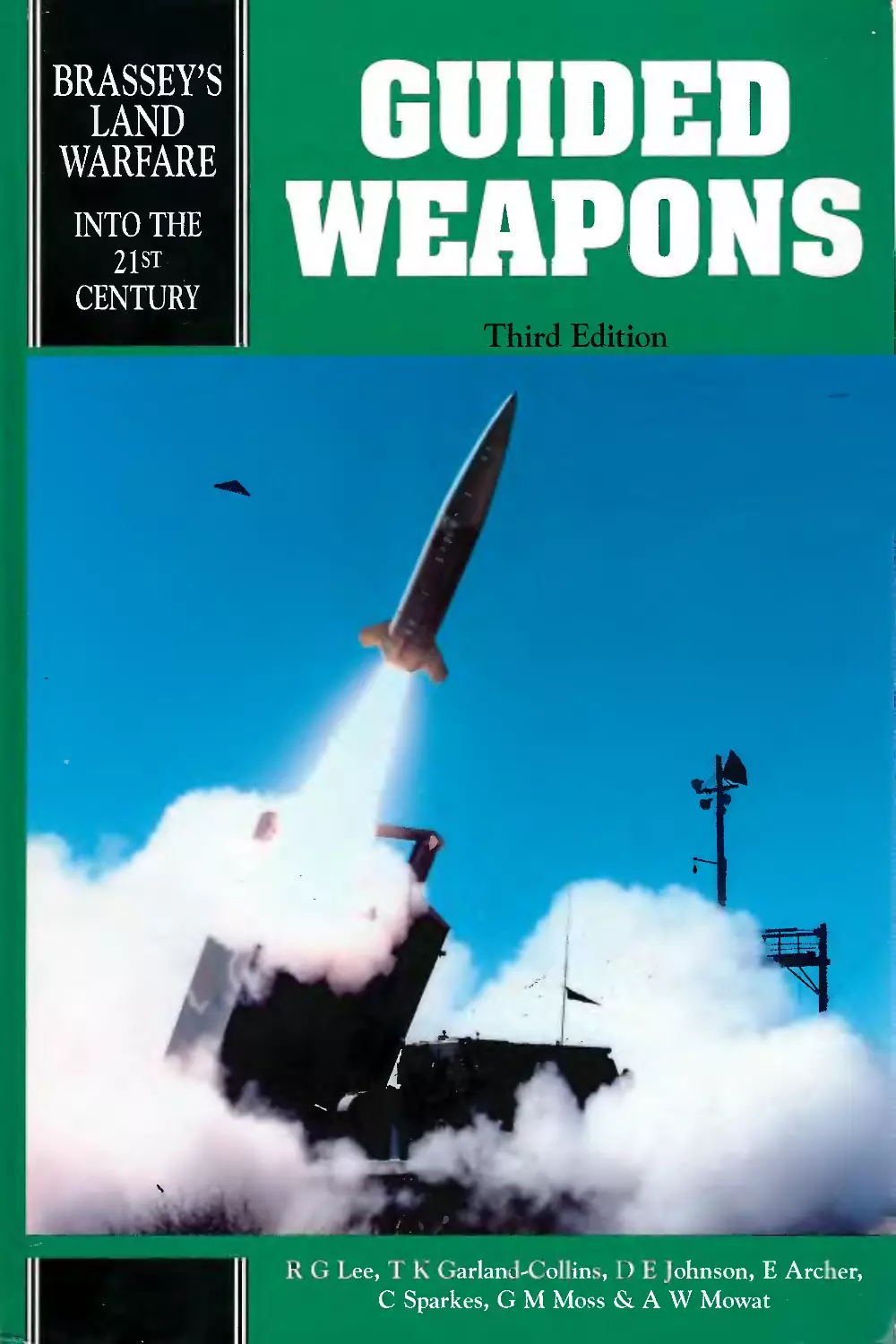
Thanks to Lockheed Martin Vought Systems for the front cover and title page photographs
of ATACMS
Typeset by York House Typographic Ltd, London.
Printed in Great Britain by Redwood Books, Trowbridge
Preface
THE SERIES
This series of books is written for those who wish to improve their
knowledge of military weapons and equipment. It is equally relevant to
professional soldiers, those involved in developing and producing military
weapons or indeed anyone interested in the art of modern warfare.
All the texts are written in a way which assumes no mathematical
knowledge and no more technical depth than would be gleaned from
school days. It is intended that the books should be of particular interest
to Tmy officers who are studying for promotion examinations, furthering
their knowledge at specialist arms schools or attending command and staff
schools.
The authors of the books are, or have been, military or civilian members of
the staff of the Royal Military College of Science, Shrivenham, which
comprises a unique blend of academic and military experts. They are not
only leaders in the technology of their subjects, but are aware of what the
:military practitioner needs to know. It is difficult to imagine any group of
persons more fitted to write about the application of technology to the
battlefield.
VOLUME V
Over the past half century, guided weapons have developed faster than any
other form of weapon system and now influence international politics,
strategy and tactics. This volume is the second update in the Brassey's
series produced in conjunction with the Royal Military College of Science,
UK. It has been updated to reflect modem development and weapons. It
takes its place in the Brassey's Land Warfare into the 21st Century series
reflecting the modem state of the art in guided weapons.
Geoffrey Lee, Shrivenham
Acknowledgements
The editor is grateful to Lt Col J F Rouse for his help in the preparation of
this new edition and to Dr B A Stacey for his contribution on the subject
of Fibre-Optic Guidance.
Geoffrey Lee
Shrivenham 1997
vi
Contents
List of Illustrations ix
1. Introduction to Guided Weapons 1
2. Propulsion 7
3. Electrical Power Supplies 45
4. Airframes 63
5. Guidance 95
6. Control 125
7. Electronic Warfare Applied to GW 147
8. Warheads 165
9. Anti-Tank Guided Weapons and Light, Unguided
Anti-Tank Weapons 183
10. Surface-to-Air Guided Weapons 205
11. Surface-to-Surface Guided Weapons 225
Glossary of Terms and Abbreviations 237
Bibliography 257
Index 259
vii
List of Illustrations
FIG 2.1 Pressure distribution in and around an ideal
rocket motor
FIG 2.2 Typical loose-charge solid propellant rocket
motor
FIG 2.3 Diagrammatic bi-propellant liquid rocket
engine
FIG 2.4 Component arrangement of a typical turbojet
engine
FIG 2.5 Component arrangement of a typical
turbofan engine
FIG 2.6 a. Liquid-fuel ramjet with axisymmetric nose intake (podded)
b. Liquid-fuel ramjet with multiple
side intakes
c. Liquid-fuel ramjet with ventral intake
FIG 2.7 Solid propellant ramrocket with
side intakes
FIG 2.8 Ideal generalised propulsion unit
FIG 2.9 Variation of thrust with flight Mach number
for different types of engine
FIG 2.10 Variation of thrust with altitude for
different types of engine
FIG 2.11 Variation of best achievable specific fuel
consumption with flight Mach number for different
propulsion units
FIG 2.12 a. Pitot intake at subsonic forward speed
b. Pitot intake at supersonic forward speed
FIG 2.13 Shock pattern for a centre-body supersonic
intake
ix
x List of Illustrations
FIG 2.14 Variation of thrust and specific fuel
consumption with flight Mach number and
altitude for a given ramjet engine
FIG 2.15 Solid fuel ramjet with side intakes
FIG 2.16 Solid propellant ramrocket with side intakes
FIG 2.17 a. Ramjet-propelled missile with wrap-around
booster rocket motors
b. Ramjet-propelled missile with tandem
booster rocket motor
FIG 2.18 Integrated rocket ramjet
FIG 3.1 Sources of electrical energy
FIG 3.2 Relative weights of ideal battery
and generator systems
FIG 3.3 Practical curves showing battery and
generator weights for a short flight time
FIG 3.4 Practical curves showing battery and
generator weights for a long flight time
FIG 3.5 Energy in watt-hours v. power in watts
FIG 3.6 Specific energy v. specific power
FIG 3.7 Logarithmic plot of specific energy v. specific
power
FIG 3.8 Comparative performance of thermal
batteries and silver-zinc reserve batteries
FIG 3.9 The Saft (UK) auto-activated pile type silver-
zinc battery
FIG 3.10 Schematic view of the PS-502 chemically
heated battery (USA)
FIG 3.11 Construction of a thermal cell
FIG 3.12 Lithium sulphur dioxide cell
FIG 3.13 Comparison of the best available batteries
with the best available generator systems
FIG 3.14 Simple flux switching alternator
List of Illustrations xi
F1G 3.15 Optimum flux switching alternator
F1G 3.16 Permanent magnet rotor alternator
FIG 4.1 Force involved in circular motion
FIG 4.2 Loads on the missile
FIG 4.3 Body construction
FIG 4.4 Wing construction
FIG 4.5 The formation of shock waves
FIG 4.6 Supersonic flow around a bullet
FIG 4.7 Wing planform 1 - large span wings
FIG 4.8 Wmg planform 2 - slender wings
FIG 4.9 Wmg planform 3 - wings at supersonic
speeds
FIG 4.10 Typical sections of wings with supersonic
leading edges
FIG 4.11 Lift and drag of wings and bodies
FIG 4.12 Wing lift at supersonic speeds
FIG 4.13 Subsonic flow around bodies
FIG 4.14 The generation of induced drag
FIG 4.15 Missile drag at subsonic speeds
FIG 4.16 Nose drag at supersonic speeds
FIG 4.17 Tip effects at supersonic speeds
FIG 4.18 Static stability - principle
FIG 4.19 Static stability - application
FIG 4.20 The action of elevators
FIG 4.21 Canard v. tailed configurations 1
FIG 4.22 Canard v. tailed configurations 2
FIG 4.23 Canard v. tailed configurations 3
FIG 5.1 Why guide?
xii List of Illustrations
FIG 5.2 The closed loop
FIG 5.3 Target end point guidance
FIG 5.4 Fixed location end point guidance
FIG 5.5 Proportional navigation
FIG 5.6 Homing kinematics
FIG 5.7 a. Straight line trajectory
b. Line of sight (LOS) path
FIG 5.8 The three homings
FIG 5.9 CLOS and BR
FIG 5.10 Command guidance elements and MCLOS
FIG 5.11 SACLOS and ACLOS
FIG 5.12 COLOS
FIG 5.13 Inertial navigation
FIG 5.14 Stable table IN system
FIG 5.15 Strap down IN system
FIG 5.16 The fibre-optic missile concept
FIG 5.17 Existing system cQncept
FIG 5.18 Guidance and control - emerging concept
FIG 6.1 Steering signals
FIG 6.2 Intercept geometry
FIG 6.3 Moving wings
FIG 6.4 The Bloodhound missile
FIG 6.5 Types of missile configuration
a. Rear control surfaces supersonic
b. Rear control surfaces subsonic
c. Canard controls
Forces on a missile due to a thrust deflection
of 0
FIG 6.6
FIG 6.7
a. GimbaUed motor
List of Illustrations xiii
b. Ball and socket nozzle
c. Semaphore spoilers
d. Twin nozzles
FIG 6.8 General arrangement of a negative feedback
system
FIG 6.9 Roll position autopilot
FIG 6.10 Alternative gyro arrangements
FIG 6.11 Lateral 'g' autopilot
FIG 6.12 Directional autopilot
FIG 7.1 Which wavelength?
FIG 7.2 MCLOS EW
FIG 7.3 SACLOS EW
FIG 7.4 EW for line-of-sight beam rider
FIG 7.5 IR Homer EW
FIG 7.6 MMW Homer EW
FIG 7.7 Semi Active Homer EW
FIG 7.8 LOBL IR Homer EW
FIG 7.9 Helicopter launch ATGW EW
FIG 7.10 Long range ATGW EW
FIG 7.11 Fibre-optic ATGW EW
FIG 7.12 SOJ circus
FIG 7.13 Tactical use of ECM against low level SAM
FIG 7.14 Concept of ECM using RPV
FIG 7.15 Use of ARM against radars
FIG 8.1 Typical guided weapon component layout
FIG 8.2 High explosive train
FIG 8.3 Dispersion
FIG 8.4 Damage volume
xiv List of Illustrations
FIG 8.5 Pressure/time relationship of a blast wave
FIG 8.6 Typical blast warheads
FIG 8.7 Increase of explosive to achieve same damage
level with altitude increase
FIG 8.8 Cutting to control fragment size
FIG 8.9 Metal inserts in explosive
FIG 8.10 Fragmenting warheads
FIG 8.11 Fragment patterns due to charge shape
FIG 8.12 Section of continuous rod bundle
FIG 8.13 Continuous rod warhead
FIG 8.14 Shaped-charge warhead
FIG 8.15 Tandem shaped-charge warhead
FIG 8.16 Top attack shaped-charge warhead
FIG 8.17 The HESH effect
FIG 8.18 Typical stabilised bomblet designs
FIG 8.19 Sub-missile warhead ejection systems
FIG 9.1 The British 120mm recoilless anti-tank weapon
FIG 9.2 The British LAW 80
FIG 9.3 The Swedish AT4
FIG 9.4 The Swedish 84mm Carl Gustaf
FIG 9.5 The Russian RPG-7V1
FIG 9.6 A method of overcoming backblast
FIG 9.7 Medium range TRIGAT
FIG 9.8 Swingfire, a MCLOS missile
FIG 9.9 Long range TRIGAT on TIGER helicopter
FIG 9.10 Swedish Bofors BILL fitted on a vehicle
FIG 9.11 The French Eryx
FIG 9.12 Semi-active homing missile with laser designator
List of Illustrations
FIG 9.13 How angle affects minimum range
FIG 9.14 Effect of separation on minimum range
FIG 9.15 Concept used by Swedish BILL
FIG 10.1 German Gepard air defence vehicle
FIG 10.2 Elements of an air defence system
FIG 10.3 British Shorts Starstreak
FIG 10.4 The Swedish Giraffe tactical control radar
FIG 10.5 The Plessey/ITT-Gifillian A-320 long range electron
scanning radar
xv
FIG 10.6 The Canadian Forces ADATS on M113
FIG 10.7 The United States Stinger
FIG 10.8 The Stinger fitted (inboard) to the Apache helicopter
FIG 10.9 The Swedish Rb70
FIG 10.10 The British towed Rapier in its 'dark fire'
configuration
FIG 10.11 Optical guidance similar to that used on Rapier and
Roland
FIG 10.12 Radar guidance similar to that used on Rapier and
Roland
FIG 10.13 The Russian 9K35M3 Strela-10M3
FIG 10.14 The United States Patriot phased array system
FIG 10.15 The Russian 9K37M1
FIG 10.16 The Russian 9K81 S-300V
FIG 10.17 Comparative sizes of Rapier, Roland and Gecko
SAGW
FIG 11.1 Czech M70 MLRS
FIG 11.2. The United States MLRS
FIG 11.3 The Russian SS21
FIG 11.4 The United States Pershing II
xvi
FIG 11.5
FIG 11.6
FIG 11.7
FIG 11.8
FIG 11.9
List of Illustrations
The United States ATACMS
The effects of sidewinds on SSGW
The United States Tomahawk being launched
Concept of TERCOM
Cruise missile in flight
1.
Introduction to
Guided Weapons
The Rise of Guided Weapons
During the 1939-45 war, Germany developed and brought into service the
VI and V2 long range guided weapons (GW); they had also reached the
drawing board stage in the development of an anti-tank guided weapon
(ATGW), the XH7, by the end of that war.
Since then, over the past forty years, G W have tleveloped faster than any
other form of weapon system. Now they influence international policies,
strategy and tactics to an enormous extent. They may yet spell the end of
manned strike aircraft and the current concept of the Main Battle Tank
(MBT).
The technology involved in GW electronic counter measures (ECM), and
electronic counter counter measures (ECCM), is advancing at an ever
increasing rate. Indeed, it can be said that the successful use of GW will be
the decisive factor in a future war, as air battles in the Middle East and
naval actions in the South Atlantic have indicated. Today, no member of the
armed forces nor anyone involved in the development of weapons can
afford to ignore a study of them.
Definition of a Guided Weapon
A guided weapon system may be described briefly as a weapon system in
which the warhead is delivered by an unmanned guided vehicle.
In most cases, the guided weapon systems available to the armed forces o
the world are readily recognisable as such. The long range strategic
rockets, the dogfight missiles carried by the aircraft, the short range anti-
tank missiles, and the surface-to-air anti-aircraft defence systems are
readily brought to mind by anyone interested in military equipment.
However, it is prudent to avoid an unduly restrictive definition of the term
'guided weapon' for there are several examples from the past of systems
difficult to identify as guided weapons. This is also true of some current
systems. In the future, the different types of weapon may be expected to
expand considerably, particularly in the use of guided projectiles.
1
2
Guided Weapons
To give some examples of such unfamiliar systems the case of the 'beetle
tank' may be taken from the Second World War. This was a miniature tank
packed with explosives and remotely controlled by a wire cable. It was
guided to its target by an operator who observed both tank and ta,rget and
who steered the crawling bomb as it moved away from him (cf 'Manual
Command to Line of Sight' (MCLOS) in the chapter on guidance).
An example of a system which was developed, but not put into production,
was a spherical ball which once launched could move in any direction and
could hover in response to commands sent to it. The idea was to position
it carefully over the target and then command the warhead to detonate.
A more modern and interesting design of guided weapon produced by the
West German firm MBB consists of a small remotely piloted vehicle (RPV)
carrying a warhead which may be used for anti-aircraft defence suppres ion.
During the Vietnam War the United States air force introduced a guidance
kit which when fitted to their conventional 'iron' bombs transformed them
into guided weapons. Notice that this was a case of a GW which did not
have a propulsive system: the motive power was provided entirely by
gravity and the launch velocity.
Many of the more unusual GW of the future may have unfamiliar forms of
motive power such as projectiles fired from ordinary guns, rotating discs
(or flying saucers!) or 'sleeping' GW in earth orbit.
The warhead, too, may not be of the conventional or nuclear type. A nation
prepared to resort to chemical warfare might well stock GW capable of
spraying toxic gas or powder while the vehicle moved along some desired
path. Suggestions have been made that suitable carrier missiles might
distribute anti-tank mines, jammers, or remote ground sensors into some
designated area.
Having made the point that the term 'guided weapon system' may cQver a
considerable range of weapon concepts, some of which may be highly
unusual, it is emphasised that the bulk of the discussion in this book will
be concerned with existing conventional GW systems, and developments in
their technology which may be expected to enter service with land forces
within the next few years rather than naval, air force, or space force
activity.
Terms and Classifications
Over the years, many different systems have been used to classify GW.
Most of them are still used to a greater extent, so it is desirable to mention
the more important of them here.
Introduction to Guided Weapons 3
Launch Point- Target Location
Originally there were four groups, Surface-to-Surface (SSGW), Surface-to-
Air (SAGW) , Air-to-Surface (ASGW) and Air-to-Air (AAGW). This was
sufficient to describe the early systems where the conventional winged
aircraft was the only form of airborne launch platform or target and no
distinction was made between land and sea. Today the spectrum of launch
points and targets must be extended to include airborne Remotely Piloted
Vehicles or tethered platforms, helicopters, gliders, paravanes and, perhaps,
airships. Submarines may launch missiles or suffer attack by a G W, and
targets or launchers in space must be considered as well as anti-missile
missiles. The discussion in this book will concentrate on surface-to-surface,
surface-to-air and air-to-ground systems which are the main concern of the
land forces.
.
Classification by Target and Method of Carriage
From the point of view of the nation which has to pay the bill for the intro-
duction of a weapon system, it is an unfortunate fact that general purpose
GW have seldom proved satisfactory in the past. In spite of many attempts
to introduce such systems, eg an infantry=portable -"Weapon for the attack of
tanks and aircraft, it has always turned out that a weapon system is not
effective in one role or the other - or both. Thus it is nearly always the
case that a GW system is optimised to attack a particular class of target.
It is of particular interest therefore that the careful design which has
resulted in the Oerlikon ADATS weapon offers a new system, incorporating
the latest technology, which has both an air defence and an anti-tank role.
A further development in the search for dual purpose weapons is the
current intense interest in the possibility of bringing new technology to
bear on the problem of using existing guns which are required anyway, to
launch guided projectiles. This is of particular interest in the case of the
naval gun, the main armament of the main battle tank (MBT) and 155mm
field artillery.
It has become common practice to describe systems in such terms as anti- .
tank GW (ATGW), anti-helicopter GW (AHGW) , anti-RPV GW and so on. In
view of the increasing number of airborne platforms which require
confrontation it is certain that further attempts will be made to produce
general purpose systems - at least in the ground-to-air role.
The land forces are greatly concerned with mobility, so the type of vehicle
used for the transport of a system is a matter of some importance. Many
GW systems are therefore given such titles as 'Manportable antitank GW',
'Tracked Rapier', 'Towed Rapier' or 'Swingfire on Striker'.
4 Guided Weapons
In some cases GW systems are designed in single integrated units which
may be fitted to tracked, wheeled or rail transport. Such systems are
usually called 'pod mounted' systems.
Classification by Flying Mode
There are several aspects of the flight mode which are used to describe
particular missiles. The term 'boost-coast' is used for a missile which is
rapidly accelerated to flying speed and which then has no further
propulsion power throughout its flight.
A 'boost-sustain' system has a two-stage propulsion system which tends to
maintain speed after the initial acceleration is over. These matters will be
explained in detail in Chapter 2, which includes propulsion systems for
both subsonic and supersonic missiles.
The trajectory or path of a GW is also used in its description. The main
terms used are 'Ballistic Missile', 'Cruise Missile', 'Line of Sight Missile' and
'Proportional Navigation System'. These trajectories and some less common
ones will be discussed in Chapter 4.
In the case of very long range GW, the altitude of the missile above sea
level in successive phases of flight may be used to describe its path. This _
is a method borrowed from the world of conventional aircraft and results
in such terms as 'HI-LO-LO' and 'LO-HI-LO'.
GW are often labelled by the method used to control them. In addition to
the two main categories of control, i.e. aerodynamic or thrust vector
control, a missile may be called a 'twist and steer' missile, a 'roll position
stabilised' missile or H 'wire controlled' missile. These terms will be
explained in detail in Chapter 5.
A further description of flying mode may be made at the encounter with
the target. The importance of matching the fuze and warhead to the target
to obtain the greatest possible Single Shot Kill Probability (SSKP) is
affected greatly by the accuracy of the missile, usually expressed in terms
of its Root Mean Square Miss Distance (RMSMD), a precise statistical
measurement which relates to the most likely lateral distance by which the
missile will miss the target. If the missile is very accurate the RMSMD is
so small that virtually all the missiles launched against the target (except
of course engineering failures) will strike it. These missiles do not require
a proximity fuze and rely on a contact fuze to initiate the warhead. Such
GWare sometimes called 'hittiles' as opposed to 'missiles' which do require
a proximity fuze.
Some mention should be made of the so-called 'smart' munitions. This type
Introduction to Guided Weapons 5
of weapon includes projectiles or warheads suspended from slowly falling
parachutes which are not G W in that the path of the weapon is not
controlled by a closed loop system. However a sensor detects the presence
and direction of a target. The warhead is then triggered and a lethal slug
or jet is directed over a distance of several tens of metres at the target. The
slug itself is not guided. Such a system might be described as a polarised
warhead munition with a long range proximity fuze.
2.
Propulsion
Over the great range of missile systems employed today, from the giant
long-range Intercontinental Ballistic Missile (ICBM) to the small Anti-Tank
Guided Weapon (ATGW) and even the smaller unguided Light Anti-Tank
Weapon (LAW), there is one feature at least which is common to them all:
it is jet propulsion, which is provided either by a rocket motor or by an air-
breathing engine.
Engine
At the outset it will be helpful to explain briefly what is meant by jet pro-
pulsion. There is a widespread tendency to regard a rocket as a device
which is totally different from the type of propulsion unit, the jet engine,
which is employed in nearly all today's large aircraft. At first there would
appear to be some truth in this. For example, the rocket motor is
completely self-contained whereas the aircraft jet engine relies on
breathing the surrounding atmosphere. However, in respect of the
fundamental manner in which a useful propulsive force is generated, the
rocket motor and the airbreather are the same. This fundamental principle
is that of reaction propulsion and is embodied in Newton's Second and
Third Laws.
Thus, despite various important differences in operation and construction
between rocket motors and air-breathers, it is clearly important to
appreciate that each is a device particularly suited to specific applications
but nevertheless relies wholly for its effect on reaction propulsion obtained
by the generation of a stream of propulsive medium, i.e. in general, a
high-velocity jet of propulsive gases. That is what is meant by jet
propulsion.
Basic Principles
General Applications
The most obvious use of a propelling force, whether it is applied to a land,
sea, air or space vehicle, is to accelerate the vehicle; it is the force used to
effect a change in the vehicle's velocity. Another important function for the
propelling force, certainly in a land, sea or air vehicle but not in a space
vehicle, is to overcome the drag which resists its motion. This resisting
7
8
Guided Weapons
force may be variously due to rolling resistance, aerodynamic resistance,
wave-making resistance, or perhaps a combination of them. The third use,
which is often necessary, is the provision of a lifting force: this may not be
provided solely by the same source as the accelerating and resistance-
overcoming forces, but may be provided, partially or wholly, by other
means such as the wings of an aircraft. This aspect does not require
elaboration at this stage.
In the case of missiles, we need to look in detail at the form of propelling
force which they use, which is jet propulsion.
Jet Propulsion
In jet propulsion a jet or stream of fluid, always gaseous in practical
propulsion systems, leaves the missile through a suitably shaped and
positioned orifice. In a rocket, a momentum change in the propulsive gas
is produced merely by ejecting it from the rocket motor. In an airbreathing
engine, the gas must be ejected at a velocity greater than the forward speed
of the engine through the air for a momentum change to take place. This
rate of change of momentum of the leaving gas is proportional to the force
being applied to the gas; it can be seen that this is effectively a statement
of Newton's Second Law of Motion. The reaction to this accelerating force
is equal in magnitude and opposite in direction and therefore is the useful
propelling force on the missile. The latter sentence is in effect a statement
of Newton's Third Law of Motion. The laws of applied mechanics thus are
of fundamental importance in missile propulsion.
So far, no mention has been made of the means by which a propulsive jet
of gas is produced for missile propulsion. These matters are governed by
the laws of applied thermodynamics, which are equally important in
propulsion.
Jet Propulsion Methods
Classification of Motors
Before examining the types of propulsion unit available to the missile
designer, it is worth looking at jet propulsion systems in a very
fundamental way, according to the origin of the fluid medium which forms
the jet. There are two main systems. The first is a rocket in which the
medium is carried along with, and in due course discharged from the
missile. The second is an airbreather which picks up its medium, the
surrounding air, and also, in due course, discharges it. Both bum fuel in
their operation and so, generically, they can be called thermodynamic
devices. We can go further in propulsion systems for missiles, because the
Propulsion
9
original source of energy is always chemical; this means we can refine our
definition of the systems to call them thermochemical.
Net Effect of Propulsive Forces
A study of Figure 2.1 will produce a simple understanding of the net effect
of the forces acting on a rocket motor. In general the lateral forces on the
missiles are self cancelling. The axial forces are not, so according to
Newton's Laws this provides the net propulsive force. Ue = Exhaust gases
velocity.
EXTERNAL ( ATMOSPHERIC) PRESSURE Po
p
c
INTERNAL PRESSURE
FIG. 2.1 Pressure distribution in and around an ideal rocket motor
Type of Jet Propulsion Unit and their Main
Features
Basic Types and Features
Thermochemical propulsion systems can be classified in various ways. The
following chart shows the principal types available. It is interesting,
incidentally, in that, from a common starting point, two main branches grow.
Later, these branches join up to form a hybrid system, No.6, the ramrocket.
I
LIQUID
PROPELLANT
ROCKET
(1 )
I
ROCKET
I
THERMOCHEMICAL
PROPULSION SYSTEMS
I
I
AIR-BREATHER
I
I
JET
I
SOLID PROPELLANT
ROCKET
(2)
I
(PROPELLER)
I
RAM-
ROCKET
(6)
I
RAM-
JET
(5)
I
TURBO-
JET
(4)
I
TURBO-
FAN
(3)
10 Guided Weapons
The main characteristic feature of the jet, from the performance point of
view, is its velocity. Typical jet velocities for the systems shown in the
chart are:
Subsonic turbofan (3) at 36,000 ft
Static turbojet (4) at sea level
Supersonic turbojet (4) at 36,000 ft
Supersonic ramjet/ramrocket (5/6) at 36,000 ft
Solid propellant rocket (2)
Liquid propellant rocket (1)
350 - 500 mls
500 - 750 mls
900 - 1,000 mls
1,000 - 1,200 mls
1,500 - 2,500 mls
2,000 - 3,500 mls
The most obvious feature of this table is the wide spread of magnitudes of
jet velocity. Also obvious is the steady progression through a range of
propulsion units from moderate jet velocity to high jet velocity. It is no
accident that such a wide range of jet velocities is at the disposal of the
designer of the missile propulsion system. As will be mentioned later, the
efficiency of the propulsion process is intimately associated with the
magnitude of the jet velocity in relation to the magnitude of the flight
velocity. Of course, the attainment of a high efficiency of propulsion is not
necessarily a requirement in the design of a propulsion unit. Convenience,
lightness or cheapness may be more important considerations.
Solid Propellant Rocket
The solid propellant rocket motor is by far the most widely used unit in
missile propulsion. Essentially it consists of four components: they are the
motor case, the nozzle, the solid propellant charge and the igniter. A typical
loose-charge, solid propellant motor is shown in Figure 2.2.
The operation of this type of motor is superficially very straightforward.
The igniter, behaving like an energetic firework, starts the solid propellant
charge burning on the desired surfaces. Gaseous products of combustion
are rapidly generated, filling the void space in the motor at a considerable
pressure, typically 70 atmospheres, enabling combustion to be sustained at
the surface of the propellant. The case is thus a pressure vesseL The hot
gases vent through the characteristically shaped convergent-divergent
nozzle at a high speed, which can be 2,000 mls or more at the exit plane.
For steady-state operation the gases must be generated in and escape from
the motor at a fixed rate. This is normally achieved by arranging for the
burning surface area of the charge to remain very nearly the same
throughout the majority of the burning time. As discussed previously, the
ejection of the gases at high velocity is the reaction to the creation of an
imbalance of forces on the gas within the motor as illustrated in Figure 2.1.
Propulsion
11
IGNITER
INHIBITOR
NOZZLE
CENTRAL - CONDUIT
CHARGE
A
:c ::R _A
00
FIG. 2.2 'IYPicalloose-charge solid propellant rocket motor
Liquid Propellant Rocket
The liquid propellant engine generates thrust in exactly the same way as
the solid but the operation and construction are rather different.
In the liquid engine the fuel and the oxidant are usually tanked separately.
The combustion chamber, shown in Figure 2.3, to which the fuel and
oxidant must be delivered, is not the propellant store as in the solid
propellant type; so the fuel and oxidant can be stored remotely from the
combustion chamber at normal pressures. However, the fuel and oxidant
must be supplied to the chamber at specific rates and under specific
pressures. There are various ways of pressurising the liquids, some of
which involve pressurising the holding tanks, others of which do not.
Clearly the liquid propellant type offers certain advantages which the solid
propellant type cannot. For example, the propellant flow rates, and hence
the thrust, can be varied on demand. The duration of the firing is
dependent only on the capacity of the tanks, in the first instance.
Disadvantages are the likely expensive engineering of the engine, the
complication and hence the reduced reliability. There are circumstances,
however, in which these drawbacks must be borne in order to gain the
other advantages.
As indicated earlier, the feature of the rocket which distinguishes it from
other propulsion units is its almost total independence of the surroundings.
This is in direct contrast to the airbreather.
12
Guided Weapons
COMBUSTION
CHAMBER
(OR COM8US TOR J
NOZZLE
. + .
---
FUEL --
OXIDI5ER _
--
FIG. 2.3 Diagrammatic bi-propellant liquid rocket engine
Turbojet
The fundamental airbreathing jet propulsion unit is the turbojet and it is
easiest to understand. It is illustrated in Figure 2.4.
FIG. 2.4 Component arrangement of a typical turbojet engine
The function of a nozzle is to accelerate a high pressure gas from rest or
low velocity to a high velocity. The components of a turbojet upstream
of the nozzle have the primary function of supplying the propulsive medium
in a suitable quantity and at a suitable pressure and temperature to the
nozzle.
The intake's role is to capture the air and deliver it to the compressor as
efficiently as possible and at an appropriate velocity. When the engine is
propelling a vehicle in flight, significant pressure increase is produced in
the intake.
Propulsion 13
This is usually called the ram pressure rise. At static conditions, when the
engine is at rest, the air pressure entering the compressor is slightly less
than that of the surrounding atmosphere.
The compressor pressurises the air for delivery to the combustor where the
temperature of the air is raised greatly, typically up to about 1,200 K, by
burning kerosene in the air stream. The air, or products of combustion and
air, are now at a suitable pressure and temperature for entry to the turbine,
through which the gas passes, losing energy. That energy is transmitted to
the turbine rotating parts which, by means of a connecting shaft, drive the
compressor upstream. The partially spent gases then flow into the nozzle
where they are accelerated.
It has to be emphasised that there is a regenerative principle built in to the
turbojet. The compressor supplies the air to the turbine (which drives the
compressor) via the combustor, where, by burning fuel, the temperature is
raised at nominally constant pressure. The hot, high pressure gas flows
through the turbine, which produces the power to drive the compressor.
It should be noted that although the turbojet engine, superficially at least,
is a simple device, the individual components must be designed and
developed to a high level of performance if it is to operate efficiently. This
is particularly true of the compressor and turbine. Consequently it is an
expensive item and requires high level engineering production.
INT KE
COMPRESSOR
LP SPOOL
FIG. 2.5 Component arrangement of a typical turbofan engine
Turbofan
The turbofan, as can be seen in Figure 2.5, is a very close relative of the
turbojet. It will be briefly dealt with and compared with the turbojet, in the
14 Guided Weapons
sections dealing with efficiency of propulsion and choice of turbojet or
turbofan. For the moment, it will be sufficient to say that the turbofan is a
derivative of the turbojet that employs the bypass principle (see Figure' 2.5)
so as to develop the same thrust as an equivalent turbojet but with a
reduced jet velocity. This, in general, gives an improved level of
performance. In its essential parts, the turbofan employs the same
components as a turbojet.
- - _.. - - - ,- -
I
I
CENTRE BODY I FUEL INJECTORS NOZZLE
INTAKE/ DIFFUSER COMBUSTOR
==
-
.-
-....
- -:,...--
-,
FiG. 2.6a Liquid-fuel ramjet with axisymmetric nose intake (podded)
INTAKE / DIFFUSER
, LIQUID
/
/
--
NOZZLE
COMB US TOR
FUEL INJECT'OR5
FIG. 2.6b Liquid-fuel ramjet with multiple side intakes
FUEL INJECTOR
-
-----
COMBUSTOR
NOZZLE
FIG. 2.6c Liquid-fuel ramjet with ventral intake
Propulsion
15
Ramjet
In introducing the turbojet, the reader may recall that mention was made
of the pressure rise that could be obtained in the intake solely by virtue of
the forward motion. It was mentioned that the name given to the pressure
increase is 'the ram pressure rise'. It is a fact that, at subsonic velocities,
the ram-rise is fairly modest. However, at supersonic velocities, say Mach
2 to Mach 4, the potential ram pressure rise is great. The ramjet engine
hinges on this characteristic.
A ramjet therefore relies wholly on its forward motion through the
atmosphere to develop a sufficient pressure rise in the intake. As will be
seen from the diagram in Figure 2.6a the intake is rather different from the
conventional subsonic turbojet intake: this is to deal with supersonic
airflow. The intake's job is to collect and diffuse, or slow down, the air to
a low velocity before it enters the combustor; there is no mechanical
compressor. Much as in a turbojet, liquid fuel Is normally sprayed into and
burned in the airstream in the combustor, raising the temperature at
nominally constant pressure. Immediately downstream of the combustor,
the flow is directed to the nozzle where, as usual, the gas accelerates at the
expense of the pressure (and temperature): there is no turbine or
compressor required. Provided there is sufficient ram pressure rise, a
sufficiently high temperature produced in the combustion chamber and a
sufficient level of efficiency obtained in these three processes, the ramjet
will produce a net forward force or thrust, ejecting a high velocity jet in
the process.
The main disadvantage of the ramjet is that it is non-operational at zero
and low forward speeds and so it must be boosted from rest to a suitable
velocity, usually around Mach 2, when it can then accelerate if desired. On
the other hand it is much simpler than a turbojet or turbofan.
Ramrocket (or Ducted Rocket or Air-Augmented Rocket)
Finally, the ramrocket, which is the subject of considerable current
interest, is a hybrid unit employing both rocket and airbreather features. In
the form used in the Soviet S-A 6 missile and in various feasibility studies,
the so-called ramrocket is more properly described as a ramjet employing
a solid propellant.
From Figure 2.7 it can be seen that the rocket part of the whole unit is
providing a supply of fuel to the airbreathing part downstream. To achieve
this, the rocket propellant is particularly fuel-rich and so provides the fuel
for combustion with the air which has been captured by the intake and
directed to the combustor. The ramrocket then behaves like a conventional
liquid-fuel ramjet and should be viewed as a variant of it rather than as a
16 Guided Weapons
true hybrid device. In the form described, the ramrocket may be said to
have the virtues of a dense propellant and an ability to avoid flameout.
Countering those advantages, however, is the inherent difficulty in v rying
the thrust level of the ramrocket. It has to be done by varying the flow rate
of the gas from the rocket part and techniques for doing so are difficult to
devise. There is the added problem that, even if an alternative satisfactory
;/ F EL-RICH
///SOLIO 'ij /
PROPELLANr'
.' / / / / / / / / /.
-
---
COMBUSTOR
INTAKE /OIFFUSER
NOZZLE
FIG. 2.7 Solid propellant ramrocket with side intakes
method by altering the gas generator nozzle throat could be devised, the
rate of response of the unit to given thrust changes would be poor,
particularly towards the end of the thrusting period when the gas generator
combustor would be largely full of gas, rather than solid propellant, as it is
at the start of the bum.
General Propulsive Performance
.
Having briefly described the main types of propulsion unit employed in
missiles, the next stage is to discuss their relative performance, how they
would be used in practice and how their efficiency can best be assessed.
Provided one is careful in setting up one's model, it is not very difficult to
establish an equation for the thrust or force developed by a generalised
propulsion unit. The diagram at Figure 2.8 shows a typical layout.
Making use of Newton's Laws, it can be established that the following
simple equation gives the approxilnate thrust developed by the typical
idealised unit:
F = rrt(u e - u a )
i.e. Thrust F = Propellant Flow Rate m x Velocity Change (u e - u a )
Propulsion
17
Po
IMAGINARY
BOUNDARIES
Po
U.
U Q
-------,
IMAGINARY
BOUNDARIES
.. m ____
-- ------
--
Po
PROPULSIOfi UNIT
U o
Po
P
o
FIG. 2.8 Ideal generalised propulsion unit
Application to a Rocket Engine
When this equation is applied to the rocket engine there is an immediate
simplification because, of course, no mainstream flow enters the rocket.
The approximate thrust equation for a rocket engine therefore is:
F=mu e
i.e. Thrust F = Propellant Flow Rate rnx Exhaust Velocity u e
A widely used criterion of performance is the thrust developed per unit
mass flow rate of propellant gases, the specific impulse. Referring to the
basic thrust equation, specific impulse I can be shown to be given by:
F
1= =u e
m
There is an alternative way of visualising the concept of specific impulse.
Since a rocket motor's function is to provide a thrust for a certain time, Le.
an impulse, the impulse can be evaluated from a knowledge of the variation
18 Guided Weapons
of thrust over the known burn time. If this impulse is then divided by the
mass of propellant consumed over the burn time, we get the specific
impulse. This definition and technique of evaluation are particularly suited
to the solid propellant motor whose mass flow rate is difficult to evaluate
because it may well vary with time.
What might be confusing to the reader is the widespread practice of
quoting specific impulse in 'seconds'. This practice arose through defining
specific impulse as thrust per unit weight flow rate which has units of
seconds. In SI units it is convenient to remember that since at sea level
gravity g is approximately 10 mls2, a specific impulse of 250s is very nearly
2,500 mls or 2,500 Ns/kg.
Application to an Air-Breathing Engine
In the case of the air-breathing engine, the appropriate thrust equation is
the generalised thrust equation. Various criteria of performance are used.
The ratio thrust/air flow rate is the specific thrust and is comparable to
specific impulse in rocket motors. When airbreathing engines alone are
under consideration, it is usually. fuel flow rate/thrust, the specific fuel
consumption, that is quoted.
Close examination of the approximate thrust equation for the airbreather
reveals that the term additional to that in the rocket thrust equation is
-ill u a . The significance of this term is considerable and therefore merits
discussion.
The negative sign attached to the product ill u a indicates that it represents
a force term in the direotion opposite to the desired thrust direction; such
a force is a drag force and so ill u a is known as momentum or ram drag. It
can be visualised as the momentum rate associated with the approaching
propulsive stream. In order to develop a useful reactive forward force using
this stream, its momentum must be increased in a rearward direction. Thus
it is the momentum increase of the stream which gives the propulsive
force. The term ill u a is not then, in any way, mysterious. It is merely the
measure of the momentum of the airstream prior to acceleration. Thus, for
an engine at rest, the term disappears, since the air is accelerated from
rest.
It is also worthy of mention that when the thrust equation for an air-
breathing engine in motion is written in the following way, the ideas of
gross thrust and net thrust are emphasised:
F = F net = ill u e - ill u a
= F gross Dram
Propulsion
19
This highlights the fact that since, in an airbreather, the net thrust is
generally the difference between two large quantities, a decrease in the
magnitude of F gross (perhaps through deterioration of component
performance, etc.) can lead to a disproportionately large decrease in the
net (Le. useful) thrust. Air-breathers thus tend to be fairly susceptible to
comparatively small changes in intrinsic engine performance.
While the rocket motor is more or less independent of flight conditions, the
airbreather is very much influenced by both ambient pressure and flight
speed, as the curves in Figures 2.9 and 2.10, each for a given engine type,
illustrate. The curves in Figure 2.11 are rather different, illustrating the
approximate best specific fuel consumption that could be expected for an
engine designed for a given flight Mach number. For convenience of
comparison of the rocket and airbreather, the corresponding specific
impulse in Ns/kg is quoted also.
/.5 '.5
!2
....
....
Q:; ,.0
It
....
II) ....
:::> II)
It :::>
::t It
..... ::t
....
0,5
o
2
FLIGHT MACH NUMBER M
3
o
30
ALTITUDE km
FIG. 2.9 Variation of thrust with flight
Mach number for different types of engine
FIG. 2.10 Variation of thrust with altitude
for different types of engine
Propulsive System Efficiencies
An alternative approach to the problem of assessing propulsive system
performance is available if one considers first how efficiently the engine
20 Guided Weapons
converts the heat released in combustion of the fuel into a high-velocity jet,
and second how efficiently this jet is employed in propelling the vehicle.
The former idea leads to the concept of thermal efficiency while the latter
leads to the concept of propulsive efficiency. These two efficiencies
multiplied give the overall efficiency of propulsion. The better the overall
efficiency, the lower is the specific fuel consumption.
1 6
15
;Z
t:J
1:1
4:
;Z
o
-
.....
,
1:
::>
3
o
u
u 2
i;:
<:3
4J
V) a
1.0
t m
- 6667
"'I tit
:<:..:.:
4J
V)
10000 .....
::>
,
-- --
..- u
20000
<:3
:e
V)
1..0
ROCKET /
'TURBOJET
2.0 ].0
FLIGHT MACH NUMBER M
FIG. 2.11 Variation of best achievable specific fuel consumption
with flight Mach number for different propulsion units
Turbofan or Turbojet? - The Influence of
Propulsive Efficiency .
The over-riding objective behind the development of the turbofan engine
was to reduce specific fuel consumption (at a given flight speed and thrust)
in order to increase range. In the turbofan this is achieved by increasing
the propulsive efficiency considerably at some small cost in thermal
efficiency. The overall efficiency improves and so the specific consumption
reduces.
The effect is obtained by developing the given thrust with a reduced jet
velocity by increasing the flow rate of the propulsive gas. Reducing jet
velocity also reduces the kinetic energy of the propulsive stream dissipated
in the surrounding atmosphere, hence raising the propulsion efficiency.
This increase is reflected in a reduction in fuel consumption. There are
consequential effects, some of which are not desirable: these aspects will
be discussed in the section dealing, in some detail, with air-breathers.
Propulsion
21
Rockets
It was mentioned in an earlier section that solid propellant rocket motors
were by far the most widely used means of missile propulsion. Thus it
might be appropriate to deal with them in detail first. Before doing so,
however, it should be appreciated that there are principles and
performance criteria which are common to all types of rocket, in particular
to the two types to which we shall confine our attention. These features in
common will be briefly dealt with now.
Performance Criteria and Thermodynamics
In addition to the specific impulse, two other parameters of rocket
performance are frequently used. They are thrust coefficient C F and
characteristic velocity c*.
Considering thrust coefficient first, its significance is that for a fixed
geometry nozzle it is very much dependent on pressure ratio P /P a and is
almost independent of combustion temperature. Thrust coefficient is thus
closely controlled by nozzle performance and is therefore used as a
measure of nozzle performance.
On the other hand, characteristic velocity can be shown to be independent
of pressure ratio but dependent on combustion temperature. Characteristic
velocity is thus independent of nozzle performance. Just as CF is used as
an indicator of the quality of the nozzle performance, so c* is used as an
indicator of the quality of the combustion process. Thus the rocket
engineer has at his disposal two parameters which enable him to isolate
nozzle performance and chamber performance.
The thermodynamic performance of a rocket engine can be evaluated
relatively easily provided several reasonable assumptions are made. Among
these are the assumptions of steady, one-dimensional, frictionless flow of a
perfect gas. It would not be appropriate, in these brief notes, to cover the
detail but, remembering that the velocity of the gas at the rocket nozzle
exit is the most important feature, application of basic principles can
reveal that the exhaust velocity (which can be taken to be close to the
specific impulse) is a function of combustion pressure ratio, combustion
temperature and gas properties. That specific impulse should be so
dependent is not surprising since the product of C F and c* is specific
impulse I.
Given the dependence of specific impulse on various parameters as
detailed, it is interesting to inquire into how sensitive I is to variations in
these parameters.
22
Guided Weapons
Increasing the pressure ratio improves the specific impulse but over a
value of about 40/1 the gains are marginal. There are other reasons for
operating at pressure ratios greater than 40/1, but specific impulse
increases are small for relatively large pressure ratio increases.
Increasing the combustion temperature raises specific impulse but there
are associated practical disadvantages and limits to this procedure, as there
are with increasing the pressure.
Nozzle Performance
The function of the nozzle in a rocket motor is to accelerate the propulsive
gases to a high velocity in an expansion process. As has been discussed, a
high pressure upstream of the nozzle is a necessary feature. One would
readily expect a converging duct to be adequate for that purpose, however
owing to a phenomenon known as 'choking', there is a limiting velocity to
which the gas can be accelerated. This limiting velocity is the local velocity
of sound, i.e. the acoustic velocity of the expanding gas at the exit plane
of the convergent nozzle. Under these circumstances, the ratio of upstream
pressure (the combustion pressure) to pressure at the exit plane is
approximately 2 only. Since this is a very small portion of the typical
pressure ratio available in a rocket motor, one must endeavour to make use
of all (or nearly all) of the remaining available pressure ratio. The only way
in which this remaining pressure drop can be employed is to provide a
diverging section downstream of the exit area of the converging section to
enable the flow to accelerate to a velocity greater than the local value of
sonic velocity, at any plane. Such a process is acceleration to supersonic
velocities. The need to provide such a shape to the nozzle is hardly
possible to arrive at intuitively. But theory can be devised to show that a
continuous flow passage 'which is to accelerate a subsonic flow to a
supersonic flow must first converge and then diverge. Hence the
characteristic shape of a rocket motor nozzle.
The Solid Propellant Rocket Motor
Shape of Motor
A solid propellant motor case usually has a cylindrical external form, as
illustrated in Figure 2.2. This simple shape is convenient in several
respects. It is generally a satisfactory shape for a pressure vessel, which
the chamber must be; it is a fairly good shape for accommodating the
desired burning surface area; aerodynamically the cylindrical shape is
convenient; and for manufacturing, storing and transporting it is a generally
good shape.
Propulsion 23
Advantages of Solid Rockets
To the user the chief advantages of the solid rocket in missiles, are the
avoidance of field servicing equipment, the straightforward handling and
the easy firing, usually with simple electrical circuits. These features con-
trast clearly with the employment in the early days of liquid propellant
engines, particularly those using cryogenic propellants, as will be seen in
the later sections on liquid propellants. More up-to-date packaged liquid
propellant rockets are much more straightforward and are almost on a parl
with solid propellant motors. However, they do not currently have wide
application.
Factors Affecting Performance
It was noted earlier in the text that, essentially, the solid motor consists of
four components; they are the pressure vessel case, the nozzle, the
combustible charge and the igniter. In practice, designing and making solid
motors is much more complicated than this crude enumeration suggests.
Considering first the propellant, ignoring for the present its composition,
the shape of the surface at which burning must take place is a matter
which requires very careful consideration. It can be seen from the
cross section of the typical solid motor in Figure 2.2 that the burning of the
solid propellant at its exposed surface at a high pressure will generate
gaseousproducts. These accelerate through the exhaust nozzle with a
velocity at the exit plane of the order of 2000 m/s or more. Solid
propellants in motors burn away at a definite rate and do not explode, so
the thrust developed is proportional to the mass flow rate of the gases
produced. Consequently, a large thrust requires a large mass flow.
While there is some scope for mass flow variation, by choice of the linear
rate of regression of the burning surface of the propellant, the main
variable at the disposal of the designer is the amount of burning surface
area of charge that can be designed in to the relatively restricted space in
a cylindrical pressure vessel.
For a large thrust there must be a large burning surface area in order to
produce a large mass flow rate. The rapid consumption of. propellant
therefore tends to give rise to a large thrust for a short duration, typically
from 10 milliseconds up to 3 or 4 seconds only. Conversely, small thrusts
for long durations take place with small burning surface areas, giving the
required low consumption rate. Long burning times could be from about 5
seconds to 100 seconds.
Within the case of a solidpropellant rocket motor the pressure level is
strongly dependent on the ratio of the burning surface area of the
propellant charge to the nozzle minimum crosssection area amongst other
parameters.
24 Guided Weapons
Since most motors are designed to give nominally constant thrust, the
propellant charge is described as homogeneous. When the propellant
consists of a suitable mixture of fuel and oxidant, it is described as
heterogeneous. In particular, the two main ingredients of the fanner .type
are nitrocellulose and nitroglycerine; such a combination being frequently
referred to as double-base propellant. The best known type of
heterogeneous propellant consists of crystalline anunonium perchlorate as
the oxidiser, one of a range of polymerisable binders and, possibly,
powdered aluminium also, as the fuel. This type is often referred to as
composite propellant and is of a rubbery nature.
There is also a third type based on a combination of the double-base and
composite types. This consists of ammonium perchlorate and powdered
aluminium in a matrix of nitrocellulose/nitroglycerine. This combination is
very energetic but suffers from the production of dense white smoke, as do
most of the composite propellants.
In general, double-base propellants are preferred for UK-designed missiles.
While somewhat less energetic than the composite type, they are
smokefree in operation and can be made flash-free also. Their manufacture
falls into two techniques - casting and extruding. Casting is usually reserved
for large charges and for geometries impossible to extrude. Extrusion (see
Glossary) of charges is confined to the smaller sizes, because there is a
limit to the size of press that can be economically made and operated.
Advantages and Disadvantages of Solid Propellant
A major advantage of solid propellant, compared with liquid propellant, is
its high density; this is an asset in volume-limited designs. Another is its
instant readiness. It is also chemically stable for several years. Finally, the
basic materials are readily available, well tried and tested and already
proved in service.
When compared with liquid propellant designs solid propellant motors do,
of course, have some disadvantages. Typical solid propellant specific
impulses are somewhat inferior to those of many liquid propellant
combinations; there is a fundamental difficulty in varying thrust level on
demand; smoky exhausts may be produced; radio signal attenuation is
more severe; and performance is affected by variation in ambient
temperature. However, their simplicity, ease of handling and superior
reliability greatly outweigh their bad points. These factors account for the
preponderance of solid motors in missiles.
The Liquid Propellant Rocket Engine
As was mentioned earlier, the liquid propellant engine relies totally for its
operation on a feed system since the propellants are stored outside the
Propulsion 25
combustion chamber, unlike the solid propellant motor. ill the initial stages
of design of a typical bi-propellant engine, a decision must be made as to
whether or not to pressurise the tanks in order to achieve propellant
injection into the combustion chamber. The alternative to pressurising
tanks is to employ pumps between tanks and combustion chamber; the
obvious advantage of this is that the tanks need only be made to sustain
ambient pressure (see Figure 2.3).
It has long been recognised that there is an upper limit to the size of
pressurised tanks that can be employed because of the severe weight
penalty associated with their construction. Hence, for large total impulses
the so-called pressure feed system has to give way to the lighter turbopump
system: this is employed in many satellite launching vehicles. For the
smaller systems, in which the UK GW market is primarily interested, there
is a case for the pressurised tank system. It is a simpler system and should
be more reliable. We shall therefore not'discuss the turbopump system
further but will expand a little on the details of the modern packaged liquid
rocket concept, which features pressurisation of the propellant tanks
during motor operation.
Assuming that the bi-propellant type of engine is under consideration, it
has already been established that the pressurised tank feed system is the
lighter. If in addition hypergolic propellants, in which oxidant and fuel
ignite on contact, are employed, we have simple starting and ignition
systems. Finally, if the propellants are prepacked into their respective
tanks, to avoid filling just before launch, another simplification is obtained.
These are the characteristic features of the so-called packaged liquid
rocket engine.
Considering the various aspects in turn briefly, the bi-propellant type is
always preferred when high specific impulse is an essential requirement.
Thus fuel and oxidant need to be tanked separately. The tanks are
pressurised only during motor operation. The expulsion system may
employ' high pressure gas stored in bottles; an alternative is gas produced
from a cool-burning solid propellant gas generator or a liquid mono-
propellant. The gas acts on pistons or diaphragms, or directly, to force the
propellants through their respective injectors into the combustion chamber.
The injectors themselves mayor may not be any more elaborate than
simple holes in a plate. With self-igniting propellants, where liquid-phase
mixing is desirable, the pattern of the holes will probably be designed to
ensure that a stream of fuel impinges directly on a stream of oxidant.
Pre-packing the fuel and oxidant into their tanks, and sealing them until
use, requires tank materials which are compatible with their contents.
Considering the corrosive nature of some propellants this may not be
achieved easily; so it creates storage problems.
26 Guided Weapons
Noting the relative simplicity of the pressurised tank feed system compared
with the turbopump system and also noting the characteristic features,
such as sealed tanks and hyperbolic propellants in packaged liquid rocket
engines, there still remains the following question. On what grounds would
one choose a packaged liquid-engine rather than a solid propellant motor?
First, when volume is a problem, as in SAMs and AAMs, a packaged liquid
engine has a large specific impulse and is competitive with most solid
propellants. When the propellant system can take up more space, liquid
propellant engines have an overall superior performance.
Perhaps the most important advantage provided by liquid propellants is the
ease of control. Where missile trajectories require thrust modulation,
control becomes very important and cannot be provided by solid motors.
Solid motors are confined to built-in pre-programmed thrust variations
such as the simple two-level high-boost phase followed by a much longer
low-thrust sustain phase. Additional advantages gained from liquid
propellants are the wide temperature ranges they can sustain in storage,
their exhausts' low resistance to electromagnetic transmissions and their
low smoke emission levels.
On the other hand, liquid propellants are more expensive and less reliable
than solids, they often give off a toxic exhaust and the motors tend to be
fragile.
Concluding this section on rockets, it is emphasised that there are very
many practical aspects of design and development that make both solid
and liquid rockets very special. For example, the high temperatures in the
thrust chamber present great difficulties in the choice of materials and
cooling techniques. The h gh pressures require the solution of stressing and
weight problems. Long-term storage necessitates the development of
propellants and tanks which will not deteriorate as time elapses. And above
all, perhaps, both types must be safe for the user, reliable and as cheap as
possible.
Air-Breathing Engines
Turbojets and Turbofans
The past few years have seen the development of new types of missile
employing turbojets for propulsion. For example, there is the McDonnell
Douglas Astronautics Harpoon anti-ship missile and the British Aerospace
Sea Eagle anti-ship missile, the successor to Martel. In addition the long-
range theatre/strategic Tomahawk or Air-Launched Cruise Missile (ALCM)
may employ either turbojet or turbofan. It seems likely that various
additional projects involving turbojet propulsion may well be under way.
Propulsion 27
The Soviet Union for many years employed air-launched anti-ship or
bombardment missiles with aeroplane configurations. Certainly the early
versions of these used turbojet propulsion and modern types may als0 do so.
At this stage it is pertinent to ask under exactly what circumstances a
turbojet or turbofan would be employed in missile propulsion. Tactical
missiles, because of the developing ability of defenders to detect both
airborne and seaborne launch platforms at greater ranges than hitherto,
must be launched much further from their targets. In addition, to minimise
the likelihood of detection, such missiles should be smaller and possibly
faster than before. Since supersonic flight at low level tends to necessitate
a large missile, there is much to be said for a moderate-to-high subsonic
missile velocity. At the required ranges the low specific fuel consumption
of the turbojet compares well with that of the rocket engine and is
therefore a very important factor. Only when ranges become very large
does the better specific fuel consumption of the turbofan give it favour
over the turbojet.
There is a band of supersonic flight velocities around Mach 2.5 where the
specific fuel consumptions of the ramjet and turbojet are comparable. At
the lower end of the speed bracket, there are ranges at which the combined
weight of power plant and fuel is approximately the same for the turbojet
and ramjet installations. Thus, the final choice of propulsion unit may have
to be made on other grounds. For example, its self-acceleration ability after
air-launch at perhaps Mach 0.8, or its ability to undertake high g terminal
manoeuvres, which necessitate an increase of thrust. A turbojet would
probably fulfil those needs better than a ramjet; however, it is clear that for
a missile flying at about Mach 2.5, there would have to be exceptionally
good reasons for specifying a comparatively expensive turbojet rather than
a cheaper ramjet.
The turbofan will probably not be used much in missile propulsion. Only
for very long ranges or for great endurance, such as the loiter of a remotely
piloted vehicle, will the extra complexity and cost of the turbofan be
justified. The cruise missile is such a case.
Performance Criteria
In judging the suitability of a turbojet or a turbofan for a missile's
propulsion, one must use various performance parameters that can be
calc lated at the project stage. The main concerns are the magnitude of
thrust required, the rate of consumption of fuel to give the thrust, the
diameter and weight of the engine for the desired thrust and the weight of
fuel for the required duration or range. Since, as was mentioned earlier, the
forward speed of the engine through the air and the altitude of operation
28
Guided Weapons
have important effects on the engine's performance, they also must be
taken into account in assessing performance.
Foremost among the various possible performance parameters ar specific
fuel consumption and specific thrust.
Specific Fuel Consumption
Specific fuel consumption (sfc) is a measure of the rate of fuel consumed
per unit of thrust developed. This parameter is analogous to specific
propellant consumption (spc) which is the reciprocal of specific impulse
for the rocket motor. Direct comparisons between sfc for the airbreather
and spc for the rocket motor are therefore possible. On rare occasions, a
fuel specific impulse which is the reciprocal of sfc is met. Then fuel
specific impulse for an air-breather can be compared with propellant
specific impulse for a rocket motor.
Specific Thrust
Specific thrust is defined as thrust developed per unit of air mass flow
entering the engine. Occasionally, when comparisons are being made with
rockets, it is referred to as air specific impulse. It is used as a criterion of
engine size, and therefore also of engine weight, provided certain
restrictions are applied, for a given thrust.
Restricting remarks to turbojets at this stage, before one can specify that
a turbojet has a certain propulsive performance for a given application, one
must choose an appropriate thermodynamic cycle. In order to do this, a
parametric study must be undertaken. In this process the critical engine
performance parameters 'are varied systematically in order to find the
combination which gives the most suitable values of sfc, specific thrust,
engine weight, etc. for a 'design' flight condition. If the missile is required
to operate at a substantially constant flight speed, altitude and thrust, this
optimisation process will probably be adequate. If, in addition, the missile
must operate at other flight conditions, calculations must be undertaken to
determine the performance at those other conditions and assessments
made to show whether the performance is adequate.
Apart from pure propulsion considerations, what is certain is that in
missile propulsion one is seeking a simple, light, expendable engine. It
should have a designed-in short life, excellent starting reliability, high g
loading resistance, good inlet distortion resistance, probably a signature of
low detectability and above all it should be reliable and offer value for
money.
Propulsion
Turbofans for Missile Propulsion
Having considered briefly the turbojet for missile propulsion, we can now
examine the turbofan. It was pointed out earlier that the turbofan was
conceived as a means of reducing specific fuel consumption by raising
propulsive efficiency. This was achieved specifically for application in
aircraft propulsion. In particular, the greater the ranges requiring to be
flown the better is the case for reducing sfc, because, despite a likely
increase in engine weight for a given thrust and a certain increase in
diameter and therefore pod drag, the overall weight of engine and fuel can
be reduced. The case in short range aircraft propulsion is much less strong
and this is reflected in the modest bypass ratios of around two compared
with about five in engines employed in the wide-body long-range airliners.
29
In missile propulsion it is generally true that until recently, airborne
missiles have not been required to fly ranges up to those comparable with
mediunl range aircraft. Therefore the need to diminish sfc to maximise
range has not necessarily been the prime requirement in choosing a
propulsion unit for a missile. Availability, cost and reliability are very often
the factors which finally govern the choice of propulsion unit. In addition,
airborne missiles are small compared with medium or long-range aircraft,
so the size of engine suitable for a typical missile is usually of a different
order of magnitude compared with that for even a medium-sized aircraft.
The consequence of this is that a small turbofan engine of missile size is
not likely to be in existence. Consequently, a specific programme would be
- necessary to develop one. Technically, a scaling-down exercise from
existing aircraft designs is unlikely to be ideal.
Small Turbine Problems
That last point highlights some of the difficulties inherent in producing a
small turbine engine. Small turbo-components suffer from an intrinsic low
level of efficiency compared with large ones. This is a consequence of both
the governing internal aerodynamics and mechanical design constraints.
Missile engines are mostly limited in diameter to something slightly less
than the diameter of the missile body itself. In contemplating a turbofan
under these circunlstances, the situation is aggravated because the core of
the turbofan is even smaller than a corresponding turbojet to develop the
same thrust. This depresses potential compressor and turbine efficiencies
even more, and has an adverse effect on the sfc. Mechanically the turbofan
is likely to be more complex and expensive because a two-shaft
configuration is virtually certain to be a feature in order to meet design
limitations. Avoidance of the two-shaft configuration is probably only
possible by the incorporation of a reduction gearbox between fan and
compressor. Such a solution does not seem to be the best for an
expendable engine.
30 Guided Weapons
It is fairly safe to predict that the turbofan will not be used extensively in
missile propulsion, except possibly when the prime requirement is very
long range or great endurance. Then its cost and complexity may be
justified. The Tomahawk and ALCM appear to be in the former category.
Optimisation of the turbofan cycle is rather more complex than that of the
turbojet. However, in missile propulsion, as compared with long-range
aircraft propulsion, moderate maximum cycle temperature, pressure ratio,
and bypass ratio and a two-shaft arrangement are the most likely turbofan
characteristics. These conclusions arise from the certain prime
requirements of smallness, cheapness and expendability. It is doubtful
whether sfc will ever be the all-important feature of a missile engine.
Intakes
Most of the preceding remarks about turbine engine have applied to
subsonic missile application. Subsonic engines invariably have Pitot
intakes. This is essentially a forward facing hole in a carefully shaped duct,
the function of which is to collect and decelerate the appropriate airflow
quantity efficiently. Generally these intakes are able to provide adequate
performance in terms of efficiency and stability over a range of subsonic
velocities, if required to do so. While it is important that they meet these
performance criteria so that the overall propulsive performance is
adequate, they are not of such critical importance as intakes for high
supersonic velocities of Mach 2 or more, which present very severe
problems of efficiency and stability and off-design speed operation. In the
next section, therefore, we shall discuss aspects of air intakes which
particularly apply to supersonic missiles. As will now be understood, this
topic is absolutely fundamental to the ram jet and will therefore provide a
suitable lead-in to ramjets and ramrockets.
Gas Dynamics of Intakes
When a Pitot intake is operating at a subsonic forward speed for which it
is designed, the captured airstream is decelerated in a controlled, efficient
manner with the minimum of disturbance and is presented to the next com-
ponent, the compressor in the case of a turbojet, at an increased static
pressure and at the desired Mach number (see Figure 2.12a). The air which
is not captured and is necessarily diverted around the intake lip is speeded
up somewhat locally and rejoins the main airstream. The design of the
camber of the outside of the intake is important because of the need to
avoid accelerating the diverted air up to and beyond the local velocity of
sound. If this happens, extra drag is incurred in the development of shock
waves as the air inevitably slows down to mainstream velocity. This
situation can be aggravated if the intake is subjected to an approaching
airstream whose direction is not coincident with the axis of the intake.
Propulsion 31
Then the intake is said to be operating at incidence. Such problems can
usually be handled quite satisfactorily by the Pitot intake, provided forward
speeds are subsonic.
If this simple intake is subjected to supersonic forward speeds a
completely different airflow pattern is produced. A normal shock wave is
formed ahead of, just on or inside the intake lip (see Fig 2.12b). For
greatest efficiency the shock wave should occur at the lowest possible
Mach number. It must therefore not be allowed to occur inside the intake
but must either be ahead of or on the intake lip. Even assuming such
advantageous operation of the propulsion unit, at flight Mach numbers
greater than about 1.5 the simple Pitot intake is unacceptably inefficient.
Thus a missile which had a supersonic portion in a largely subsonic flight
plan would be adequately served by a Pitot intake in the supersonic phase,
provided the flight Mach number was less than about 1.5. The intake is
stable and is simple and cheap to construct. It is therefore an attractive
proposition for any subsonic missile.
FIG. 2.12a Pitot intake at subsonic forward speed
DETACHED SHOCK
FIG. 2.12b Pitot intake at supersonic forward speed
A missile which is wholly supersonic, say Mach 2 or more, must have an
intake so designed to be as efficient as possible throughout the flight. Such
a missile would not normally be designed for sustained speed at Mach
numbers less than 2. It has been established that the creation of the normal
shock upstream of the intake at such a Mach number results in a poor
32 Guided Weapons
efficiency, so the design must be such as to avoid the creation of the
normal shock at the flight speed. Such an intake is known as the external
compression intake; an axisymmetric type is illustrated diagrammatically in
Figure 2.13.
The principle behind this configuration is one of slowing down the
supersonic airstream to a subsonic high pressure airstream in several
stages instead of in one stage through a normal shock. The mechanism by
which this can be done is the oblique shock, which is a weak form of shock
wave compared with the normal shock. As the flow is subjected to the
oblique shock, it is both turned and slowed down, but normally remains
supersonic. The principle of design incorporated into the type in the
diagram is to create single oblique shock, then a single normal shock which
is not particularly tense, because it has occurred in a stream whose Mach
number is much less than the Mach number which occurs in free air (free
stream Mach number). The overall effect is to collect and slow down the
air to the desired subsonic velocity in a much more efficient manner than
would be obtained by a normal shock alone occurring at free stream Mach
number. This improvement is reflected in the high pressure of the air
leaving the intake and flowing to the next component. It is normal to
describe this as a good pressure recovery. Such a characteristic is essential
for the efficient operation of a missile's propulsion unit at a sustained
speed in excess of Mach 2. This observation is particularly true of the
ramjet which relies totally on the intake to slow down the air efficiently,
with a corresponding large rise in pressure. In a ramjet the intake is, in
effect, the compressor.
-
FIG. 2.13 Shock pattern for a centre-body supersonic intake
In the external compression intake, some of the compression takes place
outside the lip of the intake. It is best operated at a single design flight
speed. However, it can operate satisfactorily over a narrow range of flight
Propulsion 33
speeds and also when subjected to an oncoming flow at several degrees of
incidence to the axis. If a missile were required to operate, say, from Mach
2 up to Mach 4, then it would not be ideal to operate the intake over such
a wide speed range without incorporating variable geometry. Then, in the
case of the axisymmetric type, for example, it would be desirable to have
the capacity to move the centre-body axially to optimise the position of the
oblique shock system with respect to the lip of the intake. In an
expendable propulsion unit such a degree of complication is best avoided:
so, to date, supersonic missiles sustained by airbreathing engines
incorporate fixed geometry intakes and tend to operate over a narrow
range of sustained flight speeds.
Ramjets
Because of the relatively straightforward application of the solid propellant
rocket motor in missile propulsion, the guided weapons industry has
usually been reluctant to employ the ramjet engine, even when speed and
range requirements have been well-suited to it. The consequence is that
ramjet-propelled missiles are fairly rare, as the following brief but
interesting history shows.
It was not until after the Second World War that serious efforts were
applied to ramjets for supersonic propulsion. Support from the military
services in the United States for development programmes resulted in at
least three ramjet-propelled missiles. Of these, the Navajo, a strategic
airborne missile system, was ultimately cancelled in favour of the Atlas,
America's first intercontinental ballistic missile system. The Bomarc, a
large surface-to-air system, entered service in 1961 but was obsolescent by
1970. The Talos, a ship-launched area-defence surface-to-air weapon system
entered service in 1959 and stayed in service until the early 1980s. In Great
Britain, in the early 1950s, work started on the Bloodhound I, continuing
into the 1960s with the MK II and the start of the Sea Dart development.
Other programmes failed to corne to fruition.
Since then, in both America and Europe, interest in ramjets was confined
to low-key research and there was a waning of interest in the practical
applications of ramjets to missile propulsion. As far as tactical missiles are
concerned, this decline was attributed primarily to the continuing
suitability of the solid-propellant motor for the short ranges usually
required. A secondary factor, frequently cited, was the unavoidable need of
the ramjet for a booster motor or motors, resulting in a dual propulsion
system, despite the fact that rocket-propelled missiles were often multi-
stage vehicles or employed dual-thrust motors! Finally, the strategic
intercontinental missile continued to be ballistic in nature and so there was
no place for the ramjet in this category of missile.
34
Guided Weapons
What has led to the revival in the fortunes of the ramjet? First and
foremost, it can provide high speed and long range. These characteristics
are acquiring ever-increasing importance for both defensive SAMs and
offensive ASMs, AAMs and SSMs as detection techniques improve. For
example, the long-range high-speed SAM offers the opportunity of a second
interception if the first round is unsuccessful. Conversely, platforms
launching ASMs or AAMs can stand off well outside enemy defences. The
ramjet also offers benefits to the long-range low-altitude penetrator type of
missile such as the next generation of anti-ship missile, for example, in
te:r:ms of improved defence penetration (terminally powered manoeuvres),
reduced mid-course vulnerability (high speed) and high kinetic energy at
impact (high speed). Second, associated with the above changes in
operational use, is a hardware advance in which the rocket booster and the
ramjet sustainer are contained in a compact propulsive unit known as the
integral rocket-ramjet. While this is regarded as a fairly novel concept in
the West, it should be noted that the Soviet SA-6 Gainful missile employs
an integral rocket ramjet and was deployed in about 1967.
Ramjet Characteristics
The most important feature of the ramjet is its ability to provide high-speed
propulsive thrust for a modest consumption of fuel. In addition, it is simply
constructed, largely from sheet metal, and, therefore, is cheap. These
features alone merit consideration in matching a propulsion unit to a
supersonic missile of medium or long range.
The ramjet's basic operating principle was outlined earlier and is
apparently straightforward. However, whereas a rocket motor's
performance is almost completely independent of any atmosphere that may
surround it, the ramjet's performance is influenced by the forward speed of
the vehicle, the pressure recovery in the intake/diffuser, the incidence of
the oncoming airstream to the axis and ambient pressure and temperature.
These additional complications mean that analysis of ramjet performance
over a range of speeds, heights and thrust levels is not straightforward.
The type of intake used for a supersonic airbreather has already been
discussed at some length. One or two additional characteristics of intakes,
and recent developments can be added here.
The symmetrical nose inlet of the type used in Sea Dart, as shown in Figure
2.13, is in general very satisfactory, but it does have several disadvantages.
The ducting takes up a great deal of space; the propulsion unit gets in the
way of other components; and the radar dish arrangements, which often
form part of the system, are very restricted.
Propulsion
35
Alternatives are symmetrical arrangements of four side intakes near the
engine at the rear, as in Figure 2.6b: a problem with this configuration is
that some ducts will fail to scoop in air as the missile manoeuvres. A rear-
mounted chin intake, as shown in Figure 2.6c, is simpler and efficient.
Ramjet Performance
In the section on turbojet and turbofan performance it was said that to
select a propulsion unit for a given task, an appropriate thermodynamic
cycle would be chosen after carrying out a parametric study. In selecting a
ramjet, a similar approach would be adopted, except that the velocity at
which the missile engine has to operate may not be as closely defined at
the outset as would be the case with, say, a subsonic turbojet. This is
because the flight velocity of operation is absolutely fundamental to the
performance of a ramjet. There may then be an opportunity to 'optimise'
the flight velocity, since it is one of the major performance parameters.
Rather than use maximum cycle temperature as an additional major per-
formance parameter, in ramjet design-work it is normal to replace this with
fuel-air ratio which is of greater practical significance. A secondary, but still
very important parameter, which could be incorporated into these optim-
isation studies, is pressure recovery, which was defined in the introduction
to this chapter. It is dependent on intake design, forward speed and the
degree of incidence of the intake of the free stream velocity. With a range
of variables at his disposal, to enable him to assess the suitability of a
particular combination of variables, the designer must use various per-
formance parameters which are influenced by the choice of those variables
and which can be calculated at this stage. Of primary importance are
specific fuel consumption and the frontal area and weight of the engine.
Assuming that a missile is to be designed for a given speed, lift/drag and
fuel mass fraction, then the range achievable is dependent on the sfc: the
lower the sfc, the greater the range. The rocket motor performs badly on
this basis because it must carry its oxidant in addition to its fuel. An air-
breathing engine therefore has an inherent advantage. However, because
the ram pressure ratio at subsonic and low supersonic speeds is small, the
sfc of the ramjet is much inferior to that of the turbojet in that speed range.
But around Mach 2 it is only marginally inferior to the turbojet while above
about Mach 2.7 it is superior to it. There is thus a broad band of flight
speed from about Mach 2 to Mach 4+ (see later remarks on speed limit) in
which the lighter ramjet really comes into its own (see Figure 2.11).
Since a supersonic missile of a given all-up-weight suffers from a high drag
compared with a subsonic missile, there is a need for a fairly large
propulsive unit. This may well result in an additional drag penalty,
particularly for a stub-mounted unit (e.g. as in the Bloodhound installation).
Fortunately, the ramjet compares well with the turbojet in terms of thrust
36
Guided Weapons
developed per unit of frontal area and so is quite well matched to a
supersonic vehicle in this respect. It is also much superior to a comparable
turbojet in terms of thrust developed per unit of engine weight. A brief
consideration of the mechanical construction of the turbojet and ramjet
will serve to emphasise this point.
Off-setting the above points, at speeds above about Mach 4.5, even at great
height, the ram temperature rise has an adverse effect on the structural
strength of the ramjet. Also, too Iowa pressure in the combustion chamber
at some combinations of altitude and speed can make combustion
inefficient. At near hypersonic speeds (Mach 4.5+) a phenomenon called
dissociation may depress combustor performance. And finally, at great
heights, despite high speeds, the missile aerodynamics may be adversely
affected by the low dynamic pressure.
On the basis of the outcome of the parametric study, a cycle will be
chosen. This ultimate selection of governing performance parameters such
as, for example, cruise speed, altitude, thrust, weight: fuel consumption,
results in a paper design being produced. These performance parameters
then give the design point performance. Even a ramjet-propelled missile
after boosting does not operate at precise, unchanging velocity, height,
fuel/air ratio etc. but must vary its performance to suit the missile flight
trajectory. So it is necessary for the ramjet engine maker to provide
numerous performance graphs showing, for example, the manner of
variation of thrust and sfc with speed and height at several values of
fuel/air ratio. A typical set of performance curves for a ramjet whose
nominal design point speed is Mach 2.5 at an altitude of 11 Ian is shown in
Figure 2.14.
altitude (km)
----
/.0
]-5
sf c
RATIO
,.0
THRUST RATIO
FIG. 2.14 Variation of thrust and specific fuel consun1ption with flight
Mach number and altitude for a given ramjet engine
Propulsion 37
This performance map indicates that, as the forward speed of the engine
increases, so does the thrust, while the sfc decreases. These trends are in
general true but this oversimplified picture is in fact complicated by
performance variations. They result from throttled operation, which
reduces the fuel/air mixture ratio and operation with the intake subjected
to an asymmetric approaching air flow. More performance restrictions arise
from unstable operation at too low a forward speed or from too low a
pressure in the combustion chamber at adverse combinations of altitude
and forward speed. Perhaps it should be mentioned, however, that in
matching a fixed-geometry ramjet to a missile's trajectory every effort is
made, consistent with meeting operational requirements and economic
disciplines, to subject the ramjet to as little variation as possible from its
nominal design condition. Such a restricted envelope of operation should
result in a simpler, cheaper and more reliable engine.
Solid Fuel Ramjet
The mention of simplicity and cheapness in the preceding paragraph
provides a suitable lead-in to a brief exposition of the solid fuel ramjet. The
general performance characteristics discussed so far have been for the
conventional hydrocarbon liquid fuel ramjet. An alternative configuration
has attracted some attention in recent years. The solid fuel ramjet should
not be confused with the ramrocket which is discussed in some detail
presently. The solid fuel ramjet is illustrated in Figure 2.15.
INTAKE/DIFFUSER
SUPERSONIC INTAKE}
SOLID FUEL
IN COMBUSTOR
FIG. 2.15 Solid fuel ramjet with side intakes
The conventional liquid fuel ramjet uses standard turbojet combustion
techniques: kerosene, usually, is pumped from tanks and carefully metered
to the combustor. The solid fuel ramjet, on the other hand, employs a solid
charge of fuel cast into the combustor. Once ignited, the fuel is ablated
from the surface of the solid fuel and in the fuel port is partially burned in
the air flowing through from the intake. The fuel surface regresses in a
radial direction (as in a radial-burning solid-propellant rocket motor) and
so the endurance of ramjet operation is governed by the thickness and
38 Guided Weapons
regression rate of the fuel layer. Since the regression rate is influenced by
the pressure within the fuel port and the air throughflow rate, which are
both influenced by flight conditions, Le. altitude, lateral acceleration and
Mach number, the fuel/air ratio is a dependent variable not amE;nable to
active controL It would seem, therefore, that the performance of the
solidfuel ramjet is intimately tied up with the missile trajectory, a feature
which may narrow the range of applications. A variant of the type
illustrated is the bypass design which may be a more practical missile
propulsion unit in that it provides a better combustion efficiency and an
increased duration of operation.
Ramrocket
The ramrocket is a hybrid which also employs a solid fuel but operates on
a different principle. Reference to the diagrammatic figure below will help.
The principle of operation is straightforward. There is a solid propellant
gas generator which is constructed like a conventional solid propellant
rocket motor. After conventional ignition by a pyrotechnic igniter, the high-
temperature fuel-rich gas stream generated within the gas generator is fed
into the combustor. Here, spontaneous ignition occurs when the ram air
mixes with the hot fuel-rich gas. The solid propellant charge differs from a
normal composite charge because it has a very small proportion of
oxidiser. Once ignited, the gas generator will operate until propellant
exhaustion and so potential flameout, a perennial problem with liquid fuel
ramjets, cannot occur. This is a particularly important feature in a missile:
its manoeuvrability requirements may result in the air approaching the
intake at perhaps 1000 of incidence. In a liquid fuel ramjet the disturbance
to the air flow to the combustor could easily cause a flame-out.
FUEL-RICH <
. /. SOLID < >'/
FROPELLANT
/ '/./ '.
COMBUSTOR
INTAKE /OIFFUSER
NOZZLE
FIG. 2.16 Solid propellant ramrocket with side intakes
In terms of specific impulse alone, the typical ramrocket with a medium-
energy solid propellant is somewhat inferior to the hydrocarbon liquid fuel
ramjet. Even a highenergy type with a high proportion of boron, which has
a high caloric value, is still somewhat inferior. This is a consequence of the
propellant being partly oxidised and of the combustion efficiency in the
Propulsion 39
main combustor. However, the density of a borontype gas generator
propellant is about twice that of kerosene and the product of specific
impulse and propellant density is then significantly greater for the fanner
than the latter.
In a volume-limited design the high density feature could be important. A
drawback of the high-energy boron propellant (and medium-energy com-
posites with metal additives) is the smoke signature. Operational
requirements may necessitate no visible trail. Another more important
disadvantage is the difficulty of varying the magnitude of the thrust. Apart
from very simple applications, in many missiles with a ramjet engine there
is likely to be a need to vary thrust level in response to changes in altitude,
speed and, possibly, terminal manoeuvres. This task is much more difficult
for a ramrocket than for a conventional ramjet burning liquid fuel.
To vary the flow rate of the gas from the gas < generator, the ratio of nozzle
throat area to propellant burning surface area must be altered. This alters
the gas generator combustion pressure and hence the rate of production of
propellant gases. In practice, this flow rate variation is achieved by
reducing or increasing the gas generator nozzle throat area by, for example,
installing a translating plug. The response, though, of such a system is
generally unsatisfactory. Whatever technique an engine maker may choose
to incorporate into an engine, one can be certain that the development of
a satisfactory system will be very difficult. This unfortunate difficulty
associated with the ramrocket is recognised as a fundamental weakness. It
may be that as a consequence, as hinted before, the solid propellant
ramrocket will be confined to applications where thrust variation is not
high on the list of priorities. In this fonn, therefore, the type could well
turn out to be of simple design, cheap to produce, highly reliable in
operation and easy to handle. Thus the liquid fuel ramjet, with its
expensive fuel control system, pump, valves and tank, will probably
continue to be the best choice for a missile required to fly a trajectory
requiring close control of the propulsive thrust.
Boosting
It would not be appropriate to finish this section on ramjets without
mentioning the methods of boosting on which ramjets are totally
dependent.
Until a few years ago, ramjet-propelled vehicles were always boosted up to
a speed close to their cruising speed by a rocket motor or motors.
Typically, in a matter of 3 or 4 seconds, the boosters accelerate the vehicle
to Mach 2 and then are jettisoned. The ramjet engine is ignited before the
end of boost and so, at boost motor termination, there is a smooth
takeover by the ramjet as it is fuelled up to the required thrust level.
40 Guided Weapons
Provided there are no restrictions on the overall volume of the missile, this
system of add-on boosters is very satisfactory, except that the added
weight of the booster motor itself, in addition to the missile, has to be
accelerated. Two configurations are generally in use: they are the wrap-
around (Figure 2.17a) and the tandem (Figure 2.17b).
BOOSTER
ROCKET
MOTORS
BOOSTER
ROCKET
MOTOR
FIG. 2.17a Ramjet-propelled missile with
wrap-around booster rocket motors
FIG. 2.17b Ramjet-propelled missile
with tandem booster rocket motor
Where there are limitations on the total volume of the missile, it is advan-
tageous to integrate the booster motor into the ramjet itself. This is called
the integrated rocket ramjet (Figure 2.18).
In this concept, a dual-purpose combustor is employed for greater
volumetric efficiency. The combustor is loaded with a solid propellant
booster charge. In addition, because the booster propellant bums at a
pressure much greater than the ramjet heat a specially inserted smaller
nozzle is employed during a boost period. At the same time, the inlet or
inlets are sealed with covers. At the end of the boost phase, the boost
nozzle is ejected and the inlet covers are blown in, allowing ram air to
enter the combustor, which now undertakes its second role, and to mix
with fuel. The fuel may be liquid or gaseous depending on whether the
basic design is conventional liquid fuel ramjet or solid propellant
ramrocket, respectively (see Figure 2.16). Since this integrated design
avoids the need for a separate, jettisonable booster, it may well make
Propulsion 41
possible a missile with only 60-70% of the volume of a comparable ramjet
with a separate booster motor.
----
RAMJET FUEL
BOOSTER PROPELLANT
INTAKE / DIFFUSER
COMBUSTOR
FIG. 2.18 Integrated rocket ramjet
BOOSTER NOZZLE
\
EJECTED
RAMJET
NOZZLE
Among various development problems associated with this design, it should
be noted that probably the most crucial phase of the operation of a
propulsion system incorporating the integral booster is the transition from
rocket boost to ramjet sustain. There must be the minimum of delay
between end of boost and start of sustain to avoid excessive deceleration
of the missile and the risk of it not even reaching the desired operating
condition.
Summary of Motor Uses
It is not possible to match the characteristics of motors to specific missile
types, except possibly with the exception of airbreathers. The almost total
versatility of the solid propellant motor precludes such a possibility.
However, the following table briefly indicates the typical areas of
application of the various types, with accompanying examples.
Type of Motor
Solid propellant
rocket
Type of Missile
ATGW
(short, medium, long range)
AAGW
(short, medium, long range)
SAGW
(very low, low, medium!
high level)
ASGW
A Ship GW
(short, mediurnJIong range)
Example
Eryx, MR TRIEAT
Hellfire
ASAAM, AMRAAM
Phoenix
Starstreak, Rapier,
Patriot, THAAD
Martel, Maverick
Sea Skua, Exocet
42
Type of Motor
Turbofan engine
Turbojet engine
Guided Weapons
Type of Missile
SSGW
( strategic, ballistic)
SSGW
(strategic, cruise)
SSGW
(strategic, cruise)
SSGW
(tactical, cruise, subsonic)
ASGW
(tactical, cruise, subsonic)
SAGW
(mediurnJlong range,
high level, supersonic)
A Ship GW
(mediurnJlong range,
supersonic)
ASGW
(mediurnJlong range,
supersonic)
Liquid rocket engine SSGW
(tactical, ballistic)
Ramj et engine
Example
Trident, Minuteman
ATACMS
Tomahawk, ALCM
Harpoon
Sea Eagle, Harpoon
Sea Dart
ANS
ASMP
Lance (no longer in
service)
The Future
Solid rocket motors will remain the predominant type of missile propulsion
for the foreseeable future.
First, assuming that strategic ballistic missiles remain deployed, there is no
prospect of an alternative to the multi-stage solid propellant rocket vehicle.
Second, in theatre weapons of a ballistic nature, a .similar situation will
prevaiL Third, in the short-range air-to-air and antitank roles it is
anticipated that the compactness, cheapness and reliability of the solid
propellant rocket motor will justify its retention almost indefinitely.
The theatre and strategic range has been invaded by a non-ballistic
weapon, the subsonic cruise missile. That such missiles are now
practicable is due primarily to advances in guidance techniques and
progress in the design and making of lightweight expendable turbojets and
turbofans. As defensive measures to these weapons improve, there may be
a move towards supersonic versions of cruise missiles, but such a trend is
thought to be doubtful on the grounds of the immense development costs.
Propulsion
43
However, there is increasing interest in airbreathing propulsion for super-
sonic tactical missiles. After years of stagnation in this area, there is now
a demand for extending the range of air-to-air, surface-to-air, air-to-surface
and anti-ship missiles while obtaining or maintaining supersonic velocities:
these are sometimes required at low level. The ramjet and ramrocket have
therefore undergone a kind of rebirth and have emerged in several
interesting configurations. Interest in air-breathing propulsion systems for
missiles has rarely been so intense.
Finally, apart from the Lance missile, no application for the packaged liquid
rocket engine as a main missile propulsion unit appears to exist at present.
This no doubt is due, among other reasons, to there being no vehicle which
can make use of the packaged liquid engine's main attribute, which is an
ability to provide a wide range of thrust level, on demand, over short and
medium ranges.
3.
Electrical Power
Supplies
In any guided weapon system the greater part of the electrical power is
generated and consumed on the ground, the ship, or the aircraft from
which the missile is launched and controlled. This chapter is not conceded
with such electrical supplies but only with those carried on board the
missile itself.
The Requirement
The Operational Requirements are very simply stated. They are:
A VERY SHORT ACTIVE LIFE Typical short flight missiles for ATGW or
SAGW systems have flight times of less than 20 seconds. Such a short life
makes difficulties in the provision of an efficient lightweight electrical
power supply (EPS). The longer flight times of the cruise missile demand
an EPS which can be satisfied by more familiar methods.
A VERY LONG PERIOD OF STORAGE WITHOUT ATTENTION A storage
life of up to ten years is desirable.
IMMEDIATE AVAILABILITY ON FIRING The EPS must be fully operational
within a period of about one second or less after activating the weapon and
before it leaves the launcher.
HIGH RELIABILITY The EPS must match the reliability of all other
components in the missile.
SMALL WEIGHT AND SIZE The reduction in weight and size of modern
electronic circuits has not been accompanied by a pro rata reduction in
weight and size of their power supplies. Unfortunately, the basic principles
of energy storage are against such dramatic improvements and the EPS
must be critically designed if it is not to become an unacceptably large part
of the total load.
Electrical Requirements
The electrical power requirement of a typical missile is for electronic
circuits only. Exceptionally, electrical power is used to move control
surfaces. (Examples of this are in Exocet, Harpoon, Martel.)
45
46 Guided Weapons
Compared with early designs, the modem weapon has become smaller and
the improved efficiency of modem electronic circuits has resulted in quite
modest demands for electrical power. Typical power requirements are 100
to 150 watts at 28 volts d.c. but, if powerful radars or electrically operated
control surfaces are used, the power demand may rise into the kW range.
The energy requirement of the EPS naturally depends on the flight time.
Short flight missiles have a requirement measured in fractions of a watt-
hour but long flight duration cruise missiles require significantly more
energy.
Available Sources of Electrical Energy
Electrical Energy does not occur naturally in any convenient form and
must invariably be converted from another form of energy. The diagram in
Figure 3.1 shows the available process by which this may be achieved.
"0
If) C
(1) ctI If)
Heat .!: If) =a5
g>. <.>
Camot IJ (1) Ii> a5
n; .2
c CD
C
(1)
0>
(1)
13
1::
ctI
a.
(1)
g
-
-0
>
.L:
0>
I
o
I
o
E
'-
(1)
.L:
0t-
.1
I
(1),
If)
(1)1
. I
-€I
:J I J!2
t-)
-- __J W
,
o
"0
.L:
a.
Electrical
FIG. 3.1 Sources of electrical energy
Of the various possibilities shown, most have been considered but rejected
as impractical for missiles.
Nuclear power could be used in some forms of missile in a manner similar
to that used in satellites. Although capable of high power outputs, it re-
quires extensive auxiliary equipment and poses logistic and safety problems.
Solar energy has obvious applications in space weapons systems but not in
the missile. Its conversion requires large area collecting surfaces exposed
to sunlight.
Electrical Power Supplies 47
Energy stored in compressed gas has been used for short flight control
surface actuation (Skyflash) but not for the generation of electrical energy.
Magneto-hydrodynamic (MHD) generation uses the principle of passing a
fluid conductor (rocket efflux) through a magnetic field to generate a
voltage. Much investigation has been carried out with a view to using the
propulsion blast tube of a missile for this purpose. Although attractive for
long flight boost-sustain motors there are many problems which have not
yet been solved.
Chemical energy may be used in two ways. The heat of reaction may be
used to drive an engine or turbine and the mechanical energy thus obtained
to drive an electromagnetic generator. If the main propulsion of the missile
incorporates a turbojet or turbofan engine, a direct mechanical drive may
be taken from this to the electrical generator. An even simpler method of
converting some of the main propulsion energy into electrical form is to
use a ram-air turbine driven by the forward motion of the missile through
the atmosphere.
The second conversion from chemical energy depends on choosing a
reaction which can take place electrochemically in a battery or a fuel cell.
The conversion from chemical to electrical energy is direct, avoiding the
intermediate form of heat with its inherent low efficiency of conversion to
another form. Unfortunately, although more efficient, the specific energies
of most electrochemical reactions are particularly low compared with those
of the combustion of typical fuels such as petrol and kerosene.
ill summary, the choice of the source of the electrical energy for a guided
missile is currently chemical energy. The decision that remains to be made
is whether to use direct conversion in a battery or to use a combustion
reaction and an electrochemical generator.
The Choice Between Batteries and Generators
Most well known electrochemical batteries are quite unsuitable for use in
missiles but, before looking at this problem in detail, we should con.sider
the general principles of choice. Weight is a very important consideration
and, from this point of view, we may choose between batteries and
generators for a given type of missile.
The graph, Figure 3.2 on page 48 shows the relative weights of an ideal
battery and generator system for a given power requirement plotted against
time-. The turbo-generator will theoretically run for ever, given a supply of
fuel, but the battery weight is directly proportional to the stored energy.
The battery appears to be an obvious choice for short flight times but any
practical battery has a lower performance at high rates of discparge.
48 Guided Weapons
Depending on the type of battery the practical curves may well be as
shown in Figure 3.3.
For a given
power requirement
./
Battery
-
.r.
OJ
'ii)
Generator
Flight time
FIG. 3.2 Relative weights of ideal battery and generator systems
:E
0>
'ii)
Generator
..-
/
/
/
/
/
.--
./
".--
/
"'....
Flight time
FIG. 3.3 Practical curves showing battery and generator weight
for a short flight time
At the other end of the time scale, the very long flight times of cruise
missiles suggest the choice of a generator and preferably a generator not
requiring fuel (Figure 3.4).
-
.r.
OJ
'ii)
GEN R (Ram Air)
- Fuel ignored
Long flight time
FIG. 3.4 Practical curves showing battery and generator weights
for a long flight time
Electrical Power Supplies 49
It is not strictly correct to ignore the fuel required by an engine take-off or
a ram-air drive. Both add an extra load to the main propulsion systems,
albeit a very small one. A typical missile electrical load is considerably less
than 1% of the engine output power and thus it is reasonable to assume
that the extra fuel to be carried for the generator is not significant.
If a separate hot-gas generator is used to drive the turbine, the fuel
required for this purpose is separately contained and burnt and the extra
weight associated solely with the EPS must now be counted.
A Method of Comparison of Batteries at Various
Rates of Discharge
It has already been mentioned above that the energy delivered by a battery
diminishes at high rates of discharge. This is because of internal losses in
the cells which increase with the rate of discharge. Figure 3.5 shows a plot
of Energy delivered in watt-hours against Power in watts for a particular
type and size of battery.
.r:.
>-
OJ
Q)
c:
W
1 h time line
Perfect cell
--------No losses
h time line
Typical cell
Power - W
FIG. 3.5 Energy in watt-hours v. power in watts
It can be seen that, on such a graph, a straight line drawn through the
origin has a slope of Energy/Power which is Time. The Time Line intersects
the battery characteristic at a point where the delivered energy and .the
discharge power (as read from the axes) are those for the full discharge of
the battery in that particular time. Thus, for the case shown in Figure 3.5,
the battery will discharge in exactly one hour at the rate of PI watts, the
total energy delivered being El watt-hours.
Other time lines may be drawn and the performance compared at various
times of discharge.
This now leads to the comparison of one type of battery with another. In
order that comparisons may be made on a basis of weight, the values of
50 Guided Weapons
energy and power are divided by the weight of the battery. Such values are
known as Specific Energy (in Whlkg) and Specific Power (in W/kg). These
values, when plotted, as shown in Figure 3.6, can be compared with those
of another type of battery. The time lines are unaffected by the rescaling of
the diagram and may be used as before.
0>
:c
:;:
>-
0>
....
Q)
c:::
Q)
.g
'u
Q)
Q.
(/)
Specific power - W/kg
FIG. 3.6 Specific energy v. specific power
ill order to present this information more compactly over a wide range of
values derived from a number of different batteries of varying performance,
the graph may be plotted with logarithmic scales. The time lines will now
all be of the same slope but can be used in the same way. Figure 3.7 shows
a graph of this type plotted for a number of well known batteries.
Such a graph may now be used to estimate and compare the weights of
different types of battery required for a particular electrical load over a
given time of discharge.
ill most applications of batteries the discharge time is of the order of hours
and interest centres on those with high specific energies in this region.
High rates of discharge or high specific powers are not so important here
although all batteries are obviously limited in specific power and show a
marked deterioration in performance as this limit is approached.
For typical short flight missile applications, with discharge times of less
than a minute, the interest moves to those batteries best capable of high
specific powers. Figure 3.7 shows clearly that conventional types of battery
are in many cases quite unable to operate satisfactorily in this region.
Batteries specially designed for the purpose have evolved and Figure 3.8
shows the superior performance of:
Thermal batteries.
Silver-zinc Reserve batteries.
These batteries are described in the next section.
1000
01
:J
o
.r. 1 00
(/)
:t::
(1j
>-
0>
.....
Q)
c:
Q)
'u
Q) 10
a.
(f)
Electrical Power Supplies
51
Manganese
alkaline
Lead
acid
Q)
E'
(1j
.c:
()
.!Q
o
1
1
10
100
1000
Specific power (watts/kg)
FIG. 3.7 Logarithmic plot of specific energy v. specific power
Batteries Suitable for Short-Flight Times
The requirement for very high rates of discharge calls for cells with liquid
electrolytes having a high state of ionisation. Dry cells are clearly
unsuitable, as is shown by the characteristic for the Manganese-Alkaline
cell in Figure 3.7. Lead-Acid and Nickel-Cadmium cells show a progressive
improvement in performance but it was the Silver-Zinc cell that first
appeared to offer a solution to the problem. Whilst clearly capable of high
rates of discharge, the silver-zinc battery in its normal form has some very
'undesirable features. It cannot be stored for long periods without
deterioration, its useful storage life being of the order of weeks rather than
years. Its performance at low temperatures is poor. These problems have
been overcome by producing the battery in reserve form.
52
1000
OJ
.......
en
....
:J
o
..c:: 100
1a
.!.
>.
OJ
....
a>
c:
a>
u
;;:::
.0
a>
0.
(f)
Guided Weapons
10
-j
1
10
Specific power (watts/kg)
FIG. 3.8 Comparative performance of thermal batteries and
silver-zinc reserve batteries
The Automatically Activated Silver-Zinc Reserve
Battery
The silver-zinc cell uses the oxidation reaction:
.
Zn + AgO + H 2 0 = Ag + Zn(OH)2
the electrolyte being an aqueous solution of potassium hydroxide. The cell
voltage is 1.5V.
The reserve cell is assembled dry with the electrolyte stored in a separate
reservoir. ill this form a battery may be stored for some years without
deterioration. When the battery is required for use, an electric squib is fired
and the electrolyte is forced into the battery. In some designs the
electrolyte is heated by a pyrotechnic mixture on its way into the battery.
Activation times of less than one second can be achieved. Two designs of
this type of battery are shown in Figures 3.9 and 3.10.
As can be seen from Figure 3.8, this type of battery has a specific power
of about 1 kW per kg and is probably at its best when applied to missiles
Electrical Power Supplies 53
having flight times of greater than one minute. It is used in a number of
U.S. missiles C e.g. Pheonix, Harpoon and ICBMs), Exocet, and in the Anglo-
French Martel where it provides power up to 2 kW for several minutes.
Pyrotechnic gas
generator
\
Deformable
lining
Compressed
lining
Battery
pile
Pyrotechnic
perforator
Inert pile
Activated pile
FIG. 3.9 The Saft (UK) auto-activated pile type silver-zinc battery
Diaphragm perforator
and strainer
Compressed gas
reservoir
Electrolyte reservoir
.......)1
Thermostatic switch
Silver oxide zinc battery
FIG. 3.10 Schematic view of the PS-502 chemically heated battery (USA)
54
Guided Weapons
The Thermal Battery
The Thermal Battery is a reserve type in which the electrolyte, instead of
being separated from the active electrodes, remains inert throughout years
of storage in a solid non-ionised form. When the battery is required for use,
it is activated by raising it to a temperature well above the melting point
of the electrolyte. The hot molten electrolyte is now strongly ionised of the
order of ten times that of acid or alkali electrolytes and the cells are
capable of very high rates of discharge.
The electrolyte commonly used is a eutectic mixture of lithium and
potassium chlorides. It is solid and chemically and electro-chemically inert
at room temperature but melts and becomes highly conductive at 352°C.
Thermal activation is by built-in pyrotechnic heat sources fired by an
electric squib and the electrolyte can be melted in a few tenths of a second
in small battery sizes. Strongly reacting metals such as calcium, magnesium
and lithium may be oxidised in such cells by chromates or sulphides and
the resultant high activity gives high specific powers and the high cell
voltages.
Early cells of this type were made with calcium anodes and calcium
chromate cathodes, Le.:
Ca I LiCI + RCI! CaCr04
Such batteries were fitted to many early designs of short range missiles.
Storage life is better than five years and reliability is very good. However,
due to parasitic reactions the active life of these batteries is reduced and
they are at their best when used for short flight times. See Figure 3.8 and
also Figure 3.11 showing their construction.
.
The calcium thermal battery has now been superseded by batteries using
lithium anodes. Over the last decade two types have evolved. One type uses
lithium metal, molten at the battery operating temperature but immobilised
using a special anode design; the other uses solid lithium alloy anodes. The
electrolyte is a eutectic mixture of lithium halides (LiC, l/LiBr/LiF) having
a melting point of 430°C. The cathode is iron disulphide. The cell
description is:
Li I LiCI + Li Br + LiF I FeS2
The working temperature is between 700-500°C, considerably higher than
the old calcium cells. The temperature is raised by electrically fired pellets
of gasless thermite. Activation times are of a few tenths of a second to one
or two seconds depending on the battery size and design. Figure 3.8 shows
the improved performance of lithium thermal batteries. With a maximum
specific power of about 5 kW /kg and a maximum specific energy of about
Electrical Power Supplies 55
60 Whlkg, the active life can vary between a few seconds up to about one
hour. Storage lifetimes are expected to be as good as the calcium cells and
accelerated life tests have confirmed these expectations.
Calcium (on nickel) 8 anode
Electrolyte disc (Li CI and KCI)
Oxidising disc Ca Cr 0 4 EB cathode
Nickel E8
,..
Single cell Villi IIIII I II II,', ..
sandwich I XXXXXXXXXI ..
I 1"4
l
Heat
insulating
container
FIG. 3.11 Construction of a thermal cell
Today the great majority of all short flight missiles use thermal batteries.
The use of lithium has reduced the size of these batteries to as little as
one-tenth of that of earlier designs using calcium.
Lithium thermal batteries are now contenders for the demands of the
longer flight missiles such as Harpoon and Exocet. When these missiles
were designed, their requirements were clearly best served by silver-zinc
batteries. The longer active life and the improved performance of the
lithium thermal battery now make it suitable for this type of missile. The
high cost of silver-zinc batteries together with their poor low temperature
performance may well influence a change here. .
Batteries for Long-Flight Missiles
The silver-zinc reserve battery, already discussed above, has a possible
active life of several hours only limited by the inevitable internal short cir-
cuits of a reserve battery of this type. It has been used for a number of ICBMs.
More recent developments, again using the metal lithium, are now
suggesting more attractive alternative battery EPS for these longer flight-
times.
56 Guided Weapons
The Lithium/Sulphur Dioxide Primary
This battery has been commercially available for some years and appears
attractive from the characteristic shown in Figure 3.8.
The reaction between lithium metal and sulphur dioxide takes place in a
non-aqueous organic solvent (such as acetonitrile) which is saturated with
the sulphur dioxide. The internal pressure is about 3 atmospheres at
normal temperature and rises to about 30 atmospheres at lOODC. The cells
must clearly be very well sealed and are vented at 30 atmospheres. High
rates of discharge are possible, up to 1 kW/kg at the 6 minute rate and the
temperature ranges from -50 D C to + 70 D C. Cell voltage is 2.8-2.9V. The
construction is shown in Figure 3.12.
Pos cap
Weld Insulator I
Glass/metal
seal
Cell top
Anode
Separator
Cathode
Safety
vent
Casing
FIG. 3.12 Lithium sulphur dioxide cell
The shelf life of the cells is good. It is claimed that less than 10% of
capacity is lost during a five year period at room temperature. The fact
remains that this is not a reserve cell. If installed in a missile, it is active
and some form of isolation is needed to keep it from discharging during
storage. There is also a problem due to passivisation during storage. This
is the formation of a thin non-conducting film over the lithium anode. It
disappears once discharge begins but may delay full discharge after long
periods of storage at low temperature.
The LithiumlThionyl Chloride Reserve
The problem of passivisation is avoided by any reserve system as is the
need for isolation. The LithiumlThionyl Chloride (LiSOCI2) cell is currently
Electrical Power Supplies 57
manufactured in reserve form and has a number of defence applications.
Low rate primary cells of this couple have extremely high specific energies
of over 600 Wh/kg but at higher rates and in a reserve battery this figure
must come down to be comparable with the LiS02 primary. Even then it
has a specific energy about four times that of the silver-zinc reserve battery
at the 1 h rate (see Figure 3.8).
A lithium-thionyl reserve battery may well replace the silver-zinc reserve in
future long-flight systems and it is the only available battery to offer a
serious challenge to the use of generators in long-flight missiles.
Electrical Generators for Missiles
The electrical output of all rotating generators is directly proportional to
speed and we should expect to find very high speed machines in missiles.
The highest power densities and the most rugged and simple rotors capable
of very high speed can only be achieved by alternators. Such machines can
have no sliding contacts and must therefore be of the inductor or
permanent magnet rotor type.
Drives for High Speed Alternators
A simple solution bleeds off the hot gas from the main motor. This method
was used in Vigilant, a short-flight anti-tank missile, but is not regarded
favourably because of severe contamination of filters. The provision of a
gas generator removes any dependency on motor duration and allows the
EPS to be operative before the motor lights: both liquid and solid
propellant gas generators are used. Because of the considerable dead
weight of the gas generator, the turbine and the alternator, this type of EPS
is at a disadvantage when compared with high power density batteries for
short flight times. For longer flight times, so long as the effective energy
density of the fuel is considerably greater than that of the competing
battery, the advantage of lighter weight will apply to the generator system.
It can be seen that, for very long flight times, the energy density of the fuel,
modified by the appropriate conversion efficiencies and the necessary
proportional weight of the fuel tank, is in direct comparison with the
energy density of the battery system. With the availability of longer life
reserve batteries based on lithium, the advantages of gas turbine
alternators are no longer clear. See Figure 3.13.
Drives from Main Engine or Ram Air
If, however, the drive for the alternator is taken from a turbofan or turbojet
main engine or if a ram air turbine drive is used the consideration of fuel
is unnecessary. The extra main fuel required to power the alternator is
58 Guided Weapons
negligible compared with that required for propulsion. Now the alternator
drive is free and the energy density of the system becomes higher as the
flight time increases. See Figure 3.13. This advantage is not without
qualification as we must now consider the time just prior and just after
launch when the main engine may not be up to full speed or where the
missile has not yet reached the speed to give the ram air drive. This period
will have to be covered by a separate launch-phase power supply such as
a thermal battery.
Fuel included
Fuel ignored
1000
1
1
10
100
10 k
Engine driven
0)
--
UJ
....
:J
o
.£:.
:=
«I
!-
>.
0)
....
a>
c:
a>
. 10
c.
Cf)
Specific power (watts/kg)
FIG. 3.13 Comparison of the best available batteries with the best
available generator systems
Figure 3.13 makes a comparison of the best available batteries with the
best available generator systems. It is convenient to show the generator on
the same plot as has been used for batteries showing specific energy
against specific power. It can be seen that a separately driven gas turbo-
Electrical Power Supplies 59
alternator cannot compete with a lithium battery but the main engine or
ram air driven alternators become competitive at a flight time of about 20
minutes even if the extra weight of main engine fuel is taken into account.
Types of Alternator
At the very high speeds demanded by the need for the highest possible
power density and also to match the efficient speeds of small turbine
drives, it becomes quite impractical to use a conventional design of
alternator. Speeds of 20,000 to 80,000 rev/min are typical and necessitate
simple rugged rotors carrying no windings and requiring no sliding
contracts.
The Inductor Alternator
Here the rotor consists of a simple bar or a toothed wheel which switches
the magnetic flux from one path to another in the stator. Figure 3.14 shows
the machine in it simplest form. The external flux path of the permanent
magnets is carried by the bar rotor. As the rotor moves from one diagonal
position to the other, the flux through the armature windings on the stator
is reversed. A continuous reversal of flux linking the armature windings
produces an alternating e.m.f. A complete cycle of a.c. is generated in the
movement of one tooth pitch. Frequency will be tN/60 Hz where t = no. of
teeth and N = rev/min. The six-tooth rotor shown in Figure 3.15, is the
optimum for small machines. The 1.5 kVA Seaslug generator ran at 24,000
rev/min with a frequency of 2,400 Hz.
FIG. 3.14 Simple flux switching alternator
FIG. 3.15 Optimun1 flux switching alternator
The specific power of these machines including the gas generator is of the
order of 100 W/kg and it can be seen from Figure 3.8 that this performance
is low, being roughly comparable to a lead-acid battery at the 6 minute rate.
With such machines it is possible to control the output voltage by use of
60 Guided Weapons
control winding added to or subtracted from the magneto-motive force of
the permanent magnets.
The Permanent Magnet Rotor Alternator
The very considerable improvements that have been made in permanent
magnet materials in the last twenty years have made it possible to produce
a permanently magnetised rotor in the form of a disc (see Figure 3.16). The
disc is magnetised parallel to its axis with alternate poles appearing on the
plane of the disc. This method of magnetisation gives the highest possible
magnetic loading for a rotor of given size and weight but it would have
been quite impractical to magnetise a shape in this configuration before the
development of high coercivity magnetic materials such as Barium Ferrite
and, even better, Samarium Cobalt alloy. All permanent magnets tend to
demagnetise themselves and this tendency increases as the ratio of length
to cross sectional area decreases. Further demagnetising effects are due to
currents flowing in the armature windings of alternators which, at poor
lagging power factors, directly oppose the magnetisation. Permanent
magnet material must therefore have not only a very high coercivity to
oppose these demagnetisation effects but also a high retentivity to provide
a good working flux.
P M rotor
Alternator
Rotor
Plate
FIG. 3.16 Permanent magnet rotor alternator
Figure 3.16 shows the arrangement of such a machine. The plate, of soft
magnetic material, forms a return path for the lines of magnetic flux.
The frequency of such a machine is pN/120 Hz where p is the number of
poles on the disc and N is the rev/min.
There is no simple way of controlling the output voltage but it is expected
that the output of such machines will be immediately rectified and the
voltage limited to a constant voltage d.c. supply.
Electrical Power Supplies 61
The power density of such machines complete with turbo drive and gas
generator or ram air duct is dependent on the permanent magnet material
used. With Barium Ferrite machines a figure of about 500 W/kg and with
Samarium Cobalt machines about 1 kW/kg can be obtained at the 1 kW
rating (see Figure 3.13). With long flight times the advantage of using the
superior machine can only be realised with a ram air or main engine drive.
Conclusions
In deciding on the EPS for a guided missile, a choice must be made
between batteries and generators.
We have seen that, for short-flight missiles, an excellent power source may
be found in the lithium thermal battery. These batteries hold un-
questionable superiority for short flight times up to one minute. Even
above this time they now compete with the silver-zinc reserve battery up to
times of several minutes. They are made in single units up to powers in the
kilowatt range and can be used in parallel for larger demands.
Fuel included Fuel ignored
1000
1
1
10
100
1000
I
Samarium
Cobalt
Alternators
10 k
Engine driven
0;
.:>£
en
:s
o
.r:
10
>-
OJ
Q;
c:::
OJ
U
ii=
. 10
a.
(/)
Specific power (watts/kg) .
FIG. 3.17 Comparison of the best available batteries
with the best available generator systems
62
Guided Weapons
The silver-zinc reserve is still in use in many current weapons but, as can
be seen from Figure 3.13 (repeated on p.61 for easy reference), the role of
the silver battery for longer flight times is now being seriously challenged
by the lithium-thionyl reserve.
At about a 20 minute flight-time the generator, driven from the main engine
or by ram air, becomes competitive with the best lithium batteries. The hot
gas turbine drive for generators is now clearly inferior to batteries at all
times and is unlikely to be used again. The main engine and ram air drives
u:tlfortunately do suffer one important disadvantage. That is, before and
immediately after launch, the engine speed or air speed will not be
sufficient to drive the generator. During this period an alternative EPS must
be provided. Thermal batteries are most likely to be used.
4.
Airframes
Introduction
Broadly speaking, the airframe of a guided weapon is the structure required
to maintain the essential elements of the weapon system in the correct
relative positions for the weapon to fulfil its mission. The external shape
of the missile must enable it to be controlled on a particular flight path. It
should also provide any aerodynamic force required to change from one
flight path to another, for target interception for example. Finally, the air
resistance or drag of the complete missile should be kept low. None of the
forces acting on the missile in flight should significantly distort the
airframe nor cause a lasting oscillation to occur to any part of it.
The Missile Structure
Basic Requirements
The airframe must be as light as possible, consistent with the structural
requirements described above. In order to ensure the integrity of the
airframe, the structure must be both strong enough to carry any external
and internal loads without collapsing or permanently bending and stiff
enough not to distort or deflect sufficiently to change significantly its
external aerodynamic shape.
The loads which the structure must withstand are the forward thrust from
the motor and boost, the loads on each part of the weapon induced by
missile accelerations, the lift from the wings and control surfaces, the local
pressure forces on the surface of the weapon caused by its motion through
the air and transport loads.
Thrust Loads
Thrust loads, particularly if boost motors are used, are usually the largest
loads which the missile has to withstand. The motor and boost fixings must
therefore be very robust. The individual missile components must also
resist the force which will try to push them towards the missile tail, as the
motor accelerates the whole missile forwards. This force is aligned with
the direction of motion of the missile and is proportional to the missile's
longitudinal acceleration.
63
64
Acceleration Loads
Another force is produced on each component, at right angles to the
direction of motion, if the missile is turning. This is proportional to the
nonnal acceleration of the missile. The word 'nonnaI' is 1J.sed in its
technical sense here, meaning 'at right angles to'. The use of the phrase
'normal acceleration' is therefore to be interpreted to mean 'those
accelerations which act at right angles to the direction of motion'. Missile
accelerations are often measured in multiples of the acceleration due to
gravity (9.81 m/s 2 ). They are then referred to as so many 'g'. An
acceleration of 2gs therefore means 2 x 9.81 m/S2. When subjected to a 2g
acceleration, an object appears to weigh twice as much as it does when it
is at rest.
Guided Weapons
The presence of loads due to missile nonnal accelerations can be
illustrated by likening the missile, in a steady turn, to an object being
whirled around one's head on a piece of string (Figure 4.1). Trying this out
for yourself will soon show that the force in the string increases as the
speed of the object is increased and decreases as the length of the string
is increased. In the case of the missile, the force in the string is replaced
by the aerodynamic lift. This must therefore increase if the missile speed
increases or if the radius of the turn is to be reduced. It is the difficulty of
providing sufficient lift which often limits the manoeuvring perlonnance of
a missile.
...---
"-
../
/
I
I
!
\
\
""
"
\ /
/
/
/ JI'
/
'- ----- - -----
FIG. 4.1 Forces involved in circular motion
In Figure 4.1, the string provides the force needed to maintain the object
in its circular path. If the string broke at this moment, the object would
continue in direction 'X.
As far as the structural loads are concerned, however, it is the weapon
airframe which acts as the 'piece of string' for each item which is attached
to it. Again, the simple experiment described will show that the force in the
string also appears to depend on the weight of the object being whirled
round. In fact, it depends on the mass or inertia of the object, to which the
weight is proportional.
Airframes
65
The weapon airframe must therefore provide the force needed to 'whirl
round' each component of the missile. The heavier, i.e. the more massive,
the component is, the stronger and stiffer must be the local structure
needed to hold it in place. Since the forces on the missile components
caused by weapon accelerations are proportional to the inertia of the
individual component considered, they are known as inertial loads.
It is also clear from this simple illustration, why it is important to keep the
weight of the weapon as small as possible. The lighter the missile for a
given forward speed and radius of turn, i.e. for a given manoeuvrability, the
smaller will be the lift force that is required. This means that smaller wings
can be used. These are, in turn, lighter themselves, and so on.
Unfortunately, this interdependence also works in the opposite way if the
weight starts to rise, which is a common experience in the development
programme for a new weapon. Strict weight controls are needed at all
stages of design and development to prevent this from becoming a major
problem. .
Loads Created by Lift
Lift from the wings and control surfaces is aerodynamic in ongm and
comes from the difference in the pressures acting on the upper and lower
surfaces of these components. In reality, therefore, the loads are spread
over the whole area of the surface and the structure must be strong enough
locally to support these pressures. The local pressures change significantly
from place to place on the missile. They tend to be negative, i.e. lower than
the ambient static pressure, on the wing upper surface, and positive on the
wing lower surface, since this is what is needed in order to produce lift.
They vary greatly with the height above ground, speed, shape and attitude
of the missile.
When considering the fixing of the wing or control surface to the body, it
is only necessary to represent this load distribution by a single force on
each panel. The force is imagined to act at a position which produces the
same moment about the fixing point as the actual load distribution. This
position for the lift, which gives the correct moment as well, is knQwn as
the centre of pressure. This concept of a centre of pressure, as the point
at which the lift acts to give the c<'>rrect moment, will also be used when
we examine the stability of the missile later in the chapter.
From a structural viewpoint, the missile may be considered to be made up
of.a series of beams. This is illustrated in Figure 4.2. The forces acting on
the body due to missile normal acceleration, as in the turning manoeuvre
discussed above l are distributed along the length of the body. The most
significant forces will probably be due to the mass of the warhead and the
mass of the motor and its fuel. In a steady manoeuvre, the sum of all the
66 Guided Weapons
inertial forces is numerically equal to the lift force. The body is therefore
subjected to transverse bending moments.
/> / . /
/ :/ /../,
w
--0--
FIG. 4.2a
FIG. 4.2b
FIG. 4.2 Loads on the missile
In Figure 4.2a, the lift on the wings and control surfaces opposes the
weight plus any additional inertial loads, of the individual components.
Since these are spread along the length of the missile, there is a tendency
for the body to bend. The resulting centre line shape of the body is shown,
with the deformations greatly exaggerated, in the lower part of the Figure.
In Figure 4.2b, it can be seen that the wing lift, shown as a single force in
Figure 4.2a, is distributed in the spanwise sense, i.e. along the wings. This
leads to bending of the wings as welL
A very efficient structural shape for resisting bending and also torsional, or
twisting, loads, is a hollow circular cylinder. The structural properties of a
hollow cylinder may be demonstrated by rolling up a sheet of paper. This
resists bending much more than the original flat sheet but is only really
effective if the free edge is fastened down as in Figure 4.3a. It is not
therefore good practice to cut slots in the surface of the missile! If this
edge is stuck down and the tube is bent, failure still occurs quite quickly
because the tube flattens and then bends easily. In order to stop this
happening, some local structural stiffening in the form of circular hoops,
known as frames, or discs, known as bulkheads, is required.
Local Loads
Even with stiffening in place, local buckling of the surface may still occur.
This can be prevented by longitudinal stiffeners known as stringers. This
type of construction, with a body of circular cross-section made up from a
relatively thin skin supported by frames and stringers, is shown in Figure
4.3b.
Looking at the missile from the front (as in Figure 4.2b) makes it clear that
the wings of the weapon must also be designed to resist bending. One half
of the total wing lift required is provided by each wing paneL The spanwise
centre of pressure position is some distance from the wingbody junction.
The inertial loads on the body and its contents act through the plane of
Airframes
67
symmetry of the missile. There is therefore a bending moment acting on
each wing panel.
I
FIG. 4.3a
FIG. 4.3b
FIG. 4.3 Body construction
In steady level flight, the missile is only subjected to gravitational
acceleration. The inertial forces on the components are then equal to their
weight and the total lift force on the missile is exactly equal in magnitude
and opposite in direction to its total weight.
The main function of the wings is to develop lift. The cross-sectional shape
of the wing in a plane parallel to the body centre-line must therefore' be
acceptable as an aerofoil. The shape implied by this statement will be
examined later; at this juncture it is sufficient to appreciate that the wing
thickness, i.e. the maximum distance between the upper and lower
surfaces, must be kept as small as possible. Since a grossly flattened tube
has already been shown to have very little resistance to bending, another
technique must be used to increase the wing strength and stiffness.
The trick here is to utilise two flat rectangu1 x elements, called booms,
positioned at the maximum thickness point of the aerofoil section where it
is easiest to resist bending. These are held apart by a vertical plate called
68
Guided Weapons
the web. The resulting cross-section of the member is therefore like a
capital 'I'.
If this type of built-up construction is used, there is usually more than one
such I beam. They are known as spars and can be seen in Figure 4.4. The
aerofoil section is formed by covering them with a skin. This may again be
supported by a number of stringers and streamwise members called ribs to
prevent local buckling under load. On smaller missiles, however, it is usual
to find that the wings are machined from a solid block of material. This is
also standard practice for the control surfaces, even on large missiles.
.......
'-
......
\
\
\
\
FIG. 4.411
FIG. 4.4b
FIG 4.4 Wing construction
Figure 4.4a shows a typical wing construction for a subsonic aircraft. A
similar construction would be used for a cruise missile. Figure 4.4b is
a built-up wing for a supersonic vehicle using honeycomb sandwich
skins.
Airframes
69
Transport Loads
In addition to the flight loads discussed above, the missile must also
withstand transport loads and be able to survive its logistic environment
without significant damage. The requirements are often severe but are also
difficult to quantify realistically. An anti-tank missile, for example, may be
carried for much of its life on a tracked vehicle or on a helicopter. Both
types of vehicle are potent sources of vibration. The missile must also be
reasonably 'soldier proof' and must function properly even after being
manhandled under battle conditions.
Another example is the air-to-air missile. This could be subjected to as
many cycles of temperature change and aerodynamit and inertial loading
as an external store on an aeroplane. It is still expected to perform
properly when eventually it is required. Such considerations as these,
whilst not unusually designing any of the major structural elements of the
missile, often have a significant influence on the detailed design of the
missile and its components.
Overall Missile Configuration
General Configuration
In plan view the missile will consist of a body, rlOrmally of circular cross-
section, containing the guidance package, warhead, fuze and safety and
arming device, motor and propellant, and control servos and power pack.
It also usually has wings to provide aerodynamic lift and a set of control
surfaces. The nose, and sometimes the tail, of the body is shaped to reduce
drag. The missile does not nornmlly have a preferred orientation in flight.
Consequently, unlike an aeroplane which is essentially designed for
efficient steady level flight at one attitude, the missile is symmetrical about
the horizontal axis. For lateral manoeuvrability, another set of wings is
usually provided at right angles to the horizontal pair.
The guided weapon therefore usually has a cruciform layout and is broadly
identical in both plan and elevation. The cruise missile is an exception to
this - as its name implies, it is designed for cruising flight, in the same way
as an aeroplane. It therefore has a preferred flight orientation and this is
reflected in its unsynlmetrical layout.
Lifting Surfaces
The wings, or main lifting surfaces, of a guided weapon, are usually fixed.
The - exception to this is where it is necessary to keep the missile body
aligned with the oncoming airflow. This may be a requirement if, for
example, ramjet engines have been used. Additionally, there will be another
set of smaller lifting surfaces, again usually of crucifornl layout, normally
70 Guided Weapons
positioned as far from the wings as possible. These will be hinged along a
spanwise axis so that their angle to the air stream may be altered. They
may be located close to the nose of the missile. This is known as a 'canard'
configuration. Alternatively, they may be rearmounted to produce a tailed
configuration. Some of the advantages and disadvantages of these two
configurations will be enumerated later. The function of these additional
lifting surfaces is to enable the flight path of the missile to be controlled.
They are called control surfaces; each panel is known as a fin.
Effect of Performance Characteristics
The external shape of the missile is largely dictated by the performance
characteristics which the weapon must exhibit. These include properties
like range, speed of flight, and rate and radius of turn. These, in turn, are
deternlined, in part, by the aerodynamics of the missile. Both range and
flight speed are deternlined, for a given propulsion package, by the
resistance to forward motion pf the missile, i. e. its drag. The rate and
radius of turn, i.e. the manoeuvrability of the missile, are determined, at a
given speed, by the lateral force available. This is the force at right angles
to the direction of motion of the missile. This force will be called lift,
regardless of its actual direction with respect to the vertical. The origins of
these two forces, lift and drag, are examined in more detail below.
Before doing so, however, it is important to recognise that there are two
regimes of flight which we will need to consider. They are delineated by
the value of a dimensionless speed ratio, the Mach number. The Mach
number of the missile is defined as the ratio of the forward speed of the
missile to the ambient speed of sound in the atmosphere where the missile
is flying. There is also a local Mach number for the flow. This is given by
the ratio of the local flow speed to the local speed of sound. If, everywhere
around the missile, the local Mach number is less than unity, then the
weapon is subsonic. Because the airflow is locally speeded up by the
passage of the missile, the missile Mach number is always less than the
maxinmm local Mach nunlber of the airflow. Hence, the maximum missile
Mach number which will ensure that the airflow everywhere is subsonic,
i.e. the missile's critical Mach number is rather less than one.
The exact value for this quantity depends on the detailed shape of the
missile. For a typical antitank guided weapon at low incidence angles,
this value is normally between 0.7 and 0.8. The more streamlined is the
missile, the higher is this critical value. Once the critical Mach number is
exceeded, small shock waves begin to fornl around the missile and the
overall drag of the missile starts to rise very rapidly with further increases
in speed.
Airframes
71
If the missile Mach number is greater than 1, which means that the missile
is flying at a speed which is above the local speed of sound, then the
weapon is supersonic. When there is a mixture of subsonic and supersonic
flow, the missile is said to be operating in the transonic regime. This flight
regime, whilst practically important for many weapons, is difficult to deal
with in a general manner and it will not be considered further here. Sub-
sequent references to supersonic missiles will always assume that virtually
the whole of the flow field around the missile is supersonic as well.
Shock Waves
Sound Waves
An inevitable accompaniment of flight at supersonic speeds is a system of
shock waves. The way that these are produced is illustrated in Figure 4.5.
Imagine a very small object moving through otherwise stationary air. At
each instant, the object is pushing aside some of the air. Each of these
impacts with the air generates a small pressure wave which travels away
from the impact point in all directions at the speed of sound. This pressure
wave warns the air of the approach of the object so that the air can adjust
itself to flow smoothly around it. Figure 4.5a shows what happens when the
object is moving at a speed which is one half of the ambient speed of
sound, i.e. at Mach 0.5. The circles represent the positions that the
pressure waves, generated at various times in the past, have reached at the
present time. It can be seen that although the waves travelling ahead of the
object are closer together than those travelling behind it, the air still
receives warning of the approach of the object.
Supersonic Shock Waves
Now examine the situation when the object is moving at twice the local
speed of sound, i.e. at M=2. Instantaneously, it looks like Figure 4.5b. Now
the pressure waves which are attempting to travel ahead of the object coal-
esce into a straight line which intersects the line of flight of the object at
the object itself. This line, which is a very weak pressure pulse, is known
as a Mach line or, in three dimensions, as a Mach cone. It is clear that any
air to the left of this line/cone can receive no warning of the approach of
the object. Since the speed of advance divided by the ambient speed of
sound has been defined as a Mach number and the individual pressure
waves propagate outwards at the local speed of sound, it follows that the
included angle between the Mach line/cone and the line of flight can be
fou d from the expression J.L = 1. This angle (m), is known as the Mach
angle.
In the case of a larger object such as a guided missile, for example, the
individual pressure waves are stronger and travel rather faster than the
72 Guided Weapons
speed of sound. The included angle of the common tangent to the pressure
pulses now produced is larger than the Mach angle and the air experiences
a significant rise in pressure in passing through this region. This region of
rising pressure is called a shock wave. It is physically very thin, typically
less than one thousandth of a mm thick at sea level. It represents the. first
indication which the air receives of the approach of the missile. The air
Pressure waves travel
ahead of the source
FIG. 4.5a
Source moving at M = 0 5 Ie U =
No signals
Source moving ot H = 1 0
Ie u= la
FIG. 4.5b
FIG. 4.5 The formation of shock waves
Airframes
73
then changes direction at the shock wave to flow around the nose of the
missile.
As the air moves back over the missile, it will encounter changes in missile
shape. If the local slope of the missile surface increases, another shock
wave will be produced. When reductions in surface slope are met, the air
changes direction through a broader region. This is known as an expansion
fan. A typical supersonic flow field is shown in Figure 4.6. This picture of
a bullet was taken at a Mach number of 2.5, with a special optical
technique being used to make the shock waves and expansion fans visible.
FIG. 4.6 Supersonic flow around a bullet
Aerodynamic Lift
Generation of Lift at Subsonic Speeds
Almost any unsymmetrical object moving through the air will generate a
certain amount of lift. However, the generation of large amounts of. lift,
without the simultaneous production of large amounts of drag, requires
specially shaped lifting surfaces; these are wings. They have carefully
controlled shapes, both in cross-section where the resulting shape is
known as the aerofoil section, and in planforrn.
Large Span Wings
For efficient flight at subsonic speeds, it is necessary to use wings which
have as large a span as possible. This is done in order to reduce drag, as
explained later. Additionally, it is advantageous to use aerofoil sections
74
Guided Weapons
which are slightly curved, or cambered, and wings which are twisted
across the span. This type of wing is used on long-range aeroplanes and on
cruise missiles. Most guided weapons, however, need the ability to
manoeuvre equally well in any direction. This dictates missile symmetry
and symmetrical aerofoil sections and untwisted wings are the norm. The
aerofoil section will have a rounded nose and tapered trailing edge. The
lift, on a wing of this type, varies directly with the area of the wing, its
angle to the airflow, which is known as the incidence angle, and the local
air density; this is the density at the particular flight altitude being con-
f:!idered. Lift also depends on the square of the speed of flight. If, at a fixed
flight speed, the incidence is increased to too large an angle, however, the
lift generated by the wing will start to decrease again and the drag of the
wing will rapidly increase. The angle at which the lift reaches a maximum
is known as the stalling angle and at incidence angles above this value, the
wing is said to be stalled. Typical stalling angles are in the range of 15° to
20° for an isolated wing. When a wing with a symmetrical aerofoil section
is added to a body, however, the stalling incidence is even lower than this.
Maximum lift
lift,
Drag
lift
Stalling angle
of inCIdence
r-
InCIdence angle
FIG.4.7a
lift
I
f
cW
InCIdence angle
FIG. 4.7b
FIG. 4.7 Wing planform 1 - large span wings
Airframes
75
Figure 4.7a shows the way in which lift varies with incidence angle for a
large span wing. Figure 4.7b demonstrates how this behaviour is influenced
by the addition of a circular body, when the aerofoil section is symmetrical
and the wing is untwisted.
Although wings of this type are extremely efficient, in the sense that they
generate significant amounts of lift for very little drag, they are not suitable
for most guided weapons. There are several reasons for this. One is simply
the handling, carriage and launch problem with large span wings. This is
dealt with in the cruise missile by using flipout wings. Another potentially
serious disadvantage is the fact that, above a rather small incidence angle,
the wing will stall and hence lose lift. With a simple autopilot of the type
nOffilally used in present-day guided weapons, the reaction of the autopilot
to a smaller lift force than that demanded will be to increase the incidence
of the missile still more. Since this will further decrease the lift produced,
the situation now becomes distinctly unhealthy! To avoid this difficulty,
tight limits on missile incidence must be applied in flight. Perhaps the most
significant disadvantage of the large span aeroplane-type wing however, is
its unsuitability for supersonic flight. The reasons for this will become
clear later on, but are, in part, due to the very large forces generated in
supersonic flight. These inevitably produce enOffilOUS bending moments
when they act on long moment arms and these must be resisted by thick
wing sections which produce large amounts of drag.
Slender Wings
Another class of wing which is more suitable for most guided weapon
applications is the slender wing. To be slender, the wing must be at least
as long in the direction of motion, i.e. in its chordwise direction, as in span.
It is also often used with the leading edge of the wing swept back through
a large angle. This class of wing, whilst it produces more drag at a given
lift than the large span wing, does not suffer from the disadvantages listed
above. In particular, its small span promotes ease of handling, carriage and
launch. It is structurally simpler and more efficient to engineer this type of
wing to fly at supersonic speeds. As will be seen, this type of wing also has
aerodynamic advantages at supersonic speed. Finally, this class {)f wing
does not stall in the way described above. If the wing has a reasonably
large amount of leading edge sweep back (more than 60°, say) then the lift
continues to increase as the angle of incidence is increased up to about 45°.
The general characteristics of slender wings are illustrated in Figure 4.8.
Aerofoils for Supersonic Speeds
At supersonic speeds, the type of aerofoil section which is used depends
on the planform shape of the wing. If the leading edge is swept back at an
76
Guided Weapons
l1ff,
DraQ
\
D
InCidence angfe
FIG. 4.8 Wing planforffi 2 - slender wings
FIG. 4.9a
FIG. 4.9b
FIG. 4.9 Wing planform 3 - wings at supersonic speeds
angle which is less than the angle produced by the Mach line from the wing
apex (Figure 4.9a), then the air will receive no warning of the approach of
the wing. Under these circumstances, an aerofoil section which has a sharp
leading edge, such as a symmetrical double wedge (Figure 4.1Oa), is used.
Another efficient supersonic aerofoil section is the biconvex section
(Figure 4.1Ob). This is rather difficult to manufacture, and a common
alternative is the parallel double wedge, shown in Figure 4.1Oc. A wing with
this aerofoil section will have quite a small span for the reasons discussed
previously. It will also have quite a small area because the very high speed
Airframes
77
at which the missile is operating enables it to generate large amounts of lift
quite easily. It may be noticed in passing, however, that the lift at constant
incidence no longer increases as the square of the speed as it does at
subsonic speeds. In supersonic flight, the lift at constant incidence varies
much more nearly linearly with Mach number, particularly at high Mach
numbers.
<::L:,
-c::::::::
::=:::::>
FIG. 4.10 Typical sections of wings with supersonic leading edges
The use of supersonic aerofoil sections is associated with wings that have
small amounts of leading edge sweepback. If the wing leading edge is
swept back so that it lies inside the Mach line from the wing apex, then the
air receives some warning of the approach of the wing (see Figure 4.9b),
and subsonic wing sections are again appropriate. The slender wing
described above has this property at low and moderate supersonic Mach
numbers and wings of this kind will perform similarly at both subsonic and
supersonic speeds. This will be discussed further with reference to their
effects on the stability of the missile but it may be noted that this relative
invariance of their lift and moment characteristics with Mach number is
another reason for the use of slender wings on guided weapons.
If large amounts of lift are not required, or alternatively, if the missile is
designed to fly at very high speeds, it may not be necessary to use wings
at all. A typical missile body will produce some lift at incidence, though
substantially less per unit plan area than a wing. Even if wings are not
used, there will still normally be tail surfaces to provide stability and
control.
Wing Summary
A comparison of the lift and drag produced at the same subsonic speed by
a large span wing, a slender wing and a cylindrical body with a conical
nose is given in Figure 4.11. In each case the plan area is the same.
78
Guided Weapons
At supersonic speeds, the influence of planform shape on wing lift is much
less marked. Indeed, at higher supersonic speeds, all wing shapes give
almost the same lift for a given area. The comparative behaviour of a
number of different wings is indicated in Figure 4.12. All the wing shapes
shown are at the same incidence; effectively, they are flying directly up the
page.
Lift
Incidence angle
25 °
FIG. 4.11a
Drag
o
Incidence angle
25°
FIG. 4.11b
FiG. 4.11 Lift and drag of wings and bodies
Airframes
79
D
lifl I
(Mach Number)2
1\
I ,
I \
L__
I ""'\
\
\
"... \
;D
o
1 ] -'
Mach Number
5
6
FIG. 4.12 Wing lift at supersonic speeds
Aerodynamic Drag
Types of Drag
Essentially, there are three separate contributions to the drag force on an
object moving through air. These may be summarised as skin friction, the
drag due to the pressure forces on the object resolved in the drag direction
and the drag associated with the production of lift.
Skin Friction
Viscosity is an intrinsic property of the air. The molecules of air which are
immediately adjacent to the surface of an object stick firmly to that
surface.
80
Guided Weapons
If the object is put into motion, molecules a little further away from the
surface begin to move parallel to it. There is then a layer of fluid close to
the surface in which shearing is taking place. This thin layer of air is
known as the boundary layer. The air resists this shearing action and
therefore a force is needed to move the object against this resistance. The
degree to which the air resists the shearing motion is determined by the
viscosity of the air. Air is not very viscous and so the shear forces are not
very large, except at high speeds. Nevertheless, because of the large
surface area over which it acts, skin friction can be a major source of
missile drag.
Pressure Drag
Although the viscosity of air is small, it can make a large contribution to
the drag of an object because of its effect on the pressure drag of the
object. At subsonic speeds, smooth shapes with rounded noses and gently
tapering rear sections with sharp trailing edges are required if the pressure
V__ 0--0-('
'-,V
u
//JCre .
:'\ - ,/! /Jp
I - ve - __________
i('ressure
T
I
Wake
u
1
b. I. Separation
=------ 1
- (' (" C'
Wake
-- --
------__1
2- -;:; Wake
'- _------1
VISCO;;S, - - - _ _ _ - - - - - T This region is sensibly
boundary layer ; devOId of viscous effects
FIG. 4.13 Subsonic flow around bodies
Airframes
81
drag is to be minimised. If sharp corners are present elsewhere on the
object or if it changes its cross-sectional shape too quickly, the boundary
layer may separate from the surface. Once this has occurred, the flow
adjacent to the surface is reversed. The consequence of this is the
formation of a region of air behind the object, which tends to move along
with it. This region is called the wake. In it, the pressure is lower than the
average pressure on the forward facing surfaces and a drag force opposing
motion is therefore produced. It is in order to reduce this normal pressure
drag force that objects are streamlined or faired. Examples of the flow
around high drag and low drag objects are given in Figure 4.13.
This figure shows the phenomenon of flow separation which occurs on
bluff, i.e. non-streamlined, bodies at subsonic speeds. The upper sketch is for
a flat plate at right angles to its direction of motion. In this case, the flow
separates at the sharp edges. Even if the edges are significantly rounded,
as for the body in the diagram on p.82, flow separation and hence high drag
forces still occur. It is necessary to use highly streamlined bodies before
flow separation is averted. A wellstreamlined shape is sketched in the final
diagram. Most of the drag on this body comes from skin friction.
At subsonic speeds, viscous drag and pressure drag both increase, to a
good approximation, with the square of the speed. They are also
proportional to air density at a given speed.
Drag Induced by Lift
Still at subsonic speeds, the final component of drag is that due to lift. The
basic lifting mechanism of a wing is to push downwards the air which it
influences. It follows that behind a lifting wing, there is a mass of air which
is flowing downwards at an angle to the line of flight. The vertical
component of this velocity is called downwash. Since the air must be
replaced, there is a corresponding upward velocity known as upwash in the
region outside the wing tips. This causes an area of rotation close to the
wing tips. These are trailing vortices. They can be seen behind any high
flying aircraft on a clear day and are popularly known as contrails or
vapour trails. The lifting force produced by the wing is angled midway
between the normlil to the air direction in front of the wing and to that for
air flow behind the wing. There is, therefore, a component to the force on
the wing which opposes motion - this is the drag due to lift. The situation
described above is illustrated in Figure 4.14.
If the wing can influence more air in a given time, then it may turn it through
a shallower angle and still obtain the same lift. That component of the total
lifting force on the wing which opposes motion (Le. the drag due to lift) is
therefore made smaller. Hence, it is an advantage to use wings with as
large a span as possible, since this will minimise the drag due to lift.
82
Guided Weapons
- ---'=-L -
;/\
( )
---..........
/
! ,
FIG. 4.14a
.,-fnduced drag
lift
Force produced
by wing
Downwosh
\
------------ \ I
A" behind wing -----..........
A ir ahead
of wing
FIG. 4.14b
FIG. 4.14 The generation of induced drag
By the same argument, for a given amount of lift, as the speed of the wing
increases, i.e. as the wing influences more air in a given time, the
down wash will be reduced. The force on the wing is therefore tilted back
less. It follows that the drag due to lift for a given wing actually reduces
as the speed of the wing increases. It may be shown that drag due to lift
actually varies inversely with the square of the speed.
The Cumulative Effect of Drag
When the three components of drag are added together, the result is a
CliVe like that of Figure 4.15. Of particular significance for efficient
cruising flight, is that there is a speed at which the drag is a minimum. A
Airframes
83
cruise missile would be flown close to this speed to obtain maximum
range. It may be shown that, at this speed, the components of drag which
vary with speed squared, Le. the viscous and pressure drags, are
approximately equal to the drag due to lift.
I '
",,:
<::>1
I
Speed
FIG. 4.15 Missile drag at subsonic speeds
At supersonic speeds, the three drag components are still present though,
with the exception of skin friction drag, the way in which they are
produced changes somewhat. At very high speeds the frictional forces are
so intense that substantial aerodynamic heating of the missile surface can
occur. For example, on a missile flying at a Mach number of 4.5 at sea
level, the temperature on the surface of the missile skin could be as high
as lOOOGC.
The pressure drag at supersonic speeds is still the force caused by the
pressure distribution around the missile acting in the drag direction. In the
case of supersonic flight, however, the presence of the shock waves makes
this drag component large. Hence, very thin wings and streamlined bodies
with pointed noses are necessary. Figure 4.16 shows how the drag due to
nose shape alone varies at supersonic speed for different body nose
shapes. The drag on the nose at a given height and Mach number is
proportional to its frontal area. The drag comparison given in Figure 4.16
is therefore given in terms of the actual drag for a particular nose divided
by the product of air density, forward speed squared and frontal area. The
resulting quantity has no units and is known as a drag coefficient. It is
written in the form CD. The actual drag of the nose may be calculated by
multiplying the drag coefficient by one half of the product of air density,
forward speed squared and frontal area. For comparison with these values,
the total drag coefficient of a typical modern missile, based on the same
area, is about 0.5 at a flight Mach number of 2.
84 Guided Weapons
For a supersonic wing, the drag associated with the production of lift is
almost independent of the planform shape of the wing. This is because it
is only the area of the wing which is inside the triangle drawn at the Mach
angle from the leading edge at the wing tip which can receive information
that the wing tip is there (see Figure 4.17). The remainder of the wing
therefore produces the same lift and drag, regardless of the tip shape or
position. Because the wing incidence is usually small at supersonic speed,
due to the high flight speed, the drag due to lift is usually a much smaller
proportion of the total missile drag than at subsonic speed.
1.6 r Nose
Pressure
Drag
Coeft T
1-, Co,
I (::C :d
1-2 r Area)
1-0
OD[
:1
0.2
o
,
/
/
,
( ---E3-
\
"
...
...
/
I /
.' '.L_=
.-
\ \
Y,
/
-kG-
\
\
....
,
/
/
./
./
,/
,
2
Mach Number M...
FIG. 4.16 Nose drag at supersonic speeds
,
J
..........--------.
JI
FIG. 4.17 Tip effects at supersonic speeds
Airframes
85
Moments
Whilst the manoeuvrability of guided missiles is usually defined in terms of
the available lateral acceleration, the ability to manoeuvre and control the
missile is intrinsically connected with its moment characteristics.
Consider a wing mounted in a wind tunnel which is free to pivot about
its trailing edge. If the wing has an initial small positive incidence, turning
the wind on in the wind tunnel will cause the leading edge of the wing
to attempt to rise, Le. a nose-up moment will be generated. The position
of the observed lift force, measured along the mean wing surface for-
ward of the trailing edge, which will produce this observed moment is
known as the centre of pressure of the wing. For wings in general, it
is found experimentally that the position of the centre of pressure varies
with the angle of incidence. This makes it a difficult point to use in
analysis.
If the pivot point on the wing is now moved forward, it will be found that
there is a point, between the leading and trailing edges of the wing, about
which the moment does not change with changes of incidence and hence
of lift. This point about which there is no change in overturning moment
with change in wing lift is known as the aerodynamic centre of the wing.
It is convenient, therefore, to consider this, for the purposes of analysis, as
the point at which the lift acts, though there will usually be a pure couple
to be allowed for as well.
There are corresponding points to both of these for a complete missile. The
point where the observed total lift acts on the missile to give the observed
overturning moment is the centre of pressure of the complete missile. ill
general, it varies with body incidence angle, control deflection angle, and
Mach number. The point about which there is no change of moment with
change of lift, Le. the aerodynamic centre of the complete missile, is
known as the neutral point. For small incidence angles, the neutral point
position depends only on Mach number.
Stability and Control
Static and Dynamic Stability
The aerodynamic stability of a guided weapon is concerned with its motion
following a disturbance from an equilibrium condition. A distinction is
usually made between the initial tendency of the missile to return to its
starting condition and any subsequent motion. Because the first of these
can be analysed without reference to the resulting motion, it is termed
static stability. Examination of the motion itself is referred to as dynamic
86 Guided Weapons
stability analysis. There are only three classes of static stability which are
physically possible. These are:
Stable - the missile tends to return to its starting (i.e. equilibrium)
condition.
Neutrally stable - the missile remains in its disturbed condition.
Unstable - the missile tends to move further away from its starting
condition in the same direction as that caused by the disturbance.
----
"
I "
I
/
/
I
I
I
1.
..... - -- ..-
FIG. 4.18a
FIG. 4.18b
-------......
/
I
I
\
\,
\ -
\
FIG. 4.18c
FIG. 4.18 Static stability - principle
These three classes of stability can be illustrated by considering a cone on
a horizontal surface as shown in Figure 4.18. In Figure 4.18a, the cone is
standing on its base. If the top is displaced sideways and then released, the
cone will return to its original, equilibrium position. It is said to be
statically stable. When placed on its side, as in Figure 4.18b, a sideways
displacement simply produces a change in its rest position. The cone is
then neutrally stable. Finally, if the cone is balanced on its point as in
Figure 4.18c, any sideways displacement will cause it to tip further away
from the equilibrium position. The cone, in this position, is therefore
statically unstable.
Airframes
87
Static Stability Considerations
Figure 4.19 depicts a missile in the vertical pitching plane, disturbed in
pitch as if by a vertical gust. Because the missile is in free flight, any force
which does not pass through the centre of gravity of the missile will cause
the missile to rotate. This is therefore the point about which moments must
be measured if missile rotations are to be properly predicted. A vertical
gust combined with a forward motion of the missile, will produce a change
of incidence at the missile. This change of incidence will, in turn, produce
an increased lift on the wings, body and control surfaces. Each of these lift
forces will, in general, have a moment about the missile centre of gravity.
If the sum of these moments is of the right sign to rotate the missile
towards the original flight attitude, then the missile is statically stable. If
the sum of the moments is zero, then the missile is neutrally stable. If the
moment is such as to further disturb the missile, then the missile is
statically unstable.
&Alw+b
I
Mx
1 M w+b
-ir::.
ha
I Alw.b
- I
at
ha
FIG. 4.19 Static stability - application
The moments from both the wing and body and the control surfaces
generated by a change in incidence angle can be assumed to act at a fixed
point, which has been defined earlier as the neutral point of the missile.
The distance of the missile neutral point aft of the centre of gravity is
called the static margin. Therefore a missile with a positive static margin
will experience a nose down moment if it is subjected to a nose up
disturbance, i.e. it will tend to return to its original position. Thus a
88 Guided Weapons
positive static margin means that the missile will be statically stable.
Similarly, a missile with a static margin equal to zero will be neutrally
stable, and a missile with a negative static margin will be statically
unstable. The actual magnitude of the static margin is therefore a useful
measure of the static stability of the missile.
To reinforce this explanation, let us analyse the situation in Figure 4.19. An
increase in missile incidence, caused by a gust, for example, will increase
the lift on the wing and body (Lw+b) by a small amount (ilLw+b)' The
force on the horizontal control surface (L c ) will also be increased by a
. small amount (ilc). These two incremental forces can now be replaced by
a single force (ilLres) acting at the neutral point of the missile. If this force
acts behind the missile centre of gravity, as in Figure 4.19a, then the missile
will rotate back towards its original undisturbed state, Le. it is statically
stable. If no restoring moment is produced as in Figure 4.19b, then the
missile will stay in its new position, Le. it is neutrally stable. If, on the
other hand, the moment produced tends to overturn the missile, Le. it tends
to increase the effect of the disturbance, then the missile is statically
unstable. This is the case for the missile in Figure 4.19c for which the
incidence will continue to increase, even if the gust is removed.
It should be noted that, since the missile is initially in equilibrium, the
moment about its centre of gravity is zero. This means that, in each of the
cases shown, prior to the disturbance, the initial position of the missile
centre of pressure and centre of gravity positions are coincident, Le. centre
of pressure and neutral point are not, in general, coincident.
For a given missile, the neutral point position is itself fixed at any constant
value of Mach number and missile attitude. The missile centre of gravity is
variable in position, however. As the fuel is burnt, there will normally be a
significant shift in centre of gravity position. In addition, the point at which
the lift acts on a lifting surface moves as the flight Mach number changes.
This movement is smaller for slender wings - another reason for the
prevalence of these wings in the guided weapon field. It can therefore be
seen that the static stability of a missile is likely to vary quite considerably
during a typical flight. This has control implications and these are
discussed in Chapter 6.
Aerodynamic Control Considerations
The aerodynamic control surfaces on a guided weapon therefore act to
stabilise the vehicle. They are also designed to provide a controllable
moment about the missile centre of gravity. This moment should then cause
the missile to respond in the appropriate manner. For example, if a change
in height is required, movement of the horizontal control surfaces will
produce a moment causing the missile incidence to change. The change. in
Airframes
89
incidence causes a change in the lift force acting on the missile and this
change, in turn, produces a vertical acceleration on the missile (see Figure
4.20). This vertical acceleration will eventually produce the desired change
in height. Controls used in this way are called elevators. The same sort of
process can take place in the 'sideways', i.e. yaw, direction. The controls
are then said to be operating as rudders.
FIG. 4.20a
Mw.b
tJl c
FIG. 4.20b
FIG. 4.20 The action of elevators
Figure 4.20a shows a missile in steady level flight. In these conditions Lres
= W. Elevator deflection changes the load on the control by an amount
ALc and this rotates the missile. The change in incidence now changes the
wing and body lift by an amount ALw+b' The result for up elevator is
shown in Figure 4.20b. Now, shortly after the application of up elevator,
AL w + b is greater than ALc and the missile consequently accelerates
upwards.
The change in incidence which occurs as a direct result of a given c0ntrol
deflection, and hence applied moment, is directly related to the static sta-
bility of the missile. If the missile is very stable, it resists all attempts to
disturb it, including those from the control surfaces. It is therefore advant-
ageous, from the control point of view, to have a missile which is only
slightly stable, or for that matter, even slightly unstable. The difficulty now
is that the missile is much more sensitive to extraneous disturbances as welL
The Choice of Control Surface Configuration
From the viewpoint of static stability, there is little to choose between the
canard configuration with the control surface at the nose of the body and
90 Guided Weapons
the tailed layout with the control surfaces at the rear. An examination of
Figure 4.21 will show that the missile can be stabilised in each case; though
there will always be a lift acting on the canard control surfaces in steady
level flight for a stable vehicle; this produces additional drag and is one of
the reasons why almost all aeroplanes have rearmounted control s\lrfaces.
For both configurations, the resulting force caused by a pitching
disturbance acts behind the missile centre of gravity. Therefore a nose
down moment is produced and the missile is statically stable.
I Me t, Ires \ t, I w.b
, I
.
-\,.
- - iW
I
-/I
I M res
I
J
,
FIG. 4.21 Canard v. tailed configurations 1
If it is desired to make the missile highly manoeuvrable, however, there are
advantages in the canard configuration. This is mainly due to the sign of
the force produced by the control surface, as explained below. Additionally,
the canard layout usually provides a longer moment arm for the control
surfaces when a real missile is being designed.
The deflection of a set of control surfaces to initiate a manoeuvre primarily
produces a control moment which, in turn, rotates the missile. However,
the force which initially acts on the missile, before the missile has had time
to rotate, is the force produced by the control itself. In the case of canard
controls, this initial force is in the direction of the desired motion; for rear-
mounted controls it is in the opposite direction to the desired motion.
The initial acceleration of the missile is therefore in the desired direction
with canard controls and in the opposite direction with rear controls. The
movement in the wrong direction with rear controls is quickly checked
because the force on the control surface, acting well behind the missile
centre of gravity produces an increase in missile incidence, thereby
producing a large lift force from the main lifting surface as shown in Figure
Airframes
91
4.20. It is this large force which quickly overcomes the adverse force from
the control surface. Nevertheless, this adverse force is still required in
order to sustain the manoeuvre, and it makes the total force available in
the manoeuvre less than that which could be produced by a comparable
canard configuration.
ltft I
Time
FIG. 4.22 Canard v. tailed configurations 2
Figure 4.22 shows the way in which the lift force builds up with time for
missiles having these two configurations. Reference to Figure 4.21 shows
that the first out of balance force for the tailed configuration is downwards
due to deflection of the elevator.
To summarise therefore, the canard configuration gives improved
manoeuvrability for the following reasons:
The initial force produced by the control surface is in the direction of
the required missile movement.
The total force available for manoeuvring is greater.
For roll control, the control surfaces are operated anti-symmetrically. ill
this mode they are said to be operating as ailerons. Thus, if it is desired to
roll the missile, the incidence on one control will be increased whilst on
another, diametrically opposed to the first, the incidence will be reduced.
The first surface will now develop a positive increment in lift whilst the
other will develop a negative lift increment. The net result will be the
production of a rolling moment acting on the missile.
A problem can now arise if the missile has a canard configuration. This can
be understood if it is remembered that the inevitable accompaniment of lift
is a change in the airflow direction behind the lifting surface. Consider a
missile, in steady level flight, having canard control surfaces, which it is
desired to roll clockwise as viewed from the rear of the missile (see Figure
4.23). The starboard control is given negative incidence to produce a
downward force whilst the port control is given a positive incidence to pro-
92 Guided Weapons
duce an upward force. The two forces are of the same size but opposite in
direction so that the result of their action on the missile is the production
of a rolling moment in the desired sense.
Behind the starboard control surface the flow is now angled upwards due
to the negative lift acting on it. Conversely, behind the port control, the
flow is angled downwards. With a canard configuration, the main lifting
surfaces are also positioned behind the control surfaces and are subjected
to the air flow which has been changed in direction by passage over them.
The starboard wing, for example, will now have positive incidence due to
the. upwash from the deflected control surface ahead of it. It will therefore
produce a lift increment in the upward direction. Similarly, the port wing
will produce a negative lift increment, of approximately the same size but
of opposite sign. The overall result is therefore a rolling moment of
opposite sign to that produced by the control surfaces. Since the main
lifting surfaces are normally much larger than the control surfaces, the
overall result is usually an anti-clockwise rolling moment when viewed
from the rear of the missile. This is exactly the opposite result from that
required!
To make matters worse, if the missile is set at a larger incidence angle, as
might be the case during a manoeuvre for example, the situation is
reversed.
FIG. 4.23 Canard v. tailed configurations 3
Airframes
93
This is because the wings are not now immediately behind the control
surfaces and they are not therefore affected by the flow behind the control
surfaces and so they do not produce an adverse rolling moment. The rolling
moment which results from the control deflection is now clockwise, as
expected initially! There will also be an incidence angle, between the two
situations described above, for which there will be no resultant rolling
moment at alL This is because, at this particular angle of incidence or
angle of yaw, the contributions from the control surfaces and the wings will
exactly cancel each other.
Much ingenuity has been used on past and present missiles to overcome
this inherent difficulty in the use of canard control surfaces as ailerons.
Examples are the rollbearing in Blowpipe and the separate wing-mounted
ailerons on GainfuL
5.
Guidance
The Reason for Guidance
Before discussing the various ways in which missiles may be guided, and
the methods of implementation of those guidance systems, it is worth
recalling why guided missiles, as opposed to unguided weapons, have
assumed so much importance in recent years.
B
----......
,. "
A "
. "
r.
//
Lu.
c
.
.
. J. J. .: J. J. ..
.
A Random dIspersIon at launch
B Deflection of path
C Target movement
ABC _ Poor lethality
. -
Improve song Ie-shot hit chance by using
closed-loop system
FIG. 5.1 Why guide?
It is clear that any weapon should have as high a single shot kill probability
(SSKP) as possible. As shown in Figure 5.1 there are three main reaspns
why unguided weapons may fail in this respect. Excessive miss distance
may be caused by incorrect direction of take off when the missile is
launched, by perturbation of the missile by wind or weather, or by
unpredictable movement of the target after launch of the missile. One way
of restoring the SSKP is, of course, to use a larger warhead with a larger
lethal. area, but this will usually mean a larger missile.
The other method, which is the one adopted in every system discussed in
this book, it is to use a closed loop system to reduce the miss distance and
thus improve the SSKP.
95
96
Guided Weapons
The Closed Loop System
The concept of the closed loop system, which has applications far wider
than guided weapon systems, has assumed great importance in the worlds
of engineering and science. All guidance systems are particular examples of
the closed loop concept which in its general form is shown in Figure 5.2.
TARGET
'DATA
GUIDANCE COMPUTER
STEERING
ORDERS
MISSILE
DATA
MISSILE
POSITION
SENSORS OBSERVING
MISSILE BEHAVIOUR
All missile guidance systems
have this loop
FIG. 5.2 The closed loop
There is some observation instrumentation which measures the behaviour
of the missile. Such instrumentation may be actually contained in the
missile itself or it may be situated at a ground or mobile platform control
centre, such as a ship or aircraft. This missile data is fed to a guidance
computer which will also contain information on the desired path of the
missile if it is to impact successfully upon the target. The computer is able
to determine what manoeuvres the missile should then execute in order to
improve its chances of hitting the target. The computer passes steering in-
structions, such as desired lateral acceleration (latex) in the pitch and yaw
planes, to the control system, which motivates the aerodynamic control
surfaces of the missile or adjusts the direction of the propulsive thrust.
The resulting adjustments in the motion of the missile are observed by the
missile observation instrumentation. The loop is complete. In every guided
weapon guidance and control system, and some can be extremely complex,
this closed loop concept may be identified.
GOT or GOLIS
Guidance
97
A subdivision of guided weapon systems which has great significance to
the type of guidance used, relates to the nature of the observation of the
target. In many systems, particularly self-defence systems such as surface-
to-air missiles (SAM) or tank self-protection missiles (TSPM), it is essential
to provide a sensor which continually observes the motion of the target
during the flight of the missile right up to the time of missile strike upon
the target. Such a situation may be termed a target end point guidance or
guide onto target (GOT). This situation is depicted in Figure 5.3.
_= o __________________
TARGET PATH ",,,,_
'" .
'" .
'"
'"
'"
'"
.
.
.
.
.
.
FIG. 5.3 Target end point guidance
On the other hand many G W systems are concerned with the attack of
fixed targets which are unlikely to move during the time of fligh of the
missile. Examples of such systems are strategic surface-to-surface weapons
or tactical sunace-to-surface weapons called upon to bring fire to bear on
short term targets such as stores, dumps, headquarters, or communication
centres located by some form of general surveillance system and identified
typically by an exact map reference. Such systems may be called 'fixed
location end point guidance systems' or guide onto location in space
(GaLlS).
It is worth noting in passing, that the GOT systems tend to be fast response
systems with dedicated surveillance equipment and specifications highly
98
Guided Weapons
dependent on enemy initiative and equipment characteristics. GOLIS
systems normally rely upon general surveillance; the time of fire is more
likely to be at the choice of the user and the specification largely
dependent on the tactical and logistic doctrine of the owner force. Figure
5.4 illustrates this concept.
... ,.'- ...,..--","-
- -- -::-
- <... ......
_.,--
TARGET
SEEN
HERE
Target coordinates fed to
computer before launch by
surveillance system
_':.':.':. :;':.:;.::.':.':.\,':.
.
FIG. 5.4 Fixed location end point guidance
The Desired Path of a Guided Missile
It is necessary now to consider the type of path or trajectory which various
types of guided weapon perform from launch point to target. While ahnost
any imaginable trajectory could be employed, by use of the complex
guidance and control methods available to the design engineers of today,
the majority of the world's guided weapon systems use one or other of the
paths described in the following paragraphs.
In summary: those which are mainly of interest are the proportional
navigation trajectory, the straight line trajectory, the line of sight (LOS)
trajectory, the cruise trajectory and the ballistic or free fall trajectory. Each
of these will now be discussed in more detail.
Guidance
99
Proportional Navigation Trajectory
The proportional navigation (PN) trajectory is adopted by nearly all
missiles using homing guidance; these are discussed later. The principle of
this system may be understood by referring to Figure 5.5. This depicts a
motor car and a lorry approaching a crossroads.
.. .
/
/4 // '\ 1 "
/ / /
././,/ ./
/ /
// / l //
/ /
/ / /
/ / .... /
/ / l v /
// ci>/
/ "'..../
/ /
/ /
t / ///
1///
LORRY
/ L
/
/
/
/
/
/
/
/
/
CAR
FIG. 5.5 Proportional navigation
The driver of the car will observe the lorry as he approaches the
intersection. If the lorry appears to fall back in the line of sight of the car
driver, the car will arrive at the crossroads in front of the lorry. If, .on the
other hand, the sight line to the lorry moves more into the direct ahead
region of the car driver's vision then the lorry will cross in front of the car.
The dangerous situation will be if the line of sight from car to lorry appears
as a set of parallel lines. ill such a case the car and lorry will impact at the
crossroads.
The homing missile makes use of this concept to achieve impact with the
target as shown in Figure 5.4; it is drawn in one plane only for clarity. A
target tracker in the nose of the missile is locked onto the target and
establishes the sight line from missile to target at all times.
100
Guided Weapons
Instruments in the missile measure the rate at which the sight line is
swinging in space; usually rate gyroscopes are used to do this. The rate is
passed to the missile control system which causes the missile flight path to
change at a rate which reflects the rate of turn of the sight line. In more
exact terms the rate of change of the flight path is made proportional to
the rate of turn of the sight line. If this is continued it will be fouild that the
missile quickly steers on to a constant direction such that the rate of turn
of the sight line between missile and target is zero - as seen in Figure 5.6.
3
4
5
T,
T,
. TJ
T.
Ts
To
T?
T B
T9
T,o
Tn
T '2
M13
TARGET
TRACK
----
}r:\\\ ' \ : .:::.'.\ ::;. ::: , :.::;.::::-: \,' - :
1l", ,f{I , , . <, :'
FIG. 5.6 Homing kinematics
The consequence, as has been said, will result in impact between missile
and target. This simple form of guidance, called proportional navigation
(PN) , requires little or no computing effort in the missile although the
instruments needed to track the target from the missile may be costly.
The Straight Line Trajectory
The straight line trajectory does not require much explanation and since it
can only be used at short range against stationary or slow moving targets
it is not very common in GW systems. The straight line between launch
point and impact point is established before launch, as seen in Figure 5.7a.
If the target has a crossing rate a slight aim off may be allowed for. The
missile is then launched, usually to supersonic speed along the trajectory,
Guidance
101
and it is maintained parallel to the original straight line by internal
gyroscopic instruments acting through its control system.
LAUNCHER
MISSILE PAiH
"',
--------,
LAUNCHER - TARGET LINE
FIG. 5.7a Straight line trajectory
In some cases this technique may be used for the initial flight path of a
missile which then follows a ballistic trajectory.
The Line of Sight (LOS) Trajectory
It is important not to confuse the LOS path with the straight line trajectory
which has been discussed above. In that case the missile ideally follows a
straight line and requires very little ability to pull lateral acceleration
whereas the LOS missile will normally follow a very curved trajectory
requiring considerable 'g' capability.
The LOS path is shown in Figure 5.7b, which may be considered as the plan
view of the attack paths of attacking Ground Attack Aircraft and of the
defensive surface-to-air missile used to engage them.
At any time the LOS is the line joining the observation point 0, which is
also the point from which the missile is launched, to the position of the
target at that instant. The Figure shows a number of consecutive positions
of the line of sight as the target moves along its path.
The LOS guidance system controls the missile so that it always lies on the
LOS between the observation point and the target at any moment. This may
be done by Command Guidance or Beam Riding Guidance, both of which
are discussed later. It will be seen that for the offset target path the LOS
trajectory results in a very curved path for the missile. Such a trajectory is
commonly used for many of the shorter range and cheaper missile systems.
In the special case where the target path passes over the observation point,
which is also the launcher location, the missile trajectory looked at in plan
becomes a straight line, although there may of course be some curvature
in the vertical plane.
102
Guided Weapons
A
B
DIRECT APPROACH
TARGET
PATH
o
LAUNCH
POINT
C FLANK
RANGE
FIG. 5.7b Line of sight (LOS) path
The Cruise Trajectory
A cruise trajectory is one which involves the missile flying at constant
speed and constant height for most of its journey from launch to target. In
many cases the missile may go through a number of phases involving a
chang from one height to another and perhaps a change in speed but then
each phase will be a segment of cruise trajectory. Weapon systems using
this type of path are typical at the moment as both strategic cruise missiles
and anti-shipping sea skimming missiles usually adopt this type of
trajectory.
The Ballistic Trajectory
The ballistic trajectory, also called a free fall trajectory, is the path
followed by an object or projectile when it is moving without any force
acting upon it except the force of gravity.
Guidance
103
No missile passing through the atmosphere can adopt this path unaided
because it will be subject to air pressure forces brought into play by its
aerodynamic shape. However, a missile moving outside the atmosphere
with no motors running will execute a free fall trajectory. The application
of simple ballistic mathematics to such missiles shows that for short range
missiles, when the distances are such that the surface of the earth can be
regarded as flat and uncurled, the ballistic trajectory is a segment of a
parabolic curve. Long range weapons moving over a significant percentage
of the earth's surface behave as if they are artificial satellites, as indeed
they are, and they have an elliptical trajectory about the earth's centre as
a focus.
Guided missiles passing through the atmosphere may be adjusted so that
they approximate to a ballistic trajectory by measuring accurately the force
acting on them at any instant, other than gravitation, and providing a
carefully metered thrust which exactly cancels that force. An example of
such a system is the Lance tactical surface-to-surface missile to be found
in many NATO armies. Many long range strategic missiles have an
approximately ballistic trajectory monitored by Inertial Guidance which is
discussed later in this chapter.
Homing Guidance
Basic Requirements
A form of guidance which is now extensively used for different types of
weapon system is Homing Guidance. This is a GOT system which may be
defined by the presence inside the missile of a sensor which tracks the
target. This sensor, which is nearly always in or near the 'nose' of the
missile, maintains the sight line directly from missile to target.
The rate of turn of this sight line may then be used for a PN trajectory with
consequent impact with, or a very near miss of, the target. The sensor is
called the homing eye or homing head, or seeker in the United States, and
tracks the target by detecting energy emitted from, or reflected by the
target itself. Three forms of homing have traditionally been defined related
to the source of the energy used for tracking the target. Active, passive and
semi-active homing guidance are shown in Figure 5.8.
Active Homing
Active homing uses a missile which contains power source and illuminator
which beams energy at the target. The energy reflected by the target is
detected by the homing head which continues to illuminate and track the
target until impact. Such a system tends to demand a relatively heavy and
104 Guided Weapons
expensive missile albeit one that is totally independent, and referred to as
autonomous, after it has locked onto the target. For this reason, active
homing is usually only employed for the terminal phase of guidance after
some other form of guidance has brought the missile to within a short
distance of the target.
:==
"
//
;?"
.,/
"
"
(, ,,>
Radar contained in missile
FIG. 5.8a Active
En<:my source of
radIatIon
-- -_____ -===-- .g. Radar
---__________ - ontra-red
-----
FIG 5.8b Passive
.-:::=-- -- - --
---------------
-----;::
-"
-"
-"
-"
",*".,;r""
----
",,/,,-
-"
/'
--'
=----.
FIG. 5.8c Semiactive
FIG. 5.8 The three homings
Guidance
105
Passive Homing
Passive homing relies on natural energy which is emitted or reflected from
the target. The sensor in the missile makes use of this energy to track the
target. There are many examples of weapon systems where passive homing
is a relatively cheap and effective method of guidance. Anti-radar missiles
home on to the essential transmitted power produced by the radar. A com-
munication satellite would also be an obvious target for a passive homing
missile. The tail pipes of jet engines and the smoke stacks of ships are also
vulnerable to attack as these are hot spot targets for infra-red passive
homing missiles. Recent advances in infra-red detectors such as Staring
Focal Plane Arrays, and the use of very light weight signal processing, such
as charge coupled devices and microprocessor pattern recognition systems,
have made possible the use of imaging sensors which are actually able to
single out the image of a tank, or other programmed target, by observation
of the infra-red image of the target against its background. Research into
passive millimetric wave (mmW) imaging may also lead to the possibility of
passive mm W homing, although the technology is not as mature as passive
infra-red homing. Passive homing missiles which either lock on before
launch (LOBL) or lock on after launch (LOAL) are now in service.
Semi-Active Homing
Semi-active homing is the name given to the system where the target is
illuminated or designated by directing a beam of light, IR or radio energy
at it. The purely passive sensor in the missile then tracks the target using
the energy reflected from it. In this system the selection of the target is
carried out by the target illumination station so that the homing missile has
no difficulty in sorting out the target from its background; provided of
course the illuminating beam does not 'spill over' onto other objects. In
such a semi-active homing system, the illuminating station needs to track
the target in order to maintain the energy beam on target so that the
system as a whole needs an additional tracker as well as one in each
missile. Early examples of semi-active homing GW used radar for the
illuminating beam but, more recently, systems using lasers, mainly in the IR
part of the spectrum, have entered service for use with small miss les and
Precision Guided Munitions (PGM). Radar will, of course, continue to be
used for long range systems. The great advantage of semi-active homing is
the greatly increased power that can be brought to bear on the target
without adding to the weight and size of the missile.
LOS Guidance
Classifications
There are two forms of guidance, as seen in Figure 5.9, which may be
readily associated with LOS trajectories. Line of Sight Beam Riding
106 Guided Weapons
(LOSBR) and Command to Line of Sight (CLOS). CLOS is a very common
form of guidance, particularly for small and relatively cheap G W systems.
LOSBR was originally used for anti-aircraft missiles riding a radar beam.
Modem LOSBR systems are mostly ATG W or low level SAM in which the
riding beam is a laser operating in the IR part of the spectrum:, they are
typically 1.06 micrometre wavelength.
Command - CLOS
! . . . -'-'- . ' . - . - . '- ------- ------------
_ w._
.. . .-.-.
A
Beam Riding - Llne-ol-slght BR (LOS BR)
LA ER RIDING BEAM !
1 ... =.=::::::.:::.=.=.!::::::.:::.:::.=.:S2m.....m....m....m..:::.. : .C
OPTICS Beam may be)J wave
FIG. 5.9 CLOS and BR
LOSBR
In the case of the LOSBR system target tracking must be peIformed as
before but in this case a laser transmitter, and not a missile tracker, is laid
parallel to the LOS: in l rge systems a radar beam may be used in place of
a laser. The laser beam 'thus shines along the LOS and will illuminate the
target.
The laser beam is constrained to perform a very precise scanning pattern
in the space immediately around the LOS. The shape of this pattern is such
that a rearward looking laser receiver in the missile can locate the position
of the missile relative to the LOS which fOITIls the central spine of the scan
pattern. Thus the beam riding missile, again with the help of a gyro carried
in the missile, navigates to the line of sight which is in the centre of the
scan pattern. Beam riding is therefore a special fOITIl of navigational
guidance (NG).
It will be noted that the target may be alerted that it is under attack if it
detects the laser beam. With LOSBR it is a simple matter to ride several
missiles up the one riding beam whereas with CLOS different commands
Guidance
107
would be required for each missile launched at a single target. It is
generally considered also that LOSBR systems are more difficult to jam
than CLOS systems. It should be noted that the clear distinction made here
between CLOS and LOSBR is not universally agreed. Some writers on G W
regard beam riding as a special fOml of command guidance even though
the guidance computer in a beam rider is in the missile, while that for a
command system is at base.
CLOS
The CLOS fOml of guidance requires a target tracker and a missile tracker
situated at the base or the aiming point from which the system is
operational, and which, in most cases, is the point from which the missile
is launched. The zero axis of the missile tracker is laid parallel to the zero
axis of the target tracker which is kept on the target by the target tracking
process. The missile is then launched towards the target and, with the help
of a flare or beacon shining backwards from the missile, the missile tracker
detects any displacement of the missile from the LOS. A simple computer,
also located at base, calculates the lateral acceleration required of the
missile to bring its flight path back onto the LOS. This is translated into a
coded signal which is transmitted to the missile over a suitable command
link (CL). This command link may be a pair of wires, an optical fibre, a
laser communication link or a radio link.
On receipt in the missile, the signal must be decoded and the lateral thrust
applied, either by the correctly positioned aerodynamic fins or by a
sideways directed propulsive jet. A position gyro in the missile will usually
be required to provide the reference direction for this process. It will be
noticed that if both target and missile trackers operate passively there is
no power directed towards the target which may give the alarm that it is
under attack unless the CL does so. Both target and missile must be
tracked until impact occurs.
Because CLOS is a fOml of guidance which has been used extensively for
small missiles from the very beginning of GW technology, CLOS systems
are usually subdivided into three main sub groups. Manual commaJ;ld to line
of sight (MCLOS), semi-automatic CLOS (SACLOS) and automatic CLOS
(ACLOS). These distinctions relate to the type of tracking used for the
missile.
Figure 5.10 shows the essential elements of the CLOS system and the lower
picture shows how they are provided in an MCLOS system.
MCLOS
In this type of system the human eye is used (with or without help from
any optical system) to observe the relative direction of both target and
108 Guided Weapons
missile and the brain of the operator, acting as the guidance computer,
estimates what adjustment is required to bring the missile onto the LOS.
The operator is provided with a missile steering control, usually in the form
of a small joy stick or thumb pressure switch, and thus with the missile
under his direct control he superimposes the missile between 'his eye and
the target until impact occurs. The command link in MCLOS systems is
very often a wire spooled out by the missile as it flies. A flare is usually
provided at the rear of the missile to make it more visible.
I COMPUTER I
COMMAND
SIGNAL
LINK
MISSILE I
TRACKER
8r=B:>
/TARGET,
Command Guidance Elements
COMPUTE
CORRECTION
£ :' '-" )i\jiQ LINE OF SIGHT TO TARGET
. .JG' ..,:::................................................
I .... . LINE OF
: . .... . ... !,?Hr 10
, ..... MISSILE
i STEER . . . . . .. ..
MISSILE
...,...-__.....3t'
Manual Command to
Line of Sight (MCLDS)
FIG. 5.10 Command guidance elements and MCLOS
MCLOS GW are simple, cheap, and have good resistance to electronic
counter measures (ECM) but the highly skilled operator needs expensive
and continuous training. For this last reason few, if any, MCLOS systems
are likely to enter service in the future.
SACLOS
As shown in Figure 5.11 SACLOS guidance uses a human eye, usually
assisted by a magnifying optic with a cross wire, to track the target
throughout the engagement. An automatic missile tracking system, called a
Guidance
109
goniometer, is either rigidly aligned with the bore sight of the target tracker
or is slaved to it by some fonn of servo system. In this arrangement the
missile tracker is looking along the line of sight to the target. When the
missile is launched, as nearly as possible along the LOS, the automatic
missile tracker detects any departure of the missile from the LOS. This
error is passed to an analogue or guidance computer which is built into the
tracking system.
0.
.....::..: .... .:-. ....................
-MiSSILE
-TRACKER
---
---
---
Semi-Automatic Command to
Line of Sight (SACLOS)
,,, < -
"' f --
./ ---
'" --
'" --
:::.---- COMMAND
LINK
---
.-:1- \
--
--
---
TARGET
&
MISSILE
TRACKER
COMPUTER
Automatic Command to
Line of Sight (ACLOS]
FIG. 5.11 SACLOS and ACLOS
The computer detennines the correct coded command to be sent to the
missile and this is passed to the missile over the command link.
A beacon or flare on the back of the missile provides a good signal-to-
noise ratio for the missile tracker. Ideally, in order to avoid possible
confusion of the operator, whose sole task is to track the target, this
beacon should not be visible to the eye.
SACLOS guidance demands far less operator skill than MCLOS but the
missile tracker may be seduced by decoys which simulate the beacon on
no Guided Weapons
the missile. Beacons which have a unique code that can be selected before
launch are thus a useful ECCM.
A form of CLOS guidance which is very unusual has been used in which
the target is tracked automatically, for example by radar, but the. missile is
maintained on the line of sight indexed by a cross wire in an optical system
or on a television (TV) monitor by an operator steering the missile by a joy
stick. This type of guidance has no widely agreed name but might
reasonably be called a semi-manual CLOS or SMCLOS.
. In both SACLOS and SMCLOS it is essential to provide checks to ensure
that the target and missile tracker boresights are maintained absolutely
parallel or collimated.
ACLOS
Figure 5.11 also shows the arrangement for an ACLOS system. In this form
of guidance the human operator is not involved in the tracking of either
target or missile, both of which are observed automatically. The position
data on both target and missile are passed to the guidance computer by the
respective trackers and the calculated and coded commands are sent
automatically to the missile over the command link. In some systems target
tracker and missile tracker may operate quite separately; for example there
may be a target radar tracker and missile IR tracker. ill such a case careful
collimation between the two must be maintained.
In other systems a single tracker, perhaps a differential tracking radar, may
track both, using a single antenna or lens system. In this case there must
be some signal processing technique in the circuits of the tracker to
recognise the target signal and the missile signal separately. Typically,
range gating or Doppler shift filtering of approach velocity may be used for
this purpose.
General Characteristics of CLOS Systems
CLOS GW systems are widely used particularly for short range ATGW, out
to about 5 Km, and for low level SAGW systems. The missile is relatively
cheap and simple and contains only a beacon and a command link
receiving terminal as guidance equipment. This allows the shape and
packing of the missile to be optimised to suit the payload, propulsion, and
air frame.
On the other hand, the missile must be guided all the way to impact and
the system may suffer degradation or total failure if there is obscuration of
the LOS for whatever reason. In SAM systems where the LOS swinging rate
may be high, the simple calculation of latax derived from missile departure
Guidance
111
from the LOS must be replaced by much more complex computer
modelling of the changing geometric situation. CLOS GW are not suited to
long range systems as any angular error of tracldng, which cannot be
entirely eliminated even with large antennas or lens systems, will result in
a miss distance at the target directly proportional to impact range.
For this reason, long range GOT missiles use, almost without exception,
homing guidance; that is at least in the teITIlinal phase.
Longer kill range may be obtained with CLOS guidance, or three point
guidance, as it is sometimes known, by carrying a larger warhead. But this
demands a larger missile and, in turn, larger launch point equipment.
Command Off the Line of Sight (COLOS) Guidance
A form of guidance which was one of the first to enter service and is still
used, mainly for high altitude SAM, is the Command Off the Line of Sight
(COLaS) system of guidance: it is illustrated in Figure 5.12. Unlike the
CLOS system the target tracker and the missile tracker are capable of
looking in totally different directions. In such a system the trajectory of the
missile is not confined to the LOS and the missile may be controlled onto
the most efficient path to impact the target.
x
I
I
I
I
I
I
I
I
I
I
MT
C
-....
TT
MIssile Tracker
Computer
Target Tracker
FIG. 5.12 COLaS
The missile carries a beacon which gives a larger signal to the missile
tracker. In some systems the missile radar tracking transmitter itself may
be used to convey the steering commands from the computer to the
112 Guided Weapons
missile. The computer requires to know the direction and range of both
target and missile and for this reason noise jamming by the target can
easily confuse the system. Such jamming may, however, be overcome by
various devices such as the use of additional radars to obtain range, by
using optical rather than radar tracking and by falling ba k to CLOS
guidance.
../
Navigational Guidance (NG)
Elements of Navigational Guidance
The basic characteristic of navigational guidance is that the missile carries
the guidance computer and that infoITIlation concerning missile position is
obtained from instruments or sensors which are also carried in the missile.
In most systems GaLlS rather than GOT is involved although, as has been
seen in the case of beam riding, there are examples where moving targets
may be engaged by navigational guidance. It is also frequently used in
conjunction with a teITIlinal homing phase of guidance. The most common
type of NG is Inertial Navigation (IN) usually found in missiles following a
near ballistic or a cruise trajectory. The two main sub types of IN are stable
table IN and strap down IN.
y
X M
M
.-
"
\
\
\
\
\
\
\\
x
._ L
ot --
..T
t VT
x
........z
Coordinates of Land T, also
prescribed TRAJ, fed to computer before launch.
X M Y M and ZM measured by accelerometers
FIG. 5.13 Inertial navigation
A typical IN trajectory which represents a missile moving in the plane of
the page is shown in Figure 5.13. Before launch, the positions of the launch
point L and the target T (or desired point of impact) are known.
Guidance
113
These locations are fed into a guidance computer on board the missile,
probably in the fOITIl of coordinates XL, and XTYT' After the missile is
launched, it is the task of the inertial navigator to measure the distance
moved by the missile parallel to the reference axis OX and parallel to axis
OY. If these measurements are made and fed to the guidance computer it
will then have all the infoITIlation needed to correct any error in the missile
position by passing steering instructions to the control system. The
measurement of missile displacement in space is carried out by measuring
the acceleration in three mutually perpendicular directions. In Figure
4.13 only two dimensions are concerned but, in general, there will be
three: in the diagram this would be OZ, directly out of the page. With the
acceleration in the X, Y and Z directions known at every instant in time,
the computer can calculate first the missile speed in the three directions at
every instant and then the distance moved in the three directions. In
mathematical teITIlS this is called double in!egration with respect to time.
Three accelerometers are required in both the stable table and in the strap
down systems but the arrangement differs as explained below. The acceler-
ometer consists essentially of a smaIl weight sliding along a straight rail and
held back by a spring. When the instrument is accelerated, the weight moves
against the pull of the spring and the distance it moves measures the
acceleration. The spring balance type of kitchen scales works on exactly
the same principle.
..........
..,
..'
"-
X
..'
.'
.'
.'
..'
1 Table maintained in X Y Z
space axes by gyros and servos
2 Accelerometers along X Y and Z measure X, y, Z
3 Derive velocities and displacements
4 Guidance computer has total geometry
FIG. 5.14 Stable table IN system
The Stable Table Inertial Navigator
A stable table inertial navigator is shown in Figure 5.14. Inside the missile
there is a metal table or platform located by high quality gimbals. As the
114
Guided Weapons
missile pitches and yaws, a system of gyroscopes and servo controls main-
tains the stable table in exactly its original orientation in space. The three
accelerometers mounted on the table with their measurement directions
mutually perpendicular are then always pointing in the same direction in
space regardless of the movements of the missile. Such a system can pro-
duce accurate guidance but the instruments, bearings and gimbals must be
engineered with a very high order of precision which can be provided by
few manufacturers throughout the world. Such systems are costly, partic-
ularly for long range missiles, where drift of the instrumentation must be
kept to a minimum.
Strap Down Inertial Navigation
A potentially cheaper way of achieving the same result may be engineered
with the help of micro computing techniques. In this system the accelero-
meters and gyroscopes are fixed directly to, or are strapped down to, the
missile airframe so that the actual accelerations measured are those along
the axis of the missile and along the pitch and the yaw axes. With the help
of gyroscopes, also strapped down, the rates of turn of the missile about
the three axes are also continuously monitored.
As seen in Figure 5.15 all this infoITIlation is fed into a microprocessor which
continuously computes the value of the acceleration along the three space
axes, X, Y and Z. This infoITIlation may now be handled within the compu-
ter as if it had been provided by accelerometers mounted on a stable table.
Traditionally, mechanical gyroscopes have been used in missiles to measure
rates of turn but solid state gyroscopes are finding increasing application.
--
- x
---
Accelerometers along missile axes
measure X, y, Z
Rate Gyros measure
p = .j,- Roll Rate
q = A- Pitch Rate
r = B- Yaw Rate
X_ -X
y_ TRANSFORM Y
z_ AXES . Z
t t t
p q r
FIG. 5.15 Strap down IN system
Guidance
115
Other Forms of Navigational Guidance
IN is by far the most usual fOITIl of NG but several other systems have been
proposed or tried from time to time. These include the use of artificial
radio fields, such as the Decca Navigator, the earth's magnetic field and an
automatic fOITIl of the traditional technique of 'shooting the Pole Star'.
Other systems use the Global Positioning Systems (GPS) network of
satellites, or some form of terrain matching or scene correlation.
The GPS Navigational Guidance System
The GPS system is based on the concept of placing a number of earth
satellites in such orbits that at least four of them may be seen from any
point on the surface of the earth at any time. The satellites emit coded
signals. These carefully time-synchronised, may be received and analysed
by a suitable receiver carried by any ship, aircr Jt or missile. By noting the
time of arrival of the signals from the various' transmitters, the computer
carried by the receiving vehicle can calculate its own position on the
earth's surface to an error of a few metres. Such a navigational guidance
system could be used as a single stage guidance package for a GOLIS
missile, or for the mid-course guidance of a two stage missile with some
form of teITIlinal homing guidance. The Soviet system, though different in
detail and in the number of satellites planned, is similar in concept.
It should be noted that this fOITIl of navigational guidance, as with IN, does
not involve the use of transmitters on the missile itself and as a result does
not alert an enemy of its approach.
Terrain Matching and Scene Correlation
By the use of a look down radar or altimeter a missile can build up a height
profile of the ground over which it is travelling. By comparing and
matching this with an on-board terrain database held in memory the missile
can deteITIline its position, and hence navigate itself to its target. Similarly,
the scene can be viewed with, say, an infra-red camera on board the missile
and the images processed and compared to a scene image memory in the
missile to achieve correlation.
Compound Systems
Homing guidance is the best system for obtaining small miss distance at the
target. However, for longer range systems, homing all the way from launch
demands a large diameter missile so that the radar or IR homing eye can
gather sufficient energy to provide a large signal at or before launch. Also
such a lock on before launch (LOBL) system requires a line of sight
between launch point and target. This may imply undesirable operational
constraints on the system.
116
Guided Weapons
To an increasing extent new systems are being designed in which the
missile locks on after launch (LOAL) when it is near to the target. Such
systems, which are known as compound or two stage systems, use some
other form of guidance, usually navigational or command guidance, to
bring the missile into a funnel over the target within whicp the homing
phase can begin. This funnel is known in the United States as the Basket.
In many cases such systems use a carrier missile, or bus, which deploys a
number of mini missiles or terminally guided submunitions (TGSM) into the
funnel over the target or array of targets. Considerable ingenuity is brought
to bear on the problem of preventing more than one TGSM attacking a
given target which is in the field of view, or Area of Authority (AOA) of
more than one missile deployed ITom the bus.
There is also much research being mounted to investigate the relative
- merits of various forms of terminal homing. Semi-active laser homing,
active and passive IR are all under test against various forms of target.
There have been examples of compound guidance systems using three
stages of different homing phase, but such systems are rare.
Guidance Sensors and Data Links, The Future
Scope
Mention has been made in the preceding pages of various sensors and
communication links used in the physical realisation of the guidance
techniques that have been described. It is beyond the scope of this book to
enter into a detailed discussion of the various systems that may be used.
For further detail the reader is referred to other Volumes of this series.
However, a few words here must be devoted to the rapidly changing
technology appearing in new guided weapon systems.
>
Improved IR Sensors
The development of mature IR sensors has greatly improved the capability
of small homing weapons. However, IR sensors cannot easily detect targets
through cloud, fog or dust.
Millimetric Radar
For this reason, much effort and research funds are being expended on the
development of millimetric radar and passive radiometers. The resolution
ability of sensors working at these wavelengths, while not as good as that
of IR systems, is better by far than that which could be provided by centri-
metric radar. The propagation of millimetric waves through adverse
battlefield conditions is considerably better than that of IR. In terms of
Guidance
117
equipment size they lie between microwave and IR. When components are
more fully developed, millimetric sensors are likely to be extensively used.
The main interest at the present time is in equipment operating at 94 GHz.
It is hoped that cheaper components and more output power may become
available shortly.
Optical Fibres
The rapid progress being made in the use of optical fibres as a means of
transmitting data will certainly make considerable impact on guidance
systems. It is possible to transmit video from a daylight or infra-red camera
located in the missile back to a ground operator by means of an optical
fibre unwound from the missile. The operator can then fly the missile from
the picture presented to hinl at the ground station. Such an optical fibre
link can, of course, also carry commands to the missile.
Data Processing Improvements
Increased electronic data processing power and electronic miniaturisation
are now giving rise to missiles that have much greater capability than their
predecessors. This trend is likely to continue, particularly as a result of in-
tense research into very high-speed integrated circuits (VHSIC) and also the
probable use of light pulses, rather than elestronics, in future processors.
Miniaturised high speed data processors at reasonable cost are being used
increasingly in LOAL missiles that can find, recognise and then home onto
given targets.
Gun Launched Guided Projectiles
There is a growing interest in the possible development of Guided Weapons
using conventional guns to project missiles which have no propulsion
system of their own but which are guided onto their targets.
Such systems present a particularly interesting technical problem since the
guns themselves are designed to perform some other task, usually
employing a spin stabilized shell, although smooth bore guns may also be
involved. In many cases, the guns may be rapid fire systems using fast
automatic feed of the projectiles, in which case the guided round must
have much the same size, shape and weight as the normal shell.
The internal instrumentation of such projectiles must withstand the high
acceleration within the bore of the gun. If the gun is rifled to impart spin
to its usual shells, the guided projectile must almost certainly be designed
to avoid such rapid rotation by 'de-spin' driving bands.
The resulting guided projectile will need aerodynamic stabilisation by the
deployment of fletching surfaces as soon as it leaves the muzzle and its
118 Guided Weapons
rotation rate must be reduced to a few tens of revolutions per second if
banker control is to be used. For conventional aerodynamic control roll
position stabilisation is likely.
Banker control is achieved by providing a ring of dense metal slugs round
the circumference of the missile body, usually near the centre of gravity of
the missile, one of which may be ejected radially by firing a small explosive
charge - one behind each slug. Provided that the slug is ejected at exactly
the correct roll position of the missile, a change of missile heading will result
in the direction opposite to that of the slug path. The number of individual
. course corrections available is equal to the number of slugs in the ring.
The guidance of such a projectile must determine the direction of the
correction to the heading required to impact the target and providing a
firing pulse to the charge behind the slug at exactly the right roll position
of the missile. If a relatively expensive missile is acceptable, a homing head
may be provided, such as a laser semi-active homer. In this case con-
ventional aerodynamic control, applied through an autopilot with the usual
instruments and actuators (made rugged to withstand the launch forces), is
probably used. The Copperhead System uses this type of technology.
If the requirement is for a cheap missile, perhaps fired in a salvo of several
rounds against a single target, then the missile-borne guidance equipment
must be kept to a minimum. In such a case some form of conmland or beam
riding system is most probable. The missile equipment could then be con-
fined to rugged solid state electronics providing a firing pulse to the banker.
In such a missile it is highly desirable to avoid the use of such instruments
as gyroscopes which are both costly and difficult to harden against launch
forces. The roll position of the missile can be obtained by external
information - particularly if laser beam guidance is employed.
>
Fibre-Optic Guided Missiles
Fibre-Optic Guided Missile Systems
Wire guidance has been used in many anti-arm our CLOS weapon systems
(e.g. Tow, Milan and Swingfire). However, such systems are limited in a
number of ways. Copper wire offers very little signal bandwidth and only
simple data formats can be used at low data rates. The weight of the wire
restricts the length that can be carried in the missile and this limits the
missile's maximum range. The speed of the missile is also limited by the
breaking strain of the wire and such systems have therefore been restricted
to short engagement ranges (typically < 4Km) and subsonic flight.
Fibre-optic cable is now beginning to be favoured over copper. In
fibre-optic guided missiles the fibre is used as a waveguide along which
Guidance
119
I
I
I
I
I
i )
Ii , w l >',TI .. C
: : -:7 -:7
I I
POLYPHEM I Terrain Orientation, I
Air-mobile I Target Search and I
version I Selection I
I I
I I
I I
FIG 5.16 The Fibre-optic missile concept
\ \
Zone of
direct support fire
......5Km
Zone of
general
support
fire
.....30Km
.....60Km
modulated laser light is transmitted thereby establishing a bi-directional
conmmnications link between the missile and the launch platform. The
advantages of fibre include lightness, low attenuation, enormous bandwidth
and immunity to electromagnetic interference.
Fibre can be used as an alternative to wire in traditional CLOS systems.
Missile speeds in such cases can be significantly faster than before because
of the greater breaking strain limits of optic fibre over wire. Fibre-optic
cable also opens up new possibilities for longer range missions. Since the
cable is extremely light, lengths of up to 100 KIn can be carried. Moreover,
the large bandwidth of optical fibre allows real time video images of the
battlefield to be transmitted from the missile seeker to the operator's
console. Since the majority of the command, guidance, tracking and
computing hardware and software will be inlplemented in the launch
platform such weapons offer not only flexibility of use but also reduced
unit costs since valuable equipment is not lost with each round.
Figure 5.16 gives an artist's impression of a long range version of this
concept.
The imaging seeker could be a conventional TV CCD camera, a thermal
imaging (TI) device or a MMW radar mounted and space stabilised in the
nose of the missile. The image produced by the sensor would then be
digitally encoded and transmitted as a streanl of laser pulses via the optical
fibre. The operator would then be presented with a 'bird's-eye view' of the
target area from the missile, thus allowing the target to be selected during
flight or changed after launch.
The images provided by the missile would allow the operator to
120 Guided Weapons
reconnoitre the battlefield and select a high priority target for the initial
missile and identify other targets for subsequent missiles. Once lock on has
been achieved, the gunner has the potential to observe the effect of the
missile or turn his attention to other targets and fire additional missiles as
required. At any time the operator may regain control from the computer
and redirect the missile to other targets of opportunity. This gives the impor-
tant added advantage of gunner controlled IFF up to just before impact.
The terminal phase of the trajectory can also be software controlled.
Operator selectable software could optimise missile impact trajectories for
both ground and airborne targets. Thus the optimum point of ainl can be
selected. In TV systems the computer controls the zoom lens once the auto
tracker has been locked onto target. A trackable image size is thus
maintained on the operator's console.
The fibre carrying the signals must be capable of being paid out of a
subsonic vehicle without breaking. It must transmit in the spooled
deployment mode (Le. whilst spooled) and also during payout, a critical
period. The electro-optics must be rugged, being required to provide
reliable, short periods of operation on demand.
Optical fibre waveguides
General An optical fibre consists of a central portion, known as the core,
made of an inorganic glass or plastic dielectric through which most of the
useful information is transmitted. It is surrounded by a cladding ni.aterial,
also of either glass or plastic, the refractive index of which is slightly lower
than that of the core. Because the refractive index of the core is slightly
higher than that of the surrounding region total reflection of most optical
rays within the core prevents their escape to the outside.
Wavelengths For the transmission of intelligent signals over an optical
path, there are usually two relevant wavelength regions, determined by the
impurity content of the fibre. These are the 0.8 to 0.9m range and the 1.0
to 1.1m range. The 0.9 to 1.0m range separating the two useful regions
exhibits a high OH-induced loss. The wavelength range of 0.7 to 3.0m
represents a transmission window limited by the presence of impurities.
Electronic transitions and Rayleigh scattering - both dominant in the UV
region, and molecular vibrations - dominant in the IR region, represent
fundamental limitations that cannot be overcome by higher material purity.
Bandwidth In theory the greater the carrier frequency the larger the
available transmission bandwidth and thus the information carrying cap-
acity of the communication system. For fibre optics, bandwidth is inversely
proportional to the length for distances up to 1.0 KIn. At greater distances
the bandwidth is roughly inversely proportional to the square root of the
Guidance
121
length. Fibres with a bandwidth of 3.0 GHz-Km are presently being used
and bandwidths of 30.0 GHz-Km are considered possible in the future.
Strength Ordinary glass is brittle, while in contrast optical glass fibres are
very tough. Moreover, fibres are capable of being bent into small radiuses;
as low as 2.0 mm for a 420 mm diameter fibre. To produce this toughness,
microscopic cracks are avoided at manufacture and exterior coatings are
applied for protection.
Weight One of the advantages of an optical fibre compared to its wire
counterpart is its weight. The weight of reinforced optical fibre (0.48mm
outer diameter) is approximately 330 gmlkm. In comparison the weight of
copper wire (0.32mm outer diameter) is 714 gmlkm.
Current FOGM projects
The potential of fibre-optic guided missiles has been recognised for some
time. Projects of note include:
US - EFOGM US research into FOGM began in the 1970s. There have been
several projects which, for various reasons, were not completed. The
current US FOGM programme is the MICOM EFOGM. This has a reported
range of 15 Km with both anti-armour and anti-helicopter capability.
Mounted on a HMMWV chassis, it is intended for use with light, air-
deployable forces. The missile has a Platinum Silicide 640 x 640 element IR
focal plane array and a single EFP warhead. It is propelled by a solid fuel
boost/sustain rocket motor. The guidance package consists of an inertial
measurement unit with GPS support. An extended range version, Long-
FOG, is being developed.
France/Germanyntaly - POLYPHEM The original POLYPHEM concept
has been extended through collaboration between Daimler-Benz AG,
Aerospatiale and Italmissile. The new missile, currently under development,
has a maximum reported range of 60 Km but the use of advanced fibre
technology promises to extend this to 100 Km or more. Potential targets
include AFVs, helicopters and static installations including bridges, a
Platinum Silicide Focal Plane Array being used to provide target images to
the operator. The propulsion unit is a twin nozzle turbojet engine to
provide controllable air speeds in the range 120-200 mls. The INU guidance
module includes a laser altimeter, the flight altitude being typically 150m.
Installation on a number of vehicles is being considered.
Spain - MACAM-3 Produced by Gyconsa MACAM-3 is based on a
modified TOW and has a maximum range of 5 Km. It can be operated as a
direct fire weapon or with a dive attack trajectory. Targets include AFVs
(including those fitted with ERA), helicopters and bunkers.
122 Guided Weapons
UK - FOMS The UK programme is investigating the ability to operate the
fibre in hot efflux environments as would be encountered, for example, in
such weapons as Swingfire or the MLRS.
MISSILE
1
GYRO DATA
TARGET
DATA
GUIDANCE KINEMATIC ..... CONTROL
SYSTEM DEMAND ,.. SYSTEM
.,..
r- LATAX
t
NAVIGATION
DATA
PITCH
YAW
ROLL
CONTROL
FIG 5.17 Existing system concept
Rest of the world programmes include FOG-MP (Avibras, Brazil), XATM-4
(Japan), and a fibre-optic variant of Javelin (Israel).
The Changing Relationship Between Guidance and Control
The relationship between guidance and control for missile systems now in
service is shown in Figure 5.17.
As discussed in Chapter 6, the control system, using data from the attitiude
and acceleration sensors, establishes the airframe of the missile in stable
flight by adjustment of pitch, yaw and roll position. One or other of the
guidance systems given in, this chapter passes demands for trajectory
adjustment to the control system which effects the correction required.
This concept is changing, a little at a time, to the situation shown in Figure
5.17. In this case the guidance, the control, and perhaps the fusing and
warhead also, are all under the supervision of a set of interacting signal
processing elements or microcomputers. They are linked by a conmlOn data
highway or data bus channel which may be a bundle of optical fibres.
All the sensors available feed information into this common brain whose
elements are shown in Figure 5.18 as memory elements, M, and signal
processing elements, SP.
The functions of guidance, control, safety and arming fusing, and the
adaption of sensor parameters are carried out making use of the total data
Guidance
123
NAV DATA
ENVIRONMENTAL
j
DATA
MISSILE
SENSORS
t
I
THRUST
CONTROL
AERODYNAMIC
CONTROL
SENSOR
ADAPT
FUSE &
WARHEAD
CONTROL
FIG 5.18 Guidance and control - emerging concept
base available in the system. Propulsion and aerodynamic adaption may
also call on the full data available.
The rapid development in guided missile technology, evident for many
years, shows no sign of abating.
6.
Control
The Role of the Control System
The Basics
We have seen in the previous chapter that the guidance system is the brains
of the whole missile system and provides two signals (steering commands)
usually in the form of an up-down command and a left-right command.
This type of control is called Cartesian control. The two steering signals
could be presented in Polar form, as Rand 0, for a 'Twist and Steer'
missile, as we will see later. It is the task of the missile control system to
execute these steering commands efficiently and consistently. The
efficiency of the missile reflects the skill of the airframe designer and can
be measured in terms of lift-to-drag ratio. The consistency of the missile
flight performance is the task of the missile control engineer. Let us now
consider some aspects of the requirement for consistency.
A very conmlOn form of guidance is 'three point guidance', that is line of
sight (LOS) guidance, where the target tracker is not in the missile, but is
separately situated and is usually on the ground. The three points are the
target, the tracker and the missile. The method of obtaining a hit is to con-
strain the missile as nearly as possible to the line of sight, the line joining
the tracker and the target. Consider a target flying straight and at approxi-
IV
I
I
I
I
I
I
R
<P I "
I ...
I M
I
I
h
Polar Control
Cartesian Control
FIG. 6.1 Steering signa1s
125
126 Guided Weapons
mately constant speed, and a missile flying at a different speed having been
launched, from close to tracker at 0, when the target occupies a position
TO, see Figure 6.2. We can show this two-dimensionally, whether the target
is directly overhead, or in the horizontal plane, or in any intermediate
position, since the direction of motion of the target and the tracker
together define a plane. At intervals of time 1, 2, 3, etc. seconds after
launch, the LOS is shown as OT1, OT2, OT3, etc. Since the missile ideally
always lies on these lines, the flight path will be a curved one and, for an
approaching target, the curvature becomes increasingly severe towards the
end of the engagement. This means that the missile must be manoeuvring
. throughout the entire engagement, even though the target may be flying
straight; moreover the lateral acceleration of the missile or 'g' required will
not be constant. An exception to this is the unique case of the target flying
directly towards the tracker.
U,
Ts
T4
Target flight path
T3 T 2 T, U t To
(l)
0>
c
CIJ
CIJ
o
U
/ / /' ././
/ /' /' ././
/ / /' ././
M4 / /' ./ uccessive directions
/ / ./ of beam or LOS
/ / Urn ./
///'././
/ / '///'.//././
/ / M 3 ././'
/ / / /'./ ./
/ / '/./'
/ / M 2 ./'
/ // /' ..>
// :/
/0/
V M,
Missile flight path
/
/
Speed ratio 1-4:1
o
Tracker and
launcher
Down range
FIG. 6.2 Intercept geometry
The missile 'g' requirements are a function of the product of the target
speed and the missile speed and inversely proportional to the range of the
target. The missile 'g' is also much greater for angles of 0 in the range 500-
90 0 than for small angles. For example, if we consider a typical surface-to-
air engagement with a target speed of 240 rn/s (about Mach number 0.7), a
missile speed of 545 rn/s (about Mach number 1.6) and impact occurs when
o = 90 0 at a range of 1 km, the missile will have to pull, at impact, nearly
27g to keep in the LOS. If, however, we can hit the same target at a range
of 4 km, when 53 is about 15 0 , this requirement is reduced to 2.4g. If we
now consider a situation more typical of an anti-tank engagement, and we
Control
127
are attempting to hit a tank crossing directly in front, when 0 is 90 00 , at 10
rn/s with a subsonic missile whose speed is 250 rn/s we find that the 'g'
requirement at impact is only 19. The 'g' requirements for homing missiles
tend to be rather less, but here again, fast targets, fast missiles and short
ranges are the factors which result in large missile 'g'.
The Effects of the Missile Role
How then do these considerations affect the requirement for a consistent
missile response to a given demand for a manoeuvre? We have already seen
in Chapter 4 that the manoeuvrability of a missile for a given control
surlace movement is, other things being equal, inversely proportional to the
size of the static margin. In the case of an anti-tank or anti-ship missile the
'g' requirements are very small so we can afford to have a reasonably large
positive static margin, say 5-10% of the missile length. If, in addition, we
can place the propellant approximately symmetrically about the missile
centre of gravity, fly more or less at sea level, with a constant air density,
and fly at constant speed, then the missile will not be exercised through a
large range of incidence. Hence the position of both the neutral point and
the centre of gravity will change very little and therefore the percentage
change in the static margin will be small. Conversely, to produce a very
manoeuvrable missile we must have a small static margin and then a small
change in the neutral point position will result in a large percentage change
in static. margin. As has already been explained, the point at which the lift
acts on the lifting surface of the missile moves as the flight Mach number
changes and therefore the static margin will change. This will affect the
consistency of response of the missile.
If, in addition, the missile is required to operate over a range of heights
(e.g. surface-to-air and air-to-air) and the propulsion system is of the boost-
coast type, resulting in large speed changes, the response of the missile to
a given control surlace deflection will be extremely variable. In such a case
the missile will have a rather more complicated control system called an
autopilot, which is considered later.
Missile Control Configuration
Aerodynamic Cartesian Control
Many missiles are steered using aerodynamic control. For aerodynamic
control you must have 'aero', Le. air to push against, and 'dynamics', Le.
sufficient s('£ed.
Some early missiles were steered using moving wings. In Figure 6.3 we
consider a moving wing configuration. By this we mean that the main
lifting surlaces themselves are moved in order to manoeuvre the missile;
128
Guided Weapons
there are fixed stabilising surfaces at the rear. In this figure, and also
Figures 6.5, N refers to the normal force due to the incidence of the body,
wings and control surfaces, the latter being regarded as being in the central
position. N c is the extra force due to the deflection of the control surfaces,
x is the rudder deflection, b is the incidence, and Um is :the missile
velocity.
Consider an extreme case in which the aerodynamic centre of the wings
coincides with the centre of gravity of the missile. A movement of this wing
will produce a normal force which will alter the flight path of the missile
but it will exert no moment on the body. Hence there is no body incidence,
so we get no lift at all from the body or stabilising smfaces. This would be
very inefficient as the airframe's potential is not being utilised.
Consider Figure 6.4 which shows a view of the medium range semi-active
homing missile Bloodhound. The general configuration was conceived in
the early nineteen-fifties and two ramjets mounted externally were to form
the sustaining propulsion system. These air-breathing engines can easily
go out unless there is a free unimpeded airflow to the air intake so a
N,
---
Urn
FIG. 6.3 Moving wings
constraint of a maximum of a few degrees of body incidence was imposed.
This missile has moving wings slightly forward of the centre of gravity so
that some lift from the body is generated as a result of a wing deflection.
It should also be pointed out that to move large control surfaces needed
large, heavy actuators. Also, if these wings had been fixed, they would have
been supported structurally along the whole of the root chord. If they are
moving they are supported by a shaft only and this means that the centre
section has to be much thicker. Hence they are heavier and the drag is
significantly increased. Sea dart, designed later, also uses ramjet propulsion
and has the engine integral with the body, with the intake at the front of
the missile. However, this missile has flown with a body incidence
of 18° without the intake choking so that this is now not so much a
problem to demand the use of moving wings and it is steered by using rear
controls.
Control
129
MOVING,
WINGS ''-,-
FIXED STABILISING
SURFACES
/
; /
V
RAM JETS
FIG. 6.4 The Bloodhound missile
Many modern missiles are steered by aerodynamic controls using fixed
lifting surfaces, and small control surfaces. These control surfaces, or fins,
are placed either forward of the lifting surlaces (and called 'canards') or
placed at the rear of the missile.
Some of the arguments for and against canard controls and rear controls
have already been considered in Chapter 4. Figure 6.5 shows some typical
plan views of different configurations. Refer to Figure 6.5a and consider a
steady turn where there is no resultant moment on the missile, otherwise
there would be an angular acceleration. If the neutral point, that is the
position through hich N acts, is at a distance from the centre of gravity
equal to 5% of the missile length and the distance of the control surlace
from the c.g. is 40% of the length then, in this case N = 8 N c and since the
senses of these two factors are in opposition, the total normal force avail-
able for manoeuvring is 7 Nc- If there is a small change in the position of
the neutral point or centre of gravity so that the static margin is 10% of the
missile length then N = 4 N c and the total effective normal force is 3 Nc-
Rear controls are very common because of the comparative ease of
obtaining control in roll, as already mentioned. Also, since it is desirable to
obtain as large a moment as possible, it follows that canards may not be
the best choice for a homing missile. For example, the homing head must
be at the front of the missile and this would result in a shorter lever arm
if canards were used. Similarly a shaped-charge armour-piercing warhead is
efficient when placed at the front of the missile. The use of such a warhead
usually rules out the use of canards.
Figure 6.5b shows a type of configuration that has been used for a subsonic
anti-tank missile. In subsonic flow, a flap immediately behind a lifting
surface will affect the airllow all round that surlace, whereas in supersonic
flow, a control surface can never affect the airllow ahead of itself. A
130 Guided Weapons
disadvantage of this arrangement is that the servos controlling the control
surfaces have to be more powerful to overcome the considerable
aerodynamic hinge movement. In the conventional arrangement the aero-
dynamic centre of the control surface, as far as possible, lies on the axis
of rotation.
Figure 6.5c shows a typical arrangement with canard controls. Of course,
if one moves the control surfaces to the front, the overall neutral point
moves forward in order to retain a stable missile, and the main lifting
smfaces are moved aft somewhat.
If one assumes a static margin of 10% of the length and a control surface
level arm of 40% of the length then the total normal force is N c + N = N c
= 5 Nc- This compares with 3 N c for the missile shown in Figure 6.5a with
the same static margin. If the static margin is 5% the missile length in both
configurations, the total normal force with canards is N c + 8 N c = 9 N c and
this compares with 7 N c for the missile with rear controls. In addition, it
has already been pointed out in Chapter 4 that with rear controls the initial
lateral acceleration is in the opposite sense to that intended. It is very
difficult to be specific concerning these effects on system efficiency and
accuracy in this short and rather general treatment but it is the author's
opinion that, provided the static margin can be kept down to about 5% or
so of the missile length, both rear controls and canards can be efficient
methods of manoeuvring a missile; the advantages of canards can easily be
exaggerated.
Before leaving the topic of canards, consider once again a typical long thin
missile as shown in Figure 6.5c. This shape reduces the drag and the
airframe designer will, in general, aim for the smallest body diameter he
can. Sometimes a homing missile requires a large diameter homing head;
sometimes a certain type of warhead requires a minimum diameter to be
effective. In the absence" of such constraints there is this strong argument
for a long thin missile. If now the propulsion motor is situated roughly in
the middle of the missile, a blast pipe has to be used to carry the hot gas
to the expansion nozzle at the rear. This will leave very little room for the
servo designer to work in. If rear controls are used, the body diameter may
have to be increased. Several missiles, both supersonic and subsonic, use
the whole of the rear half or so of the body for the propulsion motor (or
motors, if there are separate boost sustainer motors). As the propellant
burns, the overall centre of gravity moves forward, but often only to the
extent of about 10% of the body length. Such missiles are generally
designed with a small negative static margin in the full condition. If the
boost motor is at the back and burns very rapidly, the missile becomes
stable with a positive static margin before it can seriously deviate from the
desired flight path. Such a strategy is feasible only if the propellant weight
is not a large proportion of the total missile weight. In more difficult cases,
Control
131
Urn
FIG 6.5a Rear control surfaces supersonic
Urn
N c
FIG. 6.5b Rear control surfaces subsonic
N c
---- .
Urn
FIG. 6.5c Canard controls
FIG. 6.5 Types of missile configuration
we can design in a rather larger initial negative static margin and employ
autopilot to assist in overall stability. The object of all this is to make the
propulsion system designer's task simpler and more efficient. It is a
packaging consideration. We need canard controls to do this.
Aerodynamic Polar Control
We have one more aspect of missile control to consider. The reader will
have noticed that Bloodhound (Figure 6.4) can have only one set of wings
because the ramjets are in the way of the other pair. Let it be said at once
that this is an unusual arrangement and the great majority of missiles have
a cruciform cross-section with two pairs of wings and two pairs of control
132 Guided Weapons
surfaces; they manoeuvre equally well up-down as left-right. illdeed, the
guidance system issues two commands, one up-down and the other left-
right and these two commands are fed to the elevators and rudders
respectively. If there is only one set of control surfaces and wings, the
commands have to be issued not in cartesian form, but in polar form. If
the missile has to manoeuvre to the right, and we call this command X, and
up, which we call y, then in polar form the commands are Rand 0 such
that:
R = V x 2 + y2 and tan 0 = xl
y
The missile now has to roll through an angle 0 and manoeuvre outwards in
this correct roll orientation. The control surfaces must be able to function
as aileron and elevators. With two surfaces only how can this be done?
Suppose the 'R' command needs 4° of elevator and we need a small
adjustment in roll angle, say 1° of aileron. The method is to demand 5° from
one control surface which is 4° of elevator plus 1° of aileron, and 3° from
the other. When the roll orientation is correct the ailerons cease to
function and the control surface deflections return each to 4°. The addition
or subtraction of demands is done very easily electrically.
The obvious question is then, why not always use polar control, or 'twist
and steer' as it is often called? After all, this is how an aeroplane
manoeuvres, except that a civil aircraft is said to bank rather than roll.
Using two wings and control surfaces instead of four leads to a reduction
in weight and drag. Such a shape is far more convenient to carry under the
wings of an aircraft and will take up less space when carried in the very
limited space between decks of a ship. The answer is not very clear-
cut. First, if one attempts to implement the 'R' and '0' commands
simultaneously, the resulting manoeuvre is complex and impure. It is much
more difficult to model and predict the system behaviour with this type of
guidance-control philosophy." If one delays the execution of the 'R'
command until the '0' command is implemented there is, by definition, a
delay; the system is less responsive. But this may not matter much when
the target is stationary or slow moving. Also the missile must have some
on board device for giving a space reference from which to measure 0.
Nevertheless, these days the aerodynamicists are suggesting some novel
shapes of missiles for increased aerodynamic efficiency and these require
polar control; we might well see more systems using this form of control
in the future.
Thrust Vector Control
Thrust vector control (TVC) is a form of rear control. One alters the
direction of thrust to steer the missile. If the magnitude of the thrust is T
and its direction is deflected by an angle 0 then the axial or thrust force is
Control
133
T cos 0 and the force perpendicular to the body is T sin 0. It is the latter
force which applies a moment to the missile.
TSINIJ
h
FIG. 6.6 Forces on a missile due to 3,. thrust deflection of 10
In what circumstances, then, is thrust vector control likely to be used? The
simple answer is, when you cannot use aerodynamic control; i.e. when
there is no, or insufficient, air flowing across the aerodynamic control
surfaces. Firstly, all very long range missiles have to be launched gently to
avoid destroying the airframe, the weight of which has to be cut to an
absolute minimum. They also have to be launched vertically. It is
impossible in practice to ensure that the motor thrust line passes precisely
through the centre of gravity; a small offset will cause the missile to turn.
Gyroscopes are used to detect any deviation from the vertical, but it would
be useless to try to correct this in the early stages by moving aerodynamic
surfaces, Hence all long range missiles use thrust vector control to
maintain the correct trajectory.
Secondly, a number of short range air-to-air missiles use thrust vector
control. Such missiles need extremely high manoeuvrability to be able to
hit fast targets at short ranges, especially if the target is crossing. It is not
a practical proposition to fit trainable launchers under the wings of
aircraft, and, initially, the missile may even be pointing behind the target.
One just cannot wait for the missile to attain full speed before full
manoeuvrability is obtained.
The thoughtful reader may now see an apparent flaw in the argument. Have
we not said that the object of both rear and canard controls is to apply a
moment to the missile in order to obtain some incidence so that some
normal aerodynamic force may be generated by the whole airframe? If the
missile velocity is low, are we not still ineffective? If aerodynamic forces
are the only forces acting on the missile the answer is 'yes'. When a missile
is being boosted longitudinally at say 5 or 109 and the thrust is deflected
by a few degrees, the missile body can be turned through a large angle say
45° or more, in a fraction of a second. If, however, there are negligible
134 Guided Weapons
aerodynamic forces and the body is not turned, the boost motor will propel
the missile directly ahead. If the body is turned through say 45° or
whatever the boost motor will direct the missile in this new direction.
Indeed, at all times when the thrust is greater than the drag, one can
achieve some manoeuvrability from the propulsion system. Put in another
way, if we are boosting at 109 and the body is turned through 45°, and since
the cosine and sine of 45° are both equal to 0.7 approximately, then the
combined effect is equivalent to boosting in the original launch direction at
7g with a normal acceleration of 7g also. Any aerodynamic normal force
can now be regarded as a bonus. Many short range air-to-air missiles use
thrust vector control together with an augmented boost motor so that the
missile can literally be pointed almost anywhere.
Another example of the use of thrust vector control is the British anti-tank
missile Swingfire. This system allows the operator to control the missile
when the launcher is situated up to 100 metres away and hidden or
camouflaged. The system uses line-of-sight guidance. The use of aero-
dynamic controls would mean that it would take a long time to bring the
missile into the operator's field of view and hence result in an unacceptably
long minimum operating range. And finally, the concept of vertical launch
even for short range missiles is being actively pursued by many countries,
especially for ship borne missiles; in such a case, they can be stored and
fired from below deck with an increased rate of fire and without the
necessity of heavy trainable launchers. Thrust vector control makes it
possible for the missile to be turned through any angle efficiently and
quickly.
We now consider some of the methods commonly used. All very long range
missiles use liquid propellants which are fed under pressure to a
combustion chamber through flexible pipes. The combustion chamber is
mounted on a set of gimbals and rotated by servos. Figure 6.7a indicates
the general method.
However, the great majority of missiles use solid propellant and this cannot
be fed through a flexible pipe! Now, to maintain the propulsive efficiency
of a convergent-divergent nozzle, the smooth internal outline must be
maintained, otherwise shock waves are set up with an increase in pressure
and a loss of efflux momentum. Hence there is no problem with a
gimballed combustion chamber, but with solid propellants things are not so
simple. The ball and socket nozzle shown in Figure 6.7b maintains a shock
free gas flow over a deflection angle of about :t15°. The disadvantage of
this method is that a rather heavy nozzle, plus the friction of the seals
requires fairly powerful servos. Figure 6.7c shows the end view of a spoiler
system. In the unreflected state all four spoilers lie outside the gas flow.
Movement of one or more of the spoilers will deflect the direction of the
thrust at the expense of setting up shock waves and reducing the thrust by
Control
135
OXYG E N
TANK
PROPELLANT
TANK
OORESTOS
S fEEL
,
COMBUSTION
CHAMBER
CONTROL
VALVES
FIG. 6.7a Gimballed motor
FIG. 6.7b Ball and socket nozzle
.'
( MOLYBDENUM )
1\
FIG. 6.7c Semaphore spoilers
FIG. 6.7d Twin nozzles
about 1% per degree of thrust deflection. Despite this disadvantage, the
method has small moving parts and therefore small servos.
136 Guided Weapons
If one wishes to control the roll motion of the missile as well, a more
complicated system is required. One of the many types of thrust vector
control package jointly developed by IMI Summerfield and Sperry
Gyroscope is shown in Figure 6.7 d. It was developed for a motor
developing 20,000 Newtons thrust and uses twin nozzles which can be
independently moved in two planes, giving control in roll pitch and' yaw. In
general it has been found that :t15° nozzle deflection, coupled with a
separation distance of approximately one third the missile diameter, is
sufficient to cater for all roll movement from a high pressure helium bottle.
The reader will have realised that TVC is inoperative after motor burn-out.
In this arrangement, the servos are sufficiently powerful to enable
aerodynamic control surfaces also to be direct-coupled during any coasting
phase.
Missile Actuators
To move the control surfaces, jetavators or spoilers of a missile, some type
of actuator is required. These actuators may need to produce considerable
amounts of power to move the fin or missile when it is flying
supersonically. Actuators can either be linear or rotary, depending on the
application and the space available within the missile, and, currently, can
be electrical, hydraulic or pneumatic.
Hydraulic motors, or rams, use the energy stored in pressurised oil which
is controlled by a spool valve, the movement of which is determined by the
error signal in the fin control system. Hydraulic actuators have the fastest
response (highest bandwidth), of the actuator as the oil is incompressible,
and also the largest power to weight ratio. They also tend to be the most
expensive.
Pneumatic actuators use the energy stored in either cold gas (pressurised
air), or hot gas, usually from burning some form of Cordite charge. Cold
gas has the disadvantage of having to carry within the missile the heavy
container in which the air is stored. In general hot gas takes up less space,
as the gas is burnt in the missile when it is needed. It does, however, tend
to burn up the actuator and therefore can only be used once, and for short
time of flight missiles, and precludes full testing. Unlike hydraulics, hot and
cold gases are compressible and this may cause stability problems in the
fin movement and they are not as fast as hydraulics.
Electric actuators, either ac or dc, are more likely to be used in the future
for small fin actuators, with the development and use of rare earth
magnetic materials. These motors develop greater power for a given size of
motor than the conventional electric motors of the last generation. They
also have the advantage that they can easily be tested in the missile.
Control
137
Missile Autopilots
Roll Autopilots
Every system engineer has to make the decision either to roll position
control the missile, that is stop it rolling, or to allow it to roll freely.
However, there is no choice if polar control is used, as in this case we have
to demand a certain roll position and then change this position from time
to time as the engagement proceeds. As has been indicated in Chapter 4,
the great majority of missiles have a symmetrical cruciform configuration
so that they can manoeuvre quickly and accurately in any direction. There
is no strongly stable position in roll as with aircraft.
Hence, even at subsonic speeds, there is a tendency to roll, due to small
unavoidable airframe misalignments and fin biases. In supersonic flight
there can be appreciable asymmetric pressures on lifting surfaces if the
incidence in pitch and yaw are not equal; this can result in large induced
rolling moments.
In a homing missile there is apparently no problem. Imagine the homing
head senses the target too high and as a result it sends an up command to
the elevators. If the target is still high and the missile now rolls clockwise
through 90° say, it will see the target to the left, so it will send a command
to the rudders; but the rudders also have rolled with the missile and the
homing head and are now really elevators. So with a homing missile a
change in roll position does not create a language problem as to what is
'up' and what is 'across'. However, there are dangers.
A homing missile tends to head off the target by establishing a lead angle,
so the homing head, although pointing at the target, is at an angle to the
missile body. Any sudden missile roll may disturb the homing head to such
an extent that it may lose sight of the target. Hence in practice the majority
of homing missiles are roll position stabilised. Although the homing head
servos are designed to keep the head pointing at the target, it is difficult to
fit really powerful fast acting actuators when nearly all the space is taken
up by the homing head itself.
In line-of-sight systems with the missile and target trackers accurately
levelled and on the ground, there is a problem if the missile is allowed to
rotate about the fore and aft axis. The guidance system is in no doubt
about the meaning of up-down and left-right. If the missile does not roll at
all, all we have to do is to ensure that the missile is launched with its
elevators in the horizontal plane and that up-down commands are routed to
the elevator servos and left-right commands to the rudder servos. We use a
roll-control autopilot to maintain this orientation.
138
Guided Weapons
VARIABILITY
BIASES LOADS
DISTURBANCES
DEMAND
AMPLIFIER
CONTROLLER
OUTPUT
M EA SUR I N G
MEANS
FIG. 6.8 General arrangement of a negative feedback system
BIASES AND
DISTURBANCES
ROLL
AMPLIFIER
AND SERVOS
AILERONS
ACHIEVED
ROLL
POSITION
DEMAND
t/Jd
'/>
ROLL GYRO
FIG. 6.9 Roll position autopilot
Now all autopilots are examples of 'closed loop systems' or 'negative
feedback systems' or 'automatic control systems'. All these expressions
mean the same. So perhaps it would help if the general purpose and the
structure of such systems are explained. The object is to make the
response of a system to a command much more predictable in the presence
of external disturbances, loads and biases, changes in the environment and
variability in the object being controlled (often called the plant).
In order to control accurately we have to measure accurately. If we wish
to control temperature we have to measure temperature, to control position
we measure position, to control acceleration we measure acceleration. For
example, in a simple system the demand goes to a controlling device, such
as an electric motor, to control the speed of a machine. But we know that
the speed of the machine will vary with the nature of the load and perhaps
other factors. With closed loop control we make three fundamental changes
in approach. First we employ an instrument or transducer to measure the
actual achieved output. Secondly we compare this output with the input,
often called the demand; this implies that the quantity fed back must be
negative. And thirdly, we amplify this difference and feed this amplified
signal, or 'error', to the controller. The general idea is shown in Figure 6.8.
Control
139
ROLL AND PITCH GYRO
(VERTICAL GYRO)
FIG. 6.10a
YAW OUTPUT
. &e.
O\..XS S \\..
. ",\
of
PITCH OUTPUT
(IF REQUIRED)
YAW AND PITCH GYRO
FIG. 6.10b
ALTERNATIVE ROLL (AND
YAW) GYRO
FIG. 6.lOc
FIG. 6.10 Alternative gyro arrangements
140 Guided Weapons
The negative sign in the circle is a universal symbol indicating a negative
feed-back system. All we need appreciate is that with high amplification the
difference between the input demand and the measured output must always
tend to be smalL Indeed if the amplifier gain tends to infinity this
difference would tend to zero. In practice there is a limit to the amount of
amplification or 'gain' that can be built into a closed loop systein on
account of system stability.
A roll control autopilot therefore is of the form shown in Figure 6.9. In the
case of a twist and steer missile we require a roll position demand 0d' but
with a roll position stabilisation autopilot this demand is always zero, as
we require the missile to have zero rolL The missile roll attitude is
measured by a roll position gyro.
Figure 6.10 shows alternative arrangements for measuring the attitude of a
missile. In Figure 6.lOa the gyro wheel is spinning about a vertical axis and
holds the inner framework or gimbal in a vertical plane. A simple angular
potentiometer placed between the missile framework and the outer gimbal
can be made to give a positive or negative signal according to the direction
of rolL If, incidentally, one wishes to measure the pitch attitude of the
missile, one can do this with a potentiometer operating between the inner
and outer gimbals. It will be noted that in each one of the possible
arrangements, one can measure two missile orientations; movement around
the gyro spinning axis cannot be measured. However, if the gyro wheel
drifts in attitude due to imperfections in manufacture, the roll position of
the missile will drift by the same amount also, or in the case of the roll
position demand autopilot, the achieved position will be in error by the
amount of the gyro drift. What extra then is involved in the design of a roll
autopilot? We need a roll gyro of course, but as we shall see we need one
of these on the missile in all line-of-sight systems. The extra complication
is that we need more than two fin servos. If elevators and rudders only are
used, one servo can drive both elevators by means of a simple mechanical
connection: likewise the rudders. If ailerons are required as well, at least
one more servo is required driving quite separate ailerons. In the great
majority of cases though, we use the original pairs of elevators and rudders
as before but with four servos driving each surface independently. Aileron
demands are added algebraically to the elevator and rudder demands, as
already discussed.
Freely Rolling Missiles
The alternative is to allow the missile to roll freely. In the case of a line-
of-sight system we need a roll gyro as before, but instead of an extra servo
or servos we use a resolver. This resolver is really a variable transformer
with two primary windings and two secondary windings. One set of
windings is prevented from rolling with the missile by being attached to a
Control
141
gimbal of the roll gyro. As the missile rolls the electromagnetic coupling
between the two sets of windings varies in an orderly and cyclical manner.
If the guidance commands are fed to the primary windings and the output
of the secondary windings is fed to the respective servos the correct
combination of elevator and rudder movement will be achieved for any
missile orientation. The overall arrangement is rather simpler than that
which calls for roll position stabilisation. When, therefore, does the system
engineer call for roll position stabilisation?
Arguments for Roll Control
First, there is a danger, even with line-of-sight systems, which have no
homing head, if the roll rate builds up temporarily to a high rate, say 5-10
revs/second or more. Imagine a constant 'up' demand and a rotating
missile. The two servos will be in constant motion. The elevators will have
to be in the 'up' position when the missile is in the original roll position,
in the mid-position when it has rotated through 180°. Similarly the rudders
will have to be elevators in the 90° roll position etc. Now, due to the inertia
of the control surfaces, the servos will lag behind these ever changing
demands and, at any given time, will never be quite in the correct position.
The faster the roll rate, the greater the lag and this will result in guidance
inaccuracy and even total system instability. Nevertheless, if one can
measure the roll rate, one can advance the timing or phasing of the servos,
rather like advancing the ignition of a car to allow for the time taken to
bum the fuel and build up pressure. So the situation is not really dissimilar
to that with homing missiles; it is a high unpredictable roll rate which is
the danger. Nowadays the mechanism of large induced rolling moments is
well understood by the missile aerodynamicist who can make small
changes in the overall configuration to mitigate this effect. For example,
the supersonic surface-to-air missile Rapier has a symmetrical cruciform
configuration and it is allowed to roll freely. Roll rates tend to be slow, and
are normally below 2 revs/second.
Nevertheless, there could be other considerations which lead the systems
engineer to call for a roll position stabilised missile with line-of-sight
guidance. For instance, if a beam-riding missile is designed to fly low over
the sea, a vertically polarised aerial, which is maintained in the vertical
position, and a vertically polarised beam, will help the receiver in the
missile to discriminate against spurious reflections from the sea. Or with a
sea skimming missile, using an altimeter to measure the height above the
sea, we will want the altimeter to be pointing downwards plus or minus a
few degrees. If certain types of warhead are used with directional
characteristics, we may require the warhead to point in a given direction,
e.g. if we intend to overfly a target and point the warhead downwards.
Again, in the case of a vertical launch followed by a rapid turnover, it is
much easier for a homing missile to search for a target if it is not rolling.
142
Guided Weapons
Finally, it is the author's opinion that, if extreme accuracy is required, such
as in an anti-tank missile, it is possible to obtain slightly more accurate
guidance control if the missile is rollpositionstabilised.
Lateral 'g' Autopilots
Lateral 'g' autopilots are designed to enable a missile to achieve a high and
consistent 'g' response to a command. They are particularly relevant to
surface-to-air and air-to-air missiles. We have already seen that a very small
static margin is essential if high manoeuvrability is required and even small
changes in the static margin plus many other contributory factors can
result in a highly variable response from the missile. There are normally
two lateral autopilots, one to control the pitch or up-down motion and
another to control the yaw motion. They are usually identical, so we need
consider one only, say the yaw autopilot associated with rudder servos.
Consider Figure 6.11. We place a small accelerometer in the missile so that
it will sense the sideways acceleration of the missile; the accelerometer
produces a voltage proportional to linear acceleration. We compare the
measured acceleration with the demanded acceleration. It is an example of
the closed loop system. The reader will note the absence of an amplifier in
this figure.
BIASES. WINDS,
THRUST MISALIGNM ENTS
VARIABILITY
FIN SERVOS
RU DDERS
ACHIEVED
ACCELERATION
+
ACCElER-
ATION
ACCELEROMETER
FIG. 6.11 Lateral 'g' autopilot
The reason is that if a very small static margin is designed in, the airframe
response to rudder movement is so large that further amplification is
usually unnecessary. Let us examine some typical numerical values. If the
rudder servos deflect 4°/volt in the steady state, the airframe generates 40
metres/second 2 , or about 4g, per degree of rudder deflection and the
accelerometer produces 0.1 volt/metre/second 2 then, in the steady state, if
the demand is 17 volts, the reader will see that if the output is 160
metres/second 2 , the feedback voltage is 16 volts, leaving a next input to the
servos of 1 volt. The reader may wish to check that if the airframe gain, or
response, is doubled, because the static margin has halved the system
response is NOT doubled, but, for the same demand, the output increases
from 160 to 165 metres/second 2 . Likewise, if the airframe gain decreases to
Control
143
one half of the original value, the system response drops to 151
metres/second 2 . In each case we see that the error, which is the difference
between the demanded acceleration and the actual achieved acceleration,
is small. In practice there is usually some additional feedback from a rate
gyro to provide overall stability. Further details on this can be obtained
from P. Garnell's book Guided Weapon ContTOl Systems, 2nd Edition. (See
Bibliography. )
The reader may find the following additional explanation helpful. If the
airframe for any reason becomes less responsive there will be less output
for a given input. But if there is less output there is less negative feedback
and therefore the next input to the servos is increased. Hence the rudder
deflection is increased. A closed loop system automatically regulates the
controller output; the controller works hard when the plant is unresponsive
but is automatically restrained when the plant is working at high efficiency.
It can be shown that this sort of autopilot can cope with an airframe that
is actually unstable (negative static margin). Hence many really
manoeuvrable missiles using this sort of autopilot are often designed with
an average static margin around zero. Another useful characteristic of
lateral autopilots is that they assist a line-of-sight missile in the gathering
phase. If the launcher is 50-100 metres away from the trackers the missile
has to fly for some time with no guidance signals until it enters the narrow
guidance beam. During this period, the propulsion motor will be boosting
and any small thrust misalignment will tend to turn the missile. Side winds
and any fin biases will also tend to deflect it. Any sideways acceleration of
the missile will be sensed by the accelerometer and the negative nature of
the feedback will try to resist this. Moreover, if the missile body turns, the
rate gyro will sense this and, again, the negative feedback will tend to
restore the status quo.
Directional Autopilots
There are many examples of guided missile systems where guidance proper
does not begin until the last few kilometres of the engagement. The most
obvious example is that of a sea skimmer which flies 4 to 5 metres above
the sea to be below the enemy's radar horizon. It follows that if the target
cannot see the missile, the missile cannot see the target. When the target
comes into view the missile can use its homing head to provide guidance
signals, but until then how do we ensure that the missile arrives in
approximately the right place?
Let us launch a missile in a given direction without an autopilot and sustain
it at a speed of 250 metres/second. Suppose, due to very accurate man-
ufacture, we can reduce the effects of body, wing and fin misalignments so
that the missile has a very low lateral acceleration bias of about 0.2g, say
2 metres/second 2 . It is easily shown that this missile has a radius of turn
144 Guided Weapons
of 30km, so the missile is soon not only a considerable distance off line but
is not even looking at the target, and we have ignored the effects of cross
winds and thrust misalignments. To keep the missile on line we design a
directional autopilot similar in principle to one designed to keep a ship on
course. We use an azimuth gyro to measure direction and compare its
output with the demanded direction; it is convenient to express both these
quantities as voltages. The general form of such an autopilot is shown in
Figure 6.12.
How accurate is such a system? First the gyro direction drifts slowly. Now
there are gyros in existence that drift less than 0.01 °lhour but they are
expensive. Taking a more realistic figure for a cheaper gyro of l°/minute
we would expect the missile to gradually change direction at the rate of
l°/minute; such an autopilot will resist any tendency of the body to change
direction due to thrust misalignments and random wind gusts, it will not in
any way affect the tendency to drift down-wind due to a steady cross-wind.
Any ship or aircraft navigator knows this, the former having to make due
allowances for tides. The reason why the azimuth gyro knows nothing of
this is that it senses, that is it measures, the direction in which the body is
pointing; it does not measure the precise direction in which the body is
moving. If say, we keep a ship, aircraft or missile pointing north but there
is a westerly tide or wind we will not only move towards the north but will
move towards the east also. In fact if the wind is from the west and its
strength is 4 metres/second we will find that, independent of our forward
speed, we will have an easterly component equal to 4 metres/second. This
means that after a flight time of say 100 seconds the missile will have
drifted about 400 metres down-wind, but it will still be pointing in the same
direction.
SIDE WINDS THRUST
MISALIGNMENTS BIASES
RUDDERS
ACHEIVED
BODY DIRECTION
DEMANDED
FI N SERVOS
YAW GY RO
FIG. 6.12 Directional autopilot
The only way this state of affairs can be improved upon is to employ an
inertial navigator using high quality accelerometers and some on-board
computing. The argument here is that it is not possible to change position
without a velocity change and a velocity change requires an acceleration
over a period of time. This is a rapidly expanding technology especially as
the computing effort involved can be done so cheaply in almost zero space.
Control
145
The reader is referred to C.S. Edwards The Storry of Strrapdown Inerrtial
Systems for further reading. (See Bibliography.)
So far we have talked. of direction in the horizontal plane only. Suppose
now we wish to keep a missile flying at a certain height over a long
distance. First, on all guided weapon systems we insert a permanent Ig
bias in the vertical plane. If this is not done and we consider a case where
guidance signals are available, say in a line-of-sight system, the missile will
start to drop due to gravity but the guidance will sense this and will send
a signal to the missile saying you are too low. The result will be that the
missile will eventually stop accelerating downwards but will always sit low
in the beam. Such a contribution to inaccuracy is quite unnecessary, so a
permanent Ig bias command is built into the system. But to implement this
perfectly is not possible. The bias will consist of a given voltage bias into
the elevator servos; but the missile will not respond absolutely consistently
to this bias. So we cannot expect a missile" to fly on a precisely level flight,
say at 4 metres above the sea, without some further complication. The
method used is to use a closed loop system and to measure the actual
height above the sea by means of a radio or laser altimeter. The accuracy
of measurement these days is within a fraction of a metre. The difference
between the demanded height and the measured height is the actual signal
fed to the elevator servos. If, however, a minimum height of about three
hundred feet or more is satisfactory then the feedback from a simple
barometric device or a piezoelectric pressure transducer can be used.
Really accurate control requires really accurate measurement; the good
guided missile systems engineer selects those methods which are only just
good enough, as these are nearly always the cheapest.
7.
Electronic VVarfare
Applied to G VV
Introduction
Electronic warfare (EW) is the exploitation by each side in a conflict of
their opponent's use of electromagnetic (EM) waves. The parts of the EM
spectrum used are:
Ultraviolet - very little used Millimetre Waves (MMW)
Optical Systems Microwaves (metric and centimetric radar)
Infra-red (IR) Systems Radio - at all wave lengths
It is useful to note that EW is sometimes called Radio Electronic Combat
(REC).
Figure 7.1 lists the wavelengths with their main uses in GW systems: 1
micrometre (lmm) is one millionth part of a metre or 10-6m. 1 centimetre
(cm) is 10-2m.
The frequency of EM waves and their wavelength are related by the
formula:
Frequency of wave in Hz = Velocity of Light
Wavelength in Metres
or f= 3x10 8
A
E.g. Radar wave with wavelength 3cm = 0.03m
has a frequency = 3x10 8 =10 1o Hz = 10GHz.
0.03
Lasers are high power transmitters providing a very narrow beam of
radiation. They can operate at either optical wavelength or IR wavelengths.
Both 1.06p,ffi and 10.6 are commonly used. The use of super powerful
damage lasers is not considered in this chapter. Although they are closely
related, the use of damage lasers is not usually considered to be part of
EW.
147
148
Guided Weapons
SENSOR WAVE USE
LENGTH
ULTRA ONLY FOR VERY SHORT RANGE
VIOLET <O.4J.1m FUZING OR GUIDANCE
SAGW
VISIBLE TARGET AND MISSILE TRACKING
SAGW AND 0.4 - 0.7J.1m IN FAIR WEATHER
ATGW EYEBALL SURVEILLANCE
NEAR IR 0.7 - 1.5J.1 TAIL CHASING IR
SAGW HOMING MISSILES
MID IR 3-5J.1m FORWARD HITTING IR
SAGW HOMING MISSILES
FARIR IMAGING HOMING HEADS
ATGW AND 8 -14J.1m TI SURVEILLANCE
SAGW PASSIVE DETECTION OF AIRCRAFT
MMW ACTIVE AND PASSIVE HOMING MMW
ATGW 1 - lOmm TRACKERS AND BEAM RIDING SHORT
RANGE SURVEILLANCE
CENTRIMETRIC . TARGET AND MISSILE TRACKERS
RADAR 1 - 10cm HOMING HEADS FOR LARGE MISSILES
SAGW MEDIUM RANGE SURVEILLANCE
LONG WAVE >10cm GETTING TOO BIG FOR TACTICAL
RADAR BA'ITLE
LASERS NARROW BEAM TRANSMITTERS IN IR
ATGW AND <15J.1m OR OPTICAL REGION FUZING.
SAGW TRACKING. BEAM RIDING.
FIG. 7.1 Which wavelength?
Electronic Warfare Applied to GW 149
This chapter is only concerned with the application of EW to battlefield
weapons and does ,not discuss the important subject of Communication
EW. EW in naval and air operations has been of growing importance since
the early years of the 20th century and is highly developed. In many
respects EW when applied to guided weapons in the land battle is not as
well'developed. EW applied to SAGW is, however, already fully considered
both in operations and in equipment design and there is an extensive
literature on this aspect of the subject.
There are three main areas of activity in EW. Electronic Support Measures
(ESM) is the process of obtaining information on enemy tactical activity
and equipment by listening to his transmitters. Electronic Countermeasures
(ECM) is the frustration of enemy receiving systems by jamming, physical
destruction of his equipment operators, providing screens to block his
transmission, or the use of decoys or false targets. Some authorities
exclude physical attack from the definition of ECM. Jamming is the process
of beaming strong signals at enemy receivers to either drown out his own
signals (confusion or noise jamming) or to inject false data into his system
(deception or repeater jamming).
EW Applied to ATGW
The conflict between the Main Battle Tank (MBT) and ATGW becomes
progressively more technically sophisticated as new types of armour and
new and varied forms of ATGW enter service. The following sections
consider in turn the main types of existing and future ATGW together with
the appropriate ESM, ECM and ECCM for each system.
Compute
correction
(? 9 .. .' ..,:::............ . i .e; !.:i . t.t ! ?!.....................
I .... L" .. Q={]
I \ .... '" ... e of Sight t
{ .......... !1Yissile
\ Steer ........
-II missile
"-
.....___--9
FIG. 7.2 MCLOS EW
ESM
1 Tank detects missile launch and approximate direction by IR detection
of boost motor.
ECM - Defeat the Target Tracker
1 Tank attacks missile controller with main armament or MG.
150 Guided Weapons
2 Tank projects smoke onto line of sight (LOS).
3 Tank breaks LOS by moving into dead ground or behind cover.
4 Tank shines powerful lamp or dazzle laser along LOS to dazzle controller.
ECCM
1 Missile designed with low launch signature.
2 High speed missile reduces time of flight (TO F).
3 Use of thermal imager (TI) to reduce effect of smoke.
4 Launch missile from behind cover, using separated sight to avoid launch
signature.
The MCLOS system is falling out of favour mainly because of its demands
on highly trained controllers but from an EW viewpoint it is a good system
because of the ability of the trained operator to avoid decoys and other
ECM tricks.
A wire or optical fibre command link is virtually impossible to jam but
where radio command links are used these can be jammed. A truly jam-
proof radio link has yet to be devised.
SACLOS Electronic Warfare
0.
....................
FIG. 7.3 SACLOS EW
The ESM and ECM against the tracker is as for MCLOS.
Additional ECM Against Missile Tracker
1 Tank uses decoy flares to seduce tracker.
Electronic Warfare Applied to GW
2 Tank shines IR lamp to paralyse tracker.
151
3 Tank transmits IR signals copying missile tracker chopping disc (reticle)
frequency to confuse tracker.
4 Tank projects IR smoke bombs behind missile to blind missile tracker.
ECCM
1 Use coded beacon on missile (flash tube).
2 Make missile tracker field of view (FOV) as small as possible.
3 Use missile tracker technique avoiding reticle (static split tracker).
The SACLOS system is more vulnerable to ECM than the MCLOS missile. If
a coded beacon is adopted the system should include the facility to select
one of several available codes (typically flashing frequency) to make the
design of a decoy more difficult. It would be possible to design a SACLOS
system with a separated sight to conceal the launch signature but this is
not usual practice.
EW for Line of Sight Beam Riding ATGW
Laser Riding beam
1 -::-::-::.-:-::!.--::-:.-:::-:. .................... .
Optics
FIG. 7.4 EW for line-of-sight beam rider
The ESM and target tracker ECM is as for MCLOS.
Additional ESM Laser will be detected by laser receiver (LWR) on tank.
ECM Project smoke bombs making laser smoke screen behind missile.
ECCM High speed missile.
It is almost impossible to jam the laser receiver in the rear of the missile.
For certain types of terrain it might be possible for the tank to use its gun
152 Guided Weapons
to create a dust cloud behind the missile which would interrupt the beam.
Specially designed smoke shells would be more universally effective
however.
EW for Mortar Bomb with Terminal IR Homing
FIG. 7.5 lR Homer EW
ESM
1 Not available.
2 Use weapon locative radar to locate mortar position.
3 Missile is passive and cannot be detected without radar.
4 Launcher is hidden from tank.
Electronic Warfare Applied to GW
153
ECM
1 Destroy mortar.
2 Reduce IR signature of tank.
3 Deploy IR smoke above tank.
4 Eject IR decoys.
5 Jam IR reticle in homing head.
ECCM
1 Use static split tracker in missile. A static split tracker is one which
has no moving reticle or chopping disc. It is much more difficult to
jam.
2 Use an imaging infra red homing head with associated processing
electronics. This option would be expensive.
It is probable that this system will be controlled by a forward observer,
in which case the communication link back to the mortar might be
susceptible to jamming. ECM against this system is made very difficult
because there is nothing to alert the tank of the pending attack.
Consequently it may be necessary to equip future MET with self protection
radar but this would have a major impact on tank design.
EW for Mortar Bomb with Active MMW Homing Head
ESM
1 Locate mortar as for IR homer.
2 Use MMW ESM receiver on tank to detect and locate bomb.
ECM
1 Jam MMW homing head.
2 Eject MMW decoys.
ECCM
1 Home on jam.
2 Use combined MMW and IR homing head.
154 Guided Weapons
3 The tank could jam with random noise or a deformed copy of the missile
transmission (noise jam or repeater jam).
4 The actual form of jamming would depend on the method of angle
tracking used by the MMW homing tracker.
MMW jammers might well need to have a library of possible jamming
transmissions. The correct response for a particular missile would be
chosen automatically as a result of the ESM receiver's analysis of the
missile transmission.
FIG. 7.6 MMW Homer EW
Electronic Warfare Applied to GW
EW for a Semi Active ATGW using Laser Designator
155
ESM
1 Detection of missile launch.
2 Laser warning receiver (LWR) detects and locates laser designator.
3 Communication link between laser and launch platform may be detected.
Ornlng o -----
_ n refle ct .
Ions
-
--
,A.I.... .."JI...l..J,.
.u..
j,JI.
..-
FIG. 7.7 Semi Active Homer EW
ECM
1 Destroy laser.
2 Jam laserllauncher link.
3 Retrolamp to dazzle laser operator.
4 Project smoke onto missile path or laser or both.
5 Use laser repeater jammer.
ECCM
1 Rigid drill and timing.
2 Use jam resistant laserllauncher link.
3 If possible launch missile on a mortar type trajectory from behind cover.
This system is highly vulnerable to ECM unless the launch can be
concealed and the laser turned on a few seconds only before impact. The
156 Guided Weapons
laser may be directed from the launch helicopter, a second helicopter, or
from a tank or other vehicle. If the time of flight of the missile is long the
attack of moving targets is uncertain.
EW for IR Homing Missile which Locks on Before Launch (LOBL)
_- I 2,.. ---
-- / - -, --'--'-
- '-
/ '-
- ...
- ...
// "
// /" " '...,
/ ,
/ ' '-
1 / "-
1/ '
-------------- -----------------
FIG. 7.8 LOBL IR Homer EW
ESM
1 Detect and locate missile launch.
ECM
1 Make smoke above tank to block the path of the MT.
2 Eject IR decoys.
3 If simple IR homing head, IR jammer may be possible.
ECCM
Use complex signal processing in missile to reject decoys.
Given that the tank can detect the launch of the missile, this system is very
vulnerable to smoke and decoys but, in the fog of battle, this may not
always be the case. The LOS between tank and launcher is unfortunately
essential for a LOBL missile.
Electronic Warfare Applied to GW
EW for Heli-Launched ATGW
157
---
---
---
FIG. 7.9 Helicopter launch ATGW EW
ESM
Acoustic, visual, IR or radar detection of helicopter may help alarm.
Other ESM
As for ground launched systems with the same guidance.
ECM AND ECCM
As for ground launched systems with the same guidance.
In the case of those systems in which the helicopter must continue to track
or designate the target after missile launch, destruction of the helicopter
before missile strike would provide an effective counter measure. Such a
counter attack might be achieved by the use of a guided projectile from the
gun of the MBT.
This will lead to ECM equipment being fitted into the helicopter.
EW for a Long Range ATGW
Where the attack of tanks is undertaken by long range (e.g. 15km) missiles,
which may be ground-launched or air-launched, missiles may either be
dispersed from a bus missile or they may be directed independently. The
widely discussed MLRS Phase 3 is an example of the former, while several
suggestions for 155mm gun launched projectiles exemplify the latter
approach. In both systems final guidance is achieved by IR or MMW
homing in most cases. The remote launch system would only be observed
by general surveillance systems so that no ESM on launch would be
available to the target or targets. The EW situation is therefore very similar
to the mortar launched ATGW and the same arguments would apply to the
passive and active systems respectively.
158 Guided Weapons
Another possibility is the guided or unguided bus missile which deploys
terminally guided submunitions. Once deployed the submunitions can use
IR or MMW homing heads to detect and home onto targets, attacking from
above. The EW situation would be very like that discussed for IR or MMW
homing.
EW for LOAL Fibre-Optic Track Via Missile ATGW
ESM
None. The missile is passive and the launcher is concealed.
ECM
Use radar to detect the approach of the missile. Deploy visual or IR-opaque
smoke above the tank. Possible optical decoys.
.... y . .
. .. - .
. . .
.,r' J
c@;f. -&
/'
"\'/ ;
.
-- '.C"_
\""' '
--
.:.:(, :..
t
FIG. 7.10 Long range ATGW EW
Electronic Warfare Applied to GW
159
..---/q
,," , TV
,'filii' /
, ,
,,' /
, ,
/' /
, ,
//
/"' ..,.
FIG. 7.11 Fibre-optic ATGW EW
ECCM
Use twin band TV camera.
This system would be inherently highly resistant to ECM. The human
operator, looking at the TV monitor if adequately trained, would be difficult
to deceive by decoys.
Vertical launch might improve the system, but it would also mean that the
missiles would be more expensive.
Land Based MediumlHigh SAM Electronic Warfare
Although land forces are greatly concerned about attack from low and very
low aircraft, medium level and even high level attack cannot be neglected.
It becomes progressively more important as the effectiveness of low level
SAM is improved and as air launched stand off surface attack weapons
become an increasing threat.
EW in this context has been developed over many years and an extensive
literature is available. Only a short summary of the more important aspects
will be attempted here. The need for all-weather operation and long range
impact requirement results in radar being used to the virtual exclusion of
IR and optical subsystems. Ground attack from medium level and above is
unlikely to be attempted by single aircraft. A coordinated attack involving
airborne command and control aircraft, specialised jamming and ESM
platforms, and attack diversity in both time and approach must be
expected.
The general picture is one of a true tactical battle in which ESM, ECM and
ECCM on both sides are of paramount importance. The ability of airforces
to achieve rapid and intense concentration of force in both space and time
160 Guided Weapons
puts the SAM defence at an initial disadvantage. The air attack must not be
allowed the advantage of surprise as well so that highly efficient
surveillance is the first priority for SAM. If possible many SAM sites should
work in close cooperation including high capacity communication links
between them.
Surveillance Radar (SR) EW
The opposing airforce will use ESM aircraft or RPV to determine frequency
of transmission and location of the SAM radars. This may be done by
reconnaissance, including the use of feint attacks. There is little point in an
aircraft flying into the coverage of an SR applying ECM carried by itself.
This will only herald its approach to the SR.
Stand Off Jammer (SOJ) Circus
..
.
.....::::11"":,-(..,,,a
STRIKE
NC
rA
I HJ
h A
SAM
.
.
RJ
FIG. 7.12 SOJ circus
However, the use of a stand off jammer (SOJ) circus as shown in Figure
7.12 can be highly effective in hiding the approach of a fighter ground
attack aircraft (FGA) which will be invisible to the SR against the blinding
background of noise jamming.
The SOJ are themselves beyond the range of attack and the circus may be
maintained for any length of time as individual aircraft refuel and return to
their station.
The number of SOJ in the circus may be increased to defeat any known SR
but it is, of course, very expensive in terms of resources.
Electronic Warfare Applied to GW 161
The SR is likely to remain the most susceptible component of the Medium
SAM in spite of modern methods of antenna design (three dimensional
phased arrays with adaptive beam shape control), spread spectrum
transmission (carrier frequency jumping from pulse to pulse) and pulse
compression techniques (inspired by the sonar of the bat). This latter
development permits improved resolution of targets without reduction of
transmitted power and consequent degradation of signal to jamming signal
ratio.
Guidance System EW
All modern Medium/High SAM systems use either semi-active homing all
the way from launch to target - or, more probably, COLOS flyout with
terminal homing, usually semi-active radar homing. Older systems may use
COLOS only. The target is alerted by its radar warning receiver (RWR) and,
since its location is known to the enemy, it is free to start active jamming.
This jamming will he designed to 'break the lock' of the target tracker (or
homing head). Such jamming is usually deceptive repeater jamming which
throws back the identical signal to that transmitted by the radar and then
introduces a subtle change such as a time delay (range gate pull off) or
frequency shift (velocity gate pull off).
Injection of false angular data may also be present in the form of artificial
glint Le. jamming transmissions which make the target echo jump about in
the vicinity of the target. This produces tracking jitter in the missile's
homing head leading to large miss distances.
The track-via-missile facility, as used in the Patriot SAM system, allows an
accurate assessment of the jamming environment, as seen by the missile
homing head, to be made by computer with operator assistance, on the
ground. The down link and up link can be made highly resistant to
jamming.
When a homing missile switches to 'home on jam', the target needs to turn
off its jammer. A game of on-off hide and seek follows. Another form of
jamming difficult to counter is when two aircraft fly side by side at a fixed
spacing and employ 'Box and Cox' jamming, one turning on while the other
turns off.
In set piece attacks on a given area by an opposing airforce, the actual
attack may be preceded by the distribution of chaff to conceal aircraft and
cause false data in the SAM radars. Chaff consists of strips of metallised
plastic of such a length (about one half wave length) that a strong reflected
signal is received by the radar. The chaff is scattered in bundles which
break up to produce large clouds of chaff which appear as a false target.
'Black chaff' is optimised to reduce the strength of the radar signal passing
162 Guided Weapons
through the chaff cloud. It may be said to be radar smoke.
Clearly there are many ways of employing chaff in a tactical battle between
aircraft and SAM systems. Chaff may be dispersed from manned aircraft,
DAY, bus missiles, shells, bombs, free flight rockets or guided missiles. The
settling or fall rate of chaff depends greatly on many factors of design,
altitude and wind conditions but is of the order of one foot per sec (0.3
m/s).
Land Based Low Level SAM Electronic Warfare
Low level and very low level SAM may use optical, IR or radar sensors
though, in nearly every system, an SR is used for surveillance or target
acquisition. In the first generation low level SAM, design against ECM was
given low priority. The situation is now very different as the increased cost
of manned aircraft and the progressively improving SSKP of later versions
of SAM have made it cost-effective for aircraft to devote part of their
payload to airborne self-protection jammers (ASPJ) and expendable decoys
such as IR flares or chaff rockets.
The art of tactical employment of DAY and dump jammers to paralyse the
ground defence for the short duration of a ground strike has aJso advanced
greatly.
Ground based SAM deployment is dominated by the effect of terrain on the
unmask and remask window. This is the distance or time (at aircraft flying
speed) between the point at which the aircraft becomes visible from the
SAM site and the point at which it disappears from view. An aircraft flying
at say 300 mls would fly through a window of 3000m in 10 sec, a window
of 6000m in 20 sec and so on. The SR must clearly have a high data rate
(one revolution per second is typical) to detect the aircraft as soon as it
unmasks.
For a known SAM site location, the aircraft can afford to eject expendable
decoys throughout the time it is in the danger window. The length of the
danger window can be increased for most directions of attack by careful
selection of the position of the SAM site in relation to buildings, hills, and
other features which may mask approaching targets. As the surveillance
range of the SAM is almost certain to be fixed by the unmask range, target-
borne jamming will not provide the SAM weapon with enhanced detection
range although it may assist high level airborne surveillance systems such
as AWACS.
ill addition to the use of decoys and chaff, ECM against low level SAM sites
may include anti-radar missiles (ARM) and jamming from the target aircraft
(ASPJ). Jamming from separately controlled remotely piloted vehicles
(RPY) or autonomous DAY may also be encountered. The actual jamming
Electronic Warfare Applied to GW
163
techniques are in this chapter. However, where the distance between
jammed and victim receiver is small, the power of the jammer required is
much smaller for a given level of radar or IR signal. Thus a stand-in jammer
(SIJ) requires a smaller carrying platform than a SOJ.
Paradoxically the ASPJ has to increase its power by a factor of four each
time the radar-target range is halved. This is because the radar signal
increases more rapidly than the jamming signal in the radar receiver as
range is reduced. IR self-protection jammers however remain effective at a
constant level as range changes.
Tactical use of ECM Against Low Level SAM
The following examples give a few methods employed for the attack of
ground targets protected by low level SAM sites.
Figure 7.13 shows an attack under the control of an RPV in contact with
an airborne command aircraft (e.g. an AWACS) or a ground based
command station. The manned FGA is preceded by a small UV A which
deploys expendable SIJ.
Control RPV
Surveillance radar
with IFF
1
Defence suppression UMA
Dump 0 0
jammers '0 Q r'\
o Q"tr O
o ../
Jamming pods 0
coming down
on parachutes
, c21
FGA
Target
tracking
radar
FIG. 7.13 Tactical use of ECM against low level SAM
Defence suppression
UMA
""":<'"''''''
-<::I1 , J qr
FGA
4f:' JK
. . -.- .-
:" .:::-:....:..... ...:......Chaffcloud
FiG. 7.14 Concept of ECM using RPV
164 Guided Weapons
Figure 7.14 depicts a similar attack but, in this case, the defence
suppression DAV scatters a chaff cloud through which the FGA makes its
attack.
....-----
,...... --"""-
",.. --
'" ........
/ ........
ARMd a ........--
: , --
. L FGA
*
ARM
Launch
point
FIG. 7.15 Use of ARM against radars
In Figure 7.15 an ARM is launched to destroy the radar of the SAM just
before the FGA enters that SAM's engagement envelope. The ARM may be
launched by the FGA itself or by some other platform. The radar can
defend itself by switching off, thus denying the ARM the radar radiation it
needs to home in onto the SAM.
The above techniques, and several others, may be used in various
combinations to maintain the element of surprise.
The ECCM which may be used by the ground based missile systems are
difficult to devise in advance particularly in view of the flexibility and
numerous options open to the attacking airforce. However, intensive crew
training must have high priority. If possible, a carefully concealed and
totally silent additional SAM weapon site, which is only brought into use at
the last moment, may also prove effective.
Future Battlefield EW
The technical and tactical aspects of EW will almost certainly continue to
evolve at a rapid pace, as they have done since the early days of EW. Each
new conflict involving sophisticated weapons seems to result in a sudden
acceleration in EW development. A much greater involvement of EW in the
land battle seems inevitable. The most important factor in EW remains the
same. This is the ability to react quickly and effectively to new and
unforeseen enemy initiatives.
8.
Warheads
Introduction
The object of the design of any missile is simply to deliver a warhead to a
designated target. No book on Guided Weapons is complete without some
comment on warheads. The missile is just a transporting vehicle. Even the
most accurate guidance and propulsion systems are of limited value if the
warhead cannot produce a sufficiently lethal effect at the right moment to
disable or destroy the target. It is essential that the warhead is considered
from the first conception of the GW system since missile performance can
be seriously degraded if there is any mismatch of its components.
The term warhead is generally accepted as meaning the destructive or
damaging element of the missile, but it is likely to be located in positions
which are not in the head of the missile, as shown in Figure 8.1.
Guidance Warhead
Sustainer
Control Booster
FIG. 8.11YPical guided weapon component layout
Early guided weapons used modified aircraft 'iron' bombs as the explosive
payload with some form of guidance and propulsion system encased in a
suitable airframe. They were heavy, and not initially matched to the target's
requirement. However, constant research and experimentation in warhead
design now enable designers to obtain an optimised effect against a wide
range of targets.
Warhead selection depends on the characteristics of the target and the
effect required. The target may be classified as an aerial, surface or
underwater target, and these classifications can be further subdivided
according to height, in the case of aerial targets, degree of dispersion or
concentration and the amount of protection that needs to be defeated.
U sing this as a basis, and knowing the standard error of guidance and
warhead weight, it is possible to arrive at a list of warhead designs that
might suit the requirement.
165
166 Guided Weapons
If we could guarantee hitting a target rather than achieving a near miss, the
kinetic energy of the missile could be sufficient to destroy many targets,
particularly aircraft. However, there are occasions when the protection
afforded to the target is so great that some form of active warhead is
needed. The weapon's designer is also faced with the dilemma of whether
to increase the ability of the missile to hit the target by improving the
guidance, which may be expensive, or to use an explosive warhead to
achieve a kill at a given miss distance.
VVarhead Component
The warhead essentially consists of a payload, a fuze and a safety and
arming mechanism. It may be varied by changing any or all three of these
basic components, and they may not be necessarily physically separate
items. The fuze and safety and arming mechanism are often combined.
It is the payload that directly causes damage to the enemy, and achieves
the purpose of the weapon. Although damage is usually destructive, it does
not have to be. Illuminating effects that expose the enemy, propaganda
leaflets which affect his morale, and, of course, electronic warfare,
chemical, biological or radiological effects should not be ignored.
The payload, in most conventional warheads, relies for its effect on a
bursting explosive charge. For safety reasons it is normal to use an
insensitive main charge. An explosive train, which is an arrangement of a
series of explosives, is used to initiate the bursting charge. A small quantity
of sensitive explosive, an initiator or detonator, sets up the initial
detonation wave; a booster picks up this weak detonating wave which
results in sufficient energy to set off the main charge. The arrangement is
shown in Figure 8.2.
I NIT I A TOR
(detonator)
l
BOOSTER
(intermediary)
""-
,
MAIN
CHARGE
FIG. 8.2 High explosive train
The initiator (detonator) and booster (intermediary) are often integral parts
of the fuze and/or safety and arming mechanism, and these warhead
components are discussed later in the chapter.
Warheads
167
Target Effects
The warhead is the primary element of the weapon, and it is designed to
achieve effective damage to the intended target. This will depend upon the
warhead's ability to transfer its destructive energy to the target, and is
known as energy coupling. The energy includes thermal, kinetic and
chemical energy, and in addition, pressure (shock waves) produ ed as by-
products of blast.
If a series of identical missiles was fired at a target and the miss distances
plotted, the result would be a normal distribution, as shown in Figure 8.3.
Hits
(Target Centre)
Distribution of
about Aiming
____ Probability Curve
FIG. 8.3 Dispersion
Dispersion will occur whether the missile is guided or not. If the target is
taking evasive action then the resulting dispersion is likely to be less for a
guided missile than for the unguided projectile when fired urrder the same
conditions. If a direct hit on a small target is needed a large number of
missiles must be fired. There is a choice: improve guidance to decrease
dispersion, or improve lethality of the warhead to ensure that critical
damage level is achieved despite the miss distance.
Although the warhead is the centre of the destructive power, there exists,
in addition, an envelope of destructive capability that follows the missile's
trajectory or flight path. The volume enclosed by this envelope is known as
the damage volume. It is shown diagrammatically in Figure 8.4. The radius
168 Guided Weapons
of the damage volume is dependent upon the warhead energy and the
vulnerability of the target.
Warhead
Outside
Damage
- - --:-::::. Volume
... .-/ - -----
.. .-/
. -/ --
'. /"
-----
-"
///
/:///
//
tv! i sSJle Trajectory
Within
Damage
Volume
Damage results
if Missile is
Detonated at
this point
FIG. 8.4 Damage volume
The kinetic energy missile will have a maximum damage volume
determined by the diameter of the projectile alone. A missile that has a
large damage volume may affect the target even though it misses. The
damage volume is only a potential effect until the warhead is initiated. If
the warhead is initiated too late or too early no effective damage may
result. It is the fuze that determines the moment to achieve the real effect.
As blast and fragments radiate from the point of detonation, their
destructive power is reduced the further they travel. This loss of power is
known as attenuation. The environmental conditions, such as air density,
water pressure and temperature will all have an effect on the velocity and,
possibly, the direction of the blast wave and fragments. The actual distance
to which the damage volume extends will be a function of attenuation,
target protection and explosive efficiency.
The manner in which energy and material travel through the environment
on detonation is known as propagation. If it is uniform in all directions, it
is known as isotropic propagation, but a payload may be designed to
release more energy in a particular direction. Such a reaction is known as
non-isotropic propagation. If a non-isotropic payload is used in a weapon
then specific target information on location and direction must be available
to the fuze to ensure optimum lethality, whereas with the isotropic payload,
only distance from the target is needed.
Warheads
169
Types of Warhead
There are many types of warhead available, and some of the more
important will now be examined.
Blast Warheads
A blast warhead is one in which the payload is designed to achieve its
effect and damage level primarily from blast. The payload of this type is
high explosive. On detonation this produces a centre of high pressure
which propagates isotropically. In reality, the pure blast weapon does not
exist, since the explosive has to be contained, and fragmentation from the
container will inevitably be produced on detonation. These fragments are a
secondary effect.
When the high explosive filling detonates, some of the energy is absorbed
in expanding the charge casing, the remainder is imparted to the
surrounding medium and a shock wave is produced by the rapidly
expanding gases. The shock wave moves out radially from the centre of
detonation, rather like a sound wave.
Preceding the shock wave is an extremely sharp front, called a shock front,
which is a zone of rapid change of density, pressure and temperature.
During the positive phase, the pressure rises steeply from ambient to peak
pressure and falls gradually to ambient. Then, in the negative phase, it falls
below ambient, as shown in Figure 8.5. This negative phase is less intense,
but lasts 4-5 times longer than the positive phase. Secondary damage will
be caused by the fragmenting warhead case and debris resulting from the
blast waves.
Pressure
Peak Pressure
Atmospheric
Pressure
Time
Duration of
First
(Positive) Phase
Du ration of Secon d
(Negative Suction) Phase
FIG. 8.5 Pressure/time relationship of a blast wave
Essentially, blast warheads are containers filled with high explosive which
is initiated by a fuzing mechanism. They may be used against air, surface
and underwater targets, and each may be further subdivided into two types,
internal and external.
170 Guided Weapons
An internal blast warhead is designed to cause damage by detonating on
target impact or. very shortly after penetration. Since an internal blast
warhead must hit the target to cause damage, the guidance system must
ensure a strike for the warhead to be effective. It is possible to use internal
blast warheads as sub-missiles in cluste,r warheads, in which case the
guidance system does not have to be so precise, provided that it takes the
warhead to the vicinity of the target before the main carrier warhead
functions. The external blast warhead is designed to inflict damage when
detonated near the target, consequently it can be used in less accurately
guided weapons, and proximity fuzes are normally used.
The design of the casing will depend upon whether the warhead is intended
to detonate outside the target or after it has penetrated. Figure 8.6 shows
the essential differences in design.
TOUGHENED NOSE I
(FOR PENETRATION) I
;
I
I
BALLISTIC
NOSE
(OPTIONAL)
CASE
.1.0. '..:'.:
.t. .'
;r. .:>c
.1" :.,'
H.
l
if
. ....1
\ .:.:. \\
.:/::I
: .1
:: . :11
. .. ' 11
..
. '1
":.
INTERNAL
EXTERNAL
FIG. 8.6 Typical blast warheads
The density of the medium greatly affects the performance of the blast
warhead. At altitude, the blast warhead is less effective due to the
reduction in air density, and it is best used at heights of less than 7000
metres. On the other hand, a blast warhead has greater effect underwater
due to the increased density of the water medium. Figure 8.7 shows the
increase in explosive quantity required to achieve a given damage level at
altitude.
Warheads
171
Fragmentation Warheads
Fragmentation warheads consist of an explosive charge surrounded by a
casing, or wall of pre-formed or pre-scored metal. On detonation, the
fragments are propelled outwards at velocities of 2,000 to 4,000 metres per
second. They also create a blast effect, but this is secondary. The damage
inflicted is slower acting compared to the blast warhead.
They are effective against both air and surface targets. Against aerial
targets they are more potent at high altitude than blast warheads due to
the lower air density. Against surface targets, fragmenting warheads are
particularly efficient for attacking dispersed, lightly armoured targets and
personnel. They are capable of damaging lightly armoured surface vessels,
and have proved to be a useful weapon against the surface skimming, anti-
ship missile.
'"
>
'Vi
0
a.
x
W
-
0
c
C
::J
0
51
l' 000 m
28000m 35000m
Altitude
FIG. 8. 7 Increase of explosive to achieve same damage level with
altitude increase
Fragmentation warheads are usually designed to be detonated near, rather
than to hit, the target. Proximity fuzing is normally used and the guidance
system need not produce a hit to ensure lethality. The lethal distance is
chiefly dependent upon the target, fragment size and velocity of strike (the
kinetic energy delivered to the target). The strike velocity is the vector sum
of the fragment velocity and the target velocity.
The initial fragment velocity is primarily dependent upon the charge-to-
mass ratio and the characteristics of the explosive filling, particularly its
brisance (shattering effect) and its power. As a fragment travels through
the air, it is slowed by air resistance so that the strike on a stationary
target will be lower than the initial velocity at detonation. The drag
172 Guided Weapons
velocities acting upon the fragment depend on its shape and air density.
Fragments that are aerodynamically more stable will have a higher velocity
than randomly produced fragments formed from natural case break-up and
are preferred in modem fragmentation warheads found in Gw.
Fragment weight depends on the required effect at the target, and can
range from a few grams to about 6 grams. The optimum size for attacking
aircraft is about 4 grams.
The fragments can be produced in one of three ways. First, and least
efficient, by natural fragmentation in which a solid metal container filled
with explosive is detonated causing case break-up and the formation of
random fragment shapes. Such a system produces some fragments of the
optimum lethal size, but also many either too small or too large. Up to 50%
of available explosive energy may be consumed in expanding and breaking
the casing.
Second, the fragment size can be controlled by causing stress in the case
to encourage the formation of fragments of the required size. Such case
fragments are known as fire-formed fragments. There are various ways of
achieving this. Frequently, grooves on the inside face are used to control
fragmentation, and the cheapest way to do this is to use a wound, notched
wire coil brazed together in a spiral shape. Alternatively, grooves may be
cut into the explosive filling at the case/explosive interface as shown in
Figure 8.8.
Liner
FIG. 8.8 Cutting to control fragment size
The other method used to control fragment size is to place triangular
shaped inserts in the explosive at the charge/case interface as shown in
Figure 8.9.
Finally, and arguably the most efficient, is the use of preformed fragments.
By using appropriately shaped and sized fragments, such as cubes, balls,
cylinders, and packing them in resin or a weaker material like aluminium
to form a warhead casing, the correct size of fragment can be guaranteed.
Examples of the three types of fragmenting warheads are shown in Figure
8.10.
Warheads
173
FIG. 8.9 Metal inserts in explosive
HE
(A . ! l ."'.
;fl...\
i l : ...... : \
I _I :1
: / ,. : j\
::' ..1 j\
PLAIN
NATURAL
INTERNAL NOTCHING
FIRE FORMED PRE-FORMED
FIG. 8.10 Fragmenting warheads
The pattern that the fragments form as a group on detonation is largely
dependent upon their orientation around the charge before detonation.
Figure 8.11 shows the effect that changing the explosive shape has on
fragment pattern.
.
C Qrg.
Fragments
FIG. 8.11 Fragment patterns due to charge shape
174 Guided Weapons
Continuous Rod Warheads
Small fragments are not necessarily the complete answer to defeat aircraft,
and, ideally, fragments which can slice through major assemblies and
structures are likely to be more effective. By surrounding an explosive with
long metal rods, which are propelled outwards in a broadside manner on
detonation of the explosive, a higher damage potential may be assured.
This forerunner of the Continuous Rod Warhead was known as the Discrete
Rod Warhead. Unfortunately, long rods have a tendency to topple, lose
velocity and sometimes to present arrow-like effects on the target making
them little better than normal fragments, except at very high altitudes.
The shortcomings of the Discrete Rod Warhead prompted designers to join
together the rod at alternate ends to form a continuous rod or hoop which
was found to be more effective. The rods are similar in length and
thickness and are matched to the warhead size. The cross-section profile of
the rod may be circular, square or trapezoidal, and about 5 mm 2 is found
to be effective at strike velocities of around 1000 mlsec.
The maximum hoop radius is largely a function of the summation of all the
lengths of rod used in the warhead construction. In practice it is about 80%
of the theoretical maximum. Figure 8.12 shows a section of a rod bundle
and its accordion-like appearance as the section begins to expand.
..
FIG. 8.12 Section of continuous rod bundle
The welding together of the rods is particularly important to ensure correct
formation of the hoop, and it is necessary to control the explosive
detonation speed to the rods by wave shaping. On detonation, the explosive
forces expand the rod outwards into a hoop. Once the rods break up into
individual rods, which tend to tumble and lose direction, the warhead
Warheads
175
rapidly becomes less efficient. An example of the operation of this type of
warhead is given in Figure 8.13.
Shaped Charge Warheads
This warhead consists of a thin case, filled with explosive, with a symm-
etrically placed lined cavity at the front with initiation at the rear of the
charge. Figure 8.14 shows the arrangement diagrammatically and a typical
warhead design. Other names for this type of warhead are hollow charge
or High Explosive Anti-Tank (HEAT).
The liner is normally cone shaped, but other shapes such as trumpet
shaped and bell shaped may be encountered. As the detonation wave
reaches the liner (usually copper, but steel and aluminium are among
commonly used materials) the liner collapses extremely rapidly to form a
high speed gaseous metallic jet at very high pressure. Concentrated on the
target plate, it overcomes the plate which moves radially away from the
point of concentration and the plate is penetrated by the jet. The jet
velocity may be of the order'6-8000 m/sec at the tip while the rear, forming
a slug, moves at about 1000 m/sec. The shaped charge warhead is excellent
at penetrating armoured targets, capable of defeating 3-4 cone diameters of
plate dependent on stand-off. Stand-off is required to allow the jet to
develop and is optimised at about 4 cone diameters f om the cone base.
The table below gives a comparison of basic effects and requirements of
shaped charges against armoured and air targets.
Parameter
Cone Angle
Cone Diameter (mm)
Cone Material
Liner Thickness (mm)
Type of Jet
Armoured Target
40°-60°
125mm
Copper
2mm
Long + Thin
Air Target
90° +
200mm
Aluminium
12mm
Short + Fat
The reasons for the different values in the above table are that aircraft
targets are usually engaged at long stand-off distances, and the short, fat
jet, which the large angle produces, travels better over these large
distances. The aircraft skin is much thinner than an armoured target, and
is easily penetrated by this type of jet. The use of aluminium for the liner
increases the incendiary effect on air targets, but is less effective as a
penetrator for armoured targets.
Against high speed, low flying aircraft it is very difficult to ensure a hit and
shaped charge warheads are seldom used. However, multi-shaped charge
warheads may be encountered which improve hit probability.
176
MISSILE
Guided Weapons
WAVE
SHAPER
HE
WARHEAD
FIG. 8 13
. Cont"
muous rod
warhead
Warheads
177
As a means of attacking armour the shaped-charge warhead has many
advantages. High velocity is not required, indeed it can be detrimental to
its function as it quickly reduces stand-off, and the low launch velocity and
acceleration forces make it ideally suitable for short range, lightweight
shoulder launched weapon systems that the infantryman can use against
enemy armour.
Casing
r: ------------
:rTh-enc in-g- ---
:' will fragment
"
,:
" Jet
"
"
:'
=======..====
So"" ood A,m;o' _ , -- - _ _
Mechanism -_ - _ - __
HE Cone
FIG. 8.14 Shaped-charge warhead
Against modern armours, such as Explosive Reactive Armour (ERA),
designed to disrupt the jet formation of shaped charges, tandem cone
warheads may show an advantage. The first shaped charge is used to cause
the ERA to react and the second shaped charge, fired fractionally later,
punches through the exposed armour. Figure 8.15 shows a possible layout
of a tandem shaped-charge warhead.
Main Charge
FIG. 8.15 Tandem shaped-charge warhead
Another means of defeating the armoured target is to choose to attack the
less well protected areas, typically the top or the belly armour. Therefore
warheads that overfly the target and have an angled-down shaped charge
have been designed to attack the thinner top armour. Figure 8.16 shows the
arrangement.
178
Guided Weapons
Armour Plate
FIG. 8.16 Top attack shaped-charge warhead
High Explosive Squash Head (HESH)
Although early anti-armour missiles used HESH as a means 'of defeating
targets there are few, if any, still designed with this type of warhead for
guided missiles. It is heavy for a guided weapon and modern armour plate,
such as spaced armour, composite armour and ERA all provide effective
defence against this type of attack. It is included to complete the family of
warheads that might be considered by the warhead designer.
The HESH warhead is a relatively thin walled container filled with high
explosive and fitted with a base fuze. On impact the warhead squashes or
collapses and the rear fuze initiates a shock wave which passes through the
armour plate and detaches a large scab from the plate due to the reversal
of the shock wave at the armour/air interface on the inside of the vehicle.
The effect is shown in Figure 8.17, and the reader is directed to the
Ammunition Volume in this series for further information on this principle
of attacking armour.
....... J
/'
/
I
\
" \
\ Y '
\ \ \
, \
Shock \ . '
I Waves J I
/ I
/ / /
/ /
./ /
Thickness of Armour
\
\
\
\
Reinforced Shock
Wave
\
'\
::: f'
HESH - :
-
Detached
/
Waves rebound
off inter -face
FIG. 8.17 The HESH effect
Warheads
179
Cluster Warheads
A cluster warhead consists of a large cased warhead containing sub-
munitions (in bomblets) that can be ejected or dispensed to cause
maximum effect at a moment decided by a fuzing mechanism. The missile
delivers the main warhead to the target area where the outer skin may be
removed explosively or by aerodynamic forces before the sub-munitions
are released. In some designs, the bomblets may be forcefully ejected
through the outer skin of the warhead casing. The sub-munitions may be
released at random by aerodynamic and gravitational forces or they may be
ejected by gas and propelled at some force in a given pattern. They may be
used against air or ground targets.
The individual bomblets may be sub-projectiles which after release or
ejection carry their own propulsion, guidance and control systems. They
may also be simple shapes falling under gravity or aerodynamically stable
shapes designed to glide to a target area. Retractable fins or drag stability
systems are frequently employed.
The sub-munition may be blast, fragmenting shaped-charge or filled with
chemical, biological or incendiary material. It is a system that can be used
to remotely deliver mines. Figure 8.18 shows typical stabilised bomblet
designs that may be encountered, whereas Figure 8.19 shows concepts that
are to be found in sub-missile warheads designed to eject the sub-missiles
from the carrier warhead.
Explosives used in Warheads
Properties of explosives can be utilised to give the desired effects in
warheads from efficient initiation through to optimum target effect. The
significant properties are sensitivity, power and velocity of detonation.
Complete explosive trains are required to ensure reliable and consistent
performance, together with safety devices to ensure safety throughout the
logistic system, during launch and up until the time of functioning at or
near the target.
Future explosive fillings may well include the use of plastic bonded
explosives, which reduce the chances of premature detonation should the
missile be struck by a fragment or small-arms bullet.
Fuzes, Safety and Arming Mechanisms
General Requirements
The fuze is the part of the warhead which initiates the payload at the right
moment. In a guided missile the fuze must detect the target and initiate at
180
Guided Weapons
HE Filling
Nose
Drum Fins
Extended
Copper Cone
Liner
Parachute
DRAG sTABILIsED
FIN STAB IllS ED
FIG. 8.18 Typical stabilised bomblet designs
the time when the payload will have the greatest effect. Some method is
needed to determine this optimum time and there must be some method to.
acquire the data for this to happen. The data may be gathered from self-
generated energy or target-emitted energy. The fuze may vary from the
simplest impact device to a complex proximity system.
The safety and arming mechanism has two prime functions. First, the
prevention of accidental detonation of the warhead usually by interrupting
the path between the fuze and the payload. Secondly, it provides the
detonation path between the fuze and payload by removing the interrupting
device. In addition, it may also provide a delayed arming system to protect
friendly forces during initial flight and a self-destruct device to destroy the
missile should it not engage the target correctly.
The forces available to assist in the operation of safety and arming
mechanisms include set-back at launch, creep forward when flight is
steady, but each is of a much lower order than those experienced in a gun
Warheads
181
launched projectile. It is likely, due to little or no spin, that centrifugal
force is insufficient to cause arming or to remove safety devices. In this
circumstance there are other sources of energy to drive various
mechanisms: it can be stored in gas pressure, springs and batteries; it can
be generated from pneumatic, electrical and hydraulic systems; or it can be
produced by bleeding off some of the rocket motor gases. In modern
systems there is a steady move from mechanical devices to the use of
transducers and electronic control.
't?
Qi:e,
(I)
Ejection by Gas Inflated Diaphragm
Centrifugal Force Ejection
,:< <>
/..P""-Jt-... ( )
\\y
Gun Ejection
..f, 1 n 1 /J C'
t
Tube. Ejection
o
0 0
Tube or Centrifugal Ejection
FIG. 8.19 Sub-missile warhead ejection systems
Safety Requirements
Explosive systems in missiles in the United Kingdom should comply with
the Ordnance Board design safety principles and safety and arming
mechanisms form an important safety function in the system. Some of the
basic principles are fail-safe, visual indications of arm/non-arm state,
compatibility and no possibility of mal-assembly. Often, duplicate systems
are provided to improve reliability and safety.
Summary
Most types of warheads have been described in this chapter, but there are
others and also variations on the basic designs mentioned. Designers are
182 Guided Weapons
continuing to improve warhead performance by the introduction of new
materials, methods and techniques and no doubt will continue to do so in
the future.
The development of the high velocity missile (HVM) may make it possible
to introduce high velocity kinetic energy penetrators to attack armoured
targets. The probability is that hybrid warheads, combining different
methods of attack, say kinetic energy and directed energy (shaped charge),
will be designed to defeat future targets. Further development of the
tandem shaped-charge warhead is inevitable, as will be warheads designed
to attack the more vulnerable parts of the armoured target. Fragmentation
will continue to play an important role in the defeat of the Anti-Ship
Missile (ASM) and aircraft. The use of blast and directed energy warheads
to defeat underwater targets will develop further and it is even likely that
kinetic energy penetrators could be developed as a means of defeating the
highly protected submarine target. However, the dramatic improvement
seen in the electronics field, that has revolutionised guidance and control,
is unlikely to be seen in warhead designs as they are much slower to
change in basic design.
9
Anti-Tank Guided
Weapons and Light,
Unguided Anti-Tank
Weapons
Scope
The last three chapters of this book are concerned with the military
application of Guided Weapons. In this chapter on Anti-Tank Guided
Weapons (ATGW) it is necessary to look first at the weapon characteristics,
then at the operational requirements, and finally to determine the best
method of meeting those requirements, bearing in mind the design
restraints which have been mentioned in previous chapters.
To provide a complete study of anti-arm our weapons in this series of
books, there is a section at the beginning of this chapter on unguided, short
range, shoulder launched anti-arm our weapons, which are normally
referred to as Light Anti-Armour Weapons (LAW). Anti-tank guns are
covered in other volumes. It is not intended to write any more about them
in this volume, other than to remind readers that Anti-tank guns, LAWs and
ATGWs are complementary. They combine into a system to make up the
battlefield commander's defence against tanks, with overlapping ranges and
responsibility.
Limitation on LAWs
Any weapon which is designed to be carried by and fired from the shoulder
of a soldier, who has many other roles to fulfil, must be light in weight,
easy to use, and include a simple sighting system. LAWs have a very
important place in the anti-armour battle, but they are limited in lethality
and short on range. For longer ranges, guidance is required.
The Need for ATGW and LAW
Direct-fire anti-tank guns are not easily portable and their accuracy falls off
beyond 2,OOOm. During the 1939-45 war, they increased progressively in
size and weight as large tanks with improved arm our protection were
183
184
Guided Weapons
FIG. 9.1 The British 120mmrecoilless anti-tank weapon (now out of service for
many years)
produced. By the end of the war, anti-tank guns weighing approximately six
tons were designed. They were quite obviously too large to be moved about
and concealed in forward positions.
Guns have the advantage that they can fire kinetic energy, HESH and HEAT
forms of warhead. They also have a rapid rate of engagement. For this
reason they are retained as the main armament on main battle tanks.
Recoilless guns such as the United States 106mm and the British 120mm
Wombat, shown in Figure 9.1, have been developed. Such weapons are still
in service in many countries. They have the advantage that they are much
lighter than conventional guns but they are still too large to manoeuvre and
conceal easily in forward positions. Like all guns, at long ranges their
accuracy is limited by the need for precise range application, errors in
laying the gun, lack of ammunition consistency, the effects of windspeed
and the necessity to determine accurately the target's crossing speed.
Recoilless guns are less accurate and have a shorter range than other guns.
Consequently, the weight and accuracy limitation of such weapons led to a
Anti-Tank Guided Weapons and Light, Unguided Anti-Tank Weapons 185
'
t
I
'"
f' . .'
t-. J ",-+
,', .
-..
1"; ,.
l
,I"
..'"
.-.....:..- -if
'C
I.
-
..
.i l
'-
-. . -
.-
..:::
"'
- .
;k'
,'. .....
c ' .
.,ti; "'""tI'
. 11; ....;i.{";:::
... -' ..... .
, ' ,
....-;.. >,.J ':", '\..":.
...,,' . ''':.' '-;"'"'1
...., '\O
J.1lt;;;. .....
.............. "'" .
,,\.' \';,#--e!- "
......
.,.
.,. t.
....
'4
" '<;J
f".
. ...
FIG. 9.2 The British LAW 80 (Hu.ntingdon Engineeri.ng Ltd)
search for alternative anti-armour weapons in modern armies. The LAW for
short ranges and ATGW for longer ranges are the result.
Characteristics of LAW
Lethality
Like all weapons a LAW must have effective lethality. In the search for light
weight, the warhead weight is the controlling factor. Until recently, it was
possible to design LAWs capable of carrying a warhead that would punch
a hole through the front armour of a tank. The 10 kg British LAW 80, in
Figure 9.2, was designed in this way. However, recent advances in AFV
armour have made the weight penalty too great. A considerable saving in
weight can be made if the LAW is designed to penetrate the side of the tank
only. The Swedish AT4 has been designed to do this and weighs only 6 kg.
(See Figure 9.3.) This compromise has led to a weight reduction and a
weight which is manportable.
186
Guided Weapons
41 .... ' , .
'
........
-.....
..
r.-'-
' I
,
\
ffif''"?
... -
..
,
'"
.,t.. L
-,
.
..-
J.
...,. - "
,.. ...:
,..
.
)'
'r
--..,.
FIG. 9.3 The Swedish AT4 (Bofors)
Manportability
Many LAWs have been considered to be two man crew weapons; indeed it
is difficult to see how a shoulder launched weapon, which is loaded at the
rear, can be operated by one man. The modern trend is towards a one man
throwaway LAW; but, although it may be lighter, it will have less range
and/or less lethality. Probably the ideal is LAW which can be fired and
carried by any soldier. This has implications for training.
Ease of Training
If a LAW is to be made so that it can indeed be fired by any soldier, it must
be very simple to use. Its operation must entail little more than the
movement of a safety switch, the pulling of a trigger or its equivalent, and
the use of a simple sighting system. It is a difficult requirement to meet,
and a simple sighting system is particularly difficult because an armoured
o Anti-Tank Guided Weapons and Light, Unguided Anti-Tank Weapons 187
"iI- .. ..
,
..-
"
0',
f
f
...
..
A
FIG. 9.4 The Swedish 84mm Carl Gustaf (Bofors)
target is often moving. The Swedish 84mm AT4 has a limited range of 300m,
a high lethality against all but the front of the tank and a simple sighting
system.
Until recently, most LAWs have remained two man weapons demanding
some degree of specialist training. An example is the Swedish 84mm Carl
Gustaf pictured in Figure 9.4. Specialist training can allow the use of more
complex sighting on such weapons. One result can be an increased range.
The Range
The level of lethality required, the weight limitation, the accuracy and the
level of training which can be obtained, all affect the effective range of the
weapon. A high degree of lethality demands a large warhead; any increase
in warhead weight results in a dramatic increase in the overall weapon
weight. A requirement for extra range demands more propellant and extra
weight. The sighting problem has already been discussed. Without guidance
and a firm mounting, it is difficult to envisage an effective fighting range
of more than 400m or 500m. To date these have been the practical limits of
two man crewed LAWs.
188
Propulsion for LAWs
Guided Weapons
Options
The two main propulsion methods for shoulder launched LAWs have been
based on the rocket and recoilless principles. There are advantages and
disadvantages for both.
Rocket Propulsion
The United States Bazooka was perhaps the most famous rocket launcher:
it was the forerunner of the 3.5" rocket launcher which was used widely in
Western bloc armies. The launcher tube has two main purposes: it guides
the projectile onto the correct line and it protects the firer. A rocket must
be all burnt before it emerges from its tube: its efflux will burn the firer if
it is not. This necessitates long, often unwieldy tubes. To improve their
portability, they have often been hinged or separated into two parts which
could then be interlocked for use.
Fortunately a rocket in an open-ended tube does not build up such high
pressures as one which is recoilless: consequently there is no need for it
to be strong and heavy. The resultant lightweight tube has given birth to
one shot disposable launchers: unfortunately the rocket itself cannot also
be lightweight.
When a rocket is launched, the rocket and its casing must be accelerated
away in addition to the warhead. If a high muzzle velocity were demanded,
then the launcher would be very long and the rocket would be large and
heavy. On the whole, as a consequence, rocket launchers tend to have a
low muzzle velocity and a restricted effective range. ill the case of the 3.5"
rocket launcher, the effective fighting range was some 150m. Modern
systems such as the British LAW 80, pictured in Figure 9.2, have improved
upon this: battle ranges for rocket launched LAWs will probably be
300-400m in the future, using a two-stage rocket.
Recoilless Propulsion
illcreased range can be achieved by the use of a recoilless LAW. In this
case the propellant provides thrust in one short blast as in a normal gun.
There is. no danger for the firer from the efflux of the muzzle and only the
mass of the warhead needs to be accelerated away. There is a gain, not
only in range, but because the launcher tube can be shorter. The modern
version of the Carl Gustaf (see Figure 9.4) has a weight of 9 kg compared
with 5.5 kg of the rocket launcher. Its effective range is 400m or more and
this has been extended to 700m by the incorporation of small rocket
o Anti-Tank Guided Weapons and Light, Unguided Anti-Tank Weapons 189
,
I
FIG. 9.5 The Russian RPG-7Vl (ZigZa.g Vent-uTe Gro-up)
motors which give extra in flight thrust. However, at such ranges the
sighting becomes complicated for a shoulder launched weapon and
guidance becomes desirable.
Two interesting approaches have been made to decrease the weight of
LAWs whilst retaining lethality and range. The Russian RPG-7Vl, pictured
in Figure 9.5, has a small calibre launcher which takes an oversized
warhead. Two projectiles are shown: the lower has a conventional single
hollow charge warhead; the higher illustrates very well the size implication
of a tandem warhead.
Adaptations of Propulsive Methods
The propellant, which is composed of two parts, fits into the launcher. An
initial charge launches the rocket clear of the launcher and firer before a
rocket ignites and provides the remainder of the thrust. This design results
in a light launcher whilst maintaining a large lethal warhead. On the other
hand the accuracy is suspect because the rocket may well ignite whilst the
projectile is yawing and it will then be driven off line.
Warheads for LAWs
It has already been indicated that the weight of a LAW is determin d largely
by the size of its warhead. A large warhead demands a large amount of
propellant to accelerate it away. It also demands a large projectile casing
and launcher tube. The tight restriction on warhead size and weight has
always limited the design to the inherent light weight HEAT method of
defeating armour.
190 Guided Weapons
The performance of a HEAT warhead is largely determined by its cone
diameter. Although the lethality of the design is gradually being improved,
it is difficult to envisage a quantum jump in effect, even if tandem
warheads are used. On the other hand there has already been a
breakthrough in tank armour. Modem compound armours and explosive
reactive armours (ERA) have considerably degraded the lethality of HEAT
warheads. As tanks will optimise their protection on the front, it will
become even more difficult for LAWs to defeat frontal armours. The
current swing of the pendulum seems to be in favour of the tank,
consequently LAWs may be confined to attacking the sides and top for a
time. However, a LAW capable of defeating the side of a tank is also able
to defeat the armour protection of APCs and MICVs, which provide a far
greater percentage of the number of AFVs on the battlefield.
LAW Sighting
There is a dichotomy in the sighting requirements for a LAW. Ideally it
should be simple enough to be used by any soldier and, attached to a
disposable launcher, cheap enough to be thrown away. On the other hand
it must be capable of coping with a moving target and this indicates a
degree of complexity. From this it can be deduced that the whole question
of whether a weapon should be disposable or not rests, to a large degree,
on the sighting system. If a very short range, in the region of 100m to 150m,
is acceptable, a disposable sight which can be used by all soldiers is
feasible. Longer ranges create problems.
A normal sighting system is used by the British LAW 80. It is a cheap,
disposable spotting rifle. The spotting rifle system is a well proven method
which is used on tank or anti-tank guns and has proved to be a good way
of achieving accurate ranging with a minimum of user training.
Backblast Elimination
LAWs and many ATGWs have backblasts. In any position this demands
careful sighting, but the problem is greatest in built-up areas. The short
ranges met in urban warfare do not suit ATGW which often have minimum
ranges of 200m to 300m. So LAWs are particularly important in such a
scenario. The most severe restrictions occur when firing from buildings in
which there are few rooms sufficiently large to accommodate the
backblast. Several attempts have been made to overcome this problem. One
of them used in the German Armbrust uses the concept of a compensating
mass. This is illustrated in Figure 9.6. There are now several systems using
an initial low launch method to enable firing from enclosed spaces.
Anti-Tank Guided Weapons and Light, Unguided Anti-Tank Weapons 191
Launch Charge Ignited
a.
11!,-;rl !I'!llrlI,-? . -
LTI.LI,I!IfI <:
II' IJI'lliLII . llrll IIJ .
r LL.llll LL ;""L
Compensating Mass
Projectile
CJ : -:J "]C1Q 7_ Q_
b_ CJo :;::-'f.:)
1 \\:JOOO
'" ch-";)/Io{ODO
(h \"0 \
Plastic Flakes
Disposable Launcher
o. 1
, . -.....'
FIG. 9.6 A method of overcoming backblast
The Approach to ATGW
Much of what has been written earlier in the chapter about LAWs is
applicable to ATGW, but ATGW are medium and long range anti-tank
weapons, even out-ranging anti-tank guns: consequently they are more
complex. The earlier chapters of this book have dealt with the method of
operation and the options for the components of all military missiles. This
chapter will deal with ATGW characteristics using the knowledge already
gained. It will then look at the operational requirements, see how they can
be met and indicate the compromise which must be made between
conflicting requirements. It will not attempt to give priority to the
requirements, because they will alter with the threat and current balance
of technologies.
ATGW Warheads
The first missile characteristic to be considered must be the warhead: the
missile only exists to carry it to its target. The warhead size, just as in the
case of LAW, will have the major influence on the total missile size: in
ATGW it is generally considered that the missile must be three or four
times the weight of the warhead.
Until the 1970s, before the advent of compound arm ours, it was assumed
that ATGW would be designed to penetrate the frontal armour of tanks. It
is not conceivable that expensive weapons such as ATG W could ever be
subject to such limitations as being confined to attack from defilade
positions, so warheads must be designed to defeat a tank from whichever
angle they are launched. With few exceptions, such as the very early
192 Guided Weapons
Malkara, ATG W have taken advantage of the lightweight HEAT warheads.
Until recently warheads with a cone diameter of approximately 100mm
could be expected to be sufficient. ill future, either the warhead will need
to penetrate frontal armour, or a type of warhead will be required which
can fire sideways as it passes over or to the side of a target to defeat non-
frontal armour. This is the method used by the Swedish BILL missile
(Figure 9.10). The warhead technology is not too difficult: HEAT warheads
facing outwards are used. The difficulty is with the fusing and sensing
components, which may need to control tandem warheads firing
consecutively as the missile rolls. However, pattern recognition is a rapidly
advancing technology and this may indicate a further way forward.
Warheads vary considerably in size. According to the manufacturer, the
French Eryx which can be fired and carried by one man, has a missile
diameter of 160mm and a warhead weight of 3.6 kg: the overall weight of
15.8 kg is so small because its range is restricted to 600m. The two man
Franco-German Milan has a diameter of 116mm and a warhead weight of 3
kg, but the Mk II version increases on this: the system weighs 15.6 kg. The
vehicle mounted British Swingfire, still in service after many years, has a
diameter of 175mm and a warhead weight of 7 kg. In each case the HEAT
warhead cone diameter will be a few millimetres less than the overall
missile diameter. The penetration of a modern HEAT warhead allowing for
sufficient behind-armour effect is claimed to be 7-9 times the cone
diameter if the correct stand-off distance can be achieved when the
warhead is initiated.
ATGW Propulsion
ill chapter two the subject of propulsion is dealt with in detail. ATGW tend
to be unexciting and currently use single solid propellant motors. They
often perform both the function of boosting the missiles to the
aerodynamic velocity and sustaining them at that velocity to their
maximum range.
As in the case of a LAW, care must be taken to protect the firer when the
missile is launched from its container. Separation provides any necessary
protection, as does firing from inside a vehicle; but protection by itself is
not a sufficient reason for separation. ill many cases the necessary
protection is provided by softly launching the missile to a distance from
the firer before the main motor is properly ignited: the medium range
TRIGAT, pictured in Figure 9.7, uses this method. Behind the missile is a
piston. Behind the piston is a gas generator which, when initiated, pushes
the piston and the missile forward. The missile is ejected with a velocity of
75m/s. The recoil force of this operation is used to eject the spent launcher
tube backwards from its mounting. The motor, which has a double base
Anti-Tank Guided Weapons and Light, Unguided Anti-Tank Weapons 193
1-
t
--
,;,¥
.
4'.1
- .-
,
k
,
..;" '*'
',1
.. ""
'"
....
.
'"
..a-
.
"
I
\
'"'
"
i\
).
-0_.
.
.
--..
#:if.
.
, .
,
,,". ..
..., J.
.
..
<II'
... .
. ..
/
}II
.."
.: :
T 11
"'
,
\
.
Mf'.
.....
-..-
i
FIG. 9.7 Medium range TRIGAT (Eurom-issUe Dynmnics Group)
powder propellant, is then ignited by gas from the generator and boosts the
missile to 125m/s in 1.31 seconds. The sustained phase of the propellant
bums for 11 seconds, which is sufficient to take the missile to a range of
2,OOOm, at which time it is travelling at 200m/s.
ATGW Guidance
Requirements
When designing a guidance system for ATGW, the factors which control its
design are first an accuracy of Yi mil at the launcher; second it must be able
to withstand ECM; third there must be no mutual interference with other
equipments; fourth, a modem ATGW must have a day/night and all weather
capability. Finally comes the ever present, but difficult to achieve,
combination of light weight, small size, low cost and simplicity.
194
Guided Weapons
"-
, 1 ",'
I f
Ii'
/'
,\ iT;""
-'
"it
\ i
yt"' : ;
f' ,
,
t {\'\ , . ...
..1\\ """ L.'" ,- .J. ..
..' .. ::,]'7¥.... <c, ." _ ".
. .::.----:=-- ...
_ . . .'7\ ..... -- ,
"_ '. \< -"-'__N.>
. "
' '.' " -:.:: ' -.:
,..
-Vt
.'
I "
t.f'\ ioo- ""':::
-
-
"
.. -- -T P t
," ."
..
('
,-
\
\
...t
.'
FIG. 9.8 Swingfire, a MCLOS missile (British Aerospace)
Anti-Tank Guided Weapons and Light, Unguided Anti-Tank Weapons 195
Types of Guidance
It is possible to have a laser beam riding ATGW but it is costly and
complex. It is more probable that a semi-active homing system would be
used with a laser as a target designator. Although this cQuld be suitable,
especially for a helicopter launched missile, it would still be costly and
complex. The laser itself would demand a high specification with a beam
width of approximately V4 mil: a wider beam would overspill the tank target
and cause confusing returns.
As a generalisation, first generation ATGW such as Sagger, Swingfire
(pictured in Figure 9.8) and SSll all use manual command to line of sight
(MCLOS), which is accurate, technically simple and demands considerable
training; but second generation missiles like Eryx, Milan, and Tow use
semi-active command to line of sight (SACLOS) which, though technically
more complex, is more simple to operate and has a shorter minimum
range. Apart from its simplicity, MCLOS still retains some advantages in
relation to SACLOS. MCLOS is more accurate because the operator tracks
both target and missile, whereas in the SACLOS system great reliance must
be placed on the collimation of the tracker to within 0.1 mil: this
consideration becomes more important as the range increases. ill addition
it is possible to imagine that SACLOS missiles which use infra-red flares for
tracking can be decoyed by IR flares, a common ECM tactic used against
SAGW.
A wire command link is normal for ATGW. Its overwhelming advantages are
its immunity to ECM and the simplicity both of the launcher and the
missile. On the other hand the wire is heavy. The wire for a missile with a
range of 4,000m weighs 3 kg or more. Wire also restricts the speed of a
missile: there is a limit to the speed at which the wire can be unwound.
Fibre-optic cables and radio links are quite feasible and many modern
ATGW are being designed with such systems. The Russian Spiral ATGW
fitted to the Hind E helicopter has a radio link Other possible systems in
future could use laser or IR guidance, but complexity and susceptibility to
ESM will always be a problem.
ill Figure 9.9, Long Range TRIGAT, uses passive IR CCD detectors which
lock on before launch (LOBL). It is seen fitted to the TIGER helicopter.
Control
ATGW can be controlled by a variety of Aerodynamic controls or Thrust
Vector Control (TVC). Both are used: Swingfire and Sagger use TVC; Hot
and Milan use deflectors in the sustainer motor efflux; Tow, Mamba and
Swatter all use aerodynamic forces. ill all ATGW with wire command links,
the wire is used for passing the control signals.
196
Guided Weapons
"
.....
FIG. 9.9 Long range TRIGAT on TIGER helicopter (EuTom-issile Dynmn-ics Gro-up)
..
41ft
- JIi
.
t-
FIG. 9.10 Swedish Bofors BILL fitted on a vehicle (Bofors)
Anti-Tank Guided Weapons and Light, Unguided Anti-Tank Weapons 197
Poor Visibility Operation
Most modem ATGW are fitted with night sights. Image intensifiers do
not provide a sufficient range of visibility to match the range of ATGW
nor do they have much capability to see through poor weather or
battlefield smog. Consequently ATGW night sights are most likely to be
thermal imagers, similar to that shown on medium range TRIGAT in Figure
9.7.
Operational Requirements for ATGW
There is now a sufficient background in the book to allow us to look at an
army's operational requirements for ATGW We can consider how they can
be met and what compromises are necessary. What the soldier looks for is:
Good mobility
High first round kill probability
Long maximum range
High rate of fire
Short minimum range
Good angular coverage
Separated firing capability
Simple operation
Simple logistic support
Low cost
The order of priority in which these characteristics should be placed is
debatable. The order used in this chapter is chosen for e38e of discussion.
Good Mobility
Types of Mobility
Mobility is relative and can cover vehicle-borne missiles or those which are
manportable. Vehicle-born ATGW in terms of weight can be compared with
anti-tank guns, in which case they compare very favourably; they can be
carried by and fired from the smallest vehicle. In Figure 9.10, the Swedish
Bofors BILL, which is a largish ATGW; is shown fitted to a vehicle. The
type of vehicle hinges on whether or not the tactical situation will demand
an am10ured vehicle.
Manportability
Manportability h38 a tendency to mean portable and operable by a two man
crew. We have seen that there are missiles portable by one man. Eryx
pictured in Figure 9.11, is an example. The system weighs 15.8 kg but it h38
198
Guided Weapons
.
- ....
]A
., ,-
't
'"
}
..
'¥b
'"
.....,jo. J
-.$
.. ..,.
.' ' , ' \\?
\: '
\ {, '.
&;-.-->1 c,;, 't\'
. ....;l..J'tt t!... .....
. - .. -->. '
- .' ./ . \rf-.._
!Ii-'" I.
.
"
'1
.- ,
..,) \
J,..t..
-'-.'
.J- 'flfi, - '
'4',_ ,,.
. - :; ' '"
,
t
-'i
- ".... '" ' \ "
'"'jo 3i .... , 4
, . . . . "' . . r
, > '. ',, t\;' ..
: .
: i 'L
Wi-
'V l
:>
./ . _', T',!:"_
I)$<'
"
t , ..- , -
-f-'- 'f-- , .. ,t:ij;
-. ,,- "'s;.,!!\.\..
..... . ." Ifl.,. .
i'( rft". ", . '
.,'./ ,,"
.' ' "
_ df.t. ....£. '1 .
""71 . ,,", . _., '1J'f
i;" " '.' ::4c ,.
, " .a: -;;. . f', ...
-"".Jj
"
f';., ., .. . :!
- ..
"i. ...
'- ....
\ '- -
".
,"'
. .
, '/5.,
}t'';'
. ---'J t.J1f'
\
. '"
":.t
.
11< ;..fr1f"' :; -v.'_ . "
. . ... , ., J::- lj,; .'
Pi >..,,-t:;..$ ,. \ ;;lf.)-
'* -
. ...'" .,. .
..... ".;,) .tt &
-, ' j ;f<" .
.;;" 'J II
-\ .........
"'11.'
...... ...
. . ,- . I
1'" . " _ f'i1I"II-"" '" "' J
..!<'s,;'
FIG. 9.11 The French Eryx, which can be operated by one man (Aerospatiale)
a restricted maximum range of 600m. The limit on ATGW which can be
truly carried and operated by two, appears to be 2,OOOm. As an example,
the Milan has a missile which in its launch tube weighs 11.5 kg, a launcher
which weighs 15 kg and a tripod of 3.7 kg. Any soldier who has carried his
normal equipment for any distance will realise that a launcher, tripod and
two missiles will be near the reasonable maximum load for two men.
Missiles with larger warheads or larger motors, to give greater range, will
tend to be too heavy for two men.
Trends
It will be realised that the requirement to defeat modem compound
armours, demanding larger warheads and consequently larger missiles, will
cause manportability difficulties. This problem parallels that which we
discussed in relation to LAW. Even with ATGW, the trend is to attack the
top and side of AFVs. The first into the field was the Swedish BILL
(RBS56). Its concept is illustrated in Figure 9.15. As has been described
earlier, this demands a warhead which fires sideways and a sensing system,
which may well incorporate a pattern sensing capability, to initiate the
warhead. On the one hand the advance in micro-electronics makes this
more feasible but also makes it more costly.
Anti-Tank Guided Weapons and Light, Unguided Anti-Tank Weapons 199
High First Round Kill Probability
Definition
A high first round kill probability (P0 is a function of the lethality of the
warhead (P L ) , the hit chance of the system (PH) and its reliability (P R ):
P K = P L X PH X P R
Lethality
Warheads have already been discussed earlier in the chapter. Now that the
penetration of the frontal armour of a tank will demand extremely large
warheads we are forced down the route of having ATGW which can attack
the top or side armour of a tank, no matter from which angle fired.
Hit Chance
The guidance system and the ease of control are the main factors to affect
the chance of a hit. SACLOS systems make control easier, but MCLOS
systems offer better accuracy at long ranges. A full comparison has not
been made under battle stress, but the easier to use SACLOS method would
almost certainly have the advantage. Homing missiles, which have a high
hit chance if they are able to withstand the EW, are discussed later.
Reliability
The improvements in electronics, reliability and experience gained in the
development and manufacture of ATGW will improve on the present level
of overall system reliability. Currently a system reliability of approximately
90% should be expected.
Long Maximum Range
Factors
The factors which affect the distance that an ATGW will travel are the
weight of the warhead, the amount of propellant, the time of flight and the
predicted visibility. We have already discussed warhead weight.
Amount of Propellant
It must be obvious that longer ranges can be achieved by having more
propellant. It is affected, however, by the time of flight also: a high velocity
200 Guided Weapons
also requires more propellant. So it may be, if overall weight is a restraint,
that there must be a trade-off between increasing the range and decreasing
the time of flight.
Time of Flight
The first consideration to affect the time of flight is the probable exposure
time of the target. It is unlikely that a tank with a well trained crew will
remain exposed for more than 30 seconds at a time, and it will frequently
be much less than that. To achieve a short time of flight requires a
powerful boost motor; but a review of missile times of flight indicates that
there is, at first sight, little problem. The Eryx can reach its 600m
maximum range in 3.6 seconds, Milan goes to 2,OOOm in 12.56 seconds Tow
reaches 3,000m in 15 seconds and Hot achieves its 4,OOOm in 17 seconds.
These timings are reasonable for one engagement; the problem arises when
there are many targets to be engaged.
There are some objections to faster missiles. If they are wire guided they
are limited by the speed at which the wire can be dispensed: it is difficult,
at present, to conceive a system which will dispense at more than Mach 1.
At very high speeds, too, any small error or noise in the control system
may cause the missile to go off-line and ground itself before it can be
corrected. A high speed missile also entails a large motor. However, the use
of very high speed ATGW, which may reach speeds of Mach 3 or 4, is being
considered. The British Starstreak is an example.
High Rate of Fire
MCLOS and SACLOS Limitation
If a force equipped with ATGW is to face a mass armoured attack, as is
probable, it requires a high rate of fire. We have already seen MCLOS or
SACLOS weapons involve the firer until the missile hits. This time could
only be shortened marginally by the use of more powerful rocket motors.
Homing Missiles
A homing missile would be the ideal answer and such weapons are now
being produced. They reduce the time of engagement and increase the rate
of fire dramatically. Practically it is a costly solution and results in a
complex missile. A simpler solution is a terminally homing missile. In such
a case, the firer guides it until it is locked onto the target with its homing
system. It is still quite complex.
Anti-Tank Guided Weapons and Light, Unguided Anti-Tank Weapons 201
.
.-...0. 1I1;SSH c Ii . _------
___ ._ _ 1hIl)g 01)
_ f/CfJCCtj
--......::::__ 01]8
- ---::
-- --==--==
.-----
------ ./
"Bel'''' -
La.se
--=:---= -
----
I
\1 ", 'j,.
, IiI..../40.-f'''''''IIIi_./.
"-
"\:1.1...
FIG. 9.12 SenTI-active homing missile with laser designator
Semi-Active Homing Missile
The cheapest solution would be a semi-active homing system using a laser
target indicator. Figure 9.12 illustrates its operation.
When the firer has launched the missile, he can switch immediately to
another target, leaving the laser operator to complete the engagement.
Although this is illustrated using the helicopter as a launching platform
with the laser operated from the ground, other combinations can be used.
As would be expected, there are technical and tactical penalties.
Technically, the missile is more costly and complex than the MCLOS and
SACLOS missiles. Tactically, the operation of the system demands a high
degree of cooperation and training, together with highly reliable
communications between the firer and the designator operator.
Short Minimum Range
It takes time to gather a missile into the field of view of the guidance
system when it has been launched. The time, and consequently the range,
are affected by whether or not the launcher operates from a fixed line or
can be turned; if it can be turned onto line with the target, it will gather
its missile more quickly. A missile which is boosted quickly to a high
velocity will reach a greater distance before it can be gathered. Wind
direction and speed can vary the speed of gathering from engagement to
engagement. A SACLOS system gathers its missiles more quickly than a
firer using MCLOS.
202
Guided Weapons
...----
...----
v\. e _ ...----
G'r'- /
v'3- /"
'-j..e O /" ./
)./"
/"
/"
,./
1: /"
v'3-
, '-- Missile Trajectory
I... Minimum Rang -=.j
Target
.,
Fig. 9.13 How angle affects minimum range
The need for a short minimum range is most apparent when fighting in
close country or in urban areas. Although it is possible to use ATGW in an
unguided mode at close ranges, it soon becomes necessary to guide it. The
minimum distance after which guidance will become possible is normally
in the region of 200m to 300m. Much shorter distances, tens of metres, for
minimum range are often quoted, but these are the arming distance for the
warhead.
Two factors, not yet mentioned, which may well increase the rmmmum
range are the angular coverage of a fixed line launcher and the capability
to fire from a separated position.
...----
v (\e
(\c
o v"'"
<t,;i. e
r
Firer
'
.
Target
e
a.\} c
v'- V
Line of sight
Minimum Range
Fig. 9.14 Effect of separation on minimum range
Anti-Tank Guided Weapons and Light, Unguided Anti-Tank Weapons 203
Good Angular Coverage
If a launcher can be turned, as in the case of a Milan, on its tripod, the
angular coverage is infinite. If it is fixed for line, a good angular coverage
is tactically necessary. Figure 9.13 demonstrates how the angle of line can
affect the minimum range.
Separated Firing Capability
There are considerable tactical advantages to be gained if a firer can be
separated laterally and vertically from the launcher. Unencumbered, the
operator is able to choose a good observation position, perhaps in a high
building or on high ground. Meanwhile the launcher can be concealed on
the ground. In the case of Swingfire, the firer can be separated from his
launcher by some 100m. The tactical advantages are a little offset by
extra complexity, cost, the extra time taken to come in and out of action
and finally the increase in minimum range which is illustrated in Figure
9.14.
Simple Operation
It is easy to confuse simplicity of the missile system with simplicity of
operation. In practice they tend to be in opposition. A missile which is
designed to be more simple to operate will almost certainly be more
complex in design and so may not be so reliable, because the less the
operator does the more the missile must do. The order of complexity of
ATGW from the most simple is MCLOS, SACLOS, Active-homing, Homing.
The simplicity of operation improves in the same order!
Ideally, armies would like an ATGW to be so simple that any soldier with a
minimum of training could use it. The design complexity this would entail
is the trade-off.
"
}
,.....
FIG. 9.15 Concept used by Swedish BILL (Bofors)
204
Simple Logistic Support
ATGW provide a good example of simple logistic support. The normal
ATGW leaves the factory in a container from which it emerges only when
fired; no interim maintenance is required. There remain the launching and
guidance systems and the training equipment: some technicians with test
equipment are required to look after them.
Guided Weapons
Low Cost
It is apparent from a study of missile characteristics that the cost of ATGW
is affected in part by its size but mostly by the complexity of its guidance
and control systems. It may not be so immediately apparent that a complex
missile which is simple to operate may require much less operator training
with consequent savings in training equipment and time. If a missile could
be designed for operation by a small crew, manpower savings would accrue
and may affect the overall cost of a more complex missile system.
It is most important that costs for the whole life of the missile be
considered, rather than just the production costs.
Future
There are two identifiable main pressures that will cause changes in ATGW
design. The first is the desire for simplicity of operation and, as has been
highlighted already, the penalty will be a more complex, costly system to
produce. However, when the whole life costs, including training and
manning are considered, it may be worthwhile. The second is the
improvement in protection afforded to tanks by compound armour. This is
forcing the development of warheads which are designed to attack the
sides and top of tanks. The concept is illustrated in Figure 9.15.
10.
Surface-to-Air
Guided Weapons
Complexity
The role of battlefield SAGW systems is to prevent an enemy from
interfering with the conduct of ground operation from the air. This can
involve the detection and destruction of aircraft flying at speeds well in
excess of Mach 1 at heights of well over 15,OOOm or of slow moving
helicopters and Remotely Piloted Vehicles (RPVs) which may be flying very
close to the ground. Technologically, SAGW systems are the most complex
systems on the modern battlefield. Although SAGW missiles and their
systems are costly, they earn their keep by knocking down very expensive
aircraft carrying very dangerous payloads. Their failure could result in
devastating blows delivered against the battlefield forces, so a high
investment in air defence can be cost-effective.
Height Bands
ill NATO there are agreed names for various height bands covered by
SAGW. They are useful for describing system capabilities:
Very Low Level
Low Level
Medium Level
High Level
Very High Level
Below 150m
150-600m
600-7,500m
7,500-15,OOOm
Above 15,OOOm
The very low level weapons are only for self-defence. At this height even
small arms may be brought into use. Although statistical studies show that
there is very little chance of shooting down a low flying Fighter Ground
Attack (FGA) aircraft with small arms fire, it sometimes happens. It can be
a deterrent to pilots and is good for the morale of the troops being
attacked.
Guns and Missiles
Cannon can reach into the medium level band, but if they do not have a
fire control system, the chance of shooting down a FGA is poor.
Helicopters, on the other hand, are somewhat more vulnerable. To be
effective, guns need a good fire control system and a very high rate of fire.
205
206
Guided Weapons
, >
(
3'.
r:['r
,,-.-.!
j"s
,.;:, n'
' 'i;. "- .'""
.:_.t'.
- -<
{ -.,
- to
.,
+
'-
II
\t
-
t
.---- ---.....-
!
--
I".
" t!
r
. "
'f ? l'
J
..
1-;-,"
-
..
.;n-
FIG. 10.1 German Gepard air defence vehicle (Kraus-Maffei Wehrtechn'ik)
It was in the Yom Kippur War that the value of air defence guns was first
demonstrated in a modern scenario. Many Israelis were shot down by the
Russian-made ZSU 23-4: they were used when the Israelis tried to fly under
the cover given by the Egyptian manned SAGW cover. The ZSU 23-4 has
four 23mm guns, which can produce a range of fire of 4,000 rounds a
minute between them. With an optical sight, it can engage aircraft at
2,000m and its radar direction increases this to 3,000m. The West German
Gepard, pictured in Figure 10.1 has two 35mm guns and it, too, has radar
and optical fire control systems. The lessons learned from the development
of these two air defence system guns is that a fire control system is very
costly and complex, although the guns themselves may be cheap.
Operationally, air defence guns, as a complement to SAGW systems, have
proved to be very effective and were obviously missed by the British Royal
Navy in the Falklands in 1982. In both cases they were needed because the
SAGW forced the attacking airforce to fly low. They have a better multi-
target capability than missiles and are effective when defending point
targets against approaching aircraft at close ranges.
Later in this chapter, we will note that the Israeli Airforce learned from the
Yom Kippur War and developed Electronic Warfare (EW) methods of dealing
with SAGW. In this way, they avoided being forced down into the fire of
waiting guns.
Surface-to-Air Guided Weapons 207
There is no doubt that, even at low levels, missiles have a much higher kill
probability against aircraft. Ideally, to cover all eventualities, any army
would like both, but costs often prevent it.
Elements of an Air Defence System
The air defence of the battlefield army demands a system in which there
are a number of elements under centralised control. Modern aircraft, if
allowed, can roam over a whole continental battlefield area in a few
minutes. Defence against them must be coordinated and controlled at a
very high level. The NATO system in Europe, covering medium, high and
very high level systems, is coordinated and controlled by the NATO
Integrated Air Defence Systems (NATINADS). The components of any air
defence system are similar, but the capability and complexity vary greatly.
The main elements are a detection system, followed by an acquisition sys-
tem which leads to the launching of a SAGW, then its guidance and control
to destroy the target. All this is shown diagrammatically in Figure 10.2.
Detection
Alerting
The first element to corne into operation is some form of alerting system.
Failure to alert the air defence in sufficient time for it to react could prove
decisive.
--
-
Detect \
\
\
\
\
\
\
\
\
--
---<.
Acquire .............
'---.
'---.
'---.
'---.
'-....
'---.
'-....
'-....
'-....
--
Launch "-
'"
'"
'"
Destroy
\
\
\
\
"" \
'-.... '" "" \
'-.... , \
'---..." F .
'---... "" \ Ire
'---... Control
" _ ada..
,.':- .,.
. . .....,
.a . .._
. ... .
- <- .:., ..,
Alert Radar
Control Centre
Launcher
FIG. 10.2 Elements of an air defence system
208
.,
"
Guided Weapons
......
<.i
f : ",- ,,->"?.
,.'h-- >'
FIG. 10.3 British Shorts Starstreak (Shorts MissUe System Ltd)
Surface-to-Air Guided Weapons 209
In the case of shoulder launched SAGW, such as the British Starstreak,
pictured in Figure 10.3, the alerting system could be men with binoculars
and a radio link to the fire unit. It is becoming apparent, however, that
some better method is required. At the other extreme it can be as extensive
and remarkable as the Ballistic Missile Early Warning System (BMEWS)
used to be in the Cold War, with a range of 5,000 km enhanced by an
Airborne Warning and Control System (AWACS).
In the European theatre NATO has a very comprehensive alerting system
provided by a number of radar chains. They include radar of the NATO Air
Defence Ground Environment (NADGE) radars which are very high
I-
. .
.t ".f
'1. 1;
,l. .
, ,
- -. :E I i
1.
I -
./
f..,
"'-
t.
,1
!L . ?
J .
.'
I .
..-
t
FIG, 10.4 The Swedish Giraffe tactical control radar (Ericssons AB)
1._
'-'
-'-
-,
"
.
:l
.
}
i. .
.: J t
210 Guided Weapons
powered. They also include a line of mobile radars on borders. They are
normally referred to as Tactical Control (TC) radars. The Swedish Giraffe
shown in Figure lOA is an example.
The high powered surveillance radars, until recent years, had large rotating
antennas. Recently they have been replaced by more powerful and flexible
electronics scanning versions like that shown in Figure 10.5. In all cases,
they must be capable of detecting small and fast targets in a large area
despite the problems caused, particularly at low levels, by clutter. It is
quite possible, too, that IR devices would be used to detect approaching
aircraft.
Battlefield Identification Friend or Foe (BIFF)
Having achieved an initial detection, an identification is required. Although
hostile acts would indicate that an aircraft is hostile and visual
identification may playa part, they normally occur too late to result in the
effective alerting of an air defence. An earlier alerting can be achieved by
an electronic Battlefield Identification Friend or Foe (BIFF) method. BIFF
'};,'N
- -.
.
;<a. . . = I I
./- - ;
t -
"'" f J
"";. 1'1ff,,
...
/ . ,,_ - ==-:if'" _
..
,
-.r
\
_ .J
'
..< "f<."
!Ie' .
-"";
.- "
FIG. 10.5 The Plessey/ITT-Gifillian A-320 long range electron scanning radar (Plessey Radar Ltd)
Surface-to-Air Guided Weapons 211
is included in surveillance radars. It triggers off a transponder in an
approaching friendly aircraft which transmits a coded response.
There are problems with electronic BIFF methods. The codes are easily
broken and could be used by hostile aircraft. If codes are frequently
changed, friendly aircraft from a number of countries and services may
have wrongly coded transponders, or, in aircraft returning from a mission,
they may be damaged. Jamming is also a possibility. A mistake can be
costly.
Warning
Mer detection and identification the alerting phase ends when it
communicates the information it has gathered about the approaching
aircraft to firing units and control centres. A reliable, electronic warfare
resistant, wide coverage communication system is required to carry the
information.
Control Centres
The importance of communication networks is even more apparent when
the role of control centres is studied. Like the radar systems, the control
centres vary in size and complexity depending on the level at which they
operate. There are underground bunkers beneath the mountains of the
United States and in Russia which control the strategic scenes for those
countries. During the Cold War, at battlefield level, in both NATO and the
Warsaw Pact, there were hardened bunkers, capable of operating through
NBC attacks. At lower levels of command, but still comprehensive, are
mobile Control and Reporting Posts (RPs) , which are part of the Tactical
Air Control System (TACS). The centres become smaller and more mobile
as their span of control reduces until the battery command post of the light
air defence battery is reached. At this stage the mobility may be provided
by a HUMV or Land Rover.
Whatever the level, the functions of control are similar. They are to give
the required current order, which may be 'weapons tight' for example; they
update the states of readiness and allocate targets to weapons.
As part of the control procedure, the threat must be analysed. If reaction
times are to be effective, this can only be done by computer at any level
where air defence cover is being provided. Then the target is allocated to
an appropriate weapons system or sight. The computer can again be
involved at this stage, but a human being is often required to make the
decisions. The allocation will be dependent upon the degree and type of
threat the aircraft present and the availability of weapons systems.
212
Guided Weapons
Communications
Mention has already been made of the importance of a reliable and
comprehensive communication system: it must be already apparent that an
air defence system relies upon it.
At strategic levels, satellite communications are normal. At theatre levels
tropospheric scatter may well be used in addition to land line and area
radio communications networks. Down at unit level, net radio will be the
mainstay. Its function is to enable orders and information to flow from
alerting units to control centres, between control centres and the firing
unit. When the information reaches the firing unit, it should be sufficient
to allow the Fire Control (FC) radars to acquire the target.
Acquisition
Acquisition can be carried out, for self defence weapons, visually. Medium
and high level targets are all acquired by radar. They search the area
indicated by TC radar. When the FC radar acquires a target, its purpose is
to provide sufficient information for the tracker to locate and lock onto the
I ; _c
tl l;'
\
;,. II
" --,
... ..
- :1 ,: .I'- ..... I :-. .- .' r",
. i$:t · . ..-"
. .:' ... . ,.. '
. ,
,. "''' " .
'-- ' ',. 'I.
11 ...",.
\
. "
,
-
.'" <,!"
<- . :..
" \ r f' :;r;,
. ;;...
'"" "' "
+.
I
I
i
i
.J: 3. , S
f;'1
::' \t.
I
...
-'
,/' .;
,.,J
F'd'i "J L
"t J., .-.
. .
"',.,.-
-- .a
" ...
r
-
,,:--"y ...,...,.......,......... ... ,
.- . - .
- -
t-
--
.... .
'
t
':t.; .
....J .
, -_ i
\
,-
_\-,
--
-
...t
. .
..- -
. '. ---==....
, . '!" . . -- ,.
"I >c,,"f"'t _0" --1:-...
-.r' .¥ .:-_--' > ... )
11< . i. i '- \' .'
..... ..
..
------
. .....
-
.
'- ...;,-.
"-
j
t'. _,
FIG, 10.6 The Canadian Forces ADATS on M113 (The Plessey Company)
Surface-to-Air Guided Weapons 213
target. The tracker may be radar or optical, especially in systems which
have a low and medium level capability. The Franco-German Roland, the
British Rapier, the Russian SA 8 Gecko, and the Canadian Forces ADATS,
pictured in Figure 10.6 are all examples of SAGW which transfer to optical
tracking when they have acquired the target by radar.
When it has locked onto the target, the firing unit requires some time to
compute a launch time and angle.
Launch
Timing
The launch time, once the tracker is locked on, is a function of the target's
speed and flight path allied to the missile's speed and range. The aim is to
destroy the target before it can release its own weapons. To achieve this,
the SAGW needs to be launched when the hostile aircraft is some 400 km
away in the case of a low level attack, but, when the attack comes in at
medium level, the distance may need to be some 50 km.
ill most systems there is an automatic method to prevent launch until the
target is within range. Once launched, the SAGW must be guided and
controlled to its target. The methods of guidance and control have been
dealt with in Chapters 5 and 6. Now we will look at the types of guidance
control used by some operational weapons systems and by some well on
into development.
Guidance and Control
Methods Used
Of all missiles, SAGW use the widest variety of guidance and control
methods. Like ATGW, they use SACLOS, Serni-Automatic Horning and
Passive Horning. In addition they use Automatic Command to Line of Sight
(ACLOS), Beam Riding and Command Off the Line of Sight (COLOS). Many
of the higher level systems use a combination of more than one method of
guidance.
Self Defence Weapons
The smallest, handiest, SAGW are used for self defence and work in the
low to medium levels. The Russian SA-7 Grail claims an altitude of 1,500m
and a range of approximately 5 km. The British Starstreak has similar
altitude and a range of 7 km. The Swedish RB79 altitude is published as
3,000 m with a range of 3-5 km. The United States has the Stinger, pictured
214
Guided Weapons
;
.
...
,. / ,
. \
..
...
.
"
'"
<II
?'
'.
-
'\""-
...
,
'"
.-:.=
-;';.£. ..>L t(
\
FIG. HJ.7 The United States Stinger (General Dyna.m-ics)
Surface-to-Air Guided Weapons
215
...
@;
,.
...
, ,,- /
\v
-- . .
...
II
-!
'"
"
" .
-. -!'
... -io ._"""...
. ,
..
'- ,
--
FIG. 10.8 The Stinger fitted (inboard) to the Apache helicopter (General Dynamics)
in Figure 10.7, which probably has an altitude and range similar to the
British Starstreak. All these weapons can be fitted on ships and, in the case
of Stinger, on helicopters, as can be seen on Figure 10.8.
Operationally there is an important division between SAGW in this
category. Grail and Stinger are fire and forget missiles. They achieve this
important ability by having IR HEAT Seeking Homing Heads. They are easy
to operate and the training requirement is not great.
However, they are probably not quite so effective when attacking an
approaching aircraft head-on, although Stinger's IR homing head is suf-
ficiently sensitive to home onto an approaching target. Starstreak is a
SACLOS weapon and a forward hitter. If alerted in time and well sighted,
it should be able to destroy aircraft before they release their weapons. On
the other hand it demands a high level of training and the concentration of
the operator throughout the engagement. The Rb 70, pictured in Figure
10.9, is also a forward hitter, but its guidance is achieved by laser beam
riding.
The control of this class of missiles in all cases, is through small wings,
usually set forward with rear mounted fms to provide stability.
216
, -:>-.ft
.' I
,, '
. f..
.>;.
."--1'
.. -
,
.
)
"
,
,
... I .- ,
"
Guided Weapons
;..-
-
tt-'
,.
...
"
'.
FIG. 10.9 The Swedish Rb70 (Bofors)
,1"
....:.,.
flq
..(.:
....... '.,
,.
FIG. 10.10 The British towed Rapier in its 'dark fire' configuation (British Ae1"Ospace)
Surface-to-Air Guided Weapons 217
Medium and High Level Weapons
Examples of medium and high level weapons are Roland, Rapier (pictured
in Figure 10.10), and SA 8 Gecko. It was mentioned earlier that all of these
systems acquire their targets by radar, but track optically. The outline of
the method used is illustrated diagrammatically in Figure 10.11, but the
detail varies from system to system.
In all cases, after the radar has acquired the target the optical sight is also
aimed at the target. In Roland this is performed manually and on Rapier it
is automatic. When the missile is launched, the optical sight attracts the
target. Signals from the missile are monitored and appropriate error signals
are generated. The command radio signals to correct the missile flight path
are sent from the tracker.
In the case of Roland the missile signals are generated by an ill force and
the missile's deviation from line is measured by an ill Goniometer. This is
not unlike the system used on the Milan ATGW which also is produced by
Euromissile. Rapier has a television device with a vidicon tube; it senses
when the correct flare image of the missile is not focused on the centre of
the tube.
An optical tracking method is only of use when visibility is good. In
theatres of operation such as Europe, where there is frequent low cloud, it
Jk
..::;
OJ
.
o
b
<:
/
I( t
e
:,
Radar Tracker
f
Optical Tracker
Launcher
FIG. 10.11 Optical guidance similar to that used on Rapier and Roland
218
Guided Weapons
Target
... ' . "" . ' . ' ..
" .
it
. 10
OpOo'" 'r' k'A
ei'
c t\
.. i'1: 'f1: 0'
1'\.i'''' .
Radar Tracker
:-.'"
",'lI
0'
",0
'lI
o
()
Launcher
FIG. 10.12 Radar guidance similar to that used on Rapier and Roland
can often not be used. Blindfire systems using radar tracking have been
developed for both Rapier and Roland. In both cases, as illustrated
diagrammatically in Figure 10.12, the radar tracks the target missile.
The Roland missile emits signals from a beacon which indicates its
deviation from the radar beam which is tracking the target. Up to now,
both Roland and the Rapier have been using SACLOS guidance, but
Blindfire Rapier uses an ACLOS differential tracking method. Both target
and missile are tracked and the error signals are generated. This
information is used by the tracker computer to generate the guidance
signals which are re-transmitted to the missile over a radio command link.
The missile is then automatically commanded to follow the radar sight line.
A study of the Strela, shown in Figure 10.13 indicates that it has low light
level television, optical guidance and a radar proportional navigation
blindfire capability. On this basis its operation appears similar to the
Rapier, but its packaging on the vehicle is more similar to Roland. Its
published altitude is 3,500m. Rapier's altitude is 4,OOOm.
Most missiles in this size are controlled by moveable cruciform fins, which
are canard or set further back. Roland is an exception: it uses the deflector
in its motor efflux.
High and Very High Levels
NATO's high level and very high level protection has been provided for
some years by a combination of the United States Nike-HercuIes and Hawk.
Surface-to-Air Guided Weapons
219
."iJJ,' .
/
.<
..
'" ...,.-'}
..; ;;>
V-' -
$..,"'lI'
k':!'
-',
'
,m.
f'
.
J: .. ' - V - . "
. m ,.. , :-
,0_/
... _ - i"
,.. .. --..;j
p
G:.--
:7
., , "
.
,. '
("
\,
\>..
"
, { -' ..' "y
,,- . '
: \'r
:t . .
4'\
.,
'T-.."
,
$'
"""'.
A !\d
..f ; ,
'I 'j
"1<'"
,,:_- ;.,,-
,.
FIG, 10.13 The Russian 9K35M3 Strela-lOM3 (ZigZag Venture Group)
These missiles can reach altitudes of over 50,000m. The Nike-Hercules has
a range of 150 km and the Hawk some 30 km. Such systems have their
fire control on separate vehicles from missile launchers and the fire
control area is often separated by a few kilometres from the launch
area. The Hawk, as an example, has four radars. One is a pulse acquis-
ition radar which provides medium level, the second is a CW acquis-
ition radar to provide low level. The third is a CW high power target
illuminating radar. The fourth provides the range to the target. Hawk's
guidance is CW semi-active homing. Nike-Hercules is a forward command
system.
It may be interesting to compare these SAGW with the more modern United
States Patriot which is now in NATO and widely used elsewhere.
It replaces the Nike and the Hawk. It has a phased array of radar, which
can be seen in Figure 10.14. This one radar is capable of detecting, tracking
and guiding several missiles at a time. The guidance is basically
COLaS, but it is enhanced by a Track Via Missile (TVM) radar fitted in the
missile. It detects radar reflected from the target aircraft, from which
it calculates the angle between the missile and the target. This inform-
ation is then transmitted to the ground. The guidance computer converts
these error signals into control signals which are then transmitted back
to the missile. Like Hawk, Patriot has a low, medium and high level
capability.
220
'-
.. ''''
ttd'.. .
,-"/:* .
7 .<i'
"1.\
'"
!-
t.C::.-
<
r-$t . .
),, ."'..... ""
, "roof[,j ; ->
;;:;.
I:: "E., f(
p..
:/ r-'"
,:
.,.. -..,
'"
V'(.....:.
,1.\'
'I..
",'.'
"""''''--.-\
.....
.. > .t-
..
..
r
"\ .. :
I;
...
'"V,
1
'f
.H
t.
J.
'....
.}
Guided Weapons
<I' . * . t
A.; "' r
/< 1 ' 11 :.c
',- f ' r
..#- etf d.
.,..9t- ...; -;.?
. . '" )' '.'
t" ,..!;.
.
,
N
"....
_*1'-:"
9i}"./::1
.
..
...
.........'"
...
JI
-- ':--
......
+-.
" t::
.... .,.J:. .M.
""' \ ' , '" .f" , ,. >" ,
_: -#' ....
\. -:." -
",
y.
..
"
....jl .
.,.... ..:. "t:)"''''
.... .. 1.:
j .... 1'1'",.
. J
>f.'1
/'"
,
k
..,I
. '
.. 4
'" f,
, ......
. . ,.;
. "
.
>1' i ,.,. -,
\ k J.:
r t :}
-:t: j
-"":t1
-/t{
J/!M!':: _,.... ,-
}J"' "':-- ....
'I'W'
....
" :'f!ii '::
f;
--.
- .
----
---
-
t.. .....
-
__ .:... .. '. ,, .. ,,;1"
.,.....;:t' - - .
."
....
d ... -
1'.' 1 ........
, I' \.
- 'J
,.. ,f" "if"..r ."
, .,
- . t .
'.::\,. /Pfl,," ;/rI... -e) ft "
_4 _' __ _, _::_ _. ....
",?"' ..:w£\M" "" {! - -',.,p....
FIG. 10.14 The United States Patriot phased array system (The Ra.ytl1eon Company)
It would be incomplete if mention were not made of the Russian SAGWs
which extend their range beyond that of the Strela and Gecko. The
mainstays of the Cold War period were the SA-6 Gainful, made famous in
the Yom Kippur War, and the SA-4 Ganef. Now the Russians have 9K37M1
BWK-M1 Air Defence Missile system, which can be seen in Figure 10.15: its
claimed range is 36 kIn and its altitude is given as 22,OOOm. Four missiles
are mounted on the launcher vehicle. Other vehicles in the system include
a command post and a phased array vehicle.
Another new Russian system is the 9K81 S-300V in Figure 10.16, Clearly
shown are the missile launchers and radar vehicles. The description of the
radars are all-round, sector scanning and multi-channel missile guidance,
which is capable of guiding four missiles. The published material claims a
counter tactical and battlefield missile capability. Its range is given at 100
km and its altitude 25,000m. The complete system is said to be capable of
guiding up to 48 missiles at a time against 24 targets.
Destruction
The design of warheads is covered in Chapter 8 of this book. Small, self-
defence SAG W rely on small fragmentation warheads of approximately
,
-II"
Surface-to-Air Guided Weapons
, f
r -,
-.
,
- .
FIG. 10.15 The Russian 9K37Ml (ZigZag Venture Group)
,
t
I
I .
1 ,.)
[' .1,1
I ;'
FIG. 10.16 The Russian 9K81 S-300V (ZigZag VentuTe Group)
221
-1
222
Guided Weapons
2-2'12kg weight and a direct hit. At the next stage the size and type of
warhead depends on whether the warhead is designed to detonate on
impact or in proximity to the target. A good comparison in this respect is
between Rapier, Roland and Gecko. Rapier is a hittile and so has a simple
blast warhead of under 1 kg. weight. That of Roland weighs over 6 kg, is
described in the open press as a hollow charge multiple effect warhead,
and has a lethal radius of over 6m when its proximity fuse detonates it.
Gecko is said to have a fragmentation blast warhead in the region of 45 kg
and it has a proximity fuse. Obviously a hittile with a smaller warhead can
be smaller and lighter overalL The approximate missile weights are Rapier
44 kg, Roland 63 kg and Gecko 190 kg. Their comparative sizes, to scale,
are illustrated in Figure 10.17.
Although some of the overall size and weight differences can be attributed
to speed and range, it indicates that a more mobile, smaller, cheaper
missile can be made if it can be a hittile. Higher level SAGW have not
attempted this, as yet. They rely on blast and fragmentation warheads in
the order of 50 kg to 100 kg and the largest may even have optional nuclear
warheads.
Although the old Bloodhound and Thunderbird missiles had continuous rod
warheads, land based missiles seem to have shunned them more recently.
s
C\l
C':I
s
""
C\l
s
""
C\l
a. RAPIER
b. ROLAND
c. GECKO
FIG. 10.17 Comparative sizes of Rapier, Roland and Gecko SAGW
Surface-to-Air Guided Weapons 223
This may be because their lethal zone is restricted to an area perpendicular
to the axis of the charge, and consequent fusing limitations.
Electronic Warfare
Electronic Counter Measures
In a field of warfare dominated by electronic devices, electronic warfare
plays a critical part and Chapter 7 has covered this subject. As will be
quickly recognised by any student of the Middle EastlIsraeli-Arab Wars and
the Gulf War, ECM can be decisive. In the Yom Kippur War, it took some
time before the Israeli Airforce found an answer to the Syrian and Egyptian
manned SA-6 Gainful SAGW. By the end of that war they were using decoys
and helicopters to warn aircraft of the enemy missile launch. By the 1982
war in the Lebanon, the Israelis were better prepared. From press reports,
it would appear that they found out the frequencies used by the Syrian
manned SAGW systems, often by the use of RPVs, and then jammed them
before attacking and destroying them with such devastating success. In the
Gulf War, the Iraqi SAGW radars were jammed and destroyed thus giving
the control of the air to the coalition airforces.
Radars and communication links can be jammed by airborne jammers and
from more distant ground based jammers. Tracking radars in missiles may
be defeated by jammers or by screening with such devices as 'window' or
'chaff'. Infra-red trackers or homing devices can be confused or decoyed by
IR flares which have now been seen commonly on films of air attacks.
Electronic Counter-Counter Measures (ECCM)
A basic ECCM measure is to ensure that the communication and IR
frequencies are kept secure: an attacker will put much effort into gaining
information about them in peace and war. Antennas can be designed to
work on very narrow beams, with small side lobes to minimise the effect
of jamming. In addition, powerful transmitters and relatively insensitive
receivers can also reduce the effectiveness of jamming. The ability to
change frequency often and quickly is also very important.
Further Measures
It is possible to carryon this measure and counter measure conflict to a
very great extent. Security classification does not allow discussion of it in
any depth, but it is certainly worth going to considerable lengths when the
protection of aircraft worth many millions of pounds is involved.
224
The Future
The Patriot and 9K81 S-300V systems are the clearest guide we have at the
moment to what the future form of SAGW and, indeed, anti-theatre ballistic
missile (ATBM) systems will be. Advanced phased radars will replace the
present radars with their cumbersome rotating or nodding heads. If hittiles
can be made with a high probability of hit, then the missiles themselves
can become smaller. The continuous electronic warfare battle of measure
and counter-measure will certainly continue.
Guided Weapons
11.
Surface- to-Surface
Guided Weapons
This is a short chapter because althQugh some SSGW contain some of the
most advanced components to be found in weapons the system is simple in
concept. Also the operational requirements for the battlefield, as will be
explained, are not complex.
Strategic missiles will be mentioned briefly in order to put tactical, or
battlefield, missiles into context. At the other end of the spectrum, Free
Flight Rockets (FFR) will be mentioned, because they overlap in range and
effect. The chapter could not be complete if cruise missiles were not also
covered. They can be strategic or battlefield weapons.
Classifications
In descending order, first there are drbital bombardment systems, which
may be deployed but are beyond the scope of a book on battlefield
weapons. Then there are strategic missiles and they are normally
subdivided by their range capabilities:
Intercontinental Ballistic Missiles (ICBM) 7,000-15,000 km
Intermediate Range Ballistic Missiles (IRBM) 4,000-6,000 km
Medium Range Ballistic Missiles (MRBM) approx 2,000 krn
Below these cOll1e the tactical SSGW and finally, at the bottom corne the
FFR.
Free Flight Rockets
FFR are dealt with more fully in Volume 3 of this series, Guns, Mortars
and Rockets by M P Manson. They are included here for the sake of
completeness and as a useful reference point from which to study SSGW.
Development
A study of history shows that rockets have been used in wars for a much
longer span of time than guns. Their origin goes back to China, but their
heyday was in the 18th and 19th century when muzzle loading cannon had
225
226
Guided Weapons
'"-
"
,
t '"
.
-
.
10-
'\
...."...",,'"
v"\ "). ...: -" --..........::: ""----
,,' '--
:.
...
...
'"
f
.
t
. w
-
.I.
:, J, :
«
-
"\
"'fi{
-"\
-'
:s- ""'"..
7 0
..
- ,-
-
f
...
--
....
;;.
,>
--
-.t--- =
( ...
..
FIG. 11.1 Czech M70 MLRS
a slow rate of fire, were inaccurate and were short on range. The
manufacturing and engineering skills developed during the industrial
revolution resulted in accurate guns. After that, the use of rockets was
restricted to shock action when a sudden heavy weight of fire was
required. They were used in the D-Day Landings; the German Army in
World War II had its Nebelwerfer and the Russians had their Stalin Organs,
which created such demoralisation of their foes. The United States Army
also introduced a multiple rocket system in World War II.
The Present
The Russians maintain their interest in multi-launch rocket systems (MLRS)
and have fielded their 122mm BM21. The Czech M70 shown in Figure 11.1
is an improved version of it. A battalion of 16 BM21 is able to put 30,000
lbs of HE in a target area within 30 seconds. It is the ability to put a
massive salvo suddenly onto a target, before the enemy can go to ground,
that makes such systems so effective. After the war the Western Bloc
afforded much less priority to such weapons, although some development
took place in Europe. It is only recently that the United States has
developed and brought into service their MLRS, shown in Figure 11.2,
which has been also adopted by many of its allies.
Surface-to-Surface Guided Weapons
227
'1
. . ..
\
>
,
'\
,...
....
....
, JIA.
.........
u S AAMY
--
-, - -
.'0 .
,
,
'*
..
t
"
;J' .
FIG. 11.2 The United States MLRS (The Vought Corporation)
Many countries also maintained an interest in single larger rockets; the
United States Honest John and the Russian Frog, replaced by the SS21
(Figure 11.3) were results of it.
The Need for Guidance
Accuracy
ill a modern FFR, accuracy of 1% of range is possible. But still, this means
that at 30 km a rocket would miss by 300m and at 60 km by 600m. Such
inaccuracy demands guidance at longer ranges. The exact range at which
this becomes necessary is debatable and much depends on the warhead.
Both the Soviet SS21 and the American Honest John could fit nuclear
weapons in addition to HE warheads. Even so, a miss by 600m could be
significant.
Cost
When it is necessary to have guidance, missiles become expensive. Their
very expense precludes their use for HE warheads, which have a limited
228
Guided Weapons
;
#';-
....,-
/-"
----- ----
-
..oJ;
.
.t-''''':t
",-. -
_ , 'c -=_4'O - --'-
' ""4 -I
;; k
.....:..';. :;r
- .'0.':
"'>
.\
o'Z ;w{? ?
.
i .
.
t
1}:;;
..
...-
- "
FIG. 11.3 The Russian 8821 (ZigZag Vent-ure Group)
effect so they tend to be reserved for the nuclear role. The end logic of this
argument was that even tactical SSGW were a part of the nuclear capability
and consequently part of the deterrent logic. More recently, weapons of
this nature, such as the Scud B have been used as terror weapons, with the
potential to be fitted with chemical warheads.
Tactical SSGW Perspective
Membership of the Club
It is known that China, France, the United Kingdom, the United States,
Russia and Israel aU have guided weapons which can be armed with
nuclear weapons. It is now hoped that ex Soviet Union countries such as
Khazakhstan and Ukraine have given up this capability, but it is quite
possible that India and Pakistan may have or be developing similar
capability.
Surface-to-Surface Guided Weapons
Mutual Assnred Destruction
During the Cold War nuclear deterrence was based on the mighty ICBMs,
which in sufficient numbers and sufficiently protected, provided an all
important credible second strike capability and with it, mutual assured
destruction (MAD). These monsters have such ranges as the 13,000 km
claimed for the United States Minuteman III and the 12,000 km which is the
published range of the Soviet SSI8s. They all have inertial guidance,
described in Chapter 5, and their control is normally effected by gimballed
nozzles. They have, too, some form of terminal guidance to effect greater
accuracy. Mention of one system will be made when discussing tactical
SSGW later. Their warheads are invariably nuclear: the Russian warheads
tend to be in the megatonne range; Western warheads tend to be in the
kilotonne range. These weapons are normally fitted with several multiple
independently targeted re-entry vehicles (MIRVs) in the place of the old
single warhead. Rocket propulsion is used and, although many still have
liquid fuels, most of the newer missiles have solid fuel rockets.
229
Tactical SSGW
Grey Areas
In theory, the Soviet S820 is a MRBM with a range in the region of 4,000
km. It is mounted on a mobile launcher and its warhead probably has 3
MIRVs each giving a yield of 150 KT. It can affect what is happening on the
battlefield, but is probably better described as a theatre weapon. It is easy
to see why it makes the nuclear escalation logic so uncertain and why this
category of SSG W is hard to classify.
Countries which persist in this logic may regard strategic weapons as those
by which their homelands may be attacked and all others will be regarded
as tactical weapons. However, when an army commander, on the
battlefield, launches a tactical nuclear weapon, the inhabitants of any city
or town on which it lands may not so easily distinguish between what is
strategic and what is tactical!
Ranges
For now, let us take, as an arbitrary rule, that tactical or battlefield SSGW
are those which may be deployed with field armies. They may have ranges
up to approximately 2,000 km. The Pershing II, pictured in Figure 11.4, is
stated to have a range of approximately 1,800 km. The Russian Scaleboard
probably has a range of some 800 km and the Scud B is in the region of
270 km. It is possible, as was shown by the Iraqis, to build an extended
range Scud B, but this is at the expense of reliability and accuracy. Being
developed, at the moment, is a single rocket version of the MLRS. It is
230
Guided Weapons
\
\
.
..
, .'
0:
: +- i- .' .t.', { } .
, ..... \ , .
, 1" -... I . . . \.
. ) ....: . l: :.. i t
( _- 1/- .
.
.$... i' I
.... i . t ,. .. : .."
" 1 : i ..r ,'. i",
f f > : I I .': · " ,.'.:
r.; t . j ! " t}
'. J.. . "t':; _
';,.. -, . "" . ..,
;
"
I
... .. .
. .J-;....
"" . -::
. . -.. a
p.
.. , 'J
-. i'
. .
j
. ;
.. ;..:....
.
d .
,
"'./r'.t:v>'
.. ....\ ....".,.".
...... .... J . . , .,i ..
. .. '/0/.. +_ f
. .:",, ' c..... -_ t ......
e°;l{ '" J v . I "'\ .;" "'u"r'= io iA,"
" . ' . il. .Ilhl -",, ,. 0;:;
r..... ".If r 1 ............;-.y.. -. ." J :J __ . .",.
11"' .....1';"'f("_. --
.fiJt .-- . « ,..
,-.'1'=-i'-f:.;t ,-f' - /,<
1 :: ' . r ) .. . r .;
i \ "' 1 P. 1 i . .i.." . :. V
. }. ' . ", ,.
. " . I . '. '.:. I ' "J.{
I ....... .; .. . I ./-- I "If <'
. ;".' / - n."
c , .. 1;.. ,,,,.- . - r--; .= ' .:' 11? :
..... ,'"
I '\ !. r'"'" -:"": " =-- _ .: "of
_ _T. -. . t .. .::.....
. . - J!1 \ ,. ....;.::--: . :
,.11 ?ffl 't : I!l. ..
f). . "F t:. :ff;, .; : ' . )
( I' .."
. ; ;:{";!'
. ". -r:. r '
-:;> - .'
- F. : .
- .
b
.;. .
, '
-t .::... .' :<- ,'
,t t- T;.J: ::-J"""':- _ J
"'''",7:" . .1' ,,' ,.-
-" . ' ,..: r. . .
FIG. 11.4 The United States Pershing II (Martin Marietta)
called ATACMS. It has a current claimed range of 96 km and work is in
hand to double this. The present warhead carries 950 M74 bomblets and a
new Brilliant Auto-Armour (BAT) sub ammunition can be carried.
The warhead yields of battlefield SSGW are small in comparison to ICBMs,
but it is important not to forget the effect of even a small nuclear warhead.
The press give the warhead size for Pershing II as up to 400 KT. The yields
of Russian warheads are not known, but if the trend of their ICBMs is
followed, it is to be expected that they will be larger than those of the
Surface-to-Surface Guided Weapons
231
"8! =-.
'. -;-."' ;
?: '.. - --i
-.
-
-,
. .
,
j
/
FIG_ 11.5 The United States ATACMS (Lockheed MaTtin Vought Systems)
232
Guided Weapons
v. S \'
. "X'1:
.
'3-\,"X'
\,
\\ "X'
:\
c\,v.'3-
Side Wind
FIG. 11.6 The effects of sidewinds on SSGW
Americans. Scaleboard is rumoured to have a 1 MT warhead which may be
replaced by 3 MIRVs.
Guidance and Control
All battlefield SSGW have some form of inertial guidance, which has been
explained in Chapter 5. ill this section we will look at that used in Pershing
II.
Pershing II has an inertial guidance system using a stabilised table.
However, one of the improvements required from it is greater accuracy
than was possible in the past, so a terminal . guidance system has been
added. It is named Radar Area Guidance (RADAG). Before launch, it is
programmed with a digitalised picture of the target area. As it approaches
the target, its radar compares the picture it sees with it. The error signals
generated by the comparison process are used to up-date the inertial
guidance system.
Like all SSGW sidewinds cause Pershing II considerable problems whilst
within the atmosphere at the beginning and end of the trajectories. Figure
11.6 illustrates the problem. The centre of pressure lies behind the centre
of gravity, so a sidewind tends to point the missile into the wind. The
thrust of the motor is greater than the wind effect and the missile moves
towards the direction of the wind. This turning is sensed by the missile's
gyroscopes and an error signal is produced. The missile is thus prevented
Surface-to-Surface Guided Weapons
233
I
:.
--
-
-_-i::-
\'
I 10_
vA.
..
--
- -
" .
f .
--:---r
-.
:':"i\:
-
j
FIG. 11.7 The United States Tomahawk being launched (General Dynamics)
from turning, so it stays on line and drifts sideways at the same velocity as
the wind. A low gain auto-pilot now turns the missile slightly into the wind
to adjust for the drift.
The control of Pershing II in the longitudinal role axis is effected by vanes;
pitch and yaw axes are controlled by a swivelling nozzle.
The SSGW we have discussed so far are successors of the German V2.
There is, however, another line of development from the German wartime
missiles.
Cruise Missiles
Background
The first operational cruise missiles were the VI 'Doodlebugs' which were
used against England in 1944. They were successful to a great degree, but
their loss rate rose to approximately 70%. Their vulnerability was caused by
234 Guided Weapons
their straight flight path, which made them easy to track by the radar
defences. Also, the latest fighter aircraft of the time were faster than they
were and could catch them. .
Since that time, both Russia and the United States have continued to
develop forms of stand-off or flying bombs launched from aircraft. But it
was not until the late 1970s that the juxtaposition of developments in
micro-electronics, computers and small turbofan engines made possible the
modem cruise missile. The result is something more like an unmanned
disposable aircraft than a flying bomb. Cruise missiles can now be
launched from aircraft (ALCM), launched from missiles or ships (SLCM) or
from the ground (GLCM) as shown in Figure 11.7.
Guidance and Control
One problem to be solved was guidance. Some United States cruise
missiles are stated to have a range of 2,500 km for ALCM and 600 km for
GLCM. However, these are self imposed range limitations for disarmament
treaty reasons, and they could be extended. The point is that cruise
missiles, which probably travel at slightly below Mach 1, may take several
hours to reach their target. An inertial guidance system used in a SSGW
would be expected to have a drift of several hundreds of metres during
each hour. Such an error is not a problem for SSGW with a normal flight
time of a few tens of minutes at the most, but it is unsatisfactory for a
cruise missile. Some form of correction is occasionally necessary during
the flight. The system used is Terrain Contour Matching (TERCOM).
TERCOM requires good topographical knowledge of the ground under the
flight path and of the target area. Based on that knowledge, terrain details
of the map sections, called matrices, of the ground level over which the
cruise missile is to pass, are stored in digitalised form in an onboard
computer. The missile is then programmed to fly over the matrices: the
concept is illustrated in Figure 11.8.
When not over an area covered by a hostile air defence system, the missile
will fly at its economic cruising height of approximately 1,500 to 3,000m
but in hostile air space it would come down to a height of 20-100 metres
above ground level: its exact height would depend on the roughness of the
terrain. Whilst over a matrix, a radar altimeter in the missile compares the
terrain with the stored information. When a match is achieved, a firm
position fix is known and the flight path can be adjusted accordingly. The
changes in direction shown in the flight path are to confuse enemy radar
detection and to disguise its ultimate target. The accuracy of the guidance
is claimed to be an impressive 12 metres at the target. The use of these
missiles, and the results during the Gulf War, seem to support all that is
claimed for them.
Surface-to-Surface Guided Weapons
235
Target Matrix
Flight Path
FIG. 11.8 Concept of TERCOM
--
FIG. 11.9 Cruise missile in flight
236 Guided Weapons
The control is by aerodynamic surfaces: a cruise missile has wings and tail
aerofoils similar to a manned aircraft.
Propulsion
Most cruise missiles are launched from a container by a solid propellant
booster. Figure 11.7 shows this stage. After launch, the booster is
jettisoned, an air scoop drops into position and a small low consumption
turbofan engine takes over and drives the missile to its target. The scoop
can be seen in position towards the bottom of the GLCM Tomahawk shown
in flight in Figure 11.9. The wings and rudders, which spring out after
launch, are also visible.
Warheads
Nuclear warheads on cruise missiles are possible and would probably be of
approximately 200 lIT yield. Other warheads containing various types of
sub munitions are also options.
Role of Battlefield SSGW and GLCM
It must be stressed again that although battlefield SSGW and GLCM are,
in theory, tactical weapons, they are mainly, as has been seen already, part
of a strategic deterrent.
Glossary of Terms
and Abbreviations
A
AAGW
Air-to-Air Guided Weapon, a dogfight weapon.
ACLOS
Automatic Command to Line of Sight.
Active homing
Missiles carry a power source to illuminate the target.
Actuator
A device, either linear or rotary, for moving the fins or jetavator of a
missile. Can be hydraulic, pneumatic (hot or cold gas) or electrical.
Aerodynamic centre
The point on lifting srnface about which there is no change in
overturning moment with change in lift.
Aerofoil section
The crosssectional shape of a wing designed to produce lift but
little drag.
AHGW
Anti-Helicopter Gw.
Airframe
The components which make up the structure of the missile
including wings and control srnfaces.
ALCM
Air Launched Cruise Missile.
AOA
Area of Authority.
ARM
Anti-Radar Missile.
ASGW
Air-to-Srnface Guided Weapons.
237
238
ASPJ
Guided Weapons
Airborne Self Protection Januner.
ATGW
Anti-Tank Guided Weapon.
Autopilot
There is no universally agreed definition of an autopilot, but usually
it is understood to mean a system for controlling the flight path of
a missile, either by moving aerodynamic surfaces or by thrust
vector control. Accelerometers and gyroscopes are used to measure
the actual flight path through electronic circuitry. The whole makes
a closed loop system. (Not all missiles use autopilots.)
Autopilot - Lateral autopilot
An autopilot for controlling the lateral acceleration or 'g' of a
missile. A cartesian missile, if it uses an autopilot at all, would
usually use two: one for controlling the 'g' in the pitch plane and
another for controlling the 'g' in the yaw plane.
AUW
All-Up Weight, i.e. launch mass.
AWACS
Airborne Warning and Control System.
B
Ballistic missile
Missile which follows a near ballistic or free fall path.
Ballistic trajectory
Path followed by a body moving under gravity only.
Bar
Pressure unit approximately equal to atmospheric pressure at sea
level.
Beacon
Flare, flash tube, or radio transmitter at the rear of a missile.
Beetle tank
An early Gennan guided weapon in the fonn of a crawling bomb.
Bipropellant
Separate fuel and oxidant (oxidiser).
Glossary of Terms and Abbreviations
239
Black Chaff
Chaff optimised to absorb EMR.
Blast
A destructive wave produced in the surrounding atmosphere by an
explosion or detonation. The blast includes a shock front, high
pressure gas behind the shock front and a verification following the
high pressure.
BMEWS
Ballistic Missile Early Warning System.
Bomblet
A small container carrying its own complete initiation system.
Boost coast
A single motor rrUssile unpowered for most of its flight.
Boost sustain
A missile with two stage propulsion. Essential for TVC.
Boundary layer
The layer of air close to the sUIface of the missile in which shear
stresses are important.
B y 1)ass duct
An annular passage surrounding the core of a turbine aeroengine; a
portion of the air ingested passes through this duct, by passing the
engine core.
C
C
Velocity of light: 3 x 10⁸m per sec.
Canard
A missile configuration in which the control sUIfaces are positioned
forward of the main lifting sUIfaces.
Cartesian control
A system of guidance/control in which steering signals are produced
by the guidance system and implemented by the control system in
an up-down, leftright manner.
Casebonded charge
A propellant charge which is formed in and bonded (with adhesive)
to the motor case.
240
Guided Weapons
Centre of pressure
The point through which an aerodynamic load must act to provide
the moment which it causes.
Chaff
Also called 'window'. Thin strip of metal-coated plastic dispersed in
bundles to decoy radar.
Characteristic velocity
The ratio of the product of chamber (combustor) pressure and
nozzle throat area and propellant mass flow rate.
Choking
The phenomenon of the maximum mass flow which may pass
through a nozzle for given upstream conditions.
Cigarette burner
A solid propellant configuration in which the propellant burns
longitudinally at an end face.
Circus
Number of jamming aircraft on a 'race track'.
CL
Command link. The communication channel between guidance
computer and missile.
CLGP
Cannon Launched Guided Projectile. USA term for GLGP.
CWS
Command to Line of Sight Guidance.
Closed Loop System
Negative feedback system in which the output automatically aligns
itself with the demanded input by making the error become zero.
COLaS
Command Off the Line of Sight.
Command guidance
A form of guidance in which the guidance computer is separated
from the missile.
Glossary of Terms and Abbreviations
241
Command link
Wire, optical fibre, radio beam or laser beam command channel to
missile.
Composite
A type of heterogeneous propellant composed primarily of
ammonium perchlorate as oxidant and a polymerisable binder as
fuel.
Compression
The opposite of an expansion.
Continuous rod
A guided missile warhead configuration consisting of a series of
steel rods longitudinally encasing an explosive charge. The rods are
joined at alternate ends and create an expanding hoop on warhead
detonation.
CRP
Control and Reporting System.
Cryogenic
Description sometimes applied to an exceptionally low temperature
liquified gas.
Cruise missile
A missile which flies most of the time at constant speed and
constant height.
Cruise trajectory
Constant speed, constant height path.
D
D coy
False target provided by enemy to deceive radar or optical sensor.
Dedicated surveillance
A system exclusive to a particular guided weapon system.
Design point
A fixed flight condition at which engine performance parameters
are optimised.
242
Guided Weapons
Detonation
An exothermic reaction wave which follows and also maintains a
shock front in an explosive.
Detonator
An explosive device for starting detonation.
Discrete rod
A long rod of metal designed to penetrate a target.
Double base
A type of homogeneous colloidal propellant composed primarily of
nitrocellulose and nitroglycerine.
Drone
A UMA with pre-programmed flight path.
Dual-thrust motor
A solid-propellant motor glVlIlg a short duration - high thrust,
followed by a longer duration - low thrust; it is a booster/sustainer
design.
E
ECM
Electronic Counter Measures.
ECCM
Electronic Counter Counter Measures.
EFOGM
Enhanced Fibre-Optic Guided Missile.
EMR
Electromagnetic radiation ie light, IR, MMW, radar waves, radio
waves.
Engine
A liquid-propellant rocket or an airbreather.
EPJ
Escort protection jammer.
ESM
./
Electronic Support Measures. The detection and location of enemy
transmitters.
Glossary of Terms and Abbreviations
243
EW
Electronic Warfare.
Expansion
Process undergone by a gas in which the density falls or the
pressure falls (or both).
Explosive
A chemical substance or mixture which, when suitably initiated, can
react to produce an explosion.
Extrusion
To press out through a shaped orifice.
F
.
F (F dot)
Rate of turn of flight path.
FC radar
Fire Control radar.
FFR
Free Flight Rocket.
FGA
Fighter Ground Attack.
Fin
Control smface of missile.
Fin servo
Closed Loop Control System which makes the position of the fin
follow the demand.
Fixed location end point
The point to which a GOLlS missile is guided.
FOGM
Fibre-Optic Guided Missile.
FOV
Field Of View.
Fragmentation
The shattering of a munition casing caused by an explosive charge.
244
Fuze
Guided Weapons
An electronic device used in a missile capable of sensing OJ
detecting the target. Nonnally does not include explosiw
components, unlike artillery fuze systems.
G
General surveillance
A fonn of surveillance system gathering information for severa
different purposes.
GLCM
Ground Launched Cruise Missile.
GLGP
Gun Launched Guided Projectile.
GOLlS
Guide Onto Location In Space.
GOT
Guide Onto Target.
GPS
Global Positioning System.
Gravity
Force of gravity or acceleration due to gravity loosely used as :3
unit. Force or latax of so many 'g'. Strictly 9.81m per sec.
Gross thrust
The product of jet velocity and gas mass flow-rate.
Guidance loop
The essential closed loop system of a guided weapon.
GW
Guided Weapon.
H
HE
High Explosive. Any explosive which is capable of detonation when
suitably initiated.
Glossary of Terms and Abbreviations
245
HEAT
High Explosive Anti-Tank.
HESH
High Explosive Squash Head.
III
A high altitude segment of a flight path.
Hittile
A missile which is so accurate that it is not worth fitting a
proximity fuze.
Homing Guidance
A GOT system in which the missile carries the target tracker.
Hyperbolic
The description of liquid fuel and oxidant which ignite on contact.
I
ICBM
futercontinental Ballistic Missile.
IFF
Identification Friend or Foe.
IG
fuertial Guidance. A system in which missile displacement is
measured by the double integration of accelerometer signals.
Igniter
A device for starting burning or deflagration.
Ignition
The start of burning.
Impulse
The integral of rocket motor thrust with respect to time.
IN
fuertial Navigation. (See IG).
fucidence
The angle between the missile or one of its component parts and
246
Initiator
IR
IRBM
Guided Weapons
the missile flight path.
A device for setting off explosive or pyrotechnics, eg a detonator or
igniter.
Infra-red electromagnetic radiation.
Intermediate Range Ballistic Missile.
Iron bomb
USA name for a conventional free fall aerial bomb.
J
Jammer
K
K
L
Laser
Latex
LAW
LO
LOAL
LOBL
Radar, radio or laser transmitter intended to confuse or deceive
enemy receivers.
PN constant. The radio of F/S.
Light amplification by stimulated emission of radiation. A coherent
light or IR transmitter.
Lateral acceleration. The result of a pitch or yaw demand on an air
frame.
Light AntiArmour Weapon.
A low altitude segment of flight path.
Lock On After Launch.
Lock On Before Launch.
Glossary of Terms and Abbreviations
247
Loose charge
A propellant charge which is made separately and inserted
(cartridge style) into the motor case.
LOS
Line Of Sight. The line between track point and the target at any
instant.
LOSBER
LOS Beam Rider.
LWR
Laser Warning Receiver.
M
Mach number
The speed of a missile divided by the ambient speed of sound.
MAD
Mutual Assured Destruction.
T
Mali Battle Tank.
CLOS
Manual Command to Line Of Sight.
IHz
Megahertz: 106Hz.
nCOM EFGOM
Missile Command Enhanced Fibre-Optic Guided Missile.
ficrometre
Sometimes called micron. 1O-6m. Symbol J1.m sometimes used.
IIRV
Multiple Independently Targetted Re-entry Vehicle.
Iissile
A device propelled through the air.
IG
Machine Gun.
ILRS
Iulti-Launch Rocket System.
248
MMW
Guided Weapons
Millimetre wave.
Momentum
The product of mass and velocity.
Motor
A solid-propellant rocket.
MRBM
Medium Range Ballistic Missile.
N
NADGE
NATO Air Defence Ground Environment.
NATINADS
NATO Integrated Air Defence System.
Net thrust
Gross thrust minus inlet momentum drag.
Neutral Point
The position of the centre of gravity on the longitudinal axis of
missile which will give neutral static stability.
Newton's Second Law
Force is proportional to rate of change of momentum.
Newton's Third Law
Action versus reaction are equal and opposite.
NG
Navigational Guidance. A missile containing the guidance compu1
also carries instruments which measure the artificial or natw
environment of the missile.
Noise jammer
Confusion to victim receiver caused by a total confusion of sign:
- random noise.
Nozzle
An orifice with (nearly always) a convergent-divergent prof
through which the propulsive gas is accelerated and discharged.
Glossary of Terms and Abbreviations
249
o
One-dimensional
A type of flow in which it is assumed that the fluid properties are
constant across the flow.
Optical fibre
Thin, string-like optical wave guide which transmits signals in the
form of pulses of light.
Oxidant
The component of a bi-propellant combination which supports the
combustion of the fuel.
P
Passive homing
A homing missile which tracks natural energy coming from the
target.
Perfect gas
A thermodynamically 'ideal' gas.
PGM
Precision Guided Munition. A compound guided weapon with
terminal homing.
Pitot intake
A carefully designed open-ended duct; pod-mounted aero-engines
exhibit good examples.
PN
Proportional Navigation. Used for most homing systems. The rate of
turn of flight path is made proportional to the rate of turn of sight
line.
Polar Control (often called 'twist and steer')
A system of guidance/control when steering signals are produced by
the guidance system and implemented by the control system such
that the missile roIls so that its lifting surfaces lie in a given plane,
and then manoeuvres perpendicular to that plane.
Power
The measure of the energy available from an explosive.
250
Guided Weapons
Propellant mass fraction
Ratio of propellant mass to launch mass of missile (or stage of
missile).
Propulsive efficiency
The effectiveness of conversion of jet kinetic energy into propulsive
power.
R
RADAG
Radar Area Guidance.
Ram effect
The pressure increase obtained in an air-breathing engine intake by
virtue of its forward motion.
Ramjet
The simplest (in terms of moving parts) of all air-breathing engines
in which the compression is produced by the 'ram' or forward
velocity pressure in the intake; combustion downstream of the
intake thus gives the high velocity jet.
Rapier
A British low level SAGW
Rear Controls (sometimes called 'Tail Controls')
A method of steering a missile by moving small aero-
dynamic srufaces placed as far to the rear of the missile as
possible.
REC
Radio Electronic Combat. English translation of the Russian
equivalent of EW
Repeater Jammer
Deceives victim receiver by transmitting a deformed copy of the
expected signal.
Reticle
An optical disc with some areas transparent and some opaque. Used
in IR trackers.
Retro lamp
A form of jammer used to dazzle a missile operator.
Glossary of Terms and Abbreviations
251
RMSMD
Root Mean Square Miss Distance. A statistical measure of lack of
accuracy.
Roll position stabilisation
A missile which does not roll as it flies.
Roll reference
Position datum for the roll angle of a missile. Provided by gyros or
external signals.
RPV
Remotely Piloted Vehicle.
s
.
S (S dot)
Rate of turn of sight line.
SACLOS
Semi-Active Command to Line Of Sight.
SAGW
Surface-to-Air Guided Weapon.
SALT
Strategic Arms Limitation Talks.
SAM
Surface-to-Air Missile.
Seeker
American term for homing head.
Semi-active homing
A homing missile system in which the target is illuminated by a
radar or laser which is not in the missile itself.
Sensitivity
A measure of the relative ease with which reliable functioning may
be assured in different explosives or explosive systems under the
intended conditions of use.
SFPA
Staring Focal Plane Array. A modern form of IR imaging detector.
252
Guided Weapons
Shaped charge
An explosive charge shaped to concentrate its effect when
detonated. The effect of the charge is enhanced by the addition of
a metal liner.
Shock
A discontinuity (in supersonic flow) across which there is a step
rise in gas pressure and step fall in velocity.
SIJ
Stand in or stand forward jammer.
SLGM
Submarine Launched Guided Missile.
SMCLOS
Semi Manual Conunand to LOS.
SOJ
Stand Off Jammer.
Span
The distance from one wing tip to another, measured at right angles
to the body centre line.
Specific fuel consumption (sf c)
An air-breathing engine performance paran1eter defined as fuel flow
rate divided by net thrust.
Specific impulse
A rocket motor performance parameter, defined as fuel flow rate
divided by the propellant mass flow rate.
SR
Smveillance Radar.
SSGW
Surface-to-Surface Guided Weapon.
SSKP
Single Shot Kill Probability. A statistical measure of lethality.
Stall
The phenomenon which causes a missile or aeroplane to lose height
because of a loss of lift and an increase in drag.
Glossary of Terms and Abbreviations
253
Star-centre
A common solid propellant configuration which gives nominally
constant thrust throughout the burn time as the propellant burns in
an outwards direction from a starshaped central conduit.
Static margin
The distance along the fore-and-aft axis of the missile between the
centre of pressure and centre of gravity.
Static pressure
The pressure of a flowing gas exclusive of any dynamic component
due to its velocity.
Striker
A version of the British Combat RecOImaissance Vehicle (Tracked)
fitted with Swingfrre.
Subsonic
A velocity less than the local velocity of sound.
Supersonic
A velocity greater than the local velocity of sound.
Sweepback
The angling rearwards of the leading edge of a wing.
Swingfrre
An ATGW using MCLOS guidance.
T
TACS
Tactical Air Control System.
TBJ
Target Borne Jammer.
TC Radar
Tactical Control Radar.
TERCOM
Terrain Contour Matching.
TGSM
Temlinally Guided Sub-Munition.
254
Guided Weapons
TheITI1al efficiency
The effectiveness of conversion of fuel energy into jet kinetic
energy.
Throat (choke)
The minimum cross-section area of a nozzle, either convergent onl
or convergentdivergent.
Thrust coefficient
The ratio of the thrust and the product of chamber ( combustor)
pressure and nozzle throat area.
Thrust vector control (TVC)
A method of steering a missile by altering the direction of the thrust
of the propulsion motor.
TSPM
Tank Self-Protection Missile.
Turbofan
A dual-fow derivative of the turbojet incorporating a bypass in
which part of the entering air is compressed to a lesser extent than
the air going through the combustor and which ultimately rejoins
the hot flow prior to expansion through the nozzle.
Turbojet
The simplest fOITI1 of mono-flow gas-turbine jet engine with
relatively low frontal area and high jet velocity.
TVC
Thrust Vector Control.
TVM
Track Via Missile.
Twist and Steer
A missile which banks and steers like a manned aircraft. Polar
control.
U
UVA
Unmanned or Uninhabited Air Vehicle.
Glossary of Terms and Abbreviations
255
v
VI
An early German cruise missile, developed and employed in World
War II.
V2
An early German ballistic missile, developed and employed in World
War II.
Velocity of Detonation (V of D)
This is the speed at which a detonation wave progresses through an
explosive.
VHSIC
Very High-Speed Integrated Circuits.
Viscosity
A measure of the tendency of a fluid to adhere to a surface in
motion through it.
w
Wavelength
Distance advanced by EMR during the time of one cycle. Usual
symbol L.
Weapons Tight
No launch of weapons permitted unless target is definitely identified
as hostile.
Wing controls
A method of steering a missile by moving the main lifting surfaces
of the missile. These surfaces are usually placed slightly ahead of
the centre of gravity of the missile.
Wire control
A conunand link using a wire or wires.
Bibliography
Barrere M., Jaun10tte A, de Venbeke B.E, Vamden Kerckhove J., Rocket Prop1tls-ion, Elsevier Publishing
Co., An1sterdam.
Cohen H., Rogers G.F.C., Saravanamuttoo H.I.H., Gas 1'ut"b-ine The01Y, Longn1an Group Ltd., London.
Edwards C.S., 'The Story of Strapdown Inertial Systems', British Technical Joumall, 1979.
Garnell P., Guided Weapon Contt'ot Systems, 2nd Edition, Pergamon Press, 1980.
Hill P.G., Peterson c.R., Mechani-es and Th€17nodynamics of Propulsion, Addison-Wesley Publishing
Co. Inc., New York.
Lancaster O.E., Jet Propulsi.on Engines, Vol xn, High Speed Aerodynamics and Jet Propuls-ion, aUF,
London.
Liepmann H.W., Roshko A, Element of Gas Dynam-ics, John WIley & Sons, New York.
Royal Air Force, RAP Standard Trade Notes, AP3302 Part 3.
Sutton G.P., Ross D.M., Rock:et Propuls-ion EI€1nents, John WIley & Sons, New York.
WIlliam EA, Barrere M., Huang N.C., Fund.Q.1nental Aspects of SoUd Propell<J.nt Rockets, Technivision
Services, Slough, England.
257
Index
Acceleration
loads 64--65
normal 65-66
Active life (power supplies) 45-46
Actuator 136
Aerodynanuc
centre 85
control 4, 88--89
stability 85-88
Aerofoil section 67-tJ8, 73, 74, 77
bi-convex 76
parallel double wedge 76
supersonic 75-77
synm1etrical double wedge 76
Aileron 91
Air breathing engine 7, 8, 9, 11, 12, 19,
26--41, 43
propulsive efficiency 18-19
Air Defence Anti-Tank Systems (ADATS) 3, 212
Airborne Self Protection Janm1er (ASPJ) 162
Airborne Warning and Control System (AWACS)
162, 163
Air to Air Guided Weapon (AAGW) 41
AMRAAM 41
ASRAAM 41
Phoenix 53
Air to Surface Guided Weapon (ASGW) 42
Air Launched Cnlise Missile (ALCM) 42,
234
ANS 42
ASMP 42
EJmcet 41, 45, 53, 55
Martel 41, 45, 53
Maverick 41
Sea Eagle 26, 42
Sea Skua 41
Alternator 59-61
inductor 59-tJ0
permanent magnet rotor 60-tJl
Anti-aircraft gun 205-207
Gepard 206
ZSU 23-4, 206
Anti-Helicopter Guided Weapon (AHGW) 3
Anti-radar nussile 105, 162, 164
Anti-RPV nussile 3
Anti-Tank Guided Weapon (ATGW) 1, 3, 41,
110, 149, 157-158, 183 et seq.
Bill 192, 195, 197, 198, 203
Eryx 41, 192, 195, 200
HellfIre 41
Hot 195, 200
Malkara 192
Man1ba 195
Milan 118, 192, 195, 198, 200, 203
MR TRIEAT 41
Sagger 195
Spiral 195
SSl1 195
Swatter 195
Swingfire 118, 134, 192, 194, 195, 203
Tow 118, 195, 200
TRIGAT 192-193, 195-197
Vigilant 57
XH7 1
Anti-tank gun 185
Wombat 184
Anti-tank mine 2
Autopilot 137, 145
directional 143-145
lateral 'g' 142-143
free rolling 140-141
roll position 137-140, 141-142
Backblast 190-191
Ballistic Missile Early Warning System
(BMEWS) 209
Brilliant Auto-Am1Our (BAT) 230
Battery 47 et seq., 58-59, 61-tJ2
lead acid 51
lithiun1 61
lithiunllsulphur dioxide 56
lithiunllthiomal chloride 56-57
lithiunlthionyl reserve 62
manganese-alkaline 51
nickel-cadmiwn 51
rate of discharge 49-51
silver-zinc reserve 50, 51, 52-53, 55, 57,
61-tJ2
thern1al 50, 54--55, 62
Battlefield IFF (BIFF) 210-211
Boost-coast 4
Boost-sustain 4
Booster 39--41
Bypass 14
C*-characteristic velocity 21
Cp-thrust coefficient 21
Centre of gravity 87--88
Centre of pressure 65
Chaff 161-162
Chenucal power 46, 47
Choking 22
Closed loop system 5, 85, 96
Combustor 12 et seq.
Compressor 12-13, 15
Cone (hollow charge) 175
Configuration of missile 69--71
Canard configuration 70, 89-93, 129-131
Tailed configuration 70, 90-93
Control 125, 232
bonker 118
cartesian 125, 127-131, 132
260
polar 125, 131-132
surfaces 45, 47, 88-95
TVC 132-136, 195
Control centre (air defence) 211
Cnlise nussile 4, 27, 42, 74--75, 233-236
Detection (air defence) 207, 209-210
Dispersion 167-168
Dissociation 36
Drag 7-8, 18, 30, 70, 82-84
aerodynanuc 79
coefficient 83
induced 79, 81-82, 83-84
pressure 79, 80-81, 83
skin friction 79--80
viscous 81, 83
Electrical power supplies 45 et seq.
Electronic Counter-Measures (ECM) 1, 147,
150 et seq. 193, 195, 223
Electronic Counter-Counter Measures (ECCM)
1, 110, 147, 150 et seq. 223
Electronic Support Measures (ESM) 147, 149
et seq. 223
Electronic Warfare (EW) 147 et seq. 206, 223
Elevator 89
Explosive Reactive Am10lIT (ERA) 177-178,
190
Explosive train 166
Fighter Ground Attack aircraft (FGA) 205
Free Flight Rocket (FFR) 225-228
BM21 226
Frog 227
Honest John 227
M70 226
Multi-Launch Rocket System (MLRS) 226
Nebelwerfer 226
SS21 227
Stalin organ 226
Fuze 4, 5, 171, 179-180
'g' requirements 126-127
Gas generator 57
Generator 47--49, 57-59, 61-U2
Gilfillan A-320 radar 210
Giraffe radar 209-210
Guidance 5, 95 et seq., 232
active 103-104, 203
Automatic Command to Line Of Sight
(ACLOS) 107, 109, 110, 218
beam riding 101, 213
conunand 101
Conm1and Off the Line Of Sight (COLOS)
111-112, 161, 213, 219
Conm1and to Line Of Sight (CLOS) 106,
108
Compound 115-116
Decca 115
fibre optic 117, 118-122, 158-159, 195
Global Positioning System (GPS) 115
Index
Guide On to Location in Space (GOLlS)
97-98
Guide On to Target (GOT) 97, 103, 110
honling 103, 203, 213
inertial 112-114, 115
infra-red hon1ing 105, 116, 152-153
laser beam riding 195
Line Of Sight (LOS) 105-106, 125-127
Line Of Sight Bean1 Riding (LOSBR)
106-107, 151-152
Lock On After Launch (LOlli,) 105,
158-159
Lock On Before Launch (LOBL) 105,
156-195
Manual Command to Line Of Sight
(MCLOS) 2, 107-108, 150, 195,
199-203
millimetre-wave radar 116-117, 153-154
passive 103-104, 105
Proportional Navigation (PN) 99-100
senu-active 103-104, 105, 155, 161, 195,
210
Senli-Automatic Command to Line Of
Sight (SACLOS) 107, 108-110,
150-151, 195, 199, 201, 203, 213, 218
Senu-Manual CLOS (SMCLOS) 110
Track Via Missile (TVM) 219
wire 4
Gun Launched Guided Projectile 117-118
Copperhead 118
Harpoon 26, 42, 4-5, 53, 55
High Velocity Missile (HVM) 182
Hi-Lo-Lo 4
Hittile4
Hydro and pneun1atic power 46
Igniter 10
Initiator 166
Intake 12, 30-33, 34
external compression 32
pitot 31-32
Janm1ing 2, 147, 210
Jet propulsion 7, 8, 9
Jet velocity 14
Launch point 3
Lift 65
aerodynanuc 73 et seq.
of control surfaces 90-92
of wings 75-79
Lifting surfaces 69--70
Light Anti-armour Weapon (LAW) 183, 185-191
Am1brust 190
AT4 185-187
Bazooka 188
Carl Gustav 187-188
LAW 80 185-186, 188
RPG7Vl 189
Lo-Hi-Lo 4
Load
inertial 65--{j6
local 66--68
transport 69
Mach
angle 71-72
cone 71
line 71
nun1ber 71, 73
Magnetohydrodynanuc (MHD) generation 47
Main engine generator 57-59, 62
Mobility 3, 197-198
Multiple Independently Targetted Re-entry
Vehicle (MIRV) 229, 232
Mutual Assured Destruction (MAD) 229
NATO Air Defence Ground Environn1ent
(NADGE) 209
NATO Integrated Air Defence Systems
(NATlNADS) 207
Navajo 33
Neutral point 85, 87
Nozzle 10, 12-13, 21, 33
Nuclear power 45
Optical fibre-guided weapons
EFOGM 121
FOG-MP 122
FOMS 122
Javelin 122
LongFOG 121
MACAM-3 121
POLYFHEM 121
XATM-4 122
Packaged liquid rocket 25
Polarised warhead munition 5
Precision Guided Munition (PGM) 5
Pressure ratio 21-22
Pressure recovery 34, 35
Propagation 168, 169
Propellent
bi-propellant 25
solid 10
Propulsive perfom1ance 16
Radar
Area Guidance (RADAG) 232
millimetric 116-117
phased array 219-220
surveillance 160, 209--210
Tactical Control (TC) 210
Warning Receiver (RWR) 161
Ram-air turbine 47, 49, 57-59, 62
Ranliet 9-10, 15, 30, 32, 33-37, 4, 43
integral rocket ranliet 34
liquid fuel 14, 15
solid fuel 37-38
Ranliocket 9-10, 15-16, 30, 38-39, 43
Remote ground sensor 2
fudex
261
Remotely Piloted Vehicle (RPV) 2, 27, 160, 162,
163, 208
Root Mean Square Miss Distance (RMSMD) 4
Rocket 7, 8, 9, 19, 21
liquid propellant 9--11, 22, 24-26, 43
propulsive perfom1ance 17, 18
solid propellant 9-11, 22-24, 41, 42
thermodynanuc perfom1ance 21
Rudder 89
Safety and am1ing mechanisms 180-181
Shock 32
Shock front 169
Shockwave, supersonic 71-73
Single Shot Kill Probability (SSKP) 4, 95, 162,
199
Smart anm1unition 4
Solar energy 46
Specific energy 50-51
Specific Fuel Consun1ption (SFC) 18, 19, 20,
27-28, 29, 35-37
Specific Impulse (I) 17-19,21-22
Specific power 50-52
Specific thrust 18, 27-28
Stability 85-88
Stable table inertial navigation 112, 113-114
Stalling 74
Stand In Janm1er (SIJ) 163
Stand Off Janm1er (SOJ) 160, 163
Static margin 127, 129, 130, 142
Strap down inertial navigation 112, 114
Strategic Am1S Linutation Talks (SALT) 251
Surface Air Guided Weapons (SAGW) 1, 41,
42, 97, 110, 159-164, 205 et seq.
9K37Ml BMK-21 220-221
9K81 S-300V 220-221, 224
Bloodhound 33, 35, 128, 131, 222
Blowpipe 93
Bomarc 33
Gainful (SA-6) 15, 34, 93, 220, 223
Ganef (SA-4) 220
Gecko (SA-8) 213, 217, 220, 222
Grail (SA-7) 213, 215
Hawk 218-219
Nike-Hercules 218-219
Patriot 41, 161, 219-220, 224
Rb70 215-216
Rb79 213
Rapier 41, 141, 213, 216-218, 222
Roland 213, 217-218, 222
Sea Dart 33, 34, 42, 128
Seaslug 59
Starstreak 41, 200, 218-209, 213
Stinger 213-215
Strela 218-218, 220
Talos 33
THAAD 41
Thunderbird 222
Submarine Launched Cruise Missile (SLCM) 234
Surface to Surface Guided Weapon (SSGW) 42,
225 et seq
262
ATACMS 42, 230, 231
Atlas 33
Ground Launched Cnuse Missile (GLCM)
234, 236
Intercontinental Ballistic Missile (ICBM)
55, 225, 229
Intem1ediate Range Ballistic Missile
(lRBM) 225
Lance 42--43, 103
Mediun1 Range Ballistic Missile (MRBM)
225
Minuteman 41, 229
Pershing 229-230, 232-233
Scaleboard (SS-12) 229, 232
Scud B 228, 229
SS18 229
SS20 229
Tomal1awk 26, 42, 233, 236
Trident 42
VII, 233
V2 1, 233
Tank
Beetle 2
Main Battle Tank (MET) 1, 149, 153
Tank Self Protection Missile (TSPM) 97
Terminally Guided Sub-Munition (TGSM) 97
Terrain Contour Matching (TERCOM) 234--235
Themml efficiency 20
Them10chemical devices 8-9
Thrust 16-17, 19
equation 17-18
loads 63
Trailing Vortices 81
Trajectory
ballistic 98, 102-103
cnUse 98, 102
fudex
Line Of Sight (LOS) 98, 101
proportional navigation 98, 99-100, 105
straight line 98, 100-101
Turbine 13
Turbo
fan 9-10, 13-14, 20, 26-27, 29, 30, 42, 47
jet 9--10, 12-13, 20, 26-27, 28, 42, 47
Turbopump 25
Twist-and-steer 4, 140
Unmanned Air Vehicle (DAV) 162
Very High-Speed Integrated Circuits (VHSIC)
117
Wake 81
Warhead 1, 2, 4, 165 et seq., 189-190, 191-192,
220, 222-223
blast 169--170, 182
chemical 2
cluster 170, 179
continuous rod 174--175, 176
fragmentation 171-173, 182
High Explosive Anti-Tank (HEAT) 175,
184, 189-190, 192
High Explosive Squash Head (HESH)
178, 184
kinetic energy 168, 182, 184
nuclear 2
shaped charge 175-178, 182
tandem shaped-charge 177, 182, 189, 190
Wing
large span 73-75, 77
slender 75, 77
Yom Kippur War 206
BRASSEY'S
LAND
WARFARE
INTO THE
21ST
CENTUl},Y
ill
t. 1
-d
II i
Third Edition
R GLee, T K Garland,Collins, D E Johnson,
E Archer, C Sparkes, G M Moss & A W Mowat
Over the pist half century, guided weapons have developed faster than any
o her fo in of weapon system and now exert a major influence on international
politic 2 ,' strategy and tactics. Guided Weapons explains the technology and
development of such systems, and their use on the battlefield against armoured
veG:i les, ground targets and aircraft. This new edition has been fully revised
and updated to include all recent :advances in the field with particular
phasis on fibre,optic guidance.
ABOUT THE SERIES
BRASSEY'S NEW BATTLEFIELD WEAPONS SYSTEMS AND
TECHNOLOGY SERIES INTO THE 21ST CENTURY
Series Editor: Colonel R G Lee, Royal Military College of Science, Shrivenham, UK.
Faced' with the complexity and sophistication of modem hardware, the fighting
soldier needs to understand the technology to communicate his requirements
to a design team. Bra""ey's Land Warfare Series provides concise and
authoritative texts to enable the reader to understand the design implications of
the technology of today and the future.
CONTENTS
Preface · Introduction to Guided Weapons. Propulsion ISBN 1-85753-152-3
Electrical Power Supplies · Airframes · Guidance ·
Control · Electronic Warfare Applied to Guided
Weapons · Warheads · Anti-Tank Guided Weapons and
9
Light, Unguided Anti,Tank Weapons · Surface-to,Air
Guided Weapons · Surface-to-Surface Guided Weapons · Glossary of Terms ·
Bibliography · Index