/











































































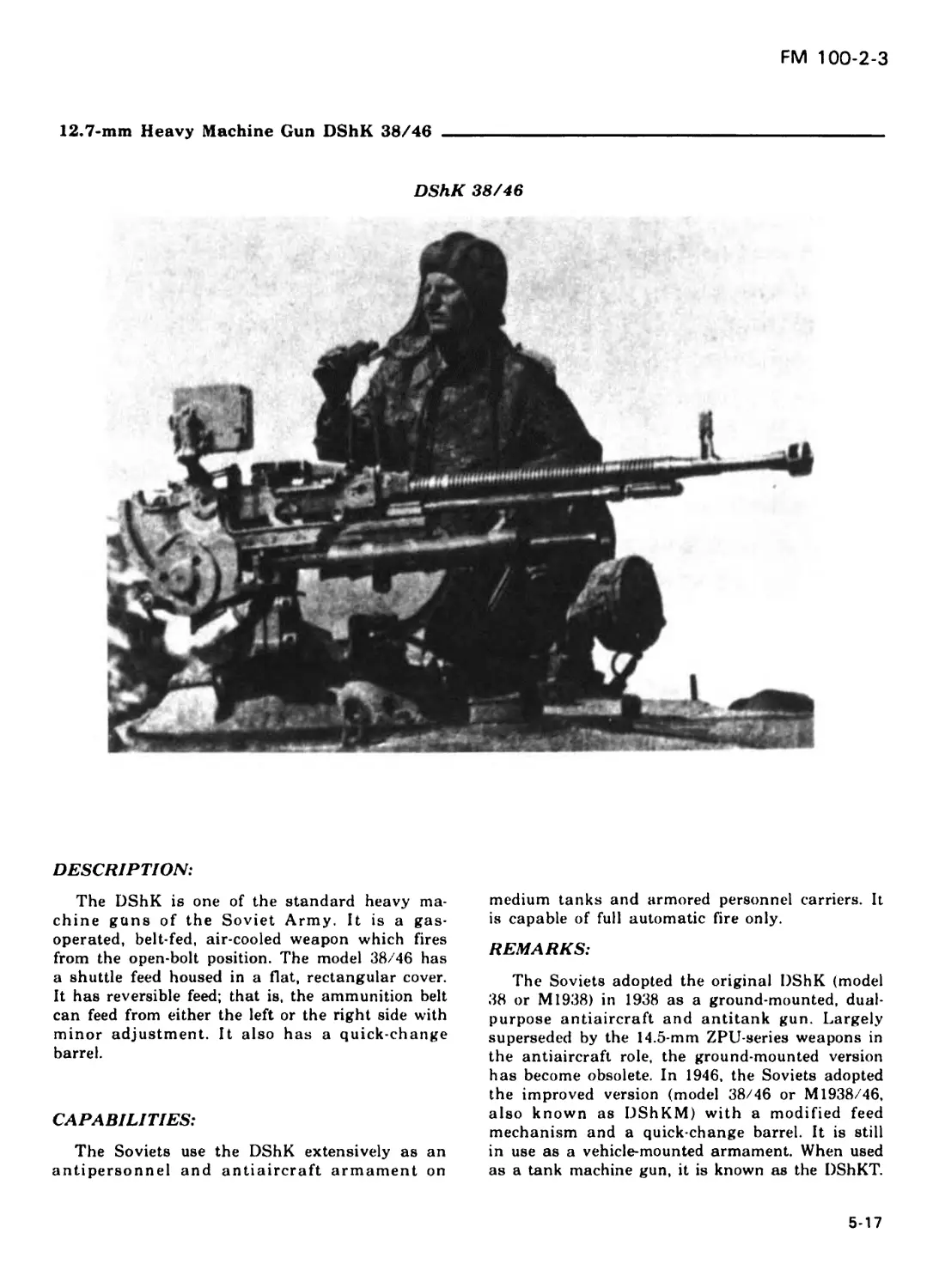


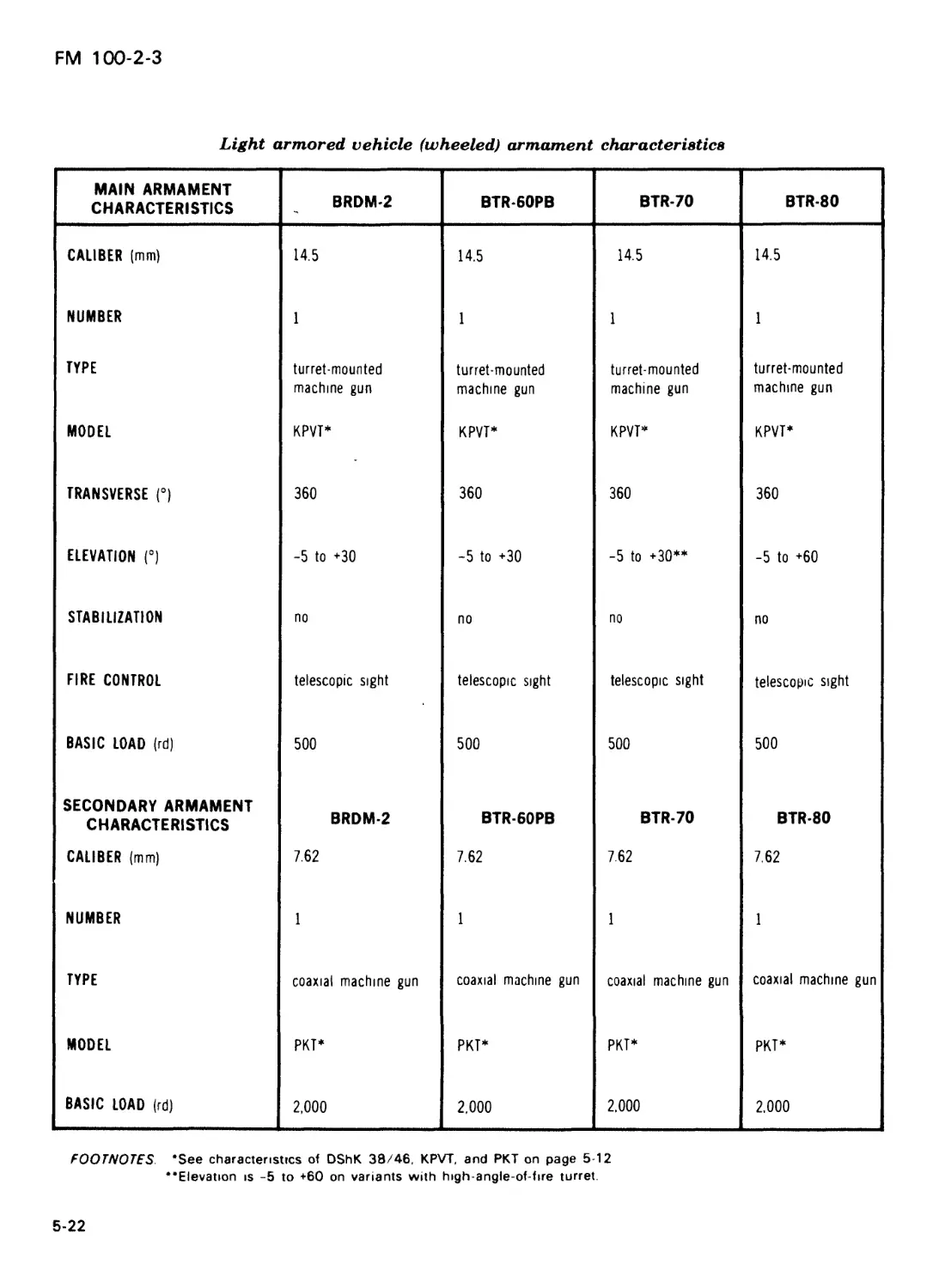
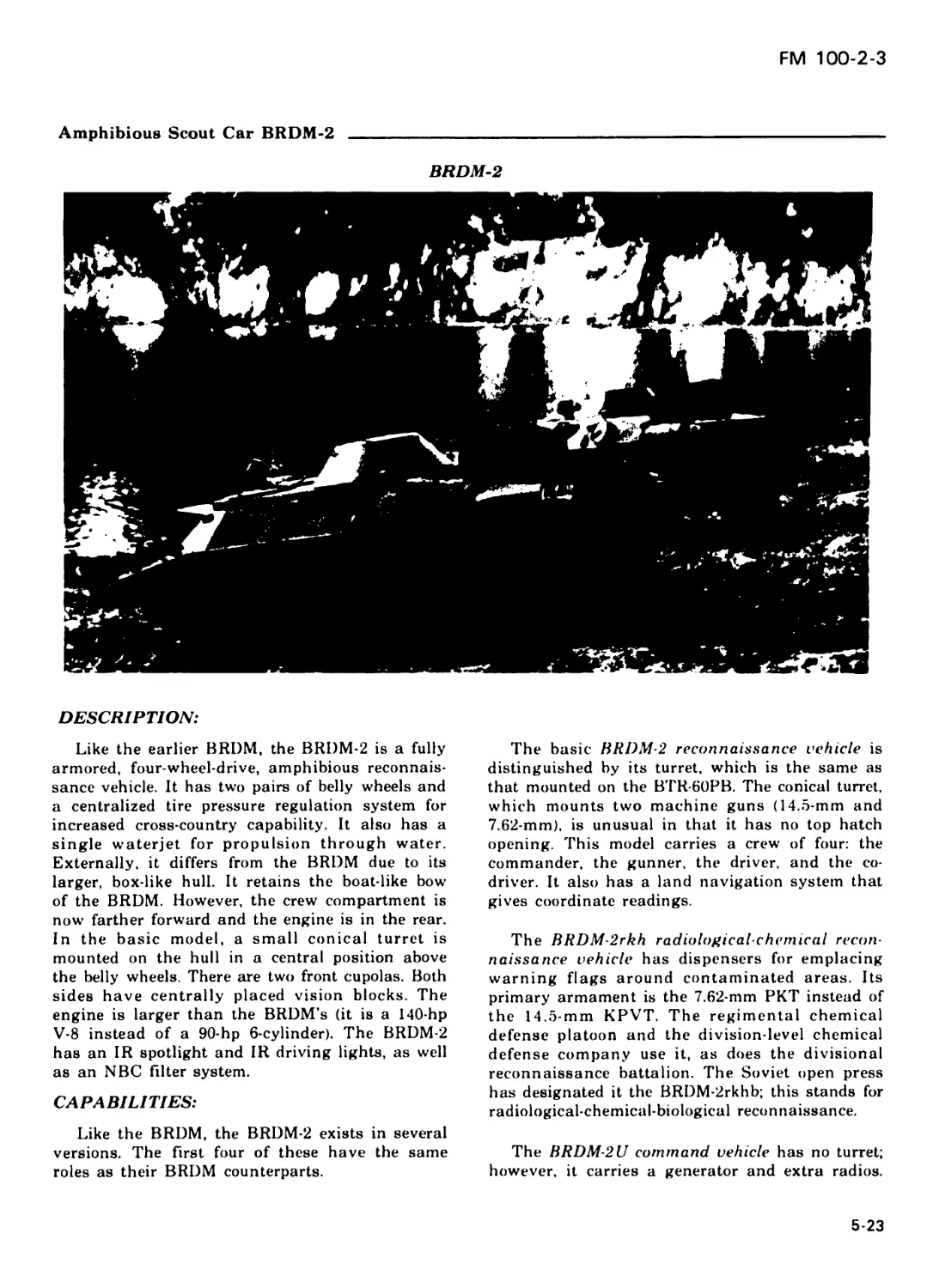
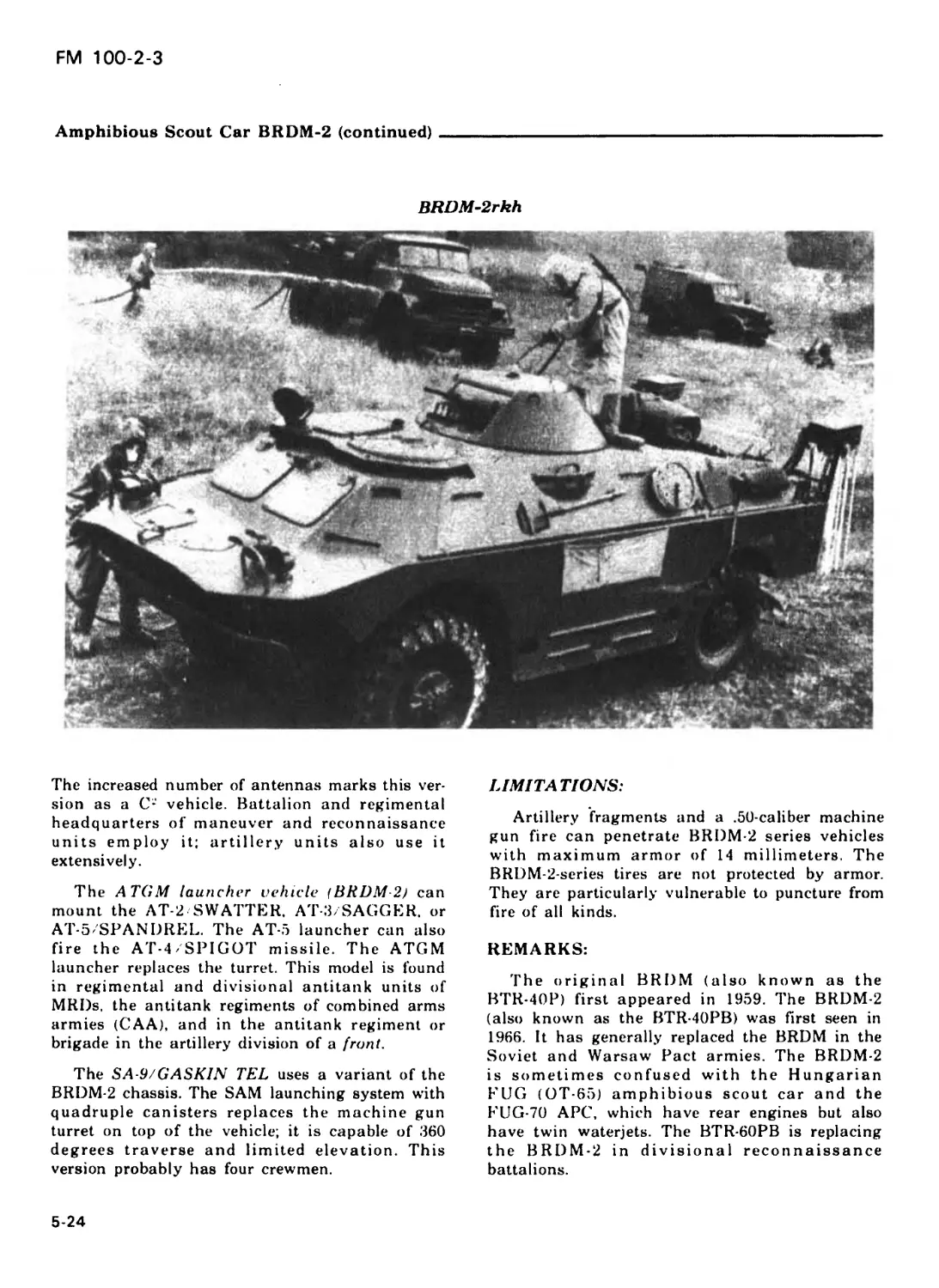




















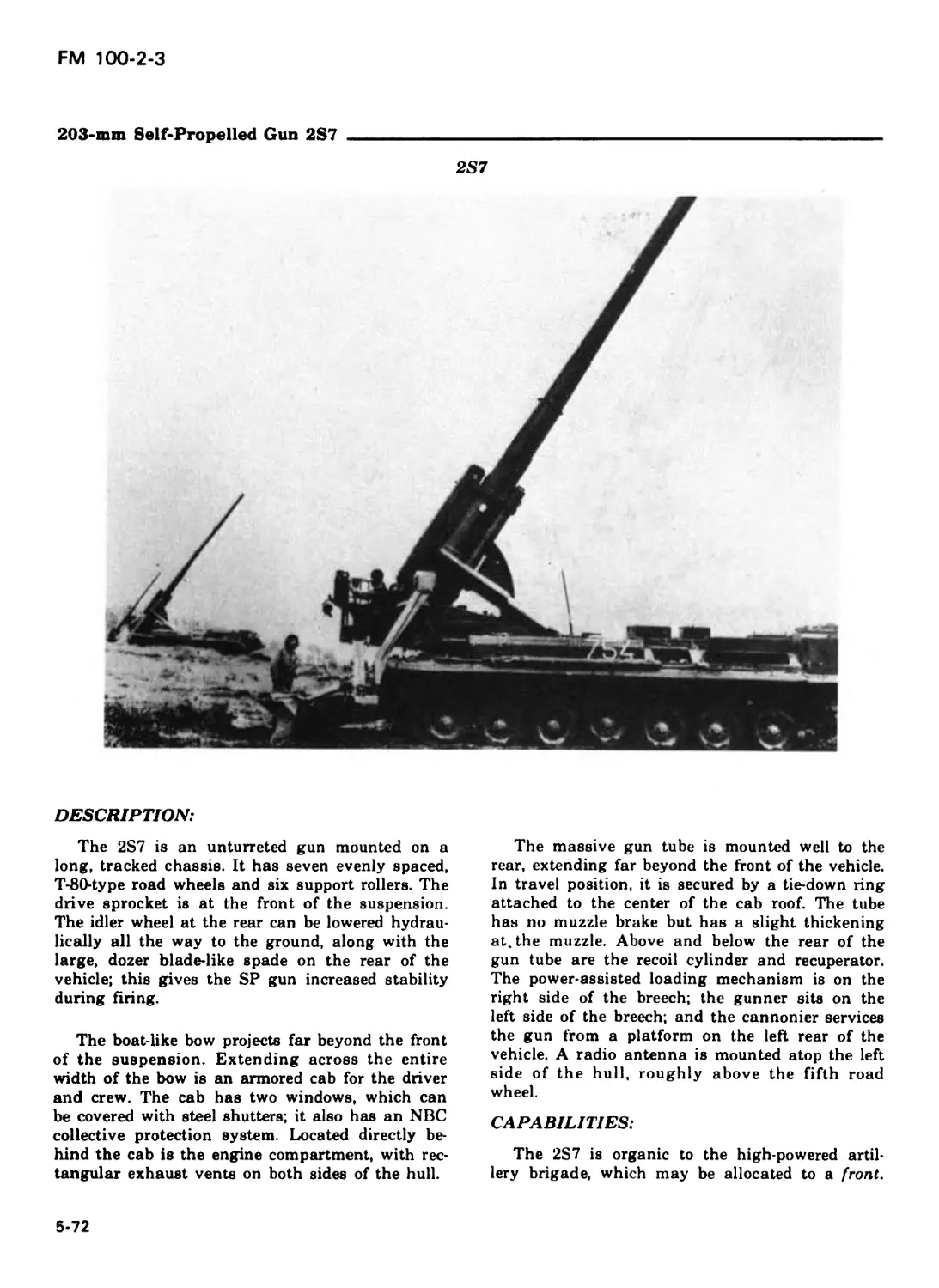


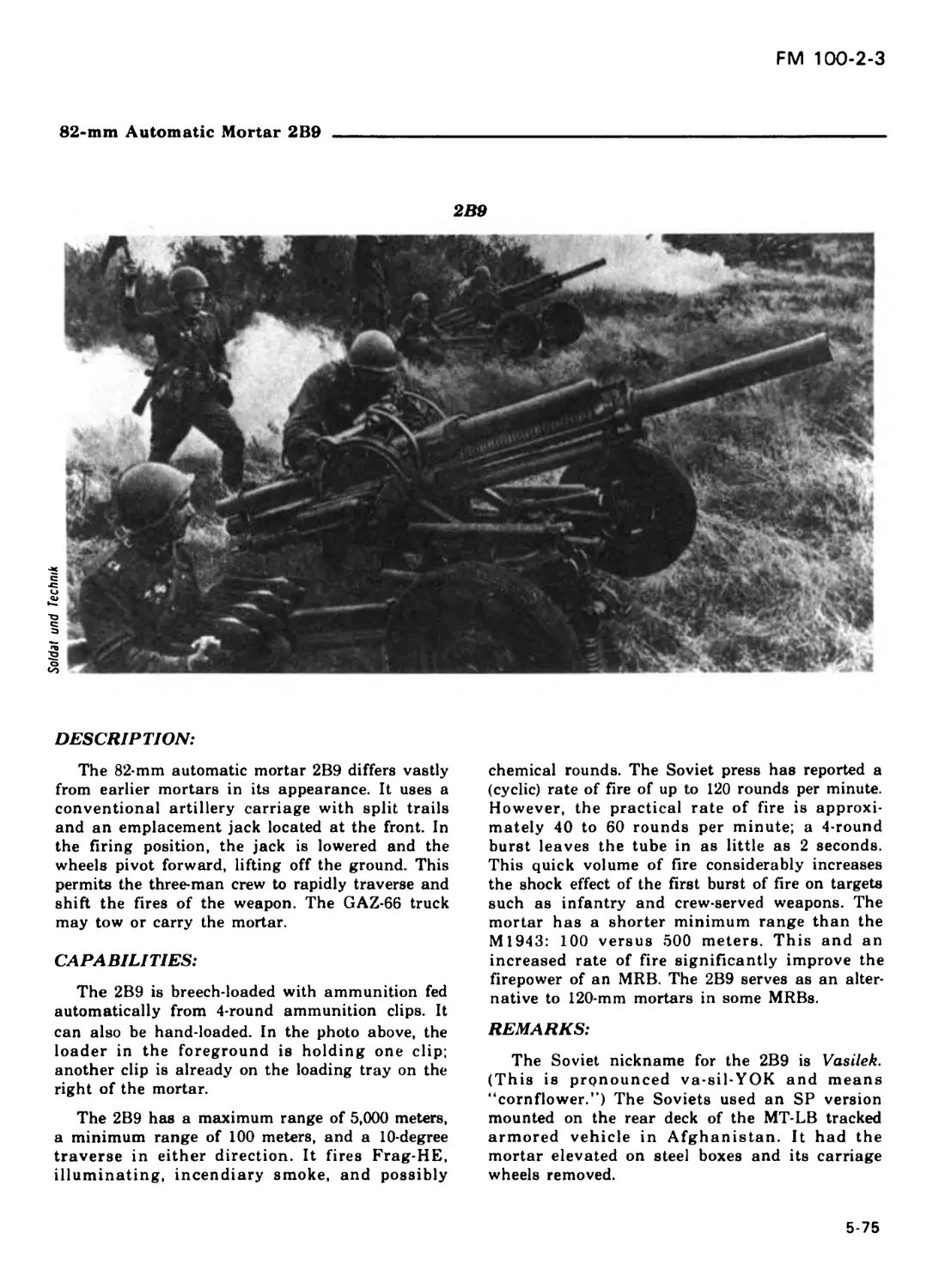
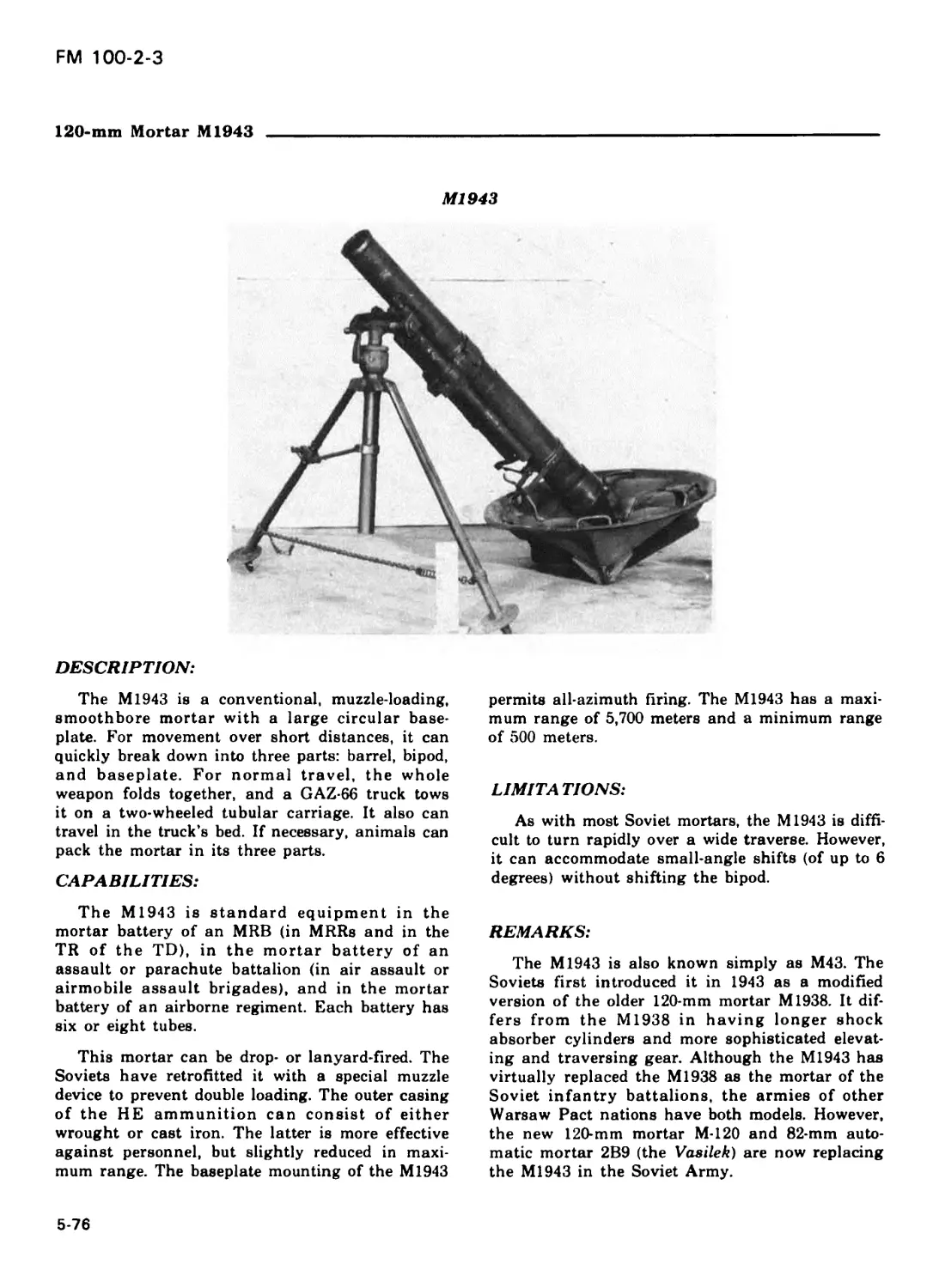

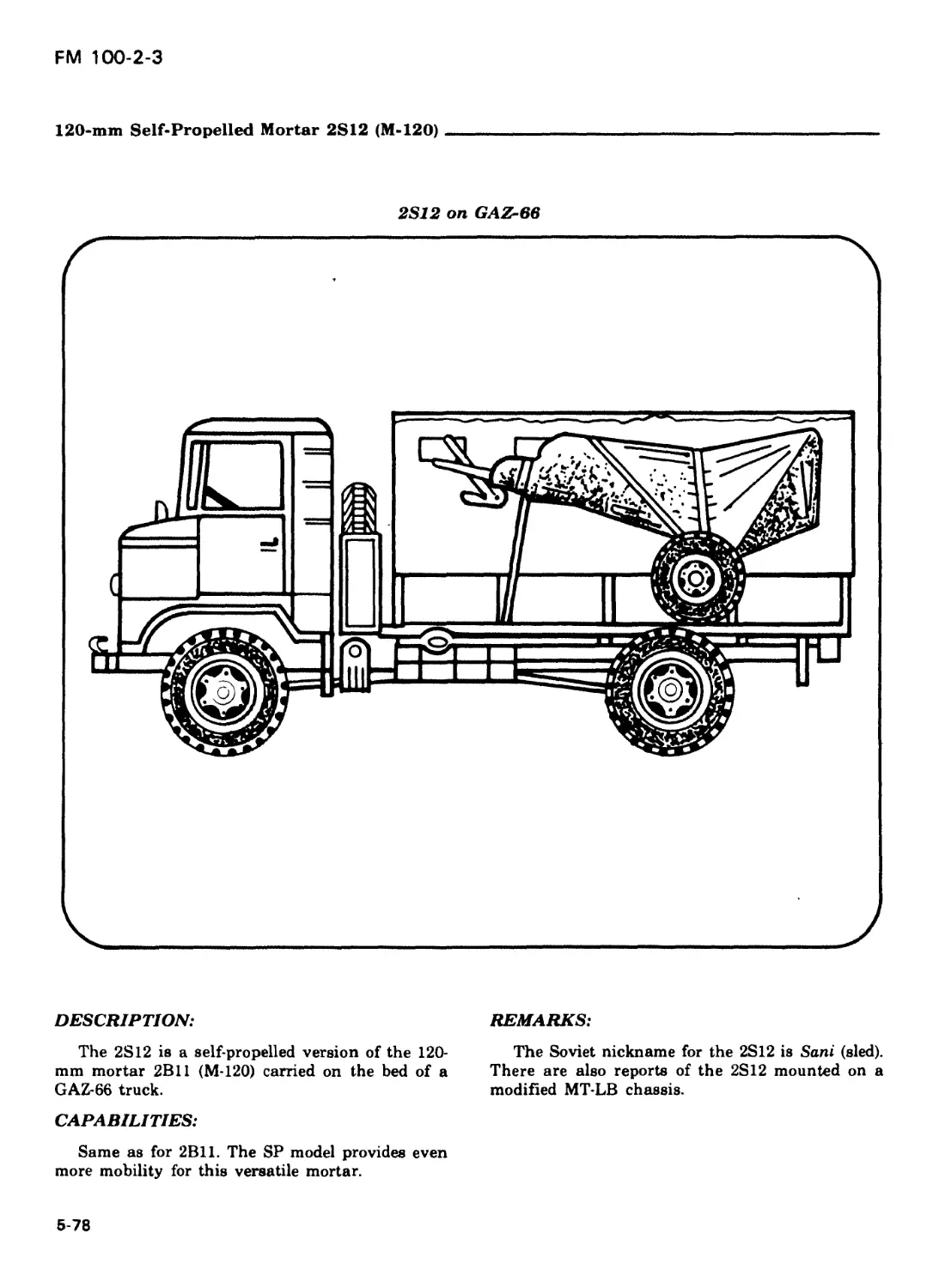


























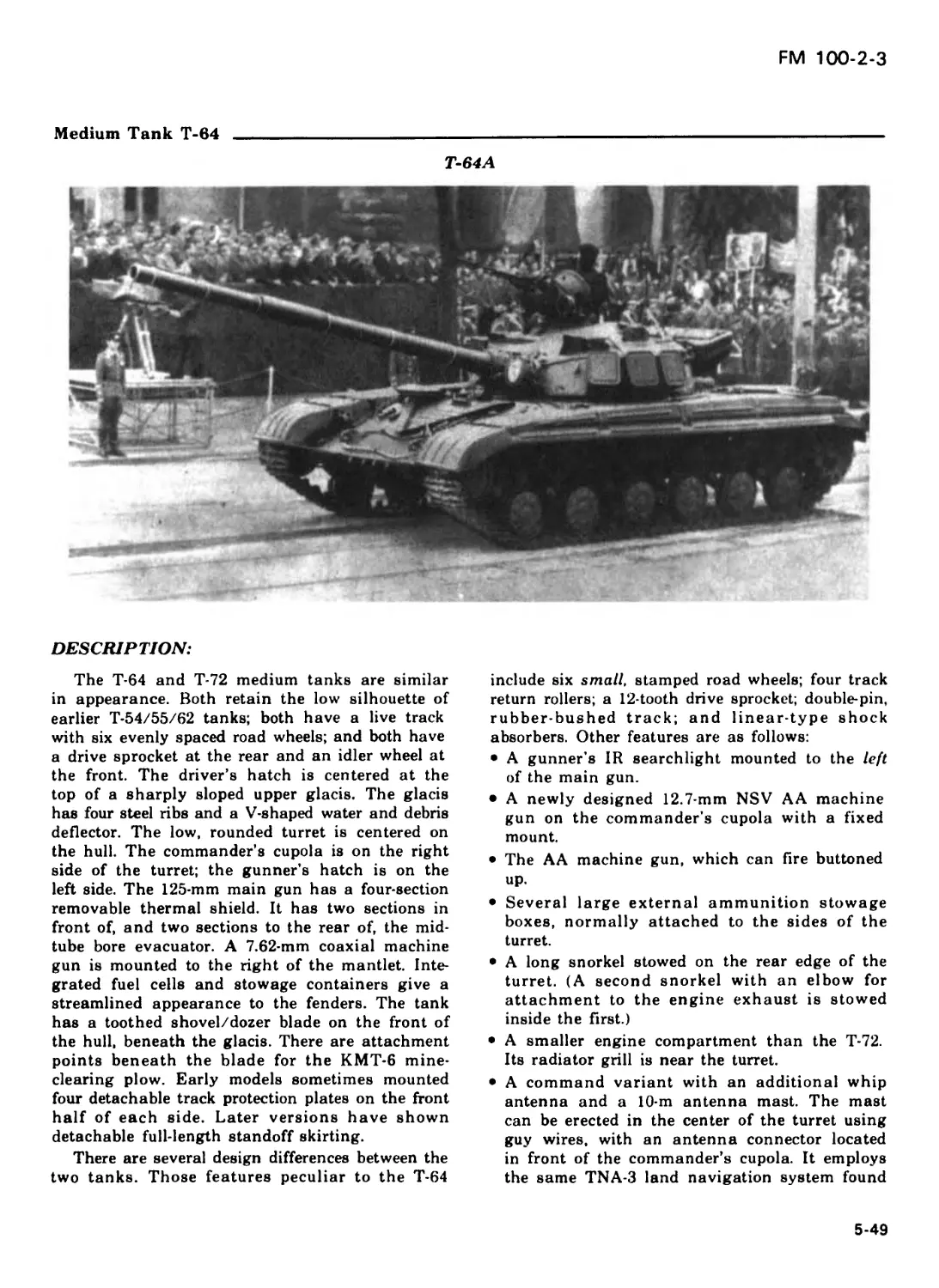
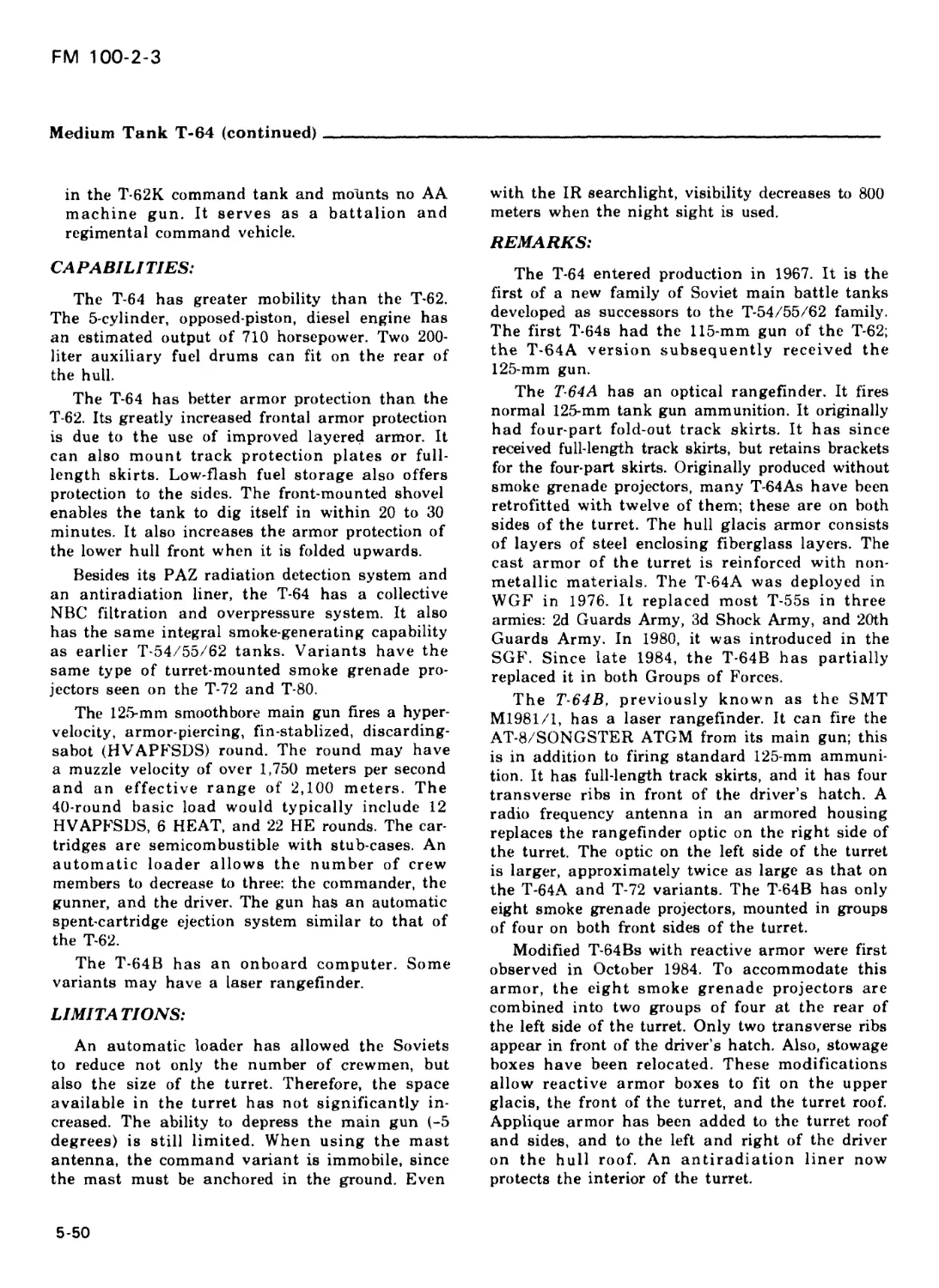
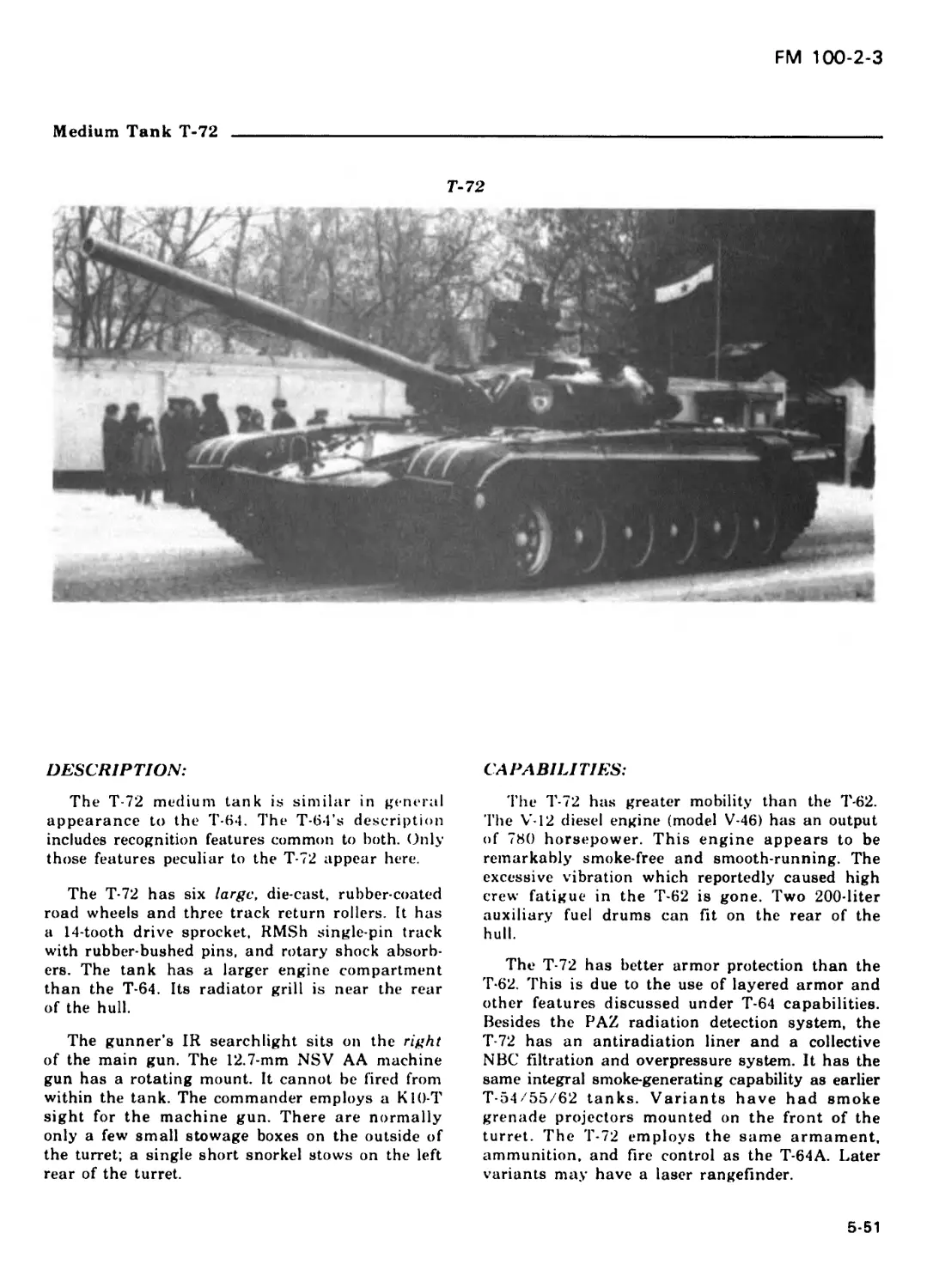


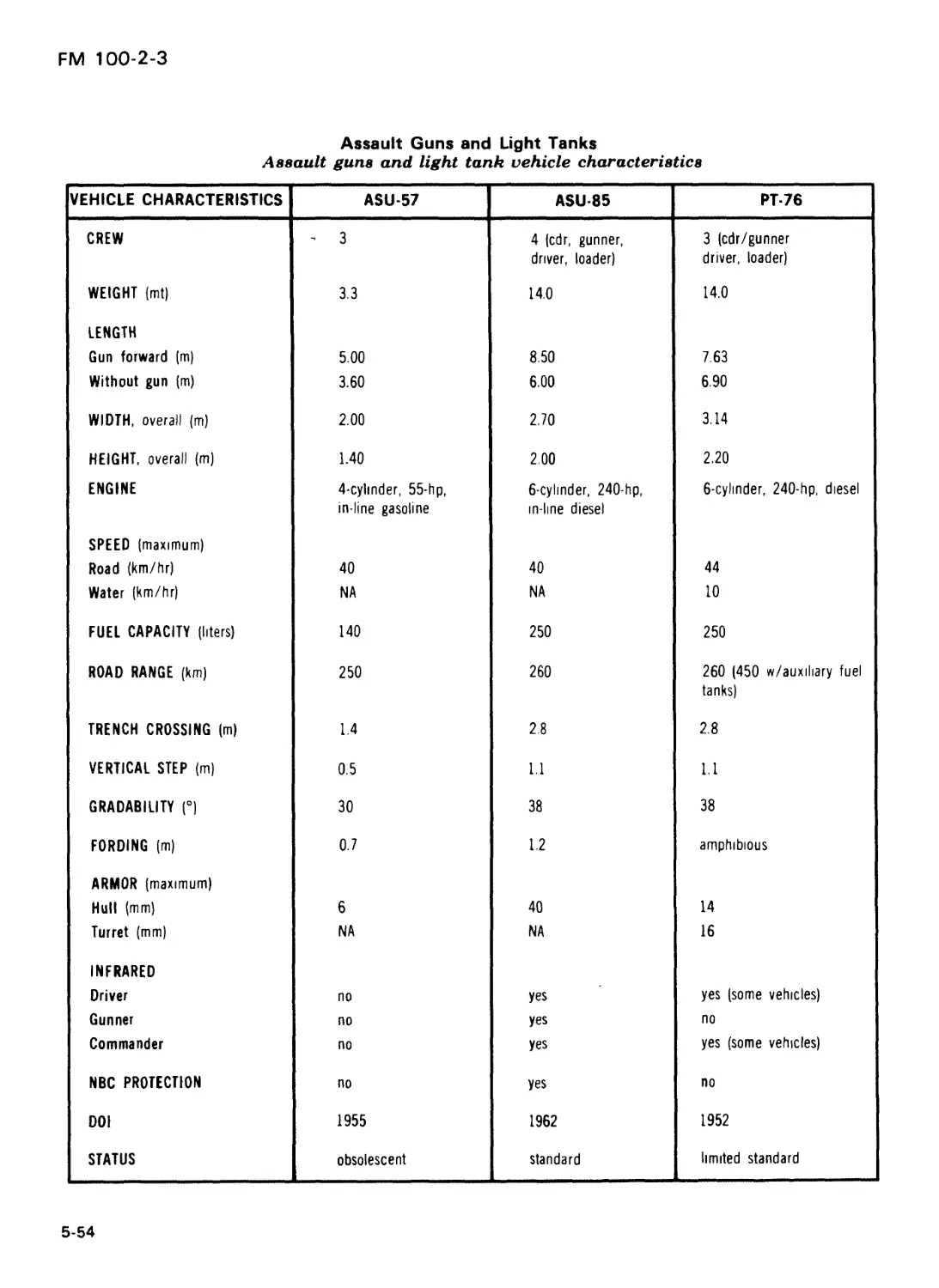


































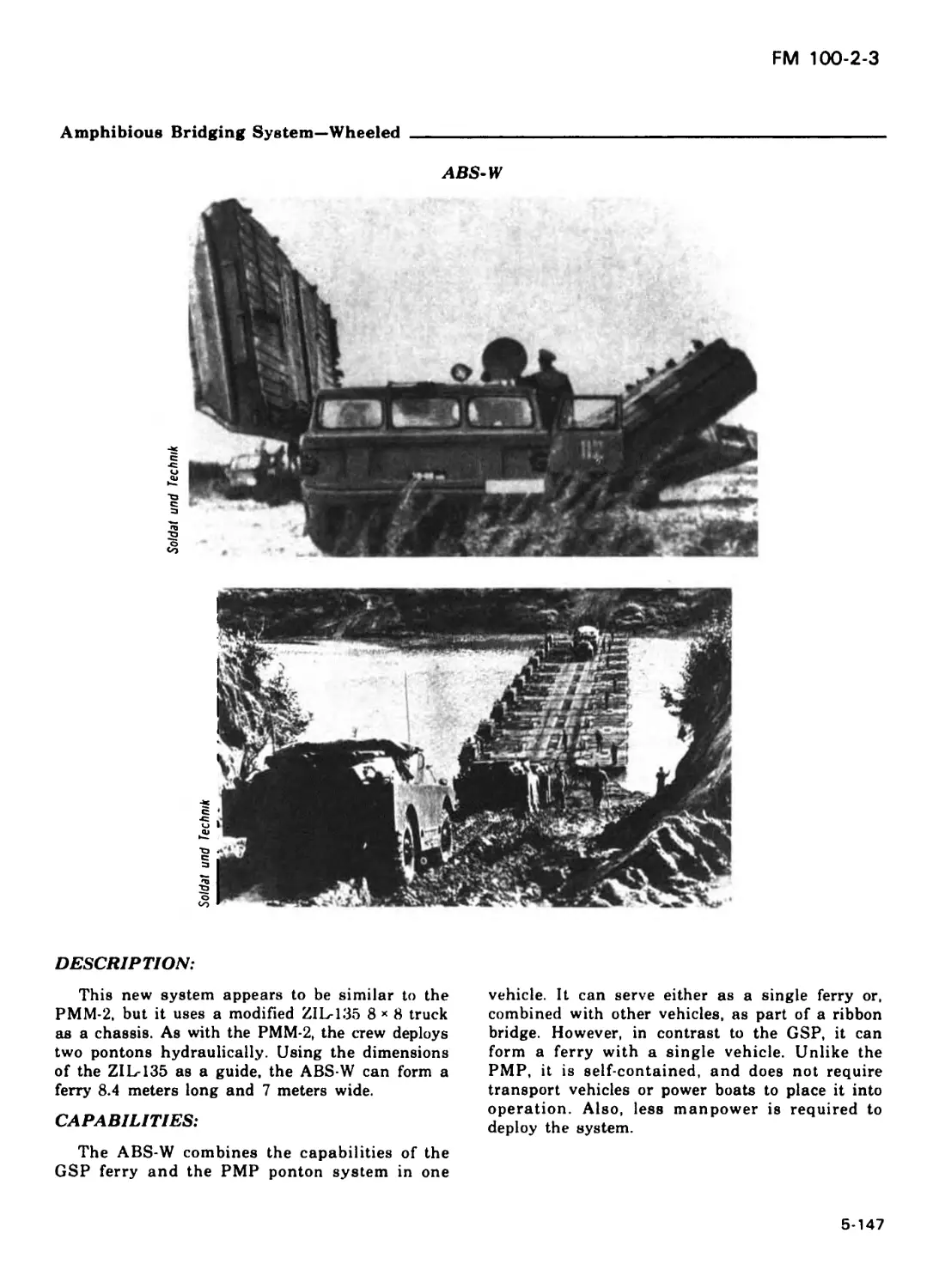
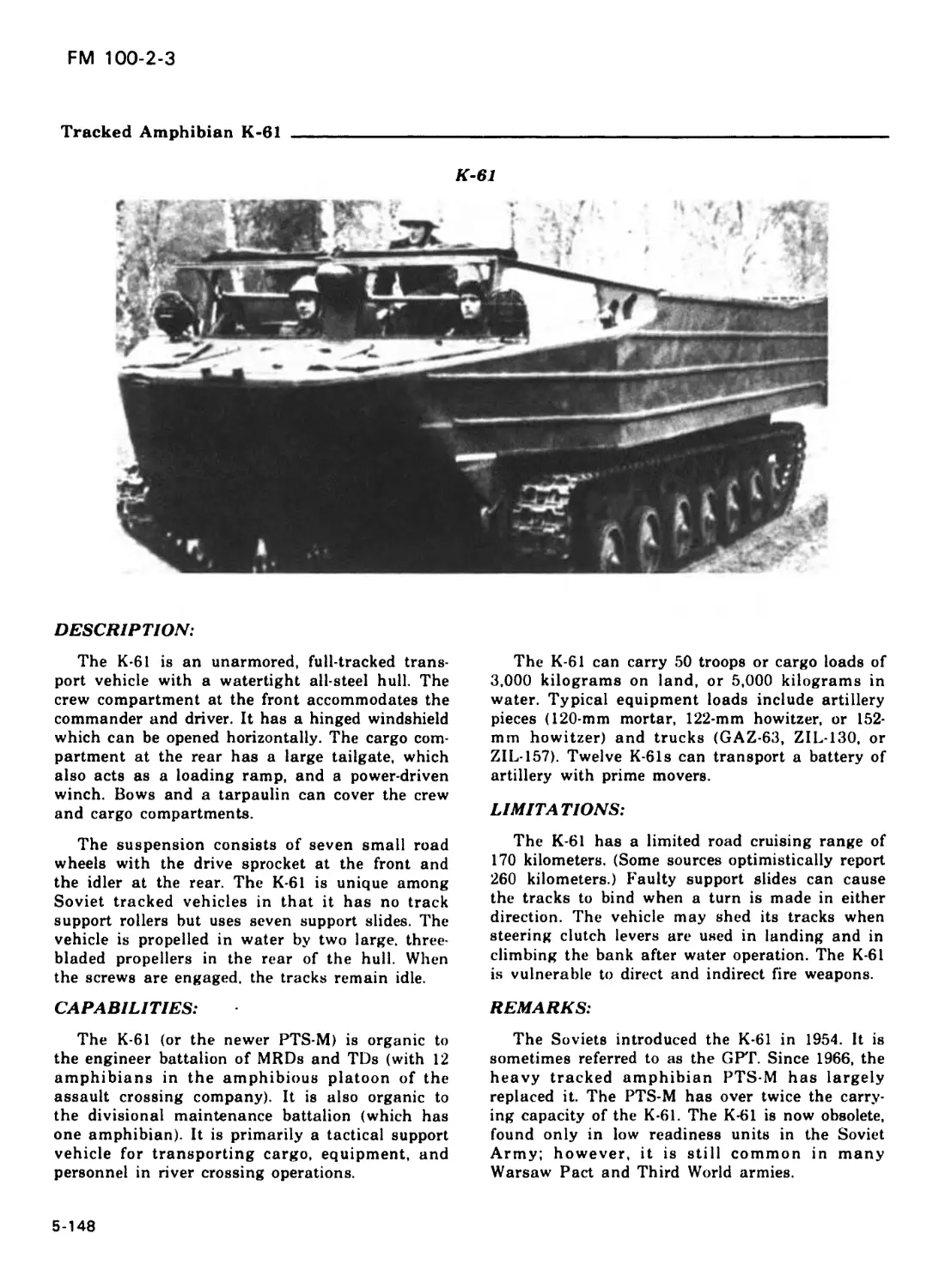

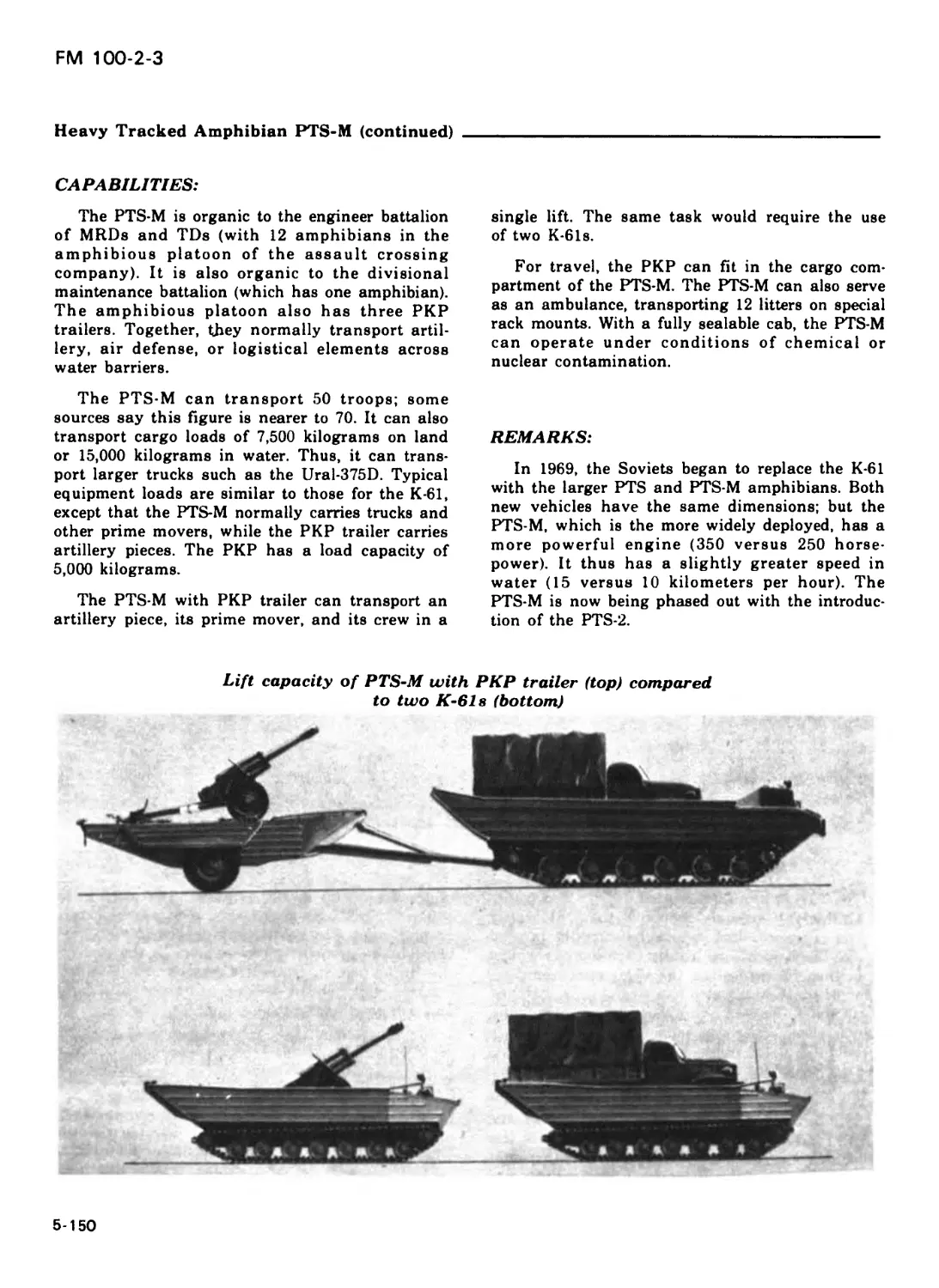


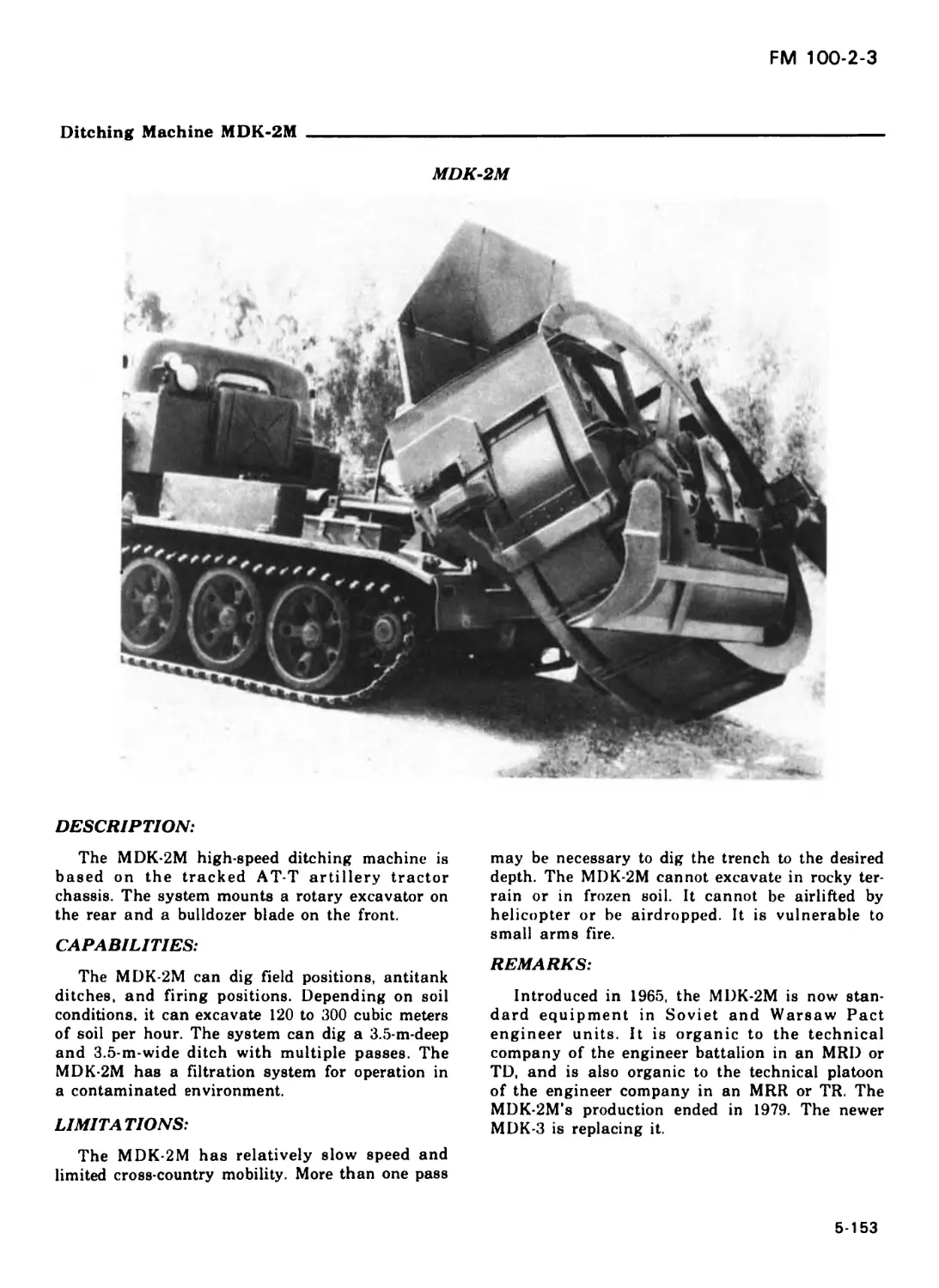


























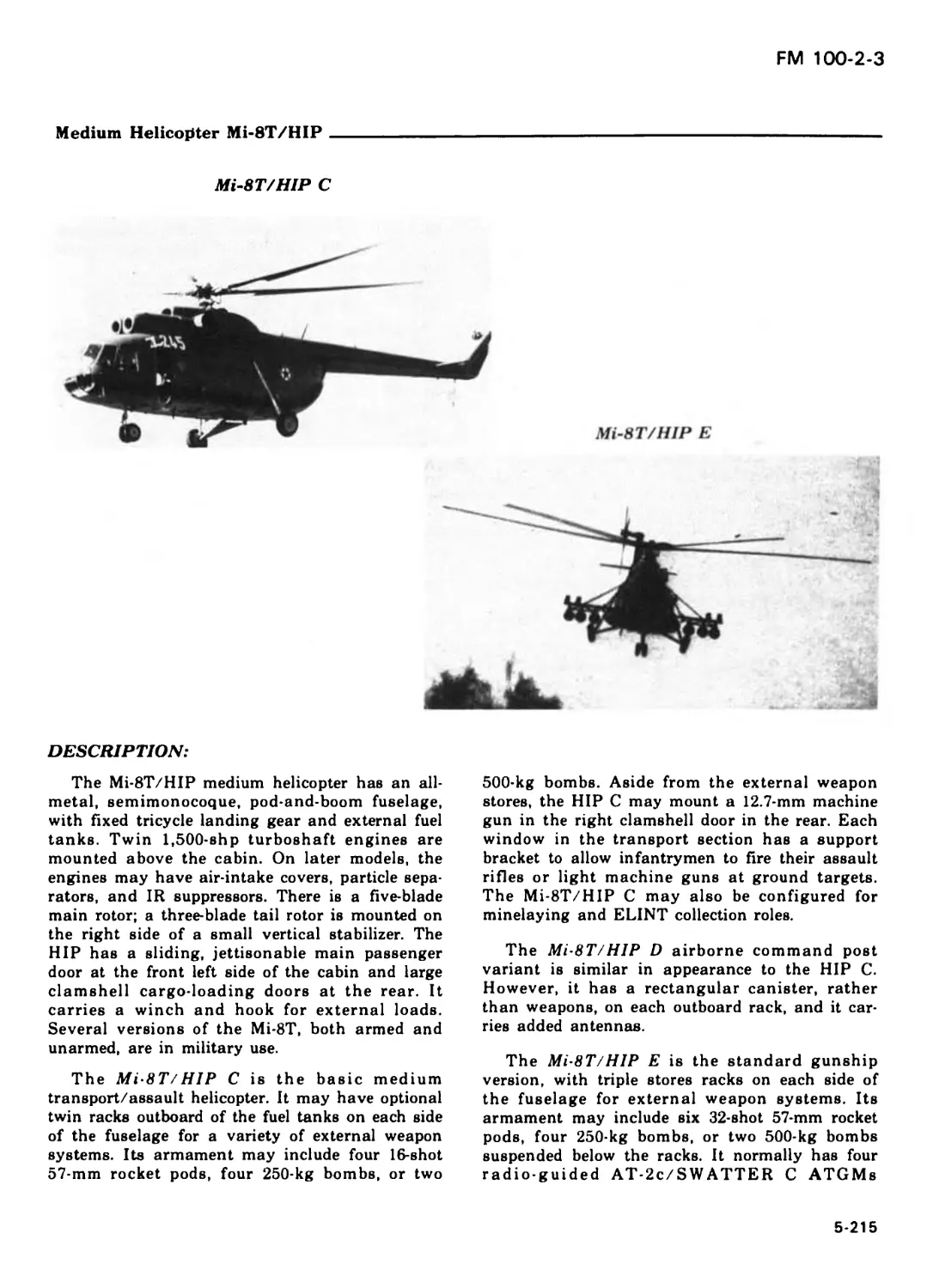

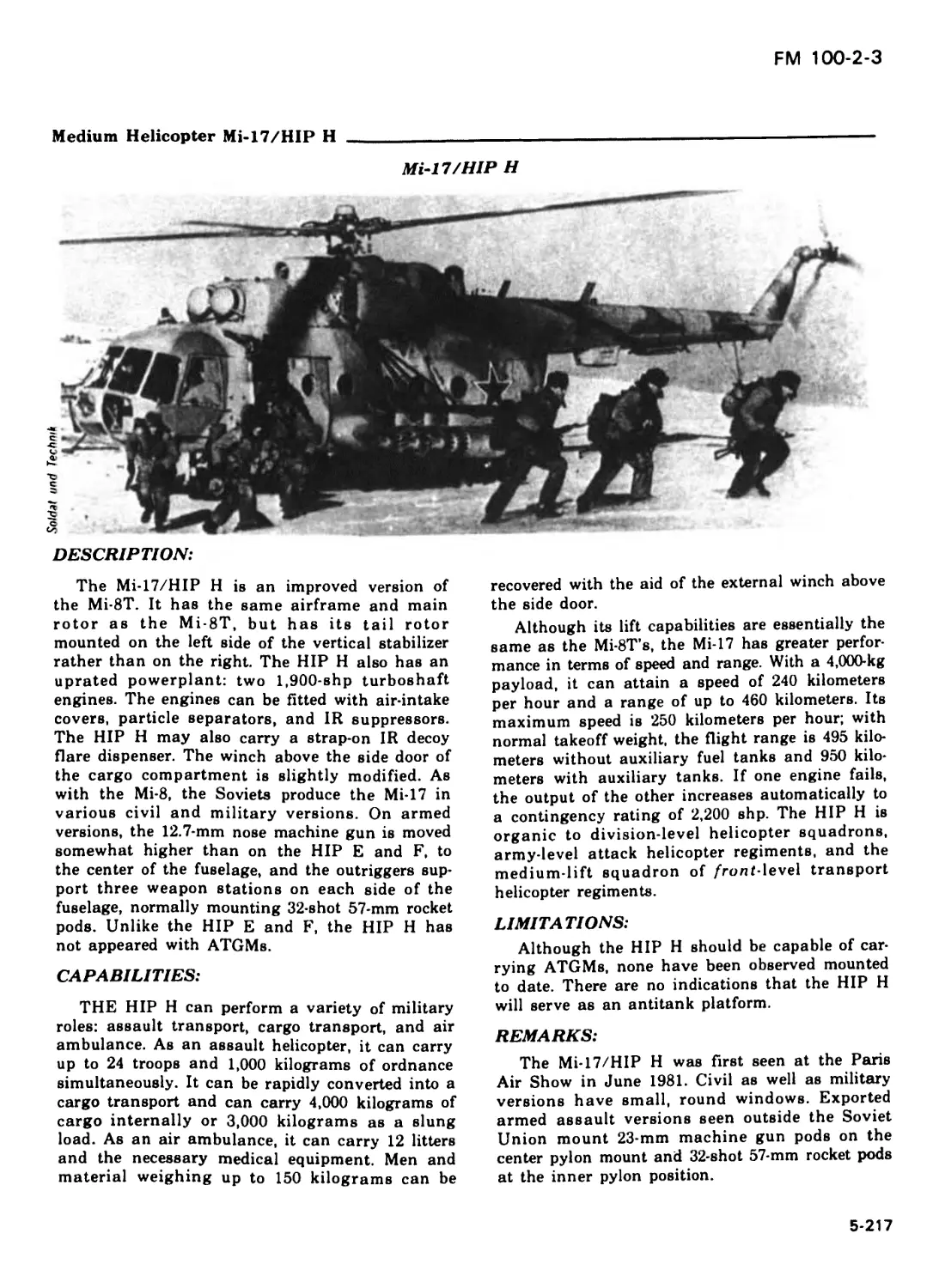



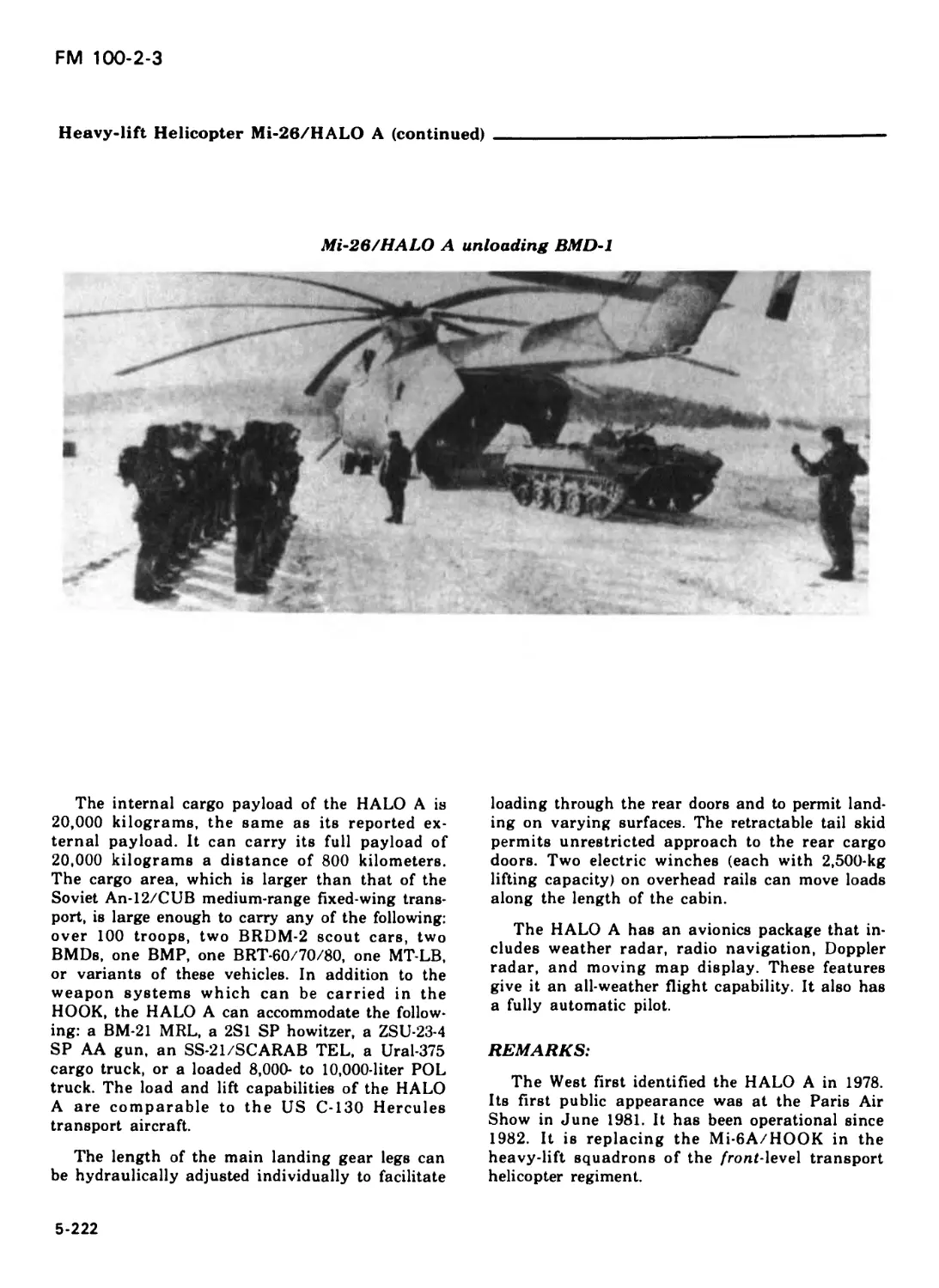














Теги: weapons military affairs military equipment army soviet army
Год: 1991


Текст
TROOPS.
ORGANIZATION.
AND EQUIPMENT
JUNE 1991
HEADQUARTERS, DEPARTMENT Or THE ARMY
DIS TR; В и TIО M RESTR! СТ: о M: Д ;j[. r _ ,.j - r - - z г и : n s.
FM 100-2-3
Field Manual
No. 100-2-3
Headquarters
Department of the Army
Washington, DC, 6 June 1991
The Soviet Army:
Troops, Organization, and Equipment
Preface
This field manual is part of FM series 100-2, The Soviet Army. The other
volumes in this series are FM 100-2-1, The Soviet Army: Operations and Tactics,
and FM 100-2-2, The Soviet Army: Specialized Warfare and Rear Area Support.
The three volumes complement each other. Used together, they provide a
thorough reference on the Soviet Army.
These manuals are the US Army’s definitive source of unclassified informa-
tion on Soviet ground forces and on their interaction with other services in
combined arms warfare. The Threats Directorate, Combined Arms Command,
Fort Leavenworth, Kansas, updates these manuals periodically to provide the
most current unclassified information available.
The proponent of this publication is HQ TRADOC. Users are encouraged to
recommend changes improving this manual to Commander, US Army Combined
Arms Command, ATTN: ATZL-SWW-L, Fort Leavenworth, KS 66027-6900, using
DA Form 2028 (Recommended Changes to Publications and Blank Forms).
Unless otherwise stated, whenever the masculine gender is used, both men
and women are included.
This publication contains photographs from copyrighted sources. The
citations for these materials accompany the individual photographs.
DISTRIBUTION RESTRICTION: Approved for public release; distribution
is unlimited.
This publication supersedes FM 100-2-3, 16 July 1984.
FM 100-2-3
Contents
Preface .............................................................. i
Chapter 1. Soviet Ground Forces
Administrative Control ............................................. 1-1
Troop Categories..................................... 1-2
Force Structure ..................................... 1-4
Chapter 2. Personnel
Manpower Procurement ............................................... 2-0
Conditions of Service ............................... 2-3
Ranks ............................................... 2-6
Reserve System ...................................... 2-8
Chapter 3. Training
Premilitary Programs ............................................... 3-1
Military Educational Institutions ................... 3-4
Individuals and Units................................ 3-6
Chapter 4. Organization
Motorized Rifle Regiment Structure (BTR) .......... 4-3
Motorized Rifle Regiment Structure (BMP) ..........4-26
Motorized Rifle Division ............................4-37
Tank Regiment Structure.......................... 4-107
Tank Division ......................................4-112
Combined Arms Army................................. 4-116
Tank Army .......................................... 4-118
Front ............................................. 4-130
Airborne Regiment Structure (BMD) ................. 4-144
Airborne Division ................................. 4-149
Naval Infantry Regiment/Brigade Structure.......... 4-155
Naval Infantry Division ........................... 4-157
Chapter 5. Equipment
Small Arms .......................................... 5-2
Armored Fighting Vehicles ...........................5-21
Artillery .......................................... 5-60
Antitank Weapons ................................... 5-94
Air Defense ........................................5-114
Engineer Equipment .................................5-139
NBC Equipment.......................................5-186
Logistic Equipment..................................5-206
Helicopters ........................................5-211
Fixed-Wing Aircraft ................................5-225
Radios .......................................5-234
Glossary ................................................... Glossary-1
References ................................................References-1
Index
General ................................................General Index-1
Equipment ........................................... Equipment Index-1
ii
CHAPTER 1
Soviet Ground Forces
CONTENTS
ADMINISTRATIVE CONTROL ...................... 11
TROOP CATEGORIES ........................... 1-2
Combat Arms Branches ..................... 1-2
Motorized Rifle ........................ 1-2
Tank ................................... 1-2
Missile Troops and Artillery............ 1-2
Air Defense Troops (Voysfca PVO) ....... 1-2
Airborne ............................... 1-2
Special Troops ........................... 1-2
Engineer ............................... 1-3
Signal ................................. 1-3
Chemical ............................... 1-3
Motor Transport......................... 1-3
Railroad................................ 1-3
Road ................................... 1-3
Services ................................. 1-3
Medical ................................ 1-3
Veterinary ................................ 1-3
Military Topographic ...................... 1-3
Finance ................................... 1-3
Justice.................................... 1-4
Military Band.............................. 1-4
Intendance................................. 1-4
Administrative ............................ 1-4
FORCE STRUCTURE ............................... 1-4
Major Geographical and Force Groupings ... 1-4
TV ........................................ 1-4
TVD ....................................... 1-4
Military Districts and Groups of Forces . . 1-5
Front ............................ 1-5
Army ...................................... 1-5
Maneuver Divisions .......................... 1-5
Reorganization and Modernization ............ 1-5
The Soviet armed forces include five separate
components: the strategic rocket forces, the ground
forces, the air forces, the air defense forces, and
the naval forces. The generic term “Soviet Army”
normally includes all but the naval forces. This
manual concentrates on the largest of these
components, the Soviet ground forces. Highly
modernized organization and equipment combine
to make the present Soviet ground forces the most
powerful land army in the world, with unprece-
dented flexibility, mobility, and firepower.
ADMINISTRATIVE CONTROL
The Commander in Chief (CINC) of the Ground
Forces is a Deputy Minister of Defense. He is
equal in status to the CINCs of the other com-
ponents. His duties include supervision of technical
affairs and research and development, direct
control of nonoperational training, and supervision
of ground forces administrative organs. He does
not have direct operational control over the troops.
This lack of operational control is not imme-
diately apparent from the composition of the
Ground Forces Headquarters. Its composition
includes the Main Staff and several technical
directorates. The Main Staff, however, apparently
fills a traditional role of coordinating, planning,
and maintaining liaison with the Ministry of
Defense (MOD) General Staff on ground forces
matters. It also acts as a consolidation point for
the work of the ground forces directorates. Among
the principal directorates of the Ground Forces
Headquarters are the Political Directorate, the
Combat Training Directorate, and the Military
Educational Institutions Directorate, all of which
have counterparts at MOD level.
Large technical directorates exist for those troop
branches peculiar to the ground forces. Each troop
branch directorate acts as a branch or service
headquarters which prescribes the organization,
equipment, tactics, and training for its branch and
operates the career management program for its
leading personnel.
1-1
FM 100-2-3
TROOP CATEGORIES
For administrative purposes, the Soviet ground
forces comprise three categories: combat arms
branches (troops), special troops, and services.
These are administrative categories pertaining to
personnel, not organization categories pertaining
to units. Thus, troops of one combat arms branch,
such as artillery, may organizationally be in
support units subordinate to a unit made up of
troops of another combat arms branch (for
example, motorized rifle or tank). These support
units may also include special troops and services.
COMBAT ARMS BRANCHES
The firing elements of the ground forces com-
prise combat arms branches (troops). They differ
from one another in organization, armament,
tactics, and role in combat. Directorates of Ground
Forces Headquarters administer the troop branches
peculiar to the ground forces.
Motorized Rifle
Motorized rifle troops generally parallel the
infantry and mechanized infantry of other armies.
These troops constitute the basic arm of the
ground forces; therefore, various agencies under
the Ground Forces CINC, rather than one special
organization, administer their affairs. These
agencies prescribe motorized rifle and combined
arms tactics and organization. They prepare
training schedules for motorized rifle and combined
arms units. They also administer motorized rifle
schools and manage motorized rifle officer person-
nel. Other arms and services provide them with
logistic support.
Tank
The Chief of Tank Troops in Ground Forces
Headquarters heads this branch. A Main Direc-
torate of Tank Troops supports him. The Main
Directorate is an intricate organization which acts
as an administrative headquarters. Tank troop
officers command tank units at all levels. Com-
bined arms formations feature a special staff
officer as chief of tank troops. He commands sub-
ordinate tank elements and reports to the com-
bined arms commander.
Missile Troops and Artillery
This is one of the most prestigious branches
of the ground forces or the MOD. Artillery troops
have long held an honorable position in Russian
military annals. In recent decades, technological
advances in missile weaponry have enhanced that
position. Since missile armaments have also
become important to other components, the MOD
generally oversees missile equipment development.
However, a Chief of Missile Troops and Artillery
is present in Ground Forces Headquarters. His
supporting administrative agency is large and
contains a coordinating staff. Also, chiefs of
missile troops and artillery appear in the special
staffs of combined arms units down to, and
including, regiments. At regimental level, this
official is simply called the chief of artillery.
Air Defense Troops (Voyska PVO)
This branch recently became a separate com-
ponent combining air defense elements formerly
under the National Air Defense Troops (PVO
Strany) and the Air Defense Troops of the Ground
Forces (PVO Sukhoputnykh Voysk). Although
MOD headquarters now administers them, the
troops may serve under combined arms command
in the field during wartime. They coordinate
closely with aviation and radiotechnical elements
in operational matters. Air defense schools pre-
viously under the ground forces now belong to the
Air Defense Troops.
Airborne
Airborne troops form a reserve force of the
Supreme High Command (VGK) or the wartime
Stauka VGK, although operational control of them
specifically belongs to the Chief of the General
Staff. The VGK may—
• Control their combat employment directly.
• Place them under the command of a theater
headquarters.
• Place them under operational control of a front
or army to support operational missions.
The troops are not subordinate to a ground forces
field command until the VGK commits them. This
definite separation suggests that they have the
status of a sixth distinct component of the armed
forces, even though they are nominally subordinate
to the CINC, Ground Forces, because of this
special status.
SPECIAL TROOPS
The special troops provide combat support to
the combined arms field forces of the ground
forces. They also support the other components of
the armed forces. For this reason, they are admin-
istered centrally from directorates in the MOD.
Ground Forces Headquarters, however, contains
specialized directorates or departments in each of
1-2
FM 100-2-3
the combat support areas to deal with specific
ground forces problems. These directorates act as
a ground forces administrative echelon for the
superior MOD directorates.
Engineer
As ground elements of the combined arms field
forces, engineer troops serve only as combat
engineers. The Chief of Engineer Troops of the
MOD manages them. These engineers are not part
of the engineer-technical service, which comprises
the logistic units of the various arms and services.
Other Soviet troop branches perform civil engi-
neering, sanitation, and mapping functions; they
are comparable to organizations like the US Corps
of Engineers. Engineer troops found in units at
division level or higher are simply called engineers.
Those at a lower level, in closer contact with the
enemy, are called sappers.
Signal
Signal troops are organic to all levels using
signal equipment that requires special training for
operation and maintenance. The Chief of Signal
Troops of the MOD administers them because they
perform tasks that are common to more than one
component of the armed forces. They include radio-
technical troops that serve mainly in the units
whose missions require radar reconnaissance and
electronic warfare. They also perform missions
such as electronic deception and radioelectronic
reconnaissance, which include electronic intelli-
gence (ELINT) or signals intelligence (SIGINT).
Chemical
Chemical troops are organic to all tactical regi-
ments and divisions. They are allocated to armies
and fronts. Similar to engineer and signal troops,
they are directly subordinate to the MOD. The
Chief of Chemical Troops administers them at
that level.
Motor Transport
The Chief of the Central Military Transportation
Directorate (VOSO), under the Chief of the Rear
in the MOD, may administer motor transport
troops. The VOSO is primarily responsible for
management and planning of defense transpor-
tation. It controls the training of all transport
officers at and beyond the military college level.
The actual operation of the various modes of
transport is the duty of the force components,
which in this case are the ground forces. At lower
levels, the deputy commander for the rear controls
these troops.
Railroad
Railroad troops support the field forces by
operating the railway links between the front and
the central logistical base. They are responsible
for the construction, operation, and maintenance
of railroads in a theater of operations. Since
March 1989, these troops are no longer considered
part of the armed forces.
Road
Road troops maintain military roads. They are
often called road building troops or road service
troops. The troops consist of separate traffic
control, road construction, and bridge construction
units. Operationally controlled by the chief of the
rear at various levels, their administrative subor-
dination has been obscure since World War II.
They may be a component of VOSO.
SERVICES
The Soviet concept of services includes all
troops, installations, and duty positions which
perform rear area support for the combat arms
branches and special troops. Such services are not
specific to the ground forces, but support the other
armed forces components as well; therefore, various
agencies in the MOD administer them. These
services differ from the special troops because they
apparently have no intermediate administrative
directorates at Ground Forces Headquarters.
Medical
These units and personnel are organic to all
levels of command down through company level.
The Central Military Medical Directorate under the
Chief of the Rear supervises their activities at the
MOD level. The divisional and regimental surgeons
supervise personnel at their respective levels.
Veterinary
The Veterinary Service falls under the control
of the Chief of the Rear. It inspects the meat used
by the armed forces, supervises animal slaughter,
and deals with prevention and control of conta-
gious diseases among animals used for meat.
Military Topographic
The Central Military Topographic Directorate
of the General Staff of the MOD administers and
controls the Military Topographic Service. The
General Staff also probably disseminates the
products of this service.
Finance
The Finance Service is locally supervised. How-
ever, it has a direct technical channel running
1-3
FM 100-2-3
vertically to the Central Finance Directorate,
under the Deputy Minister for Rear Services in
the MOD.
Justice
The military procurator (prosecutor) and the
military tribunal are the central elements of the
Justice Service. These elements are attached to
each major headquarters down to division level.
This hierarchy is independent of the military
command. It is subordinate to the Procurator
General of the USSR and the Supreme Court of
the USSR, although its officers are considered
active duty military personnel.
Military Band
This service provides bands to headquarters
down through division. The Military Band Service
Directorate (or Directorate of Military Music) in
the MOD administers it.
Intendance
This service corresponds to the US Quarter-
master Corps. It uses the same insignia as the
Administrative Service.
Administrative
This service may provide clerical and adminis-
trative support at higher headquarters. According
to Soviet regulation, the highest rank provided for
this service is colonel. Personnel doing adminis-
trative management, accounting, and similar
housekeeping tasks may be members of the
administrative service, the management service, or
the intendance service. Since there are no exclu-
sively administrative units, these titles are probably
just personnel categories with the individuals in
them administered by the Main Personnel Direc-
torate of the MOD and supervised locally.
FORCE STRUCTURE
The Soviets have organized and equipped their
ground forces to support their defensive doctrine.
Moreover, they are constantly strengthening and
modernizing their organization and equipment to
improve their capabilities to fight either nuclear
or nonnuclear war. A nuclear exchange in Europe
could easily cause tremendous damage to the Soviet
Union. Therefore, the Soviets clearly want to be
able to fight and win a war in Europe quickly,
before either side employs nuclear weapons.
The Soviets have determined that the only way
to win such a war is by offensive operations. The
Soviet concept of the offensive emphasizes surprise
and high rates of advance combined with over-
whelming firepower. The concept of combined
arms is at the heart of Soviet combat doctrine.
MAJOR GEOGRAPHICAL AND
FORCE GROUPINGS
The Soviets organize ground forces by geo-
graphical boundaries into theaters of war (TVs),
theaters of military operation (TVDs), and military
districts and groups of forces. They can organize
forces into large field formations called fronts
and armies.
TV
The Soviets envision that hostilities might occur
in any of three TVs: the Western, the Southern,
and the Far Eastern. A TV is a broad, geo-
graphically oriented designation within which
Soviet armed forces would function in wartime. A
continental TV can include land, air space, and
assorted internal and coastal waterways. The
Western TV, for example, includes the European
land mass and associated islands, the associated
air space, the Baltic and Mediterranean Seas, and
portions of the Arctic and Atlantic Oceans. The
TVs have political and economic significance in
shaping Soviet military goals. They contain one
or more TVDs.
TVD
The TVD geographical concept is the focus of
planning and control for employment of Soviet
armed forces in major theater strategic actions.
The Soviet planners divide the world into 14
TVDs: 10 continental TVDs and 4 oceanic TVDs.
The continental TVDs include not only the land
masses, but also the air space, inland waterways,
and a segment of the surrounding oceans and
seas. The Western TVD of the Western TV, for
example, includes NATO’s Central Region plus
Denmark and the Danish Straits.
In wartime, the Soviets would employ inter-
mediate High Commands of Forces (HCF) that
would be responsible to the VGK. In keeping with
the Soviet concept of centralized control and com-
bined arms operations, the TVD HCF not only
controls the assets available in the ground forces,
but also the naval and air assets. Some, if not
all, of the non-Soviet Warsaw Pact forces might
also be subordinate to a TVD HCF. The TVD’s
most important function in wartime would be to
1-4
FM 100-2-3
orchestrate and control TVD-wide strategic
operations as directed by the HCF in support of
VGK campaign plans.
Forces within a TVD can consist of as few as
one front or as many as five or six. Other forces
allocated to a TVD can include fleets, airborne
divisions, tactical aviation, strategic aviation,
military transport aviation, air defense forces, and
strategic rocket forces.
Military Districts and Groups of Forces
There are 14 military districts in the USSR and
4 groups of forces in Eastern Europe. The Eastern
European groups of forces include—
• The Western Group of Forces (WGF) in Germany.
• The Northern Group of Forces (NGF) in Poland.
• The Central Group of Forces (CGF) in
Czechoslovakia.
• The Southern Group of Forces (SGF) in Hungary.
In peacetime, each of these districts and groups
of forces is an administrative headquarters directly
subordinate to the MOD. In wartime, the Soviets
will organize them into fronts for combat
operations. The military districts will continue to
function as territorial commands, serving as
mobilization and training bases and providing
logistical and other support services.
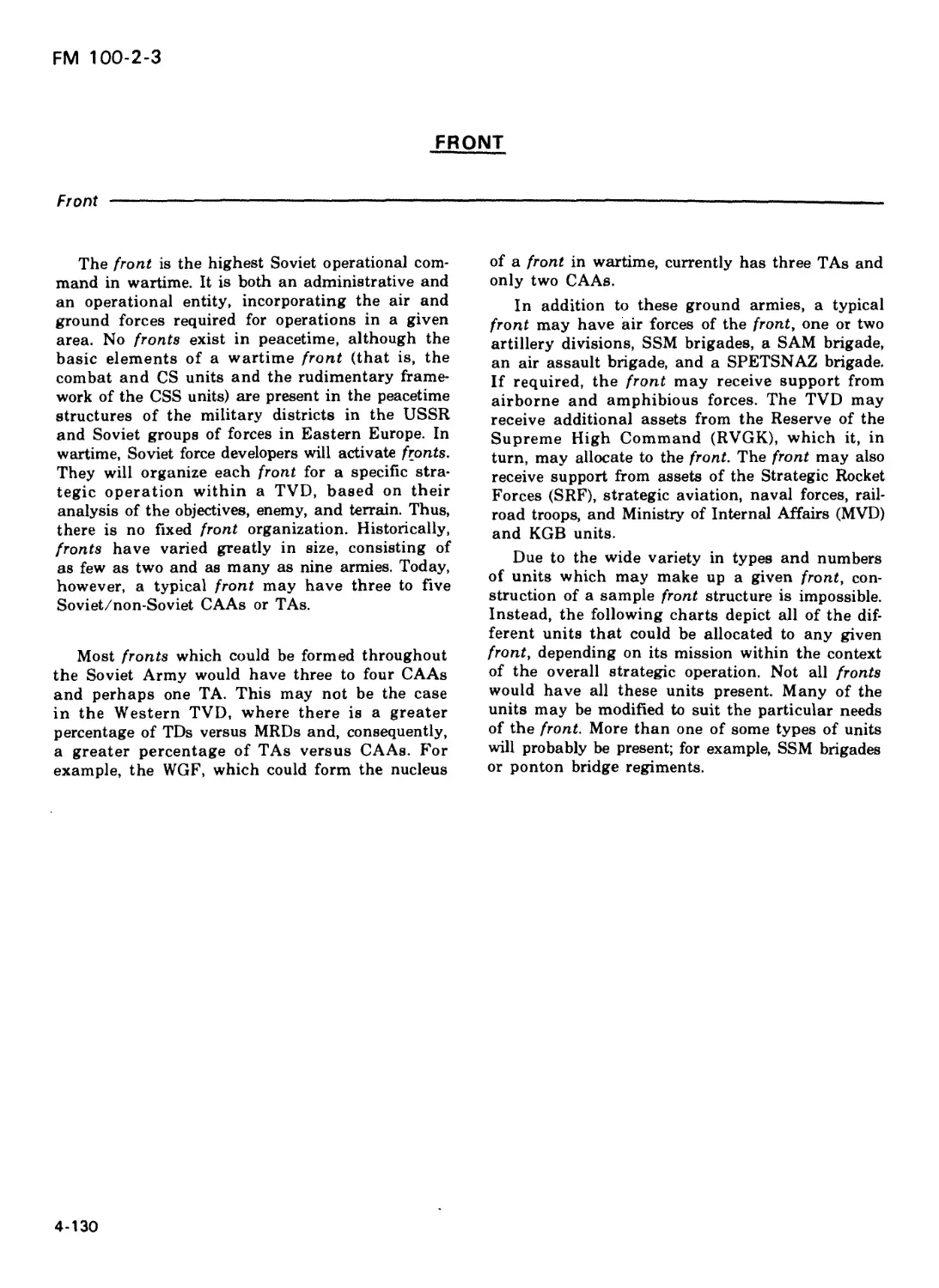
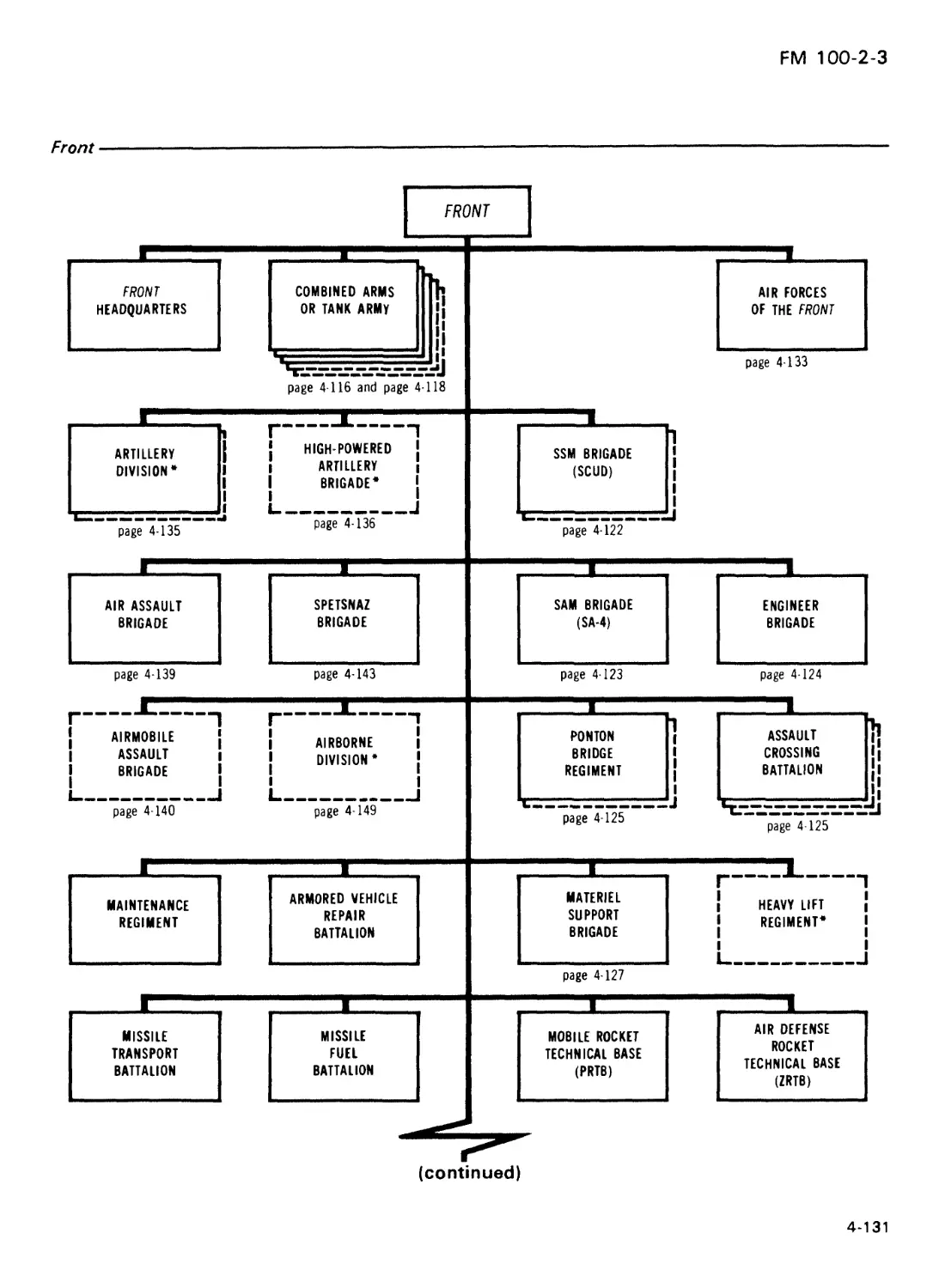
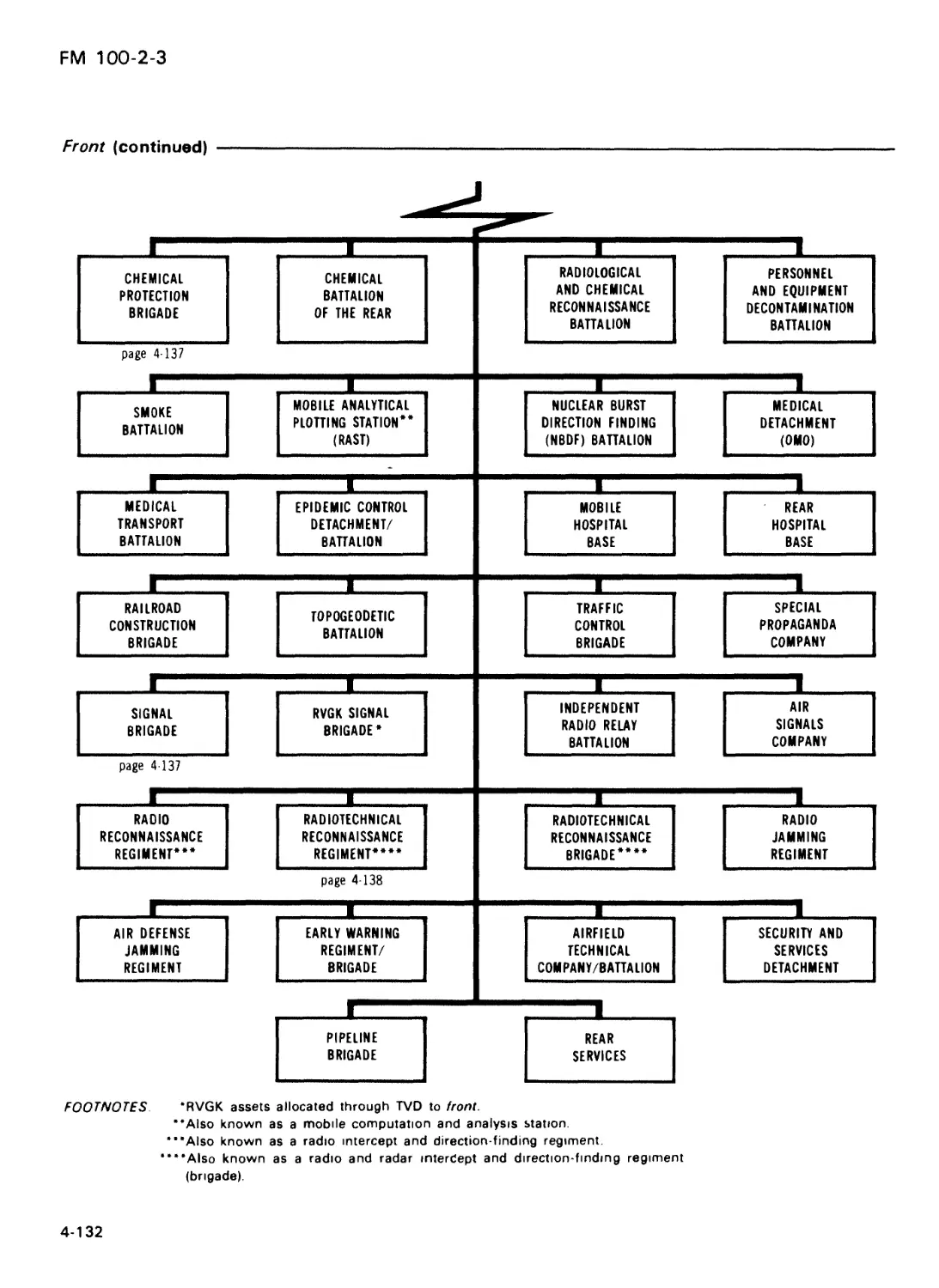
Front
The front is the largest field formation in war-
time. It is an operational and administrative unit
whose size and composition are subject to wide
variation depending on its mission and situation.
Roughly equivalent to a US/NATO army group,
a front can include three to five armies. Other
forces organic or attached to a front can include
artillery, missile, air defense, engineer, chemical,
signal, reconnaissance, and rear service units.
They can also include aviation, airborne, air
assault, airmobile, and special purpose forces.
Army
The Army is the highest peacetime combined
arms formation. The Soviet ground forces desig-
nate two types of armies: the combined arms army
(CAA) and the tank army (TA). While both types
are actually combined arms organizations, a Soviet
CAA will normally have a greater number of
motorized rifle divisions (MRDs), while a TA will
have a greater number of tank divisions (TDs).
By altering the mix of MRDs, TDs, and artillery
and missile support in the army organizations, the
Soviets gain flexibility in either offensive or defen-
sive roles. An army can operate in different geo-
graphical areas and under various operational
constraints. Besides its complement of two to five
maneuver divisions, a typical army of either
type will normally have artillery, missile, air
defense, aviation, engineer, chemical, signal,
reconnaissance, and rear support units.
MANEUVER DIVISIONS
Soviet maneuver divisions are well-balanced,
powerful, and mobile fighting units. They have a
combined arms structure as well as a comprehensive
array of combat support (CS) and combat service
support (CSS) elements. In early 1987, there were
211 active Soviet maneuver divisions: 150 MRDs,
52 TDs, 7 airborne divisions, and 2 static defense
divisions. The totals did not include 2 new army
corps (NAC) and 5 mobilization divisions.
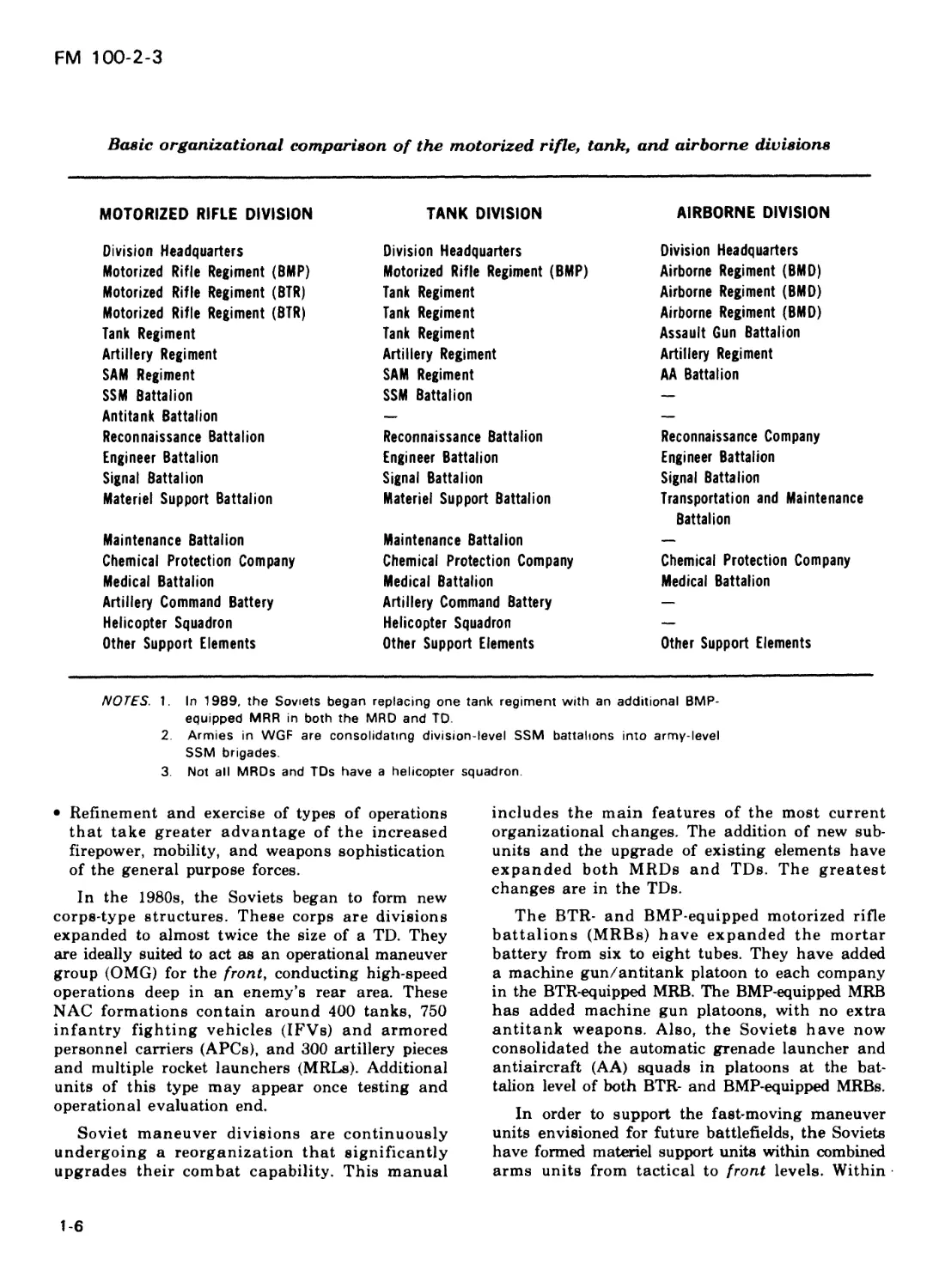
The basic structures of the three types of
divisions (motorized rifle, tank, and airborne)
appear in Figure 1-1. While this manual presents
“type” Soviet divisions, different configurations
and different categories of readiness exist among
actual divisions.
Divisions receive new items of equipment
according to the priorities established by the MOD.
High-priority formations, such as the Soviet forces
in the Western TVD, are usually the first to receive
modern equipment. When they replace older
material, the Soviets send that older equipment to
lower-priority units in the interior of the USSR or
to reserve stocks. Late-model T-64/72/80 tanks
constitute about one-third of the USSR’s tanks.
While older T-55 and T-62 tanks constitute most
of the remainder, over 1,500 T-80s are currently
deployed opposite NATO and nearly 75 percent of
the 19,000 Soviet tanks in the Western Theater are
T-64/72/80 models.
REORGANIZATION AND MODERNIZATION
Since the mid-1960s, the Soviets have been
building a force capable of fighting decisively at
all levels of conflict. Recent improvements in force
capability include—
• Modernization of nuclear and conventional
weapons.
• Marked increases in the quantity and quality of
conventional fire support (air and artillery)
available to ground maneuver formations.
• Changes in organizational structure that generally
make fire support systems (air and artillery) more
directly responsive to the supported commander.
1-5
FM 100-2-3
Basic organizational comparison of the motorized rifle, tank, and airborne divisions
MOTORIZED RIFLE DIVISION TANK DIVISION AIRBORNE DIVISION
Division Headquarters Division Headquarters Division Headquarters
Motorized Rifle Regiment (BMP) Motorized Rifle Regiment (BMP) Airborne Regiment (BMD)
Motorized Rifle Regiment (BTR) Tank Regiment Airborne Regiment (BMD)
Motorized Rifle Regiment (BTR) Tank Regiment Airborne Regiment (BMD)
Tank Regiment Tank Regiment Assault Gun Battalion
Artillery Regiment Artillery Regiment Artillery Regiment
SAM Regiment SAM Regiment AA Battalion
SSM Battalion SSM Battalion —
Antitank Battalion — —
Reconnaissance Battalion Reconnaissance Battalion Reconnaissance Company
Engineer Battalion Engineer Battalion Engineer Battalion
Signal Battalion Signal Battalion Signal Battalion
Materiel Support Battalion Materiel Support Battalion Transportation and Maintenance
Battalion
Maintenance Battalion Maintenance Battalion •
Chemical Protection Company Chemical Protection Company Chemical Protection Company
Medical Battalion Medical Battalion Medical Battalion
Artillery Command Battery Artillery Command Battery —
Helicopter Squadron Helicopter Squadron —
Other Support Elements Other Support Elements Other Support Elements
NOTES. 1. In 1989, the Soviets began replacing one tank regiment with an additional BMP-
equipped MRR in both the MRD and TD.
2. Armies in WGF are consolidating division-level SSM battalions into army-level
SSM brigades.
3. Not all MRDs and TDs have a helicopter squadron.
• Refinement and exercise of types of operations
that take greater advantage of the increased
firepower, mobility, and weapons sophistication
of the general purpose forces.
In the 1980s, the Soviets began to form new
corps-type structures. These corps are divisions
expanded to almost twice the size of a TD. They
are ideally suited to act as an operational maneuver
group (OMG) for the front, conducting high-speed
operations deep in an enemy’s rear area. These
NAC formations contain around 400 tanks, 750
infantry fighting vehicles (IFVs) and armored
personnel carriers (APCs), and 300 artillery pieces
and multiple rocket launchers (MRLs). Additional
units of this type may appear once testing and
operational evaluation end.
Soviet maneuver divisions are continuously
undergoing a reorganization that significantly
upgrades their combat capability. This manual
includes the main features of the most current
organizational changes. The addition of new sub-
units and the upgrade of existing elements have
expanded both MRDs and TDs. The greatest
changes are in the TDs.
The BTR- and BMP-equipped motorized rifle
battalions (MRBs) have expanded the mortar
battery from six to eight tubes. They have added
a machine gun/antitank platoon to each company
in the BTR-equipped MRB. The BMP-equipped MRB
has added machine gun platoons, with no extra
antitank weapons. Also, the Soviets have now
consolidated the automatic grenade launcher and
antiaircraft (AA) squads in platoons at the bat-
talion level of both BTR- and BMP-equipped MRBs.
In order to support the fast-moving maneuver
units envisioned for future battlefields, the Soviets
have formed materiel support units within combined
arms units from tactical to front levels. Within
1-6
FM 100-2-3
divisions and regiments, respectively, materiel sup-
port battalions and companies combine formerly
fragmented motor transport, supply, and service
functions. The new rear area units will provide a
30-percent increase in motor transport assets and
a streamlined command structure. A similar re-
organization at army and front levels has created
materiel support brigades with centralized control
for ammunition, fuel, and other supplies.
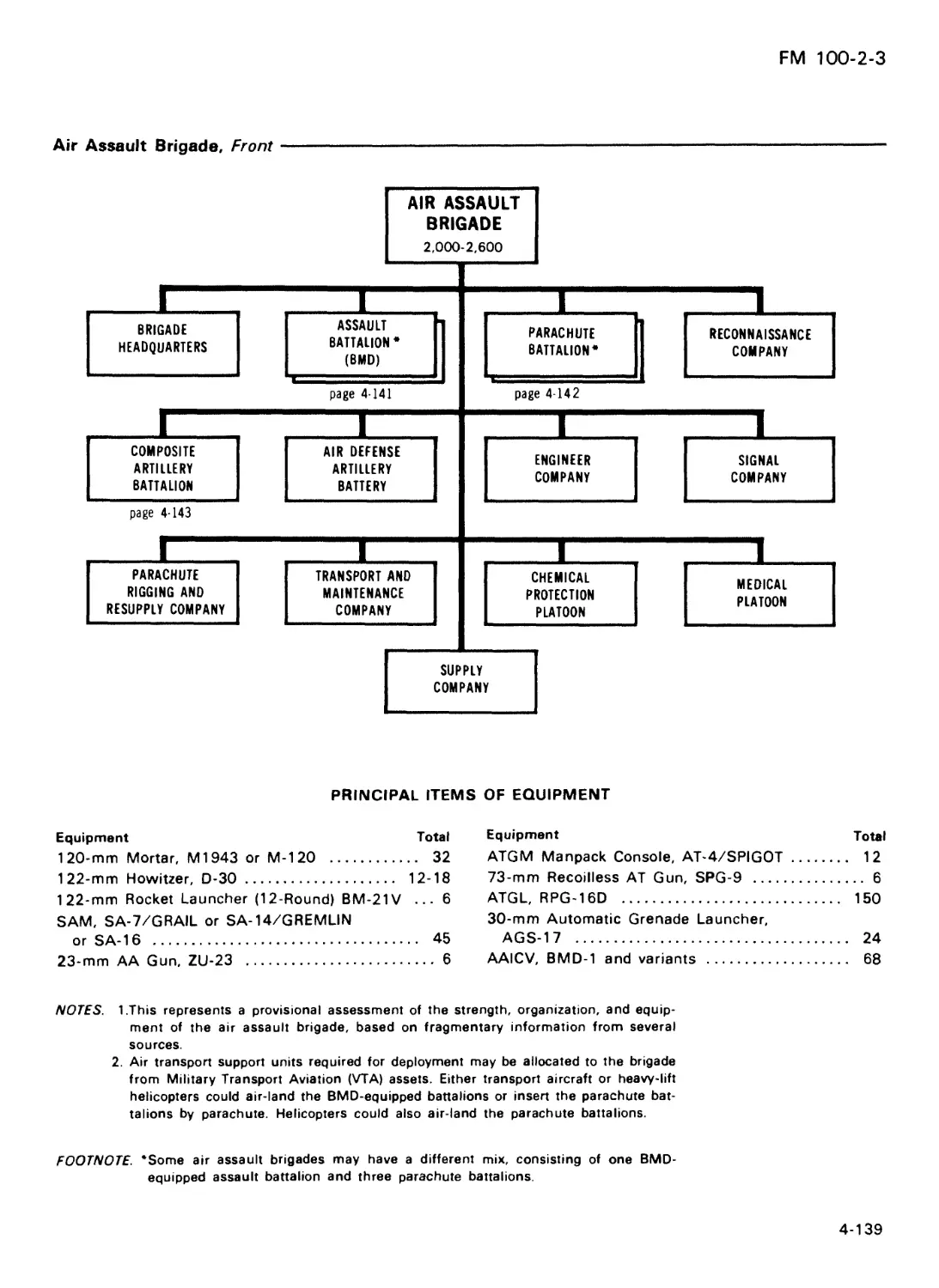
The airborne division is now a fully mechanized
combined arms organization. Airborne divisions
now consist of three regiments equipped with the
air-droppable BMD, affording these units greater
firepower and mobility. The Soviets have also
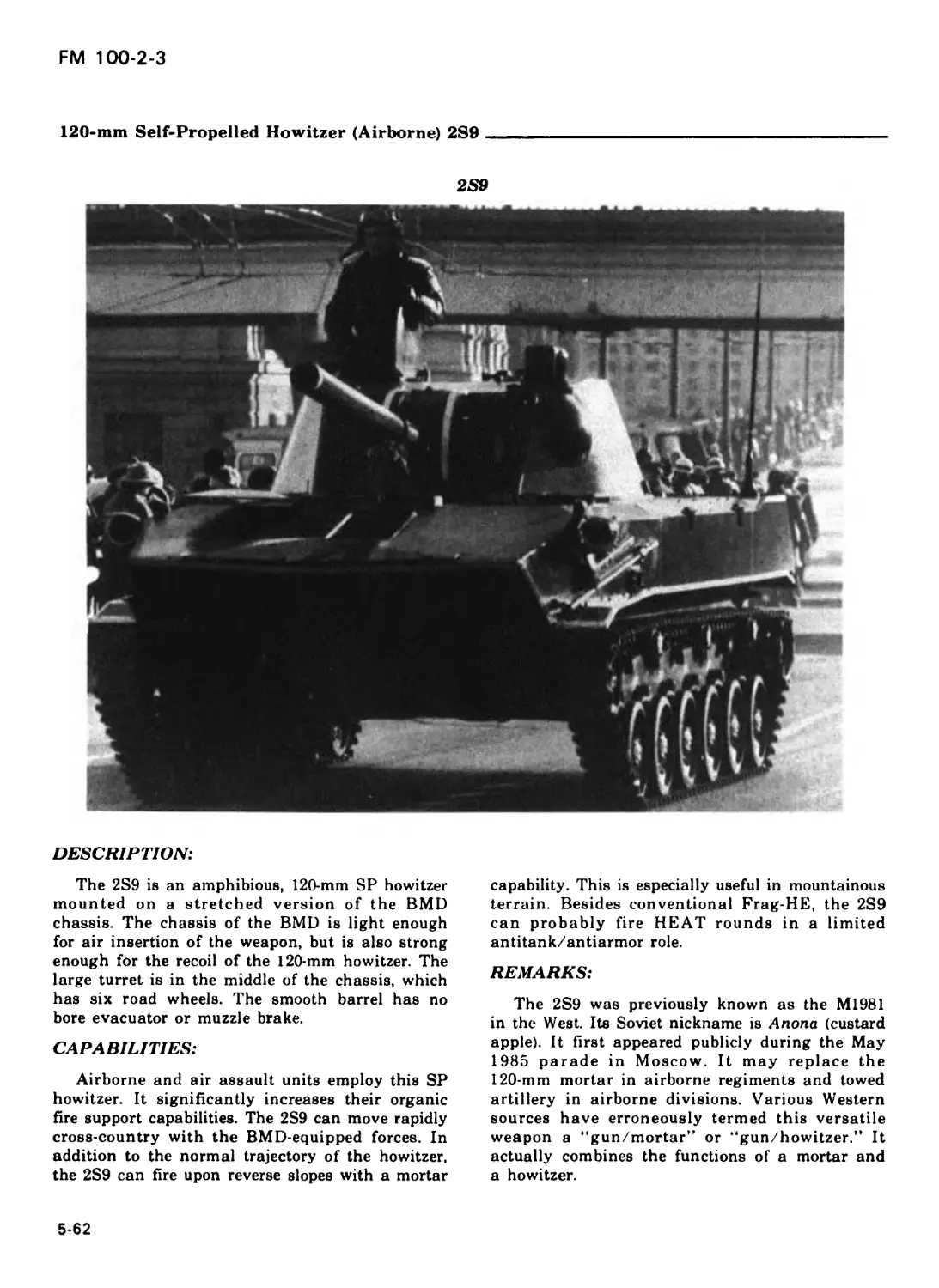
produced a new 120-millimeter 2S9 airborne self-
propelled (SP) howitzer with a mortar capability
for airborne and air assault units.
Concurrent with these organizational changes,
the Soviets have pursued a comprehensive equip-
ment modernization program that affects many
divisional subunits. The main thrusts of the
equipment upgrade are in the following areas:
• Medium tanks.
• Armored IFVs.
• Armored command and reconnaissance vehicles.
• Antitank guided missiles (ATGMs).
• Surface-to-surface missiles (SSMs).
• Surface-to-air missiles (SAMs).
Since the late 1970s, the Soviets have developed
the tank regiment (TR) into a combined arms
team (tank, motorized rifle, and artillery) that
promises to be as flexible in its employment as
the motorized rifle regiment (MRR). (The MRR
already had a tank battalion (ТВ) and an artillery
battalion.) The addition of an MRB to the TR of a
TD eliminates the necessity for the TD commander
to reinforce each of his TRs with MRR assets.
This leaves the TD with four maneuver regiments.
The addition of an artillery battalion to the TR
places a great deal more firepower under direct
control of the regimental commander. The division
commander then has greater flexibility in the use
of his artillery resources to influence the battle.
Hence, the capability of the TR and TD to conduct
largely self-supported combined arms combat has
increased greatly.
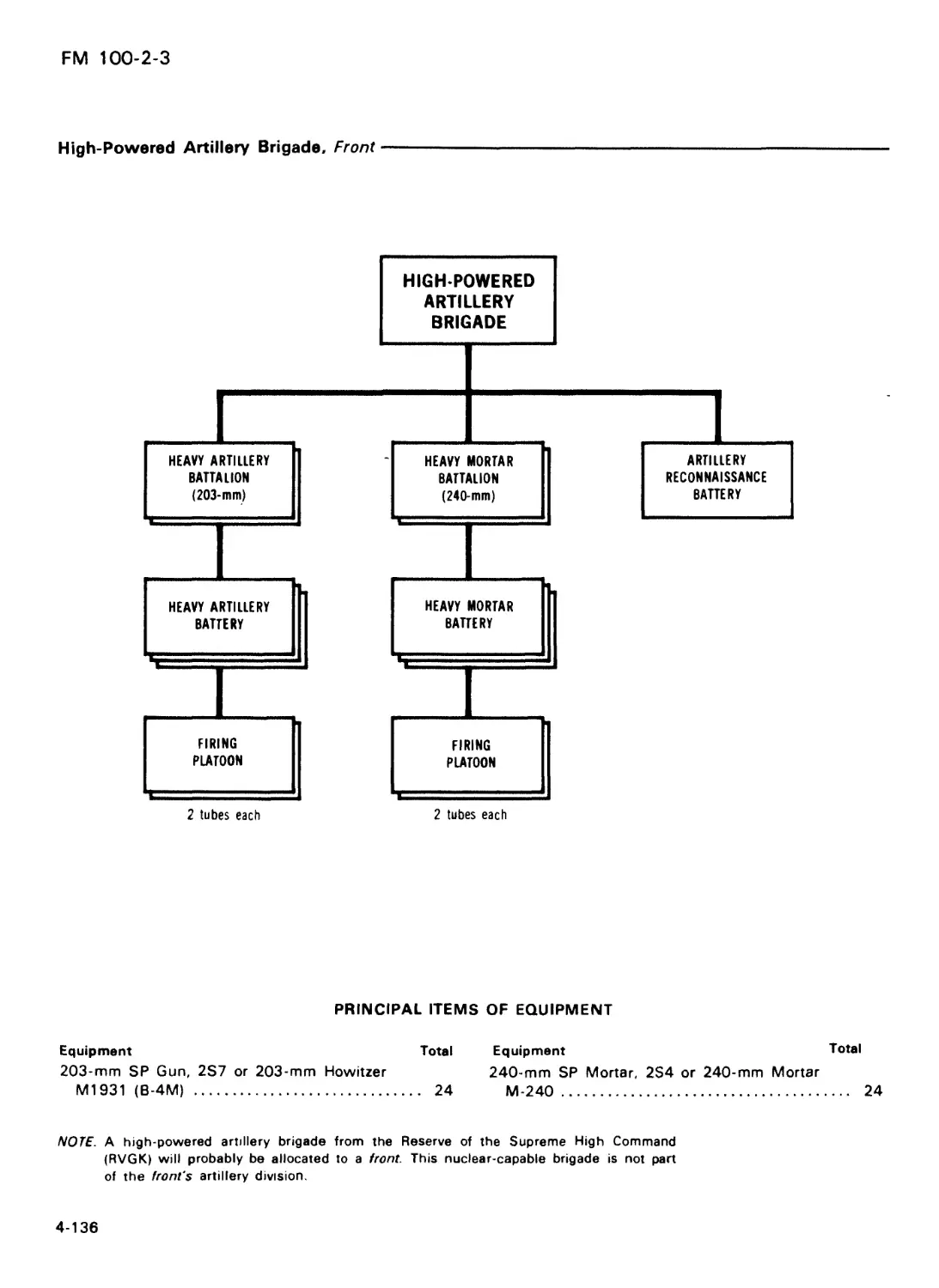
Large-caliber SP guns and mortars and long-
range MRLs have increased the artillery available
to army and front commanders. Additionally, some
army-level regiments have grown to brigade size
with the addition of a fourth artillery battalion.
These battalions are currently expanding from 18
to 24 tubes, primarily in units opposite NATO. All
of the Soviet’s SP and towed guns/howitzers
(152-millimeter and larger) are nuclear-capable.
The Soviets are also adding newer nuclear-capable
pieces such as the 203-millimeter SP gun 2S7 and
the 240-millimeter SP mortar 2S4. They are
deploying the BM-22 220-millimeter MRL, which
can fire deep into the enemy’s rear. These improve-
ments greatly enhance area coverage and counter-
battery support to subordinate divisions. The new
Т-64/72/80-series tanks feature improved firepower,
with a 125-millimeter main gun and an improved
fire control system. Both the T-80 and a variant
of the T-64 can fire an ATGM through the main
tube. The T-80 can mount reactive armor which
further protects against the West’s antitank
capabilities. At the same time, the establishment
of army aviation has given ground forces a vertical
dimension. The helicopter now provides CAAs and
TAs with a highly maneuverable and versatile
platform for reconnaissance, command and control
(C2), and fire support. General-purpose and attack
helicopter units can move with armies and divisions
at the high rates of advance they will need to
conduct combined arms operations in depth.
While changes in the organization and equip-
ment of the ground forces are significant in them-
selves and have serious implications for Western
defense planning, they do not take place in
isolation. Instead, these shifts appear to be part
of a larger change in the concept for employment
and organization of the armed forces. This change
should greatly enhance the flexibility with which
Soviet military planners can apply force to achieve
military objectives. (For more information on
Soviet operations and tactics, see FM 100-2-1.)
1-7
C HAPTER 2
Personnel
CONTENTS
MANPOWER PROCUREMENT ......................... 2-0
Conscription................................ 2-0
Upper Ranks ................................ 2-2
Officers ................................. 2-2
Warrant Officers ......................... 2-2
Noncommissioned Officers ................. 2-3
Women in the Armed Forces .................. 2-3
CONDITIONS OF SERVICE ........................ 2-3
Officer Promotions ......................... 2-4
Pay ............................................. 2-5
In-Service Benefits ............................. 2-5
Pensions ........................................ 2-5
Political Indoctrination ........................ 2-5
RANKS.............................................. 2-6
RESERVE SYSTEM .................................... 2-8
Enlisted Obligations ............................ 2-8
Officer Obligations ............................. 2-8
Mobilization .................................... 2-9
Over 60 million males between the ages of 15
and 49 live in the Soviet Union. About 80 percent
of these men are fit for military service. Each year,
some 2 to 2;/2 million young men reach the military
registration age of 17. The government will induct
at least one-half of them when they become 18
years old. These conscripts constitute approximately
75 percent of Soviet ground force personnel. The
remainder, who are deferred for various reasons,
serve at a later time on active duty unless they
are declared physically unfit for military service.
If deferred beyond their twenty-seventh birthday,
they remain in the reserves, subject to periodic
refresher training. All qualified male citizens
remain in the armed forces reserve until their
fiftieth birthday.
The quality of military manpower, particularly
of the Great Russian element, is generally good.
The Great Russians comprise about 53 percent of
MANPOWER
The 1967 Law on Universal Military Service
provides for the mandatory semiannual conscription
of 18-year old males. This law also governs the
system of drafting young men into the armed
forces. Those who are not drafted enter immediately
into the reserves. On completion of conscript duty,
men remain in the reserves until age 50. Women
who have medical or other specialized training are
also subject to call. Officers enter the armed forces
from several sources. Most receive commissions
upon graduation from officer schools. Others par-
ticipate in Reserve Officers’ Training Corps
the total population. Soviet youths are physically
hardy as a result of participation in active sports
programs. They are also better educated, more
sophisticated, and substantially better trained than
their World War II predecessors. Although the
conscript receives stern discipline and intensive
political indoctrination, works hard, and has few
comforts or luxuries and little time to himself, his
morale is relatively high. He has a genuine love
of his native land. His hatred is easily aroused
against an invading enemy, of which there have
been many in Russia’s and the Soviet Union’s
history. Moreover, Soviet soldiers and sailors have
the capacity to withstand deprivations. The Soviet
officer is a well-regarded professional who occupies
a high social and economic position in society. The
officer corps, with its prestige and privileges,
stands apart from the troops. In summary, the
Soviet armed forces, loyal to the regime, constitute
a serious adversary; they are on a par with their
counterparts in the West.
PROCUREMENT
(ROTC)-type programs in institutions of higher
education. Enlisted men, noncommissioned officers
(NCOs), and warrant officers are eligible to compete
for entry into the officer corps by passing an
examination for promotion to officer rank.
CONSCRIPTION
The Council of Ministers and the MOD deter-
mine the personnel requirements for each semi-
annual call-up period. They assign quotas based
on the number of draft-age males residing in each
of the 16 military districts. A system of draft
2-0
FM 100-2-3
boards, called military commissariats, is subor-
dinate to the military district. Military commis-
sariats in Soviet civil jurisdictions roughly
correspond to US civil jurisdictions as follows:
• Republic, which is a geographic region similar
to the US South, West, or New England; there
is no exact US counterpart.
• Kray and oblast, which are provinces similar to
US states.
• Gorod, which is a city.
• Rayon, which is similar to a US county or city
ward.
Military commissariats at the district level
function as overall administrators of the system.
They provide supervision to all subordinate officers.
Those at republic, kray, oblast, and rayon levels
perform administrative functions, though not all
republics have military commissariats. Each of
these levels also serves as a collection point for
inductees. The center of the registration and draft
process is the rayon military commissariat. It
registers draft-age males, issues draft notices, and
processes conscripts. It also transports conscripts
to the next higher military commissariat for move-
ment to their assigned units. The rayon offices also
have mobilization and reserve management respon-
sibilities. There are about 4,700 military commis-
sariat offices, of which at least 3,600 are at the
rayon level.
During February and March of the year in
which they reach their seventeenth birthday, young
men report to the military commissariat to register.
They receive a physical examination and an inter-
view to determine their educational background,
family situation, personal interests, attitude toward
the military, and special knowledge or skills (if
any) that would benefit the military. Each young
man receives a booklet as proof of registration.
He must report changes in residence, family situa-
tion, educational status, or the acquisition of
additional skills to the military commissariat so
officials can enter the new data in the registration
booklet.
Each individual receives a final interview and
a physical examination shortly before he is sched-
uled for conscription. Then the draft commission
recommends that the young man be drafted, be
deferred for one year because of temporary unfit-
ness for active military service due to illness, be
exempted from military service altogether if unfit,
or be granted a deferment for family reasons or
for continuation of education.
Twice each year—at the end of the spring
planting season and at the end of the fall harvest—
the military commissariats call males who have
reached their eighteenth birthday to active duty.
Older men up to age 27 whose periods of deferment
have expired also face call-up. In peacetime, women
19 to 40 years of age who have medical or other
specialized training may face military service. The
1967 Law on Universal Military Service reduced
the required length of active service from three to
two years for all except naval personnel.
Within the framework of quotas fixed by the
Council of Ministers and the MOD, the commis-
sariats assign inductees to the various branches,
arms, and services of the component forces based
on their abilities, occupational expertise, or special-
ties learned in training courses conducted by the
Voluntary Society for Cooperation with the Army,
Aviation, and Navy (DOSAAF). The DOSAAF is
subordinate to the MOD. It conducts premilitary
training in secondary schools. Its programs ac-
quaint students with military life. The programs
can include tracked- and wheeled-vehicle driver
training, parachuting, radio operation and mainte-
nance, along with drill and rifle training. This
training is one of the prime considerations for
future soldiers’ selection to a particular program,
such as a military academy.
Draftees report to their military commissariat
on the date set. Inductees go directly to their as-
signed units for a period of orientation, drill, and
some refresher training. This lasts approximately
a month, after which the conscripts become young
soldiers and young sailors by reciting the military
oath in a public ceremony. (See figure on next
page.)
The Soviets probably only rarely grant per-
manent exemption from active or reserve duty
except for clearly medical reasons. They usually
give deferments for stated periods of time and then
review them at the expiration of the period. The
1967 Law on Universal Military Service reduced
the number of educational deferments and extended
hardship or compassionate deferments.
There are three general categories of criteria for
deferment: physical reasons, family circumstances,
and continuation of education. The authorities may
grant three-year deferments for physical problems
or one-year deferments for illnesses. After this
time, depending on the deferred citizen’s state of
health, the government will call him up for active
duty, enroll him in the reserves, or acknowledge
him to be altogether unfit and thus exempt from
military service.
2-1
FM 100-2-3
The military oath
I, (name), a citizen of the Union of Soviet
Socialist Republics, by joining the ranks of the
armed forces; take an oath and solemnly swear
to be an upright, brave, disciplined, vigilant soldier,
to strictly preserve military and government secrets,
and to execute without contradiction, all military
regulations and orders of commanders and supe-
riors. I swear to learn conscientiously the trade
of war, to protect with all means the military and
peoples’ property, and to be devoted to my people,
my Soviet homeland, and the Soviet Government
to my last breath. I will always be ready to report,
by order of the Soviet Government, as a soldier
of the armed forces for the defense of my home-
land, the Union of Soviet Socialist Republics. I
swear to defend it bravely and wisely with all my
strength and in honor, without sparing my blood
and without regard for my life to achieve a com-
plete victory over the enemy. Should I break my
solemn oath, may severe penalties of the Soviet
Law, the overall hatred, and the contempt of the
working masses strike me.
An individual who must remain at home to
support or care for his family may qualify for a
deferment due to family circumstances. The 1967
law set specific criteria for this category. The
military commissariat can defer draftees up to 27
years of age.
Military commissariats can also defer full-time
students at universities, in high schools (for stu-
dents up to age 20), and in technical institutions
(until graduation). They can also defer students
studying in reserve officer training programs at
technical institutions Draftees who receive educa-
tional deferments face call-up for active duty before
they turn 27.
UPPER RANKS
Officers
Officers for the Soviet armed forces enter the
service from several sources. The largest number
are commissioned upon graduation from military
colleges. There are at least 143 military colleges,
with average enrollments of 1,000, serving all
branches of the armed forces. Besides commissions,
graduates receive technical degrees from three-year
schools and engineering degrees from schools whose
programs can last up to five years.
The Soviets also conduct programs similar to
the US ROTO in their universities. These programs
give training in subjects of military value and
provide the Soviets with a large number of reserve
officers. Military training for the duration of the
civilian curriculum leads to a reserve commission,
but only infrequently does it lead to active duty.
Reserve officer graduates of this program remain
liable for active duty call-up until age 30; they may
face up to three years of service.
A third source of officer recruitment is the rank
and file of soldiers and sailors. Upon completion
of their active duty service, conscripts who have
a secondary or higher education can earn a lieu-
tenant’s commission in the reserves by passing a
commissioning examination. Warrant officers, too,
can use the commissioning examination as a route
to active duty officer rank; they can also receive
a direct commission after ten years of active service.
Approximately 500,000 officers are on active duty
in the Soviet armed forces at any given time. Three
to five thousand of these officers are generals and
admirals. Nearly 90 percent of Soviet officers belong
to the Communist Party or to the Komsomal. Seven
percent of the members of the Communist Party
of the Soviet Union (CPSU) Central Committee are
military officers.
Warrant Officers
In January 1972, the Soviets created the warrant
officer ranks of praporshchik (army) and michman
(navy). This action was an attempt to give the
career NCO more incentive, to eliminate the ex-
tended service conscript (though this action was
later rescinded), and to improve the quality of small
unit leadership. Conscripts completing their service
obligations and desiring to remain on active duty
may apply for these positions if they possess the
required education, demonstrated ability, and polit-
ical reliability. The initial term of service for a
warrant officer is five years.
These warrant officers serve in close contact
with the soldiers and occupy positions as first
sergeants, sergeants major, and technical special-
ists. Although the Soviet press publicizes them as
the closest assistants to the officers, the warrant
officer ranks are apparently less popular than
anticipated. To date, this new program has received
too few qualified applicants. The Law of Military
Service permits a warrant officer to take an exam-
ination to become a lieutenant after five years;
after ten years, he may be certified as an officer
if he is serving in an officer’s position.
2-2
FM 100-2-3
Noncommissioned Officers
The majority of NCOs in the armed forces are
conscripts. During registration and induction,
authorities identify outstanding conscripts as po-
tential NCOs. Immediately after entering active
service, these individuals attend NCO schools for
six months of training before they report to units
for their remaining active duty. Other outstanding
individuals missed during this initial screening
receive on-the-job NCO training in their units.
Noncommissioned officers also fill the extended
service personnel category. To qualify for this cate-
gory, a candidate for reenlistment must have com-
pleted high school or the equivalent; he cannot
be over 35 years of age. He may apply (or reapply)
for extensions of two, four, or six years. His branch
of service then prolongs his tour of duty according
to the branch personnel requirements. As with
warrant officer selection, acceptance depends on
the candidate’s political reliability and military
record. Recruiting takes place three months before
discharge, with screening conducted by a permanent
committee. This committee includes the political
officer and secretaries of the Communist Party and
Komsomol organizations. Final approval rests with
the individual’s commander. Former service person-
nel can return to active duty under this program.
The Soviets suspended the extended service
program in 1972, after the establishment of the
warrant officer ranks. The intention was for war-
rant officers to fill some of the higher NCO posi-
tions; conscripts would then fill the remaining NCO
ranks. Because the plan was not completely success-
ful, the Soviets reinstituted the extended service
category the following year to provide essential
personnel for various high qualification specialties.
These specialties require long periods of training;
they include aviation mechanics, naval specialties,
electronics, and personnel management.
WOMEN IN THE ARMED FORCES
The 1967 Law on Universal Military Service pro-
vided for compulsory military service for women
only in time of war or emergency. The government
will draft women with special skills, normally those
in the communications and health fields.
Recognizing that the pool of conscripts is dwin-
dling, the Soviet government amended the 1967
Universal Military Service Law in 1985. This
CONDITIONS
Service in the Soviet armed forces offers poten-
tial rewards such as promotion, pay, in-service
benefits, and a pension. Conversely, it requires
amendment permits officer or enlisted women to
voluntarily enter active service at age 19 with
duties according to their specialties and general
education. It extends the age of eligibility to age
40. Those with medical or technical specialties can
register during peacetime and can then conduct
military training courses.
Most service regulations for women are identical
to those for men. Training is similar in the initial
phases, though women stay in special dormitories
in garrison. When off duty, women may wear civil-
ian clothes. The military disciplinary regulations
specify separate penalties for women commensurate
with those for men.
Women enlistees may extend their service and
remain on active duty. At least one woman in the
medical service field has completed thirty years
of military service. Pensions and leave plans are
similar to those for servicemen, with the exception
of pregnancy leave, which is authorized before and
after childbirth.
Women rarely achieve officer rank; therefore,
few have attended command and general staff
colleges. Most women officers attending midlevel
professional schools are in the medical services.
The first women warrant officers came from the
Soviet Army Parachute Team, but women should
find increasing opportunities in the high technology
fields of the Soviet armed forces. Expanding the
role of women in the Soviet Military could adversely
affect the civilian labor force, however, since
women now constitute one-half of that force.
Some military wives have formed women coun-
cils which provide a reserve force of dependents
available to augment Soviet forces in the forward
areas such as WGF. Their training consists of
basic courses in weapons use, combat skills, and
nuclear, biological, and chemical (NBC) protection.
There is an ongoing effort to expand this program
to other military installations.
Although Soviet society proclaims equality for
men and women, the Soviet armed forces still
channel women into well-defined occupational roles.
Generally, women do not participate in operational
military activity during peacetime. Approximately
10,000 women currently serve in the Soviet armed
forces.
OF SERVICE
vigorous training, strict discipline, thorough politi-
cal indoctrination, and adherence to Communist
Party policies.
2-3
FM 100-2-3
OFFICER PROMOTIONS
After graduation from one of the military col-
leges, an officer normally rotates through a number
of command and staff assignments. Some officers
then attend one of the advanced institutes for
officers or a component or branch academy.
Promotions to the next higher grade, up through
colonel, depend on academic training, service expe-
rience, duty assignment, job performance, and
political reliability.
Minimum time-in-grade requirements for officer promotion
GRADE
TIME
Junior lieutenant to lieutenant and equivalent ranks ............................................................... 2 years
Lieutenant to senior lieutenant and equivalent ranks ............................................................... 3 years
Senior lieutenant to captain and equivalent ranks .................................................................. 3 years
Captain to major and equivalent ranks............................................................................... 4 years
Major to lieutenant colonel and equivalent ranks ................................................................... 4 years
Lieutenant colonel to colonel and equivalent ranks ................................................................. 5 years
To ranks above colonel ................................................................................... No fixed minimum
Promotions up to and including the rank of
colonel follow procedures determined by the USSR
Council of Ministers. They probably result from
the recommendations of an officer’s immediate
superior and branch chief. The Council of Ministers
grants promotions to generals and admirals, while
the Presidium of the USSR Supreme Soviet must
approve promotions to the ranks of army general,
marshals of arms of the service, fleet admirals,
chief marshals of arms of the service, Fleet Ad-
mirals of the Soviet Union, Marshals of the Soviet
Union, and Generalissimo of the Soviet Union. The
USSR Minister of Defense can order the awarding
of the next higher rank before the end of the
prescribed period of service in the previous rank.
He may do this when an officer has demonstrated
excellence in combat training, has successfully
fulfilled national goals, or has been assigned to a
higher position.
An officer’s immediate superior, in consultation
with his political deputy, prepares the officer’s
efficiency report. He evaluates the officer’s work
and rates his political and job qualities. Officers
receive reports once every two or three years, upon
either transfer or recommendation for promotion.
Officers remain on active duty until reaching
the statutory age for retirement, which varies accord-
ing to grade. (See “Statutory age for retirement,”
below.) Officers who reach these respective age
limits without being promoted must leave active
duty and transfer to the reserves. If granted an
exception, however, an officer may serve an
additional ten years in his grade before being
discharged.
RANK
Statutory age for retirement
AGE
Junior lieutenants, lieutenants and equivalent ranks ...................................................................... 40
Senior lieutenants, captains, and equivalent ranks ........................................................................ 40
Majors and equivalent ranks ............................................................................................... 45
Lieutenant colonels and equivalent ranks .................................................................................. 45
Colonels and equivalent ranks ............................................................................................. 50
Generals and admirals up to lieutenant general and equivalent ranks........................................................ 55
Generals, admirals, and marshals below Marshal of the Soviet Union, and equivalent ranks............................. Exempted
2-4
FM 100-2-3
PAY
Basic pay for members of the Soviet armed
forces is the sum of pay for rank, position assign-
ment, and length of service. Unlike the US which
pays all service personnel of the same rank the
same salary, the Soviets do not pay conscripts as
much as career personnel serving in the same
position. Typically, conscripts receive less than the
equivalent of $10 per month.
Rank pay is a constant factor. Only officers
and warrant officers receive it. Position pay is the
major factor in the system. Its level may vary
greatly, reflecting the command responsibility or
technical requirement. Position pay does not vary
with rank; thus, it is not unusual for the incomes
of personnel of the same rank to be substantially
different. Although tables of organization specify
nominal ranks for certain positions, personnel of
different ranks may frequently fill the positions.
There is a growing tendency to place majors in
command of battalions, lieutenant colonels in
command of regiments, and colonels in command
of divisions.
The Soviets do not publish pay scales for mili-
tary personnel. The estimated average pay for
officers in 1975 was about 150 rubles a month. (A
ruble is officially equal to $1.66.) A lieutenant may
realize a combined pay of about 150 rubles a
month, a major about 225, and a lieutenant colonel
about 250. Marshals may earn as much as 2,000
rubles a month.
IN-SERVICE BENEFITS
The provision of housing, rations, and other
service benefits depends on whether one is a con-
script or a career serviceman. Conscripts cannot
marry while serving. If already married, they can-
not be accompanied by their families.
Since 1984, wives of noncareer military personnel
have received a payment for the education of chil-
dren. Another benefit which they, along with
members of their families, receive is retention on
the waiting list for living space. Families retain
the living area that they occupy before the service-
man went into service for the effective length of
military service. In 1986, privileges for families of
noncareer military personnel increased to allow a
monthly payment of 35 rubles per child.
Officers, warrant officers, and extended service
personnel receive free living quarters, assigned
according to marital status, position, assignment,
and size of family. When housing is not available,
they get a small allowance instead. Also, the armed
forces pays career personnel a subsistence subsidy
at the rate of about 20 rubles per month when
rations are not available, per diem when on tem-
porary duty (TDY), and a dislocation allowance
based on the distance traveled when making a
permanent change of station. Conscripts receive
only daily subsistence allowance when on TDY.
Families of first-time servicemen receive free
postal privileges for letters sent to soldiers at their
duty station.
Career personnel with less than 25 years of
active duty may take 30 days of annual leave; those
with over 25 years’ service receive 45 days of leave.
Conscripts serving their normal tour of duty may
take no leave except for verified family emergencies
or for outstanding performance in military or politi-
cal training. They may have only one such leave
during their period of service. Pass policy depends
on the local commander. He will issue conscripts
stationed within the Soviet Union passes perhaps
once a week. Passes are a luxury for conscripts
assigned outside the country.
The armed forces provide service personnel and
their families with free medical and health care,
including treatments at sanatoria-resorts when
prescribed. The resorts also are available at reduced
rates on a non prescription basis to career personnel.
PENSIONS
Military personnel receive pensions for long
service or disability. After 25 years of service, all
servicemen are eligible for pensions amounting to
at least 50 percent of their rate of pay at the time
of discharge. Personnel separated from service with
between 20 and 25 years of retirement credit qualify
for benefits at a reduced rate of 30 to 40 percent
of their last military pay. Disabled veterans receive
pensions of up to 75 percent. When nonregular
servicemen die, their families receive a pension and
retain for six months all privileges to which they
were entitled. The All-Union Pension Fund, which
is similar to other national retirement programs,
handles pensions; pensions are not part of the
Soviet defense budget.
POLITICAL INDOCTRINATION
The Party exerts its control over the armed
forces through the Main Political Directorate (MPA).
The MPA has subordinate branches throughout the
military chain of command. These branches serve
as political directorates at force component, military
district, and group of forces levels. Political depart-
ments are their equivalents at army and division
2-5
FM 100-2-3
levels. Below division, MPA affairs are the respon-
sibility of the deputy commander for political
affairs, the zampolit. A zampolit is present in each
regiment, battalion, and company. His authority
exists independently of that of the military com-
mander. The next higher agency appoints the best
trained and most experienced political workers to
these political organs.
Besides handling MPA affairs, the zampolit
organizes and conducts both nonmilitary and mili-
tary political work in his unit. His responsibilities
include—
• Supervising the activities of the Communist
Party and Komsomol organizations.
• Improving combat readiness and political loyalty
of the troops.
• Explaining Soviet domestic and foreign policies.
• Strengthening discipline.
• Instilling patriotism.
• Participating in the development of combat
training programs and in the selection, place-
ment, and rating of officers.
At the MOD, military district, army, and fleet
levels, the Party organizations are responsible for
improving the efficiency of the command apparatus
by ensuring that the headquarters and other
command bodies strengthen military discipline.
They are also responsible for promoting progress
and innovation in training and equipment. Under
the direction of the political officer, all military
elements and units participate in activities such
as compulsory lectures and meetings, publication
of unit newspapers, and other cultural events with
propaganda potential. Political indoctrination is a
scheduled part of the training curriculum.
The Communist Party and Komsomol organiza-
tions for military personnel who are members are
the most visible and prevalent instruments of
political control in the military. They involve the
largest number of personnel and exist at almost
every level in the chain of command, even down
to platoon and squad. The basic element of Party
membership is the primary Party organization
(PPO). The Party may establish a PPO wherever
three Party members are present. A PPO with fewer
than 15 members elects a secretary; one with 15
or more elects a bureau and a secretary to direct
its activities. The Party and Komsomol organiza-
tions politicize the military by recruiting as many
personnel as possible for membership and by
involving them in political activities. While the
Party encourages all military personnel to join,
membership for officers is virtually required.
There are presently some 16 million Party
members and 30 million Komsomol members in the
Soviet Union. This represents a little over 20 per-
cent of the total population. In contrast, over 80
percent of all military personnel and 90 percent
of the officer corps are Party or Komsomol mem-
bers. The USSR subjects the majority of its citizens
to indoctrination for their entire lives; military
personnel, because they are a captive audience,
receive constant exposure to it. Occasionally irri-
tating, mostly taken for granted, but nonetheless
effective, propaganda and indoctrination, both in
and out of the military, are established fixtures
of the Soviet society.
The highest military rank in the Soviet Union
is that of Generalissimo. Only Stalin ever held that
rank. All other military ranks fall into five
categories:
• Marshals, generals, and admirals.
• Officers.
• Warrant officers.
• Sergeants and petty officers.
• Soldiers and sailors.
(The figure on page 2-7 represents the basic rank
structure of the Soviet armed forces, translated into
US terms.)
The Minister of Defense, other top personnel
of the MOD, and high-level combined arms field
commanders normally hold the rank of Marshal
of the Soviet Union. Only combined arms officers
can achieve this rank. The equivalent Navy rank
is Admiral of the Fleet of the Soviet Union.
The armed forces further classify officers as
senior or junior. The warrant officer group includes
the ranks of praporshchik for nonnaval personnel
and michman for naval warrant officers. Sergeants
and petty officers comprise the NCO ranks, and
the term soldiers and sailors refers to the two
ranks of private and seaman.
The ground/aviation ranks apply to all ground-
based servicemen, including nonseagoing naval per-
sonnel and all aviation personnel in the air force,
naval aviation, and fighter aviation of air defense.
The naval ranks are for shipboard personnel.
2-6
FM 100-2-3
Soviet military ranks (translated into US terms)
GROUND/AVIATION NAVY
Generalissimo of the Soviet Union
MARSHALS, GENERALS, AND ADMIRALS _ - — и
Marshal of the Soviet Union/Chief Marshal Admiral of the Fleet of the
(of specific arm) Soviet Union
Army General/Marshal (of specific arm) Fleet Admiral
Colonel General (3-star) Admiral
Lieutenant General (2-star) Vice Admiral
Major General (1-star) Rear Admiral
SENIOR OFFICERS —
Colonel Captain 1st Rank
Lieutenant Colonel Captain 2nd Rank
Major Captain 3rd Rank
JUNIOR OFFICERS —
Captain Captain-Lieutenant
Senior Lieutenant Senior Lieutenant
Lieutenant Lieutenant
Junior Lieutenant Junior Lieutenant
WARRANT OFFICERS —
Praporshchik Michman
SERGEANTS AND PETTY OFFICERS —
Master Sergeant Ships Chief Petty Officer
Senior Sergeant Chief Petty Officer
Sergeant Petty Officer 1st Class
Junior Sergeant Petty Officer 2nd Class
SOLDIERS AND SAILORS —
Private 1st Class Seaman 1st Class
Private Seaman
Officer personnel in the ranks of major general
through chief marshal in aviation, artillery,
engineer troops, and signal troops and major
general through colonel general in tank troops
carry the designation of the branch as part of their
rank; for example, chief marshal of aviation, mar-
shal of armored troops, colonel general of tank
troops (who, upon promotion, would become a
marshal of armored troops), lieutenant general of
signal troops, and major general of engineer troops.
The same criteria apply to technical troops
(chemical, railroad, road, motor transport, and units
of military topographic service). There is, however,
no chief marshal or marshal rank for these troops;
for example, colonel general of technical troops.
Likewise, generals and officers of special services
(intendance (quartermaster), administrative, medical,
veterinary, and justice) use the special service
designation. These special services have no mar-
shals or chief marshals. So, one refers to a colonel
general of intendance service, a colonel of medical
service, a major of veterinary service, and a junior
lieutenant of justice. There are, however, no general
officers in the administrative service and no colonel
general of veterinary service.
Special rank designations also apply to engineer
officer ranks of all branches of the armed forces.
Officers who complete studies at a higher engineer
officer school or a military engineering academy
2-7
FM 100-2-3
earn the title of engineer, which is combined with
the rank; for example, lieutenant-engineer, colonel-
engineer, or colonel general-engineer. In the navy,
the equivalent ranks would be lieutenant-engineer,
captain 2nd rank-engineer, and admiral-engineer.
Officers with a secondary military technical edu-
cation use the title technical service combined, with
the rank; for example, junior lieutenant of tech-
nical service, captain of technical service, and
colonel of technical service. There are no general
officers of the technical service.
RESERVE
The Soviet reserve system ensures that all citi-
zens fit for military service have a definite reserve
commitment when not on active duty or deferred
for a specific reason. The military commissariats,
in conjunction with other administrative organs,
manage the system at the lower levels to make
evasion of this responsibility practically impossible.
The military service booklets issued to all reservists
are necessary for residence permits when changing
locale and for work permits when changing jobs.
All former service personnel released from active
duty for reasons other than retirement or disability
transfer to the reserves. These personnel, together
with individuals who for various reasons serve in
the reserves exclusively, form the Soviet reserve
force. There are no reserve units as such. The
closest equivalents to US reserve units are the
transport, repair, and construction groups that
function as normal parts of the economy in peace-
time and move as a whole when mobilized. Re-
servists called to active duty receive assignments
based on their occupational specialties.
In any five-year period, an estimated 3,500,000
Soviets complete military training. Under a system
where reserve obligations for NCOs run to age 50
and for officers as high as age 65, the reserve
capability reaches into the tens of millions. The
reserve manpower pool currently comprises more
than 55 million men subject to call-up, of which 9
million have been discharged within the past five
years. Noncommissioned servicewomen remain in
the reserves to age 40.
ENLISTED OBLIGATIONS
Enlisted and NCO reserve personnel fall into
two categories according to experience and three
groups according to age. Category I includes those
with at least one year of active duty, twelve months
of accumulated reserve refresher training, or combat
experience of any duration. Category II consists
of all personnel with less than one year of active
military duty, men subject to military service who
for various reasons have not been drafted into
active military service, and all women reservists.
Each category divides into three groups on the
SYSTEM
basis of age: 18 to 35 years of age, 36 to 45 years
of age, and 46 to 50 years of age.
Air reservists in Category I, Group I, must
participate in up to five 40-day refresher flying
training sessions, as well as in the required re-
fresher training. All reservists may have to attend
examination periods lasting up to ten days. This
is in addition to the required refresher training.
In the past, few reservists have been called for
training at the maximum level provided for by law.
However, because of the shortened active duty
tours enacted in 1967, the Soviets have accelerated
their reserve training programs. (See “Training
periods,” below.)
OFFICER OBLIGATIONS
The officer reserve comprises the graduates of
university reserve officer training programs; the
body of soldiers, sailors, sergeants, and petty
officers who have qualified for, and passed, com-
missioning examinations upon completion of active
duty; and a small number of officers who have
Training periods
CATEGORY I
Group I Up to four periods of up to three
months each
Group II Up to two periods of up to two
months each
Group III One period of one month
CATEGORY II
Group I Up to six periods of up to three
months each
Group II Up to two periods of up to two
months each
Group III One period of one month
2-8
FM 100-2-3
left active service before the expiration of their full
obligation. Rank and age are the determinants of
an officer’s reserve class, (See the figure below for
maximum ages.) Women officers accepted for mili-
tary service with an acquired specialty enter in
Reserve Group III, regardless of the military ranks
they hold. The age limit for their reserve status
is 50.
Reserve officers train more frequently than con-
scripts. Those in Group I may be called up every
year for a period of up to three months; those in
Group II, up to two sessions lasting up to three
months each; and those in Group III, up to one
two-month session. The Minister of Defense has
the authority to detain reserve officers at training
sessions for up to two months longer than the
periods established by law. He can increase the
number of training sessions without exceeding the
total amount of time required for all three classes.
The maximum time spent at the various reserve
sessions cannot exceed thirty months. Besides
active duty refresher training, reserve officers must
attend 30 to 60 hours of refresher training in
evenings and on weekends at military facilities
near their place of work. Officers in Group I receive
this training between annual active duty refresher
tours. All others must attend sessions every three
years.
MOBILIZATION
In the Soviet Union, the Presidium of the USSR
Supreme Soviet orders mobilization. The MOD
orders all call-ups for mobilization based on resolu-
tions of the USSR Council of Ministers. At the
time of mobilization, all personnel of the armed
forces stay active until further notice. Reservists
subject to military service receive notification of
the places and times to report in their mobilization
instructions, in call-up notices, or in orders of the
rayon military commissariats. Mobilization may be
partial or universal, open or secret; it may involve
all the armed forces or only part of them. In
peacetime, only a few members of the reserves may
mobilize for training purposes; but in wartime,
mobilization affects the whole economy. Only about
2.1 million reservists, or about 5 percent of the
total reserve manpower pool, are needed to bring
the Soviet armed forces to full wartime strength.
Thus, a substantial base would remain available
to create new units and provide replacements. Mili-
tary law in the Soviet Union also subjects women
to conscription during wartime, thereby ensuring
a large reservoir for expanding the force and
releasing men for active duty.
The General Staff of the army and navy, through
its Organization and Mobilization Directorate,
controls military mobilization. The Directorate plans
and directs the mobilization of the armed forces
and supervises the mobilization planning activities
of the military districts and subordinate military
commissariats. It also may be responsible for
mobilization supply stockpiles in the armed forces.
Officer reserve classes: maximum ages
RANKS RESERVE GROUP 1 RESERVE GROUP II RESERVE GROUP III
Junior lieutenants, lieutenants, and equivalent ranks 40 45 50
Senior lieutenants, captains, and equivalent ranks 45 50 55
Majors and equivalent ranks 45 50 55
Lieutenant colonels and equivalent ranks 50 55 60
Colonels and equivalent ranks 55 • 60
Generals and admirals up to lieutenant general, vice-admiral, and corresponding ranks 60 • 65
Colonel generals, admirals, and corresponding ranks, generals of the army, marshals of arms of service, and fleet admirals • • 65
•Soviet lew does not prescribe ап age limit for these groups.
2-9
FM 100-2-3
The personnel mobilization plan contains two
phases. The first involves the call-up of fully trained
reservists (Category I) to bring active units up to
authorized strength and to man additional line
divisions as well as new nondivisional service and
support units. The second phase deals generally
with the induction, assembly, and training of par-
tially trained reservists (Category II) for further
expansion of the forces, replacement, and related
activities.
The Soviets use a number of methods to mobilize
and expand units. First, a peacetime unit may
expand and convert to the next higher level. So
an MRB may become a regiment. Second, a peace-
time unit may retain its organization, release part
of its personnel as cadre for new units, and expand
to wartime strength. Finally, new units may form
directly from the reserves.
The Soviet mobilization system also provides
for the mobilization directly from the civilian
economy of cargo trucks and other specialized
equipment interchangeable for military and civilian
use. In August 1968, for example, the Soviet Union
freely announced in the press that it would call
up reservists and mobilize equipment from the
civilian economy for participation in a large-scale
rear services exercise called NEMAN. As it turned
out, the exercise, though carried out as announced,
was a method of mobilizing reservists and civilian
equipment to support the Soviet troops that moved
into Czechoslovakia in late August of that year.
2-10
CHAPTER 3
Training
CONTENTS
PREMILITARY PROGRAMS
3-1 INDIVIDUALS AND UNITS .................. 3 6
MILITARY EDUCATIONAL INSTITUTIONS . . 3-4
Officer ............................... 3-4
Warrant Officer........................ 3-5
Noncommissioned Officer ............... 3-6
Initial Processing and Instruction ............. 3-6
Training Characteristics ....................... 3-6
The Yearly Cycle................................ 3-7
Military training in the Soviet Union includes
civilian premilitary training, in-service training,
and reserve training. The 1967 Law on Universal
Military Service established a compulsory system
of premilitary training for all young men and
women aged 16 through 18. The government
conducts this training in the final two grades of
the ten-year public high schools; in specialized
secondary schools; in professional trade schools;
and, for those who have left school, in the factories,
offices, or farms where they work. These young
people gain a fundamental knowledge of the mili-
tary and basic military-technical skills which make
their transition from civilian to military life easier.
The training helps them master modern military
equipment more quickly after they are drafted.
In-service training of a conscript begins when
he arrives at a tactical unit. It normally continues
throughout his tour of service. Designed to bring all
PREMILITARY
The MOD, together with the DOSAAF, manages,
implements, and conducts premilitary training.
Formed in mid-1968, the MOD’s Directorate for
Premilitary Training has assumed responsibility for
planning and organizing the Ministry’s input into
the premilitary and specialist training programs.
It is the logical organ to transmit the future needs
of the armed forces to the premilitary and specialist
training system in the form of quotas. Its tasks
embrace the implementation of the MOD mandate
to supervise and support the DOSAAF premilitary
training mission.
Under the technical guidance of the Directorate
for Premilitary Training, the military districts and
the military commissariats within the districts
assume responsibility for basic military training
in the schools and enterprises. They base the types
military personnel to a peak of combat effective-
ness, the training programs are usually identical
from year to year. Their major elements are tactics,
firing, physical education, and political indoctrina-
tion. Field training is frequent and rigorous.
A system of military high schools and colleges,
command and staff schools, and a general staff
academy provides career military personnel with
professional and formal academic training.
Qualified conscripts receive a less formalized
education for NCO positions.
Reservists prepare for military service while
attending civilian schools and universities or while
working in the national economy. Refresher training
through drills, classes, and active duty call-ups
continues until individuals pass out of the reserve
at age 50. (Chapter 2 of this manual discusses
maximum ages for the officer reserve classes.)
PROGRAMS
and number of programs on the quotas of the
Organization and Mobilization Directorate, for
which they keep records. The military districts and
commissariats plan the overall program. They
select the training cadres; they organize individual
training groups according to the nature of the local
population; and they establish evening training
sessions, military libraries, weapons rooms, and
military-technical training courses for local training
centers. The directors of the schools and enter-
prises control the physical operation of the centers,
while DOSAAF conducts the actual training.
The Directorate for Premilitary Training is
subordinate to the Central Committee of DOSAAF.
It has overall responsibility for premilitary
training. Also, the DOSAAF Central Committee
contains, among others, separate directorates for
3-1
FM 100-2-3
military-technical training and sports, naval
training and sports, and aviation training and
sports. The DOSAAF operates its program through
a hierarchy of committees at all levels from the
republics down to the rural counties and urban
wards (rayon), which supervise most of the day-
to-day work.
Likewise, both the Ministry of Education and
the State Committee for Vocational and Technical
Education of the USSR Council of Ministers have
departments for premilitary training. They coop-
erate with the MOD and DOSAAF in implementing
the premilitary training courses in their respective
civilian educational institutions. They develop the
courses that make up the premilitary as well as
civil defense training programs. They provide
DOSAAF with logistical support such as training
sites, equipment, visual and other aids, and
resource funds. They also participate in the
training of instructors. Apparently, all Soviet
ministries must provide support for premilitary
training programs conducted for their 16- to 18-
year-old employees by territorial DOSAAF com-
mittees and training centers at factories, farms,
institutes, and other locations.
The premilitary training program presented to
high school students and working youth at training
points and centers provides them with the equiva-
lent of the basic training formerly given to recruits
after they were drafted. Phased into operation in
1968, its results have been uneven. The Soviets
have continuously expressed concern over the
quality of this program. They complain about the
large differences in skills and knowledge acquired
by youths throughout the country. The differences
make it necessary for many new draftees to be
retrained after they enter active military service.
This significantly reduces the training time for
concepts and usage of complex, modern equipment.
The standard program of premilitary basic
training provides 140 hours of familiarization with
military organization and regulations, small arms
use, and civil defense techniques. School students
typically spend two hours weekly during two 35-
week school years studying these topics. Workers,
on the other hand, attend three week-long, full-
time sessions at training centers. These sessions
are spaced over a year; this minimizes the time
workers spend away from their jobs. Both young
men and women participate in the standard
program. The curriculum for females, however,
requires more hours spent in civil defense and first
aid training and, in compensation, fewer hours in
practical military training.
In their basic premilitary studies, trainees attend
field exercises varying in duration from five to
fifteen days. These camps provide facilities for
practical training in weapons familiarization and
other areas. They operate with the maximum
possible cooperation of local military forces.
There has been a trend to offer courses to local
preinduction trainees using the facilities of the
more than 130 Soviet military colleges scattered
throughout the country. Professional military
college instructors present the standard 140-hour
program, encouraging those selected for the training
to enroll in commissioning schools.
Besides requiring basic premilitary training, the
1967 Law on Universal Military Service also
directed that educational institutions of the tech-
nical-vocational system and DOSAAF organizations
annually train specialists for the armed forces. The
USSR Council of Ministers, in conjunction with
the MOD, determines the number and types of
specialists to be trained. Youths in their second
year of premilitary training (generally 17 years
old) are eligible.
The 1972 DOSAAF regulations state that
DOSAAF will provide leadership for the develop-
ment of military-technical skills. Among these
skills are the following: aircraft and glider use and
maintenance, parachuting, automobile and motor-
cycle use and maintenance, radio communications,
underwater diving, motorboating, marksmanship,
and modeling. Thus, DOSAAF has the basic
responsibility for creating, guiding, and assisting
in the operation of the extensive network of clubs,
schools, and other training organizations. These
organizations prepare specialists in military knowl-
edge and skills for service in the armed forces.
At the same time, they train individuals in the
technical professions for eventual employment in
the national economy.
Entry into DOSAAF specialist training pro-
grams, conducted at specialized DOSAAF schools,
is either voluntary or as directed by local com-
missariats. Military commissariats receive their
annual quotas for the training of various groups
of specialists according to the MOD’s projected
personnel requirements. They then screen the
individuals who have registered for the draft for
special aptitudes and assign those selected for
specialist training to the DOSAAF programs.
The recently revised curriculum for training
youths to drive freight trucks with a cargo capacity
exceeding 3.5 tons is one example of a specialist
3-2
FM 100-2-3
program. The DOSAAF conducts this program,
which reduces the total number of hours from the
previous program, over a ten-month period. (See
figure below.) Instructors give a program in three
nonconsecutive sessions to youths engaged in
productive work. There are two nonconsecutive
sessions for youths still in school. The course
attempts to give the students as much experience
as possible in driving, maintaining, and repairing
trucks. Although the program does not devote any
special time to general military training, the
instructors still have the responsibility to teach
students primary military skills.
For each training session, there are eight groups
of 30 to 34 students. Each automotive school has
15 to 17 training trucks. In many instances, the
program changes to compensate for the school’s
lack of equipment or space (or both). This creates
wide variation in the quality of training.
DOSAAF specialist training curriculum, freight truck driver
SUBJECT TOTAL HOURS Theory HOURS IN Lab Practice
Political Training 20 20 0 0
Equipment and Use of Vehicle 326 0 0 0
Theoretical Classes 0 116 0 0
Practical Shopwork—Equipment 0 0 88 0
Practical Shopwork—Maintenance 0 0 122 0
Traffic Rules 80 80 0 0
Traffic Safety 46 40 6 0
Driving 60 0 0 60
Examinations 18 0 0 0
TOTALS 550 256 216 60
An extensive program of physical toughening
and training in endurance, dexterity, and courage
for draft- and predraft-age youths accompanies the
premilitary and specialist training conducted in
Schools and training centers. The physical edu-
cation classes are held in schools, enterprises, and
DOSAAF clubs. They conform to a general system
of physical training known as the All-Union Sports-
Technical Complex Ready for Labor and Defense
of the USSR (GTO).
Within the framework of the GTO complex,
there are five stages of national physical training
standards. The entire complex encompasses not
only draft-age youth, but also the rest of the
population.
National physical training
STAGE PROGRAM NAME AGE GROUP (MALE AND FEMALE)
1st Courage and Skill 10-13 (“Pioneers ”)
2d Young Sportsmen 14-15
3d Strength and Courage 16-18
4th Physical Perfection 19-34 (females)
19-39 (males)
5th Cheerfulness and Health 34 plus (females)
39 plus (males)
3-3
FM 100-2-3
The appropriate Committees for Physical Cul-
ture and Sports, under the Council of Ministers,
provide overall guidance of the third-level GTO
program for draft-age youth. The third level
consists of ten types of exercises. Participants
receive points for meeting minimum standards and
badges and certificates for passing. The DOSAAF
clubs and training centers administer the exam-
ination, while DOSAAF committees supervise
particular aspects, such as grenade throwing,
small arms marksmanship, and 500- and 1,000-
meter cross-country running.
MILITARY EDUCATIONAL INSTITUTIONS
OFFICER
The Soviet Union possesses the world’s most
extensive network of military schools and reserve
officer commissioning programs. The total annual
output of all its officer candidate establishments
is approximately 60,000 students. Over the forty
years between the end of World War II and the
present, the schools have trained nearly one and
one-half million officers, 500,000 of whom form the
regular officer corps of the Soviet armed forces.
The first stage of the formal system of Soviet
military schools is the military high school; this
includes the Suvorov schools for the army compo-
nents and Nakhimov schools for the navy. These
institutions conduct two-year programs for boys
15 years of age and older who have completed
eight grades of public education. There are
presently nine Suvorov schools and one Nakhimov
school, with average student bodies of 900 young
men. Cadets wear uniforms, live at the schools,
and receive a well-rounded civil and military
education, as well as liberal doses of Marxist-
Leninist theory. Graduates of these schools may
enter Soviet military colleges without taking
competitive examinations.
The military colleges are the backbone of the
Soviet commissioning program. On a par with
civilian technical colleges, they offer degrees in a
wide variety of specialties. (See figure on next
page.) There are at least 6 military colleges or
schools (three-year, mostly technical schools) and
136 higher military colleges or schools (four- to
five-year schools). Graduates of both types of
colleges are commissioned lieutenants.
For one and one-half months each year, students
at these institutions train in an appropriate troop
unit in the field. Generally, the higher military
schools devote 60 percent of their curriculum to
specialized military subjects such as regulations,
branch tactics, weapons and equipment, and
physical training; 30 percent to academic subjects,
including mathematics, physics, methods and
principles of teaching, psychology, various technical
studies (depending on the school’s specialty), and
a foreign language; and at least 10 percent to
political studies.
Graduates of Suvorov and Nakhimov schools,
reserve and regular enlisted personnel, and
individuals undergoing preinduction military
training may apply for the officer commissioning
schools. Civilians and reservists apply through
their local commissariats. Active duty personnel
apply through their immediate commanders.
Besides the commissioning schools, the force com-
ponents and arms and services operate advanced
courses designed to improve the professional
qualifications of officers; to familiarize them with
the latest developments in tactics and equipment;
and to prepare them for command and staff
positions at battalion, regimental, and equivalent
levels. These courses generally use the facilities
of the higher military schools or academies.
Officers selected for attendance normally are
captains, majors, or lieutenant colonels who are
not scheduled to attend a service or a branch
academy. The advanced courses run from four to
ten months, with approximately 10 percent of the
time allotted to tactical and staff work on the
company level, 70 percent on the battalion level,
and 20 percent on the regimental level.
Soviet military academies are roughly equivalent
to a combined US staff and war college. They are
the highest formal institutions of Soviet military
education. Their commanders are senior general
officers. The USSR maintains 17 of these
academies, which exist on all-service levels and
in each armed forces component in a manner
similar to specialized military colleges. They train
selected officers for command and staff positions
from regimental to army or equivalent levels.
Besides providing three- to five-year resident
instruction, the academies conduct and supervise
nonresident extension and correspondence courses.
They also are responsible for research and develop-
ment in tactical doctrine and equipment engineering
in their particular fields. They disseminate tactical
and technical information through service journals
and periodicals.
3-4
FM 100-2-3
Schools per specialty
SPECIALTY
NUMBER
OF SCHOOLS
Combined Arms...................................... 9
Air Defense of the Country........................ 14
Air Defense of Troops.............................. 5
Air Force ........................................ 23
Navy ............................................. 10
Strategic Rocket Forces............................ 5
Political ......................................... 9
Airborne .......................................... 1
Artillery ........................................ 10
Automotive ........................................ 4
Chemical .......................................... 3
Construction ...................................... 4
Engineering ....................................... 3
RaiIroad/Military Transport ....................... 1
Rear Services/Finance ............................. 4
Signal/Communication ............................. 11
Tank .............................................. 8
Technical.......................................... 1
Topographic........................................ 1
MVD ............................................... 5
KGB ............................................... 3
Miscellaneous ..................................... 8
The senior academy of the Soviet army and
navy, which represents the ultimate in military
education in the Soviet Union, is the Voroshilov
Military Academy of the General Staff of the USSR
Armed Forces. It trains carefully selected officers,
usually colonels and major generals (captains first
rank and rear admirals for the Navy), for the
highest command and staff assignments. The
course length is two years.
Military educational institutions offer extension
and correspondence courses in over 100 specialties
to interested personnel throughout the armed
forces who pass a qualification examination or
meet prerequisites. Students supplement these
courses through resident retraining of up to one
month per year at the parent school. Consultation
teams of instructors visit all major garrisons to
give advice and assistance. Personnel enrolled in
extension and correspondence courses receive three
evenings each week free of unit duties, three duty
days off each month for study, and time away
from some unit training activity. They may also
receive up to four months’ free time to research a
diploma thesis. Upon successful completion of all
requirements, the enrollee graduates with a
diploma of the same status as that granted to
resident students.
WARRANT OFFICER
Coincidental with the introduction of the
warrant officer grades in 1972, the military
districts and groups of forces organized six- to
nine-month courses to train extended service
personnel to become warrant officers. Subjects
covered in these schools include political education,
tactics, training regulations, and physical training.
At the same time, the armed forces made pro-
visions for warrant officers and warrant officer
candidates to attend departmental courses at
officers’ schools. The 1985 guidelines on the service
3-5
FM 100-2-3
of warrant officers emphasized the importance of
their political and professional training. The
guidelines also stressed mastering the techniques
of small unit military instruction.
NONCOMMISSIONED OFFICER
The Soviets select their NCOs from conscript
classes based on the initial screening at military
commissariats or based on the commander’s
recommendations. The components and arms and
INDIVIDUALS
INITIAL PROCESSING AND INSTRUCTION
Twice each year, the local military commissariat
calls up its quota of recruits based on the requi-
sitions received from the military district. On a
specified day, each commissariat sends its inductees
to the next higher military commissariat office,
which then transports the recruits to specific units
designated by military district headquarters.
When the recruits arrive at a camp, they
undergo medical examinations, receive their
clothing issue, and begin intensive initial military
training that lasts an average of four weeks. This
period of training is known as the course of the
young soldier. At its close, each recruit takes the
soldier’s oath of allegiance. By this time, recruits
presumably have a basic knowledge of military
life, and they know how to fire a rifle. The
combination of preinduction training and the initial
military instruction may be very loosely compared
to basic training in the US Armed Forces.
TRAINING CHARACTERISTICS
Soviet training is repetitive. All soldiers, sailors,
and airmen undergo individual training each year
of their military service, regardless of rank. The
aim of such repetitive training is the development
of instinctive reflexes to cope with any situation.
Soviet training concentrates on field exercises
under realistic conditions. While training in NBC
warfare, the troops sometimes use live chemical
agents under credible conditions. They must wear
protective masks and clothing for several hours
at a time and practice decontamination techniques
in actual contamination situations.
The Soviet ground forces conduct small unit
training in habitual combat situations focusing
upon squad, platoon, and company levels, but
sometimes involving an entire battalion. Battle
drills are not stereotypes; they produce a known
asset that the commander can apply in an antici-
pated combat situation. Large unit training in
services operate specialized technical schools
instructing NCOs in various military-technical
skills. The courses range from a few weeks to a
year in duration. On-the-job NCO training is
almost continuous in regimental-sized units, which
provide refresher courses and equipment familiari-
zation exercises. Due to the cyclical nature of the
Soviet conscription process, most NCO training
lasts for six months to allow for overlapping
resources required by the semiannual draft.
AND UNITS
regiments and divisions will involve live field
firing and night training. Artillery and close air
and/or attack helicopters will support tactical live-
fire exercises. These exercises include evaluations
by the next higher headquarters based upon
established training objectives.
The Soviets place great importance on physical
conditioning. Exercise, calisthenics, diet, and
organized sports are all factors in their integrated
training concept.
They also believe that proper mental condi-
tioning is necessary for effective combat action.
To achieve such conditioning, Soviet commanders
emphasize realism during long combat training,
especially during field exercises. They apparently
try to teach techniques which soldiers can use to
cope with battlefield conditions. To achieve the
proper attitude among all military personnel, the
services conduct political training and discussions
on a rigorous schedule of at least five hours per
week. Political officers are organic to all units
down to company and equivalent levels. These
officers are devoted Communists, the products of
special training schools. Their tasks are to create
the desired attitudes in the minds of all personnel
and to work closely with the commanders in
motivating soldiers.
Above all, Soviet military training fosters pro-
fessionalism. Self-improvement is a constant
requirement for career personnel who desire to
remain on active duty. An extensive array of
publications dealing with practical matters of every
part of the defense establishment is available at
little or no cost. Besides taking extension and
correspondence courses, servicemen can participate
in organized evening study, in the evening
university. Due to an annual output of officers
which is greater than the active requirement, all
personnel must strive to improve their professional
knowledge to preserve their tenure.
3-6
FM 100-2-3
Soviet training also has negative aspects. These
include the uneven quality of academic training
caused by incompetent teachers (the inevitable
result of a military educational program the size
of the Soviet one) and the stifling of young leaders’
initiative by overbearing superiors. Since over 100
languages are spoken among the many various
ethnic groups in the Soviet Union, the Soviet Army
has some difficulty in training the large numbers
of non-Russian-speaking conscripts. This problem
will grow in the future as the Soviet Army must
rely more on nonethnic Russian manpower. An
additional training problem results from the
government’s power to divert the conscripts to
complete economic tasks such as construction
projects and harvesting crops. This lost training
time can hinder the efforts of the cadre to achieve
the required training objectives; but it is not yet
a significant weakness in providing a well-trained
soldier for the Soviet Army.
Other negative features include performance
parameters which encourage faculties to inflate
grades and pad exercise results to make the
organization look good. In other words, Soviet
training shortcomings are the same as those found
in any army throughout the world. There is no
doubt, however, that the Soviet armed forces are
among the world’s most professional and best-
trained military organizations.
THE YEARLY CYCLE
The yearly training program includes a winter
and a summer period. Each period, in turn, divides
into several stages. Every stage stresses a specific
theme or objective. The cycle stays basically
unchanged for several consecutive years. To ensure
that they cover all material in sufficient detail,
instructors may conduct different levels of training
simultaneously. Young soldiers in their first year
of service may receive more elementary instruction,
while senior servicemen get advanced training in
their occupational skills. Instructors also conduct
unit training on various levels at the same time.
Both winter and summer periods contain all levels
of training activity as well as division maneuvers,
where possible.
Yearly training cycle
September-October Summer training period in progress. Newly commissioned junior officers arrive from military schools and civilian universities.
November Summer training period ends. Newly trained NCOs arrive from the training division. New con- scripts arrive and receive four weeks of basic training. Soldiers who complete their two-year active duty obligation are released and transferred to the reserves. Preparations begin for the coming winter training period. Training year ends.
December New training year begins. Winter training period begins.
January-April Winter training period continues.
May Winter training period ends. Newly trained NCOs arrive from the training division. New con- scripts arrive and receive four weeks of basic training. Soldiers who complete their two-year active duty obligation are released and transferred to the reserves. Preparations begin for the coming summer training period.
June Summer training period begins.
July-August Summer training period continues.
September-October Summer training period continues. Newly commissioned junior officers arrive in the divisions from military schools and civilian universities.
November Summer training period ends. Newly trained NCOs arrive from the training division. New con- scripts arrive and receive four weeks of basic training. Soldiers who complete their two-year active duty obligation are released and transferred to the reserves. Preparations begin for the coming winter training period. Training year ends.
December New training year begins. Winter training period begins.
3-7
FM 100-2-3
The number of hours of daily training is the
same in winter and summer. Intense instruction
throughout the year leaves the soldier little free
time. The Soviets devote at least six hours of each
training day exclusively to scheduled instruction.
Most of the remaining time goes to political indoc-
trination, maintenance of clothing and equipment,
and personal needs. The training schedule for
Saturdays is two to four hours shorter to allow
time for cleaning and inspection of unit equipment.
Finally, required participation in organized sports
and cultural activities on weekends keeps free time
to a minimum. (See figure below.)
Following the annual celebration of the
Bolshevik Revolution on 7 November, the Soviets
make preparations for the new training year.
During this time, incoming recruits begin their
initial training; instructors and students hold
critiques of the previous year’s program; and
soldiers inspect and overhaul training facilities,
equipment, and vehicles. The appropriate
directorates formulate all necessary training plans
for the winter period while command personnel
receive special instructions and prepare for the
coming term.
The winter period lasts five to six months,
depending upon the type of unit, its location, and
the length of the winter season. It usually ends
by the beginning of May. Units in warm climates
may start moving to summer camps earlier than
units in the central USSR. Winter training takes
place mainly in garrison, with local training
areas providing firing ranges, classrooms, work-
shops, and other facilities. Most garrisons are on
the outskirts of towns, using the adjoining country-
side for command post exercises, field training,
and marches.
Summer training usually begins on the day
after May Day, a Soviet national holiday. It is
similar to the winter training in content. The
major difference is that soldiers spend a greater
amount of time out of garrison during the summer
period. The summer training activity usually
culminates in autumn divisional maneuvers, which
may be part of a combined Warsaw Pact exercise.
Typical Soviet armed forces training schedule
ACTIVITY HOUR TIME ELAPSED
1) Reveille 0600-0605 5 minutes
2) Physical Training 0610-0640 30 minutes
3) Personal Hygiene 0640-0700 20 minutes
4) Roll Call and Inspection 0700-0715 15 minutes
5) Breakfast 0715-0745 30 minutes
6) Training 0800-1400 6 hours
7) Lunch 1400-1440 40 minutes
8) Afternoon Rest 1440-1510 30 minutes
9) 10) Care of Personal Equipment a) Political Education (Monday and Thursday) b) Equipment Maintenance (Tuesday and Friday) 1510-1530 20 minutes
c) Organized Sports (Wednesday and Saturday) 1530-1830 3 hours
H) Self-Study 1830-1940 70 minutes
12) Supper 1940-2010 30 minutes
13) Free Time (Supervised) 2010-2140 90 minutes
14) Roll Call 2140-2155 15 minutes
15) Taps ? ?
3-8
CHAPTER 4
Organization
CONTENTS
GROUND FORCES
MOTORIZED RIFLE REGIMENT
STRUCTURE (BTR) ............... 4-3
MOTORIZED RIFLE REGIMENT
STRUCTURE (BMP) .............. 4-26
MOTORIZED RIFLE DIVISION...... 4-37
TANK REGIMENT STRUCTURE ..... 4-107
TANK DIVISION ............... 4-112
COMBINED ARMS ARMY........... 4-116
TANK ARMY ................... 4-118
FRONT........................ 4-130
AIRBORNE FORCES
AIRBORNE REGIMENT
STRUCTURE (BMD) ............ 4-144
AIRBORNE DIVISION ........... 4-149
AMPHIBIOUS FORCES
NAVAL INFANTRY REGIMENT/
BRIGADE STRUCTURE .......... 4-155
NAVAL INFANTRY DIVISION ..... 4-157
Although one expects to find many organizational variations in a force the size of the Soviet ground
forces, descriptions in this chapter present a single model for each type of organization. The structures
portrayed here mirror forward-deployed Soviet forces such as those found in the Western TVD as of the
end of 1988. They include all known structural elements, full assessed war-authorized strengths, and the
most modern equipment. The text and tables note several structural variations.
PRESENTATION OF INFORMATION
The organization charts in this chapter focus
on maneuver units, starting at the lowest level
(motorized rifle squad and tank squad) and building
up to the highest level (army and front). At each
level, the chapter breaks down subordinate CS and
CSS units and subunits whenever possible for
greater detail.
The chapter begins with the structure of the
MRRs, the most common type in the Soviet ground
forces. Among these regiments, the BTR-equipped
units are the most numerous. The chapter discusses
them first. Then it addresses the BMP-equipped
units. Discussion of the MRD and its support units
follows. Next the chapter repeats the process for
the TR and the TD. Organizations above division
(army and front) complete the description of purely
ground force organizations. The next set of charts
deals with the airborne regiment and the airborne
division. These are not technically part of the
ground forces but may fall under the control of a
ground forces front. The final set of charts ad-
dresses the amphibious forces: the naval infantry
regiment/brigade and the naval infantry division.
Stacked blocks in the charts indicate multiple,
identical elements subordinate to a particular or-
ganization. Dashed blocks indicate elements which
may or may not be present in the type of organi-
zation shown.
Figures inside the organization blocks reflect the
assessed total war-authorized personnel strength of
the organization. At lower levels, the chapter often
divides personnel figures between officers (at the
left) and enlisted personnel (at the right). At bat-
talion level and above, the chapter gives a single
figure for the officers and enlisted personnel
combined.
Personnel totals, as well as equipment lists, are
cumulative, although recapitulation tables for larger
units may show the breakdown among subordinate
units and subunits. Otherwise, the user may deter-
mine the distribution of personnel and equipment
by consulting cross-referenced charts for lower-level
organizations.
4-1
FM 100-2-3
Ground Forces ———...........
With approximately one-sixth of the earth’s land
surface within its boundaries, the Soviet Union
has traditionally maintained large, well-equipped
ground forces as a primary instrument of military
power. Today, the Soviet ground forces are the
largest of the five components of their armed
forces. Ground forces organizations may be either
tactical (division level and below) or operational
(army and front).
Tactical-Level Organizations
The basic tactical units in the Soviet ground
forces are the MRRs and TRs. There are two dis-
tinct types of MRR: those equipped with BTRs
(APCs) and those equipped with BMPs (infantry
combat vehicles). The MRR and TR normally
operate as part of a MRD or TD.
Operational-Level Organizations
Soviet ground forces organizations at levels of
command between division (tactical) and TVD
(strategic) constitute the operational level. These
large formations include armies and fronts.
There is no fixed organizational structure above
division level.
The army is the largest peacetime combined
arms formation. It normally consists of two to
five divisions and numerous nondivisional CS and
CSS elements. Armies are capable of independent
operations, but normally fight as part of a front,
in which case their CS elements will be supple-
mented with front assets.
There are two types of armies. While both types
are actually combined arms organizations, a Soviet
combined arms army (CAA) will normally have a
greater number of MRDs, and a tank army (TA)
will normally have a greater number of TDs. Of
the armies identified, no two are exactly alike. The
number of divisions, as well as the numbers and
types of nondivisional elements, can vary greatly
depending on the mission, the situation, and the
area of operations.
The front is the largest operational-level or-
ganization. When formed in wartime, a typical
front may have three to five armies.
4-2
FM 100-2-3
MOTORIZED RIFLE REGIMENT STRUCTURE (BTR)
Motorized Rifle Squad (BTR)
MOTORIZED
RIFLE SQUAD
(BTR)
Personnel Equipment
Squad Leader/BTR Commander .............. AK-74
BTR Driver/Mechanic ........................ PM
BTR Machine Gunner ......................... PM
Machine Gunner ......................... RPK-74
Grenadier .......................... RPG-7V, PM
Personnel Equipment
Senior Rifleman/Asst. Squad Leader........ AK-74
Rifleman/Assistant Grenadier ............. AK-74
Rifleman/Medic ........................... AK-74
Rifleman ............................. AK-74/SVD
NOTES. 1. The dismounted squad element consists of seven personnel. The BTR driver/
mechanic and BTR machine gunner remain with the BTR to provide fire support.
The dismounted squad does not have a portable radio
2. One squad in each platoon has an SVD sniper rifle.
Motorized Rifle Platoon (BTR) ------------------------------------------------
Leader ............. AK-74
PRINCIPAL ITEMS OF EQUIPMENT
Equipment Total
9-mm Pistol, PM ............................ 10
5.45-mm Assault Rifle, AK-74................ 16
5.45-mm Light Machine Gun, RPK-74 ........... 3
7.62-mm Sniper Rifle, SVD.................... 1
Antitank Grenade Launcher, RPG-7V ........... 3
Equipment Total
APC, BTR-60/70/80 ........................ 3
Radios:
VHF, Portable, Low-Power, R-148.......... 1
VHF, Vehicle Mount, Medium-Power, R-123 ... 3
NOTES. 1. With a standard nine-man squad, each BTR has one empty seat (three per platoon),
which can accommodate the platoon leader and the assistant platoon leader.
2. One squad in each platoon has an SVD sniper rifle.
3. Firepower calculations should include the 14.5-mm and 7.62-mm coaxial machine
guns mounted on each BTR.
4-3
FM 100-2-3
Motorized Rifle Company, Motorized Rifle Battalion,
Motorized Rifle Regiment (BTR), MRD------------------------
PM
page 4-3
Company Commander ... PM
Deputy Commander/
Political Officer .... PM
Senior Technician ..... PM
First Sergeant ..... AK-74
BTR Dnver/Mechamc .. PM
BTR Machine
Gunner
AK-74
Platoon Leader ..
3 x Machine
Gunner ...........
3 * Assistant
Gunner ...........
3 - ATGM
Operator .........
3 K Assistant
Operator .........
2 x BTR Driver/
Mechanic..........
2 x BTR Machine
Gunner ..........
PKM, PM
AK 74
AT-7
AK-74
PM
PM
PRINCIPAL ITEMS OF EQUIPMENT
Equipment Total
9-mm Pistol, PM ............................42
5.45-mm Assault Rifle, AK-74............... 56
5.45-mm Light Machine Gun, RPK-74 .......... 9
7.62-mm Sniper Rifle, SVD .................. 3
7.62-mm General Purpose MG, PKM ............ 3
Antitank Grenade Launcher, RPG-7V .......... 9
Equipment Total
ATGM, Manpack Launcher, AT-7/SAXHORN ........ 3
APC, BTR-60/70/80 .......................... 12
Radios:
VHF, Portable, Low-Power, R-148 ........... 5
VHF, Manpack, Low-Power, R-107 ............ 1
VHF, Vehicle Mount, Medium-Power, R-123 .. 12
NOTE. The company commander s RTO comes from the battalion signal platoon and is not
part of the BTR company personnel total.
4-4
FM 100-2-3
Motorized Rifle Battalion,
Motorized Rifle Regiment (BTR), MRD
page 4-29 page 4-29
PRINCIPAL ITEMS OF EQUIPMENT
Equipment Total
120-mm Mortar M1943/M-120 or 82-mm
Automatic Mortar, 2B9 ................... 8
7.62-mm General Purpose MG, PKM .. 9
ATGM, Manpack Launcher, AT-7/SAXH0RN .... 9
ATGM, Manpack Console, AT-3/SAGGER
or AT-4/SPIG0T .......................... 4
73-mm Recoilless Gun, SPG-9 ............. 2
ATGL, RPG-7V ........................... 37
SAM, SA-7/GRAIL or SA-14/GREMLIN or
SA-16.................................... 9
30-mm Automatic Grenade Launcher, AGS-17 ... 6
5.45-mm LMG, RPK-74 .................... 27
APC, BTR-60/70/80 ...................... 47
ACV, BTR ................................ 3
Truck, UAZ-69/469 .............. 3
Truck, GAZ-66........................... 15
Truck, ZIL/Ural ......................... 4
Truck, Van, ZIL (Maintenance) ........... 1
Truck, Van, Kitchen, PAC-170/200 ........ 1
Equipment Total
Truck, POL (4,000 or 5,000-Liter) .............. 2
Truck, Ambulance, UAZ-450A/452
Trailer, POL, 1-Axle ........................... 1
Trailer, Cargo, 1-Axle ......................... 2
Trailer, Generator, 1-Axle...................... 1
Trailer, Water ................................. 1
Trailer, Kitchen ............................... 3
Rangefinder ..................................... 1
Radios:
HF, Vehicle Mount, Medium-Power, R-130 ........ 2
VHF, Portable, Low-Power, R-148 ............. 24
VHF, Manpack, Low-Power, R-107 ............... 14
VHF, Vehicle Mount, Medium-
Power, R-123 ............................... 50
Warning Receiver, R-311 ...................... 1
Radio Transceiver, Portable,
Very-Low-Power, R-147 ....................... 4
4-5
FM 100-2-3
Battalion Headquarters, Motorized Rifle Battalion,
Motorized Rifle Regiment (BTR), MRD ----------------------------------------------------------
BATTALION
HEADQUARTERS
4 8
PRINCIPAL ITEMS OF EQUIPMENT
Equipment Total
9-mm Pistol, PM ............................. 4
5.45-mm Assault Rifle, AK-74................. 8
ACV, BTR-60PU ............................... 1
Truck, UAZ-69/469 ........................... 1
Truck, GAZ-66................................ 1
Equipment Total
Radios:
HF, Vehicle Mount, Medium-Power, R-130 ..... 1
VHF, Portable, Low-Power, R-148.......... 1
VHF, Manpack, Low-Power, R-107 ........... 2
VHF, Vehicle Mount, Medium-Power, R-123 ... 1
Warning Receiver, R-311 .................. 1
NOTE. The signal platoon leader is also the battalion communications officer. The praporshchik
in charge of the supply platoon and the fet'dscher in charge of the medical aid
station are also part of the battalion staff. However, these three positions are not
part of the personnel figures for the battalion headquarters.
Mortar Battery, Motorized Rifle Battalion,
Motorized Rifle Regiment, MRD and TD *
PRINCIPAL ITEMS OF EQUIPMENT
Equipment Total
9-mm Pistol, PM .......................... 15
5.45-mm Assault Rifle, AK-74.............. 62
ATGL, RPG-7V............................... 8
Truck, UAZ-69/469 ......................... 1
Truck, GAZ-66.............................. 9
120-mm Mortar M1943/M-120 or 82-mm
Automatic Mortar, 289 ..................... 8
Equipment Total
Stereoscopic Rangefinder, DS-1 or
DM-09/DAK-1 ................................... 1
Periscope Aiming Circle, PAB2A ................ 1
Collimator (Aiming Stakes)..................... 8
Radio:
VHF, Manpack, Low-Power, R-107 ............. 4
4-6
FM 100-2-3
Antitank Platoon, Motorized Rifle Battalion,
Motorized Rifle Regiment (BTR), MRD -------------
PRINCIPAL ITEMS OF EQUIPMENT
Equipment Total
ATGM, Manpack, Console, AT-3/SAGGER
or AT-4/SPIG0T ............................ 4
73-mm Recoilless Gun, SPG-9 ............... 2
ATGL, RPG-7V .............................. 2
Equipment Total
APC, BTR ................................... 5
Radios:
VHF, Vehicle Mount, Medium-Power, R-123 ... 5
VHF, Portable, Low-Power, R-148.............4
NOTE. High-readiness BTR-equipped MRBs may have six AT-4
SPIGOTs and three SPG-9s.
Signal Platoon, Motorized Rifle Battalion,
Motorized Rifle Regiment, MRD and TD
PRINCIPAL ITEMS OF EQUIPMENT
Equipment Total
9-mm Pistol, PM .............................. 1
5.45-mm Assault Rifle, AK-74................. 13
ACV, BTR ..................................... 2
Truck, UAZ-69/469 ............................ 1
Truck, GAZ-66 ................................ 1
Equipment Total
Radios:
HF, Vehicle Mount, Medium-Power, R-130 .... 1
VHF, Manpack, Low-Power, R-107 ........... 3
VHF, Vehicle Mount, Medium-Power, R-123 ... 2
4-7
FM 100-2-3
Supply Platoon, Motorized Rifle Battalion,
Motorized Rifle Regiment, MRD and TD -
PRINCIPAL ITEMS OF EQUIPMENT
Equipment Total
9-mm Pistol, PM ................................. 1
5.45-mm Assault Rifle, AK-74.................... 19
Truck, -GAZ-66 .................................. 4
Truck, ZIL-1 30/131 /1 51 /157 or Ural-375 .......4
Truck, POL (4,000 or 5,200-Liter) ............... 2
Truck, Van, Field Kitchen, PAC-1 70/200 ......... 1
Equipment Total
Trailer, POL, 1-Axle ................................ 1
Trailer, Cargo, 1-Axle .............................. 1
Trailer, Water, 1-Axle .............................. 1
Trailer, Field Kitchen, KP-125 .......................3
Radio:
VHF, Manpack, Low-Power, R-107 ....................... 1
Repair Workshop, Motorized Rifle Battalion,
Motorized Rifle Regiment, MRD and TD —
PRINCIPAL ITEMS OF EQUIPMENT
REPAIR
WORKSHOP Equipment Total
Truck, Van, ZIL (Maintenance) 1
0 7 Trailer, Generator, 1-Axle 1
Medical Aid Station, Motorized Rifle Battalion,
Motorized Rifle Regiment, MRD and TD
PRINCIPAL ITEMS OF EQUIPMENT
MEDICAL AID Equipment Total
STATION Truck, Ambulance, UAZ-450A/452 1
Trailer, Cargo, 1-Axle 1
0 4 Radio:
VHF, Manpack, Low-Power, R-107 ........... 1
4-8
FM 100-2-3
Motorized Rifle Regiment (BTR), MRD
The MRR is the basic combined arms organi-
zation and most common maneuver element of the
Soviet ground forces. Motorized rifle, tank, artillery,
antiaircraft, antitank, engineer, signal, and CSS
assets are organic to the MRR. The regiment is
the smallest organization which has all of these
elements.
Regimental organization includes three MRBs
and one ТВ. A 122-mm howitzer battalion and
three 120-mm mortar batteries or 82-mm automatic
mortar batteries provide fire support. While battalion-
sized elements support the division, corresponding
company-sized units support MRRs.
The MRRs have either the BMP amphibious
infantry combat vehicle (AICV) or one of the BTR
series of APCs as the primary troop-carrying
vehicle. Another key difference between the two
types of MRRs has been that BMP-equipped regi-
ments had an organic battalion of 122-mm SP
howitzers (2Sls), while BTR-equipped regiments
had a battalion of 122-mm towed howitzers (D-30s).
However, some BTR regiments, especially those in
the forward area, now have the 2S1. Also, BTR
regiments have antitank platoons within the MRBs,
a feature not found in the BMP regiments.
The TBs of both BMP- and BTR-equipped MRRs
have 31 medium tanks. This chapter lists all tanks
within the MRR as T-64/72/80, but older types are
often present outside the Western TVD.
Although the regiment normally operates as
part of the division, it is capable of short-term
independent operations. It has the assets to react
independently to changes in the combat situation.
Much of its equipment is amphibious.
page 4-25
NOTES. 1. If the ТВ of this regiment has T-54/55/62 tanks, regimental strength will increase
by 31 or 40 enlisted personnel.
2 Approximately 220 personnel are officers.
3 In some BTR-equipped regiments, the howitzer battalion may have the 122-mm
SP howitzer 2S1 (See p 4-36 for the organization and equipment of a 2S1-
equipped battalion.)
4 In the late 1980s, forces in Eastern Europe began to standardize tank battalions
at 31 tanks. (See p 4-108.)
4-9
FM 100-2-3
Personnel end Equipment Recapitulation
MOTORIZED RIFLE REGIMENT (BTR), MRD ' /*/ / / / / 7^
лЛ / / # /♦£/ / / /<& fa#/ / / /< у /<? /$ > / ▼ Cj ф
ж ж
PERSONNEL 65 1,575 165 240 60 40 55 60 50 24 90 65 34 2,523
TANKS
Medium Tank, T-64/72/80 40 40
WEAPONS
122 mm Howitzer D-30 18 18
120 mm Mortar, M1943/M-120 or 82-mm Automatic Mortar, 2B9 24 24
SAM. SA-9/GASKIN TEL or SA-I3/G0PHER TELAR** 4 4
SPAA Gun, ZSU-23-4 or 2S6 4 4
SAM, SA-7/GRAIL or SA-14/GREMLIN or SA-16 3 27 30
ATGM Launcher Vehicle (BRDM-2), AT-3/5 9 9
ATGM Manpack Console, AT-3/4 12 12
ATGM Manpack Launcher, AT-7 27 27
73-mm Recoilless Gun. SPG-9 6 6
ATGL, RPG-7V 111 2 18 9 4 4 4 152
30 mm Automatic Grenade Launcher, AGS-17 18 18
5.45-mm LMG, RPK-74 81 18 3 102
7 62 mm GPMG. PKM 27 27
ACV/AICV/APC/ASC
ACV, BMP/BRDM/BTR 9 2 3 4 3 21
ACV, BRM-1* 1 1
APC. BTR-60/70/80 2 141 3 146
APC. BTR-60PA (FAC) 1 1
MRP. PRP-3 (BMP M1975)*** 1 1
ASC. BRDM-2 4 4
FOOTNOTES. "This vehicle includes the TALL MIKE radar, which appears separately in (continued)
this list.
**The SA-9 system has a transporter-erector-launcher (TEL), while the SA-13
system has a transporter-erector-launcher and radar (TELAR).
‘••This vehicle includes the SMALL FRED radar, which appears separately in
this list.
4-10
FM 100-2-3
Personnel and Equipment Recapitulation (continued)
MOTORIZED RIFLE REGIMENT (BTR), MRD / zf w / / /$ / / z₽ ' / a? 7L ^//// >/ c?xy /ic
AICV, BMP-l/BMP-2 3 3
ACRV M1979 (1/2/3) 8 8
GENERAL PURPOSE TRUCKS
Truck. UAZ-69/469 3 9 1 i 5 2 i 22
Truck, GAZ-66 45 12 2 3 4 1 67
Truck, ZIL-130/131/151/157 7 4 i 2 14
Truck, KrAZ/ZI L/Ural 12 34 3 8 57
VAN TRUCKS
Truck, Van. GAZ 2 3 1 6
Truck, Van, ZIL/Ural (Command) 3 3
Truck, Van, ZIL (Signal) 2 2
Truck, Van, ZIL (Maintenance) 3 2 1 1 1 12 20
Truck, Van, Kitchen PAC-170/200 3 1 4
Truck, Van, ZIL (AT-3/5 Simulator) 1 1
POL TRUCKS
Truck. POL, ZIL/Ural/KrAZ 6 3 2 15 26
DECONTAMINATION TRUCKS
Truck, Decontamination 4 1 5
CHEMICAL RECONNAISSANCE VEHICLES
Chemical Reconnaissance Vehicle BRDM-2rkh/RKhM 3 3
SPECIAL PURPOSE TRUCKS
Truck, Water Tank 4 4
Truck, Ambulance, UAZ-450A/452 3 1 1 4 9
Truck, Crane, K-61 1 1
Truck, Crane Shovel, E-305V 2 2
Truck, Dump. MMZ-555 2 2
Sedan, GAZ-24 1 1
SPECIAL PURPOSE EQUIPMENT
Motorcycle 3 3 6
(continued)
4-11
FM 100-2-3
Personnel and Equipment Recapitulation (continued)
MOTORIZED RIFLE REGIMENT (BTR), MRD / / <3 /& / A4I / £$/ $/&$/ •/V /$ у / /fl /*$/ A у // fg Z ! ?£/&/ CT /<• /Лг /z Zp /с W<5 ^Z Xa * /& /// ff/ff/
Armored Recovery Vehicle 3 3
ENGINEER EQUIPMENT
Bridge, Tank-Launched, MTU/MT-55 1 1
Bridge, Truck-Launched, TMM 4 4
Ditching Machine, BTM/MDK 1 1
Dozer, BAT/BAT-M/PKT 1 1
Dozer Blade, BTU 3 3
Bucket Excavator, PZM 3 3
Mineclearing Plow, KMT-4/6 9 9
Mine Roller-Plow, KMT-5M 3 3
Minelayer, Towed, PMR-3 3 3
Water Filtration Set, MAFS 1 1
TRAILERS
Trailer, POL 3 2 15 20
Trailer, Cargo, 1-Axle 6 1 7
Trailer, Cargo, 2-Axle 8 11 2 30 6 57
Trailer, Generator. 1-Axle 3 1 1 2 7
Trailer, Generator, 2-Axle 2 1 1 4
Trailer, Water 3 1 1 1 1 7
Trailer, Field Kitchen 9 4 2 1 16
ARTILLERY-ASSOCIATED EQUIPMENT
Rangefinder 3 4 i 8
RADARS
Battlefield Surveillance. TALL MIKE i 1
Battlefield Surveillance. SMALL FRED 1 1
RADIOS
HF or VHF. Manpack, Low-Power, R-104M or R-107 4 4
HF, Manpack, Low-Power, R-104M 2 i 2 1 6
HF, Vehicle-Mount, Medium-Power. R-130 6 5 i 2 14
(continued)
4-12
FM 100-2-3
Personnel and Equipment Recapitulation (continued)
MOTORIZED RIFLE REGIMENT (BTR), MRD / /ч/ / //// 27 2г W ">7^7^ f# / у VG / *9 / U f /< у A ^7 л/SF <V/
HF, Van-Mount, High-Power, R-118 1 1
HF/VHF. Vehicle-Mount, Medium- Power 4 2 6
HF/VHF, Vehicle-Mount, High-Power 2 2
VHF, Portable, Low-Power. R-148 72 2 74
VHF, Manpack, Low-Power, R-107 3 42 1 20 2 4 3 7 1 1 1 85
VHF, Vehicle-Mount, Medium-Power, R-123 2 150 41 11 13 7 4 2 4 3 237
Radio Transceiver, Portable, Very- Low-Power, R-147 12 12
Warning Receiver, R-311 3 1 2 3 1 3 13
Radio Relay. VHF/UHF, R-401/405 2 2
4-13
FM 100-2-3
Regimental Headquarters,
Motorized Rifle and Tank Regiment, MRD and TD
indicate relationships with
elements which are not actually
part of the regiment.
PRINCIPAL ITEMS OF EQUIPMENT
Equipment MRR MRR TR
(BTR) (BMP)
SAM, SA-7/GRAIL or SA-14/
GREMLIN or SA-16.............. 3....3... 3
Medium Tank, T-64/72/80
(Command Vehicle) .............0 .... 0. 1
APC, BTR-60/70/80 ............ 2 .... 1 1
ACV, BMP-1 KSh ................0 .... 1 0
APC, BTR-6OPA (FAC) .......... 1 .... 1 1
Truck, UAZ-69/469 ............. 3....3 ... 3
Truck, Ural-375 ............. 1 .... 1 1
Equipment MRR MRR TR
(BTR) (BMP)
Truck, Van, ZIL (Command) .......3....3....... 3
Sedan, GAZ-24................... 1 .... 1 ... 1
Radios:
HF, Vehicle Mount, Medium-
Power, R-1 30..................0 .... 0... 1
VHF, Manpack, Low-power,
R-107 .........................3 .... 3... 2
VHF, Vehicle Mount,
Medium-Power, R-123 ...........2....2..... 2
FOOTNOTES. *The Special Staff normally consists of about seven KGB personnel. They are
not subordinate to the regimental commander and are not part of their person-
nel total for the regimental headquarters.
‘‘Usually the First Deputy Commander.
4-14 Foldout
FM 100-2-3
Tank Battalion, Motorized Rifle Regiment, MRD and TD
PRINCIPAL ITEMS OF EQUIPMENT (See below)
Equipment Total
Medium Tank, T-64/72/80 .................... 40
ATGL, RPG-7V ................................ 2
ACV, BTR-50/60 .............................. 2
Truck, ZIL-157 or Ural-375 .................. 7
Truck, POL .................................. 3
Truck, Van, ZIL (Maintenance) ............... 2
Truck, Van, Kitchen, PAC-170/200 ............ 1
Truck, Ambulance, UAZ-450A .................. 1
Trailer, Cargo, 2-Axle ...................... 8
NOTES. 1. TBs equipped with T-54/55/62 tanks have 31 or
2. In the late 1980s, forces in Eastern Europe began to standardize tank battalions
at 31 tanks. (See p. 4-108.)
Equipment Total
Trailer, Cargo, 1-Axle ......................... 1
Trailer, Generator.............................. 1
Trailer, Water ................................. 1
Radios.
HF, Manpack, Low-Power, R-104M ............... 2
HF, Vehicle Mount, Medium-Power, R-130 .... 5
VHF, Manpack, Low-Power, R-107 .............. 1
VHF, Vehicle Mount, Medium-Power, R-123... 41
Warning Receiver, R-311 ...................... 1
additional enlisted personnel.
Tank Company, Tank Battalion, Motorized Rifle Regiment, MRD and TD
40
PM
PM
PM
PM
Driver/Mechanic
Gunner ........
VHF, Vehicle Mount, Medium-Power,
R-123 ...................................... 13
NOTES. 1. The personnel total of 39 will be rounded off to
Driver/Mechanic
Gunner .......
in the organization chart for
the ТВ, MRR. Tank companies with T-54/55/62 tanks have 10 or 13 additional
enlisted personnel.
2. In the late 1980s, forces in Eastern Europe began to standardize tank companies
at 10 tanks. (See p. 4-107.)
4-15
FM 100-2-3
122-mm Howitzer Battalion,
Motorized Rifle Regiment (BTR), MRD and TD
(See page 417)
PRINCIPAL ITEMS OF EQUIPMENT
Equipment Total
122-mm Towed Howitzer, D-30.............. 18
ATGL, RPG-7V ............................ 18
5.45-mm LMG, RPK-74...................... 18
ACRV, M1979 (1)........................... 3
ACRV, M1979 (2)........................... 4
ACRV, M1979 (3)........................... 1
Mobile Recon Post, PRP-3 (BMP M1975)*........ 1
Truck, UAZ-69/469 .................. 1
Truck, GAZ-66 .............................. 12
Truck, ZIL/Ural .............................34
Truck, POL (4,000 or 5,200-Liter) ........... 2
Truck, Van, GAZ ............................. 2
Truck, Van, ZIL (Maintenance) ............... 1
Equipment
Total
Truck, Ambulance, UAZ-450A/452 .................. 1
Trailer, Cargo, 2-Axle ......................... 11
Trailer, POL..................................... 2
Trailer, Water .................................. 1
Trailer, Field Kitchen .......................... 4
Rangefinder, Laser, SAGE GLOSS .................. 4
Radar, Battlefield Surveillance, SMALL FRED .... 1
Radios:
HF/VHF, Vehicle Mount, Medium-Power ........... 4
VHF, Portable, Low-Power, R-148 or Very-
Low Power R-126.............................. 2
VHF, Manpack, Low-Power, R-107 ............... 20
Warning Receiver, R-311 ....................... 2
NOTE. This howitzer battalion may also be found in the artillery regiment of a MRD, TD, or
airborne division
FOOTNOTE. ‘This vehicle includes the SMALL FRED radar, which appears separately in this
hst
4-16
FM 100-2-3
122-mm Howitzer Battery, 122-mm Howitzer Battalion,
Motorized Rifle Regiment (BTR), MRD and TD---------------------
PRINCIPAL ITEMS OF EQUIPMENT
Equipment Total
122-mm Towed Howitzer, D-30................... 6
ATGL, RPG-7V ........................... 6
5.45-mm LMG, RPK-74........................ 6
Truck, GAZ-66 .......................... 1
Truck, ZIL/Ural ........................... 8
ACRV, M1979 (1).............................. 1
Equipment Total
ACRV, M1979 (2)................................ 1
Trailer, Cargo ................................ 1
Rangefinder, Laser, SAGE GLOSS ................ 1
Radios:
VHF, Manpack, Low-Power, R-107 .............. 5
VHF, Vehicle Mounted, Medium-Power .......... 1
4-17
FM 100-2-3
Air Defense Missile and Artillery Battery,
Motorized Rifle and Tank Regiment, MRD and TD
PRINCIPAL ITEMS OF EQUIPMENT
Equipment Total
SAM, SA-9/GASK1N TEL or SA-13/GOPHER
TELAR ....................................4
SPAA Gun, ZSU-23-4 or 2S6................ 4
ACV, BTR-60................................ 3
Truck, GAZ-66 ............................. 2
Truck, ZIL-131/157 or Ural-375 .............4
Equipment Total
Trailer, Generator, 2-Axle .................... 2
Radios.
VHF, Manpack, Low-Power, R-107 .............. 2
VHF, Vehicle Mount, Medium-Power,
R-123 .................................... 11
Warning Receiver, R-311 ..................... 3
NOTE. Instead of this battery, some MRRs and TRs now have an air defense battalion
consisting of a battery of six 2S6 30-mm SP antiaircraft systems and a battery of six
BMP-2 ICVs (with each BMP-2 carrying three SA-16 SAM launchers)
4-18
FM 100-2-3
Reconnaissance Company,
Motorized Rifle and Tank Regiment, MRD and TD
1 x BRM-1 3 * BMP-l/BMP-2 4 * BRDM-2 3 * Motorcycle
PRINCIPAL ITEMS OF EQUIPMENT
Equipment Total
ATGL, RPG-7V ..............................4
5.45-mm LMG, RPK-74....................... 3
ACV, BRM-1* .............................. 1
AICV, BMP-1/ВМР-2......................... 3
ASC, BRDM-2............................... 4
Motorcycle, M-72/K-750V/Ural-3 ........... 3
Radar, Battlefield Surveillance, TALL MIKE . 1
Equipment Total
Radios:
HF, Manpack, Low-Power, R-104M ............ 1
HF, Vehicle Mount, Medium-Power, R-130 .... 1
VHF, Manpack, Low-Power, R-107 ............ 3
VHF, Vehicle Mount, Medium-Power, R-123 ... 7
Warning Receiver, R-311 ................... 1
FOOTNOTE. *This vehicle includes the TALL MIKE radar.
which appears separately in this list.
4-19
FM 100-2-3
Antitank Missile Battery,
Motorized Rifle Regiment, MRD and TD
1 x R-107
1 * R-123
1 * R-123
1 * ATGM Launcher
Vehicle, AT-3/5
1 x ATGL, RPG-7V
1 * R-123
PRINCIPAL ITEMS OF EQUIPMENT
Equipment Total
ATGM Launcher Vehicle (BRDM-2), АТ-3/
SAGGER or AT-5/SPANDREL ................. 9
ATGL, RPG-7V .............................. 9
ACV, BRDM-2................................ 4
Truck, Ural/ZIL ........................... 3
Truck, Van, ZIL (AT-3/5 Simulator) ........ 1
Equipment Total
Rangefinder ................................. 1
Radios:
VHF, Manpack, Low-Power, R-107 ............ 4
VHF, Vehicle Mount, Medium-Power,
R-123 ................................... 13
NOTE. In the late 1980s, MRRs began to add 100-mm AT
guns (MT-12) to expand the battery.
4-20
FM 100-2-3
Engineer Company,
Motorized Rifle and Tank Regiment, MRD and TD
PRINCIPAL ITEMS OF EQUIPMENT
Equipment Total
ATGL, RPG-7V ............................... 4
APC, BTR-60................................. 3
Truck, UAZ-69/469 .......................... 1
Truck, KrAZ/Ural/ZIL................... 8*/9**
Truck, Dump, MMZ-555 ....................... 2
Truck, Van, ZIL (Maintenance) .............. 1
Truck, Crane, K-61 ......................... 1
Truck, Crane Shovel, E-305V ................ 2
Bridge, Tank-Launched, MTU/MT-55 ....... 1’/3”
Bridge, Truck-Launched, TMM ................ 4
Ditching Machine, BTM/MDK .................. 1
Dozer, BAT/BAT-M/PKT ....................... 1
Dozer Blade, BTU ........................... 3
Equipment Total
Bucket Excavator, PZM ............................ 3
Minelayer, Towed, PMR-3........................... 3
Mineclearing Plow, KMT-4/6.................. 9*/27**
Mine Roller-Plow, KMT-5M .................... 3*/9**
Water Filtration Set, MAFS, on ZIL
with Trailer ................................... 1
Trailer, Cargo, 2-Axle ........................... 2
Radios:
HF or VHF, Manpack, Low-Power,
R-104M or R-107 ............................. 4
VHF, Vehicle Mount, Medium-Power,
R-123 ................................... 4’/7”
NOTE. The following variations may exist:
a. Frogmen may be attached to assist in the reconnaissance of water obstacles.
b. Some companies may have five KMM truck-launched bridge spans instead of four
b. TMM bridge spans.
c. Trucks normally tow PMR minelayers. Some units may have BTR-152s for this
purpose. Some units may have GMZ armored tracked minelayers instead of PMR
towed minelayers.
d. Some units may have up to six one-axle cargo trailers besides the two-axle cargo
trailers.
e. Some units may have tractor-trailers to carry heavy tracked equipment on long
road movements.
FOOTNOTES. ’Personnel and equipment levels for the engineer company, MRR, BTR- or
BMP-equipped.
’’Personnel and equipment levels for the engineer company, TR.
4-21
FM 100-2-3
Signal Company,
Motorized Rifle and Tank Regiment, MRD and TD--------------------------------------------
PRINCIPAL ITEMS OF EQUIPMENT
Equipment Total
ACV, BTR .................................... 3
Truck, UAZ-69/469 ........................... 5
Truck, GAZ-66 ............................... 3
Truck, Van, GAZ (Signal)..................... 3
Truck, Van, ZIL (Signal)..................... 2
Motorcycle, M-72/K-750V/Ural-3 .............. 3
Trailer, Generator, 2-Axle .................. 1
Radios:
HF, Manpack, Low-Power, R-104M .............. 2
HF, Vehicle Mount, Medium-Power, R-130 .... 2
HF, Van Mount, High-Power, R-118 .......... 1
HF/VHF, Vehicle Mount, Medium-Power ...... 2
HF/VHF, Vehicle Mount, High-Power ........ 2
VHF, Manpack, Low-Power, R-107 ........... 7
VHF, Vehicle Mount, Medium-Power, R-123 ... 2
Warning Receiver, R-311 .................. 3
Radio Relay, VHF/UHF, R-401/405 .......... 2
NOTES. 1 The radios listed support the regimental headquarters.
2. Motorcycles provide the regimental commander with messenger/courier service.
3 The TA-57 field telephone and P-193M switchboard are standard equipment in
the wire/telephone platoon.
4-22
FM 100-2-3
Chemical Protection Platoon.
Motorized Rifle and Tank Regiment, MRD and TD
PRINCIPAL ITEMS OF EQUIPMENT
Equipment Total
Chemical Reconnaissance Vehicle,
BRDM-2rkh or RKhM........................... 3
Truck, Decontamination.........................4
Equipment Total
Radios:
HF, Manpack, Low-Power, R-104M ........... 1
VHF, Vehicle Mount, Medium-Power, R-123 ... 3
Materiel Support Company,
Motorized Rifle and Tank Regiment, MRD and TD
PRINCIPAL ITEMS OF EQUIPMENT
Equipment Total
Truck, UAZ-69/469 ............................. 2
Truck, GAZ-66 ..................................4
Truck, ZIL-131/157 or Ural-375 ............... 45
Truck, Van, ZIL (Maintenance) ................. 1
Truck, ZIL-130/131 (Water) .....................4
Truck. POL (4,000 or 5,200-Liter) ............ 15
Trailer, Cargo, 2-Axle ........................30
Equipment Total
Trailer, POL....................................... 15
Trailer, Field Kitchen ............................. 2
Trailer, Water ..................................... 1
Trailer, Generator, 1-Axle ......................... 1
Radio:
VHF, Manpack, Low-Power, R-107 .................... 1
4-23
FM 100-2-3
Maintenance Company,
Motorized Rifle and Tank Regiment, MRD and TD
PRINCIPAL ITEMS OF EQUIPMENT
Equipment MRR’ MRR”TR”*
(BTR) (BMP)
ATGL, RPG-7V ..................4....4.. .. 4
Truck, UAZ-69/469 .............. 1 .... 1 .. .. 1
Truck, ZIL......................1 .... 1 .. . . 1
Truck, Ural-375 ................ 1 .... 1 .. .. 1
Truck, Van, ZIL-131
(Maintenance) ..................4....4.. .. 4
Truck, Van, ZIL-1 57
(Maintenance) ..................8....8.. .. 8
Armored Maintenance Vehicle,
MTP ...............................0....3.. ..0
Equipment
MRR* MRR"TRW'
(BTR) (BMP)
Armored Recovery Vehicle .......3....3.. .. 5
Trailer, Cargo, 2-Axle............6....6.. .. 6
Trailer, Generator, 2-Axle .......1 .... 1 .. 1
Trailer, Generator, 1 -Axle ......2....2.. .. 2
Radios:
VHF, Manpack, Low-Power,
R-107 ..........................1 .... 1 .... 1
VHF, Vehicle Mount,
Medium-Power, R-123 ............3 .... 6 .. . . 5
NOTES. 1. The special repair platoon consists of an arc and gas welding section, battery
repair and recharging section, and electrical repair section.
2. The mobile repair workshop platoon consists of three sections, each equipped
with an MTP armored maintenance vehicle. During field operations, one MTP will
support each MRB (BMP).
FOOTNOTES. ’Personnel and equipment levels for the maintenance company, MRR, BTR-
equipped
’’Personnel and equipment levels for the maintenance company, MRR, BMP-
equipped.
’’’Personnel and equipment levels for the maintenance company, TR.
4-24
FM 100-2-3
Regimental Medical Point,
Motorized Rifle, Tank, and Artillery Regiment, MRD and TD
PRINCIPAL ITEMS OF EQUIPMENT
Equipment Total
Truck, Van, GAZ................................ 1
Truck, ZIL-1 30/131 /1 51 /1 57 ............... 2
Truck, Decontamination, DDA-53/66 ............. 1
Truck, GAZ-66 ................................. 1
Truck, Ambulance, UAZ-450A/452 ................ 4
Equipment Total
Trailer, Kitchen .................................. 1
Trailer, Water .................................... 1
Radio:
VHF, Manpack, Low-Power, R-107 ................... 1
NOTES. 1. The UAZ-450A/452 is a standard ambulance. Other general purpose trucks may
serve as ambulances. The regimental medical point may also employ the
LuAZ-967M light evacuation vehicle.
2. There may be two collection sections.
4-25
FM 100-2-3
MOTORIZED RIFLE REGIMENT STRUCTURE (BMP)
Motorized Rifle Squad (BMP)
MOTORIZED
RIFLE SQUAD
(BMP)
0 9
PRINCIPAL ITEMS OF EQUIPMENT
Personnel Equipment
Squad Leader/BMP Commander ..............AK-74
Assistant Squad Leader/BMP Gunner ......... PM
BMP Driver/Mechanic........................ PM
Machine Gunner .........................RPK-74
Rifleman/Medic ..........................AK-74
Personnel Equipment
Grenadier ........................... RPG-7V, PM
Senior Rifleman ...........................AK-74
Rifleman/Assistant Grenadier ..............AK-74
Rifleman ..............................AK-74/SVD
NOTES. 1 The dismounted squad assault element consists of seven personnel. The BMP
dnver/mechanic and assistant squad leader/BMP gunner remain with the BMP
to provide fire support. The dismounted squad does not have a portable radio.
2. One squad in each platoon has an SVD sniper rifle.
Motorized Rifle Platoon (BMP) ---------------------------------------------------—---------
PRINCIPAL ITEMS OF EQUIPMENT
Equipment Total
9-mm Pistol, PM ............................ 10
5.45-mm Assault Rifle, AK-74................ 16
5.45-mm Light Machine Gun, RPK-74 ........... 3
7.62-mm Sniper Rifle, SVD ................... 1
Antitank Grenade Launcher, RPG-7V ........... 3
Equipment Total
Amphibious Infantry Combat Vehicle,
BMP/BMP-1/ВМР-2 ........................ 3
Radios:
VHF, Portable, Low-Power, R-148 ........ 1
VHF, Vehicle Mount, Medium-Power, R-123 ... 3
NOTES. 1 With a standard nine-man squad, each BMP has two empty seats (six per pla-
toon), which can accommodate the platoon leader and the assistant platoon leader
The BMP-2 has one empty seat (three per platoon).
2. One squad in each platoon has an SVD sniper rifle.
3 Firepower calculations should include the 73-mm smoothbore gun or 30-mm
cannon, ATGM, and the 7.62-mm machine gun mounted on each BMP.
4-26
FM 100-2-3
Motorized Rifle Company, Motorized Rifle Battalion,
Motorized Rifle Regiment (BMP), MRD and TD -----------------
PM
PM
Company Commander ..
Deputy Commander/
Political Officer .
Senior Technician
First Sergeant ...
BMP Commander/
Gunner .........
BMP Driver/
. PM
. PM
AK-74
AK-74
Platoon Leader
6 x Machine
Gunner ....
6 x Assistant
Gunner
6 x BMP
Gunner
6 x BMP
Cdr/
Driver/
PKM, PM
AK-74
AK-74
page 4 26
Mechanic.............. PM
Mechanic ............. PM
PRINCIPAL ITEMS OF EQUIPMENT
Equipment Total
9-mm Pistol, PM ...........................43
5.45-mm Assault Rifle, AK-74 ............. 58
5.45-mm Light Machine Gun, RPK-74 ..........9
7.62-mm Sniper Rifle, SVD ................. 3
Antitank Grenade Launcher, RPG-7V ......... 9
Amphibious Infantry Combat Vehicle,
BMP/BMP-1/ВМР-2 ........................ 12
Equipment Total
7.62-mm General Purpose MG, PKM ........... 6
Radios:
VHF, Portable, Low-Power, R-148 .......... 5
VHF, Manpack, Low-Power, R-107 ........... 1
VHF, Vehicle Mount, Medium-Power,
R-123 .................................. 12
NOTES. 1. The company commander's RTO comes from the battalion signal platoon and is
not part of the BMP company personnel total.
2. The same BMP company organization is also organic to the MRB (BMP), TR, TD.
4-27
FM 100-2-3
Motorized Rifle Battalion,
Motorized Rifle Regiment (BMP), MRD and TD------------------------------------------------------------------
page 4-8
PRINCIPAL ITEMS OF EQUIPMENT
Equipment Total
120-mm Mortar, M1943/M120 or 82-mm
Automatic Mortar, 2B9 .................. 8
7.62-mm General Purpose MG, PKM ........ 18
ATGL, RPG-7V ........................... 35
SAM, SA-7/GRAIL or SA-14/GREMLIN or
SA-16 .................................. 9
5.45-mm LMG, RPK-74 .................... 27
30-mm Automatic Grenade Launcher, AGS-17 ... 6
AICV, BMP-1/BMP-2 .......................42
ACV, BRDM/BTR/BMP ....................... 3
Truck, UAZ-69/469 ....................... 3
Truck, GAZ-66 .......................... 15
Truck, ZIL/Ural ......................... 4
Truck, Van, ZIL (Maintenance) ........... 1
Truck, Van, Kitchen, PAC-170/200 ........ 1
Truck, POL (4,000 or 5,200-Liter) ....... 2
Truck, Ambulance, UAZ-450A/452 .......... 1
Equipment Total
Trailer, POL, 1-Axle ............................ 1
Trailer, Cargo, 1-Axle .......................... 2
Trailer, Generator, 1-Axle ...................... 1
Trailer, Water .................................. i
Trailer, Kitchen................................. 3
Rangefinder, Stereoscopic, DS-1 or
DM-09/DAK-1 .................................... 1
Radios:
HF, Vehicle Mount, Medium-Power, R-130 .... 2
VHF, Portable, Low-Power, R-148 ............... 20
VHF, Manpack, Low-Power, R-107 ................ 14
VHF, Vehicle Mount, Medium-Power,
R-123 ................................... 45
Warning Receiver, R-311 ..................... 1
Radio Transceiver, Portable, Very-Low-Power,
R-147 .................................... 4
NOTE The same BMP battalion organization is also found in the TR, TD.
4-28
FM 100-2-3
Battalion Headquarters, Motorized Rifle Battalion,
Motorized Rifle Regiment (BMP), MRD and TD -
BATTALION
HEADQUARTERS
4 8
PRINCIPAL ITEMS OF EQUIPMENT
Equipment Total
9-mm Pistol, PM ............................. 4
5.45-mm Assault Rifle, AK-74..................8
ACV, BMP-1 К ................................ 1
Truck, UAZ-69/469 ........................... 1
Truck, GAZ-66 ............................... 1
Equipment Total
Radios:
HF, Vehicle Mount, Medium-Power, R-130 .... 1
VHF, Portable, Low-Power, R-148 ............. 1
VHF, Manpack, Low-Power, R-107 ............ 2
VHF, Vehicle Mount, Medium-Power, R-123 ... 1
Warning Receiver, R-31 1 ................. 1
NOTE. The signal platoon leader is also the battalion communications officer. The prapor-
shchik in charge of the supply platoon and the fel'dscher in charge of the medical
aid station are also part of the battalion staff. However, these positions are not part
of the personnel figures for the battalion headquarters.
Air Defense Platoon, Motorized Rifle Battalion,
Motorized Rifle Regiment, MRD and TD ----------------
PRINCIPAL ITEMS OF EQUIPMENT
Equipment Total
SAM Launcher, SA-7/GRAIL or SA-14/
GREMLIN or SA-16 .......................... 9
AICV, BMP-1 /-2/BTR-60/-70/-80 ............ 3
Radios:
VHF, Vehicle Mount, Medium-Power, R-123 ... 3
Radio Transceiver, Portable, Very-Low-Power,
R-147 ..................................... 4
NOTE. Each MRC normally has one section attached.
Automatic Grenade Launcher Platoon, Motorized Rifle
Battalion, Motorized Rifle Regiment, MRD and TD ---------------------------------------------------------
Squad Leader ........ AK-74
2 * Grenadier ... AGS-17, PM
Senior Rilleman .... AK-74
2 x Rifleman/Assis
tant Grenadier..... AK-74
BTR/BMP Driver/
Mechanic............. PM
PRINCIPAL ITEMS OF EQUIPMENT
Equipment Total
30-mm Automatic Grenade Launcher, AGS-17 ... 6
AICV, BMP-1/-2/BTR-60/-70/-80 .............. 3
Radios:
VHF, Vehicle Mount, Medium-Power, R-123 ... 3
VHF, Portable Low-Power, R-148............ 4
4-29
FM 100-2-3
Motorized Rifle Regiment (BMP), MRD and TD ---------------------------------------------------
The MRR is the basic combined arms organiza-
tion and the most common maneuver element of
the Soviet ground forces. Motorized rifle, tank,
artillery, antiaircraft, antitank, engineer, signal,
and CSS assets are organic to the MRR. The regi-
ment is the smallest organization which has all
of these elements.
Regimental organization includes three MRBs
and one ТВ. A 122-mm howitzer battalion and
three 120-mm mortar batteries or 82-mm automatic
mortar batteries provide fire support. While
battalion-sized elements support the division,
corresponding company-sized units support MRRs.
The MRRs have either the BMP AICV or one
of the BTR series of APCs as the primary troop-
carrying vehicle. Both BMP and BTR regiments
now have the AGS-17 automatic grenade launcher
within MRBs. In most other respects, the two
regiments are similar. Exceptions are as follows:
BMP-equipped regiments each have an organic
battalion of 122-mm SP howitzers (2S1), while BTR
regiments may have 122-mm towed howitzers
(D-30). Also, BTR regiments have antitank platoons
within the MRBs, a feature not found in the BMP
regiments.
The TBs of both BMP- and BTR-equipped MRRs
have 40 medium tanks. This chapter lists all tanks
within the MRR as T-64/72/80, but older types are
often present outside the Western TVD.
Although the regiment normally operates as
part of the division, it is capable of short-term
independent operations. It has the assets to react
independently to changes in the combat situation.
Much of the equipment is amphibious.
page 4-25
/VOTES. 1 If the T8 of this regiment has T 54 55/62 tanks, regimental strength will increase
by 31 or 40 enlisted personnel
2 In the late 1980s. forces in Eastern Europe began to standardize tank battalions
at 31 tanks (See p 4-108.)
4-30
4-31
PERSONNEL 65 1,491 165 220 60 40 55 60 50 24 90 70 34 2,424
TANKS
Medium Tank, T-64/72/80 40 40
WEAPONS
122-mm SP Howitzer 2S1 18 18
120-mm Mortar, M1943/M-120 or 82-mm Automatic Mortar. 2B9 24 24
SAM. SA 9/GASKIN TEL or SA-13/ GOPHER TELAR 4 4
SPAA Gun. ZSU-23-4 or 2S6 . 4 4
SAM. SA-7/GRAIL or SA-14/GREMLIN or SA-16 3 27 30
ATGM Launcher Vehicle (BRDM-2). AT-3/5 9 9
ATGL. RPG-7V 105 2 18 9 4 4 4 146
30-mm Automatic Grenade Launcher. AGS-17 18 18
5.45-mm LMG. RPK-74 81 18 3 102
7.62-mm GPMG. PKM 54 54
ACV/AICV/APC/ASC
ACV. BMP/BRDM/BTR 1 9 2 3 4 3 22
ACV. BRM-1 * 1 1
APC. BTR-60/70/80 1 3 4
i continued)
FOOTNOTES. ’This vehicle includes the TALL MIKE radar, which appears separately in this list
’’This vehicle includes the SMALL FRED radar, which appears separately in this list
Personnel and Equipment Recapitulation
2
о
о
м
GJ
4-32
MOTORIZED RIFLE
REGIMENT (BMP),
MRD AND TD
o'
APC, BTR-60PA (FAC) 1 1
MRP, PRP-3 (BMP M1975)* • 1 1
ASC, BRDM-2 4 4
AICV. BMP-l/BMP-2 126 3 129
ACRV. 1V12 Series 8 8
GENERAL PURPOSE TRUCKS
Truck. UAZ-69/469 3 9 1 1 5 2 1 22
Truck. GAZ-66 45 7 2 3 4 1 62
Truck, Zl L-130/131/151/157 7 4 1 2 14
Truck, Ural-375 1 20 45 1 67
Truck, Kr AZ/ZI L/Ural 12 3 8 23
VAN TRUCKS
Truck, Van. GAZ 3 1 4
Truck, Van. ZIL/Ural (Command) 3 3
Truck, Van, ZIL (Signal) 2 2
Truck, Van, ZIL (Maintenance) 3 2 2 1 1 12 21
Truck. Van, Kitchen РАС-170/200 3 1 1 5
Truck, Van, ZIL (AT-3/5 Simulator) 1 1
POL TRUCKS
Truck, POL, ZIL/Ural/KrAZ 6 3 2 15 26
DECONTAMINATION TRUCKS
Truck. Decontamination 4 1 5
Personnel and Equipment Recapitulation (continued)
(continued)
4-33
MOTORIZED RIFLE
REGIMENT (BMP).
MRD AND TD
CHEMICAL RECONNAISSANCE VEHICLES
Chemical Reconnaissance Vehicle BRDM 2rkh/RKhM 3 3
SPECIAL PURPOSE TRUCKS
Truck. Water Tank 4 4
Truck, Ambulance. UAZ 450A/452 3 1 1 4 9
Truck. Crane. K-61 1 1
Truck. Crane Shovel. E-3O5V 2 2
Truck. Dump, MMZ-555 2 2
Sedan. GAZ-24 1 1
SPECIAL PURPOSE EQUIPMENT
Motorcycle 3 3 6
Armored Recovery Vehicle 3 3
Armored Maintenance Vehicle. MTP 3 3
ENGINEER EQUIPMENT
Bridge. Truck-Launched. MTU/MT-55 1 1
Bridge. Truck-Launched. TMM 4 4
Ditching Machine. BTM/MDK 1 1
Dozer. BAT/BAT M PKT 1 1
Bucket Excavator. PZM 3 3
Minecleartng Plow KMT-4 6 9 9
Mme Roller Plow. KMT 5M 3 3
(continued)
Personnel and Equipment Recapitulation (continued)
о
о
ho
GO
MOTORIZED RIFLE
REGIMENT (BMP),
MRD AND TD
ХУ
хУ
o'
.о
Minelayer. Towed. PMR-3 3 3
Water Filtration Set. MAFS 1 1
TRAILERS
Trailer. POL 3 2 15 20
Trailer. Cargo, 1-Axle 6 1 7
Trailer. Cargo, 2-Axle 8 10 2 30 6 56
Trailer. Generator, 1-Axle 3 1 1 2 7
Trailer. Generator. 2-Axle 2 1 1 4
Trailer, Water 3 1 1 1 1 7
Trailer, Field Kitchen 9 3 2 1 15
ARTILLERY ASSOCIATED EQUIPMENT
Rangefinder 3 4 1 8
RADARS
Battlefield Surveillance, TALL MIKE 1 1
Battlefield Surveillance, SMALL FRED 1 1
RADIOS
HF or VHF. Manpack. Low-Power, R-104M or R-107 4 4
HF, Manpack, Low-Power. R-104M 2 1 2 1 6
HF, Vehicle-Mount, Medium-Power, R-130 6 5 1 2 14
HF, Van-Mount, High-Power. R-118 1 1
HF/VHF, Vehicle-Mount. Medium- Power 2 2
Personnel and Equipment Recapitulation (continued)
(continued)
4-35
MOTORIZED RIFLE
REGIMENT (BMP).
MRD AND TD
о
р
л’
,<У
HF/VHF, Vehicle-Mount, High-Power 2 2
*WI. 'foMli, bett-’Fwci JL'U1 ! EW 1 1 1 1 1 I I 1 J X
VHF. Manpack, Low-Power. R-107 3 42 1 10 2 4 3 7 1 1 1 75
VHF. Vehicle-Mount. Medium-Power. R-123 2 135 41 28 11 13 7 4 2 3 6 252
Radio Transceiver. Portable. Very- Low-Power. R-147 12 12
Warning Receiver. R-311 3 1 2 3 1 3 13
Radio Relay. VHF/UHF, R-401/405 2 2
Personnel and Equipment Recapitulation (continued)
N)
W
FM 100-2-3
SP Howitzer Battalion (122-mm),
Motorized Rifle Regiment (BMP) and Tank Regiment, MRD and TD
PRINCIPAL ITEMS OF EQUIPMENT
Equipment Total
122-mm SP Howitzer, 2S1 ................... 18
ATGL, RPG-7V .............................. 18
5.45-mm LMG, RPK-74 ....................... 18
ACRV 1V13....................................3
ACRV 1V14................................... 3
ACRV 1V15................................... 1
ACRV 1V16................................... 1
Mobile Recon Post, PRP-3 (BMP M1975)* ...... 1
Truck, UAZ-69/469 ................. 1
Truck, GAZ-66 .............................. 7
Truck, Ural-375 ........................... 20
Truck, POL (4,000 or 5,200-Liter) .......... 2
Truck, Van, ZIL (Maintenance) .............. 2
Equipment Total
Truck, Ambulance, UAZ-450A/452 ................... 1
Trailer, Cargo, 2-Axle .......................... 10
Trailer, POL...................................... 2
Trailer, Water ................................... 1
Trailer, Field Kitchen ........................... 3
Rangefinder, Laser, SAGE GLOSS ....................4
Radar, Battlefield Surveillance, SMALL FRED........ 1
Radios:
VHF, Manpack, Low-Power, R-107 ................ 10
VHF, Vehicle Mount, Medium-Power,
R-123 ........................................ 28
Warning Receiver, R-311 ........................ 2
NOTE This SP howitzer battalion may also be present in the BTR-equipped MRR in lieu of a
battalion of 122-mm towed howitzers (D-30).
FOOTNOTE. ‘This vehicle includes the SMALL FRED radar, which appears separately in this
list.
4-36
FM 100-2-3
SP Howitzer Battery (122-mm), SP Howitzer Battalion,
Motorized Rifle Regiment (BMP) and Tank Regiment, MRD and TD
PRINCIPAL ITEMS OF EQUIPMENT
Equipment Total
122-mm SP Howitzer, 2S1 ................... 6
ATGL, RPG-7V .............................. 6
5.45-mm LMG, RPK-74 ........................6
ACRV 1V13 ................................. 1
ACRV 1V14.................................. 1
Truck, GAZ-66 ............................. 1
Equipment Total
Truck, Ural-375 ............................... 6
Trailer, Cargo ................................ 1
Rangefinder, Laser, SAGE GLOSS ................ 1
Radios:
VHF, Manpack, Low-Power, R-107 ................ 2
VHF, Vehicle Mount, Medium-Power, R-123 .... 8
MOTORIZED RIFLE DIVISION
Motorized Rifle Division -------------------------------------------------------------------
The MRD is organized around a six-regiment
structure: three MRRs, one TR, one artillery regi-
ment, and one SAM regiment. An SSM battalion,
an antitank battalion, and a helicopter squadron
provide additional CS. Other support elements
include engineer and signal battalions, a chemical
protection company, and an artillery command
battery. Materiel support, maintenance, and
medical battalions provide limited but highly
mobile CSS.
As a result of the reorganization which began
in the late 1970s, the TR of the MRD has an SP
howitzer battalion, the MRL battalion is part of
the artillery regiment, the reconnaissance bat-
talion has medium tanks, and the helicopter
squadron provides additional fire support. The
4-37
FM 100-2-3
current trend in the MRD is to replace BTR-
equipped MRRs with additional BMP-equipped
MRRs. The modernization of equipment includes
the deployment of increasing numbers of T-64,
T-72, and T-80 tanks. It also includes the intro-
duction of SS-21 tactical ballistic missiles to
replace free rockets over ground (FROGs).
All subunits benefit from continuous upgrade.
The capabilities of the organic support elements
generally keep pace with increases in the fire-
power and mobility of combat organizations.
With the exception of the MRRs already
described, the remaining elements of the MRD
appear on the following pages. The organization
charts show the latest upgrades in organization
and equipment, even though these changes may
not have yet occurred in all divisions.
page 4-100
NOTES. 1 The MRD may have an independent tank battalion (ITB) (p 4-105) which is not
included in the MRD personnel total.
2. Normally, one MRR in the MRD is BMP-equipped. Some MRDs have two BMP-
equipped MRRs with only one BTR-equipped MRR.
3 The MRD may have a SAM regiment equipped with the SA-8 SAM (p. 4-101) or
an AAA regiment equipped with the S-60 AA Gun (p. 4-104) instead of the SA-6
SAM regiment
4 Armies in WGF are consolidating division-level SSM battalions into army-level
SSM brigades.
5 Starting in 1989. the Soviets are converting the TR of the MRD into a fourth MRR.
6. Not all divisions have a helicopter squadron.
4-38
FM 100-2-3
Personnel and Equipment Recapitulation
MOTORIZED RIFLE
DIVISION
p /
p
p
O' / '
у / V
4>
4?
p
$ / $
.o'
,o
^4?
PERSONNEL 245 5,046 2,424 1,143 1.292 504 170 195 340 395 272 510+ 230 83 175 70 200 13,294+
TANKS
Medium Tank. T-64/72/80 80 40 94 6 220
WEAPONS
FROG/SSM TEL. FR0G-7/7B or SS-21/SCARAB 4 4
152-mm SP Howitzer, 2S3 54 54
122-mm SP Howitzer. 2S1 18 18 36
122-mm Howitzer, D-30 36 36
122-mm Rocket Launcher. BM-21 18 18
120-mm Mortar, M1943/M-120 or 82-mm Automatic Mortar. 2B9 48 24 72
SAM. SA-6a/GAINFUL TEL or SA-6b/ GAINFUL TELAR 20 20
SAM, SA-9/GASKIN TEL or SA-13/ GOPHER TELAR 8 4 4 16
SAM, SA-7/GRAIL or SA- 14/GREMLIN or SA-16 6 60 30 3 21 120
SPAA Gun. ZSU-23-4 or 2S6 8 4 4 16
ATGM Launcher Vehicle (BROM-2) AT 3/5 18 9 9 36
ATGM Manpack Console. AT-3/4 24 24
ATGM Manpack Launcher, AT-7 54 54
100-mm AT Gun. T-12/MT-12 12 12
73-mm Recoilless Gun. SPG-9 12 12
ATGL, RPG-7V 3 304 146 36 62 9 13 8 19 11 4 615
30-mm Automatic Grenade Launcher. AGS-17 36 18 54
5.45-mm IMG, RPK-74 3 204 102 21 56 25 4 415
7.62-mm GPMG. PKM 54 54 108
HELICOPTERS
Mi-2/H0PLITE 6 6
M1-8T/HIP C or Mi-17/HlP H 4 4
(continued)
4-39
FM 100-2-3
Personnel and Equipment Recapitulation (continued)
Mi-8T/HIP D/G 2 2
Mi-24/HIND D/E/F 6 6
ACV/ACRV/AICV/APC/ASC
ACV, BMP/BRDM/BTR 42 22 12 6 6 5 3 2 8 2 108
ACV, BRM-1* 2 1 1 3 7
AICV, BMP-l/BMP-2 6 129 3 12 150
APC, BTR-50/60/70/80 3 292 4 4 0-6 3 306-312
APC, BTR-60PA (FAC) 2 1 1 4
MRP, PRP-3 (BMP M1975)*** 2 1 1 4 8
APC, МТ-LB M1975** 1 1
APC, МТ-LB. Prime Mover 14 14
ASC, BRDM-2 8 4 4 6-12 22-28
ACRV. 1V12 Series 8 8 24 40
ACRV M1979 (1/2/3) 16 16
GENERAL PURPOSE TRUCKS
Truck, UAZ-69/469 12 44 22 13 22 7 4 3 5 8 12 7 5 2 4 2 172
Truck, GAZ-66 9 134 62 17 38 19 6 4 2 7 33 4 3 1 5 344
Truck. Zl L-130/131/151/157 28 14 73 8 3 11 5 22 38 14 5 21 2 244
Truck, Ural-375 94 67 22 90 1 4 16 120 6 1 421
Truck. KrAZ-214/255 1 1
Truck. KrAZ/ZIL/Ural 4 114 23 9 51 38 8 9 1 257
VAN TRUCKS
Truck. Van. GAZ 12 4 4 9 6 2 17 2 21 1 3 1 1 83
Truck, Van, ZIL/Ural 12 6 3 3 15 18 5 6 2 1 1 2 74
Truck, Van, ZIL (Signal) 4 2 2 2 4 12 26
Truck. Van, ZIL (Maintenance) 1 40 21 19 3 11 2 2 4 4 9 40 2 158
Truck, Van, UAZ-452 2 1 1 4 1 1 10
Truck, Van, Kitchen PAC-170/200 8 4 3 2 17
(continued)
‘This vehicle includes the TALL MIKE radar, which appears separately in this list.
“This vehicle includes the SMALL FRED radar, which appears separately in this list.
‘“This vehicle includes the BIG FRED radar, which appears separately in this list.
4-40
FM 100-2-3
Personnel and Equipment Recapitulation (continued)
Truck, Van. ZIL (AT-3/5 Simulator) 2 1 1 4
Truck. Van. Hospital 9 9
Truck. Van. Mobile Field Bakery 4 4
Truck. Van. Generator 1 1
POL TRUCKS
Truck. POL. ZIL/KrAZ/Ural 1 52 26 26 16 15 2 2 2 3 1 160 4 2 2 314
DECONTAMINATION TRUCKS
Truck. Decontamination 10 5 5 5 4 14 4 47
CHEMICAL RECONNAISSANCE VEHICLES
Chemical Reconnaissance Vehicle BRDM-2rkh/RKhM 6 3 3 4 3 4 4 27
SPECIAL PURPOSE VEHICLES
Truck, Ambulance, UAZ-450A/452 1 18 9 8 8 2 1 1 1 1 1 1 1 20 73
Truck, Water Tank 8 4 4 3 6 1 3 29
Truck. Tractor, KrAZ-214/255 2 2
Truck. Crane. K-61 2 1 1 1 6 11
Truck. Crane Ural-375 2 1 2 3 8
Truck. Crane Shovel. E-350V 4 2 2 2 10
Truck. Dump. MMZ-555 4 2 2 3 11
Truck. Recovery. ZIL-157 2 2
Truck. Sawmill, Ural-375 (LRV SAW) 1 1
Truck. Water Purification 1 1
Truck. Mme Detector. DIM 3 3
Truck-Tractor. SA-6 Canister Transporter 15 15
Semitrailer. SA-6 Canister Transporter 15 15
Truck. SA-6 Missile Transloader ZIL-131 15 15
(continued)
4-41
FM 100-2-3
Personnel and Equipment Recapitulation (continued)
Sedan, GAZ-24 2 2 1 1 6
Motorcycle, M-72/K-750V/Ural-3 12 6 6 13 3 40
Armored Recovery Vehicle 6 3 5 1 5 20
FROG/SSM Transporter Vehicle 4 4
Armored Maintenance Vehicle. MTP 3 3
Tractor, Artillery, AT-S 1 1
ENGINEER EQUIPMENT
Armored Engineer Tractor, IMR 2 2
Bridge, Tank-Launched, MTU/MT-55 2 1 3 6
Bridge, Truck-Launched TMM 8 4 4 8 24
Tracked Ferry, GSP 6 6
PMP Center Section on KrAZ-214 16 16
PMP Ramp Section on KrAZ-214 2 2
PMP Service Truck, KrAZ-214 1 1
Tracked Amphibian, K-61/PTS 12 1 13
Ditching Machine, BTM/MDK 2 1 1 4 8
Dozer, BAT/BAT-M/PKT 2 1 1 8 12
Grader, D-144 2 2
Bucket Excavator, PZM 6 3 3 12
Mineclearer, MTK/MTK-2 2 2
Mineclearing Plow, KMT-4/6 18 9 27 54
Mine Roller-Plow. KMT-5M 6 3 9 18
Pile Driver Set, KMS (on 3 ZIL Trucks) 1 1
Powerboat. BMK-90/150 6 6
Minelayer, SP. Armored, GMZ 3 3
Minelayer, Towed, PMR-3 6 3 3 12
Tractor, K-700 2 1 3
Water Purification Set, MAFS 2 1 1 4
(continued)
4-42
FM 100-2-3
Personnel and Equipment Recapitulation (continued)
Assault Boat, Inflatable, NDL-10 10 10
Concrete Mixer 1 1
TRAILERS
Trailer, Lowboy 1 1
Trailer, POL 1 40 20 17 16 7 1 2 2 1 160 4 2 273
Trailer. Cargo. 1-Axle 14 7 3 4 10 2 40
Trailer. Cargo, 2-Axle 4 114 56 66 101 15 2 10 6 122 13 10 2 521
Trailer, Generator. 1-Axle 1 14 7 6 2 13 2 6 51
Trailer, Generator, 2-Axle 2 8 4 4 4 4 1 2 2 10 6 1 2 2 52
Trailer, Water 1 14 7 6 6 4 1 1 1 3 1 7 1 4 1 58
Trailer, Field Kitchen 3 32 15 6 14 11 1 2 4 5 2 3 4 102
Trailer, Decon, DKV/DDP 3 3
Trailer. Van, 2-Axle 13 13
Trailer, Amphibious. PKP 3 3
Trailer, Compressor 1 1
Trailer, Saw, 2-Axle 1 1
ARTILLERY ASSOCIATED EQUIPMENT
Rangefinder 16 8 4 15 3 2 48
Sound-Ranging Set 1 1
RADARS
Radar, Battlefield Surveillance BIG FRED 1 1
Radar. Battlefield Surveillance SMALL FRED 2 1 1 4 8
Radar. Battlefield Surveillance. TALL MIKE 2 1 1 3 7
Radar. Battlefield Surveillance, Man- Portable. PSNR-1 3 3
Radar. Counter-Mortar/Counter- Battery 1 1
Radar, Aerial Surveillance/Target Acq. LONG TRACK 2 2
(continued)
4-43
FM 100-2-3
Personnel and Equipment Recapitulation (continued)
MOTORIZED RIFLE
DIVISION
Radar, Height Finding. THIN SKIN 1 1
Radar, Fire Control. STRAIGHT FLUSH 5 5
Radar. Meteorological. END TRAY 1 2 2 5
SIGINT EQUIPMENT
Intercept Receiver, VHF/UHF 9 9
Radio DF/HF/VHF/UHF 3 3
Radar DF 3 3 6
RADIOS
HF or VHF, Manpack, Low-Power, R-104M or R-107 8 4 4 16
HF, Manpack, Low-Power, R-104M 12 6 10 1 2 2 6 9 5 1 2 1 2 59
HF, Vehicle-Mount, Medium-Power, R-130 28 14 19 5 1 4 8 1 80
HF. Van-Mount, High-Power, R-118 2 1 1 4
HF/VHF, Vehicle-Mount, Medium- Power 12 2 2 5 4 4 3 6 2 7 1 1 1 4 54
HF/VHF, Vehicle-Mount, High-Power 4 2 2 1 2 1 2 2 8 24
VHF, Manpack. Low-Power, R-107 170 75 30 70 11 17 10 12 20 5 5 3 6 434
VHF, Vehicle-Mount, Medium-Power, R-123 3 474 252 165 92 34 28 40 25 6 4 4 1127
Warning Receiver, R-311 26 13 12 9 7 1 1 5 1 3 1 1 1 81
Radio Relay. VHF/UHF. R-401/405 4 2 2 1 1 1 1 1 6 19
Radio Telegraph 6 6
Communications Center, Signal Distribution Van 2 2
VHF, Portable. Low-Power, R-148 148 60 1 3 212
Radio Transceiver. Portable, Very- Low-Power, R-147 24 12 36
4-44
FM 100-2-3
Division Headquarters, MRD and TD -----------—-——..........................................................................................................................................................................................
PRINCIPAL ITEMS OF EQUIPMENT
Equipment Total
SAM, SA-7/GRAIL or........................ 6
SA-14/GREMLIN or SA-16
ATGL, RPG-7V ............................. 3
5.45-mm LMG, RPK-74 ...................... 3
APC, BTR-50/60/70 ........................ 3
Truck, UAZ-69/469 ....................... 12
Truck, GAZ-66 ............................ 9
Truck, KrAZ/ZIL/Ural ..................... 4
Truck, Van, ZIL/Ural (Command) .......... 12
Truck, Van, ZIL (Maintenance) ............ 1
Truck, Van, UAZ-452 ...................... 2
Equipment Total
Truck, POL ...................................... 1
Truck, Ambulance, UAZ-450A/452 1
Sedan, GAZ-24..................................... 2
Trailer, Cargo, 2-Axle ........................... 4
Trailer, Generator, 2-Axle........................ 2
Trailer, Generator, 1-Axle....................... 1
Trailer, POL .................................... 1
Trailer, Water .................................. 1
Trailer, Kitchen ................................. 3
Radio:
VHF, Vehicle Mount, Medium-Power, R-123 ... 3
Non-Subordinate
KGB COUNTER-
INTELLIGENCE
DETACHMENT
MILITARY
TRIBUNAL
MILITARY
PROSECUTOR
KEY
I
FIRST DEPUTY
COMMANDER
— "Dashed lines between
blocks indicate relationships
with elements which are not
actually part of the division.
REAR STAFF
NOTE The signal battalion provides C2 vehicles for the division commander and key members
of his staff. The division headquarters company (approximately 105 personnel) uses
the equipment listed on this page to provide administrative/logistic support to head-
quarters elements
POLITICAL j STAFF
DEPUTY COMMANDER
FOR POLITICAL AFFAIRS
AND POLITICAL STAFF
CHIEF OF STAFF
Coordinates
i
DEPUTY COMMANDER
FOR THE REAR
I
DEPUTY COMMANDER
FOR ARMAMENTS
—J________
DEPUTY COMMANDER
FOR
TECHNICAL MATTERS
FOOTNOTES. ‘These three sections assist the division commander, but they are not subordi-
nate to him Corresponding offices at Army supervise them. The KGB Counter-
intelligence Detachment (Special Staff) normally consists of about 16 personnel
The personnel totals for the division do not include these personnel.
“The First Deputy Commander is a peacetime position only
‘“The chief of the intelligence section is also the chief of reconnaissance
troops.
“"The chief of the signal section is also the chief of signal troops.
““The division headquarters company includes personnel who peform traffic
control duties.
4-45
FM 100-2-3
Tank Regiment (T-64/72/80), MRD--------------
The TR of the MRD provides the division with
a highly integrated armor threat in addition to
the TBs that are organic to the MRRs. The TR
has three TBs of 31 medium tanks each. It also
has a battalion of 18 2S1 122-mm SP howitzers.
This TR (of the MRD) lacks organic motorized
rifle assets. It does have reconnaissance, air de-
fense, signal, engineer, and chemical protection
assets as well as a limited CSS capability similar
to that found in the MRR.
page 4-23 page 4-24 page 4-25
NOTES. 1. If this TR has T-54/55/62 tanks, personnel strength will increase by 94 enlisted
personnel.
2. Approximately 150 personnel in the regiment are officers
3. Starting in 1989, the Soviets are converting the TR, MRD to a BMP-equipped
MRR.
FOOTNOTE. ’In some TRs, the howitzer battalion may still have the 122-mm towed howitzer
D-30. (See p. 4-16 for the organization and equipment of a D-30 howitzer
battalion.)
4-46
FM 100-2-3
Personnel and Equipment Recapitulation
PERSONNEL 65 405 220 60 55 70 50 24 90 70 34 1,143
TANKS
Medium Tank, T-64/72/80 1 93 94
WEAPONS
122-mm SP Howitzer 2S1 18 18
SAM. SA-9/GASKIN TEL or SA-13/G0PHER TELAR 4 4
SPAA Gun. ZSU-23-4 or 2S6 4 4
SAM, SA-7/GRAIL or SA-14/GREMLIN or SA-16 3 3
ATGL, RPG-7V 6 18 4 4 4 36
5.45-mm LMG, RPK-74 18 3 21
ACV/AICV/APC/ASC/ACRV
ACV. BMP/BRDM/BTR 6 3 3 12
ACV. BRM-1* 1 1
AICV, BMP-l/BMP-2 3 3
APC, BTR-50/60/70/80 1 3 4
APC, BTR-60 PA (FAC) 1 1
MRP. PRP-3 (BMP M1975)** 1 1
ASC, BRDM-2 4 4
ACRV, 1V12 Series 8 8
GENERAL PURPOSE TRUCKS
Truck, UAZ-69/469 3 1 1 5 2 1 13
Truck, GAZ-66 7 2 3 4 1 17
Truck, Zl L-130/131 /151/157 21 4 45 1 2 73
Truck, Ural-375 1 20 1 22
Truck. KrAZ/ZI L/Ural 9 9
VAN TRUCKS
Truck, Van, GAZ 3 1 4
Truck, Van. ZIL (Command) 3 3
Truck, Van. ZIL (Signal) 2 2
(continued)
•This vehicle includes the TALL MIKE radar, which appears separately in this list.
“This vehicle includes the SMALL FRED radar, which appears separately in this list.
4-47
FM 100-2-3
Personnel and Equipment Recapitulation (continued)
Truck. Van, ZIL (Maintenance) 3 2 1 1 12 19
Truck, Van, Kitchen. PAC-170/200 3 3
POL TRUCKS
Truck, POL, ZIL/Ural/KrAZ 9 2 15 26
DECONTAMINATION TRUCKS
Truck, Decontamination 4 1 5
CHEMICAL RECONNAISSANCE VEHICLES
Chemical Reconnaissance Vehicle BRDM-2rkh/RKhM 3 3
MISC SPECIAL PURPOSE VEHICLES
Truck, Water Tank 4 4
Truck, Ambulance, UAZ-450A/452 3 1 4 8
Truck, Crane. K-61 1 1
Truck, Crane Shovel, E-35OV 2 2
Truck. Dump, MMZ-555 2 2
Sedan, GAZ-24 1 1
Motorcycle 3 3 6
Armored Recovery Vehicle 5 5
ENGINEER EQUIPMENT
Bridge, Tank-Launched. MTU/MT-55 3 3
Bridge, Truck-Launched, TMM 4 4
Ditching Machine, BTM/MDK 1 1
Dozer, BAT/BAT-M/PKT 1 1
Bucket Excavator, PZM 3 3
Mineclearing Plow, KMT-4/6 27 27
Mine Roller-Plow, KMT-5M 9 9
Minelayer, Towed, PMR-3 3 3
Water Filtration Set, MAPS 1 1
TRAILERS
Trailer, POL 2 15 17
(continued)
4-48
FM 100-2-3
Personnel and Equipment Recapitulation (continued)
Trailer, Cargo, 1-Axle 3 3
Trailer, Cargo, 2-Axle 18 10 2 30 6 66
Trailer, Generator. 1-Axle 3 1 2 6
Trailer, Generator, 2-Axle 2 1 1 4
Trailer, Water 3 1 1 1 6
Trailer, Field Kitchen 3 2 - 1 6
ARTILLERY ASSOCIATED EQUIPMENT
Rangefinder 4 4
RADARS
Battlefield Surveillance, TALL MIKE 1 1
Battlefield Surveillance, SMALL FRED 1 1
RADIOS
HF or VHF, Manpack, Low-Power, R-104M or R-107 4 4
HF, Manpack, Low-Power, R-104M 6 1 2 1 10
HF, Vehicle-Mount, Medium-Power, R-130 1 15 1 2 19
HF, Van-Mount, High-Power, R-118 1 1
HF/VHF, Vehicle-Mount, Medium- Power 2 2
HF/VHF. Vehicle-Mount, High-Power 2 2
VHF, Manpack, Low-Power, R-107 2 3 10 2 3 7 1 1 1 30
VHF, Vehicle-Mount, Medium-Power, R-123 2 99 28 11 7 7 2 4 5 165
Warning Receiver, R-311 3 2 3 1 3 12
Radio Relay, VHF/UHF, R-401/405 2 2
4-49
FM 100-2-3
Artillery Regiment, MRD and TD -----------------------
The artillery regiment of an MRD normally
consists of three battalions of 152-mm SP howitzers
(2S3) and one battalion of 122-mm rocket launchers
(BM-21). In a TD, it normally has only two bat-
talions of 2S3s and one battalion of BM-21s. How-
ever, some divisions may not yet conform to this
standard; such divisions may still have one or
more battalions with older weapon systems such
as the 122-mm towed howitzer D-30.
page 4 23 page 4-61
FOOTNOTES ‘Motorized rifle/tank division.
‘‘See p. 4-16 for the organization of a D-30-equipped 122-mm howitzer
battalion that may still exist in some divisions in place of a 152-mm SP
howitzer battalion.
4-50
FM 100-2-3
Personnel and Equipment Recapitulation
PERSONNEL 75 460 / 690 255 100 60 40 34 18 20 1,062/1,292
WEAPONS
152-mm SP Howitzer, 2S3* 36 / 54 36/54
122-mm Rocket Launcher, BM-21 18 18
ATGL, RPG-7V 4 36 / 54 4 44/62
5.45-mm LMG, RPK-74 36 / 54 2 38/56
ACV/APC/ACRV
ACRV, M1979 (1/2/3) 8 8
ACRV, 1V12 Series 16 / 24 16/24
ACV, BTR-60/70/80 3 1 2 6
APC, МТ-LB M1975** 1 1
MRP. PRP-3 (BMP M1975)*** 2 / 3 1 3/4
GENERAL PURPOSE TRUCKS
Truck, UAZ-69/469 6 2 / 3 5 6 1 1 21/22
Truck, GAZ-66 2 14 / 21 6 7 1 1 31/38
Truck, ZIL/Ural 1 4 / 6 36 3 2 3 49/51
Truck, Zl L-130/131/151/157 8 8
Truck, Ural-375 36 / 54 36 72/90
VAN TRUCKS
Truck, Van, GAZ 2 4 2 1 9
Truck, Van, ZIL/Ural 1 4 / 6 2 6 13/15
Truck, Van, GAZ (Command) 1 1
Truck, Van, GAZ (Signal) 2 2
Truck, Van, ZIL (Maintenance) 3 3
(continued)
FOOTNOTES. ‘Some artillery regiments may have one battalion of eighteen 122-mm towed
howitzers D-30 instead of one of the 2S3 battalions. Some 2S3 battalions
may have 24 tubes rather than the 18 shown here.
••This vehicle includes the BIG FRED radar, which appears separately in this
list.
•••This vehicle includes the SMALL FRED radar, which appears separately in
this list.
4-51
FM 100-2-3
Personnel and Equipment Recapitulation (continued)
POL TRUCKS
Truck, POL, ZIL/Ural 4 / 6 2 8 14/16
SPECIAL PURPOSE VEHICLES
Armored Recovery Vehicle 1 1
Truck, Decontamination 1 4 5
Chemical Reconnaissance Vehicle, BRDM-2rkh/RKhM 1 3 4
Truck, Ambulance, UAZ-45OA/452 2 / 3 1 4 7/8
Truck, ZIL-130/131 (Water) 3 3
Truck. Van. UAZ-452 (Computer) 1 1
TRAILERS
Trailer, POL 4 / 6 2 8 14/16
Trailer, Cargo, 2-Axle 1 20 / 30 36 30 3 1 91/101
Trailer. Generator, 1-Axle 2 2
Trailer, Generator, 2-Axle 2 2 4
Trailer, Water 2 / 3 1 1 1 5/6
Trailer, Field Kitchen 6 / 9 3 1 1 11/14
ARTILLERY-ASSOCIATED EQUIPMENT
Rangefinder, Laser, SAGE GLOSS 1 8/12 2 11/15
Sound Ranging Set 1 1
Radar Direction Finder 3 3
RADARS
Radar. Meteorological, END TRAY 1 1
Radar, Battlefield Surveillance. BIG FRED 1 1
Radar. Battlefield Surveillance. SMALL FRED 2 / 3 1 3/4
Radar. Countermortar/ Counterbattery 1 1
RADIOS
HF. Manpack. Low-Power, R-104M 1 1 2
(continued)
4-52
FM 100-2-3
Personnel and Equipment Recapitulation (continued)
HF, Vehicle-Mount, Medium-Power, R-130 5 5
HF/VHF, Vehicle-Mount, Medium- Power 3 2 5
HF/VHF, Vehicle-Mount, High- Power 1 1
VHF, Portable, Low-Power, R-148 or Very-Low-Power, R-126 1 1
VHF, Manpack, Low-Power, R-107 6 20 / 30 18 13 1 1 1 60/70
VHF, Vehicle-Mount, Medium-Power, R-123 3 56 / 84 4 1 64/92
Warning Receiver, R-311 1 4 / 6 1 1 7/9
Radio Relay. VHF/UHF, R-401/405 1 1
Command and Control Battery, Artillery Regiment, MRD and TD
PRINCIPAL ITEMS OF EQUIPMENT
Equipment Total
ATGL, RPG-7V ................................ 4
ACV, BTR-50/60 .............................. 2
Truck, UAZ-69/469 ........................... 6
Truck, GAZ-66................................ 2
Truck, ZIL/Ural ............................. 1
Chemical Recon Vehicle, BRDM-2rkh/RKhM ...... 1
Truck, Van, GAZ ............................. 2
Truck, Van, ZIL ............................. 1
Trailer, Cargo .............................. 1
Rangefinder, Laser, SAGE GLOSS .............. 1
Equipment Total
Radios:
HF, Manpack, Low-Power, R-104M ........... 1
HF, Vehicle Mount, Medium-Power, R-130 .... 5
HF/VHF, Vehicle Mount, Medium-Power .......3
HF/VHF, Vehicle Mount, High-Power ........ 1
VHF, Portable, Low-Power, R-148 or
Very-Low-Power, R-126.................. 1
VHF, Manpack, Low-Power, R-107 ........... 6
VHF, Vehicle Mount, Medium-Power, R-123 ... 3
Warning Receiver, R-311 .................. 1
Radio Relay, VHF/UHF, R-401/405 .......... 1
4-53
FM 100-2-3
152-mm SP Howitzer Battalion,
Artillery Regiment, MRD and TD
Page 4-55
PRINCIPAL ITEMS OF EQUIPMENT
Equipment Total
152-mm SP Howitzer, 2S3* .................. 18
ATGL, RPG-7V .............................. 18
5.45-mm LMG, RPK-74........................ 18
Mobile Reconnaissance Post, PRP-3
(BMP M1975)“............................... 1
ACRV. 1V13 ................................. 3
ACRV, 1V14 ................................. 3
ACRV, 1V15 ................................. 1
ACRV, 1V16 ................................. 1
Truck, UAZ-69/469 .......................... 1
Truck, GAZ-66 .............................. 7
Truck, ZIL/Ural .............................20
Truck, Van, ZIL (Maintenance) ............... 2
Equipment Total
Truck, POL ....................................... 2
Truck, Ambulance, UAZ-450A/452 .................. 1
Trailer, Cargo .................................. 10
Trailer, Water .................................. 1
Trailer, Field Kitchen ........................... 3
Trailer, POL...................................... 2
Rangefinder, Laser, SAGE GLOSS ................... 4
Radar, Battlefield Surveillance, SMALL FRED .... 1
Radios:
VHF, Manpack, Low-Power, R-107 ........... 10
VHF, Vehicle Mount, Medium-Power,
R-123 ....................................... 28
Warning Receiver, R-31 1 ...................... 2
FOOTNOTES ‘Some 2S3 battalions may have 24 tubes rather than the 18 shown here.
“This vehicle includes the SMALL FRED radar, which appears separately in
this list.
4-54
FM 100-2-3
152-mm SP Howitzer Battery, 152-mm SP Howitzer
Battalion, Artillery Regiment, MRD and TD------------------------------------------------------------------
PRINCIPAL ITEMS OF EQUIPMENT
Equipment Total
152-mm SP Howitzer, 2S3* ................... 6
ATGL, RPG-7V ............................... 6
5.45-mm LMG, RPK-74......................... 6
ACRV, M1974 (1)............................. 1
ACRV, 1V14 ................................. 1
Truck, GAZ-66 .............................. 1
Equipment Total
Truck, Ural-375 ................................ 6
Trailer, Cargo ................................. 1
Rangefinder, Laser, SAGE GLOSS ................ 1
Radios:
VHF, Manpack, Low-Power, R-107 ............... 2
VHF, Vehicle Mount, Medium-Power, R-123 ... 8
FOOTNOTE. ‘Some 2S3 battalions may have expanded from 6-tube to 8-tube batteries, adding
a fourth gun section to each firing platoon.
4-55
FM 100-2-3
Rocket Launcher Battalion,
Artillery Regiment, MRD and TD
page 4-57
PRINCIPAL ITEMS OF EQUIPMENT
Equipment Total
122-mm Rocket Launcher (40-Round) BM-21 ... 18
ACV, BTR-60/70/80 ......................... 1
ACRV M1979 (1) ............................ 3
ACRV M1979 (2) .............................4
ACRV M1979 (3) ............................ 1
Truck, UAZ-69/469 ......................... 5
Truck, GAZ-66 ............................. 6
Truck, ZIL-1 30/131/1 51 /157 ..............8
Truck, Ural-375 .......................... 36
Truck, Van, GAZ (Command) ................. 1
Truck, Van, GAZ (Signal)................... 2
Truck, ZIL (Maintenance)................... 3
Equipment Total
Truck, POL ...................................... 2
Truck, Ambulance, UAZ-450A/452 .................. 1
Trailer, Cargo, 2-Axle ..........................36
Trailer, Generator, 2-Axle ...................... 2
Trailer, Water .................................. 1
Trailer, POL, 2-Axle ............................ 2
Trailer, Kitchen ................................ 3
Radios:
HF/VHF, Vehicle Mount, Medium-Power ........... 2
VHF, Manpack, Low-Power, R-107 ............... 18
Warning Receiver, R-311 ....................... 1
4-56
FM 100-2-3
Headquarters and Headquarters Platoon, Rocket Launcher
Battalion, Artillery Regiment, MRD and TD--------------------------------------------------
PRINCIPAL ITEMS OF EQUIPMENT
Equipment Total
ACV, BTR-60/70/80 ......................... 1
ACRV, M1979 (2)............................ 1
ACRV, M1979 (3)............................ 1
Truck, UAZ-69/469 ......................... 1
Truck, ZIL-1 30/1 31/1 51/1 57 ............ 1
Truck, Van, GAZ (Command) ................. 1
Truck, Van, GAZ (Signal).................... 2
Equipment
Total
Truck, Ambulance, UAZ-450A/452 .............. 1
Trailer, Generator, 2-Axle .................. 1
Radios:
HF/VHF, Vehicle Mount, Medium-Power ....... 2
VHF, Manpack, Low-Power, R-107 ............ 5
Warning Receiver, R-311 ................... 1
Firing Battery, Rocket Launcher Battalion,
Artillery Regiment, MRD and TD ---------------
PRINCIPAL ITEMS OF EQUIPMENT
Equipment Total
122-mm Rocket Launcher (40-Round) BM-21 .... 6
ACRV, M1979 (1)............................. 1
ACRV, M1979 (2)............................. 1
Truck, UAZ-69/469 .......................... 1
Truck, GAZ-66 ............................ 2
Equipment Total
Truck, Ural-375 ................................. 6
Trailer, Cargo, 2-Axle .......................... 6
Radio:
VHF, Manpack, Low-Power, R-107 ................. 4
4-57
FM 100-2-3
Service Battery, Rocket Launcher Battalion,
Artillery Regiment, MRD and TD ------------------
PRINCIPAL ITEMS OF EQUIPMENT
Equipment Total
Truck, UAZ-69/469 ............................ 1
Truck, ZIL-130/131/1 51/1 57 ................. 7
Truck, Ural-375 .............................. 18
Truck, Van, ZIL (Maintenance) ................. 3
Truck, POL .................................... 2
Trailer, Cargo, 2-Axle ....................... 18
Equipment Total
Trailer, Generator, 2-Axle ......................... 1
Trailer, Water ..................................... 1
Trailer, POL, 2-Axle ............................... 2
Trailer, Kitchen ................................... 3
Radio:
VHF, Manpack, Low-Power, R-107 ................... 1
4-58
FM 100-2-3
Artillery Reconnaissance Battery,
Artillery Regiment, MRD and TD
PRINCIPAL ITEMS OF EQUIPMENT
Equipment Total
ACV, BTR-60/70/80 ............................ 2
APC, Radar, МТ-LB M1975*...................... 1
Mobile Recon Post, PRP-3**
(BMP M1975) ................................. 1
Truck, UAZ-69/469 ............................ 6
Truck, GAZ-66 ................................ 7
Truck, Van, GAZ............................... 4
Truck, Van, UAZ-452 (Computer)................ 1
Trailer, Generator, 1-Axle ................... 2
Rangefinder, Laser, SAGE GLOSS ............... 2
Equipment Total
Sound Ranging Set .............................. 1
Radar, Direction Finder ......................... 3
Radar, Meteorological, END TRAY ................ 1
Radar, Battlefield Surveillance, BIG FRED ...... 1
Radar, Battlefield Surveillance, SMALL FRED .... 1
Radar, Countermortar/Counterbattery............ 1
Radios.
VHF, Manpack, Low-Power, R-107 ............... 13
VHF, Vehicle Mount, Medium-Power, R-123 ... 4
Warning Receiver, R-311 ...................... 1
FOOTNOTES. *This vehicle includes the BIG FRED radar, which appears separately in this
list.
**This vehicle includes the SMALL FRED radar, which appears separately in
this list.
4-59
FM 100-2-3
Maintenance Company,
Artillery Regiment, MRD and TD
PRINCIPAL ITEMS OF EQUIPMENT
Equipment Total
ATGL, RPG-7V ............................... 4
5.45-mm LMG, RPK-74......................... 2
Truck, UAZ-69/469 .......................... 1
Truck, ZIL/Ural ............................ 3
Truck, Van, ZIL (Maintenance) .............. 6
Truck, Van, GAZ............................. 2
Equipment
Total
Armored Recovery Vehicle ........................ 1
Trailer, Cargo, 2-Axle ........................... 3
Trailer, Generator, 2-Axle ....................... 2
Radio.
VHF, Manpack, Low-Power, R-107 ................ 1
4-60
FM 100-2-3
Motor Transport Company,
Artillery Regiment, MRD and TD
PRINCIPAL ITEMS OF EQUIPMENT
Equipment Total
Truck, UAZ-69/469 ..................... 1
Truck, GAZ-66 ................................ 1
Truck, ZIL/Ural .............................. 36
Truck, Van, ZIL (Maintenance) ................. 2
Truck, ZIL-1 30/1 31 (Water) .................. 3
Equipment Total
Truck, POL ......................................... 8
Trailer, POL........................................ 8
Trailer, Cargo .................................... 30
Radio:
VHF, Manpack, Low-Power, R-107 .................... 1
Supply and Service Platoon,
Artillery Regiment, MRD and TD
PRINCIPAL ITEMS OF EQUIPMENT
Equipment Total
Truck, ZIL/Ural ................................... 3
Trailer, Cargo .................................... 1
Equipment Total
Trailer, Water ........................................ 1
Trailer, Field Kitchen ................................ 2
4-61
FM 100-2-3
SAM Regiment (SA-6), MRD and TD --------------
The SAM regiment makes up an important part
of an extensive air defense envelope over the bat-
tlefield. This chapter depicts the SA-6 SAM regi-
ment as standard at division level. However, many
divisional SAM regiments have the SA-8 as an al-
ternative to the SA-6. Antiaircraft artillery (AAA)
regiments equipped with the 57-mm towed antiair-
craft gun S-60 still exist in some divisions in rear
areas. Although the SA-6 SAM regiment appears
here, this chapter also provides organization charts
and equipment tables for the SA-8 SAM regiment
(p. 4-101) and the S-60 AAA regiment (p. 4-104).
page 4 69 page 4 69 page 4 23
NOTE. Since 1979, a very limited number of SAM regiments have deployed the new SA-6b
SAM alongside the SA-6a.
4-62
FM 100-2-3
Personnel and Equipment Recapitulation-------------------------------------------------------------
PERSONNEL 60 55 . 85 150 80 50 24 504
WEAPONS
SAM. SA-6a/GAINFUL TEL or SA-6b/ GAINFUL TELAR 20 20
SAM. SA-7/GRAIL or SA- 14/GREMLIN or SA-16 3 3 15 21
ACV
ACV, BRDM-2 5 5
ACV, BTR-60PA 1 1
GENERAL PURPOSE TRUCKS
Truck. UAZ-69/469 1 3 . 1 1 7
Truck. GAZ-66 3 1 6 5 1 3 19
Truck. ZIL-151/157 3 3
Truck. KrAZ/ZIL/Ural 5 33 38
VAN TRUCKS
Truck. Van, Ural/ZIL 2 1 § 6 4
Truck, Van (Signal) 4 4
Truck. Van /Maintenance) a 8 II
Truck. Van. UAZ-452 (Computer) 1 1
POL TRUCKS
Truck, POL, ZIL/Ural 15 15
SPECIAL PURPOSE TRUCKS
Truck. Tractor. Canister Transport 16 ,
Truck, Missile Transloader, ZIL-131 5 10 15
Truck, Crane, Ural-375 2 2
Truck. Ambulance. UAZ-450A/452 2 2
Truck. Decontamination 4 4
CHEMICAL RECONNAISSANCE VEHICLES
Chemical Reconnaissance Vehicle, BRDM-2rkh/RKhM 3 3
(continued)
4-63
FM 100-2-3
Personnel and Equipment Recapitulation (continued)
TRAILERS
Semitrailer, Canister Transporter 15 15
Trailer, POL. 2-Axle 7 7
Trailer. Van, 2-Axle 4 1 1 5 2 13
Trailer, Cargo. 2-Axle 1 1 5 5 3 15
Trailer, Generator, 1-Axle 2 1 3 7 1?
Trailer, Water 3 1 4
Trailer, Kitchen 1 1 2 5 1 1 11
RADARS
Radar. Aerial Surv/Target Acq., LONG TRACK 2 2
Radar, Height-Finding. THIN SKIN 1 1
Radar, Fire Control. STRAIGHT FLUSH 5 ?
RADIOS
HF, Manpack, Low-Power, R-104M 2 1 3
HF/VHF, Vehicle Mount, Medium- Power 4 4
HF/VHF, Vehicle Mount, High- Power 2 2
VHF. Portable, Low-Power, R-148 3 3
VHF, Manpack, Low-Power. R-107 1 2 1 5 1 1 и
VHF. Vehicle Mount, Medium-Power, R-123 1 3 30 3 37
Warning Receiver. R-311 2 5 7
Radio Relay, VHF/UHF. R-401/405 1 1
4-64
FM 100-2-3
Regimental Headquarters,
SAM Regiment (SA-6), MRD and TD ---------------------------------------------------------------
PRINCIPAL ITEMS OF EQUIPMENT
Equipment Total
SAM, SA-7/GRAIL or SA-14/GREMLIN
or SA-16 .................................. 3
ACV, BTR-60 PA ............................. 1
Truck, UAZ-69/469 .......................... 1
Truck, GAZ-66 .............................. 3
Truck, Van, Ural-375 .................... 2
Truck, Van, Ural-375 (Signal)............... 4
Truck, Ambulance, UAZ-450A/452 ............. 2
Trailer, Van, 2-Axle ....................... 4
Equipment Total
Trailer, Generator, 1-Axle .................. 2
Trailer, Kitchen............................. 1
Radios.
HF/VHF, Vehicle Mount, Medium-Power ....... 4
HF/VHF, Vehicle Mount, High-Power ......... 2
VHF, Manpack, Low-Power, R-107 ............ 1
VHF, Vehicle Mount, Medium-Power, R-123 ... 1
Warning Receiver, R-311 ................... 2
Radio Relay, VHF/UHF, R-401/405 ........... 1
4-65
FM 100-2-3
Artillery Reconnaissance (Target Acquisition/Early Warning) Battery,
SAM Regiment (SA-6), MRD and TD ------------------------------------
PRINCIPAL ITEMS OF EQUIPMENT
Equipment Total
Truck, UAZ-69/469 ................................ 3
Truck, GAZ-66 .................................... 1
Truck, Van, Ural-375 (Maintenance) ............... 1
Truck, Van, UAZ-452 (Computer) ................... 1
Trailer, Cargo, 2-Axle ........................... 1
Trailer, Van, 2-Axle ............................. 1
Trailer, Kitchen.................................. 1
Equipment Total
Radios:
HF, Manpack, Low-Power, R-104M .............. 2
VHF, Manpack, Low-Power, R-107 .............. 2
VHF, Vehicle Mount, Medium-Power, R-123 ... 3
Radars:
Radar, Aerial Surveillance/Target Acq.,
LONG TRACK ................................. 2
Radar, Height Finding, THIN SKIN ............ 1
4-66
FM 100-2-3
Missile Technical Battery,
SAM Regiment (SA-6), MRD and TD ----------------------------------------------------------------
PRINCIPAL ITEMS OF EQUIPMENT
Equipment Total
SAM, SA-7/GRAIL or SA-14/GREMLIN
or SA-16 ................................... 3
Truck, UAZ-69/469 ............................. 1
Truck, GAZ-66 ................................. 6
Truck, ZIL/Ural ............................... 5
Truck, Crane, Ural-375 ........................ 2
Truck, Van, Ural (Missile Testing) ............ 6
Truck-Tractor, SA-6 Canister Transporter,
ZIL-157/131V ............................... 15
Truck, SA-6 Missile Transloader, ZIL-131 ...... 5
Equipment Total
Trailer, Cargo, 2-Axle ............................ 1
Trailer, Generator, 1-Axle ........................ 1
Trailer, Van, 2-Axle .............................. 1
Trailer, Kitchen................................... 2
Semitrailer, SA-6 Canister Transporter............ 15
Radios;
VHF, Portable, Low-Power, R-148 ................. 3
VHF, Manpack, Low-Power, R-107 .................. 1
4-67
FM 100-2-3
Missile Firing Battery,
SAM Regiment (SA-6), MRD and TD------------------------------------------------------------—--------------
PRINCIPAL ITEMS OF EQUIPMENT
Eq uipment Total
SAM, SA-ба/GAINFUL TEL or SA-6b/GAINFUL
TELAR .................................... 4
SAM, SA-7/GRAIL or SA-14/GREMLIN or
SA-16..................................... 3
ACV, BRDM-2................................ 1
Truck, GAZ-66 ............................. 1
Truck, Van, Ural/ZIL ...................... 1
Truck, Missile Transloader, ZIL-131 ........ 2
Equipment Total
Trailer, Cargo, 2-Axle ............................ 1
Trailer, Van, 2-Axle .............................. 1
Trailer, Kitchen .................................. 1
Radar, Fire Control, STRAIGHT FLUSH ............ 1
Radios:
VHF, Manpack, Low-Power, R-107 .................. 1
VHF, Vehicle Mount, Medium-Power, R-123 ... 6
Warning Receiver, R-311 ......................... 1
4-68
FM 100-2-3
Motor Transport Company,
SAM Regiment (SA-6), MRD and TD
PRINCIPAL ITEMS OF EQUIPMENT
Equipment Total
Truck, UAZ-69/469 ............................. 1
Truck, GAZ-66 ................................. 1
Truck, ZIL/Ural/KrAZ........................... 33
Truck, POL, ZIL/Ural .......................... 15
Truck, Van, Ural/ZIL ........................... 4
Truck, Van (Maintenance) ....................... 3
Trailer, Cargo, 2-Axle ......................... 5
Equipment Total
Trailer, POL, 2-Axle ................................. 7
Trailer, Generator, 1-Axle ........................... 3
Trailer, Water, 1-Axle ............................... 3
Trailer, Kitchen .................................... 1
Trailer, Van, 2-Axle ................................. 2
Radio.
VHF, Manpack, Low-Power, R-107 .................... 1
Maintenance Company,
SAM Regiment (SA-6), MRD and TD
PRINCIPAL ITEMS OF EQUIPMENT
Equipment Total
Truck, UAZ-69/469 .............................. 1
Truck, GAZ-66 .................................. 1
Truck, ZIL-1 51 /157 ........................... 3
Truck, Van, Ural or ZIL (Maintenance) .......... 8
Trailer, Cargo, 2-Axle ......................... 3
Equipment Total
Trailer, Generator, 1-Axle ........................ 7
Trailer, Water .................................... 1
Trailer, Kitchen .................................. 1
Radio:
VHF, Manpack, Low-Power, R-107 .............. 1
4-69
FM 100-2-3
SSM Battalion, MRD and TD
The SSM battalion consists of two firing bat-
teries of two launchers each. The SS-21 has
replaced the FROG in divisions opposite NATO.
The SS-21 has greater range and accuracy than
the FROG. Armies in WGF are consolidating
division-level SS-21 battalions into army-level SSM
brigades.
page 4-71
PRINCIPAL ITEMS OF EQUIPMENT
Equipment Total
FROG/SSM TEL, FROG-7/7B or SS-21/
SCARAB .................................... 4
Truck, UAZ-69/469 ........................... 4
Truck, GAZ-66 ............................... 6
Truck, ZIL/Ural ............................. 8
Truck, Van, GAZ.............................. 6
Truck, Van, ZIL ............................. 5
Truck, Van, UAZ-452 ..........................4
Truck, Ambulance, UAZ-450A/452 .............. 1
Truck, POL .................................. 2
Truck, Crane, Ural-375 ...................... 1
FROG/SSM Transport Vehicle ...................4
Equipment Total
Trailer, Cargo, 2-Axle .......................... 2
Trailer, Generator, 2-Axle ...................... 4
Trailer, Water ................................. 1
Trailer, Kitchen ............................... 1
Radar, Meteorological, END TRAY ................. 2
Radios:
HF/VHF, Manpack, Low-Power, R-104M .............2
HF/VHF, Vehicle Mount, Medium-Power ............4
HF/VHF, Vehicle Mount, High-Power ............ 1
VHF, Manpack, Low-Power, R-107 ............... 17
Warning Receiver, R-311 ...................... 1
Radio Relay, VHF/UHF, R-401/405 .............. 1
4-70
FM 100-2-3
SSM Firing Battery, SSM Battalion, MRD and TD
PRINCIPAL ITEMS OF EQUIPMENT
Equipment Total
FROG/SSM TEL, FROG-7/7B or SS-21/
SCARAB .................................... 2
Truck, UAZ-69/469 ........................... 1
Truck, GAZ-66 ............................... 1
Truck, ZIL/Ural ............................ 1
Truck, Van, GAZ............................. 1
Equipment Total
Truck, Van, ZIL ............................... 1
Truck, Van, UAZ-452 ............................ 2
Trailer, Generator............................. 1
Radar, Meteorological, END TRAY ............... 1
Radio:
VHF, Manpack, Low-Power, R-107 ............... 6
4-71
FM 100-2-3
Antitank Battalion, MRD —----------------------------------------------------------------------------------
The division antitank battalion exists only in
the MRD. The standard structure is now two 6-gun
batteries of 100-mm antitank guns (T-12/MT-12)
and one 9-vehicle battery of mounted ATGM sys-
tems. The latter may consist of the AT-3/SAGGER
or the newer AT-5/SPANDREL mounted on the
BRDM-2 chassis. The prime mover for the Т-12/
MT-12 antitank gun is normally the MT-LB.
Some MRDs may not yet have vehicle-mounted
ATGMs in the antitank battalion. In such cases,
the battalion consists of three 6-gun batteries of
T-12/MT-12.
1 * ACV, BTR-60PU/
BRDM-2
2 x Truck, UAZ-69/469
1 x HF, Vehicle Mount,
Medium-Power, R-130
2 x HF/VHF, Vehicle Mount,
Medium Power
1 x VHF, Manpack, Low-
Power, R-107
1 x VHF, Vehicle Mount,
Medium-Power, R-123
1 x Warning Receiver, R-311
(Each Battery)
6 x 100-mm Antitank
Gun, T-12/MT-12
7 x Prime Mover, MT-LB/AT-P
1 x Truck, ZIL-131/157
1 x Trailer, Cargo, 2-Axle
1 x Rangefinder
1 x Radar, Battlefield
Surveillance, Man-
Portable PSNR-1
1 x VHF, Manpack, Low-
Power, R-107
7 x VHF, Vehicle Mount,
Medium-Power, R-123
9 x ATGM Launcher Vehicle
(BRDM-2), AT-3/5
9 * ATGL, RPG-7V
4 x ACV, BRDM-2
3 x Truck. ZIL-131/157
1 x Truck, Van, ZIL
ATGM Simulator
1 x Rangefinder
1 x Radar, Battlefield
Surveillance, Man-
Portable PSNR-1
4 x VHF, Manpack, Low-
Power, R-107
13 * VHF, Vehicle Mount,
Medium-Power, R-123
PRINCIPAL ITEMS OF EQUIPMENT
1 x Truck, UAZ-69/469
4 x Truck, GAZ-66
6 x Truck, ZIL-131/157
1 x Truck, Ural-375
2 x Truck, Van, GAZ
2 x Truck, Van, ZIL
(Maintenance)
2 x Truck, POL
1 x Truck, Ambulance,
UAZ-450A/452
8 x Trailer, Cargo, 2-Axle
1 x Trailer, POL, 2-Axle
1 * Trailer, Generator, 2-Axle
1 x Trailer, Water
2 x Trailer, Kitchen
1 * HF/VHF, Vehicle Mount,
Medium-Power
3 x VHF, Manpack,
Low-Power, R-107
1 * Radio Relay, VHF/UHF
Equipment Total
ATGM Launcher Vehicle (BRDM-2), AT-3/5 ..... 9
100-mm Antitank Gun, T-12/MT-12 ........... 12
ATGL, RPG-7V ............................... 9
ACV, BTR-60PU/BRDM-2 ....................... 5
Prime Mover, MT-LB/AT-P ................... 14
Truck, UAZ-69/469 .......................... 3
Truck, GAZ-66 ...............................4
Truck, ZIL-131/157 ........................ 11
Truck, Ural-375 ............................ 1
Truck, Van, GAZ............................. 2
Truck, Van, ZIL (Maintenance) .............. 2
Truck, POL ................................. 2
Truck, Van, ZIL, ATGM Simulator ............ 1
Truck, Ambulance, UAZ-450A/452 ............. 1
Trailer, Cargo, 2-Axle .................... 10
Equipment Total
Trailer, POL, 2-Axle ........................... 1
Trailer, Generator, 2-Axle ..................... 1
Trailer, Water ................................. 1
Trailer, Kitchen................................ 2
Rangefinder..................................... 3
Radar, Battlefield Surveillance,
Man-Portable PSNR-1 .......................... 3
Radios:
HF, Vehicle Mount, Medium-Power, R-130 .... 1
HF/VHF, Vehicle Mount, Medium-Power ......... 3
VHF, Manpack, Low-Power, R-107 .............. 10
VHF, Vehicle Mount, Medium-Power,
R-123 ..................................... 28
Warning Receiver, R-31 1 .................... 1
Radio Relay, VHF/UHF, R-401/405 ............. 1
4-72
FM 100-2-3
Reconnaissance Battalion, MRD and TD----------------------------------------------------
page 4-74 page 4.75 page 4-76 page 4-77
PRINCIPAL ITEMS OF EQUIPMENT
Equipment Total
ATGL, RPG-7V ............................. 13
5.45-mm LMG, RPK-74 ...................... 25
ACV, BRDM-2U .............................. 1
ACV, BTR-60PA ............................. 2
ACV, Recon, BRM-1** ....................... 3
AICV, BMP-1/ВМР-2......................... 12
Medium Tank, T-64/72/80 ................... 6
ASC, BRDM-2 or APC, BTR-6O/7O/8O.......... 12
Truck, UAZ-69/469 ......................... 5
Truck, GAZ-66 ............................. 2
Truck, ZIL Series ......................... 5
Truck, Ural-375 ........................... 4
Truck, Van, GAZ (Command) ................. 4
Truck, Van, GAZ (Radio/Radar Recon) ...... 13
Truck, Van, ZIL (Maintenance) ............. 2
Truck, Van, ZIL ........................... 6
Truck, POL, ZIL/Ural/KrAZ.................. 2
Truck, Ambulance, UAZ-450A/452 ............ 1
Trailer, Generator......................... 2
Trailer, Water ............................ 1
Equipment Total
Trailer, Kitchen .............................. 4
Trailer, POL................................... 2
Chemical Reconnaissance Vehicle,
BRDM-2rkh/RKhM .............................. 4
Radar, Battlefield Surveillance, TALL MIKE .... 3
Radar Direction Finder ........................ 3
Radio Direction Finder, HF/VHF/UHF ............ 3
Intercept Receiver, VHF/UHF ................... 9
Radios.
HF, Manpack, Low-Power, R-104M ............. 6
HF, Vehicle Mount, Medium-Power, R-130 .... 4
HF/VHF, Vehicle Mount, Medium-Power ........ 6
HF/VHF, Vehicle Mount, High-Power .......... 2
VHF, Manpack, Low-Power, R-107 ............ 12
VHF, Vehicle Mount, Medium-Power,
R-123 .....................................40
Radio Relay, VHF/UHF, R-401/405 ............ 1
Warning Receiver, R-311 ..................... 5
Radio Telegraph ............................ 6
FOOTNOTES.
‘Also called the long-range reconnaissance company or the airborne recon-
naissance company.
“This vehicle includes the TALL MIKE radar, which appears separately in this
list.
4-73
FM 100-2-3
Headquarters and Services Company,
Reconnaissance Battalion, MRD and TD —--------------------------------------------------
PRINCIPAL ITEMS OF EQUIPMENT
Equipment Total
ACV, Reconnaissance, BRM-1* .................. 1
ACV, BTR-60PA ................................ 2
Truck, UAZ-69/469 ............................ 4
Truck, ZIL Series .......................... 5
Truck, Ural-375 .............................. 4
Truck, Van, GAZ (Command) .................... 2
Truck, Van, ZIL (Maintenance) ................ 1
Truck, POL, ZIL/Ural/KrAZ..................... 2
Truck, Ambulance, UAZ-450A/452 ............... 1
Trailer, POL.................................. 2
Trailer, Generator............................ 2
Trailer, Water ............................... 1
Trailer, Kitchen.............................. 4
Equipment Total
Radar, Battlefield Surveillance, TALL MIKE ... 1
Intercept Receiver, VHF/UHF .................. 1
Radios:
HF, Manpack, Low-Power, R-104M .............. 2
HF, Vehicle Mount, Medium-Power, R-130 .... 1
HF/VHF, Vehicle Mount, Medium-Power ......... 2
HF/VHF, Vehicle Mount, High-Power .......... 1
VHF, Manpack, Low-Power, R-107 .............. 2
VHF, Vehicle Mount, Medium-Power, R-123 ... 3
Radio Relay, VHF/UHF, R-401/405 ............. 1
Warning Receiver, R-311 ..................... 2
Radio Telegraph ............................. 6
FOOTNOTE. "This vehicle includes the TALL MIKE radar, which appears separately in this
list.
4-74
FM 100-2-3
Reconnaissance Company (Tracked),
Reconnaissance Battalion, MRD and TD
PRINCIPAL ITEMS OF EQUIPMENT
Equipment Total
5.45-mm LMG, RPK-74......................... 6
ACV, Reconnaissance, BRM-1* ............... 1
AICV, BMP-1/2 .............................. 6
Medium Tank, T-64/72/80 .................... 3
Truck, GAZ-66 ............................. 1
Chemical Reconnaissance Vehicle, BRDM-2rkh
or RKhM .................................. 2
Equipment Total
Radar, Battlefield Surveillance, TALL MIKE .... 1
Radios:
HF, Vehicle Mount, Medium-Power, R-130 .... 1
VHF, Vehicle Mount, Medium-Power,
R-123 ..................................... 12
Warning Receiver, R-311 ..................... 1
FOOTNOTE. "This vehicle includes the TALL MIKE radar, which appears separately in this
list.
4-75
FM 100-2-3
Reconnaissance Assault Company,
Reconnaissance Battalion, MRD and TD —..................................................
1 « ACV, BRDM-2U 6 x ASC, BRDM-2 6 x ASC, BRDM-2 or
6 * APC, BTR-60/70/80
PRINCIPAL ITEMS OF EQUIPMENT
Equipment Total
ATGL, RPG-7V ............................ 13
5.45-mm LMG, RPK-74...................... 13
ACV, BRDM-2U ............................. 1
ASC, BRDM-2 or APC, BTR-60/70/80 ........ 12
Radios:
HF, Vehicle Mount, Medium-Power, R-130 .... 1
Equipment Total
VHF, Manpack, Low-Power, R-107 ............. 3
VHF, Vehicle Mount, Medium-Power,
R-123 ................................... 13
Warning Receiver, R-311 .................... 1
NOTE. Personnel in the reconnaissance assault company (also called the long-range recon-
naissance company) have parachute training. Small teams of five to six men can enter
the enemy rear area by parachute, helicopter, and vehicle, or on foot. They can also
land by transport helicopter (Mi-6A/H00K or Mi-26/HALO A) along with their combat
vehicles.
4-76
FM 100-2-3
Radio/Radar Reconnaissance Company,
Reconnaissance Battalion, MRD and TD
PRINCIPAL ITEMS OF EQUIPMENT
Equipment Total
Truck, UAZ-69/469 .......................... 1
Truck, Van, GAZ (Command) .................. 2
Truck, Van, GAZ (Radio/Radar
Reconnaissance) ........................... 13
Truck, Van, ZIL (Maintenance) .............. 1
Truck, Van, ZIL ............................ 6
Intercept Receiver, VHF/UHF ................ 8
Radio Direction Finder, HF/VHF/UHF.......... 3
Equipment Total
Radar Direction Finder ...................... 3
Radios:
HF, Manpack, Low-Power, R-104M ...............4
HF/VHF, Vehicle Mount, Medium-Power ....... 4
HF/VHF, Vehicle Mount, High-Power ......... 1
VHF, Manpack, Low-Power, R-107 ............ 7
Warning Receiver, R-311 ................... 1
4-77
FM 100-2-3
Engineer Battalion, MRD and TD-------------——— -----------------------------------------------------------
page 4 84
page 4-84
page 4-84
page 4-84
4-78
FM 100-2-3
Personnel and Equipment Recapitulation
ENGINEER BATTALION,
MRD AND TD
PERSONNEL 15 65 55 55 65 65 75 395
WEAPONS
ATGL. RPG-7V 2 6 8
ACV/APC
ACV. BRDM-2 1 .1
ACV. BTR-50/60 1 1
APC. BTR-50/60 3 3
GENERAL PURPOSE TRUCKS
Truck. UAZ-69/469 2 1 1 1 2 1 8
Truck. ZIL-130/131/151/157 1 3 2 3 2 1 1 1 8 22
Truck. Ural-375 2 10 4 16
Truck, KrAZ-214/255 1 1
VAN TRUCKS
Truck, Van. GAZ (Signal) 1 1 2
Truck, Van. ZIL (Maintenance) 4 4
POL TRUCKS
Truck. POL 3 3
SPECIAL PURPOSE TRUCKS
Truck, Crane. K-61 1 1
Truck. Crane. Ural-375 2 2
Truck. Crane. Shovel. E-305V 1 1 2
Truck. Dump. MMZ-555 1 2 3
Truck, Saw Mill. Ural-375 (LRV Saw) 1 1
Truck, Ambulance. UAZ-450A/452 1 1
Truck, Water Purification 1 1
Truck. UAZ-69 DIM Mine Detector 2 1 3
ENGINEER EQUIPMENT
Armored Engineer Tractor. IMR 2 2
Bridge. TMM on KrAZ-214/255 8 8
Tracked Ferry, GSP 6 6
PMP Center on KrAZ-214 16 16
(continued)
4-79
FM 100-2-3
Personnel and Equipment Recapitulation (continued)
PMP Ramp on KrAZ-214 2 2
PMP Service on KrAZ-214 1 1
Tracked Amphibian, K-61/PTS 12 12
Ditching Machine, BTM/MDK 4 4
Dozer. BAT/BAT-M 6 2 8
Mmeclearer. MTK/MTK-2 2 2
Grader, D-144 2 2
Pile Driver Set, KMS (on 3 ZIL Trucks) 1 1
Powerboat, BMK-90/150 (on ZIL) 6 6
Minelayer. Armored SP, GMZ 3 3
Tractor. K-700 2 2
Assault Boat, NDL-10 10 10
Concrete Mixer 1 1
TRAILERS
Trailer, Amphibious, PKP 3 3
Trailer, Lowboy 1 1
Trailer, Cargo, 1-Axle 1 2 1 4
Trailer, Cargo, 2-Axle 1 1 1 3 6
Trailer, Generator, 1-Axle 1 1 2
Trailer, Generator, 2-Axle 1 1 2
Trailer, POL 2 2
Trailer, Water 3 3
Trailer, Kitchen 5 5
Trailer. Compressor 1 1
Trailer. Saw, 2-Axle 1 1
RADIOS
HF, Manpack, Low-Power. R-104M 1 1 1 1 1 1 3 9
HF/VHF, Vehicle-Mount, Medium- Power 1 1 2
HF/VHF. Vehicle-Mount, High-Power 1 1 2
VHF. Vehicle-Mount, Medium-Power. R-123 4 8 3 3 4 3 25
Warning Receiver. R-311 1 1
4-80
FM 100-2-3
Battalion Headquarters, Engineer Battalion, MRD and TD ----------------------------------------
BATTALION
HEADQUARTERS
15
PRINCIPAL ITEMS OF EQUIPMENT
Equipment Total
Truck, UAZ-69/469 ............................... 2
Truck, ZIL-1 30/1 31/1 51/1 57 .................. 1
Truck, Van, GAZ (Signal)......................... 1
Trailer, Cargo, 1-Axle .......................... 1
Equipment Total
Radios:
HF, Manpack, Low-Power, R-104M ............ 1
HF/VHF, Vehicle Mount, Medium-Power .... 1
HF/VHF, Vehicle Mount, High-Power ...... 1
Combat Engineer (Sapper) Company, Engineer Battalion,
MRD and TD--------------------------------------------------------------------------------------------------
PRINCIPAL ITEMS OF EQUIPMENT
Equipment Total
ATGL, RPG-7V ................................ 2
ACV, BTR-50/60 .............................. 1
Truck, ZIL-130/1 31/1 51/157 ................ 3
Truck, Ural-375 ............................. 2
Truck, UAZ-69, DIM Mine Detector............. 2
Armored Engineer Tractor, IMR ............... 2
Equipment Total
Mineclearer, MTK/MTK-2 .........................2
Minelayer, Armored, SP, GMZ ................... 3
Trailer, Cargo, 1-Axle ........................ 2
Radios:
HF, Manpack, Low-Power, R-104M ................ 1
VHF, Vehicle Mount, Medium-Power, R-123 ... 4
4-81
FM 100-2-3
Assault Crossing Company, Engineer Battalion,
MRD and TD -------------------------——----------------------------------------------------------------------
PRINCIPAL ITEMS OF EQUIPMENT
Equipment Total
ACV, BRDM-2.................................... 1
Truck, ZIL-1 30/1 31 /1 51 /1 57 .............. 2
Truck, Crane, K-61 ............................ 1
Tracked Amphibian, K-61/PTS................... 12
Tracked Ferry, GSP ............................ 6
Assault Boat, NDL-10 ......................... 10
Equipment Total
Trailer, Amphibious, PKP ..................... 3
Trailer, Cargo, 2-Axle ....................... 1
Trailer, Compressor .......................... 1
Radios:
HF, Manpack, Low-Power, R-104M ............... 1
VHF, Vehicle Mount, Medium-Power, R-123 ... 8
NOTE. Two GSP heavy amphibious ferry vehicles make up one ferry; the twelve right-and-
left half-ferries in MRD and TD engineer battalions form six ferries.
Technical Company, Engineer Battalion, MRD and TD
PRINCIPAL ITEMS OF EQUIPMENT
Equipment Total
Truck, UAZ-69/469 .......................... 1
Truck, ZIL-1 30/1 31/151/157 ............... 3
Truck, Ural-375 ........................... 10
Truck. Crane, Ural-375 .................... 2
Truck, Crane Shovel, E-3O5V .............. 1
Truck, Dump, MMZ-555 ..................... 1
Truck, Water Purification ................ 1
Ditching Machine, BTM/MDK-2 ................ 4
Equipment Total
Dozer, BAT/BAT-M .............................. 6
Piledriver Set, KMS (on 3 ZIL Trucks)......... 1
Tractor, K-700 ................................ 2
Trailer, Cargo, 2-Axle ........................ 1
Trailer, Generator, 2-Axle .................... 1
Radios:
HF, Manpack, Low-Power, R-104M ................ 1
VHF, Vehicle Mount, Medium-Power, R-123 ... 3
4-82
FM 100-2-3
Road/Bridge Construction Company, Engineer Battalion,
MRD and TD —-------------------------------------------
PRINCIPAL ITEMS OF EQUIPMENT
Equipment Total
Truck, UAZ-69/469 ........................ 1
Truck, ZIL-130/131/151/157 ............... 2
Truck, Crane Shovel, E-3O5V .............. 1
Truck, Dump, MMZ-555 ..................... 2
Truck, Sawmill, Ural-375 ................. 1
Bridge, TMM on KrAZ-214/255 .............. 8
Dozer, BAT/BAT-M ......................... 2
Grader, D114 ............................. 2
Equipment Total
Concrete Mixer.................................. 1
Trailer, Cargo, 1-Axle ......................... 1
Trailer, Generator, 1-Axle ..................... 1
Trailer, Saw, 2-Axle............................ 1
Radios:
HF, Manpack, Low-Power, R-104M ................. 1
VHF, Vehicle Mount, Medium-Power, R-123 ... 3
NOTE. The eight TMM spans make up two TMM bridge sets
Ponton Bridge Company, Engineer Battalion, MRD and TD —-----------------—-----------------------------------
PRINCIPAL ITEMS OF EQUIPMENT
Equipment Total
Truck. UAZ-69/469 ........................ 1
PMP Center on KrAZ-214................... 16
PMP Ramp on KrAZ-214 ..................... 2
PMP Service on KrAZ-214 .................. 1
Equipment Total
Powerboat, BMK-90/150 ...................... 6
Radios:
HF, Manpack, Low-Power, R-104M ............. 1
VHF, Vehicle Mount, Medium-Power, R-123 ... 4
NOTE. A full bridge set consists of 32 center and 4 ramp sections. The half-set held by the
engineer battalion can make up a bridge or several rafts.
4-83
FM 100-2-3
Combat and Combat Service Support Structure,
Engineer Battalion, MRD and TD --------------------
ENGINEER
RECONNAISSANCE
PLATOON
COMMUNICATIONS
PLATOON
6 * ATGL, RPG-7V
3 * BTR-50/60
2 * UAZ Truck
1 * ZIL Truck
1 * DIM Mine Detector
3 * HF, Manpack, Low-
Power, R-104M
3 * VHF, Vehicle Mount
Medium Power,
R-123
1 * UAZ Truck
1 x ZIL Truck
1 x GAZ Van
1 x Generator Trailer
1 x HF/VHF, Vehicle
Mount, Medium
Power
1 x HF/VHF, Vehicle
Mount, High-
Power
1 x Warning Receiver,
R-311
MAINTENANCE
PLATOON
SERVICE PLATOON
1 * ZIL Truck
4 « ZIL Van
1 * Cargo Trailer
1 * Generator Trailer
8 x ZIL Truck
4 x Ural Truck
1 x KrAZ Truck
3 * POL Truck
1 x Ambulance
1 * Lowboy Trailer
2 x POL Trailer
3 * Cargo Trailer
3 x Water Trailer
5 x Kitchen Trailer
4-84
FM 100-2-3
Signal Battalion, MRD and TD
page 4-86 page 4-86 page 4-87 page 4 87
PRINCIPAL ITEMS OF EQUIPMENT
Equipment Total
ACV, BTR-50/60 ................................ 8
Truck, UAZ-69/469 ............................ 12
Truck, GAZ-66 ................................. 7
Truck, ZIL/Ural ............................... 9
Truck, Van, ZIL (Maintenance) .................4
Truck, Van, GAZ (Signal) .................... 21
Truck, Van, ZIL (Signal)..................... 12
Truck, POL, ZIL/Ural ......................... 1
Truck, Ambulance, UAZ-450A/452 ................ 1
Truck, Van, UAZ-452 (Bus)..................... 1
Motorcycle, K-750V/Ural-3 ................... 13
Trailer, Cargo, 1-Axle ....................... 10
Trailer, POL, 2-Axle ......................... 1
Equipment Total
Trailer, Generator.......................... 10
Trailer, Water .............................. 1
Trailer, Kitchen ............................ 2
Radios:
HF, Manpack, Low-Power, R-104M .............. 5
HF, Vehicle Mount, Medium-Power, R-T30 .... 8
HF/VHF, Vehicle Mount, Medium-Power ........7
HF/VHF, Vehicle Mount, High-Power ......... 8
VHF, Manpack, Low-Power, R-107 ............20
VHF, Vehicle Mount, Medium-Power, R-123 ... 6
Warning Receiver, R-311 ................... 3
Radio Relay, VHF/UHF, R-401/405/409 ........6
Communications Center...................... 2
4-85
FM 100-2-3
Battalion Headquarters, Signal Battalion, MRD and TD —-----------------------------------------
BATTALION
HEADQUARTERS
17
PRINCIPAL ITEMS OF EQUIPMENT
Equipment Total
Truck. UAZ-69/469 ......................... 4
Equipment Total
Radio:
HF, Manpack, Low-Power, R-104M .............. 1
Radio Company, Signal Battalion, MRD and TD
PRINCIPAL ITEMS OF EQUIPMENT
Equipment Total
ACV, BTR-50/60 ................................ 8
Truck, UAZ-69/469 .......................... 4
Truck, ZIL/Ural .............................. 1
Truck, Van, GAZ-66 (Signal).................. 7
Truck, Van, ZIL-1 57 (Signal)..................5
Trailer, Cargo, 1-Axle ........................ 1
Trailer, Generator............................. 3
Radios.
HF, Manpack, Low-Power, R-104M ................ 1
Equipment Total
HF, Vehicle Mount, Medium-Power, R-130 .... 8
HF/VHF, Vehicle Mount, Medium-Power ........ 6
HF/VHF, Vehicle Mount, High-Power .......... 8
VHF, Manpack, Low-Power, R-107 ............. 7
VHF, Vehicle Mount, Medium-Power, R-123 ... 6
Warning Receiver, R-311 .................... 1
4-86
FM 100-2-3
Radio Telephone and Telegraph Company,
Signal Battalion, MRD and TD -----------------
PRINCIPAL ITEMS OF EQUIPMENT
Equipment Total
Truck, UAZ-69/469 ............................. 3
Truck, GAZ-63/66 .............................. 4
Truck, ZIL/Ural ............................... 2
Truck, Van, GAZ-66 (Signal)................... 14
Truck, Van, ZIL-157 (Signal) .................. 7
Motorcycle, K-750V/Ural-3..................... 13
Trailer, Cargo, 1-Axle ........................ 4
Trailer, Generator............................. 5
Equipment Total
Radios:
HF, Manpack, Low-Power, R-104M .............. 2
HF/VHF, Vehicle Mount, Medium Power ...... 1
VHF, Manpack, Low-Power, R-107 .......... 13
Warning Receiver, R-311 .................. 2
Radio Relay, VHF/UHF, R-401 /405/409 ..... 6
Communications Center ...................... 2
Supply and Maintenance Platoon, Signal Battalion,
MRD and TD-----------------------------------------------------------------------------
SUPPLY AND
MAINTENANCE
PLATOON
30
PRINCIPAL ITEMS OF EQUIPMENT
Equipment Total
Truck, UAZ-69/469 ......................... 1
Truck, GAZ-63/66 .......................... 3
Truck, ZIL/Ural ........................... 6
Truck, Van, ZIL (Maintenance) ............. 4
Truck, POL, ZIL/Ural ...................... 1
Truck, Ambulance, UAZ-450A/452 ............ 1
Bus, UAZ-452 .............................. 1
Equipment Total
Trailer, Cargo, 1-Axle ............................. 5
Trailer, POL, 2-Axle ............................... 1
Trailer, Generator.................................. 2
Trailer, Water ..................................... 1
Trailer, Kitchen.................................... 2
Radio:
HF, Manpack, Low-Power, R-104M ..................... 1
4-87
FM 100-2-3
Materiel Support Battalion, MRD and TD--------------------------------------------------------------------
PRINCIPAL ITEMS OF EQUIPMENT
Equipment Total
ATGL, RPG-7V .................................. 19
Truck, UAZ-69/469 .............................. 7
Truck, GAZ-66 ..................................33
Truck, ZIL-1 30/1 31/1 51/1 57 ................ 38
Truck, Ural-375 .............................. 120
Truck, Van, GAZ................................. 1
Truck, Van, ZIL ................................ 2
Truck, Van, ZIL (Maintenance) .................. 9
Truck, Van, UAZ-452 ............................ 1
Truck, POL. Ural-375 (5.200-Liter) ........... 160
Truck, Crane, K-61 ............................. 6
Truck, Water Tank .............................. 6
Truck, Van, Mobile Field Bakery .................4
Equipment Total
Truck, Field Kitchen, РАС-170/200 ............. 2
Truck, Ambulance, UAZ-450A/452 ................ 1
Trailer, Cargo, 2-Axle ...................... 122
Trailer, Cargo, 1-Axle ........................ 2
Trailer, POL, 2-Axle ........................ 160
Trailer, Generator............................. 6
Trailer, Water ................................ 7
Radios:
HF, Manpack, Low-Power, R-104M ................ 1
HF/VHF, Vehicle Mount, Medium-Power ......... 1
VHF, Manpack, Low-Power, R-107 .............. 5
Warning Receiver, R-311 ..................... 1
4-88
FM 100-2-3
Battalion Headquarters, Materiel Support Battalion,
MRD and TD------------------------ ----- --------------------
PRINCIPAL ITEMS OF EQUIPMENT
BATTALION
HEADQUARTERS
20
Equipment Total
Truck, UAZ-69/469 ............................. 2
Truck, Van, GAZ................................ 1
Truck, Van, ZIL ............................... 1
Trailer, Cargo, 2-Axle ........................ 2
Radios:
HF, Manpack, Low-Power, R-104M ................ 1
HF/VHF, Vehicle Mount, Medium-Power ......... 1
Warning Receiver, R-311 ..................... 1
Ammunition Transport Company, Materiel Support
Battalion, MRD and TD --------------------------------
PRINCIPAL ITEMS OF EQUIPMENT
Equipment Total
ATGL, RPG-7V .............................. 3
Truck, UAZ-69/469 ......................... 1
Truck, Ural-375 .......................... 60
Equipment Total
Trailer, Cargo, 2-Axle .......................... 60
Radio.
VHF, Manpack, Low-Power, R-107 ................. 1
Truck, Crane, K-61 ................................ 1
Petroleum, Oil, and Lubricants (POL) Transport Company,
Materiel Support Battalion, MRD and TD -------------------------------------------------------
PRINCIPAL ITEMS
Equipment Total
ATGL, RPG-7V .............................. 4
Truck, UAZ-69/469 ......................... 1
Truck, POL, Ural-375 (5,200 Liter) ........80
Truck, Crane, K-61 ........................ 1
OF EQUIPMENT
Equipment Total
Trailer, POL, 2-Axle ..................... 80
Radio:
VHF, Manpack, Low-Power, R-107 .......... 1
4-89
FM 100-2-3
Cargo Transport Company, Materiel Support Battalion,
MRD and TD---------------------------------------------------------------------------------------------------
PRINCIPAL ITEMS OF EQUIPMENT
Equipment Total
ATGL, RPG-7V ................................ 3
Truck, UAZ-69/469 ........................... 1
Truck, GAZ-66 ...............................30
Truck, ZIL-1 51/157 ........................ 30
Equipment Total
Truck, Crane, K-61 ........................... 1
Radio:
VHF, Manpack, Low-Power, R-107 ............... 1
Service Support Structure, Materiel Support Battalion,
MRD and TD -----------------------------------------------------------------------------------------
MAINTENANCE
PLATOON
SUPPLY
AND SERVICE
PLATOON
MEDICAL
SECTION
1 « ATGL, RPG-7V
9 « ZIL Van
1 * Crane Truck, K-61
6 * Generator Trailer
1 x ATGL, RPG-7V
3 * GAZ-66
1 x ZIL Van
1 * UAZ Van
2 * Kitchen Truck
6 * Water Truck
2 * Cargo Trailer, 1-Axle
2 * Cargo Trailer, 2-Axle
3 * Water Trailer
1 * Ambulance
4-90
FM 100-2-3
Maintenance Battalion, MRD and TD ----------------------------------------------------
page 4-94 page 4-94 page 4-94
PRINCIPAL ITEMS OF EQUIPMENT
Equipment
MRD* TD**
ATGL, RPG-7V ..........................
Truck, UAZ-69/469 .....................
Truck, GAZ-66 .........................
Truck, ZIL Series .....................
Truck, Ural-375 .......................
Truck, ZIL-555 ........................
Truck, Van, GAZ .......................
Truck, Van, Ural.......................
11.... 12
5......5
4.......4
14 .... 16
6......6
1..... 1
3......3
1..... 1
Truck, Van, ZIL (Maintenance) .........40.... 42
Truck, POL ............................4.......4
Truck, Tractor, KrAZ-214/255 .......... 2 .....2
Truck, Crane, Ural-375 ................ 3 .....3
Truck, Recovery, ZIL-157 .............. 2......2
Truck, Water Tank...................... 1..... 1
Truck, Ambulance, UAZ-450A/452 ........ 1 .... 1
Tracked Amphibian, K-61/PTS ........... 1..... 1
Tractor, Artillery, AT-S .............. 1..... 1
Motorcycle, M-72/K-750/Ural-3.......... 3......3
Equipment MRD* TD**
Armored Recovery Vehicle ................. 5......5
Trailer, Cargo, 2-Axle .................. 13.... 14
Trailer, Generator, 2-Axle................ 1..... 1
Trailer, Generator, 1-Axle................ 6..... 6
Trailer, POL, 2-Axle.......................4......4
Trailer, Lowboy .......................... 2..... 2
Trailer, Water ........................... 1..... 1
Trailer, Field Kitchen.................... 3......3
Radios:
HF, Vehicle Mount, Medium-Power,
R-130 .................................. 1..... 1
HF/VHF, Vehicle Mount, Medium-
Power .................................. 1..... 1
VHF, Manpack, Low-Power, R-107 .... 5.......... 5
VHF, Vehicle Mount, Medium-Power,
R-123 .................................. 4......4
Warning Receiver, R-311 .................. 1..... 1
NOTE. Page 4-92 outlines differences in personnel and equipment levels.
FOOTNOTES. *Personnel and equipment levels for the maintenance battalion, MRD.
“Personnel and equipment levels for the maintenance battalion, TD.
4-91
FM 100-2-3
Battalion Headquarters, Maintenance Battalion,
MRD and TD------------------------------------
BATTALION
HEADQUARTERS
15
PRINCIPAL ITEMS OF EQUIPMENT
Equipment
Total
Truck, UAZ-69/469 ........................... 2
Truck, Van, Ural ............................ 1
Motorcycle, M-72/K-750/Ural-3 ............... 3
Radios:
Equipment Total
VHF, Manpack, Low-Power, R-107 ................ 1
Warning Receiver, R-311 ....................... 1
HF/VHF, Vehicle Mount, Medium-Power . 1
Tank/Tracked Vehicle Maintenance Company,
Maintenance Battalion, MRD and TD---------
PRINCIPAL ITEMS OF EQUIPMENT
Equipment MRD* TD** ATGL, RPG-7V 3 4 Truck, UAZ-69/469 1 1 Truck, ZIL Series 4 6 Truck, Van, GAZ 1 1 Truck, Van, ZIL (Maintenance) 12 14 Equipment MRD* TD** Truck, Crane, Ural-375 1 1 Trailer, Cargo, 2-Axle 3 4 Trailer, Generator, 1-Axle 2 2 Radio: VHF, Manpack, Low-Power, R-107 1 1
NOTE. This company comprises two platoons when organic when organic to a TD to an MRD, but three platoons
FOOTNOTES. 'Personnel and equipment levels for the tank/tracked vehicle maintenance com-
pany. maintenance battalion, MRD.
"Personnel and equipment levels for the tank/tracked vehicle maintenance com-
pany, maintenance battalion, TD.
4-92
FM 100-2-3
Motor Vehicle Maintenance Company,
Maintenance Battalion, MRD and TD -----------------------------------------------------
PRINCIPAL ITEMS OF EQUIPMENT
Equipment Total
ATGL, RPG-7V ................................ 4
Truck, UAZ-69/469 ............................J
Truck, ZIL Series ........................... 6
Truck, Van, GAZ.............................. 1
Truck, Van, ZIL (Maintenance) .............. 14
Equipment Total
Truck, Crane, Ural-375 .......................... 1
Trailer, Cargo, 2-Axle .......................... 4
Trailer, Generator, 1-Axle ...................... 2
Radio:
VHF, Manpack, Low-Power, R-107 .............. 1
Ordnance Maintenance Company, Maintenance Battalion,
MRD and TD —-—---------------------------------------------
PRINCIPAL ITEMS OF EQUIPMENT
Equipment Total
ATGL, RPG-7V ................................ 3
Truck, UAZ-69/469 ........................... 1
Truck, Van, GAZ.............................. 1
Truck, Van, ZIL (Maintenance) ............... 8
Truck, Crane, Ural-375 ...................... 1
Equipment Total
Trailer, Cargo, 2-Axle ........................... 2
Trailer, Generator, 1-Axle ....................... 2
Radio:
VHF, Manpack, Low-Power, R-107 ............ 1
4-93
FM 100-2-3
Supply and Service Platoon, Maintenance Battalion,
MRD and TD ———---------------------------------
PRINCIPAL ITEMS OF EQUIPMENT
SUPPLY AND
SERVICE
PLATOON
25
Equipment Total
ATGL, RPG-7V .................................... 1
Truck, GAZ-66 .....................................4
Truck, ZIL Series ................................ 4
Truck, Ural-375 .................................. 6
Truck, ZIL-555 .................................. 1
Truck, POL ....................................... 4
Truck, Water Tank ............................... 1
Truck, Ambulance, UAZ-450A/452 .................. 1
Trailer, Cargo, 2-Axle ........................... 4
Trailer, POL, 2-Axle ............................. 4
Trailer, Water .................................. 1
Trailer, Field Kitchen ........................... 3
Radio:
VHF, Manpack, Low-Power, R-107 ................. 1
Recovery Platoon, Maintenance Battalion, MRD and TD
PRINCIPAL ITEMS OF EQUIPMENT
RECOVERY
PLATOON
25
Equipment Total
Truck, Tractor, KrAZ-214/255 .................... 2
Truck, Recovery, ZIL-157......................... 2
Tracked Amphibian, K-61/PTS..................... 1
Tractor, Artillery, AT-S ....................... 1
Armored Recovery Vehicle ........................ 5
Trailer, Lowboy ................................. 2
Radios:
HF, Vehicle Mount, Medium-Power, R-130 .... 1
VHF, Vehicle Mount, Medium-Power, R-123 ... 4
Special Maintenance Platoon, Maintenance Battalion,
MRD and TD -------------------------------------
SPECIAL
MAINTENANCE
PLATOON
20
PRINCIPAL ITEMS OF EQUIPMENT
Equipment Total
Truck, Van, ZIL (Maintenance) ............... 6
Trailer, Generator, 2-Axle .................... 1
4-94
FM 100-2-3
Chemical Protection Company. MRD and TD-----------------------------------------------------------
PRINCIPAL ITEMS OF EQUIPMENT
Equipment Total
Truck, UAZ-69/469 ............................. 2
Truck, GAZ Series ............................. 3
Truck, ZIL Series ............................. 5
Truck, Ural-375 .............................. 1
Chemical Reconnaissance Vehicle,
BRDM-2rkh/RKhM .............................. 4
Truck, POL .................................... 2
Truck, Decontamination, ARS-12U/14
or other ................................... 12
Equipment Total
Truck, Decontamination, TMS-65................. 2
Trailer, Water, 2-Axle ......................... 2
Trailer, Water, 1-Axle ......................... 2
Radios:
HF, Manpack, Low-Power, R-104M ................ 2
VHF, Vehicle Mount, Medium-Power, R-123 ... 4
4-95
FM 100-2-3
Medical Battalion, MRD and TD----------------------------------------------------------------——------——-
page 4-98 page 4 98
PRINCIPAL ITEMS OF EQUIPMENT
Equipment Total
Truck, UAZ-69/469 .............................. 4
Truck, GAZ-66 ................................. 1
Truck, ZIL Series ............................ 21
Truck, Van, GAZ................................ 1
Truck, Van, ZIL (Maintenance) .................. 2
Truck, Van, ZIL ............................... 1
Truck, Van, Generator ......................... 1
Truck, Van, Hospital............................ 9
Truck, POL (5,200-Liter) .................. 2
Truck, Decontamination, DDA-53/66 ............ 1
Truck, Decontamination, ARS-12U/14............. 3
Truck, Ambulance, UAZ-450A/452 ................ 20
Equipment Total
Truck, Water Tank ................................ 3
Trailer, Cargo, 2-Axle .......................... 10
Trailer, Generator, 2-Axle ....................... 2
Trailer, POL...................................... 2
Trailer, Decontamination, DDP .................... 3
Trailer, Kitchen ................................. 4
Trailer, Water ................................... 1
Radios:
HF, Manpack, Low-Power, R-104M ................. 1
HF/VHF, Vehicle Mount, Medium-Power ............ 1
VHF, Manpack, Low-Power, R-107 ................. 3
Warning Receiver, R-311 ........................ 1
Battalion Headquarters, Medical Battalion, MRD and TD
PRINCIPAL ITEMS OF EQUIPMENT
BATTALION
HEADQUARTERS
10
Equipment Total
Truck, UAZ-69/469 ........................... 1
Truck, Van, GAZ.............................. 1
Radios:
HF, Manpack, Low-Power, R-104M ......... 1
HF/VHF, Vehicle Mount, Medium-Power ...... 1
Warning Receiver, R-311 .................. 1
4-96
FM 100-2-3
Medical Company, Medical Battalion, MRD and TD
PRINCIPAL ITEMS OF EQUIPMENT
Equipment Total
Truck, UAZ-69/469 .............................. 1
Truck, ZIL Series .............................. 7
Trailer, Cargo, 2-Axle ......................... 7
Equipment Total
Radio:
VHF, Manpack, Low-Power, R-107 ............. 1
Collection and Evacuation Platoon, Medical Battalion,
MRD and TD
PRINCIPAL ITEMS OF EQUIPMENT
Equipment Total
Truck, UAZ-69/469 ........................... 1
Truck, Van, ZIL ............................. 1
Truck, Van, Generator ....................... 1
Equipment Total
Truck, Van, Hospital........................... 9
Radio:
VHF, Manpack, Low-Power, R-107 .......... 1
4-97
FM 100-2-3
Disinfection and Decontamination Platoon,
Medical Battalion, MRD and TD----------
PRINCIPAL ITEMS OF EQUIPMENT
DISINFECTION
AND
DECONTAMINA-
TION PLATOON
15
Equipment Total
Truck, GAZ-66 .................................... 1
Truck, Decontamination, DDA-53/66 ................ 1
Truck, Decontamination, ARS-12U/14 ............... 3
Trailer, Cargo, 2-Axle ........................... 1
Trailer, Decontamination, DDP .................... 3
Trailer, Water ................................... 1
Transport Section, Medical Battalion, MRD and TD-----------------------------------------------------------
PRINCIPAL ITEMS OF EQUIPMENT
TRANSPORT
SECTION
35
Equipment Total
Truck, UAZ-69/469 ............................ 1
Truck, ZIL Series ............................. 8
Truck, Van, ZIL (Maintenance) ................. 2
Truck, POL (5,200-Liter) ...................... 2
Truck, Ambulance, UAZ-450A/452 ............... 20
Trailer, Generator............................. 2
Trailer, POL................................... 2
Radio:
VHF, Manpack, Low-Power, R-107 .............. 1
Supply and Service Platoon, Medical Battalion,
MRD and TD-------------------------------------------------------------------------------------------------
SUPPLY AND
SERVICE
PLATOON
20
PRINCIPAL ITEMS OF EQUIPMENT
Equipment Total
Truck, ZIL Series ................................ 6
Truck, Water Tank ................................ 3
Trailer, Cargo, 2-Axle ........................... 2
Trailer, Kitchen.................................. 4
4-98
FM 100-2-3
Artillery Command Battery, MRD and TD
PRINCIPAL ITEMS OF EQUIPMENT
Equipment Total
ATGL, RPG-7V ................................ 4
5.45-mm LMG, RPK-74.......................... 4
ACV, BTR-60PA ............................... 2
Truck, UAZ-69/469 ........................... 2
Truck, GAZ-66 ............................... 5
Truck, ZIL-1 57 ............................. 2
Truck, Van, GAZ............................. 1
Truck, Van, Ural ............................ 2
Equipment Total
Trailer, Cargo ................................ 2
Trailer, Generator............................. 2
Rangefinder.................................... 2
Radar, Meteorological, END TRAY ............... 2
Radios:
HF, Manpack, Low-Power, R-104M .............. 2
HF/VHF, Vehicle Mount, Medium-Power ......... 4
VHF, Manpack, Low-Power, R-107 ............... 6
Mobile Field Bakery, Materiel Support Battalion,
MRD and TD ------------------------------------------------------------------------------------------------
PRINCIPAL ITEMS OF EQUIPMENT
Equipment Total
Truck, ZIL-1 30/1 31/151/157 ................ 8
Truck, Van, Mobile Field Bakery ..............4
Equipment Total
Trailer, Water ..................................... 4
4-99
FM 100-2-3
Helicopter Squadron, MRD and TD -------------------
Some MRDs and TDs have an organic helicopter
squadron, which is also known as a fire support
squadron. The squadron has 18 helicopters which
may be armed with various combinations of
weapons, including antitank guided missiles and
air-to-surface rocket pods.
Even in the forward area, not all divisions
have a helicopter squadron. Instead, they may
have a helicopter detachment that performs mostly
administrative/liaison roles. The detachment has
6 HOPLITEs, 2 HIP airborne command post
variants, and approximately 100 personnel. The
detachment does not have significant fire support
or troop-carrying capabilities.
PRINCIPAL ITEMS OF EQUIPMENT
Equipment Total
Light Helicopter, Mi-2/HOPLlTE................. 6
Medium Helicopter, Mi-8T/HIP C or
Mi-17/HIP H ................................. 4
Equipment Total
Airborne Command Post, M1-8T/HIP D/G ........... 2
Attack Helicopter, Mi-24/HIND D/E/F ............ 6
NOTES. 1. Squadron structure and the totals of 18 aircraft (3 per flight) and 200 personnel
are estimates only.
2. In some squadrons, the number of HIND attack helicopters has increased.
4-100
FM 100-2-3
SAM Regiment (SA-8), MRD and TD
4-101
FM 100-2-3
Personnel and Equipment Recapitulation
PERSONNEL 65 55 75 125 80 50 24 474
WEAPONS
SAM. SA-8/GECK0 TELAR* 20 20
SAM. SA-7/GRAIL or SA-14/GREMLIN or SA-16 3 3 15 21
ACV
ACV. BTR-60PA 2 5 7
GENERAL PURPOSE TRUCKS
Truck. UAZ-69/469 1 3 1 1 1 7
Truck, GAZ-66 3 1 6 5 1 3 19
Truck, ZIL-131/157 3 3
Truck. KrAZ/ZIL/Ural 5 24 29
Truck. Ural-375 9 9
VAN TRUCKS
Truck, Van. Ural 2 1 6 4 13
Truck, Van (Signal) 4 4
Truck, Van (Maintenance) 3 7 10
Truck, Van, UAZ-452 (Computer) 1 1
POL TRUCKS
Truck. POL. ZIL/Ural 15 15
SPECIAL PURPOSE TRUCKS
Missile Transloader (TELAR Chassis) 10 10
Radar Calibration Vehicle (TELAR Chassis) 2 2
Truck, Crane, Ural-375 2 2
Truck. Ambulance, UAZ-45OA/452 2 2
Truck, Decontamination 4 4
CHEMICAL RECONNAISSANCE VEHICLES
Chemical Reconnaissance Vehicle. BRDM-2rkh/RKhM 3 3
(continued)
FOOTNOTE. ‘The TELAR includes the LAND ROLL fire control/target acquisition radar, which
appears separately in this list.
4-102
FM 100-2-3
Personnel and Equipment Recapitulation (continued)
SAM REGIMENT (SA-8),
MRD AND TD
//
лэ
TRAILERS
Trailer, POL, 2-Axle 7 7
Trailer, Van, 2-Axle 4 1 | 5 2 13
Trailer, Cargo, 2-Axle 1 1 5 5 3 15
Trailer, Generator, 1-Axle 2 1 3 7 13
Trailer, Water 3 1 4
Trailer, Kitchen 1 1 2 5 1 1 11
RADARS
Radar, Aerial Surveillance/Target Acquisition LONG TRACK/ FLAT FACE 2 2
Radar, Height-Finding, THIN SKIN 1 1
Radar, Fire Control/Target Acquisition, LAND ROLL 20 20
RADIOS
HF, Manpack, Low-Power, R-104M 2 1 3
HF/VHF, Vehicle-Mount, Medium- Power 4 4
HF/VHF, Vehicle-Mount, High-Power 1 1
VHF, Manpack, Low-Power, R-107 1 2 1 5 1 1 11
VHF, Vehicle-Mount, Medium-Power, R-123 1 3 25 3 32
Warning Receiver, R-311 2 5 7
Radio Relay, VHF/UHF R-401/405 1 1
4-103
FM 100-2-3
Antiaircraft Artillery Regiment (S-60), MRD and TD
PRINCIPAL ITEMS OF EQUIPMENT
Equipment Total
57-mm AA Gun S-60 ............................24
SAM, SA-7/GRAIL or SA-14/GREMLIN
or SA-16 .................................... 15
ACV, BTR-60PA ................................ 2
Truck, UAZ-69/469 ........................... 10
Truck, ZIL-1 31/157 ......................... 12
Truck, Ural-375 ............................. 65
Truck, GAZ-66 ................................ 3
Truck, Van, GAZ.............................. 2
Truck, Van, Ural (Radar) .....................4
Truck, Van, ZIL (Radar) ..................... 2
Truck, Van, ZIL (Maintenance) ............... 4
Truck, POL, KrAZ/Ural/ZIL ....................4
Truck, Crane, K-61 ........................... 1
Truck, Water Tank ............................ 1
Truck, Ambulance, UAZ-450A/452 ............... 1
Truck, Chemical Reconnaissance, UAZ-69rkh..... 1
Trailer, POL................................ 2
Equipment Total
Trailer, Cargo, 2-Axle ...........................4
Trailer, Cargo, 1-Axle .......................... 1
Trailer, Generator, 2-Axle .......................4
Trailer, Generator, 1-Axle .......................4
Trailer, Field Kitchen .......................... 8
Trailer, Water .................................. 7
Radars:
Radar, Fire Control, FLAP WHEEL ................4
Radar, Aerial Surveillance/Target Acquisition,
FLAT FACE...................................... 2
Radios:
HF, Manpack, Low-Power, R-104M .................. 1
HF, Vehicle Mount, Medium-Power, R-130 .... 2
HF/VHF, Vehicle Mount, High-Power ..............2
VHF, Portable, Very-Low-Power, R-126.......... 15
VHF, Manpack, Low-Power, R-107 ................24
VHF, Vehicle Mount, Medium-Power, R-123 ... 2
Warning Receiver, R-311 ....................... 5
4-104
FM 100-2-3
Independent Tank Battalion, MRD
Some MRDs have an independent tank battalion
(ITB) in addition to the tank assets previously
discussed. The ITB normally has 51 tanks. Since
the ITB is frequently present in forward-deployed
MRDs, this chapter includes an organization chart
and an equipment table of the ITB as an alter-
native structure. However, the ITB is not always
part of the typical MRD. For that reason, its
personnel and equipment do not appear in the
MRD totals.
1 * buck, Ambulance,
GAZ-450A/452
1 » Medium Tank,
T-64/72/80
1 « ACV, BTR-50/60
1 x Truck, UAZ-69/469
3 x ATGL, RPG-7V
1 * HF, Manpack, Low-
Power, R-104M
1 * VHF, Manpack,
Low-Power, R-107
2 x HF, Vehicle Mount,
Medium-Power, R-130
2 * VHF, Vehicle Mount,
Medium-Power, R-123
2 * Radio Relay.
VHF/UHF, R-401/405
1 * Warning Receiver,
R-311
page 4-106
1 * Bridge, Tank-
Launched, MTU/MT-55
1 x Ditching Machine
BTM/MDK-2
1 x Dozer, BAT/
BAT-M
1 x ASC, BRDM-2
1 x Truck, UAZ-69/469
1 * Truck, Van, GAZ
(Signal)
1 x HF, Manpack, Low-
Power, R-104M
1 * HF, Vehicle Mount,
Medium-Power, R-130
1 * VHF, Vehicle Mount,
Medium-Power, R-123
1 x Truck, Van, ZIL
(Maintenance)
1 * Truck, Crane, K-61
2 * Armored Recovery
Vehicle
1 x Trailer, Generator,
1-Axle
1 * Truck, GAZ-66
4 x Truck, ZIL-131/157
4 * Truck, Ural-375
2 * Truck, POL
1 * Truck, Kitchen,
РАС-170/200
2 * Trailer, Cargo,
2-Axle
2 * Trailer, POL,
2-Axle
1 * Trailer, Water
NOTES. 1. The ITB exists only in some MRDs.
2. If the ITB has T-54/55/62 tanks, its strength will increase by 31 or 51 enlisted
personnel.
3. In the late 1980s, ITBs began to adopt a 31-tank structure similar to other
tank battalions. (See p. 4-108.)
Equipment Total
Medium Tank, T-64/72/80 ................... 51
ATGL, RPG-7V ............................... 3
ACV, BTR-50/60 ............................. 1
ASC, BRDM-2................................. 1
Truck, UAZ-69/469 .......................... 2
Truck, GAZ-66 .............................. 1
Truck, ZIL-131/157 ......................... 8
Truck, Ural-375 .............................4
Truck, Van, GAZ (Signal).................... 1
Truck, Van, ZIL (Maintenance) .............. 1
Truck, POL ................................. 2
PRINCIPAL ITEMS OF EQUIPMENT
Equipment Total
Truck, Ambulance, UAZ-450A/452 ........... 1
Truck, Crane, K-61 ....................... 1
Truck, Kitchen, РАС-170/200 .............. 1
Armored Recovery Vehicle ................. 2
Bridge, Tank-Launched, MTU/MT-55 ......... 1
Ditching Machine, BTM/MDK-2 .............. 1
Mine Clearer, KMT-4/5M/6................. 12
Dozer, BAT/BAT-M ......................... 1
Trailer, Cargo, 2-Axle ................... 2
Trailer, Generator, 1-Axle ............... 1
Equipment Total
Trailer, POL, 2-Axle .......................... 2
Trailer, Water ................................ 1
Radios:
HF, Manpack, Low-Power, R-104M .............. 2
HF, Vehicle Mount, Medium-Power, R-130 .... 7
VHF, Manpack, Low-Power, R-107 .............. 1
VHF, Vehicle Mount, Medium-Power,
R-123 ...................................... 53
Warning Receiver, R-311 ..................... 1
Radio Relay, VHF/UHF, R-401/405 ............. 2
4-105
FM WO-2-3
Tank Company, Independent Tank Battalion, MRD
Platoon Leader/
Tank Commander ...... PM
Driver/Mechamc ...... PM
Gunner .............. PM
Tank Commander .. AKS-74
Driver/Mechamc ....... PM
Gunner ............... PM
PRINCIPAL ITEMS OF EQUIPMENT
Equipment Total
Medium Tank, T-64/72/80 .................... 10
9-mm Pistol, PM .............................25
5.45-mm Assault Rifle, AKS-74................ 7
Mineclearing Plow/Roller, KMT-4/5M/6 ........ 3
Truck, ZIL-131/157 .......................... 1
Equipment Total
Radios:
HF, Vehicle Mount, Medium-Power, R-130 .... 1
VHF, Vehicle Mount, Medium-Power,
R-123 ................................. 10
NOT£.
If the ITB has T-54/55/62 tanks, company strength
will increase by ten enlisted
personnel.
4-106
FM 100-2-3
TANK REGIMENT STRUCTURE
Tank Company, Tank Battalion,
Tank Regiment, MRD and TD--------------------------------
Platoon Leader/
Tank Commander ....... PM
Driver/Mechanic ...... PM
Gunner ............... PM
Tank Commander .. AKS-74
Driver/Mechanic ...... PM
Gunner ............... PM
PRINCIPAL ITEMS OF EQUIPMENT
Equipment Total
Medium Tank, T-64/72/80 ..................... 10
9-mm Pistol, PM ............................. 24
5.45-mm Assault Rifle, AKS-74................. 6
Equipment Total
Radios:
HF, Vehicle Mount, Medium-Power, R-130 .... 1
VHF, Vehicle Mount, Medium-Power,
R-123 ................................... Ю
NOTE. Tank companies equipped with T-54/55/62 tanks have
10 additional enlisted personnel.
4-107
FM 100-2-3
Tank Battalion,
Tank Regiment, MRD and TD
PRINCIPAL ITEMS OF EQUIPMENT
Equipment Total
Medium Tank, T-64/72/80 ................... 31
ATGL, RPG-7V ............................... 2
ACV, BTR-50/60/152/BRDM .................... 2
Truck, ZIL-157 ............................. 7
Truck, POL ................................. 3
Truck, Van, ZIL (Maintenance) .............. 1
Truck, Van, Kitchen, PAC-170/200 ........... 1
Trailer, Ambulance, UAZ-450A/452 ........... 1
Trailer, Cargo, 2-Axle ..................... 6
Trailer, Cargo, 1-Axle ..................... 1
Equipment Total
Trailer, Generator............................ 1
Trailer, Water ............................... 1
Radios:
HF, Manpack, Low-Power, R-104M ............. 2
HF, Vehicle Mount, Medium-Power, R-130 .... 5
VHF, Manpack, Low-Power, R-107 ............. 1
VHF, Vehicle Mount, Medium-Power,
R-123 ......................................33
Warning Receiver, R-311 .................... 1
NOTE. TBs equipped with
T-54/55/62 tanks will have 31
additional enlisted personnel.
4-108
FM 100-2-3
Tank Regiment (T-64/72/80), TD — —...-
The TR of the TD consists of five combat and
CS battalions: three TBs, each of which has 31
tanks; one MRB; and, one battalion of 18 2S1
122-mm SP howitzers. The MRB is identical to
those found in BMP-equipped MRRs of both the
MRD and the TD. The TR retains all other CS
and CSS subunits common to all MRRs and TRs.
The one major exception is that this TR, like
that of the MRD, does not have an antitank
missile battery.
page 4-23 page 4-23 page 4-24 page 4-25
NOTES. 1.
If the TR, TD,
has T-54/55/62
tanks, personnel strength will increase by 94
enlisted personnel.
2. Approximately 180 personnel are officers.
FOOTNOTE. * In some TRs, the howitzer battalion may still have the 122-mm towed howitzer
D-30. (See p. 4-16 for the organization and equipment of a D-30 howitzer
battalion.)
4-109
4-110
o
a
о
3
Ф
tt
3
a
Tl
8
IQ
6
PERSONNEL 65 405 497 220 60 55 70 50 24 90 70 34 1,640
TANKS
Medium Tank, T-64/72/80 1 93 94
WEAPONS
122-mm SP Howitzer 2S1 18 18
120-mm Mortar, M1943/M-120 or 82-mm Automatic Mortar, 289 8 8
SAM, SA-9/GASKIN TEL or SA-13/G0PHER TELAR 4 4
SPAA Gun, ZSU-23-4 or 2S6 4 4
SAM, SA-7/GRAIL or SA-14/GREMLIN or SA-16 3 9 12
ATGL, RPG-7V 6 35 18 4 4 4 71
Automatic Grenade Launcher, AGS-17 6 6
5.45-mm LMG, RPK-74 27 18 3 48
7.62-mm GPMG, PKM 18 18
ACV/AICV/APC/ASC/ACRV
ACV, BRDM/BTR/BMP 6 3 3 3 15
ACV. BRM-1* 1 1
AICV, BMP1/BMP-2 42 3 45
APC. BTR-50/60/70/80 1 3 4
ACV. BTR-60PA (FAC) 1 1
MRP. PRP-3 (BMP M1975)** 1 1
ASC, BRDM-2 4 4
ACRV 1V12 Series 8 8
GENERAL PURPOSE TRUCKS
Truck. UAZ-69/469 3 3 1 1 5 1 2 1 17
Truck. GAZ-66 15 7 2 3 1 4 1 33
Truck. ZIL-130/131/151/157 21 4 45 1 2 73
Truck, Ural-375 1 20 1 22
Truck. KrAZ/ZIL/Ural 4 9 13
VAN TRUCKS
Truck, Van, GAZ 3 1 4
Truck, Van, ZIL (Command) 3 3
Truck. Van. ZIL (Signal) 2 2
Truck, Van, ZIL (Maintenance) 3 1 2 1 1 12 20
Truck, Van, Kitchen, PAC-170/200 3 1 4
POL TRUCKS
Truck, POL, ZIL/Ural/KrAZ 9 2 2 15 28
DECONTAMINATION TRUCKS
Truck, Decontamination 4 1 5
CHEMICAL RECONNAISSANCE VEHICLES
Chemical Reconnaissance Vehicle BRDM-2rkh/RKhM 3 3
MISCELLANEOUS SPECIAL PURPOSE VEHICLES
Truck, Water Tank 4 4
Truck, Ambulance, UAZ-450A/452 3 1 1 4 9
Truck, Crane. K-61 1 1
Truck, Crane, Shovel. E-305V 2 2
(continued)
FOOTNOTES. ’This vehicle includes the TALL MIKE radar, which appears separately in this
list.
’’This vehicle includes the SMALL FRED radar, which appears separately in
this list.
Truck, Dump, MMZ-555 2 2
Sedan, GAZ-24 1 1
Motorcycle 3 3 6
Armored Recovery Vehicle 5 5
ENGINEER EQUIPMENT
Bridge, Tank-Launched, MTU/MT-55 3 3
Bridge. Truck-Launched, TMM 4 4
Ditching Machine, 8TM/MDK 1 1
Dozer. BAT/BAT-M/PKT 1 1
Bucket Excavator. PZM 3 3
Mineclearing Plow. KMT-4/6 27 27
Mine Roller-Plow, KMT-5M 9 9
Minelayer. Towed. PMR-3 3 3
Water Purification Set, MAFS 1 1
TRAILERS
Trailer, POL 1 2 15 18
Trailer, Carso. 1-Axle 3 2 5
Trailer, Cargo, 2-Axle 18 10 2 2 30 6 68
Trailer, Generator, 1-Axle 3 1 2 6
Trailer. Generator, 2-Axle 2 1 1 4
Trailer. Water 3 1 1 1 6
Trailer, Field Kitchen 3 3 2 1 9
ARTILLERY-ASSOCIATED EQUIPMENT
Rangefinder 1 4 5
RADARS
Battlefield Surveillance, TALL MIKE 1 1
Battlefield Surveillance, SMALL FRED 1 1
RADIOS
HF or VHF, Manpack, Low-Power 4 4
HF, Manpack, Low-Power, R-104M 6 1 2 1 10
HF, Vehicle Mount. Medium-Power, R-130 1 15 2 1 2 21
HF, Van-Mount, High-Power 1 1
HF/VHF, Vehicle-Mount, Medium- Power 2 2
HF/VHF. Vehicle-Mount, High-Power 2 2
VHF, Portable, Low-Power, R-148 20 20
VHF, Manpack, Low-Power, R-107 2 3 14 10 2 3 7 1 1 1 44
VHF, Vehicle-Mount, Medium-Power, R-123 2 99 45 28 11 7 7 2 4 5 210
Warning Receiver, R-311 3 1 2 3 1 3 13
VHF/UHF Radio Relay. R-401/405 2 2
Radio Transceiver, Portable, Very-Low-Power, R-147 4 4
Personnel and Equipment Recapitulation (continued)
§
о
о
NJ
СО
FM 100-2-3
TANK DIVISION
Tank Division (T-64/72/80)---------------------
In the reorganization that began in the late
1970s, the Soviet TD gained more combat equip-
ment and personnel than the MRD. It is now a
more balanced combined arms formation. The TD,
like the MRD, comprises six regiments: three TRs,
one MRR, one artillery regiment, and one SAM
regiment.
All other elements of the TD are virtually iden-
tical to those of the MRD, except that there is no
antitank battalion in the TD. The MRR is BMP-
equipped and is identical to the BMP regiment of
the MRD. Likewise, the SAM regiment, SSM bat-
talions, and helicopter squadron have similar
structures, whether they are organic to an MRD
or to a TD. The same variations in equipment are
possible. Some differences also exist in the con-
figuration of the artillery regiment, the engineer
battalion, and the maintenance battalion. The user
of this document should consult the organization
charts and the personnel and equipment tables
presented under the MRD for a more complete
explanation of such differences.
page 4-96 page 4-99 page 4-100
NOTES. 1. The TD may have a SAM regiment equipped with the SA-8 SAM (p. 4-101) or
an AAA regiment equipped with the S-60 AA Gun (p. 4-104) instead of the SA-6
SAM regiment.
2. Armies in WGF are consolidating division-level SSM battalions into army-level
SSM brigades.
3. Starting in 1989, the Soviets are converting one of the TRs of the TD into a
second MRR.
4. Not all divisions have a helicopter squadron.
4-112
TANK DIVISION (T-64/72/80) A A 4^ / Р/• X /X // i / «9 / SF / л г A г //, $ Zcr 0 4 у $ 4 / / «9 % /Sл Ы у # / /£ f A * A // </ 4^ J[ >/<«9 Э / ъ/ л? Personnel and Eq
PERSONNEL 245 4,920 2424 1.062 504 170 340 395 272 510+ 250 83 175 70 200 11,620+ c o' 3
TANKS
Medium Tank, T-64/72/80 282 40 6 328 □
WEAPONS 3) ®
FROG/SSM TEL FROG-7/7B or SS-21/SCARAB 4 t 4 о 0» о
152-mm SP Howitzer, 2S3 36 36 с 0»
122-mm SP Howitzer, 2S1 54 18 72 o' 3
122-mm Rocket Launcher, BM-21 18 18
120-mm Mortar, M1943/M-120 or 82-mm Automatic Mortar, 2B9 24 24 48 о □ я»
SAM, SA-6a/GAINFUL TEL or SA-6b/ GAINFUL TELAR 20 20 3 с ф о.
SAM. SA-9/GASKIN TEL or SA-13/G0PHER TELAR 12 4 16
SAM, SA-7/GRAIL or SA-14/GREMLIN or SA-16 6 36 30 21 93
SPAA Gun, ZSU-23-4 or 2S6 12 4 16
ATGM Launcher Vehicle (BRDM-2), AT-3/5 9 9
ATGL, RPG-7V 3 213 146 44 13 8 15 12 4 458
30-mm Automatic Grenade Launcher, AGS-17 18 18 36
5.45-mm LMG, RPK-74 3 144 102 36 25 4 314
7.62-mm GPMG, PKM 54 54 108
HELICOPTERS
Mi-2/HOPLITE 6 6
Mi-8T/HIP C or Mi-17/HIP H 4 4
Mi-8T/HIP D/G 2 2
Mi-24/HIND D/E/F 6 6
ACV/ACRV/AICV/APC/ASC
ACV. BMP/BRDM/BTR 45 21 6 6 3 2 8 2 93
ACV. Recon. BRM-1 ‘ 3 1 3 7
AICV. BMP-l/BMP-2 135 129 12 276
APC. BTR-50/60/70/80 3 12 4 0-6 3 22-28
APC. BTR-60PA (FAC) 3 1 4
MRP. PRP-3 (BMP M1975) “ 3 1 3 7
APC, МТ-LB M1975 *** 1 1
ASC, BRDM-2 12 4 6-12 22-28
ACRV. 1V12 Series 24 8 16 48
ACRV, M1979 (1/2/3) 8 8
GENERAL PURPOSE TRUCKS
Truck, UAZ-69/469 12 51 23 21 7 1 5 8 12 6 5 2 4 2 159
Truck. GAZ-66 9 99 62 31 19 6 2 7 33 4 3 1 5 281
Truck. ZIL-13O/131/151/157 219 14 8 3 5 22 38 16 5 21 2 353
Truck. Ural-375 81 67 72 4 16 120 6 1 367
Truck, KrAZ/ZIL/Ural 4 39 23 49 38 8 9 1 171
Truck, KrAZ-214/255 1 1
VAN TRUCKS
Truck, Van. GAZ 12 4 9 6 17 2 21 1 1 1 74
Truck, Van ZIL/Ural (Command) 12 9 3 14 18 5 6 2 1 2 72
Truck, Van, ZIL (Signal) 6 2 2 4 12 26
Truck, Van, ZIL (Maintenance) 1 60 21 3 11 2 4 4 9 42 2 159
Truck, Van, UAZ-452 2 1 1 4 1 1 10
Truck. Van. Kitchen, РАС-170/200 15 5 2 22
Truck, Van, ZIL (AT-3/5 Simulator) 1 1
Truck, Van, Hospital 9 9
Truck, Van, Mobile Field Bakery 4 4
Truck, Van, Generator 1 1
POL TRUCKS
Truck. POL, ZIL/Ural/KrAZ 1 84 26 14 15 2 2 3 1 80 4 2 2 236
DECONTAMINATION TRUCKS
Truck, Decontamination 15 5 5 4 14 4 47
(continued)
4-113
FOOTNOTES. ‘This vehicle includes the TALL MIKE radar, which appears separately in this list.
“This vehicle includes the SMALL FRED radar, which appears separately in this list.
“‘This vehicle includes the BIG FRED radar, which appears separately in this list.
о
о
CHEMICAL RECONNAISSANCE VEHICLES
Chemical Reconnaissance Vehicle, BRDM-2rkh/RKhM 9 3 4 3 4 4 27
SPECIAL PURPOSE VEHICLES
Truck, Ambulance, UAZ-450A/452 1 27 9 7 2 1 1 1 1 1 1 20 72
Truck, Water Tank 12 4 3 6 1 3 29
Truck, Tractor, KrAZ-214/255 2 2
Truck, Crane. K-61 3 1 1 5 10
Truck, Crane, Ural-375 2 1 2 3 8
Truck, Crane Shovel, E-305V 6 2 2 10
Truck, Dump, MMZ-555 6 2 3 11
Truck, Recovery, ZIL-157 2 2
Truck, Sawmill, Ural-375 (LRV Saw) 1 1
Truck, Water Purification 1 1
Truck. Mine Detector, DIM 3 3
Truck-Tractor, SA-6 Canister Transporter 15 15
Semitrailer, SA-6 Canister Transporter 15 15
Truck, SA-6 Missile Transloader ZIL-131 15 15
Sedan, GAZ-24 2 3 1 6
FROG/SSM Transport Vehicle 4 4
Motorcycle, M-72/K-750V/Ural-3 18 6 13 3 40
Armored Recovery Vehicle 15 3 1 5 24
Armored Maintenance Vehicle. MTP 3 3
Tractor, Artillery, AT-S 1 1
ENGINEER EQUIPMENT
Armored Engineer Tractor, IMR 2 2
Bridge, Tank-Launched, MTU/MT-55 9 1 10
Bridge. Truck-Launched, TMM 12 4 8 24
Tracked Ferry, GSP 6 6
PMP Center Section on KrAZ-214 16 16
PMP Ramp Section on KrAZ-214 2 2
PMP Service Truck, KrAZ-214 1 1
Tracked Amphibian. K-61/PTS 12 1 13
Ditching Machine, BTM/MDK 3 1 4 8
Dozer, BAT/8AT-M/PKT 3 1 8 12
Grader. 0-144 2 2
Bucket Excavator. PZM 9 3 12
Mineclearer, MTK/MTK-2 2 2
Mineclearing Plow. KMT-4/6 81 9 90
Pile Driver Set. KMS (on 3 ZIL Trucks) 1 1
Powerboat, BMK-90/150 (on ZIL Truck) 6 6
Minelayer, SP Armored, GMZ 3 3
Minelayer, Towed PMR-3 9 3 12
Tractor. K-700 2 2
Water Purification Set. MAFS 3 1 4
Assault Boat, Inflatable, NDL-10 10 10
Concrete Mixer 1 1
TRAILERS
Trailer, Lowboy < 1 2 3
Trailer. POL 1 54 20 14 7 2 2 1 80 4 2 187
Trailer, Cargo, 1-Axle 15 7 4 10 2 38
Trailer, Cargo. 2-Axle 4 204 56 91 15 2 6 122 14 10 2 526
Trailer, Generator, 1-Axle 1 18 7 2 13 2 6 49
Trailer, Generator, 2-Axle 2 12 4 4 4 2 2 10 6 1 2 2 51
Trailer, Water 1 18 7 5 4 1 1 3 1 7 1 4 1 54
Trailer, Field Kitchen 3 27 15 11 11 1 4 5 2 3 4 86
Trailer, Decontamination, 0KV/00P 3 3
*1 and Equipment Recapitulation (continued)
(continued)
4-115
Trailer, Van, 2-Axle 13 13
Trailer, Amphibious, PKP 3 3
Trailer, Compressor 1 1
Trailer. Saw, 2-Axle 1 1
ARTILLERY-ASSOCIATED EQUIPMENT
Rangefinder 15 8 11 2 36
Sound Ranging Set 1 1
RADARS
Radar, Battlefield Surveillance BIG FRED 1 1
Radar, Battefield Surveillance, SMALL FRED 3 1 3 7
Radar, Battlefield Surveillance. TALL MIKE 3 1 3 7
Radar. Counter-Mortar/Counter- Battery 1 1
Radar, Aerial Surveillance, Target Acquisition, LONG TRACK 2 2
Radar, Height Finding, THIN SKIN 1 1
Radar, Fire Control. STRAIGHT FLUSH 5 5
Radar, Meteorological, END TRAY 1 2 2 5
SIGINT EQUIPMENT
Intercept Receiver, VHF/UHF 9 9
Radio DF, HF/VFH/UHF 3 3
Radar DF 3 3 6
RADIOS
HF or VHF, Manpack. Low-Power 12 4 16
HF, Manpack, Low-Power, R-104M 30 6 1 2 2 6 9 5 1 2 1 2 67
HF, Vehicle-Mount, Medium-Power, R-130 63 14 5 4 8 1 95
HF. Van-Mount, High-Power. R-118 3 1 4
HF/VHF. Vehicle-Mount, Medium- Power 6 2 5 4 4 6 2 7 1 1 1 4 43
HF/VHF, Vehicle-Mount, High-Power 6 2 1 2 1 2 2 8 24
VHF. Portable, Low-Power, R-148 60 60 1 3 124
VHF, Manpack, Low-Power, R-107 132 75 60 11 17 12 20 4 5 3 6 345
VHF. Vehicle-Mount. Medium-Power R-123 3 630 252 64 37 40 25 6 4 4 1065
Warning Receiver, R-311 39 13 7 7 1 5 1 3 1 1 1 79
Radio Relay, VHF/UHF, R-401/405/ 409 6 2 1 1 1 1 6 18
Radio Telegraph 6 6
Communications Center. Signal Distri- bution Van 2 2
Radio Transceiver, Portable. Very- Low-Power, R-147 12 12 24
Personnel and Equipment Recapitulation (continued)
2
о
о
NJ
w
FM 100-2-3
COMBINED ARMS ARMY
Combined Arms Army ———----------------------
A typical CAA consists primarily of two to three
MRDs and up to two TDs. Based on army struc-
tures identified in WGF in recent years, the ratio
of MRDs to TDs in a CAA can vary from a pure
3:0 to a perhaps more typical 3:1 or a more
balanced 2:2. However, other combinations may be
possible. Therefore, the organizational charts below
depict a variable number of divisions and all the
different nondivision al CS and CSS elements which
could be part of any given CAA.
(continued)
FOOTNOTES. ‘In 1989, the Soviets began converting independent tank regiments (TRs) to
independent motorized rifle regiments (IMRRs), presumably organized like
other MRRs. (See p. 4-30.)
**Also known as a mobile computation and analysis station.
***Also known as a radio intercept and direction-finding battalion.
• •••AISO known as a radio and radar intercept and direction-finding battalion.
NOTE: Armies in WGF are consolidating division-level SS-21 battalions into
army-level SSM brigades.
4-116
FM 100-2-3
Combined Arms Army (continued) ------------------------------------------------------—-------------
page 4-126
4-117
FM 100-2-3
TANK ARMY
Tank Army -------------------------------
A typical TA consists primarily of three to four
TDs and perhaps one MRD. Based on army struc-
tures identified in WGF in recent years, the ratio
of TDs to MRDs in a TA can vary from a pure
4:0 to more balanced 4:1, 3:1, or 2:1 structures.
However, other combinations may be possible.
Therefore, the organizational charts below depict
a variable number of divisions and all the different
nondivisional CS and CSS elements which could
be part of any given TA.
(continued)
consolidating division-level SS-21 battalions into army-level SSM
NOTE: Armies in WGF are
brigades.
4-118
FM 100-2-3
Tank Army (continued)
FOOTNOTES. 'Also known as a mobile computation and analysis station.
“Also known as a radio intercept and direction-finding battalion.
4-119
FM 100-2-3
Artillery Brigade, Army
PRINCIPAL ITEMS OF EQUIPMENT
Equipment
152-mm Field Gun 2A36 or
152-mm SP Gun 2S5 or
130-mm Field Gun M-46 ...
152-mm Gun-Howitzer D-20 or
ML-20 or M1987 ...........
Total
5 * 18-Tube Battalion 4 x 24-Tube Battalion
..... 36 ........................... 48
..... 54 ........................... 48
NOTES 1 While some armies, particularly those in the forward area, have an artillery brigade
with four 24-tube battalions, most armies have an artillery brigade consisting of
two gun battalions and three gun-howitzer battalions, with only 18 tubes per
battalion.
2 Some battalions still have the older 130-mm field gun M-46 or 152-mm gun-
howitzer ML-20
Rocket Launcher Regiment, Army
PRINCIPAL ITEMS OF EQUIPMENT
Equipment Total
122-mm Rocket Launcher (40-Round) BM-21 ... 54
4-120
FM 100-2-3
Antitank Regiment, Army ------------------------------------------------------------------
(See page 4 72)
PRINCIPAL ITEMS OF EQUIPMENT
Equipment Total
100-mm Antitank Gun T-12/MT-12 ............ 36
ATGM Launcher Vehicle (BRDM-2), AT-3/5 .... 27
4-121
FM 100-2-3
SSM Brigade (SCUD), Army or Front-----------------------------------------------------------
SSM BRIGADE
(SCUD)
2 TELS per battery
PRINCIPAL ITEMS OF EQUIPMENT
Equipment Total
SSM, SS-1c/SCUD В TEL ............. 12 or 18*
Equipment Total
Meteorological Radar, END TRAY ................. 3
NOTE. The 1987 INF Treaty calls for elimination of the SS-23 from the Soviet inventory.
FOOTNOTE. ‘An SSM battalion may consist of either two or three firing batteries; therefore,
a battalion may have 4 or 6 TELs, and a brigade may have 12 or 18 TELs.
There is at least one reload missile per TEL
4-122
FM 100-2-3
SAM Brigade (SA-4), Army or Front
3 launchers per battery
PRINCIPAL ITEMS OF EQUIPMENT
Equipment Total (estimated)
SAM, SA-4/GANEF TEL ............................27
Radar, Fire Control, PAT HAND .................. 9
Equipment Total (estimated)
Radar, Target Acquisition, LONG TRACK ................. 5
Radar, Height Finding, THIN SKIN ...................... 1
NOTES: 1. This chart depicts the key subunits of an SA-4 brigade, thus, not all of the
brigade's subunits are shown.
2. The SA-11 is replacing the SA-4 in army-level SAM brigades, but under a dif-
ferent organization. The SA-12a/GLADIAT0R and the SA-12b/GIANT are replac-
ing the SA-4 in nondivisional SAM units, but under an organization different
from that of the SA-4 or the SA-11.
Chemical Protection Battalion, Army---------------------------------------------------------------
4-123
FM 100-2-3
Engineer Brigade, Army or Front .............................................................
PRINCIPAL ITEMS OF EQUIPMENT
Equipment Total
ACV, BRDM-2................................ 4
APC, BTR-60................................. 6
Truck, UAZ-469 ........................... 19
Truck, ZIL-1 31/151/1 57...................82
Truck, KrAZ-255 .......................... 25
Armored Recovery Vehicle .................. 6
Bridge, TMM on KrAZ-255 .................. 20
Bridge, Tank-Launched, MTU/MT-55 ...... 12-14
Bridge, Section, PMP on KrAZ-255 ......... 32
Equipment Total
Bridge Ramp, PMP on KrAZ-255 ............... 4
Tracked Ferry, GSP ........................ 24
Tracked Amphibian, K-61/PTS................ 28
Ditching Machine, BTM/MDK-2 ............... 12
Dozer, BAT/BAT-M/PKT ...................... 15
Powerboat, BMK-150......................... 15
Minelayer, PMR-3/GMZ ...................... 13
Armored Engineer Tractor, IMR .............. 6
Mineclearer, MTK/MTK-2 ..................... 3
NOTE: Structure and number/type of equipment vary.
4-124
FM 100-2-3
Assault Crossing Battalion, Army or Front
PRINCIPAL ITEMS OF EQUIPMENT
Equipment Total
ACV, BRDM-2 ............................... 4
Truck, UAZ-469 ............................ 2
Truck, ZIL-1 31/151/1 57.................. 10
Armored Engineer Tractor, IMR ............. 3
Armored Recovery Vehicle .................. 3
Equipment Total
Tracked Ferry, GSP ......................40
Tracked Amphibian, K-61/PTS............. 36
Ditching Machine, BTM/MDK-2 ............. 3
Dozer, BAT/BAT-M/PKT .................... 3
Ponton Bridge Regiment, Army or Front ----------------------------------------------------
PRINCIPAL ITEMS OF EQUIPMENT
Equipment Total
ACV, BRDM-2.............................. 10
Truck, UAZ-469 ........................... 5
Truck, ZIL-1 31/151/157...................60
Truck, KrAZ-255 .......................... 5
Armored Recovery Vehicle ................. 3
Bridge, TMM on KrAZ-255 .................. 4
Equipment Total
Bridge Section, PMP on KrAZ-255 ........ 96
Bridge Ramp, PMP on KrAZ-255 ........... 12
Tracked Amphibian, K-61/PTS...............8
Ditching Machine. BTM/MDK-2 ............. 3
Dozer, BAT/BAT-M/PKT .................... 7
Powerboat, BMK-150/BMK-T.................36
4-125
FM 100-2-3
Signal Regiment, Army
Radiotechnical Reconnaissance Battalion, Army
known as a radio and radar intercept and direction-finding
NOTE: This battalion is also
battalion.
4-126
FM 100-2-3
Materiel Support Brigade, Army —--------------------------------------------------------------------
FOOTNOTE: *A tank transport/heavy lift battalion, equipped with MAZ-537 heavy tank trans-
porters, may be attached to the brigade when the mission dictates.
Attack Helicopter Regiment, Army
PRINCIPAL ITEMS OF EQUIPMENT
Equipment Total
Attack Helicopter, Mi-24/HIND D/E/F ..............40
Equipment Total
Medium Helicopter, Mi-8T/HIP C/E or
Mi-17/HIP H .......................................20
4-127
FM 100-2-3
Independent Air Assault Battalion, Army -------------------------------------------------
PRINCIPAL ITEMS OF EQUIPMENT
Equipment Total
120-mm Mortar, M1943 or M-120............... 8
SAM, SA-7/GRAIL or SA-14/GREMLIN or
SA-16 .................................... 9
30-mm Automatic Grenade Launcher, AGS-17 ... 6
Equipment Total
ATGL, RPG-16D .......................... 27
AAICV, BMD-1 ........................... 13
APC, BMD Ml979/1 ........................ 3
ACV, BMD-1 KSh .......................... 1
NOTES. 1. This represents a provisional assessment of the strength, organization, and equip-
ment of the independent air assault battalion, based on fragmentary information
from several sources.
2. An army may have more than one of these battalions.
3. The battalion has no organic lift capability.
4-128
FM 100-2-3
SPETSNAZ Company or Battalion, Army
(see below)
NOTES. 1. The structure of army-level SPETSNAZ units is not fixed. Some armies may have
a SPETSNAZ battalion, while others may have only a company. The chart above
represents a provisional assessment of army-level SPETSNAZ strength and organi-
zation, based on fragmentary information from several sources.
2. The total number of teams which an army-level SPETSNAZ organization can deploy
varies from 10 to 15.
SPETSNAZ Team, SPETSNAZ Company, Army or Front -------------------------------
PRINCIPAL ITEMS OF EQUIPMENT
SPETSNAZ
TEAM
1 4-11
Personnel Equipment
Team Leader (Officer) ...................................... AKS-74 or AKSU-74, PM
Assistant Team Leader
(Warrant Officer or Sergeant) ........................... AKS-74 or AKSU-74, PM
1-2 x Radio Operator ............................. R-350M, AKS-74 or AKSU-74, PM
1-2 x Weapons Specialist .............................................. RPG-16D, PM
1-2 x Demolition Specialist ................................ AKS-74 or AKSU-74, PM
0-4 x Reconnaissance Specialist............................. AKS-74 or AKSU-74, PM
NOTES. 1. Team composition is not fixed. The organization above shows the variations which
may exist within what may be a typical SPETSNAZ team.
2. In keeping with its behind-the-lines missions, the SPETSNAZ team is lightly
equipped. Each soldier normally has an assault rifle, a silenced pistol, a knife,
and up to eight hand grenades of various types. In addition, the team's equipment
normally includes an R-350M burst-transmission radio, an SVD sniper rifle, an
RPG-16D antitank grenade launcher, directional mines, and explosives. The team
can also receive SA-7/14/16 shoulder-fired SAMs or man-portable ATGMs.
4-129
FM 100-2-3
FRONT
Front
The front is the highest Soviet operational com-
mand in wartime. It is both an administrative and
an operational entity, incorporating the air and
ground forces required for operations in a given
area. No fronts exist in peacetime, although the
basic elements of a wartime front (that is, the
combat and CS units and the rudimentary frame-
work of the CSS units) are present in the peacetime
structures of the military districts in the USSR
and Soviet groups of forces in Eastern Europe. In
wartime, Soviet force developers will activate fronts.
They will organize each front for a specific stra-
tegic operation within a TVD, based on their
analysis of the objectives, enemy, and terrain. Thus,
there is no fixed front organization. Historically,
fronts have varied greatly in size, consisting of
as few as two and as many as nine armies. Today,
however, a typical front may have three to five
Soviet/non-Soviet CAAs or TAs.
Most fronts which could be formed throughout
the Soviet Army would have three to four CAAs
and perhaps one TA. This may not be the case
in the Western TVD, where there is a greater
percentage of TDs versus MRDs and, consequently,
a greater percentage of TAs versus CAAs. For
example, the WGF, which could form the nucleus
of a front in wartime, currently has three TAs and
only two CAAs.
In addition to these ground armies, a typical
front may have air forces of the front, one or two
artillery divisions, SSM brigades, a SAM brigade,
an air assault brigade, and a SPETSNAZ brigade.
If required, the front may receive support from
airborne and amphibious forces. The TVD may
receive additional assets from the Reserve of the
Supreme High Command (RVGK), which it, in
turn, may allocate to the front. The front may also
receive support from assets of the Strategic Rocket
Forces (SRF), strategic aviation, naval forces, rail-
road troops, and Ministry of Internal Affairs (MVD)
and KGB units.
Due to the wide variety in types and numbers
of units which may make up a given front, con-
struction of a sample front structure is impossible.
Instead, the following charts depict all of the dif-
ferent units that could be allocated to any given
front, depending on its mission within the context
of the overall strategic operation. Not all fronts
would have all these units present. Many of the
units may be modified to suit the particular needs
of the front. More than one of some types of units
will probably be present; for example, SSM brigades
or ponton bridge regiments.
4-130
FM 100-2-3
Front
(continued)
4-131
FM 100-2-3
Front (continued) --------------------------------------------------------------------------------
FOOTNOTES ’RVGK assets allocated through TVD to front.
’•Also known as a mobile computation and analysis station.
•’’Also known as a radio intercept and direction-finding regiment.
•’’’Also known as a radio and radar intercept and direction-finding regiment
(brigade).
4-132
FM 100-2-3
Air Forces of the Front
NOTES. 1. The Air Forces of the Front have no fixed organization and may tailor their struc-
ture to meet specific needs. A typical Air Forces of the Front would include two
or three divisions of fighters and fighter-bombers and one or more independent
regiments of reconnasissance aircraft, in addition to helicopter units of the types
shown above.
2. The Air Forces of the WGF, which comprise the largest concentration of air forces
in peacetime, include more than 700 combat aircraft, over 350 attack helicopters,
and about 300 other aircraft and helicopters. These assets are organized into
five air divisions (one fighter division, two fighter/fighter-bomber divisions, and
two fighter-bomber divisions) and at least ten independent regiments (three air
reconnaissance regiments, two transport helicopter regiments, and five attack
helicopter regiments). While the five attack helicopter regiments belong organi-
zationally to the Air Forces of the WGF, they are under the operational control
of the five CAAs and TAs of the WGF.
FOOTNOTES. *Fighter and fighter-bomber divisions have the same basic structure, as
shown on p. 4-134.
"A fighter/fighter-bomber division has a mix of the aircraft types shown for
the fighter division and the fighter-bomber division.
***The general-purpose helicopter squadron normally has 20 to 30 helicopters.
4-133
FM 100-2-3
Fighter or Fighter-Bomber Division,
Air Force of the Front........................................................—......
NOTE. Each fighter or fighter-bomber regiment has 45 aircraft (in three squadrons of 15
aircraft each). This total includes up to 5 trainer aircraft per regiment that can serve
as combat aircraft.
Transport Helicopter Regiment,
Air Forces of the Front --------------------------------------------------------------------------
PRINCIPAL ITEMS OF EQUIPMENT
Equipment Total
Heavy-Lift Helicopter, Mi-6A/H00K
or Mi-26/HALO A ................................. 24
Equipment Total
Medium Helicopter, Mi-8T/HIP C
or Mi-17/HIP H ................................. 32
4-134
FM 100-2-3
Artillery Division, Front--------------------------------------------------------------------------------------—-
PRINCIPAL ITEMS OF EQUIPMENT
Equipment Total
122-mm Howitzer D-30 or M-30 .............. 72
152-mm Gun-Howitzer D-20 or ML-20 or
Ml987 or 152-mm SP Howitzer 2S3 ........ 144
152-mm Field Gun 2A36 or 203-mm
SP Gun 2S7 .............................. 72
Equipment Total
220-mm Rocket Launcher (16-Round)
BM-22 or 122-mm Rocket Launcher
(40-Round) BM-21 ......................... 72
100-mm Antitank Gun T-12/MT-12.............. 48
ATGM Launcher Vehicle (BRDM-2), AT-3/5 .... 36
NOTE: In some artillery divisions, howitzer, gun-howitzer, and gun brigades consist of four
18-tube battalions, while in other artillery divisions, these brigades consist of three
24-tube battalions.
FOOTNOTES. ‘Some gun brigades (for example, one in WGF) may have the 203-mm SP
gun 2S7. In some artillery divisions, gun brigades may still have the older
130-mm field gun M-46.
“Most artillery divisions have a mixture of 122-mm howitzer and 152-mm
gun-howitzer brigades; others (for example, in WGF) employ only 152-mm
howitzers or gun-howitzers.
“‘The rocket launcher brigade normally consists of four battalions, each with
18 BM-22 rocket launchers. Some brigades may still have the 122-mm
rocket launcher (40-round) BM-21, which the BM-22 is replacing in the
forward area.
““Equipment totals given are for an antitank brigade with four antitank bat-
talions of the type shown on p. 4-72, although some artillery divisions, such
as those in WGF, may have no antitank unit.
4-135
FM 100-2-3
High-Powered Artillery Brigade. Front
2 tubes each
2 tubes each
PRINCIPAL ITEMS OF EQUIPMENT
Equipment Total
203-mm SP Gun, 2S7 or 203-mm Howitzer
M1931 (B-4M) ................................. 24
Equipment Total
240-mm SP Mortar, 2S4 or 240-mm Mortar
M-240 .......................................... 24
NOTE. A high-powered artillery brigade from the Reserve of the Supreme High Command
(RVGK) will probably be allocated to a front. This nuclear-capable brigade is not part
of the front's artillery division.
4-136
FM 100-2-3
Chemical Protection Brigade, Front
Signal Brigade, Front
4-137
FM 100-2-3
Radiotechnical Reconnaissance Regiment, Front
NOTE. This regiment is also known as a radio and radar intercept and direction-finding regi-
ment,
Materiel Support Brigade, Front
4-138
FM 100-2-3
Air Assault Brigade, Front
PRINCIPAL ITEMS OF EQUIPMENT
Equipment Total
120-mm Mortar, M1943 or M-120 ............ 32
122-mm Howitzer, D-30................... 12-18
122-mm Rocket Launcher (12-Round) BM-21V ... 6
SAM, SA-7/GRAIL or SA-14/GREMLIN
or SA-16 ................................. 45
23-mm AA Gun, ZU-23 ........................ 6
Equipment Total
ATGM Manpack Console, AT-4/SPIG0T........... 12
73-mm Recoilless AT Gun, SPG-9 .............. 6
ATGL, RPG-16D ............................. 150
30-mm Automatic Grenade Launcher,
AGS-17 .................................... 24
AAICV, BMD-1 and variants .................. 68
NOTES. I.This represents a provisional assessment of the strength, organization, and equip-
ment of the air assault brigade, based on fragmentary information from several
sources.
2. Air transport support units required for deployment may be allocated to the brigade
from Military Transport Aviation (VTA) assets. Either transport aircraft or heavy-lift
helicopters could air-land the BMD-equipped battalions or insert the parachute bat-
talions by parachute. Helicopters could also air-land the parachute battalions.
FOOTNOTE. ’Some air assault brigades may have a different mix, consisting of one BMD-
equipped assault battalion and three parachute battalions.
4-139
FM 100-2-3
Airmobile Assault Brigade, Front
PRINCIPAL ITEMS OF EQUIPMENT
Equipment Total
120-mm Mortar, M1943 or M-120 ............ 24
122-mm Howitzer, D-30...................... 6
SAM, SA-7/GRAIL or SA-14/GREMLIN
or SA-16 ............................... 36
ATGM Launcher Vehicle (BRDM-2),
AT-3/SAGGER or AT-5/SPANDREL............. 9
Equipment Total
ATGM Manpack Console, AT-4/SPIGOT.......... 18
73-mm Recoilless AT Gun, SPG-9 ............. 9
ATGL, RPG-16D ............................ 114
30-mm Auto Grenade Launcher, AGS-17 ....... 18
ACV, BRDM-2 .................................4
NOTES. 1, This represents a provisional assessment of the strength, organization, and equip-
ment of the airmobile assault brigade, based on fragmentary information from
several sources.
2. The helicopter is the primary mode of transportation for the airmobile assault
brigade. Helicopters organic to the Air Forces of the Front may come under the
operational control of the brigade headquarters. However, Military Transport
Aviation (VTA) assets may also lift the brigade.
FOOTNOTE. ‘The parachute battalions in the airmobile assault brigade are sometimes called
airmobile assault battalions.
4-140
FM 100-2-3
Assault Battalion (BMD), Air Assault Brigade, Front
6 x 30-mm Automatic
Grenade Launcher,
AGS-17
3 * APC, BMD M1979/1
PRINCIPAL ITEMS OF EQUIPMENT
Equipment Total
ATGL, RPG-16D ...........................27
SAM, SA-7/GRAIL or SA-14/GREMLIN or
SA-16 .................................. 9
30-mm Automatic Grenade Launcher, AGS-17 ... 6
Equipment Total
120-mm Mortar, M1943 or M-120............... 8
AAICV, BMD-1 .............................. 30
APC, BMD M1979/1 ........................... 3
ACV, BMD-1 KSh ............................. 1
4-141
FM 100-2-3
Parachute Battalion, Air Assault Brigade
and Airmobile Assault Brigade, Front —
6 x 30-mm Automatic
Grenade Launcher.
AGS-17
6 x ATGM, Manpack
Console, АТ-4/
SPIGOT
3 * 73-mm Recoilless
AT Gun, SPG-9
PRINCIPAL ITEMS OF EQUIPMENT
Equipment Total
ATGL, RPG-16D .......................... 27
SAM, SA-7/GRAIL or SA-14/GREMLIN
or SA-16 ............................... 9
ATGM, Manpack Console, AT-4/SPIGOT ...... 6
30-mm Automatic Grenade Launcher, AGS-17 ... 6
Equipment Total
73-mm Recoilless AT Gun, SPG-9 ................... 3
120-mm Mortar, M1943 or M-120..................... 8
NOTE. In the airmobile assault brigade, the parachute battalion may be called an airmobile
assault battalion.
4-142
FM 100-2-3
Composite Artillery Battalion, Air Assault Brigade, Front
PRINCIPAL ITEMS OF EQUIPMENT
Equipment
Total Equipment
Total
122-mm Howitzer D-30
12-18 122-mm Rocket Launcher (12-Round) BM-21V ... 6
SPETS NAZ Brigade, Front----------------------------------------------------------------------------
page 4-129
NOTES. 1. Brigade structure is not fixed. This chart represents a provisional assessment of
what may be a typical SPETSNAZ brigade's strength and organization, based on
fragmentary information from several sources.
2. A brigade may deploy about 80 to 100 SPETSNAZ teams.
4-143
FM 100-2-3
Airborne Forces
Soviet airborne forces are directly subordinate
to the VGK or the wartime Stauka VGK, with
operational control exercised by the Chief of the
General Staff. In wartime, some airborne units
would be allocated to TVDs and possibly, in turn,
to fronts or armies for specific missions. Other
airborne units would remain under VGK control.
AIRBORNE REGIMENT STRUCTURE (BMD)
BMD Squad
BMD SQUAD
0 7
Personnel Equipment
Squad Leader/BMD Commander.............. AKS-74
BMD Driver/Mechanic ........................ PM
BMD Gunner ................................. PM
Machine Gunner ........................ RPKS-74
Grenadier ......................... RPG-16D, PM
Assistant Squad Leader/Senior
Rifleman............................... AKS-74
Rifleman/Assistant Grenadier ........... AKS-74
Airborne Company, Airborne Battalion, Airborne Regiment,
Airborne Division ——----
Mechanic ............... PM Platoon Leader ........... PM
Assistant Platoon <See above>
Leader ........... AKS-74
PRINCIPAL ITEMS OF EQUIPMENT
Equipment Total
9-mm Pistol, PM ............................. 35
5.45-mm Assault Rifle, AKS-74................ 31
5.45-mm Light Machine Gun, RPKS-74............ 9
Antitank Grenade Launcher, RPG-16D ........... 9
AAICV, BMD-1 ................................ 10
Equipment Total
Radios:
VHF, Portable, Low-Power, R-148 ........... 4
VHF, Manpack, Low-Power, R-107 ............ 1
VHF, Vehicle Mount,. Medium-Power,
R-123 ............?....................... 10
NOTE. The company commander's RTO comes from the battalion signal platoon and is not
part of the BMD company personnel total.
4-144
FM 100-2-3
Airborne Battalion, Airborne Regiment, Airborne Division
PRINCIPAL ITEMS OF EQUIPMENT
Equipment Total
ATGL, RPG-16D ..........................30
SAM, SA-7/GRAIL or SA-14/GREMLIN
or SA-16 ............................... 9
30-mm Automatic Grenade Launcher,
AGS-17 ................................. 6
5.45-mm LMG, RPKS-74 .................. 27
AAICV, BMD-1 .......................... 30
APC, BMD M1979/1 ....................... 6
ACV, BMD-1 KSh ......................... 1
Truck, UAZ-69/469 ...................... 1
Truck, GAZ-66A ........................ 10
Truck, Ambulance, UAZ-450A/452 ......... 1
Equipment Total
Truck, Van, ZIL (Maintenance) .................... 1
Trailer, Cargo, 1-Axle ........................... 3
Trailer, Field Kitchen ........................... 3
Trailer, Water ................................... 1
Radios:
HF/VHF, Vehicle Mount, Medium Power .............. 1
VHF, Portable, Low-Power, R-148 .............. 12
VHF, Manpack, Low-Power, R-107 ................. 7
VHF, Vehicle-Mount, Medium-Power,
R-123 ......................................... 35
Ground-to-Air Radio Set ........................ 2
Warning Receiver, R-311 ........................ 1
4-145
FM 100-2-3
Airborne Regiment (BMD)----------------------------------------------------------------------
The airborne regiment has a nucleus of three
airborne battalions and three fire support subunits.
These fire support subunits include one mortar
battery, one ATGM battery, and one AA battery.
There are other elements that support the combat
elements.
Each regiment now has over 100 BMDs in three
different configurations. The basic BMD-1 is the
standard squad vehicle. Air defense and automatic
grenade launcher platoons within battalions use
the BMD M1979/1. The BMD-1 KSh serves as a
command vehicle at battalion and regimental
headquarters.
By adding the BMD to such an extent, the
Soviets have upgraded troop protection, mobility,
and firepower while retaining air-droppability.
Only a few items within airborne regiments are
not air-droppable (for example, several trucks).
NOTE. Approximately 150 personnel are officers.
4-146
PERSONNEL 60 948 60 45 45 60 50 85 65 15 15 25 1,473
WEAPONS
120-mm Mortar, M1943/M-120 6 6
SAM. SA-7/GRAIL or SA-14/GREMLIN or SA-16 3 27 3 3 36
23-mm AA Gun, ZU-23 6 6
ATGM Launcher Vehicle (BRDM-2), AT-3/5 9 9
ATGL, RPG-160 2 90 6 9 4 111
30-mm Automatic Grenade Launcher, AGS-17 18 18
5.45-mm LMG, RPKS-74 2 81 83
AAICV/ACV/APC/ASC
AAICV, BMD-1 90 90
APC. BMD M1979/1 18 18
ACV. BMD-1 КSh 4 3 7
ASC. BRDM-2 4 4
GENERAL PURPOSE TRUCKS
Truck, UAZ-69/469 4 3 1 1 1 8 1 19
Truck, GAZ-66 A/B 30 6 6 4 30 2 8 86
Truck, ZIL-130/131 3 25 36 64
Truck. Ural-3750 2 2
Truck. KrAZ-255B 6 6
Truck, Ambulance, UAZ-45QA/452 3 2 5
VAN TRUCKS
Truck, Van, ZIL (AT-3/5 Simulator) 1 1
Personnel and Equipment Recapitulation
(continued)
2
о
о
м
6
4-148
AIRBORNE REGIMENT (BMD),
AIRBORNE DIVISION
Ж’>/
Truck, Van. GAZ (Signal) 3 3
Truck, Van. ZIL (Maintenance) 3 9 12
POL TRUCKS
Truck, POL, ZIL 12 J 12
CHEMICAL RECONNAISSANCE VEHICLES
Truck, Chemical Reconnaissance UAZ-69rkh 4 4
TRAILERS
Trailer, Cargo, 1-Axle 2 9 4 2 17
Trailer, Field Kitchen 9 1 1 2 1 1 4 19
Trailer, Water Г 1 “Г” 1 1 1 1 9
RADIOS
HF, Vehicle-Mount, Medium-Power, R-130 4 2 4 10
HF/VHF, Vehicle-Mount, Medium-Power 3 1 4
HF/VHF, Vehicle-Mount, High-Power 1 1
VHF. Portable. Low-Power, R-148 36 36
VHF, Manpack, Low-Power, R-107 2 21 4 3 4 1 6 1 1 1 44
VHF, Vehicle-Mount, Medium-Power, R-123 4 105 13 122
Ground-to-Air Radio Set 2 6 1 9
Warning Receiver, R-311 1 3 1 5
Personnel and Equipment Recapitulation
FM 100-2-3
Airborne Division
AIRBORNE DIVISION
The Soviet airborne division is now almost fully
equipped with motorized equipment. This signifi-
cantly increases its combat power and mobility
while retaining an airdrop capability for most of
its equipment. The airborne division now has the
BMD AAICV in all three of its airborne (infantry)
regiments. An artillery regiment, an assault gun
(ASU-85) battalion, and an antiaircraft battalion
provide essential CS. The introduction of the 2S9
SP howitzer as a replacement for towed artillery
will increase mobility. Also, the airborne division
has other CS and CSS units that provide limited
backup for combat operations.
4-149
4-150
PERSONNEL 160 4,419 620 180 155 220 180 220 165 95 75 65 6,554
WEAPONS
122-mm Howitzer, D-30 30 30
122-mm Rocket Launcher, 0M-21V 6 6
120-mm Mortar. M1943/M-120 18 18
85-mm SP Assault Gun, ASU-85 31 31
SAM. SA-7/GRAIL or SA-14/GREMLIN OR SA-16 6 108 21 12 12 6 6 6 6 183
23-mm AA Gun, ZU-23 18 18 36
ATGM Launcher Vehicle (BRDM-2), AT-3-5 27 27
ATGL, RPG-16D 6 333 40 2 12 11 8 9 421
30-mm Automatic Grenade Launcher, AGS-17 54 54
5.45-mm LMG, RPKS-74 4 249 36 4 8 301
AAICV/ACV/ASC/APC
AAICV, BMD-1 270 270
APC. BMD M1979/1 54 54
ACV, BMD-lKSh 3 21 24
ACV, BRDM/BRDM-2 2 12 1 15
ASC. BRDM/BRDM-2 8 8
GENERAL PURPOSE TRUCKS
Truck, UAZ-69/469 16 57 30 2 1 10 7 10 6 4 6 149
Truck, GAZ-66 A/B 6 258 75 25 20 2 60 15 461
Truck. ZIL-130/131 192 6 3 50 50 301
Truck, Ural-3750 6 6 12
Personnel and Equipment Recapitulation
(continued)
4-151
Truck, KrAZ-255B 18 12 30
Truck. Ambulance, UAZ-450A/452 1 15 3 1 10 30
VAN TRUCKS
Truck, Van, ZIL (AT-3/5 Simulator) 3 3
Truck, Van, GAZ 8 1 9
Truck, Van, GAZ (Signal) 9 6 9 24
Truck, Van, ZIL (Maintenance) 36 5 1 18 60
Truck, Van, Hospital 5 5
Truck, Van (SIGINT Equipment) 3 3
POL TRUCKS
Truck, POL. ZIL 36 4 1 15 56
CHEMICAL RECONNAISSANCE VEHICLES
Truck, Chemical Reconnaissance, UAZ-69rkh 12 1 13
DECONTAMINATION VEHICLES
Truck, Decontamination, ARS-12U/14 1 1
Truck, Decontamination, DDA-66 ? ?
SPECIAL PURPOSE TRUCKS
Truck, Crane, K-61 2 2
Truck, Dump. MMZ 4 4
Sedan. GAZ-24 2 2
SPECIAL PURPOSE/ ENGINEER EQUIPMENT
Armored Recovery Vehicle 3 3
Ditching Machine BTM 2 2
(continued)
Personnel and Equipment Recapitulation (continued)
2
o
о
NJ
co
4-152
AIRBORNE DIVISION
Dozer, BAT/BAT-M 2 2
Grader 2 2
TRAILERS
Trailer. Cargo. 1-Axle 4 51 23 3 3 84
Trailer. Generator, 1-Axle 2 3 2 7
Trailer. Water 1 27 4 1 1 2 1 37
Trailer. Field Kitchen 2 57 10 3 3 1 2 78
RADARS
Counter-Battery/Counter-Mortar 2 2
Battlefield Surveillance, Man-Portable 2 2
SIGINT EQUIPMENT
Radio DF, HF/VHF/UHF 3 3
Intercept Receiver, VHF/UHF 6 3 9
RADIOS
HF, Vehicle-Mount, Medium-Power. R-130 10 30 1 4 1 46
HF, Vehicle-Mount, High-Power 1 1
HF/VHF, Vehicle-Mount, Medium-Power 12 5 1 1 19
HF/VHF. Vehicle-Mount, High-Power 3 1 1 5
VHF. Portable. Low-Power, R-148 108 5 113
VHF, Manpack. Low-Power, R-107 3 132 45 2 10 8 1 2 2 2 2 209
VHF. Vehicle-Mount, Medium-Power, R-123 366 31 9 406
Ground-to-Air Radio Set 2 27 4 33
Warning Receiver, R-311 1 15 3 1 1 1 1 1 24
Radio Relay, VHF/UHF, R-401/405/409 1 1 2
Personnel and Equipment Recapitulation (continued)
FM 100-2-3
Artillery Regiment, Airborne Division
The airborne division’s artillery regiment
consists primarily of two firing battalions. The
first is a 122-mm towed howitzer (D-30) battalion
with 18 tubes. The other is a composite battalion
with twelve D-30s and six 122-mm rocket launchers
(BM-21V). The artillery regiment also has limited
organic support elements.
PRINCIPAL ITEMS OF EQUIPMENT
Equipment Total
122-mm Rocket Launcher (12-Round) BM-21 V ... 6
122-mm Towed Howitzer, D-30................30
ATGL, RPG-16D .............................40
SAM, SA-7/GRAIL or SA-14/GREMLIN
or SA-16 ................................ 21
5.45-mm LMG, RPKS-74 ......................36
Truck, UAZ-69/469 ........................ 30
Truck, GAZ-66A/B.......................... 75
Truck, Ambulance, UAZ-450A/452 ............ 3
Truck, Van, GAZ (Signal)................... 6
Truck, Van, ZIL (Maintenance) ............. 5
Truck, POL, GAZ-66......................... 4
Equipment Total
Truck, Chemical Reconnaissance, UAZ-69rkh .... 1
Trailer, Cargo, 1-Axle ........................ 23
Trailer, Water ................................. 4
Trailer, Field Kitchen ........................ 10
Radar, Counter-Mortar/Counter-Battery .......... 2
Radios:
HF/VHF, Vehicle Mount, Medium-Power .......... 5
HF/VHF, Vehicle Mount, High-Power ........... 1
VHF, Portable, Low-Power, R-148 .............. 5
VHF, Manpack, Low-Power, R-107 ...............45
Warning Receiver, R-311 ...................... 3
Radio Relay, VHF/UHF, R-401/405 ............. 1
4-153
FM 100-2-3
Assault Gun Battalion, Airborne Division
The assault gun battalion has 31 85-mm SP companies with 10 ASU-85s each; there is 1 ASU-85
assault guns (ASU-85s). The battalion has three at battalion headquarters.
PRINCIPAL ITEMS OF EQUIPMENT
Equipment Total
85-mm Assault Gun, ASU-85 ................31
SAM, SA-7/GRAIL or SA-14/GREMLIN
or SA-16 ............................... 12
ATGL, RPG-16D ............................. 2
Truck, UAZ-69/469 ......................... 2
Truck, ZIL-130/131 ........................ 6
Truck, Ambulance, UAZ-450A/452 ............ 1
Truck, Van, ZIL (Maintenance) ............. 1
Truck, POL, GAZ-66......................... 1
Equipment Total
Trailer, Cargo, 1-Axle .......................... 3
Trailer, Water .................................. 1
Trailer, Field Kitchen .......................... 3
Radios:
HF, Vehicle Mount, Medium-Power, R-130 .... 1
VHF, Manpack, Low-Power, R-107 ............ 2
VHF, Vehicle Mount, Medium-Power,
R-123 ...................................... 31
Warning Receiver, R-311 ....................... 1
Amphibious Forces
The Soviet Naval Infantry (SNI) is a branch
of the Soviet Navy. The SNI units are opera-
tionally subordinate to fleet commanders. They
may conduct landings in support of a front or
TVD as part of the combined arms operations.
The organization of a naval infantry battalion is
similar to that of an MRB in the ground forces.
These SNI battalions, along with a ТВ and other
units, form either regiments or brigades. While
brigades operate separately, regiments are part of
a naval infantry division.
4-154
FM 100-2-3
NAVAL INFANTRY REGIMENT/BRIGADE STRUCTURE
Naval Infantry Battalion, Naval Infantry Regiment or Brigade
10 x BTR-60/80 1 « BTR-60/80 2 « BTR-60/80
3 x SA-7/GRAIL 3 x 82/120-mm 3 x AT-3 (Manpack)
9 x RPG-7 Mortar 3 * SPG-9
9 x RPG-7V
PRINCIPAL ITEMS
OF EQUIPMENT
Equipment Total
APC, BTR-60/80 (including command
variants ................................. 34
82/120-mm Mortar ......................... 3
SAM, SA-7/GRAIL........................... 9
ATGL, RPG-7V ............................ 27
Equipment Total
ATGM Manpack Console, AT-3 .................. 3
73-mm Recoilless Gun, SPG-9 ................. 3
7.62-mm Sniper Rifle, SVD ................... 9
5.45-mm LMG, RPK-74..........................27
5.45-mm Assault Rifle, AK-74 .............. 282
Naval Infantry Company
1 x BTR-60/80
3 x SA-7/GRAIL
5 x AK-74
3 x BTR-60/80
3 * RPG-7V
1 * SVD
3 x RPK-74
21 x AK-74
PRINCIPAL ITEMS OF EQUIPMENT
Equipment Total
APC, BTR-60/80 .......................... Ю
SAM, SA-7/GRAIL.......................... 3
ATGL, RPG-7 ............................. 9
7.62-mm Sniper Rifle, SVD ............... 3
5.45-mm LMG, RPK-74...................... 9
5.45-mm Assault Rifle, AK-74.............68
4-155
FM 100-2-3
Naval Infantry Regiment, Naval Infantry Division
Equipment Total
Medium Tank, T-54/55 or
Light Amphibious Tank, PT-76 ............. 44
APC, BTR-60/80 (including command
variants) ............................... 111
ASC, BRDM-2 ................................. 9
ATGM Launcher Vehicle (BRDM-2), AT-3 ....... 6
Chemical Reconnaissance Vehicle, BRDM-2rkh..- 3
122-mm Rocket Launcher, BM-21 ............... 6
SPAA Gun, ZSU-23-4......................... 4
SAM, SA-9/GASKIN TEL or
SA-13/GOPHER TELAR ........................ 4
Equipment Total
Tracked Amphibian, K-61 ................... 3
Truck, Decontamination, ARS-12U ........... 3
82/120-mm Mortar .......................... 9
ATGL, RPG-7V.............................. 90
SAM, SA-7/GRAIL .......................... 27
73-mm Recoilless Gun, SPG-9 ............... 9
ATGM Manpack Console, AT-3 ................ 9
5.45-mm LMG, RPK-74 ...................... 90
5.45-mm Assault Rifle, AK-74 .......... 1,521
7.62-mm Sniper Rifle, SVD ................ 27
4-156
FM 100-2-3
NAVAL INFANTRY DIVISION
Naval Infantry Brigade----------------------------
There are three SNI brigades. The Northern,
Baltic, and Black Sea Fleets each have one.
4-157
FM 100-2-3
Naval Infantry Division -------------------------------------------------------------------------------
There is only one SNI division. It is in the
Pacific Fleet.
20 « SA-8
4-158
CHAPTER 5
Equipment
CONTENTS
SMALL ARMS.................................. 5-1
Pistols, Rifles, and Submachine Guns..... 5-2
Grenade Launchers ........................ 5-8
Machine Guns ............................ 5-12
ARMORED FIGHTING VEHICLES.................. 5-21
Light Armored Vehicles (Wheeled) ........ 5-21
Light Armored Vehicles (Tracked) ........ 5-30
Medium Tanks ............................ 5-44
Assault Guns and Light Tanks ............ 5-54
ARTILLERY.................................. 5-60
Guns and Howitzers ...................... 5-60
Mortars.................................. 5-74
Rocket Launchers ........................ 5-82
Free Rockets and Surface-to-Surface
Missiles ................................ 5-88
Artillery-Associated Radars ............. 5-93
ANTITANK WEAPONS........................... 5-94
Antitank Grenade Launchers and Rocket
Launchers ............................... 5-94
Antitank Guns ........................... 5-99
Antitank Guided Missiles .................5-102
AIR DEFENSE............................... 5-114
Antiaircraft Guns ...................... 5-114
Air Defense Artillery-Associated
Radars ................................. 5-121
Surface-to-Air Missiles ................ 5-121
Surface-to-Air Missile-Associated
Radars.................................. 5-138
ENGINEER EQUIPMENT....................... 5 139
Bridges and Rafts ..................... 5-139
Amphibians and Ferries ................ 5-144
Ditching Machines ..................... 5-152
Antipersonnel Mines.................... 5-158
Antitank Mines ........................ 5-167
Minelaying Equipment .................. 5-172
Mineclearing Equipment ................ 5-174
Other Equipment ....................... 5-179
NBC EQUIPMENT ........................... 5-186
Collective Protection Systems ......... 5-186
Vehicle-Mounted Decontamination
Apparatuses............................ 5-188
Flame Equipment ....................... 5-193
Smoke Generators ...................... 5-197
Smoke Pots, Drums, Barrels, and
Grenades............................... 5-199
LOGISTIC EQUIPMENT....................... 5-206
Pipelaying Machines ................... 5-206
Maintenance Support Vehicle ........... 5-208
Armored Recovery Vehicles ............. 5-209
HELICOPTERS ............................. 5-211
FIXED-WING AIRCRAFT ..................... 5-225
Fighter/lnterceptor/Ground Attack
Aircraft .............................. 5-225
Bomber Aircraft ...................... 5-229
Transport Aircraft ................... 5-231
Air-to-Surface Missiles .............. 5-233
RADIOS .................................. 5-234
This chapter provides descriptions and perfor-
mance characteristics of the principal items of
equipment listed in the organization charts of
Chapter 4. The chapter divides current Soviet
weapons, vehicles, and other equipment into
general categories. Most categories contain sub-
sections dealing with specific types of equipment.
Subsections begin with tables of characteristics,
followed in most cases by descriptions and illustra-
tions of individual items of equipment.
5-1
FM 100-2-3
SMALL ARMS
Pistols, Rifles, and Submachine Guns
Pistol, rifle, and submachine gun characteristics
CHARACTERISTICS PISTOL PM ASSAULT RIFLES SUBMACHINE GUN AKSU-74 SNIPER RIFLE SVD
AKM/AKMS AK-74
CALIBER (mm) 9 7.62 5.45 5.45 7.62
LENGTH, overall (m) 0.16 0.88/0.87 0.94/0.88* 0.73/0.49**** 1.23
WEIGHT, loaded (kg) 0 735 4.02/3.80 3.95 3.11 4.49
WEIGHT, empty (kg) 0.658 2.93/3.13 3.40 2.55 4.31
FIRE MODE semiautomatic selective selective selective semiautomatic
FEED 8-rd box magazine 30-rd detachable box magazine 30-rd detachable box magazine 30-rd detachable box magazine 10-rd detachable box magazine
AMMUNITION (type) 9 x 18-mm 7.62 x 39-mm M1943 rimless 5.45 x 39-mm 5.45 x 39.5-mm 7.62 x 54-mm rimmed
PERFORMANCE Muzzle velocity (m/sec) 315 710 900 850 830
Range Maximum (m) Effective (m) INA 50 2,500 200/300*** 3,150 500 1,500 250-300 3,800 (est) 800/1.300**
Rate of Fire (rd/rmn) Cyclic Practical NA 30 640 100/40*** 600 100/40*** 600 100-150 NA 30
UNIT OF FIRE (rd) 16 300 INA INA 100
DOI 1951 1951/1961 1974 1984? 1967
STATUS standard obsolete standard standard standard
FOOTNOTES- ’With/without muzzle brake.
*‘Without/with scope.
•’’Fully automatic/semiautomatic.
•’’’Stock extended/folded
5-2
FM 100-2-3
9-mm Pistol PM ______________________________________________________________________________________
DESCRIPTION:
The PM is a semiautomatic, blowback-operated,
magazine-fed weapon fitted with a double-action
trigger mechanism. It fires a 9 x 18-mm cartridge
and uses an 8-round magazine. The Soviets issue
it with a leather holster, an extra magazine, and
a cleaning rod.
CAPABILITIES:
The effective range of the PM is 50 meters. Its
muzzle velocity is 315 meters per second. Its
practical rate of fire is 30 rounds per minute.
LIMITATIONS:
The use of a low-powered round limits the range
of the PM, as it does with other pistols. There is
no option for automatic fire.
REMARKS:
Following World War II, the Soviets introduced
two new blowback-operated 9-mm weapons to
replace the 7.62-mm Tokarev pistol (TT-33). The
larger weapon, the 9-mm machine pistol Stechkin
(APS), appeared only in small numbers. The 9-mm
pistol Makarov (PM), however, has become the
Soviet’s most widely issued pistol.
5-3
FM 100-2-3
7.62-mm Assault Rifles AK and AKM _____________________________________________
AKM
DESCRIPTION:
The original AK was also known as AK-47. It
was a gas-operated, selective-fire weapon. Like all
7.62-mm Kalashnikov assault rifles, it fired the
Soviet 7.62 * 39-mm M1943 round and used a
standard 30-round curved box magazine. The AK
came in two versions: one with a fixed wooden
stock, and another, the AKS, with a folding metal
stock issued primarily to parachutists and armor
troops. Except for the differences in the stock and
the lack of a tool kit with the AKS, the two
versions were identical. The early AKs had no
bayonet, but the version with the fixed wooden
stock later mounted a detachable knife bayonet.
The improved model, known as the AKM, is
easier to produce and operate. It weighs about one
kilogram less than the AK. The reduced weight
results from using thinner, stamped sheetmetal parts
rather than machined, forged steel; laminated wood
rather than solid wood in the handguard, forearm,
pistol grip, and buttstock; and new lightweight
aluminum and plastic magazines. Other improve-
ments include a straighter stock for better control;
an improved gas cylinder; a rate-of-fire control
alongside the trigger; a rear sight graduated to
1,000 meters rather than 800 meters; and a greatly
improved, detachable bayonet.
The AKM also has a folding-stock version,
designated AKMS, intended for use by riflemen
in armored infantry combat vehicles such as the
BMP. Except for its T-shaped, stamped-metal,
folding buttstock, the AKMS is identical to the
AKM. The folding-stock model can reduce its length
from 868 to 699 millimeters.
CAPABILITIES:
All 7.62-mm Kalashnikov assault rifles fire in
either a semiautomatic or automatic mode and
have an effective range of about 300 meters. At
full cyclic rate, they can fire about 600 rounds per
minute (up to 640 rounds per minute for the AKM),
with a practical rate of 100 rounds per minute
fully automatic or 40 rounds per minute semi-
automatic. Both the AK and AKM can mount a
grenade launcher. Both can have passive image
intensifier night sights. Both can function normally
after total immersion in mud and water. The fully
chromed barrel ensures effective operation even at
very low temperatures. The muzzle of either
weapon fits into the swiveling firing ports of the
BMP. Thus, the infantryman can fire the weapon
while the vehicle is moving.
LIMITATIONS:
The most serious drawback to the AK and AKM
is the low muzzle velocity (710 meters per second)
of the relatively heavy 7.62-mm round. This results
in a looping trajectory that requires a clumsy sight
adjustment for accuracy at ranges beyond 300
meters. The barrel overheats quickly when the
weapon fires for extended periods, making the
weapon hard to handle and occasionally causing
a round to explode prematurely in the chamber.
The exposed gas cylinder is easily dented, some-
times causing the weapon to malfunction.
REMARKS:
Although they designed it in 1947 and thus
referred to it as the AK-47, the Soviets actually
adopted the AK in 1949. The AK entered service
in 1951. It was the basic individual infantry
weapon of the Soviet Army until the introduction
of the AKM. The Soviets developed the AKM in
1959. It entered service in 1961. All 7.62-mm
Kalashnikov assault rifles are very dependable
weapons. They produce a high volume of fire and
are simple to maintain. However, the new 5.45-mm
assault rifle AK-74 is replacing the 7.62-mm
weapons.
6-4
FM 100-2-3
5.45-mm Assault Rifle AK-74
AK-74
DESCRIPTION:
The AK-74 is basically an AKM rechambered
and rebored to fire a 5.45-mm cartridge. Externally,
it has the same general appearance as the AKM,
with two notable differences. It has a distinctive,
two-port muzzle brake, giving it a slightly greater
overall length than the AKM. It also has a smooth
plastic magazine which is slightly shorter and is
curved to a lesser extent than the grooved metal
AKM magazine. It uses the same type of bayonet
as the AK-series weapons.
There is also a folding-stock version, designated
AKS-74, which has a Y-shaped, tubular stock. The
stock has an extremely narrow buttplate, as
opposed to the T-shaped, stamped-metal buttstock
of the AKMS.
CAPABILITIES:
The AK-74 fires 5.45 * 39-mm ball, bail-tracer,
and incendiary-tracer rounds. The 5.45-mm round
of the AK-74 has a considerably higher muzzle
velocity than the 7.62-mm round of the AKM; this
eliminates the range-limiting drawback of its
predecessor. Like the AKM, the AK-74 has a
maximum sight setting of 1,000 meters, but the
effective range is 500 meters (versus 300 meters
for the AKM).
The muzzle brake on the AK-74 uses a fluidic
device to minimize recoil and muzzle climb.
Although the AK-74 is somewhat heavier than the
AKM when empty, its loaded weight is slightly
less than that of the AKM; this is due primarily
to the plastic magazine and its smaller-caliber
ammunition. Like the AK and AKM, the AK-74
can mount a grenade launcher and a passive
image intensifier night sight.
LIMITATIONS:
The gas cylinder, like the cylinders on the AK
and AKM, is in a vulnerable position; if dented,
it may cause weapon malfunction. The reddish-
brown or orange color of the plastic magazine does
not lend itself to camouflage.
REMARKS:
The Soviets fielded the AK-74 in 1974, as
indicated by the weapon’s designation. The folding-
stock AKS-74 was first seen with Soviet airborne
troops in November 1977. The AK-74 is also the
basis for other 5.45-mm small arms, including the
AKSU-74 submachine gun and the RPK-74 light
machine gun.
5-5
FM 100-2-3
5.45-mm Submachine Gun AKSU-74 ----------------------------------------------
AKSU-74
DESCRIPTION:
The AKSU-74 is a modified version of the
AK-74 assault rifle with a much shorter barrel
(207 millimeters versus 413 millimeters) and a
conical flash suppressor instead of a muzzle brake.
Like the AKS-74, it has a folding metal stock. The
overall length of the submachine gun is only 492
millimeters with stock folded or 728 millimeters
with extended stock. The rear sight is a flip-type
U-notch. The front sight is a cylindrical post.
CAPABILITIES:
The Soviets designed the AKSU-74 as a weapon
short enough to be handled easily when the crew
enters and exits vehicles. The device at the end
of the barrel functions as an expansion chamber
to bleed off gases which would otherwise cause a
violent recoil. With a loaded weight of 3.106 kilo-
grams, the submachine gun is considerably lighter
than the assault rifle AK-74 and has a somewhat
higher rate of fire.
LIMITATIONS:
The AKSU-74 has a greatly reduced range due
to its shortened barrel. However, it still has more
power and longer range than conventional sub-
machine guns that fire pistol cartridges.
REMARKS:
The AKSU-74 was first seen with Soviet air-
borne troops in early 1984.
5-6
FM 100-2-3
7.62-mm Sniper Rifle SVD_______________________________________________________
DESCRIPTION:
The Sniper Rifle Dragunov (SVD) is a gas-
operated, semiautomatic weapon. It fires the Soviet
7.62 * 54R cartridge and uses a detachable 10-round
box magazine. Its overall length is 1,225 milli-
meters, and its empty weight is 4.3 kilograms. (Its
loaded weight with bayonet is 4.78 kilograms.) Its
bolt mechanism and gas recovery system are
similar to those of the AK and AKM; but, because
of the difference in cartridges used, parts are not
interchangeable with the assault rifles. The most
distinguishing features of the SVD are the open
buttstock, which has a cheek pad for ease in
sighting, and the telescopic sight mounted over
the receiver. It has a combination flash suppressor/
compensator. It may mount the standard AKM
bayonet. The Soviets issue it with four magazines,
a cleaning kit, and an extra battery and lamp for
the telescopic sight.
CAPABILITIES:
The SVD fires approximately 30 rounds per
minute in the semiautomatic mode. It has a
maximum effective range of 1,300 meters with the
4-power telescope or 800 meters without it. The
PSO-1 optical sight has a 6-degree field of view.
It contains an integral, infrared detection aid and
an illuminated rangefinder reticle. Thus, the SVD
is effective in daylight against point targets or at
night against active infrared emitters, such as
night driving aids and weapon sights. It can fire
light ball, heavy ball, steel core, tracer, and anti-
tank incendiary ammunition.
LIMITATIONS:
The SVD can fire only light and heavy ball-type
ammunition with accuracy. Even though it is
equipped with a bayonet, the SVD is not an ideal
weapon for close combat because it can fire only
in the semiautomatic mode. Its weight and length
also limit its maneuverability. The 7.62 x 54-mm
rimmed cartridge of the SVD is not interchangeable
with the 7.62 x 39-mm rimless round of the AKM.
REMARKS:
The Soviets developed the SVD in 1965. It
entered service in 1967 and is the standard Soviet
sniper weapon. One squad in each motorized rifle
platoon has an SVD; selected riflemen receive
regular, centralized sniper training on it. Largely
due to its open buttstock, the SVD is lighter than
older sniper rifles.
5-7
FM 100-2-3
Grenade Launchers
Grenade launcher characteristics
CHARACTERISTICS AGS-17 BG-15
CALIBER (mm) 30 40
LENGTH, overall (m) 1.28 0.325
WEIGHT, loaded (kg) 45.05 (with 1.79
full magazine)
WEIGHT, empty (kg) 30.71 (without 1.54
magazine)
FIRE MODE selective single shot
FEED 29-rd drum muzzle loaded
magazine
AMMUNITION (type) 30-mm Frag-HE 40 * 101.6 mm (7P17)
40 * 118.5 mm (VOG-25)
PERFORMANCE
Muzzle velocity approximately approximately
(m/sec) 190 71
Range
Maximum (m) 1,730 400
Effective (m) 700/1,200* INA
Rate of fire (rd/mm)
Cyclic 100/400** NA
Practical 60+ INA
UNIT OF FIRE (rd) 89 INA
ELEVATION (°) +7 to +87 NA
TRAVERSE (°) 30 total NA
CREW 3 NA
DOI 1974 1984?
STATUS standard standard
FOOTNOTES. "Direct/indirect fire.
**"Minimum"/,’maximum" setting.
5-8
FM 100-2-3
30-mm Automatic Grenade Launcher AGS-17______________________________________________
AGS-17
DESCRIPTION:
The AGS-17 is a blowback-operated 30-mm
automatic grenade launcher which can be mounted
on a tripod or vehicle. A prominent drum magazine
mounted on the right side holds 29 belted grenade
rounds. The nondisintegrating metallic link belt
exits from the left side. The short barrel with disc-
shaped cooling fins protrudes from a large rectan-
gular receiver. A range table is riveted to the top
of the receiver cover; it provides sight settings in
Soviet mils for direct fire at ranges from 50 to
1,730 meters and for indirect fire at ranges from
1,000 to 1,730 meters. The 2.6-power illuminated
telescopic sight PAG-17 is mounted on the left rear
of the launcher. All exposed nonmoving parts are
subdued black.
For ground transport, the system breaks down
into four parts. The launcher itself weighs 17.86
kilograms and may be enclosed in a canvas
carrying case. The sight weighs 0.99 kilograms;
the folding tripod weighs 11.86 kilograms; and the
magazine weighs 14.34 kilograms fully loaded, or
2.87 kilograms empty.
CAPABILITIES:
MRBs have an automatic grenade launcher
platoon with six AGS-17 launchers, carried in pairs
in three armored vehicles (BTR or BMP). Each of
the battalion’s three MRCs could receive one
vehicle. A platoon of six AGS-17s is also organic
to airborne battalions and to assault and parachute
battalions in air assault and airmobile assault
brigades.
5-9
FM 100-2-3
30-mm Automatic Grenade Launcher AGS-17 (continued)
The AGS-17 crew consists of a gunner and two
riflemen-assistant gunners. For training, there may
be only one assistant. When they dismount, the
gunner carries the sight and launcher, the first
assistant carries the tripod and a magazine, and
the second assistant carries two additional-maga-
zines. Dismounted AGS-17s can provide effective
fire support for Soviet infantry operating in areas
where BTRs, BMPs, and tanks cannot go or where
minimum safety distances preclude artillery or air
support.
The Soviets designed the AGS-17 to provide
their infantry with an area-type suppressive-fire
capability. They intend to use it primarily against
personnel targets. It probably has some Capability
to engage soft-skinned and lightly armored
vehicles. It is very accurate in the semiautomatic
mode; it is also quite effective in area coverage
in the automatic mode. The 50-m increments in
the range table atop the receiver give some indi-
cation of the accuracy against point targets. The
gunner can select a “maximum” cyclic rate of fire
of 400 rounds per minute or a “minimum” cyclic
rate of 100 rounds per minute.
One of the most important characteristics of the
AGS-17 is its ability to provide indirect fire from
protected positions against enemy troops in
trenches, on reverse slopes of hills, or behind
wooded areas. The gunner can engage targets by
high-angle indirect fire at ranges from 1,000 to
1,730 meters; he can also use direct fire or high-
angle direct fire at ranges from 50 to 1,730 meters.
The sight reticle can serve as a direct-fire sight
for point targets at ranges of up to 700 meters.
The range table allows the gunner to adjust his
fire rapidly for various ranges without computing
elevations for the sight.
LIMITATIONS:
To effectively employ the AGS-17, the gunner
must make accurate determinations of distances
to all targets. Low muzzle velocity makes grenades
susceptible to crosswinds, especially when the
weapon fires at high angles. The grenade fuze is
armed shortly after leaving the bore. Fuze sensi-
tivity probably preempts firing under conditions
of heavy rainfall, high ground cover (grass or
brush) within 50 meters of the muzzle, or low-
hanging tree limbs.
REMARKS:
Introduction of AGS-17 into Soviet units began
in 1974. The acronym, AGS, stands for avtoma-
ticheskiy granatomet stankouyy (automatic grenade
launcher on mount). The Soviet nickname for the
weapon is Plamya (flame).
5-10
FM 100-2-3
40-mm Under-Barrel Grenade Launcher BG-15
BG-15
Soldat und Techmk
DESCRIPTION:
The BG-15 grenade launcher consists of two
parts: the barrel and the trigger mechanism. The
barrel segment includes the barrel itself, the sight,
and the mounting bracket. The barrel is 120
millimeters long. The sight attaches to the left side
of the mounting bracket. It consists of a front post
and a rear open U-notched sight graduated for
ranges out to 400 meters. An additional sight
setting is available for high-angle fire at ranges
of 200 and 300 meters. The trigger mechanism
attaches to the barrel by means of an interrupted
thread coupler. The rifleman can activate it only
when the complete weapon is attached to the
assault rifle.
CAPABILITIES:
The BG-15 can attach under the barrel of the
AK-74 and AKS-74 assault rifles. It uses an integral
button-released notch which connects to the bayo-
net lug. The grenade launcher is muzzle-loaded. A
pre-engraved band on the projectile body positions
the grenade. Two types of 40-mm grenades are
known to be used: the 7P17 and the rebounding
VOG-25. The launcher is percussion-primed.
LIMITATIONS:
The extremely low muzzle velocity would make
the grenades susceptible to crosswinds, especially
when the grenades are employed in high-angle fire.
REMARKS:
The BG-15 was first observed in 1984. It is
standard in units equipped with the AK-74 or
AKS-74 assault rifles.
5-11
FM 100-2-3
Machine Guns
Machine gun characteristics
CHARACTERISTICS SQUAD MACHINE GUNS VEHICLE-MOUNTED MACHINE GUNS
RPK/RPKS RPK-74 PK SERIES*** DShK KPVT NSV
CALIBER (mm) 7.62 5.45 7.62 12.7 14.5 12.7
LENGTH, overall (m) 1.035/0.82 1.07 1.16/1.08*** 1.56 (gun only) 2.00 1.58
WEIGHT, loaded (kg) 5.67* 5.00 varies with magazine 157.5 (with mount) varies with mount INA
WEIGHT, empty (kg) 4.90 4.60 8.40/10.66*** 35.60 (gun only) 49.10 25.0
FIRE MODE selective selective automatic automatic automatic automatic
FEED (1) 40-rd detachable (1) 40-rd detachable joinable nondisin- varies (10-rd belts
box magazine box magazine 25-rd non- tegrating metallic belt in 60-rd
(2) 75-rd spring- loaded drum magazine (3) 30-rd AKM magazine (2) 30-rd AK-74 magazine when necessary disinte- grating belts: 100/ 200/250 metallic belt (50-rd sections in box magazine) sections in 50-rd boxes can be used) boxes
AMMUNITION (type) 7.62x39-mm 5.45x39-mm 7.62х 54-mm 12.7х 108-mm 14.5x114-mm 12.7x108-mm
PERFORMANCE rimless rimless rimmed API, API-T API, API-T, AP-T, l-T, HEI API, API-T, HEI
Muzzle velocity (m/sec) Range 745 960 825/855*** 840 1,000-1,050 845
Maximum (m) 2,500 2,500 3,800/4000*** 7,000 ground 7,000 ground 7,850 ground
Effective (m) 800 800 1,000 1,000 AA 2,000 ground (800 against armor) 1,400 AA 2,000 ground 1,000 AA 2,000 ground (800 against armor)
Armor penetration (mm @ 0° obliquity @ 500/1,000 m) Rate of fire (rd/min) 8(500 m) INA 8(500 m) 20/13.2 30/20 20/13.2
Cyclic 650 600 650 540-600 550-600 680-800
Practical 150/50** 150/50** 250 80-100 150 100
UNIT OF FIRE (rd) 1,000 INA 2,500 INA INA 300
DOI 1964 late 1970s 1971/1968*** 1946 1953 early 1970s
STATUS standard standard standard standard standard standard
FOOTNOTES. *40-rd magazine.
**Fully automatic/semiautomatic.
***PKM (squad)ZPKT (vehicle-mounted).
5-12
FM 100-2-3
7.62-mm Light Machine Gun RPK ---------------------------—... —— --------
RPK
DESCRIPTION:
The RPK is a variant of the AKM assault rifle.
It has a longer, heavier barrel (591 millimeters
versus 414 millimeters); a stamped metal bipod;
and a heavier type of fixed, wooden buttstock. The
modified receiver of the RPK can accommodate its
larger-diameter barrel. The RPK normally feeds
ammunition from either a 40-round curved box
magazine or a 75-round spring-loaded drum maga-
zine. However, it can also use the 30-round curved
box magazine of the AKM, if necessary. It has a
chrome-plated barrel, chamber, and gas piston. It
also Has a cyclic rate reducer built into the trigger
mechanism. The Soviets usually install luminous
night sights on the front and rear sights. Some
RPKs can mount an infrared night-sighting device.
The Soviets issue a folding-stock version, the
RPKS, to airborne troops. With stock folded, it is
only 820 millimeters long (versus the RPK, which
is 1,035 millimeters long).
CAPABILITIES:
The RPK has a maximum effective range of
800 meters in either automatic or semiautomatic
mode. It also has a practical rate of fire of 150
rounds per minute automatic or 50 rounds per
minute semiautomatic. In offensive operations, the
machine gunner normally attaches the 75-round
drum magazine beneath the weapon at the begin-
ning of an attack. He subsequently replaces it with
a 40- or 30-round magazine during the assault or
in the early stages of defense. Almost all of the
moving parts of the RPK are interchangeable with
those of the AK or AKM assault rifles.
LIMITATIONS:
Because the RPK fires from a closed bolt, it
tends to "cook off” its cartridges after prolonged
firing. Since the barrel cannot be changed, the
sustained rate of fire must not exceed about 80
rounds per minute. The lack of a gas regulator
causes rough action and vigorous ejection to the
right rear when the gun is clean. It also causes
the rate of fire to slow down gradually as residue
and dirt accumulate in the gas port.
REMARKS:
The Soviets first produced the RPK in 1961. It
entered service around 1964. It was first displayed
in the 1966 May Day parade in Red Square. It
has become the standard squad automatic weapon
in most Warsaw Pact armies. However, the 5.45-mm
RPK-74 is now replacing it in Soviet units.
5-13
FM 100-2-3
5.45-mm Light Machine Gun RPK-74 ______________________________________________
DESCRIPTION.
Just as the RPK is the squad machine gun
version of the AKM, the RPK-74 is a machine gun
version of the AK-74. firing the same ammunition.
The RPKS-74 is a folding-stock version of the
weapon. Instead of the prominent muzzle brake
used on the AK-74, the machine gun has a short
flash suppressor. The magazine is longer than that
normally used with the AK-74, but the magazines
are interchangeable. The RPK-74 has a bipod.
CAPABILITIES:
The 5.45-mm round of the RPK-74 has a con-
siderably higher muzzle velocity than the 7.62-mm
round of the RPK. However, both weapons proba-
bly have the same maximum range (2,500 meters)
and effective range (800 meters). Unlike the RPK,
the RPK-74 is compatible with the front firing
ports of the BMP.
REMARKS:
Since its introduction in the late 1970s, the
RPK-74 has become the standard squad machine
gun in Soviet motorized rifle units. It is replacing
both the RPK and PKM 7.62-mm weapons. Air-
borne squads also employ the RPKS-74.
5-14
FM 100-2-3
7.62-mm General-Purpose Machine Guns, PK Series
DESCRIPTION:
The 7.62-mm general-purpose machine gun
Pulemyot Kalashnikov (PK) is a gas-operated,
belt-fed, sustained-fire weapon. The Soviets based
its design on the Kalashnikov assault rifle. No-
table differences from the assault rifle are the gas
cylinder below the barrel and the hollow-frame
stock resembling that of the SVD sniper rifle. The
PKM fires 7.62 x 54R rimmed cartridges using a
metal nondisintegrating belt.
The basic PK model is bipod-mounted. It is fed
by a 100-round belt carried in a box fastened to
the right side of the receiver. It weighs 9 kilo-
grams and is 1,161 millimeters long. It is con-
structed partly of stamped metal and partly of
forged steel.
The PKS is a PK mounted on a lightweight
(4.75-kg) tripod. It uses either a 200- or 250-round
belt. The belt feeds from a box placed to the right
of the weapon.
The PKT is the tank-mounted version of the
PK. Late-model Soviet tanks, turreted APCs and
ICVs, and amphibious scout cars mount it as a
coaxial machine gun. It has a longer and heavier
barrel than the PK. It also lacks the PK's stock,
sights, bipod, and trigger mechanism. The PKT
has a solenoid at the rear for remote-controlled
firing, although it also has an emergency manual
trigger.
The PKB is a variant of the PKT. It is in-
tended for use as a pintle-mounted gun on APCs
and SP guns. It differs from the PKT by having
a butterfly trigger rather than a solenoid trigger
and by having double space grips and front and
rear sights. There may also be a PKMB, derived
from the PKM rather than from the PK.
5-15
FM 100-2-3
7.62-mm General-Purpose Machine Guns, PK Series (continued)
The PKM is an improved, lighter version (8.4
kilograms) of the PK, using stamped metal com-
ponents instead of machined metal. Joinable
25-round sections of nondisintegrating metallic
belts feed the bipod-mounted PKM. An assault
magazine attached to the rails under the receiver
can carry 100 cartridges belted in this way. Either
200- or 250-round belt boxes can also feed the PKM.
The tripod-mounted PKMS is a lightweight
version of the PKS. It has the same characteristics
as the PKM, from which it is derived.
CAPABILITIES:
The effective range of the PK-series machine
guns is 1,000 meters. They have a cyclic rate of
fire of 650 rounds per minute and a practical rate
of fire of 250 rounds per minute. Ammunition types
include the following: ball, ball-tracer, armor-
piercing incendiary, armor-piercing incendiary-
tracer, and incendiary-ranging.
The PKM is currently organic to the machine
gun platoon of a BMP-equipped MRC and to the
machine gun/antitank platoon of a BTR-equipped
MRC. It normally fires from its bipod mount but
can also fit in vehicle firing ports.
The PKS and PKMS are also infantry weapons.
Used as heavy machine guns, they provide long-
range area fire. Their tripod provides a stable
mount for long-range ground fire. The tripod opens
quickly to elevate the gun for antiaircraft fire. The
machine gun has an effective range of 600 meters
against slow-moving aircraft.
The PKT serves as a coaxial machine gun on
most modern Soviet tanks, ICVs, and APCs. The
PKB (PKBM) serves as a pintle-mounted gun on
older armored vehicles such as the BRDM,
BTR-50, and BTR-60.
LIMITATIONS:
The nondisintegrating belt can get in the way
if the gunner must move the weapon during firing.
Barrel changing is not as fast and effective as in
the more recent Western machine guns. Although
designed by Kalashnikov, the weapon’s moving
parts are not interchangeable with those of
AK-series weapons.
REMARKS:
The Soviets introduced the basic PK machine
gun in 1964. They followed it with the PKS, PKT,
PKB (1968), PKM (1971), and PKMS. Compared
to the US M-60, the PK-series machine guns are
easier to handle during firing, easier to care for,
and lighter. They use a more powerful cartridge
and have a slightly shorter effective range (1,000
meters versus 1,100 meters for the M-60). The PK
and PKM once served as squad machine guns in
BMP-equipped motorized rifle squads, but now the
5.45-mm light machine gun RPK-74 has that func-
tion. The vehicle-mounted PKT continues to be
standard equipment on many armored fighting
vehicles.
5-16
FM 100-2-3
12.7-mm Heavy Machine Gun DShK 38/46 ____________________________________________
DShK 38/46
DESCRIPTION:
The DShK is one of the standard heavy ma-
chine guns of the Soviet Army. It is a gas-
operated, belt-fed, air-cooled weapon which fires
from the open-bolt position. The model 38/46 has
a shuttle feed housed in a flat, rectangular cover.
It has reversible feed; that is, the ammunition belt
can feed from either the left or the right side with
minor adjustment. It also has a quick-change
barrel.
CAPABILITIES:
The Soviets use the DShK extensively as an
antipersonnel and antiaircraft armament on
medium tanks and armored personnel carriers. It
is capable of full automatic fire only.
REMARKS:
The Soviets adopted the original DShK (model
38 or M1938) in 1938 as a ground-mounted, dual-
purpose antiaircraft and antitank gun. Largely
superseded by the 14.5-mm ZPU-series weapons in
the antiaircraft role, the ground-mounted version
has become obsolete. In 1946, the Soviets adopted
the improved version (model 38/46 or M1938/46,
also known as DShKM) with a modified feed
mechanism and a quick-change barrel. It is still
in use as a vehicle-mounted armament. When used
as a tank machine gun, it is known as the DShKT.
5-17
FM 100-2-3
12.7-mm Heavy Machine Gun NSV ___________________________________________________
NSVT on T-64B
ер/эл/ e/eusejy
DESCRIPTION:
The NSV is a gas-operated, belt-fed, air-cooled
automatic weapon with a horizontal sliding wedge
breechblock and a quick-change barrel. It has a
long, smooth, unfinned barrel with a conical flash
suppressor. It features a rectangular stamped-and-
riveted receiver. Ammunition loaded in nondisinte-
grating belts feeds into the weapon from a
50-round-capacity metal container.
A tripod-mounted version of the NSV is avail-
able for infantry use in a ground role. However,
the NSV appears more commonly mounted on the
turrets of T-64, T-72, and T-80 tanks as an anti-
aircraft machine gun. On the T-72 and apparently
also on the T-80, it has a rotating mount; there is
no provision for firing it from within the tank.
The tank commander employs the K10-T reflex
sight to engage aircraft. On the T-72/T-80 mount,
he engages ground targets with the metallic sights
(tangent leaf rear and folding front post) on the
gun itself.
The T-64 tank mounts a modified version with
a fixed mount on the commander’s cupola. It fires
by means of an electrical solenoid when the tank
is buttoned up. An optic serves this purpose.
Instead of the normal 50-round ammunition belt
container, the NSV on the T-64 may use a larger
belt container, which probably holds 200 rounds.
CAPABILITIES:
On a vehicular mount, the NSV can engage
both aerial and ground targets. The weapon fires
from an open-bolt position. It fires the same 12.7
* 108-mm cartridges as the older DShK model
38z46. Although the NSV is approximately 11
kilograms lighter than the DShK, the ruggedness
of the gas regulator and cylinder suggest that
barrel vibrations would be dampened, resulting in
accuracy comparable to that of the DShK. The
firing mechanism does not provide for semi-
automatic fire. The weapon has a 360-degree
traverse and an elevation capability of -5 to +75
degrees. It has an estimated barrel life of 5,000
rounds, and its barrel change time is approximately
5 seconds.
5-18
FM 100-2-3
12.7-mm Heavy Machine Gun NSV (continued)
LIMITATIONS:
Although ammunition can feed from either side,
the manufacturer determines direction of feed;
soldiers cannot easily change it in the field. Evi-
dence indicates that NSV mounts on the T-72 and
T-80 permit only left-hand feed, and that the
NSV mount on the T-64 provides for right-hand
feed only. The left-hand-operated trigger mecha-
nism on the vehicular mounts is awkward, but
training can overcome this awkwardness. Due to
the configuration of the tripod, the ground-mounted
NSV has only a limited antiaircraft capability.
REMARKS:
The NSV was first observed in 1976 but was
probably introduced in the early 1970s. The desig-
nation incorporates the initials of its designers
(Nikitin, Sokolov, and Volkov).
tinri Torhmk
NSV on T-72
5-19
FM 100-2-3
14.5-mm Heavy Machine Gun KPV ___________________________________________________
DESCRIPTION:
The Soviets use the 14.5-mm heavy machine
gun Vladimirov (KPV) in both ground and antiair-
craft roles. In its antiaircraft role, the KPV is the
basic machine gun mounted on the ZPU series of
antiaircraft gun mounts. It also serves as the
main turret armament of the BRDM-2 amphibious
scout car and the BTR-60PB, BTR-70, and BTR-80
APCs. In this armored vehicle role, the weapon is
known as KPVT.
CAPABILITIES:
The KPV is a recoil-operated, fully automatic
weapon which fires from the open-bolt position.
Metallic nondisintegrating link belts, coupled
together in 10-round sections, can feed it either
from the left or the right of the receiver. The
quick-change barrel is removable with the barrel
jacket as a unit. The bore is chromium-plated to
increase barrel life. The weapon fires the Soviet
14.5 x 114-mm cartridge.
The gun is simple in design and rugged in con-
struction. It is considered to be reliable.
REMARKS:
The Soviets first produced the KPV in 1953.
5-20
FM 100-2-3
ARMORED FIGHTING VEHICLES
Light Armored Vehicles (Wheeled)
Light Armored Vehicles (Wheeled) Characteristics
VEHICLE CHARACTERISTICS BRDM-2 BTR-60PB BTR-70 BTR-80
CREW 2 to 4 or 5 3 (cdr, driver, 3 (cdr, driver, 3 (cdr, driver
(varies w/mission)+ gunner) + 8 gunner) + 8 gunner) + 8
up to 4 (varies passengers passengers passengers
w/mission)
WEIGHT (mt) 7.0 10.2 11.5 11.0
LENGTH
Gun forward (m) 5.70 7.22 7.535 7.535
Without gun (m) 5.70 7.22 7.535 7.535
WIDTH, overall (m) 2.35 2.82 2.800 2.800
HEIGHT, overall (m) 2.31 2.31 2.235 2.235
ENGINE V-8 140-hp, 2x6-cyl, 90-hp, 2x8-cyl, 120-hp, V-8, 260-hp diesel
gasoline gasoline gasoline (turbocharged)
SPEED
Road (km/hr) 100 80 80 80-85
Water (km/hr) 10 10 10 10
FUEL CAPACITY (liters) 290 290 290 290
ROAD RANGE (km) 750 500 500 500
TRENCH CROSSING (m) 1.25-1.60 2.00 2.00 2.00
VERTICAL STEP (m) 0.40 0.40 0.40 0.40
GRADABILITY (°) 30 30 30 30
FORDING (m) amphibious amphibious amphibious amphibious
ARMOR (maximum)
Hull (mm) 14 9 10 25
Turret (mm) 7 7 7 7
INFRARED
Driver yes yes yes yes
Gunner no no no no
Commander yes yes yes yes
NBC PROTECTION filtration and over- filtration and over- filtration and over- filtration and over-
pressure system pressure system pressure system pressure system
DOI 1966 1961 (BTR-60P) mid-1970s 1984
STATUS standard standard standard standard
5-21
FM 100-2-3
Light armored vehicle (wheeled) armament characteristics
MAIN ARMAMENT CHARACTERISTICS BRDM-2 BTR-60PB BTR-70 BTR-80
CALIBER (mm) 14.5 14.5 14.5 14.5
NUMBER 1 1 1 1
TYPE turret-mounted turret-mounted turret-mounted turret-mounted
machine gun machine gun machine gun machine gun
MODEL KPVT* KPVT* KPVT* KPVT*
TRANSVERSE (°) 360 360 360 360
ELEVATION (°) -5 to +30 -5 to +30 -5 to +30** -5 to +60
STABILIZATION no no no no
FIRE CONTROL telescopic sight telescopic sight telescopic sight telescopic sight
BASIC LOAD (rd) 500 500 500 500
SECONDARY ARMAMENT CHARACTERISTICS BRDM-2 BTR-60PB BTR-70 BTR-80
CALIBER (mm) 7.62 7.62 7.62 7.62
NUMBER 1 1 1 1
TYPE coaxial machine gun coaxial machine gun coaxial machine gun coaxial machine gun
MODEL PKT* PKT* PKT* PKT*
BASIC LOAD (rd) 2,000 2,000 2,000 2,000
FOOTNOTES *See characteristics of DShK 38/46, KPVT, and PKT on page 5-12
•‘Elevation is -5 to +60 on variants with high-angle-of-fire turret
5-22
FM 100-2-3
Amphibious Scout Car BRDM-2 ________________________________________________
BRDM-2
DESCRIPTION:
Like the earlier BRDM, the BRDM-2 is a fully
armored, four-wheel-drive, amphibious reconnais-
sance vehicle. It has two pairs of belly wheels and
a centralized tire pressure regulation system for
increased cross-country capability. It also has a
single waterjet for propulsion through water.
Externally, it differs from the BRDM due to its
larger, box-like hull. It retains the boat-like bow
of the BRDM. However, the crew compartment is
now farther forward and the engine is in the rear.
In the basic model, a small conical turret is
mounted on the hull in a central position above
the belly wheels. There are two front cupolas. Both
sides have centrally placed vision blocks. The
engine is larger than the BRDM’s (it is a 140-hp
V-8 instead of a 90-hp 6-cylinder). The BRDM-2
has an IR spotlight and IR driving lights, as well
as an NBC filter system.
CAPABILITIES:
Like the BRDM, the BRDM-2 exists in several
versions. The first four of these have the same
roles as their BRDM counterparts.
The basic BRDM-2 reconnaissance vehicle is
distinguished by its turret, which is the same as
that mounted on the BTR-60PB. The conical turret,
which mounts two machine guns (14.5-mm and
7.62-mm). is unusual in that it has no top hatch
opening. This model carries a crew of four: the
commander, the gunner, the driver, and the co-
driver. It also has a land navigation system that
gives coordinate readings.
The BRDM-2rkh radiological-chemical recon-
naissance vehicle has dispensers for emplacing
warning flags around contaminated areas. Its
primary armament is the 7.62-mm PKT instead of
the 14.5-mm KPVT. The regimental chemical
defense platoon and the division-level chemical
defense company use it, as does the divisional
reconnaissance battalion. The Soviet open press
has designated it the BRDM-2rkhb; this stands for
radiological-chemical-biological reconnaissance.
The BRDM-2U command vehicle has no turret;
however, it carries a generator and extra radios.
5-23
FM 100-2-3
Amphibious Scout Car BRDM-2 (continued)___________________________________________________________
BRDM-2rkh
The increased number of antennas marks this ver-
sion as a C- vehicle. Battalion and regimental
headquarters of maneuver and reconnaissance
units employ it; artillery units also use it
extensively.
The ATGM launcher vehicle (BRDM-2) can
mount the AT-2 SWATTER. AT-3/SAGGER. or
AT-5/SPANDREL. The AT-5 launcher can also
fire the AT-4/SPIGOT missile. The ATGM
launcher replaces the turret. This model is found
in regimental and divisional antitank units of
MRDs. the antitank regiments of combined arms
armies (CAA), and in the antitank regiment or
brigade in the artillery division of a front.
The SA-9/GASKIN TEL uses a variant of the
BRDM-2 chassis. The SAM launching system with
quadruple canisters replaces the machine gun
turret on top of the vehicle; it is capable of 360
degrees traverse and limited elevation. This
version probably has four crewmen.
LIMITATIONS:
Artillery fragments and a ,50-caliber machine
gun fire can penetrate BRDM-2 series vehicles
with maximum armor of 14 millimeters. The
BRDM-2-series tires are not protected by armor.
They are particularly vulnerable to puncture from
fire of all kinds.
REMARKS:
The original BRDM (also known as the
BTR-40P) first appeared in 1959. The BRDM-2
(also known as the BTR-40PB) was first seen in
1966. It has generally replaced the BRDM in the
Soviet and Warsaw Pact armies. The BRDM-2
is sometimes confused with the Hungarian
EUG (OT-65) amphibious scout car and the
FUG-70 APC, which have rear engines but also
have twin waterjets. The BTR-60PB is replacing
the BRDM-2 in divisional reconnaissance
battalions.
5-24
FM 100-2-3
Amphibious Armored Personnel Carrier BTR-60PB
BTR-60PB
DESCRIPTION:
The BTR-60PB is an eight-wheel-drive vehicle
with evenly spaced wheels, except for a slightly
larger space between the second and third wheels.
It has a long, boat-like hull with well-sloped armor
on the sides and overhead armor cover. Its small
conical turret is identical to that of the BRDM-2.
The turret sits over the second set of wheels and
mounts coaxial 14.5-mm and 7.62-mm machine
guns. The BTR-60PB has a three-man crew: the
commander, the driver, and the gunner. There are
two semicircular hatches for the crew in front of
the turret. The vehicle also has two rectangular
hatches behind the turret for mount and dismount
of up to eight passengers. There are three firing
ports in each side of the troop compartment. The
rear-mounted power plant employs two 6-cylinder,
90-hp engines. A single waterjet propels the
vehicle through water. The tires are partially filled
with a foam-rubber-like substance. They have the
centralized pressure regulation system common to
Soviet wheeled APCs.
The BTR-60PU armored command vehicle has
no turret; however, it does have additional
communication equipment. It is easily recognizable
by the bent, dipole antenna that runs nearly all
around the top of the vehicle. The BTR-60PU nor-
mally does not have integral armament. There are
numerous other command variants, with and with-
out turrets. They differ according to role and
command level.
CAPABILITIES:
The BTR-60PB is the standard APC in some
motorized rifle units. It is widely used by Soviet
naval infantry. It has begun to replace BRDM-2s
in some divisional reconnaissance battalions. The
vehicle performs well cross-country in conditions
that favor wheels. In the water, the vehicle is
steered by a rudder in the waterjet port and by
the two front sets of wheels, which also have
power steering. The boat-shaped hull with sloped
5-25
FM 100-2-3
Amphibious Armored Personnel Carrier BTR-60PB (continued) ——--------------------------------------
sides provides good swimming capability and
helps deflect hostile fire. The BTR-60PB has a
searchlight and IR equipment. These give it a
night fighting capability; however, the gunner’s
periscope is a day sight only.
LIMITATIONS:
The BTR-60PB’s armor is thicker than that of
older model APCs. However, it is still vulnerable
to Frag-HE as well as to small arms fire. Its tires
are extremely vulnerable to puncture. Soft ancil-
lary equipment (antennas and integral fuel tanks)
are vulnerable to destruction by field artillery
weapons. Troops must mount and dismount
through the top hatches; this exposes them to fire.
REMARKS:
The BTR-60PB first appeared in 1965 as the
third modification in the BTR-60P series of
APCs. It was preceded in 1961 by the open-topped
BTR-60P and in 1964 by the BTR-60PA (also
known as BTR-60PK). The latter added overhead
armor cover but lacked the turret of the
BTR-60PB. The BTR-60PU command vehicle, with
additional radios, is a later modification. The
Forward Air Control Vehicle, another modified
BTR-60PB, has a large window replacing the co-
axial machine guns in the turret and a large
portable generator mounted on the rear deck. All
versions in the series are still in service, although
the BTR-60P and -60PK models seldom appear
today in first-line units. The Soviets have exported
the vehicle to many countries, including North
Korea and most of the Warsaw Pact. There are
also Polish, Romanian, and Czech versions of this
vehicle. Since 1978, the BTR-70 has begun to
replace the BTR-60PB.
The artillery command and reconnaissance
vehicle (ACRV) M1979(2) is another BTR-60
variant. It serves as a command observation post
(COP) vehicle in towed artillery batteries and
battalions. The same organizations have two other
types of ACRV: the M1979 (1), mounted on a
GAZ-66 box-body van (BBV), serves as a battery
fire direction center (FDC); the M1979(3), mounted
on a ZIL-131 BBV, serves as a battalion FDC.
5-26
FM 100-2-3
Amphibious Armored Personnel Carrier BTR-70 -------------------------------------
BTR-70
DESCRIPTION:
The BTR-70 is a successor vehicle to the BTR-
60PB. Both vehicles have the same turret arma-
ment. The BTR-70 is slightly longer in the hull.
It also has a recognizable gap between its front
set of road wheels and the rear set. Triangular-
shaped access doors are in this lower hull space
on both sides of the vehicle. They provide side
entrance and exit for troops. (The BTR-60PB has
only top hatches.) Also, the wave deflector attaches
differently on the BTR-70 than on the BTR-60PB.
The BTR-70 has two upgraded, 8-cylinder, 120-hp
gasoline engines.
CAPABILITIES/LIMITA TIONS:
Like the BTR-60PB, the BTR-70 has good cross-
country capability, high road speed, and large
troop-carrying capacity. The redesigned seating
arrangement allows the troops to sit back-to-back,
facing outward. The vehicle’s versatility aud
amphibious capability are also advantages. Its pri-
mary disadvantage is its relatively light armor
protection, although the bow section reportedly
may incorporate special layered armor.
5-27
FM 100-2-3
Amphibious Armored Personnel Carrier BTR-70 (continued)
Modified BTR-70 M1986/1
REMARKS:
The BTR-70 was first seen in 1978; thus, it
received the preliminary designation BTR M1978.
A BTR-70 variant (M1986/1) appeared in the
October 1986 Moscow parade. This vehicle
mounted the following equipment: the modified
high-angle-of-fire turret used on the BTR-80; a
modified wave deflector, rear bumpers, and head-
light brush guards; rooftop firing ports (this
included two on each side, mounted in chamfered
edges of the hull roof); and brackets which the
Soviets may possibly use to attach additional
armor to the sides of the vehicle.
5-28
FM 100-2-3
Amphibious Armored Personnel Carrier BTR-80
BTR-80
DESCRIPTION:
The Soviets based the BTR-80 on the BTR-70
APC. It has a 260-hp, V-8, turbocharged, water-
cooled, diesel engine. The reconfigured rear portion
of the hull accommodates a new, single engine.
The Soviets removed the roof chamfers of the
modified BTR-70, raised the rear, and squared off
the rearward-sloping engine compartment.
CAPABILITIES:
The Soviets modified the truncated cone turret
used on the BTR-70 for the BTR-80 by redesigning
the mantlet. This allows the 14.5-mm and coaxial
7.62-mm machine guns to be elevated to a maxi-
mum of 60 degrees. This high angle of fire is useful
in engaging targets on steep mountainsides, such
as those in Afghanistan. It may also give the
BTR-80 increased air defense capability. The Soviets
have also modified the design and positioning of
the firing ports; the ports are now round, rather
than tear-shaped, and have ball mounts similar
to those used on the BMP. The forward firing ports
now sit in angled recesses which allow the indi-
vidual weapons to fire to the front of the vehicle.
The redesigned side doors are split horizontally.
The upper portion opens forward; this gives dis-
mounting troops some protection against small
arms fire from the front of the vehicle. The lower
portion opens down, forming a step. Six smoke
grenade projectors are mounted on the rear of the
turret. Armor protection, particularly in the frontal
60-degree arc, has probably increased.
LIMITATIONS:
The side firing ports are angled forward. This
design prevents mounted infantrymen from engag-
ing targets directly to the sides and rear of the
vehicle with small arms fire.
REMARKS:
In 1984, the Soviets began production of a
dieselized variant of the BTR-70, which they called
the BTR-80. The Soviets have retrofitted some
BTR-708 with several of the improvements incor-
porated into the BTR-80, including the high-angle-
of-fire turret.
5-29
FM 100-2-3
Light Armored Vehicles (Tracked)
Light armored vehicle (tracked) characteristics
VEHICLE CHARACTERISTICS BTR-50 BMP-1 BMP-2 BMD-1 MT-LB ACRV IV12
CREW 2 (cdr, driver) 3 (cdr, driver, gunner) 3 (cdr, driver, gunner) 3 (cdr, driver, gunner) 2 (driver, gunner) 5
PASSENGERS (capacity) 20 8 7 s 4 up to 10 (varies with mission) INA
WEIGHT (mt) 14.2 13.5 14.3 7.5 9.7 11
GROUND PRESSURE (kg/cm2) LENGTH 0.51 0.57 0.64 0.57 0.46/0.28* INA
Gun forward (m) NA 6.74 6.86 5.41 6.45 NA
Without gun (m) 7.32 6.74 6.86 5.41 6.45 7.06
WIDTH, overall (m) 3.14 2.94 3.13 2.55 2.85 2.81
HEIGHT, overall (m) 1.85 2.15 2.08 (to top of turret) 1.77 1.87 2.43
CLEARANCE (mm) 330 400 460 100-450 395-415 395-415
ENGINE 6-cyl, 240-hp, V-6, 290-hp, V-6, 290-hp, V-6, 240-hp, V-8, 290-hp, V-8, 290-hp,
SPEED (maximum) diesel diesel diesel, UDT-20 diesel diesel diesel
Road (km/hr) 45 65 65 80 60 60
Water (km/hr) 10 6 7 10 6 6
FUEL CAPACITY (liters) 400 460 460 300 450 450
ROAD RANGE (km) 240 500 600 320 500 500
TRENCH CROSSING (m) 2.80 2.00 2.50 1.60 2.70 2.70
VERTICAL STEP (m) 1.10 0.80 0.77 0.80 0.70 0.70
GRADABILITY (°) 38 30 30 32 35 35
FORDING (m) ARMOR (maximum) amphibious amphibious amphibious amphibious amphibious amphibious
Hull (mm) 10 19 19 15 7 15
Turret (mm) INFRARED NA 23 23 23 7 20
Driver yes yes yes, passive IR yes yes yes
Gunner NA yes yes, BPK-1-42, day/night II no no no
Commander yes yes yes, 1P3-3 day only yes no no
NBC PROTECTION PK and PU filtration and filtration and filtration and filtration and filtration and
models have overpressure overpressure overpressure overpressure overpressure
limited radio- logical protec- tion system system system system system
DOI 1954 1967 1980 About 1970 1970 1974
STATUS obsolescent standard standard standard standard standard
FOOTNOTE. *Normel/wide track.
Light armored vehicle (tracked) armament characteristics
BTR-50 BMP-1 BMP-2 BMD-1 MT-LB ACRV 1V12
MAIN ARMAMENT CHARACTERISTICS CALIBER (mm) NUMBER TYPE TRAVERSE (°) ELEVATION (°) RATE OF FIRE (rd/min) Maximum/Sustained STABILIZATION FIRE CONTROL AMMUNITION (Type) MUZZLE VELOCITY (m/sec) API HEAT-FS FRAG-HE(FS) MAXIMUM RANGE (m)* EFFECTIVE RANGE 50% Pfo (m) ARMOR PENETRATION (mm @ 0° obliquity @ 500/1,000 m) BASIC LOAD (rd) 12.7 (14.5) 1 open-mounted heavy MG DShK (KPV) 90 -10 to +80 540-600/80-100 (600/150) no reflex sight (optical sight) API, API-T (API, API-T, l-T) 840 (1,000) NA NA 7,000 (7,000) 1,000 (1,400) АА/ 1,500 (2,000) ground 20/13.2 (30/20) 750 (500) 73 1 smoothbore 2A28 360 -4 to +33 8/2-3 no image intensify- ing, 1PN22M1 HEAT-FS, Frag-HE(FS) NA 700 700 2,200 800-1,000 300 (HEAT-FS, any range) 40 30 1 automatic gun 2A42 360 -5 to +74 550/200-300 (high/low cyclic) dual plane image intensify- ing, BPK-1-42 AP T, Frag-T, HEI 900 NA 900 INA 3,000 АА/ 2,000-4,000 ground** 55/50 500 73 1 smoothbore 2A28 360 -4 to +33 8/2-3 no image intensify- ing, 1PN22M1 HEAT-FS, Frag-HE(FS) NA 700 700 2,200 800-1,000 300 (HEAT-FS, any range) 40 7.62 1 turret-mounted MG PKT 360 up to +30 650/250 no optical sight, PP-61 Ball, ball tracer, API 855 NA NA 4,000 1,000 8 (500 m) 2,000 12.7 (1V13 AND 1V16) 1 turret-mounted AAMG DShK INA INA 540-600/80-100 no reflex sight API, API-T 840 NA NA 7,000 1,000 АА/ 1,500 ground 20/13.2 INA
SECONDARY ARMAMENT CHARACTERISTICS MODEL CALIBER (mm) NUMBER/TYPE BASIC LOAD (rd) NA NA NA NA PKT*** 7.62 1/coaxial 2,000 PKT*** 7.62 1/coaxial 2,000 PKT*** ’ 7.62 1/coaxial MG, 2/bow MG 2,000-3,000 (total) NA NA NA NA NA NA NA NA
AUXILIARY ARMAMENT CHARACTERISTICS TYPE MODEL. LAUNCH RA1LS/TUBES BASIC LOAD (rd) NA NA NA NA ATGM AT-3/SAGGER or AT-4/SPIG0T or AT-5/SPANDREL**** 1 4 ATGM AT-4/SPIG0T or AT-5/SPANDREL**** 1 4 ATGM AT-3/SAGGER or AT-4/SPIG0T or AT-5/SPANDREL**** 1 3 NA NA NA NA NA NA NA NA
FOOTNOTES. *Gun at 45°.
**1,000 meters direct fire at 2-m high target.
***See МТ-LB main armament and page 5-12.
****See page 5-102
5-30
FM 100-2-3
Amphibious Armored Personnel Carrier BTR-50P
BTR-50PK
BTR-50PU command vehicle
DESCRIPTION:
The Soviets developed their first amphibious
APC, the BTR-50P, using the basic PT-76 light tank
chassis and hull and then adding an armored
superstructure in place of a turret. Since its intro-
duction, the BTR-50P has spawned a series of
variants. The BTR-50PA added a 14.5-mm KPV
heavy machine gun mounted on the roof of the
commander’s cupola. The BTR-50PK added over-
head armor and limited radiological protection.
The BTR-50PU command variant has the fol-
lowing features: an armored roof; two projecting
bays normally on the front of the vehicle; a gen-
erator mounted on the rear deck (not on all models);
and extra antennas. It normally does not have
integral armament. The vehicle characteristics are
essentially the same as those of the BTR-50P.
The MTK mineclearing vehicle is a modified
BTR-50PK with the UR-67 explosive line charge.
Another variant, designated MTP, serves as an
amphibious armored maintenance support vehicle,
(see p. 5-208.)
REMARKS:
The BTR-50P was introduced in 1954. It is no
longer in production. Newer BTRs and BMPs have
largely replaced it in the Soviet Army.
5-31
FM 100-2-3
Amphibious Infantry Combat Vehicle BMP___________________________________________
BMP-1
DESCRIPTION:
The BMP is a fully armored AICV. Its low-
silhouetted hull has a sharp, sloping front with a
conspicuously ridged surface. A centrally located,
extremely flat, truncated cone turret mounts a
73-mm smoothbore gun and a 7.62-mm coaxial
machine gun. A launching rail for SAGGER mis-
siles attaches above the gun. The 290-hp, water-
cooled, 6-cyIinder diesel engine is in the right front
of the hull. The driver’s hatch is at the left front,
directly in front of the commander’s hatch, which
mounts an IR searchlight. The gunner’s hatch is
on the left side of the low turret roof. To the rear
of the turret are four large hatches in the roof of
the troop compartment; two large exit doors are
also in the rear. There are four Tiring ports in each
side of the troop compartment and one in the left
rear door. The suspension has six unevenly spaced
road wheels of the PT-76 type, with three track
support rollers and a front drive sprocket.
CAPABILITIES:
A combination of effective antitank firepower,
high mobility, and adequate protection makes the
BMP a formidable addition to the inventory of
Soviet motorized rifle units. Its 73-mm main gun
fires a rocket-assisted, fin-stabilized HEAT projectile
with an effective range of 800 to 1,000 meters. It
also has an automatic loader. For longer range
antitank capability, the BMP can carry any of
three ATGMs: the AT-3/SAGGER, effective to 3,000
meters; the AT-4/SPIGOT, effective to 2,000 meters;
or the AT-5/SPANDREL, effective to 4,000 meters.
The BMP is amphibious, propelled through
water by its tracks rather than by the waterjet
propulsion of the PT-76. It has the range and speed
necessary to keep up with the fast-moving tanks
it normally follows in offensive formations.
5-32
FM 100-2-3
Amphibious Infantry Combat Vehicle BMP (continued)
The BMP has a three-man crew. This includes
the vehicle commander, who becomes the squad
leader when the infantry passengers dismount
through the rear exit doors. Vision blocks and
firing ports in the sides and rear of the troop
compartment allow the infantrymen to fire assault
rifles (AKM or AK-74) and light machine guns
(PKM or RPK-74) from inside the vehicle on the
move. The troops also carry the RPG-7V antitank
grenade launcher, which can be fired by a pas-
senger standing in a rear hatch. BMP ICVs carry
the SA-7/14/16 and AGS-17 weapon systems in
the BMP-equipped MRB’s air defense and automatic
grenade launcher platoons. When buttoned up, crew
and passengers have NBC protection in the pres-
surized and filtered hull. This allows them to
operate regardless of the outside environment.
The BMP has an infrared searchlight, peri-
scopes, and sights for night operations. It also has
a capability to make its own smoke screen by
injecting diesel fuel into the exhaust manifold.
LIMITATIONS:
The BMP has relatively thin armor, with a
maximum thickness of 19 millimeters in the hull
and 23 millimeters in the turret. This provides
protection against .50-caliber armor-piercing rounds
only over the 60-degree frontal arc. The vehicle is
extremely vulnerable to ATGM and tank fire. Its
compactness dictates the location of critical areas
in such a manner that penetration anywhere on
the vehicle will normally result in a mobility, fire-
power, or personnel kill These critical areas include
the engine compartment and ammunition storage
area, on the right side; fuel cells in the rear doors;
and the troop compartment.
Because of its limited capability to depress the
main gun, the BMP cannot engage tanks and
APCs from good hull-down positions. It is thus
very vulnerable to enemy fire when it exposes itself
to engage targets. Although the turret can traverse
360 degrees, the main gun and coaxial machine
gun must be elevated to clear the IR searchlight
on the commander’s cupola. This creates a dead
space for both weapons between 10:00 and 11:00
o’clock.
The BMP can maintain its top speed of 65
kilometers per hour for only short periods of time.
This results from the high amount of vibration
and the possibility of transmission failure. Due to
the complicated loading mechanism and the lack
of stabilization, the 73-mm gun or the coaxial
machine gun cannot fire accurately on the move
over rough terrain The BMP must be stationary
when firing and tracking an ATGM. The SAGGER
is difficult to reload; it cannot be reloaded at all
under NBC conditions without breaking the integ-
rity of the vehicle’s protective overpressure system.
To reload the SPIGOT and SPANDREL, the gunner
must open his hatch; this, again, negates the
overpressure system and exposes him to fire. The
land navigation system must be zeroed every 30
minutes.
REMARKS:
The BMP, introduced in 1967, represents a
transition from the “armored personnel carrier” to
the “infantry combat vehicle” in the Soviet and
most Warsaw Pact armies. It replaces the BTR-50P
and complements the wheeled BTRs in first-line
motorized rifle units. Because of the extreme vul-
nerability demonstrated by the BMP in the 1973
Middle East War, there has been extensive debate
in the Soviet Army as to how this vehicle should
be used in battle. The BMP is significantly smaller
than Western APCs and has considerably greater
firepower.
The most common variant of the infantry
combat vehicle is the BMP-1, which appeared in
1970. It is also called the BMP-A. Its most notice-
able modifications are the lengthening of the bow
and the extension of the deflector shroud to the
rear. These improved the vehicle’s swimming capa-
bility, which was inhibited by the forward place-
ment of the engine. Other changes include the
following: an enlarged, squared firing port for the
PKM machine gun below the turret; repositioned
vision blocks above the crew compartment; re-
designed rear roof hatch positions; and the addition
of an air intake on the rear roof. Many BMPs
now mount either the improved, semiautomatic
AT-3c/SAGGER C or the new AT-4/SPIGOT or
AT-5/SPANDREL ATGM.
Some BMP-ls have appeared in Afghanistan
with additional armor. This armor consists of full
side skirts, which extend to the tops of the road
wheels; it also includes armor plating bolted to
the upper hull sides, above the side skirts. Appar-
ently, the design of the armor still allows the side
firing ports to open The Soviets have retrofitted
some BMP-ls with six smoke grenade projectors,
mounted together on the rear of the turret as they
are on the BTR-80.
5-33
FM 100-2-3
Amphibious Infantry Combat Vehicle BMP (continued)-------------------------------------------------
Mobile reconnaissance post PRP-3
Soldat und Techmk
BMP VARIANTS:
The BMP infantry combat vehicle has also
become the basis for a family of variants per-
forming other roles. Until the actual Soviet des-
ignation is known, each variant bears a designation
corresponding to the year in which it was first
observed.
The BMP-1K command vehicle (previously known
as BMP M1974) differs from the BMP-1 mainly
by having additional radio equipment and antennas
and having the machine gun ports welded shut.
It is used as a battalion-level command vehicle.
The artillery mobile reconnaissance post PRP-3
was previously known as BMP Ml975. It has an
enlarged two-man turret that has been moved
toward the rear. The turret armament consists of
only a 7.62-mm machine gun, rather than the 73-mm
gun and SAGGER rail of the BMP-1. A rectangular
folding antenna for the SMALL FRED battlefield
surveillance radar is mounted on the rear of the
turret. The effective range of the radar is 20 kilo-
meters. The PRP-3 carries a five-man crew and
extensive radio and optical equipment. The Soviets
assign one of these vehicles to each howitzer bat-
talion (towed or SP); another is organic to the
target acquisition battery of each artillery regiment.
The BRM reconnaissance vehicle, previously
known as the BMP M1976(l), has the same en-
larged two-man turret as the PRP-3 but mounts
the standard 73-mm main gun (without the
SAGGER launcher). The BRM-1, or BMP M1976(2),
model has a small parabolic antenna on the roof
for the TALL MIKE radar. One of these vehicles
is assigned, along with three BMP-Is, to the recon-
naissance company of a MRR or TR. Three of
them are assigned to the reconnaissance battalion
of an MRD or TD.
The BMP-lKSh command and communications
vehicle mounts a large telescopic antenna and
more radio equipment than the BMP-1K. The turret
has no armament. Regimental and division staffs
reportedly use this variant. It was previously called
BMP M1978.
The VPV, previously known as the BMP
Ml983/1, is a Czechoslovak maintenance and sup-
port variant of the BMP. It has the standard
BMP-1 chassis, but with the turret removed and
a rotatable crane added. This crane reportedly
assists in removing light vehicle turrets and
engines.
The PPO mobile training post uses the BMP
chassis. The Soviets have removed the turret and
have used the space normally occupied by the
fighting and passenger compartments to provide
eight student training stations. Positions are also
available for an instructor and a driver. Each of
the student stations has a hatch, observation
devices, and communications equipment which
duplicate those of a normal BMP commander’s
position.
5-34
FM 100-2-3
Amphibious Infantry Combat Vehicle BMP (continued)
В RM reconnaissance vehicle
Soldat und Techmk Soldat und Techmk
PPO mobile training post
5-35
FM 100-2-3
Amphibious Infantry Combat Vehicle BMP-2-----------------------------------------
BMP-2
DESCRIPTION:
The BMP-2 is an infantry combat vehicle vari-
ant of the BMP-1 that incorporates a major arma-
ment change. It has an enlarged two-man turret
which mounts a 30-mm automatic gun, model 2A42,
with a long, thin tube and a double-baffle muzzle
brake, along with a 7.62-mm coaxial machine gun
on its front. On top of the turret is an ATGM
launcher. This launcher can employ both АТ-4/
SPIGOT or AT-5/SPANDREL missiles. The АТ-5/
SPANDREL canister is normally seen mounted.
The engine is an upgraded 300-hp, V-6 diesel. The
vehicle commander now sits in the two-man turret,
along with the gunner. Because of the enlarged
turret, there is room for only two roof hatches in
the rear fighting compartment, rather than the four
of the BMP-1. The BMP-2 can accommodate one
less passenger than the BMP-1; there also is one
less firing port for an assault rifle on each side.
However, a new machine-gun-type firing port on
the left side of the hull, forward of the turret,
indicates that an infantryman now occupies the
BMP-1 vehicle commander’s position.
CAPABILITIES:
The 30-mm dual-purpose automatic gun can fire
at either air or ground targets. With a maximum
elevation of 74 degrees and an effective antiaircraft
range of 3,000 meters, the 30-mm gun can engage
low-flying, subsonic aircraft and helicopters.
Against ground targets, particularly ATGMs, the
gun is capable of long-range suppressive fire with
an effective range of 2,000 or 4,000 meters, depend-
ing on the type of ammunition selected. The crew
can remove the ATGM launcher and employ it in
a dismounted mode. The BMP-2 can generate screen-
ing smoke by using the engine exhaust or the six
81-mm smoke grenade projectors mounted on the
turret. It also has the overpressure and filtration
systems used on the BMP-1, and an automatic
protection system which shuts down the engine
and activates the overpressure and filtration
systems in the event of a nuclear explosion.
REMARKS:
The BMP-2 was first seen in April 1981 with
Soviet forces in Afghanistan. It also appeared in
the Zapad-81 exercise in the Soviet Union in
September 1981. Initially identified with the
STANAG designator BMP M1981, the vehicle has
the actual Soviet designator of BMP-2.
BMP-2s seen in the May of 1985 Moscow parade
had attachment points on the lower glacis for
mounting mineclearing devices similar to the
KMT-4 and KMT-6. These vehicles also displayed
a layer of applique armor; the armor was on the
vehicles' turret fronts and sides, and on the two
forward hull hatch tops.
5-36
FM 100-2-3
Airborne Amphibious Infantry Combat Vehicle BMD
BMD-1
DESCRIPTION:
The BMD AAICV superficially resembles the
BMP-1, although it is considerably smaller. This
full-tracked amphibious vehicle has a BMP-type
turret. Like the BMP-1, its main armament is a
73-mm smoothbore gun with a 7.62-mm coaxial
machine gun mounted on the right side of the
main gun and either a SAGGER ATGM launcher
mounted over the gun or a SPIGOT/SPANDREL
launcher mounted on top of the turret. The BMD,
however, also has two additional 7.62-mm machine
guns, one mounted in each of the front bow
corners. The bow is much shorter than that of the
BMP, and the upper part of the hull is shaped
differently. It also differs from the BMP in having
only five evenly spaced road wheels with four
support rollers, and in having no rear exit doors.
The driver’s hatch and vision blocks are centered
below the main gun. There is an additional hatch
on either side of the driver. The troop compartment
has overhead armor cover; however, it has only
one firing port on each side and one in the rear
from which the mounted infantrymen can fire their
weapons. The BMD has a hydropneumatic suspen-
sion with a variable height capability. A rear-
mounted, 240-hp, 6-cylinder, water-cooled, diesel
engine powers the vehicle; two waterjets at the
rear propel it in water.
5-37
FM 100-2-3
Airborne Amphibious Infantry Combat Vehicle BMD (Continued)
CAPABILITIES:
The air-droppable BMD is considerably smaller
and lighter than the BMP but has roughly the
same capabilities. Soviet airborne divisions use it
as an infantry combat vehicle. Its turret armor is
the same (maximum 23 millimeters) as that of the
BMP, but its hull is thinner (maximum 15 milli-
meters). An internal NBC filtration system provides
protection for the three-man crew and four combat
troops. Two squad members, including the squad
leader, ride in the two hatch positions on each
side of the driver; the remaining three occupy the
compartment between the turret and engine. The
BMD has an estimated maximum speed of 60 to
80 kilometers per hour on land and 10 kilometers
per hour in water, with a land cruising range of
320 kilometers. It has an onboard directional
gyrocompass.
LIMITATIONS:
Since the BMD has the same turret as the
BMP-1, the turret armaments probably have the
same limitations, except that the BMD does not
have a dead space in its traverse. The passenger
space is somewhat cramped. The airborne soldiers
must dismount over the sides of the vehicles, since
there is no rear door.
REMARKS:
The BMD was first seen in the Dvina exercises
in the USSR in 1970. It was not seen again until
the November 1973 Moscow Red Square parade.
Since then, the Soviets have used the BMD to
completely mechanize the three airborne regiments
in each Soviet airborne division. This substantially
increases the division’s firepower and maneuver-
ability. It also equips the assault companies of
army-level independent air assault battalions and
the assault battalions of air assault brigades. Some
naval infantry units may also have it.
Although originally thought to be a light tank,
the BMD may more properly be considered the air-
borne equivalent of the BMP-1 infantry combat
vehicle. However, except for the turret and main
armament, it is an entirely new design and not a
modified BMP. Excluding the obsolescent ASU-57,
the BMD (at approximately 7.5 metric tons) is the
lightest tracked combat vehicle in the Soviet Army.
BMD M1979/1
Soldat und Techmk
5-38
FM 100-2-3
Amphibious Infantry Combat Vehicle BMD (continued)
BMD-1 КSh
BMD VARIANTS:
The basic BMD was initially introduced around
1970. Between then and about 1973, it underwent
a variety of minor product-improvement modifi-
cations. The final design, designated BMD-1, has
a recognizable dome-shaped NBC filter intake on
the right-center hull roof. The BMD-1 has retained
the protection, mobility, and firepower character-
istics of the BMD.
The BMD M1979/1 variant is an airborne APC
which first appeared during the 1979 Soviet
Afghanistan incursion. The chassis of the Ml979/1
is approximately 600 millimeters longer, with the
addition of one road wheel and one support roller
per side. The BMD turret and its integral arma-
ments are absent, replaced by a low, flat super-
structure. The vehicle has at least two firing ports
per side. It retains the bow machine guns. The
collective NBC protection system is also present.
Some vehicles mount a self-entrenching blade on
the lower glacis.
The BMD-lKSh, previously known as the BMD
Ml979/3, is a C* vehicle which differs from the
M1979/1 in its addition of several folding antenna
masts. It also has a generator on the rear deck.
The 120-mm SP howitzer (airborne) 2S9 is also
based on the lengthened BMD chassis. (See page
5-62.)
5-39
FM 100-2-3
Multipurpose Armored Vehicle MT-LB_______________________________________________________
MT-LB
DESCRIPTION:
The MT-LB is an amphibious armored tracked
vehicle. It has a low-silhouette, box-like hull made
of welded steel plates, and a small turret on the
right front that mounts a single 7.62-mm machine
gun. There are four firing ports: one on each side
of the vehicle and one in each of the two rear
exit doors. The flat hull roof has two forward-
opening, troop exit hatches. The flat-track suspen-
sion consists of six road wheels with no return
rollers.
The MT-LB can employ an extra-wide track
with an "aggressive” grouser to make over-snow
and swamp operations easier. The wide-tracked
version, designated МТ-LBV, has a track which
is 565 millimeters wide, compared to the normal
350-mm-wide track. The wider track reduces ground
pressure from 0.46 to only 0.28 kilograms per
square centimeter.
CAPABILITIES:
The MT-LB is a multipurpose vehicle. When
used as an APC or command vehicle, it can carry
ten personnel besides its two-man crew (driver and
commander-gunner). It also serves as a prime
mover for various types of artillery. In this case,
it can also carry the artillery crew of six to ten
personnel. It frequently serves as prime mover for
the 100-mm antitank gun T-12. As a cargo and
general transport vehicle, it has a cargo capacity
of 2.0 metric tons. (Its towed load is 6.5 metric
tons.) The Soviets use the wide-tracked MT-LBV
as a soft-terrain vehicle.
LIMITATIONS:
The MT-LB is lightly armed and lightly
armored.
REMARKS:
Since the West initially identified it in 1970,
the MT-LB was first designated M1970. The MT-L
light transport vehicle and prime mover is the
basis for its design. The Soviets first developed
the MT-L, which is unarmored and turretless, for
geological research in the far north.
5-40
FM 100-2-3
Multipurpose Armored Vehicle MT-LB (continued)
MT-LB VARIANTS:
The МТ-LB chassis is also the basis for many
other vehicles. Its versatility suggests that the
Soviets could use the МТ-LB chassis for even more
military purposes in the future. The following
paragraphs describe currently known variants.
The 122-mm SP howitzer 2S1 was introduced
in 1974. It is based on a chassis derived from the
МТ-LB, known as the MT-LBu. The 2S1 is some-
what longer that the MT-LB (7.40 meters versus
6.45 meters.) It has seven road wheels; the MT-LB
has six.
The ACRV 1V12 also uses the MT-LBu chassis.
The small turret at the front of the MT-LB is
absent. The IV12 has a larger turret mounted on
the rear half of the vehicle.
The MT-LB M1975 has the BIG FRED battle-
field surveillance radar mounted on the rear half
of the MT-LB chassis. Unlike the 2S1 and the
ACRV IV12, the chassis of the radar variant does
not appear to be lengthened. It still has the
original six-road-wheel suspension, and it retains
the MT-LB’s small front turret with its 7.62-mm
machine gun. It also has the MT-LB’s two rear
exit doors.
The SA-13 TELAR uses the MT-LB chassis. So
do the RKhM chemical reconnaissance vehicle, the
MTK-2 mineclearer, and the R-330P communi-
cations jammer.
5-41
FM 100-2-3
Artillery Command and Reconnaissance Vehicle (ACRV) IV12
ACRV 1VI3
DESCRIPTION:
ACRV IV12 is the overall designation for a
series of vehicles known to consist of four ver-
sions: 1V13, 1V14, 1V15, and 1V16. All four use
the MT-LBu chassis. The suspension consists of
seven road wheels with no support rollers. The
high, box-like hull has a steep glacis at the front.
It also has a flat, round turret on the rear half.
The straight vertical rear of the hull contains a
single exit door. A total of three or four antennas
may attach on top of the hull.
The ACRV 1V13 normally has a 12.7-mm DShK
AA machine gun on a swivel mount atop the
turret. The ACRV 1V14/1V15 turret mounts the
following items: a laser rangefinder, optical
observation devices, and associated fire-control
equipment. The ACRV 1V16 may mount a 12.7-mm
machine gun. It probably contains a digital fire-
direction computer. The ACRV 1V13 and 1V14/
1V15 also vary from the ACRV 1V16 by having
a rectangular box projecting from the right side
of the hull, just below the turret.
CAPABILITIES:
The four versions of the ACRV are deployed
in SP howitzer battalions. The following para-
graphs describe these versions.
The ACRV 1V13 remains in the battery firing
position as the battery fire direction center (FDC).
The battery senior officer (the platoon leader of
the first firing platoon), assisted by (manual) fire
direction computation and communications per-
sonnel, mans it. It has direct radio communications
with the battery COP, the battalion COP, and the
battalion FDC. The battery senior officer relays
firing data to the SP howitzers.
The ACRV 1V14 and 1V15 serve as battery
and battalion commanders’ COPs, respectively.
They do not remain in the firing position; in
most cases, they collocate with the COPs of the
supported maneuver unit commanders. The artillery
commander decides how to attack targets of
opportunity and targets relayed to him by the
supported maneuver unit. Target acquisition,
5-42
FM 100-2-3
Artillery Command and Reconnaissance Vehicle (ACRV) 1V12 (continued)
(manual) fire direction computation, and com-
munications personnel in the COP assist him. The
battery COP has radio links to battery firing
positions and to the battalion COP. The battalion
COP also has direct radio communications with
battery firing positions.
The ACRV 1V16 functions as the battalion
FDC. The battalion chief of staff and the fire
direction computation and communications per-
sonnel man it. It most likely carries the one
electronic Held artillery computer available to each
battalion. Battery fire direction personnel will
probably receive, from the battalion FDC, fully
computed firing data ready to be passed to the
SP howitzers.
REMARKS:
ACRVs were first observed in 1974, and were
introduced along with the 122-mm and 152-mm SP
howitzers. Their high degree of mobility allows SP
howitzers to operate closer to the FLOT and to
the supported maneuver units. This increases their
responsiveness. The automation of gunnery com-
putations helps reduce mission times. It also gives
greater flexibility in the deployment of firing
batteries. The centralization of Hre mission com-
putation and fire control at battalion level is
consistent with the recent establishment of the
battalion, rather than the battery, as the basic
Hring unit in Soviet artillery.
ACRV 1V14
ACRV IV16
5-43
FM 100-2-3
Medium Tanks
Medium tank vehicle characteristics
VEHICLE CHARACTERISTICS T-54/55 T-62 T-64 T-72 T-80
CREW 4 (cdr, driver, gunner, loader) 4 (cdr, driver, gunner, loader) 3 (cdr, driver, gunner) 3 (cdr, driver, gunner) 3 (cdr, driver, gunner)
WEIGHT (mt)1 LENGTH 36.0 37.5 39.0 41.0 42.0
Gun forward (m) 9.00 9.33 - 9.10 9.50 9.70
Without gun (m) 6.20 6.63 6.40 6.90 7.20
WIDTH, overall (m) 3.14 3.30 3.40 3.46 3.46
HEIGHT, overall (m) 2.20 2.40 2.30 2.30 2.30
ENGINE SPEED (Maximum) V-12, 520-hp (T-54), 580-hp (T-55), diesel V-12, 580-hp, diesel 5-cylinder, 710-hp, opposed-piston diesel V-12, 780-hp, diesel 1,000-hp gas-turbine
Road (km/hr) 50 50 85 60 85
Water (km/hr) NA NA NA NA NA
FUEL CAPACITY (liters)2 800 (T-54), 960 (T-55) 960 1,000 1,200 1,700 (estimated)
ROAD RANGE (km) 400 (T-54), 500 (T-55) 300 (430 w/aux 300 (400 w/aux 400 (510 w/aux 385 (500 w/aux
on unimproved roads (600 w/aux fuel tanks, T-54) (715 w/aux fuel tanks, T-55) fuel tanks) fuel tanks) fuel tanks) fuel tanks)
TRENCH CROSSING (m) 2.70 2.80 2.70 2.70 2.70
VERTICAL STEP (m) 0.80 0.80 0.80 0.80 0.80
GRADABILITY (°) 30 30 30 30 30
FORDING (m) ARMOR (Maximum) 1.4; 5.5 (w/snorkel) 1.4; 5.5 (w/snorkel) 1.4; 5.5 (w/snorkel) 1.4; 5.5 (w/snorkel) 1.4; 5.5 (w/snorkel)
Hull (mm) 99 102 greater than T-623 greater than T-623 greater than T-723
Turret (mm) INFRARED 203 242 greater than T-623 greater than T-623 greater than T-723
Driver yes yes yes yes yes
Gunner yes yes yes yes yes
Commander yes yes yes yes yes
NBC PROTECTION PAZ radiation detection system4 PAZ radiation detection system4 filtration and over- pressure system and PAZ radiation detection system5 filtration and over- pressure system and PAZ radiation detection system5 filtration and over- pressure system and PAZ radiation detection system5
DOI 1949 (T-54); 1958 (T-55) 1961 late 1960s early 1970s early 1980s
STATUS standard standard standard standard standard
FOOTNOTES. ’Add 3 metric tons for tanks mounting reactive armor.
’Not including external fuel drums.
3Some are fitted for attachment of reactive armor.
4Some T-55s and T-62s may also have been retrofitted with NBC air filtration and overpressure systems, and with antiradiation liners.
5Also equipped with antiradiation liners.
Medium tank armament characteristics
T-54/55 T-62 T-64 T-72 T-80
MAIN ARMAMENT CALIBER (mm) 100 115 125 125 125
CHARACTERISTICS TYPE rifled tank gun smoothbore tank gun smoothbore tank gun smoothbore tank gun smoothbore tank gun
ELEVATION (°) -4 to +17 (T-54), -5 to +18 (T-55) -5 to +18 -5 to +15 -6 to +14 -5 to +15
RATE OF FIRE (rd/min) 5-7 3-5 6-8 6-8 6-8
AMMUNITION (types) Frag-HE, HEAT, HVAP-T, AP-T, APDS, APC-T (T-55 only) Frag-HE (FS), HEAT-FS, HVAPFSDS Frag-HE (FS), HEAT-FS, HVAPFSDS1 Frag-HE (FS), HEAT-FS, HVAPFSDS Frag-HE (FS), HEAT-FS HVAPFSDS1
MAXIMUM RANGE (HVAPFSDS) of aimed fire(m) 3,000 (APDS) 3,000 4,000+ 4,000 4,500
EFFECTIVE RANGE, 50% P^ (m) 1,500 1,600 2,100 2,100 2,400
ARMOR PENETRATION (mm 200 (HVAP-T), 180 230 (HVAPFSDS), 450 400+ (HVAPFSDS), 400+ (HVAPFSDS); 400+ (HVAPFSDS);
@ 0° obliquity @ 1,000 m) (AP-T and APC-T), 390 (HEAT, any range) (HEAT-FS, any range) 500+ (HEAT-FS, any range) 500+ (HEAT-FS, any range) 500+ (HEAT-FS, any range)
BASIC LOAD (rd) 34 (T-54), 43 (T-55) 40 40 40 40
SECONDARY ARMAMENT NUMBER/TYPE 1/coaxial machine 1/coaxial machine 1/coaxial machine 1/coaxial machine 1/coaxial machine
CHARACTERISTICS gun, 1/bow machine gun (not on later T-55s) gun gun gun gun
MODEL SGMT PKT PKT PKT PKT
CALIBER (mm) 7.62 7.62 7.62 7.62 7.62
MAXIMUM RANGE (m)1 3,500 4,000 4,000 4,000 4,000
EFFECTIVE RANGE (m) 1,000 1,000 1,000 1,000 1,000
ARMOR PENETRATION (mm @ 0° obliquity @ 500 m) 8 8 8 8 8
PRACTICAL RATE OF FIRE (rd/min) 200-250 250 250 250 250
BASIC LOAD (rd) 3,500 2,000 2,000 2,000 2,000
SECONDARY ARMAMENT NUMBER/TYPE 1/turret-mounted AA 1/turret-mounted AA 1/turret-mounted AA 1/turret-mounted AA 1/turret-mounted AA
CHARACTERISTICS machine gun machine gun machine gun machine gun machine gun
MODEL DShK 38/46 DShK 38/46 NSV NSV NSV
CALIBER (mm) 12.7 12.7 12.7 12.7 12.7
MAXIMUM RANGE (m)1 7,000 7,000 7,850 7,850 7,850
EFFECTIVE RANGE (m) 1,000 (AA); 2,000 1,000 (AA); 2,000 1,000 (AA); 2,000 1,000 (AA); 2,000 1,000 (AA); 2,000
(ground) (ground) (ground) (ground) (ground)
ARMOR PENETRATION (mm @ 0° @ 500 m) 20 20 20 20 20
PRACTICAL OBLIQUITY RATE OF FIRE (rd/min) 80-100 80-100 100 100 100
BASIC LOAD (rd) 250 (T-54), 500 (T-55) 250 300 300 300
FOOTNOTE. ’T-64B and T-80 can also fire the AT-8/SONGSTER.
5-44
FM 100-2-3
Medium Tank T-55 _______________________________________________________________
T-55
DESCRIPTION:
The T-55 medium tank has a fully tracked,
five-road-wheeled chassis. This chassis has a space
between the first and second road wheels and no
return rollers. The T-55 has a low-silhouetted hull
with a dome-shaped turret mounted over the third
road wheel. The 100-mm rifle-bore main gun has
a bore evacuator at the muzzle. The T-55 also
mounts a 7.62-mm coaxial machine gun; the later
T-55A version lacks the bow machine gun.
The T-55 differs from the older T-54 models
because it lacks the right-hand cupola and the
turret dome ventilator, which is located in front
of that cupola on the T-54. Most T-55s also lack
the turret-mounted 12.7-mm AA machine gun of
the T-54. All T-55s mount an infrared gunner’s
searchlight above and to the right of the main
gun. This searchlight, however, is not a distin-
guishing feature since it has been retrofitted to
many T-54 and T-54A tanks.
CAPABILITIES:
The T-55 combines a high-velocity gun with a
highly mobile chassis, a low silhouette, and excep-
tional long-range endurance. Improvements over
the T-54 include a larger V-12 water-cooled diesel
engine with 580 rather than 520 horsepower, and
an increased cruising range of 500 rather than 400
kilometers (600 kilometers with auxiliary tanks).
The increased cruising range can go up to 715
kilometers with two 200-liter auxiliary fuel tanks
which can be carried on the rear. The T-55 has
two-plane stabilization of the main gun rather
than verticle stabilization only. It also has a basic
load for the main gun of 43 rather than 34 rounds.
The T-55 can ford depths of 1.4 meters without
preparation. It has snorkel equipment which
enables it to cross depths of up to 5.5 meters at a
speed of 2 kilometers per hour. This equipment
takes about 30 minutes of preparation, but can be
jettisoned immediately on leaving the water. All
5-45
FM 100-2-3
Medium Tank T-55 (continued)_____________________________________________________________________-
T-55s have the PAZ radiation detection system; the
T-55A also has an antiradiation liner. The Soviets
may have retrofitted some T-55s with a full NBC
collective protection system (air filtration and
overpressure). Injecting vaporized diesel fuel into
the exhaust system can generate a dense smoke
screen.
LIMITATIONS:
The half-egg-shaped turret of the T-55 has good
ballistic qualities; however, it creates cramped
working conditions for the crew. This results in a
slow rate of fire. Its silhouette is one meter lower
than the M60’s. This advantage is counterbalanced
by its poor armor protection, which is thin by
Western standards. Its gun control equipment is
also crude. It shares the disadvantage that most
Soviet tanks have: a limited ability to depress the
main gun. This hinders its ability to fire effectively
from defilade, forcing it to expose itself to engage
targets. Ammunition and fuel storage positions are
vulnerable. The lack of a turret basket presents
loading difficulties, and there is limited ready
ammunition. The driver, commander, and gunner
all sit in a line.
The T-55 is not airtight. The filtration system
protects the crew from radioactive dust. However,
they must wear individual protective masks and
clothing to guard against chemical and biological
agents. The tank must thus pass through con-
taminated areas rapidly and the crew must decon-
taminate it before it is fully operational.
The tank can be made watertight for fording
water obstacles up to 1.4 meters deep (or 5.5 meters
with snorkel). However, it takes one-half hour to
prepare a medium tank unit for a snorkeling
operation. Extrance and exit points may also need
preparation.
REMARKS:
The Т-54-series tanks first appeared in 1949.
They replaced the T-34 tank of World War II. The
Soviets continuously improved and modified the
T-54; when sufficient changes had been made, they
redesignated it the T-55. They introduced the T-55
in 1958. It incorporates all the improvements of
the fully developed T-54 series without being
radically different in design or appearance. The
T-55A appeared in the early 1960s.
More T-54/55 tanks have been produced than
any other tank in the world. The Warsaw Pact
countries and many others use the seven main
production models extensively. Czechoslovakia and
Poland manufacture the T-54/55. Communist
China’s version is known as Type 62. Many T-54/55
tanks are still in service; however, the T-62, T-64,
T-72, and T-80 are replacing them as the primary
main battle tanks in first-line Soviet tank and
motorized rifle units.
The Soviets are modernizing some T-55s. Improve-
ments include new APFSDS ammunition. This
ammunition has a muzzle velocity of 1,500 meters
per second and armor penetration of 300 milli-
meters. Other improvements include the following:
laser rangefinders; add-on armor, as on the T-62;
smoke grenade launchers; track skirts; and up-
graded mobility components (track and engine).
Czech T-55 improvements include a crosswind
sensor and a warning device that alerts the crew
when the vehicle is being lased.
5-46
FM 100-2-3
Medium Tank T-62 ___________________________________________________________
T-62
DESCRIPTION:
The T-62 medium tank has a fully tracked,
five-road-wheeled chassis. The chassis has close
spaces between the three front road wheels and
large gaps separating the third, fourth, and fifth
road wheels. The drive sprocket is at the rear and
the idler at the front; there are no track return
rollers. The rounded turret, mounted over the third
road wheel, is more smoothly cast and more nearly
egg-shaped than that of the T-54/55 series. The
commander’s cupola on the left is cast with the
turret. It is not bolted on as in the case of the
T-54/55. The loader’s hatch on the right is also
farther forward.
The 115-mm smoothbore main gun has a longer
and thinner tube than the 100-mm gun of the
T-54/55. Its bore evacuator is about two-thirds of
the way up the gun tube from the turret. There is
also a 7.62-mm coaxial machine gun. The T-62A
model also mounts a 12.7-mm AA machine gun
at the loader’s hatch position.
A gunner’s IR searchlight is mounted on the
right, above the main gun. A smaller IR search-
light is mounted on the commander’s cupola. The
driver’s hatch is in front of the turret on the left
side of the flat, low-silhouetted hull.
CAPABILITIES:
Like the T-55, the T-62 has a 580-hp, V-12,
water-cooled diesel engine. This engine gives the
T-62 a cruising range of 280 kilometers cross-
country; 450 kilometers on paved roads, with
5-47
FM 100-2-3
Medium Tank T-62 (continued)
integral fuel cells; and 400 kilometers cross-
country, or 650 kilometers on paved roads, with
two 200-liter auxiliary fuel tanks. The tank also
shares the snorkeling and smokescreen-generating
capabilities of the T-54/55 series. It has the same
PAZ radiation detection system as the T-55. The
Soviets may have retrofitted some T-62s with full
NBC collective protection systems (air filtration
and overpressure). Most models have the same IR
night sight and driving equipment and the same
fire control equipment as the T-54/55. Some T-62s,
however, have received a passive night sight. This
replaces the gunner’s active IR sight. A laser
rangefinder may now replace the stadiametric
reticle rangefinder.
The most significant improvement over the
T-54/55 tanks, however, is the 115-mm smoothbore
main gun. It fires a hypervelocity, armor-piercing,
fin-stabilized, discarding sabot (HVAPFSDS) round
with a muzzle velocity of 1,615 meters per second.
The penetrator flies in a very flat trajectory;
therefore, it is extremely accurate out to a maxi-
mum effective range of 1,600 meters. The specific
number of each type of round varies with the
expected tactical situation; however, the 40-round
basic load typically includes 12 HVAPFSDS, 6
HEAT, and 22 HE rounds.
The T-62 also has an automatic shell ejector
system. The recoil of the main gun activates this
system. It also ejects spent casings through a port
in the rear of the turret.
The T-62 has the standard 7.62-mm PKT coaxial
machine gun with a range of 1,000 meters. It also
features a 12.7-mm DShK AA machine gun. The
gun has a range of 1,500 meters against ground
targets and a slant range of 1,000 meters against
aircraft. The T-62A also has a stabilized main gun;
it enables the gunner to track and fire on the move
with improved accuracy.
A command tank model, designated the T-62K,
also has a land navigation system. This system
has a gyroscopic compass and a calculator giving
continuous enroute readout of two factors: the
tank’s location, in relation to its point of origin;
and its distance from, and azimuth to, a predeter-
mined objective.
LIMITATIONS:
The T-62 has all the limitations listed before
for the T-55: a cramped crew compartment; thin
armor; crude gun control equipment (on most
models); limited depression of the main gun; and
vulnerable fuel and ammunition storage areas. The
automatic spent-cartridge ejection system can cause
dangerous accumulations of carbon monoxide. It
can cause possible physical injury to the crew from
cartridge cases projected against the edge of a
poorly aligned ejection port and rebounding into
the crew compartment. Opening the ejection port
under NBC conditions would also expose the crew
to contamination.
Each time the gun fires, the tube must go into
detent for cartridge ejection. The power traverse
of the turret is inoperable during ejection and
reloading operations. Manual elevation and tra-
verse are slow and not effective for tracking a
moving target; therefore, rapid fire and second-hit
capabilities are limited. The turret also cannot be
traversed with the driver’s hatch open. Although
the tank commander may override the gunner and
traverse the turret, he cannot fire the main gun
from his position. He is unable to override the
gunner in elevation of the main gun, causing
target acquisition problems.
To fire the 12.7-mm AA machine gun, the loader
must be partially exposed. This makes him vulner-
able to suppressive fires; he must also neglect his
main gun loading duties.
REMARKS:
The T-62 is a further step in the line of
development begun with the T-54/55 series. It first
appeared in 1961. It became the standard main
battle tank in Soviet tank and motorized rifle units,
gradually replacing the T-54 and T-55. The T-62A
variant first appeared in 1970. Currently, how-
ever, it is being replaced by the new generation
T-64/T-72/T-80 tanks as the first-line Soviet main
battle tank.
T-62 tanks of the TR involved in the six-
regiment “troop withdrawal” from Afghanistan in
1986 showed a number of modifications: full-length
track skirts; curved, add-on armor sections mounted
on the front and sides of the turret; and additional
armor on the upper glacis. The add-on turret armor
provides additional protection against shaped-
charge antitank weapons. These tanks carried a
probable laser rangefinder mounted atop the main
gun. They also had smoke grenade projectors on
the sides of the turret.
5-48
FM 100-2-3
Medium Tank T-64 -----------------------------------------------------------
T-64A
DESCRIPTION:
The T-64 and T-72 medium tanks are similar
in appearance. Both retain the low silhouette of
earlier T-54/55/62 tanks; both have a live track
with six evenly spaced road wheels; and both have
a drive sprocket at the rear and an idler wheel at
the front. The driver’s hatch is centered at the
top of a sharply sloped upper glacis. The glacis
has four steel ribs and a V-shaped water and debris
deflector. The low, rounded turret is centered on
the hull. The commander’s cupola is on the right
side of the turret; the gunner’s hatch is on the
left side. The 125-mm main gun has a four-section
removable thermal shield. It has two sections in
front of, and two sections to the rear of, the mid-
tube bore evacuator. A 7.62-mm coaxial machine
gun is mounted to the right of the mantlet. Inte-
grated fuel cells and stowage containers give a
streamlined appearance to the fenders. The tank
has a toothed shovel/dozer blade on the front of
the hull, beneath the glacis. There are attachment
points beneath the blade for the KMT-6 mine-
clearing plow. Early models sometimes mounted
four detachable track protection plates on the front
half of each side. Later versions have shown
detachable full-length standoff skirting.
There are several design differences between the
two tanks. Those features peculiar to the T-64
include six small, stamped road wheels; four track
return rollers; a 12-tooth drive sprocket; double-pin,
rubber-bushed track; and linear-type shock
absorbers. Other features are as follows:
• A gunner’s IR searchlight mounted to the left
of the main gun.
• A newly designed 12.7-mm NSV AA machine
gun on the commander’s cupola with a fixed
mount.
• The AA machine gun, which can fire buttoned
up.
• Several large external ammunition stowage
boxes, normally attached to the sides of the
turret.
• A long snorkel stowed on the rear edge of the
turret. (A second snorkel with an elbow for
attachment to the engine exhaust is stowed
inside the first.)
• A smaller engine compartment than the T-72.
Its radiator grill is near the turret.
• A command variant with an additional whip
antenna and a 10-m antenna mast. The mast
can be erected in the center of the turret using
guy wires, with an antenna connector located
in front of the commander’s cupola. It employs
the same TNA-3 land navigation system found
5-49
FM 100-2-3
Medium Tank T-64 (continued)
in the T-62K command tank and molints no AA
machine gun. It serves as a battalion and
regimental command vehicle.
CAPABILITIES:
The T-64 has greater mobility than the T-62.
The 5-cylinder, opposed-piston, diesel engine has
an estimated output of 710 horsepower. Two 200-
liter auxiliary fuel drums can fit on the rear of
the hull.
The T-64 has better armor protection than the
T-62. Its greatly increased frontal armor protection
is due to the use of improved layered armor. It
can also mount track protection plates or full-
length skirts. Low-flash fuel storage also offers
protection to the sides. The front-mounted shovel
enables the tank to dig itself in within 20 to 30
minutes. It also increases the armor protection of
the lower hull front when it is folded upwards.
Besides its PAZ radiation detection system and
an antiradiation liner, the T-64 has a collective
NBC filtration and overpressure system. It also
has the same integral smoke-generating capability
as earlier T-54/55/62 tanks. Variants have the
same type of turret-mounted smoke grenade pro-
jectors seen on the T-72 and T-80.
The 125-mm smoothbore main gun fires a hyper-
velocity, armor-piercing, fin-stablized, discarding-
sabot (HVAPFSDS) round. The round may have
a muzzle velocity of over 1,750 meters per second
and an effective range of 2,100 meters. The
40-round basic load would typically include 12
HVAPFSDS, 6 HEAT, and 22 HE rounds. The car-
tridges are semicombustible with stub-cases. An
automatic loader allows the number of crew
members to decrease to three: the commander, the
gunner, and the driver. The gun has an automatic
spent-cartridge ejection system similar to that of
the T-62.
The T-64B has an onboard computer. Some
variants may have a laser rangefinder.
LIMITATIONS:
An automatic loader has allowed the Soviets
to reduce not only the number of crewmen, but
also the size of the turret. Therefore, the space
available in the turret has not significantly in-
creased. The ability to depress the main gun (-5
degrees) is still limited. When using the mast
antenna, the command variant is immobile, since
the mast must be anchored in the ground. Even
with the IR searchlight, visibility decreases to 800
meters when the night sight is used.
REMARKS:
The T-64 entered production in 1967. It is the
first of a new family of Soviet main battle tanks
developed as successors to the T-54/55/62 family.
The first T-64s had the 115-mm gun of the T-62;
the T-64A version subsequently received the
125-mm gun.
The T-64A has an optical rangefinder. It fires
normal 125-mm tank gun ammunition. It originally
had four-part fold-out track skirts. It has since
received full-length track skirts, but retains brackets
for the four-part skirts. Originally produced without
smoke grenade projectors, many T-64As have been
retrofitted with twelve of them; these are on both
sides of the turret. The hull glacis armor consists
of layers of steel enclosing fiberglass layers. The
cast armor of the turret is reinforced with non-
metallic materials. The T-64A was deployed in
WGF in 1976. It replaced most T-55s in three
armies: 2d Guards Army, 3d Shock Army, and 20th
Guards Army. In 1980, it was introduced in the
SGF. Since late 1984, the T-64B has partially
replaced it in both Groups of Forces.
The T-64B, previously known as the SMT
M1981/1, has a laser rangefinder. It can fire the
AT-8/SONGSTER ATGM from its main gun; this
is in addition to firing standard 125-mm ammuni-
tion. It has full-length track skirts, and it has four
transverse ribs in front of the driver’s hatch. A
radio frequency antenna in an armored housing
replaces the rangefinder optic on the right side of
the turret. The optic on the left side of the turret
is larger, approximately twice as large as that on
the T-64A and T-72 variants. The T-64B has only
eight smoke grenade projectors, mounted in groups
of four on both front sides of the turret.
Modified T-64Bs with reactive armor were first
observed in October 1984. To accommodate this
armor, the eight smoke grenade projectors are
combined into two groups of four at the rear of
the left side of the turret. Only two transverse ribs
appear in front of the driver’s hatch. Also, stowage
boxes have been relocated. These modifications
allow reactive armor boxes to fit on the upper
glacis, the front of the turret, and the turret roof.
Applique armor has been added to the turret roof
and sides, and to the left and right of the driver
on the hull roof. An antiradiation liner now
protects the interior of the turret.
5-50
FM 100-2-3
Medium Tank T-72 ____________________________________________________________
T-72
DESCRIPTION:
The T-72 medium tank is similar in general
appearance to the T-64. The T-64’s description
includes recognition features common to both. Only
those features peculiar to the T-72 appear here.
The T-72 has six large, die-cast, rubber-coated
road wheels and three track return rollers. It has
a 14-tooth drive sprocket, RMSh single-pin track
with rubber-bushed pins, and rotary shock absorb-
ers. The tank has a larger engine compartment
than the T-64. Its radiator grill is near the rear
of the hull.
The gunner’s IR searchlight sits on the right
of the main gun. The 12.7-mm NSV AA machine
gun has a rotating mount. It cannot be fired from
within the tank. The commander employs a K10-T
sight for the machine gun. There are normally
only a few small stowage boxes on the outside of
the turret; a single short snorkel stows on the left
rear of the turret.
CAPABILITIES:
The T-72 has greater mobility than the T-62.
The V-12 diesel engine (model V-46) has an output
of 780 horsepower. This engine appears to be
remarkably smoke-free and smooth-running. The
excessive vibration which reportedly caused high
crew fatigue in the T-62 is gone. Two 200-liter
auxiliary fuel drums can fit on the rear of the
hull.
The T-72 has better armor protection than the
T-62. This is due to the use of layered armor and
other features discussed under T-64 capabilities.
Besides the PAZ radiation detection system, the
T-72 has an antiradiation liner and a collective
NBC filtration and overpressure system. It has the
same integral smoke-generating capability as earlier
T-54/55/62 tanks. Variants have had smoke
grenade projectors mounted on the front of the
turret. The T-72 employs the same armament,
ammunition, and fire control as the T-64A. Later
variants may have a laser rangefinder.
5-51
FM 100-2-3
Medium Tank T-72 (continued)----------------------------------------------------------------------
LIMITATIONS:
Same as for T-64.
REMARKS:
The Soviets introduced the T-72 in the early
1970s. It is not a further development of the T-64;
instead, it is a parallel design, a high-production
tank that complements the T-64. The Soviets have
used the T-64 only in forward-deployed Soviet
units. However, they use the T-72 within the USSR
and export it to non-Soviet Warsaw Pact armies
and several other countries.
The basic Т72 had an optical rangefinder. It
also had four-part track skirt plates like the basic
T-65’s. A variant, the T-72M, shows modification:
full track skirts; smoke grenade projectors (seven
on the left and five on the right of the turret
front); and no right-hand optic, indicating the
presence of a laser rangefinder. This variant is
for export; it first appeared with the East German
Army in October 1981. The variant SMT M1981/2
displayed a raised rear deck cover.
The West incorrectly called the variant SMT
M198I/3 the T-80. This variant and the similar
T-72M1 show some improvements: a thicker upper
glacis with three, rather than four, transverse ribs
in front of the driver’s hatch; increased frontal
turret armor; and applique armor on the turret roof.
It has smoke grenade projectors, an antiradiation
liner, and a laser rangefinder. It possesses infrared
night sights for the gunner (TPN-1-49-23) and
commander (TKN-3). The variant is now the
standard model for Soviet units with the T-72.
A further modified variant appeared in the
November 1986 Moscow parade. It displayed more
frontal turret protection than the SMT M1981/3.
Like the modified T-64B, it had several components
moved to make room for reactive armor. Eight
smoke grenade projectors are mounted on the left
rear side of the turret; the stowage box positions
have been shifted; and there are only two trans-
verse ribs on the upper glacis.
SMT M1981/3
5-52
FM 100-2-3
Medium Tank T-80 _______________________________________________________________
T-80
DESCRIPTION:
The T-80 uses features of both the T-64 and
T-72. It also has some unique features. For example,
it has a new type of rubber-tired road wheels.
These are larger than the T-64’s, but slightly
smaller than the T-72’s. The road wheels are
mounted in noticeable pairs, with the middle pair
particularly close together. The rubber-bushed,
double pin track has rubber track pads and
U-shaped track guides. A self-entrenching blade is
mounted on the lower glacis. The rear hull has a
large exhaust.
The T-80 displays a large left-hand optic, indi-
cating a laser rangefinder. The smoke grenade
launchers are moved to the rear of the turret sides
to make room for reactive armor boxes. (Reactive
armor appears on many T-80s.) The tank also has
an enlarged snorkel on the turret rear.
CAPABILITIES:
The T-80 is the most recent Soviet tank to enter
series production and it incorporates the latest
in Soviet technology. It is capable of firing the
AT-8/SONGSTER ATGM through its main gun;
it can also fire conventional 125-mm ammunition.
It has an autoloader for the main gun. Its arma-
ment and optics are like those of the T-64B. Its
infrared sight indicates that it lacks a thermal
imager.
The T-80 may have enhanced frontal armor;
that is, it may have an upper glacis of steel layers
enclosing fiberglass layers, and a cast steel turret
incorporating nonmetallic materials. It has the
same collective NBC protection system and anti-
radiation liner as the T-64 and the T-72 tanks.
The T-80 has improved mobility due to an esti-
mated 1,000-hp gas-turbine engine. However, its
weight has increased to 42 metric tons.
REMARKS:
A T-80 prototype existed in 1976, but it did not
enter production until the early 1980s. It has been
deployed since 1984 in Soviet units in the WGF;
that is, in the two armies which did not receive
the T-64: the 1st Guards Tank Army and 8th
Guards Army. It is likely that the Soviets will
initially reserve the T-80 for their own forces, as
they did with the T-64.
5-53
FM 100-2-3
Assault Guns and Light Tanks
Assault guns and light tank vehicle characteristics
VEHICLE CHARACTERISTICS ASU-57 ASU-85 PT-76
CREW - 3 4 (cdr, gunner, 3 (cdr/gunner
driver, loader) driver, loader)
WEIGHT (mt) 3.3 14.0 14.0
LENGTH
Gun forward (m) 5.00 8.50 7.63
Without gun (m) 3.60 6.00 6.90
WIDTH, overall (m) 2.00 2.70 3.14
HEIGHT, overall (m) 1.40 2.00 2.20
ENGINE 4-cylmder, 55-hp, 6-cylmder, 240-hp, 6-cylmder, 240-hp, diesel
in-line gasoline in-line diesel
SPEED (maximum)
Road (km/hr) 40 40 44
Water (km/hr) NA NA 10
FUEL CAPACITY (liters) 140 250 250
ROAD RANGE (km) 250 260 260 (450 w/auxihary fuel
tanks)
TRENCH CROSSING (m) 1.4 2.8 2.8
VERTICAL STEP (m) 0.5 1.1 1.1
GRADABILITY (°) 30 38 38
FORDING (m) 0.7 1.2 amphibious
ARMOR (maximum)
Hull (mm) 6 40 14
Turret (mm) NA NA 16
INFRARED
Driver no yes yes (some vehicles)
Gunner no yes no
Commander no yes yes (some vehicles)
NBC PROTECTION no yes no
DOI 1955 1962 1952
STATUS obsolescent standard limited standard
5-54
FM 100-2-3
Assault guns and light tank armament characteristics
MAIN ARMAMENT CHARACTERISTICS ASU-57 ASU-85 PT-76
CALIBER (mm) 57 85 76
SIGHTING DEVICE direct fire telescope direct fire telescope telescopic sight
AMMUNITION (types) Frag-HE, HVAP, Frag, HE, HVAP-T, Frag-HE, HEAT, HVAP-T, AP-T
AP-T, API-T APC-T AP-T, HEAT,
smoke
ELEVATION (°) -5 to +12 -4 to +15 -4 to +30
TRAVERSE (°) 22 total 12 total 360
MAXIMUM RANGE (m)* 12,000+ 15,000+ 12,000
EFFECTIVE RANGE, 50% Ph (m) 750 900 650
RATE OF FIRE
Maximum (rd/min) 8-12 (antitank role) 7-8 6-8
Sustained, 1st hr (rd) 100-150 70 INA
ARMOR PENETRATION (mm 145 (HVAP)** 180 (HVAP-T), 50 (HVAP-T),
@ 0° obliquity @ 1,000 m) 100 (AP-T)** 125, (APC-T), 60 (AP T)
400 (HEAT, any 120 (HEAT, any
range) range)
BASIC LOAD ON-BOARD (rd) 30 40 40
SECONDARY ARMAMENT CHARACTERISTICS ASU-57 ASU-85 PT-76
NUMBER/TYPE NA 1/coaxial machine gun*** ' 1/coaxial machine gun
MODEL NA PKT SGMT
CALIBER (mm) NA 7.62 7.62
MAXIMUM RANGE (m)* NA 4,000 3,500
EFFECTIVE RANGE (m) NA 1,000 1,000
ARMOR PENETRATION (mm @ 0° obliquity @ 500 m) NA 8 8
PRACTICAL RATE OF FIRE (rd/min) NA 250 200-250
BASIC LOAD (rd) NA 1,000 1,000
FOOTNOTES. ’Gun at 45°.
**@ 500 meters for ASU-57.
’’’Some ASU-85s also mount a 12.7-mm AA machine gun DShK.
5-55
FM 100-2-3
Airborne Assault Gun ASU-85 _________________________________________________________
ASU-85
DESCRIPTION:
The ASU-85 has a PT-76 type chassis with six
road wheels (with a wider space between the first
and second). Its box-shaped, low-silhouetted hull
has a sharply sloping glacis plate in front. The
main armament is an 85-mm gun. The gun has a
double-baffle muzzle brake and a bore evacuator
on its long, thin barrel. A large IR searchlight
for the gunner is mounted above the mantlet. The
gun also has a smaller IR searchlight for the
commander at the right. The armor-covered crew
area is NBC-sealed. The secondary armament is
a 7.62-mm coaxial machine gun. Some ASU-85s
also mount a 12.7-mm AA machine gun DShK.
CAPABILITIES:
The ASU-85 provides mobile armored striking
power in the assault gun battalion of airborne
divisions. Fixed-wing aircraft (including the An-12/
CUB) can transport it. Helicopters (including the
Mi-6, Mi-10, and Mi-26) can also transport it. It is
normally air-landed; it can also be air-dropped
using a high capacity multichute system.
The ASU-85 is a versatile weapon designed to
serve principally in an antitank role. It is also
capable of providing general fire support. It fires
a HVAP round which will penetrate 180-mm armor
at 1,000 meters. IR equipment gives the ASU-85
good nightfighting capability. It has a 240-hp, V-6,
water-cooled diesel engine. It carries a crew of
four: the commander, the gunner, the loader, and
the driver.
LIMITATIONS:
The ASU-85’s suspension uses components of
the PT-76 light tank. However, it has no waterjets
and is not amphibious. It has relatively thin
armor: the glacis plate is only 40 millimeters thick,
and the upper hull side only 15 millimeters thick.
REMARKS:
Introduced in 1962, the ASU-85 was a follow-
on to the 57-mm airborne assault gun ASU-57,
which had been in use in airborne units since 1957.
The ASU-57 had very light armor (6 millimeters).
Since 1962, it has become less common. The
ASU-85 is widely used by the Soviet and Polish
airborne divisions; however, the airborne howitzer
2S9 may replace it.
5-56
FM 100-2-3
Light Amphibious Tank PT-76------------------------------------------------------
PT-76
DESCRIPTION:
The PT-76 is a lightly armored amphibious tank.
It has a flat, boat-like hull. Its suspension has
six road wheels and no return rollers. A dish-type
turret mounts over the second, third, and fourth
road wheels. The turret has a double hatch for
commander and loader. The driver’s hatch is be-
neath the main gun, at the top of the sloping
glacis plate.
Four variants are distinguished by the dif-
ferences in the 76-mm main armament. Early
models mounted a D-56T gun with no bore evac-
uator and a long, multislotted muzzle brake. Later
models mount a D-56TM gun with a bore evacuator
and a double-baffle muzzle brake. Further variants
have a stabilized D-56TM gun (PT-76B) and an
unidentified clean-barrel gun. A coaxial 7.62-mm
machine gun also is mounted at the right of the
main gun.
CAPABILITIES:
The PT-76 was formerly the standard recon-
naissance tank of the Soviet and Warsaw Pact
armies. It has been replaced in first-line units by
BMP-1, BMP-2, BRM, and BRM-1 vehicles. It may
still equip the reconnaissance companies and bat-
talions of some MRRs, MRDs, TRs, and TDs. The
TBs of naval infantry units still have it as well.
Aside from its reconnaissance role, it can cross
water obstacles in the first wave of an attack and
can provide fire support during the establishment
of a beachhead. Its V-6, 240-hp water-cooled engine
gives it a road speed of 44 kilometers per hour,
with a cruising range of 260 kilometers. Its twin
waterjet propulsion system moves it through water
at 10 kilometers per hour with a range of 100
kilometers. The 76-mm main gun is light for a
modern tank; it fires HVAP and HEAT rounds
capable of penetrating APCs and other light
armored vehicles. The PT-76 is a reliable, highly
mobile reconnaissance vehicle. It has an ideal
design for amphibious capability, but it has many
limitations as a fighting vehicle.
LIMITATIONS:
Like most Soviet tanks, the PT-76 has limited
ability to depress its main gun; therefore, it cannot
fire effectively from defilade. Its amphibious design
5-57
FM 100-2-3
Light Amphibious Tank PT-76 (continued)_________
makes it unnecessarily large for its weight class
and allows less armor protection than that on other
light tanks. Its relatively thin armor has a maxi-
mum thickness of 13 millimeters in the hull and
17 millimeters in the turret. It is vulnerable to
artillery fragments and .50-caliber machine gun
fire. The fact that the commander is also the gun-
ner and radio operator reduces his effectiveness
as an observer. The PT-76 also lags behind other
Soviet armored fighting vehicles in having no
night vision equipment and no NBC protection
system for the three-man crew.
REMARKS:
The PT-76 is lightly armored and undergunned
for a modern tank. Its inherent amphibious capa-
bility outweighs these limitations. It has had
widespread use in the Warsaw Pact and many
other countries. Communist China manufactures
a very similar amphibious tank known as T-60.
The popular PT-76 chassis was the basis for many
subsequently developed vehicles: the BTR-50P and
OT-62 series of APCs; the ZSU-23-4 SP AA gun;
the ASU-85 airborne assault gun; the transport-
launching vehicles for the FROG-2 through FROG-5
and SA-6/GAINFUL missiles; and even the BMP,
which replaced the PT-76 in Soviet reconnaissance
units.
5-58
FM 100-2-3
ARTILLERY
ARMAMENT CHARACTERISTICS 76-MM MOUNTAIN GUN M1966 120-MM SP HOWITZER (ABN) 2S9 122-MM HOWITZER D-30 122-MM SP HOWITZER 2S1
CREW 7 4 8 4 onboard
(+2 in ammo carrier)
WEIGHT Firing position (kg) 780 See vehicle 3,150 See vehicle
Travel position (kg) 780 characteristics 3,210 characteristics
LENGTH, travel position (m) 4.80 5.40
WIDTH, travel position (m) 1.50 1.95
HEIGHT, travel position (m) 1.40 1.66
FIRE CONTROL direct fire sight direct fire sight direct fire sight direct fire sight
and panoramic and panoramic and panoramic and panoramic
telescope telescope telescope telescope
AMMUNITION (types) Frag-HE, HEAT Frag-HE, Frag-HE, HEAT-FS Frag-HE, HEAT-FS,
HEAT-FS, smoke (WP), smoke (WP),
smoke (WP), illuminating, illuminating,
illuminating, chemical, flechette, chemical, flechette,
incendiary leaflet, incendiary, leaflet, incendiary,
SIP SIP
PERFORMANCE Elevation (°) -5 to +65 -4 to +80 -7 to +70 -3 to +70
Traverse (°) 50 total 70 total 360 360
Maximum range (m) 10,500-11,500 8,800 15,300 15,300
Muzzle velocity (m/sec) 600 (Frag-HE) INA 690 (Frag-HE) 690 (Frag-HE)
740 (HEAT) 740 (HEAT)
Rate of Fire Maximum (rd/mm) 15 6-8 7-8 5-8
Sustained 1st hr (rd) 100 INA 75 70
Armor penetration (mm @ 0° 300 (HEAT, INA 460 (HEAT-FS, 460 (HEAT-FS,
obliquity @ 1,000 m) any range) any range) any range)
UNIT OF FIRE (rd) 140 80 (estimated) 80 80
BASIC LOAD ON-BOARD (rd) NA 60 NA 40
EMPLACEMENT/DISPLACEMENT TIME (mm) varies 0.5/0.5 1.5-2.5/1.5-2.5 1/1 (indirect fire missions)
DOI 1966 1985 1963 1974
STATUS standard standard standard standard
Guns and Howitzers
Gun and howitzer characteristics (armament and vehicle)
ARMAMENT CHARACTERISTICS 130-MM FIELD GUN M-46 152-MM GUN-HOWITZER D-20 152-MM SP HOWITZER 2S3 152-MM FIELD GUN 2A36 152-MM SP GUN 2S5
CREW WEIGHT Firing position (kg) 8 7,700 10 5,700 4 onboard (+2 in ammo carrier) INA 4 onboard (+4 in ammo carrier)
Travel position (kg) LENGTH, travel position (m) WIDTH, travel position (m) HEIGHT, travel position (m) 8,450 11.73 2.45 2.55 5,900 8.14 2.35 2.46 See vehicle characteristics 12,300 12,920 13 (estimated) 2.79 2.76 See vehicle characteristics
FIRE CONTROL direct fire sight and panoramic telescope direct fire sight and panoramic telescope direct fire sight and panoramic telescope INA INA
AMMUNITION (types) PERFORMANCE Frag-HE, APC-T, smoke (target marker) illuminating, chemical Frag-HE, HEAT-SS CP, smoke, chemical, incendiary, illuminating, flechette, nuclear, scatterable mines (AT and AP), SIP, probable RAP. Frag-HE, HEAT-SS, CP, smoke, chemical, incendiary, illuminating, flechette, nuclear, scatterable mines (AT and AP), SIP, probable RAP. Frag-HE, nuclear, chemical, AP-T Frag-HE, nuclear, chemical, AP-T
Elevation (°) -2.5 to +45 -5 to +63 -4 to +60 -2.5 to +57 -3 to +65
Traverse (°) 50 total 58 total 360 50 total INA
Maximum range (m) 27,490 17,230* 17,230* 28,000** 28,000**
Muzzle velocity (m/sec) Rate of Fire 930 (Frag-HE, APC-T, smoke), 687 (illuminating) 700 (Frag-HE) 700 (Frag-HE) 800 (Frag-HE) 800 (Frag-HE)
Maximum (rd/min) 5-6 5 4 5-6 4-5
Sustained, 1st hr (rd) 70 65 60 INA INA
Armor penetration (mm @ 0° obliquity @ 1,000 m) 240 (APC-T) INA INA INA INA
UNIT OF FIRE (rd) 80 60 60 INA INA
BASIC LOAD ONBOARD (rd) NA NA about 46 NA 25
EMPLACEMENT/ DISPLACEMENT TIME (min) 4/4 5/5 1/1 (indirect fire missions) 5/10 2/2
DOI 1954 1955 1973 since 1978 1981
STATUS limited standard standard standard standard standard
FOOTNOTES. *Also known to have extended-range capability of 20,500 meters.
“Also known to have extended-range capability of 33,000 meters.
ARMAMENT CHARACTERISTICS 203-MM HOWITZER B-4 (M1931) and B-4M (M1931) 203-MM SP GUN 2S7
CREW WEIGHT 14+ 4 (estimated)
Firing position (kg) Travel position (kg) LENGTH, travel position (m) WIDTH, travel position (m) HEIGHT, travel position (m) 17,700/15,500* 24,000/21,800* 11.20 2.70 2.80 See vehicle characteristics
FIRE CONTROL panoramic telescope INA
AMMUNITION (types) PERFORMANCE HE, CP, nuclear Frag-HE, CP, nuclear
Elevation (°) 0 to +60 0 to +55
Traverse (°) 20 total 30 total
Maximum range (m) 18,025 (B-4M) 37,500**
Muzzle velocity (m/sec) Rate of fire 607 (HE) INA
Maximum (rd/min) 0.5 1
Sustained, 1st hr (rd) 20 INA
Armor penetration (mm @ 0° obliquity @ 1,000 m) NA NA
UNIT OF FIRE (rd) 40 INA
BASIC LOAD ON-BOARD (rd) EMPLACEMENT/DISPLACEMENT NA INA
TIME (mm) 60+/60+ INA
DOI B-4: 1931 B-4M: post-WWII 1975
STATUS B-4: obsolete B-4M: limited standard standard
FOOTNOTES. *B-4/B-4M.
“Also known to have extended-range capability of 50,000 meters.
5-59
FM 100-2-3
Gun and howitzer characteristics (armament and vehicle} (continued}
VEHICLES CHARACTERISTICS 120-MM SP HOWITZER (ABN) 2S9 122-MM SP HOWITZER 2S1 152-MM SP HOWITZER 2S3 152-MM SP GUN 2S5 203-MM SP GUN 2S7
CREW 4 4 4 4 4 (estimated)
WEIGHT (mt) LENGTH 8 16 25-30 30 40 (estimated)
Gun forward (m) 6.02 7.40 8.40 9.50 12.80
Without gun (m) 6.02 7.40 7.80 7.30 10.50
WIDTH, overall (m) 2.63 3.00 3.20 3.20 3.20
HEIGHT, overall (m) 2.30/1.90* 2.40 2.80 2.80 2.80
GROUND CLEARANCE (m) 100-450 395 450 400 (estimated) 400 (estimated)
ENGINE SPEED (maximum) V-6, 240-hp, diesel V-8, 300-hp, diesel V-12, 520-580-hp, diesel V-12, 520-580-hp, diesel INA
Road (km/hr) 60 70 50 50 50 (estimated)
Water (km/hr) 9 5 NA NA NA
FUEL CAPACITY (liters) INA 550 850 850 INA
ROAD RANGE (km) 500 500 500 500 500
TRENCH CROSSING (m) 1.60 2.50 2.50 2.50 INA
VERTICAL STEP (m) 0.80 1.00 1.00 1.00 INA
GRADABILITY (°) 32 35 30 30 INA
FORDING (m) ARMOR (maximum) amphibious amphibious 1.5 1.5 INA
Hull (mm) 15 15 15 15 INA
Turret (mm) INFRARED INA 20 20 NA NA
Driver yes yes yes INA INA
Gunner no no no INA INA
Commander yes yes yes INA INA
NBC PROTECTION filtration and filtration and filtration and possible filtration and
overpressure system overpressure system overpressure system filtration and overpressure system overpressure system
FOOTNOTE. *Top of turret in travel position (at maximum ground clearance)/m firing position.
ARMAMENT CHARACTERISTICS 76-MM FIELD GUN ZIS-3 (M1942) 122-MM HOWITZER M30 (M1938) 122-MM FIELD GUN D-74 152-MM HOWITZER D-l (M1943) 152-MM GUN-HOWITZER ML-20 (M1937)
CREW WEIGHT 7 8 9 9 9
Firing position (kg) 1,116 2,360 5,570 3,600 7,261
Travel position (kg) 1,116 2,500(w/o limber) 5,570 3,640 8,073
LENGTH, travel position (m) 6.10 5.93 10.0 5.93 8.10
WIDTH, travel position (m) 1.44 1.97 2.50 1.86 2.31
HEIGHT, travel position (m) 1.37 1.80 2.70 1.86 2.26
FIRE CONTROL panoramic telescope panoramic telescope panoramic telescope panoramic telescope panoramic telescope
AMMUNITION (types) PERFORMANCE Frag-HE, AP-T, HVAP, HEAT Frag-HE, HEAT, smoke (WP), illuminating, leaflet, chemical Frag-HE, APC-T Frag-HE, CP, HEAT-SS, illuminating, chemical Frag-HE, HEAT-SS, CP, smoke, chemical, illuminating
Elevation (°) -5 to +37 -3 to +63.5 -5 to +45 -3 to +65.5 -2 to +65
Traverse (°) 54 total 49 total 58 total 35 total 58 total
Maximum range (m) Rate of fire 13,300 11,800 23,900 12,400 17,230
Maximum (rd/min) 15-20 6 6-7 4 3-4
Sustained, 1st hr (rd) 150-200 75 75 65 65
Armor penetration (mm @ 0° obliquity @ 1,000 m) 60(AP-T), 50(HVAP), 300(HEAT, any range) 460(HEAT, any range) 185(APC-T) INA INA
UNIT OF FIRE (rd) EMPLACEMENT/ 140 80 80 60 60
DISPLACEMENT TIME (mm) varies 1-1.5/1-1.5 3-5/3-5 2/2 8-10/8-10
DOI 1942 1938 1955 1943 1937
STATUS obsolescent limited standard obsolescent obsolescent obsolescent
5-60
FM 100-2-3
7в-шт Mountain Gun M1966 ----------------------------------------------------------
Ml 966
DESCRIPTION:
The M1966 has split box-section trails and a
relatively small, two-piece, flat-sloped shield with
winged sides and a scalloped top. The shield has
large wheel cutouts for the swing-axle-mounted
wheels. There is a direct fire sight aperture in the
left shield section. The shield lacks a sliding
central section.
CAPABILITIES:
The weapon may break down into two animal
loads for transport. A light truck can tow it when
it is fully assembled. This gun can probably fire
the same projectiles as the 76-mm field gun
ZIS-3 (M1942). Its maximum range is between
10,500 and 11,500 meters.
REMARKS:
The M1966 first appeared publicly during a
1966 Soviet May Day parade in Baku. It probably
replaces the 76-mm mountain gun Ml938 since it
has improved performance over the older weapon.
This gun is rarely seen in the USSR and is not
known to be deployed outside the USSR. Some
MRDs may use it in mountainous terrain. The
GAZ-66 truck can tow it. Helicopters can air-lift
both the gun and prime mover.
5-61
FM 100-2-3
120-mm Self-Propelled Howitzer (Airborne) 2S9
2S9
DESCRIPTION:
The 2S9 is an amphibious, 120-mm SP howitzer
mounted on a stretched version of the BMD
chassis. The chassis of the BMD is light enough
for air insertion of the weapon, but is also strong
enough for the recoil of the 120-mm howitzer. The
large turret is in the middle of the chassis, which
has six road wheels. The smooth barrel has no
bore evacuator or muzzle brake.
CAPABILITIES:
Airborne and air assault units employ this SP
howitzer. It significantly increases their organic
fire support capabilities. The 2S9 can move rapidly
cross-country with the BMD-equipped forces. In
addition to the normal trajectory of the howitzer,
the 2S9 can fire upon reverse slopes with a mortar
capability. This is especially useful in mountainous
terrain. Besides conventional Frag-HE, the 2S9
can probably fire HEAT rounds in a limited
antitank/antiarmor role.
REMARKS:
The 2S9 was previously known as the M1981
in the West. Its Soviet nickname is Anona (custard
apple). It first appeared publicly during the May
1985 parade in Moscow. It may replace the
120-mm mortar in airborne regiments and towed
artillery in airborne divisions. Various Western
sources have erroneously termed this versatile
weapon a “gun/mortar” or “gun/howitzer.” It
actually combines the functions of a mortar and
a howitzer.
5-62
FM 100-2-3
122-mm Howitzer D-30---------------------------------------------------------------
D-30
DESCRIPTION:
The D-30 has a unique three-trail carriage, a
conspicuous box-like shield for the recoil-recuperator
mechanism mounted above the tube, and a small
protective shield which is fitted between the
wheels. The gun has a semiautomatic, vertically
sliding, wedge-type breechblock. A truck (Ural-375
or ZIL-131) or armored tractor can tow it at speeds
up to 80 kilometers per hour. It is towed muzzle-
first by a large lunette just under the muzzle brake,
with its trails folded under the barrel. Early models
of the D-30 had a multibaffle muzzle brake; more
recent models have a double-baffle muzzle brake
similar to that used on the SP version 2S1.
CAPABILITIES:
The D-30 may be organic to the howitzer bat-
talion of BTR-equipped MRRs and to the artillery
regiment of MRDs, TDs, and airborne divisions.
Its maximum effective range is 15,300 meters.
In firing position, the crew of eight unhitches
the gun; it lowers the central emplacement jack,
raising the wheels high enough to clear the trail
legs; and it spreads the two outer trails 120 degrees
on each side. The revolving mount permits 360
degrees traverse and is equipped for high and low
angles of fire. This makes the D-30 fully suitable
for antitank defense.
The D-30 fires a variable-charge, case-type,
separate-loading ammunition. It has a special non-
rotating, fin-stabilized HEAT projectile which
allows it to effectively engage armored vehicles
with direct fire. The D-30 can also fire a flechette
round.
LIMITATIONS:
It is doubtful that full elevation is possible when
the breech is directly over a trail leg.
REMARKS:
The D-30 was formerly known as the M1963.
It replaces the older 122-mm howitzer М-30 (M1938).
Introduced in 1963, the D-30 is now in service
throughout the USSR and Warsaw Pact forces. The
USSR has also exported it to other countries. The
D-30 is probably still in production; however, the
2S1 may eventually replace it in some BTR-equipped
MRRs.
5-63
FM 100-2-3
122-mm Self-Propelled Howitzer 2S1 -----------------------------------------------------------
2S1
DESCRIPTION:
The chassis of the 2S1 somewhat resembles that
of the PT-76. However, the 2S1 is mounted on a
chassis derived from the MT-LB, known as the
MT-LBu. The 2S1 has seven road wheels (versus
six for either PT-76 or MT-LB) and no return
rollers. Its drive sprocket is at the front, and the
idler is at the rear. Like the MT-LB, the 2S1 can
use two different widths of track. The wider tracks
lower the ground pressure and facilitate travel over
soft terrain. The amphibious 2S1 is propelled
through the water by its tracks.
The boat-like hull contains the engine com-
partment at the right front. The driver’s compart-
ment is at the left front, with the driver’s hatch
to the left of the gun tube. A low-silhouette, rotating
turret tops the fighting compartment in the rear
of the hull. Atop the all-welded turret are the com-
mander’s cupola (with its single hatch cover) on
the left and the loader’s hatch on the right. The
gunner, also located in the left side of the turret,
has no hatch. The commander and driver have
IR night sighting equipment; however, there is no
IR gunnery equipment. An interesting feature on
the turret is the teardrop-shaped port cover on the
left front near the gunner’s position. The 2S1 has
a direct fire sight besides its panoramic telescope.
The vehicle has a collective NBC overpressure and
filtration protective system.
The long 122-mm howitzer on the rounded front
of the turret derives from the towed 122-mm how-
itzer D-30. The double-baffle muzzle brake is flush
with the forward edge of the hull; the bore evac-
uator is midway along the tube.
The 2S1 is distinguished from the 152-mm SP
howitzer 2S3 by its smaller turret and less massive
gun. The 2S1 also has a single unit shield for the
recoil-recuperator mechanism above the tube. The
2S3 has two separate cylinders above the tube.
Also, the tube of the 2S1 does not extend beyond
the front of the vehicle, while the 2S3 tube does.
CAPABILITIES:
The 2S1 is organic to the howitzer battalions
of BMP-equipped (and some BTR-equipped) MRRs
and TRs. Since it is tracked and amphibious, it
has the cross-country capability necessary to keep
pace with supported BMPs and tanks. It has a
maximum range of 15,300 meters. The Soviets use
it extensively in a direct fire role against armored
vehicles or in breaching minefields and other
obstacles.
The vehicle has a relatively light weight of less
than 16 metric tons. It also has a ground pressure
of approximately 0.5 kilograms per square centi-
meter. This allows it to operate in swamps and
5-64
FM 100-2-3
122-mm Self-Propelled Howitzer 2S1 (continued)
deep snow and also contributes to its amphibious
capability. Track drive propels it in water as well
as on land. The light weight and low profile also
make air-lifting easier. The tightly sealed hull with
its filtration system enables the 2S1 to operate in
irradiated or contaminated zones as well as under
heavy dust conditions. The turret has a ball-bearing
race and an electric drive for rapid traverse, al-
though precise aiming is performed with a manual
drive. A ramming mechanism speeds up the loading
process, and the gun ejects fired cases automatically.
LIMITATIONS:
Because of its light weight, the 2S1 offers only
slight armor protection for its four-man crew.
REMARKS:
The 2S1 appeared in public for the first time
in 1974. It had the provisional designation M1974.
Although the 2S1 has been variously termed a
gun, a gun-howitzer, or a howitzer, the Soviet press
calls it a howitzer. Its introduction coincided with
the expansion of the Soviet MRR’s artillery battery
to a battalion and with the introduction of the
ACRV 1V12 series, which is associated with SP
artillery units. The SP howitzer 2S1 provides the
Soviet Army with highly mobile firepower that fits
neatly into its doctrine of the offensive. Some
non-Soviet Warsaw Pact armies also use it. Newer
122-mm howitzers may have a nuclear capability.
5-65
FM 100-2-3
130-mm Field Gun M-40_____________________________________________________
M-46
DESCRIPTION:
The 130-mm field gun M-46 has a recognizable
long, thin tube with a cylindrical, perforated
(pepperpot-type) muzzle brake. It has a hydro-
pneumatic recuperator and a recoil cylinder located
above and below the tube, respectively. For travel,
the crew withdraws the tube from battery to reduce
the overall length of the weapon. The rearward-
angled, winged shield may then hide the recuper-
ator above the tube from sight. The gun has a
manually operated horizontal sliding wedge breech-
block. It fires case-type, variable-charge, separate-
loading ammunition. It has night direct fire sights
(IR and/or passive in nature).
The gun is mounted on a two-wheeled split trail
carriage with large sponge-filled rubber tires on
each of the single wheels. For travel, it has a
two-wheeled limber. A truck or armored tractor can
tow it at speeds up to 50 kilometers per hour. The
trails consist of steel plates welded into box-section
construction.
CAPABILITIES:
Gun battalions of artillery brigades organic at
front and army levels use the M-46. These bat-
talions may be assigned to maneuver divisions as
part of a divisional artillery group (DAG).
The M-46 is an excellent indirect fire weapon
with high muzzle velocity and exceptional range
(27,490 meters). It is also a formidable antitank
weapon with impressive armor penetration capa-
bility. Its tactical role usually is counterbattery.
REMARKS:
The M-46 first appeared in public in May 1954.
The West originally knew it as the M1954. The
armies of many countries, both communist and
noncommunist, still use it. Since 1978, however,
two new nuclear-capable guns, the 152-mm field
gun 2A36 and the 152-mm SP gun 2S5, have begun
to replace the M-46 in Soviet forces.
5-66
FM 100-2-3
152-mm Gun-Howitzer D-20 ---------------------------------------------------------
D-20
DESCRIPTION:
The D-20 uses the same carriage as the obso-
lescent 122-mm field gun D-74. This short, split-
trail carriage has distinguishable features: caster
wheels, folded upward for travel, at the end of
each trail; a prominent central emplacement jack
connected to the bottom forward cradle; and a
scalloped, winged shield with traveling central
portion. The tube, however, differs from that of
the D-74 in that it is much shorter (29 versus 47
calibers) and larger in diameter, and has a larger
double-baffle muzzle brake. Both guns have a two-
cylinder recoil mechanism above the tube; both
tubes are prominently stepped, with a semi-
automatic, vertically sliding, wedge breechblock.
Both guns also fire similar case-type, variable-
charge, separate-loading ammunition.
CAPABILITIES:
The D-20 is organic to the artillery division of
a Soviet front and to the artillery brigade of a
TA or CAA. The circular emplacement jack and
caster wheels make it possible to rotate the whole
gun swiftly up to 360 degrees. The gun also has
direct fire sights for both day and night. It can
engage armored targets with direct fire. A truck
or armored tractor (AT-L) can tow it.
LIMITATIONS:
The D-20 is a very large gun-howitzer, equating
to 6-inch caliber. It is heavy for a simple towed
carriage. Its restricted mobility, however, is some-
what compensated for by its range.
REMARKS:
The D-20 was formerly known as the M1955
or M-55. First introduced in 1955, it replaced the
heavier, less powerful, 152-mm gun-howitzer ML-20
(M1937) in the Soviet and Warsaw Pact inventory.
It is now organic to army//ront-level artillery while
the SP version 2S3 is in the artillery regiment
organic to MRDs and TDs. All Warsaw Pact
armies except Bulgaria now import the D-20. The
Soviet Army is now introducing a new 152-mm
gun-howitzer 2A65. The 2A65 has an extended
range of 30,000 meters and a conventional maxi-
mum 24,000-m range. It fires the same rounds as
the D-20, including a semiactive laser-guided
projectile (SLP).
5-67
FM 100-2-3
152-mm Self-Propelled Howitzer 2S3 ___________________________________________________________
2S3
DESCRIPTION:
The 2S3 comprises a modified version of the
152-mm towed gun-howitzer D-20 and a chassis
similar to the SA-4/GANEF launch vehicle. The
thick tube extends beyond the front of the hull
by the length of the double-baffle muzzle brake.
It differs from the D-20 in its addition of a bore
evacuator just behind the muzzle brake; a brace
attached just behind the bore evacuation supports
the tube in travel position. The running gear differs
from that of the SA-4 in that it has only six road
wheels (with larger spaces between the three front
wheels only) and different spacing between the four
support rollers.
The driver sits in the left front of the vehicle,
with the engine located on the right side. The
commander sits at the left center of the turret,
with the gunner in front of him. The loader is at
the right side of the turret. The crew uses a hatch
in the rear of the hull for loading ammunition.
There is also a large hatch on the right side of
the turret for loading ammunition and discarding
expended brass. The commander’s cupola mounts
a 7.62-mm machine gun.
CAPABILITIES:
The 2S3 provides highly mobile, all-terrain fire
support for MRDs and TDs. Its maximum range
of 17,230 meters with a Frag-HE round is the
same as that of the 152-mm towed gun-howitzer
D-20. It also fires a RAP round to an extended
range of 20,500 meters. Unlike the 122-mm SP
howitzer 2S1, it is not amphibious.
LIMITATIONS:
The twin recuperators above the tube restrict
the elevation to +63 degrees. Armor is thin-skinned,
providing only minimum protection for the four-
man crew.
REMARKS:
The 2S3 first appeared in the Soviet inventory
in 1973. It somewhat resembles the US 155-mm
SP howitzer M-109.
Since its introduction, the 2S3 has gradually
been replacing two other systems: the towed 152-mm
howitzer D-l (M1943) in the artillery regiment of
MRDs, and the towed 122-mm howitzer D-30 in
the artillery regiment of both MRDs and TDs. Also,
the 2S3 is currently replacing some towed 152-mm
artillery in the /ront-level artillery division. The
Soviet Army is now introducing a new 152-mm
SP gun-howitzer 2S19. It probably has the same
range as the towed 2A65.
5-68
FM 100-2-3
152-mm Field Gun 2A36 .
2A 36
DESCRIPTION/CAPABILITIES:
The towed, nuclear-capable 152-mm field gun
2A36, along with its SP counterpart 2S5, is replac-
ing the 130-mm field gun M-46 in the gun bat-
talions organic to artillery brigades at front and
army levels. This gun has a distinctive four-
wheeled carriage. The Soviets have fielded it since
1978 and now deploy it in their forces in Eastern
Europe. This deployment suggests the importance
that Soviet doctrine places on the capability to
deliver low-yield nuclear strikes relatively close to
Soviet forces. It also shows the importance the
Soviets continue to place upon towed artillery for
supporting fires. The 2A36 has a maximum
range of 28,000 meters and an extended range of
33,000 meters.
REMARKS:
The provisional designation for the 2A36 was
Ml 976.
5-69
FM 100-2-3
152-mm Self-Propelled Gun 2S5
2S5
DESCRIPTION/CAPABILITIES:
The 152-mm SP gun 2S5 was previously known
as the M1981. It is an unturreted gun mounted
on a six-road-wheeled tracked chassis similar to
that of the 152-mm SP howitzer 2S3. The nuclear-
capable 2S5, along with its towed counterpart
2A36, is replacing the 130-mm field gun M-46 in
gun battalions organic to artillery brigades at
army level. The Soviets fielded it in 1981 and
deployed it with their forces in Eastern Europe
during 1982. This deployment is part of an up-
grade of Soviet nuclear and conventional theater
forces. It indicates the importance Soviet doctrine
places on the capability to deliver low-yield
nuclear strikes relatively close to Soviet forces.
Both the 2S5 and the 2A36 have a maximum
range of 28,000 meters and an extended range of
33,000 meters.
5-70
FM 100-2-3
203-mm Howitzer M1931 (B-4M) _______________________________________________________
M1931 (B-4M)
DESCRIPTION:
The 203-mm howitzer Ml931 (B-4) has a rela-
tively short tube, only 25 calibers long. It has a
hydraulic recoil buffer, a hydropneumatic recu-
perator, and a screw-type breechblock. It fires
bag-type, variable-charge, separate-loading ammu-
nition. Early models used a full-track, but not SP,
carriage in firing position and for short moves.
For longer moves, the tube was removable for
transport on a separate four-wheeled tube trans-
porter. On later models (B-4M), a large four-
wheeled carriage replaced the tracked one to
permit long moves without removing the tube. In
firing position, the wheels of the B-4M are raised,
and the weapon rests on a firing platform. Both
models use the same box trail and are towed by
the AT-T tracked artillery tractor.
CAPABILITIES:
The M1931 fires a 98.8-kg HE round to a
maximum range of 18,025 meters. The Soviets
have adapted it to fire a nuclear round.
LIMITATIONS:
The Ml931 has a very limited traverse of 10
degrees in either direction and a slow rate of fire
of 0.5 rounds per minute. (Some reports indicate
that the rate of fire is one round per minute.)
When towed, it must employ a two-wheeled limber
(front running gear).
REMARKS:
The M1931 (B-4) is a rather old weapon. The
Soviets developed it in 1931 and adopted it for
service in 1934. The modified version (B-4M) with
four-wheeled carriage appeared only after World
War II. It may be found in the high-powered artil-
lery brigade at front level. The 203-mm SP gun
2S7 is now replacing the B-4M. The 2S7 mounts
on a tracked chassis.
5-71
FM 100-2-3
203-mm Self-Propelled Gun 2S7 -------------------------------------------------------------
2S7
DESCRIPTION:
The 2S7 is an unturreted gun mounted on a
long, tracked chassis. It has seven evenly spaced,
Т-80-type road wheels and six support rollers. The
drive sprocket is at the front of the suspension.
The idler wheel at the rear can be lowered hydrau-
lically all the way to the ground, along with the
large, dozer blade-like spade on the rear of the
vehicle; this gives the SP gun increased stability
during firing.
The boat-like bow projects far beyond the front
of the suspension. Extending across the entire
width of the bow is an armored cab for the driver
and crew. The cab has two windows, which can
be covered with steel shutters; it also has an NBC
collective protection system. Located directly be-
hind the cab is the engine compartment, with rec-
tangular exhaust vents on both sides of the hull.
The massive gun tube is mounted well to the
rear, extending far beyond the front of the vehicle.
In travel position, it is secured by a tie-down ring
attached to the center of the cab roof. The tube
has no muzzle brake but has a slight thickening
at. the muzzle. Above and below the rear of the
gun tube are the recoil cylinder and recuperator.
The power-assisted loading mechanism is on the
right side of the breech; the gunner sits on the
left side of the breech; and the cannonier services
the gun from a platform on the left rear of the
vehicle. A radio antenna is mounted atop the left
side of the hull, roughly above the fifth road
wheel.
CAPABILITIES:
The 2S7 is organic to the high-powered artil-
lery brigade, which may be allocated to a front.
5-72
FM 100-2-3
203-mm Self-Propelled Gun 2S7 (continued) ____________________________________________________
The gun has a maximum range of 37,500 meters
and an extended range of 50,000 meters. It can
fire nuclear projectiles, as well as other ammuni-
tion types.
LIMITATIONS:
The open gun mount provides no protection for
the four-man crew in firing position.
REMARKS:
The West first observed the 2S7 in 1975. It had
the provisional designation M1975. It replaced the
older 203-mm howitzer M1931 (B-4M) in high-
powered artillery brigades. In some cases, the 2S7
may also be organic to the artillery division at
front level; for example, in WGF. The 2S7 chassis
may derive from the same type chassis as the
heavy tracked artillery tractor MT-T. It is also
similar to the SA-12 SAM system vehicle.
5-73
FM 100-2-3
Mortars
Mortar characteristics
CHARACTERISTICS 82-MM MORTAR M1937 (1942-43 VERSION) 82-MM AUTOMATIC MORTAR 2B9 120-MM MORTAR M1943 120-MM MORTAR 2B11 (M-120) 120-MM SP MORTAR 2S12 (M-120) 160-MM MORTAR M-160 240-MM MORTAR M-240 240-MM SP MORTAR 2S4
DOI 1943 1983 1943 early 1980s early 1980s 1953 1952 1975
STATUS obsolescent standard standard standard standard standard limited standard standard
CREW 5 3 6 INA INA 6-7 8-9 INA
CALIBER (mm) WEIGHT 82 82 120 120 120 160 240 240
Total (kg) 55.8 800 521.5 INA INA 1,314 4,240 INA
Firing Position (kg) 55.8 INA 283.5 INA INA 1,291 3,610 INA
MOUNT (type) baseplate and split-trail carriage, baseplate and baseplate and GAZ-66 baseplate and baseplate and SP, tracked
bipod with emplacement jack bipod bipod truck wheels wheels chasiss
BASEPLATE WEIGHT (kg) 35* NA 94** INA INA 240 (baseplate normally not detached) 685 (baseplate normally not detached) INA
SIGHTING DEVICE collimator sight, MP-42 INA collimator sight, MP-42 INA INA panoramic tele- scope, MP-46M (on-carriage); colliamtor (off- carriage) panoramic tele- scope, MP-46M (on-carriage); collimator (off- carriage) INA
AMMUNITION (types) PERFORMANCE Frag-HE, smoke, illuminating, incendiary Frag-HE, smoke, illuminating, incendiary, possible chemical Frag-HE, HE, smoke, illumi- nating, incen- diary, possible chemical Frag-HE, smoke, illumi- nating, incen- diary, possible chemical Frag-HE, smoke, illumi- nating, incen- diary, possible chemical HE HE, nuclear, chemical HE, nuclear, chemical
Elevation (°) +45 to +85 0 to +85 +45 to +80 INA INA +50 to +80 +45 to +70 INA
Traverse (°) 10 total 20 total 6 total INA INA 25 total 17 total INA
Maximum range (m) 3,040 5,000 5,700 7,200 7,200 8,040 9,700*** 9,700***
Minimum range (m) Rate of Fire 90 100 500 460 460 750 800 800
Maximum (rd/min) 25 40-60 9 10 10 3 1 INA
Sustained, 1st hr (rd) 210(10-fin rd) 140(6-fin rd) INA 70 INA INA 48 38 (25 with heaviest charge) INA
Muzzle velocity (m/sec) 210.5 (Frag-HE) INA 272 (Frag-HE, HE) INA INA 343 (HE) 362 (HE) INA
UNIT OF FIRE (rd) 120 INA 80 INA INA 80 40 INA
EMPLACEMENT/DIS- PLACEMENT TIME (min) varies varies varies varies varies varies varies INA
FOOTNOTES. *23.5 kilograms for bipod.
**68 kilograms for bipod.
***Also known to have extended-range capability of 20,000 meters.
5-74
FM 100-2-3
82-mm Automatic Mortar 2B9 _________________________________________________________
Soldat and Technik
2B9
DESCRIPTION:
The 82-mm automatic mortar 2B9 differs vastly
from earlier mortars in its appearance. It uses a
conventional artillery carriage with split trails
and an emplacement jack located at the front. In
the firing position, the jack is lowered and the
wheels pivot forward, lifting off the ground. This
permits the three-man crew to rapidly traverse and
shift the fires of the weapon. The GAZ-66 truck
may tow or carry the mortar.
CAPABILITIES:
The 2B9 is breech-loaded with ammunition fed
automatically from 4-round ammunition clips. It
can also be hand-loaded. In the photo above, the
loader in the foreground is holding one clip;
another clip is already on the loading tray on the
right of the mortar.
The 2B9 has a maximum range of 5,000 meters,
a minimum range of 100 meters, and a 10-degree
traverse in either direction. It fires Frag-HE,
illuminating, incendiary smoke, and possibly
chemical rounds. The Soviet press has reported a
(cyclic) rate of fire of up to 120 rounds per minute.
However, the practical rate of fire is approxi-
mately 40 to 60 rounds per minute; a 4-round
burst leaves the tube in as little as 2 seconds.
This quick volume of fire considerably increases
the shock effect of the first burst of fire on targets
such as infantry and crew-served weapons. The
mortar has a shorter minimum range than the
M1943: 100 versus 500 meters. This and an
increased rate of fire significantly improve the
firepower of an MRB. The 2B9 serves as an alter-
native to 120-mm mortars in some MRBs.
REMARKS:
The Soviet nickname for the 2B9 is Vasilek.
(This is pronounced va-sil-YOK and means
“cornflower.") The Soviets used an SP version
mounted on the rear deck of the MT-LB tracked
armored vehicle in Afghanistan. It had the
mortar elevated on steel boxes and its carriage
wheels removed.
5-75
FM 100-2-3
120-mm Mortar M1943 _______________________________________________________
Ml 943
DESCRIPTION:
The M1943 is a conventional, muzzle-loading,
smoothbore mortar with a large circular base-
plate. For movement over short distances, it can
quickly break down into three parts: barrel, bipod,
and baseplate. For normal travel, the whole
weapon folds together, and a GAZ-66 truck tows
it on a two-wheeled tubular carriage. It also can
travel in the truck’s bed. If necessary, animals can
pack the mortar in its three parts.
CAPABILITIES:
The M1943 is standard equipment in the
mortar battery of an MRB (in MRRs and in the
TR of the TD), in the mortar battery of an
assault or parachute battalion (in air assault or
airmobile assault brigades), and in the mortar
battery of an airborne regiment. Each battery has
six or eight tubes.
This mortar can be drop- or lanyard-fired. The
Soviets have retrofitted it with a special muzzle
device to prevent double loading. The outer casing
of the HE ammunition can consist of either
wrought or cast iron. The latter is more effective
against personnel, but slightly reduced in maxi-
mum range. The baseplate mounting of the M1943
permits all-azimuth firing. The M1943 has a maxi-
mum range of 5,700 meters and a minimum range
of 500 meters.
LIMITATIONS:
As with most Soviet mortars, the M1943 is diffi-
cult to turn rapidly over a wide traverse. However,
it can accommodate small-angle shifts (of up to 6
degrees) without shifting the bipod.
REMARKS:
The M1943 is also known simply as M43. The
Soviets first introduced it in 1943 as a modified
version of the older 120-mm mortar M1938. It dif-
fers from the M1938 in having longer shock
absorber cylinders and more sophisticated elevat-
ing and traversing gear. Although the M1943 has
virtually replaced the Ml938 as the mortar of the
Soviet infantry battalions, the armies of other
Warsaw Pact nations have both models. However,
the new 120-mm mortar M-120 and 82-mm auto-
matic mortar 2B9 (the Vasilek) are now replacing
the Ml943 in the Soviet Army.
5-76
FM 100-2-3
120-mm Mortar 2B11 (M-120)___________________________________________________________________
2В11
DESCRIPTION:
The 120-mm mortar 2B11 resembles the older
M1943 version, with several improvements. Like
the M1943, the 2B11 has a special safety device
to prevent double loading when the mortar round
is not fired or not removed from the tube. When
a round is loaded, it trips a tab on the tube, pre-
venting another round from being loaded. This tab
shifts to the “ready” position when the round fires,
allowing the 2B11 to be reloaded. The 2B11 is
mounted on a lightweight carriage for towing by
either the GAZ-66 or UAZ-469 light trucks.
CAPABILITIES:
The rate of fire is 10 rounds per minute with 6
seconds required to reload the tube for the next
firing. The 2B11 mortar can fire a projectile
weighing almost 16 kilograms to a maximum range
of 7,200 meters. It has a minimum range of 460
meters and is nine times lighter than a 122-mm
howitzer.
The 2B11 is organic to the mortar batteries of
MRBs and airborne regiments. Each battery has
six or eight tubes.
REMARKS:
The 120-mm mortar originally identified as
M-120 has at least two versions. The Soviets call
the towed version 2B11 and the self-propelled
version 2S12. Some mortar batteries have replaced
the older 120-mm mortar M1943 with the 2B11,
others with the 2S12. Still other batteries employ
the 82-mm automatic mortar 2B9 (Vasilek).
5-77
FM 100-2-3
120-mm Self-Propelled Mortar 2S12 (M-120)_____________________________________________________
2S12 on GAZ-66
DESCRIPTION:
The 2S12 is a self-propelled version of the 120-
mm mortar 2B11 (M-120) carried on the bed of a
GAZ-66 truck.
CAPABILITIES:
Same as for 2B11. The SP model provides even
more mobility for this versatile mortar.
REMARKS:
The Soviet nickname for the 2S12 is Sani (sled).
There are also reports of the 2S12 mounted on a
modified MT-LB chassis.
5-78
FM 100-2-3
160-mm Mortar M-160________________________________________________________
M-160
DESCRIPTION:
The 160-mm mortar M-160 is a breech-loaded,
trigger-fired weapon. It has a relatively long tube,
a large circular baseplate with four lifting handles,
and permanently attached wheels. The GAZ-66
general purpose cargo truck normally tows it.
CAPABILITIES:
The crew releases the entire tube from the base
and rotates it to a horizontal position for loading.
A tray-served round then is hand-rammed into the
breech end of the tube. The crew returns the tube
to the firing position and fires the round with a
lanyard attached to the trigger. The M-160 has a
maximum range of 8,040 meters and a minimum
range of 750 meters.
REMARKS:
The Soviets introduced the M-160 in 1953 as a
replacement for the older 160-mm mortar M1943.
Compared to its predecessor, the M-160 has a
longer tube and greater range. Some divisions
have the M-160 instead of 152-mm howitzers.
5-79
FM 100-2-3
240-mm Mortar M-240 _____________________________________________________
M-240
DESCRIPTION:
The 240-mm mortar M-240 is the largest Soviet
towed mortar. It is also the largest mortar used
by any army in the world. It has a very large
baseplate with star-shaped ribbing on the under-
side, a very long tube (5,340 millimeters), small
vertical cylinders on either side of the tube just
above the axle, and a collar around the tube in
which the trunnions are located. A truck or tracked
artillery tractor tows the M-240 muzzle-first. It also
carries the ammunition and the eight- or nine-man
crew.
CAPABILITIES:
The M-240 is a trigger-fired and breech-loaded
mortar. It is similar in operation to the M-160.
Its wheels remain attached during firing.
The M-240 has a maximum range of 9,700
meters and a minimum range of 800 meters. It
fires HE, chemical, and nuclear rounds, Its maxi-
mum rate of fire is only one round per minute.
LIMITATIONS:
The M-240 has reasonable elevation but only
limited traverse. For loading, the crew rotates the
tube on its trunnions to the horizontal position.
Lifting the round to the breech, which is more
than five feet off the ground, is a four- or five-
man task. The short range of the mortar must
present a problem for deployment in a nuclear role.
REMARKS:
The Soviets first produced the M-240, also
known as the M1953 or M-53, in 1952. The West
first saw it in 1953. It is no longer in production.
Soviet forces originally employed” it in roles where
US forces would use medium artillery. In recent
years, they have adapted it to fire nuclear rounds
and relegated it to service in some independent
high-powered artillery brigades at front level. They
have some in reserve stocks. The 240-mm SP
mortar 2S4, believed to be a modification of the
M-240 system, is now in service.
5-80
FM 100-2-3
240-mm Self-Propelled Mortar 2S4 ______________________________________________________________
2S4
DESCRIPTION:
The 2S4 system comprises a heavy mortar
carried in an open mount atop the same type of
tracked chassis used for the SA-4 SAM system,
the 2S3 SP howitzer, and the 2S5 SP gun. The
suspension features six road wheels and four
support rollers. It has more space between the
first, second, and third road wheels. The mortar
travels with its muzzle forward; the muzzle does
not extend to the front of the vehicle, only even
with the first road wheel. The large baseplate has
four flat sides, rounded comers, and a star pattern
on its bottom. It is folded at a forward angle
above the breech in travel position. The crew uses
a remote console to hydraulically lower the mortar
ovet the back of the vehicle into firing position.
The barrel points rearward when the baseplate
rests on the ground.
CAPABILITIES:
The 2S4 is organic to the high-powered artillery
brigade which may be allocated to a front. The
mortar is essentially identical to the towed
240-mm mortar M-240, which it is replacing. Like
the M-240, it is capable of firing a standard
130-kg HE round to a maximum range of 9,700
meters. This SP version can fire to an extended
range of 20,000 meters. The 2S4 can also fire
chemical and nuclear rounds.
The use of the SP mount overcomes the towed
M-240’s significant shortcomings in mobility,
greatly decreasing the emplacement/displacement
time. It also circumvents serious handling and
loading problems for the massive 240-mm rounds.
A power-assisted rammer pushes rounds stowed in
the vehicle hull into the breech of the mortar; the
mortar pivots on its trunnions to bring the breech
near the rear of the hull for loading.
LIMITATIONS
Like the M-240, the 2S4 has only limited tra-
verse capability. The open mount provides no pro-
tection for the crew in firing position. The mortar's
short range must present a problem when the 2S4
has a nuclear role.
REMARKS:
The 2S4 was first observed in 1975; therefore,
it originally received the provisional designation
M1975. It is a replacement for the towed M-240
in high-powered artillery brigades.
5-81
FM 100-2-3
Rocket Launchers
Rocket launcher armament characteristics
ARMAMENT CHARACTERISTICS 122-MM ROCKET LAUNCHER (40-RD) BM-21 122-MM ROCKET LAUNCHER (36-RD) BM-21-1 122-MM ROCKET LAUNCHER (12-RD) BM-21V 220-MM ROCKET LAUNCHER (16-RD) BM-22
DOI 1964 1976 1975 1977
STATUS standard standard standard standard
LAUNCHER Elevation (°) 0 to +56.5 0 to +55 0 to +50 approximately 0 to +55
Traverse (°) 168 (100 left, 68 right) 270 360 240 (estimated)
ROUND Caliber (mm) 122 122 122 220
Total weight (kg) 66.0 66.0 66.0 approximately 300
Length, overall (m) 2.87 2.87 2.87 4.80
Type of stabilization RANGE fin and spin fin and spin fin and spin fin and spin
Maximum (m) Minimum 20,380 20,380 20,380 40,000
Direct fire (m) 500 500 500 INA
Indirect fire (m) 1,500 1,500 1,500 approximately 5,000
WARHEAD (types) Frag-HE, chemical, incendiary Frag-HE, chemical, incendiary Frag-HE, chemical, Frag-HE, chemical, ICM
incendiary (scatterable AP and AT mines; frag and incendiary bomblets)
UNIT OF FIRE (rd) 120 120 120 48
EMPLACEMENT TIME, launcher preloaded (mm) 2-4 2-4 3-4 INA
DISPLACEMENT TIME (mm) 1-2 1-2 2-3 INA
Rocket launcher vehicle characteristics
VEHICLE CHARACTERISTICS 122-MM ROCKET LAUNCHER (40-RD) BM-21 122-MM ROCKET LAUNCHER (36-RD) BM-21-1 122-MM ROCKET LAUNCHER (12-RD) BM-21V 220-MM ROCKET LAUNCHER (16-RD) BM-22
CREW 5 5 2 INA
MODEL Ural-3750 (6 * 6) ZIL-131 (6 x 6) GAZ-66B (4 * 4) ZIL-135 (8 * 8)
WEIGHT, with launcher and rockets (kg) 14,850 10,200 6,000 approximately 23,000
LENGTH, travel position (m) 7.42 7.00 5.655 approximately 9.30
WIDTH, travel position (m) 2.50 2.50 2.400 approximately 2.80
HEIGHT, travel position (m) 3.05 2.50 2.44 approximately 3.20
ROAD SPEED, maximum (km/hr) 75 75 87 approximately 65
FUEL CAPACITY (liters) 360 340 210 approximately 770
ROAD RANGE (km) 750 525 875 approximately 520
5-82
FM 100-2-3
122-mm Rocket Launcher (40-Round) BM-21 __________________________________________________
BM-21
DESCRIPTION:
The BM-21 is distinguishable from other MRLs
by its square-cornered, 40-tube launching apparatus
with 4 banks of 10 tubes. A protective canvas often
covers the apparatus. The BM-21 is mounted on
the Ural-375D 6 x 6 truck chassis, which has a
distinctive fender design and a spare tire on the
rear side of the cab. The BM-21 has no blast
shields on the driver’s cab. However, the material
used in the cab windows and windscreen is strong
enough to withstand the overpressures and other
effects associated with the firing of 122-mm rockets.
CAPABILITIES:
The ВМ-21's crew can fire it either from the
cab or remotely from a distance of up to 60 meters
when using a cable set. They can fire some or all
rockets at a fixed 0.5-sec interval. They can fire
single rockets manually at any desired interval.
This five-man crew can reload the launcher in 8
to 10 minutes.
The BM-21 fires a rocket with a range of 20,380
meters. Each launch tube is grooved to impart a
slow rotary motion to the rocket. However, the
rocket is primarily fin-stabilized. This combination
of spin- and fin-stabilization ensures closely
grouped fire at ranges of up to 16 kilometers.
On explosion, the warhead produces a great
fragmentation effect and shock wave. The warhead
fill may be Frag-HE, chemical, or incendiary.
Because of its high volume of fire and large
area coverage, the BM-21 is well suited for use
against troops in the open, for use in artillery
preparations, and for delivery of chemical concen-
trations. One volley from a BM-21 battalion is 720
rounds. Because these weapons have a large circu-
lar error probable (CEP), they are not suited for
attacks against point targets.
The Ural-375D vehicle has a maximum road
speed of 75 kilometers per hour, a cruising range
5-83
FM 100-2-3
122-mm Rocket Launcher (40-Round) BM-21 (continued)
of 750 kilometers, and an exceptional cross-
country capability.
LIMITATIONS:
When firing rockets, the vehicle must park
obliquely to the target. This protects the unshielded
cab from blast damage.
REMARKS:
The BM-21 entered service in 1964 as a replace-
ment for the 140-mm (16- and 17-round) BM-14
rocket launchers. It is now the most widely used
truck-mounted rocket launcher in the Warsaw Pact
forces. Older, heavier rocket launchers are seldom
seen in front-line units. These would include the
200-mm (4-round) BMD-20, the 240-mm (12-rourid)
BM-24, and the 250-mm (6-round) BMD-25.
Although the BM-21 rockets are smaller in caliber
than previous models, the warhead is equal to that
of the 140-mm rocket, and the range exceeds that
of the older 140-mm and 240-mm models. Due to
the smaller caliber of its rockets, the BM-21 also
can fire a greater quantity of rockets than the
earlier models. This makes it especially useful for
area fire and for delivering massive surprise fires.
The rocket launcher battalion organic to each
MRD and TD uses the BM-21. Forces at front
and army levels also employ it. The 220-mm rocket
launcher (16-round) BM-22 is replacing it at front.
In 1972, the Czechoslovak Army introduced a
new version with the BM-21 launching apparatus
mounted on a modified 10-ton TATRA 813 (8 * 8)
truck. A reload pack of 40 additional rockets sits
between the launcher and the armored cab, allow-
ing a decreased reload time of 1.5 to 3.0 minutes.
Although this combination is larger and heavier
than the Soviet BM-21 on the Ural-375D truck, it
has the same road speed and a similar cruising
range (600 kilometers). Its additional rocket supply
also permits greater tactical flexibility. This vari-
ant, known as the RM-70, is now in service in at
least Czechoslovakia and East Germany.
5-84
FM 100-2-3
122-mm Rocket Launcher (36-Round) BM-21-1
Soviet Military Review
BM-21-1
DESCRIPTION:
The 122-mm MRL BM-21-1 closely resembles the
BM-21. However, the BM-21-1 variant uses a
ZIL-131 chassis instead of a Ural-375D; therefore,
it has a slightly lower profile than the BM-21. The
rear fenders of the ZIL-131 rotate with the launcher
when the BM-21-1 is aimed for firing. A more
important difference is that the BM-21-1 has only
36 tubes, unlike the BM-21 which has 40. A
launching apparatus has had the two center tubes
in each of the lower two banks removed.
CAPABILITIES:
The BM-21-1 fires the same fin-stabilized rocket
as the BM-21 to a miximum range of 20,380 meters,
with Frag-HE, chemical, or incendiary warheads.
The crew can fire 36 rounds remotely or from the
cab in less than 20 seconds, quickly producing a
large volume of fire. This firing is especially
effective against uncovered troops, during artillery
preparations, and for delivery of chemical agents.
LIMITATIONS:
Like most MRLs, the BM-21-1 produces a distinct
blast area. The vehicle must park obliquely to the
target to avoid damage to the vehicle’s cab when
the launcher fires the rockets.
REMARKS:
The BM-21-1 was originally designated M1976.
It was also called BM-21 Modified because of
similarities to this standard system. Contrary to
earlier assessments, the BM-21-1 fires the same
rocket as the BM-21. There are no indications that
the BM-21-1 is replacing the BM-21 at division-
level. However, its employment and subordination
are yet unknown.
5-85
FM 100-2-3
122-mm Rocket Launcher (12-Round) BM-21V _________________________________________________
BM-21 V
Soldat und Techmk
DESCRIPTION:
The 12-tube launcher, with its two tiers of 6
tubes, is mounted on the lower chassis of the
GAZ-66B truck. The BM-21V launcher is traversed
forward towards the cab while traveling. It uses
two stabilizing jacks when the lower chassis is
traversed toward the rear for firing.
CAPABILITIES:
The BM-21V fires the same 122-mm fin-stabilized
rocket as the BM-21 and BM-21-1. The rockets can
deliver Frag-HE, chemical, or incendiary warheads
to a range of 20,380 meters. This airborne MRL
can fire all 12 rockets in 6 seconds or fire each
singly. It can reload in 5 minutes. The В version
of the GAZ-66 has reduced weight and mass due
to a canvas-covered cab and a windshield that can
be folded down to simplify air-landing or air-
dropping. The BM-21V has a maximum highway
speed of 87 kilometers per hour.
REMARKS:
The BM-21V received a provisional designation
of M1975 because that was the year in which
it was first observed. The addition of V to the
equipment designator probably means
vozdushnodesantnyy or airborne. The BM-21V
mounts on the air-droppable GAZ-66B. This MRL
can provide organic supporting fires to airborne
or air assault units.
5-86
FM 100-2-3
220-mm Rocket Launcher (16-Round) BM-22 _________________________________________________
BM-22
DESCRIPTION:
The 16-round 220-mm rocket launcher BM-22
uses a ZIL-135 8 x 8 truck chassis similar to that
used for the FROG-7 system. Its launch tubes are
arranged in three banks, with the lower two banks
having six tubes each and the upper bank having
four tubes.
A reload vehicle, also based on the ZIL-135
chassis, complements the BM-22. It is a flatbed
vehicle carrying 16 rockets arranged in two stacks
positioned on either side of the vehicle bed. A
loading device which transfers the rockets from
the reload vehicle to the launcher is mounted
between the two stacks.
CAPABILITIES:
The BM-22 fires rockets with Frag-HE, chemi-
cal, and ICM warheads. Submunitions for the ICM
warheads include AP and AT mines, fragmentation
bombiets, and incendiary bomblets. The fin- and
spin-stabilized rockets have a range of 40,000
meters, greatly exceeding the range of earlier
Soviet heavy rocket launchers. The maximum rate
of fire for the BM-22 is approximately one round
every .5 seconds. Reloading the launcher with a
second set of 16 rockets takes 15 to 20 minutes.
The BM-22 is currently replacing the 40-round
122-mm rocket launcher BM-21 in the rocket
launcher brigade of /ront-level artillery divisions.
However, it has not yet replaced the BM-21 in the
rocket launcher regiment at army level. It is not
expected to replace the BM-21 at division level.
REMARKS:
The West first saw the BM-22 in 1977, hence
its preliminary designation MRL M1977. The
Soviet designation is BM-22 rather than BM-27,
as previously assumed.
5-87
FM 100-2-3
Free Rockets and Surface-To-Surface Missiles
Free rocket and surface-to-surface missile characteristics
ROCKET/MISSILE CHARACTERISTICS FROG-7 SS-lc/SCUD В SS-12 Mod 2/ SCALEBOARD В SS-21/SCARAB SS-23/SPIDER
LENGTH, overall (m) 9.00 (7A) 11.25 12.00 9.00 7.52
DIAMETER (m) 9.50 (7B) 0.55 0.85 1.01 INA 0.97
WEIGHT, overall (kg) 2,300-2,500 6,300 (estimated) 9,700 (estimated) 9,000 (estimated) INA
MAXIMUM RANGE (km) (estimated, varies) 70 300 900 70 500
WARHEAD (types) HE, chemical, HE, chemical, nuclear HE, chemical, HE, chemical,
REACTION TIME (mm) nuclear, ICM 15-30 (after nuclear Up to 60 (after Up to 60 (after nuclear, ICM INA nuclear, ICM INA
UNIT OF FIRE arrival at pre- surveyed site) 1 rocket on TEL arrival at pre- surveyed site) 1 missile on TEL arrival at pre- surveyed site) 1 missile on TEL 1 missile on 1 missile on
vehicle; 3 rockets vehicle; at least vehicle; at least TEL vehicle; TEL vehicle;
on reload vehicle 1 reload missile 1 reload missile unknown number on 1 missile per
RELOAD TIME (min) varies per TEL varies per TEL varies reload vehicle INA missile transport vehicle INA
DOI 1965 (7A) 1968 (7B) 1961 1979 1976 early 1980s
STATUS standard standard standard* standard standard*
FOOTNOTE. ‘Scheduled for elimination under the terms of the 1987 Intermediate-Range Nuclear Forces (INF) Treaty.
Free rocket and surface-to-surface missile vehicle characteristics
VEHICLE CHARACTERISTICS FROG-7 SS-lc/SCUD В SS-12 Mod 2/ SCALEBOARD В SS-21/SCARAB SS-23/SPIDER
CHASSIS ZIL-135 (8 * 8) MAZ-543 (8 * 8) MAZ-543 (8 * 8) BAZ-5921 (6 * 6) U/l wheeled vehicle (8 x 8)
CREW 4 INA INA INA INA
WEIGHT, w/missile (mt) 23.0 29.0 32.0 30.80 24.07
LENGTH
W/rocket/missile (m) 10.80 12.00 13.26 9.50 INA
Without missile (m) 9.30 12.00 12.00 9.50 11.76
WIDTH, overall (m) 2.80 3.00 3.10 2.78 3.13
HEIGHT, overall (m) 3.50 2.60 3.45 2.50 3.00
ENGINE 2 x 90-hp, V-8, gasoline 580-hp, V-12, diesel 580-hp, V-12, diesel 295-hp, V-6, diesel INA
SPEED
Road (km/hr) 70-75 70 70 60 INA
Water (km/hr) NA NA NA 5 INA
FUEL CAPACITY (liters) 700+ 800 800 350 INA
ROAD RANGE (km) 400 550 550 500 INA
TRENCH CROSSING (m) 2.6 3.4 3.4 1.2 INA
VERTICAL STEP (m) 0.7 0.8 0.8 0.5 INA
GRADABILITY (°) 30 30 30 30 30
FORDING (m) 0.6 1.0 1.0 amphibious INA
ARMOR, maximum (mm) none none none none none
INFRARED
Driver no yes yes INA INA
Commander no no no INA INA
NBC PROTECTION no no* no* yes INA
FOOTNOTE. *Air filtration for vehicle cab.
5-88
FM 100-2-3
Free Rocket Over Ground FROG-7 -----------------------------------------------------
FROG-7
DESCRIPTION:
The FROG-7 is the latest addition to the free
rocket over ground (FROG) family of unguided,
spin-stabilized, short-range, battlefield support
artillery rockets. It employs a ZIL-135 TEL vehicle,
which carries one rocket and an on-board crane
on an eight-wheeled chassis. A similar vehicle can
transport three reload rockets for each TEL. The
rocket is of conventional, single-stage design. It
has a cylindrical warhead of the same diameter
as the rocket body, giving it a cleaner and more
modern appearance than its predecessors.
CAPABILITIES:
The range of the rocket is 70 kilometers; the
cruising range of the TEL vehicle is 400 kilometers.
The FROG-7 can deliver HE, nuclear, or chemical
warheads. The FROG-7B variant also has an
improved conventional munitions (ICM) warhead,
with submunitions rather than a unitary warhead.
The FROG battalion of Soviet divisions may have
the FROG-7A or -7B.
LIMITATIONS:
The FROG-7 TEL vehicle provides no NBC
protection for the crew. The single-rail launcher
has limited traverse.
REMARKS:
The Soviets introduced the FROG-7A in 1965
as a replacement for earlier FROG variants. Some
variants had been in service since the mid-1950s.
The FROG-1 and -2 are obsolete. Some non-Soviet
Warsaw Pact armies still have the FROG-3, -4,
and -5 variants, mounted on a nonamphibious
version of the PT-76 light tank chassis. The Soviet
Army still has a few of these rockets. The FROG-5
still serves as a training rocket, and the FROG-6
is a dummy rocket used for training purposes only.
The FROG-7B, introduced in 1968, is essentially
the same rocket as the FROG-7A, but with a
longer warhead section. The Soviets export non-
nuclear versions of the FROG-7 to both Warsaw
Pact and some non-Warsaw Pact nations. The SS-21
tactical ballistic missile is rapidly replacing the
FROG-7.
5-89
FM 100-2-3
Surface-To-Surface Missile SS-21/SCARAB _________________________________________________
SS-21/SCARAB
Krasnaya tuezaa
DESCRIPTION:
The tactical ballistic missile SS-21/SCARAB
uses a six-wheeled amphibious TEL similar to the
SA-8/GECKO SAM. Like the SA-8, it has good
cross-country capability. It probably has an air
filtration and overpressure system for collective
chemical, radiological, and biological protection.
The missile lies on the centerline of the TEL.
There is space on both sides to transport equip-
ment. Protective doors on the top of the TEL cover
the missile during travel. These doors open to the
sides when the missile is erected to the vertical
position for firing. A modified version of the same
6x6 vehicle serves as a missile resupply vehicle
for the SS-21.
CAPABILITIES:
Both the SS-21 TEL and the resupply vehicle
can travel an average of 60 kilometers per hour
on-road or 29 kilometers per hour off-road in
support of operations. The SS-21 tactical ballistic
missile has a range of 70 kilometers. It also has
improvements over the FROG-7 in reaction time,
reliability, accuracy, and handling. The SS-21 has
three variants which can deliver HE, nuclear,
chemical, and improved conventional munitions. It
can deliver these warheads with a very high degree
of accuracy and reliability.
REMARKS:
The Soviets have nicknamed the SS-21 Tochka,
which means "point.” It first appeared in 1976 in
the USSR. The West first reported it in WGF in
1981. The SS-21 is now rapidly replacing the
FROG-7 in divisions opposite NATO. Soviet armies
in WGF are consolidating division-level SS-21
battalions into army-level brigades.
5-90
FM 100-2-3
Surface-to-Surface Missile SS-lc/SCUD В ____________________________________________________-
SS-lc/SCUD В
DESCRIPTION:
The SCUD-series guided missiles are single-
stage, short-range ballistic missiles using storable
liquid propellants. Although originally transported
on a Joseph Stalin heavy tank chassis, the
SCUD В is now primarily mounted on a TEL
vehicle based on the MAZ-543 (8 * 8) wheeled
chassis. Unlike the FROG series of unguided
missiles, the SCUDs have movable fins.
CAPABILITIES:
The MAZ-543 TEL gives the SCUD missile
system greater road mobility. It reduces the
number of support vehicles required, and still
preserves a great choice in selecting off-road firing
positions. SCUD missiles are organic to SSM
(SCUD) brigades at front/army level. Warheads
can be HE, chemical, or nuclear. The missile,
launched vertically from a small platform at the
rear of the TEL, has a range of 300 kilometers.
The SCUD-series missiles have the Soviet front
and army commanders an integral nuclear weapons
capability.
REMARKS:
The Soviets introduced the SCUD В on the JS-3
tracked chassis in 1961. It appeared on the
MAZ-543 wheeled chassis in 1965. It replaced the
JS-3-mounted SCUD A, which had been in service
since the mid-1950s. Both Warsaw Pact and non-
Warsaw Pact nations have imported non-nuclear
variants of the SCUD missiles. The SCUD A is
also known as SS-lb, and the SCUD В as SS-lc.
The SS-23 has greatly improved range (500
kilometers). It also has increased accuracy and
reduced reaction and refire times. The SS-23 had
begun to replace the SCUD В in forward areas.
However, the 1987 INF Treaty calls for removal
of the SS-23 from the Soviet inventory.
5-91
FM 100-2-3
Surface-to-Surface Missile SS-12/SCALEBOARD
SS-12/SCALEBOARD
DESCRIPTION:
The SS-12/SCALEBOARD uses the same
MAZ-543 (8 * 8) chassis as the SCUD B. It differs,
however, in the environmental protective container
that completely encloses its SCALEBOARD missile;
this is the primary recognition difference. The
latest version, SS-12 Mod 2/SCALEBOARD B, is
a two-stage, solid-fuel system with improved range
(900 kilometers), accuracy, and warhead, compared
to the SCUD.
CAPABILITIES:
Like the SCUD, the SCALEBOARD fires from
a presited position; then it moves to another
prearranged position. The MAZ-543 has centralized
tire pressure control and wide-profile tires. Its good
ground clearance results in excellent mobility for
a vehicle of its size.
The SCALEBOARD is a front- and theater-level
weapon system that gives the Soviet commander
a nuclear capability. To date, the SCALEBOARD
has appeared only with Soviet forces. The mid-
range missile can be stationed in the western part
of the USSR and still hit important targets in
Central Europe.
REMARKS:
The Soviets first deployed the SS-12
Mod 1/SCALEBOARD A in the mid-1960s. The
new SS-12 Mod 2, introduced in 1979, has largely
replaced it. The new Mod 2 missile has the same
range (900 kilometers), but offers improved
accuracy. However, the 1987 INF treaty calls for
removal of all SS-12 systems from the Soviet
inventory.
5-92
FM 100-2-3
Artillery-Associated Radars
Artillery-associated radar characteristics
RADAR FUNCTION VEHICLE FREQUENCY BAND
END TRAY (RMS-1)* meteorological trailer D
PORK TROUGH-1 (SNAR-2) battlefield surveillance AT-L 1
PORK TROUGH-2 (SNAR-6) battlefield surveillance INA J
BUZZ STAND (PSNR-1) battlefield surveillance manpack 1
SMALL FRED battlefield surveillance PRP-3 (BMP-M1975) INA
BIG FRED (SNAR-10) battlefield surveillance MT-LB M1975 INA
SMALL YAWN (ARS0M-2P) countermortar/counter- battery AT-L 1
ARK-1 countermortar/counter- battery INA INA
FOOTNOTE. ‘Also employed by missile units.
5-93
5-94
CHARACTERISTICS ANTITANK GRENADE LAUNCHER RPG-7V ANTITANK GRENADE LAUNCHER RPG-16D ANTITANK ROCKET LAUNCHER RPG 18 ANTITANK ROCKET LAUNCHER RPG-22
LAUNCHER Tube caliber (mm) 40 58.3 64 73
Length (m) 0.953 1.100 1.050 (extended) 0.705 (closed) 0.850 (extended) 0.750 (closed)
Weight (kg) 7.9 (empty) 10.3 2.70 (grenade and launcher) 3.00 (approximately, grenade and launcher)
PROJECTILE Projectile type rocket-assisted grenade rocket-assisted grenade rocket rocket
Warhead type HEAT HEAT HEAT HEAT
Warhead caliber (mm) 85/70* 58.3 64 73
Length (m) 0.905/INA* 0.600 0.670 INA
Weight, complete round (kg) 2.25/INA* 3.0 1.4 1.8 (approximately)
PERFORMANCE Muzzle velocity (m/s) 120 130 115 INA
Maximum velocity (m/s) 300 350 115 INA
Effective range (m) 300/500** 500/800** 200 250
Maximum range (m) 920 (limited by self-destruct element) varies (self- destruct element) varies (self- destruct element) INA
Armor penetration (mm @ 0° obliquity @ any range) 330 up to 375 up to 375 390 (approximately)
Rate of fire (rd/mm) 4-6 4-6 NA (disposable weapon) NA (disposable weapon)
CREW 2 1 and ammunition bearer 1 1
UNIT OF FIRE (rd) 20 varies varies INA
DOI 1962 mid-1970s mid-1970s 1985
STATUS standard standard standard standard
FOOTNOTES. ’PG-7/PG-7M projectile.
**Against moving/stationary targets.
ANTITANK WEAPONS
Antitank Grenade Launchers and Rocket Launchers
8
N>
W
FM 100-2-3
Antitank Grenade Launcher RPG-7V______________________________________________________
RPG-7V
DESCRIPTION:
The RPG-7V is a recoilless, shoulder-fired,
muzzle-loaded, reloadable, antitank grenade
launcher. It fires an 85-mm (PG-7) or 70-mm
(PG-7M) rocket-assisted HEAT grenade from a
40-mm smoothbore launcher tube. The launcher has
two hand grips; a large optical sight; a thick,
wooden heat guard around the middle; and a large,
flared blast shield at the rear of the tube. The
launcher is 953 millimeters long without grenade,
and 1,340 millimeters with PG-7 grenade. The
launcher weighs 7.9 kilograms and the PG-7
grenade weighs 2.25 kilograms.
CAPABILITIES:
The RPG-7V is light enough to be carried and
fired by one person. However, an assistant
grenadier normally deploys to the left of the gunner
to protect him with small arms fire. The grenadier
normally carries two rounds of ammunition, and
the assistant grenadier carries three rounds.
The RPG-7V is an improved version of the
earlier RPG-2. The RPG-2 had only one hand grip;
a smaller, simpler sight; a smaller blast shield;
and no heat guards. It fired a smaller, 80-mm,
nonrocket-assisted grenade.
The internal rocket motor of the PG-7/7M
grenade ignites after traveling approximately 11
meters; this gives the projectile higher velocity
(sustained out to 500 meters), flatter trajectory,
and better accuracy. Further enhancing accuracy
are four large, knife-like fins at the rear of the
projectile which unfold when the round leaves the
tube, and smaller, offset fins at the very rear
which produce a slow rotation. The maximum
effective range is 500 meters for stationary targets
and 300 meters for moving targets. Maximum
range is 920 meters, at which point the projectile
self-destructs approximately 4.5 seconds after
launching. The PG-7/-7M grenade, with a shaped-
charge warhead, has armor penetration of 330
millimeters.
The current RPG-7V model can mount a tele-
scope and both infrared and passive night sights.
All RPG-7 models have optical sights which can
be illuminated for night sighting. They have open
sights for emergency use.
The RPG-7V is the standard squad antitank
weapon in motorized rifle units. (Each squad has
one weapon.) The weapon is also found in recon-
naissance units. Airborne units use the RPG-7D,
which can separate into two sections.
LIMITATIONS:
The RPG-7V requires a well-trained gunner to
estimate ranges and lead distances for moving
targets. Crosswinds as low as 7 miles per hour
can complicate the gunner’s estimate and reduce
first-round hit probability to 50 percent at ranges
beyond 180 meters. An RPG projectile screen of
5-95
FM 100-2-3
Antitank Grenade Launcher RPG-7V (continued)
chain link fence will completely neutralize 50
percent of the rounds and degrade the penetrating
capability of the remaining rounds.
Reloading and reaiming the RPG-7V requires
a minimum of 14 seconds. Firing leaves noticeable
signatures in the form of flash, smoke, and noise.
The unprotected gunner is extremely vulnerable to
suppressive fires.
REMARKS:
The first Soviet recoilless antitank grenade
launcher, the RPG-2, derived from the World War
II German Panzerfaust. The Soviets fielded it in
the early 1950s. The RPG-7, introduced in 1962, is
a second-generation weapon employing a rocket-
assisted projectile. The current version, designated
RPG-7V, is in service throughout the Warsaw Pact
(except Czechoslovakia). The folding version for
airborne troops, introduced in 1968, was initially
known as RPG-8, but then redesignated RPG-7D.
A third generation weapon, the RPG-16D, incor-
porates further refinements resulting from battle
testing the RPG-7V in Southeast Asia and the
Middle East. It has replaced the RPG-7D as the
standard squad antitank weapon in Soviet airborne
forces.
Antitank Grenade Launcher RPG-16D------------------------------------------------------
DESCRIPTION /CAPABILITIES:
The RPG-16D is a reloadable antitank weapon.
It is shoulder-fired, either with or without the
support of a bipod mounted at the muzzle end. It
has an optical sight above the tube, a single hand
grip below the tube, and a conical blast shield at
the rear. The 58.3-mm rocket-assisted HEAT pro-
jectile PG-16 has an increased range of 500 to 800
meters and a greater armor penetration capability
of up to 375 millimeters, compared to the PG-7/-7M
projectile of the RPG-7. As with the RPG-7, the
RPG-16D grenadier probably carries two rounds of
ammunition. The assistant grenadier carries three
rounds and protects the grenadier with his assault
rifle.
LIMITATIONS:
The RPG-16D is heavier than the RPG-7V/-7D,
but one person can still carry and fire it.
REMARKS:
The Soviets introduced the RPG-16D in the
mid-1970s as a replacement for the RPG-7D.
Western observers also expected a one-piece version
(RPG-16?)to replace the RPG-7V in motorized rifle
units; however, the Soviets have not yet deployed
such a weapon. To date, only the airborne forces
have employed the two-piece airborne version
designated RPG-16D.
5-96
FM 100-2-3
Antitank Rocket Launcher RPG-18__________________________________________________
RPG-18
DESCRIPTION/CAPABILITIES:
The RPG-18 is a short-range, tube-launched,
disposable infantry antitank rocket launcher. It is
somewhat similar to the US LAW system. The
lightweight tube presumably consists of fiberglass-
reinforced plastic. The operator carries the launcher
in a collapsed position and extends the inner tube
to make the weapon ready to fire. It fires a 64-mm
rocket (PG-18) with an effective range of 200 meters
and a HEAT warhead capable of penetrating up
to 375 millimeters of armor. The fuze of the HEAT
grenade activates 2 to 15 meters after leaving the
tube and self-destructs after a flight time of 4 to
6 seconds. The trigger, safety catch, and rear peep
sight are roughly in the middle of the extended
tube, or at the rear end of the collapsed tube. The
folding sight at the forward end of the tube is
calibrated for ranges of 50, 100, 150, and 200
meters.
The RPG-18 is probably a squad-level weapon.
Unlike the RPG-7V/-7D and RPG-16D, the RPG-18
is not linked to a specific person; that is, to the
antitank grenadier provided for in the TOE. All
soldiers in the squad train on it. This increases
the squad’s capabilities to destroy tanks at short
range.
LIMITATIONS:
The RPG-18 should not be fired if friendly
personnel are in a 90-degree sector within 30
meters behind it. It also should not be fired if
there are obstacles nearer than 2 meters in front
of it, or if the height of the line of Tire is less
than 20 centimeters. Once the tube is extended for
firing, it cannot be shoved back together again.
REMARKS:
The Soviets introduced the RPG-18 in the mid-
1970s. It is widely distributed throughout the Soviet
Army, including the airborne forces. For employ-
ment in airborne units, the RPG-18 comes with a
cover which protects it during parachute jumps.
5-97
FM 100-2-3
Antitank Rocket Launcher RPG-22 _______________________________________________________
RPG-22
DESCRIPTION/CAPABILITIES:
The RPG-22 is a short-range, tube-launched,
disposable, infantry antitank rocket launcher,
similar to the US LAW system. The lightweight,
collapsible launch tube consists of two parts; the
outer tube made of fiberglass and a sliding inner
tube made of aluminum. The inner tube extends
10 centimeters to the front of the outer tube in
firing position. It fires a 73-mm fin-stabilized rocket
with an effective range of 250 meters and a HEAT
warhead capable of penetrating approximately 390
millimeters of armor.
The trigger and the pop-up rear peep sight are
in the middle of the extended tube. The pop-up
front sight is at the forward end of the outer tube.
The front sight is calibrated for ranges of 50, 150,
and 250 meters.
LIMITA TIONS:
Instructions printed on the side of the RPG-22
launch tube indicate that back-blast covers a
90-degree sector out to 30 meters behind the weap-
on; that it should not be fired if a wall is closer
than 2 meters behind it; and that the line of fire
should be at least 20 centimeters from the ground.
REMARKS:
The Soviets introduced the RPG-22 in 1985. In
time, it will probably replace the RPG-18. As with
the RPG-18, it has no dedicated grenadier; however,
all soldiers train to use the squad-level, throwaway
weapon.
5-98
FM 100-2-3
Antitank Guns
Antitank gun characteristic а
CHARACTERISTICS 72-MM RECOILLESS GUN SPG-9 100-MM ANTITANK GUN T-12/MT-12
CREW WEIGHT 3 6-7
Firing position (kg) 47.5 (tripod 12.0) 3,100
Travel position (kg) 47.5 (tripod 12.0) 3,100
LENGTH, travel position (m) 2.110 9.16
WIDTH, travel position (m) 0.990 1.78
HEIGHT, travel position (m) 0.800 1.44
FIRE CONTROL iron and optical; IR and passive night sights direct fire telescope; IR system for gunner mounted on gun
AMMUNITON (types) PERFORMANCE rocket-assisted HE, HEAT HVAPFSDS, HEAT-FS, Frag-HE
Elevation (°) -3 to +7 -6 to +20
Traverse (°) 30 total 54 total
Maximum range (m) 1,300 (limited by self-destruct element) 8,200 (18,000-21,000 with gun at 45°)
Effective direct fire range (m) 1,000 1,000 (HEAT) 2,000 (HVAPFSDS)
Muzzle velocity (m/sec) RATE OF FIRE 435 900 (HEAT) 1,500 (HVAPFSDS)
Maximum (rd/min) 6 (practical) 10 (practical)
Sustained, 1st hr (rd) INA 75
ARMOR PENETRATION (mm @ 0° obliquity @ 1,000 m) 400 (HEAT, any range) 400 (HEAT, any range) 225 (HVAPFSDS)
UNIT OF FIRE (rd) 80 60
Emplacement/displacement time (min) INA 2-3/2-3
DOI 1970 1965
Status standard standard
5-99
FM 100-2-3
73-mm Recoilless Antitank Gun SPG-9
SPG-9
DESCRIPTION:
The SPG-9 is a tripod-mounted, recoilless anti-
tank gun that fires a 73-mm fin-stabilized, rocket-
assisted HEAT projectile. The launcher is 2,110
millimeters long and weighs 47.5 kilograms (59.5
kilograms with tripod). The projectile weighs 3.5
kilograms. Its great length is due to the propellant
charge case attached behind the fins. The SPG-9
can also fire a 4-kg rocket-assisted HE round.
CAPABILITIES:
The SPG-9 is manportable, but a truck or APC
normally carries it. It must be dismounted and
placed on its tripod for firing. It normally has a
crew of three. Both IR and passive night sights
are available. The rocket-assisted HEAT projectile
has an effective range of 1,000 meters and can
penetrate 400 millimeters of armor. It has a high
muzzle velocity (435 meters per second) which is
increased to 700 meters per second by rocket assist.
The SPG-9 is organic to the antitank platoon of
a BTR-equipped MRB. The Soviets usually employ
it with mutually supporting ATGMs.
REMARKS:
The SPG-9 began replacing the previous recoil-
less antitank guns (82-mm B-10 and 107-mm B-ll)
around 1970. It is now in service not only in Soviet
MRBs, but also in the Polish, Bulgarian, East
German, and Hungarian armies.
5-100
FM 100-2-3
100-mm Antitank Gun T-12/MT-12 -------------------------------------------------
MT-12
DESCRIPTION:
The T-12 is a 100-mm smoothbore antitank gun
mounted on a two-wheeled, split-trail carriage,
with a single caster wheel near the trail ends. The
long (8,484-mm) gun tube has a cylindrical,
multiperforated muzzle brake which is only
fractionally larger in diameter than the thin barrel.
The MT-12 variant has a winged shield angled to
the rear on both sides and an additional recoil
cylinder above the breech on the right. Both
versions frequently mount infrared night sighting
equipment.
CAPABILITIES:
The T-12 and MT-12 are organic to antitank
battalions at division, army, and front levels. They
fire fin-stabilized, nonrotating rounds similar to
those of the 115-mm gun of the T-62 tank. Muzzle
velocity is 900 meters per second for HE and
HEAT rounds or 1,500 meters per second for
HVAPFSDS rounds. Maximum indirect fire range
is 8,200 meters (Frag-HE). The effective direct fire
range is approximately 1,000 meters (HEAT) or
2,000 meters (HVAPFSDS). Grazing range against
a 2-m-high target is 1,880 meters (HVAPFSDS).
The HEAT round can penetrate about 400 milli-
leters of armor at any range. The HVAPFSDS
round can penetrate about 225 millimeters at 1,000
meters. The theoretical rate of fire is reportedly
14 rounds per minute; however, rate for aimed fire
is only 6 rounds per minute, and the maximum
practical rate is 10 rounds per minute.
LIMITATIONS:
The T-12 or MT-12 can function as a field gun
only under limited circumstances; this is due to
its limited maximum elevation (+20 degrees). With
trails dug in to provide 45-degree elevation,
maximum range is 18,000 to 21,000 meters.
REMARKS:
Since its introduction in about 1965, the T-12
has replaced the older 100-mm field gun M1944
and the 85-mm antitank gun D-48 in most Soviet
frontline units. The MT-12 variant was formerly
called the T-12A. Like their predecessors, both can
be towed by a truck or armored tracked artillery
tractor. The MT-LB multipurpose armored tracked
artillery tractor/APC usually tows them. They are
in service in at least the Soviet and East German
armies. In 1989, the Soviets began to introduce
the MT-12 into motorized rifle regiments.
5-101
FM 100-2-3
Antitank Guided Missiles
ATGM characteristics
CHARACTERISTICS AT-2/SWATTER AT-3/SAGGER AT-4/SPIGOT AT-5/SPANDREL
WEIGHT, preflight (kg) 27.0 (A), 29.0 (В, C) 11.3 7.4 12-18
LENGTH, overall (m) 1.16 0.864 0.863 1.30 (tube)
DIAMETER, (mm) 148 120 119 150
FIN SPAN, (m) 0.70 0.37 0.354 INA
RANGE Maximum (m) 2,500 (A), 3,500 (B), 4,000 (C) 3,000 2,000 4,000
Minimum (m) 500 (A, B), INA (C) 500 (A), INA (C) 70 100
APPROXIMATE TIME OF FLIGHT TO MAXIMUM RANGE (sec) 17 (A). 23 (B), 26-27 (C) 25 11 16
WARHEAD
Type HEAT HEAT HEAT HEAT
Weight (kg) 5.4 2.5 2.5 3.0
ARMOR PENETRATION (mm @ 0° obliquity @ any range) 500+ 400+ 500-600 500-600
GUIDANCE MCLOS (A, B), SACLOS (C) MCLOS (A), SACLOS (C) SACLOS SACLOS
COMMAND LINK radio wire wire wire
LAUNCHING PLATFORM BRDM/BRDM-2 (A, B) Mi-8T/HIP E (В, C) Mi-24/HIND A/D (B, C) manpark (A) BRDM/BRDM-2 BMP-1, BMD-1 Mi-2/HOPLITE, Mi-8TB/HIP F manpack BMP-1, BMP-2, BMD-1 BRDM-2, BMP-2
DOI 1960 (A), 1965 (B) 1968-1970 (C) 1961 1974 1974/75
STATUS standard standard standard standard
CHARACTERISTICS AT-6/SPIRAL AT-7/SAXHORN AT-8/SONGSTER
WEIGHT, preflight (kg) INA INA INA
LENGTH, overall (m) INA INA INA
DIAMETER, (mm) INA INA 125
FIN SPAN, (m) INA INA INA
RANGE Maximum (m) 5,000 1,000 4,000
Minimum (m) 500 INA INA
APPROXIMATE TIME OF 11 (to 5,000 m) INA supersonic
FLIGHT TO MAXIMUM RANGE (sec) WARHEAD Type HEAT HEAT HEAT
Weight (kg) INA INA INA
ARMOR PENETRATION 600-700 INA 700-800
(mm @ 0° obliquity @ any range) GUIDANCE SACLOS SACLOS SACLOS
COMMAND LINK radio wire radio
LAUNCHING PLATFORM Mi-24/HIND E/F manpack T-64B, T-80
DOI 1973 1979 around 1981
STATUS standard standard standard
5-102
FM 100-2-3
Antitank Guided Missile AT-2/SWATTER -
А Т-2/SWATTER on BRDM
DESCRIPTION:
The SWATTER is a radioguided ATGM with
a HEAT warhead. The missile exists in three
versions, designated A, B, and C. All versions are
1,160 millimeters long and 148 millimeters in di-
ameter. The A and В versions differ in weight (27
and 29 kilograms, respectively.) They both use
manual command-to-line-of-sight (MCLOS) guidance.
However, the AT-2c/SWATTER C has semiautomatic
command-to-line-of-sight (SACLOS) guidance.
The SWATTER is mounted on BRDM/BRDM-2
scout vehicles with four launch rails on a travers-
able mount. When the launcher is raised for firing,
armor plates on the BRDM move to the sides,
while the launcher on the BRDM-2 attaches to the
underside of a flat, retractable, armored cover.
AT-2b/SWATTER В on BRDM-2
5-103
FM 100-2-3
Antitank Guided Missile AT-2/SWATTER (continued)
The Mi-8T/HIP E can mount two SWATTERs
above each of its two external weapons racks. The
Mi-24/HIND A and D mount two SWATTERs on
wingtip launch rails on each of their two stub
wings.
АТ-2/SWATTER launch rails on HIND D
CAPABILITIES:
The SWATTER A can engage targets at ranges
between 500 and 2,500 meters. SWATTER В and
C have maximum ranges of 3,500 and 4,000 meters,
respectively. All versions have a flight speed of
150 meters per second, resulting in the following
flight times to maximum ranges: 17 seconds to
2,500 meters (SWATTER A); 23 seconds to 3,500
meters (SWATTER B); and 26 to 27 seconds to
4,000 meters (SWATTER C). Armor penetration
capability is over 500 millimeters, and the proba-
bility of first-round hit is 67 percent for SWATTER
A and В and over 90 percent for the SWATTER C.
The antitank batteries of MRRs sometimes use
the BRDM/BRDM-2 SWATTERs, although this
role is more likely filled by the AT-3 or AT-5.
However, SWATTERs, especially the AT-2c uprated
version, are still in wide use as helicopter-mounted
missiles.
LIMITATIONS:
The SWATTERs with MCLOS guidance have
a major disadvantage: the operator must track
target and missile simultaneously and manually
guide the missile to the target. The slow flight
speed makes evasive action an effective counter-
measure, especially at long ranges.
REMARKS:
The Soviets introduced the SWATTER A in 1960,
the SWATTER В in 1965, and the SWATTER C
in 1968-1970. The AT-5/SPANDREL is currently
replacing the MCLOS-guided BRDM-mounted
SWATTERs. The helicopter-mounted SWATTER C,
retrofitted with a semiautomatic IR/radio guidance
system, was apparently an interim measure pending
the full deployment of the longer-range, second-
generation missile AT-6/SPIRAL.
5-104
FM 100-2-3
Antitank Guided Missile AT-3/SAGGER__________________________________
АТ-3/SAGGER on BRDM-2
АТ-3/SAGGER manpack
DESCRIPTION:
The SAGGER is a wire-guided ATGM with a
HEAT warhead. The missile is 864 millimeters in
length. 120 millimeters in diameter, and 11.3
kilograms in weight. It has several launch con-
figurations: manpack, armored vehicle, and even
helicopter.
With the manpack version, the operator carries
the SAGGER missile in a fiberglass “suitcase.”
He attaches it by a hinged support to the lid of
the case. From that position, he launches the
missile by means of a firing button on the control
box. He then uses the control box’s periscope sight
and control stick to guide the missile to the target.
On BRDM/BRDM-2 scout vehicles, six launch
rails are mounted on the underside of a retractable
armored cover, with eight additional missiles
carried inside the vehicle. The BMP-1 and BMD-1
combat vehicles have single launch rails mounted
above the 73-mm main gun and carry a total of
four and three missiles, respectively.
5-105
FM 100-2-3
Antitank Guided Missile AT-3/SAGGER (continued)
AT-3/SAGGER launch rails on HIP F
The Mi-2/HOPLITE helicopter can carry two
SAGGERs on each side of its cabin. The Mi-8TB/
HIP F carries six SAGGERs.
CAPABILITIES:
The SAGGER can engage targets at ranges of
500 to 3,000 meters and penetrate over 400 milli-
meters of armor. It employs an MCLOS guidance
system in which the operator must observe both
missile and target and guide the one towards the
other. The wire-guided missile is invulnerable to
electronic countermeasures and has a very small
percentage of malfunctions.
The retractable launcher on the BRDM-2 vehicle
has the ability to traverse 70 degrees to the left
or right with elevation varying from 3.5 to 17
degrees.
The AT-3c/SAGGER C variant employs SACLOS
guidance. It is mounted primarily on the BRDM-2,
but it may also be mounted on the HIP F and
HOPLITE helicopters. These heliborne systems
provide greater flexibility to the ground command
but at a greater vulnerability cost to the launch
platform.
The antitank platoon of a BTR-equipped MRB
has two ATGM squads, each with two manpack
SAGGER firing teams. Each three-man team has
a control box, four SAGGER missiles, and an
RPG-7V antitank grenade launcher. The gunner
carries two missiles and the control box in suit-
cases. The assistant gunner carries two more
missiles in suitcases. The backup gunner carries
the RPG-7V. The team can set up, check out, and
fire one missile in 5 minutes or all four missiles
in 12 to 15 minutes. Using a four-position selector
switch on the control box, the gunner can fire up
to four missiles consecutively. He can remotely fire
missiles from positions up to 15 meters from the
launchers. For targets at ranges of less than 1,000
meters, the gunner can guide the missile by eye;
for longer ranges, he must use the 8-power magni-
fying periscopic sight. The RPG-7V gunner usually
is deployed 150 to 200 meters in front of the
SAGGER position to cover targets inside the mini-
mum SAGGER range of 500 meters. The antitank
platoon also has two SPG-9s which may deploy
with the manpack SAGGERs.
BRDM/BRDM-2 SAGGERs are organic to the
antitank missile battery of MRRs and airborne
regiments, to the antitank battalion of MRDs, to
the antitank regiment of CAAs, and to the antitank
brigade of artillery divisions. The BRDM/BRDM-2
vehicles have a reaction time of one minute to fire
from a completely buttoned-up mode. The crew can
fire six missiles without reloading, and the vehicle
can carry eight additional missiles inside. Succes-
sive missiles can be fired and tracked within five
seconds of the previous missile's impact. The
gunner can operate either from within the vehicle
5-106
FM 100-2-3
Antitank Guided Missile AT-3/SAGGER (continued)
or from a remote position up to 80 meters away.
The vehicle has a two-man crew that includes the
commander/gunner and the driver. They also have
assault rifles and an RPG-7V antitank grenade
launcher.
LIMITATIONS:
The SAGGER A gunner must visually track
target and missile simultaneously; this requires
extensive training and constant practice. Although
the missile leaves the launcher armed and can
detonate and kill at very short range, it can be
captured by the gunner only at ranges of 500 to
800 meters. Under combat conditions, however,
most gunners probably can successfully engage
targets only between 1,000 and 3,000 meters. The
missile has a very long flight time to the target:
12.5 seconds to 1,500 meters, and 25 seconds to
3,000 meters. Evasive action is effective against
it, especially at long range. Although a SAGGER
launching gives off a gray smoke cloud and a loud
roar, its signature is difficult to detect on the
battlefield.
REMARKS:
The SAGGER, also known by the designation
AT-3, was first seen in 1961. It is more compact
than the earlier AT-l/SNAPPER and АТ-2/
SWATTER ATGMs, but carries an equally powerful
warhead. In recent years, the Soviets have retro-
fitted some SAGGER systems, designated AT-3c,
with semiautomatic IR/wire guidance systems.
Only the vehicle- and helicopter-mounted missiles
have been so retrofitted. This is obviously an
interim measure pending the full deployment of
longer-range, second-generation AT-5/SPANDREL
and AT-6/SPIRAL missiles. The AT-4/SPIGOT is
replacing manpack SAGGERs as well as those
mounted on the BMP-1 and BMD-1.
5-107
FM 100-2-3
Antitank Guided Missile AT-4/SPIGOT_______________________________________
AT-4/SPIGOT
DESCRIPTION:
The AT-4/SPIGOT is a tube-launched, wire-
guided, SACLOS, ATGM system, similar in many
respects to the US TOW system. The AT-4 system
consists of three major components: the SPIGOT
missile, the launch tube, and the missile launcher.
The missile is 863 millimeters long and 119 milli-
meters in diameter; it weighs 7.4 kilograms and
has a HEAT warhead. The launch tube is 1,100
millimeters long, 130 millimeters in diameter, and
5.2 kilograms in weight. It serves to store and
carry the missile. The tripod-mounted launcher for
ground-launched employment has a periscope sight
attached to its left side. The sight and the missile
tracker comprise a single unit, which is mechani-
cally attached to the launch-tube connecting rail
so both move together in elevation. A locking lever
allows the complete periscope sight and missile
tracker unit to be released and rotated into a folded
position for transport. The monocular optical sight
has 4-power magnification and a 4.5-degree field
of view. The crew loads the SPIGOT missile by
sliding the tube onto the launch supports from the
rear until the electrical contacts and a mechanical
catch engage; then the system is ready for launch.
The Soviets originally designed the AT-4 as a
ground-launched weapon system. However, turrets
of the BMP-1 and BMD-1 combat vehicles can
mount the AT-4 launcher. The BRDM-2 launcher
vehicle of the AT-5 system and the launcher on
the BMP-2 can fire the SPIGOT missile.
CAPABILITIES:
The SPIGOT has a minimum range of only 70
meters and a maximum range of 2,000 meters.
Missile speed is estimated at 185 meters per second,
with a maximum flight time of 11 seconds. The
warhead, which is probably smaller than that of
the SAGGER, has an armor penetration capability
of 500 to 600 millimeters. Probability of first-round
hit should be at least the same as for the semi-
automatic AT-3c/SAGGER C; that is, 90 percent.
The SACLOS guidance system increases accu-
racy and reduces operator training requirements
since it is no longer necessary for the operator to
track target and missile simultaneously. The opera-
tor keeps his sight trained on the target while the
5-108
FM 100-2-3
Antitank Guided Missile AT-4/SPIGOT (continued) - .....
missile is tracked automatically. The deviation
between the missile’s path and the operator’s line-
of-sight is measured by an IR tracking apparatus.
(The IR source is in the tail of the missile.) An
apparatus at the control site then generates guid-
ance commands which are transmitted to the
missile by wire, causing the missile to eliminate
the deviation.
The AT-4 tracker is adequate, simple, and in-
expensive. Its extremely narrow field of view makes
it more difficult to decoy, since the decoy source
must be inside the field of view.
The antitank platoon of a BTR-equipped MRB
has four or (in high-readiness units) six
AT-4/SPIGOT firing teams. In each three-man
team, the gunner carries the folded launcher and
tripod as a backpack, and each of the two bearers
carries two launch tubes as backpacks. All three
men carry an assault rifle but no RPG-7V, since
the SPIGOT does not have the 500-m deadspace
of the SAGGER.
LIMITATIONS:
The requirement that the missile launcher of a
SACLOS system be collocated with the aiming and
tracking assembly (that is, with the operator) elimi-
nates the possibility of moving the operator to a
remote position for safety. Since the operator must
establish and maintain visual contact with the
target, any means of interfering with his visual
contact or disrupting his concentration will be an
effective countermeasure. Such means include flash
blinding, counterfire, and smoke screening. Besides
being an effective and inexpensive means of ob-
scuring visual contact, smoke can also attenuate
the IR guidance link of the missile tracker.
REMARKS:
The AT-4/SPIGOT system, nicknamed Fagot
(bassoon) by the Soviets, was introduced in 1974.
It is operational in all Warsaw Pact countries. The
interoperability of the SPIGOT missile on the AT-5
launch vehicle and BMP-2 provides a significant
logistical and tactical advantage; however, the use
of the SPANDREL missile on the AT-4 portable
launcher has not been confirmed.
5-109
FM 100-2-3
Antitank Guided Missile AT-5/SPANDREL ______________________________
AT-5/SPANDREL
DESCRIPTION:
The AT-5/SPANDREL is a wire-guided,
SACLOS, ATGM system mounted on the BRDM-2
amphibious scout car chassis. The dimensions and
shape of the launch tube are similar to those of
the AT-4/SPIGOT, but the SPANDREL missile is
considerably heavier. The SPANDREL launch tube
has a blow-out cap at the front, and it is flared
at the rear. Five SPANDREL missiles, or any
combination of SPIGOT and SPANDREL missiles,
are carried on a traversable mount just behind the
two front cupolas of the BRDM-2. A bowed hatch
in the vehicle roof immediately behind the launcher
allows the mount to be folded backwards into the
hull for reloading under armor protection. The
vehicle carries an additional 10 reload missiles
inside. A rotatable optical sighting/tracking peri-
scope, similar in appearance to the periscope on
the AT-4/SPIGOT launch apparatus, is mounted
atop the gunner’s hatch on the right front of the
vehicle roof.
A single-tube AT-5 launch platform with an
integrated optics/tracker housing is mounted atop
the turret of the BMP-2 amphibious infantry
combat vehicle. As with the BRDM-2 launch ped-
estal configuration, this variant of the AT-5 system
can launch either the SPIGOT or SPANDREL
missile. The basic onboard load for the BMP-2 is
four missiles.
CAPABILITIES:
The SPANDREL has a maximum range of 4,000
meters and a minimum range of 100 meters. Other
capabilities are essentially the same as those listed
above for the AT-4/SPIGOT, except for the time
of flight.
LIMITATIONS:
Same as for the AT-4/SPIGOT.
REMARKS:
The Soviets nicknamed the AT-5/SPANDREL
system Konkurs (contest). They introduced it around
1974 or 1975, although they did not display it
publicly until the Red Square parade on November
1977. The BRDM-2-mounted AT-5 system will even-
tually replace all vehicle-mounted AT-2 and AT-3
systems in the Soviet Army. It is already opera-
tional in Warsaw Pact countries.
5-110
FM 100-2-3
Antitank Guided Missile AT-6/SPIRAL_______________________________—-------
AT-6/SPIRAL on HIND E
DESCRIPTION:
The AT-6/SPIRAL is a tube-launched, SACLOS,
ATGM mounted on the Mi-24/HIND E and F heli-
copters. It replaces the heliborne AT-2/SWATTER
variants found on previous HIND models. Nor-
mally, there are I-shaped launch fixtures for two
SPIRAL launch tubes on each wingtip of the HIND
E and F. However, the HIND E and F may carry
a second AT-6 launch platform on the outboard
universal pylon on each wing. This allows them
to mount a total of 8 SPIRAL missiles. Some
HIND E and F models have “stacked” AT-6 launch
platforms on the wingtip pylons and the outboard
universal pylons, for a possible total of 16
SPIRALS. Unlike the AT-4/SPIGOT and АТ-5/
SPANDREL, this missile is not wire-guided. The
SPIRAL uses a SACLOS system with IR missile
tracking and radio guidance (similar to the uprated
AT-2c/SWATTER C). It is much larger than pre-
vious Soviet ATGMs.
CAPABILITIES:
The SPIRAL has a maximum range estimated
at 5,000 meters. Its minimum range may be similar
to the earlier AT-2/SWATTER ATGMs; that is,
500 meters. Missile speed is probably about 450
meters per second. The warhead could weigh up
to 10 kilograms with an armor penetration capa-
bility of 600 to 700 millimeters. Probability of
first-round hit should be at least the same as for
the AT-2c; that is, 90 percent. The SACLOS guid-
ance system probably operates the same as the
AT-4/SPIGOT and AT-5/SPANDREL, except that
the SPIRAL is not wire-guided.
LIMITATIONS:
During the flight time of the SPIRAL to the
target (estimated at approximately 11 seconds to
5,000 meters), the target can take evasive action,
but the helicopter launch platform has limited
ability to take evasive action itself since the AT-6
operator must keep the target in his sight.
REMARKS:
Although introduced in 1973, the AT-6/SPIRAL
was first observed on the HIND E in 1978. Some
sources credit the SPIRAL with a range of up to
7,000 meters.
5-111
FM 100-2-3
Antitank Guided Missile AT-7/SAXHORN________________________________
АТ-7/SAXHORN
DESCRIPTION:
The AT-7/SAXHORN is a tube-launched,
SACLOS, ATGM system with a wire command
link. One man can carry and operate it, but its
crew normally consists of two men. The second
man probably carries additional missile canisters.
CAPABILITIES:
The AT-7 system is organic to the machine
gun/antitank platoon of the BTR-equipped MRC.
This platoon has three manpack launchers.
The SAXHORN missile, with a HEAT warhead,
has a maximum range of 1,000 meters. The opera-
tor tracks the target visually using a monocular
scope. The missile is guided automatically to the
target on which the operator keeps the crosshairs
of his sight.
LIMITATIONS:
Same as for the AT-4/SPIGOT.
REMARKS:
The AT-7/SAXHORN system was introduced in
1979 and is the Soviet equivalent of the US Dragon
system.
5-112
FM 100-2-3
Antitank Guided Missile AT-8/SONGSTER-....... ....___________________
AT-8/SONGSTER
DESCRIPTION:
The AT-8/SONGSTER is a tank-gun-launched
ATGM system with SACLOS guidance and a
radio-frequency guidance link. It is known to be
fired by the T-64B and T-80 medium tanks.
CAPABILITIES:
The SONGSTER missile has a maximum range
of 4,000 meters. Its HEAT warhead has an armor
penetration capability of 700 to 800 millimeters.
The missile is fired through the main gun tube
like a normal tank round; after launch, however,
it uses a sustain or boost/sustain motor to propel
it to the target. The tank gunner tracks the target
visually using a monocular periscope; the missile
is guided automatically to the target on which he
keeps the crosshairs of his sight. The missile has
a primary antitank role, but it also has a secon-
dary antihelicopter role.
LIMITA TIONS:
Same as for other SACLOS ATGMs.
REMARKS:
The AT-8/SONGSTER may have entered service
around 1981.
5-113
FM 100-2-3
5.45-mm Light Machine Gun RPK-74 ______________________________________________
DESCRIPTION.
Just as the RPK is the squad machine gun
version of the AKM, the RPK-74 is a machine gun
version of the AK-74. firing the same ammunition.
The RPKS-74 is a folding-stock version of the
weapon. Instead of the prominent muzzle brake
used on the AK-74, the machine gun has a short
flash suppressor. The magazine is longer than that
normally used with the AK-74, but the magazines
are interchangeable. The RPK-74 has a bipod.
CAPABILITIES:
The 5.45-mm round of the RPK-74 has a con-
siderably higher muzzle velocity than the 7.62-mm
round of the RPK. However, both weapons proba-
bly have the same maximum range (2,500 meters)
and effective range (800 meters). Unlike the RPK,
the RPK-74 is compatible with the front firing
ports of the BMP.
REMARKS:
Since its introduction in the late 1970s, the
RPK-74 has become the standard squad machine
gun in Soviet motorized rifle units. It is replacing
both the RPK and PKM 7.62-mm weapons. Air-
borne squads also employ the RPKS-74.
5-14
FM 100-2-3
7.62-mm General-Purpose Machine Guns, PK Series
DESCRIPTION:
The 7.62-mm general-purpose machine gun
Pulemyot Kalashnikov (PK) is a gas-operated,
belt-fed, sustained-fire weapon. The Soviets based
its design on the Kalashnikov assault rifle. No-
table differences from the assault rifle are the gas
cylinder below the barrel and the hollow-frame
stock resembling that of the SVD sniper rifle. The
PKM fires 7.62 x 54R rimmed cartridges using a
metal nondisintegrating belt.
The basic PK model is bipod-mounted. It is fed
by a 100-round belt carried in a box fastened to
the right side of the receiver. It weighs 9 kilo-
grams and is 1,161 millimeters long. It is con-
structed partly of stamped metal and partly of
forged steel.
The PKS is a PK mounted on a lightweight
(4.75-kg) tripod. It uses either a 200- or 250-round
belt. The belt feeds from a box placed to the right
of the weapon.
The PKT is the tank-mounted version of the
PK. Late-model Soviet tanks, turreted APCs and
ICVs, and amphibious scout cars mount it as a
coaxial machine gun. It has a longer and heavier
barrel than the PK. It also lacks the PK's stock,
sights, bipod, and trigger mechanism. The PKT
has a solenoid at the rear for remote-controlled
firing, although it also has an emergency manual
trigger.
The PKB is a variant of the PKT. It is in-
tended for use as a pintle-mounted gun on APCs
and SP guns. It differs from the PKT by having
a butterfly trigger rather than a solenoid trigger
and by having double space grips and front and
rear sights. There may also be a PKMB, derived
from the PKM rather than from the PK.
5-15
FM 100-2-3
7.62-mm General-Purpose Machine Guns, PK Series (continued)
The PKM is an improved, lighter version (8.4
kilograms) of the PK, using stamped metal com-
ponents instead of machined metal. Joinable
25-round sections of nondisintegrating metallic
belts feed the bipod-mounted PKM. An assault
magazine attached to the rails under the receiver
can carry 100 cartridges belted in this way. Either
200- or 250-round belt boxes can also feed the PKM.
The tripod-mounted PKMS is a lightweight
version of the PKS. It has the same characteristics
as the PKM, from which it is derived.
CAPABILITIES:
The effective range of the PK-series machine
guns is 1,000 meters. They have a cyclic rate of
fire of 650 rounds per minute and a practical rate
of fire of 250 rounds per minute. Ammunition types
include the following: ball, ball-tracer, armor-
piercing incendiary, armor-piercing incendiary-
tracer, and incendiary-ranging.
The PKM is currently organic to the machine
gun platoon of a BMP-equipped MRC and to the
machine gun/antitank platoon of a BTR-equipped
MRC. It normally fires from its bipod mount but
can also fit in vehicle firing ports.
The PKS and PKMS are also infantry weapons.
Used as heavy machine guns, they provide long-
range area fire. Their tripod provides a stable
mount for long-range ground fire. The tripod opens
quickly to elevate the gun for antiaircraft fire. The
machine gun has an effective range of 600 meters
against slow-moving aircraft.
The PKT serves as a coaxial machine gun on
most modern Soviet tanks, ICVs, and APCs. The
PKB (PKBM) serves as a pintle-mounted gun on
older armored vehicles such as the BRDM,
BTR-50, and BTR-60.
LIMITATIONS:
The nondisintegrating belt can get in the way
if the gunner must move the weapon during firing.
Barrel changing is not as fast and effective as in
the more recent Western machine guns. Although
designed by Kalashnikov, the weapon’s moving
parts are not interchangeable with those of
AK-series weapons.
REMARKS:
The Soviets introduced the basic PK machine
gun in 1964. They followed it with the PKS, PKT,
PKB (1968), PKM (1971), and PKMS. Compared
to the US M-60, the PK-series machine guns are
easier to handle during firing, easier to care for,
and lighter. They use a more powerful cartridge
and have a slightly shorter effective range (1,000
meters versus 1,100 meters for the M-60). The PK
and PKM once served as squad machine guns in
BMP-equipped motorized rifle squads, but now the
5.45-mm light machine gun RPK-74 has that func-
tion. The vehicle-mounted PKT continues to be
standard equipment on many armored fighting
vehicles.
5-16
FM 100-2-3
12.7-mm Heavy Machine Gun DShK 38/46 ____________________________________________
DShK 38/46
DESCRIPTION:
The DShK is one of the standard heavy ma-
chine guns of the Soviet Army. It is a gas-
operated, belt-fed, air-cooled weapon which fires
from the open-bolt position. The model 38/46 has
a shuttle feed housed in a flat, rectangular cover.
It has reversible feed; that is, the ammunition belt
can feed from either the left or the right side with
minor adjustment. It also has a quick-change
barrel.
CAPABILITIES:
The Soviets use the DShK extensively as an
antipersonnel and antiaircraft armament on
medium tanks and armored personnel carriers. It
is capable of full automatic fire only.
REMARKS:
The Soviets adopted the original DShK (model
38 or M1938) in 1938 as a ground-mounted, dual-
purpose antiaircraft and antitank gun. Largely
superseded by the 14.5-mm ZPU-series weapons in
the antiaircraft role, the ground-mounted version
has become obsolete. In 1946, the Soviets adopted
the improved version (model 38/46 or M1938/46,
also known as DShKM) with a modified feed
mechanism and a quick-change barrel. It is still
in use as a vehicle-mounted armament. When used
as a tank machine gun, it is known as the DShKT.
5-17
FM 100-2-3
12.7-mm Heavy Machine Gun NSV ___________________________________________________
NSVT on T-64B
ер/эл/ e/eusejy
DESCRIPTION:
The NSV is a gas-operated, belt-fed, air-cooled
automatic weapon with a horizontal sliding wedge
breechblock and a quick-change barrel. It has a
long, smooth, unfinned barrel with a conical flash
suppressor. It features a rectangular stamped-and-
riveted receiver. Ammunition loaded in nondisinte-
grating belts feeds into the weapon from a
50-round-capacity metal container.
A tripod-mounted version of the NSV is avail-
able for infantry use in a ground role. However,
the NSV appears more commonly mounted on the
turrets of T-64, T-72, and T-80 tanks as an anti-
aircraft machine gun. On the T-72 and apparently
also on the T-80, it has a rotating mount; there is
no provision for firing it from within the tank.
The tank commander employs the K10-T reflex
sight to engage aircraft. On the T-72/T-80 mount,
he engages ground targets with the metallic sights
(tangent leaf rear and folding front post) on the
gun itself.
The T-64 tank mounts a modified version with
a fixed mount on the commander’s cupola. It fires
by means of an electrical solenoid when the tank
is buttoned up. An optic serves this purpose.
Instead of the normal 50-round ammunition belt
container, the NSV on the T-64 may use a larger
belt container, which probably holds 200 rounds.
CAPABILITIES:
On a vehicular mount, the NSV can engage
both aerial and ground targets. The weapon fires
from an open-bolt position. It fires the same 12.7
* 108-mm cartridges as the older DShK model
38z46. Although the NSV is approximately 11
kilograms lighter than the DShK, the ruggedness
of the gas regulator and cylinder suggest that
barrel vibrations would be dampened, resulting in
accuracy comparable to that of the DShK. The
firing mechanism does not provide for semi-
automatic fire. The weapon has a 360-degree
traverse and an elevation capability of -5 to +75
degrees. It has an estimated barrel life of 5,000
rounds, and its barrel change time is approximately
5 seconds.
5-18
FM 100-2-3
12.7-mm Heavy Machine Gun NSV (continued)
LIMITATIONS:
Although ammunition can feed from either side,
the manufacturer determines direction of feed;
soldiers cannot easily change it in the field. Evi-
dence indicates that NSV mounts on the T-72 and
T-80 permit only left-hand feed, and that the
NSV mount on the T-64 provides for right-hand
feed only. The left-hand-operated trigger mecha-
nism on the vehicular mounts is awkward, but
training can overcome this awkwardness. Due to
the configuration of the tripod, the ground-mounted
NSV has only a limited antiaircraft capability.
REMARKS:
The NSV was first observed in 1976 but was
probably introduced in the early 1970s. The desig-
nation incorporates the initials of its designers
(Nikitin, Sokolov, and Volkov).
tinri Torhmk
NSV on T-72
5-19
FM 100-2-3
14.5-mm Heavy Machine Gun KPV ___________________________________________________
DESCRIPTION:
The Soviets use the 14.5-mm heavy machine
gun Vladimirov (KPV) in both ground and antiair-
craft roles. In its antiaircraft role, the KPV is the
basic machine gun mounted on the ZPU series of
antiaircraft gun mounts. It also serves as the
main turret armament of the BRDM-2 amphibious
scout car and the BTR-60PB, BTR-70, and BTR-80
APCs. In this armored vehicle role, the weapon is
known as KPVT.
CAPABILITIES:
The KPV is a recoil-operated, fully automatic
weapon which fires from the open-bolt position.
Metallic nondisintegrating link belts, coupled
together in 10-round sections, can feed it either
from the left or the right of the receiver. The
quick-change barrel is removable with the barrel
jacket as a unit. The bore is chromium-plated to
increase barrel life. The weapon fires the Soviet
14.5 x 114-mm cartridge.
The gun is simple in design and rugged in con-
struction. It is considered to be reliable.
REMARKS:
The Soviets first produced the KPV in 1953.
5-20
FM 100-2-3
ARMORED FIGHTING VEHICLES
Light Armored Vehicles (Wheeled)
Light Armored Vehicles (Wheeled) Characteristics
VEHICLE CHARACTERISTICS BRDM-2 BTR-60PB BTR-70 BTR-80
CREW 2 to 4 or 5 3 (cdr, driver, 3 (cdr, driver, 3 (cdr, driver
(varies w/mission)+ gunner) + 8 gunner) + 8 gunner) + 8
up to 4 (varies passengers passengers passengers
w/mission)
WEIGHT (mt) 7.0 10.2 11.5 11.0
LENGTH
Gun forward (m) 5.70 7.22 7.535 7.535
Without gun (m) 5.70 7.22 7.535 7.535
WIDTH, overall (m) 2.35 2.82 2.800 2.800
HEIGHT, overall (m) 2.31 2.31 2.235 2.235
ENGINE V-8 140-hp, 2x6-cyl, 90-hp, 2x8-cyl, 120-hp, V-8, 260-hp diesel
gasoline gasoline gasoline (turbocharged)
SPEED
Road (km/hr) 100 80 80 80-85
Water (km/hr) 10 10 10 10
FUEL CAPACITY (liters) 290 290 290 290
ROAD RANGE (km) 750 500 500 500
TRENCH CROSSING (m) 1.25-1.60 2.00 2.00 2.00
VERTICAL STEP (m) 0.40 0.40 0.40 0.40
GRADABILITY (°) 30 30 30 30
FORDING (m) amphibious amphibious amphibious amphibious
ARMOR (maximum)
Hull (mm) 14 9 10 25
Turret (mm) 7 7 7 7
INFRARED
Driver yes yes yes yes
Gunner no no no no
Commander yes yes yes yes
NBC PROTECTION filtration and over- filtration and over- filtration and over- filtration and over-
pressure system pressure system pressure system pressure system
DOI 1966 1961 (BTR-60P) mid-1970s 1984
STATUS standard standard standard standard
5-21
FM 100-2-3
Light armored vehicle (wheeled) armament characteristics
MAIN ARMAMENT CHARACTERISTICS BRDM-2 BTR-60PB BTR-70 BTR-80
CALIBER (mm) 14.5 14.5 14.5 14.5
NUMBER 1 1 1 1
TYPE turret-mounted turret-mounted turret-mounted turret-mounted
machine gun machine gun machine gun machine gun
MODEL KPVT* KPVT* KPVT* KPVT*
TRANSVERSE (°) 360 360 360 360
ELEVATION (°) -5 to +30 -5 to +30 -5 to +30** -5 to +60
STABILIZATION no no no no
FIRE CONTROL telescopic sight telescopic sight telescopic sight telescopic sight
BASIC LOAD (rd) 500 500 500 500
SECONDARY ARMAMENT CHARACTERISTICS BRDM-2 BTR-60PB BTR-70 BTR-80
CALIBER (mm) 7.62 7.62 7.62 7.62
NUMBER 1 1 1 1
TYPE coaxial machine gun coaxial machine gun coaxial machine gun coaxial machine gun
MODEL PKT* PKT* PKT* PKT*
BASIC LOAD (rd) 2,000 2,000 2,000 2,000
FOOTNOTES *See characteristics of DShK 38/46, KPVT, and PKT on page 5-12
•‘Elevation is -5 to +60 on variants with high-angle-of-fire turret
5-22
FM 100-2-3
Amphibious Scout Car BRDM-2 ________________________________________________
BRDM-2
DESCRIPTION:
Like the earlier BRDM, the BRDM-2 is a fully
armored, four-wheel-drive, amphibious reconnais-
sance vehicle. It has two pairs of belly wheels and
a centralized tire pressure regulation system for
increased cross-country capability. It also has a
single waterjet for propulsion through water.
Externally, it differs from the BRDM due to its
larger, box-like hull. It retains the boat-like bow
of the BRDM. However, the crew compartment is
now farther forward and the engine is in the rear.
In the basic model, a small conical turret is
mounted on the hull in a central position above
the belly wheels. There are two front cupolas. Both
sides have centrally placed vision blocks. The
engine is larger than the BRDM’s (it is a 140-hp
V-8 instead of a 90-hp 6-cylinder). The BRDM-2
has an IR spotlight and IR driving lights, as well
as an NBC filter system.
CAPABILITIES:
Like the BRDM, the BRDM-2 exists in several
versions. The first four of these have the same
roles as their BRDM counterparts.
The basic BRDM-2 reconnaissance vehicle is
distinguished by its turret, which is the same as
that mounted on the BTR-60PB. The conical turret,
which mounts two machine guns (14.5-mm and
7.62-mm). is unusual in that it has no top hatch
opening. This model carries a crew of four: the
commander, the gunner, the driver, and the co-
driver. It also has a land navigation system that
gives coordinate readings.
The BRDM-2rkh radiological-chemical recon-
naissance vehicle has dispensers for emplacing
warning flags around contaminated areas. Its
primary armament is the 7.62-mm PKT instead of
the 14.5-mm KPVT. The regimental chemical
defense platoon and the division-level chemical
defense company use it, as does the divisional
reconnaissance battalion. The Soviet open press
has designated it the BRDM-2rkhb; this stands for
radiological-chemical-biological reconnaissance.
The BRDM-2U command vehicle has no turret;
however, it carries a generator and extra radios.
5-23
FM 100-2-3
Amphibious Scout Car BRDM-2 (continued)___________________________________________________________
BRDM-2rkh
The increased number of antennas marks this ver-
sion as a C- vehicle. Battalion and regimental
headquarters of maneuver and reconnaissance
units employ it; artillery units also use it
extensively.
The ATGM launcher vehicle (BRDM-2) can
mount the AT-2 SWATTER. AT-3/SAGGER. or
AT-5/SPANDREL. The AT-5 launcher can also
fire the AT-4/SPIGOT missile. The ATGM
launcher replaces the turret. This model is found
in regimental and divisional antitank units of
MRDs. the antitank regiments of combined arms
armies (CAA), and in the antitank regiment or
brigade in the artillery division of a front.
The SA-9/GASKIN TEL uses a variant of the
BRDM-2 chassis. The SAM launching system with
quadruple canisters replaces the machine gun
turret on top of the vehicle; it is capable of 360
degrees traverse and limited elevation. This
version probably has four crewmen.
LIMITATIONS:
Artillery fragments and a ,50-caliber machine
gun fire can penetrate BRDM-2 series vehicles
with maximum armor of 14 millimeters. The
BRDM-2-series tires are not protected by armor.
They are particularly vulnerable to puncture from
fire of all kinds.
REMARKS:
The original BRDM (also known as the
BTR-40P) first appeared in 1959. The BRDM-2
(also known as the BTR-40PB) was first seen in
1966. It has generally replaced the BRDM in the
Soviet and Warsaw Pact armies. The BRDM-2
is sometimes confused with the Hungarian
EUG (OT-65) amphibious scout car and the
FUG-70 APC, which have rear engines but also
have twin waterjets. The BTR-60PB is replacing
the BRDM-2 in divisional reconnaissance
battalions.
5-24
FM 100-2-3
Amphibious Armored Personnel Carrier BTR-60PB
BTR-60PB
DESCRIPTION:
The BTR-60PB is an eight-wheel-drive vehicle
with evenly spaced wheels, except for a slightly
larger space between the second and third wheels.
It has a long, boat-like hull with well-sloped armor
on the sides and overhead armor cover. Its small
conical turret is identical to that of the BRDM-2.
The turret sits over the second set of wheels and
mounts coaxial 14.5-mm and 7.62-mm machine
guns. The BTR-60PB has a three-man crew: the
commander, the driver, and the gunner. There are
two semicircular hatches for the crew in front of
the turret. The vehicle also has two rectangular
hatches behind the turret for mount and dismount
of up to eight passengers. There are three firing
ports in each side of the troop compartment. The
rear-mounted power plant employs two 6-cylinder,
90-hp engines. A single waterjet propels the
vehicle through water. The tires are partially filled
with a foam-rubber-like substance. They have the
centralized pressure regulation system common to
Soviet wheeled APCs.
The BTR-60PU armored command vehicle has
no turret; however, it does have additional
communication equipment. It is easily recognizable
by the bent, dipole antenna that runs nearly all
around the top of the vehicle. The BTR-60PU nor-
mally does not have integral armament. There are
numerous other command variants, with and with-
out turrets. They differ according to role and
command level.
CAPABILITIES:
The BTR-60PB is the standard APC in some
motorized rifle units. It is widely used by Soviet
naval infantry. It has begun to replace BRDM-2s
in some divisional reconnaissance battalions. The
vehicle performs well cross-country in conditions
that favor wheels. In the water, the vehicle is
steered by a rudder in the waterjet port and by
the two front sets of wheels, which also have
power steering. The boat-shaped hull with sloped
5-25
FM 100-2-3
Amphibious Armored Personnel Carrier BTR-60PB (continued) ——--------------------------------------
sides provides good swimming capability and
helps deflect hostile fire. The BTR-60PB has a
searchlight and IR equipment. These give it a
night fighting capability; however, the gunner’s
periscope is a day sight only.
LIMITATIONS:
The BTR-60PB’s armor is thicker than that of
older model APCs. However, it is still vulnerable
to Frag-HE as well as to small arms fire. Its tires
are extremely vulnerable to puncture. Soft ancil-
lary equipment (antennas and integral fuel tanks)
are vulnerable to destruction by field artillery
weapons. Troops must mount and dismount
through the top hatches; this exposes them to fire.
REMARKS:
The BTR-60PB first appeared in 1965 as the
third modification in the BTR-60P series of
APCs. It was preceded in 1961 by the open-topped
BTR-60P and in 1964 by the BTR-60PA (also
known as BTR-60PK). The latter added overhead
armor cover but lacked the turret of the
BTR-60PB. The BTR-60PU command vehicle, with
additional radios, is a later modification. The
Forward Air Control Vehicle, another modified
BTR-60PB, has a large window replacing the co-
axial machine guns in the turret and a large
portable generator mounted on the rear deck. All
versions in the series are still in service, although
the BTR-60P and -60PK models seldom appear
today in first-line units. The Soviets have exported
the vehicle to many countries, including North
Korea and most of the Warsaw Pact. There are
also Polish, Romanian, and Czech versions of this
vehicle. Since 1978, the BTR-70 has begun to
replace the BTR-60PB.
The artillery command and reconnaissance
vehicle (ACRV) M1979(2) is another BTR-60
variant. It serves as a command observation post
(COP) vehicle in towed artillery batteries and
battalions. The same organizations have two other
types of ACRV: the M1979 (1), mounted on a
GAZ-66 box-body van (BBV), serves as a battery
fire direction center (FDC); the M1979(3), mounted
on a ZIL-131 BBV, serves as a battalion FDC.
5-26
FM 100-2-3
Amphibious Armored Personnel Carrier BTR-70 -------------------------------------
BTR-70
DESCRIPTION:
The BTR-70 is a successor vehicle to the BTR-
60PB. Both vehicles have the same turret arma-
ment. The BTR-70 is slightly longer in the hull.
It also has a recognizable gap between its front
set of road wheels and the rear set. Triangular-
shaped access doors are in this lower hull space
on both sides of the vehicle. They provide side
entrance and exit for troops. (The BTR-60PB has
only top hatches.) Also, the wave deflector attaches
differently on the BTR-70 than on the BTR-60PB.
The BTR-70 has two upgraded, 8-cylinder, 120-hp
gasoline engines.
CAPABILITIES/LIMITA TIONS:
Like the BTR-60PB, the BTR-70 has good cross-
country capability, high road speed, and large
troop-carrying capacity. The redesigned seating
arrangement allows the troops to sit back-to-back,
facing outward. The vehicle’s versatility aud
amphibious capability are also advantages. Its pri-
mary disadvantage is its relatively light armor
protection, although the bow section reportedly
may incorporate special layered armor.
5-27
FM 100-2-3
Amphibious Armored Personnel Carrier BTR-70 (continued)
Modified BTR-70 M1986/1
REMARKS:
The BTR-70 was first seen in 1978; thus, it
received the preliminary designation BTR M1978.
A BTR-70 variant (M1986/1) appeared in the
October 1986 Moscow parade. This vehicle
mounted the following equipment: the modified
high-angle-of-fire turret used on the BTR-80; a
modified wave deflector, rear bumpers, and head-
light brush guards; rooftop firing ports (this
included two on each side, mounted in chamfered
edges of the hull roof); and brackets which the
Soviets may possibly use to attach additional
armor to the sides of the vehicle.
5-28
FM 100-2-3
Amphibious Armored Personnel Carrier BTR-80
BTR-80
DESCRIPTION:
The Soviets based the BTR-80 on the BTR-70
APC. It has a 260-hp, V-8, turbocharged, water-
cooled, diesel engine. The reconfigured rear portion
of the hull accommodates a new, single engine.
The Soviets removed the roof chamfers of the
modified BTR-70, raised the rear, and squared off
the rearward-sloping engine compartment.
CAPABILITIES:
The Soviets modified the truncated cone turret
used on the BTR-70 for the BTR-80 by redesigning
the mantlet. This allows the 14.5-mm and coaxial
7.62-mm machine guns to be elevated to a maxi-
mum of 60 degrees. This high angle of fire is useful
in engaging targets on steep mountainsides, such
as those in Afghanistan. It may also give the
BTR-80 increased air defense capability. The Soviets
have also modified the design and positioning of
the firing ports; the ports are now round, rather
than tear-shaped, and have ball mounts similar
to those used on the BMP. The forward firing ports
now sit in angled recesses which allow the indi-
vidual weapons to fire to the front of the vehicle.
The redesigned side doors are split horizontally.
The upper portion opens forward; this gives dis-
mounting troops some protection against small
arms fire from the front of the vehicle. The lower
portion opens down, forming a step. Six smoke
grenade projectors are mounted on the rear of the
turret. Armor protection, particularly in the frontal
60-degree arc, has probably increased.
LIMITATIONS:
The side firing ports are angled forward. This
design prevents mounted infantrymen from engag-
ing targets directly to the sides and rear of the
vehicle with small arms fire.
REMARKS:
In 1984, the Soviets began production of a
dieselized variant of the BTR-70, which they called
the BTR-80. The Soviets have retrofitted some
BTR-708 with several of the improvements incor-
porated into the BTR-80, including the high-angle-
of-fire turret.
5-29
FM 100-2-3
Light Armored Vehicles (Tracked)
Light armored vehicle (tracked) characteristics
VEHICLE CHARACTERISTICS BTR-50 BMP-1 BMP-2 BMD-1 MT-LB ACRV IV12
CREW 2 (cdr, driver) 3 (cdr, driver, gunner) 3 (cdr, driver, gunner) 3 (cdr, driver, gunner) 2 (driver, gunner) 5
PASSENGERS (capacity) 20 8 7 s 4 up to 10 (varies with mission) INA
WEIGHT (mt) 14.2 13.5 14.3 7.5 9.7 11
GROUND PRESSURE (kg/cm2) LENGTH 0.51 0.57 0.64 0.57 0.46/0.28* INA
Gun forward (m) NA 6.74 6.86 5.41 6.45 NA
Without gun (m) 7.32 6.74 6.86 5.41 6.45 7.06
WIDTH, overall (m) 3.14 2.94 3.13 2.55 2.85 2.81
HEIGHT, overall (m) 1.85 2.15 2.08 (to top of turret) 1.77 1.87 2.43
CLEARANCE (mm) 330 400 460 100-450 395-415 395-415
ENGINE 6-cyl, 240-hp, V-6, 290-hp, V-6, 290-hp, V-6, 240-hp, V-8, 290-hp, V-8, 290-hp,
SPEED (maximum) diesel diesel diesel, UDT-20 diesel diesel diesel
Road (km/hr) 45 65 65 80 60 60
Water (km/hr) 10 6 7 10 6 6
FUEL CAPACITY (liters) 400 460 460 300 450 450
ROAD RANGE (km) 240 500 600 320 500 500
TRENCH CROSSING (m) 2.80 2.00 2.50 1.60 2.70 2.70
VERTICAL STEP (m) 1.10 0.80 0.77 0.80 0.70 0.70
GRADABILITY (°) 38 30 30 32 35 35
FORDING (m) ARMOR (maximum) amphibious amphibious amphibious amphibious amphibious amphibious
Hull (mm) 10 19 19 15 7 15
Turret (mm) INFRARED NA 23 23 23 7 20
Driver yes yes yes, passive IR yes yes yes
Gunner NA yes yes, BPK-1-42, day/night II no no no
Commander yes yes yes, 1P3-3 day only yes no no
NBC PROTECTION PK and PU filtration and filtration and filtration and filtration and filtration and
models have overpressure overpressure overpressure overpressure overpressure
limited radio- logical protec- tion system system system system system
DOI 1954 1967 1980 About 1970 1970 1974
STATUS obsolescent standard standard standard standard standard
FOOTNOTE. *Normel/wide track.
Light armored vehicle (tracked) armament characteristics
BTR-50 BMP-1 BMP-2 BMD-1 MT-LB ACRV 1V12
MAIN ARMAMENT CHARACTERISTICS CALIBER (mm) NUMBER TYPE TRAVERSE (°) ELEVATION (°) RATE OF FIRE (rd/min) Maximum/Sustained STABILIZATION FIRE CONTROL AMMUNITION (Type) MUZZLE VELOCITY (m/sec) API HEAT-FS FRAG-HE(FS) MAXIMUM RANGE (m)* EFFECTIVE RANGE 50% Pfo (m) ARMOR PENETRATION (mm @ 0° obliquity @ 500/1,000 m) BASIC LOAD (rd) 12.7 (14.5) 1 open-mounted heavy MG DShK (KPV) 90 -10 to +80 540-600/80-100 (600/150) no reflex sight (optical sight) API, API-T (API, API-T, l-T) 840 (1,000) NA NA 7,000 (7,000) 1,000 (1,400) АА/ 1,500 (2,000) ground 20/13.2 (30/20) 750 (500) 73 1 smoothbore 2A28 360 -4 to +33 8/2-3 no image intensify- ing, 1PN22M1 HEAT-FS, Frag-HE(FS) NA 700 700 2,200 800-1,000 300 (HEAT-FS, any range) 40 30 1 automatic gun 2A42 360 -5 to +74 550/200-300 (high/low cyclic) dual plane image intensify- ing, BPK-1-42 AP T, Frag-T, HEI 900 NA 900 INA 3,000 АА/ 2,000-4,000 ground** 55/50 500 73 1 smoothbore 2A28 360 -4 to +33 8/2-3 no image intensify- ing, 1PN22M1 HEAT-FS, Frag-HE(FS) NA 700 700 2,200 800-1,000 300 (HEAT-FS, any range) 40 7.62 1 turretmounted MG PKT 360 up to +30 650/250 no optical sight, PP-61 Ball, ball tracer, API 855 NA NA 4,000 1,000 8 (500 m) 2,000 12.7 (1V13 AND 1V16) 1 turret-mounted AAMG DShK INA INA 540-600/80-100 no reflex sight API, API-T 840 NA NA 7,000 1,000 АА/ 1,500 ground 20/13.2 INA
SECONDARY ARMAMENT CHARACTERISTICS MODEL CALIBER (mm) NUMBER/TYPE BASIC LOAD (rd) NA NA NA NA PKT*** 7.62 1/coaxial 2,000 PKT*** 7.62 1/coaxial 2,000 PKT*** ’ 7.62 1/coaxial MG, 2/bow MG 2,000-3,000 (total) NA NA NA NA NA NA NA NA
AUXILIARY ARMAMENT CHARACTERISTICS TYPE MODEL. LAUNCH RA1LS/TUBES BASIC LOAD (rd) NA NA NA NA ATGM AT-3/SAGGER or AT-4/SPIG0T or AT-5/SPANDREL**** 1 4 ATGM AT-4/SPIG0T or AT-5/SPANDREL**** 1 4 ATGM AT-3/SAGGER or AT-4/SPIG0T or AT-5/SPANDREL**** 1 3 NA NA NA NA NA NA NA NA
FOOTNOTES. *Gun at 45°.
**1,000 meters direct fire at 2-m high target.
***See MT-LB main armament and page 5-12.
****See page 5-102
5-30
FM 100-2-3
Amphibious Armored Personnel Carrier BTR-50P
BTR-50PK
BTR-50PU command vehicle
DESCRIPTION:
The Soviets developed their first amphibious
APC, the BTR-50P, using the basic PT-76 light tank
chassis and hull and then adding an armored
superstructure in place of a turret. Since its intro-
duction, the BTR-50P has spawned a series of
variants. The BTR-50PA added a 14.5-mm KPV
heavy machine gun mounted on the roof of the
commander’s cupola. The BTR-50PK added over-
head armor and limited radiological protection.
The BTR-50PU command variant has the fol-
lowing features: an armored roof; two projecting
bays normally on the front of the vehicle; a gen-
erator mounted on the rear deck (not on all models);
and extra antennas. It normally does not have
integral armament. The vehicle characteristics are
essentially the same as those of the BTR-50P.
The MTK mineclearing vehicle is a modified
BTR-50PK with the UR-67 explosive line charge.
Another variant, designated MTP, serves as an
amphibious armored maintenance support vehicle,
(see p. 5-208.)
REMARKS:
The BTR-50P was introduced in 1954. It is no
longer in production. Newer BTRs and BMPs have
largely replaced it in the Soviet Army.
5-31
FM 100-2-3
Amphibious Infantry Combat Vehicle BMP___________________________________________
BMP-1
DESCRIPTION:
The BMP is a fully armored AICV. Its low-
silhouetted hull has a sharp, sloping front with a
conspicuously ridged surface. A centrally located,
extremely flat, truncated cone turret mounts a
73-mm smoothbore gun and a 7.62-mm coaxial
machine gun. A launching rail for SAGGER mis-
siles attaches above the gun. The 290-hp, water-
cooled, 6-cyIinder diesel engine is in the right front
of the hull. The driver’s hatch is at the left front,
directly in front of the commander’s hatch, which
mounts an IR searchlight. The gunner’s hatch is
on the left side of the low turret roof. To the rear
of the turret are four large hatches in the roof of
the troop compartment; two large exit doors are
also in the rear. There are four Tiring ports in each
side of the troop compartment and one in the left
rear door. The suspension has six unevenly spaced
road wheels of the PT-76 type, with three track
support rollers and a front drive sprocket.
CAPABILITIES:
A combination of effective antitank firepower,
high mobility, and adequate protection makes the
BMP a formidable addition to the inventory of
Soviet motorized rifle units. Its 73-mm main gun
fires a rocket-assisted, fin-stabilized HEAT projectile
with an effective range of 800 to 1,000 meters. It
also has an automatic loader. For longer range
antitank capability, the BMP can carry any of
three ATGMs: the AT-3/SAGGER, effective to 3,000
meters; the AT-4/SPIGOT, effective to 2,000 meters;
or the AT-5/SPANDREL, effective to 4,000 meters.
The BMP is amphibious, propelled through
water by its tracks rather than by the waterjet
propulsion of the PT-76. It has the range and speed
necessary to keep up with the fast-moving tanks
it normally follows in offensive formations.
5-32
FM 100-2-3
Amphibious Infantry Combat Vehicle BMP (continued)
The BMP has a three-man crew. This includes
the vehicle commander, who becomes the squad
leader when the infantry passengers dismount
through the rear exit doors. Vision blocks and
firing ports in the sides and rear of the troop
compartment allow the infantrymen to fire assault
rifles (AKM or AK-74) and light machine guns
(PKM or RPK-74) from inside the vehicle on the
move. The troops also carry the RPG-7V antitank
grenade launcher, which can be fired by a pas-
senger standing in a rear hatch. BMP ICVs carry
the SA-7/14/16 and AGS-17 weapon systems in
the BMP-equipped MRB’s air defense and automatic
grenade launcher platoons. When buttoned up, crew
and passengers have NBC protection in the pres-
surized and filtered hull. This allows them to
operate regardless of the outside environment.
The BMP has an infrared searchlight, peri-
scopes, and sights for night operations. It also has
a capability to make its own smoke screen by
injecting diesel fuel into the exhaust manifold.
LIMITATIONS:
The BMP has relatively thin armor, with a
maximum thickness of 19 millimeters in the hull
and 23 millimeters in the turret. This provides
protection against .50-caliber armor-piercing rounds
only over the 60-degree frontal arc. The vehicle is
extremely vulnerable to ATGM and tank fire. Its
compactness dictates the location of critical areas
in such a manner that penetration anywhere on
the vehicle will normally result in a mobility, fire-
power, or personnel kill These critical areas include
the engine compartment and ammunition storage
area, on the right side; fuel cells in the rear doors;
and the troop compartment.
Because of its limited capability to depress the
main gun, the BMP cannot engage tanks and
APCs from good hull-down positions. It is thus
very vulnerable to enemy fire when it exposes itself
to engage targets. Although the turret can traverse
360 degrees, the main gun and coaxial machine
gun must be elevated to clear the IR searchlight
on the commander’s cupola. This creates a dead
space for both weapons between 10:00 and 11:00
o’clock.
The BMP can maintain its top speed of 65
kilometers per hour for only short periods of time.
This results from the high amount of vibration
and the possibility of transmission failure. Due to
the complicated loading mechanism and the lack
of stabilization, the 73-mm gun or the coaxial
machine gun cannot fire accurately on the move
over rough terrain The BMP must be stationary
when firing and tracking an ATGM. The SAGGER
is difficult to reload; it cannot be reloaded at all
under NBC conditions without breaking the integ-
rity of the vehicle’s protective overpressure system.
To reload the SPIGOT and SPANDREL, the gunner
must open his hatch; this, again, negates the
overpressure system and exposes him to fire. The
land navigation system must be zeroed every 30
minutes.
REMARKS:
The BMP, introduced in 1967, represents a
transition from the “armored personnel carrier” to
the “infantry combat vehicle” in the Soviet and
most Warsaw Pact armies. It replaces the BTR-50P
and complements the wheeled BTRs in first-line
motorized rifle units. Because of the extreme vul-
nerability demonstrated by the BMP in the 1973
Middle East War, there has been extensive debate
in the Soviet Army as to how this vehicle should
be used in battle. The BMP is significantly smaller
than Western APCs and has considerably greater
firepower.
The most common variant of the infantry
combat vehicle is the BMP-1, which appeared in
1970. It is also called the BMP-A. Its most notice-
able modifications are the lengthening of the bow
and the extension of the deflector shroud to the
rear. These improved the vehicle’s swimming capa-
bility, which was inhibited by the forward place-
ment of the engine. Other changes include the
following: an enlarged, squared firing port for the
PKM machine gun below the turret; repositioned
vision blocks above the crew compartment; re-
designed rear roof hatch positions; and the addition
of an air intake on the rear roof. Many BMPs
now mount either the improved, semiautomatic
AT-3c/SAGGER C or the new AT-4/SPIGOT or
AT-5/SPANDREL ATGM.
Some BMP-ls have appeared in Afghanistan
with additional armor. This armor consists of full
side skirts, which extend to the tops of the road
wheels; it also includes armor plating bolted to
the upper hull sides, above the side skirts. Appar-
ently, the design of the armor still allows the side
firing ports to open The Soviets have retrofitted
some BMP-ls with six smoke grenade projectors,
mounted together on the rear of the turret as they
are on the BTR-80.
5-33
FM 100-2-3
Amphibious Infantry Combat Vehicle BMP (continued)-------------------------------------------------
Mobile reconnaissance post PRP-3
Soldat und Techmk
BMP VARIANTS:
The BMP infantry combat vehicle has also
become the basis for a family of variants per-
forming other roles. Until the actual Soviet des-
ignation is known, each variant bears a designation
corresponding to the year in which it was first
observed.
The BMP-1K command vehicle (previously known
as BMP M1974) differs from the BMP-1 mainly
by having additional radio equipment and antennas
and having the machine gun ports welded shut.
It is used as a battalion-level command vehicle.
The artillery mobile reconnaissance post PRP-3
was previously known as BMP Ml975. It has an
enlarged two-man turret that has been moved
toward the rear. The turret armament consists of
only a 7.62-mm machine gun, rather than the 73-mm
gun and SAGGER rail of the BMP-1. A rectangular
folding antenna for the SMALL FRED battlefield
surveillance radar is mounted on the rear of the
turret. The effective range of the radar is 20 kilo-
meters. The PRP-3 carries a five-man crew and
extensive radio and optical equipment. The Soviets
assign one of these vehicles to each howitzer bat-
talion (towed or SP); another is organic to the
target acquisition battery of each artillery regiment.
The BRM reconnaissance vehicle, previously
known as the BMP M1976(l), has the same en-
larged two-man turret as the PRP-3 but mounts
the standard 73-mm main gun (without the
SAGGER launcher). The BRM-1, or BMP M1976(2),
model has a small parabolic antenna on the roof
for the TALL MIKE radar. One of these vehicles
is assigned, along with three BMP-Is, to the recon-
naissance company of a MRR or TR. Three of
them are assigned to the reconnaissance battalion
of an MRD or TD.
The BMP-lKSh command and communications
vehicle mounts a large telescopic antenna and
more radio equipment than the BMP-1K. The turret
has no armament. Regimental and division staffs
reportedly use this variant. It was previously called
BMP M1978.
The VPV, previously known as the BMP
Ml983/1, is a Czechoslovak maintenance and sup-
port variant of the BMP. It has the standard
BMP-1 chassis, but with the turret removed and
a rotatable crane added. This crane reportedly
assists in removing light vehicle turrets and
engines.
The PPO mobile training post uses the BMP
chassis. The Soviets have removed the turret and
have used the space normally occupied by the
fighting and passenger compartments to provide
eight student training stations. Positions are also
available for an instructor and a driver. Each of
the student stations has a hatch, observation
devices, and communications equipment which
duplicate those of a normal BMP commander’s
position.
5-34
FM 100-2-3
Amphibious Infantry Combat Vehicle BMP (continued)
В RM reconnaissance vehicle
Soldat und Techmk Soldat und Techmk
PPO mobile training post
5-35
FM 100-2-3
Amphibious Infantry Combat Vehicle BMP-2-----------------------------------------
BMP-2
DESCRIPTION:
The BMP-2 is an infantry combat vehicle vari-
ant of the BMP-1 that incorporates a major arma-
ment change. It has an enlarged two-man turret
which mounts a 30-mm automatic gun, model 2A42,
with a long, thin tube and a double-baffle muzzle
brake, along with a 7.62-mm coaxial machine gun
on its front. On top of the turret is an ATGM
launcher. This launcher can employ both АТ-4/
SPIGOT or AT-5/SPANDREL missiles. The АТ-5/
SPANDREL canister is normally seen mounted.
The engine is an upgraded 300-hp, V-6 diesel. The
vehicle commander now sits in the two-man turret,
along with the gunner. Because of the enlarged
turret, there is room for only two roof hatches in
the rear fighting compartment, rather than the four
of the BMP-1. The BMP-2 can accommodate one
less passenger than the BMP-1; there also is one
less firing port for an assault rifle on each side.
However, a new machine-gun-type firing port on
the left side of the hull, forward of the turret,
indicates that an infantryman now occupies the
BMP-1 vehicle commander’s position.
CAPABILITIES:
The 30-mm dual-purpose automatic gun can fire
at either air or ground targets. With a maximum
elevation of 74 degrees and an effective antiaircraft
range of 3,000 meters, the 30-mm gun can engage
low-flying, subsonic aircraft and helicopters.
Against ground targets, particularly ATGMs, the
gun is capable of long-range suppressive fire with
an effective range of 2,000 or 4,000 meters, depend-
ing on the type of ammunition selected. The crew
can remove the ATGM launcher and employ it in
a dismounted mode. The BMP-2 can generate screen-
ing smoke by using the engine exhaust or the six
81-mm smoke grenade projectors mounted on the
turret. It also has the overpressure and filtration
systems used on the BMP-1, and an automatic
protection system which shuts down the engine
and activates the overpressure and filtration
systems in the event of a nuclear explosion.
REMARKS:
The BMP-2 was first seen in April 1981 with
Soviet forces in Afghanistan. It also appeared in
the Zapad-81 exercise in the Soviet Union in
September 1981. Initially identified with the
STANAG designator BMP M1981, the vehicle has
the actual Soviet designator of BMP-2.
BMP-2s seen in the May of 1985 Moscow parade
had attachment points on the lower glacis for
mounting mineclearing devices similar to the
KMT-4 and KMT-6. These vehicles also displayed
a layer of applique armor; the armor was on the
vehicles' turret fronts and sides, and on the two
forward hull hatch tops.
5-36
FM 100-2-3
Airborne Amphibious Infantry Combat Vehicle BMD
BMD-1
DESCRIPTION:
The BMD AAICV superficially resembles the
BMP-1, although it is considerably smaller. This
full-tracked amphibious vehicle has a BMP-type
turret. Like the BMP-1, its main armament is a
73-mm smoothbore gun with a 7.62-mm coaxial
machine gun mounted on the right side of the
main gun and either a SAGGER ATGM launcher
mounted over the gun or a SPIGOT/SPANDREL
launcher mounted on top of the turret. The BMD,
however, also has two additional 7.62-mm machine
guns, one mounted in each of the front bow
corners. The bow is much shorter than that of the
BMP, and the upper part of the hull is shaped
differently. It also differs from the BMP in having
only five evenly spaced road wheels with four
support rollers, and in having no rear exit doors.
The driver’s hatch and vision blocks are centered
below the main gun. There is an additional hatch
on either side of the driver. The troop compartment
has overhead armor cover; however, it has only
one firing port on each side and one in the rear
from which the mounted infantrymen can fire their
weapons. The BMD has a hydropneumatic suspen-
sion with a variable height capability. A rear-
mounted, 240-hp, 6-cylinder, water-cooled, diesel
engine powers the vehicle; two waterjets at the
rear propel it in water.
5-37
FM 100-2-3
Airborne Amphibious Infantry Combat Vehicle BMD (Continued)
CAPABILITIES:
The air-droppable BMD is considerably smaller
and lighter than the BMP but has roughly the
same capabilities. Soviet airborne divisions use it
as an infantry combat vehicle. Its turret armor is
the same (maximum 23 millimeters) as that of the
BMP, but its hull is thinner (maximum 15 milli-
meters). An internal NBC filtration system provides
protection for the three-man crew and four combat
troops. Two squad members, including the squad
leader, ride in the two hatch positions on each
side of the driver; the remaining three occupy the
compartment between the turret and engine. The
BMD has an estimated maximum speed of 60 to
80 kilometers per hour on land and 10 kilometers
per hour in water, with a land cruising range of
320 kilometers. It has an onboard directional
gyrocompass.
LIMITATIONS:
Since the BMD has the same turret as the
BMP-1, the turret armaments probably have the
same limitations, except that the BMD does not
have a dead space in its traverse. The passenger
space is somewhat cramped. The airborne soldiers
must dismount over the sides of the vehicles, since
there is no rear door.
REMARKS:
The BMD was first seen in the Dvina exercises
in the USSR in 1970. It was not seen again until
the November 1973 Moscow Red Square parade.
Since then, the Soviets have used the BMD to
completely mechanize the three airborne regiments
in each Soviet airborne division. This substantially
increases the division’s firepower and maneuver-
ability. It also equips the assault companies of
army-level independent air assault battalions and
the assault battalions of air assault brigades. Some
naval infantry units may also have it.
Although originally thought to be a light tank,
the BMD may more properly be considered the air-
borne equivalent of the BMP-1 infantry combat
vehicle. However, except for the turret and main
armament, it is an entirely new design and not a
modified BMP. Excluding the obsolescent ASU-57,
the BMD (at approximately 7.5 metric tons) is the
lightest tracked combat vehicle in the Soviet Army.
BMD M1979/1
Soldat und Techmk
5-38
FM 100-2-3
Amphibious Infantry Combat Vehicle BMD (continued)
BMD-1 КSh
BMD VARIANTS:
The basic BMD was initially introduced around
1970. Between then and about 1973, it underwent
a variety of minor product-improvement modifi-
cations. The final design, designated BMD-1, has
a recognizable dome-shaped NBC filter intake on
the right-center hull roof. The BMD-1 has retained
the protection, mobility, and firepower character-
istics of the BMD.
The BMD M1979/1 variant is an airborne APC
which first appeared during the 1979 Soviet
Afghanistan incursion. The chassis of the Ml979/1
is approximately 600 millimeters longer, with the
addition of one road wheel and one support roller
per side. The BMD turret and its integral arma-
ments are absent, replaced by a low, flat super-
structure. The vehicle has at least two firing ports
per side. It retains the bow machine guns. The
collective NBC protection system is also present.
Some vehicles mount a self-entrenching blade on
the lower glacis.
The BMD-lKSh, previously known as the BMD
Ml979/3, is a C* vehicle which differs from the
M1979/1 in its addition of several folding antenna
masts. It also has a generator on the rear deck.
The 120-mm SP howitzer (airborne) 2S9 is also
based on the lengthened BMD chassis. (See page
5-62.)
5-39
FM 100-2-3
Multipurpose Armored Vehicle MT-LB_______________________________________________________
MT-LB
DESCRIPTION:
The MT-LB is an amphibious armored tracked
vehicle. It has a low-silhouette, box-like hull made
of welded steel plates, and a small turret on the
right front that mounts a single 7.62-mm machine
gun. There are four firing ports: one on each side
of the vehicle and one in each of the two rear
exit doors. The flat hull roof has two forward-
opening, troop exit hatches. The flat-track suspen-
sion consists of six road wheels with no return
rollers.
The MT-LB can employ an extra-wide track
with an "aggressive” grouser to make over-snow
and swamp operations easier. The wide-tracked
version, designated МТ-LBV, has a track which
is 565 millimeters wide, compared to the normal
350-mm-wide track. The wider track reduces ground
pressure from 0.46 to only 0.28 kilograms per
square centimeter.
CAPABILITIES:
The MT-LB is a multipurpose vehicle. When
used as an APC or command vehicle, it can carry
ten personnel besides its two-man crew (driver and
commander-gunner). It also serves as a prime
mover for various types of artillery. In this case,
it can also carry the artillery crew of six to ten
personnel. It frequently serves as prime mover for
the 100-mm antitank gun T-12. As a cargo and
general transport vehicle, it has a cargo capacity
of 2.0 metric tons. (Its towed load is 6.5 metric
tons.) The Soviets use the wide-tracked MT-LBV
as a soft-terrain vehicle.
LIMITATIONS:
The MT-LB is lightly armed and lightly
armored.
REMARKS:
Since the West initially identified it in 1970,
the MT-LB was first designated M1970. The MT-L
light transport vehicle and prime mover is the
basis for its design. The Soviets first developed
the MT-L, which is unarmored and turretless, for
geological research in the far north.
5-40
FM 100-2-3
Multipurpose Armored Vehicle MT-LB (continued)
MT-LB VARIANTS:
The MT-LB chassis is also the basis for many
other vehicles. Its versatility suggests that the
Soviets could use the MT-LB chassis for even more
military purposes in the future. The following
paragraphs describe currently known variants.
The 122-mm SP howitzer 2S1 was introduced
in 1974. It is based on a chassis derived from the
MT-LB, known as the MT-LBu. The 2S1 is some-
what longer that the MT-LB (7.40 meters versus
6.45 meters.) It has seven road wheels; the MT-LB
has six.
The ACRV 1V12 also uses the MT-LBu chassis.
The small turret at the front of the MT-LB is
absent. The IV12 has a larger turret mounted on
the rear half of the vehicle.
The MT-LB M1975 has the BIG FRED battle-
field surveillance radar mounted on the rear half
of the MT-LB chassis. Unlike the 2S1 and the
ACRV IV12, the chassis of the radar variant does
not appear to be lengthened. It still has the
original six-road-wheel suspension, and it retains
the MT-LB’s small front turret with its 7.62-mm
machine gun. It also has the MT-LB’s two rear
exit doors.
The SA-13 TELAR uses the MT-LB chassis. So
do the RKhM chemical reconnaissance vehicle, the
MTK-2 mineclearer, and the R-330P communi-
cations jammer.
5-41
FM 100-2-3
Artillery Command and Reconnaissance Vehicle (ACRV) IV12
ACRV 1VI3
DESCRIPTION:
ACRV IV12 is the overall designation for a
series of vehicles known to consist of four ver-
sions: 1V13, 1V14, 1V15, and 1V16. All four use
the MT-LBu chassis. The suspension consists of
seven road wheels with no support rollers. The
high, box-like hull has a steep glacis at the front.
It also has a flat, round turret on the rear half.
The straight vertical rear of the hull contains a
single exit door. A total of three or four antennas
may attach on top of the hull.
The ACRV 1V13 normally has a 12.7-mm DShK
AA machine gun on a swivel mount atop the
turret. The ACRV 1V14/1V15 turret mounts the
following items: a laser rangefinder, optical
observation devices, and associated fire-control
equipment. The ACRV 1V16 may mount a 12.7-mm
machine gun. It probably contains a digital fire-
direction computer. The ACRV 1V13 and 1V14/
1V15 also vary from the ACRV 1V16 by having
a rectangular box projecting from the right side
of the hull, just below the turret.
CAPABILITIES:
The four versions of the ACRV are deployed
in SP howitzer battalions. The following para-
graphs describe these versions.
The ACRV 1V13 remains in the battery firing
position as the battery fire direction center (FDC).
The battery senior officer (the platoon leader of
the first firing platoon), assisted by (manual) fire
direction computation and communications per-
sonnel, mans it. It has direct radio communications
with the battery COP, the battalion COP, and the
battalion FDC. The battery senior officer relays
firing data to the SP howitzers.
The ACRV 1V14 and 1V15 serve as battery
and battalion commanders’ COPs, respectively.
They do not remain in the firing position; in
most cases, they collocate with the COPs of the
supported maneuver unit commanders. The artillery
commander decides how to attack targets of
opportunity and targets relayed to him by the
supported maneuver unit. Target acquisition,
5-42
FM 100-2-3
Artillery Command and Reconnaissance Vehicle (ACRV) 1V12 (continued)
(manual) fire direction computation, and com-
munications personnel in the COP assist him. The
battery COP has radio links to battery firing
positions and to the battalion COP. The battalion
COP also has direct radio communications with
battery firing positions.
The ACRV 1V16 functions as the battalion
FDC. The battalion chief of staff and the fire
direction computation and communications per-
sonnel man it. It most likely carries the one
electronic Held artillery computer available to each
battalion. Battery fire direction personnel will
probably receive, from the battalion FDC, fully
computed firing data ready to be passed to the
SP howitzers.
REMARKS:
ACRVs were first observed in 1974, and were
introduced along with the 122-mm and 152-mm SP
howitzers. Their high degree of mobility allows SP
howitzers to operate closer to the FLOT and to
the supported maneuver units. This increases their
responsiveness. The automation of gunnery com-
putations helps reduce mission times. It also gives
greater flexibility in the deployment of firing
batteries. The centralization of Hre mission com-
putation and fire control at battalion level is
consistent with the recent establishment of the
battalion, rather than the battery, as the basic
Hring unit in Soviet artillery.
ACRV 1V14
ACRV IV16
5-43
FM 100-2-3
Medium Tanks
Medium tank vehicle characteristics
VEHICLE CHARACTERISTICS T-54/55 T-62 T-64 T-72 T-80
CREW 4 (cdr, driver, gunner, loader) 4 (cdr, driver, gunner, loader) 3 (cdr, driver, gunner) 3 (cdr, driver, gunner) 3 (cdr, driver, gunner)
WEIGHT (mt)1 LENGTH 36.0 37.5 39.0 41.0 42.0
Gun forward (m) 9.00 9.33 - 9.10 9.50 9.70
Without gun (m) 6.20 6.63 6.40 6.90 7.20
WIDTH, overall (m) 3.14 3.30 3.40 3.46 3.46
HEIGHT, overall (m) 2.20 2.40 2.30 2.30 2.30
ENGINE SPEED (Maximum) V-12, 520-hp (T-54), 580-hp (T-55), diesel V-12, 580-hp, diesel 5-cylinder, 710-hp, opposed-piston diesel V-12, 780-hp, diesel 1,000-hp gas-turbine
Road (km/hr) 50 50 85 60 85
Water (km/hr) NA NA NA NA NA
FUEL CAPACITY (liters)2 800 (T-54), 960 (T-55) 960 1,000 1,200 1,700 (estimated)
ROAD RANGE (km) 400 (T-54), 500 (T-55) 300 (430 w/aux 300 (400 w/aux 400 (510 w/aux 385 (500 w/aux
on unimproved roads (600 w/aux fuel tanks, T-54) (715 w/aux fuel tanks, T-55) fuel tanks) fuel tanks) fuel tanks) fuel tanks)
TRENCH CROSSING (m) 2.70 2.80 2.70 2.70 2.70
VERTICAL STEP (m) 0.80 0.80 0.80 0.80 0.80
GRADABILITY (°) 30 30 30 30 30
FORDING (m) ARMOR (Maximum) 1.4; 5.5 (w/snorkel) 1.4; 5.5 (w/snorkel) 1.4; 5.5 (w/snorkel) 1.4; 5.5 (w/snorkel) 1.4; 5.5 (w/snorkel)
Hull (mm) 99 102 greater than T-623 greater than T-623 greater than T-723
Turret (mm) INFRARED 203 242 greater than T-623 greater than T-623 greater than T-723
Driver yes yes yes yes yes
Gunner yes yes yes yes yes
Commander yes yes yes yes yes
NBC PROTECTION PAZ radiation detection system4 PAZ radiation detection system4 filtration and over- pressure system and PAZ radiation detection system5 filtration and over- pressure system and PAZ radiation detection system5 filtration and over- pressure system and PAZ radiation detection system5
DOI 1949 (T-54); 1958 (T-55) 1961 late 1960s early 1970s early 1980s
STATUS standard standard standard standard standard
FOOTNOTES. ’Add 3 metric tons for tanks mounting reactive armor.
’Not including external fuel drums.
3Some are fitted for attachment of reactive armor.
4Some T-55s and T-62s may also have been retrofitted with NBC air filtration and overpressure systems, and with antiradiation liners.
5Also equipped with antiradiation liners.
Medium tank armament characteristics
T-54/55 T-62 T-64 T-72 T-80
MAIN ARMAMENT CALIBER (mm) 100 115 125 125 125
CHARACTERISTICS TYPE rifled tank gun smoothbore tank gun smoothbore tank gun smoothbore tank gun smoothbore tank gun
ELEVATION (°) -4 to +17 (T-54), -5 to +18 (T-55) -5 to +18 -5 to +15 -6 to +14 -5 to +15
RATE OF FIRE (rd/min) 5-7 3-5 6-8 6-8 6-8
AMMUNITION (types) Frag-HE, HEAT, HVAP-T, AP-T, APDS, APC-T (T-55 only) Frag-HE (FS), HEAT-FS, HVAPFSDS Frag-HE (FS), HEAT-FS, HVAPFSDS1 Frag-HE (FS), HEAT-FS, HVAPFSDS Frag-HE (FS), HEAT-FS HVAPFSDS1
MAXIMUM RANGE (HVAPFSDS) of aimed fire(m) 3,000 (APDS) 3,000 4,000+ 4,000 4,500
EFFECTIVE RANGE, 50% P^ (m) 1,500 1,600 2,100 2,100 2,400
ARMOR PENETRATION (mm 200 (HVAP-T), 180 230 (HVAPFSDS), 450 400+ (HVAPFSDS), 400+ (HVAPFSDS); 400+ (HVAPFSDS);
@ 0° obliquity @ 1,000 m) (AP-T and APC-T), 390 (HEAT, any range) (HEAT-FS, any range) 500+ (HEAT-FS, any range) 500+ (HEAT-FS, any range) 500+ (HEAT-FS, any range)
BASIC LOAD (rd) 34 (T-54), 43 (T-55) 40 40 40 40
SECONDARY ARMAMENT NUMBER/TYPE 1/coaxial machine 1/coaxial machine 1/coaxial machine 1/coaxial machine 1/coaxial machine
CHARACTERISTICS gun, 1/bow machine gun (not on later T-55s) gun gun gun gun
MODEL SGMT PKT PKT PKT PKT
CALIBER (mm) 7.62 7.62 7.62 7.62 7.62
MAXIMUM RANGE (m)1 3,500 4,000 4,000 4,000 4,000
EFFECTIVE RANGE (m) 1,000 1,000 1,000 1,000 1,000
ARMOR PENETRATION (mm @ 0° obliquity @ 500 m) 8 8 8 8 8
PRACTICAL RATE OF FIRE (rd/min) 200-250 250 250 250 250
BASIC LOAD (rd) 3,500 2,000 2,000 2,000 2,000
SECONDARY ARMAMENT NUMBER/TYPE 1/turret-mounted AA 1/turret-mounted AA 1/turret-mounted AA 1/turret-mounted AA 1/turret-mounted AA
CHARACTERISTICS machine gun machine gun machine gun machine gun machine gun
MODEL DShK 38/46 DShK 38/46 NSV NSV NSV
CALIBER (mm) 12.7 12.7 12.7 12.7 12.7
MAXIMUM RANGE (m)1 7,000 7,000 7,850 7,850 7,850
EFFECTIVE RANGE (m) 1,000 (AA); 2,000 1,000 (AA); 2,000 1,000 (AA); 2,000 1,000 (AA); 2,000 1,000 (AA); 2,000
(ground) (ground) (ground) (ground) (ground)
ARMOR PENETRATION (mm @ 0° @ 500 m) 20 20 20 20 20
PRACTICAL OBLIQUITY RATE OF FIRE (rd/min) 80-100 80-100 100 100 100
BASIC LOAD (rd) 250 (T-54), 500 (T-55) 250 300 300 300
FOOTNOTE. ’T-64B and T-80 can also fire the AT-8/SONGSTER.
5-44
FM 100-2-3
Medium Tank T-55 _______________________________________________________________
T-55
DESCRIPTION:
The T-55 medium tank has a fully tracked,
five-road-wheeled chassis. This chassis has a space
between the first and second road wheels and no
return rollers. The T-55 has a low-silhouetted hull
with a dome-shaped turret mounted over the third
road wheel. The 100-mm rifle-bore main gun has
a bore evacuator at the muzzle. The T-55 also
mounts a 7.62-mm coaxial machine gun; the later
T-55A version lacks the bow machine gun.
The T-55 differs from the older T-54 models
because it lacks the right-hand cupola and the
turret dome ventilator, which is located in front
of that cupola on the T-54. Most T-55s also lack
the turret-mounted 12.7-mm AA machine gun of
the T-54. All T-55s mount an infrared gunner’s
searchlight above and to the right of the main
gun. This searchlight, however, is not a distin-
guishing feature since it has been retrofitted to
many T-54 and T-54A tanks.
CAPABILITIES:
The T-55 combines a high-velocity gun with a
highly mobile chassis, a low silhouette, and excep-
tional long-range endurance. Improvements over
the T-54 include a larger V-12 water-cooled diesel
engine with 580 rather than 520 horsepower, and
an increased cruising range of 500 rather than 400
kilometers (600 kilometers with auxiliary tanks).
The increased cruising range can go up to 715
kilometers with two 200-liter auxiliary fuel tanks
which can be carried on the rear. The T-55 has
two-plane stabilization of the main gun rather
than verticle stabilization only. It also has a basic
load for the main gun of 43 rather than 34 rounds.
The T-55 can ford depths of 1.4 meters without
preparation. It has snorkel equipment which
enables it to cross depths of up to 5.5 meters at a
speed of 2 kilometers per hour. This equipment
takes about 30 minutes of preparation, but can be
jettisoned immediately on leaving the water. All
5-45
FM 100-2-3
Medium Tank T-55 (continued)_____________________________________________________________________-
T-55s have the PAZ radiation detection system; the
T-55A also has an antiradiation liner. The Soviets
may have retrofitted some T-55s with a full NBC
collective protection system (air filtration and
overpressure). Injecting vaporized diesel fuel into
the exhaust system can generate a dense smoke
screen.
LIMITATIONS:
The half-egg-shaped turret of the T-55 has good
ballistic qualities; however, it creates cramped
working conditions for the crew. This results in a
slow rate of fire. Its silhouette is one meter lower
than the M60’s. This advantage is counterbalanced
by its poor armor protection, which is thin by
Western standards. Its gun control equipment is
also crude. It shares the disadvantage that most
Soviet tanks have: a limited ability to depress the
main gun. This hinders its ability to fire effectively
from defilade, forcing it to expose itself to engage
targets. Ammunition and fuel storage positions are
vulnerable. The lack of a turret basket presents
loading difficulties, and there is limited ready
ammunition. The driver, commander, and gunner
all sit in a line.
The T-55 is not airtight. The filtration system
protects the crew from radioactive dust. However,
they must wear individual protective masks and
clothing to guard against chemical and biological
agents. The tank must thus pass through con-
taminated areas rapidly and the crew must decon-
taminate it before it is fully operational.
The tank can be made watertight for fording
water obstacles up to 1.4 meters deep (or 5.5 meters
with snorkel). However, it takes one-half hour to
prepare a medium tank unit for a snorkeling
operation. Extrance and exit points may also need
preparation.
REMARKS:
The Т-54-series tanks first appeared in 1949.
They replaced the T-34 tank of World War II. The
Soviets continuously improved and modified the
T-54; when sufficient changes had been made, they
redesignated it the T-55. They introduced the T-55
in 1958. It incorporates all the improvements of
the fully developed T-54 series without being
radically different in design or appearance. The
T-55A appeared in the early 1960s.
More T-54/55 tanks have been produced than
any other tank in the world. The Warsaw Pact
countries and many others use the seven main
production models extensively. Czechoslovakia and
Poland manufacture the T-54/55. Communist
China’s version is known as Type 62. Many T-54/55
tanks are still in service; however, the T-62, T-64,
T-72, and T-80 are replacing them as the primary
main battle tanks in first-line Soviet tank and
motorized rifle units.
The Soviets are modernizing some T-55s. Improve-
ments include new APFSDS ammunition. This
ammunition has a muzzle velocity of 1,500 meters
per second and armor penetration of 300 milli-
meters. Other improvements include the following:
laser rangefinders; add-on armor, as on the T-62;
smoke grenade launchers; track skirts; and up-
graded mobility components (track and engine).
Czech T-55 improvements include a crosswind
sensor and a warning device that alerts the crew
when the vehicle is being lased.
5-46
FM 100-2-3
Medium Tank T-62 ___________________________________________________________
T-62
DESCRIPTION:
The T-62 medium tank has a fully tracked,
five-road-wheeled chassis. The chassis has close
spaces between the three front road wheels and
large gaps separating the third, fourth, and fifth
road wheels. The drive sprocket is at the rear and
the idler at the front; there are no track return
rollers. The rounded turret, mounted over the third
road wheel, is more smoothly cast and more nearly
egg-shaped than that of the T-54/55 series. The
commander’s cupola on the left is cast with the
turret. It is not bolted on as in the case of the
T-54/55. The loader’s hatch on the right is also
farther forward.
The 115-mm smoothbore main gun has a longer
and thinner tube than the 100-mm gun of the
T-54/55. Its bore evacuator is about two-thirds of
the way up the gun tube from the turret. There is
also a 7.62-mm coaxial machine gun. The T-62A
model also mounts a 12.7-mm AA machine gun
at the loader’s hatch position.
A gunner’s IR searchlight is mounted on the
right, above the main gun. A smaller IR search-
light is mounted on the commander’s cupola. The
driver’s hatch is in front of the turret on the left
side of the flat, low-silhouetted hull.
CAPABILITIES:
Like the T-55, the T-62 has a 580-hp, V-12,
water-cooled diesel engine. This engine gives the
T-62 a cruising range of 280 kilometers cross-
country; 450 kilometers on paved roads, with
5-47
FM 100-2-3
Medium Tank T-62 (continued)
integral fuel cells; and 400 kilometers cross-
country, or 650 kilometers on paved roads, with
two 200-liter auxiliary fuel tanks. The tank also
shares the snorkeling and smokescreen-generating
capabilities of the T-54/55 series. It has the same
PAZ radiation detection system as the T-55. The
Soviets may have retrofitted some T-62s with full
NBC collective protection systems (air filtration
and overpressure). Most models have the same IR
night sight and driving equipment and the same
fire control equipment as the T-54/55. Some T-62s,
however, have received a passive night sight. This
replaces the gunner’s active IR sight. A laser
rangefinder may now replace the stadiametric
reticle rangefinder.
The most significant improvement over the
T-54/55 tanks, however, is the 115-mm smoothbore
main gun. It fires a hypervelocity, armor-piercing,
fin-stabilized, discarding sabot (HVAPFSDS) round
with a muzzle velocity of 1,615 meters per second.
The penetrator flies in a very flat trajectory;
therefore, it is extremely accurate out to a maxi-
mum effective range of 1,600 meters. The specific
number of each type of round varies with the
expected tactical situation; however, the 40-round
basic load typically includes 12 HVAPFSDS, 6
HEAT, and 22 HE rounds.
The T-62 also has an automatic shell ejector
system. The recoil of the main gun activates this
system. It also ejects spent casings through a port
in the rear of the turret.
The T-62 has the standard 7.62-mm PKT coaxial
machine gun with a range of 1,000 meters. It also
features a 12.7-mm DShK AA machine gun. The
gun has a range of 1,500 meters against ground
targets and a slant range of 1,000 meters against
aircraft. The T-62A also has a stabilized main gun;
it enables the gunner to track and fire on the move
with improved accuracy.
A command tank model, designated the T-62K,
also has a land navigation system. This system
has a gyroscopic compass and a calculator giving
continuous enroute readout of two factors: the
tank’s location, in relation to its point of origin;
and its distance from, and azimuth to, a predeter-
mined objective.
LIMITATIONS:
The T-62 has all the limitations listed before
for the T-55: a cramped crew compartment; thin
armor; crude gun control equipment (on most
models); limited depression of the main gun; and
vulnerable fuel and ammunition storage areas. The
automatic spent-cartridge ejection system can cause
dangerous accumulations of carbon monoxide. It
can cause possible physical injury to the crew from
cartridge cases projected against the edge of a
poorly aligned ejection port and rebounding into
the crew compartment. Opening the ejection port
under NBC conditions would also expose the crew
to contamination.
Each time the gun fires, the tube must go into
detent for cartridge ejection. The power traverse
of the turret is inoperable during ejection and
reloading operations. Manual elevation and tra-
verse are slow and not effective for tracking a
moving target; therefore, rapid fire and second-hit
capabilities are limited. The turret also cannot be
traversed with the driver’s hatch open. Although
the tank commander may override the gunner and
traverse the turret, he cannot fire the main gun
from his position. He is unable to override the
gunner in elevation of the main gun, causing
target acquisition problems.
To fire the 12.7-mm AA machine gun, the loader
must be partially exposed. This makes him vulner-
able to suppressive fires; he must also neglect his
main gun loading duties.
REMARKS:
The T-62 is a further step in the line of
development begun with the T-54/55 series. It first
appeared in 1961. It became the standard main
battle tank in Soviet tank and motorized rifle units,
gradually replacing the T-54 and T-55. The T-62A
variant first appeared in 1970. Currently, how-
ever, it is being replaced by the new generation
T-64/T-72/T-80 tanks as the first-line Soviet main
battle tank.
T-62 tanks of the TR involved in the six-
regiment “troop withdrawal” from Afghanistan in
1986 showed a number of modifications: full-length
track skirts; curved, add-on armor sections mounted
on the front and sides of the turret; and additional
armor on the upper glacis. The add-on turret armor
provides additional protection against shaped-
charge antitank weapons. These tanks carried a
probable laser rangefinder mounted atop the main
gun. They also had smoke grenade projectors on
the sides of the turret.
5-48
FM 100-2-3
Medium Tank T-64 -----------------------------------------------------------
T-64A
DESCRIPTION:
The T-64 and T-72 medium tanks are similar
in appearance. Both retain the low silhouette of
earlier T-54/55/62 tanks; both have a live track
with six evenly spaced road wheels; and both have
a drive sprocket at the rear and an idler wheel at
the front. The driver’s hatch is centered at the
top of a sharply sloped upper glacis. The glacis
has four steel ribs and a V-shaped water and debris
deflector. The low, rounded turret is centered on
the hull. The commander’s cupola is on the right
side of the turret; the gunner’s hatch is on the
left side. The 125-mm main gun has a four-section
removable thermal shield. It has two sections in
front of, and two sections to the rear of, the mid-
tube bore evacuator. A 7.62-mm coaxial machine
gun is mounted to the right of the mantlet. Inte-
grated fuel cells and stowage containers give a
streamlined appearance to the fenders. The tank
has a toothed shovel/dozer blade on the front of
the hull, beneath the glacis. There are attachment
points beneath the blade for the KMT-6 mine-
clearing plow. Early models sometimes mounted
four detachable track protection plates on the front
half of each side. Later versions have shown
detachable full-length standoff skirting.
There are several design differences between the
two tanks. Those features peculiar to the T-64
include six small, stamped road wheels; four track
return rollers; a 12-tooth drive sprocket; double-pin,
rubber-bushed track; and linear-type shock
absorbers. Other features are as follows:
• A gunner’s IR searchlight mounted to the left
of the main gun.
• A newly designed 12.7-mm NSV AA machine
gun on the commander’s cupola with a fixed
mount.
• The AA machine gun, which can fire buttoned
up.
• Several large external ammunition stowage
boxes, normally attached to the sides of the
turret.
• A long snorkel stowed on the rear edge of the
turret. (A second snorkel with an elbow for
attachment to the engine exhaust is stowed
inside the first.)
• A smaller engine compartment than the T-72.
Its radiator grill is near the turret.
• A command variant with an additional whip
antenna and a 10-m antenna mast. The mast
can be erected in the center of the turret using
guy wires, with an antenna connector located
in front of the commander’s cupola. It employs
the same TNA-3 land navigation system found
5-49
FM 100-2-3
Medium Tank T-64 (continued)
in the T-62K command tank and molints no AA
machine gun. It serves as a battalion and
regimental command vehicle.
CAPABILITIES:
The T-64 has greater mobility than the T-62.
The 5-cylinder, opposed-piston, diesel engine has
an estimated output of 710 horsepower. Two 200-
liter auxiliary fuel drums can fit on the rear of
the hull.
The T-64 has better armor protection than the
T-62. Its greatly increased frontal armor protection
is due to the use of improved layered armor. It
can also mount track protection plates or full-
length skirts. Low-flash fuel storage also offers
protection to the sides. The front-mounted shovel
enables the tank to dig itself in within 20 to 30
minutes. It also increases the armor protection of
the lower hull front when it is folded upwards.
Besides its PAZ radiation detection system and
an antiradiation liner, the T-64 has a collective
NBC filtration and overpressure system. It also
has the same integral smoke-generating capability
as earlier T-54/55/62 tanks. Variants have the
same type of turret-mounted smoke grenade pro-
jectors seen on the T-72 and T-80.
The 125-mm smoothbore main gun fires a hyper-
velocity, armor-piercing, fin-stablized, discarding-
sabot (HVAPFSDS) round. The round may have
a muzzle velocity of over 1,750 meters per second
and an effective range of 2,100 meters. The
40-round basic load would typically include 12
HVAPFSDS, 6 HEAT, and 22 HE rounds. The car-
tridges are semicombustible with stub-cases. An
automatic loader allows the number of crew
members to decrease to three: the commander, the
gunner, and the driver. The gun has an automatic
spent-cartridge ejection system similar to that of
the T-62.
The T-64B has an onboard computer. Some
variants may have a laser rangefinder.
LIMITATIONS:
An automatic loader has allowed the Soviets
to reduce not only the number of crewmen, but
also the size of the turret. Therefore, the space
available in the turret has not significantly in-
creased. The ability to depress the main gun (-5
degrees) is still limited. When using the mast
antenna, the command variant is immobile, since
the mast must be anchored in the ground. Even
with the IR searchlight, visibility decreases to 800
meters when the night sight is used.
REMARKS:
The T-64 entered production in 1967. It is the
first of a new family of Soviet main battle tanks
developed as successors to the T-54/55/62 family.
The first T-64s had the 115-mm gun of the T-62;
the T-64A version subsequently received the
125-mm gun.
The T-64A has an optical rangefinder. It fires
normal 125-mm tank gun ammunition. It originally
had four-part fold-out track skirts. It has since
received full-length track skirts, but retains brackets
for the four-part skirts. Originally produced without
smoke grenade projectors, many T-64As have been
retrofitted with twelve of them; these are on both
sides of the turret. The hull glacis armor consists
of layers of steel enclosing fiberglass layers. The
cast armor of the turret is reinforced with non-
metallic materials. The T-64A was deployed in
WGF in 1976. It replaced most T-55s in three
armies: 2d Guards Army, 3d Shock Army, and 20th
Guards Army. In 1980, it was introduced in the
SGF. Since late 1984, the T-64B has partially
replaced it in both Groups of Forces.
The T-64B, previously known as the SMT
M1981/1, has a laser rangefinder. It can fire the
AT-8/SONGSTER ATGM from its main gun; this
is in addition to firing standard 125-mm ammuni-
tion. It has full-length track skirts, and it has four
transverse ribs in front of the driver’s hatch. A
radio frequency antenna in an armored housing
replaces the rangefinder optic on the right side of
the turret. The optic on the left side of the turret
is larger, approximately twice as large as that on
the T-64A and T-72 variants. The T-64B has only
eight smoke grenade projectors, mounted in groups
of four on both front sides of the turret.
Modified T-64Bs with reactive armor were first
observed in October 1984. To accommodate this
armor, the eight smoke grenade projectors are
combined into two groups of four at the rear of
the left side of the turret. Only two transverse ribs
appear in front of the driver’s hatch. Also, stowage
boxes have been relocated. These modifications
allow reactive armor boxes to fit on the upper
glacis, the front of the turret, and the turret roof.
Applique armor has been added to the turret roof
and sides, and to the left and right of the driver
on the hull roof. An antiradiation liner now
protects the interior of the turret.
5-50
FM 100-2-3
Medium Tank T-72 ____________________________________________________________
T-72
DESCRIPTION:
The T-72 medium tank is similar in general
appearance to the T-64. The T-64’s description
includes recognition features common to both. Only
those features peculiar to the T-72 appear here.
The T-72 has six large, die-cast, rubber-coated
road wheels and three track return rollers. It has
a 14-tooth drive sprocket, RMSh single-pin track
with rubber-bushed pins, and rotary shock absorb-
ers. The tank has a larger engine compartment
than the T-64. Its radiator grill is near the rear
of the hull.
The gunner’s IR searchlight sits on the right
of the main gun. The 12.7-mm NSV AA machine
gun has a rotating mount. It cannot be fired from
within the tank. The commander employs a K10-T
sight for the machine gun. There are normally
only a few small stowage boxes on the outside of
the turret; a single short snorkel stows on the left
rear of the turret.
CAPABILITIES:
The T-72 has greater mobility than the T-62.
The V-12 diesel engine (model V-46) has an output
of 780 horsepower. This engine appears to be
remarkably smoke-free and smooth-running. The
excessive vibration which reportedly caused high
crew fatigue in the T-62 is gone. Two 200-liter
auxiliary fuel drums can fit on the rear of the
hull.
The T-72 has better armor protection than the
T-62. This is due to the use of layered armor and
other features discussed under T-64 capabilities.
Besides the PAZ radiation detection system, the
T-72 has an antiradiation liner and a collective
NBC filtration and overpressure system. It has the
same integral smoke-generating capability as earlier
T-54/55/62 tanks. Variants have had smoke
grenade projectors mounted on the front of the
turret. The T-72 employs the same armament,
ammunition, and fire control as the T-64A. Later
variants may have a laser rangefinder.
5-51
FM 100-2-3
Medium Tank T-72 (continued)----------------------------------------------------------------------
LIMITATIONS:
Same as for T-64.
REMARKS:
The Soviets introduced the T-72 in the early
1970s. It is not a further development of the T-64;
instead, it is a parallel design, a high-production
tank that complements the T-64. The Soviets have
used the T-64 only in forward-deployed Soviet
units. However, they use the T-72 within the USSR
and export it to non-Soviet Warsaw Pact armies
and several other countries.
The basic Т72 had an optical rangefinder. It
also had four-part track skirt plates like the basic
T-65’s. A variant, the T-72M, shows modification:
full track skirts; smoke grenade projectors (seven
on the left and five on the right of the turret
front); and no right-hand optic, indicating the
presence of a laser rangefinder. This variant is
for export; it first appeared with the East German
Army in October 1981. The variant SMT M1981/2
displayed a raised rear deck cover.
The West incorrectly called the variant SMT
M198I/3 the T-80. This variant and the similar
T-72M1 show some improvements: a thicker upper
glacis with three, rather than four, transverse ribs
in front of the driver’s hatch; increased frontal
turret armor; and applique armor on the turret roof.
It has smoke grenade projectors, an antiradiation
liner, and a laser rangefinder. It possesses infrared
night sights for the gunner (TPN-1-49-23) and
commander (TKN-3). The variant is now the
standard model for Soviet units with the T-72.
A further modified variant appeared in the
November 1986 Moscow parade. It displayed more
frontal turret protection than the SMT M1981/3.
Like the modified T-64B, it had several components
moved to make room for reactive armor. Eight
smoke grenade projectors are mounted on the left
rear side of the turret; the stowage box positions
have been shifted; and there are only two trans-
verse ribs on the upper glacis.
SMT M1981/3
5-52
FM 100-2-3
Medium Tank T-80 _______________________________________________________________
T-80
DESCRIPTION:
The T-80 uses features of both the T-64 and
T-72. It also has some unique features. For example,
it has a new type of rubber-tired road wheels.
These are larger than the T-64’s, but slightly
smaller than the T-72’s. The road wheels are
mounted in noticeable pairs, with the middle pair
particularly close together. The rubber-bushed,
double pin track has rubber track pads and
U-shaped track guides. A self-entrenching blade is
mounted on the lower glacis. The rear hull has a
large exhaust.
The T-80 displays a large left-hand optic, indi-
cating a laser rangefinder. The smoke grenade
launchers are moved to the rear of the turret sides
to make room for reactive armor boxes. (Reactive
armor appears on many T-80s.) The tank also has
an enlarged snorkel on the turret rear.
CAPABILITIES:
The T-80 is the most recent Soviet tank to enter
series production and it incorporates the latest
in Soviet technology. It is capable of firing the
AT-8/SONGSTER ATGM through its main gun;
it can also fire conventional 125-mm ammunition.
It has an autoloader for the main gun. Its arma-
ment and optics are like those of the T-64B. Its
infrared sight indicates that it lacks a thermal
imager.
The T-80 may have enhanced frontal armor;
that is, it may have an upper glacis of steel layers
enclosing fiberglass layers, and a cast steel turret
incorporating nonmetallic materials. It has the
same collective NBC protection system and anti-
radiation liner as the T-64 and the T-72 tanks.
The T-80 has improved mobility due to an esti-
mated 1,000-hp gas-turbine engine. However, its
weight has increased to 42 metric tons.
REMARKS:
A T-80 prototype existed in 1976, but it did not
enter production until the early 1980s. It has been
deployed since 1984 in Soviet units in the WGF;
that is, in the two armies which did not receive
the T-64: the 1st Guards Tank Army and 8th
Guards Army. It is likely that the Soviets will
initially reserve the T-80 for their own forces, as
they did with the T-64.
5-53
FM 100-2-3
Assault Guns and Light Tanks
Assault guns and light tank vehicle characteristics
VEHICLE CHARACTERISTICS ASU-57 ASU-85 PT-76
CREW - 3 4 (cdr, gunner, 3 (cdr/gunner
driver, loader) driver, loader)
WEIGHT (mt) 3.3 14.0 14.0
LENGTH
Gun forward (m) 5.00 8.50 7.63
Without gun (m) 3.60 6.00 6.90
WIDTH, overall (m) 2.00 2.70 3.14
HEIGHT, overall (m) 1.40 2.00 2.20
ENGINE 4-cylmder, 55-hp, 6-cylmder, 240-hp, 6-cylmder, 240-hp, diesel
in-line gasoline in-line diesel
SPEED (maximum)
Road (km/hr) 40 40 44
Water (km/hr) NA NA 10
FUEL CAPACITY (liters) 140 250 250
ROAD RANGE (km) 250 260 260 (450 w/auxihary fuel
tanks)
TRENCH CROSSING (m) 1.4 2.8 2.8
VERTICAL STEP (m) 0.5 1.1 1.1
GRADABILITY (°) 30 38 38
FORDING (m) 0.7 1.2 amphibious
ARMOR (maximum)
Hull (mm) 6 40 14
Turret (mm) NA NA 16
INFRARED
Driver no yes yes (some vehicles)
Gunner no yes no
Commander no yes yes (some vehicles)
NBC PROTECTION no yes no
DOI 1955 1962 1952
STATUS obsolescent standard limited standard
5-54
FM 100-2-3
Assault guns and light tank armament characteristics
MAIN ARMAMENT CHARACTERISTICS ASU-57 ASU-85 PT-76
CALIBER (mm) 57 85 76
SIGHTING DEVICE direct fire telescope direct fire telescope telescopic sight
AMMUNITION (types) Frag-HE, HVAP, Frag, HE, HVAP-T, Frag-HE, HEAT, HVAP-T, AP-T
AP-T, API-T APC-T AP-T, HEAT,
smoke
ELEVATION (°) -5 to +12 -4 to +15 -4 to +30
TRAVERSE (°) 22 total 12 total 360
MAXIMUM RANGE (m)* 12,000+ 15,000+ 12,000
EFFECTIVE RANGE, 50% Ph (m) 750 900 650
RATE OF FIRE
Maximum (rd/min) 8-12 (antitank role) 7-8 6-8
Sustained, 1st hr (rd) 100-150 70 INA
ARMOR PENETRATION (mm 145 (HVAP)** 180 (HVAP-T), 50 (HVAP-T),
@ 0° obliquity @ 1,000 m) 100 (AP-T)** 125, (APC-T), 60 (AP T)
400 (HEAT, any 120 (HEAT, any
range) range)
BASIC LOAD ON-BOARD (rd) 30 40 40
SECONDARY ARMAMENT CHARACTERISTICS ASU-57 ASU-85 PT-76
NUMBER/TYPE NA 1/coaxial machine gun*** ' 1/coaxial machine gun
MODEL NA PKT SGMT
CALIBER (mm) NA 7.62 7.62
MAXIMUM RANGE (m)* NA 4,000 3,500
EFFECTIVE RANGE (m) NA 1,000 1,000
ARMOR PENETRATION (mm @ 0° obliquity @ 500 m) NA 8 8
PRACTICAL RATE OF FIRE (rd/min) NA 250 200-250
BASIC LOAD (rd) NA 1,000 1,000
FOOTNOTES. ’Gun at 45°.
**@ 500 meters for ASU-57.
’’’Some ASU-85s also mount a 12.7-mm AA machine gun DShK.
5-55
FM 100-2-3
Airborne Assault Gun ASU-85 _________________________________________________________
ASU-85
DESCRIPTION:
The ASU-85 has a PT-76 type chassis with six
road wheels (with a wider space between the first
and second). Its box-shaped, low-silhouetted hull
has a sharply sloping glacis plate in front. The
main armament is an 85-mm gun. The gun has a
double-baffle muzzle brake and a bore evacuator
on its long, thin barrel. A large IR searchlight
for the gunner is mounted above the mantlet. The
gun also has a smaller IR searchlight for the
commander at the right. The armor-covered crew
area is NBC-sealed. The secondary armament is
a 7.62-mm coaxial machine gun. Some ASU-85s
also mount a 12.7-mm AA machine gun DShK.
CAPABILITIES:
The ASU-85 provides mobile armored striking
power in the assault gun battalion of airborne
divisions. Fixed-wing aircraft (including the An-12/
CUB) can transport it. Helicopters (including the
Mi-6, Mi-10, and Mi-26) can also transport it. It is
normally air-landed; it can also be air-dropped
using a high capacity multichute system.
The ASU-85 is a versatile weapon designed to
serve principally in an antitank role. It is also
capable of providing general fire support. It fires
a HVAP round which will penetrate 180-mm armor
at 1,000 meters. IR equipment gives the ASU-85
good nightfighting capability. It has a 240-hp, V-6,
water-cooled diesel engine. It carries a crew of
four: the commander, the gunner, the loader, and
the driver.
LIMITATIONS:
The ASU-85’s suspension uses components of
the PT-76 light tank. However, it has no waterjets
and is not amphibious. It has relatively thin
armor: the glacis plate is only 40 millimeters thick,
and the upper hull side only 15 millimeters thick.
REMARKS:
Introduced in 1962, the ASU-85 was a follow-
on to the 57-mm airborne assault gun ASU-57,
which had been in use in airborne units since 1957.
The ASU-57 had very light armor (6 millimeters).
Since 1962, it has become less common. The
ASU-85 is widely used by the Soviet and Polish
airborne divisions; however, the airborne howitzer
2S9 may replace it.
5-56
FM 100-2-3
Light Amphibious Tank PT-76------------------------------------------------------
PT-76
DESCRIPTION:
The PT-76 is a lightly armored amphibious tank.
It has a flat, boat-like hull. Its suspension has
six road wheels and no return rollers. A dish-type
turret mounts over the second, third, and fourth
road wheels. The turret has a double hatch for
commander and loader. The driver’s hatch is be-
neath the main gun, at the top of the sloping
glacis plate.
Four variants are distinguished by the dif-
ferences in the 76-mm main armament. Early
models mounted a D-56T gun with no bore evac-
uator and a long, multislotted muzzle brake. Later
models mount a D-56TM gun with a bore evacuator
and a double-baffle muzzle brake. Further variants
have a stabilized D-56TM gun (PT-76B) and an
unidentified clean-barrel gun. A coaxial 7.62-mm
machine gun also is mounted at the right of the
main gun.
CAPABILITIES:
The PT-76 was formerly the standard recon-
naissance tank of the Soviet and Warsaw Pact
armies. It has been replaced in first-line units by
BMP-1, BMP-2, BRM, and BRM-1 vehicles. It may
still equip the reconnaissance companies and bat-
talions of some MRRs, MRDs, TRs, and TDs. The
TBs of naval infantry units still have it as well.
Aside from its reconnaissance role, it can cross
water obstacles in the first wave of an attack and
can provide fire support during the establishment
of a beachhead. Its V-6, 240-hp water-cooled engine
gives it a road speed of 44 kilometers per hour,
with a cruising range of 260 kilometers. Its twin
waterjet propulsion system moves it through water
at 10 kilometers per hour with a range of 100
kilometers. The 76-mm main gun is light for a
modern tank; it fires HVAP and HEAT rounds
capable of penetrating APCs and other light
armored vehicles. The PT-76 is a reliable, highly
mobile reconnaissance vehicle. It has an ideal
design for amphibious capability, but it has many
limitations as a fighting vehicle.
LIMITATIONS:
Like most Soviet tanks, the PT-76 has limited
ability to depress its main gun; therefore, it cannot
fire effectively from defilade. Its amphibious design
5-57
FM 100-2-3
Light Amphibious Tank PT-76 (continued)_________
makes it unnecessarily large for its weight class
and allows less armor protection than that on other
light tanks. Its relatively thin armor has a maxi-
mum thickness of 13 millimeters in the hull and
17 millimeters in the turret. It is vulnerable to
artillery fragments and .50-caliber machine gun
fire. The fact that the commander is also the gun-
ner and radio operator reduces his effectiveness
as an observer. The PT-76 also lags behind other
Soviet armored fighting vehicles in having no
night vision equipment and no NBC protection
system for the three-man crew.
REMARKS:
The PT-76 is lightly armored and undergunned
for a modern tank. Its inherent amphibious capa-
bility outweighs these limitations. It has had
widespread use in the Warsaw Pact and many
other countries. Communist China manufactures
a very similar amphibious tank known as T-60.
The popular PT-76 chassis was the basis for many
subsequently developed vehicles: the BTR-50P and
OT-62 series of APCs; the ZSU-23-4 SP AA gun;
the ASU-85 airborne assault gun; the transport-
launching vehicles for the FROG-2 through FROG-5
and SA-6/GAINFUL missiles; and even the BMP,
which replaced the PT-76 in Soviet reconnaissance
units.
5-58
FM 100-2-3
ARTILLERY
ARMAMENT CHARACTERISTICS 76-MM MOUNTAIN GUN M1966 120-MM SP HOWITZER (ABN) 2S9 122-MM HOWITZER D-30 122-MM SP HOWITZER 2S1
CREW 7 4 8 4 onboard
(+2 in ammo carrier)
WEIGHT Firing position (kg) 780 See vehicle 3,150 See vehicle
Travel position (kg) 780 characteristics 3,210 characteristics
LENGTH, travel position (m) 4.80 5.40
WIDTH, travel position (m) 1.50 1.95
HEIGHT, travel position (m) 1.40 1.66
FIRE CONTROL direct fire sight direct fire sight direct fire sight direct fire sight
and panoramic and panoramic and panoramic and panoramic
telescope telescope telescope telescope
AMMUNITION (types) Frag-HE, HEAT Frag-HE, Frag-HE, HEAT-FS Frag-HE, HEAT-FS,
HEAT-FS, smoke (WP), smoke (WP),
smoke (WP), illuminating, illuminating,
illuminating, chemical, flechette, chemical, flechette,
incendiary leaflet, incendiary, leaflet, incendiary,
SIP SIP
PERFORMANCE Elevation (°) -5 to +65 -4 to +80 -7 to +70 -3 to +70
Traverse (°) 50 total 70 total 360 360
Maximum range (m) 10,500-11,500 8,800 15,300 15,300
Muzzle velocity (m/sec) 600 (Frag-HE) INA 690 (Frag-HE) 690 (Frag-HE)
740 (HEAT) 740 (HEAT)
Rate of Fire Maximum (rd/min) 15 6-8 7-8 5-8
Sustained 1st hr (rd) 100 INA 75 70
Armor penetration (mm @ 0° 300 (HEAT, INA 460 (HEAT-FS, 460 (HEAT-FS,
obliquity @ 1,000 m) any range) any range) any range)
UNIT OF FIRE (rd) 140 80 (estimated) 80 80
BASIC LOAD ON-BOARD (rd) NA 60 NA 40
EMPLACEMENT/DISPLACEMENT TIME (mm) varies 0.5/0.5 1.5-2.5/1.5-2.5 1/1 (indirect fire missions)
DOI 1966 1985 1963 1974
STATUS standard standard standard standard
Guns and Howitzers
Gun and howitzer characteristics (armament and vehicle)
ARMAMENT CHARACTERISTICS 130-MM FIELD GUN M-46 152-MM GUN-HOWITZER D-20 152-MM SP HOWITZER 2S3 152-MM FIELD GUN 2A36 152-MM SP GUN 2S5
CREW WEIGHT Firing position (kg) 8 7,700 10 5,700 4 onboard (+2 in ammo carrier) INA 4 onboard (+4 in ammo carrier)
Travel position (kg) LENGTH, travel position (m) WIDTH, travel position (m) HEIGHT, travel position (m) 8,450 11.73 2.45 2.55 5,900 8.14 2.35 2.46 See vehicle characteristics 12,300 12,920 13 (estimated) 2.79 2.76 See vehicle characteristics
FIRE CONTROL direct fire sight and panoramic telescope direct fire sight and panoramic telescope direct fire sight and panoramic telescope INA INA
AMMUNITION (types) PERFORMANCE Frag-HE, APC-T, smoke (target marker) illuminating, chemical Frag-HE, HEAT-SS CP, smoke, chemical, incendiary, illuminating, flechette, nuclear, scatterable mines (AT and AP), SIP, probable RAP. Frag-HE, HEAT-SS, CP, smoke, chemical, incendiary, illuminating, flechette, nuclear, scatterable mines (AT and AP), SIP, probable RAP. Frag-HE, nuclear, chemical, AP-T Frag-HE, nuclear, chemical, AP-T
Elevation (°) -2.5 to +45 -5 to +63 -4 to +60 -2.5 to +57 -3 to +65
Traverse (°) 50 total 58 total 360 50 total INA
Maximum range (m) 27,490 17,230* 17,230* 28,000** 28,000**
Muzzle velocity (m/sec) Rate of Fire 930 (Frag-HE, APC-T, smoke), 687 (illuminating) 700 (Frag-HE) 700 (Frag-HE) 800 (Frag-HE) 800 (Frag-HE)
Maximum (rd/min) 5-6 5 4 5-6 4-5
Sustained, 1st hr (rd) 70 65 60 INA INA
Armor penetration (mm @ 0° obliquity @ 1,000 m) 240 (APC-T) INA INA INA INA
UNIT OF FIRE (rd) 80 60 60 INA INA
BASIC LOAD ONBOARD (rd) NA NA about 46 NA 25
EMPLACEMENT/ DISPLACEMENT TIME (min) 4/4 5/5 1/1 (indirect fire missions) 5/10 2/2
DOI 1954 1955 1973 since 1978 1981
STATUS limited standard standard standard standard standard
FOOTNOTES. *Also known to have extended-range capability of 20,500 meters.
“Also known to have extended-range capability of 33,000 meters.
ARMAMENT CHARACTERISTICS 203-MM HOWITZER B-4 (M1931) and B-4M (M1931) 203-MM SP GUN 2S7
CREW WEIGHT 14+ 4 (estimated)
Firing position (kg) Travel position (kg) LENGTH, travel position (m) WIDTH, travel position (m) HEIGHT, travel position (m) 17,700/15,500* 24,000/21,800* 11.20 2.70 2.80 See vehicle characteristics
FIRE CONTROL panoramic telescope INA
AMMUNITION (types) PERFORMANCE HE, CP, nuclear Frag-HE, CP, nuclear
Elevation (°) 0 to +60 0 to +55
Traverse (°) 20 total 30 total
Maximum range (m) 18,025 (B-4M) 37,500**
Muzzle velocity (m/sec) Rate of fire 607 (HE) INA
Maximum (rd/min) 0.5 1
Sustained, 1st hr (rd) 20 INA
Armor penetration (mm @ 0° obliquity @ 1,000 m) NA NA
UNIT OF FIRE (rd) 40 INA
BASIC LOAD ON-BOARD (rd) EMPLACEMENT/DISPLACEMENT NA INA
TIME (mm) 60+/60+ INA
DOI B-4: 1931 B-4M: post-WWII 1975
STATUS B-4: obsolete B-4M: limited standard standard
FOOTNOTES. *B-4/B-4M.
“Also known to have extended-range capability of 50,000 meters.
5-59
FM 100-2-3
Gun and howitzer characteristics (armament and vehicle} (continued}
VEHICLES CHARACTERISTICS 120-MM SP HOWITZER (ABN) 2S9 122-MM SP HOWITZER 2S1 152-MM SP HOWITZER 2S3 152-MM SP GUN 2S5 203-MM SP GUN 2S7
CREW 4 4 4 4 4 (estimated)
WEIGHT (mt) LENGTH 8 16 25-30 30 40 (estimated)
Gun forward (m) 6.02 7.40 8.40 9.50 12.80
Without gun (m) 6.02 7.40 7.80 7.30 10.50
WIDTH, overall (m) 2.63 3.00 3.20 3.20 3.20
HEIGHT, overall (m) 2.30/1.90* 2.40 2.80 2.80 2.80
GROUND CLEARANCE (m) 100-450 395 450 400 (estimated) 400 (estimated)
ENGINE SPEED (maximum) V-6, 240-hp, diesel V-8, 300-hp, diesel V-12, 520-580-hp, diesel V-12, 520-580-hp, diesel INA
Road (km/hr) 60 70 50 50 50 (estimated)
Water (km/hr) 9 5 NA NA NA
FUEL CAPACITY (liters) INA 550 850 850 INA
ROAD RANGE (km) 500 500 500 500 500
TRENCH CROSSING (m) 1.60 2.50 2.50 2.50 INA
VERTICAL STEP (m) 0.80 1.00 1.00 1.00 INA
GRADABILITY (°) 32 35 30 30 INA
FORDING (m) ARMOR (maximum) amphibious amphibious 1.5 1.5 INA
Hull (mm) 15 15 15 15 INA
Turret (mm) INFRARED INA 20 20 NA NA
Driver yes yes yes INA INA
Gunner no no no INA INA
Commander yes yes yes INA INA
NBC PROTECTION filtration and filtration and filtration and possible filtration and
overpressure system overpressure system overpressure system filtration and overpressure system overpressure system
FOOTNOTE. *Top of turret in travel position (at maximum ground clearance)/m firing position.
ARMAMENT CHARACTERISTICS 76-MM FIELD GUN ZIS-3 (M1942) 122-MM HOWITZER M30 (M1938) 122-MM FIELD GUN D-74 152-MM HOWITZER D-l (M1943) 152-MM GUN-HOWITZER ML-20 (M1937)
CREW WEIGHT 7 8 9 9 9
Firing position (kg) 1,116 2,360 5,570 3,600 7,261
Travel position (kg) 1,116 2,500(w/o limber) 5,570 3,640 8,073
LENGTH, travel position (m) 6.10 5.93 10.0 5.93 8.10
WIDTH, travel position (m) 1.44 1.97 2.50 1.86 2.31
HEIGHT, travel position (m) 1.37 1.80 2.70 1.86 2.26
FIRE CONTROL panoramic telescope panoramic telescope panoramic telescope panoramic telescope panoramic telescope
AMMUNITION (types) PERFORMANCE Frag-HE, AP-T, HVAP, HEAT Frag-HE, HEAT, smoke (WP), illuminating, leaflet, chemical Frag-HE, APC-T Frag-HE, CP, HEAT-SS, illuminating, chemical Frag-HE, HEAT-SS, CP, smoke, chemical, illuminating
Elevation (°) -5 to +37 -3 to +63.5 -5 to +45 -3 to +65.5 -2 to +65
Traverse (°) 54 total 49 total 58 total 35 total 58 total
Maximum range (m) Rate of fire 13,300 11,800 23,900 12,400 17,230
Maximum (rd/min) 15-20 6 6-7 4 3-4
Sustained, 1st hr (rd) 150-200 75 75 65 65
Armor penetration (mm @ 0° obliquity @ 1,000 m) 60(AP-T), 50(HVAP), 300(HEAT, any range) 460(HEAT, any range) 185(APC-T) INA INA
UNIT OF FIRE (rd) EMPLACEMENT/ 140 80 80 60 60
DISPLACEMENT TIME (mm) varies 1-1.5/1-1.5 3-5/3-5 2/2 8-10/8-10
DOI 1942 1938 1955 1943 1937
STATUS obsolescent limited standard obsolescent obsolescent obsolescent
5-60
FM 100-2-3
7в-шт Mountain Gun M1966 ----------------------------------------------------------
Ml 966
DESCRIPTION:
The M1966 has split box-section trails and a
relatively small, two-piece, flat-sloped shield with
winged sides and a scalloped top. The shield has
large wheel cutouts for the swing-axle-mounted
wheels. There is a direct fire sight aperture in the
left shield section. The shield lacks a sliding
central section.
CAPABILITIES:
The weapon may break down into two animal
loads for transport. A light truck can tow it when
it is fully assembled. This gun can probably fire
the same projectiles as the 76-mm field gun
ZIS-3 (M1942). Its maximum range is between
10,500 and 11,500 meters.
REMARKS:
The M1966 first appeared publicly during a
1966 Soviet May Day parade in Baku. It probably
replaces the 76-mm mountain gun Ml938 since it
has improved performance over the older weapon.
This gun is rarely seen in the USSR and is not
known to be deployed outside the USSR. Some
MRDs may use it in mountainous terrain. The
GAZ-66 truck can tow it. Helicopters can air-lift
both the gun and prime mover.
5-61
FM 100-2-3
120-mm Self-Propelled Howitzer (Airborne) 2S9
2S9
DESCRIPTION:
The 2S9 is an amphibious, 120-mm SP howitzer
mounted on a stretched version of the BMD
chassis. The chassis of the BMD is light enough
for air insertion of the weapon, but is also strong
enough for the recoil of the 120-mm howitzer. The
large turret is in the middle of the chassis, which
has six road wheels. The smooth barrel has no
bore evacuator or muzzle brake.
CAPABILITIES:
Airborne and air assault units employ this SP
howitzer. It significantly increases their organic
fire support capabilities. The 2S9 can move rapidly
cross-country with the BMD-equipped forces. In
addition to the normal trajectory of the howitzer,
the 2S9 can fire upon reverse slopes with a mortar
capability. This is especially useful in mountainous
terrain. Besides conventional Frag-HE, the 2S9
can probably fire HEAT rounds in a limited
antitank/antiarmor role.
REMARKS:
The 2S9 was previously known as the M1981
in the West. Its Soviet nickname is Anona (custard
apple). It first appeared publicly during the May
1985 parade in Moscow. It may replace the
120-mm mortar in airborne regiments and towed
artillery in airborne divisions. Various Western
sources have erroneously termed this versatile
weapon a “gun/mortar” or “gun/howitzer.” It
actually combines the functions of a mortar and
a howitzer.
5-62
FM 100-2-3
122-mm Howitzer D-30---------------------------------------------------------------
D-30
DESCRIPTION:
The D-30 has a unique three-trail carriage, a
conspicuous box-like shield for the recoil-recuperator
mechanism mounted above the tube, and a small
protective shield which is fitted between the
wheels. The gun has a semiautomatic, vertically
sliding, wedge-type breechblock. A truck (Ural-375
or ZIL-131) or armored tractor can tow it at speeds
up to 80 kilometers per hour. It is towed muzzle-
first by a large lunette just under the muzzle brake,
with its trails folded under the barrel. Early models
of the D-30 had a multibaffle muzzle brake; more
recent models have a double-baffle muzzle brake
similar to that used on the SP version 2S1.
CAPABILITIES:
The D-30 may be organic to the howitzer bat-
talion of BTR-equipped MRRs and to the artillery
regiment of MRDs, TDs, and airborne divisions.
Its maximum effective range is 15,300 meters.
In firing position, the crew of eight unhitches
the gun; it lowers the central emplacement jack,
raising the wheels high enough to clear the trail
legs; and it spreads the two outer trails 120 degrees
on each side. The revolving mount permits 360
degrees traverse and is equipped for high and low
angles of fire. This makes the D-30 fully suitable
for antitank defense.
The D-30 fires a variable-charge, case-type,
separate-loading ammunition. It has a special non-
rotating, fin-stabilized HEAT projectile which
allows it to effectively engage armored vehicles
with direct fire. The D-30 can also fire a flechette
round.
LIMITATIONS:
It is doubtful that full elevation is possible when
the breech is directly over a trail leg.
REMARKS:
The D-30 was formerly known as the M1963.
It replaces the older 122-mm howitzer М-30 (M1938).
Introduced in 1963, the D-30 is now in service
throughout the USSR and Warsaw Pact forces. The
USSR has also exported it to other countries. The
D-30 is probably still in production; however, the
2S1 may eventually replace it in some BTR-equipped
MRRs.
5-63
FM 100-2-3
122-mm Self-Propelled Howitzer 2S1 -----------------------------------------------------------
2S1
DESCRIPTION:
The chassis of the 2S1 somewhat resembles that
of the PT-76. However, the 2S1 is mounted on a
chassis derived from the MT-LB, known as the
MT-LBu. The 2S1 has seven road wheels (versus
six for either PT-76 or MT-LB) and no return
rollers. Its drive sprocket is at the front, and the
idler is at the rear. Like the MT-LB, the 2S1 can
use two different widths of track. The wider tracks
lower the ground pressure and facilitate travel over
soft terrain. The amphibious 2S1 is propelled
through the water by its tracks.
The boat-like hull contains the engine com-
partment at the right front. The driver’s compart-
ment is at the left front, with the driver’s hatch
to the left of the gun tube. A low-silhouette, rotating
turret tops the fighting compartment in the rear
of the hull. Atop the all-welded turret are the com-
mander’s cupola (with its single hatch cover) on
the left and the loader’s hatch on the right. The
gunner, also located in the left side of the turret,
has no hatch. The commander and driver have
IR night sighting equipment; however, there is no
IR gunnery equipment. An interesting feature on
the turret is the teardrop-shaped port cover on the
left front near the gunner’s position. The 2S1 has
a direct fire sight besides its panoramic telescope.
The vehicle has a collective NBC overpressure and
filtration protective system.
The long 122-mm howitzer on the rounded front
of the turret derives from the towed 122-mm how-
itzer D-30. The double-baffle muzzle brake is flush
with the forward edge of the hull; the bore evac-
uator is midway along the tube.
The 2S1 is distinguished from the 152-mm SP
howitzer 2S3 by its smaller turret and less massive
gun. The 2S1 also has a single unit shield for the
recoil-recuperator mechanism above the tube. The
2S3 has two separate cylinders above the tube.
Also, the tube of the 2S1 does not extend beyond
the front of the vehicle, while the 2S3 tube does.
CAPABILITIES:
The 2S1 is organic to the howitzer battalions
of BMP-equipped (and some BTR-equipped) MRRs
and TRs. Since it is tracked and amphibious, it
has the cross-country capability necessary to keep
pace with supported BMPs and tanks. It has a
maximum range of 15,300 meters. The Soviets use
it extensively in a direct fire role against armored
vehicles or in breaching minefields and other
obstacles.
The vehicle has a relatively light weight of less
than 16 metric tons. It also has a ground pressure
of approximately 0.5 kilograms per square centi-
meter. This allows it to operate in swamps and
5-64
FM 100-2-3
122-mm Self-Propelled Howitzer 2S1 (continued)
deep snow and also contributes to its amphibious
capability. Track drive propels it in water as well
as on land. The light weight and low profile also
make air-lifting easier. The tightly sealed hull with
its filtration system enables the 2S1 to operate in
irradiated or contaminated zones as well as under
heavy dust conditions. The turret has a ball-bearing
race and an electric drive for rapid traverse, al-
though precise aiming is performed with a manual
drive. A ramming mechanism speeds up the loading
process, and the gun ejects fired cases automatically.
LIMITATIONS:
Because of its light weight, the 2S1 offers only
slight armor protection for its four-man crew.
REMARKS:
The 2S1 appeared in public for the first time
in 1974. It had the provisional designation M1974.
Although the 2S1 has been variously termed a
gun, a gun-howitzer, or a howitzer, the Soviet press
calls it a howitzer. Its introduction coincided with
the expansion of the Soviet MRR’s artillery battery
to a battalion and with the introduction of the
ACRV 1V12 series, which is associated with SP
artillery units. The SP howitzer 2S1 provides the
Soviet Army with highly mobile firepower that fits
neatly into its doctrine of the offensive. Some
non-Soviet Warsaw Pact armies also use it. Newer
122-mm howitzers may have a nuclear capability.
5-65
FM 100-2-3
130-mm Field Gun M-40_____________________________________________________
M-46
DESCRIPTION:
The 130-mm field gun M-46 has a recognizable
long, thin tube with a cylindrical, perforated
(pepperpot-type) muzzle brake. It has a hydro-
pneumatic recuperator and a recoil cylinder located
above and below the tube, respectively. For travel,
the crew withdraws the tube from battery to reduce
the overall length of the weapon. The rearward-
angled, winged shield may then hide the recuper-
ator above the tube from sight. The gun has a
manually operated horizontal sliding wedge breech-
block. It fires case-type, variable-charge, separate-
loading ammunition. It has night direct fire sights
(IR and/or passive in nature).
The gun is mounted on a two-wheeled split trail
carriage with large sponge-filled rubber tires on
each of the single wheels. For travel, it has a
two-wheeled limber. A truck or armored tractor can
tow it at speeds up to 50 kilometers per hour. The
trails consist of steel plates welded into box-section
construction.
CAPABILITIES:
Gun battalions of artillery brigades organic at
front and army levels use the M-46. These bat-
talions may be assigned to maneuver divisions as
part of a divisional artillery group (DAG).
The M-46 is an excellent indirect fire weapon
with high muzzle velocity and exceptional range
(27,490 meters). It is also a formidable antitank
weapon with impressive armor penetration capa-
bility. Its tactical role usually is counterbattery.
REMARKS:
The M-46 first appeared in public in May 1954.
The West originally knew it as the M1954. The
armies of many countries, both communist and
noncommunist, still use it. Since 1978, however,
two new nuclear-capable guns, the 152-mm field
gun 2A36 and the 152-mm SP gun 2S5, have begun
to replace the M-46 in Soviet forces.
5-66
FM 100-2-3
152-mm Gun-Howitzer D-20 ---------------------------------------------------------
D-20
DESCRIPTION:
The D-20 uses the same carriage as the obso-
lescent 122-mm field gun D-74. This short, split-
trail carriage has distinguishable features: caster
wheels, folded upward for travel, at the end of
each trail; a prominent central emplacement jack
connected to the bottom forward cradle; and a
scalloped, winged shield with traveling central
portion. The tube, however, differs from that of
the D-74 in that it is much shorter (29 versus 47
calibers) and larger in diameter, and has a larger
double-baffle muzzle brake. Both guns have a two-
cylinder recoil mechanism above the tube; both
tubes are prominently stepped, with a semi-
automatic, vertically sliding, wedge breechblock.
Both guns also fire similar case-type, variable-
charge, separate-loading ammunition.
CAPABILITIES:
The D-20 is organic to the artillery division of
a Soviet front and to the artillery brigade of a
TA or CAA. The circular emplacement jack and
caster wheels make it possible to rotate the whole
gun swiftly up to 360 degrees. The gun also has
direct fire sights for both day and night. It can
engage armored targets with direct fire. A truck
or armored tractor (AT-L) can tow it.
LIMITATIONS:
The D-20 is a very large gun-howitzer, equating
to 6-inch caliber. It is heavy for a simple towed
carriage. Its restricted mobility, however, is some-
what compensated for by its range.
REMARKS:
The D-20 was formerly known as the M1955
or M-55. First introduced in 1955, it replaced the
heavier, less powerful, 152-mm gun-howitzer ML-20
(M1937) in the Soviet and Warsaw Pact inventory.
It is now organic to army//ront-level artillery while
the SP version 2S3 is in the artillery regiment
organic to MRDs and TDs. All Warsaw Pact
armies except Bulgaria now import the D-20. The
Soviet Army is now introducing a new 152-mm
gun-howitzer 2A65. The 2A65 has an extended
range of 30,000 meters and a conventional maxi-
mum 24,000-m range. It fires the same rounds as
the D-20, including a semiactive laser-guided
projectile (SLP).
5-67
FM 100-2-3
152-mm Self-Propelled Howitzer 2S3 ___________________________________________________________
2S3
DESCRIPTION:
The 2S3 comprises a modified version of the
152-mm towed gun-howitzer D-20 and a chassis
similar to the SA-4/GANEF launch vehicle. The
thick tube extends beyond the front of the hull
by the length of the double-baffle muzzle brake.
It differs from the D-20 in its addition of a bore
evacuator just behind the muzzle brake; a brace
attached just behind the bore evacuation supports
the tube in travel position. The running gear differs
from that of the SA-4 in that it has only six road
wheels (with larger spaces between the three front
wheels only) and different spacing between the four
support rollers.
The driver sits in the left front of the vehicle,
with the engine located on the right side. The
commander sits at the left center of the turret,
with the gunner in front of him. The loader is at
the right side of the turret. The crew uses a hatch
in the rear of the hull for loading ammunition.
There is also a large hatch on the right side of
the turret for loading ammunition and discarding
expended brass. The commander’s cupola mounts
a 7.62-mm machine gun.
CAPABILITIES:
The 2S3 provides highly mobile, all-terrain fire
support for MRDs and TDs. Its maximum range
of 17,230 meters with a Frag-HE round is the
same as that of the 152-mm towed gun-howitzer
D-20. It also fires a RAP round to an extended
range of 20,500 meters. Unlike the 122-mm SP
howitzer 2S1, it is not amphibious.
LIMITATIONS:
The twin recuperators above the tube restrict
the elevation to +63 degrees. Armor is thin-skinned,
providing only minimum protection for the four-
man crew.
REMARKS:
The 2S3 first appeared in the Soviet inventory
in 1973. It somewhat resembles the US 155-mm
SP howitzer M-109.
Since its introduction, the 2S3 has gradually
been replacing two other systems: the towed 152-mm
howitzer D-l (M1943) in the artillery regiment of
MRDs, and the towed 122-mm howitzer D-30 in
the artillery regiment of both MRDs and TDs. Also,
the 2S3 is currently replacing some towed 152-mm
artillery in the /ront-level artillery division. The
Soviet Army is now introducing a new 152-mm
SP gun-howitzer 2S19. It probably has the same
range as the towed 2A65.
5-68
FM 100-2-3
152-mm Field Gun 2A36 .
2A 36
DESCRIPTION/CAPABILITIES:
The towed, nuclear-capable 152-mm field gun
2A36, along with its SP counterpart 2S5, is replac-
ing the 130-mm field gun M-46 in the gun bat-
talions organic to artillery brigades at front and
army levels. This gun has a distinctive four-
wheeled carriage. The Soviets have fielded it since
1978 and now deploy it in their forces in Eastern
Europe. This deployment suggests the importance
that Soviet doctrine places on the capability to
deliver low-yield nuclear strikes relatively close to
Soviet forces. It also shows the importance the
Soviets continue to place upon towed artillery for
supporting fires. The 2A36 has a maximum
range of 28,000 meters and an extended range of
33,000 meters.
REMARKS:
The provisional designation for the 2A36 was
Ml 976.
5-69
FM 100-2-3
152-mm Self-Propelled Gun 2S5
2S5
DESCRIPTION/CAPABILITIES:
The 152-mm SP gun 2S5 was previously known
as the M1981. It is an unturreted gun mounted
on a six-road-wheeled tracked chassis similar to
that of the 152-mm SP howitzer 2S3. The nuclear-
capable 2S5, along with its towed counterpart
2A36, is replacing the 130-mm field gun M-46 in
gun battalions organic to artillery brigades at
army level. The Soviets fielded it in 1981 and
deployed it with their forces in Eastern Europe
during 1982. This deployment is part of an up-
grade of Soviet nuclear and conventional theater
forces. It indicates the importance Soviet doctrine
places on the capability to deliver low-yield
nuclear strikes relatively close to Soviet forces.
Both the 2S5 and the 2A36 have a maximum
range of 28,000 meters and an extended range of
33,000 meters.
5-70
FM 100-2-3
203-mm Howitzer M1931 (B-4M) _______________________________________________________
M1931 (B-4M)
DESCRIPTION:
The 203-mm howitzer Ml931 (B-4) has a rela-
tively short tube, only 25 calibers long. It has a
hydraulic recoil buffer, a hydropneumatic recu-
perator, and a screw-type breechblock. It fires
bag-type, variable-charge, separate-loading ammu-
nition. Early models used a full-track, but not SP,
carriage in firing position and for short moves.
For longer moves, the tube was removable for
transport on a separate four-wheeled tube trans-
porter. On later models (B-4M), a large four-
wheeled carriage replaced the tracked one to
permit long moves without removing the tube. In
firing position, the wheels of the B-4M are raised,
and the weapon rests on a firing platform. Both
models use the same box trail and are towed by
the AT-T tracked artillery tractor.
CAPABILITIES:
The M1931 fires a 98.8-kg HE round to a
maximum range of 18,025 meters. The Soviets
have adapted it to fire a nuclear round.
LIMITATIONS:
The Ml931 has a very limited traverse of 10
degrees in either direction and a slow rate of fire
of 0.5 rounds per minute. (Some reports indicate
that the rate of fire is one round per minute.)
When towed, it must employ a two-wheeled limber
(front running gear).
REMARKS:
The M1931 (B-4) is a rather old weapon. The
Soviets developed it in 1931 and adopted it for
service in 1934. The modified version (B-4M) with
four-wheeled carriage appeared only after World
War II. It may be found in the high-powered artil-
lery brigade at front level. The 203-mm SP gun
2S7 is now replacing the B-4M. The 2S7 mounts
on a tracked chassis.
5-71
FM 100-2-3
203-mm Self-Propelled Gun 2S7 -------------------------------------------------------------
2S7
DESCRIPTION:
The 2S7 is an unturreted gun mounted on a
long, tracked chassis. It has seven evenly spaced,
Т-80-type road wheels and six support rollers. The
drive sprocket is at the front of the suspension.
The idler wheel at the rear can be lowered hydrau-
lically all the way to the ground, along with the
large, dozer blade-like spade on the rear of the
vehicle; this gives the SP gun increased stability
during firing.
The boat-like bow projects far beyond the front
of the suspension. Extending across the entire
width of the bow is an armored cab for the driver
and crew. The cab has two windows, which can
be covered with steel shutters; it also has an NBC
collective protection system. Located directly be-
hind the cab is the engine compartment, with rec-
tangular exhaust vents on both sides of the hull.
The massive gun tube is mounted well to the
rear, extending far beyond the front of the vehicle.
In travel position, it is secured by a tie-down ring
attached to the center of the cab roof. The tube
has no muzzle brake but has a slight thickening
at. the muzzle. Above and below the rear of the
gun tube are the recoil cylinder and recuperator.
The power-assisted loading mechanism is on the
right side of the breech; the gunner sits on the
left side of the breech; and the cannonier services
the gun from a platform on the left rear of the
vehicle. A radio antenna is mounted atop the left
side of the hull, roughly above the fifth road
wheel.
CAPABILITIES:
The 2S7 is organic to the high-powered artil-
lery brigade, which may be allocated to a front.
5-72
FM 100-2-3
203-mm Self-Propelled Gun 2S7 (continued) ____________________________________________________
The gun has a maximum range of 37,500 meters
and an extended range of 50,000 meters. It can
fire nuclear projectiles, as well as other ammuni-
tion types.
LIMITATIONS:
The open gun mount provides no protection for
the four-man crew in firing position.
REMARKS:
The West first observed the 2S7 in 1975. It had
the provisional designation M1975. It replaced the
older 203-mm howitzer M1931 (B-4M) in high-
powered artillery brigades. In some cases, the 2S7
may also be organic to the artillery division at
front level; for example, in WGF. The 2S7 chassis
may derive from the same type chassis as the
heavy tracked artillery tractor MT-T. It is also
similar to the SA-12 SAM system vehicle.
5-73
FM 100-2-3
Mortars
Mortar characteristics
CHARACTERISTICS 82-MM MORTAR M1937 (1942-43 VERSION) 82-MM AUTOMATIC MORTAR 2B9 120-MM MORTAR M1943 120-MM MORTAR 2B11 (M-120) 120-MM SP MORTAR 2S12 (M-120) 160-MM MORTAR M-160 240-MM MORTAR M-240 240-MM SP MORTAR 2S4
DOI 1943 1983 1943 early 1980s early 1980s 1953 1952 1975
STATUS obsolescent standard standard standard standard standard limited standard standard
CREW 5 3 6 INA INA 6-7 8-9 INA
CALIBER (mm) WEIGHT 82 82 120 120 120 160 240 240
Total (kg) 55.8 800 521.5 INA INA 1,314 4,240 INA
Firing Position (kg) 55.8 INA 283.5 INA INA 1,291 3,610 INA
MOUNT (type) baseplate and split-trail carriage, baseplate and baseplate and GAZ-66 baseplate and baseplate and SP, tracked
bipod with emplacement jack bipod bipod truck wheels wheels chasiss
BASEPLATE WEIGHT (kg) 35* NA 94** INA INA 240 (baseplate normally not detached) 685 (baseplate normally not detached) INA
SIGHTING DEVICE collimator sight, MP-42 INA collimator sight, MP-42 INA INA panoramic tele- scope, MP-46M (on-carriage); colliamtor (off- carriage) panoramic tele- scope, MP-46M (on-carriage); collimator (off- carriage) INA
AMMUNITION (types) PERFORMANCE Frag-HE, smoke, illuminating, incendiary Frag-HE, smoke, illuminating, incendiary, possible chemical Frag-HE, HE, smoke, illumi- nating, incen- diary, possible chemical Frag-HE, smoke, illumi- nating, incen- diary, possible chemical Frag-HE, smoke, illumi- nating, incen- diary, possible chemical HE HE, nuclear, chemical HE, nuclear, chemical
Elevation (°) +45 to +85 0 to +85 +45 to +80 INA INA +50 to +80 +45 to +70 INA
Traverse (°) 10 total 20 total 6 total INA INA 25 total 17 total INA
Maximum range (m) 3,040 5,000 5,700 7,200 7,200 8,040 9,700*** 9,700***
Minimum range (m) Rate of Fire 90 100 500 460 460 750 800 800
Maximum (rd/min) 25 40-60 9 10 10 3 1 INA
Sustained, 1st hr (rd) 210(10-fin rd) 140(6-fin rd) INA 70 INA INA 48 38 (25 with heaviest charge) INA
Muzzle velocity (m/sec) 210.5 (Frag-HE) INA 272 (Frag-HE, HE) INA INA 343 (HE) 362 (HE) INA
UNIT OF FIRE (rd) 120 INA 80 INA INA 80 40 INA
EMPLACEMENT/DIS- PLACEMENT TIME (min) varies varies varies varies varies varies varies INA
FOOTNOTES. *23.5 kilograms for bipod.
**68 kilograms for bipod.
***Also known to have extended-range capability of 20,000 meters.
5-74
FM 100-2-3
82-mm Automatic Mortar 2B9 _________________________________________________________
Soldat und Techmk
2B9
DESCRIPTION:
The 82-mm automatic mortar 2B9 differs vastly
from earlier mortars in its appearance. It uses a
conventional artillery carriage with split trails
and an emplacement jack located at the front. In
the firing position, the jack is lowered and the
wheels pivot forward, lifting off the ground. This
permits the three-man crew to rapidly traverse and
shift the fires of the weapon. The GAZ-66 truck
may tow or carry the mortar.
CAPABILITIES:
The 2B9 is breech-loaded with ammunition fed
automatically from 4-round ammunition clips. It
can also be hand-loaded. In the photo above, the
loader in the foreground is holding one clip;
another clip is already on the loading tray on the
right of the mortar.
The 2B9 has a maximum range of 5,000 meters,
a minimum range of 100 meters, and a 10-degree
traverse in either direction. It fires Frag-HE,
illuminating, incendiary smoke, and possibly
chemical rounds. The Soviet press has reported a
(cyclic) rate of fire of up to 120 rounds per minute.
However, the practical rate of fire is approxi-
mately 40 to 60 rounds per minute; a 4-round
burst leaves the tube in as little as 2 seconds.
This quick volume of fire considerably increases
the shock effect of the first burst of fire on targets
such as infantry and crew-served weapons. The
mortar has a shorter minimum range than the
M1943: 100 versus 500 meters. This and an
increased rate of fire significantly improve the
firepower of an MRB. The 2B9 serves as an alter-
native to 120-mm mortars in some MRBs.
REMARKS:
The Soviet nickname for the 2B9 is Vasilek.
(This is pronounced va-sil-YOK and means
“cornflower.") The Soviets used an SP version
mounted on the rear deck of the MT-LB tracked
armored vehicle in Afghanistan. It had the
mortar elevated on steel boxes and its carriage
wheels removed.
5-75
FM 100-2-3
120-mm Mortar M1943 _______________________________________________________
Ml 943
DESCRIPTION:
The M1943 is a conventional, muzzle-loading,
smoothbore mortar with a large circular base-
plate. For movement over short distances, it can
quickly break down into three parts: barrel, bipod,
and baseplate. For normal travel, the whole
weapon folds together, and a GAZ-66 truck tows
it on a two-wheeled tubular carriage. It also can
travel in the truck’s bed. If necessary, animals can
pack the mortar in its three parts.
CAPABILITIES:
The M1943 is standard equipment in the
mortar battery of an MRB (in MRRs and in the
TR of the TD), in the mortar battery of an
assault or parachute battalion (in air assault or
airmobile assault brigades), and in the mortar
battery of an airborne regiment. Each battery has
six or eight tubes.
This mortar can be drop- or lanyard-fired. The
Soviets have retrofitted it with a special muzzle
device to prevent double loading. The outer casing
of the HE ammunition can consist of either
wrought or cast iron. The latter is more effective
against personnel, but slightly reduced in maxi-
mum range. The baseplate mounting of the M1943
permits all-azimuth firing. The M1943 has a maxi-
mum range of 5,700 meters and a minimum range
of 500 meters.
LIMITATIONS:
As with most Soviet mortars, the M1943 is diffi-
cult to turn rapidly over a wide traverse. However,
it can accommodate small-angle shifts (of up to 6
degrees) without shifting the bipod.
REMARKS:
The M1943 is also known simply as M43. The
Soviets first introduced it in 1943 as a modified
version of the older 120-mm mortar M1938. It dif-
fers from the M1938 in having longer shock
absorber cylinders and more sophisticated elevat-
ing and traversing gear. Although the M1943 has
virtually replaced the Ml938 as the mortar of the
Soviet infantry battalions, the armies of other
Warsaw Pact nations have both models. However,
the new 120-mm mortar M-120 and 82-mm auto-
matic mortar 2B9 (the Vasilek) are now replacing
the Ml943 in the Soviet Army.
5-76
FM 100-2-3
120-mm Mortar 2B11 (M-120)___________________________________________________________________
2В11
DESCRIPTION:
The 120-mm mortar 2B11 resembles the older
M1943 version, with several improvements. Like
the M1943, the 2B11 has a special safety device
to prevent double loading when the mortar round
is not fired or not removed from the tube. When
a round is loaded, it trips a tab on the tube, pre-
venting another round from being loaded. This tab
shifts to the “ready” position when the round fires,
allowing the 2B11 to be reloaded. The 2B11 is
mounted on a lightweight carriage for towing by
either the GAZ-66 or UAZ-469 light trucks.
CAPABILITIES:
The rate of fire is 10 rounds per minute with 6
seconds required to reload the tube for the next
firing. The 2B11 mortar can fire a projectile
weighing almost 16 kilograms to a maximum range
of 7,200 meters. It has a minimum range of 460
meters and is nine times lighter than a 122-mm
howitzer.
The 2B11 is organic to the mortar batteries of
MRBs and airborne regiments. Each battery has
six or eight tubes.
REMARKS:
The 120-mm mortar originally identified as
M-120 has at least two versions. The Soviets call
the towed version 2B11 and the self-propelled
version 2S12. Some mortar batteries have replaced
the older 120-mm mortar M1943 with the 2B11,
others with the 2S12. Still other batteries employ
the 82-mm automatic mortar 2B9 (Vasilek).
5-77
FM 100-2-3
120-mm Self-Propelled Mortar 2S12 (M-120)_____________________________________________________
2S12 on GAZ-66
DESCRIPTION:
The 2S12 is a self-propelled version of the 120-
mm mortar 2B11 (M-120) carried on the bed of a
GAZ-66 truck.
CAPABILITIES:
Same as for 2B11. The SP model provides even
more mobility for this versatile mortar.
REMARKS:
The Soviet nickname for the 2S12 is Sani (sled).
There are also reports of the 2S12 mounted on a
modified MT-LB chassis.
5-78
FM 100-2-3
160-mm Mortar M-160________________________________________________________
M-160
DESCRIPTION:
The 160-mm mortar M-160 is a breech-loaded,
trigger-fired weapon. It has a relatively long tube,
a large circular baseplate with four lifting handles,
and permanently attached wheels. The GAZ-66
general purpose cargo truck normally tows it.
CAPABILITIES:
The crew releases the entire tube from the base
and rotates it to a horizontal position for loading.
A tray-served round then is hand-rammed into the
breech end of the tube. The crew returns the tube
to the firing position and fires the round with a
lanyard attached to the trigger. The M-160 has a
maximum range of 8,040 meters and a minimum
range of 750 meters.
REMARKS:
The Soviets introduced the M-160 in 1953 as a
replacement for the older 160-mm mortar M1943.
Compared to its predecessor, the M-160 has a
longer tube and greater range. Some divisions
have the M-160 instead of 152-mm howitzers.
5-79
FM 100-2-3
240-mm Mortar M-240 _____________________________________________________
M-240
DESCRIPTION:
The 240-mm mortar M-240 is the largest Soviet
towed mortar. It is also the largest mortar used
by any army in the world. It has a very large
baseplate with star-shaped ribbing on the under-
side, a very long tube (5,340 millimeters), small
vertical cylinders on either side of the tube just
above the axle, and a collar around the tube in
which the trunnions are located. A truck or tracked
artillery tractor tows the M-240 muzzle-first. It also
carries the ammunition and the eight- or nine-man
crew.
CAPABILITIES:
The M-240 is a trigger-fired and breech-loaded
mortar. It is similar in operation to the M-160.
Its wheels remain attached during firing.
The M-240 has a maximum range of 9,700
meters and a minimum range of 800 meters. It
fires HE, chemical, and nuclear rounds, Its maxi-
mum rate of fire is only one round per minute.
LIMITATIONS:
The M-240 has reasonable elevation but only
limited traverse. For loading, the crew rotates the
tube on its trunnions to the horizontal position.
Lifting the round to the breech, which is more
than five feet off the ground, is a four- or five-
man task. The short range of the mortar must
present a problem for deployment in a nuclear role.
REMARKS:
The Soviets first produced the M-240, also
known as the M1953 or M-53, in 1952. The West
first saw it in 1953. It is no longer in production.
Soviet forces originally employed” it in roles where
US forces would use medium artillery. In recent
years, they have adapted it to fire nuclear rounds
and relegated it to service in some independent
high-powered artillery brigades at front level. They
have some in reserve stocks. The 240-mm SP
mortar 2S4, believed to be a modification of the
M-240 system, is now in service.
5-80
FM 100-2-3
240-mm Self-Propelled Mortar 2S4 ______________________________________________________________
2S4
DESCRIPTION:
The 2S4 system comprises a heavy mortar
carried in an open mount atop the same type of
tracked chassis used for the SA-4 SAM system,
the 2S3 SP howitzer, and the 2S5 SP gun. The
suspension features six road wheels and four
support rollers. It has more space between the
first, second, and third road wheels. The mortar
travels with its muzzle forward; the muzzle does
not extend to the front of the vehicle, only even
with the first road wheel. The large baseplate has
four flat sides, rounded comers, and a star pattern
on its bottom. It is folded at a forward angle
above the breech in travel position. The crew uses
a remote console to hydraulically lower the mortar
ovet the back of the vehicle into firing position.
The barrel points rearward when the baseplate
rests on the ground.
CAPABILITIES:
The 2S4 is organic to the high-powered artillery
brigade which may be allocated to a front. The
mortar is essentially identical to the towed
240-mm mortar M-240, which it is replacing. Like
the M-240, it is capable of firing a standard
130-kg HE round to a maximum range of 9,700
meters. This SP version can fire to an extended
range of 20,000 meters. The 2S4 can also fire
chemical and nuclear rounds.
The use of the SP mount overcomes the towed
M-240’s significant shortcomings in mobility,
greatly decreasing the emplacement/displacement
time. It also circumvents serious handling and
loading problems for the massive 240-mm rounds.
A power-assisted rammer pushes rounds stowed in
the vehicle hull into the breech of the mortar; the
mortar pivots on its trunnions to bring the breech
near the rear of the hull for loading.
LIMITATIONS
Like the M-240, the 2S4 has only limited tra-
verse capability. The open mount provides no pro-
tection for the crew in firing position. The mortar's
short range must present a problem when the 2S4
has a nuclear role.
REMARKS:
The 2S4 was first observed in 1975; therefore,
it originally received the provisional designation
M1975. It is a replacement for the towed M-240
in high-powered artillery brigades.
5-81
FM 100-2-3
Rocket Launchers
Rocket launcher armament characteristics
ARMAMENT CHARACTERISTICS 122-MM ROCKET LAUNCHER (40-RD) BM-21 122-MM ROCKET LAUNCHER (36-RD) BM-21-1 122-MM ROCKET LAUNCHER (12-RD) BM-21V 220-MM ROCKET LAUNCHER (16-RD) BM-22
DOI 1964 1976 1975 1977
STATUS standard standard standard standard
LAUNCHER Elevation (°) 0 to +56.5 0 to +55 0 to +50 approximately 0 to +55
Traverse (°) 168 (100 left, 68 right) 270 360 240 (estimated)
ROUND Caliber (mm) 122 122 122 220
Total weight (kg) 66.0 66.0 66.0 approximately 300
Length, overall (m) 2.87 2.87 2.87 4.80
Type of stabilization RANGE fin and spin fin and spin fin and spin fin and spin
Maximum (m) Minimum 20,380 20,380 20,380 40,000
Direct fire (m) 500 500 500 INA
Indirect fire (m) 1,500 1,500 1,500 approximately 5,000
WARHEAD (types) Frag-HE, chemical, incendiary Frag-HE, chemical, incendiary Frag-HE, chemical, Frag-HE, chemical, ICM
incendiary (scatterable AP and AT mines; frag and incendiary bomblets)
UNIT OF FIRE (rd) 120 120 120 48
EMPLACEMENT TIME, launcher preloaded (mm) 2-4 2-4 3-4 INA
DISPLACEMENT TIME (mm) 1-2 1-2 2-3 INA
Rocket launcher vehicle characteristics
VEHICLE CHARACTERISTICS 122-MM ROCKET LAUNCHER (40-RD) BM-21 122-MM ROCKET LAUNCHER (36-RD) BM-21-1 122-MM ROCKET LAUNCHER (12-RD) BM-21V 220-MM ROCKET LAUNCHER (16-RD) BM-22
CREW 5 5 2 INA
MODEL Ural-3750 (6 * 6) ZIL-131 (6 x 6) GAZ-66B (4 * 4) ZIL-135 (8 * 8)
WEIGHT, with launcher and rockets (kg) 14,850 10,200 6,000 approximately 23,000
LENGTH, travel position (m) 7.42 7.00 5.655 approximately 9.30
WIDTH, travel position (m) 2.50 2.50 2.400 approximately 2.80
HEIGHT, travel position (m) 3.05 2.50 2.44 approximately 3.20
ROAD SPEED, maximum (km/hr) 75 75 87 approximately 65
FUEL CAPACITY (liters) 360 340 210 approximately 770
ROAD RANGE (km) 750 525 875 approximately 520
5-82
FM 100-2-3
122-mm Rocket Launcher (40-Round) BM-21 __________________________________________________
BM-21
DESCRIPTION:
The BM-21 is distinguishable from other MRLs
by its square-cornered, 40-tube launching apparatus
with 4 banks of 10 tubes. A protective canvas often
covers the apparatus. The BM-21 is mounted on
the Ural-375D 6 x 6 truck chassis, which has a
distinctive fender design and a spare tire on the
rear side of the cab. The BM-21 has no blast
shields on the driver’s cab. However, the material
used in the cab windows and windscreen is strong
enough to withstand the overpressures and other
effects associated with the firing of 122-mm rockets.
CAPABILITIES:
The ВМ-21's crew can fire it either from the
cab or remotely from a distance of up to 60 meters
when using a cable set. They can fire some or all
rockets at a fixed 0.5-sec interval. They can fire
single rockets manually at any desired interval.
This five-man crew can reload the launcher in 8
to 10 minutes.
The BM-21 fires a rocket with a range of 20,380
meters. Each launch tube is grooved to impart a
slow rotary motion to the rocket. However, the
rocket is primarily fin-stabilized. This combination
of spin- and fin-stabilization ensures closely
grouped fire at ranges of up to 16 kilometers.
On explosion, the warhead produces a great
fragmentation effect and shock wave. The warhead
fill may be Frag-HE, chemical, or incendiary.
Because of its high volume of fire and large
area coverage, the BM-21 is well suited for use
against troops in the open, for use in artillery
preparations, and for delivery of chemical concen-
trations. One volley from a BM-21 battalion is 720
rounds. Because these weapons have a large circu-
lar error probable (CEP), they are not suited for
attacks against point targets.
The Ural-375D vehicle has a maximum road
speed of 75 kilometers per hour, a cruising range
5-83
FM 100-2-3
122-mm Rocket Launcher (40-Round) BM-21 (continued)
of 750 kilometers, and an exceptional cross-
country capability.
LIMITATIONS:
When firing rockets, the vehicle must park
obliquely to the target. This protects the unshielded
cab from blast damage.
REMARKS:
The BM-21 entered service in 1964 as a replace-
ment for the 140-mm (16- and 17-round) BM-14
rocket launchers. It is now the most widely used
truck-mounted rocket launcher in the Warsaw Pact
forces. Older, heavier rocket launchers are seldom
seen in front-line units. These would include the
200-mm (4-round) BMD-20, the 240-mm (12-rourid)
BM-24, and the 250-mm (6-round) BMD-25.
Although the BM-21 rockets are smaller in caliber
than previous models, the warhead is equal to that
of the 140-mm rocket, and the range exceeds that
of the older 140-mm and 240-mm models. Due to
the smaller caliber of its rockets, the BM-21 also
can fire a greater quantity of rockets than the
earlier models. This makes it especially useful for
area fire and for delivering massive surprise fires.
The rocket launcher battalion organic to each
MRD and TD uses the BM-21. Forces at front
and army levels also employ it. The 220-mm rocket
launcher (16-round) BM-22 is replacing it at front.
In 1972, the Czechoslovak Army introduced a
new version with the BM-21 launching apparatus
mounted on a modified 10-ton TATRA 813 (8 * 8)
truck. A reload pack of 40 additional rockets sits
between the launcher and the armored cab, allow-
ing a decreased reload time of 1.5 to 3.0 minutes.
Although this combination is larger and heavier
than the Soviet BM-21 on the Ural-375D truck, it
has the same road speed and a similar cruising
range (600 kilometers). Its additional rocket supply
also permits greater tactical flexibility. This vari-
ant, known as the RM-70, is now in service in at
least Czechoslovakia and East Germany.
5-84
FM 100-2-3
122-mm Rocket Launcher (36-Round) BM-21-1
Soviet Military Review
BM-21-1
DESCRIPTION:
The 122-mm MRL BM-21-1 closely resembles the
BM-21. However, the BM-21-1 variant uses a
ZIL-131 chassis instead of a Ural-375D; therefore,
it has a slightly lower profile than the BM-21. The
rear fenders of the ZIL-131 rotate with the launcher
when the BM-21-1 is aimed for firing. A more
important difference is that the BM-21-1 has only
36 tubes, unlike the BM-21 which has 40. A
launching apparatus has had the two center tubes
in each of the lower two banks removed.
CAPABILITIES:
The BM-21-1 fires the same fin-stabilized rocket
as the BM-21 to a miximum range of 20,380 meters,
with Frag-HE, chemical, or incendiary warheads.
The crew can fire 36 rounds remotely or from the
cab in less than 20 seconds, quickly producing a
large volume of fire. This firing is especially
effective against uncovered troops, during artillery
preparations, and for delivery of chemical agents.
LIMITATIONS:
Like most MRLs, the BM-21-1 produces a distinct
blast area. The vehicle must park obliquely to the
target to avoid damage to the vehicle’s cab when
the launcher fires the rockets.
REMARKS:
The BM-21-1 was originally designated M1976.
It was also called BM-21 Modified because of
similarities to this standard system. Contrary to
earlier assessments, the BM-21-1 fires the same
rocket as the BM-21. There are no indications that
the BM-21-1 is replacing the BM-21 at division-
level. However, its employment and subordination
are yet unknown.
5-85
FM 100-2-3
122-mm Rocket Launcher (12-Round) BM-21V _________________________________________________
BM-21 V
Soldat und Techmk
DESCRIPTION:
The 12-tube launcher, with its two tiers of 6
tubes, is mounted on the lower chassis of the
GAZ-66B truck. The BM-21V launcher is traversed
forward towards the cab while traveling. It uses
two stabilizing jacks when the lower chassis is
traversed toward the rear for firing.
CAPABILITIES:
The BM-21V fires the same 122-mm fin-stabilized
rocket as the BM-21 and BM-21-1. The rockets can
deliver Frag-HE, chemical, or incendiary warheads
to a range of 20,380 meters. This airborne MRL
can fire all 12 rockets in 6 seconds or fire each
singly. It can reload in 5 minutes. The В version
of the GAZ-66 has reduced weight and mass due
to a canvas-covered cab and a windshield that can
be folded down to simplify air-landing or air-
dropping. The BM-21V has a maximum highway
speed of 87 kilometers per hour.
REMARKS:
The BM-21V received a provisional designation
of M1975 because that was the year in which
it was first observed. The addition of V to the
equipment designator probably means
vozdushnodesantnyy or airborne. The BM-21V
mounts on the air-droppable GAZ-66B. This MRL
can provide organic supporting fires to airborne
or air assault units.
5-86
FM 100-2-3
220-mm Rocket Launcher (16-Round) BM-22 _________________________________________________
BM-22
DESCRIPTION:
The 16-round 220-mm rocket launcher BM-22
uses a ZIL-135 8 x 8 truck chassis similar to that
used for the FROG-7 system. Its launch tubes are
arranged in three banks, with the lower two banks
having six tubes each and the upper bank having
four tubes.
A reload vehicle, also based on the ZIL-135
chassis, complements the BM-22. It is a flatbed
vehicle carrying 16 rockets arranged in two stacks
positioned on either side of the vehicle bed. A
loading device which transfers the rockets from
the reload vehicle to the launcher is mounted
between the two stacks.
CAPABILITIES:
The BM-22 fires rockets with Frag-HE, chemi-
cal, and ICM warheads. Submunitions for the ICM
warheads include AP and AT mines, fragmentation
bombiets, and incendiary bomblets. The fin- and
spin-stabilized rockets have a range of 40,000
meters, greatly exceeding the range of earlier
Soviet heavy rocket launchers. The maximum rate
of fire for the BM-22 is approximately one round
every .5 seconds. Reloading the launcher with a
second set of 16 rockets takes 15 to 20 minutes.
The BM-22 is currently replacing the 40-round
122-mm rocket launcher BM-21 in the rocket
launcher brigade of /ront-level artillery divisions.
However, it has not yet replaced the BM-21 in the
rocket launcher regiment at army level. It is not
expected to replace the BM-21 at division level.
REMARKS:
The West first saw the BM-22 in 1977, hence
its preliminary designation MRL M1977. The
Soviet designation is BM-22 rather than BM-27,
as previously assumed.
5-87
FM 100-2-3
Free Rockets and Surface-To-Surface Missiles
Free rocket and surface-to-surface missile characteristics
ROCKET/MISSILE CHARACTERISTICS FROG-7 SS-lc/SCUD В SS-12 Mod 2/ SCALEBOARD В SS-21/SCARAB SS-23/SPIDER
LENGTH, overall (m) 9.00 (7A) 11.25 12.00 9.00 7.52
DIAMETER (m) 9.50 (7B) 0.55 0.85 1.01 INA 0.97
WEIGHT, overall (kg) 2,300-2,500 6,300 (estimated) 9,700 (estimated) 9,000 (estimated) INA
MAXIMUM RANGE (km) (estimated, varies) 70 300 900 70 500
WARHEAD (types) HE, chemical, HE, chemical, nuclear HE, chemical, HE, chemical,
REACTION TIME (mm) nuclear, ICM 15-30 (after nuclear Up to 60 (after Up to 60 (after nuclear, ICM INA nuclear, ICM INA
UNIT OF FIRE arrival at pre- surveyed site) 1 rocket on TEL arrival at pre- surveyed site) 1 missile on TEL arrival at pre- surveyed site) 1 missile on TEL 1 missile on 1 missile on
vehicle; 3 rockets vehicle; at least vehicle; at least TEL vehicle; TEL vehicle;
on reload vehicle 1 reload missile 1 reload missile unknown number on 1 missile per
RELOAD TIME (min) varies per TEL varies per TEL varies reload vehicle INA missile transport vehicle INA
DOI 1965 (7A) 1968 (7B) 1961 1979 1976 early 1980s
STATUS standard standard standard* standard standard*
FOOTNOTE. ‘Scheduled for elimination under the terms of the 1987 Intermediate-Range Nuclear Forces (INF) Treaty.
Free rocket and surface-to-surface missile vehicle characteristics
VEHICLE CHARACTERISTICS FROG-7 SS-lc/SCUD В SS-12 Mod 2/ SCALEBOARD В SS-21/SCARAB SS-23/SPIDER
CHASSIS ZIL-135 (8 * 8) MAZ-543 (8 * 8) MAZ-543 (8 * 8) BAZ-5921 (6 * 6) U/l wheeled vehicle (8 x 8)
CREW 4 INA INA INA INA
WEIGHT, w/missile (mt) 23.0 29.0 32.0 30.80 24.07
LENGTH
W/rocket/missile (m) 10.80 12.00 13.26 9.50 INA
Without missile (m) 9.30 12.00 12.00 9.50 11.76
WIDTH, overall (m) 2.80 3.00 3.10 2.78 3.13
HEIGHT, overall (m) 3.50 2.60 3.45 2.50 3.00
ENGINE 2 x 90-hp, V-8, gasoline 580-hp, V-12, diesel 580-hp, V-12, diesel 295-hp, V-6, diesel INA
SPEED
Road (km/hr) 70-75 70 70 60 INA
Water (km/hr) NA NA NA 5 INA
FUEL CAPACITY (liters) 700+ 800 800 350 INA
ROAD RANGE (km) 400 550 550 500 INA
TRENCH CROSSING (m) 2.6 3.4 3.4 1.2 INA
VERTICAL STEP (m) 0.7 0.8 0.8 0.5 INA
GRADABILITY (°) 30 30 30 30 30
FORDING (m) 0.6 1.0 1.0 amphibious INA
ARMOR, maximum (mm) none none none none none
INFRARED
Driver no yes yes INA INA
Commander no no no INA INA
NBC PROTECTION no no* no* yes INA
FOOTNOTE. *Air filtration for vehicle cab.
5-88
FM 100-2-3
Free Rocket Over Ground FROG-7 -----------------------------------------------------
FROG-7
DESCRIPTION:
The FROG-7 is the latest addition to the free
rocket over ground (FROG) family of unguided,
spin-stabilized, short-range, battlefield support
artillery rockets. It employs a ZIL-135 TEL vehicle,
which carries one rocket and an on-board crane
on an eight-wheeled chassis. A similar vehicle can
transport three reload rockets for each TEL. The
rocket is of conventional, single-stage design. It
has a cylindrical warhead of the same diameter
as the rocket body, giving it a cleaner and more
modern appearance than its predecessors.
CAPABILITIES:
The range of the rocket is 70 kilometers; the
cruising range of the TEL vehicle is 400 kilometers.
The FROG-7 can deliver HE, nuclear, or chemical
warheads. The FROG-7B variant also has an
improved conventional munitions (ICM) warhead,
with submunitions rather than a unitary warhead.
The FROG battalion of Soviet divisions may have
the FROG-7A or -7B.
LIMITATIONS:
The FROG-7 TEL vehicle provides no NBC
protection for the crew. The single-rail launcher
has limited traverse.
REMARKS:
The Soviets introduced the FROG-7A in 1965
as a replacement for earlier FROG variants. Some
variants had been in service since the mid-1950s.
The FROG-1 and -2 are obsolete. Some non-Soviet
Warsaw Pact armies still have the FROG-3, -4,
and -5 variants, mounted on a nonamphibious
version of the PT-76 light tank chassis. The Soviet
Army still has a few of these rockets. The FROG-5
still serves as a training rocket, and the FROG-6
is a dummy rocket used for training purposes only.
The FROG-7B, introduced in 1968, is essentially
the same rocket as the FROG-7A, but with a
longer warhead section. The Soviets export non-
nuclear versions of the FROG-7 to both Warsaw
Pact and some non-Warsaw Pact nations. The SS-21
tactical ballistic missile is rapidly replacing the
FROG-7.
5-89
FM 100-2-3
Surface-To-Surface Missile SS-21/SCARAB _________________________________________________
SS-21/SCARAB
Krasnaya tuezaa
DESCRIPTION:
The tactical ballistic missile SS-21/SCARAB
uses a six-wheeled amphibious TEL similar to the
SA-8/GECKO SAM. Like the SA-8, it has good
cross-country capability. It probably has an air
filtration and overpressure system for collective
chemical, radiological, and biological protection.
The missile lies on the centerline of the TEL.
There is space on both sides to transport equip-
ment. Protective doors on the top of the TEL cover
the missile during travel. These doors open to the
sides when the missile is erected to the vertical
position for firing. A modified version of the same
6x6 vehicle serves as a missile resupply vehicle
for the SS-21.
CAPABILITIES:
Both the SS-21 TEL and the resupply vehicle
can travel an average of 60 kilometers per hour
on-road or 29 kilometers per hour off-road in
support of operations. The SS-21 tactical ballistic
missile has a range of 70 kilometers. It also has
improvements over the FROG-7 in reaction time,
reliability, accuracy, and handling. The SS-21 has
three variants which can deliver HE, nuclear,
chemical, and improved conventional munitions. It
can deliver these warheads with a very high degree
of accuracy and reliability.
REMARKS:
The Soviets have nicknamed the SS-21 Tochka,
which means "point.” It first appeared in 1976 in
the USSR. The West first reported it in WGF in
1981. The SS-21 is now rapidly replacing the
FROG-7 in divisions opposite NATO. Soviet armies
in WGF are consolidating division-level SS-21
battalions into army-level brigades.
5-90
FM 100-2-3
Surface-to-Surface Missile SS-lc/SCUD В ____________________________________________________-
SS-lc/SCUD В
DESCRIPTION:
The SCUD-series guided missiles are single-
stage, short-range ballistic missiles using storable
liquid propellants. Although originally transported
on a Joseph Stalin heavy tank chassis, the
SCUD В is now primarily mounted on a TEL
vehicle based on the MAZ-543 (8 * 8) wheeled
chassis. Unlike the FROG series of unguided
missiles, the SCUDs have movable fins.
CAPABILITIES:
The MAZ-543 TEL gives the SCUD missile
system greater road mobility. It reduces the
number of support vehicles required, and still
preserves a great choice in selecting off-road firing
positions. SCUD missiles are organic to SSM
(SCUD) brigades at front/army level. Warheads
can be HE, chemical, or nuclear. The missile,
launched vertically from a small platform at the
rear of the TEL, has a range of 300 kilometers.
The SCUD-series missiles have the Soviet front
and army commanders an integral nuclear weapons
capability.
REMARKS:
The Soviets introduced the SCUD В on the JS-3
tracked chassis in 1961. It appeared on the
MAZ-543 wheeled chassis in 1965. It replaced the
JS-3-mounted SCUD A, which had been in service
since the mid-1950s. Both Warsaw Pact and non-
Warsaw Pact nations have imported non-nuclear
variants of the SCUD missiles. The SCUD A is
also known as SS-lb, and the SCUD В as SS-lc.
The SS-23 has greatly improved range (500
kilometers). It also has increased accuracy and
reduced reaction and refire times. The SS-23 had
begun to replace the SCUD В in forward areas.
However, the 1987 INF Treaty calls for removal
of the SS-23 from the Soviet inventory.
5-91
FM 100-2-3
Surface-to-Surface Missile SS-12/SCALEBOARD
SS-12/SCALEBOARD
DESCRIPTION:
The SS-12/SCALEBOARD uses the same
MAZ-543 (8 * 8) chassis as the SCUD B. It differs,
however, in the environmental protective container
that completely encloses its SCALEBOARD missile;
this is the primary recognition difference. The
latest version, SS-12 Mod 2/SCALEBOARD B, is
a two-stage, solid-fuel system with improved range
(900 kilometers), accuracy, and warhead, compared
to the SCUD.
CAPABILITIES:
Like the SCUD, the SCALEBOARD fires from
a presited position; then it moves to another
prearranged position. The MAZ-543 has centralized
tire pressure control and wide-profile tires. Its good
ground clearance results in excellent mobility for
a vehicle of its size.
The SCALEBOARD is a front- and theater-level
weapon system that gives the Soviet commander
a nuclear capability. To date, the SCALEBOARD
has appeared only with Soviet forces. The mid-
range missile can be stationed in the western part
of the USSR and still hit important targets in
Central Europe.
REMARKS:
The Soviets first deployed the SS-12
Mod 1/SCALEBOARD A in the mid-1960s. The
new SS-12 Mod 2, introduced in 1979, has largely
replaced it. The new Mod 2 missile has the same
range (900 kilometers), but offers improved
accuracy. However, the 1987 INF treaty calls for
removal of all SS-12 systems from the Soviet
inventory.
5-92
FM 100-2-3
Artillery-Associated Radars
Artillery-associated radar characteristics
RADAR FUNCTION VEHICLE FREQUENCY BAND
END TRAY (RMS-1)* meteorological trailer D
PORK TROUGH-1 (SNAR-2) battlefield surveillance AT-L 1
PORK TROUGH-2 (SNAR-6) battlefield surveillance INA J
BUZZ STAND (PSNR-1) battlefield surveillance manpack 1
SMALL FRED battlefield surveillance PRP-3 (BMP-M1975) INA
BIG FRED (SNAR-10) battlefield surveillance MT-LB M1975 INA
SMALL YAWN (ARS0M-2P) countermortar/counter- battery AT-L 1
ARK-1 countermortar/counter- battery INA INA
FOOTNOTE. ‘Also employed by missile units.
5-93
5-94
CHARACTERISTICS ANTITANK GRENADE LAUNCHER RPG-7V ANTITANK GRENADE LAUNCHER RPG-16D ANTITANK ROCKET LAUNCHER RPG 18 ANTITANK ROCKET LAUNCHER RPG-22
LAUNCHER Tube caliber (mm) 40 58.3 64 73
Length (m) 0.953 1.100 1.050 (extended) 0.705 (closed) 0.850 (extended) 0.750 (closed)
Weight (kg) 7.9 (empty) 10.3 2.70 (grenade and launcher) 3.00 (approximately, grenade and launcher)
PROJECTILE Projectile type rocket-assisted grenade rocket-assisted grenade rocket rocket
Warhead type HEAT HEAT HEAT HEAT
Warhead caliber (mm) 85/70* 58.3 64 73
Length (m) 0.905/INA* 0.600 0.670 INA
Weight, complete round (kg) 2.25/INA* 3.0 1.4 1.8 (approximately)
PERFORMANCE Muzzle velocity (m/s) 120 130 115 INA
Maximum velocity (m/s) 300 350 115 INA
Effective range (m) 300/500** 500/800** 200 250
Maximum range (m) 920 (limited by self-destruct element) varies (self- destruct element) varies (self- destruct element) INA
Armor penetration (mm @ 0° obliquity @ any range) 330 up to 375 up to 375 390 (approximately)
Rate of fire (rd/mm) 4-6 4-6 NA (disposable weapon) NA (disposable weapon)
CREW 2 1 and ammunition bearer 1 1
UNIT OF FIRE (rd) 20 varies varies INA
DOI 1962 mid-1970s mid-1970s 1985
STATUS standard standard standard standard
FOOTNOTES. ’PG-7/PG-7M projectile.
**Against moving/stationary targets.
ANTITANK WEAPONS
Antitank Grenade Launchers and Rocket Launchers
8
N>
W
FM 100-2-3
Antitank Grenade Launcher RPG-7V______________________________________________________
RPG-7V
DESCRIPTION:
The RPG-7V is a recoilless, shoulder-fired,
muzzle-loaded, reloadable, antitank grenade
launcher. It fires an 85-mm (PG-7) or 70-mm
(PG-7M) rocket-assisted HEAT grenade from a
40-mm smoothbore launcher tube. The launcher has
two hand grips; a large optical sight; a thick,
wooden heat guard around the middle; and a large,
flared blast shield at the rear of the tube. The
launcher is 953 millimeters long without grenade,
and 1,340 millimeters with PG-7 grenade. The
launcher weighs 7.9 kilograms and the PG-7
grenade weighs 2.25 kilograms.
CAPABILITIES:
The RPG-7V is light enough to be carried and
fired by one person. However, an assistant
grenadier normally deploys to the left of the gunner
to protect him with small arms fire. The grenadier
normally carries two rounds of ammunition, and
the assistant grenadier carries three rounds.
The RPG-7V is an improved version of the
earlier RPG-2. The RPG-2 had only one hand grip;
a smaller, simpler sight; a smaller blast shield;
and no heat guards. It fired a smaller, 80-mm,
nonrocket-assisted grenade.
The internal rocket motor of the PG-7/7M
grenade ignites after traveling approximately 11
meters; this gives the projectile higher velocity
(sustained out to 500 meters), flatter trajectory,
and better accuracy. Further enhancing accuracy
are four large, knife-like fins at the rear of the
projectile which unfold when the round leaves the
tube, and smaller, offset fins at the very rear
which produce a slow rotation. The maximum
effective range is 500 meters for stationary targets
and 300 meters for moving targets. Maximum
range is 920 meters, at which point the projectile
self-destructs approximately 4.5 seconds after
launching. The PG-7/-7M grenade, with a shaped-
charge warhead, has armor penetration of 330
millimeters.
The current RPG-7V model can mount a tele-
scope and both infrared and passive night sights.
All RPG-7 models have optical sights which can
be illuminated for night sighting. They have open
sights for emergency use.
The RPG-7V is the standard squad antitank
weapon in motorized rifle units. (Each squad has
one weapon.) The weapon is also found in recon-
naissance units. Airborne units use the RPG-7D,
which can separate into two sections.
LIMITATIONS:
The RPG-7V requires a well-trained gunner to
estimate ranges and lead distances for moving
targets. Crosswinds as low as 7 miles per hour
can complicate the gunner’s estimate and reduce
first-round hit probability to 50 percent at ranges
beyond 180 meters. An RPG projectile screen of
5-95
FM 100-2-3
Antitank Grenade Launcher RPG-7V (continued)
chain link fence will completely neutralize 50
percent of the rounds and degrade the penetrating
capability of the remaining rounds.
Reloading and reaiming the RPG-7V requires
a minimum of 14 seconds. Firing leaves noticeable
signatures in the form of flash, smoke, and noise.
The unprotected gunner is extremely vulnerable to
suppressive fires.
REMARKS:
The first Soviet recoilless antitank grenade
launcher, the RPG-2, derived from the World War
II German Panzerfaust. The Soviets fielded it in
the early 1950s. The RPG-7, introduced in 1962, is
a second-generation weapon employing a rocket-
assisted projectile. The current version, designated
RPG-7V, is in service throughout the Warsaw Pact
(except Czechoslovakia). The folding version for
airborne troops, introduced in 1968, was initially
known as RPG-8, but then redesignated RPG-7D.
A third generation weapon, the RPG-16D, incor-
porates further refinements resulting from battle
testing the RPG-7V in Southeast Asia and the
Middle East. It has replaced the RPG-7D as the
standard squad antitank weapon in Soviet airborne
forces.
Antitank Grenade Launcher RPG-16D------------------------------------------------------
DESCRIPTION /CAPABILITIES:
The RPG-16D is a reloadable antitank weapon.
It is shoulder-fired, either with or without the
support of a bipod mounted at the muzzle end. It
has an optical sight above the tube, a single hand
grip below the tube, and a conical blast shield at
the rear. The 58.3-mm rocket-assisted HEAT pro-
jectile PG-16 has an increased range of 500 to 800
meters and a greater armor penetration capability
of up to 375 millimeters, compared to the PG-7/-7M
projectile of the RPG-7. As with the RPG-7, the
RPG-16D grenadier probably carries two rounds of
ammunition. The assistant grenadier carries three
rounds and protects the grenadier with his assault
rifle.
LIMITATIONS:
The RPG-16D is heavier than the RPG-7V/-7D,
but one person can still carry and fire it.
REMARKS:
The Soviets introduced the RPG-16D in the
mid-1970s as a replacement for the RPG-7D.
Western observers also expected a one-piece version
(RPG-16?)to replace the RPG-7V in motorized rifle
units; however, the Soviets have not yet deployed
such a weapon. To date, only the airborne forces
have employed the two-piece airborne version
designated RPG-16D.
5-96
FM 100-2-3
Antitank Rocket Launcher RPG-18__________________________________________________
RPG-18
DESCRIPTION/CAPABILITIES:
The RPG-18 is a short-range, tube-launched,
disposable infantry antitank rocket launcher. It is
somewhat similar to the US LAW system. The
lightweight tube presumably consists of fiberglass-
reinforced plastic. The operator carries the launcher
in a collapsed position and extends the inner tube
to make the weapon ready to fire. It fires a 64-mm
rocket (PG-18) with an effective range of 200 meters
and a HEAT warhead capable of penetrating up
to 375 millimeters of armor. The fuze of the HEAT
grenade activates 2 to 15 meters after leaving the
tube and self-destructs after a flight time of 4 to
6 seconds. The trigger, safety catch, and rear peep
sight are roughly in the middle of the extended
tube, or at the rear end of the collapsed tube. The
folding sight at the forward end of the tube is
calibrated for ranges of 50, 100, 150, and 200
meters.
The RPG-18 is probably a squad-level weapon.
Unlike the RPG-7V/-7D and RPG-16D, the RPG-18
is not linked to a specific person; that is, to the
antitank grenadier provided for in the TOE. All
soldiers in the squad train on it. This increases
the squad’s capabilities to destroy tanks at short
range.
LIMITATIONS:
The RPG-18 should not be fired if friendly
personnel are in a 90-degree sector within 30
meters behind it. It also should not be fired if
there are obstacles nearer than 2 meters in front
of it, or if the height of the line of Tire is less
than 20 centimeters. Once the tube is extended for
firing, it cannot be shoved back together again.
REMARKS:
The Soviets introduced the RPG-18 in the mid-
1970s. It is widely distributed throughout the Soviet
Army, including the airborne forces. For employ-
ment in airborne units, the RPG-18 comes with a
cover which protects it during parachute jumps.
5-97
FM 100-2-3
Antitank Rocket Launcher RPG-22 _______________________________________________________
RPG-22
DESCRIPTION/CAPABILITIES:
The RPG-22 is a short-range, tube-launched,
disposable, infantry antitank rocket launcher,
similar to the US LAW system. The lightweight,
collapsible launch tube consists of two parts; the
outer tube made of fiberglass and a sliding inner
tube made of aluminum. The inner tube extends
10 centimeters to the front of the outer tube in
firing position. It fires a 73-mm fin-stabilized rocket
with an effective range of 250 meters and a HEAT
warhead capable of penetrating approximately 390
millimeters of armor.
The trigger and the pop-up rear peep sight are
in the middle of the extended tube. The pop-up
front sight is at the forward end of the outer tube.
The front sight is calibrated for ranges of 50, 150,
and 250 meters.
LIMITA TIONS:
Instructions printed on the side of the RPG-22
launch tube indicate that back-blast covers a
90-degree sector out to 30 meters behind the weap-
on; that it should not be fired if a wall is closer
than 2 meters behind it; and that the line of fire
should be at least 20 centimeters from the ground.
REMARKS:
The Soviets introduced the RPG-22 in 1985. In
time, it will probably replace the RPG-18. As with
the RPG-18, it has no dedicated grenadier; however,
all soldiers train to use the squad-level, throwaway
weapon.
5-98
FM 100-2-3
Antitank Guns
Antitank gun characteristic а
CHARACTERISTICS 72-MM RECOILLESS GUN SPG-9 100-MM ANTITANK GUN T-12/MT-12
CREW WEIGHT 3 6-7
Firing position (kg) 47.5 (tripod 12.0) 3,100
Travel position (kg) 47.5 (tripod 12.0) 3,100
LENGTH, travel position (m) 2.110 9.16
WIDTH, travel position (m) 0.990 1.78
HEIGHT, travel position (m) 0.800 1.44
FIRE CONTROL iron and optical; IR and passive night sights direct fire telescope; IR system for gunner mounted on gun
AMMUNITON (types) PERFORMANCE rocket-assisted HE, HEAT HVAPFSDS, HEAT-FS, Frag-HE
Elevation (°) -3 to +7 -6 to +20
Traverse (°) 30 total 54 total
Maximum range (m) 1,300 (limited by self-destruct element) 8,200 (18,000-21,000 with gun at 45°)
Effective direct fire range (m) 1,000 1,000 (HEAT) 2,000 (HVAPFSDS)
Muzzle velocity (m/sec) RATE OF FIRE 435 900 (HEAT) 1,500 (HVAPFSDS)
Maximum (rd/min) 6 (practical) 10 (practical)
Sustained, 1st hr (rd) INA 75
ARMOR PENETRATION (mm @ 0° obliquity @ 1,000 m) 400 (HEAT, any range) 400 (HEAT, any range) 225 (HVAPFSDS)
UNIT OF FIRE (rd) 80 60
Emplacement/displacement time (min) INA 2-3/2-3
DOI 1970 1965
Status standard standard
5-99
FM 100-2-3
73-mm Recoilless Antitank Gun SPG-9
SPG-9
DESCRIPTION:
The SPG-9 is a tripod-mounted, recoilless anti-
tank gun that fires a 73-mm fin-stabilized, rocket-
assisted HEAT projectile. The launcher is 2,110
millimeters long and weighs 47.5 kilograms (59.5
kilograms with tripod). The projectile weighs 3.5
kilograms. Its great length is due to the propellant
charge case attached behind the fins. The SPG-9
can also fire a 4-kg rocket-assisted HE round.
CAPABILITIES:
The SPG-9 is manportable, but a truck or APC
normally carries it. It must be dismounted and
placed on its tripod for firing. It normally has a
crew of three. Both IR and passive night sights
are available. The rocket-assisted HEAT projectile
has an effective range of 1,000 meters and can
penetrate 400 millimeters of armor. It has a high
muzzle velocity (435 meters per second) which is
increased to 700 meters per second by rocket assist.
The SPG-9 is organic to the antitank platoon of
a BTR-equipped MRB. The Soviets usually employ
it with mutually supporting ATGMs.
REMARKS:
The SPG-9 began replacing the previous recoil-
less antitank guns (82-mm B-10 and 107-mm B-ll)
around 1970. It is now in service not only in Soviet
MRBs, but also in the Polish, Bulgarian, East
German, and Hungarian armies.
5-100
FM 100-2-3
100-mm Antitank Gun T-12/MT-12 -------------------------------------------------
MT-12
DESCRIPTION:
The T-12 is a 100-mm smoothbore antitank gun
mounted on a two-wheeled, split-trail carriage,
with a single caster wheel near the trail ends. The
long (8,484-mm) gun tube has a cylindrical,
multiperforated muzzle brake which is only
fractionally larger in diameter than the thin barrel.
The MT-12 variant has a winged shield angled to
the rear on both sides and an additional recoil
cylinder above the breech on the right. Both
versions frequently mount infrared night sighting
equipment.
CAPABILITIES:
The T-12 and MT-12 are organic to antitank
battalions at division, army, and front levels. They
fire fin-stabilized, nonrotating rounds similar to
those of the 115-mm gun of the T-62 tank. Muzzle
velocity is 900 meters per second for HE and
HEAT rounds or 1,500 meters per second for
HVAPFSDS rounds. Maximum indirect fire range
is 8,200 meters (Frag-HE). The effective direct fire
range is approximately 1,000 meters (HEAT) or
2,000 meters (HVAPFSDS). Grazing range against
a 2-m-high target is 1,880 meters (HVAPFSDS).
The HEAT round can penetrate about 400 milli-
leters of armor at any range. The HVAPFSDS
round can penetrate about 225 millimeters at 1,000
meters. The theoretical rate of fire is reportedly
14 rounds per minute; however, rate for aimed fire
is only 6 rounds per minute, and the maximum
practical rate is 10 rounds per minute.
LIMITATIONS:
The T-12 or MT-12 can function as a field gun
only under limited circumstances; this is due to
its limited maximum elevation (+20 degrees). With
trails dug in to provide 45-degree elevation,
maximum range is 18,000 to 21,000 meters.
REMARKS:
Since its introduction in about 1965, the T-12
has replaced the older 100-mm field gun M1944
and the 85-mm antitank gun D-48 in most Soviet
frontline units. The MT-12 variant was formerly
called the T-12A. Like their predecessors, both can
be towed by a truck or armored tracked artillery
tractor. The MT-LB multipurpose armored tracked
artillery tractor/APC usually tows them. They are
in service in at least the Soviet and East German
armies. In 1989, the Soviets began to introduce
the MT-12 into motorized rifle regiments.
5-101
FM 100-2-3
Antitank Guided Missiles
ATGM characteristics
CHARACTERISTICS AT-2/SWATTER AT-3/SAGGER AT-4/SPIGOT AT-5/SPANDREL
WEIGHT, preflight (kg) 27.0 (A), 29.0 (В, C) 11.3 7.4 12-18
LENGTH, overall (m) 1.16 0.864 0.863 1.30 (tube)
DIAMETER, (mm) 148 120 119 150
FIN SPAN, (m) 0.70 0.37 0.354 INA
RANGE Maximum (m) 2,500 (A), 3,500 (B), 4,000 (C) 3,000 2,000 4,000
Minimum (m) 500 (A, B), INA (C) 500 (A), INA (C) 70 100
APPROXIMATE TIME OF FLIGHT TO MAXIMUM RANGE (sec) 17 (A). 23 (B), 26-27 (C) 25 11 16
WARHEAD
Type HEAT HEAT HEAT HEAT
Weight (kg) 5.4 2.5 2.5 3.0
ARMOR PENETRATION (mm @ 0° obliquity @ any range) 500+ 400+ 500-600 500-600
GUIDANCE MCLOS (A, B), SACLOS (C) MCLOS (A), SACLOS (C) SACLOS SACLOS
COMMAND LINK radio wire wire wire
LAUNCHING PLATFORM BRDM/BRDM-2 (A, B) Mi-8T/HIP E (В, C) Mi-24/HIND A/D (B, C) manpark (A) BRDM/BRDM-2 BMP-1, BMD-1 Mi-2/HOPLITE, Mi-8TB/HIP F manpack BMP-1, BMP-2, BMD-1 BRDM-2, BMP-2
DOI 1960 (A), 1965 (B) 1968-1970 (C) 1961 1974 1974/75
STATUS standard standard standard standard
CHARACTERISTICS AT-6/SPIRAL AT-7/SAXHORN AT-8/SONGSTER
WEIGHT, preflight (kg) INA INA INA
LENGTH, overall (m) INA INA INA
DIAMETER, (mm) INA INA 125
FIN SPAN, (m) INA INA INA
RANGE Maximum (m) 5,000 1,000 4,000
Minimum (m) 500 INA INA
APPROXIMATE TIME OF 11 (to 5,000 m) INA supersonic
FLIGHT TO MAXIMUM RANGE (sec) WARHEAD Type HEAT HEAT HEAT
Weight (kg) INA INA INA
ARMOR PENETRATION 600-700 INA 700-800
(mm @ 0° obliquity @ any range) GUIDANCE SACLOS SACLOS SACLOS
COMMAND LINK radio wire radio
LAUNCHING PLATFORM Mi-24/HIND E/F manpack T-64B, T-80
DOI 1973 1979 around 1981
STATUS standard standard standard
5-102
FM 100-2-3
Antitank Guided Missile AT-2/SWATTER -
А Т-2/SWATTER on BRDM
DESCRIPTION:
The SWATTER is a radioguided ATGM with
a HEAT warhead. The missile exists in three
versions, designated A, B, and C. All versions are
1,160 millimeters long and 148 millimeters in di-
ameter. The A and В versions differ in weight (27
and 29 kilograms, respectively.) They both use
manual command-to-line-of-sight (MCLOS) guidance.
However, the AT-2c/SWATTER C has semiautomatic
command-to-line-of-sight (SACLOS) guidance.
The SWATTER is mounted on BRDM/BRDM-2
scout vehicles with four launch rails on a travers-
able mount. When the launcher is raised for firing,
armor plates on the BRDM move to the sides,
while the launcher on the BRDM-2 attaches to the
underside of a flat, retractable, armored cover.
AT-2b/SWATTER В on BRDM-2
5-103
FM 100-2-3
Antitank Guided Missile AT-2/SWATTER (continued)
The Mi-8T/HIP E can mount two SWATTERs
above each of its two external weapons racks. The
Mi-24/HIND A and D mount two SWATTERs on
wingtip launch rails on each of their two stub
wings.
АТ-2/SWATTER launch rails on HIND D
CAPABILITIES:
The SWATTER A can engage targets at ranges
between 500 and 2,500 meters. SWATTER В and
C have maximum ranges of 3,500 and 4,000 meters,
respectively. All versions have a flight speed of
150 meters per second, resulting in the following
flight times to maximum ranges: 17 seconds to
2,500 meters (SWATTER A); 23 seconds to 3,500
meters (SWATTER B); and 26 to 27 seconds to
4,000 meters (SWATTER C). Armor penetration
capability is over 500 millimeters, and the proba-
bility of first-round hit is 67 percent for SWATTER
A and В and over 90 percent for the SWATTER C.
The antitank batteries of MRRs sometimes use
the BRDM/BRDM-2 SWATTERs, although this
role is more likely filled by the AT-3 or AT-5.
However, SWATTERs, especially the AT-2c uprated
version, are still in wide use as helicopter-mounted
missiles.
LIMITATIONS:
The SWATTERs with MCLOS guidance have
a major disadvantage: the operator must track
target and missile simultaneously and manually
guide the missile to the target. The slow flight
speed makes evasive action an effective counter-
measure, especially at long ranges.
REMARKS:
The Soviets introduced the SWATTER A in 1960,
the SWATTER В in 1965, and the SWATTER C
in 1968-1970. The AT-5/SPANDREL is currently
replacing the MCLOS-guided BRDM-mounted
SWATTERs. The helicopter-mounted SWATTER C,
retrofitted with a semiautomatic IR/radio guidance
system, was apparently an interim measure pending
the full deployment of the longer-range, second-
generation missile AT-6/SPIRAL.
5-104
FM 100-2-3
Antitank Guided Missile AT-3/SAGGER__________________________________
AT-3/SAGGER on BRDM-2
AT-3/SAGGER manpack
DESCRIPTION:
The SAGGER is a wire-guided ATGM with a
HEAT warhead. The missile is 864 millimeters in
length. 120 millimeters in diameter, and 11.3
kilograms in weight. It has several launch con-
figurations: manpack, armored vehicle, and even
helicopter.
With the manpack version, the operator carries
the SAGGER missile in a fiberglass “suitcase.”
He attaches it by a hinged support to the lid of
the case. From that position, he launches the
missile by means of a firing button on the control
box. He then uses the control box’s periscope sight
and control stick to guide the missile to the target.
On BRDM/BRDM-2 scout vehicles, six launch
rails are mounted on the underside of a retractable
armored cover, with eight additional missiles
carried inside the vehicle. The BMP-1 and BMD-1
combat vehicles have single launch rails mounted
above the 73-mm main gun and carry a total of
four and three missiles, respectively.
5-105
FM 100-2-3
Antitank Guided Missile AT-3/SAGGER (continued)
AT-3/SAGGER launch rails on HIP F
The Mi-2/HOPLITE helicopter can carry two
SAGGERs on each side of its cabin. The Mi-8TB/
HIP F carries six SAGGERs.
CAPABILITIES:
The SAGGER can engage targets at ranges of
500 to 3,000 meters and penetrate over 400 milli-
meters of armor. It employs an MCLOS guidance
system in which the operator must observe both
missile and target and guide the one towards the
other. The wire-guided missile is invulnerable to
electronic countermeasures and has a very small
percentage of malfunctions.
The retractable launcher on the BRDM-2 vehicle
has the ability to traverse 70 degrees to the left
or right with elevation varying from 3.5 to 17
degrees.
The AT-3c/SAGGER C variant employs SACLOS
guidance. It is mounted primarily on the BRDM-2,
but it may also be mounted on the HIP F and
HOPLITE helicopters. These heliborne systems
provide greater flexibility to the ground command
but at a greater vulnerability cost to the launch
platform.
The antitank platoon of a BTR-equipped MRB
has two ATGM squads, each with two manpack
SAGGER firing teams. Each three-man team has
a control box, four SAGGER missiles, and an
RPG-7V antitank grenade launcher. The gunner
carries two missiles and the control box in suit-
cases. The assistant gunner carries two more
missiles in suitcases. The backup gunner carries
the RPG-7V. The team can set up, check out, and
fire one missile in 5 minutes or all four missiles
in 12 to 15 minutes. Using a four-position selector
switch on the control box, the gunner can fire up
to four missiles consecutively. He can remotely fire
missiles from positions up to 15 meters from the
launchers. For targets at ranges of less than 1,000
meters, the gunner can guide the missile by eye;
for longer ranges, he must use the 8-power magni-
fying periscopic sight. The RPG-7V gunner usually
is deployed 150 to 200 meters in front of the
SAGGER position to cover targets inside the mini-
mum SAGGER range of 500 meters. The antitank
platoon also has two SPG-9s which may deploy
with the manpack SAGGERs.
BRDM/BRDM-2 SAGGERs are organic to the
antitank missile battery of MRRs and airborne
regiments, to the antitank battalion of MRDs, to
the antitank regiment of CAAs, and to the antitank
brigade of artillery divisions. The BRDM/BRDM-2
vehicles have a reaction time of one minute to fire
from a completely buttoned-up mode. The crew can
fire six missiles without reloading, and the vehicle
can carry eight additional missiles inside. Succes-
sive missiles can be fired and tracked within five
seconds of the previous missile's impact. The
gunner can operate either from within the vehicle
5-106
FM 100-2-3
Antitank Guided Missile AT-3/SAGGER (continued)
or from a remote position up to 80 meters away.
The vehicle has a two-man crew that includes the
commander/gunner and the driver. They also have
assault rifles and an RPG-7V antitank grenade
launcher.
LIMITATIONS:
The SAGGER A gunner must visually track
target and missile simultaneously; this requires
extensive training and constant practice. Although
the missile leaves the launcher armed and can
detonate and kill at very short range, it can be
captured by the gunner only at ranges of 500 to
800 meters. Under combat conditions, however,
most gunners probably can successfully engage
targets only between 1,000 and 3,000 meters. The
missile has a very long flight time to the target:
12.5 seconds to 1,500 meters, and 25 seconds to
3,000 meters. Evasive action is effective against
it, especially at long range. Although a SAGGER
launching gives off a gray smoke cloud and a loud
roar, its signature is difficult to detect on the
battlefield.
REMARKS:
The SAGGER, also known by the designation
AT-3, was first seen in 1961. It is more compact
than the earlier AT-l/SNAPPER and АТ-2/
SWATTER ATGMs, but carries an equally powerful
warhead. In recent years, the Soviets have retro-
fitted some SAGGER systems, designated AT-3c,
with semiautomatic IR/wire guidance systems.
Only the vehicle- and helicopter-mounted missiles
have been so retrofitted. This is obviously an
interim measure pending the full deployment of
longer-range, second-generation AT-5/SPANDREL
and AT-6/SPIRAL missiles. The AT-4/SPIGOT is
replacing manpack SAGGERs as well as those
mounted on the BMP-1 and BMD-1.
5-107
FM 100-2-3
Antitank Guided Missile AT-4/SPIGOT_______________________________________
AT-4/SPIGOT
DESCRIPTION:
The AT-4/SPIGOT is a tube-launched, wire-
guided, SACLOS, ATGM system, similar in many
respects to the US TOW system. The AT-4 system
consists of three major components: the SPIGOT
missile, the launch tube, and the missile launcher.
The missile is 863 millimeters long and 119 milli-
meters in diameter; it weighs 7.4 kilograms and
has a HEAT warhead. The launch tube is 1,100
millimeters long, 130 millimeters in diameter, and
5.2 kilograms in weight. It serves to store and
carry the missile. The tripod-mounted launcher for
ground-launched employment has a periscope sight
attached to its left side. The sight and the missile
tracker comprise a single unit, which is mechani-
cally attached to the launch-tube connecting rail
so both move together in elevation. A locking lever
allows the complete periscope sight and missile
tracker unit to be released and rotated into a folded
position for transport. The monocular optical sight
has 4-power magnification and a 4.5-degree field
of view. The crew loads the SPIGOT missile by
sliding the tube onto the launch supports from the
rear until the electrical contacts and a mechanical
catch engage; then the system is ready for launch.
The Soviets originally designed the AT-4 as a
ground-launched weapon system. However, turrets
of the BMP-1 and BMD-1 combat vehicles can
mount the AT-4 launcher. The BRDM-2 launcher
vehicle of the AT-5 system and the launcher on
the BMP-2 can fire the SPIGOT missile.
CAPABILITIES:
The SPIGOT has a minimum range of only 70
meters and a maximum range of 2,000 meters.
Missile speed is estimated at 185 meters per second,
with a maximum flight time of 11 seconds. The
warhead, which is probably smaller than that of
the SAGGER, has an armor penetration capability
of 500 to 600 millimeters. Probability of first-round
hit should be at least the same as for the semi-
automatic AT-3c/SAGGER C; that is, 90 percent.
The SACLOS guidance system increases accu-
racy and reduces operator training requirements
since it is no longer necessary for the operator to
track target and missile simultaneously. The opera-
tor keeps his sight trained on the target while the
5-108
FM 100-2-3
Antitank Guided Missile AT-4/SPIGOT (continued) - .....
missile is tracked automatically. The deviation
between the missile’s path and the operator’s line-
of-sight is measured by an IR tracking apparatus.
(The IR source is in the tail of the missile.) An
apparatus at the control site then generates guid-
ance commands which are transmitted to the
missile by wire, causing the missile to eliminate
the deviation.
The AT-4 tracker is adequate, simple, and in-
expensive. Its extremely narrow field of view makes
it more difficult to decoy, since the decoy source
must be inside the field of view.
The antitank platoon of a BTR-equipped MRB
has four or (in high-readiness units) six
AT-4/SPIGOT firing teams. In each three-man
team, the gunner carries the folded launcher and
tripod as a backpack, and each of the two bearers
carries two launch tubes as backpacks. All three
men carry an assault rifle but no RPG-7V, since
the SPIGOT does not have the 500-m deadspace
of the SAGGER.
LIMITATIONS:
The requirement that the missile launcher of a
SACLOS system be collocated with the aiming and
tracking assembly (that is, with the operator) elimi-
nates the possibility of moving the operator to a
remote position for safety. Since the operator must
establish and maintain visual contact with the
target, any means of interfering with his visual
contact or disrupting his concentration will be an
effective countermeasure. Such means include flash
blinding, counterfire, and smoke screening. Besides
being an effective and inexpensive means of ob-
scuring visual contact, smoke can also attenuate
the IR guidance link of the missile tracker.
REMARKS:
The AT-4/SPIGOT system, nicknamed Fagot
(bassoon) by the Soviets, was introduced in 1974.
It is operational in all Warsaw Pact countries. The
interoperability of the SPIGOT missile on the AT-5
launch vehicle and BMP-2 provides a significant
logistical and tactical advantage; however, the use
of the SPANDREL missile on the AT-4 portable
launcher has not been confirmed.
5-109
FM 100-2-3
Antitank Guided Missile AT-5/SPANDREL ______________________________
AT-5/SPANDREL
DESCRIPTION:
The AT-5/SPANDREL is a wire-guided,
SACLOS, ATGM system mounted on the BRDM-2
amphibious scout car chassis. The dimensions and
shape of the launch tube are similar to those of
the AT-4/SPIGOT, but the SPANDREL missile is
considerably heavier. The SPANDREL launch tube
has a blow-out cap at the front, and it is flared
at the rear. Five SPANDREL missiles, or any
combination of SPIGOT and SPANDREL missiles,
are carried on a traversable mount just behind the
two front cupolas of the BRDM-2. A bowed hatch
in the vehicle roof immediately behind the launcher
allows the mount to be folded backwards into the
hull for reloading under armor protection. The
vehicle carries an additional 10 reload missiles
inside. A rotatable optical sighting/tracking peri-
scope, similar in appearance to the periscope on
the AT-4/SPIGOT launch apparatus, is mounted
atop the gunner’s hatch on the right front of the
vehicle roof.
A single-tube AT-5 launch platform with an
integrated optics/tracker housing is mounted atop
the turret of the BMP-2 amphibious infantry
combat vehicle. As with the BRDM-2 launch ped-
estal configuration, this variant of the AT-5 system
can launch either the SPIGOT or SPANDREL
missile. The basic onboard load for the BMP-2 is
four missiles.
CAPABILITIES:
The SPANDREL has a maximum range of 4,000
meters and a minimum range of 100 meters. Other
capabilities are essentially the same as those listed
above for the AT-4/SPIGOT, except for the time
of flight.
LIMITATIONS:
Same as for the AT-4/SPIGOT.
REMARKS:
The Soviets nicknamed the AT-5/SPANDREL
system Konkurs (contest). They introduced it around
1974 or 1975, although they did not display it
publicly until the Red Square parade on November
1977. The BRDM-2-mounted AT-5 system will even-
tually replace all vehicle-mounted AT-2 and AT-3
systems in the Soviet Army. It is already opera-
tional in Warsaw Pact countries.
5-110
FM 100-2-3
Antitank Guided Missile AT-6/SPIRAL_______________________________—-------
AT-6/SPIRAL on HIND E
DESCRIPTION:
The AT-6/SPIRAL is a tube-launched, SACLOS,
ATGM mounted on the Mi-24/HIND E and F heli-
copters. It replaces the heliborne AT-2/SWATTER
variants found on previous HIND models. Nor-
mally, there are I-shaped launch fixtures for two
SPIRAL launch tubes on each wingtip of the HIND
E and F. However, the HIND E and F may carry
a second AT-6 launch platform on the outboard
universal pylon on each wing. This allows them
to mount a total of 8 SPIRAL missiles. Some
HIND E and F models have “stacked” AT-6 launch
platforms on the wingtip pylons and the outboard
universal pylons, for a possible total of 16
SPIRALS. Unlike the AT-4/SPIGOT and АТ-5/
SPANDREL, this missile is not wire-guided. The
SPIRAL uses a SACLOS system with IR missile
tracking and radio guidance (similar to the uprated
AT-2c/SWATTER C). It is much larger than pre-
vious Soviet ATGMs.
CAPABILITIES:
The SPIRAL has a maximum range estimated
at 5,000 meters. Its minimum range may be similar
to the earlier AT-2/SWATTER ATGMs; that is,
500 meters. Missile speed is probably about 450
meters per second. The warhead could weigh up
to 10 kilograms with an armor penetration capa-
bility of 600 to 700 millimeters. Probability of
first-round hit should be at least the same as for
the AT-2c; that is, 90 percent. The SACLOS guid-
ance system probably operates the same as the
AT-4/SPIGOT and AT-5/SPANDREL, except that
the SPIRAL is not wire-guided.
LIMITATIONS:
During the flight time of the SPIRAL to the
target (estimated at approximately 11 seconds to
5,000 meters), the target can take evasive action,
but the helicopter launch platform has limited
ability to take evasive action itself since the AT-6
operator must keep the target in his sight.
REMARKS:
Although introduced in 1973, the AT-6/SPIRAL
was first observed on the HIND E in 1978. Some
sources credit the SPIRAL with a range of up to
7,000 meters.
5-111
FM 100-2-3
Antitank Guided Missile AT-7/SAXHORN________________________________
АТ-7/SAXHORN
DESCRIPTION:
The AT-7/SAXHORN is a tube-launched,
SACLOS, ATGM system with a wire command
link. One man can carry and operate it, but its
crew normally consists of two men. The second
man probably carries additional missile canisters.
CAPABILITIES:
The AT-7 system is organic to the machine
gun/antitank platoon of the BTR-equipped MRC.
This platoon has three manpack launchers.
The SAXHORN missile, with a HEAT warhead,
has a maximum range of 1,000 meters. The opera-
tor tracks the target visually using a monocular
scope. The missile is guided automatically to the
target on which the operator keeps the crosshairs
of his sight.
LIMITATIONS:
Same as for the AT-4/SPIGOT.
REMARKS:
The AT-7/SAXHORN system was introduced in
1979 and is the Soviet equivalent of the US Dragon
system.
5-112
FM 100-2-3
Antitank Guided Missile AT-8/SONGSTER-....... ....___________________
AT-8/SONGSTER
DESCRIPTION:
The AT-8/SONGSTER is a tank-gun-launched
ATGM system with SACLOS guidance and a
radio-frequency guidance link. It is known to be
fired by the T-64B and T-80 medium tanks.
CAPABILITIES:
The SONGSTER missile has a maximum range
of 4,000 meters. Its HEAT warhead has an armor
penetration capability of 700 to 800 millimeters.
The missile is fired through the main gun tube
like a normal tank round; after launch, however,
it uses a sustain or boost/sustain motor to propel
it to the target. The tank gunner tracks the target
visually using a monocular periscope; the missile
is guided automatically to the target on which he
keeps the crosshairs of his sight. The missile has
a primary antitank role, but it also has a secon-
dary antihelicopter role.
LIMITA TIONS:
Same as for other SACLOS ATGMs.
REMARKS:
The AT-8/SONGSTER may have entered service
around 1981.
5-113
5-114
ARMAMENT CHARACTERISTICS 23-MM ZU-23 23-MM ZSU-23-4 30-MM 2S6 57-MM S-60
CREW 5 4 4 7
WEIGHT, travel/firing position (kg) 930 (estimated)/950 see vehicle 34,000 4,763/4,763
LENGTH, travel/firing position (mm) 4.60/4.60 characteristics INA 8.84/8.84
WIDTH, travel/firing position (mm) 1.86/2.41 INA 2.08/6.93
HEIGHT, travel/firing position (mm) GUN 2.07/1.28 INA 2.37/6.02
Caliber (mm) 2 « 23 4 « 23 4 « 30**** 1 * 57
Ammunition loading (type) 2 box magazines 2/50-rd metallic link belt metallic link belts (about 500 rounds per belt) INA 4-rd clip
AMMUNITION (types), PERFORMANCE HEI, HEI-T, API-T HEI, HEI-T, API-T INA Frag-HE-T, APC-T
Elevation (°) -10 to +90 -4 to +85 INA -4 to +87
Traverse (°) 360 360 INA 360
Maximum horizontal range (m) 7,000 7,000 INA 12,000
Ground target range (m) 2,000 2,000 INA INA
Maximum vertical range (m) 5,100 (about 3,500 5,100 (about 3,500 INA 8,800 (about 7,400
w/self-destruct fuzing) w/self-destruct fuzing) INA w/self-destruct fuzing)
Tactical AA range (m) 2,500* 2,500* 4,000 6,000 (off-carriage fire control) 4,000 (on-carriage fire control)
Cyclic rate of fire (rd/min) 800-1,000 per barrel 800-1,000 per barrel INA 105-120
Muzzle velocity (m/sec) 930-1,000** 930-1,000** INA 960-1,000***
Armor Penetration (m 24.1/19.3 24.1/19.3 INA 101.1/96.5
© 0° obliquity @ 500/1,000 m) (API-T) (API-T) (APC-T)
UNIT OF FIRE (rd) 1,200 2,000 INA 200
BASIC LOAD ON VEHICLE (rd) INA 2,000 INA INA
EMPLACEMENT/DISPLACEMENT TIME 15-20sec/35-40sec varies, dependent on potential or actual fire mission INA 1 min/3 min
FIRE CONTROL optical-mechanical comput- on-board GUN DISH fire- on-board HOT on-carriage: optical-mechanical
ing sight (AA); control radar, electronic SHOT fire computing sight (AA), straight-
straight-tube telescope (ground) computer, and optical sights control radar tube telescope (ground); off-carriage: PUAZO-5 director and SON-4 (WHIFF) radar (old), PUAZ0-6/60 director and SON-9 or -9A (FIRECAN) radar (newer), or FLAP WHEEL fire control radar (newest)
PRIME MOVER UAZ-69, GAZ-63, or GAZ-66 NA NA Ural-375 or AT-T
DOI 1962 1965 1986 1950
STATUS standard standard standard standard
FOOTNOTES. ’At 1,500-m height.
”970 meters per second when new; 930 meters per second is standard.
”*960 meters per second is standard.
””The 30-mm SP AA system 2S6 also mounts launchers for eight SA-19 SAMs with a range of 8 to 10 kilometers.
AIR DEFENSE
Antiaircraft Guns
Antiaircraft gun armament characteristics
2
О
О
W
FM 100-2-3
Antiaircraft gun characteristics (vehicle)
VEHICLE CHARACTERISTICS 23-MM ZU-23 23-MM ZSU-23-4 57-MM S-60
VEHICLE (Prime mover) UAZ-69 jeep self-propelled Ural-375 truck
WEIGHT (mt) 1.6 20.5 8.4
LENGTH (m) 3.9 6.5 7.4
WIDTH, overall (m) 1.9 3.1 2.7
HEIGHT, overall (m) 2.0 2.60/3.75* 3.0
ENGINE 4-cylinder, 55-hp, 6-cylinder, 240-hp, 8-cylmder, 175-hp,
gasoline diesel gasoline
SUSPENSION wheels, 4 x 4 tracked, six road wheels, 6 x 6
wheels, no track
support rollers
MAXIMUM ROAD SPEED (km/hr) 90/40** 50 75/60***
FUEL CAPACITY (liters) 48 520 360
ROAD RANGE (km) 530 450 750
TRENCH CROSSING (m) 0.46 2.5 0.875
VERTICAL STEP (m) 0.30 1.0 0.800
GRADABILITY (°) 30 30 32
FORDING (m) 0.61/0.80*** 1.0 1.5
ARMOR (maximum) no armor no armor
Hull (mm) NA 9.4 NA
Turret (mm) NA 8.9 NA
INFRARED
Driver yes yes yes
Gunner NA no NA
Commander NA yes NA
NBC PROTECTION none radiation detection none
warning system; air
filtration and over-
pressure system
CREW 1 (driver) NA (See Armament) 1 (driver)
PASSENGERS gun crew NA gun crew
FOOTNOTES. ‘Radar in travel position/radar up.
“UAZ-69/ZU-23 when towed by UAZ-69 (70 kilometers per hour when towed by GAZ-63).
“’Prime mover/gun.
5-115
FM 100-2-3
23-mm Antiaircraft Gun ZU-23 ___________________________________________________________________
ZU-23
DESCRIPTION:
The ZU-23 comprises twin 23-mm cannons on
a towed two-wheel carriage. The cannons mount
side-by-side between large ring-type trunnions. In
appearance, the ZU-23 resembles the 14.5-mm
ZPU-2; however, the shape and placement of the
ZU-23 ammunition boxes (at right angles to the
gun carriage) and prominent muzzle flash suppres-
sors are distinguishing features.
CAPABILITIES:
The ZU-23 is a highly mobile, air-droppable
weapon. A battery of 6 ZU-23s is organic to Soviet
air assault brigades, as well as to airborne regi-
ments. A battalion of 18 ZU-23s is organic to the
Soviet airborne division. It is that division’s
principal antiaircraft artillery (AAA) weapon. It
has an effective AA range of 2,500 meters. It can
also be effective against lightly armored ground
vehicles.
In firing position, the ZU-23 is leveled by jacks
and stabilized on a three-point base. It uses an
optical-mechanical computing sight for AA fire
and a straight-tube telescope for ground targets.
The crew can fire the gun from the traveling posi-
tion in emergencies.
The ZU-23 fires the same ammunition as the
23-mm SP AA gun ZSU-23-4. On the towed
system, ammunition feeds from box magazines
mounted on the outside of each trunnion. Reload-
ing is fast and uncomplicated. The magazines are
easily accessible. The beginning link of the new
belt attaches to the link of the last old cartridge.
This last cartridge automatically interrupts the
firing cycle when it reaches the feedway and
signals the bolt to remain open.
LIMITATIONS:
One drawback of the ZU-23 is its inability to
fire anything but automatic fire.
REMARKS:
Introduced in 1962, the ZU-23 is the Soviets’
newest lightweight, automatic, towed AA gun. It
is used extensively by airborne units and possibly
by some MRRs that have not yet converted to the
ZSU-23-4/SA-9 air defense battery. ZU-23s also
provide close-in air defenses for an SA-4 brigade.
The Soviets have exported the ZU-23 to many
countries. Some of these countries have added a
degree of mobility to the system by mounting it
on various trucks and armored vehicles.
5-116
FM 100-2-3
23-mm Self-Propelled Antiaircraft Gun ZSU-23-4
ZSU-23-4
DESCRIPTION:
The ZSU-23-4 is a fully integrated, SP AA
system with four liquid-cooled 23-mm automatic can-
nons mounted on the front of a large, flat,
armored turret. The chassis has many components
borrowed from other Soviet armored vehicles. The
suspension system resembles that of the PT-76
and ASU-85; that is, it has six road wheels and
no track support rollers. The driver sits in the
left front of the hull; the rest of the crew {the
commander, gunner, and radar operator) sit in
the turret. The GUN DISH fire control radar
mounted on the rear of the turret can fold down
during travel.
The Soviets have produced a number of dif-
ferent ZSU-23-4 models. These are distinguishable
externally by the types of stowage boxes on the
turret and minor modifications in the mounting
of the guns.
CAPABILITIES:
A platoon of four ZSU-23-4s, along with four
SA-9/GASKIN SAM systems, is organic to the air
defense missile and artillery battery of MRRs and
TRs. Two ZSU-23-4s will usually support each of
the two first-echelon battalions. These two
weapons are normally separated by 200 meters,
and they typically travel 400 meters behind the
battalion’s leading elements.
The ZSU-23-4 is not amphibious, but has a
fording capability of just over one meter. During
river assault operations, the ZSU-23-4s would be
ferried to the far bank immediately after the lead-
ing companies.
The ZSU-23-4 has the capability to both acquire
and track low-flying aircraft targets, with an effec-
tive AA range of 2,500 meters. It also is capable
of firing on the move because of its integrated
radar/gun stabilization system. The high-frequency
operation of the GUN DISH radar emits a very
narrow beam that provides excellent aircraft
tracking while being difficult to detect or evade.
However, such a frequency also dictates a limited
range; linking the system to other long-range
acquisition radars in the area can compensate for
this. The ZSU-23-4 can also engage lightly
armored ground vehicles.
5-117
FM 100-2-3
23-mm Self-Propelled Antiaircraft Gun ZSU-23-4 (continued)
The four guns are water-cooled and have a
cyclic rate of fire of 800 to 1,000 rounds per
minute each. However, the gunner normally fires
them in bursts (2 to 3 rounds per barrel) to reduce
ammunition expenditure and prolong barrel life.
Each ZSU-23-4 carries about 2,000 rounds onboard.
Supply trucks, which follow the ZSUs at a
distance of 1.5 to 2.5 kilometers, carry an esti-
mated additional 3,000 rounds for each of the
four ZSUs. Electronic target acquisition, tracking,
and ranging are automated; an onboard computer
determines superelevation and azimuth lead.
Conventional optical sights also are available.
The onboard load normally mixes two types of
ammunition at a ratio of three HEI-T rounds per
one API-T round. An HEI round is also available.
The HEI-T and HEI rounds are intended for
defeating aircraft by blast, fragmentation, or
incendiary effect. However, they may also be used
against personnel in a ground role. The API-T
round can penetrate lightly armored ground tar-
gets and aircraft and defeat them by an incen-
diary effect. Tracers facilitate correction of fire.
The An-22/COCK or I1-76/CANDID transport
aircraft or the Mi-26/HALO A heavy-lift helicop-
ter can airlift the ZSU-23-4. The crew of the
ZSU-23-4 receives a degree of protection from the
thin armor (maximum thickness 9.4 millimeters in
the hull, 8.9 millimeters in the turret). A radiation
detection and warning system and an air filtra-
tion and overpressure system provide collective
NBC protection.
LIMITATIONS:
Heavy machine gun fire can penetrate the hull
and turret. Tread and road wheels are vulnerable
to artillery fire. Frag-HE rounds can penetrate the
armor, destroy the radar dish, or rupture the liquid
coolant sleeves of the 23-mm cannons. The system
is also vulnerable to ECM.
REMARKS:
The ZSU-23-4, introduced around 1965, is called
Shilka by the Soviets. The rest of the Warsaw
Pact has deployed it widely since 1970. Despite
the ZSU-23-4’s good record, the 30-mm SP AA
system 2S6 is replacing it. The 2S6 system, previ-
ously known as SP AA gun M1986, has improved
AA range, rate of fire (per barrel), and fire-control
equipment. The newer system is mounted on a
more heavily armored chassis derived from the
SA-4/GANEF SAM launcher vehicle.
5-118
FM 100-2-3
30-mm Self-Propelled Antiaircraft System 2S6 --------------------------------------------------
2S6
DESCRIPTION:
The 2S6 system integrates four 30-min auto-
matic cannons with launchers for eight SA-19
SAMs on the same chassis. In addition to two
guns and four SAM launchers on each side, the
turret mounts a fire control radar on its front and
a target acquisition radar on its rear. The sus-
pension system resembles that of the SA-4/GANEF
SAM system, but it has only six road wheels.
CAPABILITIES:
A battery of six 2S6 systems is organic to the
air defense battalion which replaces the air
defense missile and artillery battery in some
MRRs and TRs. The mixed armament of guns
and missiles allows the 2S6 to replace both the
ZSU-23-4 SP AA guns and the SA-13 SAM sys-
tems at this level. The separate radars for target
acquisition and fire control enable the 2S6 to
search for and engage targets simultaneously.
Compared to the ZSU-23-4, the 2S6 guns have
improved AA range and rate of fire (per barrel).
The onboard SAMs can engage even longer-range
targets.
REMARKS:
The 2S6, previously known as the SP AA gun
M1986, has been deployed in WGF since the spring
of 1987.
5-119
FM 100-2-3
57-mm Antiaircraft Gun S-60--------------------------------------------------------------------
S-60
DESCRIPTION:
The S-60 is a towed, road-transportable, short-
to medium-range, single-barrel 57-mm AA gun
system. The recognition features include a four-
wheeled carriage; a long, thin tube with multi-
perforated muzzle brake; and a distinctive gun
shield. The prime mover for the S-60 is usually
the Ural-375 cargo truck. Besides on-carriage
optical fire control, the S-60 also employs an off-
carriage SON-9 or FLAP WHEEL fire control
radar, mounted on a separate van.
CAPABILITIES:
The S-60 is present in the AA regiment of some
MRDs and TDs. However, the SA-6/GAINFUL or
SA-8/GECKO SAM systems have replaced it in
most divisions in the forward area. It also may
be organic to territorial defense units, especially
around airfields. An S-60-equipped regiment has
24 guns: four Bring batteries, each consisting of
six guns and a fire control center.
The S-60’s tactical AA range is 4,000 meters
with optical sights and 6,000 meters with radar
guidance. This weapon, designed to provide de-
fense against aircraft and helicopters, can also be
effective against lightly armored ground vehicles.
The four-wheel carriage can be leveled and stabil-
ized on jacks to form a point firing base. The four-
round clips feed ammunition horizontally into the
weapon. The gun can fire from the traveling posi-
tion in emergencies.
LIMITATIONS:
The towed S-60 system lacks the mobility of
the newer SAM systems which are replacing it.
REMARKS:
The S-60, introduced around 1950, is no longer
organic to first-line Soviet divisions. The Soviets
introduced an SP version, the ZSU-57-2, in 1957.
It had twin 57-mm guns mounted on a modified
T-54 tank chassis. The ZSU-57-2 has the same
characteristics as the S-60 except that it is not
radar-controlled. It is now considered obsolete.
5-120
Air Defense Artillery-Associated Radars
Air defense artillery-associated radar characteristics
RADAR PRIMARY WEAPON FUNCTION FREQ BAND RANGE (km)
FLAP WHEEL (van-mounted) FLAT FACE (P-15) (van-mounted) GUN DISH (on-board) HOT SHOT (on-board) S-60 (57-mm) S-60 (57-mm) ZSU-23-4 (quad 23-mm) 2S6 (quad 30-mm) fire control target acquisition fire control fire control and target acquisition 1 C (UHF) J INA about 35 250 20 20 (estimated)
Surface-To-Air-Missiles
SAM missile characteristics (SA-2/GUIDELINE through SA-7/GRAIL)
MISSILE CHARACTERISTICS SA-2/GUIDELINE SA-3/GOA SA-4/GANEF SA-6/GAINFUL SA-7/GRAIL
DOI 1959 1961 1967/1974* 1970/1979** 1969/1972***
STATUS standard standard standard standard standard
LENGTH (m) 10.60 6.70 8.50/7.90* 5.80 1.45
DIAMETER (m) 0.70 0.60 0.80 0.33 0.07
WEIGHT, at launch (kg) PROPULSION SYSTEM 2,300 600 2,500 580 10
Booster solid solid 4 solid (strap-on) integral solid solid ejector
Sustainer liquid solid liquid ramjet solid ramjet solid boost-sustain
LAUNCH RAILS/TUBES single rail, ground mounted (not mobile) 2 or 4 rails ground mounted (not mobile) 2 rails 3 rails 1 tube
GUIDANCE command command (possibly IR termnal homing) command (possibly terminal homing) semiactive radar homing passive IR homing
WARHEAD (type) PERFORMANCE: HE, possibly nuclear HE HE HE HE
Maximum velocity (Mach) 4.5 3+ 4.0 2.5 1.4/1.75***
Maximum altitude (m) 28,000 25,000 25,000 12,000 3.500/4,500***
Minimum altitude (m) 100 100 100 50 15
Operational range (km) 35-50 25 80-100 24 3.6/5.5***
Minimum range (km) 7-9 6 9 4 0.5
Reload time (min) 10 50 10-15 10 10 seconds
ASSOCIATED RADARS FAN SONG, SPOON REST FLAT FACE. LOW BLOW, SQUAT EYE PAT HAND, LONG TRACK, THIN SKIN STRAIGHT FLUSH, LONG TRACK, THIN SKIN none
FOOTNOTES. *SA-4a/4b.
••SA-6a/6b.
•”SA-7a/7b
FM 100-2-3
SAM missile characteristics (SA-8/GECKO through SA-19)
MISSILE CHARACTERISTICS SA-8/ GECKO SA-9/ GASKIN SA-11/ GADFLY SA-12а/ GLADIATOR SA-13/ GOPHER SA-14/ GREMLIN SA-16 SA-19
DOI 1974/1980* 1968 1983 1986 1977 1978 1986 1986
STATUS standard standard standard standard standard standard standard standard
LENGTH (m) 3.10 1.80 5.6 7.2 (estimated) 2.20 1.4 (estimated) 1.55 (estimated) INA
DIAMETER (m) 0.20 0.12 0.4 0.5 (estimated) 0.12 0.07 (estimated) 0.08 (estimated) INA
WEIGHT, at launch (kg) PROPULSION SYSTEM 170 30 650 2,000 (estimated) INA 15 (estimated) INA INA
Booster solid solid solid INA INA solid ejector INA INA
Sustainer solid solid solid INA INA solid boost-sustain INA INA
LAUNCH RAILS/TUBES 4 rails/6 canister tubes* 4 canister tubes 4 rails 4 canister tubes 4 canister tubes 1 tube 1 tube 8 tubes (on 2S6)
GUIDANCE command passive IR homing semiactive monopulse radar homing INA passive IR homing passive IR homing INA INA
WARHEAD (type) PERFORMANCE: HE HE HE HE HE HE HE HE
Maximum velocity (Mach) 2+ 1.5 3 (estimated) 3 (estimated) 1.8 INA INA INA
Maximum altitude (m) 12,000 5,000 20,000 (estimated) 30,000 (estimated) 5,500 5,500 (estimated) INA 3,500
Minimum altitude (m) 10 10 (estimated) 25-30 (estimated) 30-90 (estimated) 9-10 0 (estimated) INA 15
Operational range (km) 12 6 30 (estimated) 90 (estimated) 6-7 (estimated) 6 (estimated) INA 8-10
Minimum range (km) 1.6-3 0.6 3 (estimated) INA 0.7 0.6 INA 2
Reload time (min) 5 5 INA INA INA INA INA INA
ASSOCIATED RADARS LAND ROLL, LONG TRACK, THIN SKIN, (possible FLAT FACE) none U/l acquisition radar, U/l tracking radar U/l phased-array radar U/l range-only radar none none HOT SHOT
FOOTNOTE. *SA-8a/8b
5-121
FM 100-2-3
SAM vehicle characteristics (SA-4/GANEF through SA-13 GOPHER)
VEHICLE CHARACTERISTICS SA-4/ GANEF SA-6a/ GAINFUL SA-8/ GECKO SA-9/ GASKIN SA-11/ GADFLY* SA12а/ GLADIATOR SA13/ GOPHER
CREW 3-4 3 3 3 INA INA 3
WEIGHT, with missiles (mt) LENGTH 30.0 14.0 9.0 7.0 INA INA 12.5
With missile (m) 9.46 6.80 9.14 5.80 INA INA 6.60
w/o missile (m) 7.30 6.80 9.14 5.80 7.80 (estimated) 8.63 (estimated) 6.45
.WIDTH, overall (m) 3.20 3.20 2.75 2.40 3.34 (estimated) 3.42 (estimated) 2.85
HEIGHT, overall (m) 4.47 3.45 4.20** 2.30/3.80*** INA INA 2.30/3.80***
ENGINE SPEED 520-580-hp, V-12, diesel 240-hp, 6-cyl, diesel 290-hp, V-6, diesel 140-hp, V-8, gasoline INA 710-hp, 5-cyl, diesel (estimated) 290-hp, V-8, diesel
Road (km/hr) 50 45 60 100 INA INA 60
Water (km/hr) FUEL CAPACITY NA NA 5 10 INA INA 6
(liters) 850 250 350 290 INA INA 450
ROAD RANGE (km) 450 250 500 750 INA INA 500
TRENCH CROSSING (m) 2.5 2.5 1.2 1.2 INA INA 2.7
VERTICAL STEP (m) 1.0 1.0 0.5 0.4 INA INA 0.7
GRADABILITY (°) 30 35 30 30 INA INA 35
FORDING (m) 1.5 1.0 amphibious amphibious INA INA amphibious
ARMOR, maximum (mm) INFRARED 15 9.4 none 14 INA INA 7
Driver no yes no yes INA INA yes
Commander no yes no yes INA INA no
NBC PROTECTION yes yes yes yes INA INA yes
FOOTNOTES. ‘Same vehicle used for SA-6b/GAINFUL system
•’With radar folded down.
’’’With launcher down/erected.
5-122
FM 100-2-3
SA-2/GUIDELINE_________________________________________________________
SA-2/GUIDELINE
SA-2/GUIDELINE in travel mode
DESCRIPTION:
The SA-2/GUIDELINE is a two-stage, radar-
guided SAM. It travels on a semitrailer towed by
a truck or tractor to the launch site. The SA-2
has appeared in several versions. Most of these
have HE warheads; however, one version, first seen
in 1967, reportedly has a nuclear warhead.
CAPABILITIES:
The SA-2, with a slant range of 35 to 50 kilo-
meters, can defend high-altitude approaches up to
28,000 meters. The weapon is a national-level asset
usually found in the rear area with the mission
of defending static assets such as supply and
command installations. SA-2 units are not subor-
dinate to the ground forces but to the air defense
forces at the strategic level. However, the Soviets
may incorporate them into the front air defense
system to provide high-altitude air defense of front
critical rear area assets.
An SA-2 regiment consists of three battalions,
each having a single firing battery. Each battery
has six launchers arranged in a star formation, a
5-123
FM 100-2-3
SA-2/GUIDELINE (continued)
centrally located FAN SONG fire control radar,
and a loading vehicle. Although the launchers are
transportable, they normally deploy in fixed sites.
The two forward batteries usually locate 40 to 50
kilometers behind front lines; the third battery
locates 80 kilometers behind. The system normally
is integrated with other rear area air defense
systems to permit redundant coverage.
LIMITATIONS:
Although the SA-2 is reportedly effective within
its kill zone, it is unlikely to be very effective
against an enemy employing sophisticated ECM
equipment. Other drawbacks are the system’s
restricted mobility and its limited capability
against low-altitude air targets.
REMARKS:
The SA-2 system, operational since 1959, is
technologically obsolescent. The Soviets are grad-
ually phasing it out of their inventory. The Soviet
designation for the GUIDELINE missile is
V750VK; the complete SA-2 system is known as
V75SM.
5-124
FM 100-2-3
SA-3/GOA_______________________________________________________________
SA-3/GOA
DESCRIPTION:
The SA-3/GOA is a two-stage, solid-fuel, low-
to medium-altitude SAM. Two ready missiles travel
in tandem on a modified truck or tracked vehicle
from which the crew loads the missiles onto a
ground-mounted, trainable launcher for firing. Both
twin and quadruple launchers are in use. The
truck-mounted FLAT FACE radar acquires the
targets, while the LOW BLOW radar carries out
the fire control function.
CAPABILITIES:
The SA-3 has automatic radio-command guid-
ance. The weapon can engage air targets at alti-
tudes between 100 and 25,000 meters at slant
ranges of 6 to 25 kilometers. It is principally a
point/small-area defense weapon. Along with the
S-60 and other AA guns, it may provide low- to
medium-altitude air defense of front critical rear
area assets as a complement to the high-altitude
capabilities of the SA-2. As with SA-2 units, SA-3
units are not normally subordinate to the ground
forces, although they may be integrated into the
front air defense system.
LIMITATIONS:
The SA-3 system is not mobile. It is movable,
but its displacement time is considerable.
REMARKS:
The Soviets introduced the SA-3 into service in
1961. Newer, more mobile systems with improved
capabilities (for example, the SA-6 and SA-8) have
replaced it in its original role as a low-altitude
air defense weapon in support of maneuver
elements. However, it has continued in its role as
a rear area air defense weapon. The Soviets intro-
duced a quadruple launcher in 1973 for this
purpose.
5-125
FM 100-2-3
SA-4/GANEF
SA-4b/GANEF Mod 1
DESCRIPTION:
The SA-4/GANEF is a two stage, medium- to
high-altitude SAM. It employs four wrap-around,
solid-fuel boosters and a cruise-type liquid-fuel
ramjet sustainer to attain long range. Guidance
is radio-command with semiautomatic homing. The
GANEF missiles travel in pairs on a tracked TEL
with 360-degree traverse. The system includes the
PAT HAND fire control radar and the necessary
C2 and logistic support vehicles and equipment.
The SA-4 brigade also has THIN SKIN height-
finding and LONG TRACK target acquisition
radars. ZU-23 guns provide close-in air defense of
the launchers.
When it appeared, the SA-4 TEL vehicle was a
completely new design; that is, it was not a
modification of any previous chassis or vehicle. A
reload vehicle based on the SA-4 chassis carries
two additional missiles and follows the TEL
vehicle.
CAPABILITIES:
The SA-4 has a slant range of 80 to 100 kilo-
meters and a kill zone at altitudes between 100
and 25,000 meters. The LONG TRACK radar,
which also supports other missiles, provides long-
range surveillance while the PAT HAND radar
provides target acquisition and fire control.
A total of 27 SA-4 TELs are organic to a
front/army SAM brigade. The brigade comprises
three battalions with three batteries each. Each
battery has three twin launchers, one PAT HAND
radar, and one loader vehicle. All are tracked.
Besides providing high-altitude air defense for an
advancing army, the system’s excellent mobility
allows some batteries to support the army’s for-
ward maneuver elements, filling gaps between
low-altitude SA-6 or SA-8 batteries. Thus, three
SA-4 batteries might typically follow about 10
kilometers behind the army’s foward forces, with
the other batteries moving in a belt 25 kilometers
5-126
FM 100-2-3
SA-4/GANEF (continued)____________________
behind the front lines. The SA-4 TEL is air-
transportable in the An-22 transport aircraft.
LIMITATIONS:
The SA-4 system is vulnerable to suppressive
fires and ECM. Its capabilities are significantly
reduced when the system is on the move. The TEL
has no on-board radar.
REMARKS:
The SA-4 was the Soviets’ first mobile SAM
system. The original SA-4a/GANEF was first seen
in 1964. It entered service in the Soviet Army
around 1967. An improved version, designated
SA-4b/GANEF Mod 1, was first seen in 1974. The
SA-4b features a shorter nose, with approximately
two feet of the missile forebody removed, as well
as a modified TEL.
The SA-11 and SA-12 systems are replacing
the SA-4 in nondivisional air defense units. The
Soviets have deployed the SA-11 in army-level
SAM brigades; they have initially deployed the
SA-12 in /ronMevel SAM brigades.
5-127
FM 100-2-3
SA-6/GAINFUL —---------------------------------------------------------
SA-ea/GAINFUL
DESCRIPTION:
The GAINFUL is a two-stage, solid-fuel, low-
altitude SAM. It has radio-command guidance with
semiactive radar terminal homing. Three missiles
are carried and launched from a three-rail mount
with 360-degree traverse. The SA-6a launcher is
mounted on a modified PT-76 tank chassis similar
to the ZSU-23-4. Like the ZSU-23-4, the SA-6a TEL
is not amphibious. In travel position, the three-
missile launcher normally is lowered with the
missiles facing toward the rear. The SA-6b system
mounts three GAINFUL missiles on a different
type of tracked chassis with an on-board radar. For
either variant of the SA-6 system, a truck-based
reload vehicle carries three additional missiles.
The associated STRAIGHT FLUSH radar
vehicle uses the same chassis as the SA-6a TEL.
The LONG TRACK target acquisition radar is also
associated with the SA-6 system.
CAPABILITIES:
The SA-6 can deliver extremely responsive fires
with a slant range of 24 kilometers and a kill zone
from 50 to 12,000 meters in altitude. After the SA-6
regiment’s LONG TRACK surveillance radar
acquires target data, the STRAIGHT FLUSH
missile site radars take over target acquisition and
fire control. Target tracking is on a single beam;
final intercept is by semiactive radar homing,
using continuous-wave radar. In ECM conditions,
the crew can perform tracking optically.
The SA-6 regiments organic to MRDs and TDs
consist of 20 TELs in five batteries. Each battery
has four triple launchers, one STRAIGHT FLUSH
vehicle, and two reload vehicles. Normally, three
of these batteries are deployed 5 kilometers behind
the front line; the remaining two are deployed
about 10 kilometers farther back, filling the gaps
between the three forward batteries.
5-128
FM 100-2-3
SA-6/GAINFUL (continued) _____________________________________________
Division-level SA-6s may be used to supplement
the air defense assets of maneuver regiments. This
is due to their excellent mobility.
LIMITATIONS:
Besides being vulnerable to suppressive fires
and ECM, the system is slaved to the STRAIGHT
FLUSH target acquisition and tracking radar.
Without it, the SA-6 battery depends heavily on
target acquisition data provided by the LONG
TRACK regimental radar.
REMARKS:
The Soviets first displayed the SA-6a in Moscow
in November 1967. The Soviet Army placed it in
service around 1970. Either the SA-6 or SA-8 has
replaced S-60 AA guns in most divisional air
defense regiments.
Around 1979, the SA-6b began to appear along-
side the SA-6a in batteries of divisional SAM regi-
ments. In such configurations, a separate
STRAIGHT FLUSH radar can perform target
acquisition; or, the SA-6b system, with its inte-
grated transporter-erector-launcher and radar
(TELAR), can operate independently for sur-
veillance, as does the SA-8. This gives a higher
degree of autonomy and mobility to the very limited
number of SA-6b-equipped units.
5-129
FM 100-2-3
SA-7/GRAIL---------------------------------------------------------------
SA-7/GRAIL
DESCRIPTION:
The SA-7/GRAIL is a man-portable, shoulder-
fired, low-altitude SAM system similar to the US
Army’s Redeye. The missile has an HE warhead
and passive infrared homing guidance. The system
comprises the missile, a reloadable gripstock, and
a thermal battery. There are two versions: the
SA-7a and SA-7b.
CAPABILITIES:
Every MRB and airborne battalion has an
organic air defense platoon in which nine SA-7
operators with gripstocks are transported by the
platoon’s three BTRs, BMPs, or BMDs. A SAM
section consisting of one vehicle and three SA-7
gripstocks normally attaches to each of the bat-
talion's three MRCs. Similar air defense platoons
are organic at battalion level in air assault and
airmobile assault units.
The SA-7a has a slant range of 3.6 kilometers
and a kill zone between 15 and 3,500 meters in
altitude. Its speed is about 470 meters per second
(Mach 1.4).
The uprated version SA-7b differs from the
SA-7a primarily by using a boosted propellant
charge to increase range and speed. This gives the
SA-7b a slant range of about 5.5 kilometers, a
ceiling of about 4,500 meters, and a speed of about
580 meters per second (Mach 1.75). However, the
burn time has not increased.
Both the SA-7a and the SA-7b are tail chase
missile systems. An identification, friend or foe
(IFF) system can be fitted to the operator’s helmet.
The operator uses a permanent gripstock with
attachable canister-tube stored missiles. Each
operator carries a gripstock with one missile; up
to four additional missiles are carried in each
vehicle.
The effectiveness of the SA-7 depends on its
ability to lock onto the heat source of targets,
usually low-flying fixed- and rotary-wing aircraft.
Although the SA-7 is limited in range, speed, and
altitude, it forces enemy pilots to fly above Soviet
minimum radar limitations. This results in detec-
tion and vulnerability to regimental and divisional
air defense systems.
The operator engages a target by pointing the
tube at the target, partially depressing the trigger,
5-130
FM 100-2-3
SA-7/GRAIL (continued) ___________________________________________________________________
SA-16
Soldat und Techmk
and waiting for the red indicator light to turn
green. When the green light indicates that the IR
seeker has locked onto the target, the operator
depresses the trigger completely to Are the missile.
If an SA-7 misses its target, it will self-destruct
15 seconds after launch, or about 6.4 kilometers
downrange. If this occurs close to an aircraft,
severe damage can result despite the miss.
LIMITATIONS:
The SA-7 is susceptible to suppressive fires and
battlefield obscurations. Its gunner also must have
line-of-sight to his target. This may cause him to
be exposed in relatively open terrain. High-intensity
flares ejected from aircraft under attack were once
successful countermeasures against the SA-7; how-
ever, the infrared guidance system of later models
has a filter to screen out decoy flares.
REMARKS:
The SA-7a, introduced in 1969, is called Strela-2
(arrow) by the Soviets. The SA-7b was introduced
in 1972. Over the years, both the Soviets and their
allies have tried to develop additional launch con-
figurations for the SA-7. In 1979, the East German
Army developed its own truck-mounted quadruple
SA-7 launcher, which it uses to defend airfields.
The SA-14/GREMLIN man-portable SAM is
replacing the SA-7. The SA-14 entered service in
1978 and is similar to the SA-7b. Unlike the SA-7a
and SA-7b, however, it can engage targets head-on
at ranges of up to 4,000 meters. In 1986, the Soviets
introduced yet another hand-held SAM, the highly
accurate SA-16, which is also replacing the SA-7
in tactical units. The Soviet nickname for the SA-16
is Igla (needle).
5-131
FM 100-2-3
SA-8/GECKO-----------------------------------------------------------
SA-8a/GECKO
SA-8b/GECKO
DESCRIPTION:
The SA-8/GECKO is a two-stage, solid-fuel,
short-range, low-altitude, all-weather SAM system.
The unique six-wheeled SA-8 TELAR is amphibious
and has a large boatlike bow. On the SA-8a system,
four missiles mount on launch rails on an inte-
grated rotatable turret; the SA-8b system carries
six canister-launched missiles. On either variant,
the on-board LAND ROLL target acquisition and
fire control radar system also is mounted on the
front of the turret. The LAND ROLL system con-
sists of a folding surveillance radar antenna located
atop the launcher, between the two pairs of launch
rails, and a large tracking radar dish flanked by
two smaller command radar dishes forward of the
launch rails.
CAPABILITIES:
The SA-8 has a slant range of 12 kilometers
and a kill zone of approximately 10 to 12,000
meters in altitude. Compared to other Soviet air
defense systems, the SA-8 has several advantages:
it is fully self-contained, highly mobile, amphibious,
and air-transportable.
The SA-8 system is organic to the SAM regiment
of some MRDs and TDs. An SA-8 regiment has a
total of 20 TELARs organized into five batteries
of 4 TELARs each. The regiment also has 10
resupply vehicles, based on the same chassis as
the TELAR, which carry additional missiles and
a crane for transloading.
The surveillance radar of the LAND ROLL
system probably operates in the H band and has
an effective range of around 30 kilometers against
a typical target. Its antenna folds down behind
the launcher, enabling Soviet transport aircraft to
airlift the system. The tracking radar is of the
pulsed type; it probably operates in the J band
with a range of 20 to 25 kilometers. The two
I-band guidance radars make it possible to launch
two missiles at the same target, each one respond-
ing to a different frequency to frustrate ECM. A
low-light-level television camera mounted on top
of the fire-control assembly is used for optical
target tracking.
The incorporation of the radars and the number
of ready missiles on the TELAR give the amphibi-
ous SA-8 system some mobility and tactical employ-
ment advantages over the SA-6 system. The SA-6,
on the other hand, provides greater depth of cover-
age, especially against aircraft employing standoff
weapons. The use of canisters on the SA-8b system
has three advantages: it further increases the
number of ready missiles, it improves missile sur-
vivability, and it facilitates resupply and reloading.
LIMITATIONS:
Besides being susceptible to suppressive fires
and ECM, the SA-8’s exposed radars and wheels
are especially vulnerable to artillery fires.
REMARKS:
The Soviets introduced the SA-8a in 1974 and
first publicly displayed it in 1975. The SA-8b vari-
ant was first seen in 1980. Along with the SA-6,
the SA-8 systems have replaced the S-60 AA gun
in most division-level air defense regiments.
5-132
FM 100-2-3
SA-9/GASKIN____________________________________________________________
SA-9/GASKIN
DESCRIPTION:
The SA-9/GASKIN is a short-range, low-altitude
SAM. Four missiles in detachable, box-like launch
canisters are mounted on a modified BRDM-2
amphibious armored scout car. The launcher is
360-degree traversable and rests flat on the rear
of the vehicle when not in the launch-ready posi-
tion. The vehicle carries an additional four missiles
inside.
The GASKIN missiles has a passive infrared
seeker. It carries an HE warhead.
CAPABILITIES:
The SA-9 has a slant range of approximately
6 kilometers and a kill zone of 10 to 5,000 meters
in altitude. A surveillance data link alerts an
operator seated in the vehicle cabin to an ap-
proaching target. The operator then tracks the
target optically through a large window at the base
of the launcher pedestal.
Once targets are sighted visually, the SA-9 prob-
ably uses a red/green light indicator system similar
to that of the SA-7/GRAIL; that is, when the red
light turns green, the missile has locked onto the
target and is ready to fire. However, the GASKIN
missile is not a derivative of the GRAIL. The SA-9
is the least complex of Soviet vehicle-mounted SAM
systems.
A platoon of four SA-9 vehicles is organic to
the air defense battery of MRRs and TRs. The
SA-9s are teamed with a platoon of four ZSU-23-4s.
The SA-9 also is organic to Soviet naval infantry
regiments and brigades.
The four SA-9/GASKIN fire units normally
operate as a group. They would most likely deploy
between the first and second echelons of the regi-
ment. From that location, the SA-9s can protect
both first- and second-echelon units without be-
coming exposed to enemy direct fire weapons. The
SA-9s probably have the task of covering the regi-
mental command post, the regiment’s organic artil-
lery battalion, and other organic or attached
elements in the regiment’s sector.
The SA-9 is amphibious with hydrojet propulsion.
An air filtration and overpressure system provides
NBC protection. These capabilities enable the SA-9
to cross rivers and zones of radiation along with
forward columns of tanks and APCs.
LIMITATIONS:
The SA-9 has significantly reduced range against
high-speed aircraft approaching the launcher. The
system has no on-board radar. Therefore, the crew
must depend on preliminary target data broadcast
over the division early warning radio net until
they visually acquire the target. The system is
susceptible to suppressive fires and battlefield
obscuration. Maximum armor protection is only 14
millimeters.
REMARKS:
The Soviets introduced the SA-9 in 1968. Its
Soviet nickname is Strela l (arrow). Around 1977,
the SA-13/GOPHER SAM system began to replace
the SA-9.
5-133
FM 100-2-3
SA-11 /GADFLY_______________________________________________________
SA-11/GADFLY
DESCRIPTION:
The SA-ll/GADFLY is a low-to-medium altitude
SAM. The SA-11 TELAR is based on a tracked
chassis also used for the radar vehicles associated
with the SA-U. The TELAR features a 360-degree
traversable platform with a dome-shaped radar
antenna at the front and a four-rail launcher near
the rear. At the extreme rear of the platform is a
communications antenna.
CAPABILITIES:
The GADFLY missile has a slant range of 30
kilometers. It provides air defense against high-
performance aircraft operating at low-to-medium
altitudes, as well as against cruise missiles. The
tracked TELAR provides excellent mobility.
Although SA-11 batteries (if deployed at division
level) or battalions (if deployed at army level) have
longer-range surveillance and target acquisition
radars, each TELAR, with its on-board guidance
and tracking radar, can operate independently for
surveillance and target engagement.
LIMITATIONS:
The TELAR apparently does not carry reload
missiles onboard.
REMARKS:
The SA-11 TELAR vehicle first appeared with
the SA-6b/GAINFUL system around 1979. The
entire SA-11 system with the GADFLY missile was
not introduced until 1983. Initially deployed as a
replacement for the SA-4 system in army-level SAM
brigades, the SA-11 may eventually replace the
SA-6 as a division-level SAM.
5-134
FM 100-2-3
SA-12/GLADIATOR and SA-12b/GIANT _____________________________________
SA-12a/GLADIATOR and SA-12b/GIANT
DESCRIPTION:
The SA-12a/GLADIATOR is a long-range, low-
to-high altitude, tactical SAM system. The SA-12a
TELAR is based on a modified MT-T heavy tracked
transporter. Cylindrical containers in circular
launch racks carry four GLADIATOR missiles. The
canisters are erected to the vertical at the rear of
the TELAR in firing position. A tall antenna mast
with a radar dish is erected at the rear of the
driver’s cab. A separate transloader vehicle on the
same type of chassis carries four reload missiles
and a crane. Separate phased-array radars and C3
vehicles associated with this SAM system use
similar vehicles.
CAPABILITIES:
The GLADIATOR missile has a range of 90
kilometers and a kill zone at altitudes between 30
and 30,000 meters. The SA-12a mobile system pro-
vides air defense against all types of aerodynamic
vehicles, including cruise missiles and some tactical
ballistic missiles. The phased-array radars provide
long-range surveillance and a capability for hand-
ling multiple targets.
The SA-12a/GLADIATOR system is a replace-
ment for the SA-4/GANEF in nondivisional SAM
units. Initial deployment has been to /ront-level
SAM brigades.
REMARKS:
The Soviets first deployed the SA-12a/GLADIA-
TOR system in 1986. Still under development is
an even more capable, longer-range, higher-
altitude missile to complement it. The second
missile, designated SA-12b/GIANT, is a tactical
SAM with a range of 100 kilometers. The GIANT
can intercept aircraft at all altitudes, cruise mis-
siles, tactical ballistic missiles, and possibly some
types of strategic ballistic missiles. The SA-12b
system uses the same TELAR as the SA-12a, except
that it carries only two of the larger GIANT
missiles.
5-135
FM 100-2-3
SA-13/GOPHER_________________________________________________________
Soldat und Technik
DESCRIPTION:
The SA-13/GOPHER is a short-range, low alti-
tude SAM system. The SA-13 TELAR is a modified
MT-LB amphibious armored tracked vehicle with
the machine gun turret removed. The launcher
pedestal mounted to the rear of center of the vehicle
is 360-degree traversable. It incorporates the op-
erator’s position behind a large, rectangular window
at its base. Atop the pedestal are mounting brackets
for four missile canisters. The SA-13 launcher can
accommodate the GASKIN missile canisters nor-
mally associated with the SA-9 system; it can also
accommodate the slightly larger canisters for the
GOPHER missiles associated exclusively with the
SA-13 system. Like the GASKIN canisters, the
GOPHER canisters are box-shaped, with hinged
covers at both front and rear. However, the
GOPHER canisters are slightly longer and re-
inforced by transverse ribs in their rear portion,
while the GASKIN canisters have smooth sides.
Located between the two pairs of missile canisters
is the circular parabolic antenna of a ranging
radar. There is an unidentified plank-shaped struc-
ture above the position for the inside right canister.
On both sides of the pedestal are running boards
for crew members emplacing new missile canisters.
In travel position, the canisters and radar are
lowered to the rear of the pedestal and rest on
the rear deck, facing to the rear; approximately
one-third of the canister length extends behind the
vehicle. The MT-LB cargo compartment may carry
up to eight reload missiles. It has two large doors
at the rear.
The platoon leader of the SA-13-equipped SAM
platoon uses a second version of the SA-13 TELAR.
This version features four box-shaped receiver
devices mounted on the front, rear, and both sides
of the hull.
5-136
FM 100-2-3
SA-13/GOPHER (continued) ____________________________________________
CAPABILITIES:
The GOPHER missile has a slant range of 6
to 7 kilometers and a kill zone between a minimum
of 9 to 10 meters and a maximum of 5,500 meters
in altitude. It has a cooled IR seeker and operates
in dual frequency bands to better discriminate
against countermeasures (in comparison to the
GASKIN). As with the SA-9 system, the operator
tracks the target optically; but, in this case, the
onboard ranging radar allows him to determine
when the target aircraft is within range of the
missile. This reduces the needless expenditure of
missiles on out-of-range targets.
A platoon of four SA-13 TELARs is organic to
the air defense battery of MRRs and TRs, where
they are complemented by a platoon of four SP
AA guns. The SA-13 is also organic to Soviet naval
infantry brigades.
The four box-shaped structures on the hull of
the platoon leader’s TELAR house a passive radar
warning system. The receivers’ arrangement
provides 360-degree coverage around the vehicle.
The tracked, amphibious TELAR with collective
NBC protection allows the SA-13 system to cross
rough terrain, water obstacles, and contaminated
areas along with the tank and BMP-equipped units
it supports.
LIMITATIONS:
The SA-13 has significantly reduced range
against high-speed aircraft approaching the
launcher. Despite a limited surveillance capability
of the range-only radar, the SA-13 still depends
primarily on visual acquisition by the crew. It also
depends on target data passed to the crew by data
link when targets are acquired by the radars of
the battery’s SP AA guns or by division-level
radars. Suppressive fires and battlefield obscuration
may degrade the operator’s ability to track targets
visually. The MT-LB hull offers a maximum armor
protection of only 7 millimeters (half that of the
BRDM-2 hull of the SA-9).
REMARKS:
The Soviets introduced the SA-13 system around
1977 as a replacement for the SA-9 system. Their
nickname for the SA-13 is Strela 10.
5-137
FM 100-2-3
Surf ace-to-Air Missile Associated Radar
SAM-associated radar characteristics
RADAR WEAPON FUNCTION FREQ BAND RANGE (km)
FAN SONG A/B SA-2/GUIDELINE tire control E/F 60-120
FAN SONG C/D/E G 70-145
FAN SONG F (all trailer-mounted) INA INA
FLAT FACE (P-15) SA-3/G0A, target acquisition C (UHF) 250
(van-mounted) possibly SA-8/ GECKO
LAND ROLL SA-8/GECK0 tire control and H (acquisition), INA
(on-board) short-range target acquisition J (tracking)
LONG TRACK SA-4/GANEF, target acquisition E excess of
(tracked) SA-6/GAINFUL, 150 km,
SA-8/GECK0 30,000 m altitude
LOW BLOW SA-3/G0A fire control 1 40-85
PAT HAND (tracked) SA-4/GANEF fire control H INA
SPOON REST A (P-12) (truck- mounted) SA-2/GUIDELINE target acquisition A (VHF) INA
SPOON REST В VHF (below A INA
(P-12) (mast- mounted) band)
SQUAT EYE (P-15M) SA-3/G0A target acquisition C INA
(mast-mounted) (low altitude, in- stead of FLAT FACE)
STRAIGHT FLUSH SA-6/GAINFUL fire control and G/H 60-90 km,
(tracked) short-range target (acquisition), 10,000 m
acquisition 1 (tracking) altitude
THIN SKIN A/B SA-4/GANEF, height finder H 240
(van- or trailer- SA-6/GAINFUL, (low-altitude
mounted) SA-8/GECK0 capability, used with LONG TRACK)
U/l SA-11/GADFLY target acquisition INA INA
U/l SA-11/GADFLY target engagement INA INA
U/l SA-12a/GLADIAT0R target acquisition INA INA
U/l SA-12a/GLADIAT0R target engagement INA INA
U/l SA-I2a/GLADIATOR special-purpose acquisition INA INA
U/l SA-I3/G0PHER ranging INA INA
5-138
FM 100-2-3
ENGINEER EQUIPMENT
Bridges and Rafts
Bridge and raft characteristics
BRIDGE CHARACTERISTICS HEAVY FOLDING PONTON BRIDGE PMP (See chart below) TRUCK-MOUNTED BRIDGE TMM TANK-LAUNCHED BRIDGE MTU-20 TANK-LAUNCHED BRIDGE MT-55
BRIDGE AND LAUNCHER
IN TRAVEL POSITION:
Length (m) 9.3 11.6 9.9
Width (m) 3.2 3.3 3.3
Height (m) 3.15 3.4 3.35
Weight (mt) 19 37 36
Transporter-launcher KrAZ-255B KrAZ-214/255B T-55 chassis T-55 chassis
BRIDGE ONLY
Treadway length (m)
Unfolded 6.75/5.61 10.5 20.0 18.0
Folded 6.75/5.61 5.2 11.6 9.9
Width (m)
Unfolded 8.0/7.0 shore end 3.8 3.3 3.3
Folded З.О/З.Р 3.2 NA NA
Weight (mt) 6.79/7.251 4.24 7 6
ASSEMBLY DATA Half-set Full-set
Spans in set 16/21 32/41 4 1 1
Length of span (m) 6.75/5.61 6.75/5.61 10.5 18 18
Total length of
bridge (m) 191 119 382 227 42 18 18
Roadway width (m) 3.27 6.5 3.27 6.5 3.2/3.82 3.3 3.3
Capacity (mt) 20 60 20 60 60 50 50
Assembly Time (min) 35-403 1 5-173 503 303 20-40 5/5-7* 5/5*
Working party 65 65 130 130 3/125 2 2
YEAR INTRODUCED 1961 1964 1967 INA
PMP RAFT CHARACTERISTICS 40-TON 60-T0N 80-TON 110-TON 170-TON
ASSEMBLY DATA
Spans in raft 2/Qi 3/0' 4/0* 5/11 8/11
Total length (m) 13.5 20.3 27.0 39.3 59.6
Roadway width (m) 6.5 6.5 6.5 6.5 6.5
Capacity (mt) 40 60 80 110 170
Assembly time (min) 8 10 12 15 INA
Working party 6 9 12 18 INA
FOOTNOTES. ’Center/ramp section.
2Closed/extended.
3Average assembly time 7 meters per minute. (Trained engineers can assemble
200 meters in 11 minutes or 500 meters in 30 minutes.)
4Launch/retrieval time.
5Per span/total.
5-139
FM 100-2-3
Heavy Folding Ponton Bridge PMP _________________________________________________________
PMP
DESCRIPTION:
Although the complete PMP ribbon bridge set
consists of 32 center pontons and 4 ramp pontons,
the ponton bridge company of an engineer battalion
normally has half a set (one complete bridge) made
up of 16 center and 2 ramp pontons. Each 4-section
ponton is launched from a KrAZ-255B truck. It
automatically unfolds upon entering the water. The
sections then lock in place to form a bridge unit
6.75 meters long and 8 meters wide. Normally, all
the units are launched simultaneously. They join
together parallel to the near shore to form a
continuous roadway. The roadway then swings
across the water obstacle; powerboats (6 per half-
set) hold it in place on the designated centerline.
CAPABILITIES:
Engineers can use the full 36-ponton set to
construct 227 meters of 60-ton bridge. They may
also configure it as 40- to 170-ton rafts. A half-set
gives each division the capability to construct 119
meters of 60-ton bridge, 191 meters of 20-ton bridge,
or rafts. Under ideal conditions, assembly speeds
of 7 meters of bridge per minute can result.
REMARKS:
The PMP was introduced in 1961. It is extremely
vulnerable to air attack and artillery.
5-140
FM 100-2-3
Truck-Mounted Scissors Bridge TMM ------------—-----------------------------------
TMM
DESCRIPTION:
The TMM is a multiple-span, trestle-supported,
scissors-type, treadway bridge. One bridge set
comprises four 10.5-m spans carried on, and
launched from, modified KrAZ-214 or KrAZ-255B
(6 x 6) trucks. Spans fold in half for transport.
Three of the spans have integral-mounted, adjust-
able (1.7 to 3.2 meters) trestle legs, while the fourth
(far-shore) span has none. During travel, the
trestles can fold beneath the scissors span.
CAPABILITIES:
A launching girder mounted on the truck bed
launches the TMM hydraulically over the tailgate.
Assisted by winch cables and pulleys, the girder
raises, unfolds, and emplaces the span with the
folding trestle legs.
Engineers can launch the complete 42-m bridge
in 40 to 60 minutes during the day or 60 to 80
minutes at night; however, a well-trained working
party can cut this time in half. If necessary, it
can lay the TMM underwater; this adds about 50
percent to the launching time. Adding more spans
can lengthen the bridge.
REMARKS:
The TMM was introduced in 1964. It is vulner-
able to direct and indirect fire weapons.
5-141
FM 100-2-3
Tank-Launched Bridge MTU-20 ___________________________________________________
MTU-20
DESCRIPTION:
The MTU-20 is the major Soviet-produced,
tank-launched, single-span, assault bridge currently
employed as standard equipment in the Soviet
Army. It consists of a twin-treadway super-
structure mounted on a modified T-55 tank chassis.
Each treadway is made up of a box-type aluminum
girder with a folding ramp attached to both ends
to save space in the travel position. Thus, the
vehicle with bridge on board is only 11.6 meters
long, but the overall span length is 20 meters.
CAPABILITIES:
The MTU-20 is launched by the cantilever
method: the ramps are lowered and fully extended
before the treadways are cantilevered out with the
full load of the bridge resting on the forward
support plate during launch. The span moves
forward over the cantilever launching girder until
the far end reaches the far bank. Then the crew
lowers the near end onto the near bank. This
method of launching gives the bridgelayer a low
silhouette, and makes it less vulnerable to detection
or destruction.
Launch time is 5 minutes for the MTU-20. The
launcher vehicle can retrieve the emplaced bridge
from either end. Retrieval time is 5 to 7 minutes.
REMARKS:
In 1957, the Soviets introduced a tank-launched
bridge mounted on a modified T-34 tank chassis.
They produced this bridge only on a limited basis
and soon replaced it with the T-54 MTU, which
was introduced in 1958. Since 1967, the improved
MTU-20 and the Czech M-55 have supplemented
and largely replaced the T-54 MTU.
5-142
FM 100-2-3
Tank-Launched Bridge MT-55 _____________________________________________________
MT-55
DESCRIPTION:
The MT-55, produced in Czechoslovakia, is a
scissors-type bridge with solid sides. It folds in the
middle. It is similar in design and appearance to
the East German BLG-60 tank-launched scissors
bridge. The MT-55 mounts on and launches from
a modified T-55 tank chassis.
CAPABILITIES:
The crew can launch this bridge in five, minutes
to span an 18-m gap. The bridge can carry a 50-mt
load.
REMARKS:
Some Soviet MRRs and TRs use the MT-55
instead of the MTU-20, even though it is made in
Czechoslovakia.
5-143
FM 100-2-3
Amphibians and Ferries
Amphibian and ferry characteristics
CHARACTERISTICS TRACKED AMPHIBIAN K-61 TRACKED AMPHIBIAN PTS-M AMPHIBIOUS TRAILER PKP TRACKED AMPHIBIAN PTS-2 HEAVY AMPHIBIOUS FERRY GSP1 AMPHIBIOUS BRIDGING SYSTEM- TRACKED PMM-2 AMPHIBIOUS BRIDGING SYSTEM- WHEELED
WEIGHT (kg) Empty 9,550 15,000 3,600 INA 17,000/34,0002 INA INA
Loaded, land 12,550 22,500 8,600 INA NA NA NA
Loaded, water 14,500 30,000 8,600 INA 84,000 INA INA
PAYLOAD (kg) Land 3,000 7,500 5,000 INA NA NA NA
Water 5,000 15,000 5,000 INA 50,000 52,000 INA
CREW 2 2 NA 2 working party 6 INA INA
PERSONNEL LOAD 50 503 NA INA NA NA NA
LENGTH (mm) 9,150 11,500 10,300 11,500 12,000 13,500 8,400
WIDTH (mm) 3,150 3,500 2,820/4,0505 3,300 3,240/12,630/ 3,500/10,500/ INA/7,000/
21,5004 INA4 INA4
HEIGHT (mm) 2,165 3,400 2,200 INA 3,200 INA INA
GROUND CLEARANCE (mm) 366 500 INA INA 350 INA INA
GROUND PRESSURE (kg/cm2): Empty 0.35 0.32 INA INA 0.52 INA INA
Loaded 0.46 0.41 INA INA NA NA NA
MAXIMUM SPEED (km/hr) Land 36 40 towed INA 40 INA INA
Water (w/load) CRUISING RANGE 10 15 towed INA 7.7 INA INA
Land (km) 170 425 towed INA INA INA INA
Water (hrs) SLOPE (°) 8 10 towed INA INA INA INA
Empty 42 30 INA INA 25 INA INA
Loaded 15/106 10 INA INA NA NA NA
STEP (mm) 640 650 INA INA INA INA INA
TRENCH (mm) ENTRY ANGLE (°) 3,000 2,500 INA INA INA INA INA
Empty 15 INA INA INA INA INA INA
Loaded 10/56 15 INA INA INA INA INA
EXIT ANGLE (°) 20 25 INA INA INA INA INA
YEAR INTRODUCED 1954 1966 mid 1950s 1981 1955 1983 1981
FOOTNOTES. ’Assembly time 3 to 5 minutes.
2Half/full ferry.
3May also carry 12 litters.
«Travel position/in water without ramps/in water with ramps.
5Side pontons folded.
6Loaded with cargo/soldiers/vehicle.
5-144
FM 100-2-3
Heavy Amphibious Ferry GSP-------------------------------------------------------
GSP
DESCRIPTION:
The GSP ferry set consists of two self-contained,
mirror-image half-ferries which resemble each other
but are not interchangeable. In travel position, one
ponton folds atop each amphibian. After launching,
the crew lowers the pontons on hinges to the outer
sides of the amphibians and locks them in place.
The two half-ferries join together. Treadways attach
to the top of the decked pontons and transversely
across the gunwales of the amphibians. For loading
and unloading, the ferry has a scissors-type ramp
extending from the outer gunwales of both pontons.
The pontons are filled with foam plastic to make
them unsinkable.
CAPABILITIES:
The GSP is organic to the engineer battalion
of MRDs and TDs (12 half-ferries). Engineer
brigades, ponton bridge regiments, and assault
crossing battalions at front and army levels also
use it. It primarily supports tank, heavy artillery,
and missile units in river crossings. The SP ferry
can carry up to 50 metric tons of equipment
(including medium and heavy tanks, SP artillery,
and other tank-based equipment) at a water speed
of up to 7.7 kilometers per hour. Assembly time
is 3 to 5 minutes.
LIMITATIONS:
The bank can be no higher than 0.5 meters
and the water depth no less than 1.2 meters at
the point where the GSP places its ramps to load
or unload. Otherwise, the ferry can be damaged.
The GSP is vulnerable to air attack and artillery.
REMARKS:
GSP is the Soviet abbreviation for “tracked
self-propelled ferry." The GSP was first sighted in
1955. Since then, the Soviet Army and other
Warsaw Pact armies have used it in increasing
numbers. However, its deployment ended in 1969,
and new Amphibious Bridging System—Tracked
(PMM-2) sets are replacing it.
5-145
FM 100-2-3
Amphibious Bridging System—Tracked (PMM-2) __-----------------------------------
PMM-2
DESCRIPTION:
This amphibious tracked vehicle bears great
similarity to the PTS-2 tracked amphibian, with
its cab and boat-like bow. The chassis is similar
to that of the MT-T artillery prime mover, with
seven road wheels and four return rollers. This
same chassis is the basis of the MDK-3 excavator,
BAT-2 dozer, and PTS-2 tracked amphibian. The
pontons of the PMM-2 sit on top of each other
and open hydraulically to both sides. They
resemble those of the Amphibious Bridging
System—Wheeled. The unfolded pontons have
wave deflectors, as well as ramps to expedite the
loading and unloading of vehicles. Analysts esti-
mate that the vehicle is 13.5 meters long and 3.5
meters wide with folded pontons. With the pontons
unfolded and deployed, the PMM-2 can be 10.5
meters wide.
CAPABILITIES:
The PMM-2 can serve as a ferry. Joined to-
gether with other PMM-2s, it can serve as a ribbon
bridge. It has one main advantage as a ferry over
the GSP: whereas two GSP half-ferries must be
joined together to produce one ferry with a ca-
pacity of 50 metric tons, one PMM-2 can handle
the same capacity. Until the Soviet designation
PMM-2 became known, this system was called
ABS-T in the West.
5-146
FM 100-2-3
Amphibious Bridging System—Wheeled _________________________________________
ABS-W
DESCRIPTION:
This new system appears to be similar to the
PMM-2, but it uses a modified ZIL-135 8 x 8 truck
as a chassis. As with the PMM-2, the crew deploys
two pontons hydraulically. Using the dimensions
of the ZIL-135 as a guide, the ABS-W can form a
ferry 8.4 meters long and 7 meters wide.
CAPABILITIES:
vehicle. It can serve either as a single ferry or,
combined with other vehicles, as part of a ribbon
bridge. However, in contrast to the GSP, it can
form a ferry with a single vehicle. Unlike the
PMP, it is self-contained, and does not require
transport vehicles or power boats to place it into
operation. Also, less manpower is required to
deploy the system.
The ABS-W combines the capabilities of the
GSP ferry and the PMP ponton system in one
5-147
FM 100-2-3
Tracked Amphibian K-61 _________________________________________________________
K-61
DESCRIPTION:
The K-61 is an unarmored, full-tracked trans-
port vehicle with a watertight all-steel hull. The
crew compartment at the front accommodates the
commander and driver. It has a hinged windshield
which can be opened horizontally. The cargo com-
partment at the rear has a large tailgate, which
also acts as a loading ramp, and a power-driven
winch. Bows and a tarpaulin can cover the crew
and cargo compartments.
The suspension consists of seven small road
wheels with the drive sprocket at the front and
the idler at the rear. The K-61 is unique among
Soviet tracked vehicles in that it has no track
support rollers but uses seven support slides. The
vehicle is propelled in water by two large, three-
bladed propellers in the rear of the hull. When
the screws are engaged, the tracks remain idle.
CAPABILITIES:
The K-61 (or the newer PTS-M) is organic to
the engineer battalion of MRDs and TDs (with 12
amphibians in the amphibious platoon of the
assault crossing company). It is also organic to
the divisional maintenance battalion (which has
one amphibian). It is primarily a tactical support
vehicle for transporting cargo, equipment, and
personnel in river crossing operations.
The K-61 can carry 50 troops or cargo loads of
3,000 kilograms on land, or 5,000 kilograms in
water. Typical equipment loads include artillery
pieces (120-mm mortar, 122-mm howitzer, or 152-
mm howitzer) and trucks (GAZ-63, ZIL-130, or
ZIL-157). Twelve K-61s can transport a battery of
artillery with prime movers.
LIMITATIONS:
The K-61 has a limited road cruising range of
170 kilometers. (Some sources optimistically report
260 kilometers.) Faulty support slides can cause
the tracks to bind when a turn is made in either
direction. The vehicle may shed its tracks when
steering clutch levers are used in landing and in
climbing the bank after water operation. The K-61
is vulnerable to direct and indirect fire weapons.
REMARKS:
The Soviets introduced the K-61 in 1954. It is
sometimes referred to as the GPT. Since 1966, the
heavy tracked amphibian PTS-M has largely
replaced it. The PTS-M has over twice the carry-
ing capacity of the K-61. The K-61 is now obsolete,
found only in low readiness units in the Soviet
Army; however, it is still common in many
Warsaw Pact and Third World armies.
5-148
FM 100-2-3
Heavy Tracked Amphibian PTS-M __________________________________________________
PTS-M
DESCRIPTION:
The PTS-M is an unarmored, full-tracked trans-
port vehicle. It strongly resembles the K-61, which
it has replaced, but it is substantially larger.
Unlike the K-61, it has a fully enclosed cab which
is farther forward than the open crew compart-
ment of the K-61. It also has two circular hatches
in its roof. The large cargo bed has a removable
canvas cover and seven supporting bows. A winch
is mounted at the front of the cargo compartment.
The large, triangular tailgate has two integral,
hinged loading ramps.
The torsion-bar suspension consists of six
larger road wheels, with the drive sprocket at the
front and the idler at the rear. It has neither sup-
port slides nor support rollers. The engine sits
under the center of the cargo compartment with
exhaust ports just above each side of the cargo
compartment. The vehicle is propelled in water by
two 3-blade propellers; two rudders at the rear of
the hull steer it. Standard equipment includes
infrared night vision devices, an intercom, radios,
and a high-capacity bilge pump.
The PKP wheeled amphibious trailer is often
used with the PTS-M. The PKP is a boat-shaped,
two-wheeled trailer with two small folding side
pontons for improving trim and increasing buoy-
ancy. It has a foam-plastic-filled, watertight hull
and treadways on its deck with recesses for the
wheels of transported artillery pieces.
5-149
FM 100-2-3
Heavy Tracked Amphibian PTS-M (continued) ________________________________________________________
CAPABILITIES:
The PTS-M is organic to the engineer battalion
of MRDs and TDs (with 12 amphibians in the
amphibious platoon of the assault crossing
company). It is also organic to the divisional
maintenance battalion (which has one amphibian).
The amphibious platoon also has three PKP
trailers. Together, they normally transport artil-
lery, air defense, or logistical elements across
water barriers.
The PTS-M can transport 50 troops; some
sources say this figure is nearer to 70. It can also
transport cargo loads of 7,500 kilograms on land
or 15,000 kilograms in water. Thus, it can trans-
port larger trucks such as the Ural-375D. Typical
equipment loads are similar to those for the K-61,
except that the PTS-M normally carries trucks and
other prime movers, while the PKP trailer carries
artillery pieces. The PKP has a load capacity of
5,000 kilograms.
The PTS-M with PKP trailer can transport an
artillery piece, its prime mover, and its crew in a
single lift. The same task would require the use
of two K-618.
For travel, the PKP can fit in the cargo com-
partment of the PTS-M. The PTS-M can also serve
as an ambulance, transporting 12 litters on special
rack mounts. With a fully sealable cab, the PTS-M
can operate under conditions of chemical or
nuclear contamination.
REMARKS:
In 1969, the Soviets began to replace the K-61
with the larger PTS and PTS-M amphibians. Both
new vehicles have the same dimensions; but the
PTS-M, which is the more widely deployed, has a
more powerful engine (350 versus 250 horse-
power). It thus has a slightly greater speed in
water (15 versus 10 kilometers per hour). The
PTS-M is now being phased out with the introduc-
tion of the PTS-2.
Lift capacity of PTS-M with PKP trailer (top) compared
to two K-618 (bottom)
5-150
FM 100-2-3
Heavy Tracked Amphibian PTS-2 __________________________________________________
PTS-2
DESCRIPTION:
This amphibious transport vehicle employs the
chassis of the MT-T heavy tracked prime mover.
The MDK-3 tracked ditching machine, the BAT-2
dozer, and the PMM-2 bridging system also use
this chassis. The most discernable differences
between the chassis of the PTS-2 and that of the
PTS-M are the PTS-2’s seven T-64 tank-type road
wheels and four support rollers. The PTS-2 is
larger than the PTS-M; it is 11.5 meters long and
3.3 meters wide. The crew cab extends farther
forward, and the larger wave deflector is posi-
tioned on the bow when in the travel mode. Also
new is the hydraulically-operated self-entrenching
system located on the rear deck of the PTS-2.
CAPABILITIES:
The PTS-2 is moved through the water by
twin propellers mounted on the rear. It has a
winch, bilge pumps, and an automatic fire extin-
guishing system. The blades of the self-entrench-
ing system can be widened with additional,
detachable blades. The system can create and
improve the entrance and exit slopes of water
crossing sites.
REMARKS:
The PTS-2 first appeared in 1981. It is replac-
ing K-61s and PTS-Ms in the assault crossing
company of the engineer battalion of high-priority
MRDs and TDs, and in the assault crossing bat-
talion and ponton bridge regiment of the engineer
brigade at army or front.
5-151
FM 100-2-3
Ditching Machines
Ditching machine characteristics
CHARACTERISTICS MDK-2M MDK-3 BTM-3 PZM-2 TMK-2
MAXIMUM DIGGING DEPTH (m) 3.5 3.0 1.5 1.5 1.5
DIGGING WIDTH (m) 3.5 3.5 0.6 0.8-3.5 1.1
DIGGING CAPACITY (m3/hr) 120-300 400-500 220-600 80-250 200-600
WORKING SPEED (m/hr) 200-800 400-500 600 180 450
MAXIMUM ROAD SPEED (km/hr) 36 70 36 45 60
RANGE (km) 500 500 500 500 500
CREW 2 2 2 2 2
WEIGHT (mt) 28 INA 26.7 12.8 26.3
NOTE. Excavation capabilities depend on soil type, depth of cut, and other factors.
5-152
FM 100-2-3
Ditching Machine MDK-2M -----------------------------------------------------
MDK-2M
DESCRIPTION:
The MDK-2M high-speed ditching machine is
based on the tracked ATT artillery tractor
chassis. The system mounts a rotary excavator on
the rear and a bulldozer blade on the front.
CAPABILITIES:
The MDK-2M can dig field positions, antitank
ditches, and firing positions. Depending on soil
conditions, it can excavate 120 to 300 cubic meters
of soil per hour. The system can dig a 3.5-m-deep
and 3.5-m-wide ditch with multiple passes. The
MDK-2M has a filtration system for operation in
a contaminated environment.
LIMITATIONS:
The MDK-2M has relatively slow speed and
limited cross country mobility. More than one pass
may be necessary to dig the trench to the desired
depth. The MDK-2M cannot excavate in rocky ter-
rain or in frozen soil. It cannot be airlifted by
helicopter or be airdropped. It is vulnerable to
small arms fire.
REMARKS:
Introduced in 1965, the MDK-2M is now stan-
dard equipment in Soviet and Warsaw Pact
engineer units. It is organic to the technical
company of the engineer battalion in an MRD or
TD, and is also organic to the technical platoon
of the engineer company in an MRR or TR. The
MDK-2M’s production ended in 1979. The newer
MDK-3 is replacing it.
5-153
Ditching Machine MDK-3
MDK-3
DESCRIPTION:
Since 1982, the MDK-3 has begun to replace
the MDK-2M. The MDK-3 has the chassis of the
MT-T tracked artillery tractor, with a rotary exca-
vator on the rear and a bulldozer blade on the
front.
CAPABILITIES:
The MDK-3 can dig antitank ditches, vehicle
positions, and fighting positions. Its hourly exca-
vation rate is 400 to 500 cubic meters per hour.
The system can dig ditches 3.5 meters wide by
1.7 meters deep in a single pass.
REMARKS:
The MDK-3 cannot be airlifted by helicopter or
airdropped.
5-154
Ditching Machine BTM-3
BTM-3
DESCRIPTION:
LIMITATIONS:
The BTM-3 is the latest in a series of BTM
vehicles based on the chassis of the AT-T tracked
artillery tractor. The system mounts a circular
excavator on the rear.
CAPABILITIES:
The BTM-3 can dig personnel trenches, anti-
tank ditches, and vehicle positions. Its hourly
excavation rate is 220 to 600 cubic meters per
hour. The system can dig ditches 0.6 meters wide
by 1.5 meters deep.
The system cannot be airlifted by helicopter or
airdropped. It has neither armor nor NBC protec-
tion for the crew. The lack of a bulldozer blade
limits the system’s utility.
REMARKS:
The ВТМ-3's earlier versions are now obsolete.
Along with the MDK-2M or MDK-3 ditching
machines, any versions may be present in the
technical company of the engineer battalion in a
MRD or TD. They may also serve in the technical
platoon of the engineer company in a MRR or TR.
5-155
FM 100-2-3
Ditching Machine PZM-2 __________________________________________________________________
PZM-2
DESCRIPTION:
The PZM-2 ditching machine is based on the
wheeled T-150K tractor chassis. It has a bulldozer
blade mounted on the front and a ladder-type ex-
cavator mounted on the rear.
CAPABILITIES:
The PZM-2 can dig antitank ditches, personnel
and communications trenches, and vehicle posi-
tions. It can dig 80 to 250 cubic meters per hour.
The system can dig ditches 0.8 meters wide by
1.5 meters deep on a single pass. With multiple
passes, it can create ditches up to 3.5 meters wide.
The PZM-2 can be carried by either helicopter or
transport aircraft, and it can be airdropped. It
has an onboard filtration system. It can operate
in a contaminated environment for short periods
of time.
LIMITATIONS:
The PZM is without significant armor, being
essentially a modification of an agricultural trac-
tor. It is vulnerable to small arms fire.
5-156
FM 100-2-3
Trenching Machine TMK-2 ____________________________________________________________
TMK-2
DESCRIPTION:
The TMK-2 trenching machine is a wheeled
system based on the KZKT-538D tractor. The
system mounts a circular excavator on the rear
and a light bulldozer blade on the front.
CAPABILITIES:
The TMK-2 can dig in personnel, communi-
cations means, and vehicles. Its secondary
missions include road maintenance, snow plowing,
river bank preparation, and NBC decontamination.
The hourly capacity of the TMK-2 is 200 to 600
cubic meters per hour, depending on the type of
soil. The trench created by the TMK-2 is 1.5
meters deep and 1.1 meters wide. The TMK-2 has
NBC detection devices and protection systems.
LIMITATIONS:
The TMK-2 is vulnerable to small arms fire.
5-157
FM 100-2-3
Antipersonnel Mines
Antipersonnel mine characteristics
CHARACTERISTICS PMN PMD-6M POMZ-2M OZM-3 KhF-l/KhF-2
TYPE antipersonnel antipersonnel antipersonnel bounding antipersonnel chemical bounding
blast blast fragmentation stake mine bounding fragmentation chemical (mustard)
MAXIMUM DIAMETER (mm) 110 length-191 width-89 60 75 150/190
HEIGHT (mm) 56 64 107 (not including stake) 120 245/280
WEIGHT (kg) 0.55 0.4 2.0 3.0 15
ACTUATING FORCE (kg) 8-25 1.0 1.0 varies varies
FUZING SYSTEM pressure plate pull trip wire pull trip wire or electronic electronic, pressure delay
DOI 1960 1939 1951 1950 1941-1942
STATUS standard limited standard limited standard standard obsolete
CHARACTERISTICS PFM-1 MON-50 MON-lOO MON-200
TYPE antipersonnel scatterable blast antipersonnel directional fragmentation antipersonnel directional fragmentation antipersonnel directional fragmentation
MAXIMUM DIAMETER (mm) 120.4 220 * 105 220 520
HEIGHT (mm) 60.96 INA 80 INA
WEIGHT (kg) 0.074 INA 5 25
ACTUATING FORCE (kg) 5 1.0 1.0 1.0
FUZING SYSTEM delay, pressure trip wire or electronic trip wire or electronic trip wire or electronic
DOI 1978 1970 1970 1970
STATUS standard standard standard standard
5-158
FM 100-2-3
Antipersonnel Mine PMN_________________________________________________________________
PMN
DESCRIPTION:
The PMN is a small, round, flat, box-shaped
antipersonnel mine. Its duroplastic casing has a
side hole for the firing mechanism and primer
charge. The top half of the mine case is covered
by a rubber sheet secured by a metal clasp. The
mine contains 237 grams of cast TNT.
CAPABILITIES:
Pressure on the top of the case activates the
PMN. This pressure releases a spring-loaded
striker which hits the percussion cap capsule,
setting off the main charge. Though rather small,
the PMN can cause serious injury to foot or leg
when stepped on.
When the PMN is emplaced, a 20-minute delay-
action spring mechanism arms the pressure-plate
fuzing system. The method of arming makes the
mine extremely sensitive when emplaced. The
mine cannot be disarmed.
REMARKS:
The Soviets introduced the PMN around 1960.
It has been employed on the East German border
as well as in Vietnam. The PMN can be used
singly or in groups, used in mixed or homogeneous
minefields, and surface-laid or buried. It can be
manually emplaced or surface-laid with the aid of
chutes from trucks, APCs, or helicopters.
5-159
FM 100-2-3
Antipersonnel Mine PMD-6M ----------------------------------------------------------——
PMD-6M
DESCRIPTION:
The PMD-6M is a wooden box with a hinged
lid, a block of TNT, and a pull fuze. The hinged
lid serves as a pressure plate. The box is large
enough to contain a 200-gram charge of TNT.
CAPABILITIES:
When pressure forces the lid down, the safety
pin is withdrawn from the fuze, and the TNT ex-
plodes. The PMD-6M is a direct-contact mine. It
produces casualties by blast overpressure.
REMARKS:
The PMD mines were first introduced around
1939. PMN mines have replaced them for normal
usage. However, they frequently appear in Third
World countries, since they are easily fabricated
by unskilled personnel.
5-160
FM 100-2-3
Antipersonnel Mine POMZ-2M _____________________________________________________________
POMZ-2M
DESCRIPTION:
The POMZ-2M antipersonnel stake mine con-
sists of a cylindrical, segmented cast iron body
(similar to that of a hand grenade) filled with
TNT and mounted on a stake. The original
POMZ-2 had six rows of fragments; the modified
POMZ-2M, introduced after World War II, has
only five rows.
CAPABILITIES:
The stake is placed in the ground so that the
mine sits not more than 30 millimeters above the
ground. The mines normally are laid in clusters of
at least four mines. A trip wire runs from the fir-
ing-pin retaining pin. When this wire is pulled and
the remaining pin withdrawn, the mine explodes.
REMARKS:
The POMZ-2 proved very effective in World
War II. The modified POMZ-2M is still in the
active inventory.
5-161
FM 100-2-3
Bounding Antipersonnel Mine OZM_________________________________________________________
OZM-3
DESCRIPTION:
The OZM series of mines rely on their bound-
ing fragmentation effect. Earlier versions include
the OZM, OZM-3, OZM-4, and the OZM-160. Each
mine consists of a main charge and a propelling
charge. Each has an electrical fuze as well as pro-
vision for a mechanical fuze.
CAPABILITIES:
The OZM mines can be command-detonated or
trip-wire-initiated. On activation, the propelling
charge causes the inner case containing the main
charge and fragmentation sleeve to bound into
the air. A tethering wire which remains attached
to the base of the outer case determines the
height of the main charge explosion. The OZM-3
and OZM-4 have lethal radii of 9 and 13 meters,
respectively.
REMARKS:
The OZM-3 was introduced around 1950 as a
replacement for the improvised OZM (fragmenta-
tion obstacle mines) used during World War II.
Each improved OZM mine has featured greater
explosive content and more fragmentation. The
newest version appears to follow this trend,
perhaps indicating a lethal radius 25 to 50 percent
greater than the OZM-4.
5-162
FM 100-2-3
Chemical Bounding Antipersonnel Mines KhF-1 and KhF-2
KhF-1 and KhF-2
KhF-1
15.0 cm
KhF-2
---- 18 5 cm ----►
METAL DISK
CARDBOARD DISK
GROOVE FOR
ELECTRIC CABLE
SHEET-METAL
MINE UNIT
LEAD SHEATH
EXPLOSIVE
SHEET-METAL CONTAINER
DELAY ELEMENT
CORK STOPPER
PROPELLANT CHARGE
DESCRIPTION:
The KhF-1 and KhF-2 chemcial bounding anti-
personnel mines differ only in dimensions. Both
mines are cylindrical with a handle on one end.
The outer shell acts as a miniatui? mortar tube.
The inner shell holds 4.5 liters of liquid contami-
nant (mustard).
CAPABILITIES:
Both mines fire electronically from a remote
position. The firing of the electronic detonator
ignites the propellant charge. This hurls the mine
upward out of the container, simultaneously
igniting the delay fuze. After a delay of 1 to 1.5
seconds, the delay fuze sets off the explosive
charge, shattering the mine and spreading the
liquid contaminant.
The mines are normally employed in groups of
10 to 12, connected by cable to a single power
source located a minimum of 300 meters from the
grouping of mines. If the mine explodes between
4 to 8 meters off the ground, the contaminant
filling will cover approximately 250 to 300 square
meters.
REMARKS:
During World War II, the Soviet Union produced,
but did not employ, the KhF-1 and the KhF-2. The
Soviets designed the shorter KhF-2 because of
difficulty in burying the taller KhF-1 in hard and
frozen ground.
5-163
FM 100-2-3
Scatterable Antipersonnel Mine PFM-1
PFM-1
DESCRIPTION:
The PFM-1 is an aerially delivered, hydraulic-
ally activated, pressure-fired antipersonnel land-
mine. It functions principally as an area-denial
munition. The mine appears to be a copy of the
US BLU-43B mine, commonly referred to as
“Dragon Teeth/' Cased in plastic, this mine is
characterized by a viscous explosive charge, a
metal fuze, and a stabilizing fin. The high-density
polyethylene mine casing weighs approximately 12
grams.
CAPABILITIES:
The four-component liquid explosive that hydrau-
lically transmits the pressure to the fuze has a
density of 1.57 grams per milliliter and contains
2, 2, 2-trinitroethyl acetate, methyl, 4, 4, 4-trinitro-
butylate, 2 chloro-2, 2-dinitroethyl formal and 2,
2, 2-trinitroethyl formal. This explosive represents
a new formulation and application previously
unknown to the West.
The fin acts to stabilize and disperse the mine
and extends outward from the lower portion of the
fuze well. The PFM-1 comes in green and tan
versions. A white version may also exist.
5-164
FM 100-2-3
Antipersonnel Mine MON Series -
DESCRIPTION:
The plastic-cased Soviet MON-50 is an almost
identical copy of the US M18A1 Claymore. Its
lethal range is approximately 50 meters with frag-
mentation coverage similar to that of the Claymore.
The MON-100 and the MON-200 are metallic-cased,
circular mines with a much more focused fragmen-
tation effect. Their lethal ranges are expected to
be 100 and 200 meters. For mounting the mines,
the integral carrying handle and stand of the
MON-100 and MON-200 can be driven into the
ground or trees.
CAPABILITIES:
The fuze normally employed is command-
detonated; it electrically initiates a percussion
detonator, firing a nonelectric cap. These mines
can also accommodate a trip wire fuze. The MON-
series mines provide devastating fragmentation in
ambushes as well as around defensive perimeters.
The larger MON-series mines will also have a
significant effect against unprotected and lightly
armored vehicles (with 2.0 and 12.0 kilograms of
TNT, respectively).
5-165
FM 100-2-3
Scatterable Antipersonnel Mine, Unidentified ____________________________________________
U/I scatterable antipersonnel mine
DESCRIPTION:
Little is known about this newest scatterable
antipersonnel mine: it is aerially delivered; it has
self-erecting legs; and it extends its own trip wires.
The metal-cased mine has a fragmentation kill
mechanism.
5-166
FM 100-2-3
Antitank Mines
Antitank mine characteristics
CHARACTERISTICS TMN-46 TM-57 TM-62B TM-62D
TYPE antitank blast antitank blast antitank blast antitank blast
MINE CASE MATERIAL sheet steel sheet steel caseless wooden
MAXIMUM DIAMETER (mm) 305 316 INA 340 * 295
HEIGHT (mm) 74 100 INA 178
WEIGHT (kg) 8.7 8.5 7.0 11-13
ACTUATING FORCE (kg) 180 (MVM fuze) 200 (MVZ fuze) 200 (VM-62) 200 (VM-62)
132 (MVSh tilt INA (MVSh tilt seismic seismic
rod fuze) rod fuze) (VM-62Z) (VM-62Z)
FUZING SYSTEM pressure, pressure, pressure, pressure,
tilt rod, and tilt rod, and seismic, seismic,
antihft device antihft device tilt rod tilt rod
DOI 1946 1957 1960 1960
STATUS limited limited standard standard
standard standard
CHARACTERISTICS TM-62M TM-62P TMK-2
TYPE MINE CASE MATERIAL MAXIMUM DIAMETER (mm) HEIGHT (mm) WEIGHT (kg) ACTUATING FORCE (kg) FUZING SYSTEM DOI STATUS antitank blast sheet steel 316 100 8.5 200 (VM-62) seismic (VM-62Z) pressure, seismic, tilt rod 1960 standard antitank blast plastic INA 115 8.2 200 (VM-62) seismic (VM-62Z) pressure, seismic, tilt rod 1960 standard antitank shaped-charge sheet steel 80 (minimum) 300 (maximum) 350 12.5 8-12 tilt rod 1955 standard
5-167
FM 100-2-3
Antitank Mine TMN-46 ________________________________________________________________
TMN-46
DESCRIPTION:
The TMN-46 blast-type antitank mine has a
cylindrical metal case with a slightly domed,
ridged top. The main TNT charge weighs 5.3
kilograms.
CAPABILITIES:
The TMN-46 has a fuze wrell on the bottom for
booby trapping. It has a pressure fuze for mechani-
cal laying. A more recently developed angled tilt-
rod fuze is used only when the mine is laid by hand.
REMARKS:
The Soviets introduced TMN-46 around 1946. It
differs from the earlier TM-46 only in having a
fuze well on the bottom. Both models can be laid
mechanically. They are limited standard items.
5-168
FM 100-2-3
Antitank Mine TM-57-----------------------------------------------------------------
TM-57
DESCRIPTION:
The TM-57 blast-type antitank is almost identical
to the older TM-46 and TMN-46; however, it has
a larger charge (6.3 kilograms) and improved
fuzing. It has no booby trap well, since it is
designed for mechanical laying. The steel mine is
olive green in color.
CAPABILITIES:
A delay-armed fuze is standard, but a tilt-rod
fuze can be used when the TM-57 is laid by hand.
5-169
FM 100-2-3
Antitank Mine TM-62____________________________________________________________________
TM-62M antitank mine with unarmed pressure fuze MVCh-62
DESCRIPTION:
The TM-62 series of conventional antitank blast
mines are the current mainstay of the Soviet anti-
tank mine inventory. They exist in four distinct
versions: the TM-62M, metallic case; TM-62P, plastic
case; TM-62B, caseless; and TM-62D, wooden case.
All are circular except for the TM-62D, which is
rectangular. The TM-62M has a bracket on the base
plate to accommodate a springy metal handle.
CAPABILITIES:
It is logical to assume that the TM-62 series
stemmed from a need for improved countermeasures
and variety. The TM-62 mines represent the first
physically similar series of mines that allows
mechanical emplacement; varying degrees of
detectability; and the use of a manufactured anti-
disturbance fuze, the VM-62Z. The TM-62 mines
can be emplaced manually or mechanically, in
mixed or homogeneous minefields. The TM-62M
and TM-62P probably have limited duration
capabilities when used underwater.
5-170
FM 100-2-3
Antitank Mine TMK-2 __________________________________________—-------———-—-
TMK-2
DESCRIPTION:
The TMK-2 shaped-charge antitank mine
consists of a double-truncated, conical-shaped mine
body with a shaped charge in the lower half. It
has an adjustable-length, tilt-rod fuze attached to
a holder on the side of the mine. The metal mine
is olive green in color.
CAPABILITIES:
The TMK attacks the bellies of tanks and other
armored vehicles. Normally, it is buried in the
ground leaving only the tilt rod exposed. Its effec-
tiveness results from the shaped charge (HEAT)
which produces a penetrating jet in the same
manner as shaped demolition charges and HEAT
projectiles.
5-171
FM 100-2-3
Minelaying Equipment
Mechanical Minelaying Trailer PMR-3__________________________________________________
PMR-3
DESCRIPTION:
The PMR-3 (and the similar PMZ-4) consists of
a single chute and a plow attachment. The attach-
ment provides the option of burying the mines or
depositing them on the surface of the ground. The
mines can be spaced 4 to 5.5 meters apart,
depending on the control setting. If buried, the
mines are emplaced at a depth of 6 to 12 centi-
meters at a speed of 5 kilometers per hour. The
trailer weighs 1.8 metric tons. The towing vehicle
may carry 200 to 300 mines, depending on the type
of vehicle; these may be TM-44-, TM-46-, TM-57-,
or ТМ-62-series antitank mines.
5-172
FM 100-2-3
Armored Tracked Mechanical Minelayer GMZ ______________________________________________
GMZ
DESCRIPTION:
This vehicle derives from the chassis of the
SA-4/GANEF SAM. Mine storage is in the rear.
The minelaying device operates in a manner similar
to that of the PMR-3.
Minelaying Chutes .__________,_________________________________________________________
Minelaying chutes with BTR-152
DESCRIPTION:
The Soviets have attached minelaying
chutes to trucks, APCs (especially the BTR-152),
and helicopters. They can quickly lay a minefield
on the surface. Minelaying chutes are still avail-
able, but they are seldom used.
5-173
FM 100-2-3
Mineclearing Equipment
Mine Roller-Plow KMT-5M............................................... ......
KMT-5M
DESCRIPTION/CAPABILITIES:
The KMT-5M mine roller-plow combination
consists of two plows and two sets of three rollers
attached to the front of the tank hull. It is very
flexible, since it allows for either the plows or the
rollers to be used, depending upon terrain features,
type of soil, and fuzing encountered. The rollers
function satisfactorily against mines equipped with
simple pressure fuzes, but other mines will defeat
this equipment. However, the roller-plow combina-
tion also allows the tank to counter more sophisti-
cated fuzes with plows designed to uncover or push
mines aside. The plows and rollers cannot work
simultaneously. The speed of clearing varies from
6 to 12 kilometers per hour.
The KMT-5M also includes a luminous lane-
marking device for night operations. Because plows
and rollers do not clear the area between them, a
“dogbone" or light chain with rollers is stretched
between the roller sections to defeat tilt-rod mines.
The crew can install the system in 30 to 45
minutes. Quick disconnects allow the operator to
drop either plows or rollers or both; otherwise, the
crew can remove the system in 8 to 13 minutes.
All current medium tanks have fittings for
attaching mineclearing equipment. One roller-plow
combination is issued per tank company. However,
the engineer company of a TR or MRR normally
holds these assets. One KrAZ-255B truck or two
ZIL-131 trucks can carry one KMT-5M.
5-174
FM 100-2-3
KMT-6 Mineclearing Plow------------------------------------------------------------------
KMT-6M
DESCRIPTION /CAPABILITIES:
The Soviets introduced KMT-6 and KMT-6M
track width mineclearing plows along with the T-64
and T-72 tanks in the early 1970s. When its plow
is lowered, the KMT-6’s teeth dig into the ground
and remove mines from the path of the tank rather
than simply detonating the mines (as rollers do).
The plow system is also lighter than rollers. It
permits the tanks to retain their cross country
mobility. Its estimated clearing speed is 6 to 12
kilometers per hour; its depth of clearance is 10
centimeters. Installation requires 15 to 20 minutes.
Removal requires 5 to 10. Three plows are issued
per tank company (one per platoon of three tanks).
These assets are organic to the engineer company
of a TR or MRR. One ZIL-131 truck can carry
three plows. However, the plows are normally
already mounted on tanks when they deploy onto
the battlefield.
The KMT-6M is a modernized version of the
KMT-6. The only noticeable difference between the
two plows is that the KMT-6M has three tines on
its hinged extendable moldboard rather than the
two on the KMT-6.
REMARKS:
The Soviets developed the KMT-4 mineclearing
plow in the 1960s. It is the predecessor of the
KMT-6, and is used on the T-54, T-55, and T-62
tanks. Plows without moldboards have been
observed on BMPs, and fixtures for mounting
mineclearing equipment have been seen on BMP-2s.
5-175
FM 100-2-3
T-55 with M1986 Mineclearing Roller Set -------------------------------------------------
T-55 roller
Krasnaya Zuetda
DESCRIPTION:
A modified T-55, with the M1986 mineclearing
roller, serves as the basis for this mineclearing
vehicle. Its turret is absent. In its place, on the
right side of the chassis, is an angular attachment
housing a 12.7-mm ЛЛ machine gun; on the left
side is an elevated driver’s position. In front of
these additions are four smoke grenade projectors
on each side. Steel-reinforced rubber protective
skirts fit on the track covers to protect the fuel
tanks. Two mine roller sets with three rollers each,
similar to those of the KMT-5M plow/roller system,
are mounted in front. However, in place of the
tube-like frame of the KMT-5M, the new system
has a beam-like frame. Two extra mine roller sets
ride on the rear of the vehicle.
REMARKS:
This vehicle was observed in 1986 in Afghani-
stan. Also pictured in the column is an IMR
armored engineer tractor whose crane may facilitate
the replacement of rollers. While the ordinary
employment of the KMT-5M in conventional combat
is only for short periods of time to create passages
in minefields, the new system appears to have been
created for the special combat situation in
Afghanistan.
5-176
FM 100-2-3
Mineclearer MTK-2 _______________________________________________________________________
Soldat und Techmk
MTK-2
DESCRIPTION:
The MTK-2 mineclearer’s chassis and roadwheels
are similar to those of the 122-mm SP howitzer
2S1. The MTK-2 is amphibious. It has a small,
flat, box-like turret mounted on a chassis. ’Phis
holds the rocket-firing mechanism; when closed, it
covers the storage area for the explosive line
charges. Before firing, a hydraulic mechanism
raises the rocket-firing portion.
CAPABILITIES:
The MTK-2 can clear a 180-m-long path, 3
meters wide, through a minefield which has
pressure fuzes; it can clear a path 8 meters wide
through a field with tilt-rod fuzes. It carries a crew
of three: the commander, the gunner, and the
driver. It has a maximum speed of 60 kilometers
per hour on hard surface roads, and 4.5 kilometers
per hour in the water.
5-177
FM 100-2-3
Vehicle-Mounted Mine Detector DIM ___________________________________________________
DIM
DESCRIPTION:
The DIM is mounted on a UAZ-469/69 truck.
The detection element fastens on a frame on the
front of the vehicle. When the vehicle approaches
a metallic mine, a signal light appears on the dash
and, simultaneously, the system applies compressed
air into the brake cylinders, halting the detector.
CAPABILITIES:
This system can detect metallic mines in road-
ways, airfields, and other terrain. It can detect
mines buried 25 centimeters deep. It can travel at
a speed of up to 10 kilometers per hour while
scanning. Placing the system in or out of operation
takes up to seven minutes. The DIM has a two-
man crew.
5-178
FM 100-2-3
Other Equipment
Obstacle Clearing Vehicle IMR _________________________________________________________
IMR
DESCRIPTION:
This vehicle is based on a T-54/55 tank chassis.
The turret is absent, replaced by a hydraulic crane
which can be fitted with a number of attachments.
An articulating, hydraulically-operated dozer blade
mounts on the front. The crane operator sits in
an armored cupola. The IMR has filtration and
overpressure systems and an antiradiation liner,
which would allow it to operate in a contaminated
area.
REMARKS:
The primary mission of the IMR is obstacle
clearing. Secondary uses include road clearing,
firefighting, and reducing the effects of NBC
attacks. The combat engineer (sapper) company of
the engineer battalion of MRDs and TDs uses the
IMR. It cannot keep up with current models of
main battle tanks and other combat vehicles.
CHARACTERISTICS IMR
Crew 2-3
Weight (mt) 34.0
Length, travel position (m) 10.60
Width
vehicle (m) 3.27
dozer blade (m) 3.80 (straight)
3.40 (angled)
Height, travel position (m) 3.37
Crane capacity (kg) 4,000-7.000
Bucket capacity (m) 0.15
DOI 1975
Status Standard
5-179
FM 100-2-3
Obstacle Clearing Vehicle IMR M1986 ____________________________________________________
I MR Ml 986
DESCRIPTION:
REMARKS:
The IMR Ml986 is based on a T-72 tank chassis.
It mounts an articulating bulldozer blade on the
front and a telescoping crane arm which can
employ a number of attachments. It has NBC
protection for the crew.
Although the IMR M1986 is presently in service
with the Soviet armed forces, its fielding scheme
is unknown at this time. Low ground pressure
reduces the tractive force of the system.
CAPABILITIES:
The primary purpose of the IMR M1986 is
identical to that of the older IMR. The crane can
lift between 5 and 11 metric tons.
5-180
FM 100-2-3
Route Clearing Vehicle BAT_____________________________________________________
BAT-M
DESCRIPTION:
The BAT has a cable-operated, two-section
adjustable dozer blade mounted on an AT-T heavy
artillery tractor. The BAT-M adds a hydraulic
operating mechanism for the blade, and a rotary
crane mounted on the bed of the vehicle. The
BAT-M can move material with its blade at a rate
of 200 to 250 cubic meters per hour. Its crane
capacity is 2 metric tons. Its maximum road speed
is 35 kilometers per hour, and its range is 500
kilometers. The BAT-M weighs 27.5 metric tons.
Its two-man crew can place it into an operation
in five to seven minutes. It has a filtration system
and can operate in contaminated areas for short
periods of time. Although it is an aging piece of
equipment, the BAT-M is still found in engineer
units at all echelons. However, the BAT-2 is cur-
rently replacing it.
5-181
FM 100-2-3
Route Clearing Vehicle BAT-2_______________________________________________________
BAT-2
DESCRIPTION:
The BAT-2, previously known as the BAT
Ml983, is based on the tracked chassis of the MT-T
artillery tractor. It is the latest in the BAT series
of vehicles. It mounts an articulating bulldozer
blade, a telescoping boom crane, and a ripper. The
vehicle provides NBC and armor protection for the
crew and passenger compartment. The BAT-2 is
found at regiment and division level. Its primary
mission is route clearing; secondary missions
include obstacle clearing and transportation of
sapper personnel.
Route Clearing Vehicle PKT_______________________________________________________________
PKT
DESCRIPTION:
The PKT and the improved PKT-2 are based
on the MAZ-538 four-wheeled, all-wheel-drive tractor.
The PKT has a hinged blade on the rear. The
blade has a float shoe to control the depth of the
cut. The PKT-2 has increased power over the PKT.
CAPABILITIES:
The Soviets specifically developed the PKT to
be used as a route clearer; it can operate in tem-
peratures as low as -40 degrees centigrade. Both
the PKT and PKT-2 have a maximum road speed
of 45 kilometers per hour. The PKT-2 can clear
debris at a rate of 3 to 6 kilometers per hour, and
can fill ditches at a rate of 100 to 120 cubic meters
per hour. The PKT-2 weighs 19.4 metric tons; it
has a range of 500 kilometers. It has a crew of
two, who can put it into operation in one minute.
It also has a hermetically sealed cab with a col-
lective protection filtration system.
REMARKS:
The Soviets first produced the PKT in 1970. Its
primary mission is route clearing; its secondary
missions include snow plowing and the reduction
of the effects of NBC munitions. It is vulnerable
to small arms fire.
5-182
FM 100-2-3
Combat Vehicle-mounted Blades-----------------------------------------------------------
BTU blade on T-54 tank
DESCRIPTION/ CAPA BILITIES:
BTU dozer blades may be mounted on
Т-54/55-series and Т-62-series tanks. The blades are
effective in excavating vehicle positions and in
light dozing work. A BTU blade can move approxi-
mately 250 cubic meters of earth per hour when
clearing or filling and approximately 150 cubic
meters of earth per hour when digging in. The
maximum speed of the tank when operating the
blade is 6 kilometers per hour. BTU blades restrict
cross-country mobility and are time-consuming to
mount or take off.
Newer tracked armored combat vehicles often
have self-entrenching blades or spades on the rear
of the vehicle or stowed on the lower front glacis.
The systems can create a tank hull-down position
in 20 to 60 minutes depending on soil conditions.
The blades require crew members to dismount to
place the system into or out of operation.
Self-entrenching blade on T-72 tank
5-183
FM 100-2-3
Crane-Shovel E-305V -----------------------------------------------------------------
EOV-4421
n
DESCRIPTION:
The E-305V mounts on the KrAZ-214 6*6 truck
chassis. A separate diesel engine, instead of the
truck engine, powers the crane-shovel. A newer
model, the E-305BV, is mounted on the KrAZ-255B
chassis, as is the similar EOV-4421, a replacement
for the E-305V in the Soviet and East German
armies.
CAPABILITIES:
The E-305BV can move 65 cubic meters of mate-
rial per hour as a shovel, and 30 cubic meters per
hour as a backhoe. In comparison, the EOV-4421
can dig 110 cubic meters per hour as a backhoe.
The crane capacity for the E-305BV is 4 metric
tons, while that of the EOV-4421 is 3.5 metric tons.
The E-305BV weighs 17.3 metric tons, and the
EOV-4421 weighs 20 metric tons. The range of
both is 650 kilometers, and their maximum road
speed is 70 kilometers per hour. Both have a crew
of two.
5-184
FM 100-2-3
Engineer Reconnaissance Vehicle IRM -------------------------------------------------
Soldat und Techmk
IRM
DESCRIPTION:
This engineer reconnaissance vehicle’s chassis
employs components of the BMP infantry combat
vehicle. It has two propellers in housings mounted
on the rear of the armored hull for propulsion in
the water. A wave deflector covers the front of
the hull. Also mounted on the front of the hull
are two arms for a metallic mine detector. A peri-
scope is mounted on the right front of the vehicle,
at the commander’s station. The IRM weighs 17
metric tons and is powered by a 300-hp engine.
With the detector arms in the travel mode, the
vehicle is 8.22 meters long, 3.15 meters wide, and
2.40 meters high. It is armed with a single 7.62-mm
machine gun.
CAPABILITIES:
The IRM can travel at a road speed of 52 kilo-
meters pei hour, with a range of 500 kilometers.
It is amphibious and can swim at up to 10 kilo-
meters per hour. Onboard reconnaissance and
navigation equipment includes the mine detector;
a mechanical penetrometer, to analyze soil for
trafficability; sonar, for water bottom profiles and
mine and obstacle detection; a gyrocompass and
gyro-stabilized artificial horizon; land navigation
and night observation equipment; and the periscope.
The mine detector arms are hydraulically articu-
lated to their operating position (as depicted) in
three minutes. The detector will bring the vehicle
to a halt upon encountering an obstacle or detecting
a metallic object. The periscope can extend to 1.5
meters and can move vertically up to 750 milli-
meters. The IRM has an engine exhaust smoke
system, water pumping equipment, and a collective
protection system. It also carries portable sapper
equipment such as portable mine detectors, a
DSP-30 rangefinder, a PIR periscope, an ice drill,
and a hand penetrometer. These allow dismounted
sappers to conduct further reconnaissance.
5-185
FM 100-2-3
NBC EQUIPMENT
Collective Protection Systems
The Soviets have continuously upgraded NBC
equipment and capabilities. They have introduced
many new items and have upgraded older items.
The DIA publication DST-1640S-048-86 provides a
complete description of individual and collective
protection equipment; protection and treatment kits;
chemical, biological, and radiation detection instru-
ments; flame, smoke and chemical munitions and
equipment; and reconnaissance vehicles, area
marking devices, and warning devices. (See the
Reference section of this manual for a complete
citation.) The following section discusses only se-
lected items of NBC equipment listed under prin-
cipal items of equipment in Chapter 4, as well as
flame and smoke equipment used by Soviet units.
The NBC collective protection systems provide
an NBC-free environment in the crew and pas-
senger compartments of vehicles. They eliminate the
hindrances and discomfort of wearing protective
masks and clothing. They also prevent the con-
tamination of vital equipment inside the vehicles.
Collective Protection in Combat Vehicles
DESCRIPTION:
The Soviets employ two types of collective pro-
tection on combat vehicles: the PAZ (jjrotivo-
atomnaya zashchita) nuclear protection system and
the comprehensive NBC collective protection system
(air filtration and overpressure). Some vehicles have
both types. The PAZ system consists of a radiation
detector, explosive squibs, and a blower/dust sepa-
rator (sometimes referred to as a centrifugal particu-
late air filter). The comprehensive NBC collective
protection system consists of a blower/dust sepa-
rator and NBC filter.
CAPABILITIES:
When the PAZ system senses the initial pulse
of radiation which precedes a blast wave during
a nuclear attack, the radiation detector activates
firing mechanisms for explosive squibs; these squibs
automatically close the louvers and apertures of
engine ports and gun sights. If the vehicle is not
already buttoned up, the sound of the exploding
squibs warns the crew to shut all hatches. The
blower/dust separator filters out radioactive par-
ticles, but not toxic gases, from the air supply.
The comprehensive NBC collective protection
system protects vehicles against chemical, bio-
logical, and radiological contaminants. The system
includes the PRKhR radiation and chemical
detector-alarm, which can automatically alert the
crew to a nuclear or chemical attack and activate
the automatic closing system. The blower/dust
separator forces contaminated air through the fil-
ter and directs purified air into the crew and
passenger compartments. The resultant increase in
air pressure (overpressure) within the vehicle pre-
vents NBC agents from entering through nonair-
tight areas, such as gun ports.
LIMIT A TIONS:
All collective protection systems found on Soviet
combat vehicles are reliable only as long as the
crew and passengers remain buttoned up inside.
When personnel open vehicle hatches or dismount,
they must assume that the inside compartments
are contaminated. During subsequent use of the
vehicle, crew and passengers must wear masks and
protective suits until the vehicle is decontaminated.
REMARKS:
The T-55 and T-62 tanks were the first Soviet
vehicles with PAZ systems installed as original
equipment. The Soviets may have also retrofitted
some T-55s and T-62s with NBC collective protec-
tion systems. All T-64 and T-72 tanks, as well as
the T-80, have both PAZ and NBC collective pro-
tection systems. The BMP, BMD, and ZSU-23-4
also have both types of protection. Other vehicles
with NBC collective protection (air filtration and
overpressure) systems include the following: later
models of the BTR-60PB, while earlier BTR-60PBs
had only a blower/dust separator; the BTR-70 and
BTR-80; the BRDM-2; the MT-LB; the ACRV 1V12
series; the SP howitzers 2S1 and 2S3; the SP guns
2S5 and 2S7; the SS-21; the SA-4; the SA-6; the
SA-8; the SA-9; and the SA-13.
5-186
FM 100-2-3
Collective Protection in Other Vehicles__________________________________________________________
NBC collective protection system
1. AIR INTAKE WEATHER SHIELD
2. PARTICULATE FILTER. MODEL PFA-75M
3. AIR DUCT FROM PARTICULATE FILTER TO BLOWER
4. BLOWER
5. BLOWER MOTOR
6. AIR DUCT FROM BLOWER TO NBC FILTER
7. POSSIBLE AIR COOLING DUCT FOR MOTOR
8. NBC FILTER. MODEL FPT-200M
9. POSSIBLE OIL BURNING SPACE HEATER
DESCRIPTION/CAPABILITIES:
A wide variety of Soviet military box-body
trucks, trailers, and vans have a collective protec-
tion system with gasketed doors and openings to
aid in maintaining a positive overpressure of fil-
tered air. The filtration system consists of a par-
ticulate filter, a blower, and an NBC charcoal filter.
The blower and filter can be installed inside the
vehicle or, as is common, on the upper front walls
of truck-mounted box-body vans or upper rear walls
of trailers. Air enters the particulate filter (2)
through a weather shield (1) where the majority
of dust particles are filtered. From there, the air
is drawn through the blower (4); then it passes
through the NBC filter (8) before entering the
vehicle. The NBC canister uses activated charcoal
to absorb chemical and biological agents in the
incoming air. An independent direct current elec-
trical space heater (9) is visible in the picture.
5-187
FM 100-2-3
Vehicle-Mounted Decontamination Apparatuses
Decontamination Trucks, DDA Series________________________________________________
DDA-вв on GAZ-66
DESCRIPTION/CAPABILITIES:
The DDA series comprises truck-mounted as-
semblies that consist principally of steam boilers
and pressure-tight chambers into which steam is
injected to decontaminate clothing and other ar-
ticles. Included in the equipment are knockdown
pipe shower frames, hoses, brushes, duckboards,
soap or detergents, and probably a shower tent.
In one hour, this system can process up to 80 uni-
forms during the summer and 48 during the winter.
Showering capability is 96 men per hour in the
summer and 64 men per hour in winter. The
GAZ-51, GAZ-63, and GAZ-66 trucks mount the
DDA-53, with minor modifications. The GAZ-66
system contains a single steam chamber. Another
modern version, Model DDA-2, contains two
chambers and is mounted on the ZIL-130.
5-188
FM 100-2-3
Decontamination Stations, AGV Series ______________________________________________—
AGV-3M decontamination station
STEAM AND HOT AIR GENERATING UNIT
WATER SUPPLY HOSE
CARGO TRUCK (ACCESSORIES)
STEAM CHAMBER TRUCK
HOT AIR HOSE
STEAM HOSES
DRYING TENT
WATER TANK (RESERVE SUPPLY)
DESCRIPTION/CAPABILITIES:
The AGV-3M decontamination station is similar
in function to the DDA-53. The AGV-3M comprises
four vehicle-mounted decontamination units which
process chemically or biologically contaminated
clothing and light equipment and provide showers
for personal decontamination. The four units in-
clude the following: a cargo truck, used for carrying
a drying tent; a shower tent and a collapsible water
tank; a truck-mounted steam and hot air generator;
and two truck-mounted steam chambers. The gen-
erator supplies steam to the steam chamber stations
for decontaminating uniforms and light equipment;
it supplies hot air to the drying tent for drying
decontaminated articles; and it supplies hot water
to the shower tent. Ammonia normally is added
to the steam flow when chemically contaminated
materials are processed in the steam chambers;
formaldehyde is used for biological decontamina-
tion. The station can decontaminate 50 to 150 sets
of uniforms per hour depending on the type of
contamination. The AGV-3M is a three-chambered
system. There is also a four-chambered system, the
AGV-3U.
5-189
FM 100-2-3
Decontamination Trucks ARS-12 and ARS-14_________________________________________
ARS-14
DESCRIPTION/CAPABILITIES:
The Soviets use ARS-12 series and ARS-14
decontamination vehicles to decontaminate vehicles,
large weapon systems, heavy equipment, and ter-
rain; to refill portable decontamination equipment;
to transport water to other decontamination equip-
ment; to fight fires; and to provide cold showers.
Either vehicle carries six chests of accessories
alongside the cargo tanks. The ARS-12U is on a
ZIL-157 while the ARS-14 is mounted on a ZIL-131
chassis. Other improvements on the ARS-14 are a
slightly larger cargo tank and enhanced arrange-
ment of equipment for better accessibility. One
tank of solution (2,500 liters) with either model can
decontaminate 25 tanks, 50 to 80 artillery pieces,
or 500 meters of road with a 5-m width.
5-190
FM 100-2-3
Decontamination Trailers, DDP-Series _______________________________________________
DDP
DESCRIPTION/CAPABILITIES:
The DDP-series trailer-mounted decontamination
units are similar to, and serve the same purposes
as, the DDA vehicles. The new Model DDP-2
mounts on a single-axle IAPZ-738 trailer. The
apparatus has one steam chamber. Its boiler and
equipment are housed in a thermally insulated
body.
5-191
FM 100-2-3
Decontamination Truck TMS-65 _______________________________________________________
TMS-65 decontaminating
a BRDM-2rkh
TMS-65
DESCRIPTION/CAPABILITIES:
The TMS-65 consists of a VK-1 aircraft turbojet
engine mounted on the rear of a Ural-375E truck
chassis. Mounted on the front of the truck bed is
a 3,000-liter tank partitioned into two equal sec-
tions: one contains fuel for the jet engine, and the
other stores water or decontaminant solution. From
a sealed control cab fixed to the left side of the
engine, the operator can move the jet engine verti-
cally or horizontally to direct hot exhaust gases
at contaminated vehicles. He may mix water or a
decontaminant solution intermittently into the
exhaust. The TMS-65s normally operate in pairs,
positioned on both sides of a road. A contaminated
vehicle passing between them can be decontam-
inated in approximately 2 minutes for radiological
and biological contamination, and in about 4
minutes for chemical contamination.
LIMITA TIONS:
The Soviet concept of maintaining the mo-
mentum of attack presupposes a capability to
decontaminate armored fighting vehicles rapidly
and return them to combat. However, forward
employment of the thin-skinned TMS-65, which has
no crew protection, makes this system very vul-
nerable to all types of fire. The VK-1 jet engine
also presents a very good signature for heat-
seeking missiles.
REMARKS:
The TMS-65 has been in the Soviet inventory
since 1974.
5-192
FM 100-2-3
Flame Equipment
Portable Flamethrower LPO-50 .-----——------------------------------------------------------
LPO-50
DESCRIPTION:
The LPO-50 light infantry flamethrower is man-
portable. A slow-burning pyrotechnic cartridge
generates pressure for propelling the flame. The
flamethrower consists of a tank group, a hose, and
a gun group. Firing is continuous for 2 to 3 seconds
until the tank is empty. Each of the three tanks
contains 3.3 liters of fuel. The complete assembly
weighs 14.8 kilograms empty and 23 kilograms
when filled.
CAPABILITIES:
The maximum range is 50 to 70 meters with
thickened fuel and 20 meters with unthickened fuel.
The flamethrower may have an accuracy of 97
percent at 25 meters and 81 percent at 50 meters.
5-193
FM 100-2-3
Cart-Mounted Flamethrower TPO-50M -------------------------------------------------
TPO-50M
DESCRIPTION:
The TPO-50M heavy infantry flamethrower
consists of three identical cylindrical flamethrower
assemblies mounted on a two-wheeled cart; it has
a two-man crew. Each assembly contains 21 liters
of flame fuel. The fuel is propelled by gas pressure
produced by an electrically ignited pyrotechnic car-
tridge. The three tank assemblies can fire together
or individually. Each assembly is approximately
21 centimeters in diameter and 110 centimeters
long. The flamethrower weighs approximately 170
kilograms when filled and 130 kilograms empty.
CAPABILITIES:
The maximum range of the TPO-50M is 180
meters with thickened fuel and 65 meters with
unthickened fuel.
5-194
FM 100-2-3
Flamethrowers RPO and RPO-A ------------------------------------------------------
Soldat und Techmk Soldat und Techmk
RPO
DESCRIPTION:
The RPO flamethrower is a shoulder-fired
weapon. It fires a rocket-propelled napalm round.
The RPO is reusable and can be fired at a rate
of one shot per minute. It weighs 3.5 kilograms
and is 1,440 millimeters long.
The RPO-A is 920 millimeters long and contains
only one-half as much incendiary mixture as the
RPO. This improved version is a disposable weapon.
It can be fired by one operator at an estimated
two shots per minute.
CAPABILITIES:
The RPO is capable of firing 4 liters of incen-
diary mixture to a maximum effective range of
180 to 200 meters. The range and accuracy of the
RPO-A are two to three times higher than that of
the RPO. Both flamethrowers are effective as anti-
tank weapons. Both models may be present in
some Soviet airborne units and first-line ground
forces units.
REMARKS:
These weapons require little training to use.
They are much easier to transport than the jet
varieties. Also, their resupply is easier and prepa-
ration time is much less. Soviet forces used flame-
throwers as antitank weapons during World War II
in special flamethrower units.
5-195
FM 100-2-3
Flamethrower Tank TO-55---------------------------------------------------------
TO-55 flamethrower tank
ATO-200 tank flamethrower
1) flame jet
2} jacket of slide valve
3} cylinder
4) charging drum
5} rear breach cover
6} switch
7} sliding member
8} fork
9} check valve
10} feed line for
inflemmable liquid
11) gas valve
DESCRIPTION:
The TO-55 flamethrower tank is a variant of
the T-55 with a fiamethrowing unit coaxially in-
stalled in the standard turret to the right of the
100-mm main gun. The main compartment of the
TO-55 houses the special ATO-200 flamethrower.
The liquid burning mixture is propelled by a nitro-
glycerine powder charge and ignited by an ignitor
placed within the charge. The 460 liters of flame
fuel are propelled by 12 slow-burning cartridges
which can be fired either continuously or in
35-liter increments per cartridge.
CAPABILITIES:
The TO-55 can propel the flame out to 200
meters in the direction the turret is oriented. It
has a radiation detection system and can produce
a smoke screen by injecting vaporized diesel smoke
fuel into the exhaust system.
5-196
FM 100-2-3
SMOKE GENERATORS
Smoke Generator Vehicle TDA-M ___________________________________
TDA-M
DESCRIPTION/CAPABILITIES:
This thermomechanical smoke generator is
mounted on a specially adapted GAZ-66 truck. It
emits a smokescreen approximately 800 to 1,000
meters long and 100 meters wide under favorable
meteorological conditions. It carries sufficient fog
oil for four hours of continuous operation.
Decontamination Truck TMS-65 as Smoke Generator
TMS-65
DESCRIPTION/CAPABILITIES:
The primary mission of this vehicle is to perform
rapid decontamination of combat vehicles contami-
nated by NBC agents. However, the secondary
mission is to generate large-scale obscuring clouds.
Uses in this secondary mission include: screening
rear area installations; generating smoke screens
for decoy operations; concealing decontamination
sites; concealing assembly areas and deployment
lines; screening movement of attacking troops 2
kilometers from the FLOT; screening river cross-
ings; and providing a smoke cloud for protection
from the thermal effects of a nuclear blast. The
TMS-65 is mounted on a modified Ural-375E truck
chassis.
5-197
FM 100-2-3
Vehicle Engine Exhaust Smoke System (VEESS)
VEESS
DESCRIPTION/CAPABILITIES:
Most Soviet combat vehicles have an engine
exhaust smoke system. In this system, diesel fuel
is injected into the exhaust manifold, evaporated,
and ejected with the exhaust gases. Then it con-
denses in a thick, heavy cloud of white or gray
smoke.
LIMITATIONS:
Intensive coke formation on the internal surface
of the evaporation chamber is the most important
degrading factor for the VEESS. When smoke is
generated for more than one hour, the thickness
of the coke formed reaches 10 to 20 millimeters.
If the coke is not removed, the VEESS will heat
up during a subsequent smoke generation and
possibly cause the smoke agent in the evaporation
chamber to ignite. This will eject a flame and
black smoke (instead of the normal white or gray
smoke) through the nozzle.
5-198
FM 100-2-3
Smoke Pots, Drums, Barrels, and Grenades
The Soviets use smoke pots, barrels, and drums
to create small and large-scale obscuring clouds
behind their own positions. They also use them
to screen semifixed and fixed installations. Electric
shock systems, percussion ignitors, or friction fuzes
can ignite these smoke devices, which have a solid
obscuring agent as a filler. Units which require
the use of quick smoke on the battlefield use smoke
grenades. These grenades can fill in gaps in smoke
screens established by smoke pots.
Smoke Pot DM-11 _________________________________________________________
DM-11
DESCRIPTION:
The Model DM-11 smoke pot has a cylindrical
sheet metal body with the cover taped to its body
to provide a waterproof seal during storage. The
top of the body has 10 peripheral smoke emission
holes. The DM-11 has a height of 10.67 centimeters,
a diameter of 15.2 centimeters, and a weight of
2.22 kilograms.
CAPABILITIES:
The DM-11 filling produces a yellowish white
smoke covering 418 square meters under favorable
meteorological conditions. The smoke lasts 5 to 6
minutes after a delay of 2 seconds during ignition.
5-199
FM 100-2-3
Toxic Smoke Pot YaD-11__________________________________________________________
YaD-11
DESCRIPTION/CAPABILITIES:
The Model YaD-11 toxic smoke pot is a squat,
cylindrical munition filled with a solid smoke mix-
ture and an irritant, chloroacetophene (CN). Sili-
ceous earth that prevents flaming of the active
agent covers this fill. Matchhead igniters are
located under the perforated top that has seven
emission holes. A cover with a handle is taped
over the top to prevent moisture until the time of
usage. The pot has a height of 7.290 centimeters,
a diameter of 7.92 centimeters, and a weight of
368 grams.
Toxic Smoke Pot YaD-21----------------.---------------------------------------
YaD-21
DESCRIPTION/CAPABILITIES:
The Model YaD-21 toxic smoke pot is a cylin-
drical sheet metal can filled with adamsite (DM)
and smoke mixture. It has a perforated top and a
removable cover. Activated by the use of a con-
ventional matchhead and a scratcher block, the
pot has seven smoke emission holes. The YaD-21
is 10.4 centimeters high and 15.5 centimeters in
diameter, and it weighs 2.18 kilograms.
5-200
FM 100-2-3
Smoke Barrel DB-11______________________________________________________________________
DB-11
DESCRIPTION/CAPABILITIES:
The Soviets use the DB-11 smoke barrel in large-
scale smoke operations. It weighs 44 kilograms
and has a 10 to 13 minute burning time. The white
smoke produced by the DB-11 will cover approxi-
mately 4,180 square meters under favorable meteoro-
logical conditions.
Smoke Drum DSh-100 --------------------------------------------------------------
DSh-100
DESCRIPTION/CAPABILITIES:
The DSh-100 smoke drum is a metal cylinder
approximately 1.2 meters high and .4 meters in
diameter. It contains a 100-kg mixture that burns
10 minutes to produce a white smoke for large-
scale smokescreening operations. After the electrical
igniter is inserted into the cartridge receptacle, the
drum is electrically ignited by battery.
5-201
FM 100-2-3
Large Smoke Barrel BDSh-5__________________________________________________________
BDSh-5
DESCRIPTION/CAPABILITIES:
The BDSh-5 large smoke barrel is a cylinder
filled with a smoke mixture; it has carrying handles
on each end. A tube at one end contains an igni-
tion device with starter charge. The barrel, which
will float in water, is balanced so that the smoke
emission opening is always up. This is useful to
screen water crossing operations by large-scale
forces. The BDSh-5 will burn for 5 minutes. It has
a delay time fuze of up to 39 seconds. The barrel
is .49 meters long with a diameter of .4 meters. It
weighs 40.1 kilograms when filled.
Large Smoke Barrel BDSh-15
BDSh-15
DESCRIPTION/CAPABILITIES:
The BDSh-15 large smoke barrel produces white
smoke for 14 to 16 minutes over an area of approxi-
mately 4180 square meters under favorable meteoro-
logical conditions. This smoke barrel is enclosed
in a steel container 48 centimeters long, with a
diameter of 39.4 centimeters, and a weight of 38.6
kilograms with filling.
5-202
FM 100-2-3
Incendiary Grenade, Fragible, Model? ____________________________________________________
No photograph available
DESCRIPTION/CAPABILITIES:
This grenade has been standardized to permit
launching from a cup-like launcher. The grenades
are packed in earth or sand in wooden boxes. The
Soviets use two known standard fillings. The first,
“KS liquid” (white phosphorous in carbon disulfide),
ignites immediately upon exposure to air. A small
amount of water or oil and a wooden stopper
prevent the liquid from making contact with the
air until the grenade ruptures against a target.
This fill burns for approximately 2 minutes at a
temperature of 850 to 1000 degrees Centigrade. The
second filling, “mixture No. 1,’’ is a yellowish
liquid which is ignited by a WP ampule inserted
into the bottle just prior to firing. The fuel adheres
to the surface of the target and burns for approxi-
mately one minute, producing a black smoke and
temperatures of 700 to 850 degrees Centigrade.
REMARKS:
This incendiary grenade should not be confused
with field expedients such as the "Molotov Cock-
tail” used by Soviet forces during World War II.
Smoke Grenade RDG-1 ________________________________________—---——--------------
RDG-1
SMOKE COMPOSITION PELLETS
DESCRIPTION:
The RDG-1 grenade is a burning-type smoke
grenade made of cardboard with a wooden handle.
It contains a black smoke mixture. A friction fuze
with a 3.5-second delay ignites it. The grenade
floats and can generate smoke over a large body
of water. The RDG-1 weighs .50 to .59 kilograms
and is 22 centimeters long.
CAPABILITIES:
The average hand-thrown range is 35 meters.
Area coverage is approximately 460 square meters
under favorable meteorological conditions. The 1.2
to 1.5 seconds burning time provides a quick
screening device for attacking forces.
5-203
FM 100-2-3
Smoke Grenade RDG-2 ------------------------------------------------------------
RDG-2
DESCRIPTION:
The RDG-2 smoke grenade is a waxed cardboard
cylinder filled with a smoke mixture that produces
a screen of white smoke. This white smoke will
cover an area of approximately 334 square meters
under favorable meteorological conditions. Each
end of the cylinder has a diaphragm that serves
as an inner cover to hold the smoke mixture in
place and an outer cardboard cover with an at-
tached string. A cardboard tube, containing a fric-
tion fuze at one end, extends through the center
of the grenade. At the fuze end, between the dia-
phragm and the cover, a scratcher is attached to
a string. A RDG-2 weighs .50 to .58 kilograms.
CAPABILITIES:
The average hand-thrown range is 35 meters
with a burning time of 1.0 to 1.5 minutes. The
RDG-2 is used to conceal the maneuvers of small
combat elements. To activate the grenade, the cover
strings must be pulled and the cover discarded.
After the scratcher is rubbed over the friction fuze,
the user holds the grenade for 2 or 3 seconds
before throwing. A match can ignite the RDG-2 if
the scratcher does not ignite the fuze.
5-204
FM 100-2-3
Incendiary Smoke Cartridge ZDP ______
ZDP
1.
2.
3.
launch tube
generator
motor
General view and mein parts of en incendiary
smoke
4.
5.
6.&7.
charge:
cap with red marking
cap with green marking
cord* with rings
DESCRIPTION/CAPABILITIES:
The ZDP incendiary smoke cartridge comes in
a metal tube which weighs .75 kilograms, is 290
millimeters long, and has a diameter of about 50
millimeters. To activate the charge, the user must
unscrew the green cap on one of the ends, pull
the ring on the cord of the pressure-friction fuze,
and handthrow the ZDP to a minimum of 25
meters. The ZDP can also be propelled by a rocket
motor up to 560 meters. In this case, the user
unscrews the red cap on the other end of the
charge, pulls the ring on the cord, and rests the
launch tube against one of the following: the swivel
of a firmly seated automatic rifle, the safety catch
of a rocket launcher, or the support of a machine
gun.
Vehicle-Launched Smoke Grenades ------------------------------------------------------
T-72 variant with smoke grenade projectors
DESCRIPTION/CAPABILITIES:
Until the 1970s, the Soviets did not mount smoke
grenade projectors on their combat vehicles. They
did, however, put two smoke barrels on the rear
of the T-54 and T-55 tanks. These obscured the
tanks from the enemy while they maneuvered. This
system was only effective when the tanks were
retreating, because of the positioning of the smoke
barrels. The new vehicle-launched smoke grenades
provide a rapid means of shielding the vehicle and
personnel during evasive maneuvers from antitank
weapons. The grenades give some protection to
crews when they are dismounting from disabled
vehicles. The grenade projector consists of two
components: a tube assembly mounted on the
exterior of the vehicle, and a firing mechanism or
control unit mounted inside, where it is operated
by the gunner or commander. The smoke grenade
consists of a fuze, body, and fin asembly.
REMARKS:
The Soviets now mount this type of vehicle-
launched smoke grenade on some BMP-ls; on the
BMP-2; on the BTR-80; and on the T-62, T-64. T-72
and T-80 tanks.
5-205
FM 100-2-3
LOGISTIC EQUIPMENT
Advancements in the logistic equipment and
capabilities of the Warsaw Pact countries have been
continuous. Some new items have been introduced
and older items upgraded. For a complete descrip-
tion of transport and other logistic equipment, see
ТВ 381-5-22A and DST-U50S-280-87. (Complete cita-
tions are given in the Reference section of this
manual.)
Pipelaying Machines
Automatic Pipelaying Machines TUM-100 and TUM-150------------------------------------------
TUM-150
5-206
FM 100-2-3
Automatic Pipelaying Machines TUM-100 and TUM-150 (continued)
New TUM variant
DESCRIPTION/CAPABILITIES:
The TUM-100 automatic pipelaying machine
consists of a wheeled prime mover and a semitrailer
with a pipe hopper, an assembly device, and a
crane. It uses pipes which are 100 millimeters
(approximately 4 inches) in diameter. Except for
the size of pipes, the TUM-100 functions much the
same as the TUM-150.
The TUM-150 automatic pipelaying machine
consists of a tracked prime mover and a semitrailer
with a pipe hopper, an assembly device, and a
crane. It uses aluminum pipes which are 150 milli-
meters (approximately 6 inches) in diameter and
6 meters long.
Using the traversing crane, the machine loads
pipes from a pipe-carrying tractor-trailer transport
vehicle onto its integral hopper. It then feeds the
pipe from the hopper into the assembly line, couples
the pipe sections, and lays the pipe in place. It
lays pipe at a rate estimated at one to three kilo-
meters per hour.
The TUM-150 is organic to the pipeline brigade
of a front. It is capable of laying tactical pipelines
from front to army levels in an offensive operation
and even down to division level in a static
situation. A new variant of the wheeled TUM
(which stands for trubo ukladochnaya mashina, or
pipe laying vehicle, in Russian) appeared in 1986.
5-207
FM 100-2-3
Maintenance Support Vehicle
Amphibious Armored Maintenance Support Vehicle MTP
MTP
DESCRIPTION:
The MTP is a BTR-50P variant developed to
provide servicing, maintenance, and recovery
support of the BMP infantry combat vehicle. The
power train compartment in the rear and the
driver’s compartment at the front have retained
the general characteristics of the BTR-50P. The
centrally located working compartment has an
armored roof raised high enough to allow the
maintenance crew to work while standing. The
working and driver’s compartments probably have
a collective NBC filtration system. Firing ports in
the hull sides are like a BMP's; they allow the
crew to fire their personal weapons without dis-
rupting the protective seal.
CHARACTERISTICS
MTP
Crew .................................................3-4
Weight (kg)....................................... 16,000
Length (mm)........................................ 6,910
Width (mm) ........................................ 3,140
Height (mm) ....................................... 2,500
5-208
FM 100-2-3
Armored Recovery Vehicles
Armored recovery vehicle characteristics
CHARACTERISTICS T-54/55-T T-62-T BREM-1
CREW WEIGHT (kg) LENGTH, overall (m) WIDTH, overall (m) HEIGHT, overall (m) ARMAMENT DOI STATUS 3-5 Approximately 32.000 7.47 3.27 1.89 None 1965? Standard 3-5 Approximately 32,000 6.63 3.30 1.90 None 1977 Standard 2-3 INA INA Approximately 3.46 INA 1-2 machine guns 1984 Standard
Armored Recovery Vehicle T-54/55-T _________________________________________________
T-54-T
DESCRIPTION /REMARKS:
The T-54-T and T-55-T armored recovery vehicles
are based on modified chassis of the T-54 and T-55
medium tanks, respectively. The recovery vehicle
variants have a crane able to lift up to 3,000
kilograms, a loading platform, and a spade on the
rear of the vehicle. They can mount a snorkel for
deep fording. Performance figures are the same as
for the T-54 and T-55 tanks. They have been in
service since around 1965, replacing older tank
recovery vehicles based on the T-34 tank chassis.
5-209
FM 100-2-3
Armored Recovery Vehicle T-62-T-----------------------------------------------------
T-62-T
DESCRIPTION/REMARKS:
The T-62-T armored recovery vehicle is based
on a modified T-62 medium tank chassis. It was
first observed in the November 1977 Moscow Red
Square parade.
Medium Tank Recovery Vehicle BREM-1 __________________________________________
BREM-1
DESCRIPTION/CAPABILITIES:
The BREM-1 is based on the T-72 tank chassis.
Instead of a turret, it has a rectangular platform
on top of the hull for work and loading. It has a
19-mt capacity hydraulic crane, a 25-mt capacity
winch with 200 meters of cable, a hydraulically
operated dozer blade, as well as a telescoping
snorkel. It probably has collective NBC protection
for its crew of two to three. It mounts one or two
machine guns of unknown type and caliber.
REMARKS:
The BREM-1 was introduced in 1984.
5-210
CHARACTERISTICS Mi-2/ HOPLITE Mi-6A/ HOOK Mi-8T/ HIP Mi-17/ HIP H Mi-24/ HIND Mi-26/ HALO A Mi-28/ HAVOC A Ka-?/ HOKUM A
CREW 1 5 2-3 2-3 3 5 2 2
PASSENGERS (troops) 6-8 65 24 24 8-10 100+ 0 0
NORMAL PAYLOAD (kg) Hovering takeoff 700/800* 8,000 4.000/3,000* 4,000/3.000* 3,600 20,000 0 0
Rolling takeoff INA 12,000 INA INA 3,800 20,000 0 0
NORMAL TAKEOFF WEIGHT (kg) 3,300 39,000 11,100 11,100 10,000 49,500 INA INA
MAXIMUM TAKEOFF WEIGHT (kg) Hovering takeoff 3,500 42,500 12,000 13,000 12,000 56,000 INA 5,500
Rolling takeoff INA 46,800 INA INA 12,200 INA 11,400 INA
SERVICE CEILING (m) 4,000 3,000 3,500/4,500** 5,000 2,100 4,500 INA INA
SPEED (km/hr) Maximum @ sea level 210 300 250 250 320 295 300 350
Cruising 190 250 225 240 310 255 280 INA
RANGE (km) Maximum payload 340 200 160 460 490 800 INA INA
Maximum fuel 580 610 410 495/950*** 540 1,200 INA INA
COMBAT RADIUS (km) 170 300 200 INA 160 300+ 240 250
DIAMETER, mam rotor (m) 14.50 35.00 21.30 21.30 17.00 32.00 17.20 INA
LENGTH, fuselage (m) 12.00 33.00 18.20 19.30 19.00 33.727 16.85 INA
HEIGHT, overall (m) 3.80 9.90 5.70 5.60 4.30 8.145 4.81 INA
DOI 1965 1961 1963 1981 1972 1982 early 1990s early 1990s
FOOTNOTES ’Internal/sling
’’Depending on role
’“Without-'with auxiliary fuel tanks.
HELICOPTERS
Helicopter performance characteristics
5-211
2
О
О
W
FM 100-2-3
Light Helicopter Mi-2/H0PLITE ---------------------------------------------
Mi-2/HOPLITE
DESCRIPTION:
The HOPLITE is a general-purpose, light
helicopter. It has an all-metal, semimonocoque,
pod-and-boom fuselage with fixed tricycle landing
gear and a tail skid. Twin 400-shaft-horsepower
(shp) engines are mounted side-by-side above the
cabin. There is a three-blade main rotor and a
two-blade tail rotor. There have been as many as
20 different civilian and military versions of the
basic HOPLITE design. Military versions may
carry a variety of armaments, with or without
external weapon support racks.
No standard configuration exists for the armed
military versions of the HOPLITE. The weapon
mix is generally adjusted to meet the particular
needs of the mission. There is normally a provision
for a single fixed 23-mm gun to be mounted on
the left side of the fuselage just below the cockpit;
however, some HOPLITEs may be built with a
fixed 23-mm gun on each side of the fuselage.
Another common armament is a flexibly mounted
7.62- or 12.7-mm machine gun in the window of
the cabin door on the left side. Twin or single
fixed forward-firing 7.62- or 12.7-mm machine guns
can be mounted on both external weapon support
racks.
HOPLITEs sometime carry a variety of addi-
tional armaments, but not simultaneously. These
may include, on each side of the fuselage: a
16-shot 57-mm rocket pod; two AT-3c/SAGGER C
ATGMs; one 50- or 100-kg bomb; or up to two
SA-7/GRAIL missiles, which are for antiair pro-
tection. Some versions carry auxiliary fuel tanks
rather than add-on armaments; the external tanks
cannot be installed when a weapons rack is in
place.
CAPABILITIES:
The HOPLITE can perform a variety of combat
support and administrative roles that require either
an unarmed or lightly armed helicopter. Its primary
applications are liaison and reconnaissance; it may
also serve in passenger, cargo, or air ambulance
roles. As a passenger transport, it can carry six
to eight passengers. The cargo version can carry
700 kilograms internal cargo or 800 kilograms as
a slung external load. In an ambulance role, it
can accommodate four litters and a medical atten-
dant in the cabin. The HOPLITE has also been
observed with a smoke-generating device, possibly
to augment the smoke-laying capabilities of the
5-212
FM 100-2-3
Light Helicopter Mi-2/HOPLITE (continued)__________________________________
ground forces. The HOPLITE is organic to division-
level helicopter squadrons, as well as to general-
purpose helicopter squadrons at both army and
front levels.
LIMITATIONS:
When carrying the possible armaments described
above, the HOPLITE can be classed as an armed
helicopter. However, it still should not be viewed
as an attack helicopter.
REMARKS:
The Mi-2/HOPLITE was first seen in 1961 and
has been in service in the Soviet Army since 1965.
The Mil Design Bureau in the Soviet Union de-
signed and developed the HOPLITE. However, its
production was transferred in mid-1965 to the
Swidnik Aircraft Factory in Poland, which manu-
factures it under Soviet license for both civilian
and military use. Armed variants were introduced
in 1974.
5-213
FM 100-2-3
Heavy-Lift Helicopter Mi-вА/НООК ________________________________________________________
Mi-6A/H00K
DESCRIPTION:
The HOOK is a heavy-lift helicopter, twice the
size of any Free World helicopter. It has a semi-
monocoque, pod-and-boom fuselage, with fixed
tricycle landing gear and clamshell rear doors. It
has twin 5,500-shp turboshaft engines mounted
above the cabin and large detachable wings
mounted on the upper fuselage just to the rear of
the engines. There is a five-blade main rotor and
a four-blade tail rotor. Most HOOKs used for tac-
tical roles have a 12.7-mm machine gun in the
fuselage nose.
CAPABILITIES:
The primary mission of the HOOK is to trans-
port heavy equipment and cargo (12,000 kilograms
internally or 8,000 kilograms slung). The cargo
hold has a floor length of 12 meters, a cabin
width of 2.65 meters, and a cabin height varying
from 2.01 meters at the front to 2.50 meters at
the rear. Thus, the HOOK can carry one BRDM-2
scout car, one BMD-1 combat vehicle, one GAZ-66
truck, or variants of these vehicles in its cargo
compartment. It can carry towed 120-mm mortars,
122-mm howitzers, or ZU-23 AA guns. Alterna-
tively, it can accommodate a loaded 7,500-liter
POL truck, or it can carry up to 12,000 liters of
fuel in soft bladders. Thus, it can serve as a
forward area refueling point for tanks, infantry
combat vehicles, other vehicles, or helicopters. The
HOOK also has a secondary mission to transport
troops. It can carry up to 65 troops.
The large, hydraulically-operated clamshell
doors permit rear ramp loading and unloading of
personnel, vehicles, and a wide range of bulky
cargo. The wings offload the main rotor in cruis-
ing flight; however, they are normally removed
when the HOOK operates in a flying crane role,
carrying external cargo.
REMARKS:
When first observed in 1957, the HOOK was
the world’s largest helicopter. It entered service
in 1961 and served as the basis from which the
Mi-10/HARKE A and Mi-IOK/HARKE В flying
crane helicopters were developed. Since 1982, the
even larger Mi-26/HALO A has been replacing the
Mi-6/НООК in the heavy-lift squadrons of front-
level transport helicopter regiments.
5-214
FM 100-2-3
Medium Helicopter Mi-8T/HIP_________________________________________________________________
Mi-8T/HIP C
Mi-8T/HIP E
DESCRIPTION:
The Mi-8T/HIP medium helicopter has an all-
metal, semimonocoque, pod-and-boom fuselage,
with fixed tricycle landing gear and external fuel
tanks. Twin 1,500-shp turboshaft engines are
mounted above the cabin. On later models, the
engines may have air-intake covers, particle sepa-
rators, and IR suppressors. There is a five-blade
main rotor; a three-blade tail rotor is mounted on
the right side of a small vertical stabilizer. The
HIP has a sliding, jettisonable main passenger
door at the front left side of the cabin and large
clamshell cargo-loading doors at the rear. It
carries a winch and hook for external loads.
Several versions of the Mi-8T, both armed and
unarmed, are in military use.
The Mi-8T/ HIP C is the basic medium
transport/assault helicopter. It may have optional
twin racks outboard of the fuel tanks on each side
of the fuselage for a variety of external weapon
systems. Its armament may include four 16-shot
57-mm rocket pods, four 250-kg bombs, or two
500-kg bombs. Aside from the external weapon
stores, the HIP C may mount a 12.7-mm machine
gun in the right clamshell door in the rear. Each
window in the transport section has a support
bracket to allow infantrymen to fire their assault
rifles or light machine guns at ground targets.
The Mi-8T/HIP C may also be configured for
minelaying and ELINT collection roles.
The Mi-8T/ HIP D airborne command post
variant is similar in appearance to the HIP C.
However, it has a rectangular canister, rather
than weapons, on each outboard rack, and it car-
ries added antennas.
The Mi-8T/HIP E is the standard gunship
version, with triple stores racks on each side of
the fuselage for external weapon systems. Its
armament may include six 32-shot 57-mm rocket
pods, four 250-kg bombs, or two 500-kg bombs
suspended below the racks. It normally has four
radio-guided AT-2c/SWATTER C ATGMs
5-215
FM 100-2-3
Medium Helicopter Mi-8T/HIP (continued)________
mounted on rails above the racks. The HIP E has
a swivel-mounted 12.7-mm machine gun in the
nose and possibly a 12.7-mm machine gun in the
right rear clamshell door.
The М1-8ТВ/HIP F is an export version of the
HIP E on which the ATGM armament is changed
to six wire-guided AT-3/SAGGERs.
The М1-8Т/HIP G airborne command post
variant has rearward-inclined antennas projecting
from the rear of the cabin and from the underside
of the tail boom. It also has a box under the tail
boom for a Doppler radar.
The Mi-8T/HIP J is an ECM version with
additional small antenna screens and small,
square boxes on the sides of the fuselage fore and
aft of the rear legs of the tricycle landing gear.
The MI-8T/HIP if is a radio-jamming version
with a large crossed-dipole antenna array on each
side of the cabin, aft of the rear landing gear legs.
It has no Doppler radar under the tail boom.
CAPABILITIES:
The HIP C serves primarily as an assault
transport and general cargo transport helicopter.
However, it may also perform armed support roles.
It can carry 24 troops or 4,000 kilograms of cargo
internally, or 3,000 kilograms as a slung load.
The HIP E and F gunship versions are also
capable of carrying troops. They have assault rifle
support brackets for firing at ground targets from
the side windows. All Mi-8T versions can be con-
verted for an air ambulance role, accommodating
12 litters and a medical attendant.
The HIP C is organic to division-level heli-
copter squadrons, in the HIP squadron of some
army-level attack helicopter regiments, and in the
medium-lift squadrons of /ront-level transport
helicopter regiments. Along with the HIP C, the
HIP E is used in army-level attack helicopter regi-
ments. The HIP J and К are organic to the front-
level helicopter ECM squadron.
LIMITATIONS:
The HIP C lacks the ATGM capability of the
HIP E or F versions. In the general cargo role,
the HIP C is most often limited to 3,000 kilograms
internal cargo, due to power limitations. The HIP
К ECM variant also has power limitations.
REMARKS:
The first Mi-8 prototypes, HIP A and HIP B,
appeared in 1961 and 1962, respectively. The HIP
C, first observed in late 1962, became the standard
series production model in 1963. It has been pro-
duced in both civil and military forms. Civil ver-
sions have larger, square windows in place of the
round windows on military versions. The standard
civil passenger version, Mi-8P, has seating for 28
to 32 passengers in the main cabin. The deluxe
passenger version, Mi-8P Salon (sometimes called
Mi-8S), has larger fuel tanks and cabin furnish-
ings for nine or eleven passengers. Although the
Mi-8S may be used by the military as a unarmed
liaison helicopter, most military versions are
variants of the 24-passenger general utility
version, Mi-8T. Armed versions of the Mi-8T/HIP
C have been in service since 1966. The more
heavily armed HIP E was introduced in 1977.
The Mi-14/HAZE A is a derivative of the Mi-8T.
It is a shore-based ASW helicopter, introduced in
1975 as a replacement for the Mi-4/HOUND B.
The HIP H, introduced in 1981, is an improved
version of the Mi-8T which the Soviets have desig-
nated as Mi-17.
5-216
FM 100-2-3
Medium Helicopter Mi-17/HIP H _ ______________________________-_________________
Mi-17/HIP H
So/rfaf und Techmk
DESCRIPTION:
The Mi-17/HIP H is an improved version of
the Mi-8T. It has the same airframe and main
rotor as the Mi-8T, but has its tail rotor
mounted on the left side of the vertical stabilizer
rather than on the right. The HIP H also has an
uprated powerplant: two 1,900-shp turboshaft
engines. The engines can be fitted with air-intake
covers, particle separators, and IR suppressors.
The HIP H may also carry a strap-on IR decoy
flare dispenser. The winch above the side door of
the cargo compartment is slightly modified. As
with the Mi-8, the Soviets produce the Mi-17 in
various civil and military versions. On armed
versions, the 12.7-mm nose machine gun is moved
somewhat higher than on the HIP E and F, to
the center of the fuselage, and the outriggers sup-
port three weapon stations on each side of the
fuselage, normally mounting 32-shot 57-mm rocket
pods. Unlike the HIP E and F, the HIP H has
not appeared with ATGMs.
CAPABILITIES:
THE HIP H can perform a variety of military
roles: assault transport, cargo transport, and air
ambulance. As an assault helicopter, it can carry
up to 24 troops and 1,000 kilograms of ordnance
simultaneously. It can be rapidly converted into a
cargo transport and can carry 4,000 kilograms of
cargo internally or 3,000 kilograms as a slung
load. As an air ambulance, it can carry 12 litters
and the necessary medical equipment. Men and
material weighing up to 150 kilograms can be
recovered with the aid of the external winch above
the side door.
Although its lift capabilities are essentially the
same as the Mi-8T’s, the Mi-17 has greater perfor-
mance in terms of speed and range. With a 4,000-kg
payload, it can attain a speed of 240 kilometers
per hour and a range of up to 460 kilometers. Its
maximum speed is 250 kilometers per hour; with
normal takeoff weight, the flight range is 495 kilo-
meters without auxiliary fuel tanks and 950 kilo-
meters with auxiliary tanks. If one engine fails,
the output of the other increases automatically to
a contingency rating of 2,200 shp. The HIP H is
organic to division-level helicopter squadrons,
army-level attack helicopter regiments, and the
medium-lift squadron of /ronblevel transport
helicopter regiments.
LIMITATIONS:
Although the HIP H should be capable of car-
rying ATGMs, none have been observed mounted
to date. There are no indications that the HIP H
will serve as an antitank platform.
REMARKS:
The Mi-17/HIP H was first seen at the Paris
Air Show in June 1981. Civil as well as military
versions have small, round windows. Exported
armed assault versions seen outside the Soviet
Union mount 23-mm machine gun pods on the
center pylon mount and 32-shot 57-mm rocket pods
at the inner pylon position.
5-217
FM 100-2-3
Attack Helicopter Mi-24/HIND ----------------------------------------------------------------
Mi-24D/HIND D
DESCRIPTION:
The Soviets currently deploy three attack heli-
copter versions of the Mi-24/HIND. All three share
the same basic airframe, powerplant, and rotor
system. The all-metal fuselage features structural
hardening, with the substitution of steel and
titanium for aluminum in critical components,
including the underside of the crew compartment.
The crew compartment consists of stepped, tandem
cockpits under two individual bubble canopies.
The gunner’s cockpit is in the nose, and the pilot’s
cockpit behind it is raised to provide an unob-
structed forward view. A probe fitted on the upper
right corner of the gunner’s bulletproof windshield
may be part of a low-airspeed sensing device used
to indicate optimum conditions for minimum dis-
persion of unguided rockets. To the rear of the
cockpits is the main cabin for carrying light cargo
or possibly troops. Twin 2,200-shp turboshaft
engines are mounted above the main cabin. The
engines can be fitted with air-intake covers,
particle separators, and IR suppressors. Above the
engines is a five-blade main rotor; a three-blade
tail rotor is on the left side of the vertical
stabilizer. An IR jammer may be mounted atop
the fuselage just behind the cabin, and an IR
decoy flare dispensing system may be mounted
under the rear part of the tail boom. Also common
to all three versions are the retractable tricycle
landing gear and stub wings for carrying arma-
ments. Each stub wing has two universal pylons
and a wingtip pylon specifically designed for
mounting ATGMs. The three versions differ by the
types of armament carried.
The MI-24D/HIND D has a chin turret under
the nose, mounting a four barrel 12.7-mm Gatling-
type machine gun which has a wide range of
movement in both azimuth and elevation. A
sensor pack protruding below the chin turret
houses direct-view optics. The four universal
pylons on the stub wings normally mount four
32-shot 57-mm rocket pods. In place on the four
57-mm rocket pods, the universal pylons can also
accommodate two 20-shot 80-mm rocket pods with
folding-fin, air-to-surface rockets. Four 250-kg
bombs or two 500-kg bombs, chemical or conven-
tional, may replace the rocket pods. The two
wingtip pylons have launch rails for a total of
four AT-2c/SWATTER C ATGMs.
5-218
FM 100-2-3
Attack Helicopter Mi-24/HIND (continued) _________________________________________________________
Mi-24E/HIND E
The M124E/HIND E has the same armament
as the HIND D on its nose and universal pylons.
However, it replaces the rail-launched AT-2c/
SWATTER C with the higher-performance, tube-
launched AT-6/SPIRAL ATGM. Instead of rails,
the wingtip pylons feature distinctive, I-shaped
launch platforms for a total of four SPIRAL mis-
siles (two on each wingtip).
HIND F
5-219
FM 100-2-3
Attack Helicopter Mi-24/HIND (continued) _
The HIND F has the same stub wing arma-
ment as the HIND E. However, it replaces the
chin turret-mounted 12.7-mm Gatling gun with a
fixed 30-mm twin gun pod mounted on the right
side of the fuselage.
The HIND E and F models may carry a second
AT-6 launch platform on the outboard universal
pylon (in place of the normal rocket pod or
bombs); this allows them to mount a total of 8
SPIRAL missiles. They have also been observed
with “stacked” AT-6 launch platforms on the
wingtip pylon and the outboard universal pylon,
for a possible total of 16 SPIRALs. Furthermore,
it is possible for auxiliary fuel tanks or sprayer
tanks for chemical agents to replace the rocket
pods or other ordnance on all four universal
pylons.
CAPABILITIES:
The HIND D, E, and F are designed for a
primary close air support role. When providing
fire support for Soviet ground forces, they are
especially effective against enemy tanks. They
may escort troop-carrying Mi-8T or Mi-17 assault
helicopters. In lieu of passengers, the HIND
gunship has the room and payload to carry a full
reload for its weapons. HINDs generally operate
in pairs (or multiple pairs), closely coordinating
their attacks, which frequently come from different
directions and can be either simultaneous or stag-
gered. HIND tactics emphasize contour and low-
level flying. The HIND D, E, or F attack heli-
copters are organic to division-level helicopter
squadrons and to army-level attack helicopter
regiments.
Powerful engines, a relatively narrow fuselage,
and downward-angled stub wings give the HIND
gunships good maneuverability, compared to
earlier Soviet helicopters. All three gunships have
high speed (up to 320 kilometers per hour) and
good climbing capability (12.5 meters per second).
Retrofitting with IR suppressors, IR jammers, and
IR decoy flare dispensers has increased surviv-
ability against enemy SAMs and air-to-air
missiles (AAMs). Some HINDs now have a tail
gun blister for added protection and firepower.
LIMITATIONS:
Due to its size, the HIND presents a significant
profile. This makes it vulnerable to visual detec-
tion. Originally designed for a troop-carrying role,
the HIND fuselage is somewhat broad (for an
attack helicopter) in the main cabin area, even
though the gunship variants have narrowed the
target presented by the cockpit area. When firing
ATGMs, the HIND must remain in the zone of
AA fire long enough to guide the missile to its
target; that is, up to 27 seconds for the SWATTER
or 11 seconds for the SPIRAL.
There are indications that the HIND, with its
conventional, fully articulated rotor head, may not
be as agile as the Soviets would like. It is very
difficult to maneuver at low speed or in the hover.
It has poor low-altitude flight characteristics.
Because of its wide turning radius at high speed,
it is ill-suited for fighting enemy helicopters.
REMARKS:
The first flight tests with the Mi-24B/HIND В
prototype occurred in 1970 and 1971. A second pro-
totype, designated Mi-24A/HIND A, upgraded its
twin powerplant from the original 1,500-shp
engines (the same as on Mi-8T/HIP) to the 2,200-shp
engines used on all subsequent HIND models.
It relocated the tail rotor from the right to the
left side of the vertical stabilizer. In 1972, the
HIND A entered service as an armed assault heli-
copter, the flying equivalent to an infantry combat
vehicle. These early HINDs were designed to
deliver a fully-equipped motorized rifle squad onto
the battlefield and to support the inserted troops
with fire from onboard weapons. Aside from the
stub wing armaments later used on the HIND D,
the HIND A had only a single-barrel 12.7-mm
machine gun in the nose of its “greenhouse”-type
cockpit. The pilot and copilot sat side-by-side in
the cockpit. The Mi-24U/HIND C is a trainer ver-
sion generally similar to the late model HIND A,
but it mounts no machine gun or ATGMs.
Although the HIND A has been replaced by later
models, the HIND C is still used for training.
Based on exercise experience with the HIND A,
the Soviets decided to redesign the front of the
fuselage to give priority to the gunship role. Their
first true attack helicopter, the Mi-24D/HIND D,
was introduced in 1976. It had tandem cockpits,
thick titanium armor under the cockpits, and
upgraded nose armament. While the gunship
retained the ability to carry 8 to 10 troops in the
main cabin, this was no longer its primary role.
The Mi-24E/HIND E with the higher-performance
AT-6/SPIRAL ATGM system followed in 1978.
The HIND F with twin 30-mm guns appeared in
1981. Export models of the HIND D are desig-
nated Mi-25 by the Soviets.
5-220
FM 100-2-3
Heavy-Lift Helicopter Mi-26/HALO A ______________________________________________________
Soviet Military Review
Mi-26/HALO A
DESCRIPTION:
The Mi-26/HALO A heavy-lift helicopter has an
all-metal, semimonocoque, pod-and-boom fuselage
with clamshell rear loading doors and a loading
ramp. It has fixed, dual-wheeled, tricycle landing
gear and a retractable tail skid at the end of the
tail boom. It has an eight-blade main rotor and a
five-blade tail rotor mounted on the right side of
the swept-back vertical stabilizer. Twin 11,400-shp
turboshaft engines with air-intake covers are
mounted side-by-side above the cabin.
The cargo hold has a flat floor length of 12
meters, a cabin width of 3.25 meters, and a cabin
height varying from 2.95 to 3.17 meters. The
length of the cargo area can increase to 15 meters
with the loading ramp trailed. The HALO A has
a five-man crew: pilot, co-pilot, navigator, flight
engineer, and loadmaster.
CAPABILITIES:
The engines of the HALO A more than double
the power of its predecessor, the Mi-6A/H00K.
However, they each weigh 181 kilograms less than
the HOOK’s engines, and the overall empty
weight is only slightly greater than the HOOK
(28,200 versus 27,240 kilograms). Thus, the HALO
A is able to fly twice the payload of the HOOK
at comparable speeds and to greater ranges.
5-221
FM 100-2-3
Heavy-lift Helicopter Mi-26/HALO A (continued) ----------------------------------.-----------------
Mi-26/HAL0 A unloading BMD-1
The internal cargo payload of the HALO A is
20,000 kilograms, the same as its reported ex-
ternal payload. It can carry its full payload of
20,000 kilograms a distance of 800 kilometers.
The cargo area, which is larger than that of the
Soviet An-12/CUB medium-range fixed-wing trans-
port, is large enough to carry any of the following:
over 100 troops, two BRDM-2 scout cars, two
BMDs, one BMP, one BRT-60/70/80, one MT-LB,
or variants of these vehicles. In addition to the
weapon systems which can be carried in the
HOOK, the HALO A can accommodate the follow-
ing: a BM-21 MRL, a 2S1 SP howitzer, a ZSU-23-4
SP AA gun, an SS-21/SCARAB TEL, a Ural-375
cargo truck, or a loaded 8,000- to 10,000-liter POL
truck. The load and lift capabilities of the HALO
A are comparable to the US C-130 Hercules
transport aircraft.
The length of the main landing gear legs can
be hydraulically adjusted individually to facilitate
loading through the rear doors and to permit land-
ing on varying surfaces. The retractable tail skid
permits unrestricted approach to the rear cargo
doors. Two electric winches (each with 2,500-kg
lifting capacity) on overhead rails can move loads
along the length of the cabin.
The HALO A has an avionics package that in-
cludes weather radar, radio navigation, Doppler
radar, and moving map display. These features
give it an all-weather flight capability. It also has
a fully automatic pilot.
REMARKS:
The West first identified the HALO A in 1978.
Its first public appearance was at the Paris Air
Show in June 1981. It has been operational since
1982. It is replacing the Mi-6A/HOOK in the
heavy-lift squadrons of the /ront-level transport
helicopter regiment.
5-222
FM 100-2-3
Attack Helicopter Mi-28/HAVOC A ________________________________________
Mi-28/HA VOC A
DESCRIPTION:
Preliminary information indicates that the
Mi-28/HAVOC A is a ground-attack helicopter
similar in appearance to the US AH-64 Apache.
It has an all-metal, semimonocoque fuselage. This
is probably much narrower than that of the
HIND, since the HAVOC A has no passenger/
cargo compartment. The fuselage is also slightly
shorter than that of the HIND, with stepped cock-
pits to the rear of the nose for the gunner in front
and the pilot above and behind him. Due to the
narrow profile, the twin turboshaft engines, fitted
with air-intake covers, are not mounted atop the
fuselage but rather on the upper sides, just behind
the cockpits. Above the engines is a five-blade
main rotor; the tail rotor is mounted on the right
side of the vertical stabilizer. The fixed, tailwheel-
type landing gear has single main wheels on
V-struts below the cockpit area. Stub wings below
the engines have pylons for weapon stores.
Armament may include a 30-mm cannon in a
chin turret and up to 16 ATGMs on the stub
wing pylons. In place of the ATGMs, the pylons
may also mount rocket pods, AAMs, or modified
SAMs (possibly the SA-14/GREMLIN.) As with
other current Soviet helicopters, the HAVOC A
may also be fitted with IR suppressors and IR
decoy flare dispensers.
CAPABILITIES:
The HAVOC A is designed as a ground-attack
helicopter, primarily for an antitank role. It has
improved acceleration, low-altitude maneuver-
ability, and low-speed flight characteristics
compared to the HIND. Its slim profile, maneuver-
ability, and alternative air-to-air armaments also
give it favorable characteristics for a secondary
role of engaging enemy antitank helicopters. It is
expected to have night/adverse weather capability
similar to the Apache’s.
REMARKS:
When fielded in the early 1990s, the Mi-28/
HAVOC A will supplement the Mi-24/HIND in the
ground-attack helicopter role. The Mi-28 probably
exists in several variants.
5-223
FM 100-2-3
Attack Helicopter Ka-?/HOKUM A ________________________________________________
Artist’s concept of Ka-?/HOKUM A
DESCRIPTION:
Preliminary information indicates that the
HOKUM A is a unique fighter helicopter with a
streamlined fuselage and a tapered nose resem-
bling a jet aircraft. It probably has retractable
tricycle landing gear and a distinctive coaxial,
contra-rotating, main rotor system. There is no
tail rotor on the vertical stabilizer. Two large
horizontal stabilizers project from the sides of the
tail boom. Twin turboshaft engines with air-intake
covers are mounted high on the sides of the
narrow fuselage, just behind the cockpit. Large
auxiliary wings below the engines have pylons for
weapon stores.
Armament may include 23- or 30-mm cannons
mounted under the nose and a combination of
AAMs and modified SAMs (possibly the SA-14/
GREMLIN) on the wing pylons. The HOKUM A
is not believed to carry ATGM armament. As with
other current Soviet helicopters, the HOKUM A
may also be fitted with IR suppressors, an IR
jammer, and IR decoy flare dispensers.
CAPABILITIES:
The Soviets apparently have designed HOKUM
A as a special-purpose fighter helicopter with a
primary air-to-air role. It could have a maximum
speed of approximately 350 kilometers per hour.
The HOKUM A is likely to employ its AAMs and
rapid-fire cannons as a low-level tactical counter-
air system. Its primary targets would be enemy
close air support aircraft, including antitank
helicopters.
REMARKS:
The Kamov Design Bureau probably designed
the HOKUM A. It has produced other coaxial-rotor
helicopters for Soviet naval aviation. When fielded
in the early 1990s, the HOKUM A will give the
Soviets a significant rotary-wing, air-to-air capabil-
ity for which no Western counterpart exists. This
helicopter probably exists in several variants.
5-224
FM 100-2-3
FIXED-WING AIRCRAFT
Fighter/lnterceptor/Ground Attack Aircraft
Fighter/interceptor/ground attack aircraft characteristics
CHARACTERISTICS MiG-17/FRESC0 MiG-19/FARMER MiG-21/FISHBED MiG-23/FLOGGER B/G
TYPE fighter/interceptor/ground attack fighter/ground attack* fighter/mterceptor**** fighter/mterceptor**/***
POWERPLANT MAXIMUM SPEED 1 turbojet 2 turbojets 1 turbojet 1 turbojet
At altitude (km/hr) 1,145 1,450 2,250 2,500
At sea level (km/hr) 1,125 INA 1,100 1,350
COMBAT RADIUS (km) 500-700 285 465-925 1,300
REMARKS May carry a variety of ground attack and air-to-air weapons. May carry a variety ol ground attack weapons. May carry a variety of ground attack and air-to-air weapons, including'23-mm or 30-mm guns, bombs, rocket pods, and AAMs. The MiG-21 was originally placed in service in 1960 as a high- performance day interceptor, but it has undergone numerous modifications. Most variants have a ground-attack capability. Has a variable-geometry wing system and may carry AAMs.
FOOTNOTES. ’Possible nuclear weapon delivery capability.
'‘Possible electronic warfare configuration.
“‘Possible reconnaissance capability
““All of the above characteristics apply.
MiG-19/FARMER
MiG-21/FISHBED
MiG-17/FRESC0
MiG-21 / FLOGGER В
5-225
FM 100-2-3
Characteristics (continued)
CHARACTERISTICS MiG-25/FOXBAT A/E MiG-25/FOXBAT B/D MiG-27/FL0GGER D/J MiG-29/FULCRUM A
TYPE POWERPLANT MAXIMUM SPEED At altitude (km/hr) At sea level (km/hr) COMBAT RADIUS (km) REMARKS fighter/interceptor**/*** 2 turbojets 3,010 INA 1,450 May carry AAMs. Designed to {Counter high-altitude threats, but has limited low-altitude capabilities. lighter/reconnaissance** 2 turbojets 3.010 INA 900 May be used as ELINT collector. FOXBAT В carries five nose-mounted cameras and infrared line-scan equipment, providing coverage ol a corridor of up to 70 km. FOXBAT D relies on side-looking airborne radar (SLAR). lighter/ground attack* 1 turbojet 1,800 1,300 1,200 Has a variable-geometry wing system and may carry a wide range ol ground attack weapons, including a 23-mm twin or Gatling-type gun, bombs, rocket pods, and ASMs. counterair fighter 2 turbojets 2,500 INA 800 All-weather, with look-down/ shoot-down capability and beyond-visual-range (BVR) AAMs. May have a secondary ground attack role.
FOOTNOTES 'Possible nuclear weapon delivery capability
"Possible electronic warfare configuration.
•• ‘Possible reconnaissance capability.
‘••‘All of the above characteristics apply.
MiG-25/FOXBAT E
MiG-27/FLOGGER D
Soldat und Techmk
MiG-29/FULCRUM A
5-226
FM 100-2-3
Characteristics (continued)
CHARACTERISTICS MiG-31/FOXHOUND A SU-7B/FITTER A Su-17/FITTER C/D/H Su-24/FENCER A/C
TYPE POWERPLANT MAXIMUM SPEED At altitude (km/hr) At sea level (km/hr) COMBAT RADIUS (km) REMARKS interceptor 2 turbojets INA INA INA MiG-25 variant, deployed since 1981. Has look-down/ shoot-down capability. T ground attack*/** 1 turbojet 1,930 850 320-485 May carry a variety of ground attack weapons, including ASMs. ground attack*/** 1 turbojet 2,230 1,285 360-700 May carry a variety of ground attack weapons, including two 30-mm guns, bombs, rocket pods, and ASMs. The Su-17 was introduced in 1970. It is basically a variable-geometry valiant of the Su-7B/ FITTER A. lighter-bomber/ground attack 2 turbojets 2,320 1,530 400-1,800 Has variable-geometry wing system. May carry a variety of ground attack weapons, includ- ing one 23-mm Gatling-type gun, bombs, rocket pods, and ASMs. The FENCER is the first modern Soviet aircraft developed specifically as a fighter-bomber for the ground attack role. Although the FENCER somewhat resembles the MiG-27/FLOGGER, it is actually a much larger two- seat (side-by-side) aircraft.
FOOTNOTES. ‘Possible nuclear weapon delivery capability
“Possible electronic warfare configuration
Su-7В/FITTER A
Su-17/FITTER C
MiG-31/FOXHOUND A
Su-24/FENCER
5-227
FM 100-2-3
Characteristics (continued)
CHARACTERISTICS Su-25/FROGFOOT A Su-27/FLANKER В Yak-28P/FIREBAR В
TYPE POWERPLANT MAXIMUM SPEED At altitude (km/hr) At sea level (km/hr) COMBAT RADIUS (km) REMARKS ground attack 2 turboiets 880 INA 556 May carry a variety of ground attack weapons, including a 30 mm gun. 4,000 kg of bombs, rocket pods, and ASMs counterair fighter 2 turboiets supersonic INA INA All-weather, with look down/ shoot-down capability and beyond visual-range (BVR) AAMs. May have a secondary ground attack role. fighter/mterceptor 2 turbojets 2,000 INA 965 May carry two AAMs.
Su-25/FROGFOOT A
Su-27/FLANKER В
5-228
Bomber Aircraft
Bomber aircraft characteristics
CHARACTERISTICS Yak-28/BREWER Tu-16/BADGER Tu-22/BLINDER Tu-22M/BACKFIRE В
TYPE light bomber/ interceptor* strategic bomber* strategic bomber* strategic bomber*
POWERPLANT MAXIMUM SPEED 2 turbojets 2 turbojets 2 turbojets 2 turbofans
At altitude (km/hr) 1,175 945 1,480 2,040
At sea level (km/hr) INA INA INA 1,075
UNREFUELED COMBAT RADIUS (km) 925 2,400-3,180 2,250 4.025-4.750
REMARKS May carry a variety of ground attack and air-to-air weapons. May carry ASMs. May carry a variety ol ground attack weapons including ASMs. Introduced in 1974. Has variable-geometry wing system. Carries either bombs or AS-4/KITCHEN ASMs. Capable of nuclear strike, conventional attack, antishipping, and reconnaissance missions, low- level penetration capability. Can be equipped with probes to permit in-flight refueling.
FOOTNOTE ’Possible nuclear weapon delivery capability; possible electronic warfare configuration; possible reconnais-
sance configuration
Yak-28/BREWER
FM 100-2-3
Ти-16/BADGER
Ти-22/BLINDER
Ти-22М/BACKFIRE В
5-229
Characteristics (continued)
CHARACTERISTICS Tu-95/BEAR Tu-160/BLACKJACK A
TYPE POWERPLANT MAXIMUM SPEED At altitude (km/hr) At sea level (km/hr) UNREFUELED COMBAT RADIUS (km) REMARKS strategic bomber*/** 4 turboprops 926 INA 8,300 May carry ASMs. strategic bomber* 4 turbolans 2,225 INA 7.300 Has a variable-geometry wing system. Capable of long-range subsonic cruise with supersonic high-altitude dash and subsomc/transonic. low-level penetration. Probably a multiple-role aircraft that can deliver both free-fall bombs and air- launched cruise missiles to intercontinental range.
FOOTNOTES. 'Possible nuclear weapon delivery capability.
"Possible electronic warfare configuration; possible reconnaissance configuration.
FM 100-2-3
Ти-95/BEAR
I
Tu-160/BL A CKJA CK A
5-230
Transport Aircraft
Transport aircraft characteristic»
CHARACTERISTICS An-12/CUB An-22/COCK An-26/CURL An-32/CLINE
TYPE medium transport* heavy transport light transport light transport
POWERPLANT 4 turboprops 4 turboprops 2 turboprops 2 turboprops
MAXIMUM SPEED (km/hr) 775 740 540 INA
CRUISE SPEED (km/hr) COMBAT RADIUS (km) 670 680 425 510
With maximum payload 1.500 2,500 450 400
With maximum fuel PAYLOAD 1,800 5.500 1.125 1,100
Cargo 20,000 80.000 5,500 6,000
Combat-equipped troops 90 175 40 40
Paratroops 60 175 40 30
Stretchers REMARKS INA CUB B. C. and D are ESM/ECM variants. INA 24 24
FOOTNOTE. ‘Possible electronic warfare configuration, possible reconnaissance configuration
An-12/CUB
• i
FM 100-2-3
An-22/COCK
An 26/CURL
5-231
FM 100-2-3
Characteristics (continued)
CHARACTERISTICS An-72/COALER II-18/COOT II-76/CANDID II-86/CAMBER An-124/CONDOR A
TYPE medium STOL transport medium transport* heavy transport** wide-body transport heavy transport
POWERPLANT 2 turbofans 4 turboprops 4 turbofans 4 turbofans 4 turbofans
MEDIUM SPEED (km/hr) INA 675 900 INA INA
CRUISE SPEED (km/hr) COMBAT RADIUS (km) 600-700 INA 850 900-950 INA
With maximum payload 500 1,600 3,350 1,800 2,900
With maximum fuel PAYLOAD 1,600 2,600 4,900 2,300 INA
Cargo (kg) 6,500 13,500 40,000 INA 150,000
Combat-equipped troops 40 122 150 350 415
Paratroops 40 INA 140 INA 320
Stretchers REMARKS 24 INA INA Some versions have a rear gun turret. INA INA
FOOTNOTES: ’Possible reconnaissance configuration.
’’Possible AWACS configuration.
II-76/CANDID
Soldat and Techmk
11-86/CAMBER
An-72/C0ALER П-18/СООТ An-124/C0ND0R A
5-232
FM 100-2-3
Air-To-Surface Missiles
ASM characteristics
CHARACTERISTICS AS-2/ KIPPER AS-3/ KANGAROO AS-4/ KITCHEN AS-5/ KELT AS-6/ KINGFISH AS-7/ KERRY AS-9/ KYLE AS-1OZ KAREN
RANGE (km)
High altitude 185-210 650 750-800 320 700-800 NA NA NA
Low altitude INA 185 300 160 200-220 10 80 8-10
SPEED (Mach) 1.2 1.8 2+ 0.9-1.2 2.5-3.0 0.6 subsonic 0.5-0.8
PROPULSION turbojet turbojet liquid rocket liquid rocket liquid rocket solid rocket solid rocket solid rocket
GUIDANCE
Launch/cruise autopilot autopilot inertial autopilot inertial — — electro-optical
Mid-course radio command radio command inertial — inertial radio command — —
Terminal active radar — passive radiation active radar, passive radiation active radar, passive radiation — passive radiation possible laser homing
LAUNCH WEIGHT (kg) 4,200 11,000 6,000+ 4,800 4,800 1,200 — —
WARHEAD HE, nuclear nuclear HE, nuclear HE, nuclear HE, nuclear HE HE HE
LENGTH (m) 10.0 14.9 11.3 8.59 10.5 — — —
DIAMETER (m) .90 1.85 .50 1.00 .90 — — —
WINGSPAN (m) 4.6 9.15 2.45 4.57 2.5 — — —
LAUNCH AIRCRAFT Ти-16/ Tu-95/ Tu-22/ Ти-16/ Ти-16/ Su-24/ Su-24/ Frontal
BADGER C BEAR В and C BLINDER B, Tu-22M BACKFIRE B, Tu-95 BEAR G BADGER G BADGER, Tu-22M BACKFIRE В FENCER, Su-7B/ FITTER A, Su-17/ FITTER C, MiG-27/ FLOGGER D FENCER and other frontal aviation aircraft aviation aircraft (see AS-7/ KERRY)
NO. MISSILES CARRIED 1 1 1 (BLINDER B) 1-2 (BACKFIRE B) 2 2 (BADGER) 1-2 (BACKFIRE B) — — 4?
ROLE Antiship Medium/ long-range standoff nuclear against area targets. Strategic. Medium/ long-range standoff missile. Antiship. Antiradar. Antiship. Standoff strike against land targets from high and low level. Tactical missile on CAS aircraft. Tactical missile. Possibly antiship. Tactical missile on CAS aircraft. Short-range ground attack. Antiarmor.
REMARKS 2/3 size of AS-3 Largest ASM. Still operational in large numbers Interim weapon on BACKFIRE B. Supersedes AS-l/KENNEL Most widely deployed ASM. Normal launch altitude 9,000 m Exceptional accuracy. Normal launch alti- tude 11,000 m (climbs to 18,000 m for mid-course cruise). Normal launch altitude 300-3,000 m. Large con- ventional warhead.
FIRST SEEN 1961 1961 1967 1968 1977 INA INA 1977?
NOTE. In addition to the above, the Soviets have fielded at least four other tactical ASMs, designated AS-11/KILTER, AS-12/KEGLER, AS-13/KINGBOLT.
and AS-14/KEDGE, as well as the long-range, land-attack, air-launched cruise missile AS-15, which is launched by the BEAR H and BLACKJACK.
5-233
FM 100-2-3
RADIOS
Radio performance characteristics
NOMENCLATURE/TYPE FREQUENCY (MHz) MODES AND MODULATION RANGE (km) OUTPUT (watts) TUNING ANTENNA REMARKS
R-102M RADIO STATION Low HF INA INA 900 INA whip or long-wire Mounted on two ZIL-151 or ZIL-157 trucks.
R-103M RADIO STATION Low HF INA INA INA INA INA Vehicle-mounted, including GAZ-63.
R-104M TRANSCEIVER 1.5-4.25 (MF/HF) AM INA 20 INA slant beam, dipole, or long-wire Manpack or vehicle- mounted, including GAZ-69; employed for MRR and arty regt command nets; being replaced by R-130M
R-105M TRANSCEIVER 36-46.1 (VHF) voice; FM 6-8, 25 with amplifier 1-1.3 continuous whip or long-wire Manpack or vehicle- mounted; MRC level; being replaced by R-107.
R-107 TRANSCEIVER 20-52 (HF/VHF) voice; FM 6-8 1 continuous, probably four preset frequencies whip or long-wire Manpack or vehicle- mounted; company level, also employed with amplifier for TR and arty bn command nets; replacing R-105, R-108, R-109, R-114.
R-108M TRANSCEIVER 1.5-19.999 (HF) voice, (SSB) Morse 6-8, 25 with amplifier 1-1.3 continuous whip or long-wire Manpack or vehicle- mounted; employed by arty battery; being replaced by R-107; installations using UM-3 amplifier being replaced by R-lll.
R-109M TRANSCEIVER 21.5-28.5 (HF) voice; FM 6-8, 25 with amplifier 1-1.3 continuous whip or long-wire Manpack or vehicle- mounted; employed by SAM battery; being replaced by R-107; installations using UM-3 amplifier being replaced by R-lll.
R-lll TRANSCEIVER INA voice; FM INA INA INA INA Replacing R-109M; uses modular construction and automatic tuning circuits.
R-112 TRANSCEIVER 2.8-4.99 (HF) voice, Morse; AM 25-60 (voice) 40-100 (Morse) 50 (voice) 90 (Morse) continuous whip Mounted in armored and tactical vehicles; replaced by R-130M
R-114M TRANSCEIVER 20-26 (HF) voice; FM 6-8 INA continuous whip or long-wire Manpack or vehicle- mounted; being replaced by R-107.
R-118 BM3 RADIO STATION 1.5-12 (MF/HF) voice, Morse teletype; AM 350 400 continuous zenith Mounted on GAZ-66; employed by regt and higher.
NOMENCLATURE/TYPE FREQUENCY (MHz) MODES AND MODULATION RANGE (km) OUTPUT (watts) TUNING ANTENNA REMARKS
R-123M TRANSCEIVER 20-51.5 (HF/VHF) voice, FM 16-55 20-30 (40-70 at halt) continuous, four preset frequencies 4-m whip or 10-m tele- scopic Mounted in armored and tactical vehicles and in fixed installations at company through regt level; can net with all other FM voice command and control radios in Soviet inventory.
R-126 TRANSCEIVER 48.5-51.0 (VHF) voice; FM 2-4 0.5 continuous, or three preset frequencies (crystals) whip Manpack; MR pit to company.
R-129 TRANSCEIVER 1.5-11 (MF/HF) voice, Morse 30 8 continuous INA Manpack
R-130M TRANSCEIVER 1.5-11 (MF/HF) voice (SSB), Morse, teletype; AM 50 12-40 continuous, unknown preset frequencies whip, dipole, inclined beam Mounted in armored and tactical vehicles; employed for ТВ and TR command nets; replaces R-112 and is replacing R-104M in some units.
R-143 TRANSCEIVER HF voice, Morse 20-50 10 INA whip, long- wire
R-147 TRANSCEIVER INA INA INA very low power INA INA Portable; employed in air defense pit of MRB.
R-148 TRANSCEIVER 37-51.95 (VHF) voice 4-5 low power INA whip Manpack; employed in MR pit and company; replacing R-126.
R-154-2M RECEIVER 1.5-12 (MF/HF) voice, Morse, teletype; AM NA NA continuous INA Employed with R-118 BM3, R-102M2, and R-103M radio stations.
R-155P RECEIVER INA INA INA INA INA INA Developed as improvement to R-154-2M.
R-159 TRANSCEIVER VHF INA INA INA INA INA Replacing some R-107.
R-254M RECEIVER Low VHF voice, tone NA NA detent INA Airdrop assembly aid system; employed by SPETSNAZ, recon units, and paratroopers to locate airdropped BMDs and cargo pallets bearing marker beacon radios.
R-255PP RECEIVER INA INA INA INA INA INA Used for airdrop assembly aid.
R-311 RECEIVER 1-15 (MF/HF) voice, Morse; AM NA NA continuous whip, long- wire, or directional Manpack or vehicle- mounted; employed to monitor air warning and NBC communications nets.
5-234
Characteristics (continued)
NOMENCLATURE/TYPE FREQUENCY (MHz) MODES AND MODULATION RANGE (km) OUTPUT (watts) TUNING ANTENNA REMARKS
R-313-M2 RECEIVER 100-400 (VHF/UHF) voice, Morse NA NA continuous whip, long- wire Probably used with electronic warfare units.
R-350M BURST- TRANSMISSION RADIO INA INA INA INA INA INA Employed by SPETSNAZ.
R-352 TRANSCEIVER Low VHF voice 3 1.2 three fixed frequencies INA
R-392A TRANSCEIVER approx. 44-46 (VHF) voice 2-3 (estimate) 1-2 (estimate) continuous, probably six preset whip Manpack; probably employed in MR pit and company.
R401M/R-403 RADIO- RELAY STATION 60-70 (VHF) four-channel (two voice, two telegraph); FM 40-50 2.5 continuous, choice of 54 frequencies twin yagi Vehicle-mounted; employed at regt level and higher.
R-404 RADIO-RELAY STATION 1,500-2,000 (UHF) multichannel voice, data, facsimile; FM LOS 10 INA 0.5-m or 1.5-m twin pababolic dish Mounted in three box-body vehicles.
R-405 RADIO-RELAY STATION 390-420 (UHF), 60-69.975 (VHF) multichannel voice, data, facsimile; FM LOS 2.5 detent crossed yagi, planar reflector Mounted on ZIL-131; employed in division-level and higher command and admin nets; R-405 is an R-401 with extra amp and frequency doubler and tripler.
R-409 RADIO-RELAY STATION INA multichannel FM LOS INA INA rectangular grid Mounted on ZIL-131 or 2IL-157 van; employed at division level and higher.
5-235
FM 100-2-3
Glossary
Acronyms, Abbreviations, and Definitions
AA — antiaircraft
AAA — antiaircraft artillery
AAG — army artillery group
AAICV — amphibious airborne infantry combat vehicle
AAM — air-to-air missile
ACRV — artillery command and reconnaissance vehicle
acq — acquisition
ACV — armored command vehicle
admin — administrative
AGI — auxiliary general intelligence (ship)
AICV — amphibious infantry combat vehicle
AM — amplitude modulation
ammo — ammunition
amp — amplifier
An-(no.) — Soviet designation for aircraft from Antonov
design bureau
AP — armor-piercing (round); antipersonnel (mine)
APC — armored personnel carrier
APC-T — armor-piercing capped tracer
API — armor-piercing incendiary
API-T — armor-piercing incendiary tracer
AP-T — armor-piercing tracer
APVO — Aviation of National Air Defense
arty — artillery
AS-(no.) — US designation for Soviet air-to-surface
missile
ASC — armored scout car
ASM — air-to-surface missile
ASW — antisubmarine warfare
AT — antitank
AT-(no.) — US designation for Soviet antitank guided
missile
ATGL — antitank grenade launcher
ATGM — antitank guided missile
auto — automatic
aux — auxiliary
AWACS — airborne warning and control system
BAF — battalion assault force (naval infantry)
BAZ — heavy transport vehicle produced by Bryansk
Automobile Plant
BMP — Soviet abbreviation for infantry combat vehicle
bn — battalion
BTR — Soviet abbreviation for armored personnel carrier
btry — battery
BVR — beyond visual range
C2 — command and control
C3 — command, control, and communications
CAA — combined arms army
CBU — cluster bomb unit
cdr — commander
CEP — circular error probable
CES — chief of engineer services
CGF — Central Group of Forces
CINC — commander in chief
cm — centimeter
CMTA — chief of missile troops and artillery
CN — chloroacetophene
co — company
COMINT — communications intelligence
COP — command observation post
CP — concrete-piercing
CPSU — Communist Party of the Soviet Union
CRP — combat reconnaissance patrol
CS — combat support
CSS — combat service support
cyl — cylinder
DAG — division artillery group
decon — decontamination
DF — direction finding
DM — adamsite
DOI — date of introduction
DOSAAF — Voluntary Society of Assistance to the Army.
Aviation, and Navy (premilitary training organization)
DS — direct support
DZ — drop zone
ECM — electronic countermeasures
ELINT — electronic intelligence
EMP — electromagnetic pulse
ESM — electronic warfare support measures
est — estimated
EW — early warning; electronic warfare
FAC — forward air controller
FEBA — forward edge of the battle area (US acronym used
in this manual as the equivalent of the Soviet term
“forward edge")
FDC — fire direction center
FLOT — forward line of own troops
FM — frequency modulations; field manual
FO — forward observer
FOP — forward observation post
Glossary-1
FM 100-2-3
Frag — fragmentation
Frag-HE — fragmentation high-explosive
Frag-T — fragmentation tracer
Frag-HE-T — fragmentation high explosive tracer
freq — frequency
FROG — free rocket over ground
FS — fin-stabilized
FSE — forward security element (of the advance guard)
g — gram
GAZ-(no.) — medium truck produced by Gorkiy Motor
Vehicle Plant
GPMG — general purpose machine gun
grd — ground
GRU — general staff's main intelligence directorate
GTO — All-Union Sports-Technical Complex Ready for
Labor and Defense of the USSR
HCF — High Command of Forces
HE — high explosive
HEAT — high explosive antitank
HEAT-FS — high explosive antitank fin-stabilized
HEAT-SS — high explosive antitank spin-stabilized
HEI — high explosive incendiary
HEI-T — high explosive incendiary tracer
HEP — high explosive plastic
HF — high frequency
hp —• horsepower
HQ — headquarters
hr — hour
HVAP — hyper-velocity armor-piercing
HVAPFSDS — hyper-velocity armor-piercing fin-stabilized
discarding sabot
HVAP-T — hyper-velocity armor-piercing tracer
ICM — improved conventional munitions
IFF — identification, friend or foe
IFV — infantry fighting vehicle
ll-(no.) — Soviet designation for aircraft from Ilyushin
design bureau
INA — information not available at the unclassified level
INF — Intermediate-Range Nuclear Forces
intcp — intercept
IR — infrared
IRBM — intermediate-range ballistic missile
l-T — incendiary tracer
ITB — independent tank battalion
Ka-(no.) — Soviet designation for helicopter from Kamov
design bureau
KamAZ-(no.) — medium truck produced by Kama River
Motor Vehicle Plant
kg — kilogram
KGB — Committee for State Security
kg/cm2 — kilograms per square centimeter
km — kilometer
km/hr — kilometers per hour
KrAZ-(no.) — heavy truck produced by Kremenchug Motor
Vehicle Plant
LMG — light machine gun
LOC — line of communications
LOP — lateral observation post
LOS — line of sight
LRA — long range aviation
LuAZ-(no.) — light truck produced by Lutsk Motor Vehicle
Plant
LZ — landing zone
m — meter
m/sec — meters per second
MAZ-(no.) — heavy truck produced by Minsk Motor
Vehicle Plant
MCLOS — manual-command-to-line-of-sight guidance
MF — medium frequency
MG — machine gun
m’/hr — cubic meters per hour
m/hr — meters per hour
MHz — megahertz
Mi-(no.) — Soviet designation for helicopter from Mil
design bureau
michman — warrant officer, navy
MiG-(no.) — Soviet designation for aircraft from Mikoyan-
Gurevich design bureau
min — minute
mm — millimeter
MOD —- Ministry of Defense
MOP — mobile observation post
MPA — Main Political Directorate
MRB — motorized rifle battalion
MRBM — medium-range ballistic missile
MRC — motorized rifle company
MRD — motorized rifle division
MRL — multiple rocket launcher
MRP — mobile reconnaissance post
MRR — motorized rifle regiment
MSD — movement support detachment (engineer element)
mt — metric tons
MVD — Ministry of Internal Affairs
NA — not applicable
NAC — new army corps
NATO — North Atlantic Treaty Organization
NBC — nuclear, biological, chemical
Glossary-2
FM 100-2-3
NBDF — nuclear burst direction-finding
NCO — noncommissioned officer
NGF — Northern Group of Forces, Poland
OMG — operational maneuver group
pit — platoon
POL — petroleum, oils, lubricants
PPO — primary party organization; mobile training post
PGM — precision-guided munitions
praporshchik — warrant officer, army
PRTB — Soviet abbreviation for mobile rocket technical
base
PVO Strany — National Air Defense Troops
PVO Sukhoputnykh Voysk — air defense troops of the
ground forces
PWP — plasticized white phosphorus
RAG regimental artillery group
RAP — rocket-assisted projectile
RAST — Soviet abbreviation for mobile analytical plotting
station (also known as mobile computation and analysis
station)
rd — round
rd/min — rounds per minute
RDF — radio direction finding
REC — radioelectronic combat
recon — reconnaissance
REG — repair and evacuation group
regt — regiment
rkh — Russian abbreviation (literally; radio-chemical) used
as suffix in Soviet designations for NBC reconnaissance
vehicles
ROTC — Reserve Officers' Training Corps
RTO — radio telephone operator
RVGK — Reserve of the Supreme High Command
SA-(no.) — US designation for Soviet surface-to-air
missile
SACLOS — semiautomatic-command-to-line-of-sight
guidance
SAM — surface-to-air missile
sec — second
SGF — Southern Group of Forces
shp — shaft horsepower
SIGINT — signals intelligence
SLAR — side-looking airborne radar
SLP — semiactive laser-guided projectile
SP — self-propelled
SPAAG — self-propelled antiaircraft gun
SPETSNAZ — Soviet acronym for (troops of) special
designation, also known as special purpose forces
SRBM — short-range ballistic missile
SRF — strategic rocket forces
SS — spin-stabilized round
SS-(no.) — US designation for Soviet surface-to-surface
missile
SSB — single sideband
SSM — surface-to-surface missile
STOL — short takeoff and landing aircraft
Su-(no.) — Soviet designation for aircraft from Sukhoi
design bureau
TA — tank army
TASM — tactical air-to-surface missile
ТВ — tank battalion
TBr — tank brigade
TD — tank division
TDY — temporary duty
TEL — transporter-erector-launcher
TELAR — transporter-erector-launcher and radar
TOE — table(s) of organization and equipment
TOP — technical observation point
TR — tank regiment
Tu-(no.) — Soviet designation for aircraft from Tupolev
design bureau
TV — theater of war
TVD — theater of military operations
UAZ-(no.) — light truck produced by Ulyanovsk Motor
Vehicle Plant
UHF — ultra high frequency
U/l — unidentified
Ural-(no.) — medium truck produced by Ural Motor
Vehicle Plant
US — United States
USSR — Union of Soviet Socialist Republics (Soviet
Union)
UW — unconventional warfare
VEESS — vehicle engine exhaust smoke system
VGK — Supreme High Command
VHF — very high frequency
VOSO — Central Military Transportation Directorate
Voyska PVO — air defense troops
VTA — military transport aviation
VTOL — vertical takeoff and landing
VVS — Soviet Air Force
WGF — Western Group of Forces
WP — white phosphorus
Yak-(no.) — Soviet designation for aircraft from Yakovlev
design bureau
Glossary-3
FM 100-2-3
zampolit — deputy commander for political affairs ZRTB — Soviet abbreviation for air defense rocket
ZIL*(no.) — medium truck from Likhachev Motor Vehicle technical base
Plant
Glossary-4
References
REQUIRED PUBLICATIONS
These required publications are sources that
users must read in order to understand this
publication fully.
Field Manuals (FMs)
100-2-1 The Soviet Army: Operations and
T actios
100-2-2 The Soviet Army: Specialized Warfare
and Rear Area Support
RELATED PUBLICATIONS
These related publications are sources of addi-
tional information. They are not required in order
to understand this publication.
Department of the Army Publications
ТВ 381-5-22A Foreign Material Catalog (FOMCAT).
Volume 22 A. Surface Transport
Equipment: Eurasian Communist
Countries’ Vehicles. 20 January 1984
(Unclassified).
Defense Intelligence Agency
Publications
DST-l 150S-280-87 Ground Transport Vehicles
(Current and Projected) —
Eurasian Communist Countries.
23 November 1987 (Unclassified).
DST-1640S-048-86 CBR Equipment Identification
Guide—Warsaw Pact Countries.
24 October 1986 (Unclassified).
References-1
General
—A—
Academies, military
curriculum of, 3-4
US equivalents for, 3-4
Voroshilov Military Academy, 3-5
Administrative service, 1-4
Air assault battalion. See Independent air assault battalion
(army)
Air assault brigade (front), 4-139
Air defense battalion (MRR and TR, MRD and TD), 4-18n
Air defense forces, 1-1
air defense missile and artillery battery (MRR and TR, MRD
and TD), 4-18
Air defense platoon (MRB, MRR (BMP), MRD and TD), 4-29
consolidation of company-level AA squads, 1-6
Air defense troops (Voyska PVO), 1-2
Air defense troops of the ground forces (PVO Sukhoputnykh
Voysk), 1-2
Air force, 1-1
Air forces of the front, 4-133
Airborne battalion (airborne regiment, airborne division),
4-145
Airborne company (airborne battalion, airborne regiment,
airborne division), 4-144
Airborne division
description of, 4-149
equipment in, 4-150—4-152
increased firepower in, 1-6
organization of, 1-6, 4-149—4-154
reorganization and modernization of, 1-7
2S9 airborne SP howitzer in, 1-7
Airborne forces, 1-2, 4-144
as reserve force of the Supreme High Command, 1-2
Airborne reconnaissance company (reconnaissance battalion,
MRD and TD). 4-73n
Airborne regiment, (BMD)
description of, 4-146
equipment in, 4-147—4-148
organization of, 4-146
structure of, 4-146—4-148
Index
Airmobile assault brigade (front), 4-140
All-Union Sports-Technical Complex Ready for Labor and
Defense of the USSR (GTO): role in premilitary and
speciality training, 3-3—3-4
Ammunition transport company (materiel support battalion,
MRD and TD), 4-89
Amphibious forces, 4-154
Antiaircraft artillery regiment (S-60) (MRD and TD), 4-104
Antitank battalion (MRD), 4-72
Antitank brigade (artillery division, front), 4-135
Antitank missile battery (MRR, MRD and TD), 4-20
Antitank platoon (MRB, MRR (BTR), MRD), 4-7
Antitank regiment (army), 4-121
Armed forces: components of, 1-1
Armor, reactive: on T-80, 1-7
Army. See also Combined arms army (CAA); Tank army (TA)
composition (typical) of, 1-5
definition of, 1-5
mix of MRDs and TDs in, 1-5
as part of a front, 4-2
Army aviation, 1-7
Artillery battalion (general), 1-7
Artillery brigade (army), 4-120
Artillery command battery, (MRD and TD), 4-99
Artillery division (front), 4-135
Artillery reconnaissance battery (artillery regiment, MRD and
TD), 4-59
Artillery reconnaissance (target acquisition/early warning)
battery (SAM regiment (SA-6), MRD and TD), 4-66
Artillery regiment (airborne division), 4-153
Artillery regiment (MRD and TD)
description of, 4-50
equipment in, 4-51—4-53
organization of, 4-50
Assault battalion (BMD) (air assault brigade, front), 4-141
Assault crossing battalion (army or front), 4-125
Assault crossing company (engineer battalion, MRD and TD),
4-82
Assault gun battalion (airborne division), 4-152
Attack helicopter regiment (army), 4-127
Note. For specific pieces of equipment, see the "Equipment Index" which follows
General Index-1
FM 100-2-3
Automatic grenade launcher platoon (MRB, MRR, MRD and
TD), 4-29
consolidation of company-level squads, 1-6
—B—
Bakery. See Mobile field bakery (materiel support battalion,
MRD and TD)
Benefits (of military service)
annual leave, 2-5
for families of noncareer personnel, 2-5
living quarters, 2-5
medical and health care, 2-5
passes, 2-5
per diem on TDY, 2-5
permanent change of station, 2-5
postal privileges for families of first-time service, 2-5
resorts and sanitaria, 2-5
subsistence subsidy for career personnel, 2-5
BMD platoon (airborne regiment), 4-144
BMD squad (airborne regiment), 4-144
Bolshevik Revolution, 3-8
-C-
CAA. See Combined arms army
Cargo transport company (materiel support battalion, MRD
and TD), 4-90
Central Group of Forces (CFG) in Czechoslovakia, 1-5
Central Military Topographic Directorate, 1-3
Central Military Transportation Directorate (VOSO), 1-3
CGF. See Central Group of Forces in Czechoslovakia
Chemical protection battalion (army), 4-123
Chemical protection brigade (front), 4-137
Chemical protection company (MRD and TD), 4-95
Chemical protection platoon (MRR and TR, MRD and TD),
4-23
Chemical troops, 1-3
Chief of the rear, 1-3
CINC, ground forces, 1-1
Civil defense: training programs, 3-2
Collection and evacuation platoon (medical battalion, MRD
and TD), 4-97
Colleges, military. See also Universities, civilian; Education;
Academies, military; and Training
compared to civilian technical schools, 3-4
curriculum of, 3-4
numbers of, 3-4—3-5
specialities offered by, 3-4—3-5
Combat arms branches (troops), 1-2
Combat engineer (sapper) company (engineer battalion, MRD
and TD), 4-81
Combat training directorate, 1-1
Combined arms: concept of, 1-4
Combined Arms Army (CAA)
description of, 4-116
organization of, 1-5, 4-116—4-117
Commissioning schools (officer): applications for, 3-4
Communications platoon (engineer battalion, MRD and TD),
4-84
Communist Party of the Soviet Union (CPSU). See also
Indoctrination
control over armed forces, 2-5
influence over military discipline, 2-6
membership in, 2-6
military officers on Central Committee, 2-2
relationship with zampolit, 2-6
role of PPO in, 2-6
Composite artillery battalion (air assault brigade, front),
4-143
Conscripts
and crop harvesting, 3-7
deferments for, 2-1
diversion to civilian projects, 3-7
education of, 2-1
evaluation of, 2-1
family benefits for, 2-5
marriage restrictions for, 2-5
morale of, 2-0
percentage in Soviet ground forces personnel, 2-0
physical examination for, 2-1
Conscription
age requirements for, 2-0—2-1
completion of conscript duty, 2-0
deferment for family reasons, 2-1
deferment for illness, 2-1
description of, 2-0—2-2
draft boards for, 2-1
legislation for, 2-0, 2-1
military oath for, 2-2
quotas for, 2-1
registration of, 2-1
reserves, 2-0, 2-1
student deferments from, 2-1—2-2
of women, 2-1
Council of Ministers
premihtary training of specialists. 3-2
General Index-2
FM 100-2-3
role in premilitary training, 3-2
role in promotions, 2-4
Course of the young soldier (Soviet term), 3-6
Courts, military. See Justice service
CPSU. See Communist Party of the Soviet Union (CPSU)
Czechoslovakia
CGF in, 1-5
Soviet troop movement into (1968), 2-10
—D—
Deferment
beyond age 27, 2-1, 2-2
reasons for, 2-1
of students, 2-1—2-2
Directorates
combat training, 1-1
military education, 1-1
military music. See Military band
organization and mobilization, 2-9, 3-1
political, 1-1
premilitary training, 3-1—3-4
technical, 1-1
topographic, 1-3
transportation (VOSO), 1-3
Disinfection and decontamination platoon (medical battalion,
MRD and TD), 4-98
Division headquarters (MRD and TD), 4-45
Doctrine, Soviet
attitude toward nuclear conflict, 1-4
defensive, 1-4
DOSAAF. See Voluntary Society for Cooperation with the
Army, Aviation, and Navy
Draft. See Conscription
—E—
Education. See also Academies; Universities, civilian; Colleges,
military
advanced courses, 3-4
extension and correspondence courses, 3-4—3-5
military academies, 3-4—3-5
of NCOs, 3-6
negative aspects of, 3-7
of officers, 3-4—3-5
of warrant officers, 3-5—3-6
Electronic intelligence (ELINT), 1-3
ELINT. See Electronic intelligence
Engineer (title)
combined with rank, 2-8
naval equivalent for, 2-8
Engineer battalion (MRD and TD)
equipment in, 4-79—4-80
organization of, 4-78
Engineer brigade (army or front), 4-124
Engineer, combat. See Combat engineer (sapper) company
(engineer battalion, MRD and TD)
Engineer company (MRR and TR, MRD and TD), 4-21
Engineer reconnaissance platoon (engineer battalion, MRD and
TD), 4-84
Engineer-technical service, 1-3
Engineer troops, 1-3
Enlisted personnel: reserve obligations, 2-8
Equipment. See “Equipment Index"
Ethnicity
Great Russians, 2-0
problems with diversity, 3-7
Evening university (Soviet term), 3-6
Extended service personnel
qualifications for, 2-3
reasons for program, 2-3
—F—
Fel’dscher, 4-6n, 4-29n
Fighter or fighter-bomber division (air forces of the front),
4-134
Finance service, 1-3—1-4
Fire support
changes in organizational structure, 1-5
conventional, 1-5
role of helicopters in, 1-7
Force structure, 1-4
Front
description of, 4-130
as largest wartime field formation, 1-5
as operational-level organization, 4-2
organization of, 4-131—4-143
potential number of armies in, 4-2
in Soviet reorganization and modernization, 1-6—1-7
-G-
General-purpose helicopter squadron (army), 4-116, 4-118
General Index-3
FM 100-2-3
General-purpose helicopter squadron (air forces of the front),
4-133
Germany: Western Group of Forces (WGF) in, 1-5
Ground forces
CINC of, 1-1
headquarters of, 1-1
as largest component of armed forces, 1-1
at operational level, 4-2
organization by geographical boundaries, 1-4
organization into large field formations, 1-4
at tactical level, 4-2
Group of Soviet Forces, Germany (GSFG). See Western Group
of Forces
Groups of forces. See Military districts and groups of forces
GSFG. See Western Group of Forces
GTO. See All-Union Sports-Technical Complex Ready for Labor
and Defense of the USSR (GTO)
Gun battalion (152-mm) (artillery brigade, army), 4-120
Gun brigade (152-/203-mm) (artillery division, front), 4-135
Gun-howitzer battalion (152-mm) (artillery brigade, army),
4-120
Gun-howitzer brigade (152-mm) (artillery division, front),
4-135
—H—
HCF. See High command of forces
Health care
medical benefits for servicemen, 2-5
physical exams for conscripts and inductees, 2-1, 3-6
resorts and sanitaria, 2-5
Heavy artillery battalion (203-mm) (high-powered artillery
brigade, front), 4-136
Heavy mortar battalion (240-mm) (high-powered artillery
brigade, front), 4-136
Helicopter. See also Attack helicopter regiment (army);
Helicopter squadron (MRD and TD); Transport helicopter
regiment (air forces of the front)
and combined arms operations, 1-7
in support of live-fire exercises, 3-6
Helicopter ECM squadron (air forces of the front), 4-133,
5-216
Helicopter squadron (MRD and TD), 4-100
High command of forces (HCF), 1-4—1-5
High-powered artillery brigade (front), 4-136
Housing, 2-5
Howitzer battalion (122-mm) (MRR (BTR). MRD and TD),
4-16
Howitzer battery (122-mm) (howitzer battalion, MRR (BTR),
MRD and TD), 4-17
Howitzer brigade (122-/152-mm) (artillery division, front),
4-135
Hungary. SGF in, 1-5
—I—
Independent air assault battalion (army), 4-128
Independent army corps. See New army corps (NAC)
Independent motorized rifle regiment, 4-116n
Independent reconnaissance regiment (air forces of the front),
4-133
Independent tank battalion (MRD), 4-105
Independent tank regiment (CAA), 4-116
Indoctrination
mental conditioning in, 3-6
as part of Soviet life, 2-6
role of Communist Party in, 2-5, 2-6
role of Komsomol in, 2-6
role of main political directorate in, 2-5
m training, 3-1, 3-8
Induction. See Conscription
Initiative: stifling of, 3-7
Intendance service, 1-4
ITB. See Independent tank battalion
-K-
Komsomol, 2-3
number of members in, 2-6
as part of Soviet life, 2-6
and political control of military, 2-6
relationship with zampoht, 2-6
Kray, definition of, 2-1
—L—
Law on Universal Military Service (1967)
and length of service, 2-1, 2-8
1985 amendment to, 2-3
and premilitary training, 3-1, 3-2
provisions for women in, 2-3
and the semiannual conscription of 18 year olds, 2-0
and warrant officers, 2-2
Leave
for career personnel, 2-5
for conscripts, 2-5
General Index-4
FM 100-2-3
Long-range reconnaissance company (reconnaissance battalion,
MRD and TD), 4-73n, 4-76n
—M—
Main political directorate, 1-1, 2-5
role at different levels, 2-5—2-6
role of zampolit in, 2-6
Main staff, 1-1
Maintenance battalion (MRD and TD), 4-91
Maintenance company (artillery regiment, MRD and TD),
4-60
Maintenance company (MRR and TR, MRD and TD), 4-24
Maintenance company (SAM regiment (SA-6), MRD and TD),
4-69
Maintenance platoon (engineer battalion, MRD and TD),
4-84
Major geographical and force groupings, 1-4
Maps. See Military topographic service
Materiel support battalion (MRD and TD), 4-88
Materiel support brigade
army, 4-127
front, 4-138
Materiel support company (MRR and TR, MRD and TD),
4-23
Materiel support units, 1-6—1-7
May Day: and summer training, 3-8
Medical aid station (MRB, MRR, MRD and TD), 4-8
Medical battalion (MRD and TD), 4-96
Medical company (medical battalion, MRD and TD), 4-97
Medical point. See Regimental medical point
Medical service, 1-3
Michman, 2-6, 2-7
Military academies. See Academies, military
Military band, 1-4
Military commissariat
and deferment of students, 2-2
functions of at different levels, 2-1
inductee processing by, 3-6
inductees report to, 2-1
management of reserve system at lower levels, 2-8
and mobilization, 2-9
numbers of, 2-1
responsibility for training within districts, 3-1
role in assignment of inductees, 2-1
role in evaluation of potential conscripts, 2-1
US equivalents for (at different levels), 2-1
Military districts. See Military districts and groups of forces
Military districts and groups of forces
in Eastern Europe, 1-5
geographical organization of ground forces, 1-4
number of, 1-5
in peacetime, 1-5
responsibility for training, 3-1
in wartime, 1-5
Military educational institutions directorate, 1-1
Military oath, 2-1
English translation of, 2-2
Military topographic service, 1-3
Military tribunal, 1-4
Minister of defense
authority over reserve officers, 2-9
military rank of, 2-6
role in promotions, 2-4
Ministry of defense (MOD), 1-1—1-5
definition of, 1-1
military rank of officials in, 2-6
and mobilization, 2-9
priorities for deployment of new equipment, 1-5
relationship to DOSAAF, 2-1
role in premilitary training, 3-1—3-2
Ministry of education: role in premilitary training, 3-2
Missile firing battery, (SAM regiment (SA-6), MRD and TD),
4-68
Missile technical battery, (SAM regiment (SA-6), MRD and
TD), 4-67
Missile troops and artillery, 1-2
Mobile field bakery (materiel support battalion, MRD and
TD), 4-99
Mobilization
directorate responsible for, 2-9
effect on civilian economy, 2-10
ordered by Presidium of the USSR Supreme Soviet, 2-9
in peacetime, 2-9
personnel plan phases in, 2-10
personnel needed for (in wartime), 2-9
supply stockpiles for, 2-9
unit expansion in, 2-10
in wartime, 2-9
Mobilization division, 1-5
MOD. See Ministry of defense
Modernization
effect on types of operations, 1-6
of organization and equipment, 1-4
of Soviet force since mid-1960s, 1-5—1-6
Motorized rifle squad (BTR), 4-3
General Index-5
FM 100-2-3
Motorized rifle troops, 1-2
MPA. See Main political directorate
MRB. See Motorized rifle battalion
MRD. See Motorized rifle division
MRR. See Motorized rifle regiment
Music. See Military band
—N—
NAC. See New army corps
Nakimov (navy) schools, 3-4
National air defense troops {PVO Strany), 1-2
Naval forces, 1-1
Naval infantry
battalion (naval infantry regiment or brigade), 4-155
brigade, 4-157
company (naval infantry battalion, naval infantry regiment
or brigade), 4-155
division, 4-158
regiment (naval infantry division), 4-156
regiment/brigade, 4-155—4-156
NBC. See Nuclear, biological, chemical warfare
NCO. See Noncommissioned officer
NEMAN: the exercise, 2-10
New army corps (NAC), 1-5, 1-6
NGF. See Northern Group of Forces in Poland
Noncommissioned officer (NCO)
eligibility for officer corps, 2-2
in extended service personnel ranks, 2-3
recruitment from conscript ranks for, 2-3
reserve obligations for, 2-8
sergeants and petty officers, 2-8
training of, 2-3, 3-1, 3-6
Northern Group of Forces (NGF) in Poland, 1-5
Nuclear, biological, chemical (NBC) warfare
improvements in capabilities, 1-4
live chemical agents used in training, 3-6
modernization of weapons, 1-5
nuclear-capable weapons, 1-7
training of women councils in, 2-3
-0-
Oath (military), 3-6
Oblast: definition of, 2-1
Officers
advanced courses for, 3-4
annual output of officer candidate schools, 3-4
applicants for commissioning schools, 3-4
classifications of, 2-6
commissioning of, 2-0, 2-2
education of, 3-4—3-5
entrance into service, 2-0, 2-2
maximum ages for in reserve classes, 2-9
membership in CPSU, 2-2
membership in Party and Komsomol, 2-2
number of generals and admirals, 2-2
number of officer candidates since World War II, 3-4
numbers of, 2-2
promotion of, 2-4
rank potential for combined arms officers, 2-6
ranks by service and branch, 2-6, 2-7
recruitment from warrant officer ranks for, 2-2
reserve obligations for, 2-8—2-9
reserve training for, 2-9
sources for, 2-0, 2-2
standing in society, 2-0
OMG. See Operational maneuver group
Operational-level organizations, 4-2
Operational maneuver group (OMG): and the NAC, 1-6
Ordnance maintenance company (maintenance battalion, MRD
and TD), 4-93
Organization
of an airborne division, 4-149—4-154
of an airborne regiment, 4-144—4-148
of a combined arms army, 4-116—4-117
as discussed in this manual, 4-1
of a front, 4-130—4-143
of a motorized rifle division, 4-37—4-106
of a motorized rifle regiment (BMP), 4-30—4-37
of a motorized rifle regiment (BTR), 4-3—4-25
of a naval infantry division, 4-157—4-158
of a naval infantry regiment/brigade, 4-155—4-156
of a tank army (TA), 4-118—4-119
of a tank division (TD), 4-112—4-115
of a tank regiment (TR), 4-107—4-111
Organization and Mobilization Directorate
and control of military mobilization, 2-9
relationship to Directorate for Premilitary Training, 3-1
-P-
Parachute battalion (air assault brigade and airmobile assault
brigade, front), 4-142
Pay
components of, 2-5
variations in, 2-5
by rank, 2-5
in rubles, 2-5
Pension, 2 5
General Index-6
FM 100-2-3
Physical fitness. See also Sports; Health care; Medical
services
emphasis on, 3-6
examinations for conscripts and inductees, 2-1, 3-6
resorts and sanitaria for, 2-5
stages in national program, 3-3
POL transport company (materiel support battalion, MRD and
TD), 4-89
Poland: NGF in, 1-5
Political Directorate, 1-1, 2-5—2-6
Ponton bridge company (engineer battalion, MRD and TD),
4-83
Ponton bridge regiment (army or front), 4-125
PPO. See Primary party organization
Praporshchik, 2-2, 2-6, 2-7, 4-6n, 4-29n
Premilitary training
and the Committees for Physical Culture and Sports, 3-4
curriculum in, 3-2—3-5
and the Directorate for Premilitary Training, 3-1
DOSAAF responsibilities in, 3-2
DOSAAF role in physical examinations, 3-4
emphasis on physical fitness in, 3-3—3-4
example of DOSAAF specialist training, 3-3
managed by MOD, 3-1
Ministry of Education’s role in, 3-2
time in courses, 3-2
and school sports, 3-1, 3-2
USSR Council of Ministers’ role in, 3-2
Presidium of the USSR Supreme Soviet
role in promotions, 2-4
role in the ordering of mobilization, 2-9
Primary party organization (PPO)
membership in, 2-6
role in political indoctrination, 2-6
Private: rank of, 2-6, 2-7
Procurator (prosecutor), 1-4
Procurator General of the USSR, 14
Professionalism: in training, 3-6—3-7
Promotions (officer)
assignments leading to, 2-4
and the Council of Ministers, 2-4
efficiency reports for, 2-4
Minister of Defense's role in, 2-4
and the Presidium of USSR Supreme Soviet, 2-4
up through rank of colonel, 2-4
and retirement, 2-4
time-in-grade requirements, 2-4
PVO Strany, 1-2
PVO Sukhoputnykh Voysk, 1-2
—R—
Radio company (signal battalion, MRD and TD), 4-86
Radio/radar reconnaissance company (reconnaissance bat-
talion, MRD and TD), 4-77
Radio telephone and telegraph company (signal battalion,
MRD and TD), 4-87
Radiotechnical reconnaissance battalion (army), 4-126
Radiotechnical reconnaissance regiment {front), 4-138
Radiotechnical troops, 1-3
Railroad troops, 1-3
Ranks
categories of, 2-6
with engineer (title), 2-8
list of, 2-7
Navy equivalents for ground/aviation, 2-6, 2-7
privates and seamen, 2-7
by service and branch, 2-7
with technical service (title), 2-8
Rayon, 2-1, 3-2
and mobilization, 2-9
Reactive armor: on T-80, 1-7
Reconnaissance assault company (reconnaissance battalion,
MRD and TD), 4-76
Reconnaissance battalion (MRD and TD), 4-73
Reconnaissance company (MRR and TR, MRD and TD), 4-19
Reconnaissance company (tracked) (reconnaissance battalion,
MRD and TD), 4-75
Recovery platoon (maintenance battalion, MRD and TD),
4-94
Recruitment
for officer ranks, 2-0, 2-2
from the rank and file, 2-2
Regimental headquarters (MRR and TR, MRD and TD), 4-14
Regimental medical point (MRR and TR, artillery regiment,
MRD and TD), 4-25
Reorganization
in fire support, 1-5
formation of new corps-type structure, 1-6
of Soviet forces since mid-1960s, 1-5—1-6
and types of operations, 1-6
Repair workshop (MRB, MRR, MRD and TD), 4-8
Republic: definition of, 2-1
Reserve of Supreme High Command (RVGK)
airborne troops of, 1-2
assets allocated to fronts, 4-130, 4 132л, 4-136
Reserves
administration of system at lower levels, 2-8
General Index-7
FM 100-2-3
Reserves
age requirement for service, 2-8, 2-9
basis for active duty assignments, 2-8
commitment for all fit civilians, 2-8
composition of, 2-8
enlisted and NCO obligations, 2-8
officer obligations, 2-8—2-9
officer refresher courses, 2-9
officer training, 2-9
size of manpower pool, 2-8
sources of officers, 2-8—2-9
training programs for NCO and enlisted personnel, 2-8
US equivalent for, 2-8
Road/bridge construction company (engineer battalion, MRD
and TD), 4-83
Road troops, 1-3
Rocket launcher battalion (artillery regiment, MRD and TD),
4-56
Rocket launcher brigade (220-mm) (artillery division, front),
4-135
Rocket launcher regiment (army), 4-120
Ruble: US equivalent for, 2-5
RVGK. See Reserve of the Supreme High Command
-S-
SAM brigade (SA-4), (army or front), 4-123
SAM regiment (SA-6), (MRD and TD)
equipment in, 4-63—4-64
organization of, 4-62
SAM regiment (SA-8), (MRD and TD)
equipment in, 4-102—4-103
organization of, 4-101
Sappers, 1-3
Schools. See also Academies, military; Education; Universities,
civilian
extension and correspondence courses, 3-4—3-5
evening university, 3-6
high schools, 3-4
Nakhimov (navy) schools, 3-4
Suvorov (army) schools, 3-4
Seaman: rank of, 2-7
Service, conditions of
benefits, 2-5
indoctrination, 2-5—2-6
pay, 2-5
pensions, 2-5
promotion, 2-4
Service in armed forces
benefits for noncareer personnel, 2-5
legislation for, 2-0—2-3, 2-8
until age 50, 2-0, 2-8
Service battery (rocket launcher battalion, artillery regiment,
MRD and TD), 4-58
Service platoon (engineer battalion, MRD and TD), 4-84
Services (troop category), 1-3
SGF. See Southern Group of Forces in Hungary, 1-5
SIGINT. See Signals intelligence
Signal battalion (MRD and TD), 4-85
Signal brigade (front), 4-137
Signal company (MRR and TR, MRD and TD), 4-22
Signal platoon (MRB, MRR, MRD and TD), 4-7
Signal regiment (army), 4-126
Signal troops, 1-3
Signals intelligence (SIGINT), 1-3
SNI. See Soviet Naval Infantry
Soldiers and sailors (Soviet term), 2-6, 2-7
Southern Group of Forces (SGF) in Hungary, 1-5
Soviet Naval Infantry (SNI). See also Naval infantry
as branch of Soviet navy, 4-154
SP howitzer battalion (122-mm) (MRR (BMP) and TR, MRD
and TD), 4-36
SP howitzer battalion (152-mm) (artillery regiment, MRD and
TD), 4-54
SP howitzer battery (122-mm) (SP howitzer battalion (122-mm),
MRR (BMP) and TR, MRD and TD), 4-37
SP howitzer battery (152-mm) (SP howitzer battalion (152-mm),
artillery regiment, MRD and TD), 4-55
Special maintenance platoon (maintenance battalion, MRD and
TD), 4-94
Special purpose forces. See SPETSNAZ
Special troops, 1-2—1-3
SPETSNAZ brigade (front), 4-143
SPETSNAZ company or battalion (army), 4-129
SPETSNAZ team, SPETSNAZ company (army or front), 4-129
Sports. See also Premilitary training
programs for Soviet youth, 2-0
role of GTO in, 3-3—3-4
in training concept, 3-6
SSM battalion (MRD and TD), 4-70
SSM brigade
SCUD (army or front), 4-122
SS-21 (army), 4-38n. 4-70, 4-116л, 4-118n
General Index-8
FM 100-2-3
State Committee for Vocational and Technical Education
role in premilitary training, 3-2
Static defense division, 1-5
Stavka VGK: in connection with airborne troops, 1-2, 4-144
Strategic rocket forces, 1-1, 4-130
Students deferments, 2-1, 2-2
Supply and maintenance platoon (signal battalion, MRD and
TD), 4-87
Supply platoon (MRB, MRR, MRD and TD), 4-8
Supply and service platoon
artillery regiment, MRD and TD, 4-61
maintenance battalion, MRD and TD, 4-94
medical battalion, MRD and TD, 4-98
Supreme Court of the USSR: relationship to justice service,
1-4
Supreme high command (VGK)
airborne troops committed by, 1-2, 4-144
and HCF, 1-4
headquarters of {Stavka VGK), 1-2, 4-144
Suvorov (army), schools, 3-4
—T—
TA. See Tank army
Tactical-level organizations, 4-2
Tank army (TA)
number of TDs in, 4-2
organization of, 1-5, 4-118—4-119
Tank battalion (MRR, MRD and TD), 1-7, 4-15
Tank battalion (naval infantry regiment), 4-156
Tank battalion (TR, MRD and TD), 4-108
Tank company
independent tank battalion (MRD), 4-106
ТВ (MRR, MRD and TD), 4-15
ТВ (TR, MRD and TD), 4-107
Tank division (TD)
number of active divisions in 1987, 1-5
organization of, 1-6, 4-112—4-115
Tank regiment (TR)
description of (in MRD), 4-46
description of (in TD), 4-109
development into a combined arms team, 1-7
equipment, in MRD, 4-47—4-49
equipment, in TD, 4-110—4-111
flexibility compared to MRR, 1-7
organization of, in MRD, 4-46
organization of, in TD, 4-106
Tank/tracked vehicle maintenance company (maintenance
battalion, MRD and TD), 4-92
Tank troops, 1-2
Tanks. See also “Equipment Index” for specific tanks
older models in army, 1-5
new models in army, 1-5, 1-7
upgrades in divisions, 1-7
in Western TVD, 1-5
ТВ. See Tank battalion
TD. See Tank division
TDY. See Temporary duty
Technical company (engineer battalion, MRD and TD), 4-82
Technical service (title), 2-8
Temporary duty (TDY): per diem for, 2-5
Theater of military operations (TVD)
composition of, 1-5
concept of, 1-4
fronts in, 1-5
in geographical organization of ground forces, 1-4
types and numbers of, 1-4
in wartime, 1-4
Western TVD, 4-1
Theater of war (TV)
definition of, 1-4
description of continental TV, 1-4
in geographical organization of ground troops, 1-4
political and economic significance of, 1-4
types of, 1-4
Topographic services. See Military topographic service
TR. See Tank regiment.
Training
battle drills, 3-6
course of the young soldier, 3-6
daily schedule of, 3-8
in DOSAAF specialist schools, 3-2
example of DOSAAF specialist training, 3-2
of large units, 3-6
live chemical agents used in, 3-6
live-fire exercises, 3-6
negative aspects of, 3-7
at night, 3-6
premilitary, 2-1, 3-1—3-4
problems with ethnicity in, 3-7
programs for enlisted and NCO personnel, 3-1, 3-6
realistic conditions in, 3-6
refresher courses for inductees, 2-1
repetitive nature of, 3-6
reserve periods, 2-8, 2-9
for reservists, 3-1
results of programs since 1968, 3-2
General Index-9
FM 100-2-3
Training
role of Directorate for Premilitary Training, 3-1
in-service, 3-1
for service women, 2-3
of small units, 3-6
US equivalent to initial recruit training, 3-6
yearly cycle of, 3-7—3-8
Transport helicopter regiment (air forces of the front),
4-134
Transport section (medical battalion, MRD and TD), 4-98
Troop categories (of Soviet ground forces), 1-2—1-4
TV, See Theater of war
TVD. See Theater of military operations
-U-
Unified army corps. See New army corps (NAC)
Universities, civilian
evening university, 3-6
ROTC-type programs in, 2-0, 2-2
-V-
Veterinary service, 1-3
VGK. See Supreme High Command
Voluntary Society for Cooperation with the Army, Aviation,
and Navy (DOSAAF)
example of specialist training, 3-3
role in administering physical fitness examinations,
3-4
role in premilitary training, 2-1, 3-1—3-2
subordinate to MOD, 2-1
training offered by, 2-1, 3-1—3-2
VOSO. See Central Military Transportation Directorate
Voyska PVO, 1-2
-W-
Warrant officer:
education of, 3-5—3-6
eligibility for officer corps, 2-2
functions of, 2-2
ranks in, 2-2, 2-6, 2-7
reasons for ranks, 2-2
recruitment for officer ranks, 2-2
popularity of ranks, 2-2
portrayal in Soviet press, 2-2
term of service for, 2-2
women in ranks of, 2-3
Warsaw Pact: training in combined exercises, 3-8
Western Group of Forces (WGF), 1-5
air forces of, 4-133л
armies in, 4-116, 4-118
artillery division in, 4-135, 5-73
nucleus of front in wartime, 4-130
women councils in, 2-3
Western TVD, 4-1
WGF. See Western Group of Forces
Women. See also Law on universal military service
ages for conscription, 2-1, 2-3
ages of eligibility for service, 2-3
benefits for wives of conscripts, 2-5
and the civilian labor force, 2-3
conscription during wartime, 2-9
and the draft, 2-1, 2-9
in garrison quarters, 2-3
in military colleges, 2-3
military discipline, 2-3
NCO servicewomen reserve commitment, 2-8
numbers in armed forces, 2-3
pregnancy leave, 2-3
reserve officer obligations, 2-9
service regulations, 2-3
in Soviet society, 2-3
stereotyped occupational roles, 2-3
in warrant officer ranks, 2-3
—Y—
Young soldiers and young sailors (Soviet term), 2-1
—Z—
Zampoht, 2-6
General Index-10
Equipment Index
-1- as a replacement for the M-46, 5-66 2A36 counterpart of, 5-69
1PN22M1, 5-30 1P3-3, 5-30 1V12 (ACRV), 5-30, 5-41, 5-42-5-43 and introduction of 2S1, 5-43, 5-65 and MT-LBu chassis, 5-41, 5-42 NBC collective protection systems on, 5-186 versions of, 5-42—5-43 1V13 (ACRV), 5-30, 5-42 1V14 (ACRV), 5-42—5-43 1V15 (ACRV), 5-42—5-43 1V16 (ACRV), 5-30, 5-42-5-43 2S6, 5-114, 5-119, 5-121 as a replacement for ZSU-23-4, 5-118 2S7, 5-59, 5-60, 5-72-5-73 NBC collective protection on, 5-186 as a replacement for the M1931 (B-4M), 5-71 2S9, 5-59, 5-60, 5-62 BMD chassis as basis for, 5-39 possible replacement for ASU-85, 5-56 2S12, 5-74-5-78 as SP version of the 2B1 l(M-120), 5-77 2S19, 5-68
-2- -7-
2A28, 5-30 2A36, 5-59, 5-69 compared to 2S5, 5-70 as a replacement for the M-46, 5-69 2A42: on BMP-2, 5-30, 5-36 2A65, 5-67, 5-68 2B9, 5-74, 5-75 as a replacement for M1943, 5-76 2B11, 5-74, 5-77, 5-78 2S1, 5-59, 5-60, 5-64-5-65 based on MT-LB chassis, 5-41 carried by Mi-26/HAL0 A, 5-222 compared to 2S3, 5-68 NBC collective protection on, 5-186 as a replacement for the D-30, 5-63 2S3, 5-59, 5-60, 5-68 chassis used for 2S5, 5-50 chassis used for 2S4, 5-81 compared to 2S1, 5-68 NBC collective protection on, 5-186 2S4, 5-73, 5-81 as a modification of M-240, 5-80 2S5, 5-59, 5-60, 5-70 NBC collective protection on, 5-186 7P17: grenade for the BG-15, 5-8, 5-11 —A— ABS-T. See PMM-2 ABS-W, 5-144, 5-147 similar to PMM-2, 5-146 ACRV 1V12. See 1V12 (ACRV) ACRV -1V13. See 1V13 (ACRV) ACRV IV14. See 1V14 (ACRV) ACRV 1V15. See 1V15 (ACRV) ACRV IV16. See 1V16 (ACRV) ACRV M1974. See 1V12 (ACRV) ACRV M1979, 5-26 AGS-17, 5-8, 5-11 AGV, 5-189 AGV-3M, 5-189 AGV-3U, 5-189 Aircraft (fixed wing) bomber, 5-229-5-230 fighter/interceptor/ground attack, 5-225—5-228 transport, 5-231—5-232 Air defense weapons, 5-114—5-138 Air-to-surface missiles, 5-233
Note. Entry headings appear in ascending numerical order within individual equipment series;
for example, T-55, T-64, T-72, and so forth. This facilitates entry location in this type of
index. Subheadings are listed in alphabetical order.
Equipment Index-1
FM 100-2-3
AK, 5-2
AK-47, 5-4. See also AK
AK-74, 5-2, 5-5
AKSU-74 compared to, 5-6
BG-15 attached to, 5-11
and the RPK-74, 5-14
replacing the AKM, 5-4
AKM, 5-2, 5-4
AK-74 compared to, 5-5
and the RPK, 5-13
AKMS, 5-2—5-4
AKS, 5-4
AKS-74, 5 5
AKSU-74 compared to, 5-6
BG-15 attached to, 5-11
AKSU-74, 5-6
based on AK-74, 5-5
Amphibians, 5-144, 5-148—5-151
Amphibious bridging system-wheeled. See ABS-W
Amphibious bridging system-tracked. See PMM-2
Anona. See 2S9
An-12/CUB, 5-231
ASU-85 transported by, 5-56
cargo area (compared to HALO A’s), 5-222
An-22/COCK, 5-231
SA-4 transported by, 5-127
ZSU-23-4 transported by, 5-118
An-26/CURL, 5-231
An-32/CLINE, 5-231
An-72/COALER, 5-232
Ап-124/CONDOR A, 5 232
Antiaircraft guns, 5-114—5-121
Antipersonnel mines, 5-158—5-166
Antitank grenade launchers. 5-94—5-96
Antitank guided missiles, 5-102—5-113
Antitank guns, 5-99—5-101
Antitank mines, 5-167—5-171
Antitank rocket launchers, 5-94, 5-97—5-98
APC. See Armored personnel carrier
APS. 5 3
ARK-1, 5-93
Armored fighting vehicles, 5-21—5-58
Armored personnel carriers, 5-21—5-22, 5-25—5-29,
5-30-5-31
Armored recovery vehicles. 5-209—5-110
ARS0M-2P, 5 93
ARS-12, 5-190
ARS-12U, 5-190
ARS-14, 5-190
Artillery, 5-59—5-93
AS-2/KIPPER, 5-233
AS-3/KANGAR00, 5-233
AS-4/KITCHEN, 5-233
on TU-22M/BACKFIRE B, 5-229
AS-5/KELT, 5-233
AS-6/KINGFISH, 5-233
AS-7/KERRY, 5-233
AS-9/KYLE, 5-233
AS-10/KAREN, 5-233
ASM. See Air-to-surface missiles
Assault guns, 5-54—5-56
Assault rifles, 5-2, 5-4—5-5
ASU-57, 5-54, 5-55
ASU-85 compared to, 5-56
ASU-85, 5-54—5-56
chassis based on the PT-76, 5-58
suspension compared to ZSU-23-4’s, 5-117
AT-l/SNAPPER, 5-107
AT-2/SWATTER, 5-102, 5-103-5-104
AT-6/SPIRAL compared to, 5-111
AT-3/SAGGER compared to, 5-107
on the BRDM-2, 5-24
on the M1-8T/HIP, 5-215
on the Mi-24/HlND, 5-218
replaced on BRDM-2 by AT-5/SPANDREL, 5-110
AT-2a/SWATTER A, 5-102
AT-2b/SWATTER B, 5-102
AT-2C/SWATTER C, 5-102
AT-6 SPIRAL compared to, 5-111
on the Mi-24/HIND, 5-218, 5-219
AT-3/SAGGER, 5-102, 5-105-5-107
AT-4/SPIG0T compared to, 5-108
on the BMD-1, 5-30, 5-37
on the BMP-1, 5-30, 5-32
on the BRDM-2, 5-24
replaced by AT-5/SPANDREL, 5-110
AT-3a/SAGGER A, 5-102
limitations of, 5-107
АТ-Зс/SAGGER C, 5-102, 5-107
AT-4/SPIGOT compared to, 5-108
on the BMP-1, 5-32
on the Mi-2/HOPLITE, 5-212
Equipment Index-2
FM 100-2-3
AT-4/SPIG0T, 5-102. 5-108—5-109
AT-5/SPANDREL compared to, 5-109
on the BMD-1, 5-37
on the BMP-1, 5-30, 5-32
on the BMP-2, 5-30, 5-36, 5-102
AT-5/SPANDREL, 5-102, 5-110
on the AT-4 portable launcher, 5-108, 5-109
on the BMP-1, 5-30, 5-32
on the BMP-2, 5-30, 5-36
BRDM-mounted SWATTER replaced by, 5-104
on the BRDM-2, 5-24
AT-6/SPIRAL, 5-102, 5-111
and the AT-2/SWATTER, 5-104
and the AT-3/SAGGER, 5-107
on the Mi-24/HIND versions, 5-219, 5-220
AT-7/SAXHORN, 5-102, 5-112
AT-8/S0NGSTER, 5-102, 5-113
fired from T-64B and T-80, 5-44, 5-50, 5-53
AM
and artillery-associated radars, 5-93
D-20 towed by, 5-67
AT-T
B-4 and B-4M towed by, 5-71
chassis of, 5-133, 5-155, 5-181
as prime mover for the S-60, 5-114
ATGM. See Antitank guided missiles
ATO-200, 5-196
—B—
B-4, 5-59, 5-71
B-4M, 5-59, 5-71
replaced by 2S7, 5-73
BACKFIRE B. See Tu-22M/BACKFIRE В
BADGER. See Tu-16/BADGER
BAT, 5-181
BAT-2, 5-182
chassis of, 5-146, 5-151
replacing BAT, 5-181
BAT-M, 5-181
BAT M1983. See BAT-2
BDSh-5, 5-202
BDSh-15, 5-202
BEAR. See Tu-95/BEAR
BG-15, 5-8, 5-11
BIG FRED, 5-93
on the MT-LB M1975, 5-41
BLACKJACK A. See Tu-160/BLACKJACK A
BLG-60, 5-143
BLINDER. See Tu-22/BLINDER
BM-14, 5-84
BM-21, 5-82—5-84
BM-21V compared to, 5-86
BM-21-1 compared to, 5-85
on the Mi-26/HALO, 5-222
replaced by BM-22 at front level, 5-87
BM-21-1 modified, 5-82, 5-85
BM-21V, 5-82, 5-86
BM-22, 5-82, 5-87
BM-21 replaced by, 5-84, 5-87
BM-24, 5-84
BM-27. See BM-22
BMD, 5-30, 5-37—5-39. See also BMD-1
airdropped (located with R-254M receiver), 5-234
NBC protection on, 5-186
transported by the Mi-26/HAL0 A, 5-222
and the 2S9, 5-62
BMD-1, 5-30, 5-37—5-39. See also BMD
and the AT-4/SPIG0T, 5-102, 5-108
and the AT-3/SAGGER, 5-102, 5-105
transported by M1-6A/HOOK, 5-214
transported by Mi-26/HAL0 A, 5-222
BMD-lKSh, 5-39
BMD-20, 5-84
BMD-25, 5 84
BMD M1979/1, 5-38—5-39
BMD M1979/3. See BMD-lKSh
BMP. See also BMP-1; BMP-2
and the AGS-17, 5-9
BMD compared to 5-37, 5-38
components used by IRM chassis, 5-185
mineclearing plows on, 5-175
NBC collective protection on, 5-186
recovery support of, 5-208
transported by the Mi-26/HALO, 5-222
versions of, 5-34—5-35,
BMP-1, 5-30, 5-32—5-33. See also BMP
and the AT-4/SPIG0T, 5-102, 5-108
and the AT-3/SAGGER, 5-102, 5-105
BMD compared to, 5-37, 5-38
BMP-2 variant of, 5-36
also called BMP-A, 5-33
PT-76s in first-line units replaced by, 5-57
variants of, 5-39
vehicle-launched smoke grenades on, 5-205
Equipment Index-3
FM 100-2-3
BMP-1K, 5-34
BMP-lKSh, 5-34-5-35
BMP-2, 5-30, 5-36. See also BMP
and AT-5/SPANDREL, 5-102, 5-110
and AT-4/SPIG0T, 5-102, 5-108
mineclearing equipment on, 5-175
PT-76s in first-line units replaced by, 5-57
vehicle-launched smoke grenades on, 5-205
BMP-A. See BMP-1
BMP M1974. See BMP-1K
BMP M1975
now called PRP-3, 5-34
SMALL FRED on, 5-34, 5-93
BMP M1976(l). See BRM
BMP M1976(2). See BRM-1
BMP M1978. See BMP-lKSh
BMP M1981. See BMP-2
BMP Ml983/1. See VPV
BPK-1-42, 5-30
BRDM
and the AT-3/SAGGER, 5-102, 5-105, 5-106
and the AT-2/SWATTER, 5-102, 5-103
as ATGM launching platform, 5-102
BRDM-2 compared to, 5-23
PKB (PKBM) on, 5-16
BRDM-2. 5-21-5-24
and the AT-5/SPANDREL, 5-102, 5-110
and the AT-3/SAGGER. 5-102, 5-105, 5-106
and the AT-2/SWATTER, 5-102, 5-103, 5-104
BTR-60PB compared to, 5-25
KPVT on, 5-20
NBC collective protection on, 5-186
and the SA-9/GASKIN, 5-133
transported by Mi-6A/HOOK, 5-214
transported by Mi-26/HALO, 5-222
BRDM-2rkh. 5-23-5-24
BRDM-2rkhb, 5-23
BREM-1, 5-210
BREWER. See Yak-28/BREWER
Bridges
ponton, 5-139
tank-launched, 5-139
truck-mounted, 5-139
BRM, 5-34—5-35
PT-76 replaced by, 5-57
BRM-1, 5-34
PT-76 replaced by, 5-57
BTM-3, 5-209, 5-210
BTR-40P. See BRDM
BTR-40PB. See BRDM-2
BTR-50. See BTR-50P
BTR-50P, 5-30-5-31
chassis based on РТ-76's, 5-58
and the MTP, 5-208
and the PK-series machine guns, 5-16
replaced by the BMP, 5-33
BTR-50PA, 5-31
BTR-50PK, 5-30, 5-31
BTR-50PU, 5-30, 5-31
BTR-60. See BTR-60PB
BTR-60P, 5-25—5-26
BTR-60PA, 5-26
BTR-60PA (FAC), 5-26
BTR-60PB. 5-21-5-22, 5-25-5-26
BTR-70 as successor vehicle for, 5-27
KPVT on, 5-20
NBC collective protection on, 5-186
and the PK-series machine guns, 5-16
transported by Mi-26/HALO A, 5-222
turret similar to BRDM-2's, 5-23
BTR-60PK, 5-26
BTR-60PU, 5-25, 5-26
BTR-70, 5-21-5-22, 5-27-5-28
BMP complemented by, 5-33
BTR-80 compared to, 5-29
BTR-60PB replaced by, 5-26
KPVT on, 5-20
NBC collective protection on, 5-186
transported by Mi-26/HAL0 A, 5-222
BTR-70 M1986/1, 5-28
BTR-80, 5-21-5-22, 5-29
compared to BTR-70, 5-29
KPVT on, 5-20
NBC collective protection on, 5-186
smoke grenade projectors on, 5-29, 5-205
transported by Mi-26/HALO A, 5-222
BTR-152, 5-173
BTR M1978. See BTR-70
BTU, 5-183
BUZZ STAND, 5-93
Equipment Index-4
FM 100-2-3
-C- on light armored vehicles (tracked), 5-30 on medium tanks, 5-44, 5-48
CAMBER. See II-86/CAMBER CANDID. See II-76/CANDID CLINE. See An-32/CLINE COALER. See An-72/COALER COCK. See An-22/COCK Combination guns. See 2S9 CONDOR A. See An-124/CONDOR A COOT. See II-18/COOT CUB. See An-12/CUB CURL. See An-26/CURL DShKT, 5-17 DSP-30, 5-185 -E- E-305BV, 5-184 E-305V, 5-184 END TRAY, 5-93 Engineer equipment, 5-139—5-185 EOV-4421, 5-184 —F—
—D— Fagot. See AT-4/SPIG0T
D-l, 5-60 replaced by 2S3, 5-68 D-20, 5-59, 5-67 2S3 compared with, 5-68 D-30, 5-59, 5-63 replaced by 2S3, 5-68 similarity to 2S1, 5-64 D-48, 5-101 D-56T, 5-57 D-56TM, 5-57 D-74, 5-60 0-20 compared to, 5-67 DB-11, 5-201 DDA, 5-188 OOP series compared to, 5-191 DDA-2, 5-188 DDA-53, 5-188 compared to AGV-series stations, 5-189 DDA-66, 5-188 DDP, 5-191 DDP-2, 5-191 DIM, 5-178 Ditching machines, 5-152—5-157 DM-11, 5-199 DSh-100, 5-201 DShK, 5-12, 5-17 on the ACRV 1V12 series, 5-42 ammunition tor, 5-17 on the ASU-85, 5-55n, 5-56 FAN SONG, 5-138 with the SA-2/GUIDELINE, 5-121, 5-124 FARMER. See MiG-19/FARMER FENCER A. See Su-24/FENCER A FENCER C. See Su-24/FENCER C Ferries, 5-144—5-145 Field Guns. See Guns FIREBAR B. See Yak-28P/FIREBAR В FIRECAN, 5-114 FISHBED. See MiG-21/FISHBED FITTER A. See Su-7B/FITTER A FITTER C. See Su-17/FITTER C FITTER D. See Su-17/FITTER D FITTER H. See Su-17/F|TTER H Flamethrowers, 5-193—5-196 FLANKER B. See Su-27/FLANKER В FLAP WHEEL, 5 121 with the S-60, 5-120 FLAT FACE, 5-121, 5-138 possible use with SA-8/GECK0, 5-121 with the SA-3/G0A, 5-121, 5-125, 5-138 FLOGGER B. See MiG-23/FLOGGER В FLOGGER D. See MiG-27/FLOGGER D FLOGGER G. See MiG-23/FLOGGER G FLOGGER J. See MiG-27/FLOGGER J FOXBAT A. See MiG-25/F0XBAT A FOXBAT B. See MiG-25/FOXBAT В FOXBAT D. See MiG-25/FOXBAT 0 FOXBAT E. See MiG-25/FOXBAT E
Equipment Index-5
FM 100-2-3
FOXHOUND A. See MiG-31/FOXHOUND A
Free rockets over ground (FROG), 5-88—5-89
FRESCO. See MiG-17/FRESCO
FROG-1, 5-89
FROG-2, 5 89
on PT-76 chassis, 5-58
FROG-3, 5 89
on PT-76 chassis, 5-58
FROG-4, 5 89
on PT-76 chassis, 5-58
FROG-5, 5-89
on PT-76 chassis, 5-58
FROG-6, 5-89
FROG-7, 5-88—5-89
advantages of SS-21 over, 5-90
chassis similar to BM-22’s, 5-87
SCUD-series guided missiles compared to, 5-91
FR0G-7A, 5-88—5-89
FR0G-7B, 5-88—5-89
FROGFOOT A. See Su-25/FROGFOOT A
FUG (OT-65), 5-24
FUG-70, 5 24
FULCRUM A. See MiG-29/FULCRUM A
-G-
GADFLY. See SA-ll/GADFLY
GAINFUL See SA-6/GAINFUL
GANEF. See SA-4/GANEF
GASKIN. See SA-9/GASKIN
GAZ-51. 5-188
GAZ-63
DDA-53 mounted on, 5-188
K-61 transported by, 5-148
prime mover for 23-mm ZU-23, 5-114, 5115л
R-103M mounted on, 5-234
GAZ-66
DDA-53 mounted on, 5-188
M-160 towed by, 5-79
M1943 towed by, 5-76
Ml966 towed by, 5-61
R118 BM3 mounted on, 5-234
TDA-M mounted on, 5-197
transported by M1-6A/HOOK, 5-214
269 towed or carried by, 5-75
2611 (M-120) towed by, 5-77
2S12 carried on, 5-78
ZU-23 towed by, 5-114
GAZ-66B, 5-86
GAZ-69. See UAZ-69
GECKO. See SA-8/GECK0
GIANT. See SA-X-12b/GIANT
GLADIATOR. See SA-12a/GLADIAT0R
GMZ, 5-173
GOA. See SA-3/G0A
GOPHER. See SA-13/G0PHER
GPT. See K-61
GRAIL. See SA-7/GRAIL
GREMLIN. See SA-14/GREMLIN
Grenade Launchers
antitank, 5-94—5-96
automatic, 5-8—5-10
under-barrel, 5-8, 5-11
GSP, 5-144, 5-145
A6S-W compared to, 5-147
PMM-2 compared to 5-146
GUIDELINE. See SA-2/GUIDELINE
GUN DISH, 5-121
on the ZSU-23-4, 5-114, 5-117
Gun-howitzers, 5-59, 5-60, 5-67, 5-68
Guns, 5-59-5-61, 5-66, 5-69, 5-72, 5-73
—H—
HALO A. See Mi-26/HALO A
HARKE A. See Mi-10/HARKE A
HARKE B. See Mi-IOK/HARKE В
HAVOC A. See Mi-28/HAV0C A
HAZE A. See Mi-14/HAZE A
Helicopters, 5-211-5-224
HIND. See Mi-24/HIND; Mi-25/HIND D
HIND A. See Mi-24A/HIND A
HIND B. See Mi-24B/HIND В
HIND C. See Mi-24U/HIND C
HIND D. See Mi-24D/HIND D or Mi-25/HIND D
HIND E. See Mi-24E/HIND E
HIND F, 5-102, 5-219. 5-220
HIP. See Mi-8T/HIP; Mi-17/HIP H
HIP A. See Mi-8/HIP A
HIP B. See Mi-8/HIP В
HIP C. See ML8T/HIP C
HIP D. See Mi-8T/HIP D
Equipment Index-6
FM 100-2-3
HIP E. See Mi-8T/HIP E
HIP F. See M1-8TB/HIP F
HIP G. See M1-8T/HIP G
HIP H. See Mi-17/HIP H
HIP J. See M1-8T/HIP J
HIP K. See M1-8T/HIP К
HOKUM A. See Ka-?/HOKUM A
HOOK. See M1-6A/HOOK
HOPLITE. See Mi-2/HOPLITE
HOT SHOT, 5-114, 5-121
HOUND B. See Mi-4/H0UND В
Howitzers, 5-59-5-60, 5-62-5-65, 5-68, 5-71
—I—
IAPZ-738, 5-191
ICV. See Infantry combat vehicles
Igla See SA-16
II-18/C00T, 5-232
II-76/CANDID, 5-232
ZSU-23-4 transported by, 5-118
II-86/CAMBER, 5-232
IMR, 5-179-5-180
IMR M1986, 5-180
Incendiary grenade, fragible, 5-203
Infantry combat vehicles, 5-30, 5-32—5-39
IRM, 5-185
—K—
K-61, 5-109, 5-114, 5-148
PTS-M compared to, 5-149, 5-150
replaced by PTS-2, 5-151
K10-T
on the NSV, 5-18
on the T-72, 5-51
Ka-?/H0KUM A, 5-211, 5-224
KANGAROO. See AS-3/KANGAR00
KAREN. See AS-10/KAREN
KELT. See AS-5/KELT
KERRY. See AS-7/KERRY
KhF-1, 5-158, 5-163
KhF-2, 5-158, 5-163
KINGFISH. See AS-6/KINGFISH
KIPPER. See AS-2/KIPPER
KITCHEN. See AS-4/KITCHEN
KMT-4, 5-175
KMT-5M, 5-174
T-55 (with M1986 mineclearing roller set) compared to,
5-176
KMT-6, 5-175
on the T-64, 5-49
KMT-6M, 5-175
KPV, 5-12, 5-20, 5-22
on the BTR-50, 5-30
on the BTR-50 PA, 5-31
KPVT, 5-12, 5-20
on light-armored vehicles (wheeled), 5-22
replaced by PKT on BRDM-2rkh, 5-23
KrAZ-214
E-305V on, 5-184
TMM on, 5-105, 5-141
KrAZ-255B
E-305BV mounted on, 5-184
KMT-5M carried on, 5-174
PMP on, 5-140
TMM on, 5-141
KYLE. See AS-9/KYLE
KZKT-538D, 5-157
—L—
LAND ROLL, 5-138
on the SA-8/GECK0, 5-121, 5-132
Logistic equipment, 5-206—5-210
LONG TRACK, 5-121, 5-126, 5-138
and the SA-4/GANEF, 5-121, 5-126
and the SA-6/GAINFUL, 5-121, 5-128, 5-129
and the SA-8/GECK0, 5-121
LOW BLOW, 5-121, 5-125
with the SA-3/G0A, 5-121, 5-125
LPO-50, 5-193
-M-
M-30, 5-60
replaced by D-30, 5-63
M-46, 5-59, 5-66
replaced by 2A36, 5-69
replaced by 2S5, 5-70
M-53. See M-240
M-120. See 2B11, 2S12
Equipment Index-7
FM 100-2-3
М-160, 5-74, 5-79
M-240 similar to, 5-80
M-240, 5-74, 5-80
2S4 compared to, 5-81
M43. See M1943 Mortar
M1931 (howitzer). See B-4; B-4M
M1937 (gun-howitzer). See ML-20
M1937 (mortar), 5-74
M1938 (howitzer). See M-30
M1938 (machine gun). See DShK
M1938/46 (machine gun). See DShK
M1938 (mortar), 5-76
M1938 (mountain gun), 5-61
M1942 (field gun). See ZIS-3
M1943 (howitzer). See D-l
M1943 (mortar, 120-mm), 5-74, 5-76
2В1ЦМ-120) compared to, 5-77
2B9 compared to, 5-75
M1943 (mortar, 160-mm), 5-79
M1944 (field gun), 5-101
M1953 (mortar). See M-240
M1954 (field gun). See M-46
M1955 (gun-howitzer). See D-20
M1963 (howitzer). See D-30
M1966 (mountain gun), 5-59, 5-61
M1970. See MT-LB
M1973 (SP howitzer). See 2S3
M1974 (ACRV). See 1V12 (ACRV)
M1974 (BMP). See BMP-1K
M1974 (SP howitzer). See 2S1
M1975 (BMP). See PRP-3
M1975 (MRL). See BM-21V
M1975 (MT-LB), 5-41, 5-93
M1975 (SP gun). See 2S7
M1975 (SP mortar). See 2S4
M1976 (field gun). See 2A36
M1976 (MRL), 5-82, 5-85
M 1976(1) (BMP). See BRM
M1976(2) (BMP). See BRM-1
M1977 (MRL). See BM-22
M1978 (BMP). See BMP-lKSh
M1978 (BTR). See BTR-70
M1979 (ACRV), 5-26
M1979/1 (BMD), 5-38-5-39
M1979/3 (BMD). See BMD-lKSh
M1981 (BMP). See BMP-2
M1981 (SP gun). See 2S5
M1981 (SP howitzer). See 2S9
M1981/1 (tank). See T-64B
M1981/2 (tank), 5-52
M1981/3 (tank), 5-52
M1983 (route clearing vehicle). See BAT-2
M1983/1 (BMP). See VPV
M1986 (mineclearing roller), 5-176
M1986 (obstacle clearing vehicle). See IMR M1986
M1986 (tank), 5-52
M1986 (SP AA gun). See 2S6
M1986/1 (BTR), 5-28
M1987 (gun-howitzer). See 2A65
Machine guns, 5-12—5-20
Maintenance support vehicles, 5-31, 5-208
MAZ-538, 5-182
MAZ-543
as chassis for SSMs, 5-88
SS-lc/SCUD В mounted on, 5-88, 5-91
SS-12/SCALEBOARD mounted on, 5-88, 5-92
MDK-2M, 5-152, 5-153, 5-155
being replaced by MDK-3, 5-154
MDK-3, 5-152, 5-154
chassis compared to PMM-2’s, 5-146
chassis compared to PTS-2’s, 5-151
replacing MDK-2M, 5-153
Mi-2/HOPLITE, 5-211, 5-212-5-213
AT-3/SAGGER on, 5-102, 5-106
Mi-4/H0UND B, 5-216
Mi-6A/H00K, 5-211, 5-214
ASU-85 transported by, 5-56
replacement by Mi-26/HAL0 A, 5-222
Mi-8/HIP A, 5-216
Mi-8/HIP B, 5-216
Mi-8P, 5-216
Mi-8P Salon. 5-216
Mi-8S. See Mi-8P Salon
Mi-8T/HIP, 5-211, 5-215—5-216. See also variants listed
below
and Mi-24/HIND, 5-220
Mi-8T/HIP C, 5-215-5-216
Mi-8T/HIP D, 5-215
Equipment Index-8
FM 100-2-3
Mi-8T/HIP E, 5-215-5-216
AT-2/SWATTER on, 5-102, 5-104
Mi-17/HIP H compared to, 5-217
M1-8T/HIP G, 5-216
M1-8T/HIP J, 5-216
M1-8T/HIP K, 5-216
M1-8TB/HIP F, 5--216
AT-3/SAGGER on, 5-102, 5-106
Mi-17/HIP H compared to, 5-217
Mi-10/HARKE A, 5-214
ASU-85 transported by, 5-56
Mi-IOK/HARKE B, 5-214
Mi-14/HAZE A, 5-216
Mi-17/HIP H, 5-211, 5-217
escorted by HIND F, 5-220
Mi-24/HIND, 5-211, 5-218—5-220. See also variants listed
below
Mi-28/HAV0C A compared to, 5-223
Mi-24/HIND F, 5-219, 5-220
AT-6/SPIRAL on, 5-102, 5-111
Mi-24A/HIND A, 5-220
AT-2/SWATTER on, 5-102, 5-104
AT-6/SPIRAL on, 5-102, 5-111
M1-24B/HIND B, 5-220
Mi-24D/HIND D, 5-218-5-220
AT-2/SWATTER on, 5-102, 5-104
Mi-24E/HIND E, 5-219-5-220
AT-6/SPIRAL on, 5-102, 5-111
Mi-24P/HIND F, 5-102, 5-219, 5-220
Mi-24U/HIND C. 5-220
Mi-25/HIND D, 5-220
Mi-26/HAL0 A, 5-211 5-221-5-222
ASU-85 transported by, 5-56
Mi-бА/НООК replaced by, 5-214
ZSU-23-4 airlifted by, 5-118
Mi-28/HAV0C A, 5-211, 5-223
MiG-17/FRESC0, 5 225
MiG-19/FARMER, 5-225
MiG-21/FISHBED, 5-225
MiG-23/FL0GGER B, 5-225
MiG-23/FLOGGER G, 5-225
MiG-25/FOXBAT A, 5-226
MiG-31/FOXHOUND A variant of, 5-227
MiG-25/FOXBAT B, 5 226
MiG-25/FOXBAT D, 5-226
MiG-25/F0XBAT E, 5-226
MiG-31/FOXHOUND A variant of, 5-227
MiG-27/FL0GGER D, 5-226
AS-7/KERRY launched from, 5-233
Su-24/FENCER compared to, 5-227
MiG-27/FL0GGER J, 5-226
Su-24/FENCER compared to, 5-227
MiG-29/FULCRUM A, 5-226
MiG-31/FOXHOUND A, 5 227
Mineclearing equipment, 5-174—5-178
Minelaying equipment, 5-172—5-173
Mines
antipersonnel, 5-158—5-166
antitank, 5-167—5-171
and BM-22, 5-82, 5-87
scatterable, 5-158, 5-164, 5-166
ML-20, 5-60
replaced by D-20, 5-67
MON-50, 5-158, 5-165
MON-100, 5-158, 5-165
MON-200, 5-158, 5-165
Mortars, 5-74—5-81
Mountain guns, 5-59, 5-61
MP-42, 5-74
MP-46M, 5-74
MT-12, 5-99, 5-101
MT-55, 5-139, 5-141
as replacement for T-54 MTU, 5-142
MTK, 5-31
MTK-2, 5-41, 5-177
MT-L, 5-40
MT-LB, 5-30, 5-40—5-41. See also variants listed below
chassis modified for 2S12, 5-78
NBC collective protection on, 5-186
SA-13/GOPHER carried on, 5-136—5-137
T-12 and MT-12 towed by, 5-101
transported by Mi-26/HAL0 A, 5-221— 5-222
2B9 mounted on, 5-75
2S1 compared to, 5-64
MT-LB M1975, 5-41
BIG FRED (SNAR-10) on, 5-93
MT-LBu, 5-41
chassis used on ACRV 1V12 series, 5-41, 5-42
2S1 chassis derived from, 5-64
MT-LBV, 5-40
MT-T, 5-73, 5-135, 5-146, 5-151, 5-154, 5-182
Equipment Index-9
FM 100-2-3
MTP, 5-31, 5-208 MTU-20, 5-139, 5-142 MT-55 as alternative to, 5-143 Multiple rocket launchers. See Rocket launchers MVCh-62, 5-170 MVM, 5-167 MVSh, 5-167 PG-16, 5-96 PG-18. 5-97 Pipelaying machines, 5-206—5-207 PIR, 5-185 Pistols, 5-2-5-3 PK, 5-12, 5-15—5-16.. See also variants listed below PKB, 5-15-5-16 PKBM, 5-16
—N — PKM, 5-12, 5-16 fired from inside BMP, 5-30
NBC collective protection system, 5-186 NBC equipment, 5-186—5-205 NSV. 5-12, 5-18—5-19 on T-72, 5-44, 5-51 on T-64, 5-44, 5-49 on T-80, 5-44 replaced by RPK-74, 5-14 PKMB, 5-15 PKMS, 5-16 PKP, 5-144, 5-149-5-150 used with PTS-M, 5-149—5-150 PKS, 5-15-5-16
-0- PKT (machine gun), 5-12, 5-15, 5-16 on ASU-85, 5-55
OT-62, 5-58 OT-65. See FUG (OT-65) OZM. 5-162 OZM-3. 5-158, 5-162 OZM-4. 5-162 OZM-160, 5-162 on BRDM-2rkh, 5-23 on light armored vehicles (tracked), 5-30 on light armored vehicles (wheeled), 5-22 on medium tanks, 5-44 PKT (route clearing vehicle), 5-182 PKT-2 (route clearing vehicle), 5-182 Plamya. See AGS-17
-P- PM, 5-2—5-3 PMD-6M, 5-158, 5-160
P-12. See SPOON REST P-15. See FLAT FACE P-15M See SQUAT EYE PAT HAND, 5-138 with the SA-4/GANEF, 5-121. 5-126 PAZ. 5-186 on medium tanks (general characteristics), 5-44 on the T-55, 5-46 on the T-72, 5-51 on the T-64, 5-50 on the T-62, 5-48 PFM-1. 5-158, 5-164 PG-7. 5-94, 5-95 compared to PG-16, 5-96 tired from RPG-7V, 5-95 PG-7M, 5-94. 5-95 compared to PG-16. 5-96 tired from RPG-7V, 5-95 PMM-2, 5-144, 5-146, 5-147 replacing GSP, 5-145 PMN, 5-158, 5-159, 5-160 PMP, 5-139-5-140 ABS-W compared to, 5-147 PMR-3, 5-172 GMZ compared to, 5-173 PMZ-4, 5-172 POMZ-2. 5-161 P0MZ-2M. 5-158. 5-161 PORK TROUGH-1, 5 93 PORK TROUGH-2, 5-93 PP-61, 5-30 PPO. 5-34—5-35 PRP-3, 5-34, 5-93 SMALL FRED on, 5-93 PSNR-1, 5-93
Equipment Index-10
FM 100-2-3
PT-76, 5-54-5-55, 5-57
chassis of, 5-31, 5-64, 5-117, 5-128
propulsion of (compared to BMP's), 5-32
PT-76B, 5-57
PTS, 5-150
PTS-2, 5-144, 5-151
PMM-2 compared to, 5-151
replacement for PTS-M, 5-150
PTS-M, 5-144, 5-149—5-150
K-61 compared to, 5-148, 5-150
replacement by PTS-2, 5-151
PUAZO-5, 5-114
PUAZO-6/60, 5-114
PZM-2, 5-152, 5-156
—R—
R-102M, 5-234
and the R-154-2M receiver, 5-234
R-103M, 5-234
and the R-154-2M receiver, 5-234
R-104M, 5-234
replaced by R-130M, 5-234
R-105M, 5-234
R-107, 5-234
R-114M replaced by, 5-234
replaced by R-159, 5-234
R-108M, 5-234
R-109M, 5-234
replaced by R-lll, 5-234
R-lll, 5-234
as replacement for earlier models, 5-234
R-112, 5-234
R-114M, 5-234
replaced by R-107, 5-234
R-118 BM3, 5-234
employed with R-154-2M receiver, 5-234
R-123M, 5-234
R-126, 5-234
replaced by R-148, 5-234
R-129, 5-234
R-130M, 5-234
replacement for R-104M, 5-234
R-143, 5-234
R-147, 5-234
R-148, 5-234
R-154-2M, 5-234
R-155P, 5-234
R-159, 5-234
R-254M, 5-234
R-255PP, 5-234
R-311, 5-234
R-313-M2, 5-235
R-330P, 5-41
R-35OM, 5-235
R-352, 5-235
R-392A, 5-235
R-401M, 5-235
R-403, 5-235
R-404, 5-235
R-405, 5-235
R-409, 5-235
Radars
air defense artillery-associated, 5-121
artillery-associated, 5-93
battlefield surveillance, 5-34, 5-41
surface-to-air missile-associated, 5-138
Radios, 5-234-5-235
Rafts, 5-139
RDG-1, 5-203
RDG-2, 5-204
Recoilless guns, 5-99—5-100
RKhM, 5-41
RM-70, 5-84
RMSh, 5-51
RMS-1, 5-93
Rocket launchers (multiple), 5-82—5-87
RPG-2: compared to RPG-7V, 5-95, 5-96
RPG-7D, 5-95, 5-96
compared to RPG-18, 5-97
compared to RPG-16D, 5-96
RPG-7V, 5-94—5-96
in ATGM squads, 5-106—5-107
in the BMP, 5-33
compared to RPG-18, 5-97
RPG-8. See RPG-16D
RPG-16D, 5-94, 5-96
RPG-18, 5-94, 5-97
compared to RPG-22, 5-98
Equipment Index-11
FM 100-2-3
RPG-22, 5-94, 5-98
RPK, 5-12-5-13
compared to RPKS-74, 5-14
RPK-74, 5-12, 5-14
based on AK-74, 5-5, 5-14
in the BMP, 5-33
and the RPK, 5-13
RPKS, 5-13
RPKS-74, 5-14
RPO, 5-195
RPO-A, 5-195
Ruslan. See An-124/Condor A
—S—
S-60, 5-114, 5-120
with FLAT FACE, 5-121
and the SA-3/G0A, 5-125
SAGGER. See AT-3/SAGGER
Sam. See 2S12
SA-2/GUIDELINE, 5-121, 5-123-5-124
and associated radars, 5-138
compared to SA-3/G0A, 5-125
SA-3/G0A, 5-121, 5-125
and associated radars, 5-138
SA-4/GANEF, 5-121, 5-122, 5-126-5-127
and associated radars, 5-138
chassis of, 5-68, 5-73, 5-81
compared to SA-11/GADFLY, 5-134
compared to SA- 12a/GLADIAT0R, 5-135
NBC collective protection on, 5-186
and use of ZU-23, 5-116
SA-4a/GANEF, 5-121, 5-126—5-127
SA-4b/GANEF Mod 1. 5-121, 5-126-5-127
SA-6/GAINFUL, 5-121, 5-122, 5-128-5-129
and associated radars, 5-138
chassis of, 5-58
compared with SA-8/GECK0, 5-132
compared with SA-4a/GANEF, 5-126
compared with SA-3/G0A, 5-125
NBC collective protection on, 5-186
possible replacement by SA-11, 5-134
replacement for S-60, 5-120
SA-6a/GAINFUL, 5-121, 5-122, 5-128
SA-6b/GAlNFUL, 5-121, 5-122П, 5-129
possible replacement by SA-11, 5-134
SA-7/GRAIL, 5-121, 5-130-5-131
in BMP ICVs, 5-33
compared to SA-9/GASKIN, 5-133
on the Mi-2/HOPLITE, 5-212
SA-7a/GRAIL, 5-121
SA-7b/GRAIL, 5-121
SA-8/GECK0, 5-121, 5-122, 5-132
and associated radars, 5-138
and the SA-4/GANEF, 5-126
compared to SA-3/G0A, 5-125
compared to SS-21/SCARAB, 5-90
NBC collective protection on, 5-186
as replacement for S-60, 5-120
SA-8a/GECK0, 5-121, 5-132
SA-8b/GECK0, 5-121, 5-132
SA-9/GASKIN, 5-121, 5-122, 5-133
and BRDM-2 chassis variant, 5-24
compared to SA-13/GOPHER, 5-136, 5-137
NBC collective protection on, 5-186
and the ZSU-23-4, 5-117
SA-11/GADFLY, 5-121, 5-122, 5-134
and associated radars, 5-138
and the SA-4, 5-127
SA-12a/GLADIAT0R, 5-121, 5-122, 5-135
and associated radars, 5-138
compared to 2S7 chassis, 5-73
in front-level SAM brigades, 5-127
SA-12b/GlANT, 5-135
SA-13/G0PHER, 5-121, 5-122, 5-136-5-137
and associated radars, 5-138
on MT-LB chassis, 5-41
NBC collective protection on, 5-186
as replacement for SA-9, 5-133
SA-14/GREMLIN, 5-121, 5-131
and BMP ICV, 5-33
possibly on Ka-?/H0KUM A, 5-224
possibly on Mi-28/HAVOC A, 5-223
SA-16, 5-33, 5-121, 5-131
SA-19, 5-114, 5-119, 5-121
SAM. See Surface-to-air missiles
SAXHORN. See AT-7/SAXH0RN
SCALEBOARD. See SS-12/SCALEB0ARD
SCARAB. See SS-21/SCARAB
Scout cars, 5-21—5-24
SCUD A. See SS-lb/SCUD A
SCUD B. See SS-lc/SCUD В
SGMT, 5-44, 5-55
Equipment Index-12
FM 100-2-3
Shilka. See ZSU-23-4
Small arms, 5-2—5-20
SMALL FRED, 5-34, 5-93
SMALL YAWN, 5-93
Smoke
barrels/drums, 5-199, 5-201—5-202
generators, 5-197—5-198
grenade projectors, 5-205
grenades, 5-199, 5-203-5-205
pots, 5-199—5-200
SMT M1981/1. See T-64B
SMT M1981/2, 5-52
SMT M1981/3, 5-52
SNAR-2, 5-93
SNAR-6, 5-93
SNAR-10, 5-93
Sniper rifles, 5-2, 5-7
SON-4, 5-114
SON-9: and the S-60, 5-114, 5-120
S0N-9A, 5-114
SONGSTER. See AT-8/SONGSTER
SPIDER. See SS-23/SPIDER
SPANDREL. See AT-5/SPANDREL
SPG-9, 5-99-5-100
deployed with manpack SAGGERs, 5-106
SPIGOT. See AT-4/SPIG0T
SPIRAL. See AT-6/SPIRAL
SPOON REST, 5-138
with the SA-2/GUIDELINE, 5-121
SQUAT EYE, 5-138
with the SA-3/G0A, 5-121
SS-lb/SCUD A, 5-91
SS-lc/SCUD B, 5-88, 5-91
SS-12/SCALEBOARD, 5-88, 5-92
SS-12 Mod 1/SCALEBOARD A, 5-92
SS-12 Mod 2/SCALEBOARD B, 5-88, 5-92
SS-21/SCARAB, 5-88, 5-90
on the Mi-26/HAL0 A, 5-222
NBC collective protection on, 5-186
as replacement for FROG-7, 5-89
SS-23/SPIDER, 5-88, 5-91
SSM. See Surface-to-surface missiles
STRAIGHT FLUSH, 5-138
with the SA-6/GAINFUL, 5-121, 5-128, 5-129
Strela-1. See SA-9/GASKIN
Strela-2. See SA-7a/GRAIL
Strela-10. See SA-13/G0PHER
SU-7B/FITTER A, 5-227
as launch aircraft for ASMs, 5-233
Su-17/FITTER C, 5-227
as launch aircraft for ASMs, 5-233
Su-17/FITTER D, 5-227
Su-17/FITTER H, 5-227
Su-24/FENCER A, 5-227
as launch aircraft for ASMs, 5-233
Su-24/FENCER C, 5-227
as launch aircraft for ASMs, 5-233
Su-25/FROGFOOT A, 5-228
Su-27/FLANKER B, 5-228
Submachine guns, 5-2, 5-6
Surface-to-air missiles, 5-121—5-138
Surface-to-surface missiles, 5-88—5-92
SVD, 5-2, 5-7
stock resembles PKM, 5-15
SWATTER. See AT-2/SWATTER
—T—
T-12, 5-99, 5-101
towed by MT-LB, 5-40
T-12A. See MT-12
T-34
modified chassis of, 5-142, 5-209
replaced by T-54 series, 5-46
T-54, 5-44—5-46
basis for IMR, 5-179
BTU blade on, 5-183
compared to T-72, 5-51
compared to T-64, 5-49
compared to T-62, 5-47—5-48
KMT-4 on, 5-175
smoke barrels on, 5-205
T-54-T chassis based on, 5-209
T-54A, 5-45
T-54 MTU, 5-142
T-54-T, 5-209
T-55, 5-45—5-46
BTU blade on, 5-183
compared to T-72, 5-51
compared to T-62, 5-47—5-48
compared to T-64, 5-49
Equipment Index-13
FM 100-2-3
T-55
IMR chassis based on. 5-179
KMT-4 on, 5-175
M1986 mineclearing roller on, 5-176
MT-55 mounted on, 5-139, 5-142
MTU-20 mounted on, 5-139, 5-142, 5-143
NBC collective protection on, 5-186
smoke barrels on, 5-205
T-55-T chassis based on, 5-209
TO-55 flamethrower variant of, 5-196
T-55-T, 5-209
T-55A, 5-45—5-46
T-60, 5-58
T-62, 5-44, 5-47-5-48
BTU blade on, 5-183
compared to T-72, 5-51
compared to T-64, 5-49
KMT-4 on, 5-175
NBC collective protection on, 5-186
replacing T-55, 5-46
smoke grenades on, 5-205
T-62-T chassis based on, 5-210
T-62-T, 5-209, 5-210
T-62A, 5-47, 5-48
T-62K, 5-48, 5-50
T-64, 5-44, 5-49—5-50. See also variants listed below
compared to T-80, 5-53
compared to T-72, 5-51—5-52
KMT-6M on, 5-175
NBC collective protection on, 5-186
NSV on, 5-12, 5-18-5-19
and PTS-2 road wheels, 5-151
replacing T-55, 5-46
replacing T-62, 5-48
smoke grenades on, 5-205
T-64A. 5-49—5-50
compared to T-72, 5-51
T-64B. 5-44n, 5-50
compared to T-80, 5-53
compared to T-72, 5-52
as launching platform for AT-8, 5-102, 5-113
NSV on, 5-12, 5-18-5-19
T-64K (command variant), 5-49—5-50
T-72, 5-44, 5-51-5-52
BREM-1 chassis based on, 5-210
compared to T-80, 5-53
compared to T-64, 5-49
compared to T-62, 5-48
IMR M1986 chassis based on, 5-180
KMT-6M on, 5-175
NBC collective protection on, 5-186
NSV on, 5-12, 5-18-5-19
replacing T-55, 5-46
self-entrenching blade on, 5-183
smoke projectors on, 5-205
T-72M, 5-52
T-72M1, 5-52
T-80, 5-44, 5-53
compared to T-64, 5-50
as launching platform for AT-8, 5-102, 5-113
NBC collective protection on, 5-186
NSV on, 5-12, 5-18—5-19
as a replacement for T-55, 5-46
as a replacement for T-62, 5-48
smoke grenades on, 5-205
SMT M1981/3 incorrectly labeled as, 5-52
wheels of (compared to 2S7's), 5-72
T-150K, 5-156
TALL MIKE, 5-34
Tanks
light, 5-54-5-55, 5-57-5-58
medium, 5-44—5-53
TATRA 813, 5-84
TDA-M, 5-197
THIN SKIN, 5-138
with SAMs, 5-121, 5-126
TKN-3, 5-52
TM-44, 5-172
TM-46, 5-167-5-168
compared to TM-57, 5-169
laid by PMR-3, 5-172
TM-57, 5-167, 5-169
laid by PMR-3, 5-172
TM-62, 5-170. See also variants listed below
laid by PMR-3, 5-172
TM-62B, 5-167, 5-170
TM-62D, 5-167, 5-170
TM-62M, 5-167, 5-170
TM-62P, 5-167, 5-170
TMK-2 (antitank mine), 5-167, 5-171
TMK-2 (trenching machine), 5-152, 5-157
TMM, 5-139, 5-141
TMN-46, 5-167-5-168
compared to TM-57, 5-169
TMS-65, 5-192
as a smoke generator, 5-197
Equipment Index-14
FM 100-2-3
TNA-3, 5-49
TO-55, 5-196
Tochka. See SS-21/SCARAB
TPN-1-49-23, 5-52
TP0-50M, 5-194
TT-33, 5-3
Tu-16/BADGER, 5-229
as launch aircraft for ASMs, 5-233
Tu-22/BLINDER, 5-229
as launch aircraft for ASMs, 5-233
TU-22M/BACKFIRE B, 5-229
as launch aircraft for ASMs, 5-233
Tu-26. See Tu-22M/BACKFIRE В
Tu-95/BEAR, 5-230
as launch aircraft for ASMs, 5-233
Tu-160/BLACKJACK A, 5-230
TUM-100, 5-206—5-207
TUM-150, 5-206—5-207
Type 62, 5-46
—U—
UAZ-69
DIM mounted on, 5-178
as prime mover for 23-mm ZU-23, 5-114, 5-115
UAZ-469
DIM mounted on, 5-178
2B11 (M-120) towed by, 5-177
UDT-20, 5-30
UM-3, 5-234
UR-67, 5-31
Ural-375
carried by Mi-26/HAL0 A, 5-222
D-30 towed by, 5-63
as prime mover for S-60, 5-114, 5-120
Ural-375D
BM-21 mounted on, 5-82—5-84
transported by PTS-M, 5-150
Ural-375E: TMS-65 mounted on, 5-192, 5-197
-V-
V75SM. See SA-2/GUIDELINE
V750VK. See SA-2/GUIDELINE
Vasilek. See 2B9
VEESS, 5-198
Vehicle engine exhaust smoke system (VEESS), 5-198
VK-1, 5-192
VM-62, 5-167
VM-62Z, 5-167, 5-170
VOG-25: grenade for the BG-15, 5-8, 5-11
VPV, 5-34
-W-
WHIFF, 5-114
—Y—
YaD-11, 5-200
YaD-21, 5-200
Yak-28/BREWER, 5-229
Yak-28P/FIREBAR B, 5-228
-z-
ZDP, 5-205
ZIL-130
carried by the K-61, 5-148
DDA-2 mounted on, 5-188
ZIL-131
ARS-14 mounted on, 5-190
BM-21-1 chassis variant of, 5-82, 5-85
D-30 towed by, 5-63
KMT-5M carried by, 5-174
radios mounted on, 5-235
ZIL-135
ABS-W chassis variant of, 5-147
BM-22 chassis variant of, 5-82, 5-87
chassis for FROG-7, 5-88, 5-89
ZIL-157
ARS-12U mounted on, 5-190
carried by the K-61, 5-148
radios on, 5-234—5-235
ZIS-3, 5-60, 5-61
ZPU
ground-mounted DShK superseded by, 5-17
KPV mounted on, 5-20
ZPU-2, 5-116
ZSU-23-4, 5-114, 5-115, 5-117-5-118
carried in Mi-26/HAL0 A, 5-222
GUN DISH radar on, 5-121
PAZ and NBC protection on, 5-186
PT-76 chassis as basis for, 5-58
Equipment Index-15
FM 100-2-3
ZSU-23-4
replaced by 2S6, 5-119
SA-9s teamed with, 5-133
SA-6a chassis similar to, 5-128
ZSU-57-2, 5-120
ZU-23, 5-114-5-116
carried by M1-6A/HOOK, 5-214
as close-in air support for SA-4a, 5-126
Equipment Index-16
By Order of the Secretary of the Army:
FM 100-2-3
6 JUNE 1991
CARL E. VUONO
General, United States Army
Chief of Staff
Official:
PATRICIA P. HICKERSON
Colonel, United States Army
The Adjutant General
DISTRIBUTION:
Active Army, USAR, and ARNG: To be distributed in accordance with DA Form 12-11E, requirements
for FM 100-2-3 The Soviet Army Troops Organization and Equipment (Qty rqr block no. 1240).
US GOVERNMENT PRINTING OFFICE 1991-529-617