/






Текст
                    CELEBRATING 25 YEARS OF BRINGING ASIA TO THE WORLD IN 2024

RE
EGIST
TER NO
OW
www.asiangeo.com/ioa

PHOTO/VIDEO/ART COMPETITION 2023-24

PRIZES
25 winners will join Asian Geographic
Expeditions organised in conjunction with
partner tour operators and tourism boards

LIVE! JUDGES

Submission closes
1/09/2024

CATEGORIES
STREET/PEOPLE PHOTOGRAPHY
NATURE/WILDLIFE PHOTOGRAPHY
ARCHITECTURE/LANDSCAPE PHOTOGRAPHY
OPEN CATEGORY
MOBILE PHOTOGRAPHY
DOCUMENTARY SHORT FILM
DRONE PHOTGRAPHY
VISUAL ARTWORK

SHIN SIRACHAI ARUNRUGSTICHAI (THAILAND),
MICHAEL LEE (SINGAPORE),
Official Adventure Destination Partner

Photos from past IOA winners and finalists (From top to bottom, clockwise direction):
Chan Ee Ling, Lee Shing Yaw, Desmond Ngu, Chan Ee Ling, Aulia Erlangga, Sirsendu Gayen, Thaipusam

UNSTOPPABLE OCEAN HEROES

AUGUST 18-20
Sabah International
Convention Centre (Sicc)
Sabah, Malaysia

20
23

23 HOURS NON–STOP

OCEAN CLEANUP
BEN
LECOMTE

HIDY YU

ADEX AMBASSADOR
FOR GHOST NET
HUNTERS

GUINNESS WORLD
RECORD SWIMMER
(SWIM ACROSS
THE PACIFIC OCEAN)

COLLABORATION WITH DIVERS

Local Partner

ANNUAR ABDULLAH (LOCAL LEAD), CHAN WAH (HONG KONG), KK YIP (HONG KONG)
CHUN (HONG KONG), MARCO LIU (HONG KONG), HERRY TSE (HONG KONG), IAN (HONG KONG)

note

}

Shane Gross

{ editor’s

“The Sustainable Development Goals (SDGs) are disappearing in the rear-view mirror – and with them the hope and
rights of current and future generations”
— Progress Towards the Sustainable Development Goals: Report of the Secretary-General (Special Edition), July 2023

The 2030 Agenda for Sustainable Development, adopted by all United Nations Member States in 2015,
provides a shared blueprint for peace and prosperity for people and the planet. At its heart are the
17 Sustainable Development Goals (SDGs), an urgent call for action on everything from ending poverty
o ensuring sustainable consumption, conserving marine resources to combatting climate change.
In 2023, at the mid-way point towards 2030, those goals are in deep, deep trouble. Encouraging trends
after the adoption of the SDGs saw extreme poverty reducing, electricity access in poor countries on the rise,
and the expansion of marine protected areas. But many of these advancements have proven to be fragile
and sluggish, and progress is stagnating or reversing. Developing countries and the world’s poorest
people – many of which are in Asia – are bearing the brunt of our collective failure.
Nevertheless, while the outlook is bleak, there is hope. Around the world, people are working hard to put
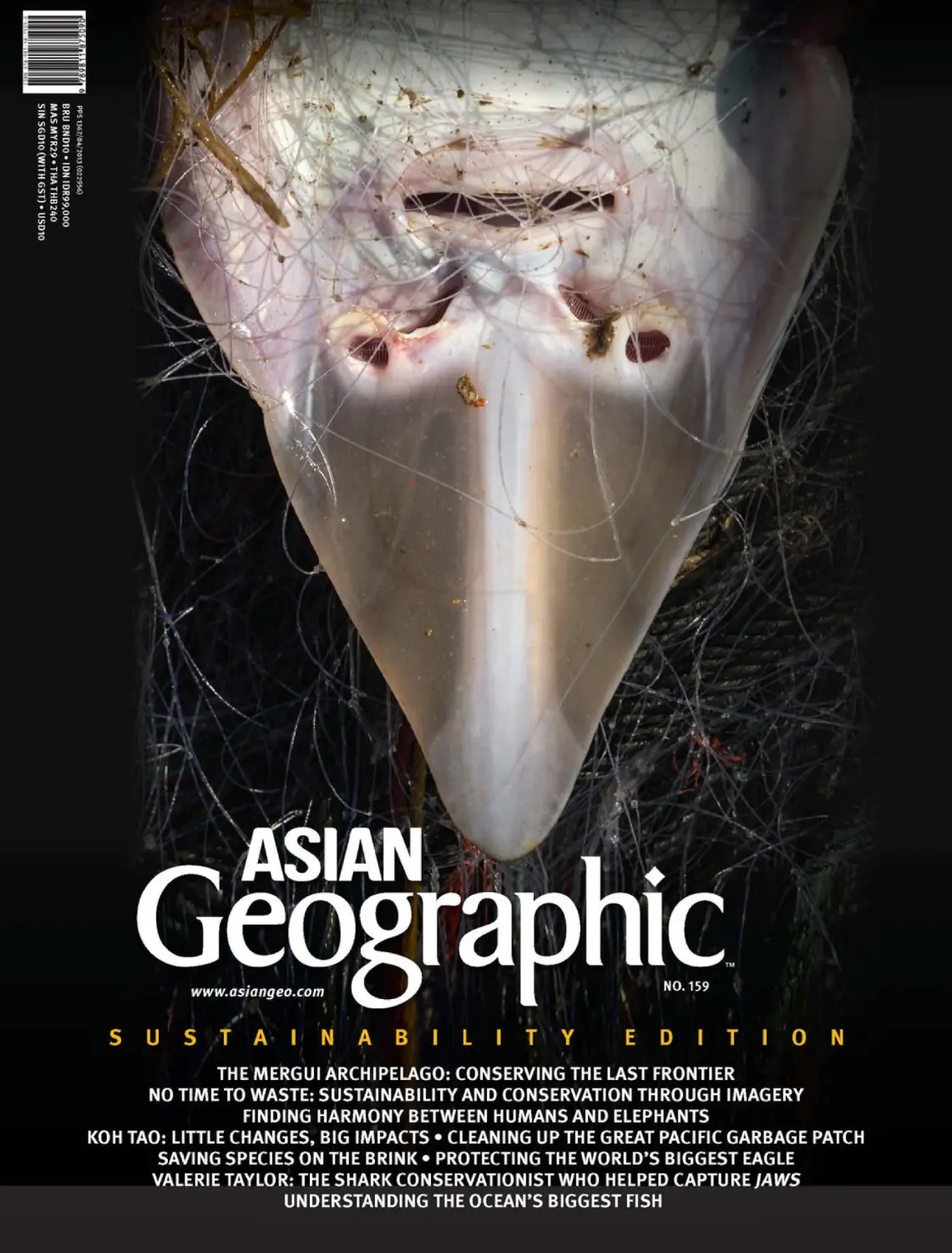
sustainability into practice. In this “Sustainability Edition” of ASIAN Geographic, we take a careful look
at the work of just some of the organisations active in the Asian region. We learn how one group is coming
up with “spicy” solutions to solve human–elephant conflict in Thailand. We investigate the technologies that
promise to clean up the vast expanse of plastic garbage floating in the Pacific Ocean. And our cover stories,
focused on Myanmar, expose the shocking exploitation of the sea that is occurring in the Mergui Archipelago,
and how NGOs are involving the community in managing their marine resources more effectively.
If you’re horrified by some of the stories – and the images – in this issue, you should be. The damage
we are doing to the planet is truly shocking. But we need to move past any feelings of outrage or despair.
In ways large and small, we can all take action: donate, volunteer, recycle, use less water, turn down the
air-conditioner. Let’s all do something.

Ian Bongso-Seldrup

THE LARGEST & LONGEST–RUNNING DIVE EXPO IN ASIA

ASIA’S LEADING DIVE HUB
CELEBRATE 30 YEARS

SINGAPORE

TOURISM
AWARDS

BEST
EXHIBITION
ORGANISER
2018

SINGAPORE OCEAN WEEK

ADEX
APRIL 12–14

SUNTEC, SINGAPORE

20
24

CREATED BY

DEDICATED TO THE
www.adex.asia

Sustainable

Blue
Economy
2021- 2030

ONE OCEAN, ONE LOVE

CITIZEN

UNITED NATIONS
DECADE OF OCEAN
SCIENCE FOR
SUSTAINABLE
DEVELOPMENT

Conserving
the Last Frontier
Text Anuar Abdullah/Ocean Quest Global

Myanmar’s once-paradisiacal Mergui
Archipelago, the sprawling home to
the country’s Moken “sea gypsies”, has
become Southeast Asia’s epicentre for
unsustainable and illegal fishing

Magnus Larsson

A ghost net smothers the
reef, trapping a western
clownfish family and its
host anemone

Shutterstock

feature | Conserving the Last Frontier

We are told that the furthest reaches from
civilisation are untouched and pristine. That days
are spent under blue skies and swaying palm trees.
That gentle waves lap the shore hypnotically. That
birds sing to the rising sun and owls whoop to
the rising moon. This is the idyllic tropical setting
of our dreams. This is the last frontier. This is the
Mergui Archipelago.
By the time we reach the stilted villages along
the coastline, we wonder what lies ahead with
a sense of foreboding. The stench of decaying
seafood is almost unbearable. It is the end of
April and an unforgiving westerly monsoon has
washed ashore. The only vessel available to take
us across to the island is an old longtail boat. The
tide is dry and the captain has to wait. After hours
pass, the tide is finally in our favour and the wind
has stopped, but it is twilight. The sun is setting
in an hour, but we must press on. This is Myanmar
and it is not permitted to stay in the village
overnight. If we do not make this passage, we
will have to turn back to Khawthung, where
there are designated hotels for foreigners, and
we will lose a day.

Our work now begins: We have
come here for the ghost nets.
There are silhouettes of islands on the horizon
backlit by the glow from large fishing vessels. In
calm weather, our boat might reach the island in
four hours. But we estimate it will take six. We
sleep and awake, and repeat, under the canopy
of the loud and bone-shaking longtail. The only
consolation is that the rain has stopped and the
sky has cleared. Our inky ocean is illuminated
by a silver moon.
We arrive early next morning and are greeted
by resort staff who have been deeply concerned
about our whereabouts and our safety. But we have
arrived, nonetheless. That morning we grab a quick
breakfast and assemble at the floating jetty. Divers
are ushered onto the rigid-hull inflatable, while the
support team takes the longtail to the first site. Our
work now begins: We have come here for the ghost
nets. Hereon, choppy seas, grey skies, chilly winds,
and devastated reefs are all we can look forward to
on our journey to tropical paradise.
6

◀◀

In the Mergui Archipelago,
locals live simply in stilted
villages and pracise
subsistence fishing
◀

A Moken sea caravan
cruises the waters around
Kyun Pila island

Layer upon layer of
discarded or abandoned
nets can be found on
some of the reefs in the
Mergui Archipelago

Magnus Larsson

Ocean Quest Global

▾

Magnus Larsson

feature | Conserving the Last Frontier

8

Underwater, we feel like paratroopers
descending into a war-torn grove. It’s grey-green
and suffocating. Signs of death, old and new,
are everywhere. But like clockwork, everyone
silently takes their positions and carries out their
responsibilities. There are three levels of work.
Those at the bottom untangle and cut the nets.
In midwater, there are lifting teams and dive
marshals. On the surface, the support team hauls
and sorts.
▾

Magnus Larsson

The lead weights used
to keep gill nets vertical
in the water

Magnus Larsson

On some reefs in the Mergui Archipelago, there
are 10 or more layers of entangled fishing nets.
Some may have been underwater for a decade or
more. Some dive sites may have been cleaned up,
but even on the most popular sites, there are still
many shredded nets left behind on the reef.

▴

Ghost nets retrieved from
the reef are left to dry
before being weighed

◀

Volunteers salvage
broken coral from
retrieved ghost nets

Magnus Larsson

◀◀

9

Divers remove ghost nets,
careful to avoid damaging
delicate coral structures

feature | Conserving the Last Frontier

A CONSERVATION MISSION
and include mangroves, forests, and wildlife in
our research. Provisions were given to have our
trained international volunteers come to the Mergui
Archipelago and help build coral nurseries, survey
reefs, catalogue the mangroves, and open forest trails
for research on birds and other wildlife.
Poaching is common in the Mergui Archipelago.
On several occasions, our volunteers saw people with
guns disembark from small skiffs and disappear into
the forest. Whenever this happened, we would stop
our work and return to safety. Patrolling the coastline,
we would carry out regular clean-ups. Our presence
would stop the poachers from landing on the beach.

Some members of our team were
assigned to monitor and document the
otters. There were two occasions when
they found decaying bodies of otters
in fish traps washed up on the beach.

Like the ghost nets, abandoned fish traps
continually kill marine animals. Some members
of our team were assigned to monitor and
document the otters. There were two occasions
when they found decaying bodies of otters in
fish traps washed up on the beach. When the
otters become trapped, members of their bevy

Ocean Quest Global

This was how, in 2019, the partnership began
between my organisation Ocean Quest Global
and Memories Group. The Yangon-based tourism
company owns Awei Pila, a luxury resort on Kyun
Pila, the private island where we worked. A few
months prior, they had discovered us in an article
in Fah Thai, Bangkok Airways’ in-flight magazine.
We also have a relationship with their subsidiary
company Burma Boating. We were given permission
to assess the reefs for clearing ghost nets, and to the
island for carrying out conservation work.
The partnership gave us the opportunity to
diversify from our core work of coral rehabilitation

10

A family of otters
enjoys the beach on
the island of Kyun Pila

Ocean Quest Global

Ocean Quest Global

◀

▴

▴

An aerial shot of
the developing
coral nurseries

Rehabilitated coral
at the site of a
recovering reef

We had built 20 coral nurseries
and propagated around a
thousand corals

will go to their rescue, and inevitably, they will
end up in the trap, too. A few days later their
rotting bodies float to the surface with the tide,
bringing the trap with them. After the initial
discovery of the perished otters, we began a search
for abandoned fish traps on all of the reefs around
the island. This was when the second trap with
more dead otters was found. We then stationed
volunteers on higher ground to observe the fishing
activities around the island.
Ocean Quest Global had one base camp
and three field satellite camps on Kyun Pila.
Volunteers were trained and worked in rotation
between the base camp and the satellite camps.
Coral propagation and coral nursery development
were launched at two sites, namely Mangrove Bay
and Long Beach. Our forestry activities included
opening the transect trail across the island, while
our mangrove research revealed a rare species of
mangrove, Bruguiera sexangula.

We made our final border crossing into
Myanmar on March 24, 2020, just before the
country was locked down due to the COVID
pandemic, and we remained at the camps until
June 2020. By the time we were told to leave the
country after the military coup, our camp was
almost self-sustaining owing to the organic farm
we had created for food security on the island.
We had built 20 coral nurseries and propagated
around a thousand corals. Some transplanted corals
were showing signs of recovery at damaged sites.
Despite the challenges, the main objective of
our partnership with Memories Group was nearly
accomplished – demonstrating the promise of
sustainable tourism on Kyun Pila.

11

feature | Conserving the Last Frontier

We returned to the island in February 2023.
Most of our camp had been taken over by the
forest. Our cabin at the base camp was badly
damaged by a fallen tree during a storm. Much
of our equipment inside the cabin was also
damaged, but some could be salvaged and sent
to Kuala Lumpur for repair. In October 2023,
we aim to come back and start over. One of the
events we are planning is a ghost net clean-up
at the reef surrounding Kyun Pila.
For us, the Mergui Archipelago is a paradise
scarred by both terrestrial and marine destruction.
There are few rules. Everything is there for the
taking. The idyll that we imagined has revealed its
truth: an environmental catastrophe hidden under
the sea and the forest canopy. But our mission is
clearer than ever – to try and offset the destruction
and help restore the damage.

CORAL GARDENING WITH
OCEAN QUEST GLOBAL

Magnus Larsson

Founded in Malaysia in August 2010 by
Anuar Abdullah, Ocean Quest Global is
an environmental organisation with a
principal focus on rehabilitating damaged
reefs. The organisation has created
its own techniques, methodology and
material for coral propagation based on
the idea that corals can be restored on a
large scale, naturally and non-invasively.
Ocean Quest Global has developed
courses in coral propagation and coral
nursery development that aim to help
local communities take an active part
in restoring and protecting their marine
environment. The organisation is now
working in seven countries through
Southeast Asia and the Indian Ocean.
www.oceanquest.global

For us, the Mergui Archipelago is a
paradise scarred by both terrestrial and
marine destruction. There are few rules.
Everything is there for the taking.
12

▴

“Nemo” is freed after the
Ocean Quest Global team
removes the ghost net
covering the reef

MAGNUS LARSSON is a Swedish environmental
engineer turned professional underwater
photographer and videographer based in Koh Lanta,
Krabi, Thailand. He has used his work to help promote
various marine conservation projects, including
Ocean Quest Global’s coral propagation programme
at Maya Bay in Thailand’s Phi Phi Islands and ghost
net clean-up efforts in Myanmar’s Mergui Archipelago.
www.magnuslarssonphotography.com
13

A Drop
in the Ocean
Text Ian Bongso-Seldrup

With the establishment of locally managed
marine areas around just a few of the
Mergui Archipelago’s 800 islands, the race
to safeguard this jewel of the Andaman
Sea faces a long uphill battle

One of Asia’s most heavily
exploited regions, the
Mergui Archipelago
is gradually losing its
precious ecosystems

Sirachai Arunrugstichai

feature | A Drop in the Ocean

▴

From the air, many of the
archipelago’s islands appear
idyllic and unspoiled

A lucky few had already caught a glimpse of
some of these rich natural resources as early as
1997, when the Mergui Archipelago, an immense
region comprising hundreds of tropical islands
stretched out along Myanmar’s Andaman
Sea coast, opened to divers travelling in boats
from Thailand. Dozens of world-class dive sites
began to be catalogued, including offshore sites
such as “Black Rock” and “Western Rocky”.
International dive magazines reported bustling
reefs festooned with soft corals, abundant fish life,
and big animals like sharks and many different
species of rays, including mantas.

When a nominally civilian government was
installed in Myanmar in 2011, and the ensuing
years saw the country gradually opening up,
there was cause for optimism. The Southeast
Asian nation was hailed as the “last frontier”
by foreign business leaders eager to secure
a share of a promising emerging market. There
was huge potential for investment in infrastructure
and manufacturing, a youthful population of
60 million, poised to become consumers, and
of course, vast untapped natural resources.

16

International dive magazines reported bustling reefs festooned
with soft corals, abundant fish life, and big animals like sharks
and many different species of rays, including mantas.
Yet this was no “unspoiled paradise” awaiting
discovery by the outside world. With the Mergui
Archipelago supporting millions of people,
principally through direct livelihood benefit as
fishers and traders, and as a vital source of
protein, the once-pristine ecosystems were already
in decline.

The archipelago’s “sea gypsies” – the Moken –
completed the idyllic picture. We read about the
self-sufficient, nomadic way of life they had led
along the Andaman coast for hundreds of years.
We learned of their subsistence lifestyle on small,
wooden boats, foraging for food using spears –
enough to feed their families with a little left over
to trade for necessities. Numbering in only the
thousands, these seafaring nomads had found
a way to live in harmony with the ocean.

▾

Sirachai Arunrugstichai

Sirachai Arunrugstichai

Below the surface, you can
find abundant seagrass beds
and reefs teeming with life

17

feature | A Drop in the Ocean

A RELIANCE ON THE SEA
While the majority of islands in the Mergui
Archipelago are unpopulated, there are several
with sizable settlements and many smaller
villages scattered across the islands. Burmese
and Karen ethnic groups predominately occupy
these settlements, with their main livelihood being
from artisanal fishing, mostly using gill nets.
There are many more artisanal fishers operating
out of the small towns and cities dotted along the
coast of the mainland, especially Myeik, the
largest city in the Tanintharyi Region, which
encompasses the Mergui Archipelago (properly

called the Myeik Archipelago). According to
one 2015 estimate, there are as many as 8,000
to 10,000 inshore vessels. Moreover, beyond the
artisanal fisheries, there is also a sizeable
commercial fishing fleet, which uses damaging
trawl nets, purse seines, and drift nets among
their arsenals.
Over the last several decades, illegal,
unreported and unregulated (IUU) fishing,
destructive practices such as blast fishing, and the
discarding of fishing nets have all taken a severe
toll on this precious marine environment.

18

Shin Sirachai Arunrugstichai

◀

Artisanal fishers use
nets, cages and spears
to catch a wide variety
of marine resources

▴

Targeted species
include squid, mullet,
grouper, snapper, sand
crab and prawn

Over the last several decades, illegal,
unreported and unregulated (IUU)
fishing, destructive practices such as
blast fishing, and the discarding of
fishing nets have all taken a severe toll
on this precious marine environment.

Sirachai Arunrugstichai

COMMUNITY-BASED
CONSERVATION
Myanmar’s gradual opening up from around
2011 also encouraged non-governmental
organisations (NGOs) to begin working
in the country. The largest and most active
wildlife conservation charity has been Fauna
& Flora (until recently, named Fauna & Flora
International), a UK-based organisation
with a 120-year history and more than 120
conservation projects across 40 countries.
The charity’s work in the Mergui Archipelago
began around 2010, with detailed surveys
between 2013 and 2017 aimed at understanding
the status of the region’s habitats and species,
and identifying priority areas for protection.
Working with scientists and students from
local universities, staff from Myanmar’s

Department of Fisheries and Forestry Department,
and various international researchers, the Fauna
& Flora team conducted in-depth studies of the
reefs and their associated fish and invertebrate life,
as well as the seagrass beds and the fished species
they support.
“We were trained as scientific scuba divers in
Thailand,” Zau Lunn from Fauna & Flora’s marine
team tells ASIAN Geographic. “Then we trained
more staff, from the Department of Fisheries and
the Forestry Department. We also trained one
scuba diver from the navy. The team dived together
to collect the coral data.”
19

Fauna & Flora–Myanmar Programme

feature | A Drop in the Ocean

▴

Community members
participate in mapping
LMMA boundaries

community-led conservation was an alien
concept. “They said that it would be impossible,
but they worked together, because they knew
that fish stocks were declining.”
With the stakeholders on board, despite some
remaining scepticism, Lunn and his colleagues
eventually submitted their management plan to
the Department of Fisheries, and in 2017,
Myanmar designated its first three LMMAs –
Langann, Done Pale Aw, and Lin Lon. Aiming to
protect some of the most species-rich habitats
in the archipelago, they promised to enable
local communities to play a driving role in the
better management and conservation of their
surrounding marine areas.

Lunn and his colleagues then organised
several workshops to explain the findings to
the various stakeholders: local community
members, government officials, and members
of the Myanmar Fisheries Federation, a
non-profit supporting and promoting the
fisheries sector. Working together, they identified
three areas for protection, designed to operate
as locally managed marine areas, or LMMAs.
“When we worked to establish the locally
managed marine areas, it was very strange for
everybody. Nobody, especially in the community,
believed this would become a reality,” says Lunn,
explaining that people were only familiar with
the “top-down” approach to management;

20

dawei
Moscos Islands

INDIA
CHINA
BANGLADESH

mya n m a r
Mali
Kyun
THAILAND
Yangon
Bay of Bengal

Kadan
Kyun

myeik

Lin Lon
Done
Pale Aw

LEGEND

Letsok-aw
Kyun

Locally managed marine area (LMMA)
Marine protected area (MPA)

Langann

Kanmaw
Kyun

Lampi
Kyun

Lampi Marine
National Park
ANDAMAN SEA

kawthoung
Zadetkyi
Kyun

MERGUI ARCHIPELAGO
21

feature | A Drop in the Ocean

Now, for the freshly appointed community
managers of Myanmar’s special new marine
areas, the hard work was about to begin. Without
enforcement – patrolling the waters to ensure
compliance with the rules – the LMMAs could
never be effective.

The creation of the LMMAs was an important
step in a country that has otherwise designated
just a single small marine protected area (MPA),
the 200-square-kilometre Lampi Marine National
Park, established in 1996, at the southern end
of the Mergui Archipelago. The news was celebrated
by the conservation community. Having included
the archipelago among its list of “Hope Spots”
owing to its diversity of species and habitats,
Mission Blue, the non-profit marine organisation
led by legendary oceanographer Dr. Sylvia Earle,
named Fauna & Flora as the Champion of the
Mergui Archipelago Hope Spot.

The creation of the LMMAs was an
important step in a country that has
otherwise designated just a single
small marine protected area

22

Thardukoko

◀

▴

With the establishment of the LMMAs, the
community agreed to three structures to guide
management efforts. Firstly, “no-take zones”
meant the total prohibition of fishing activities
in important coral or seagrass areas. Secondly,
“seasonal closure zones” required areas such as
spawning or nursery areas to be protected from
fishing during certain critical periods. And
thirdly, “gear restriction zones” prevented the
use of specific kinds of fishing gear, for example,
fishing nets that do not allow juvenile fish
to escape.
In the initial stages, Fauna & Flora supported
patrols with a grant to the community for three
months. Thereafter, the community members

conducted patrols on their own and with the
help of staff from the Department of Fisheries.
“In Done Pale Aw village [one of the LMMAs],
they stopped fishing for four months, and after
four months, the fish were flourishing again in
that area,” says Lunn, adding that nobody
in the community could believe that the no-take
zone worked. “Everybody was very surprised.”
For Fauna & Flora, the community-based
approach at the centre of the three established
LMMAs is integral to their success, and an
expanded system of LMMAs is one of several
models that the organisation believes can lead to
the creation of an effective MPA network across
the Mergui Archipelago.

Sirachai Arunrugstichai

The success of the locally
managed marine areas depends
on effective enforcement

A young Moken
woman shows off
the day’s catch

23

feature | A Drop in the Ocean

ENFORCEMENT CHALLENGES

Sirachai Arunrugstichai

Founded in 2018 – the year after the establishment
of the LMMAs – Myanmar Ocean Project has
been working in the region to assess the impact
of abandoned, lost or discarded commercial and
artisanal fishing gear across the archipelago. They
conducted six expeditions in 2019, surveying
87 sites over 43 diving days. The main survey areas
were Lampi National Marine Park and its surrounding
areas, the three LMMAs, and three dive sites
previously frequented by divers but subsequently
abandoned due to pollution by ghost nets.
Shockingly, the Myanmar Ocean Project team
found 95 percent of the sites they surveyed had some
form of ghost nets present. Around one-third were
classified as “hotspots”, areas deemed to pose a severe
threat to coral reefs, marine life, and the livelihood
of the community. Here, the team recorded regular
intentional discarding of nets by resting boats as
well as multiple layers of lost nets covering reefs.
During the work, more than 1,800 kilograms of
ghost gear was removed and analysed.

24

Only Lampi National Marine Park revealed
less-polluted sites, with moderate and severe levels
of ghost gear recorded beyond the designated
marine park zone. At High Rock, one of the former
dive sites surveyed, the expedition revealed how
rapidly – within just two fishing seasons – areas with
high fishing boat traffic could become hotspots. The
team had already conducted a survey at High Rock
three years earlier, in 2016, finding a dive site vibrant
with healthy corals, but when they returned in 2019,
they discovered multiple layers of ghost nets had
accumulated, and a seascape devoid of life.
Most concerningly, of the LMMAs, Langann was
found to have an alarming level of pollution with
ghost nets: Some 64 percent of the sites surveyed
were identified as hotspots, though it should be
noted that the sites surveyed included those outside
of the designated LMMA as well as those within its
boundaries. No hotspots were found at the Lin Lon
or Done Pale Aw LMMAs, but every site surveyed
had various types of ghost gear.

▴

Life finds a way:
Corals push through
layer upon layer of
ghost nets

◀◀

Fauna & Flora-Myanmar Programme

Gill nets are the most
commonly found type
of ghost gear in the
Mergui Archipelago

◀

Everything from fish to
sharks to turtles can
become entangled in
discarded fishing nets

25

Sirachai Arunrugstichai

feature | A Drop in the Ocean

26

DID
YOU
KNOW?

◀

Sharks and rays are killed
both as bycatch and
through targeted fishing

According to according to a 2014 Oxfam
report, an estimated 43% of Myanmar’s
population is dependent to some degree on
fishing or aquaculture

▴

The consumption of
shark and ray products is
widespread in the Tanintharyi
Region and beyond

The Myanmar Ocean Project report detailing
the findings, “Abandoned, Lost or otherwise
Discarded Fishing Gear (ALDFG) in Myanmar’s
Myeik Archipelago”, notes that Langann, which
contains two villages with a combined population
of around 500 Burmese and Moken people, is
“a busy area with a steady stream of boats in the
bay and fishermen frequenting the village shops”.
They estimate that 50 fishing boats use the bay
throughout the day, mostly small-scale fishers
using gill nets and squid boats, while the areas
outside of the LMMA are often targeted by
illegal shark and ray fisheries using larger vessels,
including so-called “baby trawlers”.
“Every fisherman interviewed admitted to
discarding unusable nets into the water while
the boat was taking shelter (in and outside the
village bay),” states the report, which is authored
by Myanmar Ocean Project founder Thanda
Ko Gyi. However, discarding nets was not the
principal reason behind Langann’s ghost net
problem. The interviewees highlighted gear
conflict – between illegal baby trawlers and
gill net fishing boats – as the main reason for
the loss of their nets.
“Lost gear is more deadly due to its size,”
Thanda Ko Gyi tells ASIAN Geographic. “These are
usually very large pieces of net that engulf the
whole reef, entangling marine life and damaging
marine biodiversity for years. Discarded gear tends
to be smaller pieces, so are less damaging.”

SHARK AND RAY CONSUMPTION
AND TRADE IN MYANMAR
Shark fishing has been banned in Myanmar for
more than two decades, but there is very little
enforcement, while there are no regulations in
place to manage ray fishing. Sharks and rays,
often endangered, are also commonly taken as
bycatch. Many of these fisheries, both legal and
illegal, operate in the Tanintharyi Region, which
includes the Mergui Archipelago. Shark and rays
are consumed across the country, especially
in coastal communities, while dried gill rakers
and shark fins are traded internationally via
wholesalers in Myanmar’s capital, Yangon.
“Shark factories” operate with impunity in the
Mergui Archipelago. Thai photographer Sirachai
Arunrugstichai tells us that he gained access to
the villages processing sharks very easily, even
as a foreigner. “They don’t do finning out at sea.
They just get the whole sharks and cut them in the
factory,” says Arunrugstichai. “But when you are
there, it’s more than just about the sharks. It’s
about the people, because the workers there are
young kids, teenagers, 13 or 14 years old, working
so hard. They’re just trying to make a living.”
“Carefully planned and research conservation
management is very much needed, but where
communities have nowhere else to turn to for
income and food, simultaneous effort to lift these
communities out of poverty should also be a
priority,” says Thanda Ko Gyi from Myanmar Ocean
Project, which has studied the shark and ray trade
in Rahkine State, further north along the western
coast. “I watched a 12-year-old boy process a
small mobula ray and his uncle said, “The knife is
the only thing we have to learn to use and make a
living with. What else are we supposed to do?’”

feature | A Drop in the Ocean

Better management of
Myanmar’s fisheries and
enforcement of regulations
is desperately needed to protect
the country’s marine biodiversity

To tackle the issue of discarded ghost nets, Myanmar Ocean Project
is exploring the idea of collection points for end-of-life gear.
28

Sirachai Arunrugstichai

To find out more about the work Fauna & Flora is doing in Myanmar,
Asia and around the world, visit www.fauna-flora.org.
Read Myanmar Ocean Project’s reports on the ghost net problem in the
Mergui Archipelago and the shark and ray trade in Rakhine State by visiting
www.myanmarocean.org.
View more powerful and thought-provoking images by conservation photojournalist
Sirachai Arunrugstichai on his website, www.shinsphoto.com.

FINDING SOLUTIONS
Above all else, interactions between the
communities of the Mergui Archipelago and
non-profits like Fauna & Flora and Myanmar
Ocean Project have demonstrated that fishers
recognise that fish stocks are indeed declining
and that both overfishing and ghost gear are
contributing significantly to the problem.
There’s a desire to find answers and a willingness
to change behaviours. But it’s a complex picture,
and there will be no simple remedies.
To tackle the issue of discarded ghost nets,
Myanmar Ocean Project is exploring the idea of
collection points for end-of-life gear. These could
be located within villages where there are good
relationships and significant interactions with
fishing boats. Another possibility is end-of-life
gear being collected by wholesale or market boats
that are interacting with resting fishing boats
while selling their goods. “Preventing and
reducing discarding of end-of-life gear should be
fairly straight forward, if the country is stable and
communities are more engaged,” says Ko Gyi from
Myanmar Ocean Project, which has been trialling
collection at strategic locations. She notes that their
collection trials have been encouraging so far and
“fishers have been very keen to be involved”.
A much thornier issue is lost nets due to gear
conflict – particularly where it occurs between
the local, small-scale fishers and the bigger, often
illegal fishing operations. The Langann LMMA and
surrounding area, where Myanmar Ocean Project
recorded a high concentration of ghost gear, is a
case in point. “Those are legal fishing boats, but
they fish illegally near the islands,” says Zau Lunn,
referring to the bigger boats coming from the
mainland. “They are baby trawlers. They fish about
two to three miles from the islands. These are
coral and seagrass areas where they are not
allowed to fish.”
While the establishment of Myanmar’s first
three LMMAs should be seen as a victory, it’s clear
that the future of the Mergui Archipelago rests on
enforcing zoning and the creation of an effective
system that allows local fishers to report illegal
fishing activities. As long as better regulation and
enforcement remain elusive, the valuable habitats
and incredible biodiversity of this special region
will continue to be imperilled. ag

Ghizilagaj Reserve
National Park, Azerbaijan

Palmahim Slide, Israel
Great Fringing Reef
of the Red Sea, Egypt

Mergui Archipelago,
Myanmar
Lakshadweep Islands,
India
Maldive Atolls
Laamu Atoll, Maldives

Andaman Islands,
India
Kep Archipelago,
Cambodia

Chagos Archipelago, UK

Selected Hope Spots in Asia-Pacific
Myanmar’s Mergui Archipelago is one of dozens of the region’s “Hope Spots” – ecologically
unique marine areas designated for protection under a global conservation campaign led by
Sylvia Earle’s non-profit organisation Mission Blue.
Ghizilagaj Reserve National Park, Azerbaijan
The very first Hope Spot with no connection to the
ocean, the reserve is also the first in the Caspian
Sea, the largest inland body of water on Earth and
a precious, yet fragile place for approximately 400
endemic species.

Maldive Atolls
One of the most species-rich marine areas in the
entire Indian Ocean region, the Maldive Atolls boast
approximately 250 species of hard corals and five
species of turtles, as well as whale sharks and various
whale species.

Great Fringing Reef of the Red Sea, Egypt
More than 2,000 kilometres in length, this reef
runs along the shoreline of the Gulfs of Aqaba
and Suez, the shoreline of the mainland of the
Red Sea Governorate and surrounding fringing
reefs of nearly 44 islands.

Kep Archipelago, Cambodia
Covering an area of 113 square kilometres, this
archipelago encompasses a dozen islands covered
with tropical forests. Its shallow waters host
spectacular fringing coral reefs, mangrove forests,
and seagrass meadows.

Datan Algal Reef,
Taiwan

Hong Kong South,
China
CORAL TRIANGLE
Pangatalan Island, Philippines
Tubbataha Reefs, Philippines

Wotho Atoll,
Marshall Islands

Palau
Western Pacific Donut Hole 1

Bunaken Marine
Park, Indonesia
Misool Marine
Reserve, Indonesia

Kimbe Bay,
Papua New Guinea

Western Pacific
Donut Hole 2

Ombai-Wetar
Strait
Nusa Penida MPA,
Indonesia

Conflict Islands,
Papua New Guinea
GREAT BARRIER REEF
CORAL SEA

Western Pacific
Donut Hole 3

Western Pacific
Donut Hole 4

Wallis and Futuna,
France
Tavarua Island, Fiji

HOPE SPOT

Coral Triangle
Home to the highest diversity of coral species
on Earth, this Indo-Pacific region includes
tropical waters surrounding the Philippines,
Malaysia, Indonesia, Papua New Guinea,
Timor-Leste and the Solomon Islands.
It provides habitat for six out of the seven
species of sea turtles as well as the “living fossil”
coelacanth. Threats to marine life in the region
include climate change, ocean acidification,
overfishing and harmful fishing practices like
dynamite fishing, and runoff from coastal
development and agriculture.

Henoko-Ōura Coastal Waters
This unique coral hotspot powers a little-known
but richly diverse marine ecosystem which holds
more than 5,000 species in its waters, including
blue coral (Heliopora coerulea) and dugongs
(Dugong dugon).
Palau
Encompassing 340 islands, the Republic of
Palau is an isolated archipelago in the Western
Pacific that has set aside some 80 percent of its
ocean territory solely for marine ecosystems to
thrive – more than any other country. ag
To find out more about Mission Blue and its goal of creating a worldwide
network of marine protected areas, visit www.missionblue.org.

No Time
to Waste
SUSTAINABILITY AND
CONSERVATION THROUGH IMAGERY
The photo competition for United Nations World Oceans
Day celebrated its 10th anniversary in 2023. Over the last
decade, through categories such as “Clean Our Ocean”,
“Human Interaction: Making a Difference” and “No Time
to Waste”, photographers have been invited to show how
we are impacting our oceans, rivers and beaches. Taken
together, these powerful images illustrate not just the
destruction we’ve wrought on the oceans, but also the
efforts we are making to undo the damage we have done.

Pacific Ocean, Baja California, Mexico
A humpback whale with a buoy entangled
to its tail, already decomposed, dies slowly
and agonisingly, a tragic consequence of
the millions of tonnes of discarded and
abandoned fishing gear in our oceans
CATEGORY AND PLACING

No Time to Waste, 1st place, 2023
PHOTOGRAPHER

Álvaro Herrero (Mekan) (Spain)

picturesque

Galápagos, Ecuador: Marine biologist
Eduardo Espinosa and a volunteer
oxygenate shark pups before they
are released, having captured them
to conduct various studies, such as
determining size and sex, taking
biological samples, and installing
numeric tags
CATEGORY AND PLACING

Putting the Ocean First,
2nd place, 2023
PHOTOGRAPHER

Edwar Herreño Parra
(Colombia)

34

Albania: A volunteer from NGO
River Cleanup takes a break from
collecting trash at the mouth of the
Ishëm River, one of the top three
most polluted rivers in Europe
CATEGORY AND PLACING

No Time to Waste,
3rd place, 2023
PHOTOGRAPHER

Ines Goovaerts
(Belgium)

35

picturesque

West Bengal, India: Two members
of a family of fishers rest outside
their thatched dwelling place, where
the sun is drying fish they caught
overnight. They live on and around the
ocean, and they are totally dependent
on it for a sustainable living
CATEGORY AND PLACING

Coastal Communities,
2nd Place, 2022
PHOTOGRAPHER

Amitava Chandra (India)

36

Quang Ngai, Vietnam: Fishermen
use a seine net to catch fish and
shrimp. Such artisanal fishing
can have a lower environmental
impact and contribute less to
ghost gear than gill netting
CATEGORY AND PLACING

Above Water Seascapes,
1st place, 2022
PHOTOGRAPHER

Cao Nguyen Vu (Vietnam)

37

picturesque

06

Adonara Island, Flores, Indonesia: Two
local fishermen paddle in a traditional
canoe along a shallow coral reef looking
for a good place to put down their lines.
These fishermen are practising handline
fishing, a type of sustainable fishing
without poles or nets
CATEGORY AND PLACING

The Ocean: Life & Livelihoods,
1st place, 2021
PHOTOGRAPHER

Renee Capozzola (USA)

38

San Francisco, USA: A conceptual look
at the blindness consumers have when
it comes to plastics, and their effect
on the oceans – blindly buying goods
and wish-cycling them in the hopes
of allaying their own guilt. Concept/
Model: Christine Ren
CATEGORY AND PLACING

Digital Ocean Photo Art,
2nd place, 2021
PHOTOGRAPHER

Brett Stanley (Australia)

39

picturesque

Revillagigedo Archipelago,
Mexico: A diver finds a whale
shark with a discarded
commercial fishing line wrapped
around her midsection. The diver
eventually manages to cut the
endangered animal free
CATEGORY AND PLACING

Human Interaction: Making a
Difference, 2nd place, 2020
PHOTOGRAPHER

Dave Valencia (USA/Mexico)

40

Krabi Province, Thailand: A team
of aquatic veterinarians from the
Department of Marine and Coastal
Resources conducts a necropsy on
the 12-metre-long carcass of a sperm
whale at Mu Koh Lanta National Park.
Plastics were found inside the whale’s
digestive system, which could have
contributed to its death
CATEGORY AND PLACING

Clean Our Oceans,
1st place, 2020
PHOTOGRAPHER

Sirachai Arunrugstichai
(Thailand)

41

South Malé Atoll, Maldives: Marine
biologists tend to the coral nursery
at Cocoa Island, under an hour’s
speedboat ride from Malé. The
goal is to transplant the healthy,
nursery-reared corals into degraded
reefs to support existing colonies
and help reseed damaged areas
CATEGORY AND PLACING

Gender and Oceans,
1st place, 2019
PHOTOGRAPHER

Henley Spiers (UK)

Sydney, Australia: Young divers
remove plastic waste polluting
the water from the bars, fast
food outlets and restaurants
surrounding Manly Cove
CATEGORY AND PLACING

Clean Our Oceans,
theme winner, 2018
PHOTOGRAPHER

Rosie Leaney (Australia)

picturesque

The Bahamas: A dead green
sea turtle is hooked and
tangled in fishing line as
bycatch. The turtle got so
entangled that it couldn’t
reach the surface to breathe
CATEGORY AND PLACING

Clean Our Oceans,
1st place, 2018
PHOTOGRAPHER

Shane Gross (Canada)

44

45

picturesque

Quang Ngai, Vietnam: Anchored
fishing boats are lined up to
avoid super typhoon No. 9, the
strongest such storm system
to hit Quang Ngai in 30 years.
It damaged more than 140,000
houses, with hundreds being
completely destroyed
CATEGORY AND PLACING

Above Water Seascapes,
3rd place, 2022
PHOTOGRAPHER

Cao Nguyen Vu (Vietnam)

46

Bali, Indonesia: Manta rays
filtering a plastic and plankton
soup. Bali’s huge annual influx
of tourists brings negative
environmental impacts to the
regional infrastructure and
surrounding waters
CATEGORY AND PLACING

Clean Our Oceans,
3rd place, 2018
PHOTOGRAPHER

Joerg Blessing (Germany)

To see more winning images from the photo competitions for
UN World Oceans Day, visit www.unworldoceansday.org.
The annual photo contest is hosted by the United Nations
and curated by underwater photographer Ellen Cuylaerts.

47

Finding Harmony
Between Humans
and Elephants

Shutterstock

Text Sarah Eichstadt

Ruam Thai village shares an
unfenced border with Kuiburi
National Park, home to over
300 wild elephants

How one non-profit organisation is
encouraging alternative crops to reduce
human–elephant conflict in Thailand

Shutterstock

When elephants enter her farm, Roengrom “Rom”
Amsamarng runs away and spreads the news of
elephant presence to neighbouring farms. To Rom,
a Thai farmer, elephants threaten her safety and
economic livelihood. In the village of Ruam Thai,
where Rom lives, elephants leave protected areas
and venture into pineapple farms, damaging crops
that farmers depend on for a living.
“If it’s too late at night, I won’t go out or even
move,” Rom says. “If the elephant is really close to
me, I won’t move, but if the elephants are far away,
I will run as far as I can.”
This is an example of human–elephant conflict,
a problem in all 13 countries inhabited by Asian
elephants, including Cambodia, Thailand and
Sri Lanka. In Thailand, human–elephant conflict,
or HEC, is increasing. Research suggests this is
the result of shrinking Thai forestland. Between
2012 and 2017, 45 humans and 25 elephants
died through HEC, according to Thai newspaper
The Nation.
Ruam Thai village is working to solve this
problem. A group of farmers, researchers and
volunteers is experimenting with how to make the
plantations less appealing to elephants.

Bring The Elephant Home

feature | Finding Harmony Between Humans and Elephants

▴

Rom, a Thai farmer,
is a member of The
Tom Yum Project

▾

Wild elephants can
venture into farms,
damaging crops

Most Ruam Thai village residents’ main source
of income is from agriculture, and 70 percent of
these residents plant pineapple. The village in
the southwestern province of Prachuap Khiri Khan,
about 250 kilometres south of Bangkok, shares
an unfenced border with Kuiburi National Park,
home to more than 300 wild elephants.
By helping farmers transition to planting
different crops instead of pineapple, Bring The
Elephant Home, or BTEH, is “working with
elephant psychology”, as BTEH’s Thailand country
director Ave Owen calls it, to disincentivise them
from coming into the farms.
▶

Cultivated crops such as
bananas, pineapples, and
sugarcane are favorite
foods of Asian elephants

Bring the Elephant Home is a non-profit
organisation based in the Netherlands, South
Africa and Thailand that works to promote
human–elephant coexistence and ensure the future
survival of elephants. BTEH was founded by
Antoinette van de Water in 2004. Originally from
the Netherlands, Antoinette became interested
in elephant conservation when volunteering at
Elephant Nature Park, an elephant rescue and
rehabilitation centre in northern Thailand. Over
the years, BTEH has evolved to encompass a more
holistic vision of elephant conservation. This means
incorporating biodiversity and local communities
into BTEH’s mission.
Electric fences are responsible for 72 percent of
HEC-related elephant deaths, while most humans
who die from HEC are killed trying to keep
elephants away. Instead of using traditional methods
like fences to deter elephants from coming into the
Ruam Thai village, BTEH wondered if planting crops
that were unpalatable to elephants would eliminate
their motivation to leave the protected area and enter
agricultural areas.
Realising minimal research on alternative crops
and elephants had been done, BTEH partnered
with community leaders in Ruam Thai who were
interested in trialling alternative crops to see which
crops would be consumed and avoided by elephants.
BTEH researchers and local farmers brainstormed
crops elephants don’t eat that are also marketable
and drought resistant.

Katie Hollamby

BRINGING
THE ELEPHANTS HOME

Chiang Mai

thailand
Bangkok

THAILAND

Ruam Thai
Kuiburi
National Park
MYANMAR
Prachuap
Khiri Khan

feature | Finding Harmony Between Humans and Elephants

The Tom Yum Project
It was a different story for the pineapple crops in
the study. Elephants had consumed 100 percent of
the pineapple after 11 months; 97.5 percent of it
was consumed in the first two months.
Farmers involved in The Tom Yum Project turn the
alternative crops into organic soaps, candles, teas and
honey, sold in consignment stores across Thailand
and globally on the Elephant & Co webshop.

Relearning the Game
Pineapple has been the main cash crop in Ruam
Thai for over two decades. Asking local farmers to
switch to different crops is a major change to the
way many farmers learned how to make a living
from agriculture. Many have financial concerns

Bring The Elephant Home

The Tom Yum Project, named after the Thai soup,
was born in March 2021. The ingredients for the
well-known spicy soup are chilli, garlic, lemongrass,
galangal, kaffir lime, onion and coriander – none of
which are attractive to elephants.
The findings of the initial study, conducted
by BTEH, Miami University and Ruam Thai
community members, gives hope to alternative
crops as a solution to HEC in the village. The trial
alternative crops – lemongrass, citronella, chilli,
lime, kaffir lime, karonda, mulberry, galangal,
turmeric and Cassumunar ginger – were not
uprooted or consumed by elephants. The only
damage was some trampling, which affected less
than 10 percent of experimental crops.

Asking local farmers to switch to
different crops is a major change to
the way many farmers learned how
to make a living from agriculture.

and are unsure how elephants will interact with
alternative crops.
Ave Owen researched the alternative crops for
their master’s dissertation. While confident that
elephants don’t damage these alternative crops, they
understand how transitioning could be challenging

Bring The Elephant Home

▴

◀

for farmers. Ave says: “I have deep sympathy for
how scary it is for a farmer to think ‘I’ve been
planting pineapple my whole life. And I learned
how to plant that pineapple from my father and
mother, who planted pineapple for their whole
lives. And you’re now telling me I’m about
to change?’”
Farmers also have to relearn how to properly
cultivate these crops, such as how much water
they need. BTEH put together workshops to help
farmers learn how to make the products themselves
rather than solely selling the crop yield to a factory.
This gives more direct economic power to the
farmers by shortening the supply chain.
Rom, a member of The Tom Yum Project, plans
to experiment with planting alternative crops in the
near future. She feels that she is too old to continue
night guarding her farms to prevent elephants from
coming. Joining The Tom Yum Project has given
her hope for another solution that can provide
income and prevent elephants from coming into
her farm.
“Before joining the team, I was just planting
palm, coconut and pineapple. These crops can
give me financial return in the future, because I
do not have children to take care of me when I’m
old,” Rom says. “Since I joined The Tom Yum
Project, I realised that there are a number of crops
unpalatable for elephants. I would like to try
planting them.”

Planting
alternative crops

DID
YOU
KNOW?

A local farmer
in Ruam Thai

ASIAN ELEPHANT (Elephas maximus)
Size: Up to 3.4m tall (males) or 2.9m tall (females)
Life Span: Up to 70 years
Location: India and 12 countries in Southeast Asia
Notable Trait: Males typically grow tusks, while cows
have small incisor teeth called tushes

The Loss of Elephant Ecosystems in Asia
• According to a recent study, over the
past three centuries, the Asian elephant
has lost more than three million square
kilometres of its historic habitat range
3M km²

2/3

• Suitable habitats for Asian elephants
have decreased by nearly two-thirds
within the past 300 years due to human
land-use practices such as farming and
timber extraction
• The study suggests that the remaining
elephant populations today may not
have adequate habitat areas
• Less than half of the area within 100
kilometres of the current elephant range
is now considered suitable habitat. This
sets up a high potential for conflicts with
people living in those areas

<50%

Source: “Land-use change is associated with multi-century loss of
elephant ecosystems in Asia”, Shermin de Silva et al., Scientific Reports
(April 27, 2023)

feature | Finding Harmony Between Humans and Elephants

Boosting Biodiversity
Ave points out that maintaining pineapple farms
generally requires chemical herbicides, fertilisers
and growth hormones. This contaminates the
water and air, negatively impacting wildlife and
human health. One of The Tom Yum Project’s goals
is to stop relying on chemicals for crops. Various
alternative crops don’t require herbicides, opening
up the possibility for more organic farming. In turn,
organic farming improves biodiversity, which BTEH
sees as a benefit to all species, including humans.
“The Tom Yum Project represents the coexistence
of all species and the way those species live
with each other,” Ave says. “There’s a reciprocal
relationship of humans investing into biodiversity.”
Organic regenerative agriculture is better for
the environment, Ave adds, resulting in more
pollinators that can help increase crop yield. A
2018 study on legumes in Thailand found that
organic farming improved soil quality on biological,
chemical and physical measures. Soil productivity
improved, while both soil organic matter and rates
of decomposition increased.

▴

▶

▾

▾▶

Organic soap produced
with alternative crops
grown through The
Tom Yum Project

Bring The Elephant Home

The Tom Yum Project aims to
help farmers grow alternative
crops that are less appealing
to elephants

54

Instead of pineapple,
palm and coconut,
farmers are trying
alternatives like ginger
A BTEH researcher
measures a plant

Bring The Elephant Home

The biggest challenge to The Tom Yum Project
is economics. A question yet to be answered:
Can alternative crops become more profitable than
pineapple, and how can this be achieved? Nearly
three years since the original trial, alternative crop
planting has only been tested on small farms, but
a group of about 15 local farmers is ready to scale
up their efforts this year.
Elephant presence in farmland comes with
financial consequences because of the crops they
damage, but it is also an emotional stressor.
The relief that alternative crop farming can bring
may outweigh the economic gamble. “Even if the
alternative crop income is a little bit lower, the
farmers might still be tempted by all the
psychological benefits they’ll get,” Ave says.
“Being able to rest and get home, not being so
worried and stressed all the time about the
elephants damaging their crops.”
BTEH sees its role as co-creators of research that
provides information about the economics of the
project and elephants’ interaction with crop species.
How to farm is a decision ultimately left up to those
most directly affected, the farmers. “I think these
farmers will have great trust in each other,” Ave
enthuses. “If they have a positive experience with
this model, they’ll share that experience with their
neighbours. The project will grow naturally.”

Collaborative Community
BTEH values its human relationships as much as
elephant conservation. Everyone comes to meetings
and has an equal voice at the table. “Elephant
conservation cannot be looked at with tunnel
vision,” declares Ave. “Elephants are one of the
puzzle pieces of this mosaic of environmental
conservation. That interconnectedness and
interdependency includes humans.”
Akaraphum “Phum” Pisanwanich, a project
manager for BTEH, has worked for other
organisations in Thailand that claim to champion
helping local communities. He described some of
these groups as exploitive of local communities.
Phum says The Tom Yum Project truly prioritises
local community. He notes that when he started as
project manager, Ave told him that The Tom Yum
Project should be owned by the community, not
BTEH staff. “There’s no hierarchy,” Phum says.
“The energy of the people is amazing. It’s almost
addictive. I love to be here.”
Phum sees a lack of HEC research in Thailand.
His dream for BTEH is to integrate the organisation
into college courses to “inspire new generations of
researchers” who can continue working towards
human–elephant coexistence in Ruam Thai village
and beyond.

Bring The Elephant Home

Bring The Elephant Home

Challenges

55

feature | Finding Harmony Between Humans and Elephants

TOO SPICY FOR ELEPHANTS

The Tom Yum Project

Increasing conflict
between farmers
and elephants

4

Farmers harvest yield and create
elephant-friendly products in
eco-friendly packaging

1

The community-run Tom
Yum Tree Nursery creates
alternative crop seedlings

5

Consumers make a difference by
purchasing products to create
demand for this holistic solution

2

Together, farmers plant,
water and maintain
alternative crops

6

Proceeds are used to
restore elephant habitat
and support local farmers

3

Regenerative, pesticide-free
farming benefits biodiversity

7
56

Peaceful coexistence between
people and elephants
• Less dangerous, violent deterrents
• New sktills and alternative income
• Thriving, diverse ecosystems
• Socio-environmental resilience

Bring The Elephant Home

Beyond Thailand
The Tom Yum Project is the first research and
community-based alternative crop planting
initiative to promote human–elephant coexistence
in Thailand. But BTEH hopes that many other
countries can benefit from the experiences in
Thailand. Through a research collaboration with
Dr. Shermin de Silva of Trunks & Leaves, a
similar project will be implemented in Sri Lanka.
Together, the researchers plan to study the effects
of alternative crops in Sri Lanka and Thailand.
Their hope is that growing alternative crops can
serve as a model for other countries seeking
human–elephant coexistence.
“We can cover this continent in fences and
warning cameras and guarding teams,” says Ave,
“but solutions that prioritise the wellbeing of
humans, wildlife and ecosystems are going to be
able to solve this problem while we resolve broader
issues facing the natural world.” ag
◀

Farmers recording
data as part of The
Tom Yum Project

BRING THE ELEPHANT HOME (BTEH)
• Living in Harmony: BTEH’s mission is to
increase chances of survival for elephants and
work towards a world in which people and
elephants can live in harmony, benefiting from
each other’s existence.
• Community Engagement: BTEH’s conservation
projects root in local communities. Equitable
and sustainable Nature conservation respects
their knowledge and values, and makes the
benefits and income that elephants can bring
accessible to all.

Shutterstock

• Sustainable, Long-Lasting Change: BTEH’s
work is characterised by three overarching
guidelines: local involvement, a healthy
ecology, and benefits for people and elephants
simultaneously. They lead to shared decisionmaking, ownership of local communities,
sustainability, gender- and social equality,
pride, and a peaceful coexistence of people
and animals.

*All quotes from Rom are translated from Thai into English by Phum

For more information about BTEH’s projects,
visit www.bring-the-elephant-home.org.
You can purchase the products created through
The Tom Yum Project at www.elephantandco.org.
◀

Ultimately, elephants and humans
can only live in harmony if we reverse
the decline in elephant habitats

sustainability spotlight | Koh Tao: Little Changes, Big Impacts

Little Changes,
Big Impacts
KOH TAO:

▾

Leaf Lab participants
take part in leaf printing

How two small businesses are putting sustainability first in
their efforts to improve lives and preserve the environment

around the island, while the proper management of
solid and liquid waste is a huge problem. There is an
urgent need to conserve Koh Tao’s natural resources
and develop understanding in the community to
work towards sustainable tourism.
Two local businesses, CoCo Tie Dye and Leaf
Lab, are rising to that challenge. They are dedicated
to improving lives and impacting the environment
as little as possible through education, workshops,
creating awareness, and building a community that
is committed to a zero-waste future.

A little further south of Prachuap Khiri Khan,
off the western shore of the Gulf of Thailand in
the Chumphon Archipelago, is Koh Tao, a
21-square-kilometre island known for worldclass scuba diving and snorkelling, picture-perfect
white sandy beaches, and invigorating yoga and
wellness retreats.
But as tourism and development has burgeoned
on Koh Tao over recent decades, the impacts on
the environment have become a pressing issue.
Dive tourism is affecting the health of coral reefs
58

T-shirts and sarongs
drying at CoCo Tie Dye
59

sustainability spotlight | Koh Tao: Little Changes, Big Impacts

CoCo Tie Dye
On a small island with limited natural resources,
CoCo Tie Dye works on eco-focused projects using
coconuts found abundantly across the island. They
use the discarded husks to make the dye, after which
the remaining mulch is used to fertilise the soil, so
nothing is wasted. This cottage industry provides
income for local people, and customers can even
partake in making their own unique souvenirs.
Jai, founder and creator, is also part of the land
and water conservation community that initiates

projects to protect the environment around Koh
Tao. She developed the concept during the COVID
pandemic when all the island businesses had to shut
down. She wanted to create something unique from
Koh Tao, where visitors could enjoy an activity that
is environmentally conscious and sustainable. She
wants people to know that her products produce
zero waste. She also encourages her customers to
bring in their own clothes to upcycle and give them
renewed life!

This cottage industry
provides income for local
people, and customers
can even partake in
making their own
unique souvenirs.
◀

▶

▾

▾

Coconut husks are
chopped into smaller
pieces to make dye
Materials for
making tie-dye fabrics

Finished product:
leaf-printed trousers

Smiling faces after
an invigorating and
productive workshop
on leaf printing

Leaf Lab
Fatima Najm and her team run a community
resilience-building initiative, creating an eco-learning
space to hold workshops that help others practise
kindness and compassion to the Earth, such as
composting, bamboo-building, coconut leaf
weaving, leaf printing with natural dyes and ikebana
sessions (the Japanese art and philosophy of
flower arranging).
They invite Thai and Myanmar war-displaced
persons, refugees, nomads and travellers to exchange
knowledge, to combine ancient and modern craft
techniques, and happily train those who want to
come and learn how to make small changes with
large impacts. They want to rally people to support
vulnerable war-displaced refugees arriving in Koh
Phangan, and help them develop into individuals
who can build and design around Nature.
The initiative sources ethically-grown bamboo
from the region, and uses it in housing, furniture
and other products. Bamboo is one of the fastestgrowing plants in the world, with some species
growing as much as a metre or more a day! It can
be harvested without killing the plant, making it a
highly sustainable and renewable resource. It is also
incredibly strong and durable, naturally flexible, and
resistant to warping, making it an ideal material for
construction that is as strong as steel.

They also use river grass for rugs, coconut leaves
for weaving curtains, construction offcuts to make
tables and shelves, furniture and lighting. Leaf
printing and natural dyes are used to upcycle old
bedsheets and towels, rather than chemical washes,
to protect waterways, rivers, mangroves and the sea.
Leaf Lab is creating sustainable models for
community-run cooperatives that also present a
level playing field for vulnerable members of society.
Their platform serves as an exchange of information
on eco-building, bio-architecture and harnessing
solar energy, and they hope to build, grow and
teach in a sustainable manner, layering learning, and
taking everyone along with them on their zerowaste journey. ag

Cleaning Up the

Great Pacific
Garbage Patch

The Ocean Cleanup

Text Sophie Ibbotson and Max Lovell-Hoare

62

New technologies
are being deployed
to remove plastic
trash from our oceans
and rivers
Trapped in the North Pacific Ocean midway
between the USA and Japan is one of the most
extreme examples of marine pollution on
Earth. A 2018 scientific report in the journal
Nature estimated its size at 1.6 million square
kilometres, about twice as big as Turkey.
Some estimates suggest it may even be as large
as 15 million square kilometres – almost the
size of Russia. It is a problem to which we have
all, wittingly or otherwise, contributed – and
for which we all bear responsibility. Whether we
even have the capacity to clean up the mess we
have made, let alone the willingness to shoulder
the financial cost, is a hotly debated topic.
The Great Pacific Garbage Patch, also known
as the Pacific Trash Vortex, lies approximately
between 135°W to 155°W and 35°N and 42°N.
This is the meeting point of swirling circles of
water movement, deep-sea currents that loop in
one case from Australia to South America and
in another between North America and Japan.
Despite the garbage patch’s epic size, it cannot
be seen from space; satellite images cannot
identify the plastic particulates suspended in
the upper water column.
◀

The Ocean Cleanup’s System
002 deployed for testing in the
Great Pacific Garbage Patch

63

ocean | Cleaning Up the Great Pacific Garbage Patch

◀

Sophie Ibbotson and Max Lovell-Hoare

Marine researcher Charles
Moore holds a tray of debris
collected on a beach in Hawaii
washed ashore from the Great
Pacific Garbage Patch

The existence of the garbage patch was
predicted before it was first seen. A 1988
paper published by the National Oceanic
and Atmospheric Administration (NOAA)
suggested that high concentrations of marine
debris – and in particular neustonic (surface
inhabiting) plastic – would accumulate
in pockets created by the ocean currents.
They identified the North Pacific Gyre
as a particularly favourable site for such
an occurrence.

▶

The stomach contents of a Pacific
albatross in Hawaii: The amount
of junk in the bird’s decomposing
body seems incomprehensibly
large, both because these birds
are not too big and because the
islands are so remote

The rotational pattern of the ocean currents,
driven by the wind, sucked in coastal debris
and waste from ships as though it were
water being sucked down a plughole.
It was not until 1997 that conclusive evidence
of the garbage patch’s existence became known.
A competitor in the Transpac sailing race,
Charles Moore, chanced upon a vast stretch
of waste. He alerted the oceanographer Curtis
64

Sophie Ibbotson and Max Lovell-Hoare

It is estimated that one-third of Laysan albatross chicks die
from being fed plastics and almost the entire population of
adult birds has some plastic in their digestive systems.

larger plastic objects that have yet to fragment
into microplastics.
The problem with the plastic waste in the
garbage patch is that, unlike organic waste,
plastics disintegrate into ever smaller pieces
(even down to the molecular level), but
they still remain as polymers. They do not
biodegrade, though some swiftly decompose,
leaching chemicals into the water. Pieces of the
longer-lasting plastics enter the food chain:
tiny pieces are ingested by fish and become
concentrated higher up the food chain; marine
birds and sea turtles frequently swallow larger
lumps. It is estimated that one-third of Laysan
albatross chicks die from being fed plastics and
almost the entire population of adult birds has
some plastic in their digestive systems.

Ebbesmeyer and the garbage patch’s location
was thus pinpointed.
The rotational pattern of the ocean currents,
driven by the wind, sucked in coastal debris
and waste from ships as though it were water
being sucked down a plughole. The debris was
trapped at the centre of this vortex, starting
the formation of the garbage patch. Year on
year, more waste is sucked in, and the patch
continues to grow. The concentration of plastic
found in net samples is increasing significantly:
Confetti-like pieces are visible to the naked
eye just below the surface of the water. A 2018
study found that microplastics dominate the
area by count, although more than 90 percent of
the mass of the patch – estimated to be between
45 and 129 thousand metric tons – comprises
65

ocean | Cleaning Up the Great Pacific Garbage Patch

Since the late 2000s, a number of research
initiatives have been launched in a bid to better
understand the composition of the garbage
patch and to assess the feasibility of
a cleanup operation. In 2009, Ocean Voyages
Institute, a non-profit organisation based in
San Francisco, tested various cleanup prototype

Shutterstock

Other than being a potential choking
hazard and being non-digestible, plastic debris
can absorb organic pollutants from the water,
causing hormone disruption when ingested.
Toxins are transported up the food chain from
small fish to larger fish and from larger fish
to humans.

▴

Discarded plastic
washed up near a
remote island in Raja
Ampat, Indonesia

▶ OPPOSITE PAGE

Plastic trash on the
conveyor belt in The Ocean
Cleanup’s Interceptor 002
deployed on the Klang River,
Selangor, Malaysia

devices during the initial phase of its cleanup
initiative, Project Kaisei (“ocean planet” in
Japanese). A decade later, in 2019, the same
organisation removed over 40 metric tonnes of
plastic from the ocean over a 25-day expedition,
setting a record for largest cleanup in the Great
Pacific Garbage Patch. In 2020 and 2022,
Ocean Voyages Institute removed 150 and 134
metric tonnes, respectively, of plastic, including
consumer items and ghost nets.

In 2020 and 2022, Ocean Voyages
Institute removed 150 and 134 metric
tonnes, respectively, of plastic, including
consumer items and ghost nets.
66

The Ocean Cleanup

its first river cleanup technology, Interceptor
Original, in Jakarta, Indonesia and Klang,
Malaysia. Three further systems were deployed
in Vietnam, the Dominican Republic, and
the United States. The five Interceptor
Originals have removed over a million
kilograms of trash.
The success of these cleanup projects gives
us great cause for optimism. However, the
true source of the problem remains: our
collective addiction to plastic. Ultimately, we
will have to find alternatives to this pernicious
material that we all make use of in our daily
lives if we are to stem the flow of plastics into
our environment. ag

Another nonprofit organisation that develops
technology to extract plastic pollution from
the oceans – and to capture it in rivers before
reaches the ocean – is The Ocean Cleanup.
The Netherlands-based organisation was
founded in 2013 by Dutch inventor Boyan Slat,
whose idea was to use a large floating barrier
to collect marine debris and funnel it into a
collecting net. After many years of testing and
refining various designs, the organisation’s
System 002 was deployed in the Great Pacific
Garbage Patch in July 2021. By December, the
project announced it had removed more than
150 metric tonnes of plastic. In May 2023,
The Ocean Cleanup deployed the 1,750-metrelong System 03, which is three times the size
of System 002. The organisation says its
modelling suggests it may be possible to clean
the entire Great Pacific Garbage Patch with as
few as 10 such systems.
The Ocean Cleanup is also working on
a variety of technologies that tackle the marine
plastic problem at source: According to the
organisation, 1,000 rivers are accountable
for nearly 80 percent of global annual riverine
plastic emissions, which range from 0.8 to
2.7 million metric tonnes annually. It deployed

SOPHIE IBBOTSON read Oriental Studies at Cambridge
before embarking on a career in journalism in South and
Central Asia. She is fluent in Hindi and Urdu. She is a
consultant to the World Bank, Uzbekistan’s Ambassador
for Tourism, and the Chairman of the Royal Society for
Asian Affairs.

MAX LOVELL-HOARE is a British entrepreneur,
traveller, and writer with a passion for the lesserknown parts of the world. He is the co-author of
Bradt’s Tajikistan, Uzbekistan, Kashmir, Sudan, and
South Sudan guides, and his photography has been
widely published and exhibited.
The original version of this article appeared in
ASIAN Geographic No. 97, Issue 4 (2013), pages 54–59

67

The Great Pacific Garbage Patch
By now, most of us are aware that there is a large patch of plastic floating in the
middle of the Pacific Ocean. What many of us may not know is that it’s not made
up of plastic bags and empty bottles. It’s made up of billions of tiny pieces of
plastic and it’s basically invisible unless you’re floating in it. While this might
sound better, it’s actually much worse for the environment – and for you.
FORMATION

SIZE

Of the 381 million tonnes of plastic waste generated
each year, about 10%, ends up in the ocean. 70% of that
eventually sinks, but the other 30% is carried on the
surface by ocean currents. When the plastic ends up
in the waters of the Pacific, much of it is swept up into
currents that lead to the Pacific Gyre. Garbage from the
east coast of Asia takes roughly a year to reach it; garbage
from the west coast of North America takes five years.

The borders of the plastic garbage patch are difficult
to determine because much plastic is in pieces too
small to be seen by satellites or planes.
Estimates of the size range from about 650,000
square kilometres (an area roughly the size of Texas)
to 15.5 million square kilometres, which would
mean that the garbage patch covers about 10 percent
of the entire Pacific Ocean.

THE FIVE GYRES
Although not widely discussed, there are in fact five
main gyres in the world’s oceans and several smaller
gyres throughout Alaska and Antarctica. The most
commonly discussed gyre is the North pacific Gyre,
known as the Great Pacific Garbage Patch due to the
mass of marine debris that has collected there.

Currents carry the plastic everywhere. Rubber
ducks lost from a shipping container ina the
North Pacific were found near Scotland, in
the North Atlantic. Tsunami debris from Japan
arrived in North America, after crossing the
largest ocean on Earth in just 10 months.

A GYRE
NT

SH

K A C U RREN

T

CU

ENT

EN

RR

R N IA CURR

H
OS

IO

NORTH
PAC I F I C
GYRE

N

OR

FO

KU

R

T

A

S

OY

ALA

IO

CU

RR

E

A gyre is a place where currents meet and form a whirlpool
type system – this forms a meeting place for ocean debris.
Millions of tiny and large pieces of plastics accumulate
here: due to the currents they remain trapped here,
breaking down over time to become smaller and smaller
pieces of plastic until they eventually become plastic dust.
This “dust” will never go away but will instead stay in the
ocean accumulating toxins and working its way into the
food chain as more animals digest these invisible and
dangerous items of plastic waste.

TH E
Q U AT O R I A L C U R R E N T

E Q U AT O R I

CA

LI

AL COUNTER CURRENT

NORTH
PACIFIC GYRE

NORTH
ATLANTIC GYRE

SOUTH
PACIFIC GYRE
SOUTH
ATLANTIC GYRE

WHAT CAN WE
DO TO HELP?

INDIAN
OCEAN GYRE

USE LESS
PLASTIC

Plastic bags > Reusable bags/no bag Straws > No need Utensils > Use non-plastic
To-go cups > Reusable mugs and cups Electronics > Repair or upgrade, recycle the old item when you
need something new Bottled water > Reusable water bottle Packaging > Buy items with minimal
packaging Clothing > Buy natural materials; synthetic fibres pollute the ocean

PLASTIC IS MADE OF TOXINS

ABOUT 5 PERCENT
of oil and gas is used for
producing plastics
Plastics contain toxic chemicals:
PHTHALATES

CONTENTS
In the Pacific Gyre, most of that plastic
comes from four sources:
• Low-density polyethylene
(plastic bag)

• Polypropylene
(bottle caps)

• Extruded polystyrene
(Styrofoam)

10% of 381 million tonnes
of garbage ends up in the ocean

46,000 pieces of

plastic litter are scattered on
every square mile of the ocean

1/5

In plastic from THE NORTH PACIFIC GYRE

40%

pcb

50%

pahs

80%

40% contained PESTICIDES like DDT. 50% contained
PCBs ( BANNED by US Congress in 1979 for having
various NEUROTOXIC EFFECTS ). 80% contained
PAHs (may be HIGHLY CARCINOGENIC )

PLASTIC CHEMICALS

Annually,

Approx.

BISPHENOL-A (BPA)

More toxins adhere as plastic breaks dow

ddt

• Polyethylene terephthalate
(plastic water bottles)

FLAME-RETARDANTS

Plastics in the water absorb floating chemicals, which
are attracted to the plastics' oil base. Many of these
chemicals are known as persistent organic pollutants,
which may never leave the environment or break
down. These chemicals include: Aldrin (insecticide)
• Chlordane (pesticide) • Dieldrin (insecticide)
• DDT (pesticide) • Dioxins (toxic chemicals that
are an industrial waste product of actions like metal
smelting and paper bleaching) • Endrin (insecticide)
• Furans (toxic chemicals used as solvents)
• Heptachlor (insecticide) • Hexachlorobenzene
(fungicide) • Polychlorinated Biphenyls (or PCBs,
coolant and lubricant) • Toxaphene (insecticide)

PHOTODEGRADATION

of the garbage in the

ocean comes from ship dumping.
The rest is from land

The sun breaks down plastic into SMALLER
AND SMALLER pieces, but CAN NEVER BREAK
IT DOWN ENTIRELY.

90%

UNLIKE ORGANIC MATERIALS, which
eventually biodegrade, the plastic breaks
into ever-smaller pieces, while still
REMAINING A POLYMER.

of the garbage (plastics)

in the ocean are non-biodegradable.

As it breaks apart, the plastic ultimately
becomes small enough to be INGESTED BY
AQUATIC ORGANISMS, which reside near
the ocean's surface.
Plastic waste ENTERS THE FOOD CHAIN.

Every day around
8 million pieces of
plastic make their
way into our oceans

Around 50% of our
plastic waste is single
use and only 9% has
ever been recycled

The world uses over
500 billion plastic
bags a year – that’s
150 for each
person on Earth

Products containing
plastic microbeads
can release 100,000
tiny beads with
just one squeeze

More than 1 million
seabirds and 100,000
marine animals
die from plastic
pollution every year

1 in 3 fish caught for
human consumption
contains plastic

conservation | Saving Species on the Brink

BIODIVERSITY AT
RISK IN SOUTHEAST ASIA

Saving Species
on the Brink

Text Dr Madhu Rao and Dr Will Duckworth

Southeast Asia – which includes the countries
of the Association of Southeast Asian Nations
(ASEAN): Brunei, Cambodia, Indonesia, Laos,
Malaysia, Myanmar, the Philippines, Singapore,
Thailand and Vietnam, as well as Timor-Leste –
is an important region for wildlife and contains
some of the world’s most important biodiversity
hotspots. Countries such as Indonesia, Malaysia
and the Philippines are regarded highly by
divers and marine biologists for the wealth of
marine life found in their waters.
However, there’s a lesser-known and more
disquieting aspect to this region’s natural
heritage. Barring marine species, most
taxonomic groups studied so far are more
threatened in Southeast Asia than anywhere
else in the world. For example, the vast majority
of the world’s “Critically Endangered” tortoise
and freshwater turtle species occur in Southeast
and South Asia, with wild populations of some
of these species totalling fewer than one
hundred individuals.
Compared with Mesoamerica, South America
or sub-Saharan Africa, a higher proportion of
the vascular plants, reptiles, birds and mammals

of Southeast Asia are classified as globally
threatened species on the IUCN Red List of
Threatened Species. A taxon is “Critically
Endangered” when the best available evidence
indicates that it meets any of five criteria related
to population size, geographic range and area
of occupancy and considered to be facing an
extremely high risk of extinction in the wild.
In the absence of strong action for recovery,
many of these species will be lost forever.

Barring marine species, most
taxonomic groups studied so far are
more threatened in Southeast Asia
than anywhere else in the world.
▶

The Sumatran orangutan
(Pongo abelii) is one of
the two species of orangutans.
Found only on the island
of Sumatra, Indonesia,
it is rarer than the
Bornean orangutan

70

Shutterstock

◀

Considered to be one
of the world’s most
endangered primate
species, the Delacour’s
langur, or Delacour’s
lutung (Trachypithecus
delacouri) is a species
of lutung endemic to
Vietnam that is listed as
“Critically Endangered”
by the IUCN

Shutterstock

▾

Shutterstock

THREATS TO WILDLIFE
IN SOUTHEAST ASIA
There are two primary reasons underlying threats
to wildlife in Southeast Asia: illegal wildlife
trade resulting in population declines and rapid
deforestation leading to large-scale loss of habitat.
Over the last 40 years, overharvesting of wild
species to meet the escalating demand caused by
an explosion in urban markets for wild meat and
medicinal products has been the primary threat that
has either extirpated several species or led to rapid
population declines in the wild.
There are two primary reasons underlying
threats to wildlife in Southeast Asia: illegal wildlife
trade resulting in population declines and rapid
deforestation leading to large-scale loss of habitat.
Over the last 40 years, overharvesting of wild
species to meet the escalating demand caused by
an explosion in urban markets for wild meat and
medicinal products has been the primary threat that
has either extirpated several species or led to rapid
population declines in the wild.
72

The black crested
gibbon (Nomascus
concolor) is an
endangered species
of gibbon found in
China, Laos, and
northern Vietnam,
with four subspecies

High human population densities contribute
significantly to the region’s elevated threat levels.
Approximately 50 percent of the world’s people
live in Southeast Asia and the adjacent countries of
China, Bangladesh and India, yet this region makes
up only about 12 percent of the Earth’s land area,
with Southeast Asia supporting nearly nine percent
of people with only three percent of the Earth’s land.
Furthermore, poorly managed protected area systems
exacerbate the threats driving the declines. If current
trends continue, many Southeast Asian species will
become extinct during the next human generation,
according to experts.

Increased affluence and access to global markets
has placed tremendous pressures on the region’s
wildlife. The illegal and unsustainable commercial
trade in wildlife represents the most urgent threat
to many of the region’s “Critically Endangered”
species. Corruption, complacency and lack of general
awareness pose some of the greatest obstacles to be
overcome in the effort to reduce levels of illegal trade.
Inefficient enforcement efforts and low levels
of political will further hamper these efforts.
Further, the Southeast Asian region has one of
the highest rates of deforestation globally. Rapid
economic development in the region has come at
the expense of the depletion of natural resources.
Demand for agricultural commodities such as
oil palm, cassava and rubber, together with pulp
and paper expansion, have led to the degradation,
conversion and loss of large swathes of Southeast
Asia’s natural forests. Many of these include tropical
lowland forests that represent critically important
habitat for many species.

Corruption, complacency and lack of general
awareness pose some of the greatest
obstacles to be overcome in the effort to
reduce levels of illegal trade.
▾

James Robert Fuller/Corbis

Thailand: A long-tailed macaque rescued
from a poacher’s snare recieves care at
the Wildlife Rescue Center in Petchaburi

73

conservation | Saving Species on the Brink

SPECIES AT RISK
The majority of species identified as being at
the highest risk of extinction in the Southeast
Asia region are freshwater fish, followed by birds,
mammals, reptiles and amphibians, respectively.
Alarmingly, many of these species are little
known, and hence largely ignored. The majority
are not presently the subject of any directed
conservation action.
A few species are being paid serious attention
by multiple organisations. These include: Sumatran
rhinoceros (Dicerorhinus sumatrensis), Javan
rhinoceros (Rhinoceros sondaicus), tamaraw
(Mindoro dwarf buffalo, Bubalus mindorensis),
Philippine crocodile (Crocodylus mindorensis),
Siamese crocodile (C. siamensis), Mekong
giant catfish (Pangasianodon gigas), three gibbon
species (Nomascus concolor, N. leucogenys and
N. nasutus), Sumatran orangutan (Pongo abelii),
Delacour’s langur (Trachypithecus delacouri),
Cat Ba langur (T. poliocephalus), saola (Vu Quang
ox, Pseudoryx nghetinhensis) and many bird species.

Sean White/Design Pics/Design Pics/Corbis

Many other species at risk of extinction are
unique to the region and found nowhere else in
the world. For example, the saola, also known as
the “modern-day unicorn”, is found only in the
Annamite Mountains of Laos and Vietnam. It is one
of the most enigmatic animals in the world, and also
one of the most threatened.
Since the species’ scientific discovery in 1992, it
has declined to a status of Critically Endangered and
is now one of the most endangered mammals in
the world.

74

◀

▾

Apo Island, Philippines:
A sea turtle swims in the
Apo Island Marine Reserve
and Fish Sanctuary

Sean White/Design Pics/Design Pics/Corbis

The Philippine crocodile (Crocodylus
mindorensis), one of the world’s rarest
reptiles, is native only to the Philippines,
inhabiting the islands of Jolo, Luzon,
Mindoro, Samar, Sulo and Mindanao

ADDRESSING
THE IMPENDING
EXTINCTION CRISIS

If current trends continue, many Southeast
Asian species will become extinct during
the next human generation.

Acknowledging that many of these species will
become extinct in the near future if current trends
continue, a number of concerned individuals and
organisations have clearly outlined why the region
should be a priority for averting extinction, with a
call to action through the development of a crossinstitutional programme to tackle this extremely
urgent issue.

The Asian Species Action Partnership (ASAP)
is an interagency coalition created to reduce the
extinction risk of Critically Endangered non-marine
vertebrates of Southeast Asia. ASAP is a speciesfocused response, recognising that mitigating this
crisis situation will require complementary action
to influence changes in human behaviour and
the man-made drivers threatening these species.
The partnership seeks to prompt an increase in
the financial and technical resources available
for conserving the most-threatened species in
Southeast Asia, and to enhance the effectiveness of
interventions devised to help protect these species
and their habitats.

◀

The Philippine crocodile
is classified as “Critically
Endangered” by the IUCN
due to habitat loss and
overhunting for its skin
75

conservation | Saving Species on the Brink

Eitan Simanor/Robert Harding World Imagery/Corbis

Suthep Kritsanavarin/ZUMA Press/Corbis

ASAP has a mandate to “as a matter of urgency,
reverse the declines in the wild of Critically
Endangered freshwater and terrestrial vertebrates
in Southeast Asia”. The objectives of the partnership
are to catalyse a range of recovery activities for
ASAP-eligible species, reducing immediate threats,
and by strengthening ongoing conservation action
and promoting new initiatives.
ASAP has a key role in stimulating action to
meet species-specific conservation needs to help
secure their future. The emphasis is on increasing
support to the conservation community to ensure
effective implementation of action and addressing
the shortfalls, which may impede such action,
like improving access to funding and better
species-specific information, as well as gaining
higher-level political leverage to influence policy
and shape interventions.

◀

Khong District, Champasak, Laos:
A fisherman brings a giant catfish to
his village. Lao fishermen know that
the giant catfish is an endangered
species and are protected by the law,
so they usually don’t sell them in
the market. Instead, they distribute
the meat between villagers

▾

Myanmar: A man
slashing vegetation
on a burnt hillside
after deforestation
beside the road from
Pathein to Mawdin
Sun, Irrawaddy Delta

Shutterstock

PHOTOS: Angelica Bunga/Demotix/Corbis, Terry Whittaker/ FLPA/Minden Pictures/Corbis

▴ CLOCKWISE FROM TOP LEFT

The Indochinese tiger (Panthera tigris corbetti) can be
identified throughout Myanmar, Thailand, Laos, Vietnam,
Cambodia and southwestern China. In Thailand and Laos,
it is considered “Endangered”, while it is considered
“Critically Endangered” in Vietnam and Myanmar; Sumatran
rhinos (Sumatrensis dicerorhinus) in the Sumatran Rhino
Sanctuary; cousin to cattle, goats, and antelopes, the saola
(Pseudoryx nghetinhensis) is one of the world’s rarest
mammals, a forest-dwelling bovine found only in the Annamite
Range of Vietnam and Laos; Buddhist monks revel in Nature
around the Phasoume Waterfall at the Bolaven Plateau in the
Annamite Mountain Range, Laos

ASAP also facilitates safeguarding of populations
where threat reduction may not be enough,
e.g., through captive-breeding programmes.
Hence, wildlife rescue centres, zoos, aquaria and
conservation breeding institutions in the Southeast
Asian region have an important role to play in
averting the imminent extinction of several species
in the region.
Southeast Asian species are in urgent need of
attention. There is widespread agreement that
wild species are critical components of healthy
ecosystems, which in turn provide important
ecosystem services to humankind. Species loss
thus has far-reaching repercussions not only for
ecosystems, but also for human welfare, and
this should provide adequate motivation for
governments, scientists, the private sector and
civil society to come together to address the
impending extinction crisis in this region. ag

DR MADHU RAO is Regional Advisor in Singapore for
the Wildlife Conservation Society, and helps coordinate
the Asian Species Action Partnership, an IUCN SSC
initiative focused on averting extinctions of critically
endangered vertebrates in Southeast Asia.

DR WILL DUCKWORTH is Species Advisor for the Asian
Species Action Partnership. Many years of survey and
conservation experience in Southeast Asia convinced
him that the conservation outlook for many species
is far worse than it is for their related species elsewhere.
The original version of this article appeared in
ASIAN Geographic No. 108, Issue 6 (2014), pages 84–91

77

Protecting the
World’s Biggest Eagle

The national bird of the Philippines
is under threat of extinction from
deforestation and human persecution

Standing a metre tall, with a wingspan of
well over two metres, the Philippine eagle –
the iconic apex predator that serves as the
archipelagic country’s national bird – is the
largest eagle on the planet in terms of length
and wing surface area. While this formidable
raptor is believed to reside exclusively on four
major islands – Luzon, Samar, Leyte, and
Mindanao – we don’t yet know the true extent
of the eagle’s range and its numbers in the
wild. But new research published in the journal
Animal Conservation aims to change that.
In the February 2023 study, researchers from
non-profit organisations The Peregrine Fund
and the Philippine Eagle Foundation identified
a total of 2.86 million hectares of forest habitat
suitable for the Philippine eagle, which they
estimate hosts 392 breeding pairs. That’s good
news: The new figure is higher than previous
estimates of 340 pairs in 2018 and just 88 to
221 pairs in 1989.
The scientists used satellite images, decades
of georeferenced nest locations, and data from
citizen scientists to model the Philippine
eagle’s area of habitat and favoured land cover
type. The eagles appear to hunt and nest in
forests that have dense, healthy green plant
biomass, very large old-growth trees, and
multi-layered canopy cover. Home range size
requirements observed in breeding adults
fitted with satellite tracking tags were used to
estimate the population.

Shutterstock

◀

The Philippine eagle
(Pithecophaga jefferyi)
is one of the most
endangered bird species
in the world

79

Shutterstock

◀

In a statement, Luke Sutton, the paper’s lead
author and a post-doctoral research fellow at
The Peregrine Fund in Boise, Idaho, USA, said:
“Understanding how species are distributed
and a reliable estimate of population size are
key biological parameters for any threatened
species. Establishing baseline estimates for
both of these parameters is critical for directing
conservation planning for at-risk endemic
species like the Philippine eagle.”
The model predicted that the suitable habitat
on the southern island of Mindanao, 1.7 million
hectares, could potentially support around 233
breeding pairs. The largest island of Luzon,

The Philippine eagle
was first called the
“monkey-eating
eagle” because it was
initially thought to
prey exclusively on
monkeys. Later, its
diet was found
to include large
snakes, monitor
lizards, and even big
birds like hornbills

with 935,000 hectares of available habitat, was
predicted to be able to support approximately
128 pairs. Finally, the Eastern Visayas cluster of
islands, with 224,000 hectares of habitat, could
support roughly 31 pairs.
According to the research, several mountain
ranges within the four major islands have been
identified as priority conservation areas. With
the current Philippine protected area network
covering only 32 percent of the suitable eagle
habitats, the goal must now be to find as many
of the eagle pairs as possible, and designate
their nesting sites as either strict protection
zones or habitat management zones.
80

common name
Philippine eagle, also known as the
monkey-eating eagle or great Philippine eagle

scientific name
Pithecophaga jefferyi

scientific classification
Shutterstock

Kingdom
Phylum
Class
Order
Family
Subfamil
Genus
Species

: Animalia
: Chordata
: Aves
: Accipitriformes
: Accipitridae
: Perninae
: Pithecophaga
: P. jefferyi

conservation status
EX

EW CR

Extinct

EN

VU

Threatened

CD

NT

LC

Least Concern

description
The Philippine eagle has brown and
white-coloured plumage; a shaggy crest;
A LARGE, PROMINENT, HIGH-ARCHED,
BLUISH-GREY BEAK; AND BLUE-GREY EYES.

population

392 breeding pairs*

It weighs between

4–8KG

*Latest estimate from Sutton, L.J. et al. (2023),
Priority conservation areas and a global population
estimate for the critically endangered Philippine eagle,
Animal Conservation, 13 February

and has an AVERAGE LENGTH OF 95CM for
males and 105CM FOR FEMALES, making
it the largest extant species of eagle.

distribution
and habitat

The scientists also stress that wildlife and
forest law enforcement efforts require more
funding. Shockingly, these spectacular birds,
the most vulnerable juveniles in particular,
are being illegally hunted, and the researchers
say there should be local bans on airguns,
improvised firearms and illegal firearms to help
mitigate this threat.
By conducting systematic nest surveys,
protecting threatened eagle nesting sites, and
ensuring the reproductive success and survival
of each adult pair and each of their young, it
may just be possible to pull this keystone, and
critically endangered, species from the brink
of extinction. ag

The Philippine eagle can
only be found on four major
islands: eastern Luzon,
Samar, Leyte, and Mindanao.
It occurs in dipterocarp
and mid-montane forests,
especially in steep areas.

Luzon

Samar
Leyte

Area of distribution
Mindanao

81

The Shark
Conservationist

Who Helped Capture Jaws
Images Valerie Taylor

After participating in the shoot that
led to Hollywood’s most famous shark
scene, Valerie Taylor became a tireless
defender of sharks and the marine
environment. For ADEX Pixel Expo’s
“Generational Exchange”, actress
and ADEX Ambassador for Marine
Conservation Hidy Yu talks to the
Australian legend
Ron and Valerie Taylor
were the first people to
film sharks without using
an underwater cage

feature | The Shark Conservationist Who Helped Capture Jaws

Everybody, it seems, wants to be frightened of something. We don’t
have witches and devils anymore, but we have the great white shark.
– Valerie Taylor

After trying her hand at different things – artist,
actress, model, comic strip illustrator – she started
diving. She met Ron at a dive club and they started
working together.
In time, Ron and Valerie’s pioneering films
exploring the underwater world would be beamed
into living rooms across the country. Ron, the
trailblazing filmmaker, captured the teeming reefs
using cameras in homemade housings; Valerie, the
blond-haired adventurer in her trademark pink
wetsuit, lent their documentaries a touch of glamour.
The corals were beautiful, but from the beginning,
it was clear that what audiences really wanted was
excitement and danger. “When we first started in
1958, the only thing we could sell was shark footage,”
recalls Valerie, now 87. “We could get on television
anytime we wanted with a good shark story
and footage.”

It was the movie aggrieved crew members
nicknamed “Flaws”, such were the difficulties with
the shoot, from bad weather and seasickness to
waterlogged cameras. Famously, its producers
initially thought the film’s star – a great white
shark – could be trained. When it became apparent
that this was not the case, effects technicians
constructed three pneumatically powered prop
sharks, which would repeatedly malfunction.
Its young director, Steven Spielberg, realised he
needed some great footage of real sharks before
he could begin shooting the main story. Without
authentic shark sequences, his mechanical sharks
wouldn’t carry the film.
On the other side of the world, in Australia,
underwater filmmaking couple Valerie and Ron
Taylor had already established an enthusiastic
following in their home country. Valerie’s mother
had encouraged her to do anything she wanted, and
on her 15th birthday, she left school to get a job.

▾

Valerie Taylor with a
prop shark from the
movie Jaws in 1974

84

▶

Ron and Valerie talk sharks
with director Steven Spielberg
and actor Roy Scheider

DID
YOU
KNOW?

When Hollywood came knocking, Ron and
Valerie leapt at the chance. “We read the book
[Peter Benchley’s novel] and we decided that
we could shoot the great white shark,” remembers
Valerie. “We thought it would be a very good job for
my husband and myself, and there’d be money in it.”
While the great whites in Australia were around
four or five metres long, the shark in Benchley’s
book was nine metres. So, along with a shot
list and an assistant director, the producers sent,
as Valerie puts it, “a half-size shark cage and a
half-size stuntman”.

Shutterstock

According to the International Shark Attack File (ISAF),
there are around 70 to 100 shark attacks worldwide per
year, resulting in around five deaths. The chance of
dying from a shark attack is about 1 in 4,000,000.
You’re a lot more likely to die from heart disease (1 in 5),
in a car accident (1 in 80), or from a stray lightning bolt
(1 in 80,000).

The problem was that the stuntman was terrified
and wouldn’t get in the cage. “A nice fella, he was a
big sook,” says Valerie, using Australian slang for a
person lacking courage. “He couldn’t go in the sun.
He was allergic to salt spray. He was allergic to sharks.
And he couldn’t dive. He wouldn’t get in the cage. He
was terrified.” Then a big great white showed up. The
shark got entangled in the cable attached to the winch
on the stuntman’s cage and started thrashed around
wildly, breaking the winch and destroying the shark
cage. “Ron was underwater and he was filming up.
There was so much movement and thrashing around
you couldn’t see the [stunt] double wasn’t there. He
wasn’t there: He was almost unconscious with fear on
the stunt boat!”
85

Estimates that emerged from the journal Marine Policy
in 2013 suggest that around 100 million sharks are killed
every year by humans. That’s roughly three sharks per
second. According to a 2021 study in the Nature journal,
the global abundance of oceanic sharks and rays has
declined by 71% in the last 50 years.

Spielberg was so enamoured with Ron’s dramatic
footage that the decision was taken to alter the
climactic action scene with the Richard Dreyfuss
character Matt Hooper in the shark cage. Following
Benchley’s novel, the script originally had Hooper
being killed by the shark. To allow the footage to be
used, the script was changed to have Hooper escape
from the cage instead.

UNDOING THE DAMAGE
Like many people that began diving in the 50s and
60s, Valerie and Ron shared a love for spearfishing.
“My husband was the best in the world,” Valerie
says matter-of-factly. “And I was the best woman in
Australia.” But in just a few years, the pair noticed
that the fish were vanishing. There were fewer
fish, especially bigger fish like sharks. Ron and
Valerie made a decision to leave the spearfishing
scene: They went from champion spearfishers to
championing sharks.
After Jaws unexpectedly became a massive
blockbuster hit in 1975, Valerie and Ron soon
realised that their fictional shark had stoked very
real fear and hatred. There was a reported rise in
the popularity of recreational shark hunting.

“It caused a lot of problems, with men going out
[on the water] and saying, ‘We’re very big and brave’,
and killing sharks,” laments Valerie. “They didn’t care
what sort. It could be the most harmless shark in the
world. But they just did it. It was extremely upsetting.”
The reality, of course, is that only a few of the
hundreds of species of sharks are known to bite
humans. They’re not trying to eat us so much as
figure us out. “They don’t have hands, so they feel
with their teeth,” says Valerie. “If you’re ever in
the water with a shark, stay still. If you thrash around
and start screaming, you’re acting like a wounded fish.”
▴

In 1982, Valerie is filmed wearing
a chainmail sleeve as she encourages
a shark to bite her arm

Valerie says in all the time she’s filmed sharks in
different parts of the world, she’s only been bitten
four times, and only once where she needed surgery.
The sharks that bit her were blue sharks, which are
found in the open ocean. The same goes for “the
most dangerous shark in the world”, the oceanic
whitetip. “It’s killed hundreds and hundreds of
people in shipwrecks and in downed aeroplanes,
especially during the war, but it only lives in the
open ocean. It never comes into the beaches, so we
don’t have to worry about it when swimming.
Jaws had exposed a great lack of understanding
about sharks among the public. Universal Pictures,
which jointly produced and distributed the film,
took the unusual step of flying Ron and Valerie

to the United States to educate people about
sharks on the country’s talk shows. “My husband
used to say on camera, when we were doing the
interviews, ‘You don’t go to New York and expect
to see King Kong on the Empire State Building.’”
He would explain that you shouldn’t expect to
see a massive great white when you go swimming
at the beach either. “It was a fictitious shark, a
pretend shark,” says Valerie. “But everybody,
it seems, wants to be frightened of something.
We don’t have witches and devils anymore, but
we have the great white shark.”
▴

Valerie and her trademark pink
wetsuit were once a fixture on
Australian television
87

feature | The Shark Conservationist Who Helped Capture Jaws

◀

Valerie sharing a close
bond with a friendly
spotted moray eel

▴

Valerie with interviewer Hidy Yu,
actress and ADEX Ambassador for
Marine Conservation

As she approaches her ninth decade, Valerie is
ready for the new generation of conservationists to
continue the fight, but she’s not optimistic. “I’ve had
my day. I’ve got no complaints, except people won’t
listen to me. They don’t want to listen, especially
fishermen,” she says. “The human race is greedy.
They will not stop fishing. They will take the last
tuna. It’s just going to happen.”
“Young girls come to me sometimes wanting
advice,” Valerie continues. “I always say: Go out
there and do what you want to do as long as it’s for
the betterment of the planet, even if it’s just walking
along the water and picking up cigarette butts and
plastic.” But she thinks young people don’t need any
advice to inspire them to take action and protect
our oceans. “I don’t think I have to give them any
reason,” Valerie says emphatically. “I think the
new generation is going to know. They’re going to
understand it without me telling them.” ag

IN DEFENCE OF SHARKS
Valerie has spent the rest of her life advocating
for sharks. In the mid-1980s, when the grey nurse
shark became the very first protected shark species
in the world, she and Ron were at the centre of the
campaign. Later, they helped gain protections for
one of the Great Barrier Reef’s icons: the potato
cod. Following Ron’s death from leukaemia in 2012,
Valerie has continued passionately advocating for
a variety of marine creatures. Today, she’s still
fighting for the removal of shark nets from
New South Wales and Queensland beaches.
“We’ve become more and more sophisticated
in how we catch fish and eventually there’ll be no
more fish,” asserts Valerie. “Even the great white
is becoming scarce. Unfortunately, its jaws are
worth many thousands of dollars – Americans
and Japanese buy them. However, in Australia,
it’s protected. You’re not supposed to kill them but
the fishermen take them as bycatch, which isn’t right
but that’s what happens.”

For an inspiring look at the
fascinating journey of Valerie
Taylor and her lifelong
commitment to sharks, check
out Playing with Sharks: The
Valerie Taylor Story, which
is available on streaming
channel Disney+. The National
Geographic documentary blends
vintage video footage of Valerie’s underwater
exploits and interviews with luminaries such as
oceanographic explorer Jean-Michel Cousteau,
marine scientist Sylvia Earle, and underwater
filmmakers Stan Waterman and Howard Hall.

88

10 Critically Endangered Sharks,
Rays, Skates and Sawfish in Asia
More than 90 species of elasmobranchs – a subclass of cartilaginous fish that includes sharks, rays, skates and
sawfish – are listed as “Critically Endangered” by the International Union for Conservation of Nature (IUCN).
Here are 10 found in the Asian region.

1

Sharpnose guitarfish
(Glaucostegus granulatus)
Found in the waters of Southeast Asia, India,
Pakistan, Sri Lanka, and Australia, these rays
inhabit reefs and estuaries, as well as open seas

6

Indian swellshark
(Cephaloscyllium silasi)
Inhabiting the western Indian Ocean, this
deepwater catshark is found at depths of
between 250 and 300 metres

2

Indonesian angelshark
(Squatina legnota)
A rare shark known from just a few specimens
in southern Indonesia, this species, like all
angelsharks, has a flattened body with enlarged
pectoral and pelvic fins

7

Pakistan whipray
(Maculabatis arabica)
Found in the Indian Ocean
from Pakistan and India,
as well as in the Arabian Sea,
this whipray is among half a dozen stingray
species listed as “Critically Endangered”

3

Philippines guitarfish (Rhinobatos whitei)
This rare shovelnose ray was described from material
collected at fish markets in the southern Philippines

8

Korean skate (Hongeo koreana)
The sole member of the genus
Hongeo, this skate is found mostly off the
southern coast of the Korean Peninsula

4

Ganges shark (Glyphis gangeticus)
Found in the Ganges River and the Brahmaputra
River of India and Bangladesh, this requiem shark
is considered the world’s only exclusively
freshwater shark

9

Pondicherry shark
(Carcharhinus hemiodon)
Once found throughout Indo-Pacific coastal waters,
from the Gulf of Oman to New Guinea, this requiem
shark is now extremely rare

5

Borneo shark
(Carcharhinus borneensis)
This extremely rare shark is known only from
inshore waters around Mukah in the northwestern
part of Malaysian Borneo

10

Green sawfish
(Pristis zijsron)
Native to tropical and subtropical waters in the
western and central Indo-Pacific, this is among
the largest species of sawfish, typically reaching
a maximum length of six metres

Simon Pierce

Understanding the
Ocean’s Biggest Fish
Text Don Silcock

How one research team is using
ultrasound and blood sampling
techniques pioneered in Japan to
study whale sharks in the wild
off the Galápagos
Large, seemingly pregnant
whale sharks come to the
remote Galápagos Islands from
May to December every year

feature | Understanding the Ocean’s Biggest Fish

The whale shark (Rhincodon typus) is both the world’s largest
fish and one of the ocean’s greatest puzzles. A true enigma,
these pelagic gentle giants have no real predators and seem
to wander the world for no apparent reason. Where they go
and why they go there is simply not known.
PACIFIC OCEAN

What we do know is that while they are
predominantly solitary creatures, they will
gather in key locations at certain times of the
year. They seem to do this primarily to feed on
locally occurring phenomena, such as the “Afuera”
spawning of little tunny at Mexico’s Yucatán, or
the coral spawning at Ningaloo Reef in the
northwest of Australia.
But of the known aggregations, probably the
most intriguing is the one that occurs in the remote
Galápagos Islands from May to December each
year, when large, seemingly pregnant, females arrive
in quite significant numbers.
▾

Okinawa Churaumi Aquarium

The Kuroshio Sea: The huge
main tank at the Okinawa
Churaumi Aquarium

Darwin Island
(Darwin’s Towers)
Wolf Island

GALÁPAGOS ISLANDS
(ECUADOR)

Darwin and Wolf
Marine Sanctuary

Galápagos
Marine Reserve
Salvador Island
Fernandina
Island

Santa Cruz
Island
Isabela
Island

San Cristóbal
Island

Santa María
Island

Española
Island

Okinawa Churaumi Aquarium

▴

Japan’s Okinawa Churaumi
Aquarium is a major centre for
marine research and conservation

Churaumi (meaning “beautiful ocean”)
in Okinawa, Japan is one of the largest
aquariums in the world.

Okinawa
Churaumi Aquarium
Churaumi (meaning “beautiful ocean”) in Okinawa,
Japan is one of the largest aquariums in the
world. It is renowned for its 7,500-cubic-metre
main tank called “The Kuroshio Sea”, with its
captive whale sharks, manta rays and several
species of large sharks, together with its successful
in-house breeding programmes for mantas and
bottlenose dolphins.
Despite the huge size of the facility, hosting
large pelagic creatures in a confined environment
remains a controversial topic, but peel that onion
a bit and it becomes clear that a great deal of
work goes into monitoring the health of those
animals. Interestingly, the techniques developed
to do that monitoring are playing a major role in
understanding the health and condition of these
animals in the wild.

Nature’s Creche
That these huge animals have travelled incredible
distances while pregnant to gather at such an
iconic location seems like a perfect script for a TV
documentary! It certainly sends a strong emotional
appeal to those of us who love the ocean: a special
place, far from land, where female whale sharks can
give birth and nurture their young safely – Nature’s
creche for the ocean’s behemoths.
Scientists don’t work on emotions though;
they need facts. But how do you gather facts on
large wild animals that are underwater in a remote
location swept by strong currents and where
contact is fleeting at best? The short answer: with
great difficulty. But a team of marine scientists led
by Rui Matsumoto set out to do exactly that.
93

feature | Understanding the Ocean’s Biggest Fish

Whale Sharks: “We Know So Little About Their Ecology”
To better appreciate what scientists are doing to
understand the life history of whale sharks, I spoke
to Rui Matsumoto about his work at the Okinawa
Churaumi Aquarium and how it prepared his team
for collecting blood samples and taking ultrasound
readings from whale sharks in the wild.

I am from Kobe in Japan and studied the phylogeny
(evolutionary history) of hammerhead sharks
at Hokkaido University. Over time, I became
increasingly interested in whale sharks and was
fascinated that despite being such popular creatures,
we know so little about their ecology.
As I understand it, the techniques of in-water blood
sampling and ultrasonography were developed at
the Churaumi Aquarium in Okinawa to better
monitor the health of the animals under care.
Basically, in much the same way as people are
checked by their doctor. It sounds like something
that is much easier said than done… What were the
practical difficulties you had to overcome to make
those procedures successful?
To be successful with these in-water techniques,
we need a combination of good diving skills and
an understanding of shark structure. I studied
shark anatomy in my PhD programme, so I have
a good understanding of the structure, and Kiyomi
Murakumo, who is working with me, is a licenced
nurse and very capable with the medical equipment
we use.

Don Silcock

Rui, could you briefly explain a little about yourself?

▴

Elasmobranch expert
Rui Matsumoto

▶

Jonathan Green, Founder and
Director of Galápagos Whale Shark
Project, swims with a tagged whale
shark in the Galápagos

Were the same procedures used with Churaumi’s
breeding programmes for manta rays and
bottlenose dolphins?
Yes, we have successfully bred manta rays and
bottlenose dolphins in captivity. However, in the
case of dolphins, there is no need to take blood
samples or perform ultrasound underwater because
they breathe through their lungs – so the procedure
can be performed at the surface. On the other hand,
manta rays are fish, and so we developed underwater
ultrasound to detect pregnancy at an early stage and
to safely monitor the condition of the foetus without
inducing stress on the animals.

What role does blood sampling and ultrasonography Did you and your team conduct those procedures on
free-swimming whale sharks anywhere else before
have in Churaumi’s programme to breed whale
using them in the Galápagos in 2017 and 2018?
sharks in captivity for the first time?
To encourage breeding, animals must first be healthy,
and so the main purpose of these techniques is to
monitor and manage their health. Over time, the
vast amounts of data we have collected enabled us
to understand the physiological state of the animals
in our care. In addition, because we are monitoring
their hormonal levels, blood chemistry and the
development of internal reproductive organs
we can understand their sexual maturity and
reproductive cycles.

No, the Galápagos was the first time the programme
was conducted in the wild, and it was quite a
challenge, as the whale sharks were so big compared
to the ones at Churaumi. They were a bit like towering
walls in front of you, plus their skin was so thick it
made collecting blood samples and taking ultrasound
scans quite difficult.
▶

Jonathan with a freshly
collected blood sample

▶

Simon Pierce

Simon Pierce

Jonathan with a freshly
collected blood sample

95

feature | Understanding the Ocean’s Biggest Fish

How did you deal with the strong currents in
the Galápagos?
Because it is in a robust waterproof housing the size
of a large briefcase, the ultrasound system is very
heavy and difficult to manoeuvre underwater, so
I don’t use any diving weights and use a thruster
(underwater propeller) attached to my tank. It took
some getting used to, but it allows me to keep up
with the whale sharks and stay in position while we
perform our procedures.
Did the whale sharks “cooperate” in any way or were
they unaware of what was happening?
Our impression was that the whale sharks had no
reaction at all, and they probably felt almost nothing.
Whale sharks are big! Were you, or any of the team,
ever in any kind of danger?
Once Kiyomi was struck by a caudal fin when she
was next to a whale shark as it moved away. The right
half of her body was covered with blue bruises – large
whale sharks appear to move slowly, but they are
very strong and powerful animals!
The Galápagos and the annual appearance of the
large, seemingly very pregnant, females appeared
to indicate the area was a key piece in the incredible
puzzle of where whale sharks go to and why.
And if the Galápagos really was a key birthing area
for the species, then it would provide a profoundly
important foundation upon which to eventually
solve that puzzle. What were your thoughts about
all that as you prepared for the expeditions
to the Galápagos?
A primary aim of our Galápagos Whale Shark
Project research team is to better understand the
migratory routes of the giant female whale sharks.
We have been able to attach satellite tracking
devices to many of the sharks and by integrating
that migration data with all the physiological
information we also collect, we have been able to
get a much better understanding of female whale
shark reproductive biology.
What that all means is that we can determine
the reproductive status (breeding season, rest
breeding season, pregnancy status) of the giant
female whale sharks.
96

◀

Rui keeps up with
the whale shark
using a thruster
attached to his tank

THE MARINE MEGAFAUNA
FOUNDATION (MMF) is a globally
recognised marine conservation
non-profit based in the US. The MMF’s
mission is to save threatened marine
life using pioneering research, education,
and sustainable conservation solutions.
The foundation’s scientific and
conservation teams work collaboratively
with local communities, government,
and national parks to safeguard
threatened species, such as whale
sharks and manta rays.
MMF’s founders, Dr Andrea Marshall and
Dr Simon Pierce, are among the world’s
leading authorities on manta rays and
whale sharks, respectively. Dr Marshall
was the first person in the world to
complete a PhD on manta rays. She has
spearheaded the conservation of manta
rays in Mozambique and around the
world. She is also the lead author of the
International Union for Conservation of
Nature (IUCN) Red List assessments for
both species of manta rays and a member
of the IUCN Shark Specialist Group.
Dr Pierce is the founder of MMF’s flagship
Global Whale Shark Program. His work on
the population ecology and management
of the iconic species has made him the
world’s top whale shark conservation
biologist. Simon led the research team
whose efforts resulted in whale sharks
being recognised as globally endangered
for the first time on the IUCN Red List.
He also led the technical proposal that
successfully listed whale sharks as
globally protected via the UN Convention
on Migratory Species. The MMF is one of
the collaborators on the Galápagos Whale
Shark Project (GWSP), whose research
team includes Rui Matsumoto.
www.marinemegafauna.org

◀

With whale shark populations on
the decline, more data need to be
collected to help create effective
conservation programmes

97

feature | Understanding the Ocean’s Biggest Fish

I was surprised that the hormone levels were lower
or equal to those of the young female whale sharks
(8 metres) we had tested at Churaumi. We had
expected that mature, if not pregnant, whale
sharks would have higher hormone levels than
those of immature individuals. This result defied
our expectations, but also, the skin, muscle tissue
and liver were significantly thicker than we had
expected, and we struggled to reflect the ultrasound.
It must have been a big call to disclose and then
publish the results of the in-water procedures in
the Galápagos. How important was the data and
experience gained with those procedures on the
captive whale sharks at Churaumi in making
that call?

Galápagos Whale Shark Project

How surprised were you with the results of the
blood sampling and ultrasonography?

The Galápagos Whale Shark Project team in front of Darwin’s Arch in the Galápagos
Archipelago – prior to the famous rock structure collapsing into the sea

We have been able to publish the results of our work
in the Galápagos, but to be scientifically correct, we
need to compare our data with the results of similar
testing at other locations. But we are the only
institute that has conducted such testing, and so
we had to compare the results from the Galápagos
with the data we have from our testing of immature
female whale sharks at Churaumi.

“I believe our technologies and techniques
can contribute to understanding the timing
of reproduction and sexual maturity.”
– Rui Matsumoto

reproduction and sexual maturity. In the future,
we want to try and match the physiological data
with the migration data and better understand their
life history in the ocean.

How would you summarise the overall experience
and learning gained from what you and your team
did in the Galápagos?

Now that the global pandemic seems to be behind
us, what are you planning for the next steps in
solving the whale shark enigma?

The results to date have demonstrated that these
techniques can be used to noninvasively acquire
anatomical and physiological data from living
organisms. But we need to collect a lot more data
with these techniques going forward.

The first step is to collect more data, and in the
Galápagos, the whale shark season is from May
to December, but so far, we have only sampled in
July and September. It is important to sample in
all the months the animals are present so we can
understand if there are any seasonal influences. ag

From a real-world perspective, what does all this
mean for our overall understanding of the oceans
and the role that whale sharks play?
Unfortunately, and contrary to their growing
popularity, these sea giants are believed to be
declining in population. To stem this concern,
we need to conserve them, but we do not yet have
a good understanding of their life history.
I believe our technologies and techniques
can contribute to understanding the timing of

DON SILCOCK is based in Bali, and his website
has extensive location guides, articles and images
on some of the world’s best diving locations
and underwater experiences. This interview with
Rui Matsumoto was conducted with the help of
Dr Simon Pierce, co-founder of the Marine Megafauna
Foundation (MMF). www.indopacificimages.com

98

DID
YOU
KNOW?
GALÁPAGOS WHALE SHARK PROJECT
The Galápagos Whale Shark Project is a
collaborative project focusing on whale
sharks in the Galápagos archipelago.
The project was founded by scientist,
explorer, and photographer Jonathan
Green and Dr Alex Hearn, a researcher
and biology professor at Ecuador’s
Universidad San Francisco de Quito.
Dr Simon Pierce and Dr Chris Rohner
from the Marine Megafauna Foundation
are both collaborating scientists on
the project.

Over more than two decades, the Galápagos
Whale Shark Project has identified 700-plus
individual whale sharks, mostly adult females

The team uses a variety of techniques to
gather data about whale sharks, including:
Satellite

700-plus
individual
whale sharks
Receiving
Station

• Satellite tagging

User

The project has led to many interesting
findings about whale sharks in the
Galápagos, including:
• More than 90 percent of reported
sightings occur near the famous
dive site known as Darwin’s Towers
(formerly Darwin’s Arch, before the
arch collapsed in 2021)

Darwin
Island
Darwin’s
Towers

• They are observed in far greater
numbers during the cool season
from June to December
• Photo identification
• On average, individuals spend
between 48 and 72 hours in the
area of Darwin’s Towers

• Tissue or biopsy sampling

• Over the last 20 years, almost
all sightings where sex has been
confirmed have been female with
the exception of just five males
• All adult females observed
appear to be in an advanced
state of pregnancy

• Blood draw

• Tracks show clear connectivity
between Galápagos, Cocos Island
(Costa Rica) and Malpelo Island
(Colombia)
• Frequency of return to Darwin’s
Towers is between 4 and 7 years

• Biometric measurements
99

Nicaragua
Costa Rica

Cocos Island
(Costa Rica)

Galápagos
Islands
(Ecuador)

Panama

Malpelo Island
(Colombia)

Ecuador

All images © Rolex/Sofía López Mañan

Patagonia National Park, Chile

REWILDING ARGENTINA AND REWILDING CHILE
With the assistance of the Rolex Perpetual Planet Initiative, two offspring organisations
of pioneering Tompkins Conservation are reintroducing key native species in Argentina
and helping endangered species to thrive in Chile
When Kristine Tompkins and her late husband
Douglas Tompkins left successful careers in
international business for the extraordinary
wilderness of southern Chile, they began a
trailblazing conservation journey that has
protected nearly six million hectares across
Chile and neighbouring Argentina. Since 2022,
the Rolex Perpetual Planet Initiative has been
supporting the Tompkins’ legacy of ecosystem
restoration through their offspring organisations
Rewilding Chile and Rewilding Argentina, as
they regenerate ecological communities that can
continue in perpetuity.

COMMITTED TO CONSERVATION
The story started 30 years ago when entrepreneurs
Kristine and Douglas Tompkins became extremely
concerned about the extinction crisis and decided
to use their own resources and skills in direct action.
They set up several initiatives to achieve their
objectives, eventually gathering them under the
umbrella organisation, Tompkins Conservation.
In the 1990s, they purchased vast tracts of
farmland, much of it degraded, in Chile and
Argentina and started restoring natural grasslands,
forests and agricultural land. They tore down fences
and set up a process of sustainable management,

I have worked in the corporate world for
50 years so I understand the power that
companies have. The more I learn about
Rolex, the happier I am that Rewilding
Chile and Rewilding Argentina are
partnering with them to affect change
around our shared values.

park status. It ultimately resulted in the protection
of 5.6 million hectares and 15 national parks in
the two nations, including Iberá National Park, the
largest protected natural area in Argentina, and
Patagonia National Park in Chile, one of the biggest
grassland restoration projects in the world.

– Kristine Tompkins, Co-Founder and President,
Tompkins Conservation

RESTORING HOPE

working closely with local communities and
authorities while bringing economic alternatives
to remote areas, through the creation of Naturebased tourism.
In the 2000s, they began to donate the land
back to the two countries’ governments for the
creation of national parks. Leveraging their gift,
they proposed to donate it with the agreement that
unprotected land could also be raised to national

Team members from Rewilding Argentina gather
eagerly around a computer, watching a jaguar carry
its cub across the screen. Caught on one of the
camera traps placed around Iberá National Park, it
represents a moment of accomplishment in a long
and challenging quest to bring back jaguars since
they became extinct in the area over 70 years ago.
When the Tompkins first purchased land
in Iberá, one of the world’s largest freshwater
wetlands, they recognised that they needed to

Nicolas Medina, a local from Portal Cambyretá near the Iberá Wetlands in Argentina. Many of the local community have
been able to forge new careers in tourism, thanks to the increased number of species in the wetlands

101

go beyond preserving what remained, to the
reintroduction of native species. Decades of
cattle ranching and overexploitation had severely
degraded the wetlands and many native plant and
animal species were driven to extinction. Ranchers
saw jaguars as a threat to their livestock.

Landscape without wildlife is just
scenery. We aren’t in the scenery
business, we’re in the business of
creating fully functioning ecosystems.
– Kristine Tompkins
To rebuild most efficiently, key species
are brought back that naturally regulate the
environment and encourage the return of other
wildlife. Top predators like jaguars have a
cascading effect that brings balance to the local
ecology. After years of work, there are now at
least 12 jaguars that are completely wild, and
the Rewilding Argentina team now expect a baby
boom. But the team still recalls how momentous
the first release was – a world-first.

The team at Rewilding Argentina are working
with several other species. They brought back giant
anteaters, which, like the jaguar, had become
extinct in the Iberá Wetlands. As their numbers
rose to the hundreds, they kept the countless
ant species in check and helped the grasslands
and forests to recover. Then came pampas deer,
macaws, and soon ocelots and giant otters, all of
which play a critical role in re-establishing Iberá’s

It was the first time anyone had
successfully reintroduced jaguars.
Now, the people surrounding Iberá
call it “the province of the jaguar.”
It’s a source of pride.
– Sofía Heinonen, Executive Director,
Rewilding Argentina
ecosystem, from acting as landscape engineers to
spreading seeds. The team hopes that all of these
key species will reach self-sustaining populations
and continue to do their vital work for hundreds,
if not thousands, of years to come.

Pablo Guerra, Jaguar Reintroduction Center Manager, feeds Malú, a jaguar rehomed from a zoo. Part of the jaguar
reintroduction programme, she cannot be released, but there’s great hope that her cubs will be

Wildlife ranger Daniel Velasquez searching for huemul using a telemetry antenna, in Patagonia National Park, Chile

INVESTING IN THE FUTURE
There is a similar picture in Patagonia National
Park in Chile. What is now a rugged and robust
environment was home to extensive livestock
farming that had left the land heavily degraded
before it was purchased by the Tompkins and
turned into a national park.

The team removed hundreds of kilometres of
fencing, which broke up the land into sections
and prevented animals like guanacos from moving
freely. As the guanaco recovered its range it
bolstered populations of its predators, including
pumas. Opening the landscape has also allowed
Rewilding Chile to manage the recovery of small,
isolated populations of species like the ñandú,
or rhea, a flightless bird that resembles an emu
and spreads seeds across the landscape; and the
national symbol of Chile, the huemul, or south
Andean deer.

Rolex is playing a pivotal role in
supporting our rewilding efforts here
in Patagonia National Park. What we’re
doing here acts as a model, not only
here in Chile, but around the globe.
– Cristián Saucedo, Wildlife Director,
Rewilding Chile

Pampas deer were once abundant in the Iberá Wetlands.
They are now considered a threatened species

The population of huemul has gradually
increased, bringing a new vitality and structure
to the forests they inhabit. It’s something Daniel
Velásquez has seen change over the last two
decades. Velásquez initially farmed sheep and
cattle in the area, but the arrival of the deer
allowed him to begin working as a specialized
huemul ranger. This ability to transition into a
sustainable economy is essential to the long-term
success of these projects, a goal aligned with the
Rolex Perpetual Planet Initiative.
For more information, visit www.rolex.org

www.asiangeo.com
AsianGeo

@asiangeographic

@asiangeographic

chairman
LIM Geok Khoon

VISIT OUR WEBSITE TO GET YOUR (PRINT) SUBSCRIPTION TODAY!

www.asiangeo.com/subscribe
APR

publisher/editorial director
john thet

JUN

editorial
editor
ian bongso-seldrup
design
assistant art director
tinhtwe justin

JUL

advertising & marketing
regional business managers
elysee tan
desmond ho
karter lee

SEP

ON THE COVER:

project & events manager
ellfrance phang

In Myanmar’s Mergui
Archipelago, sharks and rays
are killed both as bycatch and
through targeted fishing

marketing & editorial support
mihiri s korala

Image: Sirachai Arunrugstichai

OCT

circulation
senior traffic/production manager
victor ow
SPECIAL
EDITION

DEC

PLEASE RECYCLE.

editorial submissions
editor@asiangeo.com
subscriptions
subscribe@asiangeo.com
feedback
hello@asiangeo.com

SINGAPORE, MALAYSIA
1 YEAR SGD50 (AG5+ AGP1) | 2 YEAR SGD95 (AG10+ AGP2)

SOUTHEAST ASIA (BRUNEI, INDONESIA, PHILIPPINES, THAILAND)
1 YEAR SGD70 (AG5+ AGP1) | 2 YEAR SGD130 (AG10+ AGP2)

ZZZVKRSDVLDQJHRFRPGLJLWDOFRS\

REST OF ASIA, AUSTRALIA, NEW ZEALAND
1 YEAR SGD80 (AG5+ AGP1) | 2 YEAR SGD145 (AG10+ AGP2)

REST OF THE WORLD
1 YEAR SGD95 (AG5+ AGP1) | 2 YEAR SGD175 (AG10+ AGP2)
Terms & Conditions: All promotions are valid for a limited period only and/or while stocks last. Please allow
4–6 weeks for delivery of the first issue. An acknowledgement letter will be sent to you either by email or post.
The promotions are not inclusive of the Collector’s Edition ‘Colours of Asia’. All subscriptions are non-refundable
upon receipt. No official receipt will be issued for payment by cheque. Payment by cheque and/or bank draft should
be made payable to “Asian Geographic Magazines Pte Ltd” in Singapore Dollars and only Singapore (S$) cheque is
acceptable. All credit card payments will be processed in Singapore Dollars (S$).
Send to: Asian Geographic Magazines Pte Ltd, 20 Bedok South Road, Singapore 469277
Copyright © 2023 by Asian Geographic Magazines Pte Ltd. No material may be reproduced without
written permission. This publication is purchased with the understanding that information is presented
from many sources for which there can be no warranty or responsibility by the publisher as to accuracy,
originality, or completeness. It is sold with the understanding that the publisher is not engaged in
rendering product endorse-ments or providing instruction as a substitute for appropriate training
by qualified sources. All content provided is accurate at the time of publishing. Unmarked Images
are purchased from shutterstock.
MCI (P) 003/11/2021; PPS 1367/04/2013 (022956) ISSN 0219-3310

BEST DEAL ONLY

USD9.99

ONE YEAR (TOTAL 6 ISSUES)
E-MAGAZINES SUBSCRIPTION
,QGLFDWHLQêQHSULQW3URPRWLRQHQGV'HF

CELEBRATING 30 YEARS OF DEDICATION TO THE SCUBA DIVING COMMUNITY

ADEX 2024

VOICE OF
THE OCEAN

PHOTO+VIDEO+ART COMPETITION

14/04/2024
LIVE JUDGING
SANDS EXPO AND CONVENTION CENTRE

BEST
OF
SHOW
PHOTO
OF THE
YEAR

VIDEO
OF THE
YEAR

ENVIRONMENTAL

PHOTO
OF THE
YEAR

UNDERWATER FASHION

PHOTO
OF THE
YEAR

COMPACT CAMERA

PHOTO
OF THE
YEAR

ARTWORK
OF THE
YEAR

MOBILE
PHOTO
OF THE
YEAR

DRONE
PHOTO/VIDEO
OF THE
YEAR

2UJDQLVHGE\

2I½FLDO3XEOLFDWLRQ

SUBMISSION DEADLINE

20/03/2024
Photos from past VOO winners and finalists:
Regie Casia (Philippines) Winner of VOO 2023 - Best of Show, Jules Casey (Australia) Winner of VOO 2023 - Compact Camera Photo of the Year,
Pasquale Vassallo (Italy) Winner of VOO 2023 - Environmental Photo of the Year, Plamena Mileva (Jordan )Winner of VOO 2023 - Underwater Fashion
Photo of the Year, Sally Snow (United Kingdom) Winner of VOO 2023 - Artwork of the Year, XJ Toh (Singapore) Winner of VOO 2023 - Photo of the Year.