/
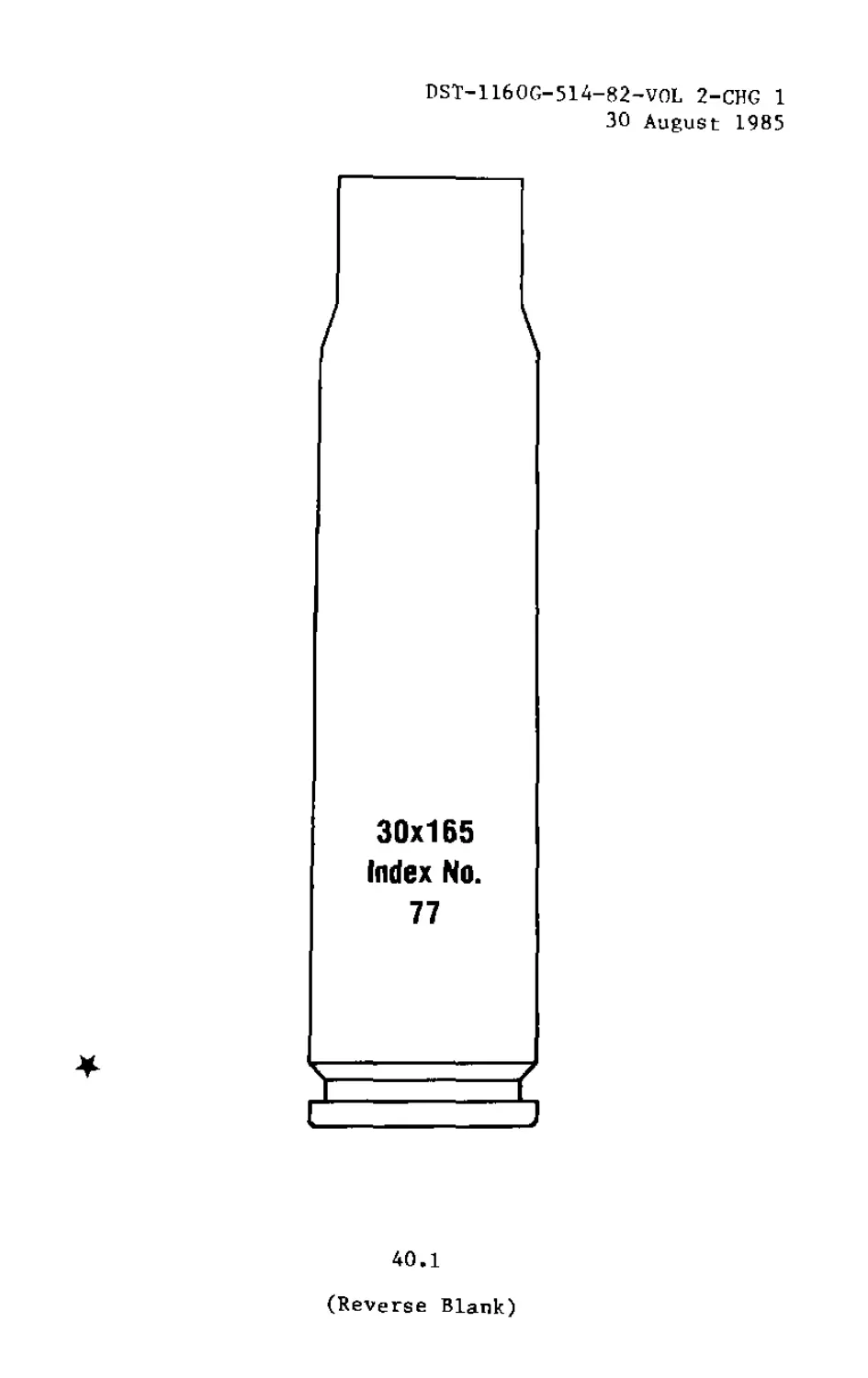
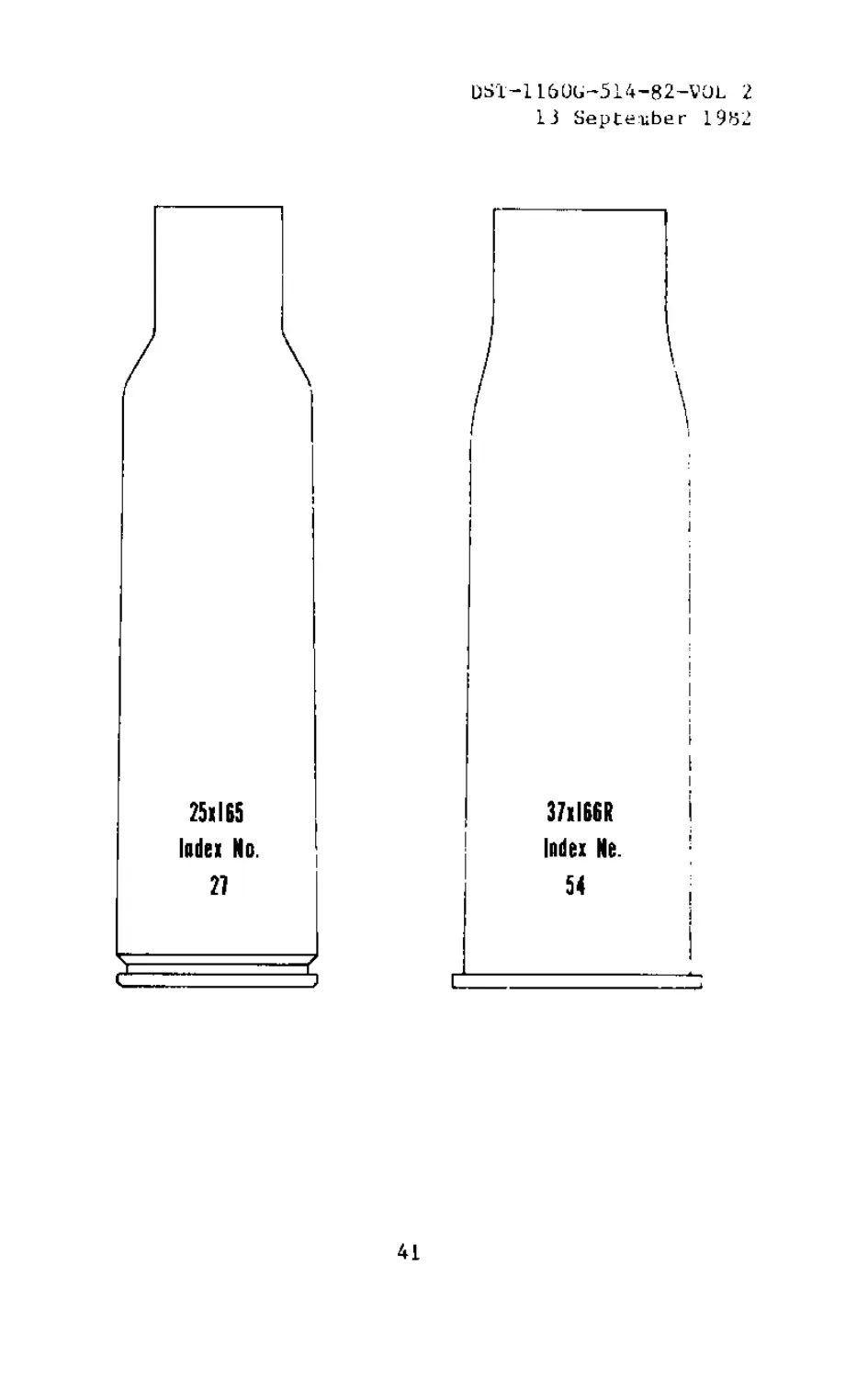
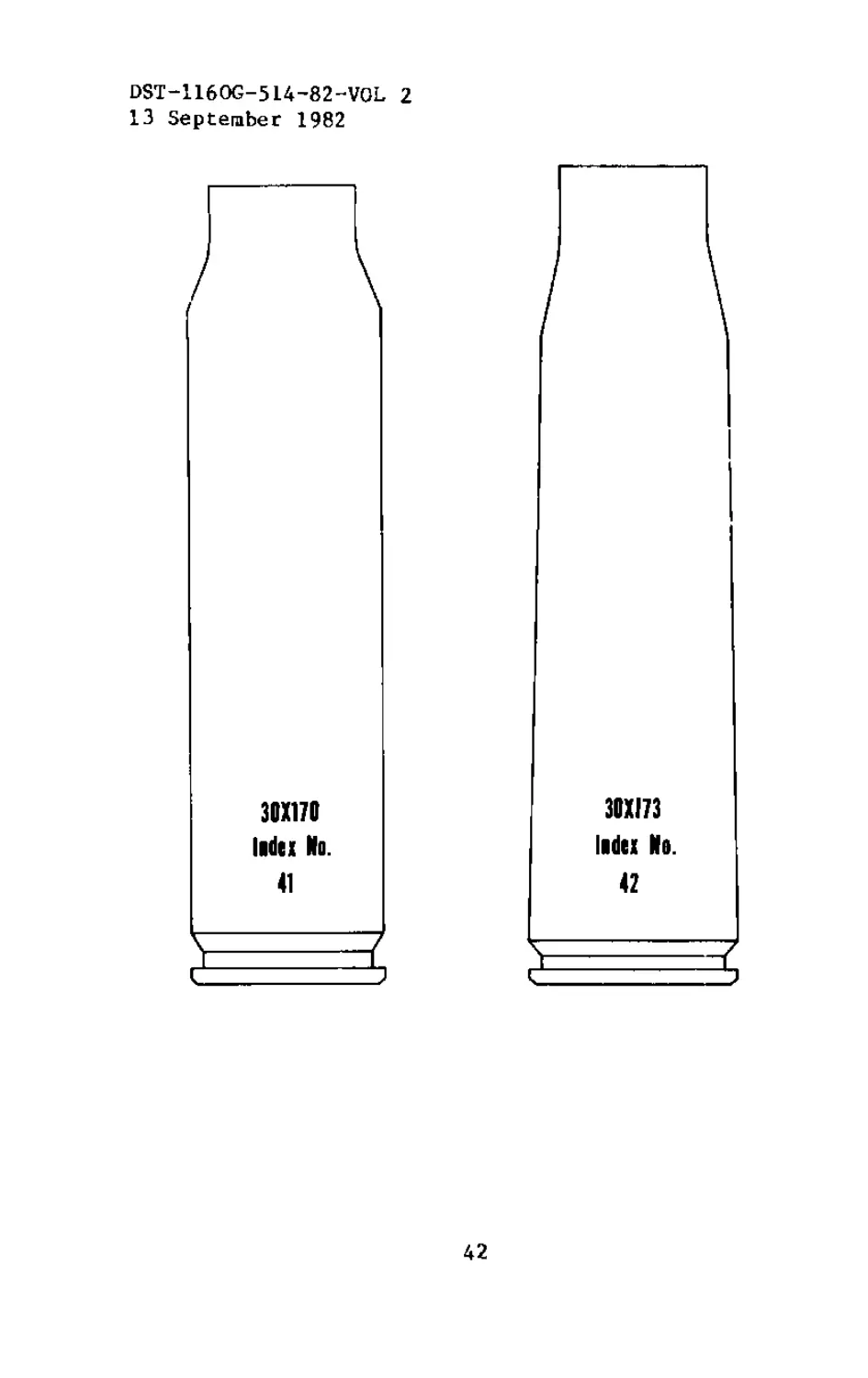
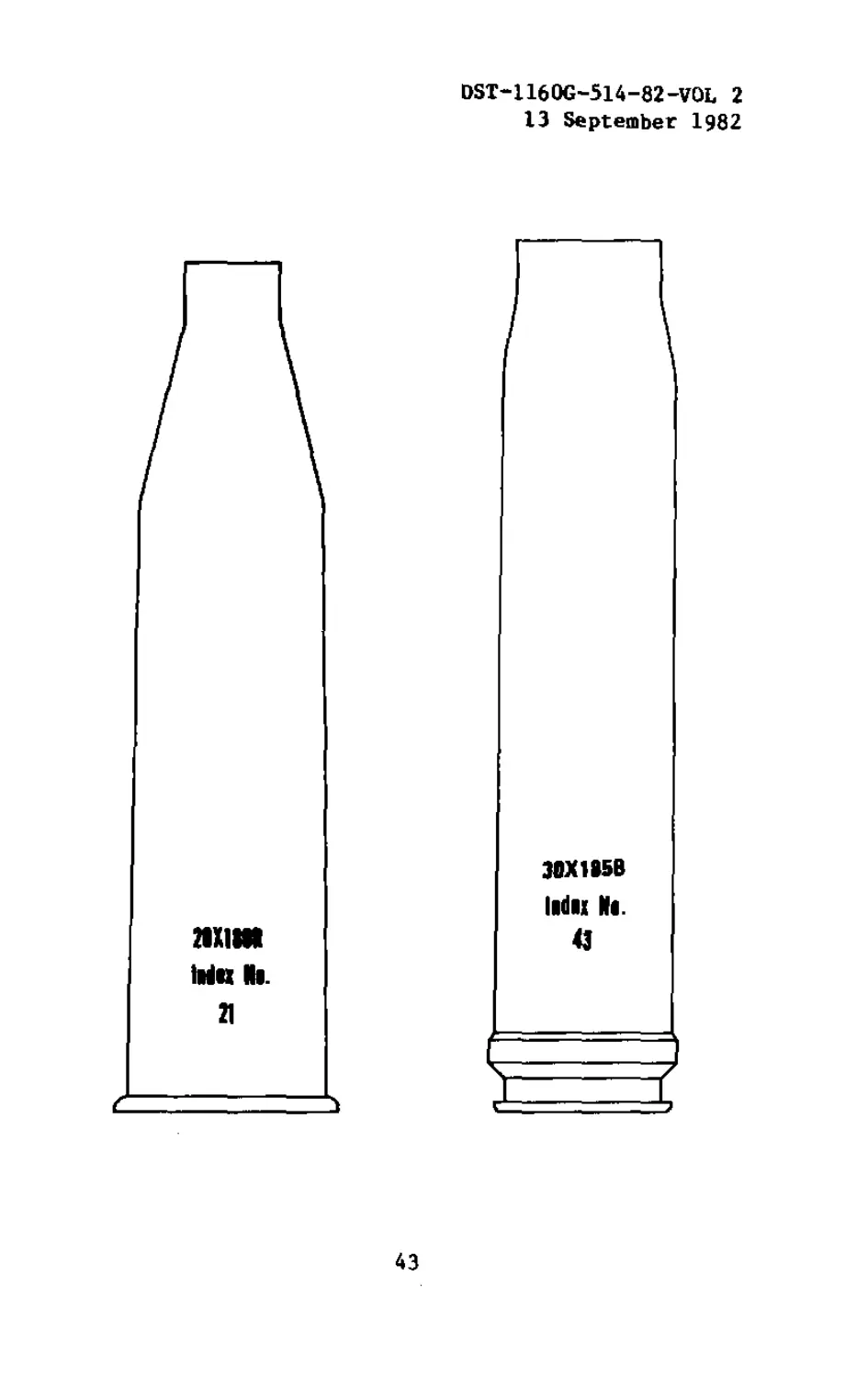
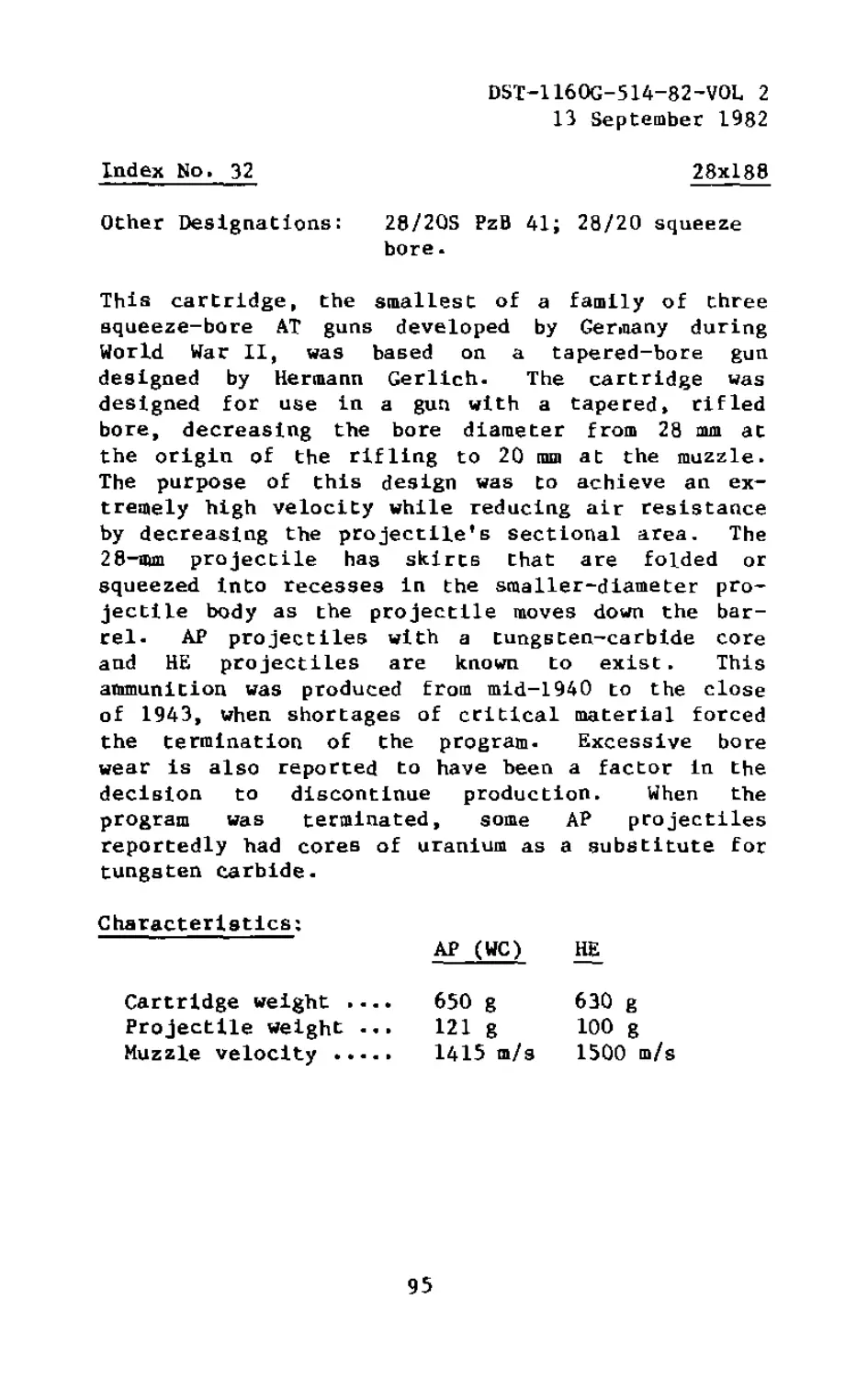
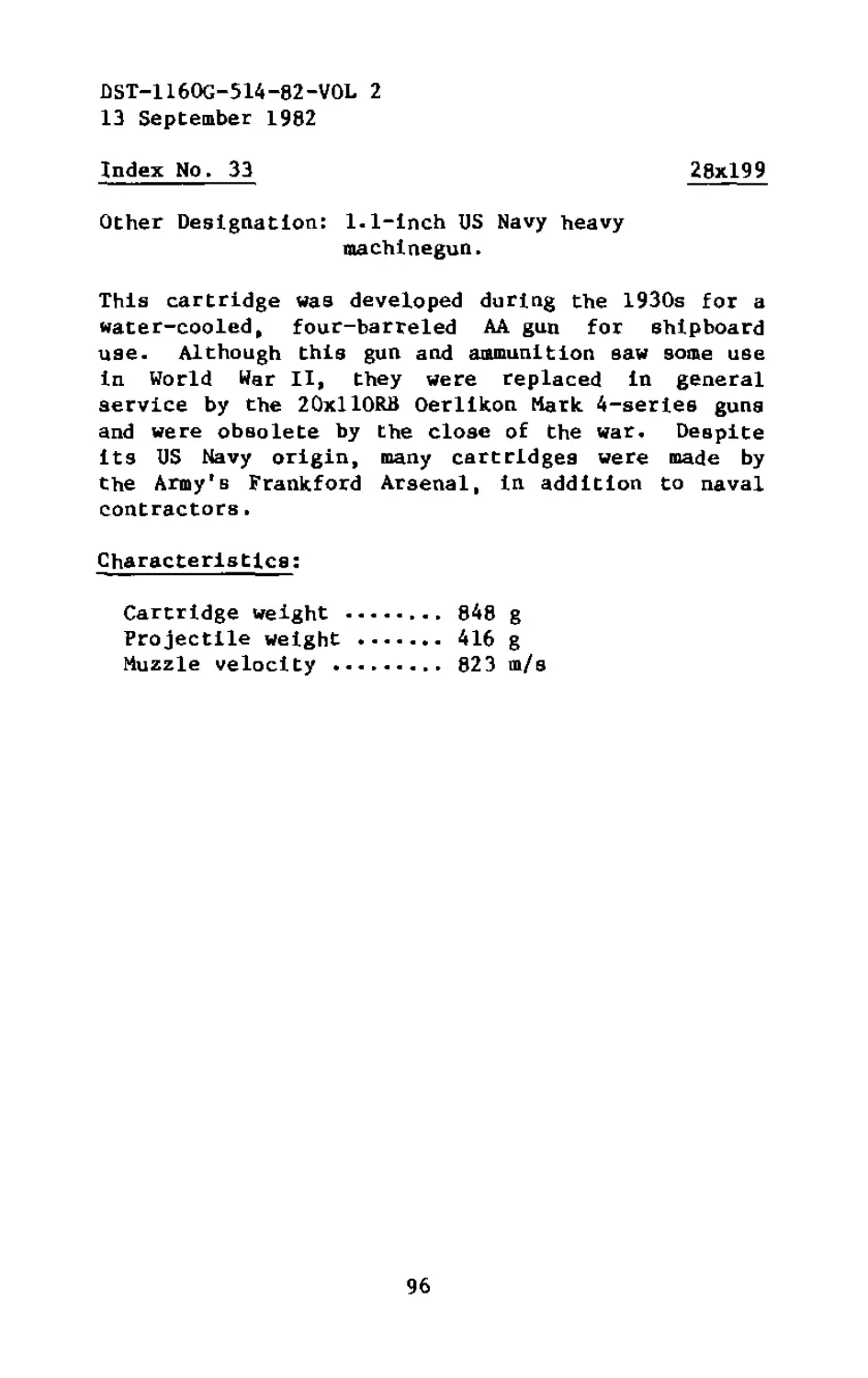
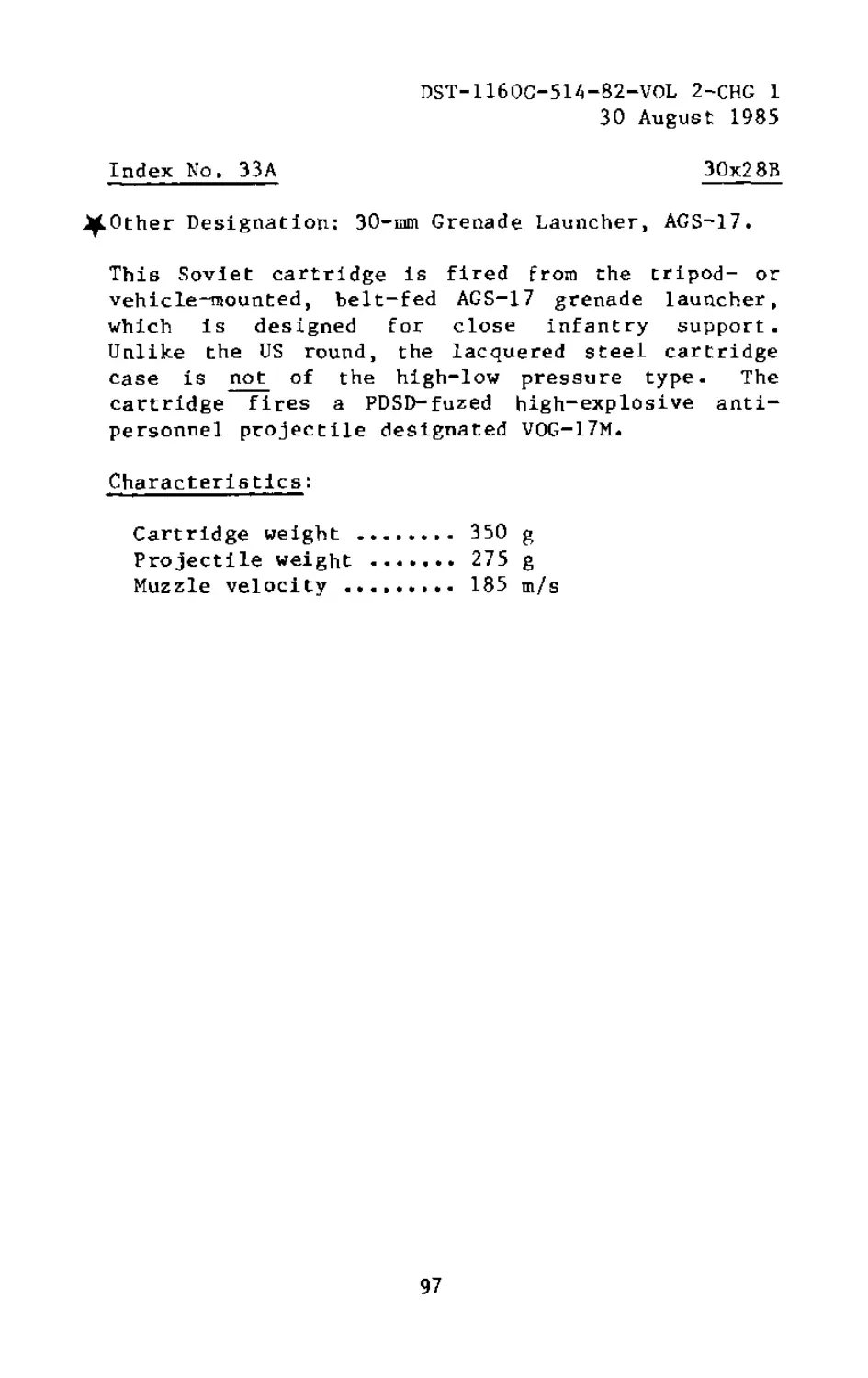
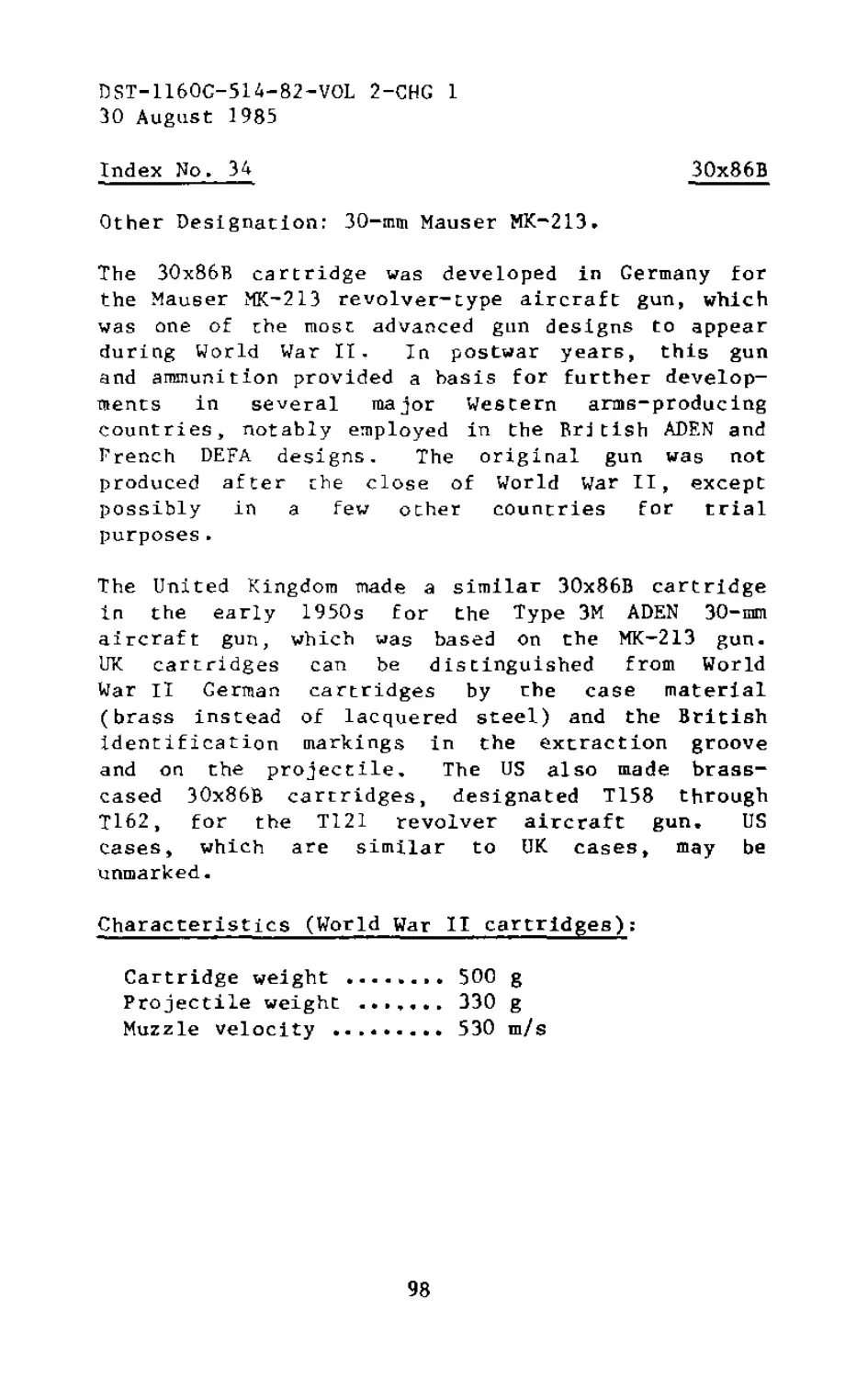
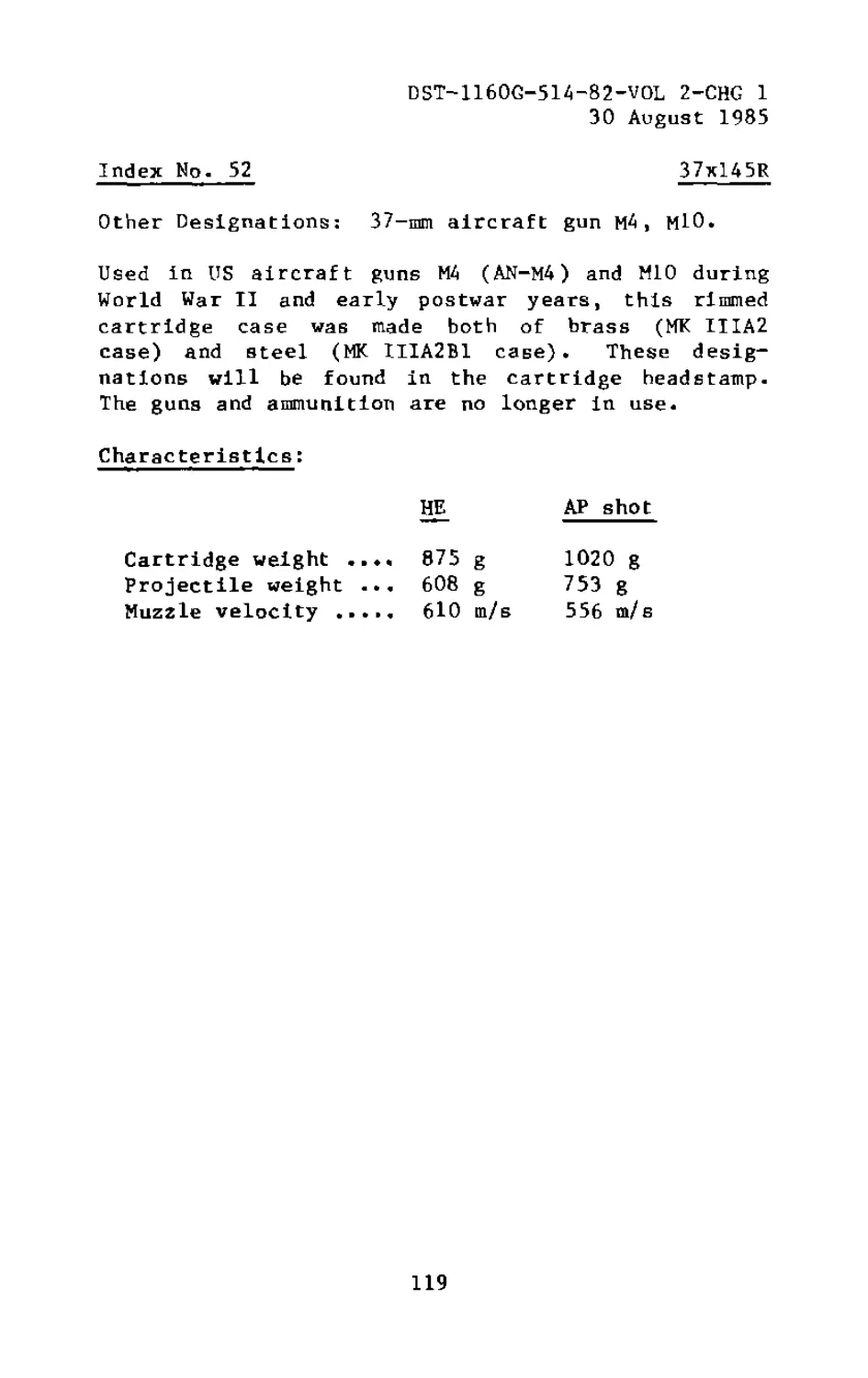
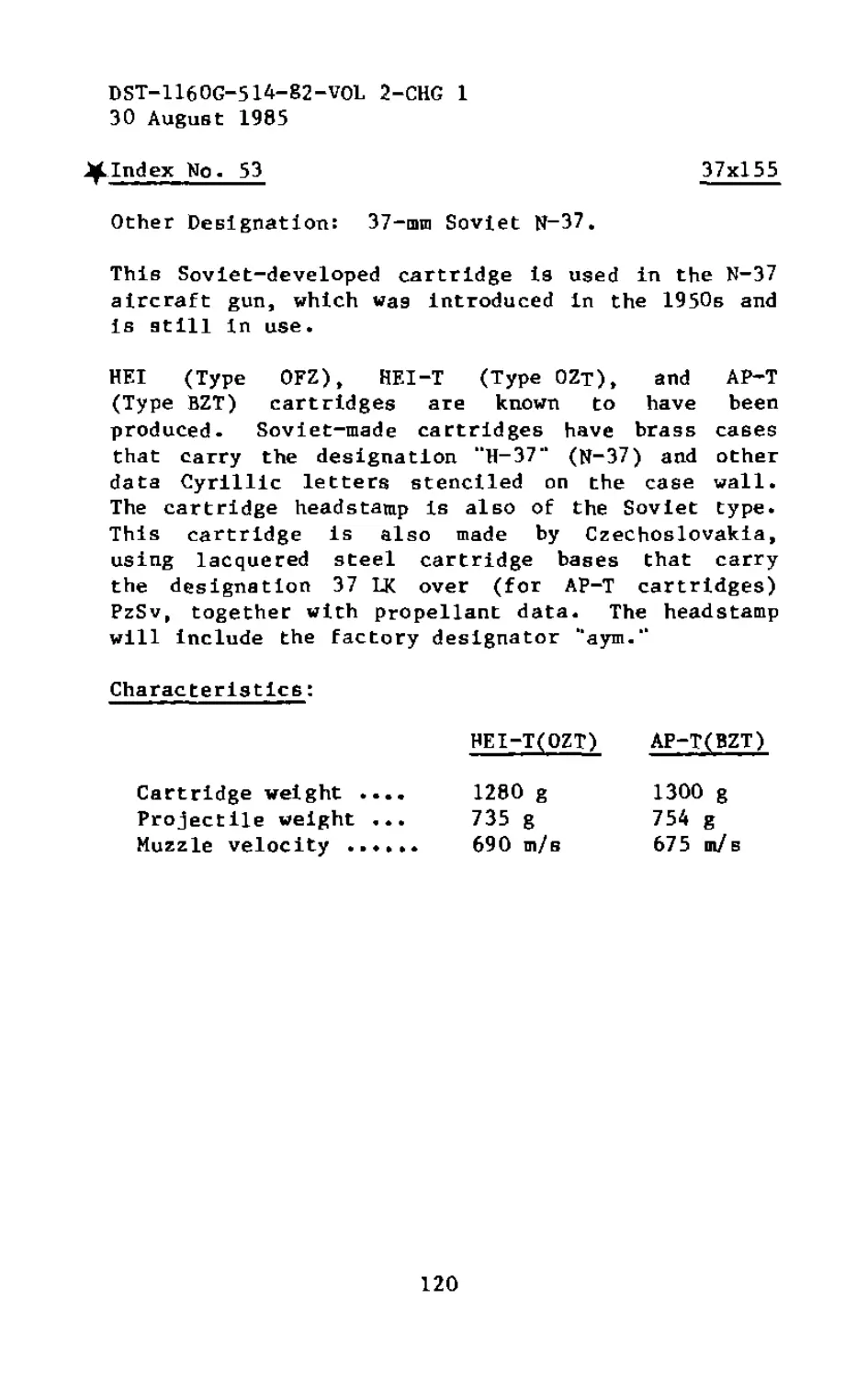
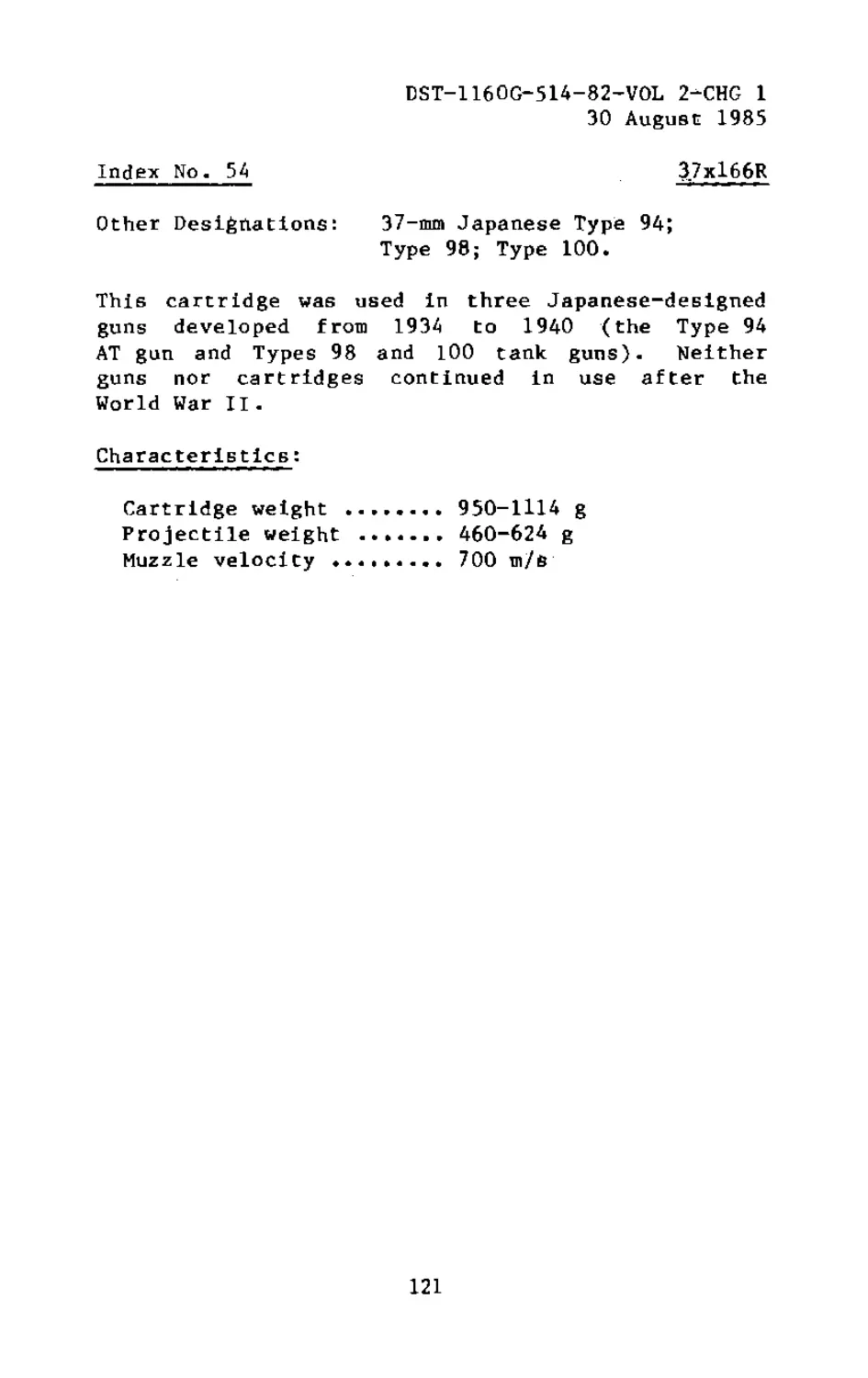
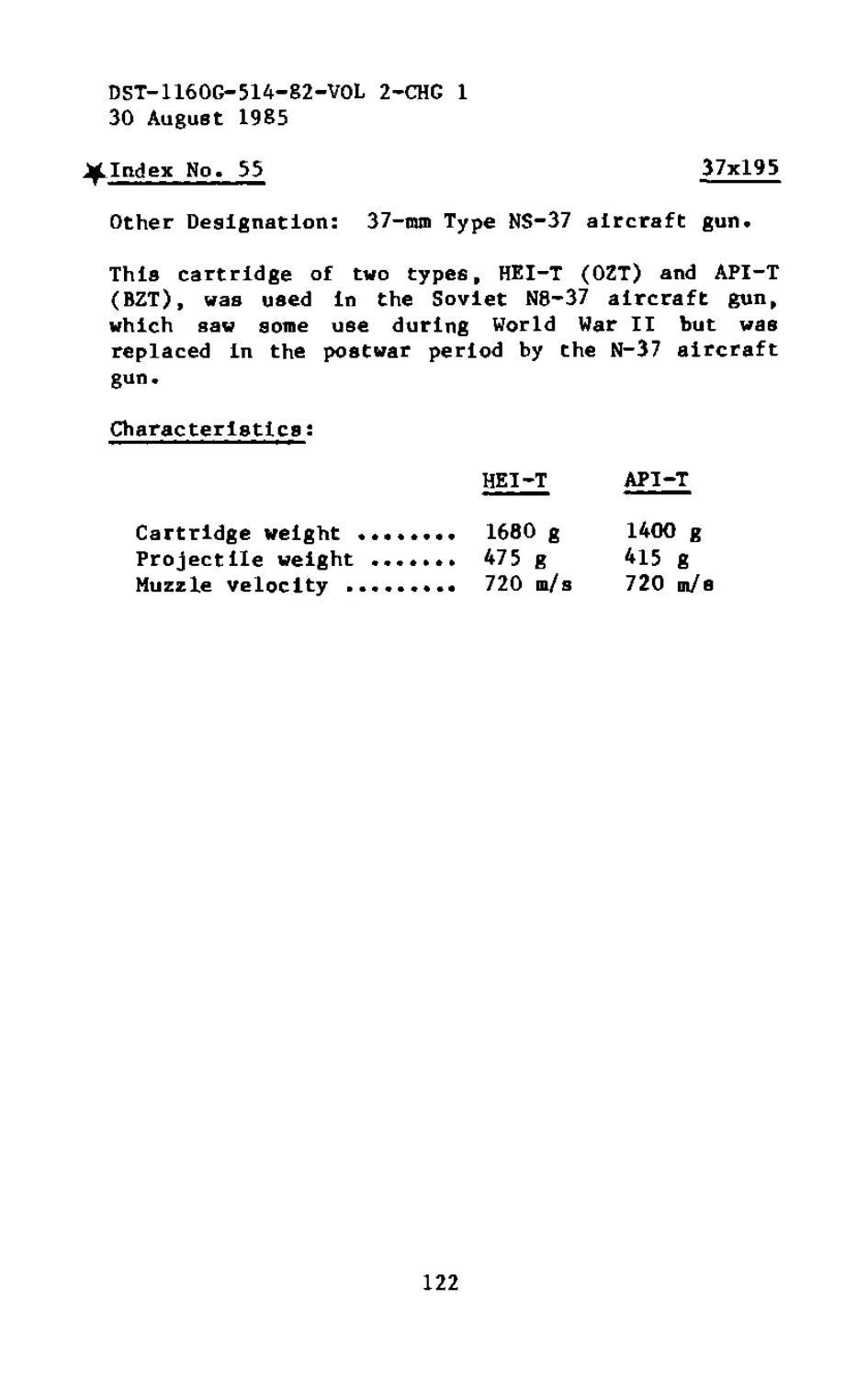
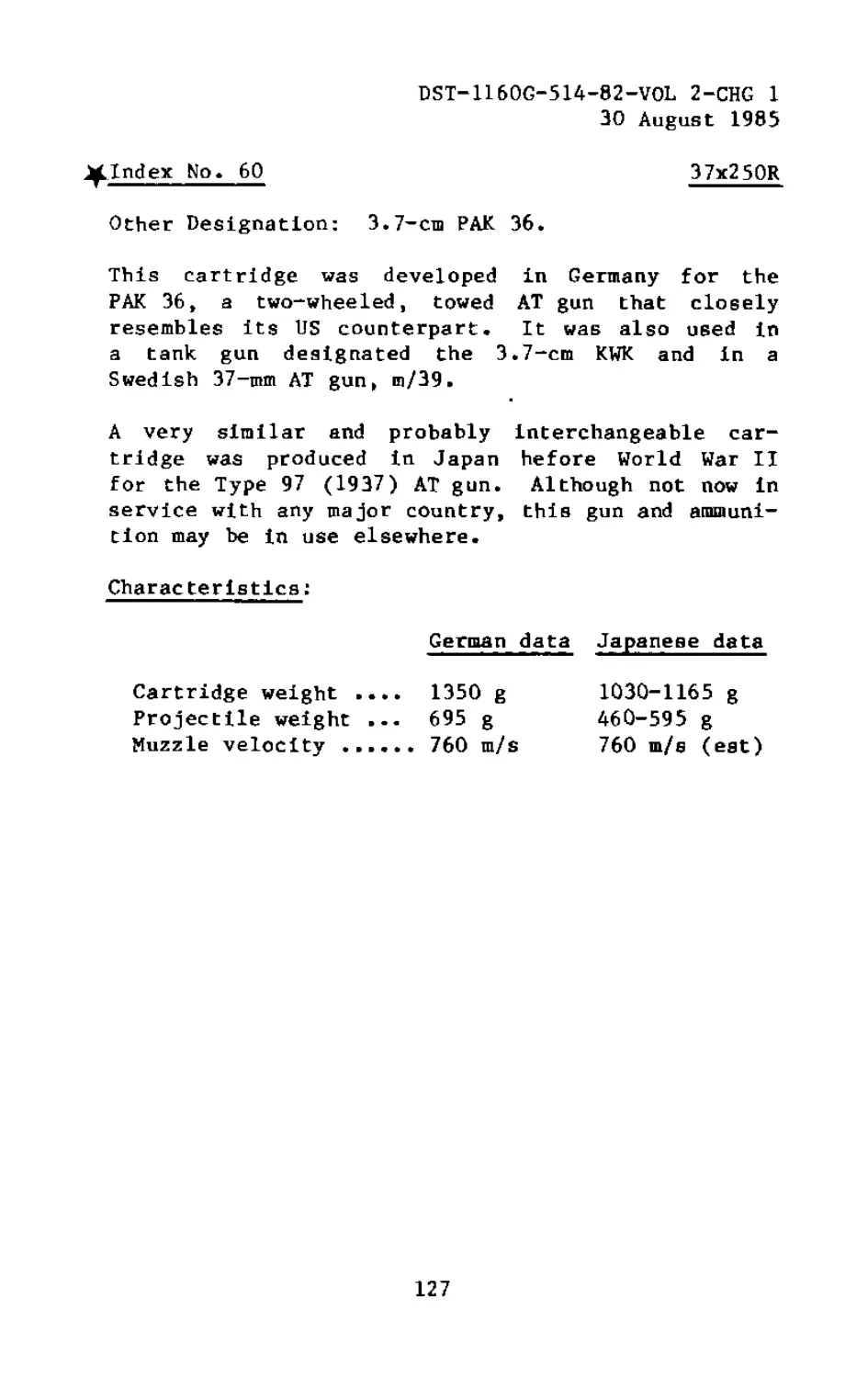
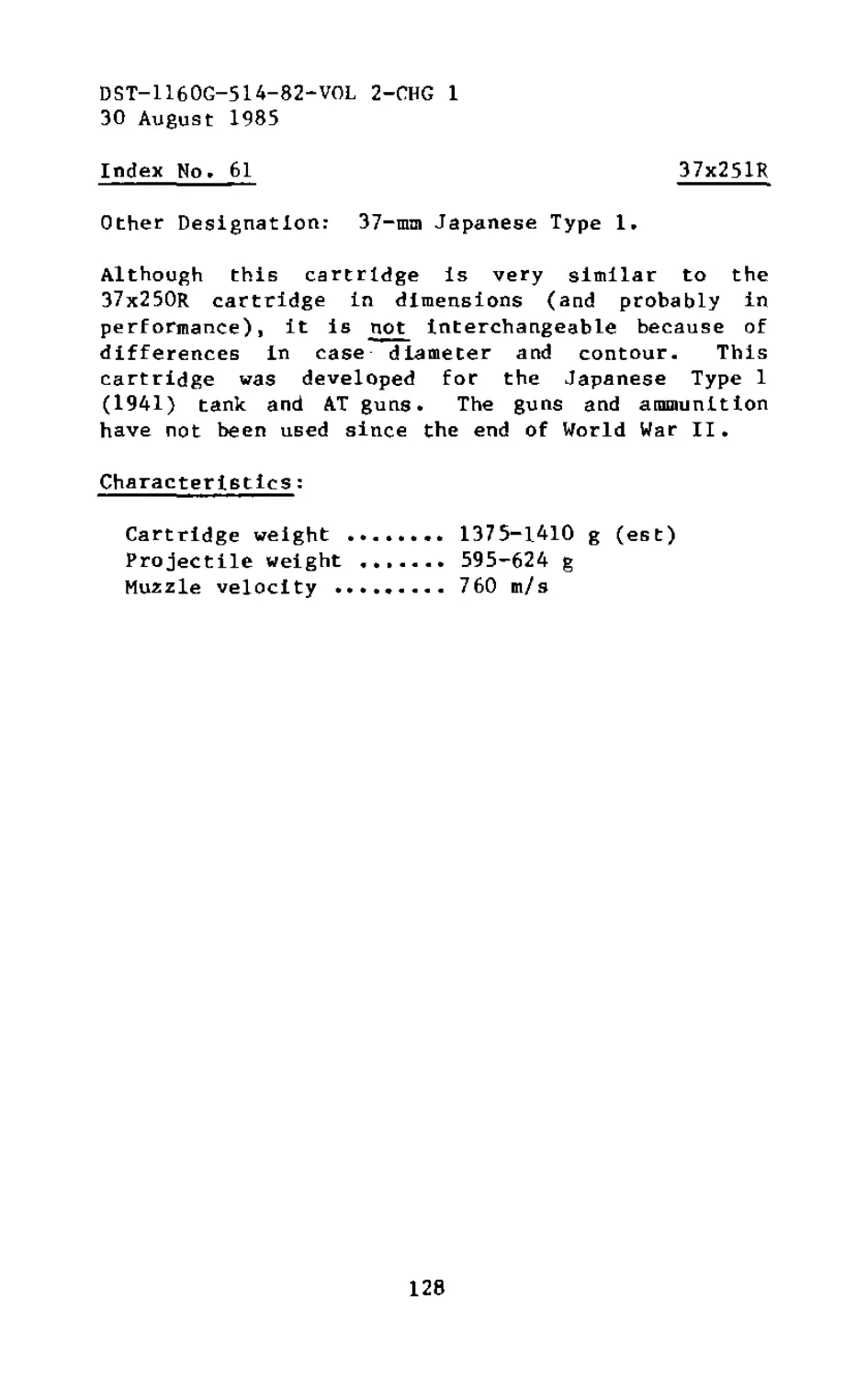
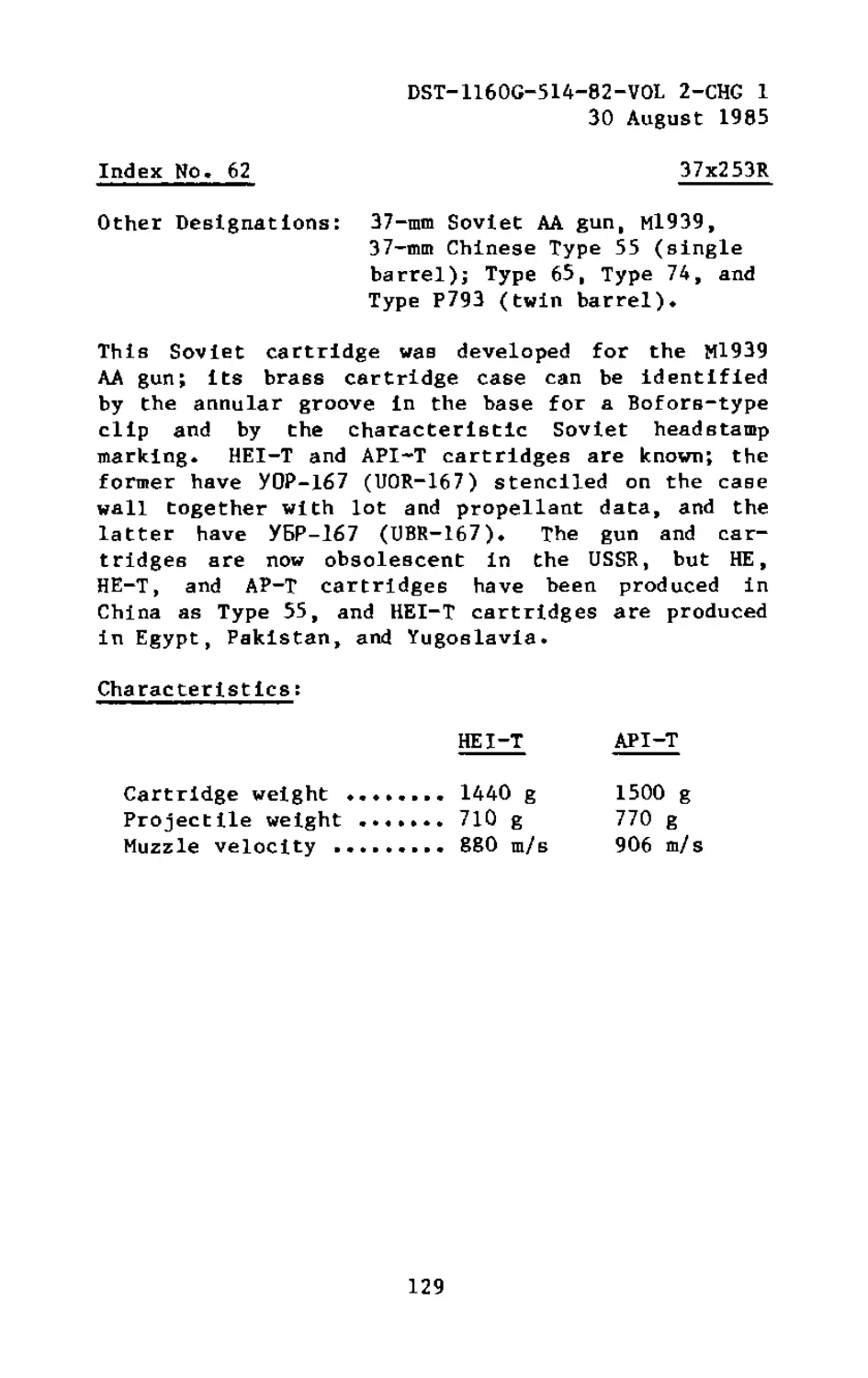
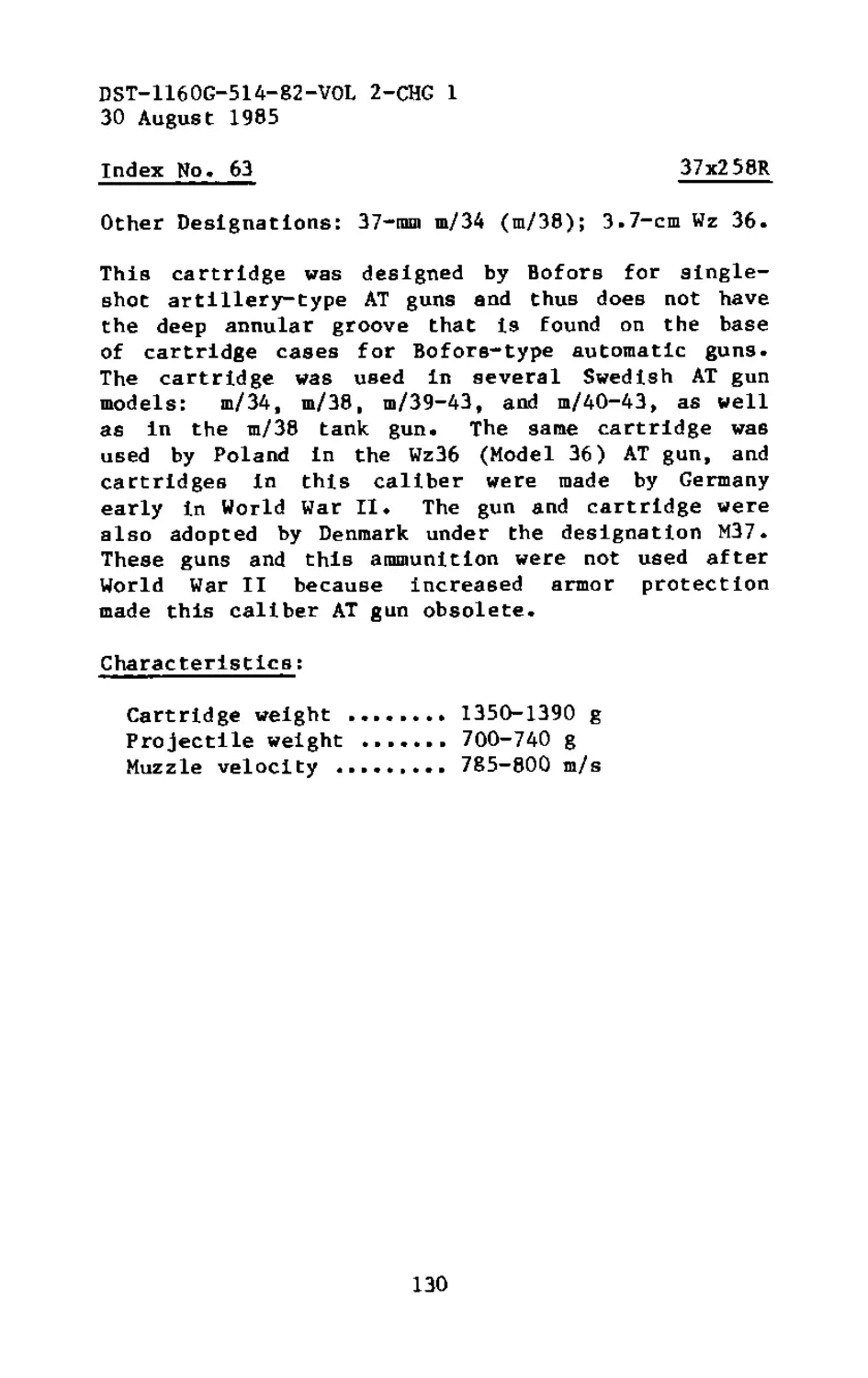
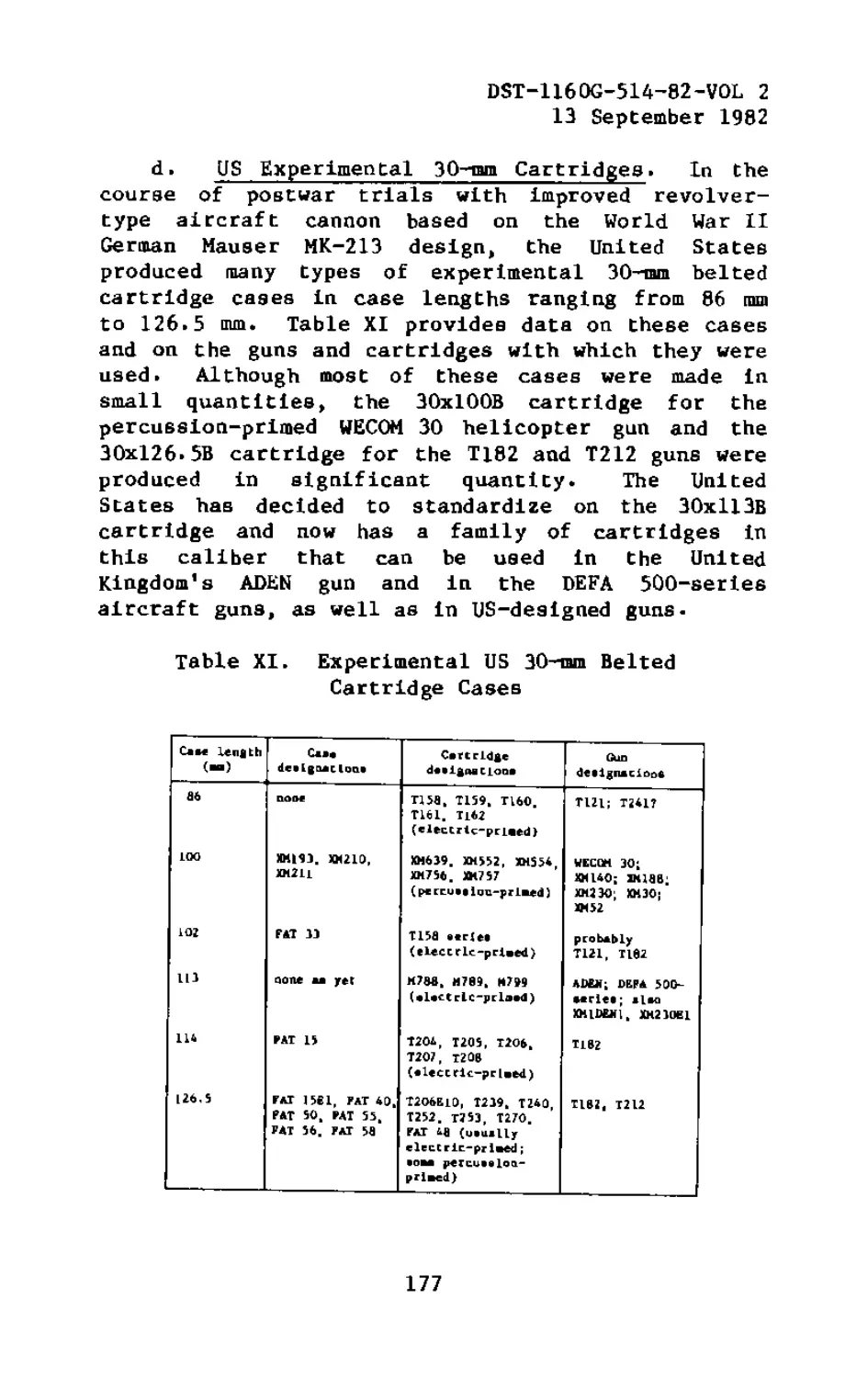
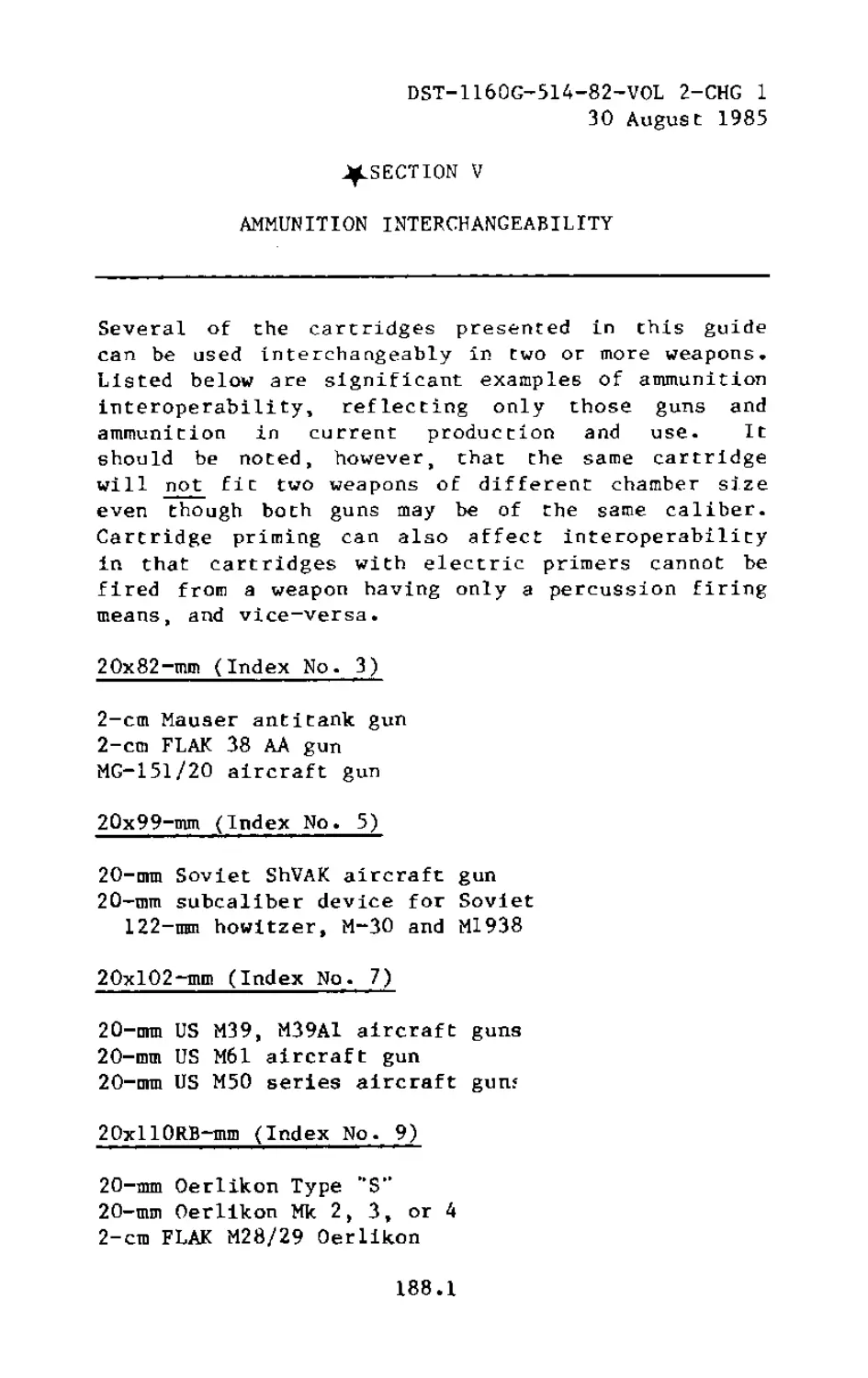
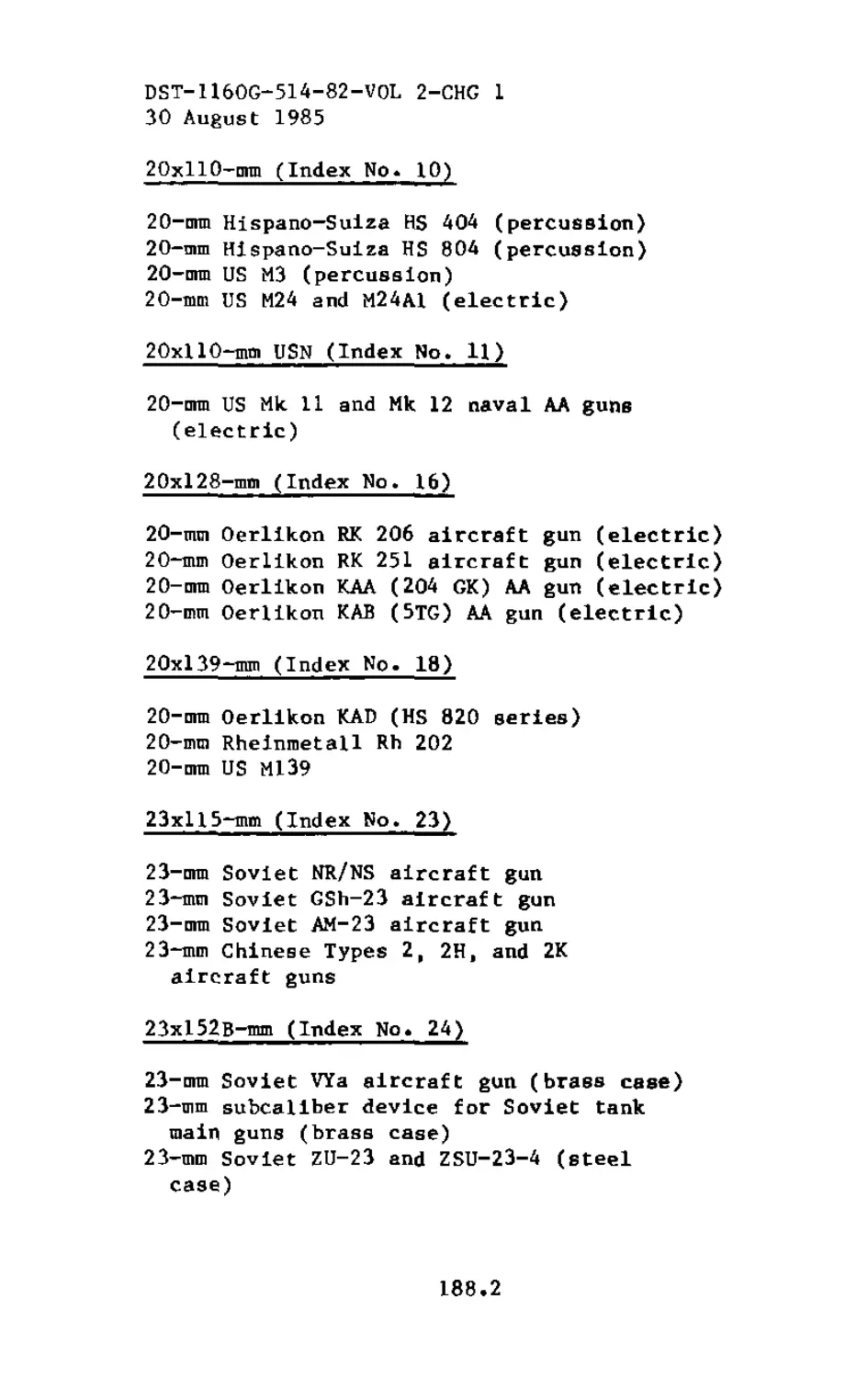
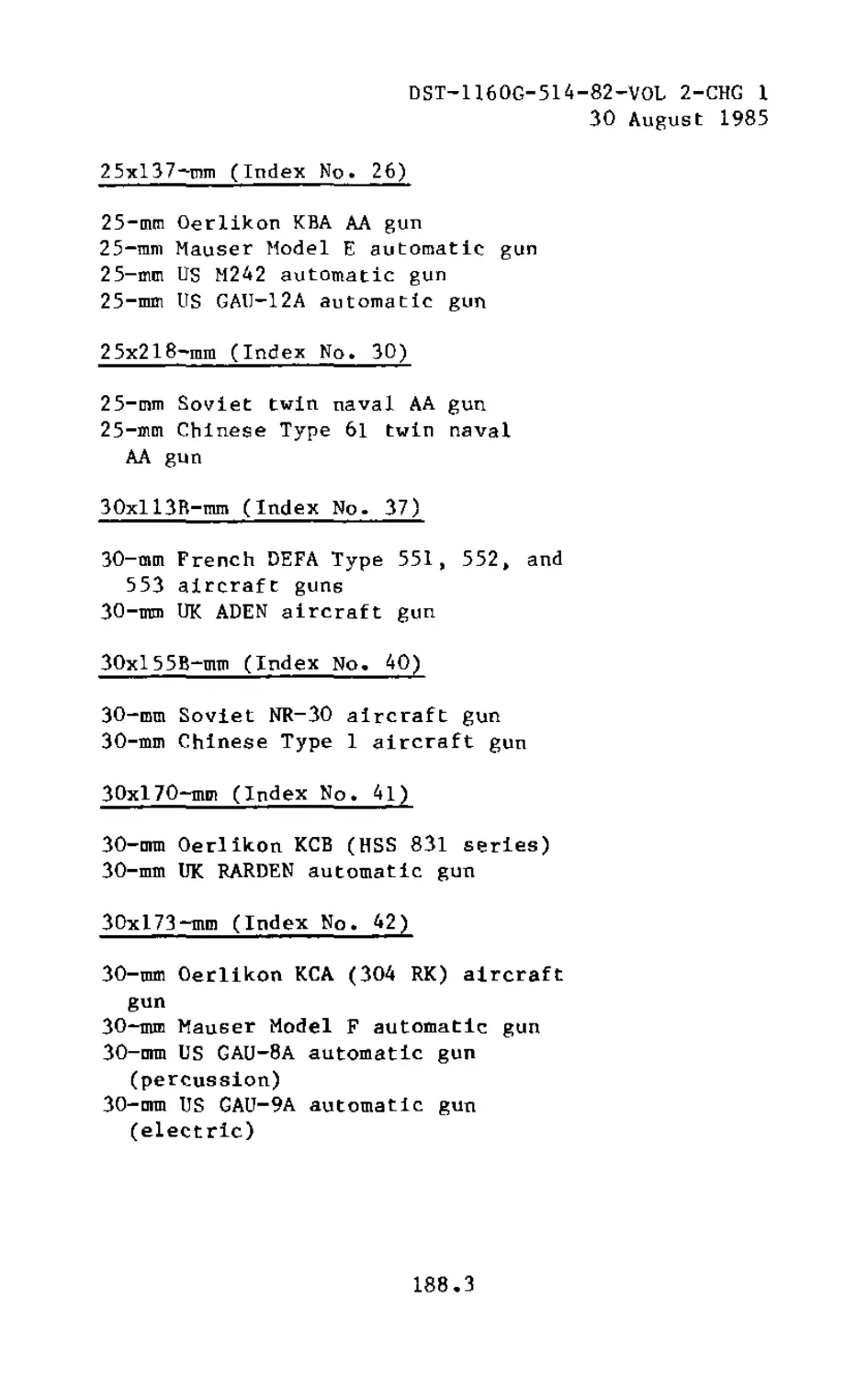
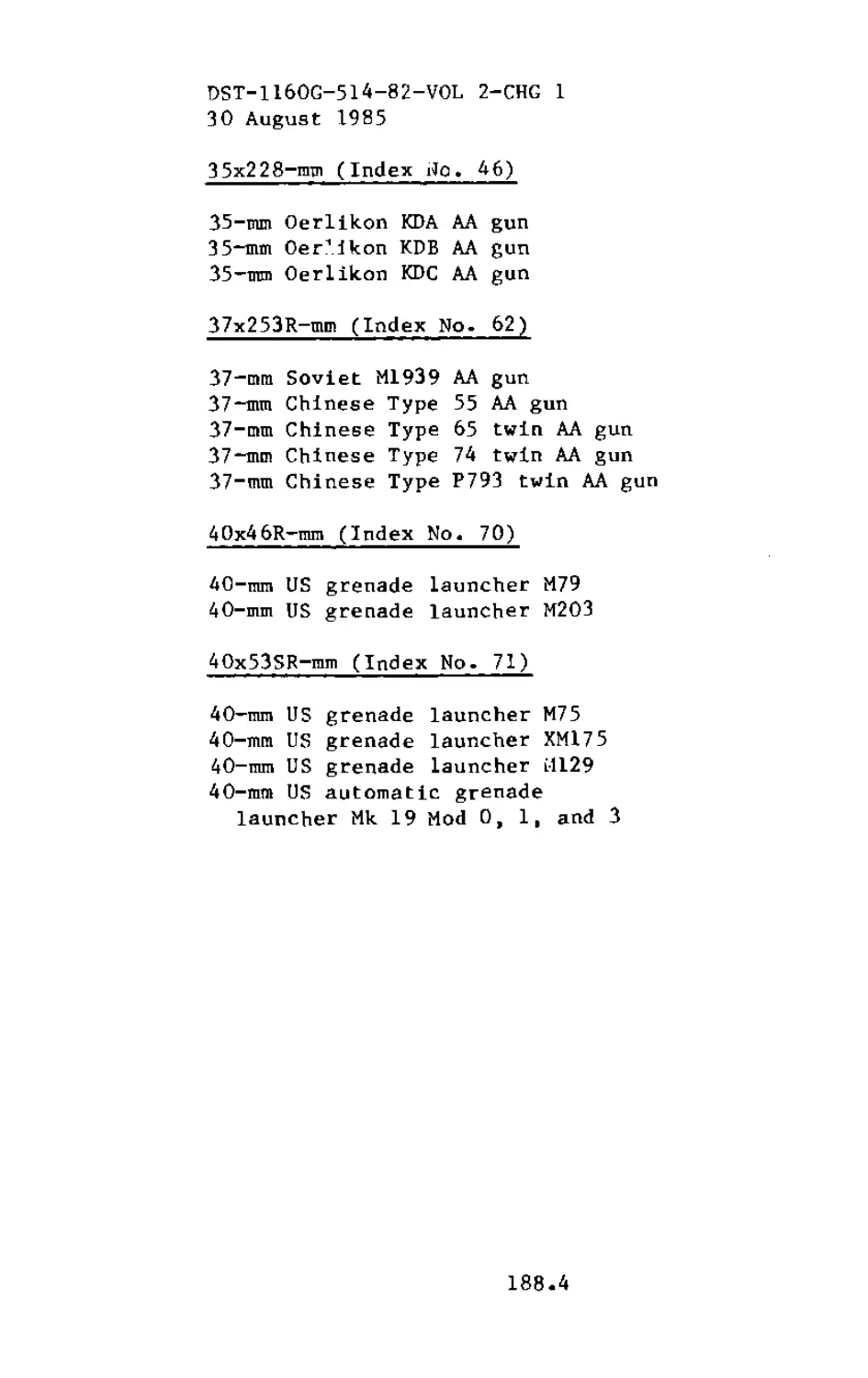
Теги: weapons
Год: 1985


Текст
                    DST-1160G-514-82 V0L 2
W/Chgl
DEFENSE
INTELLIGENCE
AGENCY
SMALL-CALIBER
AMMUNITION
IDENTIFICATION
GUIDE
VOLUME 2
20-mm TO 40-mm
CARTRIDGES
30 AUGUST 1985
APPROVED FOR PUBLIC RELEASE;
USrmUTlON UNLIMITED
SMALL-CALIBER AMMUNITION IDENTIFICATION GUIDE
Volume 2
20-mm to 40-mm Cartridges
AUTHOR
Albert Watson, III
DST—1160G—514-82-VOL 2-CHG 1
DIA TASK UNIT PT-1160-01-07L
DATE OF PUBLICATION
30 August 1985
Information Cutoff Date
1 April 1985
This document supersedes DST-116OG-514-78-VOL 2
dated December 1978
This Is a Department of Defense
Intelligence Document prepared
by the Foreign Science and Tech-
nology Center, US Army Intel-
ligence Agency, under the DOD
S&T intelligence production
program and approved by the
Assistant Chief of Staff for
Intelligence, US Army.
This document has been processed for CIRC.
APPROVED FOR PUBLIC RELEASE;
DISTRIBUTION UNLIMITED
(Reverse Blank)
Septaaber 1982
DST-llbOC-514’82’VOL 2
Saall-Callber Aaeunltlon Ide at If icatloa Guide
USER questionnaire
Thia queatlonuaira Lb a device for enhancing the uaefulneaa of future updatea
of thia guide. Pleaae enewer the fallowing queatlone, fold end ataple the
questionnaire, and мН 1c to the addraee ahown on the reverse aide.
Reaponaea to thia queationuaira will atrougly influence future publlcationa«
Written сонма t a euggeetlng change a and acting aignlf leant ertora are greatly
apprec1atcd-
l« Frequency of Use:
Very Frequently	Frequently	Occaalonally			Infrequently
□		□	□	□
1. Type of U.e:
Genare1	Tralnlng	Baaearch and	Operation.	Other
Inf о rut 1 OU		DavelopMut
□	□	□	□	□
3- Doea the document	aatiafy	your naeda, .pacifically concerning:
	YES	NO	COMMENTS
Fo rut	□	□ 		—
Subject Coverage	□	□
Degree of Detail	□	□ 		..... —
11Luetratlona	□	□ 		.......
	□	□
4. GENERAL COMMENTS:
Print Na*e
Poaition
Organisation
MICHI MUM
PMMTYBMwvAra им iMO
Him
№*T1« UAFUJ»*O
Nltirmrr Of IM **n
DOO-|i«
Ccwaoder
US Any Foreign Science end Technology Center
220 7ch Street, HE
Cherlocteivllle, VA 22901
ЛТТЫ: DRXST-PO
DST—116OG-514-82-VOL 2-CHG 1
30 August 1985
US ARMY INTELLIGENCE
AGENCY
Publication No.	FOREIGN SCIENCE AND
DST-116OG-514-82—VOL 2	TECHNOLOGY CENTER
Change 1	Charlottesville, VA 22901-5396
SMALL-CALIBER AMMUNITION IDENTIFICATION GUIDE
VOLUME 2:	20-nm to 40-nm CARTRIDGES
Publication No. DST-116OG-514-82-VOL 2, published
on 13 September 1982, is amended as follows: The
pages listed below are to be removed and destroyed
in accordance with existing security regulations,
and new pages are substituted or added.
Remove pages:	Insert new pages:
Front cover	Front cover
Title page	Title page
ill thru v (Reverse	iii thru vi
Blank)
ix and x	ix and x
5 thru 8	5 thru 8
— —	40.1 (Reverse Blank)
	44.1 (Reverse Blank)
57 and 58	57 and 58
69 thru 76	69 thru 76
79 thru 82	79 thru 82
85 thru 94	85 thru 94
97 and 98	97 and 98
101 and 102	101 and 102
105 thru 112	105 thru 112
119 thru 122	119 thru 122
127 thru 130	127 thru 130
141 thru 143 (Reverse	141 thru 144.1
Blank)	(Reverse Blank)
179 thru 184	179 thru 184
——	188.1 thru 188.4
193 thru 195 (Reverse	193 thru 195 (Reverse
Blank)	Blank)
APPROVED FOR PUBLIC RELEASE;
DISTRIBUTION UNLIMITED
(Reverse Blank)
DST-1160G-514-82-V0L 2-CHG 1
30 August 1985
PREFACE
This guide, Volume 2 of a two—volume series,
supplements Volume 1, which provides identification
procedures for small-arms cartridges of 15-mm
caliber and below. Volume 2 is designed to assist
the reader in identifying military cartridges in
calibers from 20 mm to 40 mm as co cartridge
designation, country, and weapon(s) for which the
cartridges are intended. Like Volume 1, it
provides persons without a technical background in
ammunition basic information on cartridge types,
construction, and terminology, as well as more
detailed identification data on each cartridge.
Additional information on these cartridges can be
found in various exploitation reports on individual
rounds. A consolidated listing of these
exploitation reports is provided in the appendix;
future editions of this volume will include
pertinent data from exploitation reports of 20- co
40-mm cartridges.
Coverage of this volume is limited to car-
tridges in the 20- to 40-mm caliber range made
since 1930 and designed for military use; this
excludes shotgun cartridges, riot-control car-
tridges , and signal cartridges, and, with few
exceptions, subcaliber cartridges. Also excluded,
because of their age and limited use, are several
types of 26-mm cartridges developed during World
War II by Germany for use in the 26-mm
Kampfpistole, a rifled weapon that was developed
from the signal pistol.
The information contained in this guide has
been derived from a variety of sources: Examina-
tion of cartridges, intelligence and explosive
ordnance disposal reports, US and foreign technical
publications, and contributions by knowledgeable
individuals.
Change 1 has been incorporated
into this volume.
An asterisk (*) associated with any paragraph,
iii
DST-1160G-514-82-VOL 2-CHG 1
30 August 1985
illustration, or table indicates new or revised
information in change 1.
Most illustrations appearing in this document
are identified by a six-digit negative number
printed in the lower left corner of the figure.
Users can request prints of these illustrations by
citing the negative numbers and the short title of
this publication in a request addressed to the
Connander, US Army Foreign Science and Technology
Center, 220 Seventh Street, NE., Charlottesville,
VA 22901-5396 (ATTN: AIAST-PO).
Constructive criticisms, comments, and sug-
gested changes are encouraged and should be
forwarded to the Commander, US Army Foreign Science
and Technology Center at the above address*
iv
OST-116OG-514-82-VOL 2-CHG 1
30 August 1985
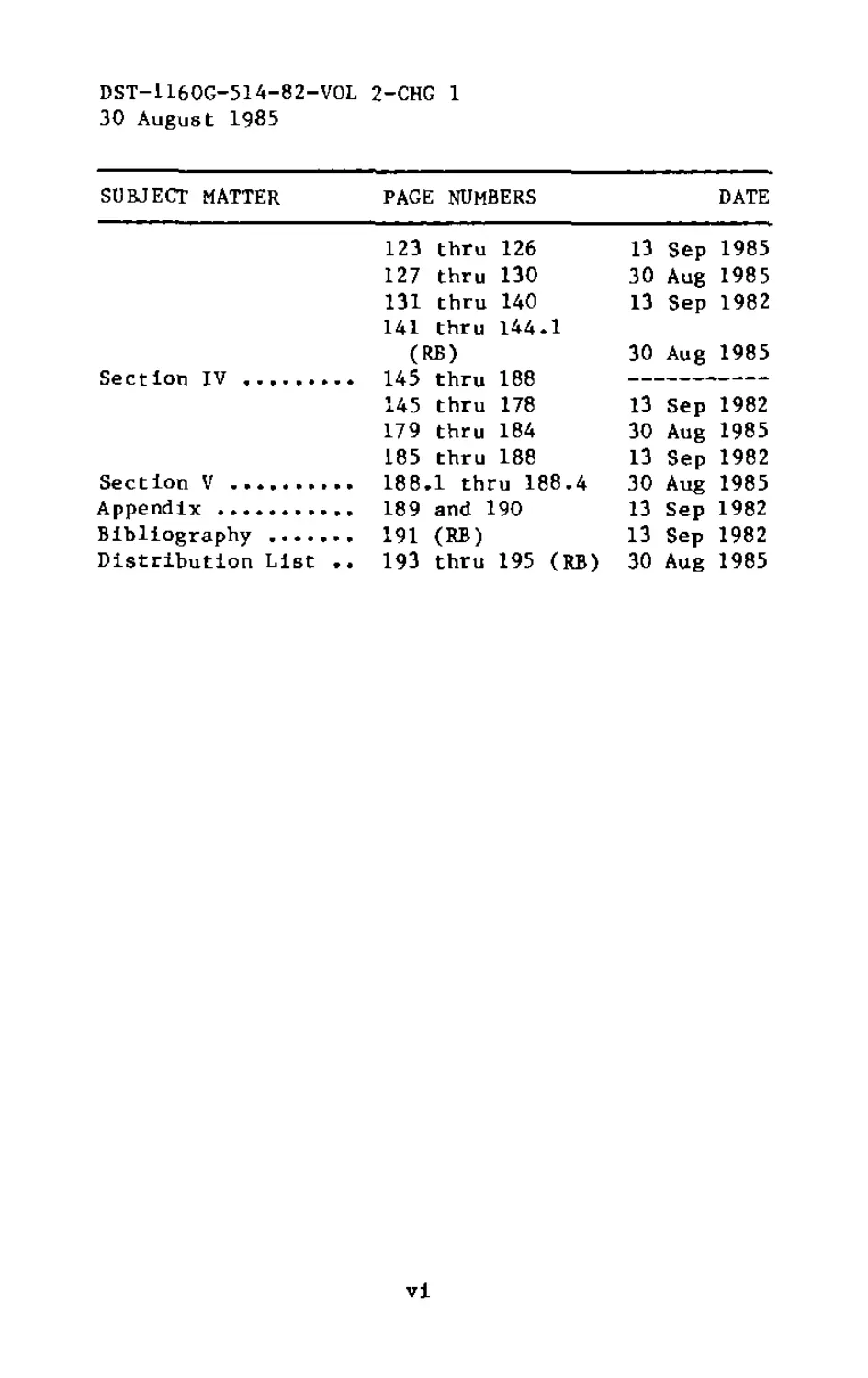
LIST OF EFFECTIVE PAGES
SUBJECT MATTER	PAGE NUMBERS	DATE
Title Page 		None	30 Aug 1985
Preface 		iii and iv	30 Aug 1985
List of Effective
Pages 		v and vi	30 Aug 1985
Record of Changes ..	vii (RB)	13 Sep 1982
Table of Contents ..	lx and x	30 Aug 1985
List of Ulus-
trations 		xi	13 Sep 1982
List of Tables	xii	13 Sep 1982
Sect ion I 		1 thru 15 (RB) 1 thru 4 5 thru 8 9 thru 15 (RB)	13 Sep 1982 30 Aug 1985 13 Sep 1982
Section II 		17 thru 21 (RB)	13 Sep 1982
Section III 		23 thru 144 23 thru 40 40.1 (RB) 41 thru 44 44.1 (RB) 45 thru 56 57 and 58 59 thru 68 69 and 70 70.1 (RB) 71 thru 76 77 and 78 79 thru 82 83 and 84 85 thru 94 95 and 96 97 and 98 99 and 100 101 and 102 103 and 104 105 thru 112 113 thru 118 119 thru 122	13 Sep 1982 30 Aug 1985 13 Sep 1982 30 Aug 1985 13 Sep 1982 30 Aug 1985 13 Sep 1982 30 Aug 1985 13 Sep 1982 30 Aug 1985 13 Sep 1982 30 Aug 1985 13 Sep 1982 30 Aug 1985 13 Sep 1982 30 Aug 1985 13 Sep 1982 30 Aug 1985 13 Sep 1982 30 Aug 1985 13 Sep 1982 30 Aug 1985
v
DST-116OG-514-82-VOL 2-CHG 1
30 August 1985
SUBJECT MATTER
PAGE NUMBERS
DATE
	123	thru	126		13	Sep	1985
	127	thru	130		30	Aug	1985
	131	thru	140		13	Sep	1982
	141	thru	144.	.1
	(RB)				30	Aug	1985
	IAS	thru thru	188 178
	145				13	Sep	1982
	179	thru	184		30	Aug	1985
	185	thru	188		13	Sep	1982
Section V ...		188. 189	.1 thru 1RR.A			30 13	Aug Sep	1985 1982
Appendix 			and 190
Bibliography .......	191	(RB)			13	Sep	1982
Distribution List ..	193	thru	195	(RB)	30	Aug	1985
vi
DST-1160G—514-82-VOL 2
13 September 1982
RECORD OF CHANGES
CHANGE NUMBER	DATE OF CHANGE	DATE ENTERED	SIGNATURE, RANK/RATE AND ORGANIZATION OF INDIVIDUAL ENTERING change

vii
(Reverse Blank)
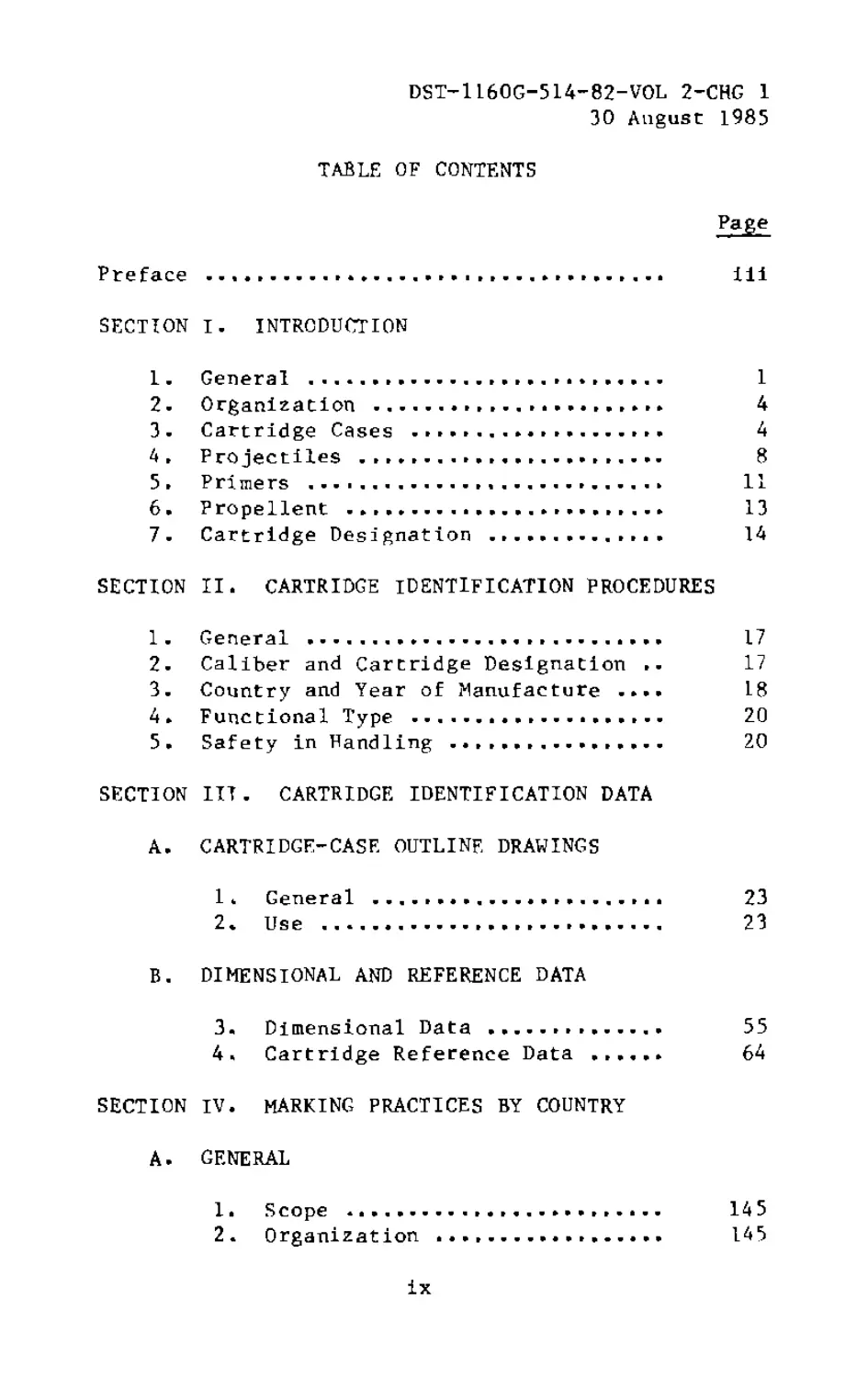
DST-116OG-514-82-VOL 2-CHG 1
30 August 1985
TABLE OF CONTENTS
Page
Preface ........................................ ill
SECTION I.	INTRODUCTION
1.	General .................................. 1
2.	Organization ............................. 4
3.	Cartridge Cases .......................... 4
4.	Projectiles .............................. 8
5.	Primers ................................. 11
6.	Propellent .............................. 13
7.	Cartridge Designation ................... 14
SECTION	II.	CARTRIDGE IDENTIFICATION	PROCEDURES
1.	General ................................. 17
2.	Caliber and Cartridge Designation	..	17
3.	Country and Year of Manufacture	....	18
4.	Functional Type ......................... 20
5.	Safety in Handling ...................... 20
SECTION	III.	CARTRIDGE IDENTIFICATION DATA
A.	CARTRIDGE-CASE OUTLINE DRAWINGS
1	.	General ............................ 23
2	.	Use ................................ 23
B.	DIMENSIONAL AND REFERENCE DATA
3.	Dimensional Data ................... 55
4.	Cartridge Reference Data	...... 64
SECTION	IV.	MARKING PRACTICES BY COUNTRY
A.	GENERAL
1.	Scope ......................... 14 5
2.	Organization ...................... 145
ix
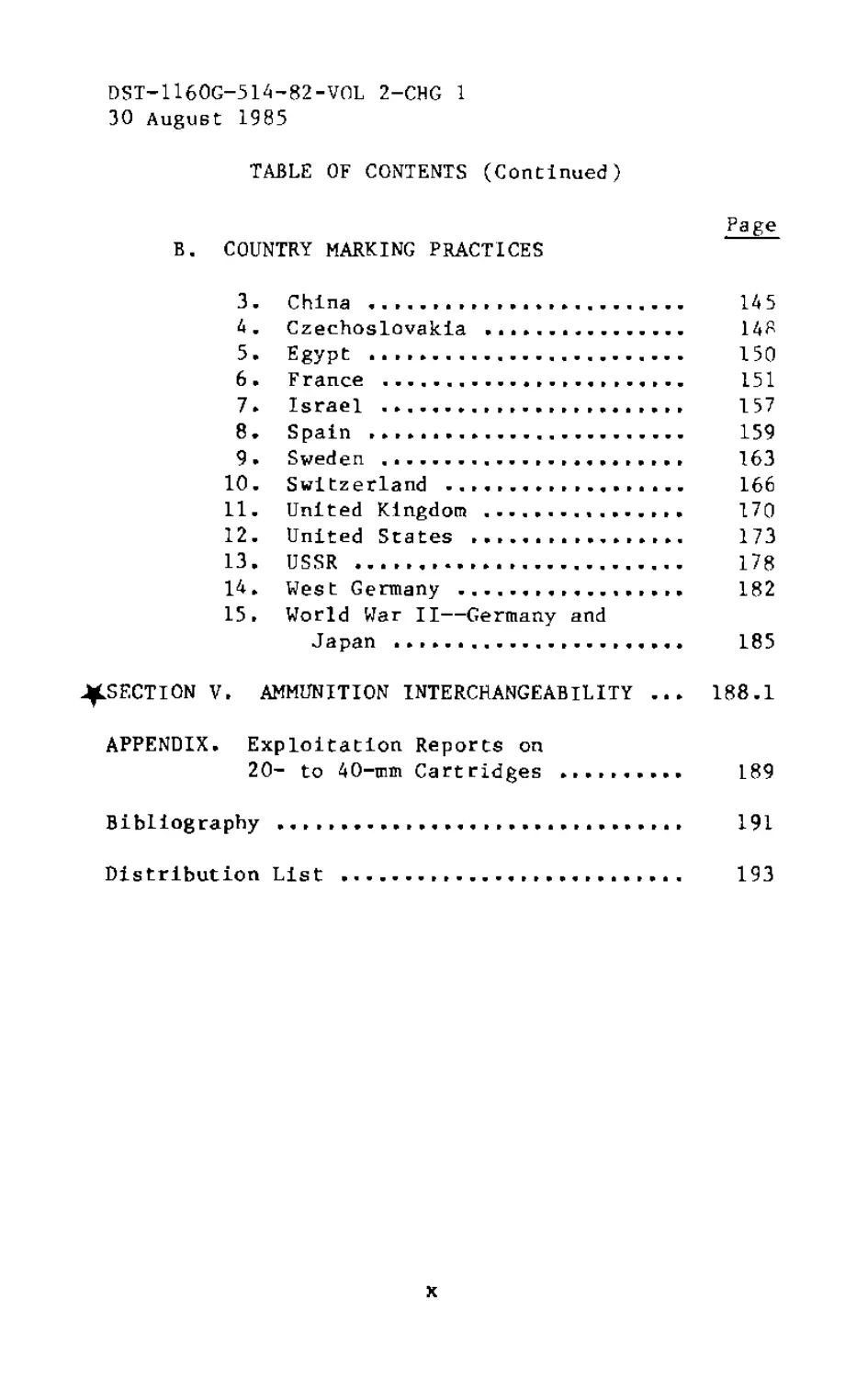
DST—1160G—514-82-VOL 2-CHG 1
30 August 1985
TABLE OF CONTENTS (Continued)
Page
B.	COUNTRY MARKING PRACTICES
3.	China ............................. 145
4.	Czechoslovakia .................... 148
5.	Egypt ............................. 150
6.	France ............................ 151
7.	Israel ............................ 157
8.	Spain ............................. 159
9	•	Sweden ......................... 163
10.	Switzerland ....................... 166
11.	United Kingdom .................... 170
12.	United States ..................... 173
13.	USSR .............................. 178
14.	West Germany ...................... 182
15.	World War II—Germany and
Japan ......................... 185
SECTION V.	AMMUNITION	INTERCHANGEABILITY ...	188.1
APPENDIX. Exploitation Reports on
20- to 40-tnm	Cartridges .............. 189
Bibliography .................................... 191
Distribution List ............................... 193
DST-1160G-514-82-VOL 2
13 September 1982
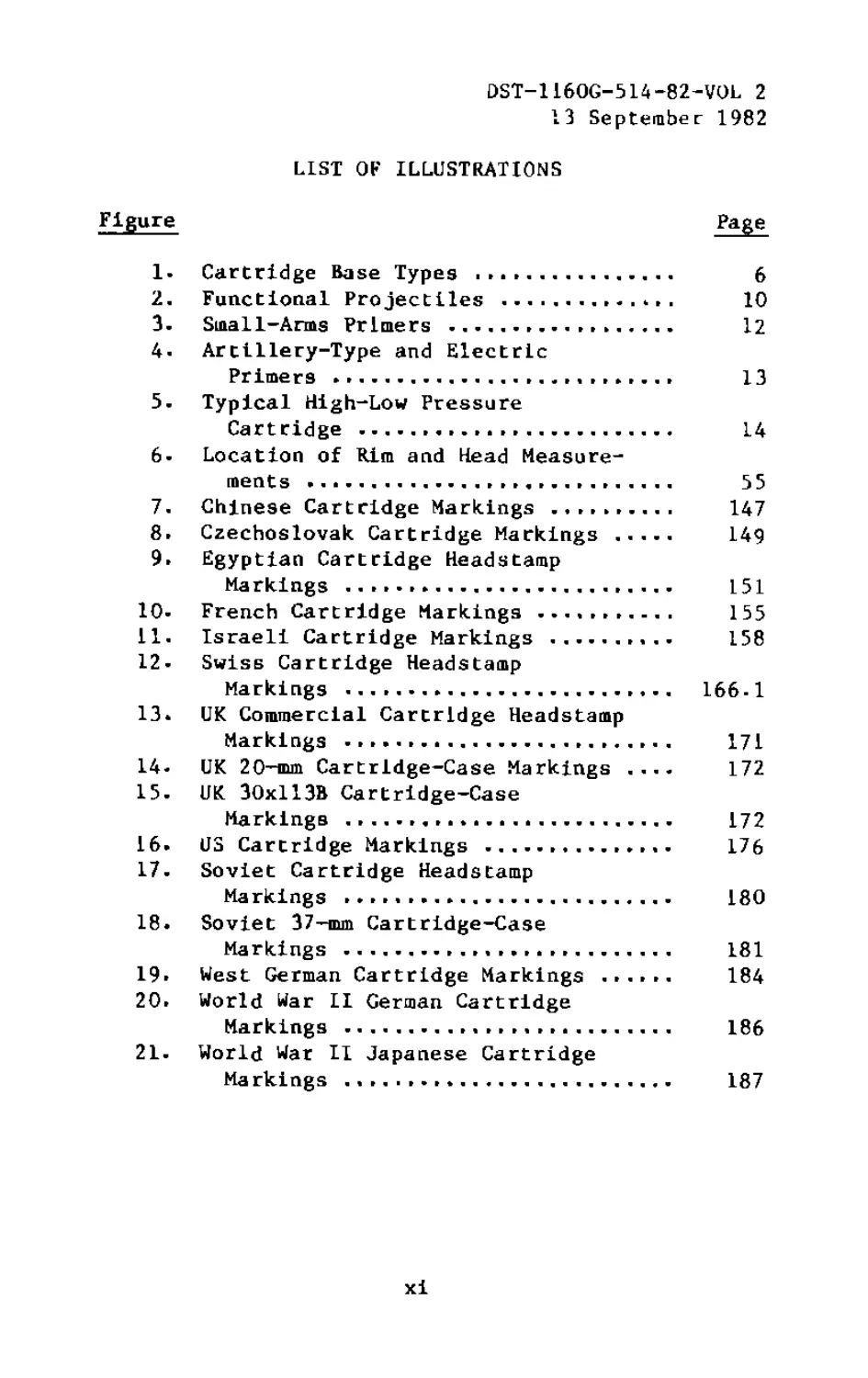
LIST OF ILLUSTRATIONS
Figure	Page
1.	Cartridge Base Types ..................... 6
2.	Functional Projectiles ...............	10
3.	Sina 11-Arms Primers .................... 12
4.	Artillery-Type and Electric
Primers ............................... 13
5.	Typical High-Low Pressure
Cartridge ............................. 14
6.	Location of Rim and Head Measure-
ments ....................................... 55
7.	Chinese Cartridge Markings ............. 147
8.	Czechoslovak Cartridge Markings ........ 149
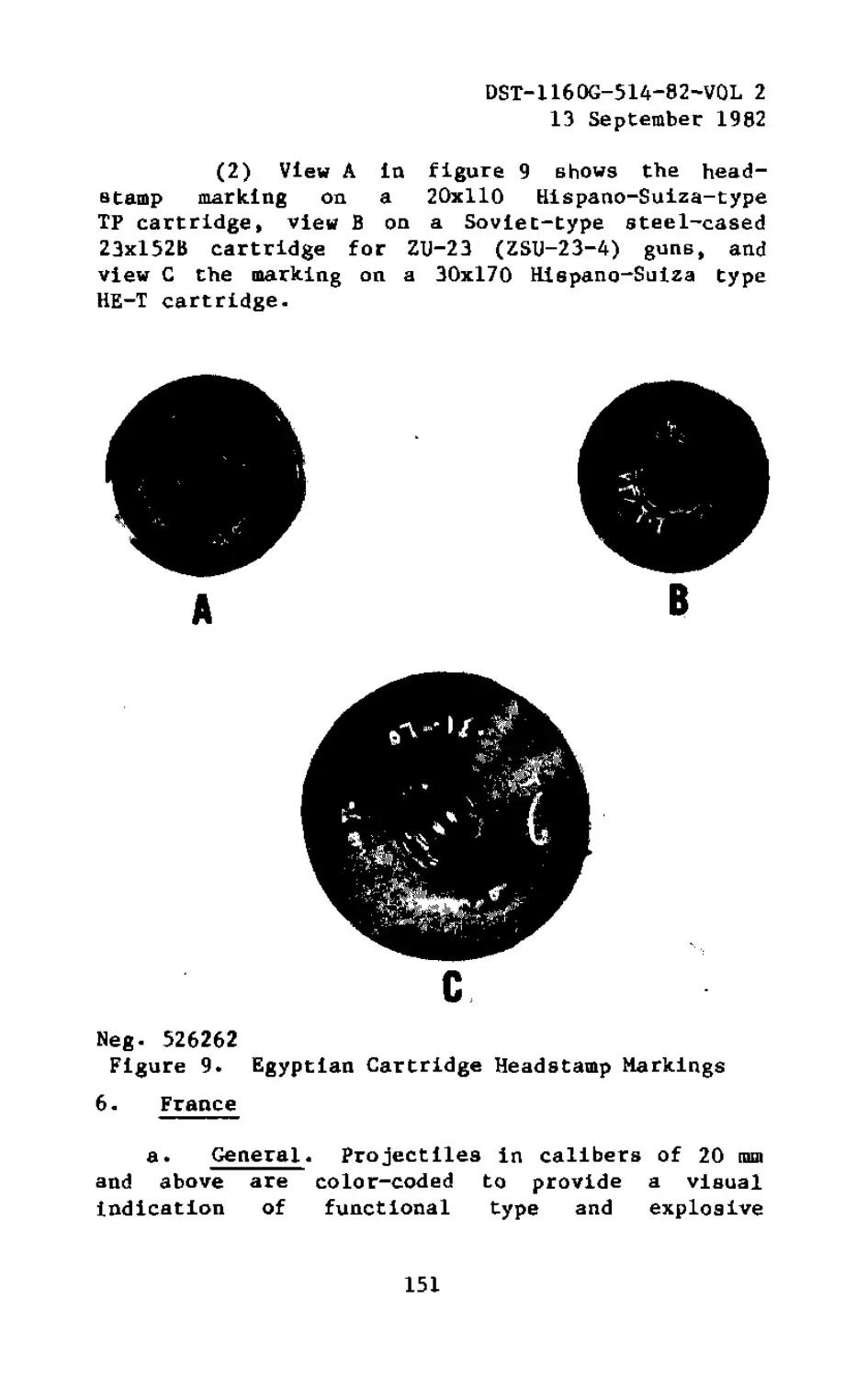
9.	Egyptian Cartridge Headstamp
Markings ............................. 151
10-	French Cartridge Markings .............. 155
11.	Israeli Cartridge Markings ............. 158
12-	Swiss Cartridge Headstamp
Markings ........................... 166-1
13.	UK Commercial Cartridge Headstamp
Markings ............................. 171
14-	UK 20-mm Cartridge-Case Markings ....	172
15.	UK 30xll3B Cartridge-Case
Markings ............................. 172
16.	US Cartridge Markings .................. 176
17.	Soviet Cartridge Headstamp
Markings ............................. 180
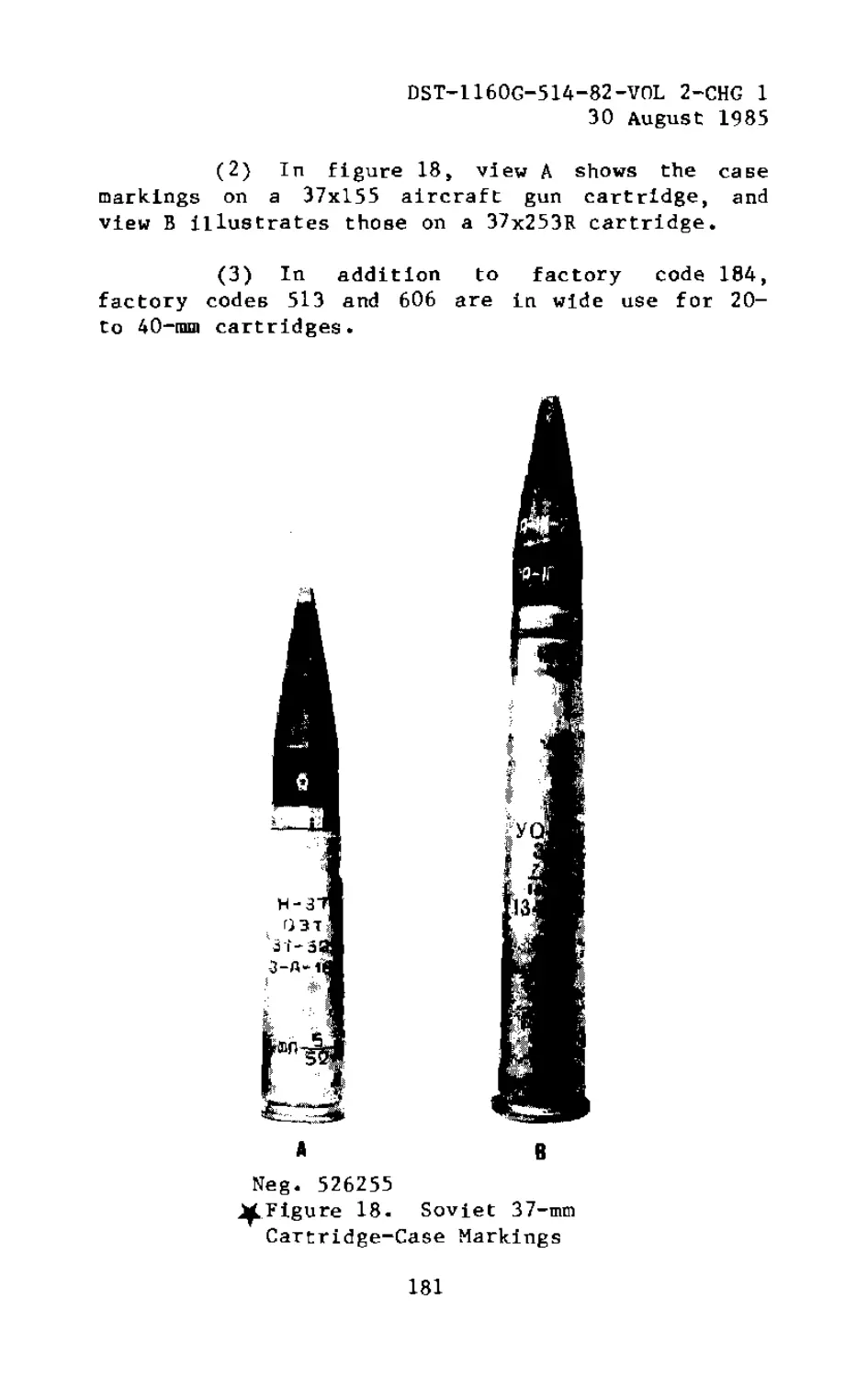
18.	Soviet 37-mm Cartridge-Case
Markings ............................. 181
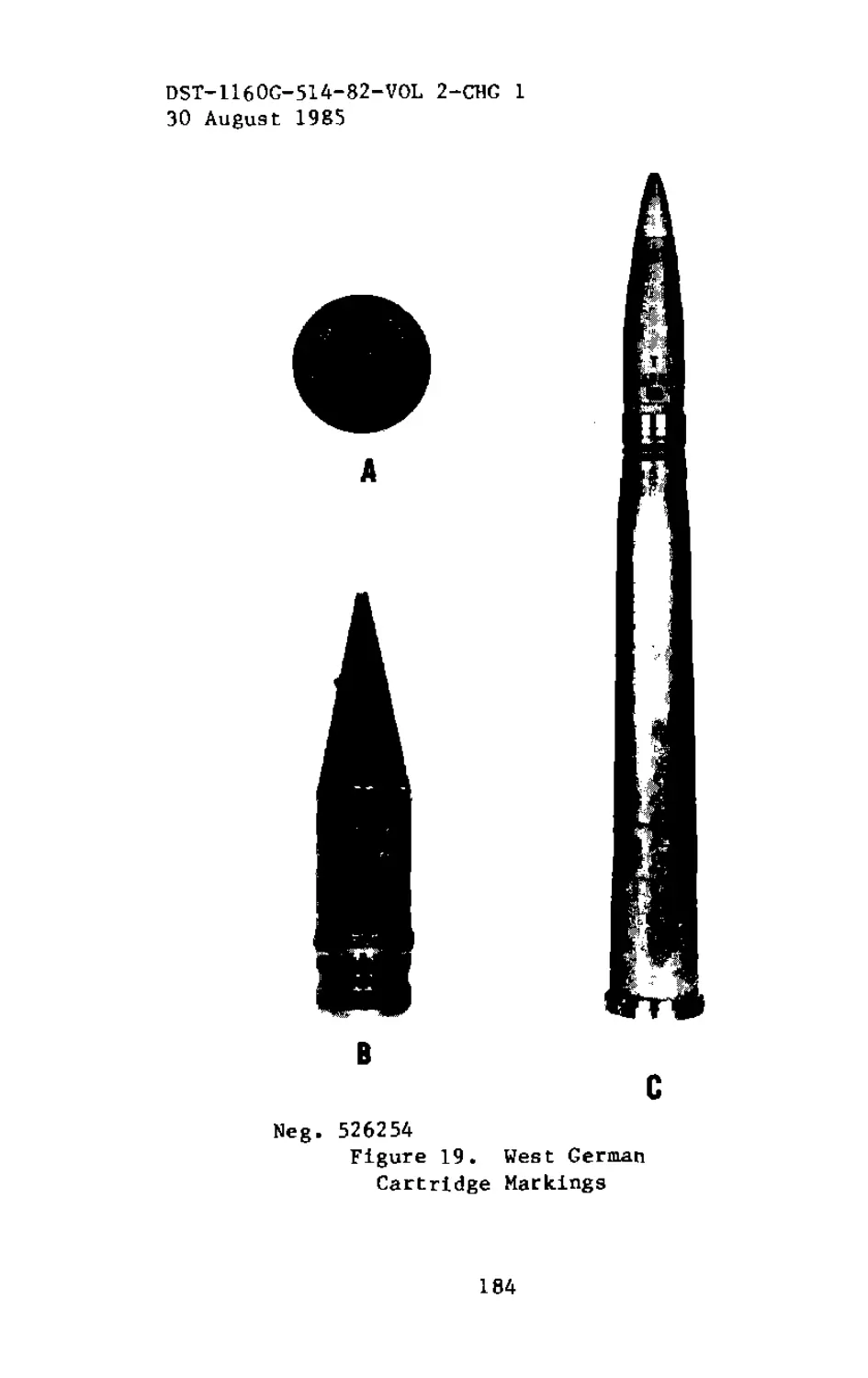
19>	West German Cartridge Markings ......... 184
20.	World War II German Cartridge
Markings ............................. 186
21.	World War II Japanese Cartridge
Markings ............................. 187
xi
DST-1160G-514-82-VOL 2
13 September 1982
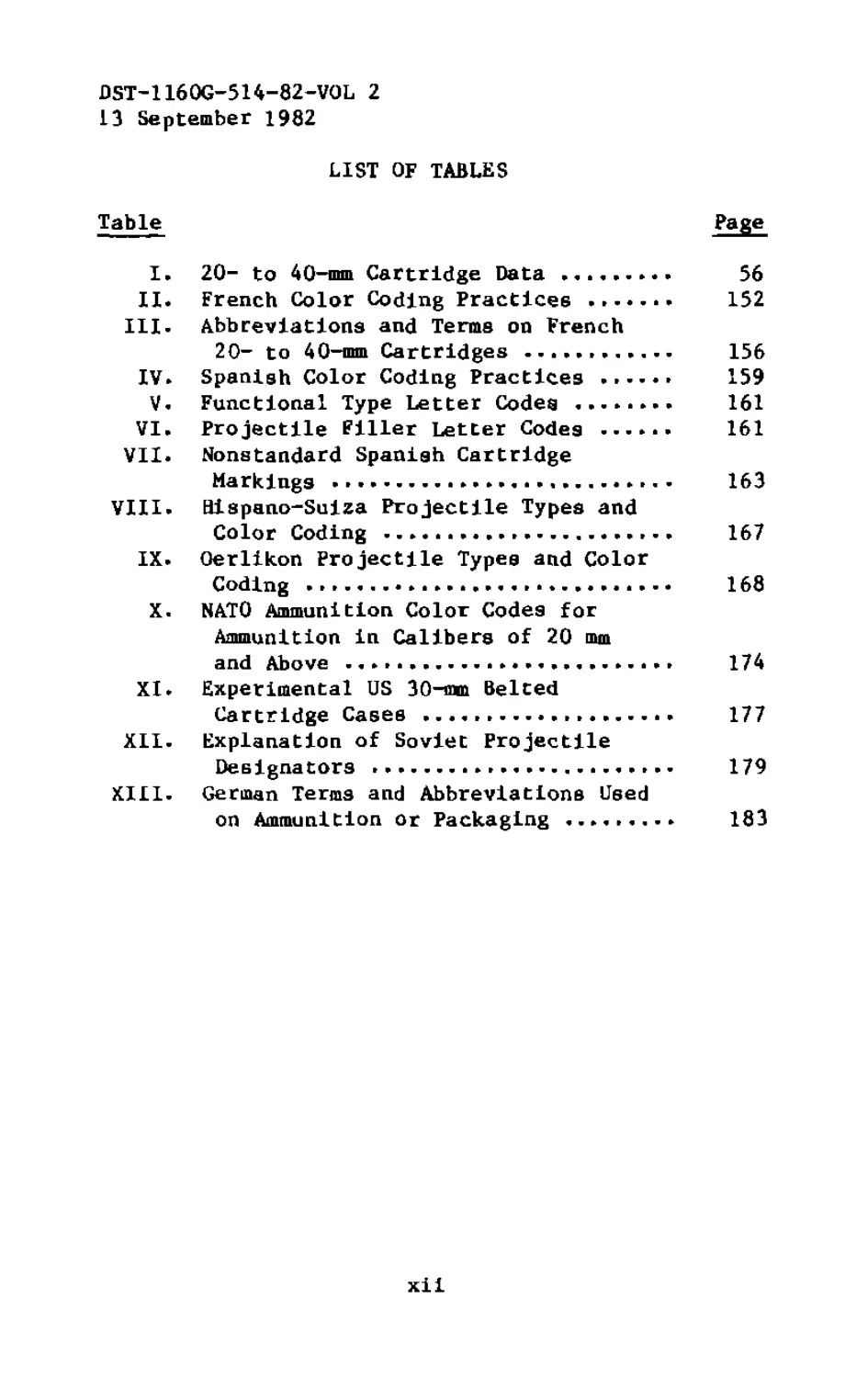
LIST OF TABLES
Table	Page
I.	20- to 40-mm Cartridge Data .............. 56
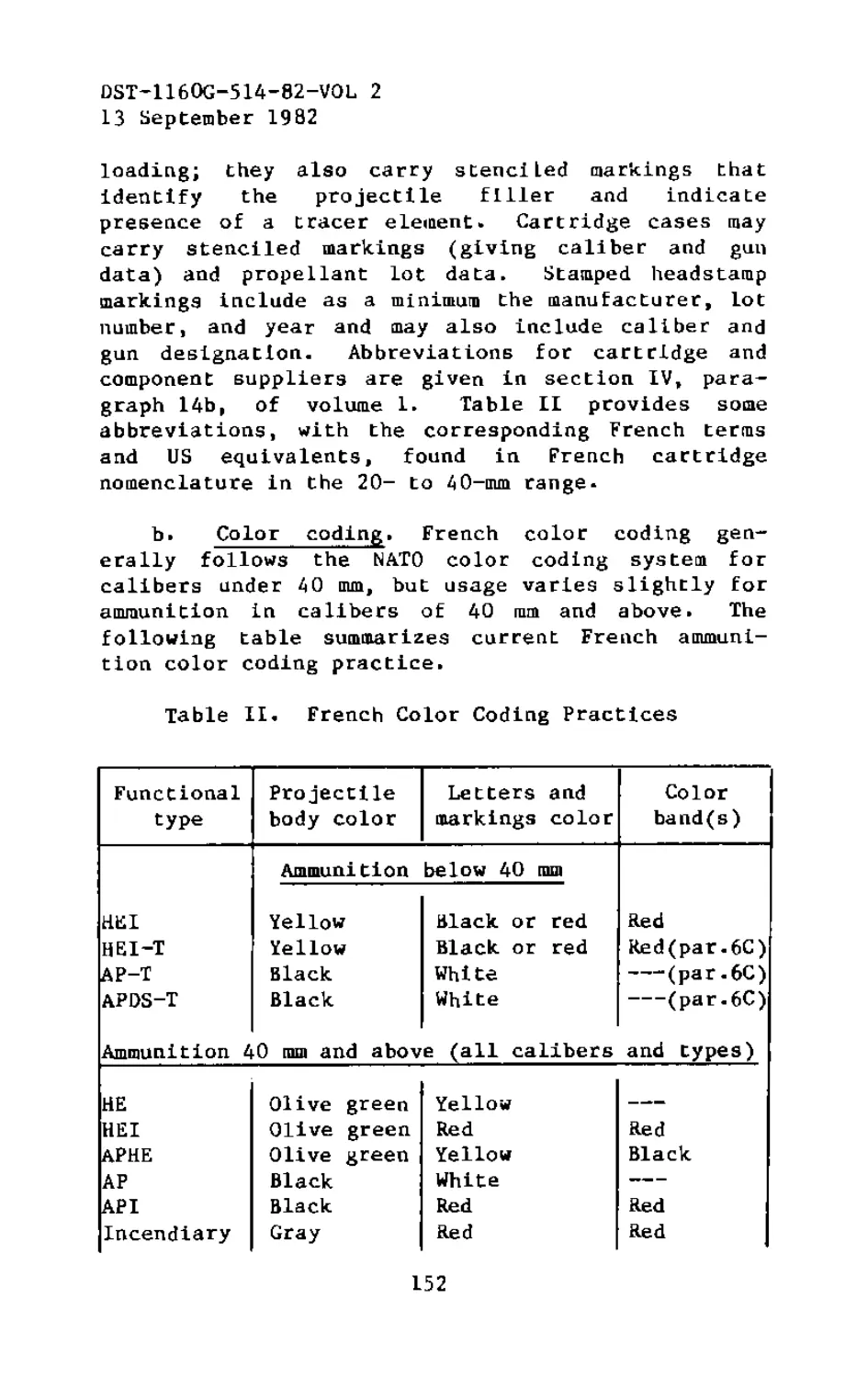
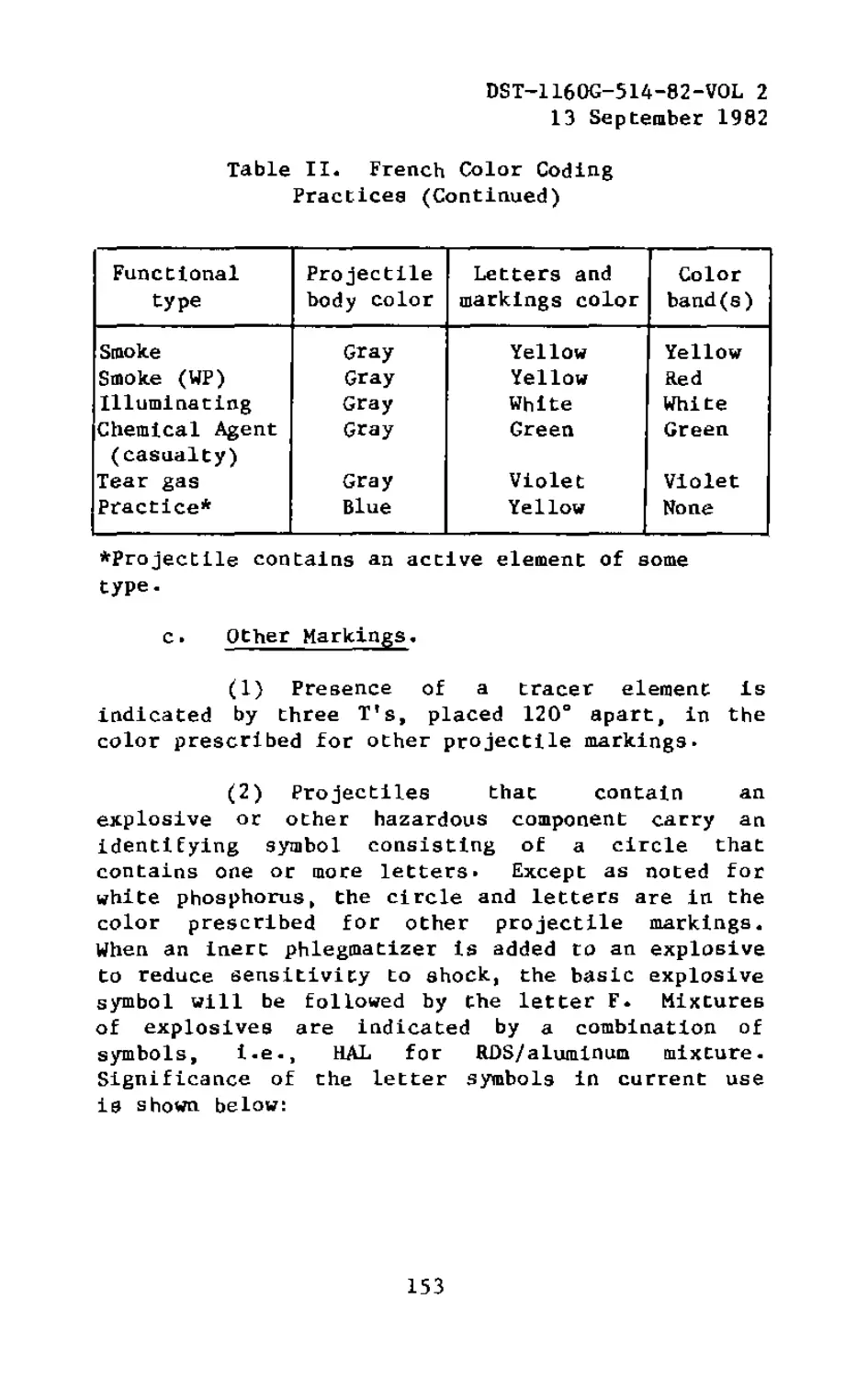
II.	French Color Coding Practices ........... 152
III.	Abbreviations and Terms on French
20-	to 40-mm Cartridges .............. 156
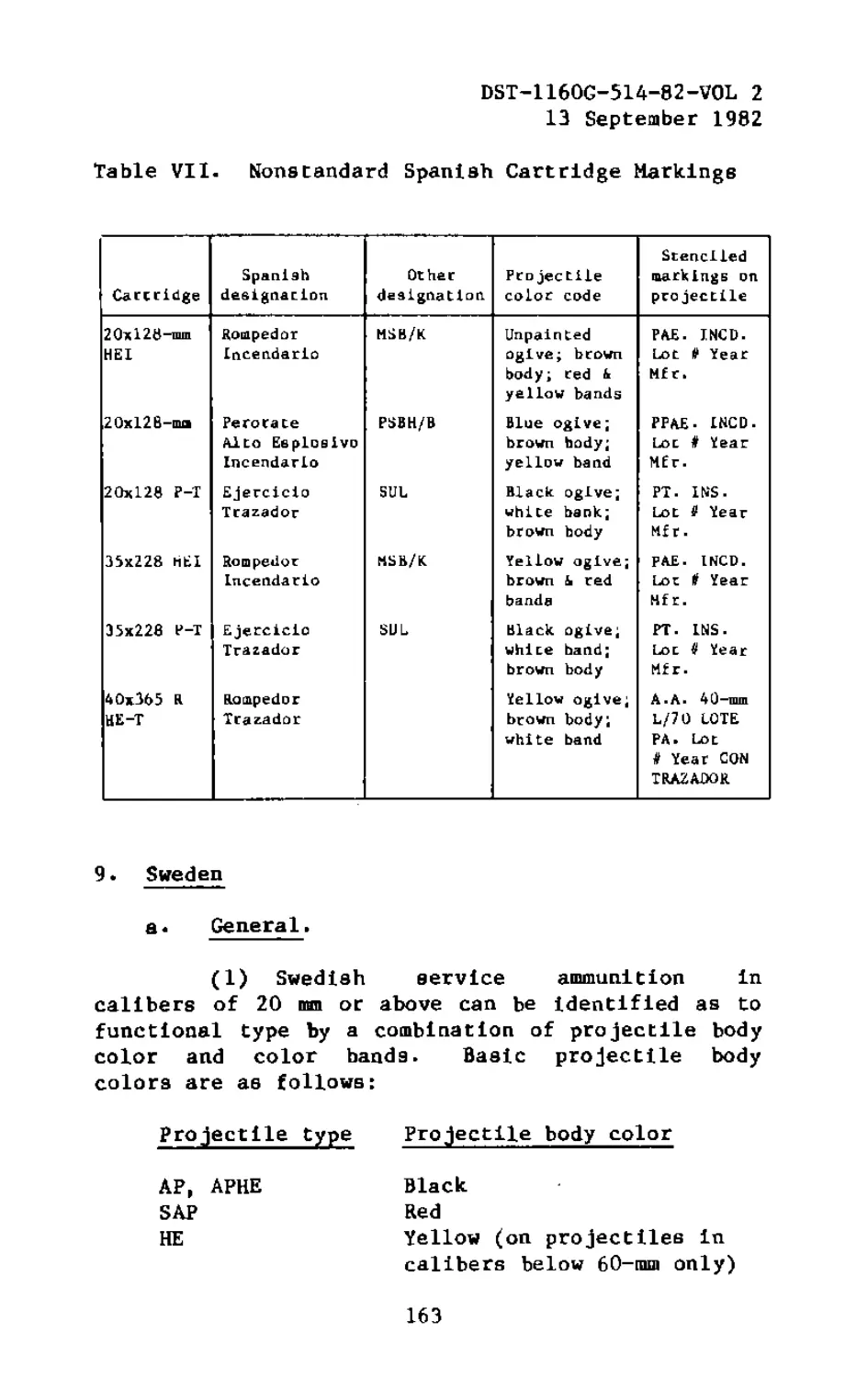
IV.	Spanish Color Coding Practices .......... 159
V.	Functional Type Letter Codes ............ 161
VI.	Projectile Filler Letter Codes .......... 161
VII.	Nonstandard Spanish Cartridge
Markings ..................................... 163
VIII.	Hispano-Suiza Projectile Types and
Color Coding .................................. 167
IX.	Oerlikon Projectile Types and Color
Coding ...................................... 168
X.	NATO Ammunition Color Codes for
Ammunition in Calibers of 20 mm
and Above .................................. 174
XI.	Experimental US 30-mm Belted
Cartridge Cases ............................. 177
XII.	Explanation of Soviet Projectile
Designators .................................. 179
XIII.	German Terms and Abbreviations Used
on Ammunition or Packaging .................... 183
xil
DST-1160G-514-82-VOL 2
13 September 1982
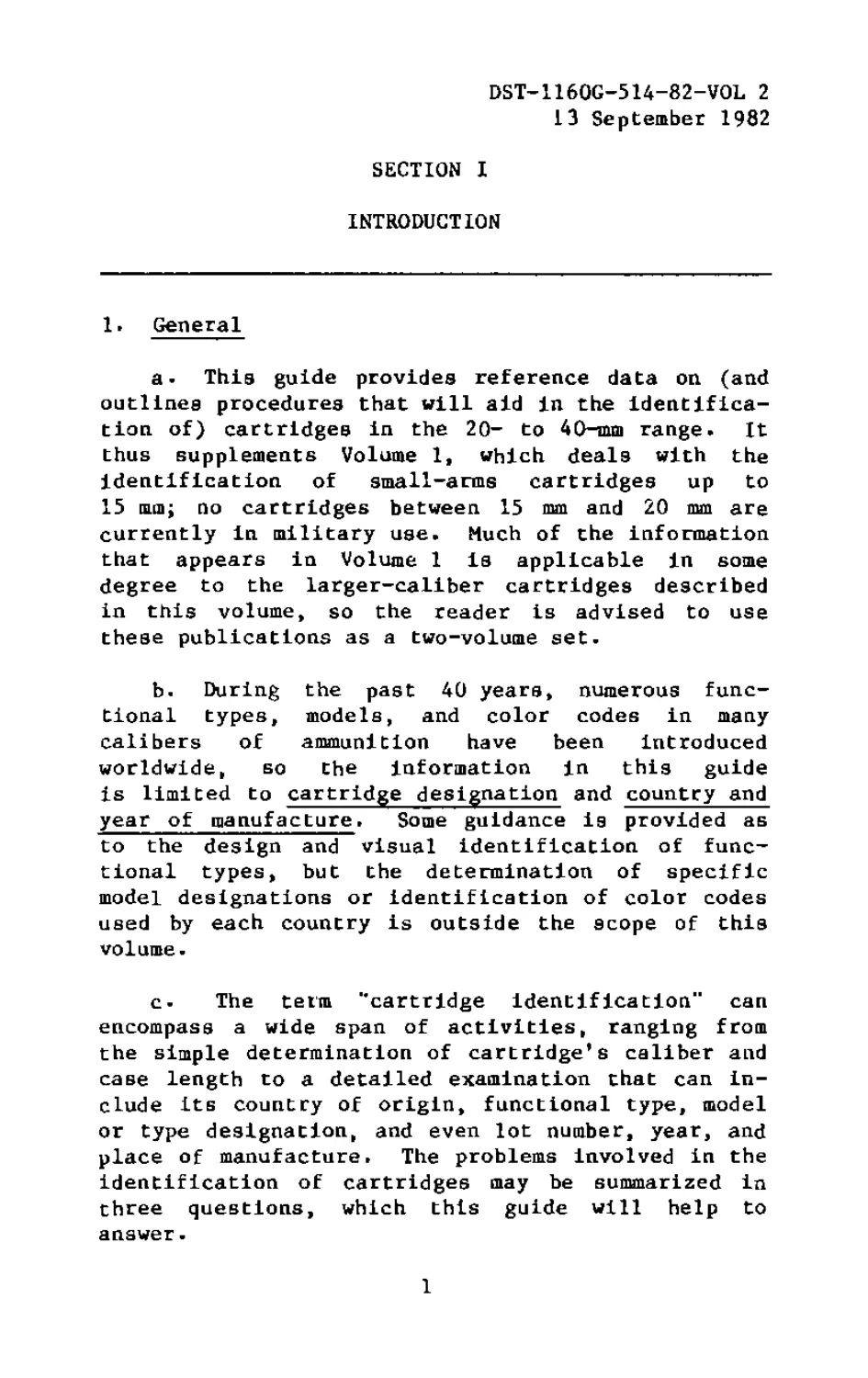
SECTION I
INTRODUCTION
1.	General
a.	This guide provides reference data on (and
outlines procedures that will aid in the identifica-
tion of) cartridges in the 20- to 40-инп range. It
thus supplements Volume 1, which deals with the
identification of small-arms cartridges up to
15 mm; no cartridges between 15 nun and 20 nun are
currently in military use. Much of the information
that appears in Volume 1 is applicable in some
degree to the larger-caliber cartridges described
in this volume, so the reader is advised to use
these publications as a two-volume set.
b.	During the past 40 years, numerous func-
tional types, models, and color codes in many
calibers of anununi tion have been introduced
worldwide, so the information in this guide
is limited to cartridge designation and country and
year of manufacture. Some guidance is provided as
to the design and visual identification of func-
tional types, but Che determination of specific
model designations or identification of color codes
used by each country is outside the scope of this
volume.
c.	The term "cartridge identification" can
encompass a wide span of activities, ranging from
the simple determination of cartridge’s caliber and
case length to a detailed examination that can in-
clude its country of origin, functional type, model
or type designation, and even lot number, year, and
place of manufacture. The problems involved in the
identification of cartridges may be summarized in
three questions, which this guide will help to
answer.
1
DST-1160G-514-82-VOL 2
13 September 1982
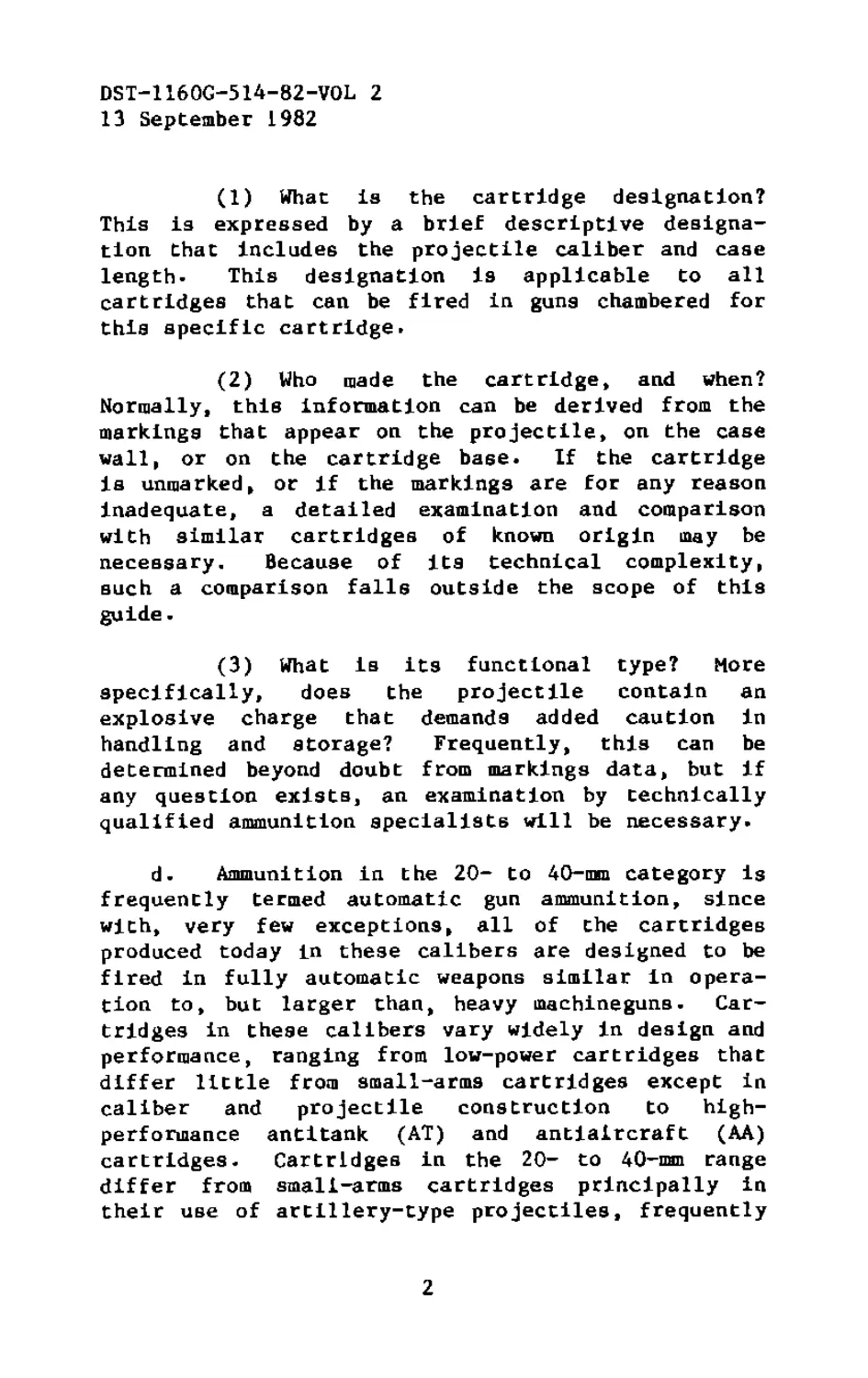
(1)	What is the cartridge designation?
This is expressed by a brief descriptive designa-
tion that includes the projectile caliber and case
length- This designation is applicable to all
cartridges that can be fired in guns chambered for
this specific cartridge-
(2)	Who made the cartridge, and when?
Normally, this information can be derived from the
markings that appear on the projectile, on the case
wall, or on the cartridge base. If the cartridge
is unmarked, or if the markings are for any reason
inadequate, a detailed examination and comparison
with similar cartridges of known origin may be
necessary. Because of its technical complexity,
such a comparison falls outside the scope of this
guide.
(3)	What is its functional type? More
specifically, does the projectile contain an
explosive charge that demands added caution in
handling and storage? Frequently, this can be
determined beyond doubt from markings data, but if
any question exists, an examination by technically
qualified ammunition specialists will be necessary.
d.	Ammunition in the 20- to 40-mm category is
frequently termed automatic gun ammunition, since
with, very few exceptions, all of the cartridges
produced today in these calibers are designed to be
fired in fully automatic weapons similar in opera-
tion to, but larger chan, heavy machineguns. Car-
tridges in these calibers vary widely in design and
performance, ranging from low-power cartridges that
differ little from small-arms cartridges except in
caliber and projectile construction to high-
performance antitank (AT) and antiaircraft (AA)
cartridges. Cartridges in the 20- to 40-nm range
differ from small-arms cartridges principally in
their use of artillery-type projectiles, frequently
2
DST-116OG-514-82-VOL 2
13 September 1982
with an explosive charge, Instead of the jacketed
bullet construction typical of small-arms ammuni-
tion. In common with smaller-caliber cartridges,
they almost invariably have a one-piece, drawn-
metal cartridge case; the primer may be either a
percussion primer of the type used in small-caliber
cartridges or an artillery type electric or percus-
sion primer with a black-powder igniter charge.
e* Cartridges in this range originated with
the 1-lnch Gatling machinegun, introduced as early
as 1866, which was followed by 1-pounder (approxi-
mately 37-mm) cartridges of several types, fired
either from handpower-opera ted guns such as the
Gardner, Nordenfeldt, and Hotchkiss systems or from
single-shot, quick-firing guns. A self-powered
automatic gun, the 37-mm Maxim, appeared as early
as 1885. The term "pom-pom" was originally applied
to this gun. Development since World War II has
been directed primarily toward improved ammunition
for automatic or power-operated guns for aircraft
and antiaircraft use, with a reduced effort in the
area of cartridges for semiautomatic weapons for
accurate aimed fire against point targets.
f. Some of the cartridge types that are des-
cribed in this guide were produced 40 or more years
ago. Cartridges made during and even before World
War II are not necessarily unserviceable because of
their age; if they have been stored under favorable
conditions of low humidity and low-to-moderate tem-
perature, and if the brass cartridge case has not
become brittle from exposure to the mercuric com-
pounds in the primer or from improper annealing of
the metal, they may be safe to fire, although fuzes
and tracers may not function reliably. Service-
ability must be determined through inspection and
testing by qualified ammunition specialists.
3
DST-116OG-514-82-VOL 2
13 September 1982
2.	Organization
This guide comprises four major sections.
a. Section I outlines the scope of this guide
and its organization. It also provides general
information on construction, characteristics, and
terminology of automatic gun ammunition that will
aid in the use of this guide.
b> Section II provides instructions for the
use of this guide in the identification of car-
tridges from dimensional and visual data.
c. Section III provides a series of outline
drawings of cartridge cases, a tabulation of major
cartridge dimensions, and a brief description of
each cartridge type in terms of its origin, using
weapons, principal countries of manufacture and
use, and current status. Cross-reference of infor-
mation in these three areas is aided by the use of
an index number that is assigned to each cartridge
designation >
d- Section IV presents representative car-
tridge identification data for each of the major
countries that has produced ammunition in this cal-
iber range.
3.	Cartridge Cases
The primary feature in cartridge identification is
the cartridge case. Its shape and dimensions,
which must conform to the chamber size of the gun
for which designed, indicate the type and probable
military role of the weapon, which in turn may
suggest the country of origin or the political
affiliation (e.g., Communist, Western, Third World)
of the user- Key aspects of cartridge-case design
and construction are outlined In the following
subparagraphs.
4
DST-116OG-514-82-VOL 2-CHG 1
30 August 1985
a.	The cartridge case (which, Incidentally,
can account for more than half the weight of the
complete cartridge) provides a sturdy, weatherproof
container that unites the primer, propellant, and
projectile into a unit and protects them from damage
in storage, handling, and loading or feeding.
During firing, the case provides obturation, sealing
the breech end of the barrel to prevent the escape
of hot propellant gases into the gun mechanism.
When automatic weapons are fired, the cartridge
case serves an equally important purpose in acting
as a heat sink: It extracts a significant portion
of excess heat from the gun chamber after each
shot, thus reducing the risk of overheating the gun
and the attendant possibility of premature firing
(cook-off).
b.	To provide desired performance charac-
teristics, military cartridge cases must be robust;
all are of centerfire construction, with a rein-
forced cartridge case head and a centrally located
primer that ignites the propellant contained In the
cartridge case. Cartridge cases are made princi-
pally of brass or mild steel (either plated or lac-
quered), although in recent years aluminum cases
have been used increasingly. Cases are manufac-
tured by punch and die operations, termed
"drawing," with heat treatment to provide desired
metallurgical characteristics.
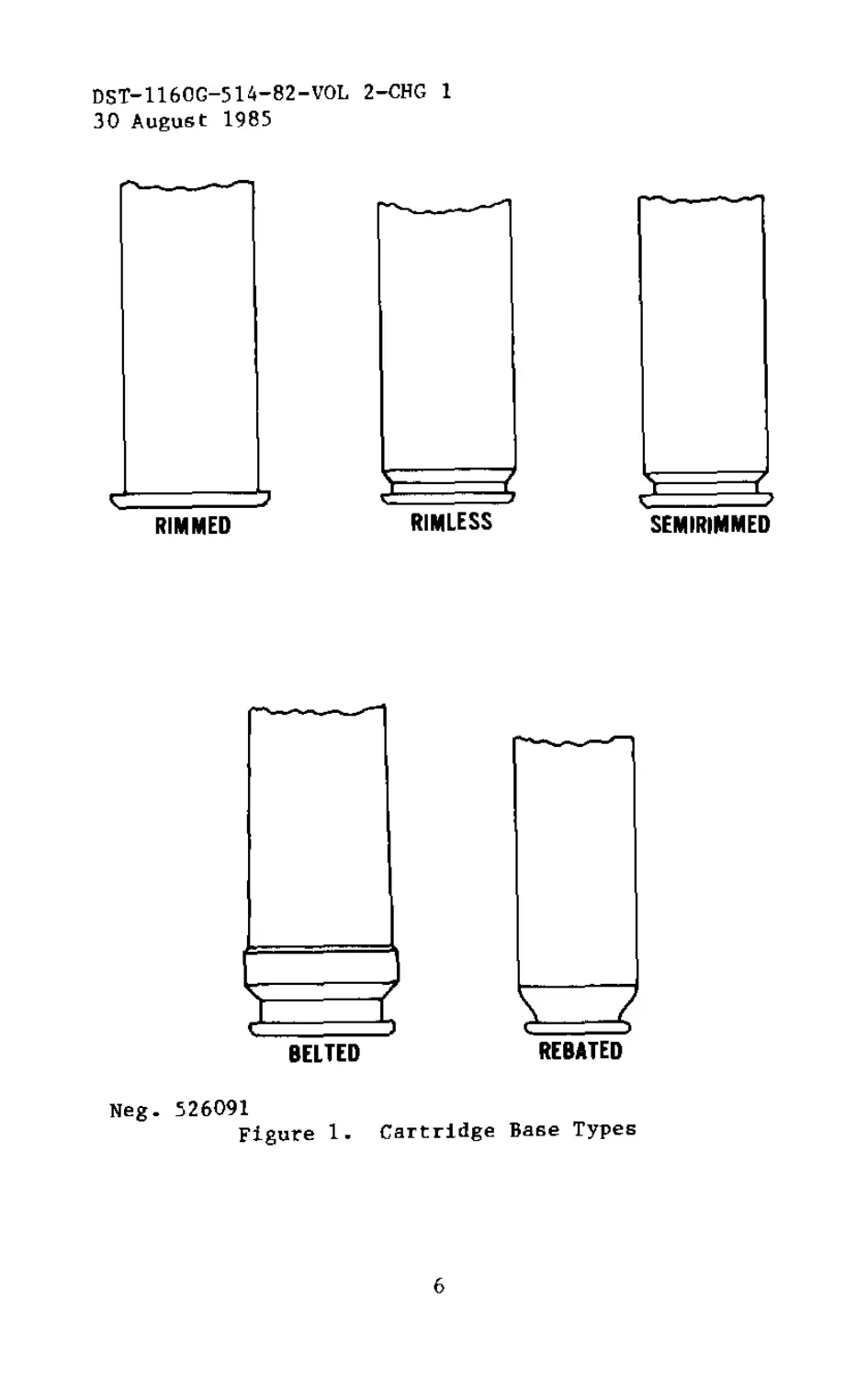
c.	Cartridge base types, which serve a
functional purpose in the feeding, positioning for
firing, and extraction of the fired case or the
unfired cartridge, are valuable identifying
features. For convenience in cartridge identifica-
tion, the cartridge base description Is used as an
element in the descriptive designation of the
cartridge. The five base types In use, with their
abbreviations, are as follows: rimmed (R), rimless
(no abbreviation), semirimmed (SR), belted (B), and
rebated (RB). These types, which are shown In
figure 1, are described In the following subpara-
graphs .
5
DST-116OG-514-82-VOL 2-CHG 1
30 August 1985
RIMLESS
SEMIRIMMED
Neg. 526091
Figure 1. Cartridge Base Types
6
DST-1160G-51.4-82-VOL 2-CHG 1
30 August 1985
(1)	Rimmed cartridge cases have a rim, or
extractor flange, extending beyond the cartridge
body; the rim seats against the breech face and
aids in extracting the fired case. There may be a
sli ght undercut or groove in the case body ahead of
the rim.
(2)	Rimless cases have an extraction
groove in the case body, leaving a flange at the
base of the case. The diameter of this flange is
the same as, or very close to, the diameter of the
cartridge case body ahead of the groove.
(3)	Semirimmed cases have an extraction
groove in the case body. The diameter of the
flange at the case base is distinctly larger than
the diameter of the cartridge case ahead of the
groove. A semirimmed case can be Identified by
laying a straightedge along the cartridge body; a
district gap will be noted between the case body
and the straightedge, just ahead of the extraction
groove.
(4)	Belted cartridge cases have a pro-
nounced raised belt around the cartridge case body
ahead of the extractor groove. The rim diameter is
not significant; it may be greater than, the same
as, or less than the belt diameter.
(5)	Rebated cartridge cases have a flange
at the rear of the extractor groove; the diameter
of the flange is distinctly less than the case body
diameter.
d. Fired cartridge cases can provide Infor-
mation on caliber designation, country of origin,
year of manufacture, and primer type. Cases may
also carry markings that indicate the model and
functional type of the fired projectile. Finally,
examination of a fired case by a weapon expert can,
under favorable conditions, provide information as
to the type of gun that fired the cartridge.
7
DST-1160G-514-82-VOL 2-CHG 1
30 August 1985
4.	Projectiles
a.	Projectiles in the 20- to 40-mtn range
follow the design of artillery projectiles rather
than of small-arms bullets in that they have a well-
defined rotating band and a bourrelet on the projec-
tile body ins tead of a bullet jacket that is
engraved by the rifling in the gun barrel. The
relatively large mass (weight) of these projectlies
permits a more sophisticated design and complex
cons truction, tailored for a specif ic type of
target and frequently involving an armor-piercing
penetrator or an explosive filler with some type of
fuzing. These projectiles are intended primarily
for use against materiel targets such as aircraft,
armor, and defended positions; their antipersonnel
effect is achieved principally by projectile frag-
ments rather than, as for small arms, by direct
impact.
b.	In the designation of functional types,
projectiles—and thus, cartridges — in this caliber
range also follow artillery practice. For example,
a cartridge whose projectile contains no explosive
payload or penetrator, and which in small-arms
ammunition terminology would be designated a ball
cartridge, is normally termed a practice cartridge,
although the term ball cartridge may occasionally
be encountered. If the projectile contains a
tracer, the cartridge will usually be designated a
practice tracer (PT) cartridge, and only rarely a
tracer cartridge.
c.	Explosive projectiles include high-
explosive (HE) and high-explosive incendiary (HEI)
rounds; the latter may carry a tracer and then be
termed HEI-T. Explosive projectiles have a fuze of
some type to initiate detonation of rhe ex plosive
charge; this may be a point-detonating (PD) or base-
detonating (BD) type, depending on its location in
the projectile. If the fuze has a self-destruct
8
DST-L16OG-514-82-VOL 2
13 September 1982
feature, to initiate detonation and thus
destruction of the projectile at a predetermined
time or distance after firing, the fuze will be
designated point detonating self-destruct or base
detonating self-destruct (PDSD or BDSD). Such
fuzes are frequently used in antiaircraft fire or
air-to-air fire to ensure that a projectile that
misses its intended target will detonate in the air
and not land in a friendly area. Self-destruction
can also be initiated upon tracer burnout. The
tracer element is a body of pyrotechnic material in
a cavity in the base of the projectile; the
material is ignited by the burning propellant and
emits a visible or smoke trace to enable the
projectile flight to be followed and permit
adjustment of fire on the target. If a heat-
sensitive detonator is placed between the tracer
and the explosive filler, it will be initiated as
the tracer burns out, perhaps 2 seconds after
ignition, and thus detonate the projectile.
d* Kinetic-energy, armor-defeating projec-
tiles include armor-piercing (AP) and armor-
piercing-incendiary (API) projectiles, which may
have a tracer and thus be termed AP-T and API-T.
Solid SP projectiles were at one time termed
"shot," and the term "AP shot" may still be
encountered. If the projectile has an explosive
filler and fuze (normally a base fuze) as well, it
may be designated armor-piercing high explosive
(APHE), armor-piercing high explosive incendiary
(APHEI), or armor-piercing high explosive
incendiary-tracer (APHEI-T), depending on its
construction. A special type of high-performance
AP projectile, with a smaller-dlameter core or
penetrator of tungsten carbide (abbreviated WG) or
tungsten alloy, may be combined with a projectile
body that is designed to separate from the core as
soon as the projectile has left the gun muzzle.
The projectile base that is discarded is termed a
"sabot"; the complete projectile is termed "armor-
piercing, discarding sabot," or APDS. When a
9
DST-1160G-514-82-V0L 2
13 September 1982
tracer is present, the projectile becomes APDS-T.
If the projectile has a tungsten carbide репеera-
tor, the designation is APDS (WC) or APDS-T (WC) .
The chief advantage to APDS projectiles is that the
heavy, small-diameter penetrator encounters less
air resistance during flight and thus does not lose
its velocity as rapidly as a larger-diameter projec-
tile ; therefore, it has a shorter time of flight
and higher impact velocity at longer ranges.
Examples of functional types are found in figure 2.
ИЕ (Ml)
A	В
Neg. 526092
Figure 2. Functional Projectiles
10
DST-116OG-514-82-VOL 2
13 September 1982
5-	Primers
Cartridges in the 20- to 40-mm range may use a wide
variety of primers, from simple small-arms-type
primers for low-performance cartridges to complex
artillery-type primers. Electric primers are used
almost exclusively for aircraft gun ammunitioti-
These types are described in the following subpara-
graphs .
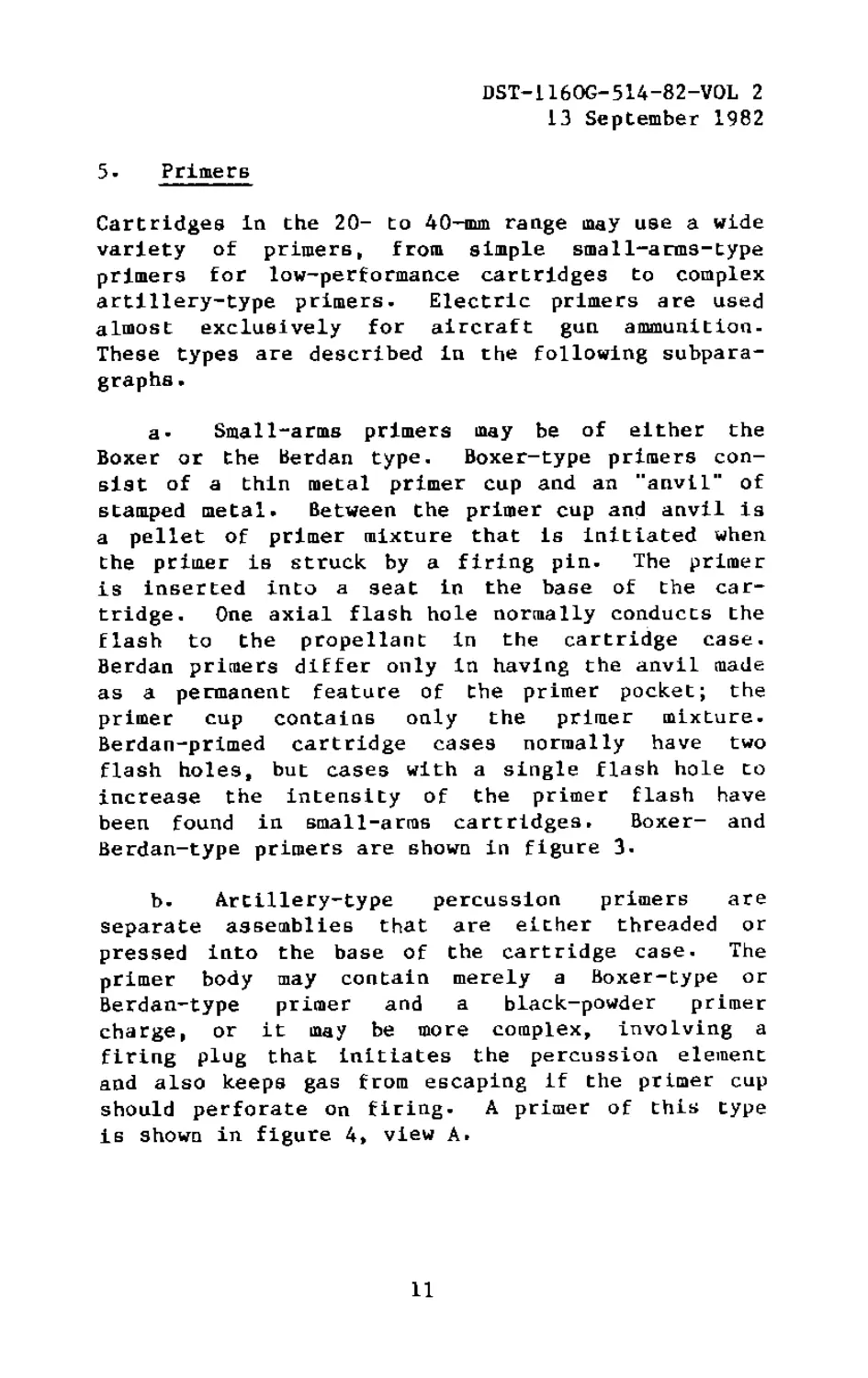
a.	Small-arms primers may be of either the
Boxer or the Berdan type. Boxer-type primers con-
sist of a thin metal primer cup and an "anvil" of
stamped metal. Between the primer cup and anvil is
a pellet of primer mixture that is initiated when
the primer is struck by a firing pin. The primer
is inserted into a seat in the base of the car-
tridge . One axial flash hole normally conducts the
flash to the propellant in the cartridge case.
Berdan primers differ only in having the anvil made
as a permanent feature of the primer pocket; the
primer cup contains only the primer mixture.
Berdan-primed cartridge cases normally have two
flash holes, but cases with a single flash hole to
increase the intensity of the primer flash have
been found in small-arras cartridges. Boxer- and
Berdan-type primers are shown in figure 3-
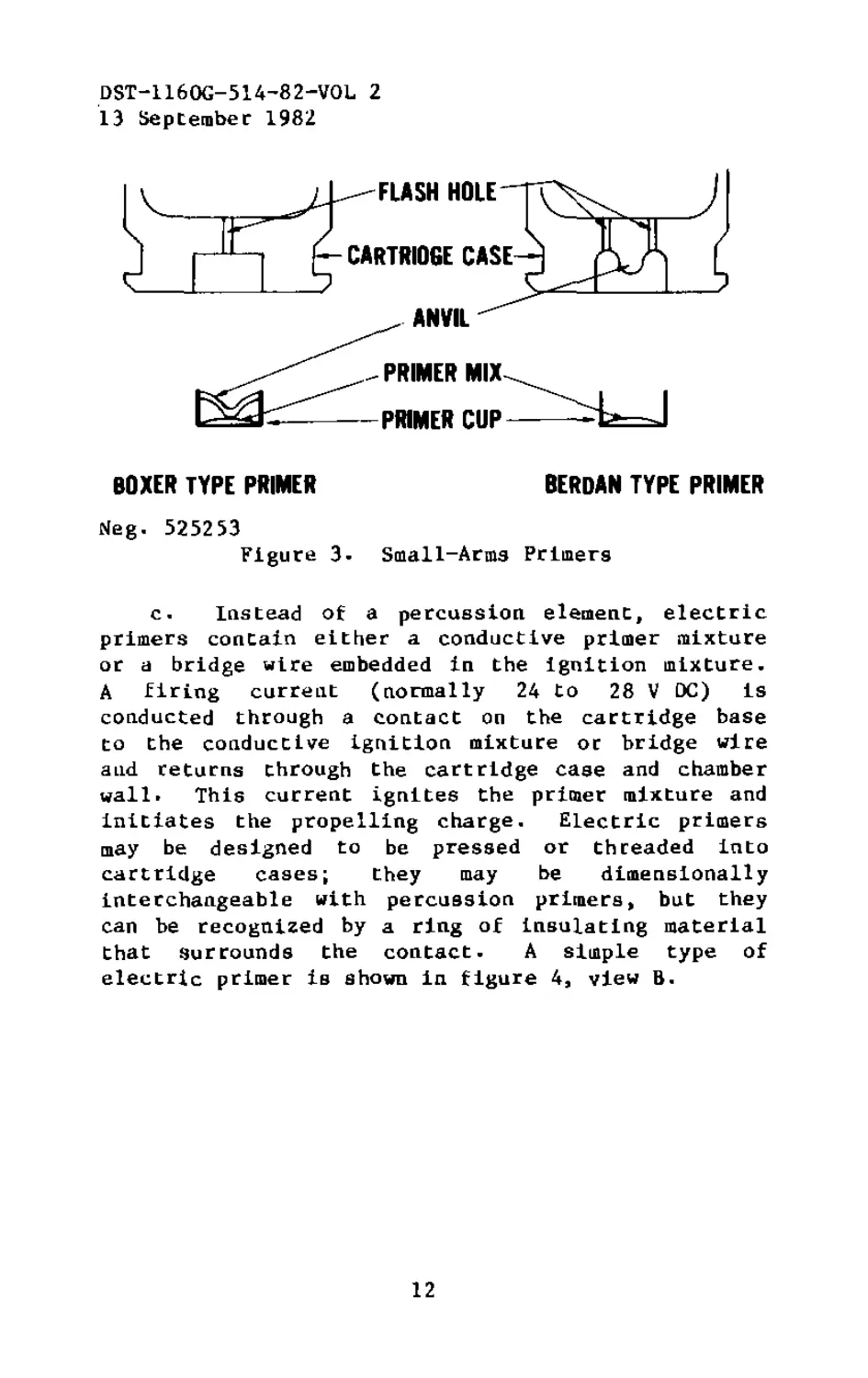
b.	Artillery-type percussion primers are
separate assemblies that are either threaded or
pressed into the base of the cartridge case. The
primer body may contain merely a Boxer-type or
Berdan-type primer and a black-powder primer
charge, or it may be more complex, involving a
firing plug that initiates the percussion element
and also keeps gas from escaping if the primer cup
should perforate on firing. A primer of this type
is shown in figure 4, view A.
11
DST-116OG-514-82-VOL 2
13 September 1982
PRIMER MIX
^-CARTRIDGE CASE
ANVIL
PRIMER CUP
FLASH HOLE
BOXER TYPE PRIMER	BERDAN TYPE PRIMER
Neg. 525253
Figure 3.	Small-Arms Primers
c. Instead of a percussion element, electric
primers contain either a conductive primer mixture
or a bridge wire embedded in the ignition mixture.
A firing current (normally 24 to 28 V DC) is
conducted through a contact on the cartridge base
to the conductive ignition mixture or bridge wire
and returns through the cartridge case and chamber
wall. This current ignites the primer mixture and
initiates the propelling charge. Electric primers
may be designed to be pressed or threaded into
cartridge cases; they may be dimensionally
interchangeable with percussion primers, but they
can be recognized by a ring of insulating material
that surrounds the contact. A simple type of
electric primer is shown in figure 4, view B.
12
DST-116OG-514-82-VOL 2
13 September 1982
PRIMER
CHARGE
PRIMER
CUP
FIRING
PLUG
PRIMER
BODY
ARTILLERY - TYPE
PERCUSSION PRIMER
VIEW в
ELECTRIC PRIMER
IGNITION
MIXTURE
- DRNKE WIRE
INSULATION
CONTACT
PRIMER BODY
Neg. 526090
Figure 4.	Artillery-Type and Electric Primers
6.	Propellant
Depending on the performance that is expected, pro-
pellants may vary from small-arms-type ball powder
to multiperforate cylindrical grains. Single-base
nitrocellulose propellant predominates. Closely
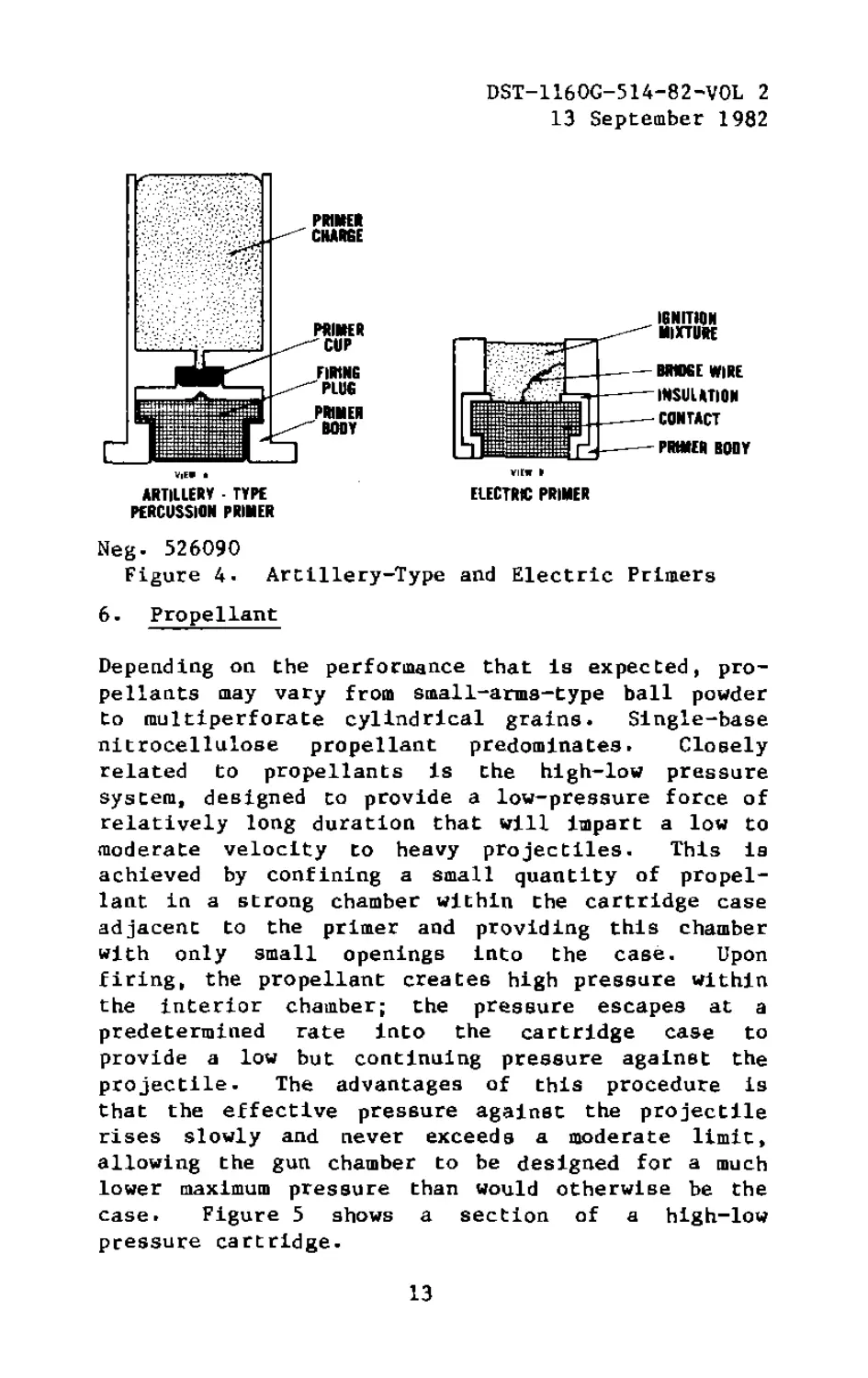
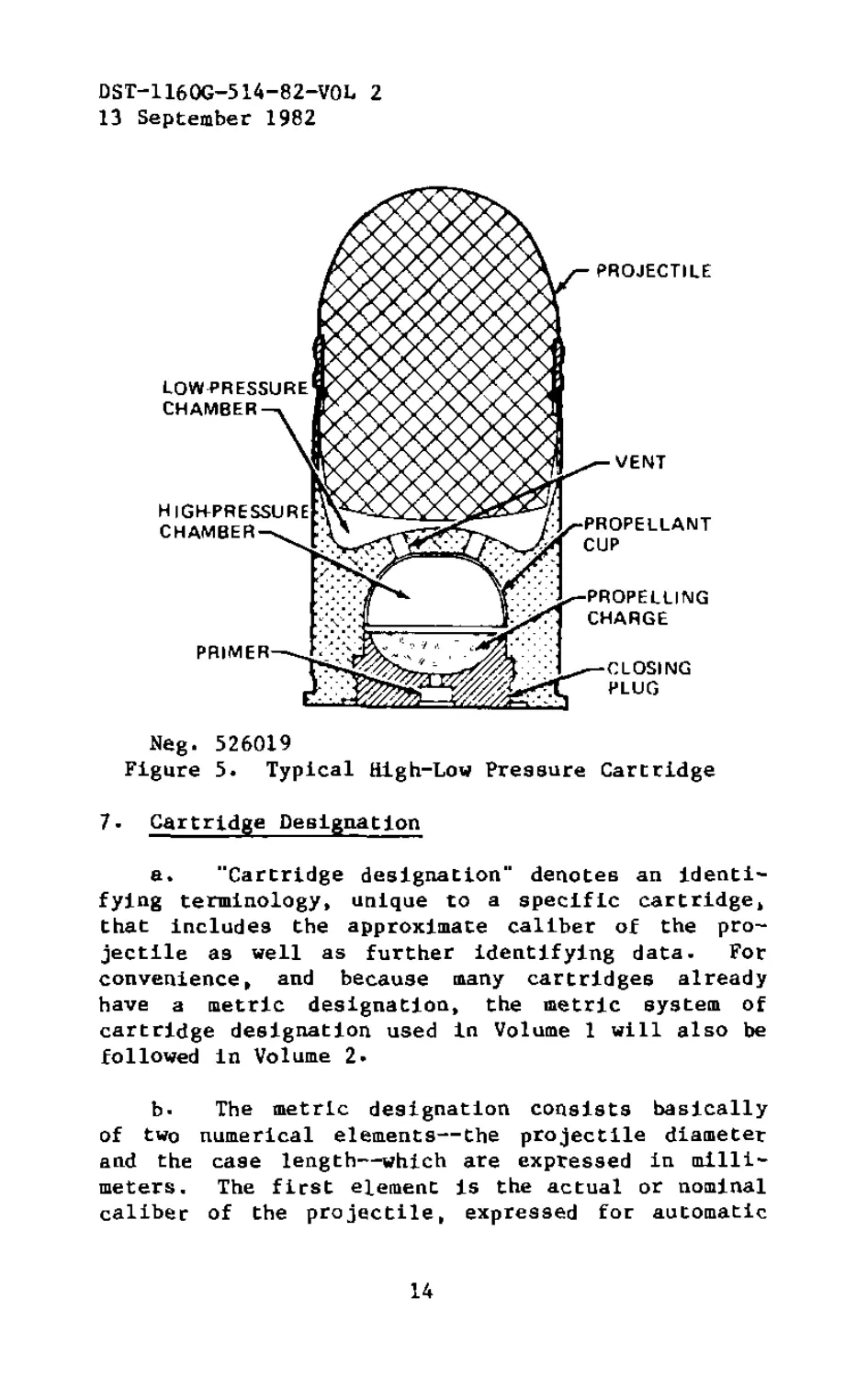
related to propellants is the high-low pressure
system, designed to provide a low-pressure force of
relatively long duration that will impart a low to
moderate velocity to heavy projectiles. This is
achieved by confining a small quantity of propel-
lant in a strong chamber within the cartridge case
adjacent to the primer and providing this chamber
with only small openings into the case. Upon
firing, the propellant creates high pressure within
the interior chamber; the pressure escapes at a
predetermined rate into the cartridge case to
provide a low but continuing pressure against the
projectile. The advantages of this procedure is
that the effective pressure against the projectile
rises slowly and never exceeds a moderate limit,
allowing the gun chamber to be designed for a much
lower maximum pressure than would otherwise be the
case. Figure 5 shows a section of a high-low
pressure cartridge.
13
DST-1160G-514-82-V0L 2
13 September 1982
Neg. 526019
Figure 5.	Typical High-Low Pressure Cartridge
7. Cartridge Designation
a.	"Cartridge designation" denotes an identi-
fying terminology, unique to a specific cartridge,
that includes the approximate caliber of the pro-
jectile as well as further identifying data. For
convenience, and because many cartridges already
have a metric designation, the metric system of
cartridge designation used in Volume 1 will also be
followed in Volume 2.
b.	The metric designation consists basically
of two numerical elements—the projectile diameter
and the case length—which are expressed in milli-
meters . The first element is the actual or nominal
caliber of the projectile, expressed for automatic
14
DST-1160G-514-82-VOL 1
13 Septembe г 1982
gun cartridges to the nearest millimeter. The
second element is the case length, also expressed
in millimeters. Since case lengths may vary by
several millimeters wihout impairing proper gun
operation, this case-length figure is frequently a
nominal or approximate length. The first and
second elements are separated by the letter x,
which is read as "by." Thus, the designation
'20x110" indicates a cartridge with a projectile
diameter of 20 nun and a nominal case length of
110 nun. To further distinguish between otherwise
similar cartridges, a suffix letter is added to
indicate the cartridge base shape for other than
rimless cartridges. The suffix letters used are as
follows: К for a rimmed case, SR for a semirimraed
case, В for a belted case, and RB for a rebated
case. The absence of a suffix letter indicates a
rimless case. Thus, the preceding example, 20x110,
Indicates that the case is rimless. A 20x110 case
with a rebated case head is designated as 20x110KB.
In this one instance, two rimless cartridges have
the same caliber and case length but differ in the
case diameter and contour. In this guide, one of
these cartridges has been given the arbitrary
suffix USN to distinguish it from the more common
Hispano-Sulza cartridge; thus, the designation
20x110 USN is used.
15
(Reverse Blank)
DST-1160G-514-82-V0L 2
13 September 1982
SECTION II
CARTRIDGE IDENTIFICATION PROCEDURES
1.	General
To identify an unknown cartridge or a fired car-
tridge case with the aid of this guide, all that is
needed is an accurate measuring device. Since all
measurements are given in metric units, a vernier
caliper that reads to 0-1 nun is adequate; in an
emergency, a metric scale that reads to 0.5 nun may
be used. Calipers or micrometers graduated in
inches will also serve, provided that the measure-
ments are converted to metric units. Since 1 inch
is equal to 25.4 mm, the inch measurement (in deci-
mals, not in fractions of an inch) is multiplied by
25-4 to arrive at the metric measurement.
2.	Caliber and Cartridge Designation
a. It has been noted that cartridge designa-
tion is expressed by a nominal caliber and case
length. Dimensional data in section III of this
guide are presented in order of caliber as the
principal identifying factor and thereafter in
order of increasing case length. Once the projec-
tile diameter and case length (or, for a fired
case, the case-mouth diameter) of the unknown
cartridge have been measured and the type of
cartridge base noted, either of two methods can be
followed to establish the cartridge designation.
b- For a "rough-and-ready" identification,
refer to the cartridge case outline drawings in
section III. Look for a cartridge case drawing
with a caliber and case length designation that
matches the unknown cartridge and which has the
same type of cartridge head- The case lengths may
17
DST-1160G-514-82-VOL 2
13 September 1982
not be identical, but a case outline can usually be
found that is a close match to the unknown car-
tridge or case. Having found a good "fit,” note
the applicable cartridge designation and the
corresponding index number. For further informa-
tion, refer to section III, part B, of this guide,
where data on the origin, characteristics, and use
of this cartridge will be found by reference to its
index number.
c. For further identification, or In case of
doubt, measure the cartridge case length as before;
in addition, measure the projectile diameter, if
one is present, and the case diameters at the fol-
lowing points: Rim (the rearmost diameter of the
cartridge case), case head (or belt, for belted
cartridges), and case mouth. Using the caliber and
case length as key dimensions, refer to the tabula-
tion of case dimensions In table I, section III, to
find the cartridge designation with base type and
dimensions that match the unknown cartridge. The
dimensions in this table are representative measure-
ments; individual cartridges, and particularly
fired cases, may vary from the dimensions shown.
Although the projectile diameter should be very
close to the indicated value, the case length may
vary by several millimeters from the dimensions
given, while diameters of the case may be up to
1 millimeter more or less than the figures shown.
3.	Country and Year of Manufacture
a.	Identification as to country of manufac-
ture must be hased on several factors: The caliber
designation, the heads tamp marking, if present, and
any other markings that may appear on the fuze, pro-
jectile, or cartridge case.
(1)	When the caliber designation has been
determined, the information provided for that
cartridge in part B, section III, will suggest
18
DST-1160G-514-82-VOL 2
13 September 1982
countries that could have manufactured the car-
tridge and eliminate from consideration other
countries that for reasons of political allegiance,
or because of the year of production, could not
have produced it. Cartridges in calibers used by
the Soviet Union may be assumed with a very high
degree of probability to have been produced within
the Eurasian Communist countries (ECC), while car-
tridges in use in the Western countries can with
equal probability be attributed to a non-Communist
country. Exceptions to this general rule exist,
but such cartridges can be Identified from their
markings.
(2)	The headstamp marking, taken together
with other markings that may be present, provides
further identification; the type of alphabet and
the words and abbreviations used can be compared
with the information presented in section IV of
this guide on characteristic cartridge-markings
practices of the major cartridge-producing
countries (and also with the headstamp and markings
data in vol I).
b.	The year of production is usually (but not
always) given in the headstamp marking. It also
appears f requently in stamped or stenciled lot
number markings that may be found on the cartridge,
projectile, or fuze. The year may be indicated by
a two-digit or four-digit number, in non-Western
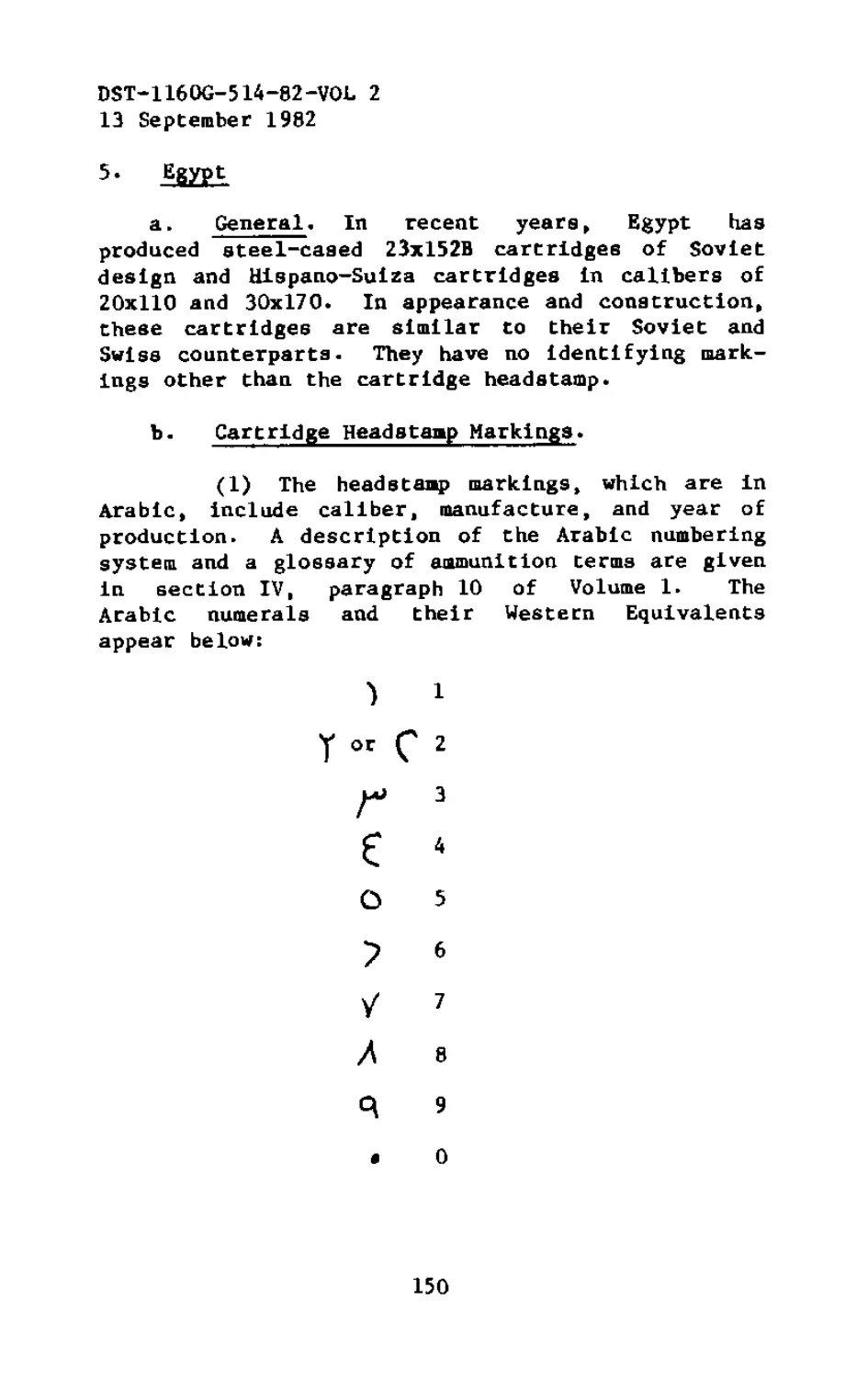
numerals (oriental or Arabic*), or In a letter
code. Examples of these markings are given in
section IV.
*Except for the numerals 1 and 9, the "Arabic"
numerals used by Western countries do not equate to
those used by Arabic-speaking, and some other,
countries (see sec IV, para 4).
19
DST-116OG-514-82-VOL 2
13 September 1982
4-	Functional Type
Except for the APDS or APOS-T projectile, which has
a characteristic design that is usually unmistak-
able, the determination of a projectile's function-
al type from its external appearance alone can be
risky. A cartridge with a nose fuze that is
stamped with a model designation must be presumed
to contain HE filler unless its markings indicate
beyond question that the projectile is inert-
loaded. The converse, unfortunately, is not true;
the absence of a noae fuze cannot be taken to mean
that the projectile does not contain a hazardous
filler of some type. Projectiles of typical Ap
construction may have an explosive filler and a
base fuze, while projectiles without a fuze of any
type whatever may contain a sensitive HE or a
hazardous filler such as white phosphorus. A
definite identification can be made only from the
markings and color code (If present) on the
projectile or, less of ten, on the cartridge case.
Unfortunately, these markings and color codes have
often changed over a period of years; as a result,
they exist in such a proliferation that a
comprehensive guide, covering all countries and
years of manufacture, is not feasible. The marking
systems used today by the major countries that
produce ammunition in this caliber range are given
in section IV. Additional information on car-
tridges made by the United States and on ammunition
used during World War II can be found in the
publications cited in the bibliography.
5.	Safety in Handling
a.	Cartridges In the 20- to 40-mm caliber
range, unlike small-arms cartridges, have projec-
tiles that, for the most part, contain HE and a
fuze and thus present a safety hazard. It must be
emphasized that no cartridge can be considered to
have an inert-loaded projectile unless its func-
tional type has been determined beyond question
20
DST-116OG-514-82-VOL 2
13 September 1982
from markings or color coding that are correct for
and applicable to its country of origin and year of
manufacture. Even projectiles that follow the
US/NATO color marking system and are Identified by
the blue projectile body as practice types may con-
tain a spotting charge or other functional element
that presents some degree of hazard.
b.	If any question exists as to the safety of
a projectile or cartridge, it must be considered as
possible HE-loaded and thus hazardous, and referred
to an explosive ordnance disposal (EOD) unit or to
some other qualified agency for determination of
its type and hazard. An X-ray examination by an
activity qualified to do this work will provide
information on a projectile's internal construction
that may aid in its identification and indicate the
degree of hazard that attends its handling; how-
ever, an X-ray examination alone will not indicate
the specific type of filler.
c.	Removal of an unidentified projectile from
its cartridge case, or its disassembly, is hazard-
ous and must not be attempted by unauthorized per-
sonnel.
d- Explosive projectiles that have been fired
and have failed to function are especially hazard-
ous, since the fuze may be armed and sensitive to
shock or jarring. This is true even of fired pro-
jectiles of World War II vintage. Fired projec-
tiles can be recognized by the rifling marks
engraved into the rotating band. Such projectiles
should be left in place, marked or guarded, and
reported immediately to police or EOD personnel for
disposition. If any question whatever exists as to
its hazard, the projectile should be considered
dangerous and reported
21
(Reverse Blank)
DST-1I6OG-514-82-VOL 2
13 September 1982
SECTION III
CARTRIDGE IDENTIFICATION DATA
A. CARTRIDGE-CASE OUTLINE DRAWINGS
1.	General
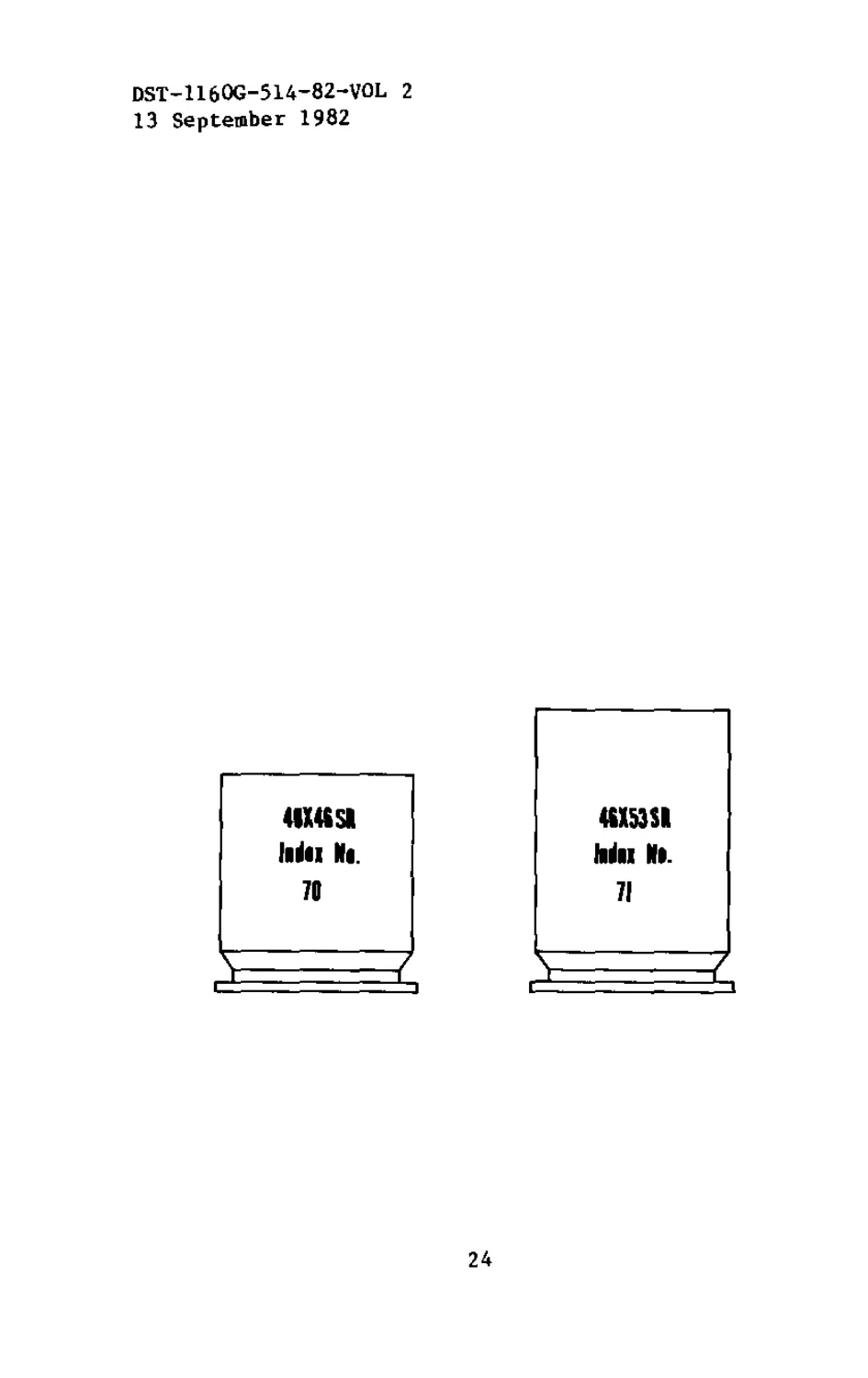
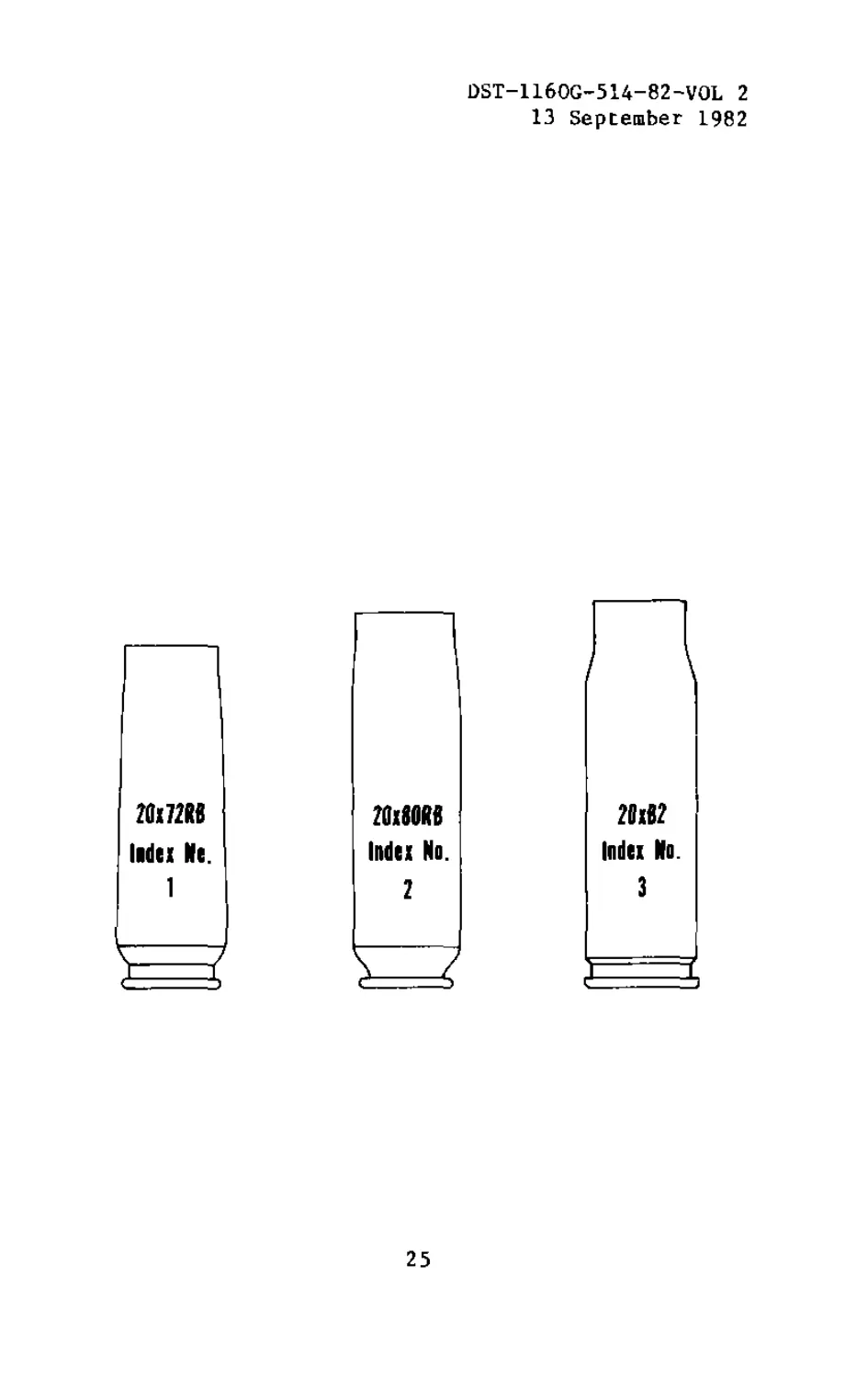
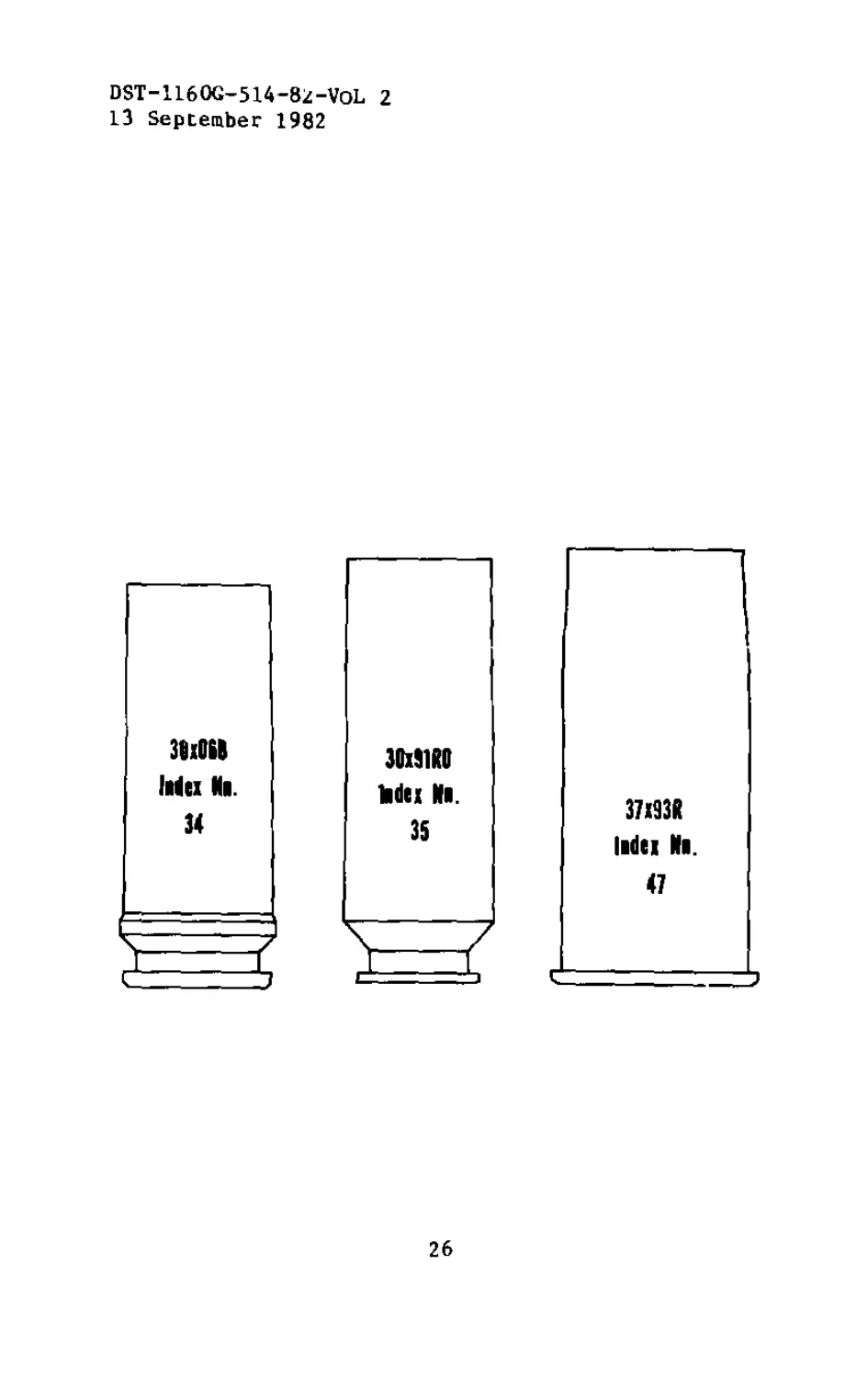
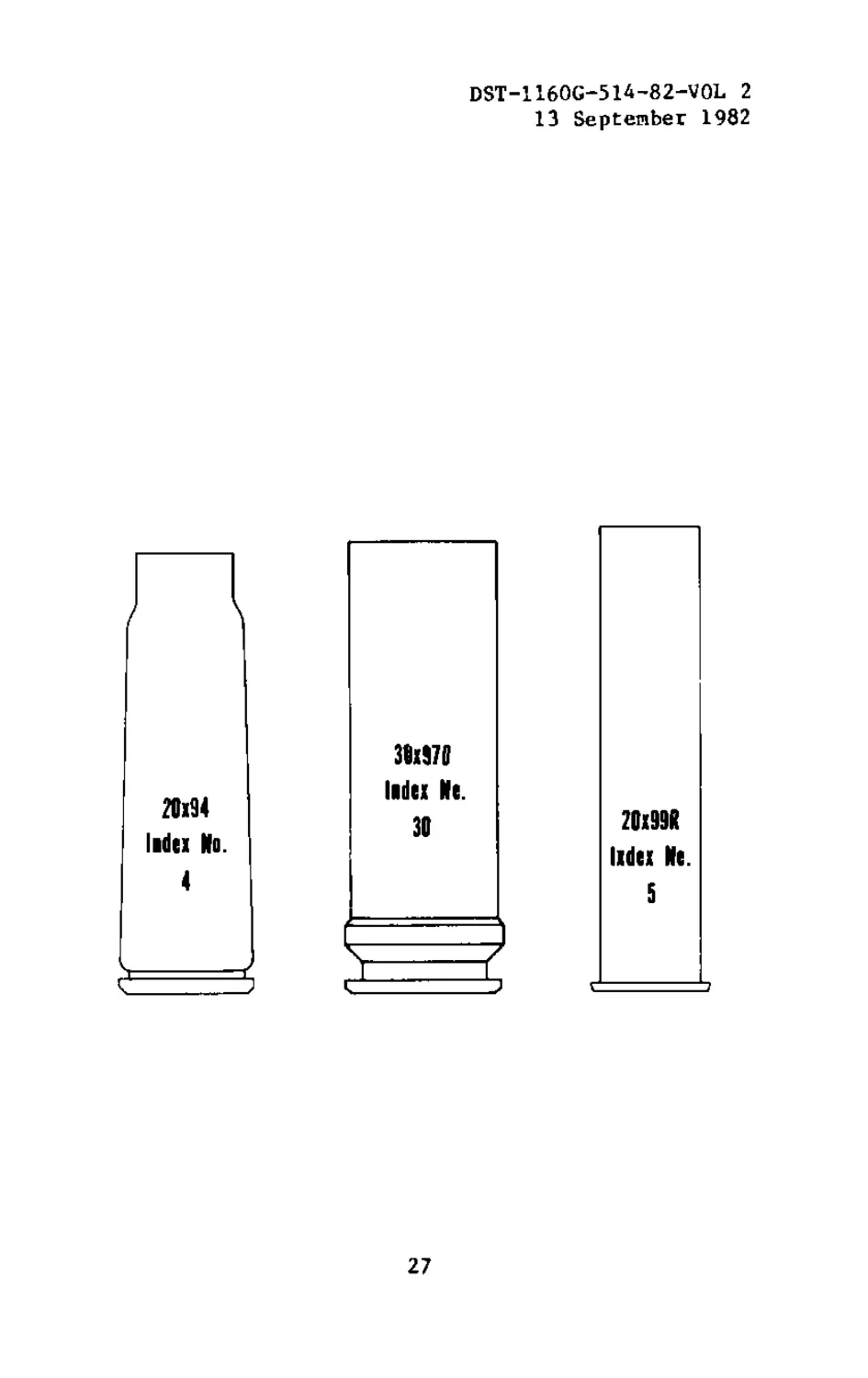
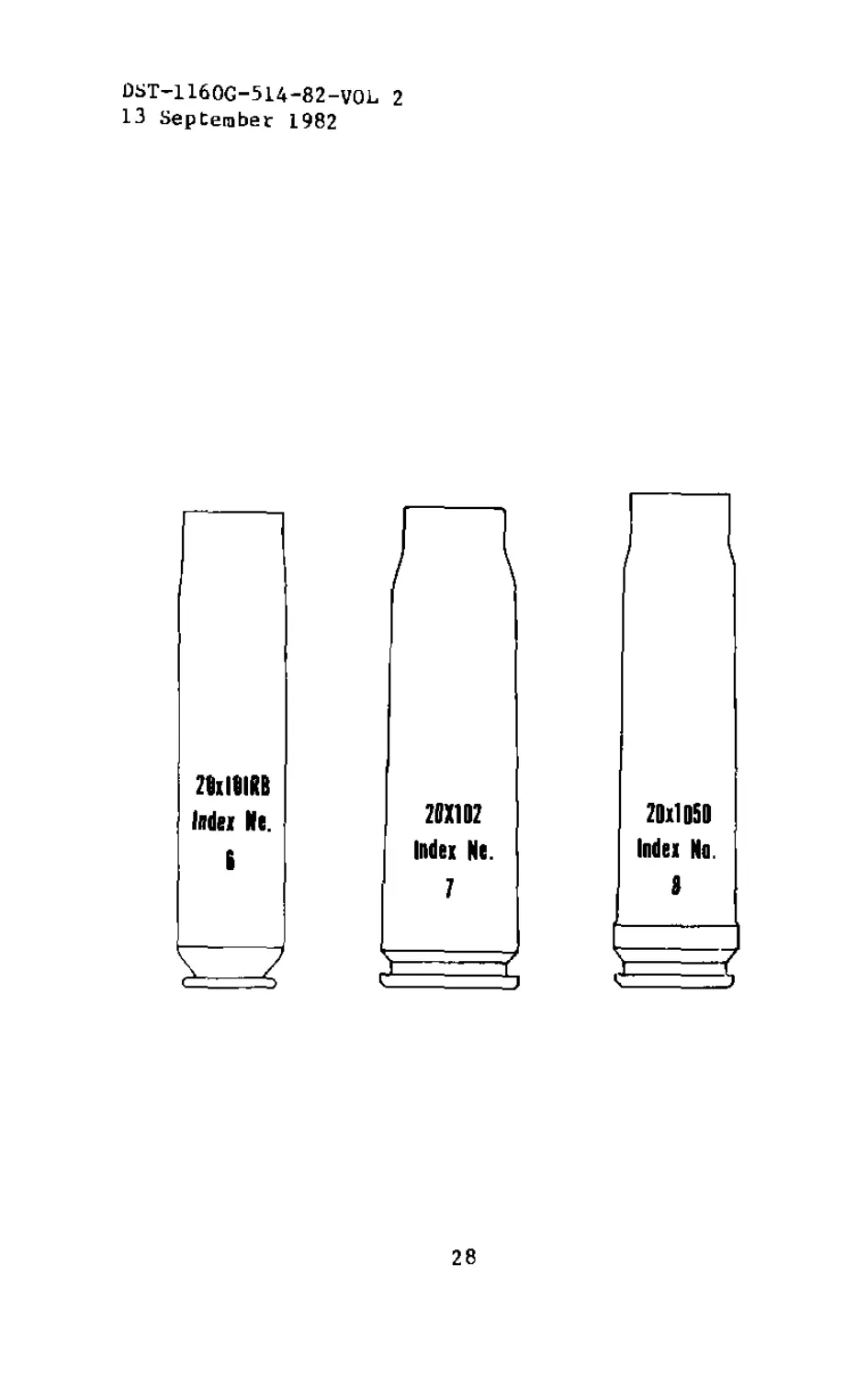
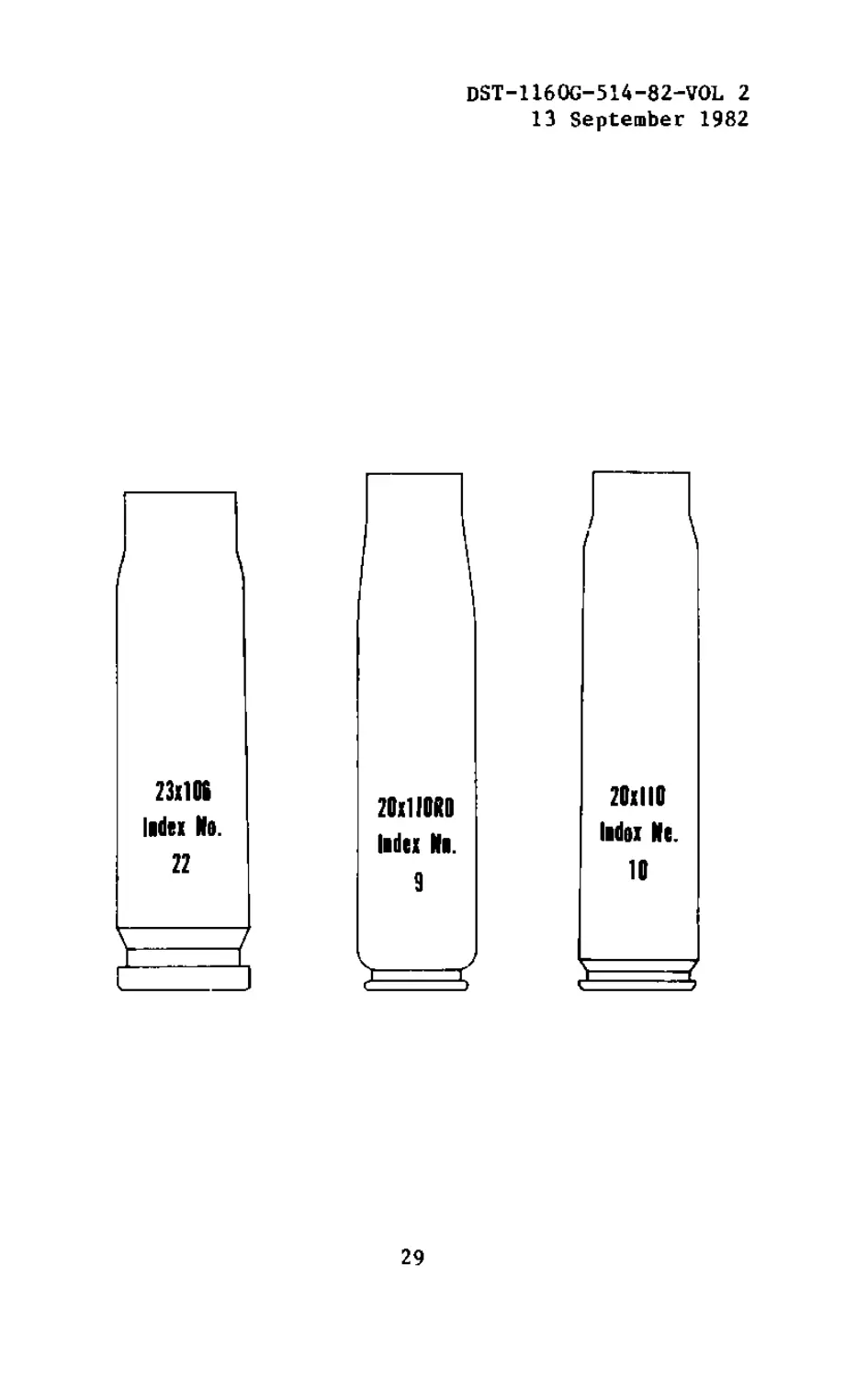
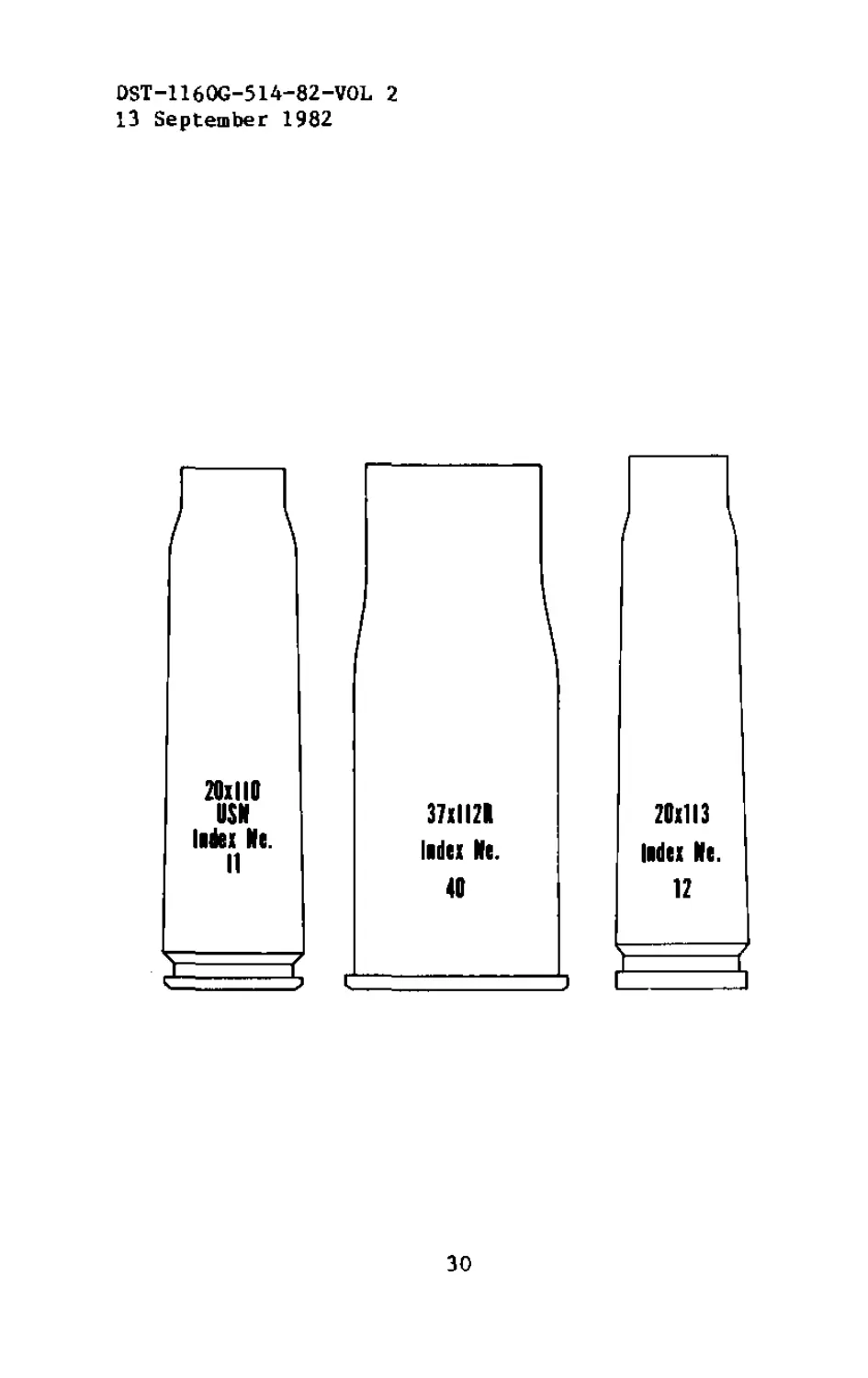
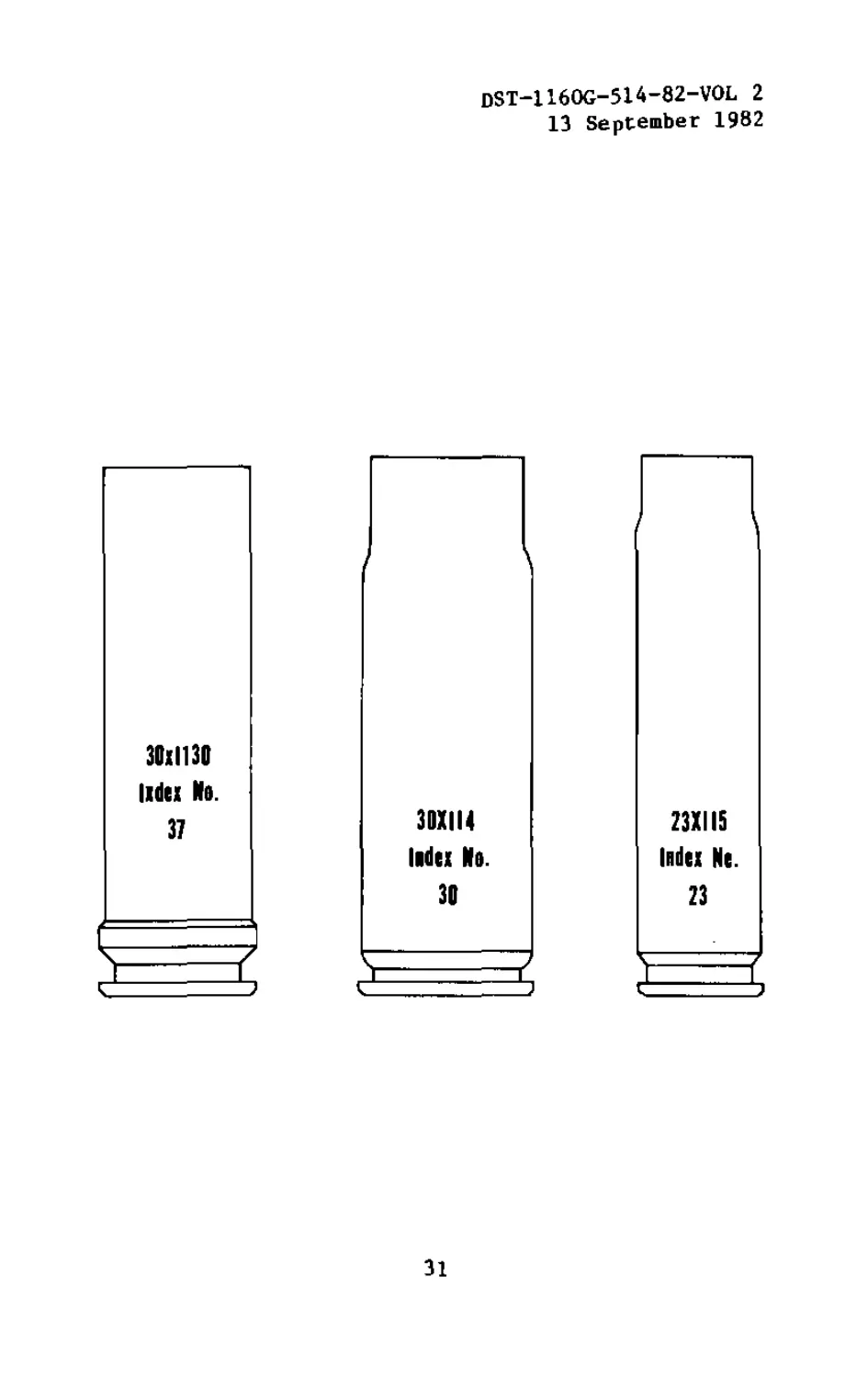
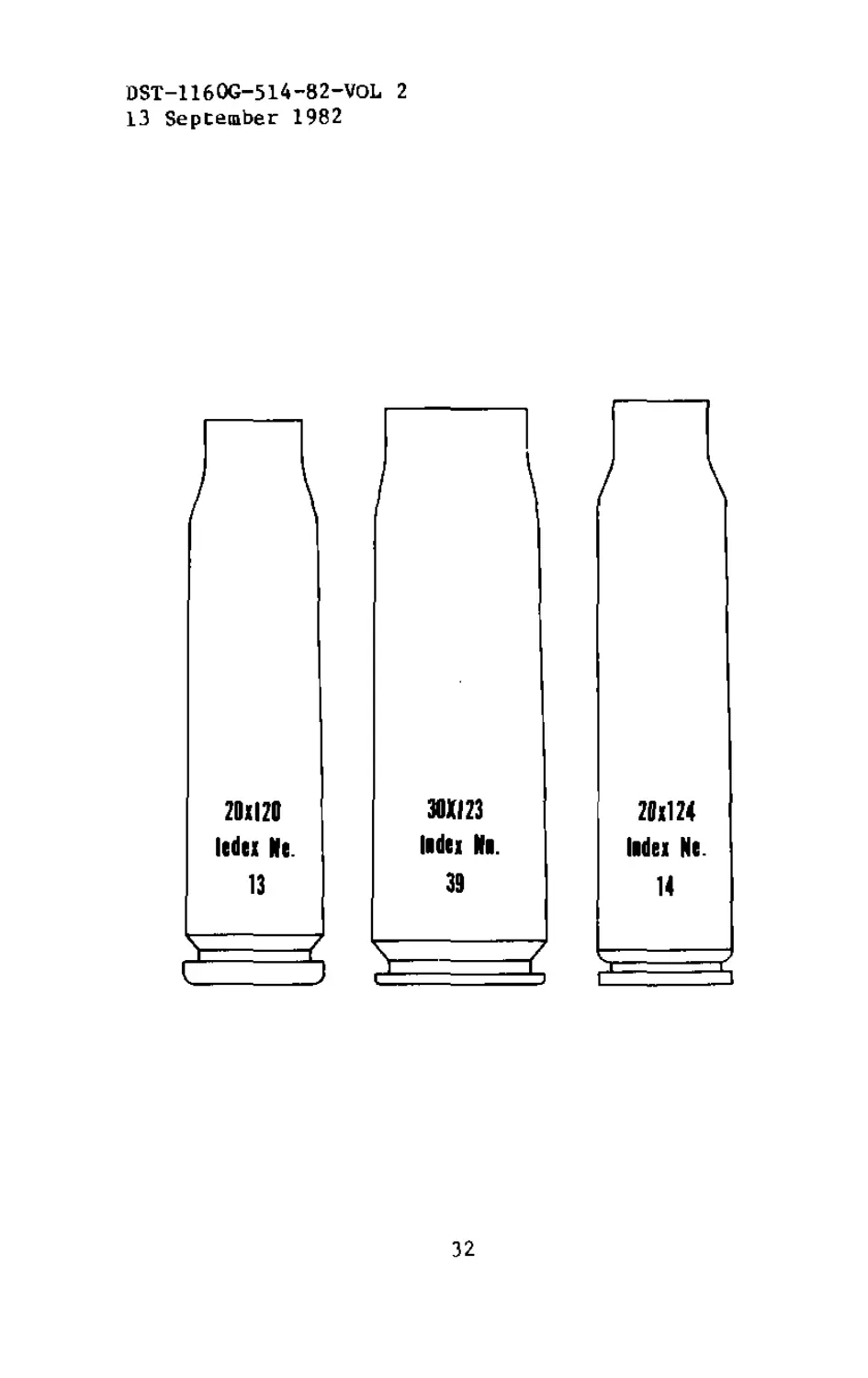
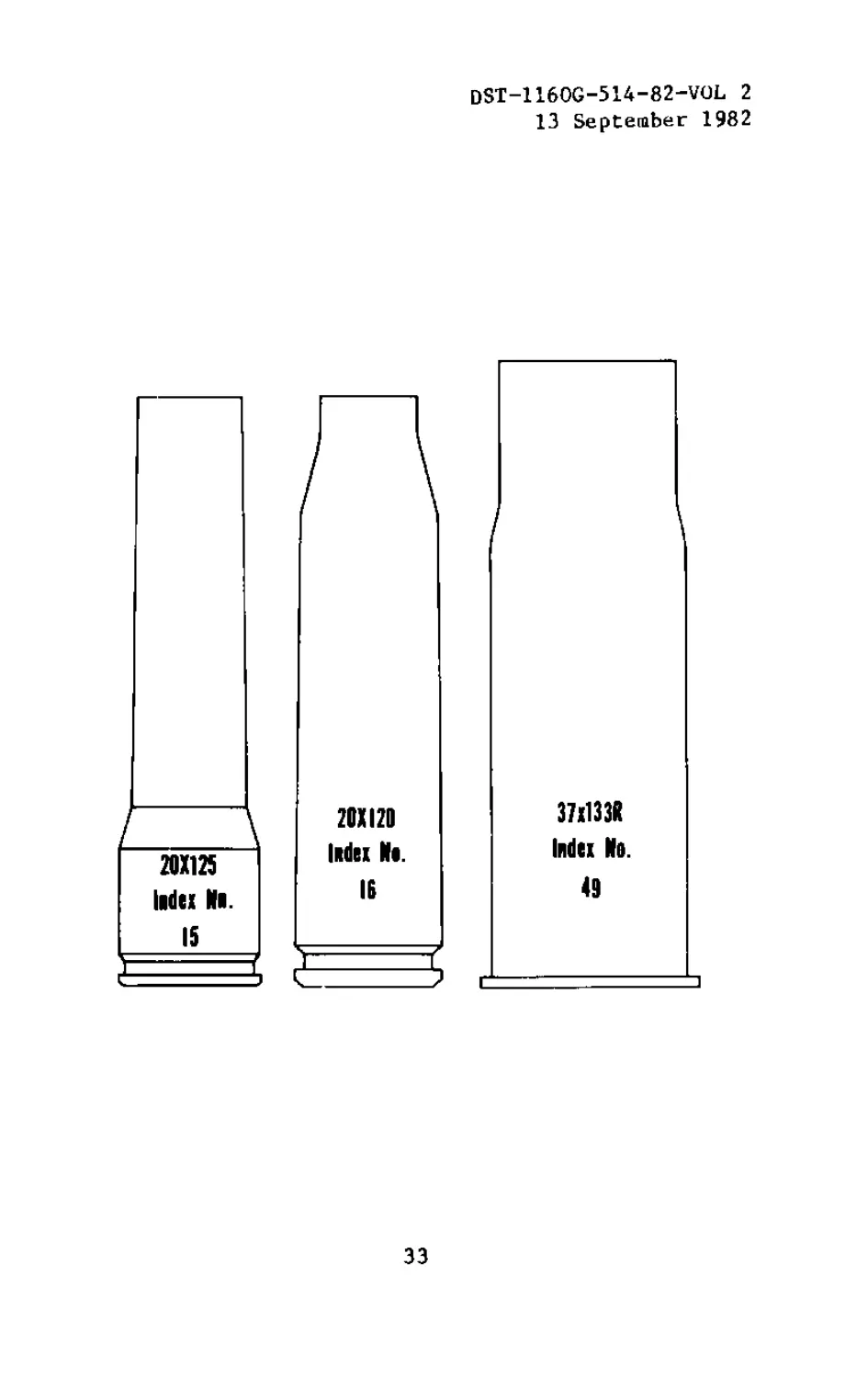
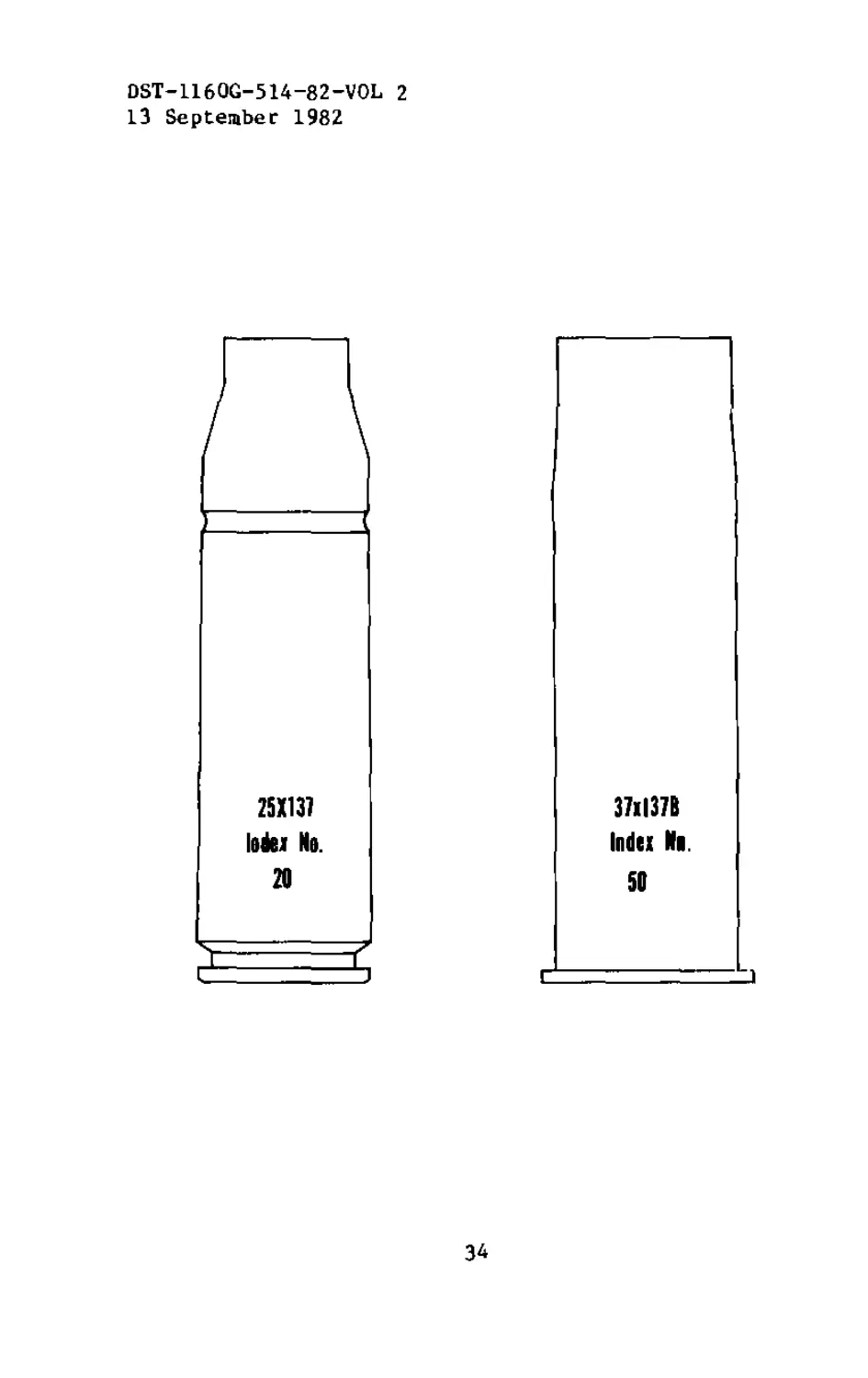
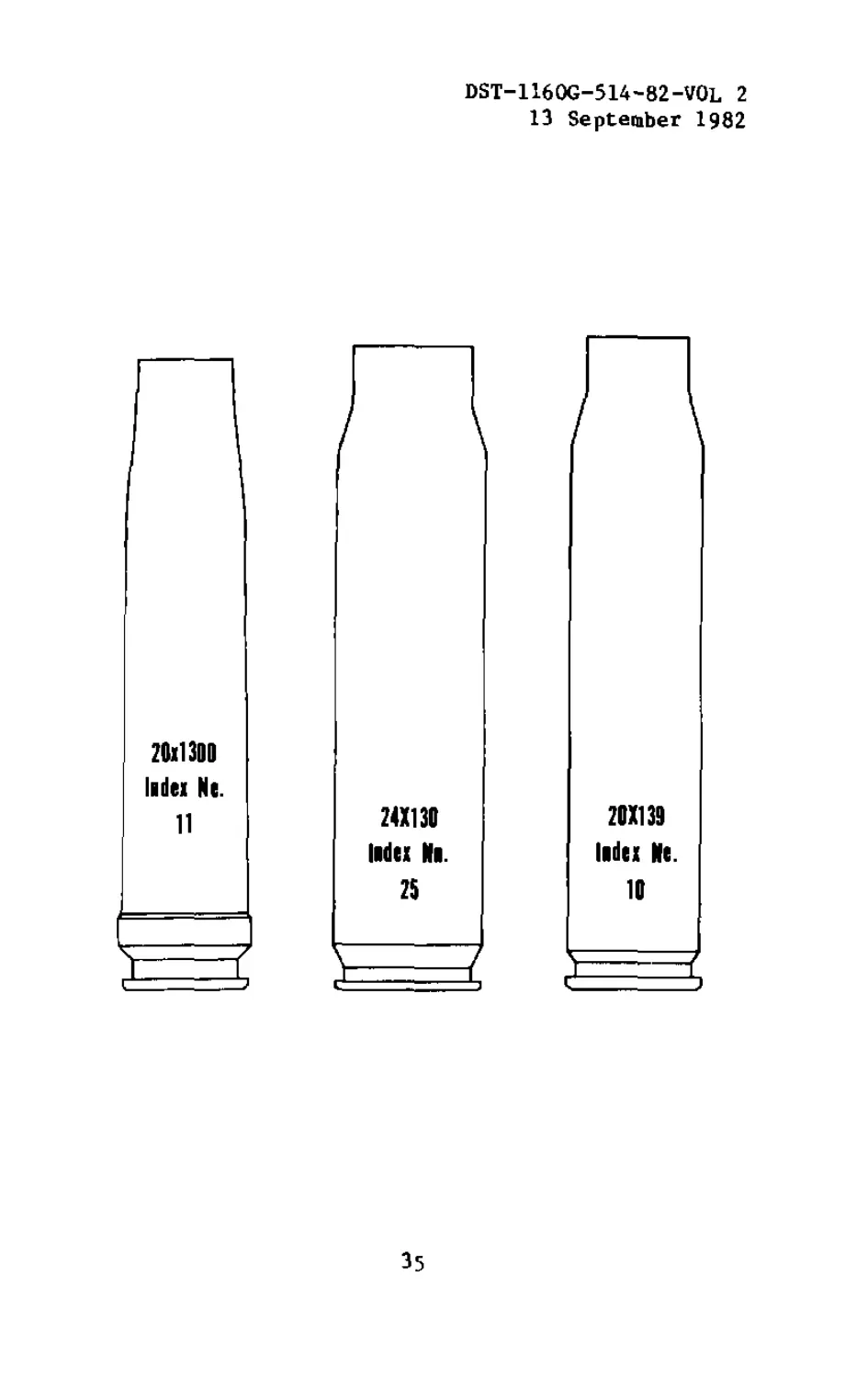
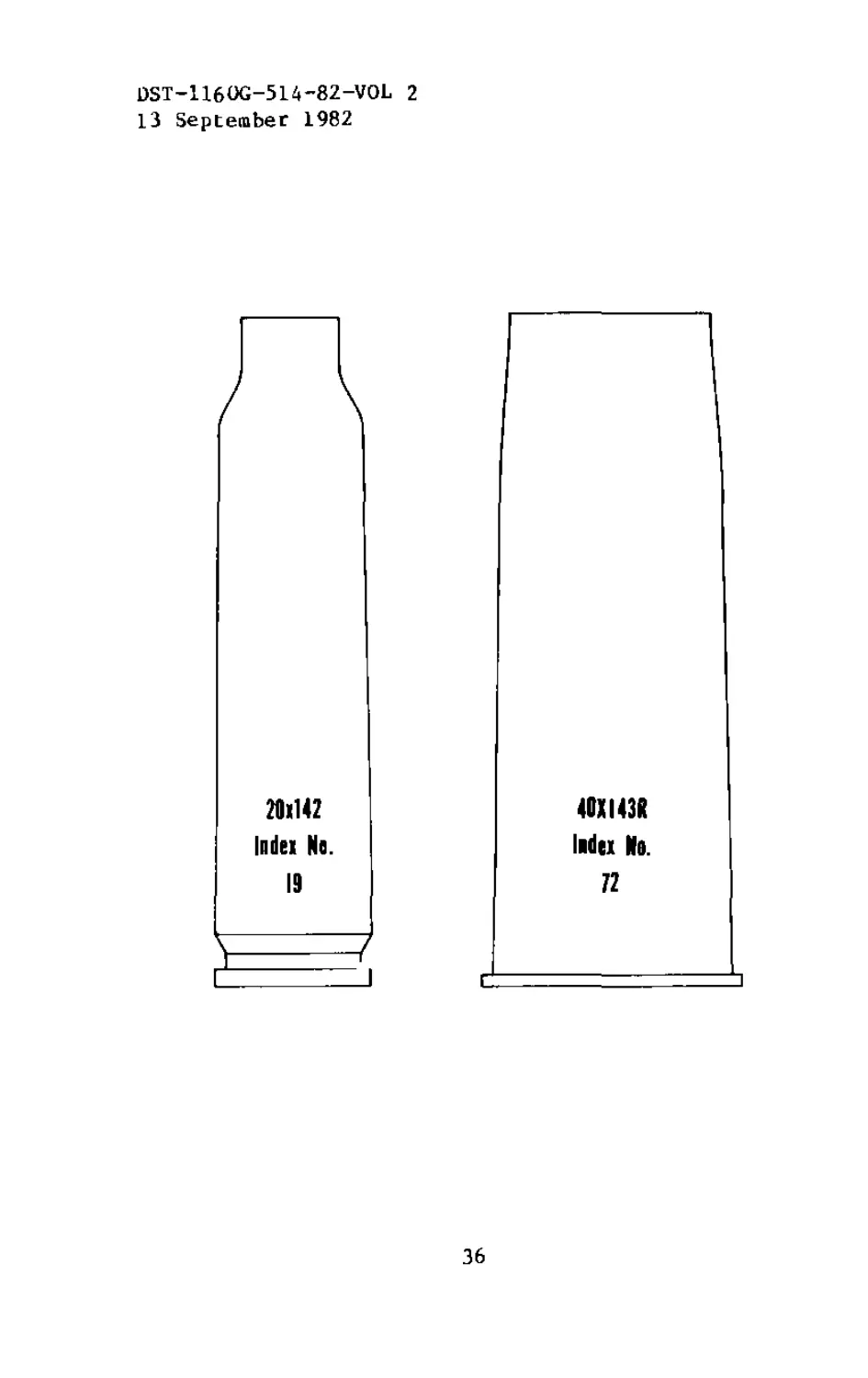
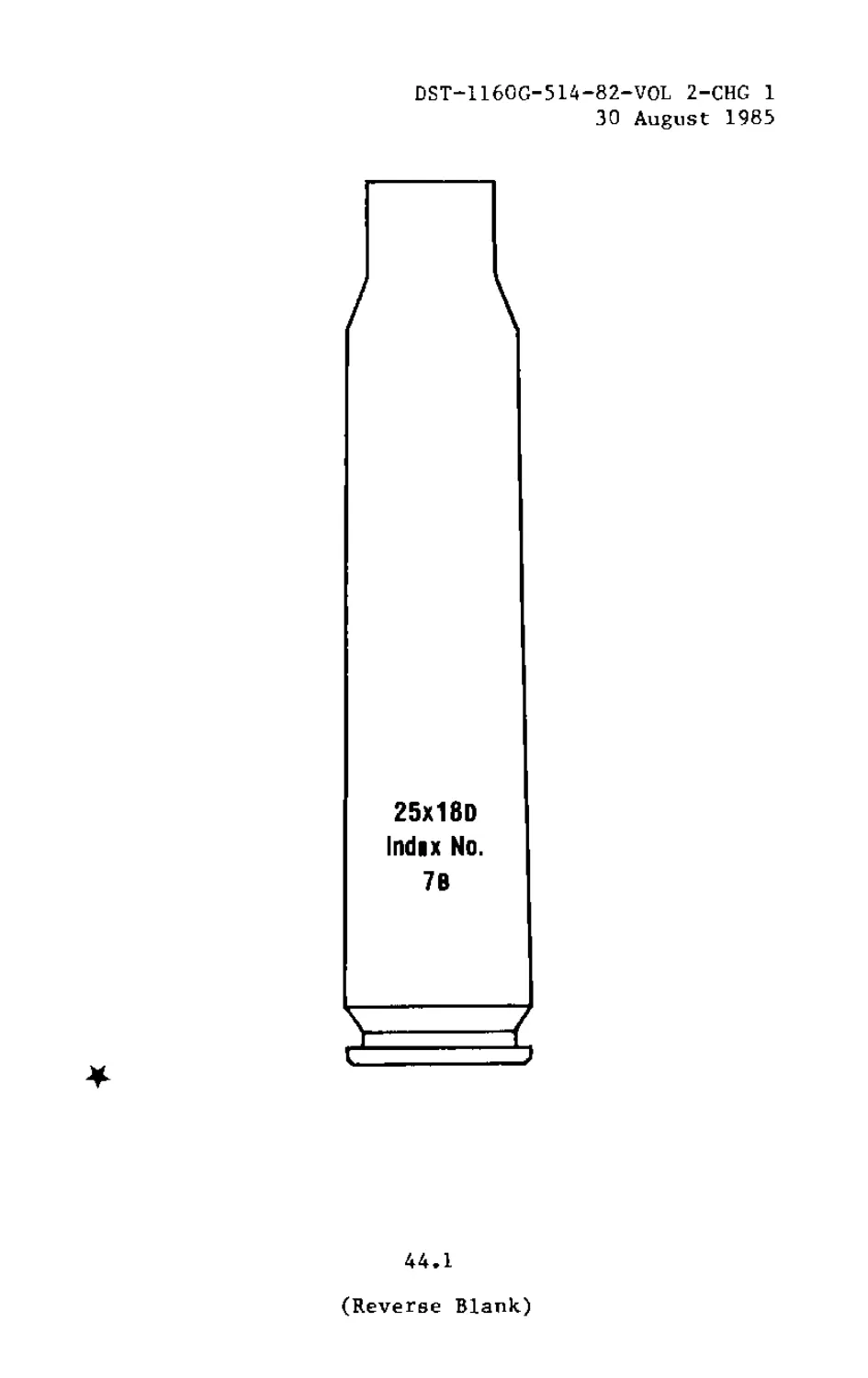
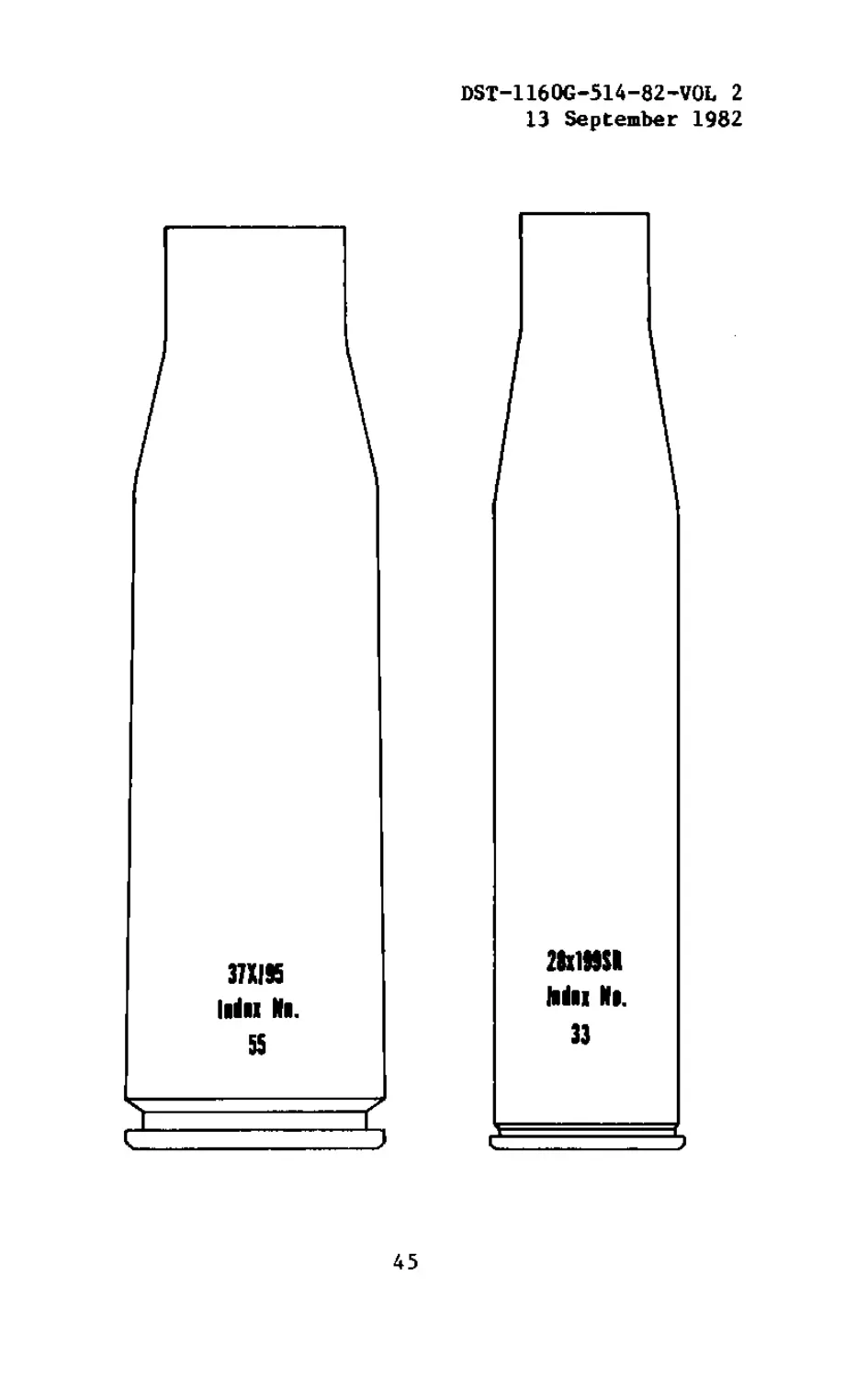
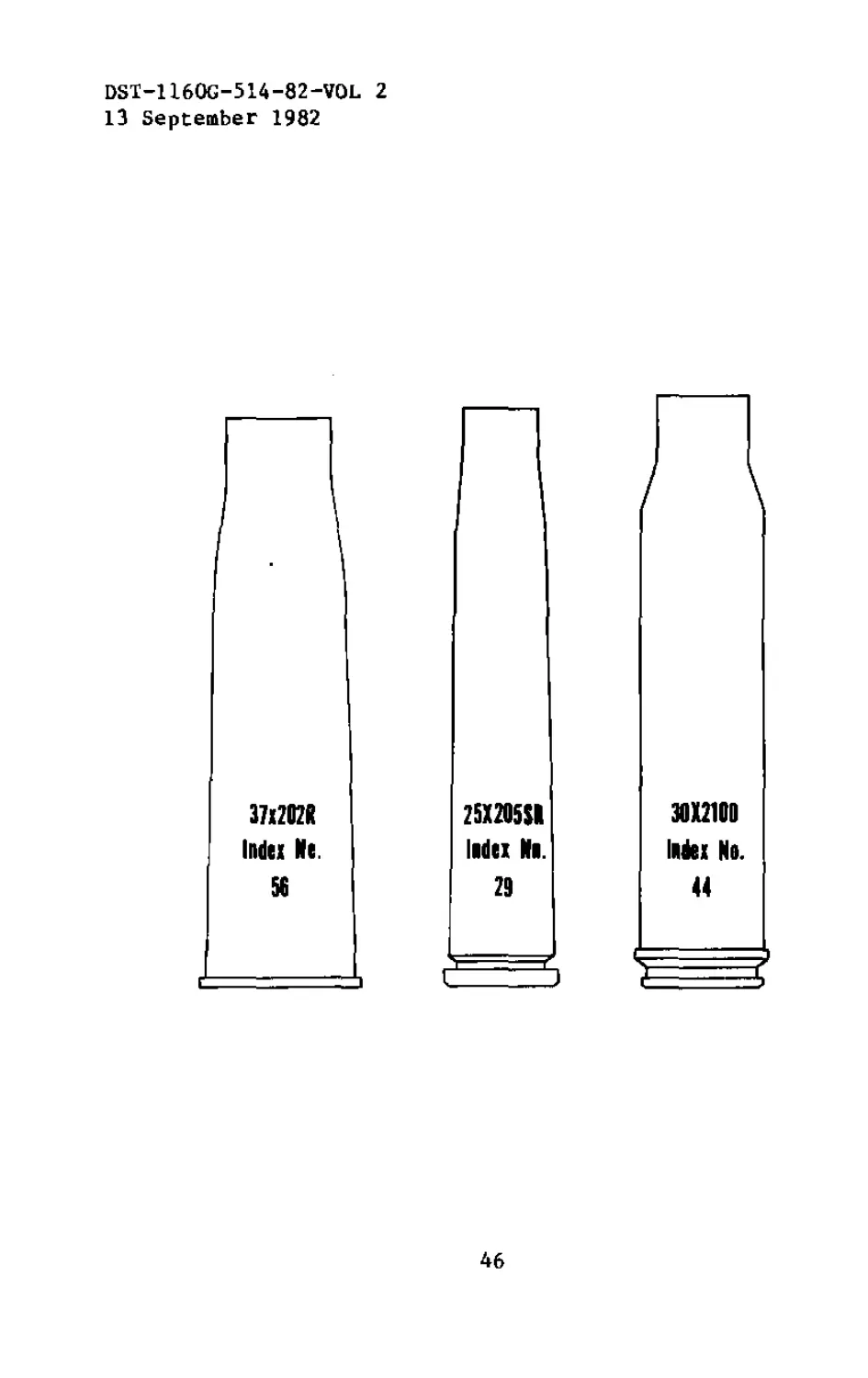
Cartridge-case outlines are presented in this sec-
tion in sequence of case length, as indicated by
the second element of the metric designation.
These drawings will be found particularly useful
for identifying fired cartridge cases with dented
or deformed mouths, which may prevent ready mea-
surement of the case-mouth diameter.
2.	Use
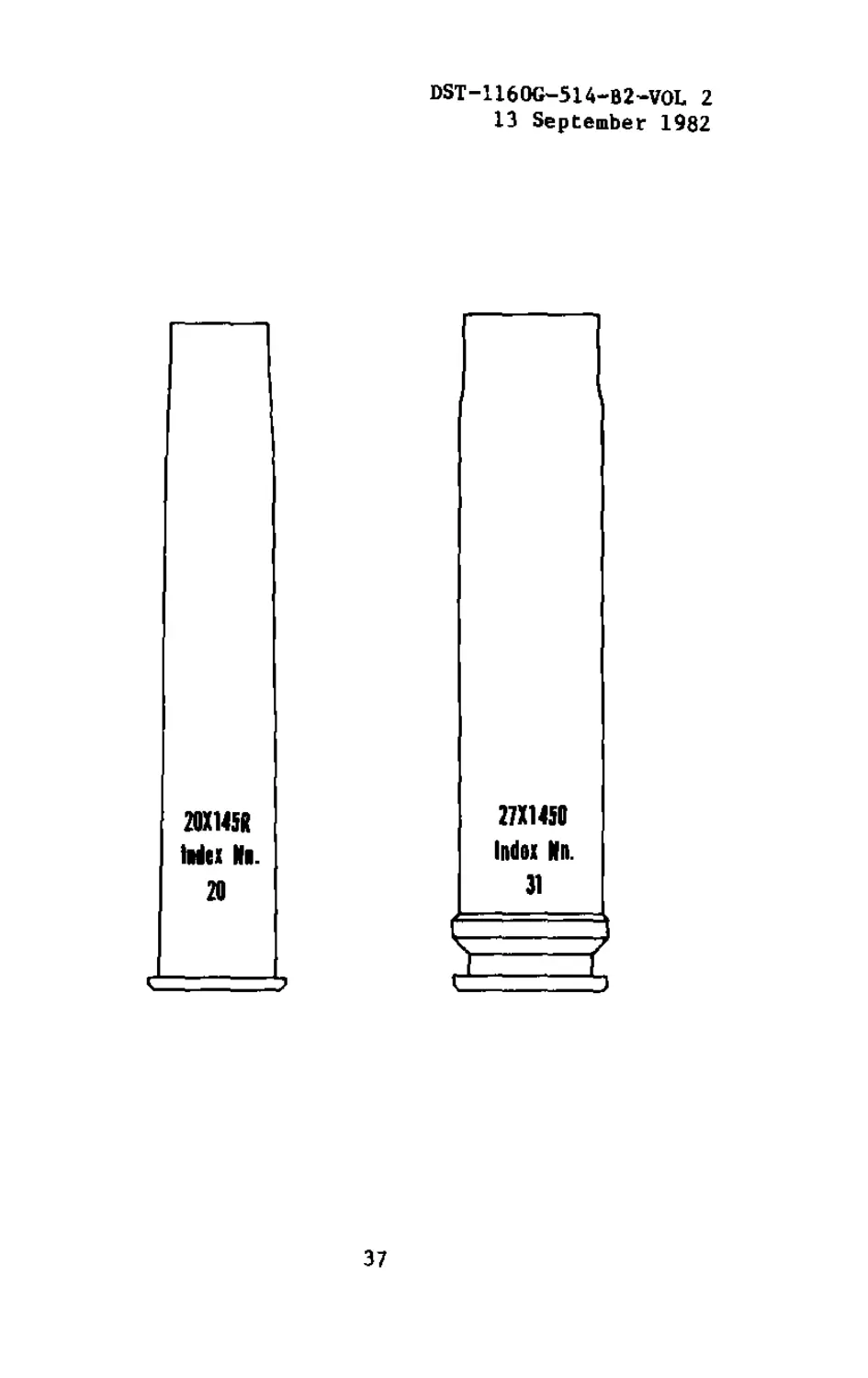
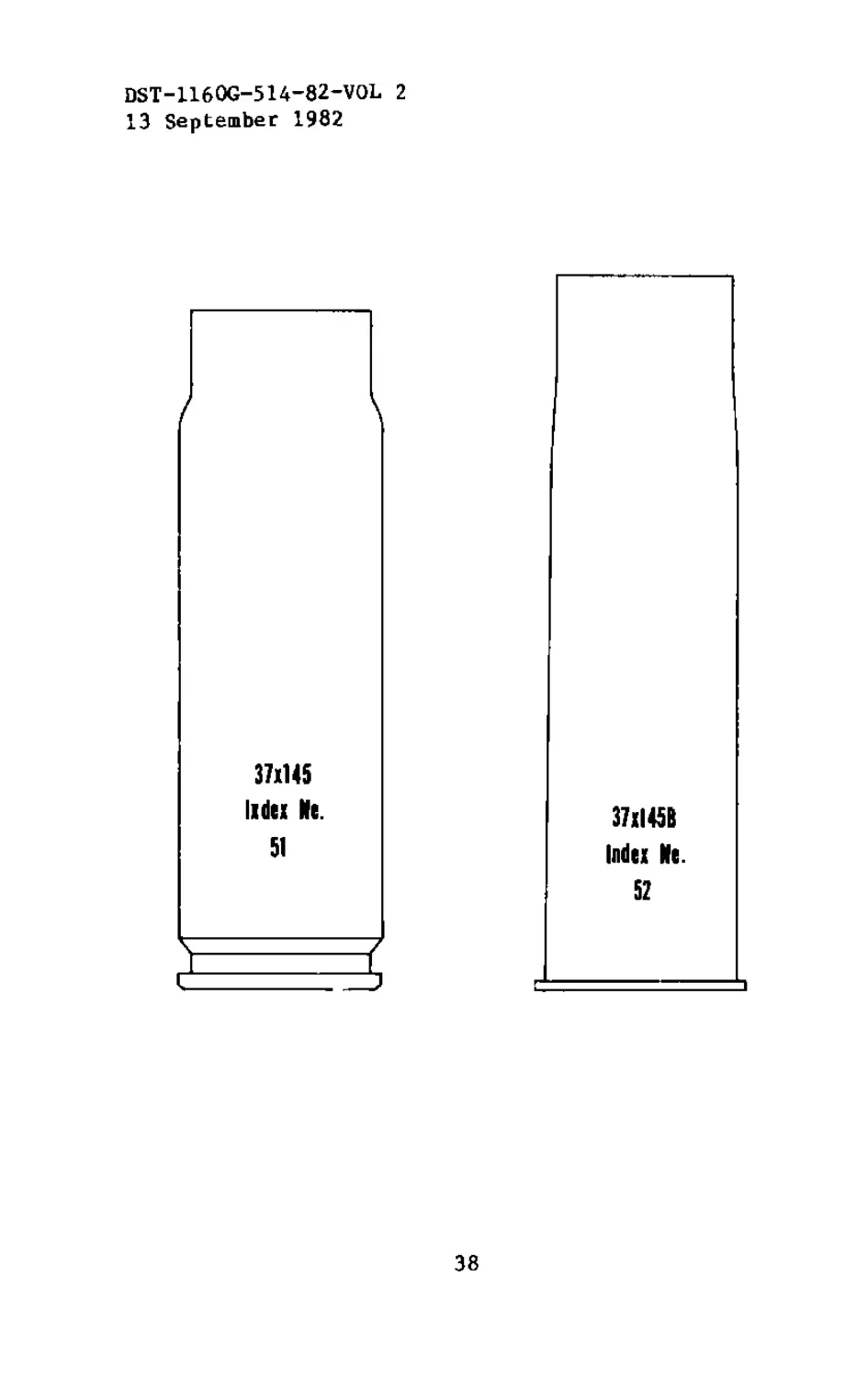
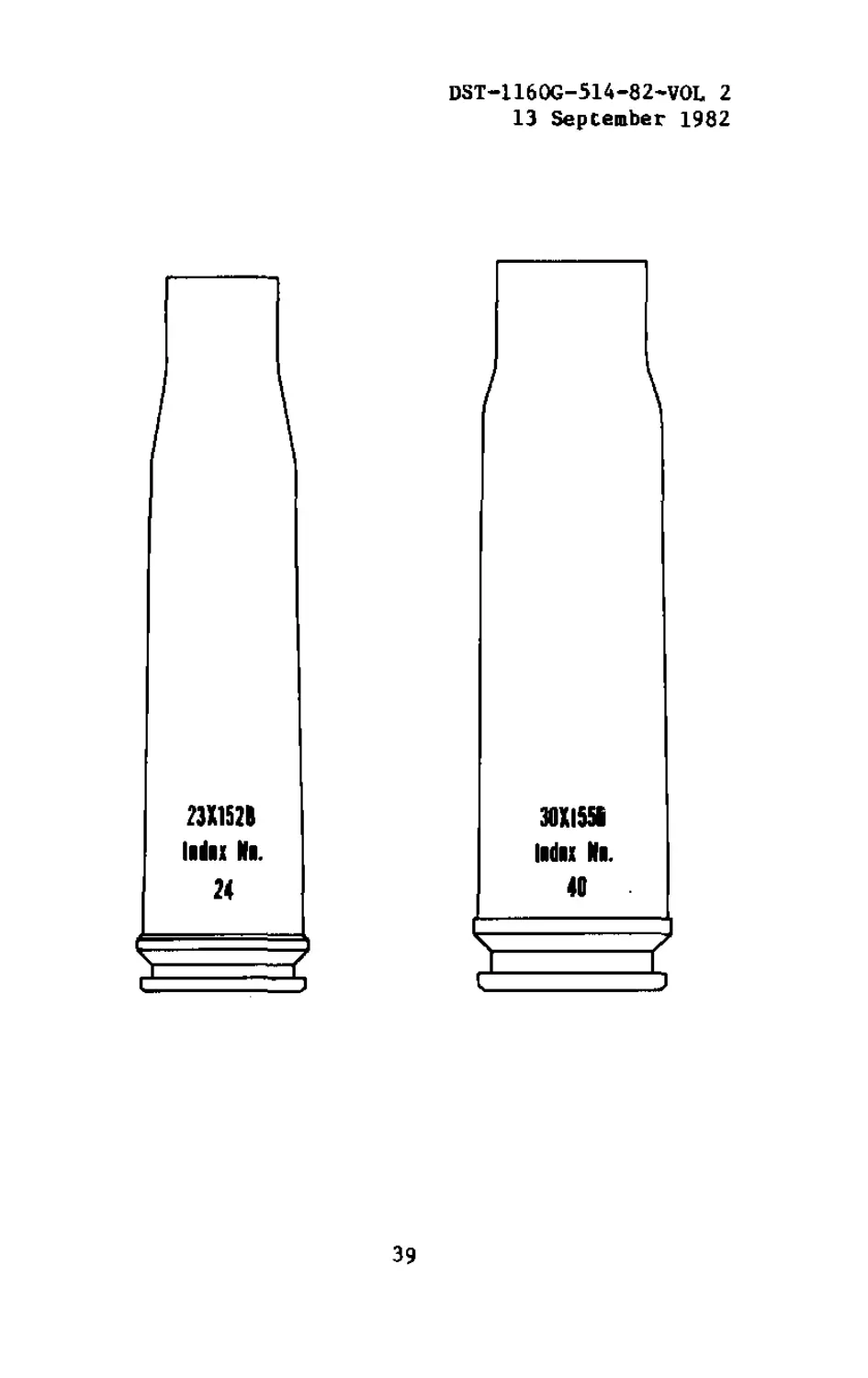
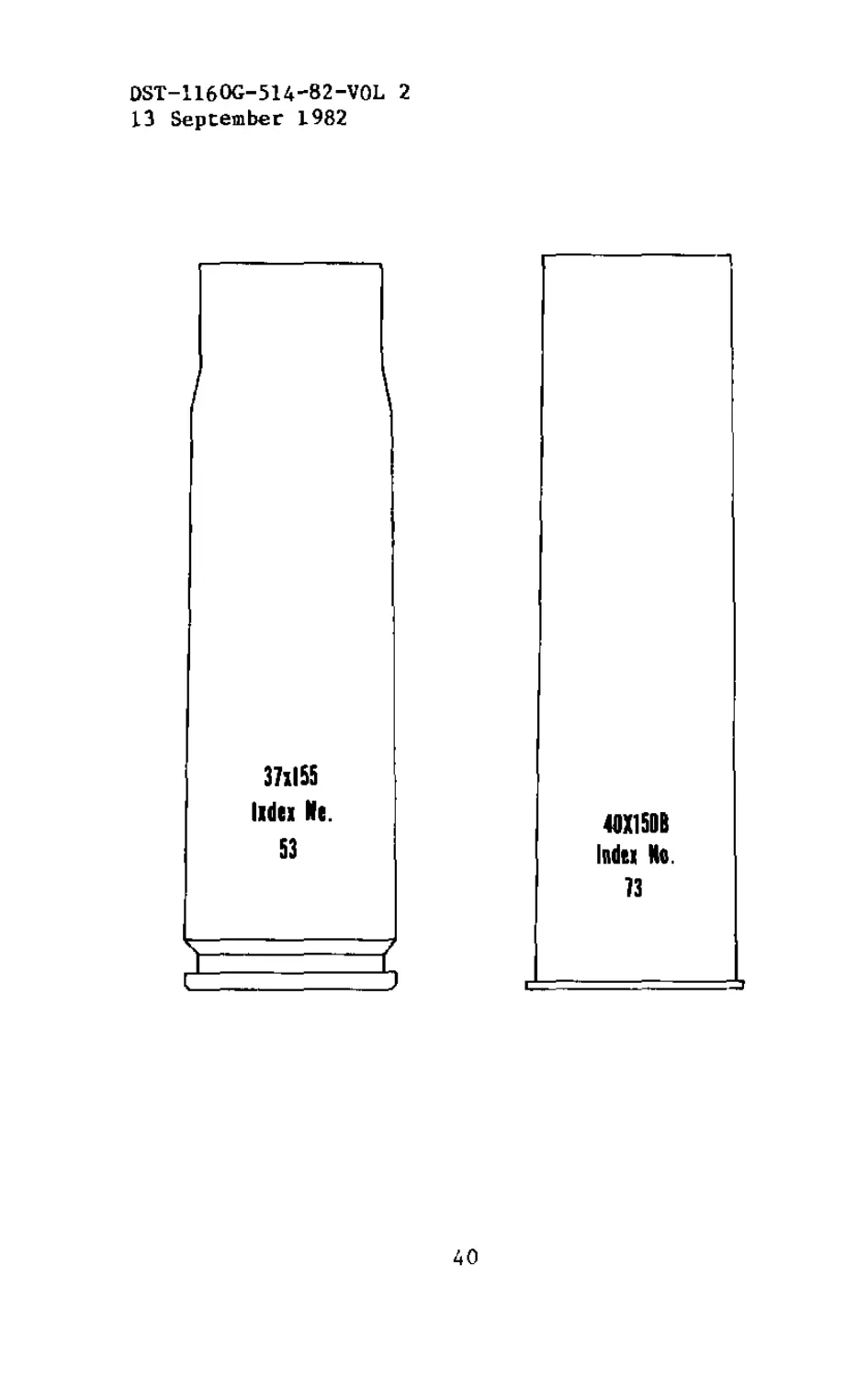
Because of space limitations, the outline drawings
are reduced in scale. Cartridge cases 200 nun and
less in Length are shown at 75% of full size, while
cases over 200 mm in length are shown at 45% of
full size. Provided that the case length is known
and the cartridge caliber can be estimated, these
drawings can be used for a rapid preliminary identi-
fication from the case proportions, shoulder taper,
and cartridge base type; this identification will
frequently suffice when there is little likelihood
of confusion between cartridge types. A tentative
identification can be confirmed by reference to the
dimensional data that appear in table I, following
the outline drawings. Further information and
background data on the cartridge's origin and
development, and weapons in which it is used,
appear in part В of section III. The index number
that appears on each cartridge-case drawing can be
used to locate a specific cartridge in table I or
in section III, part B.
23
DST-1160G-514-82-VOL 2
13 September 1982
24
DST-116OG-514-82-VOL 2
13 September 1982
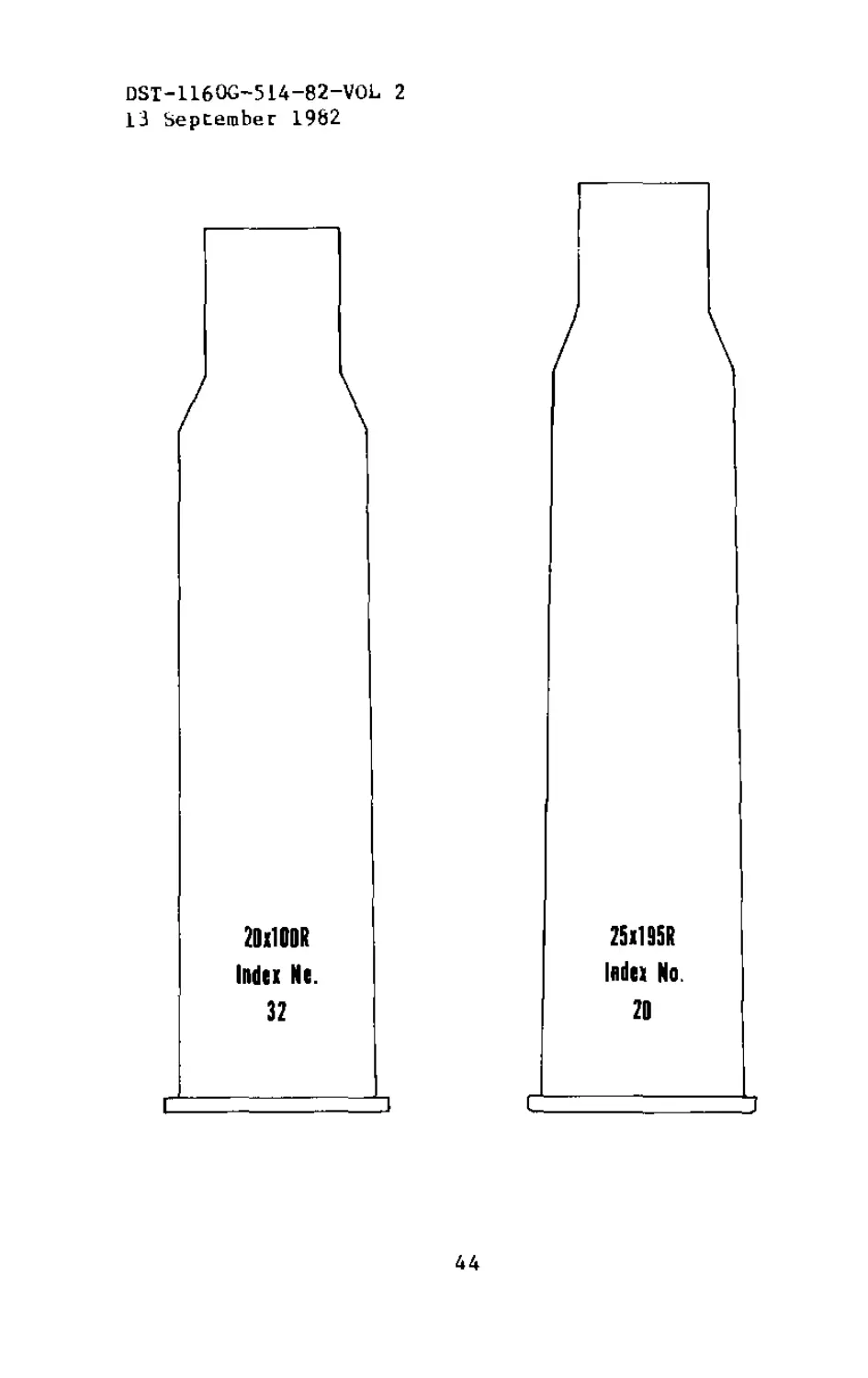
1
2(1x72118
Index Ke.
1
20x80R8
Index No.
2
20x82
Index No.
3
25
DST-1L60G-514-82-VOL 2
13 September 1982
26
DST-1160G-514-82-V0L 2
13 September 1982
	20x94 lad» No. 4
у		/
		J
39x970
ladex Nt.
30
20x990
lidex Nt.
5
27
DST-1160G-514-82-V0L 2
13 September 1982
\
20xl0IRB
Index He.
I
20X102
Index Ne.
20x1050
Index No.
0
ь
7


28
DST-1160G-514-82-VOL 2
13 September 1982
/
23x100 lidei No. 22		20x1 IORD lidex Na. 9			20x110 ladox Nc. 10
\	/
1	1				r		э
I		1	<	>		Y		(
29
OST-1160G-514-82-VOL 2
13 September 1982
/ \
20x110
USN
lata Nt.
II
С
20x113
lata Nt.
12
30
DST-116OG-514-82-VOL 2
13 September 1982
30x1130
lidex No.
37
J
	23X115
	Index Ne.
	23
v
1	f
		j
31
DST-1160G-514-82-VOL 2
13 September 1982
32
DST-1160G-514-82-VOL 2
13 September 1982
37X133R
Index No.
49
33
DST-L160G-514-82-V0L 2
13 September 1982
25X137
lodei No.
20
Э
34
DST-U60G-514-82-V0L 2
13 September 1982
20x1300
lad» Ne.
11
24X130
lad» Na.
25
	20X139 lad» Ne. 10
V		;
		:
35
DST-116OG-5L4-82-VOL 2
13 September 1982
201142
Index No.
19
40XI43R
Index Nn.
72
36
DST-116OG-514-B2-VOL 2
13 September 1982
с
20X1458
Ыех Na.
20
27X1450
Index Nn.
31
37
DST-1160G-514-82-VOL 2
13 September 1982
37x145В
Index Ne.
52
38
DST-1160G-514-82-VOL 2
13 September 1982
23X152B
lata Na.
24
j
39
OST-1160G-514-82-VOL 2
13 September 1982
37il55
lidei Ke.
53
С
3
40
DST-116OG-514-82-VOL 2-CHG 1
30 August 1985
40.1
(Reverse Blank)
DS1-1160b-514~82-VOL 2
LJ September 1942
25x165 Index Nd. 21	371I66R	। Index Ne. 54	i ।	;
41
DST-116OG-5L4-82-VOL 2
13 September 1982
42
DST-1160G-514-82-VOL 2
13 September 1982
30X1858
lidix Mi.
43
43
DSI-LL60G-514-82-VOL 2
13 September 1982
44
DST-1160G-514-82-VOL 2-CHG 1
30 August 1985
44.1
(Reverse Blank)
DST-1160G-514-82-V0L 2
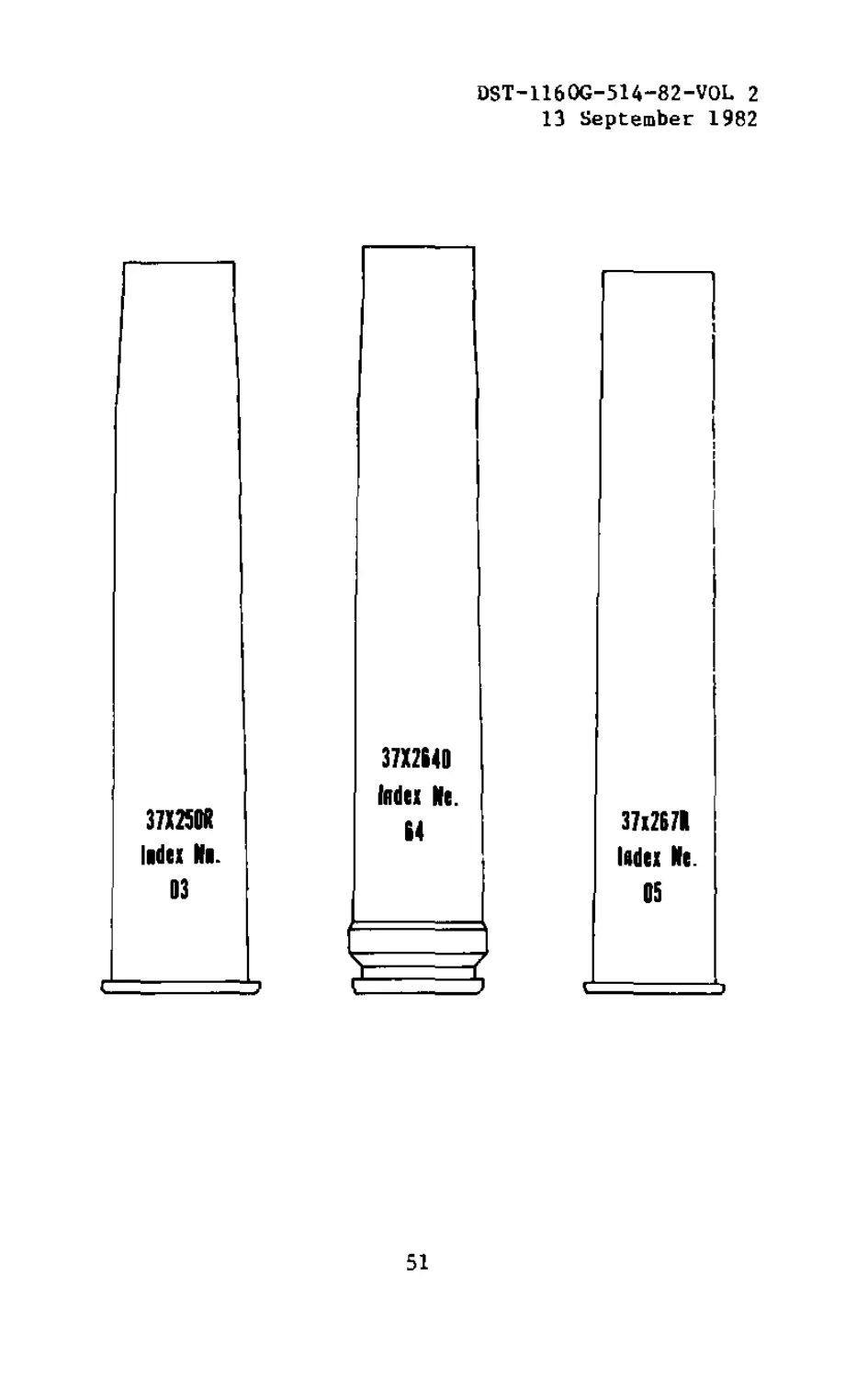
13 September 1982
45
DSI-116OG-514-82-VOL 2
13 September 1982
37x202R
Index Ne.
56
25X205SI
Index Na.
29
30X2109
latex No.
44


46
DST-1160G-514-82-V0L 2
13 September 1982
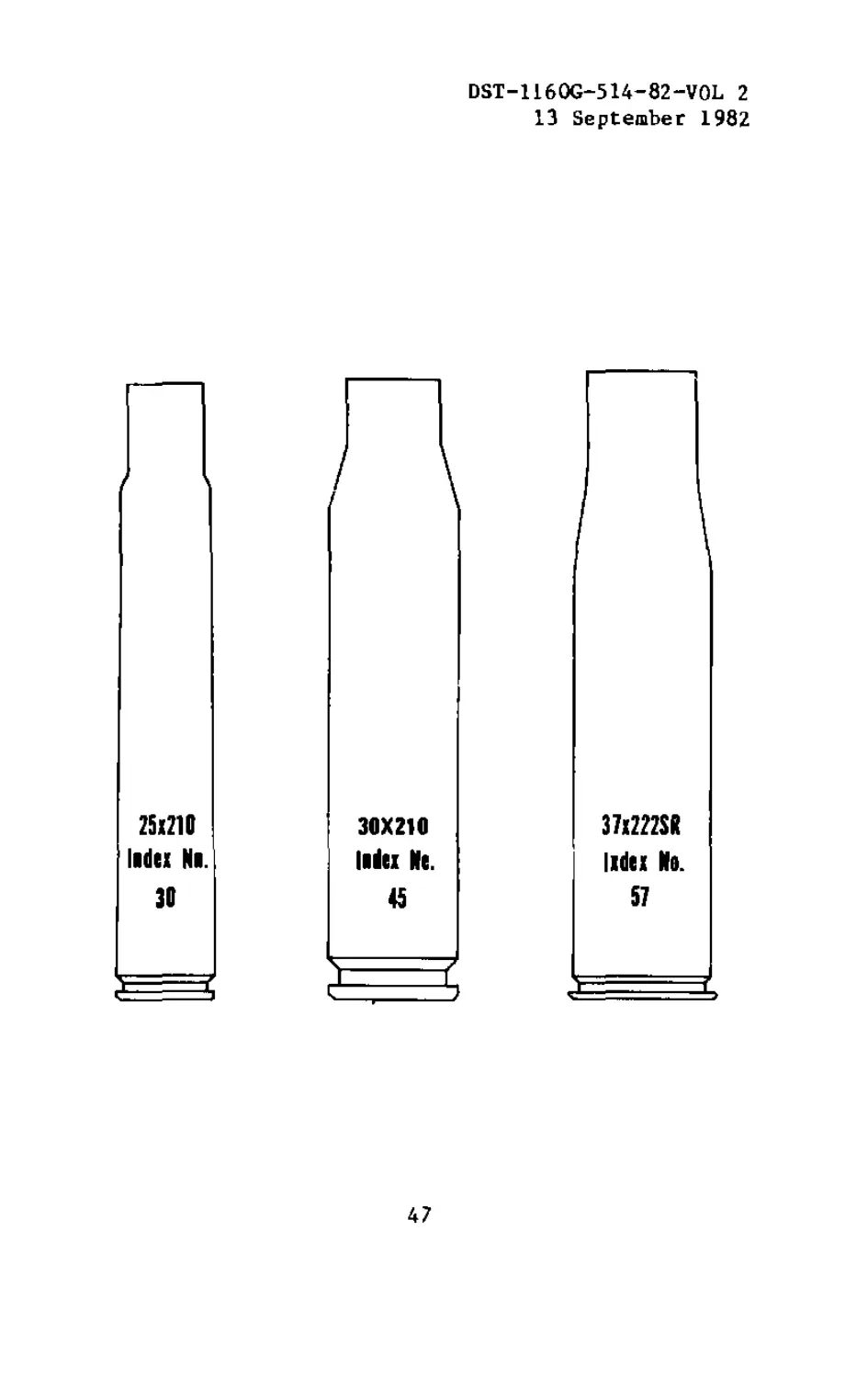
25x210
ladu Na.
30
37x222SR
I ide I No.
57
47
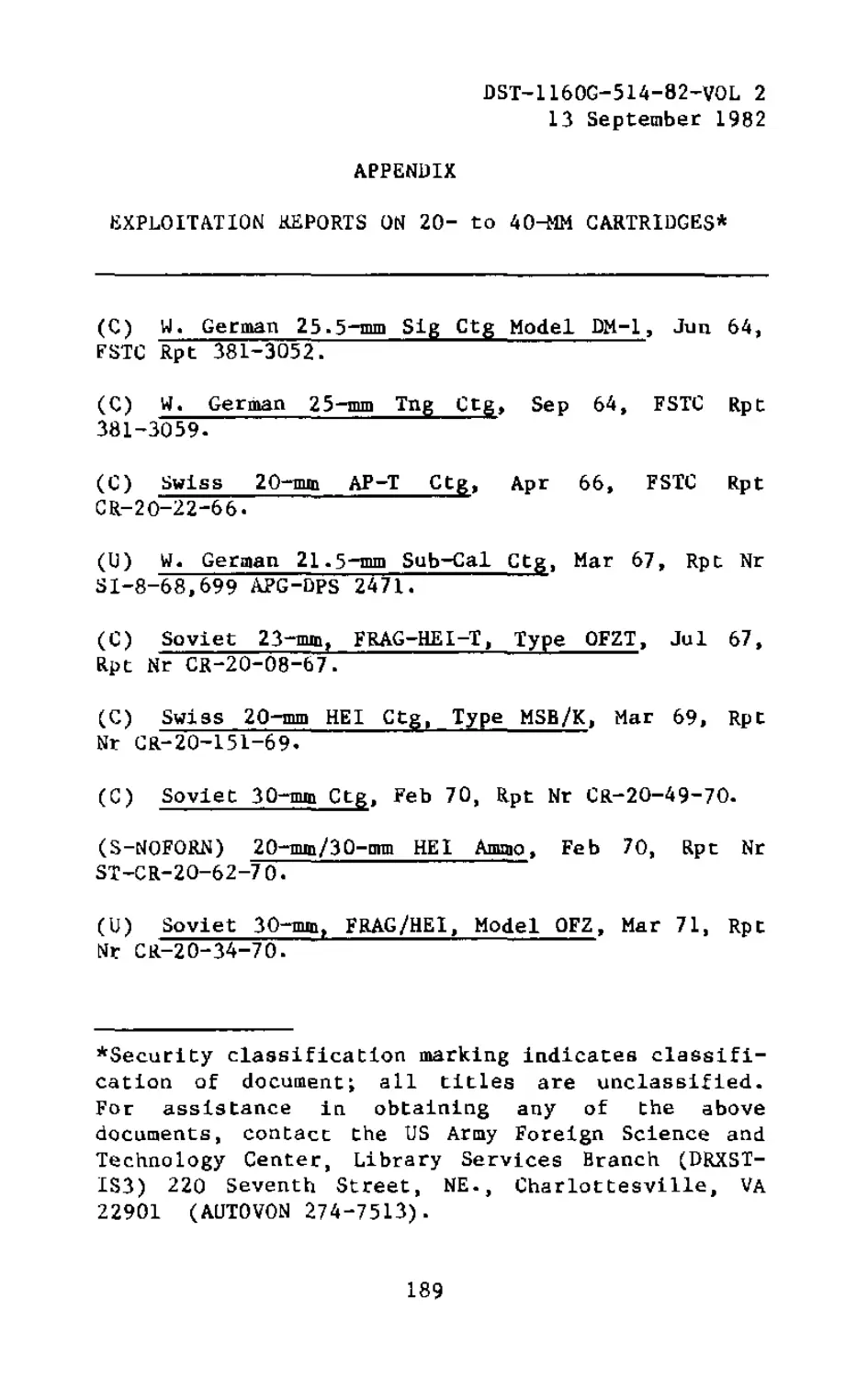
DST-116OG-514-82-VOL 2
13 September 1982
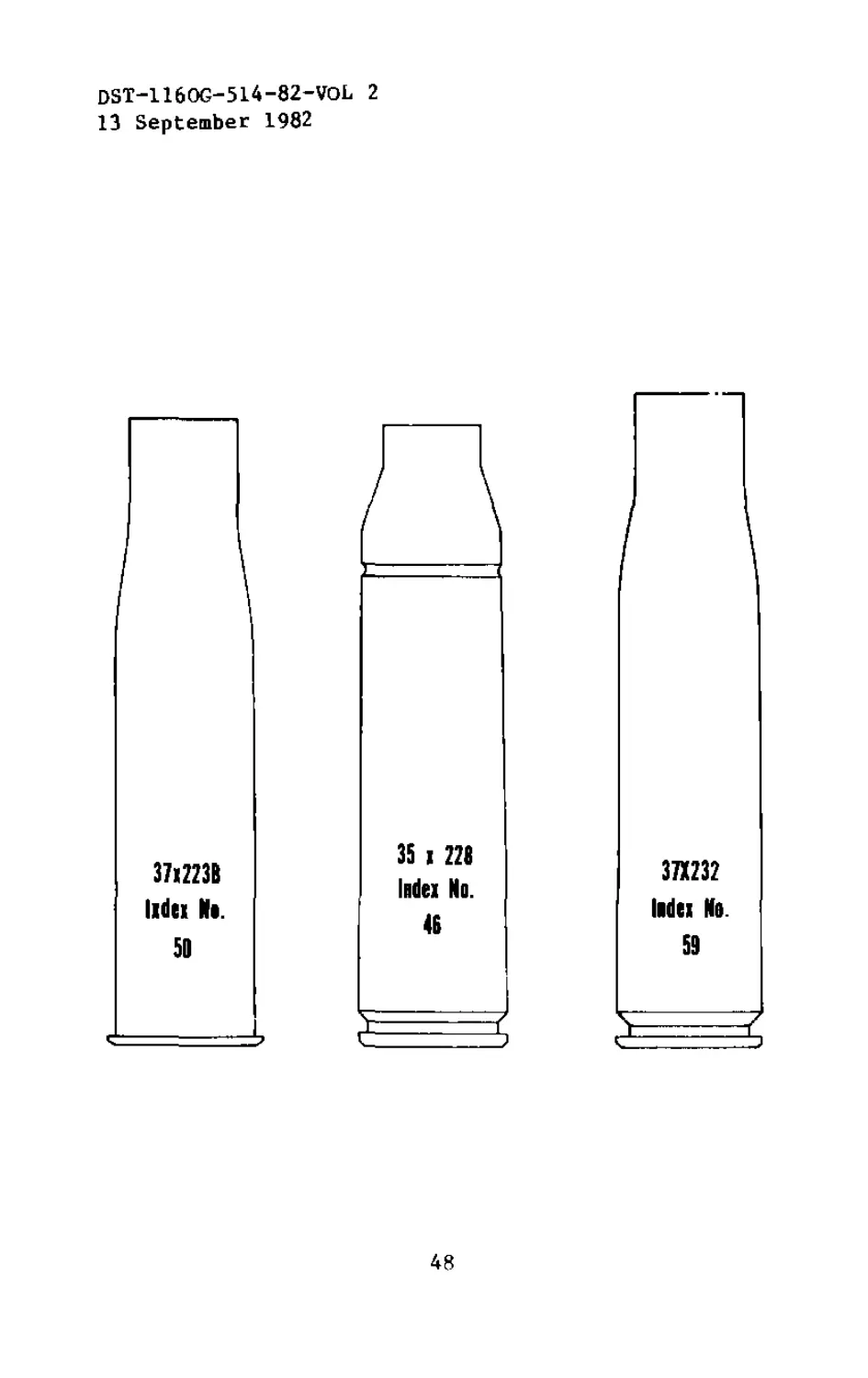
37x223В
lidex Na.
5D
48
DST-1160G-514-82-VOL 2
13 September 1982
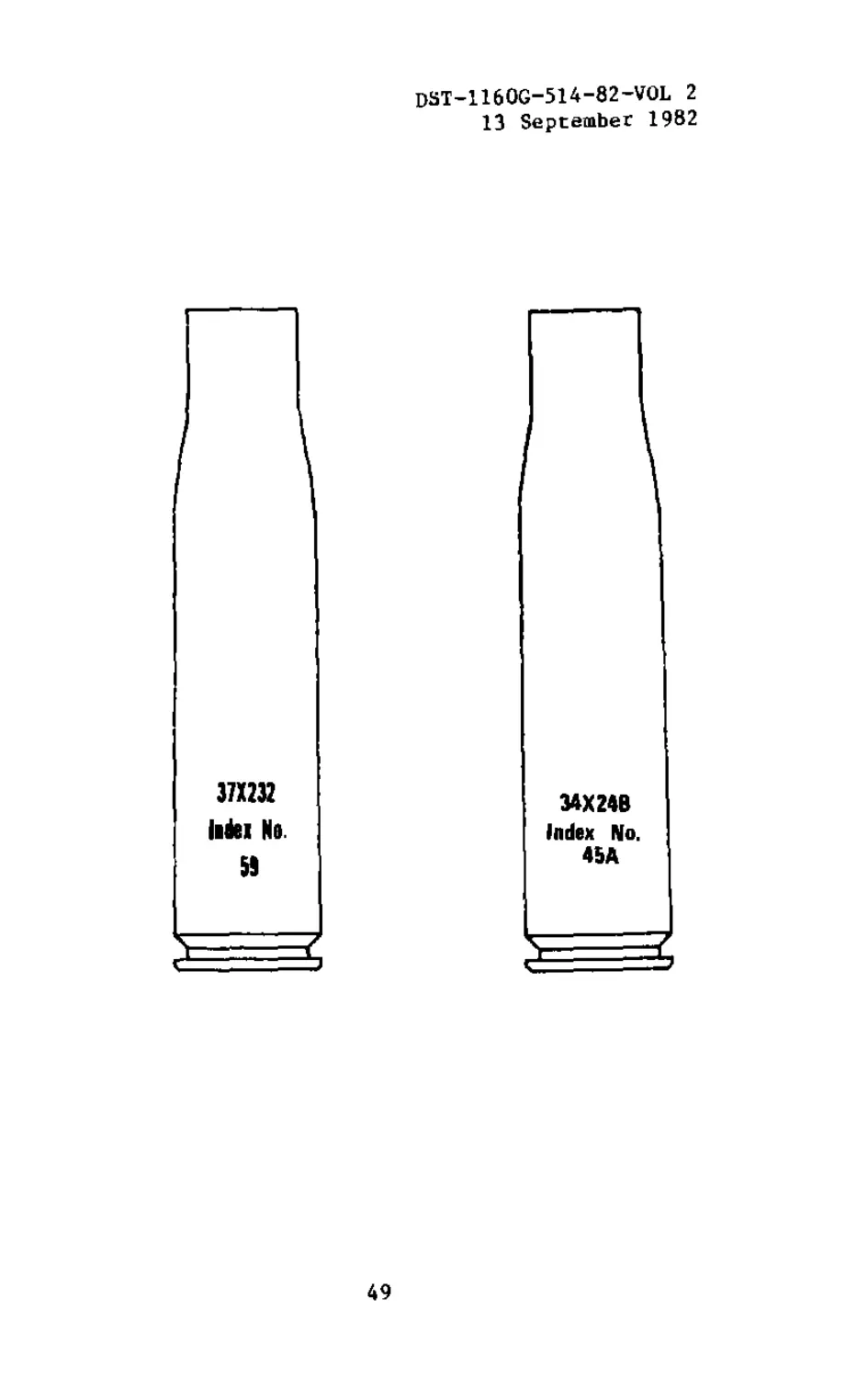
37X232
iidei No.
И
34X248
Index No.
45A
□


49
DST-116OG-514-82-VOL 2
13 September 1982
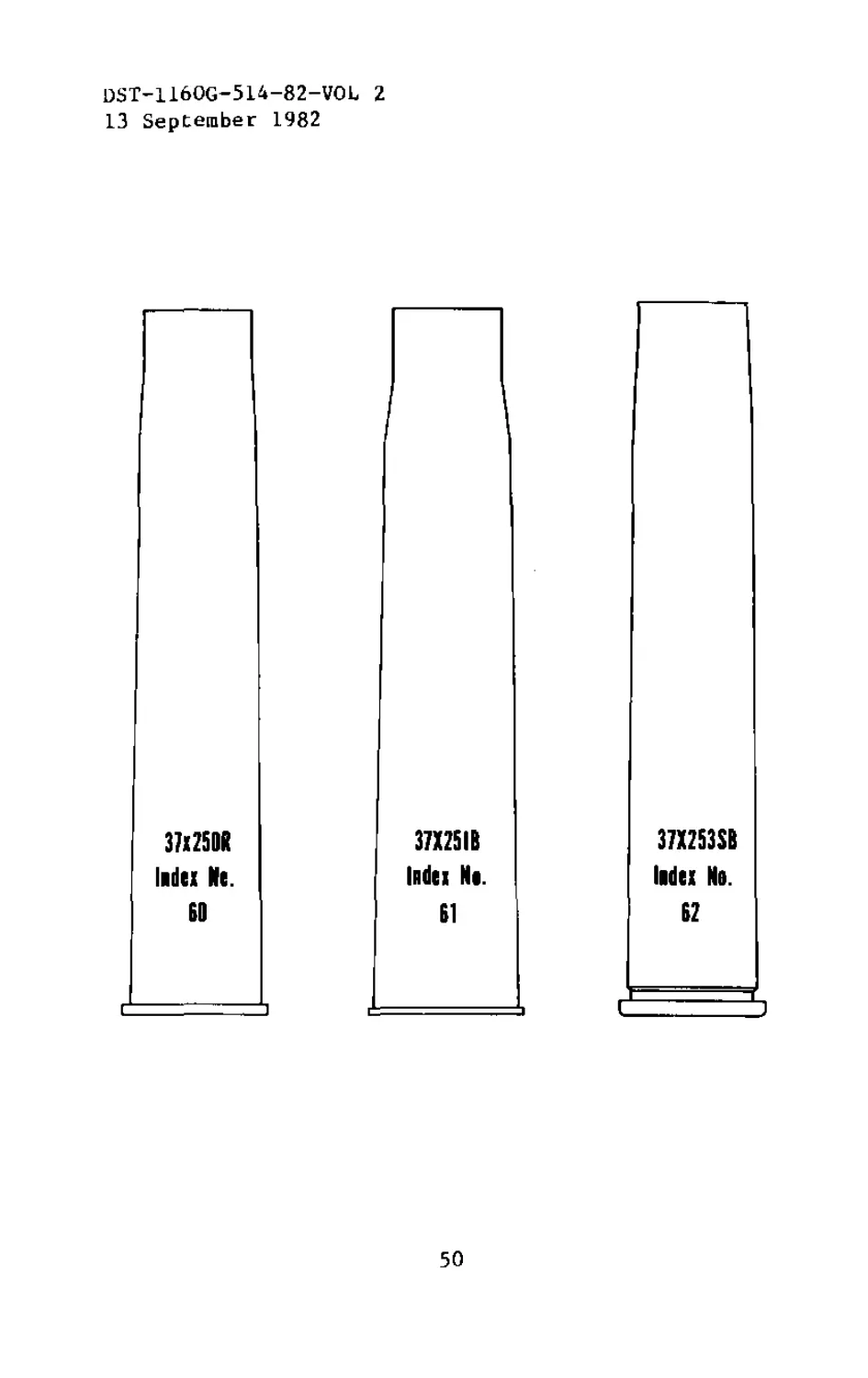
37125DR lid» Ke. 60		37XZ5IB lid» Na. 61		37X253SB lad» No. 62
	□ 1	—	1	c		h
50
DST-1160G-514-82-VOL 2
13 September 1982
37X2508 ladex Na.
03
С__
37X264D
Index Ne.
B4
37x2671
ledex Ne.
05


51
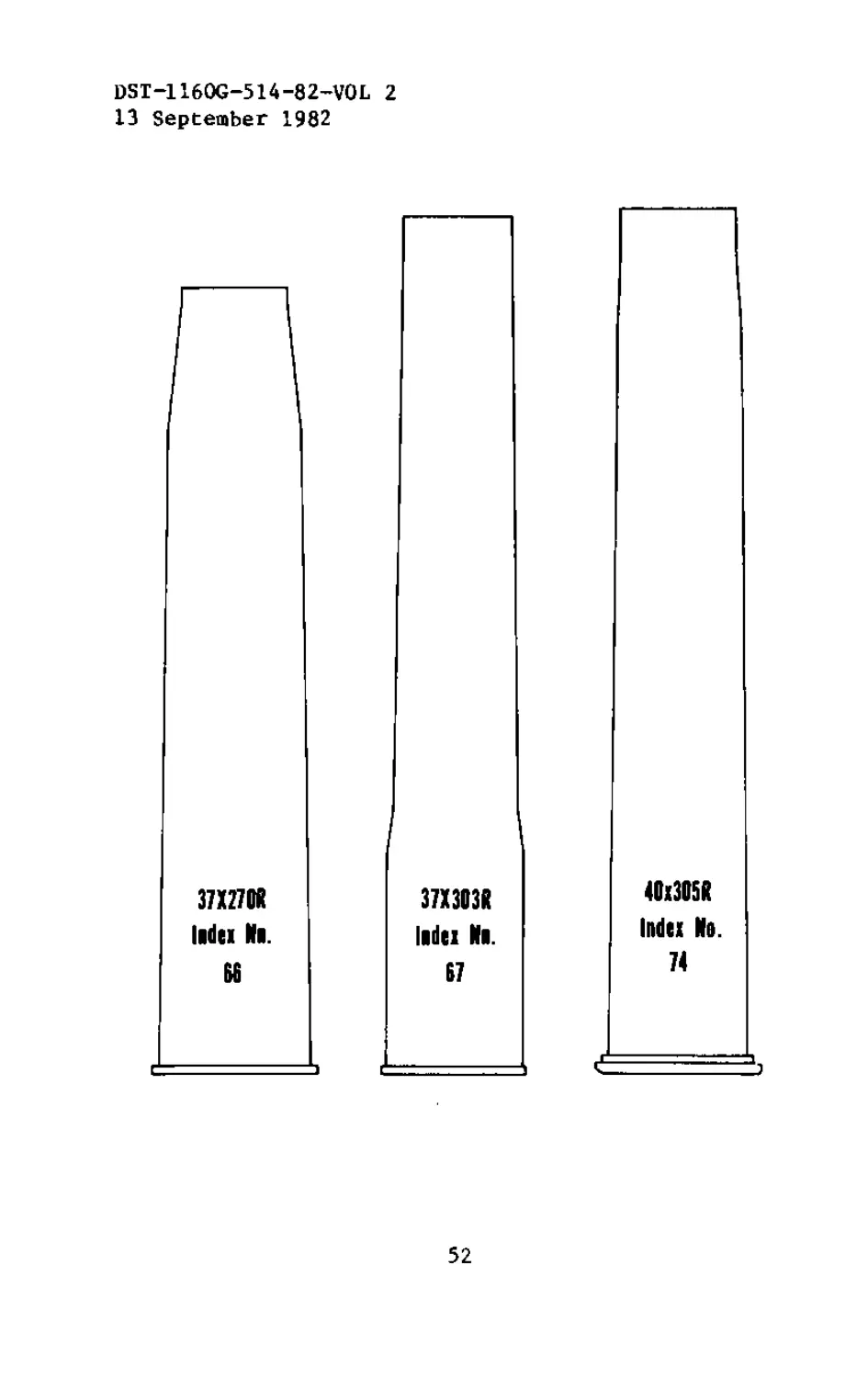
DST-1160G-514-82-V0L 2
13 September 1982
37X2708		37X3O3R
lad» Na.		lad» Na.
66		67
	4Ox3O5R Ind» No. 74
c
52
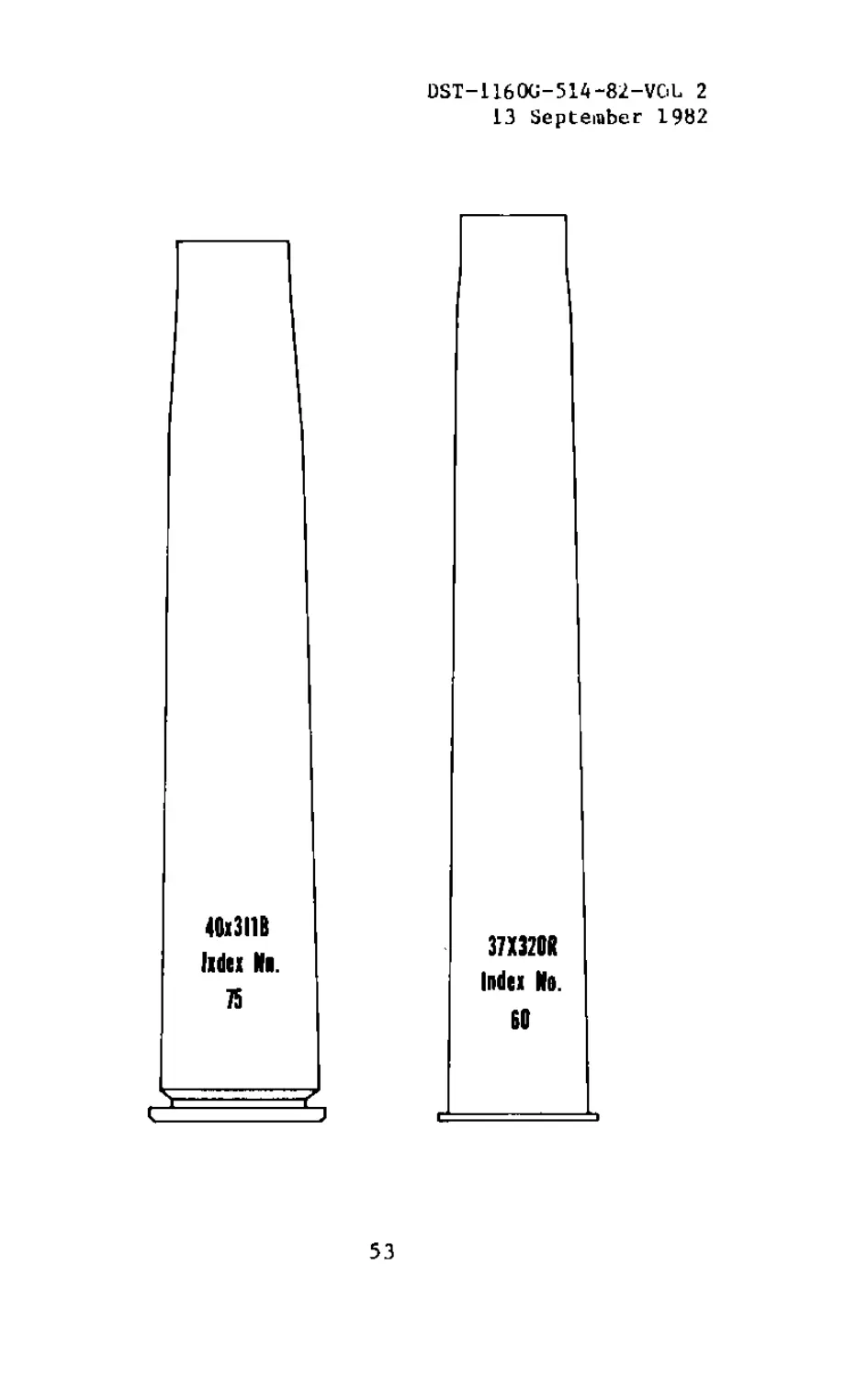
DST—L160G-514-82—VOL 2
13 September 1982
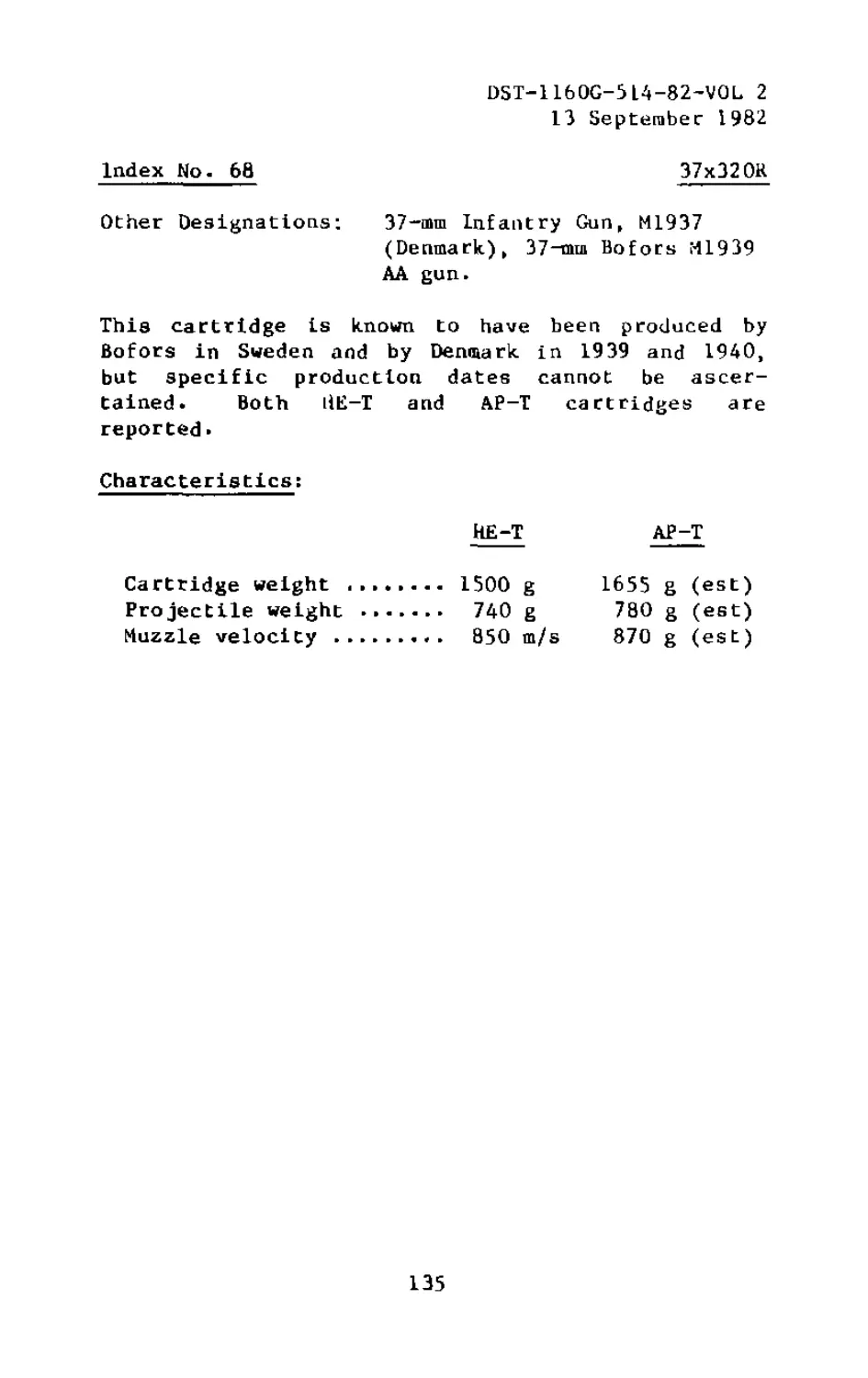
	37X320R
	Index No.
	60
53
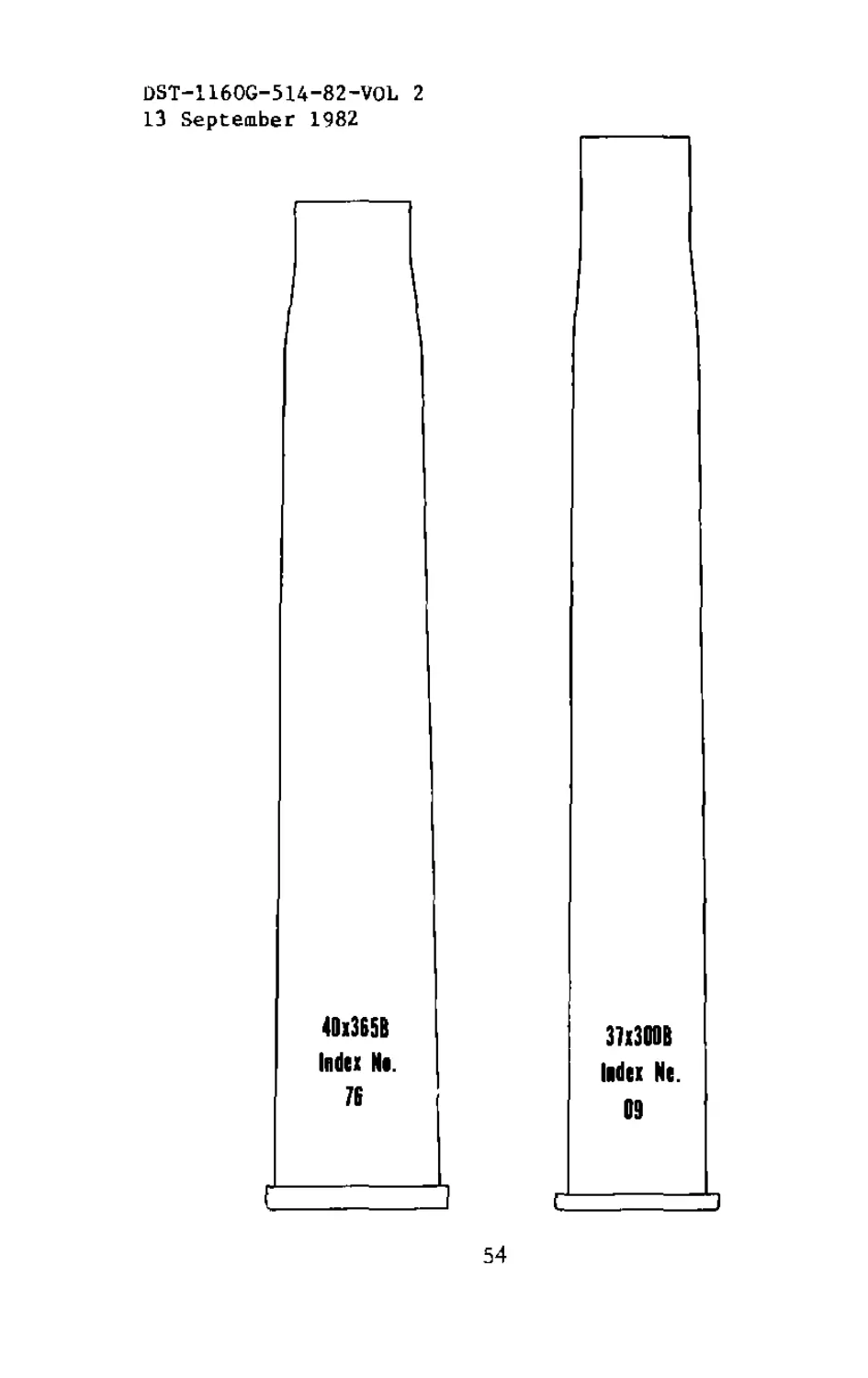
DST-116OG-514-82-VOL 2
13 September 1982
40хЗБ5В
Index Na.
It
( -Z J
c
37x300В
Index Ne.
09
54
DST-1160G-514-82-VOL 2
13 September 1982
В. DIMENSIONAL AND REFERENCE DATA
3.	Dimensional Data
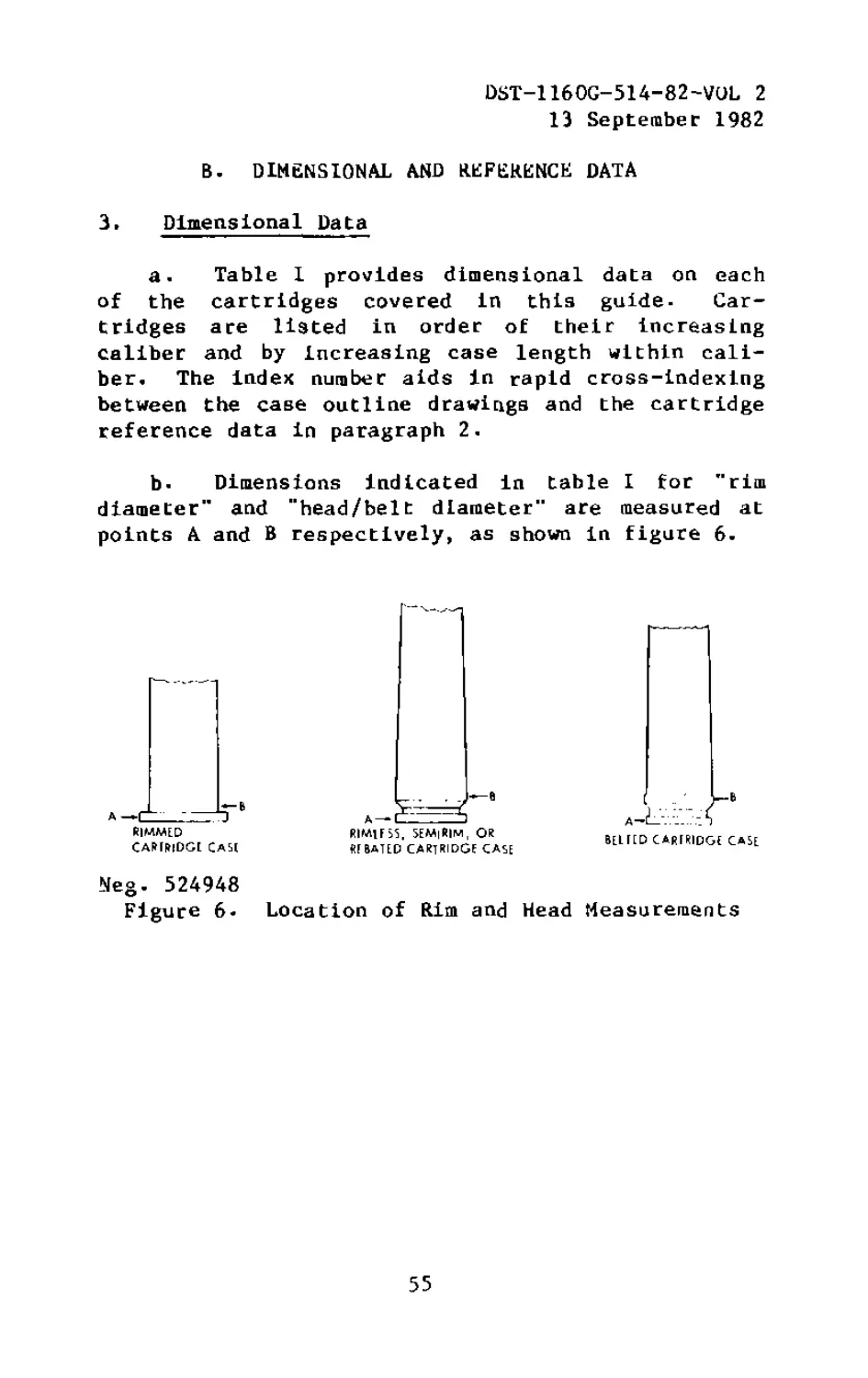
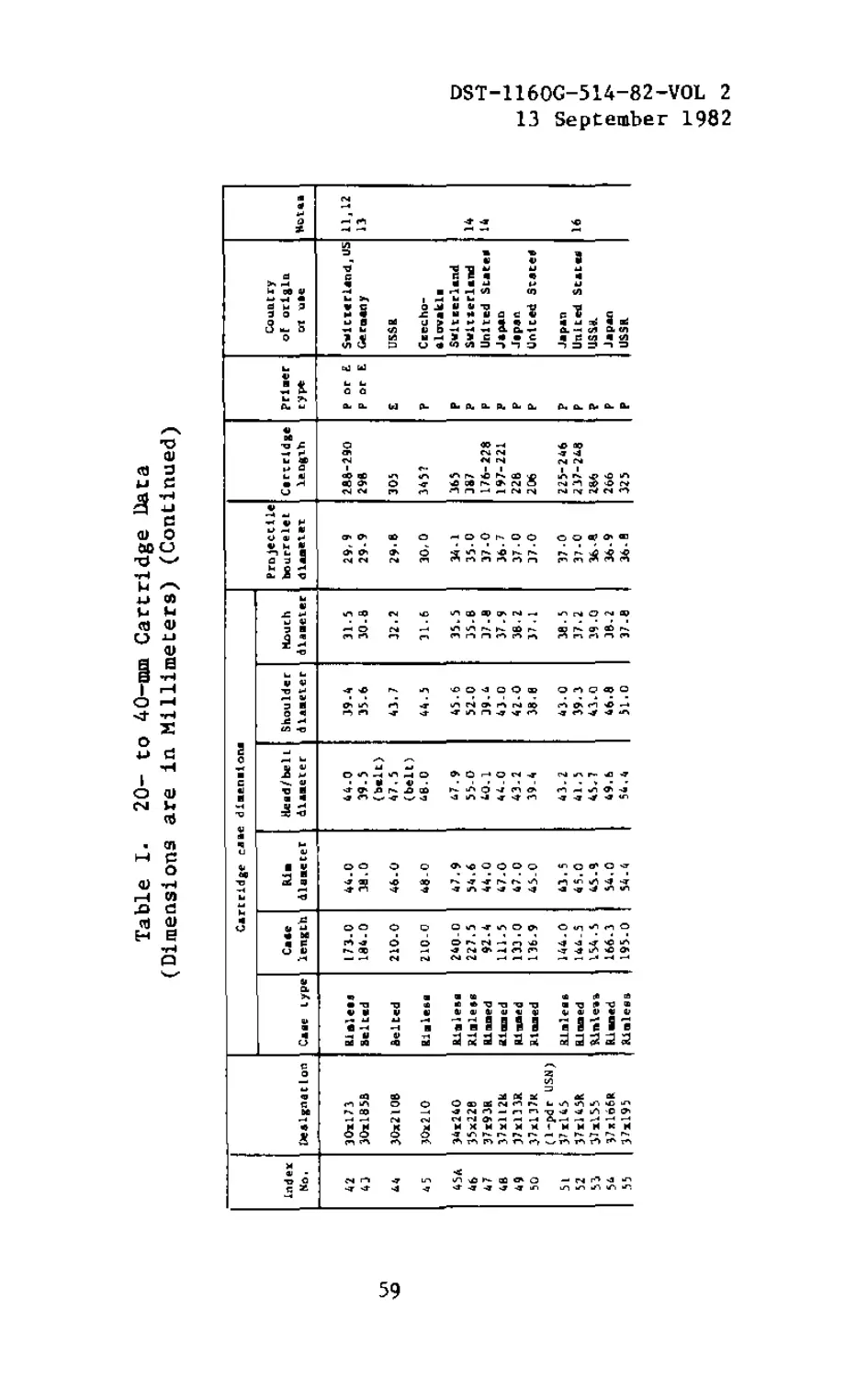
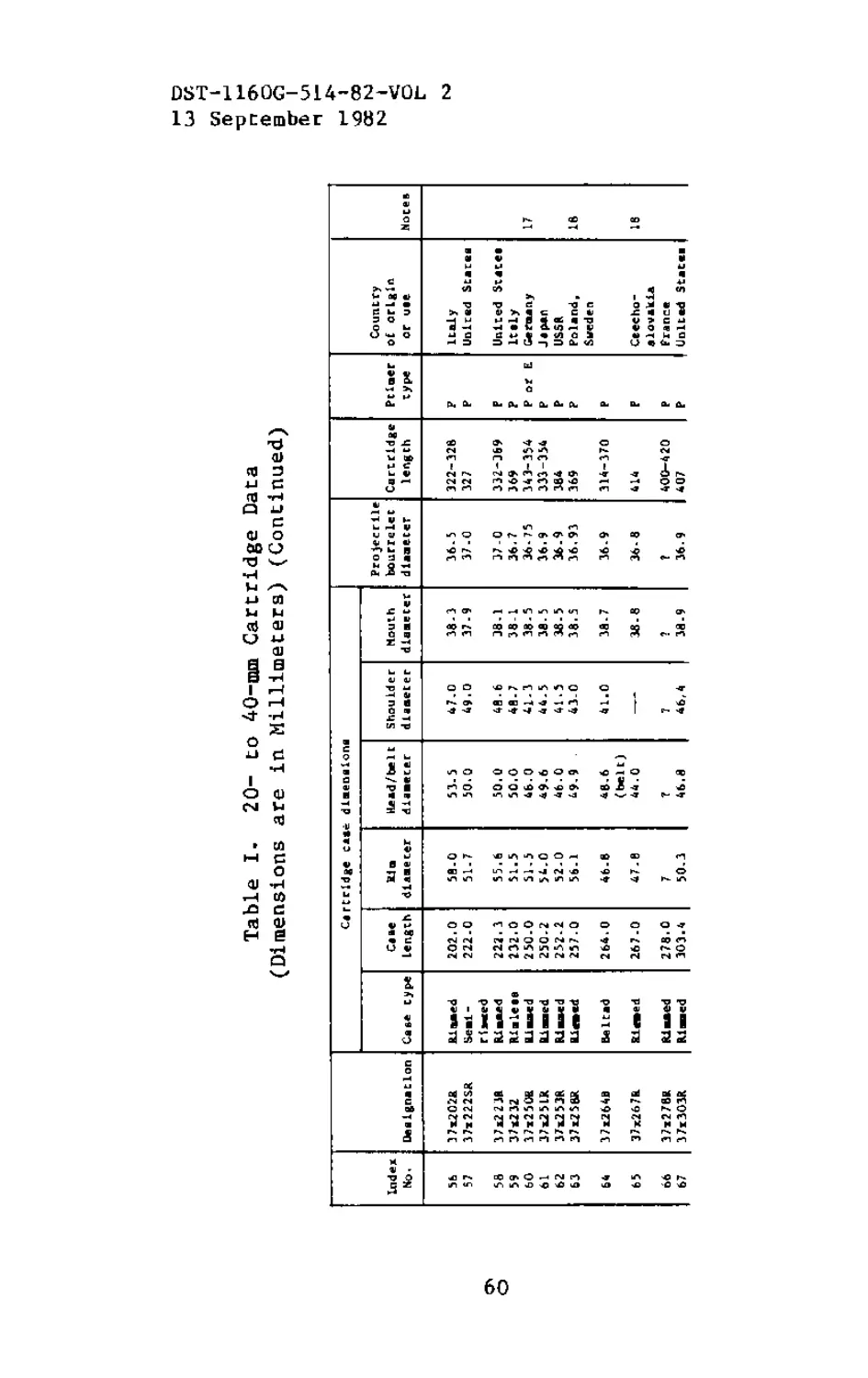
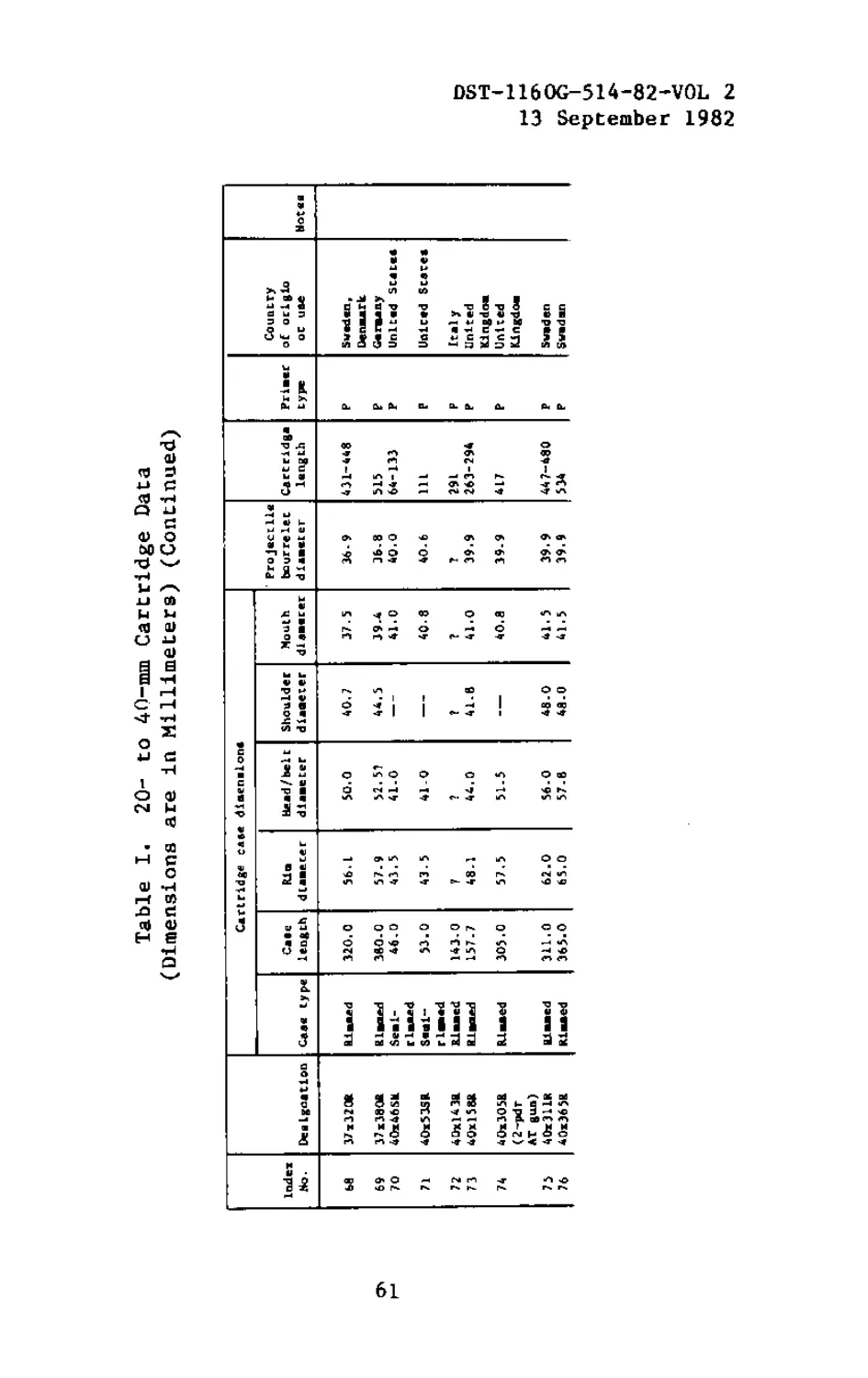
a. Table I provides dimensional data on each
of the cartridges covered in this guide- Car-
tridges are listed in order of their increasing
caliber and by increasing case length within cali-
ber. The index number aids in rapid cross-IndexIng
between the case outline drawings and the cartridge
reference data in paragraph 2.
b- Dimensions Indicated in table 1 for "rim
diameter" and "head/be1t diameter" are measured at
points A and В respectively, as shown in figure 6.
- ^^5-

RIMMED
CARTRIDGE CA5[
RIMIF55. 5EM|R|M, OR
RTBATED CARTRIDGE CASE
belied cartridge CASE
Neg- 524948
Figure 6- Location of Rim and Head Measurements
55
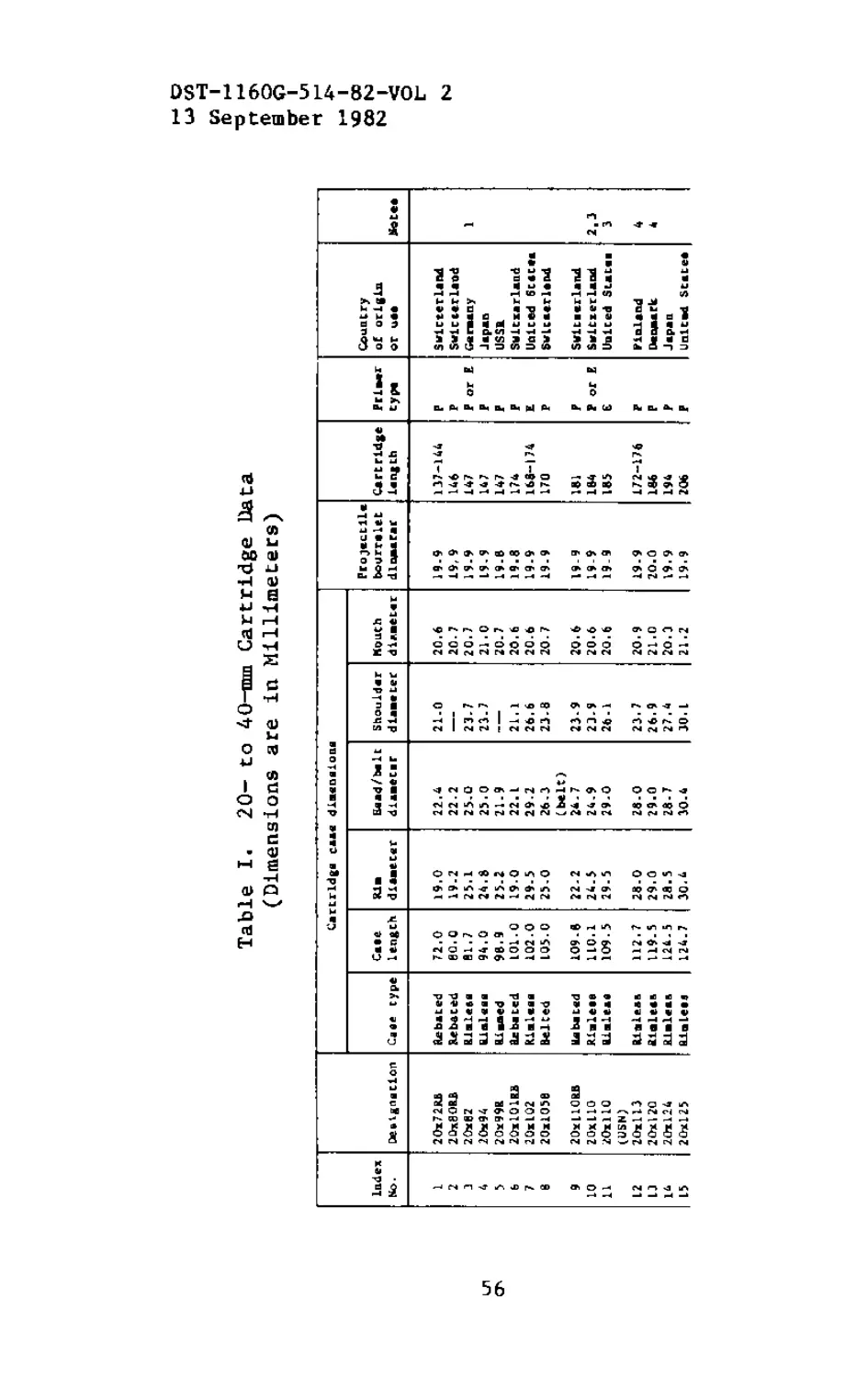
Table I. 20- to 40-шш Cartridge Data
(Dimensions are in Millimeters)
Laden t*o.	De» ignaticn	Cartridge саже diaenaioafl						Projectile bourrelet dlnanrar	Cartridge Length	Priner type	Country of origin or uee	lie tea
		Caee type	Cnee length	Kia diaaetar	Bead/balt dieaetir	Shoulder diene tet	Heath dimeter
1	20x72RB	Rebated	72.0	19.0	22.4	21.0	20.6	19-9	137-144	P	Switterland
2	2Ox8OU	Rebated	80.0	19.2	22.2	—	20.7	19, 9	146	P	Switzerland
3	20x82	111 ale»e	81.7	25.1	25.0	23.7	20.7	19.9	147	P or E	Garanny	1
4	20x94	Blslaee	94.0	24.8	25.0	23.7	21.0	L9-9	147	P	Japan
J	20x998	Hissed	98.9	25.2	21.9	—	20.7	19.8	L47	P	USSR
6	2 Ox LOIRS	Rebated	L01.0	19.0	22. L	21.1	20.6	19.8	174	P	Switzerland
7	20x102	Rialeaa	102.0	29.5	29.2	26.6	20.6	19.9	168-174	E	United Staten
8	20x1058	Belted	L05.0	25.0	26.3	23.8	20.7	19.9	170	P	Switzerland
					Cbelt)
9	20xL10U	Ma ba ted	109.8	22.2	24.7	23.9	20.6	19-9	181	P	Switzerland
10	ZOxLLO	Rlnleee	1LQ.1	24.5	24.9	23.9	20.6	19-9	184	P or E	Switzerland	2,3
11	20x110	Mlalеже	109.5	29.5	29.0	26-1	20.6	19-9	185	e	United Slatez	3
	(USK)
L2	20x113	Rial tea	112.7	28.0	28.0	23. 7	20.9	19-9	172-176	p	Pinland	4
L3	20x120	RiaLeeв	119.5	29.0	29.0	26.9	21.0	20.0	186	p	Danner It	4
14	20x124	Rlaleaa	124.5	28.5	28-7	27.4	20.3	19.9	194	p	Japan
L5	20x125	filo Lett	124.7	30-4	30.4	30. L	21.2	19.9	206	p	United State»
DST-1160G-514-82-VOL 2
13 September 1982
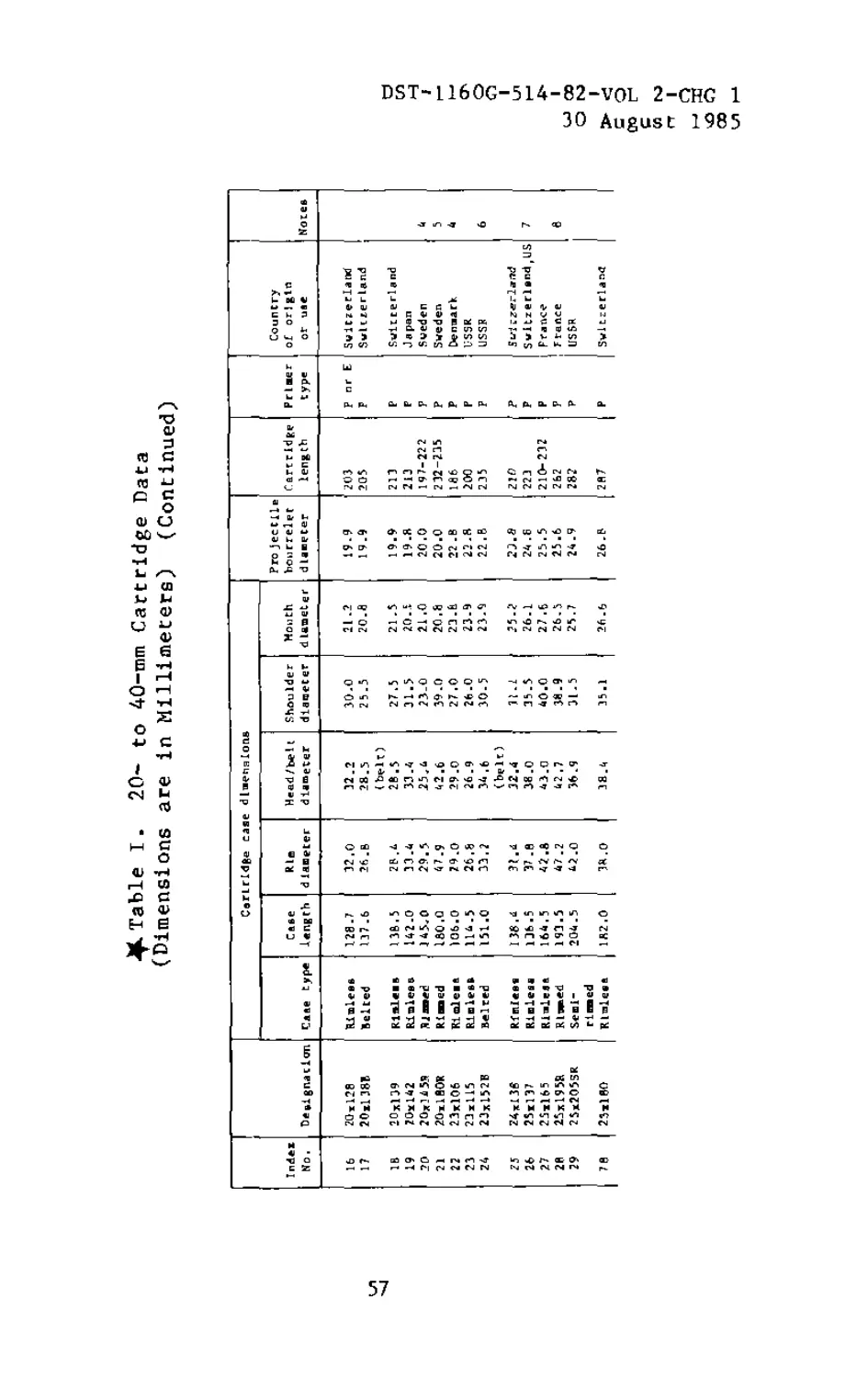
Table I. 20- to 40-mm Cartridge Data
(Dimensions are in Millimeters) (Continued)
Index No.	De«I gnat 1cm	Cartridge ease dlxenaLoos						Pro jectllE bou rreleг d Lameter	Cartridge length	Prlier type	Country o£ origin or use	Notes
		Case type	Саве length	Rle d laaeter	Head/belI diameter	Shoulder diameter	Mouth d lameter
16	20x128	KiwleBB	128.7	32,0	32.2	30.0	21 .2	19.9	203	P n r E	Switzerland
1?	20x1381	Belted	13 7 .6	26.В	28.5 (belt)	25.5	20.8	19.9	205	P	Switzerland
IB	20x139	RlsleiB	13B.5	2B.A	28.5	27.5	21 .5	19.9	213	P	Switzerland
19	20x142	Rimless	142.0	33.4	33.4	31.5	20. i	19.8	213	F	J a pan
2D	20x14 5.4	Rjmed	145.0	29.5	25.4	23-0	21.0	20.0	197-222	P	Sweden	4
21	20x1 SOK	Rined	180.0	47.9	42.6	39.0	20.8	20.0	232-235	P	Sweden	5
22	23x106	Ricdeaa	106.0	29.0	29.0	27.0	23.6	22 .8	186	P	Denmark	4
23	23x115	RioleeB	114.5	26.8	26.9	26.0	23.9	22.8	200	P	USSR
24	23xL52B	Belted	151.0	33.2	34.6 (belt)	30.5	23.9	22.В	235	P	USSE	6
Z5	24xL3S	Rimiest	138.4	??.*	32.4	32.2	25-2	23. S	210	P	Swi rzerland
26	25x137	Risleaa	136.5	37.S	38.0	35.5	26.1	24 .6	223	P	Switzerland FUS	7
27	25x165	Rinleaa	164.5	42.8	43.0	40.0	27 .6	25.5	210-232	P	Prance
26	25x1958	Rimed	193.5	47.2	42 .7	38.9	26.5	25.6	262	P	France	в
29	25x205SR	Sesi- rianed	204.5	45.0	36.9	31.5	25.7	24.9	282	P	US 5R
76	23x180	Rlmleaa	182.0	3R.0	38.4	35.1	26.6	26. В	287	P	Swltzerlan^
DST-L160G-514-82-VOL 2-CHG
30 August 198
Ln
oo
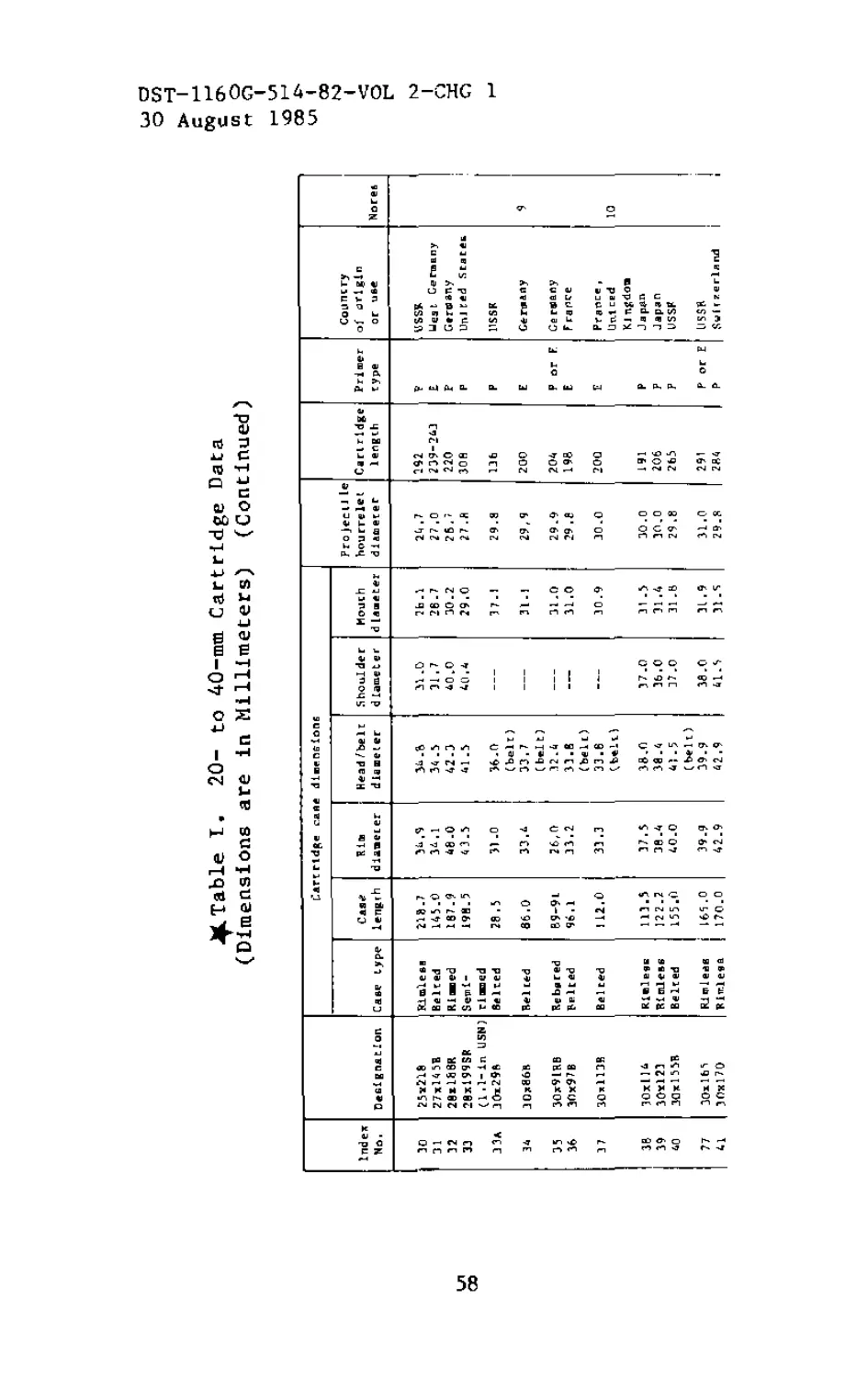
^LTable I. 20- to 40-mm Cartridge Data
(Dimensions are in Millimeters) (Continued)
Index No.	Designation	Cartridge cane dimensions						Projeellle bourrelet dlatneter	Carl ridge length	Pri a?₽r type		Country of origin or иве	Mores
		Саве type	Cas^ length	Rift dianeter	Head/belt d lender	Shoul dec d Lame ter"	Mouth d Laneter
30	25x218	RiuleBB	218.7	3^.9	34 .ft	31 .0	lfa.1	24 .7	292			USSR.
31	27x1451	Belted	145.0	34.1	34 .5	31.7	26.7	27 .0	239-243	£		U^at Се Пввпу
32	20xL88R	Rimed	107.9	48.0	42.3	40.0	30.2	2BJ	220	P		Gere any
33	20X1945R	Semi-	19Й.5	43.5	41.5	40.4	29.0	27 .8	308	p		Uni ted States
	(1 .1-in USW)	rimed
33a	30x290	Belted	28 .5	3) .0	36.0 (belt)	—	37-1	29.8	136	P		USSR
34	30x860	Bel ted	06.0	33.4	33.7 (belt)	—	31-1	29,9	200	E		Gerteeny	9
35	30x9LRB	Re bared	B9-9L	26,0	32.4	—	31.0	29.9	204	P or	E	Ge r«any
36	30x97В	Belted	96.1	33.2	33.В (belt)	—	31.0	29 .8	198	E		France
37	30x113В	Bel ted	J 12.0	33 .3	33.6	-.—	30.9	30.0	200	E		Prance,
												lint red Klngdoa	10
3B	30xLJ4	RielBgE	113.5	37.5	38.0	37.0	31 .5	30.0	191	P		J a pjin
39	30x123	Rimless	122.2	38.4	38.4	36.0	31.4	30.0	206	P		Japan
40	30x155В	Belted	155.0	40.0	41.5 (belt)	37.0	31 .8	29 .8	265	P		USSR
77	30x165	Rlmleee	165 .0	39.9	39.9	38.0	31.9	31.0	291	P or	E	USSR
41	30x170	RiTT-leea	170.0	42.9	42.9	41.5	31 .s	29.8 I	284	|	P	1	$w i f e ria nd
DST-1160G-514-82-V0L 2-CHG
30 August 1985
Table 1.	20- to 40-mm Cartridge Data
(Dimensions are in Millimeters) (Continued)
Index No.	Dea Ignat Lon	Cartridge слае dieanilona						Projectile bourrelet diameter	Cartridge ItDgih	prleer type	Country of origin □1 vie	Korea
		Сжае iype	Cate length	Eda dlaaetet	Heed/be 1 L dimeter	Shoulder d imeter	ftouch dimeter
42	30x173	81 aleaa	173-0	44.0	44.0	39-4	31.5	29, 9	288-290	p or £	Swlcierlandj US	IL 12
43	30x185B	Belted	184.0	38.0	39.5	35-6	30-8	29-9	298	P or £	Germany	13
					(b.li)
44	30x2108	Belted	210-0	46-0	47,5	43. 7	32.2	29-8	305	£	USSR
					(belt)
45	30x210	Rimlesfl	210-0	48-0	48.0	44.5	31.6	30, o	345?	P	Свесho-
											A lava It Li
45A	34x240	Rleleaa	240-0	47.9	47.9	45.6	35-5	34-1	365	P	Suitrerland
46	35x228	Rluleae	227.5	54.6	55-0	52-0	35-8	35-0	387	P	Switzerland	14
47	37x938	Rimed	92-4	44.0	40.1	39.4	37.8	37-0	176-228	P	United Stated	14
48	37x1128	Rlinied	111-5	47-0	44.0	43-0	37.9	36-7	197-221	P	Japan
49	37x113R	Rinsed	133.0	47.0	43-2	42-0	38. 2	37-0	228	P	Japan
50	J7xL37k	Rtcued	136-9	45-0	39-4	38.8	37 .1	37-0	206	P	United Stated
	(1-pdr USM)
51	37x145	Rlalees	144-0	43.5	43.2	43.0	38.5	37 0	225-246	P	Japan
52	37x1458	Biased	144.5	45.0	41.5	39-3	37.2	37-0	237-248	P	United Stated	16
53	37x155	Rlnleaz	154.5	45.9	45^7	43-0	39 .0	36Л	286	?	USSR
54	37x1668	Rlaaed	166.3	54,0	49.6	46.8	38.2	36-9	266	P	Japan
55	37x195	Rlaleea	195-0	54.4	54,4	51.0	37.8	36-а	325	P	USSR
DST-116OG-514-82-VOL 2
13 September 1982
Table I. 20- to 40-mm Cartridge Data
(Dimensions are in Millimeters) (Continued)
Index Ko.	Designation	Cartridge cue dimensions						Projectile bourrelet diameter	Cartridge length	Ptimer type	Country of origin or use	Notes
		Casa type	Ca se Length	Rim dlameter	dead/tm It diameter	Shou Ider diameter	Mouth diameter
5b	37x2O2R	Rimmed	202.0	50.0	53-5	47.0	38.3	36.5	322-328	P	Italy
57	37x222SR	Seml- Hmmed	222-0	51.7	50.0	49.0	37.9	37.0	327	P	United Stares
58	37*2 23ft	Rlmaad	222.3	55.6	50.0	40.6	38.1	37-0	332-369	F	United States
59	37x232	Rimless	232.0	51.5	50.0	40.7	38-1	36-7	369	P	Italy
60	37x250ft	ftlmmed	250.0	51.5	46.0	41.3	38.5	36.75	343-354	P or E	Germany	17
61	37x25LR	(Lined	250.2	54.0	49,6	44.5	38. 5	36.9	333-354	P	J span
62	37*253ft	Rimmed	252.2	52.0	46.0	41.5	38.5	36.9	384	P	USSR
63	37x2SftR	Rimed	257.0	56.1	49.9	43-0	38.5	36.93	369	P	Poland, Sweden	18
64	37 x264В	Belted	264.0	46-8	4g.6 (belt)	41.0	38.7	36.9	314-370	P
65	37x267ft	Rined	267-0	47.0	44.0		38-8	36.8	414	F	Cseeho- alovakia	18
66	37x278ft	Rimmed	278.0	7	?	7		?	400-420	P	Prance
67	37i3O3R	Rlned	303.4	50.3	46.8	46,4	38-9	36.9	407	p	Unit'd St.t.i
DST-1160G-514-82-V0L
13 September 1982
Table I. 20- to 40-mm Cartridge Data
(Dimensions are in Millimeters) (Continued)
Index Ho.	Dea Ignition	Cartridge case dlsenalon*						' Projectile bourrelet dlaaeter	Cartridge length	Priaat tyje	Country of oclglo or uee	Notes
		Gaea type	Case length	Ria dlaaecer	Head/belt dlaaeter	Shoulder dlaaeter	Mouth diaaerer
68	37x32»	aloud	320.0	56. L	50.0	40,7	37.5	36.9	431-448	P	Sweden, Denaerlc
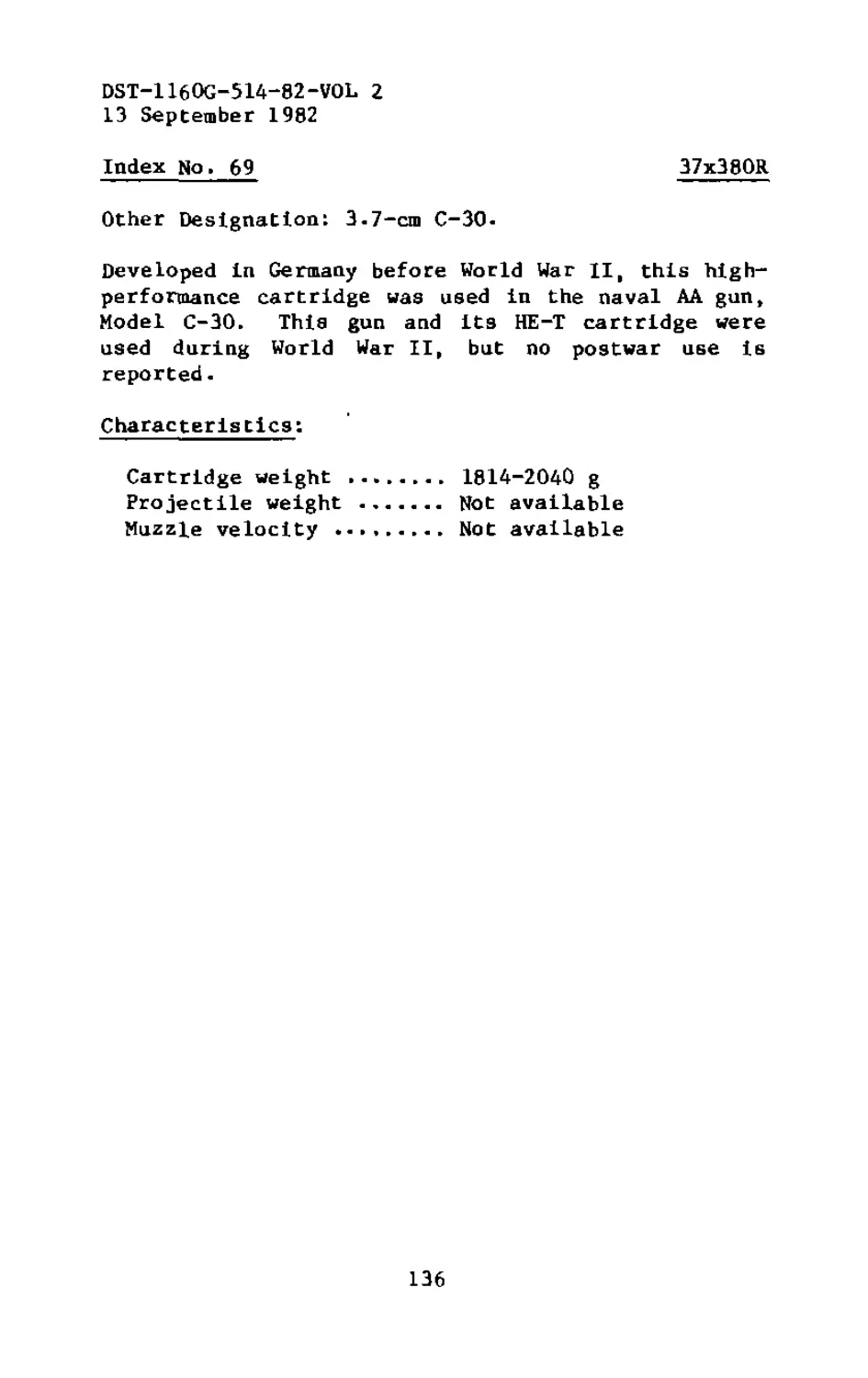
69	37x38»	aivud	360-0	57.9	52. 5?	44.5	39.4	36.8	515	P	Garwany
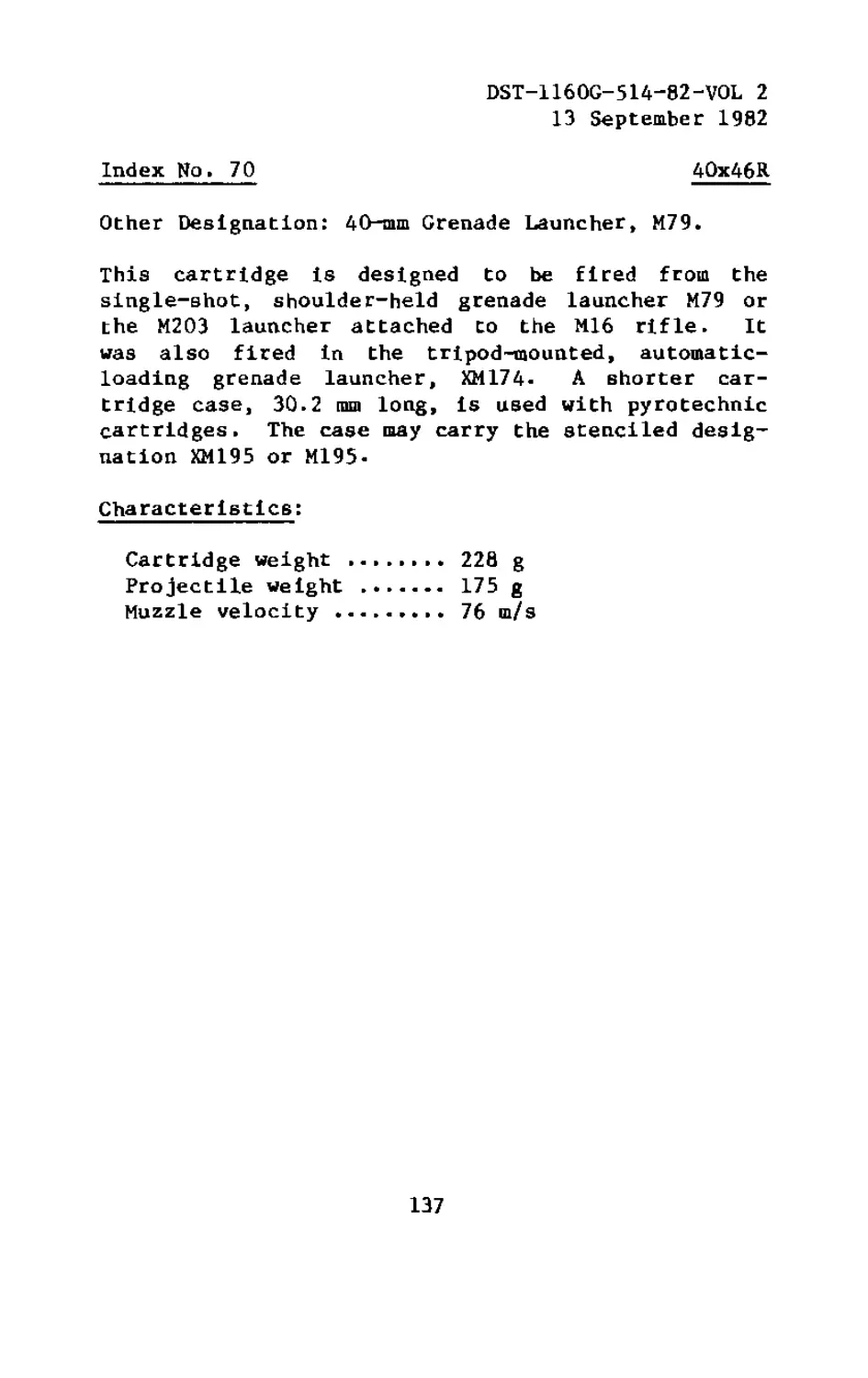
70	40x46 Ski	Seel- rlnud	46.0	43.5	41.0	—	41.0	40.0	64-133	P	United State*
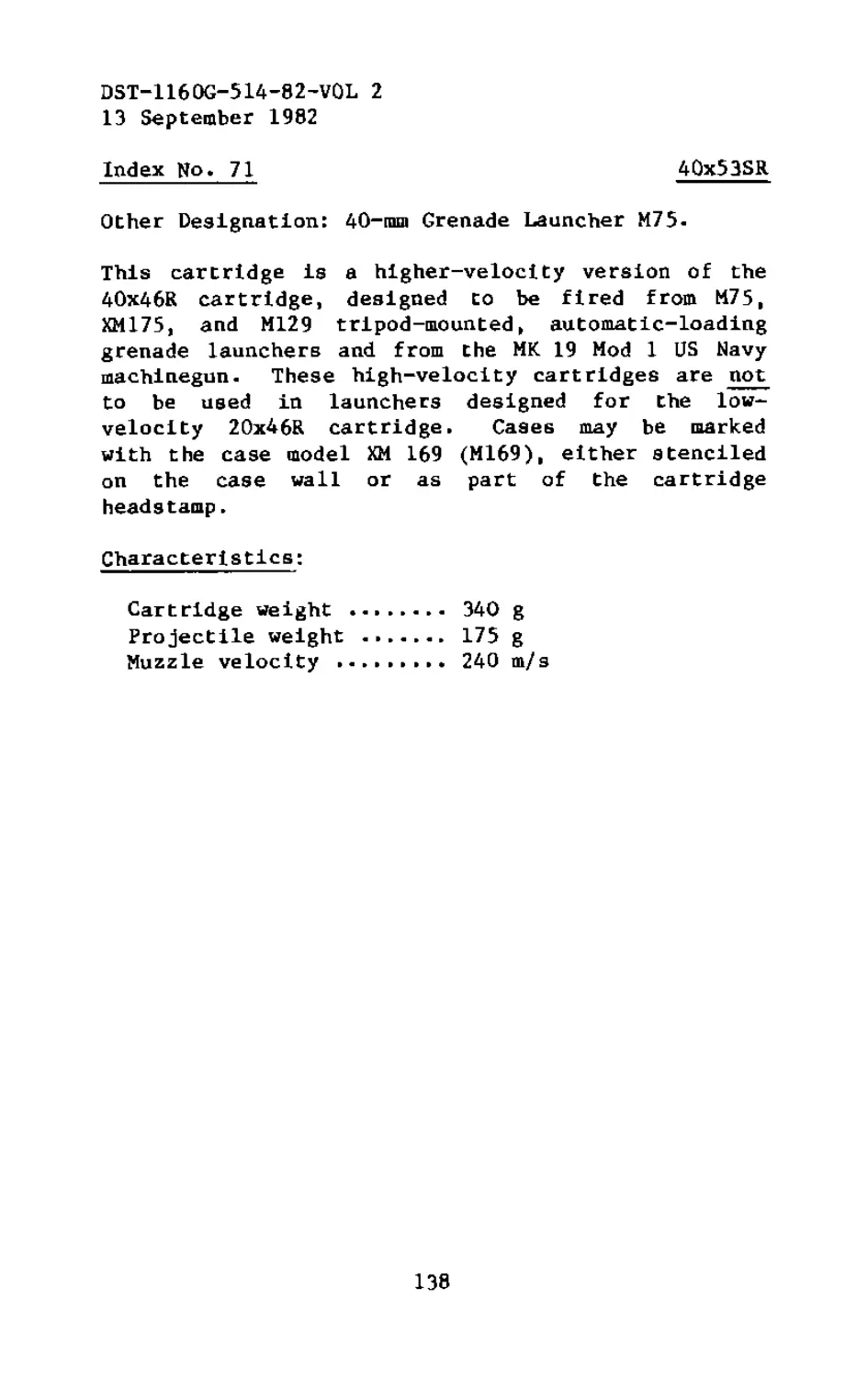
71	4 0x5 IS R	Seal- rived	53.0	43.5	41-0	—	40-8	40.6	111	P	United State*
72	4OX143&	Blued	143.0	?		?	?	T	291	P	Italy
73	40x15»	lived	157.7	48.1	44.0	41.8	41.0	39.9	263-294	P	United Kingdom
74	40x3058 (2-pdr AT gun)	Blued	305.0	57,5	51-5		40.8	39-9	4L7	P	United Kingdoa
75	40x3 UR	Blued	311.0	62.0	56-0	48-0	41.5	39.9	447-480	P	Sweden
76	40x365a	Rlued	365.0	65.0	57.8	48.0	41.5	39.9	534	P	Sweden
DST-116OG-514-82-V0L 2
13 September 1982
Ch
№
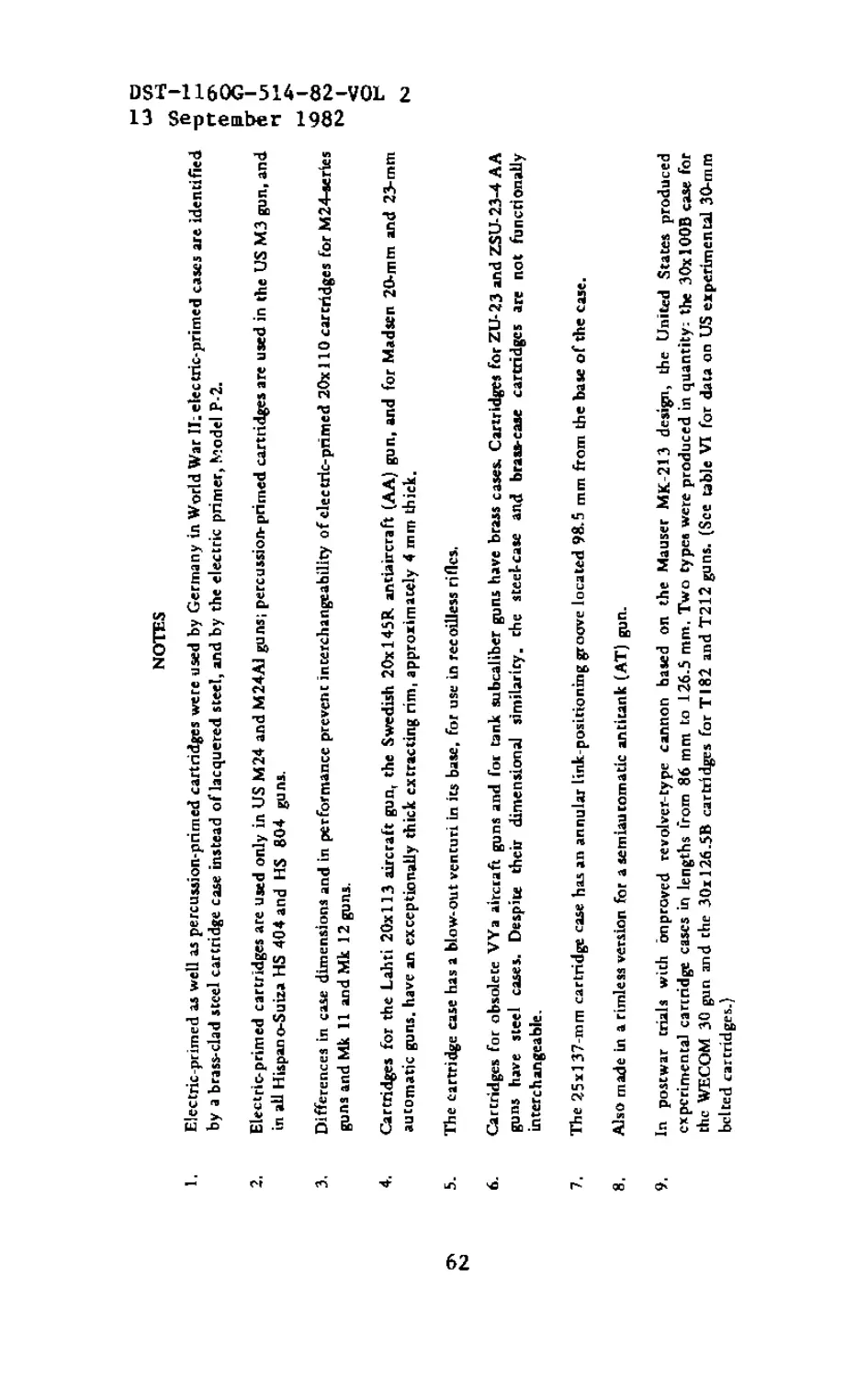
NOTES
1.	Elec trie-primed is well is percussion-primed cartridges were used by Germany in World War Ik electric-primed cases are identified
by a brass-clad steel cartridge case instead of lacquered steel, and by the electric primer, Model P-2.
2.	Elec trie-primed cartridges are used only in US M24 and M24A1 guns; percussion-primed cartridges are used in the US М3 gun, and
in all Hispano-Suiza HS 404 and HS 804 guns.
3.	Differences in case dimensions and in performance prevent interchangeability of elec trie-primed 20x 110 cartridges for M24-series
guns and Mk 11 and Mk 12 guns.
4.	Cartridges for the Lahti 20x113 aircraft gun, the Swedish 20xl45R antiaircraft (AA) gun, and for Madsen 20-mtn and 23-mm
automatic guns, have an exceptionally thick extracting rim, approximately 4 mm thick.
5.	The cartridge case has a blow-out venturi in its base, for use in recoilless rifles.
6.	Cartridges for obsolete VYa aircraft guns and for tank subcaliber guns have brass cases. Cartridges for ZU-23 and ZSU-23-4 AA
guns have steel cases. Despite their dimensional similarity, rhe steel-case and brass-case cartridges are not functionally
interchangeable.
7.	The 25x1 37-mm cartridge case has an annular link-positioning groove located 98.5 mm from the base of the case.
8.	Also made in a rimless version for a semiautomatic antitank (AT) gun.
9.	In postwar trials with improved revolver-type cannon based on the Mauser MK-213 design, the United States produced
experimental cartridge cases in lengths from 86 mm to 126.5 mm. Two types were produced in quantity: the 30xl00B case for
the WECOM 30 gun and the 30xl26.5B cartridges for TI82 and T212 guns. (See table VI for data on US experimental 30-mm
belted cartridges.)
DST-1160G-514-82-V0L 2
13 September 1982
Ch
10.	Cartridge cases for the United Kingdom's ADEN gun are of brass, with identification data scamped in che bottom of the
extraction groove. Cases for DEFA guns are of steel, normally lacquered. The United States is developing aluminnm-cased
30x113В cartridges that will be compatible with ADEN and DEFA guns.
11,	Cartridges for Oerlikon 304RK (KCA) guns arc all electric-primed. with lacquered steel or anodized aluminum cases. This
cartridge case has also been used by the United Stares in GAU 8A and GAU 9A gun system trials. US-made cases are anodized
aluminum, with electric primers for the GAU 9A gun and percussion primers for the GAU SA gun, Percussion-primed 30x173
cartridges are not interchangeable with 30x I 70 cartridges.
12.	A similar cartridge, but with a longer case neck and a case length of 178 mm to 180 mm, was made by Oerlikon in 1953-1954 for
the 302RK aircraft gun. This gun and ammunition were not produced in significant numbers; the 302RK was soon replaced by
the Э04&К gun.
13.	Cartridges for the German World War II aircraft gun MK 101 have percussion primer C/33; cartridges for the MK 103 gun use
electric primer C/23. Cartridges can be distinguished by the stamped model designation on the primer: they arc otherwise
identical but, because of the primer, not interchangeable.
14,	The 35x228 cartridges for Oerlikon KDA, GDP (5PF-2), and GDM-C guns have an annular link-positioning groove in the cartridge
case, 176 mm from the base, to accommodate the feed belt used with these guns. Cartridges for other gun models do not have
this groove. Cartridges are otherwise identical, and cartridges with link-positioning may be used in any model gun chambered for
this cartridge.
15,	Several similar foreign cartridges were made, none of which is now in use. Among these were a German M1897 howitzer
cartridge; the French World War 1 3^/85 cartridge, with a case length of 94.5 mm. which is reported to be interchangeable with
the US cartridge; and a similar World War I Italian cartridge, designated 37/20.6.
16.	Also used in the now-obsolere US 1,457-inch subcaliber gun. Model 1918,
17.	Cartridges fot the German World War II 3.7-cm PAK (AT gun) have percussion primer C/13 or C/33; cartridges for the 3,7-cm
KWK (rank gun) use electric primer C/23. Cartridges can be distinguished by the stamped model designation on the primer. The
cartridges are otherwise identical bur, because of the primer, not interchangeable.
18.	Also made and used by Germany during World War II.
DST-116OG-514-82-VOL 2
13 September 1982
DST—1160G—514-82—VOL 2
13 September 1982
4. Cartridge Reference Data
a. This paragraph presents information on the
development, service use, and weight and muzzle
velocity of the cartridges listed in table I.
b- It is emphasized that this guide is
limited to the identification of cartridges based
on the basis of physical characteristics. Dimen-
sional similarity does not imply and will not
ensure that a cartridge can be safely fired in, or
will properly function in, any weapon other than an
appropriately chambered weapon designed to fire
that cartridge.
64
DST-1160G-514-82-VOL 2
13 September 1982
20x72RB
Index No. 1
Other Designations; 2O-nun Oerlikon Type FF;
20-mm Japanese Type 99, Mark 1.
The 20x72 RB cartridge was developed in the 1920s
from a similar cartridge with a slightly shorter
case that was used in the German-designed Becker
automatic gun late in World War I. This cartridge
was used by the successor to the Seebach firm,
Werkzeug and Maschinenfabrlk Oerlikon, in their
Type FF aircraft gun in the 1930s and also in the
Oerlikon SSG (Schweres Selbstladegewehr) antitank
rifle. During World War II, Japan also made the
same cartridge for use in an Oerlikon-type naval
aircraft gun, Type 99 Mark 1. The gun and
cartridge were obsolete by the end of the war and
have not been manufactured since that time.
Characteristics:
Cartridge weight ......... 187-200	g
Projectile weight ........ 125-142	g
Muzzle velocity .......... 550 ш/s
65
DST-U60G-514-82-V0L 2
13 September 1982
Index No. 2	20x80RB
Other Designation: 20-mm Oerlikon Type FFM.
This cartridge	was developed	by the	Oerlikon	firm
before World War II for use	in the	Type FFM	air-
craft gun, as an improvement over the Type FF gun
and cartridge.	Switzerland	also used this	car-
tridge in the	SSG antitank	rifle.	During World
War II, Germany also made and used this cartridge
in Oerlikon guns. Except for production of 20x80RB
cartridges in Spain in 1953, these guns and this
cartridge have not been reported in use since the
close of World War II.
Characteristics:
Cartridge weight ........ 210 g
Projectile weight ....... 113-130	g
Muzzle velocity ......... 575-600	m/s
66
DST-116OG-514-82-V0L 2
13 September 19B2
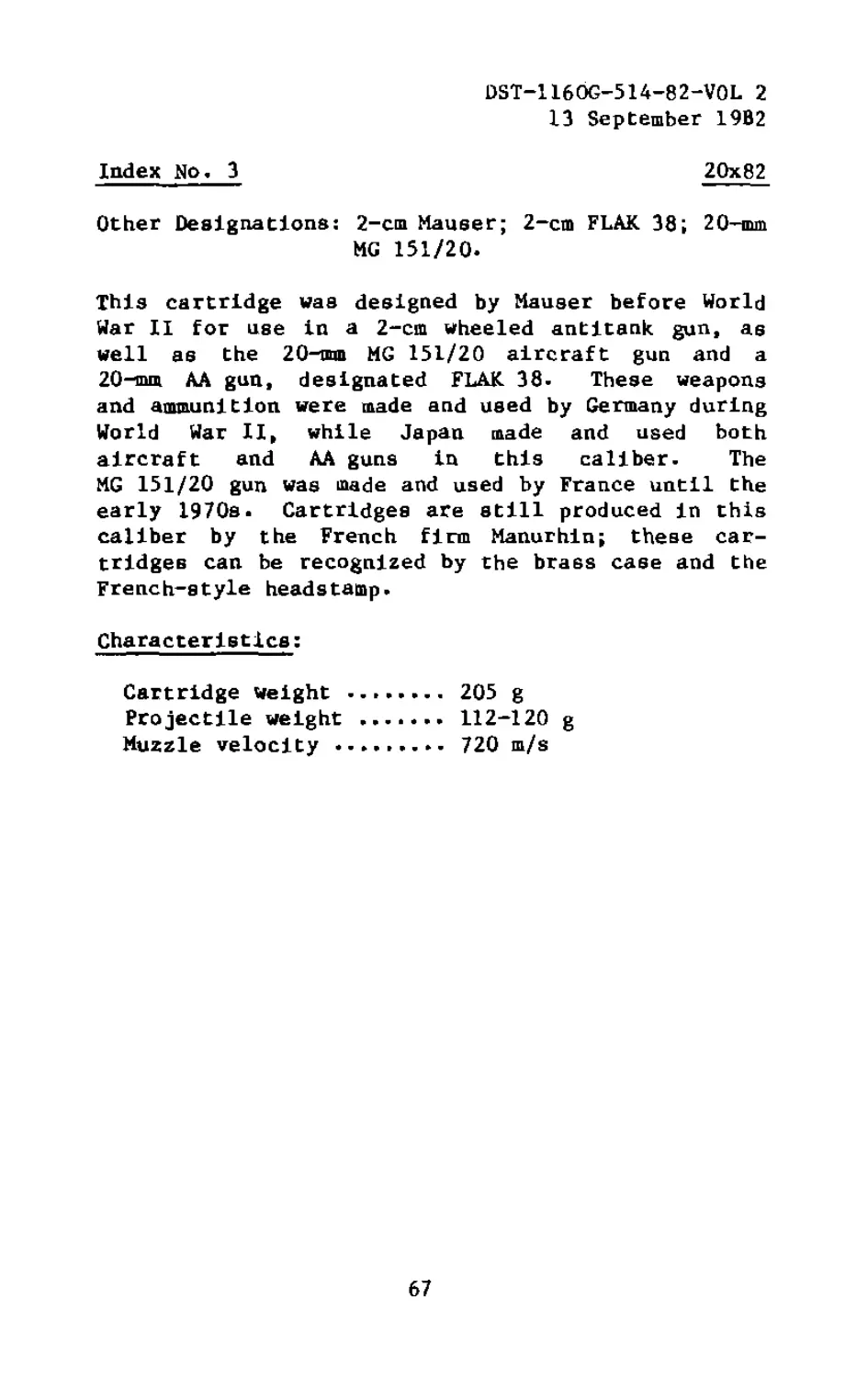
Index No. 3	20x82
Other Designations: 2-ctn Mauser; 2-cm FLAK 38; 20-mm
MG 151/20.
This cartridge was designed by Mauser before World
War II for use In a 2-cm wheeled antitank gun, as
well as the 20-mm MG 151/20 aircraft gun and a
20-tnm AA gun, designated FLAK 38. These weapons
and ammunition were made and used by Germany during
World War II, while Japan made and used both
aircraft and AA guns In this caliber. The
MG 151/20 gun was made and used by France until the
early 1970s. Cartridges are still produced In this
caliber by the French firm Manurhln; these car-
tridges can be recognized by the brass case and the
French-style headstamp.
Characteristics:
Cartridge Weight ........ 205 g
Projectile weight ........ 112-120	g
Muzzle velocity ......... 720 m/s
67
DST-1160G-514-82-V0L 2
13 September 1982
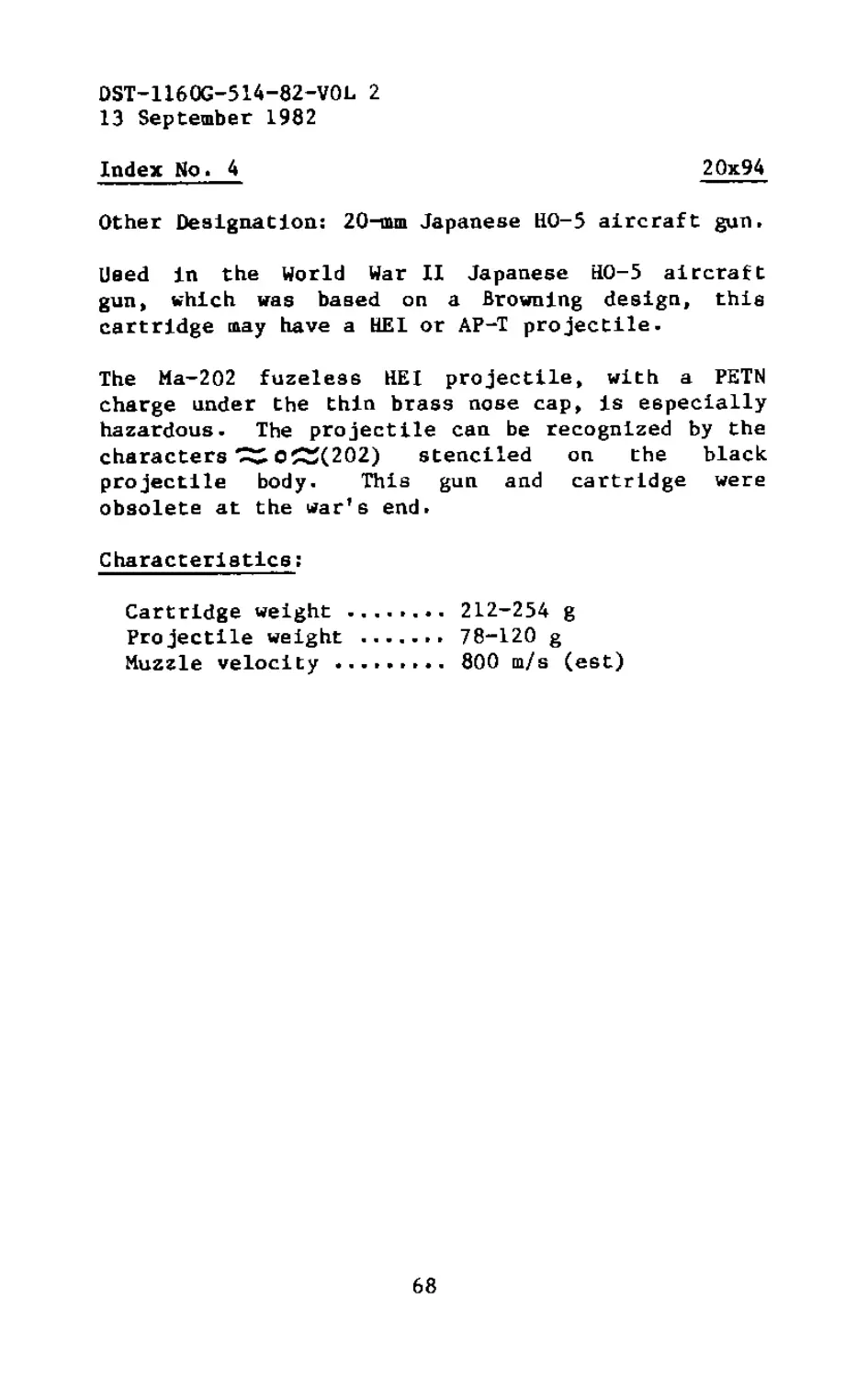
Index No. 4
20x94
Other Designation: 20-mm Japanese HO-5 aircraft gun.
Used in the World War II Japanese HO-5 aircraft
gun, which was based on a Browning design, thia
cartridge may have a HEI or AP-T projectile.
The Ma-202 fuzeless HEI projectile, with a PETN
charge under the thin brass nose cap, is especially
hazardous. The project lie can be recognized by the
characters Оd(202) stenciled on the black
projectile body. This gun and cartridge were
obsolete at the war's end.
Characteristics;
Cartridge weight ......... 212-254 g
Projectile weight ........ 78-120 g
Muzzle velocity .......... 800 m/s (est)
68
DST-1160G-514-82-VOL 2-CHG 1
30 August 1985
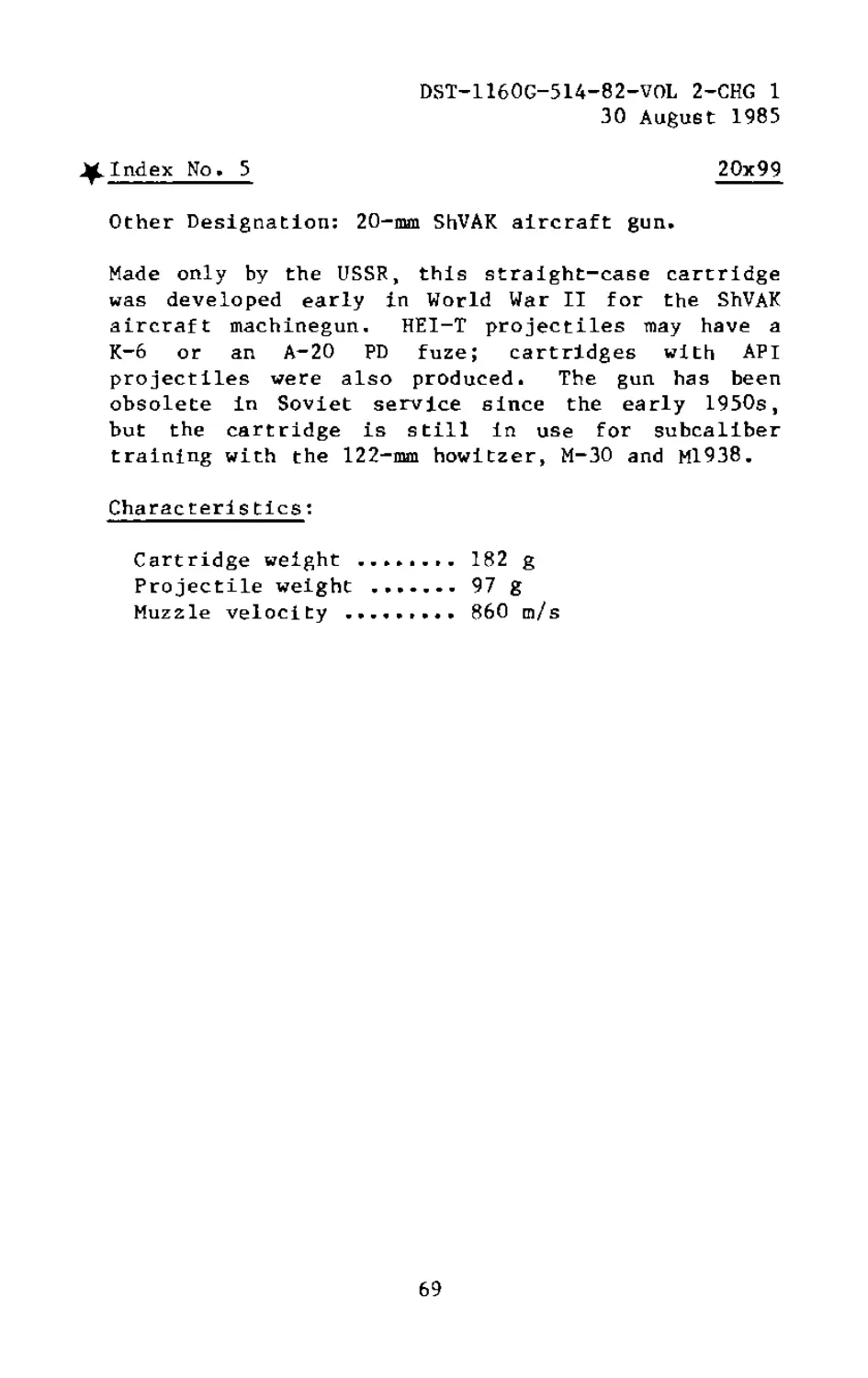
Index Wo. 5	20x99
Other Designation: 20-mm ShVAK aircraft gun.
Made only by the USSR, this straight-case cartridge
was developed early in World War II for the ShVAK
aircraft machinegun. HEI-T projectiles may have a
K-6 or an A-20 PD fuze; cartridges with API
projectiles were also produced. The gun has been
obsolete in Soviet service since the early 1950s,
but the cartridge is still in use for subcaliber
training with the 122-mm howitzer, M-30 and M1938.
Characteristics:
Cartridge weight ........ 182 g
Projectile weight ....... 97 g
Muzzle velocity ......... 860 m/s
69
DST-1160G-514-82—VOL 2-CHG 1
30 August 1985
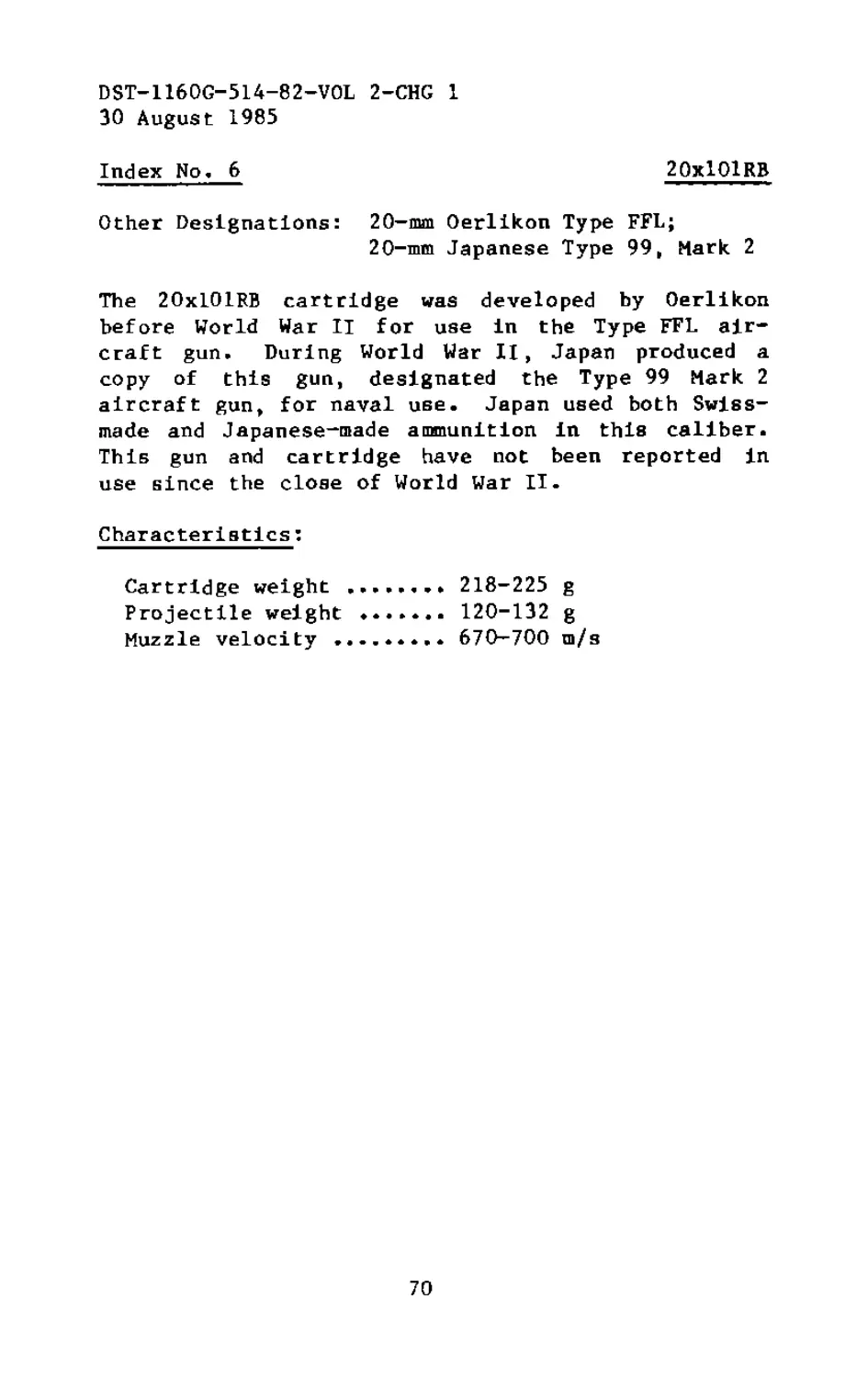
Index No. 6
20xl01RB
Other Designations: 20-mm Oerlikon Type FFL;
20-mm Japanese Type 99, Mark 2
The 20xl01RB cartridge was developed by Oerlikon
before World War II for use in the Type FFL air-
craft gun. During World War II, Japan produced a
copy of this gun, designated the Type 99 Mark 2
aircraft gun, for naval use. Japan used both Swiss-
made and Japanese—made ammunition in this caliber.
This gun and cartridge have not been reported in
use since the close of World War II.
Characteristics:
Cartridge weight ......... 218-225	g
Projectile weight ........ 120-132	g
Muzzle velocity .......... 670-700	m/s
70
DST-1160G-5L4-82-VOL 2-CHG 1
30 August 1985
Index No. 8	20xl05B
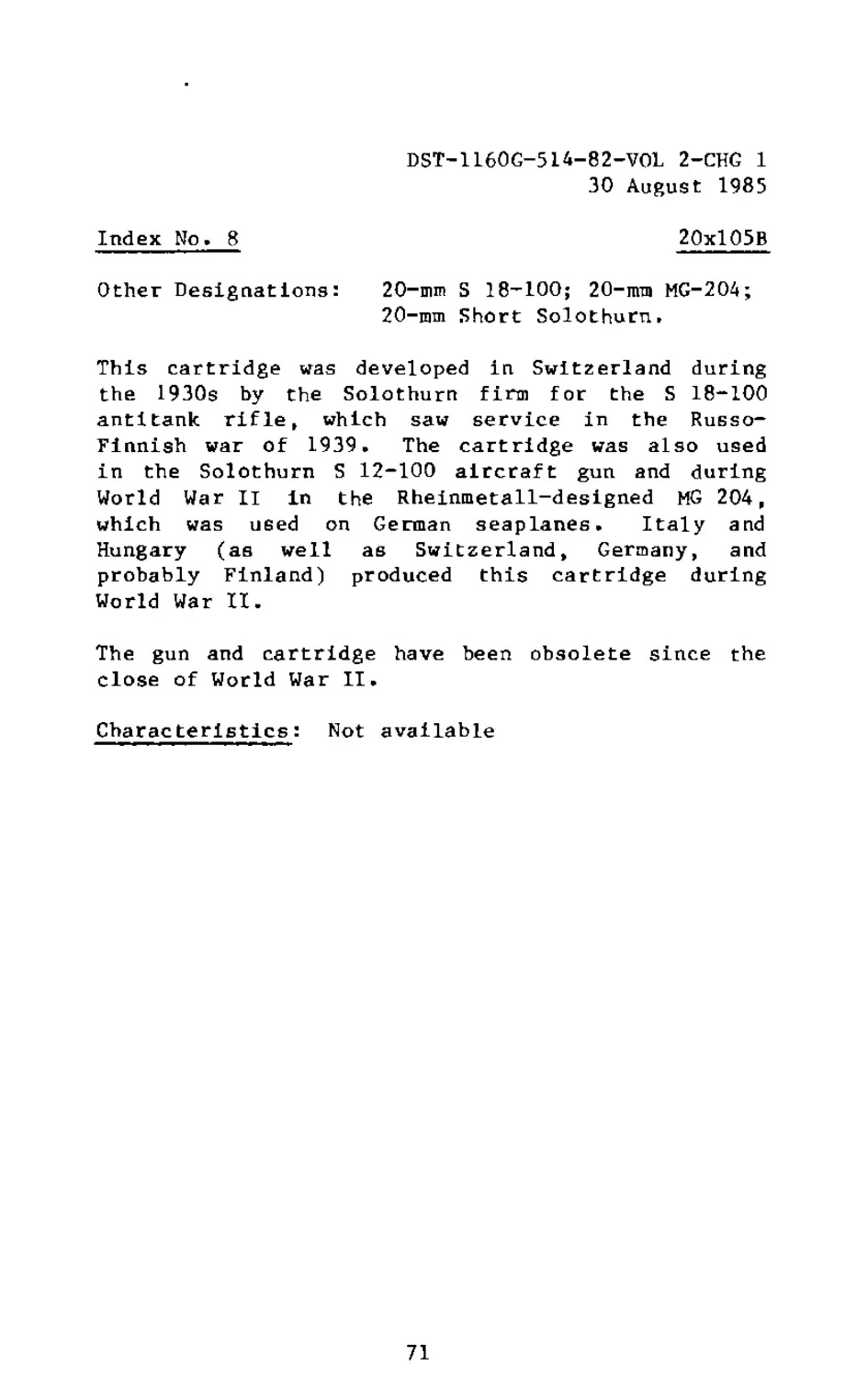
Other Designations: 20-mm S 18-100; 20-mm MG-204;
20-mm Short Solothurn.
This cartridge was developed in Switzerland during
the 1930s by the Solothurn firm for the S 18-100
antitank rifle, which saw service in the Russo-
Finnish war of 1939. The cartridge was also used
in the Solothurn S 12-100 aircraft gun and during
World War II in the Rheinmetall-deslgned MG 204,
which was used on German seaplanes. Italy and
Hungary (as well as Switzerland, Germany, and
probably Finland) produced this cartridge during
World War II.
The gun and cartridge have been obsolete since the
close of World War II.
Characteristics: Not available
71
DST-116OG-5I4-82-VOL 2-CHG 1
30 August 1985
Index No. 9	20x11ORB
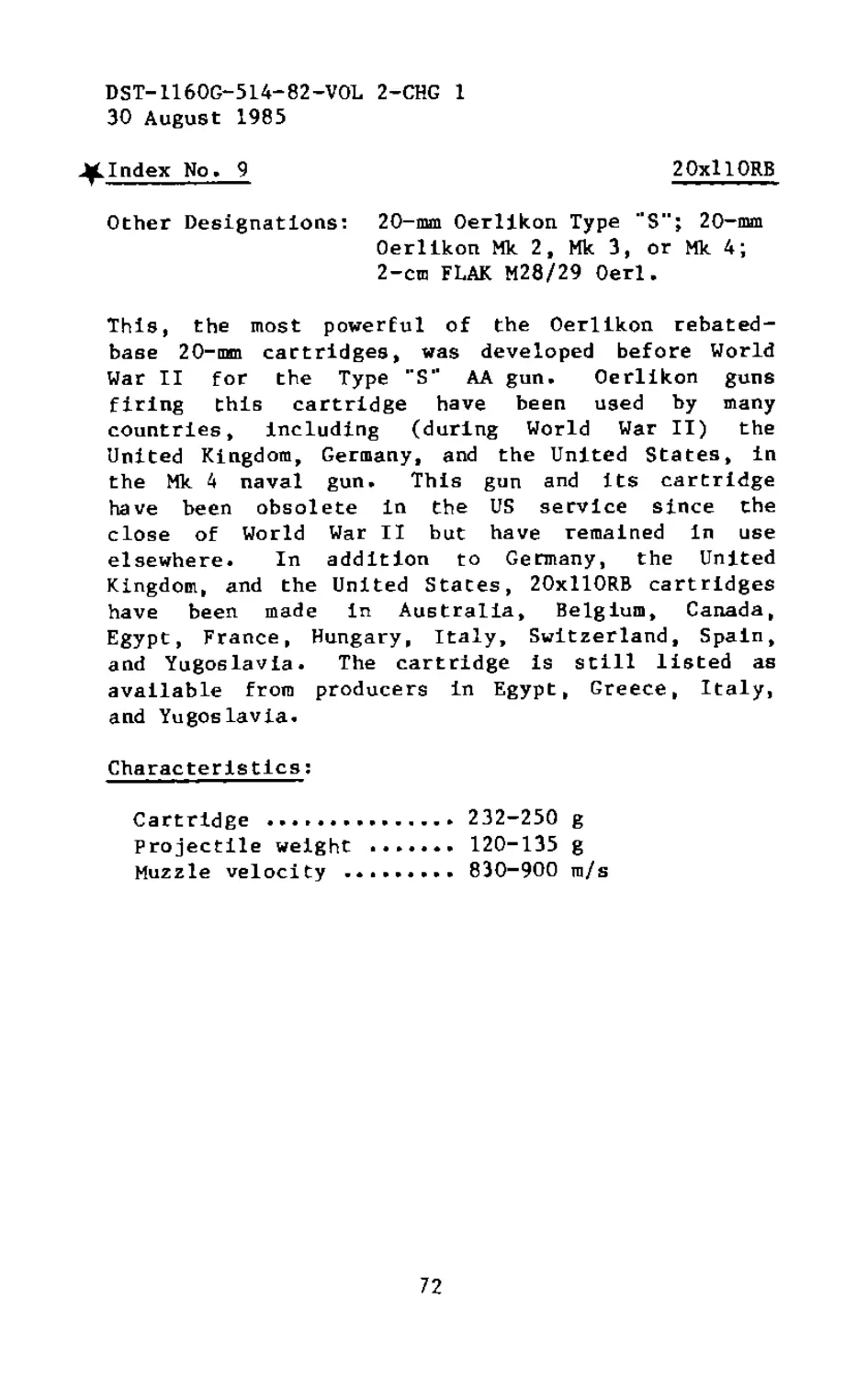
Other Designations: 20-mm Oerlikon Type "S"; 20-mm
Oerlikon Mk 2, Mk 3, or Mk 4;
2-cm FLAK M28/29 Oerl.
This, the most powerful of the Oerlikon rebated-
base 20-mm cartridges, was developed before World
War II for the Type "S” AA gun. Oerlikon guns
firing this cartridge have been used by many
countries, including (during World War II) the
United Kingdom, Germany, and the United States, in
the Mk 4 naval gun. This gun and its cartridge
have been obsolete in the US service since the
close of World War II but have remained In use
elsewhere. In addition to Germany, the United
Kingdom, and the United States, 20xll0RB cartridges
have been made In Australia, Belgium, Canada,
Egypt, France, Hungary, Italy, Switzerland, Spain,
and Yugoslavia. The cartridge is still listed as
available from producers in Egypt, Greece, Italy,
and Yugoslavia.
Characteristics:
Cartridge ................ 232-250	g
Projectile weight ........ 120-135	g
Muzzle velocity .......... 830-900	m/s
72
DST-1160G-514-82-VOL 2-CHG 1
30 August 1985
Index No. 10
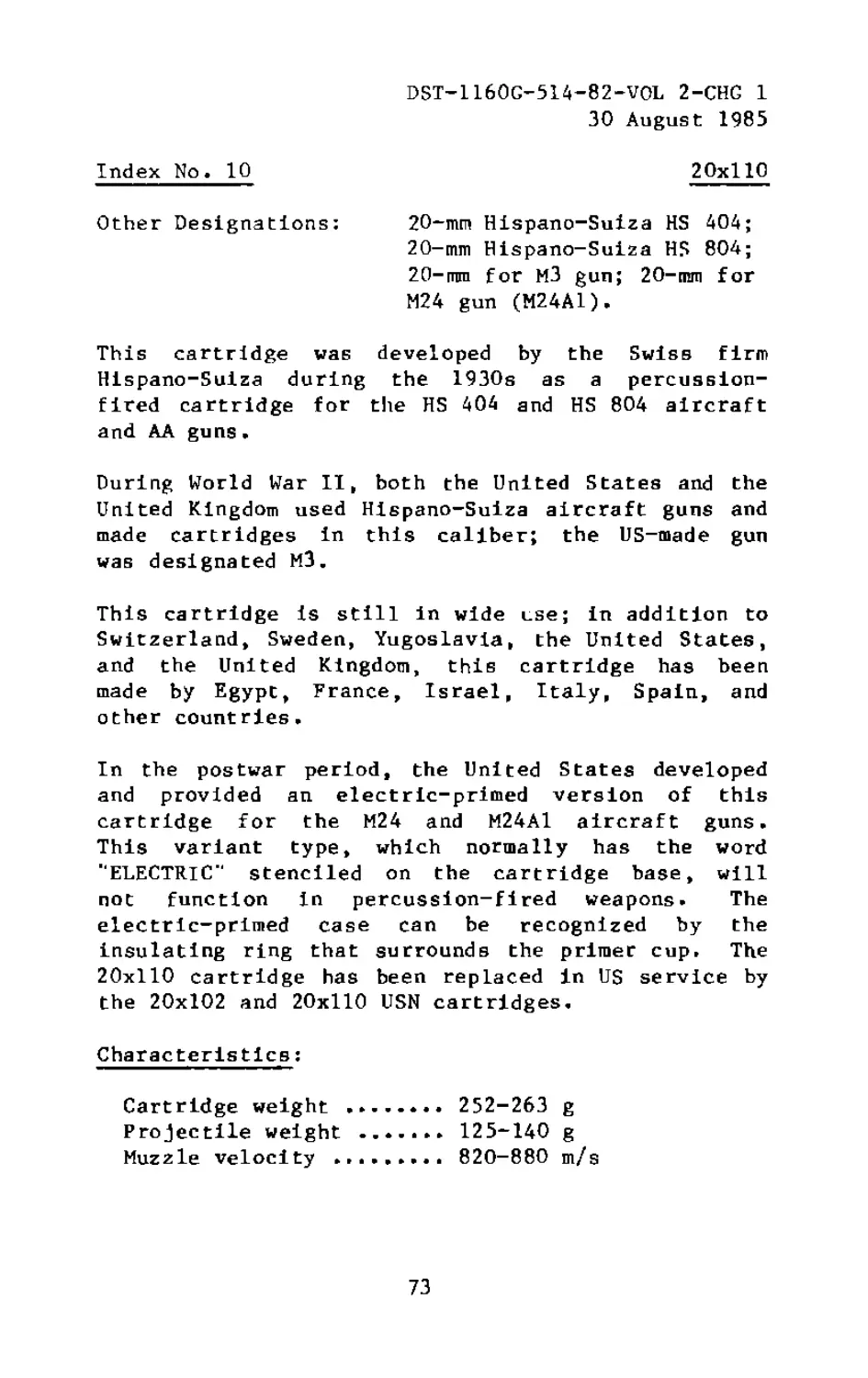
20x110
Other Designations:
20-mm Hispano-Suiza HS 404;
20-mm Hispano-Suiza HS 804;
20-rnm for М3 gun; 20-mm for
M24 gun (M24A1).
This cartridge was developed by the Swiss firm
Hispano-Suiza during the 1930s as a percussion-
fired cartridge for the HS 404 and HS 804 aircraft
and AA guns.
During World War II, both the United States and the
United Kingdom used Hispano-Suiza aircraft guns and
made cartridges in this caliber; the US-made gun
was designated м3.
This cartridge is still in wide use; in addition to
Switzerland, Sweden, Yugoslavia, the United States,
and the United Kingdom, this cartridge has been
made by Egypt, France, Israel, Italy, Spain, and
other countries.
In the postwar period, the United States developed
and provided an electric-primed version of this
cartridge for the M24 and M24A1 aircraft guns.
This variant type, which normally has the word
"ELECTRIC" stenciled on the cartridge base, will
not function In percussion-fired weapons. The
electric-primed case can be recognized by the
insulating ring that surrounds the primer cup. The
20x110 cartridge has been replaced in US service by
the 20x102 and 20x110 USN cartridges.
Characteristics:
Cartridge weight ......... 252-263	g
Projectile weight ........ 125-140	g
Muzzle velocity .......... 820-880	m/s
73
DST-11600-514-82-VOL 2-CHG 1
30 August 1985
Index No. 11	20x110 USN
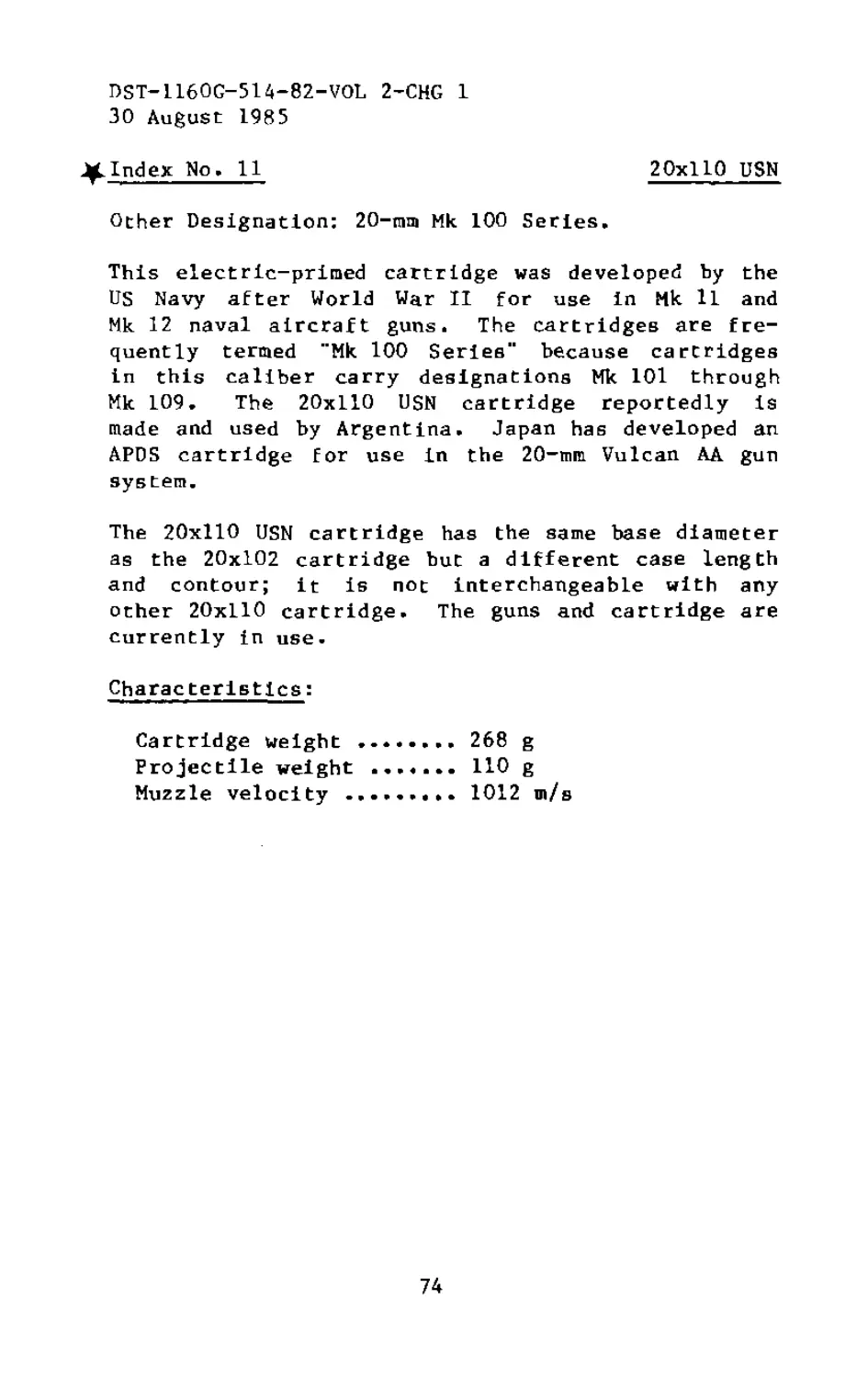
Other Designation: 20-mm Mk 100 Series.
This electric-primed cartridge was developed by the
US Navy after World War II for use in Mk 11 and
Mk 12 naval aircraft guns. The cartridges are fre-
quently termed "Mk 100 Series" because cartridges
in this caliber carry designations Mk 101 through
Mk 109. The 20x110 USN cartridge reportedly is
made and used by Argentina. Japan has developed an
APDS cartridge for use in the 20-mm Vulcan AA gun
sys tern.
The 20x110 USN cartridge has the same base diameter
as the 20x102 cartridge but a different case length
and contour; it is not interchangeable with any
other 20x110 cartridge. The guns and cartridge are
currently in use.
Characteristics:
Cartridge weight ........ 268 g
Projectile weight ....... 110 g
Muzzle velocity .........1012 ui/s
74
	DST-116OC-514-82-VOL 2-CHG 1 30 August 1985
Index No. 12	20x113
Ocher Designation: 20-mm Lahti.
Developed in Finland for the 20-mm Lahti aircraft
cannon, which was used in the 1939 Russo-Finnish
war, this cartridge saw very limited use. It
resembles the Danish Madsen cartridge in having an
exceptionally thick case rim but differs in case
length.
Characteristics: Not available
75
DST-1160G-514-82-VOL 2-CHG 1
30 August 1985
Index No. 13
20x120
Other Designation: 20-mm Madsen.
Developed in Denmark in the 1920s and used in the
Dansk Industri Syndikat's Madsen 20-mm automatic
guns M38 (drum-fed) and aircraft gun M40 (belt-
fed), the gun and Its ammunition were used by
Germany to a limited extent in World War II. Some
use in other countries in postwar years up to 1950
is reported. Cartridges were produced in the
United Kingdom before and after World War II by
Imperial Chemical Industries (Kynoch); before the
war by Switzerland, Denmark, and Finland; and
before and during the war by Germany. This
cartridge can be recognized by its unusually thick
case rim.
Characteristics:
API-T HE-T (SD)
Cartridge weight 		... 340	g	312	g
Projectile weight ....	... 154	g	127	•5 g
Muzzle velocity 		... 790	m/s	815	m/s
76
DST-1L60G—514-82-VOL 2
13 September 1982
Index No. 14	20x124
Other Designations: 20-mm Japanese Type 97; 20-mm
Japanese НО-1, HO-3.
This cartridge was developed by Japan for use in
the Type 97 AT rifle introduced in 1937. The same
cartridge case was used with other projectiles in
the H0-1 (flexible) and HO-3 (fixed) aircraft guns.
A 20x124 aircraft gun cartridge that must be
handled with caution is the HEI, Type Ma 201, which
contains under the thin nose cap a charge of the
Pi£TN explosive that detonates if the nose cap Is
crushed- The projectile is Identified by the black
steel projectile body with a red band to the rear
of the bourrelet, and an unmarked brass nose cap.
The characters о — (201) are stenciled on the
projectile body.
Characteristics:
Cartridge weight ........ 300-322	g
Projectile weight ........ 133-156	g
Muzzle velocity ......... 762 m/s
77
DST-1160G-514-82-VOL 2
13 September 1982
Index No. 15	20x125
Other Designation: 20-mm "Davy Crockett" spotter.
Developed in the early 1960s as a spotter cartridge
for the US "Davy Crockett" M28 light weapon system,
this cartridge fires a long fin-stabilized spotter
projectile through a smoothbore 20-mm gun mounted
under the primary weapon barrel. The cartridge
case contains a high—low pressure system to ensure
reliable ignition while holding chamber pressure to
a proper working level. The cartridge case has two
spanner wrench holes in the closing plug in the car-
tridge base- A stenciled marking on the cartridge
case gives caliber and model designations:	20-mm
SPOTTER. M101.
The projectile has an electric impact fuze that,
upon impact, produces flash and smoke of sufficient
intensity to be visible at 2000 meters. The "Davy
Crockett" weapon system is no longer in use.
Characteristics: Not aval1able
78
DST-1160G-514-82-VOL 2-CHG 1
30 August 1985
Index No. 16
20x128
Other Designations: 20-mm Oerlikon RK 206; RK 251;
KAB (5TG); KAA (204 GK).
Designed by the Swiss firm of Oerlikon-Buhrle in
the 1950s, this cartridge is made in a percussion-
primed version for the 5TG and 204 GK ground guns
and in an electric-primed version for the now-
obsolete revolver-type aircraft guns RK 206 and
RK 251. Cartridges are identical except for the
type of ignition. In 1972, when Oerlikon obtained
a controlling interest in Hispano-Sulza, the belt-
fed 204 GK gun was redesignated KAA, and the
magazine-fed 5TG gun was redesignated KAB.
Cartridges are produced by the French firm of
Luchaire as well as by Oerlikon. The Spanish firm
CRTME, located in Madrid, now produces electric-
primed cartridges in this caliber for the
multibarreled MEROKA AA gun.
Characteristics:
Cartridge weight ........ 330-360 g
Projectile weight ....... 122-138 g
Muzzle velocity ......... 1085-1200	m/s
79
DST-1160G-514-82-VOL 2-CHG 1
30 August 1985
Index No. 17
20x138В
Other Designations: 2-cm Long Solothurn; 2-cm
Rheinmetal1; 2-cm Lahti AT gun;
2-cm Breda; 2-cm FLAK 30/38.
Developed during the 1930s by the Swiss firm
Solothurn AG as an Improvement over the 20x1058
cartridge, the 20xl38B has been used In a variety
of AT guns and AA machineguns; The Swiss-designed
tank gun S18-1000 and AT gun S18-1100, Italian
Breda AT and AA guns, the Finnish Lahti 20-mm
AT gun, and the Rhelnmetall 2-cm FLAK 30/38 AA gun.
Sweden used the Rhelnmetall AA gun and the Swiss
AT gun under the designation tn/39. Cartridges have
been produced in Switzerland, Sweden, Germany,
Finland, and (before 1941) Greece; they are still
offered for sale by Yugoslavia and by Bombrini
Parodi-Delfino of Italy. Both brass-cased and
steel-cased cartridges are known. Reportedly this
cartridge is currently manufactured in Czechoslo-
vakia.
Characteristics;
Cartridge weight ........ 320 g
Projectile weight ....... 148 g
Muzzle velocity ......... 860-900	m/s
80
DST-1160G-514-82-VOL 2-CHG 1
30 August 1985
Index No. 18
20x139
Other Designations: 20-mm Oerlikon KAD
(HS 820 series);
20-mm Rh 202; 20-mm M139.
Hispano-Suiza of Switzerland developed this
cartridge at the close of World War II co provide
improved performance over that of the 20x110
Hispano-Sulza cartridge. HS 820 guns were widely
marketed during rhe 1950s, and ammunition improve-
ments have kept pace with improved gun models. The
same cartridge has been adopted by France for tire
M693 automatic gun, by Germany for the Rheinmetail
Rh 202 gun, and by rhe United States for rhe >1139
gun. Projectile and fuze designs, designations,
and characteristics vary among the producing
countries. Cartridges in this caliber are also
made in the Netherlands, Norway, Sweden, and
Greece.
In the postwar period, Hispano-Suiza developed a
23xl39-tnm cartridge, based on the 20xl39-mm design,
for use in the 827C aircraft gun. This gun and
ammunition were produced only for testing. In the
1960s, the Mauser firm developed a 23-mm cartridge
for the C-l aircraft gun. Except for the larger-
diameter projectile, the cartridge is similar in
dimensions and case outline to the 20x139—mm
cartridge. No quantity production of this 2.3-mm
cartridge is reported.
Characteristics:
Cartridge weight ........ 317 g
Projectile weight ....... 120 g
Muzzle velocity ......... 1100 m/s
81
DST-1160G-514-82-VOL 2-CHG 1
30 August 1985
Index No. 19	20x142
Other Designation: 20-mm Japanese Type 98.
This cartridge was Introduced in 1938 for Type 98
AA and AT guns. HE-T and AP-T projectiles are
known.
Characteristics:
Cartridge weight ........ 396-423	g
Projectile weight ....... 129-156	g
Muzzle velocity ......... 830 m/s
82
DST-1160G-514-82-VOL 2
13 September 1982
20xl45R
Index No. 20
Other Designations:
20-nm Before m/40;
20-mm Tubkanon.
This ammunition was developed by Bofors for the
20-mm Bofors drum-fed automatic gun. Model m/40,
and used also in the m 40/70 gun. While these guns
are obsolete, similar cartridges are used in
subcaliber 57-mm and 75-nm AT gunp and vehicle-
mounted 75-mm and 105-mm guns. This gun and
ammunition were also used by Denmark under the
designation M40S. Data shown are from a Danish
manual. Unlike other Bofors cartridges, this
cartridge has no annular groove in the cartridge
base for the Bofors feed clip.
Characteristics;
	HE-T(SD)	HE-T	AP-T
Cartridge weight ....	310 g	300 g	300 g
Projectile weight ...	145 g	136 g	136 g
Muzzle velocity 		815 m/s	845 m/s	845 m/s
83
DST-U6OG-514-82-V0b 2
13 September 1982
Index No. 21
20X180R
Other Designations: 20-mm m/39-
The large propellant volume of this cartridge
results from its use in a recoilless AT gun
designated m/42. This cartridge is identified by
its large-diameter rim, measuring nearly 48 mm, and
by the blowout disk in the cartridge base sur-
rounding the percussion primer. Both HE and Ap
projectiles were used. This gun and cartridge were
in use during the 1940s but are no longer in
service.
Characteristics:
Cartridge weight ......... 520-540	g
Projectile weight ........ 115-136	g
Muzzle velocity .......... 950 m/s
84
DST-116OG-514-82-VOL 2-CHG 1
30 August 1985
Index No. 22
23x106
Other Designation: 23-mm Madsen.
This cartridge, developed in Denmark in the 1930s
for the 23 mm Madsen aircraft gun used in the
Fokker D-21 aircraft, is reported to have been used
in the 1939 Russo-Finnish war. Cartridges were
made in Denmark and in the United Kingdom by
Imperial Chemical Industries, Ltd. (Kynoch). The
gun and cartridge have been obsolete since the mid-
1940s.
Characterist les:
Cartridge weight ......... 341	g
Projectile weight ........ 174	g
Muzzle velocity .......... 720	m/s
85
DST-116OG-514-82-VOL 2-CHG 1
30 August 1985
Index No. 23	23x115
Other Designations: 23-mm NR/NS 23; 23-mm AM-23;
Chinese Types 2, 2H, and 2K
This standard Soviet aircraft gun cartridge (also
made in Czechoslovakia, Egypt, China, and Romania)
is used in three gun systems: NR/NS 23, AM-23, and
GSh-23. Both HEI and API loadings have been
reported. Although dimensionally similar, car-
tridges for AM-23 and GSh-23 guns differ in their
loading and are not functionally interoperable with
NR/NS-23 cartridges. AM-23 and GSh-23 cartridges
are identified by a white band around the projec-
tile body.
All 23x115 cartridges have percussion-primed brass
cases. They can be identified by the cartridge
headstamp.
Characteristics:
Cartridge weight ........ 321-345	g
Projectile weight ....... 174-200	g
Muzzle velocity ......... 690-740	m/s
86
DST-1160C-514-82-VOL 2-CHG 1
30 August 1985
Index No. 24	23xl52B
Other Designations:	23-mm ZU-23; ZSU-23-4; 23-шт
VYa aircraft gun.
This cartridge was developed by the Soviet Union
for use in the World War II VYa aircraft gun. When
this gun was replaced by the 23x115 NR/NS aircraft
gun, the excellent performance of the 23xl52B VYa
cartridge led to its further development as a high-
performance cartridge for the ZU-23 and ZSU-23-4
AA gun systems.
While very similar in dimensions, the steel-cased
ZU/ZSU cartridges are not functionally inter-
operable with the brass-case VYa cartridge. The
latter, however, has continued in production for
use in tank subcaliber guns. Steel-cased ZU/ZSU
cartridges are made in Egypt and are also produced
in Bulgaria.
Characteristics:
Cartridge weight ......... 437-450 g
Projectile weight ........ 183-192 g
Muzzle velocity .......... 930-1000 m/s
87
DST-1160G-514-82-VOL 2-CHG 1
30 August 1985
Index No. 25	24x138
Other Designation: 24-mm TkB, K-38.
Introduced by Switzerland in 1938 for the Swiss
Tankbuchse (tank, gun) Model K-38, this gun was
probably withdrawn from service during the 1940s.
HE and AT cartridges were made. Ammunition Is,
however, still reportedly manufactured for
subcaliber use.
Characteristics:
Cartridge weight ......... 460	g
Projectile weight ........ 225	g
Muzzle velocity ......... 900 m/s
88
DST-1160G-514-82-VOL 2-СНС 1
30 August 1985
Index No, 26	25x137
Other Designations: 25-mm Oerlikon Type KBA; Mauser
Model E; US M242 and GAU-12A.
Introduced by Oerlikon in the 1960s, this high-
performance cartridge can be recognized by the
annular link-positioning groove located 98.5 mm
from the base of the steel cartridge case. This
groove disappears when the cartridge is fired but
leaves an impression on the case. HEI-T, APDS-T,
and multipurpose projectiles are available. In
addition to Switzerland, 25xl37-mm cartridges are
produced by Manurhin (France), Raufoss (Norway),
and DeKruithoorn (Netherlands).
The cartridge is used in Oerlikon's Model KBA gun.
The United States has adopted this cartridge for
use in the M242 Bushmaster automatic gun. US
cartridge designations are M?91 (APDS-T) and M792
(HEI-T). The 25xl73-mm is under evaluation for
consideration as NATO standard.
Characteristics:
HE-T	APDS-T
Cartridge weight ....	502 g	435 g
Projectile weight ...	180 g	105 g
Muzzle velocity ..... 1100 m/s	1463 m/s
89
DST-1160G-514-82-V0L 2-CHG 1
30 August 1985
Index No. 27	25x165
Other Designation: 25-nm Hotchkiss AA gun.
This cartridge was developed by France during the
1930s for use in a Hotchkiss-designed automatic
AA gun. During World War II, Japan produced a
naval version of this gun, designated the Type 96
Model 2 AA and AT automatic cannon. Cartridges are
similar to French-made anmiunition, but French and
Japanese cartridges are not interoperable due to
minor differences in cartridge-case dimensions.
HE, HE-T, HEI (white phosphorus), and AP projec-
tiles are known. The gun and anmiunition have been
obsolete since the close of World War II.
Characteristics:
Cartridge weight ......... 687	g
Projectile weight ........ 252	g
Muzzle velocity .......... 905	m/s
90
DST-H60G-514—82—VOL 2-CHG 1
30 August 1985
Index No. 28
25x195
Other Designation: 25-nm Hotchkiss AT.
Used in the French-made 25-mm Model 37 Hotchklss-
Puteaux S.A.L. AT gun, this cartridge was in
service during the initial stages of World War II
but was not produced after the war. Aside from an
AT cartridge, a HEAT projectile, which weighs 2 kg
and is thus an over-caliber projectile propelled by
a blank cartridge, is reported to have been used.
A rimless version of this cartridge was also
produced for a semiautomatic AT gun.
Character!sties: (AP cartridge)
Cartridge weight ........ 861-875	g
Projectile weight ....... 320 g
Muzzle velocity ......... 900-960	m/s
91
DST-116OG-514-82-VOL 2-CHG 1
30 August 1985
Index No. 29	25x205SR
Other Designation: 25-mm Soviet AA gun, M194O.
This cartridge, which has dimensions very close to
those of the Swedish 25-mm Bofors L/64 cartridge
that was adopted in 1933, differs in having three
rotating bands; the rearmost band is inserted into
the cartridge-case mouth, which is then crimped
just to the rear of the middle rotating band.
Dimensions of the Soviet cartridge case were scaled
from a drawing and may vary from those given in
table I. The cartridges, which are fed from seven-
round Bofors-type clips, have an annular groove in
the cartridge base, similar to the Soviet 37x253SR
cartridge. HEI-T projectiles with A-23 f uz es,
Index УПЭР-132 (UOZR-132), and AP-T projectiles,
Index УЭР-132 (UZR-132), are reported; these
designations are stenciled on the cartridge case.
These three-band projectiles were also used in
25x219 cartridges for a Soviet naval AA gun. The
25x205SR cartridge was used in the Soviet towed
AA gun, M1940. The gun and cartridges were
obsolete in the Soviet service after the close of
World War II but may still be in use in outlying
countries under Soviet influence.
Characteristics:
HEI-T AF-T
Cartridge weight ....	672	g	b84	g
Projectile weight ...	288	g	295	g
Muzzle velocity ......... 900	m/s	900	m/s
92
DST-1160G-514-82-VOL 2-CHG 1
30 August 1985
Index No. 30	25x218
Other Designations: 25-mm Soviet twin-barrel naval
AA gun; 25-nm Chinese twin-
barrel naval AA gun, Type 61.
This rimless cartridge is fired in the Soviet naval
twin AA gun systems, Models 2-M3 and 2-M8. Two
types of projectiles have been noted; the older
type, with three copper rotating bands, is identi-
cal to projectiles for the 25x2O5SR gun. The rear-
most rotating band is inserted into the mouth of
the brass cartridge case, which is crimped just to
the rear of the middle rotating band.
Newer HEI-T projectiles with MG-25 fuzes have two
copper rotating bands; again, the rearmost band is
inserted into the mouth of the brass or steel
cartridge case. Cartridge cases carry the index
У0ЭР-85 (UOZR-85) or У0ЭР-85М (UOZR-85M) stenciled
on the cartridge case. China produces a copy of
the latter.
Characteristics:
Cartridge weight .........
Projectile weight ........
Muzzle velocity ..........
639-644 g
281-285 g
900 m/s (est)
93
DST-1160G-514-82-V0L 2-CHG 1
30 August 1985
Index No. 31	27xl45B
Other Designations: Mauser MK27; 27-nm Mauser MRCA
gun.
This cartridge has been developed for the Mauser
high-performance revolver-type MK27 aircraft gun
intended for the West German-British-Italian
"Tornado" aircraft. Like other aircraft gun car-
tridges developed from the Mauser MK213 cartridge,
it is electric primed. Projectiles for this car-
tridge include AP, APHEI, HEI, and two types of
training practice projectiles.
Characteristics:
Cartridge weight ........ 500-530 g
Projectile weight ....... 240-280 g
Muzzle velocity ......... 1050 m/s
94
DST-116OG-514-82-VOL 2
13 September 1982
Index No. 32	28x188
Other Designations: 28/20S PzB 41; 28/20 squeeze
bore.
This cartridge, the smallest of a family of three
squeeze-bore AT guns developed by Germany during
World War II, was based on a tapered-bore gun
designed by Hermann Gerlich. The cartridge was
designed for use in a gun with a tapered, rifled
bore, decreasing the bore diameter from 28 nun at
the origin of the rifling to 20 mm at the muzzle.
The purpose of this design was to achieve an ex-
tremely high velocity while reducing air resistance
by decreasing the projectile's sectional area. The
28-mm projectile has skirts that are folded or
squeezed into recesses in the sraaller-diameter pro-
jectile body as the projectile moves down the bar-
rel- AP projectiles with a rungs ten-carbide core
and HE projectiles are known to exist. This
ammunition was produced from mid-1940 to the close
of 1943, when shortages of critical material forced
the termination of the program- Excessive bore
wear is also reported to have been a factor in the
decision to discontinue production. When the
program was terminated, some AP projectiles
reportedly had cores of uranium as a substitute for
tungsten carbide.
Characteristics;	AP (WC)	HE
Cartridge weight ....	650 g	630 g
Projectile weight ...	121 g	100 g
Muzzle velocity 		1415 m/s	1500 m/s
95
DST-116OG-514-82-VOL 2
13 September 1982
Index No. 33	28x199
Other Designation: 1.1-inch US Navy heavy
machinegun.
This cartridge was developed during the 1930s for a
water-cooled, four-barreled AA gun for shipboard
use. Although this gun and ammunition saw some use
in World War II, they were replaced in general
service by the 20xllORB Oerlikon Mark 4-series guns
and were obsolete by the close of the war. Despite
its US Navy origin, many cartridges were made by
the Army'в Frankford Arsenal, in addition to naval
contractors.
Characteristics:
Cartridge weight ......... 848	g
Projectile weight ........ 416	g
Muzzle velocity .......... 823	m/s
96
DST-1160G-514-82-VOL 2-CHG 1
30 August 1985
Index No. 33A	30x28B
Other Designation: 30-mm Grenade Launcher, AGS-17.
This Soviet cartridge is fired from the tripod- or
vehicle-mounted, belt-fed AGS-17 grenade launcher,
which is designed for close infantry support.
Unlike the US round, the lacquered steel cartridge
case is not of the high-low pressure type. The
cartridge fires a PDSD-fuzed high-explosive anti-
personnel projectile designated V0G-17M.
Characteristics:
Cartridge weight ......... 350	g
Projectile weight ........ 275	g
Muzzle velocity .......... 185	m/s
97
DST-1160C-514-82-VOL 2-CHG 1
30 August 1985
Index No. 34
30x86B
Other Designation: 30-mm Mauser MK-213.
The 30x86B cartridge was developed in Germany for
the Mauser MK-213 revolver-type aircraft gun, which
was one of the most advanced gun designs to appear
during World War II. In postwar years, this gun
and ammunition provided a basis for further develop-
ments in several major Western arms-producing
countries, notably employed in the British ADEN and
French DEFA designs. The original gun was not
produced after the close of World War II, except
possibly in a few other countries for trial
purposes.
The United Kingdom made a similar 30x86B cartridge
in the early 1950s for the Type 3M ADEN 30-mm
aircraft gun, which was based on the MK-213 gun.
UK cartridges can be distinguished from World
War II German cartridges by the case material
(brass instead of lacquered steel) and the British
Identification markings in the extraction groove
and on the projectile. The US also made brass-
cased 30x86В cartridges, designated T158 through
T162, for the T121 revolver aircraft gun. US
cases, which are similar to UK cases, may be
unmarked.
Characteristics (World War II cartridges):
Cartridge weight ......... 500	g
Projectile weight ....... 330 g
Muzzle velocity .......... 530	m/s
98
DST-1160G-514-82-V0L 2
13 September 1982
Index No. 35	30x91RB
Other Designations: 30-mm MK 108; 30-mm Japanese
Type 2.
This cartridge was developed by Rheinmetal1-Borsig
during early World War II for a 30-mm low-velocity
aircraft gun, the MK 108, which operated on the
blowback principle. In 1944-1945, Japan used a
closely similar cartridge type—but with a slightly
larger diameter rim (29~mm) and shorter projectile—
in the 30—mm AA gun, Type 2. HEI, HEI-T, and
incendiary loadings are reported. Neither the
German nor the Japanese gun and ammunition have
been used since the close of World War II.
Characteristics:
Cartridge weight ........ 475-487	g
Projectile weight ....... 330 g
Muzzle velocity ......... 500 m/s
99
DST-116OG-514-82-VOL 2
13 September 1982
Index No. 36
30x97B
Other Designations: 30-mm Type 3CGF; 30-mm DEFA 541.
This cartridge is the result of postwar French
exploitation of the World War II German Mauser
MK-213 gun and cartridge. Lt was developed during
the 1950s for the French revolver-type aircraft
gun, Type 3CGF, which was redesignated the
DEFA 541. The cartridge can be identified by its
electric-primed brass case with a French—style
headstamp that includes the designation ‘‘3CGF."
The gun and cartridge were soon replaced by the
more-powerful 30xll3B DEFA 550-series gun and
ammunition; the DEFA 541 gun and its ammunition are
no longer in service.
During the late 1960s and early 1970s, the United
States made similar experimental cartridges with
brass or aluminum cartridge cases but with case
lengths of LOO mm and 102 mm. The 100-mm cases,
which are percussion-primed, may be marked XML93,
XM210, or XM21L; the 102-mm cases are electric-
primed and may be marked FAT 33.
Characteristics:
Cartridge weight ........ 500	g
Projectile weight ....... 296	g
Muzzle velocity ......... 670	m/s
100
DST-116OG-514-82-VOL 2-CHG 1
30 August 1985
Index No. 37
30x113В
Other Designations; 30-mm DEFA Type 551 (553);
30-mm ADEN.
This cartridge designation is shared by two similar
and generally (though not completely) interoperable
cartridges, one for the French-developed DEFA
Type 551 to Type 553 guns, and the other for the UK-
developed ADEN gun. Both are revolver—type air-
craft guns that are derived from the World War II
Mauser MK-213 gun. Like the Mauser gun ammunition,
all 30x113В cartridges have electric primers.
France developed its version of the 30xll3B car-
tridge by 1957 for the Type 551 DEFA gun and in
subsequent years introduced Improved Type 552 and
553 guns. Ammunition has been developed along with
the guns, but 550-series ammunition can be used in
all three guns. Cartridges include air-to-air and
air-to-ground types. Air-to-air cartridges have an
HEI-T projectile with a self-destruct fuze to
reduce the hazard to friendly ground troops. Air-
to-ground ammunition has a primer with a flash tube
to ensure ignition during a diving attack against
ground targets. Air-to-ground explosive projec-
tiles have a fuze without the self-destruct
feature. French cartridges can be recognized by
the steel cartridge case, the French-style head-
stamp, and a stenciled case marking indicating the
type of ca rt ridge. DEFA ammunition has also been
made by Oerlikon and Hispano-Suiza, by West
Germany, and by Israel.
Characteristics (DEFA ammunition):
Cartridge weight ........ 440-480	g
Projectile weight ....... 236-275	g
Muzzle velocity ......... 760-818	m/s
101
DST-11600-514-82-VOL 2-CHG 1
30 August 1985
UK development of the ADEN gun and cartridge paral-
leled that of France. The first types, produced in
the early 1950s, used a low-veloci ty 30x868
cartridge in the Type 3м ADEN gun; these cartridges
were superseded in the mid-1950s by the current
30x1138 cartridge. ADEN ammunition can be recog-
nized by the brass cartridge case with UK-style
model designations on projectile and fuze, and by
producer, model, and year data stamped in the
bottom of the extraction groove of the cartridge
case. ADEN cartridge cases are slightly shorter in
case length than DEFA cases; the former may be as
short as 111 mm. This reduced length poses no
problem in functioning in revolver-type guns, since
the cartridge case belt indexes the cartridge in
the revolver chamber. ADEN cartridges have been
produced by Hispano-Suiza and Oerlikon, as well as
by Sweden, West Germany, Finland, the Netherlands,
and Belgium. The United States has developed a
family of aluminum-cased 30xll3B cartridges,
designated XM 788 (TP), XM 789 (HEDP), and XM 799
(HEI) and intended for the XM 188E1 gun, which will
be functionally interoperable with ADEN and DEFA
guns.
Characteristics: (ADEN ammunition)
Cartridge weight ......... 440-503	g
Projectile weight ........ 226-270	g
Muzzle velocity .......... 590-800	m/s
102
DST-1L6OG-514-82-VOL 2
13 September 1982
Index No. 38	30x114
Other Designation: 30-mm Japanese 110-155
Japan developed the 30x114 cartridge during World
War II for the 30-nim aircraft cannon, HO-I55- The
gun and ammunition have been obsolete since the end
of the war.
Characteristics: Not available
103
DST-U6OG-514-82-VOL 2
13 September 1982
Index Ko. 39	30x123
Other Designation: 30-nun Japanese Type 5.
The 30x123 cartridge was used during World War IL
in the Japanese naval aircraft gun, Type 5. Car-
tridge case dimensions were scaled from World
War II drawings, and measured dimensions may vary
to some degree from those shown in table I. The
gun and ammunition have been obsolete since the
close of World War II.
Characteristics: Not available
104
DST-116OG-514-82-VOL 2-CHG 1
30 August 1985
Index No. 40	30xl55B
Other Designation: 30-mm Soviet NR-30; Chinese
Type 1.
Introduced by the USSR in the mid-1950s for the
NR-30 aircraft gun, this cartridge is still in
service. Cartridge types Include a fragmentation-
HEI cartridge with a PD fuze, Model A-30 or B-30,
and a fragmentatlon-HE cartridge with a BD fuze
Model DBM-30, and a sheet-metal windshield that
gives the appearance of an API cartridge. There is
no visible indication that the projectile contains
HE filler. Cartridge cases are of brass.
The fragmentation-HEI cartridge is also made in
Czechoslovakia; this cartridge can be recognized by
the characteristic Czechoslovak headstamp marking,
which includes a three-letter factory (producer)
code, l.e., d tp. HEI-T, HEI, and APHE cartridges
are produced in China; HE, HEI, and HE-T rounds are
manufactured In Romania.
Characteristics:
Cartridge weight ........ 838-850	g
Projectile weight ....... 392-418	g
Muzzle velocity ......... 780 m/s
105
DST-1160G-514-82-VOL 2-CHG 1
30 August 1985
Index No. 41
30x170
Other Designations;
30-mm Oerlikon KCB (HSS 831
series); 30-mm RARDEN.
Developed at the close of World War II by Hispano-
Suiza and still produced by Oerlikon, this car-
tridge remains one of the world’s high-performance
automatic gun cartridges. Cartridge types include
point-fuzed HEI cartridges, double-fuzed HEI
cartridges with a wind shield, and API and APDS-T
types. This cartridge is used in Oerlikon KCB
(HSS 831-series) guns, and in the United Kingdom's
RARDEN gun. These cartridges have also been
produced by West Germany, France, and Egypt, as
well as by the United Kingdom, which has developed
a high-performance APDS-T cartridge for the RARDEN
gun.
Cartridges for the HSS 831A gun have a brass (or
rarely, steel), cartridge case and a wide copper
rotating band; HSS 831A cartridges may not chamber
fully in the newer HSS 831L gun, which fires steel-
cased cartridges having a narrow sintered-iron
rotating band.
Character1stics:
Cartridge weight ........ 725-900 g
Projectile weight ....... 300-452 g
Muzzle velocity* ........ 920-1080 m/s
*The RARDEN APDS-T cartridge has an estimated
muzzle velocity in excess of 1150 m/s.
106
DST-1160G-514-82-VOL 2-CHG 1
30 August 1985
Index No. 42
30x173
Other Designations: 30-mtn Oerlikon KCA (304 RK);
Mauser Model F; US GAU-8A and
GAU-9A.
This modern, high-performance, electric-primed car-
tridge was developed during the 1950s by Oerlikon
for the KCA (formerly 304 RK) revolver gun for air-
craft.
Cartridge types include HEI, API, and SAPHEI car-
tridges. A variant of this cartridge was the
30x180, an electric-primed cartridge produced by
Oerlikon in 1953 for the RK 302 gun; these car-
tridges were made for trials but were never mass
produced.
In recent years, the United States has produced
aluminum-cased cartridges in 30x173 caliber; these
have percussion primers when made for the GAU 8A
gun and electric primers when made for the GAU 9A
gun.
Characteristics:
Cartridge weight ........ 800-910 g
Projectile weight ....... 325-433 g
Muzzle velocity ......... 950-1100 m/s
107
DST-116OG-514-82-VOL 2-CHG 1
30 August 1985
Index No. 43	30x185B
Other Designations: 30-mm MK 101; MK 103.
This cartridge was introduced In Germany about 1936
as a percussion-primed cartridge for the MK 101
aircraft gun. An electric-primed version of the
cartridge was made for the MK 103 gun. The car-
tridges have similar case dimensions but can be
distinguished by the presence of a c/33 percussion
primer or a c/23 electric primer. HE, HEI, HEI-T,
API, APHEI, and AP-T cartridge types are known to
have been produced; the AP-T cartridge had a
projectile with a tungsten carbide core and a
muzzle velocity of 960 m/s. The guns and
cartridges were not used after the close of World
War II.
Characteristics:
Cartridge weight ......... 770-960	g
Projectile weight ........ 295-500	g
Muzzle velocity .......... 700-960	m/s
108
DST-1160G-514-82-VOL 2-CHG 1
30 August 1985
Index No. 44	30x210B
Other Designation: 30-mm Type NN-30.
This elect tic-primed, brass-case cartridge is used
in the Soviet naval AA gun, Type NN-30. Cartridges
are identified by the stenciled case markings,
which include the Cyrillic cartridge designation
УФ-83 (UF-83) and gun designation HH-30 (NN-3O-),
and by the typical Soviet cartridge headstamp mark-
ing. Types manufactured include HEI with PDSD fuze,
HE with 8D fuze, APHEI with DD fuze, and a tracer
cartridge with PDSD fuze.
A similar and probably Identical cartridge is
reportedly manufactured by Yugoslavia under the
designation M69. The HE projectile has a PD fuze,
Model UT M69-SM.
Characteristics:
Cartridge weight ........ 1140 g
Projectile weight ....... 435 g
Muzzle velocity ......... 1000 m/s
109
DST-U6OC-514-82-VOL 2-CHG 1
30 August 1985
MIndex No. 45
30x210
Other Designations:	30-nm AA gun, M53/59, M53/7O.
This cartridge is used in the Czechoslovak twin
AA gun, М5Э/7О, which was introduced in the 1950s
and is still in use. HE and AP types are reported.
Ammunition (HE-T) for this gun is also made for
export by Yugoslavia.
Characteristics;
Cartridge weight ........ 1050 g
Projectile weight ....... 420 g (est)
Muzzle velocity ......... 1000 m/s
110
DST-1160G-514-82-V0L 2-CHG 1
30 August 1985
<lfldex No. 45A
34x240
Other Designation: Swiss Flab. Kan. 38
(Model 38 AA Gun)
Used in the little-known Swiss Model 1938 AA gun,
this cartridge is known to have been produced until
at least 1946. The gun and its ammunition have
been replaced In Swiss service by the 35-mm
Oerlikon KDB gun in a towed twin-gun version.
Characteristics:
Cartridge weight ........ 1553-1572 g
Projectile weight ....... 680-700 g
Muzzle velocity ......... 890-900 m/s
111
DST-1160G-514-82-VOL 2-CHG 1
30 August 1985
J^Index No. 46	35x228
Other Designations: 35-mm Oerlikon; 35-шш KDA, KDB,
or KDC.
Oerlikon developed this high-performance AA gun
cartridge in the early 1960b. Two cartridge case
types are known; cases with a link positioning
groove below the case shoulder are intended for use
in the indexing feed belt of the KDA gun, but can
be used in all models. This type of case is in
current production. Cases without the belt groove
were made for use only in the KDB, KDC, and KDE
guns.
Cartridge types include HEI and HEI-T, 8APHEI-T,
and APDS-T (WC). HE projectiles have a PDSD fuze,
Model KZD-242 or KZD-238 and APHE projectiles have
a BDSD fuze, Model BZD 357 or BZD 363. The SAPHEI-T
projectile incorporates a BDSD fuze, Model BZD 34Z.
The gun and cartridges are widely distributed
throughout the free world; Austria, Finland, France,
Greece, Iran, Japan, Libya, the Netherlands, Saudi
Arabia, and West Germany are reported to have these
guns, and several of these countries produce the
cartridge under license from Oerlikon.
Characteristics:
Explosive
projectiles APDS-T
Cartridge weight ....	1567 g	1460 g
Projectile weight ...	550 g	380 g
Muzzle velocity ..... 1175 m/s	1385 m/s
112
DST-1160G-514-82-VOL 2
13 September 1982
Index No. 47
37x93R
Other Designations; 37-mm M1916; 37-mm M63 Mod 1.
This cartridge and its gun were adopted by the
United States in 1916 for infantry use as an
adaptation, with very few changes, of a light-
weight , man-portable French field howitzer.
Although replaced before World War II for combat
use, the M1916 cartridge continued in service for
subcaliber training with larger artillery pieces
and for firing salutes. US-made cartridge cases
can be identified by the gun designation "Model of
1916" or the case designation MK 1A2 or MK 1A2B1 in
the headstamp of the brass or steel case. The
current model of target practice cartridge is
designated Cartridge, TP, M63 Mod 1. This car-
tridge has a blue projectile with white markings.
The black-powder-filled projectile has a BD fuze.
This cart ridge is used in subcaliber guns Ml916,
M12, M13, M14, and M15. This cartridge is quite
close in dimensions to, and in some instances
interchangeable with, other low-power cartridges
made since the 1890s by Russia, France, Germany,
Italy, and the United Kingdom. Best known of these
is the French 37/85 field howitzer cartridge, which
is interoperable with the US cartridge and saw wide
use in World War I. The French cartridge can be
identified by the marking "37-85" and the initials
"PdPs" in the head stamp and by the presence of two
rotating bands on the projectile (the US projectile
has one wide rotating band). A similar cartridge,
but with a case length of 102-mm, was used in the
Maxim automatic gun (nicknamed the Pom Pom) at the
turn of the century, while a 37xl2OR cartridge made
by Winchester was used by the United States in the
113
DST-116OG-514-82-V0L 2
13 September 1982
Hotchkiss quick-firing naval gun in the 1890s. The
French gun and its ammunition is reported in use by
Yugoslavia as late as 1941>
Characteristics:
Cartridge weight ......... 730-912	g
Projectile weight ........ 550-730	g
Muzzle velocity .......... 328-390	m/s
114
DST-116OG-5I4-82-VOL 2
13 September 1982
37x112
Index No. 48
Other Designations: 37-mm Japanese Type 11; 37-mm
Japanese HO-203 aircraft gun.
This cartridge was introduced by Japan in 1922 for
the Type 11 “Infantry accompanying" gun, a light,
man-portable field gun much like the US Ml 916
infantry howitzer. The Japanese infantry used this
gun in their campaigns In the 1930s and during
World War II. The same cartridge case with
slightly different projectiles and fuzes was used
in a Japanese aircraft gun, the H0-203, during
World War II.	Aircraf t	gun	cartridges	carry	the
mark.	О	(do-203)		stenciled	on	the
projectiles, obsolete since	The guns the close	and cartridges of World War II.		have	been
Characteristics;
Type 11
HO-2O3
Cartridge weight
Projectile weight ..
Muzzle velocity ....
728-863 g
460-595 g
400 m/s (est)
723 g
436 g
400 m/s (est)
115
DST-H60G-514-82-VOL 2
13 September 1982
Index No. 49
37x133R
Other Designation: 37-mm Type 94 tank gun.
Japan adopted this cartridge in 1934 for the
Type 94 tank gun. It was used during World War II
but has not been produced since chat time.
Characteristics:
Cartridge weight ........ 803-938	g
Projectile weight ........ 460-595	g
Muzzle velocity ......... 640 m/s
116
DST-116OG-514-82-VOL 2
13 September 1982
Index Ho. 50	37xl37R
Other Designation: US Navy 1-pdr.
Although the official US terminology for this gun
and ammunition is Gun, 1-pounder, the metric
designation is used in this guide for the sake of
uniformity. This gun, another carry over from the
early 1900s, saw limited use in World War II,
principally as a saluting gun. A Japanese report
states that some ammunition was captured, probably
when the Philippine Islands were taken, and was
used in a 37-mm Japanese battalion gun.
Cartridge cases will carry the designation "Gun,
l-pdr“ and sometimes "Case, MK 2" in the headstamp.
Some guns may still be found in use for saluting
purposes. Blank cartridges for salutes are shorter
in length than the service cartridge.
Characteristics:
Cartridge weight ......... 754	g
Projectile weight ........ 500	g
Muzzle velocity .......... 610	m/s
117
DST-1160G-514-82-V0L 2
13 September 1982
Index No. 51
37x145
Other Designation: 37-mm Japanese HO-204 aircraft
gun.
Thia cartridge was made and used by Japan during
World War II in the HO-204 aircraft gun. Pro-
jectiles will bear the stenciled designation
~ О (HO-204). The guns and ammunition were
obsolete at the close of the war.
Characteristics:
Cartridge weight ......... 893	g
Projectile weight ........ 436	g
Nuzzle velocity .......... 450	m/s	(est)
118
DST-1160G-514-82-VOL 2-CHG 1
30 August 1985
Index No. 52
37xl45R
Other Designations: 37-mm aircraft gun M4 , M10.
Used in US aircraft guns M4 (AN-M4) and MIO during
World War II and early postwar years, this rimmed
cartridge case was made both of brass (MK IIIA2
case) and steel (MK IIIA2B1 case). These desig-
nations will be found in the cartridge headstamp.
The guns and ammunition are no longer in use.
Characteristics:
HE
AP shot
Cartridge weight
Projectile weight
Muzzle velocity .
875 g
608 g
610 m/s
1020 g
753 g
556 m/s
119
DST-116OG-514-82-VOL 2-CHG 1
30 August 1985
Index No. 53	37x155
Other Designation: 37-mm Soviet N-37.
This Soviet-developed cartridge is used in the N-37
aircraft gun, which was introduced in the 1950s and
is still in use.
HEI (Type OFZ), HEI-T (Type OZt), and AP-T
(Type BZT) cartridges are known to have been
produced. Soviet-made cartridges have brass cases
that carry the designation "H-37" (N-37) and other
data Cyrillic letters stenciled on the case wall.
The cartridge headstamp is also of the Soviet type.
This cartridge is also made by Czechoslovakia,
using lacquered steel cartridge bases that carry
the designation 37 LK over (for AP-T cartridges)
PzSv, together with propellant data. The headstamp
will include the factory designator “aym."
Characteristics:
HEI-T(OZT) AP-T(BZT)
Cartridge weight ....	1280 g	1300 g
Projectile weight ...	735 g	754 g
Muzzle velocity ...... 690 m/s	675 m/s
120
DST-116OG-514-82-VOL 2-CHG 1
30 August 1985
Index Wo. 54	37xl66R
Other Designations: 37-mni Japanese Type 94;
Type 98; Type 100.
This cartridge was used in three Japanese-designed
guns developed from 1934 to 1940 (the Type 94
AT gun and Types 98 and 100 tank guns). Neither
guns nor cart ridges continued in use after the
World War II.
Characteristics:
Cartridge weight ........ 950-1114 g
Projectile weight ....... 460-624 g
Muzzle velocity ......... 700 m/s
121
DST-116OG-514-82-VOL 2-CHG 1
30 August 1985
Index No. 55	37x195
Other Designation: 37-mm Type NS-37 aircraft gun.
This cartridge of two types, HEI-T (OZT) and API-T
(BZT), was used in the Soviet N8-37 aircraft gun,
which saw sone use during World War II but was
replaced in the postwar period by the N-37 aircraft
gun.
Characteristics:
Cartridge weight ........
Projectile weight .......
Muzzle velocity .........
HEI-T
1680 g
475 g
720 m/s
API-T
1400 g
415 g
720 m/s
122
DST-116QG-514-82-VOL 2
13 September 1982
Index No. 56	37x202R
Other Designation: 37/40 Italian AT gun.
Reported in use as early as World War I, this gun
and cartridge were still employed during World
War II but are not known to have been used after
that. The designation "37/40" is not a model year
indicator; the second element indicates the length
of the gun barrel in "calibers. “ This is multiplied
by the bore diameter to give the length of the
barrel. A gun of 40 calibers is, by current
standards, a relatively short-barreled gun. HE and
APHE projectiles are reported. Case dimensions
were scaled from a drawing, and actual case
meaaurements may vary from those given in table 1.
Characteristics:
Cartridge weight ........ 1300 g
Projectile weight ....... 677-698	g
Muzzle velocity ......... Unknown
123
DST-1160G-5I4-82-VOL 2
13 September 1982
Index No. 57	37x223SR
Other Designations: 37-nun M1A2; ANM9-
The United States developed this cartridge before
World War II for use in the M1A2 automatic AA gun,
which was used during World War II and the Korean
War- The same cartridge was used, briefly, in the
ANM9 aircraft gun during World War II. Both brass
(Ml7) and steel (M17B1) cases were made; they can
be recognized by Che model designation in the car-
tridge headstamp. HE and AP projectiles were used.
Although obsolete in the US service, the M1A2 gun
and its ammunition were used in other countries,
particularly France, during postwar years and may
still be found in service.
Characteristics:
HEI-T	ЛРС-Т
Cartridge weight ....	1210 g	1440 g
Projectile weight ...	560 g	680 g
Muzzle velocity ...... 792 m/s	792 m/s
124
uai-116OG-514-82-VOL 2
13 September 1982
Index No. 58	37x223R
Other Designations: 37-mm AT gun М3; 37-mm tank
gun M5, M6-
Designed before World War II for the single-shot
37-mm AT gun М3 (M3A1) and used in tank guns of the
M5 and M6 series on prewar light tanks, this
cartridge resembles the preceding 37x222SR car-
t ridge; the two types, however, are not inter-
changeable. Aside from the cartridge rim, this
case can be identified by the M16 cartridge-case
designation that appears in the headstamp. The gun
and anmunition were obsolete in the US service
before the end of World War II, but some may be
found in use elsewhere.
Characteristics:
Cartridge weight ........ 1400-1500 g
Projectile weight ....... 730-870 g
Muzzle velocity ......... 793-823 m/s
125
DST-1160G-514-82-V0L 2
13 September 1982
Index Mo. 59	37x232
Other DeBignation: 37/54 Italian AA gun.
This cartridge was designed for use In the tray-
loaded, semiautomatic, Model 37/54 AA gun. With a
propellant weight nearly double that of the older
37/40 cartridge (and fired in a longer-barreled
gun), this cartridge clearly develops a higher
muzzle velocity and a longer range. The gun was
developed before World War II but has not been in
use since the close of the war.
Case dimensions were scaled from a drawing, and
actual case measurements may vary somewhat from
those given in table I.
Characteristics:
Cartridge weight ........ 1590 g
Projectile weight ....... 800 g
Muzzle velocity ......... Undetermined
126
DST-1160G-514-82-VOL 2-CHG 1
30 August 1985
.Index No. 60	37x250R
Other Designation: 3.7-cm PAK 36.
This cartridge was developed in Germany for the
PAK 36, a two-wheeled, towed AT gun that closely
resembles its US counterpart. It was also used in
a tank gun designated the 3.7-cm KWK and in a
Swedish 37-mm AT gun, m/39.
A very similar and probably Interchangeable car-
tridge was produced in Japan hefore World War II
for the Type 97 (1937) AT gun. Although not now in
service with any major country, this gun and ammuni-
tion may be in use elsewhere.
Characteristics:
German data Japanese data
Cartridge weight ....	1350 g	1030-1165 g
Projectile weight ...	695 g	460-595 g
Muzzle velocity ....... 760 m/s	760 m/s (est)
127
DST-1160G-514-82-VOL 2-CHG 1
30 August 1985
Index No. 61
37x251R
Other Designation: 37-mm Japanese Type 1.
Although this cartridge is very similar to the
37x250R cartridge in dimensions (and probably in
performance), it is not interchangeable because of
differences in case dlameter and contour. This
cartridge was developed for the Japanese Type 1
(1941) tank and AT guns. The guns and ammunition
have not been used since the end of World War II.
Characteristics:
Cartridge weight ......... 1375-1410 g (est)
Projectile weight ........ 595-624 g
Muzzle velocity ......... 760 m/s
128
DST-1160G-514-82-VOL 2-CHG 1
30 August 1985
Index No. 62	37x253R
Other Designations: 37-mm Soviet AA gun, M1939,
37-mm Chinese Type 55 (single
barrel); Type 65, Type 74, and
Type P793 (twin barrel).
This Soviet cartridge was developed for the Ml939
AA gun; Its brass cartridge case can be identified
by the annular groove In the base for a Bofors-type
clip and by the characteristic Soviet head stamp
marking. HEI-T and API-T cartridges are known; the
former have У0Р-167 (U0R-167) stenciled on the case
wall together with lot and propellant data, and the
latter have УБР-167 (UBR-167). The gun and car-
tridges are now obsolescent in the USSR, but HE,
HE-T, and AP-T cartridges have been produced in
China as Type 55, and HEI-T cartridges are produced
in Egypt, Pakistan, and Yugoslavia.
Characteristics:
HEI-T	API-T
Cartridge weight ......... 1440 g	1500 g
Projectile weight ........ 710 g	770 g
Muzzle velocity .......... 880 m/s	906 m/s
129
DST-1160G-514-82-VOL 2-CHG 1
30 August 1985
Index No. 63
37x258R
Other Designations: 37-mm m/34 (ш/38); 3.7-сш Wz 36.
This cartridge was designed by Boforв for single-
shot artillery-type AT guns and thus does not have
the deep annular groove that is found on the base
of cartridge cases for Bofore-type automatic guns.
The cartridge was used in several Swedish AT gun
models: m/34, m/38, m/39-43, and m/40-43, as well
as in the m/38 tank gun. The same cartridge was
used by Poland in the Wz36 (Model 36) AT gun, and
cartridges in this caliber were made by Germany
early in World War II. The gun and cartridge were
also adopted by Denmark under the designation M37.
These guns and this ammunition were not used after
World War II because increased armor protection
made this caliber AT gun obsolete.
Characteristics:
Cartridge weight ......... 1350-1390 g
Projectile weight ........ 700-740 g
Muzzle velocity .......... 785-800 m/s
130
DST-1160G-514-82-VOL 2
13 September 1982
Index No. 64
37x264В
Other Designations: 3.7-cm FLAK 18 and 36; 3.7-cm
M38, M39 AT gun.
Developed In the 1930s by Germany for use In the
FLAK 18 and 36 AA guns and the M38 and M39 AT guns,
this cartridge was also used in an aircraft gun
during World War II. Like many other cartridges of
the period, it has not been used since the close of
World War II.
Characteristics:
Cartridge weight .......... 1580	g
Projectile weight ........ 700 g
Muzzle velocity .......... over 900	m/s
131
DST-1160G-5L4-82-V0L 2
13 September 1982
Index No. 65	37x267R
Other Designation: 3-7-сш M34 AT gun.
This cartridge was used in the prewar Czechoslovak
M34 antitank gun, which is reported to have been
used by Yugoslavia in 1941. Germany made ammuni-
tion for this gun during World War II, but no
postwar use is known.
Characteristics: Not available
132
DST-1160G-514-82-VOL 2
13 September 1982
Index No, 66
37x278R
Other Designation: 37-mm Hotchkiss Mie 1925.
This cartridge is reported to have been used in a
French Hotchkiss gun, Model 1925, and in subsequent
Models 1929, 1930, and 1934, as well as in a
Casement M1934 gun. Projectiles include an APC-T
(Mie 1934) and HE (Mie 1938). No further informa-
tion is available on the guns that used it.
Characteristics: Not available
133
DST-H6OG-514-82-V0L 2
13 September 1982
Index No. 67	37x303R
Other Designation: 37-mm "Davy Crockett" spotter.
The 37x303R cartridge was developed in the early
1960s as a spotter cartridge for the US "Davy
Crockett" М2 9 heavy weapon system. It fires a
long fin-stabilized spotter projectile through a
smoothbore 37-mm gun mounted below the muzzle of
the primary weapon. The cartridge case contains a
high-low pressure system to ensure reliable igni-
tion while holding chamber pressure to a proper
working level - The projectiles has an electric
impact fuze that, on impact, produces a flash and a
column of smoke visible at a range of 4000 meters.
(Caution! Spotter projectiles contain a small PETN
burster charge!) Two versions of this cartridge
exist:	The M415E7 for shorter ranges and the
M446E2 for longer ranges. Cartridge cases can be
distinguished by the cartridge model designation,
which is stamped on the cartridge base. The M415E7
case also has an identifying annular groove in the
case base. Both cartridges have spanner wrench
holes in the closing plug in the cartridge base.
The “Davy Crockett" system is no longer in service.
Characteristics:
M415E7	M446E2
Cartridge weight ....	2200 g	2070 g
Projectile weight ...	1030 g	1030 g
Muzzle velocity ..... 167 m/s	247 m/s
134
DST-1160G-514-82-VOL 2
13 September 1982
Index Mo. 68	37x32OR
Other Designations: 37-mm infantry Gun, M1937
(Denmark), 37-mm Bofors M1939
AA gun.
This cartridge is known to have been produced by
Bofors in Sweden and by Denmark in 1939 and 1940,
but specific production dates cannot be ascer-
tained . Both liE-T and AP-T ca rt ridges are
reported•
Characteristics:
ИЕ-Т	AP-T
Cartridge weight ......... 1500	g	1655	g	(est)
Projectile weight ......... 740	g	780	g	(est)
Muzzle velocity ........... 850	m/s	870	g	(est)
135
DST-116OG-514-82-VOL 2
13 September 1982
Index No. 69	37x380R
Other Designation: 3.7-cm С-ЗО-
Developed in Germany before World War II, this high-
performance cartridge was used in the naval AA gun,
Model C-30. Thia gun and its HE-T cartridge were
used during World War II, but no postwar use is
reported.
Characteris tics:
Cartridge weight ........ 1814-2040 g
Projectile weight ....... Not available
Muzzle velocity ......... Not available
136
DST-1160G-514-82-VOL 2
13 September 1982
Index No. 70	40x46R
Other Designation: 40-mm Grenade Launcher, M79.
This cartridge is designed to be fired from the
single-shot, shoulder-held grenade launcher M79 or
the M2O3 launcher attached to the M16 rifle. It
was also fired in the tripod-mounted, automatic-
loading grenade launcher, XM174. A shorter car-
tridge case, 30.2 mm long, is used with pyrotechnic
cartridges. The case may carry the stenciled desig-
nation XM195 or M195-
Characteristics:
Cartridge weight ........ 228 g
Projectile weight ....... 175 g
Muzzle velocity ......... 76 m/s
137
DST-1160G-514-82-VOL 2
13 September 1982
Index No. 71	40x53SR
Other Designation: 40-mm Grenade Launcher M75-
This cartridge is a higher-velocity version of the
40x46R cartridge, designed to be fired from M75,
XM175, and M129 tripod-mounted, automatic-loading
grenade launchers and from the MK 19 Mod 1 US Navy
machinegun. These high-velocity cartridges are not
to be used in launchers designed for the low-
velocity 20x46R cartridge. Cases may be marked
with the case model XM 169 (M169), either stenciled
on the case wall or as part of the cartridge
headstamp.
Characteristics:
Cartridge weight ......... 340	g
Projectile weight ........ 175	g
Muzzle velocity .......... 240	m/s
138
DST-H6OG-514-82-VOL 2
13 September 1982
Index Ko. 72	40x143R
Other Designation: 40-mm AA gun, Model 40/39.
This cartridge was used in the Italian 40-шш
AA gun, Model 40/39, which dates from the World
War I period. The designation "39" indicates a
barrel length of 39 calibers, or 1.56 meters. Data
on the ammunition are incomplete; the case length
has been scaled from a drawing in TH 9-1985-6;
actual measurements will probably differ from those
given in table 1.
Characteristics:
Cartridge weight ........ 1450 g
Projectile weight ....... Kot available
Muzzle velocity ......... Not available
139
DST-1160G-514-82-V0L 2
13 September 1982
Index No. 73
40x158R
Other Designation: 40-mm Vickers-Armstrong.
Developed by Vickers-Armstrong in the post-World
War I period, this gun saw limited use in World
War II, having been replaced by the Bofors 40-mm
automatic gun. Japan, however, made and used some
cartridges for this gun during World War II. The
gun and ammuniton were obsolete at the war's end.
Characteristics:
Cartridge weight ........ 1325 g
Projectile weight ....... 1000 g
Muzzle velocity ......... 853 m/s
140
DST-1160G-514-82-VOL 2-CHG 1
30 August 1985
Index No. 74
40x305R
Other Designation: 2-pdr AT gun.
Developed by the United Kingdom before World
War II, this cartridge was used in single-shot,
quick-firing, 2-pounder AT guns, Marks 9 (9A) and
10 (10A and ЮВ). reported. The guns World War II but are	HE-T and AP-T and ammunition now obsolete.	cartridges are saw some use in
Characteristics:	HE-T	AP-T
Cartridge weight . Projectile weight Muzzle velocity ..	...	1900 g 880 g ...	792 m/s	2025 g 1075 g 850 m/s
141
DST—1160G—514-82—VOL 2-CHG 1
30 August 1985
X Ind ex No. 75	40x3 HR
Other Designations: 40-nm Bofors M/40 AA gun;
40-mm Bofors L-60; 40-mm Bofors
MK I, MK II.
Developed by Bofors during the 1930s, this was
probably the most widely used AA gun in World
War II, employed by the United States, the United
Kingdom, Germany, and Italy (and also in the
Swedish inventory). Both brass and steel cartridge
cases were used. The cartridge is still produced
by such major anmunitlon producers as Bombrini
Parodi-Delfino in Italy, Fabrique Nationale in
Belgium, and Diehl in West Germany, and is also
manufactured in Yugoslavia, France, the Nether-
lands, Sweden, Egypt, and Pakistan.
US-made cartridge cases of army design carry the
case designation М2 5 (brass) or M25B1 (steel).
Cases of navy design will have the MK 2 or MK 2
Mod 1 brass case or MK 3 steel case, which differs
in having a primer seat threaded for the British
primer.
The United States made HE-T and AP-T cartridges in
this caliber.
Characteristics:
Cartridge weight ........ 2030-2150 g
Projectile weight ....... 900-940 g
Muzzle velocity ......... 823-875 m/s
142
DST-1160G-514-82-V0L 2-CHG 1
30 August 1985
Index No. 76	40x365R
Other Designation: 40-mm Bofors L-70.
Developed by Bofors in Sweden during the 1950s and
standardized in 1954, this cartridge provides
improved performance over that of the cartridge for
the L-60 gun. Bofors has introduced advanced
design features into this ammunition, including
controlled-fragmentation projectiles and proximity
fuzes. Ammunition is produced in many other
countries (Luchaire in France, Diehl in West
Germany, Oerlikon in Switzerland, Bombrini Paredi-
Delfino in Italy, Fabrique Nationale in Belgium,
DeKruithoorn in the Netherlands, Pyrkal in Greece,
Valmet in Finland, and in the United Kingdom and
Yugoslavia).
Characteristics:
HE-T	APDS-T
Cartridge weight ....	2420-2510	g	2250 g
Projectile weight ...	880-960 g	705 g
Muzzle velocity ..... 1005-1025	m/s	1200 m/s
143
DST-116OG-514-82-VOL 2-CHG 1
30 August 1985
Index No. 77	30x165
Other Designation: None known.
This cartridge was Introduced by the USSR in the
mid-1970s, probably for the 30-nm automatic cannon
mounted as the main gun on the BMP-2 infantry
fighting vehicle. Cartridge types include a frag-
ment at ion HEI cartridge with a PDSD fuze, Model
A-670M. There is no visible indication of the HE
filler content in the projectile. Cartridge cases
are made of zinc coated steel; primers may be
either percussion or electric. Head stamps follow
standard Soviet marking practice for small caliber
ammunition.
Characteristics:
Cartridge weight ..... 850 g
Projectile weight .... 390.5 g
Muzzle velocity ...... 950 ш/s (est)
144
DST-1160G-514-82-VOL 2-CHG I
30 August 1985
Index No. 78	25x180
Other Designation: Oerlikon Type KBB.
Developed and introduced by Oerlikon in the early
1980s, this cartridge is an elongated version of
the 25x137-mm used with the Oerlikon Type KBA
automatic cannon, Mauser Model E, US M242 Bushmaster
and GAU-12A guns. Designed for use with the KBB
automatic cannon, this cartridge has greater muzzle
velocity, range, and penetration, than the 25xl37-mm
used in the KBA.
Six types are currently produced: HEI, APDS-T, AMDS
(antimissile discarding sabot) and three training
practice types. This cartridge, at this writing,
is produced only by Oerlikon.
Characteristics:
HEI	APDS-T
Cartridge weight ..... 625	g	550 g
Projectile weight	....	230	g	150 g
Muzzle velocity ...... 1160 m/s 1460 m/s
(Reverse Blank)
144.1
DST-1160G-514-82-V0L 2
13 September 1982
SECTION IV
HARKING PRACTICES BY COUNTRY
A.	GENERAL
1.	Scope
This section summarizes cart ridge marking practices
for selected anmunition-producing countries.
2.	Organization
Countries are arranged in alphabetical order, with
the addition of World War Il-Germany and Japan as a
separate element, following West Germany in
sequence.
B.	COUNTRY MARKING PRACTICES
3-	China
a.	General. China has manufactured copies of
Soviet cartridges in several calibers, of which the
37x253R cartridge is typical. This cartridge is
used in the Chinese Type 55 AA gun, a copy of the
Soviet M1939 gun.
b.	Cartridge Marking Practice. The markings
that appear on the Chinese-made cartridge of this
caliber are as follows:
(1)	The fuze, if present, and projectile
carry stamped Western numerals that provide factory
code, lot number, and year of manufacture. A
Chinese character may also be present.
(2)	The cartridge case is stenciled in
four lines with caliber, gun model, and propellant
145
DST-1160G-514-82-VOL 2
13 September 1982
and cartridge lot data, using block-style Western
numerals. One or more Chinese markings may also
appear.
(3)	The headstamp is marked in block-
style Western numerals that include a factory
number, lot, and year of manufacture. The
percussion primer may carry a Chinese character,
together with factory, lot, and year data.
(4)	Figure 7, view A, shows a 37x2538.
cartridge case of 1962 manufacture that includes
the number 167 (which is the Soviet index number
for cartridges of this caliber), the designation
37-55 (which represents the caliber), and the
Chinese designation, Type 55, for the gun that uses
this cartridge. Cartridges of recent manufacture
have dropped the index number 167 from the marking.
Views В and C show two styles of headstamp mark-
ings . Both indicate manufacture by a plant with
the code number 12, but in different years—1951
and 1967. The block numerals are characteristic of
Chinese markings.
146
DST-1160G-514-82-V0L 2
13 September 1982
Neg. 526260
Figure 7. Chinese Cartridge Markings
147
DST-116OG-514-82-VOL 2
13 September 1982
4• Czechoslovakia
a. General. Postwar Czechoslovak cartridge
manufacturing procedures have followed Soviet
practice in calibers and functional types, with the
exception of cartridges for the twin 30-nim AA gun,
Model 53/70- Czechoslovak ammunition can be
recognized by the characteristic factory code
composed of three lowercase letters, which
resembles, but differs slightly from, the letter
code used by Germany during World War 11. Cartridge
cases (and other items as well) may carry a crossed-
sword mark (see view C in fig 8).
b- Cartridge Markings.
(1)	Markings on Czechoslovak Soviet-
caliber ammunition follow the Soviet pattern but
differ in that designations and terms are in Czech.
(2)	Fuzes are stamped with a Czechoslovak
model designation, a factory code, and lot and year
data.
(3)	Projectiles carry a stamped factory
code and lot and year data. Stenciled markings are
also found occasionally.
(4)	The 23x115 and 30x1158 aircraft gun
cartridges, like their Soviet counterparts, have no
stenciled marking on the cartridge case. The
37x115 cartridge cases, which differ from Soviet
cases in that they are made of lacquered steel
rather than brass, carry a stenciled marking that
includes caliber, projectlle type, propellant data,
factory code, lot number, and year (view B, fig 7).
(5)	Headstamp markings vary in layout but
include the characteristic three-letter factory
code. View A in figure 8 shows a headstamp from a
23x115 cartridge; view C shows a 37x155 headstamp.
148
DST-116OG-514-82-VOL 2
13 September 1982
The letters OTK in the latter head stamp are the
initials of a government production directorate
that can be equated roughly to "Office of Technical
Control."
A	В
Neg. 526263
Figure 8. Czechoslovak Cartridge Markings
149
DST-116OG-514-82-VOL 2
13 September 1982
5. Egypt
a.	General. In recent years, Egypt has
produced steel-cased 23x152В cartridges of Soviet
design and Hispano-Suiza cartridges in calibers of
20x110 and 30x170. In appearance and construction,
these cartridges are similar to their Soviet and
Swiss counterparts. They have no identifying mark-
ings other than the cartridge headstamp.
b.	Cartridge Headstamp Harkings.
(1)	The headstamp markings, which are in
Arabic, include caliber, manufacture, and year of
production. A description of the Arabic numbering
system and a glossary of ammunition terms are given
in section IV, paragraph 10 of Volume 1. The
Arabic numerals and their Western Equivalents
appear below:
)	1
Y or C 2
Л	3
e	4
O	5
?	6
V	7
A	8
A	9
a	0
150
DST-116OG-514-82-V0L 2
13 September 1982
(2)	View A in figure 9 shows the head-
stamp marking on a 20x110 Hispano-Suiza-type
TP cartridge, view В on a Soviet-type steel-cased
23x152В cartridge for ZU-23 (ZSU-23-4) guns, and
view C the marking on a 30x170 Hispano-Sulza type
HE-T cartridge.
Neg. 526262
Figure 9. Egyptian Cartridge Headstamp Markings
6. France
a.	General. Projectiles in calibers of 20 mm
and above are color-coded to provide a visual
indication of functional type and explosive
151
DST-116OG-514-82-VOL 2
13 September 1982
loading; they also carry stend Led markings that
identify the projectile filler and indicate
presence of a tracer element. Cartridge cases may
carry stenciled markings (giving caliber and gun
data) and propellant lot data. Stamped headstamp
markings include as a minimum the manufacturer, lot
number, and year and may also include caliber and
gun designation. Abbreviations for cartridge and
component suppliers are given in section IV, para-
graph 14b, of volume 1. Table II provides some
abbreviations, with the corresponding French terms
and US equivalents, found in French cartridge
nomenclature in the 20- to 40-mm range.
b.	Color coding. French color coding gen-
erally follows the NATO color coding system for
calibers under 40 mm, but usage varies slightly for
ammunition in calibers of 40 ram and above. The
following table summarizes current French ammuni-
tion color coding practice.
Table II. French Color Coding Practices
Functional type	Projectile body color	Letters and markings color	Color band(s)
	Ammunition	below 40 mm
HEI	Yellow	Black or red	Red
HEI-T	Yellow	Black or red	Red(par.6C)
AP-T	Black	White		(par -6C)
APDS-T	Black	White		(par-6C)
Ammunition L	0 mm and above (all calibers		and types)
HE	Olive green	Yellow	——
HEI	Olive green	Red	Red
APHE	Olive green	Yellow	Black
AP	Black	White	—'— —
API	Black	Red	Red
Incendiary	Gray	Red	Red
152
DST-116QG-514-82-VOL 2
13 September 1982
Table II. French Color Coding
Practicea (Continued)
Functional type	Projectile body color	Letters and markings color	Color band(s)
Smoke	Gray	Yellow	Yellow
Smoke (WP)	Gray	Yellow	Red
Illuminating	Gray	White	White
Chemical Agent	Gray	Green	Green
(casualty)
Tear gas	Gray	Violet	Violet
Practice*	Blue	Yellow	None
*Projectlle contains an active element of some
type-
c. Other Markings.
(1) Presence of a tracer element is
indicated by three T's, placed 120° apart, in the
color prescribed for other projectile markings-
(2) Projectiles that contain an
explosive or other hazardous component carry an
identifying symbol consisting of a circle that
contains one or more letters- Except as noted for
white phosphorus, the circle and letters are in the
color prescribed for other projectile markings.
When an inert phlegmatizer is added to an explosive
to reduce sensitivity to shock, the basic explosive
symbol will be followed by the letter F. Mixtures
of explosives are indicated by a combination of
symbols, i.e., HAL for RDS/aluminum mixture.
Significance of the letter symbols in current use
is shown below:
153
DST-116OG-514-82-VOL 2
13 September 1982
A....	Plastic explosives with RDX base (Comp	C)
B>...	Plastic explosives with PETN	base
C....	Picric acid/trinitrocresol (Cresylite)
DD-..	Picric acid/dinitrophenol
DN...	Dinitronaphthalene
H....	RDX (Hexogene)
HAL..	RDX/aluminum
HC...	Hexacblorethane (smoke)
HT...	Composition В
M....	Picric acid (Melinite)
MN...	Monon!tronaphthalene
MP...	Picric acld/paraffin wax
N-...	Ammonium nitrate
NAL>.	Ammonium nitrate/aluminum
NP...	PETN
NX...	Ammonium nitrate/xylene
0....	Various chlorate-based explosives
PCH..	Ammonium perchlorate/paraffin wax
PH...	White phosphorus (Note: Red	letters in red
circle).
PN...	Black powder
SC...	Schneiderite	(Aluminum nitrate/
dinitronaphthalene)
T....	TNT (Tolite)
TA—	Trinitroanisol
TPL-.	Trinitrophenetol
TY...	Tetryl
d. Cartridge Markings. Figure 10 shows two
cartridge headstamps and a cartridge case marking
from 30x113В DEFA aircraft gun cartridges >
Table III provides abbreviations and terms used on
French cartridges.
154
DST-1160G-514-82-VOL 2
13 September 1982
Neg* 526201
Figure 10. French Cartridge Markings
155
DST-1160G-514-82-VOL 2
13 September 1982
Table III- Abbreviations and Terms on
French 20- to 40-mm Cartridges
Abbreviation	French	US equivalent
Fu	Fusee	Fuze
F-U.A.D.(FUA)	Fusee	Fuze, PDSD
——	Noyau	Core;
		penetrator
0.	Obus	Projectile
		(shell)
O.A.P.E.I.	Obus antipersonnel,	HEI (Apers)
	explosif, incendlalre	projectile
0-E.	Obus explosif	HE projectile
O.E.I.	Obus explosif	HEI projectile
	incendlalre
O.E-I.T.	Obus explosif	HEI-T projec-
	incendlalre, traceur	tile
O.M.E.I.	Obus mine explosif,	HEL (mine)
	incendlalre	projectile
0.1.	Obus incendlalre	Incendiary (I)
		projectile
O.P.	Obus perforant	AP projectile
O.P.I.	Obus perforant,	API projectile
	incendlalre
O.P.T.	Obus perforant,	AP-T projec-
	traceur	tile
O.P.l.T.	Obus perforant,	API-T projec-
	incendlalre, traceur	tile
O-P-T.S.O.C.	Obus perforant,	APDS-T
	sous-callbre	projectlie
o.x.	Obus exerclce	Practice (P)
		projectile
O.X.L.	Obus exerclce.	Practice (P)
	leste	projectile
		inert-loaded
O.X.T.	Obus exerclce,	Practice
	traceur	tracer (PT)
		projectile
156
DST-1160G-514-82-VOL 2
13 September 1982
7.	Israel
a.	General. Israeli-made cartridges can be
identified by the Hebrew letters that appear in the
headstamp and on the projectile and cartridge case,
or by the manufacturer's initials INI (Israeli
Military Industries) if made for export. Markings
include manufacture, lot, and year data.
b.	Cartridge-Case Markings. Figure 11 shows
headstamp and case body markings on Israeli-made
30x1136 cartridges for the DEFA 500-series aircraft
guns. The headstamp in figure 11, view A is from a
cartridge made for export; the marks in views В
and C are from cartridges made for internal use.
The Hebrew letters to the right of “30-550" read
“DEFA."
157
DST-L16OG-514-82-VOL 2
13 September 1902
Neg. 526261
Figure 11. Israeli Cartridge Markings
158
DST-116OG-514-82-V0L 2
13 September 1982
8-	Spain
a.	General. Except when otherwise specified,
Spanish cartridges in calibers of 20 nun and above
are identified by a combination of stamped and
stenciled markings and color code that identify the
cartridge as to caliber and model; guns in which
used; functional type; filler; and manufacturer,
lot, and year.
b.	Color Identification. Spain is con-
sidering the adoption of NATO standard color coding
in calibers of 20 nm and above. The color coding
practice in current use is somewhat different.
Normally, only the projectile body, less fuze and
rotating band, will be color coded. The basic pro-
jectile body color indicates the functional type.
One or more color bands, if present, indicate addi-
tional functional characteristics. Current Spanish
color coding practice, including the color of sten-
ciled markings, is shown in the table IV. Excep-
tions to this marking practice are noted in subpara-
graph d below.
Table IV. Spanish Color Coding Practices
Functional type	Projectile color	Letters and markings color
High explosive	Oliver green	Yellow
Burning-type	Medium gray-brown	White
Armor-piercing	Black	Yellow
Incendiary	Madium red	Black
Smoke	Light green	Yellow
Illuminating	White	Black
Practice (may	Medium blue	White
contain a
spotting charge)
Inert for in-	Orange
struction
159
DST-1I6OG-514-82-VOL 2
13 September 1982
Table IV. Spanish Color Coding
Practices (Continued)
Functional Type	Projectile Color	Letters and Markings Color
Chemical Contents ident- ified by color bands, as follows:	Medium gray	Yellow
Nonpersistent harassing agent: One red band Persistent harassing agent:	Two red bands Nonpersistent toxic agent:	One green band Persistent toxic agent:	Two green bands Toxic nerve agent:	Three green bands
c.	Stenciled Markings. Stenciled markings
on the projectile and cartridge case provide
further information on Che ammunition. Projectile
markings will be in the previously indicated
colors; black paint will be used for stenciled
markings on brass cartridge cases and white paint
for steel cases.
(1) Markings on the projectile body
include weight zone squares, projectile functional
type, projectile filler composition (within a
square), filler lot data, and a two-digit year
marking. If a tracer is present, the letter T will
appear. Letter codes for fucntional type and
filler compositions are shown in table V and VI.
160
DST-116OG-514-82-VOL 2
13 September 1982
Table V. Functional Type Letter Codes
Letter code	Spanish term	US equivalent
R.	Rompedor	Fragmentation (HE)
Fu.	Fumigeno	Smoke
II.	Illuminance	Illuminating
E.	Ejercicio	Practice (followed by
		abbreviation for the
		functional type simu—
		lated)
Ins.	Instruccion	Training (instruction)
Inc.	Incendario	Incendiary
C.H.	Cargo Hueca	HEAT
N.D.	Nucleo Duro	Hard core (AP)
Q-	Quimico	Chemical
Table VI. Projectile Filler Letter Codes
A.T.	Amatol
H.T.	Composition В (Hexolite)
N.A.	Ammonium nitrate
P-	White phosphorus
P.A.	Ammonium picrate
P-N.	Black powder
T.	TNT
T-N.F.	Picric acid
T.T.	TNT + aluminum (Tritonal)
(2) Stenciled markings on the cartridge
case show the gun(s) in which used; muzzle veloci-
ty, explosive charge weight, propellant lot data,
and a two-digit year data. if a decoppering agent
is present, the letters DCO will be added.
d- Stamped Markings. Marks are stamped into
the metal of the fuze, projectile body, and car-
tridge case to provide permanent identification
data. Stamped markings are applied as follows:
161
DST-116OG-514-82-VOL 2
13 September 19B2
(1)	On the fuze: Model, lot number,
manufacturer, and two-digit year date.
(2)	On project1le ogive:	Compos11ion of
filler and punched weight zone marks.
(3)	On projectile body: Functional type
code, caliber, model, lot data, and two-digit year
marking.
(4)	Ou cartridge case base: Caliber,
model, lot data, and two-digit year date.
e. Nonstandard Cartridge Markings. Several
service cartridges and their practice counterparts
in the 20- to 40-mm range, which are of Swiss or
Swedish origin, carry markings that do not conform
to the procedures outlined above. These variant
types are described in table VII.
162
DST-1160G-514-82-VOL 2
13 September 1982
Table VII. Nonstandard Spanish Cartridge Markings
				Stenciled
	Spanish	0t her	Projectile	markings on
Cartridge	designation	designation.	color code	projectile
20к128-шш	Rompedor	MSB/K	Unpainted	PAE. INCD.
HEI	Lncendarlo		ogive; brown	Lot # Year
			body; red A	Mfr.
			yellow bands
20xl2B-nui	Pe rotate	PSBH/B	Blue ogive;	PPAE INCD.
	Alto Eeplosive		brown body;	Lot # Year
	Incendarlo		yellow band	Mfr.
20x128 P-T	Ejerciclo	SUL	Black ogive;	PT. INS.
	Tcazador		white bank;	Lot i Year
			brown body	Mf r.
35x228 HEI	Bompedor	MSB/K	Yellow ogive;	PAE- INCD.
	Incendarlo		brown 4 red	Lot f Year
			bands	Mfr.
35x228 P-T	Ejerciclo	SUL	black ogive;	PT. LNS.
	Trazador		white band;	Lot # Year
			brown body	Mfr.
40x365 R	Rotnpedor		fellow ogive;	А.А. 40-шш
HE-T	Trazador		brown body;	L/70 LOTE
			white band	PA. Lot
				# Year CON
				TRAZADOR
9.	Sweden
a. General.
(1)	Swedish service ammunition in
calibers of 20 nm or above can be identified as to
functional type by a combination of projectile body
color and color bands. Basic projectile body
colors are as follows:
Projectile type Projectile	body	color
AP, APHE	Black
SAP	Red
HE	Yellow	(on	projectiles in
calibers below 60-mm only)
163
DST-116QG-514-82-VOL 2
13 September 1982
(2)	Can!eter, HE, smoke. Incendiary,
illuminating projectiles and hand grenades may be
painted gray, be unpainted, or have a special
surface treatment. The functional type will be
indicated by color bands placed around the center
of the projectile. Significance of color bands is
as follows:
Color band Projectile type	Note
Yellow HE	Not used when basic
projectile color is
yellow.
Orange	In cend ia ry
Light gray Smoke
Black	AP	Secondary capability
Color bands are approximately one-tenth the projec-
tile diameter (but not less than 10 mm) in width.
When more than one ring is present, they will be
spaced approximately a ring's width apart.
(3)	Tracer ammunition may be indicated
by year model designation or a color band, as
follows:
(a)	When the tracer and projectile
have different year model designations, the last
two digits of the tracer year model will be sten-
ciled on the projectile ogive, in the tracer color.
This may also be done, optionally, when tracer and
projectile have the same year model designation.
Height of figures will be one-fifth of the projec-
tile caliber, but not over 5 mm.
(b)	Alternatively, when the tracer
and projectile have the same year model designa-
tion, a color band in the tracer color may be
stenciled on the projectile ogive. Width of the
164
DST-1160G-514-82-VOL 2
13 September 1982
ring will be one-tenth the projectile caliber (but
not over 5 mm).
(c)	A specific tracer marking is not
required when all of the following conditions are
met:
•	When the basic projectile color
is yellow-
•	When tracer and projectile year
model designations are the same.
•	When the projectile model is
manufactured only with a tracer.
•	When the tracer color is normal
for that projectile model. This
provision applies to many HE-T
projectiles in the 20- to 257-mm
range.
(d) Practice ammunition that con-
tains an active filler (explosive or Incendiary)
will have either a blue ring at least 1 cm in
diameter or a blue painted projectile. A com-
pletely inert-loaded practice projectile will have
either a brown ring, three times the width of other
color rings for that caliber, or be painted brown
in its entirety.
(e) A letter code indicating type of
projectile filler is placed next to the corre-
sponding color band and in the same color. If no
color band is present, the letter or letters will
be in either black or white. Letter height will be
one-fifth the projectile caliber, and at least 1 cm
high when on the projectile body; letters will be
at least 20 mm high when placed on the color band.
The following letter codes are used:
165
DST-1160G-514-82-VOL 2
13 September 1982
A ..... Probably a TNT-ammonium nitrate mixture
(Trotan)
E ..... RDX/TNT mixture (Hexotol)
F ..... White phosphorus
H ..... RDX (Hexogen)
К ..... Black powder
N ..... Trinitroanisol (Nitrolit)
R...... Smoke acid
T ..... TNT (Trotyl)
Z ..... RDX/TNT/Aluminum mixture (Hexotonal)
GRKT .. Shrapnel
LYS ... Illuminating
RSV -.. Shaped charge (HEAT)
ST .... Steel balls
10. Switzerland
a. General. Until recently, the Swiss
ammunition market was dominated by two rival firms,
Hispano-Suiza and Oerlikon, whose cartridges
differed in designation, headstamp marking, and
color coding. In recent years, Oerlikon has
absorbed Hispano-Suiza, and both cartridge families
are now produced with the Oerlikon headstamp. The
Swiss Government has also produced cartridges in
20- to 40-mm calibers with headstamp markings that
follow the small-arms marking pattern described in
Volume I.
b- Projectile Types and Color Coding.
Hispano-Suiza and Oerlikon each had characteristic
functional type designation and color coding sys-
tems that were used for several calibers of car-
tridges over a period of years. Because of their
widespread use, these designations and color codes
are shown in tables VIII and IX.
c. Cartridge Harking. Representative head-
stamp markings on Swiss cartridge are given in fig-
ure 12. View A of figure 12 appears on a Hispano-
Suiza 30x170 cartridge and view В on an Oerlikon
20x128 cartridge.
166
DST-1160G—514-82-VOL 2
13 September 1982
Neg. 526259
Figure 12. Swiss Cartridge Headstamp Markings
166.1
(Reverse Blank)
DST-1160G-514-82-VOL 2
13 September 1982
Table VIII. Hispano-Suiza Projectile
Types and Color Coding
NOTE: "Body" refers to "projectile body";
RB stands for "rotating band."
Letter code	Functional type	Color marking
EP	Practice (P)	Silver body.
ET	Practice tracer (PT)	Silver body; red band above RB.
EDS	Practice spotter- tracer	Orange-brown body.
RI	API	Pink ogive, olive- green body.
RIA	APHEI (SD), w/fuze, BDSD	Olive-green body with broad pink band above RB.
RIC	API w/fuze, base, igniting	Olive-green ogive, pink body.
RID	APHEI, double effect (PD and BD fuzes, no SD)	Pink fuze and body; olive-green band on lower projectile body.
RIF	APHEI w/fuze, BD (no SD)	Pink ogive; olive- green body; yellow band above RB.
HINT	API-T (HC) with tracer	Olive-green body; red band above RB; black band above red band.
KT	AP-T, special steel core	Olive-green body, red band above RB.
UA	HE w/fuze, PDSD	Yellow body, silver fuze.
UAT	HE-T w/fuze, PDSD	Yellow body; silver fuze; red band above RB.
167
DST-116QG-514-82-VOL 2
13 September 1982
Table VIII. Hispano-Sulza Projectile
Types and Color Coding (Continued)
NOTE: "Body" refers to "projectile body";
RB stands for "rotating band."
Letter code	Functional type	Color marking
UIA UIAT	HEI (SD), mine, with fuze, PDSD HEI-T (SD), mine, with fuze, PDSD	Pink body, yellow (brass) fuze. Pink body, yellow (brass) fuze, red band above RB.
Table IX. Oerlikon Projectile Types and
Color Coding
NOTE: "Body" refers to "projectile body."
Letter code	Functional type	Color marking
		Body	First ring	Second ring	Fuze or windshield
rtSB/K	HEI (mine) with PDSD fuze	Olive	Light green	None	Dnpalnted
MSBL/K	HEI-T (mine) with PDSD fuze	Olive	Light	Red	Unpainted
MH	Practice (P) (HEI, mine type)	Blue	Ught green	None	Blue
168
DST-116OG-514-82-VOL 2
13 September 1982
Table IX- Oerlikon Projectile Types and
Color Coding (Continued)
NOTE: "Body" refers to "projectile body."
Letter code	Functional type	Color marking
		Body	First ring	Second ring	Fuze or windshield
MUL	Practice tracer (PT) (HEI-T mine type)	Blue	Light green	Red	Blue
PKLHT	APDS-T (HC)	Slack*	Black	Black	Black
PKHT	APDS (HC)	Black	Black	Black	Black
PKLH	AP-T (HC)	Black	Light gray	Red	Black
PLH	AP-T	Black	Red	None	Black
PSBH/B	APHEI w/ fuze, BDSD	Olive	Black	None	Olive
PSBLH/B	APHEI—T, w/fuze, BDSD	Olive	Black	Red	Olive
PU	Practice (PT), AP type	Blue	Black	None	Blue
PUL	Practice tracer (PT), AP-T type	Blue	Black	Red	Blue
*Tracer indicated by white T's on body.
169
DST-L16OG-514-82-VOL 2
13 September 1982
11.	United Kingdom
a.	General. Cartridges made in the Uni ted
Kingdom present a diversity of markings, reflecting
the period of manufacture, using arm or service,
and type of weapon. Markings indicating model
designation, functional type, and producer may be
found on the fuze, projectile body, cartridge case,
and headstamp.
b.	Cartridge Case Markings.
(1)	Cartridge headstamp markings will
vary, depending on whether the cartridge was pro-
duced for Government use or for commercial sale to
foreign purchasers. A typical prewar commercial
headstamp is shown in figure 13. The headstamp
includes the manufacturer's initial К (for Kynoch,
a mark used by Imperial Chemical Industries, or
ICI, since the 1930s) and an indicator of the gun
for which made—in this instance, the 23-mm Danish
Madsen gun. The year of manufacture is 1938- The
letter S designates the functional type; it stands
for "service practice" and indicates an inert-
loaded TP projectile.
170
DST-1160G-514-82-VOL 2
13 September 1982
Neg. 526202
Figure 13. UK Commercial Cartridge
Headstamp Markings
(2)	Figure 14 shows typical markings on
20-mm cartridge cases made at Government arsenals.
The headstamps resemble those on UK small arms
cartridges of the World War II period. The mark-
ings shown In figure 14, view A, are on a 20x110
Hispano—Suiza cartridge. Those shown in view B,
are on a 20xllOHB Oerlikon cartridge, identified by
the letters Oe; the letter Z indicates that a nitro-
cellulose propellant is used rather than double-
base cordite. View C shows a 20x110 Hispano-Suiza
case that has producer and functional type data
stamped above the extraction groove.
(3)	The 30x113В ADEN gun cartridges do
not have a head stamp; instead, caliber, producer,
and year data are stamped into the extraction
groove, while functional type, lot, and producer
data are stamped on the cartridge case belt.
Figure 15 shows the marking on a 30xll3B cartridge
case >
171
Neg. 526203
FtSUlC% ^Case Markings
Cartridge Case
172
DST-1160G-514-82-VOL 2
13 September 1982
12.	United States
a. General.
(1)	Markings on US-made cartridges have
varied widely over the years, depending on the
cartridge caliber, branch of service for which
made, and type or purpose of gun.
(2)	Fuzes carry stamped model designa-
tions, and projectiles frequently bear stamped or
stenciled markings (or both) that include func-
tional type and model designations. Stenciled
markings may appear on the cartridge case body as
well- For the most part, 20x102 and 30-mm car-
tridges have no headstamp, and Identification must
be established from markings on the projectile or
case body.
(3)	Headstamp markings normally include a
gun model or cartridge case model designation,
manufacturer* s initials, and a lot number. The
year of manufacture may also appear.
b- Color Identification.
(1)	Several color marking systems have
been used in the past by the United States, depend-
ing on the cartridge's proponent branch of service
and weapon type (aircraft gun, AA gun, or tank or
AT gun).
(2)	The United States now uses for all
four services—Army, Navy, Air Force, Marines—the
standard NATO color coding system. Under this sys-
tem, the projectile's primary functional type is
indicated by a specific color, normally applied to
the projectile body. When the projectile combines
two or more functional roles, such as HEI or APHE,
the projectile will be painted in an appropriate
combination of colors.
173
DST-1160G-514-82-V0L 2
13 September 1982
(3)	When a color for a primary role does
not in itself Indicate the presence of an explosive
or other hazardous component that could either
cause the projectile to function in a high-
explosive or low-explosive mode or be especially
hazardous to the user, its presence may be indi-
cated by a narrow color band of the appropriate
color. The width of this band may not exceed one-
quarter of the projectile caliber or a maximum of
25 mm.
(4)	Table X shows the color marking
system that has been adopted by NATO for cartridges
in calibers of 20 mm and greater.
Table X. NATO Ammunition Color Codes
for Ammunition in Calibers of 20 mm and Above
Color	Significance
Yellow	Identifies HE ammunition, or indicates the presence of a high explosive.
Brown	Identifies low explosive Items or components, or indicates the pres- ence of a low explosive.
Gray	Indicates chemical ammunition.
Gray with red band(s)	Indicates a harassing agent filler.
Gray with dark green band(s)	Indicates a casualty agent filler.
Black (note)	Identifies AP ammunition, or indi- cates an armor-piercing capability.
174
DST-116OG-514-82-VOL 2
13 September 1982
Table X. NATO Ammunition Color Codes
for Ammunition in Calibers of 20 mm
and Above (Continued)
Color	Significance
White (note)	Identifies illuminating ammunition, or ammunition producing colored light(s) or indicates presence of light-producing pyrotechnic materials.
Light red	Incendiary ammunition, or presence of incendiary material or agent.
Light green	Smoke ammunition, or presence of a smoke-producing agent.
Silver/aluminum	Countermeasure ammunition (radar echo, leaflet, etc.).
Light blue	Training or practice ammunition; may have explosive components.
NOTE: The colors black and white, when used for
lettering, have no coding significance.
c.	Cartridge Markings. Figure 16 shows
representative US cartridge markings. Figure 16,
view A, shows the headstamp and projectile markings
on an Army 20x110 cartridge; the head в tamp gives
the caliber and case model, while the projectile
marking shows projectile model and functional type
(TP, for target practice). View В shows similar
markings on a 20x110 USN cartridge. View C shows
the stenciled markings on a 30x173 dummy cartridge
with aluminum case. The cartridge has no head-
s tamp.
175
DST-H60G-514-82-VOL 2
13 September 1982
A
«eg. 526257
Figure 16.
c
US Cartridge Markings
176
DST-1160G-514-82-VOL 2
13 September 1982
d.	US Experimental 30-mm Cartridges. In the
course of postwar trials with improved revolver-
type aircraft cannon based on the World War II
German Mauser MK-213 design, the United States
produced many types of experimental 30-mm belted
cartridge cases in case lengths ranging from 86 mm
to 126.5 mm. Table XI provides data on these cases
and on the guns and cartridges with which they were
used. Although most of these cases were made in
small quantities, the 30x100В cartridge for the
percussion-primed НЕСОМ 30 helicopter gun and the
30x126.5В cartridge for the T182 and T212 guns were
produced in significant quantity. The United
States has decided to standardize on the 30x113B
cartridge and now has a family of cartridges in
this caliber that can be used in the United
Kingdom's ADEN gun and in the DEFA 500-series
aircraft guns, as well as in US-designed guns.
Table XI. Experimental US 30-mm Belted
Cartridge Cases
Сам length (»)	Сам de*Lgnacloa*	Cartridge deaigoaClone	Gun dealgnsciooe
аб	MM	T156, T159, T160. TL61. T162 (electrtc-prieedj	Till; тгш
LOG	XMm. XM210, XH211	XM639. XH552, XH554, XM756. Ж757 ( pc cr.ua* lon-yr Lsed J	WECQH 30; ХИ140; INiafl; XM23O; XM30; Ж52
102	FAT П	T15d aerlea (eUccrlc-prised)	probably TUI, T182
Ш	none m yet	M7W, И789, M799 (electrlc-prlsed)	ADEM; DEFA 500- Mrle*; also XMlDEMl, XH21oei
114	PAT 15	Т20Л, T205, T2O6, T2O7, T20g (eleccrlc-pr Lsed)	Tieg
126,5	FAT 15E1, FAT 40, PAT 50, FAT 55, FAT 56, FAT 56	T2O6E10, T239, T240, T252. Т35Э, T27O. FAT 4g (usually electrit-prised; eons percuaaloQ- prlsed)	TIB2, T212
177
DST-1160G-514-82-V0L 2
13 September 1982
13. USSR
a.	General. Two nomenclature and marking
systems are in use for Soviet cartridges in the 20-
to 40-mm caliber range. All cartridges below 25 mm
in caliber (and the 30xl52B and 37x155 aircraft gun
cartridges), are identified as to functional type
in the same way as small-arms ammunition, i.e., by
a two-letter or three-letter Cyrillic designator.
In the second system, AA gun cartridges such as the
25x205SR, 25x218, and 37x253R calibers follow the
practice for larger-caliber artillery ammunition.
Each cartridge type is assigned a designator com-
posed of three or four Cyrillic letters and a multi-
digit number. The first letter of the designator
is always У (U), indicating that the cartridge is
of the fixed type. The other two or three Cyrillic
letters identify the cartridge as to functional
type, as in the first system just described, while
the number is specific to the gun in which the car-
tridge is used.
b.	Functional Types and Designators. A
limited number of functional types of cartridges
exist in this caliber range. Explosive projectiles
are normally HEI or HEI-T types, with PD fuzes,
although one 30-mm frag-HE type with a BD fuze is
known. API and API-T projectiles are today of
monobloc type; until the 1950s, API projectiles
with hard steel репеtrators were used. An incen-
diary mixture is found under the windshields of API
and API-T types. This Incendiary is composed of
powdered aluminum, magnesium, and barium nitrate
and poses no hazard in storage or handling. Projec-
tile designators are presented in the!r abbreviated
Cyrillic form and in transliteration, together with
their meaning, in the table.
178
DST-1160G-514-82-VOL 2-CHG 1
30 August 1985
^Table XII. Explanation of Soviet Projectlie
Designators
Cyrillic	Trans 1 iteration	Meaning
БЭ	BZ	API
БЭА	BZA	API (improved or
		modified model)
БЭТ	BZT	API-T
ПЭ	OZ	HEI
ПЭТ	OZT	HEI-T
ОФЭТ	OFZT	HEI Frag-T
c. Cartridge Markings.
(1)	Fuzes carry stamped markings that
include the fuze model number and lot and year
data.
(2)	Cartridge cases that follow the
first nomencla Cure system described above do not
bear stenciled markings on the cartridge case, with
the sole exception of 37x155 aircraft gun ammuni-
tion. All cartridges that have artillery-type
designators follow larger-caliber practice In
having stenciled markings on the cases.
(3)	Headstamp markings resemble those on
small-arms cartridges in that they contain a
numeral-type manufacturer's or factory code and a
year indicator. Normally, the year indicator is
composed of the last two digits of the year, but
from 1952 to 1956, Cyrillic letter year codes were
used. These are:
Г	1952
Д	1953
E	1954
И	1955
К	1956
179
DST-116OG-514-82-VOL 2-CHG 1
30 August 1985
d. Representative Markings.
(1)	Figure 17 shows representative Soviet
cartridge headstamp markings, all with the producer
(factory) code 184. View A is of a 23xl52B steel-
cased cartridge, views В and C are of 30xl55B
aircraft gun cartridges, and view D is of a 37x253R
cartridge. The headstamps in views C and D have
Cyrillic alphabetical year codes instead of
numerals.
c
Neg. 526256
Figure 17. Soviet Cartridge Headstamp
Markings
180
DST-1160G-514-82-VOL 2-CHG 1
30 August 1985
(2)	In figure 18, view A shows the case
markings on a 37x155 aircraft gun cartridge, and
view В illustrates those on a 37x253R cartridge.
(3)	In addition to factory code 184,
factory codes 513 and 606 are in wide use for 20-
to 40-rnm cartridges.
Neg. 526255
^.Figure 18. Soviet 37-mm
Cartridge-Case Markings
181
DST-1160G-514-82-VOL 2-CHG 1
30 August 1985
14,	West Germany
a.	General. West German cartridges can be
identified by the characteristic cartridge head-
stamp, projectile, and fuze model designation
markings. Artillery-type primers will also carry
the model designation. The letters DM (Deutsches
Modell) followed by a one-, two-, or three-digit
number indicate that the item is, or was, a stan-
dard adopted model. Care must be taken not to
identify a cartridge as West German solely on the
basis of the heads tamp marking or primer model
alone, since these components have been provided to
other countries for loading with their own propel-
lants and projectiles. In this event, the projec-
tile will carry markings indicating its national
origin.
b.	Cartridge Markings .
(1)	The cartridge head scamp marking may
include the cartridge designation (i.e., 20x139)
and case and primer model numbers, and normally
will include the initials of the manufacturer and a
lot number, indicated by the word "Los" (lot).
(2)	The projectile is s tamped with its
model number, the manufacturer1s initials, and
projectile body lot data. It may have stenciled
markings indicating functional type, caliber,
model, and lot number of the filled projectile.
Color markings will follow the NATO color marking
system described in paragraph 12. A nose fuze will
carry the prefix letters AZ or AZZ and the model
designation, e-g., AZZ DM 131 Al. Projectiles and
cases made for the United States may carry US model
and functional type designations. Some of the
German terms and abbreviations that appear on
ammunition or packaging are presented in
table XIII.
182
DST-116OG-514-82-VOL 2-CHG 1
30 August 1985
^Table XIII. Germans Terms and Abbreviations
Used on Ammunition or Packaging
Abbreviation	German term	English equivalent
AZ AZZ BZ BZZ BR HK L ’ s pu r Pz SB Spr Ob	Auf schlagziinder Aufschlagzunder, Zerleger Bodenziinder Bodenziinder, Zerleger Brand- Geschoss Hartkern Leuchtspur Panzer- Spreng brand- Spreng- Obungs-	Impact (PD) fuze Self-destruct (PDSD) fuze Base (BD) fuze Self-destruct (BDSD) fuze Incendiary Projectile Tungsten carbide (WC) core Tracer (also indi- cated by T’s sten- ciled on the projec- tile body) AP HEI HE Practice
(3)	View A in figure 19 shows the head-
stamp marking on a 20x139 cartridge, view В shows a
typical projectile marking in the same caliber, and
view 0 shows a 40x365R cartridge with projectile
marking.
183
DST-1160G-514-82-VOL 2-CHG 1
30 August 1985

С
Neg. 526254
Figure 19. West German
Cartridge Markings
184
DST-116OG-514-82-VOL 2
13 September 1982
15-	World War II—Germany and Japan
a.	Germany.
(1)	German cartridges of World War II
manufacture can be Identified by the characteristic
headstamp, projectile, and (of ten) cartridge-case
markings. Despite a considerable variety of
styles, headstamp markings beginning In 1941
include a producer code made up of two or three
lower-case letters that Identify the producer, a
lot number, and a two-digit year date. A stylized
eagle stamp with either the letters WA for
"Waffenamt" (or Ordnance Bureau, for ground
ammunition), or the letter L for “Luftwaffe" (for
aircraf t ammunltlon), together with a number, may
be found in the headstamp or on the projectile.
Figure 20, view A, shows a typical headstamp
marking.
(2)	Projectiles carry a similar producer
code, lot, and year marking. Fuzes may carry the
abbreviation AZ or AZZ followed by a model number,
or they may carry just the number. Projectiles and
cartridge cases may also carry stenciled data.
Views В and C in figure 20 show the markings on a
20x82	and	a	37x25OR cartridge	respectively.
Further details on German ammunition during World
War II	can	be	found	in the US	Army manual
TH 9-1985-3/TO 39B-1A-1O (see bibliography).
b.	Japan.
(1)	Japanese cartridges can frequently be
identified as to country of origin by the cartridge
dimensions alone, since many of their cartridges
were never produced in any other country. Car-
tridge designations unique to Japan are so
indicated in section III, part B, of this guide.
For other cartridges, the presence of stamped or
stenciled markings that include Japanese characters
is conclusive as to their origin.
185
DST-116OG-514-82-VOL 2
13 September 1982
Neg. 526253
Figure 20. World War II German
Cartridge Markings
186
DST-116OG-514-82-VOL 2
13 Septembeг 1982
(2)	Cartridge cases may have no headscamp
or may bear a character that indicates the
producing arsenal, together with either Western or
oriental numerals showing the month and Japanese
year of production. Figure 21, view A, shows the
headstamp on a 20x72RB cartridge for a naval
AA gun.
В
Neg. 526252
Figure 21. World War II Japanese
Cartridge Markings
187
DST-116QG-514-82-VOL 2
13 September 1982
(3)	Projectiles and cartridge cases may
carry stamped or stenciled markings that can
Identify Che gun in which used, or the model or
functional type of the projectile. Figure 21,
view B, shows the marking on a 37x133d cartridge
for a Type 94 army tank gun. Further details on
Japanese ammunition markings during World War II
can be found in the US Army manual TM 9-1985-5/
TO 39B-1A-12 (see bibliography).
188
DST-1160G-514-82-VOL 2-CHG 1
30 August 1985
^SECTION V
AMMUNITION INTERCHANGEABILITY
Several of the cartridges presented in this guide
can be used interchangeably in two or more weapons.
Listed below are significant examples of ammunition
interoperability, reflecting only those guns and
ammuni tion in current produc tion and use. It
should be noted, however, that the same cartridge
will not fit two weapons of different chamber size
even though both guns may be of the same caliber.
Cartridge priming can also affect interoperability
in that cartridges with electric primers cannot be
fired from a weapon having only a percussion firing
means, and vice-versa.
20x82-mm (Index No. 3)
2-cm Mauser antitank gun
2-cm FLAK 38 AA gun
MG-151/20 aircraft gun
20x99-tnm (Index No. 5)
20-mm Soviet ShVAK aircraft gun
20-mm subcaliber device for Soviet
122-пнп howitzer, M-30 and M1938
2OxlO2-mm (Index No. 7)
20-mm US M39, M39A1 aircraft guns
20-mm US M61 aircraft gun
20-mm US M50 series aircraft gunf
20xll0RB-mm (Index No. 9)
20-mm Oerlikon Type "S"
20-mm Oerlikon Mk 2, 3, or 4
2-cm FLAK M28/29 Oerlikon
188.1
DST-1160G-514-82-V0L 2-CHG 1
30 August 1985
20xll0-mm (Index No. 10)
20-mm Hispano-Suiza HS 404 (percussion)
20-mm Hispano-Suiza HS 804 (percussion)
20-mm US М3 (percussion)
20-mm US M24 and М24Л1 (electric)
20xll0-mm USN (Index No. 11)
20-mm US Mk. 11 and Mk 12 naval AA guns
(electric)
20xl28-mm (Index No. 16)
20-mm Oerlikon RK 206 aircraft gun (electric)
20-mm Oerlikon RK 251 aircraft gun (electric)
20-mm Oerlikon KAA (204 GK) AA gun (electric)
20-mm Oerlikon KAB (5TG) AA gun (electric)
20xl39-mm (Index No. 18)
20-mm Oerlikon KAD (HS 820 series)
20-mm Rheinmetall Rh 202
20-mm US M139
23xll5-mm (Index No. 23)
23-mm Soviet NR/NS aircraft gun
23-mm Soviet GSh-23 aircraft gun
23-mm Soviet AM-23 aircraft gun
23-mm Chinese Types 2, 2H, and 2K
aircraft guns
23xl52B-mm (Index No. 24)
23-mm Soviet VYa aircraft gun (brass case)
23-mm subcaliber device for Soviet tank
main guns (brass case)
23-mm Soviet ZU-23 and ZSU-23-4 (steel
case)
188.2
DST-1160G-514-82-VOL 2-CHG 1
30 August 1985
2 5x137—tnm (Index No. 26)
25-mm Oerlikon KBA AA gun
25—mm Mauser Model E automatic gun
25-mm US M242 automatic gun
25-mm US GAU-12A automatic gun
25x218-mm (Index No. 30)
25-mm Soviet twin naval AA gun
25-mm Chinese Type 61 twin naval
AA gun
30xll3R-mm (Index No. 37)
30-mm French DEFA Type 551, 552, and
553 aircraft guns
30-mm UK ADEN aircraft gun
30xl55B-mm (Index No. 40)
30-mm Soviet NR-30 aircraft gun
30-mm Chinese Type 1 aircraft gun
30xl70-mm (Index No. 41)
30-mm Oerlikon KCB (HSS 831 series)
30-mm UK RARDEN automatic gun
30xl73-mm (Index No. 42)
30-mm Oerlikon KCA (304 RK) aircraft
gun
30—mm Mauser Model F automatic gun
30-mm US GAU-8A automatic gun
(percussion)
30-mm US GAU-9A automatic gun
(electric)
188.3
DST-116OG-514-82-VOL 2-CHG 1
30 August 1985
35x228-mm (Index По. 46)
35-mm Oerlikon KDA AA gun
35-mm Oerlikon KDB AA gun
35-mm Oerlikon KDC AA gun
37x253R-mm (Index No. 62)
37-mm Soviet M1939 AA gun
37-mm Chinese Type 55 AA gun
37-mm Chinese Type 65 twin AA gun
37-mm Chinese Type 74 twin AA gun
37-mm Chinese Type P793 twin AA gun
40x46R-mm (Index No. 70)
40-nnn US grenade launcher M79
40-mm US grenade launcher M2O3
40x53SR-mm (Index No. 71)
40-nnn US grenade launcher M75
40-mm US grenade launcher XM175
40-nnn US grenade launcher ilL29
40-mm US automatic grenade
launcher Mk 19 Mod 0, 1, and 3
188.4
DST-1160G-514-82-VOL 2
13 September 1982
APPENDIX
EXPLOITATION REPORTS ON 20- to 40-MM CARTRIDGES*
(C) U. German 25.5-mm Sig Ctg Model DM-1, Jun 64,
FSTC Rpt 381-3052.
(C) W. German 2 5-mm Tng Ctg, Se p 64, FSTC Rp t
381-3059-
(C) Swiss 20-mm AP-T Ctg, Apr 66, FSTC Rp t
CR-20-22-66.
(0) W. German 21.5-mm Sub-Cal Ctg, Mar 67, Rpt Nr
Sl-8-68,699 APG-DPS 2471.
(C) Soviet 23-mm, FRAG-HEI-T, Type OFZT, Jul 67,
Rpt Nr CR-20-08-67.
(C) Swiss 20-mm HEI Ctg, Type MSB/К, Mar 69, Rpt
Nr CR-20-151-69.
(C) Soviet 30-mm Ctg, Feb 70, Rpt Nr CR-2O-49-7O.
(S-NOFORN) 20-mm/30-mm HEI Ammo, Feb 70, Rpt Nr
ST-CR-20-62-70.
(U) Soviet 30-mm, FRAG/HEI, Model OFZ, Mar 71, Rpt
Nr CR-20-34-70.
*Security classification marking indicates classifi-
cation of document; all titles are unclassified.
For assistance in obtaining any of the above
documents, contact the US Army Foreign Science and
Technology Center, Library Services Branch (DRXST-
IS3) 220 Seventh Street, NE., Charlottesville, VA
22901 (AUTOVON 274-7513).
189
DST-1160G-514-82-VOL 2
13 September 1982
(U) Belgian 20-шш Tng Ctg, Oct 71, Rpt Nr
CR-20-15-72.
(U) Soviet 37-mm FRAG-T, Model VOR-167W, Dec 71
Rpt Nr CR-20-35-71.
(0) W. German 25-mm Tng Ctg, Mar 72, Rpt Nr
CR-20-29 (30,32,33)-72.
(U) Bulgarian 23-шш API-T, Type BET, Apr 73, Rpt
Nr CR-20-34-73.
(FOUO) PRC 37-mm Ctg, Aug 74, Rpt Nr AST-114OX-
039-76.
(U) Israeli 30-mm Ctg, Jul 75, Rpt Nr AST-1360X-
149-75.
(C) Ammo, 23-mm (Soviet), Jan 79, Rpt Nr
BRL-MR-2898-
(C)	23-mm HEI HEI-T (Soviet), Sep 76, Rpt Nr
BRL-2681.
(C) Soviet 23-mm HET and HEI-T Ctg's, Sep 76, Rpt
Nr BRL 2681.
(U) Soviet 23-mm Ctg’s, Dec 76, Rpt Nr AST-17X-
103 (104-106)-75.
(U) Soviet 25-mm Ctg, Dec 76, Rpt Nr FSTC MX-17-66-
75-
(U) Egyptian 23-mm Ctg, Dec 76, Rpt Nr FSTC AST-
17X-107(108)-75.
(C-NOFORN) Soviet 23-mm Ammo, Jan 79, Rpt Nr
BRL-MR-2898.
190
DST-116OG-514-82-VOL 2
13 September 1982
BIBLIOGRAPHY
1. TM 9-1985-3/TO 39-1A-10, Ordnance, 1953 (UNCLASSIFIED).	German	Explosive
2. TM 9-1985-5/10 39B-1A-12, Ordnance, 1953 (UNCLASSIFIED).	Japanese	Explosive
3. TM 9-1985-6/TO 39B-1A-8,	Italian	and French
Explosive Ordnance, 1953 (UNCLASSIFIED).
4. IM 9-1901-1, Ammunition for Aircraft Guns, 1957
(UNCLASSIFIED).
5* IM 43-0001-28, Army Ammunition Data Sheets,
April 1977 (UNCLASSIFIED)-^
6. DST-1160W-014-82, APers and Armor-Defeating
Ammunition Guide—Free World Countries, September
1982 (CONFIDENTIAL).
7- D ST-1160S-126-81,	APers and Armor-Defeating
Ammunition Guide—ECC, June 1981 (CONFIDENTIAL).
191
(Reverse Blank.)
DST-1160G-514-82-VOL 2-CHG 1
30 AugueE 1985
PAPER COPY
DISTRIBUTION BY DIA/RTS-2R
(427 Copl ей
ЛО24 DEP NUCLEAR AGCY
AL15 OASD ISA
Al 17 OASD PA&E
AI25 OUSDRE
Al 31 OASD ISA/AFRICA
A153 UUSDRE (C3l)
A156 OUSDRE (TVP)
A307 ATCA (4)
A341 JCS/J-5 M/UN NEG
B040 DIA/DIO
BO60 DIA/RTS-2A5 PENT
B110 DIA/JS-CAJIT (AAT)
B136 DIA/DE-2
B150 ПГА/ЭТ
BI69 DIA/DT-2D (2)
B312 DIA/JS0-2
ВИЗ DIA/J5O-2A
B329 DIA/JS0-1
B352 DIA/RTS-2A2C STOCK (200)
B501 D1A/0S-1
B542 DIA/DD-4E5
B552 D1A/DI-4B
B571 DIA/DD-4C1
B574 D1A/DB-4B
B580 DIA/DD-1B3
B584 D1A/DB-1B2 (2)
B6O7 DIA/DD-2B1 (2)
B626 DlA/DB-aCl
B628 DIA/DB-8D1
B641 D1A/JS1-5B
B737 DU/FTS-2B (LIB) (2)
B743 DIA/BB-5E2
ВЙ10 DIA/DL-2 OTTAWA (3)
B673 USDAO 00NIN7C REP
ВЯ79 USDAO FRANCE
BBB6 USDAO HUNGARY
B898 uSDAO KOREA
B910 USDAO NICARAGUA
B916 USADO PHILIPPINES
B918 USDAO PORTUGAL
B924 USDAO SOUTH AFRICA
B926 USDAO SUDAN
В92Й USDAO SWITZERLAND
DISO CMC (INI) (16)
D247 NAVBURFWPNCEN WOAK
0248 NAVSEASYSCOM
D947 NIC-522
EO54 HQ USAF/1 NEB
E749 HO USAF/INFR
КЭ02 WESCOM
P002 NPIC/REC
PD55 CIA/OCR/DSD/SD (35)
PDB5 STATE (106)
P090 NSA (1Э)
Pl 75 US CUSTOMS SERVICE
S030 FRD LIB OP CONG
DISTRIBUTION DIRECT TO RECIPIENT
(2565 Copied У
A305 JSOC
A306 SPOD-D
A835 UNIT MM
CO49 LAIR
C003 DUSA(DR)
C202 III CORPS
C204 TCATA
C234 1ST CAV DIV
C235 1ST INF DIV
C238 364TR MT CO (TI) (4)
C239 203D MI BATTALION (6)
C 2 4 5 OPFO SINGFORC TNGDET
С2Я6 417TH MID
C3C0 L72ND INF BDE (AK)
C305 18TN ABN CORPS
C3D6 82ND ABN DIV
C309 500ТИ MIG
C3I4 513TR MIG
C346 466TH MID (STRAT)
C351 ID SPG(ABN)1ST5F
008 826 HI BN (FLDA)
C409 7TH SPC(A) (2) .
C41S 3TR INF DIV (M)
C417 7ГМ INF DIV
C42O 75ТИ INF RANGR REG
C459 COMD-CEN STF COL
C461 INFANTRY SCH (2)
C467 MSL-KUN CEN-SCH (5)
C500 TRADOC (2)
C5D7 USAITAC (GlPD)
C539 TRASANA
C617 CONCEPY ANLYS AGCY
C620 USAITAC (5ND)
C715 ARMOR CTR (5)
C763 HQDA DAMI-FIT
C768 USAITAC (L1B) (2)
C786 HQDA DAMI-FIW
C801 SIXTH US ARMY
D101 MCLB ALBANY (2200)
DISTRIBUTION CODE L91
0152 N1SC CBD DET 0003
0246 NAVSIRFWPNCEN DAHL
D492 NAVSCOLEOD
Е4Ц ASD/FTD/N7IS
E420 FTD/NHS (2)
E451 AUL/LSB
H010 SOTFE (J-2)
HID] USAFE 497RTG (IRC)
H300 ODCS IN(USAREUR)
H315 2IST SUPPORT CDMD (2)
НЭ50 SFUET (ABN) EUR (20)
H524 HQ V CORPS
H525 HQ VII CORPS
Н52Й 1ST INF DIV (FVD)
H529 HQ 3RD ARMORED DIV
H53O HQ 1ST ARMORED Dl*
193
DST-116OC-514-82-VOL 2-OiG 1
30 Aiiguet 1905
DISTRIBUTION DIRECT TO RECIPIENT (Contirnied)
Н5Э1	RQ 5&TH PA BDE
J435 J515 J522	COTfJAVSPECWAJLGRt 2 FI (XU SLANT COTfiAVBASE OTHO (2:	)
кою usn KI00 PACAP 5*8 ВТО KI 20 326 AD/IN K3oo ifac (LIbkakt) КЗ 40 CBDFLDARMT(MM/US) K3*2 2ND INF DIP L040 SAC 5*4 SIR/DBA moos usciscso М310 SEC ASST FOE LA N005 OSREDCON WUtCOM C512 RpTRS DMOON		DRCDE-FIO
C59O	USATAC	MSTA-RF
C513	AMADCOM	DRDAt-UI (5)
C5O9	Ballistic Hea Lab	DRDAR-MI-B (5)
C5I5	Chemical Sy» Lab	DRDAR-MI-C
C545	AM COM	DRSAR-ASB (5)
C697	Teat & K*al C*d	DRSTF.-TO-F (*)
C538 C5O5	White Sanda Nil Rance AMOC	STEWS-TE-F DRXMR-PP (3>
C619	MU REDSTONE	DBSHI-TDL (2)
COB 5	ПБАИ5АА	DRXST-DF (3)
FSTC
AIAST-IB3 (250)
AlAST-CA (2)
AIAST-F6
ЛI AST-ST 2
Al AST-191
TOTAL, DISTRIBUTION: 2992 Paper Copl
19*
☆ l’.S. GOVERNMENT PRINTING OFFICE: IW  516-737-A27I2