/





















































Автор: Wallker A. Mackevic M.
Теги: technology magazine fashion reader's digest journal health traveling
Год: 2021




Текст
                    HEALTH • MONEY • TRAVEL • RECIPES • FASHION • TECHNOLOGY

SEPTEMBER 2021

MUSIC FROM
THE VAULTS
Meet The People
Preserving Music
For Posterity
CATE
BLANCHETT
On Strength,
Sexism And
Social Media

8

MEDICAL
MYTHS
Debunked
For Good

readersdigest.co.uk

SEPTEMBER 2021

£3.99

ADVERTISEMENT

YOU WON’T WANT TO MISS A WORD.
Tom – the Cat

Research Abuse

The Life and Work of
Tom Cat in Sonnets

How the Food and Drug Industries
Pull the Wool Over Your Eyes

Elizabeth Reinach

Associate Professor
Ralf Sundberg

www.xlibrispublishing.co.uk
Hardback | Paperback
E-book | Audiobook
£23.99 | £10.99 | £2.99 | £9.99

Tom – the Cat is about the life and dubious
works of a large tabby tomcat, who lives
with the narrator, an indulgent and adoring
fi nance director.

Heirs of Deceits
Elizabeth Reinach
www.xlibrispublishing.co.uk
Hardback | Paperback | E-book
£23.99 | £13.99 | £2.99

A late Victorian period novel that concerns
conflicts in attitude to social class, destitution
and religion. Murder and chaos will follow
caused by the past actions of a young politician.

13 Days
Michael Robinson
www.authorhouse.co.uk
Hardback | Paperback | E-book
£23.99 | £12.95 | £2.99

In his novel 13 days, author Michael Robinson
takes readers on a roller coaster of human
emotions and changing values, which will
ultimately leave them with more questions
than answers. It is a narrative of triumph and
hope over stagnation and resentment.

www.authorhouse.co.uk
Hardback | Paperback | E-book
£27.95 | £13.95 | £2.99

This book illuminates both the dark and light
sides of medical progress, providing examples
of intentional misrepresentation and abuse of
results obtained through scientific research.

The Prison
Planet Handbook
Denis Goodwin
www.xlibris.co.nz
Hardback | Paperback
E-book | Audiobook
£38.95 | £28.95 | £4.95 | £7.95

Sometimes, the reality prescribed to us doesn’t
explain what we experience. If you too know
something isn’t right and want to see the
bigger picture, the bottom line is here.

Mouse and
the Flood
Marion Heffernan
www.authorhouse.co.uk
Paperback | E-book | Audiobook
£9.95 | £2.99 | £9.99

As the rain pours, the water sweeps a little
mouse’s coconut shell bed. Will his journey
keep him safe? Will he return to the farm?
Travel with mouse on his adventurous journey.

Contents
SEPTEMBER 2021

Features
16 IT’S A MANN’S WORLD

p20

This month, Olly Mann tackles
the burning matter of why hot
tubs are superior to saunas

ENTERTAINMENT

20 INTERVIEW:

p80

CATE BLANCHETT
The Australian film star shares
her thoughts on sexism,
strength and social media

28 “I REMEMBER”:
JARVIS COCKER
The Britpop icon looks back
on his childhood dreams,
time with Pulp and the
infamous Brit Awards incident

INSPIRE

72

MUSIC ARCHIVING
Meet the people preserving
music recordings for posterity

HEALTH

36 CANINE
HEALTH HEROES
How dogs’ ability to detect
cancer will revolutionise
the world of medicine

80

How scientists are restoring the
beloved French cathedral

DRAMA IN REAL LIFE

56 A THOUSAND STINGS
Two men’s terrifying
story of a death-defying
encounter with killer bees
cover illustration Eva Bee

SAVING NOTRE DAME

TR AVEL

88

OUTBACK AUSTRALIA
Discover the glorious landscapes
and rich Aboriginal history of
this remote Australian region
SEPTEMBER 2021 • 1

Matt Church, Volunteer Crew Member, Penarth Lifeboat Station

Photo: RNLI/Nigel Millard, Huw Evans Agency

‘A GIFT IN YOUR WILL
IS MY PROTECTION AT SEA’
You can help RNLI volunteers like Matt face the full force of the sea with a gift in your
Will. You can provide the kit and training that keeps them safe, day or night.
6 in 10 launches are only possible thanks to
gifts in Wills. Countless lives saved because
of the generosity of people like you.

And it could provide the training brave
volunteers like Matt need to become
a lifesaver.
It’s a gift that won’t be forgotten – because
A gift in your Will could provide the
equipment that protects our volunteers from your name will be added to the side of a
the elements. It could fuel the lifeboat so they lifeboat. So you’ll always be a part of our
lifesaving family.
can race to the rescue.

Find out how you can leave a lifesaving legacy.
Return the form below, visit RNLI.org/Digest or call 0300 300 0062

Title:

Full Name:

Keep in touch
Your support saves lives, and we look forward to
keeping in touch with you by post and phone,
sharing our news, activities and appeals.

Address:

Post code:

LM-A21029

To receive a free no obligation ‘Gifts in Wills Guide’, fill in the form below and send to:
FREEPOST RNLI WILLS (no stamp or other address details required)

Would you like to receive our emails and text
messages too?

Phone:

Email:

Privacy Notice: We will always store your personal details securely,

and they will only be used by the RNLI, RNLI Shop and RNLI College.
Your data may also be used for analysis purposes, to help us provide the
best service possible. We will only allow your information to be used by
suppliers working on our behalf and we’ll only share it if required to do so
by law. For full details see our Privacy Policy at RNLI.org/PrivacyPolicy or
contact our Supporter Experience Team on 0300 300 9918.

Yes, I’m happy to hear from you by email
Yes, I’m happy to hear from you by text
Even if you have received our communications
in the past, we’ll make sure we honour the
preferences you express here.
If you would rather not hear from us, or would
like to change how we contact you, please get
in touch. Just visit RNLI.org/preferences or call
0300 300 9918.

The RNLI is the charity that saves lives at sea. The Royal National Lifeboat Institution,
a charity registered in England and Wales (209603), Scotland (SC037736), the Republic of
Ireland (CHY 2678 and 20003326), the Bailiwick of Jersey (14), the Isle of Man (1308 and
006329F), the Bailiwick of Guernsey and Alderney, of West Quay Road, Poole, Dorset, BH15 1HZ

Contents
SEPTEMBER 2021

In every issue
8
12

Over to You
See the World Differently

44
48

HEALTH
Advice: Susannah Hickling
Column: Dr Max Pemberton

68

INSPIRE
If I Ruled the World:
Jon Batiste

96
98

TRAVEL & ADVENTURE
My Great Escape
Hidden Gems: Valletta

110
112

FASHION & BEAUTY
Column: Bec Oakes’ Fashion Tips
Beauty

100

MONEY
Column: Andy Webb

114

ENTERTAINMENT
September’s Cultural Highlights

104
106

FOOD & DRINK
A Taste of Home
World Kitchen:
North Macedonia

108

p105

120
125

DIY
Column: Mike Aspinall

p125

BOOKS
September Fiction: James
Walton’s Recommended Reads
Books That Changed
My Life: Sarah, Duchess of York

126

TECHNOLOGY
Column: James O’Malley

128
131
136
140
143
144

FUN & GAMES
You Couldn’t Make It Up
Word Power
Brainteasers
Laugh!
Beat the Cartoonist
Good News

SEPTEMBER 2021 • 3

Dynamic Smart Clay Core Electric Radiators

100% Heating Guarantee1
WARRANTY

FREE Installation No maintenance

REE Installation

Unique 40mm
chamotte clay core

Unique 40mm Compatible with
most energy tariffs5

Wirelessly control an accurate temperature

Compatible wit

• Control each room independently
• 24/7 programming

Attractive
Slimline: 11cm
Attractive

w ww. fi s c h e r fu t u r e h e a t. c om

UP TO

10

W YEAR
AR
T
RAN

Y

Innovative.
Compact.
Efficient.
HEATING WATER ONLY ON DEMAND
NO WATER STORAGE
SINGLE 3kW HEATING ELEMENT
SOLAR PV COMPATIBLE
UNIQUE PATENTED TECHNOLOGY

Request your FREE catalogue today.
Call 0800 103 2705 and quote discount code RDAUG21.
Or post this coupon and address the envelope to: FREEPOST FISCHER FUTURE HEAT (No stamp or address required)

NAME:

PHONE (Optional):

ADDRESS:

POSTCODE:

EMAIL:

RDAUG21

Terms & Conditions. Fischer Future Heat is a part of the Bastian Plc Group.We like to listen to our customers – for this reason the Bastian Plc Group of companies may contact you about exciting new products from time to
time. To learn more about the Bastian Plc Group of companies and how we look after your data please see our updated privacy policy at www.fischerfutureheat.com/privacy-cookiepolicy/. Nothing in this advert is intended
to create a contract between the reader and Fischer Future Heat.Product specific terms and conditions apply and will be provided to you at our free no obligation survey. 1This guarantee is only valid for 28 days commencing
with the first day following install and only applies October – April. All rooms in property must be sufficiently heated; cannot be more than 2 air exchanges per hour within a room & heaters must be used according to
instruction.28-day heating guarantee does not apply to properties with open chimney/vents. 2Our 10-year warranty comes with separate terms and conditions which are provided at the point of sale.Our Electric Radiators
are not night storage heaters and as such,our radiators use both day and night rates of electricity.Aquafficient is an instant hot water heater.We are not responsible for a properties pipe run if and that pipe run is long,it may
mean the output of hot water is delayed.Aqaufficient uses both day and night rates of electricity.Solar PVversions are available.Fischer Future Heat Limited,19/20 Frog Island Leicester LE3 5DH is authorised and regulated
by the Financial Conduct Authority. 3Not compatible with Heatwise or Economy 10 tariffs. Reference to discount is discount that may be given at the point of sale.

SENIOR EDITORS Anna Walker, Eva Mackevic
EDITORIAL ASSISTANT Marco Marcelline
ART DIRECTOR Richard Cooke
ADVERTISING Jigs Pankhania
HEAD OF FINANCE Santwana Singh
FINANCE MANAGER Irving Efren
MANAGING DIRECTOR Julie Leach
CHAIRMAN Gary Hopkins

TRUSTED MEDIA BRANDS INC (USA)
President and Chief Executive Officer
Bonnie Kintzer
Editor-in-Chief, International Magazines
Bonnie Munday

WRITE TO US! SEND US YOUR STORIES,
JOKES AND LETTERS OR VISIT OUR WEBSITE
For all subscriber enquiries, please use the customer services number below

WE PAY...
£50 for the star letter and
£30 for regular letters.
Email readersletters@readers
digest.co.uk or go to readers
digest.co.uk/contact-us

WE ALSO PAY...
£30 for the true stories, anecdotes,
jokes in Laugh! and You Couldn’t Make
It Up…, and contributions to end-ofarticle fillers and My Great Escape.
Email excerpts@readersdigest.co.uk or go to
readersdigest.co.uk/contact-us

SORRY!
We cannot acknowledge or return
unpublished items or unsolicited
article-length manuscripts. Do not send
SAEs. Article-length stories, poetry
and cartoons are not requested.

CUSTOMER SERVICES
Contact Customer Services for renewals,
gifts, address changes, payments,
account information and all other
enquiries. Call 0330 333 2220* or email
customer_service@readersdigest.co.uk

TALKING MAGAZINES
Reader’s Digest is also available in audio
and accessible etext editions from RNIB
Newsagent, for blind and partially sighted
readers. Call the RNIB Helpline on 0303
123 9999 or visit rnib.org.uk/newsagent

SUBSCRIPTIONS
Annual subscriptions are available to be
delivered monthly direct to your door.
For our latest offers please visit
readersdigest.co.uk/subscribe
Or telephone us today on 01778 392461.
Gift subscriptions also available. UK rates may
vary. Overseas rates: Republic of Ireland €50,
Rest of the World €60.

SMALL PRINT: Ensure submissions are not previously published. Include your name, email, address and daytime phone
number with all correspondence. We may edit letters and use them in all print and electronic media.
Contributions used become world copyright of Vivat Direct Ltd (t/a Reader’s Digest).
Reader’s Digest is a member of the Independent Press Standards Organisation (which regulates the UK’s magazine and newspaper industry). We abide by the Editors’
Code of Practice and are committed to upholding the highest standards of journalism. If you think that we have not met those standards, please contact 0203 795 8886.
If we are unable to resolve your complaint, or if you would like more information about IPSO or the Editors’ Code, contact IPSO on 0300 123 2220 or visit ipso.co.uk
PAPER FROM SUSTAINABLE FORESTS. PLEASE RECYCLE © 2017 Vivat Direct Ltd (t/a Reader’s Digest). British Reader’s Digest is published by Vivat Direct Ltd, 57
Margaret Street, London W1W 8SJ. All rights reserved throughout the world. Reproduction in any manner, in whole or part, in English or other languages, is
prohibited. Reader’s Digest is a trademark owned and under license from Trusted Media Brands, Inc, and is registered with the United States Patent and Trademark
Office. All rights reserved. Printed by Pindar Scarborough Limited. Newstrade distribution by Seymour Distribution Limited.
*Calls to 03 numbers cost no more than a national rate call to an 01 or 02 number and will be free if you have
inclusive minutes from any type of line including mobile, BT or other fixed line

5

L ve
your tummy *
Includes the UK’s

MOST RESEARCHED

LIVE CULTURES‡

Live Culture capsules

Digestive Enzyme capsules

7 strains of broad
spectrum live
biocultures

Designed to be taken
with or after meals

With Lab4® the UK ’s
most studied
microbiotic cultures‡

Advanced formula including
lactase enzyme which
improves lactose digestion†

2021-06-22_WEBWEZCON_E

FROM UK’S No
N o .1 VITAMIN COMPANY **
From
, Boots,
chemists, health stores
& www.vitabiotics.com
*With calcium which contributes to the normal function of digestive enzymes. †For individuals who have difficulty digesting lactose, take with each lactose containing
meal. Tolerance to lactose is variable. Seek advice as to the role of this substance in your diet. ‡Includes Lab4, the UK’s most researched bioculture group - Lactobacillus acidophilus (2
selected strains), Bifidobacterium animalis subsp. lactis & Bifidobacterium bifidum, www.lab4probiotics.co.uk. **Source: Nielsen GB ScanTrack Total Coverage Value and Unit Retail
Sales 52 w/e 24 April 2021. To verify contact Vitabiotics Ltd, 1 Apsley Way, London NW2 7HF.

EDITORS’ LET TERS

In This Issue…
You know that feeling
when you discover
something amazing,
that’s been around for
years but had somehow
never crossed your path?
That’s the way I felt when I watched
the new documentary, Oliver Sacks:
His Own Life. Sure, I’ve heard the
name many times before but never
broadened my knowledge beyond
“some famous neurologist”. And yet
there was so much more to this
extraordinary man: a talented writer,
an astute listener, a witty raconteur, a
an impish rascal, a perpetual student
of the human condition. When he
passed away in 2015, he left behind a
wealth of crucial medical findings
but, perhaps more importantly, a
recipe for a full life, partially
encapsulated in the new film, which
we review on p116. Catch it in
cinemas this September and let your
serotonin receptors get flooded with
warmth and positivity.

The end of a season
marks new
beginnings, and as
the hot summer
days draw to a close,
and the trees begin to
fill with the golden tones
of autumn, the moment is ripe for
reflection. At Reader’s Digest Towers,
this is more true than ever as we
rapidly approach our 100 year
anniversary in February of next year.
As part of our celebrations for this
milestone anniversary, we’re on the
lookout for your memories of
Reader’s Digest. When did you read
your first issue? Do certain stories
stand out in your mind? Perhaps you
were first introduced to Reader’s
Digest by a loved one? We’d be
honoured if you’d take the time to
share your memories with us ahead
of our big birthday by emailing them
to readersletters@readersdigest.co.
uk. Our favourites will appear in our
special birthday edition in February.

Eva

Anna
FOLLOW US

facebook.com/readersdigestuk

twitter.com/readersdigestuk

@readersdigest_uk

You can also sign up to our newsletter at readersdigest.co.uk
Reader’s Digest is published in 27 editions in 11 languages

SEPTEMBER 2021 • 7

Over To You
LETTERS ON THE

July ISSUE

We pay £50 for Letter of the Month and £30 for all others

LETTER OF THE MONTH

I was most interested
in your feature “How
We Solved COVID”.
The quickness in
which a vaccine was
found for COVID-19
makes you think. If
such a large amount
of money could help
end the pandemic, could it eradicate
other diseases? Could it provide
universal healthcare and fund
vaccine research for the future?
A trillion dollars is not that much
in the grand scheme of things. It is,
give or take, one per cent of world
GDP. The US spend this every year
and a half on military. If this money
can be rustled up at short notice,
then why can’t it for other vaccines?

FAMILY FIRST
In “If I Ruled The World”
Jimmy Brown suggests
“we’d work to live not live
to work”. I fully agree.
Many people devote
most of their lives to their
careers instead of spending
precious time with their
8 • SEPTEMBER 2021

The world came
together. It surely can
again to end other
deadly viruses and
terminal illnesses
too. My father died
of Motor Neurone
Disease—there’s
currently no cure for
that. I’ve two family members who
have died of bone cancer—no cure
for that either.
If scientists can work miracles like
they have done finding the COVID
vaccine in such a short time, maybe
the reason they are not finding other
cures is the lack of funding. It is
something that needs addressing,
and urgently.
— POPPY AITCHLEE, via email

families. They miss out on
so much of their children’s
early days instead of
sharing and enjoying this
special time. These years
are tragically wasted. If
there is one good thing that
has become apparent from
the COVID scourge, it has

shown that business can
indeed be conducted from
home and in the future
this might easily be the
way to go. Just think how
much time could be saved
without the commute.
— SHEILA CHISNALL,

Devon

IT’S THE LITTLE THINGS
As my father’s main carer, I
could really relate to Mads
Mikkelsen’s philosophy in
the July magazine interview
of finding “the beauty of life”
in the here and now. My father
faces multiple challenges due to his
relentless Parkinson’s disease and
I am awed by his determination to
make the most out of each day.
These days, I become chauffeur
whenever my father can manage
trips out. At a nearby estuary,
we recently peered through our
rain-spattered car windows at the
boats jostling in the breeze, swans

huddled under trees and a
splendid van offering al
fresco dining.
We donned our macs
and gorged on delicious
bacon butties and steaming
cups of tea while listening to
the plop of fish as they surfaced to
gulp at tasty morsels.
Years earlier, my father glimpsed
his very first kingfisher here and
we are always hopeful for another
sighting. But even if we aren’t lucky
enough to spot this halcyon bird
again, we’ll savour some fabulous
stepping-stone days along the way.
— MARY ROSS, Colchester

KNOW THE SIGNS
“Dementia Warning Signs” covered a very important
subject. We all need to watch out for dementia symptoms.
It is a cruel and unrelenting illness. It gradually strips
people of their ability to function and there are no
effective treatments to prevent, cure or slow the
progression. Sometimes, people fail to recognise that
these symptoms indicate that something is wrong. They
mistakenly assume such behaviour is a normal part of
the ageing process. And some people refuse to act, even
when they know something is wrong. I went through your
list of the common symptoms of dementia. If I or a person I
know develops several of these signs, I will be sure to consult
a doctor for a complete assessment.
— HAZEL BYRON, Merseyside

WE WANT TO HEAR FROM YOU!
Send letters to readersletters@readersdigest.co.uk
Include your full name, address, email and daytime phone number. We may edit letters
and use them in all print and electronic media

SEPTEMBER 2021 • 9

PARTNERSHIP

PROMOTION

Dedicated hosts
Nathan & Laura

The Ultimate
Luxury Escape
Right here in Dorset, England.
The only all-inclusive experience of its kind.

EXCLUSIVE ~ PRIVATE ~ BESPOKE

WELCOME TO YOUR ENGLISH
COTTAGE VACATION
More than just a getaway… this is staycation
indulgence at its finest, reaching above and
beyond all expectations. In the heart of the
Dorset countryside, your British homeaway-from-home awaits you.
Exclusive. Private. Bespoke. Full of
splendour and glory, we have created a
truly indulgent experience with all of the
perks and thrills of all-inclusive catering,
hosting and planning – entirely organised
and taken care of, by your dedicated hosts
Nathan & Laura.

THE ONLY ALL INCLUSIVE
EXPERIENCE OF ITS KIND...
This goes beyond a hotel, guest house or
bed and breakfast experience. The first of
its kind, this is the appanage of the future.
Our promise is to provide a truly heart
warming, personal service, eliminating any
stress that comes with planning, organising
and achieving the perfect getaway. Nathan
and Laura, will ensure that absolutely
everything, from the moment you book, to
the moment you leave, is taken care of and
you don’t lift a finger.
We are here to cater for everything that
you so desire, at your beck and
call. Together, we cover every
aspect you may need during
your stay; from private

gourmet chef, to chauffeur and tour guide,
waiter, bartender, entertainers, solution
seekers and magic makers.
You will enjoy the exclusive use of our
charming, traditional thatched cottage
with luxury décor and amenities, premium
vehicles, gourmet cuisine and abundant
beverages, unlimited excursions and
activities and as much personal hosting
or private time with your loved ones as
you wish. We will take utmost care of you
during your vacation but above all, we will
be your friends.
Whether enjoying a romantic break as a
couple, or spending quality time with family
and friends, all you have to do is provide us
with your desires for your holiday and we
will do the rest.
Delve into our website to explore the
extent of the experiences, cuisine and
activities that are entirely yours to revel in,
included in just ONE PRICE.
The range of what we offer is infinite,
so if there is anything you so desire that
isn’t shown on our website, let us know
and we will do our best to arrange it
especially for you.
Sleeps: 1-6.
Location: Bedchester near
Shaftesbury, 40 mins from the
Jurassic coast in an area of
outstanding natural beauty and
fabulous walks right from the
front door. n
FOR FURTHER INFORMATION

www.englishcottagevacation.com
Email Nathan and Laura at
info@englishcottagevacation.com,
or call 01747812449, 07977564585

12

SEE turn
THEtheWORLD...
page

Photo:© he Jinghua/VCg Via getty images

14

…DIFFERENTLY

Photo:© Zhou Changguo/VCg Via getty images

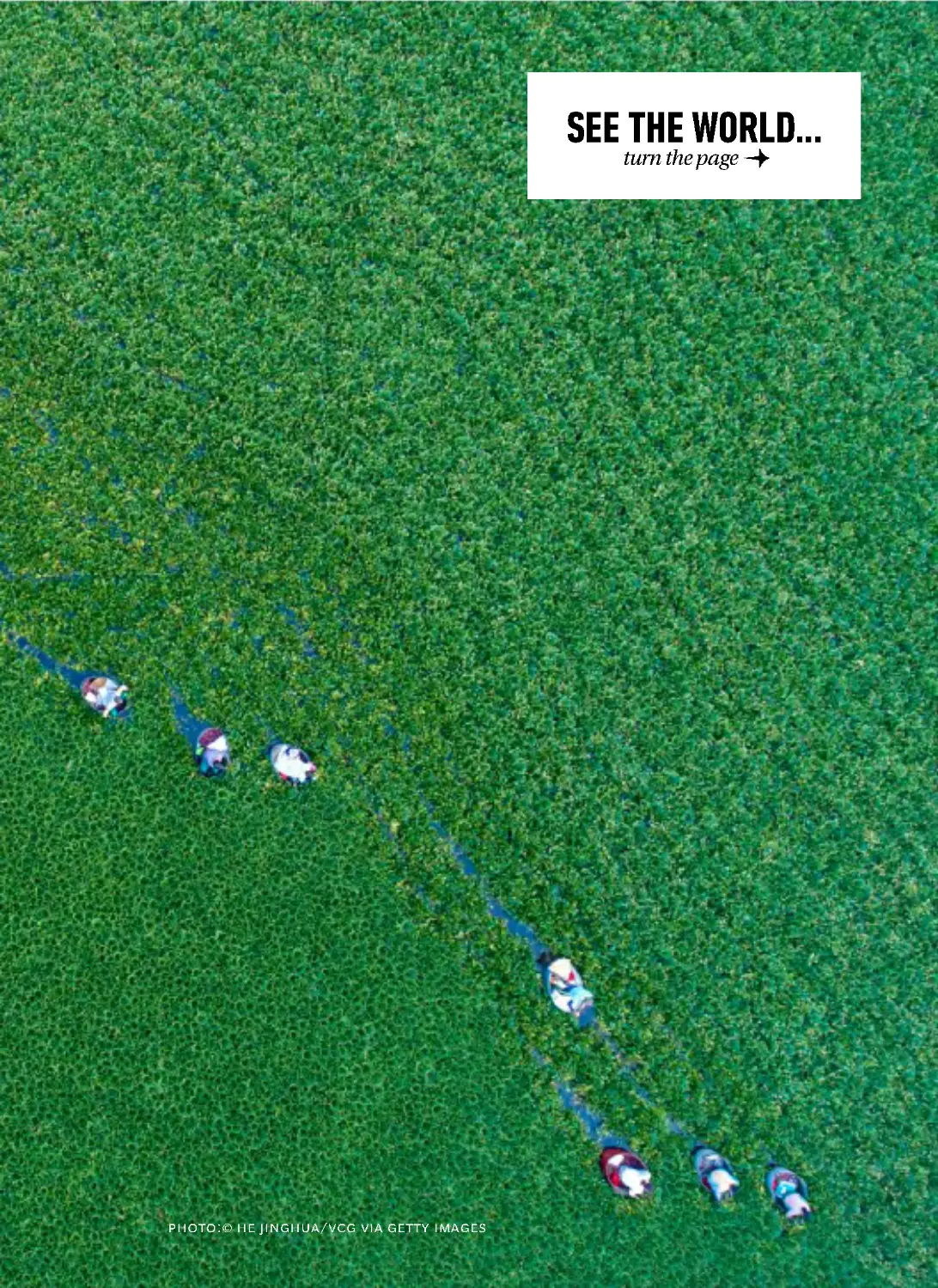
To keep their feet dry, these
farmhands float in large boat-like
bowls while they harvest water
chestnuts near Huai‘an, China. This
method has proven the best way to
pick the “nuts” which are actually the
root of a type of aquatic tuber
vegetable, that grow in marshes,
ponds, or other shallow waters. Their
sweet flavour makes them favourites
for various desserts, but also prove
quite tasty in fried, grilled or pickled
form—above all augmenting a wellprepared Asian meal.

IT’S A MANN’S WORLD

Hot Tub Time
We need to cut hot tubs some slack and appreciate
them for what they are: heaven on earth
have always been a hot tub
person. I’ve loved them since
I was eight years old, when
I first hopped into a hotel
jacuzzi (which felt delightfxully
transgressive, because there was
a “16 & Over” sign, and my fellow
bathers were a 30-something couple
sipping Pina Coladas). I still recall
the fragrance of the eucalyptus tree,
sheltering us from the Sardinian
sunshine. It was pure heaven.
I am always outraged if a posh
hotel or spa fails to provide me with
a hot tub. Indeed, if I worked for
VisitBritain, I would automatically
refuse five-star ratings to any

I

Olly Mann presents
Four Thought for
BBC Radio 4, and
the award-winning
podcasts The Modern
Mann and Answer
Me This!
16 • SEPTEMBER 2021

establishment that lacks one. My
favourite get-away ever was to an
all-inclusive in Mexico, which had a
hot tub in each bedroom. IN. EACH.
BEDROOM. Who needs booze?
I know they’re "naff," but this
strikes me as try-hard snobbery,
like pretending to dislike Dairy
Milk. Bubbles + heat = pleasure,
simple as that, and it baffles me that
saunas are considered to be serious
and sexy and Swedish—whereas
actually they’re stifling, shallowbreathing torture chambers—while
hot tubs (champagne for the skin!)
are derided as vulgar and gauche
and obscene, as if somehow we’re
all supposed to deny the pure truth
that it feels awesome to be vibrated
around in a whirlpool of warm soapy
suds (so long as you can supress any
suspicion you have about what else
might be floating about in there…)
Despite my ardour, hot tubs have
illustration by Dom McKenzie

17

IT’S A MANN’S WORLD

always seemed to me a strictly
"holiday" phenomenon. It’s not that
I wouldn’t want one at home, of
course—it’s just that it’s not
particularly practical at my
property. I have fantasised
about it, in the same way I’ve
dreamed up a daily itinerary
if I lived in a Marbella
mansion: breakfasting on
fresh fruit prepared for me
by my personal chef on my sun
terrace, followed by a massage in
the afternoon, before a Spanish
guitarist accompanies my pre-dinner
cocktails… But all of that would feel
faintly ridiculous at my three-bed
semi in Hertsmere.
Unfortunately, I hadn’t made this
last point plain to my closest friends,
who recently all clubbed together
for my 40th birthday to surprise buy
me… a hot tub. This was presented
as a fait accompli, at my birthday
party—the tub having been chosen,
ordered, and winging its way to
me (it took six weeks to arrive. It’s
amazing how popular hot tubs
suddenly became in Lockdown #3.
I imagine this was a reaction to all
that Joe Wicks stretching-on-the-sofa
stuff in Lockdown #1).
I tried to appear gracious, but
there were a couple of panicked
thoughts darting around my head as
soon as the gift was revealed. Firstly,
price. It is of course theoretically
delightful to get together and buy
your mate a £350 gift rather than a
18 • SEPTEMBER 2021

load of £50 gifts, but the bottom line
is the hot tub of my dreams is a £10k
job, so in my heart I knew this wasn’t
going to be it. This would be like
drinking Aldi Baileys at Christmas.
Secondly, where would I put it?
I could well understand why my
friends, who only visit my property
occasionally, might have thought,
he’s got a back garden, problem
solved. But they wouldn’t have
twigged that the garden is subtly
sloped—hardly ideal for any bathingbased activity—and that all four
corners of it are already allocated to
something else: namely, an apple
tree, garden shed, chicken hutch
and patio seating area. It was hard

READER’S DIGEST

to imagine enjoying the full hot-tub
experience with either a roasting
hot BBQ leaning on it, or the smell
of chicken faeces wafting by (no
match, to be sure, for that Sardinian
eucalyptus). We do have a front
lawn, but even I—hot tub devotee
that I am—would not want to greet
the milkman in my Speedos.
My most pressing concern, though,
was, how am I going to get this past
my wife? Having a hot tub was MY
dream, after all, not hers. She doesn’t
especially like hot tubs. And she is
notably nervous about the safety of
our toddler son, Toby.
This last point turned out to be
the clincher. When the hot tub
arrived, we inflated it (yes, it was a
blow-up one—what did you expect
for £350?) and experimented with

the child-proof clasped lid included
in the kit. And—well, it didn’t seem
entirely child-proof. It was all too
easy to imagine Toby (one of those
kids who’s always sticking his
hands into drawers, jumping on to
tables and climbing into crannies)
leaning on the side of the inflatable
wall, getting underneath the lid
and—not to put too fine a point on
it—drowning.
So, the tub went up into the loft,
where it will remain until Toby is four
years old, and the summer weather
is favourable, and/or we extend our
garden considerably. When that
happens, though, it will be EPIC.
Despite everything, it was a really
thoughtful gift from my friends, and
I will, one day, invite them for a hottub party! Perhaps for my 50th? n

Quiz: Olympic Glory
1) Where was the first Olympics held?
2) What are the two official languages of the Olympics?
3) Which recent games marked the first time all countries had women competitors?
4) How many countries have hosted the Olympics?
5) What do the five rings of the Olympic symbol represent?
6) How many athletes have won medals in both the Winter and Summer Olympics?
Answers: 1) Olympia, Greece. 2) English and French. 3) The 2012 London Games
4) 23. 5) The five inhabited continents of the world. 6) Four.
SEPTEMBER 2021 • 19

ENTERTAINMENT

Cate Blanchett
On Strength, Sexism
And Social Media
By Paul Dargan

For years, Cate Blanchett has balanced a burgeoning
acting career with activism. As she tells us, “You have
to pick up the slack when you see others failing to”, it’s
clear that using her voice to push for change is a
responsibility she doesn’t take lightly
ntensity is a word that Cate
Blanchett is happy to invite into
her safe space. While many in the
elite of the entertainment world
substitute passion and power onscreen for a life of luxurious leisure
off it, the 52-year-old actress appears
happy to push to the extremities,
debating and challenging at every
point along the route.
It’s not that the fiery Australian
has a particular axe to grind when it
comes to politics, environmentalism,
sustainability, equality, feminism or
activism; it’s just that she can see a
better place on the horizon.
“If I didn’t use my voice to try to

I

20 • SEPTEMBER 2021

make change or encourage others
to, I think that would be really
disingenuous,” she says.
“I hate that whole thing of famous
people on their soapboxes—it’s not
that; I just feel, sometimes, as a
society, we are so much better than
we make out!”
That stance—one that has
permeated and grown through
Blanchett’s time in the spotlight,
which now dates back some three
decades—makes her an appealing,
yet at the same time intriguingly
dangerous, interview subject.
In one exchange she can be a soft,
even sombre global ambassador

21

I N T E R V I E W: C AT E B L A N C H E T T

The Aviator

who answers with gentle empathy
at the irregularities and injustices of
the industry.
In another, she is fierce and fiery—
take, for example, the suggestion
that Cate might be regarded as
an exemplar, a role model, for an
industry that many feel still fails
to do enough to affect some real,
positive change...
“I’m so sick of hearing, ‘You’re a
strong woman, you are an inspiration
in this, or that…’” she fires back, with
almost alarming voracity.
“What exactly is the definition of
that? What makes a woman strong,
other than being able to lift a couple
kilos? It’s a very glib, overused
expression and I don’t really like it.”
The common denominator is that
22 • SEPTEMBER 2021

the bland virtue-signalling can be
left for someone else; Cate Blanchett
isn’t interested. Perhaps it was
her four years working as Creative
Director at the Sydney Theatre
Company from 2008, bookending her
two Oscars victories (for Best Actress
in The Aviator (2005) and then Blue
Jasmine (2014)).
“I think art can sometimes be a
real distortion to real life, and that’s
something we want—it’s an escape,”
she says. “At other times, if you’re
working on great texts with great
people and great creative teams, you
cannot help for the conversation
and your understanding of the wider
world to become elevated.”
“I’m immensely proud of the work
that we produced there, but I’m

READER’S DIGEST

Blue Jasmine

even more grateful to have opened
up a lens to people inspired by the
world around us—all those different
passions and perspectives.”
Driving forward with a purpose
away from film has therefore
become second-nature to the
actress, with female empowerment
often in the ascendancy.
“I feel we are in an era where it’s
very prominent; but always in the
correct sense. And by that I mean
genuine enablement not because
it’s fashionable, or it’s a quota—but
because this talent is being able to
rise to the top and flourish.”
“As a global entity of citizens,
male and female, we have probably
never felt less repressed or stuck in a
system; yet those are not reasons to

sit back and congratulate ourselves—
to do that is to miss the point.”
In Blanchett’s defence, this was
never someone who set out to be a
campaigner, a voice. “One of those
people,” she chimes in. “I just think
that sometimes you have to stand
up—you have to pick up the slack
when you see others failing to.”
In reality, the actress shouldn’t be
surprised at the position she finds
herself in, however accidentally.
Since first edging onto the scene in
a riveting breakthrough as Elizabeth
over 20 years ago, earning her
first Academy Award nomination,
Blanchett has enjoyed a reputation
for subverting expectation and
ricocheting through the genres.
SEPTEMBER 2021 • 23

I N T E R V I E W: C AT E B L A N C H E T T

Starring in
Elizabeth

From stylish noir The Talented Mr
Ripley through to a powerful turn as
tragic journalist Veronica Guerin in
the eponymous 2003 biopic, across
Hanna and The Lord of the Rings
trilogy, to subsequent further bigticket nominations for Notes on a
Scandal, I’m Not There, The Golden
Age, Thor: Ragnarok and Ocean’s 8,
Blanchett has been known to always
push the envelope.
“When I came out of drama
school, I didn’t think I’d ever make
a film at all. I’d always hoped for
a long career in theatre, and so
anytime I make a film, it’s like a
pleasant surprise, even now.
“So you can see why, when I get
24 • SEPTEMBER 2021

behind other initiatives, I take the
same view. I never expected any
of this to work, and in the same
way now I feel I have nothing to
lose from pushing on.”
Having the courage of her
convictions has certainly stood
Blanchett in good stead. She will
always be an actress first and
foremost, yet the plaudits that have
emanated from her efforts have
escalated her into a whole new
realm of its own.
“There’s an inevitability that you
end up accelerating yourself into
becoming this beacon that people
want to reach out to and be guided
by,” she says. “My opinion on most

READER’S DIGEST

that my children were going to be
growing up in a world which just
didn’t seem to care for their longterm welfare, and for me that was
absolutely heart-breaking,” admits
Blanchett, referencing Dashiell,
19, Roman, 17, Ignatius, 13, and
little Edith, who she and husband
In real terms, the star is one of the
Andrew Upton adopted in 2015.
movie industry’s best exemplars of
“I try to teach my children about
what she calls “personal change”.
things they need to reflect on as
While others may go no further
they make their way in life. They
than reeling off the staid mission
do not have the
statements of the
same carefree attitude
big global social
“IT DAWNED
to the world or the
and environmental
ON ME THAT
environment that
organisations,
we were afforded
Blanchett’s focus
MY CHILDREN
as kids—it’s not a
is very much more
WERE GOING
privilege they’ll have.
centred on what she
TO BE GROWING
“And sure,
can affect every day,
even in small ways,
UP IN A WORLD sometimes the advice
goes in, other times
with sustainability at
WHICH JUST
it gets rejected out of
the heart of it.
DIDN’T SEEM
hand, but it’s there
Many years ago,
and it’s real.”
she began to make
TO CARE ”
Blanchett also
subtle changes to
found herself a leading advocate
home habits in order to reduce
for LGBT rights when she made the
greenhouse gas pollution. Initially
that meant switching her household film Carol in 2015. “I look at the
progress we made with that movie,
power supply to an accredited
the conversations that were started,
company, GreenPower. She then
and I’m very proud about how much
began washing her clothes in cold
good feeling came about.”
water, invested in roof insulation,
“At the same time I am astounded
pledged to walk more and drive
how much further society has come
less, and even avoided unnecessary
domestic air flights, insisting as well in those few years; and yet the
rules over sexuality, gender and
to purchase carbon offsets.
acceptance seem infinitely more
“Many of these changes came
complicated now than ever before.
about when it dawned on me
things isn’t any more qualified
than anyone else’s—but if it means
others can come out of the darkness
and have the confidence to speak
forward too, then I guess I will say,
‘Why not?’”.

SEPTEMBER 2021 • 25

I N T E R V I E W: C AT E B L A N C H E T T

“And of course I’m lucky enough
to be able to do that—it’s still the
case in many industries, jobs, cities,
towns and villages that your gender,
your sexual persuasion, your colour,
your race is the first thing that walks
through the door.
“I would love to get to a point
As for the conversations the
where that isn’t what people see and
actress’s upcoming projects
feel, but I feel it’s some way off.”
may provoke, there is Guillermo
Blanchett is also keen to readjust
del Torro’s psychological thriller
the mindset that one person
Nightmare Alley, based on William
winning means
Gresham’s 1946
another losing;
novel. She then
“MY FEAR
although, ironically,
joins an all-star cast,
OF GETTING
that is unequivocally
including Timothée
the case when it
Chalamet, Leonardo
STUCK DOING
comes to being
DiCaprio, Jennifer
SOMETHING I
cast in one of the
Lawrence, Meryl
REALLY DON’T
actress’s Hollywood
Streep and Jonah Hill
blockbusters!
for Don’t Look Up,
LIKE, FOR A
“I feel we need to
a comedy about an
LONG TIME, IS
try to steer ourselves
approaching comet
VERY REAL”
away from the idea
that threatens the
that we’re all in
Earth’s inhabitants;
direct competition
with action adventure
with each other. Take the sexism
Borderlands, drama TÁR, and
debate—I don’t believe equality for
coming-of-age story Armageddon
women means to denigrate from
Time all slated for
men in any way—I truly feel men
next year.
can benefit from it enormously.”
Once again, the recurring
“I do think that many of the steps
blueprint for the actress is diversity.
forward we’ve made have been
“For me, it has always been the case
rescinded,” she says. “Conservatism
that I need to keep changing, keep
is affecting the way women perceive
evolving and moving through a set
who they are in the world. It’s going
of different gears.
to continue being a challenge going
“My fear of getting stuck doing
forward, but progress has been
something I don’t like, for a long
made… some progress.”
time, is real,” she laughs.
“That can be frustrating—to see
how far you’ve come, yet to realise
the whole landscape is so much
more complex these days. And yet,
here we are talking about it, so it’s
no bad thing.”

26 • SEPTEMBER 2021

READER’S DIGEST

At the Venice
International Film
Festival,2020

And while Blanchett is not a huge
fan of the digital age, she admits the
tools we have at our disposal are far
greater than any we had in the past.
“We’ve definitely got a better chance
now to do something important than
we did before,” she notes. “Social
networks can be very useful on some
occasions—they drive campaigns,
build impact, scoop up awareness
and connect amazing people.”
“I just wish that there was a
way of cleansing what’s on there.
It’s the reason I stay away from
Twitter and Facebook—I compare
it to graffiti… you might read one or
two things that are interesting but

most of the stuff that’s out
there isn’t very useful. That’s
the challenge we have as people
speaking up for environmental
and social change—it’s easy to
become bored by what’s being said,
and we have to keep the message
entertaining and engaging.” If
Blanchett’s level of output for global
issues follows the same fullness and
diversity as do her film choices, this
is surely someone who will retain
all the respect and relevance that’s
made her such a focal figure in the
entertainment world. She concludes,
perfectly: “We’ve just got to keep
turning the pages of the script.” n
SEPTEMBER 2021 • 27

ENTERTAINMENT

28

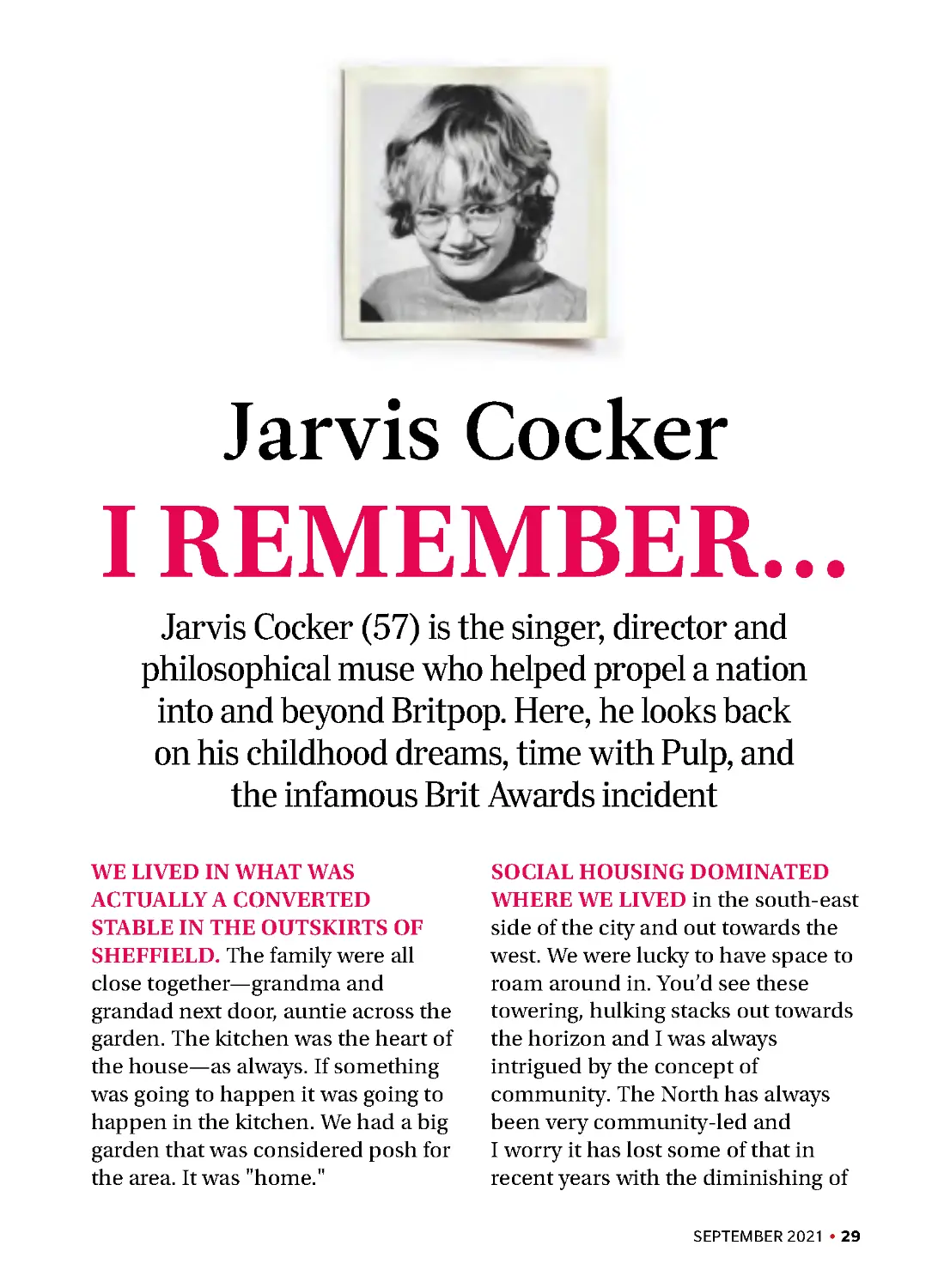
Jarvis Cocker

I REMEMBER…
Jarvis Cocker (57) is the singer, director and
philosophical muse who helped propel a nation
into and beyond Britpop. Here, he looks back
on his childhood dreams, time with Pulp, and
the infamous Brit Awards incident
WE LIVED IN WHAT WAS
ACTUALLY A CONVERTED
STABLE IN THE OUTSKIRTS OF
SHEFFIELD. The family were all
close together—grandma and
grandad next door, auntie across the
garden. The kitchen was the heart of
the house—as always. If something
was going to happen it was going to
happen in the kitchen. We had a big
garden that was considered posh for
the area. It was "home."

SOCIAL HOUSING DOMINATED
WHERE WE LIVED in the south-east
side of the city and out towards the
west. We were lucky to have space to
roam around in. You’d see these
towering, hulking stacks out towards
the horizon and I was always
intrigued by the concept of
community. The North has always
been very community-led and
I worry it has lost some of that in
recent years with the diminishing of
SEPTEMBER 2021 • 29

I REMEMBER…

industry and advent of the internet.
I think the sort of childhood I had is
gone forever.
A LOT OF PEOPLE
REGARDED LOWER-INCOME,
INDUSTRIALISED COMMUNITIES
AS UNINSPIRING but personally
I found them fascinating. They gave
me a lot of inspiration and there
were a lot of good people. I’m not
going to dress up my childhood as
some sort of philosophical rite of
passage, but it certainly wasn’t
unpleasant. The Seventies and
Eighties in Sheffield weren’t pretty
but it didn’t matter to us.
30 • SEPTEMBER 2021

I HAD MENINGITIS WHEN
I WAS ABOUT FIVE. I don’t
remember much of it… being
skinny, not being able to see.
But, as with other things, we
just got on with it. It wasn’t an
era where you sought out
sympathy or wanted to
especially change the world,
and I much preferred that.
Even our parents knew no
different—I think sometimes we can
be overly sympathetic towards our
children because we’re judging them
on our own adult emotions
and experiences.
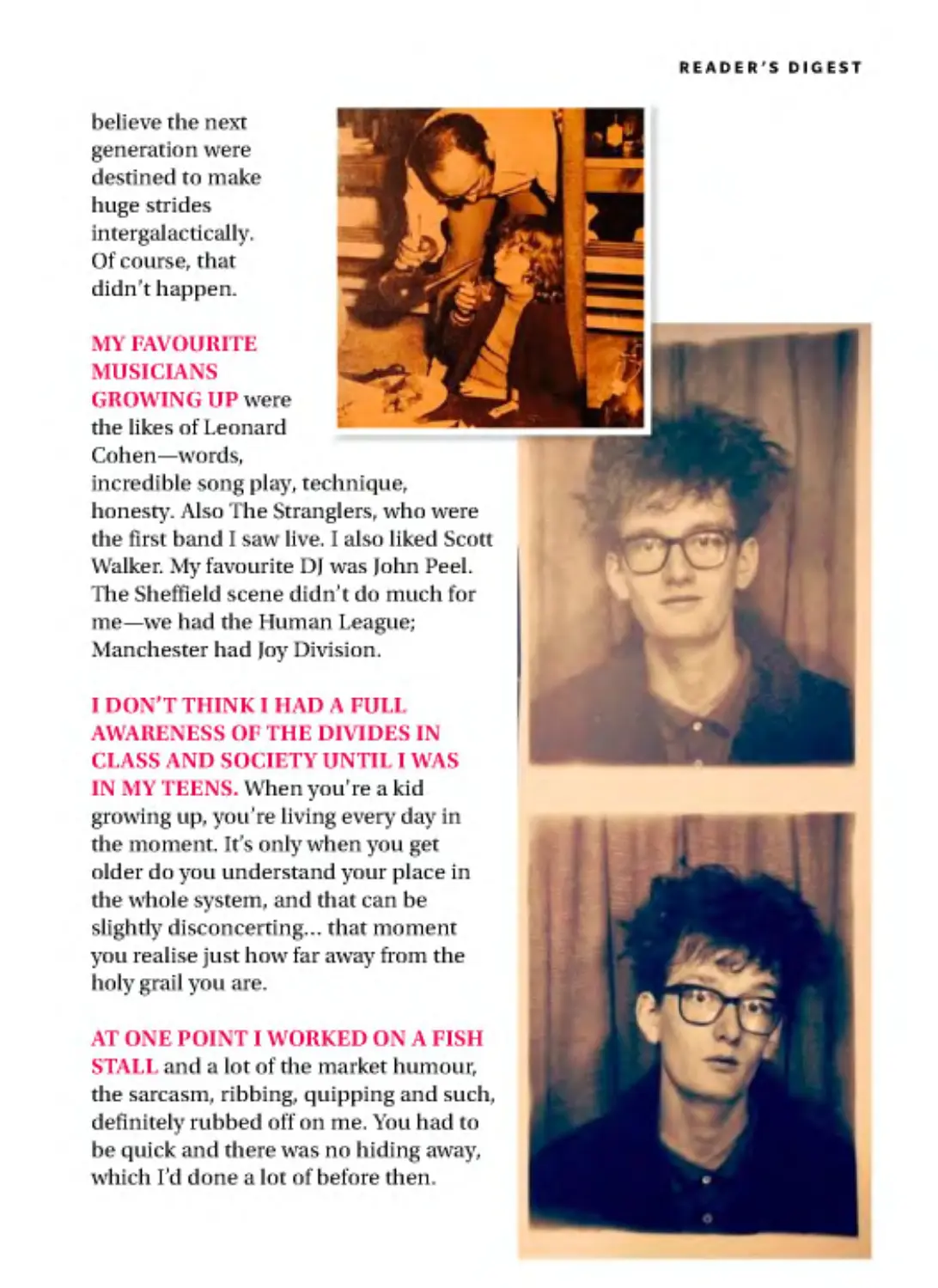
MY GRANDAD WAS A COLLECTOR
OF "THINGS" who would find rich
value in a simple object. He was a
person who could take anything
and put a story behind it. I love
that appreciation for the minutiae.
WHEN I WAS YOUNG I WANTED
TO BE AN ASTRONAUT. The whole
space race thing was very current
and the scientists would have you

READER’S DIGEST

believe the next
generation were
destined to make
huge strides
intergalactically.
Of course, that
didn’t happen.
MY FAVOURITE
MUSICIANS
GROWING UP were
the likes of Leonard
Cohen—words,
incredible song play, technique,
honesty. Also The Stranglers, who were
the first band I saw live. I also liked Scott
Walker. My favourite DJ was John Peel.
The Sheffield scene didn’t do much for
me—we had the Human League;
Manchester had Joy Division.
I DON’T THINK I HAD A FULL
AWARENESS OF THE DIVIDES IN
CLASS AND SOCIETY UNTIL I WAS
IN MY TEENS. When you’re a kid
growing up, you’re living every day in
the moment. It’s only when you get
older do you understand your place in
the whole system, and that can be
slightly disconcerting… that moment
you realise just how far away from the
holy grail you are.
AT ONE POINT I WORKED ON A FISH
STALL and a lot of the market humour,
the sarcasm, ribbing, quipping and such,
definitely rubbed off on me. You had to
be quick and there was no hiding away,
which I’d done a lot of before then.

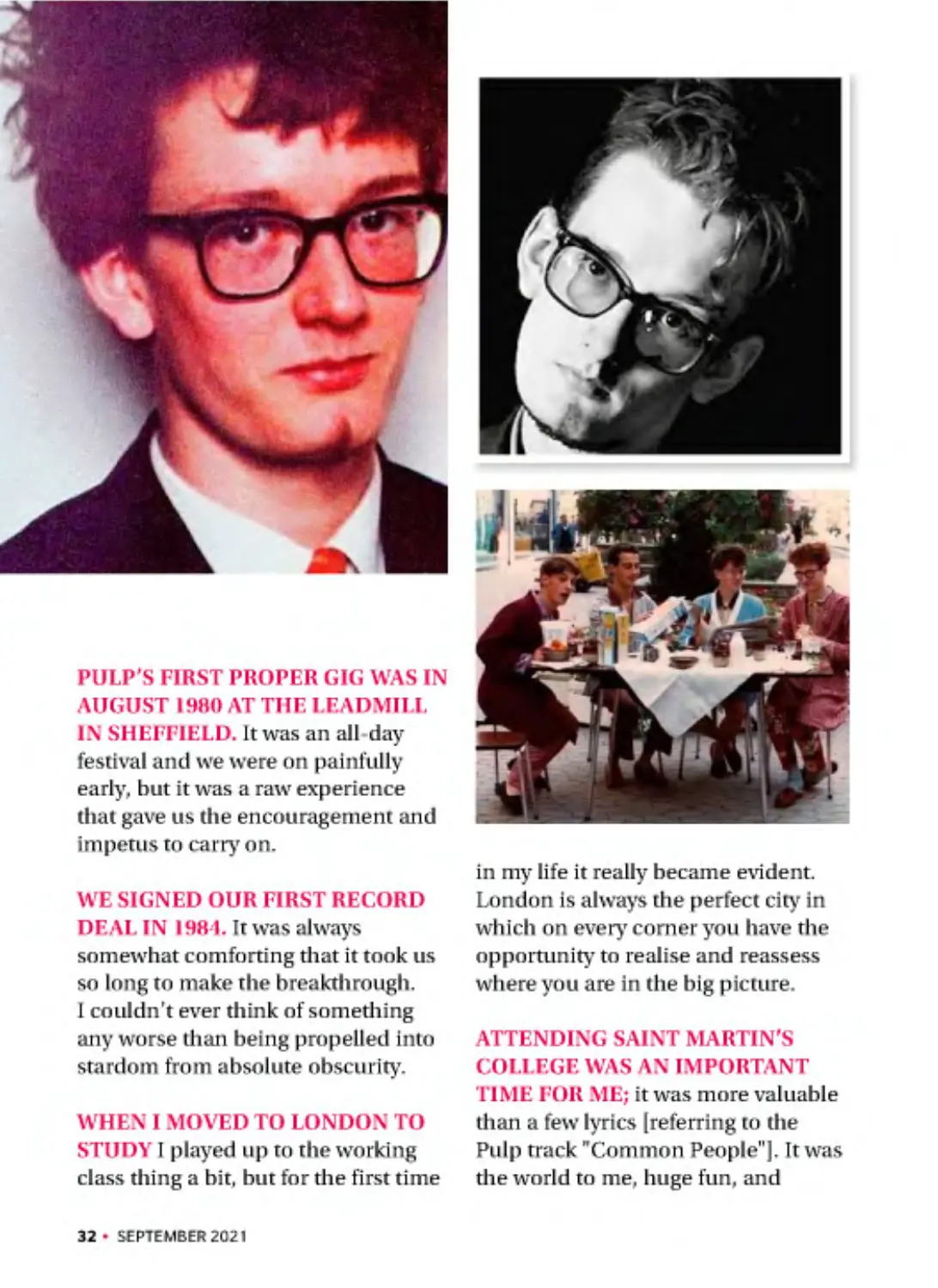
PULP’S FIRST PROPER GIG WAS IN
AUGUST 1980 AT THE LEADMILL
IN SHEFFIELD. It was an all-day
festival and we were on painfully
early, but it was a raw experience
that gave us the encouragement and
impetus to carry on.
WE SIGNED OUR FIRST RECORD
DEAL IN 1984. It was always
somewhat comforting that it took us
so long to make the breakthrough.
I couldn’t ever think of something
any worse than being propelled into
stardom from absolute obscurity.
WHEN I MOVED TO LONDON TO
STUDY I played up to the working
class thing a bit, but for the first time
32 • SEPTEMBER 2021

in my life it really became evident.
London is always the perfect city in
which on every corner you have the
opportunity to realise and reassess
where you are in the big picture.
ATTENDING SAINT MARTIN’S
COLLEGE WAS AN IMPORTANT
TIME FOR ME; it was more valuable
than a few lyrics [referring to the
Pulp track "Common People"]. It was
the world to me, huge fun, and

READER’S DIGEST

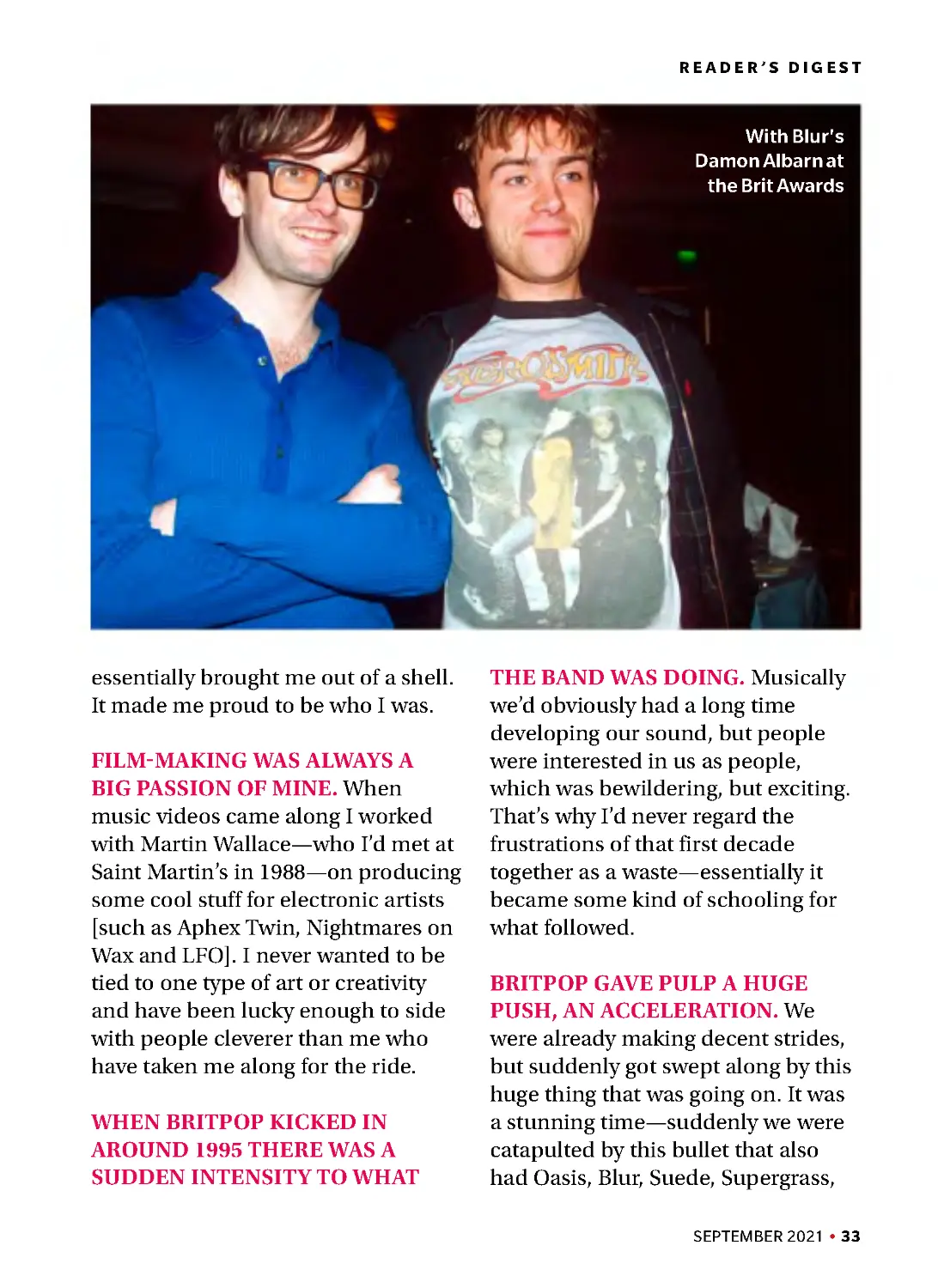
With Blur's
Damon Albarn at
the Brit Awards

essentially brought me out of a shell.
It made me proud to be who I was.
FILM-MAKING WAS ALWAYS A
BIG PASSION OF MINE. When
music videos came along I worked
with Martin Wallace—who I’d met at
Saint Martin’s in 1988—on producing
some cool stuff for electronic artists
[such as Aphex Twin, Nightmares on
Wax and LFO]. I never wanted to be
tied to one type of art or creativity
and have been lucky enough to side
with people cleverer than me who
have taken me along for the ride.
WHEN BRITPOP KICKED IN
AROUND 1995 THERE WAS A
SUDDEN INTENSITY TO WHAT

THE BAND WAS DOING. Musically
we’d obviously had a long time
developing our sound, but people
were interested in us as people,
which was bewildering, but exciting.
That’s why I’d never regard the
frustrations of that first decade
together as a waste—essentially it
became some kind of schooling for
what followed.
BRITPOP GAVE PULP A HUGE
PUSH, AN ACCELERATION. We
were already making decent strides,
but suddenly got swept along by this
huge thing that was going on. It was
a stunning time—suddenly we were
catapulted by this bullet that also
had Oasis, Blur, Suede, Supergrass,
SEPTEMBER 2021 • 33

Smoking with Oasis lead
singer, Liam Gallagher

the Manics and a load of others
sitting on it.
IT WASN’T A GENRE IN ITS OWN
RIGHT, though that’s how it’s become
regarded now. Musically, all the
bands that got put into that bracket
were making very different types of
music—we were all almost centred by
the whole thing, which was great for
exposure but ultimately became more
difficult to break away from. Once the
Britpop ship sank, so too did a lot of
the bands.

stage during Michael Jackson's
performance of "Earth Song" and was
subsequently arrested]. It was the
most exciting thing in what is
generally a turgid affair. People think
I was making some big statement—
maybe I was, maybe I was just bored.
I found the performance distasteful.

A LOT WAS MADE OF THE 1996
BRIT AWARDS THING, but it wasn’t
really a big deal [Cocker crashed the

IN THE LATE NINETIES I
SOMETIMES WRESTLED WITH
THE RELEVANCE OF MY SONGS

34 • SEPTEMBER 2021

VERSUS THE LIFE I FOUND
MYSELF LEADING. When you
move away from a place that created
you, do you lose the right to discuss
it? I think there was a time when it
felt like I should be writing about
something different. Ultimately,
I realised that most songs were
about people, their emotions and
experiences. When you think of it in
those terms it doesn’t matter where
you grew up or where you are now;
we’re having those experiences
every day.
I’VE ALWAYS LOVED THE BUZZ
OF SHOWCASING THE WORK OF
OTHERS and for seven years I
presented a show on BBC 6 Music.

After so many years in the industry it
was still a huge eye-opener.
I’VE BEEN THE ONLY
CONSISTENT MEMBER OF PULP
ACROSS THE BAND’S 40-YEAR
TENURE. We’ve surfed various
peaks and troughs of the music
industry’s popularity curve, and I
think that’s the way it should be. Life
would be terribly boring if it was
always full of highs, or if it was
always dredging along on the lows.

As told to Richard Aldhous
SEPTEMBER 2021 • 35

36 • SEPTEMBER 2021

HEALTH

THE
NOSE
KNOWS
How dogs’ ability to detect disease
will revolutionise medicine
BY

Adam Piore

photographs by Jason Varney

SEPTEMBER 2021 • 37

THE NOSE KNOWS

O

sa, an athletic yet stubborn
62-pound German
shepherd with a long fluffy
tail and a fondness for red
bandanas, seems an
unlikely superhero. But the six-yearold pooch has mastered the art of
sniffing out cancerous tumours and is
key to a research project that has the
potential to revolutionise oncology.
Despite the remarkable success of
immunotherapy, CRISPR gene editing
and other recent breakthrough
treatments, oncologists’ inability to
detect some cancers in their early
stages remains one of the field’s most
intractable—and fatal—shortcomings.
Case in point: an average of 75
Canadian women are diagnosed each
day with breast cancer, a disease that is
treatable when found early. Yet each
day, some 14 Canadians die from
breast cancer.
Osa might soon help improve those
odds. She is part of an ambitious effort
launched five years ago at the
University of Pennsylvania that aims to
reverse engineer one of the most
powerful scent-detection machines in
the world: the canine nose. Osa is able
to distinguish between blood samples
taken from cancer patients and their
healthy peers simply by sniffing them.
In fact, she’s one of five cancerdetection dogs trained by Annemarie
DeAngelo and her colleagues at the
university’s Penn Vet Working Dog
Centre, a non-profit X-Men academy
of sorts that breeds and trains

38 • SEPTEMBER 2021

“detection dogs.” The ultimate goal is to
develop an “electronic sniffer” that can
approximate the cancer-sniffing
superpowers of Osa and her pals. Such
a machine could then be deployed to
thousands of doctors’ offices and
medical diagnostic facilities around
the US.
And cancer is only one possible
target. This type of system could lead to
similar devices for other major health
issues too, such as bacterial infections,
diabetes and epilepsy. Some dog
trainers and university researchers
have also set their sights on developing
a method of detecting COVID-19
infections based on skin odour.
It all starts wIth the canine nose. Our
own schnozz doesn’t even come close.
The average human is equipped with
6 million olfactory receptors, tiny
proteins capable of detecting
individual odour molecules. These
receptors are clustered in a small area
in the back of the human nasal cavity,
meaning a scent must waft in and up
the nostrils. In dogs, the internal
surface area devoted to smell extends
from the nostrils to the back of the
throat and comprises an estimated 300
million olfactory receptors—50 times
more than humans.
Dogs also devote considerably more
neural real estate to processing and
interpreting these signals than humans
do—the part of the dog’s brain devoted
to smelling is 40 times greater than
ours. Add it all up, and the dog nose is

READER’S DIGEST

Annemarie
DeAngelo
with her star
pupil, Osa

about 10,000 to 100,000 times more
sensitive than the human nose.
“Sniffing is how dogs see the world,”
explains Marc Bekoff, professor
emeritus of ecology and evolutionary
biology at the University of Colorado
Boulder. “That’s how they pick up
information about who has been there,
are they happy, are they sad, is the
female in heat, are they feeling well or

not. Their nose leads the way—dogs
sniff first and ask questions later.”
Humans have always appreciated
the potential of the canine snout. In
the Middle Ages, authorities in France
and Scotland relied on the sniffing
abilities of dogs to hunt down outlaws.
Search-and-rescue dogs emerged in
the 18th century when the monks of
the Great St Bernard Hospice in the
SEPTEMBER 2021 • 39

THE NOSE KNOWS

Swiss Alps discovered that the canines
they’d been breeding could lead them
to victims buried beneath the snow
from avalanches and snowstorms.
Despite this history, scientists hadn’t
considered whether dogs could detect
cancer until the late 1980s, after Hywel
Williams, a 30-year-old medical
resident at King’s College Hospital in
London, stumbled upon scientific gold.
After arriving at King’s to begin his
training as a dermatologist, Williams
was tasked with reviewing every case
of melanoma seen at the hospital over
the previous 20 years. It was an eyeglazing assignment, recalls Williams.
But one afternoon, he came across a
four-word notation in a file that caught
his attention. It read simply: “Dog
sniffed at lesion.” What did that mean?
Was it possible the dog actually
smelled cancer?
“So I rang up the lady in the file,”
Williams recalls. “And we had the most
fascinating conversation!”
The patient, a 44-year-old woman,
told Williams that Baby Boo, her border
collie-Doberman mix, had become
fixated on a curious mole on the
woman’s left thigh, sniffing it often. The
ritual continued every day for several
months, with Baby Boo nuzzling the
woman’s leg through her pants. Baby
Boo finally tried to bite the lesion off, at
which point she visited her doctor.
When doctors excised the mole, they
found it was a malignant melanoma.
“Something about that lesion
fascinated the dog,” Williams recalls.
40 • SEPTEMBER 2021

“And it literally saved this woman’s life.”
Williams and a colleague published
their findings in The Lancet, one of the
world’s most respected and widely
read medical journals. Suddenly, dog
lovers across the globe were reaching
out to Williams and sharing similar
experiences. There was the 66-year-old
man who developed a patch of eczema
on the outer side of his left thigh—a
lesion that became the obsession of his
Labrador retriever until he went to the
doctor. It was found to be basal cell
carcinoma. There was also George the
schnauzer, trained by a Florida
dermatologist. George “went crazy”
when he sniffed out a suspicious mole
on the leg of a patient. It turned out to
be malignant.
In the years since, a growing body of
evidence has emerged suggesting that
dogs can sniff out bladder cancer,
prostate cancer, diabetes and even
malaria, among other conditions. But
not just any chihuahua, corgi or beagle
can do the job.
Osa arrIVED at thE Penn Vet Working
Dog Centre from a breeder at two
months of age. “We look at their
genetics,” says DeAngelo. “We look at
their work ability. They have to come
from working lines, not show or pet
lines, but one that has that hunt-prey
drive.” Osa began taking obedience
and agility training (walking a plank,
climbing a ladder, gliding over a rubble
pile) and quickly advanced to basic
odour detection skill training.

READER’S DIGEST

COURTESY PENN VET WORKING DOG CENTER

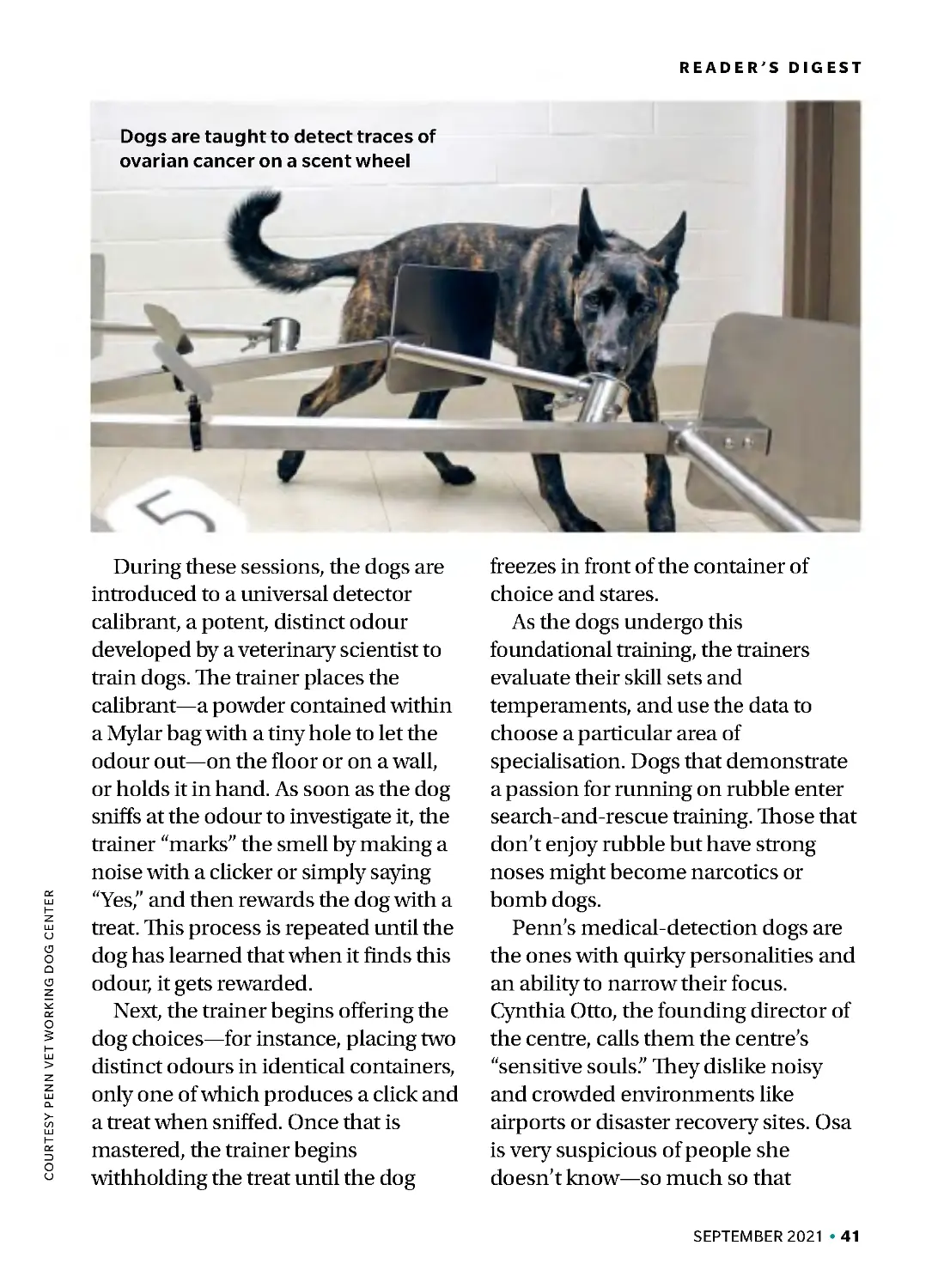
Dogs are taught to detect traces of
ovarian cancer on a scent wheel

During these sessions, the dogs are
introduced to a universal detector
calibrant, a potent, distinct odour
developed by a veterinary scientist to
train dogs. The trainer places the
calibrant—a powder contained within
a Mylar bag with a tiny hole to let the
odour out—on the floor or on a wall,
or holds it in hand. As soon as the dog
sniffs at the odour to investigate it, the
trainer “marks” the smell by making a
noise with a clicker or simply saying
“Yes,” and then rewards the dog with a
treat. This process is repeated until the
dog has learned that when it finds this
odour, it gets rewarded.
Next, the trainer begins offering the
dog choices—for instance, placing two
distinct odours in identical containers,
only one of which produces a click and
a treat when sniffed. Once that is
mastered, the trainer begins
withholding the treat until the dog

freezes in front of the container of
choice and stares.
As the dogs undergo this
foundational training, the trainers
evaluate their skill sets and
temperaments, and use the data to
choose a particular area of
specialisation. Dogs that demonstrate
a passion for running on rubble enter
search-and-rescue training. Those that
don’t enjoy rubble but have strong
noses might become narcotics or
bomb dogs.
Penn’s medical-detection dogs are
the ones with quirky personalities and
an ability to narrow their focus.
Cynthia Otto, the founding director of
the centre, calls them the centre’s
“sensitive souls.” They dislike noisy
and crowded environments like
airports or disaster recovery sites. Osa
is very suspicious of people she
doesn’t know—so much so that
SEPTEMBER 2021 • 41

THE NOSE KNOWS

nobody is allowed to approach
DeAngelo’s house unannounced (to
do so results in loud barking and
pandemonium). Upon entering the
home, visitor, host and dog must all
proceed immediately outside to play
ball to set Osa at ease before any
business can be conducted. But with
these neurotic traits also comes an
uncommon focus.
“I often refer to our medicaldetection dogs as the CPAs,” Otto says.
“They would love to just look at the
spreadsheets and find the one number
that’s out of place. They really like
having things very neat and
controlled. They’re the detail dogs.”
While Osa had all the qualities that
make up a great sniffer dog, that didn’t
guarantee that she’d be able to master
the most essential task of all. To find
out if she could, DeAngelo and her
team put Osa in front of a scent wheel,
a stationary metal contraption with
multiple arms, each one large enough
to hold two separate containers—one
containing plasma from a woman with
metastatic ovarian cancer and the
other with plasma from a healthy
volunteer. When Osa stopped in front
of the correct sample, pointed her
nose at it and froze, DeAngelo and her
colleagues hugged and cried.
“You don’t know if it’s going to
work, so you train it, and you train it,”
she says. “You’re actually now going to
put the real cancer in the wheel, in the
plasma, and see if the dogs can
identify it and ignore the other
42 • SEPTEMBER 2021

samples. And it worked! The very first
time! It was very emotional.”
anD yEt, that’s Only half the challenge.
To transform Osa’s remarkable abilities
into something replicable—an
electronic nose—researchers have to
figure out what it is precisely that Osa
and her friends are reacting to.
DeAngelo says the blood samples she
has trained her dogs with contain
hundreds of different organic
compounds, any one of which could be
capturing the dog’s attention. And that
is why the Penn team includes not just
the physicists and engineers designing
the instrumentation for their electronic
nose but also chemists to help figure
out what exactly that electronic nose
needs to be calibrated to smell. The
group has been breaking the cancer
samples down into progressively
smaller constituent parts and
presenting them to the dogs, to winnow
out which of the hundreds of potential
aromatic chemical compounds
(odorants) grabs their attention.
A similar approach is used to train
the device. The engineers start with
two separate samples consisting of
many odorants mixed together and
make sure the machine can distinguish
between them. Then they remove
individual odorants from each sample,
training the machine to distinguish
increasingly subtle differences that are
more difficult to detect. The goal is to
eventually place a vial of plasma inside
a microwave-sized electronic sniffer

READER’S DIGEST

that can analyse its odorants and
provide a reading of healthy, benign or
malignant within minutes. Another
version might handle up to ten
samples at a time.
Most people would prefer to have
what ails them sniffed out by a
sympathetic nose rather than a
machine, but that’s not in the cards,
according to Bruce Kimball, a chemist
at the Monell Chemical Senses
Centre in Philadelphia. The
number of dogs and
handlers that would have
to be deployed to the
various hospitals and
medical facilities around
the US is neither practical
nor feasible, he says.
An electronic nose
prototype has been built, and it’s
successful in sniffing out cancer 90 to
95 per cent of the time. That team has
also correctly detected different types of
cancer, and is building a cancerdetecting device for the National
Institutes of Health. Right now, they
have a good idea of what compounds or
chemicals create the odour, but the
team wants more specificity. One
objective is to be able to distinguish
between early- and late-stage cancer.
“It would be incredible to identify
people at an early stage and really have
an impact on saving lives,” says Otto.
“The dogs have been able to detect
that.” With that ability, a blood test
could be sent to a central lab—or,
ideally, performed in a doctor’s office—

DeAngelo’s dogs,
Grizzly (above) and
Prior, also work at
the centre

and rolled in as part of one’s
annual checkup, making some
hidden cancers a thing of the past.
If it all works as DeAngelo and Otto
hope—it’s expected that commercial
prototypes for the cancer-sniffing
device will be complete within nine
months—it will be one of the most
important victories yet in the war
against cancer. Of course, the dogs have
no idea what all the fuss is about.
“To them, it’s just a game,” says
DeAngelo. “Osa just knows that, 'I was
trained and when I find this odour and
I indicate on it, then I get rewarded.'”
Osa prefers that reward to be a piece
of cheese. It’s a small price to pay since,
after all, Osa’s nose could potentially
save thousands of lives one day soon. n
SEPTEMBER 2021 • 43

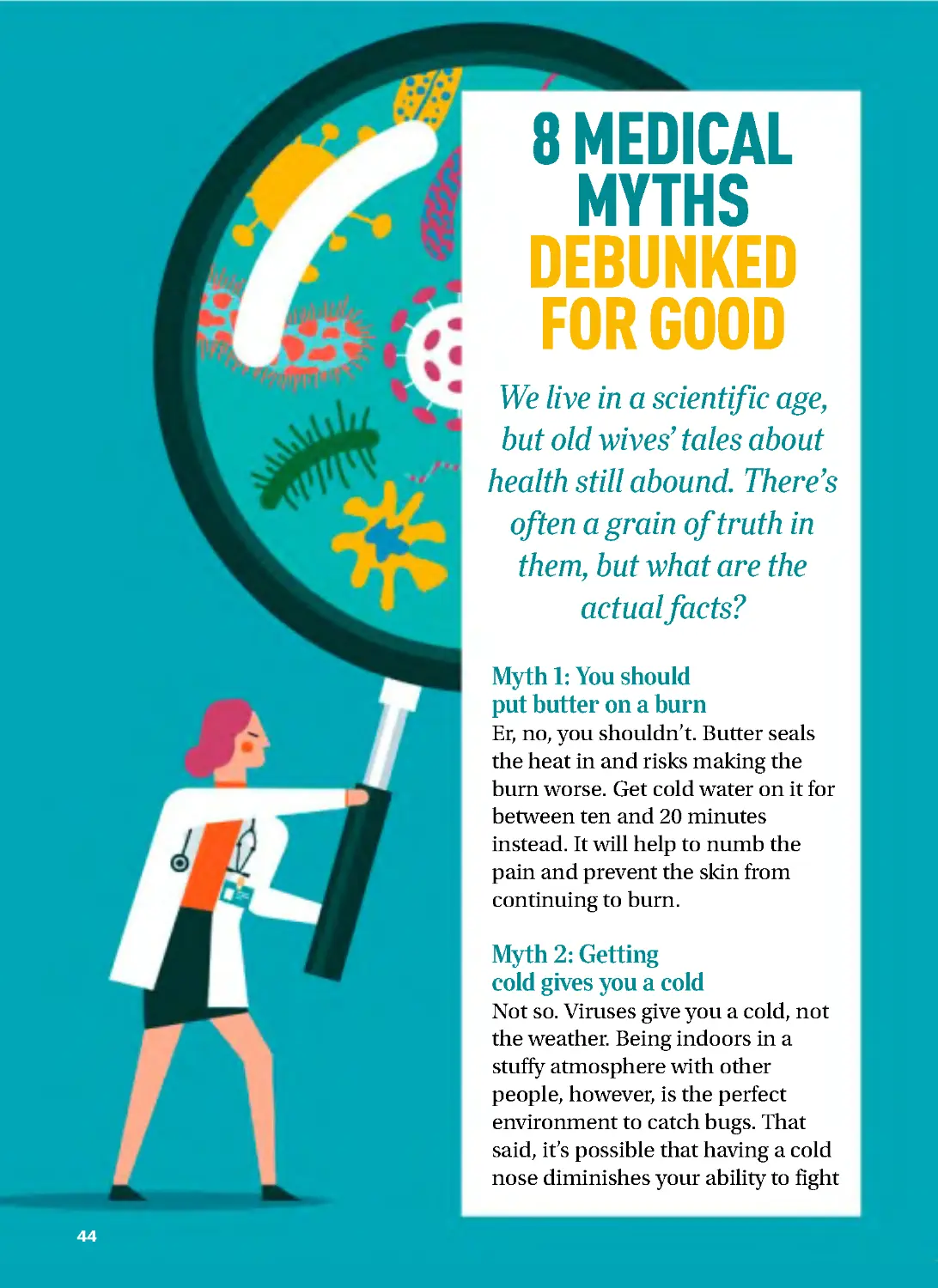
8 MEDICAL
MYTHS
DEBUNKED
FOR GOOD
We live in a scientific age,
but old wives’ tales about
health still abound. There’s
often a grain of truth in
them, but what are the
actual facts?
Myth 1: You should
put butter on a burn
Er, no, you shouldn’t. Butter seals
the heat in and risks making the
burn worse. Get cold water on it for
between ten and 20 minutes
instead. It will help to numb the
pain and prevent the skin from
continuing to burn.

Myth 2: Getting
cold gives you a cold
Not so. Viruses give you a cold, not
the weather. Being indoors in a
stuffy atmosphere with other
people, however, is the perfect
environment to catch bugs. That
said, it’s possible that having a cold
nose diminishes your ability to fight
44

HEALTH
off a cold, according to a Yale
University study.

Myth 3: You can pick up
germs sitting on a loo seat
This particular piece of folklore has us
wiping and covering the seat in public
toilets. While bacteria and viruses
may lurk there for a very short time,
there’s a vanishingly small chance
they’ll end up inside you. You’re more
likely to catch something from water
droplets when you flush, so stand well
back, or from the toilet- or doorhandle. Always wash your hands.

Myth 4: Chocolate is good for you
One square of dark chocolate a
day has been shown to have
cardiovascular benefits—but who can
stop at one square? Chocolate is also
full of fat, sugar and calories, so it’s
not the best health food. Sorry.

Myth 5: Eggs give
you high cholesterol
Eggs are incredibly nutritious and,
while they do contain some
cholesterol, as do prawns and
kidneys, doctors are more concerned
that you reduce your intake of
saturated fat in foods like sausages,
cakes and dairy products if you want
to cut your risk of heart disease. There
are no recommended limits on the
number of eggs you should eat.

Myth 6: Alcohol warms you up
Who doesn’t think of a cuddly St

Bernard dog with that dinky little
barrel of brandy around its neck?
In reality, you will start to feel
warm when you first have a swig,
because your blood vessels will
dilate and move blood closer to
the skin, but this makes you lose
body heat faster.

Myth 7: Cracking your
knuckles gives you arthritis
It gives relief to the knuckle cracker
and sets your teeth on edge if you
have to listen to it, but there’s no
harm in it, according to research. And
there’s been a surprising quantity of
it. One US doctor even popped the
knuckles on one hand for 50 years,
before concluding in a study that
there was no link with arthritis.

Myth 8: If you can
move it, it’s not broken
Your joints are held together by
ligaments, tendons and muscles,
so you might well be able to use a
broken bone. Seek medical help if
you suspect a break. n

For more weekly health tips and
stories, sign up to our newsletter
at readersdigest.co.uk
Susannah Hickling
is twice winner of
the Guild of
Health Writers Best
Consumer Magazine
Health Feature
SEPTEMBER 2021 • 45

H E A LT H

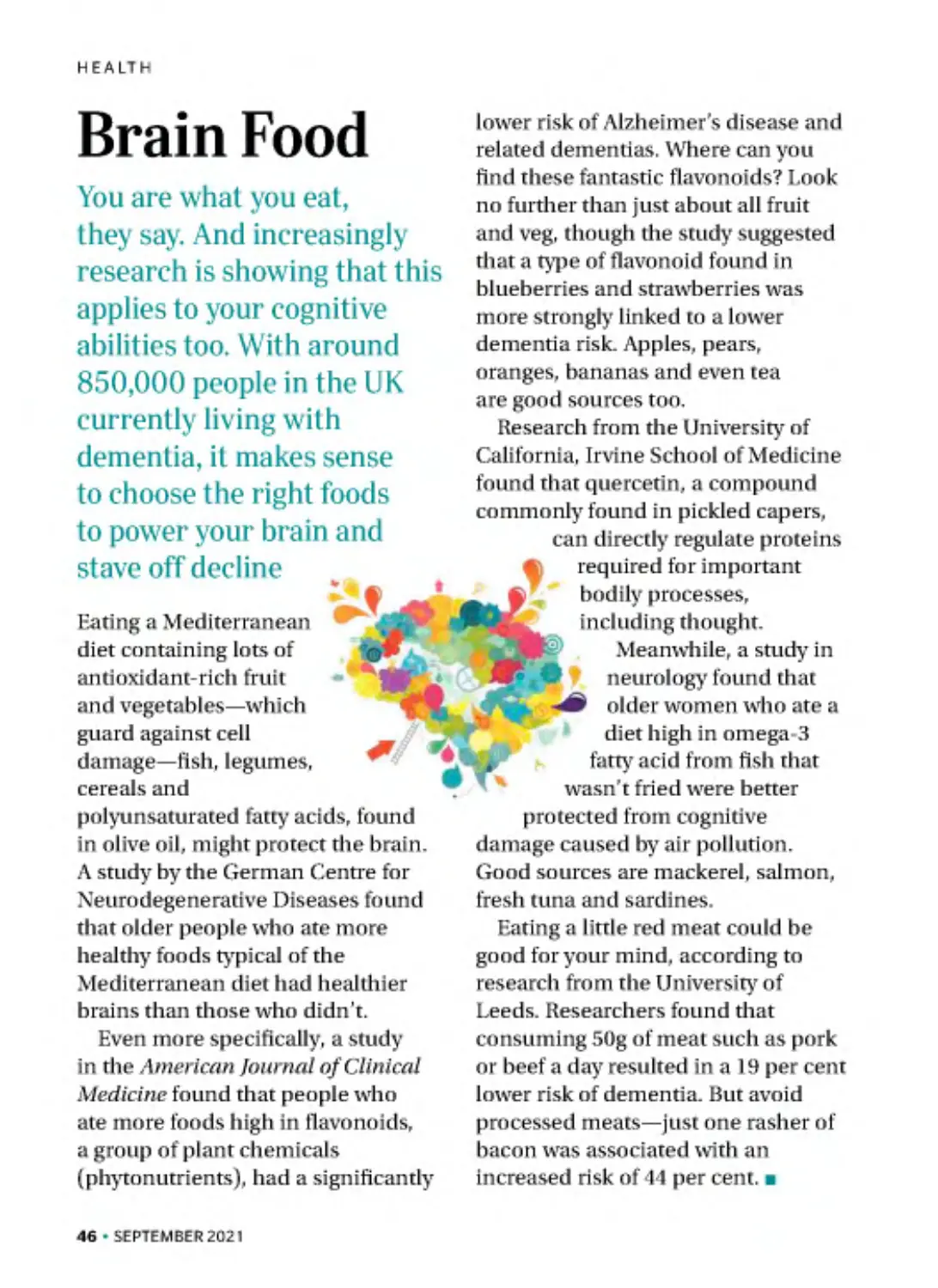
Brain Food
You are what you eat,
they say. And increasingly
research is showing that this
applies to your cognitive
abilities too. With around
850,000 people in the UK
currently living with
dementia, it makes sense
to choose the right foods
to power your brain and
stave off decline
Eating a Mediterranean
diet containing lots of
antioxidant-rich fruit
and vegetables—which
guard against cell
damage—fish, legumes,
cereals and
polyunsaturated fatty acids, found
in olive oil, might protect the brain.
A study by the German Centre for
Neurodegenerative Diseases found
that older people who ate more
healthy foods typical of the
Mediterranean diet had healthier
brains than those who didn’t.
Even more specifically, a study
in the American Journal of Clinical
Medicine found that people who
ate more foods high in flavonoids,
a group of plant chemicals
(phytonutrients), had a significantly
46 • SEPTEMBER 2021

lower risk of Alzheimer’s disease and
related dementias. Where can you
find these fantastic flavonoids? Look
no further than just about all fruit
and veg, though the study suggested
that a type of flavonoid found in
blueberries and strawberries was
more strongly linked to a lower
dementia risk. Apples, pears,
oranges, bananas and even tea
are good sources too.
Research from the University of
California, Irvine School of Medicine
found that quercetin, a compound
commonly found in pickled capers,
can directly regulate proteins
required for important
bodily processes,
including thought.
Meanwhile, a study in
neurology found that
older women who ate a
diet high in omega-3
fatty acid from fish that
wasn’t fried were better
protected from cognitive
damage caused by air pollution.
Good sources are mackerel, salmon,
fresh tuna and sardines.
Eating a little red meat could be
good for your mind, according to
research from the University of
Leeds. Researchers found that
consuming 50g of meat such as pork
or beef a day resulted in a 19 per cent
lower risk of dementia. But avoid
processed meats—just one rasher of
bacon was associated with an
increased risk of 44 per cent. n

Ask The Expert:
Eye Health
Glaucoma specialist Alastair Lockwood
is a consultant ophthalmologist at
Queen Alexandra Hospital Portsmouth
and an eye health adviser at online
contact lens store, Feelgood Contacts

How did you become
a specialist in eye health?
When I was at medical school, the
most inspiring people in terms of
teaching were the neurologists.
Ophthalmology is a small branch
of neurology but the eye is such a
beautiful, logical organ. Being able to
see is fundamental to the way we live.
To keep it going can stave off other
problems as well, such as falls.
What are the main
threats to good eye health?
The main threat is lack of awareness.
People often don’t know they have
a problem, for example glaucoma,
because the brain is programmed to
accept a natural rate of degeneration.
If you have diabetes, you need to be
more aware that your diabetes needs
to be controlled to prevent eye
damage. Another threat is poor
hygiene if you wear contact lenses.
If you have a piece of plastic in your
eye for long periods, bugs like to grow
and breed. A key issue is that tears
can’t get to them easily to kill and
wash them away.

How can people care for their eyes?
Wear protection if you’re playing
squash or tennis, or working with
anything that could injure your
eyes. Eat a balanced diet, including
green vegetables and Vitamin B12.
Control blood pressure, diabetes and
cholesterol. Be stringent with hygiene
if you wear contacts.
What should they not do?
Don’t ignore increasing pain,
especially in bright light, distortion
of vision, any new spots or flashing
lights in front of your eyes. Do not
wash contacts in tap water or wear
daily disposables multiple times.
Why is it important to
have regular sight tests?
Eye tests are not just to sort yourself
out with a new pair of glasses but
to detect when something’s not right.
They can pick up glaucoma and
changes that can lead to macular
degeneration, a cause of blindness. n
For more information head to
feelgoodcontacts.com and
vision4glaucoma.com
SEPTEMBER 2021 • 47

HEALTH

What A
Pill Can’t
Fix
Dr Max recounts how an
act of simple kindness was
the medicine his patient
really needed
imone is sitting in front
of me and crying. She looks
away, embarrassed. “Sorry,
doctor,” she says, quickly
dabbing her eyes with a
tissue and trying to compose herself,
“I shouldn’t be taking up your time
like this.” At that moment, though,
I can’t think of anyone else who is
more deserving of my time. Many of
my patients are in desperate need,
not just because of ill health but

S

Max is a hospital doctor,
author and columnist. He
currently works full time in
mental health for the NHS.
His new book, The
Marvellous Adventure of
Being Human, is out now

48 • SEPTEMBER 2021

because of their financial problems.
As any doctor can tell you, poverty
and illness are inexorably linked.
But coming face to face with poverty
in the form of Simone is unsettling.
The abstract, detached nature of the
word is suddenly made very personal
and real. She experiences poverty on
a scale that I cannot comprehend.
She is near-destitute, only just
managing to keep a roof over her
and her daughter’s head and food in
their mouths. Each week, after her
rent and electricity are paid, she has
just £20 left to live on. From this she
has to buy food, clothes, travel and
pay all other bills. She prioritises
her daughter over herself and
something as simple as a hole in her
daughter’s shoe can mean Simone
has to skip meals in order to pay for
necessities. In some ways, Simone
could be criticised for having a child
she can barely support. She herself

but it is a sad truth that there is
looks back on her life and wishes
no pill that can make Simone’s
that she had made different choices.
situation better.
But this is of no use to Simone, who
has to live with the reality of her
But today Simone is sitting crying
present situation day in and day out.
not because of the bleakness of her
She has no idea of what benefits
situation. She is crying because
or support she is entitled to and in
she is overwhelmed by a stranger’s
many respects it is admirable that
kindness. She shakes her head in
she has survived so long, living
disbelief as she tells me the story.
hand-to-mouth in the way that she
One of the administration staff in
has, without more help from the
the outpatient clinic had just won a
state. She works part time in a shop
£20 Marks and Spencer
while her daughter is
voucher in a raffle and
at school. Her daughter
it to Simone on a
is a bright, engaged,
I CAN’T THINK given
whim so she could treat
intelligent eight-yearold. She excels at school
OF ANYONE her daughter, who often
in the department
and Simone proudly
ELSE WHO IS plays
while her mother sees
takes out a photograph
me. This simple gesture
from her handbag of her
MORE
effectively doubled
daughter receiving the
DESERVING has
Simone’s income for the
end of year prize for her
academic achievements.
OF MY TIME week. She’s never even
shopped in Marks and
Simone is determined
Spencer. I think of all
that her daughter will
the £20s that I have frittered away on
have every opportunity in life and
bottles of wine or late night taxis and
scours charity shops for books
suddenly feel very ashamed. That
for her daughter. Six months ago,
sudden, impulsive act of kindness
however, Simone was involved in a
and generosity from a stranger has
road traffic accident and this seems
made all the difference to Simone.
to have been the final straw. She
It’s not just the financial impact it
slid into depression and, although
has made: it showed her that in a
she continued to work, began to feel
world that must often seem cruel
that life was not worth living any
and scary and dark to her, there is
more. She went to her GP who then
still kindness and compassion. And
referred her to me to see what help
there’s not a pill in the world that
I could give. The referral letter from
I could prescribe that would give
the GP had suggested that I might
someone that feeling. n
prescribe a suitable antidepressant,
SEPTEMBER 2021 • 49

HEALTH

The Doctor Is In
Dr Max Pemberton
Q: I am a 67-year-old male and have
just been diagnosed with gallstones.
I seem to have two options:
1) Have the gallbladder removed.
This worries me as I have never had
an operation before, particularly as
COVID-19 is still around.
2) Live with the pain which I do not
look forward to.
Either way it will mean a fat-free
diet for the rest of my life. Any advice
would be appreciated.
- Paul, 67
A: Thank you for your question. When
I was a junior doctor I worked in
surgery and used to see a lot of
gallstones. It’s surprising how painful
these little things can be. Gallstones
are produced in the gallbladder—a
small sac underneath the liver that
produces bile, which helps the body
break down fat—a bit like washing up
liquid. When we eat a meal
containing fat, the gallbladder
squeezes the bile into the
intestines so the fat can be
broken down. If stones form
in the gallbladder, then when
it squeezes, the stone can
get stuck in the tube
connecting the gall bladder
to the bowel and this is
50 • SEPTEMBER 2021

incredibly painful. This pain is called
bilary cholic. The gallbladder can also
become inflamed and infected
because of these stones—something
called cholecystitis. When gallstones
cause symptoms or complications,
it’s known as gallstone disease or
cholelithiasis. It’s understandable
to be apprehensive about an
operation—especially if you’ve never
had one before. Gallbladder removal
is a relatively straightforward
operation and is mostly done by
keyhole surgery which has minimal
down time. It’s much better to have
the gallbalder removed when it’s not
inflamed and painful as this makes
the operation much simpler. Leaving
the gallbladder does risk repeated
flare ups of bilary cholic and
cholecystitis and is a risk factor for
other things such as pancreatitis. If
your surgeon has recommended
having the gallbladder removed,
then I’d go with this advice. If
you’re still apprehensive then
have a chat with your GP. n
Got a health question for
our resident doctor? Email it
confidentially to askdrmax@
readersdigest.co.uk
illustration by Javier Muñoz

HEALTH

How To Double
Your Memory
Combining two techniques can
supercharge your learning, says our
memory expert, Jonathan Hancock
n previous columns I’ve
explored the power of stories
to trigger memory. I’ve also
explained how places can be
used to boost learning. That strategy
dates back to Ancient Greece, where
expert memorisers visualised familiar
locations, then decorated them with
all the things they needed to know.
I used both techniques to memorise
large sets of information and become
World Memory Champion. So I was
delighted to read new research that
suggests we can all benefit from
putting these two strategies together.
Using both thinking tricks at once is
itself an age-old approach. Aboriginal
Australians learned vast information
by inventing stories, then placing those
stories within real world landscapes.
And in a recent study, this twin-track
method proved significantly stronger
than using either the “story” or “place”
method on its own. Try it yourself.
Imagine you’ve got a long list of items
to remember for your holiday:
Passport, sun cream, towel,
shampoo, tennis racket, hat, insect
repellent, charger, guidebook,
sandals, toothbrush, sunglasses,
snorkel, swimsuit, camera, magazine

I

52 • SEPTEMBER 2021

Pick a room in your house—your
bathroom, for example—and store
four things in each corner, in the form
of a story.
• In corner one, near the doorway,
you might imagine yourself (the
person in your passport) standing in
the doorway while you put on sun
cream—so much of it that you have
to grab a towel to wipe off the excess,
and even use shampoo to get it all out
of your hair.
• Then, in corner two, near the
window, perhaps Andy Murray
is wielding a tennis racket, while
wearing a hat to shield him from the
sunlight. But insects are flocking to
the hat, so Andy sprays on insect
repellent—from a high-powered
bottle that needs an electric charger.
• Have a go at making up your own
story happening in corner three, near
the bath, to link guidebook, sandals,
toothbrush, and sunglasses.
• And then invent another in corner
four by the toilet, for snorkel,
swimsuit, camera, and magazine.
Later, when you visualise your
bathroom again, simply picture the
four corners and recall the stories you
imagined to remember all 16 items
on the list. And then keep looking
for ways to use stories and places to
group and store the real information
you need to recall.
Even better, get these two
techniques working together, to give
your brain an extra workout and
double its chances of success! n

HEALTH

10
Facts About
Apples—And
Reasons To
Love Them
By Jen McCaffery

That forbidden apple in the
Garden of Eden? The Book of
Genesis does not explicitly say
what fruit Eve persuaded Adam to
share with her. The Hebrew Bible uses
the generic term peri, which scholars
have said could be used to describe
a fig, a grape, a pomegranate, an
apricot, or even wheat.

1

Another Biblical apple
reference is in Psalm 17, when
David uses it while talking to
God: “Keep me as the apple of your
eye; hide me in the shadow of your
wings.” Is David rather conceited,
assuming he is God’s favourite? Not
necessarily. The Bible’s use of
“apple” here is thought to be a poetic
way to refer to the eye’s pupil, which
is also round.

2

Apples have long been
associated with love—in Greek
mythology, Paris hoped his
golden apple would win him Helen
of Troy. And it’s been said that in
colonial New England, if a young
woman peeled an apple in one strip,
she’d toss it over her shoulder and
see what letter it formed on the
floor. This was the initial of her
future husband.

3

Apples grown in the US during
the 18th and 19th centuries were
often more likely to end up in a
cider barrel than in a pie. “In rural
areas, cider took the place of not only

4
54 • SEPTEMBER 2021

Illustration by Serge Bloch

wine and beer but of coffee and tea,
juice, and even water,” author
Michael Pollan wrote in The Botany
of Desire.
there’s truth to the saying “An
apple a day keeps the doctor
away.” A large one has about 115
calories and five grams of fibre, and
the fruit’s polyphenols and fibre help
balance gut bacteria. But don’t peel
it: two-thirds of the antioxidants and
much of its fiber are in the skin.

5

That said, as Snow White can
attest, apples aren’t entirely
benign. Apple seeds contain
a compound called amygdalin that’s
part of the fruit’s defence system. If
you crush or chew apple seeds, the
amygdalin can degrade into
hydrogen cyanide, which can be
lethal in high doses. But it would
take at least 160 apple seeds to put
an adult’s life at risk.

6

the enzyme that causes apples
to brown isn’t all bad. It
counteracts garlic’s pungent
compounds. That’s right: eating an
apple will kill a case of garlic breath.

7

Displaying your apples in a
bowl on a table might look as
pretty as a painting, but if you
want them to last, store them in the
fridge, as lower temperatures slow
the ripening process. Farmers can
keep their fruit in cold storage for a

8

month or two; most apple varieties
won’t keep much longer than that.
How did this earthy fruit
become the symbol of one of
the world’s wealthiest
corporations? One day in the mid1970s, Steve Wozniak picked up
Steve Jobs at the airport. The
paperwork for their nascent
computer company was due the next
day. Jobs had just been pruning
apple trees in Oregon, and when the
men started throwing around
potential names (Matrix, Executek,
and Personal Computers Inc were
among them), he suggested Apple
Computer. “It sounded fun, spirited,
and not intimidating. ‘Apple’ took
the edge off the word ‘computer,’ ”
Jobs said. “Plus, it would get us
ahead of Atari in the phone book.”

9

Unfortunately, this wasn’t
the first supergroup to use
Apple as its corporate
moniker. In 1968, the Beatles formed
Apple Corps to represent their
creative interests. After Apple
Computer rose to prominence, the
two companies worked out an
agreement that Apple Computer
would keep its logo and name out of
the music business. That changed in
2003, when Apple began selling
music through iTunes. It took seven
more years before the Beatles finally
“let it be” by allowing iTunes to carry
their music. n

10

SEPTEMBER 2021 • 55

INSPIRE

A

The only way to save his friend from
the killer bees was to climb up the
mountain and back into the swarm

THOUSAND

by Nicholas Hune-Brown
illustration by steven P hughes

The rock hills of Hueco Tanks rise dramatically
above the scrubby Chihuahuan Desert in
West Texas—four masses of weathered syenite
that have long been a rock-climbing paradise
56 • SEPTEMBER 2021

In May 2015, Doug April was
finishing a six-month stint as a
campground host at Hueco Tanks
State Park, living by himself in an RV.
The lanky 46-year-old was divorced
with three kids. He had served two
tours of duty in Iraq, where he saw
things that were hard to forget.
Throughout it all, climbing had been a
refuge. Out on the rock, he could turn
off his buzzing mind and concentrate
on what was in front of him.
Now that respite was coming to an
end. April had officially left the army
three weeks earlier, retiring as a major,
but he wasn’t through with war zones.
In a few weeks, he was headed to
Afghanistan for three months to fly
reconnaissance missions as a private
military contractor. He wanted to
make the most of his last days climbing.
Around 8am, April’s climbing
partner, Ian Cappelle, pulled up to the
campsite. The 38-year-old geologist
had moved to El Paso with his wife,
Malynda, five years earlier. Shortly
after, while out climbing, he’d met April.
They’d been buddies ever since. Burly
and bearded, Cappelle didn’t look the
part of a climber. But as soon as he’d
tried, he was hooked. He regarded April
as a big brother—an experienced
climber and generous teacher.
“What should we do today?” April
asked as they packed their ropes.
“Well, you’ve been up Indecent
Exposure twice already,” Cappelle
said. “I’d like to do that route.”
April paused. Indecent Exposure

had always filled him with anxiety.
It wasn’t the most difficult route in
Hueco Tanks, but it was the most
intimidating. It had two “pitches,” or
sections, and both had passages that
left you hanging out over big 75-metre
drops, unprotected. Midway along the
route there was a plaque in memory of
a student who had died attempting it.
But when it’s your last climb for a
while you want to make it memorable.
The day was beautiful. The sun was
just right, the breeze perfect. If
Cappelle agreed to lead the first part of
the climb, April said he’d lead the second.
Cappelle Climbed out to his right, his
chalked fingers finding their way to
the cliff’s handholds. He and April
were tethered together for safety, with
two lines of rope connecting them
through belaying devices on each of
their harnesses that would act as a
brake, holding the rope tight if either
of them fell.
As Cappelle led the way, he clipped
the rope into metal anchors drilled
into the rock face for protection.
Twenty minutes into the climb, he saw
the memorial plaque and silently paid
his respects. He made it to the ledge
that marked the end of the pitch and
attached himself to an anchor. April
followed and they paused for a
moment to rest, 40 metres up in the air.
April led the second pitch. The
hardest section came early on—a huge
step to the right, followed by slim,
fingertip-and-toe edges. He’d had
SEPTEMBER 2021 • 57

A THOUSAND STINGS

trouble there in past attempts, but this
time he nailed it, making his way to a
chunk of rock the size of a fridge.
“Oh man, that was great!” he called
out across the chasm, a few metres
above his partner and eight metres
out to the right. Then: “This is weird.
Where did all these bugs come from?”
April slapped the back of his neck. He
looked down and watched in terror as
a cloud of bees swirled out of the
rock—more than he’d ever seen, like a
scene from a horror movie. The swarm
enveloped him, stinging him over and
over again, the pain spreading across
his neck and face and body.
Regular honeybees can sometimes
be territorial, but Africanised bees are
much more aggressive. They arrived in
the Western hemisphere in 1956, when
African bees introduced to Brazil to
increase honey production escaped,
bred with European honeybees and
quickly spread across the Americas.
When Africanised bees sense a
threat, they swarm, chasing for up to
400 metres until the threat is
eliminated. If someone is stung 1,000
to 1,500 times, scientists estimate,
they’ve got a 50/50 chance of dying.
Since the 1950s, Africanised bees have
been responsible for more than 1,000
deaths; there’s a reason they’re known
as “killer bees.”
A moment after the bees swarmed,
Cappelle watched in horror as April
jumped off the ledge, feeling the jerk
of tension in his harness as his
partner’s weight pulled the rope
58 • SEPTEMBER 2021

taught. “Lower me, lower me, lower
me, go, go, go!” April yelled.
From his perch, Cappelle played
out all 60 metres of rope, ripping it
through the belaying device as fast as
he could. Below him, the wall
undercut the ledge he was standing
on, and April disappeared from view.
That’s when Cappelle saw the first
bee. He stood as still as he could,
figuring if he just ignored it, it should
go away. Instead, it stung him on the
neck. The stings came quickly after
that—one, two, three, four, and then a
crescendo of pain as the bulk of the
hive attacked him. Cappelle tried to
cover his face, the high-pitched
whine drowning out everything as
the bees attacked his ears, eyes, nose
and mouth.
His mind raced as the bees stung
him. Why hadn’t Doug unclipped
himself once he reached the ground?
Once he unclipped, Cappelle could
pull up the rope, anchor himself into
the wall and rappel down to safety.
But April was still hanging there, dead
weight on the end of the rope.
Cappelle stood on the slim ledge
and sucked water out of his bottle,
desperate to stay hydrated to stave off
the effects of the venom. What do I
do? He reached up to brush the bees
off his head and felt a halo of insect
bodies an inch thick, stinging him
over and over again. Call your wife, he
thought. Tell her you love her. But
what if he dropped the phone?
The toxins coursed through his

READER’S DIGEST

bloodstream. At a certain point, the
panicked thoughts subsided, replaced
by a strange calm. It was a terrible way
to go. He was so sorry Malynda was
going to lose him like this, but there
was nothing he could do. The world
shrunk around him, squeezing to a
pinprick, and Cappelle blacked out,
slumping down onto the rocky ledge.
below him, april hung suspended in
mid-air, two metres away from the wall
and about 20 metres off the ground.
He’d been stuck for ten minutes, and
the bees hadn’t stopped stinging.
“Untie the blue rope!” he yelled up

head in a bad situation. He’d crashed
a helicopter in training and seen men
die in combat. And no matter the
danger, he’d always been able to flick
a switch in his brain. Turn off the fear.
Concentrate on what needs to be done.
What needed to be done now was
clear: he had to climb down. The
mountain was criss-crossed with
climbing routes—he just had to find
one. About five metres away, he
spotted an anchor that was part of
another route. He swung himself
toward the bolt, caught it on the third
try and clipped himself in. Then he
released the ropes that were

THE SWARM ENVELOPED APRIL, STINGING
HIM OVER AND OVER, THE PAIN SPREADING
ACROSS HIS BODY
to Cappelle. He wanted Cappelle to
use one of the ropes to rappel himself
to the ground. But neither man could
hear the other. All they could hear was
the deafening buzz.
After so many stings, April’s body
was becoming numb. He could feel
the bees all over him. One flew into his
mouth—vibrating and fuzzy, with a
slight flowery taste—and he quickly
spat it out. After more than a dozen
stings, people can experience vertigo,
nausea and even convulsions and
fainting. April had been stung
hundreds of times. He pulled his cap
over his face and tried to think.
He had always been able to keep his

attached to Cappelle, leaving them
dangling in the wind.
On a good day, this wouldn’t have
been a difficult route, but this wasn’t a
good day. He was pumped full of bee
venom, his body inflamed and his
mind swimming. The climb down
took him about five minutes, but it felt
like forever. By the time April made it
to the ground, he was nauseous and
nearly delirious. He stumbled toward
the road, just as one of the park
rangers pulled up.
“Ian,” April gasped, gesturing up at
the cliff. He and the ranger called
Cappelle’s name. They could see him
up on the ledge. He was in the fetal
SEPTEMBER 2021 • 59

A THOUSAND STINGS

position, a massive cloud of bees
surrounding him. “Ian!” he yelled
again. His friend didn’t move.
April did the maths. Someone had
called search and rescue, but it would
take them an hour to get a team from
El Paso. And to get a team that could
safely climb down to Cappelle and
remove him? That could take climbers
who didn’t know the area a few hours
more. He didn’t have that much time.
April knew what he had to do.

the one to go and get him. April set
an anchor at the edge of the cliff and
clipped himself in. One of the other
climbers began belaying him down.
For about the first 15 metres, Cappelle
was out of sight. Finally, the cliff grew
steep enough that April could see his
partner, still motionless, covered by a
swirling blanket of bees. “Ian!” he yelled.
And this time Cappelle looked up.
“He had the same look I’ve seen too
many times in combat, where

TWO PASSERSBY USED THEIR CREDIT CARDS
TO SLOUGH HUNDREDS OF STINGERS INTO
THE SAND
“Drive me back to my car,” he said to
the ranger. “I’ve got another rope in
there. I’ll go get him.”
april sCrambled up the rocks as fast
as he could. He’d decided to hike
another route up the back of the
mountain, then rappel down to Ian.
He wore the park ranger’s radio, and a
mesh net that he pulled over his cap.
Part way up the trail, he ran into
two other climbing friends and
conscripted them into the rescue
plan. By the time they reached the
top, it had been 45 minutes since the
start of the attack, and April had no
idea if his friend was alive. Even in his
nauseous state, it didn’t cross his
mind to ask one of his fellow
climbers to head down instead. It was
his partner down there—he would be
60 • SEPTEMBER 2021

someone’s been blown up or shot,”
April remembers. It’s not fear, exactly—
more a look of pure incredulity. How
the hell did this happen to me? “That’s
how he looked at me. Then he put his
head back down.”
April made his way down to the
ledge. The bees were all over him, but
by now he was entirely numb. He
attached Ian to his belay device. “I’m
going to get you out of here,” he said.
Cappelle was just conscious enough
to follow April’s instructions, while
April carefully lowered him 40 metres
down to the ground. Below them, the
first ambulance was just pulling up.
April watched as the rangers and
paramedics collected Cappelle. Then
he lowered himself as quickly as he
could. By the time he reached the
ground, Cappelle was in a helicopter

Cappelle and April

destined for the hospital in El Paso.
April turned down the paramedics’
advice to go to the hospital. Although
he felt faint, he didn’t believe he was
going to die anytime soon.
In the parking lot, he ran into two
climbers with wilderness first aid
training. April stripped down to his
underwear. The best way to remove
the stingers, they told him, wasn’t to
use tweezers, which squeezes the
poison from the venom sacks into
your body. The two men used their
credit cards to scrape him down,
sloughing off hundreds of stingers
into the desert sand.
At the hospital, doctors estimated
Cappelle had been stung more than
a thousand times—a high enough
dose to be lethal. He had been lucky.
And with a day or two to flush it out of
his system, he would be fine.
months later, after April returned
from Afghanistan, the men planned a

climb—back at Hueco Tanks.
They took a different route this
time, and any trepidation they might
have felt being out there dissipated in
the fresh air of another perfect day.
They reached a little alcove high
above the desert and sat down to rest.
In the months since the attack,
Cappelle had had plenty of time to
think about what could have
happened if April hadn’t come back
for him. His one memory after he
blacked out is a flash of a thick carpet
of dead bees covering the cliff ledge
and then April’s red shoes.
The two men took in the view. The
Franklin Mountains sat out to the west,
hazy and indistinct. To the north, you
could see the faint outline of the
Sacramento Mountains silhouetted
against a sky that seemed endless. The
sun was just right, the breeze light.
They stood up again, the rope strong
and secure between them, and went
back out on the rock. n
SEPTEMBER 2021 • 61

PARTNERSHIP

PROMOTION

Is now
the right
time to
consider
equity
release?

Discover the flexibility of modern
equity release today
The most popular equity release product
called a Lifetime Mortgage has become
increasingly flexible. With a variety of
features available including optional
payments and inheritance guarantees,
it offers a competitive way for over-55
homeowners to receive cash.

What would you do?
There are many ways that you might
want to use your tax-free cash. For a little
guidance though, why not see how some
of our customers used theirs?
• Home improvements.
• Helping loved ones.
• Having more holidays each year.

Equity release brought to life
You don’t just have to take our word for
it, you can learn how our customers in the
South-West benefited.

For more information visit:

www.Readersdigest.co.uk/er2
or call

0800 029 1233
1233. They can answer any questions that
you might have.

How does a Lifetime Mortgage work

Mr. and Mrs. Clyde had spent their
married lives enjoying the family home.
Now that their children had flown
the nest and had homes of their own,
they wanted to start ticking items off
their bucket list and visit new holiday
destinations.
They contacted us at Reader’s Digest
Equity Release and decided to meet
with an adviser. Their personal adviser
helped them to understand more about
the product and took them through the
application process, helping them to
release tax-free cash to go towards their
plans for a 2022 cruise around the world
and provide for some additional holidays.*
To find out more about using equity
release to achieve your goals, you can call
the Information Team today on 0800 029

A Lifetime Mortgage does not require any
monthly payments. Instead, the interest is
added to the amount borrowed monthly
with the full amount being repaid with
the sale of the home once you have died
or entered permanent long-term care.
Naturally, by taking equity out of your
home now there will be less available
to your estate in the future. If you’re in
receipt of means-tested benefits then
your entitlement could also be affected.

Your equity release journey
Reader’s Digest Equity Release can offer
you a free, no-obligation appointment
with a fully qualified adviser. Your
personal adviser will help you to make
the best choice for your circumstances,
whether that’s equity release or not.
If you’re interested in how much cash you
could get, call us today. n

*This case study is a worked example and is for illustrative purposes only.
Reader’s Digest Equity Release is a trading style of Responsible Life Limited. Only if you choose to proceed
and your case completes will Responsible Life Limited charge an advice fee, currently not exceeding £1,490.
Please note that due to restrictions face-to-face appointments may not be available in all areas.
The Information Team will let you know the options available to you.

INSPIRE

My Britain:

Bethnal Green
By Anna Walker

I

M O N I C A W E L L S / A L A M Y S TO C K P H OTO

n many ways, the area of
Bethnal Green in Tower
Hamlets, East London, wears
the history of Britain on its
sleeve. It is shaped by a
strong community spirit, which
began with East London's
cockneys and has grown to
encompass families from Eastern
Europe, the Carribbean and the
largest Bangladeshi community in
the UK. Today the area is not only
ethnically diverse, but has
brought into its fold a
diverse range of
"The values of
classes too, as city
tolerance and love of
workers increasingly
make their home
diversity I learned [in
here. Take a stroll
Bethnal Green] are
down the main
what I pass onto
thoroughfare of
Bethnal Green
my children"
Road enjoying the
- Eddie Marsan
buzz of community as
family and friends meet
to buy homewares, colourful
fruit and vegetables or elegant
saris. Wander down the infamous
Brick Lane and enjoy the tempting
smell of foods from around the
world (particularly the delicious
aromas of its famous curry
houses) and admire some of
London's most cutting-edge
street style. Head to Columbia
Road Flower Market and you'll
hear the cries of flower sellers that
have flooded this Victorian street
for over 150 years.
SEPTEMBER 2021 • 65

Rushanara Ali MP
Rushanara Ali, 46, has been the
Member of Parliament for Bethnal
Green and Bow since 2010. Born in
Bangladesh, she and her family moved
to the East End of London when she was
just seven. She has represented the area
for over a decade

My earliest memories of Bethnal
Green are from my school days, taking
the bus down Cambridge Heath Road
and past Whitechapel Market. The
market has been a fixture in my head
from a very early age. On the way back
from school, my sister and I would walk
through the market and enjoy how lively
it was in full flow. Visiting the shops and
market stalls of Bethnal Green Road with
my mum is a strong early memory too. It
is one of the places my sister and I would
go to as teenagers for shopping and
would bump into friends and relatives.
My connection with Bethnal Green is
very, very, long-standing. When my
father came to the UK in the 1960s, he
came on a restaurant worker's visa to
work in a restaurant in Bethnal Green.
His uncle came here first—he was a
seafarer who arrived in London's East
End—from Sylhet via Calcutta to the East

66

R I C H A R D B A R N E S / A L A M Y S TO C K P H OTO

B EYS BT ROI TF ABI N
M
R I: TBI SE H
THNAL GREEN

M O N I C A W E L L S / A L A M Y S TO C K P H OTO

End of London. He then encouraged my
dad to come to the UK when the 1960s
labour shortage saw new Commonwealth
citizens being encouraged to come from
the old Empire.
I felt a really strong pull towards
representing the place I grew up in.
I became the first person from British
Bangladeshi heritage to win a
parliamentary seat in Britain. The
constituency I represent has the largest
community of Bangladeshi heritage in
the country, so it was wonderful that it is
this area that elected someone from my
background. I also felt it was important
to have more women in public life and to
make sure the area was represented by
somebody who grew up here and knew
the area, and the different communities.
I often say to people that I've got the
most interesting constituency in the
country. I feel incredibly lucky because

it's such a fascinating area, historically,
culturally and politically. I would define
Bethnal Green as a place where the
sense of family and community is very
strong. It really is a place that manages
to mix lots of different cultures, faiths
and social classes.
One of my favourite places in Bethnal
Green is Museum Gardens right by the
V&A Museum of Childhood. In the
summer it's full of beautiful flowers and
is a park that I’m often walking through.
Despite being on a busy main road, it is
peaceful. When I became an MP, my
office was just across the road, so that
park has been a focal point for my
campaigns and getting together with
activists and volunteers who helped me
get elected to Parliament. Columbia
Road is another favourite spot of mine.
It is always a delight going there,
especially on Sundays!

67

B EYS BT ROI TF ABI N
M
R I: TBI SE H
THNAL GREEN

Antony Nelson
Landscape architect Antony Nelson,
49, is the founder of the Bethnal Green
Fingers community gardening group.
Follow their work on Instagram, @
BethnalGreenFingers

I lived in South London for many years
and I was, like so many Londoners, a firm
transpontine. Bethnal Green and East
London at that time had an emerging and
exciting new scene of art and design,
fashion, music, food and young
Europeans who were making it their
home. I was very drawn to all of this and
so I crossed the river for a new life.
I love Bethnal Green's long and rich
history and the waves of people who have
settled here over the last few hundred
years. Huguenot silk weavers, Jewish
68 • SEPTEMBER 2021

pogrom settlers, Bengalis and of course
the historic Cockneys. All of them have
left a significant trace from their time
here. I believe the residents feel they are
in one of the most unique villages in
London. The scale and tight grain of
Bethnal Green means the landscape can
change so much within a five minute walk.
When I first moved into our estate, it
was denuded of greenery and beset by
anti-social problems with little community
feeling. As a Landscape Architect I

approached our Housing Association with
the idea of setting up a community
gardening group and to take personal
responsibility in improving the estate by
planting hundreds of plants and trees.
After 15 years the improvements are
immeasurable. The outside spaces are
verdant and beautiful, residents dwell
outside more than ever, anti-social
behaviour has decreased and the sense of
community has vastly improved. Many of
us leave our doors open during a
summer's day now. I'm sure that hasn't
been done in this area for many decades.
The backgrounds of the members of
our group really vary. We're a mix of social
tenants and leaseholders, young and
older and from many different ethnic

backgrounds. There is a sense of
comradery when we get together and it
often turns into a social event.
It’s not all a bed of roses though and
there are challenges in keeping the
community gardens going. We are not
funded anymore by our Housing
Association and sometimes it’s difficult to
encourage people to do the harder and
more unrewarding work like weeding and
maintenance! And tenants who come and
go fairly regularly are less inclined to
invest their time in the gardens. But we
persevere and like all good gardeners,
always look ahead to the following year. n

To plan a future visit to Bethnal Green
head to visitlondon.com
SEPTEMBER 2021 • 69

INSPIRE

If I Ruled The World

Jon Batiste
Jon Batiste is an Oscar and Golden Globe-winning musician,
author and activist. His new album WE ARE is out now
Everybody would have to tell the
truth, all the time. Because if
people told the truth, they would
have fewer problems, and less
shame. Man, how much stuff would
get done if people told the truth all
the time? It’s a hard thing for people
to do because we always want to run
from the truth, especially when it’s
ugly. But it would be great if we did
the opposite of that and ran towards
the discomfort.
I would have a very serious
discussion about reparations for
Black Americans. Reparations are
as real as we make them. Race is a
construct, and we have made it real.
And it has governed the way that we
think and deal with each other and
governed the way we categorise
people. Souls are categorised based
upon their skin colour—just think
about how ridiculous that is. Think
about how ridiculous it is that a
person is judged, and you can create
a whole summation of who they are,
by looking at them. It is a level of
70 • SEPTEMBER 2021

basic ignorance that we have
accepted for centuries. So, if that is
possible, I think reparations are also
very possible. We decided that we
want to go to the moon, so we can
come up with a system to figure out
how to pay Black people what is
owed to them by the government.
There would be free education
for all. I think that everybody
needs to have the ability to educate
themselves to the same degree. And
when I say free education, I’m not
saying the way things are now, ie,
public education that is subpar. I’m
from Louisiana and sadly, in the
South [of the US], you’re talking
about some of the worst public
education in the world. What I’m
referring to is free education of a
standard that is equal to the
education that somebody would get
if they were going to a formidable
private school. Education that will
teach people languages, that will
teach people things that they need
to know to function in society. You

know, people leave school, and they
don’t know how to do their taxes.
They don’t know how to speak any
other language. They don’t know
anything about real history except
for the boilerplate American history
that we’re taught.
Money would not be the currency
that moves things along. In my
world, it would be skills or talents.
Do you see the level of corruption
that the amount of money and the
dependence on money has created
in the world? The level of corruption
is insane. And it’s all based upon the
fact that “I have more of these bills
than you do.” So, if it was actually
based upon the content of a person’s
character, and the skillset that they

bring to the table, we would have a
true meritocracy where people can
co-exist to be equals and not under
some class heirarchy. Now that
would be incredible.
It would be mandatory that people
would get paid maternity and
paternity leave. And everybody
would have to have some sort of
practice in the arts. This is about
making space for people to live lives.
It’s about carving out space for
people to be anything other than just
a consumer, or a part of the
workforce. Family and the arts—
these are the things that help us to
define purpose in our lives. n
As told to Marco Marcelline
SEPTEMBER 2021 • 71

INSPIRE

Music From

The Vaults
Meet the music custodians
whose life mission is to
preserve forgotten
recordings for posterity
By Simon Button
illustration by eva bee

72 • SEPTEMBER 2021

73

M U S I C F R O M T H E V A U LT S

eep in the vaults of the
British Library lies a
veritable treasure trove for
pop music lovers. Housed
across the main building in St Pancras
and the Library’s Boston Spa site are
more than 350,000 CDs and 250,000
LPs, as well as around a quarter of a
million 78rpm discs and numerous
reel-to-reel and cassette tapes.
Throw in an array of wax cylinders
along with old issues of the NME,
books, newspaper clippings,
catalogues and recorded interviews
and you have a vast collection that
Andy Linehan, the Library’s Curator
of Popular Music Collections, is
understandably very proud of.
Every genre is covered, from music
hall to metal and jazz to grime,
and Andy feels he and his team are
not only preserving pop, they’re
honouring history. “One of the
British Library’s functions is to be
the cultural memory of the nation,”
he says. “We do that with books,
journals and newspapers and it’s
absolutely right that we should also
do it with music.”
They rely on donations from
record labels, artists and members
of the public because as Andy notes:
“If you publish a book, newspaper
or magazine in the UK you’re legally
obliged to send a copy to the British
Library but that law does not apply
to sound recordings.”
Among the treasures are an
early voice recording of Florence

D

74 • SEPTEMBER 2021

Kelly Pribble at
work at IMES

Nightingale and a cassette tape that
was sold at gigs in the early 1980s
by a sixth-form band called On A
Friday, who eventually re-formed as
none other than Radiohead. There
are also old blues 78s, rare LPs from
the 1950s where the covers were
designed by a pre-fame Andy Warhol
and promotional copies of Beatles
singles that only had a couple of
hundred pressings.
When it comes to preservation, the
team is tirelessly transferring music
from media that’s vulnerable and
digitising it for prosperity. “So long
as it’s stored correctly most media
remains stable, but certain types

READER’S DIGEST

IF ANYONE CAN
SALVAGE A BATTERED
OLD TAPE, IT’S
OUR ENGINEERS

of tape can deteriorate faster than
others,” Andy elaborates. “But if
anyone can salvage anything from a
battered old tape it’s definitely our
engineers because they have the
know-how as well as the equipment
to play back everything.”
Private companies and specialist
record labels are also doing their bit

to ensure music is safe-guarded for
generations to come.
Iron Mountain Entertainment
Services has branches in the States,
London and Paris, offering digital
transfer and preservation services for
music as well as other media.
Principal Studio Engineer and
Preservation Specialist Kelly Pribble
leads the company’s Media Recovery
Technology Programme. Among
the projects he has worked on is
a partnership with the Bob Dylan
Archive to save more than 60 original
recordings that were suffering from
so-called adhesion syndrome.
“With this problem,” Kelly
elaborates, “the tape is in a state
SEPTEMBER 2021 • 75

M U S I C F R O M T H E V A U LT S

Over at Cherry Red Records,
Chairman Iain McNay describes the
label’s work as “historical R&R” with
a mission to treat catalogue music
with TLC. “When we buy the tapes
it’s that initial process of discovery
because we know roughly what
we’re going to get but there are all
kinds of things that aren’t listed,”
he says. “Then, it’s all about looking
after all that material and letting it
see the light of day. We’re music fans
who are also custodians.”
Musicians are often involved
in the process, such as Level 42’s
Mark King who has recently been
promoting a boxset of the band’s
first five albums that also includes
extended versions, B-sides and
76 • SEPTEMBER 2021

IT’S ALL ABOUT
LOOKING AFTER THE
MATERIAL AND
LETTING IT SEE THE
LIGHT OF DAY—WE’RE
MUSIC CUSTODIANS

bonus tracks. And releases are
handled with great care, with Iain
adding: “For example, we have
someone looking after Howard Jones
reissues and he’s a huge Howard
Jones fan. We try and use experts in
the field who are really engaged and
want the releases to best reflect what
a real fan would like.”
Mastering engineer Alan Wilson
from Western Star Records is
currently hard at work going
through nearly 2,000 items from
the Joe Meek’s “Tea Chest Tapes”
(so called because they were stored
in 67 tea chests), which have been
acquired by Cherry Red and include
such finds as previously unheard
music by David Bowie’s first band
The Konrads alongside songs the
legendary producer worked on with
the likes of Tom Jones and Billy Fury.
The tapes date back around 50
years and they’ve been carefully
stored by their owner, former
musician Cliff Cooper, otherwise
they might have deteriorated too
much to be usable. But they’re dirty

@ british library board

of decay or degradation and starts
binding to itself. If you don’t know
this is happening, you can instantly
and permanently damage the tape the
moment you try to rewind or play it.”
Having already developed a
process to safely unbind affected
tapes, he was able to apply the
process to the Dylan masters and
archive the entire collection. He
recently helped Mariah Carey with
the curation of her Rarities album,
going through countless mastertapes
of unreleased songs from the last
three decades, and IMES has also
partnered with the Prince estate
to preserve and digitise all the
unreleased music from the artist’s
famous vault.

Alan Wilson, Cliff Cooper
R Eand
A D Iain
E R ’ McNay
S D I G Ewith
ST
the Joe Meek’s “Tea Chest Tapes”

Collection of 78s records
at the British Library

SEPTEMBER 2021 • 77

M U S I C P R E S E R VAT I O N

Close-up of
tape adhesion
Level 42’s The
Complete Polydor Years:
Volume One boxset by
Cherry Red

78 • SEPTEMBER 2021

READER’S DIGEST

IMPULSE BUYS OF
SUPERMARKET CD
COMPILATIONS MAY
BE ON DECLINE
BECAUSE BUYERS
ARE MIGRATING
TO DIGITAL
and have mould on them, so they
need to be painstakingly cleaned
before they can be played back and
transferred from analogue tape to
digital files. Once it’s been decided
which material from the vaults will
be released, the selected tracks will
then be restored and remastered.
It’s a mammoth task that will take
18 months but lifelong Meeks fan
Alan is thrilled with the assignment.
“It’s a massive chunk of British rock
‘n’ roll history and important in so
many ways because Joe Meek was
such an innovative engineer and
producer who took on the music
industry and beat it at its own game
on a shoestring budget in a flat
above a leather goods shop.”
Another record company that
carefully curates reissues and
restorations is Demon Music Group,
with Head of Product and Marketing
Ben Stanley saying: “I’m a big
music fan and I’m disappointed
when things are reissued and they

don’t sound or look up to scratch.
We’re all about creating premium,
definitive versions.”
Vinyl is a growth market,
especially among fans of 1990s
music when vinyl pressings of
albums by acts like Pulp and Oasis
were hard to come by. Impulse buys
of supermarket CD compilations
may be on the decline, maybe
because those buyers are migrating
to digital. “But then you have a
person who wants to own a 24-CD
Donna Summer boxset,” Ben adds of
the mammoth Encore tribute to the
Queen of Disco which came out on
the company’s Driven By The Music
label and took more than three years
to compile.
“There are huge challenges in
bringing these things to market,
whether it’s dealing with estates,
record companies, licensing issues,
publishers,” he says. “But the
heritage and history of popular
music is so important. People will
still be playing Revolver and Bowie’s
Station To Station in 50 or 100 years’
time and it’s important they’re taken
care of.”
Kelly Pribble over at IMES agrees.
“We can go to a museum and see
a book or painting that is 500 years
old and is in amazing shape, but we
have music recorded on formats 40
years ago that is rapidly degrading.
It keeps me up at night pondering
how I can help ensure that all of this
recorded history is saved.” n
SEPTEMBER 2021 • 79

SAVING
NOTRE DAME
During European
Heritage Days in
September 2020,
a carpenter
demonstrated how
wood will be shaped
into the beams needed
to rebuild Notre
Dame's roof

INSPIRE

A devastating fire nearly
destroyed Notre Dame de Paris
two years ago. Now scientists
are leading the effort to restore
the beloved cathedral to its
former glory
By Christa Lesté-Lasserre
from Science

81

ight restoration
scientists put on hard
hats and heavy-duty boots,
and stepped inside the
blackened shell of Notre
Dame de Paris, the world’s most
famous cathedral. Ten days earlier,
a fire had swept through its attic,
melted its roof, and sent its spire
plunging into the sacred space. Now,
it was silent but for the flutter of
house sparrows. The air, normally
sweet with incense, was acrid with
ash and stale smoke. Piles of debris
covered the marble floor.
Yet the scientists, called in by
France’s Ministry of Culture to inspect
the damage and plan a rescue, mostly
felt relief—and even hope. Rattan
chairs sat in tidy rows, priceless
paintings hung undamaged, and,
above the altar, a great gold-plated
cross loomed over the Pietà, a statue
of the Virgin Mary cradling the body
of Jesus.
“What matters isn’t the roof and
vault so much as the sanctuary
they protect,” said Aline Magnien,
director of the Historical Monuments
Research Laboratory (LRMH). “The
heart of Notre Dame had been saved.”
On April 15, 2019, an electrical
short was the likely spark for a blaze
that threatened to burn the 850-yearold cathedral to the ground. Following
a protocol developed for just such
a disaster, firefighters knew which
works of art to rescue and in which
order. They knew to keep the water

E

82 • SEPTEMBER 2021

pressure low and to avoid spraying
stained glass windows so the cold
water wouldn’t shatter the hot glass.
But even though their efforts
averted the worst, the emergency
was far from over. More than 200
tons of toxic lead from the roof and
spire was unaccounted for. And the
damage threatened the delicate
balance of forces between the vault
and the cathedral’s flying buttresses:
the entire building teetered on
possible collapse.
At LRMH, the laboratory tasked
with conserving all the nation’s
monuments, Magnien and her 22
colleagues apply techniques from
geology to metallurgy as they evaluate
the condition of Notre Dame’s stone,
mortar, glass, paint, and metal. They
aim to prevent further damage to the
cathedral and to guide engineers in
the national effort to restore it.
President Emmanuel Macron has
vowed to reopen Notre Dame by
2024. The operation involves many
government agencies and has drawn
philanthropic pledges of about €1
billion. But it is the LRMH researchers
who lead the critical work of deciding
how to salvage materials and stitch
the cathedral back together.
The LRMH team works in the former
stables of a 17th-century chateau in
Champs-sur-Marne, in the eastern
suburbs of Paris, which once housed
a horse research centre. Here, they
have analysed samples from France’s

photo, previouS Spread: ©photo by Kiran ridley/Getty imaGeS

SAVING NOTRE DAME

READER’S DIGEST

6:18 pm
Fire begins

7:50 pm
Spire collapses

4:00 am
Fire under control
Ceiling
holes

illuStration by chriS bicKel/Science maGazine

The grim progress of the Notre Dame
fire, which started on April 15, 2019

top monuments—the Eiffel Tower,
the Arc de Triomphe—in the same
rooms where some of the world’s first
artificial insemination experiments
in horses occurred 120 years ago. The
neighbourhood is quiet, but on a day
in January 2020, when I visited, the
lab was anything but sleepy.
Véronique Vergès-Belmin, a
geologist and head of LRMH’s
stone division, slipped a hazmat
suit over her dress clothes and slid
on a respirator mask—necessary
when dealing with samples
contaminated with lead. In the lab’s
storage hangar—once a garage for the
chateau’s carriages—she presented
several dozen stones that had fallen
from the cathedral’s vaulted ceiling.
Fallen stones hint at the condition of
those still in place.
Heat can weaken limestone, and
knowing the temperatures endured
by these fallen stones can help

engineers to decide whether they
can be reused. Vergès-Belmin has
found that the stones’ colour can
provide clues. At 300°C to 400°C, she
said, iron crystals that help knit the
limestone together begin to break
down, turning the surface red. At
600°C, the colour changes again as
the crystals are transformed into
a black iron oxide. By 800°C, the
limestone loses all its iron oxides and
becomes powdery lime.
“Any coloured stones or parts
should not be reused,” Vergès-Belmin
said. Colour evaluation isn’t an exact
science. Still, in lieu of mechanically
testing each of the hundreds of
thousands of stones that remain
in the cathedral, colour could be a
useful guide to their strength.
Water can also wreak havoc. When
the firefighters drenched the stone
vault, the porous limestone gained up
to one-third of its weight in water. In
the lab, LRMH researchers monitored
a fallen stone, weighing it to track
the drying process. The last of the
SEPTEMBER 2021 • 83

SAVING NOTRE DAME

waterlogged stones finished drying
in May this year.
Meanwhile, rain continued to
fall on the roofless vault. Engineers
couldn’t install a temporary cover
because of a mangled skeleton of
scaffolding, set up in 2018 for longterm renovations. The cathedral
walls supported the scaffolding, so
it had to be dismantled carefully to
prevent a potentially “catastrophic”
collapse, Magnien said.
Until the stones finish drying
on their own, their changing
weights will likely continue to have

“non-negligible” effects on the vault
structure, according to Lise Leroux, a
geologist in the LRMH stone division.
Not only does the extra weight play
with the precarious balance of forces,
but when the water freezes in winter,
individual stones expand or contract.
A few weeks after the fire,
engineers installed steel beams
above the vault so technicians
could rappel with ropes as they
removed scaffolding and stabilised
the structure. Leroux earned a
rappelling certification so she
could take a closer look. When she
Lead spire

Lead
roof

Scaffolding
Attic
support
timbers

Twin bell
towers

Vaulted
ceiling

Front
entrance

South rose
window

illuStration by chriS bicKel/Science maGazine. photo: ©ap photo/francoiS mori

READER’S DIGEST

inspected the top of the vault for the
first time in February 2020, she found
that its plaster coating was still mostly
intact and had shielded many stones
from fire and rain. “It seems to have
done its job,” she said.
The COVID-19 lockdowns slowed
the removal of the scaffolding, which
was finally completed in November
2020. Work could now begin on the
cathedral’s interior. In December,
the Grand Organ was dismantled
and removed, and the pipes taken
for repair and cleaning to remove
lead dust from the fire. Next, a 89fthigh scaffold was built to give access
to the vaults. Reconstruction of the
interior was due to begin in the
second half of 2021.
Among Parisians, the fire stirred
both grief and fear that vaporised
lead from the roof and spire had
drifted into nearby neighbourhoods.
In fact, Aurélia Azéma, a metallurgist
who leads LRMH’s metal division,
and other scientists have concluded
that the fire maxed out well below
lead’s vaporisation temperature
of 1700°C. Most of the lead simply
melted at 300°C, pouring into the
gutters and dripping into stalactites
hanging from the vaults.
In places, however, temperatures
did exceed 600°C, at which point
lead oxidises into microscopic
nodules. “It’s like hair spray,” Azéma
said. A yellow cloud that billowed
from the cathedral during the fire

Glass researcher Claudine Loisel tests
techniques for cleaning lead from Notre
Dame's 113 stained glass windows

showed that at least some of the lead
did become airborne.
Some nearby schools were
decontaminated after samples showed
worryingly high lead levels. But it’s
not clear whether the lead came from
the Notre Dame fire or from some
other source, such as lead paint, car
batteries, or leaded gasoline.
Much of the lead mobilised by
the fire remains in the Notre Dame.
In June 2019, when Azéma and her
colleagues brought their first samples
from the cathedral back to the lab,
tightly sealed in plastic bags, yellow
lead dust appeared to be everywhere.
She unrolled small organ pipes from
layers of bubble wrap and pointed
her gloved finger at their holes. “Even
down in here,” she said.
Because of lead’s toxicity, France’s
national health agency imposes a
legal limit of 0.1 micrograms per
square centimetre on the surfaces
of any building, including historical
monuments. “My first sample was 70
times that,” said Emmanuel Maurin,
head of LRMH’s wood division,
SEPTEMBER 2021 • 85

SAVING NOTRE DAME

who tested surfaces like the oak
confessional and choir seats.
The national work inspection
agency has enforced stringent safety
requirements. People entering the
cathedral must strip naked and put
on disposable paper underwear and
safety suits and wear protective masks
with breathing assistance before
passing through to contaminated

areas. After a maximum of 150
minutes’ exposure, they hit the
showers, scrubbing their bodies
from head to toe. “We’re taking five
showers a day,” Zimmer says.
The Ministry of Culture has charged
LRMH’s researchers with finding a
way to cleanse the cathedral of lead
without harming it. For most smooth
surfaces—glass, metal, waxed wood,

NEW LIFE FOR A FOREST IN THE SKY
reference to its intertwined oak beams. The 2019 fire completely destroyed the roof,
and 2,000 oak trees will be needed to rebuild it exactly as it was.
Numerous countries, including Germany, Slovenia and the United Kingdom,
stepped forward to offer trees for the reconstruction. Ultimately, the body overseeing
the restoration of Notre Dame decided to use only French oaks due to time
constraints involved in harvesting and drying the wood.
At the beginning of March this year, before the sap began to rise, foresters from the
Office National des Forêts (ONF) felled the first eight oaks in the Bercé Forest, 75
miles southwest of Paris. The wood from these
exceptional trees—230 years old, three feet in
One of the 2,000 oak
diameter, with more than 66 feet of useful trunk—
trees that will be used
is destined for the base of the rebuilt spire. Five of
to rebuild Notre
Dame’s roof
them had to be perfectly straight, and three had
to have a specific curvature needed for the
construction of the base.
The remaining trees are being harvested this
year from forests throughout France. After the
oaks are felled, the wood is left outdoors for
several months to allow the rain to wash out the
tannins. Then it needs another 12 to 18 months to
dry. Once the wood’s moisture content drops
below 30 per cent, the Notre Dame carpenters
can get to work rebuilding this one-of-a-kind
forest above the streets of Paris.
86 • SEPTEMBER 2021

photo: ©Jean-francoiS monier/afp via Getty imaGeS

Over the centuries, Notre Dame’s roof was commonly known as “the forest”—a

READER’S DIGEST

and even paint—they’ve found
that a shop vac and cotton pads,
moistened with distilled water, safely
remove the lead. Raw wood surfaces
require fine sanding first, Maurin
said. The best method for porous
stones turned out to be cleaning with
compresses and latex, supplemented
with laser cleaning for the joints.
As the first “emergency” phase
of scientific work advanced, Notre
Dame started slowly opening
to “second phase” scientists
interested in studying its history and
architecture, now exposed by the
fire and available to study without
intruding crowds of tourists.
The Ministry of Culture and CNRS
created a dedicated science team of
about 100 researchers from multiple
institutions. “We’re sorting all these
thousands of fragments—some from
our world, some from another and
more ancient world—and it’s like
we’re communicating with the Middle
Ages,” Dillmann said.
Yves Gallet, an art historian at
Bordeaux Montaigne University,
oversees a group that aims to study
stones that are still in place. Through
detailed photographic analysis,
researchers want to understand
how 13th-century stonecutters
designed and assembled the
encasements that cradle the fourstory-diameter rose windows.
The charred remnants of attic
timbers have stories of their own

to tell. “Wood registers absolutely
everything while it’s growing,” said
Alexa Dufraisse, a CNRS researcher
heading the wood group. Notre
Dame’s oak beams grew in the 12th
and 13th centuries, a warm period.
By connecting the growth ring record
with what’s known about economic
conditions at the time, researchers
hope to see how climate variations
affected medieval society, she said.
Across centuries marked by
war and disease, Notre Dame has
witnessed cycles of decline and
renewal before. The LRMH scientists
hope that when the vaults and
buttresses are again dry and sound,
the lead accounted for, and the great
cathedral’s history and resilience
understood more deeply than
before, the sense of grief and loss
surrounding the fire will once again
turn to joy and gratitude.
“There’s an extraordinary unity of
people coming together to not only
save this monument, but to learn
from it,” Magnien said. “Notre Dame
will be restored! Its artwork, stone,
and stained glass will be cleaned; it
will be more luminous and beautiful
than before.
“Notre Dame will come out of
this experience enriched. And so
will we.”n

Science (march 13, 2020 vol 267, iSSue 6483), copyriGht ©
2020 by chriSta leSté-laSSerre. thiS article haS been
updated Since itS oriGinal publication

SEPTEMBER 2021 • 87

TR AVEL & ADVENTURE

Travellers on Western
Australia’s backroads need
to be prepared for rough
conditions, and to bring
plenty of water

88

A road through a remote Australian region
leads to glorious landscapes and insights
into the nation’s original inhabitants

There’s

Nowhere
Like The

Outback
By Bob Ramsay
From Canadian Geographic

SEPTEMBER 2021 • 89

THERE’S NOWHERE LIKE THE OUTBACK

we got our flat tyre as we drove
into the Mount Barnett Roadhouse
on Western Australia’s notorious
Gibb River Road. Luckier still, three
burly guys changed our tyre, with
dire warnings to get to the Over the
Range service station to fix it, pronto.
Otherwise, well… I guess that’s why
our rented four-wheel drive came
with a satellite phone, an emergency
locator, and ten gallons of water.
My wife, Jean, and I had wanted
to experience one of the Englishspeaking world’s most remote places
that non-explorers can navigate on
their own: the Kimberley region, an
area in the northwestern corner of
Australia much bigger than Germany
or Japan, with a population of just
34,000 people. And in May 2018, we
got the chance to visit.
The Gibb is an iconic, tyre-ripping
gravel road that runs 410 miles
through the region along, as its
name suggests, the Gibb River. In the
May-through-October dry season,
it’s hot and desolate. Still, your fourwheel drive better have an air-intake
snorkel so it can ford the dozens of
rivers you’ll cross. Oh, and watch out
for the “road trains,” those linked
trucks that can measure up to 176
feet—more than three times the
longest standard truck allowed on
90 • SEPTEMBER 2021

European roads—and take two miles
and clouds of blinding dust to pass.
In the wet season, don’t even think
of driving the Gibb. You’ll drown in
the rain-flooded plains that for half
the year are bone dry.
The only way to explore
Kimberley is by this very bad road,
or by air. That is, unless you’re an
Aboriginal. Young Aboriginal males
still take part in a rite of passage
called temporary mobility (it used to

photos, previous spread and
this one: © getty images

We were lucky

be referred to by the outdated,
colonial term “walkabout”),
which involves going into the
wild as boys and returning up to
six months later as men.
We did the latter first, taking
the lay of the land from the sky
before we set off down the Gibb
on four wheels. To do that, we
went to the jumping-off point for
helicopter tours in Kimberley: the
HeliSpirit hangar in Kununurra.
“You from Canada, mate?”
asks James Bondfield, our young
helicopter pilot.
“Uh, yes, I am.” When we
Canadians open our mouths in
Australia, we’re almost always

The Kimberley region’s many attractions
include (from top to bottom): kookaburras
and other wildlife, the Pentecost River,
and the King George Falls

SEPTEMBER 2021 • 91

THERE’S NOWHERE LIKE THE OUTBACK

mistaken for Americans.
“I worked in Canada,” says
Bondfield, explaining that he had
built up his flying hours in the oil
sands in northern Alberta. He also
flew in the forests of Papua New
Guinea, Malaysia and Indonesia
before returning home and rising
to be, at age 30, the chief pilot of a
company whose 25 helicopters are
opening Kimberley to visitors drawn

The cave paintings
are among the
oldest made by
humans anywhere
in the world
to the vast, dramatic, relatively
untouched landscapes.
During the next two days,
Bondfield, like any great guide, takes
us where we want to go, then shows
us his own secret places there. We
first picnic atop King George Falls
in the Balanggarra Indigenous
Protected Area, a 1 million-hectare
homeland of First Peoples in
Australia and whose rock art, dating
back to more than 40,000 years ago,
is drawing global attention.
Bondfield lands us near some
caves covered in the ochre images
of ancient plants and animals.
Their brightness is barely faded
92 • SEPTEMBER 2021

despite tens of thousands of years
of torrential weather. We crawl into
crevices all afternoon, snap photos
and return with shots of paintings
that are among the oldest made by
humans anywhere in the world.
From there, we fly to the remote
Berkeley River Lodge, a 20-cabin
resort on the Kimberley Coast.
Over dinner of grilled barramundi,
Bondfield asks if we’ve had a chance
to go fishing in Australia yet. No, we
have not—not with local rivers filled
with “freshies” and “salties”: freshand salt-water crocodiles. The former
may attack you, while the latter will.
“Well, if you want to get up before
sunrise tomorrow, I can fly you to
my favourite fishing hole,” he tells us.
And so, the next morning at dawn,
we land on a ledge of a tributary of
the Berkeley River, feeling safe in
Bondfield’s charge. And it doesn’t
matter that the one barramundi
I hook gets away. What matters is the
thrill of watching the sun rise over
one of the most ancient landscapes
on the planet.
Later that day, Bondfield drops us
back in Kununurra, the starting point
for our journey on the Gibb.
While drivers often carry two
spares because tyres get shredded,
not just flattened, on the Gibb, the
rental company we hire our fourwheel drive from assures us we’ll be
fine with just one.
Three days later, after we got our

READER’S DIGEST

photo courtesy of berkeley river lodge

The Berkeley River Lodge is so remote
that it can’t be accessed by
road—visitors have to be flown in

flat changed by those three burly
men, we limp into Over the Range,
the garage seemingly at the end of
the universe, to get the tyre fixed.
It looks like a junkyard, filled with
hollowed-out tyres and skeletons
of cars. Owner Neville Hernon—
who looks like the Mad Max of tyre
repair—lives on-site with his wife.
Their leaflet, pinned up at every
roadhouse along the Gibb, says:
“Drop in to our depot for advice,
have a look at our Wet Season
photos, or just to say hello.”
As we wait for Hernon to fix our
flat, we do have a look at those
aforementioned wet season photos.
All the scraggly desert surrounding
us was underwater. Everywhere.
Hernon soon approaches with a

grim smile and bad news: the tyre
has to be replaced.
It takes him 15 minutes to do
just that, hand me the credit card
machine and charge me $385 for a
used replacement tyre. And so we
continue to our next stop, happy as
clams that we had to drive only 12
miles to reach the Over the Range
garage, and knowing the law of
supply and demand is working
perfectly in the Outback.
When we arrive in the tiny
settlement of Imintji, we are greeted
by a man who appears to be the
perfect Aussie Outback wrangler.
John Bennett is tall, dust-tanned,
with tall leather boots that even the
fangs of the local, lethal king brown
snake surely couldn’t pierce.
SEPTEMBER 2021 • 93

“Howdy,” Bennett greets us. “How
are y’all?”
Hmmm… Aussie wranglers don’t
talk that way. Texas cowboys do. It
turns out that Bennett, CEO of the
local Imintji Aboriginal Corporation
and manager of a campsite and arts
centre for tourists, came to Australia
in 2005 from Waco, Texas, where
he had been a mining supervisor.
Bennett was drawn to the area by
the love of a woman. Of Cherokee
descent, he understood first-hand
the hardships of Indigenous people,
and in 2011 he started working for
a group of Aboriginal tribes in the
Kimberley area whose ancestors are
believed to have been the first people
in Western Australia.
Imintji, which means “the place to
sit down” in the Ngarinyin language,
was established as an outstation
in the 1950s. Outstations are small
communities on traditional land,
and this one serves as an important
stop-over place along the Gibb
River Road. A big part of Bennett’s
job as CEO of the tribal community
is working with the regional and
federal governments to make sure
local Aboriginal peoples, specifically
the Imintji, Tirrilantji and Yulmbu,
get the rights, grants, and respect
they’re entitled to.
Bennett and local artist Edna
Dale are the public faces of the rise
of Aboriginal tourism in Western
Australia. Dale is the daughter
of community elder Jack Dale
94 • SEPTEMBER 2021

Mengenen, one of Australia’s most
revered Aboriginal artists and a
custodian of the folklore and stories
of his people. Edna learned to paint
at her father’s feet. Her work as an
interpreter of ancient rock art is sold
at the Imintji Art Centre and regional
museums. The centre is both a
gallery and a school—during our
visit, half a dozen artists are at work,
nearly all doing rock art.
That tradition is kept alive
today through the Camping With
Custodians programme, which lets
visitors stay on Aboriginal land and
learn from locals; the camping fees
stay in the community.
During our time in this dusty

photo by bob ramsay

THERE’S NOWHERE LIKE THE OUTBACK

READER’S DIGEST

photos courtesy of camping with custodians

Left: John Bennett, CEO of the Imintji Aboriginal Corporation, and David Bradman,
a member of the Imintji arts community, examine Aboriginal rock art. Above left and
right: A Camping With Custodians art class, and some of the artwork created in the
class based on Aboriginal techniques and themes

little art-outpost near the middle
of the Gibb, we run into a huge
subculture of Australian travel
known as “caravanning.” The variety
of recreational vehicles and people
we encounter along the Gibb—from
wealthy retirees in super-deluxe
caravans to impoverished students in
beaten-up Volkswagen vans—speaks
to the allure of this lifestyle. A few
caravanners stay overnight at small
campgrounds such as the one in
Imintji; many more stay at big ones
like El Questro, which can hold 850
people. They may spend a week on
the road or, as thousands do each
year, drive the 9,321-mile Highway 1,
which rings the country.
Bennett is eager to get more of
these caravans to stay overnight
at Imintji. Not that it’s short on

business. Most everyone travelling
the Gibb stops there for petrol and
drinks, and maybe to buy some art.
Before we rattle away from Imintji
and on to Derby, the coastal town
with the highest tides in Australia,
at the end of the Gibb River Road,
we wonder if Aboriginal tourism in
the region can continue to prosper
as it serves time-starved, demanding
visitors like us. Bennett is certain that
it can.
“It’s easy to think that Aboriginals
and tourists have nothing in
common, except curiosity for the
tourists and paying work for the
Aboriginals,” he tells us. “Sure, it may
start that way, but I’ve often seen it
grow into real mutual respect.” n
from canadian geographic (september 10, 2020),
copyright © 2020 by ramsay inc.

SEPTEMBER 2021 • 95

TR AVEL & ADVENTURE

My Great Escape:

Vickers In
Venice
Our reader Maggie
Cobbett from Yorkshire
heads to Italy…
alley Vickers’
wonderful book Miss
Garnet’s Angel inspired my
latest “great escape”. Not
only is the novel a most
intriguing story, but it includes a map
that allows the reader to follow in the
protagonist, Julia Garnet’s footsteps
in Venice, Italy, all the way from St
Mark’s Square to her apartment and
the nearby church where she found
her angel.
My four-day stay began with
the magical sight of Venice rising from
the lagoon as my husband and
I crossed from the Marco Polo airport
in a water taxi.
Our hotel, which was only a stone’s
throw away from the world famous
Basilica and Doge’s Palace, provided
every comfort and had—or so we
were told—once accommodated

S

96 • SEPTEMBER 2021

George Sand (the pen name of
the French writer and memoirist
Amantine Lucile Aurore Dupin), best
remembered now, perhaps, for her
romantic liaison with Chopin.
My desire to see all the places
mentioned in Miss Garnet’s Angel
was thoroughly indulged, but my
husband and I also found time for

an excursion to the
glassmakers’ island of
Murano and a highly
enjoyable evening of
opera in a crumbling
palace by the Grand
Canal. And of course,
we found time for a
romantic ride in a
gondola. Little restaurants
tucked away up side streets provided
what we needed in the way of
sustenance, mostly pizza and pasta,
supplemented most days by glorious
Italian ice cream. Venice is definitely
a place to which we shall return—
there’s so much more to see than can
be appreciated in one visit. n
Tell us about your favourite holiday (send
a photo too) and if we print it, we’ll pay
£50. Email excerpts@readersdigest.co.uk
SEPTEMBER 2021 • 97

98

D’AMATO RECORDS
Valletta

HIDDEN

GEMS

D’Amato Records claims to be the world’s oldest record store.
A small boutique amid the slanted old-town lanes of Malta’s
likeable capital, Valletta, it begs to differ where Guinness
World Records denotes this status to Cardiff’s Spillers.
D’Amato Records’ frontage asserts that it was established in
1885 (versus 1894 for Spillers). However, its family’s latest
owner, Anthony D’Amato, will admit that it was first a
furniture shop, and that he doesn’t know precisely
when the switch from futons to phonograph
cylinders took place. A dogged investigation by
Maltese bloggers Trackage Scheme failed to
elicit any answers.
The D’Amato family have certainly sold records
for a long time, demonstrating remarkable
tenacity all the while. They continued to trade as
Malta suffered blitzes during the Second World War
and during the Spanish flu; it took the COVID-19
pandemic for them to briefly bring down their shutters.
They’ve been fervent supporters of Maltese music, too. In
the 1930s, family members doubled as agents for local
singers, sending them overseas to record, before later
producing those works as a label would.
Close to St John’s Co-Cathedral and the Savoy Arcades, their
legendary store greets customers with an agreeably musty,
homely smell. Its racks bulge with temptation, and constant
visits from DJs confirm D’Amato’s propensity for being able to
source specialist vinyl, local or international.
Look out for original issues of Pink Floyd or Queen albums
and, outside, an old His Master’s Voice image featuring the
iconic dog, Nipper—because the shop served for years as
HMV’s sole local agent. n

By Richard Mellor
Photo:© Kris Arnold/flicKr

SEPTEMBER 2021 • 99

MONEY

Are Premium
Bonds For You?
This month, Andy Webb
uncovers why everyone’s
talking about Premium Bonds

100 • SEPTEMBER 2021

he last year has seen
a rush of cash put into
Premium Bonds. Low
interest rates elsewhere
and the chance of
winning £1 million
has been enough to tempt millions
of savers to take a punt.
So should you be joining them?
Here’s what you need to know.

T

What are Premium Bonds?
Premium Bonds are issued by the
government via National Savings &
Investments, or NS&I. In return for
investing your cash with them, each
bond you buy (at £1 each) is put into
a monthly prize draw.
You can save up to £50,000 in
Premium Bonds, and the full sum
is protected. It’s also an easy-access
account so you can take your money
out whenever you want, though it’s
best to allow eight working days.
Any wins you get are tax-free,
though in reality this won’t make
much difference as the Personal
Savings Allowance on interest earned
means most people don’t actually
pay tax on savings held elsewhere.

How much can you win?
Prizes start at £25 and go up to £1
million. If you do win, you’re most
likely to get something at the lower
end. And there’s a high chance you
won’t win anything at all.
The 1% prize rate—note
that’s a “prize” not “savings”

rate—is currently 1%. At first look
this suggests you’d get 1% back on
your money. But the way the prizes
are structured, you might get far less.
In reality, how much you can
expect to get back is dependent on a
few factors. Just how lucky you are,
and how many bonds you have.
To get close to the 1% rate you
need to have the full £50,000.
The less you have, the lower the
equivalent savings rate would be.
For example, save £1,000 and
you probably won’t get anything
in a year. With £5,000 saved you’d
hopefully win twice (£50), so 0.5%.
And with £20,000 chances are you’ll
get £175, which works out as 0.875%.
Premiumbondscalculator.com is
a useful website to see what you’d
hopefully win based on your deposit.
The prize rate can also change.
Until late 2020 it was 1.4%, and
there’s every chance the popularity
of bonds this year could push NS&I
to reduce it again.

Buying Premium Bonds
Though Premium Bonds cost £1,
the minimum you can buy is 25.
It’s easy to buy the bonds online at
nsandi.com or by calling.
Andy Webb is a
personal finance
journalist and runs
the award-winning
money blog, Be Clever
With Your Cash
SEPTEMBER 2021 • 101

MONEY

It actually makes sense to buy
them at the end of a calendar month
rather than at any other time. This is
because draws take place at the start
of each month, but you need to have
bonds invested for a full calendar
month before they are entered.
In the meantime, keep the money
saved in an easy-access account with
the highest rate you can get.
You need to be over 16 years old
to buy Premium Bonds, though you
can buy them for younger people.
The accounts will be held by parents
or guardians until they’re 16.

Claiming prizes
If you do win (well done!) you
can choose to either reinvest your
winnings for the next prize draw or
to withdraw the money. There were
plans to end payouts as cheques,
but this was recently reversed so
that option is available to you if
you prefer.

Are they worth it?
For most people it really comes down
to what rates you can get elsewhere.
If the guaranteed return on savings
is better than the expected prize win
then you probably want to go with

THE CHANCE OF
WINNING £1 MILLION
HAS BEEN ENOUGH
TO TEMPT MILLIONS
OF SAVERS TO TAKE
A PUNT
that. And visa versa.
And if you have less than £5,000
saved then you will almost certainly
get more money in the very best
savings accounts.
But if you fancy a flutter, and are
willing to potentially walk away with
nothing (or less than you’d get in a
savings account), you might prefer to
try Premium Bonds.
They’re also a good option for
anyone who does pay tax on their
interest earned, with the £50,000
limit more than twice the size of the
annual ISA allowance.
Also, unlike National Lottery
tickets, the money that you pay for
the bond is still yours if you lose, and
it will be entered into each draw until
you decide to go ahead and withdraw
the cash. n

Tree-ly Terrific
There are many more trees on Earth than there are stars in the Milky Way. With 200 - 400
billion stars to over 1 trillion trees, it shouldn’t be hard to find some shade.
Source: nature.com

102 • SEPTEMBER 2021

READER’S DIGEST

On The
Money
Andy Webb
Q: My wife and I lent our son a
large sum of money to help him
purchase his first home. He is on
his own and earns a very good
wage, but his saving skills are
terrible. The money we lent him
was the last of our savings, and as
we trusted him, nothing was ever
put in writing. But we are now very
concerned that we haven’t seen any
return of the money lent, and our
son is becoming increasingly
distant from us, not returning calls
or getting in touch. Now we are
starting to panic that we will never
see the money again. Do we have
any kind of case, legally speaking?
- Edward, 65
A: A verbal agreement will be enough
for you to take legal action. As it’s a
sizeable sum of money you’ll most
likely have bank transfer evidence
to show he did get the money, which
will be on your side. Any other
correspondence such as text
messages or emails will help too.

However he could argue that
the money was intended as a gift.
Ultimately it’ll be up to a judge to
decide which is most plausible. And
if you win, it could still be difficult to
enforce the repayment of your loan.
Hopefully a threat of action will
be enough to prompt him to begin
repayments—though of course that
could see your relationship with him
further deteriorate.
Your best step is to talk to a
solicitor to take you through the
process and costs. You could even
talk to your local Citizens Advice
Centre in the first instance.
For those thinking of doing
something similar to help their
children, this shows how important
it is to draw up a written agreement
that also details the plans to repay
the money. n
Got a money question for our resident
expert? Email it confidentially to
onthemoney@readersdigest.co.uk
SEPTEMBER 2021 • 103

JANE DUNN
A TASTE OF

HOME

104

FOOD

Salted Caramel-Stuffed NYC Cookies

© E L L I S PA R R I N D E R

One of my favourite things to bake
in the world is cookies, and these
insanely delicious, salted-caramelstuffed NYC cookies are one of the
best. When you combine the idea of
giant chunky cookies with the
delicious sweet and salty balance of

salted caramel, you find this bake.
I find cookies are a hit with everyone
of any age, and you always want to
try new flavours—but this will by
far go to the top of your list! They
are a little life-changing, I won’t lie,
so definitely give them a go!

METHOD

INGREDIENTS:

1. Beat the butter and soft light brown sugar
together until creamy. Add the egg and
vanilla extract and beat again.
2. Add the plain flour, baking powder,
bicarbonate of soda and sea salt and
combine until cookie dough is formed, then
add the chocolate chips or chunks
and mix until they are evenly distributed.
3. Portion your dough out into eight balls—
each should weigh about 110g. Once rolled
into balls, flatten slightly and put 1 or 2 soft
caramels in the middle, then wrap the
cookie dough around the caramels and reroll into balls. Put into the freezer for at least
30 minutes, or in the fridge for an hour or
so. While the cookie dough is chilling,
preheat the oven to 200°C/180°C fan and
line 2 baking trays with parchment paper.
4. Take your cookies out of the freezer or fridge
and put onto the lined trays (I do four
cookies per tray) and bake for 12–14
minutes. Once baked, leave the cookies to
cool on the trays for at least 30 minutes as
they will continue to bake while cooling.

• 125g unsalted butter
• 175g soft light brown sugar
• 1 egg (medium or large)
• 1 tsp vanilla extract
• 300g plain flour
• 1 ½ tsp baking powder
• ½ tsp bicarbonate of soda
• 1 tsp sea salt
• 250g milk chocolate chips
or chunks
• 8–16 soft caramel sweets

Jane’s Patisserie by Jane Dunn is
available from August 5, Ebury, £20
SEPTEMBER 2021 • 105

Ingredients:
Serves: 4-6
Pancakes:
• 125g plain flour
• 2 eggs
• 120ml whole milk
• 240ml water
• ½ tsp sea salt
• 1 tbsp unsalted butter,
melted, plus extra
for greasing
Filling:
• 1 tbsp extra-virgin
olive oil
• 2 large leeks (white
and light-green parts
only), diced
• 1 garlic clove, minced
• 240g ricotta cheese
• 150g feta cheese,
grated
• 120ml hot water
• 1 tsp sea salt

From Macedonia—
Recipes and Stories
from the Balkans by
Katerina Nitsou
106

FOOD

World Kitchen
North Macedonia:
Palachinki So Praz
(Leek Pancakes)
This month, chef Katerina Nitsou invites us to sample a bit of Macedonian
cuisine with this light but delicious recipe…
“This is such an impressive dish to serve to guests. My Aunt Niki would often
make it for us when we visited, and it was much anticipated. As a child, it was
almost like having a slice of cake, but savoury. The combination of sautéed
leeks, feta and ricotta is a delicious contrast to the subtly flavoured pancakes.”

Method:
1. In a blender, combine all the
pancake ingredients and blend for
10 seconds until smooth. Chill in the
refrigerator for 30 minutes.
2. Meanwhile, make the filling: in
a large sauté pan, heat the olive oil
over medium heat. Add the leeks
and garlic and sauté until softened
for 3–4 minutes.
3. Remove from the heat and
transfer to a mixing bowl. Whisk in
the cheeses, hot water, and salt to
form a paste. Set aside.
4. To make the pancakes: heat a
nonstick frying pan over medium
heat and lightly grease with butter.
5. Pour in just enough batter to cover
the bottom of the pan and rotate the
pan to form a thin layer of batter across
the base. Cook until the batter

becomes dry on top, and the edges
separate from the pan, takes about
2 to 4 minutes.
6. Using a spatula, gently peel away
the edges and flip the pancake over.
Cook the other side for an additional
2 to 4 minutes, then transfer to a plate.
7. Re-grease the pan with butter if
needed and repeat until all the batter
has been used. You should have 6 to
8 pancakes.
8. Place a pancake on a flat serving
plate. Smear a large spoonful of
filling (about 60ml) over the surface
of the pancake, then top with
another pancake.
9. Repeat the layering process until
all the pancakes and filling have
been used, making sure you finish
with a pancake.
10. Slice into wedges and serve.
SEPTEMBER 2021 • 107

CR AFT & DIY

Bag It Up
Give your old jeans a new lease
on life in ten easy steps
ast year, a pair of my
trousers got a rip in them.
I sewed it up, of course. But
after a few more wears, the
hole kept reopening (and the fabric
was getting threadbare). Try as I
might, there was no salvaging them!
But instead of throwing them away,
I stashed them with my craft supplies,
knowing that I would cut them up
and use the fabric one day. That day
has come!
Instead of simply cutting up the
fabric and sewing it into something
new, I wanted to maintain original
elements of the trousers and use them
in a different way. Inspired by some
drawstring shorts I made recently,
I figured out a way to remove the
back pockets and transform them
into a small, no-sew drawstring bag.
That’s right—absolutely no sewing
is required to make these upcycled
bags! Just a seam ripper and a dab of
glue. Easy.

L

Mike Aspinall runs
one of the UK’s most
popular craft blogs,
The Crafty Gentleman,
where he shares free
DIY tutorials
108 • SEPTEMBER 2021

You will need
• Old trousers with a back pocket
• Seam ripper
• Fabric scissors
• Fabric glue
• Drawstring, rope or ribbon
What to do
1 Turn the back pocket of your trousers
inside out, and pull the lining as far out
as possible. You’ll see that the pocket
is basically a little bag, stitched into a
hole in the trousers.
2 Using a seam ripper, unpick all of the
seams that are holding the pocket to
the trousers. There’s no neat way to
do this—just keep going until there’s
nothing left to unpick!
3 When you’ve finished unpicking,
there might be a few sections that
you’ll need to cut through to remove
the pocket completely. Carefully cut

these with fabric scissors to release
the pocket.
4 Remove all of the loose threads and
bits of fabric from the pocket.

1

5 Unpick the top 3cm of the side
seams (on both sides).
6 Turn the pocket the right way round
(if it’s not already), so the raw side
seam edges are hidden on the inside.
7 Lay the bag flat. Fold over the top
edges by 3cm (ie, up to the point that
you unpicked in the previous step).
8 Apply a thin strip of strong fabric
glue to the edge of this folded section,
to fix it in place (alternatively, you
can sew it). Make sure not to glue the
entire fold, as you’ll need to thread a
drawstring through it—you’re basically
creating a long tunnel with open ends.

2

3

9 Turn the bag over and repeat for the
other side, folding over the edge and
glueing in place.
10 When the glue has completely
dried, thread a drawstring through
both sides of the bag and tie a knot.
4

This upcycled drawstring bag is great
for storing small things like loose
change or charger cables. And I love
the fact that it’s made from fabric that
might otherwise have ended up going
in the bin! n

5

FASHION & BEAUT Y

New Season, New Start
Bec Oakes explains how to channel the spirit of the
"September-start-again" into your wardrobe
eptember is a well-known
marker of fresh starts,
reinvention and that back-toschool feeling. The pandemic
has left many of us in a style rut, so
let’s harness its power to rejuvenate
our relationship with fashion.
Growing up, I lived in delicious
anticipation of each September. After
the lazy post-exam days of summer,
it was a time to start anew; to do up
my top button and get back into work
mode. There was something quite
invigorating thinking about what the
new school year might bring. And,
with the return to school came backto-school shopping, a task I took
very seriously. From immaculate
patent leather shoes to a skirt with
the perfect placement of pleats,
nothing was overlooked. My new
school wardrobe came with a sense
of rejuvenation and I felt ready to put

S

Bec Oakes is a
Lancashire-based
freelance journalist
with particular
passions for fashion
and culture writing

110 • SEPTEMBER 2021

my best Mary Jane-clad foot forward
for the upcoming year.
While those years may long be over,
the distinctive rhythm of the school
year remains. And, according to Elle,
September is firmly established as
the “thinking person’s January”—a
time when, fresh from the relaxation
of a long lazy summer, we’re ripe for
rejuvenation and ready for change.
September brings with it a new
season and the autumn/winter
collections are hitting the shops at
full force. It’s also show season, a
four-week whirlwind during which
the world’s most influential designers
reveal their latest collections. And
every fashion magazine on the shelf
at your local newsagent includes their
definitive guide to the season’s trends.
For anyone who loves clothes, it’s
like a new school term and for that
you need a new uniform. September
remains a time to “new-seasonify”
your life and update your wardrobe
accordingly. It’s swapping summer
sandals for an on-trend loafer; a
shapeless linen dress for a tailored
wool blazer. It’s knitwear and layering.
It’s ankle boots and outerwear. It’s

a new shape of handbag, a different
colour palette, a fresh haircut to
complement new clothes and a new
lipstick to complement the new hair.
This year's autumn/winter
collections are presenting an
energetic and vibrant antidote to
the past 18 months. Sure, there
were lingering notes of lockdown
life, with cosy knitwear at Fendi
and Altuzarra, practical rubbersoled boots at Bottega Veneta and
variations of the trusty puffer
coat at the likes of Khaite and
Isabel Marant. But at the same
time, the AW21 collections were
overwhelmingly optimistic,
primed and ready for the
reopening of the world. As
Julien Dossena said of his
party-centric collection
for Paco Rabanne: “It’s
just about girls enjoying
themselves, releasing
that vibration of genuine
pleasure.”
Dense, saturated
tones across a number
of collections presented a
much-needed reprieve from
the black leggings and grey
sweatshirts we’ve lived in
for the past year. And, rather
than one standout hue,
we saw a whole spectrum
of colours—from electric
yellow at Versace to cobalt
blue at Prada and hot
pink at Balmain. Wear

one colour from head to toe for
maximum impact.
Feeling brave? The memo is: skin
is in. Cutouts were seen everywhere
from Givenchy to Self-Portrait to
Emilia Wickstead. Beyond being a
major trend in partywear, they also
added subtle sex appeal to more
casual knitted tops and sweaters.
As for getting back into work mode,
it couldn’t be easier. The Row, Rejina
Pyo and Stella McCartney are just
a few of the many designers that
presented perfect trouser suits
to take us back to the office.
Tones are soft, safe and,
most importantly, versatile,
while relaxed, loose-fitting
silhouettes gently ease
us back into the world
of tailoring after the
pandemic sent it to the
back of our minds and
wardrobes.
Whether you’re
suiting up for a longoverdue return to the
office or simply want to
have fun with getting
dressed again, AW21 has
something for everyone.
Use the new collections
hitting the shops and the
spirit of the September
start-again as inspiration
to get yourself out of that
pandemic-induced style rut
and invest in fashion
once more. n
SEPTEMBER 2021 • 111

FASHION & BEAUTY

Sticky Situation
Zit stickers might look cute, but do
they actually work? Our beauty
expert Jenessa Williams investigates

What are the benefits?
As an easily transportable emergency
zit-zapper, these stickers can be very
handy to have in your cosmetic
arsenal. Application couldn’t be
easier—just make sure your face is
cleansed and dry, and then apply the
sticker to the site of the issue, ideally
leaving it to work overnight.
Given that they can be applied to
specific areas, zit stickers can be good
for those who are prone to absentmindedly irritating acne with their
112 • SEPTEMBER 2021

fingers, lessening the introduction of
bacteria and allowing the spot to heal.
For those who enjoy the grim satisfaction
of a big reveal, these stickers will
clearly display their gunk-removing
powers as you peel them off.
Do they actually work?
This gimmick gets a gold star from us,
but it all comes down to a matter of
ingredients. When shopping for your
stickers, look out for those which are
made from hydrocolloid bandage
(which absorbs fluid like oil and pus)
or those that contain salicylic acid,
benzoyl peroxide or tea tree oil, longestablished hero ingredients for the
soothing of acne. It’s important not to
expect miracles. Superficial whiteheads
can likely be tamed quickly with
stickers, but they won’t do much to
shift deeper cystic or cluster spots,
especially if they haven’t yet reached
the surface. If you’re experiencing
particularly painful breakouts, see a
dermatologist to get to the root of the
issue. But for the odd pesky pimple?
You could do a lot worse than breaking
out a fresh new sticker book… n

© S TA R FA C E

What are they?
Like so many of the most aesthetically
pleasing beauty innovations of recent
years, zit stickers originated as a
must-have Korean-beauty trend.
Tapping into our most childlike
enthusiasms, they are essentially
sticking plasters infused with spothealing ingredients to target pesky
pimples as they emerge. As part of a
global push towards natural beauty,
many brands have adopted zit
stickers as a shame-free way to
"celebrate" spots, with shapes and
styles that allow you to adorn your
blemishes with everything from stars
and smiley faces to hearts and flowers.

Everyone has
a book in them

a
It’s called
n autobiog
raphy

r
Call oouir
m
e
m rts
ex p e y
to d a
Why wait? Turn the story of your life into
a beautiful, handcrafted book with LifeBook,
the world’s leading autobiography service. Create
a unique piece of family treasure to be shared by
generations to come. It’s time to tell your story.

0800 999 2280 lifebookuk.com

The gift of a lifetime

ART

116

State Of The Art:
Camille Walala
The multidisciplinary London-based
artist speaks to Anna Walker

How would you describe your art?
For many years now, I’ve become
known for making very large and
ambitious artworks in public spaces all
around the world. I like to work with
architecture in the city, and to inject
positivity into people’s everyday
environment. My art has an immediate
impact on people. I think this is
because I like to work instinctively
with bright colours, playful shapes and
different kinds of geometric patterns.
I always want to lift people’s moods
and make them feel differently about
the places they are in.

was to shop and work! Art changes
people’s moods. I love the idea of
bringing an element of fun to the
street, weaving colour and joy into a
city which is sometimes lacking in
both. It’s important for cities to have
art, but it’s also important for art to
be out in the city—to be open to the
public and accessible to everyone.
What do you want people to feel
when they interact with your work?
To smile! To feel inspired! I always
love hearing feedback when I am
making work. It is especially good
when someone says they feel different
about their area. That is special.

How did you come to develop your
signature colourful style? Where I
grew up in the south of France, my
family home was decorated by my
mother and she used a lot of colour in
her interiors—Italian designs and
African fabrics. While on the other
hand, my father was an architect
who surrounded himself with lots of
Memphis-inspired and 1980s pieces.
It felt like a natural continuity to use
colour in my work.

Can you tell us about your new statue
in Plymouth, “Putting Things In
Perspective”? I’ve taken a bit of a new
direction with this one. The sculpture
creates an illusion with contrasting
forms, and was developed using
paper collage. The edges are a little
softer, and the colour palette is
more nuanced. My thinking behind
making this piece was influenced by
the pandemic—it was a strange and
difficult time for so many people.
I took this time to reflect and to try
something new. I had a different kind
of perspective, and I hope too, that
the colour and playful energy to the
piece can give someone a smile. n

Why is it important that we have art in
our public spaces? What a sad idea it
would be if all we could do in cities

“Putting Things in Perspective” is at
Tavistock Place outside The Box museum
in Plymouth until 5 September 2021
SEPTEMBER 2021 • 117

FILM

HHHHH

egardless of how much
you know about Oliver
Sacks, this documentary
film about his life stands a
good chance of enriching
your own. A legendary neurologist
and writer, Sacks is perhaps best
known for his work with a group
of survivors of the 1920s sleeping
sickness who had been unable to
move for decades. This experience
became the basis for his most famous
book, Awakenings.
Here, we meet Sacks at the very final
chapter of his life. After receiving a
terminal cancer diagnosis, with just
a few months to live, Sacks gathered
some of his closest friends and sat
down with director Ric Burns for a
series of filmed interviews in which he
took stock of his incredible life, shared
some important lessons and lots and

lots of (often off-colour) anecdotes.
Complemented by copious archive
footage (Sacks would meticulously
document each case) as well as
interviews with his nearest and
dearest, the film paints a multi-layered
portrait of a brilliant but complex man
beset with contradictions, doubts
and questions. A sombre childhood
shadowed by the war and his brother’s
illness; a troubled youth fuelled by
amphetamine and guilt about his
homosexuality; the endless battle
for validation within the medical
community—Sacks’ path was never an
easy one. And yet, the documentary
is beaming with his infectious joy,
inexhaustible curiosity and a sense of
wonder at the world. Above all, it’s a
masterclass in empathy and kindness.

118 • SEPTEMBER 2021

R E A D E RS D IGE S T.C O.UK/CULTURE

R

By Eva Mackevic

© T H E O L I V E R S A C K S F O U N D AT I O N

OLIVER SACKS: HIS OWN LIFE

READER’S DIGEST

Further viewing…

experience that filled him
with happiness, hope,
fear and guilt in equal
measure, and forced
him to contemplate the
human condition from a
newfound perspective.
Robin Williams took
on the complex role of Dr
Sayer, a fictional version of
Sacks, and underpinned
it with warmth, generosity
of spirit and empathy that
Sacks himself embodied.
Robert de Niro stars as
Leonard—the first patient
who gets a dose of L-Dopa
and makes a complete recovery: he
gets a kick out of the simplest activities
like shaving and getting dressed, and
even develops a crush on a pretty
clinic visitor.
The film’s most heart-breaking part
comes when the effects of the miracle
drug begin to wear off and the patients
start slipping back into their previous
state. A lot of them have adverse
reactions or simply no longer respond
to further doses, meaning they have
to make peace with spending the
remainder of their lives trapped in
catatonic stupor.
One of Robin Williams’ favourite
films of his own, Awakenings is a tender
and purposeful film that earned three
Oscar nominations. Eerily, L-Dopa was
also the drug used to treat Williams’
own Parkinson-like symptoms shortly
before his death in 2014.

AWAKENINGS (1990)
dramatisation of Sacks’
famous memoir, this film
depicts the ground-breaking
events that took place at a Bronx
hospital in 1969, when he decided
to administer the drug L-Dopa—
commonly used to treat Parkinson’s—
to a group of catatonic patients who
had survived the 1917–1928 epidemic
of encephalitis lethargica. The initial
results were astounding; the patients,
who’d spent decades unable to talk
or move, suddenly erupted into fullblown life. Reactions varied: for some,
it was a fairytale-like return; for others,
awakening to a world and bodies they
no longer recognised as their own
was a nightmarish experience, with
one patient saying L-Dopa should be
renamed “Hell-Dopa”.
For Sacks, it was one of the most
important periods of his life—an

© A L L S TA R P I C T U R E L I B R A RY LT D. / A L A M Y S TO C K P H OTO

A

SEPTEMBER 2021• 119

TELEVISION

“Y

ou’ve got a national
treasure on your hands,
apparently,” jokes
Kathy Burke amid Money Talks
(All4), her follow-up to 2019’s All
Woman. Hard not to agree: this
two-part documentary highlights
Burke’s ability to empathise with
interviewees on either side of
Britain’s ever-widening social divide,
and to solicit frank, unexpected
insights. That empathy is as close
as the series gets to proposing a
concrete solution to the problems
of Essex ghost town Jaywick, for
example—but Burke intuits that
the sharing of experience, whether
enriching or impoverished, is a start.
No such cashflow problems for
Paul McCartney. McCartney
3 2 1 (Disney+) ushers the
singer-songwriter into a
darkened studio with a
mixing desk and masters
of Beatles, Wings and
McCartney’s solo work,
where deity-like producer
Rick Rubin cues relaxed
discussion of

Macca’s career highlights. The
archive clips and anecdotes are only
part of the appeal; the real joy lies in
watching an artist who visibly finds
this music every bit as thrilling as he
did when it was first recorded. “It was
good, you know,” McCartney shrugs
of “And I Love Her”. It was better than
that, Paul.
The national treasures in the BBC’s
gripping summer hit Time (iPlayer)
come battered and bruised. Sean
Bean is the boozy teacher sent down
for four years on a manslaughter
charge; Stephen Graham the nononsense prison guard who puts
his own neck on the line while
protecting this rookie. An unusually
self-contained Jimmy McGovern
piece, it might have aired at any
point in the past 30 years,
but it’s sharp on wounded,
sometimes wounding
male pride, and the leads
are outstanding: you
won’t have seen Bean this
vulnerable before.

by Mike McCahill

Retro Pick:
National Treasure
(All4)
An ironic usage: this taut 2016 drama has
Robbie Coltrane as a beloved TV star mired in
scandal, with Julie Walters as his disbelieving,
increasingly horrified wife.
120 • SEPTEMBER 2021

MUSIC

Album Of The Month:

Happy 30th Birthday To…

Mozart Piano Concertos
by Jeremy Denk

I

t’s difficult to
talk about Mozart
without sounding
trite; after all, he’s one
of the most versatile,
influential, intriguing
and, well, greatest
composers who ever
lived. A man of unbridled imagination and
creative output, he authored countless
symphonies, operas, choral works and
sonatas. Here, acclaimed US pianist Jeremy
Denk along with the Saint Paul Chamber
Orchestra focuses on a small but precious
part of Mozart’s oeuvre.
First, we’re treated to the powerful and
uplifting concerto No. 25 in C Major, K.
503—a piece that’s regarded as one of the
greatest of its genre and the perfect vehicle
for Mozart’s uninhibited virtuosity.
We then take a contemplative pause with
a short work for solo piano, Rondo in A
minor, K. 511, a tender and plaintive piece
that could easily be mistaken for Schubert
or Chopin, demonstrating just how ahead of
his time Mozart was.
Finally, Denk invites us to join him on the
soul-stirring journey that is concerto No.
20 in D minor, K. 466—an intensely fervent
trajectory of fiery flourishes and outbursts
of passion, imbued here with the pianist’s
zealous but gentle urgency and generosity
of expression.

Nirvana’s Nevermind
Released on September 24,
1991, the grunge gods’ second
album sent shockwaves around
the world and changed the rock
music landscape forever. Heavily
inspired by punk rock (the title
was partially a nod to frontman
Kurt Cobain’s favourite album,
Never Mind the Bollocks, Here’s
the Sex Pistols), hard rock and
even pop—which it owed its
addictive hooks to—the album
singlehandedly brought grunge
into the mainstream. A follow up
to the band’s rather rougharound-the-edges debut Bleach,
Nevermind turned out to be a
much more sophisticated affair: a
diverse mixture of unhinged
punk freak-outs (“Territorial
Pissings”), acoustic ballads
(“Polly”) and jarring pop
numbers (“In Bloom”), all
defined by Cobain’s witty yet
discerning wordplay, the
album embodied the voice of
a generation.

by Eva Mackevic
SEPTEMBER 2021 • 121

BOOKS

September Fiction
A dramatic turn of events might induce literary whiplash
in this otherwise enjoyable novel

Freckles
Cecelia Ahern
HarperCollins, £16.99
hen Allegra Bird
was a girl, she
used to join up the
freckles on her arms
with a pen to create
constellations. Now, in her twenties,
she’s finding it much harder to
make connections, either with other
people or between the different parts
of her life—although, in her defence,
there are quite a lot of those. Among
other things, Allegra has a beloved
father back in Kerry; a current job as
a parking warden in Malahide, near
Dublin; a part-time career as a nude
life model; a former beau who’s just

W

James Walton is a
book reviewer and
broadcaster, and has
written and presented
17 series of the BBC
Radio 4 literary quiz
The Write Stuff
120 • SEPTEMBER 2021

made her best friend pregnant; and
a desperate desire to track down the
mother who abandoned her at birth.
Allegra’s quest to link up these
various elements is the premise of the
new novel by Cecelia Ahern: daughter
of the former Irish Taoiseach Bertie
and, for the past two decades, a leading
figure in women’s fiction. Or, more
accurately, it’s one of the premises—
because, somewhat ironically in the
circumstances (and a bit surprisingly
for such a seasoned pro), Freckles never
really succeeds in joining up all of the
many things it wants to be.
There is, for example, a central love
story, which takes the traditional form
of a man who seemed horrible turning

out to be nice. There’s also that other
staple of the fiction formerly known as
chick-lit: a heroine whose main flaw is
that she doesn’t realise how great she is.
But Ahern throws in plenty more
besides—including the idea that “You
are the average of the five people you
spend most time with”: an idea that
has Allegra learning to separate the
glamorous but ultimately shallow
Dublin types from the “real honest to
goodness people” she eventually
comes to treasure.
The novel undeniably offers plenty
to enjoy. Allegra herself is highly
appealing, and most of the individual
scenes are funny, affecting or both.
Even so, the feeling persists that too
much of what the novel has bitten off
remains unchewed. Some significant
loose ends are left dangling—while the
sudden sprint from abject misery on
page 331 to the inevitable happy ending
just 14 pages later may leave some
readers suffering from the literary
equivalent of whiplash.

Name the author
Can you guess the writer from these
clues (the fewer you need the better)?
1. He was the first Irish winner of the
Nobel Prize in Literature.
2. One of his most famous poems
begins, “I will arise and go now”.
3. His first names are William Butler.

Paperbacks
Between the Covers
Jilly Cooper (Corgi, £8.99).
A collection of Cooper’s journalism
dating back to the 1960s—and every
bit as entertaining and irreverent as
her fiction.
The Last House on Needless Street
Catriona Ward (Viper, £8.99).
Stephen King is among the fans of this
properly scary tale of a missing girl,
calling it “a true nerve-shredder”.
The Haunting of Alma Fielding
Kate Summerscale (Bloomsbury,
£9.99). The author of The Suspicions
of Mr Whicher applies her usual calm
wisdom to another stranger-thanfiction historical mystery—this one
featuring apparently supernatural
goings-on in 1930s suburbia.
The Stray Cats of Homs
Eva Nour (Black Swan, £8.99).
Powerful, at times gut-wrenching
novel of the Syrian civil war, based
on a true story.
Really Saying Something
Sara Dallin and Keren Woodward
(Arrow, £8.99). The terrific
autobiography of two childhood
friends who went on to become
popstars as members of Bananarama.

Answer on p126
SEPTEMBER 2021 • 121

BOOKS

READER’S DIGEST RECOMMENDED READ:

Royally Exiled
Andrew Lownie recounts the scandal that rocked the Royal
Family in the 1940s

S

ome particularly obsessive
readers of this magazine
might remember that a year
ago our Recommended Read
was a book about Edward
VIII’s abdication in 1936. Now, Andrew
Lownie explains what happened next—
and the results aren’t always pretty.
As the title suggests, Lownie’s main
contention is that Edward’s pro-German
attitudes in the 1930s weren’t simply
a question of a naïve determination to
avoid war. Instead, they stemmed from
a mixture of personal ambition and
genuine ideology (even after the war,
Edward would tell dinner guests that “the
Jews had Germany in their tentacles”).
In 1937, Edward and Wallis
Simpson—the wife for whom he
famously gave up the throne—went on
a “fact-finding” tour of Germany that
included tea with Hitler. As Lownie
pretty conclusively demonstrates,
until the summer of 1940 the Duke of
Windsor (as he’d become) was—at the
very least—interested in a German plan
to re-install him on the British throne as
part of a negotiated peace.

122 • SEPTEMBER 2021

READER’S DIGEST

Certainly, Churchill was worried
enough to pack off the couple to the
Bahamas, where the Duke served as
governor throughout the war. After
that, though, the problem remained
of what an ex-king was supposed to
do with his life. As the Royal Family
made clear, a return to the UK wasn’t
an option—any more than Wallis
being allowed to bear the title of
Royal Highness.
In the event, the problem was
never really solved—which is why
the post-war sections of the book
fascinatingly detail the Windsors’
rather melancholy drift through those
parts of high society that would have
them (we also get some fairly hairraising information on their sexual
habits, both intra- and extra-marital).
But here they are in 1946, moving
back to the Château de la Croë, in
the South of France, where they’d
lived before the war—and which,
incidentally, is now owned by
Roman Abramovich…

‘‘

The villa had billeted Italians and
German troops during the war
and was in a sorry state, with curtains
and oil paintings stolen, mines in
the garden and rusting radar on
the roof. Wallis, never happier than
when making a new home, set about
restoring it and their pre-war life.
Within a month she had a staff of
twenty-two and was entertaining
furiously, helped by the fact that, as a
major-general, the Duke was entitled

to draw rations from the British Army
depot at Marseilles.
Here the couple lived the life
denied to them in reality; here Wallis
was given the status denied to her by
the Royal Family. Georges Sanègre,
who worked for the Windsors for
almost forty years, was taken aside
when he first joined the staff by
Wilmott the butler. ‘I have been
instructed by the duke that all staff
must bow or curtsy to the duchess
and call her Your Royal Highness.
You must never speak first, but wait
until she has spoken to you; never
turn your back to her, but take several
paces backwards and then turn to
leave her presence.’
The Windsors always dressed for
dinner—he in dinner jacket or kilt,
she in long dress and jewels, and
close attention was paid to the food,
flowers and guests. They brought
in well-known entertainers such as
Maurice Chevalier, and guests might
include Noël Coward. Once when
a member of staff was surprised

Traitor King: The Scandalous
Exile of the Duke
and Duchess
of Windsor
by Andrew
Lownie is
published by
Blink Publishing
at £25
SEPTEMBER 2021 • 123

BOOKS

there were only six for dinner, Wallis
quickly replied, indeed, ‘but they are
all kings.’
Without any other purpose in
life, the Windsors’ purpose became
to entertain and be entertained. If
they could not live in a royal palace
or be posted to an embassy, they
would create the ambience of one
themselves. Their lives would become
a spectacle. One guest remembered
them taking a party to a gala in Monte
Carlo. ‘She had on every jewel. He
wore a kilt. It was like watching a
couple in pantomime—the studied
gestures, the automatic smiles.’
‘In the evening the Windsors
arrived,’ wrote Noël Coward in
his diary in spring 1946. ‘The
hotel got itself into a fine frizz…
I gave them a delicious dinner:
consommé, marrow on toast, grilled
langoustine, tournedos with sauce
béarnaise, and chocolate soufflé.
Poor starving France. After that we
went to the Casino and Wallis and I
gambled until 5am. She was very gay
and it was most enjoyable. The Duke
sat rather dolefully at one of the
smaller tables.’
‘You can’t imagine the sense of
luxury at La Croë in that first summer
after the war,’ says the French
socialite and friend of the Windsors,
the Baronne de Cabrol. ‘It was a
really grand villa and to amuse us,
the Duchess arranged to serve dinner
in a different room each night over
the ten days we stayed there.’
124 • SEPTEMBER 2021

’’

“How Nice For The Duke”:
More From Traitor King
“In August 1950, the Windsors were
invited to the second wedding of
[Wallis’s old friend] Herman Rogers. His
new bride was a widow, Lucy Wann, who
had been part of his social circle. What he
had not realised was that Wallis, long in
love with Herman herself, still had
designs on him.
Wallis made her feelings clear, telling
Lucy, ‘I’ll hold you responsible if anything
happens to Herman. He’s the only man
I’ve ever loved.’
‘How nice for the duke,’ Lucy icily
replied.
‘Her boredom in her own marriage
had become acute, and she was no
longer as discreet as before when it came
to hiding her feelings,’ according to one
friend of the Windsors. Having failed to
dissuade Herman from marrying Lucy,
Wallis sought revenge in other ways. The
wedding present—an antique silver
salver—bore the inscription: ‘To Herman
Livingstone Rogers on the occasion of
his marriage August 9th 1950 from
Edward and Wallis.’ No mention of Lucy
and the wrong date.”

And the name of the author is…
W B Yeats. The poem in question two is
“The Lake Isle of Innisfree”—and the three
other Irish Nobel winners (with
a bonus point for each) are…
George Bernard Shaw,
Samuel Beckett and
Seamus Heaney.

Books
THAT CHANGED MY LIFE
The Duchess of York is the author of two
historical non-fiction books. Her debut novel,
Her Heart for a Compass, is published by Mills
& Boon in hardback, eBook and audiobook
The Accidental Empress by Allison Pataki
The Accidental Empress takes you on a journey back to 1853, where the
Habsburgs are Europe’s most powerful ruling family. Emperor Franz Joseph is
young, rich and has an empire stretching across Europe. However, this is not
a story about his military missions but rather missions of the heart.
When fifteen-year-old Elisabeth “Sisi”, Duchess of Bavaria travels to the
Habsburg Court, she is there to assist her older sister who is due to marry
Franz. After spending more time around the young Emperor, it is Sisi who has won his heart.
Going back on his earlier proposal, Franz declares his love for Sisi and the two are soon married.

The Outlander
series by Diana
Gabaldon
The eight-book
Outlander series is
the perfect mix of historical, romance and
fantasy fiction. Think eighteenth century
Downton Abbey meets Doctor Who!
Claire, a nurse in the Second World War,
accidentally travels back in time and ends
up trying to change the course of history.
On her action-packed journey she meets
Jamie, a man who has faced unbelievable
challenges to protect his family.
Diana Gabaldon transports readers to
the Culloden Battle of 1746. Amongst the
chaos and brutality of war, Gabaldon also
paints a heartwarming picture of love as
feelings between Claire and Jamie deepen.
FOR MORE, GO TO READERSDIGEST.CO.UK/CULTURE

Kingsbridge trilogy
by Ken Follett
Set in the city of Kingsbridge,
Follett brings his rich historical
expertise to this immersive
saga—full of captivating
characters as they navigate their way through
ambition, love and conflict.
The first story centres on the struggles of
Prior Phillip and his mason-turned-architect
Tom as they attempt to build the greatest
gothic cathedral in the medieval world.
The characters that Follett weaves are what
makes this series so epic. Readers meet
villains and heroes, each with their own
complex strengths and weaknesses.
You may want to cancel your plans for the
day as you read this page-turning series that is
absorbing from start to finish.
SEPTEMBER 2021 • 125

TECHNOLOGY

Lost And
Found
James O’Malley extols the
benefits of Apple’s
revolutionary new
tracking gadget
bout a year ago, my
partner and I got a little
black and white cat.
We called her Hashtag
and despite my initial
scepticism, a latent parental instinct
in my body kicked in. If I don’t see
Hashtag for a while, I worry that
something terrible has happened to
her, even if every time it turns out
she was just sleeping under the bed.
So to help put my mind at rest,
I bought a tiny tracker made by a
company called Tile, which attaches
to her collar. It meant that, even if
I can’t see her, I can pull out my
phone and connect to Tile using
Bluetooth, the same technology we
use to connect our phones to
wireless headphones. If the
connection is made successfully, it
means that she must be nearby.
But there was still a problem: what
if Hashtag were to get out of the
house and run further away?

A

126 • SEPTEMBER 2021

Hashtag wearing
his AirTags

Bluetooth range only extends to
around ten meters, so any further
and her whereabouts would be a
mystery. This is why I was delighted
when earlier this year Apple released
the AirTag, its own Bluetooth tracker.
And the results are, I think, pretty
revolutionary, with big implications
for our physical world.
AirTags work the same way as Tile.
But Apple has added a twist: instead
of just using your own iPhone to look
for your own trackers, every iPhone
in the world works together to find
tracking tags.
It’s pretty ingenious. If your iPhone
spots an AirTag, even if it doesn’t
belong to you, it will send its location
information back to the AirTag’s
actual owner.
This means that even if you
personally aren’t in range of your
AirTag, as long as there’s an iPhone
nearby, you can see updates on
where it is—and more importantly,
where your cat, keys, or whatever you
have attached to it are.

This means you can see where
your stuff is on a literally global
scale—so long as there’s an iPhone
nearby. And if you have one of the
newest iPhones, it even makes use of
another new technology called “Ultra
Wideband”. This precisely navigates
you to your AirTag, within centimetres

THIS NEW FEATURE

WORKS BECAUSE
THERE ARE A BILLION
IPHONES OUT THERE
of accuracy—which is brilliant for
when your keys have fallen
somewhere down the back of the sofa,
for example.
Cleverly, Apple has built in privacy
controls that keep the location of
each tag secret, so that only you can
see them, and it has even taken steps
to combat abuse. If your phone
detects an AirTag that doesn’t belong
to you and that is following you
around, it’ll warn you so you can
make sure you’re not being
unknowingly tracked.
And the best bit? Unlike most
Apple products it doesn’t even
require an expensive charger or
special connector—it simply uses
watch batteries, and will last for a
year before it needs replacing.
As you can probably tell, I find this
new technology strangely mindblowing. Overnight, Apple has

created an entirely new, massive
network of physical objects that
covers pretty much the entire world.
And, slightly scarily, it is only
possible because the iPhone is such
a huge success.
AirTags revolutionary new feature
only works because there are a
billion iPhones out there. It gives
Apple an enormous advantage, at
least in the short term. Though
Samsung has announced a similar
tracking product that uses its phones,
it won’t have the same reach as
Apple’s network.
And similarly, Tile has since
announced a new partnership with
Amazon to attempt to do something
similar. Its plan is to use Alexa
speakers to sniff out its own trackers.
But again, there simply aren’t as
many smart speakers in the world as
there are iPhones.
But I think AirTags are important,
and will change the world. In the
not-too-distant future, it’ll be the
case that everything we buy of
moderate value that we might
conceivably lose will have an AirTag
built in. Your headphones, your
fancy camera, your suitcase, and so
on. In fact, you can already buy a
bike—the rather pricey Vanmoof
S3—with this capability.
So, brilliantly, we’re never going to
lose anything ever again. And if
Hashtag ever does escape, then at
least I can enlist the entire world to
help look for her. n
SEPTEMBER 2021 • 127

FUN & GAMES

You Couldn’t Make It Up
Win £30 for your true, funny stories!
Go to readersdigest.co.uk/contact-us
or facebook.com/readersdigestuk

We had to pick up a few DIY bits
much to my son's annoyance. As
we parked up, he said, "You know
why it's called B&Q, don't you?”
There was a moment’s pause before
he gleefully announced, "Because
it’s Boring and you sometimes have
to Queue to get in!"

me with a description of her dog
and a rough estimate of his size.
I suggested I make a house call to
measure him, and she replied,
“No, he will guess it’s a coat and it’s
a surprise for his birthday. Can you
make it in stretchy material please?"
PATRICIA HAY, East Sussex

JENNIE GARDNER, Bath

My 99-year-old great-grandfather
was going to his first antique
auction with my parents and was
clearly excited.
My great-grandmother fussed
over him before he went. The last
thing she said to my parents was,
"Don't let people bid on him!" His
face was a picture.
DEMI ROBERTS, North Wales

I make made-to-measure doggie
coats. Once, a customer contacted
128 • SEPTEMBER 2021

"I am going to grow more
vegetables from seed this year,”
I said cheerfully to my little
granddaughter when we arrived at
the garden centre.
She looked at me in amazement
as the first thing I put in my trolley
was a pack of bird seed."What sort
of birds are you going to grow,
Gran?" she asked.
RHODA PIPPEN, Cardiff

My great-uncle Joe had just got his
first mobile phone. But he was

having problems with it. He texted
me, "I don't think my messages are
reaching people."
"Trust me," I replied, "They are."
He texted back, "But how can you be
so sure?"
KYM YETTON, Cambridgeshire

My husband left a note for the office
cleaner at work because he'd noticed
the trophy cupboard the firm owned
was quite dusty. He left a note saying,
"Check out the trophies".
The next day he found it still very
dusty with a note added from the
cleaner: "Yes, super trophies!"

My husband, Leon, does not like
the children texting him when he
is downstairs. He got a message
recently from our daughter who was
in her bedroom, telling him there was
a huge spider on the ceiling and he
should come immediately and catch
it because she was scared.
He ignored it, so she sent some
more texts. She then got a text back
from him: "Your dad is dead. You're
next. Love, Spider." She doesn't text
him anymore!

The other day, I overheard a couple
of elderly gentlemen venting their
frustrations about the woes of
modern technology.
"I just can't ever seem to
remember my passwords,"
grumbled one of them.
The other one smiled. "Oh? I can
never forget mine."
"How do you do it?" asked the first
man curiously.
"Well, I simply set all my
passwords to 'Incorrect' so that
whenever I'm told that my password
is incorrect, I'll remember it!"

LEONA HECKMAN, Clwyd

DAISY DAVID, Hertfordshire

AMELIE GEORGE, Wrexham County

cartoon by Guto Dias

SEPTEMBER 2021 • 129

TRIVIA

By Samantha Rideout

1. Which fast-food franchise is the
largest in the world?

8. Which Egyptian pharaoh was
entombed with a dagger made from
meteorite iron?

2. What fictional character famous in
Japan is also key to tourism in Prince
Edward Island?

9. Which are more numerous: birds,
humans or cattle?

3. If having no religious affiliation were to
be counted as a religion, it would be the
second largest in the world. True or false?

10. In which European country could
you attend La Tomatina, a tomatothrowing festival?

4. Is it possible for a human to get scared
to death, literally?

11. How would you write the decimal
number 8 as a binary number?

5. Last year, what was born from an
embryo that had been
frozen for 27 years?

12. Which one of these foods is not a rich
source of potassium:
lentils, radishes,
bananas or avocados?

6. The 17th-century
artisan Antonio Stradivari
made musical instruments
that now sell for very high
prices. What kind of
instruments did he make?
7. Which country has
the European Union’s
longest bridge?

13. Did Neanderthals
know how to make fire?
14. Which major
European city has a wall
covered in the words
“I love you” in
15. How do emperor penguins 250 languages?
tell each other apart?

Answers: 1. Subway. 2. Anne of Green Gables. 3. False. It would be the third largest, after
Christianity and Islam. 4. Yes, but it is very rare. 5. A baby girl. 6. Stringed instruments, particularly
violins. 7. Portugal. It’s called the Vasco da Gama Bridge and stretches over 17 kilometres. 8. King
Tutankhamun. 9. Birds. There are 400 billion birds, 7.7 billion humans, and 1.5 billion cattle.
10. Spain. 11. 1000. 12. Radishes. 13. Yes. 14. Paris. 15. By listening to each other’s unique calls.
130 • SEPTEMBER 2021

PARTNERSHIP

PROMOTION

Making it count
fter spending far too much
time on apps and social media
over the last few years, Gemma
decided it was time for a change.
“I’d started to get really frustrated with
how I was spending my spare time”,
said Gemma, 54 from London. “One day,
I realised I’d checked my phone over 100
times. Something had to give.”
“So, I deleted my social media apps
from my phone and made a promise to
myself to do something more positive
with my time.”
At first, it wasn’t easy for Gemma to
find things to do.
“I’m embarrassed to admit that I’d
stopped reading as much over the
last couple of years. But, then a friend
recommended Readly to me. I’d always
loved reading magazines and thought it
was time to give them a go again.
The selection is amazing: food,
fitness, lifestyle, culture, crafts and

A

hobbies are all covered. I’ve been
using Readly in the evenings to relax
instead of watching TV. I’ve also found
it great for inspiration and ideas for
new recipes. We’ve been doing some
re-decorating, so the interior design
section has been really helpful. Having
so many past issues to browse through
is just fantastic. I can’t think how much
I would’ve had to spend to get all that
content. If you read more than a couple
of magazines, you’ll be saving money
each month.
My husband loves the car, sport and
business magazines. And we cuddle
up and do the puzzles and crosswords
together now as well!
As it’s a family membership, I’ve
shared my subscription with my
daughter who has started using it. She’s
a teacher and loves getting inspiration
from the kids news, science and history
magazines.”

To find out more about Readly, and to try 1 month
for free, please go to www.readly.com/digest

It’s never been easier to enjoy the world’s favourite magazine!
HEALTH •

MONEY • TRA
VEL • REC

R E A D
E R ’ S

IPES • FAS
HION • TEC
HNOLOGY

D I G E S
T
|

MUSIC FR
THE VAULOM
TS

S M A L
L
A N D
P E R F
E C T L
Y

Meet The Peo
ple
Preserving
Music
For Posteri
ty

On Alien, Art
And The Big istry
Apple

I N F O
R M E D

CATE
BLANCHETT
On Strengt
Sexism Andh,
Social Med
ia

THE VOICE
OF FOOTBA

LL
Clive Tyld
y
Looks Bacesle
k

|

LOVE, LOS
AND LIBIDOS
The Grief We
Don’t Discus
s

7

8

J U N E

3 ISSUES
2 0 2 1

SUPER
SHROOM
To Boost S
Your Health

reader sdiges

JUNE 2021

MEDICAL
MYTHS
Debunked
For Good

reader sdiges

t.co.uk

SEPTEMBER

2021

t.co.uk

£3.99

£3.99

FOR JUST £3!
Each must-read monthly issue covers life, culture,
health, books, films, food, humour and travel alongside
in-depth news features, memoirs and celebrity profiles.
YES I want to subscribe to Reader’s Digest
Magazine for just £3 for 3 issues (a saving of
£8.37 on the shop price of £11.37 based on the
cover price of £3.79 per issue). I understand that
if I do not wish to continue receiving Reader’s Digest
after my first 3 issues I can simply cancel my
subscription by contacting customer services.
If I do want to continue to subscribe after my first
3 issues I need do nothing and my subscription will
automatically be renewed at the low rate of £7.50
for every 3 issues until I decide otherwise.

INSTRUCTIONS TO YOUR BANK OR BUILDING
SOCIETY TO PAY BY DIRECT DEBIT.
Originators reference: 400162
Please complete direct debit
mandate below
Name of Bank ......................................................................
Account Holder ............................................................
Branch:
Sort Code

Name:

/

/

Account No.

Address:

Postcode:
Telephone:
Email:

Return your completed form to:
Reader’s Digest,
The Maltings, West Street, Bourne PE10 9PH

Or call us today on 0330 333 2220
Quoting code RDN090

Instructions to your bank or Building Society: Pay
Reader’s Digest Direct Debits from the account detailed
on this instruction subject to the safeguards assured by
the Direct Debit Guarantee. I understand that this
instruction may remain with Reader’s Digest and if so will
be passed electronically to my Bank or Building Society.

Signature .....................................................................
Date ..............................................................................
Data Protection: From time to time Reader’s Digest may contact you
with details of its products and services. Please tick here if you object
to receiving such information.

FUN AND GAMES
IT PAYS TO INCREASE YOUR

Word Power
Whether you find it a pleasure or a chore, shopping is a fact of life.
See how many of this month’s retail terms you’ve learned
while spending your pounds
BY C RYSTAL BE LIVEAU

1. flog—A: act rudely

6. shrinkage—

11. appurtenances—

towards a customer.
B: damage merchandise.
C: sell aggressively.

A: lost stock.
B: decline of
customer base.
C: decrease in buying
power due to inflation.

A: accessories.
B: clothing tags.
C: online sales.

2. cosset—A: pamper.

B: make to order.
C: browse.
3. sundries—

A: contraband products.
B: miscellaneous items.
C: styrofoam stuffing.
4. showrooming—

A: buying a product
solely to impress
your peers.
B: returning a product
after using it.
C: examining a product
in a store before buying
it online.
5. pop-up—
A: door greeter.
B: store that opens
temporarily.
C: daily markdown
promotion.

7. cupidity—

A: narcissism.
B: overspending.
C: greed.

12. float—A: cash to

begin the sales day.
B: customer unlikely
to buy anything.
C: legless mannequin.

8. catchpenny—

13. upsell—A: place

A: cashier’s till.
B: intended for
quick, cheap sales.
C: expensive purchase.

an item at eye level.
B: push a more
expensive product.
C: auction above
market price.

9. gleanings—
A: bargains.
B: advice from
previous buyers.
C: items collected
bit by bit.
10. popinjay—

A: chatty shopper.
B: person given to
vain displays.
C: impatient patron.

14. dicker—
A: buy in instalments.
B: window-shop.
C: negotiate.
15. sybaritic—
A: fond of luxury.
B: inclined to buy
in quantity.
C: easily influenced
by advertising.
SEPTEMBER 2021 • 133

WORD POWER

Answers
1. flog—[C] sell aggressively. Apple

unleashed an ad blitz in order to flog
its new watch.
2. cosset—[A] pamper. The

boutique’s sales strategy was to
cosset customers with attention
and free samples.
3. sundries—[B] miscellaneous

items. Layton came back from the
corner store with pens, soap
and other sundries.
4. showrooming—[C] examining

9. gleanings—[C] items collected bit
by bit. This weekend’s estate-sale
gleanings added up to a rocking chair
and two side tables.
10. popinjay—[B] person given to

vain displays. Check out that loud
jacket Raj bought—he’s turning into a
real popinjay.
11. appurtenances—[A] accessories.

The computer comes with
appurtenances, namely a printer
and mouse.

a product in a store before buying
it online. Before deciding
which appliances to order, let’s
go showrooming at the Bay.

12. float—[A] cash to begin the sales
day. The cashier’s float
was too small to give me change
for my £50 note.

5. pop-up—[B] store that opens
temporarily. Hurry to check out the
new pop-up because you never know
when it will close.

13. upsell—[B] push a more

6. shrinkage—[A] lost stock.

The local bookstore is in danger
of shutting down due to too much
shrinkage from shoplifting.

14. dicker—[C] negotiate.
Want a good deal on a car? Take
my husband. He loves to dicker
over prices.

7. cupidity—[C] greed.
Aleksandra’s cupidity for shoes
was insatiable.

15. sybaritic—[A] fond of luxury.
My ex’s sybaritic lifestyle nearly
bankrupted us.

expensive product. When I took my
watch in for repair, the salesperson
tried to upsell me on a new model.

8. catchpenny—[B] intended for

quick, cheap sales. The catchpenny
world of fast fashion creates new
looks weekly.

134 • SEPTEMBER 2021

VOCABULARY RATINGS
7–10: fair
11–12: good
13–15: excellent

48% of falls happen outside
of the home
A DISCREET, LIGHTWEIGHT, EASY-TO-USE ALARM
24/7 EMERGENCY HELP FOR LESS THAN 60p A DAY
MEASURE YOUR HEART RATE AND DAILY STEPS
Lightweight and comfortable, the Personal Alarm Watch is a regular
wristwatch. In an emergency, simply hold the SOS button on the
front of the watch and you will be immediately connected to our
expert emergency care team. We can then send the help you need.
Not satisfied? Return your watch in 30 days for a full refund.
“The service is so reassuring. The team is
accessible and quick to respond, going above and
beyond to make sure I’m happy.” - Jan

ORDER YOUR FREE BROCHURE TODAY
The Personal Alarm Watch is available for just £54.98, with a
monthly payment of £17.99 for the 24/7 Emergency Care on a
flexible, rolling contract with no minimum term.

CALL: 020 3885 0603
VISIT: www.PersonalAlarmWatch.com

FUN & GAMES

BRAINTEASERS
Challenge yourself by solving these puzzles,
then check your answers on p139
Contact
How to play:
Draw a line from each
number to an outlet. Each
line should pass as many
empty squares as the number
indicates. No square
remains empty, and no outlet
remains unused.
ExamplE:

5
2
3

2
3 2
6
4

5

2

4

3
4
2
2

6

4

1 2

A 5B A

ABC
How to play:
ExamplE:
Enter in each row and
column the letters A,
B and C in such a way
that no row or column
contains the same
letter twice.
The letters outside
the grid indicate what
letter is encountered
first from the direction
of the arrow.

2

2

C3
C
2

3 2
6
4

5

A

3
4

6
1 2

B

2
A2

Visit WWW.pzzl.com/rd for solVing tips and examples of both puzzle types
136 • SEPTEMBER 2021

4

A
4

SIXY SUDOKU

£50 PRIZE QUESTION

How to play:
Insert the numbers 1 to 6 just
once in each a) row, b) column,
c) bold outlined area and
d) white or grey rectangle.

ROLL OF THE DICE
What is the sum total of the
dots on the eleven hidden sides
of these three dice?

ExamplE:

sixy2109_01
BEwarE!
The bold outlined areas
are no
longer
Type:
[ 1] 2x3!

1 1
6

2 3 5
2 6
6

sixy2109_02

1 2 4
3

Type: [ 1]

2

1
6
5
4
4
3

1
3
4
2
3
1
5
6

5
4
2
6
3
3
1
6
2 5 4

6
4
3
1
5
2

6
5
2
3
4
2

2
1
4
6
4 5
3
6 1 3

2 1 5 6 3 4
3 6 4 2 1 5

THE FIRST CORRECT ANSWER
WE PICK WINS £50!*
Email excerpts@readersdigest.co.uk

ANSWER TO AUGUST’S
PRIZE QUESTION

CRYPTIC EQUATIONS
A=2 H=4
C=5 L=6
E=7 Q=8
Z = 11

AND THE £50 GOES TO…
LESLEY STEEL, Derby

SEPTEMBER 2021 • 137

BRAINTEASERS


CROSSWISE
Test your
general
knowledge.
Answers
on p142


ACROSS

1
7
9
10
11
12
14
16
18
20
23
25
28
29
30
31

Sheets and blankets (10)
Unfortunately (4)
Partly unrelated female
sibling (10)
Grain husks (4)
Investigate closely (5)
Of no value (9)
Dog-houses (7)
Altar cloth (7)
Cases (7)
Implore urgently (7)
Inflammation of the stomach (9)
Wading bird (5)
Form of wrestling (4)
Beyond the power of Man (10)
Hay store (4)
The lot (10)

DOWN

2
3
4
5
6
7
8
13
15
17
19
21
22
24
26
27

Qualify (7)
Managed (5)
Leave out (4)
Frankfurter (3,3)
Small fish (5)
Vehicle for injured people (9)
Formerly the world’s fourth largest
lake (4,3)
Stop up a hole (4)
Wee Willie Winkie’s attire (9)
Grass (4)
Sea north of Australia (7)
Hanging cloth (7)
Baby’s feeding bottle cap (6)
Point in question (5)
Not easily broken (5)
Salver (4)

4
2
2

6

4

BRAINTEASERS SOLUTIONS
1 2

Contact

5
3 2
6
4

5

2

4

3
4sixy2109_02

sixy2109_01

6

Type: [ 1]

1
6

Type: [ 1]

2
2

2 3 5
1 2
2 6

41

6

SIXY SUDOKU
1 2 SOLUTIONS
4
3

1

1
6
5
4
3
2

3
4
2
1
6
5

ABC

2

2
3

5
2
6
3
1
4

4
3
1
5
2
6

6
5
3
2
4
1

2
1
4
6
5
3

2

6
4

3
4 5 3
6
2
3
5
6
4
1

1
6
4
3
5
2

5
4
1
2
3
6

C A B
B
C A
B
C A
C A
B
A
B C
2
4
3

6
2
3
5
1
4

3
1
2
4
6
5

4
5
6
1
2
3

Ugly Medieval Babies
Ever wondered why babies in medieval paintings look like wrinkled little old men?
The reasoning has to do with Jesus. Back then, the Church commissioned most of
the portraits of babies and children. And they didn’t want just any old baby—they
wanted the baby Jesus. Medieval artists subscribed to the concept of homunculus,
which literally means “little man,” or the belief that Jesus was born “perfectly
formed and unchanged.” This homuncular, adult-looking baby Jesus became the
standard for all children. (via mentalfloss.com)
AUGUST 2021 • 139

FUN & GAMES

Laugh!
WIN £30
for every reader’s joke we publish!
Go to readersdigest.co.uk/contact-us
or facebook.com/readersdigestuk

My girlfriend just complained that I’m
rubbish at describing her. She’s got a
cheek!
Comedian GLENNY RODGE

into a baby’s mouth?
Orville Wright: But in the air, yes.

Why was it called the “Road Out of
Lockdown” and not the “Road to DeMask-Us?”
Seen on Twitter

Yesterday, I ate a clock. It was very
time-consuming. Especially when
I went back for seconds.

Seen on Twitter

Submitted via email

I just left my old job working at the
sewer. Ten years down the drain.
Comedian ANDY RYAN

Whenever I leave a restaurant, I
always stop by a random table and
say, “Thank you for taking care of the
cheque.”
Comedian STEVE MARTIN
Investor: So it’s like a spoon going
140 • SEPTEMBER 2021

Did you hear the news? The former
CEO of IKEA is now Prime Minister of
Sweden. He’s spent the first week
assembling his cabinet.
Submitted via letter

The owner of a seafood restaurant
sends one of his sons undercover to
his rival’s restaurant. The owner tells

Why should you
never brush your
teeth with your
left hand?
BECAUSE A
TOOTHBRUSH
WORKS
BETTER!

Kitty Costumes

Seen online

him to get a job as a cook, and figure
out the recipe for his rival’s famous
clam chowder.
The first day, the son comes home
with a basic list of ingredients that
the rival uses. They try making the
chowder, but it doesn’t turn out the
same. The owner sends him back.
The second day, the son comes
home having watched the rival chef
prepare the chowder. They try again
to make it, and it’s close, but the
consistency is too watery. The son
realises that he was distracted for a
minute while the chef did something.
“He must have added a secret
ingredient, one not on the list, while
you looked away!” concludes the
owner. He sends his son back for a
third day, this time telling him not to
take his eyes off the chef for a second.
The son comes back the next day
excited. “You’ll never believe what I
saw!” he says. “He did have a secret
ingredient, it’s a piece of paper!”

BENSON THE CAT
HAS BECOME A VIRAL
SENSATION THANKS TO HIS
IMPRESSIVE WARDROBE
via boredpanda.com

SEPTEMBER 2021 • 141

LAUGH

“A piece of paper?”
“Yeah, he keeps a stack of printed paper in
the kitchen. It’s a bunch of Wikipedia articles
he’s printed out about various movies. When
he makes the chowder, he tears out the
synopsis of a movie and puts it in. It’s
strange, but that’s the secret ingredient.”
“Ah,” says the owner, a knowing smile on
his face. “The plot thickens.”
Seen on Reddit

Two Mafia hitmen are walking in the forest
late at night. One says to the other, “I’ve
gotta say, I’m scared out here!”
The other replies, “You’re scared? I’ve got
to walk back alone!
Submitted via email
A child finds a magical lamp, he rubs it, and a
genie appears. “What is your first wish?” the
genie asks.
The kid thinks for a moment, then says,
“I wish I was rich.”
“It’s done,” the genie replies. “What’s your
second wish, Rich?”
Seen on Twitter
Why are the pyramids in Egypt?
They were too heavy to steal and place in
the British Museum.
Seen on Reddit
A photon walks into a hotel and is asked if he
needs help with his bags. “No thanks, I’m
travelling light.”
Seen on Facebook

Moving
Mad
Twitter users share their
“signature moves”
@CarrieSmith1123: Instead
of flipping the bird when
somebody cuts me off in
traffic, I like to honk my horn
and wave frantically like I know
the person.
@JoeyDesteFano5: I shop
for the EXACT same groceries
every week. That way,
whenever the total ends up a
bit different, I know that I
either forgot something, or
one of my kids snuck in a
chocolate bar.
@MichDeGroot: My
signature move is to ring the
doorbell as I’m walking into
my parents’ house and
announce, “Ding dong! Your
favourite child is here!” My
dad then responds with every
other sibling’s name before he
says mine.”

CROSSWORD ANSWERS
Across: 1 Bedclothes, 7 Alas, 9 Stepsister, 10 Bran, 11 Study, 12 Worthless, 14 Kennels,
16 Frontal, 18 Baggage, 20 Beseech, 23 Gastritis, 25 Stork, 28 Sumo, 29 Superhuman,
30 Barn, 31 Everything
Down: 2 Entitle, 3 Coped, 4 Omit, 5 Hot dog, 6 Sprat, 7 Ambulance, 8 Aral Sea, 13 Plug,
15 Nightgown, 17 Reed, 19 Arafura, 21 Curtain, 22 Nipple, 24 Issue, 26 Tough, 27 Tray
142 • SEPTEMBER 2021

READER’S DIGEST

Beat the Cartoonist!

IN THE
OCTOBER ISSUE

Kim Wilde

I REMEMBER…
The British musician
looks back on her
childhood and career
Think of a witty caption for this cartoon—the
three best suggestions, along with the cartoonist’s
original, will be posted on our website in mid-SEPTEMBER.
If your entry gets the most votes, you’ll win £50.
Submit to captions@readersdigest.co.uk
by SEPTEMBER 7. We’ll announce the winner in our September issue.

JULY WINNER

WORDS OF WISDOM
Three immigrants on
what they would say to
their younger selves

+
Our cartoonist can’t believe his eyes—yet again he has been
crowned the winner as his caption, “Don’t worry folks, I’m
just a basking shark” won the most votes! Think you could do
better? Enter using the details above for the chance to steal the
title next time…

cartoons by Royston Robertson

HAUNTED FORESTS
Get in the Halloween
mood by visiting these
spooky forests around
the world
SEPTEMBER 2021 • 143

GOOD
NEWS
from around
the World

BEATING
TRANSPHOBIA,
ONE NAIL AT A TIME
In 2013, when she was 21, Charlie
Craggs began her gender transition.
Throughout this time,
she experienced physical and verbal
abuse on the streets that highlighted
the extent of daily transphobia in
the UK. In response, Craggs, a nail
technician, decided to launch her
own pop-up nail salon, which she
called “Nail Transphobia”.
The initiative has seen Craggs tour
the UK to combat misconceptions
about the transgender community
while beautifying people’s nails at
the same time. Alongside travelling
the length of the country, she has set
up her stall at famous venues such as
Somerset House, the V&A, and the
Science Museum.
144 • SEPTEMBER 2021

The Nail Transphobia salon aims
to combat transphobia by targeting
what Craggs believes is the reason it
festers in the first place—fear or
preconceptions of people that you do
not know. “Nail Transphobia is about
giving people the chance to meet a
trans person. People can ask me any
questions they have about trans stuff.
The point is that they are getting to
meet a trans person because most
people haven’t,” she says.
She adds: “Despite being a pop up
nail salon, it’s not at all about nails,
it’s about conversation. The nails are
just a catalyst for conversation—that’s
what we need more of as a society; we
all need to be talking more, especially
to people outside of our communities
and echo chambers.”
by Marco Marcelline

Only £895 for
a fully fitted
electric door.
Gotta get a Garolla

NOW ONLY

£895

WAS
£1,354
INC VAT

Offer valid for openings up to
2.6m wide & including 2 remote controls,
55mm white slats, internal manual override.

WHAT’S INCLUDED WITH EVERY DOOR:
FREE EXPERT MEASURING & FITTING
TWO REMOTE CONTROLS
ACOUSTIC & THERMAL INSULATION
AVAILABLE IN 21 COLOURS
FREE DISPOSAL OF YOUR OLD DOOR

Garolla garage doors are strong and solidly built.
They’re made to measure in our own UK factories.
The electric Garolla door rolls up vertically, taking
up only 8 inches inside your garage. Our expert
installers will fit your new door and take away
the old one, so there’s no mess.

Give us a call today and we’ll come and
measure up completely FREE of charge.

CALL US TODAY FREE ON:

0800 118 2459
MOBILE

07537 149 128
www.garolla.co.uk

no

Exclusive complete set of 29 stunning strikes

No
fu com on
rth m go
er itm ing
sh en
ip t,
m
en
ts
!

Queen Elizabeth II on Banknotes from around the world

Layered with

24-carat
gold
Diameter:
approx. 33 mm

(common reverse)

Order by phone and receive
an additional gift!

01905 886220

• Finished with beautiful colour detailing
• Strictly limited to only 5,000 sets
for just 7 instalments of
worldwide
• Highest minting quality 'PROOF'
• Available exclusively from
.65
or the full amount of £139
WINDSOR MINT®

£19.95
(instead of £1,159)

Customer Service Office: Windsor Mint, 11 Lowesmoor Wharf, Worcester, WR1 2RS
Dedicated Order Line: 01905 886220 Mon-Fri 8am - 11pm, Weekends 8am - 6pm.
Email: service-uk@windsormint.co.uk WINDSOR MINT® is a brand name of HMK V AG.
Responsible in terms of GDPR and Trade Partner: HMK V AG, Leubernstrasse 6, CH-8280 Kreuzlingen

Your FREE gifts:
• An elegant wristwatch,
regular price £39.95
• Luxury wooden display
case

ORDER NOW AND SAVE ALMOST £1,020
YES! I want to order the strictly limited 'Queen Elizabeth II on Banknotes'
complete set of 29 stunning strikes (Item No. 194-133-0) – please choose:
❑ I would like to pay in 7 monthly interest-free instalments of £19.95 each.
❑ I would like to pay the full amount of £139.65 (instead of £1,159).

657-02

First Name

There will be no further shipments and no further obligations.
Please ensure you tick above if you prefer to pay in 7 instalments, otherwise we will debit the full
amount. Your set will be sent POSTAGE FREE and with a guaranteed 60 days right of return.

Surname

Address
My payment of £

is made by:

Cheque/postal order made payable to Windsor Mint

Mastercard

Visa

City

Name on card:
Card Number:
Expiry Date:

Postcode
Please debit my card for this delivery.

WINDSOR
MINT ®
by HMK

All orders are subject to availability and acceptance. Please allow up to 28 days for delivery. All items are sent under
Windsor Mint's 60-day NO OBLIGATION GUARANTEE. If you do not return any item(s) within 60 days you agree to
pay the invoiced price. By placing an order you are confirming you are 18 years or older. All prices include VAT at the
current rate. A credit check may be carried out. You may stop collecting at any time by simply notifying us. In order
to send you information and special offers from us and selected other companies, we work with your data on the
basis of the GDPR, Art 6 (1f), also with the help of trusted suppliers. You can find further information in our privacy
statement, which you can see at any time on www.windsormint.co.uk or request in print from our customer service.
You can cancel the use of your details for marketing purposes at any time by sending a simple message to
Windsor Mint, 11 Lowesmoor Wharf, Worcester, WR1 2RS.

Today's Date

Signature

All orders are subject to our Terms & Conditions, available on
request or at www.windsormint.co.uk Your trade partner:
HMK V AG, Leubernstrasse 6, CH-8280 Kreuzlingen

Please fill in your details above and post in an envelope to:
Windsor Mint, 11 Lowesmoor Wharf, Worcester, WR1 2RS.