/
Теги: weapons
Год: 1946

Текст
                    Code No.
26/G.8. Publications/1538
7011
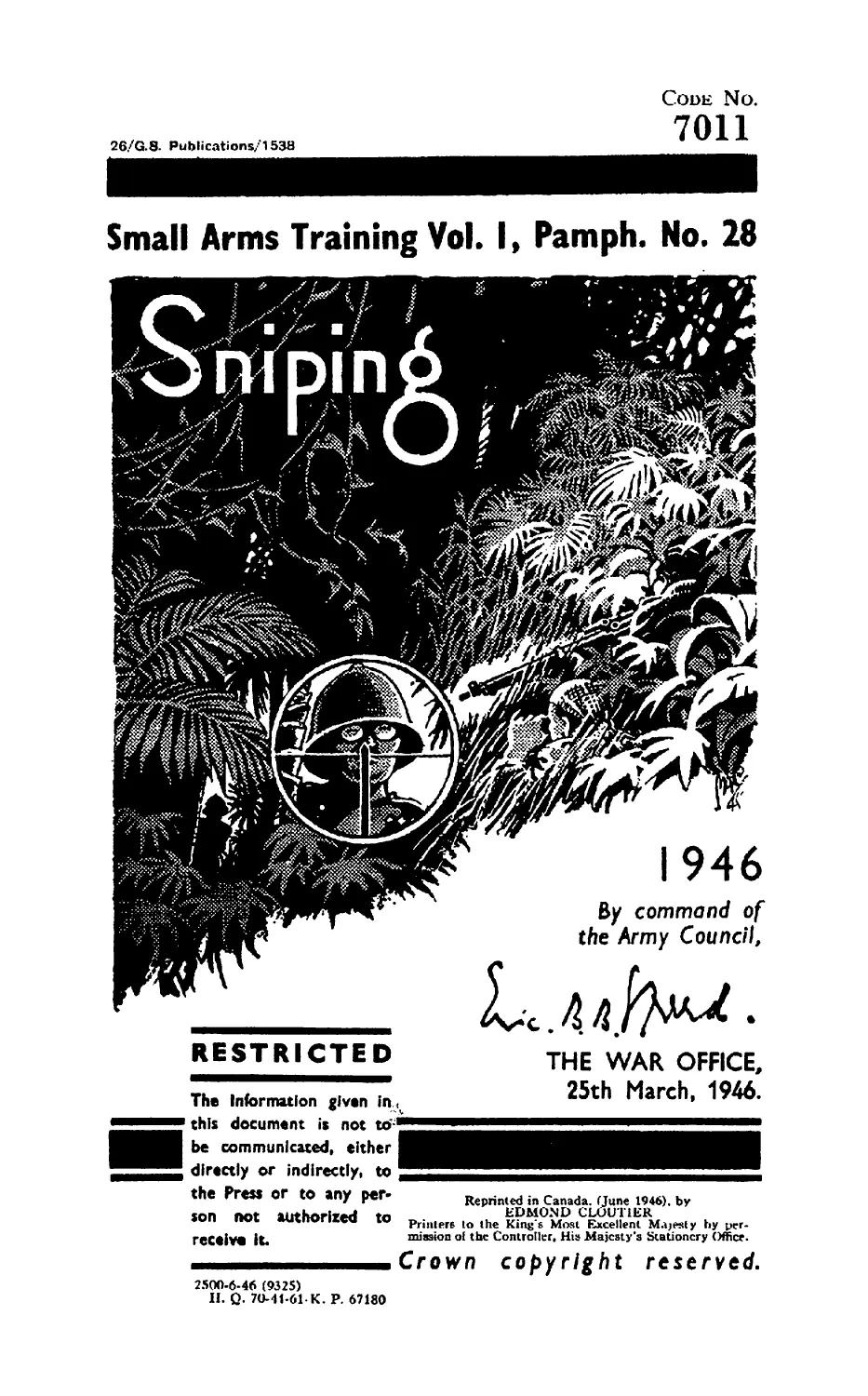
Small Arms Training Vol. I, Pamph. No. 28
RESTRICTED
THE WAR OFFICE,
The information given in,	25th March, 1946.
this document is not
either
directly or indirectly, to
the Press or to any per-
son not authorized to
receive it.
Reprinted in Canada. (June 1946). by
EDMOND CLOUTIER
Printers to the King's Most Excellent Majesty by per-
mission ol the Controller, His Majesty's Stationery Office.
rmu/» copyright reserved.
2500-6-46 (9325)
II. Q. 70-41-61 К. P. 67180
ii
Contents
Part I
Introduetion..................................................... Page	1
Chapter 1—
Section 1	Organiaation ..	..	,t	1
„	2	Equipment	,t	2
„	3	Characteristics and training of snipero ..	„	3
n	4	Selection of snipers........................... „	$
„	5	Tactical handling at sniper» .................. „	S
„	6	Mohfle warfare	„5
n	7	Static conditions ............................. n	6
Part П
Introduction	..	..	..	.. и 7
Chapter 2—Observation
Section S General .................................... „	7
9	The telescope and binocular»	„ 12
10	Location of fire	„16
11	Notes on observation training .................... n 17
Chapter 3—Fieldcraft
Section	12	General	...................................... „18
M	13	Concealment	.	„18
„	*	14	Movement	„ 24
„	15	Sulking	...................................... „29
„	16	Sniping from hades and building»..	„30
17 Notes on fielderaft training..	„3*4
Chapter 4—Shooting
Section 18	General ............................................. „35
„	19	Source» of error in the man and the	essentials of
shooting.......................................... „36
„	26	Source» ctf error in the rifle and ammunition .,	„38
„	21	Zeroing» application of group and coaching	„42
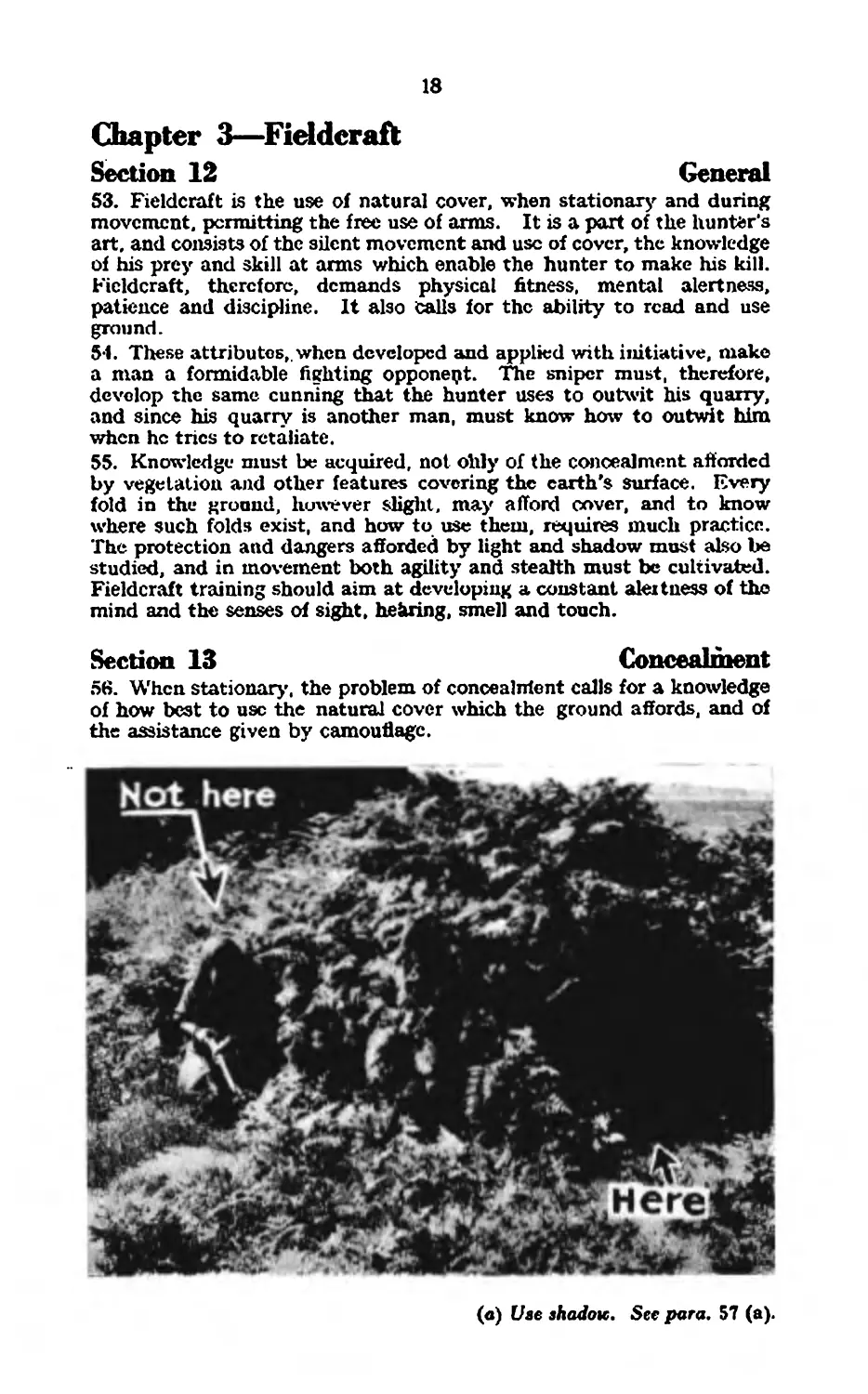
„	22	The No. 4 (T) sniper rifle........................... „45
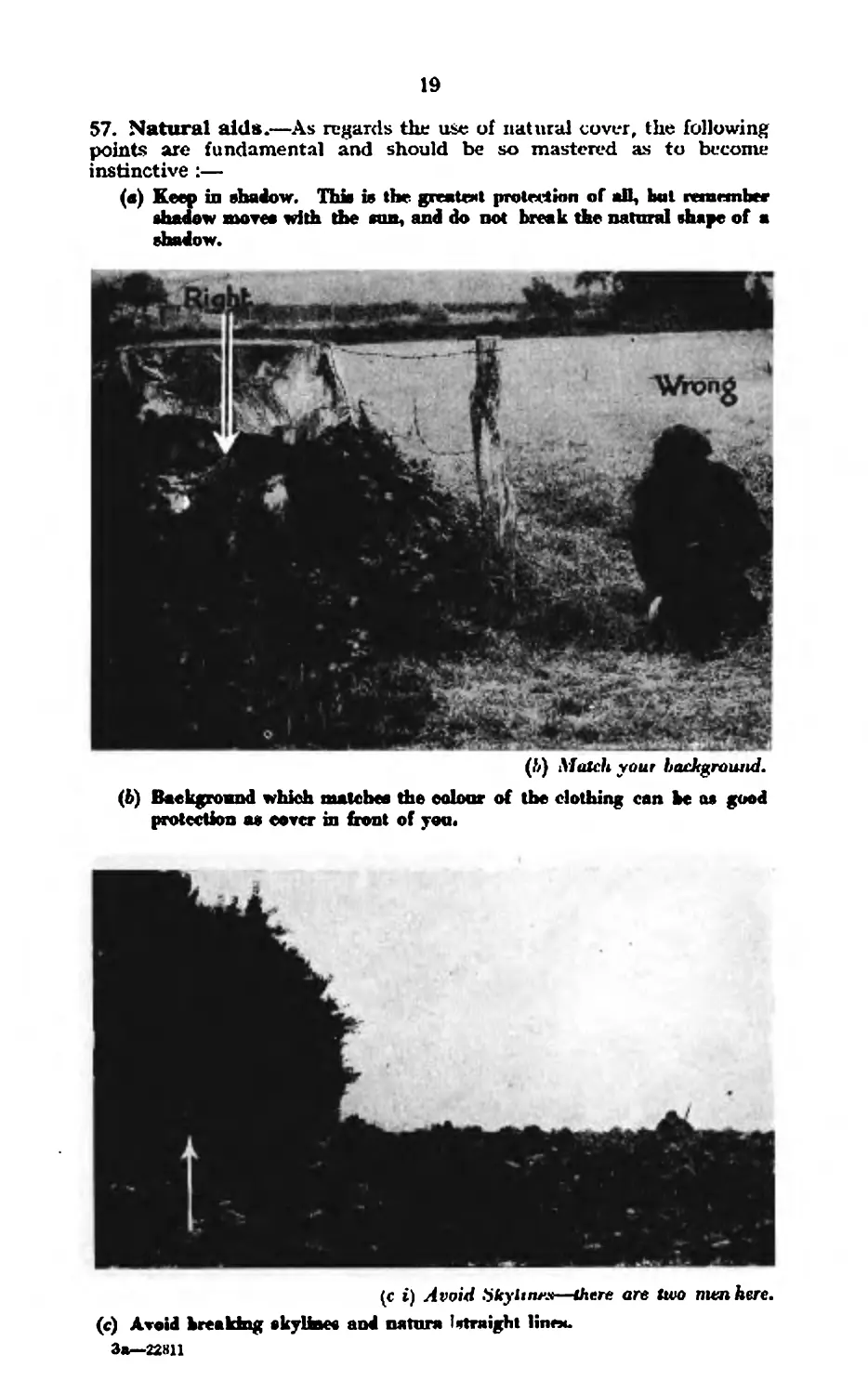
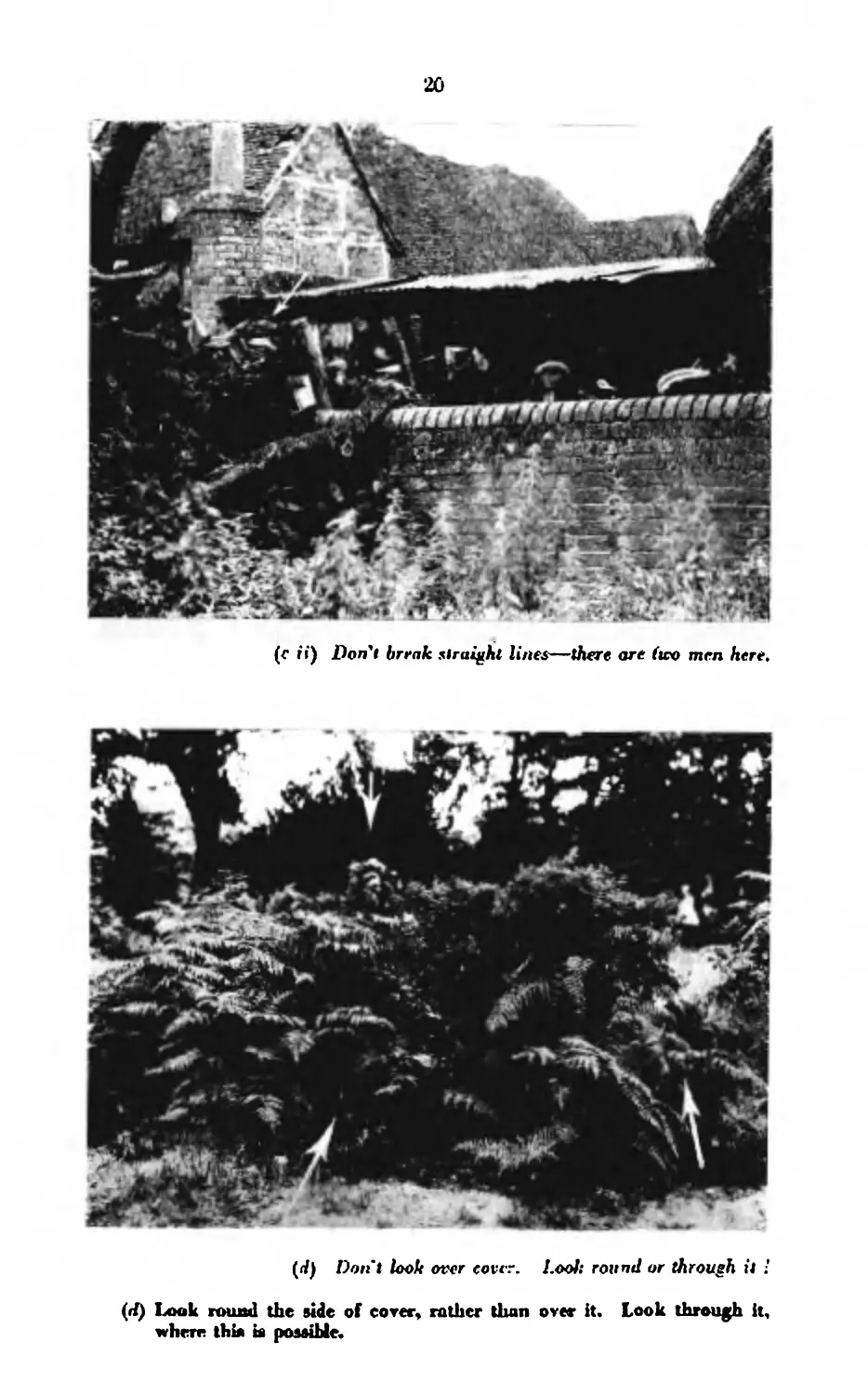
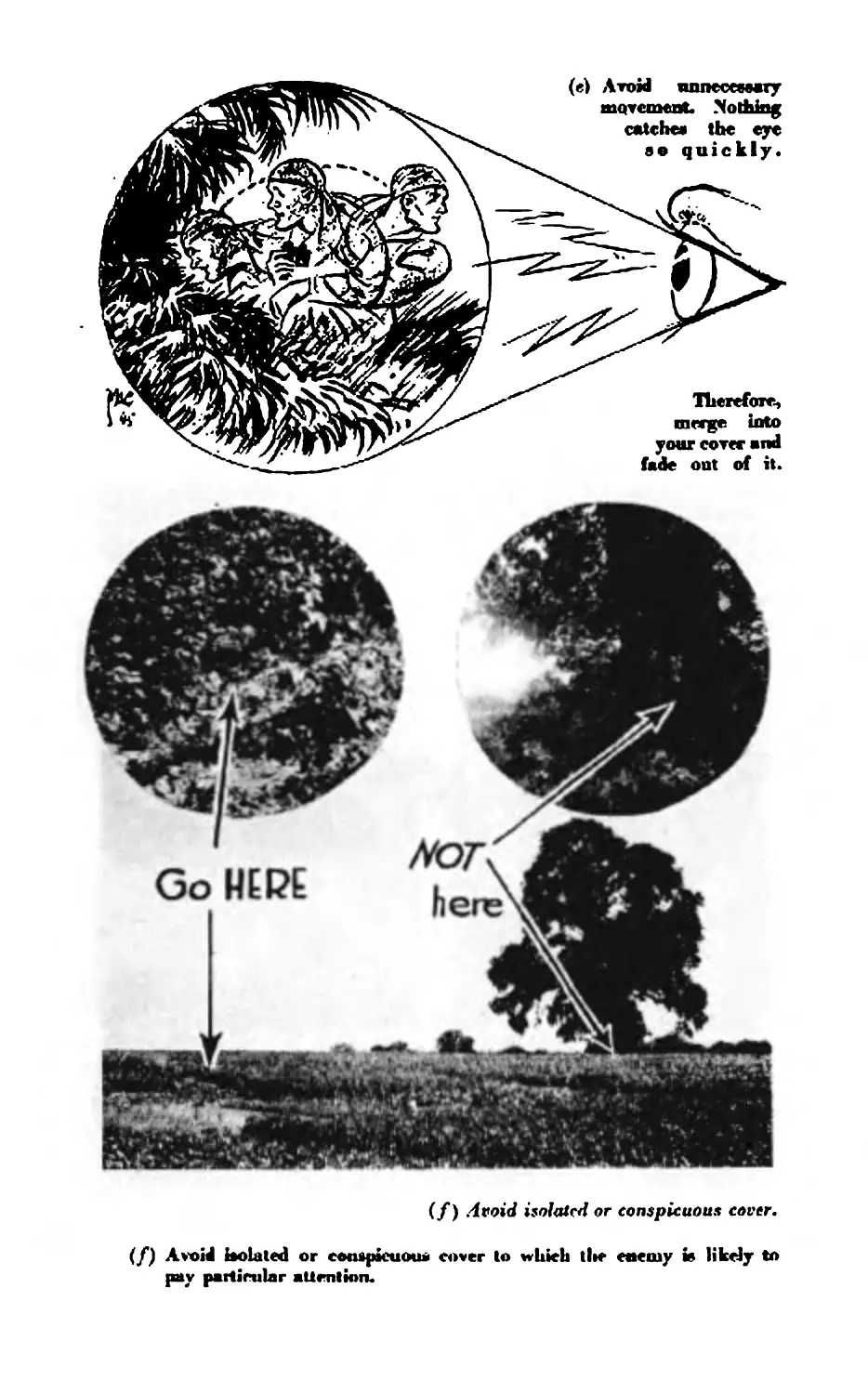
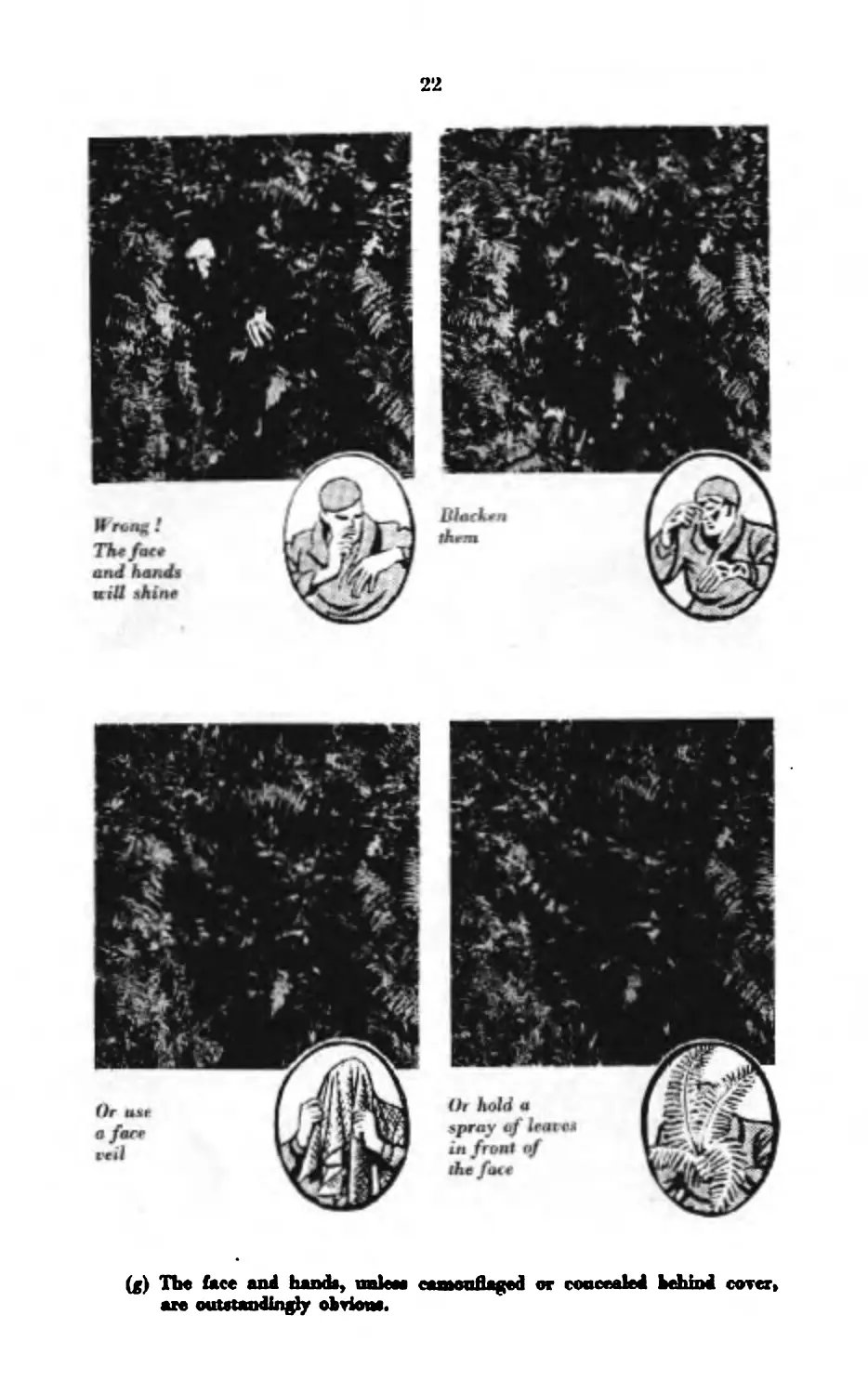
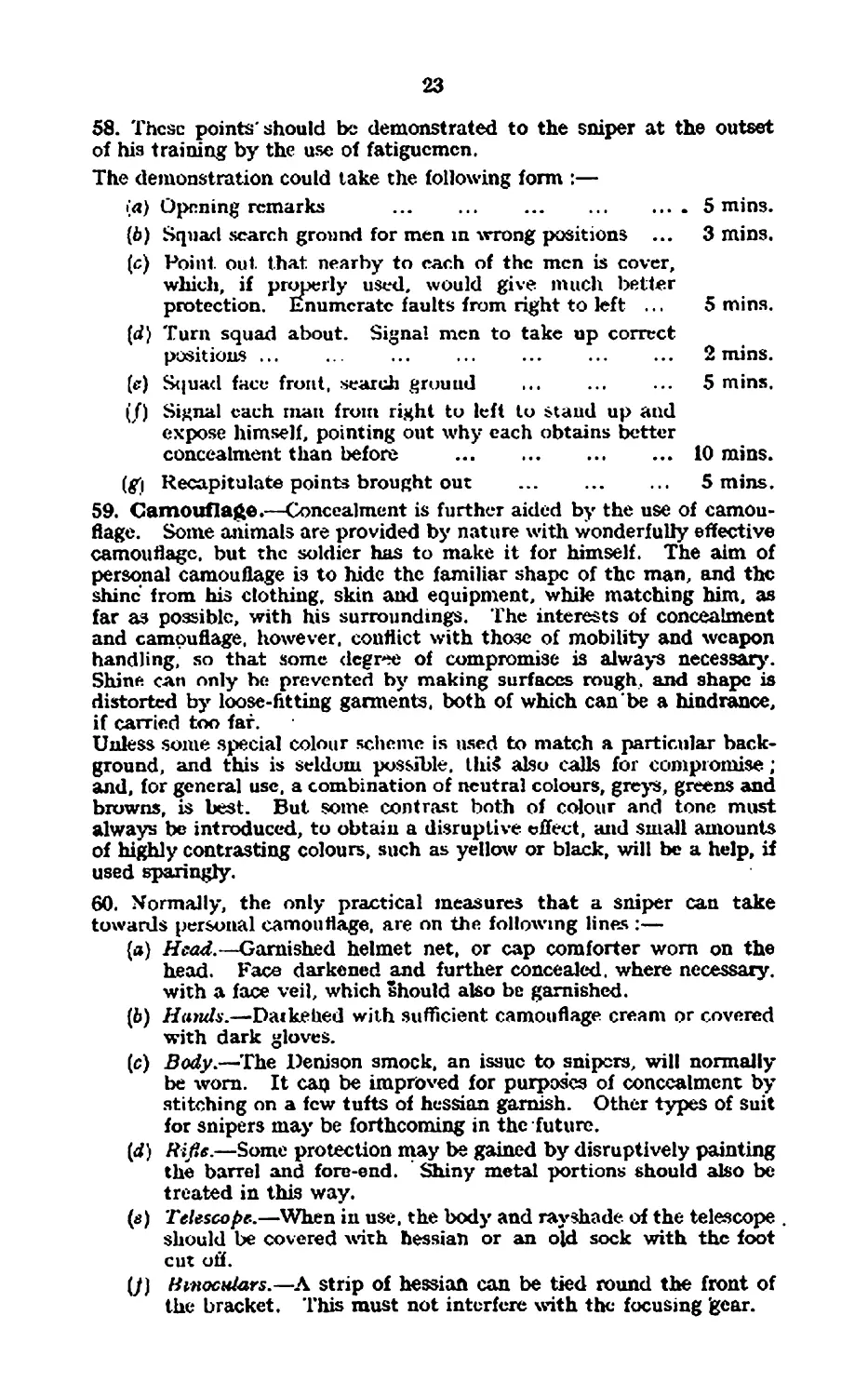
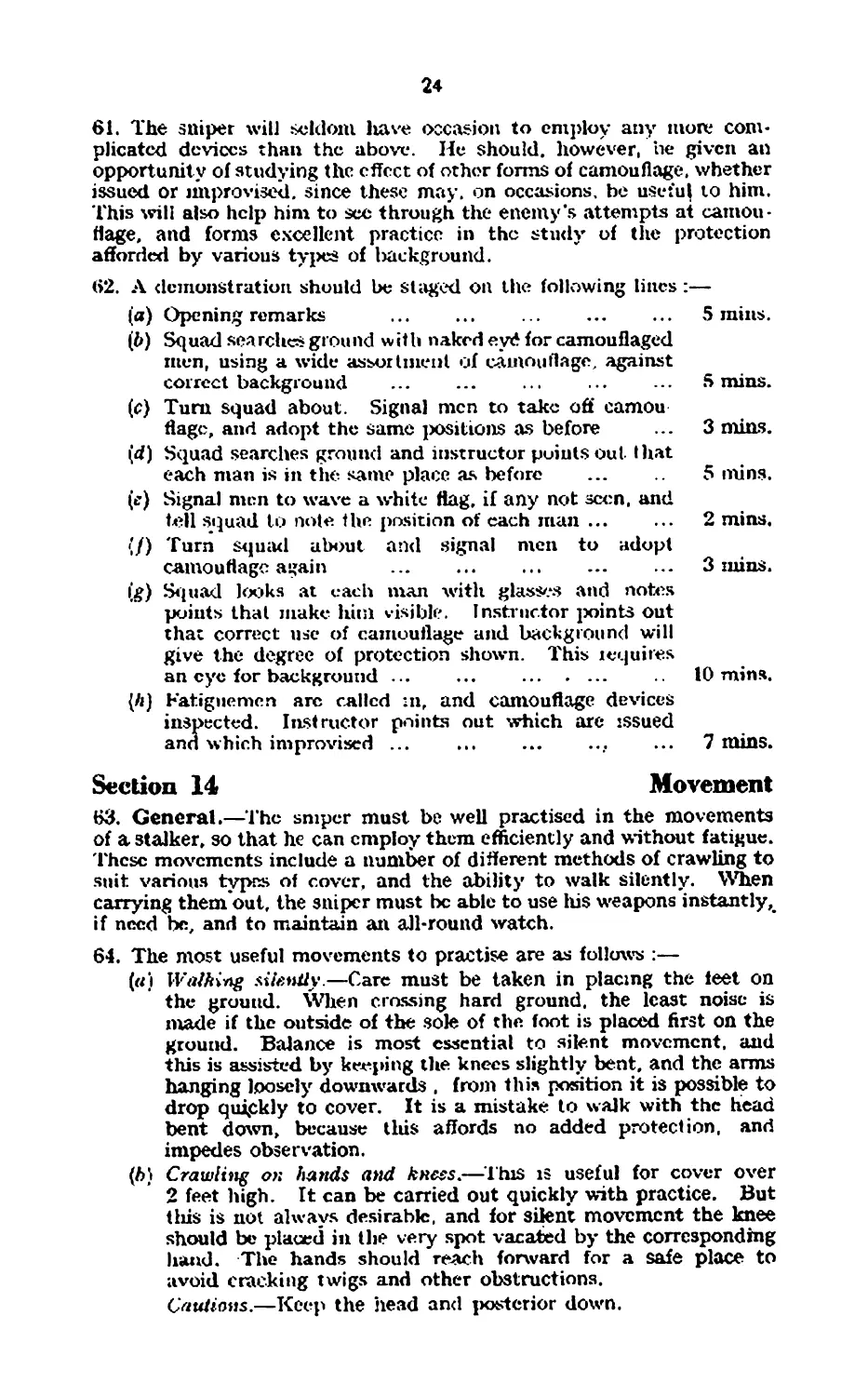
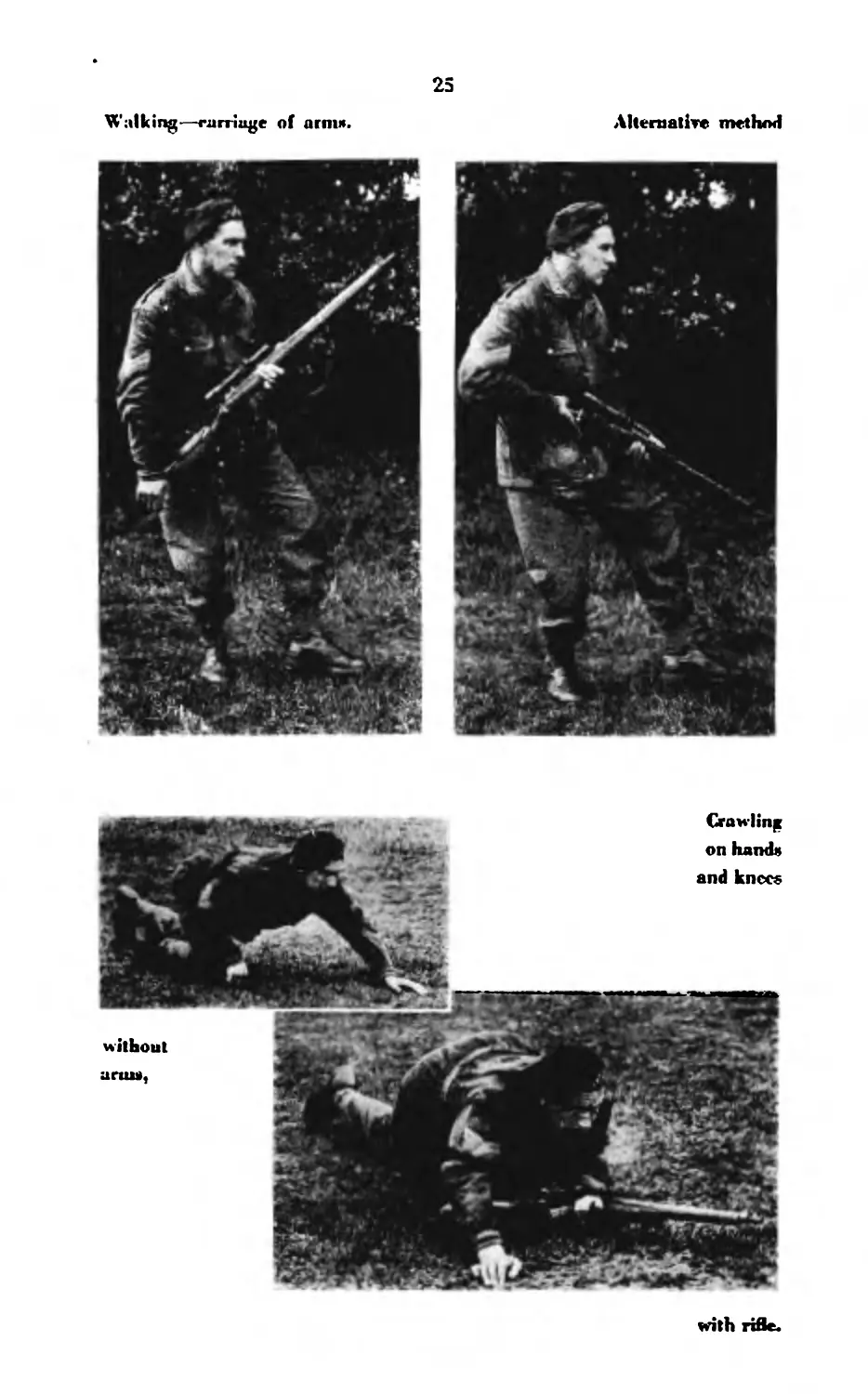
„	23	The No. 32 telescope sight .......................... „46
„	24	Dusk firing .. *.............................. „ 48
„	25	Aids to bidding ..................................... „49
„	26	Elevation table ..................................... „31
„	27	Aiming off for wind and movement	„ 52
„	28	Indication and recognition of targets	„54
n 29 Field firing excrosco .......................... ••	„55
1—22811
APPENDICES
A.	Syllabus for basic training coarse for snipers ..	. *	Page
B.	Range practices ..	............. „
C.	Tert for sniper’s badge ..	............. n
D.	No. 32 telescopic sight—Chart mrtraction................. n
DISTRIBUTION
Infantry	...................................Scale A phis 10
Small Anne School (Platoon Weapons).......................... 200	capita
School of .Infantry	•.	50 copies

ABBREVIATIONS
Л.Р.
B.L.R.
D.F.
E.M.E.R,
F.D.L.
I.O.
M.P.I.
ол>.
S.AA.
Armour piercing.
Beyond local repair.
Defensive fire.
Electrical and Mechanical Engineer Regulation.
Forward defended locality.
Intelligence officer.
Mean point of impact.
Observation post.
Small arms ammunitioo.
Small Arms Training
Volume I, Pamphlet No. 28
Sniping	Part I
Introduction
1. Opportunities will present themselves in all types of warfare for
the expert use of the rifle, as an offensive weapon. Although the title
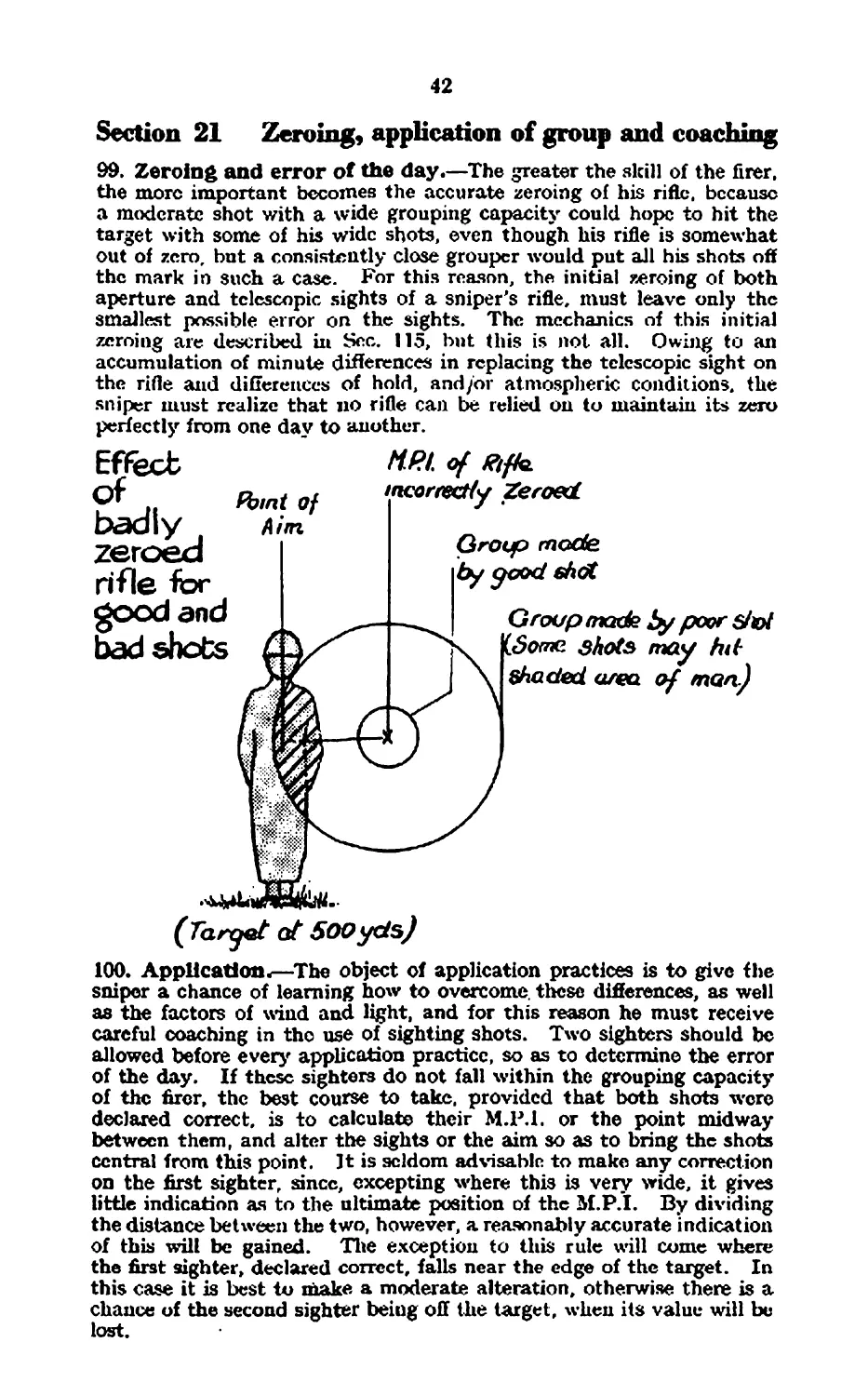
is still the personal weapon of the majority of infantrymen, special
training is required for its offensive use as an independent fire unit.
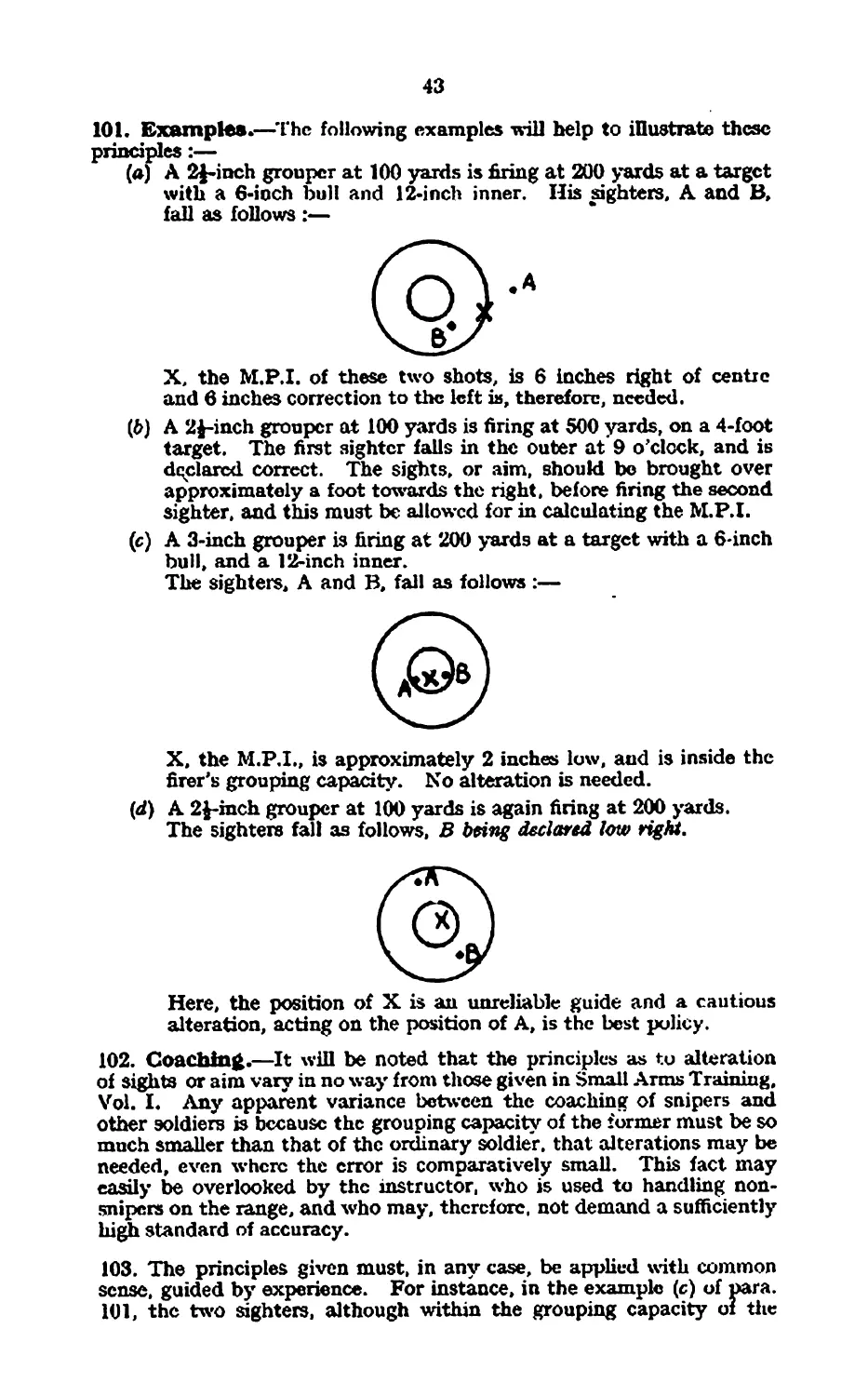
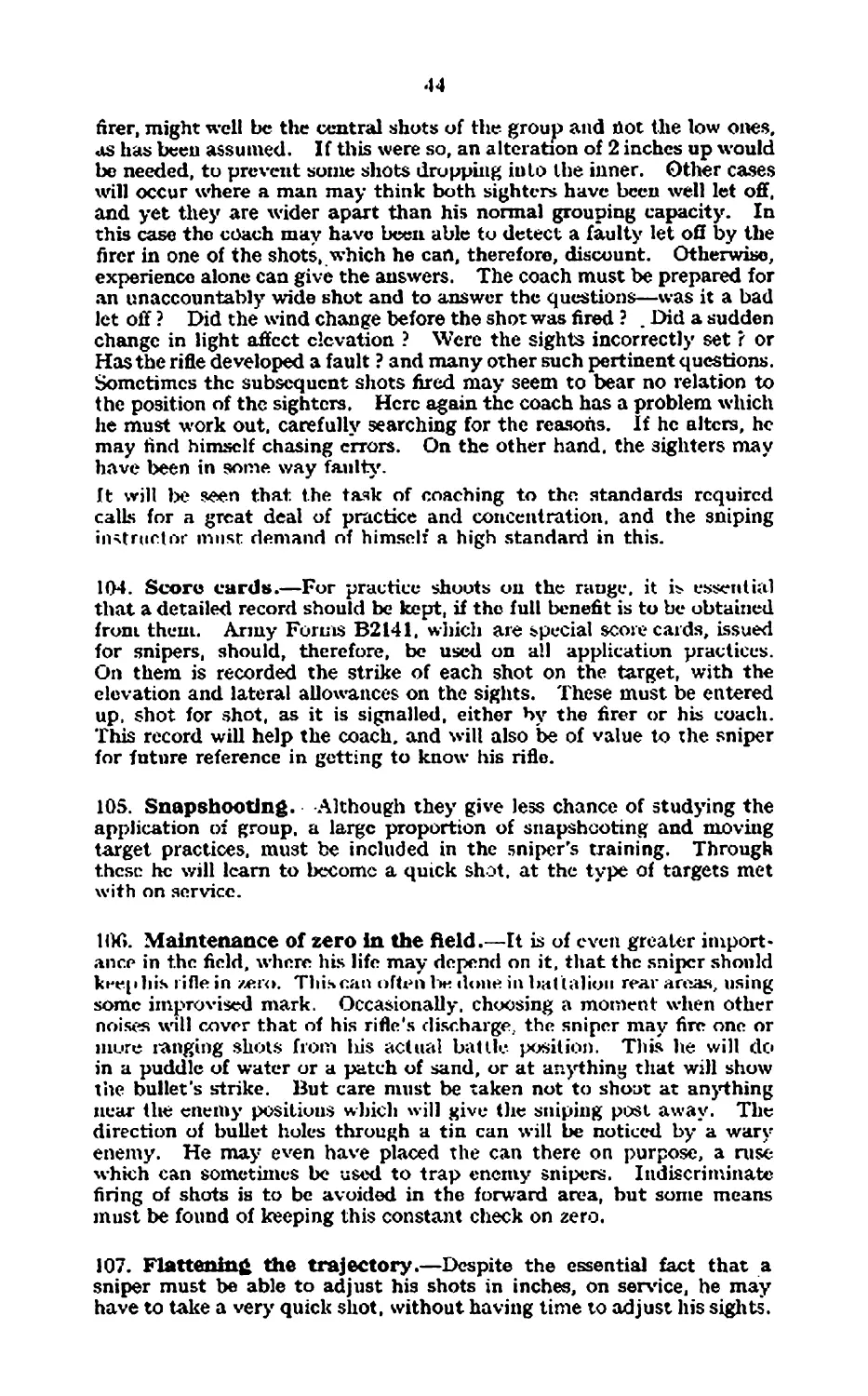
This training incorporates a wide variety of subjects, which aie as
important as skill with the weapon itself; and the value of such specialists,
or snipers, has been found to extend in many directions, beyond their
primary task of shooting.
The subject of sniping, therefore, though essentially dealing with the
use of the rifle, by the individual expert, must also embrace some of
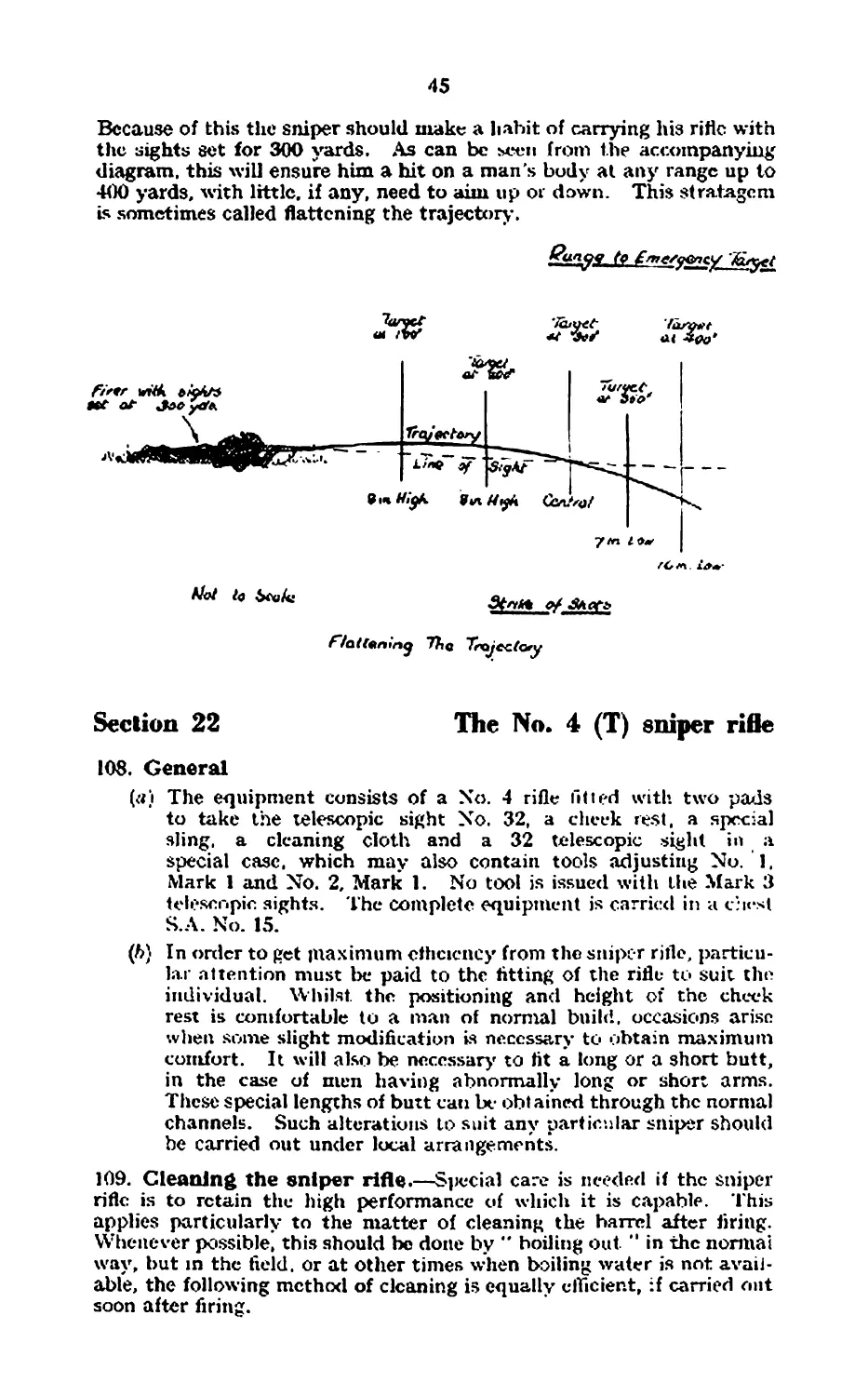
these important bye-products.
Chapter 1
Section 1	Organisation
2. The War Establishment of an infantry battalion provides for a sniping
section, on battalion headquarters, consisting of:—
1 Serjeant.
1 Corporal.
2 Lance-Corporals.
4 Privates.
3.	Although no specialist sniping officer exists on the battalion war
establishment, it is most essential that some officer having a thorough
knowledge of the subject should supervise their selection, training and
handling in battle. On paper the intelligence officer is responsible,
among his other duties, for them, but in practice some other officer is
often entrusted with these tasks.
On the enthusiasm of thA officer in question, on his judgment and skill
in choosing his team, and on his energy in directing their training and
operational tasks, the measure of their success depends. Whatever
their individual prowess, it has been found that this will be wasted,
without such leadership and support.
4.	As for all other specialists, it is necessary to train 100 per cent,
reserves of snipers. In battle, it may often be found necessary,
in order to provide reliefs, to employ these reserves operationally in
conjunction with the first line snipers.
3—22811
2
Section 2	Equipment
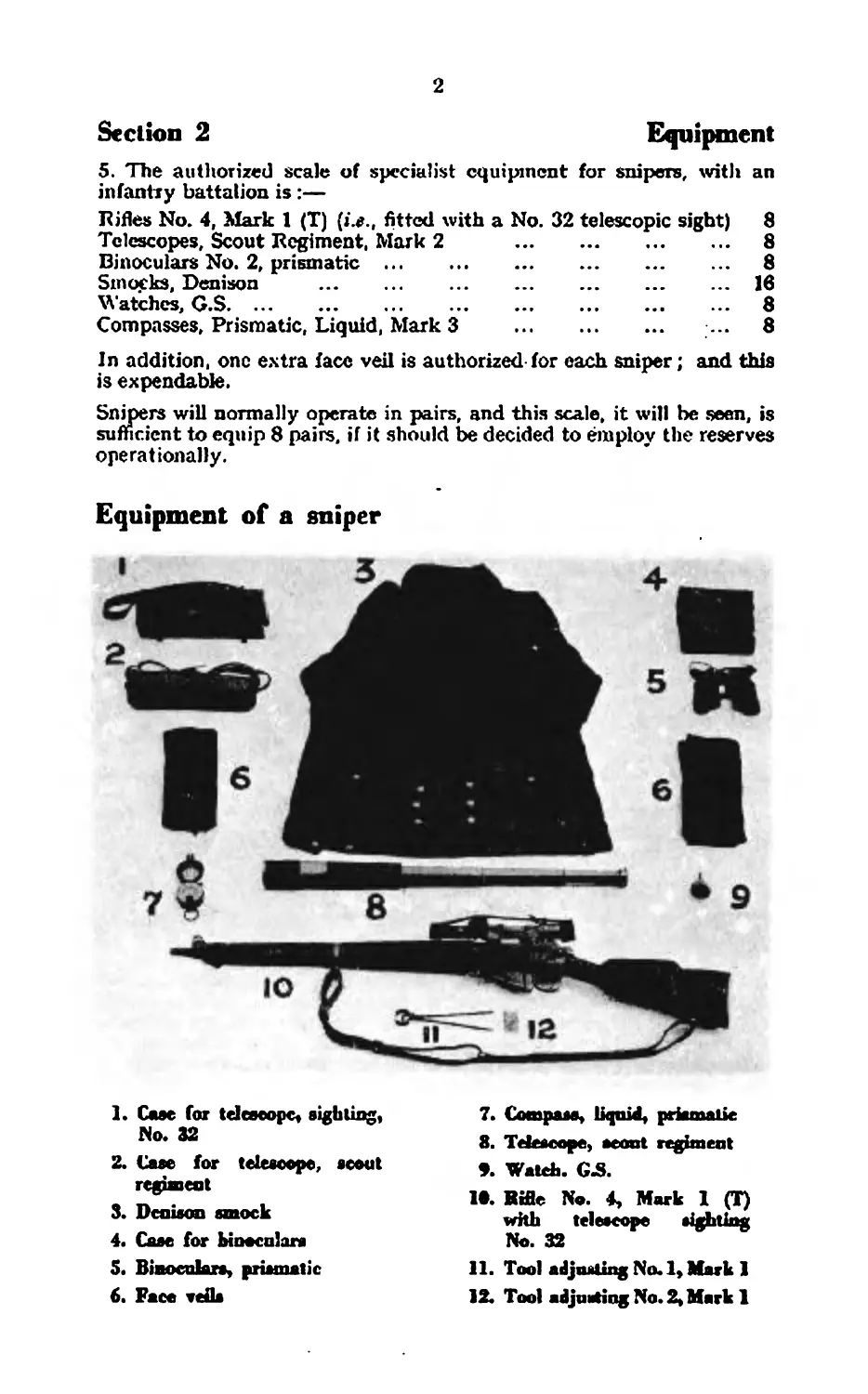
5.	The authorized scale of specialist equipment for snipers, with an
infantry battalion is:—
Rifles No. 4, Mark 1 (T) (i>., fitted with a No. 32 telescopic sight) 8
Telescopes, Scout Regiment, Mark 2	  8
Binoculars No. 2, prismatic..................................... 8
Smocks, Denison ..............................................18
Watches, G.S.................................................... 8
Compasses, Prismatic, Liquid, Mark 3	.............. ...	8
In addition, one extra face veil is authorized for each sniper; and this
is expendable.
Snipers will normally operate in pairs, and this scale, it will be seen, is
sufficient to equip 8 pairs, if it should be decided to employ the reserves
operationally.
Equipment of a sniper
1. Case for telescope, sighting,
No. 32
2.	Case for telescope, scout
regiment
3.	Denison smock
4.	Case for binoculars
5.	Binoculars, prismatic
6.	Face veils
7.	Compass, liquid, prismatic
8.	Telescope, scout regiment
9. Watch. СЛ.
It. Rifle No. 4, Mark 1 (T)
with telescope sighting
No. 32
11. Tool adjusting No. 1, Mark 1
12. Tool adjusting No. 2, Mark 1
3
6.	With the pair, a machine carbine, or an ordinary rifle, must be
carried by the man not having the sniper rifle, and the following extra
items of equipment have been found practicable :—
50 rounds S.A.A.
2 grenades (No. 36 or No. 77).
5 rounds tracer (kept separate from the ball ammunition).
5 rounds A.P.
1 water bottle.
1 emergency ration.
These items are liable to much variation, in accordance with the task
in hand. But the maxim must always be to travel as lightly as
possible. To this end the Denison smock, with its ample pockets, is a
most useful garment, because it eliminates the need for web equipment.
Section 3 Characterietice and training of snipers
7.	A fully trained sniper can be defined as* a soldier, who is trained
to locate an enemy, however well hidden, who can stalk or lie in wait
for him unseen, and who is an expert shot with the rifle. His object
is to kill with one round. He is the big game hunter of the battlefield,
and must combine the art of the hunter, the wiles of a poacher and the
skill of a target shot, with the determination to seek out his enemy.
8.	He must be trained not only in rifle markmanship, but also to a
high degree in observation and in ficldcraft. Without great skill as
an observer, he will seldom be able to find suitable targets : and without
a comprehensive knowledge of fieldcraft, he will rarely get to a fire
position within shot of his quarry; thus observation and fieldcraft
must be thoroughly understood by him.
9.	In addition, there is a large number of subjects, which will be of
great value towards making him a reliable and self-reliant hunter.
Many of them form a part of the three main subjects given above, but
some of the additional ones are map reading, compass work, photo
reading, reporting, and a knowledge of enemy weapons, identifications
and minor tactics.
There can be no real end to a sniper's training, in the hands of an
imaginative instructor, which partly accounts for snipers being
centralized in battalion headquarters/where their specialist training
can be continuous.
10.	The sniper's task is to kill individual enemy with single rifle shots
very quickly aimed if necessary. He will never fire a rapid suc-
cession of shots, except in self-defence. As a guide, the standard
of shooting to be demanded of a sniper will enable him to hit. with
regularity, a man's head up to 200 yards, and a man's trunk up to
400 yards, though this standard may well be surpassed. Under
favourable weather conditions, a chance may exist of hitting a man's
body up to 1,000 yards ; but shooting at anything approaching such a
range must be strongly discouraged, unless there is some very special
reason for doing so.
11.	Where a choice of targets exists, the sniper should ho trained to
pick out, carefully, the most important ones, such as enemy officers
and N.C.Os., who can often be recognized by their actions, as
well as the badges they may carry. Observers, snipers, signallers and
2г—22311
4
wireless men, runners, M.G. and mortar teams, or any man engaged on
some special task, are all targets to be sought after, and their loss to the
enemy will be out of all proportion to the number of rounds fired.
Other targets that can be effectively dealt with by accurate rifle fire
are loopholes or embrasures, which are often proof against the fire of high
trajectory weapons. Enemy weapons have themselves been put out
of action, on occasions, by an A.F. bullet, fired into their mechanisms ;
such action, where possible, is more effective than to deal, one by one,
with the team that mans the weapon.
12.	The light-collecting properties of the telescopic sight which are one
of its main advantages, permit of accurate fire under conditions of
half light, when iron sights would be useless. The best results at
sniping are often obtained on moonlight nights and at dusk and dawn,
at which times many tasks are carried out, and the enemy may be
lulled into a sense of security against aimed fitc, which facts should
therefore be exploited fully.
13.	The special observation training of a sniper, as well as the nature
of his work, result in him making an important contribution to
intelligence. If he makes efficient use of the observer telescope, which
has a very high power, he will normally see more than any other form
of O.P. He must, therefore, be framed, always to make a report after
carrying out any task. Snipers have often been of great assistance
to gunner O.Bs., and occasionally it may be worth giving them signal
communications. It must be emphasized, however, that the primary
task of snipers is to seek out and kill the enemy, and excepting
where there is no possibility at all of doing this, it is wrong to use
them purely fur manning an O.P., which is normally the task of the
intelligence section.
14.	The training of the sniper in fieldcraft will make him a valuable
soldier for many tasks other than sniping alone, but the tendency to
use him for all sorts of patrolling and scouting tasks is to be guarded
against, and should not be resorted to. where such jobs could be done
by less skilled men. Otherwise, since these tasks are apt to be very
strenuous, he will be frequently nut available for his proper role. On
the other hand, bold and original uses of snipers, on opportunity tasks,
can. if property planned, yield high dividends, particularly against
a retreating and disorganized enemy, and where the country lends
itself to infiltration.
15.	Snipers normally achieve the best results when operating in pairs,
for the following reasons:—
(a) One man cannot observe and shoot at the same time, and it is
a great help for him to have an observer to find and indicate
targets to him.
ib} Observation, especially with the telescope, involves great strain
and can only be continued for limited periods. The pair must,
therefore, be interchangeable.
(c} It is seldom possible for the fircr to observe the strike of his
shot. The observer will generally be able to do so, and give
any correction required.
5
(d) Mutual protection is afforded, especially during movement.
($) The moral effect of companionship in an otherwise lonely task
is considerable.
Against the above it will be apparent that when stalking the enemy
at close range, one man wfil have less chance of being seen than two :
and on such occasions, it is often better for the sniper to proceed
alone, possibly with his partner in a covering fire position to his rear.
Section 4	Selection of snipers
16.	In order to get good results from sniping great care is necessary
in selecting the men tor the task.w Experience has shown that the
primary consideration is a self-reliant personality, with a determination
to sock out the enemy, and a liking for the work. Without these
qualities the value of any others will be small; and it is especially
emphasized that skill as a shot is not in itself sufficient. The following
points, however, require attention.
(д) Eyesight and night vision must be good.
(b) A natural aptitude for fieldcraft is necessary. This and good
eyesight are generally to be found in countrymen, and especially
in keepers, stalkers and poachers.
(q Intelligence and initiative are required, since snipers work
independently, to a large extent, and must be trained in a wide
variety of subjects.
(c?) Promise as a shot is essential, since, unless he reaches a high
degree of skill with the rifle, the rest of the sniper's training is
purposeless. Provided a man has normal physical and mental
attributes and can group to within 6 inches at 100 yards, with
iron sights, careful coaching will generally bring him up to the
required standard.
Section 5	Tactical handling of snipers
17.	The best results from sniping are only achieved when the employ-
ment of snipers is carefully organized. Despite the independent nature
of their work, it has been found that little is achieved, and casualties
among the snipers themselves are unnecessarily high, unless this is done.
Thus sniping tasks will normally be planned on a brigade level; though
they may sometimes be decentralized to companies for specific purposes.
18.	Snipers are largely a weapon of opportunity, and broad principles
only can be given as to their use. These principles must Ims applied
with imagination, guided by a sound grasp of snipers' characteristics.
Section 6	Mobile warfare
19.	When conditions are mobile, snipers can often stalk and shoot
isolated enemy posts that cannot he located or are difficult to deal
with by other means. Isolated pillboxes, or M.G. posts holding up
an advance, have,- on many occasions, been overcome in this way.
20.	Under favourable circumstances, infiltration of snipers through
the enemy positions may be very successful; and when this is done
before an attack, they may give great assistance, by shooting enemy
в
weapon crews from the rear. On some occasions they have even been
able to interfere, in this way, with the enemy mortar positions, or gun
lines. When snipers are sent out on such tasks it is necessary to take
precautions against their becoming involved in our own fire plans.
21.	When interference is met with from enemy snipers left to delay
our advance, our own snipers may be of assistance in the role of counter-
sniping. The use of snipers by a retreating enemy is frequently
resorted to in close or wooded country, and the greatest success against
them is usually gained by hunting them with small parties consisting
of snipers or with snipers attached.
Section 7	Static conditions
22.	When a battle becomes stabilized, the prime object of sniping is to
dominate the no-man’s-land between the opposing forces. This entails
the prevention of enemy sniping, or front line observation, and inter-
ference with his freedom of movement and patrolling activity.
23.	The result of such a policy, if carried out offensively by well-trained
and well-organized snipers, will do mote than inflict casualties and
inconvenience on the enemy. It will also have a marked effect on the
security and morale of our own troops, and will result in a constant
source of information about the enemy. Conversely, it will have a
demoralizing effect on the enemy.
24.	The methods by which this object may be achieved will be governed
by many factors, such as the nature of the ground, the distance between
the opposing F.D.Ls.. the existence of minefields or other obstacles,
the degree of initiative held by the enemy, and the number of trained
snipers available.
25.	When the enemy positions are within the range for‘accurate rifle
fire, snipers xxn.ll normally operate within our own F.D.Ls, from hides,
or prepared positions, which must be carefully sited, so as to cover,
as far as possible, by interlapping arcs, the whole of the battalion front.
They must also be most carefully concealed and they should not be
sited close to company positions or O.Ps.
26.	When the distance between the opposing F.D.Ls. is too great for
rifle shooting, sniping posts, with good fields of view, should be
established forward of our F.D.Ls. This will enable snipers to hamper
or put a stop to enemy patrolling and other activities in no-man’s-land.
It will also provide a system of forward O.Ps., which will gain useful
observations, and add to the security of the main positions. Often
it will only be possible to get snipers to and from these posts under cover
of darkness. Where this necessitates the snipers remaining in the
post through the hours of daylight, great strain is put on the men
themselves, abd the question of reliefs needs careful consideration.
27.	The posts should be reconnoitred and allocated personally by the
officer in charge of the snipers, whose responsibility it is also to ensure
that they do not come within any of our own D.F. tasks, which may
have to be altered to fit in with.sniping operations. Full information
about our own and enemy troops and minefields should be given to the
snipers, and they should be briefed in the manner of a patrol. All
troops must be warned of the operation of snipers on their front, or
7
casualties among the snipers will occur from our own fire. On the
other hand it is often possible for fire support, from our F.D.Le. to be
made available to the snipers ; and where this is so it should be arranged.
28.	When distance between the opposing sides is very great, and the
enemy has no highly organized defence, snipers can be sent well out in
front of our own lines. They will then operate on beats, rather than
from static posts, with the object of stalking whatever enemy positions
they can find. This will gain information about the enemy, as well as
helping to further an offensive policy. It will sometimes be worth
while to send out a small patrol, with a party of snipers. This will
establish itself in no-man*s-land, as a firm base from which the snipers
can operate.
29.	Careful consideration should be given as to the most suitable times
for snipers to operate, as well as to the place from which they should
do so. The limited number or snipers available makes it impossible
to have them operating at all times, and quite frequently the best
chance of their getting a shot will be in the half-light of dusk and dawn,
or during moonlight. This is particularly so where our superiority
of fire has driven the enemy to ground, during the hours of daylight,
or when there is much enemy patrol activity by night.
Part П
Introduction
30.	This part is for the guidance of officers and N.C.Os. responsible
for the training of snipers. It is divided into three chapters» on
observation, fieldcraft and rifle shooting respectively, which have
been made as comprehensive as possible, so that courses of training
can be based on it.
Sniping is,, however, nothing more than the basic task of the infantry
soldier, developed to such a degree that it has become a specialist one.
There must, therefore, be a certain amount of overlapping between
this pamphlet and certain other textbooks of basic infantry training.
Moreover, there are certain subjects, mentioned as being useful to a
sniper, that are fully dealt with in other pamphlets, and cannot be
included here.
Thus the sniping instructor must possess a thorough knowledge of the
relevant matter in Small Arms Training, Volume I, and Infantry
Training, Part VIIГ. For map reading and compass work and for
panoramic sketching, Notes on Map Reading must be consulted.
Reporting and Photo Reading are dealt with in the Manual of Military
Intelligence, and information about enemy equipment and identifi-
cations is given in various intelligence publications.
Chapter 2—Observation
Section 8	General
31.	A highly developed sense of sight is essential to a sniper, not only
because it is on this that he depends to find his quarry, but also because
it will afford him protection against his enemies. Besides this he may
often be called upon to help in the task of collecting intelligence, and
8
it istitting that he should excel in what is an integral part of his specialist
training. Observation is the first step towards offensive sniping, and
in this, as in the subject of ficldcraft. it is necessary to re-develop a
natural sense, which has been allowed to deteriorate, by conditions
of security and civilization. The shikaris of India, the trappers of
Canada, tlw hunters of the European forests, decr-stalkers and poachers,
and all who have to pit themselves against wild animals, have retained
the quick and perceptive eyesight that becomes of great value in war.
But the townsman whose eyes need seldom exert themselves for day-to-
day existence, can only develop a keenness of vision with much training
and practice.
32.	Training of the eye.—Proficiency as an observer comes rather
more from a mental attitude than from physical endowment, and both
of these qualities must be considered.
As regards the physical aspect, although no two men may have equally
efficient eyesight, in most it can be developed to an adequate degree.
This involves purely and simply a muscular conditioning of the eyes,
through practice, like marching conditions the body for route marching,
or boxing improves the muscles for boxing. And so. as for the sprinter
and the marathon runner, each of whom requires to train for a special
type of running, the observer should train his eye over the distances,
and in the outdoor surroundings that the circumstances of war will
demand.
33.	Mental alertness.—In the mental aspect, even more than in the
physical, the observer can learn from the hunter, by emulating the
hunter’s alertness and patience, his attention to detail and powers of
deduction, which must be of the highest order, to lead him to his
quarry. A hunter learns to notice scores of little things, the bending
of a blade of grass, the unnatural shape of a shadow, or a disturbance
of the undergrowth, from which he can deduce causes that would escape
the casual observer.
34.	It is from such signs that a good observer wall often learh most
about the enemy, for when the enemy is skilful in concealing himself,
his actual troop movements will be seen very rarely. At such times
much can still be learnt of his whereabouts and activities. An open
window, that was closed before, a wisp of smoke, or a fowl disappearing
from a derelict farm yard, all carry their significance.
The actions of birds and animals, differing according to whether they
are wild or domestic, frequent!}' give a clue as to the presence of man ;
and a close study of the ground under observation will often draw
attention to any future change in its features. Such changes may reveal
the construction of a new enemy post, even though the post itself is
cunningly camouflaged.
35.	Mental alertness and the ability to notice such details as these
with the faculty of drawing conclusions from them, is, therefore, of
great importance to the sniper. The good observer must also possess
patience, and thoroughness. If he notices an object of suspicion,
the nature of which is not immediately obvious, he will mentally
examine it from every angle, and will not rest until he has made it out.
For such close scrutiny the telescope is an unequalled aid.
36.	Light.—The sniper must know that the light is always changing
and that alqiost from minute to minute, the visibility of objects will
change-with it. For him this means that his watching must be constant.
9
so that no opportunity is missed of making some new find. He must
also know when the light is likely to be in his favour and when other-
wise. If the sun is behind him he will have the advantage ; and when
it is low to his front, observation will be difficult, and the lenses of his
glass may flash and give him away. The clearest light often comes just
before or after a rain shower, and he must be quick to take advantage
of such opportunities.
37.	Use of glasses*—The use of glasses takes a high place in his train-
ing. The binoculars and observer’s telescope, with which the sniper
is equipped, are indispensable to him. and he must master their use.
Binoculars are comparatively easy to use. and are valuable both in
assisting a quick survey of the ground and also for observation by
night. But the use of the telescope requires much training and practice,
if good results are to be obtained. It must be brought home to the
sniper, by practical demonstration if possible, how much detail the
telescope will reveal; for its high magnification makes it greatly
superior to binoculars, in picking up small or well-concealed targets,
.and also for observing at long ranges. In both these respects the
telescope is unsurpassed, which is why the deer-stalkers of Scotland
carry it in preference to a pair of binoculars.
38.	System in observing*—Whether or not he is using glasses, the
observer must cover systematically the whole of the area for which he
is responsible. Unless he does this he is bound to miss many items of
interest. According to the nature of the ground, the following systems,
or combination of them, will be found useful.
(a)	Division of the ground into sectors, as dictated by the? natural
lines of roads, hedgerows, etc. Each sector can then be searched
separately.
(b)	Division into foreground, middle distance and distance. These,
however, are not always easy to define.
($) Working over the ground, or a sector of it, in strips. This
method is well suited to the use of glasses, and the strips should
overlap slightly, in the manner of a mowing machine mowing
a lawn. The instrument should be moved slowly, so as to allow
each field of view to be examined, before passing on to the next.
39. It. is a natural inclination to pay particular regard to what appear
to be likely spots. This is. in fact, sound, so long as the rest of the
area is not neglected. It is a part of the skill of the observer to know
what, in fact, are likely places to find the enemy. But he must also
remember that the enemy, for his part, will try to avoid the obvious.
40. Familiarity of objects. Some effort must be made to make the
sniper familiar with the appearance of the kind of objects for which
he will be searching. If this is done he will stand a far better chance
of recognizing them under difficult conditions. Familiar objects will
always tend to arrest the eye ; but unfamiliar ones, or even familiar
ones seen from an unusual angle, or draped with camouflage, may easily
pass for an item natural to the countryside. A study should*, therefore,
be made of enemy weapons and camouflage; and if possible these
should be used in training.
41.	Fatigue*—Comfort, combined, of course, with concealment, is
very necessary towards getting good results. An observer must be
prepared to keep patient watch for long periods on the chance of seeing
even one item of note, and if he is uncomfortable he will be unlikely
to do so.
Observation, moreover, entails great eyestrain, and it is necessary to
cultivate unstrained watching to minimize this. A telescope that is
10
slightly out of focus, or an uncomfortable position, will aggravate
strain ; but it can be avoided to some extent by using,alternate eyes,
and, if possible, taking turns with another man. Do not observe with
one eye screwed up tight, even with a telescope ; and look at something
green, such as grass, to rest tired eyes.
42.	Reporting.—Snipers should be trained always to keep a log of their
observations, so that the value of these* will not be lost to Intelligence.
Such a log. a specimen of which is given below, should always :>e handed
in to the Battalion Intelligence Officer at the end of a sniper's tour
of duty. Some training should, therefore, be given to sniper? m report-
ing. Accuracy in any of their reports must bn made a point of honour
with them; but their deductions and suspicions are also valuable,
and should be encouraged, so long as they state them specifically as
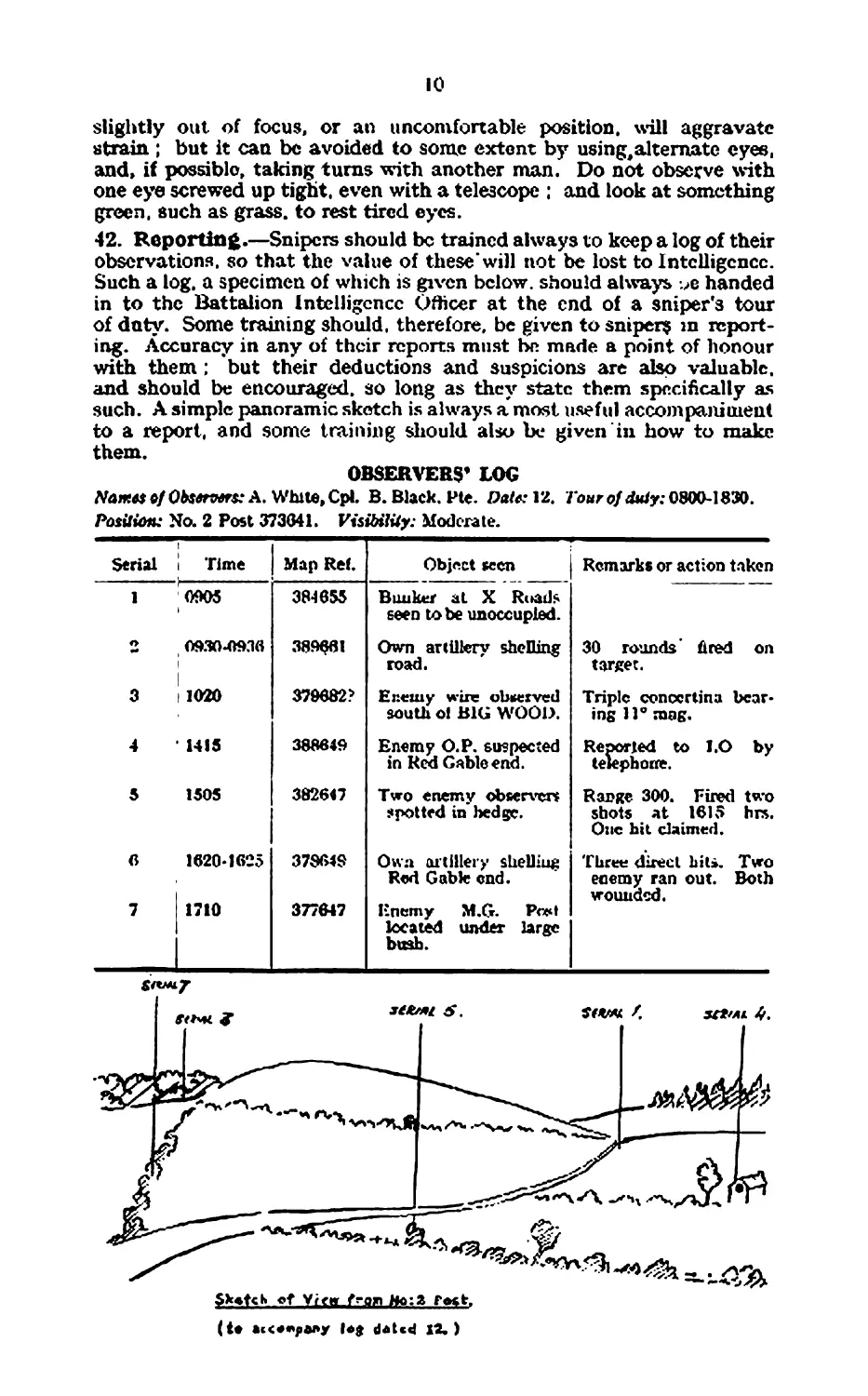
such. A simple panoramic sketch is always a most useful accompaniment
to a report, and some training should also be given in how to make
them.
OBSERVERS9 LOG
Whlte,Cpl. B. Black. Pte.	Lour of Ad/.-0800-1830.
Position: No. 2 Post 373641. Visibility: Moderate.
Serial	i Time	Map Ref.	Object seen	Remarks or action taken
1	0905	384655	Bunker at X Roads seen to be unoccupied.
2	0930-09.16	389661	Own artillery shelling road.	30 rounds* fired on target.
3	i 1020	379682?	Enemy wire observed south 0! BIG WOOD.	Triple concertina bear- ing 11° mag.
4	* 1415	388649	Enemy O.P. suspected in Red Gable end.	Reported to 1.0 by telephone.
5	1505	382647	Two enemy observers spotted in* hedge.	Range 300. Fired two shots at 1615 hrs. One hit claimed.
6 7	1620*1625 | 1710 J		379649 377647	Own artillery shelling Rod Gable end. Enemy M.G. P«*t located under large bush.	Three direct hili. Two enemy ran out. Both wounded.

(t«	log dotc4 X2. )
11
43.	Night observation.—Training is also necessary in observation
by night. This differs from daylight observation mainly in that the
sense of hearing becomes of greater importance in proportion as the
value of sight decreases. The training can, therefore, be divided into
two parts—visual training and training in hearing.
44.	Visual training.—Night observation differs from observation by
day, not only because there is less light to see with, but also because
the eye uses a completely different set of nerves in the dark. By day,
or in artificial lighting, these night nerves are blinded and are not
used at all. By night the day nerves are useless. Night sight varies
in different men, but in all cases it can be greatly improved by practice.
The most important considerations affecting visual training by night
arc as follows :—
(a)	The night nerves are more numerous towards the sides of the
eye than in the centre. The most detail is, therefore, seen by
looking slightly away from an object rather than directly at it.
(b)	At night the eye " sees slowly ". and it may be necessary to
look for several seconds in one direction before an object
becomes visible. When searching, therefore, the eye should
move from point to point, resting for a few seconds at each
point, and again remembering that the keenest vision is obtained
away from the centre of the held of view.
(c)	Broad shapes and silhouettes only will be seen, small details
being invisible by night. Objects will, therefore, tend to look
different from what they do by day. For example, trees seem
smaller by night, because the twigs arc not visible. This makes
it very difficult to judge distances, and also makes a daylight
reconnaissance very desirable.
(d)	.The night nerves are colour-blind. An object is only visible
from its contrast in tone, with that of its background. Light
objects show up against dark backgrounds, and trite versa.
They show up best of all against the sky; so the observer
should keep to the low ground, to obtain an extensive skyline.
(p)	By night, moving objects are much more easily seen than
stationary ones.
(/) The eyes will tire very quickly at night, though the observer
himself will probably fail to notice when this is so. They
should, therefore, be rested for 10 seconds, after every two
minutes of observing.
(g)	Unstrained searching must be cultivated. It is important not
to stare at objects, or the eye will quickly tire, and the object
itself will appear to move ; ’ so that inanimate objects such .as
fence posts or bushes may be mistaken for men. This is another
reason for careful daylight reconnaissance.
(Л) The night nerves take up to 30 minutes to gain full efficiency,
after being in a bright light. This should be remembered
when going ont into the darkness from artificial lighting. The
accommodation of the eye can be lost in a few seconds, by
looking at a bright light, which must, therefore, be avoided.
Where this is unavoidable, the ill-effects can be minimized
by closing one eye. When reading a map with a torch this
should, in addition, be shaded as much as possible.
12
(t) Binoculars will give good results on all but the darkest nights,
and should always be carried. It is important that they should
be correctly focused or a serious loss in efficiency will result.
Care is needed over this, because incorrect focusing may not
be noticed by the observer, even though it is present. The same
applies to the correct setting of the distance between the eye-
pieces ; and dirty lenses must also be guarded against. Night
focus will differ slightly from the normal day focus, and can beet
be adjusted on some object, such as a tree, silhouetted against
the sky.
45.	Hearing. — The sniper should be practised in recognizing sounds
by night, and in locating titeir direction and distance. Sounds carry
farther and more clearly in the dark than they do by day, which makes
their distance extremely deceptive. Their strength is also influenced
by weather conditions and the nature of the country. It is a good
thing to find out which is the master car, because this will influence the
sense of direction of sounds. The bearing is most acute when the
head is uncovered, and for picking up some slight sound is further
assisted by closing the eyes and slightly opening the mouth.
Section 9	The telescope ani binoculars
46.	The telescope, scout regiment
(a) General. A telescope is a delicate instrument, and can easily
be damaged unless properly cared for. The model authorized
for snipers is the Scout Regiment, Mark 2, which has a magnifi-
cation of 20. Other models may be met with on service, but
all have similar characteristics. The high magnification of the
telescope makes it possible to pick up small objects at great
ranges, but its small field of view necessitates skilful handling.
It is an essential part of the sniper's equipment.
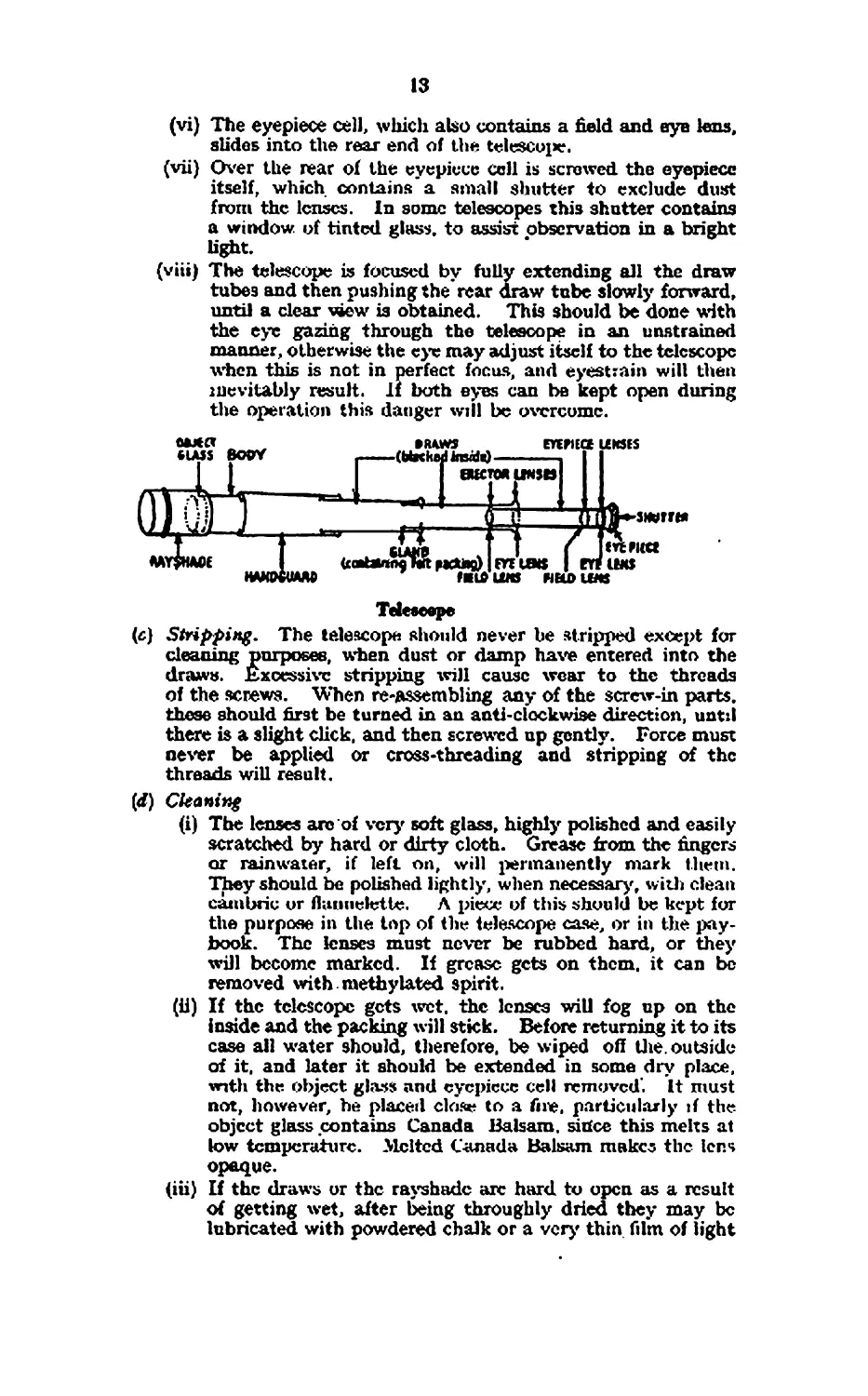
(d) Description
(i)	The telescope consists of three gjoupe of lenses, contained
in four metal tubes, which slide into one another.
(ii)	The largest of the four tubes is called the body, and contains
the object glass cell. The front part of the body slides
out over the object glass, and is called the rayshade, and
the leather covering of the body is called the handguard.
(iii)	The smaller sliding tubes are called draw tubes, and are
attached tv one another by means of cells, which contain
packing made of felt or some similar material.
(iv)	The object glass consists of two lenses held together in a
cell, which screws into the front of the body. In some
telescopes the two lenses are stuck together by a thin film
of optical cement.
(v)	In the front end of the rear draw tube is the erector cell
which holds two lenses, the field lens in front and the eye
lens in xpar. Without tins group, everything seen through
the telescope would appear upside down. In the middle
of this cell is a diaphragm, with a small hole in the centre
called the pupil.
13
(vi)	The eyepiece cell, which also contains a field and eye lens,
slides into the rear end of the tele$cui»e.
(vii)	Over the rear of the eyepiece cell is screwed the eyepiece
itself, which contains a small shutter to exclude dust
from the lenses. In some telescopes this shutter contains
a window, of tinted glass, to assist observation in a bright
ligbt.
(viii)	The telescope is focused by fully extending all the draw
tubes and then pushing the rear draw tube slowly forward,
until a clear view is obtained. This should be done with
the eye gazing through the telescope in an unstrained
manner, otherwise the eye may adjust itself to the telescope
when this is not in perfect focus, and eyestrain will then
inevitably result. If both eyes can be kept open during
the operation this danger will be owrcumc.
Teleseepe
(c)	Stripping. The telescope should never be stripped except for
cleaning purposes, when dust or damp haw entered into the
draws. Excessive stripping will cause wear to the threads
of the screws. When re-assembling any of the screw-in parts,
these should first be turned in an anti-clockwise direction, until
there is a slight click, and then screwed up gently. Force must
never be applied or cross-threading and stripping of the
threads will result.
(d)	Cleaning
(i)	The lenses arc of very soft glass, highly polished and easily
scratched by hard or dirty cloth. Grease from the fingers
or rainwater, if left on, will permanently mark them.
They should be polished lightly, when necessary, with clean
cambric ur flannelette. Л piece of this should be kept for
the purpose in the lop of the telescope case, or in the pay-
book. The lenses must never be nibbed hard, or they
will become marked. If grease gets on them, it can be
removed with methylated spirit.
(ii)	If the telescope gets wet. the lenses will fog up on the
inside and the packing will stick. Before returning it to its
case all water should, therefore, be wiped off the. outside
of it, and later it should be extended in some dry place,
with the object glass and eyepiece cell removed. It must
not, however, he placed close to a fire, particularly if the
object glass contains Canada Balsam, since this melts at
low temperature. Melted Canada Balsam makes the lens
opaque.
(iii)	If the draws or the rayshadc arc hard to open as a result
of getting wet, after being throughly dried they may be
lubricated with powdered chalk or a very thin film of light
и
oil. Oil must be used very sparingly and with core, to
prevent any of it getting on to the lenses.
(e)	Care of the telescope
DO (i) Always draw the rayshade first. Many O.Ps. have been
given awayjby the sun flashing on the object glass.
(ii)	Draw and close the telescope gently, and with a clockwise
turning movement. This will * prevent damage to, or
unscrewing, of the glands.
(iii)	Mark the focus with a ring scratched on the rear draw,
to facilitate quick focusing.
(iv)	After closing the telescope, shut the eyepiece shutter to
exclude dust.
DON'T (i) Touch the lenses with the fingers. The skin always
contains a certain amount of oil.
(ii	) Bang or jolt the telescope. The draws will dent very
easily, and the blacking on their inside will chip ofi and
get on to the lenses.
(/) Handling of the telescope
(i)	Correct holding is vitally important. To get good results
the telescope must be held still, and this is impossible
unless it is held comfortably. It must, therefore, be
rested in some way.
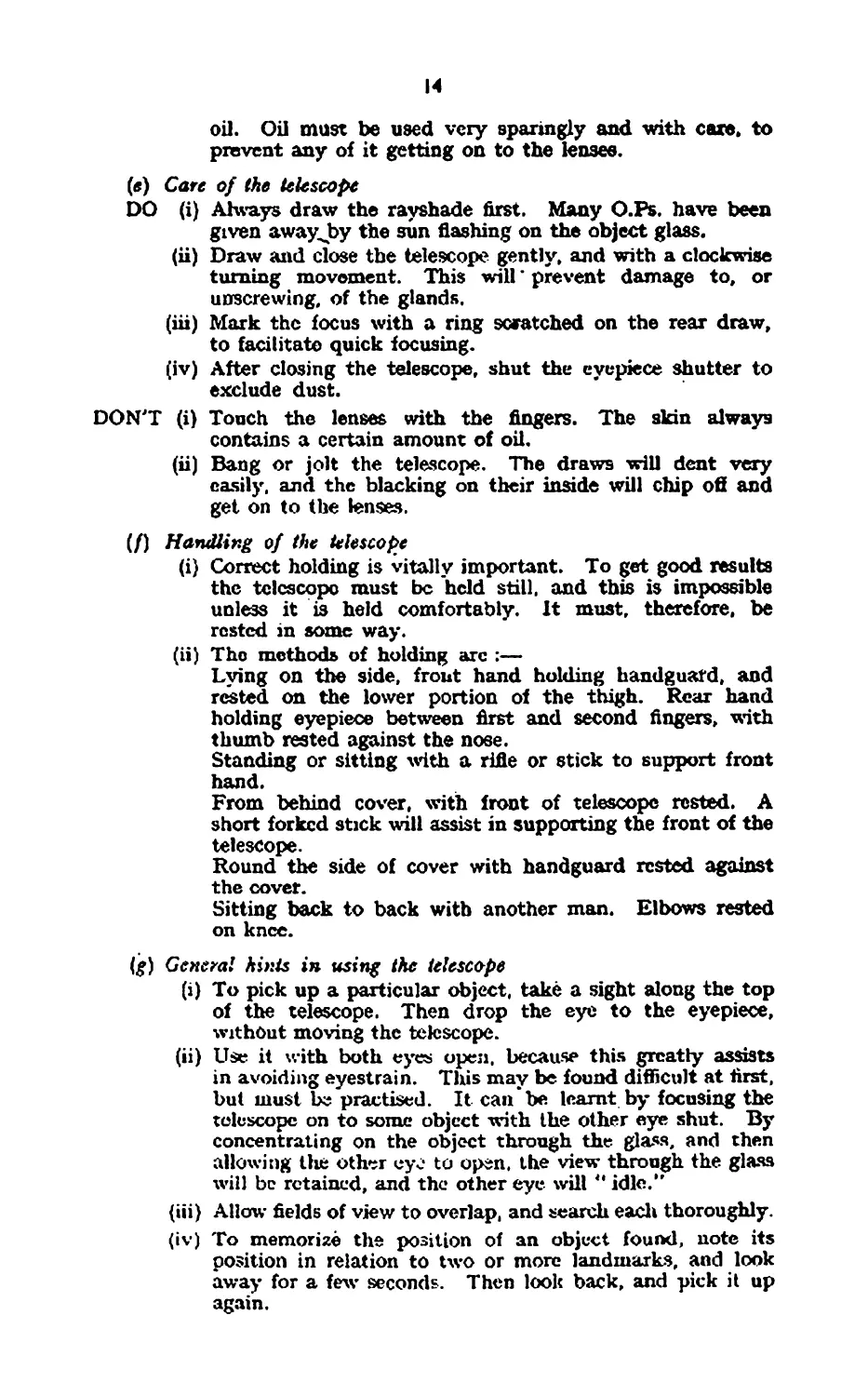
(ii)	The methods of holding arc :—
Lying on the side, front hand holding handguard, and
rested on the lower portion of the thigh. Rear hand
holding eyepiece between first and second fingers, with
thumb rested against the nose.
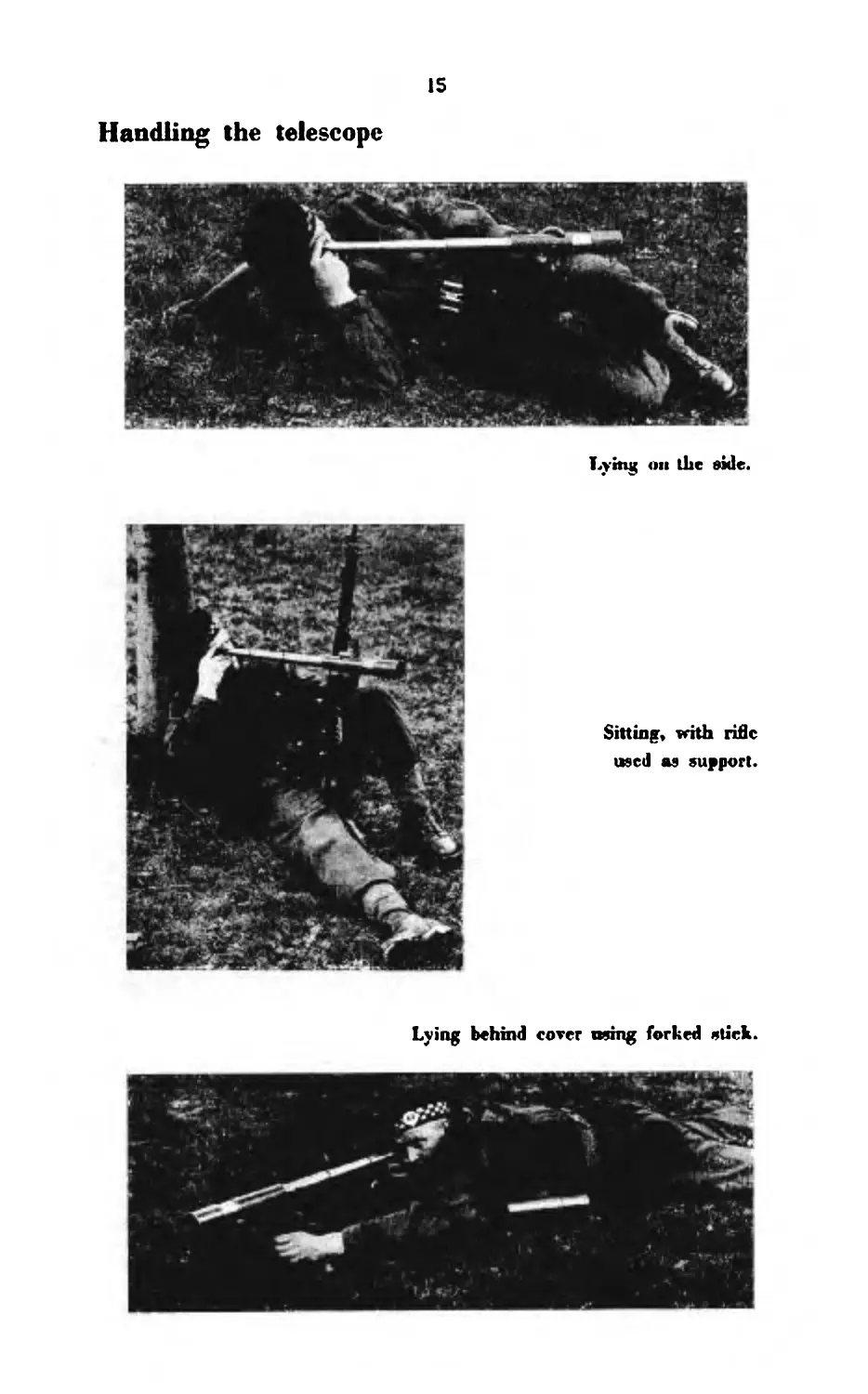
Standing or sitting with a rifle or stick to support front
hand.
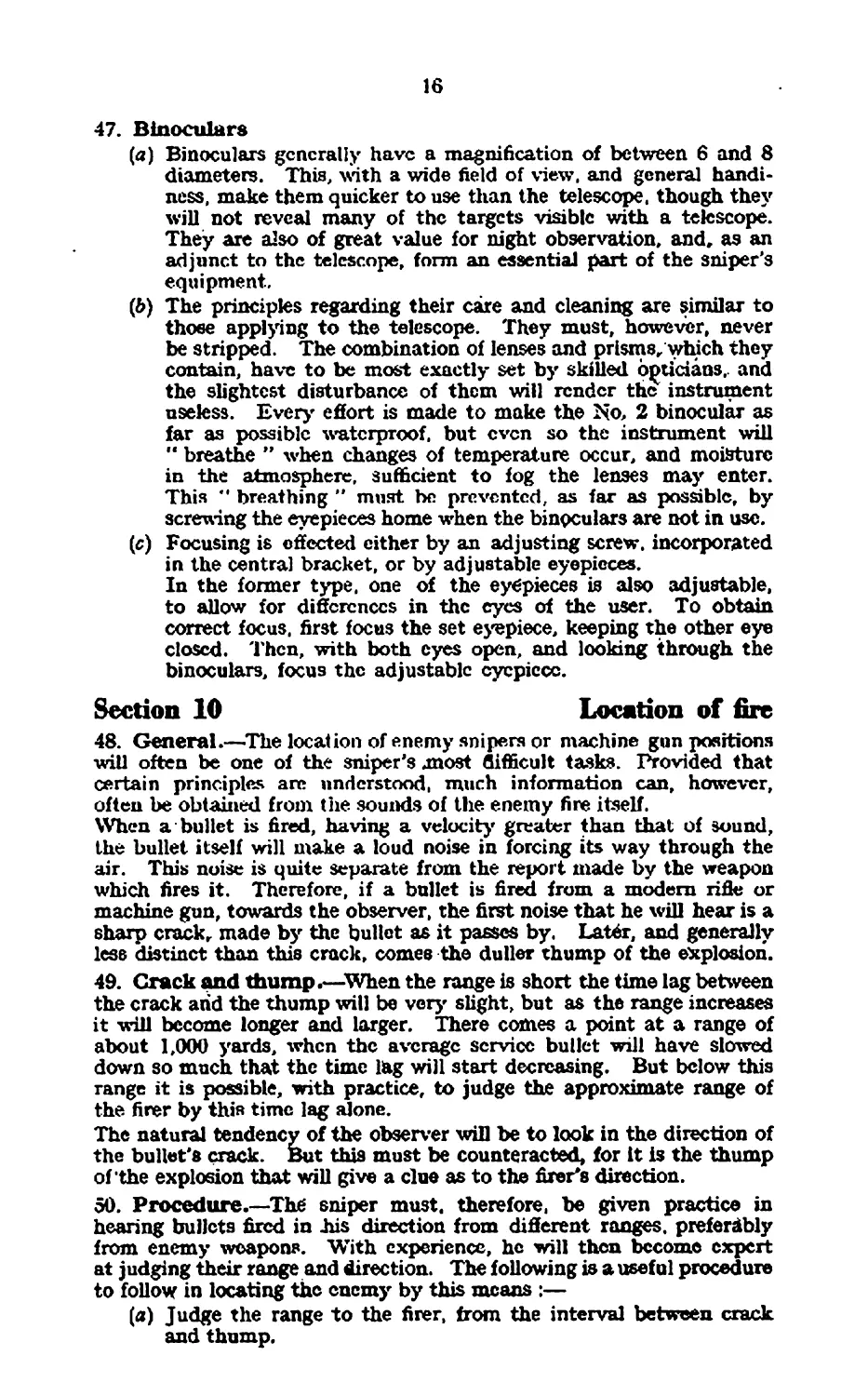
From behind cover, with front of telescope rested. A
short forked stick will assist in supporting the front of the
telescope.
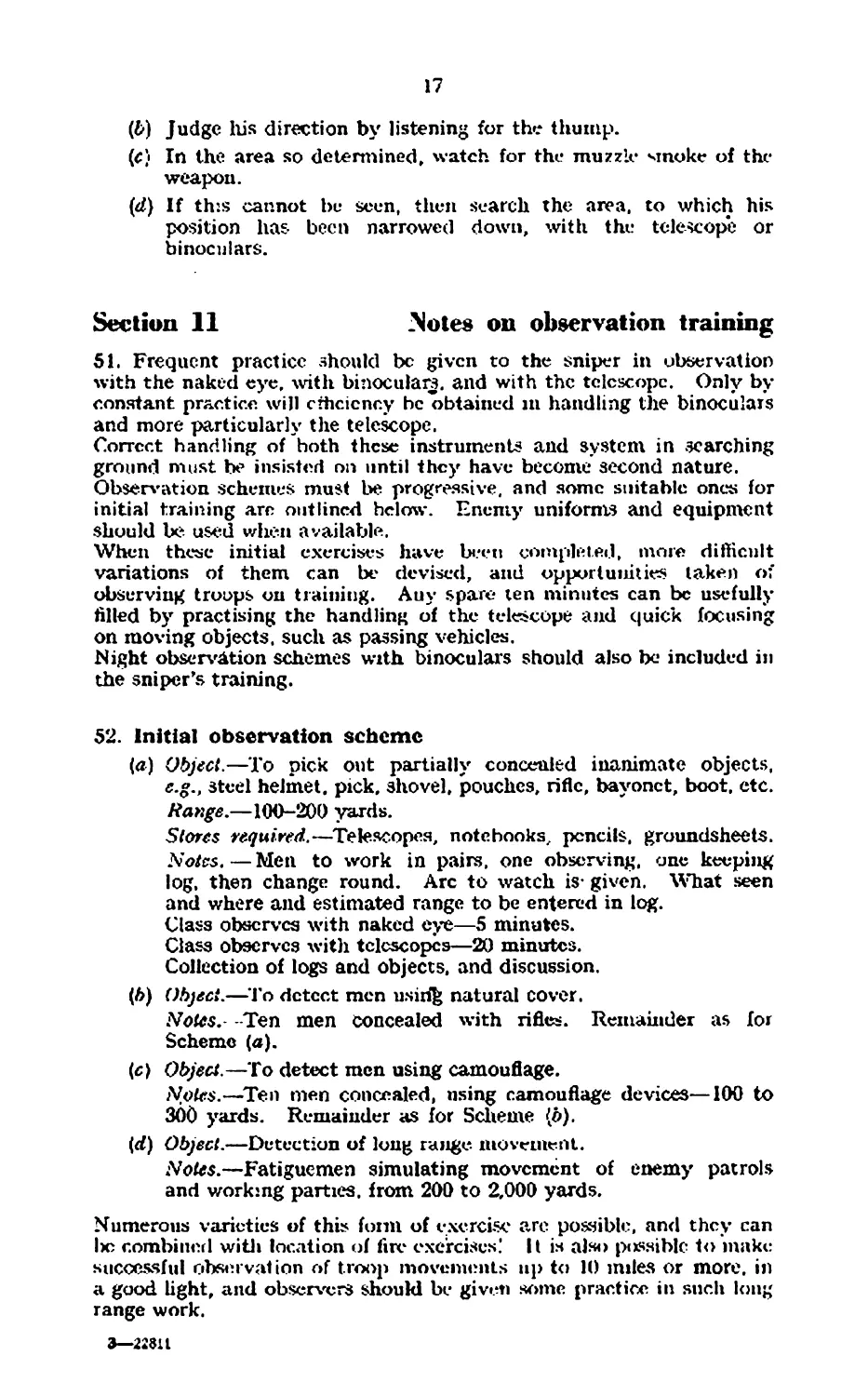
Round the side of cover with handguard rested against
the cover.
Sitting back to back with another man. Elbows rested
on knee.
(g) General hints in using the telescope
(i)	To pick up a particular object, take a sight along the top
of the telescope. Then drop the eye to the eyepiece,
without moving the telescope.
(ii)	Use it with both eyes open, because this greatly assists
in avoiding eyestrain. This may be found difficult at first,
but must be practised. It can be learnt by focusing the
telescope on to some object with the other eye shut. By
concentrating on the object through the glass, and then
allowing the other eye to open, the view through the glass
will be retained, and the other eye will ** idle.”
(iii)	Allow fields of view to overlap, and search each thoroughly.
(iv)	To memorize the position of an object found, note its
position in relation to two or more landmarks, and look
away for a few seconds. Then look back, and pick it up
again.
is
Handling the telescope
Lying on the aide.
Sitting, with rifle
used as support.
Lying behind cover using forked stick.
16
47.	Binoculars
(a)	Binoculars generally have a magnification of between 6 and 8
diameters. This, with a wide field of view, and genera] handi-
ness, make them quicker to use than the telescope, though they
will not reveal many of the targets visible with a telescope.
They are also of great value for night observation, and, as an
adjunct to the telescope, form an essential part of the sniper's
equipment.
(b)	The principles regarding their care and cleaning are similar to
those applying to the telescope. They must, however, never
be stripped. The combination of lenses and prisms,, which they
contain, have to be most exactly set by skilled opticians., and
the slightest disturbance of them will render the instrument
useless. Every effort is made to make the No, 2 binocular as
far as possible waterproof, but even so the instrument will
“ breathe ” when changes of temperature occur, and moisture
in the atmosphere, sufficient to fog the lenses may enter.
This ° breathing ” must be prevented, as far as possible, by
screwing the eyepieces home when the binoculars are not in use.
(c)	Focusing is effected cither by an adjusting screw, incorporated
in the central bracket, or by adjustable eyepieces.
In the former type, one of the eyepieces is also adjustable,
to allow for differences in the eyes of the user. To obtain
correct focus, first focus the set eyepiece, keeping the other eye
closed. Then, with both eyes open, and looking through the
binoculars, focus the adjustable cycpiccc.
Section 10	Location of fire
48.	General.—The location of enemy snipers or machine gun positions
will often be one of the sniper's .most difficult tasks. Provided that
certain principles arc understood, much information can, however,
often be obtained from the sounds of the enemy fire itself.
When a bullet is fired, having a velocity' greater than that of sound,
the bullet itself will make a loud noise in forcing its way through the
air. This noise is quite separate from the report made by the weapon
which fires it. Therefore, if a bullet is fired from a modem rifle or
machine gun, towards the observer, the first noise that he will hear is a
sharp crack, made by the bullet as it passes by. Lat^r, and generally
less distinct than this crack, comes the duller thump of the explosion.
49.	Crack and thump.—When the range is short the time lag between
the crack arid the thump will be very slight, but as the range increases
it will become longer and larger. There comes a point at a range of
about 1,000 yards, when the average service bullet will have slowed
down so much that the time lag will start decreasing. But below this
range it is possible, with practice, to judge the approximate range of
the finer by this time lag alone.
The natural tendency of the observer win be to look in the direction of
the bullet's crack. But this must be counteracted, for it is the thump
of'the explosion that wiU give a clue as to the firer's direction.
50.	Procedure.—The sniper must, therefore, be given practice in
hearing bullets fired in his direction from different ranges, preferably
from enemy weapons. With experience, he will then become expert
at judging their range and direction. The following is a useful procedure
to follow in locating the enemy by this means :—
(a) Judge the range to the firer, from the interval between crack
and thump.
17
(&) Judge his direction by listening for the thump.
(c'} In the area so determined, watch for the muzzle чтпоке of the
weapon.
(rZ) If this cannot be seen, then search the area, to which his
position has been narrowed down, with the telescope or
binoculars.
Section 11	Moles on observation training
51. Frequent practice should be given to the sniper in observation
with the naked eye, with binoculars, and with the telescope. Only by
constant practice will efficiency he obtained in handling the binoculars
and more particularly the telescope.
Correct handling of both these instruments and system in searching
ground must be insisted on until they have become second nature.
Observation schemes must be progressive, and some suitable ones for
initial training arc outlined hclow. Enemy uniforms and equipment
should be used when available.
When these initial exercises have been completed, more difficult
variations of them can be devised, and opportunities taken of
observing troops on training. Auy spare ten minutes can be usefully
filled by practising the handling of the telescope and quick focusing
on moving objects, such as passing vehicles.
Night observation schemes with binoculars should also be included in
the sniper’s training.
52. Initial observation scheme
(a) Object.—To pick out partially concealed inanimate objects,
e.g., steel helmet, pick, shovel, pouches, rifle, bayonet, boot, etc.
Range.—100-200 yards.
Stores required.—Telescopes, notebooks, pencils, groundsheets.
Notes. — Men to work in pairs, one observing, one keeping
log, then change round. Arc to watch is* given. What seen
and where and estimated range to be entered in log.
Class observes with naked eye—5 minutes.
Class observes with telescopes—20 minutes.
Collection of logs and objects, and discussion.
{b) Object.—‘Го detect men usirig natural cover.
Notes. Ten men concealed with rifles. Remainder as for
Scheme (a).
(c) Object.—To detect men using camouflage.
Notes.—Ten men concealed, using camouflage devices—100 to
300 yards. Remainder as for Scheme (o).
{d) Object.—Detection of long range movement.
Notes.—Fatiguemen simulating movement of enemy patrols
and working parties, from 200 to 2,000 yards.
Numerous varieties of this foim of exercise arc possible, and they can
1ю combined with location of fire exercises.' Il is also possible to make
successful observation of troop movements up to 10 miles or more, in
a good light, and observers should be given some practice in such long
range work.
3—22811
18
Chapter 3—Fieldcraft
Section 12	General
53.	Fieldcraft is the use of natural cover, when stationary and during
movement, permitting the free use of arms. It is a part of the hunter's
art, and consists of the silent movement and use of cover, the knowledge
of his prey and skill at arms which enable the hunter to make his kill.
Fieldcraft, therefore, demands physical fitness, mental alertness,
patience and discipline. It also calls for the ability to read and use
ground.
5*i. These attributes,, when developed and applied with initiative, make
a man a formidable fighting opponent. The sniper must, therefore,
develop the same cunning that the hunter uses to outwit his quarry,
and since his quarry is another man, must know how to outwit him
when he tries to retaliate.
55.	Knowledge must be acquired, not ohly of the concealment afforded
by vegetation and other features covering the earth’s surface. Every
fold in the ground, however slight, may afford cover, and to know
where such folds exist, and how to use them, requires much practice.
The protection and dangers afforded by light and shadow must also be
studied, and in movement both agility and stealth must be cultivated.
Fieldcraft training should aim at developing a constant alertness of the
mind and the senses of sight» hearing, smell and touch.
Section 13	Concealment
56.	When stationary, the problem of concealnient calls for a knowledge
of how best to use the natural cover which the ground affords, and of
the assistance given by camouflage.
(a) Use shadow. See para. 57 (a).
19
57.	Natural aids.—As regards the use of natural cover, the following
points are fundamental and should be so mastered as to become
instinctive :—
(e) Keep in shadow. This is the greatest protection of all, hut remember
shadow motet with die sun, and do not break the natural shape of a
shadow.
(b) Match your background.
(b)	Background which matches the colour of the clothing can he as good
protection as cover in front of you.
(c i) Avoid bkyltws—there are two men here.
(c)	Avoid breaking skylhaee and natura I straight linra.
3л—22811
20
(r ri) Don’t break straight lines—there are (tec men here.
(rf) Don't look over cover. Loot: round or through it :
(d)	Look round the side of corer, rather than over it. Look through it,
where thb b possible.
(/) Avoid isolated or conspicuous cover.
(f) Avoid belated or coospfcuoutii cover to which (lie eetmy fe likdy to
pay particular atiml ton.
22
(g) The face and hands, ualea ramanflegad or concealed behind corer»
are outstanding/ obvions.
23
58.	These points'should be demonstrated to the sniper at the outset
of his training by the use of fatigucmcn.
The demonstration could take the following form :—
ia) Opening remarks ............. ....................5 mins.
(d)	Squad search ground for men m wrong positions ...	3 mins.
(c)	Point out that, nearby to each of the men is cover,
which, if properly used, would give much better
protection. Enumerate faults from right to left ...	5 mins.
(d)	Turn squad about. Signal men to take up correct
positions...........	........................... 2 mins.
(e)	Squad face front, search ground ...	...	...	5 mins.
(f)	Signal each man from right to left to stand up and
expose himself, pointing out why each obtains better
concealment than before ...........................10 mins.
(gj Recapitulate points brought out ...	........ 5 mins.
59.	Camouflage.—Concealment is further aided by the use of camou-
flage. Some animals are provided by nature with wonderfully effective
camouflage, but the soldier has to make it for himself. The aim of
personal camouflage is to hide the familiar shape of the man, and the
shine from his clothing, skin and equipment, while matching him, as
far as possible, with his surroundings. The interests of concealment
and camouflage, however, conflict with those of mobility and weapon
handling, so that some degree of compromise is always necessary.
Shine can only be prevented by making surfaces rough, and shape is
distorted by loose-fitting garments, both of which can be a hindrance,
if carried too far.
Unless some special colour scheme is used to match a particular back-
ground, and this is seldom possible, lhi$ also calls for compromise;
and, for general use. a combination of neutral colours, greys, greens and
browns, is best. But some contrast both of colour and tone must
always be introduced, to obtain a disruptive effect, and small amounts
of highly contrasting colours, such as yellow or black, will be a help, if
used sparingly.
60.	Normally, the only practical measures that a sniper can take
towards personal camouflage, are on the following lines :—
{a) Head.—Garnished helmet net. or cap comforter worn on the
head. Eace darkened and further concealed, where necessary,
with a face veil, which should also be garnished.
(6)	Hands.—Daikehed with sufficient camouflage cream or covered
with dark gloves.
(c)	Body.—The Denison smock, an issue to snipers, will normally
be worn. It cap be improved for purposes of concealment by
stitching on a few tufts of hessian garnish. Other types of suit
for snipers may be forthcoming in the future.
(4)	Rifie.—Some protection may be gained by disruptiveiy painting
the barrel and fore-end. Shiny metal portions should also be
treated in this way.
(s)	Telescope-.—When in use, the body and rayshade of the telescope .
should be covered with hessian or an old sock with the foot
cut off.
(/) Bmocidars.—A strip of hessian can be tied round the front of
the bracket. This must not interfere with the focusing 'gear.
24
61.	The sniper will seldom liave occasion to employ any more com-
plicated devices than the above. He should, however, he given an
opportunity of studying the effect of other forms of camouflage, whether
issued or improvised, since these may. on occasions, be useful to him.
This will also help him to see through the enemy’s attempts at camou-
flage. and forms excellent practice in the study of the protection
afforded by various types of liackground.
62.	A demonstration should be staged on the following lines :—
(a)	Opening remarks ...	...	...	......... 5 mins.
(b)	Squad searches ground with naked eyd for camouflaged
men, using a wide assortment of camouflage, against
correct background ...	...	...	...	...	5 mins.
(c)	Turn squad about. Signal men to take off camou
flagc, and adopt the same positions as before ...	3 mins.
(d)	Squad searches ground and instructor points out that
each man is in the same place as before ...	5 mins.
(<?) Signal men to wave a white flag, if any not seen, and
tell squad to note the position of each man ...	...	2 mins.
(/) Turn squad about and signal men to adopt
camouflage again ........................................ 3	mins.
(g) Squad looks at each man with glasses and notes
points that make him visible. Instructor points out
that correct use of camouflage and background will
give the degree of protection shown. This requires
an eye for background ...	...	...... 10 mins.
(Л) batiguemen arc called in, and camouflage devices
inspected. Instructor points out which are issued
and which improvised ...	...	...	...	...	7 mins.
Section 14	Movement
63.	General.—The sniper must be well practised in the movements
of a stalker, so that he can employ them efficiently and without fatigue.
These movements include a number of different methods of crawling to
suit various types of cover, and the ability to walk silently. When
carrying them out, the sniper must be able to use his weapons instantly,
if need be, and to maintain an all-round watch.
64.	The most useful movements to practise are as follows :—
(«) Walking silently.—Care must be taken in placing the feet on
the ground. When crossing hard ground, the least noise is
made if the outside of the sole of the foot is placed first on the
ground. Balance is most essential to silent movement, and
this is assisted by keeping the knees slightly bent, and the arms
hanging loosely downwards , from this position it is possible to
drop quipkly to cover. It is a mistake to walk with the head
bent down, because this affords no added protection, and
impedes observation.
(Л) Crawling on hands and knees.—This is useful for cover over
2 feet high. It can be carried out quickly with practice. But
this is not always desirable, and for silent movement the knee
should be placed in the very spot vacated by the corresponding
hand. The hands should reach forward for a safe place to
avoid cracking twigs and other obstructions.
Cautions.—Keep the head and posterior down.
25
Walking—rarriuge of arm*.
Alternative method
Crawling
on hands
and knees
without
aruw,
with rifle.
2в
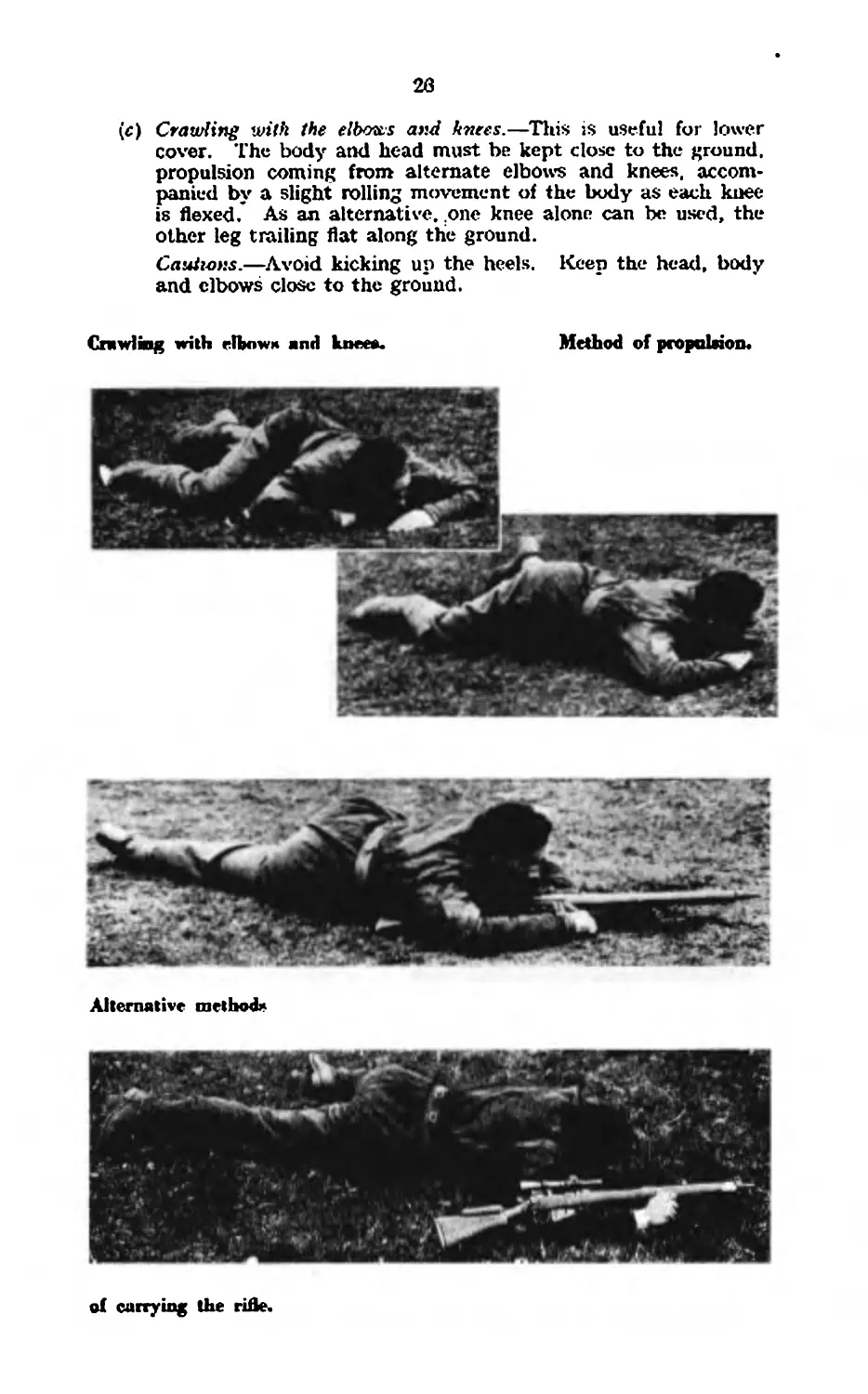
(с)	Crawling with the elbows and knees.—This is useful for lower
cover. The body and head must be kept close to the ground,
propulsion coming from alternate elbow’s and knees, accom-
panied by a slight rolling movement of the body as each knee
is flexed/ As an alternative, .one knee alone can be used, the
other leg trailing flat along the ground.
Cautions.—Avoid kicking up the heels. Keep the head, body
and elbows close to the ground.
Crawling with elbow* and kneea.	Method of propulsion*
Alternative method*
of carrying the rifle.
27
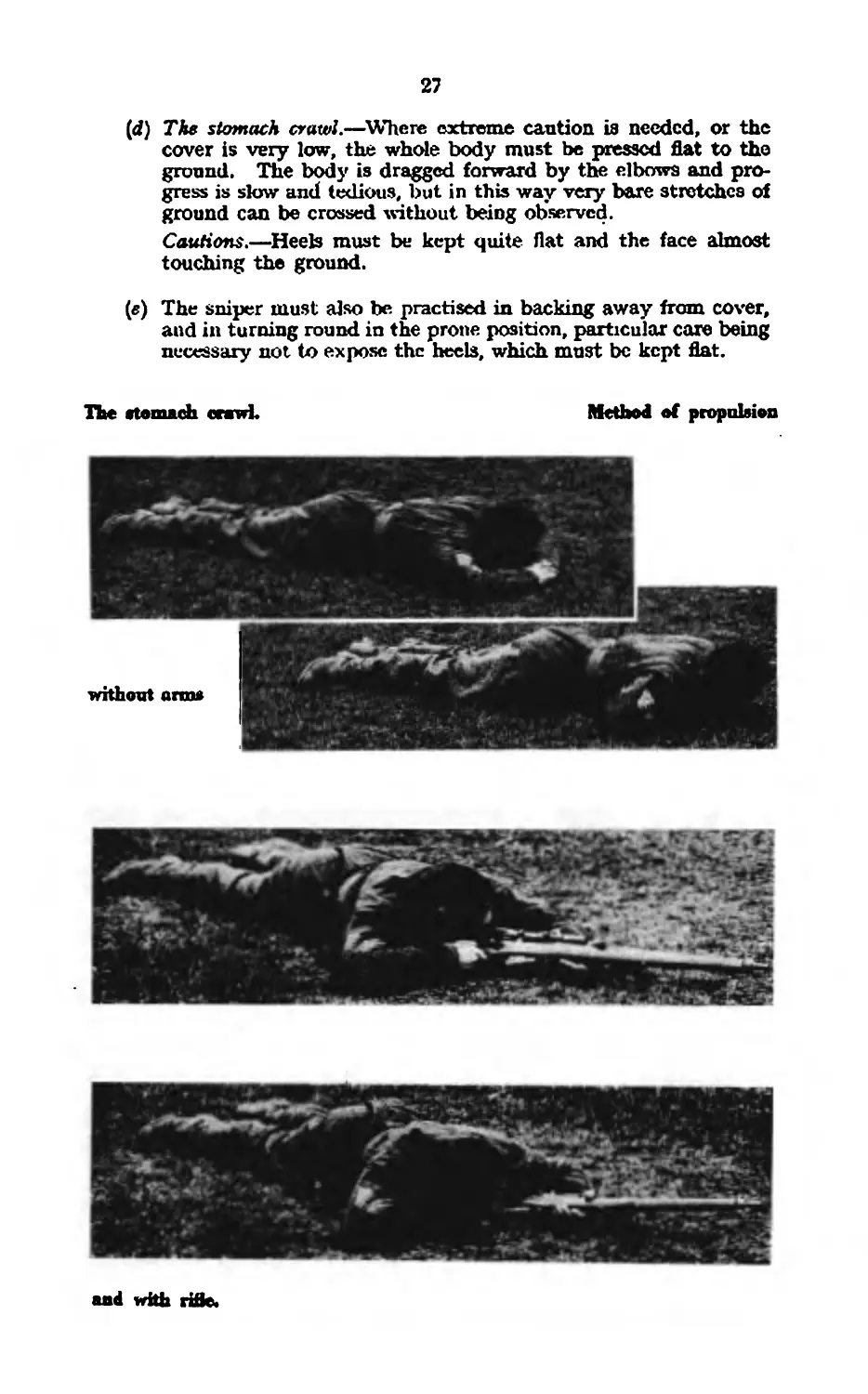
(d)	Ths stomach crawl.—Where extreme caution is needed, or the
cover is very low, the whole body must be pressed flat to the
ground. The body is dragged forward by the elbows and pro-
gress is slow and tedious, but in this way very bare stretches of
ground can be crossed without being observed.
Cautions.—Heels must be kept quite flat and the face almost
touching the ground.
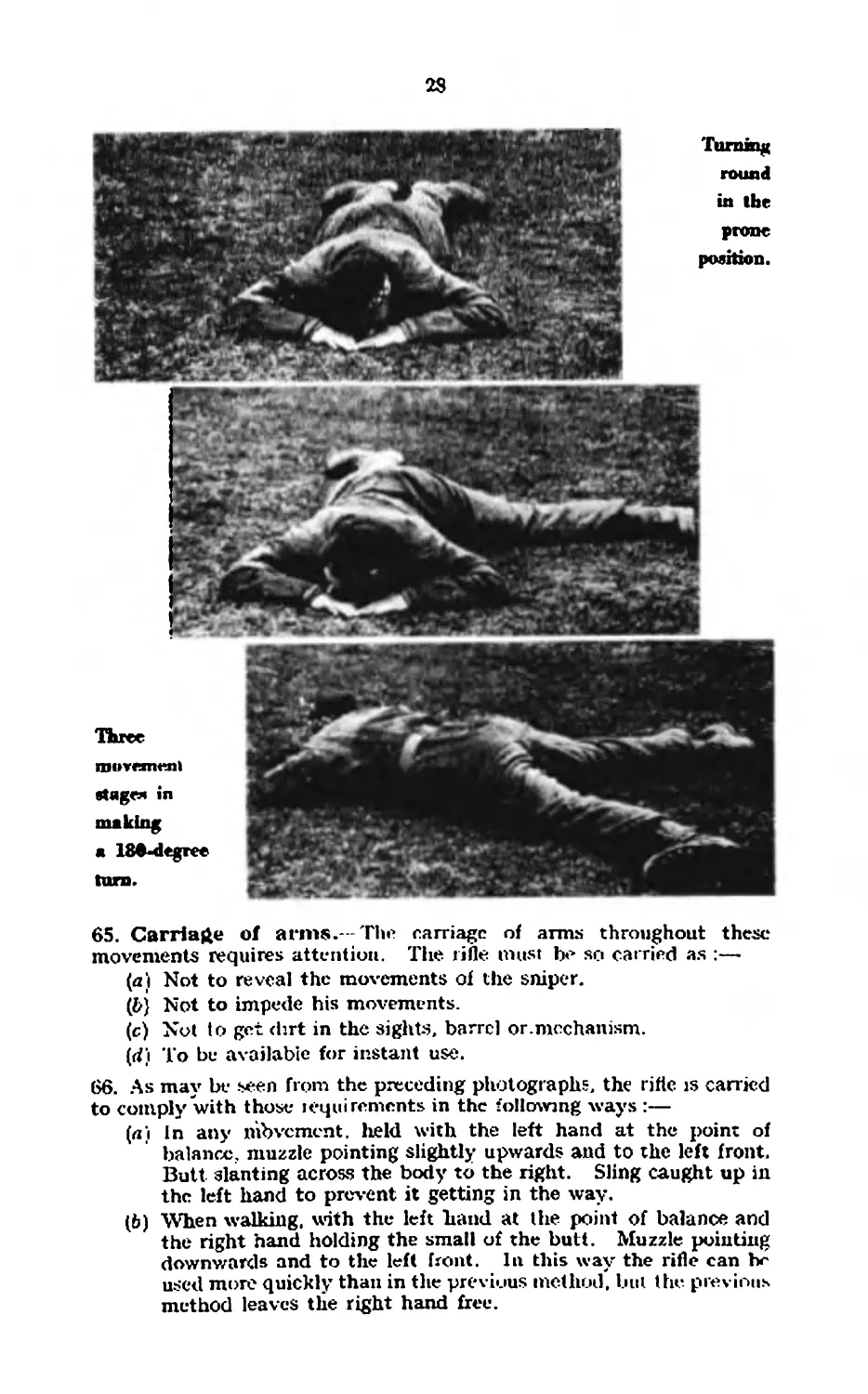
(s)	The sniper must also be practised in backing away from cover,
and in turning round in the prone position, particular care being
necessary not to expose the heels, which most be kept flat.
The rtomaeh cnwL
Method of propulsion
and with rifle.
28
65.	Carriage of arms.- The carriage of arms throughout these
movements requires attention. The rifle must be so carried as :—•
(a) Not to reveal the movements of the sniper.
(b} Not to impede his movements.
(c) Not to get dirt in the sights, barrel or.mechanism.
(d\ To be available for instant use.
66.	As may be seen from the preceding photographs, the rifle is carried
to comply "with those i equipments in the following ways :—
(д) In any mbvement. held with the left hand at the point of
balance, muzzle pointing slightly upwards and to the left front.
Butt slanting across the body to the right. Sling caught up in
the left hand to prevent it getting in the way.
(b) When walking, with the left hand at the point of balance and
the right hand holding the small of the butt. Muzzle pointing
downwards and to the left front. In this way the rifle can hr
used more quickly than in the previous method, but the previous
method leaves tile right hand free.
29
(c} When crawling on the stomach or on the elbows and knees, by
holding the slmg, with the clenched hand, where it joins the
outer band, muzzle to the front and the rifle resting along the
forearm.
67.	In practising all these movements, the sniper must leant to keep
constant watch to his front, flanks and rear, yet without raising his
head one inch more than is necessary to do so. He must learn when to
move quickly and when to go at the pace of a snail, when to freeze
and when to forestall the unexpected with a quick shot. When cover
is scarce, slow movement and a favourable background may prevent
detection. When crossing short gaps in cover, a quick dash may be
the best policy.
Section 15	Stalking
68.	General. Stalking is the application of fieldcraft in its widest
sense to bring the sniper within range of his quarry. It cannot be
.taught m the matter of a few lessons, but can only be learnt by
‘experience. It is possible, however, to give some general principles
which will always be of assistance.
69.	Reconnaissance.—Thorough reconnaissance of the ground is
essential, before starting out on any stalk, and careful observation of the
following points will invariably be repaid :—
[a]	The exact location of the enemy to be stalked must be memorized
with reference to nearby landmarks.
(6)	The final objective or fire position to be gained must be chosen,
and similarly memorized.
(c)	The whereabouts of any other enemy posts must be spied out.
For this the stalking telescope will generally be required.
(d)	The route must be decided on by weighing up the advantages
and disadvantages of the ground. Considerations affecting the
choice of route are :—
(i)	Cover and dead ground.
(ii)	Obstacles, natural and artificial.
(iiij Points of observation en route, j.e., bounds.
(ivi Other known or probable enemy positions.
70.	Keeping direction. Great attention must be paid to keeping
direction. This is not at all easy, especially when crawling or when
using the cover of darkness or fog.
(a)	The use of the compass and map. and of air photographs, must
have been mastered, though the latter may not always be
available.
(b)	A distant landmark, or better still two, can be memorized.
(c)	A series of landmarks along the route can be memorized.
(d)	The direction of the wind can help in keeping direction.
(/•) So can the position of the sun.
(/) The route back must be remembered ; and this can bn done by
looking back frequently on the way out.
30
71.	Points to note. -The following points should also be remembered
when actually engaged on a stalk :—
(a)	Alertness must never be relaxed fur a moment.
(£) Observe carefully from bound to bound.
(c)	Have an alternative route ready in case of meeting the
unforeseen.
(rf) If surprised, or exposed, either freeze like a stone, or move
quickly and get clean away from the point of exposure.
(c)	Think out ways of drawing the enemy's attention away from
you. This may require somebody else’s co operation, or you
may make something for him to look at in the early stages of
your stalk.
(/) Avoid disturbing animals and birds.
(gj Take advantage of other movements and noises going on, to
distract attention from your own.
(h)	Do not crawl where walking is possible.
(i)	If risks have to be taken it is better to take them early on.
72.	Stalking by night.—The sniper will often have to move by night
either because his fire position may nut be reached by daylight, or when
making use of his telescopic sight for night firing. Night stalking
presents the same problems as stalking by day with the additional one
that man is not a nocturnal animal. The main differences between
night and day which affect the sniper are that by night:—
(a)	Protection is given against aimed fire by the enemy.
(b)	Sight is largely replaced by hearing, so that silence is of prime
importance.
(c)	Background becomes relatively more important than cover, and
avoidance of skylines is of increased importance.
(d)	Keeping direction is of even greater difficulty, and daylight
reconnaissance of the route to be taken and landmarks along it
is more necessary. A knowledge of the stars will be of great
assistance in keeping direction.
73.	Much practice is required in moving silently by night. Precautions
- must be taken to prevent equipment from rattling, and parts that are
likely to rattle should be muffled with strips of sandbag materia) or
adhesive tape. Particular care is needed in placing the feet on the
ground and in preventing them from mailing a noise in long cover or
on stony ground. Silent movement in the dark depends largely on the
sense of touch. Frequent halts are necessary to observe and listen.
Anything that may shine, including the face and hands, must be
obscured and luminous watches or compasses may be a source of
danger. Practice is also required in crossing obstacles, both natural
and atliJicial, in the .dark.
Section 16	Sniping from hides and building»
74.	General.—During static periods and in defence, snipers should,
whenever possible, build hides, because more efficient work can be done
when :—
31
{a) к certain amount of free movement without fear of detection»
and	ъ
(ft) Some protection from the weather is possible.
Hides can vary considerably as to type; and it is not possible to
list them all. The type will depend on ingenuity and the ability to
improvise.
Some of the many possible locations are under hedgerows» in ruined
buildings» a disabled tank, a rubbish heap, the edge of a cutting or a
stream bed.
They may be sturdily built of stone, brick or wood, but more often
only the scantiest building materials, to give cover from view and th$
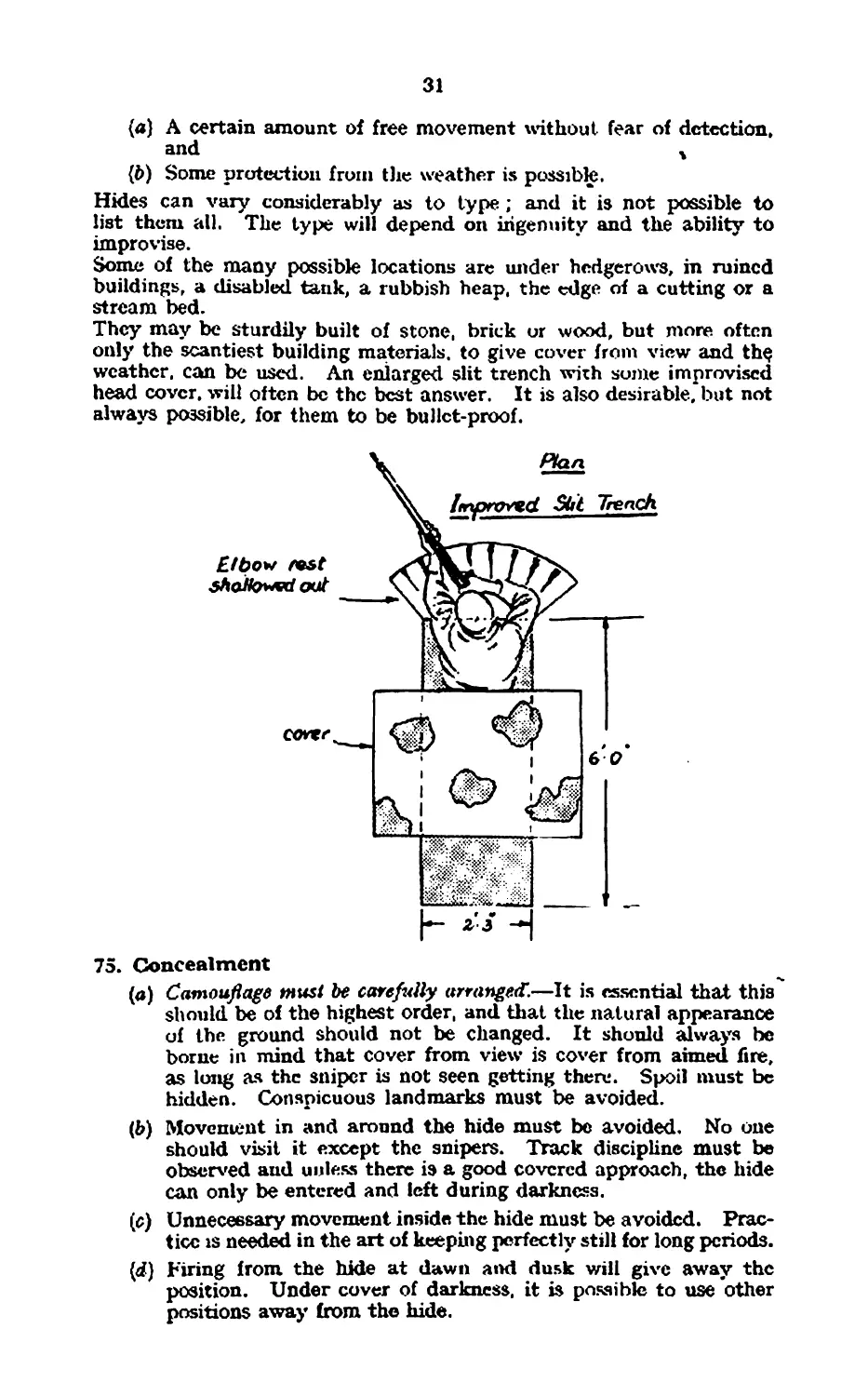
weather, can be used. An enlarged slit trench with some improvised
head cover, will often be the best answer. It is also desirable, but not
always possible, for them to be bullet-proof.
75.	Concealment
(a)	Camouflage must be carefully arranged.—It is essential that this
should be of the highest order, and that the natural appearance
of the ground should not be changed. It should always be
borne in mind that cover from view is cover from aimed fire,
as long as the sniper is not seen getting there. Spoil must be
hidden. Conspicuous landmarks must be avoided.
(h)	Movement in and around the hide must be avoided. No one
should visit it except the snipers. Track discipline must be
observed and unless there is a good covered approach, the hide
can only be entered and left during darkness.
(c)	Unnecessary movement inside the hide must be avoided. Prac-
tice is needed in the art of keeping perfectly still for long periods.
(d)	Firing from the hide at dawn and dusk will give away the
position. Under cover of darkness, it is passible to use other
positions away from the hide.
32
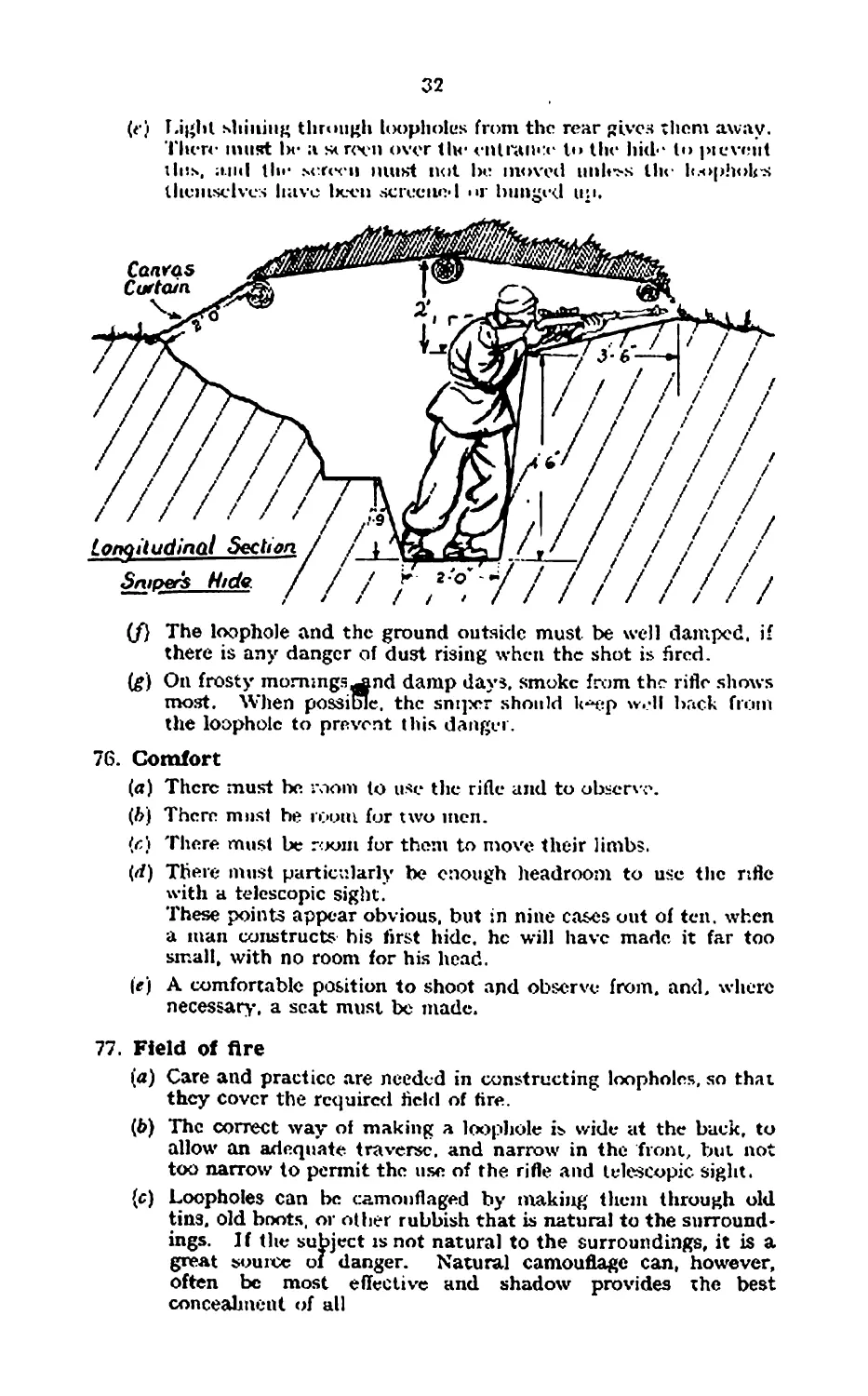
(r)	Light shining through loopholes from the rear gives them away.
Then- must Im- a sewn over the entrance to the hid-* to pievc-iit
iIns, and the serivii must not be moved unites the h.-opholrs
themselves have lxx*n screened »«r bunged up.
(/} The loophole and the ground outside must be well damped, if
there is any danger of dust rising when the shot is fired.
(g)	On frosty mornings ^nd damp days, smoke from the rifle shows
most. When possible, the sniper should k*4fp w.-ll back from
the loophole to prevent this danger.
76.	Comfort
(a)	There must be room to use the rifle and to observe.
(6)	There must he room fur two men.
(<A There must be room fur them to move their limbs.
(rf) There must particularly be enough headroom to use the rifle
with a telescopic sight.
These points appear obvious, but in nine cases out of ten. when
a man constructs his first hide, he will have made it far too
small, with no room for his head.
|>) A comfortable position to shoot and observe from. and. where
necessary, a scat must be made.
77.	Field of ft re
(a)	Care and practice are needed in constructing loopholes, so that
they cover the required field of fire.
(b)	The correct way of making a loophole is wide at the back, to
allow an adequate traverse, and narrow in the front, but not
too narrow to pennit the use of the rifle and telescopic sight.
{c) Loopholes can be camouflaged by making them through old
tins, old boots, or other rubbish that is natural to the surround’
ings. If the* subject is not natural to the surroundings, it is a
great bouite of danger. Natural camouflage can, however,
often be most effective and shadow provides the best
concealment of all
33
(.7) Since hides Wi 11 almost always have to lx* made during darkness,
the site should be reconnoitred whenever possible by day. and
the direction for the loophole marked by two sticks or pick
handles. Otherwise it will generally I»i: found that the com-
pleted loophole is looking in the wrong direction.
78.	Deception
(a)	There should be as many alternative hides as possible and
programmes of occupation should be irregular.
(6)	Devices should be used to attract the enemy’s attention away
from the hide, but not on to neighbouring positions, e.g. dummy
loopholes, or movements produced at the end of a length of
string or telephone cable.*
79.	Buildings.—Buildings often offer the best opportunities as sniping
posts, under static conditions. They have, however, the great disad-
vantage that they are bound to attract fire from the enemy’s heavy
weapons, and an isolated house is very likely t:> he shelled even if the
sniper using it has not been detected.
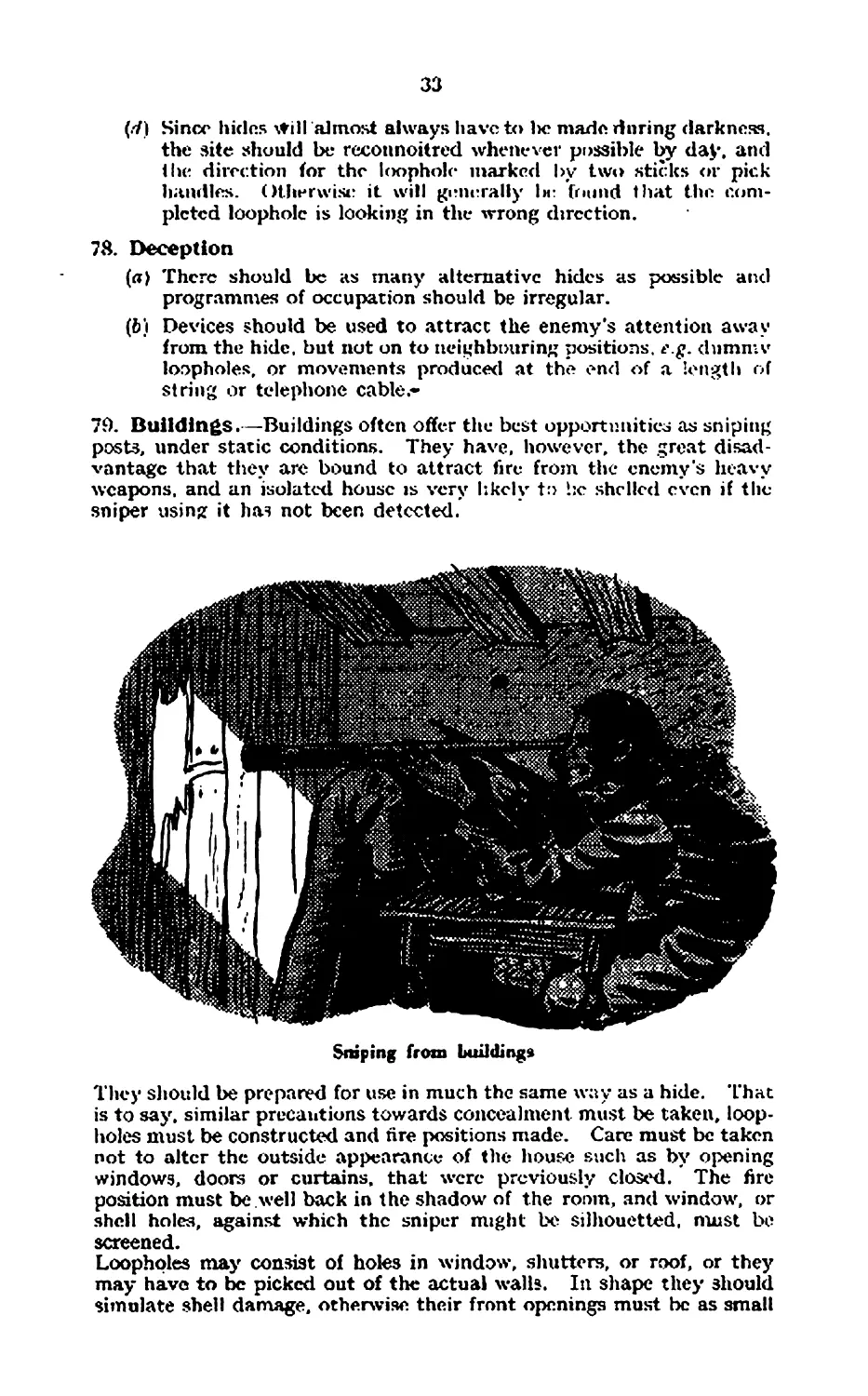
Sniping from buildings
They should be prepared for use in much the same way as a hide. That
is to say. similar precautions towards concealment must be taken, loop-
holes must be constructed and fire positions made. Care must be taken
not to alter the outside appearance of the house such as by opening
windows, doors or curtains, that were previously closed. The fire
position must be well back in the shadow of the room, and window, or
shell holes, against which the sniper might be silhouetted, must be
screened.
Loopholes may consist of holes in window, shutters, or roof, or they
may have to be picked out of the actual walls. In shape they should
simulate shell damage, otherwise their front openings must be as small
34
as is compatible with field of firtv Some form of rest must then be
constructed behind them, to make accurate shooting possible and to
assist in observation with the telescope. This and the fire position
may be improvised from furniture* or else by sandbagging.
Section 17	Notes on fieldcraft training
80.	General.—After being shown demonstrations on concealment, both
with and without camouflage, the squad should be practised in taking
up fire positions, under the observation of fellow-students and instruc-
tors. Later in their training this factor can be brought into field firing
exercises, by having an instructor, with a periscope, at the target end,
observing from bullet-proof cover.
Individual stalks over short distances, introducing the competitive
spirit, give the best initial practice in movement and the use of ground.
These must have been preceded by lessons in movement, and stalking in
general, and also, where possible, by a demonstration stalk carried out
by experts. Many variations of the specimen exercises, given below,
may be devised and training can at the later stages be combined with
map reading, observation and other factors. Finally, through field
firing exexcises, practice in marksmanship can be linked up with these
other phases of training.
81.	The individual stalk
(a)	The squad is divided*into two halves. One half act as pairs
of observers, and arc placed in position, with an arc to watch.
The other half are started from points about 200 yards away
from one or other pair of observers, and have to approach to
within grenade throwing distance of the observers, by
independent routes.
(b)	The stalkers are given a few minutes to study the ground and
select their objective and route. They are then allowed a
limited time to carry out the stalk. The observers will keep a
tog of any exposures made by the stalkers, recording the length
of the exposure and the reason for it. They will also have
coloured flags, which they will raise, whenever any of the
stalkers shows himself.
(c)	A discussion should take place at the end of the stalks, on
points taught in the lessons on movement and stalking.
Note.—This exercise, with slight modifications, is well fitted
to practising movement by night.
82.	Infiltration stalk
(a)	The squad is divided into pairs of stalkers, and an objective
is pointed out 700 to 1,000 yards away. Between the stalkers
and their objective are a number of enemy posts, manned by
fatiguemen previously placed in position.
(b)	On a given signal the enemy open fire with blank ammunition,
and continue to fire until a signal to stop is given. During this
time the stalkers must locate the position of the enemy.
(c)	The pairs of stalkers then make their way to the objective, by
independent routes, avoiding detection, if possible, by the
enemy post. The enemy will fire further rounds of blank if
they see any of the stalkers.
35
(d)	A discussion will be held, at the end of the exercise, on the
points of fieklcraft and observation which have arisen.
(4)	Where conditions of ground allow and with care in arranging
safety precautions, the enemy may use live ammunition. This
will give added practice in location of fire, and greater realism.
In this case the enemy must consist of reliable N.C.Os,
83.	Sniping from hides
(a)	Two parallel ridges, some hundreds of yards apart, form the
most, suitable ground for this exercise. A tactical setting is
given, and one of the ridges is said to be held by the enemy.
Snipers, working in pairs, are given a section of the enemy
ridge for which to be responsible, and an area of the other ridge
in which to build a hide.
(6)	The area will be reconnoitred in daylight, under observation
from the enemy ridge, and a hide constructed by night and
manned before dawn. Small enemy patrols and other activity
during the night help to maintain alertness.
(c)	At dawn, movement is made on the enemy ridge, to represent
the vacating of night posts, manning of O.Ps., etc., the snipers
keeping a log of any movements they can observe.
(d)	This exercise introduces the elements of patience and fatigue,
and it is especially important to bring in a competitive element.
If conditions will allow, the enemy can be withdrawn and the
exercise can be concluded with field firing at figure targets,
previously put in place.
Chapter 4—Shooting
Section 18	General
84.	The sniper must become an expert in rifle shooting, and he must
attain a standard of skill far higher than that normally demanded of
the soldier.
For him the basic training, which he gets in his early days in the Army,
is only a ground work, on which he must build a store uf knowledge
and experience, that will ultimately make liim an expert shot. His
special rifle is fitted with a telescopic sight, which greatly simplifies
aiming at obscure targets and when the light is bad. But the
telescopic sight will by no means make a mediocre shut into a good one,
and the full benefits from it will not be obtained unless the sniper has
first become a good shot without it. He must, in any event, be prepared
to use the aperture sight of his rifle as well as the telescopic, since, under
certain conditions, such as in rain, or if his telescopic sight becomes
damaged, he will have to shoot without it.
85.	The sniper rifle, using Mark 7 ammunition, is capable of grouping
to within 2j inches or better at 100 yards, and the sniper's aim must
be to shoot to within this standard. Further, he must aim at
maintaining this standard proportionately at other ranges up to
600 yards. To do so he must not only be capable of holding con-
sistently to such a grouping capacity under the ideal conditions of
100 yards firing point, but he must also understand the factors that will
36
affect his group, under the varying conditions met with at the longer
ranges. Furthermore, he must learn how to apply his group to his
mark ; and he must become a quick shot» able to hit a fleeting target
in under three seconds if need be. In order to attain this standard,
he must have an understanding of the following factors:—
(a) Sources of error in himself, and how to cure them.
(d)	Sources of error in the rifle an'd ammunition.
(c)	The effect of wind, light and weather.
{d) The adjustment of elevation and deflection.
(d)	The accurate judging of distance.
86.	This chapter deals with various aspects of the foregoing factors,
with the exception of judging distance, which is fully dealt with in
Small Arms Training, Vol. I, Pamphlet 2. The instructor should
ruinember that, while the standard demanded is high, and the
knowledge required by the sniper is extensive, any man who possesses
normal eyesight and physique,* can become a good shot; hut to make
him one will require patience and individual attention on the part of
his coach. One further thing is needed—keenness on the part of the
man, and willingness to learn. Given this, a rifle can be made a deadly
instrument in his hands.
Section 19
Sources of error in the man and the essentials of shooting
87.	No man can fire a rifle without introducing some error through
the human element. This error can, however, be cut down to some-
thing exceedingly small. Errors may arise in aiming the rifle, or in
holding it on the aim, or thrdugh disturbing the hold by incorrect
•trigger release. These three essential factors, aiming, holding and
trigger let off, are dealt with in Small Arms Training. Vol. I, Pamphlet 3.
but too often the guidance given is indifferently applied. The sniper
must first gain confidence in his ability to keep down his errors to some
consistently low standard, which he will never unknowingly exceed.
This, in other words, is the ability to group and to declare confidently
when he fires a shot that will fall outside his normal grouping capacity.
This is the bed-rock of all rifle shooting, and is absolutely fundamental.
The main faults which occur at this stage are discussed below.
88.	Faults in holding.—Wobble, or inability to hold the rifle still,
may come from bad instruction, lack of practice and determination, or
unntness. Although it is never possible, even when using cover, to
hold a rifle perfectly still, its movement may be cut down to something
infinitesimal. This is very difficult unless comfort is obtained in the
firing position, and thus it is most important that the butt of the rifle
should first uf all fit the filer, and that he should lie in such a way
that the rifle will come up naturally pointing at, or very near, the
target without strain. A good shot will often try out his position
before he fires, to test this last point. Hu will close liis eyes, bring
his rifle up to the aiming position and then see where it is pointing.
If it is not pointing at the target he will then come down, re-adjust
his whole body and repeat the process until it is. The telescopic sight
is a help in minimizing unsteadiness, because it reveals little movements
37
that could not be seen with the aperture sight. Make a firm base for
the rifle with the body and elbows, and do not have the elbows too
close together or this will make for lateral instability. Give the rifle
firm support with both hands, shoulder and chin, and most strongly
with the right hand, which should be closed completely round the
small of the butt, pulling inwards and back against the shoulder and
chin. In no case should strain be involved, or this will inevitably
cause unsteadiness. But a strong grip of the right hand is of great
importance, and it must be stressed, more particularly since most men are
inclined to hold loosely at this point. Another common fault is holding
with the left hand close back to the magazine. The left hand should
be as far forward as it will comfortably go, with the rifle resting right
down in the palm. Good holding comes from practise oft the firing
point as much as on it. The sniper should practise holding onto a
small mark, and try out different positions, to see how steadiness can
best be achieved.
89.	Flinching.—This is a reflex action in anticipation of the shock of
discharge. It may be caused by gun-shyness, or more commonly
by a bruised cheek or shoulder through loose holding. It is a difficult
fault to detect, because it is often hidden by the rifle's discharge, but
it.will cause wild and scattered grouping. In cases of doubt it can
often be detected by making a man fire with an unloaded rifle, but the
coach must not allow the fircr to know that his rifle is unloaded, other-
wise he will be unlikely to flinch. Even an experienced shot may
sometimes fall into the habit of flinching, but if so he should be able
to detect it. in himself. *rhc cure can generally be effected by con-
scientious snapping, until the fault is eliminated. The inexperienced
shot will, however, need the help of his coach, using an eye disc, and
also perhaps a bit of persuasion, if nervousness is the cause. If
flinching arises from a bad bruise, it is better, if possible, to leave
shooting alone for a few days or the fault may only grow worse.
90.	Faulty trigger let off.—The sniper must be able to let off his
trigger instantaneously and without disturbing his hold, as soon as his
eye tells him that his aim is correct. If he does disturb his hold, or.
in other words, snatches the trigger, a bad shot will naturally result,
usually going low and to the right. On the other hand, if his hold is
really firm, and the right hand has a strong grasp of the butt, it is
virtually impossible for him to snatch, particularly if he has a good
control over his trigger finger. An instantaneous trigger let off is
necessary, because it is not possible to hold a rifle perfectly still, and
unless the shot is let off at the moment that the eye proclaims the aim
to be correct, the rifle will almcst certainly have moved off aim. The
best shots are nearly always the quick ones, for the longer the time
spent in the aim, the more will the eye and the muscles have tired and
the smaller will be the chance pf a good shot.
The trigger should be held low down towards its free end, in order to
obtain the best leverage, using the middle of the finger, rather than
the tip. In this way the finger will be the least sensitive to any drag
or hardness of the second pressure. Drag cau, however, be very putting-
off ; and since it is easily remedied by an armourer, it should, if
detected, be dealt with at once in the armourer’s shop.
I'cst a man’s trigger let off by making him take a dry snap with a six-
pence balanced on the muzzle of his rifle, and see if it remains there.
38
91.	Faults in aiming» such as varying the amount of foresight, or
inclining the sights are, together with their results, so well known,
that it is not necessary to discuss them here. They should never arise
in a trained soldier with normal eyesight.
92.	Incorrect breathing .--The fault here is likely to Де, not so
often from failure to stop breathing before Bring, as from holding it
too long. This will cause strain and unsteadiness. The breath should
be held for as short a time as possible before firing the shot, and with
the lungs partly deflated.
93.	These points should receive the constant attention of the coach
during the initial firing practices. Much can also be done to improve
them in short periods of dry snapping. When they have .been mastered
and preferably not until this is so, the sniper can begin to consider
the outside influences that will affect his shooting. If his grounding
in this is secure, he can begin to tackle the other problems with
confidence.
Section 20 Sources of error in the rifle and ammunition
94.	Construction of a service cartridge.—A. Mark 7 cartridge is in
itself an instrument of great precision, evolved from much experiment
and good workmanship. It consists of a rimmed cartridge case of solid
Alunniim or
Fibre tip
Lead Core
(Notfor MK 7 г)
^ordik Sticlc&, or
O' HK 7 z)
troeellubse, pmrier
Drawn &os& Case.
Anri I ________
f?lin -------
Cap
Three 3o Indents
Envelope
fire Holes
MK T. Cartridge
39
drawn brass, varying in hardness from top to bottom. The case is
filled almost completely with cordite sticks, with the bullet crimped
tightly into the narrow neck of the cartridge. Into the cavity in the
base of the cartridge is inserted a soft copper cap. which has been
filled with a small quantity of cap or priming composition. The bullet
itself consists of a tough cupro-nickel or gilding metal envelope, and
inside the point of the envelope is pressed an aluminium or compressed
paper tip. This light tip helps to balance the bullet, the remainder of
which is filled with lead.
95.	Action on firing.—When the trigger is released, the striker is
forced forward by the spring inside the bolt and through the hole in the
face of the bolt, punching a dent in the soft copper of the cap. The
following things then happen :—
(a)	The priming composition is detonated by the punch of the
striker, and the flame from it shoots out through fire holes,
connecting the cap tu the inside of the cartridge. This flame
fills the interior of the cartridge and sets fire to the cordite.
(b)	The gases caused by the primer and the burning cordite begin
to set up a high pressure inside the case. The higher this
becomes-the faster the cordite burns, all the time generating
more and more gases at a faster and faster rate, until the
pressure becomes such as to expand the soft brass at the front
of the case and drive out the bullet.
(c)	The gases have now a chance of escape behind the forward
moving bullet, which is forced at an ever-increasing pace up the
barrel. At the same time the bullet is squeezed into the spiral
rifling of the barrel, and has to revolve in the direction of the
rifling, until it leaves the muzzle at a speed of about 2,440 feet
per second, spinning at 3.000 revolutions per second. This
spin keeps the point of the bullet foremost during flight.
(rfj The maximum pressure developed by the gases comes soon after
the bullet enters the barrel, when it reaches 19} tons per square
inch. At this pressure the slightest leak round the sides of the
cartridge or the bullet itself would lead to some of the gas
escaping without doing its job. but this is prevented by two
things. The first is (hat the great pressure slightly squashes
the base of the bullet, so that it expands and fits the rifling of
the bore very tightly. This action is known as set-up. The
second is that the* cartridge expands and grips the walls of the
chamber, also very tightly. This is important, not only because
it makes a seal, but also because it relieves much of the pressure
coming back on to the bolt. The whole of these operations
between the time the trigger is released and the bullet leaves the
muzzle have taken some time to describe, but in fact take
, of a second.
(t)	Two other tilings of note, one of them very important, take
place during the explosion. First the rifle itself moves back-
wards. recoiling from the bullet’s forward movement. Most of
the recoil is only felt after the bullet leaves the muzzle. Until
it reaches the muzzle, the rifle, if held properly, moves back
about of an inch, so this movement has practically no effect
on the result of the shot. Slight differences only may be notice-
able if the butt is moved up or down on the shoulder between
shots.
40
I 0 The second is more important. The force of the explosion makes
the barrel vibrate, so that the bullet leaves the end of the barrel
• luring these vibrations, and. therefore, not in the direction in
which the l»arrc! was pointing as the trigger was pressed. This
is called “ jump/’ Fortunately, in any one rifle, the bullet
always leaves at almost exactly the same point in the upward
or downward vibration, and jump is, therefore, compensated
for when the rifle is zeroed. But the real point of importance
is that, if certain quite trivial things are done to the rifle, the
normal vibrations of the barrel will be altered, the jump will
be different and a bad shot will Jesuit. This point will, therefore.
be considered later.
96.	Trajectory.—After the hnllct has left the barrel, the air resistance
begins to slow it down immediately and at the same time gravity begins
to pull it down towards the ground. These two forces make the
path of the bullet curve downwards, ven- Slightly at first, but more
steeply the farther it goes. The slowing down of the bullet is very
great, so that although it leaves the muzzle at just over 800 yards per
second, in the first second of its flight, it only in fact goes (>00 yards,
and in the second second only 400 ya J ds.
The shape of the curved path of the bullet, or its trajectory, descriixxl
above, explains why the elevation required on the sights at the longer
ranges is so much greater than that needed at the shorter ones. But
notice that if a bullet were fired straight up in the air. or straight down
from a balloon, the path would not be curved, so that no elevation would
be needed at any range. The practical aspect of this fact is that, when
fighting in hilly country, and firing up or downhill at a steep angle,
less elevation is needed than usual. The steeper the angle, the less is
the elevation required, at 40 degrees the elevation needed being only
three-quarters that of normal.
97.	Sources of error in the rifle.—Most of these arc connected with
some interference with the normal jump. It is only possible to list the
more important and most usual of them.
(a)	A neglected barrel will cause increased friction and, therefore,
decreased accuracy. A sniper should take a pride in maintaining
his barrel in a spotlessly clean condition. A simple way of doing
this, even in the field, is given in Sec. 22. Once neglected, the
original polish of the bore can .never be fully regained.
(6)	An oily barrel has much the same effect as a neglected one. at
any iat« for the first two or three Shots, which are the ones
that count in war.
{() Oil in the chamber has a worse effect than in the barrel, since
it will continue to give bad results for many rounds. Its effect
is to prevent the Cartridge from gripping the sides of the
chamber, which alters jump, and also causes abnormal pressure
on the bolt and action of the rifle.
(rf) Oil on the face of the bolt may also alter the normal jump.
(e) Xickelling, or patches of nickel scraping off the bullet envelope
on to the lands of the rifling, will cause inaccuracy. The effect
of this will be very slight, but a watch should be kept for its
appearance, particularly in a worn barrel. Nickelling can be
seen as rough, light-coloured streaks generally on the lands.
If it becomes bad* it should be removed by an armourer.
41
(/) A bulged barrel will impair shooting to varyingextents. Bulges
can be caused by very small amounts of dirt, sand or snow
entering the barrel, before tiring. Very great care must, there
fore, be taken to prevent this happening when the sniper is
crawling.
ig) The barrel of the No. 4 rifle is a floating barrel. That means
that the woodwork docs not touch it anywhere, except for a
short distance at the muzzle and chamber ends. If the wood-
work. becomes warped and hears on the barrel, this will affect
jump. Wet or heat may cause warped woodwork, unless this
is regularly oiled (.««? A.C.I. 1148/40). In the No. 4 rifle the
barrel should bear downwards on the woodwork at. the muzzle
end, with a pressure of 3-4 lb.r and it should have a slight play
iu an upward direction.
{h] A bayonet should never be fixed to a sniper rifle, since this will
greatly affect accuracy.
(i) Loose screws and particularly the one in front of the magazine
will alter jump, and should be checked periodically.
(;) Resting the rifle on something liard will cause an alteration
in the position of the depending on the point at which
the rifle is rested.
Since the sniper may have to do this in an emergency, he
should test its effects on his elevation.
(k) Some barrels will Are low when they become heated by firing.
This also should be tested out, though a hot barrel should
seldom arise in the sniper's case.
(/) A loose butt will cause bad shooting.
(m) A bolt not belonging to the rifle may also do so.
(») The foresight nr aperture backsight may become loose or bent,
and should be legularly examined. Difficulty in aiming may
also be found if the foresight is in.want of browning.
98.	Source» of error in the ammunition
(a)	Oily or dirty ammunition will have the same effect as oil in
the chamber.
(b)	Wet ammunition will cause high shooting. During rain,
ammunition must either be kept dry or allowed to become
thoroughly wet and 100 yards deducted from the elevation.
(;) Dirt or sand on the bullet will cause a bad shot, and will also
scratch or bulge the barrel.
(d)	Ammunition that becomes hot. either from lying in the sun or
from being left in an overheated chamber, will shoot badly.
(л) Different batches of ammunition, even if made at the same
factory may have slightly different muzzle velocities, and,
therefore, vary in elevation. A sniper should stick to one
batch for as long as he can, and check his elevation if he has to
change it.
»/) Armour-piercing and tracer ammunition have different tra-
jectories from that of ball. Tracer and armour-piercing air
also less accurate than ball, and wear out the barrel very quickly;
tracer is very corrosive. The immediate firing of two or thr<\?
rounds of ball will remove this corrosive residue.
42
Section 21 Zeroing, application of group and coaching
99.	Zeroing and error of the day.—The greater the skill of the firer,
the more important becomes the accurate zeroing of his rifle, because
a moderate shot with a wide grouping capacity could hope to hit the
target with some of his wide shots, even though his rifle is somewhat
out of zero, but a consistently close grouper would put all his shots off
the mark in such a case. For this reason, the initial zeroing of both
aperture and telescopic sights of a sniper's rifle, must leave only the
smallest possible error on the sights. The mechanics of this initial
zeroing are described in Sec. 115, but this is not all. Owing to an
accumulation of minute differences in replacing the telescopic sight on
the rifle and differences of hold, and/or atmospheric conditions, the
sniper must realize that no rifle can be relied on to maintain its zero
perfectly from one day to another.
Effect
of
badly
zeroed
famt of
Aim
HRI. of fiifk.
ncorrectfy Zeroed
rifle for
good and
bad shots
Group mode
tyyoodshdt
Group mode Sy poor diol
(Some shots may hd
shaded area of man)
(Target at 500yds)
100.	Application.—The object of application practices is to give the
sniper a chance of learning how to overcome, these differences, as well
as the factors of wind and light, and for this reason he must receive
careful coaching in the use of sighting shots. Two sighters should be
allowed before every' application practice, so as to determine the error
of the day. If these sighters do not fall within the grouping capacity
of the firer, the best course to take, provided that both shots were
declared correct, is to calculate their M.F.l. or the point midway
between them, and alter the sights or the aim so as to bring the shots
central from this point. It is seldom advisable to make any correction
on the first sighter, since, excepting where this is very wide, it gives
little indication as to the ultimate position of the M.P.I. By dividing
the distance between the two, however, a reasonably accurate indication
of this will be gained. The exception to this rule will come where
the first sigh ter, declared correct, falls near the edge of the target. In
this case it is best to make a moderate alteration, otherwise there is a
chance of the second sighter being off the target, when its value will be
lost.
43
101.	Examples.—The following examples will help to illustrate these
principles:—
(a)	A 2|-inch grouper at 100 yards is bring at 200 yards at a target
with a 6-ioch hull and 12-in ch inner. His sighters, A and B,
fall as follows :—
X, the M.P.I. of these two shots, is 6 Inches right of centre
and 6 inches correction to the left is, therefore, needed.
(6)	A 2|-inch grouper at 100 yards is firing at 500 yards, on a 4-foot
target. The first sighter falls in the outer at 9 o’clock, and is
declared correct. The sights, or aim, should be brought over
approximately a foot towards the right, before firing the second
sighter, and this must be allowed for in calculating the M.P.I.
(c)	A 3-inch grouper is firing at 200 yards at a target with a 6-inch
bull, and a 12-inch inner.
The sighters, A and B, fall as follows :—
X, the M.P.I., is approximately 2 inches low, and is inside the
firer’s grouping capacity. No alteration is needed.
(d)	A 2J-mch grouper at 100 yards is again firing at 200 yards.
The sighters fall as follows, В being declared law right.
Here, the position of X is an unreliable guide and a cautious
alteration, acting on the position of A, is the best policy.
102.	Coaching.—It will be noted that the principles as to alteration
of sights or aim vary in no way from those given in Small Arms Training,
Vol. I. Any apparent variance between the coaching of snipers and
other soldiers is because the grouping capacity of the former must be so
much smaller than that of the ordinary soldier, that alterations may be
needed, even where the error is comparatively small. This fact may
easily be overlooked by the instructor, who is used to handling non-
snipers on the range, and who may, therefore, not demand a sufficiently
high standard of accuracy.
103.	The principles given must, in any case, be applied with common
sense, guided by experience. For instance, in the example (c) of para.
101, the two sighters, although within the grouping capacity of the
44
firer, might well be the central shuts of the group and not the low ones,
as has been assumed. If this were so, an alteration of 2 inches up would
be needed, to prevent some shots dropping into the inner. Other cases
will occur where a man may think both sighters have been well let off,
and yet they are wider apart than his normal grouping capacity. In
this case the coach may have been able to detect a faulty let off by the
firer in one of the shots, which he can, therefore, discount. Otherwise,
experience alone can give the answers. The coach must be prepared for
an unaccountably wide shot and to answer the questions—was it a bad
let off ? Did the wind change before the shot was fired ? . Did a sudden
change in light affect elevation ? Were the sights incorrectly set ? or
Has the rifle developed a fault ? and many other such pertinent questions.
Sometimes the subsequent shots fired may seem to bear no relation to
the position of the sighters, Here again the coach has a problem which
he must work out. carefully searching for the reasons. If he altera, he
may find himself chasing errors. On the other hand, the sighters may
have been in some way faulty.
ft will be seen that the task of coaching to the standards required
calks for a great deal of practice and concentration, and the sniping
instructor must demand nf himself a high standard in this.
104.	Score cards.—For practice shouts on the range, it is essential
that a detailed record should be kept, if the full benefit is to be obtained
from them. Army Forms B2141, which are special scorecards, issued
for snipers, should, therefore, be used on all application practices.
On them is recorded the strike of each shot on the target, with the
elevation and lateral allowances on the sights. These must be entered
up, shot for shot, as it is signalled, either by the firer or his coach.
This record will help the coach, and will also be of value to the sniper
for future reference in getting to know his rifle.
105.	Snapshooting. Although they give less chance of studying the
application of group, a large proportion of snapshooting and moving
target practices, must be included in the sniper's training. Through
these he will learn to become a quick shot, at the type of targets met
with on service.
llk>. Maintenance of zero in the field.—It is of even greater import-
ance in the field, where his life may depend on it, that the sniper should
keep his rifle in zero. This can often 1ж done in battalion rear areas, using
some improvised mark. Occasionally, choosing a moment when other
noises will cover that of his rifle’s discharge, the sniper may fire one or
mure langing shots from iiis actual battle position. This he will do
in a puddle of water or a patch of sand, or at anything that will show
tile bullet's strike. But care must be taken not to shout at anything
near the enemy positions which will give the sniping post away. The
direction of bullet holes through a tin can will be noticed by a wary
enemy. He may even have placed the can there on purpose, a ruse
which can sometimes be used to trap enemy snipers, Indiscriminate
firing of shots is to be avoided in the forward area, but some means
must be found of keeping this constant check on zero.
107.	Flattening the trajectory.—Despite the essential fact that a
sniper must be able to adjust his shots in inches, on service, he may
have to take a very quick shot, without having time to adjust his sights.
45
Because of this the sniper should make a habit of carrying his rifle with
the sights set for 300 yards. As can be seen from the accompanying
diagram, this will ensure him a hit on a man’s body at anjr range up to
400 yards, with little, if any, need to aim up or down. This stratagem
is sometimes called flattening the trajectory.
(9 Agency
Thu
Section 22	The No. 4 (T) sniper rifle
108.	General
(a) The equipment consists of a No. 4 rifle fitted with two pads
to take the telescopic sight No. 32, a cheek rest, a special
sling, a cleaning cloth and a 32 telescopic sight in a
special case, which may also contain tools adjusting No. 1.
Mark 1 and No. 2, Mark 1. No tool is issued with the Mark 3
telescopic sights. The complete equipment is carried in a chest
S.A. No. 15.
(Z>) In order to get jnaximum efficiency from the sniper rifle, particu-
lar attention must be paid to the fitting of the rifle to suit the
individual. Whilst the positioning and height of the cheek
rest is comfortable to a man of normal build, occasions arise
when some slight modification is necessary to obtain maximum
comfort. It will also be necessary' to fit a long or a short butt,
in the case of men having abnormally long or short arms.
These special lengths of butt can be obtained through the normal
channels. Such alterations to suit any particular sniper should
be carried out under local arrangements.
109.	Cleaning the sniper rifle.—Special care is needed if the sniper
rifle is to retain the high performance of which it is capable. This
applies particularly to the matter of cleaning the barrel after firing.
Whenever possible, this should be done by ** boiling out “ in the normal
way, but in the field, or at other times when boiling water is not avail-
able, the following method of cleaning is equally efficient, :f carried out
soon after firing.
46
(a)	Pul! the rifle through several times with a piece of flannelette
soaked in water or saliva. In this way the corrosive fouling,
which is insoluble in oil. will be removed. Saliva, or soapy
water are even better than plain water for doing this.
(b)	Dry out the barrel thoroughly with successive dry patches.
(c)	Oil the bore with a patch measuring 4 x Ц inches.
(ef) Repeat the process on the following day, to prevent
*’ sweating/’
110.	This method is simple and thoroughly effective, and can he safely
employed by the sniper at any time. A still better clean will be
obtained, if a cleaning rod is used instead of the pullthrough, and every
sniping Section should possess twu or three of these. A gauze should
never be used in a sniper's rifle, except when it has suffered from un-
avoidable neglect on active service.
Section 23	The No. 32 telescopic eight
111.	The following points connected with the equipment should be
noted :—
(4) The focus of the telescopic sight cannot be altered.
(6)	The polishing cloth is for use in cleaning the lenses, and will
always be kept clean.
(c)	Telescopic sights arc paired with rifles and are NOT inter-
changeable. Whenever a rifle is sent in for repair, the tele-
scopic sight will always accompany it and vice v<?r$a.
{d | When fitting the telescopic sight to the rifle, first ensure that the
number of the sight is the same as that on the rifle, and that the
bracket and pads are free from dirt. Then partially tighten
the clamping screws, giving the final tightening to the front
screw first and the rear screw last.
(<s) The magnification of the sight is 3.
112.	Adjustment of telescopic sight. -Elevation is graduated from
0 to 1,000 yards and is adjusted in 50-yard clicks (Mark 1 sight),
and 1 minute clicks (Mark 2 and Mark 3). The range is set when
the figure for range is opposite the pointer mark; When going UP
the scale, always» move drum one click above the range required, and
then come back one click. This eliminates any possible " back-lash ”
in the sight mechanism. When going DOWN the scale, the drum is
set to the exact range required.
Lateral adjustment is obtained by turning the deflection drum on the
left of the telescopic sight. It is graduated in 2-minutc clicks (Mark 1
sight) and 1-minute clicks (Mark 2 and Mark 3), up to 16 minutes on
each side of zero. A minute of angle equals approximately 1 inch on
the target for every 100 yards of range, c.g. :—
Mark 1 Telescopic sight—2 clicks=4 minutes.
4 minutes at. 300 yards» 12 inches.
Mark 2 or 3 Telescopic sight—2 clicks » 2 minutes.
2 minutes at 300 yards=6 inches.
If a shot strikes left of the mark, turn the drum anti-clockwise and
vice versa.
47
113.	Method of aiming
(a)	Keep the sights upright. The crosswire is of assistance in this.
(6)	Close the disengaged eye.
Correct Aim
Floating Aperture
(c)	A full field of view must be obtained. If the eye is too near
or too far from the sight, a floating aperture will be obtained.
(d)	Place the tip of the pointer in the centre of the target.
114.	Zeroing.—This consists in adjusting the range and deflection
scale readings, so that the M.P.I. coincides with the point of aim, with
the drums set at 1 and 0 respectively.
General considerations for zeroing are as follows :—
(a)	Examination before test.—The rifle and the telescopic sight must
be examined by the armourer before test, to ensure that all
screws are tight and that the rifle is stocked up correctly and
free from nickelling and oil.
(b)	Weather conditions.—Good shooting light and the calmest
available weather conditions must be chosen. Sights will be
set at 100 yards.
(c)	Range.—100 yards from foresight to target.
(<£) Position.—Lying. Forearm and wrist rested (not the rifle).
(e) Targets.—Any suitable target with a 2-inch black (or white)
aiming mark.
(/} Point of aim.—Lowest central point of aiming mark.
(g) Method.—4wo shots will be fired into the bank to warm the
barrel. A group of five rounds will be fired. The necessary
standard of grouping is 3 inches at 100 yards.
(A) After any adjustment has been made, the rifle should be re-
tested and corrected as necessary.
Note.—The least possible vertical or lateral error should be
left on a sniper's rifle.
115. Adjustment of errors
(a) First alter the sighting of the range and deflection drums, so
as to bring the M.P.I. to coincide with the point 6i aim.
(A) Marks 1 and 2 sights
(i)	Using the new tools (Tools No. 32 Telescope No. 1, Mark 1
and No. 2, Mark 1).
Ensuring that the central pin of the range drum is not
disturbed: —
A.	Apply the jaws of the No. 1 tool round the range drum
and engage the projection on the central pin, with the
slot of the plug.
B.	Tighten the jaws and then, with the aid of the No. 2
tool, loosen the clamping ring.
48
C.	Ease the tension on the jaws slightly and make the
necessary adjustment with the fingers, until the drum
Is set at the correct reading for the range.
D.	Tighten the jaws, and clamp up using the No. 2 too!.
Hi) Using the original loot (an assistant to hold the range drum
will make adjustment easier).
A.	Plane the tend over the range drum, so that the slot
on the end of the upper tommy bar engages with the
projection of the central pin. and the projections on the
base of the lowei tommy bar fit into the slots of the
clamp ring.
B.	Turn the lower tommy bar anticlockwise one half turn
to loosen the clamp ring, at the same time holding both
the upper tommy bar and the range drum stationary.
C.	Keeping the upper tommy bar stationary, rotate the
range drum until the range to the target is shown
opposite the pointer mark.
D.	Holding the lipper tommy bar and the range drum
stationary, tighten the clamp ring by means of the
lower tommy bar.
(iii) Corrections for direction arc made by applying the above
procedure to the deflection drum until the figure 0 is
opposite the pointer mark.
’<) Л/лгА 3 sight.—Fire a series of shots at 100 yards and adjust
range and deflection drums until the M.P.I. of the group formed
is at the point of aim.	।
No tool is required to effect adjustment with the Mark 3 sight;
simply apply the nose of a bullet to the recessed projection on
the range scales as follows :—
To zero elevation.—Hold the milled edge of the elevation drum
firmly with one hand, and with the other, using the nose of a
bullet, move the scale until it reads 100 yards elevation.
To uro deflection.—Repeat as for elevation, but move the scale
until it reads zero deflection.
. Care must be taken nut to allow the drums to move when
shifting the range scales.
Fire a check group, and should this not be correct the first time,
repeat the process detailed above, until telescopic sight is
coriectly zeroed.
Section 24	Dusk firing
11G. The telescopic sight enables accurate shooting to be done when
it is too dark to aim with the aperture sights. There comes a time
every evening, when, with the aperture sights, it becomes no longer
possible to shoot at targets still visible to the naked eye. With the
telescopic sight an accurate aim can be taken at anything that the
naked eye is able to disexjn.
Other periods at which I his advantage is marked arc during moonlight
or at dawn , and since the enemy will hope to carry out many essential
tasks at these times, it is an important one.
49
117, Firing practices both at dusk or dawn, and in moonlight must
be included in a sniper's training*. These will not only give him
confidence in his ability to do so, but will progressively improve his
accuracy in this form of shooting. It should be noted that the contract
between the target and its background, rather than the state of the
light, is the factor which governs its visibility. A target on a skyline
can be aimed at in almost complete darkness. Experiments can be
made with the visibility of various targets against different conditions
of range and darkness.
11в. It will also be found that, as in night observation, the clearest
view of the target may be obtained by looking slightly away from it
through the sight. With a little practice it is possible to take aim in
this way without looking directly through the centre of the sight,- and
when this has been mastered it wall give the best results.
Section 25	Aide to holding
119.	The sling
(a)	The sling can be utilized as an aid to holding, by transferring
the rear end of the sling from the butt swivel to the swivel in
front of the magazine. Instructions for fitting this swivel to
the rifle are given in E.M.E.R. C.507, page 5.
In fixing the sling to this swivel it is important to see that
the rough side of the leather is nearest to the rifle.
(b)	To adjust the sling on the arm, hold the rifle with the right
hand by the magazine, with the muzzle clear of the ground.
(c)	.Pass the left arm under the rifle from left to right, with the
sling hanging loose. Then pass the left hand round the front
part of the sling, in a clockwise direction, and grasp the rifle about
the point of balance.
(d)	Finally draw the rifle back slightly, and, with the right hand,
hitch the sling well up the upper arm. Then assume the aiming
position.
i>) If the sling is then too tight or too loose, re-adjust the length
of the rear part of it. until a firm support is obtained, without
undue pressure on the left arm.
(/) This method of using the sling can be quickly assumed or
discarded in the lying positiqp.
(g)	When the sling is to be used purely for purposes of carrying the
rifle, it is a matter of a few seconds to transfer its attachment
back to the butt swivel.
120.	Hawkins position»—When firing from behind how cover, great
steadiness and good concealment can be* obtained by using the Hawkins
position. This consists in resting the left hand and forearm entirely
on the ground, with the left hand holding the rifle about the outer band.
The toe of the butt is placed firmly on the ground, its heel being under
the firer’s shoulder. When the cover is very low. extra elevation
can be obtained by holding the sling where it joins the outer
band with the clenched hand, as shown in the accompanying diagram.
This hold can be so steady that it is barred from competition shooting.
When used with the telescopic sight, great care must be taken to keep
50
Method of adjusting the sling*
Adjustment on arm.
Final position.
Hawkins position.
51
the eye back from the sight, or a cut eyebrow will result. It will also
alter the normal elevation required on the sights, 50 to 100 yards less
elevation being needed than usual.
121.	Resting the rifle.—On service, the rifle will be rested, whenever
possible, in the normal manner of firing over cover, with the wrist and
forearm supported. This will, in fact, be possible quite frequently,
while at other times added steadiness may be obtained by firing round
the side of a tree, or even by holding a stick growing out of the ground.
The sniper must be able to fire from any position that circumstances
dictate, and also to take advantage of any aid to steadiness.. For this
reason, alternative firing positions must bo included in his training.
Section 26
Elevation table
122.	Introduction.—Small Arms Training, Vol. Г, teaches that if shots
are going low the sights will he put up 100 yards, and trice versa. For
coaches, a somewhat more complicated table is given. This again is
too rough for the sniper, who has to shoot to inches. This section gives
an accurate table for use by snipers and must be thoroughly mastered.
123.	The rule.—The rule governing the number of inches rise or fall,
when raising or lowering the sights depends on :—
(a) The amount by which they are raised or lowered.
(5) The range at which firing is taking place.
124.	For the Mark 1 sight the rules are as follows :—
(a)	When firing at 100 yards the number of inches rise or fan on
the target; produced by moving the sights up or down, is shown
in the diagram below.
Sight
Setting
Inches on
target at
100 yards
(b)	When firing at 100 yards and the sights are moved 50 yards
only, the number of inches on the target will be half that for
the whole 100 yards. Thus between :—
52
100 and 150 there are | of 4=2 inches.
150 and 200 there are J of 4 «=2 inches.
400 and 450 there are | of 4=2 inches.
(c)	When bring at 100 yards and the sights are moved for more
than 100 yards» the number of inches on the target is foupd by
simple addition. Thus between :—
100 and 300 there are 44*4	= 8 inches.
100 and 350 there are 44-44-2—10 inches.
200 and 500 there are 4-j-44-4=12 inches.
(d)	When bring at other ranges» the number of inches rise or fall
in moving the sights is found» brst by finding the amount this
wpuld give when bring at 100 yards.’ and then multiplying by
the brst figure of the range at which bring is taking place.
Thus
When bring at 200 yards, if the sights are moved from 200-300,
the result is 4 x 2=8 inches.
When bring at 300 yards, if the sights are moved from 300-450,
the result is (44-2) x3=18 inches.
When bring at 300 yards, if the sights are moved from 300-200,
the result is 4 x 3= 12 inches.
125.	The method of teaching for the No. 32 Mark 2 and Mark 3 sights
cin be simplified as follows :-r—
One click on the sights is equal in inches to the first figure of the range
at which firing is taking place. Thus :—
When firing at 100 yards 1 click =Л inch.
When firing at 200 yards 1 click ~ 2 inches.
When firing at 500 yards 1 click=5 inches.
126.	*The practical application of these rules* for the adjustment of
errors is as follows :—
(a)	Determine the number of inches error -on the target.
(5)	Divide this by the first figure of the range at which firing.
(c)	Apply the rule as given for 100 yards and move the sights
accordingly.
It is pointed out that if the sights cannot be moved the exact
amount required, it is, as a rule, better to move them to t&e next
higher range, and aim down however much is necessary. It is
easier to aim down than to aim up.
Section 27	Aiming off for wind and movement
127.	Accurate wind allowance is one of the most important factors in
good shooting at the longer ranges. Its effect on the bullet depends
on the strength of the wind, the direction of the wind, and the range.
Some means is, therefore, needed of estimating the first two of these.
128.	Strength and direction of wind
(a)	On the classification range there are often flags flying which
will give a guide, both as to the strength and direction of the
wind : in the field, however, the sniper must learn to judge
them from the feel of the wind on his face, or from the way in
which smoke or foliage is being blown, or by the movement
of ground haze or ” mirage,0 as seen through his telescope.
53
(5)	Bits of rag tied to bushes, remote from the sniping post, can
also be a help, on occasions. By fluttering in the breeze they
will not only help in judging the wind, but will ajso attract the
enemy's attention away from the post.
(c)	Wind strengths can be divided for practical purposes into
three types-—mild, fresh and strong. A mild wind will just
keep a flag fluttering gently from its pole; a fresh one will
blow it out at an angle of 45 degrees, and a strong one will blow
it straight out at right angles to the pole.
(d)	The direction of the wind is usually described by imagining
the firer to be in the centre of a clock face, lying on the ground
and with the target at 12 o’clock.
Notes.—(i) Л 3 o'clock or 9 o’clock wind will have the greatest effect
on the bullet.
(ii)	A 12 or 6 o’clock wind will have no effect, except to vary
the elevation by an amount that is-negligible for practical
purposes.
(iii)	Other winds oblique to the line of fire will have an effect
that becomes less and less, the nearer they get to 6 or
12 o’clock. Since it is not practical to list them all,
commonsense is needed in estimating their effect, but
vyhen blowing from 1.30, 4.30, 7.30 and 10.90, they will
have about half the effect of a 3 or 9 o’clock wind.
129.	Wind table.—The following is a simple and easily memorized
table that will give good results on service.
54
Effect of 3 or 9 o’clock wind
	Range	200 yards	300 yards	400 yards	500 yards
XJ	Mild	3 ins.	в ius.	9 ins.	1 ft.	j of fresh
tc	Fresh	6 ins.	1 ft.	Ц fL	2 ft.
V)	Strong	1 ft.	2 ft.	3 ft.	4 ft.	Double fresh
For oblique winds halve the above allowances.
130.	How to make allowances.—Having calculated the wind allow-
ance required, the sniper can either make the necessary adjustment
to hia deflection drum and aim central, or else aim off by the necessary
amount. The latter course is strongly to be recommended, since in
the held it is more practical to do this than to make sight adjustments.
The telescopic sight, moreover, makes accuracy in aiming off com-
paratively simple. The sniper must be taught that the average width
of a man's head is just under 8 inches, and of his shoulders it is 16 inches.
These are the only guides he can expect on service in judging the allow-
ance he must make. As in aiming off with the aperture sight, great
care is necessary with the telescopic sight, to maintain correct elevation.
131.	Aiming off for movement.—Up to a range of 300 yards it is
quite possible to hit a walking, or even a running, man with good
regularity. Practice and the aid of the telescopic sight are needed to
do this. When the target is moving across the front it is necessary to
aim off or lead the target, and to keep the rifle moving until after the
trigger has been released. If the rifle is checked as the trigger is pressed,
the benefits of the lead will be lost, and a miss behind the target obtained.
Up to 300 yards the lead required for a walking man* is half a figure's
width, or hie leading edge. For a running man it is. necessary to aim
off a full figure's width.
Section 28 Indication and recognition of targets
132.	This section modifies Small Arms Training, Vol. I, Pamphlet 2,
Chapter HI. for indication and recognition of targets as between a sniper
and his observer. A very high standard is demanded of snipers in this
subject, because they must be able to bring accurate shots quickly to
bear on individual targets. Team work and co-operation between the
pair is essential for efficiency.
133.	In the rifle section, the section commander gives fire control orders.
For a pair of snipers the principles are the same as between a section
commander and his section, with the following differences :—
(a) The observer has only one man to whom to indicate the target.
(5) The snipeHs fire will be directed often at individuals in a group
of men, rather than at the group, his object being to shoot key
personnel, such as officers, N.C.Os., signallers, machine gunners,
etc. A more detailed and accurate indication is, therefore,
often needed, which must, at the same time, be accomplished
quickly.
{c) The target having been identified, the sniper is generally the
best judge of when and how to fire, and he will not be dependent
on the observer for any order to fire.
55
, 134. The following sequence is all that the sniper and his observer
require :—
(л) Range.—This must be judged very accurately. An over-
estimate of 50 yards, when firing at 500 yards, will give an error
on the target of one and a quarter feet.
(5) Indication.—As for fire unit, but must he more selective, e.g.t
250 — gateway — left 3 degrees — enemy section —
second man from left — a N.C.O. or
“ 200 — Bridge — Right 2 o’clock — Five small tufts of
grass — Right-hand tuft — Enemy sniper
I«) Kimi of fire.—Always tingle rounds. Usually the sniper him-
su?lf can best decide when and how to fire. Sometimes, though,
the observer alone will be able to see when a target is exposed
at a given spot, and then he mav give the executive word
“Fire”.
Practice in indication and recognition must frequently be given on the
ground and can be included in field firing practices. ’
A simple model landscape, constructed on a miniature range, with
disappearing targets, can also give very good practice in a convenient
form.
Section 29	Field firing exercises
135.	Field firing practices have the object of exercising the sniper
in a combination of observation, fieldcraft and shooting under field
conditions. They form a culminating stage in his training. Ingenuity
is often needed in adapting them to the ground and facilities available,
but where no field firing range exists, useful practices may be staged
on a classification range. Some suggested exercises arc set out below,
bufc they will generally need some modification to suit local conditions
The examples given can do little more than provide ideas fur the sniping
instructor. Some notes are also given on the preparation and conduct
of such exercises, for it is only by careful preparation and supervision
that real benefit will be gained from them.
136.	Practice I
Lessons.—Judging distance, indication of targets, observation, and
correction of fire between a pair of snipers.
Layout.—A number of figure targets of varying sizes from 100 to 500
yards from the fire position. These will be raised and lowered for
varying spaces of time, under control from the instructor at the fire
position.
Method.—Sniper will engage targets as they arc exposed, the observei
indicating them to him if .necessary, and giving him any correction
needed by observation of the bullet’s strike.
Ammunition.—10 rounds per pair.
Notbs.—Taxgets may be controlled :—
(a) By having a fatigueman in a bullet-proof pit with each
target. These are connected by lengths of string or
cable with a N.C.O. or senior soldier in a central control
pit, who signals to them by tugging on the appropriate
string. The control pit will be in telephonic communica-
tion with the firing point.
56
(5) By raising and lowering the targets themselves, with
lengths of string, from one or more control pits connected
by telephone with the firing point.
Time required : 45 minutes for two pairs.
137.	Practice II
Lessons.—Stalking and shooting a selected target.
Layout.—A fatigueman, or student, is placed in a bullet-proof pit,
close to which is the target to be stalked. He has with him a periscope
and a pair of binoculars, also one Fig. 4a target and one Fig. 5, both
mounted on long sticks.
Method.—Student " A ” is shown the stationary target, near to the
pit. He will stalk to within certain killing range of the target, and
shoot it.
Student " В ” is given a limited area to a’ flank in which to select
a fire position covering the pit. *
The fatigueman in the pit watches for student " A ” through his
periscope and if he sees " A ” he will raise the Fig. 4a or Fig. 5 target,
depending on how much he Sees of him. He will lower it when *’ A ”
again disappears from view.
Student "B " will engage any target raised from the pit, and if he hits
it, “ A " is deemed to have been killed by '* B.” If “ A ” can stalk
and shoot the stationary target, he is the winner.
u
у
Ammunition.—“ A ” 5 rounds. '‘"B “ 10 rounds.
Time for complete exercise—1 hour.
138.	Practice HI
Lessons.—Taking up a concealed fire position and action in the
position.
Layout.—An area is selected offering a number of fire positions that
cover*a bank or stop butt on which figure targets are placed. At the
target bank and to a flank of the targets an instructor or selected
student is situated under bullet-proof cover, from which he can observe
with к periscope.
57
Method
(a)	Students are paired off, and a number allotted to each pair.
From a start-line in reai uf the fire positions they will be shown
the target area, and the area in which, fire positions may be
taken up. The flanks of this area will be clearly marked, and
necessary steps taken to ensure that there is no possibility of
students firing over one another's heads. This is most easily
achieved if the forward edge of the cover forms a clearly cut
line, parallel with the target bank.
(b)	The object is for students to crawl forward to a fire position,
and to search out and engage the target or targets bearing the
number of their pair, and at the same time to avoid being seen
by the instructor with the periscope. The numbers will be
previously chalked on the targets, in figures just legible with a
telescope from the fire positions. Points will be awarded at
the end of the exercise for :—
(i)	Hits obtained on the appropriate targets.
(ii)	Movement into and actions in the fire positions, points
being deducted from any pair who were seen through the
periscope.
Ammunition.—5 rounds per pair.
Time required—45 minutes.
Notes.—The time taken depends on the distance from start point to
fire position. 45 minutes will be sufficient only if this distance is under
100 yards. By increasing it to a mile or more, the exercise can be made
to embrace a lesson in cross-country map reading. Where this is done,
the time will be increased accordingly.
139.	Note» on the preparation of Held firing exercises.—It is no
exaggeration to state that at least two hours of preparation arc needed
for every hour of training. The following notes will assist officers or
N.C.Os. in laying on field firing or fieldcraft exercises, and in obtaining
the full benefit from the exercises (hemselves.
(a)	Preparation
(i)	The object of any exercise must be to bring out definite
lessons which should be strictly limited in number. These
lessons, once decided, must be constantly borne in mind,
and the schen\e developed around them.
(ii)	Suitable ground must be found at an early stage. This
may entail many unsuccessful attempts, before an entirely
suitable area is discovered. Detailed reconnaissance is
needed, to make sure that there arc no unforeseen obstacles
and to determine any boundaries required.
(iii)	It is best, while still on the ground, to decide on the exact
requirements of stores, or any work that will need to be
done, and the number of fatiguemen required.
(iv)	The exercise can now be written up in detail.
(v)	Before putting on the exercise, any assistant instructors
or fatiguemen to be used must be rehearsed in their duties.
(6)	Conduct of exorcises.—When writing out the scheme, the
following points will, where applicable, need attention, so that
they can be explained to the staff and students taking part.
(i)	The lessons which it is intended to bring out.
(ii)	The stores required.
58
(iii)	The narrative, giving the tactical setting, if any.
(iv)	Method of carrying out the exercise, in detail.
(v)	Boundaries.
(vi)	Time limits, if any.
(viij Any signals to be used and action to be taken on them.
(viii) SAFETY PRECAUTIONS.
(ix) Administrative arrangements.
(c) Discussion.—The exercise should always end with a discussion,
so that good and bad points can be brought to light. The
discussion should take place immediately after the exercise.
The longer it is put ofi, the less value will it achieve. The
instructor will find it helpful during making his criticism, if he
makes notes during the scheme on the execution of the following
points :—
(i)	Observation
Handling of the telescope and binoculars.
System in searching ground.
Quickness in location of targets.
Indication and recognition of targets.
Observation and correction of fire.
(ii)	FiMcrafl
Reconnaissance before movement.
Route chosen, and why.
Method of progress.
Carriage of arms.
Use of camouflage.
Were risks taken, and if so were they taken early ?
Method of keeping direction.
Cover afforded by fire position or O.P.
Was good use made of cover ?
Did it give a good field of fire ?
(iii)	Shooting
Weapon handling and sight setting.
Holding and trigger release.
Quickness in shooting.
Results on target.
Judging distance.
Allowance for wind and movement.
These points are not exhaustive, nor will all of them apply in
every exercise.
APPENDIX A
SYLLABUS FOR BASIC TRAINING COURSE FOR SNIPERS
Subject	45 min. periods
Observation
Lecture—General....................................... 1
Lesson—Telescope...................................... 1
Lesson—Binoculars .................................... 1
Observation Scheme I ................................. 1
Observation Scheme II................................. 1
Observation Scheme HI ...	...	...	...	...	1
Long Range Observation Scheme ........................ 2
Demonstration—Location of Fire ....................... 1
Night Observation..................................... 2
59
Fieldcraft
Lecture—General................................. 1
Leeson —How to Move ............................ 1
Demonstration — Personal Concealment (without
camouflage) ................................ ...	1
Demonstration— Personal Concealment (with
camouflage) ......................................... 1
Practice in concealment................................ 1
Demonstration—Stalking................................. 1
Individual Stalks...................................... 2
Introduction to Night Stalking........................   1
Individual Stalks by Night ............................ 1
Sniping from Hides and Buildings (lecture or
demonstration)....................................... 1
Shooting
Lesson—Care and Cleaning of Rifle ..................... 1
Lesson--Telescopic Sight I (description and aiming)...	1
Lesson—Elevation talk.................................. 1
Lesson—Telescopic Sight П (Zeroing).................... 1
Lesson—Aiming ofi for Wind and Movement.........	1
Lecture—Shooting I (holding, aiming, trigger release,
application of group, sighters and score cards)	...	2
Lesson—Judging distance (revision period) ...... 1
Lesson—Indication and Recognition of targets	...	1
Lecture—Shooting 11 (sources of error in the rifle and
ammunition) .................................... 1
Lesson—Use of the sling, and Hawkins position ...	1
Notes.—1. Range Practices. A suggested syllabus is given in
Appendix B.
2. Field Firing Practices. These will depend on the time and
resources available.
Map Reading, Compass, and Aerial Photographs
Map Reading Lesson preceded by Training Films—“ X
marks the spot ** and ° Know your Way ”................... 1
Lessons based on “ Hints on Reading Instruction
1943 м ........................‘.......................... 2
Prismatic Compass ....................................... !
Lecture- Aerial Photo. Reading .......................... I
Practical Map Reading ...	  2
Compass March ........................................... 1
Practical Photo. Reading ................................ 1
Miscellaneous
Opening talk ...................................... 1
Lecture—Enemy Badges of Rank ...................... 1
lecture—Tactical Handling of Snipers............... 1
Lecture—Reporting and Panoramic Sketching ...	1
Note.—This syllabus is intended as a guide to the planning of an initial
course of sniper training, lasting for less than two weeks. It
allows for little revision or consolidation, and practice in the
subjects covered can be profitably extended over any period
of time available.
RANGE PRACTICES	APPENDIX В
The following practices are suitable for sniper training :—
1 Practice {*)	Detail W	Range (c)	No. of rds. (J)	Firing position |	Scoring	I		Remarks (g)
1	Grouping	100 yds.	2 warmers 6 rds.	Over cover	2|-in.	group 25 points 3	„	„	20	„ 4	„	15	„ 5	о	10	„ 6	м	S	,,		Target: 1 ft., with four 2-in. white aiming marks. Two 3-rd. groups will be fired at 2 separate aiming marks. Average size and position of both groups to be taken for souring and zeroing purposes respectively. Correctlv declared wide shots will be ignored tor coaching and zeroing purposes.
2	Application i			200 yds.	2 sighters 5 rds. i	Over cover, or in the opcr., ar with sling, or Hawkins ргкйюп as ordered.	6-in. central 5 points 12-in. bull	4	„ 24-in. inner	3	„ 36-in. magpie 2	„ 48-in. outer	1	„ 1 Possible 25	„		In the early stages of training, the sniper may hr. allowed to fire over cover, to help him to gain confidence. Later, suitable alternative position» should be used to an increasing extent.
	j Snapshooting	200 yds.	5 rds.	As for Practice 2	Bull	4	pointe Remainder	3 tf Possible	20		Target: Fig. 4a, with 12-in. inscribed bull. 3 see. exposures.
4	| Snapshooting	200 yds.	5 rds.	j	As for Practice 2	Hit Possible	3 points 15	Target: Fig. 5, making the practice a more advanced one than Practice 3.
5	Moving target	200 yds.	6 rds.	As for Practice 2, except that Haw- kins position is un- suitable.	Hit Possible	3 paints 15 „	Fig. 4a target, moved at walking pace over a distance of 12 yds., from left to right, and right to kft alternately.
6	Application	200 yds.	2 suditers 5rdT	Firing over cover from left shoulder.	6-in. central 5 points 12-in. bull	4	„  24-in. inner	3	„ | 36-in. magpie	2	„ 48-in. outer	1	„ I Possible 25 „ i		Object nf this pracdue is to give the sniper confidence in his ability to fire from the left shoulder, as he may have to do on service, with certain types of cover.
7	Snapshooting	100 yds.	5 rds.	As for Practice 2	Bull Remainder Possible	4 points £ :	Fig. 5 target, with 4-in. inscribed buD, exposed far 3 sees., anywhere over a front of 10 yds.
8	Application	300 yds.	2 sighters 5 rds.	As for Practice 2	6-in. central 12-ln. bull 24-in. inner 36-in. magpie 48-in. outer Possible	5 points 9 о I l> 25 „
9	Snapshooting	300 yds.	5 rds.	As for Practice 2	Bull Remainder Possible	4 points 20 м	Target: Fig. 4a with 12-in. inscribed bull. 3 sec. exposure.
10	Application	500 yds.	2 sighters 5 rds.	As for Practice 2	12-in. bull 24-in. inner 36-in. magpie 48-in. outer Possible	5 points *1 »» 3 »• 2 , 25
11	Application	600 yds.	| 2 sighters ! 5 rds.	As for Practice 2	As for Practice 10
12	Snapshooting	400 yds.	i 2 sighters 5 rds.	As for Practice 2	Hit Possible	Д points	Target: Fig. 2. 5 see. exposure. No signal- | ling of shots.
Notks.— 1. These practirrss may l>r carried <x:t with the iqxirture <x leltscupic sights.
2.	They are not arranged in what is necessarily the beet order.
3.	For application practices the normal method of marking is not sufficiently accurate. After signalling the shot in the normal way»
markers should point to the exact shot bole, with the handle of the marking disc painted white.
4.	The 6-in. central» used for practices at 200 and 300 yards fa signalled by placing the black side of the marking disc directly onto
centre uf the target.
5.	No conditions are set out for practices in dusk or moonlight firing, since differences of background will’greatly alter the visibility of
targets in different localities. Normally a Fig. 4a target at 100 vds. is suitable for the first practice in dusk firing, but it is essential
foe* the instructor previously to try out the target and range to be used, and to note carefully at what time the light will be, suitable
for carrying out the practice.
? $