/





Текст
2024
TOOL
GUIDE
Expert advice for
choosing the right
tools for the job
Tool Guide – Winter 2024
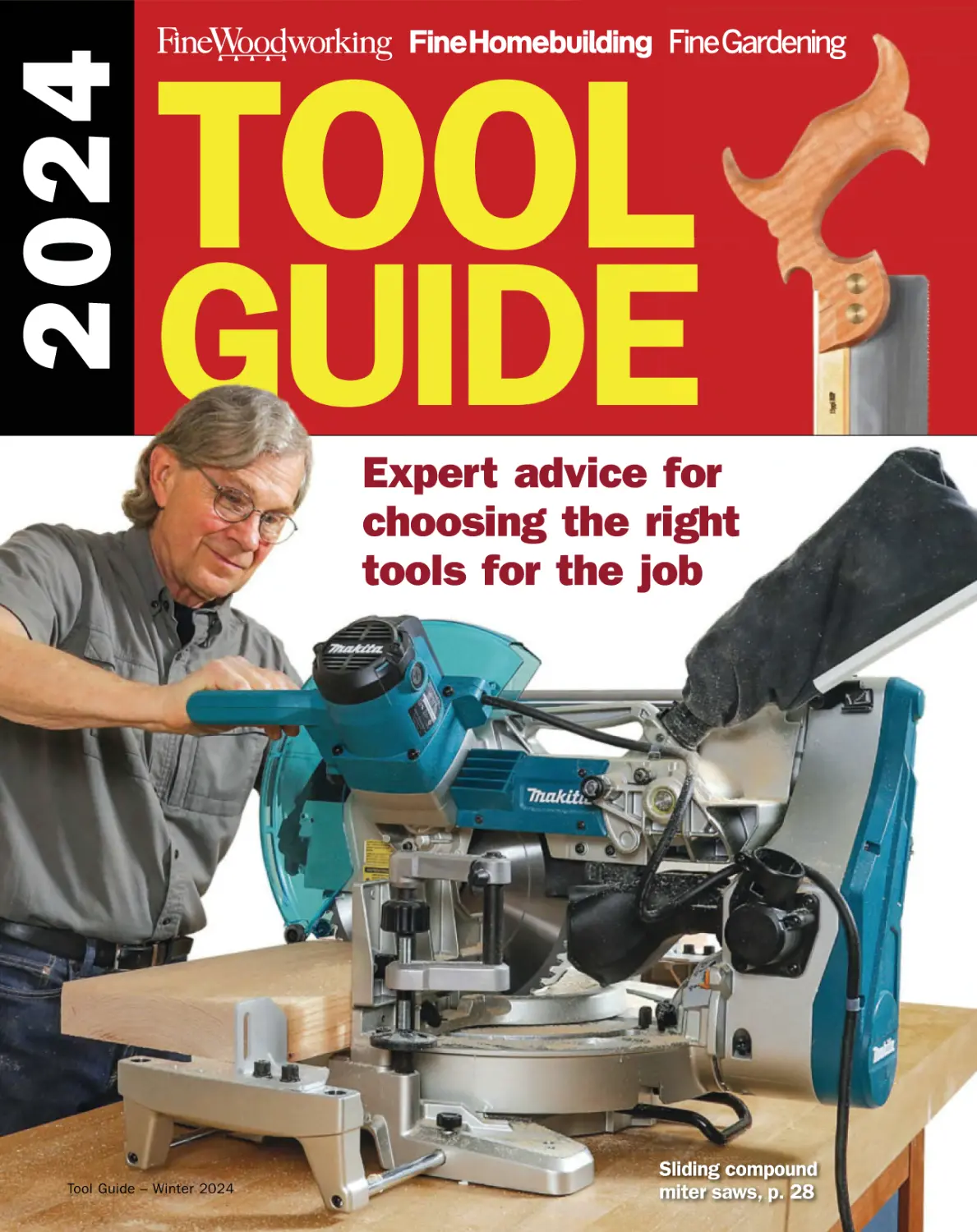
Sliding compound
miter saws, p. 28
EXCELL
S H O P F OX T O O L S . C O M
Q UA L I T Y T O O L S S I N C E 1 9 8 9
22799
ENT ACCURACY
& RELIABILITY
Quality machines with proven performance.
TWO
YEAR
WARRANTY
With unmatched quality and value, SHOP
FOX® machinery has steadily developed
into one of the top brands of woodworking
and metalworking equipment in the United
States. The broad selection of SHOP FOX®
machines includes table saws, jointers,
planers wood and metal bandsaws, shapers,
wood and metal lathes, sanders, dust
collectors, mills, drill presses, and several
types of specialized machinery for the
commercial or DIY workshop.
& MORE!
See website for details
TOOL
GUIDE
contents
New power tools p. 24
POWER TOOLS
24 New to Market
28 12-in. Sliding Compound
Miter Saws
36 Compact Cordless Routers
Cordless routers, p. 36
42 Today’s Track Saws
MACHINES
46 New to Market
50 Cordless Table Saws
54 Benchtop Planers
56 Wall-Mounted Dust Collectors
New machines, p. 46
HAND TOOLS
62 New to Market
Ergonomic outdoor
tools, p. 86
66 Must-Have
Concrete Tools
72 Hand-Tool Buyer’s Guide
GARDENING
80 New to Market
86 Garden Tools That
Are Easier to Use
ACCESSORIES
90 New to Market
94 Essential Clamps
for Woodworking
100 Anchor Your Work
to the Wall
108 Drawer Slides
Departments
6 On the Web
8 Welcome
10 Quick Tips
18 Tablesaw Setup
Accessories, p. 90
Hand-tool buyer’s guide, p. 72
free extras at FineWoodworking.com/TG2024
TA U N T O N ’ S
on the web
TOOL
GUIDE
Editor and
Creative Director
Deputy Editor
Deputy Art Director
Senior Editor
Editor-at-Large
Associate Editor
Managing Editor/
Production
Administrative Assistant
Editor,
FineWoodworking.com
Assistant Digital Editor
Social Media Coordinator
Shopmade clamping station
Creative Director
Executive Editor
Senior Editors
This clamping station by Alan McIvor helps make
panel glue-ups foolproof.
VIDEO
Drywall tools for the first coat
Learn about mechanical and automatic drywall
tools such as the taper, the compound tube, and
the banjo to make your drywall job better.
VIDEO
How to make a track saw
crosscut table
Build a table that will make the track saw your
go-to tool for crosscutting panels that are too big
for your table saw.
VIDEO
Pruning tips for hydrangeas
If you decide you need to prune your bigleaf
hydrangea, this video will give you the information
you need to do it right.
Members get special benefits
Subscribe to FineWoodworking.com to gain exclusive access to more than 1,000 project and
technique videos. You’ll also get more than 40 years of magazine archives at your fingertips,
including 1,400-plus articles and project plans.
VIDEO WORKSHOP
Machine maintenance
with Matt Wajda and Ellen Kaspern
A well-tuned machine makes woodworking more accurate
and shop time more enjoyable. Not only have Wajda and
Kaspern spent countless hours making furniture, but they’ve
also both taught classes on setting up and maintaining
machinery.
In this series, you’ll learn how to tune up:
Tablesaws ● Jointers ● Planers ● Hollow-chisel mortisers
6
Senior Editor,
Green Building Advisor
Digital Editor
Assistant Art Director
Social Media Editor
Editorial Assistant
Technical Editor
Editor-at-Large
Editorial Adviser
Executive Producer
Video Producer
Assoc. Video Producer
Production Manager
Michael Pekovich
Jonathan Binzen
John Tetreault
Anissa Kapsales
Asa Christiana
Amanda Russell
Elizabeth Knapp
Betsy Engel
Ben Strano
fw-web@taunton.com
KT Kaminski
Kara Demos
Rodney Diaz
Samantha Maver
Patrick McCombe
Brian Pontolilo
Kiley Jacques
Lana Melonakos-Harrison
Melinda Vazquez
Carissa Duhamel
Jennifer Morris
Mark Petersen
Charles Miller
Mike Guertin
Colin Russell
David Fishel
Andres Samaniego
Jessica Chaloux
fine
Gardening
Executive Editor Danielle Sherry
Executive Art Director Stephanie Fagan
Associate Editor Carol Collins
Content Editor Jennifer Benner
Assistant Editor Diana Koehm
Copy/Production Editor Don Burgard
Administrative Assistant Betsy Engel
Emeritus Editor Stephanie Cohen
Digital Content Editor Christine Alexander
Digital Content Kaitlyn Hayes
Manager
Digital Content Karalyn Demos
Production Specialist
Manager, Video Studio
Jeff Roos
Taunton’s Tool Guide: (ISSN: 1930-9589) is published
by The Taunton Press, Inc., Newtown, CT 06470-5506.
Telephone 203-426-8171. Canadian GST paid registration
#123210981.
Printed in the USA
Precision Cutting Simplified
FREE MASTERCLASS
AND PLANS
FROM SHAPER
Learn about Shaper Origin and build your
own Flip-Top Lid Box with Finger Joints as
you follow along in this free Masterclass.
Author of 52 Boxes in 52 Weeks and woodworking educator,
Matt Kenney shares his tips on box making from design, stock
preparation, joinery, and finishing.
Scan QR to get your FREE project plans:
shapertools.com/matt-kenney-masterclass
GOOD TOOLS MAKE
EVERYTHING BETTER
It doesn’t matter whether you are a new
homeowner attempting to tile your bathroom,
a master woodworker crafting a piece of
fine furniture, or a gardener looking to make
a hard job less taxing: When you start with
good tools, the work is easier and the results
Associate Publisher,
Advertising & Marketing
Director
Alex Robertson
203-304-3590
arobertson@taunton.com
Administrative
Assistant
Beverly Buonanno
203-304-3834
bbuonanno@taunton.com
Director of Digital
Advertising Operations
are better.
Digital Advertising
Operations Specialist
If you’re on a quest for the latest tool
information, this publication is a good place to
start. Taunton’s 2024 Tool Guide gathers tool
reviews, roundups, how-tos, and advice from
the past year, offered by the experts at Fine
John Maher
Erin Nikitchyuk
Group Marketing Director
Robina Lewis
Director,
Consumer Marketing
Senior Marketing Manager,
Customer Acquisition
Marketing Manager
Matthew Ulland
Sara Decanali
Danielle Pendergast
Woodworking, Fine Homebuilding, and Fine
Print Production Manager
E-mail Operations
Gardening magazines.
From master gardeners across the country,
Richard Booth
Michael Hendrick
To contact us or submit an article:
Fine Woodworking, The Taunton Press
63 South Main St., Newtown, CT 06470
Email us at fw@taunton.com or call 800-309-8955
there’s a roundup of ergonomic gardening
tools that are easier on the hands and body.
Member
BPA Worldwide
Also from gardening experts is a look at
some of the newer tools on the market.
Single Copy Sales
On the homebuilding front, professional
carpenters and contractors review new
cordless table saws that are ideal for remote
job sites, and compact cordless routers that
make setup faster and eliminate pesky power
cords that can trip you up. We also take a
Independent publishers since 1975
Founders, Paul & Jan Roman
look at tools for leveling concrete, and variety
President & CEO
of new accessories to make work easier and
Chief Financial Officer
more efficient.
On the woodworking front, you can choose
Chief Operating Officer
Brian Magnotta
Chief Revenue Officer
Erica Moynihan
Chief Content Officer
VP, Finance
from reviews of table saws, miter saws,
VP, Strategy and Research
planers, routers, and a multitude of other tools
VP, Human Resources
VP, Digital Product
Development
that have hit the market in the past year. Or
Renee Jordan
Mark Fernberg
Robert Yagid
Brett Manning
Kristina Swindell
Carol Marotti
Ashley MacDonald
choose the unplugged route and check out
Publishers of magazines, books, videos, and online
Fine Woodworking • Fine Homebuilding • Threads
Green Building Advisor • Fine Gardening • Taunton.com
our updated collection of hand tools.
So sit back and browse through the
collections of tools curated here, and rest
assured that each of our recommendations is
backed by a professional who uses them in
their shop, on the job site, or in their garden.
Then head out and choose the right tool for
the task you have in mind.
8
A NOTE ABOUT PRICES
Prices listed in this guide were
checked at the time of publication
and represent an average cost for the
tool available online. Prices change,
sometimes quite often. So please
do your own price checks and survey
several retailers if considering a tool.
The Taunton guarantee: If at any time you’re not
completely satisfied with Fine Woodworking, you can
cancel your subscription and receive a refund for any
unserved issues.
To contact customer service:
Email us at customerservice@finewoodworking.com
Visit finewoodworking.com/customerservice
Call 866-452-5141
Copyright 2023 by The Taunton Press, Inc. No reproduction without permission of The Taunton Press, Inc.
Photo Credit: Creative Commons
quick tips
Miter gauge guides
a tablesaw sled
The most difficult part of making any
tablesaw sled is attaching the miter
runner(s) accurately so that the fence
is square to the blade. My approach
makes this critical step much more
straightforward.
If you have a spare miter gauge lying
around the shop, you can attach it directly
to the sled, creating a robust, adjustable
guide system. You’ll only have one runner
guiding the sled instead of the usual two,
but these bars are made of durable steel or
aluminum and can be adjusted for a snug
fit in the miter slot, either with built-in
adjusters or by dimpling the sides of the bar
with a center punch.
It’s easier if you dedicate the miter gauge
to the sled in question, adjusting it for
squareness and leaving it that way, but you
can also use the same miter gauge to guide
multiple sleds.
To get the miter gauge ready for its new
job, drill and countersink a hole in the
leading end of the bar. Lock the miter gauge
at 90°, and use the two attachment holes
in its head/fence (drill them if they
aren’t already there) to screw it to the
front fence of the sled, using pan-head
wood screws. It’s helpful to have a
little bit of slop in these holes for later
adjustment. Then make a test cut to see
if the sled is square to the blade. Adjust
its angle a little if necessary.
Next, flip over the sled and drive a
standard wood screw through the tip of
the bar into the base of the sled. The goal
is to do this without the bar moving from
its current position. Make a practice cut to
check once more for squareness, and the
sled is ready to use.
If the sled has moved slightly off square,
you can make a small adjustment by
loosening the head of the miter gauge as
well as the front screws that attach it to the
sled, and tapping the front end of the sled
sideways. Retighten the screws and make
another test cut.
Shopmade
crosscut sled
Drill and countersink
hole through tip of
miter bar, matching
outside diameter of
attachment screw.
Lock miter gauge at
90°, and attach head
to front fence of sled
with pan-head screws.
Flip sled over and
drive a wood screw
through countersunk
hole into sled base.
If sled isn’t quite square to blade,
loosen head of miter gauge, loosen
pan-head screws that attach it, tap
front end of the sled sideways,
and retighten everything.
You'll need some wiggle
room in these front
attachment holes.
—BRUCE L A R S S ON, Dud ley, M as s .
10
Drawings: Dan Thornton
Add a height dial to your tablesaw
Blade height is critical for a variety of joinery cuts
on the tablesaw. In the past I would set the height as
accurately as possible and sneak up on the precise
depth with a series of test cuts. When I realized that one
revolution of the handwheel moved the blade up 1⁄4 in.
on my saw, I decided to create a pointer system to make
it faster and easier to set the height accurately, as well as
to return to an earlier setting.
First, I made a wooden pointer that attaches to the
saw cabinet with magnets. Using magnets lets me
reposition the pointer when I make a bevel cut. That’s
necessary, since tilting the blade repositions the entire
handwheel. I also attached small blocks to the cabinet,
one on each side of the pointer, with double-stick tape;
they let me return the pointer to its original location.
While you could mark the handwheel directly for
various heights, I attached a ring made from thin white
masonite to make the marks more visible. I divided the
ring into quadrants to mark 1⁄16-in. height intervals.
I also make a mark on it whenever I need to return
the blade to a specific setting. I use a grease pencil for
all of these marks, so they’re easy to redo if I change
the blade to one with a slightly different diameter.
— J IM C OX, Eas t Aur or a, N . Y.
Supercell
“I’d give it 6 stars if I had
the option!
White masonite
disk is attached
with double-stick
tape, with blade
heights marked.
(This saw raises
the blade 1⁄4 in.
with each full turn
of the handwheel.)
Pointer, wood
block, is sized to
end up flush with
dial on handwheel.
Rare-earth magnets embedded
in back allow block to be moved
when blade is angled.
Blocks on both
sides of pointer,
attached to saw
with double-stick
tape, let you
return pointer to
original position.
Dial can be marked
for any precise
depth needed.
And 30 Gal.
Drum Option
The Supercell exceeded my
expectations! Every aspect of
this machine is well designed.
From the very high pressure, to
high CFM, to the ease of chip
disposal and filter cleaning. An
exceptional value.” - Adam D.
Celebrating 30 Years of Made in the USA
To Learn More:
800-732-4065 oneida-air.com
TAU N T O N ’ S 2 0 2 4 T O O L G U I D E
11
quick tips
continued
Turn any chisel into a dovetail chisel
Quick fix for a bent or damaged saw tooth
A dovetail chisel has angled sides, letting it nestle nicely into the
corner of a dovetail socket. Standard bench chisels have flat areas
at the sides, called “lands,” which prevent them from working all
the way into the corners, and can make obvious dents there. To
turn a bench chisel into a dovetail chisel, many folks use a bench
grinder, which requires a steady hand to produce a smooth, even
result. A stationary belt sander makes the job a lot easier. Start by
creating an angled bed as shown, using a piece of plywood. The
angle of the bed should match or exceed your favored dovetail
angle. Slide the chisel forward and back against the belt, with a
light touch, and stop just as the angled side reaches the bottom of
the chisel. You’ll love the results. For Japanese chisels, you can use
a black-oxide coating or other patina solution to turn the freshly
ground metal black.
A bent or broken tooth on a Japanese pull-style saw
can extend out beyond the kerf and drag or catch with
each stroke, making the saw difficult or impossible to
use. To bring the damaged tooth back into alignment,
gently run the side of the blade over a medium-grit
diamond stone (1,000-grit works well), applying even
pressure with a block of wood. A few easy strokes on
each side of the saw is all it takes to flatten the trouble
spot. A saw can be repaired this way many times before
it has to be retired.
— DER EK C OHEN, R os s m oyne, We ste r n Au stra l i a
—D E N N Y SP E C TO R, Re ddi n g , Ca l i f.
Japanese pullstyle saw with a
damaged tooth
Medium-grit
(approx. 1,000-grit)
diamond stone
Standard chisels have
flat sides, preventing
them from entering the
corners of dovetails.
Add an angled table
to a stationary belt
sander.
Slide a standard bench
chisel forward and back,
using a light touch, to bevel
the sides down to a point.
Newly ground chisel fits
nicely into dovetail sockets.
12
While holding
saw down with
a flat wood
block, run both
sides lightly
over sharpening
stone, focusing
on the
damaged area.
Soften machine corners
with custom bumpers
I find that sharp corners in my shop
tend to catch my clothing and body as
I walk by. I also worry about stumbling
and hitting my head on them. The edges
of my new tablesaw have a number of
bolt holes along them. So I cut a piece
of hardwood to match the dimensions
of each edge, rounded the edges with a
1⁄4-in. router bit, and mounted them on
the edges of the table with round-headed
bolts. Hex-head bolts set in counterbores
could also work. The wood bumpers not
only soften the sharp corners, but also
add a handcrafted look to my new saw.
The same could be done on other types
of shop equipment.
Hardwood bumper, sized to fit
edge of tablesaw table, and
rounded on router table
Attach with bolts, using
available holes in table edge.
—CARL S PEN CER , Nolens ville, T enn.
See other customer
Super Dust Deputy
Setups
To Learn More:
Improve Your Collector’s Performance and Say Goodbye to Clogged Filters with the Super Dust Deputy 4/5!
Celebrating 30 Years of Made in the USA
oneida-air.com
TAU N T O N ’ S 2 0 2 4 T O O L G U I D E
13
On the Horizon
A selection of some of the best new tools on the market.
Shaper's Complete Origin
System
Shaper Origin is the world's first, and only, handheld CNC
router. You steer Origin while it makes small automatic
adjustments to ensure clean and accurate results. The
Complete Origin System blends digital precision with
the craft of woodworking for a range of applications,
from joinery and custom template routing to hardware
installation. Combine Origin with Workstation for all of
your joinery needs or use it with Plate: the universal
template for Origin that helps install a wide array of
hardware, inlays, and bowties and includes hundreds
of free digital templates from leading manufacturers in
Shaper's Hardware Catalog.
Micro Fence
Compact 3-axis machining center
The Startech CN K is SCM's new 3-axis machining center.
Designed for artisans, schools, prototyping departments,
and the home enthusiast, it is the only machine in its class
equipped with an integral cabinet, complete with internal LED
lighting, which ensures absolute protection for the operator
and keeps the surrounding environment clean.
Shop now at https://shop.scmgroup.com/scmwood-na/us/en
For more information, visit our website: scmwood.com.
Micro Fence began more than 30 years ago, with woodworker
Richard Wedler and his father Jack, a machinist and toolmaker.
A micrometer is built into the jigs, so extremely fine adjustments
are literally at your fingertips—and accurate to 1⁄1000
1000 in. Made
entirely in the USA using local shops and materials, these tools
are made to last a lifetime.
Micro Fence offers a complete milling system that works
with most routers. There are three core elements that bring
accuracy and simplicity to every job—a basic edge guide for
straight work, a circle jig for working in the round, and plunge
bases that bring that same precision to depth-of-cut settings.
Even their smallest tool, the Micro Stop, brings highly accurate
repeatability to tablesaw crosscutting, miter saws, bandsaws,
shaper fences, router tables, sanding machines…in fact, pretty
much anywhere you need to add micro-adjustment.
Visit microfence.com/FWW for an exclusive offer.
16
SPONSORED CONTENT
Your woodworking headquarters
For over 50 years, Hartville Hardware has offered the top tools for woodworking.
Whether you are looking for carving tools, turning tools, or power tools, we have
everything you need to create, maintain, or upgrade your workshop’s collection.
At the core of our woodworking assortment is Festool. We carry the entire
line and offer FREE SHIPPING on all Festool orders, no minimum. We also carry
products from Robert Sorby, Whiteside, Tormek, Crown, Woodpeckers, and Incra.
We have large assortments from trusted brands like Milwaukee, DEWALT, and
Bosch, too!
Hartville Hardware has so much more than the tools! From durable workwear
by Carhartt to drinkware
and coolers by YETI, even
storage solutions and cleaning
products, Hartville Hardware
has everything you need for
your workshop.
Join our Festool mailing
list to be entered to win a
FREE Festool item. Visit
www.hartvillehardware.com/fww
for more details and to sign up.
PantoRouter
Woodworking Machine
The PantoRouter® Woodworking Machine
makes joinery fast, accurate, safe,
repeatable, and fun! Mortise and tenon
has never been easier with over 150
perfectly fitting sizes using their patented
tapered templates. You can set up and
cut angled or compound-angled joints
in minutes, virtually dust-free due to the
incredibly effective dust collection hood.
Go from setup to glue-up in under five
minutes in most cases. There’s no other
tool or jig for woodworkers available today
with the straightforward simplicity and the
open-source potential to create unique and
functional joinery, patterns, and designs.
Keller Dovetail System
The Keller Dovetail System gives you simple,
accurate, fast, and elegant dovetail joinery.
This is the original through-dovetail system,
precision made in the USA since 1976.
No test cuts, no wasted lumber, no fussy
adjustments. Set up in 5 minutes with your
hand-held router or on your router table,
even if the board thicknesses are different.
Cut one-off boxes in 12 minutes, or up to 40
drawers per hour in production. Cut unlimited
widths, angles, compound angles, box joints,
and even curved dovetails.
•Mortise and tenon
•Box joints and dovetails
•Safe & easy to use
•Ideal for hobby and professional
woodworkers or school woodshops
Precision woodworking has never been
easier. Visit www.pantorouter.com to see
videos, projects, and accessories and
learn more about how others use this
unique tool.
See www.kellerdovetail.com for full
information on the Pro and Journeyman
Dovetail models.
SPONSORED CONTENT
17
Maintenance
Setting up
your tablesaw
B Y
A S A
C H R I S T I A N A
S
ome power tools will do their best work right out of the
box. Don’t expect that from your new tablesaw. It needs
a tune-up on day one.
A tablesaw is designed so that the teeth at the front of the
blade do all the cutting, and the teeth at the back spin freely,
without rubbing or cutting into the board. For that to happen,
the board needs to travel in a perfectly straight path through
the blade. So the first step is aligning the table so that the miter
slots are parallel with the blade. The rip fence also needs
to be set perfectly parallel to the blade.
From there, the tune-up switches from parallel
to perpendicular, as you set the blade and fences
square to the table. Those 90° angles are essential if
you want to end up with tight joints and square projects.
THREE STEPS TO SAFE, SMOOTH, SQUARE CUTS
For perfect crosscuts, align the table’s miter slots parallel to the blade.
For ripcuts, align the fence with a miter slot, and it will be parallel to
the blade, too. The last step is setting two built-in stops for square cuts.
1. Align miter slots
parallel to blade.
2. Align rip fence
parallel to miter slots.
Align the blade parallel with the miter slots
To align the table (and its miter slots) with the blade, start by
taking a measurement from the edge of one of the miter slots
to the front and back of the blade. If the measurements are the
same, the blade and table are aligned. I recommend using a
0-to-1-in. plunge-style dial indicator for this step.
Start by raising the blade as high as it will go to increase
the distance between back and front. In case the teeth are a
18
3. Set stops on
miter gauge and
blade assembly.
Drawing, this page: Jim Richey
Precision
woodworking
has never
been easier.
The PantoRouter®
Woodworking
Machine is a joinery
tool like no other
• Mortise & Tenon
• Box Joints and
Dovetails
• Easy to Use
CHECK OUT OUR
LATEST ACCESSORIES
Visit the website to see the
latest clamp sets, including
the pneumatic clamps now
made for the PantoRouter.
• Set-up to glue-up
in minutes
• Ideal for both hobby
and professional
woodworkers
See videos and
project ideas at
PantoRouter.com
Maintenance
continued
Align the blade and table
The miter slots must be parallel to the blade, and a plunge-style
dial indicator is the best tool for checking.
1. CHECK TABLE ALIGNMENT
First check
reading at front
edge of blade.
Then check and
compare reading
at trailing edge of
blade.
Check at the front and back of
the blade. Clamp the wood block
onto the miter-gauge fence so the
indicator is pushing against a tooth.
Move the blade and miter gauge to
find the high point on the tooth, and
then zero the dial on the indicator.
Mark the tooth you measured
earlier, and rotate it to the back of
the table for another check. The
dial shows a different reading at
the back, meaning that this table is
misaligned.
2. ADJUST AS NECESSARY
Loosen three of the four bolts that attach the table
to the saw cabinet (above). Give the table a tap at
one of the loose corners (right), and recheck the
blade alignment. Lock down the bolts when the
readings at the front and back of the blade are
within 0.001 in. of each other.
little uneven or have some pitch built up on them, rotate the
blade and use the same tooth for each measurement. The two
numbers should be within 0.001 in. of each other, 0.002 at the
most. They probably won’t be, so you’ll need to adjust them.
On cabinet saws, the trunnions (the assembly that holds the
blade) are attached to the cabinet, and the table is attached independently, meaning you can move it and the blade stays put.
On smaller saws—job-site, portable, contractor, or hybrid
saws—the blade assembly is usually attached directly to the
20
tabletop. That means you’ll have to go a little farther under the
hood. Check your manual, and take a look under the table for
the attachment points. Newer saws make them easier to access.
Align the rip fence and check the splitter
Now that the miter slots are parallel with the blade, you can
align the rip fence with one of the slots and know that it is
square to the blade, too. Just line up the fence with a miter slot,
feel for misalignment using your fingers, and adjust the fence.
Drawings and photos, except where noted: Kelly J. Dunton
N
EW
!
WOODWORKING CLAMPS
HEAVY DUTY
PARALLEL JAW CLAMPS
WHEN YOU’RE
READY FOR BETTER.
OVER 1,500 LBS. OF FORCE
USER-FRIENDLY ADJUSTMENT
Fine Woodworking editors and guests
discuss woodworking topics.
REVERSIBLE HEAD
DUAL-DUROMETER PIVOT HANDLE
Join the conversation at ShopTalkLive.com
hartvillehardware.com
Pairs available in
12" | 24" | 31" | 40" | 50"
SOL D EXCL USIVELY AT
woodpeck.com
)RURYHU\HDUV+DUWYLOOH+DUGZDUHKDVRHUHGWKHWRSEUDQGVQHHGHGWR
NHHS\RXUZRUNVKRSUXQQLQJ)URPKDQGWRROVWRSRZHUWRROVZRUNZHDUWR
VWRUDJHZHDUHyour woodworking headquartersIRUHYHU\WKLQJ\RXQHHG
WRFUHDWHPDLQWDLQRUXSJUDGH\RXUZRUNVKRS
6FDQWKH45FRGHRUYLVLWZZZKDUWYLOOHKDUGZDUHFRPIZZDQGMRLQ
RXU)HVWRROPDLOLQJOLVWWREHHQWHUHGWRZLQDFREE Festool item
S AV E T H E D AT E
Only at our Hartville, OH location
Nov 17-18, 2023
TAU N T O N ’ S 2 0 2 4 T O O L G U I D E
21
Maintenance
continued
Align the rip fence
Once you have the miter slots aligned with
the blade, you can simply line up the rip
fence with a miter slot to see whether it is
parallel to the blade, too.
Set the stops
Both the blade and
miter gauge have builtin stops for returning
them quickly to 90°
after making an
angled cut. Set these
now and you’ll save
time later.
BLADE
Go by feel. Clamp
down the rip fence
along the edge of one
of the miter slots. Use
your fingertips to check
if the fence is flush with
the slot from the front
all the way to the back
(above). Adjustments
vary, but all are easy.
On T-square fences like
this (right), there are
simple set screws on
the bracket that rides
the guide bar.
All saws should have some form of splitter behind the blade,
designed to sit in the slot that it cuts, preventing the board from
turning sideways and kicking back. On some saws you can
simply flex the splitter sideways to align it; on others there will
be a way to adjust it at its base.
Two stops make accuracy more convenient
For ripcuts and crosscuts alike, you also need the blade to be
square to the table. There is a stop on the saw to help you
return the blade to a perfect 90° every time. You can use a
square to realign the blade after each bevel cut, and test cuts to
be really sure, but it’s nice to have a stop you can rely on.
The miter gauge that came with your saw also should have
a stop on it for the 90° setting. If that stop is wiggly or sloppy
in any way, replace the miter gauge with an aftermarket model
Before squaring the fence, add a long sacrificial piece of
plywood or MDF to it.
□
Asa Christiana is a woodworker, writer, and editor in Portland, Ore.
22
Square the blade. Use a square to get the blade as close to 90° as
possible. Then make a test cut on a thick, flat piece and check that with
your square. That’s the only way to know if your saw is accurate.
Now set the stop.
The stop’s location
differs on various
saws. Loosen it,
push it against the
blade assembly,
and lock it in place.
MITER GAUGE
Square the fence
to the blade. It’s
always good to attach
an auxiliary fence
to a miter gauge, so
do this first. Get the
fence as close to
square as you can
with a triangle or
square, and try a test
cut as before. Then
adjust the set screw
that acts as the stop.
47
Years
of projects, tips, & techniques to
make you a better woodworker
Get the 2022 Fine Woodworking Magazine
Archive on USB or digital download.
Enjoy 300 fully searchable issues of
Fine Woodworking magazine in one place.
Available at TauntonStore.com
© 2022 The Taunton Press
NEW FROM MICHAEL PEKOVICH
IONS OF
FOUNDAT
ING
RK
WOODWO
s
g strategie
and buildin
techniques
y
er
in
jo
l
Essentia
MICHAEL
Foundations of Woodworking
gets to the very core of the craft of
woodworking: laying out, cutting, and
assembling joinery for furniture and
other treasured wood objects. Michael
Pekovich dives into a step-by-step,
project-by-project description of the essential wood joints,
from rabbets and dadoes through mortise-and-tenons to
dovetails and miters. Master these joints and the door is
open to create just about any design you can think of.
PEKOVICH
Available at TauntonStore.com or wherever books are sold
TAU N T O N ’ S 2 0 2 4 T O O L G U I D E
23
POW ER TOO L S
New to market
Each year, the experts at Fine Woodworking, Fine Homebuilding,
and Fine Gardening test dozens of new products and tools. Here is a
rundown of some of the power tools we reviewed last year.
Quality sliding
compound miter saw
Sliding compound miter saws have become
a woodshop staple. Their ability to squarely
crosscut wide boards and to cut difficult miter
and bevel angles is huge. Festool’s Kapex KS
120 REB fulfills these duties with aplomb.
The design keeps the saw close to the
wall, allowing for a small footprint. The cut
is rigid and precise provided you use good
technique. It accepts 20mm blades, about
101⁄4 in. Its maximum width of cut is 12 in.,
close to several 12-in. saws I reviewed on
pp. 28–35.
Setting the bevel is a literal snap. Flipping
a clamp on the back unlocks the head.
A counterbalance spring holds the head
wherever it’s placed, allowing single-handed
adjustment. A rotating micro-adjust knob
paired with a large scale allows for precise
movements. One drawback is that the upper
fence has to be removed for 45° bevel cuts—
not a deal breaker, just a bit of a fuss.
I’m not normally a fan of laser lines, but
the Kapex’s are nice. It projects two lasers to
define both sides of the kerf, making it easy
to identify the waste.
The Kapex’s miter capacity is 50° left and
60° right. The mechanism is easy to use.
Integral table extensions lock securely and
offer additional support for longer stock.
The blade change wrench is handily stored
on the saw frame. The spindle lock is on the
blade housing. This lock is much superior
to a spring-loaded button, and also locks
the trigger. Single-handed blade changes are
possible. A speed control dial sets specific
blade speeds for specialty blades. The saw
arbor is 30mm, so typical 5⁄8-in. arbor hole
blades won’t work.
The handle, although ambidextrous, is
my biggest complaint. I find its switches
counterintuitive. It’s not comfortable either.
—Roland Johnson is a woodworker and tool
expert in Sauk Rapids, Minn.
24
Sliding compound miter
saw by Festool
Model KS 120 REB
$1,599
Bevels are a breeze. A rotating knob
limits the range of overall travel left and
right. A micro-adjust knob on the front
allows precise bevel adjustments.
On-board angle transfer. The included
Miterfast Angle Transfer Device makes
finding the center of any angle easy and
stores handily on the frame of the saw.
Photos: Barry NM Dima
Cordless biscuit joiner
My corded Makita plate joiner has been a valuable
part of my toolkit for years, and the cordless model
is similar, with a few exceptions. The cordless
version does not cut as quickly as the corded tool,
and if you plunge too fast it will stall, requiring
a reset. This is a minor problem that is fixed by
changing your plunge speed. The handle is also
shorter than that on the corded model, and I found
my hand hitting the motor housing.
Makita says you can get 300 plunges from a 3-Ah,
18v battery; I’ve never had to make more biscuit
slots than a fully charged battery delivers in a
day. Dust collection is good, but the supplied bag
fills quickly. It empties by sliding off a clip—an
improvement over finicky zippers.
I used the joiner to cut slots to repair the casing
of a round-top window. I also used the tool on an
exterior window. Not having to drag a cord up a
ladder was a plus.
I’ve found this joiner to be as useful as, and more
convenient than, the corded version.
—Brian Campbell is a carpenter in Minneapolis.
Makita plate joiner
Model XJP03Z
$290
Multi-use mud mixer
More than a mixer.
In addition to mixing
compound, mortar,
or concrete, the
DCD130 is sturdy
enough for largediameter self-feeding
bits and hole saws.
DeWalt DCD130
Speed: 0 to 600 rpm
Weight: 6.9 lb.
$270 (bare tool)
Photo: courtesy of the manufacturers
A few months ago, I made the switch from a corded mud
mixer to DeWalt’s DCD130 60v Max FlexVolt cordless mixer/
drill. It’s a versatile tool. Though we primarily use the drill
as a mixer, there have been occasions when we’ve used
different drill bits and hole saws to make holes in tile. I’ve
also seen landscapers chuck up an earth auger for drilling
shallow holes in the ground, which is a good indication of
just how much power this tool has.
Having been bound up in high-torque drills in the past, I
appreciate the DCD130’s E-Clutch system. This feature stops
the tool if it detects binding of an attachment. The drill also
has a handle that can be attached to three different sides
for more control when mixing heavier products, such as
concrete or dry-pack. According to DeWalt, you can mix as
many as 17 5-gal. buckets of thinset mortar on a single 6-Ah
battery. For my small crew, that’s a couple days of mixing.
I’ve found a few drawbacks with the tool. First, I lost
the key for the chuck. It fell out somewhere between
the workspace and my truck. I would prefer a keyless
chuck. Another issue is that the weight of the tool can
cause smaller buckets of mixed products to tip over if not
supported. This forces us to remove the mixing attachment
from the drill frequently. Having a keyed chuck slows that
process. Overall, the benefits outweigh the drawbacks. It’s
definitely a tool I would purchase again.
—Randy Williams is a builder and energy auditor
in Grand Rapids, Minn.
TAU N T O N ’ S 2 0 2 4 T O O L G U I D E
25
POW ER TOO L S
▶
N E W TO MARKE T
Cordless rotary tool is ready
for serious work
Dremel’s new cordless rotary tool has all the power,
stamina, and smoothness you’ll need for all sorts of
shaping tasks in the toughest woods. Without a cord
dragging behind it, it’s also very easy to control.
As a professional carver, I’ve owned several corded
Dremel tools over the last 25 years, which I’ve used for
light carving in tight spaces and various other odd jobs, like
trimming screws and nails. Their small motors were prone to
heat build-up, however, which often forced me to stop working
after a relatively short session of continuous use.
Dremel has solved that issue with its new cordless model,
which boasts a brushless motor powered by a 12-volt, 3 amphour, lithium-ion battery. Larger, heavier, and quieter than
the corded Dremels I’ve used, the 8250 is very strong and
smooth in use. It managed an impressive 52 minutes of heavy,
continuous carving in tough Texas ebony, on a single charge,
without bogging down or even getting warm.
—Danny Kamerath is a pro woodworker in Llano, Texas.
Versatile vacuum system
Quality Vacuum Products’ NU-Matic system delivers vacuum
pressure for veneering, laminating, and clamping—all the things
you might want a vacuum pump for. Unlike an electric pump,
this one is powered by compressed air; rather than plugging
the unit in, you use it in tandem with your compressor.
I tested the “Pro” level system, which requires an air
compressor capable of 4 cfm, but smaller and larger units
are available. I went with the All-In-One (FS) system, which
includes a foot pedal, letting you work hands-free on clamping
jobs. The system includes all of the connections you need to
attach it to any vacuum bag (QVP offers a wide range of those),
and all gauges and controls are built into the box.
What’s great about a unit like this is that it can be switched
from pressing mode (with a vacuum bag) to clamping mode.
In pressing mode, the unit automatically shuts off when the
desired vacuum is reached and resumes when the level drops.
But when the unit is switched into pneumatic clamping mode,
commercial or shopmade vacuum blocks can hold workpieces
firmly and instantly for routing and other tasks. In clamping
mode, the unit maintains continuous high pressure, turned on
and off with a handy foot switch. Various packages are listed at
QualityVak.com, and you can call 800-547-5484 for more info.
—Roland Johnson
26
Dremel 8250
$150
Power and control
with no cord.
Kamerath used the
Dremel to carve
a sculpture in
tough Texas ebony,
and it performed
beautifully, with
surprising stamina
and smoothness. It
will do the same for
furniture volutes,
drawer pulls, fluted
turnings, and more.
Quality Vacuum
Products Nu-Matic
NU4FS system
$910 (without bag)
Ready for anything. The Nu-Matic system has everything you need to
connect it to a compressor and vacuum bag and get to work. In the bag
above is the steam-bent side of a ukulele, held on a form.
Handy foot switch. The
All-In-One system includes a
foot switch that lets you work
hands-free with the pump in
clamping mode, which holds
workpieces for routing and
other tasks.
Photos: Danny Kamerath (top); Roland Johnson (bottom)
Compact
compound slider
Ridgid’s 15-amp, 10-in. sliding compound
miter saw solves an enormous number of
problems for me. Let’s start with the slide
mechanism. Two heavy-duty aluminum
arms roll on bearings, and the action
is very smooth. And because the slide
mechanism provides zero rear clearance,
you can set up against a wall.
The size and weight of this saw is
much easier to maneuver in my tool
truck. My old 12-in. sliding miter saw
is impossible to tuck between boxes,
wheel wells, lumber, and the other
things that pile up, not to mention
the difficulty of lugging it to the
job site through doorways and
around obstacles. But I thought I
needed to have a big 12-in. saw
for cutting 51⁄4-in. base upright
against the fence (beveling a saw
is a frustrating endeavor for most
models). I made do with the
overall unwieldiness of a 12-in.
slider for efficiency’s sake.
I was floored to see the Ridgid’s blade
housing is knocked out enough that it
can cut 51⁄4-in. base vertically with its
10-in. blade. I ran base, casing, and shoe
Arms for heavy lifting. The smooth-acting
slide mechanism gives the Ridgid R4241
a nearly 16-in. crosscut capacity, and the
articulating arm makes it possible to cut
51⁄4-in.-tall baseboard against the fence.
Photos: courtesy of Ridgid
Ridgid Corded
10-in. Sliding Miter Saw
Model R4241
Crosscut capacity: 15.8 in. at 90°
Max. miter: 52° left, 60° right
Max. bevel: 48° left and right
Weight: 53 lb.
$430
for several days during the test period
and there were only a few occasions in
an outside-right situation cutting in the
middle of the board when I had to bevel
the saw. That’s OK, because the saw has
the best bevel control I’ve seen. It was
simple to adjust square out of the box,
and the saw remained dead square. To
tilt, lift a release lever by the miter lock
knob, then flip the tab on the neck of the
saw, and everything releases. Bevel the
saw and lock into the detent.
The upright belt-drive motor is smooth
and shows almost zero reaction torque
or head bounce. When I cope ogee base,
I make my inside-right cut, then flip the
board over and drop the head through
the square portion of the cut to minimize
time with the coping saw. The Ridgid has
no problem doing this delicate work.
The dust collection is adequate, but
the beveled guard and blade light
took some getting used to. The light
seems overly bright. It casts a clean line
down the blade, but I think it’s 1⁄32 in.
or 1⁄64 in. thinner than the actual (very
nice) included blade. The guard housing
reflects a lot of that light around and off
the blade plate and carbide, making it
sometimes difficult to focus on a pencil
line. I did not notice this outside—where
I do most of my cutting—but when I set
up in a dim basement for trim, I did.
The saw feels powerful. It fights way
above its weight without taking up
any more space than necessary. It flew
through hem-fir 2x10 just as easily as
my 12-in. saw. It cut PT 4x4 without a
hiccup. And it’s corded, which I consider
a plus—no battery to change or forget
to charge during lunch. The saw is made
by Delta Power Equipment Corporation;
it carries a five-year warranty and
doesn’t include the same lifetime service
agreement as most other Ridgid tools.
That said, it’s easily one of the most welldesigned miter saws I’ve used.
—Mark Clement (@myfixituplife) is a
remodeling contractor and author of The
Carpenter’s Notebook.
TAU N T O N ’ S 2 0 2 4 T O O L G U I D E
27
POW ER TOO L S
▶
M I T E R S AWS
TOOL TEST
12-in. Sliding
Compound Miter Saws
The best deliver big capacity
in a small footprint
B Y
28
R O L A N D
J O H N S O N
TOP SAWS STICK CLOSE TO THE WALL
DELTA
26-2251
18 in.
The saws with
articulating arms need
no clearance behind
the saw, meaning
they can hug tight to
a wall to save space.
In contrast, those
with telescoping arms
need up to 47 in. from
front to back. In a
small shop, this can
make a big difference.
30 in.
Wonderful wallflowers. The saws that performed the best
could also tuck right against a wall thanks to articulating arms,
like those on this Bosch, or a carriage that slides on stout twin
rails. Conversely, saws with sliding rails that require a lot of room
behind the saw didn’t yield better cuts.
RIDGID
R4222
I
f you want to work easily with wide stock, invest in a 12-in.
sliding compound miter saw. Compared with the winner from
the last review we did of miter saws, the non-sliding Bosch
CM12, the sliders in this field have an extra 5 in. or more of crosscut capacity. Each of these sliders can crosscut stock over a foot
wide. That’s excellent, and the extra width doesn’t come at the
expense of performance, either.
Each saw I tested for this review was reliable enough to yield
furniture-quality cuts every time. Every model can handle both
rough cutting big boards and sizing panels to final length. What’s
more, their bevel and tilt mechanisms let them cut simple or compound angles with a flip of a handle or twist of a knob. These
are capable, versatile machines, and there are plenty of options to
pick from. So, if you’re in the market for one, I’ll give you some
guidance on which saw might be right or wrong for you.
Among this group of saws, there is no poor choice. While
evaluating them, I found all had high accuracy and good power.
Tables were flat, fences were coplanar from side to side and
square to the tables, and sliding action was accurate and smooth.
Even with a full thickness 80-tooth blade, they all easily sliced
through 8-in.-wide 8/4 red oak with a single cut without bogging or creating a rough cut. Cuts in 8/4 Eastern white pine
were equally nice. No one saw had make-or-break cut capacity
relative to the others.
Even though performance was essentially identical, the saws
are not the same. The biggest immediate difference among them
is their slide mechanisms, especially how much room each takes
up. I much preferred the slides that don’t need clearance behind
the saw, a space-saving innovation that allows the tool to sit very
close or even flush to a wall. A couple of models accomplish this
via rods mounted alongside the blade. The Bosch, the Delta, and
one of the Ridgids employ articulating arms.
Photos: Barry NM Dima
311⁄2 in.
46 in.
10
15
20
25
30
35
40
45
50
BOSCH
DELTA
RIDGID
R4251
MAKITA
METABO
SKILSAW
DEWALT
GRIZZLY
RIDGID
R4222
Wall to front
of base
Wall to end of
miter lock
TAU N T O N ’ S 2 0 2 4 T O O L G U I D E
29
FEATURES TO CONSIDER
HANDLES
There’s a range of
handle sizes and
trigger-lock options,
including buttons
outside the handle,
buttons next to the
trigger, and slides.
Johnson found some
intuitive, some
a bit clunky, but
almost none were
so awkward that he
wouldn’t get used to
them.
LIGHTING
Several saws have
LED lights that
wash over the
blade, casting a
sharp shadowline
for accurate cuts
while also providing
enough overall light
to see what’s going
on. Lasers, on the
other hand, are
seldom accurate
enough for furniture
work. The Metabo’s
laser is an exception,
since it can be
adjusted easily.
The rest of the saws have rods that extend behind the machine,
requiring a foot or so of clearance to the wall. That’s a lot of lost
space without any benefit.
No sliding mechanism proved more inherently accurate than
another. They all traveled true and were sufficiently rigid, making
them all up to the task of furniture-quality cuts. A quality blade
with a negative hook angle is critical; I like the Ridge Carbide
RS1000 Super Miter.
Additionally, I believe poor cuts with miter saws happen more
because of the operator than the machine. It’s key to employ good
cutting practices, such as pushing directly in line with the blade
rather than to one side or another, much like with a handsaw.
Any of these saws will deflect or cut off line if you don’t move
the blade in a controlled manner. Also, take small bites in thick
30
Vertical handles
are the author’s
least favorite.
Handles oriented
vertically are one
style that Johnson
does have a hard
time adjusting to.
They put his arm and
wrist in a cramped
position, and the
cut ergonomics are
awkward for him.
hardwood rather than trying to plow through the board in a single
pass. A bit of finesse and use of best practices will make one of
these saws a valued performer in even the fussiest shop.
In the end, it’s the small details that make some of these saws
sing. Take, for instance, ergonomics. Handles that are comfortable to grip lead to better control, as do triggers and trigger locks
that are easy to engage simultaneously. Well-placed adjusters are
not only more convenient, but they also improve accuracy since
you’re not contorting your body to set them while hoping the
setting is spot-on. On some saws, I actually had to move around
behind the saw to have enough muscle to release the adjustment
and secure it again. That was frustrating. Although you can get
used to any of these setups, with such solid choices in the field,
you shouldn’t have to.
ADJUSTMENTS
Opt for convenient controls. These saws bevel and tilt by design, but
some locate the adjustment levers and knobs in easier-to-reach places.
The best are designed like this Delta, whose controls are either at the
front of the saw or a short, unobstructed reach away.
MAKITA LS1219L
Price: $760
Max cut at 90°: 131 ⁄ 2 in.
Clearance to front of base: 223 ⁄4 in.
Clearance to front of miter lock: 351 ⁄4 in.
Miter range: 60° left and right
Miter detents: 0°, 15°, 22.5°, 31.6°, and 45° left and
right
Bevel range: 48° left and right
Bevel detents: 0°, 22.5°, 33.9°, and 45° left and right
Light: Laser
This is the saw I want in my shop. For one, it’s
easy to use. All of the controls are easy to reach
and manipulate, and the glide mechanism is
both robust and smooth. The handle works well
for righties and lefties. Then there are added
bonuses that no other saw has. For instance, its
hold-down is superb, as it can move to different
locations, hinges for a greater range of coverage,
and actually holds down the work. In addition, the
saw has two points of dust collection, letting it
firmly beat the rest of the field. The one downside
was the saw’s laser, which was so faint we had to
turn off the shop lights to see it. Still, all these
pluses in a package that fits tight to the wall?
That’s a winner for me.
Lighting is important for accurate cutting. Several of these saws
have LED lights that cast the blade’s shadow onto the board, for a
very accurate cut line and enough overall light to see what’s going
on. Other saws shine a laser directly onto the board. I’m typically
not a fan of these because they are seldom accurate enough for
the work I do. Metabo’s laser is the standout because it can be so
easily adjusted. The Bosch has neither an LED nor a laser.
My remaining criteria were mostly a wash. All the saws have
depth stops, which are handy for dadoes and rabbets. However,
the Metabo is the only model without a flip stop, making repetitive
cuts, the purpose of the stop, a much taller order.
Blade changes were tedious but typically without drama. I
wouldn’t walk away from any of these machines because of a
tricky blade change. We simply don’t change blades that often for
it to be a deciding factor.
Hold-downs are a nice idea, but they’re mostly not worth bothering with. Similarly, except for a few saws, dust collection, for
which I hooked up a shop vacuum, was mostly underwhelming.
These saws all have support arms that extend from the side to
increase the width of the bed. Some of these worked better than
others. But for the best performance it’s worthwhile to ignore
the extensions and create a miter-saw station where the saw is
between two raised tables for maximum stock support.
Standout
features. The
Makita is the
only saw with
two areas of
dust collection.
Its dust
management
was exceptional
compared with
most of the other
saws. Johnson
was also a fan
of its handle
thanks to its
ambidextrous
design and
responsive
button.
Roland Johnson is a contributing editor and trusted tool authority who works
wood in Sauk Rapids, Minn.
TAU N T O N ’ S 2 0 2 4 T O O L G U I D E
31
BOSCH GCM12SD
Price: $650
Max cut at 90°: 133 ⁄ 8 in.
Clearance to front of base: 131 ⁄ 2 in.
Clearance to front of miter lock: 261 ⁄ 2 in.
Miter range: 52° left; 60° right
Miter detents: 0°, 15°, 22.5°, 31.6°, and 45° left
and right
Bevel range: 47° left and right
Bevel detents: 0°, 33.9°, and 45° left and right
Light: None
Bosch has produced another quality miter saw.
It not only fits tight to the wall; it also has the
shortest distance to the miter lock. The saw’s
generous miter range is complemented by its
large selection of miter detents. However, it
falls short in a few areas. The handle is nicely
ambidextrous, but its large size may make it
cumbersome for all but large hands. I also
found the miter and bevel controls, including
their locks, stiff. The saw is the only model in
the field with no light, either an LED or laser.
DELTA 26-2251
Price: $573
Max cut at 90°: 131 ⁄4 in.
Clearance to front of base: 18 in.
Clearance to front of miter lock: 30 in.
Miter range: 50° left, 60° right
Miter detents: 0°, 15°, 22.5°, 31.6°, and 45° left
and right; and 60° right
Bevel range: 47° left and right
Bevel detents: 0°, 15°, 22.5°, and 45° left and
right
Light: LED
The Delta is another model that you can locate
close to a wall. It employs dual articulating
arms that save space while yielding good,
wide cuts provided you use good technique.
The saw is tied for the second-shortest overall
footprint. The Delta’s ergonomics were a treat
too. Thanks to convenient placement and
ease of use, the locks for the miter and bevel
stops were superb. Its LED results in a nice,
accurate shadow. The dust collection was
just slightly lower than the Makita’s, but still
quality for a miter saw.
32
D E WALT DWS780
Price: $560
Max cut at 90°: 133 ⁄4 in.
Clearance to front of base: 283⁄ 4 in.
Clearance to front of miter lock: 413⁄ 4 in.
Miter range: 50° left; 60° right
Miter detents: 0°, 15°, 22.5°, 31.6°, and 45° left and
right
Bevel range: 49° left and right
Bevel detents: 0° and one movable stop on each side
Light: LED
This saw produced good results and has some
positive features, like the miter range, quality
locking hold-down, and stout side-support
extensions. Its dust collection is also on par with
the Delta’s. However, it has no bevel stops, just two
adjustable stops left and right. Some of its controls
are awkward to reach.
Note: DeWalt recalled this model sold in North
America between April 2019 and May 2022
because the plastic rear guard assembly can
break, exposing the blade. Consumers are advised
to get a free repair kit from DeWalt or take it to a
DeWalt service center for a free repair. DeWalt has
taken defective units off store shelves. Currently
available units incorporate a fix.
GRIZZLY PRO T31635
Price: $450
Max cut at 90°: 133 ⁄ 8 in.
Clearance to front of base: 34 in.
Clearance to front of miter lock: 451 ⁄ 2 in.
Miter range: 52° left; 60° right
Miter detents: 0°, 15°, 22.5°, 31.6°, and 45° left and
right
Bevel range: 45° left and right
Bevel detents: 0°
Light: Laser and LED
This saw performs well and the ergonomics are
good. I appreciated the easily accessed controls
and nice, ambidextrous handle. The Grizzly employs
two lights, a laser to guide the cut and an LED to
illuminate the cutting surface. The visibility is good,
although the LED does not cast a shadow, it just
lights up the cutting area. The miter range and
number of detents are nice. However, the bevel
range extends to only 45° on each side and has
no positive stops. The saw requires a good deal of
clearance from the wall, which, like similar models,
may make it tricky for smaller shops.
TAU N T O N ’ S 2 0 2 4 T O O L G U I D E
33
METABO HPT C12RSH2
Price: $450
Max cut at 90°: 121 ⁄ 8 in.
Clearance to front of base: 235 ⁄ 8 in.
Clearance to front of miter lock: 365 ⁄ 8 in.
Miter range: 45° left; 57° right
Miter detents: 0°, 15°, 22.5°, 31.6°, and 45° left
and right
Bevel range: 45° left and right
Bevel detents: None
Light: Laser
This saw has a similar design to the best
overall Makita, but it falls short because of
small details that add up. First and foremost
are the poor ergonomics. I find vertical
handles cumbersome. The bevel lock was
frustrating too. The tilt lever was at the back
of the saw, meaning the tool can’t sit tight to
the wall. There are no bevel detents. It’s the
only saw without a flip stop, meaning you have
to reset it between cuts. Still, the saw has a
compact design, and it’s the most affordable
of the bunch. The side extension arms have
slick levelers, too.
RIDGID R4222
Price: $440
Max cut at 90°: 151 ⁄4 in.
Clearance to front of base: 311 ⁄ 2 in.
Clearance to front of miter lock: 46 in.
Miter range: 70° left and right
Miter detents: 0°, 15°, 22.5°, 31.6°, 45°, 60°,
and 67.5° left and right
Bevel range: 48° left and right
Bevel detents: 0°, 15°, 22.5°, 33.9°, and 45° left
and right
Light: Laser
Especially considering the price, among the
lowest of the bunch, the Ridgid R4222 has
impressive adjustability. It has the largest
crosscut capacity of all the saws. And the
miter and bevel settings have the largest
range of travel, and a bevy of detents.
However, the power switch is clumsy, a bad
design especially for lefties. The adjusters
are either hard to use or hard to reach. Plus,
its slider needs the most room out of any of
the saws.
34
FINE WOODWORKING
RIDGID R4251
Price: $550
Max cut at 90°: 131 ⁄4 in.
Clearance to front of base: 18 in.
Clearance to front of miter lock: 30 in.
Miter range: 50° left; 60° right
Miter detents: 0°, 15°, 22.5°, 31.6°, and 45° left
and right
Bevel range: 47° left and right
Bevel detents: 0°, 15°, 22.5°, and 45° left and
right
Light: LED
The Ridgid R4251 was a pleasant surprise. It
uses two articulating arms to let it sit against
a wall. The mechanism had me skeptical,
but it performed excellently. The controls are
conveniently placed and easy to use. The bevel
and tilt locks for working off of the stops were
my favorite of the field. Its LED results in a
nice, accurate shadow.
SKILSAW SPT8801
Price: $630
Max cut at 90°: 14 in.
Clearance to front of base: 27 in.
Clearance to front of miter lock: 41 in.
Miter range: 50° left; 60° right
Miter detents: 0°, 15°, 22.5°, 31.6°, and 45° left
and right
Bevel range: 48° left and right
Bevel detents: 0°, 22.5°, 33.9°, and 45° left and
right
Light: LED
This saw performs as well as the others, but
its price and inconveniences make it hard to
recommend. As far as the positives go, the
handle is comfortable to grip. In use, its power
switch works for both righties and lefties.
However, other ergonomics are OK at best.
It’s also another saw with the bevel lock at
the back, meaning it’s a reach to get to. The
tool has good bevel and miter range. It’s the
only worm-drive saw, but I did not notice any
difference in cut. The saw cannot sit flush to a
wall.
TAU N T O N ’ S 2 0 2 4 T O O L G U I D E
35
POW ER TOO L S
ROUT E RS
TOOL TEST
▶
Compact
Cordless
Routers
All have great power, but
balance and bit visibility
make a winning tool
B Y A R T H U R
H E N D E R S O N
36
W .
I I I
W
hen I was 15, I bought my first router to help build a custom-size linen
cabinet for a bathroom remodel. Shortly afterward, I built a raisedpanel door and marveled at the pile of sawdust beneath my feet.
Because of their versatility, routers are still among my favorite tools. I can profile
edges, plow dadoes, cut mortises, make identical pieces, flush-trim veneer and
laminate, reproduce architectural elements, and build custom doors.
Lithium-ion batteries and brushless motors have revolutionized cordless tools,
including compact routers. In addition to the normal benefits of faster setup and
less tripping on extension cords, getting rid of the cord on a router allows you to
Photo, this page: Matthew Preiskines
PRICE
$200 (tool only)
PRICE
$100 (tool only)
POWER
18v
POWER
18v
WEIGHT
4.6 lb.
WEIGHT
4.2 lb.
BASE DIAMETER
27⁄8 in.
BASE DIAMETER
25⁄8 in.
ILLUMINATION
Two LEDs
ILLUMINATION
Single LED
BRAKE
Yes
BRAKE
No
BIT VISIBILITY
●●●●●
BIT VISIBILITY
●●●●●
ERGONOMICS
●●●●●
ERGONOMICS
●●●●●
MILWAUKEE 2723-20
RYOBI PCL424
The Milwaukee has the best bit visibility, thanks to a largediameter opening in the base and unmatched brightness from
two LED lights. It’s solidly constructed, with the main body and
base manufactured from metal parts. It takes two hands to
turn the tool on or off with a dust-protected rocker switch. This
router is well-balanced and feels good in the hand. Thanks to an
engraved scale with 1⁄16-in. graduations and a screw-type depth
adjustment with 1⁄64-in. markings, depth adjustments are fast
and precise.
For a low price, this router boasts impressive features, but some
tradeoffs were made with its construction to keep the price
down. Its base is cast metal, but the remainder of the tool is
plastic, and the depth scale is a sticker. Turning the tool on and
off is accomplished by a sliding switch that requires two hands
to operate. Depth is adjusted with a graduated screw that has a
release lever for fast macro-adjustments and base removal. Bit
visibility is good, thanks to a clear polycarbonate baseplate and a
single LED light.
One downside is that the depth-adjustment screw projects from
the housing and detracts slightly from the tool’s ergonomics. I
unknowingly changed the bit depth on a few occasions when my
thumb was resting on the screw. I learned not to grip the tool
this way, so this was by no means a deal-breaker. This router
comes with a dust-extraction port and an edge guide, and is
the only tool that comes with two baseplates—4 in. dia. and
53⁄4 in. dia.—made from polycarbonate. The larger baseplate
improves the stability of the tool, the primary weakness of this
category.
The base has a slightly larger footprint than that of most of
the competing routers and comes with a dust-collection chute.
The battery has some wiggle when connected to the tool, and
the collet wrench is thin stamped steel. Although this router
is comfortable to hold, its balance is just a little awkward.
This is not a polished tool, but I was pleasantly surprised at its
performance. It can easily keep up with an ambitious carpenter.
The biggest selling point of the Ryobi is its low price, which
helped it become the best-value winner.
Photos, except where noted: Arthur W. Henderson III
TAU N T O N ’ S 2 0 2 4 T O O L G U I D E
37
PRICE
$140 (tool only)
PRICE
$220 (tool only)
POWER
12v
POWER
18v
WEIGHT
2.8 lb.
WEIGHT
4.6 lb.
BASE DIAMETER
21⁄4 in.
BASE DIAMETER
33⁄8 in.
ILLUMINATION
None
ILLUMINATION
Two LEDs
BRAKE
Yes
BRAKE
Yes
BIT VISIBILITY
●●●●●
BIT VISIBILITY
●●●●●
ERGONOMICS
●●●●●
ERGONOMICS
●●●●●
BOSCH
GKF12V-25
D E WALT
DCW600
This 12v router has a unique shape that fits right into my palm
and feels like a natural extension of my hand. It has a sliding
power switch that can be operated with one hand. Despite the
lack of a removable base, bit changes are fast and easy thanks
to a spindle lock and easy access to the collet nut. Height
adjustment is simple, and micro-adjustment is done via a screwtype mechanism with 0.04 in. of movement per revolution.
This router lacks built-in lighting and has poor visibility of the
bit, so it is not ideal for freehand mortising. It is clear that the
Bosch was built for edge-profiling, however, and it excels at
this task. After routing thousands of feet of edge profiles for
this review, I found the ergonomic design of this router to be a
welcome change. I liked it so much that I purchased one. I keep
a 5⁄32-in. roundover bit in the collet, so it’s always ready to ease
edges.
focus on what you’re doing without the risk
of a snagged cord messing up your work.
I’ve been using a Makita cordless router
for more than four years. I was so pleased
with it that I purchased a second within
a few months of buying the first. Given
my fondness for routers, I was happy to
conduct a test of compact cordless routers
when I was asked. My test included mod-
38
The DeWalt has a responsive electric brake and a dust-protected
rocker switch. It provides an excellent view of the bit without
any obstruction from the base and has two bright LED lights.
There’s a depth-adjustment ring on the body of the tool with a
scale that can be zeroed. It works well and offers precise height
adjustment, reminiscent of Porter-Cable’s venerable 690 routers.
The housing diameter of the DeWalt is 211⁄16 in., about 1⁄8 in.
larger than those of its peers, and its base diameter is about
1
⁄2 in. larger than the others. That small difference made this
tool hard to grip, and my thumb hurt with extended use. The
only way I could comfortably use this tool was by mounting it
in a Woodhaven bushing plate, which enabled me to grasp the
two knobs on the plate instead of the housing. The DeWalt does
not disappoint in terms of power, and it does the most work
per battery charge of the group, but I struggle to consider this a
compact router, and its additional size makes it uncomfortable
to use compared to the others. No accessories are included.
els from Bosch, DeWalt, Makita, Metabo
HPT, Milwaukee, Ridgid, and Ryobi. All
have amazing power and capability.
Most of the cordless compact routers in
the test share some general features. All
have a spindle lock for one-wrench bit
changes, and all but the Bosch have removable bases. Their baseplates have relatively small diameters, typically less than
31⁄4 in. They are also tall, about 91⁄2 in. high,
because the battery is on top of the tool.
This raises its center of gravity, making it
all too easy to tip the tool as you are guiding it along the workpiece. This can cause
a less-than-perfect profiled edge—and a
frustrated finish carpenter.
I also ran test cuts with some of the
tools using smaller, lighter 2-Ah batteries.
MAKITA XTR01
This router, which is my second favorite, is stoutly
constructed and has excellent fit and finish, with
minimal plastic construction. An edge guide and
dust-collection shroud are included. It is easy to grip,
fits well in the hand, and has good balance. It takes
a push on two separate blister buttons on the front
of the tool to get it running. Depth adjustment is
with a rack-and-pinion mechanism, with easily visible
engravings in 1⁄16-in. and metric graduations. A spindle
lock and removable base enable easy bit changes.
Two LED lights brightly illuminate the work area.
I have over four years of experience with this router
and have never been dissatisfied with its performance.
After my testing, though, I realized that this router
has three shortcomings. First, although the rack-andpinion depth adjustment works well, I now prefer the
screw-type style, which offers easy 1⁄64-in. adjustments.
Second, all the other 18v routers have better visibility
of the bit. Third, the Makita lacks an electronic brake,
which adds an extra element of safety.
PRICE
$140 (tool only)
POWER
18v
GOING THE DISTANCE
For the run-time test, I measured how many linear feet I could rout
until the tool completely stopped due to a fully discharged battery.
The amount of work per battery charge depends not only on the amphour rating of the battery, but also on the density and hardness of the
material being machined, the profile of the bit, the depth of cut, and
the feed rate. I tested run time by profiling lengths of white oak with a
3
⁄16-in.-radius bit (Bosch 85293MC). All of the 18v routers were fitted
with fully charged 4-Ah batteries. The 12v Bosch was tested with both
a 2-Ah battery and a 3-Ah battery. Generally speaking, I found that
with two batteries you can charge them fast enough to keep working
without having to wait for a fresh one. For demanding tasks, however,
you may need three batteries.
WEIGHT
4.6 lb.
BASE DIAMETER
215⁄16 in.
Bosch (2-Ah)
ILLUMINATION
Two LEDs
Metabo HPT
BRAKE
No
Bosch (3-Ah)
BIT VISIBILITY
●●●●●
Makita
ERGONOMICS
●●●●●
Milwaukee
Ridgid
Ryobi
DeWalt
200
Linear feet routed per battery charge
244.25
279
353.4
386.7
408.7
478.7
485.6
TAU N T O N ’ S 2 0 2 4 T O O L G U I D E
39
PRICE
$110 (tool only)
PRICE
$100 (tool only)
POWER
18v
POWER
18v
WEIGHT
3.8 lb.
WEIGHT
4 lb.
BASE DIAMETER
27⁄8 in.
BASE DIAMETER
21⁄2 in.
ILLUMINATION
Two LEDs
ILLUMINATION
Single LED
BRAKE
Yes
BRAKE
No
BIT VISIBILITY
●●●●●
BIT VISIBILITY
●●●●●
ERGONOMICS
●●●●●
ERGONOMICS
●●●●●
METABO HPT
M1808DA
RIDGID
R860443
This router’s motor starts with a push of a lock button and then
a tap on a second switch. Located opposite each other, these
mechanisms are easy to operate with a single hand. LED lighting
is bright, the electric brake is fast, and the tool features a rackand-pinion depth adjustment with a scale deeply engraved in
the aluminum body. The square base allows excellent visibility
of the bit. Unfortunately, this tool’s motor became noticeably
warm during testing, despite a fan providing airflow through
ventilation ports. After rounding over 97 ft. of white oak with a
3
⁄16-in. roundover bit, the motor stopped for nearly 10 minutes,
presumably for self-protection.
This router has similarities to the Ryobi,
possibly because both brands are owned by the same parent
company. It has a plastic body and a die-cast base. I found
that adjusting the base was sometimes complicated by friction
between the base and the tool body. The square baseplate is
illuminated by a single LED light, and it has a sticker indicating
the depth adjustment. Its screw-type depth adjustment works
well, but I found the release lever for macro-adjustment poorly
placed and always in the way of my thumb, which made it hard
for me to enjoy using the Ridgid router.
Metabo HPT sent another router, which also becomes
noticeably warm with use, but it has never stopped. This tool
is very reminiscent of the Makita, with a housing of the same
diameter and similar shape. I like that it is easily powered on
and off with one hand, and I appreciate its responsive electric
brake. The Metabo’s plastic base seems less durable compared
to those on the other routers. It comes with a dust-collection port
and an edge guide.
I appreciated the lighter weight, but the
balance wasn’t significantly better. While
Milwaukee is the only manufacturer that
improves the balance issue by providing
a second, larger baseplate with their tool,
shop-built baseplates are a viable option
and aftermarket baseplates are available.
No matter which router you choose, it
40
The power switch is a push-pull type capable of single-hand
operation, but the switch was finicky, and I frequently felt like I
had to cycle it twice before the tool would power up. The battery
feels a little loose when engaged on the tool, although poor fit
didn’t seem to affect operation or complicate battery changes.
The Ridgid comes with an edge guide and a dust-collection port.
Bit visibility is good, and the router performs well despite an
overall lackluster design.
is important to remember that the best
router is the router that is used safely. Ear
protection, eye protection, and respiratory protection are a must. Wood chips and
shrapnel from a damaged router bit (or
nails embedded in lumber) could easily
cause a blinding eye injury. Hearing loss
is preventable with earplugs or earmuffs.
Many of these routers come with a dustcollection shroud, and all performed well
when coupled with a vacuum. I think the
hose throws off the balance, so I prefer to
use a respirator.
☐
Arthur W. Henderson III, M.D., is an ER physician,
cabinetmaker, and serial remodeler.
Photos, facing page: top, Matthew Preiskines; lower left, courtesy of Collins Tool Co.
ROUTER TIPS
AND TRICKS
INCREASED STABILITY
An enlarged baseplate is my most important
router accessory; Milwaukee includes one with
their router. Woodhaven (woodhaven.com) makes
quality baseplates for reasonable prices. I use the
offset plate for edge-profiling. The bushing plate
for mortising has a handhold on each side and
can span across jigs, and it accommodates guide
bushings.
ACCURATE DADOES
BETTER EDGE-BANDING
I use a lot of plywood for my projects,
with solid-wood edge-banding to hide
the laminations. But sometimes the
edges swell after exposure to glue,
which pushes the edging away. This
requires extra work, including filling
the gaps with wood putty.
The Collins Ply Prep router bit
($34, collinstool.com) makes
a plywood edge slightly
concave and allows a tight
joint between the plywood
and the edge-banding. I
use this bit so often it has a
dedicated router.
A cordless router outfitted
with a 1⁄4-in. spiral bit works
perfectly for cutting dadoes.
I start by stapling a 1⁄4-in.
plywood base to a straight
piece of 3⁄4-in. stock to make a
pair of fences. After an initial
pass through the router, these
guides are zero-clearance
fences that I align to a line
showing one side of the dado.
To position the fence for the
other side, I use a scrap of
stock that matches the width
of the dado.
I incorporate LED tape
lighting into a lot of
cabinet and built-in
projects, and I put the
tape into a dado. Not
only does it look more
polished, but it also
reduces the glare when
looking head-on toward the lighted project. I often rout these
channels with my dado guides and a cordless router.
TAU N T O N ’ S 2 0 2 4 T O O L G U I D E
41
POW ER TOO L S
▶
T RAC K S AWS
Today’s Track Saws
Corded and cordless models
for all users and budgets
B Y
T
A S A
C H R I S T I A N A
ake a handheld circular saw, mold the base to fit an aluminum track, line the bottom of the track with rubber strips,
add a sacrificial strip of plastic along one edge, and you’ve
created woodworking magic.
The first cut trims the plastic strip flush with the blade, which
then eliminates chipping on future cuts, and makes it simple to
line up the track with your pencil marks. Plop the track down on
any surface, line it up in any direction, drop the saw into place,
and make a flawless cut—all in seconds, from setup to sawdust.
A track saw also plunges smoothly in and out of stopped cuts,
and tilts sideways to cut smooth, accurate bevels.
As any user will tell you, you have to own a track saw to understand all the ways it will make your life easier. For woodworkers,
carpenters, and cabinet makers, it’s the best tool for breaking
down large sheets of plywood and MDF. It’s also perfect for cross-
42
cutting big slabs, ripping a reference edge on rough lumber, and
fitting inset doors and drawer fronts. Sink cutouts? Back-bevels
before scribing? Long, clean miter joints? All that and much more.
For beginners and DIYers, a track saw offers a safer, less expensive alternative to the table saw. It won’t guarantee parallel
cuts or square corners, but with careful layout, you can cut out
accurate parts of all sizes.
What matters most in a great track saw
The first modern track saw, the Festool TS 55, was an immediate
hit. Many other brands and models followed. While Festool still
stands alone at the top of the category, there are great alternatives.
The key to identifying the top performers and best buys is understanding what matters most in this tool. Power and smoothness
of cut are at the top of the list.
Photos: staff
MORE THAN A PLYWOOD SAW
If you work with sheet goods, you’ll appreciate the
track saw’s ability to come to the work. Instead of
wrestling a plywood sheet onto a table saw, you can
slide it onto sawhorses and cut without breaking your
back or damaging the sheet. The saw also tilts for easy
bevel cuts. Best of all, you can cut at any angle, so you
can put a straight edge on crooked boards, or align an
edge with the grain and even use the saw to fit a door
or a panel into an opening.
Break down sheet goods
Another key factor is the stability of the track on a variety of
surfaces, without clamping. All of our favorites grip surfaces well,
and have nice track clamps available for the odd time when they
don’t. The length of the standard track matters a lot too, as well
as the cost of longer tracks or add-ons.
Cutting depth is more important to woodworkers than cabinetmakers, due to the types of material they work with. Here, track
saws fall into two overall categories. The majority have blades
around 6 in. dia. with just over 2 in. of cut capacity, while a couple
of others have larger blades—and larger motors to power them.
Cordless models are in the smaller category for now.
Adjustments should be smooth and precise, from bevel angle
and depth of cut to how snug the saw fits on its ribbed track.
Plunge action should also be smooth, and efficient dust collection
is always a plus.
Kickback devices vary—All but one of our picks have a device
intended to prevent kickback. Most have a small riving knife that
sits in the blade kerf during cuts, helping to prevent material from
pinching the back of the blade. But these pivot upward during
plunge cuts, which is when you need them most. The latest Festool
cordless saw has a better solution to kickback (see the TSC 55 KEB,
on p. 45), and the Wen saw addresses the issue in an altogether
different way.
The bottom line: If you are careful and controlled when plunging and sliding the saw, you shouldn’t get kickback. If you do, it’s
likely to be mild, and tracks are relatively affordable to replace if
they are damaged by blade contact.
Put a straight edge on lumber
Asa Christiana is a woodworker, editor, and writer in Portland, Ore.
Trim doors and drawer fronts
TAU N T O N ’ S 2 0 2 4 T O O L G U I D E
43
Our favorite corded saws
Although battery power and run time continue to trend upward, corded
models still offer the best combination of price, power, and cutting depth.
FESTOOL TS 75 EQ-F-PLUS-FS USA
Price: $975 with 75-in. track
Power: 1600 watts (2.15 hp)
Depth of cut: 23⁄4 in.
Festool’s largest track saw stands alone at the top of the category. A newly
engineered blade makes it even more powerful and efficient. It was last tested by
Fine Woodworking in 2016, when Mark Edmundson said, “The Festool TS 75 EQ was
the powerhouse of the lot, blowing through the thickest, toughest materials, with an
unmatched depth of cut. There was no blade deflection, cuts were very smooth, and
the track side of the blade kerf was super-clean. Bevel cuts were very clean and
accurate.” He also noted that the plunge action and depth setting were the
easiest of any saw in the test, adding that the track did not slide on any
material. Festool also sells excellent track clamps, which can be
operated with one hand.
MAKITA SP6000J1
FESTOOL TS 55 FEQ-F-PLUS-FS
Price: $480 with 55-in. guide rail
Power: 12 amps (11⁄2 hp)
Depth of cut: 23⁄16 in.
Price: $700 with 55-in. track
Power: 1200 watts (1.6 hp)
Depth of cut: 21⁄8 in.
In the FWW and FHB tests cited above and right, the Makita was
the most comfortable and easy to use among the mid-priced
models, and recent users agree with its best-value status. It has
a comfortable handle position, very smooth plunge action, and
its track is very stable, with no clamps needed. It hesitates just
a little in the thickest hardwoods, but powers easily through
everything else, with a scoring setting that delivers chip-free cuts
in melamine. Like the Festool saws, it has a little tab that keeps it
level on the track when tipped over to 45°.
44
The TS 55 was Festool’s first-ever track saw, and they continue to
refine it. Functionally identical to the TS 75, aside from a smaller
blade and motor—and lower price tag—it’s the perfect choice for
woodworkers and cabinetmakers who don’t need the additional depth
of cut. While lighter than the TS 75 and a little easier to handle, its
1,200-watt motor is surprisingly powerful. In a 2015 test in Fine
Homebuilding, the TS 55 sliced through thick oak with ease, and
made clean cuts in melamine particleboard. Like all Festool track
saws, it offers smooth plunge and sliding action, and a host of other
thoughtful touches.
Photos: courtesy of the manufacturers
Best cordless track saws
As power and run time continue to rise, and the relative cost of cordless tools keeps dropping, more and more power-tool users are cutting
the cord. While cordless track saws have smaller blades and shallower depth of cut, the best have amazing power and run time.
FESTOOL TSC 55 KEB
Price: $880 with 55-in. track, batteries, and rapid charger; bare tool is $550
Power: 36 volts, 5.2 amp-hours
Depth of cut: 21⁄8 in.
Cutting the cord on a Festool track saw makes a great tool even better. The
TSC 55 KEB has two 18-volt batteries on board, which team up to deliver
amazing power and run time. You can also remove one of the batteries on this
tool, to keep one in the charger and make the saw easier to handle. As with all
Festool track saws, you get furniture-quality cuts, smooth adjustments, perfect
plunge action, and great dust collection. The TSC 55 KEB has a very effective
new sensor that replaces the riving knife, making any kickback extremely brief
and harmless—to you and the track. This will be most helpful to pros who tend
to make more cuts and make them faster.
MAKITA XPS01PTJ
Price: $620, with batteries, charger, and 55-in. track
Power: 36 volts, 4 amp-hours
Depth of cut: 23⁄16 in.
By all reports, the Makita’s power, run time, and cutting
speed are an even match with the amazing Festool TSC
55. While cuts aren’t quite as glassy, users won’t notice
the difference in the vast majority of applications. Like
the Festool saws, Makita’s cordless model has a brushless
motor with variable speed for different materials, smooth
plunge action, a stable track, excellent adjusters for
sliding action, and a tab that keeps the saw flat on the
track during bevel cuts. Unlike the Festool, it lacks a
riving knife, and its two 18-volt batteries must be used
in tandem, but those factors won’t be a big deal for
most users.
TAU N T O N ’ S 2 0 2 4 T O O L G U I D E
45
MAC H INE S
New to market
Each year, the experts at Fine Woodworking, Fine Homebuilding,
and Fine Gardening test dozens of new products and tools. Here is a
rundown of some of the machines we reviewed last year.
Oneida Dust
Deputy 2.5
Improved Dust Deputy
For more than a decade, I have used
Oneida’s first-generation Dust Deputy
mounted to the top of a 5-gal. plastic
bucket. The system worked great, but the
unit was top heavy and therefore prone
to tipping over.
In contrast, Oneida’s new Dust Deputy
2.5 Deluxe 10 Gal. Cyclone Separator
Kit is a pleasure to use and works well.
The cyclone still separates dust nicely,
but the tippiness is gone thanks to the
added weight from the metal barrel and
the unit’s wide stance. The 10-gal. bucket
holds ample dust but isn’t so large it’s
unwieldy to empty. The kit’s six 11⁄2-in.
casters let the unit roll easily over mats
and cords.
$199.95
The kit comes with a high-quality,
51⁄2-ft.-long, crush-resistant hose to run
from the separator to your dust extractor,
as well as a strip of foil tape to mount
to the separator if you’re worried about
static buildup in the separator.
One downside to the metal barrel is
that there is no visual indicator that the
barrel is full.
Oneida also sells the Dust Deputy 2.5
in packages with just the cyclone itself
or with a 5-gal. plastic bucket. But, if you
can swing it, the Dust Deputy 2.5 Deluxe
10 Gal. kit, with its heavy metal drum, is
fantastic.
—Ben Strano is the editor of
FineWoodworking.com.
Compact cordless compressor
Cordless compressor by Metabo HPT
Model EC36DAQ4, 36V MultiVolt
$300 (bare tool)
46
Upon receiving the Metabo HPT cordless compressor, my first thought
was that it was a solution without a problem. Corded compressers
were just fine. I was wrong.
The first time the compressor saved me 10 minutes was when filling
the tire on my tractor, which was parked outside the radius of where
I could easily run a cord. On my walk to the tractor—without 100 ft.
of cord in tow—I was delighted to discover just how light the 2-gal.,
single-tank Metabo HPT compressor is. Though it doesn’t hold as much
air as a twin stack, comparatively it’s a dream: light, well-balanced, and
easily stored. Shortly after the tractor situation, my customer’s car tire
went flat, and the cordless compressor easily took care of the problem.
In terms of carpentry, the compressor spent a few days setting interior
doors and base molding. One battery runs for a half-day shooting
13⁄4-in. brads. With smaller nails, it doesn’t cycle much and it runs
quietly. The compressor can run a framer or a siding nailer, but the
pump kicks on every five nails; it’s not made for these larger nailers,
but it works in a pinch. I also used it with a narrow crown stapler to
tack up shiplap siding for a screened porch using the MultiVolt adapter
instead of the battery and the tool didn’t miss a beat. The tool works
well and has become my go-to compressor for small jobs.
—Mark Clement (@MyFixItUpLife) is a carpenter in Ambler, Pa.
Photos: courtesy of the manufacturers
Compact SawStop is a win
for smaller shops and budgets
The new Compact Table Saw (CTS) brings SawStop’s proven safety
technology to a wider range of customers, while carrying on the
company’s tradition of well-designed and well-constructed tools.
With a winning combination of price, size, portability, accuracy,
surprising power, and a full 10-in. blade, the CTS is unlike anything
on the market for small shops or newer woodworkers.
While the 120-volt CTS can rip through 8/4 maple with relative
ease, it doesn’t accept dado sets, which means woodworkers
will have to get more creative with some joinery cuts. The wellengineered fence stands out. Riding on front and rear gear racks,
it stays perfectly parallel to the blade, and adjusts precisely with
a clever knob that pulls out to engage the gears and pushes in to
lock. The blade’s bevel angle micro-adjusts in a similar way.
The innovative fence includes an auxiliary bar that flips into place
to act as a low fence for narrow rips. And, when the bar is lowered
slightly, it doubles as a shelf to support wide pieces, helping this
compact saw overcome a drawback of its relatively small tabletop.
Stops at the front of the table that keep the fence from being
inadvertently pushed into the spinning blade (and triggering the
brake), can be pushed in for narrower rip cuts.
With the blade encased in a tight lower shroud, dust collection
is nearly 100% effective below the saw when a vacuum source is
attached. Last but not least, the fence, riving knives (shark fin and
standard), multi-leaf blade guard, blade-change and adjustment
wrenches, miter gauge, and extra blade cartridge (available
separately) all store neatly in a removable plastic box on the back
of the saw. One caveat: I would replace the stock miter gauge with
a better, aftermarket model.
—Roland Johnson is a woodworker and tool authority
in Sauk Rapids, Minn.
Table saw by SawStop
Model CTS
$900
Plenty of power.
With a 10-in. blade
and standard
120-volt power,
the SawStop
CTS easily rips
through 2-in.-thick
maple. Full blade
height is 31⁄4 in.,
comparable to a
full-size cabinet
saw.
Smart fence. The rip fence rides on gear racks at the front and
back, keeping it square to the blade, and it adjusts and locks precisely with a front-mounted knob. It includes a low fence for narrow
rip cuts, which drops to support wide stock for ripping, as shown.
Photos: Roland Johnson (middle and bottom right);
courtesy of Grizzly (top and bottom left)
TAU N T O N ’ S 2 0 2 4 T O O L G U I D E
47
MAC H INE S
▶
N E W TO M A R KE T
Miter gauge and
fence team up
Rockler’s Precision Miter Gauge and
Miter Gauge Fence is easy to set up and
works well. I used them both in the shop
for several weeks, and they performed
dependably, whether making square cuts,
45° cuts, or miters for an octagonal frame.
All in all, the Rockler miter gauge makes
a beneficial addition to a tablesaw. The
fence is nice too, but with some caveats.
The guide bar was easy to tune for a
precise fit in the miter slots via four nylon
set screws. Once set, the bar tracked
smoothly and precisely. The front face of
the gauge was accurately plumb.
The protractor head has detents for
accuracy. In addition to one at 90°,
there are detents at five common
angles on each side of the head.
There’s also a detent that positions the
guide bar parallel to the fence for ease
of storing. The bar even has a large
hole for hanging. The detents are not
microadjustable to the bar, but my gauge
came square out of the box anyway.
The gauge has a high-contrast
protractor scale that is easy to read and
align with the gauge’s hairline indicator.
A tall handle locks the head in various
positions. Additionally, there are knobs
for securing a sacrificial fence, meaning
all adjustments on the gauge can be
made without additional tools. An added
plus is that all the knobs and adjusters
are easy to grip.
The fence is made of lightweight
anodized aluminum. At the end of
the main fence is a short section that
telescopes out. A flip stop for setting
repeat cuts slides along the top of the
fence, though there is no measurement
scale. Included with the fence is a
removeable melamine face for zeroclearance cuts.
The fence is a nice, simple idea, but
I should note that the telescoping arm,
when tightened, extends forward of the
main fence by 0.010 in. This pushes the
main workpiece slightly out of square.
—Chris Gochnour is a furniture maker
in Salt Lake City.
48
Easily adjustable.
A spring-loaded pin
engages detents to lock
the head at common
angles. For in-between
angles, the pin can
be withdrawn so the
knob can lock the
head anywhere within
70° left and right. The
handles and knobs are
easy to grip.
Miter gauge
by Rockler
$120
Miter gauge fence
by Rockler
$70
Flip stop is a convenient timesaver. With a
flip stop, you can alternate between squaring
the ends of boards and cutting them to equal
length without the stop getting in the way or
the setting being lost.
Telescoping arm is a stretch. The fence
worked well, but not with the arm. When the
arm was extended, it was slightly forward of
the main fence, interfering with square cuts.
Photos: Barry NM Dima
New dado set cuts
extremely cleanly
Infinity’s latest 8-in. dado stack ticks all of the boxes and more.
What makes the XL different from Infinity’s standard Dadonator
is thicker interior (chipper) blades that produce even flatterbottomed dadoes and make setup quicker as well.
For example, it takes just two of the 1⁄4-in.-thick chippers plus
the two outer blades to produce a 3⁄4-in.-wide dado. And a full
stack of all chippers and blades can produce dadoes up to
11⁄16 in. wide, if your saw arbor is long enough. As with all stack
dado sets, shims are included for fine-tuning the overall width.
The XL’s chippers, thick and thin, have large cutouts that
reduce their weight, making for safe operation in SawStop table
saws (the weight of some dado sets is too great for the brake
cartridge to stop them effectively). The cutouts also make this
top-quality dado set more suitable for smaller table saws, such
as portable and contractor’s models.
I threw all sorts of challenges at the Dadonator XL,
including various sheet goods and solid woods, and
all of the cuts came out clean and splinter-free.
Also, the scoring cuts from the outside blades
were close to invisible. If you’re in the market
for a top-quality dado set, I give my highest
recommendation to the Dadonator XL.
—Jeff Miller is a furniture maker and
teacher in Chicago.
Bandsaw Companion
by iGaging
$27
Photos: Jeff Miller (top); courtesy of Infinity (center); Roland Johnson (bottom)
Clean joinery.
The bottoms and
ends of dadoes are
square and clean,
which prevents
gaps at the front
edges of joints.
Thicker, lighter
chippers. The
set includes two
1
⁄4-in.-thick chippers
(among other
sizes), which make
setup quicker and
help to prevent
steps in the
bottoms of dadoes.
Infinity Dadonator XL
$300
Easier bandsaw setup
It’s often overlooked, but a critical step in setting up a bandsaw is
adjusting the table parallel with the blade. If you don’t, you’re left
with frustrating “drift,” which is nothing more than the fence, which
is typically adjusted parallel to the miter slot, being skewed relative
to the blade because the table isn’t set up correctly. Rips will be
skewed and crosscutting with a miter gauge or sled will be choppy
and inaccurate.
While squaring the table often takes careful, patient trial-anderror, iGaging’s Bandsaw Companion makes the process super easy.
The Companion is essentially a 1⁄4-in.-thick by 12-in.-long aluminum
rule with four rare-earth magnets fastened to one side and a space
next to the magnets for the bandsaw’s blade. Simply snap the rule
to the blade (1⁄2 in. or wider works best), loosen the table bolts
(keep one snug as a pivot point), and align the blade and miter
slot using a finely graduated ruler. The length of the Companion
greatly exaggerates the path of the blade, making it much easier to
measure its relationship with the miter slot.
The Companion is also an accurate rule, has a sliding stop for
setting distances, and can be used as a beam for scribing circles.
—Roland Johnson
TAU N T O N ’ S 2 0 2 4 T O O L G U I D E
49
MAC H INE S
▶
TA B LE S AW S
TOOL TEST
Cordless
Table Saws
Portability and
onboard power make
them appealing, but
utility and real-world
performance vary
by brand
50
B Y
B
M A T T H E W
efore lithium-ion batteries became
the go-to for powering cordless
tools, I couldn’t have imagined
there’d ever be such a thing as a cordless table saw. Now we live in a time with
battery-powered pickup trucks, and running a little table saw on that same technology seems like no big deal. Nevertheless,
M I L L H A M
cordless table saws aren’t yet that common
on job sites. But if you don’t like wasting
money and you value your time, a cordless
table saw might deserve a place in your
tool lineup.
Consider the lack of power on a typical new-home build; the expense of buying, maintaining, and fueling a portable
Photos: Patrick McCombe and Melinda Vazquez
generator; and the time it takes to make
fuel runs, perform oil changes, and get
the generator running on a cold day. Add
those up, and the relatively high sticker
price of a cordless table saw suddenly
seems less shocking. When power isn’t
available, it’s far less costly to run a small
generator to charge batteries than one
large enough to power a table saw. Get
enough batteries to run the tool all day,
and you can forgo a generator altogether.
Some cordless table saws are also light
and superportable, making them convenient for common table saw tasks that
don’t require huge capacity, like ripping
stock for furring, face frames, and extension jambs.
I’ve been using Milwaukee’s cordless
saw for four years, and I spent a few
months testing saws from DeWalt, Metabo HPT, and Ryobi. They all come with
thin-kerf blades to reduce the strain on
battery-powered motors and increase run
time. The thinner blades require slightly
slower feed rates—and slower cuts—to
minimize blade deflection. None of these
tools are gimmicks. Some are capable of
handling all (or at least nearly all) tasks
a similarly sized job-site corded saw can,
without the tripping and electrical hazards of plugging in.
That said, these cord-free saws do have
limitations. If you plan to run them all
day, you will need more than one battery,
especially for “tentative cutters” who turn
on a saw and then spend a minute or
two contemplating how to make the cut
as the blade spins. That’s free entertainment with a corded saw but frustrating to
watch with a cordless, especially if you
don’t have a fresh battery on deck. Obviously, batteries are a cost you don’t have
with corded tools.
And while fine for everyday tasks, no
cordless model will replace a corded saw
for, say, resawing 4x4s, which is something I had to do in the middle of the
pandemic when lumber was hard to get.
For testing, I brought these saws to job
sites every day, where they were used by
carpenters, apprentices, and helpers with
various levels of table saw experience.
Matthew Millham is a carpenter for North River
Design Build in Stone Ridge, N.Y.
STABLE STANDOUT
MILWAUKEE 2736
Table size 221⁄2 in. by 171⁄2 in.
Weight 41.6 lb.
Blade diameter 81⁄4 in.
Rip capacity 123⁄16 in. left, 22 in. right
Maximum depth of cut
21⁄2 in. at 90°, 13⁄4 in. at 45°
Price $600 (tool only)
I got my Milwaukee cordless
table saw in late 2018. I liked it
immediately, and it’s become my
go-to job-site table saw. It only gets
subbed out for a corded saw if I
have to resaw or cut fly-ash trim, or if I know that the table saw is going to be running
nonstop all day (as it did when I had to re-dimension 1600 lin. ft. of siding). The one
thing that bugged me about the Milwaukee early on turned out to be user error. The
riving knife wasn’t perfectly aligned with the blade, and I apparently hadn’t read the
part of the manual where it describes how to fix this. The screws for adjusting the
riving knife alignment are somewhat hard to access—but it is doable, and the saw has
been pretty flawless since.
Milwaukee’s fence is controlled with a rotating knob, and it locks onto geared rails
in the front and back. The fence moves smoothly, locks securely, and was true right
out of the box. The saw provides good cut quality with the stock blade, but you’ll want
a finer blade for finish work. (The same is true for all of the models discussed here.)
It’s compact, portable, and about as
lightweight as it can be despite its sturdy
metal frame. Dust collection is fine as
long as you attach a vacuum or other
dust collector.
The Milwaukee’s controls are the
best of the four. A standout feature is
the riving knife lock/release, which is
mounted under the table’s edge and
allows the riving knife to be inserted
and removed without removing the
throat plate or fully raising the blade.
FINE FENCE The rack-and-pinion fence
The Milwaukee is also capable of
fastens to geared rails at the front and
(albeit limited) resawing—and it can
back of the saw. It has a flip-up auxiliary
accommodate a 6-in. dado stack up to
fence for cutting small stock and an easy3
to-use lever that locks it in place.
⁄4 in. thick.
THIRST FOR POWER Standard Red
Lithium XC batteries quickly go into
panic mode when the saw is under load
and shut the saw down, presumably as
a means of self-protection. Thus, high
output batteries are a necessity.
STABLE STAND Milwaukee’s stand locks
to the saw with a draw catch, so you can
easily move the entire thing in one piece.
The stand is sturdy and gives the saw
more stability when ripping long stock.
TAU N T O N ’ S 2 0 2 4 T O O L G U I D E
51
SOLID CONTENDER
D E WALT DCS7485T1
Table size 19 in. by 19 in.
Weight 45 lb.
Blade diameter 81⁄4 in.
Rip capacity 121⁄2 in. left,
343⁄8 in. right
Maximum depth of cut
29⁄16 in. at 90°, 13⁄4 in. at 45°
Price $550 (tool only)
DeWalt’s cordless table saw was the first on the market when it debuted in 2016,
and while it’s similar to the Milwaukee saw in a lot of ways, it has some frustrating
quirks that I’d guess Milwaukee learned from before introducing its version. First
is the blade-height adjustment. It takes 35 turns to raise DeWalt’s 81⁄4-in. blade
all the way, compared to 14 turns for Milwaukee’s. Then there’s the stand latch,
which Milwaukee has and DeWalt doesn’t. If you want to move the DeWalt setup,
you have to take the saw off the stand, reposition the stand, and then put the
saw back on it—that is, unless you bolt the saw to its scissor stand, which either
wastes time if you do it every day or kills its portability if you don’t.
To add or remove the riving knife, you must remove the throat plate, raise
the blade all the way up, stick your fingers down to unscrew a wheel, and then
press the wheel to release the knife. It’s easy enough for smallish hands,
but it takes considerably more time and effort to do this than with the Milwaukee.
Also, the DeWalt saw shut down during routine cuts a number of times in the three
months I had it on the job, presumably from overloading. The DeWalt also doesn’t
allow for dadoes—the arbor is too short to even try.
Milwaukee doesn’t win on every point, though. The DeWalt has more room
behind the blade, which provides better outfeed support when you don’t have a
competent helper and makes the saw more stable when used without a stand.
Even without a latch, the DeWalt is plenty stable on its stand. (With all but the
smallest or lightest materials, the Milwaukee is prone to tipping unless it’s on its
stand and latched.)
SMART RIP
FENCE The rip
fence works well
and functions
the same as
Milwaukee’s. The
fence attaches to
geared rails on
both ends, which
makes it durable
and accurate.
NOT-SO-SMART
SWITCH If you
don’t lower the
lever carefully, it
will smack the
off switch hard
enough to turn off
the saw. I did this
at least a dozen
times before I
figured out what
was going on.
WRONG-SIDE
BATTERY Unlike
the Milwaukee’s,
the DeWalt’s
battery is opposite
the carrying
handle. This is
no big deal until
you stand the
tool on end and
can’t remove the
battery.
LIGHT BUT LIMITED
RYOBI PBLTS01B
Table size 17 in. by 121⁄2 in.
Weight 31 lb.
Blade diameter 81⁄4 in.
Rip capacity 7 in. left, 121⁄2 in. right
Maximum depth of cut 23⁄16 in. at 90°, 11⁄2 in. at 45°
Price $300 (tool only)
52
The Ryobi’s construction is
what you’d expect from the
least expensive and lightest
saw here. It’s mostly plastic,
and its metal table includes
just one miter-gauge slot.
(All the others have two.) It
doesn’t have a carrying handle
and can’t be stood on end.
Unlike the other saws, whose
fences mount on rails that
can extend beyond the table,
Ryobi’s fence engages the
table directly, so capacity is
limited.
A SAFER SWITCH A plastic paddle
covers the on/off switch to prevent
accidental startup. The paddle’s large
surface area also makes it easy to shut
off the saw when you’re done cutting.
NOT SO PORTABLE
METABO HPT C3610DRJQ4
Table size 283⁄4 in. by 22 in.
Weight 58 lb.
Blade diameter 10 in.
Rip capacity 22 in. left, 35 in. right
Maximum depth of cut 31⁄8 in. at 90° 21⁄4 in. at 45°
Price $600 (tool only)
PLUG-IN POWER It takes a few seconds for
the blade to get up to speed whether you’re
using a battery or an adapter. The adapter
turns 120v AC line voltage to 36v DC, so the
saw can run all day without batteries.
My hopes for this saw were high considering its 10-in. blade, 35-in. rip capacity,
and extendable outfeed support, but my giddiness at its arrival wore off
as I set it up. When I checked the fence for perpendicular to the tabletop
(verticality), all was not well. Even with all the fence’s knobs and levers locked,
the fence rotated out of plumb a few degrees under slight pressure. This might
not be a huge issue for rip cuts, but it’s a major problem for resawing, which is one
area where I expected this saw to outshine the others due to its larger blade. Because
of its fence’s instability, I didn’t even try to resaw with it. On the other hand, it handled
rips just fine and is one of only two saws here that can run a dado stack.
I’d be negligent if I didn’t mention that the Metabo HPT saw isn’t available as a
kit with a stand. I couldn’t even buy a stand separately, as they were out of stock
everywhere. With no other good options, I went with a DeWalt rolling stand that I
modified slightly, but it was an imperfect workaround.
“Compact” and “lightweight” are two words that don’t belong anywhere near this
saw. With a battery, the saw weighs in at over 60 lb. Add the stand (if you can find it),
which has to be bolted on, and it’s even heavier. This bulk is not so fun if, like me, you
have to heave it into a full-size pickup.
ADDED SUPPORT This is the only saw with
an outfeed support. The support is difficult to
slide in and out, but it’s worth the hassle.
EASY ANGLES Metabo HPT has a wheel for
bevel adjustments, similar to a cabinet saw,
which is a nice feature.
BASIC CONTROLS
The blade-height
adjustment crank turns
easily and maintains
the blade height
without drift. The bevel
lock lever
is above the wheel
and also works
as it should.
LIMITED RIP
CAPACITY Ryobi’s rip
fence has high and
low positions, but you
can only use the low
position on the left
side of the blade and
the high one on the
right. This saw also
has the smallest rip
capacity.
The kit included two 4-Ah,
18v batteries and a charger.
(I received the others as
bare tools.) The saw needed
significant adjusting out of the
box. The blade wasn’t parallel
to the miter slot, and the riving
knife was out in every possible
direction. Adjusting these was
easy, thanks to a surprisingly
good instruction manual.
Once it was all set up, the
Ryobi cut just fine, and the fence
somehow stayed parallel to the
blade—though I did check it
every time to make sure, since
it basically relies on the act
of engaging the lock to push
it into parallel. I used it to rip
some PT framing lumber, some
5/4 oak boards, and some
smaller pieces of plywood. Cut
quality was plenty good enough
for rough work, and it could
probably handle finish cuts with
a blade finer than the 24-tooth
one it came with. The lack
of a compatible stand isn’t a
deal-breaker, but you’ll need a
table or a piece of plywood and
sawhorses to set it up on.
TAU N T O N ’ S 2 0 2 4 T O O L G U I D E
53
MAC H INE S
▶
PLANERS
Benchtop Planers
Get smooth surfaces on the toughest woods
B Y
R
oughly the same size as a large
toolbox, the benchtop planer is a
wonderful innovation. Before these
came on the scene, woodworkers had to
invest in an industrial, floor-standing model to smooth rough boards and plane them
to custom thicknesses.
Despite their compact size, benchtop
planers can plane boards as wide as 12 in.
or 13 in. and up to 6 in. thick. And while
they can’t take as a deep a bite as an industrial planer, they tend to leave an even
smoother surface, thanks in part to their
rubber rollers (large planers have serrated
steel rollers that sometimes leave tracks
on the wood).
Benchtop planers are also simple to use.
The best have a depth gauge that helps
you set the initial cutterhead height for
any board, ensuring that the feed rollers
will grab it firmly and pull it through the
machine. All you have to do is insert the
board in one side, and walk around to
receive it on the other.
A S A
C H R I S T I A N A
D E WALT 735X
Price: $640
Power: 15 amps
Width: 13 in.
Knives: 3, two-sided HSS
T
he DeWalt was the Best Overall benchtop planer in a 2016 test in Fine Woodworking, and no
other planer has knocked it off its perch since. Still tops in editorial reviews and user ratings,
the 735X excels in every performance category. Its double-edged disposable knives are a snap
to switch over or replace. More importantly, they produce amazing cut quality on a wide range
of woods, thanks in part to the machine’s two-speed feed rate, which lets you slow the rollers
for maximum cut quality on the final pass. The 735X produced perfectly uniform thickness in
our test, and had the best dust collection, thanks to an internal blower system.
WEN PL1326
Price: $428
Power: 15 amps
Width: 13 in.
Cutters: 26,
two-edged HSS
54
T
he new PL1326 includes a spiral, segmented
cutterhead as standard equipment, armed with 26
two-edged, high-speed-steel (HSS) cutters. These produce
smooth surfaces on the toughest woods, and are easy
to rotate when the first edge chips or dulls. While HSS
cutters are not as durable as the carbide inserts in the
aftermarket Byrd Shelix cutterhead (opposite page), they
will hold an edge significantly longer than standard steel
knives. Also, whether HSS or carbide, segmented cutters
tend to produce smoother surfaces with less noise.
Although Wen is a relative newcomer to the woodworking
world, users report that the PL1326 is very solidly built,
with a cast-iron base and smooth adjustments. All this,
together with the segmented cutterhead, make it a nobrainer for our Best Value choice in benchtop planers.
Photos: this page, courtesy of the manufacturers; opposite: staff
But don’t mistake the planer for a jointer.
If you feed a bowed board into your planer, a bowed board will come out the other
side, though it will have uniform thickness.
That’s why woodworkers usually team
up their planer with a jointer, which will
create the straight, flat reference surfaces
needed for successful milling.
Even better: Add a Byrd cutterhead
to your DeWalt 735X
What matters most
With any woodworking machine, adequate
power, smooth cuts, and efficient dust collection tend to top the performance list.
Both of our picks tick these boxes, making very smooth cuts in a wide variety of
woods, with little to no snipe (over-cutting
near the beginning and end of a board).
With planers, you can add cutter changes
to the list of potential pain points. Planers cut more wood than any other machine, which puts a lot of wear and tear
on their cutters. If those cutters happen
to be straight knives, they should be easy
to access and change, as they are on the
DeWalt 735X, our Best Overall pick.
Segmented cutterheads are nextlevel—The big recent innovation in planers (and jointers) is smaller, tougher cutters,
which dull more slowly and can be simply
rotated and retightened to expose a new
edge. These cutters are called “segmented,”
and they tend to make smoother cuts. They
are also quieter. The small cutters are arranged on a spiral, meaning at least one is
always engaged in the wood.
If you are interested in this new planer
technology, which not only makes cutter
changes easier but far less frequent and
delivers much smoother results at the same
time, you can buy a new planer that offers
these new cutterheads as standard equipment. That’s the case with the Wen planer.
Your other option is to retrofit an existing
planer with an aftermarket cutterhead.
Two planers stand out
Our two picks are a combination of timetested and new-to-market. The DeWalt
735X has been available for a long while
now, but it still takes top honors in every
editorial test and user poll. Wen is a newer
entrant to the power-tool market, but their
products have been turning heads with an
impressive combination of price, features,
and performance.
☐
Asa Christiana is a woodworker, editor, and writer
in Portland, Ore.
W
hile the high-speed-steel (HSS) knives and cutters on our two favorite
benchtop planers will create a glassy surface on all but the gnarliest woods,
and their edges are tougher than standard steel, they will still begin to dull before
too long. Enter the aftermarket Byrd Shelix cutterhead, which can be retrofitted into
most planers and jointers.
The Shelix is the industry’s best, made in Kentucky to a very high standard, with a
dense array of four-edged carbide cutters. These are arranged on a spiral, and their
slightly curved edges are shaped to match that helical curve, creating a shearing cut
for incredibly smooth results on the toughest woods.
Each edge of these curved cutters
will stay sharp at least 10 times
longer than HSS, and and be much
more resistant to nicks and dings.
And when one or all of the first edges
finally dull or get damaged, you simply
rotate the cutter(s) to use the next
edge (right). Due to the constant
cutting action and helical edges, your
planer will run much quieter as well.
There are two ways to add a Shelix
cutterhead to your DeWalt 735X.
If you are mechanically inclined,
you can buy the head for $695 and
install it yourself. Or if you’d like
to skip the work and don’t already
own the planer, you can purchase a
DeWalt 735X outfitted with a Byrd
Shelix cutterhead for $1,595 from
ByrdToolExperts.com.
TAU N T O N ’ S 2 0 2 4 T O O L G U I D E
55
MAC H INE S
▶
D US T C OL L E C TORS
TOOL TEST
Wall-Mounted
Dust Collectors
56
Photos:
Photos: Asa Christiana
W
hen woodworkers are considering
dust-collection options, wall-mounted
models often get overlooked. Designed
to save valuable floor space in tight workshops,
these come in a range of sizes, with smaller units
best dedicated to one machine or two, and larger
ones capable of pulling chips at a distance from
four or more.
I recently took a close look at six of these units
to see how they stacked up. While there are more
than six on the market, I limited the field to those
with filtration of 3 microns or better. That left in
dust collectors with pleated cartridge filters and
heavy felted bags, and left out the thin, frankly
outdated bags that only grab larger chips and
particles, while emitting clouds of fine dust at
head height.
I also eliminated cyclone collectors, some of
which can be mounted on the wall but are much
larger and generally cost much more than these
small, single-stage units.
These space-saving units
have the power
to get the job done
B Y
A S A
C H R I S T I A N A
Of the six I tested, five are similar in size and
power—at 3⁄4 to 1 hp—and allow a measure of
portability if additional wall brackets are placed
around the shop. The sixth is much larger: a heavy
11⁄2-hp model designed to stay put and connect to
multiple machines.
To assess the portability and power of the units,
and to see how each model might be used most
effectively, I put them through a series of basic
tests. Along the way, I looked at their overall chip
capacity and what it’s like to dump and reattach
the bag, a frequent task that should be straightforward.
Real-world power test
The primary test for any dust collector is power,
its ability to pull chips through a typical hose
of a given length. While manufacturers provide
airflow ratings for their units—in CFM, or cubic
feet per minute—these are sometimes based on
the blower motor only, without the filter attached,
which significantly affects bottom-line efficiency.
TAU N T O N ’ S 2 0 2 4 T O O L G U I D E
57
Two ways to use them
Five of the wall-hung dust collectors we tested are 1 hp or less, and each
will do a fine job collecting chips and dust from a machine placed a
few feet away. The sixth—a much larger, heavier unit from Rockler—is
capable of acting as a central dust collector in small shops.
Single-machine
specialists. Use
one of the smaller
dust collectors as
a companion to
a larger collector
placed elsewhere
in the shop. By
dedicating a wallmounted model
to one or two
machines, you can
avoid stretching
a long hose from
your main collector.
So I devised my own power test, designing it to be fair to the
five smaller units but relevant to the big guy too. Using a standard
4-in.-dia. hose, roughly 6 ft. long, I connected each wall-hung collector to my jointer-planer combo machine, and made 100 passes
over the jointer with large fir timbers, 21⁄2 in. thick by 30 in. long.
The jointer directs chips into the semi-closed chamber between
the cutterhead and planer bed where the dust port is located. After
each set of passes I could compare how many chips remained
uncollected by each unit.
In general, while I could discern power differences between
the five smaller units, they were minor. Each one collected more
than 95% of the chips and dust produced—the same result I get
with my large 11⁄2-hp rolling dust collector, albeit with a longer
hose. So I can say with certainty that each of these smaller wallmounted collectors will do a fine job in your shop, provided that
you keep hose runs shorter than 6 ft. or so.
The big unit from Rockler was a different animal, sweeping the
jointer chamber almost clean throughout the test, meaning it could
handle a much longer hose than the 6-footer in my test—no doubt
up to 10 ft. or more—and therefore act as a central unit connected
to three or four machines with a system of blast gates.
Bag capacity and attachment are important too
Five of these units have canister-type filters, dropping chips into
clear plastic bags that hang below. One Shop Fox model gathers
Larger model
can do it all. The
11⁄2-hp Rockler is
strong enough to
pull chips from
10 ft. away, letting
it serve a range
of machines in a
compact shop on
its own. Keep in
mind, though, that
while wall-hung
collectors save
space compared
to floor models of
similar power, they
have smaller bags,
which means more
frequent emptying.
58
Real-world testing
To compare the power of the units in use, Christiana hooked up each
collector to his jointer-planer with 6 ft. of hose, and made 100 passes
over the jointer with a 21⁄2-in.-thick, 30-in.-long fir timber. In the process
he noted bag capacity, and assessed the ease of emptying each unit.
Joint and check.
The combination
machine directed
chips into a semiclosed space under
the jointer table,
which has a 4-in.
dust port. He lifted
one jointer table
after 40, 80, and
100 passes to
document the chips
left uncollected.
chips and dust in the same felted bag that serves as its filter. The
five smaller collectors, including the Shop Fox with the felted bag,
have nearly identical capacity, with each comfortably accommodating the 100 jointer passes before they had to be emptied.
Strangely, the big Rockler 1250 had the smallest bag, which
overflowed with chips before the jointer test was over. However,
the taller bag from the Rockler 650 unit happens to fit the 1250
even better, and packs of five are available from Rockler for $10.
As for emptying and reattaching the bags, the best plastic ones
stayed stretched over the bottom of the canister when empty, freeing up both of my hands for re-attaching their long band clamps.
The felted bag was more troublesome to deal with.
Reality check on portability and best uses
While some manufacturers suggest that users buy additional hanging brackets and move the smaller models around the shop as
needed, I’m not buying it as a solution to whole-shop dust collection. Even the lightest unit is 40 lb., and the models with cartridge
filters are all 50 lb. or more. Moving any of those regularly would
be a pain in the back for all but the burliest lumberjack. This reality became very clear as I shouldered the units on and off their
brackets during testing.
That’s why I would consider all of the wall-mounted units I
tested as stationary fixtures, with the key differences being the
hose runs each can support while delivering effective suction to
the end of the hose.
In small shops like mine, one of the five smaller models would
make a great companion to a larger dust collector. I probably
would put the wall-hung unit near my tablesaw, saving me from
dragging a long flexible hose across the floor from my rolling
11⁄2-hp dust collector, which sits near the other major machines.
And I wouldn’t lose a foot of floor space. So think of the smaller
units as companion collectors for out-of-the-way machines.
For even smaller shops, with too little floor space for a rolling
unit, the Rockler 1250 could serve as a main dust collector, hung
in a convenient spot and connected to multiple machines with
blast gates.
Capacity and bag
changes. Five of
the six bags are
equal in size, and
easily handled
the 100 jointer
passes. Ease of
bag changes varied
between units.
Asa Christiana is a woodworker, editor, and writer in Portland, Ore.
TAU N T O N ’ S 2 0 2 4 T O O L G U I D E
59
Wall-mounted dust collectors, head to head
The “good”
suction
ratings on the
five smaller
collectors are
relative to hose
length. If each is
kept close to a
tool or machine,
the efficiency
rises to excellent.
Chip capacity
was virtually
equal on the
smaller units.
GRIZZLY G0785
RIKON 60-101
Price: $400 with canister
Motor: 1 hp
Weight: 54 lb.
Filtration: 1 micron canister
Suction: Good
Chip capacity: Good
Emptying bag: Very good
Price: $750 with canister
Motor: 1 hp
Weight: 54 lb.
Filtration: 1 micron canister
Suction: Good
Chip capacity: Good
Emptying bag: Fair
ROCKLER
DUST RIGHT
650 CFM
Price: $720 with canister
Motor: 3⁄4 hp
Weight: 57 lb.
Filtration: 1 micron canister
Suction: Good
Chip capacity: Good
Emptying bag: Very good
Seemingly identical to the Shop Fox W1844,
the Grizzly G0785 collected a few less chips
in our test—but was still roughly average
among the five small models. Emptying was
easy, thanks to a bag that stays in place
on the canister while you operate the band
clamp, which also works well. Both units
hang well on their brackets.
The Rikon’s power and capacity are
comparable to the other smaller models, but
a few issues held it back. Because the chip
bag hangs a bit loosely on the canister, it
tends to slip off during changes. On the plus
side, it’s the only small collector with a 5-in.dia. intake, so if you discard the Y-junction
with the 4-in. ports, and run a 5-in. hose
closer to your machines, you’ll add efficiency.
While all five of the smaller units will collect
chips efficiently when deployed properly, the
3
⁄4-hp Rockler was just a bit more powerful in
our suction test. Bag changes were very easy
too, thanks to a lip on the lower edge of the
canister, which holds the bag in place while
you operate the clamp. The Rockler 650 also
hangs very solidly on its bracket, which helps
when you turn the filter-cleaning crank.
Easy bag changes. The Grizzly’s plastic bag
wraps tightly over the canister, freeing up your
hands for the band clamp.
Tricky bag. The Rikon bag tends to slip off its
canister while you are positioning the band
clamp. Practice helps.
Easy bag changes too. A handy lip on the
bottom of the canister keeps the bag tightly in
place while you operate the clamp.
60
ROCKLER
DUST RIGHT
1250 CFM
Price: $1170 with canister
Motor: 11⁄2 hp
Weight: 78 lb.
Filtration: 1-micron canister
Suction: Excellent
Chip capacity: Fair with
standard bag
Emptying bag:
Fair with standard bag
The big motor on this collector left the
chamber under my jointer very clean. You’ll
need help to get this heavy unit onto its
bracket, but if you’re looking for a central
dust collector that won’t gobble floor space,
this may be the unit for you. Strangely, this
huge unit comes with the smallest plastic
chip bag, but you can replace that with a
taller one from Rockler.
Handy remote.
The big Rockler is
powerful enough
to serve as a small
shop’s main dust
collector, and comes
with a remote.
Replace the bag.
The small bag on the
Rockler 1250 is easily
replaced with the
taller type from the
Rockler 650.
SHOP FOX W1844
SHOP FOX W1826
Price $680 with canister
Motor: 1 hp
Weight: 54 lb.
Filtration: 1-micron canister
Suction: Good
Chip capacity: Good
Emptying bag: Very good
Price: $340
Motor: 1 hp
Weight: 40 lb.
Filtration: 2.5 micron felted
bag
Suction: Good
Chip capacity: Good
Emptying bag: Fair
Although seemingly identical to the Grizzly
G0785, the Shop Fox W1844 delivered
slightly better suction than the Grizzly. Bag
changes are easy on both machines, thanks
to a nice-fitting bag that stays in place while
you operate the band clamp. And both units
hang solidly on their brackets.
The thick, felted bag on this Shop Fox is a
plus and a minus. On one hand, it makes the
unit much less expensive than collectors with
canister filters, and also lighter and easier to
hang on the wall. Without a separate plastic
bag to catch chips, however, they stay in
the felt bag, and the shortish zipper on the
bottom makes it tough to shake them out.
Otherwise, the W1826 is an excellent value.
Good power. Barely edged out by the Rockler
650, the Shop Fox W1844 demonstrated
admirable efficiency after 100 passes.
Head outside to dump it. Packed chips come
out slowly at first so it’s a good idea to empty
this thick bag outdoors.
TAU N T O N ’ S 2 0 2 4 T O O L G U I D E
61
HAN D TOOL S
New to market
Each year, the experts at Fine Woodworking, Fine
Homebuilding, and Fine Gardening test dozens of new
products and tools. Here is a rundown of some of the
hand tools we reviewed last year.
Panel clamps
change the
glue-up game
Panel clamps are designed to pull pieces
flat and flush while applying pressure
to edge-glued joints. I’ve tried a few
in the past—from individual clamps to
wall-mounted systems—and found that
they were either too weak or unwieldy
or that they consumed too much cash
and wall space. So I was excited to try
out Rockler’s new Deluxe Panel Clamps,
heavy-duty models that can be set up
quickly and stored easily.
Made of thick steel plate, with
U-channel construction, movable jaws,
and sliding feet, they promised to sit
solidly on my benchtop, adjust quickly,
apply plenty of pressure, and stay flat
and rigid in any situation. And that’s
exactly what they did.
I put the new Rockler panel clamps
through a variety of tough tests, on glueups both narrow and wide, with boards
both bowed and straight. They worked
beautifully in each case, pulling straight
boards perfectly flush and bowed boards
very close to it.
These clamps can handle glue-ups
between 10 in. and 36 in. wide, and
boards up to 3 in. thick. Sliding feet
attach to the lower bars with magnets,
letting you position them quickly for
stability on any surface. The springloaded jaws adjust easily, dropping into
notches along the bars. And the powerful
clamp handles clear the benchtop.
Start with a pair. Just two of these clamps will keep assemblies flat, drawing joints tight and flush
so you can add bar clamps for additional pressure and F-style clamps to pinch ends flush. They
work just as well on small glue-ups.
You set the bottom bars on your bench,
adjust the feet for stability, and apply glue
to and assemble the workpieces on top.
Then you slide the top bars into place and
tighten the handles. That pulls the joints
flush and tight, at least near the clamp
bars, and draws the panel dead-flat.
On small glue-ups and frame-and-panel
assemblies, a pair of panel clamps will
do the trick. On everything else, you can
add as many of your normal bar clamps
Deluxe Panel Clamps by
Rockler
as you like to apply pressure along the
full length of the joints. I usually also
pinch the ends with F-style clamps to
ensure they end up flush, too.
With the panel clamps as a flat
foundation, glue-ups come together very
quickly. There’s no chance of the panel
curving under clamp pressure, so all
additional clamps can go on the top side.
And if bowed boards are still misaligned
a little, there is plenty of room to add
curved cauls to bring them flush.
If you are tired of wrestling to
keep bar clamps stable and piles
of boards flat and flush as the
clock ticks and the glue stiffens,
you’ll love Rockler’s Deluxe
Panel Clamps. I’ll be using mine
on almost every flat glue-up I do, from
doors and door panels to cutting boards,
cabinet sides, and tabletops. They aren’t
cheap, but they will pay for themselves
many times over in time saved and
frustration avoided.
—Asa Christiana is a woodworker
in Portland, Ore.
$120 each
62
Photos: Asa Christiana
Accu-Burr Burnisher
$40 (rod only)
HeartwoodTools.com
Burnish scrapers more easily
The Accu-Burr burnisher makes it
easier to turn consistent cutting burrs
(or “hooks”) on scrapers. What makes
it unique are its V-grooves, which form
two burrs at once, one on each corner of
an edge. There are three grooves, which
produce three different burr angles,
for varying levels of aggressiveness.
The V-grooves let you simply keep the
burnisher level as you push it along the
edge, instead of guessing at the correct
angle and maintaining it as you push, as
you must with a standard burnisher.
After smoothing and squaring a
scraper’s edge with a file and stones, I
used the 5° groove to produce sharp,
even burrs on each side of the edge.
The process was quick and easy, and
the scraper produced beautiful, feathery
shavings on quartersawn white oak.
The Accu-Burr is available as a bare
rod, as well as with two brass handles
pre-attached. I recommend buying the
rod only and attaching a single handle
of your own, or one of the pre-made
handles available from Heartwood. That’s
because burnishing actually involves two
steps: After forming the initial burrs on
the edge and using them for a bit,
you refresh them by drawing
them upward and then
bending them downward
again as you did at the
beginning. The drawing
step requires that the
Choose your angle. The V-shaped
burnisher lie flat against
grooves turn two burrs at once,
the face of the scraper,
along both corners of an edge,
which you can’t do with
at 5°, 10°, or 15°.
two handles attached.
—Chris Gochnour is a
furniture maker in Utah.
Versatile premium mallet
With or without
handles. If you
don’t yet own a
burnisher, buy just
the Accu-Burr bar
and attach only
one handle (also
available from
Heartwood Tools),
so you can roll
burrs flat before
refreshing them.
Two steps. Hold
the Accu-Burr level
to form perfect
burrs along both
corners of an edge
(far left). Leaving
one handle off lets
you lay it flat to pull
burrs upward (left),
a key part of the
burnishing process.
Mallet by Harold &
Saxon Toolworks
$135
The mallet by Harold & Saxon Toolworks is a high-quality tool
with a good feel and great finish. This 16-oz. to 18-oz. mallet is
approximately 9 in. long with a 23⁄4-in.-dia. head at its widest and is made
of dense Australian hardwoods. I have different requirements for a mallet
depending on whether I’m carving wood or making furniture. I put the Harold
& Saxon mallet to work in both scenarios. What I look for in a wood-carving
mallet is a weighted head with a smaller overall profile. This mallet hit the mark. It
performed well while setting in and roughing out a carving, and while making fine
detailing cuts. For furniture making, a mallet should have good weight and medium
size, and it must perform a multitude of tasks: assembling and disassembling project
components, chopping joinery, and performing delicate work such as setting in inlay.
The Harold & Saxon performed well in all of these aspects, and it was comfortable
and allowed for good control whether I gripped it around the handle or the head. I
recommend it as a great hybrid mallet for both wood carving and furniture making.
—Dan Faia is a carver, furniture maker, and instructor in Rollinsford, N.H.
Photos: Asa Christiana (top two); Rose Serago (center two); Barry NM Dima (bottom)
TAU N T O N ’ S 2 0 2 4 T O O L G U I D E
63
HAN D TOOL S
▶
N E W TO M ARKET
Trio of stones and strops
M. Power’s Side By Side (SBS) diamond
stones and leather strops are a
reliable sharpening setup.
The SBS’s aluminum base
solidly holds six sharpening
surfaces, three diamond
stones and three strops, and
allows for efficient movement
from coarse to fine. Everything,
including the strop compounds and
stone lubricant, fits into a heavy-duty
storage case.
The stones and strops measure
3 in. wide by 8 in. long. The diamond
stones’ grits are 300, 600, and 1200.
The polishing compounds’ are 1800,
2500, and 5000. The strops are leather
attached to plastic covers that slip over
the diamond stones and use magnets to
stay in place.
I was able to quickly reshape a bevel
on the coarsest stone, then proceed
through the finer stages to get very good
Sharpening kit
by M Power
$225
results with plane irons and chisels. The
system also worked well for carving
gouges with the addition of a slipstone
for the inner flute. The strops and
compounds worked surprisingly well.
The first two strops are particularly firm
to minimize rounding of the cutting
edge. As the finest diamond stone breaks
in and becomes finer, even less follow
up on the strops should be required. The
Double-faced tape.
The high-contrast
black-on-white scale,
printed on both
sides of the blade,
is easy to read
in all lighting
conditions.
Tajima Sigma Stop
tape measure
$28 for 16-ft. model
64
final strop left a mirror polished surface.
For sharpening sloyd knives, the
SBS does not allow good access to the
middle stone. Also, since the stones are
attached to the base, it was not possible
for me to take the stones to the tool as
I do when I sharpen adzes, axes, and
drawknives.
—Dave Fisher works with hand tools
in Greenville, Pa.
Measurably better rule
Last Christmas I received a Tajima Sigma Stop tape measure as a
thoughtful gift, and it has become one of my favorite tools. The case
has a rounded rectangular shape that perfectly fits in the palm of my
hand. It has an automatic lock, similar to Stanley’s Lever Lock design,
but the thumb operation is more ergonomic and its design allows both
automatic retraction and the ability to firmly lock the tape.
The blade’s durable coating has held up well to constant use, and it
has a standout of about 7 ft. 8 in. The hook is made from thick stainless
steel that has held up despite repeated drops, unlike most of my other
measuring tapes. The hook itself is sized perfectly: not too big and not
too small. Versions are available with a conventional belt clip, which I
prefer, or with a Tajima proprietary locking safety belt hook.
Both sides of the Sigma Stop tape are graduated; the first 12 in. has
1⁄32-in. markings on one side and 1⁄16-in. markings on the other. The
16-footer retails around $28, slightly more than its competitors, but its
high-quality features make it well worth the price.
—Art Henderson, MD, is an emergency room doctor and remodeler.
Photos: Barry NM Dima (top); Rodney Diaz (bottom)
Comfy sanding pad
A sanding pad is a critical aid when hand-sanding. It not only
helps ensure a flat surface because it itself is flat, but the right
ones also make gripping sandpaper less taxing. My problem is
I rarely have one on hand. If I make one, I invariably lose it, so
I end up grabbing a piece of scrap of about the right size and
then making do.
Thanks to Infinity’s sanding pads, I’m done settling. I tried the
5-in. circular and mouse pads when sanding a pair of interior
doors, and both worked a treat. Each fit my 5-in. mesh disks
perfectly, making changing them both a breeze and satisfying.
The circular pad was easy to grip and allowed for
good pressure both one- and two-handed. It also
worked well when sanding edges, since it has
enough room to wrap my fingers underneath
it to register them along a board’s face. The
mouse pad also sat nicely in my hand. I
used it more for controlled finish sanding.
Another perk: The pads are yellow, so
they were easy to spot amid all the other
clutter on my bench. It’s a nice benefit
when I’m already frustrated because I’m
sanding.
Infinity also sells a 6-in. circular pad.
—Barry NM Dima is a former associate
editor for Fine Woodworking.
Sanding pads
by Infinity
$11–$30
Clip-on tool pouch
Occidental Tool Pouch
Framing work is hard
enough—if I can dodge
wearing my framing rig for a
day, my shoulders appreciate
it. For most of my tasks, I
only need a handful of tools.
I’ve tried using my back
pocket, but it takes too long
to fumble for the right tool
for production work, so I
decided to try a small tool
pouch hung from my regular
belt. I bought the Occidental
Leather 5523 four-in-one
clip-on tool holder. It holds
a tape, a pencil, a small tool
such as a screwdriver, and
and my 4-in. combo square,
and that’s everything I like to
carry. At the end of the day,
I unclip the whole thing and
throw it in the truck for the
next morning.
The $44 Occidental 5523
keeps everything at hand
without the raw shoulders.
I should have bought it a
decade ago. And with its stout
construction, I’m wondering
who I’m going to leave it to
in my will.
—Andrew Grace is a
remodeler in Ligonier, Pa.
snips or pliers. The belt clip
is great because I don’t have
to drop my pants to take it
on and off. The tape holder
can accommodate a proscale 25-ft. tape, albeit with
a little initial stretching. The
main compartment comes
with a plastic protector for
sharp tools, but I removed it
to get my snips to sit a little
lower; it would take a lifetime
of use to wear through the
thick leather pouch anyway. I
stow my utility knife in what
I think is a belt loop. I use
the side sleeves for a pencil
Photos: Barry NM Dima (top); courtesy of Occidental (bottom)
Model 5523
$44
TAU N T O N ’ S 2 0 2 4 T O O L G U I D E
65
HAND TO O L S
▶
CONCRETE
Must-Have
Concrete Tools
A longtime builder’s
labor-saving tools mean
better concrete, too
B Y
K
A N D Y
E N G E L
nowing the tools needed to place and finish a concrete
slab is a road map to doing good concrete work. Most of
the hand tools are relatively inexpensive, and most of the
more expensive ones can be rented. Concrete is pretty safe stuff
most of the time, though it can cause chemical burns, particularly
with extended contact. Long pants, long-sleeved shirts, rubber
overboots, and gloves are called for when working the wet slab.
Safety glasses aren’t a bad idea either. When saw-cutting, be sure
an electrical saw is plugged into a GFCI outlet and wear safety
glasses, hearing protection, and at least an N95 dust mask or respirator because of the silica dust.
It takes surprisingly little water for concrete to complete the
chemical reactions that make it hard—so little it would be unworkable without some additional water. To be workable, concrete
must be wet enough to flow tight to the forms and for air bubbles
to escape. The wetter concrete is, the easier it is to settle into
the forms—but the weaker it will ultimately be. That’s because
66
concrete’s strength is related to its density. From a chemical standpoint, any water that isn’t necessary for the reaction just takes up
space. When that water eventually evaporates (which can take
weeks), it leaves tiny voids that reduce the density and strength
of the concrete. Also, if it’s too wet, the water on top of a slab
won’t evaporate fast enough to allow tooling before the underlying
concrete is too hard to work. Adding plasticizer to the mix costs
a little more money, but it temporarily lowers the slump of the
concrete without affecting its ultimate strength.
Whether your tools are rented or bought, wash the concrete off
before it sets. The higher the water pressure, the easier it is to clean
concrete tools. The pressure in the hose on board every concrete
truck is Niagara-like. Ask the driver if you can use that water to
wash off your tools before the truck leaves.
Andy Engel was a former editor at Fine Homebuilding and a builder
in Roxbury, Conn.
Photos: this page, Carol Collins; facing page top and middle, Rodney Diaz; bottom, John Ross
SET UP REINFORCEMENT
The first phase of concrete work involves no concrete. Assuming the
ground is properly compacted and the gravel below the future slab is level,
reinforcement is the first step. Most concrete footings and foundations have
some rebar in them, and slabs frequently have rebar or reinforcing wire.
Concrete is very strong in compression, but will crack when placed in tension.
Steel rebar adds tensile strength to concrete. Wire mesh keeps the surface of
the slab in plane should cracks develop.
BOLT CUTTERS
TIE TWISTER
Simple tools, bolt cutters’ main
purpose in concrete work is to cut
welded wire mesh to size. An 18-in.
cutter is perfect for this task. You can
also use a grinder with an abrasive
wheel or a circular saw with a carbide
or abrasive blade made for metalcutting, but the bolt cutters are just
as fast and don’t require power or
batteries. Be sure to wear a face shield
when working with cutoff wheels, which
sometimes shatter, throwing partial
discs of carborundum and fiberglass at
high velocity.
On small jobs,
rebar can be
wired together
with pliers and
14-ga. steel wire.
(The standard lap required when joining
bars lengthwise is 40 bar diameters—i.e.,
#4 bar, which measures 1⁄2 in., must overlap
at least 20 in.). If you only have a couple
of pieces, this is no big deal. For bigger
projects, use a tie twister with special rebar
wires, which speeds up the tying process
dramatically.
REBAR BENDER/CUTTER
Rebar is hard steel—cutting it isn’t something you do with
bolt cutters. It is also as hard to bend as it is to cut. For
cutting on small jobs, you can get away with an angle grinder.
For bending in a pinch, I’ve stuck the end of a piece of rebar
in the trailer-ball hole of an F-250’s bumper and used that
as a fulcrum. The results were serviceable but not great, and
mostly limited to #4 bar. A rebar bender/cutter makes for
much neater, more easily controlled bends, and cuts rebar
much faster than a grinder.
ROTARY HAMMER
It’s common to abut new concrete to
existing—for example, when building an
addition to a house. The plans should
specify a doweled connection, which simply
means you drill into the existing concrete so
lengths of rebar can be inserted into place.
Some circumstances call for the dowel to
be epoxied into place, while others require
some movement and the engineer will call
for the rebar to be greased so the concrete
doesn’t adhere. In any case, the tool to use
for drilling the holes is a rotary hammer. Most
contractors already own one, but you can rent
them too.
TAU N T O N ’ S 2 0 2 4 T O O L G U I D E
67
P E R F E C T M E T H O D S O F P L AC E M E N T
Concrete is heavy. A standard 10-cu.-yd. truckload weighs 40,000 lb. and
is enough for 750 sq. ft. of 4-in.-thick slab, accounting for spillage and
assorted variances. You’ll want to move as little concrete by hand as
possible while also moving fast. Concrete begins setting up the instant the
first water is added, and ready-mix companies only give limited time to
unload the truck once on-site.
FRONT-DISCHARGE TRUCK
Obviously, the simplest method of placement is to get the ready-mix
truck close enough to the hole so that the truck’s own chute can place
the concrete. I had an epiphany about this process when I moved from
New Jersey to Connecticut 25 years ago. In Jersey, all the trucks had rearwheel drive and rear discharge. They could get pretty close, but because
the driver had no direct line of sight, he could only help you out so much.
And because of the rear-wheel-drive configuration, firing up the backhoe
to drag a concrete truck out of the mud was a regular event. Connecticut
introduced me to front-discharge, all-wheel-drive concrete trucks. I
have yet to see one stuck in the mud. And because the driver can see
and control the chute from inside the cab, the concrete mostly ends up
exactly where you want it. If you can’t get close enough with the truck’s
standard chutes, ready-mix suppliers can often send additional chutes for
a reasonable upcharge. Longer chutes are at a more shallow angle, so you
may have to pull the concrete.
CONCRETE PUMP
STEEL
WHEELBARROW
POWERED
WHEELBARROW
Wheelbarrows are an
obvious and cheap vessel
for moving concrete (or
mixing it by hand). Don’t
buy a plastic wheelbarrow.
They are lighter but flex
when loaded, making them
very difficult to maneuver
around a site. A high-quality
steel wheelbarrow is rigid
and far easier to push when
full of wet concrete. Your
concrete wheelbarrow should
also have solid tires—few
things make me lose my
temper, but a flat tire on a
wheelbarrow full of concrete
is one of them.
Concrete buggies (or “mud
buggies”) are big, motorized
wheelbarrows. They’re a great way
to move concrete from the street
to the backyard. If you have more
than a couple of yards that need
wheeling, consider renting a buggy.
68
An even easier way to move concrete long distances is with a
pump. Concrete pumps are specialized trucks or truck-pulled
trailers. Concrete from the mixer flows into a hopper on the
pump truck, and that truck pumps it to where the concrete is
needed. There are two main types of pump truck. Line or grout
pumps push the slurry
through a 4-in. hose that
gets manhandled around
the site. Boom trucks
have hydraulic-controlled
booms so the truck driver
can move the concrete
hose and outlet to where
you need it. Unless you’re
experienced, it’s a good
idea to hire a crew with a
boom truck. Some have
mechanical arms with a 100-ft. reach. Neither is cheap, but for
large projects where you need to move a lot of concrete quickly or
for sites with difficult access, they’re the way to go.
PORTABLE MIXER
Hand-mixing in a wheelbarrow is often fine for small concrete
jobs, but a portable mixer is faster and will save your back on
bigger projects. Portable mixers are also ideal for larger jobs
where there is no ready-mix plant or site access is impossible for
a concrete truck. Sizes range from small models found at home
centers for a few hundred dollars to large tow-behind machines
that can mix nearly 1⁄2 yd. of concrete at a time and sell for
thousands. A good rental yard will have at least two sizes.
Photos: truck, Brian McAward; steel wheelbarrow, courtesy of Jackson Professional Tools; powered wheelbarrow, courtesy of Toro; concrete pump, Brian McAward; portable mixer, courtesy of Marshalltown
What slump?
VIBRATORY SCREED
I will never do another big slab without renting one of these—
ever. Screeding a big slab by sawing back and forth with a 2x4
or metal screed works, but it’s exhausting. Vibratory screeds
work by attaching a gasoline-motor-powered vibrator to either
its own integral metal screed or to a 2x4. The tool’s vibration
settles the concrete while replacing the
hard physical labor of screeding. Renting
one of these for your next slab is the best
tip in this article, hands down.
VIBRATOR
One tool that’s useful with both walls and
slabs is the concrete vibrator. A slender metal
mechanism powered by a flexible shaft that
ties to either an electric or gas motor, concrete
vibrators help settle wet concrete into its
forms. Every rental yard in existence will have a
concrete vibrator. The key is to vibrate sparingly.
Concrete is a mix of Portland cement, water,
and large (gravel) and small (sand) aggregate.
The sand fills the spaces between the gravel,
and a slurry of Portland and water fills the
space between both. Vibration helps
concrete to flow and fill all the voids
around the rebar and forms.
With slabs,
vibration helps
settle the coarse
aggregate and
makes finishing
easier.
Using one takes
a delicate touch—
excessive vibration can separate the large
and small aggregate too much, weakening the
concrete. For that reason, don’t hit the rebar or
the sides of the forms with the vibrator any more
than you can help. If appearance is a concern,
you can tap the forms with a hammer or take
the blade out of your recip saw and run it up and
down the form a little bit. Don’t get carried away,
though, because vibration liquefies concrete and
the added hydraulic pressure can blow out the
forms.
COMEALONG
The simplest,
most useful
tool you aren’t
using is the
come-along, also
called a placer.
Essentially a
solid rake, the
come-along is
the perfect tool
for pulling and rough-leveling concrete for
a slab. Do not use a steel landscape rake
to move concrete—this will segregate the
aggregate, seriously reducing the strength
of the concrete. There is a hook on top of
a come-along to pull up reinforcing wire
when needed.
CONCRETE TAMPER
Composed of wire mesh in a frame with a pair
of handles, a concrete tamper pushes the coarse
aggregate down into the surface of a slab to
make finishing easier. However, it can settle the
aggregate too deeply, increasing the likelihood of
freeze-thaw cycles scaling
the top of exterior slabs in
cold climates. Therefore,
tampers should be used
judiciously and only
on slabs not subject to
freezing. Their use should
be limited to very stiff
(low-slump) concrete or
concrete with unusually
large aggregate.
Photos: vibratory screed, Carol Collins; vibrator, courtesy of Makita;
come-along, Brian McAward; concrete tamper, courtesy of Marshalltown; slump, Jake Lewandowski
Slump is determined by
filling a special cone with
a sample of fully mixed
concrete, removing the
cone, and measuring how
much the wet material
sinks (or “slumps”). A
4-in. slump is the standard
for structural purposes,
but without special tools
4 in. is unworkable. Most
residential concrete is
placed at a 5-in. or 6-in.
slump. It’s a balancing
act, and the tools you use
to settle concrete into its
place and to level slabs
are crucial. For concrete
work such as footings, a
shovel and a piece of rebar
are most of the tools you’ll
need. All that
you have to
do is move
the concrete
through the
forms, jab the
shovel (or in
tight places,
the rebar) in
a few times,
and bang on
the side of the
forms with a
hammer to
burp out big
air bubbles. A
mag float does
a fine job of tooling the top
of the concrete level with
the forms.
Slabs and walls are a
different story. There,
the fit and finish of the
concrete becomes much
more important. Most
builders, myself included,
hire out foundation walls.
The forms are heavy and
expensive, the work takes
experience, and mistakes
are costly.
TAU N T O N ’ S 2 0 2 4 T O O L G U I D E
69
FINISHING BRINGS IT HOME
Finishing is when the magic happens and where concrete skills really
shine. It’s also the most nerve-wracking time because the window
when concrete is workable shrinks rapidly. Concrete finishing is done
in a specific sequence, and each of these tools is appropriate only at
certain times during the process. Using them incorrectly can affect
the finish and durability of a slab.
BULL FLOAT
Screeding leaves a coarse surface that needs smoothing to be useful.
A bull float is used immediately after screeding to remove ridges
and fill hollows while slightly depressing the coarse aggregate. The
aluminum blade of the bull float doesn’t seal the surface of the
concrete the way steel does, which is one difference between a bull
float and a steel trowel. At this stage, it’s important not to seal the
concrete to facilitate evaporation of the excess water.
Bull floats are typically about 8 in. by 48 in. They have sectional
handles that assemble to as long as 18 ft., allowing the user to stand
outside the concrete while floating. The handle joins the float with
a universal joint, so you can twist the handle to change the float’s
angle of attack: Lowering the handle raises the front edge of the float
slightly, making it easier to push the float away from you; raising the
handle does the opposite.
KNEEBOARDS
Once the slab begins to set, you need to get on it to trowel it without leaving
deep footprints. Concrete finishers use kneeboards that spread out their weight
like snowshoes for this task. You can buy nice aluminum kneeboards with
integral kneepads—but while these look plush, they aren’t cheap, and I’ve never
seen them used in residential construction. More typical are pieces of 1⁄2-in.
plywood about 8 in. wide and 2 ft. long with strips of wood fastened to the front
edge to make them easier to pick up.
To use kneeboards, you walk out to the center of the hardening slab and then
kneel down on them to float or trowel. Working backward toward the edge of
the slab, you smooth out the marks left by the boards—and, inevitably, the toes
of your boots—as you go.
EDGER AND
GROOVER
MAG FLOAT OR WOOD FLOAT
Mag is short for magnesium, the metal mag floats are
made from. In decades past, wooden floats served the
same purpose. Mag floats smooth the lines from the bull
float, and on small jobs are often used in place of bullfloating. They’re employed as the bleed water evaporates
and the top of the concrete begins to lose its sheen. Mag
floats don’t polish the surface, but rather “bring up the
cream,” meaning they further help to embed the coarse
aggregate below the surface and bring moisture up from
below as that on top evaporates. The point is to create a
surface that’s open to allow bleed water to evaporate, for
further finishing with a steel trowel or concrete broom.
70
Edgers are small steel
trowels that impart a
radius edge to slabs.
This edge is less
prone to chipping and
friendlier in use than
a square one would be. I use edgers at two points during the finishing
process. The first is shortly after bull-floating. At this point, the goals are
to separate the wet concrete from the forms to minimize chipping when
the forms are removed, and to push the coarse aggregate down to allow a
smooth finish to be imparted later. The second time I edge is after steeltroweling or brooming to give the slab a smooth, finished edge.
A groover is like a two-sided edger, used to mold control joints and decorative joints into the slab. It works fine for sidewalks and broom-finished
patios, but I prefer to saw-cut control joints in garage and interior slabs.
Photos: bull float, Brian McAward; kneeboards and mag float, Carol Collins;
edger and groover, John Ross
POWER TROWEL
I’ve never used one, but I
regularly see professional
finishers using a power
trowel. It’s a great option
for large slabs because
its gas engine doesn’t get
tired and it can cover more
ground before the concrete
is too hard to work. The
secret to using this tool is
to get it on the concrete
at the right time. Start too
early and it will sink into
the fresh concrete, making
a mess; wait too long and
you won’t be able to smooth
surface imperfections.
STEEL TROWEL
The final tool used for a smooth slab,
steel trowels are used after all the sheen
from the bleed water is gone, but before
the concrete is too stiff to work. A darby
is a larger version of a steel trowel, with
two handles. The trick is to keep the
leading edge slightly elevated as you
smooth the last remaining ridges and
compact the surface. Pool trowels can
be a useful finishing tool as well. Their
rounded corners are less likely to leave
ridges in the concrete.
Steel trowels should not be used
on air-entrained concrete—these are
finished with a mag trowel. Steel trowels
close off the pores on the surface of the
concrete, trapping in air that should be
allowed to escape. Another common
mistake is to sprinkle water on a slab
that’s setting up too fast. Both of these
things can lead to scaling and other
surface failures. If it’s a hot day and it
seems likely that the concrete will set
faster than you can finish it, have the
batch plant add retarder to the mix to
buy extra time.
CONCRETE BROOM
Sometimes you don’t want the
polished surface steel trowels
create on concrete. Usually
this is because they can be
slippery when wet. In these
cases, a broom finish is called
for. After mag-floating and while
the concrete is still wet, a broom simply is dragged across
the surface of the slab. Any broom can be used, but special
concrete brooms are available with finer or coarser bristles
depending on the finish desired. Brooms are also available
that attach to a bull-float handle, extending the finisher’s
reach so you don’t have to walk on the slab to broom it.
Once the slab is broomed, use an edger to finish the corners.
Power trowels can be
equipped with float, finish,
and combination blades.
Talk to the rental company
about what you’re trying to
do and they can set up the
machine for your project. The
machine’s handle is how you
control the direction of the
power trowel: Lift up on the
handle to move left; push
down to go right.
CONCRETE SAW
The old saying is that there are two kinds of concrete:
Concrete that has cracked, and concrete that hasn’t cracked
yet. Assuming everything else was done correctly, thermal
expansion is the main cause of cracking. It’s essentially
unavoidable.
FRESNO TROWEL
Out West, concrete finishers routinely
use Fresno trowels to finish concrete.
Fresnos are larger than a handheld
steel trowel and they attach to long
handles like a bull float, making them
ideal for large slabs. The downside
is that because they’re larger than a
hand trowel, they don’t compact the
concrete surface as much, so the
surface can end up less durable. Like
smaller steel trowels, Fresnos should
only be used after the concrete has
been floated with a wood or mag float.
The way to avoid cracks looking like defects is to sawcut control joints a day or two after the pour. Saw cuts are
straight and look deliberate, not like mistakes. Saw cuts
should be one-quarter the depth of the slab, and the slab
should be divided into rectangular sections that are as close
to square as possible to even out the amount of movement
between saw cuts. For residential purposes, 10-ft.
squares are about right, although the size isn’t a
hard-and-fast rule.
You can use a circular saw with an abrasive or
diamond blade for small cuts, but even better is a
gasoline-powered concrete saw, which is rentable.
Also described as a cutoff machine or power
cutter, a concrete saw is the preferred tool for
bigger jobs, but only outdoors unless you have a
carbon monoxide death wish.
Photos: steel trowel, Dan Thornton; Fresno trowel, courtesy of Marshalltown; broom, John Ross;
power trowel, Brian McAward; saw top, Carol Collins; saw bottom, courtesy of Stihl
TAU N T O N ’ S 2 0 2 4 T O O L G U I D E
71
HAN D TOOL S
▶
ESSENTIALS
Hand-Tool Buyer’s Guide
Fine Woodworking tool tests reveal the essential kit
B Y
W
h e t h e r yo u ’r e t r i m m i n g
machine-cut tenons for a perfect fit, leveling one surface to
another, planing decorative chamfers, or
squaring up a router-cut corner, you can
count on hand tools to do the job quickly
and efficiently. They’ll also do it quietly.
Appreciation for the peacefulness and
pleasure of handwork has grown markedly in recent years, fueling an explosion
of products, from handmade collector’s
items to excellent factory-made options.
72
A S A
C H R I S T I A N A
But with so many options available, it
can be hard to know where to start. Luckily, Fine Woodworking has been conducting real-world tests on the best hand tools
for decades now, with the help of a small
group of trusted, independent experts.
In this article, I’ve compiled a list of the
tools that came out on top in our tests in
GOOD
VALUE
each essential hand-tool category. Whether
you’re at the beginning of your hand-tool
journey, or are looking to make a longawaited purchase, you can rely on these
recommendations to find excellent tools
that will soon become trusted friends.
Asa Christiana is a woodworker in Portland, Ore.
In addition to presenting the best tools in each category, where possible we’ve also
included a less expensive but still excellent option for woodworkers on tighter
budgets.
Photos: staff
Measuring
and
marking
STARRETT 12 IN., $115
Well machined; easy to
read; head is easy to
remove and lock down;
excellent all-around
performer.
GOOD
VALUE
PEC 12 IN., $86
Very good product;
nearly identical to
expensive models from
McMaster-Carr and
Brown & Sharpe.
For hand-tool work
especially, success starts
with accurate layout. There
are lots of measuring and
marking tools out there,
but the following types are
must-haves, which is why
we tested them in the first
place.
SQUARES
WOODPECKERS
INDEXABLE 12-IN.
COMBO SQUARE,
$180
STARRETT 4 IN., $104
PEC 4 IN., $46
Head is easy to remove,
replace, and lock down;
Good fit and
feel; comfortable
to use; locknut
occasionally needs
extra tightening.
The two types of adjustable squares narrow blade, at 5⁄8 in.,
most woodworkers rely on are the
made it easier to fit into
tight places.
12-in. combination square, used
for everything from measuring and
marking to setting up machines
accurately; and the handy 4-in. double
square, which fits in your apron and is
easier to handle for smaller tasks.
Head is easy to
adjust and remove;
unique marking
system indexes
head at 1-in.
marks with scribing
notches every
1
⁄16 in.; variety of
rules and heads
available; pull-out
tab keeps square
level on an edge.
GOOD
VALUE
MARKING
KNIVES
HOCK VIOLIN KNIFE, DOUBLE-BEVEL, $33
Heavy blade that stays solidly on track in all situations.
BLUE SPRUCE CLASSIC MARKING KNIFE, $75
Feels great in the hand; long, reinforced spearpoint blade and flat back
make it especially good for laying out dovetails.
GOOD
VALUE
X-ACTO, NO. 1 PRECISION KNIFE, $6.50
Whether you’re working
against a ruler or
transferring the location of
one part to another, laying
out joinery with a knife
is more accurate than
marking with a pencil. A
good marking knife will
cut wood fibers cleanly,
leaving a narrow, crisply
defined line, easily visible
and deep enough to
anchor a chisel. All three
knives shown here cut in
both directions.
Unorthodox choice works great; thin, nimble blade leaves a deep, narrow line, follows
curves and delicate details, and carries lines nicely around corners.
MARKING GAUGES
TITE-MARK, $130
Excellent micro-adjuster. Can be
easily and precisely adjusted with
one hand.
Marking gauges do one thing
very well: mark a crisp line
parallel to an edge. This is most
valuable for cutting traditional
joinery, but it comes in handy
for power-tool woodworking
too, ensuring a clean cut at the
incised line.
GOOD
VALUE
VERITAS,
STANDARD WHEEL,
$38
O-ring inside fence
provides right
amount of friction
to let head slide but
keep it stable when
tightened, making
fine adjustments
easy.
73
Hand planes
LIE-NIELSEN
NO. 102, $160
There’s an overwhelming array of hand planes,
for everything from smoothing boards to
shaping your own moldings. This list sticks
to the essentials and steers clear of the used
market in order to guarantee performance
and availability. The best arrive tuned up and
ready to make fluffy shavings, save for a quick
sharpening.
A block plane’s small size makes it easy to
control for a wide array of common tasks, from
chamfering edges and trimming joinery flush
to removing machine marks from both straight
and curved edges. Compared to standard-angle
block planes, these low-angle models are more
comfortable in the hand, less prone to chatter,
and effective on both end grain and long grain,
making them the right choice if you’re buying
Very comfortable to
just one.
hold and use; smooth,
responsive adjustments;
adjustable mouth.
JACK PLANES
If you can afford only one bench plane
to start with, some woodworkers
recommend this jack of all trades,
which handles smoothing as well as the
slightly smaller No. 4 but can also be
used for flattening and straightening
tasks often reserved for even
longer planes. While standard
versions (top row) are easier for
beginners to adjust and handle,
the bevel-up blade orientation in
low-angle jacks lets you alter the
cutting angle by resharpening.
VERITAS
LOW-ANGLE,
$162
VERITAS
DX60, $220
Largest
plane among
this group,
capable of heavier
work; comfortable to hold
and control; precise adjustments;
adjustable mouth.
LIE-NIELSEN NO. 5, $375
VERITAS 51⁄4W, $258
Very well-machined
overall; back of the
blade perfectly flat;
chipbreaker seats
fully against the
blade; frog/mouth
adjustments
quick and easy.
Great fit and finish; Norrisstyle adjuster is tight and
precise; blade is flat, easy
to sharpen; screws in
plane body prevent
lateral blade
movement.
LIE-NIELSEN NO. 62
LOW-ANGLE JACK PLANE, $295
Very well machined, flat blade back, flat sole, and
square sides; cuts very well; blade and mouth
adjustments precise and easy; accessory handle
available for use with a shooting board.
74
Adjustable
mouth for coarse
or fine work; all
adjustments smooth
and precise; very wellbalanced and comfortable
to hold.
Joy to use;
compact size
fits any hand;
easy to set up and
adjust; will deftly handle
any job.
LOW-ANGLE BLOCK PLANES
LIE-NIELSEN
NO. 601⁄2, $187
GOOD
VALUE
VERITAS LOW-ANGLE
JACK PLANE, $266
Adjustable mouth; Norris-style adjuster
is tight and precise; blade flat and
easy to sharpen; screws in plane body
prevent lateral blade movement.
SMOOTHING PLANES
PLANES FOR TUNING TENONS
The first time you use a No. 4 smoothing plane to whisk
away machine marks, you realize your days of endless
sanding are over. The No. 4 size is large and heavy enough
for broad surfaces yet nimble enough for general planing
jobs like fitting and trimming parts. All three of our
recommendations will deliver flawless results, and all three
allow mouth adjustments without removing the blade, a
big plus.
Shoulder planes and rabbet block planes are the types used most often for
fine-tuning tenons. That’s because both cut all the way into corners. While
some woodworkers use the shoulder plane on tenon cheeks as well as
shoulders, many turn to the wider rabbet block plane to shave thin, precise
layers off the cheeks. Both tools can do both jobs, however.
VERITAS LARGE
SHOULDER PLANE,
$247
CLIFTON NO. 4, $390
Flawless tool; very
comfortable to grip with
one hand or two; blade
lapped dead flat; mouth
easy to adjust.
Handled every test with ease;
a hefty tool, but perfectly
balanced; thick blade holds
an edge well and has a stout,
two-part chipbreaker; back of
blade needed some flattening,
a minor inconvenience.
LIE-NIELSEN RABBET
BLOCK PLANE, $205
Cut quality is good; square,
full-width blade cuts rabbets
on both sides; depth
adjuster tended to shift
blade laterally, so you must
be careful.
LIE-NIELSEN NO. 4,
BRONZE, $415
Well-crafted tool is a fabulous
performer; perfectly tuned out of
the box; smooth and steady in
action; blade adjustments easy
and precise.
SPOKESHAVES
Essentially small handplanes, spokeshaves offer the same fast, smooth,
controlled cuts. Their much shorter sole, however, lets the spokeshave work
this magic on curves, leaving behind a smoother, fairer surface than sanding
can produce. The most versatile type of spokeshave has a flat sole, as our
three favorites do.
GOOD
VALUE
KUNZ 51A, $30
Smooth-working blade-adjustment knobs;
lever cap, bed, and sole needed 30 minutes
of flattening and tuning, then the Kunz
worked extremely well.
WOODRIVER NO. 4,
V3, $215
VERITAS LOW-ANGLE SPOKESHAVE, $87
First-rate performance;
machining is clean and
accurate; blade adjustments
smooth and effective; mouth
adjustments a little finicky.
GOOD
VALUE
Reversible sole is flat on one side and
round on the other; easy to adjust for light
or coarse shavings; blade shape is easy
to sharpen.
VERITAS FLAT SPOKESHAVE, $140
Sharp, perfectly tuned, ready to go out
of the box; blade adjustments smooth
and precise; equally at home in soft or
densely figured hardwood.
TAU N T O N ’ S 2 0 2 4 T O O L G U I D E
75
Saws
DOZUKI “Z” SAW, $40
Every woodworker needs a good handsaw or two to make quick, precise
cuts on parts that power tools can’t easily handle. Dovetail saws specialize
at their namesake joint but do a lot more. All-purpose backsaws, useful for
a range of joinery, are even more versatile. Japanese saws, which cut on
the pull stroke, handle the same tasks but tend to be easier to start. Then
there’s the coping saw, which is a curve-cutting specialist.
Best all-purpose
dozuki; best crosscut
performer, also rips
adequately; a bargain.
GOOD
VALUE
ALL-PURPOSE BACKSAWS
Also known as carcase saws, these larger joinery saws can do it all, making
them a great first handsaw for beginners, and a big-joinery specialist for
those who own a dovetail saw already. These are Western-style saws, which
cut on the push stroke, with a thick spine down the back for stiffness. Our
four favorites perform well on both rip and crosscuts.
BAD AXE NO. 9
PRECISION TENON SAW,
HYBRID GRIND, $350
Cuts all types of joints
beautifully, across the grain
and with it; starts easily,
cuts fast and straight;
excellent balance; three
handle sizes available.
GYOKUCHO
DOVETAIL
SAW, 240MM,
NO. 311, $42
Makes dovetail
cuts extremely
well at an
affordable
price; blade is
replaceable.
GOOD
VALUE
LIE-NIELSEN TAPERED CARCASS SAW, $175
Narrow blade kerf helps this saw cut extremely quickly,
when both ripping and crosscutting.
DELUXE 240MM
RIP DOZUKI SAW,
$52
Available at
ToolsforWorking
Wood.com; superb
dovetail saw with a
clear performance
edge; replaceable
blade.
ROB COSMAN LARGE TENON SAW, $300–$320
Very easy to start; cuts smoothly without binding;
molded resin handle comes in two sizes, with finger
grips.
JAPANESE-STYLE SAWS
GOOD
VALUE
VERITAS CROSSCUT CARCASS SAW, $95
Did very well in all tests; starts smoothly, cuts fast, and tracks well,
for both rip cuts and crosscuts; fantastic value.
76
A fair number of woodworkers prefer Japanese-style
handsaws, which cut on the pull stroke. They start easier
than push saws, cut faster, and very seldom bind. They are
much less expensive. While most can’t be resharpened,
when their hardened, razor-sharp teeth finally become
dull after years of use, it won’t cost you much to replace
them, as some blades are replaceable and the whole saw
isn’t very expensive. To cut dovetails specifically, buy a
ripsaw. For both ripping and crosscutting, the Dozuki “Z”
saw is your best buy.
WESTERNSTYLE
DOVETAIL
SAWS
Great western-style
dovetail saws are
available at prices for
every budget. While
these specialize at
precise dovetail cuts,
all four are fantastic
at other common
tasks, from trimming
parts to length
to cutting quick,
accurate miters.
BAD AXE
STILETTO,
$275
LIE-NIELSEN
DOVETAIL SAW,
$175
VERITAS DOVETAIL
SAW, STANDARD,
$90
Top choice;
cuts with ease,
accuracy, and
speed; amazing
overall; multiple
handle sizes
available.
Performs
beautifully
starting a
cut, traveling
smoothly, and
tracking a line;
well balanced.
Most bang for
the buck; cuts
extremely smoothly;
quite maneuverable;
performed as well
as pricier saws;
composite spine
saves weight.
GOOD
VALUE
COPING SAWS
Coping saws can be used to remove waste in joinery, make cope cuts
on molding, and saw tight curves of all kinds. Motorized bandsaws and
scrollsaws perform similar tasks, but require the workpiece to be brought
to the tool, a task that can be difficult, awkward, or even impossible. This
makes the coping saw an indispensable tool in the woodshop.
BLUE SPRUCE
ULTIMATE, $340
Frame is exceptionally
rigid for fantastic
responsiveness;
comfortable handle
adds control; unique
blade holders
rotate 360° without
detensioning blade.
GOOD
VALUE
LEE VALLEY, $17
Smooth, easy blade rotation; very
good blade tension; cuts very well;
great value.
KNEW CONCEPTS, $170
Outstanding blade tension and cutting control; light
yet extremely rigid frame; easy blade changes;
eight positive detents for blade rotation; convenient
knurled knob for adjusting tension.
TAU N T O N ’ S 2 0 2 4 T O O L G U I D E
77
Bench
chisels
This general-purpose
tool is suitable for a
variety of chopping
and paring tasks,
including dovetailing
and mortise-andtenoning, and
installing hinges.
They can be driven by
hand or with a mallet.
Popular sizes start
at 1⁄4 in., so that’s
where our prices start
too. While Japanese
chisels offer some
unique benefits, their
availability is spotty
these days, so we
are focusing here on
western-style chisels.
GOOD
VALUE
GOOD
VALUE
LIE-NIELSEN
BEVEL-EDGE
CHISELS,
FROM $95
Size and feel make
this the ideal bench
chisel; A2 steel;
back was lapped
flat and almost fully
polished out of the
box.
NAREX CLASSIC
BEVEL-EDGE
CHISELS,
FROM $16
Easy to grasp
whether chopping
with one hand or
paring with two;
back of chromemanganese blade
was flat and edges
beveled sufficiently
for dovetailing;
cutting edge holds
up quite well; great
value.
NAREX RICHTER
CHISELS, FROM $38
Rivals premium chisels
for much less; tough
chrome-vanadium
steel takes longer to
sharpen but delivers
very durable edge; side
bevels taper to tip;
slightly concave back
needs polishing only
near tip; ready to use
out of box.
VERITAS BENCH CHISELS, FROM $72
Two excellent types of steel available;
flawless out of the box; blades stout with
bevels that extend all the way to tip; backs
lapped dead flat; handles comfortable to
grasp and won’t roll off bench.
CONSIDER A FLUSH-CUTTING CHISEL
With handles cranked slightly upward, these specialists can
slide along a surface to flush-trim splines, plugs, dowels, or
anything else that protrudes, including glue squeeze-out in
tight corners. Unlike a block plane, they let you watch your
progress as you work.
VERITAS FLUSHING CHISELS, FROM $76
Long, flat blade provides great reference and control; backs
are flat out of box; PM-V11 steel delivers super-durable edges;
handle unscrews for fitting chisel into tighter spaces.
78
Sharpening
For a hand tool to perform well, it has to be sharp. A set of
waterstones and a honing guide make it fast and simple to
get razor-sharp and back to work.
WATERSTONES
Waterstones (water-lubricated stones) are the most
straightforward choice for honing chisels and handplane blades.
They produce a finer polish than oil- or diamond stones, and are
more durable and less expensive than sandpaper in the long
run. Prices are based on the 800- or 1,000-grit stone, and go up
for finer grits.
OHISHI, FROM $52
NANIWA PROFESSIONAL (WAS
CHOSERA), FROM $73
Cuts very fast; very hard so they remain
flat for a long time; don’t need to be
soaked in water.
Very smooth cutting action; creates
nice slurry with use; very easy to
flatten.
HONING GUIDES
SHAPTON GLASS STONES, FROM $65
Great performers; very hard surface
doesn’t cut quite as quickly as
standard waterstones but stays flatter
longer.
VERITAS MK. II DELUXE SET, $140
While some pros prefer to sharpen freehand, a honing
guide holds a blade or chisel at the same angle on
multiple stones, guaranteeing consistent results for
woodworkers of all levels.
Does an excellent job sharpening every
type of blade; comfortable to use and
easy to set up; take care to clamp
blades squarely; includes head for
narrow blades.
LIE-NIELSEN, $150
GENERIC SIDECLAMPING GUIDE,
$16
Machined to tight tolerances;
held blades tight and square;
easy to use; accessory jaws
available for narrow and
skewed blades.
GOOD
VALUE
Requires angle guide
or stop system to set
up accurately, but
performs basic honing
very well, on a wide
variety of plane blades
and chisels.
GOOD
VALUE
LEE VALLEY REPLICA, $26
Inspired by vintage Stanley No. 50; works on
slotted plane blades only, clamping them at
two common angles; quick to set up and easy
to use; sharpens cambered edges as easily
as flat ones.
TAU N T O N ’ S 2 0 2 4 T O O L G U I D E
79
GAR D EN IN G
New to market
Each year, the experts at Fine Woodworking, Fine Homebuilding, and Fine Gardening test dozens of new
products and tools. Here is a rundown of some of the gardening tools we reviewed last year.
Trip-saving tool hauler
Wheelbarrow or
hand truck? Try
both, and more.
With a 300-lb.
load capacity, the
Worx Aerocart is a
multipurpose laborsaver.
Aerocart by Worx
$230
The Worx Aerocart may seem like the DIY-est of infomercial-type wheelbarrows,
but it’s not just a way to move mulch around the backyard—as a tool cart, it
shines. I’m a deck and outdoor specialist, so I spend a lot of time lugging tools
and supplies into backyards, and hauling trash out. Typical wheelbarrows are
too big to live in my truck, but the Aerocart isn’t much larger than a folding hand
truck and stores vertically, so it takes up little space. Moving my everyday
tools—portable tablesaw, impact drivers, chargers, and tool pouch—is a snap
in the Aerocart. It’s remarkably adept at holding my miter saw and a cord
or two as I wheel (not dead lift) the stuff to its prescribed spot.
The Aerocart is not just a wheelbarrow—clip down a metal plate
and voilà, it’s a hand truck, which I used to move a 12-ft. raised
garden bed. The cart’s two wheels have never-flat tires, which
I wish had more give, but the cart is stable over less-thanperfect landscapes. There’s even a snow-blade
attachment that works better than a shovel
for light powder. At $230, the Aerocart is far
from free. But measured in trips not taken to
and from the truck, it has offered a pretty good
return on my investment.
—Mark Clement (@MyFixItUpLife),
is a carpenter in Ambler, Pa.
A chainsaw for those who
don’t like chainsaws
I have been pruning for a long time and am always looking
for ways to make it easier. That’s why I was happy to discover
the Stihl GTA 26 garden pruner kit. For years I had used a
cordless reciprocating saw to prune big branches and small
trees. I needed two hands to use it, and I found that it was not
very precise. This small chainsaw from Stihl has replaced my
reciprocating saw. It’s battery operated; without a traditional
pull start, and with no gas to run out of, it’s amazingly easy
to use. The saw cuts sharply and quickly. You only need one
hand to use it, so you can hold the branch with one hand
while cutting with the other.
—Susan Calhoun is the owner of Plantswoman Design
in Bainbridge Island, Wash.
80
Stihl garden pruner kit
Model GTA 26
$130 (bare tool)
$170 (with battery and charger)
Photos, except where noted: courtesy of the contributors;
top photo: courtesy of Worx
Versatile
weed weapon
Curved-blade digger is a
multipurpose workhorse
The 7-in. EZ Digger from A.M.
Leonard has a hand-forged, sharp
iron blade with a comma shape
that can pull out the crown of the
most stubborn weeds. It’s great at
digging holes for planting as well,
and the fine point of the blade
is handy for making shallow soil
impressions for sowing seeds.
I also use it to roughen up the
sides of plants in nursery pots
and push off their containers; if a
plant is rootbound, using this tool
to whack a hole in the bottom of
the pot will often free the plant. I
spray-paint the handle of mine a
bright color (see photo) to keep
it from getting lost in the garden.
—Susan Calhoun
EZ Digger from A.M. Leonard
$22
Barnel cultivator/hoe
$20
A tool that I’m constantly turning to is
my Barnel 15-in. combination cultivator/
hoe. On one side of the forged head is
a straight-edge hoe, and on the other
side is a cultivator with four tines. This
tool is the first thing I reach for when I
need to weed, dig, till, rake, or cultivate
in a confined space, such as between
two plants. The sharp, stainless-steel hoe
blade is particularly useful for hacking
at the heftiest and most resilient weeds.
Perfectly balanced and easy to grip,
this cultivator/hoe weighs a little over
a pound—not heavy, but with enough
weight to put some force behind each
swing.
—Fionuala Campion is the owner
and manager of Cottage Gardens of
Petaluma in Petaluma, Calif.
Garden Weasel
multiuse transplanter
$12
Trowel with a twist
I use my Garden Weasel multiuse transplanter for everything: light cultivating,
weeding, transplanting thick ground covers, and planting annuals. Weeds don’t
stand a chance when I have this little helper in my hand; it can cut through
the toughest underground fibers. This 13-in.-long tool has four blades that are
welded in the center at right angles. Two of the blades are slightly curved inward
and meant for cutting through soil; the other two blades are notched and useful
for sawing through more-compacted soil, roots, and other tough materials.
Measurements in both inches and centimeters are clearly marked into the blades,
making it a perfect tool for bulb planting or any other task where precision on
a small scale is called for. This tool will make the perfect complement to your
standard garden trowel.
—Marti Neely, FAPLD, owns and operates Marti Neely Design
and Associates in Omaha, Neb.
TAU N T O N ’ S 2 0 2 4 T O O L G U I D E
81
GAR D EN IN G
▶
N E W TO M A R KE T
Keep your equipment
handy in this luxurious
tool bag
Nick Pence is a horticulturist and leatherworker who
has designed a beautiful and functional collection
of leather sheaths, holsters, and bags through his
company Seed & Sawdust. He field-tests his pieces
in his own garden to adjust and enhance them
before bringing them to market. I particularly love
his tool bag, “The Muir.” This 71⁄2-in.-tall, 9-in.deep, and 16-in.-wide bag is made from vegetabletanned leather with solid brass and copper rivets,
but it’s still lightweight. Every detail is thoughtfully
considered. The bag includes an inner waxedcanvas pocket, a strap on the side gusset for pruners
and other tools, and looped side straps for carrying
loppers and shears. The double-layered flat bottom
even includes feet for lifting the bag off the ground.
This is a tough, gorgeous piece of equipment that
will last forever.
—Adam Woodruff is a landscape designer
based in Marblehead, Mass.
Tool bag
$500 to $575
Heavy-duty hose reel
When I needed a new hose reel a few years ago, I decided to try
one from Eley because of the great reviews I read online. I’ve owned
Eley’s portable garden hose reel wagon with the extra capacity kit for
five years now, and it looks to be the last hose reel I’ll ever purchase.
Made from aluminum, stainless steel, and brass, it’s solid and wellbalanced. Even when it’s loaded down with up to 200 ft. of hoses, the
wide wheelbase ensures that it won’t tip over. The wagon is easy to
move around the garden with its four wheels; dense, run-flat turf tires;
and two grip handles. A feeder hose is included, but you can also
purchase a 150-ft., 175-ft., or 200-ft. polyurethane hose. Best of all, it’s
backed by a 10-year warranty.
—Adam Woodruff
Eley hose reel
$444 without hose, $723
to $806 with hose
82
Photo (top): courtesy of Seed & Sawdust
Handheld
rake for tight
spaces
With over two decades of
Whisk rake
supervising garden volunteers,
$10
I’ve noticed that the small
whisk rake from Harmony
Farm Supply and Nursery
continually makes the list of their favorite tools. This well-balanced, stainlesssteel, 9-tine rake is great for collecting debris without damaging surrounding
plants or shallow roots. Roughly 16 in. long and 51⁄2 in. wide, it excels in those
hard-to-reach or confined spaces where special attention is warranted. The
wide, flexible tines are also spaced well for debris collection or light cultivation
efforts, and the handle has a rubber grip that won’t slip out of your hand.
—Mark Dwyer is garden manager for the Edger ton Hospital Healing Garden and
operates Landscape Prescriptions by MD in Wisconsin.
Telescropic shrub rake
from Bond
$16
Telescopic rake
built for precision
One of my favorite tools for garden
cleanup is this telescopic shrub rake
from Bond. The telescoping feature
allows the tool to extend from 25 in.
to 37 in. long, making it perfect for
reaching under plants of all sizes to
remove garden debris. I also use it
around prickly plants such as roses and
cacti, thereby saving my hands and arms
from nicks and cuts. The 5-in. fan of
tines allows you to get into small spaces,
including between rocks and dense
plantings, or near the edge of a structure.
It also works great on peastone, leaving
the rocks in place while gathering leaves.
This rake is both lightweight and sturdy.
I’ve owned mine for years.
—Michelle Provaznik is executive
director of the Gardens on Spring Creek
in Fort Collins, Colo.
TRG
Groundskeeper
II shrub rake
$51
Sturdy tines for tough materials
A rake may be the most practical yet least exciting of garden tools. But as many
gardeners know, some rakes don’t work well for all the jobs we demand from
them, and many times those jobs are much more complicated than merely
raking leaves. My favorite rake is the Groundskeeper II shrub rake from TRG,
with a 55-in.-long fiberglass handle and a 21-in.-wide rake head. It can handle
leaves in addition to sticks, pine needles, and thatch grass, but it takes raking
to a whole new level. Its stiff, spring-loaded tines can quickly rake gravel,
peastone, and even topsoil, making it perfect for pulling out young weeds
through light cultivation. Despite its size, it is lightweight and will surprise you
by how much it can do.
—Matt Mattus is the author of two books: Mastering the Art of Flower Gardening
and Mastering the Art of Vegetable Gardening. He gardens in Worcester, Mass.
TAU N T O N ’ S 2 0 2 4 T O O L G U I D E
83
GAR D EN IN G
▶
N E W TO M A R KE T
Small trim saw has a big reach
I’ve always been frustrated
by those higher branches that
traditional loppers can’t quite
reach. Pole saws are often used
in these situations, but they can
be cumbersome to maneuver.
The arborist folding and
extending trim saw from Garrett
Wade is my pick for those justout-of-reach pruning needs.
Trim saw by Garrett
When folded, this tool is only
Wade
241⁄2 in. long, but once the blade $89
is extended you have a 53-in.
reach. That length is perfect
when I’m cutting smaller branches directly overhead, and I use this saw often
when dormant-pruning small ornamental trees. Sturdy and light, it can be used
one-handed if necessary. The curved, 101⁄2-in., super-sharp blade is narrow enough
to fit in tight spots and is designed for efficient cuts. It can be locked into different
positions with a convenient aluminum thumb lever.
—Mark Dwyer
Sneeboer
Perennial
spade
$94
These small
pruners go easy
on your hands
Bypass pruners
by Okatsune
$30
84
There are many great bypass pruners
on the market, but I had carpal tunnel
surgery years ago, and my hands tire
easily when using many standard
options. The model 101 bypass pruners
from Okatsune are only 7 in. long and
weigh about 6 oz.; they are specifically
meant for smaller hands, and I find
them less stressful on mine. (For larger
hands, check out the model 103 and
104 pruners). These super-sharp pruners
fit in cramped spaces, and I have used
them to cleanly cut branches up to 1 in.
dia. The robust latch, which is located
at the base of the handle, is designed to
be operated with one hand. My biggest
complaint with other pruners is that the
latch can slip and lock up the blades.
These pruners do not have that problem.
—Marti Neely
A compact spade
that’s built to last
I have purchased and replaced a lot of
poor-quality garden tools that are not
designed or made well. A few years
ago I came across Sneeboer. This small,
family-owned Dutch company has been
around since 1913 and makes handforged, stainless-steel tools with ash
handles. I now own several, but perhaps
my favorite of all is the perennial spade.
It’s 22 in. long with a 17-in.-long handle
and weighs just over a pound; this makes
it the perfect size to use while digging
from a kneeling position or working
in tight spaces where a full-size spade
would be too large. A version with an
11-in.-long handle is also available.
I use my spade for planting small or
medium-size perennials and grasses,
and when I need to plant bulbs in an
already established, crowded planting.
The sharp, pointed head is also great for
dividing plants.
—Adam Woodruf
This lightweight coiled hose
can fit anywhere
The ability to water the garden with ease is valuable. I like a
hose that isn’t heavy, attaches to the faucet easily, and moves
around without much effort. Over the years I have found that
a coiled hose serves my needs best. After using various brands,
I have come to prefer the 300 series polyurethane coil hose
from Water Right. Manufactured in the USA, the hose is made of
100% toxin-free polyurethane with brass fittings and is drinkingwater safe. This 3⁄8-in.-wide hose is extremely lightweight yet
strong enough to withstand a car driving over it. It’s available in
eight colors, and its small size makes it easy to transport.
—Marti Neely
Water Right coiled hose
$45 (25-ft.); $60 (50-ft.);
$80 (75-ft.)
A durable, expandable
hose that is easy to use
Flexzilla hose
$30 (25-ft.); $40
(50-ft.); $55 (75-ft.);
$70 (100-ft.)
For a traditional
hose, try this flexible
workhorse
If you are a gardener, you have a hose. If you’ve
been gardening for a while, you might have several
hoses in various stages of use and disrepair. Last
year, fed up with twisted, leaking hoses, I invested
in a Flexzilla garden hose, and it’s become a real
asset in my garden. Made of a hybrid polymer with
easy-to-use connections, this 5⁄8-in.-wide hose is soft,
lightweight, and very flexible, even in cold weather.
It also lies flat on the ground rather than kinking. No
longer does my tugging on an old, hardened hose
decapitate plants close to the edges of a path. It’s
rated as safe to drink from as well, so you and your
pets can stay hydrated while you’re outside.
—Susan Calhoun
Photo, top right: courtesy of Water Right, Inc.
I’ve spent countless hours watering with traditional hoses,
with too much of that time spent dealing with kinks,
twists, and lack of flexibility. Using expandable hoses
has minimized those frustrations for me, since they are
lightweight, maneuverable, and flexible. My favorite such
hose is the one from Joey’s Garden. The extra-strength
fabric and double latex core work to avoid abrasions,
potential punctures, and ruptures. Solid brass connectors
and a thumb valve make this hose a resilient tool that
self-drains and shrinks to a third of its full length for easy
storage. It even comes with an eight-function rubber-grip
nozzle. Its money-back guarantee and lifetime warranty
mean that I’ll never go back to traditional hoses.
—Mark Dwyer
Hose from
Joey’s Garden
$40
$50
$60
$70
(25-ft.);
(50-ft.);
(75-ft.);
(100-ft.)
TAU N T O N ’ S 2 0 2 4 T O O L G U I D E
85
GAR D EN IN G
▶
E R G O N OM I C TOOL S
ALL ABOUT
Garden Tools
That Are Easier to Use
What to look for when replacing timeworn tools
B Y
I
D I A N A
t’s a yearly ritual for the gardener: Starting the season with an inventory of the tools in our sheds,
looking for damage and making mental notes of
what needs updating.
This is the perfect time to upgrade your standbys
with replacements that perform better and are easier to
use. The newer products explored here were selected
K O E H M
by Fine Gardening editors and contributors for their
durability and strength, but best of all, each one was
designed to reduce the strain and effort required with
more traditional tools. One or more of these could be
just what your gardening routine is missing.
Diana Koehm is the assistant editor of Fine Gardening.
A lopper that will spare
your back and arms
From Corona’s new ComfortGEL line of ergonomic
tools, this bypass lopper has grips designed
for more-comfortable cutting that will reduce
pressure on your hands and arms and provide
greater control while you work. This is a
lightweight tool with 25-in.-long trapezoidal steel
handles that are stronger than those of previous
models. The handles are also extendable,
reaching 35 in. long for those hard-to-access
branches. Built-in shock-guard bumpers decrease
the strain of difficult cuts, allowing you to work
longer with less fatigue. The blades themselves
have a nonstick coating to repel tree sap so that
they stay sharper longer.
SOURCE: shop.coronatoolsusa.com
PRICE: $35.50
86
Photos: courtesy of the manufacturers
A quiet leaf blower with an ergonomic design
It’s lightweight, it’s powerful, and—best of all—it’s quiet. Now what will the
neighbors complain about? The BGA 86 leaf blower from Stihl has 50% more blowing
force than the previous model but only weighs 10 lb. with a battery. Its lightweight,
ergonomic design will let you breeze through both wet and dry leaves with ease. It’s
also weather resistant, in case it starts to drizzle while you work. Powered by an AP
300 battery, the BGA 86 is so green that it’s certified as Zero-Emission Equipment
in California. Lefties, don’t worry; the control handle is built to be used on either
side. But best of all, a brushless motor makes this blower much quieter than
traditional leaf blowers and improves its lifespan.
SOURCE: minnesotaequipment.com
PRICE: $280
An improved
gardening glove for
better performance
Bionic Gloves have been a staple in the
gardening world for a long time. If you
thought the classic Bionic gardening
gloves couldn’t get better, you’d be
wrong. The ClassicGrip 2.0 gloves
contain many improvements, including
better padding to reduce friction and a
new design to reduce hand fatigue and
to allow for a greater range of motion.
Added terry-cloth and lycra fabric
make the padding more breathable and
better at wicking away moisture. And
even though the outside of the gloves
is made from sheepskin leather, they
are machine washable. The women’s
gloves range in size from small to XL,
and the men’s gloves go up to XXL,
making the ClassicGrip 2.0 gloves a fit
for everyone.
SOURCE: bionicgloves.com
PRICE: $50
TAU N T O N ’ S 2 0 2 4 T O O L G U I D E
87
Ditch your wheelbarrow
for this self-propelled cart
If you have a big project coming up that
involves moving lots of heavy material, this
garden cart from Greenworks is for you. All
you have to do is guide the cart while it moves
forward or reverses by itself, hauling up to
220 lb. of cargo without any strain on your part.
With two speeds (reaching up to 2.6 mph), this
cart will move at your pace. A hydraulic dump
lever easily empties the bed forward without
requiring you to tilt the cart off the ground.
The pneumatic tires are designed to roll over
rough terrain without getting a flat. Best of all,
the cart operates on a heavy-duty, long-lasting
60-volt battery and requires no gas or cords.
SOURCE: greenworkstools.com
PRICE: $700
The most versatile saw you’re not using
What are the benefits of a sickle saw over a straight-blade saw? Its curved
shape means that more saw teeth are exposed to the cutting material,
allowing for faster and more aggressive cutting with less effort. Hardwick
& Sons’ Japanese Nokogama sickle saw is sharp enough to slice through
fine grasses yet tough enough to cut through thick branches. You can also
use it to break up sod. The 7-in.-long carbon steel blade is extremely heavy
duty and won’t bend or break when presented with a tough task. If all that
weren’t enough, this may be the most affordable tool you can buy this year.
SOURCE: hardwickandsons.com
PRICE: $10
88
Get more from your
harvest with this fruit
picker
Are you tired of lugging around a ladder and
hoping you won’t fall when it comes time to
harvest the fruit at the top of your trees?
Garrett Wade’s telescopic fruit picker extends
up to 10 ft., allowing you to stand on the
ground while comfortably reaching even the
highest branches. A cutting tool at the end
of the picker is operated by a handgrip at
the bottom, allowing fruit to fall gently into a
suspended collection bag that’s large enough
to hold about 10 apples. This tool is intuitive
to operate, allowing you to harvest all that
your fruit trees have to offer without worry or
waste.
SOURCE: garrettwade.com
PRICE: $80
Sturdy scissors for your
smallest pruning tasks
The 71⁄4-in.-long Darlac vine scissors from
Kinsman Company, originally designed for
collecting and thinning grapes, can be
used for any intricate or delicate work,
such as cutting flower stems, removing
vines, and pruning bonsai. These scissors
are designed to be super easy to use.
The blades are hollow and made out of
tough high-carbon steel, reducing friction
and allowing plant sap to clear as you
cut instead of clogging up the works.
The handles have a nonslip coating and a
simple and intuitive closing loop. Use these
the next time you venture into your cutflower garden.
SOURCE: kinsmangarden.com
PRICE: $20.50
TAU N T O N ’ S 2 0 2 4 T O O L G U I D E
89
ACC ES S O RI ES
New to market
Each year, the experts at Fine Woodworking, Fine Homebuilding, and Fine Gardening test dozens of
new products and tools. Here is a rundown of some of the accessories we reviewed last year.
Pocket holes, posthaste
Auto-Jig by Armor
Model APJ1400-1
$170
Face-frame clamp
Bessey cabinet clamps are a secret weapon for cabinet
installations. They offer a 4-in.-wide clamping capacity with a
11⁄4-in. throat depth. They come with adhesive-backed felt pads
that attach to the clamping surfaces to protect cabinet finishes.
They also have a handy pilot-hole jig that flips out of the way
when you want to drive a screw. This arrangement allows you
to drill and screw face frames together while the clamp is in
place. This pilot-hole feature also helps with lining up your drill
bit so you don’t drill through the face of the cabinet.
The beauty of these devices is that they not only clamp the
face frames together side to side, but they also align them front
to back. The best way to use the clamps is with one at the top
and one at the bottom of the two cabinets you’re fastening
together. Open the clamp, slide it over the face frame, and snug
it up so that it holds itself in place. Then tighten the face screw
to align the face-frame stiles. Once the frames are aligned,
tighten the side screw the rest of the way, drill your pilot hole,
and screw the face frames together. At $50 a pair, these tools
pay for themselves on the first job and give great results.
—Andrew Grace is a remodeler in Ligonier, Pa.
90
I was skeptical at first, but Armor’s Auto-Jig for pocket
holes proved to be a pleasant surprise. The jig’s primary
design feature is that the depth guide on the drill bit is set
when you clamp material into the jig, so it is always right
for the material thickness (from 1⁄2 in. to 11⁄2 in.). A colorcoded system of screws tells you which screw length to
use for each material thickness. A starter set of screws is
included. The jig and screw system work as designed,
with the exit holes well centered in material of
varying thicknesses.
The jig is almost entirely plastic, but the most
important components—the clamp mechanism
and the drill guide blocks—are steel. There’s a
small set screw to adjust the clamp pressure. I
especially like the reversible steel guide block
that can be rotated for narrow or wider spacing
of two pocket holes. A dust-collection port is
surprisingly functional because chips from drilling
fall through port holes on the back side of the guide
blocks. (Other systems require multiple plunges to pull
the chips out the top side.) The color code for the screw
system is mounted to both sides of the jig.
—Tony O’Malley is a cabinetmaker in Emmaus, Pa.
Bessey cabinet clamps
Model BES8511
$50 per pair
Two screw clamps
align and hold face
frames together for fast,
accurate fastening.
A pilot-hole guide keeps
the bit straight during
drilling and then flips out
of the way for driving the
screw.
Photos: Barry NM Dima (top); courtesy of Bessey (bottom)
FitFinder 1⁄2 Gauge
from MicroJig
Speed up half-laps
I remember learning way back when I started woodworking
that relative dimensioning (or measuring without actually
measuring) is often the best way to go. The new FitFinder
1⁄2 Gauge from MicroJig is a pretty clever tool that does just that.
Specifically, it quickly finds the center of your workpiece and
half its thickness. It is designed to allow you to make layout
marks or set up your tool at exactly that measurement without
ever picking up a ruler or tape. Having spent endless hours
making test cuts and micro adjustments on fences and blade
heights, I see a lot of value in this tool. Simply put, the jig
is more accurate and faster than any other method I’ve
tried for setting up half-laps, resaws, and numerous
other tasks. It makes setting up the router table
fence for cuts down the center (a task I’ve found
particularly tricky) a snap.
The tool works using triangle geometry (they did
all the math already!). Simply loosen two small knobs
in the back, place your stock under the top bracket, and
then use the lower bracket as your halfway point. The jig also
has two small rare-earth magnets that securely hold the jig to
magnetic tables. One of these magnets dislodged from the tool
while I ran the jig through its paces, but it was easily glued
$35
back into place. Magnet mishap aside, the tool is sturdy and
well-made, as we’ve come to expect from MicroJig. I plan to
add this tool to my kit and can confidently recommend it.
—Adam Godet is a furniture maker in Washington, D.C.
Stronger finishing gloves
I use nitrile gloves almost daily in my shop, typically taking them
on and off many times a day, particularly if I’m working with stains,
dyes, or other finishing products. My current gloves are good
quality quasi-medical gloves that are resistant to chemicals, but
they’re hard to put on and off and are frequently destroyed trying
to get one on a damp hand. I keep a bottle of talcum powder
around for that purpose, but that’s a messy hassle.
I’ve had a much better experience with Venom Steel
gloves. These nitrile gloves have two layers, a tough
outer layer and a slick inner one, that make it
easy to put them on or take them off without
destroying the glove or my patience.
Nitrile gloves
by Venom Steel
$18
They even stood up to student use. I took several pairs to a
class and they held up amazingly well. We were building a
large torsion box, and two of the students wore the gloves
all afternoon with only one rip in one of the gloves.
The gloves also feel good—so good that I’m wearing
them as I type this review! They seem to do well at keeping
the chemicals at bay and are tough enough to survive
rigorous use in the shop. Venom Steel sells them as “one
size fits most,” which means they’ll be a bit big on small
hands.
—Roland Johnson is a woodworker and
tool expert in Sauk Rapids, Minn.
Photos: Barry NM Dima (top); Roland Johnson (bottom)
TAU N T O N ’ S 2 0 2 4 T O O L G U I D E
91
ACC ES S O RI ES
▶
N E W TO MARKET
Compact thermal imager
Thermal-imaging cameras are useful
for building diagnostics such as
tracking down air and water leaks,
seeing if electrical cables or equipment
are overheating, and checking the
temperature of ducts and HVAC
equipment. But thermal-imaging tools
used to be so expensive, the only people
to own them were researchers and
specialty tradespeople. Thankfully, that’s
not the case anymore. Anyone can get a
decent thermal-imaging camera for under
$1000, and my latest is a good example.
I was introduced to Hikmicro at the
International Builders’ Show. A newer
manufacturer to the industry, Hikmicro
had several products on display where
people could try them out. I gravitated
toward the Pocket Series of cameras,
which look closer to traditional digital or
smartphone cameras than the pistol-grip
thermal imagers we’re accustomed to
seeing. Compact but filled with features,
the Pocket 2 has the resolution of a
more expensive model (256x192). By
comparison, my first thermal imaging
See the full picture. The
compact Hikmicro Pocket
2 highlights differences in
temperature across surfaces,
giving you clues as to where the
performance of your building
might be suffering.
92
Hikmicro Pocket 2
IMAGE RESOLUTION: 256 by 192 pixels
OBJECT TEMPERATURE RANGE:
-4°F to 752°F, accuracy ±2%
REAR DISPLAY: 31⁄2-in. LCD touch screen
CONNECTIVITY: Wi-Fi or hot spot
$600
camera had a resolution of 60x60, and
the Pocket 2 is one-third the price.
Other features of the Pocket Series
include four selectable image modes:
thermal, optical (digital photo without
thermal), picture-in-picture, and “fusion,”
which blends the optical and thermal
pictures to show greater detail. The
camera will also record video and live
stream to a phone or tablet.
I have two small complaints with the
camera, and the
first is the short
touchscreen lag that
occurs between the
time I touch an icon
on the screen and
the time it registers
in the software.
The second is the
manufacturer’s listed battery life, which is
up to four hours of continuous run time.
On large building diagnostic projects or
multiple projects during the same day,
I have had my other cameras operating
for longer. So far there hasn’t been a
problem, but it may be a good idea to
carry a portable charging station.
There’s a learning curve to using any
thermal-imaging camera; understanding
what the picture is telling you takes
practice. Several companies offer
training, both online and in a classroom,
which can help. Many in the construction
trades would benefit from owning a
thermal imager, and at $600, the Pocket 2
is valued so more people can afford one.
—Randy Williams is a home energy
auditor and contractor
in Grand Rapids, Minn.
Photos: courtesy of Hikmicro
Standout stapler
Better jigsaw coping. A well-known secret among trim carpenters, the Collins Universal
Coping Foot lets you use nearly any jigsaw to easily cope all kinds of trim and moldings.
Quicker coped moldings
There is no substitute for learning and
understanding the basics of coping
by hand. I teach each employee how
to cope, file, and fit moldings with
a hand coping saw and files. You
must understand how to cope, the
internal stresses of wood, how to
safely remove material, and what you
are doing before wielding a highrpm reciprocating blade attached to
a power tool. But once you grasp the
basics, using a coping foot on a jigsaw
can make the delicate task easier.
Roughly 10 years ago I purchased
a Collins Coping Foot, which is a
dome-shaped, somewhat conical
metal base that replaces the flat base
on a jigsaw. The unique shape of
the base and blade support (which
almost “hugs” the blade) allows you to
twist, turn, and angle the saw in any
direction without binding or deflecting.
It essentially turns your jigsaw into
a handheld scroll saw (though less
delicate and accurate) that can cut
complex shapes and compound
angles.
While I typically use the attachment
for coping moldings, it can also be
used to remove the bulk of material
for a tricky scribe or relief cut that
would be hard to access with a
larger power tool. I prefer to have a
dedicated saw set up with the coping
foot, but it is relatively easy to install
and remove. The Collins Coping Foot
makes fast, efficient, effortless work
out of coping moldings and is just $35;
for that amount of money and time
savings, it is tough to beat.
—Tyler Grace is owner of TRG Home
Concepts in Haddon Heights, N.J.
I remember seeing Milwaukee’s 12-volt
cordless stapler at the home center a
few years back and wondering who
would buy one. When I found myself
with my head in between my basement
floor joists, stapling about 800 sq. ft. of
aluminum heat-transfer plates under the
dense solid-board subfloor, the reason
for such a tool became perfectly clear:
power and portability. The stapler is
slightly larger than a typical handheld
stapler, and weighs about 31⁄2 lb. with a
battery, which means it’s light enough
to use above your head all day and fits
just about anywhere you’d want it to,
including comfortably on your tool belt.
The tool takes 1⁄4-in. to 9⁄16-in. T50
staples; one pull of the trigger fires one
staple, or, if you hold down the trigger,
it’ll fire a staple every time you depress
the foot—not quite as responsive as a
pneumatic stapler in bump-fire mode,
but still very convenient. It has plenty
of power to drive 1⁄2-in. staples through
aluminum and into old dense wood, and
the fact that you’re not dragging around
a hose is a bonus. The controls are
intuitive, and include the ability to dial in
how deep the staples are set (try doing
that with a manual stapler). If you’re
doing any kind of repetitive stapling with
T50 staples, it’s a worthy investment.
—Andrew Zoellner is former editorial
director at Fine Homebuilding.
Collins Coping Foot
$35
A universal fit. Shims
provide clearance between
the inside dome of the Coping
Foot and the guide or roller
on your saw. The kit includes
a variety of shims plus
hardware to fit most jigsaws.
Milwaukee M12
crown stapler
$130
No cord required. The Milwaukee M12
⁄8-in. crown stapler isn’t much larger than a
standard stapler and fires up to 1500 staples
on a 1.5-Ah battery.
3
Photos: top left, Brian McAward (top);Rodney Diaz (bottom
left); courtesy of Milwaukee (bottom right)
TAU N T O N ’ S 2 0 2 4 T O O L G U I D E
93
ACC ES S O RI ES
▶
C LA M P S
Essential Clamps
for Woodworking
The gear you need to tackle any glue-up in the shop
B Y
A S A
C H R I S T I A N A
T
here’s a dizzying array of clamps
in the marketplace, each promising
to earn its place in your shop. But
experienced woodworkers and cabinetmakers rely on just a handful of types.
That’s good news for buyers because good
clamps aren’t cheap.
The way to identify the most helpful
clamps is to consider the most common
clamping tasks. I’ll do that here as I assemble an essential collection for most
woodworkers.
I’ll also highlight specific brands and
models in each category—based on past
tests and articles in Fine Woodworking, as
well as user ratings and my own experience—and suggest how many of each type
and size I think most hobbyists will need.
There’s at least one type of clamp that
pros love but hobbyists probably don’t
need—the heavy, powerful I-beam. While
these are great for cranking out solid-wood
panel glue-ups, day after day, the rest of
us can team up pipe and bar clamps to
get the job done, without a back-breaking
pile of I-beam clamps to handle and store.
Here are the essential categories, with
specific recommendations in each. It’s a
great collection to assemble over time.
If you’re toward the beginning of your
woodworking journey, start with four to
eight standard F-style bar clamps and four
sets of pipe clamps. Those take care of
almost every clamping task for now, and
you can add specialists as you need them.
Asa Christiana is a woodworker in Portland, Ore.
94
Action photos: staff; product photos: courtesy of the manufacturers
F-style bar clamps are
the workshop workhorse
Most clamping jobs are relatively small. These include
clamping things to your workbench, clamping stop blocks
onto fences or sleds, attaching fences and fixtures to
machines, and a wide variety of small project and jig
assemblies, held together with glue, screws, or both.
For the vast majority of those jobs, a 12-in. to 24-in. F-style
bar clamp is the perfect tool. Among the more affordable
clamps, these offer excellent power and control.
Even if you use clamping cauls to spread out the pressure,
you’ll need lots of F-type clamps on some jobs. Those include
laminating parts together, face to face, and bending parts
over forms. Then there are those small glue-ups that happen
in bunches, meaning the more clamps you own, the more
assemblies you can knock out without waiting.
The standard type of F-clamp, with screw adjustment, offers
the best value, but you’ll also want a quick-action type.
STANDARD F-STYLE CLAMPS
These are the clamps woodworkers reach for most. Avoid light-duty
models, as their bars will bend under pressure, tilting their fixed
heads, but don’t throw away the F-style clamps you already own. If
you are buying new, look for models with large, rubberized handles, a
great upgrade that lets you apply 600-plus lb. of force without hurting
your hands. Both Bessey and Jorgensen make great medium-duty
F-style clamps, both highly rated and reviewed online. I’m giving
the edge to Jorgensen on price. These have stiff bars, ergonomic
handles, smooth-turning screws, and clutch plates that won’t slip
on the bar. If you’re a pro, go for the heavy-duty models of these
clamps. Everyone else will be fine with medium-duty. Click around
for deals on sets of four.
Start with: At least two at 8 or 12 in. and two at 24 in.
Est. price for set: $70
FAST-ACTION F-CLAMPS
Supplement your standard F-style clamps with a few of these cam-action
models. They’re a bit pricier than their basic cousins, but they make up for
it with fast action. The adjustable jaw slides quickly on the bar, and then
tightens or loosens in less than a second with a satisfying ratcheting action,
making this the clamp I reach for most often in my shop. I’m happy with my
Bessey KliKlamp models, but they are edged out on price and performance
by the Jorgensen Gear Clamp. Users report that the “Gear Clamp” doesn’t
tend to shift workpieces as much as some of its competitors do, and its
robust components are capable of a hefty 340 lb. of pressure, according
to Tom Begnal, who reviewed these for Fine Woodworking. Grab four of
these to supplement the standard F-clamps.
Start with: two at 4 in. and two at 12 in.
Est. price for set: $75
TAU N T O N ’ S 2 0 2 4 T O O L G U I D E
95
Long-reach
clamps for large
assemblies
A lot of panel, furniture, and cabinet glueups are too big for F-style clamps. Panel
glue-ups also need more pressure than
small bar clamps can provide. This is
where a variety of longer, stronger clamps
are indispensable.
The best buy here is the humble, hardworking pipe clamp, but there are two
strong bar clamps that are also extremely
helpful. The first is the parallel-jaw clamp,
which features large pads and square
clamping action. The other is the light,
strong aluminum bar clamp.
Just as you can with F-style clamps, you
can team up these types on the same job,
meaning you won’t need as many of each.
PIPE CLAMPS
These simple yet effective fixtures fit onto standard
steel plumbing pipe to create clamps of almost
any length. The pipe has threaded ends, and the
fixed part of the clamp fixture goes on one of them.
The other end slides onto the pipe in any position,
locking itself in place with small clutch plates, just
like those on F-type clamps.
There are clamp fixtures made to fit both 1⁄2-in.
and 3⁄4-in.-dia. pipe, but stick with the larger
pipe, which will flex much less under pressure. I
recommend buying the pipe in 4-ft. lengths, and
using threaded couplers to double its length to 8 ft.
when needed.
These fixtures, and the pipe they fit on, are
relatively cheap considering how strong and long
they can be, so buy at least four, with some extra
lengths of pipe so you can expand your reach when
necessary. The latest and greatest pipe clamps
have taller, wider feet, so the clamps don’t topple
over on your workbench or work table, and the
clamp handle spins freely. There are a number of
models like this, but the most highly rated and
best reviewed is Rockler’s Sure-Foot Plus.
Start with: Four clamp sets
Est. price for set: $80
96
ALUMINUM BAR CLAMPS
Often overlooked among the slew of new entries to the clamping market,
aluminum bar clamps are a tried-and-true winner. Their box-shaped
bars are surprisingly rigid, with notches that prevent the adjustable jaw
from slipping. While pipe clamps and parallel jaws tend to weigh down
assemblies, with the potential to pull them out of square, aluminum bar
clamps pull just as hard while adding a fraction of the weight. Handling
and storage are easier too. We recommend Dubuque Clamp Works
Universal Bar Clamps. The only aluminum bar clamps still made in the
United States, these strong, stiff, smooth-operating clamps are as close
to perfect as it gets, beating out “new and improved” versions year
after year. Robust construction, acme threads, and large wing knobs
make them stand out from the crowd.
Start with: two at 48 in. long and two at 60 in. long
Est. price for set: $175
PARALLEL-JAW
CLAMPS
This relative newcomer to the clamping
world made a big splash two decades ago,
with large flat jaws and perfectly parallel
clamping action that allow these unique
models to do the job of two or more other
clamps, keeping assemblies square in the
process.
Early problems included smallish wood
handles that made it difficult to apply
enough pressure, herky-jerky sliding action
on the toothed bars, and somewhat fragile
plastic jaws. Those issues have all been
addressed in the best new models, leaving
you with nothing but the benefits of these
unique clamps.
All that said, these are the priciest
clamps on the market, so go with just
four to start. Our pick is the Bessey
K-Body REVOlution. Earning top marks
in user ratings and editorial reviews,
these newer Besseys have large, rubber
handles that are not only ergonomic but
also let you insert a 6mm hex wrench
in the end, for additional torque. Sliding
spacers on the bars keep workpieces
parallel, and leave room for glue
squeeze-out, so it doesn’t inhibit future
sliding action. A sliding end clip keeps
the clamp level on the bench.
Start with: two at 24 in. long
and two at 40 to 50 in. long
Est. price for set: $200
TAU N T O N ’ S 2 0 2 4 T O O L G U I D E
97
Essential oddballs
Standard bar and pipe clamps are workhorses
for woodworking assemblies, but there are a few
other indispensable types, for assembly, tool
setups, and the wide range of other clamping
tasks that crop up. You won’t need more than two
of most of these. Buy them as you need them and
you won’t be sorry.
CARPENTER’S HAND SCREWS
Made and used for centuries, modern versions of this
classic woodworking clamp are indispensable. I reach for
these most often for their deep throats and long reach, but
I also love how the large maple jaws can be angled to apply
pinpoint pressure, or uniform force over a big area, without
marring what they are holding. With an endless variety of
uses, they are a must in any woodshop. Their square jaws
can be clamped to a bench or table and used as a lowprofile vise, they can be used on their own as a work stop,
and their wood jaws can be cut and grooved to hold round
objects. We like the clamps from Dubuque Clamp Works.
Their oiled maple jaws and smooth operation set them
apart. There are larger and smaller sizes, but I think the
10-in. version (with a 5-in.-deep throat) offers the best
combination of capacity, cost, and compactness.
Start with: two at 10 in. long
Price for pair: $58
TRIGGER CLAMPS
Sold as the ultimate clamp, these lack the power and
control needed for woodworking glue-ups, which is why
I moved them to the oddball pile. But their unique onehanded operation is great when you need the other
hand to hold something in place. I use these mostly
for clamping things onto my bench, and setting the
occasional stop block. We recommend Jorgensen EZ
Hold, medium-duty clamps. Although these are a bit
pricier than the competition, their deep reach, stiff
jaws, large handles, and smooth adjustments set
these clamps apart from the competition.
Start with: two, 6 in. long
Price for pair: $30
98
DOVETAIL-SHAPED F-CLAMPS
This is another variation on the F-style bar clamp that I find indispensable for a few
specific tasks. The fixed metal end fits into a dovetail-shaped slot that you rout into
a fence or template, for example. Because the tip of the clamp is buried in the wood,
it won’t get in the way like other clamp jaws do. I use mine most for attaching an
auxiliary fence to my tablesaw rip fence and attaching templates for table routing,
but they work great on a variety of jigs and fixtures. I like the MicroJig MatchFit
Dovetail Clamps. Once you have a pair of these specialized holddowns, you’ll find yourself routing dovetail slots in all sorts
of jigs, templates, and fences. They are strong, smooth
operators, compatible with any 1⁄2-in., 14°
dovetail bit.
Start with: two, one size
Price for set: $45
BAND CLAMPS
A “band” (or “strap”) clamp is a miter specialist,
able to draw together four sides of a box or frame
while aligning their joints perfectly at the same
time. There are lots of other products sold for
clamping miters, but I still reach for a band clamp
every time. The Bessey Variable-Angle 2K is a
good choice.
Start with: 1
Price: $28
C-CLAMPS
Although the old-timey C-clamp might be boring
at this point, no other clamp offers as much
power in such a compact size, at such a low
price. These are especially good for clamping
fences and stop blocks in place without getting
in the way. I don’t have a brand and model
recommendation here because those don’t
really matter with C-clamps, as long as the
body seems sturdy and the screw turns
smoothly. Harbor Freight is a good source.
Buy a few in a couple different sizes, clamp
them onto the edge of a shelf, and grab ’em
when you need ’em.
Start with: two 1-in. and two 2-in. clamps
Price for set: $10
TAU N T O N ’ S 2 0 2 4 T O O L G U I D E
99
AC
C ESS SXOX RI
MAC H
INE
X X XES
X
▶
▶
WAL L ANCH ORS
TOOL TEST
Anchor Your Work
to the Wall
Choosing the right fasteners
for drywall, plaster, and masonry
B Y
M A R I O
R O D R I G U E Z
Y
ou’ve finished building your cabinet, mirror, picture
frame, or shelf. Now you just need to hang it. If you can
hit studs with every screw, you’re in good shape. But if
not, you’ll need wall anchors, those little devices you set into the
wall to receive screws or bolts. There’s a plethora of anchors out
there. Which type is best in your case? That will depend on the
size and weight of the piece you’re hanging and the composition
of the wall you’re hanging it on. I’ve gathered a wide range of
anchors, and I’ll describe how they work, what situations and
wall types they’re suited for, and how to install them.
One note before you get to the point of selecting anchors: Be
sure to build in some means to easily install or hang your piece.
For a cabinet that will carry a lot of weight or see heavy use,
you might consider using a thicker back panel, or you could
incorporate an inset top rail to keep the piece square and to
better support your fasteners. Using a French cleat (as shown
on this page) adds some time to your build but provides solid
attachment, makes the cabinet easily removable, and keeps you
from having to drive screws through the cabinet from inside. If
you’re hanging a stock cabinet (obtained from a box store or
cabinet wholesaler), inspect its construction and, if need be, add
any cleats, rails, or corner blocks that will strengthen the piece
and ensure an easier installation.
Mario Rodriguez makes furniture and teaches woodworking
in Philadelphia.
100
SOMETIMES JUST A SCREW WILL DO
For some light-duty
applications, like
1
smaller picture
frames or a light
display shelf, you can
actually use coarsethreaded screws
designed to be driven
2
into drywall without
an anchor or a pilot
hole. They’re rated to
hold as much weight
as plastic sleeve
anchors, and they
have the advantage of leaving a relatively small hole when you extract
them. Lee Valley sells Wall Dog Screws (1), which have very nice bite
in drywall and are rated at 60 lb.; they can also be used in masonry (or
wood) if you drill a pilot hole. Bear Claw Screws (2), also available from
Lee Valley, have a flange below the head, making them well-suited for
frames or light mirrors that you are hanging with picture wire. They’re
rated at 30 lb. in drywall.
SELF-DRILLING ANCHORS
You drive these clever anchors into drywall with a screwdriver,
no predrilling required. I like their speed and ease of use. Their
coarse threads really bite into the wallboard, but they are easily
removed and leave little damage. Some have a solid shank
so that after a screw is driven into them they simply expand
somewhat; others are scored along the shank so the tip splits
open behind the drywall for greater holding power.
3
4
1
2
The EZ Ancor Drywall Anchor (1), rated for 50 lb., has a solid
shank that expands as the screw is driven; Toggler Self-Drilling
Drywall Anchors (2), rated for 65 lb., scissor open when the
screw is driven; EZ Ancor zinc drywall anchors (3), rated for
50 lb., can self-drill even if you happen to hit wood behind
the drywall; EZ Ancor Drywall and Stud Anchors (4), rated for
50 lb., have a coarsely threaded shank for drywall and a finely
threaded tip that enables it to grip a stud behind the drywall.
TAU N T O N ’ S 2 0 2 4 T O O L G U I D E
101
Expanding anchors
PLASTIC SLEEVE ANCHORS
These anchors are suitable for light-duty tasks like
hanging pictures, curtain rods, small shelves, towel
rods, and paper holders. You predrill for them, and
they work in plaster-and-lath walls and masonry as
well as in drywall. Some merely expand when the
screw is driven in; others, like the Cobra Triple Grip,
have wings that will flip out behind the drywall.
Some of the smaller ones require only a small
predrilled hole and therefore very little repair when
they’re removed. Removing the ones with wings
can be a chore, and sometimes I just drive them
farther into the wall and spackle over the hole.
1
4
3
2
The Cobra Triple Grip (1), intended for all wall types,
is rated for 46–61 lb. in drywall, 200–225 lb. in
masonry; Everbilt Ribbed Plastic Anchors (2 and 3),
which come in kits of assorted sizes, are rated for 20–
25 lb. in drywall, 155–435 lb. in concrete; Duo Power
plastic anchors (4) elbow open and are rated for 45 lb.
MOLLY BOLTS
Molly bolts have a slotted sleeve that will spread open
behind a hollow wall when you tighten the machinethreaded screw, creating powerful purchase. They work best
with drywall but can also be used in a plaster-and-lath wall.
After you predrill and insert the anchor, tapping the sleeve’s
flange tight to the wall, you begin driving the screw. Small
spurs beneath the flange prevent the anchor from spinning
in the hole before the sleeve expands. These Midwest
Hollow Wall Anchors are rated for 100 lb.
102
Photos: Jonathan Binzen (action), Michael Pekovich (fasteners)
BUTTERFLY ANCHORS
1
2
Butterfly anchors have wings that spread
open behind a sheetrock wall. They come
in different sizes to suit drywall of various
thicknesses. The standard type, like the
Hillman Pop Toggle (1), rated for 80 lb.,
is only suitable with drywall. It requires a
large predrilled hole and won’t hold well if
the wings don’t deploy behind the wall. But
the Toggler Alligator Concrete and Drywall
Anchor (2), while it has wings that will open
behind drywall, has a slimmer shank that will
expand or scissor open in a predrilled hole,
making it suitable for use in masonry walls
as well. They are rated for 70 lb. in drywall
and 675 lb. in concrete.
Setting tool for molly
bolts. The old-style
molly has a newfangled
partner. Slip the bolt
into the gun’s tip and
the anchor into the
clearance hole. Pull the
trigger and the anchor’s
legs expand, locking
it tight. Very handy for
setting a lot of mollys.
Squeeze the wings and hammer the anchor
home. After predrilling, fold the anchor’s wings
together and push it into the hole, then tap it
home with a hammer until the flange is flush
with the wall surface. With the anchor in place,
use the supplied plastic pusher to pop open the
wings. Then drive the screw.
TAU N T O N ’ S 2 0 2 4 T O O L G U I D E
103
Toggle anchors
TOGGLE BOLTS
When I need to secure larger cabinets or other wooden pieces to a drywall or
plaster wall and there is no stud accessible, toggle bolts are the anchors I most
often turn to. Composed of a bolt and a threaded, spring-loaded toggle, they’re
simple and dependable. They need a hollow space behind the wall, so they won’t
work in brick, but they do fine with concrete block. Their long screws make them
very adjustable, so they’re great for plaster-and-lath walls where wall thickness
can be inconsistent and hard to determine, often varying significantly on the
same wall.
After you’ve drilled through the wall, the inserted toggle must clear the wall
material far enough to spring open; they won’t work otherwise, so make sure to
use a long enough screw to get the toggle clear of the wall. Properly installed,
these anchors have a very positive feel. Once the screws are tightened, there is
little doubt that the cabinet they are holding is secure and strong. The Everbilt
toggle bolt above is rated for 95 lb. in drywall, 90 lb. in hollow block.
SELF-DRILLING TOGGLE
The Cobra Driller Toggle is a very clever hybrid
anchor, marrying self-drilling capability with
toggle action. The metal toggle, which is
hinged to a split plastic shaft, is threaded
at the tip. Using a screwdriver, you drive this
anchor in without predrilling; when the head
nears the wall, two short wings on the plastic
shaft pull it flush to the surface. Next you
insert the machine screw. As you do, the screw
pushes the toggle sideways until the threads
on the screw engage the threads on the toggle.
Then you tighten the screw until the toggle is
firmly drawn to the back of the drywall. This
anchor is rated for 100 lb. in drywall.
104
PULL TOGGLES
These are a new breed of toggle anchors that link a metal toggle with one or two ribbed
plastic pull strips. After drilling a hole in a hollow wall, you insert the toggle and push it all the
way through until it clears the hole. Next you pull on the strips until the toggle is crosswise and
tight to the inside of the wall. Then, to keep the toggle in place, you slide a threaded plastic
nut along the pull strip until it plugs into the hole you drilled. With the strips pulled tight,
you bend them back and forth until they snap off flush with the nut. Now you can insert the
machine screw; as the screw is tightened the toggle is pulled ever more firmly to the inside of
the wall. These toggles will work with any hollow wall, from drywall and plaster to cinderblock.
2
3
1
The Hillman Pull Toggle (1), with a spiked, solid
metal toggle and a single pull strip, is rated for
120 lb. in drywall and 620 lb. in concrete block;
the Cobra Flip Toggle (2), with a formed sheet metal
toggle, is rated for 105 lb. in drywall and 435 lb.
in block; the Toggler Snaptoggle (3) has two pull
strips, both hinged to the toggle, and once you
have inserted it you can use the strips to swivel
the toggle so it is parallel to the back of the wall; it
is rated 240 lb. in drywall and 800 lb. in concrete
block.
TAU N T O N ’ S 2 0 2 4 T O O L G U I D E
105
Beyond drywall
SCREWS FOR METAL STUDS
Attaching woodwork to a sheetrock wall that has metal studs is not
much different than doing so on a wall with wood studs. Any of the
drywall anchors mentioned here will work between the studs. And if the
stud is in the right place, you can drive a long, heavy screw directly into
it. But if you want to create a particularly strong anchor point right on the
steel studs themselves, you could try 1Shot steel stud anchors, which are
rated for 300 lb. when driven into a steel stud. You can use them like a
giant screw to attach a workpiece to the wall, or you can use them like
an anchor, driving them flush to the drywall and hanging the workpiece
using a #8 screw driven into the hollow shank of the 1Shot.
SCREWS FOR MASONRY
Tapcon screws, or blue screws, have
become a dependable favorite of mine
for installing woodwork on a concrete
or masonry wall. They let you skip
masonry anchors and the big holes they
require. These screws need only a small
pilot hole (made with a masonry bit
and a hammer drill) before being driven
into place. With their unique doublethreading, they possess the ability to
tap their own threads in concrete or
brick, so they hold fast. I live in an old
house that still has brick behind plasteron-lath party walls. In the correct length,
Tapcon screws allow me to go right past
the plaster and lath and into solid brick.
I’ve never had a blue screw strip or had
its head snap off.
You can buy Buildex Tapcon
Concrete Anchors in star drive or
Phillips-head versions and they’re
available as a kit that comes with the
correctly sized masonry bit.
106
EXPANDING MASONRY ANCHORS
Red Head Sleeve Anchors (1) have a threaded bolt in a
metal sleeve. One end of the bolt is flared, so that when a
nut is tightened on the other end the wedge expands the
sleeve, locking it in the hole. Wedge anchors require a hole
drilled slightly deeper than the length of the anchor. After
you drill the hole with a masonry bit and hammer drill, be
sure to vacuum out the brick or cinder dust. Then slide the
anchor into the hole. Once it’s seated, the threaded portion
of the anchor, extending from the wall, receives a washer
and nut to secure the woodwork to the wall. They’re a little
unsightly, but very strong. Once the anchor is fixed into the
masonry, the woodwork can be easily attached, adjusted, or
removed without compromising the seated anchor.
1
2
When you want to attach with screws or lag screws, use
lead sleeve anchors. These old-style Everbilt soft lead lag
sleeves (2) are studded with projections and built in two
loosely connected halves, allowing them to expand and shift
in shape to conform to a predrilled hole when the screw is
driven home.
TAU N T O N ’ S 2 0 2 4 T O O L G U I D E
107
AC C ES S O RI ES
▶
S LI D E S
Drawer Slides
The best slides offer smooth action and easy installation
B Y
W
ith over 21 years making custom
cabinets, I use only undermount
soft-close slides. But not every
budget has room for the most-expensive
slides available, so in this look at drawer
slides, I included lower-cost options. The
two low-cost options are a bit more finicky
to install because they lack built-in up/
down and tilt adjustments, but they are
very reliable when installed with care. The
more expensive slides have built-in adjustments and ultrasmooth operation. And
B E N
S C O T T
they mount on the drawer bottom instead
of the sides, so they’re hidden from view
when the drawer is open.
One of the keys to drawers that operate
smoothly is getting the slides installed on
the cabinet box at the same height and
square to the front of the case on both
sides. Drawer boxes must also be made
the correct size.
We use an adjustable Blum jig to drill the
holes for the slides at the needed height; it
is costly, but it saves a lot of time. You can
also lay out the slide mounting holes on
a plywood or MDF template and use it to
drill the holes in the cabinet sides before
attaching the slides. The slide dimensions
here fit a 24-in.-deep cabinet, and the
prices include a pair of slides and the
locking devices for the drawer box. The
Grass prices include the rear drawer-box
mounting brackets as well.
Ben Scott is cabinetmaker in Maple Ridge,
B.C., Canada.
HEAVY DUTY
ACCURIDE 4034 SIDE MOUNT
Model no. C403422D Length 22 in.
Load rating 150 lb. Price $35 per pair
These are standard slides for commercial
projects. They operate well, are fairly smoothrunning, and have a good load capacity. This
model is not self- or soft-close—you have to
push the slides closed and a detent holds them shut.
There are soft-close models, but in my experience, they don’t
operate very well, and the added cost comes to nearly the same as
heavy-duty undermount slides. Drawer boxes can be made with a
plant-on bottom or a grooved-in bottom, but because the slides mount
to the sides of the drawer box, a plant-on bottom can pull off if it isn’t
well-attached.
Side clearance is 11⁄16 in. smaller than the opening. We typically use
veneer-core plywood for our drawer boxes, with a 3⁄4-in. front and back
and 1⁄2-in. sides, doweled together. The 1⁄2-in. material is usually 1⁄32 in.
108
undersize, so we cut the front and back of the drawer box 2 in. smaller
than the inside of the cabinet. The undersize 1⁄2-in. material provides
the additional 1⁄16-in. clearance needed. The slides must be straight on
the cabinet and the drawer for proper operation. The downsides are a
lack of adjustments and side-to-side racking on wide drawers.
Drawings: Peter Wojcieszek
NO FRILLS
BLUM 230M SIDE MOUNT
Model no. 230M5500 Length 22 in.
Load rating 55 lb.
Price $8.50
These are the lowest-price standard drawer slides.
They work well and are self-closing—when the
drawer is almost closed they ramp into the closed
position. They are easy to install on the drawer
box by either screwing to the underside or to the
outside. The slides wrap under the drawer so you
can use a plant-on bottom without risking the
drawer bottom pulling off. Drawer boxes are 1 in.
narrower than the drawer opening.
These are reliable low-cost slides. I like that if the drawer is slightly
smaller, the slides will still work, because one side of the slide hooks the nylon
wheel to keep it tracking correctly, and the other, straight side accommodates up
to 1⁄8-in. undersizing. These slides aren’t as smooth-running and are a little louder
than more-expensive options. The weight capacity is the lowest of the bunch,
and there is no soft-close option. And with only three-quarter extension, there’s
limited access to the back of the drawer.
AFFORDABLE UNDERMOUNT
BLUM TANDEM
Model no. 563F5330B Length 21 in.
Load rating 100 lb.
Price $30
Standard
locking
device
These were the first widely available undermount drawer slides I
used. They’re smooth-running, they mount under the drawer box, and
they’re hidden by the drawer sides when the drawer is open. The first
version didn’t have soft-close, and then the feature was an add-on;
now, all Tandem slides have soft-close built in. These were the first
slides that I used with up/down and tilt adjustments to the drawer
faces. Clips hold the drawer box to the slide at the front, and a 6-mm
hole drilled into the back of the drawer holds the back of the drawer
box and provides the tilt adjustment. The drawer bottom must be
above the bottoms of the drawer sides for attachment and to ensure
the slides are hidden from view.
Photos: Rodney Diaz
All undermount slides from Blum and Grass use the same
sizing. The drawer-box front and back are 42 mm smaller than
the inside measurement of the cabinet. The drawer-box sides can
be any thickness up to 5⁄8 in. (16 mm). The depth of the drawer is
determined by the slide length, sold in 50-mm increments. The
drawer is always 10 mm shorter than the slide length. For example, a
550-mm slide holds a 540-mm drawer.
The drawbacks are no side-to-side adjustment, and the hole in
the back of the drawer is hard to locate. It typically lands where the
drawer bottom and the back of the drawer box meet. We use the
manufacturers’ jigs to drill these holes, but the location isn’t ideal.
TAU N T O N ’ S 2 0 2 4 T O O L G U I D E
109
EXCELLENT ADJUSTABILITY
Adjustment
adapter
GRASS DYNAPRO 16
Model no. F130100728204
Load rating 100 lb.
Price $35
Length 21 in.
These slides (and the
Tipmatic version below) are really
the only slides we use now. They are smooth-running,
come in a heavy-duty version for additional weight capacity, and seem to
have less side-to-side racking than all the other slides I’ve used, which is great
for wide drawers. Up/down, side-to-side, and tilt adjustments are built into the
front mounting clips, and there’s an add-on for in/out adjustment.
Front
locking
device
Sizing is the same as the Blum; the inside width of the
drawer is 42 mm smaller than the inside width
of the cabinet. The depth is the same as
Blum too: 10 mm less than the length of
the slide.
The big plus of these slides is the backof-drawer mounting bracket, called an
“adjustment adaptor,” that’s screwed to
the drawer box and accepts the hook for
the tilt adjustment. It is easy to locate
the holes for the mounting screws with
a shopmade or manufacturer’s jig. The
setup creates a positive connection at
the back of the drawer and makes the tilt
adjustment easy to access and operate.
BEST PUSH-TO-OPEN
GRASS DYNAPRO 16 TIPMATIC
Model no. F130116434204
Load rating 100 lb.
Price $75
These are Grass’s topshelf slides. They have
up/down, side to side,
and tilt adjustments
as do the standard
Dynapro, but these
slides also include a
push-to-open feature
that is built into the
slides. The push-to-open
has three settings so
you can adjust them for
each drawer weight.
110
Length 21 in.
Adjustment
adapter
Narrow
front
locking
device
Check Out the Latest
E-Learning Courses
FROM
Unlock your woodworking potential today
with Fine Woodworking Online Courses.
Updated frequently throughout the year with
new courses, plus a library of On-Demand
Courses available now. Each course offers
a full year of on-demand access.
Get inspired and improve your skills today!
To learn more, go to
courses.finewoodworking.com