/
Теги: radioactive fallout ecology
Год: 1955

Текст
                    AFSWP-978 (EX)
EXTRACTED VERSION
EVALUATION OF	/W
RADIOACTIVE FALL-OUT
Armed Forces Special Weapons Project
Washington, D.C.

September 15, 1955

NOTICE
This is an extract of AFSWP-978,
Evaluation of Radioactive Fall-Out,
which remains classified SECRET/
RESTRICTED DATA as of this date.
Extract version prepared for:
Director
DEFENSE NUCLEAR AGENCY
Washington, D.C. 20305
15 May 1981
Approved for public release;
distribution unlimited.
MARSHALL ISLANDSFILE TRACKING DOCUMENT
Record Number:
File Name (TITLE):
Document Number (ID):
AUTHOR:
DATE:
Previous Location (FROM): C.
Addditional Information:
OrMIbox:
FOREWORD
This report has had classified material removed in order to
make the information available on an unclassified, open
publication basis, to any interested parties. This effort to
declassify this report has been accomplished specifically to
support the Department of Defense Nuclear Test Personnel Review
(NTPR) Program. The objective is to facilitate studies of the
low levels of radiation received by some individuals during the
atmospheric nuclear test program by making as much information
as possible available to all interested parties.
The material which has been deleted is all currently
classified as Restricted Data or Formerly Restricted Data under
the provision of the Atomic Energy Act of 1954, (as amended) or
is National Security Information.
This report has been reproduced directly from available
copies of the original material. The locations from which
material has been deleted is generally obvious by the spacings
and "holes" in the text. Thus the context of the material
deleted is identified to assist the reader in the determination
of whether the deleted information is germane to his study.
It is the belief of the individuals who have participated
in preparing this report by deleting the classified material
and of the Defense Nuclear Agency that the report accurately
portrays the contents of the original and that the deleted
material is of little or no significance to studies into the
amounts or types of radiation received by any individuals
during the atmospheric nuclear test program.
------UNGLASSTWED-------------:---------
SECURITY CLASSIFICATION OF THIS P*GC Г»Ъ.п D-i* Znieted)
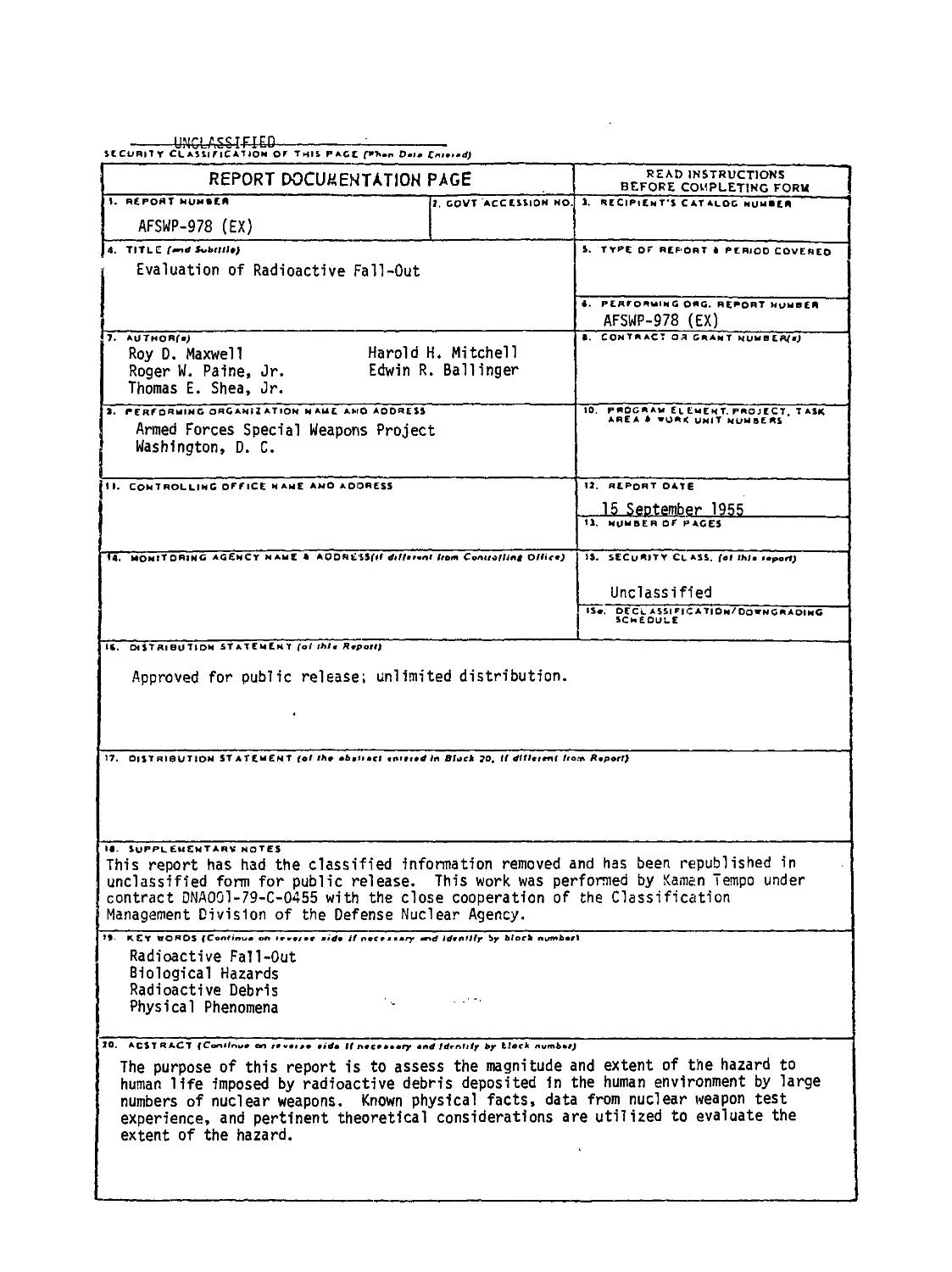
REPORT DOCUMENTATION PAGE		READ INSTRUCTIONS BEFORE COMPLETING FORK
1. REPORT NUMBER AFSWP-978 (EX)	1. GOVT ACCESSION NO.	1. RECIPIENT'S CATALOG HUMICR
4. TITLE	Svbcnl») Evaluation of Radioactive Fall-Out		S. TYPE OF REPORT 4 PERIOD COVERED
		4. PERFORMING ORG. REPORT NUMBER AFSWP-978 (EX)
7. AUTHQRf*) Roy D. Maxwell Harold H. Mitchell Roger W. Paine, Jr. Edwin R. Ballinger Thomas E. Shea, Jr.		•. contract oa grant number/*;
3. PERFORMING ORGANIZATION name ANO ADDRESS Armed Forces Special Weapons Project ! Washington, D. C.		10. PROGRAM El EMENT. PROJECT. T ask AREA * WORK UNIT NUMBERS
11 1. CONTROLLING OFFICE NAME ANO ADDRESS		12. REPORT DATE 15 Seotember 1955
		11. NUMBER OF PAGES
U. MONITORING AGENCY name * AODRE'SSfif different from Conuottint Office)		IS. SECURITY CLASS, (cl thle i»port) Unclassified
		0 5 c и 2 В 0 1° X о 'Ч в W *3 «О и? W(j 0 u> и
it. distribution statement (al tbt* Report)
Approved for public release; unlimited distribution.
17. OlST Rl BUT ION STATEMENT (of the obeli »ci tnteied In Stock JO, t( di tie tent he.t> Report)
This report has had the classified information removed and has been republished in
unclassified form for public release. This work was performed by Kamen lempo under
contract DNA001-79-C-0455 with the close cooperation of the Classification
Management Division of the Defense Nuclear Agency.
IS. К C Y WORDS (Conftnu* on <rr*/te ••'rf* if nec e • eery end Ide nifty by block number I
Radioactive Fall-Out
Biological Hazards
Radioactive Debris
Physical Phenomena
20* ACSTRACT (Continue on »»••!>• ride It neceeeery end Identify by block number}
The purpose of this report is to assess the magnitude and extent of the hazard to
human life imposed by radioactive debris deposited 1n the human environment by large
numbers of nuclear weapons. Known physical facts, data from nuclear weapon test
experience, and pertinent theoretical considerations are utilized to evaluate the
extent of the hazard.
LETTER OF PROMULGATION
This report, Evaluation of Radioactive Fall-out, is published in
order to present the facts to the extent that they are known, about the
radiological situation following the detonation of nuclear weapons; and
the facts and opinions relating to the biological hazards likely to be
encountered from radioactive fall-out.
The discussion given in the report, the evaluation presented and
the conclusions drawn are those for both the close-in fall-out and the
world-wide ппп1.ятп1пя1Лпп problems and the interrelationship of the two.
General concepts are developed from available data. Detailed treatment
of several aspects of the fall-out problem may be found in the refer-
ences listed in the report.
It is planned to keep the problem under continuous active study
and it is expected that, as more information becomes available, supple-
mentary reports will be -presented.
A. R. LUEDECKE
Major General, USAF
Chief, AFSWP
THIS DOCUMENT CONSISTS OF....Z^-PAGE(S|
NO-Z-^fJ-^QCOPIES, SERIES.—4--
1
AFSWP TECHNICAL REPORT
AFSWP-978
EVALUATION OF RADIOACTIVE FALL-OUT
by
Roy D. Maxwell
Roger W. Paine, Jr.
Thomas E. Shea, Jr.
Harold H. Mitchell
Edwin R. Ballinger
WEAPONS EFFECTS DIVISION
Armed Forces Special Weapons Project Reports are documents pre-
pared by staff sections of this headquarters for the purpose of
disseminating latest available information to authorized agencies
of the three services. They are official AFSWP documents and as
such represent the AFSWP position on Information contained.
*	* * * *
This document contains information affecting the nations],
defense of the United States within the meaning of the
Espionage Laws, Title 18, U.S.C., Sections 793 and 794.
The transmission or the revelation of its contents in any
manner to an unauthorized person is prohibited by law.
*	* * * *
This document contains RESTRICTED DATA within the meaning
of the Atomic Energy Act of 1954. Its transmission or the
revelation of its contents, in any manner not authorized
by that Act, is prohibited by law.
*****
Reproduction of this document in whole or in part is pro-
hibited except with the permission of the Chief, AFSWP.
*****
September 1955
HEADQUARTERS, ARMED FORCES SPECIAL WEAPONS PROJECT
Washington 25, D. C.
ii
ABSTRACT
The purpose of this report is to assess the magnitude and extent
of the hazard, to human ^Life Imposed by radioactive debris deposited, in
the human environment by large numbers of nuclear weapons. Known physi-
cal facts, data from nuclear weapon test experience, and pertinent theo-
retical considerations are utilized to evaluate the extent of the hazard..
A discussion of the physical phenomena is presented, to show tlie mechan-
isms whereby radioactive: particles may be formed.. Consideration was
given to the changes in the intensity of a fall-out field of radioactive
debris as variations are made in the proximity of the detonation to the
earth's surface, the magnitude of the fission yield, the total, yield of
fission and fusion weapons and the meteorological conditions immediately
before and shortly after an atomic detonation. The degree of local
hazard involved will in every case at least equal or exceed that of the
world-wide hazard when expressed as a function of unit areas.
The biological significance of the effects of ionizing radiations
of various levels on humans, the beneficial effects of shielding
against high levels of radiation during the early decay of the radio-
active fall-out field, the genetic effects, and the significance of
internally deposited radioactive isotopes as carcinogens are discussed
In the light of the presently existing data together with projected
calculations of possible effects. For long-term carcinogenic effects,
strontium-90 is considered to be the most hazardous of the radioiso-
topes spread both locally and world-wide. It appears likely that the
number of nuclear weapon detonations required to cause a world-wide
long-term strontium-90 hazard would be so large as to result in devas-
tation of much of the habitable world area from the immediate destructive
effects of the weapons.
iii
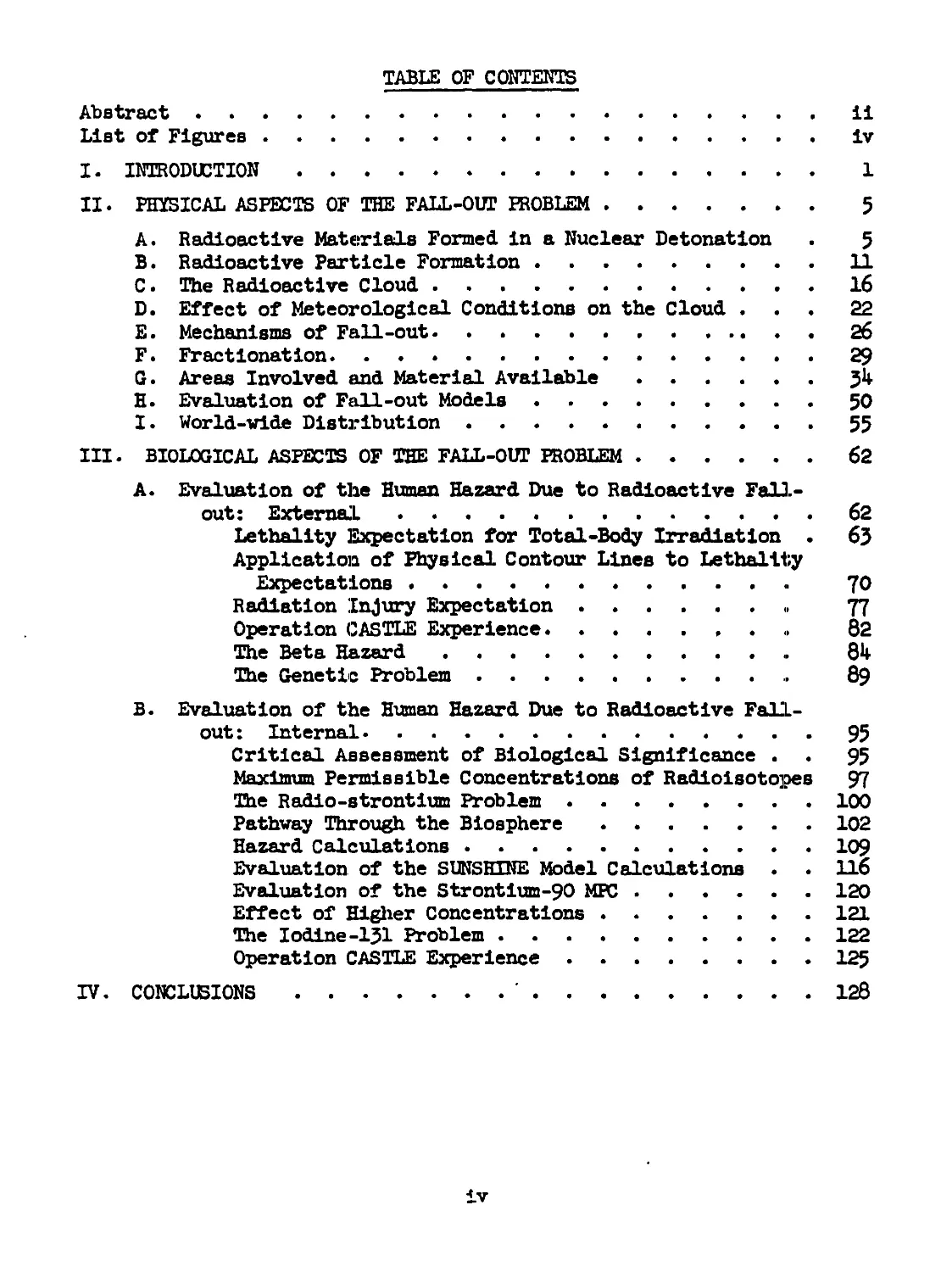
TABLE OF CONTENTS
Abstract............................................................ii
List of Figures.....................................................iv
I.	INTRODUCTION................................................... 1
II.	PHYSICAL ASPECTS OF THE FALL-OUT PROBLEM....................... 5
A.	Radioactive Materials Formed in a Nuclear	Detonation	.	5
B.	Radioactive Particle Formation .......................... 11
C.	The Radioactive Cloud..................................16
D.	Effect of Meteorological Conditions on	the	Cloud	...	22
E.	Mechanisms of Fall-out.................................26
F.	Fractionation..........................................29
G.	Areas Involved and Material Available	................. JU
H.	Evaluation of Fall-out Models..........................50
I.	World-wide Distribution ................................. 55
III.	BIOLOGICAL ASPECTS OF THE FALL-OUT PROBLEM...................62
A.	Evaluation of the Human Hazard. Due to Radioactive Fall-
out: External.................................................62
Lethality Expectation for Total-Body Irradiation . 6j
Application of Physical Contour Lines to Lethality
Expectations ..................................... 70
Radiation Injury Expectation ....................... 77
Operation CASTLE Experience........................  82
The Beta Hazard..................................... 8U
The Genetic Problem................................. 89
B.	Evaluation of the Human Hazard Due to Radioactive Fall-
out : Internal................................................95
Critical Assessment of Biological	Significance	.	.	95
Maximum Permissible Concentrations	of Radioisotopes	97
The Radio-strontium Problem ....................... 100
Pathway Through the Biosphere ..................... 102
Hazard Calculations............................109
Evaluation of the SUNSHINE Model Calculations . . 116
Evaluation of the Strontium-90 MFC..................120
Effect of Higher Concentrations ................... 121
The Iodine -1J1 Problem.............................122
Operation CASTLE Experience.........................125
IV.	CONCLUSIONS......................'...........................128
iv
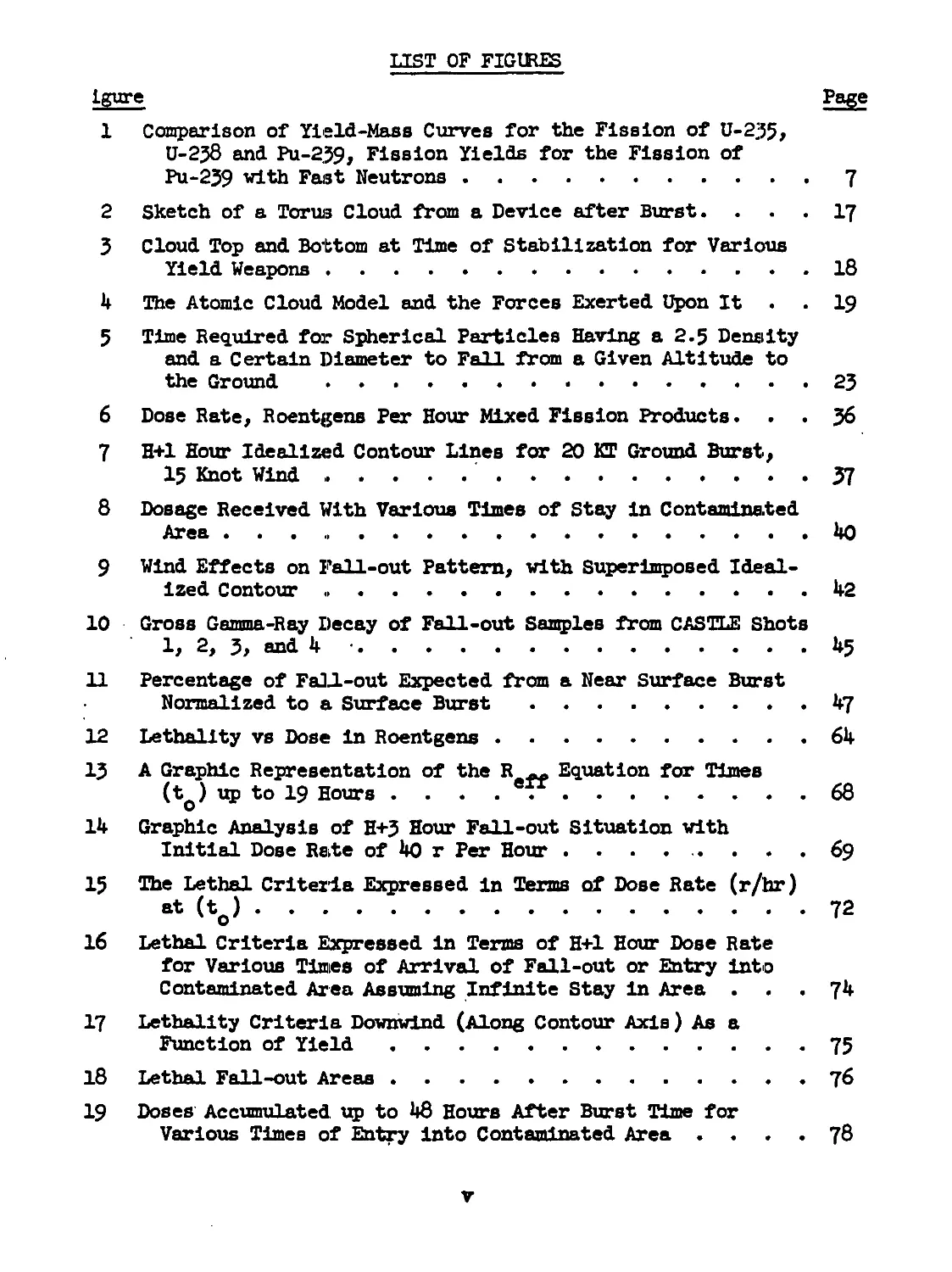
LIST OF FIGIRES
igure	Page
1	Comparison of Yield-Mass Curves for the Fission of U-235,
U-2J8 and Pu-2.59, Fission Yields for the Fission of
Pu-259 with Fast Neutrons ..................................... 7
2	Sketch of a Torus Cloud from a Device after Burst. . . . 17
3	Cloud Top and Bottom at Time of Stabilization for Various
Yield Weapons..................................................16
4	The Atomic Cloud Model and the Forces Exerted Upon It . . 19
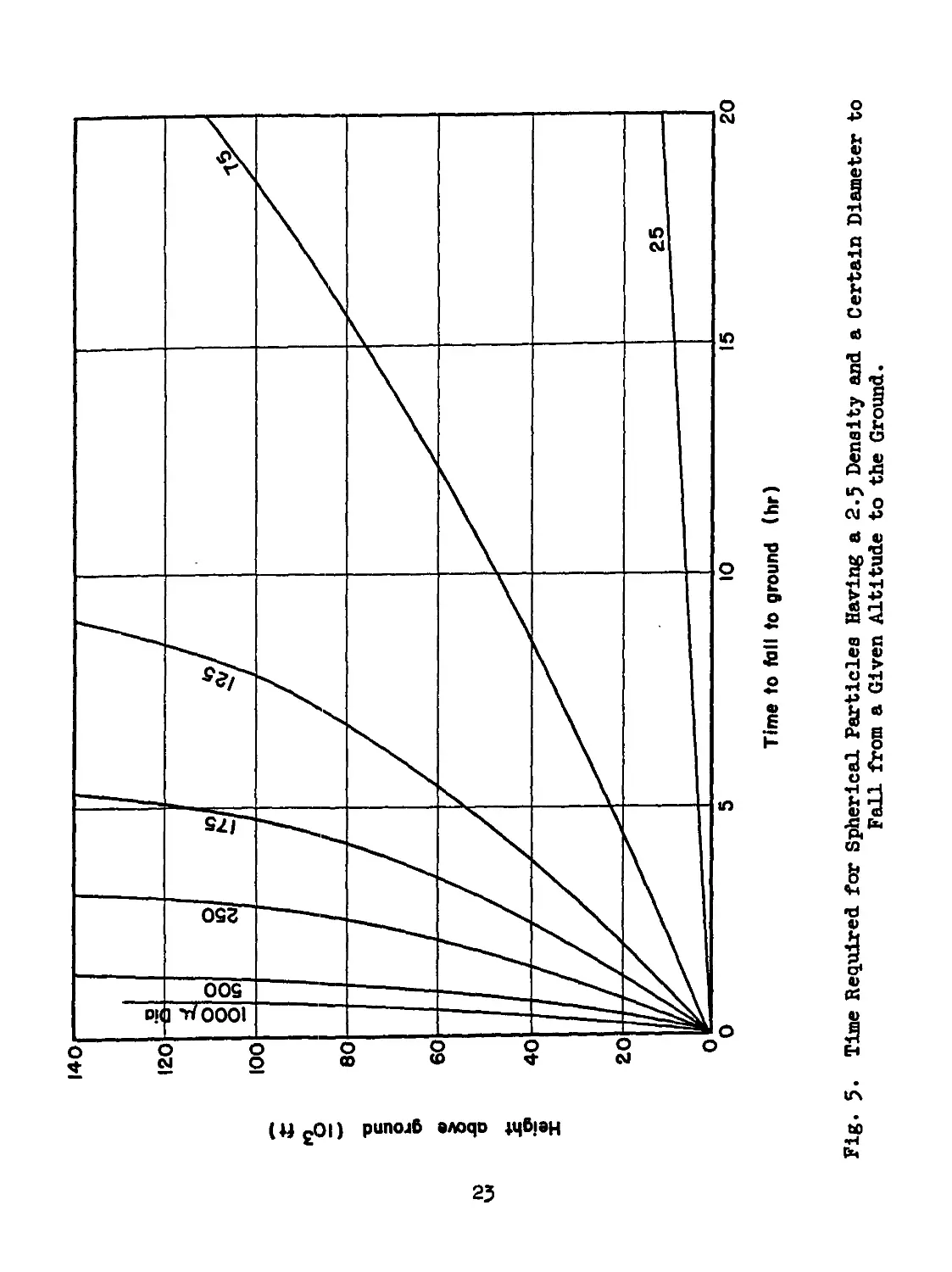
5	Time Required for Spherical Particles Having a 2.5 Density
and a Certain Diameter to Fall from a Given Altitude to
the Ground ....................................................23
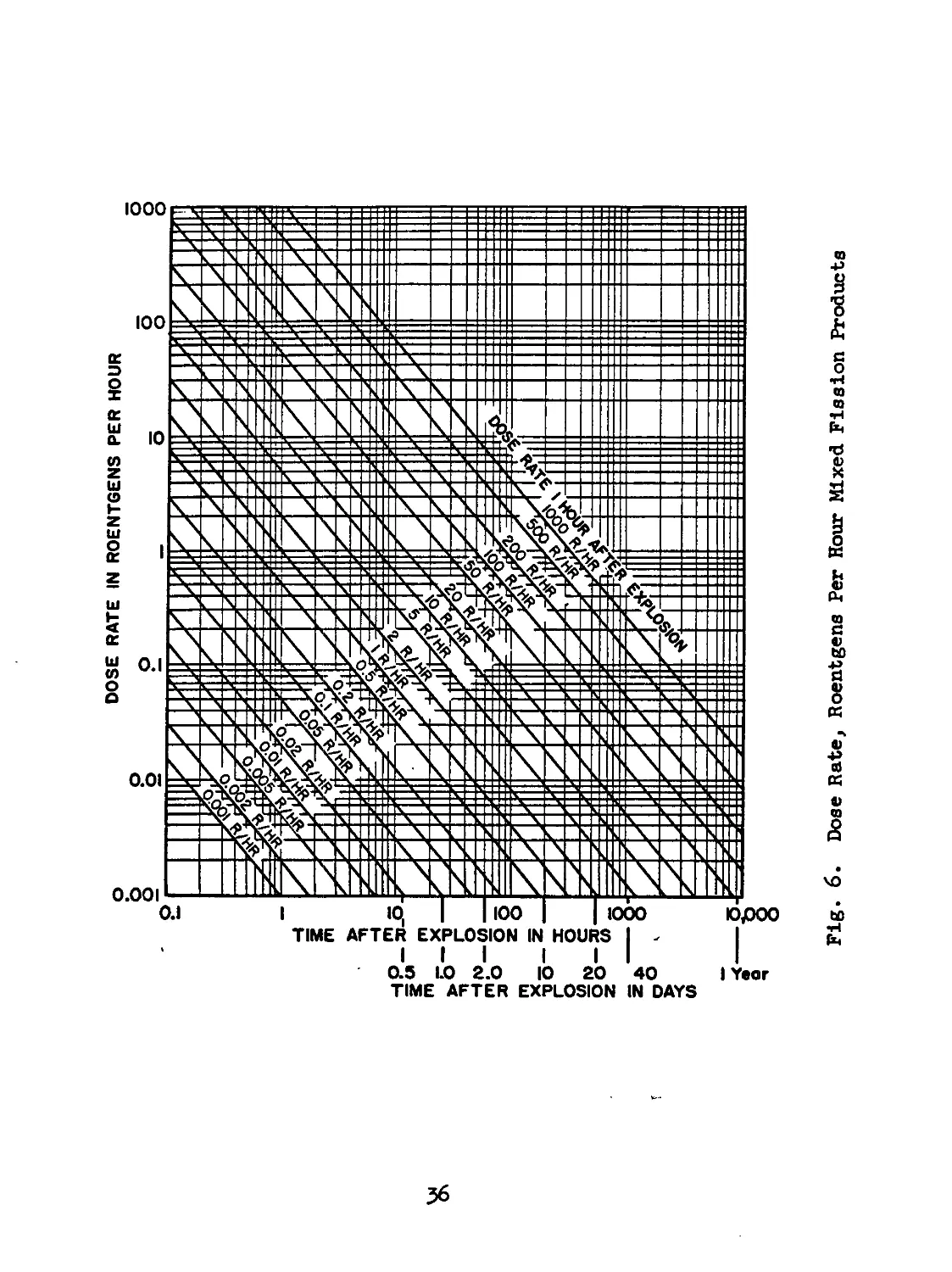
6	Dose Rate, Roentgens Per Hour Mixed Fission Products. . . 36
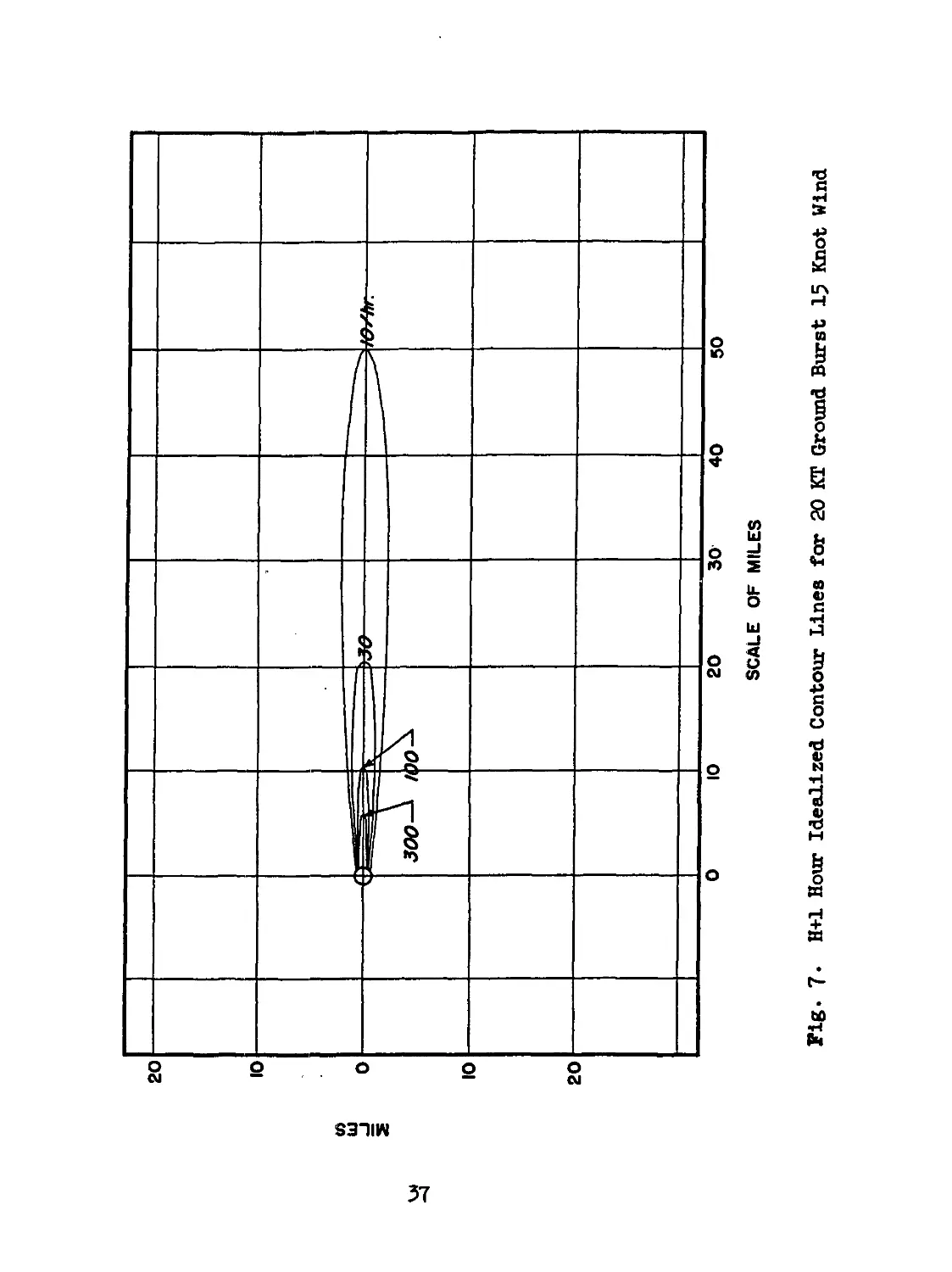
7	H+l Hour Idealized Contour Lines for 20 KT Ground Burst,
15 Knot Wind.................................................. 37
6	Dosage Received With Various Times of Stay in Contaminated
Area  .........................................................40
9	Wind Effects on Fall-out Pattern, with Superimposed Ideal-
ized Contour...................................................42
10	Gross Gamma-Ray Decay of Fall-out Samples from CASTLE Shots
1, 2, 3, and 4...................................................U5
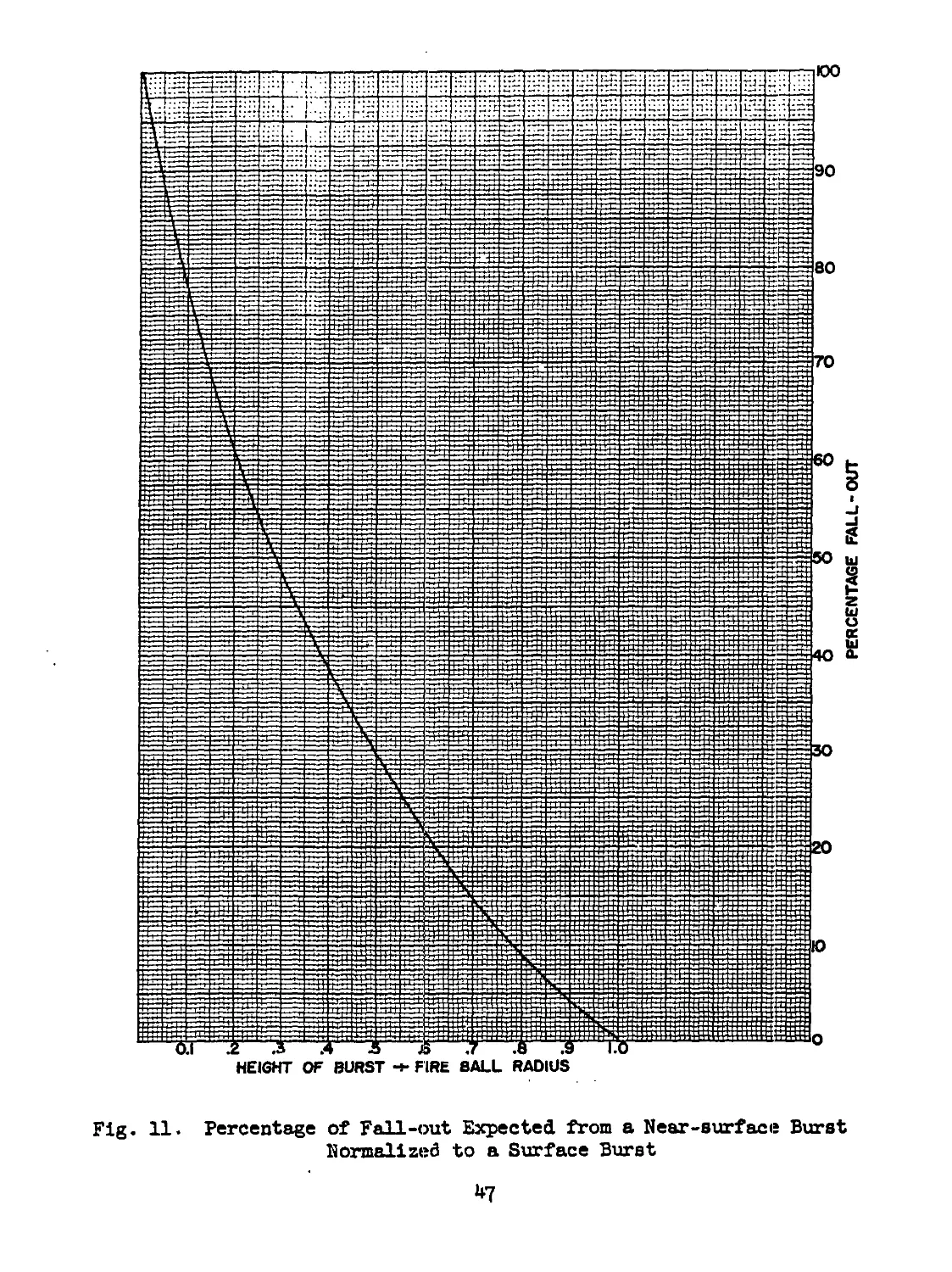
11	Percentage of Fall-out Expected from a Near Surface Burst
Normalized to a Surface	Burst ........................... 47
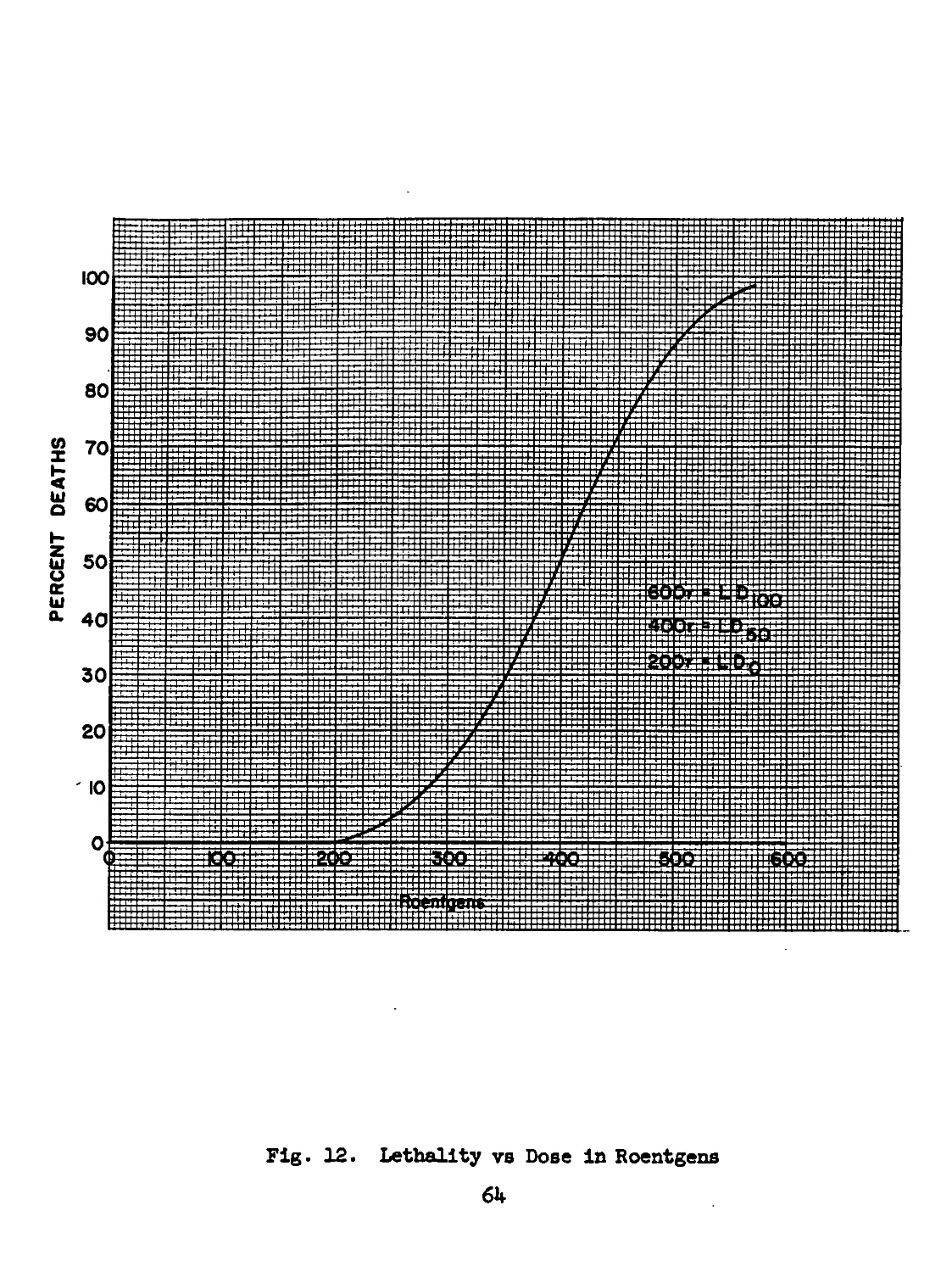
12	Lethality vs Dose in Roentgens...............................64
13	A Graphic Representation of the R rr Equation for Times
(to) up to 19 Hours . . . . e....................................68
14	Graphic Analysis of H+3 Hour Fall-out Situation with
Initial Dose Rate of 40 r Per Hour ........ 69
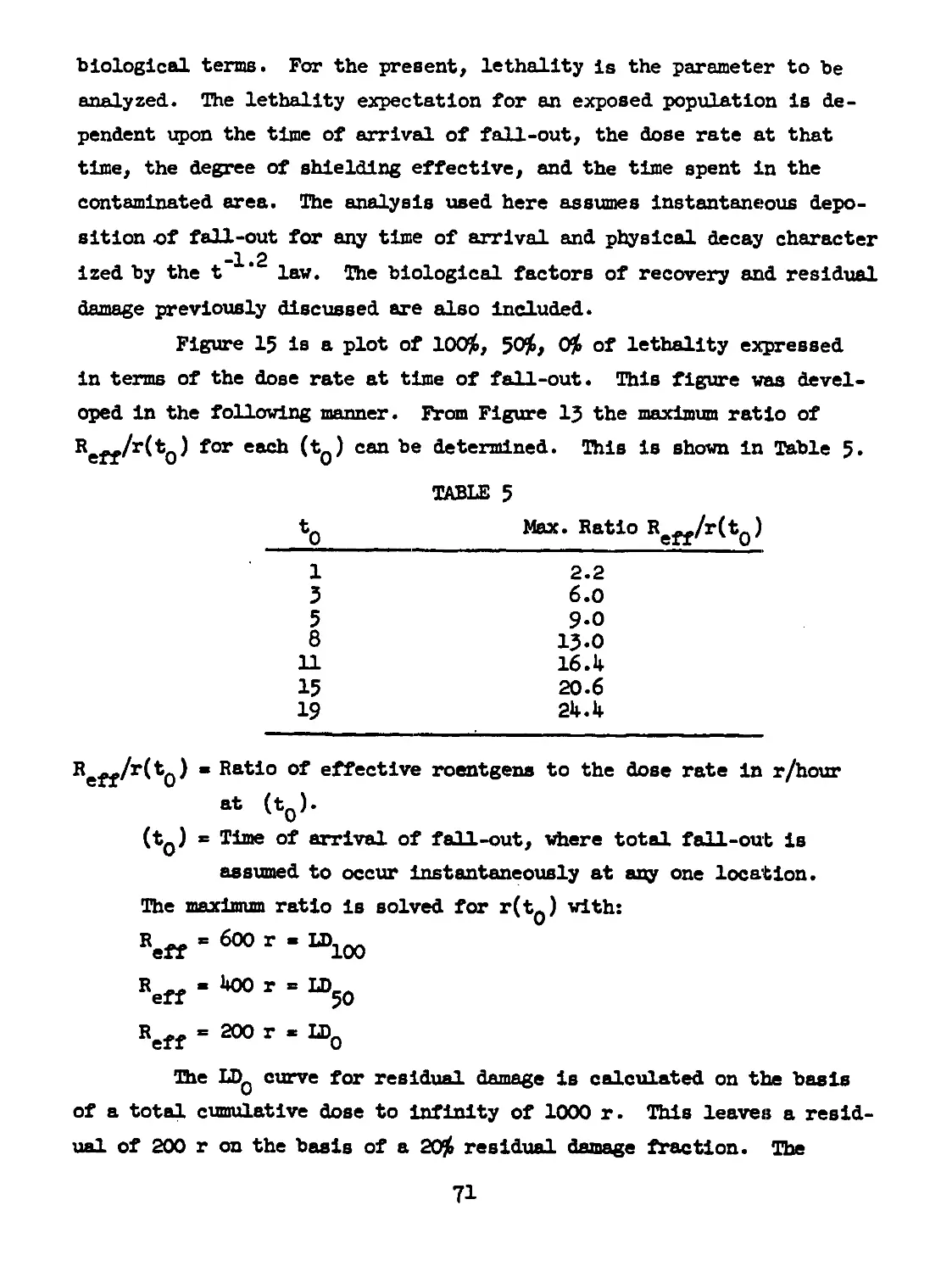
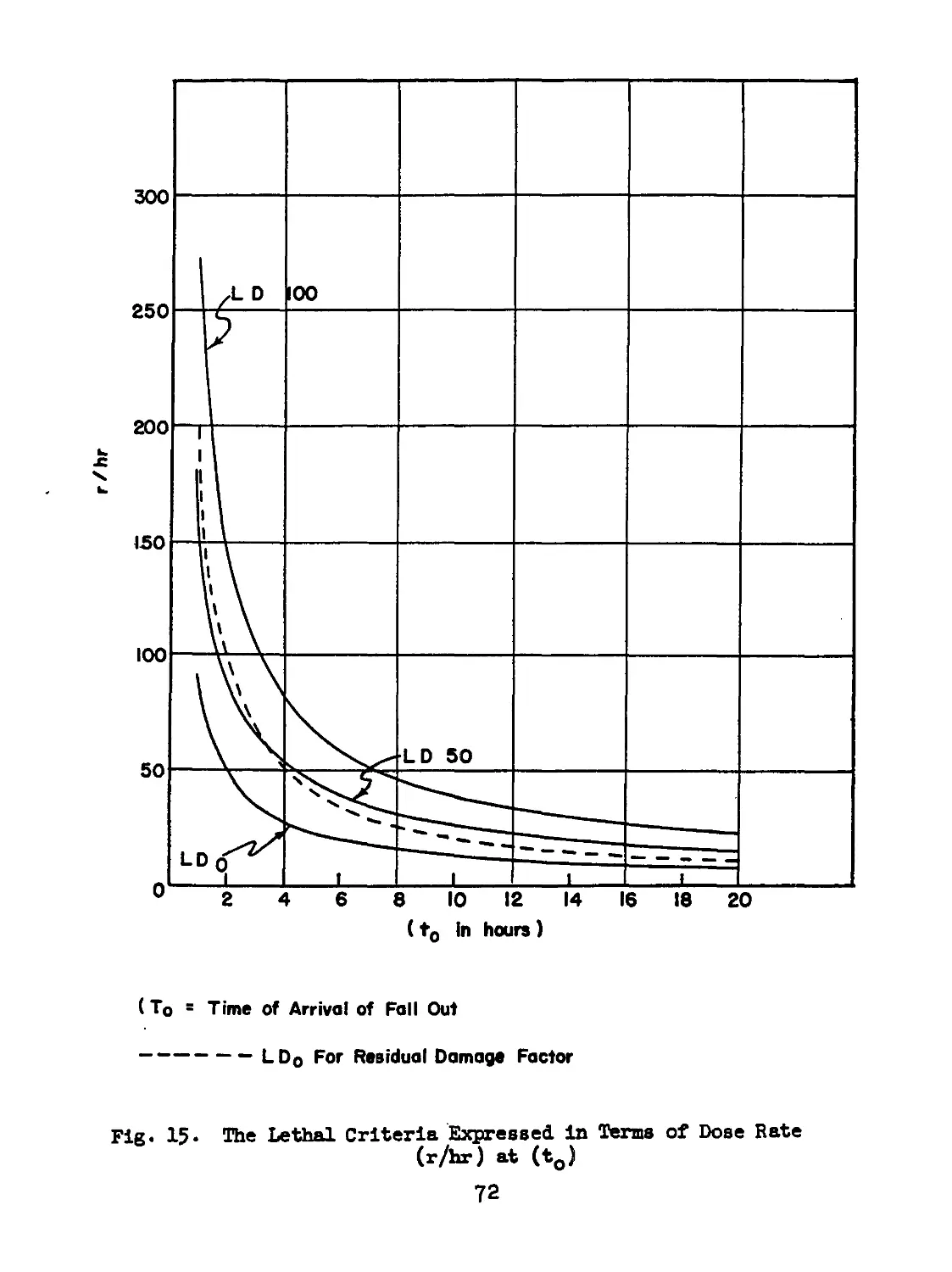
15	The Lethal Critexla Expressed in Terms of Dose Rate (r/hr)
at (tQ)..........................................................72
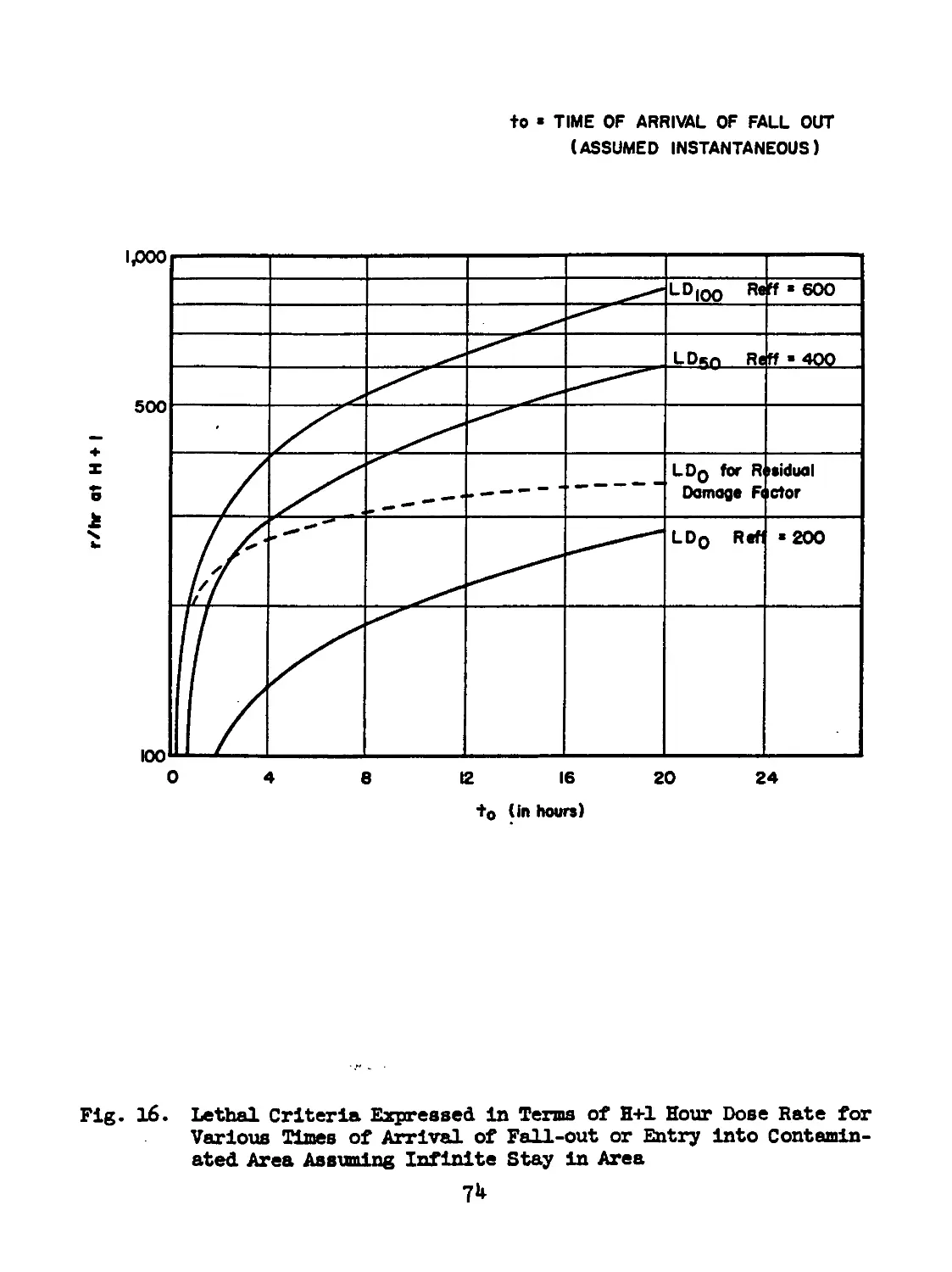
16	Lethal Criteria Expressed in Terms of H+l Hour Dose Rate
for Various Times of Arrival of Fall-out or Entry into
Contaminated Area Assuming Infinite Stay in Area ... 74
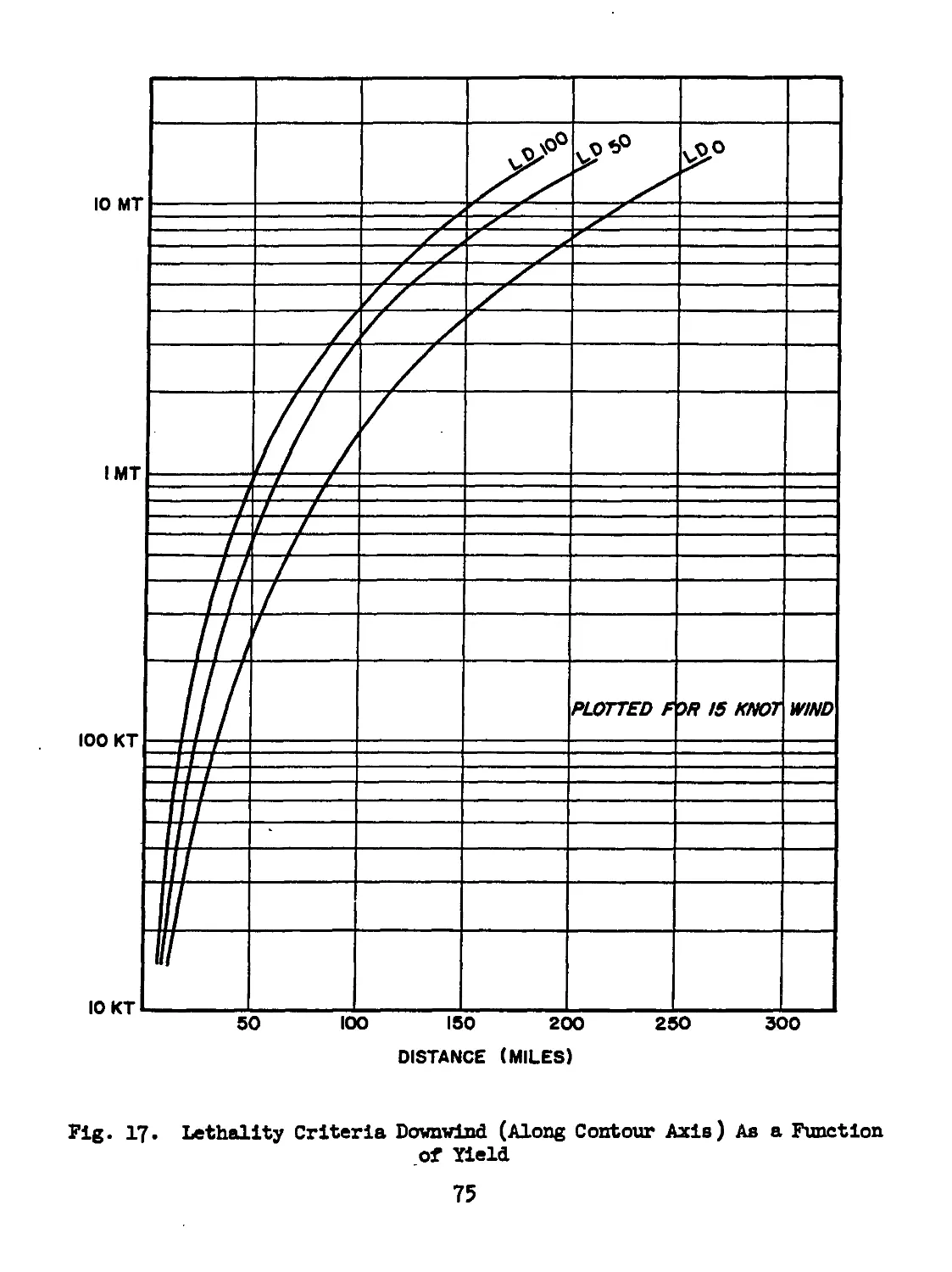
17	Lethality Criteria Downwind (Along Contour Axis) As a
Function of Yield .............................................. 75
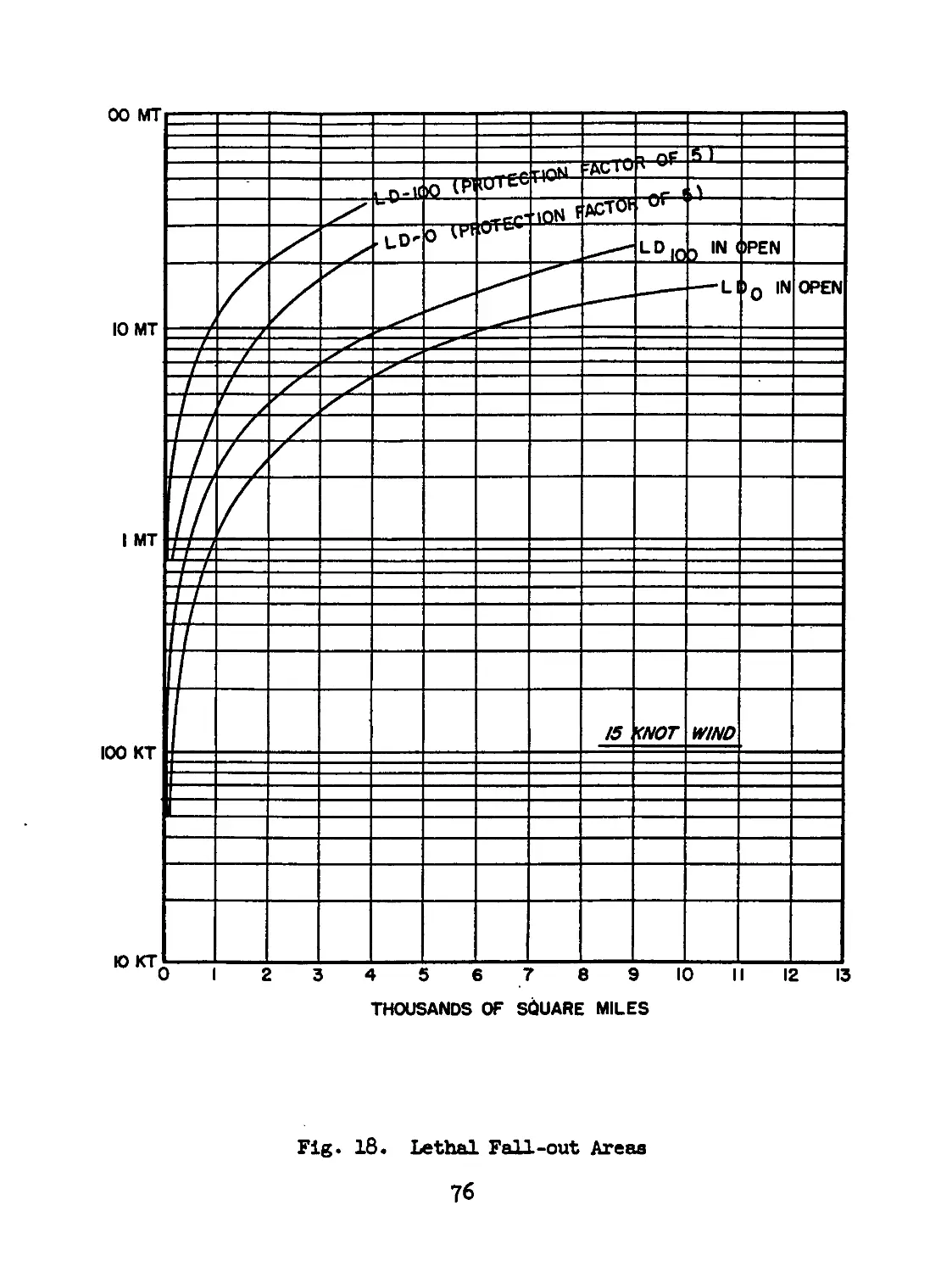
16	Lethal Fall-out Areas........................................76
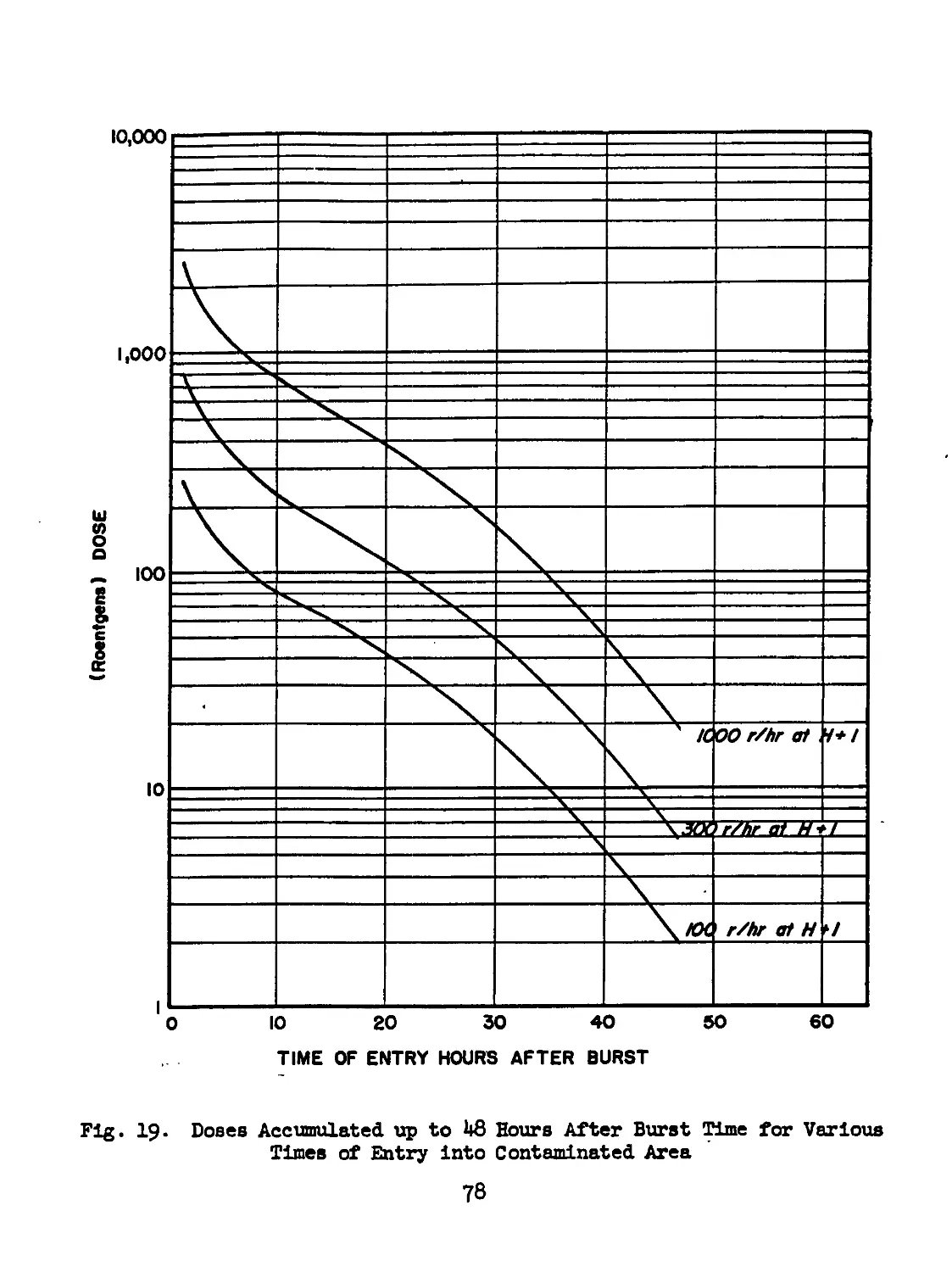
19	Doses Accumulated up to 48 Hours After Burst Time for
Various Times of Entry into Contaminated Area .... 76
v
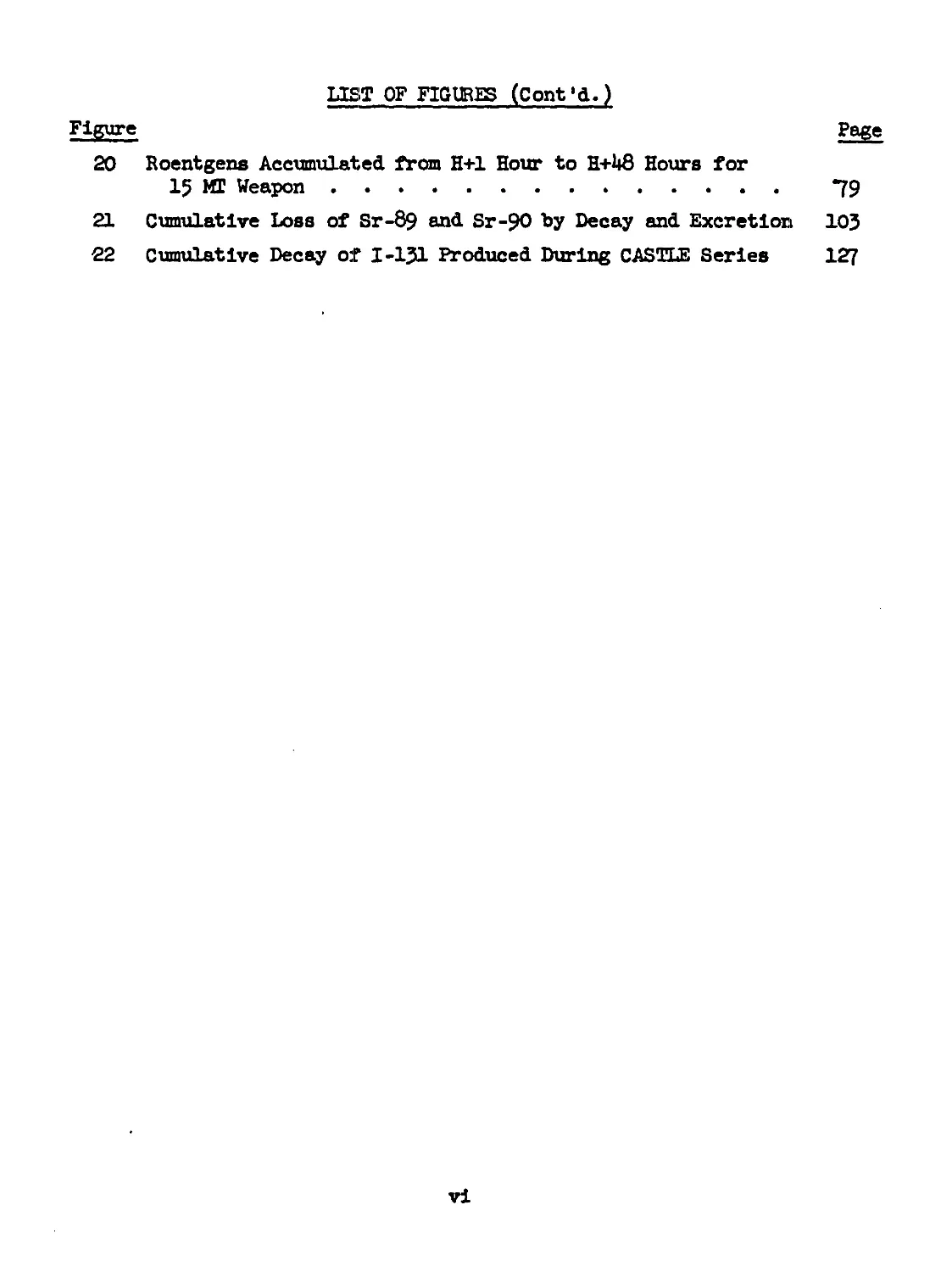
LIST OF FIGURES (Cont'd.)
Figure	Page
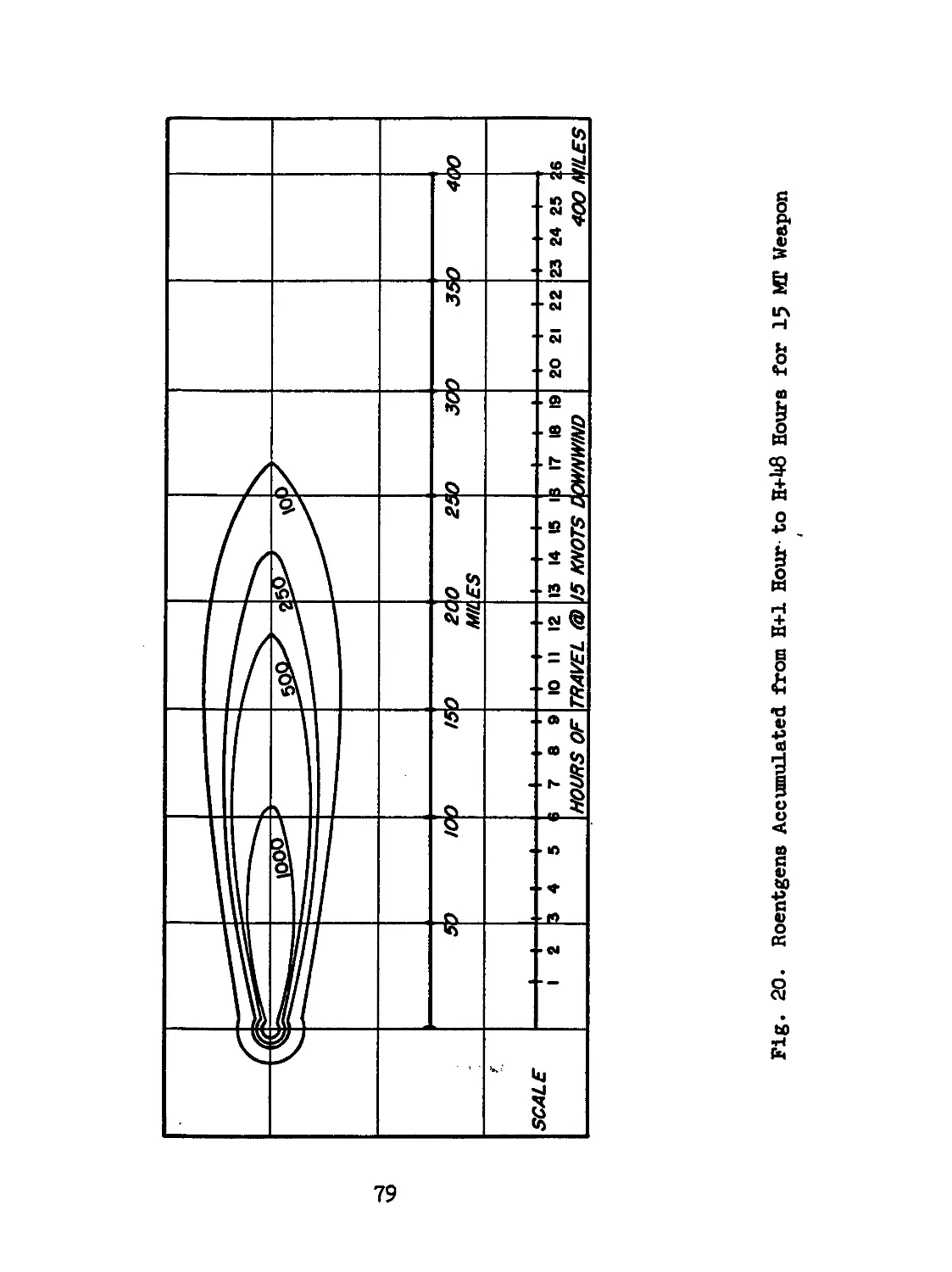
20	Roentgens Accumulated from H+l Hour to H+U8 Hours for
1J ИГ Weapon................................................. *79
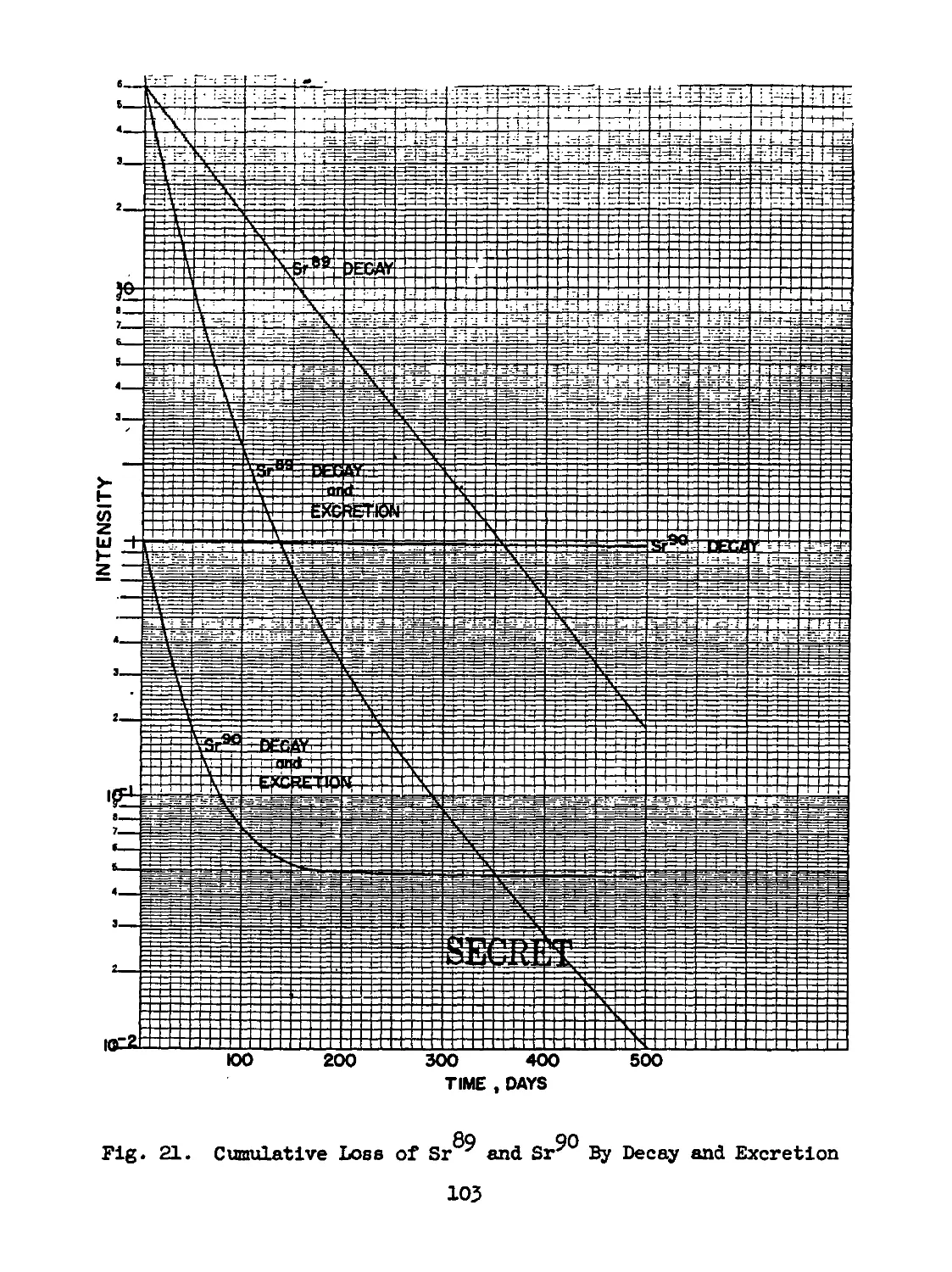
Cumulative Loss of Sr-89 and Sr-90 by Decay and Excretion 10J
Cumulative Decay of I-1J1 Produced During CASTLE Series 127
IS P
vi
EVALUATION OF RADIOACTIVE FALL-OUT
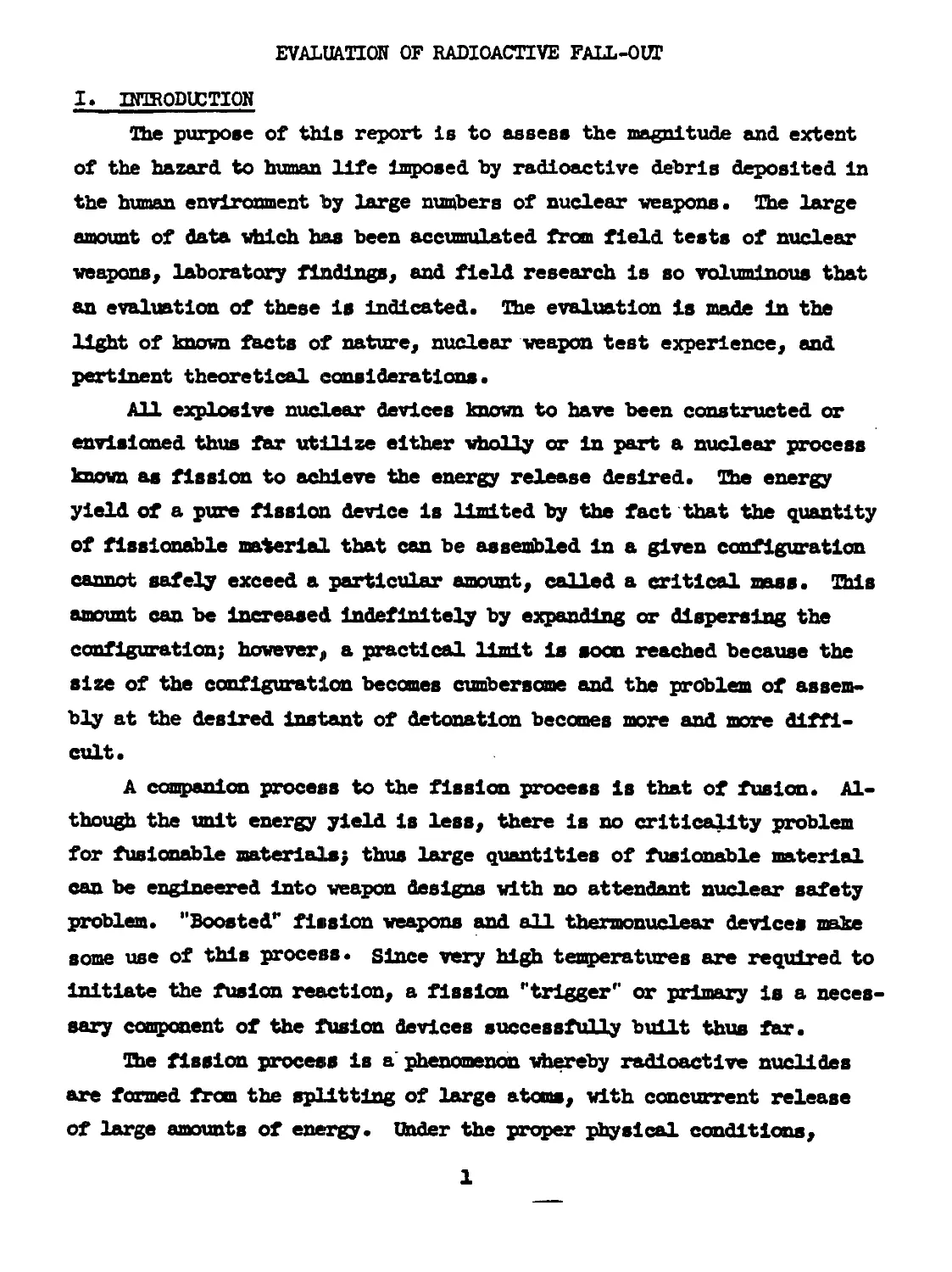
I. INTRODUCTION
The purpose of this report is to assess the magnitude and extent
of the hazard to human life ingposed by radioactive debris deposited in
the human environment by large numbers of nuclear weapons. The large
amount of data which has been accumulated from field tests of nuclear
weapons, laboratory findings, and field research is so voluminous that
an evaluation of these is indicated. The evaluation is made in the
light, of known facts of nature, nuclear weapon test experience, and
pertinent theoretical considerations.
All explosive nuaLear devices known to have been constructed or
envisioned thus far utilize either wholly or in part a nuclear process
known as fission to acliieve the energy release desired. The energy
yield of a pure fission device is limited by the fact that the quantity
of fissionable material that can be assembled in a given configuration
cannot safely exceed a particular amount, called a critical mass. This
amount can be Increased indefinitely by expanding or dispersing the
configuration; however, a practical limit is soon reached because the
size of the configuration becomes cumbersome and the problem of assem-
bly at the desired instant of detonation becomes more and more diffi-
cult.
A companion process to the fission process is that of fusion. Al-
though the unit energy yield is less, there is no criticality problem
for fusionable materials; thus large quantities of fusionable material
can be engineered into weapon designs with no attendant nuclear safety
problem. "Boosted** fission weapons and all thermonuclear devices make
some use of this process. Since very high temperatures are required to
initiate the fusion reaction, a fission "trigger" or primary is a neces-
sary component of the fusion devices successfully built thus far.
The fission process is a phenomenon whereby radioactive nuclides
are formed from the splitting of large atoms, with concurrent release
of large amounts of energy. Under the proper physical conditions,
1
these nuclides may become associated with particulate matter from other
bomb debris, from dust in the atmosphere or material raised by the ex-
plosion, or from moisture condensed in the atmosphere to form rain, and
thus will be brought to the earth’s surface and become a potential radi-
ological hazard. On the other hand, the nuclides formed in the fusion
process (except for the unburned tritium) are not radioactive and do
not, of themselves, increase the potential radiological hazard.
The radioactive fragments formed in the fission process are Chemi-
cal elements ranging fiom zinc to europium, the lowest and highest
atomic weight elements formed, respectively. A relatively small quanti-
ty of radioactive atoms which are not fission fragments are found
following atomic detonations. This activity results from the action of
neutrons on the nuclei of certain stable atoms.
U.S. nuclear weapon war and test experience consists of 6$ shots
to date. Detonations have been carried out at high, intermediate, and
low altitudes, on towers and on and under both land and water surfaces,
over a range of yields from less than a kiloton to about 15 megatons
TNT equivalent. In addition, the United Kingdom and Soviet Russia
have conducted nuclear weapon tests, and much data from the tests by
the United Kingdom are available to us.
Ground surface and. underground bursts result in the incorporation
of radioactive fission fragments and the small amount of induced radio-
active materials which are formed, on or into earth particles which
provide a vehicle for bringing the contaminant promptly from the atomic
cloud to the surface of the earth. An air burst, on the other hand,
provides no ready means for hanging the contaminant down quickly, with
the result that there is very little local fall-out from this type of
burst.
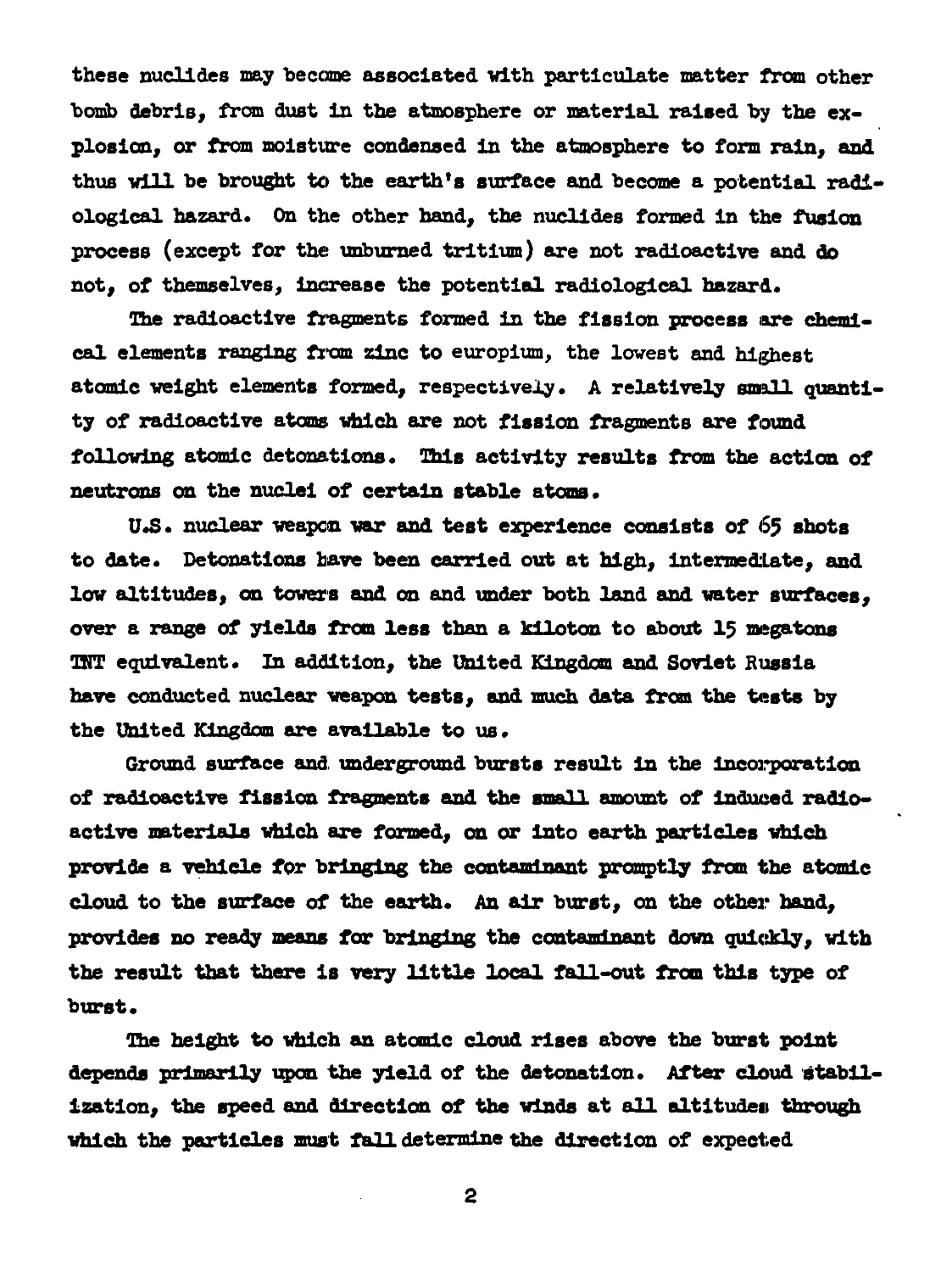
The height to which an atomic cloud rises above the burst point
depends primarily upon the yield of the detonation. After cloud stabil-
ization, the speed and direction of the winds at all altituden through
which the particles must fall determine the direction of expected
2
fall-out, and the yield and type of bomb together with the proximity of
the detonation to the earth determine the total amount and kind of
debris available for fall-out. After local fall-out is completed, the
process continues in more remote areas to a lesser and lesser degree
over a period of months or even years as the cloud is taken by the
wind currents around the тог Id.
Particles from close-in fall-out and world-wide diffusion have
been collected by several different sampling methods at altitudes rang-
ing up to 90,000 feet. Radiochemical analysis of these particles shows
the presence of many artificially radioactive isotopes. The percentage
composition of these, allowing for radioactive decay, generally parallels
the yield of the element from the fission process, although certain
elements have been found to vary from the expected quantity for physi-
cally explainable reasons.
There are certain radioactive elements which are known to be bio-
logically hazardous when deposited in humans and animals. Examples of
these are strontium-89, strontium-90, and iodine-1J1, all of which are
formed in considerable quantities as a consequence of fission. These
potentially hazardous fission products may be taken into the body by
either Inhalation or Ingestion, and tend to collect in certain parts
of the body such as the bone or thyroid, where their damage is done
over extended periods of time.
Very little definitive information exists on human response to
ionizing radiations, and one must rely largely on animal data, supple-
mented by data from a limited number of accidental human exposures, in
evaluating the fall-out hazard.
In the CASTLE test series in the spring of 1954 259 Marshallese
natives and 26 American servicemen were accidentally exposed to sub-
lethal amounts of fall-out radiation. Clinical studies of these human
subjects proved that quantities of radiation biologically damaging to
humans may be received from this type of radioactivity at great dis-
tances from the point of origin. The biological damage, although kept
sublethal because of prompt evacuation, included beta burns when radio-
active particles were in direct contact with the skin, and hematological
3
changes from the ganma radiation of the particles not in direct contact
with the individual. There were indications of small hut measurable
quantities of internally deposited radioactive isotopes.
Animal experimentation has shown that external irradiation to the
gonads can cause gene mutations. Most of these mutations are deleteri-
ous and may cause eventual genetic death. In order to assess the sig-
nificance of this phenomenon the basic genetic data have been extrapolated
to man as realistically as possible in the light of current knowledge.
The basic biological extrapolation has been interpreted in terms of the
known or predicted physical radiological exposure data.
All damaging radiations from fall-out are attenuated in scene degree
by matter interposed between the source and the receiver. Small amounts
of material, such as a layer of heavy clothing, will absorb almost com-
pletely the alpha and beta radiations from fall-out. The gaum radia-
tion from fall-out cannot be completely stepped by shields, but, even
minimal shielding can be quite effective in reducing gamma radiation
received to tolerable levels.
Thus it can be seen that the phenomenology of nuclear weaj«ns is
such that the physical e'ffects determine the biological parameters to
be evaluated. The hazard, created in the close-in fall-out area by a
large surface detonation is greater by several orders of magnitude than
was ever observed until the high levels of fall-out radiation лиге dis-
covered following the Bravo shot of the CASTLE series. The biomedical
data presented indicate that absolute safety and freedom from injury
are unattainable since some radiation effects such as genetic damage
and possibly carcinogenesis do not have a threshold of injury as far as
can be determined. It must be borne in "led that the population at
risk is larger by far than was ever considered in programing for ade-
quate public health practices or disaster handling for the country at
large. A good educational program regarding the hazards involved,
leading to utilization of the beneficial effects of all available
shielding, early evacuation and adequate decontamination procedures will
avoid many unnecessary casualties should such a catastrophy as a nuclear
war ever occur.	к
II. PHYSICAL ASPECTS OF THE FALL-OUT PROBLEM
A. Radioactive Materials Formed In A Nuclear Detonation.
The quantity of radioactive material created as fission prod-
ucts in the detonation of a fission weapon is known to depend upon the
total energy release of the weapon. Some methods of calculation of
total fission yields utilize the nUmber of fissions per kiloton, which
gives approximately 1.J8 x Ю2^ fissions occurring per KT of fission
yieldV, resulting in 2.76 x lO2^ radioactive fission fragments per KT.
This value includes all of the immediate fission products, some» of
which decay with very short half-lives, while others may give x*ise to
decay chains consisting of several isotopes, some of which may have
longer half-lives, resulting in their decay over a period of months or
years. All emit one or more beta particles and most emit one or more
gamma rays. There are approximately 170 isotopes ultimately formed
from a total of 35 elements known to result from the fission process.
Some of these isotopes are formed directly from fission; others form
in part from direct fission and partly from decay chains. If ‘the same
isotope is formed by the two processes, the total isotope concentration
is the sum of the two. Two examples of decay chains which form the same
elements but different isotopes as indicated by their different half-
lives are:
Germanium-П f Arsenic-77	Selenium-П (Stable)
Germanlum-78 2^[hoin??	x’g hoS/Se^-enlum“7® (Stable)
It is convenient to discuss the quantity of radioactive materials
formed in a nuclear detonation in terms of the value at one hour after
detonation, expressed in curies per KT. At this H+l hour reference
time, there are approximately 3.0 x 10® curies of gaimna-actlve fission
1/ Spence, R. W., Bowman, M.C., Radiochemical Efficiency Results of
SANDSTONE Tests. Scientific Director's Report of Atomic Weapons
Test Annex 1. SECRET Restricted Data.
5
products formed per KT of fission yield, plus 1.1 x 10 curies of beta-
active products, for a total of 4.1 x 10® curies of fission product
activity. The average effective gamma ray energy in a fission product
field is about 0.7 Mev, so that if 1 million curies of mixed fission
products are spread uniformly over a one square mile plane surface, the
gasna radiation intensity measured 3 feet above that surface would he
about 4 r/"tir.
The specific yields of radioactive materials have been studied in
2/*
a variety of ways. The Hunter-Ballou studies-7 on slow neutron fission,
and Coryell-Sugar»»** compilation^/ can he used to obtain percentage
values. Zinc-72 is the atom of lowest mass and gadolynium-160 the
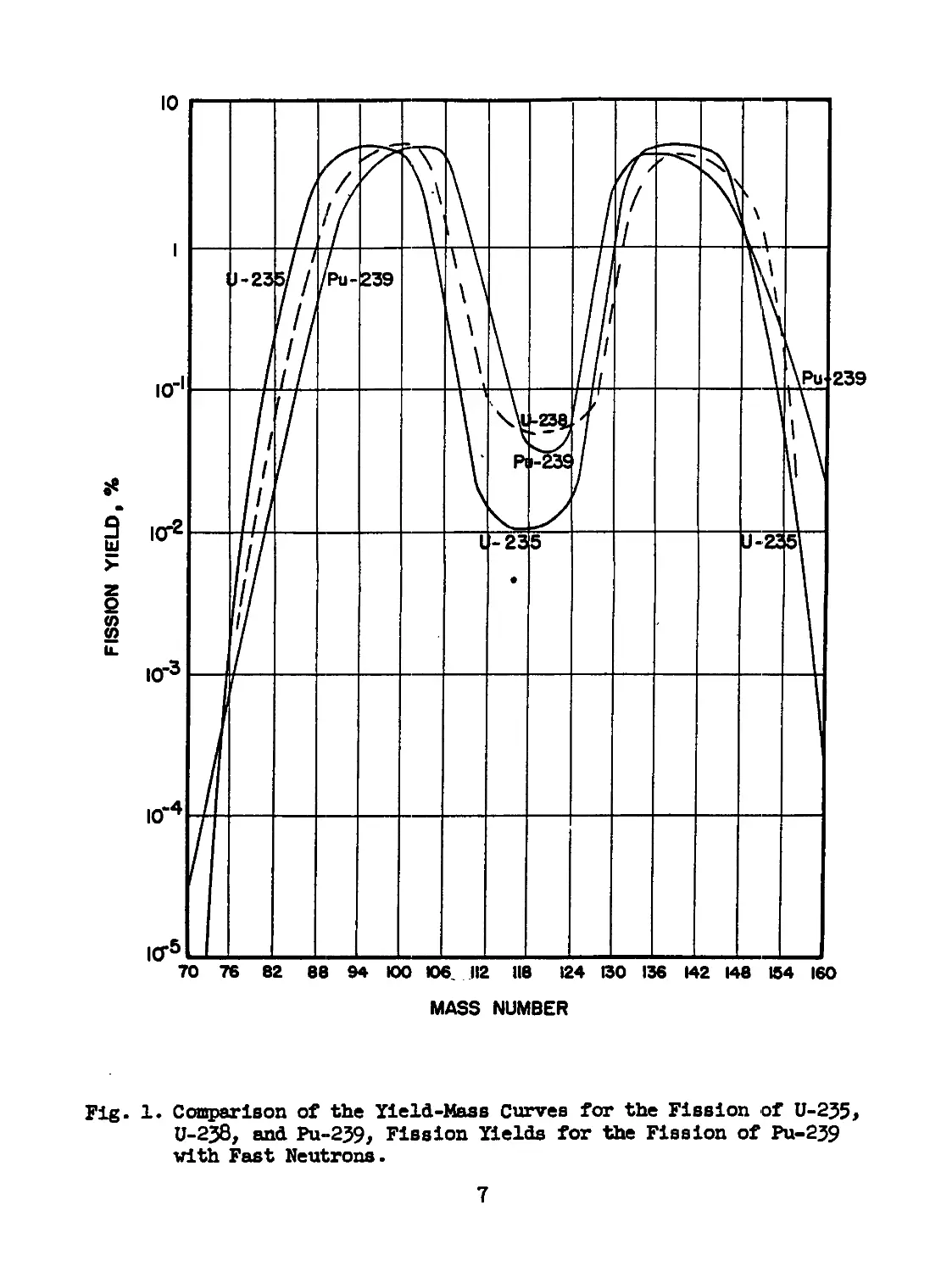
greatest of those found to result from fission. Figure 1 indicates the
variation of fission yield with mass number, with fission yield ex-
pressed as a per cent, for	and Pu2^. The total acids up to
200$ since each fission gives two fission products. Fast fission of
uranium-238, plutonium-239, and uranium-235 results in approximately
the same fission yield values with the largest difference in tiie middle
zone where the value varies from 0.01$ for uranium-235 to 0.05$ for
uranium-238. Thus, the ’various mixtures of fissionable materiel and
uranium-238 tamper material which may he present in a weapon have rela-
tively little effect percentage-wise on the relative amounts of radio-
active isotopes farmed. The first peak in Figure 1 includes strontium-
89 and strontium-90 and the second peak contains iodine-ljl, which are
* Hunter-Ballou studies are an accurate measurement of the percentage
of radioisotopes obtained from a laboratory bombardment of uranium
and plutonium by slow neutrons. The results of the observations in
the laboratory are compared with the percentages of radioisotopes
found in fall-out particles and variations between the laboratory
and test percentages are an indication of fractionation. This
approach is considered the only accurate method possible to calcu-
late percentage yield. The Coryell-Sugarman studies provice simi-
lar information about the percentages of isotopes produced in the
laboratory from the bombardment of fissionable materials with fast
neutrons.
2/ Hunter, H.F., Ballou, N.E., Simultaneous Slow Neutron Fission of
U-2J5 Atoms, I. Individual and Total Rates of Decay of the Fission
Products, USNRDL ADC-65, I9I19.
3/ Coryell. C.D., Sugarman. N., Radiochemical Studies, The Fission Pro-
ducts, The National Nuclear Energy Series, Book 2: Part V, 1951.
6
FISSION YIELD
10
кг5 LU———L_J——————————
70 76 82 88 94 ЮО Ю6 |I2 118	124 130 136 142 148 134 160
MASS NUMBER
Fig. 1. Comparison of the Yield-Mass Curves for the Fission of U-2J5,
U-2J8, and Pu-239, Fission Yields for the Fission of Pu-239
with Fast Neutrons.
7
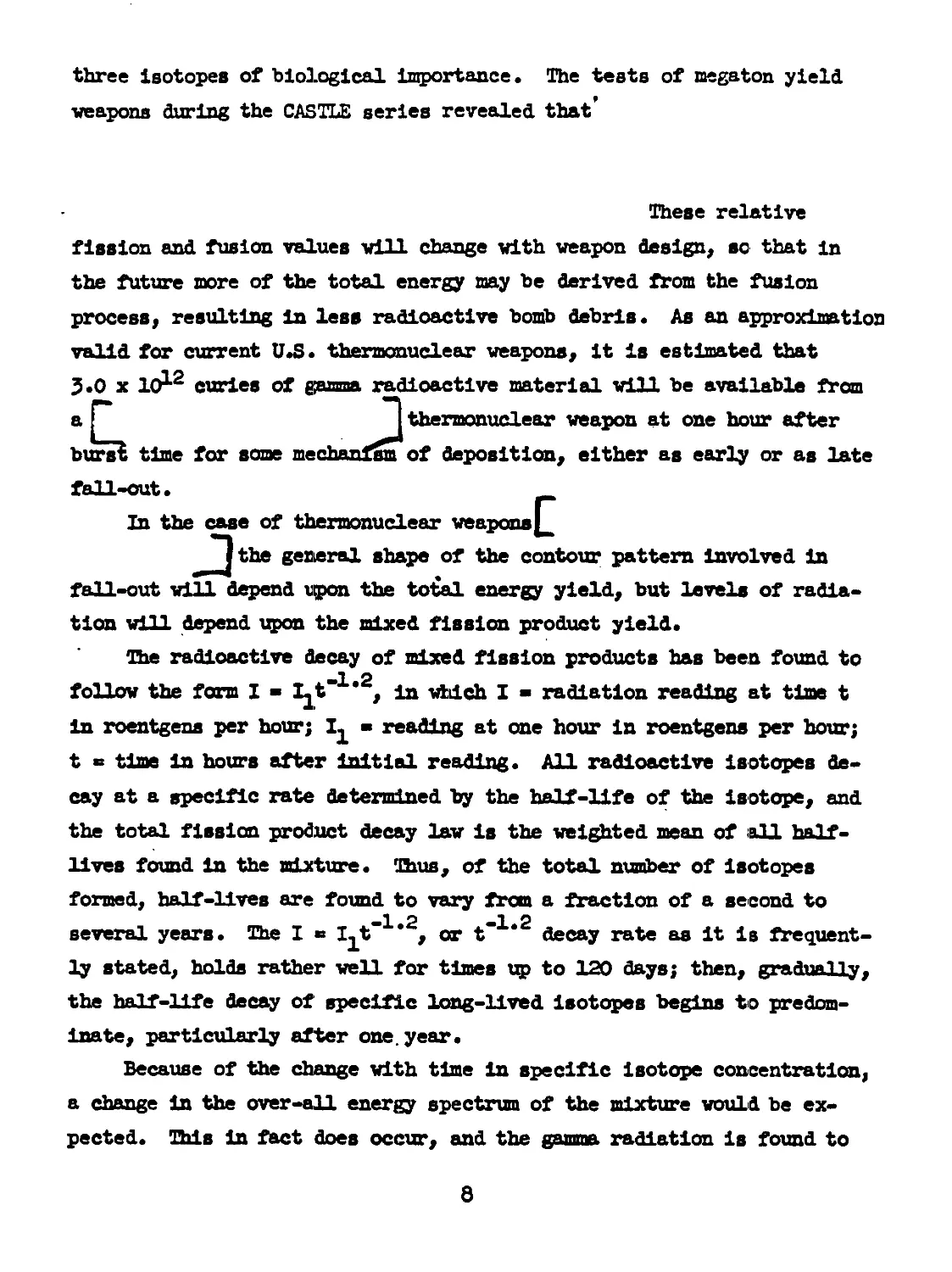
three isotopes of biological importance. The tests of megaton yield,
weapons during the CASTLE series revealed that
These relative
fission and fusion values will change with weapon design, so that in
the future more of the total energy may be derived from the fusion
process, resulting in less radioactive bomb debris. As an approximation
valid for current U.S. thermonuclear weapons, it is estimated that
5.0 x 10¹² curies of gamma radioactive material will be available from
a p	I thermonuclear weapon at one hour after
burst time for some mechanfsm of deposition, either as early or as late
fall-out.
In the case of thermonuclear weapons |
the general shape of the contour pattern involved in
fall-out will depend vpon the total energy yield, but levels of radia-
tion will depend upon the mixed fission product yield.
The radioactive decay of mixed fission products has been found to
-1.2
follow the form I  I^t , in which I  radiation reading at time t
in roentgens per hour;  reading at one hour in roentgens per hour;
t в time in hours after initial reading. All radioactive isotopes de-
cay at a specific rate determined by the half-life of the isotope, and
the total fission product decay law is the weighted mean of all half-
lives found in the mixture. Thus, of the total number of isotopes
formed, half-lives are found to vary from a fraction of a second to
-1.2	-1.2
several years. The I = l£t , or t decay rate as it is frequent-
ly stated, holds rather well for times up to 120 days; then, gradually,
the half-life decay of specific long-lived isotopes begins to predom-
inate, particularly after one. year.
Because of the change with time in specific isotope concentration,
a change in the over-all energy spectrum of the mixture would be ex-
pected. This in fact does occur, and the gamma radiation is found to
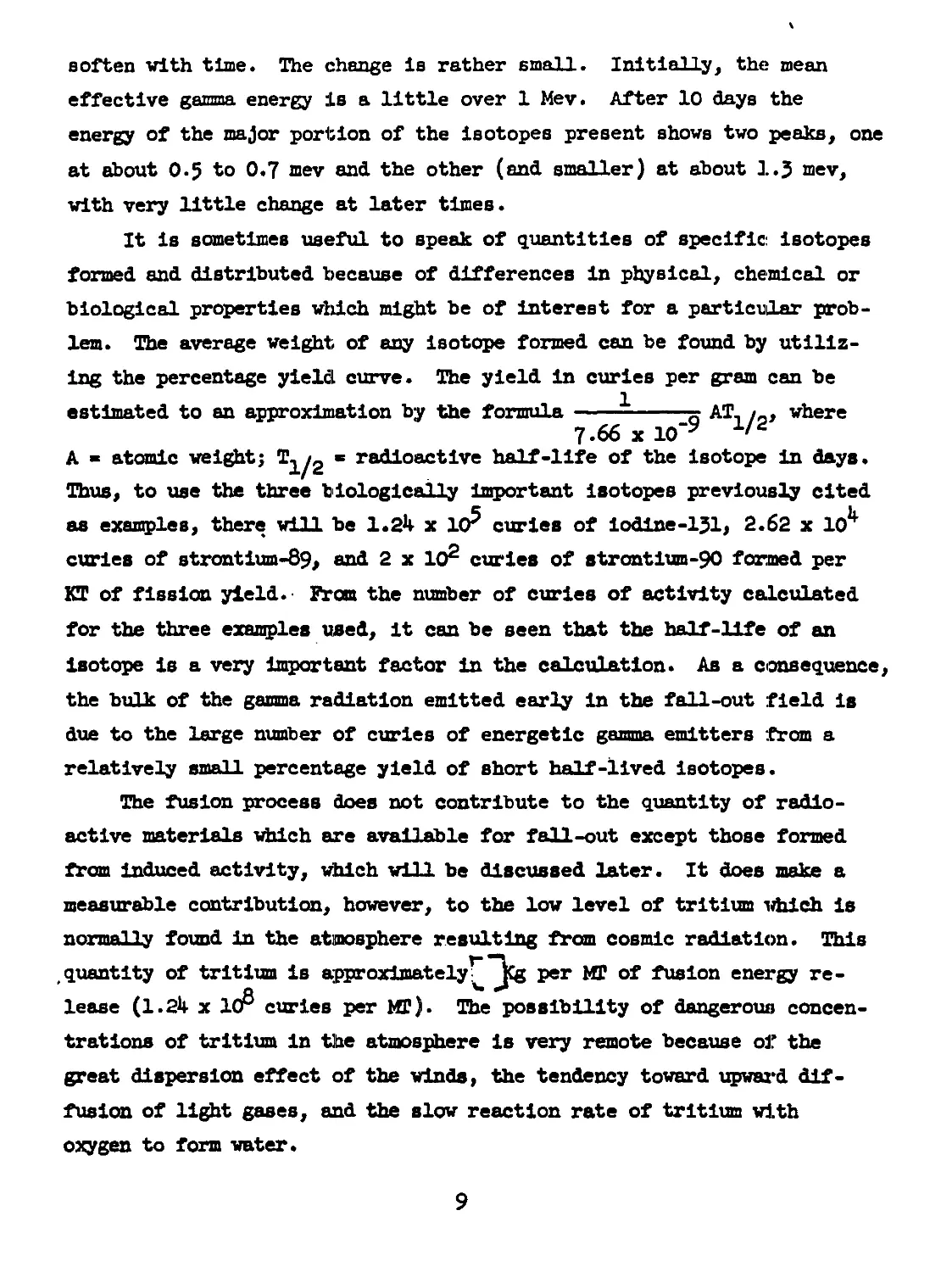
8
soften with time. The change is rather email. Initially, the mean
effective gamma energy is a little over 1 Mev. After 10 days the
energy of the major portion of the isotopes present shows two peaks, one
at about 0*5 to 0.7 mev and. the other (and smaller) at about l.J mev,
with very little change at later times.
It is sometimes useful to speak of quantities of specific: isotopes
formed and distributed because of differences in physical, chemical or
biological properties which might be of interest for a particular prob-
lem. The average weight of any isotope formed can be found by utiliz-
ing the percentage yield curve. The yield in curies per gram can be
estimated to an approximation by the formula
7.66 X 10⁻⁹ ATl/2’
where
A  atomic weight; Тду2 * radioactive half-life of the isotope in days.
Thus, to use the three biologically Important isotopes previously cited
as examples, there will be 1.24 x 10^ curies of iodine-1J1, 2.62 x 10^
curies of strontium-89, and 2 x 10² curies of strontium-90 formed per
KT of fission yield. From the number of curies of activity calculated
for the three examples used, it can be seen that the half-life of an
isotope is a very important factor in the calculation. As a consequence,
the bulk of the gamma radiation emitted early in the fall-out field is
due to the large number of curies of energetic gamma emitters .from a
relatively small percentage yield of short half-lived isotopes.
The fusion process does not contribute to the quantity of radio-
active materials which are available for fall-out except those formed
from induced activity, which will be discussed later. It does make a
measurable contribution, however, to the low level of tritium which is
normally found in the atmosphere resulting from cosmic radiation. This
quantity of tritium is approximately^"jCg per MT of fusion energy re-
lease (1.24 x 10® curies per MT). The possibility of dangerous concen-
trations of tritium in the atmosphere is very remote because of the
great dispersion effect of the winds, the tendency toward upward dif-
fusion of light gases, and the slow reaction rate of tritium with
oxygen to form water.
9
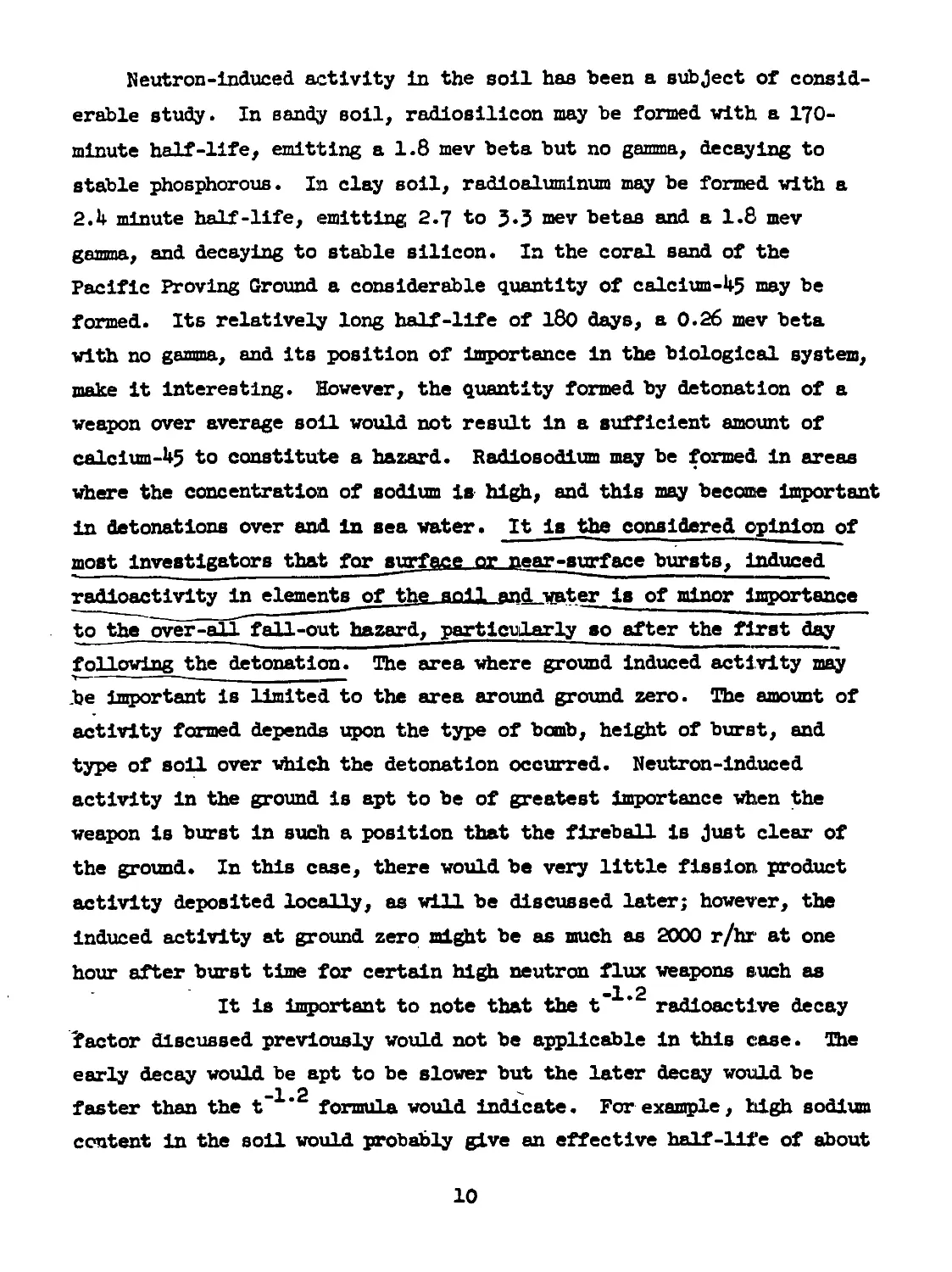
Neutron-induced activity in the soil has been a subject of consid-
erable study. In sandy soil, radiosilicon may be formed with a 170-
minute half-life, emitting a 1.8 mev beta but no gamma, decaying to
stable phosphorous. In clay soil, radioaluminum may be formed with a
2.U minute half-life, emitting 2.7 to 5«5 mev betas and a 1.8 mev
gamma, and decaying to stable silicon. In the coral sand of the
Pacific Proving Ground a considerable quantity of calcium-Uj may be
formed. Its relatively long half-life of 180 days, a 0.26 mev beta
with no gamma, and its position of importance In the biological system,
make it interesting. However, the quantity formed by detonation of a
weapon over average soil would not result in a sufficient amount of
calcium-U5 to constitute a hazard. Radiosodium may be formed in areas
where the concentration of sodium is high, and this may become Important
in detonations over and in sea water. It is the considered opinion of
most investigators that for surface or near-surface bursts, Induced
radioactivity in elements of the soil and water is of minor Importance
to the over-all fall-out hazard, particularly so after the first day
following the detonation. The area where ground induced activity may
be Important is limited to the area around ground zero. The amount of
activity formed depends upon the type of bomb, height of burst, and
type of soil over which the detonation occurred. Neutron-induced
activity in the ground is apt to be of greatest importance when the
weapon is burst in such a position that the fireball is Just clear of
the ground. In this case, there would be very little fission product
activity deposited locally, as will be discussed later; however, the
induced activity at ground zero might be as much as 2000 r/hr at one
hour after burst time for certain high neutron flux weapons such as
-1.2
It is important to note that the t radioactive decay
factor discussed previously would not be applicable in this case. The
early decay would be apt to be slower but the later decay would be
-1.2
faster than the t formula would indicate. For example , high sodium
content in the soil would probably give an effective half-life of about
10
1U hours for the ground.-induced, activity.
One of the phenomena of nuclear weapons is the high flux of neu-
trons of all energies. The number of fast or high energy neutrons
resulting from the detonation of larger weapons is sufficient to cause
a large fission yield from uranium-2^8 when used as a tamper for the
Implosion process. In addition to the fission reaction, the capture
process of neutrons of intermediate energies by the uranium-258 yields
appreciable quantities of neptunium-2J9. This decays with a 2. J day
half-life to plutonium-259, emitting a hard beta and gamma. Thus, the
quantity of plutonium-239 ultimately formed depends on the quantity of
uranium-238 used in the tamper. Part of the radiation hazard found
following the CASTLE series shots, particularly after Bravo, resulted
from the large quantities of uranium-2j8 which were irradiated. The
energy of the neptunium decay radiations is in the biologically hazard-
ous range. The proportion of neptunium radiations emitted relative to
-1.2
the fission product emissions was sufficient to alter the t decay
rate appreciably during the period from about H+10 hours to D+LO days,
so that data studied must consider this variation.
but the quantity is still insufficient to be an in-
dependent hazard in a close-in fall-out field.
B. Radioactive Particle Formation.
When a nuclear weapon is detonated, all fission fragments,
unfissioned active material, the bomb tamper, and the bomb casing are
included under the name of bomb debris. The proximity of the fireball
to the ground, the nature of the terrain, and the yield of the weapon
used, largely determine the ultimate amount of soil which is mixed with
the bomb debris to form radioactive fall-out particles. The final fate
of bomb debris which is mixed with the dirt may be influenced to a con-
siderable extent by the chemical composition of the fall-out vehicle.
Detonations at a sufficient height so that the fireball does not
reach the ground result in a distribution of atoms of bomb debris with
11
no ready vehicle for local fall-out-7 . The fireball engulfs enough air
to insure an adequate supply of oxygen to enable the atoms to form
oxides when the proper temperature is reached. Although many of the
elements combine to foi*m oxides, some unite with oxygen to form negative
radicals while the halogens form halides which combine with the strong-
ly electropositive elements to form compounds. The noble gases, kryp-
ton and xenon, remain 1л the atomic state awaiting radioactive decay
to change them to elements which can form an oxide or halide. These
two noble gases are precursors for strontium and barium, respectively.
The cloud rising from the point of detonation carries all these
materials as separate molecules, but with the rapid cooling of the
fireball, from 7000°K to approximately 2000°K in one to five seconds,
oxides with similar condensation temperatures become available to form
small mixed crystals for later incorporation into fall-out particles.
It is reasonable to assume that this condensation may be aided by the
intense ionization that accompanies the nuclear explosion, although
there is no definitive data to support this statement. The tiny
crystal nuclei, containing the mixture of oxides, halides and noble
gases, are carried throughout the cloud, where they can be absorbed on
dust particles or grow by self-nucleation as a result of many collisions.
As a result of aggregation, they attain sufficient bulk to be carried
to earth by free fall or mass air transport. Eddy currents tend to
diffuse and scatter the particles, in some cases hastening and in
others retarding the return to the earth.
The sizes of fall-out particles from an air burst are not well
documented. Investigators agree that the size distribution during the
early life of the clouc. is logarithmic, with the numbers in the aggre-
gation decreasing as the diameter of the individual particle increases
4/ Greenfield, S.M., et al., Transport and Early Deposition of Radio-
active Debris from Atomic Explosions. Project AIREOLE of the BAUD
Corporation, July 195U, SECRET Restricted Data.
12
from the median. The examination of samples by electron microscope
shows the maximum number to occur below 0.1 micron in diameter, with
particle sizes as low as 0.01 micron being present. The particle size
of 0.9 micron is theorized to contain most of the radioactivity from an
air burst. The particle size of 0.2 to 8 microns is the range of par-
ticle size which has been found to be an inhalation hazard, Inasmuch as
such particles can be inhaled into the lungs and retained. The radio-
activity from these particles can exert its influence on the lung where
the particles lodge if insoluble, or may be transported to other tissues
if the particles are in a soluble form.
Unlike an air burst with its fine particles, when an atomic weapon
is detonated on or near the ground so that the fireball intercepts the
surface, molten earth is drawn into the cloud and is present when the
condensation phase of the oxidized atoms of the bomb debris occurs.
The size, shape and distribution of the particles formed are influenced
by the chemical composition and the original particle sizes of the
earth which is fused. The two test sites normally used by the United
States for atomic bomb testing have widely different soils; at the
Nevada Test Site silicates predominate, while at the Pacific I’roving
Ground the land surface is almost entirely calcium carbonate.
When the earth contains SiO^, as it does at the Nevada Test Site,
molten silicate is drawn up into the eloud^ and swept around in typi-
cal toroidal motion. The molten silicate most significant for particle
formation is that portion which is swept up with the fireball and only
reaches temperatures of 2,000° to 2,800° C. It is theorized that these
heated particles are swept around at the top of the stem or in the
cloud in an atmosphere of fission products, plutonium and bomb case
fragments. It is further hypothesized that condensation or agglomera-
tion results in the bomb debris being deposited uniformly in the
center of the molten silica. As the particles cool, they tent! to pick
5/ Tompkins, R. C., Krey, P. W., Radiochemical Studies on Size-graded
Fall-out and Filter Samples from Operation JANGLE. Radiological
Division, U. S. Army Chemical Corps, August 1952, SECRET Restricted
Data.
15
up less activity because many of the short-lived, isotopes have decayed,
and with the growth of the cloud, fewer of those isotopes remaining can
be contacted by any one particle. The particles, as they cool below
1,700° C, are still able to pick up some activity on the outer surfaces.
Krypton-89, krypton-90, and xenon-140, which are present during the
formation of the fireball and are precursors for strontium-89, strontium-
90, and barium-lUO, have very little tendency to be incorporated uni-
formly in the particles during the early stage of formation. These
noble gases, when associated with a particle, are deposited unevenly on
the surface layers and distributed along with relatively large deposits
of inactive debris which were drawn toward the fireball too late to form
fused radioactive particles. Tests made on sample particles from
Nevada shots indicate that even in the case of fused particles, the
radioactivity tends to concentrate toward the outside of the particle.
The shape of the Nevada particles is essentially spherical and
they may differ markedly one from the other in physical appearance.
Some are black and ferromagnetic; others resemble glass beads; some
appear to be glass beads that have been fractured, but all appear under
the microscope to be different from the inactive soil collected in the
same fall-out. The particles which have been collected in the South-
west Pacific, although different in chemical composition from those
collected in Nevada, follow essentially the same general pattern. The
size of these particles ranges from 0.02 micron to .1,000 microns.
In the case of Pacific Proving Ground shots, calcium carbonate in
the ground is heated to a very high temperature and is fused and vapor-
ized, generally resulting in particles so fine that they are relatively
unimportant as vehicles for immediate fall-out. However, a portion of
the soil passes into the fireball and is heated to a temperature of
about 2000° to 2700° C, which is sufficient to decompose the calcium
carbonate to calcium oxd.de and also to soften the particle or to even
melt it at the higher temperature given When such particles become
57 Adams, С. E., The Nature of Individual Radioactive Particles; II.
Fall-out Particles from М-Shot, Operation IVI, USNRDL-408, July 1953,
SECRET.
14
mixed with the bomb debris i' the cooling mushroom cloud, they absorb
activity. This radioactivity is not uniformly distributed throughout
the particle but is absorbed primarily on the surface. It is also
possible for two or more particles to aggregate and in this way more
heterogeneous systems are formed. These particles are usually above
100 microns in size, and tend to fall out locally.
The fal 1 -out particles from the water surface (barge) shots of the
CASTLE series were, for the most part, carried in water droplets. Sam-
ples were collected, but the data give very little information on the
transport or deposition mechanisms.
An underground burst is one in which the center of detonation lies
below the surface of the earth. Particle formation takes place as the
earth particles and hot gases rise above the ground in an Inverted cone
or column. The particles are comparatively large and do not get as
high into the air as for a surface burst, so that the major portion of
the activity returns quickly from the column and cloud to title surface.
Deep sub-surface shots deposit almost all of the activity in the rup-
tured earth surrounding the point of detonation.
Particle size is one of the controlling factors in determining the
amount of radioactivity deposited as fall-out, the degree of localiza-
tion, and the time scale of deposition. The close-in fall-out at an
early time after detonation of a surface or underground burst consists
almost entirely of the larger particles (above 20 microns in diameter)^
Small particles, down to and including molecular size, do not tend to
fall out early but tend to remain suspended in the upper atmosphere and
fall out very slowly. The amount of activity carried per particle is
thus an important consideration. One study showed, however, that less •
than 1% of the fall-out from the JANGLE surface shot was radioactive.
It is not known to what extent surface redistribution by the wind
affected this measurement.	<
Various investigations have been made by several laboratories to
collect data on the amount of radioactivity which is carried per
15
particle. These studies show that regardless of the method of sampling
or the manner of handling the data, approximately 90$ of the radio-
activity incorporated in particles is carried by particles larger than
20 microns. A study conducted at UPSHOT-KNOTHOLE^/ indicated that the
activity per active particle was approximately a function of particle
volume for particles less than 150 microns in diameter and of surface
area for particles larger than 150 microns.
C . The Radioactive Cloud.
The release of large amounts of thermal energy that follows
the detonation of an atomic device carries the fission product radio-
activity by convection high into the atmosphere. The yield of the
bomb, the behavior of the fireball in the first few seconds, and the
stability of the atmosphere all influence the rise of the cloud and,
conversely, the return of the radioactivity to earth.
When an atomic explosion takes place over land, the energy yield
is the most important single factor in determining the ultimate cloud
height, while the amount of particulate matter from the ground which
is contaminated by the burst and carried aloft is determined by the
area of the ground contacted by the fireball.
For a contact surface burst, the fireball is roughly hemispherical
in shape, and grows to its maximum diameter during the "hover time".
The hover time is that interval during which the buoyant forces result-
ing from the heat of the fireball act to accelerate the fireball and
cloud upward. These buoyant forces are essentially independent of the
radial forces. After the brief hover period, the fireball leaves the
ground and starts to ascend at about five times the acceleration of
gravity. After several seconds during which the fireball is rising,
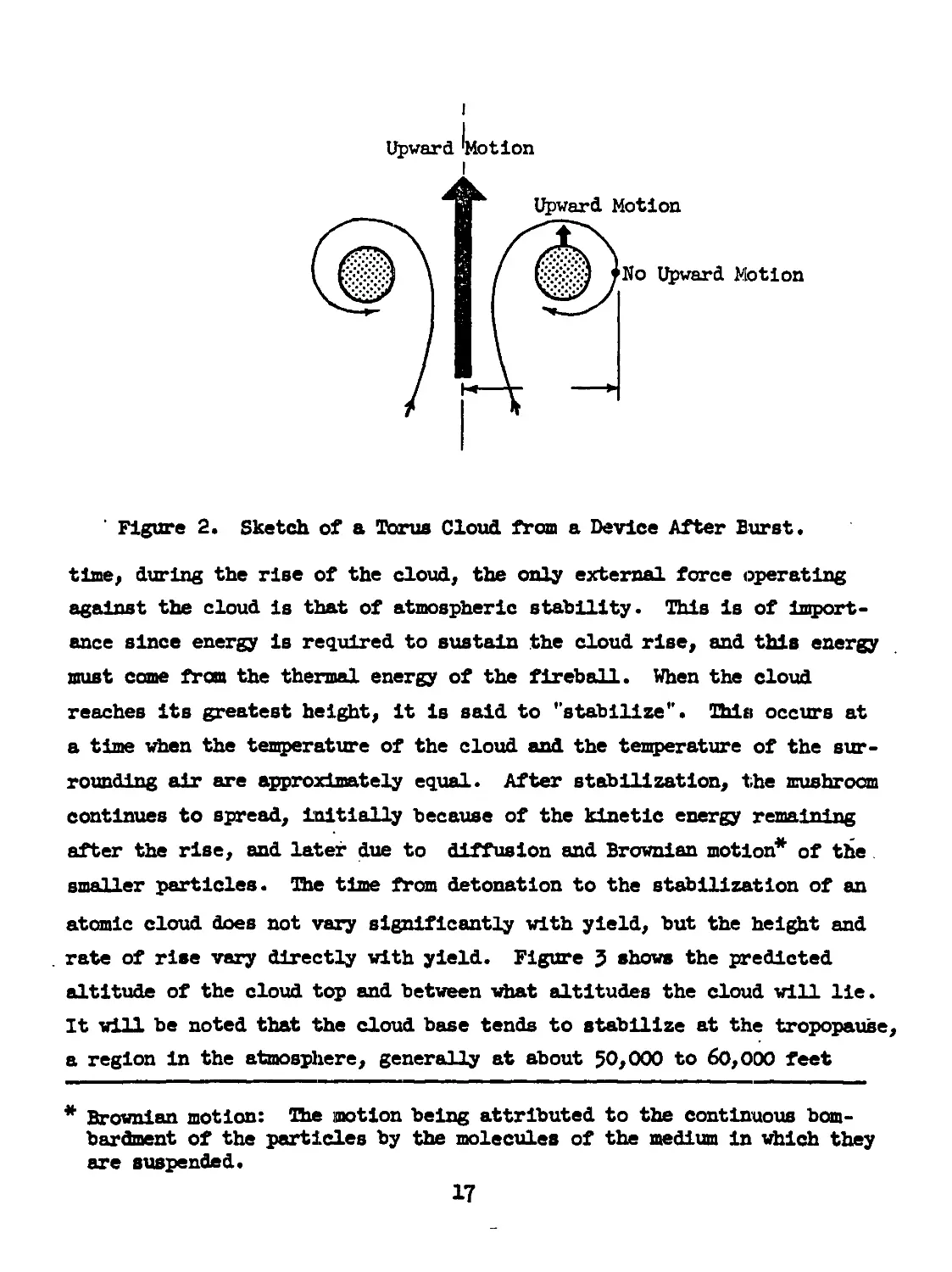
the typical mushroom cap and stem are formed. There is a great deal of
toroidal motion both in the cap and the stem acting independent of the
upward motion, but concurrent with it as shown in Figure 2. At this
?7 Rainey, C.T., Keel, J.W., Mork, H.N., Larson, K.H., Distribution
and Characteristics of Fall-out at Distances Greater than Ten Miles
from Ground Zero, March and April 1953, WT-811, SECRET Restricted
Data.
16
Upward 'Motion
I
Figure 2. Sketch of a Torus Cloud, from a Device After Burst.
time, during the rise of the cloud, the only external force operating
against the cloud is that of atmospheric stability. This is of import-
ance since energy is required to sustain the cloud rise, and this energy
must come from the thermal energy of the fireball. When the cloud
reaches its greatest height, it is said to '"stabilize". This occurs at
a time when the temperature of the cloud and the temperature of the sur-
rounding air are approximately equal. After stabilization, the mushroom
continues to spread, initially because of the kinetic energy remaining
after the rise, and later due to diffusion and Brownian motion* of the
дтпя!iparticles. The time from detonation to the stabilization of an
atomic cloud does not vary significantly with yield, but the height and
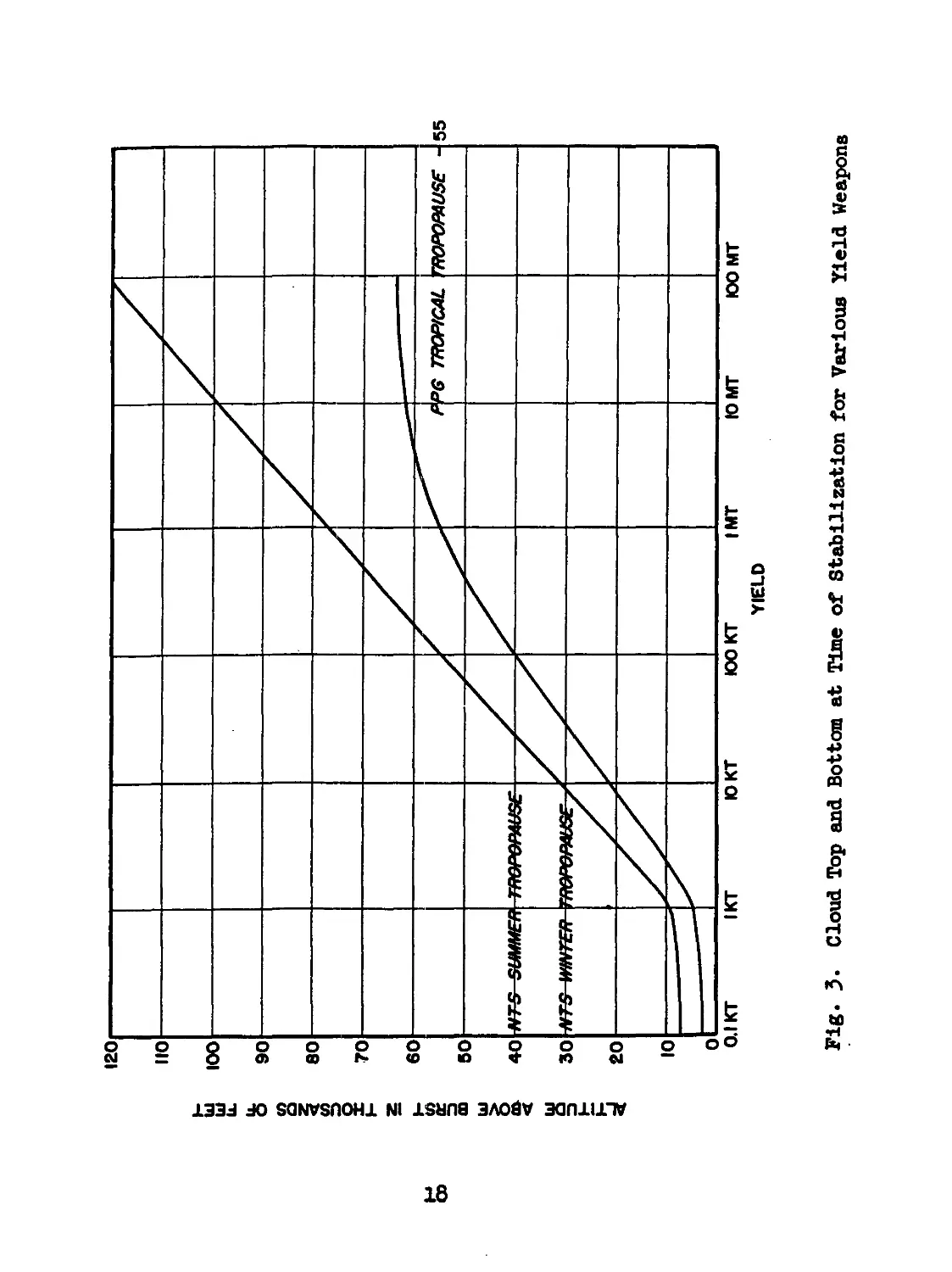
rate of rise vary directly with yield. Figure J shows the predicted
altitude of the cloud top and between what altitudes the cloud will lie.
It will be noted that the cloud base tends to stabilize at the tropopause
a region in the atmosphere, generally at about 50,000 to 60,000 feet
* Brownian motion: The motion being attributed to the continuous bom-
bardment of the particles by the molecules of the medium in which they
are suspended.
17
120
ALTITUDE ABOVE BURST IN THOUSANDS OF FEET
YIELD
Fig* 3* Cloud Top and Bottom at Time of Stabilization for Various Yield Weapons
characterized by a temperature inversion. Particulate matter on reach-
ing this layer requires more energy to rise further than has been neces-
sary in its previous rise, and can no longer rise on the basis of the
negative temperature gradient prevailing up to that layer. If it is
assumed that the cloud mushroom contains in excess of 90$ of the par-
ticles and 90$ of fission activity uniformly distributed, then from the
available data on world-wide detonations, 56,000 KT has been deposited
above the tropopause, while approximately 4,500 KT was deposited below
it as the contribution of the 10$ of the radioactivity remaining in the
stem, and the total activity of stem and mushroom. This takes into
consideration the place and date of the known detonations, as well as
their fission yields. Since these values are for the clouds at their
time of stabilization, they include all the particles that would be
found in local fall-out, i.e., those with sufficient weight to be re-
turned to earth within a 50 r infinity dose contour line, plus those
which are small enough to be carried outside this contour.
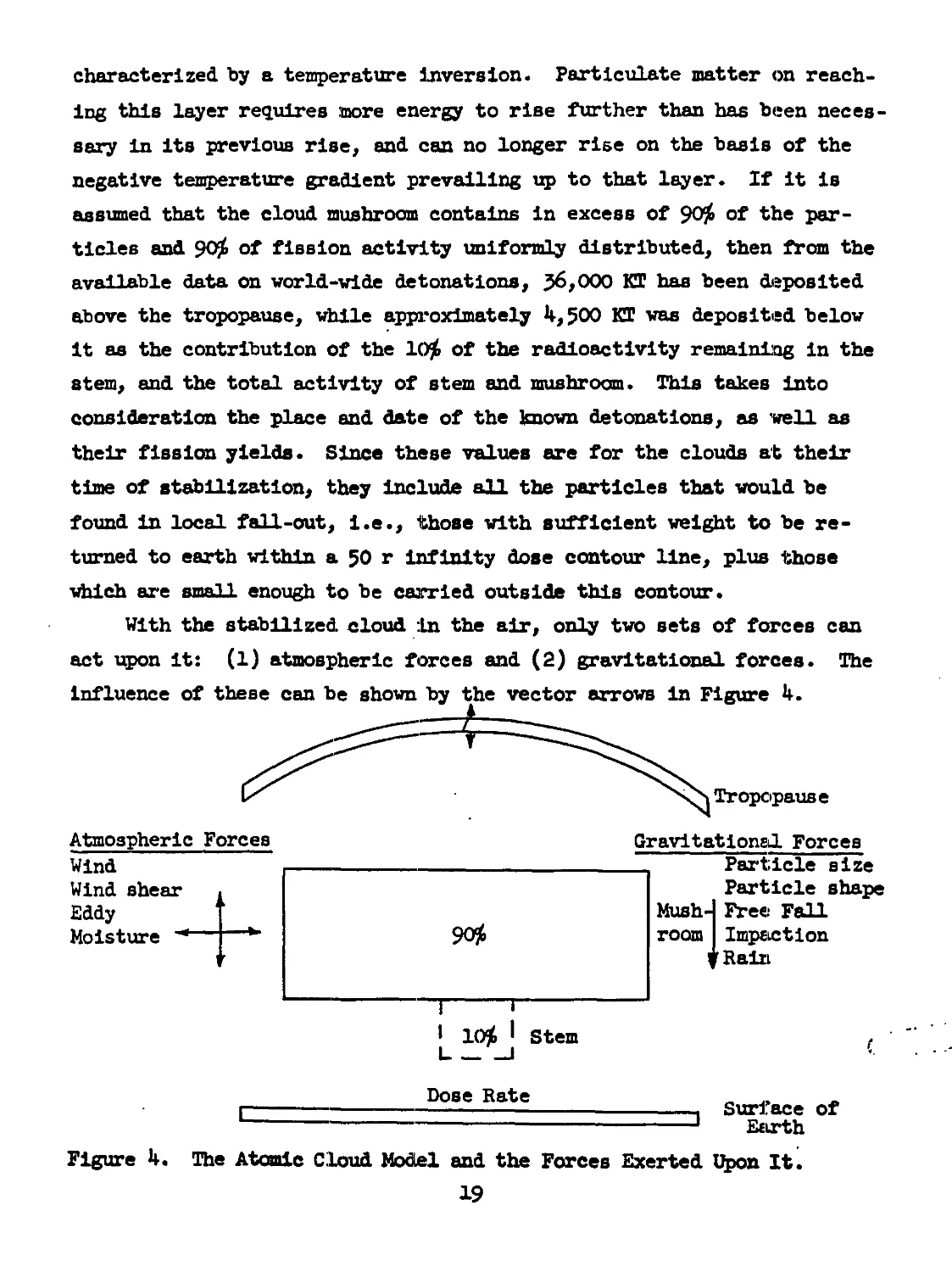
With the stabilized cloud, in the air, only two sets of farces can
act upon it: (1) atmospheric forces and (2) gravitational forces. The
influence of these can be shown by the vector arrows in Figure 4.
Tropopause
Atmospheric Forces
Wind
Wind shear
Eddy
Moisture	*”
90$
Gravitational Forces
Particle size
Particle shape
Mush- Free Fall
room Impaction
'' Rain
I 10$ I Stem
I_____I
Dose Rate
Surface of
Earth
Figure 4. The Atomic Cloud Model and the Forces Exerted Upon It.
19
For surface detonations, the cloud is generally considered to have
about 90$ of the activity in the mushrocm and 10$ in the stem. How-
ever, some U.S. investigators estimate a greater proportion of the
activity in the stem for surface bursts. The British have estimated
70$ in the mushroom and 30$ in the stem for their tower shots. This
question is presently unresolved; however, the REDWING test series in
the spring of 195$ is designed to provide definitive answers. Particles
less than 10 microns in. diameter are not usually considered of import-
ance in close-in fall-out patterns, since their slow rate of fall would
not bring these particles down from the mushroom soon enough to con-
tribute any appreciable activity in the Immediate vicinity of the burst
point. Instead, such particles are carried by the winds and deposited
beyond the local contour system. Once a shape for a cloud model has
been agreed upon, then it is reasonable to assume that there is an
even distribution of activity, but not necessarily of fission product
.composition, throughout the cloud. The various horizontal increments
of cloud layers or segments will each contain particles of all sizes,
but the increments at lower altitudes will contain a higher proportion
of heavy particles. This permits the assumption to be made tliat the
"hot spot" ordinarily found close to ground zero results largely from
fall-out from the stem or the bottom increment of the mushroom, where
heavy particles tend to predominate.
An atomic cloud with the same same general characteristics de-
scribed in this section forms as a consequence of all ground surface
detonations. A high air burst results in a similar mushrocm, but the
stem is minimal and the large dust cloud that follows the atomic cloud
from ground surface bursts is likely to be absent, or if present,
strung out as a long ribbon and much reduced in dust content.
For an underwater burst in shallow water, a water column is
formed in a manner similar to the dust column formed by an underground
burst. The height to which the water column rises increases with the
energy of the explosion, and decreases with increasing depth of deton-
20
at ion. As the column fall» hack into the water, a cloud of mist is
formed around the base of the column which spreads rapidly. This
cloud of mist, called the base surge, contributes to the spread of
the radioactive contamination by moving outward from the base while
the column, which is not a true cloud, falls back through the close-in
surge into the water. This expanding doughnut-shaped mist appears to
carry some activity deposited in it from the column over a greater
area than would otherwise be contaminated. The base surge is readily
influenced by winds and travels in the direction of the preval ц ng
wind.
An underground burst, described previously, is one in which the
center of detonation is below the ground. The mechanism of cloud
formation in this case is initiated by the venting of incandescent
gases from the fireball directly above the point of detonation. As the
gases are released, they carry a large quantity of earth high in the
air in the form of a hollow cylindrical column. The material from the
crater, much of it contaminated, is thrown out as for a surface burst.
As the material in the column cools, the soil particles and entrained
air which form the column begin to behave like an aerosol with a
density greater than the surrounding air. The column thus falls down-
ward and the finer soil particles attain velocities greater than their
terminal velocities in still air. These dust particles spread out
radially to form a low dust cloud or base surge similar to that de-
scribed for an underwater burst. The cloud from an underground burst
does not rise as high as for surface or air bursts, and the spread of
contamination is thus influenced to a greater extent by lower wind
strata. The spread of radioactive contamination is by fall-out from
the cloud, the column, and the base surge. As burst depth below the
surface is increased, conditions became more favorable for formation of
a base surge. More of the radioactive contamination is deposited
locally with increased depth, until in the case of no surface venting,
all of the contamination is contained in the volume of ruptured earth
21
surrounding the point of detonation, and. no cloud, column, or surge is
formed.
D.	Effect of Meteorological Conditions on the Cloud.
Four different types of action upon the atomic cloud can re-
sult from the winds. When the wind structure is sufficiently large to
embrace the whole cloud, gross movement occurs, i.e., the cloud as a
whole moves In the direction in which the wind is blowing. When it is
Just, or very nearly, as large as the cloud, it helps to move it, but
tends also to distort it as a whole. When the winds are appreciably
smaller scale than the cloud, they cause the cloud to diffuse and lose
its shape, because of eddy currents and dilution with clean air. Shear,
the fourth action, tends to string out the cloud in ribbons by vertical
deformation. The effect of wind shear upon a single radioactive par-
ticle that is falling from its position at the time of stabilization is
one of lateral translation. The amount of this lateral translation
relative to the main axis of travel is a function, within any cloud
segment of the wind speed of the segment and the length of time a par-
ticle spends failing through that segment. Seme of these air movements
tend to prolong the time that the large particles are in the air, in-
creasing the horizontal translation by vertical wind motion during the
free fall response to gravity.
Particles that range in size from 100 to 5,000 microns are most
likely to fall out within local fall-out contours from large yield
detonations, although some smaller particles are also found. The par-
ticle densities lie within a very narrow range of 2.5 to 2.8 gni/ee for
Nevada tests, while at the Pacific Proving Ground they average 2.U and
range from 2.6 to 1.8 gn/cc. When the densities are essentially the
same, the free fall rate is a function of particle size and atmospheric
density. If constant particle density is assumed, the variation in the
rate of fall from different cloud heights can be determined from Figure
5. Evidence indicates that from 50$ to 90$ all radioactive particles
in a fall-out area are within the size range of 50 to 1,000 microns in
22
140
Height above ground CIO3 ft)
Fig. 5« Time Required for Spherical Particles Having a 2.5 Density and a Certain Diameter to
Fall from a Given Altitude to the Ground.
diameter and. that from 50$ to 90$ of the fission product activity is
carried by particles of this size range. The influence of atmospheric
density can also be noted in the slopes of the curves of Figure 5 in
that there is a slower rate of fall as the particle approaches the
surface. Spherical particles under 100 microns in diameter thus fall
in a manner described by Stokes' Law with the terminal velocity of
those particles in the upper cloud being twice the terminal velocity of
free fall in the lower cloud from yields greater than 1 MT. For spheri-
cal particles larger than 100 microns, as well as for irregularly-
shaped particles of all sizes, free fall is better fitted to a fall
described aerodynamically rather than by Stokes' Law. During fall
through any one segment or layer of a cloud, the time of fall will be
the sum of the time for the loss in height, "gravity", and change in
horizontal position, "vertical wind effect". Assuming uniform distri-
bution of the particle size spectrum and of chemical composition
throughout the cloud, a projected fall-out field can be made by plotting
the time required to travel from the initial placement of certain cate-
gories of particles in each cloud segment, to the ground. The activity
deposited will vary, owing to the decay of activity in particles com-
posed of very short half-lived elements, Individual particle response
to wind shear and eddy currents, and redistribution after deposition
because of wind and water erosion.
After stabilization, which occurs about 5 to 7 minutes after deton-
ation, the atomic cloud is moved downwind from ground zero. The mush-
room having cooled to a temperature about equal to that of the surround-
ing atmosphere no longer rises, but does expand to a greater diameter.
This lateral expansion results from the expenditure of the kinetic energy
acquired during the turbulent rise of the fireball, and from diffusion
effects. As this lateral growth proceeds, the cloud becomes less
sharply defined, and within a matter of hours, except under unusual
atmospheric conditions, may no longer be identified visually. The
* Stokes'Law: A mathematical treatment of small spherical particles
Pai i < ng through air in which the viscosity of the air opposes the pull
of gravity.
2U
particles at this stage that have not already fallen out are so small
as to respond less to gravity than to vertical wind components. Air-
craft monitoring has shown the activity at this time to be scattered
into wispy patches.
The physical process of diffusion Involved in the movement and
growth of a cloud results to a large extent from atmospheric turbulence.
While little Is actually known about diffusion, it results in the spread
of clouds of finely divided particulate matter in all directions. The
process is not Isotropic. Diffusion is thus probably a part of the
process by which isolated activity comes to the ground in areas remote
from the primary cloud track. After two or three times around the
earth, the cloud is diffused to the extent that activity may be col-
lected at many different altitudes. However, airplanes equipped with
sampling devices have proved non-uniform distribution of radioactivity
by being unable to collect fission product activity on every flight.
As the radioactive cloud passes over the earth's surface in this dif-
fused form, portions of its activity continue to be deposited on the
ground over periods of weeks and months and perhaps over years. This
accounts for the world-wide distribution shown by collection of minute
amounts of radioactivity at very remote sampling stations around the
globe.
Cloud trajectories have been plotted showing cloud paths from
various nuclear detonations. These have been checked for travel more
8/
than half way around the world.-' The results of aircraft monitoring
flights vectored to intersect the cloud met with sufficient success to
prove that a nuclear detonation cloud has finite boundaries, radiologi-
cal if not visual, as much as thousands of miles from the point of
origin.
World-wide distribution of bomb contamination has been proven.
The key to this distribution lies in the action of world meteorologi-
cal conditions on diffused and probably dispersed bomb clouds which may
87 USAF Report of Operation Fitzwilllam (Secret), Nuclear Detonation"
by Airborne Filters, Vol II, SECRET, Restricted Data.
25
be weeks, months, or even years old.
The SUNSHINE data, to be discussed later, show the presence of
strontium-90 in a significant number of samples taken at many of the
far flung net of fall-out collecting stations. Strontium-90 is signif-
icant in that it is not a naturally occurring isotope and thus must
have originated in an atomic detonation and must have been distributed
through the atmosphere by processes such as described above.
E.	Mechanisms of Fall-out.
By definition, as used in this report, close-in fall-out is
that process by which fission products are returned to earth from a bomb
cloud within the isodose line bounding the area within which at least
50 roentgens of radiation would be accumulated if a person remained
there in the open indefinitely. Such fall-out generally results from
the incorporation of the molecular state radioactive bomb debris in or
upon particles that have diameters in excess of 10 to 25 microns. It
can be assumed that within a matter of hours only those particles re-
main in the air that are such as to respond at least equally well to
both the gravitational Influence of the earth and the vertical air
movements that tend to keep them aloft. This aerosol of radioactive
particles that is still in the air is not likely to return to earth in
appreciable amounts if the particles involved are small enough to be
supported by Brownian motion. Association of these light particles
with rain droplets is one means by which they are brought to earth.
However, rain does not occur above the tropopause so that some other
mechanism would have to operate as a scavenging agent if such particles
in the stratosphere are to be brought to earth.
When the fireball starts rising after a land surface detonation,
any dust or debris that moves with it is available for radioactive
particle formation. However, there is other dust, first disturbed by
the ground shock and then pulled into the stem by the low pressure
region that follows the rapid rise of the cloud, and much of which is
subsequently distributed throughout the stabilized cloud. This dust,
26
although carried aloft., is not heated by the fireball to the temperature
necessary for radioactive particle formation, nor is it drawn aloft in
time to mix with the fission products to form true radioactive particles.
The **dry" scavenging action of these dust particles is known to be
very inefficient at low atmospheric levels, and would be even more so
at higher altitudes. Thus there is no known scavenging mechanism, ex-
cept diffusion to the rain-bearing levels, for the very finely divided
fission products originally deposited in the stratosphere by large
yield weapon detonations.
Rain as a means of bringing radioactive particles to the ground is
at least several times more efficient than is dry scavenging. In order
to utilize this method, however, the particles must be deposited in the
rain-bearing levels — i.e., below the -15° C isotherm — or transported
to this region by gravitational forces or atmospheric effects. All sur-
face or air bursts with yields in excess of 6 KT result in clouds with
the mushroom stabilized above the -15°C isotherm. Thus, rain to be an
effective scavenger depends upon efficient deposition of the radio-
active particles in rain-bearing levels. An exception to this occurs
in the formation of thunderstorms where localized moisture-bearing
clouds are sometimes sirept to great heights for short periods of time.
Clouds from small weapons (less than 5 KT) generally stabilize within
the scavenging ability of the rain-out region under the -15°C isotherm.
The -15°C isotherm for the North Temperate Zone lies between 15,000 and
20,000 feet, although thunderstorms can rise as high as 55,000 feet and
last as much as an hour. Frequency and amount of rain per month or per
season are known within limits of useful accuracy for many areas of the
world.
The primary mechanism for rain scavenging appears to be fall of
raindrops through a volume containing radioactive particles, with en-
trapment of particles In the failing raindrops. Raindrops are known to
vary considerably in size. Since the ’’collection efficiency" of rain
is a function of the rate of fall of the raindrop and the fall, of the
27
radioactive particle, it is thus a function of the densities and diam-
eters.
The second method of rain scavenging which accounts for a smaller
fraction of rain-out is the intermingling of an atomic cloud with a rain
cloud. The rain cloud in this instance gathers up bomb debris or other
contaminated particles into small droplets, which are then collected by
large water drops and brought to earth as radioactive rain. This method
of cleaning the air is most efficient in particle sizes of about 1
micron but is capable of scavenging any particles that are less than 2
microns in diameter.
The mechanism of particle movement down from the stratosphere and
into the troposphere is. not understood. In fact, it has not been
definitely ascertained whether any of the small size stratospheric
bomb debris has come to the ground. Such data, when available, would
yield important information concerning the exchange of matter between
the stratosphere and the troposphere. One tentative conclusion can be
drawn: if particles are so light as to remain in the stratosphere for
long periods of time, there is an increased chance of the harmful iso-
topes being dispersed; hence the reconcentration of these isotopes
would be unlikely. It may also be concluded that particles small
enough to remain aloft for sufficient time to become a possible long-
range threat are too small to be scavenged efficiently by rain when
they reach rain-bearing levels.
During thunderstorm formation, the rain cloud is sometimes swept
up to the tropopause where the cooled water particles form ice crystals
about any small debris or dust that might be in the air. Because the
lower atmosphere air is drawn up into the cloud the ice crystals de-
scend and ascend alternately until they become hailstones, or are
captured by raindrops, and fall to the ground during a thunderstorm or
hall storm. Measurements! of radioactivity In large hailstones from a
hail storm at Washington, D.C.,^ following Shot 10 of UPSHOT-KNOTHOLE
57 List, R.J., The Transport of Atomic Debris from Operation UPSHOT-
KNOTHOLE, U.S. Weather Bureau Report, NYO-4602, June I95H, SECRET
Restricted Data.
28
Indicated, that the greatest activity was in the core, so that the activity
must have been picked up early in the cycle of hailstone formation.
Another indication of the ability of rain to scavenge at great heights
was a fall-out upon Albany, H.Y., from a portion of the cloud, which ws
stabilized at U0,000 feet and not at lower levels. Gummed paper collec-
tors counted 1.6 x 10? disintegrations per minute at Albany following
a severe thunderstorm, but the count was low at the six stations near
Albany. While not a hazard to health, this disintegration level is
very much higher than background. Although thunderstorms are the
largest single source of rain in the United States east of the Rocky
Mountains, their very limited size geographically and the infrequency
of their formation suggest that they do not account for much of the
total radioactivity that is returned to earth.
F.	Fractionation.
The probability that fractionation exists in a detonation of a
nuclear weapon has long been suspected by investigators, and each care-
ful study of the radionuclides formed from detonation of test weapons
helps to substantiate the hypothesis. There are several definitions of
the term; however, for purposes of this report the one proposed by
Stanford Research Institute^/ that ''fractionation can be defined as
any variation from the expected value in the relative fission product
nuclide abundance" will be used.
The degree of fractionation is a function of the particle size and
chemical composition of the vehicle for fall-out, the environment of
the particle after fall-out, and the physical and chemical properties
of the radioactive elements formed in the fission process as well as
those of daughter elements formed in the decay chain. The fission
process yields constant relative amounts of radioactive isotopes, de-
pending upon the fissionable material used. The half-lives of the I7O
isotopes from 6U known decay chains contribute to the over-all fission
157 Cadle, R.D., The Effects of Soil, Yield, and Scaled Depth on Con-
tamination from Atomic Bombs, Stanford Research Institute, S.R.I.
Project Cu-6U1, 29 June 1955• SECRET Restricted Data.
29
-1.2
product decay constant of t .As previously stated, the average
gamma energy of the mixed fission ‘products varies with time, becoming
less during the first four days then gradually increasing during the
next several days. It might be expected that random gross samples of
mixed fission products brought down as fall-out would have about the
same decay rate and energy. This is not found to be the case because
of the phenomenon of fractionation.
Fractionation depends to a large extent upon volatility, the solu-
bility, and other physical and chemical properties of the fission
products, both for the first elements of a decay chain and its subse-
quent radioactive decay products. When a nuclear weapon is detonated
-on the ground, the duration of the fireball and the chemical compos 1-
-tion of the soil are the predominant factors in det^rming the composi-
tion of the fall-out particle. The larger the weapon and the» longer
time that heat is evolved in the fireball while It Is In close prox-
imity to the ground, the greater will be the effect on early formed
products, and particularly on gaseous elements. Fractionation may take
place within the fireball of an air burst but the results are not as
apparent as for surface detonation fractionation.
When particles fall to the ground, whatever the effect within the
fireball, further fractionation is possible, due to the solubility of
the specific radioactive isotopes present and their compounds, as well
as the characteristics of the soil upon which the fall-out is deposited.
Some of the most fruitful studies on the movement of various ions of
biological importance through soils have been made by the Waste Dispos-
al Group at the Hanford Atomic Products Operation.It was found
from a study of several elements that movement of ions by the mechanism
of adsorption and elution on the soil decreases with increasing acidity.
Further investigation revealed that the presence of phosphate ions in
11/ Parker, H.M., Radiological Sciences Department Quarterly Progress
Report, Research and Development Activities, Hanford Atomic Prod-
ucts Operation, HW-34408, SECRET Restricted Data.
30
the soil results in a very markedly increased, adsorption of strontium
throughout the range of acidity or alkalinity studied. The effect is to
make plant uptake of strontium much less likely. This phenomenon will
he discussed more fully in a subsequent section on hazard evaluation.
Movement of radioactive particles by wind erosion has been studied
by the Hanford Group. This study was designed to investigate particle
pickup as well as the relative efficiencies of various surfaces for re-
taining small particles. Using a 20 foot circular sand plot as the
contaminated study area, It was found that the source was seriously de-
pleted following two days of fresh surface winds of 15 to 25 mph, indi-
cating that the natural surface of this particular type of soil is
highly erodible and that particles deposited on such a surface are
susceptible to subsequent translocation in windy weather. A second
experiment was a study of the relative retentive efficiency of grass-
covered, rock-covered, furrowed and fence-protected surfaces. Prelim-
inary analysis of the data indicated that rock-covered and grass-covered
surfaces retain particles equally well. The furrowed surface retained
particles poorly when compared to the grass or rock-covered surfaces.
The highest particle retention was observed in the Immediate lee of the
fence, but this result is somewhat open to -question because these areas
were shaded from the sun and were noticeably wetter than the other areas.
Both strontium-89 and strontium-90 are examples of radioisotopes
having gaseous precursors and are thus subject to a high degree of
fractionation. To illustrate the decay chain, the following equations
are shown:
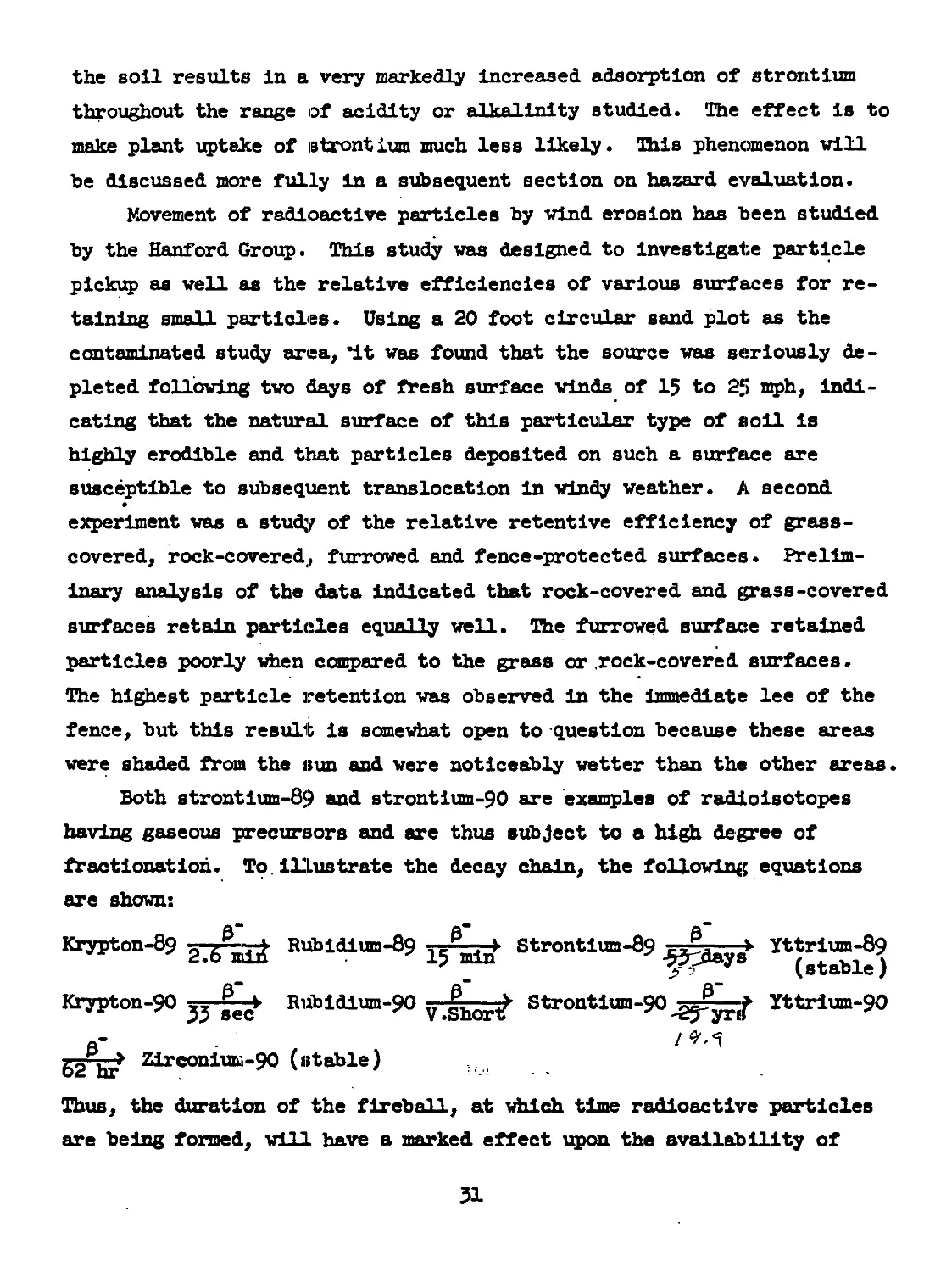
Krypton-89	Rubidium-89	> Strontium-89	Yttrium-89
2.bmid	15 mln	-^flays (stable)
Krypton-90	Rubldium-90	> Strontium-90 яеЯ-/ Yttrium-90
>> sec	V .Short	-cj yrs
А"
^2 hr Zirconium-90 (stable)
Thus, the duration of the fireball, at which time radioactive particles
are being formed, will have a marked effect upon the availability of
31
strontium-89 or strontium-90 for incorporation into the large particles
because of the short half-lives of the parent isotopes. If the fire-
ball is of brief duration, as for low and. medium yield weapons, the
large particles are cooled when relatively little strontium-89 would
be found, with more strontium-90 being available. The smaller particles
which stay up a longer period of time and travel long distances can ab-
sorb krypton and thus are likely to include more radiostrontium than
those particles which fall out immediately. On the other hand, a large
yield weapon with a longer lasting fireball may have an appreciable
amount of strontium-89 present and a larger proportion of the precursors
for strontium-90 would have decayed. Thus, fractionation of strontium
due to the decay chain process is apt to be less in large yield detona-
tions than in those of smaller yield. From the data available, frac-
tionation appears to be more extreme for surface shots and underground
bursts than for air bursts of the same yield weapons.
Seme of the formed radioactive elements that have half-lives of
several hours are metals and are found in particles of various sizes in
a rather constant percentage of the fission yield, showing little or no
12/
tendency to fractionate.—' "Molybdenum-99 cerium-lU4 are examples
of this phenomenon. These elements are frequently used as a reference
to determine fractionation of other elements. To illustrate this, an
equation of the general form
Al/A2
B ‘ l^/A2)e
is used, in which A^/Ag is the measured activity for two fission prod-
ucts, the activities having been corrected for decay between time of
explosion and time of measurement, and (AjAg)c is the activity ratio of
the same two fission products measured under the same laboratory condi-
tion, but produced by slow neutron irradiation of uranium-235. An R
value of unity for the particles analyzed for these two isotopes would
indicate no fractionation.____________________________________________
12/ Adams, C.E., et.aL., Fall-out Phenomenology, Scientific Director's
Report Annex 6.4, GREENHOUSE 1951, WT-4, SECRET Restricted Data.
52
This approach to the problem has been used, for studies on detona-
tions in both the Pacific Proving Ground and at the Nevada Test Site.
In general, the data indicate that for close-in, early fall-out, frac-
tionation does occur in many instances and. is subject to many variations
depending upon conditions, such as height of burst, duration of fireball,
etc. As expected from the earlier discussion, strontium exhibits very
definite fractionation. On one series of air samples collected at
40,000 feet at Operation CASTLE after the Bravo shot, the R value for
strontium-89 was 0.35. For a fall-out sample collected on land at ap-
proximately 80 miles from the burst point, the R value for strontium-89
was 0.1U. The R value for strontium-90 using the same fall-out sample was
Sr9°	gr90	n
0.29- If —tTq is calculated, it indicates that —«=• “ 2, or that
Sry	Sry
strontium-90 is less fractionated close-in than strontium-89 by a
factor of about 2. Fractionation of this magnitude of strontium means
that the quantity remaining in the atmosphere should, be greatly in-
creased over the calculated value based on the Hunter-Ballou Tables.
The findings of the gum paper experiment of the New York Operations
Office,' AEC, indicate that this is true and that the discrepancy factor
is about
A different approach to this problem was followed at Operation
13
UPSHOT-KNOTHOLE. It was concluded from biological studies on both
vegetation and indigenous herbiverous animals that, percentage-wise,
more strontium was available at distance of 150 miles than at 20 miles.
The strontium-90 at the more distant station was also about four times
as available for biological uptake as close-in fall-out. This fact may
have been due either to the particle size being smaller and having more
strontium-90 present percentage-wise, or that the chemical or physical
form was such that the plants could more easily assimilate it.
From the foregoing discussion, there is very little question that
lj Larson, K.H., et al., Distribution and Characteristics of Fall -
out at Distances Greater Than Ten Miles from Ground Zero, UPSHOT-
KNOTHOLE WT-811, March-April 1953, SECRET Restricted Data.
33
fractionation can occur in a number of ways and. that environment has
considerable effect upon the concentration of various radio-elements of
biological importance. Qhe specific Importance of fractionation in
certain hazard calculations will be discussed in a later section.
G.	Areas Involved and Material Available.
The area involved, in fall-out resulting from a surface or near
surface detonation depends upon the energy yield of the detonation, the
height of burst, velocity and direction of winds at all altitudes up to
where the mushroom cloud stabilizes, and the type of bomb. As was in-
dicated in a previous section, the yield of fission products, irrespect-
ive of the total energy of the weapon, determines the quantity of
available radioactive materials which can be deposited as fall-out.
Thus-	is
compared to a weapon with 5 ME fission yield and 5 ME fusion'yield, the
physical mechanism involved in each case would be approximately the same
but the relative intensities of radiation in the area would be consid-
erably higher, possibly by as much as two orders of magnitude, for the
5 MT fission plus 5 ME fusion yield weapon.
After fall-out of radioactive debris occurs, the radiological sit-
uation may be ascertained by use of radiac instruments. These may be
used on the ground, taking the readings at about 5 feet above the sur-
face, or from a low flying plane at 200 to 500 feet above the surface
and applying suitable correction factors which depend on the altitude
of measurement and the instrument used. In any event, readings are
taken at specific points and plotted on a map at various times follow-
ing the end of the fall-out. The final situation cannot be known dur-
ing the period that fall-out is occurring. During fall-out the final
radiological situation can only be estimated when the height of burst,
the fission yield, the total yield of the weapon, and the wind history
since burst time at all altitudes where the cloud has gone, are known.
The true situation can be known after fall-out is completed and all
readings are made and Intensities at specific times after detonations
5*
are known. Calculations can be made to estimate what the reading will
be at some future time or was at some selected previous time by using
the t"1*2 fission product decay law. Figure 6 is a graphical presenta-
tion of this law for this purpose. By drawing connecting lines to the
points of same intensity readings calculated to the same time-dose-rate
relationship, isodose rate lines or contours can be constructed. For
plЯПП-1 ng purposes, before fall-out is completed and the true contour
patterns are known, smooth, idealized contours are generally constructed,
calculated for some specific time following detonation such as H+l
hour or H+2 days, etc. For this purpose, since the ultimate wind struc-
ture is not known at the time the contours are drawn, a basic simplifica-
tion is made in that a single wind of constant velocity is assumed to
act on the bomb cloud. For cases in which the wind shear is not exces-
sive, this approximation does not introduce serious errors. Frequently,
isodose contours are also constructed to indicate the integrated dose
over a certain period of time, as for example up to H+50 hours.
The family of curves included in Figure 6 is a graphic representa-
tion of several H+l hour radiation dose rates, in roentgens per hour,
with time after detonation plotted against dose rate. Using these
curves, one can calculate the dose rate at any hour after the burst if
the H+l hour dose rate is known. Also the H+l hour dose rate can be
calculated from the actual measured dose rate at any particular time.
Dose and dose rate contour lines are drawn in such a manner that
the boundaries represent the minimum quantity for the area enclosed.
An example of a family of idealized contours for a 20 KT land surface
burst is presented in Figure 7- intensity is greatest at some
point on the mid-line, becoming gradually less as one proceeds periph-
erally. Locations of high radiation intensity, or ''hot spots'' as they
are called, are not indicated on most contours. Additional examples
of contour areas and downwind extents for an assumed 15 knot \rind condi-
tion and for a number of different yields are given in Table 1.
55
DOSE RATE IN ROENTGENS PER HOUR
TIME AFTER EXPLOSION IN DAYS
Fig. 6. Dose Rate, Roentgens Per Hour Mixed Fission Products
MILES
SCALE OF MILES
Fig. 7. H+l Hour Idealized. Contour Lines for 20 KT Ground Burst 15 Knot Wind
TABLE 1
H+l Hour Reference Time Dose Rate Contour Areas
and. Downwind Extents for Various Yields
(Surface Burst, 15 Knot Scaling Wind)
	3000 r/hr	1000 r/hr	300 r/hr	100 r/hr
Yield		Areas in	Square Miles
15 KT	0.1	0.5	2.2	8.0
25 KT	0.18	0-9	4.0	14
50 KT	0.4	1-9	8.2	27
100 KT	1.0	4.0	17	55
500 KT	6.0	38	100	450
1 МГ	14	70	250	800
5 mt	100	560	1800	5400
10 МГ	300	1500	4200	12,000
15 mt	520	2500	7000	20,000
		Downwind Extent from Ground Zero		in Miles
15 KT	0.8	2.0	4.5	9.6
25 KT	1.2	2.7	6.0	13
50 kt	2.0	4.2	9.2	20
100 KT	3-5	7-0	14	30
500 KT	9-5	19	37	70
1 MT	15	29	54	100
5 mt	4o	76	14o	230
10 MT	62	120	200	330
15 MT	80	150	250	400
For recovery planning, these contour areas are very useful in that
times of entry into an area for decontamination or recovery and the time
of stay in the area so as not to exceed a predetermined radiation dose
can be estimated. However, readings on radiac survey instruments must
be relied upon for Integrated radiation received during the actual
operation, as well as for delineation of the true contour patterns in-
volved.
38
Figure 8 is a useful plot for facilitating time-of-stay calcula-
tions. Perhaps the best way to explain the method of employing this
set of curves is to cite an example. Assume that an individual enters
a contaminated, area 12 hours after detonation and the reading at this
time is 5 roentgens per hour. As planned for the operation, it will be
necessary to stay in the area 3 hours. Thus, on the horizontal axis,
select the time 12 hours, read, vertically to the intersection of the
3-hour curved line. Read, the vertical axis, as indicated D/R. This
value of 2.6 is multiplied by the radiation intensity, 5 r per hour, to
give 13, which is the total number of roentgens received during the
period of the stay in the area.
The scaling of residual radiation contours is not a simple process
because of the many variables involved. In addition, changes in cloud
models and in mechanisms of deposition occur with changes in yield and
in wind velocity. For example, the tropopause layer in the atmosphere
has a slowing down effect on the rise of an atomic cloud through it,
with the result that atomic clouds which reach this layer tend to
flatten out against it, as though against a ceiling. The result is
that such clouds are broader, and their fall-out deposition patterns
are wider and shorter, than would be the case from an identical deton-
ation whose cloud did not reach the tropopause. A valid and ideally
useful scaling process should be easy to apply and should be based on
a conservation of material assumption, since it is obvious that the
scaling process should not cause more material to' fall out than is
available. One such method is 'cube root scaling'*, by which linear
contour dimensions are scaled as the cube root of the ratio of yields
and areas as the two-thirds power of the ratio of yields, with simultan-
eous scaling of contour dose rate values as the cube root of the yield
ratio. This method conserves material, in that the percentage of
available material brought down within each scaled contour remains con-
stant. It is also easy to apply. However, it is subject to the inher-
ent inaccuracy discussed above and common to all residual radiation
scaling methods developed so far: it does not allow for the changes
39
R DOSAGE RATE Ir/hr) AT TIME OF ENTRY
TIME OF ENTRY INTO CONTAMINATED AREA AFTER EXPLOSION (DAYS)
Fig. 8. Dosage Received with Various Times of Stay in Contaminated Area
in cloud, models and deposition mechanisms that are introduced by a
change in yield. Nevertheless, the method is useful and fairly accu-
rate if applied over a limited yield range, not to exceed about two
orders of magnitude.
Wind velocity scaling is even more subject to error than is yield
scaling. Based upon limited high explosive experimental data, using
dye tracers, it has been postulated that total areas of effect of fall-
out for a particular detonation are essentially wind-independent, al-
though the specific regions which these areas cover are of course
determined in detail by the wind pattern. The experimental data ex-
tends only to winds up to 25 knots; however, in the absence of other
information, extrapolation to higher wind velocities is not unreason-
able. On this basis, then, contour dimensions in a downwind direction
would be scaled in direct proportion to the cube root of the ratio of
the winds Involved, while crosswind dimensions would be scaled inverse-
ly by the same factor, leaving the area of effect essentially constant.
The effect of winds upon the direction of the fall-out and the
area involved can be shown graphically by setting forth certain assumed
meteorological conditions. One example of such assumptions is presented
in Figure 9. Superimposed upon the wind vector plot is a family of
idealized isodose contour lines for a 20 KT ground burst. It will be
noted that the shaded area, which is due to diffusion, and the A”, B"
.....Fr due to 50 micron particles, do not contribute appreciably to
the radiation Intensity within the area. The highest radiation read-
ings in the contour areas are close in to the burst point and the
radioactivity deposited there is carried by the larger particles. For
purposes of the Ulustra.tion, the size assumed for the large particles
was 150 microns and the greatest effect by the wind is indicated on
the line A', В * ....F'. The area covered by superweapon detonations
would be much larger and. wind shears at high altitude would have a
greater effect upon the true pattern, but the method of illustration
is the same. Such a superposition is useful in indicating where the
U1
						1 \ ₽
		К	X	s.	—v ’V' л ' Jt	/ / / t				-
	“ s	JSo	r	/\ f X	/	л . /к \	X 1 X* /К \ \ y* ’	9<	\
		.'//i	1 / \ Zz >4 X. X


	s	X	x fur\ \		IDEAUZEl SUPER!)	CONTOUR 1P0SED	LAYl 0-5t	R	WIN JOO	/	1 DIR.	SPt 0*	5	ED KNOTS
			X DOWN»	r\ го kt src 300f REA	3 'ND	7	UNO BURST !00r 30r Ю 40 // гг	5000 Ю,00С /5,006 го.оос Kn E5,00C OU	'	-10,000	2 -15,000	! -20,000 i -25,000 h -30,000 i	!>U'	Ю W	/3 30*	17 50*	26 60*	30	Я я я я
						MRT1 DENS!	TLE SIZE 50 rr 3	150 MICRON!.
О	20	40	60	80
SCALE OF MILES (NAUTICAL)
Fig. 9* Wind Effects on Fall-out Pattern, with Superimposed Idealized Contour
true fal 1 -nut pattern is likely to deviate from the idealized contours.
The total dose accumulated by an individual in a fall-out field
varies with the time of entry. For example, a reading of 50 г per
hour in an area taken 50 minutes post detonation will decrease to
22 r/hr at one hour. If an individual remains in this area during the
period between H+30 minutes and .H+l hour, he will accumulate a dose of
16 roentgens. If a reading is 50 r/hr at one hour and he enters at
H+l hour and stays 30 minutes, he will accumulate 20 roentgens. This
difference at an early time post detonation is characteristic of the
rapid decay of a fission product field at early times. However, in
another area with a reading of 50 r/hr at H+8 hours and a stay of 30
minutes, an individual will accumulate a dose of 24 roentgens. Thus,
at later times with the same reading in roentgens per hour, ei larger
amount of radiation is accumulated for the same time of stay.
The variation of the energy spectrum with time has been the sub-
ject of field evaluations at several test operations. It was found at
ik/
CASTLE—^ that a considerable fraction of the gamma energy in fall-out
is in the vicinity of 0.1 Mev. After 10 days there is an accentuation
111Л
in the regions of 0.5 Mev and 1.6 Mev. This is attributed to the Ba
lUo
-La radiations. As this decreases a concentration of the spectrum
in the 0.7 Mev region is noted..
The military situation requires a more detailed discussion of the
immediate fall-out area for a surface burst and the area around ground
zero for air bursts. The radiological problems encountered dm these
two areas will exert a strong influence on decisions for weapon employ-
ment, as well as on deployment of troops and exploiting the eidvantages
of the use of nuclear weapons.
Following an air burst, no radiological fall-out of consequence
will be encountered.. The dust swept up into the cloud from the blast
effect on the ground will fall out within a short period of time. How-
14/ Cook, C.S., Fall-out Symposium (Confidential),Armed Forces Special
Weapons Project, AFSWP-895, SECRET Restricted Data.
43
ever, dirt is an exceedingly poor scavenger for small radioactive par-
ticles which would he found in the mushroom cloud of an air hurst, so
that even though soil particles and the cloud intermingle, it does not
follow that significant radioactivity due to fission products will be
present in the immediate fall-out. As noted in a previous section,
however, neutron induced activity in the soil near ground zero can re-
sult in dangerous gamma ray intensities for certain high neutron flux
weapons hurst over certain soils.
On the other hand, a different radiological situation will be
found for surface or near-surface detonations with the fireball on the
ground or near enough to the ground so that soil particles will be swept
up and reach a temperature that will allow radioactive fission products
to be fused into or adhere to the particle. Inasmuch as the isodose
rate contours resulting from such bursts have been discussed, only the
influence of induced activity in bomb debris will be mentioned. The
-1.2
primary effect is the introduction of small perturbations in the t
decay curve from about H+10 hours to H+10 days. The radioactive decay
of soil samples collected at (Operation CASTLE at the Pacific Proving
Ground is shown in Figure 10. The influence of the neptunium formed
from the capture of neutrons by uranlum-258 is noted by the slight
curve on what would otherwise be a straight line. The beta energy of
neptunium-259 is slightly higher than for many fission product mixtures
so that high concentrations of the element in a sample will c'aange the
average beta energy for the sample.
There is a marked effect by terrain on actual radiation intensi-
ties received. The radiation intensity above a completely smooth con-
taminated plane is easy to calculate. However, a rough terrain permits
the radioactive particles of fall-out to be more highly concentrated In
some spots than others, as well as effordlng some degree of shielding.
Many of the particles could fall where very little radiation effect
would be seen but at the same time hot spots could occur in certain de-
pressions in the terrain. This could be more hazardous than indicated
U
RELATIVE COUNT
IOO
Fig. 10* Gross Gamma-Ray Decay of Fall-out Samples from CASTLE Shots
1, 2, 5, and 4
by the average reading on a radiac instrument. One such example would
be a ditch in an area with a surface wind of sufficient intensity to
blow particles into such depressions after the initial deposition of
fall-out. Troops using these depressions for protection might be ex-
posed to more external gamma radiation than a meter in the open would
indicate. The beta activity in such depressions would also be rela-
tively higher. If the fall-out occurred on a sea area, for example,
while troops are being transported on ships, the ships would be the
primary areas of high levels of radiation. Fall-out material falling
into the water is somewhat soluble and in addition the majority of the
particles tend to settle with sufficient rapidity to decrease the radi-
ation intensity to a non-hazardous level within a short time, whereas
the same amount of activity deposited on a land surface could be very
hazardous.
A discussion of the biological effects of radiation from a fall-
out area will be given in the section on hazard evaluation. Suffice it
to say here that knowledge of isodose contours aids materially in the
evaluation. Further discussion of the world-wide fall-out situation
will be given in other sections of this report.
The height of burst above the surface of the ground has a marked
effect upon the percentage of expected fall-out from a true surface
burst. In previous examples, only contact ground bursts were consid-
ered. As a rough rule of thumb, the percentage of total fall.-out
available that is deposited within local contours is about the same as
the percentage of fireball volume subtended by the earth. Thus, for a
contact surface burst, roughly 50$ of the available fission product
activity is deposited within localized contours. Figure 11 indicates
the relative degree of contamination to be expected from near-surface
bursts as compared to contact surface bursts. The general shape of
the fall-out pattern is seen to be approximately the same for a burst
very close to the surface as for a surface burst, but the level of
activity is different by the percentage indicated. Table 2 has been
1*6
Fig. 11. Percentage of Fall-out Expected, from a Near-surface Burst
Normalized to a Surface Burst
PERCENTAGE FALL-
47
developed, from Figure 10 for six different yield weapons and for two
different burst heights above the ground and indicates the percentage
of fall-out to be expected in these cases.
TABLE 2
Yield	Ht.of Burst (feet)	Radius of Fireball (ft)	Height of Burst Radius of Fireball	% Fsll-out Reletive to That From a Surface Burst
1 KT	50	180	.28	50
1 KT	100	180	.56	25
5 KT	50	jl*0	•15	67
5 KT	100	Jl»0	.30	1*8
10 KT	50	1*60	.11	75
10 KT	100	1*60	.22	57
50 KT	50	8?0	.06	86
50 KT	100	870	.12	75
500 KT	50	2200	.02	95
500 KT	100	2200	•05	89
1000 KT	50	2900	.02	95
1000 KT	100	2900	.05	95
An uncertainty of great potential importance exists in the current
state of knowledge regarding the maximum dose rate intensities that are
likely to be encountered on the ground following a true land surface
burst. This uncertainty exists because only one nuclear detonation has
occurred thus far on a true land surface, and this one experience was
for the relatively low yield of 1.2 kilotons at Operation JANGIE. A
crater and lip dose rate of 7500 т/hr at H+l hour was recorded after
this shot. Although scaling laws would predict an increase in crater
and lip dose rates with increase in yield, such higher dose rates have
not been observed following the large yield surface detonations at IVY
and at CASTLE; instead, the highest well substantiated dose rate read-
ings at 1 hour after burst for any of these Slots appear to lie in the
range of 5,000 to 10,000 r/hr. Some have theorized that this is due to
the fact that the crater lips have been washed by waves and that the
1*8
craters themselves have filled with water following the surface bursts
in the Pacific, and thus hold that a true land burst would give higher
crater intensities; others contend that the deposition mechanisms change
with yield, so that the increased scouring effect and higher cloud
rise of large yield weapons would tend to keep the crater and lip dose
rates at H+l hour more or less constant with yield. A firm resolution
of this uncertainty is not likely until a test detonation of a medium
or large yield weapon is held on a truly representative dry land sur-
face.
The time of arrival of fall-out particles of various sizes from
atomic clouds can be estimated using Figure 3, which gives cloud
heights, in conjunction with Figure 5, which gives the times for par-
ticles of various representative surface burst weapons with yields be-
tween 1 KT and 500 KT. The 1000 micron size is probably representative
of early fall-out arrival, mainly in the area near the burst point;
while the 75 micron size is representative of the fall-out likely to
occur in the downwind extremes of the elliptical patterns.
TABLE 5
Total Yield	Cloud Bot- tom (ft)	Cloud Top(ft)	Bottom of Cloud 1000 ц 175 м 75 м			Top of Cloud
						1000 ц	175 и	75 H
1 KT	U,000	9,000	Ijmin 30min		90 min	15 min	60 min I50 min
5 KT	15,000	2U,000	15	" 75 ”	180 '	30 "	90 "	300 "
10 KT	20,500	31,000	20	- 90 "	300 "	UO "	120 "	U20 "
100 KT	39,000	54 ooo	U5	"150 "	l*80 "	50 "	180 "	700 "
500 KT	51,000	70,000	55	"160 "	650 "	60 "	210 "	850 "
In evaluating the data presented and the material discussed on the
problem of the areas involved in close-in fall-out, it must be remem-
bered that most of the information has been gathered from controlled
field test operations. Winds at all altitudes were known to the best
of the ability of the meteorologists and shot days were selected so
that the best conditions existed to minimize the hazard from close-in
fall-out. Uncertainties in the information presented are due primarily
to the question as to whether the burst conditions under which the test
U9
data were obtained are truly representations of likely operational con-
ditions, and to the difficulties involved in collecting an adequate num-
ber of samples at enough points to give a good degree of statistical
reliability. The only surface test detonations of major operational
significance thus far have been made in the Pacific Proving Ground,
where the amount of land surface available and the character of the
soil involved are not representative of likely employment conditions
to be met in the operational use of nuclear weapons. Many of the un-
certainties which now exist could be resolved if the opportunity is
ever presented to have a true1, large yield land-surface detonation.
These gaps in the current fund of knowledge are not considered suffi-
cient to change the basic ideas presented here but only to provide re-
finements necessary to give ei better understanding of the potentialties
involved.
H.	Evaluation of Fall-out Models.
A fall-out model is a graphical representation capable of
utilizing available information to predict the perimeters of the local
area that is likely to involve a residual radiation hazard to health
following the detonation of an atomic device. Ideally, it should pre-
dict with maximum accuracy from a minimum of information and be work-
able in the least possible time before or after the device is detonated.
At present, some of the various models under development are used to
insure the continuity of the health and security of the personnel and
animals of the two nuclear weapon test sites and their surrounding
communities. The predictions of any of the methods can be checked by
survey and sampling, and the degree of reliability determined for its
practical use in denying areas of danger following a hostile detona-
tion. At Nevada, local fall-out has accounted for approximately 10$ to
20$ of the fission yield of low tower shots. With the super weapons
tested at the Pacific Proving Ground, local fall-out accounts for as
much as 50$ of the fission products found and encompasses whole island
groups.
50
There have been several models developed either for laboratory
reference or for test control conditions* They have been assessed re-
cently by the Armed Forces Special Weapons Project^/ and the summation
of the various fall-out models is presented here in its entirety from
that report:
Aimed Forces Special Weapons Project Method
This method is based on ground surveys at JAN3LE (surface) and
CASTLE Bravo, and consists of "idealized" contours which follow a
single scaling wind direction. Abrupt wind shears and unusual
weather conditions are not easily handled. The method is suitable
for planning purposes only, not for post-shot analysis. An order-
of-magnitude contour can be drawn for any weapon yield between 0.1
KT and 100 MT in two or three minutes by trained personnel.
Air Research and Development Command Method
The model assumes that 90$ of the bomb debris activity is in
the stem of the stabilized cloud, and 10$ is in the mushroom.
Mean effective particle sizes are assumed for the cloud and parts
of the stem, and Stokes1 law fall rates for spherical particles are
used. Wind and weather conditions are allowed for. The method
is calibrated to CASTLE Bravo, but is adaptable over a wide range
of yields. A problem solution requires several hours by trained
personnel
Army Signal Corps Method
The model divides a hypothetical stabilized bomb cloud consist-
ing of superposed cylinders into disc or cylindrical wafers or
compartments, each associated with a particular particle size cate-
gory and fan rate. Each disc is then brought to the ground accord-
ing to the winds acting on it, and ground values are then summed
over ftii the discs to obtain contours. A different model must be
generated for each weapon yield, and for different localities:
1$/ Armed Forces Special Weapons Project, Fall-out Symposium (Confiden-
tial) AFSWP-895, January 1955, SECRET Restricted Data
51
tropical, polar, etc. Wind, and weather conditions are allowed for.
A particle size distribution hypothesized by the RAND Corporation
is used. Aerodynamic particle fall rates are used. The method is
calibrated to the AFSWP-507 rejorted survey of CASTLE Bravo. Be-
cause of the finite number of .diacs in the model, contours are
often lumpy and may involve artifact ''hot spots". A problem solu-
tion requires several hours by trained personnel.
Air Weather Service Method
The method is essentially a radex plot resulting in rough
sectors within which fall-out may be expected, together with
estimated times of arrival along vectors from ground zero for
particular altitudes from which it is assumed particles start
their fall. The method does not generate contours, and thus is
not directly comparable to methods that do. The plot can be
drawn in about 15 minutes by tz*ained personnel.	z
Los Alamos Method
The method was devised for use during CASTLE in forecasting
the gross results to be expected from surface bursts of about 10
MT fired in the northern, Marshalls. The plots are modified only
by direct yield dependence. The effect of yield on initial cloud
geometry is not included, nor is the effect of the different
tropopause height of the middle latitudes from that in the
Marshalls. The method gives very little detail anywhere and none
at all near.the origin. It is not intended for use in detailed
post-shot analysis, but rather for radsafe planning. A problem
solution probably requires about an hour for an individual familiar
with the method.
Navy Method
This method, which is based largely upon a radex wind plot, is
a system of weighing incremental square areas according to the
degree of fall-out expected, relative to one another. It results
52
in wind-sensitive contours which have only relative values. Actual
values may be fitted to the contours as a result of one or more
post-shot survey readings taken in the contaminated area. A prob-
lem solution requires something more than an hour for personnel
familiar with the method.
U.S. Naval Radiological Defense Laboratory Method
This is a wind and weather dependent system which assumes the
bulk of the radioactive material originates in the lower portion
of the mushroom, and utilises an aerodynamic particle fall rate
which varies considerably with the altitude of the particle. A
problem solution requires several hours by personnel familiar with
the method.
The RAND Corporation Method
The method gives wind «nd weather-sensitive contours, based on
an assumed particle size distribution and the hypothesis that 90$
of the fission product radioactivity falls out from the mushroom
cloud and 10$ from the stem. An aerodynamic rate of fall is used
which is somewhat different, from that used by NRDL, but which also
varies markedly with altitude. A problem solution requires a great
amount of hand calculation. The method has also been programmed
for machine solution.
Technical Operations, Inc. Method
The method utilizes an inverted cone cloud model, the NRDL
assumption of particle size distribution, and fall rates which
Increase with increase in altitude. A problem solution requires
somewhat more than an hour, utilizing trained personnel.
There are two general categories into which the fall-out models
can be placed. The first category is that of a rough approximation
which will furnish Military or Civil Defense officials with a knowledge
of the approximate direction and area of the fall-out field from an
estimate of the yield and winds. Such methods must be amenable to
53
rapid calculation and ease of plotting, as well as involving an accept-
able degree of accuracy. The model of the Armed Forces Special Weapons
Project is probably the best of this type, basically using a conserva-
tion of material scaling approach, i.e., it assumes that a fixed per-
centage of material will fall out from all shots. As the yield is in-
creased, the sizes of the contours are correspondingly increased. The
Navy method is considered second in usefulness for this purpose to the
AFSWP method, its main difficulty being its dependence upon an initial
survey reading or series of readings made post-shot. If this normali-
zation reading is in error, the entire plot is erroneous. The methods
developed by the Air Weather Service and the Los Alamos Scientific
Laboratory also fall into this category, the former furnishing little
more than direction and time-of-arrival, and the latter having partic-
ular application to the radsafe problem.
The second use to which fall-out models are put is that of post-
shot analysis. For this purpose, the information must be as accurate
as can be obtained and the yield, height of the stabilized cloud, and
exact wind history at all levels for the duration of the fall-out
period must be utilized. The contours so calculated are then compared
in detail with accurate survey data of the area of the fall-out fields
and the intensity within the field. The RAND model, used in conjunction
with an electronic computer programmed to handle the voluminous calcu-
lations Involved, appears to furnish the most accurate analysis of the
mechanisms and patterns of fall-out deposition at the detonations
studies. Much of the information used in describing atomic cloud be-
havior, particle distribution and meteorological action on the cloud
and quoted in this report was also used in the preparation of the RAND
model. The Naval Radiological Defense Laboratory is considered second
to the RAND model in supplying useful post-test data largely because it
has not yet been programmed for a computer. The large amount of manual
calculation made necessary in using the NRDL method makes the RAND
method preferable. The Агщу Signal Corps has a useful and fairly accu-
se
rate method, for analyzing fall-out patterns from surface hurst 15 MT
yield, weapons. The method should be modified, to permit scaling to
other yields and programmed for an electronic computer to make it use-
ful for military analysis. This is the method the Chief of Staff, U.S.
Air Force recommended be considered by the AFSWP in the preparation of
this study, in a memorandum for the Joint Chiefs of Staff dated 22 June
1955*16* The Air Research and Development Command method and the Tech-
nical Operations Inc. models are also in this post-shot analysis cate-
gory, and appear to give somewhat less accurate results than the other
methods for an equivalent expenditure of computational effort.
I.	World-wide Distribution.
Close-in fall-out, as previously defined, is that fall-out ,
within an isodose line which marks the boundary of the area within
which. the_jdose_accuniulated~to infinite_.time is 50 roentgens or more for
_ —* -jr- '*	' ““ —  - - — -
fully exposed personnel. This area is bounded for a considerable dis-
tance by gradually decreasing amounts resulting from fall-out from the
primary cloud. The cloud gradually spreads over a very large area and
diffuses to such an extent that it is no longer a single entity but may
be a series of ribbons several miles wide and hundreds of miles long.
These cloud sections continue to diffuse and follow the wind patterns
to such an extent that measurable distributions may be found continent-
wide for smaller shots and world-wide for large yield detonations.
After several months the distribution for all intents and purposes can
be considered uniformly spread over the upper atmosphere, but not neces-
sarily uniform to the top of the stratosphere. Thus, world-wide fall-
out decreases in deposition rate after reaching a post-detonation peak,
but probably does not reach zero as long as radioactive material is
present in the atmosphere at any altitude.
The external level of radiation from world-wide fall-out is not a
biological hazard. However, the* beta particles from internally deposi-
ted radioactive material are of considerable biological importance.
16 j.c.s. 1716/18
55
This is because the low penetrating power of the beta radiation results
in the absorption of almost all of the ionizing radiation in tissue
within a few millimeters of the particle. It is this low level chronic
radiation that is considered as a possible carcinogen.
Fart of the bomb debris within the mushroom cloud of large yield
detonations goes to a very high, altitude and is considered to be depos-
ited in the stratosphere. Another portion of the debris from a large
yield detonation, and essentially all of the debris from many low yield
weapons, is deposited in the troposphere. Particles initially deposited
in the stratosphere and large enough to be affected by gravitational
attraction to the earth go from the stratosphere to the troposphere
through the atmospheric layer known as the tropopause. However, there
is no known mechanism for moving particles of molecular dimensions and
only slightly larger from the stratosphere to the troposphere. Several
dust samples at altitudes up to 90,000 feet have been collected by the
Health and Safety Laboratory of the Hew York Operations Office of the
Atomic Energy Commission following test operations in the Pacific
Proving Ground, the collections being made during the summer of 195b.
The data indicate inconsistent variation, or non-uniform mixing, at
altitudes from 80,000 to 90,000 feet. Values of 0.025 to O.56 disinte-
grations per minute per cubic meter of air were obtained of which 0.7{t
to was due to strontium-90. Samples collected at b0,000 feet by
jet aircraft showed considerable variation, with only samplers on the
right and left wings of a particular aircraft showing consistent re-
sults. There was a change from flight to flight on the same day in the
same area, but the consistent results from right to left wing of the
jet indicated a real variation in total radioactivity through which the
aircraft flew. These values ranged from 0.021 to J.2 disintegrations
per minute per cubic meter of air. Although the methods of santpling at
90,000 feet differed from those at 40,000 feet, the results indicate
that there is about the same order of magnitude of radioactivity at the
two levels, with the radiation levels being slightly higher at 40,000
feet.
56
An interesting observation was made independently by a British
group during the summer of 195 4 in flying aircraft over England at
various altitudes. It is not known exactly how the samples were col-
lected, but the assumption is made that they were obtained in a manner
similar to those obtained by our jet aircraft as mentioned above. Their
data are:
TABLE 4
Height (feet)	Fissions/Kg Air (xlO*)	Fissions/Cu. M. Air (xl0U)
3	58	70
1,600	414	475
11,000	1,652	1,400
18,500	2,388	1,600
27,000	2,808	1,400
35,000	9,320	3,460
40,000	33,714	9,900
44,000	85,145	20,650
48,000	151,814	26,400
This group by some method of extrapolation has estimated that
fission products from 20 MT fission yield, with several MT in the
troposphere, are present in the total atmosphere. There are therefore
at least some qualitative data available which tend to show the pres-
ence of low levels of radioactivity due to fission products in both the
stratosphere and the troposphere.
The New York Operations office of the Atomic Energy Commission has
been sampling fall-out at the earth's surface for the past five years.
The method has been to place gummed paper, one foot square, at many
points in the United States and at several locations throughout the
world. The sample points in the United States are at Weather Bureau
Stations and Atomic Energy Commission installations, while our foreign
samples are taken largely at embassies and legation buildings.
There are 41 sampling stations in the United States where about
250,000 samples have been collected since 1951* The number of samples
from foreign stations is much lower than this and many of the stations
57
have been established within the past two years. However, sufficient
data have been collected to indicate world-wide distribution of arti-
ficially radioactive material and that a good qualitative relationship
exists between the total fission products and the strontium-90 activity
which is falling out.
The data Indicate that on the average about 1 millicurie of
strontlum-90 per square mile has fallen out up to 1 September 195^ in
the United States. About 0.25 millicurie per square mile has been
estimated for England and varies for other countries over the world
from this value to a low of 0.05 millicurie per square mile in Africa.
Stations in the Philippine Islands and other stations in that area show
higher values, probably due to easterly winds at high altitudes from
the Pacific Proving Ground combined with the unusually high rainfall
in the South China Sea area. Such rainfall is known to scavenge radio-
active particles quite effectively from the troposphere. There is a
large world area in the Communist-dominated countries where no samples
have been collected. However, on the basis of the data available, it
can be assumed that an average of 0.25 millicurie of strontium-90 per
square mile has fallen to date in Europe, 0.1 millicurie per square
mile in the Southern Hemisphere and 1.0 millicurie per square mile in
the United States. It should be noted at this point that the total
activity from fall-out falls off quite slowly after about one year
-1.2
following a detonation. The decay factor of t is no longer a use-
ful approximation much after that tine, since the decay rate is then
controlled by only the few long-lived isotopes remaining. For a period
of from one to six months after a detonation, the rare earth elements
constitute about of the total activity. Demination of the activity
slowly changes so that after about one year a few specific isotopes
such as ceslum-137, strontium-90 and a few of the longer lived rare
earth elements determine’the effective over-all decay rate.
The effect of the environment upon which the fall-out occurs is
to tend to fractionate certain elements, particularly strontium-90, so
58
that availability for bone deposition is affected to a marked degree.
The rare earth elements are not considered important to the bone deposi-
tion problem. Strontium-90 fractionation was discussed earlier. The
availability to the biosphere of strontium-90 and other elements will
be discussed in later sections on biological effects. Even though
fall-out occurs on arable land and the strontium-90 thus deposited
finds its way into the biosphere, several environmental factors may act
to reduce the availability for plant or animal uptake. Increasing
acidity of the soil strongly decreases the ability of strontium-90 to
filter to ground water. The presence of increased amounts of phosphate
in soil further affects in an adverse manner the availability of the
strontium for easy movement through the soil by dilution with water. A
very low calcium content of the soil could conceivably permit more
strontium to be absorbed into the plant system and finally deposited
in human bones, but this is not considered likely.
Fall-out into city water reservoirs has been considered an import-
ant method of widespread high level contamination due to the solubility
of the particulate matter in the water. The world-wide low level of
contamination renders the quantity of radioactivity received from a
water supply negligible, because of modern methods of flocculation,
settling, filtration and distribution of municipal water supplies.
Since rain is known to scavenge particulate atmospheric radioactivity,
segments of the population using rainwater directly as their drinking
water supply have an increased possibility of ingesting strontium-90,
but even this amount would be insignificant except in the rainfall in
the immediate vicinity following a surface burst or low yield air
detonation of a nuclear weapon.
The problem of radioactive particles falling into the ocean
raises the question of their availability to this portion of the bio-
sphere. Plankton found normally in sea water are consumed in large
quantities by fish. These plankton concentrate mineral elements from
the water, and it has been found that radioactivity may be concentrated
59
in this manner by as much as a thousand fold. Thus, for example, one
gram of plankton could contain a thousand times as much radioactivity
as a gram of sea water adjacent to it. The radioactivity from these
plankton which form a portion of fish diet tends to concentrate in the
liver of the fish, and, if sufficiently high levels of contamination
are encountered, could have a marked effect upon the ecology of an
ocean area. However, the low level from world-wide contamination has
not been Identified to date in undersea life at great distances from
the weapon test sites. The fish in close-in fall-out areas have been
shown to absorb radioactivity to varying degrees, one mechanism being
the method of contamination just discussed.
The slow world-wide fall-out of radioactive fission products in-
volves all land and seaareas. Rain, as previously mentioned, scavenges
small particles in the atmosphere quite efficiently. Thus, on a world-
wide basis, arable land should exhibit higher concentrations of fission
product radioactivity than desert lands. The Hew York Operations office
has studied this problem as have the Lamont Laboratories of Columbia
University and the Institute of Nuclear Studies of the University of
Chicago. These studies have been reported under the project code name
SUNSHINE and in general are classified SECRET. The data confirm the
hypothesis that areas of high rainfall have considerably more artificial
radioactivity in the soil than areas of low rainfall.
The SUNSHINE data are considered reliable, but ultimate quantita-
tive interpretations will have to await long-term animal experiments.
The biological discussion of the SUNSHINE data will be included in the
section on biological effects. Suffice it to say here that rainwater,
ground water, soil, foods, and animal, and human bones have been sub-
jected to radiochemical analysis. All indications tend to substantiate
the fact that there is a low level of world-wide contamination from the
amount of fissionable material that has been fissioned in nuclear
weapons to date.
To return to the question of the land surface involved,. the RAND
60
Corporation, in its first SUNSHINE calculation, estimated, that 25,000
MT equivalent of fission products could he detonated before contamina-
tion from strontium-90 would reach the maximum permissible concentra-
tion on a world-wide basis. Their assumption was that this quantity of
fission products, spread uniformly, would involve the deposition of 200
micrograms of strontium-90 per acre. In arriving at the value given,
which would involve a maximum permissible concentration on a world-wide
basis, there was included the calculation for the amount of stable
strontium in soil and the stable calcium to strontium ratio in soil
and plants. Thus, any amount of strontium-90 in excess of 200 micro-
grams per acre would exceed the maximum permissible concentration. They
did not attempt to place any evaluation on the biological consequences
of exceeding this value.
In considering the world-wide contamination problem, particularly
as it exists at present, it is pertinent to discuss the natural radio-
active material which is airborne. Experimental findings show an
intermittent widespread fall-out ranging from a ratio of one part arti-
ficial radioactivity (fission product) to six parts natural radioactiv-
ity at a station in Alaska, to one part artificial radioactivity to
fourteen parts natural radioactivity in Washington, D. C. It has also
been found that deposition is lower at night, and that rainfall tends
to clear the atmosphere of all radioactivity for a period of time
ranging from one hour to almost a day.
The natural gaxsoa background due to radioactivity is affected by
the airborne particulate matter discussed above. However, the total
gamma background is the sum of that due to airborne radioactivity and
to radium and uranium in the soil plus that due to cosmic radiation.
The latter accounts for a considerable fraction of the total gamma
radiation, so that levels of one part artificial activity and fourteen
parts natural radioactivity in air samples result in an insignificant
increase in the gamma background. One particular continuous recording
gamma survey meter has been in operation at the Massachusetts Institute
61
of Technology for the past 10 years. Their recordings indicate no
change in the gamma radiation values during that entire period, except
for short periods of time when an atomic cloud is known to have passed
overhead following a test detonation.
The data from which the material of this section has been drawn
was compiled by several laboratories. The levels of contamination by
strontium-90, world-wide, are so low that large samples have to be
processed for analysis. Consequently, carefully trained personnel have
been utilized on the SUNSHINE studies, and the equipment has been de-
signed especially for the low level counting necessary. It is consid-
ered that in spite of the difficulties involved good analytical results
have been obtained.
The gummed paper results have been subjected to much scrutiny and
have been questioned by many because the results of one sampling sta-
tion collecting fall-out on one square foot of surface are extrapolated
to areas of thousands of square miles. However, the personnel at the
New York Operations Office feel confident that their results can be de-
fended and that they should be considered + 30fft to reliable.
1П. BIOLOGICAL ASPECTS OF THE FALL-OUT PROBLEM
A. Evaluation of the Human Hazard Due to Radioactive Fall-out:
External.
Several parameters need assessment in order to evaluate the ex-
ternal hazard to humans from fall-out radiation. The effects of whole
body radiation with regard to its lethality, sickness, and genetic
potentials are the most important factors to be considered. The beta
burn problem also requires evaluation.
The biological phenomena concerned are extremely complex and only
the grossest type of classification of hazard can be attempted. How-
ever, for large scale populations, gross estimates of lethality, sick-
ness, etc., probably suffice to define the problem.
In setting «*11 ntmhi * limits of exposure to avoid the hazard range,
the problem of bias toward setting standards of safety enters the
62
picture. In almost all cases no direct accurate quantitative data for
man are available. Animal data, occasional accidents involving human
exposure, theory, and opinion constitute the basic data for setting
standards and estimating the degree of hazard for various levels of
exposure to radiation. The fact that the fall-out radiation field is
a decaying field which for local fall-out is rapid at first and then
slows down, has important biological implications. This makes the time
of entry into the field as well as duration of stay necessary parameters
to consider in computing biological recovery factors.
Each of the parameters involved in human hazard will be discussed
in order to arrive at a quantitative scheme for assessing the isolated
characteristic, e.g., lethality. Deviations from this‘standard:!zed
scheme due to particular aspects of any single situation will be dis-
cussed. This basic standard will constitute a reference and may be
used as a point of departure for other situations. For some of the
parameters of interest sufficient data are not available. In fact,
even in assessing lethal expectation, the scheme is subject to limita-
tions but represents the best data available at this time.
Lethality Expectation for Total Body Irradiation. The assess-
ment of acute, i.e. within 50 days, lethality expectation due to
exposure to radiation in a fall-out area involves several complex
phenomena, both physical and biological. At present a simplified
approach seems likely to yield the best general picture. Variations in
-1.2
the physical decay factor, the t law, are likely to be small and
will not be considered. For the biological factors involved, quantita-
tive constants which are admittedly somewhat tenuous will be applied
and used without considering variations from the values commonly em-
ployed.
The basic curve for predicting lethality due to instantaneous
17
total body gamma radiation is given in Figure 12. Until the CASTLE
17 Mitchell, H.H., A General Approach to the Problem of Estimating
Personnel Dosage on Atom Bombed Targets, The RAND Corporation,
rm-1149, 1953, SECRET.
63
Fig. 12. Lethality vs Dose in Roentgens
6U
fall-out studies were conducted., it was thought that the dose required
to cause lethality in 50$ of exposed individuals within 50 days - herein-
after abbreviated as LD^q ~ should perhaps be somewhat greater than
indicated in Figure 12. After the CASTLE fall-out studies, however,
the possibility that the curve values may be somewhat high was raised.
The biological effectiveness of radiations from various sources as well
as the geometry of both source and receiver are important. Considering
the present state of uncertainty regarding each of the parameters in-
volved, it is considered that the original curve should be accepted as
it is. One should be conservative with regard to raising the values
needed to cause a particular per cent lethality.
Radiation exposure in a fall-out field is not instantaneous.
It is therefore necessary to evaluate various time-dose relationships
in terms of lethal effectiveness. Protraction and fractionation of a
given dose of radiation reduces the lethal effectiveness to a limiting
value determined by the non-recoverable fraction of total dose.
In evaluating the lethal effect of exposure to intermittent or
continuous radiation over a period of time, the term ''effective roentgen"
will be used. This means that any time-dose relationship under con-
sideration will be referred back to its equivalent effect on the in-
stantaneous effect curve and the dose will be said to be equivalent to
so many instantaneous roentgens. For example, if 600 r are given over
a period of time so that of the exposed group can be expected to
die, the effective roentgen value will be 1»00 r.
The decrease in lethal expectancy associated with protraction
of the dose delivery period is due to the fact that the body recovers,
at least partially, from the effects of a given exposure. This biologi-
cal recovery factor has been experimentally examined in lower animals.
1S/
According to E. H. Smith,—' the recovery rate for all animals studied
may be taken to be 29$ per day. The design of the experiments was such
that results were not sensitive to this parameter. F. McLean,
18/ Smith, E.H., Informal Study for the Chief, AFSWP, 1955
65
writing in the Military Surgeon, has used a factor of 10$ per day
recovery for a 20-day period, and according to him this scheme breaks
down beyond this point.
Although some biological recovery certainly takes place, there
is also a degree of permanent residual damage from which an animal
never recovers, or at best, recovers at a rate so slow as to be diffi-
cult to measure. From a quantitative point of view, 20$ of the total
incident gamma radiation received is considered to be an irreparable
equivalent and 80$ to be reparable according to the factors given
above, i.e., 29$ per day by E. H. Smith and 10$ per day by F. McLean.
A quantitative approach to lethality estimates may be made by
using the following:
(1)	Instantaneous lethal curve, such as Figure 12.
(2)	Total dose and rate of administration.
(3)	Biological recovery rate, using 10$ per day and assuming
a first order recovery process.
(U) Irreparable recovery fraction, using 20$ of total gamma
dosage.
*1 2
(5) Fission product decay law, I « I-t , where
w X
I. = radiation dose rate at time t
= radiation dose rate at unit time
t = time
The final equation in a fission product fall-out field then becomes^/
19/ McLean, F.C., et al., Extension to Man of Experimental Whole-Body
Irradiation Studies. Some Military and Civil Defense Considera-
tions, Military Surgeon 112, 1955-
20/ Latter, A.L., The RAND Corp., Feb. 1955, Personal communication.
66
where
eft
amount of instantaneous radiation required to give the
same effect on lethal scale.
(t)  Time of evaluation of R
' *	eff
r(t^)  Rate at time (t^) of initiation of exposure.
0	 recovery constant, here assumed to be 10$ per day or
0.0042 per hour.
Figure 15 is a graphic representation of the above equation for various
times of entry into a fall-out field (tQ) up to 1? hours.
This scheme for calculating lethality expectation must be used
with caution, and must be restricted to the job it is intended to per-
form. It will be noted that beyond a certain time the effective
roentgen value decreases. This is not intended to signify that the
individual is able to continue receiving radiation without further dam-
age. It does signify that for a given radiation experience there is a
maximum Re^ at which point additional radiation will have its maximal
significance with regard to acute lethal effect. It also signifies that
beyond the point of maximum the amount of additional radiation
needed to produce a given acute lethal effect does increase. The as-
pect of damage to the individual which is a function of the total dose
continues to increase during the period of radiation beyond the point
ot maxtaun, Reff. In a	therefore, the biological 4«™«e
factor is a function of the total irreparable dose and the Reff is an
index relating lethality expectation of further radiation to the past
radiation experience of the individual. However, it should not be over-
looked that R __ is bounded by the lethal dose, and that once this
dose is reached, biological recovery factors no longer play a role, nor
does additional radiation have significance.
Figure 14 is a graphic representation of a fall-out situation
occurring at H+J hours with an initial dose rate of 40 r/hr leading to
a total Integrated dose of 600 r which would be I^qq if received in-
stantaneously. The upper broken line Indicates the cumulative dose
6?
ax
Fig. 15. A Graphic Representation of the R Equation for Times (t ) Up to 19 Hours
СГ1	о
40
CUMULATIVE DOSE in r
Fig. 1U. Graphic Analysis of H+J Hour Fall-out Situation with Initial
Dose Rate of UOr Per Hour
69
with, time, and the lower broken line indicates the R __ value. An in-
’	eff
spection of these curves shows that a description of the events occur-
ring within 48 hours will define most of the problem. By 4<3 hours
almost 50$ of the infinity dose has been received and the added daily
increment following this is sufficiently small so that no change in
lethality estimates need be made for short additional exposures. These
statements are also true even if the calculations are based on the lower
dashed line which takes into account the factor of biological recovery,
using a 10$ per day recovery rate. Thus, if there are methods avail-
able for protecting personnel during the early hours following arrival
of fall-out, the greatest potential damage will be avoided.
In applying this type of analysis to idealized fall-out isodose
contours, it is important to realize the significance of the figures
used. These are figures applicable to a person standing unshielded in
a level radiation field. It has been estimated^/ that the open field
dose may be less oy a factor of about O.76 than the theoretically cal-
culated dose for a smooth infinite plane surface, and that for designed
shelters virtually complete protection could be provided.
In a situation where adequate shelter is available, control of
dosage is possible by limiting the amount of time spent outside the
shelter. With adequate early protection, fields which had very high
initial dose rates may eventually be entered safely from shelters, with
longer and longer exposures being possible as the field continues to de-
cay. However, the field radiation levels at later times nay still be high
enough to constitute a hazard and the rate of fall-off may be sufficient-
ly slow so that little time can be spent in the area without Incurring
risk. Existing conditions must be weighed in evaluating the potential
hazard.
Application of Physical Contour Lines to Lethality Expectations.
In order to assess the significance of the physical **11-mit
measurements and contour line diagrams, these must be translated into
21/ Hill, J-E., Effects of Environment in Reducing Dose Rates Produced
by Radioactive Fall-out from Nuclear Explosions, The RAND Corp.,
R.M. - 1285-1, 1954.
70
biological terms. For the present, lethality is the parameter to be
analyzed. The lethality expectation for an exposed population is de-
pendent upon the time of arrival of fall-out, the dose rate at that
time, the degree of shielding effective, and the time spent in the
contaminated area. The analysis used here assumes Instantaneous depo-
sition -of fall-out for any time of arrival and physical decay character
-1.2
ized by the t law. The biological factors of recovery and residual
damage previously discussed are also included.
Figure 15 is a plot of 100$, 50$, 0$ of lethality expressed
in terms of the dose rate at time of fall-out. This figure was devel-
oped in the following manner. From Figure 1J the maximum ratio of
R -_/r(t_) for each (t_) can be determined. This is shown in Table 5*
eff' '0	0
TABLE 5
tQ	Max. Ratio Reff/r(tQ)
1	2.2
5	6.0
5	9-0
8	IJ.O
11	16Л
15	20.6
19	2U.U
^eff/r(tg)  Ratio of effective roentgens to the dose rate in r/hour
at (t0).
(tQ) = Time of arrival of fall-out, where total fall-out is
assumed to occur instantaneously at any one location.
The maximum ratio is solved for г(^) with:
R -- = 600 r
eff	100
«eff - '«’О r • “SO
«eff - 200 r ' “0
The LDq curve for residual damage is calculated on the basis
of a total cumulative dose to infinity of 1000 r. This leaves a resid-
ual of 200 r on the basis of a 20$ residual damage fraction. The
71
r/hr
300
(To = Time of Arrival of Fall Out
-----------LDo For Residual Damage Factor
Fig. 15- The Lethal Criteria Expressed, in Terms of Dose Rate
(r/hr) at (to)
72
calculation Is based on the formula:
5 x r x t = 1000
where r Is the dose rate in r/hr at time t, and t is the time of
arrival of fall-out in hours. This curve is also plotted in Figure 15.
It is worth noting that out to 20 hours it is still above the LDq curve
for acute lethality. Figure 16 is an expression of the same data in
terms of the H+l hour dose rate. It is constructed by taking the re-
spective dose rate measured at (t_) and extrapolating back to H+l hour
-1.2	0
according to the t decay law. These basic curves are used to de-
velop Figure 17 which shows the extent of downwind lethal effects along
the axis of the fall-out pattern for a 15 knot mean wind. This figure
*
indicates the effect of increasing yield on lethality expectation for
these downwind locations under this specific wind condition.
By estimating the crosswind effect on the fall-out distribu-
tion, the data from Figure 17 has been extended to express lethality
in terms of area as a function of fission yield and this is plotted in
Figure 18. The reduction of lethal area accomplished by affording a
protection factor of 5 is also plotted in Figure 18. As an illustra-
tion, assume that a $ MT weapon is detonated on land surface. The
unshielded and LD contour lines enclose 2200 and }600 square
miles, respectively. If there is 8ojt effective яЬ-t aiding available,
the LD- area is reduced to U50 square miles and the LDn area to 1100
square miles.
The quantity of radiation accumulated from time of entry into
an area to time of exit from the area is calculated by the formula
D - W2 - V2)
(1) D = total integrated dose of radiation in roentgens.
(2) Rg+1 = Radiation dose rate at H+l hour.
(5) t^  Time of entry in hours after detonation.
(U) tg = Time of exit in hours after detonation.
* For a thermonuclear weapon, the yield _is assumed to be derived from
75
to « TIME OF ARRIVAL OF FALL OUT
(ASSUMED INSTANTANEOUS)
r/hr at H ♦ I
Fig
16. lethal Criteria Expressed in Terms of H+l Hour Dose Rate for
Various Tinea of Arrival of Fall-out or Entry into Contamin-
ated Area Assuming Infinite Stay in Area
DISTANCE (MILES)
Fig. I?. Lethality Criteria Downwind (Along Contour Axis) As a Function
of Yield
75
00 мт
Fig. 16. Lethal Fall-out Areas
76
The relationships expressed in this equation were used to develop figures
19 and 20.
Figure 19 enables one to determine, from a knowledge of the H+l
hour dose rate, the total integrated dose received by an individual in
1*8 hours for any particular time of entry or any particular time of
arrival of fall-out.
Figure 20 shows contour lines for radiation received up to
H+U8 hours, correcting for time of fall-out and assuming a 15 knot wind.
Radiation Injury Expectation. When exposed to sufficient radi-
ation, personnel will show evidence of radiation injury varying from the
acute radiation syndrome of nausea, vomiting, malaise, etc., to hemorr-
hagic phenomena and infection, with all the attendant clinical f-tnrHngn.
Table 6 gurnmariтря, essentially on the basis of the Hiroshima and
Nagasaki experience, the effects of various instantaneous radiation
doses.
TABLE 6
Summary of Effects Resulting from Whole
______Body Exnosure to Radiation______
Time After Exposure	Lethal Dose 600 r	Median Lethal Dose 1Ю0 r	Moderate Dose 500 to 100 r
First	Nausea and vomit- ing after 1-2 hours	Nausea and vomiting after 1-2 hours	Nausea
Week	No definite symptoms
	Diarrhea Vomiting Inflammation of mouth and throat	No definite symptoms
Second Week	Fever Rapid emaciation (Mortality proba- bly ioo£)	Beginning epilation	No definite symptoms
Third Week		Loss of appetite and general malaise. Fever. Severe inflammation of mouth and throat.	Epilation. Loss of appetite and general malaise.
77
10,000
(Roentgens) DOSE
1,000
100
10
			——


		''ч.	X


					00 r/hr at	4+t
			'   —X—
				у Л6К	1 r/hrat Hi	JL


				\ ли	r/hr at H	4

10	20	30	40
50	60
TIME OF ENTRY HOURS AFTER BURST
Fig. 19. Doses Accumulated, up to U8 Hours After Burst Time for Various
Times of Entry into Contaminated Area
78
VO
Fig. 20. Roentgens Accumulated, from H+l Hour-to H+48 Hours for 15 MT Weapon
TABLE 6 (continued.)
Summary of Effects Resulting from Whole
_____Body Exposure to Radiation_______
Time After Exposure	Lethal Dose 600 r	Median Lethal Dose 4oo r	Moderate Dose JOO to 100 r
		Pallor. Petechiae. Diarrhea and nosebleeds.	Sore throat. Pallor. Petechiae. Diarrhea. Moderate emaciation.
Fourth		Rapid emaciation.	(Recovery
Week		Death (Mortality probably 50$).	likely unless complicated by poor previous health or superimposed injuries or infections).
The injury expectation with non-instantaneous delivery of
radiation cannot he schematically quantitated with the data available.
As total dosage is protracted, there undoubtedly will be a decrease in
the incidence of the acute toxic phase known as "radiation sickness".
However, for radiation delivered over relatively short periods of time,
such as one or two days,- it probably is safe to assume that the hemor-
rhagic and systemic infection problems will remain almost the same as
for instantaneous dosages. Various semi-quantitative statements are
available, but these are based on opinion and no accurate data are
available for critical study. The statements given by McLean in the
Military Surgeon, which are substantially the same as those given by
pp/
the Radiological Warfare Panel—' are summarized here. This is done to
provide a "feel" for the problem.
22/ Noyes, W.A., et al., Radiological Warfare Report on Panel of
Radiological Warfare, 19W, ТЮ 20H, SECRET, Restricted Data.
80
1. 10 r/day	- Irregularly distributed over an eight hour day, probably would not render a unit inef- fective if received daily for 50 days or more.
2. 25 r/week	- Received within one day per week, probably would have no effect on combat ability for 8 weeks or more.
5- 50 r/day	- Received for a week probably would not af- fect the efficiency of a fighting unit at once, but some individuals would be inca- pacitated by nausea and vomiting.
4. 100 r/day	- Probably would be acceptable for not more than 1 or 2 days, after which incapacita- tion is to be expected.
5- 200 г/12 hrs - Can he regarded as equivalent to an instan-
taneous dose of 200 r.
The first item, 10 r/day for 50 days, represents a total of
500 r and an irreparable dose equivalent to about 60 r. Continuation
beyond 50 days will be contingent upon assessment of damage ascribed
to the total irreparable dose. The 25 r/week schedule for 8 weeks
represents a total of 200 r and an irreparable dose of 40 r. The
vagueness of the quantities cited is indicative of the real lack of
data for setting standards.
In theory, it is possible to assume an infinite number of com-
binations of time-dose relationships. Accurate medical descriptions
for all these conditions, however, are not possible. For an exposed
population in a large fall-out area involving thousands of miles, the
bulk of the exposures are likely to be supralethal or subletbal, and
only a relatively small, part of the area affected will be in the un-
certainty range regarding lethal and injury effects.
On the basis of large animal studies conducted by Trum and
81
23/
his associates-^ it appears that completely effective functioning is
not likely for persons who have received, a dose in the lethal range.
On this basis, the following generalization may be applied: within the
first week, all personnel subject to radiation with an Rgff equal to or
greater than the lethal dose in 30 days are considered sick and.
should not be used for work of any kind.
Operation CAS*HS Experience. The first shot of the CASTLE
test series was fired 1 March 195^ on a reef at Bikini atoll, with a
total energy yield, of 13 ME,
Changing weather conditions around and after shot time resulted in
deposition of a portion of the fall-out pattern from this shot over
the populated atolls of Rongelap, Rongerik, and Uterik, although the
heavier contaminated axis of the pattern lay north of these island
groups. The populated islands of these atolls were evacuated promptly,
but not before a group of natives on Rongelap had received an estimated
whole-body dose of gamma radiation above 80 kev in the neighborhood of
173 roentgens. A small group of American service men on Rongerik re-
ceived an estimated 93 roentgen whole-body dose, and a native group
from Utirik about 13 roentgens before being evacuated. An island sur-
vey team monitored the islands of these atolls carefully over a period
of several days beginning on the seventh day after the shot, making a
valuable documentation of the fall-out intensities in the living areas
Involved, as well as on neighboring unpopulated islands.
As a result of careful observations made upon the exposed in-
dividuals and of analyses of the related physical data obtained from
subsequent shots of the CASTLE series, a wealth of pertinent data on
the radiation hazards of fall-out is now at hand. These data indicate
that careful consideration must be given the external hazard problems
associated with beta and gamma radiation from radioactive fall-out in
23/ Trum, B.F., et al., Clinical Observations Upon the Response of
the Burro to Large Doses of External Whole Body Gamma Radiation,
Auburn Veterinarian, 8, 1952.
82
terms of the conditions likely to be encountered in the field as was
the case for the accidental human exposures at CASTLE.
If in the case of the first CASTLE shot, the instrument read-
ings in milliroentgens per hour at 7 to 9 ^ays post-shot are extrapo-
lated back to shot day and the value thus obtained Integrated over the
-1.2
period of exposures using the t « decay law, the values obtained
compare favorably with dosages that would be estimated on the basis of
the biological responses observed. The problem of measurement is not
so simple Mid it seems possible that there may be factors omitted from
the oversimplified estimation procedure just cited that would tend to
lower the values obtained. Among these are:
(1) The travel time of fall-out, which may vary from estimates
made.
(2) The gradual build-up of fall-out, which makes determination,
of a single ''arrival time" uncertain.
(J) The shielding effect of special environmental conditions,
such as buildings; trees, and clothing.
These might be counteracted by other factors not directly considered
which would tend to raise such a value:
(1) The geometry of exposure.
(2) The adhering of particles to clothing and skin.
(j) Increased intensities below the 5 foot measuring level.
(U) The biological recovery factor in prolonged exposure
times.
Thus a cancellation of errors may permit by a fortunate coincidence the
use of a simple straightforward calculation to obtain a quite valid
estimate of the dose involved.
The temporary epilation in the Marshallese suggests the dose
to exposed akin on Rongelap was approximately 10,000 rep of beta radi-
ation. Because of evidence of completely intact skin under clothing,
the dose to the protected skin was probably less than 5000 rep. Thus
the CASTLE data suggest that the clothing worn by exposed persons pro-
85
vided at least as much protection as implied, by the broad estimate for
Army field clothing to the effect that ”... the average field issue
clothing will stop approximately one-half of the incident beta radia-
tion from fall-out material”.
It has long been a moot question whether within an intense
fall-out field the beta burn problem qpuld be the factor limiting the
period of exposure of personnel. CASTLE provided an unexcelled oppor-
tunity to observe such a situation. Personnel receiving whole body
gamma doses of about 200 roentgens suffered no burns under the clothing
except where the radioactive material was carried by perspiration or
body motion under a collar or cuff. Over unclothed areas of skin, how-
ever, burns were sufficiently severe to reduce the efficiency of per-
sonnel more than would be predicted from the exposure to the concomi-
tant gamma component. Thus, from CASTLE data has come the fairly de-
fensible statement that for well clothed personnel in a fall-out field,
gamma measurements alone will suffice to determine the radiological
effects to be expected and the permissible time of entry into, or
period of exposure within, such an area.
The Beta Hazard. The term ”beta burn” as used here is damage
to the skin by ionizing radiation. The radiations primarily effective
for this phenomenon are beta particles and low energy gamma rays. Thus,
the term ”beta burn”, as generally used is a misnomer to the extent of
the contribution by the low energy gamma or x-rays.
Skin bums occur when the quantity of radiation absorbed by the
living ley era of skin exceeds a certain critical level. The flux of
radiation necessary to cause a given degree of skin damage depends upon
the energy and kind of radiation arriving in the critical area. The
thickness of the outer protective layer of dead tissues, plus the
attenuating effect of clothing, determines the radiation dose delivered
to the living tissues.
The energy of gamma radiation is frequently referred to in
terms of half-value thicknesses while that of the beta radiation is in
84
terms of E . These are difficult terms to use when assessing the
max
degree of damage caused by a spectral mixture of beta particles and
gamma rays. It is more convenient and useful to talk in terms of the
per cent of total beta and gamma radiation that is absorbed in the cri-
tical layers of skin.
The outer layer of protective dead skin cells varies in thick-
ness from 0.1 mm, weighing 10 mg/cm2, over the anterior aspect of the
arm to a thickness many times this value over the sole of the foot and
the palmar surface of the hand. The minimum beta energy necessary to
penetrate a thickness greater than 10 mg/cm2 is 80 kev. Thus, 80 kev
is the minimum beta energy to produce skin damage. It has been calcu-
lated that somewhat more than 50$ of the beta rays emitted during the
first few weeks after fall-out has occurred have less than this cut-off
value and thus would be absorbed in the protective cornified layer and
2Н/
produce no biological effect.—' The somewhat less than 50$> of the
beta particles remaining has an average energy of about 600 kev and
can penetrate well into the body with a large portion being absorbed
by the critical living layers of skin, and this constitutes the hazard-
ous fraction of the beta spectrum.
The effective energy for gamma radiation to produce skin burns
lies between 1 and 100 keV. It is estimated that about 10$ of the
total gamma radiation from fall-out is within this range.
The quantity of beta radiation required to cause injury to the
skin, or beta burns, has been found in the laboratory by using pure
beta emitters with beta energies known to be about 500 to 700 kev.^/
The investigators found that 2000 roentgen equivalent physical (rep) is
the minimum beta dose which will cause visible reddening of the skin.
24/ Cronkite, E.P., et al., Study of the Response of Human Beings Ac-
cidentally Exposed to Significant Fall-out Radiation, Final Report
Project CASTLE 4.1, WT-92J, October 1954, CONFIDENTIAL.
25/ Personal Communication, Health Physics Division, Hanford Operations,
February 1955-
85
8000 rep will cause blistering of the skin and. temporary loss of hair.
Healing of ionizing radiation burns will be somewhat slower than from
thermal burns, but will probably be complete with no undue increase in
numbers of secondary infections» 12,000 to 1U,OOO rep will cause deep
blistering followed, by permanent scarring. Until further work is re-
ported, it appears that a value of 2000 rep should, be considered the
threshold dose for як-tn burns; however, on the skin of the hands, where
there is increased thickness of palmar cornified tissue, protection
against up to 3000 to 5000 rep air dose would be provided by the corni-
fied layer as quoted by NavMed P-1J30.
The biological effect of beta radiation delivered to the whole
body may be пяпя-t dared to vary Д-t-rentTy with the dose rate within
limits defined by a recovery rate and a non-recoverable fraction of the
total dose. Estimates of the mid-lethal dose of whole body beta radi-
ation are widely variant and cannot be entirely resolved. For example,
it has been found by Zlrkle, et al.,^^ that in comparing the LD^0 of
baby rats, mice, grown rats, guinea pigs, and rabbits, the log of the
gram rep absorbed, i.e., the total energy absorbed by the animal,
varies directly and linearly with the logarithm of the weight of the
animal. This suggests that body volume as well as surface area involved
are determining factors in the degree of mortality produced. If a toxic
substance liberated by damaged tissue cells plays a role in lethality,
it would be consistent with the observed data in that, as the body vol-
ume to skin surface ratio increased, the toxic material per unit body
volume would decrease. Thus, if this experimentally determined rela-
tionship of body size is extrapolated to man, a dose of the order of
40,000 beta rep is obtained as LD
50
for man.
On the other hand, a
fairly sound assumption can be made that a dose causing a moderate
degree of local skin damage, if applied to the entire body, will result
in death in at least a moderate percentage of those involved. This
26/ Zlrkle, R.E., Biological Effects of External Beta Radiation,
National Nuclear Energy Series, Div. IV, Vol., XXII, E., 1951-
86
appears to be a valid assumption in the case of thermal burns, and, if
true, indicates an LD-n for man in the range of 5000 beta rep whole
27/
body exposure.—J However, from a practical point of view, considering
a fall-out radiation field, these values are probably academic in nature.
The ratio of measurable gamma radiation in air to beta radiation, plus
unmeasured low energy gamma radiation on the skin, under clothing indl-
QQ /
cates that the gamma radiation dose is the limiting exposure.—' Ihe
short range of beta particles practically necessitates actual deposi-
tion of fall-out particles upon the skin in order for skin burns to
occur.
The measurement of the effective beta plus low energy gamma
radiation to the simultaneously measured gamma radiation may be re-
ferred to as the beta/gamma ratio. This beta/gamma ratio has been
studied by many Investigators. The values obtained vary from 3/1 to
1UO/1. These differences are primarily due to the methods, instrumen-
tation, and detector geometry used.
When comparing dosage of beta and low energy gamma radiation
received by the ankle, protected by a layer of clothing, to a film
badge worn on the shoulder, a ratio of 2.5/1 has been obtained. Other
investigators using laboratory techniques and making direct surface
measurements of beta to gamma intensities have arrived at a value of
29/
lUo/1 or even higher.-2' Since the range in air of fall-out beta par-
ticles is about six feet, the ratio of intensities will Increase as
measurements of radiation dose are made closer to the source.
It is possible to equate the observed degree of skin damage
suffered by the Marshallese natives during Operation CASTLE to known
27/ Broido and Teresi, Tolerance in Man to External Beta Radiation,
Technical Manual No. U, USNRDL, August 195^-
28/ Brennan, J.T., Beta-Gamma Skin Hazard in the Post-shot Contamin-
ated Area, UPSHOT-KNOTHOLE ProJ. 4-7, December 1953, CONFIDENTIAL.
29/ Condit, R.I., Dyson, J.P., and Lamb, W.A., An Estimation of the
Relative Hazard of Beta and Gamma Radiation from Fission Products,
USNRDL, AD-95H, April 19^9-
87
dose-effect data. It would appear that the skin burns and temporary
epilation which occurred indicate a surface dose from fall-out par-
ticles deposited on the skin to be equivalent to a dose in the order
of 10,000 rep of 0-5 - 0-7 mev beta. The ratio of the intensity of
beta plus low energy gamma radiation at the surface of the skin, to
the high energy (above 80 kev), gamma component measured J feet above
the ground, in this situation approximates an effective beta/gamma
ratio of about 50/l. It is felt that in spite of the wide range
covered, the foregoing beta/gamma estimates, extending from 2.5/I to
1^Ю/1, are still reasonably compatible when it is considered what each
describes and how the measurements were made. Thus, it should be pos-
sible to determine by comparison with known data a single procedure
for calculating a useful ratio of the unmeasurable beta plus low
energy gamma я kin hazard to measurable gamma radiation in a fall-out
"field. The Marshallese incident has pointed up the fact that beta burns
will occur at sub-lethal gamma levels only when particles come into con-
tact with bare skin. According to laboratory hematological data on
these natives, the whole body gamma dose approached lethal levels, yet
these natives who, for the most part, remained in the open during
active fall-out, received burns limited to unclothed parts of the body
or in areas where perspiration carried contamination into clothed areas.
Beta radiation is known to have a carcinogenic effect* on the
skin. Among the few relatively undisputed statemeits in this regard is
the observation that before a skin cancer has been observed in man,
evidence of radiation injury has been apparent. This suggests that the
dose required to produce skin cancer is at least as high as the dose
required to cause observable skin damage. Whether this observation
taken from chronic exposure cases holds true for acute exposures is
not known. It would seem likely that because of the injury recovery
factor a much higher total dose must have been received in the chronic
* Carcinogenesis (the action of an agent upon a tissue producing
cancer, i.e. radiation)
88
cases to produce evidence of injury; hence, a higher threshold for
cancer production than that for minimal damage from an acute dose.
Skin cancer production shows little radiation time-intensity dependence
and, like the genetic effect to he discussed later, the incidence is
probably a linear function of total dose.
The measures which may be taken to prevent beta burns of
sufficient severity to reduce the efficiency of military or civilian
populations are quite simple and effective. The cornified layer of
skin covered with loose fitting clothing provides the minimum protec-
tion necessary to prevent serious injury to the living layers of the
skin. Brennan and his co-workers have reported the following thick-
nesses for standard items of Amy apparel:
Item	Mgm/cm2
I л/t-—	/
Undershirt	17	0 1
Shorts	12	”
Shirt	29
Trousers	77	v
Field Jacket	186	0.v-
From beta range considerations, it can be shown that the above
items of clothing can effectively protect against beta energies from
0.1 mev to 0.6 mev. The protection afforded by ordinary clothing is
easily augmented by wearing gloves and by frequent washing with soap
and water when working in an area of fall-out or suspected contamina-
tion.
The Genetic Problem. In considering the genetic problem due
to local fall-out, the probability must be considered that "local" may
involve an entire nation such as the United States in the event of an
atomic war. For surface bursts, approximately 50$ of the fall-out
radiation has been accounted for locally. The radiation risk at early
times after fall-out has begun is greater than at later times due to
the decay characteristics of fission products. These two facts indi-
cate that potentially at least the genetic problem due to total fall-
out may be primarily determined by the effects brought about in
89
the local fall-out area and that the added hazard due to world-wide
distribution of fission products may be of secondary importance.
The fundamental facts of radiation genetics as presented by
such leading geneticists as H. J. Muller, A. H. Sturtevant, C. Stern,
30 31 32 33 34/
and others, have been generally accepted.—1—2—2—2—' These are:
1.	Radiation to the gonads will produce mutations in germinal
cells.
2.	Ihe mutation rate is proportional to the total dose of
radiation received and is independent of dose rate.
J. There is no threshold for mutation effect.
4.	Mutations are primarily deleterious, and may be classified
as follows:
a.	Lethals - dominant.
b.	Lethals - recessive: complete and incomplete.
c.	Deleterious - non-lethal but causing some percentage
decrease in efficiency.
5.	Mutations produced by artificial radiation are the same
as those already produced and being produced spontaneously.
6.	Genetic death is the removal of a fertilized egg cell, or
the individual developing therefrom, before it has a chance to repro-
duce.
Quantitative genetic concepts are derived from experimental
30/ Stern, C., Principles of Human Genetics, W.H. Freeman Co., 1950.
31/ Muller, H.J., Radiation Damage to Genetic Material, American
Scientist, 38, 1950.
32/ Sturtevant, A.H., The Genetic Effects of High Energy Irradiation
of Human Populations, Engineering and Science Monthly of California
Institute of Technology, January, 1955*
33/ Plough, H.H., Radiation Tolerance and Genetic Effects. Nucleonics
10, 1952-
34/ Muller, H.J., The Manner of Dependence of "The Permissible Dose"
of Radiation on the Amount of Genetic Damage, Acta Radiologies
41:5, 1954.
90
work performed on the fruit fly, drosophila. These data are extrapo-
lated to the human situation assuming an increased sensitivity factor
of 10, based on mammalian genetic studies with mice. Whereas qualitative-
ly man should react in a manner consistent with the fundamental genetic
facts as determined by lower forms, the quantitative extrapolation
carries more uncertainty. Some of the quantitative concepts so devel-
oped are:
1.	1 r = 1 lethal mutation in 1000 germ cells or 1 lethal
mutation in 500 conceptions.
2.	Detrimental mutations are roughly twice as frequent as
lethal mutations.
3.	Approximately of recessive lethals will find expression
as a genetic death in each generation.
U. The irradiation mutation rate of mature germ cells appears
to be about twice the rate of immature germ cells.
5. Detrimental mutations will account eventually for one
genetic death per mutation.
6. From statistical considerations it has been estimated that
one genetic death will cause elimination of at least two to three muta-
tions.
In order to obtain some idea of the genetic effect of fall-out
radiation on a population, consider the following situation.
Assume:
1.	Total population of 100 million people.
2.	Population is stable and requires 2,700,000 births per
year. For a procreative period of 25 years, this requires 67.5 million
births per generation.
3.	A dose of 100 roentgen is delivered to the gonads of each
member of the population due to fall-out radiation.  : >
If 1 r = 1 lethal mutation in 1000 germ cells or 500 conceptions, for
100 r there will be one lethal mutation in 5 conceptions. Since the
generation exposed will produce 67.5 million births, there will be
91
about 1J million mutation-bearing conceptions of the lethal variety.
A small but undetermined proportion of these will be expressed as
lethal dominants and will be »3lminAf.ed in the first generation, many
as early miscarriages. Approximately 4$ of the recessive lethal genes
will also come to expression as genetic deaths in the first generation
and these will amount to approximately 20,000 conceptions per year out
of the expected 2,700,000 births per year. If we add to this the ex-
pected genetic deaths from the detrimental mutations, twice the number
of lethals with an assumed maximum of 4^ for the detrimental factor,
there can be a total of 60,000 genetic deaths per year for the first
generation out of the expected 2,700,000 births per year. This rate
will decrease with time until the total number of genetic deaths equals
approximately one-half to one-third of the 13 million lethal plus 26
million^detriment al) mutations.
It is worth pointing out that an informal exercise at RAND
which assumed 150 15 MT	breapons dropped over the
United States, east of the Mississippi, resulted in the delivery of
approximately 86 r/person to the total population of that area, i.e.,
east of the Mississippi, on the further assumption that shelter giving
90jt protection was available and used by everyone. This condition
would reduce the totals given in the example above by a factor of 2,
because of the fact that the immature germ cell mutation rate would
apply for the bulk of the radiation exposure. The amount of additional
genetic damage caused by radiation after people leave their shelters
will depend on decontamination, weathering, gross terrain shielding, and
other factors.
It appears, therefore, that a large amount of radiation will
not present an inordinate genetic effect as long as the radiation is
applied to one generation only and is not repeated. Repeating the
dose discussed above, generation after generation, would before many
generations reach a new mutation rate which could be incompatible with
species survival.
92
Consider now the question of residual low level radiation from
one welt acting on succeeding generations, causing a new equilibrium for
mutation rate. On the basis of residual activity present, according
to the Hunter-Ballou tables, the only significant background gamma
radiation after 20 years will be contributed by the element cesium-137,
with a 37 year half-life, which decays to barium-137, with a 2.5 minute
half-life, which emits a 0.7 mev gamma ray. Only gamma radiation is
considered since practically no beta radiation will reach the germinal
cells.
It is of Interest to calculate the amount of fission yield
which would have to be released in order to double the natural back-
ground radiation dose-rate due to the uniform distribution of artificial
radioactive materials at some future time, e.g., 20 years. Assume:
1.	Background radiation = 0.0125x10*^ r/lar = 0.3 шг/2к hours.
2.	Cesium-137 is the long-lived isotope with a strong gamma
which will be the main contributor to increasing the background. 70
curies of cesium-137 are formed per KT fission yield.
g
3.	Area of earth = 2x10 square miles.
U. One megacurie of cesium-137 per square mile will give a
radiation dose of U r/hr at three feet above ground.
5.	Uniform world-wide distribution of the isotope.
Thus:	a. 70 curies of cesium-137 , <- ,л-7 л
J----g----л--'-———- 3«5xlO 1 curies cesium-137/
2x10 square miles	mi2/KT
-Xt
b. I. = I e . This is the equation for radioactive
V О
decay for a single isotope in which
I. = O.O125X1O*5 r/hr
Iq = radiation dose rate due to cesium-137 at H+l hour
e”^ = O.69 for t = 20 years. .
e
93
=	— TfYsc (natural background.)
= 0.0181x10т/lar, the dose rate of cesium-137 re-
quired at H+l hour to give the desired
dose rate at 20 years.
c.	Then, to obtain the curies of cesium-137 per square
mile needed to give 0.0125x10r/hr at 20 years,
2
1 megacurie/mi _ ______x_________
*	0.0181x10"5 r/hr
x = U.5 curies cesium-137/mi2 at H+l hour to double
the background at 20 years.
d.	Then the fission yield required would be,
2
------}L5 curies/mi-------------------- 1<lxl07 др e i.ixio4- иг.
3.5x10”' КТ/curie cesium-137
7-----------------------------h,
The result indicates that 1.1x10 KT or 1.1x10 MT must be produced in
order to double the background by gamma radiation at 20 years. Because
the spontaneous mutation rate is only partly due to background radia-
tion, the numerical estimate of 1.1x10^ MT given above probably repre-
sents a lower limit to the value of fission yield required to double
the spontaneous mutation rate. A non-uniform world-wide distribution
would alter this figure in direct proportion to the non-uniformity of
the distribution in the major area under consideration.
Finally, mention should be made of the spontaneous abortion
rate. According to one authority, ’’a conservative estimate would indi-
cate that about every fifth pregnancy in private practice ends in
spontaneous abortion, and the percentage would increase considerably
35/
were the very early cases taken into account.**^ Since abortions are
genetic deaths, it can be seen that the population of 100,000,000 dis-
cussed above, with its 2,700,000 births per year would have in excess
of 500,000 abortions annually to be counted as genetic deaths inde-
pendent of any artificial radiation experience. It is also worth
35/ Stander, H.J., Williams Obstetrics, 8th Edition, Appleton-Century
Co.
9U
noting that many of these early terminations of fertilized egg cells
may represent a natural mechanism for removal of many abnormal con-
ceptions. Although purely speculative, this concept does support the
possibility that a large proportion of the artificially mutated genes
would be eliminated by nature before becoming a significant social
burden.
B. Evaluation of the Human Hazard Due to Radioactive Fall-out:
Internal.
The external hazard due to fall-out radiation is essentially
confined to the local fall-out area. The internal hazard, i.e., the
hazard created by internal deposition of various isotopes in humans,
exists both in the local fall-out area and world-wide. Quantitative
aspects of fall-out and fractionation of critical elements suggest that
the hazards to be expected locally are very great compared to the
world-wide problem. If it is assumed that local fall-out areas will be
large because of large numbers of bombs being dropped, then the local
area hazard is likely to be the critical consideration for internal as
well as external radiation injury.
Criteria for Assessment of Biological Significance. All of
the radioactive components of fall-out material are hazardous to some
extent. It is not necessary, however, to evaluate in detail the radia-
tion injury due to each of these components. In a general assessment
of internal hazard it is sufficient to find the component or components
which are responsible for the major part of the hazard. From the point
of view of safety, the most critical element becomes the limiting
factor and any standards set for the critical element automatically
remove the others from need for consideration.
In estimating effects above the safety level, it becomes
necessary to add all elements which are of appreciable significance
in their contribution to the total effect. As will be shown below,
Strontium-90 appears to be not only the critical element for determin-
ing safety standards, but it is also responsible for practically all
of the long-term effect, and therefore the parameters relating to this
95
element define practically the whole problem of long range internal
hazard.
The analysis leading to the identification of strontium-90 as
the only element requiring consideration is not sufficiently definitive
to close the subject. A case in point was the unexpected finding of
iodine-LJl in seemingly appreciable amounts in individuals following the
CASTLE series of detonations in the Pacific in the spring of 195^- The
dosage delivered to individuals from this experience could not be cal-
culated precisely because of the sparsity of the data, and further work
will be needed to determine the hazard due to Г^.
The relative importance of strontium-90 to strontium-89 is
another case in point. The seriousness of the strcntium-90 problem is
predicated on the hypothesis that this isotope will work its way into
the biosphere over a considerable period of time. Should this hypoth-
esis require modification, then strontium-89 may increase in relative
importance. This question will be analyzed in detail in a later section
dealing with the strontium-90 problem.
In order to assess the biological significance of radioactive
fall-out as an internal hazard, it is important to identify the patho-
logical process which will be the limiting parameter. Among the path-
ological processes to be considered are the effects on the bone marrow
leading to anemia, direct tissue destruction of gastro-intestinal and
urinary structures, genetic effects, and carcinogenesis. Because of
the low levels of radiation which have been known to cause carcino-
genesis it seems likely that this may be the critical process. Since
there is an inverse relationship between the time and the amount of
material needed for the effects due to internal deposition, the search
immediately centers on the long-lived isotopes which will remain fixed
in the body for long periods of time.
___	. xA /
The 19^9 Project GABRIEL report^-' contains the only fairly
36/ Smith, N.M., Project GABRIEL Report, Los Alamos Scientific Labora-
tory, November, I9U9, SECRET Restricted Data.
96
systematic treatment of the relative internal hazards of the elements
found in radioactive fall-out material. Consideration of the problem
has led to the conclusion that the bone seeking elements are the ones
most likely to be the major cause of hazard for long-term internal
effects. The comparison of the various elements produced included the
following parameters in calculating relative effect.
1.	Fission yield
2.	Natural decay constant (x, in Table 7)
3-	Biological elimination constant (x , in Table 7)
b
U. Oral absorption, $
5. Deposition fraction in bone
6. Average energy of emitted particles and relative biological
effectiveness.
For comparative purposes, Table 7 has been compiled on the
basis of metabolic data taken primarily from the work of J. G.
37/
Hamilton^7 to show the approximate relative internal hazards posed by
various radioisotopes found in bomb debris.
This table indicates that within a short time after detonation
strontium-89, strontium-90, and barium-1UO are relatively comparable in
their effects. As time passes, however, strontium-90 becomes increas-
ingly important and by the end of the first year it is the most import-
ant element to consider in hazard evaluations.
Maximum Permissible Concentrations of Radioisotopes. Radio-
active isotopes are damaging agents to humans, apparently without
threshold effect, when one considers genetic damage and possibly with-
out threshold for carcinogenesis except for the fact that low doses
may have a latent period greater than the human life span. In a time
biological sense, therefore, limits of acceptable damage must be set
and the amounts of material which will not exceed these limits de-
termined.
37/ Hamilton, J.G., Ihe Metabolic Properties of the Fission Products
and the Actinide Elements, Rev. Modern Physics 20:718/ 19^8.
97
TABLE 7
Approximate Relative
Element	Radi- ation	Energy (mev)	xCyr"1)		Hazard nt
					*t = 0	*t g	1 yr
Sr^	Э-	1-5	U.75	1.0	38	.038
Sr9°+ Y9°	0-	0.6+2.5	00.0276	1.0	20	20.
Ba11*0	0-	1.05	19-7	7.0	30	3 x 1(	)-11
I»	0-	1-7	U.U3	0.5	0.127	2.1 x	io'U
CeUU '	0-	0-3	0.93	2.0	0.021	5.U x	10'5
Pr143	0-	1.0	18.1	2.0	0.25	io‘12
Gl147	P-	0.2	0.186	2.0	0.0037	2.8 x	io'5
Zr9^+ Cb9^	0-	O.Wo.15	2Л	8.3	0.00U	1.3 x	10-5
PU2»	a**	U.0	3.13x10’	’5 0.3	0.021	2.1 x	io‘2
* t = 0 implies that the products are ingested immediately on detona-
tion of bomb;
t = 1 yr means that an average of 1 year elapses before the first
products are ingested.
The primary source of codified information on this subject
comes from the published report of the Subcommittee on Permissible
38/
Internal Dose of the National Committee on Radiation Protection—' .
The standard used was to limit the radiation dose to the most critical
tissue to 0.3 r per week. For any particular isotope the tissue with
the greatest concentration was used and various metabolic data relative
to per cent of absorption, rate of turnover and excretion, etc., were
taken into account.
A departure from this general principle was adopted for those
isotopes which localize in the skeleton. The distribution of skele-
tally deposited isotopes cannot be considered uniform so that the
38/ National Bureau of Standards Handbook 52, March, 1953 •
98
concentration and therefore the dose of radiation cannot he accurately
calculated. The method of approach adopted was to compare in animals
the toxic effect of a particular isotope to that of radium and to use
these data for establishing the permissible dose in man equivalent to
the 0.1 microgram of radium which is the accepted maximum permissible
dose.
Radium deposition in humane has occurred in hazardous amounts
and several studies have been made to estimate the lowest levels which
will cause damage. The Bureau of Standards in 19^1 set 0.1 microgram
as the maximum permissible level of body burden for radium. This was
based on a series of cases where death had occurred with a level of
radium as low as 1.2 micrograms. Since the maximum permissible level
embodies a safety factor of about 10, the level of 0.1 microgram was
established.
The radium preparations to which the above cases were exposed
also contained other radioactive materials, principally mesothorium.
Since the mesothorium component was not estimated, it was felt that the
damage attributed to the calculated radium levels must be due in part
to the mesothorium and therefore the radium standard would have been
set too low.
In order to investigate this problem, W. B. Looney^/ has com-
pared the cases involved in the mesothorium-radium series with a series
of patients given radium preparations as a form of medication. His
studies suggest that in the two series of cases there is a threshold
level for detectable disease at about 0.5 - 1.0 microgram of radium
firmly deposited in the skeleton. Within the limits of accuracy of
measuring the response to various levels of radium no increased effect
could be noted due to the mesothorium content of the patients exposed
to the mixture. From the viewpoint originally set for the concept of
"Maximum Permissible Levels", Looney's study indicates that the value
39/ Looney, W.B., U.S. Naval Hospital, National Naval Medical Center,
Bethesda, Maryland, 1955; Personal Communication.
99
for radium might have to be lowered by a factor of 2. Nevertheless, for
purposes of calculation, the tolerance level of 0.1 microgram of radium
as the maximum permissible concentration still stands as the commonly
accepted value.
The Radio-strontium Problem. Strontium-90 is produced in con-
siderable quantity in nuclear detonations, the currently accepted value
being approximately 1 gram of strontium-90 per KT of fission yield.
Theoretical analysis and actual experimental findings discussed earlier
suggest that strontium-90 is produced in a manner which makes it easily
available for incorporation into the biosphere. Adding these character-
istics of relatively large scale production and physico-chemical avail-
ability to the previously indicated properties of the physical half-life,
relatively high bodily ingestion and absorption, and its bone seeking
properties which give it a long biological half-life, it is evident that
the importance of this element is quite well established with regard to
internal hazard. For large populations the greatest hazard will be to
those who have to bear the burden of isotopes for the longest period of
time, i.e., the fetus and child. In addition, the sensitivity of young,
rapidly growing tissue to radiation damage is greater than that of
mature, more slowly growing tissue, and this adds to the risk of the
younger age groups.
Strontium-90 has never been administered to human beings in
dangerous amounts so far as is known at present. The work done on
this problem has attempted to correlate strontium-radium effects in
animals and to apply this relationship to the maximum permissible con-
centration of 0.1 microgram of radium in humans, thereby establishing
the maximum permissible concentration for strontium-90. Brues' experi-
ments with strontium-89 are the only ones applicable to the problem of
establishing the maximum permissible concentration for strontium-90
in humans. On the basis of Brues* work with strontium-89 in mice, and
mouse radium data, a strontium-89 to radium toxicity ratio of 1:10 on
a microcurie basis was established. It has been stated that the
100
radiation from radium dose in humans, per microcurie, is twice that in
mice due to exhalation of less radon and that therefore the strontium-
89 to radium ratio in humans should he 1:20. Since strontium-90 has
two disintegrations in its decay chain to one for strontium-89> this
ratio is set at 1:10 for the strontium-90 to radium in humans. The
maximum permissible concentration of radium on a microcurie basis is
0.1 microcurie; therefore, the maximum permissible concentration for
strontium-90 has been set at 1.0 microcurie.
Since strontium-89 might be expected to follow the same path-
way through the biosphere as strontium-90, it is instructive to examine
the possibility that the former isotope may be an important factor in
the over-all strontium problem.
Fall-out studies to date tend to indicate that a short-cut
may exist in the soil to plant to animal cycle; further, that some if
not most of the animal ingested strontium comes from the mechanical
deposition of fall-out upon the exposed surfaces of the leaves of
plants rather than through a complex soil to plant nutrient cycle.
This, coupled with the fact that cows * milk, the main source of radio
active strontium, is consumed in a matter of several days, can appre-
ciably shorten the previously estimated length of time between fission
product formation and human bone deposition. It is possible, allowing
one week for fall-out to occur, a second week for strontium to be in-
gested by a dairy cow, and a third week to be ingested by man, that
deposition in bone could begin to occur in detectable amounts within a
period of several weeks after a bomb detonation.
A consideration of these two isotopes of strontium in terms
of various controlling factors may be summarized briefly as follows:
1.	Strontium-89 and strontium-90 are produced in amounts of
approximately 1 gram each per kiloton fission yield.
2.	These radioisotopes are biologically available and can
follow the pathway of calcium both in the plant through animal to man
cycle and in metabolic deposition in bone.
101
3-	The excretion rate is quite important. A single dose in-
gested will be 50% excreted in approximately two weeks and 95$ excreted
within a year. The variously estimated 2-5$ remaining may be considered
permanently fixed in the bone.	.~
,	/7' Э
U. Strontium-90 has a half-life of 20 to—$0-years and decays
through the radioactive isotope yttrlum-90 to the stable element
Л , л Mj-v-
zirconium-90 by two beta emissions. Strontlum-89 has a half-life of
------------------------------ I. s M	n
55 days and decays by a single beta_emission to stable yttrium-89.
A graphical comparison in Figure 21 shows that the strontium-89/
strontium-90 ratio of Initial intensities is approximately 1J0/1. If
this is reduced by a factor of 2 to take into account the two to 1 ratio
of beta particles emitted per disintegration by strontium-90, it results
in a 65/I initial radiation intensity ratio. This ratio by virtue of
the relatively long half-life of strontium-90, may be considered as
being reduced by a factor of 2 every 55 days. The curves in Figure 21
indicate the relative intensities of strontium-89 and strontium-90
present at times after deposition in bone assuming the limiting extreme
of immediate deposition after detonation. With proper graphical pre-
sentation, the areas under the curves give the relative proportions of
strontium-89 and strontium-90 radiations that will occur in the bone.
Calculations based upon the above considerations indicate that
strontium-90 will be the greater contributor of the total dose to
bone.
Pathway Through the Biosphere. Some qualitative
and quanti-
tative understanding of the behavior of strontium-90 as it passes
through the physical environment is necessary in order to Interpret
the data relating to pathway through the biosphere. No significant
studies have appeared which suggest that 1пЬя.~1я±1пп as a -pathway^Into
the human is important. Therefore, the mechanical and biological
transport of strontium-90 through the food chain will be given primary
consideration. Intake of water contaminated with strontium-90 will
be considered as augmenting the food chain.
102
INTENSITY
Fig. 21. Cumulative Loss of Sr^ and Sr^° By Decay and Excretion
105
One important link in the strontium-90 food chain is the
pathway through plants. The significance of the amount of strontium-90
uptake by plants relates to its transport and final deposition in the
bones of humans. There are many complicated mechanisms concerned in
the soil-plant relationship which are still to be evaluated. These,
when they are worked out, will make possible the determination of the
ultimate significance of a particular level of soil contamination at
a particular time.
The strontium/calcium ratio for plant root uptake in nutrient
ko/
solutions is 1.0. The U.S. Department of Agriculture studies—, how-
ever, indicate that in American soils the average uptake departs from
this experimental value. Menzel has calculated a factor of kgr = 0.J6
on the basis of
.	_ (Sr/Ca) plant
HSr " (Sr/Ca) soil
The available calcium in the soil determines the amount of
strontium-90 taken up by the plant. Menzel has shown that over a
range of 0.7 to й8 mill!-equivalents of calcium per 100 gms of soil,
the strontium-90 uptake was inversely proportional to the amount
of calcium present..
Some experiments have been conducted which relate uptake of
strontium-90 by plants to soil depth distribution of this contaminant.
Here root depth is the critical parameter. The over-all significance
of this principle will depend upon calculations relating actual depth
of contamination to root'depths for various food crops. The total
problem, however, has not yet reached a degree of sophistication which
would render such analysis fruitful.
The SUNSHINE Project data contain correlated sets of alfalfa
and soil samples from the Chicago milk shed, analyzed for strontium-90-
Uo/ Menzel, R.G. and Brown, I.C., Leaching of Fall-out and Plant
Uptake of Fall-out. Bi-monthly Report, U.S. Dept, of Agriculture,
March-April 1953•
104
The alfalfa 6ampi.es ranged from 4.5 to 21 Sunshine Unite. A Sunsnine
-12-------------------------------------------------------------------
Unit (S.U.) is defined я.я nnp micro-microcurie (10 curie) of
strontium-90 per gram of calcium. The top inch of the soil samples
averaged 12 S-U-, and the 1’’ - 6'' depth of soil averaged 4.0 S.U.
There was no correlation between the strontium-90 and calcium uptake
and the plant concentration for strontium-90 was much higher than anti-
cipated from the soil analyses. It vas concluded that the strontium-90
content of alfalfa was largely due to direct fall-out on the plant
rather than absorption of strontium-90 from the soil by the roots. "be
Lamont Laboratory analyzed corn leaves and obtained 0-5 S.U. from a 50$
HC1 leachate and less than 0.05 S.U. from the plant after leaching, dem-
onstrating that most of the activity was on the surface of the plant and
had not been taken up by root absorption from the soil.
These findings make it impossible to project current soil and
bone deposition data because the non-recurring initial fall-out con-
tamination is obscuring the biological uptake phenomena. The problem
of the fraction of strontium-90 still unaccounted for also becomes more
important because of these findings. If the strontium-90 still unac-
counted for should be made available by descending to the earth's surface
over a long period of time, there exists a mechanism for short circuit-
ing the early parts of the biospheric chain and thereby increasing the
final deposition of strontium-90 in bone over that expected from soil
analyses. In other words, the root's preferential selectivity of calcium
over strontium, as indicated previously, will not be operative for that
fraction of the strontium-90 which falls out on the plants and is
mechanically transported to the next step of the chain leading ultimate-
ly to the bones of humans.
From the point of view of human hazard, the major animal path-
way of significance is that which deposits strontium-90 in milk and milk
products. In certain areas of the world where, for example, small
animals such as fish are eaten whole, this would be a modifying factor.
In this report it will be considered that the cow and cow's milk con-
105
stitute the critical animal, pathway leading to deposition of strontium-
90 in human bone. This pathway may be expected to yield hazard levels
to a significant population before alternate eating habits would be
hazardous in other populations.
Experiments performed on cowf Indicate that the relative
strontium-90 to calcium ratio in feed is reduced to 0.1J of its value
by the time the strontium reaches tne milk. The SUNSHINE Project data
correlating the strontium-90 to calcium ratio in cows' milk with the
ratio existing in their alfalfa feed indicate a reduction to approxi-
mately 0.15. This reduction is quite possibly brought about by the
avidity of the bones of the cow for strontium-90. This avidity and
hence the reduction of strontium-90 to calcium ratio in the milk might
well disappear if the bones had been formed in an environment with the
same strontium-90 to calcium ratio as was being fed at the time the
milk was formed. For long-term hazard calculations, it is felt that
this apparent factor of reduction in strontium-90 to calcium ratio
should be ignored. Cunrent interpretations of the data, therefore,
should raise the values found in milk relative to that found in the
animal, feed when making hazard estimates for high concentrations of
strontium-90. For the same reason a reduction in the strontium-90 to
calcium ratio in fetal bones over that existing in the diet should not
be used to support the possibility of a placental barrier in the human
as a protective device for the part of the bones laid down in utero.
Since the calcium laid down in fetal life constitutes about 2$ of the
total potential skeletal calcium, this phenomenon of placental barrier
protection does not appear to be important quantitatively. The possi-
bility of increased sensitivity to radiation in infant life, however,
may magnify this beyond the proportion indicated by comparison with the
final total of calcium in the adult skeleton.
The intake of strontium-90 by humans comes from four sources:
air, water, plants, and animal products.
The amount of strontium-90 provided by inhalation of air
106
undoubtedly is a minute contribution to the total body burden in a high-
ly contaminated environment where the other modes of transport are
permitted to operate over a period of years. The possibility that in-
halation during the actual fall-out time may provide particles that
will lodge in the lung is not ruled out as a source of critical damage,
but as yet there are no indications suggesting that it requires more
than passing notice and an awareness that it should be watched for.
The water analyses of the SUNSHINE Project and other data in-
dicate that water supplies such as reservoirs will not receive more
than a normal share of fall-out based on surface area. The water-shed
run-off water does not concentrate strontium-90 in the reservoir. It
has also been shown that strontium-90 does not reach well water by
leaching through the ground. It appears, therefore, that water will be
a minor contributor to the total body burden in a highly contaminated
environment.
There are no direct experimental data on humans with regard to
metabolism and excretion on a quantitative basis. Inferences concern-
ing amounts excreted and amounts deposited in bone are derived from
animal data. In an attempt to attach significance to the amount of
strontium-90 found in bone, reference is made to the total amount of
fission products released, strontium-90 soil deposition and various
levels in the soil-plant-animal-milk chain. The actual values obtained
thus far are well below any hazard level. Their projection to hazard
levels and their quantitative significance will become apparent when
hazard calculations are discussed below.
It is important to remember that at the end of a year probably
5$ pr less of ingested strontium-90 is retained in bone. In terms of
an equilibrium environment, this principle ceases to be important.
Under these circumstances the ratio of strontium-90/calcium as it is
taken in, corrected for any possible body discrimination between the
two elements, becomes the important factor. The real situation may be
a combination of a high initial intake followed by a continued lower
107
level of intake. Under these conditions the growing body would tend to
stabilize at the lower level, but the added early high intake might be
a factor worthy of assessment. For example, the suggestion has been
kl/
made—that proper interpretation of 1 microcurie as the maximum per-
missible concentration in an adult, based on the radium type of experi-
ence, would allow between 1.5 and microcuries strontium-90 in bone
one year after initial exposure, in order to be equivalent to 0.5 to
1.0 microcurie 25 years later. The l.J to 3*0 microcuries would be 5$
or less of the initially ingested dose. This reasoning points up the
meaning of the body burden as found in the human radium cases with re-
gard to extrapolating back to initial exposure. In a uniformly con-
taminated environment this problem will not require consideration.
In a uniformly contaminated environment it is possible to
calculate the relationship between strontium-90 in the diet and that
which will deposit in bone. Animal uptake studies of daily radio-
strontium intake indicate that bone retention will, within a period of
weeks, reach a maximum and that the relationship between the maximum
bone radio-strontium level and the radio-strontium intake may be de-
scribed by
A
s
Af * Sro
srI
where
A
s
= maximum attainable bone radio-strontium level
Af
= quantity
of
radio-strontium consumed per day
Sr
s
= quantity
of
strontium
in bone
Sr^= quantity
of
strontium
consumed per day
The bone strontium content
has been measured and found to be
approximately O.67 gms. The daily intake of strontium is approximately
Ul/ Stover, C. N., Second Annual Conference on Plutonium and
Mesothorium, University of Utah, June I95U •
108
1 х 10 gm.
Then to achieve a bone radio-strontium level of 1 microcurie,
a continuous daily intake of 1.5 x 10"^ pc strontium-90 is necessary,
since
>3
A- = l|ic x 10 gm
f --------
= 1-5 x 10“3 цс
Since, at present, the bone strontium content (Sr ) and daily strontium
s
intake (Srf) are relatively constant, the maximum attainable radio-
strontium content (A ) is determined by A_. This means that the spe-
б	X
cific activity, i.e., the ratio of strontium-90 to stable strontium, in
the diet is in the upper limit of the specific activity of bone stron-
tium. Implicit is the corollary that for a fixed radio-strontium
intake per day, an increase in stable strontium intake will result in
a lower bone strontium specific activity if there are no alterations in
the metabolism of strontium with an increase in daily strontium intake.
Under these conditions of increased strontium intake the bone radio-
strontium level will decrease, with time, to a new level, fixed by the
specific activity of the food strontium.
Hazard Calculations. The evaluation of long-term hazard from
radioactive fall-out has led to the identification of strontium-90 as
the critical isotope on the basis of knowledge currently available. At
present, Project GABRIEL and Project SUNSHINE arethe two most serious
studies concerned with strontium-90 evaluation. These studies accept
strontium-90 as the most likely critical parameter for long-range
hazard effects and have begun to accumulate and assess data concerning
the actual strontium-90 situation as it exists in the world today. The
RAND Corporation SUNSHINE Project report normalized its findings to a
maximum permissible concentration (MFC) of 1.0 microcurie of strontium-
90 lodged in the bone of a standard man. This enabled the physical
data relating to fall-out to be interpreted in terms of a definitive
amount of strontium-90 deposited in human bones. The actual slgnifi-
109
cance of this level in terms of hazard remains to be considered. As
will be discussed below, the still more important problem of the signif-
icance of exceeding the MFC is quantitatively incapable of definition
at present.
The RAND Project SUNSHINE Report created an idealized model
for calculating the long-term hazard due to strontium-90. The essen-
tial sections needed for the proble’js considered in this report are
quoted below:
"Neglecting the question of biologically effective dosages,
the parameters necessary for assessing the hazard on a world-wide scale
are:
"1. The fraction of strontium-90 available for distribution
as a function of type of weapon, condition of burst, and meteorology.
"We assume high-altitude bursts, with the immediate area
of ground zero receiving no more than its proportional
share of the fall-out debris....." (Uniform world-wide
distribution of the available strontium-90.}
"2. Atmospheric or other natural storage mechanisms which
might allow appreciable strontium-90 decay before it becomes available
to humans.
"Whether strontium-90 is stored in the atmosphere or in
the biosphere, this consideration is not likely to in-
crease our estimate ...." (of the number of airburst bombs
to create a world-wide hazard).... "by more than a factor
of two.
”3» Availability of strontium-90 in debris for transfer to
the biosphere.
"We believe the bulk of the strontium-90 to be plated out
on the surface of the debris particles and also scavenged
out in solution by rainfall." (On this assumption)... ."it
should be readily available for take-up by the biosphere.
If our reasoning is incorrect and the strontium-90 is con-
110
tained inside insoluble particles, the calculation given
below should then be regarded as highly pessimistic*'....
(i.e., that the estimate of fission yield to create a
world-wide hazard may be too low.)
*'U. Availability of natural strontium in soils.
’’The parameter used here is, 6o lb. of agriculturally
available strontium pex acre. We feel that over a period
of time such as we are considering, more fixed strontium
in the soil will become available. The better value lies
somewhere between one and 20 times this amount. Having
used the lower limit, our estimate in this respect is also
pessimistic".... (i.e., too low.}
"5. Redistribution of strontium-90 by plowing, fertilizer,
etc.
"Fall-out debris deposited on untilled soil is not leached
down very effectively by rainfall. In agricultural areas
.... however, the soil is constantly well mixed.to an
effective depth by the efforts of man. We also assume
wash-off as relatively low. These considerations do in
themselves...." (further tend to make the fission yield
value calculated too low.)
"6. Content of natural strontium in bone.
"The average U.S. adult, normalized to the "Standard Man",
contains 0.7 gm total strontium in his bones. This figure
is probably .... accurate.
"On the basis of the above assumptions and other physical param-
eters, the preliminary SUNSHINE estimate of the nuclear bomb....
(fission) .... yield required to bring the population of the world up
to Maximum Permissible Concentration is larger than 2.5 x l(ft megatons
(MT).	r 1
"The .... formula for arriving at the above figure is as
follows:
111
’’Let MT = the number of megatons of fission energy released,
Wer = the number of grams of available natural strontium
per square mile of area,
В = the number of grams of natural strontium fixed in
the human skeleton at maturity-,
T = фе number of grams of strontium-90 fixed in the
skeleton which if considered to be the level of
interest (MFC or any other standard),
m = the number of grams of strontium-90 produced by the
release of 1 MT of fission energy,
A = the area of the earth in square miles,
then
1 т
MT = ± ± x W x A ....”
m в sr
Since there is little chance that m will be changed appreciably
by future measurements and A is fixed, this relation can be simplified
8	2
as follows (taking m = 1000 gm and A = 2 x 10 mi):
MT = 2 x 10⁵ x W .
D 8Г
Taking T to be 5 x 10“^ gm (1 microcurie, the international
MFC), В » 0«7 gm, and W = 1.7 x 10? gm, it is found that MT is
2.$ x 10 , assuming uniform world-wide distribution.
It is instructive to apply the SUNSHINE model to the data
collected thus far. The following table summarizes the situation.
TABLE 8
	Theoretical Lower Limit of the Thresh- old for Injury	Actual Val- ues Measured To Date	Theoreti- cal Cal- culation	Ratio Actual/ Theo- retical
Amount Fission Yield Detonated	2.5 x 10U MT	4o w/1)	40 MT	1.0
Amount Sr90	200ц gm/acre	.0084 д/oi 5.38 x lo”6	1 -52	<	.026
Deposited	0.129 gm/mi2		206xl0"°
Amount Sr9° in Bone	1000 S.U.	0.5^)	1.6	• 31
112
(1)	AFSWP data
(2)	NTOO Fall-out Data
(3)	Approximated from Lamont Laboratory SUNSHINE Data.
It can be seen that the Uo MT of fission yield released thus
far has resulted in one-third of the expected body burden in human
bone that would be predicted by the SUNSHINE model. Further examina-
tion of the table shows that only 2.6 per cent of the amount predicted,
by the model has actually fallen out in the United States as determined
by cumulative soil analysis data. This indicates further that there
is 12 times as much strontium-90 in human bone, based on the actual
amounts available for uptake, as the SUNSHINE model would predict.
Mention should be made here that the strontium-90 soil figure
of 1.08 mc/sq mi reported by the New York Operations Office of the
Atomic Energy Commission is a theoretical figure based on the Hunter-
Ballou table. Because of the known phenomenon of fractionation, a
factor of 3 increase in the strontium-90 available for world-wide dis-
tribution from surface or tower bursts over the value that would be
predicted on the basis of a gross fission product sample from the
upper atmosphere appears reasonable and has been suggested by the New
U2/
York Operations Office.—'
If the above calculations are corrected for fractionation of
strontium, then instead of transport to bone being 12 times the ex-
pected value it is perhaps closer to U times this value. This is in
agreement with experimental data suggesting that much of the early
fall-out material is mechanically transported by plants rather than
going through the soil-plant-animal biospheric chain.
This factor of a four-fold increase in deposition of strontium-
90 in bone over the theoretically expected amount is not Important if
only a small total of the available strontium-90 is available for
mechanical transport. But if the bulk of the strontium-90 which still
U2/ Eiseribud, M. and Harley, J.H., Radioactive Fall-out in the United
States, Science 121:677, 1955 (May 13)
ИЗ
remains unaccounted for were to settle out slowly from the upper atmos-
phere over a period of many years and be subjected to this four-fold
increase, then consideration must be given to this in future hazard
calculations. This analysis is an oversimplification, since no account
is taken of the decrease in world-wide distribution due to local fall-
out, the relative efficiency of the fall-out collecting system and the
possible increase, with time, in the number of Sunshine Units in bone
due to the strontium-90 already fallen out.
из/
The Lamont Laboratory data-^ suggest that the younger age
groups in the more recent samples have a quantity of strontium-90 lodged
in bone approximating 1.0 Sunshine Unit. In the United States 6% of
body calcium comes from dairy products. If the young age group in an
area of high dairy product intake is considered as the critical segment
of the population for risk assessment, it would appear then that dairy
products should be correlated with bone deposition. If the current
data can be assumed to be a reflection qf a maintained or increasing
rate of uptake, then the bone of newborns should approach the strontium-
90/calcium ratio present in milk products. Due to the lower saturation
of the mother cow, there is a lowering of the potential ratio of
strontium/calcium in the milk and calf. The same mechanism applies in
the transport of strontium and calcium from cow’s milk through the
human mother to the fetus. Thus the current strontium-90 values in
bone and milk products are lower than would be expected for the current
fall-out, if the mother cow and the human mother had both grown up in
this same contaminated environment.
Since the hazard calculation seeks to find the most sensitive
population at risk we cannot accurately project current data to a situ-
ation of a long-term, maintained contaminated environment. The data
can be extrapolated, to some extent, if allowance is made for the fact
that eventually all parts of the chain transporting strontium-90 to
kg/ Kupl, J.L., Project SUNSHINE Annual Progress Report, March, 1955*
Ilk
human bone will be in equilibrium with regard to strontium-90/calcium
ratios peculiar to their particular position in the chain.
The continued availability of strontium-90 which has been
created but has not yetfallen out, looms large as one of our most
important present uncertainties in the world-wide deposition problem.
Since new weapons tests continue to make available new strontium-90,
the question of the rate of uptake of strontium-90 into the biosphere,
year after year, of that deposited at any one time is difficult to re-
solve .
If the strontium-90 deposited is actively transported to bone
only for a relatively short period of time, say one or two years, then
the amount of strontium-90 which it is estimated may be deposited on
soil without constituting a hazard can be raised considerably and, in
fact, the strontium-89 would be an important contributor of radiation
dose to bone on a gram-for-gram basis of produced material.
The very rapid uptake of strontium-90 by cattle due to direct
ingestion of fall-out material is not significant with regard to the
ultimate hazard calculation in terms of large scale fall-out over a
limited period of time. The cattle bones under these circumstances
would be taking up strontium-90 rapidly for a limited time only. This
mechanism would probably spare the milk to some extent. After the
first cycle, the regular biospheric chain should take over. The prob-
lem of continued uptake is thus more important than the short peak of
uptake immediately following fall-out.
This discussion has omitted serious consideration of the
problem of stratospheric storage and a continued slow fall-out over the
years. If this mechanism is significant quantitatively, then a larger
fraction of strontium-90 produced must be considered available for
rapid uptake, than is available in the early fall-out period, even
though this availability in time may be many years post-detonation.
It must be remembered that the current 1.0 Sunshine Unit now
being found in the younger age group in this country should not neces-
sarily rise with continued growth. Since this is a strontium-90/calcium
H5
ratio, the current value will be maintained at 1.0 Sunshine Unit if the
environment allows strontium-90 to be incorporated at the same rate which
provided the current 1.0 Sunshine Unit. If the amount of strontium-90
available decreases with time, then as a child grows it will lay down
relatively more calcium than etrontium-90, and the Sunshine Unit value
borne by the child will decrease. Thus the uncertainty relative to
the continued availability for uptake of the strontium-90 created in
past detonations but not yet deposited is still an unsettled problem.
Evaluation of the SUNSHINE Model Hazard Calculations. The
Sunshine model listed six parameters necessary for assessing the
strontium-90 hazard on a world-wide scale. Since the time this model
was constructed, additional data have been collected so that it is
worth while to re-examine these factors in the light of more recent
knowledge.
The- first assumption, that of uniform world-wide distribution
of strontium-90, requires drastic correction. In summary, the situa-
tion is as follows:
1.	50-90$ of gross fission product fall-out is accounted for
locally for land surface bursts. For purposes of calculation, a figure
of 60$ appears reasonable. It will be recalled that the SUNSHINE model
assumed a high air burst, which would involve a negligible local depo-
sition of fall-out.
2.	Less than 2$ of the gross fission products created in
detonations to date have been accounted for in world-wide fall-nut -
One-third of the expected amount of strontium-90 on the
basis of uniform distribution relative to other fission products was
observed 80 miles downwind after the first CASTLE shot.
4.	The world-wide gummed paper fall-out collections by the
Atomic Energy Commission are, on the average, three times enriched in
strontium-90 over the content in a normal gross sample of fission
products.
5.	A British calculation estimates 20 MT of gross fission
116
product activity still in the atmosphere.
The following table is presented to provide representative
figures to use in calculations taking into account the factors listed
above. Note that this table applies only to land surface bursts.
TABLE 9
Gross Fall-out	Strontium-90
Local	60$	30$
Extended Local	10$	10$
World-wide deposited	1$	3$
World-wide not	deposited	29$	57$
100$	100$
Within the limits of accuracy of this type of analysis, it
may be said that about half of the strontium-90 produced during a
surface burst attack on an area the size of the United States will de-
posit within the country.
The SUNSHINE model, modified as noted above, can be applied t<
the calculation of the strontium-90 concentration possible in such a
localized target area, assuming surface burst weapons:
10* sq. mi £area qf U. Sj * 10Q в
2 x 10 sq mi (area of earth)
Therefore: 1.5$ of the area assumed available in the original model
would receive 50$ of the strontium-90 produced and
25,000 MT x .015 x 2 = 750 MT
is the amount needed to bring such an area to the 1 microcurie bone
level, if the distribution over the area were assumed to be uniform.
The uniform distribution assumption for local fall-out areas is NOT a
valid one; in fact, roughly 10 times the yield figure stated, or 7500
MT, would have to be detonated on land surface in the United States to
cover all of its area with at least the strontium-90 needed for 1
microcurie per man. It must be remembered that the SUNSHINE Model is
117
a theoretical construction and carries along all the inherent uncer-
tainties, both physical and biological, which have been discussed in
many of the preceding sections of this report. The numbers generated
in the above paragraph are cited, not as absolutes, but as relative
values, to point up a significant relationship: namely, that a local
area may be large enough to be regarded as a critical geographical
parameter. This local area will be above the safety levels for
strontium-90 long before this situation exists on a world-wide basis
if the contamination is brought about by surface bursts of nuclear
weapons.
It may be superfluous to point out that the problems faced by
those of the target population left alive after having been hit by 750
one megaton bombs would be likely to be such as to make that of accumu-
lating one microcurie of strontium-90 in their bones over the next
generation or so a very secondary consideration. It seems apparent
that a military requirement which would result in mounting such an
attack against a population would be so over-riding as to ignore the
possibility of carcinogenesis in the remnants of the population some
20 years later.
On the other hand, if the 50$ of the strontium-90 which does
not fall out locally on the target area is distributed uniformly world-
-2
wide, then the bone deposition outside the local area would be 1.5^x10
microcuries, and thus 2 x 25,000 MT = 50,000 MT of surface burst
weapons on any target area would be required to bring the world outside
that target area to the 1 microcurie bone level.
The second -parameter in the SUNSHINE study, relating to atmos-
pheric or At.her storage тпА^Иип1вта-_ J.s still unresolved. There is
considerable evidence pointing to stratospheric storage of radioactive
material, but the quantity of material involved and the rate at which
it descends are still in dispute. The British have estimated that half
the material located above the tropopause will descend from the strato-
sphere into the troposphere every 5 years and that the material will
118
descend through the troposphere to the ground with a half time of 5 days.
The basis for this estimate is unknown. It was transmitted by personal
communication of R. Dudley of the Atomic Energy Commission, Division of
Biology and Medicine. There is no known mechanism for bringing very
finely divided particulate matter down through the temperature inver-
sion which marks the tropopause, so that the reservoir of strontium-90
and other bomb debris now in the stratosphere may remain there much
longer than the British estimate would indicate.
The third parameter cited in the SUNSHINE model concerns
availability of strontium-90 in bomb debris for transfer to the bio-
sphere . Most experimental work tnus far indicates that the strontium-
90 is readily available and moves more rapidly than expected through
the biospheric chain. The data does not actually permit one to state
the degree of availability of all the strontium-90 deposited but only
that some unknown fraction is readily available. The possibility still
exists that a certain proportion of the total strontium-90 created in
a detonation may be trapped in insoluble particles and thus lost inso-
far as plant or animal uptake is concerned. There are some indications
in the work at Hanford and U.C.L.A. on soil and crops that with passage
of time strontium-90 is complexed with soil and rendered less available
for biospheric uptake. No quantitative statements can be made as yet
regarding this facet of the problem.
The fourth and fifth parameters are essentially concerned
with the problem of concentration and	fгптп_тпЧ ytpye of strontium-90
with its stable isotope. The determination of the amount of stable
strontium in the soil is being worked on but firm values are not yet
available. Uniform mixing of strontium-90 with stable strontium has
been shown to be an invalid assumption for at least that part of the
strontium-90 which has moved through the biosphere more rapidly than
expected. Whether the remaining strontium-90 will mix and be traceable
quantitatively is still unknown.
The last parameter concerns the strontium content of human
119
bone.„ The figure of 0-7 grams for the ’’Standard Man" is being borne
out by more recent studies.
Thus the only really important correction to the SUNSHINE
model which can be made at this time, then, relates to the first param-
eter* of uniform distribution. Calculations indicative of how this can
affect the results have been given above. It is important to recognize,
however, that the SUNSHINE model deliberately strove to make the most
"pessimistic" assumption possible; i.e., where a parameter value was
in doubt, the value which led to the lowest possible estimate of
fission yield was chosen. The range of uncertainty involved is such
that had the upper limit been sought instead, it would have been greater
than the lower limit of 25,000 MT by as much as a factor of a thousand.
Evaluation of the Strontium-90 MFC. As indicated previously,
the 1.0 microcurie of strontium-90 maximum permissible concentration
in man is based essentially on the following relationship:
Sr^9 Mouse в (Sr&9 Human) = „ (Sr^° Human)
Ra Mouse " Ra Human “ Ra Human
The non-bracketed values are observed and the others are calculated.
The factor К is introduced to convert the strontium-89 experience to
the strontium-90 equivalent.
The data leading to the establishment of 1.0 microcurie as the
MFC for strontium-90 in man derive from the mouse experiments at the
Argonne National Laboratory and the acceptance of 0.1 pgm of radium as
being 0.1 of the lowest amount of that element in humans that has been
found to be associated with tumor formation. The strontium-90 MFC
value, therefore, is critically dependent upon the strontium-89 effects
data originating from one laboratory and on the strontium-89/radium
effects ratio derived from one species of lower animal and the extrapo-
lation of this ratio to strontium-90 equivalent in man. This is
obviously a rather tenuous basis for establishment of such an Important
standard. In addition, the radium experience in man is far from reli-
able. The clinical data are sparse; the collection of cases is not
120
sufficient to reliably associate damage with body burden except in the
crudest fashion.
The inability to associate an Increment of damage due to the
mesothorium in the luminous dial workers indicates the degree of uncer-
tainty in correlating damage found with particular body burdens of
radium. It is fortunate that the data do strongly suggest a critical
level of 0.5 - 1.0 microgram of radium body burden as the damage
threshold.
Other factors regarding the risk involved in the anticipated
strontium-90 contaminated fall-out area also must be considered. The
radium experience underlying the establishment of the MFC consists of
adults with a high intake over a relatively short period of time. The
strontium-90 problem on the other hand is concerned first with young
people having a continuous long-term intake. How to evaluate the MFC
background data in terms of the different situations involved is still
unresolved.
Effect of Higher Concentrations. The MFC concept has the
relatively easy task of defining a safe level. Since the radium data,
tend to show a damage level of 0-5 - 1.0 microgram of radium and no
damage in the cases below 0-5 microgram, these facts were of direct
value in determining the MFC.
The analysis of the high levels of radium deposition do not
show a proportional increase in amount of roentgenographic changes nor
in their severity. Thus, current data do not permit a damage projec-
tion to higher levels than the MFC. In addition besides the rather
arbitrary MFC which includes a safety factor, the lowest damage level
actually observed can be defined. For radium this is considered to be
0.5 - l«0 microgram, and, hence, for strontium-90 this becomes 5«0 *
10 microcuries.
The Project GABRIEL report for July 195^ states: "Using the
radium to strontium-90 conversion factor of 10, one would estimate
from these data that 1.0 microcurie strontium-90 adult body burden at
121
20 years after exposure would be safe, 5 microcuries would begin to pro-
duce	^grnphlrally demonstrable skeletal changes, and 50 - 200
microcuries might
correspond to the LD
50
in 20 years.’’
It is felt that even this statement cannot be depended upon
because of the uncertainties discussed in prior sections relating to
the state of knowledge of the deleterious effects of both radium and
strontium-90 when lodged in the body. At present, it is perhaps fair
to state that the MFC as derived may have to be lowered when applied to
children and to longer periods of exposure than 20 years. No projec-
tion of current knowledge to levels of hazard beyond the MFC and, per-
haps, the lowest estimated damage burden should be made.
The Iodine-131 Problem. Reports from Operation CASTLE that
radioactive iodine was found in the urine of natives and test personnel
Idi he
nave been substantiated by several test programs in this country.—
hA/
—' In these programs, iodine-131 was detected in appreciable amounts
in cattle and humans and found to have a biological half-life such as
to indicate that it must have originated in the CASTLE series of
nuclear detonations. The quantitative similarity in amount of iodine
present in persons in the United States and in Honolulu as compared
with the CASTLE test participants exposed to fall-out in the Pacific
test area warrants consideration of this element both as a local fall-
out hazard and as a world-wide contami nant.
As a consequence of nuclear fission and subsequent chain decay
many isotopes of iodine are formed. Of these only two, iodine-131 and
<nd in*»-155, appear to have half-lives of a duration worth considering
as potentially hazardous. Iodine-133 has a half-life of 22 hours as
compared with that of 8 days for iodine-131, and thus at time of
UU/ Jones, H., Confirmation of Radioactivity in Thyroid of Various
Animals, UCRL 2689.
4$/ Van Middlesworth; Nucleonics, Vol. 12, Sept 195^«
U6/ Hartgering, J.B., et al., unpublished, Army Medical Service Grad-
'uate School, 1955*
122
formation has approximately eight times the number of disintegrations
per minute as iodine-151« They are produced by decay of tellur^um-^J ,
and tellurium-131, respectively, in the approximately equal amounts of
one gram each per kiloton of fission yield.
Iodine is found to become quickly available for human deposi-
tion. Its metabolic pathway in the human will lead to app-roy-j mutely
20$ of the amount received being deposited in the thyroid gland. The
remaining 80$ is excreted in a matter of several days. The action of
this beta emitter upon thyroid tissue is in the nature of temporary to
permanent cellular damage and is an effect which is sensitive to dose
rate in addition to total dose, and hence to the high decay rate of
ityllno-151 and to the still higher rate of iodine -153 and other members
of the Iodine decay series.
The rapidity with which iodine appeared in the urine following
a test detonation, coupled with the similar amounts present in
of different eating habits, suggested that inhalation rather than in-
gestion was the probable route of entry. Further substantiation was
later established when masked personnel showed urine free of iodine
I17
while unmasked personnel showed urinary radio-iodine prior to eating.—b
Thus, it appears that at least initially inhalation of iodine directly
from the ambient Mrjc the chief factor to consider.
—  	"— -------------'---- -
As previously mentioned, the excretion of the non-thyroid de-
posited fraction takes several days. Thus, personnel briefly exposed
to iodine-I3I would be expected to have a corresponding excretion
curve. That this is not the case has been demonstrated recently. Many
curves reveal an 8-day half value time, which is the half-life of
iodine-I31. One conclusion appears to be that iodine-131, once having
fallen out, remains for many days in the immediate environment. That
it would remain hovering over an area for weeks in a stable atmosphere
is deemed unlikely. Either of two alternatives is more acceptable:
47/ Trum, B.F., Lt. Col., V.C., Oak Ridge Institute of Nuclear Studies,
Personal communication.
123
(a) that it deposits upon the ground adsorbed to a solid or liquid
particulate and is subliming, continuing to contaminate the environmen-
tal air; or (b) that it deposits upon crops, is ingested by cattle and
reaches the human through milk and milk products. Although this latter
pathway has been demonstrated possible, it should not, on a basis of
present information, be considered the only route after initial exposure
has occurred.
Despite large individual variations in iodine uptake, data to
date indicate: (a) that iodine-131 becomes available for wide distribu-
tion over the earth’s surface from air, land surface and water surface
bursts; and (b) fractionation appears to occur to the extent that urine
samples indicate that iodine-131 tends to a global equilibrium state and,
except for the factor of time of arrival, the doses to local and to dis-
tant personnel are comparable.
The maximum safely permissible amount of 1-131 in the human
body on a continuing exposure basis has been stated to be 0.3 microcur-
ie/
les.—' While this implies that for short periods of exposure a higher
dose rate may be permissible, such as medical tracer doses of 5-50 micro-
curies, it should not be overlooked that the degree of thyroid tissue
damage is a function of dose rate as well as dose and that consequently
the tissue effect from acute and chronic doses of the same total amount
are not comparable.
Thus, for purposes of setting meaningful fall-out exposure tol-
erances, this MFC for iodine-I3I is misleading and inadequate. Although
an exposure to fall-out is somewhat longer than the exposure from the
ingestion of the medically used isotope, the similarity is sufficient to
suggest employment of the ’’safe" single dose of 5-50 microcuries estab-
lished by the medical profes'sion. It is of interest to point out that no
evidence of tissue damage_has been reported for amounts under 100 micro-
curies•
If the MFC for iodine is exceeded, the significance would be
of a lower order of magnitude than in the case of strontium-90 due to
й8/ National Bureau of Standards Handbook 52.
12U
the nature of the biological consequences involved.
Operation CASTLE Experience. Operation CASTLE has provided
considerable information on the internal hazard due to fission product
fall-out; however, the analyses reported thus far are subject to
certain criticisms. If determinations of fission decay products pre-
sent in the urine at a certain time post shot are extrapolated back to
shot day in terms of body burden to bone and soft tissue, a much
larger estimated than actual result will obtain unless the rate of
uptake and initial rate of excretion are considered. Further, if a
cumulative acquisition of internally deposited fall-out debris from a
series of shots is extrapolated back to the date of the initial shot, a
similarly larger calculated than actual dose will result.
In connection with the first criticism, the total body burden
at one day after the shot for strontium-89 and iodine-131 is given as
1.6 microcuries and 6,400 microcuries, respectively. Even assuming
strontium-89 to have been received as an acute single dose during
actual fall-out, the more meaningful body burden would be the 82nd day
value of С.19 microcuries, representing as it does the actual bone
burden.
Accepting for the sake of illustration the 1.6 microcurie
value for the first day, a comparison of decay rates of etrontium-89
versus strontium-90 indicates strontium-89 to have more than 100 times
the activity of an equal amount of strontium-90 at day one. On this
basis the total strontium-90 burden at day one would be 1.6 x 10 цс
-3
and on day 82, a value of 1.9 x 10 J цс uncorrected for strontium-89
-3
decay. This value of 1.9 x 10 microcuries represents roughly 1.9
SUNSHINE units, a value within the standard deviation of the world-wide
value for SUNSHINE units of strontium in bone. In the case of iodine-131,
the body burden at day one is given as 6.U x ЮЗ microcuries, and if com-
parison of the decay rates of iodine-131 versus its shorter-lived isotope
iodine-133 is made, the day one body burden of iodine-133 would be on
the order of 6Л x IcA microcuries. These values of both iodine-131
and iodine-133 are well within normal • therapeutic dose ranges for
125
thyroid suppression.
With regard to the second criticism, i.e., that if a cumula-
tive acquisition of internally deposited fall-out debris from a series
of shots is extrapolated back to the date of the initial shot, a larger
than calculated dose will result; this may in part explain the extremely
high iodine-131 value as extrapolated back 82 days to the first shot of
the CASTLE series. Despite the fact that the subsequent shots were in
one case only 130 KT and in the remaining four cases were water surface
burets, it 16 felt that the fraction of iodine-151, eapeeially from the
13 MT YANKEE event 14 days before the urine study, considerably influ-
enced the results. If as Figure 22 indicates, the body burden on the
82nd day is a cumulative function of all proceeding shots, then the
calculated body burden for the first day is approximately 400 times too
high. Thus
. 1.6 x 10²
4.0 x 10
microcuries for the actual burden on the first day is considerably more
within reason.
If it is assumed that iodine-131 is taken up b< nl ngi Ту in
comparable amounts regardless of proximity to the area of detonation,
and that iodine and strontium alike accumulate in the body over a
period of time from a series of shots rather than as a single acute
dose, then support for these assumptions can be found in the CASTLE
experience as well as in reasonable compatibility with subsequent ex-
perimental data.
126
IV. CONCLUSIONS
The important conclusions which can he drawn from the study are
summarized, below:
A potential fall-out hazard is always associated with the de-
tonation of a nuclear weapon, the amount of radioactivity being a
function of the fission yield. This hazard may manifest itself on
either a local or a world-wide basis or both, depending upon burst con-
ditions .
The proportions of available activity falling out local 1 у and
world-wide are determined primarily by the location of the hurst point
relative to the surface of the earth, and secondarily by the character
of the surface over which detonated, and by prevailing meteorological
conditions.
Following a ground surface detonation, most of the gross radio-
active materials are incorporated into earth particles, with the largest
percentage, which falls out soon after the detonation, being on parti-
cles of 10 to 1000 microns diameter. The local fall-out after CASTLE
Bravo shot is estimated to Involve roughly of the total activity
available.
Contour scaling laws in current use in the megaton range are
based on weapons which have a fission to fusion ratio	Anv
deviation from this ratio will vary the amount of radioactivity de-
posited at any given distance from ground zero. As a first approxima-
tion it may be assumed that for a given total yield, the activity rep-
resented by a given contour is directly proportional to the fission
yield. Raising the total yield of the weapon without raising the
fission yield will spread the given amount of radioactivity over a
larger local area.
Potentially lethal fall-out Intensities resulting from land-
surface bursts of nuclear weapons with fission yields in the megaton
range are likely in each caae to involve areas of thousands of square
miles. Such lethal areas can be drastically reduced in size if the
128
population involved makes optimum use of available shelter. Quantita-
tive statements -regarding lethality carry the inherent uncertainties of
the estimates relating percentage of deaths to levels of radiation.
The area involving a potential early hazard lies in a local
pattern with its origin at ground zero, and arises primarily from the
gamma radiation of the deposited fission products. The contribution
by bomb formed tritium.and other artificial radioactivity formed by
neutron bombardment of soil and bomb debris does not appear to increase
the hazard to any marked degree.
For a given burst condition, the size of the local hazard area
is roughly proportional to the fission yield of the weapon.
Accurate pre-shot delineation of the local hazard areas likely
to be involved -fall-owing & nuclear detonation cannot be accomplished
because of the sensitive wind-dependence of the deposition mechanism.
Changes in the wind structure after shot time can radically alter the
predicted deposition patterns based on wind soundings taken at or be-
fore shot time.
Approximate local hazard areas likely to be involved for a
given nuclear weapon and burst condition can be determined in advance
by currently available means. Approximate simplified elliptical con-
tours can be. drawn in a few minutes by untrained personnel and more
exact contours can be calculated by hand or machine with somewhat
greater effort and more complex inputs.
As much as 90$ of the potentially lethal fall-out area from a
land-surface burst nuclear weapon will lie outside the lethal area for
blast and thermal effects, largely in a roughly elliptical pattern ex-
tending downwind from the burst point.
The radiation intensity in a gross fission product field de-
cays in such a manner that shelter during the first few hours or days
after fall-out begins is considerably more Important than shelter at
-1.2
later times. Experience at field tests indicates that the t decay
rate of mixed fission products holds sufficiently well to calculate
129
radiation rates in a fall-out field at times from five minutes to about
one year after burst time.
The body is known to recover from at least a major portion of
sublethal damage due to ionizing radiation. The rate of repair is un-
known, but is believed to be of the order of 10$ per .day of the reparable
damage remaining. Lethal dose estimates are well within the limits of
the accuracy of the physical data upon which they are based.
In a fall-out area where the gamma radiation dose is sub-lethal,
fission product beta and soft gamma emitters in the fall-out are a
serious hazard only when in contact with the skin. A high degree of pro-
tection against this type of radiation is afforded by clothing which
prevents fall-out material from contacting the skin.
There is a need for a high yield land-surface test detonation
to fill in uncertainties in the present fund of knowledge on fall-out.
The primary long-term and world-wide hazards arise from the
distribution by winds in the upper atmosphere of certain cancer-forming
radioisotopes produced in the fission process, and their subsequent
biological uptake by humans. Prominent among these are strontium-89,
strontium-90 and iodine-1J1.
Approximately one gram each of strontium-89, strontium-90 and
iodine-131 is formed per KT of fission yield. Because of fractiona-
tion, these elements are produced in such form and quantity as to favor
their world-wide distribution as opposed to local deposition. However,
for surface burets the local contamination still remains the dominant
factor.
The potential genetic effect of fall-out radiation on man is
likely to be secondary in importance to short-term effects as well as
to the hazard due to long-term cancer-producing effects'} The chief
uncertainties in this regard lie in the extrapolation of animal data
to man. The manner of expression of the bulk of such radiation-
induced mutations is, likewise, not certain. If manifested as miscar-
riages, this would greatly reduce the possible burden to society in-
volved.
130
Based on limited sampling in the upper atmosphere, it appears
possible that the order of 20 MT fission product yield may currently
be in the stratosphere and settling slowly to the earth. This value
is one of the major uncertainties of our knowledge in the study of
world-wide fall-out.
Available evidence indicates that strontium-90 is the critical
radioisotope to consider in evaluating the cancer formation hazard of
fall-out. From the point of view of world-wide distribution, a large
degree of uncertainty exists because of the unknown amount of bomb
debris remaining in the upper atmosphere and the possible rate at which
this material will reach the biosphere. The phenomenon of fractionation
is effective in influencing the amount of strontium-90 in the world-
wide distribution system and thus further affects the amount available
in the slow fall-out.
Q'') The long-term strontium-90 hazard in the local fall-out area
of land-surface nuclear weapons in all cases will exceed the world-
wide hazard from the same detonation(s). There is no yield threshold
for this local hazard. It exists in the local fall-out area of each
land-surface burst nuclear weapon, regardless of yield, and affects
those individuals who live off the produce of the contaminated area.
Strontium-90 deposits in human bones principally by way of
uptake by the cow and passage to the milk. Hazard considerations de-
pend upon several variables which cannot be quantitated at present.
Radio-iodine has been shown to deposit in human thyroid tissue
through 1nhalation and ingestion of fission products from distributions
at locations far from the point of detonation. Due to the nature of
the injury to the gland and to the relatively short half-lives of the
radio-iodine series, the consequences of such depositions as far as can
be determined from information to date will be secondary in importance
to the radiostrontium hazard.
Current evaluation of the hazard due to internal deposition
of various radioisotopes involves many uncertainties. At present, the
131
key value for assessment of any current or projected, situation for any
particular isotope is the so-called Maximum Permissible Concentration
or MFC. For strontium-90 this is the maintained concentration which is
believed to be one-tenth of the minimal amount necessary to cause cancer
in an adult. Recent Project SUNSHINE analyses indicate that human bone
specimens are approaching 0.001 of the MFC. Following the CASTLE series
of shots, iodine-131 was identified in the urine of the Marshallese
natives, Service personnel, in the area, and a small number of individ-
uals in the United States, but was maintained for only a short period
of time.
The long-term strontium-90 hazard from air burst nuclear weapons
depends upon a world-wide distribution of the contaminant. It appears
likely that the number of nuclear detonations, whether air or surface,
required to cause a world-wide long-term strontium-90 hazard would be
so large as to result in devastation of much of the habitable world
area from the Immediate destructive effects of the weapons. In such a
case it is likely that any long-term effects on the population remaining
would be of secondary importance.
132