/
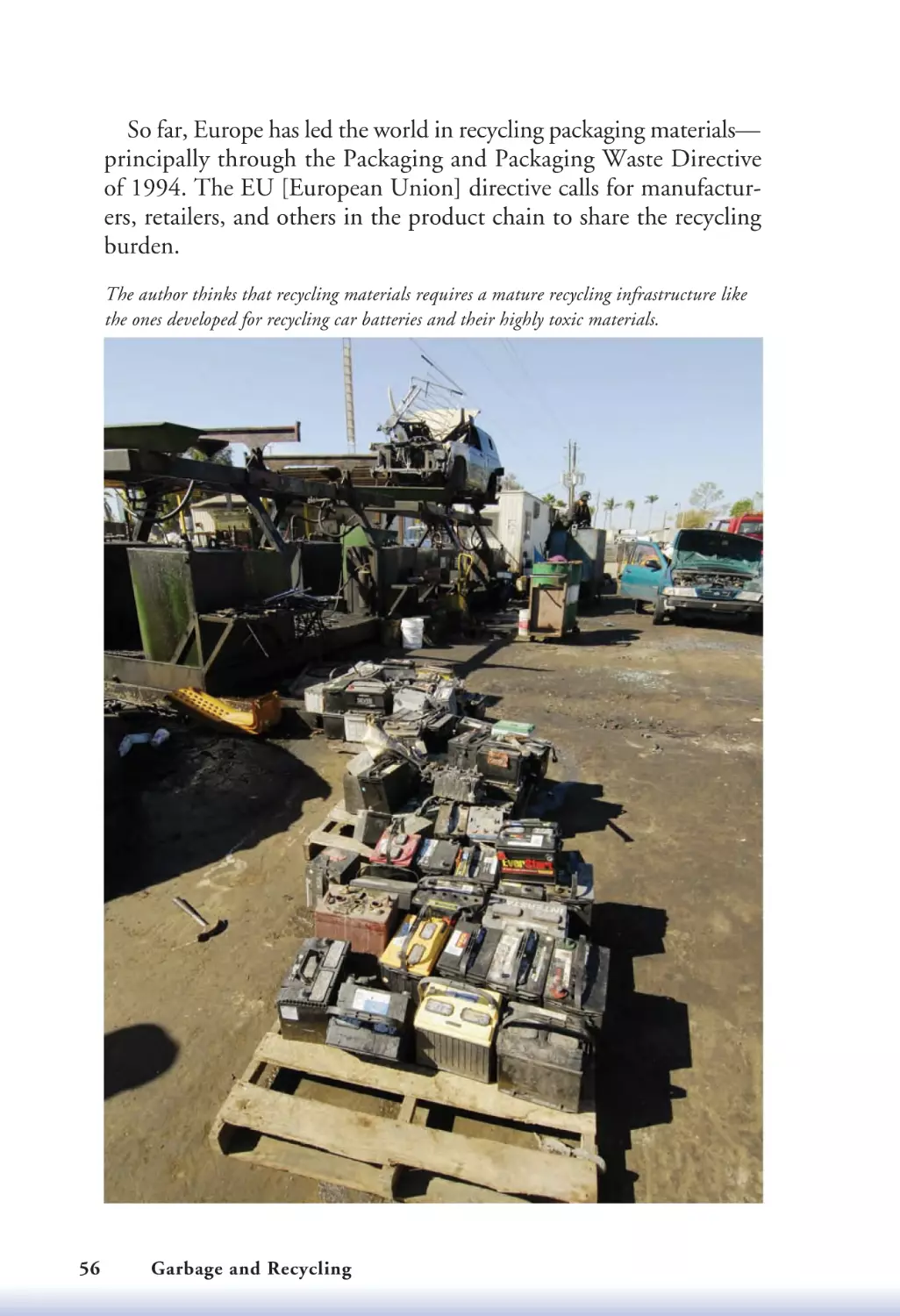
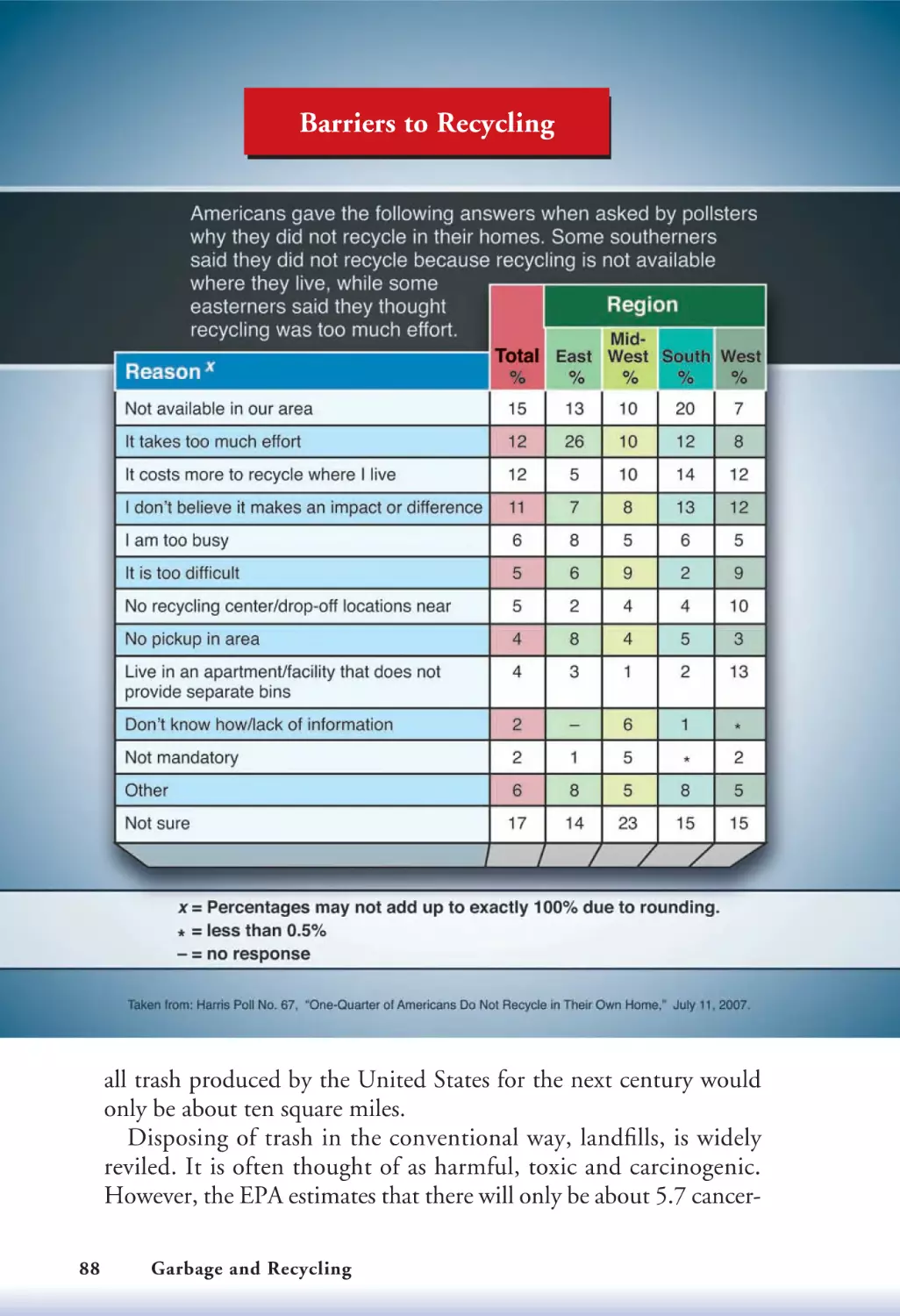
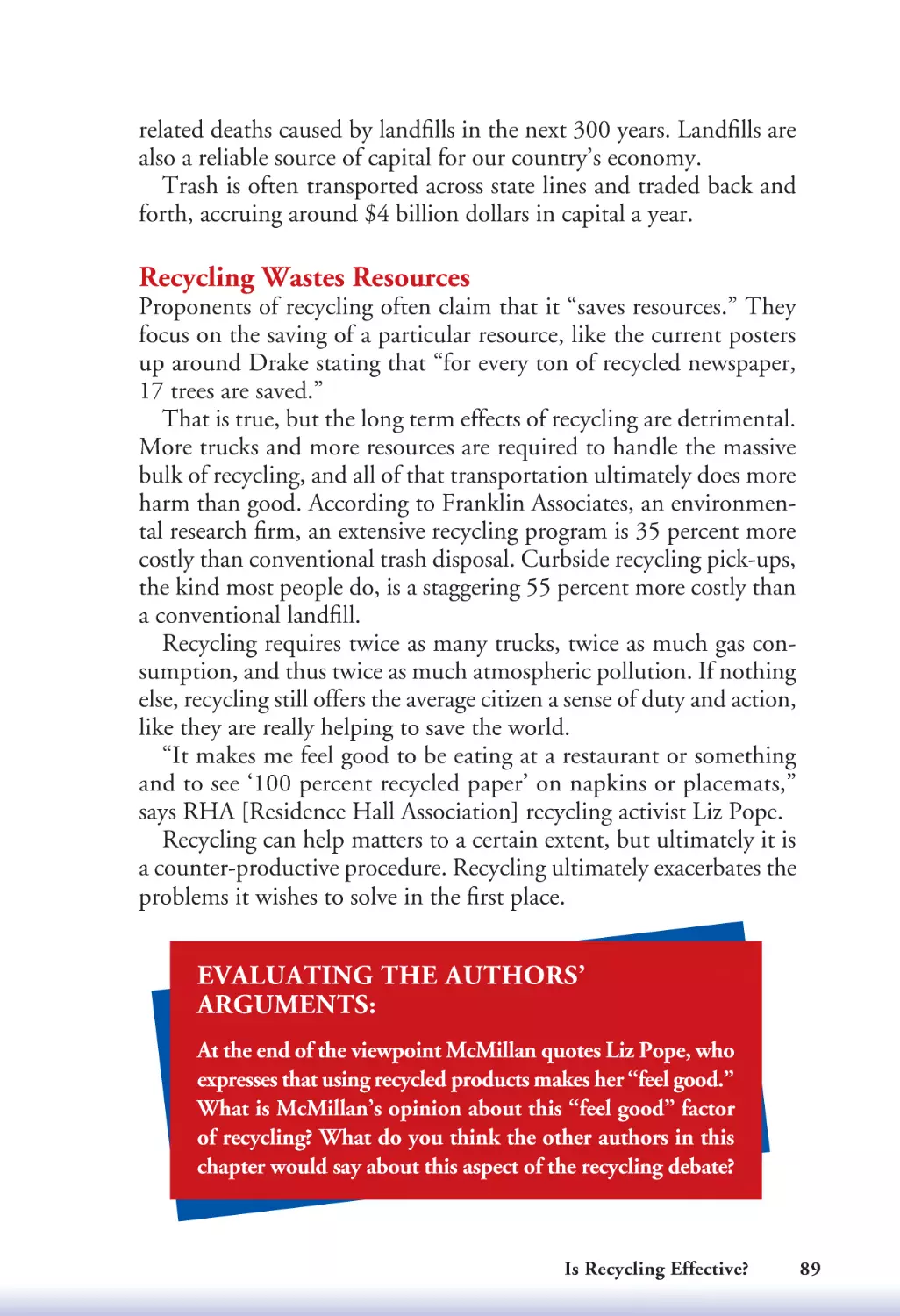
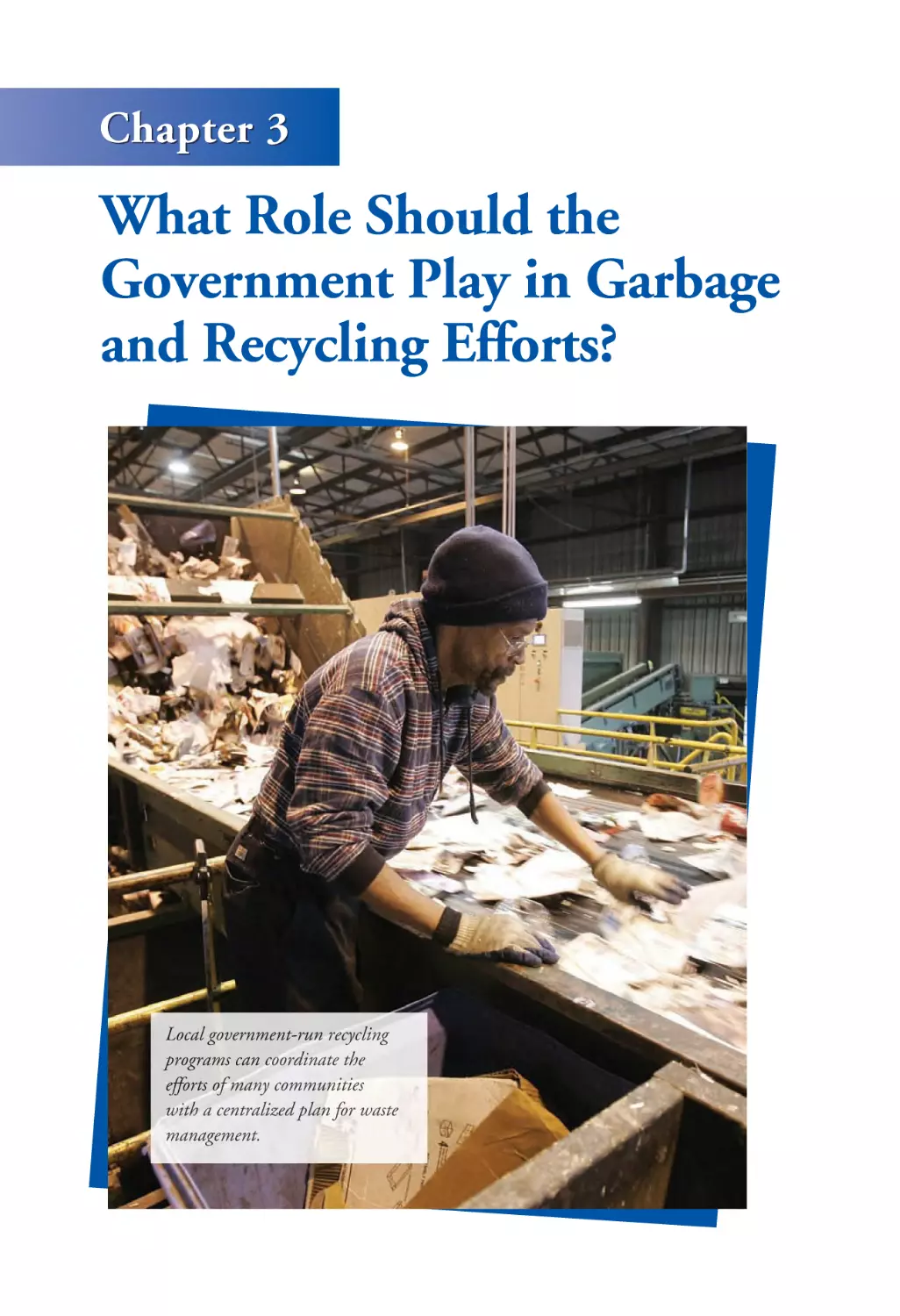
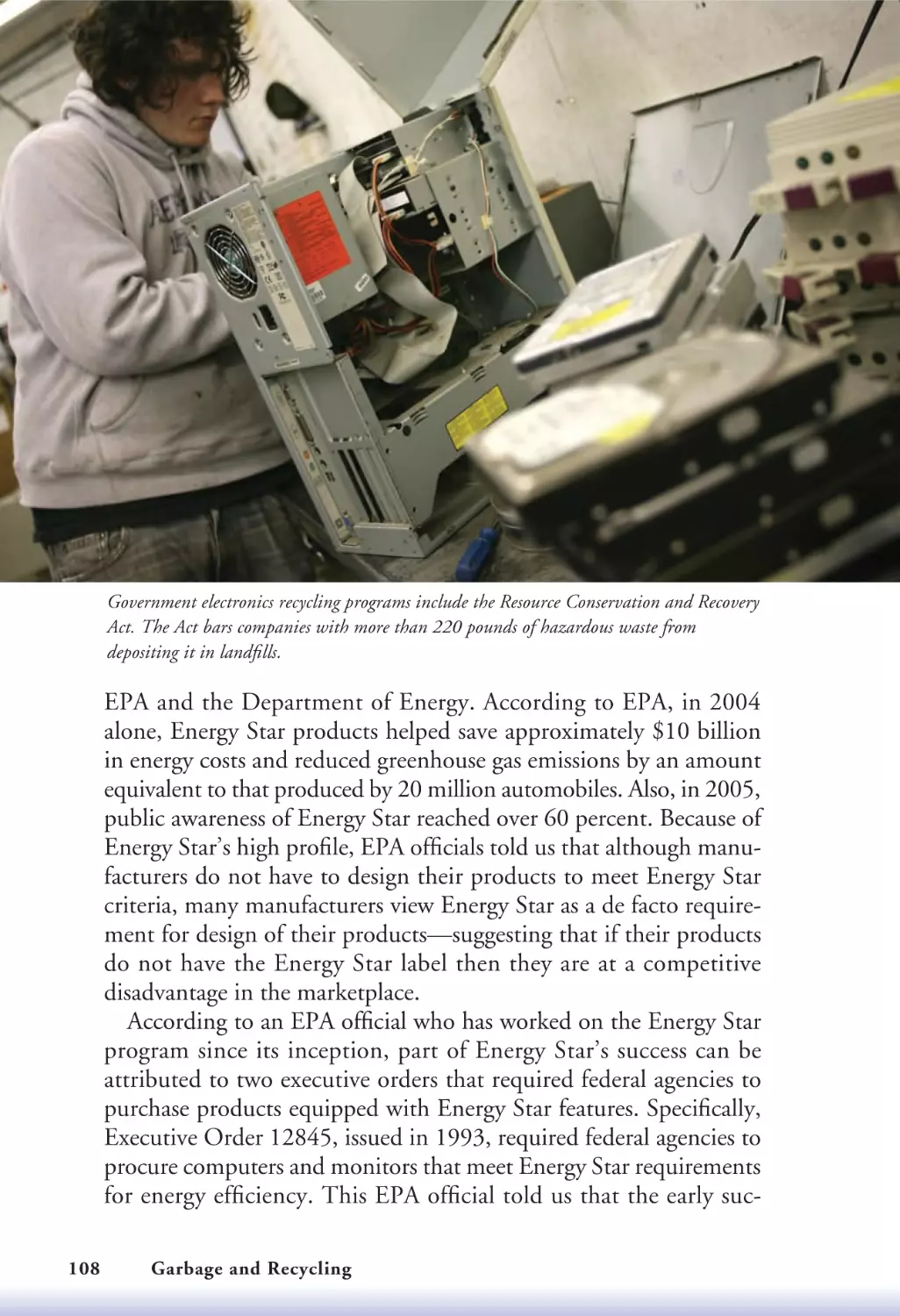




Текст
                    Garbage and
Recycling
Lauri S. Friedman, Book Editor

Christine Nasso, Publisher
Elizabeth Des Chenes, Managing Editor
© 2009 Greenhaven Press, a part of Gale, Cengage Learning
Gale and Greenhaven Press are registered trademarks used herein under license.
For more information, contact:
Greenhaven Press
27500 Drake Rd.
Farmington Hills, MI 48331-3535
Or you can visit our Internet site at gale.cengage.com
All Rights ReseRved.
No part of this work covered by the copyright herein may be reproduced, transmitted,
stored, or used in any form or by any means graphic, electronic, or mechanical, including
but not limited to photocopying, recording, scanning, digitizing, taping, Web distribution,
information networks, or information storage and retrieval systems, except as permitted
under Section 107 or 108 of the 1976 United States Copyright Act, without the prior written
permission of the publisher.
For product information and technology assistance, contact us at
Gale Customer Support, 1-800-877-4253
For permission to use material from this text or product, submit all requests online at
www.cengage.com/permissions
Further permissions questions can be emailed to permissionrequest@cengage.com
Articles in Greenhaven Press anthologies are often edited for length to meet page requirements. In addition, original titles of these works are changed to clearly present the main
thesis and to explicitly indicate the author’s opinion. Every effort is made to ensure that
Greenhaven Press accurately reflects the original intent of the authors. Every effort has
been made to trace the owners of copyrighted material.
Cover Image © 2009/Jupiterimages.

liBRARY OF CONgRess CAtAlOgiNg-iN-PUBliCAtiON dAtA
Garbage and recycling / Lauri S. Friedman, book editor.
p. cm. — (Introducing issues with opposing viewpoints)
Includes bibliographical references and index.
ISBN 978-0-7377-4337-1 (hardcover)
1. Refuse and refuse disposal—Juvenile literature. 2. Recycling (Waste, etc.)—Juvenile
literature. 3. Environmental policy—Juvenile literature. I. Friedman, Lauri S.
TD792.G367 2009
363.72'88—dc22
2008049191

Printed in the United States of America
1 2 3 4 5 6 7 13 12 11 10 09

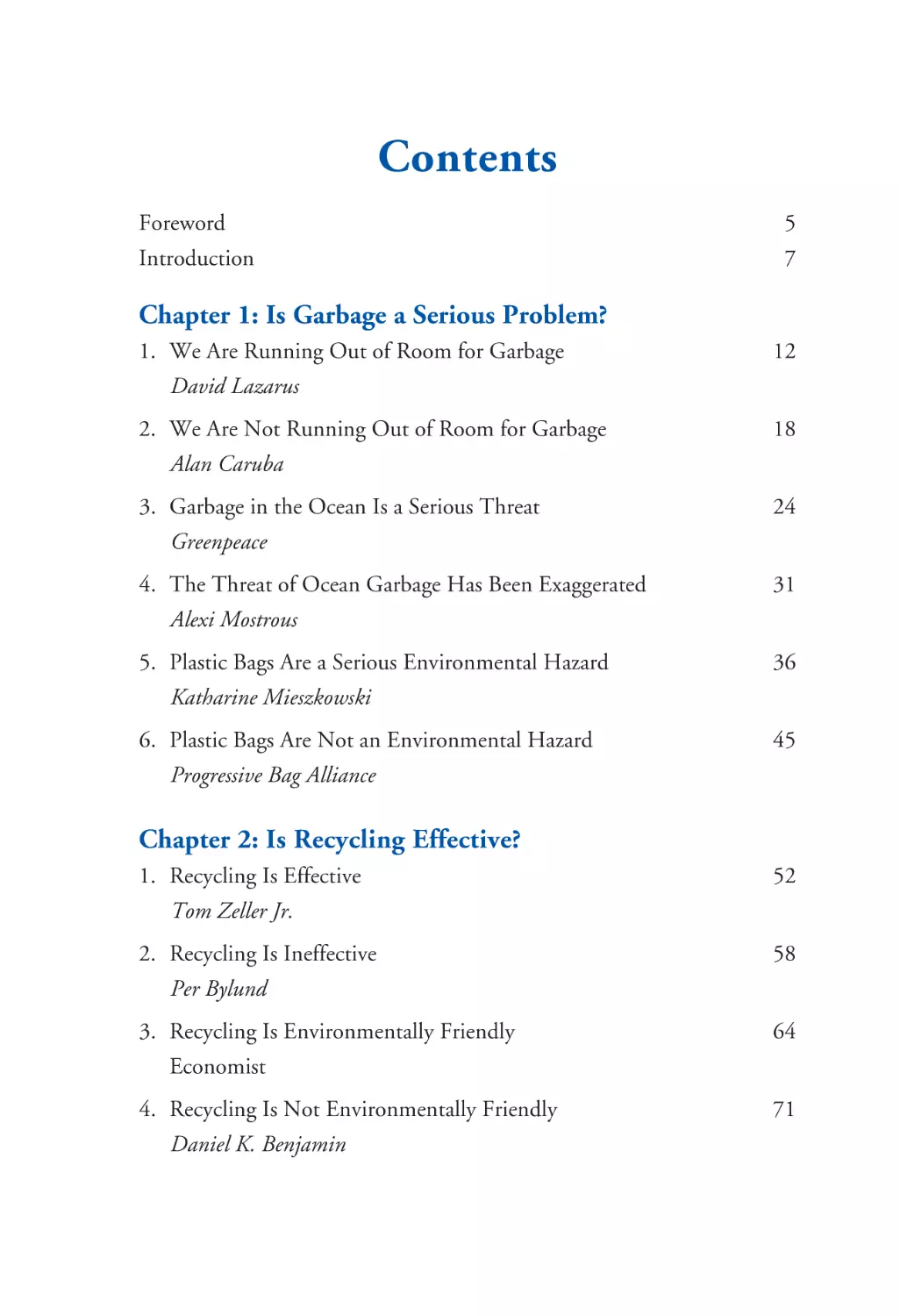
Contents
Foreword

5

Introduction

7

Chapter 1: Is Garbage a Serious Problem?
1. We Are Running Out of Room for Garbage

12

David Lazarus
2. We Are Not Running Out of Room for Garbage

18

Alan Caruba
3. Garbage in the Ocean Is a Serious Threat

24

Greenpeace
4. The Threat of Ocean Garbage Has Been Exaggerated

31

Alexi Mostrous
5. Plastic Bags Are a Serious Environmental Hazard

36

Katharine Mieszkowski
6. Plastic Bags Are Not an Environmental Hazard

45

Progressive Bag Alliance

Chapter 2: Is Recycling Effective?
1. Recycling Is Effective

52

Tom Zeller Jr.
2. Recycling Is Ineffective

58

Per Bylund
3. Recycling Is Environmentally Friendly

64

Economist
4. Recycling Is Not Environmentally Friendly
Daniel K. Benjamin

71

5. Recycling Conserves Resources

78

City of Fort Collins, Colorado
6. Recycling Wastes Resources

85

Lucas McMillan

Chapter 3: What Role Should the Government
Play in Garbage and Recycling Efforts?
1. Recycling Should Be Mandatory

91

Kathleen Ochshorn
2. Recycling Should Not Be Mandatory

97

Michael D. Shaw
3. The Government Should Lead Efforts to
Recycle Electronics

103

U.S. Government Accountability Office
4. The Government Should Not Lead Efforts to
Recycle Electronics

110

Dana Joel Gattuso
5. City Governments Should Ban Plastic Bags

119

Jennifer Clapp
6. City Governments Should Not Ban Plastic Bags

125

Juliet S. Samuel
Facts About Garbage and Recycling
Organizations to Contact
For Further Reading
Index
Picture Credits

131
136
142
146
152

Foreword

I

ndulging in a wide spectrum of ideas, beliefs, and perspectives is a
critical cornerstone of democracy. After all, it is often debates over
differences of opinion, such as whether to legalize abortion, how
to treat prisoners, or when to enact the death penalty, that shape our
society and drive it forward. Such diversity of thought is frequently
regarded as the hallmark of a healthy and civilized culture. As the
Reverend Clifford Schutjer of the First Congregational Church in
Mansfield, Ohio, declared in a 2001 sermon, “Surrounding oneself
with only like-minded people, restricting what we listen to or read
only to what we find agreeable is irresponsible. Refusing to entertain
doubts once we make up our minds is a subtle but deadly form of arrogance.” With this advice in mind, Introducing Issues with Opposing
Viewpoints books aim to open readers’ minds to the critically divergent views that comprise our world’s most important debates.
Introducing Issues with Opposing Viewpoints simplifies for students
the enormous and often overwhelming mass of material now available
via print and electronic media. Collected in every volume is an array of
opinions that captures the essence of a particular controversy or topic.
Introducing Issues with Opposing Viewpoints books embody the spirit
of nineteenth-century journalist Charles A. Dana’s axiom: “Fight for
your opinions, but do not believe that they contain the whole truth, or
the only truth.” Absorbing such contrasting opinions teaches students
to analyze the strength of an argument and compare it to its opposition.
From this process readers can inform and strengthen their own opinions, or be exposed to new information that will change their minds.
Introducing Issues with Opposing Viewpoints is a mosaic of different
voices. The authors are statesmen, pundits, academics, journalists, corporations, and ordinary people who have felt compelled to share their
experiences and ideas in a public forum. Their words have been collected
from newspapers, journals, books, speeches, interviews, and the Internet,
the fastest growing body of opinionated material in the world.
Introducing Issues with Opposing Viewpoints shares many of the
well-known features of its critically acclaimed parent series, Opposing
Viewpoints. The articles are presented in a pro/con format, allowing readers to absorb divergent perspectives side by side. Active reading questions
preface each viewpoint, requiring the student to approach the material
Foreword

5

thoughtfully and carefully. Useful charts, graphs, and cartoons supplement
each article. A thorough introduction provides readers with crucial background on an issue. An annotated bibliography points the reader toward
articles, books, and Web sites that contain additional information on the
topic. An appendix of organizations to contact contains a wide variety of
charities, nonprofit organizations, political groups, and private enterprises
that each hold a position on the issue at hand. Finally, a comprehensive
index allows readers to locate content quickly and efficiently.
Introducing Issues with Opposing Viewpoints is also significantly
different from Opposing Viewpoints. As the series title implies, its presentation will help introduce students to the concept of opposing viewpoints and learn to use this material to aid in critical writing and debate.
The series’ four-color, accessible format makes the books attractive and
inviting to readers of all levels. In addition, each viewpoint has been
carefully edited to maximize a reader’s understanding of the content.
Short but thorough viewpoints capture the essence of an argument. A
substantial, thought-provoking essay question placed at the end of each
viewpoint asks the student to further investigate the issues raised in the
viewpoint, compare and contrast two authors’ arguments, or consider
how one might go about forming an opinion on the topic at hand. Each
viewpoint contains sidebars that include at-a-glance information and
handy statistics. A Facts About section located in the back of the book
further supplies students with relevant facts and figures.
Following in the tradition of the Opposing Viewpoints series,
Greenhaven Press continues to provide readers with invaluable exposure
to the controversial issues that shape our world. As John Stuart Mill once
wrote: “The only way in which a human being can make some approach
to knowing the whole of a subject is by hearing what can be said about it
by persons of every variety of opinion and studying all modes in which it
can be looked at by every character of mind. No wise man ever acquired
his wisdom in any mode but this.” It is to this principle that Introducing
Issues with Opposing Viewpoints books are dedicated.

6

Garbage and Recycling

Introduction

A

nyone who has visited one of America’s many beaches has
probably seen a piece of garbage get tossed about by the waves
or wash up on shore. It is possible that this piece of trash was
littered by a careless pedestrian or blown out of a nearby overflowing
trash can. But it is also increasingly possible that this piece of garbage
originated not from on land but from a gigantic, swirling, island of garbage in the Pacific Ocean that is growing in size, strength, and danger.
For years scientists have been tracking the problematic build-up of
garbage in the ocean. According to the United Nations Environment
Programme, every square mile of ocean now contains forty-six thousand pieces of floating plastic. In August 1997 Captain Charles Moore
stumbled upon a garbage problem that was larger than most people
had ever imagined. As he sailed his boat Alguita through a patch of
Pacific water known as the North Pacific Gyre, he encountered what
can only be described as a floating continent of trash. Remembers
Moore, “As I gazed from the deck at the surface of what ought to
have been a pristine ocean, I was confronted, as far as the eye could
see, with the sight of plastic.” Moore sailed through the trash soup
for more than a week, encountering nothing but waste and debris.
“It seemed unbelievable, but I never found a clear spot,” said Moore.
“In the week it took to cross the subtropical high, no matter what
time of day I looked, plastic debris was floating everywhere: bottles,
bottle caps, wrappers, fragments.”1
The entity Moore had stumbled upon has come to be known
by several names: “trash vortex,” “plastic soup,” the “Great Pacific
Garbage Patch,” and more formally, the “Eastern Garbage Patch.”
Once estimated to be twice the size of Texas, it is now believed to be
double the area of the continental United States. It stretches a huge
distance across the ocean, beginning about five hundred miles off the
California coast, past Hawaii, and almost as far as Japan. The trash
is 80 percent plastic, and there is as much as 100 million tons of it.
It cannot be seen from space because the debris sits just below the
surface of the water and in some areas extends deep into the water
column. For all intents and purposes, it is the world’s largest garbage
dump and a growing environmental hazard.
Introduction

7

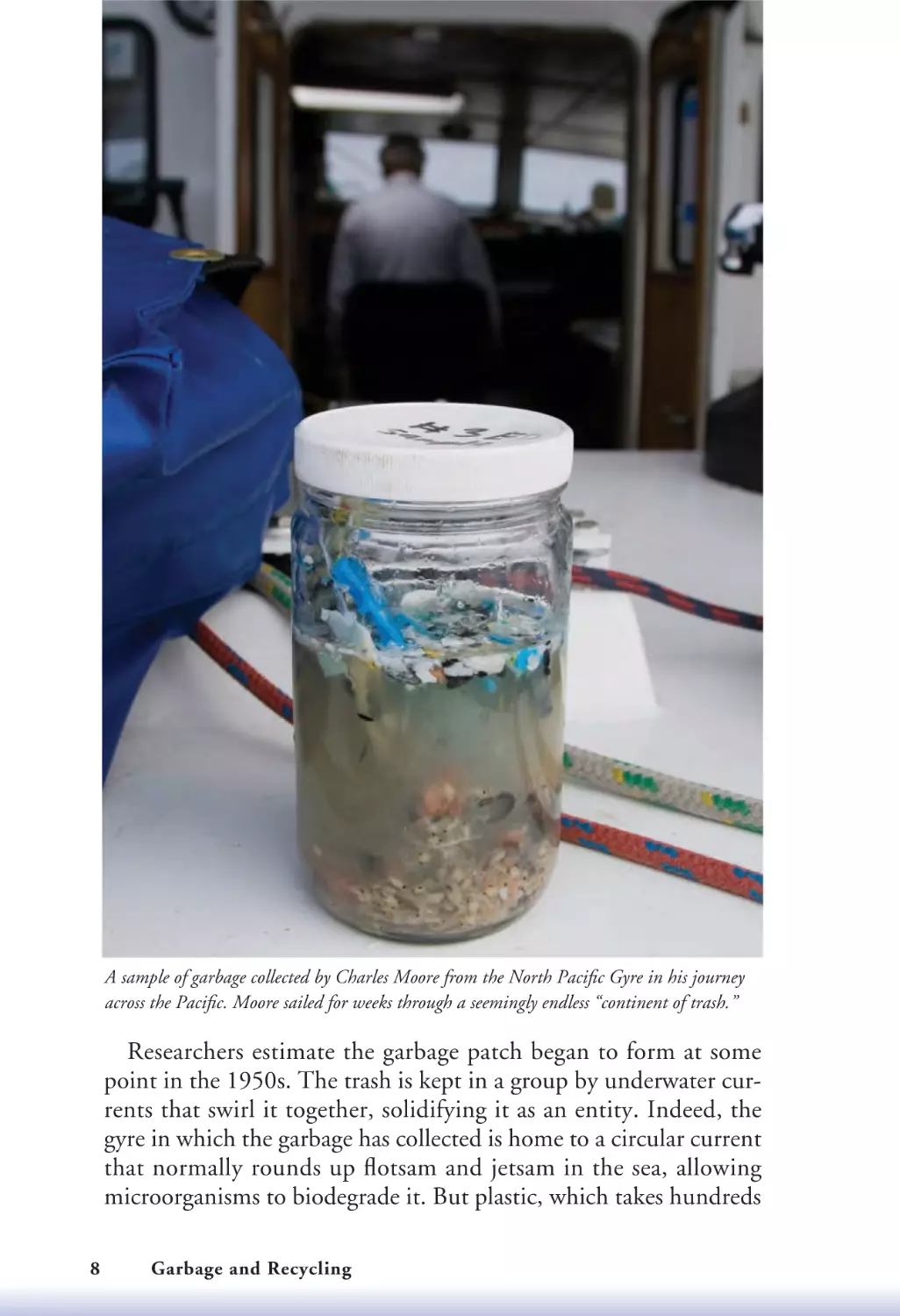
A sample of garbage collected by Charles Moore from the North Pacific Gyre in his journey
across the Pacific. Moore sailed for weeks through a seemingly endless “continent of trash.”

Researchers estimate the garbage patch began to form at some
point in the 1950s. The trash is kept in a group by underwater currents that swirl it together, solidifying it as an entity. Indeed, the
gyre in which the garbage has collected is home to a circular current
that normally rounds up flotsam and jetsam in the sea, allowing
microorganisms to biodegrade it. But plastic, which takes hundreds
8

Garbage and Recycling

of years to decompose, has proven too durable for this process—thus
it continues to accumulate in the gyre, swirling and swirling with
no end in sight.
Ian Kiernan, an Australian environmentalist who first saw the
trash soup on an around-the-world solo yacht race, was sickened by
the diversity of items he saw floating on the open sea. “It was just
filled with things like furniture, fridges, plastic containers, cigarette
lighters, plastic bottles, light globes, televisions and fishing nets,”2
he recalled. Incredibly, objects that are half a century old have
been found floating in the garbage patch. This is because “every
little piece of plastic manufactured in the past 50 years that made
it into the ocean is still out there somewhere,” 3 explains chemist
Tony Andrady.
While plastic does not biodegrade, it does photodegrade—that is,
light from the sun breaks pieces of plastic into smaller and smaller
bits, not breaking them down but making them smaller. As the plastic chips break apart or leach, they are eaten or absorbed by marine
animals, which the UN Environment Programme says kills more
than a million seabirds and more than 100,000 marine mammals
every year. There are further consequences for the humans who eat
these animals when they are fished and brought to market. The
chemicals leached by plastic have been linked to cancer and birth
defects, and they have been found to attract other toxins such as
hydrocarbons and pesticides. “What goes into the ocean goes into
these animals and onto your dinner plate,” says ocean researcher
Marcus Eriksen. “It’s that simple.”4 Many doubt the garbage patch
is able to be cleaned up—its size and location in the water column
would hinder most reasonable cleanup efforts. Worse, scientists
have warned citizens of all countries that if humans do not cut their
use of plastic or practice efforts to recycle plastic and keep it out of
the world’s oceans, the garbage patch could double in size over the
next ten years.
The Great Pacific Garbage Patch is one example of how humans
are beginning to see the effects trash has had on the planet. The
impact of trash on the oceans is just one of the many issues
explored in Introducing Issues with Opposing Viewpoints: Garbage
and Recycling. Readers will also consider arguments about whether
Introduction

9

recycling is cost-effective, whether we are running out of room
for garbage, and what role the government should play in guiding
Americans’ consumption and garbage habits. Readers will examine
these questions in the article pairs and form their own opinions on
the problem of garbage and the promise of recycling.

Notes

1. Charles Moore, “Across the Pacific Ocean, Plastics, Plastics,
Everywhere,” Natural History, vol. 112, no. 9, November 2003.
2. Quoted in Amanda Woods, “The Plastic Killing Fields,” Sydney
Morning Herald (Sydney, Australia), December 29, 2007.
3. Quoted in Kathy Marks and Daniel Howden, “The World’s Rubbish
Dump: A Garbage Tip That Stretches from Hawaii to Japan,”
Independent (London), February 5, 2008. www.independent.co.uk/
environment/the-worlds-rubbish-dump-a-garbage-tip-that-stretchesfrom-hawaii-to-japan-778016.html.
4. Quoted in Marks and Howden, “The World’s Rubbish Dump.”

10

Garbage and Recycling

Chapter 1

Is Garbage a Serious
Problem?

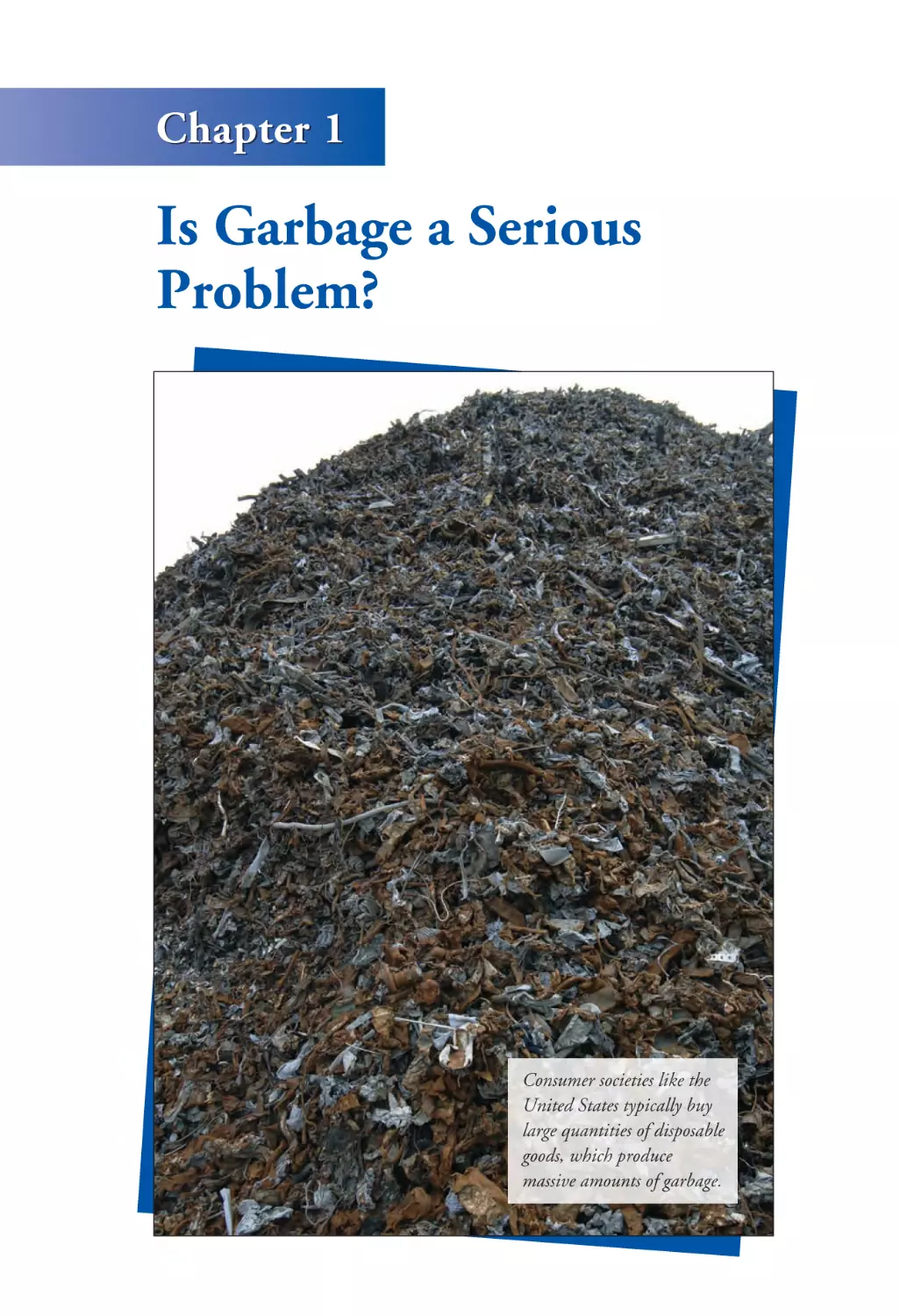
Consumer societies like the
United States typically buy
large quantities of disposable
goods, which produce
massive amounts of garbage.

Viewpoint

1

We Are
Running Out
of Room for
Garbage
David Lazarus

“The United
States is
awash in
garbage, and
we’re rapidly
running out
of ways to
dispose of it.”

In the following viewpoint David Lazarus
argues that Americans generate so much
trash, they are running out of places to
put it. One reason that Americans make so
much garbage is their addiction to disposable goods, he explains. Indeed, Americans
typically buy mass quantities of disposable items and constantly purchase new
computers, televisions, and CD players
rather than buy used items or get products
repaired. In Lazarus’s opinion, the trash
problem is worsened when companies
urge people to buy more and more of their
products. Despite dozens of landfills and
successful recycling programs, Americans
generate more trash than they have space in
which to dispose of it. Lazarus concludes by
offering solutions to the problem, such as
converting garbage to energy, recycling it,
and stepping up conservation efforts.
Lazarus is a former columnist for the San
Francisco Chronicle, from which this viewpoint is taken. He now writes regularly for
the Los Angeles Times.

David Lazarus, “Talking Trash Disposal: We Are Running Out of Room for Rubbish in Throwaway
Society,” San Francisco Chronicle, July 13, 2007, p. C1. Copyright 2007 San Francisco Chronicle.
Reproduced by permission.

12

Garbage and Recycling

AS yOu READ, CONSIDER thE FOLLOWING quEStIONS:

1. How much garbage does each American produce every day,
according to the author?
2. What does the word “hyper-consumerism” mean in the context
of the viewpoint?
3. According to Lazarus, what percent of trash is being diverted
away from landfills in California?

T

he garbage now piling up on East Bay [San Francisco] sidewalks is a smelly, vermin-infested reminder of how easily we
take for granted the idea that no matter what we throw away,
there’ll be some place to put it.
The reality is that the United States is awash in garbage, and we’re
rapidly running out of ways to dispose of it.

We Need More Space for Garbage

According to the Environmental Protection Agency, Americans generated more than 245 million tons of trash—or municipal solid waste
in technical jargon—in 2005, the latest year for which national figures are available. That translates to roughly 4 1/2 pounds of garbage
produced by every person every day.
And that, in turn, has resulted in a $52 billion industry dedicated
to dumping, incinerating and recycling all the nasty, gooey, hinky,
stinky stuff that we don’t want.
“It’s a very, very serious problem,” said Syed Qasim, a professor of
civil and environmental engineering at the University of Texas who
specializes in waste management. “In many states, we are running out
of room for all the garbage we produce.”
Beyond space considerations, there’s also the matter of potentially
hazardous gases, such as methane, generated by rotting trash in landfills, not to mention toxic chemicals leaking into groundwater supplies.

We Generate too Much trash

“We have to cut down on the amount of garbage we generate,” Qasim
said.
Easier said than done. As many have observed, America is a throwaway society. Yes, we recycle. Yes, we compost. But by and large,
Is Garbage a Serious Problem?

13

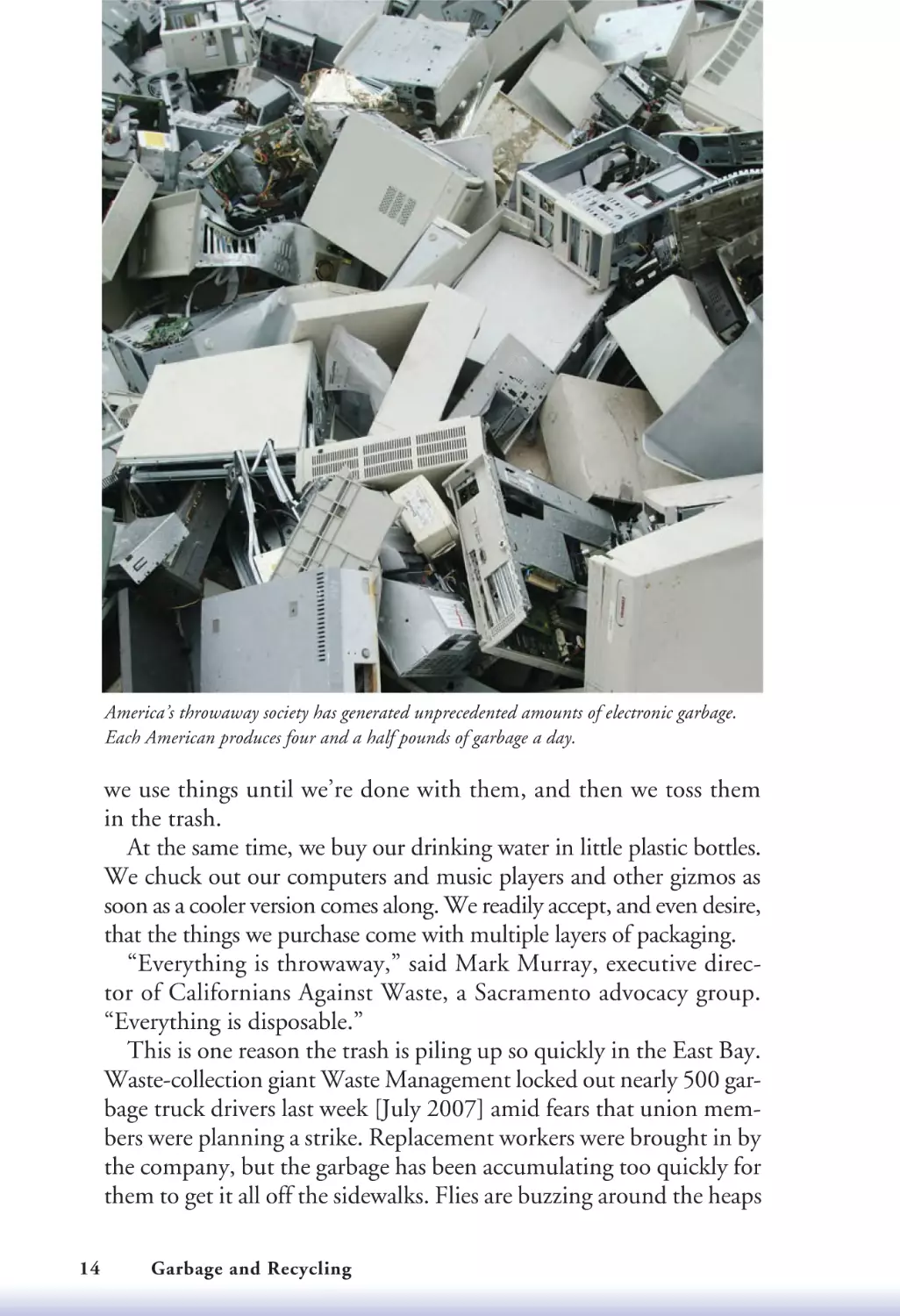
America’s throwaway society has generated unprecedented amounts of electronic garbage.
Each American produces four and a half pounds of garbage a day.

we use things until we’re done with them, and then we toss them
in the trash.
At the same time, we buy our drinking water in little plastic bottles.
We chuck out our computers and music players and other gizmos as
soon as a cooler version comes along. We readily accept, and even desire,
that the things we purchase come with multiple layers of packaging.
“Everything is throwaway,” said Mark Murray, executive director of Californians Against Waste, a Sacramento advocacy group.
“Everything is disposable.”
This is one reason the trash is piling up so quickly in the East Bay.
Waste-collection giant Waste Management locked out nearly 500 garbage truck drivers last week [July 2007] amid fears that union members were planning a strike. Replacement workers were brought in by
the company, but the garbage has been accumulating too quickly for
them to get it all off the sidewalks. Flies are buzzing around the heaps
14

Garbage and Recycling

of black plastic garbage bags. They’ll soon be spreading bacteria from
the trash into people’s homes, public health experts say.
Next will come ants. Then cockroaches. Then rats.

hyper-consumerism Adds to the trash Problem

To Murray, the problem isn’t just the vast amounts of leftover food
and household waste that we hand off to garbage collectors. It’s the
detritus of our hyper-consumerism. “We throw away last year’s model
because we just have to have this year’s model,” he said. “As a result,
last year’s model ends up in the waste stream.”
Part of the blame for that, Murray said, rests with people who seldom give a thought to what happens when they discard something.
But much of the responsibility, he said, lies with companies that have
only one message for customers—buy, buy, buy.
“Manufacturers are in the business of selling more and more stuff,”
Murray observed. “They’re constantly trying to get people to buy a
new version, an upgraded version.”
Jon Myers, director of public affairs for the state Integrated Waste
Management Board, acknowledged that companies can be doing a lot
more to reduce waste throughout California. But he said his agency,
which oversees the 92 million tons of trash generated statewide each
year, is already working closely with a variety of companies to show
them how they can operate in a more environmentally friendly way
without cutting into profits.
“The good news is that we’re
doing a lot of recycling and takast act
ing other steps to reduce waste,”
Myers said. “The bad news is that
The organization Inform
we’re not doing enough.”
Inc. reports that 179,000

F

We Need Creative Ways
to Dispose of trash

F

vehicles are used to haul
away garbage in the United
States.

California has 157 permitted
landfills, with just one more—
Gregory Canyon near San Diego—in the works. The state also has
one of the best track records for recycling garbage, with about 54
percent of trash being diverted away from landfills.
Is Garbage a Serious Problem?

15

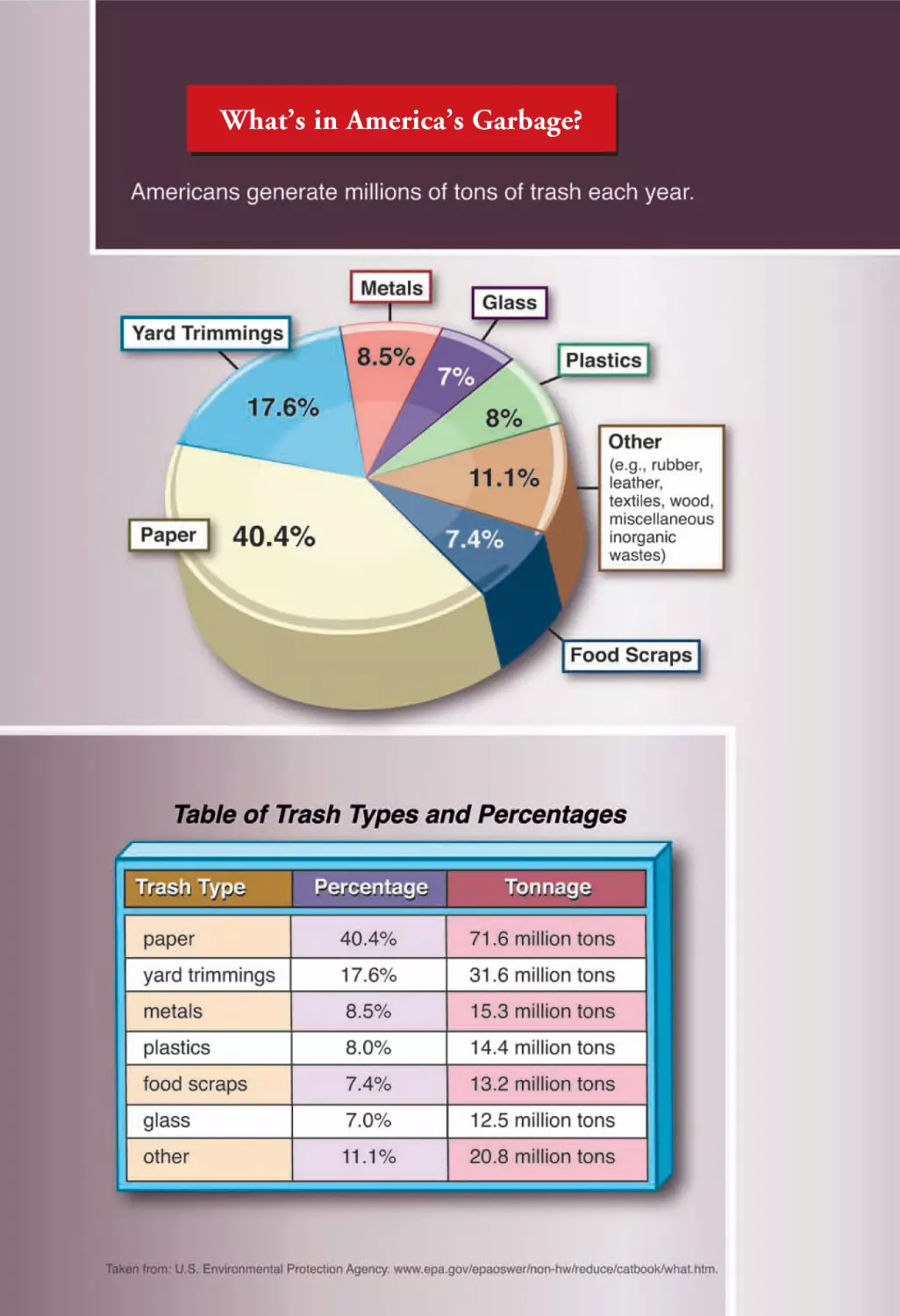
What’s in America’s Garbage?

Is that good enough? “Not even close,” answered Myers.
The reason for his apprehension is that California’s population is
booming. By 2050, according to a state report issued this week, the
population will soar to 60 million from 36 million now. “We’re looking at that,” Myers said, “and we’re thinking, ‘Wow, that’s going to
be a lot of trash.’”
One man’s trash, of course, is another’s treasure. Daniel Waldman,
publisher of MSW Management, a California trade journal for wastemanagement professionals, said the garbage industry foresees new
techniques and technologies to convert garbage into energy.
He also envisions businesses that profit by focusing on recycling
and conservation. “This is a significant problem, but it’s also a significant opportunity,” Waldman said.
Murray at Californians Against Waste believes we have to be even
more proactive. Part of his solution to our garbage woes is to build
disposal costs into the retail price of consumer goods. You buy a
computer, you’ll pay up front for its eventual demise. Same with an
iPod, or a pair of sneakers, or whatever.
“You’re paying for it anyway,” Murray said. “You’re paying for
it in your taxes. If we paid for it up front, maybe we’d make better
purchasing decisions.”
“Think of all the resources and energy that goes into all these products,” he added. “We’re just generating too much junk.”

EVALuAtING thE AuthOR’S
ARGuMENtS:
In this viewpoint Lazarus claims that Americans’ addiction to shopping is at the heart of the nation’s trash crisis.
Consider the last five purchases you have made. What
trash was associated with these products? how much
packaging did the items come in? Did you recycle any
trash associated with the product? Make a list of each item
and its associated garbage. then, state whether you agree
with Lazarus’s assertion that consumerism contributes to
a trash problem.

Is Garbage a Serious Problem?

17

Viewpoint

2

“The
nation’s
entire solid
waste for the
next 1,000
years could
be buried
in a single
landfill 100
yards high
and 35 miles
square.
We are not
running out
of land for
landfills.”

We Are Not
Running Out
of Room for
Garbage
Alan Caruba
In the following viewpoint author Alan
Caruba argues there is plenty of space in
America to build landfills for the nation’s
garbage. The problem, in Caruba’s opinion,
is that environmentalists have falsely claimed
that landfills and incinerators are unsafe.
As a result, thousands of them have been
closed, and it has become more difficult and
costly to open new ones. But landfills are not
dangerous, according to the author: They
provide a cost-effective way to deal with garbage, and when they are filled can provide
some of the best, safest real estate around.
Caruba urges Americans not to believe the
hype that recycling garbage is better than
putting it in a landfill. To the contrary, he
says that recycling is more expensive and
wasteful in its own way. Caruba concludes
that landfills and incinerators are good, safe
ways to get rid of garbage, and as long as
they are properly funded, they will provide
plenty of space for American garbage for
hundreds of years to come.

Alan Caruba, “The Utter Waste of Recycling,” CNSNews.com, January 17, 2003. Reproduced by permission
of the author.

18

Garbage and Recycling

Alan Caruba is a writer who critiques subjects such as environmentalism, Islam, and global warming. He writes regularly for CNSNews.
com, from which this viewpoint is taken.
AS yOu READ, CONSIDER thE FOLLOWING quEStIONS:

1. Who are the “Greens” and what does Caruba blame them for?
2. According to Caruba, what types of property have landfills been
converted into?
3. According to the author, how much money can New York City
save by not requiring recycling?

T

wice a month I have to bundle my newspapers and take boxes
with glass and plastic items down to the curb to be removed
and, one assumes, recycled. This does not include the two
other pickups for what is presumably just plain old garbage.

Recycling Is Wasteful and Ineffective
I am old enough to remember when a person just threw all of this
stuff into the garbage can to be taken away. It involved two less trips
and a smaller bill from the “waste management” company.
Ask yourself about the utility of recycling. Glass is made from sand.
The Earth is not running out of sand. Newspapers, when buried, stay
intact for decades and, when burned, become mere ashes. Recycling
plastic requires as much or more energy than that used to produce
it. Its uses, however, are extraordinary, contributing to a healthier
lifestyle for everyone. So, why recycle?
In 1998, it cost Americans $36 billion to get rid of 210 million
tons of municipal waste. It probably costs more today. Part of that
multi-billion cost is the additional element of recycling requirements.
It’s not like you have a choice. New York City publishes a brochure
on recycling that says bluntly “It’s the law.”
There is no question that Americans produce a lot of garbage. In
the past we buried or burned it, but that was before the environmentalists, Greens, began a campaign that would have us believe there was
no room left for landfills, that landfills were inherently a “hazard,”
and that incinerators were no better because of what came out of the
Is Garbage a Serious Problem?

19

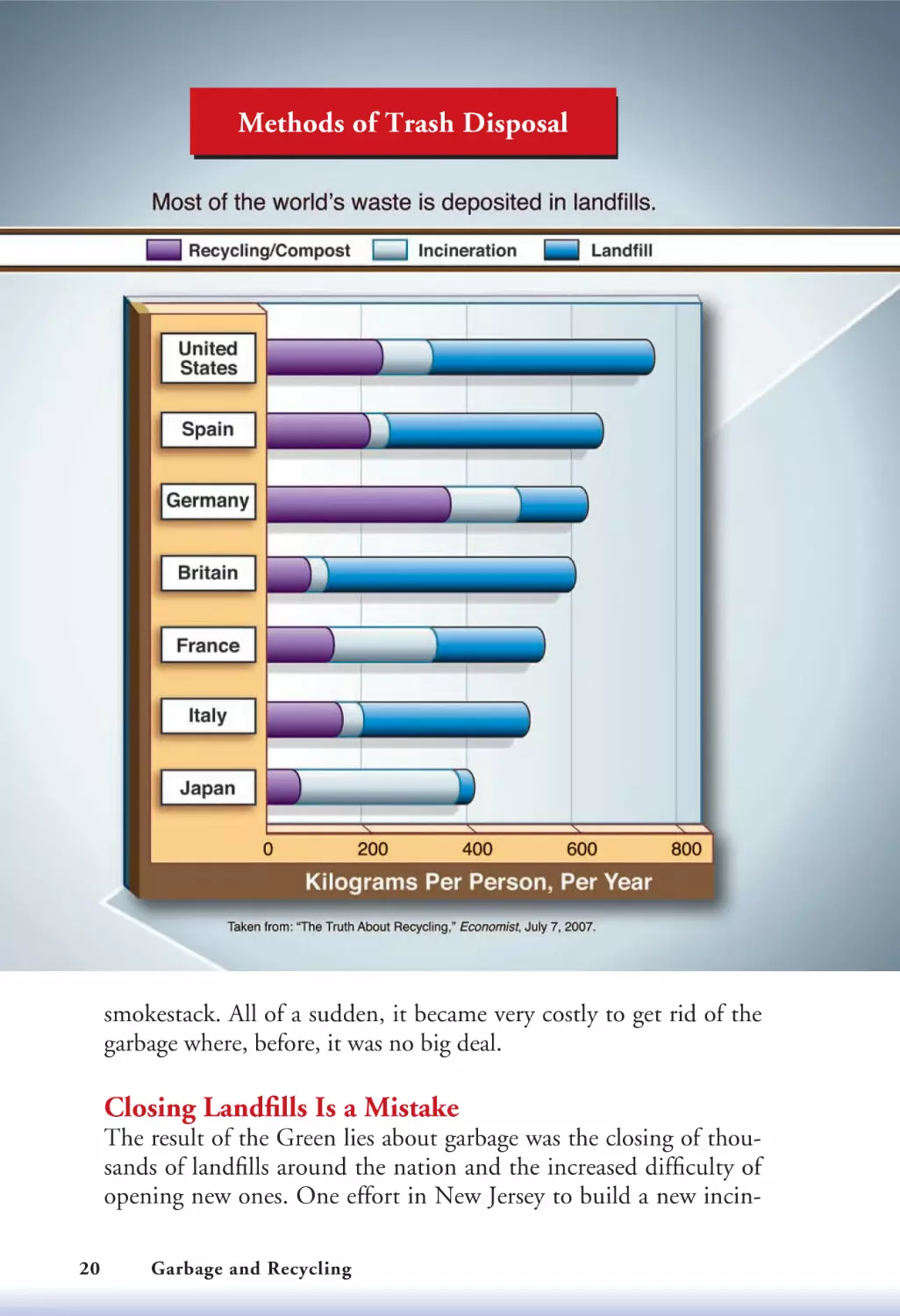
Methods of trash Disposal

smokestack. All of a sudden, it became very costly to get rid of the
garbage where, before, it was no big deal.

Closing Landfills Is a Mistake

The result of the Green lies about garbage was the closing of thousands of landfills around the nation and the increased difficulty of
opening new ones. One effort in New Jersey to build a new incin20

Garbage and Recycling

erator ended up a financial nightmare for investors when the courts
ruled that haulers could not be compelled by law to bring the garbage
to the incinerator, especially if it was cheaper to dump it somewhere
else. The problem is not that we have more garbage. The problem
is we have fewer places to bury and burn it. For that you can thank
the Greens. This is something to think about every time you separate
your glass and plastic or bundle your newspapers.
You may feel you are doing something noble for the environment,
but you are paying more for that privilege and the odds are the stuff
is being buried and burned just the same. The market for anything
recycled often proves unprofitable because the cost of recycling does
not justify itself.

there Is Enough Space for Garbage
One scholar, A. Clark Wiseman of Spokane’s Gonzaga University,
calculated that, at the current rate of solid waste generation, the
nation’s entire solid waste for the next 1,000 years could be buried
in a single landfill 100 yards high and 35 miles square.
We are not running out of land
for landfills. We have run into the
lie that they are unsafe. The truth
is that landfills have been routinely
ast act
converted into valuable property
According to the
once filled. In California there are
Competitive Enterprise
a number of golf courses that were
Institute, 60 percent of
former landfills. In New Jersey,
landfills pose a 1 in a billion
there are malls and corporate camrisk of causing cancer, while
puses.
only 17 percent pose a 1 in
a million risk.
In July of last year, New York
City suspended the collection of
plastic and beverage cartons for a
year and the collection of glass for
two years. Said the Mayor, “This temporary suspension will save the
City an estimated $40 million.” Now do the math. If New York can
save $40 million by not requiring recycling, imagine the billions that
could be saved by cities and suburbs coast to coast? You could renovate every school in America with those funds.

F

F

Is Garbage a Serious Problem?

21

Laws that Are Garbage

In the end, if recycling was cost-efficient why is it necessary to pass
laws to force people to separate and bundle stuff that could just as
easily be tossed out with the rest of the garbage? That’s how environmentalism works. It creates a Big Lie and then sets about getting
laws passed to mandate it. Years later, states, cities, communities, and
just ordinary people begin to ask, “Why are we doing this?” and the
answer is, “It’s the law.”
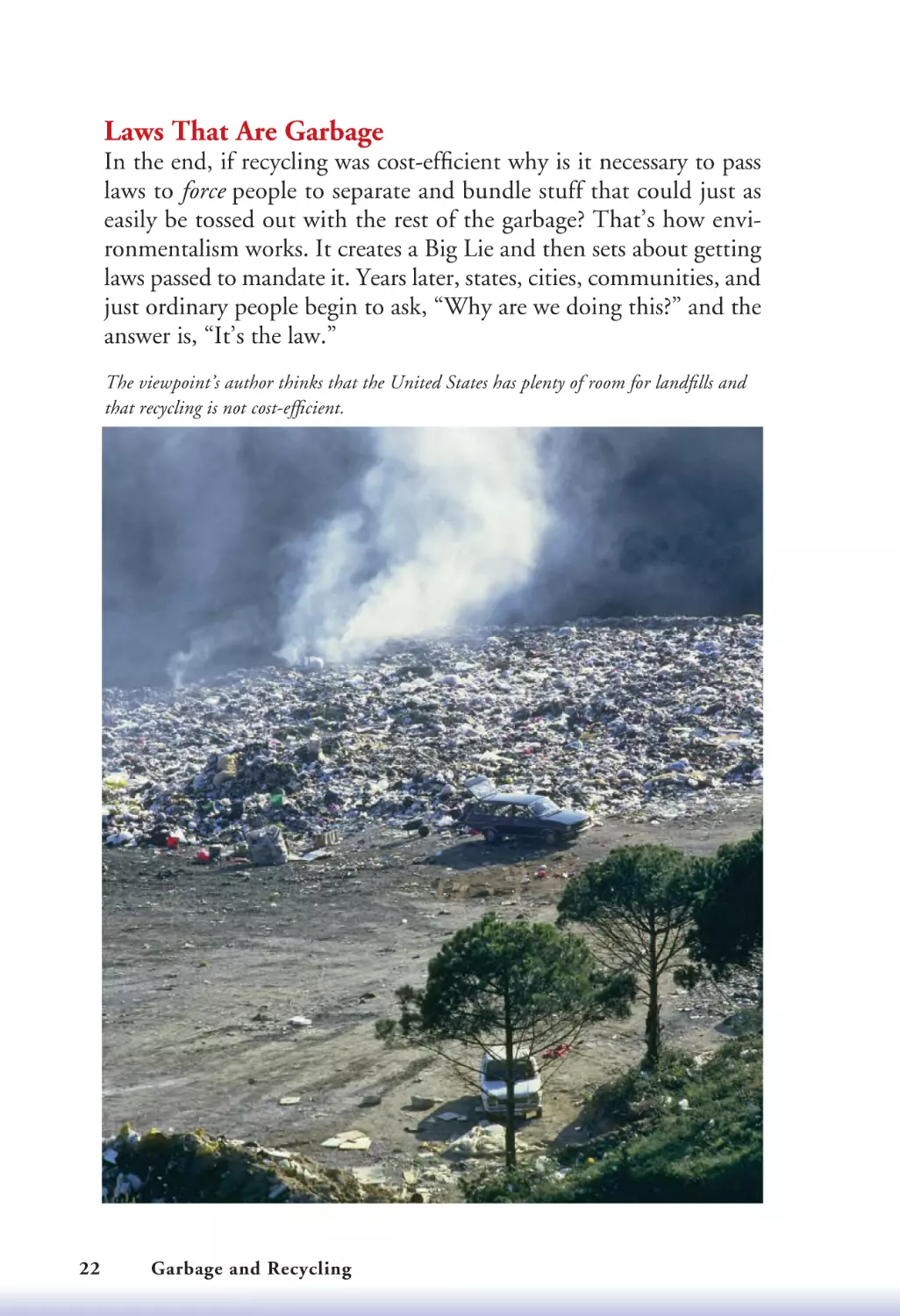
The viewpoint’s author thinks that the United States has plenty of room for landfills and
that recycling is not cost-efficient.

22

Garbage and Recycling

It wasn’t always the law. There was a time when landfills were
understood to be a perfectly sensible way to get rid of the garbage.
Incinerators, too. But that was before the Greens decided recycling
was a dandy way to make everyone think that throwing out the garbage was yet another “hazard,” “danger,” and “threat” to Mother
Earth. To which I say, “That’s just garbage!”

EVALuAtING thE AuthORS’
ARGuMENtS:
In this viewpoint Caruba argues that there is enough space
to dispose of all the garbage generated by Americans. how
do you think the author of the preceding viewpoint, David
Lazarus, might respond to this argument? Explain your
answer using evidence from both texts.

Is Garbage a Serious Problem?

23

Viewpoint

3

Garbage in
the Ocean Is a
Serious threat
Greenpeace

“The scale of
contamination
of the marine
environment
by plastic
debris is
vast.”

In the following viewpoint the environmental organization Greenpeace contends that
garbage in the ocean, or marine debris, is a
serious problem that threatens both humans
and wildlife. Garbage in the ocean—such as
plastic bags, nets, and ropes—traps animals
and birds, injuring or killing them. Other
animals ingest marine debris, hurting themselves and passing toxic chemicals up the food
chain. Still other animals use plastic debris to
hitch rides to areas of the ocean where they do
not naturally live, creating problems. Boats
and ships may also get entangled in marine
debris, raising safety concerns and incurring
ship repair costs. The author further suggests
that trash in the ocean may cause a loss of
tourism dollars because people do not want
to recreate in polluted water. For all these
reasons, Greenpeace concludes that ocean
garbage is a serious problem, one that will
require education, responsibility, and action
to reduce the threat.
Greenpeace is a nonprofit organization
that uses peaceful, direct action to bring
attention to global environmental problems.

Michelle Allsopp, Adam Walters, David Santillo, and Paul Johnston, Plastic Debris in the World’s Oceans,
Amsterdam, The Netherlands: Greenpeace International, 2006. Reproduced by permission.

24

Garbage and Recycling

AS yOu READ, CONSIDER thE FOLLOWING quEStIONS:

1. How many species have suffered from entanglement or ingestion of marine debris, according to Greenpeace?
2. What are the four main sources of marine debris, as reported by
the author?
3. What are “alien species,” and how does marine debris affect them?

I

t is probably a common conception that marine debris consists
of just a few pieces of rubbish scattered along the strand line of
beaches and is of no harm to anyone. Unfortunately this is not the
case. Marine debris has become a pervasive pollution problem affecting all of the world’s oceans. It is known to be the cause of injuries
and deaths of numerous marine animals and birds, either because they
become entangled in it or they mistake it for prey and eat it.
Plastic and synthetic materials are the most common types of
marine debris and cause the most problems for marine animals and
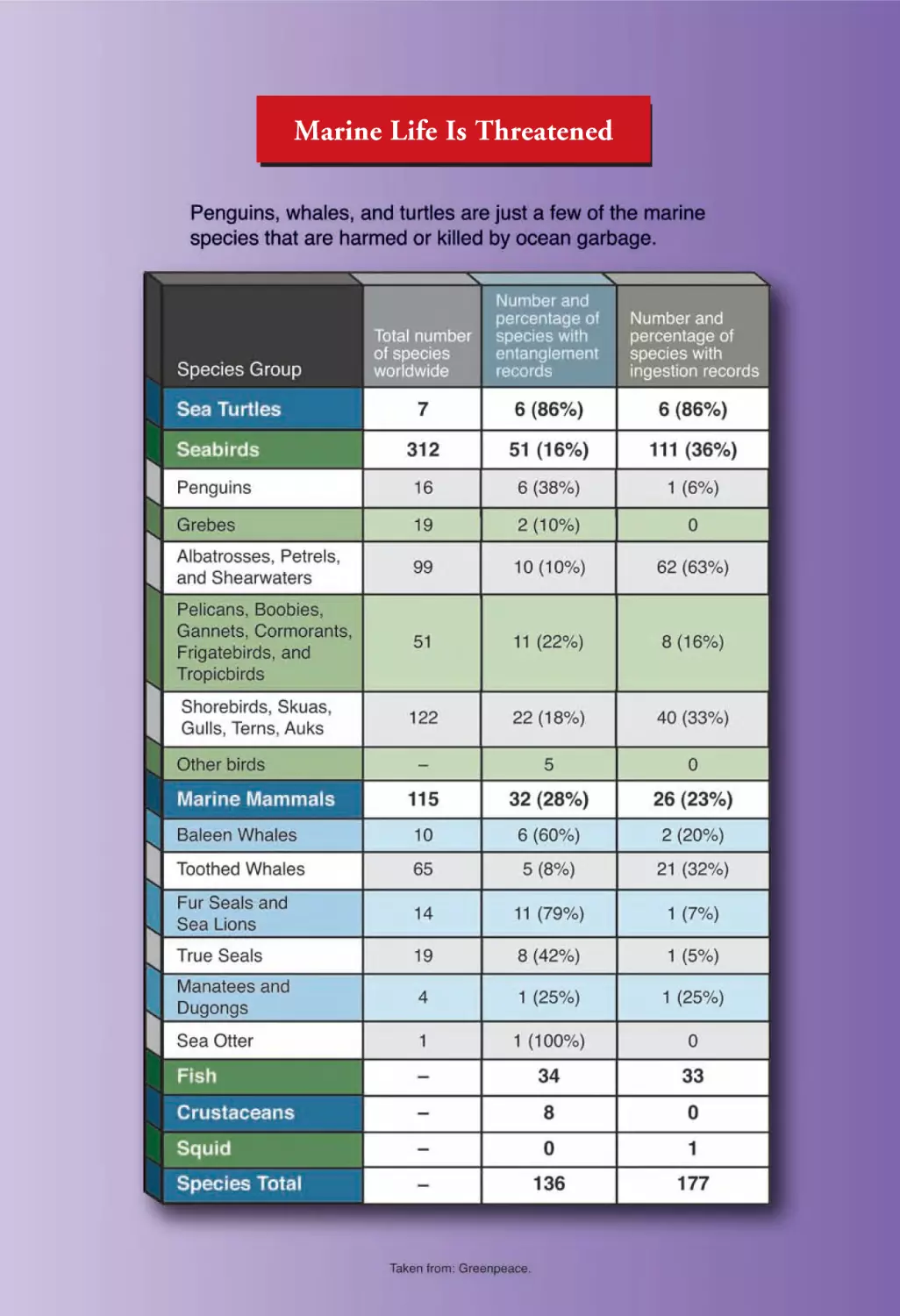
birds. At least 267 different species are known to have suffered from
entanglement or ingestion of marine debris including seabirds, turtles,
seals, sea lions, whales and fish.
The scale of contamination of the marine environment by plastic
debris is vast. It is found floating in all the world’s oceans, everywhere
from polar regions to the equator. The seabed, especially near to
coastal regions, is also contaminated—predominantly with plastic
bags. Plastic is also ubiquitous on beaches everywhere from populous
regions to the shores of very remote uninhabited islands.
Attempts to address the problem of marine debris range from international legislation to prevent shipping from dumping plastic at sea
and campaigns to prevent losses due to poor industrial practice to
beach and seabed clean-up operations and public awareness campaigns. Plastic debris originates from a wide and diverse range of
sources. Estimates suggest that much of what is found at sea originates
on the land. The effect of coastal littering and dumping is compounded by vectors such as rivers and storm drains discharging litter from
inland urban areas. It is the very properties that make plastics so useful, their stability and resistance to degradation, that causes them to be
so problematic after they have served their purpose. These materials
Is Garbage a Serious Problem?

25

persist in the environment and are not readily degraded or processed
by natural biological mechanisms. However plastics in the ocean are
weathered; broken up either mechanically or by the action of sunlight
into smaller and smaller fragments. Eventually, fragments are reduced
to tiny pieces the size of grains of sand. These particles have been
found suspended in seawater and
on the seabed in sediments. Even
such tiny particles may be causing
ast act
harm to the marine environment
According to the UN
since they have been shown to be
Environment Programme,
ingested by small sea creatures
every square mile of ocean
and may concentrate persistent
contains forty-six thousand
organic pollutants (POPs) prespieces of floating plastic.
ent in the seas. . . .

F

F

Sources of Marine Debris

It has been estimated that around 80% of marine debris is from landbased sources and the remaining 20% is from ocean based sources.
The sources can be categorised into four major groups:
• Tourism-related litter at the coast: this includes litter left by beach
goers such as food and beverage packaging, cigarettes and plastic
beach toys.
• Sewage-related debris: this includes water from storm drains and
combined sewer overflows which discharge waste water directly
into the sea or rivers during heavy rainfall. These waste waters carry
with them garbage such as street litter, condoms and syringes.
• Fishing-related debris: this includes fishing lines and nets, fishing
pots and strapping bands from bait boxes that are lost accidentally
by commercial fishing boats or are deliberately dumped into the
ocean
• Wastes from ships and boats: this includes garbage which is accidentally or deliberately dumped overboard.
Huge volumes of non-organic wastes, including plastics and synthetics, are produced in more developed, industrialised countries.
Conversely, in less developed and more rural economies, generally a
much smaller amount of these non-biodegradable persistent wastes
are produced. However, in the future, as less developed countries
26

Garbage and Recycling

become more industrialised, it is likely that they will also produce
more plastic and synthetic wastes and this will increase further the
threat of pollution of the marine environment.

harm to Marine Wildlife

Countless marine animals and sea birds become entangled in marine
debris or ingest it. This can cause them serious harm and often results
in their death.
Entanglement in Marine Debris
Marine debris which is known to cause entanglement includes derelict
fishing gear such as nets and mono-filament line and also six-pack
rings and fishing bait box strapping bands. This debris can cause death
by drowning, suffocation, strangulation, starvation through reduced
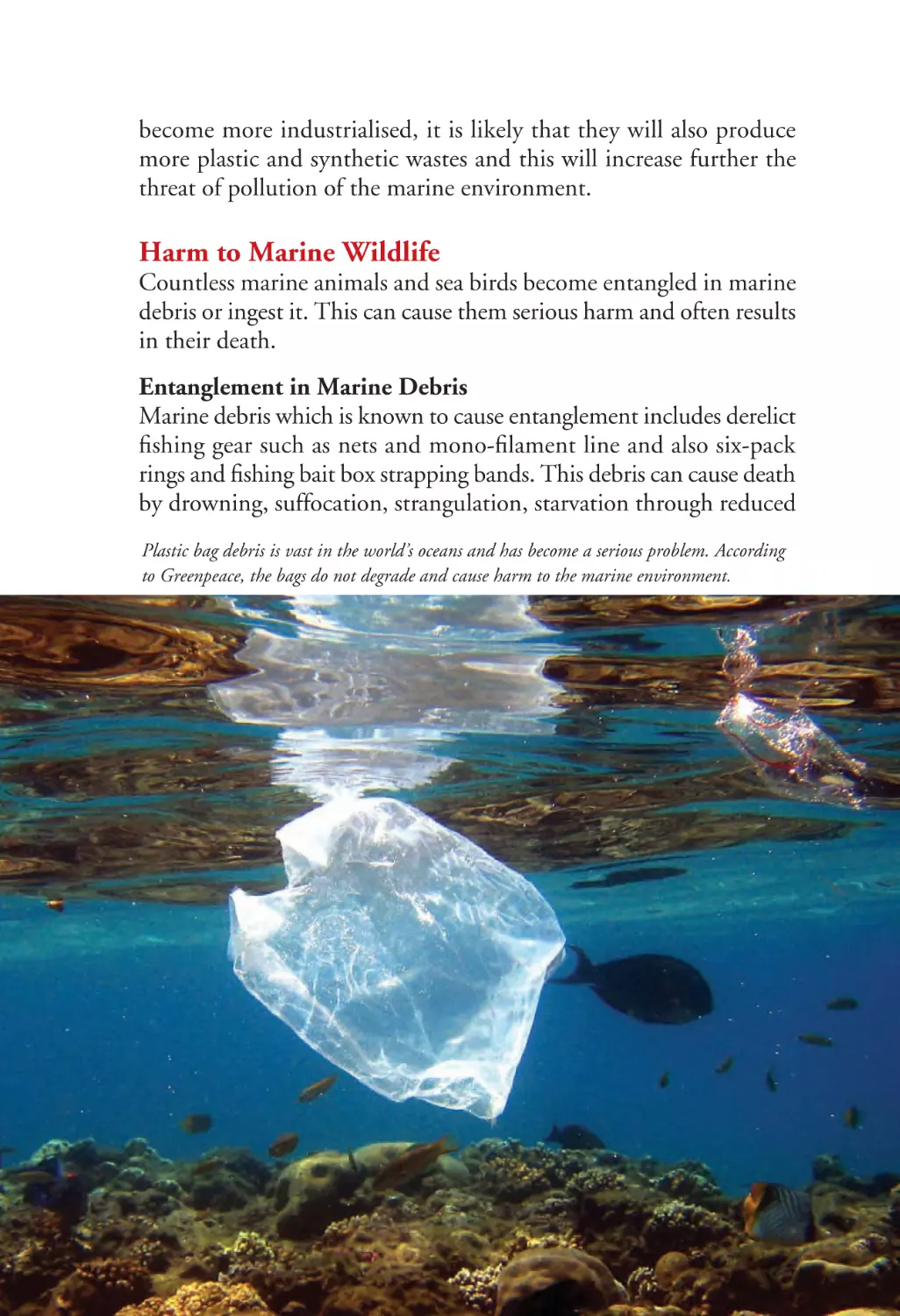
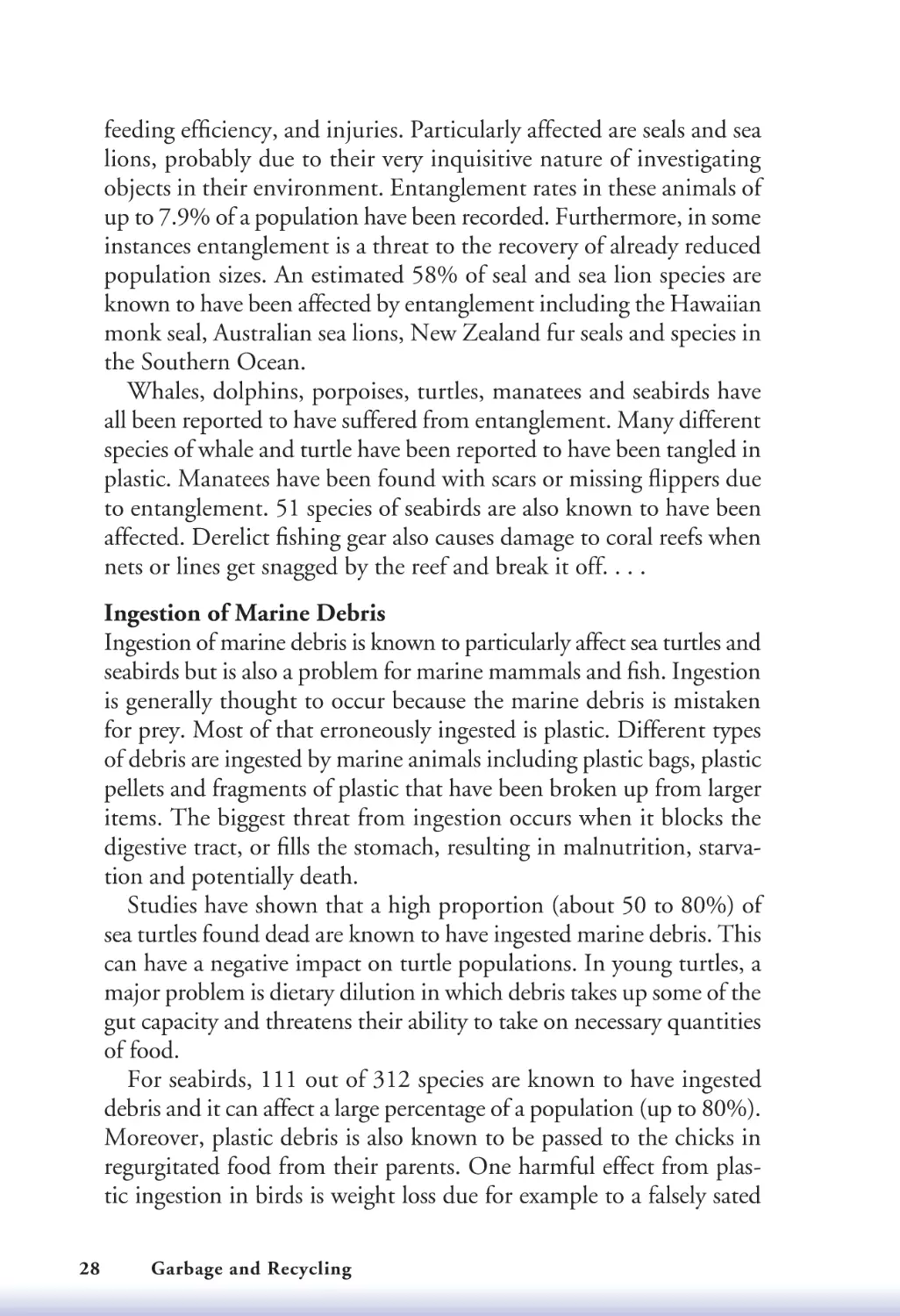
Plastic bag debris is vast in the world’s oceans and has become a serious problem. According
to Greenpeace, the bags do not degrade and cause harm to the marine environment.

feeding efficiency, and injuries. Particularly affected are seals and sea
lions, probably due to their very inquisitive nature of investigating
objects in their environment. Entanglement rates in these animals of
up to 7.9% of a population have been recorded. Furthermore, in some
instances entanglement is a threat to the recovery of already reduced
population sizes. An estimated 58% of seal and sea lion species are
known to have been affected by entanglement including the Hawaiian
monk seal, Australian sea lions, New Zealand fur seals and species in
the Southern Ocean.
Whales, dolphins, porpoises, turtles, manatees and seabirds have
all been reported to have suffered from entanglement. Many different
species of whale and turtle have been reported to have been tangled in
plastic. Manatees have been found with scars or missing flippers due
to entanglement. 51 species of seabirds are also known to have been
affected. Derelict fishing gear also causes damage to coral reefs when
nets or lines get snagged by the reef and break it off. . . .
Ingestion of Marine Debris
Ingestion of marine debris is known to particularly affect sea turtles and
seabirds but is also a problem for marine mammals and fish. Ingestion
is generally thought to occur because the marine debris is mistaken
for prey. Most of that erroneously ingested is plastic. Different types
of debris are ingested by marine animals including plastic bags, plastic
pellets and fragments of plastic that have been broken up from larger
items. The biggest threat from ingestion occurs when it blocks the
digestive tract, or fills the stomach, resulting in malnutrition, starvation and potentially death.
Studies have shown that a high proportion (about 50 to 80%) of
sea turtles found dead are known to have ingested marine debris. This
can have a negative impact on turtle populations. In young turtles, a
major problem is dietary dilution in which debris takes up some of the
gut capacity and threatens their ability to take on necessary quantities
of food.
For seabirds, 111 out of 312 species are known to have ingested
debris and it can affect a large percentage of a population (up to 80%).
Moreover, plastic debris is also known to be passed to the chicks in
regurgitated food from their parents. One harmful effect from plastic ingestion in birds is weight loss due for example to a falsely sated
28

Garbage and Recycling

Marine Life Is threatened

appetite and failure to put on adequate fat stores for migration and
reproduction.
Potential Invasion of Alien Species
Plastic debris which floats on the oceans can act as rafts for small sea
creatures to grow and travel on. Plastic can travel for long distances
and therefore there is a possibility that marine animals and plants
may travel to areas where they are non-native. Plastic with different
sorts of animals and plants have been found in the oceans in areas
remote from their source. This represents a potential threat for the
marine environment should an alien species become established. It is
postulated that the slow speed at which plastic debris crosses oceans
makes it an ideal vehicle for this. The organisms have plenty of time
to adapt to different water and climatic conditions.

EVALuAtING thE AuthOR’S
ARGuMENtS:
the author of this viewpoint is Greenpeace, an environmental activist organization. Does knowing this background influence your opinion of the author’s argument?
If so, in what way?

30

Garbage and Recycling

Viewpoint

4

the threat of
Ocean Garbage
has Been
Exaggerated
Alexi Mostrous

“There is
no scientific
evidence to
show that
the [plastic]
bags pose any
direct threat
to marine
mammals.”

In the following viewpoint author Alexi
Mostrous argues that the threat of ocean
garbage has been exaggerated. Specifically,
he claims that plastic bags are not a threat to
marine animals as some environmentalists
have claimed. Mostrous contends that plastic bags in the ocean have become demonized as a result of environmentalist efforts to
exaggerate their threat and of officials who
have misinterpreted several key studies on
marine debris. In reality, says Mostrous,
plastic bags rarely cause the entanglement
of animals and almost never cause their
death. For these reasons, Mostrous concludes that plastic bags pose a minimal
threat to the marine environment and that
banning them will only create hardship for
consumers.
Mostrous writes regularly for the London
Times, from which this viewpoint is taken.

Alexi Mostrous, “Series of Blunders Turned the Plastic Bag into Global Villain,” Times (London), March 8,
2008. Reproduced by permission.

Is Garbage a Serious Problem?

31

AS yOu READ, CONSIDER thE FOLLOWING quEStIONS:

1. Who is Lord Taverne, and how does he figure into the author’s
argument?
2. Name five animals that the author reports are not impacted by
plastic bags.
3. What percent of landfill waste is composed of plastic bags, as
reported by the author?

S

cientists and environmentalists have attacked a global campaign
to ban plastic bags which they say is based on flawed science
and exaggerated claims.

Plastic Bags Pose a Minimal threat to Marine Animals
The widely stated accusation that the bags kill 100,000 animals and
a million seabirds every year [is] false, experts have told The Times.
They pose only a minimal threat to most marine species, including
seals, whales, dolphins and seabirds.
[British prime minister] Gordon Brown announced last month
[February 2008] that he would force supermarkets to charge for the
bags, saying that they were “one of the most visible symbols of environmental waste”. Retailers and some pressure groups, including the
Campaign to Protect Rural England, threw their support behind him.
But scientists, politicians and marine experts attacked the
Government for joining a “bandwagon” based on poor science. Lord
Taverne, the chairman of Sense about Science, said: “The Government
is irresponsible to jump on a bandwagon that has no base in scientific
evidence. This is one of many examples where you get bad science
leading to bad decisions which are counter-productive. Attacking
plastic bags makes people feel good but it doesn’t achieve anything.”
Campaigners say that plastic bags pollute coastlines and waterways, killing or injuring birds and livestock on land and, in the
oceans, destroying vast numbers of seabirds, seals, turtles and whales.
However, The Times has established that there is no scientific evidence
to show that the bags pose any direct threat to marine mammals.
They “don’t figure” in the majority of cases where animals die from
marine debris, said David Laist, the author of a seminal 1997 study on
32

Garbage and Recycling

the subject. Most deaths were caused when creatures became caught
up in waste produce. “Plastic bags don’t figure in entanglement,” he
said. “The main culprits are fishing gear, ropes, lines and strapping
bands. Most mammals are too big to get caught up in a plastic bag.”
He added: “The impact of bags on whales, dolphins, porpoises and
seals ranges from nil for most species to very minor for perhaps a few
species. For birds, plastic bags are not a problem either.”

Getting the Facts Right

The central claim of campaigners is that the bags kill more than
100,000 marine mammals and one million seabirds every year.
However, this figure is based on a misinterpretation of a 1987
Canadian study in Newfoundland, which found that, between 1981
and 1984, more than 100,000 marine mammals, including birds,
were killed by discarded nets. The Canadian study did not mention
plastic bags.
Fifteen years later in 2002, when the Australian Government commissioned a report into the effects of plastic bags, its authors misquoted the Newfoundland study, mistakenly attributing the deaths
to “plastic bags”.
The figure was latched on to by conservationists as proof that the
bags were killers. For four years the “typo” remained uncorrected. It
was only in 2006 that the authors altered the report, replacing “plastic
bags” with “plastic debris”. But they admitted: “The actual numbers
of animals killed annually by plastic bag litter is nearly impossible to
determine.”
In a postscript to the correction they admitted that the original
Canadian study had referred to fishing tackle, not plastic debris, as
the threat to the marine environment. Regardless, the erroneous claim
has become the keystone of a widening campaign to demonise plastic
bags.
David Santillo, a marine biologist at Greenpeace, told The Times
that bad science was undermining the Government’s case for banning the bags. “It’s very unlikely that many animals are killed by
plastic bags,” he said. “The evidence shows just the opposite. We are
not going to solve the problem of waste by focusing on plastic bags.
It doesn’t do the Government’s case any favours if you’ve got statements being made that aren’t supported by the scientific literature
Is Garbage a Serious Problem?

33

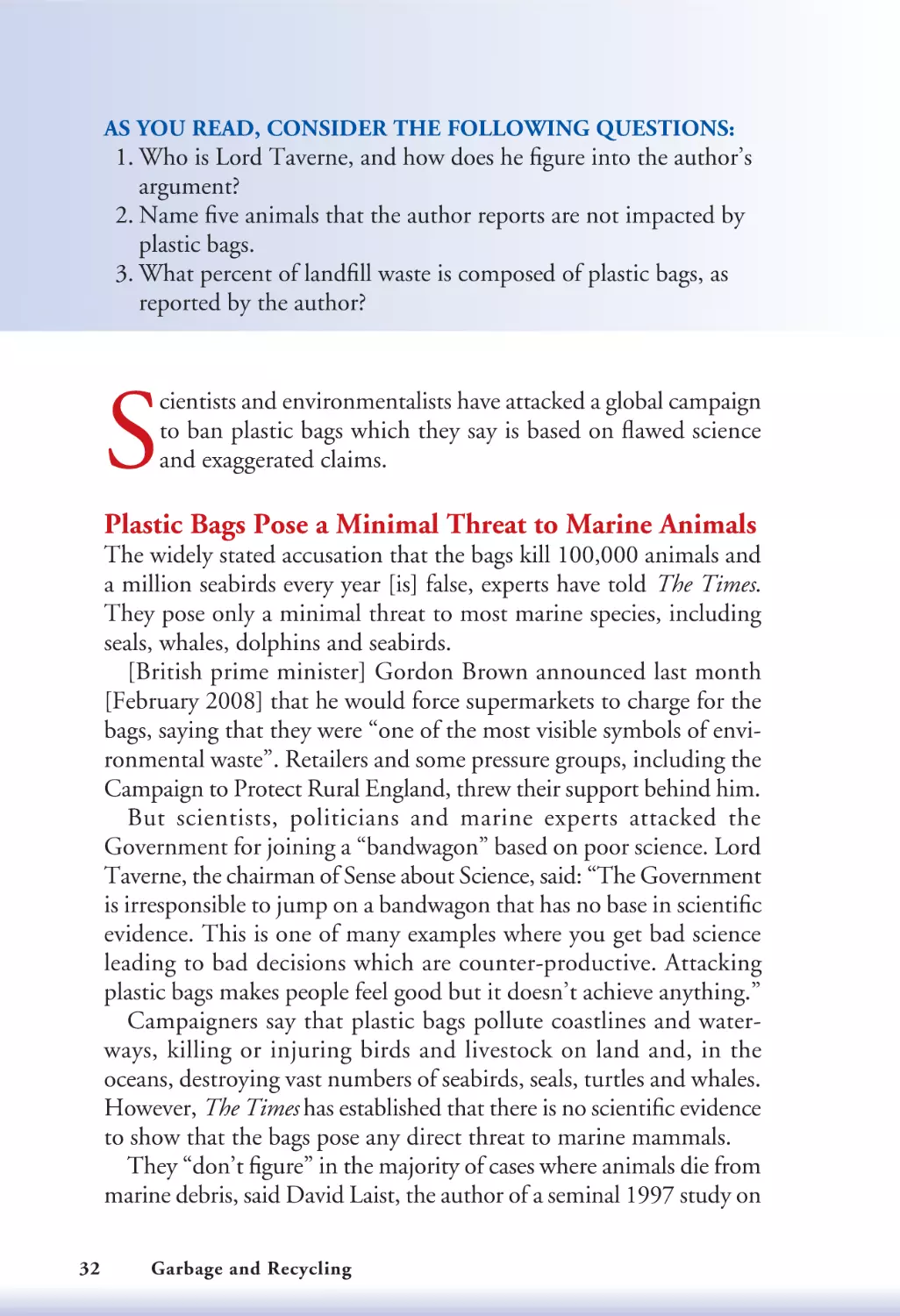
Plastic bag debris fills up a landfill. The viewpoint’s author thinks that the impact of plastic
bags in the ocean is a minimal threat to marine species.

that’s out there. With larger mammals it’s fishing gear that’s the big
problem. On a global basis plastic bags aren’t an issue. It would be
great if statements like these weren’t made.”
Geoffrey Cox, a Tory member of the Commons Environment
Select Committee, said: “I don’t like plastic bags and I certainly support restricting their use, but plainly it’s extremely important that
before we take any steps we should rely on accurate information. It
is bizarre that any campaign should be endorsed on the basis of a
mistranslation. Gordon Brown should get his facts right.”

Focusing on the Actual Problem

A 1968 study of albatross carcasses found that 90 per cent contained
some form of plastic but only two birds had ingested part of a plastic
bag.
Professor Geoff Boxshall, a marine biologist at the Natural History
Museum, said: “I’ve never seen a bird killed by a plastic bag. Other
34

Garbage and Recycling

forms of plastic in the ocean are much more damaging. Only a very
small proportion is caused by bags.”
Plastic particles known as nurdles, dumped in the sea by industrial companies, form a much greater threat as they can be easily
consumed by birds and animals. Many British groups are now questioning whether a ban on bags would cost consumers more than the
environmental benefits.
Charlie Mayfield, chairman of retailer John Lewis, said that tackling packaging waste and reducing carbon emissions were far more
important goals. “We don’t see reducing the use of plastic bags as
our biggest priority,” he said. “Of all the waste that goes to landfill,
20 percent is household waste and 0.3 percent is plastic bags.” John
Lewis added that a scheme in Ireland had reduced plastic bag usage,
but sales of bin liners had increased 400 percent.

EVALuAtING thE AuthOR’S
ARGuMENtS:
Alexi Mostrous quotes from several sources to support the
points he makes in this viewpoint. Make a list of all the
people he quotes, including their credentials and the nature
of their comments. then, analyze his sources—are they
credible? Are they well qualified to speak on this subject?

Is Garbage a Serious Problem?

35

Viewpoint

5

“Once aloft,
stray bags
cartwheel
down city
streets, alight
in trees,
billow from
fences like
flags, clog
storm drains,
wash into
rivers and
bays and
even end up
in the ocean,
washed out to
sea.”

Plastic Bags
Are a Serious
Environmental
hazard
Katharine Mieszkowski
In the following viewpoint author Katharine
Mieszkowski argues that plastic bags pose
a serious environmental threat. She claims
that thousands of pieces of plastic from bags
end up in the ocean, landfills, streams, lakes,
rivers, and other open spaces each year.
Mieszkowski says one reason why plastic
bags are so dangerous for the environment is
because they contain lead, a toxic substance
that is leaked into environments polluted
with plastic bags. Another reason is because
plastic bags take centuries to break down,
meaning they will long outlive the people
who used them. The author discusses how
various plastic bag recycling efforts have not
been very successful because consumers are
not willing to bring their plastic bags into
recycling centers and because recycling plastic bags into other bags is not cost-effective.
She concludes that reusing the same bags
over and over while shopping is the best
way to minimize plastic trash pollution in
the environment.

Katharine Mieszkowski, “Plastic Bags Are Killing Us,” Salon.com, August 10, 2007. This article first appeared in
Salon.com, at http://www.salon.com. An online version remains in the Salon archives. Reprinted with permission.

36

Garbage and Recycling

Mieszkowski is a senior writer for Salon.com. She writes about
business, technology, and the environment.
AS yOu READ, CONSIDER thE FOLLOWING quEStIONS:

1. What are plastic bags made from?
2. According to the author, how many plastic bags do Americans
throw away every year?
3. What percent of plastic bags does the United States recycle,
according to the author?

A

ug. 10, 2007 | OAKLAND, Calif. — On a foggy Tuesday
morning, kids out of school for summer break are learning
to sail on the waters of Lake Merritt. A great egret hunts for
fish, while dozens of cormorants perch, drying their wings. But we’re
not here to bird-watch or go boating. Twice a week volunteers with
the Lake Merritt Institute gather on these shores of the nation’s oldest national wildlife refuge to fish trash out of the water, and one of
their prime targets is plastic bags. Armed with gloves and nets with
long handles, like the kind you’d use to fish leaves out of a backyard
swimming pool, we take to the shores to seek our watery prey.
Dr. Richard Bailey, executive director of the institute, is most concerned about the bags that get waterlogged and sink to the bottom.
“We have a lot of animals that live on the bottom: shrimp, shellfish,
sponges,—he says. “It’s like you’re eating at your dinner table and
somebody comes along and throws a plastic tarp over your dinner
table and you.”
This morning, a turtle feeds serenely next to a half submerged
Walgreens bag. The bag looks ghostly, ethereal even, floating, as if
in some kind of purgatory suspended between its briefly useful past
and its none-too-promising future. A bright blue bag floats just out
of reach, while a duck cruises by. Here’s a Ziploc bag, there a Safeway
bag. In a couple of hours, I fish more than two dozen plastic bags out
of the lake with my net, along with cigarette butts, candy wrappers
and a soccer ball. As we work, numerous passersby on the popular
trail that circles the urban lake shout their thanks, which is an undeniable boost. Yet I can’t help being struck that our efforts represent
Is Garbage a Serious Problem?

37

a tiny drop in the ocean. If there’s one thing we know about these
plastic bags, it’s that there are billions and billions more where they
came from.
The plastic bag is an icon of convenience culture, by some estimates
the single most ubiquitous consumer item on Earth, numbering in
the trillions. They’re made from petroleum or natural gas with all
the attendant environmental impacts of harvesting fossil fuels. One
recent study found that the inks and colorants used on some bags
contain lead, a toxin. Every year, Americans throw away some 100
billion plastic bags after they’ve been used to transport a prescription
home from the drugstore or a quart of milk from the grocery store.
It’s equivalent to dumping nearly 12 million barrels of oil.
Only 1 percent of plastic bags are recycled worldwide—about 2
percent in the U.S.—and the rest, when discarded, can persist for
centuries. They can spend eternity in landfills, but that’s not always
the case. “They’re so aerodynamic that even when they’re properly
disposed of in a trash can they can still blow away and become litter,”
says Mark Murray, executive director of Californians Against Waste.
It’s as litter that plastic bags have the most baleful effect. And we’re
not talking about your everyday eyesore.
Once aloft, stray bags cartwheel down city streets, alight in trees,
billow from fences like flags, clog storm drains, wash into rivers and
bays and even end up in the ocean, washed out to sea. Bits of plastic
bags have been found in the nests of albatrosses in the remote Midway
Islands. Floating bags can look all too much like tasty jellyfish to hungry marine critters. According to the Blue Ocean Society for Marine
Conservation, more than a million birds and 100,000 marine mammals and sea turtles die every year from eating or getting entangled
in plastic. The conservation group estimates that 50 percent of all
marine litter is some form of plastic. There are 46,000 pieces of plastic
litter floating in every square mile of ocean, according to the United
Nations Environment Programme. In the Northern Pacific Gyre, a
great vortex of ocean currents, there’s now a swirling mass of plastic
trash about 1,000 miles off the coast of California, which spans an
area that’s twice the size of Texas, including fragments of plastic
bags. There’s six times as much plastic as biomass, including plankton
and jellyfish, in the gyre. “It’s an endless stream of incessant plastic
particles everywhere you look,” says Dr. Marcus Eriksen, director of
38

Garbage and Recycling

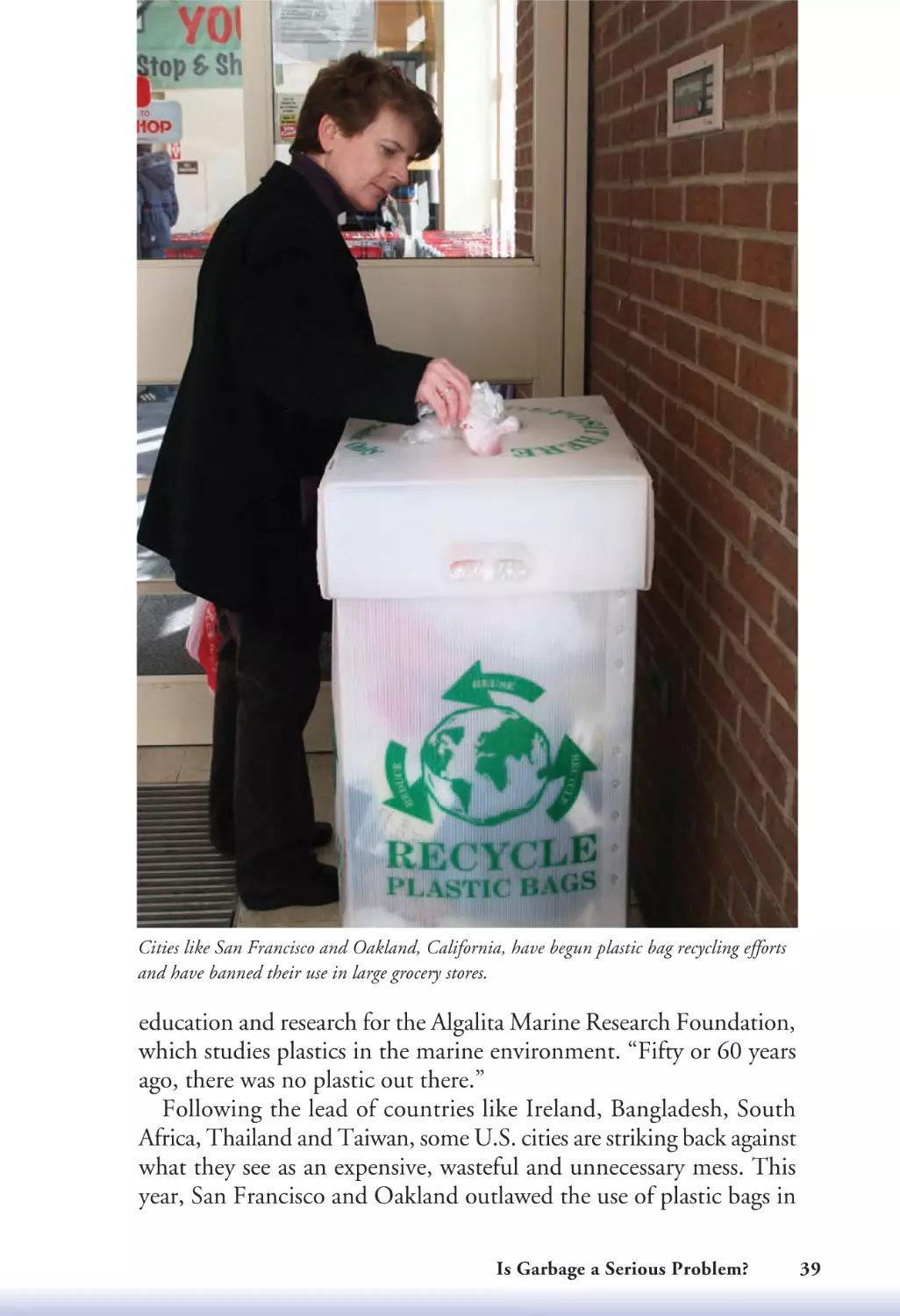
Cities like San Francisco and Oakland, California, have begun plastic bag recycling efforts
and have banned their use in large grocery stores.

education and research for the Algalita Marine Research Foundation,
which studies plastics in the marine environment. “Fifty or 60 years
ago, there was no plastic out there.”
Following the lead of countries like Ireland, Bangladesh, South
Africa, Thailand and Taiwan, some U.S. cities are striking back against
what they see as an expensive, wasteful and unnecessary mess. This
year, San Francisco and Oakland outlawed the use of plastic bags in
Is Garbage a Serious Problem?

39

large grocery stores and pharmacies, permitting only paper bags with
at least 40 percent recycled content or otherwise compostable bags.
The bans have not taken effect yet, but already the city of Oakland is
being sued by an association of plastic bag manufacturers calling itself
the Coalition to Support Plastic Bag Recycling. Meanwhile, other
communities across the country, including Santa Monica, Calif., New
Haven, Conn., Annapolis, Md., and Portland, Ore., are considering
taking drastic legislative action against the bags. In Ireland, a now
22-cent tax on plastic bags has slashed their use by more than 90
percent since 2002. In flood-prone Bangladesh, where plastic bags
choked drainage systems, the bags have been banned since 2002.
The problem with plastic bags isn’t just where they end up, it’s
that they never seem to end. “All the plastic that has been made is still
around in smaller and smaller pieces,” says Stephanie Barger, executive
director of the Earth Resource Foundation, which has undertaken a
Campaign Against the Plastic Plague. Plastic doesn’t biodegrade. That
means unless they’ve been incinerated—a noxious proposition—every
plastic bag you’ve ever used in your entire life, including all those bags
that the newspaper arrives in on your doorstep, even on cloudless
days when there isn’t a sliver of a chance of rain, still exists in some
form, even fragmented bits, and
will exist long after you’re dead.
Grand efforts are under way
to recycle plastic bags, but so far
ast act
those efforts have resulted mostly
According to the Sierra
in a mass of confusion. A tour of
Club, one less grocery bag
Recycle Central in San Francisco
per person in New York
makes it easy to see why. The
City alone would reduce
plant is a Willie Wonka factory of
waste by 109 tons and save
refuse. Located on a bay pier with
$11,000 in disposal costs.
a stunning view of the downtown skyline, some 700 tons of
discarded annual reports, Rolling
Rock bottles, Diet Coke cans, Amazon.com cardboard boxes, Tide
plastic detergent bottles and StarKist tuna fish cans surge into this
warehouse every weekday, dumped from trucks into a great clattering,
shifting mound. The building tinkles and thumps with the sound of
thousands of pounds of glass, aluminum, paper, plastic and cardboard

F

40

F

Garbage and Recycling

knocking together, as all this detritus passes through a dizzying network of conveyor belts, spinning disks, magnets and gloved human
hands to emerge as 16 different sorted, recyclable commodities, baled
up by the ton to be shipped or trucked away and made into something new again. It’s one way that the city of San Francisco manages
to divert some 69 percent of its waste from landfills. But this city’s
vaunted recycling program, which is so advanced that it can collect
coffee grounds and banana peels from urbanites’ apartment kitchens
and transform them into compost used to grow grapes in Napa Valley
vineyards, simply cannot master the plastic bag.
Ask John Jurinek, the plant manager at Recycle Central, what’s
wrong with plastic bags and he has a one-word answer: “Everything.”
Plastic bags, of which San Franciscans use some 180 million per year,
cannot be recycled here. Yet the hopeful arrow symbol emblazoned
on the bags no doubt inspires lots of residents to toss their used ones
into the blue recycling bin, feeling good that they’ve done the right
thing. But that symbol on all kinds of plastic items by no means guarantees they can be recycled curbside. (The plastic bags collected at the
recycling plant are trucked to the regular dump.) By chucking their
plastic bags in the recycling, what those well-meaning San Franciscans
have done is throw a plastic wrench into the city’s grand recycling
factory. If you want to recycle a plastic bag it’s better to bring it back
to the store where you got it.
As the great mass of recyclables moves past the initial sort deck on
a series of spinning disks, stray plastic bags clog the machinery. It’s
such a problem that one machine is shut down while a worker wearing
kneepads and armed with a knife spends an hour climbing precariously on the disks to cut the bags out, yielding a Medusa’s hair-mass
of wrenched and twisted plastic. In the middle of the night, when the
vast sorting operation grinds to a halt to prepare for the next 700-ton
day, two workers will spend hours at this dirty job.
Some states are attacking the recycling problem by trying to
encourage shoppers to take the bags back to grocery stores. California
requires large grocery stores and pharmacies that distribute the bags
known in the trade as T-shirt bags -- those common polyethylene bags
with two handles, usually made from petroleum or natural gas—to
take them back for recycling, and to print instructions on the bags
to encourage shoppers to return them to the stores. San Francisco
Is Garbage a Serious Problem?

41

Environment Department spokesperson Mark Westlund, who can see
plastic bags lodged in the trees on Market Street from his second-story
office window, is skeptical about the state’s ability to get shoppers to
take back their bags. “We’ve had in store recycling in San Francisco
for over 10 years, and it’s never really been successful,” says Westlund,
who estimates that the city achieved only a 1 percent recycling rate
of plastic bags at the stores. “People have to pack up the bags, bring
them into the store and drop them off. I think you’d be more inclined
to bring your own bag than do that.”
Regardless, polyethylene plastic bags are recyclable, says Howie
Fendley, a senior environmental chemist for MBDC, an ecological
design firm. “It’s a matter of getting the feedstock to the point where
a recycler can economically justify taking those bags and recycling
them. The problem is they’re mostly air. There has to be a system
in place where they get a nice big chunk of polyethylene that can be
mechanically ground, melted and then re-extruded.”
So far that system nationwide consists mainly of supermarkets and
superstores like Wal-Mart voluntarily stockpiling the bags brought
back in by conscientious shoppers, and selling them to recyclers or
plastic brokers, who in turn sell them to recyclers. In the U.S., one
company buys half of the used plastic bags available on the open
market in the United States, using about 1.5 billion plastic bags per
year. That’s Trex, based in Winchester, Va., which makes composite
decking out of the bags and recycled wood. It takes some 2,250 plastic
bags to make a single 16-foot-long, 2-inch-by-6-inch plank. It might
feel good to buy decking made out of something that otherwise could
have choked a sea turtle, but not so fast. That use is not an example of
true recycling, points out Carol Misseldine, sustainability coordinator
for the city of Oakland. “We’re not recycling plastic bags into plastic
bags,” she says. “They’re being downcycled, meaning that they’re
being put into another product that itself can never be recycled.”
Unlike a glass beer bottle or an aluminum can, it’s unusual that a
plastic bag is made back into another plastic bag, because it’s typically more expensive than just making a new plastic bag. After all,
the major appeal of plastic bags to stores is that they’re much cheaper
than paper. Plastic bags cost grocery stores under 2 cents per bag,
while paper goes for 4 to 6 cents and compostable bags 9 to 14
cents. However, says Eriksen from the Algalita Marine Research
42

Garbage and Recycling

Foundation, “The long-term cost of having these plastic bags blowing across our landscape, across our beaches and accumulating in the
northern Pacific far outweighs the short-term loss to a few.”
Of course, shoppers could just bring their own canvas bags, and avoid
the debate altogether. The California bag recycling law also requires
stores to sell reusable bags. Yet it will be a sad irony if outlawing the
bags, as San Francisco and Oakland have, doesn’t inspire shoppers to
bring their own canvas bags, but simply sends them to paper bags,
which come with their own environmental baggage. In fact, plastic bags
were once thought to be an ecologically friendly alternative to cutting
down trees to make paper ones. It takes 14 million trees to produce the
10 billion paper grocery bags used every year by Americans, according
to the Natural Resources Defense Council. Yet suggesting that plastic
bags made out of petroleum are a better choice burns up Barger from
the Earth Resources Foundation. “People say, ‘I’m using plastic. I’m
saving trees,’” he says. “But have you ever seen what Shell, Mobil and
Chevron are doing down in the rain forests to get oil?”
Gordon Bennett, an executive in the San Francisco Bay chapter of
the Sierra Club, agrees. “The fundamental thing about trees is that
if you manage them properly they’re a renewable resource,” he says.
“I haven’t heard about the oil guys growing more oil lately.” Still, as
the plastic bag industry never tires of pointing out, paper bags are
heavier than plastic bags, so they take more fossil fuels to transport.
Some life cycle assessments have put plastic bags out ahead of paper,
when it comes to energy and waste in the manufacturing process. But
paper bags with recycled content, like those soon to be required in
San Francisco and Oakland, use less energy and produce less waste
than those made from virgin paper.
The only salient answer to paper or plastic is neither. Bring a reusable canvas bag, says Darby Hoover, a senior resource specialist for the
Natural Resources Defense Council. However, if you have to make a
choice between the two, she recommends taking whichever bag you’re
more likely to reuse the most times, since, like many products, the
production of plastic or paper bags has the biggest environmental
impact, not the disposal of them. “Reusing is a better option because
it avoids the purchase of another product.”
Some stores, like IKEA, have started trying to get customers to
bring their own bags by charging them 5 cents per plastic bag. The
Is Garbage a Serious Problem?

43

Swedish furniture company donates the proceeds from the bag sales
to a conservation group. Another solution just might be fashion.
Bringing your own bag—or BYOB as Whole Foods dubs it—is the
latest eco-chic statement. When designer Anya Hindmarch’s “I am
not a plastic bag” bag hit stores in Taiwan, there was so much demand
for the limited-edition bag that the riot police had to be called in to
control a stampede, which sent 30 people to the hospital.

EVALuAtING thE AuthOR’S
ARGuMENtS:
the author of this viewpoint suggests that bringing a reusable canvas bag for shopping instead of using paper or
plastic bags will help eliminate environmental waste. how
effective do you think that solution will be? Do you think
it will help solve the trash problem? If yes, explain your
reasoning. If no, suggest another way to reduce the threat
of plastic bag litter.

44

Garbage and Recycling

Viewpoint

6

Plastic Bags
Are Not an
Environmental
hazard

This text has been suppressed due to author restrictions.

Progressive Bag Alliance
In the following viewpoint the Progressive
Bag Alliance debunks myths about plastic
bags, arguing they do not pose a threat to
the environment. They claim that compared to paper bags, plastic bags require
less energy to produce, generate fewer
emissions, and consume less fossil fuels. In
the author’s opinion, plastic bags can and
should be recycled, and these programs successfully reduce the negative impact plastic
bags have on the environment. Indeed, the
author reports that plastic bags are 100 percent recyclable, but people do not recycle
them enough because recycling programs
are not available in all stores. The author
concludes that plastic bags are environmentally friendly, cost-effective products that
are both important to and safe for modern
society.
The Progressive Bag Alliance, founded
in 2005 and renamed the Progressive Bag
Affiliates (PBA) in 2008, is a group of
“Top 10 Myths About Plastic Grocery Bags,” Progressive Bag Alliance. www.plasticsindustry.org. Accessed May
7, 2008. © Copyright May 7, 2008 The Society of the Plastics Industry, Inc. All rights reserved. Distributed by
Gale/Cengage with the permission of SPI.

Is Garbage a Serious Problem?

45

American plastic bag manufacturers who fight against laws banning
plastic grocery bags.
AS yOu READ, CONSIDER thE FOLLOWING quEStIONS:

1. What are New Jersey, New York, and some cities in California
opting to do with plastic bags instead of banning them, according to the author?
2. According to the author, how much less energy does it take to
recycle a pound of plastic versus a pound of paper?
3. Name three consumer products the author says can be made
from recycled plastic bags.

This text has been suppressed due to author restrictions.

46

Garbage and Recycling

This text has been suppressed due to author restrictions.

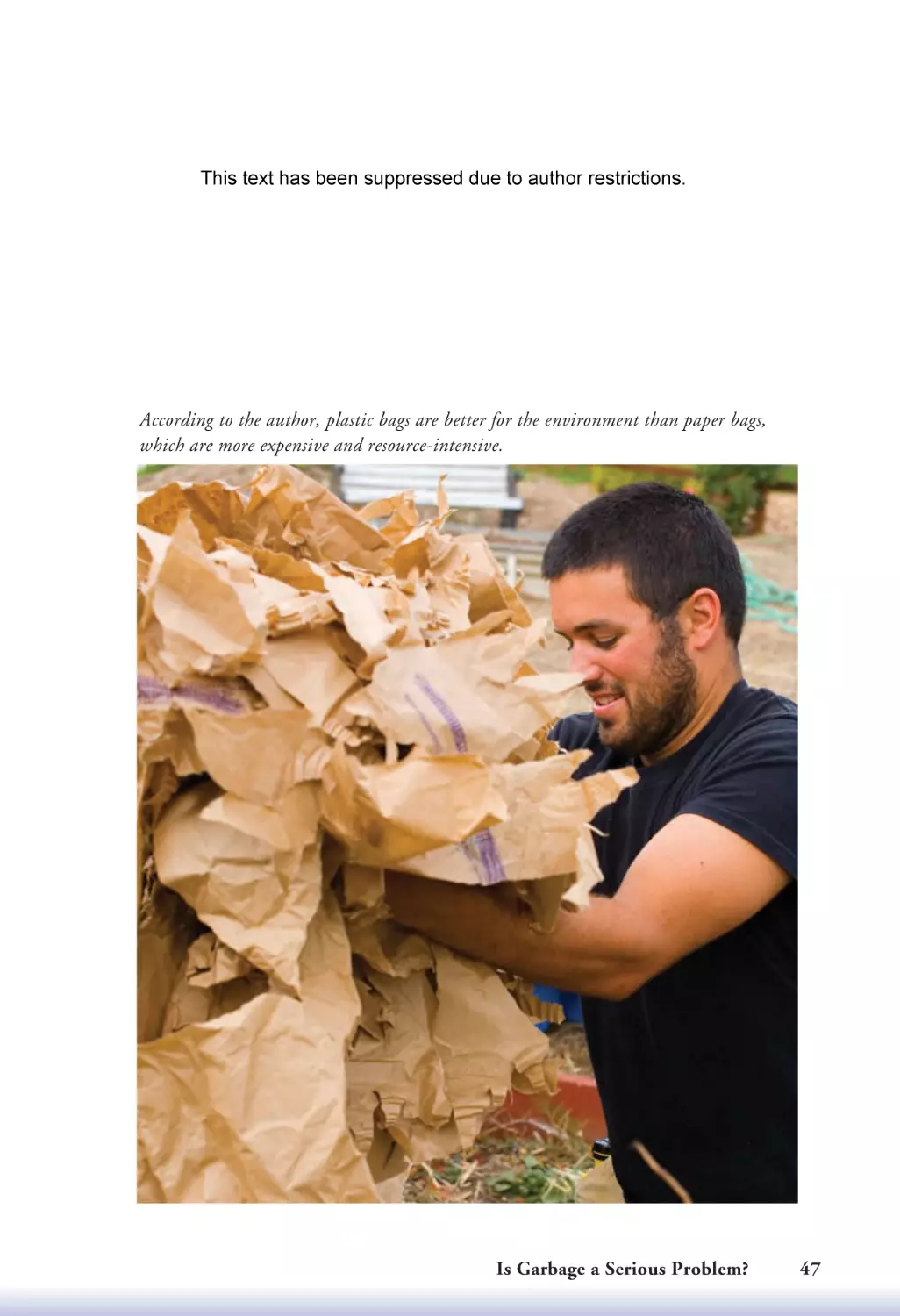
According to the author, plastic bags are better for the environment than paper bags,
which are more expensive and resource-intensive.

Is Garbage a Serious Problem?

47

This text has been suppressed due to author restrictions.

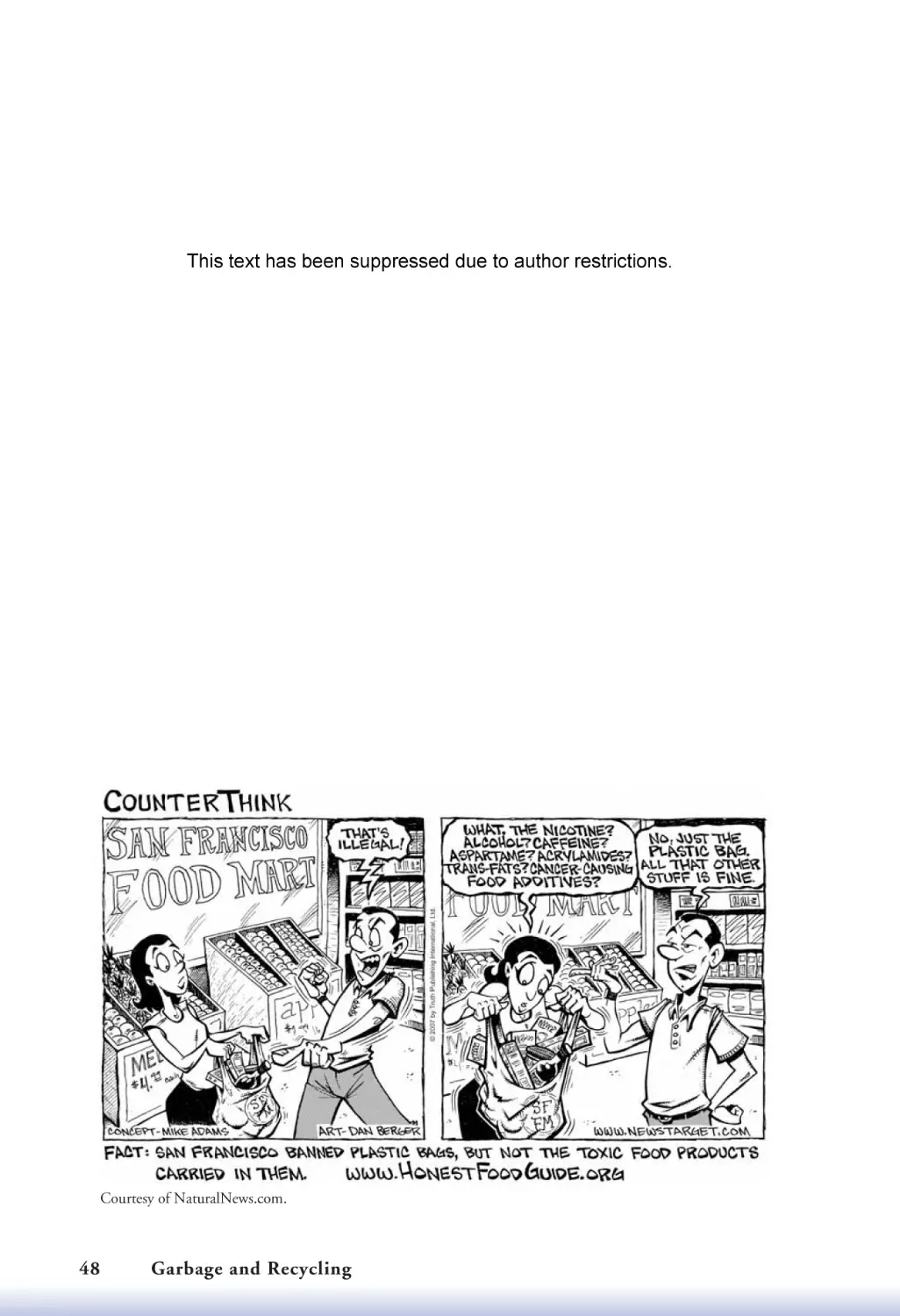
Courtesy of NaturalNews.com.

48

Garbage and Recycling

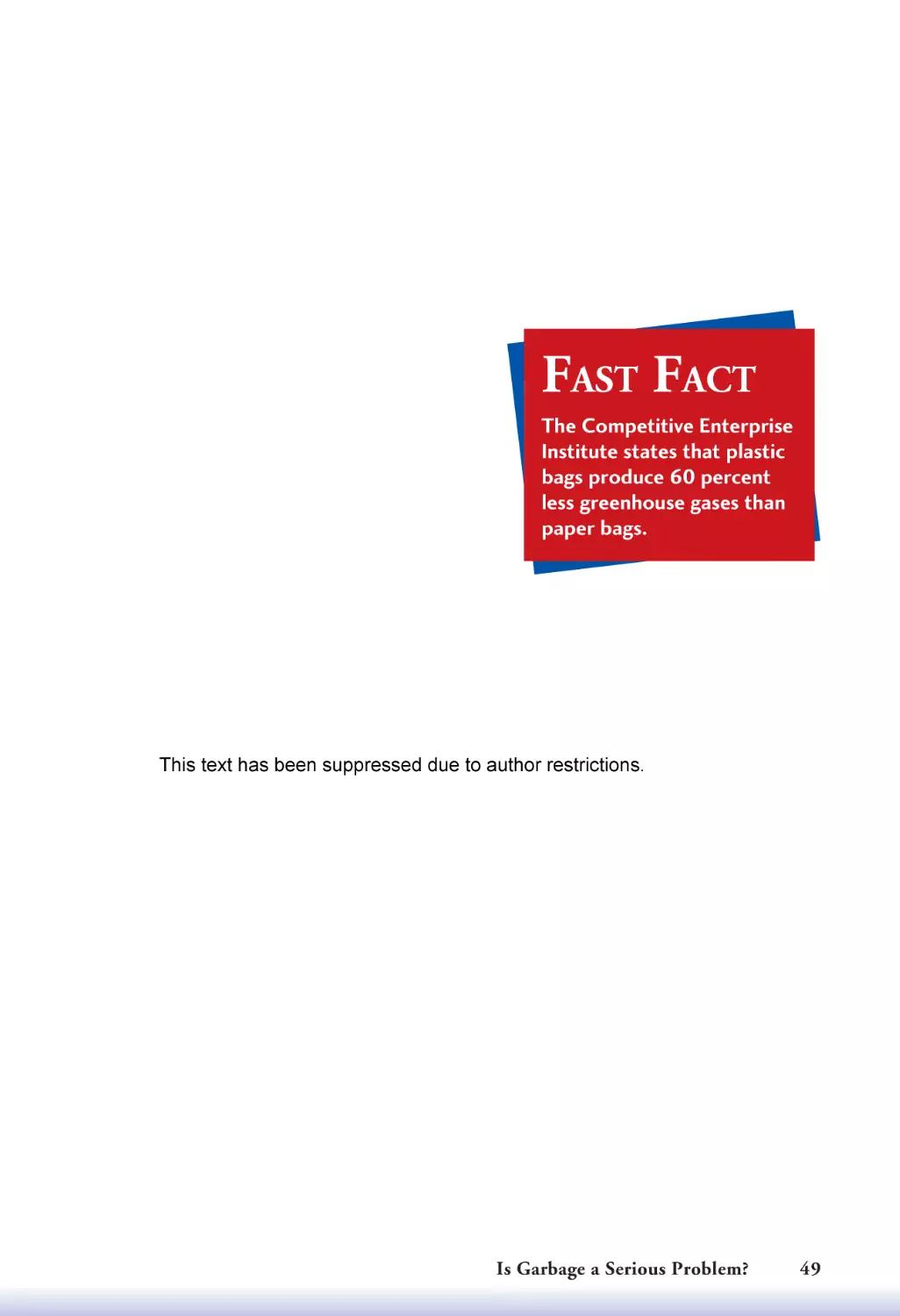
Fast Fact
The Competitive Enterprise
Institute states that plastic
bags produce 60 percent
less greenhouse gases than
paper bags.

This text has been suppressed due to author restrictions.

Is Garbage a Serious Problem?

49

This text has been suppressed due to author restrictions.

EVALuAtING thE AuthORS’
ARGuMENtS:
In this viewpoint the author argues that recycling programs are highly effective in controlling plastic bag litter. the author of the previous viewpoint, Katharine
Mieszkowski, contends that plastic bag recycling programs
are not very effective. After reading both viewpoints, with
which author’s perspective do you agree? Why?

50

Garbage and Recycling

Chapter 2

Is Recycling Effective?

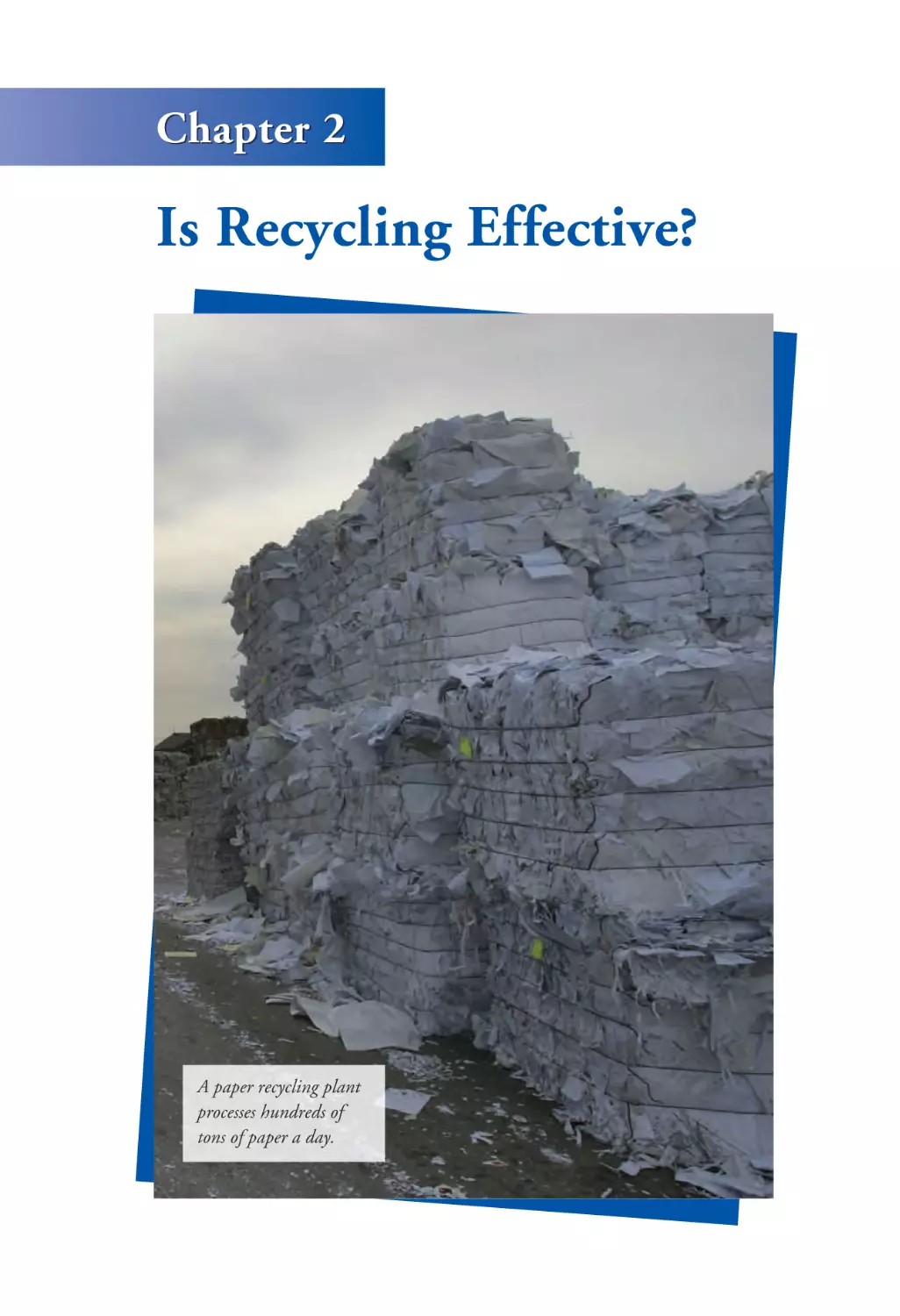
A paper recycling plant
processes hundreds of
tons of paper a day.

Viewpoint

1

Recycling Is
Effective
tom Zeller Jr.

“Recycling
. . . not only
conserves
natural
resources
and reduces
the amount
of waste
that must
be burned
or buried, it
also reduces
pollution
and the
demand for
energy.”

In the following viewpoint Tom Zeller
Jr. weighs the pros and cons of recycling
and concludes that recycling makes environmental and economic sense. While he
acknowledges that recycling is an expensive and energy-consuming endeavor, the
net cost of recycling is less than that of
making new products. Many cities have
found ways to reduce recycling costs, and
even energy spent recycling old products is
less than energy spent creating new products, according to Zeller. Furthermore,
because new products increase the amount
of packaging that gets thrown out, recycling is a good way to reduce the total
amount of garbage that is piling up across
the globe. Zeller concludes that recycling
is energy- and cost-efficient, and he supports laws that require product manufacturers and retailers to share the cost of
recycling.
Zeller is an editor at National Geographic
magazine, an official journal of the National
Geographic Society, from which this viewpoint is taken.

Tom Zeller Jr., “Why Recycle?” National Geographic magazine, January, 2008. Copyright © 2008 National
Geographic Society. Reproduced by permission.

52

Garbage and Recycling

AS yOu READ, CONSIDER thE FOLLOWING quEStIONS:

1. What are at least three “tree costs” incurred during a product’s
life span, according to the author?
2. In what percent of cases did recycling prove better than burying
or burning waste?
3. According to Zeller, what percent of lead-acid batteries get recycled in the United States?

D

oes it make sense to recycle? The short answer is: Yes.
True, some critics wonder whether mandatory programs
are a net benefit, since they can require more trucks consuming energy and belching carbon dioxide into the atmosphere.
“You don’t want a large truck carrying around just a few bottles,”
concedes Matthew Hale, director of EPA’s [Environmental Protection
Agency] Office of Solid Waste. But, he notes, most cities are getting
better at reducing the environmental costs of recycling. (They’re also
working to reduce the economic costs. Many recycling programs still
cost more to run than they bring in when they sell the recyclable
materials back to manufacturers.)
Consider the true cost of a product over its entire life—from harvesting the raw materials to creating, consuming, and disposing of
it—and the scale tips dramatically in recycling’s favor. Every shrinkwrapped toy or tool or medical device we buy bears the stamp of
its energy-intensive history: mountains of ore that have been mined
(bauxite, say, for aluminum cans), coal plants and oil refineries, railcars, assembly lines. A product’s true cost includes greenhouse gases
emitted in its creation as well as use, and pollutants that cause acid
rain, smog, and fouled waterways.

Recycling Is Good for the Environment
Recycling—substituting scrap for virgin materials—not only conserves natural resources and reduces the amount of waste that must
be burned or buried, it also reduces pollution and the demand for
energy. “You get tremendous Btu [British thermal unit, a measurement of energy] savings,” Hale says.
Is Recycling Effective?

53

how Are Items Selected for Recycling?

In an international study published last year [2007] by the Waste &
Resources Action Programme, a British group, researchers compared
more than 180 municipal waste management systems. Recycling
proved better for the environment than burying or burning waste in
83 percent of the cases.
It makes sense to reuse products, of course, and to reduce consumption altogether, as well as to improve initial product design. But given
the rising mounds of waste worldwide, it also makes sense to recycle.

the united States Is Developing
Recycling Infrastructures

What gets recycled in the U.S.[?] It depends on the markets. Whether
or not a particular material is recycled depends on a number of factors, but the most fundamental question is this: Is there a market for
it? Markets for some materials, like car batteries, are highly developed
and efficient—not least because strict regulations govern their disposal—and a mature recycling infrastructure has grown up as a result.
About 90 percent of all lead-acid batteries are recycled, according
to the EPA. Steel recycling, too, has been around for decades, while
formalized recycling of yard trimmings has not. Despite the explosive
growth of plastics—particularly for use in beverage containers—that
industry has been slow to develop recycling infrastructure, with most
plastic still going to incinerators or landfills.

Recycling Is Everyone’s
Responsibility

Fast Fact

Higher hygiene standards, smaller
A 2007 Harris poll
households, intense brand marketfound that 77 percent of
ing, and the rise of ready-made
Americans recycle in their
meals have all contributed to an
homes.
increase in packaging waste, but
international trade may be the biggest factor.
Even simple items like bottles of water now routinely crisscross the
globe, meaning that thirst for a few swallows of “product” can generate not just plastic bottles, but also a large amount of other packaging
debris—from wrapping film to bin liners to shipping crates.
Is Recycling Effective?

55

So far, Europe has led the world in recycling packaging materials—
principally through the Packaging and Packaging Waste Directive
of 1994. The EU [European Union] directive calls for manufacturers, retailers, and others in the product chain to share the recycling
burden.
The author thinks that recycling materials requires a mature recycling infrastructure like
the ones developed for recycling car batteries and their highly toxic materials.

56

Garbage and Recycling

With the exception of hazardous wastes, the United States has been
slower to embrace the concept of “extended producer responsibility,” as the idea is known, according to Bill Sheehan, director of the
Product Policy Institute, a nonprofit research organization in Athens,
Georgia. Some municipalities, however, are starting to demand that
businesses help cover the costs of recycling.
“Otherwise,” Sheehan says, we are “just stimulating the production
of more stuff.”

EVALuAtING thE AuthOR’S
ARGuMENtS:
In the viewpoint you just read, the author suggests that
businesses should start paying for some of the recycling
costs of their products. What do you think? Is requiring
businesses to pay for part of the recycling costs a good
idea? Why or why not? Explain your position.

Is Recycling Effective?

57

Viewpoint

2

Recycling Is
Ineffective
Per Bylund

“Imagine
a whole
population
spending
time and
money
cleaning
their garbage
and driving
it around the
neighborhood
rather than
working or
investing in
a productive
market!”

In the following viewpoint author Per
Bylund argues that recycling is inefficient.
He claims that people are forced to sort recyclable materials and then have to go out of
their way to make sure the materials are disposed of properly. The cost of wasted time
from people having to drive the recyclables
to trash collection centers, Bylund contends,
are not factored into the costs of recycling.
Furthermore, the auto emissions from so
many people driving to dispose of their garbage is another environmental cost. Bylund
refers to a current problem in Stockholm,
Sweden, to illustrate another cost of recycling: Trash piled up at collection centers
are attracting rats, thus increasing the risk
of disease. Yet another problem is that the
government forces people to recycle, and in
Bylund’s opinion this is inappropriate—the
government should not have to force its citizens to do anything that is worth doing. For
these reasons, Bylund concludes that recycling programs are ineffective.
Per Bylund is an anarchist and libertarian
writer and thinker. He writes regularly for
the Ludwig von Mises Institute, a research
and educational center of liberalism that
published this viewpoint.

Per Bylund, “The Recycling Myth,” Ludwig von Mises Institute, February 4, 2008. Reproduced by permission.

58

Garbage and Recycling

AS yOu READ, CONSIDER thE FOLLOWING quEStIONS:

1. What does the term “coercive environmentalism” mean in the
context of the viewpoint?
2. Which items does the author say need to be cleaned before
throwing away?
3. According to Bylund, what is not factored in by government
authorities and researchers when measuring the energy and costs
of recycling?

A

s a Swede I get to hear a lot of the myths of how wonderful a
country Sweden supposedly is—the “prosperous socialism” it
stands for, a role model for the rest of the world. For instance,
quite a few friends from around the world have commended me on
Swedish recycling policies and the Swedish government’s take on
coercive environmentalism.
The way it has been presented to me, Sweden has succeeded
with what most other governments at best dream about: creating
an efficient and profitable national system for saving the environment through large-scale recycling. And the people are all in on it!
Everybody’s recycling.

Mandatory Recycling Is Wrong
The latter is actually true: everybody is recycling. But that is the result
of government force, not a voluntary choice. The state’s monopolist
garbage-collection “service” no longer accepts garbage: they will only
collect leftovers and other biodegradables. Any other kind of garbage
that accidentally finds its way to your garbage bin can result in a nice
little fine (it really isn’t that little) and the whole neighborhood could
face increased garbage collection rates (i.e., even larger increases than
usual—they tend to increase annually or biannually anyway).
So what do you do with your waste? Most homes have a number of
trash bins for different kinds of trash: batteries in one; biodegradables
in one; wood in one; colored glass in one, other glass in another; aluminum in one, other metals in another; newspapers in one, hard paper in
another, and paper that doesn’t fit these two categories in a third; and
plastic of all sorts in another collection of bins. The materials generally
Is Recycling Effective?

59

have to be cleaned before thrown away—milk cartons with milk in
them cannot be recycled just as metal cans cannot have too much of
the paper labels left.
The people of Sweden are thus forced to clean their trash before
carefully separating different kinds of materials. This is the future,
they say, and it is supposedly good for the environment. (What about
the economy?) . . .

Consumers Do Most of the Recycling Work
But the real question here . . . is: does this recycling structure work?
The answer is that, from a government point of view, while it can
probably be thought of as working, from an environmental point of
view, the answer is definitely “no.”
The structure works the way all centrally planned structures work:
it increases and centralizes power while the attempted (expected)
results do not materialize. In this case, the structure works: people
do sort their trash in different bins—they have no choice. Also, government garbage collection companies do not have to do as much
work while getting paid more than ever before. People are annoyed,
but do not really react. Swedes generally complain a lot (about everything), but they do not resist; they are used to being pushed around
by powerful government and have tolerated this fate ever since 1523
[when modern Sweden was founded].
This coercive recycling structure is set up in layers, where the
consumer (“producer” of waste) gets to do most of the work of
sorting, cleaning, and transporting the trash to collection centers.
Government-appointed companies then empty the containers and
transport the materials to regional centers where the trash is prepared
for recycling. And then everything is transported to centralized recycling plants where the materials are prepared for reuse or burning.
Finally what is left of the materials is sold to companies and individuals at subsidized prices so that they can make “environmentally
friendly” choices.
What is interesting about this Soviet-style planned recycling is that
it is officially profitable. It is supposed to be resource efficient, since
recycling of the materials is less energy-consuming than, for instance,
mining or the production of paper from wood. It is also economically
60

Garbage and Recycling

The people of Sweden are forced to clean their trash before separating and recycling different
materials. Critics say this type of recycling program hurts the economy.

profitable, since the government actually generates revenues from
selling recycled materials and products made in the recycling process.
The final recycling process costs less than is earned from selling the
recycled products.

Recycling Is Not Efficient

However, this is common government logic: it is “energy saving” simply because government does not count the time and energy used
by nine million people cleaning and sorting their trash. Government
authorities and researchers have reached the conclusion that the cost
of (a) the water and electricity used for cleaning household trash, (b)
transportation from trash collection centers, and (c) the final recycling
process is actually less than would be necessary to produce these materials from scratch. Of course, they don’t count the literally millions of
times people drive to the recycling centers to empty their trash bins;
neither do they count, for instance, energy and costs for the extra
housing space required for a dozen extra trash bins in every home.
Economically, Swedish recycling is a disaster. Imagine a whole
population spending time and money cleaning their garbage and
Is Recycling Effective?

61

united States Beverage Container Recycling, 1990–2005

driving it around the neighborhood rather than working or investing
in a productive market! According to the movement’s books, more
money flows in than flows out; therefore recycling is profitable. But
this ignores the costs of coercion.

Recycling Breeds Vermin and Disease

The government bookkeepers also take advantage of the cost cuts they
have been able to realize through centralizing the garbage collection
system. These “cuts,” however, are mostly cuts in service, whereas
rates for consumers have been increased. A recent problem with the
garbage-collection centers is that the containers aren’t emptied very
often (a typical example of government “savings”) and thus remain
62

Garbage and Recycling

full, which means that people’s garbage piles up next to the overflowing containers while the government contractors sit idle: they are
only paid to empty the containers on schedule, not to pick up the
trash sitting next to these containers. The result? Disease and rats.
Newspapers have been reporting on a “rat invasion” in Stockholm
and in other Swedish cities in recent years.
If we consider the costs in monetary terms, in terms of wasted time,
and in terms of increased emissions from automobiles, this is hardly
environmentally friendly. Adding the annoyance and the increased
risk for disease, Swedish recycling is at least as disastrous as any other
government scheme. . . .
Please enlighten me, wherein lies the so-often-acclaimed success of
this system?

EVALuAtING thE AuthORS’
ARGuMENtS:
the author of the previous viewpoint argues that recycling reduces energy use and pollution. how do you think
Bylund might respond to that claim? Support your answer
with evidence from the texts you have read.

Is Recycling Effective?

63

Viewpoint

3

Recycling Is
Environmentally
Friendly

This text has been suppressed due to author restrictions.

Economist
This viewpoint is taken from the Economist,
a British paper that reports on politics, science and technology, cultural trends, and
business. The anonymous author argues
that recycling is environmentally friendly
and claims that recycling reduces air pollution because it causes less waste to be
burned in incinerators and reduces the
amount that must be stored in landfills
(which give off methane and other toxic
emissions). Recycling also conserves natural resources because it makes products
out of already existing materials instead of
mining for new or raw materials. In addition, the author reports that new recycling
technologies require less human labor and
less transport than in the past, making the
process more efficient than ever. Also, more
companies are packaging their products in
recycled materials, which further reduces
carbon dioxide emissions and garbage. For
all of these reasons, the author concludes
that recycling is environmentally friendly
and supports global efforts to boost recycling efforts.
“The Truth About Recycling,” Economist.com, June 7, 2007. Republished with permission of the Economist,
conveyed through Copyright Clearance Center, Inc.

64

Garbage and Recycling

AS yOu READ, CONSIDER thE FOLLOWING quEStIONS:

1. According to the author, what percentage of energy consumption is reduced when aluminum, plastic, steel, paper, and glass
are recycled?
2. Explain the concept of “single stream” collection, as described
by the author.
3. What does the Sustainable Packaging Coalition advocate, as
described by the author?

This text has been suppressed due to author restrictions.

Is Recycling Effective?

65

This text has been suppressed due to author restrictions.

66

Garbage and Recycling

Energy Savings per ton Recycled*

This text has been suppressed due to author restrictions.

Is Recycling Effective?

67

This text has been suppressed due to author restrictions.

Denmark burns waste materials in an incinerator plant that produces energy for heating
the district and is better for the environment.

Fast Fact
According to the organization Recycling International,
producing steel from recycled steel creates 86 percent less air pollution.

This text has been suppressed due to author restrictions.

Is Recycling Effective?

69

This text has been suppressed due to author restrictions.

EVALuAtING thE AuthOR’S
ARGuMENtS:
the author of this viewpoint quotes from several sources to
support the points made in the essay. Make a list of all the
people quoted, including their credentials and the nature
of their comments. then, analyze the sources. Are they
credible? Are they well qualified to speak on this subject?

70

Garbage and Recycling

Viewpoint

4

Recycling Is Not
Environmentally
Friendly
Daniel K. Benjamin

“Recycling
merely
changes the
nature of
pollution—
sometimes
decreasing
it, and
sometimes
increasing
it.”

In the following viewpoint author Daniel
K. Benjamin argues that recycling does not
help conserve natural resources or protect
the environment. He believes that recycling
programs are an overreaction to myths the
public has been fed about a so-called garbage crisis. Benjamin contends that no such
crisis exists: In his opinion, there is enough
space to hold all of America’s garbage, landfills do not produce dangerous gases, and
natural resources are not being depleted.
Furthermore, he suggests that recycling
may produce as much pollution as primary
manufacturing and curbside recycling programs because more vehicles are required
to transport the trash to and from recycling
centers. He points out that landfills have
more capacity for trash than ever before and
that harmful gases emitted by landfills are
not due to household waste but by illegally
dumped industrial waste. Benjamin concludes there are enough resources to meet
the world’s demand for products and that
recycling is an unnecessary activity that uses
more resources than it saves.

Daniel K. Benjamin, “The Eight Myths of Recycling,” American Enterprise, January/February, 2004.
Reproduced with permission of The American Enterprise, a national magazine of Politics, Business, and
Culture (TAEmag.com).

Is Recycling Effective?

71

Benjamin is a professor at Clemson University and a senior fellow
at PERC, the Property and Environment Research Center.
AS yOu READ, CONSIDER thE FOLLOWING quEStIONS:

1. What evidence does the author provide to argue that Americans
are not squandering natural resources?
2. How many trucks did the city of Los Angeles add to its fleet to
handle the curbside recycling program, according to the author?
3. According to Benjamin, what percent more does curbside recycling cost than throwing an item away?

T

he modern era of the recycling craze can be traced to 1987,
when the garbage barge Mobro 4000 had to spend two months
touring the Atlantic and the Gulf of Mexico before it found
a home for its load. The Environmental Defense Fund, the National
Solid Waste Management Association (whose members were anxious
to line up new customers for their expanding landfill capacity), the
press, and finally the Environmental Protection Agency [EPA], spun
the story of a garbage crisis out of control. By 1995, the majority of
Americans thought trash was our number one environmental problem—with 77 percent reporting that increased recycling of household
rubbish was the solution. Yet these claims and fears were based on
errors and misinformation, which I have compiled into the Eight
Great Myths of Recycling.

Myth 1: Our Garbage Will Bury us

Fact: Even though the United States is larger, more affluent, and
producing more garbage, it now has more landfill capacity than ever
before. The erroneous opposite impression comes from old studies
that counted the number of landfills (which has declined) rather than
landfill capacity (which has grown). There are a few places, like New
Jersey, where capacity has shrunk. But the uneven distribution of
landfill space is no more important than the uneven distribution of
automobile manufacturing. Perhaps the most important fact is this:
If we permitted our rubbish to grow to the height of New York City’s
famous Fresh Kills landfill (225 feet), a site only about 10 miles on a
side could hold all of America’s garbage for the next century.
72

Garbage and Recycling

Myth 2: Our Garbage Will Poison us

Fact: Almost anything can pose a theoretical threat, but evidence of
actual harm from landfills is almost non-existent, as the Environmental
Protection Agency itself acknowledges. The EPA has concluded that
landfills constructed according to agency regulations can be expected to
cause a total of 5.7 cancer-related deaths over the next 300 years. It isn’t
household waste, but improperly or illegally dumped industrial wastes
that can be harmful. Household recycling programs have no effect on
those wastes, a fact ignored by messianic proponents of recycling.

Myth 3: Our Packaging Is Immoral

Fact: Many people argue that the best way to “save landfill space” is
to reduce the amount of packaging Americans use, via mandatory
controls. But packaging can actually reduce total garbage produced
and total resources used. The average American family generates fully
one third less trash than does the average Mexican household. The
reason is that our intensive use of packaging yields less spoilage and
breakage, thereby saving resources, and producing, on balance, less
total rubbish. Careful packaging also reduces food poisoning and
other health problems.
Over the past 25 years, market incentives have already reduced
the weights of individual packages by 30 to 70 percent. An average
aluminum can weighed nearly 21 grams in 1972; in 2002, that same
can weighs in at under 14 grams. A plastic grocery sack was 2.3 mils
thick in 1976; by 2001, it was a mere 0.7 mils.
By contrast, the environmentally sensitive New York Times has been
growing. A year’s worth of the newspaper now weighs 520 pounds
and occupies more than 40 cubic feet in a landfill. This is equivalent
in weight to 17,180 aluminum cans—nearly a century’s worth of beer
and soft drink consumption by one person. Clearly, people anxious
to heal Mother Earth must forego the Times !

Myth 4: We Must Achieve “trash Independence”

Fact: Garbage has become an inter-state business, with 47 states exporting the stuff and 45 importing it. Environmentalists contend that each
state should dispose within its borders all the trash produced within
its borders. But why? Transporting garbage across an arbitrary legal
boundary has no effect on the environmental impact of the disposal of
Is Recycling Effective?

73

that material. Moving a ton of trash is no more hazardous than moving
a ton of any other commodity.

Myth 5: We’re Squandering Irreplaceable Resources
Fact: Thanks to numerous innovations, we now produce about twice
as much output per unit of energy as we did 50 years ago, and five
times as much as we did 200 years ago. Automobiles use only half as
much metal as in 1970, and one optical fiber carries the same number of calls as 625 copper wires did 20 years ago. Bridges are built
with less steel, because steel is stronger and engineering is improved.
Automobile and truck engines consume less fuel per unit of work
performed, and produce fewer emissions. . . .

Myth 6: Recycling Always Protects the Environment
Fact: Recycling is a manufacturing process, and therefore it too has
environmental impact. The U.S. Office of Technology Assessment
says that it is “not clear whether secondary manufacturing [i.e., recycling] produces less pollution per ton of material processed than primary manufacturing.” Recycling merely changes the nature of pollution—sometimes decreasing it,
and sometimes increasing it.
This effect is particularly
ast act
apparent in the case of curbside
recycling, which is mandated or
A study by the
strongly encouraged by governEnvironmental Protection
ments in many communities
Agency found that recycled
paper processing creates
around the country. Curbside
higher levels of toxic subrecycling requires that more
stances than virgin paper
trucks be used to collect the
processing.
same amount of waste materials.
Instead of one truck picking up
40 pounds of garbage, one will
pick up four pounds of recyclables and a second will collect 36 pounds
of rubbish.
Los Angeles has estimated that due to curbside recycling, its fleet of
trucks is twice as large as it otherwise would be—800 vs. 400 trucks.
This means more iron ore and coal mining, more steel and rubber

F

74

F

Garbage and Recycling

The 1987 Mobro garbage barge (above) incident is credited by the author as the beginning
of the modern era of recycling. The Mobro wandered the oceans for two months in search
of disposal.

manufacturing, more petroleum extracted and refined for fuel—and
of course all that extra air pollution in the Los Angeles basin as the
400 added trucks cruise the streets.

Myth 7: Recycling Saves Resources

Fact: Using less of one resource usually means using more of another.
Curbside recycling is substantially more costly and uses far more
resources than a program in which disposal is combined with a voluntary drop-off/buy-back option. The reason: Curbside recycling of
household rubbish uses huge amounts of capital and labor per pound
of material recycled. Overall, curbside recycling costs between 35
and 55 percent more than simply disposing of the item. It typically
wastes resources.
In the ordinary course of daily living, we already reuse most higher
value items. The only things that intentionally end up in the trash are
both low in value and costly to reuse or recycle. Yet these are the items
that municipal recycling programs are targeting—the very things that
consumers have already decided are too worthless or costly to deal
with further. All of the profitable, socially productive opportunities for
recycling were long ago co-opted by the private sector, because they
Is Recycling Effective?

75

Plastic Produced Versus Plastics Recycled

pay back. The bulk of all curbside recycling programs simply waste
resources.

Myth 8: Without Forced Mandates, there Wouldn’t Be
Any Recycling

Fact: Long before state or local governments had even contemplated
the word recycling, the makers of steel, aluminum, and thousands of
other products were recycling manufacturing scraps. Some operated
post-consumer drop-off centers. As for the claim that the private sector
promotes premature or excessive disposal, this ignores an enormous
body of evidence to the contrary. Firms only survive in the marketplace
if they take into account all costs. Fifty years ago, when labor was cheap
compared to materials, goods were built to be repaired, so that the
expensive materials could be used for a longer period of time. As the
price of labor has risen and the cost of materials has fallen, manufacturers have responded by building items to be used until they break,
and then discarded. There is no bias against recycling; there is merely
a market-driven effort to conserve the most valuable resources. . . .
Except in a few rare cases, the free market is eminently capable of
providing both disposal and recycling in an amount and mix that creates the greatest wealth for society. This makes possible the widest and
most satisfying range of human endeavors. Simply put, market prices
are sufficient to induce the trash-man to come, and to make his burden
bearable, and neither he nor we can hope for any better than that.

EVALuAtING thE AuthORS’
ARGuMENtS:
to make his argument that recycling is not environmentally friendly, Benjamin explores some of the “hidden”
costs of recycling—for example, the energy spent transporting recyclables to and from recycling centers. Make a
list of the hidden costs he discusses. then, for each one,
write one sentence saying how you think each author in
this chapter would support or refute the claim.

Is Recycling Effective?

77

Viewpoint

5

Recycling
Conserves
Resources
City of Fort Collins, Colorado

“Recycling’s
true value
comes from
preventing
pollution
and saving
natural
resources
and energy,
not landfill
space.”

The following viewpoint was published
by the City of Fort Collins Recycling
Department. In it, the author contends
that recycling conserves natural resources
and energy. According to the author, recycling conserves timber, water, and mineral ores. Furthermore, when products are
made from recycled sources, less energy
is used because the materials are not raw
and have already been processed. This
conserves not only energy but resources
as well. For example, when fewer minerals are processed, less toxic emissions are
released into the air and water. In addition
to the environmental benefits of recycling,
the author argues that recycling helps save
money spent on manufacturing and also
creates thousands of recycling-related jobs.
The author concludes that recycling is successful because it protects the environment,
reduces waste and pollution, promotes a
sense of community, and creates economic
incentives.

“Why Recycling Matters,” City of Fort Collins, CO. fcgov.com. Accessed May 7, 2008. Reproduced by
permission.

78

Garbage and Recycling

AS yOu READ, CONSIDER thE FOLLOWING quEStIONS:

1. According to the author, how many trees are saved by recycling
one ton of newspaper? One ton of office paper?
2. How much energy does one recycled aluminum can save, as
reported by the author?
3. How much carbon dioxide does the author say is prevented
from polluting the air when six tons of glass are recycled?

T

here are numerous reasons why . . . citizens and businesses
[should be encouraged] to recycle. They include a broad range
of environmental stewardship concerns, as well as practical
interest in local economic opportunities and development, including: cost savings, extended landfill lifespans, resource conservation,
energy conservation, economic development, pollution prevention,
greenhouse gas emissions reductions, and fostering a sense of community involvement and responsibility.

1. Cost Savings
At a basic level that most people can relate to, recycling prevents
materials that have economic value from going to waste. We tend
to think of the conventional list of commodities, whose trade values
are posted on the Chicago stock exchange; steel, aluminum, paper
goods, plastics #1 & 2, and glass. But increasingly, other materials
are becoming economically attractive to salvagers: clothing fabric,
shrink-wrap, grease, and old computers, just to name a few.
Nationally, the Environmental Protection Agency (EPA) estimates
about 30% of the waste stream gets diverted from landfill disposal
(unfortunately, it’s much lower in Colorado), but there is still a lot
that is not getting recycled—meaning money and resources that are
getting wasted. . . .
Well-run recycling programs cost less to operate than waste collection, landfilling, and incinerations. Loveland [Colorado] has discovered that the municipal garbage utility’s costs to recycle are almost
$40 per ton less than the cost to landfill trash, while Denver’s recycling programs saved about $200,000 in landfill costs in 2004 and
brought in nearly $1 million from the sale of recyclables. Unlike many
Is Recycling Effective?

79

public services, recycling does function within the market economy,
and quite successfully.

2. Extend Landfill Lifespans
Recycling’s true value comes from preventing pollution and saving
natural resources and energy, not landfill space. Still, it’s important to
note that recycling is largely responsible for averting a landfill crisis in
many parts of the country. Recycling and composting diverted nearly
70 million tons of material away from landfills and incinerators in
2000, up from 34 million tons in 1990.
As regulations have become more rigorous, the number of permitted landfills in the United States has dropped by 78% since 1988.
New landfills are much larger than in the past, and more controversial to build because few people are willing to live in the vicinity of
a mega-landfill.
While the Larimer County landfill currently is expected to last
another 15–19 years (or longer, depending on how successful we are
at diverting waste), once it does need to be replaced, a new one will
cost taxpayers over $17 million to construct.

3. Conserve Resources
Recycling conserves natural resources, such as timber, water and mineral ores. National statistics point to the environmental success of
recovery levels for some materials: paper and paperboard 48%; glass
19%; steel 36%; aluminum 21%. (We have not been as successful
at recovering others, for example plastics at 5% and textiles at 14%).
Recovered paper currently accounts for 37% of the paper industry’s fiber needs. Without recycling, this material would come from
trees; every ton of newspaper is the equivalent of 12 trees, and every
ton of office paper is the equivalent of 24 trees. When one ton of
steel is recycled, 2,500 pounds of iron ore, 1,400 pounds of coal,
and 120 pounds of limestone are conserved. Recycling a ton of paper
saves 7,000 gallons of water.
Tree farms and reclaimed mines are not ecologically equivalent to
natural forests and ecosystems. Recycling prevents natural habitat
destruction, loss of biodiversity, and soil erosion associated with logging and mining.
80

Garbage and Recycling

Recycling Can Be Profitable

It is not an exaggeration to say that recycling helps ease demand
for certain resources that are being extracted in emerging nations
under war-torn, repressive governments. For example, a mineral
called Tantalum—better known as “coltan”—is used to produce
capacitors in electronic devices, especially cell phones (from which it
can be recycled). Coltan mining is contributing to political tension
between Congo and Rwanda, as well as loss of habitat for the threatened Eastern Lowland Gorilla. Smuggled coltan has been implicated
as a major source of income for the military occupation of Congo.

4. Conserve Energy

Supplying recycled materials to industry uses less energy than supplying virgin materials that incur extra extraction and transportation
Is Recycling Effective?

81

The U.S. recycling industry employs over a million people with an annual payroll of 37
billion dollars. More recycling plants could create even more jobs.

costs. Additional energy savings associated with recycling accrue in the
manufacturing process itself, since the materials have already undergone processing. And of course, by saving energy, recycling helps the
U.S. reduce its reliance on oil.
Recycling aluminum saves the nation 95% of the energy that would
have been needed to make new aluminum from ore: one aluminum
can saves enough electricity to light a 100-watt bulb for 3 1/2 hours.
It takes 60% less energy to recycle steel than it does to make it from
raw materials. Making recycled newspaper saves 40%, recycled plastics 70%, and recycled glass 40%.
The EPA reported that in 2000, recycling resulted in an annual energy savings equal to the amount of energy used in 6 million
homes—over 660 trillion BTU’s [British thermal units]—and expected that to rise to 900 trillion BTUs in 2005.

5. Create Jobs / Economic Development

Recycling is a big industry, comparable in size to our auto and truck
manufacturing industry. In 2000, it employed over 1.1 million people
82

Garbage and Recycling

and generated an annual payroll of $37 billion, representing a significant force in the country’s economy, job creation and economic
development. For comparison, incinerating 10,000 tons of waste
creates one job and landfilling 10,000 tons of waste creates six jobs;
recycling 10,000 tons of waste creates 36 jobs.
The public sector’s investment in local recycling programs pays
great dividends by creating private sector jobs. For every job collecting recyclables, there are 26 jobs in processing the materials and
manufacturing them into new products.
As an example of how efficiently the salvage market functions,
a recycled aluminum beverage can returns to the grocer’s shelf as a
new, filled can in as few as 60 days after collection. The steel industry
recycles nearly 19 billion cans into new products each year, or about
600 cans per second.

6. Prevent Pollution

Manufacturing with recycled materials, with very few exceptions, produces less air and water pollution than manufacturing with virgin
materials. It results in a net reduction for ten major categories of air
pollutants (such as nitrogen oxide, particulates, and sulfur oxides) and
eight major categories of water pollutants.
In the U.S., processing minerals contributes almost half of all
reported toxic emissions from
ast act
industry, sending 1.5 million tons
of pollution into the air and water
The organization Recycling
International reports that
each year. Recycling can signifi1.5 million people are
cantly reduce these emissions.
employed in the recycling
Landfills can be major sourcindustry worldwide.
es of groundwater pollution if
watery “leachate” escapes through
underlying clay or plastic linings. Leachate from municipal landfills is similar in composition to
that of hazardous waste landfills and in fact, 20% of the sites on
the Superfund list (the nation’s most hazardous sites) are solid waste
landfills.
Consumer electronics are creating a growing source of pollution,
constituting 40% of the lead found in landfills. The National Safety

F

F

Is Recycling Effective?

83

Council predicts that in the U.S. between as many as 680 million
computers will become obsolete within the next few years; in addition to 1 billion pounds of lead, this waste will contain more than 4
billion pounds of plastic, 1.9 million pounds of cadmium, 1.2 million
pounds of chromium, and nearly 400,000 pounds of mercury.

7. Reduce Greenhouse Gas Emissions

Methane is a major greenhouse gas that is 20 to 30 times more potent
in its global warming effects than carbon dioxide, and municipal
solid waste (MSW) landfills are the largest source of human-related
methane emissions in the United States, accounting for about 34%
of these emissions.
For every 6 tons of recycled container glass used, 1 ton of carbon
dioxide, a greenhouse gas, is reduced. Recycling one ton of aluminum
is equivalent to not releasing 13 tons of carbon dioxide into the air.

EVALuAtING thE AuthOR’S
ARGuMENtS:
In the viewpoint you just read, the author uses facts and
examples to show that recycling conserves resources and
energy. however, there are no quotations to support this
point. If you were to rewrite this article and insert quotations, what authorities might you quote from? Where
would you place these quotations to bolster the points
made in this article?

84

Garbage and Recycling

Viewpoint

6

“More trucks
and more
resources are
required to
handle the
massive bulk
of recycling,
and all of that
transportation
ultimately
does more
harm than
good.”

Recycling
Wastes
Resources
Lucas McMillan
In the following viewpoint, author Lucas
McMillan argues that recycling wastes more
resources than it conserves. He explains that
an enormous amount of energy is wasted
transporting recyclables to and from collection centers, a process which also causes
pollution. These outputs negate and even
surpass the resources saved by recycling, he
says. Making recycling even less necessary
is the fact that there is enough space in U.S.
landfills to dispose of trash, and McMillan
argues that landfills are environmentally
sound. For example, McMillan claims that
curbside recycling programs cost more than
traditional trash disposal does, use twice the
number of trucks, and thus require more
gas and produce more pollution. For all
of these reasons, McMillan concludes that
traditional trash collection and disposal is
better than recycling.
This viewpoint was published by TimesDelphic, a student-run online news source
at Drake University, Des Moines, Iowa.

Lucas McMillan, “Recycling’s Myth: The ‘Three R’s’ Are Doing More Harm than Good,” Times-Delphic
(Drake University), November 19, 2007. Reproduced by permission.

Is Recycling Effective?

85

AS yOu READ, CONSIDER thE FOLLOWING quEStIONS:

1. How much trash can U.S. landfills accommodate, and how
does that factor into the author’s argument about recycling?
2. What was the finding of a study by Franklin Associates, as
reported by the author?
3. According to McMillan, how much more expensive is curbside
recycling than using a landfill?

“R

educe, Reuse, and Recycle.”
This simple phrase is taught every day to children all
around America, instilled in them from the beginning.
The act of recycling plastics, papers, glass and aluminum is widely
hailed by both governments and environmental agencies in both
America and Europe as a necessary step toward saving planet Earth.

the Benefits of Recycling Are Exaggerated
The European Union has laid down a set of rules that require citizens of the United Kingdom to double their recycling rates by 2008,
while many major cities in the United States, such as New York
and Seattle, have proposed vast,
required, expansions of existing
recycling programs.
ast act
However, all of these rules
According to the Heartland
and regulations are based in pure
Institute, Lake County, Ohio,
myth. Recycling is one of the
had to end its curbside recymost unimpeachable environcling program because it
mental movements today, but its
could not afford to continue
benefits are greatly exaggerated
to subsidize the costs.
and its costs often go completely
unreported.
One of the most pervasive myths about recycling is that America is
faced with a rising tide of trash and waste, and soon we will be awash
in it, completely buried in our own refuse.
Former Vice President Al Gore, for example, once claimed in a
speech that we as a nation “are running out of ways to dispose of our
waste in a manner that keeps it out of either sight or mind.”

F

86

F

Garbage and Recycling

Landfills Are Sufficient for trash Disposal

This is undeniably false. It is true that there are fewer landfills in our
country today than there were ten years ago, but their capacity has
increased greatly.
According to a study by the Environmental Protection Agency
done in 2001, the nation’s landfills could accommodate 18 years’
worth of trash, an amount 25 percent greater than in the decade preceding it. Recycling is often praised as stemming the massive flood of
trash into our landfills; in reality, the total land area required to hold
The author argues that transporting recyclables to processing centers is expensive and
unnecessarily wastes resources.

Is Recycling Effective?

87

Barriers to Recycling

all trash produced by the United States for the next century would
only be about ten square miles.
Disposing of trash in the conventional way, landfills, is widely
reviled. It is often thought of as harmful, toxic and carcinogenic.
However, the EPA estimates that there will only be about 5.7 cancer88

Garbage and Recycling

related deaths caused by landfills in the next 300 years. Landfills are
also a reliable source of capital for our country’s economy.
Trash is often transported across state lines and traded back and
forth, accruing around $4 billion dollars in capital a year.

Recycling Wastes Resources

Proponents of recycling often claim that it “saves resources.” They
focus on the saving of a particular resource, like the current posters
up around Drake stating that “for every ton of recycled newspaper,
17 trees are saved.”
That is true, but the long term effects of recycling are detrimental.
More trucks and more resources are required to handle the massive
bulk of recycling, and all of that transportation ultimately does more
harm than good. According to Franklin Associates, an environmental research firm, an extensive recycling program is 35 percent more
costly than conventional trash disposal. Curbside recycling pick-ups,
the kind most people do, is a staggering 55 percent more costly than
a conventional landfill.
Recycling requires twice as many trucks, twice as much gas consumption, and thus twice as much atmospheric pollution. If nothing
else, recycling still offers the average citizen a sense of duty and action,
like they are really helping to save the world.
“It makes me feel good to be eating at a restaurant or something
and to see ‘100 percent recycled paper’ on napkins or placemats,”
says RHA [Residence Hall Association] recycling activist Liz Pope.
Recycling can help matters to a certain extent, but ultimately it is
a counter-productive procedure. Recycling ultimately exacerbates the
problems it wishes to solve in the first place.

EVALuAtING thE AuthORS’
ARGuMENtS:
At the end of the viewpoint McMillan quotes Liz Pope, who
expresses that using recycled products makes her “feel good.”
What is McMillan’s opinion about this “feel good” factor
of recycling? What do you think the other authors in this
chapter would say about this aspect of the recycling debate?

Is Recycling Effective?

89

Chapter 3

What Role Should the
Government Play in Garbage
and Recycling Efforts?

Local government-run recycling
programs can coordinate the
efforts of many communities
with a centralized plan for waste
management.

Viewpoint

1

“Though
it took a
few days to
get used to
sorting the
garbage and
we kept the
brochure
handy in
the kitchen,
we’ve come
to see the
wisdom of
the system.”

Recycling
Should Be
Mandatory
Kathleen Ochshorn
In the following viewpoint Kathleen
Ochshorn argues that mandatory recycling
laws help reduce waste, lessen environmental impact, create jobs, generate profits, and
promote a sense of community. She uses the
example of Nova Scotia’s recycling laws to
show these benefits of mandatory recycling.
In that community, residents are required
to sort their trash, which keeps nonessential
waste out of landfills. Also, trash is picked
up once every two weeks, which reduces the
gas needed for trash trucks and produces
less air pollution. In Ochshorn’s opinion,
recycling is good for the local economy. She
explains that the sale of recyclables brings in
profits to the community and also creates
jobs in the recycling industry. For all these
reasons, Ochshorn concludes that mandatory recycling systems are an effective and
profitable way of promoting community
environmentalism.
Ochshorn teaches English and writing at
the University of Tampa. She is also an editor at the Tampa Review.

Kathleen Ochshorn, “A Sort of Trash Therapy,” St. Petersburg Times, July 29, 2007, p. 1P. Copyright © 2007
The St. Petersburg Times. Reproduced by permission of the author.

What Role Should the Government Play in Garbage and Recycling Efforts?

91

AS yOu READ, CONSIDER thE FOLLOWING quEStIONS:

1. What kinds of papers are recyclable, according to the author?
2. According to the author, how much has waste been reduced
since Nova Scotia banned recyclable organics from landfills?
3. How much money has been generated from Nova Scotia’s recycling program?

W

e’re in LaHave, Nova Scotia, learning how to talk trash.
We’ve got an eight-page brochure about how to sort it and
three bins under the sink. And we don’t want our neighbors to think we’re ugly Americans who can’t deal with their garbage.
Here recycling is mandatory; there are garbage police. And if you
don’t sort your trash correctly, they simply don’t pick it up and you
have to root through it again until you get it right. And in LaHave,
the pickup is just once every two weeks.

Everyone Should Recycle

In the United States, composting is the province of the odd organic
gardener. Here everyone separates out the organics: kitchen scraps,
bones, wet paper-like napkins, wrapping paper, boxes, even grass clippings and leaves. Pet detritus and litter appears to be optional: It’s
organic, but if you have your doubts, they’ll let you bag it separately.
I’ve put hair from my brush in the organics, though I’m unsure about
its chemical content.
Organics go in a green, lidded bin under the sink and eventually
into a green garbage bin outside with an aerated lid, to be collected
with everything else. Then gardeners who don’t want to keep their
own compost pile can buy organic compost from the province for
much less than Wal-Mart charges.
Recyclable paper includes newspapers, magazines, corrugated cardboard, and junk mail. But you have to tear the plastic windows out
of the envelopes. And people here do just that.
We didn’t have trouble keeping organics and paper straight, but
things got more complicated when we had to separate true garbage
from the recyclables that go in a blue bag. For instance, milk cartons
and tin cans are recyclables; whereas chip bags and Styrofoam are true
garbage. It does give you a clear sense of what’s worst for the planet.
92

Garbage and Recycling

Global Recycling Efforts

The night before the scheduled pickup we were peering out the
kitchen window, checking our neighbor’s pile of bags and bins, hoping we were doing it right. Early the next morning I lugged our stuff
out to the curb. When the single brown and tan truck came by, they
took it all. No notes from the garbage police!
What Role Should the Government Play in Garbage and Recycling Efforts?

93

Though it took a few days to get used to sorting the garbage and
we kept the brochure handy in the kitchen, we’ve come to see the
wisdom of the system. A single pickup is simpler for the resident
and saves the municipality in truck trips, gas, and air pollution. So
I started looking into the history and environmental and financial
implications of this system.

Recycling Laws help Reduce Waste
Bob M. Kenney, a solid waste resource analyst, told me that aversion
to organic waste traces back to the days of the bubonic plague, when
food scraps began to be carted out of town. But since 1998, Nova
Scotia has banned organic material from landfill. Just by separating out
organics and recyclables, the province has reduced waste by 50 percent.
Canada is also in the process of banning electronics from landfills
and will start charging environmental handling fees on things like
computers and televisions at the time of purchase.
Nova Scotians are world leaders in recycling and it began with a
grass roots environmental movement. Their waste disposal rate (the
trash they must put in landfill) is 45 percent lower than Canada’s
overall rate and more than 50 percent lower than California’s.
And all this is profitable. This province, with a population of
940,000, estimates it comes out $31-million a year ahead. This figure
includes the profit from selling recyclables to China, the United States
and Canada; the jobs recycling
creates; and the reduced environmental impact. And as Kenney
ast act
pointed out, making things from
According to the
recycled material takes less energy.
Environmental Protection
Most importantly, the public has
Agency, there are approxiembraced the process and takes
mately 8,660 curbside
pride in the environmental effort.
recycling programs in the

F

F

United States.

Recycling Is a Responsible
thing to Do
I started wondering if the culture up here predisposes people to take
ownership of these issues. They’ve seen a decline in the logging and
fishing industries due to exploitation. It’s not an affluent region and
94

Garbage and Recycling

Signs for separate recyclable items are displayed above garbage bins in Nova Scotia, Canada.

second-hand clothiers like Guy Frenchy’s and Bargain Bob’s abound.
Junk shops are also common and there’s joy in bargain hunting.
Generally, it’s a frugal, waste-not-want-not place.
When I spoke to Sally Steele, Lunenburg waste reduction coordinator, she added that the severity of the climate here helps people work
closely together, gathering wood or sharing tools, for example. She
heads up an educational program that introduces “green teams” of
students who take the recycling message to other students. In schools,
trash is sorted in lunchrooms and classrooms. The recycling motto
here is “Reduce Reuse Recycle.”
So would such a streamlined and aggressive recycling system work
in Florida [or other places in the United States]? It would certainly
reduce the times we put garbage out, perhaps to once a week. It
would also make us take more ownership over our waste, over the
environmental impact of our lives. Maybe it would even accomplish
What Role Should the Government Play in Garbage and Recycling Efforts?

95

the goal they’ve set up here: to make consumers consider avoiding
overly packaged items and avoiding unnecessary purchases altogether.
After all, how much stuff do we really need?

EVALuAtING thE AuthOR’S
ARGuMENtS:
In this viewpoint Kathleen Ochshorn explains how mandatory recycling programs have helped Nova Scotia environmentally and economically. Based on her account, how
effective do you think mandatory recycling laws could be
if implemented in the united States? Would they adequately address environmental issues, generate revenue,
and motivate people to take responsibility for their trash?
If you agree, explain your reasoning. If you disagree, suggest another way communities might responsibly dispose
of their trash.

96

Garbage and Recycling

Viewpoint

2

Recycling
Should Not Be
Mandatory
Michael D. Shaw

“Recycling
surely has its
place, and
its role is
growing, but
it is not the
holy grail.”

In the following viewpoint author Michael
D. Shaw argues that recycling should not be
required by law. Shaw believes that recycling
efforts are more of a trend than a sciencebased solution for environmental problems.
He contends that although some recycling
programs yield good end-products, there
are enough renewable resources and enough
space in landfills to avoid recycling. Shaw
points out manufacturers are finding creative ways to turn recycled materials into
profitable products, such as milk jugs used
for plastic lumber, without mandated recycling programs in place. In Shaw’s opinion,
Americans have overly glorified the role of
recycling as the only way waste management
programs can be run successfully. Shaw concludes that since voluntary recycling is sufficient, there is no need to require it by law.
Shaw is executive vice president and director of marketing for Interscan Corporation,
a manufacturer of toxic gas detection instrumentation. He is also a contributing columnist for HealthNewsDigest.com, which covers
health, science, and environmental news.

Michael D. Shaw, “Got Waste? The Debate over Recycling,” HealthNewsDigest.com, May 23, 2005.
Reproduced by permission of the author.

What Role Should the Government Play in Garbage and Recycling Efforts?

97

AS yOu READ, CONSIDER thE FOLLOWING quEStIONS:

1. According to the author, recycling is like what other fads?
2. For what purpose does Shaw say many trees are specifically
grown?
3. Describe the event the author says began the recycling craze.
How does it support his argument?

J

ust how much of what we do every day is based on popular fads
or fashion—as opposed to cold, scientific reason? More than most
of us would want to admit, I’m afraid.

Recycling Is a Fad
The global cooling scare of the 1970’s morphed into today’s global
warming. Breast feeding, presumably a proven commodity over human
and mammalian history for millions of years, fell out of favor in the
1950’s as not being “modern,” and even gross. How many baby boomers were raised on the notion that having meat for at least all three
meals, seven days a week, was the only way to build strong American
bodies? And, who wasn’t indoctrinated into the feel-good notion, raised
to a religious precept by some, that
recycling is the cornerstone of any
waste management program, and
must be practiced by all people all
ast act
the time?
The National Center for
It was nine years ago that John
Policy Analysis reports that
Tierney’s
landmark article, entitled
because of recycling pro“Recycling Is Garbage” appeared
grams, the state of New
York spends between $35
in the New York Times Magazine.
million to $54 million more
Focusing primarily on recycling
each year on waste disposal.
efforts in New York City, he
exposed the high expenses in collecting and separating the garbage,
and the lack of demand for most of the resulting materials. Moreover,
in some cases, such as recycling newspaper, more water pollution ensues
(owing to removing the ink), than in making new paper. Besides, trees
are specifically grown for this purpose, and are a renewable resource.

F

98

F

Garbage and Recycling

He also reassured the public on landfill site availability, noting that if
Americans keep generating garbage at current rates for the next 1,000
years, and if all this refuse is put in a landfill 100 yards deep, by the
year 3000, this accumulation of trash will fill a plot of land 35 miles on
each side. This area, by the way, is about 5 percent the size of the space
needed for solar panels, as touted by various environmental groups.

the Recycling Craze Began with a Fiasco

So, what’s the big deal? Would it surprise you that the incident
behind the hysteria over landfills, the infamous 1987 voyage of the
barge Mobro 4000, containing 3,168 tons of Long Island trash, is a
complete travesty? Chartered by entrepreneur Lowell Harrelson and
Samples of alternative lumber made from recycled sawdust and plastic.

What Role Should the Government Play in Garbage and Recycling Efforts?

99

Americans Already Recycle Without Being Forced

Long Island mob boss Salvatore Avellino, the craft was headed for a
pilot program in Morehead City, North Carolina to be turned into
methane. But, before the barge reached its destination, a rumor began
to circulate (never verified and most likely untrue) that the load contained medical waste. At that, the permits to unload were denied, and
it continued to travel south, facing military force in Mexico, before
finally arriving at a Brooklyn incinerator five months later.
100

Garbage and Recycling

Thus, given the bad publicity of mob ties and a vicious rumor, the
recycling craze was born. Ironically, there never was a problem with
finding a Long Island landfill. The whole thing occurred because
Harrelson was trying to beat the high tipping fees of the local facilities, and assure himself of a big profit.
Tierney made many other strong points in his article, including
a defense of Styrofoam coffee cups and the amount of waste at fast
food restaurants. But, save a quick rebuttal from the Environmental
Defense Fund (EDF), few voices were raised in opposition to his startlingly contrarian piece. As it was, the EDF essay contained numerous
examples of classical fallacies in logic, and must have been embarrassing to even the group’s most ardent supporters.

Voluntary Recycling yields useful Products
Are there any good news recycling stories? Certainly. Aluminum recycling is one of the original triumphs. Glass waste has been used in
the production of new glass for decades. Engineered wood products,
melding sawmill waste with newly harvested forest products, offer
advantages over conventional goods in price, strength, and durability.
There is also an active market in plastics recycling. Poly-Wood, Inc.
transforms milk jugs, once destined for landfills, into recycled plastic
lumber used to create a pleasing line of casual outdoor furniture. For
my money, it beats wicker and wood hands down. Recycline manufactures a range of personal care items, all from recycled plastic. The
company also supplies postpaid mailers, for return of the products,
into their destiny as plastic lumber.

Recycling Is Not Perfect and Should Not Be Mandatory
Plastic, far from being an environmental villain, as it has been portrayed, is proving itself to be highly recyclable, into products people
actually want to buy. This should come as no surprise, since regrinding of plastic molding waste, for all applications except those that
require clarity, is standard procedure. And, while paper is more biodegradable than plastic, this, too is a false issue, since in the low oxygen
environment of landfills, neither paper nor plastic break down all that
much. Another fad shattered?
What Role Should the Government Play in Garbage and Recycling Efforts?

101

Recycling surely has its place, and its role is growing, but it is not
the holy grail. And, neither is technology the enemy, for without it,
there would [be] scant time for environmental reason, or environmental reverie, for that matter.

EVALuAtING thE AuthOR’S
ARGuMENtS:
In this viewpoint Michael D. Shaw uses history, facts, and
examples to make his argument that the united States
does not need recycling laws. he does not, however, use
any quotations to support his point. If you were to rewrite
this article and insert quotations, what authorities might
you quote from? Where would you place these quotations
to bolster the points Shaw makes?

102

Garbage and Recycling

Viewpoint

3

“Without
EPA
authority
to require
recycling
of these
products
. . . these
programs’
successes
have been
and will
continue to
be limited.”

the Government
Should Lead
Efforts to Recycle
Electronics
u.S. Government Accountability Office
The following viewpoint was published
by the U.S. Government Accountability
Office, an agency that investigates how the
federal government spends taxpayer dollars.
The authors argue that in order to be effective, electronics recycling programs should
be required and supported by the federal
government. They explain why nongovernmental recycling programs do not work:
Consumers have to pay a fee to recycle their
electronics and are forced to drop them at
inconvenient locations. Since electronics are
not banned from landfills in forty-six states,
many people instead choose to throw their
electronics in landfills instead of recycling
them (which the authors say is much better
for the environment). However, programs
that are sponsored by the federal government
are highly successful. Only the government
has the resources and manpower to make
electronics recycling financially and environmentally feasible. Therefore, the authors
conclude the government should strengthen
its role as a leader in electronics recycling.

Electronic Waste: Strengthening the Role of the Federal Government in Encouraging Recycling and Reuse,
Washington, DC: United States Government Accountability Office, 2005.

What Role Should the Government Play in Garbage and Recycling Efforts?

103

AS yOu READ, CONSIDER thE FOLLOWING quEStIONS:

1. Out of 70 million computers, how many were recycled in 2003,
according to the authors?
2. Out of thousands of federal agencies, how many participated in
the Federal Electronics Challenge, say the authors?
3. What is Executive Order 12845 and what bearing does it have
on the authors’ argument?

R

apid advances in technology have led to increasing sales of
new electronic devices, particularly televisions, computers,
and computer monitors. Approximately 62 percent of U.S.
households had computers in 2003, compared with only 37 percent
just 6 years earlier. With this increase comes the dilemma of how to
manage these products when they reach the end of their useful lives.
The National Safety Council forecast that in 2003 alone, about 70
million existing computers became obsolete, but it also forecast that
only 7 million were recycled. . . .

Obstacles to Recycling

Despite the large volume of used electronics and the valuable resources contained within them, economic and regulatory factors discourage
these products’ recycling and reuse. Specifically:
• Consumers generally have to pay fees and drop off their used
electronics at often inconvenient locations to have them recycled or refurbished for reuse. Consumers in Snohomish County,
Washington, for instance, may have to travel more than an hour
to the nearest drop-off location, which then charges between $10
and $27 per unit, depending on the type and size of the product.
Consumers in the Portland, Oregon area pay one local recycler
50 cents per pound to have their used computers recycled, which
is about $28 for an average-sized desktop computer. Recyclers
and refurbishers charge these fees because costs associated with
recycling and refurbishing outweigh the revenue received from
recycled commodities or refurbished units. This point was underscored by the International Association of Electronics Recyclers,
which reported that the value of commodities recovered from
computer equipment (such as shredded plastic, copper, and alu104

Garbage and Recycling

minum) is only between $1.50 and $2.00 per unit. It was further
underscored by our interviews with eight electronics recyclers,
who were unanimous in emphasizing that they could not cover
costs without charging fees.
• Federal regulatory requirements also provide little incentive for
environmentally preferable management of used electronics.
First, some used electronics are considered hazardous waste under
RCRA [Resource Conservation and Recovery Act] and RCRA
bars entities that generate more than 220 pounds per month of
hazardous waste (including some used electronics) from depositing it in landfills. However, RCRA does not bar households and
entities that generate less than 220 pounds of hazardous waste per
month from this practice. Consequently, since only four states
currently ban disposal of used electronics in landfills, most consumers in the remaining 46 states (and the District of Columbia)

Estimated Number of Obsolete home Computers

are allowed to do so—and have little incentive to do otherwise.
Not surprisingly, data we reviewed suggest that states and localities without landfill bans have dramatically lower levels of recycling than the four states that have enacted landfill bans. Second,
federal law does not provide a financing system to recycle used
electronics. Absent a consistent financing system to make recycling less costly and more convenient for consumers, a patchwork
of potentially conflicting state requirements is emerging that may
ultimately place a substantial burden on recyclers, retailers, and
manufacturers. The lack of a national financing mechanism has
also led to an array of legislative proposals that take very different
approaches to address the problem. Third, federal regulations do
not provide adequate oversight of these products when exported.
This is a particular problem in the case of some developing countries, where risks to the environment and human health may
be more likely because less stringent environmental regulations
often do not ensure that exported used electronics—supposedly
destined for reuse—are not instead being disposed of improperly.
Together, these factors hinder EPA’s [Environmental Protection
Agency] ability to reach its stated goal that within 10 years, it will
be as convenient for consumers to take a discarded television or
computer for recycling or reuse as it is to purchase a new product.

Recycling Electronics has Environmental
and Financial Benefits

EPA has spent about $2 million on several voluntary programs to help
overcome some of the factors discouraging recycling and reuse of used
electronics. For example, the “Plug-In To eCycling” campaign sponsors
partnerships with industry and state and local governments to make
recycling used electronics less expensive and more convenient for consumers. In 2004, Plug-In To eCycling sponsored four pilot projects
involving collection events at retailers such as Best Buy, Good Guys,
Office Depot, and Staples, in which over 11 million pounds of used
electronics were collected. Another program—the Federal Electronics
Challenge—leverages U.S. government purchasing power to promote
environmentally preferable management of used electronics throughout
their life cycle: procurement, operation and maintenance, and end-of-life
management. Through its participation in this program, the Bonneville
106

Garbage and Recycling

Power Administration [BPA] has already documented cost savings associated with longer life spans for the agency’s computers and through purchases of computer monitors that contain less toxic substances and are
therefore cheaper to recycle. To date, however, only 61 out of thousands
of federal facilities participate in the Federal Electronics Challenge. A
major reason for the limited federal participation in this and other EPA
electronics recycling programs is that, unlike other successful federal
procurement programs (such as EPA’s and the Department of Energy’s
Energy Star program), participation is not required. . . .

Federal Laws Promote Recycling Participation

The Congress affirmed its commitment to reducing waste and encouraging recycling, first through enactment of the Resource Conservation
and Recovery Act (RCRA) of 1976, and then again with passage of
the Pollution Prevention Act of 1990. Both RCRA and the Pollution
Prevention Act address alternatives to waste disposal. RCRA promotes the use of resource recovery, either through facilities that convert waste to energy or through
recycling. To promote recycling,
RCRA required EPA to develop
ast act
guidelines for identifying products
that are or can be produced with
The Consumer Electronics
recovered materials. RCRA also
Association reports that
required federal agencies to pro13.4 million computers
cure items that are, to the maxiwere recycled in 2007,
mum extent practicable, produced
compared with 7.3 million
in 2005.
with recovered materials. . . .
EPA has implemented several
promising voluntary programs to
encourage recycling and reuse of used electronics. Without EPA authority to require recycling of these products or to require other federal
agencies to participate, however, these programs’ successes have been
and will continue to be limited. . . .

F

F

Federal Agencies Set higher Standards
for Energy Efficient Products

Perhaps the best precedent for requiring broader federal participation
in electronics recycling is the Energy Star program, co-sponsored by
What Role Should the Government Play in Garbage and Recycling Efforts?

107

Government electronics recycling programs include the Resource Conservation and Recovery
Act. The Act bars companies with more than 220 pounds of hazardous waste from
depositing it in landfills.

EPA and the Department of Energy. According to EPA, in 2004
alone, Energy Star products helped save approximately $10 billion
in energy costs and reduced greenhouse gas emissions by an amount
equivalent to that produced by 20 million automobiles. Also, in 2005,
public awareness of Energy Star reached over 60 percent. Because of
Energy Star’s high profile, EPA officials told us that although manufacturers do not have to design their products to meet Energy Star
criteria, many manufacturers view Energy Star as a de facto requirement for design of their products—suggesting that if their products
do not have the Energy Star label then they are at a competitive
disadvantage in the marketplace.
According to an EPA official who has worked on the Energy Star
program since its inception, part of Energy Star’s success can be
attributed to two executive orders that required federal agencies to
purchase products equipped with Energy Star features. Specifically,
Executive Order 12845, issued in 1993, required federal agencies to
procure computers and monitors that meet Energy Star requirements
for energy efficiency. This EPA official told us that the early suc108

Garbage and Recycling

cess of Energy Star was enhanced by this executive order. Executive
Order 13123, issued in 1999, directs federal agencies to select Energy
Star products when procuring any energy-using product. For product
groups where Energy Star labels are not yet available, agencies are
directed to select products that are in the upper 25 percent of energy
efficiency, as designated by the Federal Energy Management Program.

Electronic Recycling Programs with No Federal Backing
have Limited Success

In contrast, the potential success of the FEC [Federal Electronics
Challenge] and EPEAT [Electronic Product Environmental Assessment
Tool] programs is presently limited because, unlike the Energy Star
program, federal agencies’ participation is not required. The potential
benefits from broader federal participation were illustrated by BPA’s
experience, which, as noted earlier, demonstrated significant cost and
energy savings and greater environmental protection. They were also
underscored by the results of our survey—almost 90 percent of respondents said that federal government procurement criteria along the lines
of FEC and EPEAT should be required, and over 95 percent said that
such procurement criteria would encourage environmentally preferable
product design, and greater recycling and reuse.
Despite the significant environmental benefits of recycling and
reusing used electronics, these environmentally preferable practices
will likely remain underutilized unless concerted actions are taken.

EVALuAtING thE AuthORS’
ARGuMENtS:
the authors of this viewpoint, who represent a government agency, recommend that the federal government
pass more laws to promote and assist used electronics
recycling programs. Does knowing the source of the
viewpoint influence your opinion of the recommendation
made? Explain your answer thoroughly.

What Role Should the Government Play in Garbage and Recycling Efforts?

109

Viewpoint

4

“Government
fees,
mandates,
and
regulations
only create
barriers
to private
efforts to find
successful
ways to
recycle
and reuse
electronics.”

the Government
Should Not
Lead Efforts
to Recycle
Electronics
Dana Joel Gattuso
In the following viewpoint author Dana
Joel Gattuso argues that government regulations to recycle electronics are unnecessary, restrictive, and costly. She debunks
myths about electronics recycling, claiming
that electronic waste is not growing uncontrollably and computers in landfills do not
contain toxic materials that endanger public
health. Gattuso says it is therefore safe and
less expensive to landfill more electronics
waste rather than recycle it. Furthermore,
for the electronics waste that should be
recycled, Gattuso says that private companies have developed successful recycling
methods that are efficient and make financial sense. Government recycling programs,
on the other hand, are generally unsuccessful and do not generate enough revenue to
cover costs, in Gattuso’s opinion. For all
these reasons, she concludes that private

Dana Joel Gattuso, Mandated Recycling of Electronics: A Lose-Lose-Lose Proposition, Washington, DC:
Competitive Enterprise Institute, 2005. Reproduced by permission.

110

Garbage and Recycling

companies do the best job of recycling electronics, that most electronics waste should go to landfills, and that the government should
get out of the recycling business.
Gattuso is a writer and policy analyst of environmental issues. She
writes frequently for the Competitive Enterprise Institute, an environmental think tank based in Washington, DC, from which this
viewpoint is taken.
AS yOu READ, CONSIDER thE FOLLOWING quEStIONS:

1. According to the author, what percent of total municipal solid
waste did e-waste constitute in 1999? In 2001?
2. According to Gattuso, how much does it cost to recycle one ton
of e-waste vs. putting it in a landfill?
3. How many pounds of computers and computer equipment did
Dell, HP, and IBM recycle in 2004, according to the author?

C

oncern over the rapid growth of used computers and what to
do with them once they expire has placed the issue of how
best to handle electronic waste—or “e-waste”—at the forefront of waste policy at the federal, state, and local levels. Increasingly,
propaganda fueled by politically driven environmental activists and a
misinformed media is turning concern into hysteria. Fears are largely
based on the following myths:

Myths About Recycling Electronics

Electronic waste is growing at a rapid and uncontrollable rate and is
the fastest growing portion of the municipal waste stream. While the
amount of e-waste has been increasing, it remains a tiny percent of the
total municipal solid waste stream. According to the Environmental
Protection Agency (EPA), e-waste—including discarded TVs, VCRs,
DVD players, and audio systems, as well as personal computers, fax
machines, and printers—constituted only 1 percent of the total
municipal solid waste stream in 1999, the first year EPA calculated
electronics discards. Data for 2001 again showed electronic devices
had not increased as a percent of total municipal waste but remained
at 1 percent.
What Role Should the Government Play in Garbage and Recycling Efforts?

111

Nor is e-waste growing at a rapid rate. National Safety Council
(NSC) data show that the number of discarded computers will level
off by 2005 at 63 million, and will then begin to decline. While
improved technology can quickly make machines obsolete, it can
also extend the lifespan of the next generation of computers. More
powerful microchips will soon provide machines with much greater
capacity.
Computers buried in landfills endanger public health because they
contain toxic materials such as lead, cadmium, and mercury that can
leak out into the soil and groundwater. Cathode ray tubes (CRTs), the
most common type of computer display monitor, typically contain
four pounds of lead to protect users from the tubes’ x-rays, the same
way a lead vest protects patients who have x-rays. Because lead is a
health risk at high exposure levels, many lawmakers are rushing to
ban display monitors and other electronics from municipal landfills,
fearing that the lead and other toxic metals can leak out into the
ground soil. . . .

It Is Safe to throw Electronics in Landfills
Even if the natural conditions that prevent leaching did not occur, the
sophisticated engineering and monitoring of today’s modern municipal landfills, governed by stringent state and federal regulations and
performance standards, prevents lead and other heavy metals from
leaching. MSW [municipal solid waste] landfills are constructed with
thick layers of clay and thick, puncture-resistant liners that keep waste
from coming into contact with soil and groundwater. Also, landfills
today are constructed with a leachate collection system—a system
of pipes that carries any excess leachate out of the landfill and into a
separate leachate collection pond where it is then tested and treated.
In addition, landfills are surrounded by groundwater monitoring stations which capture samples of groundwater and continuously test
for any possible leaks.
In summary, there is no scientific evidence that substances from
e-waste present a discernable risk to human health or the environment
when disposed of in municipal landfills. Yet widespread fear that lead
and other metals in landfills can leach and present a health hazard
has provoked lawmakers in a handful of states—California, Maine,
112

Garbage and Recycling

Electronics Recycling Is Not Necessary

Massachusetts, and Minnesota—to ban desktop display monitors
from landfills; another half a dozen have pending legislation.
Ironically, the problem is not so much electronic waste itself, but
what to do with the enormous quantities of e-waste if lawmakers
choose to ban it from landfills. Furthermore, lead and other compounds are considered by some experts to be safer when contained in
landfills than during the recycling process when they become exposed.
Finally, the cost difference is astronomical. Where a ton of e-waste
can cost $500 to recycle, it costs only $40 to landfill. . . .

Mandatory Recycling Laws Are Problematic

The widely exaggerated and, in some cases, bogus assumptions concerning the dangers of used computers are creating widespread panic
among policy makers who view the issue of e-waste as a desperate and
uncontrollable situation. Moreover, these fears are driving perverse
and harmful policy objectives in a frantic attempt to solve a nonexistent crisis.
What Role Should the Government Play in Garbage and Recycling Efforts?

113

Policy makers, in the mistaken belief that recycling is the answer,
increasingly are considering mandatory “take back” and/or recycling
laws—that is, shifting the responsibility for waste back to the producer to recycle the waste—accompanied by “green design” mandates.
Policy makers assume that requiring manufacturers to take back and
recycle used products will create incentives for them to make more
“eco-friendly” products.
Efforts in recycling e-waste at the federal, state, and local levels have been made more
difficult due to environmental activists and a misinformed media, says the author.

114

Garbage and Recycling

This idea is an outgrowth of two concepts pushed by eco-activists:
“product stewardship” and “extended producer responsibility.” These
policies hold that because natural resources are limited, measures must
be taken to conserve those resources and that the best method is to
hold the manufacturer responsible
ast act
for the waste he produces. Further,
it assumes the producer should be
The environmental group
made to “internalize” environmenBasel Action Network has
tal “external” costs so he will be
found that up to 80 percent of electronics that
motivated to minimize pollution,
are collected for recycling
and that a pricing mechanism for
are sent overseas, where
the product will emerge that incorworkers are exposed to
porates that universal cost. “Takechemicals while extracting
back” and mandated recycling laws
metal and glass from the
are the direct result of the “producproducts.
er responsibility” concept.

F

F

Recycling Laws Are Environmentally
and Economically Risky

Most laws and regulations holding manufacturers responsible are not
based on any real, identifiable environmental problem. Rather, they
are a development of the “precautionary principle,” a belief system
also pushed by the environmental movement that holds if there is
even a potential for an environmental risk, then measures must be
taken to prevent that risk from ever occurring. One of the biggest
problems with the “precautionary principle” is that it fails to consider
tradeoffs—environmental, health, and economic.
Lawmakers throughout Europe and parts of Asia have widely
adopted “extended producer responsibility” laws, particularly in an
attempt to control waste from paper and packaging, tires, automobiles, batteries, some appliances, and, most recently, electronics. But
studies analyzing the impact of these efforts show that these mandated
recycling programs carry huge risks to both human health and the
environment. Furthermore, consumers bear the burden of paying for
these costly programs that compromise product quality and reliability
by impeding innovation. . . .
What Role Should the Government Play in Garbage and Recycling Efforts?

115

Where Are Obsolete Computers?

Private Recycling Efforts Are Adequate

The nation’s leading computer and electronics manufacturers, by
running their own recycling programs for some time now, have developed skills beyond designing and constructing new computers: They
now know how best and most effectively to take them apart. No two
take-back and recycling programs are the same. Companies are testing and devising methods that best work for them, their contractors,
and their customers.
Furthermore, because companies are in the driver’s seat, they are
continuously looking for ways to improve their recycling and reuse
programs, making it easier for customers to return used products,
and finding ways to collect and break down the used equipment
more cost-effectively. As Dell Sustainable Business Director Pat
Nathan told The Dallas Morning News, Dell is looking to “ana116

Garbage and Recycling

lyze data from suppliers and customers to develop more efficient
recycling methods, eventually recycling computers at a lower cost
than its competitors can and offering customers a lower price.”
Over time, these companies are learning how to cut costs. As a
result, the collection fees that manufacturers charge consumers have
remained constant or even declined—with some companies like
Dell, Gateway, and HP providing customers with rebates for trading in used computers.

Government Recycling Efforts Cost too Much
By contrast, local governments attempting to operate electronic collection and recycle services for residents are struggling, prompting
states to enact fee programs to come to their rescue. But even the
fees, which have risen on average by 40 to 100 percent since 2001,
are failing to cover the costs.
Some argue that these recycling and reuse efforts by the private
sector do not even come close to addressing the millions of obsolete
electronics that are entering the waste stream each year. Yet this argument fails to acknowledge the enormous achievements the industry
has made in a relatively short time. Last year [2004], Dell, HP, and
IBM collectively recycled 160 million pounds of computers and computer equipment. This figure doesn’t include the number of units
remanufactured for donations and reuse.

Government Should Get Out of the Recycling Business
If the growing trend is for government to impose its own set of rules
on how manufacturers should build and take apart electronics, producers and recyclers will be forced to abandon what works for them
and follow a new set of rules. A burgeoning private marketplace of
creative ideas and innovations, where producers compete to provide
the best collection service at the lowest possible cost to the customer,
will be replaced by a government bureaucracy that has no particular
incentive—or ability—to keep costs down. . . .
Government—at the state and federal levels—should get out
of the recycling business altogether. Government fees, mandates,
and regulations only create barriers to private efforts to find successful ways to recycle and reuse electronics. Much of the waste
What Role Should the Government Play in Garbage and Recycling Efforts?

117

can and is being handled by manufacturers, retailers, recyclers,
and nonprofits, but these efforts will only succeed and grow if
government gets out of the way. The remaining amount of waste
can and should be placed in landfills designed, built, and regulated
to handle hazardous waste far more toxic than that which is found
in e-waste.

EVALuAtING thE AuthORS’
ARGuMENtS:
In this viewpoint Gattuso argues that government-mandated
electronics recycling limits innovation and drives up costs.
how do you think the authors of the preceding viewpoint
from the Government Accountability Office might respond
to this argument? Explain your answer using evidence from
the texts.

118

Garbage and Recycling

Viewpoint

5

City
Governments
Should Ban
Plastic Bags
Jennifer Clapp

“Most of the
local reasons
given for
reducing
bag use have
to do with
their sheer
volume and
long-term
persistence.”

Local governments are justly banning the
use of plastic bags because of environmental concerns, argues Jennifer Clapp in the
following viewpoint. Clapp provides several examples of problems caused by plastic bags throughout the world, including
clogged sewer drains, coastal and air pollution, and danger to marine and land animals. Plastic bag use has also caused many
areas to become exceedingly dirty and even
disease-ridden, she says. As a result, local
governments around the globe have banned
or severely restricted plastic bag use in an
attempt to improve their local environments. Clapp applauds their efforts and
encourages other communities to pass plastic bag bans.
Clapp is chair of Centre for International
Governance Innovation, a leading international relations and policy research center
at the University of Waterloo in Ontario,
Canada. She also coedits the journal Global
Environmental Politics.

Jennifer Clapp, “The Time Has Come to Kill All the Plastic Bags,” Globe and Mail (Toronto), February 11,
2008. Reproduced by permission of the author.

What Role Should the Government Play in Garbage and Recycling Efforts?

119

AS yOu READ, CONSIDER thE FOLLOWING quEStIONS:

1. Name at least five countries in which local governments have
banned plastic bags, according to the author.
2. According to the author, how many years does it take for a plastic bag to break down?
3. What does “white pollution” mean in the context of the viewpoint?

C

hina is banning the distribution of free plastic shopping bags,
effective this June. Australia says it will phase out plastic
shopping bags by the end of 2008. These moves are just the
latest in a string of official actions to restrict the use of plastic shopping bags.
Tanzania, Kenya, Uganda, major cities in India and Bangladesh
and a growing number of towns in the United Kingdom have banned
them. Ireland and South Africa have imposed steep taxes on them.
And in North America, bans have been put in place in a number of
cities, from San Francisco to Leaf Rapids, Man. [Manitoba, Canada].

Environmental Concerns Start at the Local Level

What explains this global movement against plastic shopping bags?
Environmental concerns, of course.
Many assume that such rapid and widespread shifts in environmental policies around the world can only be the product of an international treaty or, at the very least, the outcome of a highly organized
international campaign by leading environmental organizations.
But, in the case of plastic bags, the
ast act
movement appears to be largely
The U.S. Environmental
local and largely ad hoc.
Protection Agency estiThere is some debate over the
mates Americans use 380
environmental impact of plastic
billion plastic bags a year.
bags, particularly with respect
Only 20 percent of paper
to the amount of energy they
bags and just 1 percent of
embody when compared with
plastic bags are recycled.
other options. But the specific

F

120

F

Garbage and Recycling

Plastic Bag Bans Around the World

The Chinese government has banned some types of plastic bags and charges customers a fee
for the use of others. The Chinese were using 3 billion plastic bags a day. In some countries,
reusable tote bags, like the one picture here, are used instead of plastic bags.

rationales for regulations against plastic bags often have been driven
by very local concerns.

Plastic Bags Create Environmental hazards

Most of the local reasons given for reducing bag use have to do with
their sheer volume and long-term persistence. The Washington-based
122

Garbage and Recycling

Worldwatch Institute estimates that 500 billion plastic shopping bags
are distributed and discarded every year, each of which can take up
to 1,000 years to break down.
In India, discarded plastic bags on roadsides were being ingested
by free-ranging cows, resulting in many deaths of the animals. In
Dhaka, plastic bags were found to be the culprits in serious flooding
by clogging sewer drains.
In Australia and Ireland, both countries that rely on the beauty of
their coasts to attract tourists, there was a desire to present a clean
image, as plastic bags were making up a significant amount of coastal
litter. People there were also concerned about the dangers posed to
marine life that can ingest, or get tangled in, plastic bags.
In a number of African countries, there are worries that plastic bags
can act as breeding grounds for malaria-carrying mosquitoes. Plastic
bags in China are known as “white pollution” because they are carelessly discarded in the streets.
San Francisco, in passing its ban, cited concern not just over litter
and danger to sea mammals but also greenhouse-gas emissions associated with plastic bags, which are petroleum-based products. Leaf
Rapids was worried about litter as well as the fact that household
waste in thin plastic bags appeared to be attracting bears to its dump.

Local Laws Can Make a Global Impact
The global trend away from plastic bags has been bolstered by the
fact that some retailers have been supportive. Some British retailers
have backed voluntary bans, and several large chains in Canada and
the United States have said they will stop handing out free plastic
shopping bags altogether.
In many countries, the plastics industry prefers voluntary measures
to control plastic bags through reuse and recycling, and opposes taxes
and outright bans. Last year, Ontario and retail and industry groups
voluntarily agreed to cut bag use by half over the next five years. The
Ontario government noted that, if the voluntary measures are not
successful, it will consider more stringent regulatory action.
The global shift in regulations vis-à-vis plastic bags demonstrates
that rapid changes in governance practices around the world on environmental issues can take many forms, and can occur at many levels.
What Role Should the Government Play in Garbage and Recycling Efforts?

123

Internationally negotiated, top-down approaches may attract a lot
of attention but don’t always yield tangible results. Environmental
initiatives that spring from the ground up and emerge from local
concerns can collectively result in a powerful global impact, even
without an internationally organized treaty or campaign.

EVALuAtING thE AuthOR’S
ARGuMENtS:
In this viewpoint Jennifer Clapp uses the fact that increasing numbers of cities are banning plastic bags as a reason
why more should do so. What do you think of this argument? Do you find it convincing? Why or why not?

124

Garbage and Recycling

Viewpoint

6

City
Governments
Should Not
Ban Plastic
Bags
Juliet S. Samuel

“Plastic bags
are relatively
harmless in
environmental
terms.”

In the following viewpoint Juliet S. Samuel
argues that local governments have poor
reasons for banning plastic bags. Samuel
contends that plastic bags are not as environmentally harmful as people believe. In
Samuel’s opinion, banning plastic bags will
increase the use of paper bags, which discharge more pollutants, take more energy
to produce and recycle, and take up more
space in landfills than plastic. Furthermore,
banning their use unfairly takes away consumer choice when shopping. She urges
environmentalists and local policy makers to take a closer look at the long-term
effects of banning plastic bags, arguing the
bans are unnecessary and will create other
environmental problems. Samuel warns the
plastic bag ban craze will make consumers
less likely to learn about what actually harms
the environment and will halt progress on
the continuous improvement of plastic bags.

Juliet S. Samuel, “Unsustainable Environmentalism,” Harvard Crimson, April 16, 2008. © 2008 The
Harvard Crimson, Inc. All rights reserved. Reproduced by permission.

What Role Should the Government Play in Garbage and Recycling Efforts?

125

Samuel writes regularly for the Harvard Crimson, the daily student
newspaper of Harvard University.
AS yOu READ, CONSIDER thE FOLLOWING quEStIONS:

1. What percent of the total content of landfills are made up of
plastic bags, as reported by the author?
2. According to the author, how much less energy does it take to
produce plastic bags compared with paper bags?
3. Why does the author think the green, environmentally friendly
image that appears on paper bags is misleading?

L

ast month [March 2008], San Francisco’s ban on the polyethylene plastic bag—cheap, convenient and 100 percent
recyclable—celebrated its first anniversary (although it has
only been in effect since September [2007]). The ban banished the
bags from 50 of San Francisco’s largest supermarkets and has reportedly reduced usage by five million bags so far. In its place: Governmentmandated paper bags, compostable plastic, and reusable canvas sacks.

Plastic Bags Are Relatively harmless

The ban on plastic bags was passed in March 2007 in order to stop
consumers from making the wrong choice for the environment.
But those responsible for the ban didn’t seem to quite understand
what that meant: “We’re not taking away any choices,” said Mark
Westlund of the San Francisco Environmental Department. Pressed,
he switched from denial to paternalism: “We’ve taken away a choice
that is a detrimental choice.”
And the trend has spread: At least 10 U.S. cities have considered
or passed some form of ban on the innocent polyethylene bag, from
Oakland to Boston, Annapolis to Portland. And, in an effort to seem
green, government ministers from England to Australia have promised to wage war on plastic. Reportedly, plastic bags clog up landfills
and kill fish; they guzzle oil and energy; they decay far slower than
other waste and are difficult to recycle. In fact, the bans are a case of
style over substance: Plastic bags are relatively harmless in environmental terms, and where they are a problem, the ultimate issue is
littering, not bag use.
126

Garbage and Recycling

One problem is that those backing the bans seem to be confused as
to the true impact of these flimsy sacks. Alderman Sam Shropshire,
sponsor of a bill to ban them in Annapolis, Md., last year (the ban was
rejected in November [2007]) compares plastic bag use to DDT: “It’s
wrong, it’s immoral,” he says, “They’re inundating our environment.”

Paper Bags Are Less Environmentally
Friendly than Plastic Bags

Supposedly, littered bags wreak havoc on environmentally sensitive
areas where they get caught in rivers and entangle birds and fish. But
if the ban had gone through, the cure might have been worse than
the disease: According to the EPA, paper bags discharge significantly
more water and air pollutants than plastic.
Of course, plastic is derived from a non-renewable resource—oil.
But it’s misleading to claim that their use constitutes a crisis. All of
America’s annual 100 billion plastic bags are made from 12 million
barrels of oil—0.15 percent of the U.S.’s total yearly oil consumption. And a Waste Characterization Study for California in 2004
concluded that the bags account for just 0.4 percent of the total
content of landfills.

Copyright 2007 Bob Englehart, The Hartford Courant, and PoliticalCartoons.com.

What Role Should the Government Play in Garbage and Recycling Efforts?

127

Yet some proponents of anti-plastic measures seem misinformed.
“Any environmentalist would argue when push comes to shove, paper
is better for the environment than plastic,” says Maria Blanchard,
Press Secretary to Massachusetts State Senator Brian Joyce, who wants
to introduce a statewide tax on plastic bags in his home state. The
senator’s office needs to check its facts: According to ReusableBags.
com, an organization founded to promote the use of canvas sacks,
plastic bags take four times less energy to produce and 91 percent
less energy to recycle than paper, and Professor Bill Rathje, director
of The Garbage Project, says they are at least three times less voluminous, requiring fewer gas-guzzling trucks to move them around and
taking up less space in landfills.

Banning Plastic Bags takes Away Consumers’ Choice
Of course, the idea is to encourage consumers to bring reusable canvas
totes to the store instead of using paper—in Shropshire’s case by mailing 15,000 of them to his constituents. But it’s not the hemp bags’
lack of availability that makes them unpopular—IKEA sells them for
59 cents. Consumers just aren’t
convinced that the personal and
environmental benefits of using
ast act
them are worth the inconvenience
of carrying ten canvas sacks for
According to the Reason
Foundation, it takes the
the week’s groceries. If they were,
energy equivalent of 8,300
a ban wouldn’t be necessary.
barrels of oil to manufacture
So the likely upshot of banning
100 million plastic bags,
plastic is an increase in the use of
compared with the equivapaper bags, which cost more enerlent of 15,100 barrels to
gy to produce and take up more
make the same number of
space than plastic. Supposedly,
paper bags.
paper is better anyway, because
it has a higher recycling rate than
plastic—around 20 percent versus a rather dismal one percent. But
the comparison is not entirely apt: The country currently uses only
7 billion paper sacks per year, compared to 100 billion plastic bags.
And paper has an organic, green image, making its uses more likely
to be the recycling type. When the average consumer, no more or less

F

128

F

Garbage and Recycling

An environmental technician sorts through paper and biodegradable plastic bags in a landfill
so that their biodegradable characteristics can be compared.

informed than she was yesterday, finds her most convenient shopping
option banned she’s unlikely to start recycling soggy paper sacks.

Plastic Bag Ban Stops Progress

And most importantly, a ban is the one sure way to stop progress in its
tracks. Modern plastic bags are the most environmentally friendly yet:
They thinned down a third between 1977 and 1990, and have even
started to appear in biodegradable form (at least these compostable
What Role Should the Government Play in Garbage and Recycling Efforts?

129

bags are exempt from the San Francisco ban). Banning the product
removes the incentive to improve it, just as it discourages individuals
from educating themselves about their choices. Environmentalists
need to reflect upon these long-term consequences before they charge
in with sledgehammers to kill flies. Their current mentality—“for
your own good”—simply isn’t sustainable.

EVALuAtING thE AuthOR’S
ARGuMENtS:
Samuel suggests that if plastic bags were really that bad
for the environment, a ban on them would not be necessary—consumers would opt out of using them on their
own. What do you think of this argument? Do you agree,
or do you think her reasoning is flawed? Explain your
answer using evidence from the texts you have read.

130

Garbage and Recycling

Facts About Garbage and Recycling
Editor’s note: These facts can be used in reports or papers to reinforce
or add credibility when making important points or claims.

Garbage

• According to the organization Health Care Without Harm, the
average American throws away six hundred times his or her adult
weight in garbage every year. This adds up to more than ninety
thousand pounds of garbage over a lifetime.
• The organization Earth 911 reports that 80 percent of plastic
water bottles wind up in landfills.
• According to Inform Inc., the average garbage truck gets less than
three miles per gallon of gas. U.S. garbage trucks use 1 billion
gallons of diesel fuel each year.
• According to the UN Environment Programme, plastic debris
is the cause of death for more than 1 million seabirds each year.
• According to the Marine Conservation Society, adults use an
average of three hundred plastic bags each year.
• The International Association of Electronics Recyclers reports
that 400 million units of consumer electronic equipment are discarded each year.

According to the Electronics TakeBack Coalition:
• Americans generated 2.6 million tons of electronic waste in 2005,
of which only 12.6 percent was recycled.
• 133,000 personal computers are thrown out in the United States
each day.
According to the National Safety Council, as many as 680 million
computers will become obsolete within the next few years, and this
waste will contain more than 4 billion pounds of plastic and 1 billion
pounds of lead.
The Environmental Protection Agency reports that consumer electronics make up 2 percent of the municipal solid waste stream.
Facts About Garbage and Recycling

131

According to Greenpeace, thirty-one species of marine mammals have
been reported to have ingested marine debris.
A study by the United Nations found that manufacturing a computer
and monitor requires 530 pounds of fossil fuel and 1.5 tons of water.
About one-third of an average dump is made up of packaging material.
Every year, each American sends about twelve hundred pounds of
organic garbage that can be composted to landfills.
According to the Competitive Enterprise Institute, it costs about
$500 to recycle a ton of electronics waste but only about $40 to put
it in a landfill.
According to the National Parks Service, it takes:
• 1 million years for a glass bottle to decompose
• 600 years for fishing line to decompose
• 450 years for a plastic bottle to decompose
• 450 years for disposable diapers to decompose
• 200 years for an aluminum can to decompose
• 50 years for leather to decompose
• 50 years for a plastic cup to decompose
• 2 years for a cigarette butt to decompose
• 3 months for a waxed milk carton to decompose
• 2 months for an apple core to decompose
• 6 weeks for newspaper to decompose

Recycling

On average, it costs $30 per ton to recycle trash, $50 to send it to the
landfill, and $65 to $75 to incinerate it.
According to the Environmental Protection Agency:
• 5 percent of glass containers are recycled
• 42 percent of the paper thrown away in the United States is recycled
• 40 percent of plastic soft drink bottles are recycled
• 55 percent of aluminum soft drink and beer cans are recycled
• 57 percent of steel packaging is recycled
132

Garbage and Recycling

• 52 percent of all major appliances are recycled
• 88 percent of newspapers are recycled.
According to beverage industry consultant R.W. Beck, Inc.:
• 40 million plastic bottles—most of them from bottled water—are
thrown in the trash or tossed as litter every day.
• Only 12 percent of plastic bottles from water, juice, and sports beverages are recycled, compared with 30 percent of soft drink bottles.
The Environmental Protection Agency reports that Americans recycled 82 million tons of material in 2006 out of the 251 million tons
of trash they generated.
According to the Container Recycling Institute:
• The rate of aluminum can recycling declined from 65 percent in
1992 to 45 percent in 2005.
• Only 33.5 percent of beverage containers were recycled in 2004,
20 percentage points lower than in 1992.
• Only 33.5 percent of beverage containers are recycled.
According to a survey by the Consumer Electronics Association, 63
percent of respondents said that recycling was very important.
According to Alcoa (Aluminum Company of America), 105,784 cans
are recycled each minute.
The eleven states with “bottle bills” have recycling rates of 70 percent
and higher, according to the Container Recycling Institute.
According to the Consumer Electronics Association, the number of
recycled consumer electronic units increased by 26 percent from 2005
to 2007 (70.7 million units to 55.9 million units).

the Results of Recycling

According to the National Recycling Coalition, the Environmental
Protection Agency, and Earth911.org:
• A used aluminum can is recycled and back on the grocery shelf
as a new can in as little as sixty days.
Facts About Garbage and Recycling

133

• Used aluminum beverage cans are the most recycled item in the
United States, but other types of aluminum, such as siding, gutters, car components, storm window frames, and lawn furniture
can also be recycled.
• Recycling one aluminum can saves enough energy to run a TV for
three hours, which is the equivalent of half a gallon of gasoline.
• There is no limit to the amount of times an aluminum can can
be recycled.
• Recycling a single run of the Sunday New York Times would save
seventy-five thousand trees.
• The average American uses seven trees a year in paper, wood, and
other products made from trees. This amounts to about 2 billion
trees per year.
• The amount of wood and paper thrown away each year is enough
to heat 50 million homes for twenty years.
• Americans use 85 million tons of paper a year; about 680 pounds
per person.
• The average household throws away thirteen thousand separate
pieces of paper each year. Most is packaging and junk mail.
• Americans use 2.5 million plastic bottles every hour.
• American throw away 25 billion Styrofoam coffee cups every year.
• The energy saved from recycling one glass bottle can run a 100watt lightbulb for four hours. It also causes 20 percent less air
pollution and 50 percent less water pollution than making a new
bottle from raw materials.
According to the organization Recycling International, producing
paper from recycled paper creates 35 percent less water pollution than
paper made from pulp.
According to the organization Health Care Without Harm, with the
amount of energy it takes to make one new aluminum can, twenty
cans can be made from recycled aluminum.
According to Alcoa:
• Recycling keeps 1.7 billion pounds of trash out of landfills.
• Recycling aluminum cans uses 95 percent less energy than making
the cans from virgin ore.
• Americans earn approximately $1 billion annually by recycling
aluminum cans.
134

Garbage and Recycling

• The energy saved by recovering a pound of aluminum can generate 7.5 kilowatt-hours of electricity, according to Alcoa.
According to the environmental organization I Love a Clean San
Diego (ILACSD), if each American recycled one newspaper per week,
36 million trees would be saved each year.
The U.S. Department of Energy reports that recycling and composting divert more than 70 million tons of material from landfills.
Recycling supports 1.1 million American jobs, according to the
National Recycling Coalition.
According to the Stanford Recycling Center:
• Each ton of PET plastic containers made from recycled plastic
saves 7,200 kilowatt-hours.
• One ton of recycled aluminum saves forty barrels of oil.
The Steel Recycling Institute reports that the amount of energy saved
by recycling steel can electrically power the equivalent of 18 million
homes for a year.
According to the U.S. Recycling Economic Information Study, businesses that specialize in recycling and reusing earn $236 billion in
gross revenues each year.
According to the EPA:
• The amount of recycling that occurred in 2005 saved 900 trillion
British thermal units (Btu), or the amount of energy used by 9
million households in one year.
• The energy saved by recycling 1 million cell phones can provide
more than nineteen thousand American households with one
year’s worth of electricity.
The Pennsylvania Department of Environmental Protection states
that recycling reduces greenhouse gas emissions by 2 million metric
tons of carbon.
According to the Newspaper Association of America, approximately
31 percent of recycled newspaper is turned into new newsprint.
Facts About Garbage and Recycling

135

O r g a ni za t io n s t o C o n t a c t

The editors have compiled the following list of organizations concerned
with the issues debated in this book. The descriptions are derived from
materials provided by the organizations. All have publications or information available for interested readers. The list was compiled on the
date of publication of the present volume; the information provided
here may change. Be aware that many organizations take several weeks
or longer to respond to inquiries, so allow as much time as possible.
Bluewater Network
311 California St., Ste. 510, San Francisco, CA 94104
(415) 544-0790
e-mail: bluewater@bluewaternetwork.org
Web site: www.bluewaternetwork.org
The Bluewater Network promotes policy changes in government and
industry to reduce dependence on fossil fuels and eradicate other root
causes of air and water pollution, global warming, and habitat destruction. On its Web site the Bluewater Network publishes fact sheets on
specific water pollution issues such as ship emissions, oil spills, and
global warming. Articles that are available on the Web site include
“Banishing Snowmobiles,” “Super-Sized Cruise Ships Leave Wake of
Wastes,” and “Dirty Diesels.”
Coalition for Responsible Waste Incineration (CRWI)
1615 L St. NW, Ste. 1350, Washington, DC 20036
(202) 452-1241
e-mail: mel@crwi.org
Web site: www.crwi.org
The coalition is made up of twenty-eight companies that are interested
in hazardous waste combustion. The goal of CRWI is to reduce hazardous industrial waste and work with legislators to develop environmentally sound laws on hazardous waste management. The coalition
publishes a monthly newsletter.
136

Garbage and Recycling

Container Recycling Institute (CRI)
89 E. Lake Shore Trail, Glastonbury, CT 06033
(202) 263-0999
Web site: www.container-recycling.org
CRI studies and promotes policies and programs that increase recovery
and recycling of beverage containers and shift the social and environmental costs associated with manufacturing, recycling, and disposal
of container and packaging waste from government and taxpayers to
producers and consumers. CRI plays a vital role in educating policy
makers, government officials, and the general public regarding the
social and environmental impacts of the production and disposal of
no-deposit, no-return beverage containers and the need for producers
to take responsibility for their wasteful packaging.
Earth Island Institute (EII)
300 Broadway, Ste. 28, San Francisco, CA 94133-3312
(415) 788-3666
Web site: www.earthisland.org
Founded in 1982 by veteran environmentalist David Brower, EII
develops and supports projects that counteract threats to the biological
and cultural diversity that sustain the environment. Through education and activism, EII promotes the conservation, preservation, and
restoration of Earth. EII publishes the quarterly Earth Island Journal.
Recent articles are available on the EII Web site, including “Breathless
in Harlem,” “Toxic Toast and Radioactive Raisin Bran,” and “Cruise
Ships Fail Pollution Tests.”
Environmental Defense Fund (EDF)
257 Park Ave. South, New York, NY 10010
(212) 505-2100
Web site: www.edf.org
The fund is a nonprofit organization of lawyers, scientists, and economists that works to develop innovative and cost-effective answers
to environmental problems. Publications by EDF include “FAQs:
Environmental Benefits of Recycled Paper” and “Buy Recycled . . .
and Save.”
Organizations to Contact

137

Environment Canada
70 Crémazie St., Gatineau, QC K1A 0H3, Canada
(819) 997-2800
e-mail: enviroinfo@ec.gc.ca
Web site: www.ec.gc.ca
Environment Canada is a department of the Canadian government
whose goal is to achieve sustainable development in Canada through
environmental protection and conservation. Information about recycling is available on the Web site.
GrassRoots Recycling Network (GRRN)
4200 Park Blvd., #290, Oakland, CA 94602
(510) 531-5523
Web site: www.grrn.org
GRRN’s mission is to eliminate the waste of natural and human
resources. The network advocates corporate accountability and public
policies that eliminate waste and build sustainable communities. The
GRRN Web site includes fact sheets, reports, and articles, including
“Composting and Organics: Recycling vs. Bioreactors” and “Beyond
Recycling: The Zero Waste Solution.”
Greenpeace uSA
702 H St. NW, Washington, DC 20001
(202) 462-1177
e-mail: info@wdc.greenpeace.org
Web site: www.greenpeace.org
Greenpeace is an international environmental organization that aims
to protect the oceans and promote a future free of toxic waste. Its
publications include Guide to Greener Electronics and “Where Does
E-Waste Go?”
INFORM
5 Hanover Sq., Flr. 19, New York, NY 10004-2638
(212) 361-2400
Web site: www.informinc.org
INFORM is an organization that looks for innovative practices
and technologies to address environmental problems. Reports and
138

Garbage and Recycling

fact sheets are available on the Web site, including “The Benefits of
Recycling Electronics in the US” and “Greening Garbage Trucks: New
Technologies for Cleaner Air.”
National Recycling Coalition (NRC)
805 Fifteenth St. NW, Ste. 425, Washington, DC 20005
(202) 789-1430
e-mail: info@nrc-recycle.org
Web site: www.nrc-recycle.org
NRC is a nonprofit organization that aims to advance and improve
recycling, reuse, and waste prevention. It seeks to encourage recycling
efforts through changes in national policies on energy, waste management, taxes, and transportation. It publishes the e-newsletter Mobius.
National Solid Wastes Management Association (NSWMA)
4301 Connecticut Ave. NW, Ste. 300, Washington, DC 20008
(202) 244-4700
e-mail: membership@envasns.org
Web site: www.nswma.org
NSWMA is a trade association that represents for-profit companies that
provide waste collection, recycling, and disposal services. Its goal is to
promote environmentally responsible and ethical waste management.
Publications on the Web site include Research Bulletins, “Profiles in
Garbage” fact sheets, and the monthly magazine Waste Age.
Natural Resources Defense Council (NRDC)
40 W. Twentieth St., New York, NY 10011
(212) 727-2700
e-mail: nrdcinfo@nrdc.org
Web site: www.nrdc.org
The council is an environmental group of lawyers and scientists who
help write environmental laws and seek to protect the quality of land,
air, and water. The NRDC conducts research into topics such as cleaning up the oceans and removing toxic chemicals from the environment.
NRDC publishes the quarterly magazine OnEarth, a monthly e-mail
newsletter, and reports on environmental issues, including Testing the
Waters 2008: A Guide to Water Quality at Vacation Beaches.
Organizations to Contact

139

Political Economy Research Center (PERC)
2048 Analysis Dr., Ste. A, Bozeman, MT 59718
(406) 587-9591
e-mail: perc@perc.org
Web site: www.perc.org
PERC is a research and education foundation that focuses primarily on
environmental and natural resource issues. It emphasizes the advantages
of free markets and the importance of private property rights regarding
environmental protection. Publications include “Eight Great Myths
of Recycling.” Other articles about garbage and recycling are on the
Web site.
Sierra Club
85 Second St., 2nd Flr., San Francisco, CA 94105
(415) 977-5500
e-mail: information@sierraclub.org
Web site: www.sierraclub.org
Founded in 1892, Sierra Club is the oldest grassroots environmental
organization in the United States. Its Zero Waste Committee aims to
lead the nation in a transition from traditional waste disposal programs
to comprehensive recycling systems. The organization publishes Sierra
magazine six times a year.
uN Environment Programme (uNEP)
900 Seventeenth St. NW, Ste. 506, Washington, DC 20006
(202) 785-0465
Web site: www.unep.org
The goal of the UNEP is to help nations and their citizens improve
their quality of life while caring for the environment. Reports on recycling are available on the Web site, and the organization publishes the
magazine Our Planet three times a year.
u.S. Environmental Protection Agency (EPA)
1200 Pennsylvania Ave. NW, Washington, DC 20460
(202) 272-0167
Web site: www.epa.gov
140

Garbage and Recycling

The EPA is the government agency charged with protecting human
health and safeguarding the natural environment. It works to protect
Americans from environmental health risks, enforce federal environmental regulations, and ensure that environmental protection is
an integral consideration in U.S. policy. The EPA publishes many
reports, fact sheets, and educational materials, including “Electronics:
A New Opportunity for Waste Prevention, Reuse, and Recycling” and
Consumer’s Handbook for Reducing Solid Waste.

Organizations to Contact

141

Fo r F ur t h e r R e a d i n g
Books
Burns, Loree Griffin. Tracking Trash: Flotsam, Jetsam, and the Science of
Ocean Motion. Boston: Houghton Mifflin, 2007. Explains what happens to trash that ends up in the ocean.
Girling, Richard. Rubbish! Dirt on Our Hands and the Crisis Ahead.
London: Transworld, 2005. Explores the history of trash, particularly
in England, and evaluates different solutions to the problems of waste.
Love, Ann, and Jan Drake. Trash Action: A Fresh Look at Garbage.
Plattsburgh, NY: Tundra Books of Northern New York, 2006. Offers
ways for people to reduce their consumption and become less wasteful.
Melosi, Martin V. Garbage in the Cities: Refuse Reform and the Environment.
Pittsburgh: University of Pittsburgh Press, 2004. Explains how waste
management has developed since the Progressive Era.
Pichtel, John. Waste Management Practices: Municipal, Hazardous, and
Industrial. Boca Raton, FL: Taylor and Francis, 2005. Offers an overview of the development of waste management and the different technologies that are used to dispose of solid and hazardous wastes.
Rogers, Heather. Gone Tomorrow: The Hidden Life of Garbage. New
York: New Press, 2006. Explores the history of waste disposal and
how waste moves to landfills or incinerators. Also examines the flaws
of recycling.
Royte, Elizabeth. Garbage Land: On the Secret Trail of Trash. Boston:
Back Bay, 2006. Investigates the waste disposal process in the United
States.
Schlesinger, Mark E. Aluminum Recycling. Boca Raton, FL: CRC, 2006.
Details the process of aluminum recycling and looks at its economics
and environmental challenges.
Scott, Nicky. Reduce, Reuse, Recycle: An Easy Household Guide. White
River Junction, VT: Chelsea Green, 2007. Addresses a variety of
common recycling questions, such as how to recycle cell phones and
motor oil.
142

Garbage and Recycling

Yarrow, Joanna. How to Reduce Your Carbon Footprint: 365 Simple Ways
to Save Energy, Resources, and Money. San Francisco: Chronicle, 2008.
Details five hundred ways to conserve energy and prevent pollution,
including recycling.
Zimring, Carl A. Cash for Your Trash: Scrap Recycling in America.
Piscataway, NJ: Rutgers University Press, 2005. Details the history of
scrap recycling in the United States.

Periodicals

Allsopp, Michelle, Adam Walters, David Santillo, and Paul Johnston,
“Plastic Debris in the World’s Oceans,” Greenpeace International,
2006. www.unep.org/regionalseas/marinelitter/publications/docs/
plastic_ocean_report.pdf.
Bailey, Ronald. “Happy Birthday, Love Canal,” Reason, March 24, 2004.
Clark, Maggie. “Making Zero Waste Part of the Plan,” Gotham Gazette,
April 21, 2008. www.gothamgazette.com/article/sustainability
watch/20080421/210/2500.
Clayton, Mark. “Congress Acts to Clean Up the Ocean,” Christian
Science Monitor, October 11, 2006.
Cohen, Steve. “Wasted: New York City’s Giant Garbage Problem,” New
York Observer, April 3, 2008.
Cooper, Sean. “Houston, We Have a Trash Problem,” Wired, May 2007.
Davis, Sheila. Testimony to the Senate Subcommittee on Superfund and
Waste Management, Environment and Public Works Committee,
July 26, 2005. www.epw.senate.gov/109th/Davis_testimony.pdf.
Dennen, Sally. “How to Recycle Practically Everything,” E: The
Environmental Magazine, May/June 2006.
Dumke, Mike. “The Plastic Plague,” Chicago Reader, March 6, 2008.
Economist, “The Truth About Recycling,” June 7, 2007. www.economist.
com/search/displaystory.cfm?story_id=9249262.
Franklin, Matthew. “Scientists Trash Plastic Bag Ban,” Australian, August
19, 2008.
Gattuso, Dana Joel. “Mandated Recycling of Electronics: Creating a
Mountain Out of a Landfill,” Monthly Planet, April 30, 2005.
Kalkowski, John. “To Boost Recycling, Make It Profitable,” Converting
Magazine, January 1, 2008.
For Further Reading

143

Kiernan, Ian. “The Toxic Legacy of Plastic Bags,” Australian
Broadcasting Company, January 26, 2008. www.abc.net.au/news/
stories/2008/01/25/2146339.htm.
Lehr, Jay. “Recycling: Your Time Can Be Better Spent!” Heartland
Institute, April 1, 2003. www.heartland.org/Article.cfm?artId=11735.
Lopez, Steve. “We Will Be Known by the Junk We Throw Away,” Los
Angeles Times, September 12, 2007.
Lowy, Joan. “Plastic Left Holding the Bag as Environmental Plague,”
Seattle Post-Intelligencer, July 21, 2004.
Lush, Tamara. “Ban Those Bags,” Miami New Times, October 11, 2007.
Marks, Kathy, and Daniel Howden, “The World’s Rubbish Dump:
A Garbage Tip That Stretches from Hawaii to Japan,” Independent
(London), February 5, 2008. www.independent.co.uk/environment/
the-worlds-rubbish-dump-a-garbage-tip-that-stretches-from-hawaiito-japan-778016.html.
Moore, Charles. “Across the Pacific Ocean, Plastics, Plastics, Everywhere,”
Natural History, vol. 112, no. 9, November 2003.
———. “Out in the Pacific Plastic Is Getting Drastic,” Agalita.org.
http://marine-litter.gpa.unep.org/documents/World’s_largest_land
fill.pdf.
Torres, Nichole L. “Tech Recycling,” Entrepreneur, December 2005.
Toto, DeAnne. “Renewing Curbside Recycling,” Recycling Today,
December 2006.
Weiss, Kenneth R. “Plague of Plastic Chokes the Seas,” Los Angeles Times,
August 2, 2006.
Wente, Margaret. “A Waste of Time and Money,” Reader’s Digest,
January 2006.
Woods, Amanda. “The Plastic Killing Fields,” Sydney Morning Herald
(Sydney, Australia), December 29, 2007.
Zaleski, Olivia. “China’s Plastic Bag Ban Will Save 37 Million Barrels of
Oil: China Leapfrogs Other Nations with Simple Message: Bring Your
Own Bag,” Daily Green.com, January 9, 2008. www.thedailygreen.
com/environmental-news/latest/china-plastic-bags-47010907.
144

Garbage and Recycling

Web Sites
Earth 911 (www.earth911.org). Earth 911 provides information on recycling in order to help consumers live responsibly and contribute to a
sustainable environment. Information on recycling and composting
and a monthly newsletter are available on the site.
Global Recycling Network (www.grn.com). This site provides news
on recycling and information on environmentally friendly products.
Recycling Revolution (www.recycling-revolution.com). Contains a
wealth of information about recycling and recycling programs.
Reduce, Reuse, Recycle (www.epa.gov/epawaste/conserve/rrr/index.
htm). This page on the Environmental Protection Agency Web site
provides facts about garbage and recycling and explains how people
can reduce the amount of waste they create.
Reducing unwanted Mail (www.epa.gov/osw/wycd/catbook/mail.
htm). This page instructs Americans on how to reduce the number
of catalogues, credit card offers, circulars, and other junk mail they
receive.
Reusable Bags.com (www.reusablebags.com). This site contains information on ways people can reduce their use of disposable plastic and
paper bags.

For Further Reading

145

I nd e x

A
Africa, 121, 123
Air pollution, 83
Algalita Marine Research
Foundation, 39
Alien species, 30
Aluminum recycling, 66, 82, 101
Americans
recycling by, 100
trash generated by, 13–15
Andrady, Tony, 9
Ashby, Jeff, 69
Australia, 120, 121, 123
Austria, 65
Avellino, Salvatore, 100
B
Bailey, Richard, 37
Bangladesh, 120, 121
Barger, Stephanie, 40
Belgium, 121
Benjamin, Daniel K., 71
Bennett, Gordon, 43
Beverage container recycling, 62
Birth defects, 9
Blanchard, Maria, 128
Boats, wastes from, 26
Boxshall, Geoff, 34–35
Braungart, Michael, 69
Britain, 65, 93, 120, 121
Brown, Gordon, 32
Bylund, Per, 58
C
California
garbage disposal problem in,
13–17
146

Garbage and Recycling

recycling efforts in, 40–43
restrictions on use of plastic bags
in, 39–40, 43, 46, 123, 126
Canada, 94
Cancer, 9, 21
Carbon dioxide, 84
Caruba, Alan, 18
Cathode ray tubes (CRTs), 112
China, 120, 121, 122, 123
City governments
should ban plastic bags, 119–
124
should not ban plastic bags,
125–130
City of Fort Collins, Colorado, 78
Clapp, Jennifer, 119–124
Coltan, 81
Compostable bags, 48–49, 129–
130
Composting, 92
Computers
in landfills, 112
obsolete, 84, 105, 116
private recycling of, 116–117
recycling of, 104
See also Electronic waste
Congo, 81
Consumer electronics. See
Electronic waste
Cost savings, from recycling,
79–80
Cox, Geoffrey, 34
Curbside recycling, 74–75, 77, 89,
94
D
Dell Computer, 116–117

Dhaka, 121, 123

on electronic waste, 111
electronics recycling and, 106–
E
107
Eastern Garbage Patch, 7–9, 38–39
Energy Star program of, 107–
Economic benefits, of recycling,
109
82–83
on landfill capacity, 87
Economist, 64
on paper bags, 127
Eddy-current separator, 54
on plastic bags, 120
Eritrea, 121
on recycling, 66, 70, 79
Electronic Product Environmental Eriksen, Marcus, 9, 38–39
Assessment Tool (EPEAT), 109 Europe, recycling in, 56, 65, 70,
Electronic waste
86
benefits of recycling, 106–107
Extended producer responsibility,
government role in recycling of,
115
103–118
F
in homes, 116
Federal Electronics Challenge,
in landfills, 83–84, 94, 105–
106–107, 109
106, 112–113
Fees, for recycling electronics,
myths about, 111–112
104–105
obstacles to recycling of, 104–
Fendley, Howie, 42
106
Fishing-related debris, 26
private recycling of, 116–117
France, 93
Energy savings
from new products, 74
G
from plastic bags, 128
Garbage
from recycling, 66, 67, 81–82
composition of, 16
Energy Star program, 107–109
generated by Americans, 13–15
Engineered wood products, 101
increase in, 65
Entanglement, of marine animals,
myths about, 72–74
27–28, 32–33
in oceans, is exaggerated, 31–35
Environmental benefits, of
threat of, to oceans, 7–9, 24–30
recycling, 53, 55, 64–70, 80–84
transportation industry and,
Environmental Defense Fund, 72,
73–74, 89
101
Garbage disposal
Environmental impact
adequate space for, 18–23
negative, of recycling, 74–77
creative ways for, 17
of plastic bags, 120, 122–123,
lack of space for, 12–17
126–128
methods of, 20
Environmental Protection Agency
See also Landfills
(EPA)
Gattuso, Dana Joel, 110
on amount of waste, 13, 72
Germany, 93, 121
on curbside recycling, 94
Index

147

Glass recycling, 101
Gore, Al, 86
Government
city, should ban plastic bags,
119–124
city, should not ban plastic bags,
125–130
should lead in recycling
electronics, 103–109
should not lead in recycling
electronics, 110–118
Great Pacific Garbage Patch, 7–9,
38–39
Greenhouse gas emissions, 84
Greenpeace, 24
Grocery stores, recycling of plastic
bags at, 41–42
Groundwater pollution, 83
H
Hale, Matthew, 53
Harrelson, Lowell, 99–100, 101
Hazardous gases, 13
Health threats
from e-waste, 112
from landfills, 73, 88–89
Hindmarch, Anya, 44
Holland, 121
Hoover, Darby, 43
HP, 117
Humans, ingestion of plastic by, 9
Hyper-consumerism, 15
I
IBM, 117
IKEA, 43–44, 128
Incinerators, 19–20
India, 120, 123
Integrated Waste Management
Board, 15
Ireland, 120, 121, 123
Italy, 93, 121
148

Garbage and Recycling

J
Japan, 93
Jobs, created by recycling industry,
82–83, 94
Jurinek, John, 41
K
Kenney, Bob M., 94
Kenya, 120, 121
Kiernan, Ian, 9
Krebs, Kate, 67
L
LaHave, Nova Scotia, 92–95
Laist, David, 32–33
Lake Merritt Institute, 37
Landfills
capacity of, 18–23, 72, 87–89,
99
closing of, as mistake, 20–21
construction of, 112
electronic waste in, 83–84, 94,
105–106, 112–113
health threats from, 88–89
lifespan of, 80
plastic bags in, 47–48
pollution from, 83–84
toxins from, 73
Lazarus, David, 12
Leachate, 83, 112
Lead, 83, 84, 112, 113
M
Manatees, 28
Mandatory recycling
problems with, 113–115
should be required, 91–96
should not be required, 97–102
Manufacturers, 15, 115
Marine animals
entanglement of, in debris,
27–28, 32–33

ingestion of marine debris by,
28, 30
ingestion of plastic by, 9, 26,
35
plastic bags and, 32–35, 37–39
threat of garbage to, 25, 27–30
Marine debris
ingestion of, 28, 30
sources of, 26–27
threat of, 24–30
Mayfield, Charlie, 35
McDonough, William, 68–69
McMillan, Lucas, 85
Methane, 13, 84
Mieszkowski, Katherine, 36
Misseldine, Carol, 42
Mobro 4000 garbage barge, 72,
75, 99–101
Moore, Charles, 7
Morris, Jeffrey, 66
Mostrous, Alexi, 31
Mumbai, 121
Murray, Mark, 14, 15, 17, 38
Myers, Jon, 15, 17
N
Nathan, Pat, 116–117
National Safety Council (NSC),
112
National Solid Waste Management
Association, 72
Natural resources
recycling conserves, 78–84
recycling wastes, 75, 85–89
Natural Resources Defense
Council, 43
Netherlands, 65
New York, suspension of recycling
in, 21
Nova Scotia, 92–95
Nurdles, 35

O
Oakland, California, 39–40
Ocean garbage
buildup of, 7–9, 38–39
plastic bags, 37–39
threat from, 24–30
threat from, is exaggerated,
31–35
Ochshorn, Kathleen, 91
Organic waste, 94
P
Pacific Ocean, garbage buildup in,
7–9
Packaging
overuse of, 14
redesign of, 68–69
reduction of, 73
Paper, recycled, 74, 80
Paper bags, 43, 46, 49, 127–128
Parfitt, Julian, 65
Photodegradation, of plastic, 9, 26
Plastic
built-up in ocean, 7–9, 25–26
chemicals leached by, 9
demand for recycled, 49–50
eaten by animals and humans, 9
ingestion of, 28, 30, 35
non-biodegradability of, 25–26,
40
photodegradation of, 9, 26
recycled vs. produced, 76
Plastic bags
are not environmental hazard,
45–50
are serious environmental
problem, 36–44
charging for, 43–44
environmental impact of, 120,
122–123
harmlessness of, 32–35, 126–
127
Index

149

in landfills, 47–48
myths about, 46–50
number of, 38
in ocean, 27
vs. paper bags, 43, 46, 49,
127–128
recycling of, 40–43, 49
restrictions on use of, 39–40,
120, 121
should be banned, 119–124
should not be banned, 125–130
toxins in, 38
Plastics recycling, 76, 101
Plug-In To eCycling campaign,
106
Pollution
from landfills, 83, 84
recycling reduces, 83–84
Pollution Prevention Act, 107
Poly-Wood, Inc., 101
Precautionary principle, 115
Product Policy Institute, 57
Product stewardship, 115
Products, true cost of, 53
Progressive Bag Alliance, 45
Q
Qasim, Syed, 13
R
Rathje, Bill, 128
Rats, 63
Recycled lumber, 99
Recycled paper, 74, 80
Recycled plastic, 49–50, 76, 101
Recycling
aluminum, 66, 82, 101
barriers to, 88, 104–106
beverage container, 62
as business opportunity, 17
conserves resources, 78–84
cost savings from, 79–80
150

Garbage and Recycling

curbside, 74–75, 77, 89, 94
effectiveness of, 52–57
of electronics, 103–118
environmental benefits of, 53,
55, 64–70, 80–84
in Europe, 56, 65, 70, 86
exaggerated benefits of, 86
as fad, 98–99
ineffectiveness of, 58–63
laws, 22–23
myths about, 74–77
negative impacts of, 71–77
package design and, 68–69
of plastic bags, 40–43, 49
profits generated from, 81
responsibility for, 55–57
should be mandatory, 91–96
should not be required, 97–102
sorting of materials for, 54
in Sweden, 59–63
target rates, 70
in U.S., 55, 57, 65, 93, 100
uses resources, 75, 85–89
voluntary, 101
as wasteful and ineffective,
19–20
worldwide, 93
Recycling industry, 82–83, 94
Recycling laws, 43, 86, 94, 113–
115
Recycling technologies, 66–68
Resource Conservation and
Recovery Act (RCRA), 105, 107
Resources
recycling conserves, 78–84
recycling wastes, 75, 85–89
Reusable bags, 43, 44, 128
ReusableBags.com, 128
Rwanda, 121
S
Samuel, Juliet S., 125

San Francisco
recycling in, 40–41, 68
restrictions on plastic bags in,
39–40, 46, 123, 126
Sandwich bale, 69
Santillo, David, 33–34
Sea birds, threat of garbage to,
27–30
Sea lions, 28
Seals, 28
Sewage-related debris, 26
Shaw, Michael D., 97
Sheehan, Bill, 57
Ships, wastes from, 26
Single-stream collection, 66–68
South Africa, 120, 121
Spain, 93
Spectroscopic separator, 54
Steel, 69, 82
Steele, Sally, 95
Sustainable Packaging Coalition,
69
Sweden, recycling in, 59–63
Switzerland, 121
T
Taiwan, 121
Tantalum, 81
Tanzania, 120
Throwaway society, 13–14
Tierney, John, 98–99, 101
Tourism, 26
Toxic chemicals, 13
Transportation, of garbage, 73–74,
89
Trash. See Garbage
Trees, 43, 80, 98

Trex, 42
Turtles, 28
U
Uganda, 120, 121
United Kingdom. See Britain
United Nations Environment
Programme, 7
United States
beverage container recycling in,
62
lack of space for garbage disposal
in, 12–17
recycling in, 55, 57, 65, 93, 100
recycling infrastructures in, 55
as throwaway society, 13–14
U.S. Government Accountability
Office, 103
V
Voluntary recycling, 101
W
Wal-Mart, 69
Waldman, Daniel, 17
Waste & Resources Action
Programme (WRAP), 65–66
Waste Management, 14
Water pollution, 83
Westlund, Mark, 42, 126
Whales, 28
Wildlife. See Marine animals
Wiseman, A. Clark, 21
Z
Zeller, Tom, Jr., 52
Zero-waste targets, 70

Index

151

Pi c tu r e C r e d i t s
Maury Aaseng, 16, 20, 29, 54, 62, 67, 76, 81, 88, 93, 100, 105, 113,
116, 121
© age fotostock/SuperStock, 11, 14, 22, 56, 87
© Ambient Images Inc./Alamy, 8
AP Images, 90, 95, 114
Romain Blanquart/MCT/Landov, 108
© Copyright 2007 Bob Englehart, The Hartford Courant and
PoliticalCartoons.com, 127
Courtesy of NaturalNews.com, 48
Image copyright Tonis Valing, 2008. Used under license from
Shutterstock.com, 34
© Katharine Andriotis Photography, LLC/Alamy, 39
James Keyser/Time Life Pictures/Getty Images, 99
Peter Macdiarmid/Getty Images, 82
© Rick Maiman/Sygma/Corbis, 75
© Mike Nelson/epa/Corbis, 27
© Qrt/Alamy, 61
© Roger Ressmeyer/Corbis, 129
© Jean Schweitzer/Alamy, 68
David Silverman/Getty Images, 51
© Dan Sullivan/Alamy, 47
© Pat Tuson/Alamy, 122

152

Garbage and Recycling