/
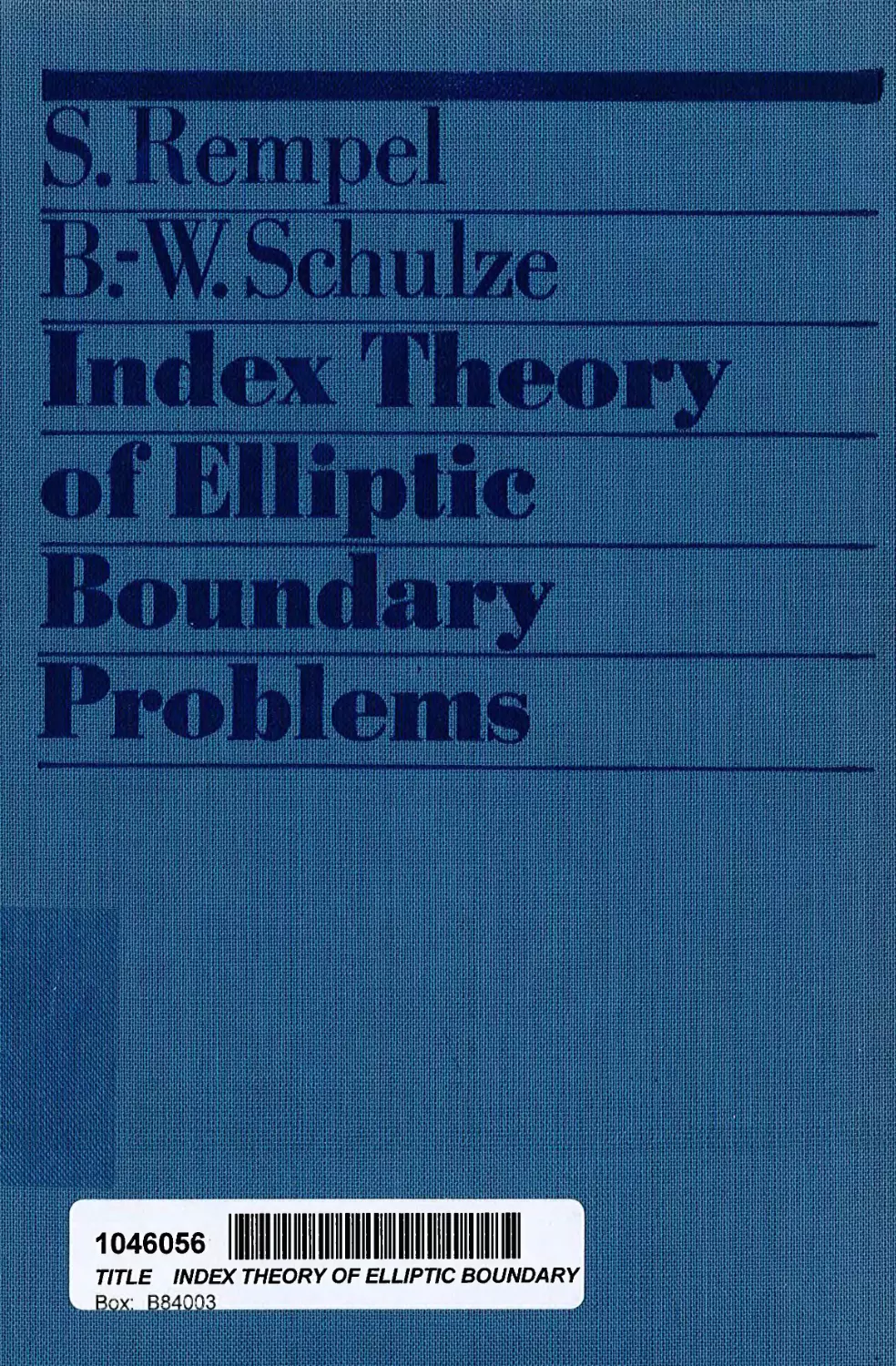


Автор: Schulze B.-W. Rempel S.
Теги: mathematics differential equations natural sciences elliptic problems
ISBN: 0-946536-85-6
Год: 1982

Текст
                    1046056
TITLE INDEX THEORY OF ELLIPTIC BOUNDARY

Mathematische Lehrbiicher und Monographien
Herausgegeben von der Akademie der Wissenschaften der DDR
Institut fiir Mathematik
II. Abteilung
Mathematische Monographien
Band 66
Index Theory
of Elliptic Boundary Problems
von S. Rempel und B.-W. Schulze

Index Theory
of Elliptic Boundary
Problems
by Stephen Rempel and Bert-Wolfgang Schulze
NORTH
OXFORD
ACADEMIC
L·^
NORTH OXFORD ACADEMIC
OXFORD 1985

Dr. Stephen Rempel
Prof. Dr. Bert-Wolfgang Schulze
Institut fur Mathematik
cler Akademie der Wissenschaften der DDR
© Akadcmic-Vcrlag Berlin 1982
All rights reserved
NORTH OXFORD ACADEMIC Publishing Company Ltd
242 Banbury Road, Oxford OX2 7DR, England
Printed in the German Democratic Republic
British Library Cataloguing in Publication Data
Rempel, Stcphan
Index theory of elliptic boundary problems.
1. Differential equations. Elliptic
2. Boundary value problems
I. Title II. Schulze. Bert-Wolfgang
5I5.3'53 QA377
ISBN 0-946536-85-6

Preface
Subject of this monograph are essential parts of the theory of boundary value problems
for elliptic partial differential equations and pseudo-differential equations. The
theory presented here is arranged with the consequent use of pseudo-differential
operators and symbolic calculus.
The elliptic partial differential equations form a large region of the analysis. A
great number of important applications mainly of theoretical physics gives rise to
problems for such types of equations. Moreover its theory of solvability is used for
the solution of many types of non-elliptic problems in partial differential equations.
The theory of pseudo-differential operators has been developed and first checked
in connection with elliptic equations and inoludes many traditional aspects such as
methods of potential theory, singular integral operators or functional analysis. A
culminating point of the development was the index theory connecting analytical
properties of the index of Fredholm operators, represented as elliptic
pseudo-differential operators, and deep geometrical and topological facts. One of the main results
is well-known as the Atiyah-Singer index theorem. Besides the original papers, (cf.
Ατι yah/Singer [2]) there is a number of monographs (cf. (Palais* [1]). Recently
there have been discovered interesting applications of the jindex theory for'the
solvability of fundamental equations in gauge theory.
Independently of geometrical and topological relations elliptic partial differential
equations have been studied in the analysis already for a long time. Essential problems
are the elliptic regularity in various function and distribution spaces (e.g. Sobolev
and Holder spaces) and in this connection a-priori estimates and parametrix
constructions, further properties of the ellipticity of the boundary conditions,
calculation of the index, investigation of the spectrum of the considered problems and
the study of operators with various types of degeneracies. There are some basic
monographs treating the various aspects of elliptic boundary problems (cf. Miranda [1],
Lions/Magenes [1], Eskin [3]) and a large number of original papers.
As far as the authors know, until now there is no monograph in the international
literature treating the theory of elliptic boundary value problems under the aspect
of pseudo-differential operators including the topological aspects of the index theory.
It is our aim to fill this gap by the present book. Here we refer to the papers of ViSik/
Eskin [2, 4, 6], Eskin [3] and of Boutet de Monvel [1, 3, 4].
The starting object is the class © of operators introduced in Boutet de Monvel [4]
containing besides the classical elliptic boundary problems their parametrices, too.
Thus all assertions about elliptic operators in the class Qb are valid especially for
classical elliptic boundary problems. An essential point of view in the whole theory
is the symbolic calculus for interior and boundary symbols. & is closed under compo-

6 Preface
sition and other natural operations which are compatible with corresponding
operations on symbolic level. The new feature in connection with boundary problems are
the boundary symbols whereas the interior symbols correspond to the usual (principal)
symbols of operators on manifolds without boundary. Despite of the fact that the
boundary effects require deep and rather difficult analytical tools, the supporting
idea in the majority of global constructions is nothing else than to make systematical
use of the formal correspondence between the symbolic and operator level and to
copy the usual methods of the case without boundary. This philosophy is of course
a program to generalize much more results about elliptic pseudo-differential operators
to elliptic boundary problems. That there are some unexpected hurdles is not only
due to the transmission property of symbols, a property which refers to the boundary.
There are topological obstructions for the existence of elliptic boundary problems
and the analytical apparatus has to be bloated in an unpleasant way. Nevertheless,
the idea of symbolic calculus in connection with boundary problems gives an excellent
insight into the nature of elliptic operators in (5j and a survey on the whole set of
such operators. This is due to the homotopy classification in connection with the
index theorem which has been proved by Boutet de Monvel [4]. An essential part
of our exposition is devoted to the analytical and topological foundation of the theory
of operators in (5j and to the usual Fredholm and regularity theory of elliptic operators
in (5j. Moreover results of the authors are presented, among other things about
elliptic complexes on manifolds with boundary, clutching construction for boundary
problems, analytical index formulas for elliptic operators in (5j, non-elliptic boundary
problems and a priori estimates in Sobolev spaces Hs> p with ρ Φ 2 and Holder spaces.
In the last chapter a collection of some further problems and working directions is
given. In section 4.3.7 there are given further comments to the contents of this
monograph and to the literature. Finally let us mention that also in Grubb [3] —[5] many
details of the calculus of the class © are carried out.
For reading this book some knowledge is supposed about pseudo-differential
operators, functional analysis and if-theory. The basic facts of these tools are
contained in the first chapter.
Acknowledgement:
The authors should like to thank Dr. W. Hoppner who contributed section 4.3.1
and gave some hints concerning section 3.1.2.1.
We also would like to thank Dr. G. Albinus for the improvement of some details
and the Akademie-Verlag without its care and assistance the book would have been
impossible.

Contents
Symbol Index 10
1. Introduction 13
1.1. Basic facts from functional analysis and algebraic topology 13
1.1.1. Fredholm operators ' 13
1.1.1.1. Fredholm operators in topological vector spaces 13
1.1.1.2. Fredholm operators in Banach spaces 16
1.1.2. Vector bundles 17
1.1.2.1. Vector bundles over topological spaces 17
1.1.2.2. Vector bundles over manifolds 22
1.1.3. Elements of Jf-theory 25
1.1.3.1. Definitions and general facts 26
1.1.3.2. The /ί-functor for locally compact spaces 29
1.1.3.3. The Bott periodicity 33
1.1.3.4. Fredholm operators and /ί-functor 36
1.2. Pseudo-differential operators » 38
1.2.1. Distributions and Fourier transform .-.-. 38
1.2.1.1. Distributions '. 38
1.2.1.2. The Fourier transform and Sobolev spaces 41
1.2.2. Oscillatory integrals 47
1.2.2.1. Amplitude functions 47
1.2.2.2. Phase functions 61
1.2.2.3. Oscillatory integrals 66
1.2.2.4. Fourier integral operators 68
1.2.3. Pseudo-differential operators 61
1.2.3.1. Definitions and basic facts 61
1.2.3.2. Definition by general amplitude functions 63
1.2.3.3. Adjoints and compositions 66
1.2.3.4. Change of coordinates 67
1.2.3.6. Continuity in Sobolev spaces 70
1.2.4. Elliptic pseudo-differential operators on manifolds 72
1.2.4.1. Pseudo-differential operators on manifolds 72
1.2.4.2. Elliptic operators and their index 76
2. Operators in the half space and on manifolds 82
2.1. Operators on the half axis 82
2.1.1. Certain function spaces 82
2.1.1.1. The spaces H, Я+, H~ 82
2.1.1.2. Further properties of the projectors Π- 90
2.1.1.3. The operator Π' 92

8 Contents
2.1.2. Boundary symbols in the one-dimensional case 93
2.1.2.1. Fredholm property of Wiener-Hopf operators 93
2.1.2.2. Definition of boundary symbols 96
2.1.2.3. Compositions and ad joints 99
2.1.2.4. Calculation of inverses 107
2.2. Symbols in the half space Ill
2.2.1. The spaces H®S™, H+®S™, Η~®&» Ill"
2.2.1.1. The space H+®S™ Ill
2.2.1.2. The spaces H~®S™ and H®Sm 116
2.2.1.3. The space H+®H~®S™ 117
2.2.2. Symbols with the transmission property 118
2.2.2.1. Definition and various characterizations of the space 9(w 118
2.2.2.2. Further properties 121
2.2.2.3. Homogeneous symbols with the transmission property 123
2.2.3. Potential and trace symbols 126
2.2.3.1. Definition and various characterizations of the space $w 125
2.2.3.2. Definition and various characterizations of the space %m>d 126
2.2.3.3. Homogeneous symbols 127
2.2.4. Green symbols 129
2.2.4.1. Definition and various characterizations of the space 58й'·d 129
2.2.4.2. Homogeneous Green symbols 130
2.2.6. Boundary symbols and symbols in the half space 130
2.2.6.1. The space Wn>d 130
2.2.6.2. Symbols in the half space 134
2.3. Classes of operators in the half space and on manifolds 135
2.3.1. Pseudo-differential operators with the transmission property in the half
space 135
2.3.1.1. Properties of Op (№») 135
2.3.1.2. Smoothness in the half space 136
2.3.2. Potential, trace and Green operators in the half space 139
2.3.2.1. Definitions and basic properties 139
2.3.2.2. Interpretation as pseudo-differential operators with operator-valued symbol 144
2.3.2.3. Relations between the various operator classes 147
2.3.2.4. Я» continuity 164
2.3.2.6. H*>P continuity 161
2.3.2.6. Continuity in Holder spaces 165
2.3.3. Operators on manifolds 169
2.3.3.1. The class & 169
2.3.3.2. Compositions and adjoints 175
2.3.3.3. Я*. Ρ and Holder continuity on manifolds 176
2.3.4. The norms of operators modulo compact operators 177
2.3.4.1. Pseudo-differential operators in the half space 177
2.3.4.2. Estimates for boundary symbols 182
2.3.4.3. Boundary operators with continuous principal symbols 186
2.3.4.4. Operators on manifolds 191
3. Elliptic operators on manifolds with boundary 194
3.1. Elliptic boundary value problems 194
3.1.1. Ellipticity and Fredholm property 194
3.1.1.1. Ellipticity of boundary problems 194
3.1.1.2. Construction of elliptic boundary problems 200
3.1.1.3. Classical elliptic boundary problems 208
3.1.1.4. Α-priori estimates in H*>P and Holder spaces 217
3.1.1.6. Fredholm operators in a special matrix form 218
3.1.2. Examples and Remarks 222
3.1.2.1. The operators Λ- and reduction of the orders 222

Contents 9
3.1.2.2. Adjoints with respect to Green formulas 236
3.1.2.3. Over- and underdetermined elliptic boundary problems 237
3.1.2.4. Generalization of the Calderon-Seeley projectors 241
3.2. Index of elliptic boundary value problems 243
3.2.1. The group Ell (X, Y) 243
3.2.1.1. Stable equivalence and homotopies of operators 243
3.2.1.2. Homotopies of symbols 246
3.2.1.3. Reduction to the boundary and theorems of Agranovic-Dynin type 262
3.2.2. if-theoretic aspects 257
3.2.2.1. A connection between the index element and the difference element of the
symbol 267
3.2.2.2. On the analytical proof of the Bott periodicity theorem 259
3.2.2.3. The index homomorphism 264
3.2.2.4. The index theorem for.boundary value problems 265
3.2.3. Elliptic complexes 271
3.2.3.1. Generalities on complexes 271
3.2.3.2. Complexes on manifolds with boundary 282
4. Further results ou boundary value problems 289
4.1. Analytical index formulas . . .; 289
4.1.1. The "coarse" index formula 289
4.1.1.1. Formal complete symbols 290
4.1.1.2. Theorems on the regularized trace 292
4.1.1.3. The "coarse" index formula 302
4.1.2. Improved index formulas 306
4.1.2.1. Elliptic tupels 306
4.1JJ.2. The half space situation 310
4.1.2.3. Constructions for manifolds 317
4.2. Non-elliptic boundary value problems 321
4.2.1. Certain Fredholm operators connected with non-elliptic boundary problems 322
4.2.1.1. Reduction to the boundary v 322
4.2.1.2. Additional trace and potential conditions .j 324
4.2.1.3. Construction of a parametrix 328
4.2.1.4. Reduction to the interior boundary ' 329
4.2.2. Examples and regularity in Sobolev spaces 331
4.2.2.1. Some classes of interior boundary value problems 331
4.2.2.2. The oblique derivative problem and further examples 336
4.2.2.3. Regularity in Sobolev spaces ' 339
4.2.3. Over- and underdetermined systems 342
4.2.3.1. Degenerate underdetermined boundary problems 342
4.2.3.2. The overdetermined case 347
4.3. Discussion of further problems 352
4.3.1. Cr-invariant operators 362
4.3.2. Operators without transmission properly 354
4.3.3. Sobolev type problems 358
4.3.4. Interior boundary problems and degenerate operators 362
4.3.6. Transmission and mixed problems 363
4.3.6. Parabolic boundary problems 367
4.3.7. Historical remarks and comments to the literature 376
Bibliography 379
Index 391

Symbol Index
Standard notations
coker 13
deg 94
diag Ω 62
dim 13
GL(fc, C) 18
im 13
ind 14, 196, 244,
inda 77, 266
indt 77, 79, 264
ind* 37
266,
272,
289
ker 13
ker* 36
Sl 21
sing supp
supp 39
tr 16
WF 40
δχ 39
I 38
Z+ 38
40
Notations from topology and Ji-tlicory
[E] - [F] 25 T*X, TX 22
S± 25 Vect (X) 18
E* 15 Vect^SX) 22
S*E 20 X* 30
Horn (E, F) 18 XjY 21
Horn"» {n*E, n*F) 73 [X, S] 37
i\ 264 X1 ν X2, ^ л X2 21
»» 21 <5 28
ЩХ) 26 Л? 19
K{X) 26 π* 28
<S*X 21, 29 U9 20
Spaces ot functions and distributions
Β*, ρ 46 Я', Hj 83
G(X-,E) 18 Я*.г> 46
0«(Л«) 166 (H+),,(Ho), 104
0*(β) 39 Я+ ® tf» 113
0*(Д) 39 H-®Sm,H®Sm 116
ί?«(#η) 166 Я*(Л») 42
С">(Х,Е) 22 Яв(Я) 43
0?(Х,Е) 24 Н»(Л) 43
0»{Sl), OZ(Sl) 87 Η\Μ,Ε) 24
5)'(β) 39 HS(M,E) 44
J7>'(M,#) 44 Η'^Μ,Ε) 44
£'(β) 39 H(0C(M,E) 44
Я, Я+, Η", Я0, Я- 83 ϋ»(β) 39
Я„ Я^Г 83 ЩХ,Е) 24

Symbol Index
11
Llo^X, E), Ц0С(Х, E) 24
LKS1), Щв1) 87_
<У{Е), <Г{Я+), <T(Si_) 82
сУ( Rn) 39
<f0( E_) 82
<Гв 82
<Г( Sin) 39
F+, F" 83
Spaces of operators
(S0 243
@(X, Y) 266
«Г(#, J») 14
&> 164
ffl», ®».<*, ©'»·<*, ©».*(X, Г) 143, 171
®(X, Г; #, i?7, J, (?) 171, 176
&f>d 186
5Sf(Hlf Ht) 16
ЛГ(#, J1) 14
X(E, F) 13
£'n(i?), £-, £-°° 61
ig\ 62
ZJ5 76
L«(X; €k, &l), L%{Xi €k, €l) 61
Lm(M; E,F) 72
Op («*) 136
Op (««·) 143
Op(58-°°.rf) 140
Op (»»·*) 143
Op(ft-°°) 140
Op (ft»») 141
Op (»»■*) 143
Op (©·».*) 143
Op (<Bm>d), Op (©».«») (Χ, Γ) 174
Op (£-°°.(ί) . 140
Op (£»»■<*) 143
J-(HltHt) 16
Spaees of symbols
«» 118
«°°, «-°° 118
«<»> 123
W«((0' χ Д+) х β») us
«ϊ*((β' X Я?+) Χ Λ") 122
№» 124
W*)(X; Β, -F) 170
Й<0) 246
Slff 260
»».*, Я» 130
$»»,<*(£' χ Λ»+ΐ) 129
»(»).*(β' χ Ця+i) 130
ft»», ft"'(β' Χ Λ") 126
ίί<*·>(β' Χ Ди) 127
81»·*, 81, 8J°°>d, 81-°°·*, 81» 98, 134
Ши».<* 132
8Κ»»>.<*(β' χ Ди-i) 133
8У»).<*(Г) 173
8TF5 186
£»(Д X |рт) 47*
£оо} £-оо 47
#-°°(β χ Д#) 60
£»((Д' X Л+) X Д№) 118
<2>»».<*, «*■*(£' X J?+) 134
®(»>.<*(Χ, Г) 174
©§·»>.<* 186
ϊ».*, %™,%™>*{Ω' χ л») 127
Ж(»).*(Д' X Л») 128
Special operators or mappings
'Л 16
Л* 16
U* 236
r+Л 136
3>s 217, 224
i+, j- 82, 135
Xtyj 222
.5?£,.5?£ 224
Op 76, 170, 174
Rk 177
r' 44, 92
r+,r~ 82, 136
^ 244
Л5 78
Л£ 222, 224
Я+, Я" 83
π+, π" 87
Я' 92
Я^- 96
Π+σΑ 93

12 Symbol Index
Special symbols of operators
ajoc^ GG IJ+a 93
0[0](a', £') 133 ΠΌΤ 96
%)(*Ί£',ν) 118 Π'σΒ 97
*[0](a?'f ξ', ν) 125 ад 62
1+{χ, ξ), Ι-(χ, ξ) 223 <τ(Λ )(*,£) 63
'[0](«Ί £', ν) 126 σ0(Λ) 194
d,(*',v) 154 <rF(<*) 172
Α^, Λ^ 223 ωΒ 223
The Fourier transform
Ρ 41
Λ» 144
ί* 41
Other notations
С φ 52 PDO 61
d{aA) 79 Λφ 53
Ell (Ζ, Υ) 244

1. Introduction
1.1. Basic Facts from Functional Analysis and Algebraic Topology
1.1.1. Fredholm Operators
1.1.1.1. Fredholm Operators in Topological Vector Spaces
In this section we collect standard facts from the theory of Fredholm operators.
Besides Fredholm operators in Banach spaces our applications will also require
Fredholm operators in Frechet spaces. Therefore we start with the case of general
topological vector spaces. For the theory of topological vector spaces cf. Robertson/
Robertson [1], Schaefer [1], Treves [1].
Let E, F be topological vector spaces (over €). Denote by Jf(E, F) the vector
space of all linear continuous operators A i Ε -> F.
A linear operator A: Ε -> F is called bounded if it sends any bounded set in Ε into
a bounded one in F.
We assume in the following all topological vector spaces to be Frechet spaces,
i.e. complete metrizable locally convex vector spaces. Note that most of the
statements in this section hold under more general assumptions (cf. Treves [2]).
Proposition 1. A linear operator A:E -> F is continuous iff it is bounded.
To any A 6 ϊ(Ε, F) define the vector spaces
ker A = {u e E: Au = 0} ,
the kernel of A, and
im A = {/ 6 F: Au = f for some ue Ε} ,
the image of A. Define by
coker A = Fjim A
the cokernel of A. For a vector space V denote by dim V the dimension of V (which
can be infinite).
Definition 2. An operator A e 1{E, F) is called Fredholm operator if
dim ker A < oo and dim coker A < со .

14 1.1.1. Fredholm operators
The number dim ker A — dim coker A is called the index of the Fredholm operator A
and denoted by ind A. The set of all Fredholm operators in Ϊ(Ε, F) is denoted by
?{E, F).
Proposition 3. Let A e X{E, F) and dim coker A < со. Then im A g F is closed
and there is a finite-dimensional subspace W Q F such that F ^ W 0 im A (topological
sum and isomorphism). Especially every A e &(Ε, F) has these properties.
Proposition 4. Let A e &(F, О), В е <?(E, F). Then AB e <?(E, Q) and
ind AB = ind A + ind В .
A linear operator С: Ε -*■ F is called compact if it sends some open neighbourhood
of 0 in Ε into a relatively compact set in F. Denote by Ж(Е, F) the vector space of
all compact operators from Ε to F. Each compact operator is continuous, i.e.
Ж(Е, F) g 1(E, F). Let A e Jf(E, F), A' e 1(0, E) and В е 2C(F, 0). Then
BA 6 Χ(#, 0) and 4'Я e Χ(ί\ Ε). Especially Ж(Е, E) is a (two-sided) ideal in
Jf(E, E).
Proposition 5. Let С e Ж(Е, E). Then 1 + С e <?"(#, Я) and ind (1 + C) = 0.
Л € Jf(JS?, jF) is called operator of finite rank if dim im A < со. All continuous
operators with finite rank are compact.
Proposition 6. Let E, F be Frechet spaces. Then for A e Jt(E, F) the following
conditions are equivalent'.
(i) Ae<?(E,F);
(ii) there exist operators L, R e Jf(F, E) such that LA — 1E e Ж (Ε, Ε),
AB-lPt2C(F,F);
(iii) there exists an operator Ρ € X(F, E) such that PA — lB and AP — 1F are
operators of finite rank. (1E and 1F denote the identity operators in Ε and F,
respectively).
The operators L and R in Proposition 6 (ii) are called left and right parametrices,
of A, respectively. If A 6 X(E, F) has a left and a right parametrix, then any right
parametrix is also a left one and conversely.
Instead of 'parametrix' sometimes the notation 'regtdarizer' is used in the literature.
We prefer the first notation, since in our applications we mainly deal with pseudo-
differential operators.
Denote by π: X(E,F) -* 1(E, F)jJC(E, F) the natural projection onto the factor
space and let π A e 1(E, F)IJC(E, F) be the image of A € 1(E, F) under π.
Corollary 7. Under the assumptions of Proposition 6 A e X(E, F) belongs to J(E, F)
iff π A 6 X(E, F)IJC(E, F) is invertible, i.e. has an inverse (πΑ)~ι in 1(F, E)IJC(F, E).
If Re <F(F, E) is a parametrix of A, then (πΑ)~χ = πΚ, i.e., for any С e Ж(Е, E)
R -f- О is a parametrix of A -f- С, С б Ж (Ε, F) arbitrary. If R, R' are parametrices
of A, then we have R — R' e Ж(Е, Е).

1.1.1.2. Fredholm operators in Banach spaces
16
1.1.1.2. Fredholm Operators in Banach Spaces
In this section let all vector spaces be Banach spaces, i.e. complete normed vector
spaces. The theory of Fredholm operators in Banach spaces is presented in many
monographs, cf. Atiyah [2], Atkinson [1], Gohberg/Fel'dman [1], Gohberg/
Krupnik [2], Palais [1]. The assertions of the previous section are true in this special
case, too. Point out that particularly the conditions of 1.1.1.1, Proposition 6 are
satisfied and Fredholm operators are characterized by the existence of a parametrix.
An essential new point in the case of Banach spaces is the homotopy invariance of
the index of Fredholm operators to be described later.
Let E, F be Banach spaces. Then Jf (E, F) is a Banach space with the norm
||4||= sup, {|И«||,Ь AeJf(E,F)
Н«Пл£1
(||·||ε and \\·\\ρ denote the norms in Ε and F, respectively). Then Jf(E, E) is a Banach
algebra and Ж {Ε, Ε) is a closed two-sided ideal in Jf(E, E).
Let E', F' be the dual spaces of the Banach spaces E, F equipped with the
corresponding norms and (·,·>ε, (·,·>*■ the bilinear pairings between Ε, Ε' and F,F', respectively.
Given A 6 Jf(E, F), the transposed operator XA 6 Jf(F', E') is defined by (Au, f)F =
Proposition 1. For A e X(E, F) the following conditions are equivalent:
(i) Ae<T(E,F);
(ii) 'ie <T(F',E').
A 6 <F(E, F) implies dim ker *A = dim coker A, dim coker A = dim ker A, i.e.,
ind A = — ind *A .
An analogous proposition holds for the anti-dual spaces E*,F* and the adjoint
operator A* (if the spaces are over ϋ and the pairing is linear in the first, antilinear
in the second argument). We use the adjoint operators in the case of Hubert spaces
and the duality is given by Hermitean scalar products.
Proposition 2. Let A e &{Ε, F). Then there exists an ε > 0 such that A + В e <F(E, F)
for any В e 1{E, F) with \\B\\ < ε and
ind {A + B) = ind A .
This means that <F(E, F) с Jf (E, F) is an open set if <F(E, F) is considered in the
topology induced by 1(E, F).
Definition 3. Two operators A0, 4i € <F{E, F) are called homotopic (through
Fredholm operators) if there is a continuous mapping
f:[0,l]-+<T(E,F)
with /(0) = A0, /(1) = Av Then we write A0 ~ Аг.
Let for instance A e &(E, F), С e Ж{Е, F). Then f{t) = A + tC, t e [0, 1] is a
homotopy of Fredholm operators (cf. 1.1.1.1, Corollary 7), i.e., A + С ~ A. For two
parametrices R0, Лг of A e &{Ε, F) we have li0 c^ Лг because of Ii0 — Rxe 3€{F, E).
Proposition 4. A0, Αλ e &{Ε, F), A0 ca Ax implies ind A0 = ind Ar
For Hilbert spaces E, F the converse is also true, i.e., AQ ^ Αλ ΦΦ ind A0 = ind Ax.
The dimensions dim ker A and dim coker A, A e ^(E, F), are semi-continuous in
the following sense: For given A0 e ^{E, F) there exists an open neighbourhood U

16 1.1.1. Fredholm operators
of A0 in <?(E, F) such that
dim ker A0 ^ dim ker A, dim coker AQ ^ dim coker A
for all A 6 U.
Example. The following example shows that the index of Fredholm operators in
Frechet spaces is no homotopy invariant. For the notations cf. 2.1.2.1. Let o* be a
smooth function on S1 with values in €. Then π+σ: C+iS1) -+ C°£(Sl) is a Fredholm
operator iff a has not more than a finite number of zeros of finite order. n+zk, к e Ζ
arbitrary, is homotopic to the identity through Fredholm operators in C+ft1).
The homotopy follows from at =■ zk — 2t, t€ [0, 1], since zk — 2 is homotopic to a
constant function.
Next we consider the case of Hubert spaces.
Definition 5. Let Hlt H2 be Hubert spaces. An operator A e Х{Нг, H2) is called
Hilbert-Schmidt operator if Σ |Ие/||2 < oo for a complete orthonormal system {e^}
5
in Hv The space of all Hilbert-Schmidt operators from Hx to H2 is denoted by
X(Hlt H2).
If A* denotes the adjoint operator of A (with respect to fixed Hermitean scalar
products), we have A 6 Ж[ДХ> Н2) фф А* e Ж(Н2, Я,). All Hilbert-Schmidt operators
are compact, i.e., Э€{Нг, H2) ^ 3£(ДХ, Н2).
Definition 6. An operator A e Jf{Hlt H2) is called trace class operator if
Σ \(Aej> fi)\ <C oo for all complete orthonormal systems {e^} in Нг and {fj) in H2.
i
The space of all trace class operators from Hx to II2 is denoted by <T{Hlt H2).
It is easily checked that Aj e 3€{HhH0), j = 1, 2, and A = А*Аг implies
A.£<J~{Hlt H2). Conversely any trace class operator A has a representation as a
composition of two Hilbert-Schmidt operators. All trace class operators are Hilbert-
Schmidt operators, i.e., <T{Hlt H2) g 3€{Hl} H2). For Нг=Н2= Η and А е<Т{Я, Н)
the finite number tr A = Σ (^e/> ei) is called trace of the operator A. This definition
3
is correct, i.e. independent of the choice of the complete orthonormal system {e^}
in#.
Proposition 7. Let А £<У(Н, Н). Then the spectrum of A consists of a countable
number of eigenvaluesXj and tr A = Σ^ι (them's are taken with their multiplicities).
5
This is the generalization of a well-known result from the theory of matrices.
Proposition 8. Let A e ${Hlt H2) and suppose that there exists an operator R e X(H2, Hx)
such that for some N e Z+
(lHl - RA)N 6«nfflf HJ, (1H§ - AR)N tJ-{H2, H2) .
Then A 6 ^(Нг, Н2) and
ind A = tr (lHi - RA)N - tr (1Д§ - AR)N .
Definition 9. Let X be a topological space. A continuous map A: X -> <У(Н1, Н2)
is called Fredholm family (over X). Two Fredholm families AQ, Ax are called homotopic
if there is a continuous map /: [0, 1] X X -> &{HX, H2) with /(0, ·) = A0, /(1, ■) = Av

1.1.2.1. Vector bundles over topological spaces
17
Proposition 10. Let A be a Fredholm family over a compact space X. Then there
exists a subspace V c: Hxof finite codimension with
V η ker A(x) = {0} for all χ e X
and a finite-dimensional subsj)ace W С H2 with
W + im A{x) = H2 for all χ e X .
Particularly, we have
sup {dim ker A(x)} < со , sup {dim coker A(x)} < со .
xtX ztX
It is not hard to show that any Fredholm family A: X -> <?{H19 H2) over a compact
parameter space X has a parametrix R: X -> <F{H2, HJ, i.e., per def. R(x) is a para-
metrix of A(x) for all χ e X and R is a Fredholm family. The 'parameter-depending
index1 of a Fredholm family is called the index element and turns out to be an element
of the if-group of the space X. For details cf. 1.1.3.4.
Later we shall have to consider families of Fredholm operators acting between
Frechet spaces Hlt H2. In our special situation they have the same properties as for
Hubert spaces, since they have closures as Fredholm families in Hubert spaces
•preserving kernels and cokernels.
The notion of Fredholm operators can be generalized in several directions. For
instance, let Я be a Hubert space and Μ, Ν closed subspaces. The pair (Μ, Ν) is
called a Fredholm pair if dim (Μ η Ν) < со, codim (Μ + Ν) < со (cf. Kato [1],
Cordes [1]). Then
ind {M, N) = dim {Μ η Ν) = codim {Μ + Ν)
is called the index of the Fredholm pair. If for instance A: Hx -> H2 is a Fredholm
operator and Η = Hl Χ Η2, Μ = {(χ, Αχ): χ 6 Нг}, Ν = {(χ, 0): χ е Нг}, then
{Μ, Ν) is a Fredholm pair with ind A = ind (Μ, Ν).
1.1.2. Vector Bundles
1.1.2.1. Vector Bundles oyer Topological Spaces
Certain aspects of the theory of differential and pseudo-differential operators are
connected with real and complex vector bundles in a natural way. In this section we
give (without proofs) some basic facts on vector bundles. They are also needed for
the if-theoretic considerations in the next section. Concerning references with more
detailed information cf. Atiyah [3], Atiyah/Singer [2], Janich [1], Kuiper [1],
Hirzebruch [1], Schwartz [1], Palais [1], Breuer [1], Friedrich [1].
Definition 1. Let Ε, Χ be Hausdorff spaces and π: Ε -> Х^а continuous map.
Ε is called a vector bundle over X if
(i) Ex = яг1 {{x}) is a vector space (over a field К equal to It or €) for all χ 6 X,
(ii) for all χ e X there exists an open neighbourhood U of χ and a homeomorphism
φ: π"1 (ϋ) -+ U X Kk, к = k(U) , (1)
with φ{Εχ) = {χ} Χ Кк so that the map Ex ->■ Kh (defined as composition of φ
and the projection {χ} Χ Кк -> Кк) is an isomorphism between the vector spaces
over K.

18 1.1.2. Vector bundles
X is called the base of Ε, π the projection. Ex is called the fibre over x. (1) is called
* a (local) trivialization and shall be denoted by .{U, φ). Ε is called trivial if there exists
a trivialization with U = Χ. Ε is called complex (real) if К = € (К = R).
Vector bundles Ε with the base X and the projection π are sometimes denoted by
the triple (Ε, π, Χ).
For simplicity we suppose in this section that the base space X is compact. It
is left to the reader to check which definitions and assertions are to be modified for
non-compact X. Later vector bundles occur as base spaces. They are locally compact.
We shall mainly consider the case К = €. The considerations for К = IR are
similar. Let Ε be a (complex) vector bundle and take trivializations (ϋ,φ), (V,rp)
of Ε over U and V, respectively. Then we have a mapping
φ ο ψ"1: (U η V) X €k -+ (U η V) X €k (2)
which is linear in the fibres over corresponding points so that there is defined a
continuous function
guv:U nV^GL(k, €) (3)
(as usual GL (k, €) denotes the group of complex (k X k)-matrices with non-
vanishing determinant). The functions guv are called transition functions of the
considered vector bundle. If (U, φ), (V, ψ), (W, ω) are trivializations of E, we obiously
have
9uv ° uvw = <Juw over U η V η W . (4)
The functions guv are also called the cocycle belonging to E.
If (Ε, π, X) is a vector bundle and XjiJia subspace, (Elt π,, Хг) with Et = π~1(Χ1)
is a vector bundle over Xv We also set Ελ = Ε\Χι, and E\Xi is called the restriction
of Ε to Xv
A continuous map s: X -> Ε is called a (continuous) section if π ο s is equal to the
identical mapping. The set of all (continuous) sections in Ε is denoted by C(X, E).
This set is obviously a vector space if we define (Xs)(x) = Xs(x), λ 6 €, and (s^ + s2) (x) =
= s^x) + s2(x), χ e X .
Let (U, φ) be a trivialization of Ε and s 6 C(X, E). Then sv = φ ο s\ υ: U ->· U X €k
is a section in the trivial bundle U X €k. If (V, ψ) is a second trivialization we have
Su = guvsv over U η V.
Definition 2. Let (Ε, π, Χ), (Ε', π', X') be vector bundles. If a: E -► Ε', α0: Χ -► Χ'
are continuous mappings with α0π = π'a and α|Εχ: 2?ж -*■ E'„o^ linear for all a;el,
(a, a0) is called a bundle morphism from (Ε, π, X) to (E', n', X'). If a, a0 are one-to-one
and onto (a, a0) is called an isomorphism.
Instead of bundle morphisms we also speak of homomorphisms between the
corresponding bundles. If there exists an isomorphism between Ε, Ε', we write
E= E'. This defines an equivalence relation for vector bundles. By Vect (X) we
denote the set of classes of isomorphic (complex) vector bundles over X. Sometimes
we do not distinguish between a bundle and the class in Vect (X). For abbreviation
bundle morphisms are also denoted by α: Ε -> Ε' (this is justified since the base
space can be considered as the 0-section).
We denote by Horn (E, F) the set of all bundle morphisms Ε -> F for X = X' and
α0 = Ίάχ. In Horn (E, F) we have canonically a vector space structure (over €).
A vector bundle (Ε, π, X) with the fibre €k is trivial iff it is isomorphic to (X X €k,
щ, Χ) (πχ: (χ, e) -> χ denotes the corresponding canonical projection). If we consider

1.1.2.1. Vector bundles over topological spaces
19
a trivial bundle with fibre €k over some fixed space X we often write €k instead of
X X €k or sometimes simply k. A vector bundle (Ε, π, Χ) with fibre €l is trivial
iff there exist sections sv ... , st which are linearly independent over each χ 6 X.
If X is a contractible space every vector bundle over X is trivial.
A vector bundle Ε over X gives rise to a system {gVv} of transition functions.
Here {U, V, ...} denotes an open covering It of X which is supposed to be fixed.
Conversely, knowing the system {guv}> the vector bundle Ε can be reproduced by
the following procedure. Let Ε be the disjoint union of all sets U X €k (U e IX) and
X the disjoint union of all U e 11. We consider Ε and X in the corresponding product
topologies. Then the canonical projection h: Ε-> X (defined by U X €k -> U)
is continuous. In Ε we define an equivalence relation by (x, e) — (y, /) for
{x, e) 6 U X €k, {у, /) 6 V X €k<=>x = у, е = guv{x) / (cf. (4)). Put Ε = E/~ and
consider Ε with the factor topology. Then π induces a continuous projection π: Ε -> Χ
and it is easily seen that Ε is a vector bundle over X in the sense of Definition 1.
In Definition 1 the number к may depend on U, but к is locally constant, i.e.
constant on connected components of X. If к is the same for all χ e Χ, Ε is called a
vector bundle over X with fibre €k. Then GL (k, €) is called the stmcture group of
the bundle. One can show that there always exists a system of trivializations for
which the unitary group U(k) is the structure group.
The concept of bundles over a space X with the fibre L can be easily generalized
to the case if L is a more general topological space. Let Aut (L) be the group of homeo-
morphisms of L onto itself (equipped with a suitable topology) and О some topological
group. Let It = {U, V, ...} be an open covering of X, and guv: U η V -+ G a, cocycle
of continuous functions in G. Moreover let α: О -> Aut (L) be a continuous homo-
morphism. Then <x{guv) *s a cocycle of continuous functions U η V -> Aut (L).
Similarly as for vector bundles one defines, by using the disjoipt union of the U X L
(U 6 It) and an equivalence relation given by <x{guv)> an associated bundle oyjer X
with fibre L. Then <x(G) is called the structure group of this buntile.
An important example is the case L = G for a Lie group G and α — ide (G acts on
itself by multiplication from the left). The resulting bundles are called principal
fibre bundles.
One can consider Hubert space bundles, too, i.e. bundles over X the fibre of which
is a (real or complex) Hubert space and the structure group of linear automorphisms
of Η onto itself (cf. 1.1.3.4).
From now on it is useful to suppose that the open sets U of the covering It are
all contractible.
Starting from given bundles one can define further bundles. Let e.g. E, F be vector
bundles over X with the fibre €k and €l, respectively, and guv and huv, respectively,
the corresponding cocycles of transition functions, with respect to the covering
It of X. Then guv ®hOV is a cocycle of isomorphisms in €k 0 €l. The corresponding
associated vector bundle over X is denoted by Ε 0 F (and is called direct sum of
Ε and F).
Analogously guv (x) huv (defined by guv (x) huv(e (x) /) = {guve) (x) {huvf)) is a
cocycle of isomorphisms in €k (x) €l. The corresponding associated bundle is denoted
by Ε (x)F (and called the tensor product of Ε and F). Moreover guv л ... л guv
{ρ factors) (defined by {guv л ... л guv) (e, л ... л ер) = (g^e,) л ... л {guvep),
βι,... , ep 6 €k) is a cocycle of isomorphisms in /\p €k. Thus there follows an associated
vector bundle /\p Ε (the exterior product of E). Let e,, ... , ek be a base in (0k inducing

20 1.1.2. Vector bundles
a bilinear pairing in €k. Then guv can be considered as matrix function over U η V.
Then the inverse of the transpose 'gr^V *8 a^so a cocycle of isomorphisms of C*. The
corresponding associated bundle, denoted by E*, is called dual bundle of E. The
complex conjugated xg~j£y is also a cocycle of isomorphisms in €k. One can easily
show that the corresponding associated vector bundle is isomorphic to E. The bundle
E* is isomorphic to that associated by (fuv· If huv'· U n V -+ GL (k, R) (U, V e U)
is a real cocycle, one can consider hUV) too, as cocycle of isomorphisms of €k. The
associated vector bundle is called complexification of the corresponding real bundle
Η and denoted by H€.
There exists a canonical identification between the set of homorphisms of a vector
bundle Ε in a vector bundle F and the space C(X, E* (g)F). For the operations 0
and (x) between vector bundles we have the obvious rules Ε ζ& F ^ F ®E,
Ε ®Fg*F ®E, {E ®F) ®Gg* {E ®G) ®{F ®G).
Let /: Υ -*■ X be a continuous map and Ε a vector bundle over X with the fibre
€k. We define a vector bundle f*E over Y. Suppose that Ε is associated to a cocycle
guv (corresponding to an open covering U = { U, V, ...} of X). Then the sets {f~l{U),
tx{V), ...} form an open covering Ъ of Υ and f-^U) η f-^V) = f-^U η V) for U,
Fell. By {f*guv) (У) — 9uv{f(y)\ we obtain a cocycle f*gov °f isomorphisms of
€k with respect to ϋβ. The resulting vector bundle over Υ is denoted by f*E and
called the pull back of Ε with respect to /.
If the vector bundle Ε has different fibre dimensions over different components
of X, one can define the procedure in an analogous way. Thus we obtain a mapping
/*: Vect (X) -> Vect (Y), and /* is obviously compatible with the bundle operations
Θ, (x), Λρ, * (e.g. f*(E ®F)g* (f*E) ®(f*F)). For /0~Д (homotopy between
continuous mappings) we have f*E ^ f*E for all vector bundles Ε over X.
Vect (X) is an Abelian semi-group with respect to 0 and a semi-ring with respect
to 0, φ with unit element. One can consider X -> Vect {X) as a contra variant functor
into the category of Abelian semi-groups (or semi-rings). If Χ, Υ are homotopy
equivalent we have Vect {X)= Vect (Y).
One can easily show the following. If X is a compact space and Ε a (complex)
vector bundle over X there exists a vector bundle EL over X with Ε 0 E1-^ X X (DN
for some N sufficiently large.
Next we define the so called clutching construction between vector bundles.
Let X be a compact topological Hausdorff space, Xlt X2 compact subspaces
with X = Хг и X2, Υ = Хг η Χ2. Suppose that Et is a vector bundle over Xt
(i = 1, 2) and φ: E^Y -> E2\Y an isomorphism. Denote by Ег и Е2 the disjoint union
of Е1г E2. For et 6 Et (i = 1, 2) we write ex ~ e2 iff 7ti(et) 6 Υ and ^(cj) = e2 (л^ denotes
the projection in Et). The factor space of Ex и Е2 with respect to this equivalence
relation is denoted by Ex \J E2 and called the clutching of Elf E2 over Υ with respect
<p
to φ. The clutching operation has various natural properties.
(i) if Ε is a vector bundle over X and Et = E\Xi (i = 1, 2), φ the identical mapping
over Y, we have Ε^ Ex \J E2\
φ
(ii) if λί: Et -*■ Ft are isomorphisms over Xt and φ: EX\Y-*■ Ε2\γ, ψ: F-l\y -+ F2\Y
isomorphisms with ψ ο λχ = λ2 ο φ, then Ex (J ^2 = ^ι U F2 ;
φ ψ

1.1.2.1. Vector bundles over topological spaces
21
(Hi) if Eu Ft are vector bundles over Xt (i = 1, 2) and φ: E^y -*■ Ε2\γ, ψ: FX\Y -*■ F2\Y
isomorphisms, then
{Ei U E2) 0(i\ U F%)=* (Ε, ®FX) U (E2 ®F2) ,
φ V Ψ®Ψ
{Ег U Е2) (χ) (Fx U ^2)= № ® Л) U (E2 ®F2), (5)
φ ψ 9>®V
(Ελ \JE2)*=*E* U F* .
Using the clutching construction one can define new vector bundles. Let e.g.
Ej = Xj χ €k (j= 1, 2). Then each isomorphism EX\Y -* E2\Y can be represented
by a continuous map
ψ: 7-+GL(/t, €). (6)
Conversely (6) represents an isomorphism between trivial bundles. Thus φ defines a
vector bundle Ε over X (the clutching of Ev E2 by means of φ). Ιίψ: Υ -> GL (k, €)
is a second map and F the corresponding bundle over X, we have φ c^ ψ =^> Ε ^ F.
Let e.g. Xp X2 be two exemplars of the unit disc \z\ <^ 1 in the complex plane €
and Υ = S1 = {z: \z\ = 1}. Topologically the sphere JC = jS2 can be considered as
the clutching of Xx, X2 along Υ identifying corresponding points of Y, where Хг
corresponds to the upper, X2 to the lower hemisphere and Υ to the equator. Thus
any continuous matrix function
φ: Sl ^ Qb {k, €) (7)
generates some element in Vect (S2). For к = 1 and φ(ζ) = ζ-1 the corresponding
bundle over S2 is called the Hoj)f bundle. Similarly φ(ζ) = zl (I 6 Z) generates a one-
dimensional bundle over $2. The mappings φ are simply continuous functions
φ: S1 -*■ €\ {0}. To each such φ there exists some I with <рЩ zl. The number — I is
called the mapping degree of φ (denoted by deg φ).
To each matrix function φ: S1 ->· GL (λ, С) one can assign the function
det φ: S1 -> € \ {0} and it is easily seen that φ is homotopic to the map given by the
following к X к- matrix
0 . . .
1 . . .
6 . . '.
where —1= deg (det φ) .
If Χ, Υ are topological spaces, Υ ^ X, we denote the quotient space as usual by
XjY. X is called a space with base point if some point xQ 6 X is fixed. X/Y can be
regarded as a space with base point { Y} (the space Υ contracted to a point). Mappings
between spaces with base points are supposed to preserve the base points.
If Xlt X2 are spaces with base points, we denote by Хг ν Χ2 the space with a base
point, defined as disjoint union of Xv X2 and then identification of the base points
in Xv X2. Moreover set Хг л X2 = Хг X X2jXx ν X2. We regard Sl as a space with
a base point which is arbitrary and fixed. Let X be a compact space with base point.
Then we put SX = S1 л X. If we define
C+(X) = ([0, i] X X)/({0> X X) , C-(X) = ([i 1] X X)/({1} X X)

22 1.1.2. Vector bundles
and denote by C+(X) и С~(Х) the space defined by identification of corresponding
points of {\} X X in C±(X), SX is homotopy equivalent to C+(X) и С~(Х). Note
also that X = C+(X) η C~(X). The spaces C±{X) are contractible. Thus every vector
bundle over C± (X) is trivial. Each vector bundle over C+(X) и С~(Х) can be generated
by clutching of trivial bundles over C±(X) by means of a continuous mapping
φ: Χ -*■ GL (k, €). The isomorphy class of the bundle depends only on the homotopy
class of φ.
We denote by Vectjt (SX) the set of all (complex) vector bundles over SX with
fibre dimension k. Then
Vect* (SX) ^ [X, GL (jfc, €)) (8)
([·, ·] denotes the set of homotopy classes of continuous mappings between the spaces
in the brackets). Thus a vector bundle over SX uniquely determines the homotopy
class of some φ: X -> GL (k, €). This correspondence can be applied to the case
X = S71'1 and &S»-1 = Sn(ne Z+).
1.1.2.2. / Vector Bundles over Manifolds
Let X be a C°° manifold of dimension η in this section (we simply speak of a
manifold). Consider some fixed open covering U of X with the property that U, V e it
implies U η V e U and that each U e U is contractible. The latter condition ensures
that every vector bundle over any U e U is trivial. Moreover fix charts α: U -> Ω
(UeU, Ω^ Εη open).
GL (k, €) can be considered as a C°° manifold. A vector bundle Ε over X is called
differentiable or smooth if all transition functions guv are differentiable. In this section
we only consider differentiable vector bundles over X. Then every vector bundle Ε
over X is a C°° manifold with a system of local coordinates of the form Ω Χ €k.
A section s in Ε is called differentiable (or smooth) if s: X -*■ Ε is a differentiable map.
The set of all differentiable sections in Ε is denoted by C°°(X, E).
Each continuous vector bundle Ε over X in the sense of 1.1.2.1 is isomorphic to
some smooth vector bundle over X. Thus we can identify Vect (X) with the set of
all classes of isomorphic (complex) vector bundles over X. We suppose that all bundle
homomorphisms under consideration are smooth.
The contra variant functor X ->■ Vect (X) from the category of manifolds into the
category of semi-rings is needed with respect to complex vector bundles only. This
and all the other notions to be introduced are analogous for real bundles (i.e., if the
fibre is Rk and GL (к, Е) the structure group).
Real bundles in our applications are mainly realized as tangent bundles TX or
cotangent bundles T*X of the manifold X and derived bundles, e.g. exterior products
/\PT*X. One can define TX and T*X, respectively, as follows. Consider two sets
Uι, Uj 6 U and corresponding local coordinates at: Ut -*■ Ωί} <Xj'· Uj -> Ω^. Then
%H = Oii oaj^ia^Ut η U^) ->ai(Ut η t/j) (1)
defines a diffeomorphism.
Denote by d^(?/) the Jacobi matrix of (1) in у 6 α^ (Ut η Uj) and Ιυιϋ)(Ρ) ~
= dxijlpifip)), ρ 6 Ut η Up Then we get a system of smooth mappings 1щи/· ^* n ^i
-> GL (n, E) (Ui} Uj 6 U) being a co'cycle in the sense of 1.1.2.1. The associated
vector bundle over X with the fibre En is then per def. TX. The vector bundle with
the fibre En associated with 4^)Vi is per def. T*X.

1.1.2.2. Vector bundles over manifolds
23
In connection with pseudo-differential operators we have to consider local
coordinates Ω] X €k of a given vector bundle E. If gU{Vj: Ui η Uj -> GL (k, €) is the
cocycle belonging to E, we get smooth mappings g^'.oij (Ui η Uj) ->■ GL (k, €). The
transition diffeomorphisms (χϋ, ρϋ): <x} (Ui η Uj) X C*->at (Ut η ζ/;) X €k are
coordinate diffeomorphisms of the manifold Ε and satisfy the usual condition
Xn ° Xa = Xip Он ° Ου — Oij (the transition functions of the fibres are defined after
suitable substitution in <x}(Ui η Uj η Uk)). Conversely the system of the open sets
Qj X €k and the (χϋ, g{j) determine the bundle Ε in a unique way.
Sections in bundles, morphisms between bundles and other notions can be defined
as corresponding objects in the local coordinate systems with the property of invari-
ance with respect to the substitutions (χϋ, g^).
For instance, a system of sections Sj'. Qj -> Qj X €k defines a section s in Ε if
for each coordinate diffeomorphism χ^\ coj -> Wi (coj = (Xj(Ui η Uj), ω ι — Oit(Ui η Uj))
the following diagram commutes
COjX €bb!LJ!llCOiX &
t f
S) S<
1 ХЧ '
Oij ► Oil
(Uu Uj 6 U). Moreover let Ε and F be vector bundles with fibres €k and €l, and
cocycles guv and huv, respectively (U, V e U). Then a bundle morphism A: Ε -> F
(say with fixed base space) is defined by a system of bundle morphisms Aj\ Qj X €k
-> Qj χ €l ( i.e., Aj are smooth matrix functions over Qj) and for each coordinate
diffeomorphism χ^'· (Oj-+cot the following diagram commutes
cm X €k ——-> οι Χ €l
(zy. so) (z«. ян) (2)
ojj X 0* ——^ ω, X С1
Here Л : ^ -> jF is an isomorphism if A; = I and the Л 7 are invertible.
In the following we suppose that X is paracompact and that U is locally finite.
If Ε is a (complex) vector bundle over X with the local coordinate systems Qj X €k
and the transition functions g^: oij -> GL (k, €) (belonging to the coordinate
diffeomorphisms 1ц\ oij -> oii) we say that Ε is given by the system {Qj X €k, gi}}. Here
i, j, ... correspond to open sets U, V, ... e U.
In €k we fix a base and a Hermitean scalar product (·, ·), linear in the first, anti-
linear in the second argument. Suppose that for each j a smooth matrix function
Aj\ Qj -> GL (k, €) is given, Aj Hermitean (i.e., xAj = Aj) with the property
Aj = %Ащ (3)
over oij for all i, j. Then the system A = {Aj} is called a Herpiitean metric of the
vector bundle E.
The property (3) means that in each fibre of Qj X €k a Hermitean scalar product
(Ajtj, /7) is defined (Cj, fj 6 €k) smoothly depending on the base point x 6 Qj and
invariant in the sense
(Aje1t fj) = (Ateu ft) for et = д$еи ft = g{j\j .
If we put in (2)1 = к and hy = ,^-1 we see that a Hermitean metric in Ε induces
an isomorphism of Ε to a bundle given by {Qj X €k, '{i-1}. The latter bundle is
isomorphic to E.

24 1.1.2. Vector bundles
Using a partition of unity one can easily show that there always exists a Hermitean
metric A for each E.
Let now L be a real vector bundle over X given by {Qj X R9, 1ц) and <·, ·> a fixed
scalar product in R9. A system В = {Bj} of smooth functions B^: Ω) -*■ GL (q, R)
with xBj = Bj and
В, = Ч^Ц (4)
over coj for all i, j is called a Riemannian metric in L. In the fibres of L a Riemannian
metric induces a scalar product smoothly depending on the base point. Using a
partition of unity one can show that a Riemannian metric always exists. Similarly as in
the complex case one can consider В as an isomorphism between the bundles
represented by {Ωι X R9, Ц) and {Ω^ X R9,*^}, respectively. In the case L= TX this
means that В induces an isomorphism TX -> T*X. One also denotes В as a
Riemannian metric on X.
Note that in a similar way Hermitean and Riemannian metrics can be defined in
continuous vector bundles without C°° structure, too. This shall be used in 1.1.3.
Now we suppose that X is orientable and that the system { Ω^} of local coordinate
systems represents an orientation (i.e., the Jacobian of χ$: ω) -*■ ω< is positive for all
i, j). Let ccW) = {χψ, ... , χψ) 6 Ω) and В = {Bj} be a Riemannian metric in TX.
Then the system (det Bj)112 άχψ л ... л da^ represents a never vanishing section in
/\nT*X (since (det Bj)1'2 = (det fy) (det Rt)1'2 over ω,). This is a volume form on X
which we denote by dx and we have an integration C™(X) e φ -*■ j<p{x) dx .
Let Ε be a complex vector bundle over X equipped with a Hermitean metric A.
Let da; be a volume form over X. For given u, ν 6 C™(X, E) (Cq°(X, E) denotes the
space of sections with compact support) we get by scalar multiplication in the fibres
a function (u(x), v(x))A 6 C™(X). Then (u, v) = j (u(x), v(x))A dx defines a Hermitean
scalar product over C^iX, E).
Let X be compact (=Φ C%>(X, E) = C°°{X, E)). The closure of C°°{X,E) with
respect to the scalar product (·, ·) is denoted by L2(X, E) (later also by H°(X, E)).
This space is independent of the choice of the Hermitean metric in Ε and the
Riemannian metric on X. For non-compact X one defines Lfoc(X, E) (the space of all
equivalence classes of measurable functions being square integrable over open
relatively compact sets) and the space £comp№ Щ (the subset in L20C(X, E) with compact
support).
In connection with boundary value problems we have to consider manifolds with
boundary, too. They are defined as follows. Let X° be a manifold, Ω С X° an
open subset and Υ = Θί2 a (smooth) manifold of codimension 1. We set X = Ω υ Υ.
Then X is called a manifold with boundary if for each xe Υ there exists a
neighbourhood U° in X° and a chart a0: U° -+ Rn with α°(Γ η U°) g Rn~l = {x = {x, xn)
6 Rn: xn = 0} and a°{X η U°) Я R\ = {x 6 Rn: xn ^0} (x = {x'} xn), x' =
(xv ..., xn-i)). X° is called a neighbouring manifold and Υ is called the boundary of X.
Except the half space R+ (which is a manifold with boundary) we consider mainly
compact manifolds with boundary.
We often use the well known fact that there exists a (relatively open) neighbourhood
U of Υ in X and a diffeomorphism ρ: U -+ Υ X [0, 1) ([0, 1) = {ί: 0 ^ t < 1}).
Then if $8 is a covering of Υ with coordinate neighbourhoods and β: V -> Rn~x
a local chart (V e SB) we find a neighbourhood W in X so that
(β Χ id[O>1))o0: W-+ Rn~x X [0,1)
(5)

1.1.3.1. Definitions and general facts
25
is a local chart for W. The sets W of this form can be chosen in such a way that they
form a.co.vering.of U with relatively open sets and that the coordinate diffeomorphisms
are independent of the variable in [0, 1). This variable shall be denoted by xn. By (5)
local coordinates are induced in TX\ υ and T*X\U} too. If, for instance, (χ, ξ) 6 Rn X En
are local coordinates for T*X over W, we can set χ = (χ', x„), χ' e Εη~χ and ξ = (ξ', ν)
with ξ' б Еп~г, ν 6 Ε1. The variables xn and v are invariant under our special
coordinate diffeomorphisms. ν is called conormal variable. The above considerations show
T*X\Y^ T*Y 0(7 X «), where Υ X R is the conormal bundle to Υ (which is
trivial). Local coordinates near the boundary of a mainfold X with boundary shall
always be chosen in the described way. Moreover we suppose that over U the Rie-
mannian metric on X under consideration is the same as the product metric of Υ X [0,1)
for a fixed Riemannian metric on Υ. It is always possible to find such a Riemannian
metric on X.
1.1.3. Elements of K-Theory
1.1.3.1. Definitions and General Facts
The semi-group Vect (X) of classes of isomorphic complex vector bundles over X
defined in 1.1.2.1 shall be completed by a standard construction to a group. In this
section we suppose X to be compact.
Let P{X) = Vect {X) X Vect (X) and let P0{X) be the subset of all pairs {0, 0),
G 6 Vect (X). In P{X) we have a semi-group structure with the addition (E1} Fx)
@>fB|, F2) = {Ex ®E2, Fx ®F2). Let K(X) be the set of all cosets P{X)jP0{X).
Then the elements of K{X) are equivalence classes of pairs (E, F) [E, F e Vect (X))
with {E, F) ~ {E\ F') iff there exist elements 0, 0' 6 Vect {X) with {E, F) 0 {0, 0)
= (E',F')@(G',Q')(<^E ®Q^E' ®Q',F ®Q^ F' ©6П.
Denote by [E] — [F] the equivalence class represented by *{E, F) ([E] and .— [F]
are represented by {E, 0) and (0, F), respectively). K(X) is an Abelian group with
respect to the addition. The negative of [E] — [F] is given by [F] — [E].
Since for any Ε e Vect (X) there exists some N 6 Z+ and some El 6 Vect (X) with
Ε 0 EL ^ €N, every element in K(X) can be represented by a pair of the form
{E, €M), Me Z+ .
In P(X) a natural multiplication is defined by {E, F) · (V, W) = ((E (x) V)
0 {F (x) W), {F (x) V) 0 (E (x) IF)). Thus if(X) becomes a ring. The unit is
represented by (X X C1, 0). For X = {p} (a single point) we obviously have K({p})^ I.
Proposition 1. Let /: Υ -» X be a continuous map. Then the pull back f*: Vect(X) ->
Vect (У) induces a ring homomorphism
f*:K(X)^K(Y). (1)
.From /0= Д follows /* = /f. If f: Υ -*■ X is a homotopy equivalence (1) гв an iso-
The correspondence X -> K(X) is called K-functor. (1) says that the if-functor is
contravariant.
If X is a space with base point ρ the embedding j: ρ ->· X induces a homomorphism
j*:K(X) -► K{{p}). Denote by JT(X) the kernel of j*. Then K(X) is represented by
the set of all pairs (E, F) with vector bundles E, F having the same fibre dimension
over p.

26 1.1.3. Elements of JC-theory
Definition 2. Let X be an arcwise connected space. Then E, F e Vect(X) are called
stable equivalent if there exist integers Μ, Ν so that Ε © €M ^ F © Сл\
An analogous definition can be formulated for real vector bundles.
Proposition 3. Let X be an arcwise connected space. Then the тара: Vect(X) -> K(X)
induced by Ε ->· (Ε, С1) (I = fibre dimension of E) is surjective and <x{E) = <x(F) is
satisfied iff E, F are stable equivalent.
Let (X, Y) be a pair of compact spaces, Υ ^ X and K(X, Y) = K(XjY). Here
{Y) is considered as the base point in XjY. The group K(X, Y) is called relative K-
group for the pair (X, Y).
Let j: X -> XjY be the canonical mapping onto the quotient space. Every element
in K(X, Y) is represented by a pair {E', F'), where E', F' e Vect {XjY)) have the
same fibre dimension over {Y}. Then the pair (E, F) ~ {j*E', j*F') represents an
element in K{X). By {E', F') -+ {E, F) a homomorphism /*: K{X, Y) -* K{X) is
induced. Moreover by the restriction (E, F) -> (E\Y, F\Y) (E, F 6 Vect (X)) a
homomorphism г*: К(Х) ->■ K(Y) is induced (this is the pull back with respect to the
identical embedding ι: Υ -> X). One can easily show that the sequence
K(X, Y) --> K{X) --> K{Y)
is exact. If moreover there exists a retraction r: X -* Υ we have even an exact
sequence
- 0 -+ K{X, Y) --> K{X) --* K{Y)-+0. (2)
One obtains in this case
K(X)S*K{X,Y)®K(Y) (3)
and for spaces with a base point (as usual contained in Y)
K(X)^K(X,Y)®K(Y). (4)
Remark 4. Let {X, Y) be a pair of compact spaces and С Υ = (Υ Χ Ι)/(Υ Χ {1});
identify Γ Χ {0} with Υ. Then we have a canonical isomorphism γ: Κ(Χ ύ CY)
-+ K(X, Y) (since CY is contractible; the base point of Υ is also considered as base
point of CY). Moreover there is a canonical isomorphism A: K(SY) -*■ K{CYfY)
(since SY is obtained from CY/Y by contracting an interval).
If the pairs (X, Y), (X', Y') are homotopy equivalent we have K(X, Y) S K(X', Y').
It is useful to have further definitions of K(X, Y). Consider the set R{X, Y) of
all complexes
0 -* E0 -- Ex -+ 0 (5)
where E0, Ег are vector bundles over X and α a bundle morphism, <x\Y: E\Y -*■ F\Y
an isomorphism. (5) shall be abbreviated by (E0, Ev a). Tripels of this type are
called difference bundles.
In R(X, Y) we can define an addition by
(E0, Ev <x) 0 (F0, Flt β) = (E0 © F0, Ex © Flt α φ β)
so that R(X, Y) becomes a semi-group. Two elements {E0, Ег>а), {F0, Ft, β) 6 R{X, Y)
are called isomorphic (^) if there exist isomorphisms u: E0 ->■ F0, v: Et -*■ Fx so that
the restrictions to Υ of the compositions β о и and ν ο a are equal. Two elements
(E0, Elt(x), (Eq, ΕΊ,α') e R{X, Y) are called equivalent if there exist elements of the

1.1.3.1. Definitions and general facts
27
form (0, 0, 1), ((?', 0', 1) e Λ(Χ, Υ) with
(я0,я1>Л) e(G,о, i)^ (#;,я;,а-) e(g\g\ i).
Denote by [E0, Eltot] the equivalence class represented by {EQ, Elt a). Let L{X, Y) be
the set of equivalence classes. Then L(X, Y) is in a natural way an Abelian group.
The element — [E0, Elfoi] can be represented by (E19 i?0, a-1) if a-1 denotes a bundle
morphism Ег -*■ E0 being inverse to a over Y.
Remark 5. The following conditions are equivalent
(i) [E0,El,a] = 0 ъпЦХ, Г);
(ii) there exists an integer N so that the isomorphism
can be extended to an isomorphism between E0 0 €N and Ex 0 €N over X.
Proposition 6. There is a canonical isomorphism χ: L(X, Y) -> K(X, Y).
The correspondence χ between L(X, Y) and K(X, Y) is called difference
construction. It can be realized by the following procedure. Set
Z0 = (X X {0}) υ (Γ Χ /), Zx = (Χ χ {1}) и (Г X Ι)
(I the unit interval), and Ζ = Z0 υ Ζν Then we have natural projections p0: Z0 ->
X X {0}, p1\Z1-*X X {1}, ρ: Ζ -> Χ χ {1}. Since ρ is a retraction we have the
following exact sequence
Q^K(Z,X χ {1})--* K(Z)--* K(X X {l})-*0 (6)
(г: X X {1} -+Z,j: Ζ->· Z/(X χ {1})). Moreover we have, an obvious canonical
isomorphism
q: K(Z, X X {1}) -+ K(X, Y) = K{X\Y) . (7)
Now let (E0, Elf a) be a difference bundle over (X, Y). Then a induces an isomorphism
β:Ρ*Εο\γχΐ (_> Ρ*Ει\υχι· r-^ne element
\*№o\JP*Bi,l>TEi\€K{Z) (8)
β
(cf. the clutching construction in 1.1.2.1) belongs to the kernel of i*. Since (6) is
exact one can identify (8) with an element of K(Z, X X {1}). Denote by \E'0> E'j]
the image of the element in (8) with respect to q. The definition of χ is then
χ([Ε0,Ε1,<χ]) = [Ε'0,Ε,1].
K(X, Y) is a ring with respect to the multiplication defined above. Thus by χ-1 a
multiplication is given in L(X, Y), too. One can show that this multiplication can be
defined in the following way. Let (E,F,<x), (V, W, β) be difference bundles over
{X, Y). By a-1: F -*■ Ε, β-1: W -> V we denote bundle morphisms being inverse to
a and β, respectively, over Y. Then
/a (x) 1 -1 ®β~ι\ Ε (χ) V F ® V
λ = 1 ): Θ -+ 0
V (x)/5 a"1®! / F®W E0W

28 1.1.3. Elements of Я-theory
is an isomorphism over Y. Over Υ we obviously have
2\-l<g>0 α®1
If we put
[B,Ft*].[V,W,fi] =
[B,Ft*].[VtW,n =
Ε (^ V F ® V
Θ , Θ , λ
_F®W E®W
we obtain just the image with respect to χ'1 of the multiplication in K(X, Y). It can
be proved that equivalently
Ε ®V F®V /a (8)1 -1 (x)/3^
θ , θ ,(
_F ® W Ε ® W \l ®β a*(x)l /_
with the adjoint morphisms α*, β* defined by fixed Hermitean metrics in the
corresponding bundles.
Let [Γ, GL (N, €)] -► Vect* (SY) be the isomorphism mentioned in 1.1.2.1 (8).
For given φ: Υ -*■ GL( iV, C) we denote the corresponding bundle by Εφ 6 Vect# (SY).
We have
Theorem 7. Ify φ -*■ [Εφ] — [iV] the following isomorphism of groups is induced
lim [Y,GL(N, C)]si K(SY)
N-wo
(the group structure on the left hand side is induced by the group structure in GL (N, €) for
all N).
Lemma 8. Let A, B:Y -> GL(iV, €) be continuous mappings. Then there exists a
homotopy
(A 0
\0 ΒΪ
ЫАВ °)
4 I» W
in the class of continuous mappings Υ -*■ GL (2iV, €) (1ц denotes the unit Ν Χ Ν-
matrix).
Such a homotopy is realized by
(A 0 \ / cos t sin t\ /1N 0 \ /cos t —sin A
0 1N) \—sin ί cos f / \0 5/ \sin t cos f/ '
(0 ^ f ^ π/2).
Note also the following fact (cf. Husemoller [1]). For к ^ 1 there exists a group
isomorphism
К(^)^як^{ие)
(9)
(cf. also 1.1.3.3). Here Uc denotes the group of infinite matrices of the form U 0
(infinite diagonal matrix with elements 1) and U a unitary iVxiV-matrix, N arbitrary.
%-ι(·) is the (k — l)th homotopy group of the space in the brackets.
Next we define a homomorphism
δ: K(SY) -+ K(X, Y)

1.1.3.2. The K-functor for locally compact spaces
29
Consider the isomorphisms λ: K{SY)-+K(GY, Y) (cf. Remark 4), v: K{GY, Y)
-> K{X и CY, X), {X vCYIXg^CY/Y), η = νολ: it(SY) -+ K(X и CY, X). By
X uCY ^X и CY/X is induced a homomorphism δ': K{X и CY, X) -+ K(X и CY).
We set δ = yo δ'ο η (у is defined in Remark 4). δ is called coboundary operator.
For к 6 Z+ we define
i-*(X) - £(Я*Х), к-к(х, Y) = k(sk{xiY)).
Here {X, Y) is a pair of compact spaces, Υ a space with a base point and
SkX = SOS*"1*).
Theorem 9. The following sequence is exact
... -+ k~k{Y) -*-> к~к+1(х, Y) -- я-*+1(Х) --> я-^+чг) ->...
... -> i-2(7) --> iC-^X, Γ) --> tf-^X) --> Х-ЦУ)
--> if (X, Г) --> tf(X) --> Х(У).
T/ie homomorphisms j* and i*, respectively, are induced by ι: Υ c-> X, j: X c—> X/Y.
The meaning of a pair of compact spaces (X, Y) is clear without comments in the
case Υ 4= 0· In the case Υ = 0 we define
*(Χ,0) = ί(Χ+),
here X+ denotes the disjoint union of X with an isolated point {+} (this is the base
point of X+). Then obviously K(X)^ K(X, 0). Now we can define the functors K~k
also for spaces without base points by putting
K~k(X) = K~k{X, 0) (= K{SkX+) = K~k(X+)) .
Substituting X+, Y+ for Χ, Υ in Theorem 9 we obtain an exact sequence
... -+ K~2(Y) --> К-г{Х, Υ) --> К-ЦХ) --> Ζ-^Γ)
--> Κ(Χ, Υ) --> #(Χ) --> Χ(7) . (10)
7* and г* are induced by г: Г -*■ X and ?': (X, 0) ->■ (X, У), respectively.
1.1.3.2. The Я-Functor for Locally Compact Spaces
In this section we study the if-functor for locally compact spaces. Let X be locally
compact. A triple (E0, Elf a) is called difference btindle over X ji E, F are complex
vector bundles over X and α: Ε -> F is a bundle morphism for which there exists a
relatively compact subset К = К(а) С X so that
<x\ck'· Щек -+
is an isomorphism (CK = X \ K). The set of those points of X where α is no
isomorphism is called the support of <x. Denote by R^X) the set of difference bundles
over X. With respect to the addition Rx{x) has an obvious semi-group structure.
Two elements (E0, Ег, α), {F0, Flt β) e R^X) are called isomorphic (^) if there exist
isomorphisms и: E0 ->■ F0, ν: Ex -*■ F^ so that the restrictions to Χ \ (Χ(α) υ Κ{β)) of

30 1.1.3. Elements of Я-theory
the compositions β о и and ν ο <χ are equal. Two elements (EQ, E^a), (E'0> E[,<x') 6 Βχ{Χ)
are called equivalent if there exist elements of the form (G, G, 1), ((?', G', 1)6 li^X)
with
(E0,E1>(x) ®(G,G,l)^(EO,E'1,(x') ®(G',G',1).
The equivalence class represented by (E0, Elf a) is denoted by [E0, Elf<x]. Let K(X)
be the set of equivalence classes. X -> K{X) is per def. the if-functor for locally
compact spaces (proper mappings with respect to X). K(X) is an Abelian group and
also a ring with respect to a multiplication similarly defined as in L(X, Y) in 1.1.3.1.
The functor К for locally compact spaces has analogous properties as the K-iunctor
for compact spaces with respect to pull back and homotopy equivalence of the base
space.
K(X, Υ) (Υ ^ Χ locally closed) is defined as the set of equivalence classes of
those elements {E0, Ev<x) 6 B^X) for which К (а) С Χ \ Υ .
ltomark 1. Let X be an open subset of a compact space A and В = A \ X. Then
there is an isomorphism γ: K{X) -*■ K{A, B).
The construction of γ is as follows. Let {E, F, <x) 6 Ri(X), К с X relatively compact
so thata|CJf is an isomorphism (cf. fig. 1, where A is the rectangle). Let K0 be a
compact set with К с int KQ and Η a vector bundle over K0 with F\Ko 0Я = K0 X €N
for certain N.
\
\
\
I
/
Fig. 1
Define by clutching the bundle G=(E\Ko@H) \J ({A\K)x€y) with
«о01я
a0 =а|я0\я· This is a bundle over A. Then the triple (G, €N, 1) (1 identity over B)
belongs to B(A, B) and γ is induced by (E, F, a) -► (G, €N,1).
Conversely let (G0, Gv ρ) 6 R(A, B). Then ρ: G0 -> Gx is an isomorphism not only
over В but also in an open neighbourhood B0 of B. If К = A \ BQ, Ε = G0\x,
F = G-^χ, α = ρ\χ, then we have an element (E, F,<x) 6 ϋχ(Χ) and it can be proved
that y-1 is induced by (G0, Glt ρ) -> {Ε, F,a).
Corollary 2. Let X+ be the one-point compactification of X. Then
K(X+)^K(X). (2)
{+} is considered as the base point of X+. Thus the if-functor for locally compact
spaces X can be defined equivalently as if-functor for the one-point compactification
X+. Note that the proper mappings Υ -> X are those which have a continuous
extension to Y+.

1.1.3.2. The /f-functor for locally compact spaces
31
Let U be an open subset in X and г: U c-> X the identical embedding. Then there
is induced a homomorphism
ύ: K{U)-+K(X) . (3)
In order to define г* we consider the continuous map X+ -*■ U+ which is over U the
identity and over the complement of U constant = {+} e U+. Then the pull back
gives K{U+) -► K(X+) and (3) follows from (2). For the definition of K{X) it is
sometimes convenient to start from complexes
SI: 0 -+ E0 --> Ex --+ E2 -> ... —*-> EN-+0. (4)
The Ej are vector bundles over X and oif: Ej -*■ Ej+1 bundle morphisms. The number
N is called the length of Si. We consider only complexes for which there exists a
relatively compact set К = К {л) ^ Χ (a = (a0, ... ,a^_i)) so that the restriction of (4)
to Q.K is exact. The compact subset of X over which (4) is not exact is called support
of Si. Denote by ЛК(Х) the set of all complexes with compact support and length N
and set Ii[X) = \J RN(X). A complex in Rn{X) can also be regarded as a complex
in RN + 1(X) if one defines <xN = 0, ΈΝ+ί = Χ χ {0}. Thus RN{X) ϋ βχ + 1{Χ).
More general, two different complexes can always be considered as complexes of the
same length by adding of zeros. R{X) is in a natural way an additive semi-group.
Set for abbreviation Si = {Еил^, j = 0, ... , N} {<xN = 0). Tf Si' = {Ц,а'}; j = 0,
... , N} is a second complex (exact over CK(<x')), Si is called isomorphic to ST(=) if
there exist isomorphisms u}: Ej ~> Ej (j — 0, ... , N) so that the restriction to
С (if (α) υ K{(x')) of oi'j о щ and uj+1 о a,j are equal (j = 0, ... , N — 1). 8ί0, Slj, are
called homotopic (^) if there exists some St e R(X X I) (I = [0, 1]) with 3ί|χΧ{0>
= Si0, Si|xx{1y = Sir Two complexes St, St' e R{X) are called equivalent if there
exist elements (£, (£' 6 i?(X) being exact over X with 81 0(£^3F 0©-. If we denote
by if(X) the set of equivalence classes, we obtain an equivalent definition of the
ii-functor for locally compact spaces. In this definition it is sufficient to consider a
fixed length. But for the multiplication it is convenient to take complexes with
arbitrary length.
By multiplication of complexes in a standard way (cf. Spanier [1]) an external
multiplication K{X) ®K(Y) -> K(X χ Y) is induced (for simplicity we denoted it
again by the usual sign (x)). Let e.g.
(0 -+ Ε --> F -+ 0) 6 S^X), (0-+V --> W -* 0) 6 R^Y) .
The external product is then the following element in R2{X X Y)
Ε (χ) V l·®1 °\ F <g) V { ° Μ 0
л "Г U®/3 θ/ ^ \-1®/?«®ΐ/
0 -* 0 ► 0 > 0 -► 0 . (5)
0 Ε ®W F ®W
Here, for instance, Ε (x)V is an abbreviation of p*E (x)q*V (j): Χ Χ Υ -*■ X,
q: Χ Χ Υ -*■ Υ the canonical projection). The morphisms α (χ) Ι, ... have an analogous
meaning. (5) is equivalent (in the sense of the above equivalence relation) to
~ \ι®β «*®i; ~
0 -> © > © -> 0 .
F ®W Ε ®W

32 1.1.3. Elements of Я-theory
This can be proved as follows. Let Ζ he a, locally compact space and
W-.0-+E--+F--+G-+0
be an element in B,2(Z) being exact over QK. Addition of (£: 0 -*■ О —> G -*■ 0 -> 0
gives
Ε Iх °\ F (" °) G
si ее: о - e—- e—- е- о.
G G 0
Fix Hermitean metrics in the bundles. It is sufficient to prove that 9ί 0© is homo-
topic to the complex
Ε Iх "Ί F (° -1) Q
$8:o-.e^i@ii_<0^o
G G 0
= Ι ο -+ 0 —I F -+ 0 -► 0 ) 0(θ -> 0 -+ G -- G -> θ).
Consider the following homotopy
G G 0
(0 fS f ^ 1). Then $8 = $! and St 0® ^ $82 because of μμ* ы 1. It is easily checked
that the $8t are exact over Cif.
More generally one can easily show the following. If 9i 6 R{Z) is given by (4) with
N = 2k -\- I, St is equivalent to the difference bundle {H0, Hv η) e li^Z) with
Я0 = Я0 ©Я, ©... ®E2k, Η, = Ег ®Е3 0... 0Я2*+1,
77 =
(after addition of zeros the length 2k + 1 can be assumed without loss of generality).
For compact X the complexes are simply sequences {E0, Ex, ... , ΕN) of vector
bundles over X and [E0] — [EJ + ... + (—1)* [EN] is the image in K(X).
Let us finally make some further remarks on the external multiplication. To begin
with, let X, A be compact spaces. The external multiplication
K(X) (x) K(A) -+ K(X χ A) (6)
is induced simply by
def
Ε (g)V = {p*E) (x) (p*V) e Vect (X X A)
for Ε 6 Vect (X), V 6 Vect {A) and ρ: Χ X Л ->· X, q: X X A -+ A the canonical
projections.
For compact spaces X and A with base points we also obtain a homomorphism
μχ: K{X) (g)K(A) -> K(X X A). Since X is a retract of X X Л and Л a retract of
a0
0
0
0
«?
a2
0
0
0 .
«3* ·
0 .
0 .
. 0
. 0
• <*2*-2
.. 0
0
0
<*&-
a*»·

1.1.3.3. The Bott periodicity
33
{X X A)jX (cf. Ατι yah [2]), we have an isomorphism
K(X X A) -+ K{X л A) ®{p*K{X) ®q*K(A)} .
In view of p*K{X) 0 q*K(A) ^ if (.Χ ν Л) there follows an exact sequence
0 -> K{X л Л) --> #(X χ Л) --> Я(Я ν Л) -* 0 .
Since im μι ^ ker λ, μλ induces a homomorphism
μ\Κ{Χ) ®K{A) -+ K{X л А)
considered as external multiplication for the К -groups.
This yields a multiplication also for pairs of spaces. Let {Χ, Υ), (Α, B) be pairs of
compact spaces. Then, in view of K(XjY) = K{X, Y) and {X\Y) л [AjB)^X X A\
(Χ χ Β) υ (Υ χ A), we obtain an external multiplication
μ: K(X, Y) ®K{A, B) -+ K(X χ Α, {Χ χ Β) υ (Γ χ Α)) . (7)
Now let X, A be locally compact spaces. Using K(X) = K(X+) and (X X i)+
^ X+ л4+ we get an external multiplication
μ: K(X) ®K{A) -+ K(X X A) . (8)
This multiplication is equivalent to that defined above using complexes. For
pairs of locally compact spaces the situation is analogous.
Put in (7) specially A = X. Let Α: {Χ, Υ и В) -+ {Χ χ Χ, {Χ χ Β) υ {Υ χ Χ))
be the diagonal map. Then
Δ*μ: Κ(Χ, Υ) ®Κ{Χ, Β) -+ Κ(Χ, Υ υ Β) .
This means particularly for В = 0 that K{X, Υ) is a K(X)-modu\e.
1.1.3.3. The Bott Periodicity
The Bott periodicity theorem is one of the most essential results of the if-theory.
The Bott map to be described plays a role in the calculation of indices of elliptic
operators on closed compact manifolds. We are interested in certain constructions
connected with the Bott periodicity mainly because of its meaning for elliptic
boundary value problems (cf. 3.2.2.2).
Consider the trivial bundle over the complex plane ϋ with the fibre € and a bundle
morphism I: € X € -+ € X € with l(z, e) = (z, z'1 e) for \z\ ^ 1. The difference
bundle (€ X €, € X €, I) represents an element b 6 K(€). Since €^ R2, we have
a natural isomorphism K(€)= K(E2). The image of the element b is again denoted
byb·.
Let X be a locally compact space. By the multiplication K(R2) X K(X) -> K{E2 X X)
a homomorphism
β:Κ(Χ)^Κ(№ χ Χ), (1)
is induced if we set β(α) = ba, a e K{X). The following theorem is called Bott
periodicity theorem.
Theorem 1. (1) is an isomorphism.
The map β is called Bott isomorphism, b is called the Bott element. Because of
K{R2)^ K(S2) ({R2)+^S2) there are other equivalent formulations of Theorem 1,
e.g.

34 1.1.3. Elements of К-theory
Theorem 2. For every space X the external multiplication
K(S2) (x) K(X) -+ K(S* X X) (2)
defines a ring isomorphism.
The proof of Theorem 2 is connected with some technical constructions which are
of independent interest. First we recall the definition of the Hopf bundle H. Consider
S2 as unit sphere intersecting € in S1 {z: \z\ = 1} so that the upper closed hemisphere
B+ corresponds to B^ = {z: \z\ ^ 1} and the lower closed hemisphere B~ to B0 = {z:
\z\ iS 1} under stereographic projection. In the sense of the notations in 1.1.2.1 we
can define Η = (B+ X €) \J {B~ X €) (this means the clutching of the trivial
Ζ"1
bundles B+ X €, B~ X € along S1 by the isomorphism z-1: (z, e) -> (z, z~l e), ζ e S1,
e € €). Applying 1.1.2.1. (8) to S2 = S1 л S1 we see that every vector bundle F over
S2 with fibre dimension к can be defined by an isomorphism a: S1 X €k' -*■ Sl X €k,
i. e.
F^(B+ χ 0*) U (Я- х £*)
with the clutching isomorphism a: (z, e) -> (ζ, σ(ζ) e) (z 6 jS1, e 6 €k) and 2^^ jF2 iff
ax ^ σ2.
Now let F be an arbitrary vector bundle over S2 X X (X compact). Then one
shows similarly F ^ F+ [J F~ with F± = F\B± and some clutching isomorphism
a
σ(ζ, χ): F\SixX -*■ F\sixX. The homotopy class of a is uniquely determined by the
isomorphy class of F. Since B± are contractible spaces, we have F± = (π1*1)* Ε with
the canonical projections π*: B± X X -> X and some bundle Ε over X. Thus
^Is'xz can be replaced by s*.2? with the canonical projection s: S1 X X -*■ X. If we
regard ζ e #* as parameter in a, we can omit 5*.
The family σ(ζ, χ) of isomorphisms Ε -*■ Ε can be approximated by a family of
isomorphisms of the form
Μ
p{z, χ) = Σ Щ{х) zj, zeS1,
(α;: Ε -*■ Ε). Since the homotopy classes are open, we get ρ ο^σ for Μ sufficiently
large. Thus replacing o* by ρ we obtain a bundle isomorphic to F by clutching.
Define q by ρ = qz~M so that q(z, x) = Σ cj{x) z* {C1 = aj-n) ·
Then J'=0
Fg*(F+®€) (J (F-®€)
^ (F+ (J F~) ®(CU €)£* {F+ U -F") ®HM
q ζ—Μ q
(with HM = Η (£)... (Я)Н, М factors). This gives a good survey over the set of
isomorphy classes of vector bundles over S2 X X.
η
Let now q{z,x)—- Σ Μ#) zi be a clutching polynomial for bundles (π*)* Ε
(Ε 6 Vect (X)) and F = (π+)* Ε \J {π~)*Ε. Moreover set F0 = π*Ε (π: S2 χ Χ -+ Χ
ч
the canonical projection). Then the bundle F φFQ 0... 0-ίΌ is described by the
clutching isomorphism q 01* 0... 01л {k is the fibre dimension of F and lk the
к X &-unit matrix).

1.1.3.3. The Bott periodicity
35
Lemma 3. There exists a homotopy
cQ{x) cx{x) c2{x) ... cn_x(x) cn(x)
-z-lk lk 0 ... 0 0
0 -z-\k lk : :
: : : 1*0
0 0 0 ... -z-lk \k
(3)
through isomorphisms of F ®F0 0... ©i'OU'xx onto itself.
A proof of this lemma is given in Husemoller [1]. It is based on the fact that the
matrix on the right of (3) can be obtained step by step by elementary transformations
of the matrix on the left of (3). These can be represented as homotopies.
The structure of vector bundles over SX (e.g. X = S1) gives information about
K(SX) (cf. 1.1.3.1, Theorem 7). For instance K(S2) is a free Abelian group with two
generators [1], [H] (II the Hopf bundle over S2 and 1 the one-dimensional trivial
bundle over S2).
For arbitrary к = 0, 1,2, ... the ring K(S2k+1) consists only of 0. With respect to
addition K(S2k) is an infinite cyclic, group and the product of any two elements
vanishes. Especially K{S2) is generated by [Я] - [1]. The equation ([Я] - [l])2 = 0
follows immediately from
'z-1
о
0 W""1
z-1 \o
0
1
(homotopy through clutching homomorphisms, cf. also 1.1.3.1, Proposition 8), so
that [Я ©Я] = [(Я (х)Я) 01].
Denote by nk(·) the kth homotopy group of the space in the brackets.
Theorem 4. We have for 1 <Ξ i <Ξ 2m the following isomorphisms 7ii_1{Gli(m, €))
= ^i+i(GL (m, (D)), i. e. because of щ (GL (1, €)) =0, «,(QL (1, €)) ^ Ζ [infinite
cyclic group) for 1 5Ξ к 5S 2m
Г0 fork
»,l«Mm. f)j as 1. ...... Μ1
Theorem 4 can be considered as a formulation of the Bott periodicity theorem.
A proof in this form is given in Milnor [1]. The dimension condition can be dropped
by passing to the group GL· (oo, €) (cf. Husemoller [1]). Theorem 4 corresponds to
1.1.2.1. (8) forX =8k+1.
In 1.1.3.1 the groups K~j(X) and K~j(X, Y) were defined. This definition can be
extended to locally compact spaces by setting K~j(X) = К~*(Х+), К~\Х, Y)
= K-*(X+, Y+). We have the following
Corollary 5. For each integer k^O the multiplication
K{S2) ®K-k{X) -+ K-k~z(X)
induces an isomorphism
β: K~k{X) -> K-k-\X) (4)
if β is defined by β(α) = ([Я] — [1]) α, α 6 K~k(X). Similarly there is an isomorphism
β: K~k{X, Y) -+ K~k-\X, Y).

36 1.1.3. Elements of/C-thoory
Because of (Я* X X)+ = 8* л Х+ one can also set
K~k(X) =-- K(Rk χ X), K-*{X, Y) = K(Rk χ (Χ/Υ))
(k = 0, 1, 2, ...). Similarly as in 1.1.3.1 we have the exact cohomology sequence of
if-theory in the form 1.1.3.1 (10) for pairs of locally compact spaces {X, Y). Theorem
5 shows that this sequence is periodic. This gives an exact sequence consisting of G
groups
K(X, Y)^K(X) -·+Κ(Υ)
\δ \δοβ . (5)
K-^Y) «-'- К-г{Х) -- Κ-ι(Χ, Υ)
Applying the Bott isomorphism β to the exact cohomology sequence of /f-theory we
obtain a commutative diagram of the form
... -+ K-k(Y) --> k-*+1(x, Y) --> K~k+1{X) --> κ-χ+^Υ) --...
K-k~z{Y) --> K-*-1^, Y) --> K-k-\X) --> K-t-^Y) --
(6)
Theorem 1 is a special case of· a more general fact, namely the Thorn isomorphism.
Let E, F be complex vector bundles over X. By the diagonal map X -* Χ χ Χ
(x -*■ (x, x)) an embedding К 0 Ε -*■ Ε χ Ε is induced. Then the composition
K{E) (x) K{F) -> K{E χ F) -+ K{E © F) yields a multiplication K{E) (g) K{F)
->■ K(E (&F). Especially for F = X (fibre dimension of F equal to zero) we have
K{E) ®K{X)^K{E).
The bundle π*Ε over Ε (π: Ε -> X) has a section s with 5 =f= 0 over Ε \X (X is
considered as zero section in E). s is defined by s(e) = e, e e E. Then we can define
s л: /\к(л*Е) -*■ /\к+1(л*Е) by pointwise exterior multiplication (k = 0, 1, 2, ...)
and get a complex λΕ of vector bundles over Ε being exact over E\X. External
multiplication of λΕ by a difference bundle (Ev E2,a) over Χ (α is outside a compact
subset of X an isomorphism, cf. 1.1.3.2) gives a complex over Ε being exact outside
a compact set in E. Thus there is induced a homomorphism
λΕ: K(X) ^ K(E). (7)
Theorem 6. (7) is an isomorphism.
(7) is called the Thorn isomorphism. In the case of Ε = X X € (trivial bundle
over X with fibre €) (7) is identical with the Bott isomorphism.
1.1.8.4. Fredholm Operators and Я-Functor
Let X be a compact topological space and K(X) the corresponding if-group. Moreover
let Η be an infinite dimensional complex separable Hubert space. For a given Fred-
holm family A: X -> ^{H, H) (cf. 1.1.1.2, Definition 9) we define an index element
mAxAsK{X). (1)
According to 1.1.1.2, Proposition 10 there exists a finite dimensional subspace W с Н
with W + im A (x) = Η for all χ e X. Let I = dim W. We choose an injective linear
map L: €l -* Η with im L = W. Then
Я
(A,L): © -+Я (2)

1.1.3.4. Fredholm operators and /f-functor
37
(defined by / = Ah + Lv, h € Η, ν 6 С") is again a Fredholm family between Hubert
spaces. We use the following
Lemma 1. Let A: X -*■ &{Hlt H2) be a Fredholm family (Hj infinite dimensional
complex separable Hilbert spaces, j = 1,2) and suppose that A(x) is surjective for all
χ e X. Then
kerxA = (J ЬетА(х) (3)
is a vector bundle over X.
Thus for the Fredholm family (2) we find a vector bundle kerz {A,"L). Let Cl be
the trivial bundle over X with the fibre €l. Then we can define the element
ind* A = [kerx {A, L)] -[<Dl]e K{X). (4)
It is easily seen that (4) is independent of the choice of W and L with the mentioned
properties and that (4) depends only on the homotopy class of A: X -> ^(H, H).
Denote by [X, S] the set of homotopy classes of continuous maps X -*■ <F(H, H).
Then the above construction gives rise to a map
indx:[X,J-]^K{X). (5)
Ry the composition of Fredholm operators S χ J -» S in [Χ, <^] a semi-group
structure is defined. [X, S] is even a group. The inverse of an element represented by
A: X ->■ <?{Η, Η) is represented by a continuous family of parametrices of A{x).
Theorem 2. (5) is an isomorphism (X an arbitrary compact space).
This theorem (cf. Janich[1], Ατι yah [2]) gives a connection between the ii-functor
and the space of Fredholm operators. It is ftinctorial in the folloVing sense. Let
/: Υ ->■ X be a continuous map. To any Fredholm famil^ A: X -*■ cF{H~ Ή) a
Fredholm family f*A = А о f: Υ -> <?(Η, Η) can be assigned. Then
indy {f*A) = f* indz A . (6)
Theorem 2 shall be used for various constructions connected with boundary value
problems. In 3.2.2.2 we give an "analytical proof" of the Bott periodicity theorem
based on Fredholm families (cf. also Ατιυλιι [3]). In 3.1.1.1 the map (5) plays a role
in understanding the so called boundary symbols. The following theorem of Kuiper
shows another aspect of the nature of boundary symbols.
Let Η be as above the Hilbert space under consideration and GL (H) the group of
isomorphisms of H.
Theorem 3. All homotopy groups of GL(#) are trivial:
«*(GL(#)) =0 (k = 0,1,2,...).
Corollary 4. The topological group GL(#) is contractible.
Since the unitary group U(H) of Я is a retract of GL (H), U(H) is contractible, too.
Let X be a compact topological space (of homotopy type of a CW-complex, cf.
Spanier [1]). Then we have
Corollary 5. Every bundle over X with fibre Η and structure group GL(#) is trivial.

38 1.2.1. Distributions and Fourier transform
1.2. Pseudo-Differential Operators
1.2.1. Distributions and Fourier Transform
1.2.1.1. Distributions
In the theory of pseudo-differential operators an essential tool is the classical
distribution theory and the Fourier transform. There are many books in which these tools
are developed, e.g. Schwartz [2], Hormander [2], Gelfand/Schilow [1], Palais [1],
Bryckov/Prujxnikov [1].
Here we restrict ourselves to a collection of some definitions and basic results
without any completeness. The proofs can be found in the mentioned literature.
Concerning notions on topological vector spaces cf. Robertson/Robertson [1],
Schaefer [1], Treves [1].
By χ — [xx, ... , xn) we denote a point in Rn. If α = (oclt ... , α„) is a multi-index,
set x* = x*1 · ... · xln,
/1 3\4' /13 Y"·
^ = *-Ы ■■-(ли;) ·
(i = ]/- 1), Э" = 8; = (Э/8Х1Г» · ... · (Э/aj-. Moreover put |«| = a, + ... + <xn,
Oil = 04! · ... ·an\.
With these notations we have for arbitrary x, у 6 En and any multi-index α
(* + *,)«= ς 5ϊΤϊ»ν· (1)
β + Υ-
:=«β].γ]<
The Leibniz rule has the form
9β(/ί/)= Σ дТ^Т 0"/) (3yflr). (2)
/, g smooth in an open domain Ω ^ Rn. The formula (2) is a consequence of (1) in
view of Э«(/(*) g(x)) = (3, + Э„Г (/(*) flr(y)),-,-
For functions a(x, ξ) (χ, ξ e Rn) we shall write
α<«>(*, ξ) = Ъ%а{х, ξ) . (3)
Then we have the following generalization of the Leibniz rule. Let A(x, D) be a
differential operator with the characteristic polynomial a(x, ξ) (i.e. A{x, D) = a(x, Z>)).
Then
A(x, D) {f(x) g(z)) = Σ~] (a(a)(x, D) /(»)) D*g(x) (4)
(αΙ*\χ, D) denotes the differential operator obtained by substituting D = (DXi, ... ,
DXn) for ξ = (flf ... , ξη) in the polynomial aM{x, ξ)).
The n-th. variable in Rn plays sometimes a special role. Then we put χ = (χ', χη),
χ = (xu ... , хп_г), ξ = (ξ', ξη), ξ' = {ξχ, ··· , ξ„-ι) an<* ν = £,». Moreover set (ξ> =
(1 + |£|2)1/2·
The set of all integers is denoted by Z. By Z+ denote the set of all к 6 Ζ, к Ξ> 0.
Let Ε be a locally convex topological vector space (over ϋ) and E' the topological
dual of Ε (the bilinear pairing is denoted by <·, ·>)■ A subset В с Е is called weakly

1.2.1.1. Distributions
39
bounded if
def
Vni6') — sllP |<e'i e>| < oo for e' e E' .
etB
On E' a system of seminorms generating the so-called w*-topology on E' is given by
e' -> |<e\ e>{ (ее /2). The system {ρ>η'- /i с i? weakly bounded} of seminorms on E'
generates a topology denoted bjr s*-to2)ology.
The topological vector spaces defined in the following as duals of given spaces are
mainly considered in the w*-topology. Otherwise the topologj7 shall be explicitly
indicated (various assertions are true for the s*- and the w*-topology; it is left to the
reader to check this in details).
Let Ω 0Ξ Rn be an open set. Denote by C°°(Q) the space of all (complex valued)
infinitely differentiable functions in Ω with the topology given by the system of semi-
norms J)k,k'- ?< -* SUP \D* u{x)\. Here α is an arbitrary multi-index and К an arbitrary
xe К
compact subset of Ω (it is sufficient to take a countable set of compact subsets Klt
I = 1, 2, ... , with Ω = U Κι). The closure in Ω of the set {x e Ω: u(x) =J=0} is
ι
called supjwrt of и and denoted by supp u.
Let 0™(Ω) be the space of all и 6 0°°(Ω) with supp и compact. The topology in
0™(Ω) is described as follows. A sequence щ (k= 1, 2, ...) is convergent in 0™(Ω)
if there exists a compact subset KQ С Ω with supp м* = K0 for all k and Рк0,Лик)
convergent for all multi-indices a. The embedding 0™(Ω) -+ 0°°(Ω) is then
continuous.
def
The elements of 2)'(Ω) == (Cg°(i2))' are called distributions in Ω. For any / e 2)'{Ω)
there exists a maximal open subset Qs g Ω with </, u) = 0 for all и € 0™(Ω/).
def
The relatively closed set supp / = Ω \ ΩΙ is called support of f (supp /). An example
is the so-called Dime distribution δΧο: и -> u(x0), {x0} = supp <5^.
The space £'(,£) = {/e 3)'{Ω): supp / compact} can be identified with (0°°(Ω))'.
Thus for Ω = Rn any /e £'(£) can be applied to и = е"1^ (ξ e Rn, (χ, ξ> =
м л def
= Σ *&)· The resulting function /(£) = </, e-1*·^) 6 C°°(^'fl) is called Fourier
j = i
transform of / (cf. 1.2.1.2, Theorem 7).
Denote by <T(Rn) the space of all и e С°°(^л) with
ρΛ,β{υ) = sup \xPD*u(x)\ < oo (5)
xt Rn
for all multi-indices α, β. The space <f(Rn) is considered in the Frdchet space
topology generated by the system of semi-norms (5). <?(Rn) is called Schwartz space.
T{Rn) = (<?{Rn))' is called space of temperate distributions in Rn. There are
continuous embeddings C%>{Rn) с <f{Rn) с C°°{Rn), 'S'{Rn) с <T{Rn) c^2)'{Rn).
Any locally integrable function / in Ω corresponds to a distribution
«-*</,«> = ff(x) u{x) dx, we Cg°(i2) . (6)
Ω
This distribution is usually denoted again by /, since </, u) = 0 for all и е 0™(Ω)
implies / = 0 Lebesgue-almost everywhere. Thus one obtains continuous embeddings
of υ\Ω) (1 ^ ρ ^ oo), C*(i2), C*(i2) (0 ^ * ^ oo), ... in 2)'{Ω) (as usual £*(£) is
the space of all functions / for which \f\p is integrable,, 01{Ω) is the space of all fc-times
continuously differentiable functions, and 0%{Ω) = {/ e C*(i3): supp / compact}

40 1.2.1. Distributions and Fourier transform
with standard topologies). For any / e %'(Ω) there exists a sequence Д. € Cq'(Q) with
fk->f with respect to the w*-convergence.
Let U be an open subset of Ω. Then the restriction /l^e 2)'{U) for /e 2)'(Ω) is
canonically defined. There is obviously a maximal open subset U0 с Ω so that /| ^
belongs to C°°(U0). The relatively closed set β \ U0 is called singular sujyport of /
(denoted by sing supp/).
The multiplication of a distribution / e 3)'{Ω) by a function w e 0°°(Ω) is defined
by <«;/, u) = (f,wu), ue C§°(i2). Then wf e 5)'(β). If /e 2>'(йл), г<; е Cg°(£) and
supp w η sing supp / = 0,
(г^е-^есУда. (7)
Given / 6 2)'(i3) we can define D*f e 2)'(i3) as the functional
it-+ </, (-1)1*1 J5aM>, M6Cg°(i3).
This gives a continuous map
ΌΛ:2)'{Ω) -+2)'(Ω) (8)
extending the ordinary differentiation from 0°°(Ω) to 2)'{Ω).
Denote by
η э2
Λ = - Σ π
as usually the Laplace operator. For any given /e 2)'{Ω), U с Ω open with Uc Ω
compact and any к e Z+ there exists an mt Z+ and a function h 6 C*(?7) with
<Л, Amu) = </, «> for all и e Cg°(C7), i.e. Δ"Ίι = f\„.
Next define WF(/), the so-called wave front set of / 6 2)'{Ω). A point {x0, ξ0) e £2"
X {Rn \ {0}) does not belong to WF (/) iff there exists some w 6 Cg°( Д") with ίϋ(·το) Φ °
so that for each N e Z+ there exists a constant cA* with
Ι^/,β-*·'»)! ^cNrN (9)
for all f belonging to a small neighbourhood of ξ0 and all t ^ 1 (the distribution wf in
(9) is applied with respect to the variable ·).
WF{f)cRnX(Rn\{0}) is a closed conic subset, i.e. {χ, ξ) 6 WF (/) implies
{x, if) 6 WF (/) for all t > 0. If π: Rn X (Жя \ {0}) -+ Rn denotes the projection
(χ, ξ) -> χ, we have jr(WF (/)) = sing supp / for each / e 2)'(Ω).
The wave front set of a distribution is studied in details in Hormander [6] (cf. also
DUISTERMAAT [1]).
Theorem 1. Let U ?Ξ Rn, V ^ Rm be open sets. Then there exists for any linear
continuous operator
A:C™{U) -+2)'(V) (10)
(continuous with respect to the s*-topology in 3)'(V)) a
Ke 3)'{V X U) (11)
so that
(v, Au) = (Κ, ν <g> u) (12)
def
for all и 6 C™(U), ν e C™(V) (v (x) и = vu). Conversely a distribution (11) corresponds
to a uniquely determined continuous operator (10) for which (12) holds.
К is called distributional kernel of A.

1.2.1.2. The Fourier transform and Sobolev spaces
41
A proof of Theorem 1 is given in Maurin [1], Treves [1].
An. element. Ke 3)'{V X U) is called properly supported if the two projections
τιυ: supp К -*■ U,7tv: supp К -> V are proper (i.e. the pre-image of compact sets are
compact; πυ and nv denote the canonical projections of 7 χ U to U and V,
respectively).
An operator (10) with properly supported distributional kernel К is called properly
supported.
1.2.1.2. The Fourier Transform and Sobolev Spaces
The Fourier transform of a function и е cf{Rn) is defined by
{Fu) (£) = Je~ix( u{x)dx. (1)
def def
Here ξ = (£j, ... , £',,), χξ = (χ, ξ) = х^г + ... + χηξη· We also use the abbreviation
S(f) - {Fu) (ξ).
Theorem 1. The Fourier transform defines an isomorphism
F:cr(Rnx)-+cy{Rnt) (2)
and
F{Fu) {χ) = {2π)η u(-x), (3)
(F-^v) {χ) = (2π)~η Je,rf ν(ξ) άξ . (4)
The definition obviously implies the following formulas
1 3
-—=F-HkF, (5)
ι Ъхк
1 Э
-xk =F-*—F (6)
ι 9ffc
(k = 1, ..., и). The Fourier transform F shall be extended to other function and
distribution spaces. The corresponding linear operators will be simply denoted bj' F
again.
F can be defined by (1) immediately for «e Ll{Rn). Then |«(£)| ^ \\и\\& for all
ξ e Rn so that F: IJ{Rn) -+ C(Rn) is continuous.
For the convolution product {u * v) (x) = fu(y) v(x — y) ay,
\\t*v\\L>^\\1\W\\g\\b> (l^^^oo) (?)
follows for all / e Ll{Rn), деЩ№1). Especially Ll{Rn) is a commutative Banach
algebra with respect to convolution.
Theorem 2.
F{u *υ)= {Fu) {Fv) (8)
for all u, ve L^R").
Set {u, v) = f u{x) v{x) dx (below the Hermitean scalar product shall be modified
by some factor, cf. 2.1.1.1).
Theorem 3. The operator (2) has a continuous extension as an isomorphism
F:L2{Rf})^L2{R^) (9)

42 1.2.1. Distributions and Fourier transform
and
(ω,ν) = (2π)-(£,«) (10)
for all u, ve L*{R»).
Corollary 4.
(^«vr) = {2n)-»(w,Fv), (11)
(«, ί'"1!*;) = (2π)-η (*Ч w) (12)
(«,», ω 6 L*{R")).
Remark 5. With respect to the bilinear pairing <?(, v) -- fu(x) v(x) dx we have
(Fu,v) = (u,Fv) , (13)
(w, u) = (F-ho, Fv) (14)
(«, v, we L*{Rn)).
Let ν 6 <У'(Щ). Then the composition
<f{Rnx) --+ сУ(Щ) --> С
defines an element Fv e eT(«£). Since <ίΊί, w> = <«, Fv) for all «, re <f{Rn), we
obtain an extension of the Fourier transform from cf(R^) to cf'(R^).
Theorem 6. The Fourier transform (2) has an extension as an isomorphism
F:cy'{RZ)-+J"{Rns). (15)
For и б сГ^г1), ν 6 <¥'{RXn) (χ = {χ, χη), x' = (*ι, ··· , x»-i)) define w = и (χ) ϋ
е сПЯ») by <u>", /(*') g(xn)) = <u, /> <t>, </> (/ e «Г(Я»,"1), д e J(RJ). Then
*> <g) ν) = ί·(Μ) (g) i» . (16)
Clearly the definition of F on the right hand side of (16) corresponds to the dimension
of the underlying space.
For ν 6 »'(«") we have υ{ξ) = (ν, e~l<-'(>). It can be proved that ν{ξ) (ν e £'(«"))
has an extension as an entire analytic function ν(ζ) in €ης, ζ = ξ + ίη. This extension
is called Fourier-Laplace transform of ?; 6 <&'(Rn).
Theorem 7 (Paley-Wiener). Let ιυ(ζ) be an entire analytic function (ζ e €n) and
K, = {χ ζ Я»: |χ| ^ г}. TAere esufe on м е £'(«*) tuith supp « £ if, a»id «(f) = w(£)
г// there are constants с, т so that
\υ>(ζ)\ ^e(l + |fl)»e"" (17)
(77 = Im£). The function ιυ(ζ) is the Fourier-Laplace transform of some we C™(Rn)
with supp « g Kr iff for each к 6 Ζ /Aere w a constant ck with
|г^(С)| ^ cA-(l H- (18)
Next recall the definition of Sobolev spaces. Set
H°(Rn) = {и*<Г(ВИ):\\и\\,<оо}
with
{s € R). Then H\Rn) with the norm ||-||s is called Sobolev space with index 5. Replacing
(1 -\- \ξ|2)* by (1 + |£|)2s gives an equivalent norm. Sometimes it shall be convenient

1.2.1.2. The Fourier transform and Sobolcv spaces
43
to use another equivalent norm. H'(Rn) is a Hubert space with the scalar product
(и,*)*.- /(1 + |f|1)'«(i)S(F)df .
//»
With respect to the bilinear form (u, v) = /«(£) ν(ξ) άξ a non-degenerate pairing
Hs{Rn) Χ Η~*{Εη) -y € is induced. Then
|<м, г<;>|
Hwiis= supTu^· (19)
wen-' ll^ll-s
Similarly II~s{Rn) can be identified with the anti-dual of Hs(Rn) with respect to the
Hermitean form (υ, v)no, extended to и e H*{Rn), ν e H~s{Rn).
Let Ω be an open bounded set in Rn with smooth boundary. Define
ΙΡ{Ω) = {u\a: и 6 //»(«")}, Η'0{Ω) = {и e Я»( Д"): supp «ей}.
In the case «>—■§■ write also Η$(Ω) instead of ΙΙβ0{Ω). Analogously define IIs(CfJ),
HftCQ). Then Я8(£) = Я*(£гп)/Я£(С£), and Я8(й) is considered with the quotient
norm. Similar definitions are used in the case Ω = Rn+ = {же Rn: xn > 0} or
β = «Ц = {χ e «": x„ < 0}. Then Η*(Ω) and Hq*(Q) can be considered as anti-
duals of each other for all s e R. Note that Η'{Ω) = Щф) for |s| < |- and
#J(£) д Я'(й) for 5^0, Я£(й) 2 Я'(£) for 5^0.
ΗΙ{Ω) (s 6 iR) can be obtained as closure of 0™(Ω) with respect to the topology
induced by II*(Rn). Per def. the elements f £ Щ{Щ_) are distributions in J"(Rn).
Since / vanishes for xn < 0, / e*"" belongs to <f'{Rn) for all real χ < 0. Thus the
Fourier transform i* can be applied to / eXnt', μ < 0.
Proposition 8. Let f e Я^(Я^) (s e «). T/ien. ^(/ е-*"") = }(ξ'% ξη + ΐμ) is an analytic
function of ζ = ξn + ψ in Im £ <C 0 /or almost all £' e #2n_1 and
1\№,ζ)\>(ΐ + \ξ'\ + \ζ\)2°άξ'άξη?ζ&
with a constant с independent of Im ζ*.
Conversely, let a locally integrable function /(£',£) (£' 6 Д'1-1, Im£ < 0) satisfying
the above estimate be given and being analytic in Im ζ < 0 /or almost all £'. Then there
is an f e #J( «£) w7/i / = ^(/ e--T·"').
Let Μ be a closed compact manifold and J5 a (smooth complex) vector bundle over
Μ with fibre dimension k. Define the Sobolev space HS(M, E) of "sections in Ε
belonging to IIs" in the following way. Let U = {Ulf... , UN) be ariOpen finite covering
of Μ and {ψ)} a corresponding partition of unity. Let Oij'. Uj -> Й; be a system of
local coordinates, Ω1 с #2" open sets and Xj'-E\U}^- Ω1 χ С* trivializations of E.
For any w e С°°(Л£, Я) define functions щ = {yj1)* {<p,u) e 0°°{Ω1, €,:) (1 ^ / ^ tf).
Then vj = (ϋ}, ... , υ*) is a vector of functions in 0™{Ω)). Thus the number
INI?= Σ \\ь% {se R) is well-defined. Now
1 = 1
a/2
I I' def
/ ЛТ V
(Д1И1!)

44 1.2.1. Distributions and Fourier transform
is a norm on C°°{M, E). The completion of C°°{M, E) with respect to this norm is
per def. HS(M, E). Choosing another open covering, other local coordinate systems
and another partition of unity an equivalent norm is obtained, i.e. H'(M, E) is
correctly defined.
Let IviUj b° *ne cocycle belonging to the tangent bundle TM and the local
coordinate systems (cf. 1.1.2.2). Then άϋιυ}= |det lutU}\ ^ a one-dimensional cocycle.
Denote by D the associated complex one-dimensional vector bundle over M, the
so-called density bundle on M. If Ε is a complex vector bundle with its dual E*, we
have a natural bilinear pairing Ex χ (Ε* ^ΰ)(-+ΰΓ This gives a bilinear map
C°°{M,E) X C°°{M,E* ®Ό)-+0°°(Μ,Ώ). Composition with the integration
C°°(M, D) -> € gives rise to a bilinear (separately continuous) map C°°(M, E)
X C°°{M, E* (x)#) -► € and hence a linear map
def
0°°{M, E) -+ 2)'{M, E) = (C°°{M, E* <g)D))' . (20)
2>'{M,E) is called space of distributional sections of Ε (or unvalued distributions).
Since, as in the usual distribution theory, the elements of 3)'(M, E) have localhr
finite order and if Μ is compact every / e 2)'(M, E) belongs to a space HS(M, E) for
certain s 6 R. Conversely, (20) can be extended to an injective linear map HS(M, E)
-> 2)'(M, E) for all s e R. Thus the elements in the Sobolev spaces IIS(M, E) can be
regarded as 2?-valued distributions on M. For non-compact Μ define 2)'{M, E)
= (C?(M,E*®D))'.
Let X be a smooth manifold with boundary Υ (cf. 1.1.2.2) embedded into the
compact closed manifold Μ = 2X (the double of X obtained by gluing together two
exemplars of X along Y). Obviously, any smooth vector bundle V over X can be
considered as the restriction to -X" of a smooth vector bundle Ε over M. This gives
rise to the following definitions HS{X, V) = {wj^: и e HS{M, Ε)} {Ω — int X) and
Щ(Х, V) = {и 6 H*(M, Ε): supp и ^ X}. It would be more consequent to use the
notation Η*(Ω, V) instead of HS(X, V) but our convention refers to X.
If Μ is a paracompact manifold and Ε a vector bundle over M, define Hscomv(M, E)
(s e R) as the space of those и 6 2)'(Μ, Ε) for which a relatively compact submanifold
X = X{u) with smooth boundary exists so that и 6 Hq(X, E\x). Similarly define
Hsi0C(M, E) {s 6 R) as the space of those и 6 2)'{Μ, Ε) for which u\a 6 H*(X, E\x)
(Ω = int X) for every relatively compact submanifold X with smooth boundary.
A sequence tik (k 6 Z+) in HsQ(Mt E) is called convergent to we H*Q{M, E) iff
uk 6 HS0(X, E\x) for some X and all к 6 Z+ and uk -*■ и in Щ(Х, Е\х). A sequence
uk {k e Z+) in Hfoc(M, E) is called convergent to we H%0C(M, E) iff uk\a -> u\a in
H*(X,E\X) for all Xc Μ as above. Thus Щотр{М,Е), Щ0й{М,Е) are complete
locally convex spaces.
A scalar product in HS(X, E) for a manifold X with boundary and an antilinear
duality between HS(X, E) and Hq*{X, E) shall be fixed in 3.1.2.1.
An important standard fact to be used systematically in the theory of boundary
problems is the following
Proposition 9. Let X be a smooth manifold with boundary Y. Then the operator
r': C°°(X, E) ->С°°(Г, Ε') (Ε' = E\Y) restricting sections to the boundary has a
continuous extension
τΊΗ^Χ,Ε)-*!!'-1^,*:') (21)
for all s 6 R, s > γ.

1.2.1.2. The Fourier transform and Sobolev spaces
45
There are differential operators Rh j = 0, 1, ... , [s — \-] {[t] denotes the largest
integer smaller than t 6 R) such that the mapping
H\X, E) э и -> {τ'Β,υ.}1*-^ 6 S 0" H—w-*{Y, K'), s -±uZ+,
j = 0
is surjective and there is a continuous linear right inverse. In the case of trivial
bundles for Rf one can take the jth normal derivative.
Recall the definition of general Sobolev spaces H8,v and Besov spaces Bs·v (1 < ρ
< со) (more information is given in Triebel [1]). Set
Я'.*(Л") = {« e J"(Rn): \\u\\„.., < oo}
where for s e Z+
Wis» /
For 0 < s < 1 the norm is defined by
и и /и и? _l ГН*)-"ШР , , Υ"
ΗΙπ,.ρ = 11 HIS,. + J -j--^|ϊ+ϊγ- <** dy j
\ Я2» /
and for arbitrary 5 > 0, 5 = st -f s2, 5, e Z+, 0 < sz < 1 bj'
(IMIW+ Γ \\n*«\\U.Pfp-
For s < 0 define H*'p{Rn) = (Я-»-р'(«"))', Ijp + Ijp' = 1. For s«Z+)p>l set
Bs>P(Rn) = {«еЯ'-^(Г) : ||и||д.,, < oo}
where
Up
\D«u(x) - 2D*u i^y^j + ^eufo)|*
|"|U«.p = l ||«||Sr—i.p + ^ J , J ' ; dzdi/
For 5 < 0 define BS-P(R") = (B-*^'{Rn))'. For non-integer s > 0 we have Bs-p{Rn)
= H*>p{Rn). Note that for ρ =2 we have HS>P{R") = B*-p(Rn) for all se£
For a bounded domain Ω in #2" with smooth boundary and 5^0 define
Η*'Ρ(Ω) = {u\n : и 6 #··*(«»)} , Β*>ρ{Ω) = {u\n: и e B*-p{Rn)}
which are subspaces of 2)'{Ω). The spaces
Η'0·»{Ω) = {и б #'·*(«"): supp «ей},
£»■*(£) = {w 6 B*>*{Rn), supp « g β}
are closed subspaces in Hs'p{Rn) and Bs,p(Rn), respectively. Then
Η8·Ρ{Ω) = Я·· *( «")/#£· *(ОД, £·-*(£) = Β*·ρ{№ι)ΙΒ$(;Ρ{€Ω)
and Я8· ^(β) and Б*· ρ(ί2) are considered in the factor norm. 0°°{Ω) is a dense subspace
both in Η'·Ρ{Ω) and Β*>Ρ{Ω).
For 5 < 0 set
#»■*(£) = (#0-··*'(β))', Д»-*(£) = (£„-»·*'(£))' .

46 1.2.1. Distributions and Fourier transform
For 0 ^ s < 1/p the subspace C$>{Q) С Η*·Ρ{Ω) (с ^"(β)) is dense. Therefore,
Hs· Ρ{Ω) = Hs0> Ρ{Ω), Bs· ρ{Ω) = Β*0· *{Ω)
and
Η*>*{Ω) = (Я-··?'(£))', Β'·*{Ω) = (Β-'>*'{Ω))' (0 ^ 5 < 1/7>).
Let ilf be a closed compact manifold, Ε a vector bundle over Μ and 9^ a partition
of unity corresponding to a (sufficiently fine) covering of Μ where local coordinates
and local bases of sections of Ε are fixed. Define Η*·Ρ(Χ, Ε) (BS,P(X, Ε)) as a subspace
of 3)'{M, E) of those и e 2)'(Μ, Ε) that <pfa in local coordinates belongs to Hs>p{Rn)
(x) C*((B*·p{Rn) (x) €k) {k - the fibre dimension of E). It is easily seen that Η*·Ρ{Χ, Ε)
and BS,P(X, E) are Banach spaces. Similar to Proposition 9 we have
Proposition 10. Let X be a smooth manifold with boundary Y. Then the restriction
operator r : C°°{X, E) -* C°°(Y, Ε') (Ε' = E\y) has a continuous extension
r':Hs'*{X, E) -+ B*-llp>p{Y, E')
and
r': B*>P(X, Ε) -+ Β*-ι'ρ>Ρ{Υ, Ε') ,
respectively, for all s 6 R, s > 1/p. There are differential operators Rf> j = 0, 1, ...,
[s — 1/^j] such that the mappings
Is-HP]
Hs>p(X, E) э и -> {r'R<u)[^lp] 6 θ BS'*{Y, E')
j=o
and
[s-l/p]
BS>P(X, E) э и -> {ν'Βμ}γ-£Μ 6 0 BS-P(Y, Ε') ,
j = 0
respectively, are surjective and have continuous linear right inverses.
Below we shall have to use some facts from interpolation theory. Recall the
terminology. Suppose that we are given Banach spaces A0, Аг continuously embedded
in a linear Hausdorff space A, A0C A, Axc A. Then {A0, Ax) is called interpolation
pair. Let {B0, Bx) be another one, B0 с В, В1 с В. Consider an arbitrary linear
operator T: A -> В such that the restriction to Ai yields a continuous operator T: At-+ Bt
(i = 0, 1). The Banach spaces А с A, Be В are called interpolation spaces of the
pairs {A0, Ax) and {B0, J3,} if the restriction of an arbitrary linear operator Τ with
the above properties yields a continuous operator T: A -> B.
We shall refer to a special real interpolation method, i.e. a rule how to construct
new spaces A0 = (AQ, Л,)0, 0 < θ < 1 and Βθ = (B0, J3,)0 out of the given ones.
This is also called interpolation functor.
For details cf. Triebel [1].
Proposition 11. There is a real interpolation functor (·, ·)0, 0 < 0 < 1, such that
for any — oo< s0 < 5j < 00, 1 < ρ < 00 and any bounded domain Ω with smooth
boundary (or Ω = Rn or Ω = R*\.) we have
(#··■*(£), Η*·*(Ω))β = Β°·Ρ{Ω) ,
s = (1 — 0) s0 + 6sv For s0, 5χ ^ 0 with s0 — 1/p, sx — \jp 3 Z+ we have
(Щ'рф), Η**·*{Ω))0 = Βί·Ρ(Ω) .

1.2.2.1. Amplitude functions
47
Recall two important properties of Sobolev spaces formulated in so-called embedding
theorems.
Proposition 12. Let X be compact and Ε be a vector bundle over X. Then the embedding
Hs-*>{X,E)cH*''V{X>E)
is compact for s > s'.
Proposition 13. For an arbitrary к e Z+, 0 ?ZL к < s — n\p there is an embedding
H*>v{X,E)c C*(X,E)
in the sense of the choice of a representative in the equivalence class. The embedding is
compact.
Note the following relation between compactly embedded spaces and norm
estimates.
Proposition 14. Let Bj be Banach spaces, with norms \\'\\j, j = 1, 2, 3, Bx с В2 с ΒΆ.
Assume that the embedding Bt с В2 is compact and the embedding B2 с ΒΆ is continuous.
Then, for any ε > 0, there is a constant c(e) such that
UttHi^elHIi + cKeJIHIe for all и е B1 .
1.2.2. Oscillatory Integrals
1.2.2.1. Amplitude Functions
In this section will be discussed a special class of distributions, the so called oscillatory
integrals (or Fourier distributions). They have to be used in the theory of pseudo-
differential operators, a special class of Fourier integral operators (cf. 1.2.2.4). For
further literature cf. Hormander [4, 6], Guillemin/Sternber^ [1], Subin [1].
Definition 1. Let Ω g Rn be an open set and N e Z+. By Sm{Q X RN), m e E,
we denote the set of all functions α e C°°(Q X EN) so that for every compact set
К С Ω and arbitrary multi-indices α 6 Ζζ, β e Ж\ there is a constant сл> βι κ with
|DiDSa(x,0)|^c.iAJf(l + |0|r-l.l. (1)
The elements in $"'(,£? X Rw) are called amplitude functions of order m (= ord a).
For abbreviation we sometimes write Sm instead of *Swl(i2 X EK). Put
s°° = и sm, s-°° = π sm.
mt R mt R
$m(i2 X RN) is a Frechet space with the system of semi-norms
νΆιά") = 8«P (1 + Щ)М~т \DpxDta(x, θ)\ ,
OtR*
χ, β arbitrary multi-indices and К an arbitrary compact subset of Ω. Obviously
m ^ m' =Ф S* g Sm', (2)
aeSm =$£>βχΏΛ6αϊ&η-Μ (3)
for arbitrary multi-indices α, β. From the Leibniz rule one obtains
α 6 Sm, a' 6 Sm' =Φ aa e Sm+m' . (4)
The embedding on the right hand side in (2) is continuous.

48 1.2.2. Oscillatory integrals
On bounded sets in Sm(Q X Rx) the topology of pointwise convergence, the C°°
topology and the topology induced by Sm'(Q X RN), m' > m are equivalent. In fact,
each of the mentioned topologies is not stronger than the following. From the estimate
sup \DiD«0a{x, 0)| (1 + |0|)-»' + W
χι Κ
^ sup \D*Dfa{x, 0)| (1 + )0|)-"ι+Ι"Ι (1 + |0|)и'-"1'
χ (.Κ
for а е β'"(Ω X RlX), К с Ω & compact set, and Ascoli's theorem follows that on
bounded sets in Sm(Q X RK) the Sm' topology is not stronger than the topology of
pointwise convergence.
A function φ e C°°(RN) is called excision function if φ is real valued and if there
exist constants r, R (0 < r < R) for which
φ(θ) = l ' ' -
fO if
-\l if
\6\^R.
Usually we assume R < 1.
A function a(x, 0) e C°°[Q χ (RN \ {0})) is called positivdy homogeneous of degree
m e R {in 0) if
a(x, tO) = tma{x, 0) for all t > 0 . (5)
If (5) holds for t ^ 1, |0j ^ с with a constant с > 0, the function a is called positively
homogeneous of degree m for large |0| .
If a{x, 0) € Ό°°{Ω X (RN \ {0})) is positively homogeneous of degree m and φ(θ)
an excision function, φα is in Sm.
Theorem 2. Let a, e £w,'(i2 χ Жл') (j = 0, 1, 2, ...) and m, -► —oo for j -► oo.
ЗР/геи. there exists an a e Sm(Q Χ ί?Λ), w = max {?nt: у ^ 0} with
ord Ι α — 2? efj) -* —oo for k -> oo ; (6)
\ j=o /
α is uniquely determined mod S~°°(Q Χ ί2Λ) by ί/ге gfiVew sequence ay This remains
true after an arbitrary rearranging of the sequence preserving the property "order of
symbols -*■ —oo".
Write
00
a~ Σ*ι· (?)
3 = 0
The formal sum on the right is called asymptotic expansion of a.
Proof: Let tj {j = 0, 1, 2, ...) be a sequence of positive numbers, tj -> oo for j -*· oo.
Let ψ be an excision function, φ(θ) = 0 for |0| ί^ γ and φ(θ) = 1 for |0| ^ 1. Put
α(χ,θ)= ΣφΙ^Ααύχ,θ). (8)
j=o VU
The following considerations show that one can choose the tj so fast increasing that
(8) belongs to the space Sm.
Note first that φ{θβ) 6 S°(Q X Rx) uniformly for t ΞΞ I (i.e. the estimates
corresponding to S° hold uniformly in t). This follows from
э*(у)=<э*)(4)(-м

1.2.2.1. Amplitude functions
49
and |0| ^ < ^ 2 |0| for 0 e supp bfy (α φ 0), i.e. \d^(0/t)\ ^ c.(l + |0|Г|л| with
constants ca. _
bet Qk (£ = 0, 1, 2, ...) be a sequence of subdomains of Ω with Qk С Ωλ.+1 compact
00
for all к and Ω = \J Ωκ. Then for certain c} > 0
*=o
asaiL(y)a,(*,0)J ^c,(i + |0|)"i-'·"
for all xe Ωι and |a| + |jS| + ί ^ ?, f ^ 1. Without loss of generality suppose
W/+1 < vi) for all ;'. In view of
(1 + |0|p = (1 + I0D""-1 (1 + |0|)»υ-»υ-ι (j > 0)
it follows that
c,(l + |0|)'"'<2-'(1 + |0|)w'^
for |0| sufficiently large. Since bffifyptflt) α,{χ, Θ) = 0 for |0| ^ i/2, we obtain for
ί = ί; sufficiently large
|Э|Э^(0/*,) U)(x, 0)| ^ 2"'(1 + |0|)*J-i-l-l
for all xe Ω), |<x| + \β\ + Ζ ^ ?'. Thus (8) is convergent including all partial
derivatives and
aSdSI Γ φ(θΙΐ))α)(χ,θ)
J = r + 1
^ 2~r(l + |0|)'"--lftl ,
ж 6 Д. Then obviousty α — Σ а1 £ 8п'г> i-e- a ~ Σ αι· The uniqueness of .a. mod
$-00 is an immediate consequence of the definition of asymptotic sums. D
Because of the relation (7) the definition of Sm contains all partial derivatives of
r
α — Σ c4 with respect to χ, θ (r e Z+). The following theorem yields conditions
j = 0
under which consideration of partial derivatives can be avoided.
Theorem 3. Let ci) e βηΐ}{Ω X EN) be a given sequence with mt -> -co for j -> oo
and m = max {ni)·. j ς Z+}. Let ae 0°°(Ω X RN) be a function with the following
properties:
(i) for all mtdti-indices α, β and any compact set К с Ω there exist constants с = са/3 K,
μ = μΛ, β, κ with
|Э5Э£а(ж, 0)| ^с(1 + |0|)" for all xeK,
(ii) for any compact set Κ ζ. Ω there exist constants μ{ = μ^Κ) (Ι = 1,2, ...) with
μι -*■ —со for ? ->■ со and constants Ci = ct(K) with
l-l
№, 0) - Σ af(xt 0)
I 3=0
c,(l + |0|)'" for all xe К
Then a e Sm{Q X RN) and a ~ Σ Щ·
j = 0

50 1.2.2. Oscillatory integrals
For the proof we need the following
Lemma 4. Let О g R*1 be an open set and Kv K2 с О compact subsets with int Kx
С Κ2· Then for all f e C2(G) there exists a constant с > 0 so that
(»)
/sup \d°f(y)\\z^ е(вир|/(у)|\/вир |Э-/(у)|\.
Proof: It is easily seen that the assertion follows from the following special result.
Let Μ = 1 and / e C2{R). Then |/(i)| ^ λ, |/"(ί)| ^ у for all / 6 ^ implies |/'(i)|2 ^ cly
for all ί e #2 with some constant с > 0. In order to prove this, use that
/(< + e) =/(*) + e/'(0 +-ИГ (*i)
for e > 0 with some τ^ ί ^ Tj ^ ί + e, i.e.
/(/ + *)-/(ί) = */'(ί) + Τ*2/"(τ1).
Similarly
/(ί-β) -/(<)= -e/'(i) + |e2/"W
with some r2, < — e ^ r2 5S i. Thus
fit + e) - /(« - β) = 2e/'(0 + ie^/"^) - /"(т.)) ,
i.e.
АО = ^ (/(* + β) - /(ί - ε)) - je(r(T,) - /"(т,)) ,
hence |/'(ί)| ^ λ/e + ey/2. The right hand side of the last inequality takes its minimum
for e = (2Л/У)1'2 .
00
ProofofTheorem3: In view of Theorem 2 there exists some b e S"' with b ~ Σ (4·
j = 0
Put gr(cc, 0) = α(χ, 0) — b(x, 0). Then for any compact set К с X we have estimates
№&(*, 0)| £ c(l + |0|)",' setf (10)
with constants c, μ depending on α, β, К. Moreover
|flr(»f0)|^er(l + |0|)-'f xeK (11)
for arbitrary r e Z+ with a constant cr = cr(if). The function h(x, 0, η) = g(x, 0 + η)
satisfies
Э#!М». M)|,-o = 9ftfc(*, 0) .
Apply now Lemma 4 with Kx = Κ χ {0} (0 is the origin in 7?;)), K2 = 1С χ
{\η\ ^Ξ, 1}, 1С в, compact set in Ω with К' с int К. Using (10), (11) it follows that
sup Г |ЭЗЭ&г(ж, 0)| ^ c(l + |0|)-' (1 + |0|)" ,
x(K N+i/Jisi
cfZ+ arbitrary, с = c(a, /5, J£, r), μ = μ(α, /5, 7ίΓ) constant. Thus the function
ддд^д(х, 0) is faster decreasing than any power of 1 + |0| for |0| -*■ oo for all χ e К,
[αΙ + |/5| ^ 1. Induction gives analogous properties for alia, β, i. e. </ 6 S~°°. □
Let Sq°°{Q Χ ^Λ7) be the space of all a e C°°{Q X «*) with α (ж, 0) = 0 for all
χ 6 К, |0| > cK for each compact /i С ί2 (ск > 0 a constant). Obviously Sq°° c $~°°.
Proposition 5. Xei Fbea Frechet space andlQ: Sq~°°(Q Χ ί?Λ) -> F a linear mapping
which is continuous in the topology induced by Sm(Q X RN) for all m e R. Then there

1.2.2.2. Phase functions
51
exists a uniquely determined extension of l0 to a linear mapping ?: S°°(Q X RN) -> F
the restriction of which to 8m{Q X Rx) is continuous for all m 6 R {i.e. a continuous
linear operator S"1 -*■ F).
Proof: A subset А с Sm is bounded if pl$, κ (α) ^ <$?ί, κ for all at A with
constants c["l^K for all α, β, Κ as in (1). According to Ascoli's theorem on bounded
sets in Sm the following topologies are equivalent: The topology of pointwise
convergence, the topology induced by C°°(Q X Rx) and the topology induced by
Sm'{Q X Rx) for arbitrary m > m. Let χ(θ) 6 C^(RX), χ(θ) = 1 in a neighbourhood
of the origin in Rx. Then |3$χ(ε0)| ^ cp(\ + |0|)~1'31 with constants cp independent
of ε, 0 < e ^ 1. Thus for any fixed a e Sm the functions χ{εΟ) a(x, 0), 0 < e ^ 1
form a bounded set in Sm and
χ{εθ) a{x, 0) -* a{x, 0) for ε -+ 0 (12)
with respect to pointwise convergence. This means that (12) is also valid with
respect to ^'"'-convergence for any m' > m. Thus /0 has a uniquely determined
extension lm: Sm -*■ F which is continuous in the topology induced by Sm' in Sm, m > m.
Since the embedding Sm -> Sm' is continuousj for m > m, lm is continuous with
respect to the $m-topology, too. This proves Proposition 5. D
A subset Γ of Ω X Rx is called conic if (x, Θ) e Γ implies (x, td) € Γ for all t > 0.
Let ГЯ Ω X Rx be an open conic set. Denote by Sm{r) the set of all a 6 £°°(Γ)
satisfying the estimates of the form (1) for all (x, 0) 6 Kc and all compact К с Г;
here Kc = {{x, ΐθ): {x, θ) 6 К, t ^ 1}. In the case of Г = Ω X Rx this is equivalent
to Definition 1.
For Γξβχ {RN \ {0}) functions in β,η(Γ) are in general not bounded for small
|0| (Rx\{0} means as usual {0 e Rx: 0 =J=0}). We are interested in the behaviour
of α 6 Sm(r) only for large |0|. Therefore we suppose sometimes a(x, 0) — 0 for |0| _
^ const. With respect to the space Sm(r) analogous propositions can Ve proved as for
βΜ(Ω Χ Rx). Their formulation is left to the reader. Therefore, in the following the
case Γ = Ω Χ RN shall be mainly considered.
li TQ Ω X RN is a conic set, we put t{x, 0) = {x, tO) for {x, 0) e Г, t > 0. Thus
R+ acts on Γ as a group of mappings. By (x, 0) -> x a projection Γ -> Ω is defined.
For the sake of completeness mention the following result without proof (cf.
H6RMANDER [6]).
Proposition 6. Let Γι g Qt x (Rx \ {0}) be open conic sets {Ωι Q Rn open, г = 1,2)
and χ: rt -> Γ2 a C°° map commuting with the action of R+ (i.e. χ(χ, /0) = Ιχ{χ, Ο)
for all t > 0) and χ fibre preserving (i.e. the projection of χ(χ, 0) onto Ω2 depends only on
χ 6 Qj). Then
X*:S»V\)^SM(ri) (13)
for me R .
If Гс Ω X (RX\{Q}) is an open conic set and U = (Ω Χ {0: |0| = 1}) η Γ,
then Γ -> U X R+ defined by (χ, θ) ->■ (χ, 0/|0|, |0|) is a diffeomorphism inducing an
isomorphism S'"(U, R+)= Sm(r) (R+ is considered as an open conic subset in R).
1.2.2.2. Phase Functions
Definition 1. Let i2 g Rn be open and Γ£ Ω X (Rx \ {0}) an open conic set. A
function φ € С°°(Г) is called (homogeneous) phase function if φ has the following pro-

52 1.2.2. Oscillatory integrals
perties:
(i) φ is real valued;
(ii) φ{χ, Ю) = l<p{x, 0) for all / > 0, {x, 0) 6 Γ ;
(Hi) Σ
i = l
9<»
N
+ Γ
9<p
φ 0 for all (.τ, θ) e Γ
The variable 0 is called frequency variable.
Set for abbreviation
. I0(P
(Ъср 89?
' '" ' 9a:*
<Pe
and similarly φ'^χ, φ'^0, ... for matrices of corresponding second derivatives. For sini-
plicitjr consider mainly the case Γ = Ω Χ {RN \ {0}). The general case corresponds
to the assumption that the amplitude functions have support in Γ. If L is a
differential operator, denote by XL the formal adjoint of L with respect to a standard bilinear
pairing <·,·>.
Lemma 2. Let φ be a phase function in Γ = Ω X {IRN \ {0}). Then there exists a
differential operator of first order
with
and
L = Σ a,{xt 0) ш + Σ Ък{х, 0) — + c(z, θ)
,· = ι 90, λ.=1
XL β1φ = β1φ
Эа;»
щ 6 S°{Q Χ RN) (j = 1, ... , Ν), bk, с е S-^Q x №) {к = 1, ... , η)
(1)
(2)
(3)
Proof: First construct an operator
Mn
лт 9 "9
Σ 04 τκ + Σ βα
j=i 90, *=1
9я*
with itf0 β[φ = el,p in Γ. Obviously
The sum ω = 27 |0|2 (Βφβ0,)2 + 27 (Э^/З^-)2 is homogeneous in θ of degree 2. In
i *
view of (iii) in Definition 1 ωφΟ. Thus we can set a, = (ico)-1 |0|2 b<pjdOh β!ί =
= (io))'1 bcpjdxk and obviously a, 6 S°, /5ле$-1 for large |0|. Let now χ(θ) be an
excision function. Then the operator Μ = χΜ0 + (1 — χ) has the property
Μ et<p = eiv, too, and L = *M has the desired properties, since
«/ = -Z«i 6 S°(Q χ Д*) , δ, = -χβ, e S"1^ Χ ΕΝ) ,
£ 3(χα,) " ЭДО»)
с = (1 - Χ) - Γ
ί = ι
30,
* = ι 9%.
6^-»(β χ ^Λ). D
Define the set
Οφ={(χ,θ)ζ Ω Χ (Я*\{О}):0>;(х,0) = О}
(4)

1.2.2.2. Phase functions
53
я 99>
Using Kuler's homogeneity relation φ(χ, θ) = Σ fy ΤίΓ ix> 0) one obtains
j = l Щ
<p(x, 0) = 0 for (.τ, 0) e C„. (5)
Definition 3. A phase function φ is called non-degenerate if the vectors ^^(Зу/З^)
[j = 1, ... , N) are linearly independent for all (χ, 0) 6 С {άχ>βψ means the vector of
partial derivatives (dipjdxlf ... , dy)ldxn, dy)ld0lf ... , 3yj/30#).
Lemma 4. Let φ be a non-degenerate phase function on Ω X (RN \ {0}). Then Οφ is
a conic C°° manifold of dimension n.
Proof: Since άΧίθφφβθι) Φ 0 in a neighbourhood of Οφ (j = 1, ... , N),
Οφ = {(χ, 0): Э^/Эб; фО} is a C°° manifold of dimension N -+- η — 1. The
assumption on φ implies that the Οφ {j = 1, ... , N) intersect each other transversally, i.e.
Οψ = C\ η ... η Οφ is a C°° manifold of dimension (N + n) — N = n. That Οφ is
conic is an immediate consequence of the homogeneity of φ. Π
Given a phase function define the conic set
Λφ = {(χ,ξ)ζΤ*Ω\{0}:ξ± φ'χ{χ, θ), (χ, θ) e C9) .
Thus we have a map
tv:Cv^ Λφ, t9{x, Θ) = (x, cp'x{x, 0)) , (6)
homogeneous in 0 of degree 1, i.e. <p'x(x, ίθ) = tcp'x{x, Θ) for t > 0.
Theorem 5. Let φ he a non-degenerate phase function. Then Λφ is locally a conic C°°
submanifold of Τ*Ω \ {0} and (6) is locally a diffeomorphism.
Proof: It is sufficient to show that the map ίφ has an injective differential at all
points (χ, 0) 6 Οφ. Denote by (δχ, δθ) and (δχ,δξ) tangent ve'ptors of Ω Χ RN and
Τ*Ω = Ω X Rx, respectively. The condition ν = (δχ, δθ) 6 {Γ(χ> θ)Οφ is equivalent
to φ'όχδχ + ψοοδθ = 0 in {χ, θ).
The differential of /,, is dtv: {δχ, δθ) -*■ (δχ, φ'χχδχ + φ'χ^δθ). Thus atv = 0 is
equivalent to δχ = 0, φ'όοδθ = φ'χοδθ = 0. Since φ is non-degenerate, the last
property implies δθ = 0, i e. ν = 0. Π
The bilinear form
σ(ιν19 щ) = (δξ1, δχ*) - (δχ1, δξ*) (7)
(wj = (δχ*, δξ}) 6 Τ(Τ*Ω), j = 1,2) is called symplectic form on Τ*Ω (σ is obviously
antisymmetric and non-degenerate). An η-dimensional submanifold Л С Τ*Ω is
called Lagrangean manifold if (7) vanishes for arbitrary vectors wlt w2 € TQA and all
ρ € Λ. If e.g. Υ £Ξ Ω is a smooth submanifold of dimension к <Ξ щ then
N*Y = {(y,v)e T*Q:y€ Υ,η\τ,γ = 0)
is a (conic) Lagrangean manifold. N*Y is called conormal bundle of Y.
Concerning further notions of the symplectic geometry cf. Duistermaat [1],
Guillemin/Sternberg [1], Maslov/Fedorjuk [1].
Theorem 6. Let Γ<^ Ω χ (ΕΝ \ {0}) be an open conic set and φ a non-degenerate
phase function in Γ. Then Λψ с Τ*Ω \ {0} is a conic Lagrangean manifold [if necessary
Γ is assumed to be sufficiently small).

54 1.2.2. Oscillatory integrals
Proof: Let ρ 6 Л be fixed and wk = (δχ1', <5f*) 6 Ί\Λ (к = 1,2). Then we have
representations of* = ψ'χ,βχ1' + ψ'χο^ί where
ΨβΜ + φ'^θ* = О (8)
(к = 1,2). Using (8) and the symmetry of the Hessian we obtain
а{щ, w2) = (φχχ δχ1 + φ'χθ δθ1, δχ2) — (δχ1, φχχ δχ2 + φχβ δθ2)
= (δθ1, <рёх δχ2) - (δθ2, ψοχ δχ*)
= -<δθ\ φ'όο δθ2) - (δθ2, φ'όο δθ1) = 0 . Π
Remark 7. Conversely it can be proved that every conic Lagrangean manifold
Л С Τ* Ω \ {0} in an open conic neighbourhood of any point ρ 6 Л can be described
in the form Λψ with a non-degenerate phase function φ (the number of frequency
variables N and the open conic set Г С Ω X (R&r \ {0}) are to be chosen in a suitable
way). One can always find local coordinates in Ω so that φ has the form φ(χ, ξ) = (χ,ξ>
— Η(ξ), where Η(ξ) e C°°(E^ \ {0}) is real and positively homogeneous of degree 1
(the frequency variable is here ξ = (£,, ... , ξη)). One can prove that if η — к is the
rank of the projection π:Л->·ίЗatρeЛ (i.e. rank of the differential), one can find a
phase function φ^χ, η) in an open conic set Г с U X (Rk \ {0}), U с Ω open, so that
V η Л = Λψχ for an open conic neighbourhood V of ρ (cf. Hormander [6]).
Remark 7 shows that a phase function φ with Л = Λφ in a conic neighbourhood of
a point ρ б Л is not uniquely determined. This gives rise to the following
Definition 8. Let Г0 С Ω X (Rq \ {0}) be an open conic set, φ{χ, θ) a
non-degenerate phase function in Γ0. Let (x0, θ0) 6 Οφ, ρ0 = (x0, ξ0) = tv{x0, θ0). Moreover let
ΓΣ€ Ω X {R^\{0}) be open, conic, and χ(χ, Σ) a non-degenerate phase function
in ΓΣ, (xQ, Σ0) 6 Cx, ρ0 = tx(x0, Σ0). Then φ, χ are called equivalent at the corresponding
points (xQ, θ0) and (x0, Σ0), respectively, if there are open neighbourhoods 0'φ and C'y
of these points in Οφ and Cy, respectively, for which ίφ{Οφ) = ty(C'x).
For instance, let cp{x, Θ) be a non-degenerate phase function in an open conic set
Г0 С Ω X (RN \{0}). If Q{r\,r\) is a non-degenerate quadratic form in Rk, then by
<px{x, θ, η) = φ(χ, θ) + |0|-1 Q(r?, η) a non-degenerate phase function with respect to
the frequency variable (θ , η) is defined and obviously Λφ = ΛΨι in a conic
neighbourhood of the considered point ρ 6 Л .
We are mainly interested in linear phase functions (i.e. linear in the frequency
variable). Let Υ с Ω be a submanifold of dimension k. For any y0 6 Υ we find a
neighbourhood U 6 y0 in Ω and functions ψ^ 6 C°°(U) with linearly independent
differentials d^ over U {j = 1, ... , n — k) so that Υ π U = {χ € U: ψί = 0, j = 1,
... ,ιι — к). Then obviously the conormal bundle to Υ is described by
N*(Y η 17) = {(у, (щ)'х (у), ... , (%_*>; (у)): у 6 7 η С7} .
η — λ·
Putting Γ=υ Χ (№ι~* \ {0}), 9?(я, θ) = Σ Ψι{χ) Οι is a non-degenerate phase
function in Γ and N*{ Υ η £7) = Л,,. j=1
Conversely, one can prove the following (cf. Duistermaat [1]). If Л is an arbitrary
conic Lagrangean submanifold of Τ*Ω \ {0} and W с Л an open conic neighbourhood
so that the projection π: W -> Ω has constant rank (say n — k), then W is part of
the conormal bundle of a corresponding submanifold Υ С Ω of dimension к.
Example 9. Let Ω = R» χ Rn and
φ(χ, у, ξ) = (χ — у, ξ) . (9)

1.2.2.3. Oscillatory integrals
65
Then φ is a non-degenerate linear phase function in (Rn X Rn) X (Rn\{0}) and
Λφ = Ν* (diag β"), diag Rn = {{χ, χ)\ χ e Rn) ; N*(...) denotes as above the
conormal bundle of the manifold in the brackets.
1.2.2.3. Oscillatory Integrals
Let φ(χ, θ) be a phase function in Ω Χ (RN \ {0}). Consider the integral
(A, u) = f fe1**·** a(x, 0) u{x) dO dx . (1)
(1) exists in the usual sense for all α ζ Sm(Q X RN) with m + N < 0 and all
и e C?(Q).
The following considerations are valid in the more general case if φ is given in an -
open conic set Г с Ω X (RN \ {0}) and if α is supported by Kc for some compact set
К с Г. For simplicity we restrict ourselves to
Theorem 1. Let ψ be a phase function. Then (1) considered for ae Sq°°(Q X RN)
has a uniquely determined extension for all a e S°°(Q X R^), и 6 C™(Q), continuously
depending on a e Sm(Q X RN) for any fixed a e Sm(Q X RN). For given fixed
a 6 Sm(Q X Rs) with w + N < fce Z+ /Ле linear form и -*■ (A, u) represents a
distribution over Ω of order ^ k.
Proof: In order to construct the extension of (1) to S°° check the conditions of
1.2.2.1, Proposition 5 {F = €). Let и e Cg°(i2), α 6 £0-°° be fixed· In view of 1-2.2.2,
Lemma 2 we obtain by partial integration
ffeW*· °> a{x, 0) u{x) dx d0 = ff (»£ e^x·β)) α{χ, Θ) u{x) dx d0
= ffeM*,o) Цфг 0) U(X)) άχ άθ = _ = ffel·**·** L(a{x, θ) u(x)) dx d0 . (2)
Lk regarded as operator Lk: Sm{Q X RN) -+ Sm-k{Q Χ RNf is continuous.-JOr
к > m + N the right hand side of (2) depends continuously tan α in the topology
induced by Sm in Sq°° and exists for all a 6 Sm in the classical sense. Applying 1.2.2.1,
Proposition 5 we obtain the first part of the assertion. Thus we have also proved
(A, «> = lim ffeM*·0) a{x, θ) χ{εθ) u{x) dx d0
e-*0
= ff eM*. Θ) Jk ^χ} Q) φ)} άχ dQ β)
(cf. 1.2.2.1.(12)) for arbitrary a e Sm{Q X RN). This implies for m + N < к that (1)
defines a distribution of order f^ к. П
The integral (1) shall always be interpreted in the sense of the extension (3). Then
(1) is called oscillatory integral (or Fourier distribution) with the phase function φ and
the amplitude a.
A consequence of the definition of oscillatory integrals is that the usual rules of
integration theory (such as Fubini's theorem or partial integration) are valid for
oscillatory integrals, too. Namely, they are valid for α e S^°° and follow for a e S°°
because of the uniqueness of the extension.
If a 6 S~°°, A is a distribution with C°° density over Ω. Replacing a e Sm by аг e Sm
with a — ax = 0 for |0| ^ const, we thus obtain A — Аг e C°°(Q) for the
corresponding Fourier distributions. In applications we are mainly interested in equivalence
classes of A mod C°°. Therefore the values of amplitude functions for small |0| are
not essential.

56 1.2.2. Oscillatory integrals
Let W <= Rq be an open set and ψ: W χ Ω X {EN \ {0}) -+ Ε be a C00 function
which is for every fixed ζ 6 IF a phase function with respect to (ж, θ) 6 ί3 χ (i?iV \ {0}).
We claim that then
ffe1*''χ·0) a{z, χ, 0) u{x) dx άθ e C°°{W) (4)
(a 6 jSw(>T Χ Ω χ RN)). Similarly as in the proof of Theorem 1 (4) can be written in
the form
β е1Ф, χ, ο) jr4(Z) χ> q^ D^ щ (α(Ζ) χ> 0) φ<ή άχ dQ = β еыг, χ, ο) δ(ζ> χ> θ) άχ άβ
(5)
for some b e Sm~k(W Χ Ω X Rx), m + Ν < к. Now, under the sign of integration it
can be differentiated with respect to ζ because of B\b e Sm~k for all multi-indices y.
It is easily checked that the equation (5) defines a continuous operator 0™(Ω)
-+ C°°{W).
Theorem 2. Let Εφ be the image of Οφ in Ω under the x>rojection Ω X (Rx \ {0}).
For a given Fourier distribution
A:u^JJ e1**'0) a{x, 0) u(x) dx d0 (6)
(a e 8*(Ω Χ RN)) we have
sing supp A^ Βφ, (7)
i.e. А\ъя9еС">{0\В9).
Proof: In Ω \ Εφ we can consider φ as a phase function with respect to 0 and χ as
a parameter . Then the above remark shows
/ e1***'« a{x, 0) d0 e 0°°{Ω \ Εψ) . D
If a vanishes in an open conic neighbourhood of Οφ, the corresponding Fourier
distribution A belongs to 0°°(Ω). This is a consequence of Theorem 2.
Theorem 3. Let φ be a non-degenerate phase function in Ω Χ {ΕΝ \{0}), ae
$w*(i2 X EN) and (1) the corresponding Fourier distribution. If a vanishes on Οφ,
there exists abe 5Я1_1(Л Χ Ω2*) with
//eW*· 0) α{Χ) β) w(a.) άχ dQ = ffeW*. V ЦХ> Q) W(s) dx dQ
for all и 6 Co°(i2), i.e. ord A ^ к — 1 for m + N < k. If a vanishes on Οφ of infinite
order, then A 6 0°°{Ω).
For the proof we need the following
Lemma 4. Let Г с Ω χ (^ν\{0}) be an open conic set and xp^x, 0) e С°°(Г)
(j = 1, ..., k) positively homogeneous functions in 0 of degree 0. Suppose that the
differentials άψ}(χ, 0) {j = 1, ... , k) are linearly independent on the set С = {(χ, 0) e Γ: ψι(χ, θ)
= 0, j = 1, ... , к). If at Sm(r), a\c = 0 and a = 0 for small |0|, then there exist
к
functions aj € Sm(r) with a = Σ αιΨι- Ц a vanishes on С of infinite order, then the a^
i=i
vanish on С of infinite order, too.
Proof: Note first that it is sufficient to find an open conic neighbourhood of any
(x0, 0O) for which the assertion holds. Such conic neighbourhoods then form an open
covering of Γ and one can choose a locally finite subcovering {Γι)ι*.ι 2,...· Let

1.2.2.3. Oscillatory integrals
57
(dt{x, θ))ί = ι,2,... be a corresponding partition of unity and dt positively homogeneous
of tlegree 0 in Θ. Ifc is left to the reader to check that the homogeneity condition for
the δι can be ensured. If
*
« = Σ «Wi (8)
j = l
is a representation with the asserted property over Гь then
к
a =
Σ[Σ»*Ϊ\*
is a representation over Γ as desired. For (xQ, 0O) $ С one can easily find an open conic
neighbourhood so that a representation (8) holds (for some j0 we have y)j{xQ, 0O) =J= Ο
and it is sufficient to set al]o = а/у^0> «j = 0 for j ={= j0). Suppose now (x0, 0O) 6 С.
The differentials of the functions iplt ... , ц)к are linearly independent in (x0, 0o/|0o|)·
Thus there exist (in view of the implicit function theorem) homogeneous functions
of degree zero yt+1, ... , ψη + ί!_ί vanishing in (x0, 0O/|0O|), so that ψ1} ... , y>n+A-_i in
a neighbourhood of {x0, 0О/|0О|) ^i {(#, 0): |0| = 1} form a local coordinate system.
The map
(Χ,θ)-*(φ1,...,φη+χ-1ί\θ\) (9)
is then a homogeneous diffeomorphism of an open conic neighbourhood Γ1β 6 (x0 0O)
onto a set of the form V X R+ for an open ball V in Rn+N~l with the center at the
origin. In view of 1.2.2.1, Proposition 6 and the following remark the space $w,(.Tio)
is·· transformed to Sm{V X R+). Thus the assertion is reduced to the formula
к
a = Σ αιΐ/ι if one substitutes (9). By construction α vanishes for уг = ... = yk = 0.
j = \
Taylor's formula gives
ι
* С 9α
α = Σ У ι Ι $τ№ι> - ' 1У*> У*+1» - ' Уп+n-i, \Щ) <*ί ·
о
Since да/ду^ е Sm, Lemma 4 is proved. Π
Proof of Theorem 3: Application of Lemma 4 for ψ^ = З^/Эб^ (j = 1, ... , Ν)
yields
/ / е1^в) a(x, 0) u{x) άχάθ= 11 e1^· °> ί Σ «; gf-) «(») <*s d0
-//eW**UiS)*(^da,de·
The last equation is understood in the sense of oscillatory integrals, i.e. as unique
extension of corresponding identities for a e Sq°° following from jj 3/Э0; (αβϊφ) и dccd0
= 0. This proves the first assertion. If now α vanishes on Οφ of infinite order, all
a j vanish on Οφ of infinite order. Therefore one can apply the consideration to b = δ,
N
= i Σ dcLjlbOj 6 jSm,_1. The resulting b2 e £м~2 satisfies again the conditions and so
on. Thus for each к e Z+ one can construct an amplitude function bk 6 Sm~k so that
Л can be written as Fourier distribution with amplitude bk and phase function φ.
Thus A e Cl{Q) for all г e Z+, i.e. Л e C°°{Q). Π

58 1.2.2. Oscillatory integrals
Remark 5. One can prove (cf. Hormander [G], Duistermaat [1]) that a Fourier
distribution A of the form (1) satisfies WF(A) g Λφ.
If {xQ, 0O) 6 Οφ and (x0, £0) = Ιφ{χ0> %)> there exists an amplitude function a(x, 0)
with (x0, ξ0) e \\rF(A). It is sufficient to choose some a which is positively homogeneous
of degree zero and does not vanish in a conic neighbourhood of (xQ, 0O).
1.2.2.4. Fourier Integral Operators
Let U g R1', V ϋ Rq be open sets. Given a phase function φ(χ, у, θ) over U X V
X (RS\{Q}) and an amplitude function a{x, y, 0) 6 Sm{U X V X Rx) we can
consider the oscillator}' integral
<A, w) = Jff e™*· V-θ) a(x, у, θ) w{x, у) dx ay АО , (1)
we C%>(U X V). Then A e 2)'{U X V). According to 1.2.1.1, Theorem 1, there is
defined a linear continuous operator
A:C?{V)-+3)'{U) (2)
the kernel of which is the given distribution A (for abbreviation the letter A is used
again in (2)). (2) is called a Fourier integral operator (FIO) with phase function φ and
amplitude function a. For и 6 C™(V) write also
{Au) {x) = ff eW*· »· °> a(x, y, Θ) u{y) ay d0 , (3)
interpreted in the sense of (2).
If A is a FIO with amplitude function in S~°°(U X V X RN), A is an operator
with C°° kernel.
Examples. (1) Let Ω = Rn X Rn and φ(χ, у, ξ) = (χ — у, ξ). A Fourier integral
operator a with kernel
(A, w) = (27t)-»///el<*-^> a(x, y, ξ) го(х, у) dx dy dξ
[we C™{Rn X Rn)) is called a pseudo-differential operator. The basic properties of
pseudo-differential operators shall be studied in 1.2.3. For instance, each differential
operator A = Σ aAx) D* w^h the characteristic polynomial a(x, ξ) = Σ αΛχ) £"
is a pseudo-differential operator and (3) has the form
{Au) (x) = {2n)~nff &<*-*·f> a{x, ξ) u{y) dy dξ . (4)
(2) Let U Q Щ, V gj Rny be open sets, h: U -+ V & differentiable map, Then the
pull back h*: C°°{V) -+ C°°{U) is defined by h*u = и о h. Putting a ==. 1 in (4) and
substituting h(x) for χ yields
{h*u) {x) = (2n)-nfel<h{x)-V'i> u{y) dy d£ ,
и e Cg°(F). It is easily seen that φ{χ, у, ξ) = (h(x) — у, ξ) is a non-degenerate phase
function. Thus the pull back of functions can be represented as a FIO. Especially,
let у = {у, yn), ϋ = Rnx7x, V = R}* and h: χ -> (x'} 0) the embedding as hyper-
surface yn = 0. Then h*: C°°{Rn) -+ С00^'1"1) is simply the restriction. For ξ = (ξ', τ)
(f' = (fi, ..·,ί·-ι)6 Λ""1, τ 6 R),
<Рт{х', У, £', τ) = (χ' — у', ξ') — упг
is the corresponding phase function. Note that φΤ is linear in the frequency variable
ξ. Fourier integral operators of the form
(Tu) {x ) = /// e1**·<*'· v. f', r) ^ yt ξ>} r) U(y) dy άξ> dr

1.2.2.4. Fourier integral operators
59
are called trace operators; T: C™(Rn) -+ 2)'(Ж""1). Obviously,
C9r = {(x, y, £', τ):χ = y', yn = 0, (ξ', τ) e En \ {0}} ,
ΛΨτ = {{χ, ξ', у, η): χ = у', уп = 0, £' = —η', г? φ 0} .
Λφτ is the conormal bundle of {{x',y) 6 En~x X En: χ = у', уп = 0} in T*{En~1 X En).
(3) A FIO of the form
{Kv) {x) = fffeW*·у''*'·ν) k{x, y', ξ', ν) v{y') ay' άξ' dv
{x, y) 6 En X Rn-\ £ =·. (f, v) 6 и'1"1 χ ^ with the phase function
<Pk{x, y',£',v)= (x — у , ξ'> + xnv
is called potential operator; K: C^iE'1'1) -+ 2)'{En). We have
G9K = {(*, У, £', v):x' = y', xn = 0, (ξ', ν) ς Rn \ {0}} ,
Λφκ = {(x, у, ξ, η'):χ"= у',хп = 0, £' = —η', ξ φ 0} .
(4) A FIO of the form
(Ям) (.τ) = ffffeW'»·*'·'·^ Ь{х, у, ξ', ν, τ) u{y) ay άξ' άν άτ
{χ, у) е Еп χ Rn, {ξ',ν,τ) 6 Ε'1-1 χ Ε1 χ Ε1 with the phase function
<Рв(х> У> ?> ν> τ) = <χ' — У> f'> — УпГ + xnv
is called Green operator; B: C^(En) -> 2>'(En). In this case
Gv* = {(». У> ?> ν, τ): χ' = у', хп = yn = 0, (f, v, r) e β'ι+1 \ {0}} ,
Л^ = {{χ, у, ξ, η): χ' = у , хп = Уп = 0, ξ' = —η', ||| + \η\ φ0} .
The notations trace, potential and Green operator in (2), (3), (4) for the classes of
FIO have a formal meaning here. Later we shall define corresponding operators in the
half space or on manifolds with boundary as an essential tool fpr studying boundary
value problems.
A FIO is called properly supported if its distributional kernel has this property
(cf. 1.2.1.1). If A is a FIO with amplitude a e Sm{U X V Χ ^Λ') denote by
supp0 α с £/ χ γ the image of supp a with respect to the projection U X V X EN
-> U X V. It is easily seen that A is properly supported if the projections of supp0a to
U and V, respectively, are proper.
Example. Let φ = (χ — у, ξ) (cf. Example 1 above) with Οφ = (diag Ω) Χ {En\{0})
and a{x, y, ξ) 6 £OT(i2 χ Ω X Rn). If then χ(χ, у) e C°°{Q Χ Ω) is a function with
proper support in Ω Χ Ω and χ = 1 in a neighbourhood of diag Ω, the function
(1 — χ) a vanishes in a neighbourhood of Cy The Fourier distribution belonging to
(1 - χ) a lies in 0°°{Ω Χ Ω) (cf. 1.2.2.3, Theorem 3). Let A be the FIO with
amplitude a, A0 the FIO with amplitude χα (and phase {x — ?/,£>)· Then A — A0 e
0°°(Ω Χ Ω). Per def. A and A0 are both pseudo-differential operators, A0 is properly
supported. Thus, for any pseudo-differential operator A, there is a properly supported
pseudo-differential operator A0 so that A — A0 is an operator with C°° kernel.
Let U g E%, V £Ξ #?y be open sets and Л a FIO considered as a mapping (2).
Then it is natural question whether (2) induces a linear operator
A:C^{V)-*C°°(U) (5)
and when A has an extension
A:S'(V)-+2)'{U). (6)

60 1.2.2. Oscillatory integrals
For completeness we shall mention corresponding assertions. Theorems of this type
for operators (2) with general distributional kernel in 3)'(U X V) are proved in Hor-
mander [6]. The conditions are formulated in terms of wave front sets of the
distributional kernels.
Theorem 1. Let φ{χ, у, θ) be a non-degenerate phase function on U X V X{RN \ {0})
with the property
dy,o<P=¥0 for all xeU. (7)
Then (1) corresponds to a linear continuous operator (5). J/
d*,e?>+0 for all yeV, (8)
(2) lias a continuous extension (6).
Proof: (7) means that φ can be considered as a phase function smoothly depending
on χ 6 U (χ considered as a parameter). Then the first assertion is a simple
consequence of the remark in 1.2.2.3 about parameter depending oscillatory integrals.
Now the condition (8) means that the transpose *A of A (defined by (Au, v) =
<м, *Av), и € Cq°(C/), ν 6 Co°(F)) satisfies the condition (7) with respect to the other
variable. Thus, applying U : C™(U) -> C°°(V), we get by duality the extension (6). D
Remark 2. A properly supported FIO A with non-degenerate phase function φ
possessing the property (7) induces continuous operators
A: C%>{V) -+ C?{U) , A: C°°{V) -+ C°°{U) . (9)
If φ has the property (8), A induces continuous operators
A: 'S'{V) -> £'(£7), A:2)'(V)-+ 2)'{U) . (10)
A non-degenerate phase function φ on U X V X (RN\{Q}) with the properties
(7), (8) is called operator phase function. Denote by RVC U X V the image of Οφ
with respect to the projection U X V X RN -*■ U χ V. If К с V is a subset, put
R(p о К = {χ 6 U: (χ, у) б βφ for some у б К} .
Theorem 3. Let A be a FIO with an operator phase function φ (on U X V
χ («*\{0})). Then
sing supp (Av) ii?o sing supp ν (11)
for all ν e '&'(V) .
Proof: Let V0 be an open neighbourhood of sing supp ν in V with V0 с V. Then
we find a decomposition ν = v0 + vx with supp v0 с V0, ьг е C™(V). Since Ανλ e C°°(U),
it is sufficient to prove the assertion for vQ. If К с U is an arbitrary compact set with
Κ π Rg) о V0 = 0, there exists an open neighbourhood U0 of К with UQ η Βφ ο V0 = 0.
Obviously, A e C°°{U0 X V0), thus Av0\Utt C°°(UQ). Since V0 is arbitrary, the
assertion is proved. Π
There is an analogue of Theorem 3 for the wave front sets of the corresponding
distributions (cf. Hormander [6], Duistermaat [1]).

1.2.3.1. Definitions and basic facts
61
1.2.3. Psoudo-Differential Operators
1.2.3.1. Definitions and Basic Facts
In this section we start with a more classical definition of pseudo-differential
operators (PDO) than in 1.2.2.4 and studj' the connection with the earlier definition in
1.2.3.2.
In order to give a motivation consider a linear differential operator in Rn with C°°
coefficients
A(x,D) = Σ ««(*)#" (1)
|o|g»i
and let
Φ,ξ)= Σ ««ИГ (2)
be its characteristic polynomial. Since D* = F'1 l-^F, we obtain
A{x, D) = F-1 a{x, ξ) F (3)
(considered as operator, for instance, on C™(Rn)). Now it is useful to connect the
operators defined by (3) with general functions a{x, ξ) e Sm{Rn χ Rn), m e R.
Applied to ueC^{Rn) for arbitrary aeSm(RHX Rk) we obtain well-defined
integrals
{An) (χ) = (tot)-nfel<x'*> α(χ, ξ) η(ξ) άξ (4)
(use ν,(ξ) 6 <Τ(Βηξ)). It is clear that (4) can be differentiated with respect to χ under
the integral sign so that Au e C°°{Rn). By a similar definition we obtain for open
Ω g: Rn, a{x, ξ) e Sm{Q X ^'l) an operator
A: 0%>(Ω) -+ C°°(Q) (5)
and (5) is continuous. For A we also write a(x, Dx).
An operator C: C^{Q) -* C°°{Q) of the form и -+ Си ='/С {х, у) и{у) d?/~with
С(х, у) 6 0°°{Ω Χ Ω) is called operator with C°° kernel (or smoothing operator). It is
clear that such an operator has a continuous extension C: <fi'(Q) ->■ C°°{Q) (extensions
and restrictions of operators we often denote by the same letter). For instance, (4)
is a smoothing operator for a 6 S~°°. On the other hand, not each smoothing operator
has a representation (4) with some a e S~°° (cf. 1.2.3.2, Remark 3).
Definition 1. An operator of the form
A + C: C™(Q) -+ C°°(Q) (6)
with A given by (4), a e Sm(Q χ Rn), m 6 R and С a smoothing operators is called
2Jseudo-differential operator (PDO) in Ω of order m. The function a(x, $) is called a
{complete) symbol of (6). Denote by Lm(Q) (or Lm for fixed domain) the set of all
PDOs in Ω of order m. Moreover set L°° = \J Lm, L~°° = f| Lm.
By definition Σ~°°(Ω) is the set of smoothing operators in Ω. In 1.2.3.2, Theorem 6
it will be proved that the definition of a complete symbol is correct, i.e. a, a' are
complete symbols of an operator in Σ°°(Ω) iff a — a' e £-00(ί2 χ Rn). In this section
symbols always mean complete symbols (contrarily to principal symbols to be defined
below).
If Alt A2 e Σηι(Ω) and Аг — A2 e Σ~°°(Ω), Αν A2 will be often identified, because
many properties of PDOs depend on the class mod L~°° only.

62 1.2.3. Pseudo-differential operators
An operator A e Lm(Q) is called classical if a e S"\(Q X Rn) (<=> α ~ Σ аь aiix> ξ)
j
homogeneous in ξ of order m — j for \ξ\ ^ const., m = max {m — j}). The set of
classical PDOs in Lm(Q) shall be denoted by L"[. There is a uniquely determined
positively homogeneous function σΑ{χ, ξ) (ξ =f=0) of order m with a A(x, ξ) = am(x, ξ)
when \ξ| = const, aA is called homogeneous principal symbol of A of order m. For
m ^ 0 an operator can be defined by substituting a positively homogeneous function
a(x, ξ) into the formula (4). In the case m = 0 this j'ields a singular integral operator
(cf. Mihlin [1]).
Let a 6 £-°°(i2 X Rn). Then (4) can be written in the form
(Au) {χ) = (2π)-η//β'<*-"'{> a(x, ξ) u(y) dy άξ . (7)
Multiplication by у б С™(Ω) and integration gives
(Au, υ) = (2π)~η fffel<*-y·0 a{x, ξ) u{y) v{x) dx dy άξ . (8)
In view of 1.2.2.3, Theorem 1 the distribution (8) has a unique extension to Sm
depending continuously on a e Sm for any fixed m 6 R. Such an extension is given
by
(Αιι,υ) = (2π)-»//έ<χ·*>α(χ,ξ)ύ(ξ)υ(χ)άχάξ, (9)
too, so that (9) is equal to the oscillatory integral (8) for arbitrary a 6 Sm. Thus (7)
is correctly defined as a Fourier integral operator for и £ Sm with the operator phase
function φ = (χ — у, ξ) (cf. 1.2.2.4). The set Εφζ Ω Χ Ω from 1.2.2.4, Theorem 3
is here diag Ω — {(χ, χ): χ e Ω}.
Theorem 2. The distributional kernel KA of a PDO A e Σ'η(Ω) belongs to C°° over
Ω Χ Ω \ diag Ω. For m + ; < — η it follows that KA 6 0(Ω Χ Ω).
The first assertion follows from the preceding remark (cf. 1.2.2.4, Theorem 3) and
the second one by differentiation ; times under the integral sign of
KA(x, у) = (2тг)-и/е1<*-*-{> a(x, ξ) άξ .
Theorem 3. Let A e £η,(Ω) be of the form (4) with a e Sm. Then, for each j e Z+,
.here exists а к e Z+ and a function gk 6 0(Ω Χ Ω) with
(Au) (x) = fgk(x, y) (1 - /J,)* u(y) dy, ue 0?(Ω) . (10)
Proof: Using ϋ(ξ) = (1 + |f|2)-* ((1 - A)k w)A (ξ) we obtain
(An) (χ) = (2«)-"/β-·<*.ί> bk(x, ξ) ((1 - A)k uY (ξ) άξ
with bk(x, ξ) = (1 + |£|2)-* a(x, ξ) e £"l~2*. For m - 2k < - η we get (10) with
gk(x, y) = {2m)-" JJ<*-»'*> bk(x, ξ) άξ .
For к > \ (m + η + /) the last integral can be differentiated j times under the
integral sign. Π
Lemma 4. Let α ς 8"ι(Ω χ Rn), υ e 0%>(Ω) ,
δν(ξ, η) = fe~l<x· "> α(χ, ξ) ν(χ) dx .
Then there exists for any N e Z+ a constant cN with
\Κ(ξ, η)\ ^ eK(l + \η\)-*(1 + |*|Γ·

1.2.3.2. Definition by general amplitude functions
G3
Proof: The assertion is an immediate consequence of
η« je-K*, „> φ} ξ} φ) dx = j-e-i<*,4> D«(a{x, ξ) ο(χ)) dx
for any multi-index α. Π
Proposition 5. Let A e Lm(Q). Then there exists a continuous extension
Α:8'{Ω)-+2)'(Ω). (Π)
Moreover sing supp Au Q sing supp и for all и e 'S'(Q).
Proof: Obviously it is sufficient to extend (9) to ue 'S'(Q) with ve Cq'(Q). For
и e C™(Q) (9) can be written in the form
(Au,v) =}Κ(ξ)η(ξ)άξ (12)
with δυ(ξ) = {2n)~n fel^x,i> a(x, ξ) ν(χ) dx. Because of Lemma 4 δ„(£) is rapidly
decreasing in ξ. Thus (12) remains convergent for и 6 'S'(Q) and (12) represents an element
in 2)'{Ω) as a functional acting on v. The assertion about the singular support of Au
is a special case of 1.2.2.4, Theorem 3* Π
It can be proved that WF{Au) <= WF (и) for each и 6 '&'{Ω).
Remark 6. If A e L"l(Q) is properly supported, A induces continuous mappings
C§°(£) -* CoW, C°°{Q) -> C°°(Q), '£'{Ω) -+ '£'{Ω), 3)'{Ω) -+ 3>'{Ω).
Let A € Lm(Q) be properly supported. Consider w 6 C™(Q) and apply Л to ?ί(.τ)
= {2π)~η fel<-x,(> υ,(ξ) df. Then A can be applied under the integral sign with respect
to χ and it follows that
{Au) (χ) = (2π)-η fV<*'f> σ(Α) {χ, ξ) м(£) df (13)
with
σ{Α) (χ, ξ) = е-*<*'{> A ei<*-i> e £m(i2 X «'») . (14)
Thus (14) is a complete symbol of A and each properly supported A e Lm{Q) can be
written in the form (13).
If A is a differential operator of the from (1), then (14) is identical with (2).
1.2.3.2. Definition by General Amplitude Functions
Let a(x, y, ξ) e Sm{Q χ Ω X Rn), и e Cg°(i2) and
{Au) {x) = //eX—**> a{x, y, ξ) u{y) dy df (1)
(cf. 1.2.2.4, Example 1). We shall show that (1) is a PDO 6 Lm{U) in the sense of.
1.2.3.1, Definition 1 and calculate its symbol in terms of α (for simplicity the factor
{2n)~n is considered as part of a).
Theorem 1. Suppose that the operator (1) is properly supported. Then Α ζ Ώ11{Ω) and
σ{Α) {χ, ξ) ~ (2л)" Е-]ЦПауФ> У, f )|,- (2)
(σ{Α) is defined by 1.2.3.1, (14)).

64 1.2.3. Pseudo-differential operators
Proof: Since (1) is properly supported, A can be applied to functions и е C°°(Q).
Then for u(y) = е'<гл{> it follows that
σ{Α) {χ, ξ) = e-i<T'f> A e!<-'f> = e-li*tV> //е'<г-у'"> ек^г> a{x, у, η) dy άη
= fj e~ι<»-*'*-*> α{χ, у, η) dy άη
= //e-l<^"> a(x, χ + у, f+ η) dy dη .
Set b(x, у, ξ) = a(x, χ -\- у, ξ) and consider the partial Fourier transform
Hx,V^)=fc-i<^'»b(x,y^)dy.
From α ξ S'n follows
\Ό^1ψ{χ,η,ξ)\ ^c(l + |f|)"-W
for arbitrary multi-indices a, /5, у and a; in a compact set. Thus there exists for each
N 6 Z+ a constant с = с# with
\D^b(x, η, ξ)\ ^ e(l + |f|)—W (1 + \η\)-* . (3)
We obtain σ{Α) (χ, ξ) = jЬ{х, η, ξ + η) dη. Because of (3) each partial derivative of
σ{Α) can be estimated by a power of \ξ\. In order to get the asymptotic expansion for
a{A) use the Taylor expansion of b(x, η, ξ + y)< Then (3) yields
Ь(я, η,ξ+V)- Σ W*, r?, f) ^т
|α|<Λ' α!
^ с |Ч|* sup (1 + \ξ + Ιη\Υ"-χ (1 + |ι/|)-" (4)
0<ί<1
with arbitrary Ν 6 Ζ+ and a constant с = см. с(1 + |£|)'"_л' is a bound for (4) for
\η\ < \ξ|/2, 71/ = iV. For |η| > \ξ|/2 and Μ sufficiently large an arbitrary power of
(1 -\- \η\)~ι is a bound of (4). Thus the Fourier inversion formula can be applied.
For this use (D£/) (0) = {2π)~* f rfffy) άη and the inequalities
/ dij^c(l + |f|)», / (l+Hr^di^cil + lfl)-"·
l»/Klil/S l»;l>|fl/2
for arbitral Mx e Ζ and suitable Μ e Z+. Then
\σ(Α) (χ, ξ) - (2л)" Σ ЩЩЬ{х, у, ξ)\^0 | £ с(1 + |f |)"+-А"
М<Л'
follows from (4). Using the definition of 6 and 1.2.2.1, Theorem 3 we obtain the
asymptotic expansion (2). Π
Corollary 2. The distributional kernel KA(x,y) of the operator (1) is in C°° over
Ω Χ Ω \ diag Ω. Moreover (1) defines continuous mappings
A: Cg°(i2) -+ C°°(i2) , A: £'(β) -+ 3>'(Ω)
and sing supp Л« ^ sing supp u, «e %'(Ω). Each operator A 6 Ώη{Ω) has a
decomposition A = A0 + С with A0 6 νη(Ω) properly supported and an operator С with C°°
kernel.
Remark 3. Let C: 0%>{Ω) -* 0°°{Ω) be an operator with C°° kernel K{x, y). Then
there exists an a(x, y, ξ) e β~°°(Ω Χ Ω X Rn) so that G can be written in the form
(1). It is sufficient to put a(x, y, ξ) = е~'<г-г/,{> К(х, у) φ(ξ) with a real function
φ{ξ)ξΟ?(11*),φ>0,Ιφ{ξ)άξ = Ί.

1.2.3.3. Adjoints and compositions
65
Remark 4. If a e Sm(Q Χ Ω Χ Rn) vanishes on diag Ω, there exists a
b 6 8ηι-\Ω Χ Ω X Rn) defining (1) with a replaced by b.
This is an immediate consequence of the considerations in 1.2.2.3.
Lemma 5. For each a(x, ξ) e β,η(Ω Χ Rn) there exists a properly suppoi'ted PDO
A 6 Lm{Q) with a(x, ξ) - σ{Α){χ, ξ) e £-°°(ί2 X Rn) (c/. formula 1.2.3.1. (14)).
Proof: Consider a function χ e 0°°(Ω Χ Ω), 0 ^ χ(χ, у) ^ 1, χ = 1 near diag Ω
and supp χ С Ω Χ Ω proper. Define with b{x, у, ξ) = χ(χ, у) α(χ, ξ) 6 βη\Ω Χ Ω Χ Εη)
by (1) a PDO A e Σ,η(Ω). Then A is properly supported. Since b(x, ?/, £) — a(x, ξ)
vanishes near diag Ω, applying Remark 4 we obtain the assertion. D
For given A e Ώ'\Ω) defined by (1) with a{x, y, ξ) e Sm{Q Χ Ω Χ Εη) we take
some properly supported A0 e Σηι(Ω) with A — A0 e Σ~°°(Ω) and consider the
equivalence class of σ{Α0){χ, ξ) in &η{Ω Χ Εη)Ιβ-°°{Ω Χ Rn). Thus there is induced
a map
νη(Ω)ΙΣ-°°{Ω) -+ Sm№ X Rn)IS-°°& χ En). (5)
Theorem 6. The map (5) is an isomorphism.
Proof: Applying Remark 3 we find an amplitude function a 6 $_00(ί2 χ Ω Χ Εη)
for each operator A in Σ~°°(Ω) so that A is given by (1). Thus A transforms to zero in
SmIS-°° by the map (5), i.e. the definition of (5) is correct. If a(x, ξ) 6 £w(i2 X Rn),
the corresponding PDO A of the form 1.2.3.1.(4) goes into the class represented by a.
Thus (5) is surjective. For a e $_00(ί2 Χ Rn) we have for the corresponding PDO A
of Lemma б A e Σ~°°(Ω). This shows the injectivity of (5). Π
1.2.3.3. Adjoints and Compositions
Suppose that we are given a PDO A written in the lorm 1.2.3.1.(7) _with
a(x, ξ) 6 $w'(i2 X Rn). Then, with respect to the bilinear pairiAg (Au, v) = (u, *Av)
[u, we Cg°(i2)), we can define the uniquely defined transposed operator *A: 0™(Ω)
-+ 2)'{Ω),
С Αν) {χ) = {2n)-nffe-l<x-v·» a{y, ξ) v{y) ay άξ
= (2π)-« fj el<*-«>*> a(y, -ξ) v(y) ay άξ .
1.2.3.3, Theorem^ shows the following
Theorem 1. Let A e Ώη(Ω), then *A e Ώη{Ω). If A is properly supported, *A is
properly supported, too, and
α{χΑ) (χ, ξ) ~ Σ^ (-1),α| WDk) (*. -f) · (1)
Remark 2. Let A € Σηι{Ω) be of the form 1.2.3.1.(7). If one defines an adjoint Л*
with respect to the Hermitean pairing (u, v) = j uv ax, i.e. {Au, v) = {u, A*v)
(и, г 6 Cg°(i2)), we get A* e Σ™(Ω). For properly supported A it follows that A* is
properly supported and there is an asymptotic expansion
σ{Α *) (χ, ξ)~Σ~ ЩЩ*{х> ξ) · (2)

66 1.2.3. Pseudo-differential operators
Let A e Lm(Q) be a properly supported PDO written in the form 1.2.3.1.(7),
a 6 Sm(Q X «"). Then there exists an a e Sm(Q X Д") with
(Au) (x) = (2τι)-ηββι<χ-»·(> a(y, ξ) u(y) dy άξ . (3)
In order to find a take *A,
CAv) (y) = (27t)-»fel<v-(> a('A)(y, ξ) ν(ξ) άξ .
Using (Au, ν) = (F'^Au, Fv) we obtain from
(Au,v) = (2π)-η ffel<«-t> σ(*Α)(ν,ξ)Ηξ)η(υ)άξ dy
that Au is the Fourier transform of
ξ -+ (27г)-и/е'<^> а(хА)(у, ξ) u{y) ay .
Hence
(Au) (x) = (27t)-nfe-l<*-*> {/е'<^> a('A)(y, ξ) u(y) dy} dξ (4)
= (2π)-"//β^-^·{> a(y, ξ) u(y) dy dξ
with a(y, ξ) = a(*A)(y, —ξ). (4) is equivalent to
(Au)* (ξ) = f e"1*· «> a(y, ξ) u(y) dy . (5)
If A is given in the form 1.2.3.2. (1) with a(x-, ?/, £) e Sm(Q Χ Ω Χ Rn), we get
by 1.2.3.2, Theorem 1
a(y, ξ) ~ (2«)" Σ^] (-1)|α| ЦЩа{х, у, ξ)\χ=υ . (6)
Next consider the composition of PDOs. If At e L°°(Q) (i = 1, 2) and Ax or A2
properly supported, then the compositions Аг о A2, A2 ° Ах are well defined as
operators C™(Q) -► 0°°(Ω).
Theorem 3. Let At e Lm'(Q) (i = 1, 2) and Ax or A2 properly supported. Then
A = A2AX e Lm>+m*(Q). If Ax is written in the form 1.2.3.1·. (4) with at e Sm*(Q X En)
(i = 1, 2), there is the following asymptotic expansion
σ(Α2Αχ) (χ, ξ) ~ £ i (д$а2(х, ξ)) D^x, ξ) . (7)
For abbreviation we write a2 ο αν
Proof: In view of 1.2.3.2, Corollary 2 we can assume that Alf A2 are both properly
supported. Write Ax in the form (5) with a symbol ах(у, ξ). Application of A2 gives
then
(Au) (χ) = (2η)-»ίΙβ*<*-ν·*> a2(x, ξ) ax(y, ξ) u(y) dy dξ .
Thus because of 1.2.3.2, Theorem 1, A belongs to Lmi+M'(Q). Obviously A is
properly supported. Using 1.2.3.2. (2) we get
<r(A)(x, ξ) ~ Σ-.^D$(a2(x, ξ) ax(y, ξ))υ=χ
= Σ-]^{α2(χ,ξ)Ό«νϊί1(ν,ξ))ν=,χ~ Σ-^ΛΗχ,ξ)(^ίψΌ'χ^αί(χ>ξ)) .

1.2.3.4. Change of coordinates
67
(8)
Application of 1.2.1.1. (1) gives
ο(Λ)(χ, ξ)- Σ №2(*> ξ)) ((-Л)" (Э*#«+Ч(*, £)))/£! у! Μ
Л, βι Υ, δ
γ + δ = Λ
= Σ (-1)"1 №,(*.*» (3f+eDi+"+S(*.f))/j9Iy!i!
β, Υ, δ
Ι (-ΐ)""\
= г г г Чттг Шх> f)) PK+y«i(^ i))/yi ·
Now apply 1.2.1.1. (1) for χ = —y = h= (1, 1, ... , 1), i.e.
Я! ( — 1)т
(h-h)>= ς m\b'i-W = M Σ -fijir-
This vanishes for Λ φ Ο and is equal to 1 for λ = 0. Thus (8) takes the form (7). Π
The assertion of Theorem 3 corresponds to the Leibniz rule for! differential
operators. Let
A{x, D) = Σ ««И & . -Bfo D)= Σ У*) -D"
be differential operators with C°° coefficients. Moreover let a(x, ξ) = Σ α«(χ) £*>
α(β) = d£a. Then the Leibniz rule (cf. 1.2.1.1. (2)) says that for arbitrary functions
/, b 6 Cm(Rn)
A(x, D) {f(x) b(x)) = Σ -, (*(β)(*, D) /(*)) £>"&(*) ·
|α|£»»α!
For /(ж) = D%h(x) and Ь(ж) = б^я) we have
A(x, D) (Ър{х) !#(*)) = Г ^т («(в)(*, Д) £&(*)) D5W . .
|«|^»»α! ·■
Summation over all multi-indices β with \β\ 5Ξ ? shows that the complete symbol of
the composition A(x, D) B(x, D) has the from
Σ -ί(3?α(χ,{))Ζ)56(*,{)
|«|gma!
with b(», г) = ς ьр(х) ξβ.
\β\&
Let in Theorem 3i(e -^cij(^) w^n homogeneous principal symbols <гЛя ? = 1,2.
Then ^2^ e L™*+m'(Q) and
<>4^>. £) = <*aJp* f) <*Ap> ξ) > (9)
i.e. the principal symbol of the composition of classical PDOs is equal to the product
of the principal symbols.
1.2.3.4. Change of Coordinates
In this section we consider the behaviour of PDOs under coordinate transformations.
Let Χ, Υ £ Rn be open sets and κ: X -> У a diffeomorphism. Then there are induced
mappings κ*: C?{Y) -+ C™{X), κ*: С°°(Г) -+ C°°{X) and any A e Lm{X) corresponds
to an operator
def
XtA = (x*)-1oAox*:C?{Y)-+CO0(Y). (1)

68 1.2.3. Pseudo-differential operators
Coordinates in T*X and T*Y are denoted by (χ, ξ) and (y, η), respectively. By
κ a map (κ, *(d«)-1): T*X -> T*Y is given and for (χ, £) -> (у, η) we have ?/ = κ(χ),
ξ = \άκ) η.
Theorem 1. // κ: Χ -> У «5 α diffeomorphism, by (I) is induced a bisection
Xt:lJ"(X)-+ir{Y) (2)
(m 6 E). If A t Lm(X) is properly supported and written in the form 1.2.3.1. (7) with
a(x, ξ) 6 Sm(Q X Rn), the following asymptotic expansion holds
σ(κ*Α) {у, η) ~ Γ^«(α)(*> f(d*) (*) η) Щ e{hM%=x , (3)
where x = κ'1 {у), а(в)(я, ξ) = д%а(х, ξ), h(z, x) = κ(ζ) — κ(χ) — άκ(χ) (ζ — χ) on the
right hand side and
τα(χ,η)~ Л βΙΛ«··*>ν. (4)
is α polynomial in η of degree 5* |а|/2.
Instead of <г(и#Л) we write sometimes (а(Л))ж.
Proof: Note first that the function h(z, x) has a zero of second order at ζ = χ.
Thus τα(χ, η) is a polynomial of degree 5Ξ |a|/2. It follows that
a^(x, *άκ{χ) η) τα(χ, η) e ^-Ι«Ι/2(Χ χ ^w)
and the asymptotic sum (3) is defined. Without loss of generality we can assume that
A is properly supported. Write A in the form
(Av) {x) = (2n)-nffel<*-''*> a{x, ξ) ν{ζ) άζ άξ
(ν 6 C£{X)). Then, with и = (κ*)"1 ν 6 C?(Y) and у = κ(χ), w = κ{ζ),
{х*А)и(у) = (2π)-«ffе^Ы-*·» а(*-%), ξ) u(x(z)) άζάξ
= (2π)~η ffel<"rlW-,t~W-t> а(*"%),£) u{w) |det άχ~ι{υ>)\ dw άξ
(5)
follows. The phase function
<р{у, Щ ξ) = <*"%) — κ"1^)» £>
has the property
<Pt(y>w> f) =0<=>y = w. (6)
Before we finish the proof of Theorem 1 prove the following
Theorem 2. Let 99(2/, w, ξ) be a non-degenerate phase function on Ω χ Ω Χ Rn,
Ω Q Rn open, linear in ξ with the property (6). If A is a Fourier integral operator with
phase function φ and amplitude function a(y, w, ξ) e $"'(£? Χ Ω X En), then A e Lm(Q).
For the proof we need
Lemma 3. Let φ be as in Theorem 2. Then there exists a neighbourhood U с Ω Χ Ω
of diag Ω and а С00 map ψ: U -*■ GL (n, E) so that
4>{y, w,y)(y,iv)rf = (y — «;, r?> , (7)
(y, w) e U and
det ip(y, y) det ^(y, to, ξ)\υ=υ) = 1 . (8)

1.2.3.4. Change of coordinates
69
Proof: By assumption
в
<p{y, υ),ξ)= Σ <Piiy, w) £1 (9)
with (pj{y, y) = 0 for all j and <pi{y, w) = 0 for j = 1, ... , η implies у = w. We get
<Pl(y> w) = <Pi{w + НУ — w)> w)t=i
= φ,{ω, w) + / -j-<Pi{w + t{y — w), w) at = Σ (Ук — wk) (pkj{y, w)
0 λ=1 (ίο)
with functions (pkj 6 C°°{U') (U' a neighbourhood of diag Ω) with
d<pt{y, w)
<Ру(У> w) =
Moreover
(11)
9V,f = ( Σ^τ£ι> - . Σ-^ξ»<Ρι, - >9Μ· (12)
\j = l °ί/ΐ j = l °УЯ , /
Since 9? is a phase function, 9^>Μ)|ί Φ 0 for £ Φ 0. Because of <f't{y, y, ξ) = 0 we
consequently get 9fy(y, У> ζ) Φ 0, i.e. for any ξ φ 0 there exists a fc, 1 ^ & 5Ξ w with
Σ @<PiPy*)y-»h Φ» (<*· (Π)). Hence
det
Э*Л
Ф0. (13)
Denote by μ the matrix 99^(2/, w) (j, к = 1, ... , и). From (11), (13) it follows that
//(?/, w) is non-singular in a neighbourhood of diag Ω. Put y{y, w) = /г_1(2Л w)· From
(9), (10) follows
η
<Р(У, υ>,ξ)= Σ <Рц(У> w) £*(»* — Wk) = (У — w, μ^, w) ξ) .
j,k = l
Thus we get (7) and (8) is a consequence of (11) and the definition oi\p. □
Proof of Theorem 2: Because of 1.2.2.4, Corollary 2 A can be written in the
form A = A0 + С with a smoothing operator С and A0 properly supported, where
the amplitude function a(y, w, ξ) of A0 vanishes outside some neighbourhood U of
diag Ω. Substituting ξ = ip(y, w) η for AQ we obtain
{A0u) {y) = JJe,<y-w*'?:> a(y, w, y)(y, w) η) |det y)(y, w)\ u(w) aw άη .
In view of 1.2.2.1, Proposition 6, Theorem 2 is proved.
Continuation of the proof of Theorem 1: Apply the substitution of Lemma 3
in (6). Then
(χ*Α) u(y) = (2n)~n ff &<»-»·»> a(x-1(y), y(y, w) η) D(y, w) u(w) aw άη
with 2%, W) = |det d«"1(«;)| \dety>{y, w)\, and 1.2.3.2, Theorem 1 showsκ*Α e Lm(Y),
Ф*А) (у, η) ~ Σ -t da,D«[a(x-*(y), y(y, to) v)D(y, w)]w=y . (14)

70 1.2.3. Pseudo-differential operators
From (8) it follows that y>{y, у) = *ах{у). Theath summand in (14) is a sum of terms
of the form
с(у)фаМ(х-Чу),Чх{у)$ (15)
where c(y) only depends on the phase function (5) but not on the amplitude function.
For the multi-indices in (15) we have
|ffl^2|«|, |y| + |a|£|fl. (16)
The first inequality is obvious. The second is true because the operator Dy, which
gives rise to (15), does not change the difference \β\ — |y|, whereas Зч increases the
difference \β\ — \γ\ by 1. From (16) we obtain
\γ\£\β\-\χ\£\β\-\β\Ι2 = \β\Ι2. (17)
For (14) it follows that
a(x*A)(y, η) ~ Σ гт^ (*"%). 4x{y) η) ρβ^,η) (18)
β Ρ ·
with polynomials Qp{y, η) in η of degree 5Ξ \β\)2 and smooth coefficients with respect
to у depending only on (5) and ρ0 ξ 1. Substituting у = κ{χ) yields
a{xmA) (κ(χ), η) ~ Σ o\«w{** *d*H ν) τβ(*> V) №
with polynomials Τβ(χ, η) in η of degree ^ \β\/2 depending only on κ, but not on the
operator A and.t0 == 1. It remains to show that the τ β have the form (4). The
polynomials Τβ(χ, η) can be calculated by substitution of differential operators. If A
is a differential operator over X and Β =» κ#Α,
σ(Β) (у, V)\y=,»lx) = е-^'"> В e^*»\v=)<(x)
= е-К«г). ч> α(Ζ) Вг) е1^··»>!,_, . (20)
With κ(ζ) = κ(χ) + άκ(χ) {ζ — χ) + h(z, x) it follows that
κ(ζ) η = κ(χ) η + ζ *άκ{χ) η + h(z, χ) η — χ ,άκ(χ) η .
Then, from (20) we obtain
σ(Β) (у, η)\ν=»(χ) = β-·<*· ·***>·»> (α(ζ, Dt) {e'<*· ,d'«*> "> e,A(*· *>"})*=, · (21)
Application of the Leibniz rule gives
σ(Β) (у, η)\ν=χ{χ) = Σ^α{Λ){χ, '<ВД η) Ώ« е»'^»\г=х . Π
Let A e L%[(X) be with the homogeneous principal symbol σΑ(χ, ξ). From (3) we
obtain that the principal symbol ay^A{y, η) of the PDO κ^Α is given by
<Гх.а(У> V) = *a{x, *<Ьф) η)\χ=κ-4υ). , (22)
1.2.3.5. Continuity in Sobolcv Spaces
Theorem 1. Every PDO A € Lm(Q), Ω ^ Rn open, m e R, has a continuous extension
A:H'comv(Q)^H\-m(Q) (1)
forallst E. If A is given by 1.2.3.1. (4) and {χ: α(χ, ξ) φ 0/or some f e Rn} is relatively
compact in Ω, A has a continuous extension
Α: Η\Ω) -* H*-m{Q), (!')

1.2.3.5. Continuity in Sobolev spaces
71
s e IR. The correspondence a -> A is continuous with respect to the Sm topology and
the norm topology in X(HS(Q), Η*~Μ(Ω)).
Proof: The first assertion follows from the second one. Without loss of generality
we can assume that Ω = IV1. From
(Au) (x) = (2тг)-п/е,я* a(x, ξ) «(f) άξ , « e С§°(«я)
it follows that
(Au) (η) = (2л)-"//е**·*-'» a(x, ξ) η(ξ) άξ dx .
The integrations can be changed. With the function £>(£,_.£) = f β~[χζ α(χ, ξ) dx we
get
(Au) (η) = (2π)~η f 4η - ξ, ξ) «(£) άξ .
Let аде Я*-'(«"). Then
{(Au) (η) υ>{η) άη = (2я)-»//6(Ч - ξ, ξ) wfo) η(ξ) άξ άη
= (2«)-"//ь(ч - f. ξ) (ΐ + if D- (i + Μ)-"
Χ ά(η) (1 + \η\)— 2(f) (1 + \ξ\)* άξ άη .
We shall show that the kernel
Κ(ξ, η) = Ηη - ξ, ξ) (1 + |f |Γ' (1 + \η\)-η
satisfies the inequalities
}\Κ(ξ,η)\άξ ge, [\Κ(ξ,η)\άη^ύ (2)
with a constant с independent of ξ and η. Then
\f(Au) (η) toft) dr?| ^ (2«)-»//|ir(ff 17) (1 + |i7|)«-
X w(V)(l + \ξ\)'η(ξ)\άξάη
rg (2n)-»(ff\K(£,V)\ {(I + \η\Γ-> ίυ(η)\}* άξ άη)1'2
X(//Wf.4)|{(l + |f|)'|«(f)l>adfd'?)1/1'
^CIMU-· Ml··
|<г?, г«>|
Since ||v||e_w, = sup γ.—η (cf. 1.2.1.2) for ν = Au we get ||^«||e_m ^ с ||Μ|Ι«·
It remains to show (2). Since a has compact support with respect to χ for each
N e Z+, there exists a constant cN with
|Ь(С,«|^с»(1 + |С|Г*(1 + №"
(cf. 1.2.3.1, Lemma 4). Hence we have the estimate s
1^(^,4)1 = |6(^-f,^) (i + If |)—(i + W)*—'I ^c (! + V|)—«(1 + lg -^D"^-
Using the inequality (1 + |«|) (1 + |δ|)-1 ^s 1 + |« — Ь| it follows that
|ff(f,i7)|£c(l + |f-i7|y—Ч-*.
Thus for N sufficiently large, (2) follows. The continuity a -*■ A results follows since
the constant, с in (2) is bounded by CcN(b) ^ С sup (1 + |f|) f\D%a(x, ξ)\ άχ
with С, С independent of δ. D ' tf«»,NSff

72 1.2.4, Elliptic pseudo-differential operators
1.2.4. Elliptic Pseudo-Differential Operators on Manifolds
1.2.4.1. Pseudo-Differential Operators on Manifolds
The general calculus of PDOs developed in 1.2.3 can be generalized in a natural way
to systems of PDOs. If igr is an open set, denote by Lm(X; €k, €l), me R,
the space of linear operators A: C™(X, €k) -*■ C°°(X, €l) which can be represented
by an Ζ χ ^-matrix of operators in Lm(X). Similarly use the notation L"\{X; €k, €l)
for matrices of operators in L"[(X). In this section we consider PDOs on manifolds.
Most of the assertions are simple consequences of the definitions and the corresponding
local facts. Therefore we only sketch the proofs. Details are left to the reader
(concerning literature cf. Atiyah/Singer [2], Palais [1], Subin [1]).
Let Μ be a paracompact C°° manifold of dimension η and E, F e Vect {M). A linear
operator
A: C™{M, E) -+ C°°{M, F)
(1)
is called pseudo-differential operator on Μ (between the spaces of sections in the
corresponding bundles) if for arbitrary trivializations
χΒ: E\v - Ω X €k , χΡ: F\v -* Ω Χ €ι
(V ^ Μ, Ω с: Rn open) the operator ΑΩ defined by the commutative diagram
A
(2)
C?{M, E)
X*
-*C°°{M,F)
(Ы*
— C°°(Q, €l)
0?(Ω, €k) -
belongs to Σ™{Ω; €k, €l) for some m e R (fa)* и = (χ!)"1 (u\v)). Let Lm{M; E, F)
be the set of all PDOs on Μ possessing the order ^ m in this sense. The notations
L°°(M; E, F), L~°°{M\ E, F) are used in a similar meaning as in the local situation.
Denote by Щ{М; Ε, F) the subset of those PDOs in Lm{M;E,F) for which
ΑΩ 6 Ι%(Ω\ €k, €l) for all trivializations (2). Operators in L%{M; E, F) are called
classical PDOs. Note that in (2) the coordinate neighbourhoods may be non-connected.
Let Ω, Ω' g; д» be open sets and χΒ: Ε\Ό ^ Ω X €k, χ'Ε: Ε\υ -» Ω' χ <Dk {U g; M
open) two trivializations of E\v. Then χ'Β ο χ^1 has the form (κΩ'Ω, g^-a)'· Ω Χ €k
-> Ω' Χ €k with the coordinate diffeomorphism κΩΩ and the cocycle ρΩ·Ω: Ω
-> GL (к, С) belonging to Ε. Let ρΩ'Ω: Ω -> GL (1, €) be the corresponding cocycle
belonging to F. Then the following diagram commutes
ιΩΏ
►C0°°(i2', €k)
Xe
C?(M, E)
\ *
Xe
0°°(Ω, €ι) -
(Xf)*
C°°{M, F)
(Xf)*
ιΩΏ >
uCg°(i2, <P) —-> 0°°(Ω, €ι)
with h%a = {хёГ1 ° Xe· Cf{Q, €k) -+ C™(&, €k) and similarly Λ&„. Write h%.a
as a composition θΕ'ΩκΩ'Ω (i.e. substitution in the base coordinates and
multiplication of vectors by the matrix function дЕ'п). Then ΑΩ· = Лл'я^я(^я'я)-1 can be

1.2.4.1. Pseudo-differential operators on manifolds
73
written in the form
ΛΏ· = gJnPt&aAaix&a)-1 (οΖώ)'1 · (3)
Denote the coordinates in Τ*Ω and Τ*Ω' by {χ, ξ) and {y, η), respectivelj\ Let
σ{ΑΩ)(χ, ξ) and a(Aa-)(y, η) be the complete symbols of AQ and A&, respectively.
Then
<t{Atr) (У> V) ~ gfraty) ΠΑη))*Ω,Ω (У> V) ° (ΟωώΤ1 (y) · (*)
In (4) (···)*„,„ denotes the matrix symbol obtained element-wise by applying the
rule of transformation of complete symbols under the coordinate transformation
κΩ'Ω: Ω -> Ω' given in 1.2.3.4 and о denotes the composition of complete symbols
according to 1.2.3.3, Theorem 3 with matrix multiplication before.
For A 6 L™(M; E, F) we have for each ΑΩ a homogeneous principal symbol aA
of order m. From 1.2.3.3. (9) and 1.2.3.4. (22) it follows that
аАа\У> V) = gfrniy) αΑΩ&> ξ) (<7я'яЫ)-1 (5)
with χ = х~;уа{у), ξ = *(άκΩ-Ω{χ)) η· Thus the following diagram commutes
aA
Ω' χ Rn χ €k —- Ω" χ Rn χ €l
{κΩΏ> άκΩ'Ω> Οωώ)
{*α·α, 'dxo-o, Οωώ) · (6)
Ω χ Г χ С* '-=—* Ω χ Εη χ €ι
Since {xs>'&>*&κα*η) is Just the cocycle of T*M, the cotangent bundle of M, (6)
shows that the system of aA can be interpreted as a bundle morphism
aA:n*E-+n*F , (7)
where π: Τ*Μ \ {0} -*> Μ denotes the canonical projection, ал is called homogeneous
principal symbol (of order m) of A e L™(M; E, F). Note that the'Siomogeneous principal
symbol of A 6 V*x may vanish for A =f= 0. Then a lower order principal symbol of
order m' <m is invariantly defined. For simplicity we speak of the principal
symbol of order m for A 6 Щх. Otherwise (for A e L™{, m' < m) the order is explicitly
indicated.
Denote by Ήο\\\ηι(π*Ε, n*F) the set of all bundle morphisms α: π*Ε -> л*Е
for which the base points ρ 6 T*M \ {0} remain fixed and which are positively
homogeneous of degree m, i.e. σ(χ, ίξ) = tma{x, ξ), Ι > 0 for each local coordinate
system. Here σ(χ, ξ) represents a linear map Ex -> Fx.
Let S*M be the cosphere bundle induced by T*M with respect to some fixed
Riemannian metric on M. Then each ere ΗοηιΜ,(π*.#, n*F) is uniquely determined
by a\s*M and m, since the extension of а\§*ы by homogeneity m reproduces a. Denote
by я1: S*M -> Μ the canonical projection. Then ax = σ\8*Μ can be considered as
a smooth section in the bundle horn (jrfE, я*F) = (π*E)* (Я) я*F over S*M,
i.e. ax 6 C°°[S*M, horn {π*Ε, n*F)). This leads to a natural C°° topology in
Яотм{л*Е, n*F).
The notion of the principal symbol can be generalized to general PDOs A e Lm
as the system of equivalence classes in £w(i2 χ Rn, (C*)* <g) €ι)Ι87Η-ί(Ω χ Rn,
(€k)* (x) €l) for the local coordinate systems Ω Χ Rn of T*M. The correctness of
such a definition follows from (4). We omit the details (cf. Subin [3]) here, since
on manifolds Ave consider mainly classical PDOs.

74 1.2.4. Elliptic pseudo-differential operators
Denote by crm the map which assigns to an operator A e Lm(M; E, F) its
homogeneous principal symbol aA of order m.
Theorem 1. The following sequence is exact
0 -+ Ift-^M; E, F) --> L"(M; E, F) --+ Horn"1 (π*Ε, n*F) -+ 0 (8)
(г denotes the natural inclusion).
Proof: First it is easily seen that kercrw = Ώ^~1(Μ; E, F), because am(A) = 0
for all A 6 ^c"i_1 anc* <*m{A) = 0 implies A e L^\~x (tne ^ast assertion follows easily
from the corresponding local representations). Thus we have to show the surjectivhvy
of am. For doing this it is sufficient to construct a right inverse of am. Let U = { U^}
be a covering of Μ by coordinate neighbourhoods so that for all г, j with Ut η U j =f= 0
the bundles Ε and F are trivial over Ut и Uj. Let {9^} be a partition of unity
belonging to U. Consider arbitrary indices i, j with Ut η Uf =f= 0 and denote by (ff^)y the
local representation of a given σΑ € Horn"1 (π*Ε, n*F) in a local coordinate system
Qij belonging to Ut и Uj and fixed trivializations of E, F over Ut υ ϊ/^. Let Ац
be'the PDO on Д-^ defined by Л^м = (2я)-м/е1л:{ (σΑ)ϋ(χ, ξ) η(ξ) άξ ({χ, ξ)
coordinates in Т*Оц). Then, using symbolic calculus (i.e. behaviour under coordinate
def
transformations and composition) it is clear that A = Σ ψι^αΨι ls an operator in
L"{ possessing the prescribed principal symbol. D i,J
Remark 2. The construction of a right inverse of the symbol map am in the proof
of Theorem 1 depends on the choice of It, {9^} and the trivializations of the bundles.
If these objects are fixed, denote by Op the resulting right inverse, i.e. A = Op (σΑ),
σΑ ζ Яотт(л*Е, n*F).
Theorem 3. Let Ε, F, О 6 Vect(Jf), В e L™(M; F, О), С e L&(M; Ε, F) and В or
С properly supported. Then A = ВС e L™+m'(M; E, G) and
о а = о-в^с (9)
(this means the composition of the corresponding bundle morjihisms).
Proof: Let χΒ, %F and χβ be trivializations of E, F and G, respectively, over U с М
open and let e.g. G be properly supported. Then corresponding to the notations at
the beginning the following diagram commutes
C™(M, E) —?--+ C?(M, F) —-> C°°(M, G)
AAA
Xe \Xf |(Ы*
C~(i2, €k) — -> 0™(Ω, €l) — -> C°°(Q, 0)
From the corresponding local theorem on composition ΑΩ = ΒΩ0Ω 6 1*™ι(Ω; €k, €j)
the assertion about the principal symbols follows, since locally the principal
sj'mbol of the composition is equal to the composition of the principal symbols
(cf. 1.2.3.3). D
Theorem 4. Let E, F € Vect(M) be equipped with Hermitean metrics,, Μ with a
Riemannian metric and let A e L™X(M'; Ε', F) with the homogeneous principal symbol
σΑ ζ Homm(n*E, π*Ε). Let A* be the formal adjoint of A defined by (Au, v)F
= (u, A*v)E for all и e C^(M, Ε), υ ζ C%>(M, F) ((·, ·)Β the scalar product in ЩМ, E),

1.2.4.1. Pseudo-differential operators on manifolds
75
similarly (·, ·)Ρ). Then A* e L"\(M; F, E) and the homogeneous principal symbol
σΑ* 6 Homm(7t*F, π*Ε) is the Hermitean adjoint of aA.
This assertion is an immediate consequence of the corresponding local theorems
on adjoints and compositions (cf. 1.2.3.3).
Theorem 5. Let A e Lm{M\ E, F). Then A : C?{M, E) -> C°°{M, F) has a con-
tinuous extension
A: H°comv(M, E) - H\-"(M, F) (10)
for arbitrary s 6 R .
The simple reduction to the local theorem (cf. 1.2.3.5) is left to the reader. Note
that for compact closed Μ we have the continuity
A: HS(M, E) -+ H*-m(M, F), se R. (11)
In particular, any Α ς L™(M\ E, F) can be regarded as an element of £(H*(M, E),
H*-m{M, F)) for each s e R. Consider L™X{M; E, F) in the topology induced by the
norm topology in X{H*{M, E), 1Р~т{М, F)).
Let us mention also asymptotic sums of PDOs. For sequence Af e ΣΜ*(Μ; Ε, F),
j' = 0, 1, 2, ... with wij -*■ — oo when j -A- oo there exists an operator A e Lm(M; E, F),
m = max {m^}, with
N
A - Σ Αι 6 LnW\M\ E, F),
i=o
m(N) -*■ — oo when N -*■ oo and A is uniquely determined mod L~°°(M; E, F).
Write A — Σ A-i and denoted as asymptotic sum of the operators ΑΫ
5
As noted at the beginning we have, for fixed m € R, an injective map from
Яотт(л*Е, n*F) into C°°(S*M, hom(nfE, n$F)). Thus we can speak of the
topology in Homw(?t*#, n*F) induced by Οι(β*Μ, hom{nfE, nfF))\ t € If.
Theorem 6. Let Op: Homm(n*E,^*F) -> L%(M; E, F) be h right inverse of am
mentioned in Remark 2. Then there exists t = t{s) e Z+ for each s 6 R so that Op is
continuous with respect to the topologies induced by Clis)[S*M, hom(nfE, ?t*F)) and
X(HS{M, E), H*-m(M, F)), respectively.
This theorem is a consequence of 1.2.3.5, Theorem 1. Note that t{s) > (|s| + w)/2,
η = dim Μ and that Op defines a continuous map from Horn'" (π*Ε, n*F) equipped
with the С°°(£*М, hom{nfE, nfF)) topology into ЩХ(М; Ε, F) with the induced
topology by the projective limit lim Π X(H*{M, E), Hs~m{M, F)) (i.e. the weakest
<->-oo \s\ <t
topology in L'l\ for which the embeddings L·^ -> £(HS(...), Hs~m{...)) are continuous
for alls e R).
Theorem 1 yields that the principal symbol map om define^ a map LfJL'^1
-*■ Κοΐϊ\ηι{π*Ε, n*F). Suppose that Μ is a closed compact C°° manifold. Then
I/&-\M\ E, F) is a subspace of Ж = Ж(Н*{М, Е), Н3~т{М, F)), the set of compact
operators H*{...) -+ H*-m{...). Denote by ||.||, the norm in X(H'{...)> H*-m(...j).
Theorem 7. For A e Щ(М\ Ε, F) we have
inf ||ii + C||,= sup ||βτ„(ρ)||„ο,»(*,,Λ). (12)
CiX q(S*M
{no = x).
A proof of Theorem 7 is included in the considerations of 2.3.4.

76 1.2.4. Elliptic pseudo-differential operators
Corollary 8. The principal symbol map
am\ Щ№\ Ε, F) -». Яотт{л*Е, n*F)
is continuous, if L™x is considered in the induced topology of Jf(Hs{...), Hs~'"(...)) and
THomm(n*E,n*F) in the topology defined by C(S*M; hom{nfE, nfF)). Denote by
L% the closure of 1% in I(HS{...), H'-m{...)). Let σψ{Α) = am{A)\s.M, A e Щх. Then
σψ has a continuous extension σ™ : L%\ -> C(S*M, hom(n*E, nfF)) and σ™ is surjective
and Ж = ker σψ.
Bomark 9. The above considerations show that L°cX{M; Ε, F)jL~^(M; Ε, F) is a C*
algebra and that cr?: L^(...)/L~l1(...) -> C(S*M, hom(n*E,n*F)) is a * isomorphism
(the latter space is considered in the uniform convergence topology).
1.2.4.2. Elliptic Operators and Their Index
Let Μ be a closed compact C°° manifold, E, F e Vect (M). A PDO A e Щ{М; Ε, F)
is called elliptic if its homogeneous principal symbol σΛ: π*Ε -> n*F (η: Τ*Μ \ {0}
-> Μ) is an isomorphism.
In this section we collect the most essential assertions about elliptic PDOs on Μ
and sketch only some proofs. In chapter 3 an analogue of the Fredholm theory
presented here will be discussed in all details for elliptic boundary problems. So the case
of manifolds without boundary can be considered as an exercise (cf. Palais [1]).
Theorem 1. Let A e L^(M; E, F) be elliptic. Then there exists an elliptic PDO
Ρ 6 L-xm{M\ F, E) being a C°° parametrix of A {i.e. AP - I e £-°°, PA - I e L-°°).
The construction of Ρ is as follows. Starting with σ> = orj1: n*F -+ π*Ε define
def
P0 6 Op (σΡ) 6 L~m{M; F, E). Then аРлА = σΡσΑ = \n.E implies К = P0A -It
L~[1(M; E, E). Now use the fact that, if we are given a sequence A^ e Lm* with mf ->■ — oo
for j-*■ oo, we have an asymptotic sum Σ Aj 6 £™ax{"^> uniquely determined
00 j
modi-00. Especially, Σ {—l)jK^L^{M;E,E) is well-defined modi-00 and obviously
i=o
def/ °° . Λ
P=( Σ ( — lY K4po is a left parametrix of A in the sense of PA — Je L"00.
Similarly a right parametrix P' e L^m(M; F, E) can be constructed and it is a simple
exercise to check that then any left parametrix is a right parametrix, too, and
conversely.
Another simple remark is that if P, P' are two parametrices of A, then Ρ — Ρ' 6 L~°°.
Theorem 2. Let A e L"\(M; E, F) be elliptic. Then A defines a Fredholm operator
A: H*{M, E) -> Hs~m{M, F) (1)
for all s 6 E. For every fixed s, t 6 R, t <^s, there exists a constant с > 0 so that
|l«l|.^c(ll^«ll.—+ IMIi) (2)
for all и 6 H*{M, E). The kernel of (1) is a finite dimensional subspace of C°°(M, E)
and independently of s there exists a finite dimensional subspace L с С°°(М, F) with
L @\n\A = Hs~m(M, F). Thus the index of (1) is independent of s. By (I) a Fred-

1.2.4.2. Elliptic operators and their index
77
holm operator
A: C°°(M, E) -+ C°°{M, F) (3),
with L 0 im A = C°°(M, F) is induced, i.e. (3) has the same index as (1).
The Fredholm property of (1) is an immediate consequence of the fact that Pe
L~xm(M\ F, E) mentioned above defines a parametrix of A in Sobolev spaces. Already
P0 = Op (σ^1) has this property. Now (2) follows from ||u||, = \\{PA — K) u\\,
6S ||Pil«||, + \\Ku\\s ^ с(||Лм||,_т + ||w||t) because of ord Ρ = — m, ord К = —oo.
Note that in the latter estimate Ρ was only used as a left parametrix of A. (2) easily
yields ker А с C°°{M, E). Suppose now m = ord A = 0. Let (·, -)E and (·, -)F be
Hermitean scalar products of L2(M, E) and L2(M, F), respectively, induced by
corresponding fixed Hermitean metrics in the bundles and a fixed Riemannian metric
on M. Then A* e L^(M; F, E) defined by (Au,v)F = (u, A*v)E is again elliptic,
i.e. ker А* с C°°{M, F) is finite-dimensional and (im A) 0ker A* = Lz{M,F).
Thus L = ker A * is a space as asserted in Theorem 2. The case of arbitrary
m 6 R can be treated by reducing the order to m = 0 (cf. Theorem 5). That ind A is
independent of s is obvious.
Of course, L can be constructed directly by using a parametrix of A and without
reference to the reduction of orders (cf. 3.1.1.1, Theorem 5).
Note that the Hermitean adjoint A * of an elliptic A e ЩХ(М\ Ε, F) defined by
(Au, v)F = (w, A*v)E, и 6 C°°(M, Ε), ν 6 C°°{M, F) is again elliptic, since {σΑ)* = σΑ*
and
ind A = — ind A* .
Here ker A = ker (A* A), ker A * = ker (A A*), (ker A*) ®imA = C°°(M, F) and
one can set L = ker A * in the case m =f= 0, too.
Note that if ind A = 0, one can always find an operator К £\L~°° so that A + К
is an isomorphism in Sobolev spaces as well as in C°°. Similarly, if ind A > 0 (ind A
< 0), there is а К e L~°° so that A + К is surjective (injective). In order to give an
idea how to find K, consider for instance ind A = 0. Let Kx: L2(M, E) -*■ ker A be
the orthogonal projection onto ker A. Choose an isomorphism B: ker A -> L^ coker A
(cf. Theorem 2). Then A + ВКг has the desired property (verify BKX € L~°° as an
exercise).
In connection with the general index theory the index of A will be denoted as
analytical index (inda A). Another so-called topological index to be used later is denoted
be indt A.
If A19 A2 e J^c'}(M; E, F) are elliptic operators with aAj = σΑι, we get in view of
1.2.4.1, Theorem I At - A2e L^-^M; E, F) с Х(Н*{М*Е), 1Р~т{М, F)), hence
σΑχ = σΑι =φ ind Ax = ind A2.
The assertion (2) is called elliptic regularity and has the following interpretation.
If ueHl{M,E) for some t 6 R and Aue Н3~т(М, F), then ueH*{M,E). Note
that each distributional section in Ε belongs to Hl(M, E) for a certain t 6 R (M is
compact). The elliptic regularity has a microlocal version, too, and can be used to
give an equivalent definition of the wave front set of a distribution. For instance,
if Ω <= Rn is open, и e 8'{Ω), WF (u) is the intersection of all sets {ρ e Τ*Ω \ {0}:
σ{Α) {ρ) = 0} for which Au 6 C°°{Q), A e Ι%{Ω). Elliptic PDOs have the property
WF (Au) = WF (m) for all и 6 8'{Ω).

78 1.2.4. Elliptic pseudo-differential operators
Theorem 3. Let A ζ. L"\(M; E, F) and (1) a Fredholm operator for a certain fixed
s 6 E. Then A is elliptic.
Consider Яотт(π*E,n*F) {me Ε fixed) in the topology induced by C°°(S*M,
hom{nfE,nfF)) (cf. 1.2.4.1). A continuous map σ(>): [0, 1] -► Яотт{л*Е, n*F)
is called {continuous) homotopy of homogeneous symbols (homotopy between σ0 and
<Ti). If this map is C°°, the homotopy is called C°° homotopy (if only C°° homotopies
are considered we simply speak of homotopies). Homotopies of symbols are denoted
by the sign c^. Two (continuous) homotopies a°t, σ) (0 ^ t f^ 1) through elliptic
symbols are called homotopic if there exists a continuous map cr£: [0, l]t X [0, l]s
-> Horn"' (S*M, ]χοιη{π*Ε, π*Ε)) into the set of elliptic symbols equal to the given
homotopies at s = 0 and s = 1, respectively. One can easily show that each continuous
homotopy at between elliptic symbols σ0, ax is homotopic to a C°° homotopy between
σ0, σ, and that in an arbitrary neighbourhood of at one can find a C°° homotopy
homotopic to at.
Now consider the map
Op: HomM(jr*S, n*F) -+ X(H*{M, Ε) , Hs~m{M, F)) (4)
defined in 1.2.4.1. In view of 1.2.4.1, Theorem 6, the map Op is continuous. Since
Op {a) is Fredholm for elliptic σ, we get from a homotopy σ0 <^ ax through elliptic
symbols a homotopy Op (<r0) ^ Op {аг) of the corresponding Fredholm operators.
Thus, according to 1.1.1.2, Proposition 4, we get the following
Remark 4. The index of an elliptic operator A e Ι%(Μ; Ε, F) depends only on
the homotopy class of its homogeneous principal symbol.
Theorem 5. For each Ε ξ Vect(M) and any m ζ Ε there exists an elliptic operator
Лпе 6 L™{M) Ε, Ε) inducing an isomorphism
Лп£: H»{M, E) -+ H*-m(M, E) (5)
for each s e E. Then A^ induces an isomorphism C°°{M, E) -> C°°{AI, E), too.
For the construction of Λ'Ι it is sufficient to find an elliptic PDO A: C°°(jii, E)
-> C°°{M, E) of order m with index zero. Adding a suitable operator with C°° kernel
we then obtain an isomorphism C°°{M, E) -> C°°{M, F) and the closure in Sobolev
spaces gives isomorphisms H*{M, E) ->· Hs~m{M, E), s 6 E. Let aA\ π*Ε ->■ n*F be
an elliptic symbol positively homogeneous of order m and σΑ = {вл)*. Then
A = Op {aA) has the property A — A * e L™x~l{M\ E, F) and hence ind A = ind A*
= - ind A = 0.
A special Hermitean self-adjoint homogeneous symbol is |£|ж 1л.£ (in local
coordinates {χ, ξ) of T*M \ {0}). Thus one can choose Лд in such a way that σΑ™{χ, ξ)
= \ξ\ηι W
Now, if A 6 1%{М; Ε, F) is an arbitrary elliptic PDO, the operator AsfmAA^
6 L\X{M\ E, F) is elliptic, too, for each s 6 Ε and
ind A = ind {A*fmAAEs). (6)
Using the scalar product in L2{M, E) introduced in 1.1.2.2 a Hermitean scalar
product in H*{M, E) can be defined by
(и»'«)д«(лг,д) = ИЬ«. Л%ь)ЩМгЕ).
(7)

1.2.4.2. Elliptic operators and their index
79
The correspondence A -*■ ΛSF тАЛЕ* = A0 is called reduction of the order. Since
cfA\s:\i = *α.\8·αι> we get from (6)
Remark 6. Let A e L"\(M; E, F) be elliptic. Then ind Л only depends on the
homotopy class of aA\s*M·
Let A 6 L^(M; E, F) be elliptic and aA = σ°(Α) the homogeneous principal
symbol. Suppose that aA depends only on the base point in T*M. Then aA: π*Ε -> n*F
has a natural extension to an isomorphism of the pull backs of Ε and F to T*M
(including the zero section) and restriction to the zero section gives an isomorphism
aA\ Ε -*■ F depending only on the base point. Denote the induced map of
corresponding sections by (σ^)*: 0°°(M, E) -> C°°(M, F). This is obviously an isomorphism
and A = {σΑ)* + А_г with some A_x e L~^(M\ E, F). Thus ind A = 0.
Denote the identical operator C°°{M, E) -*- C°°(M, E) by \E.
Between PDOs on Μ a direct addition 0 is defined in a natural way. For
A e L°cl(M; E, F), В e L%{M; E', F') we get A © В e L°cl(M; Ε ©A1', F ®F'). If
А, В are elliptic, we have obviously ind (Α φ Β) = ind A -J- ind B. Especially for
О 6 Vect (M) follows ind {A 0 10) = ind A.
An elliptic symbol aA 6 Ноти'(я*Д, π*Ε) regarded as an isomorphism outside
the compact subset Μ с T*M {Μ identified with the zero section) between bundles
over T*M, namely π*Ε, n*F, represents an element d{aA) of K(T*M) (cf. 1.1.3.2).
The preceding remarks show that ind A only depends on the class d(aA) and after
reduction of the order it is sufficient to consider zero order symbols. The definition
of d{aA) yields ά{σΑ ®σΑ>) = d{aA) + ά(σΛ·), d{aA ο σΒ) = d(aA) + d{aB), dfo1)
= —d(aA), d(aA 0 1я.£) = d(aA) {E 6 Vect {M)). Moreover aAt c^ σΑι through elliptic
symbols implies d(aAt) = d(aAj).
The following theorem is called Atiyah-Singer index theorem.
Theorem 7. There exists a homomorphism indt: K(T*M) -> )f (the*so-called
topological index) so that
md&A = indt(d(aA)) (8)
for each classical PDO A on M.
The homomorphism indt can be expressed in topological terms without any
reference to pseudo-differential operators or Fredholm property in functional spaces
(cf. 3.2.2.3). In the iC-theoretic construction only the difference element d(aA) plays
a role.
There are other formulations of the index theorem with a lot of geometrical
consequences, cf. Atiyah/Singer [2], Palais [1], Gilkey [1]. We do not use them explicitly
and recall only examples (cf. Ατι yah/Singer [2, III]).
Example. (1) Let dim Μ be odd and A: C°°{M, E) -> C°°(il/, F) be an elliptic
differential operator on M. Then ind A = 0.
Example. (2) Let Μ = S1 so that S*M can be identified with two exemplars S\.
of the unit-circle S1 = {z e €: \z\ = 1}. Consider a scalar symbol σΑ: π*®1 ->■ π*(ΰι
of order zero defined by σΑ(ζ, 1) = zk, к 6 Ζ, σΑ(ζ, — 1) = 1. Then σΛ is an elliptic
symbol on S1 and ind (Op (aA)) = —k .
Now let
A: С°°(^, €N) -+ C°°(M, €N)
(9)

80 1.2.4. Elliptic pseudo-differential operators
be an elliptic PDO between the corresponding trivial bundles of dimension N and
η = dim M. Then aA can be interpreted as a continuous map
aA: S*M -+ GL {N, €) . (10)
The unitary group U(N) is the deformation retract of GL· (N, €). Denote by ρχ:
GL (N, €) -+ U(N) a retraction. Moreover let r: U(N) -+ U{N)IU{N - 1)^ Я2*"1
be the canonical projection.
The cohomology H*(U(N)) is an exterior algebra generated by elements /t^ e
Ji2'-1(i7(iV)) (?· =■ I,..., iV) and hf transforms into hf~l under the restriction
homomorphism corresponding to U(N — 1) -> U(N) (j = 1, ... , N — 1). Therefore,
we write hf instead of hf.
Example. (3) Let Μ be a hypersurface in EH+1 (n = dim 31). Then the elliptic
operator (9) has the index
"Sr****1 U N~n· (ID
if Ν < η .
ind A =
Here σ* denotes the pull back of the cohomology with the identification H* (GL(iV, €))
S H*(U(N)). For η = N the above expression is equal to
1
ind A = - deg (iofto aA) (12)
(deg denotes the degree of the mapping, cf. Example 2).
Example. (4) Let A be an elliptic operator of the form (9) on a compact manifold Μ
of dimension n, where N ^ n/2. Then ind A = 0 except for η = 2N = 4fc, X is
orientable and has Euler number zero. In particular
ind A = 0 if η = dim Μ > 1, iV = 1 . (13)
Finally discuss external tensor products of operators. Let aA: π* Ε -> n*F be
a continuous map (not necessarily C°°), n\ T*M \ {0} -*■ Μ homogeneous of degree
m. Then, with a one can connect an operator A: H*(M, E) -> H*~m(M, F) (s e R
fixed) obtained as the limit of PDOs Ak for к -> со (m = ord Ak) in the operator
topology with homogeneous principal symbols aAk converging to aA uniformly over
S*M (cf. 1.2.4.1, Corollary 8). This will be discussed in 2.3.4. in the more general case
of manifolds with boundary. A is called a PDO with continuous homogeneous principal
symbol aA. Ellipticity is defined in an obvious way.
Let Μ = M1 X M2 and At: C°°(MU Et)-+С°°(Ми Ft) be elliptic PDOs with
homogeneous principal symbols aAf: π*Ε -> n*F (щ: T*Mt -*■ Mt) and ord aAi
= r > 0. Then
/σΑι <g)l -1 ®σ%\ л?^ (х)тг2*Я2 n*F, ®π$Ε2
«ax#«a. = \ : θ - Θ
\ 1 ®^, < ®1 / яГ-Л ®%*^2 π№ ®^2
is an isomorphism over Г*(М, Χ Μ2) \ {0} (cf. the external multiplication defined
in 1.1.3.2). Hermitean metrics in the bundles are fixed. σΑι 4£ о"л, ls homogeneous of

1.2.4.2. Elliptic operators and their index
81
degree r but in general only a continuous symbol over Mx X M2. Then
IAX (x) 1 -1 (x) A?\ C°°(M, E1 (x) E2) C°°(M, Fx (x) E2)
A1#A2 = [ : 0 -+ 0
\1 ®A2 A* (x)l / C00^,^®^) C00^,^®^)
(with the corresponding external products in the bundles) is an elliptic PDO over
Μ = Μ! X M2 with the continuous symbol σΑι 4£ &α, an(i it can be proved that
ind (Ax 4£ A2) = ind Ax ind Л2 .

2. Operators in the Half-Space
and on Manifolds
2.1. Operators on the Half-Axis
2.1.1. Certain Function Spaces
2.1.1.1. The Spaces Η, Η+, H~
Denote by <f{R) the Schwartz space of all rapidly decreasing (complex valued)
C°° functions on the real ί-axis with the usual Frechet space topology given by the
set of semi-norms
и ->· sup |^"Z>jw(f)| , k, I 6 Z+
UR
/ d\~
\Dt = — i — J. Let r+ denote the restriction operator of a function to R+ = {t 6 R:
t ^ 0} and set
cf{R+) = {r+u: we <f{R)) .
</(#?+) with the set of semi-norms
и ->· sup \tkD\ u(t)\ , k,le Z+
is a Frechet space. The subspace <fQ{RJ) = {u 6 cf(R): supp w ϋ Л?_} с cf(£2) is
considered with the induced topology. Then there is a topological isomorphism
<f{R+)^ <Τ{Ε)Ι<Τ0{Ε_). Let 0+ be the characteristic function of R+, i. e. 0+(i) = 1
for t 6 R+ and 0+(i) = 0 for t 6 i?_. 0+w (we <f{R)) is the extension of r+w by zero to
t < 0. We shall usually identify 0+w and r+w because of the obvious one-to-one
correspondence between thein. If a distinction is necessary, denote by j+v the extension
of a function ν e <f{R+) by zero for t < 0. By ν -> j+v we define a continuous
embedding
j+:cf{R+) ^L2{R).
Similar definitions and notations are used for R_ = {t 6 R: t ^ 0}, e.g. r~, <?(R_)
and there is a continuous embedding j~: <f{R_) -> L2(R).
We identify <f{R±) with j±(Jf{R±))C L2(R). Then <У{М+) and еГ(Д_) are
orthogonal. Set <fe{R) = <y(R+) ®<f{RJ). The extension mappings j± have continuous
extensions j±: L2(R±) -> L2(R) (denoted in the same way). If we consider L2(R±)

2.1.1.1. The spaces Η, Η+, Η~
83
as subspaces of L2(R), we have L2(R) = L2(R+) @L2(R_). The restriction mappings
r±:cf(i2) ->· <?{IR±) have continuous extensions r*: L2(R) ->■ L2(R±). These are
complementary projections parallel to L2(R_) and £2(#?+), respectively. q_x
Denote by P' the vector space of all distributions ρ of the form ρ = Σ (fiDfto
for some q > 0, a? 6 С (<50 is the Dirac distribution in the origin). Let P'q bo the sub-
space of P' of distributions containing at most q — 1 derivatives of the Dirac
distribution. Obviously P'q ^ €q and we consider P'q with the topology of €q. Let P' be
equipped with the direct limit topology ... с P'q С Pq+\ С ...С Р', i.e. a sequence
ρΛ, λ 6 Z+ converges iff Qk 6 P, for some r and all к and it converges in P'r,
Let μ -* P«, Fu{v) = f е~ы u{t) at, и 6 L2(R), be the Fourier transform on the
axis. Instead of Fu we also write u. The Fourier transform induces an isomorphism
F:L2(Rt)^L2(Rv).
The Fourier inversion formula yields
u{t) = F-Xu{t) = {2n)-1feit" h{v) dv .
Consider L2(R) with the Hermitean scalar product (u, ν) = (2π)-1 f u(t) v(t) dt.
Then (ω, w) = (2π)_1(«. ν), i.e. (2π)~1/2 Ρ defines an isometry of L2(R).
The image of P' with respect to F is denoted by Я'. This is the space of all
polynomials in v. Via the one-to-one mapping F: P' -+ H' we obtain a topology in Я'.
We set H'q = F(P'q).
Let H+(H~^) denote the image of cf(R+) [cf(R_)) with respect to P. This asymmetric
notation is motivated by the application to symbol spaces. It is convenient to set
H- = Hq ©/P. Moreover set Я0 = Я+ ®Hq, Η = Я+ ©Я", Я~ = Я^ ©Я;,
Hq = Я+ ©Я~ We consider Я+ and Яд_ in the image topology of <f{R+) and <f (■«_),
respectively. Then P: <f0(R) -*■ H0 is an isomorphism of Fiechet spaces and^ the
Fourier transforms/7* of r±. i.e. r* = F~in±F, define continuous projections
#+:Я0-+Я+, П-:Н0^Н^.
Now extend the projections П± to Я by setting 77+ = 0 over Я', 77" = lH> over
Я'.
Let V± be the image of i2(^±) С £2(£2) with respect to P. Then K+ and V~ are
orthogonal and span L2(R), F+ φ F~ = L2(R). The projections 77* extend
continuously to L2(RV) as orthogonal projections onto F* parallel to V*.
We introduce the complex £-plane with Rv as real axis, ζ = ν + ϊμ.
Proposition 1. ЗРАе following conditions are equivalent:
(i) ЛеЯ+;
(ii) A e C°°(R) has an analytic extension into the lower complex half plane Im£ < 0,
i.e. there exists an analytic function in the half plane Im ζ < 0 continuous in Im ζ ί^ 0
«ηί/ι ί/ге gfwen function h as boundary values. There is an asymptotic expansion
MO ~ Σ α*£* /or |C| -* oo in Im £ ^ 0 (1)
and aZZ derivatives Dlvh (1e Z+) /tawe asymptotic expansions obtained by formal
differentiation of (1).

84 2.1.1. Certain function spaces
Note that the coefficients in the expansion (1) are related to the derivatives of the
Fourier preiinage of h at t = +0. For h = и, и 6 <f(lR+) we have for instance
α_λ._! = —i lim Dku{t) , к = 0, 1, 2, ... . (2)
ί-*+0
Proof: (i) =φ (ii): Let h = и, и e <У{М+), i.e.
00
ад = f e""' u{t) dt .
о
Partial integration yields for ν Φ Ο
ад =
— θ"1'" u{t)
IV
+ — / e-u>Dtu{t)dt
7 Г e~"' A
О оо
= έw(0) + έадо) + - + ь^ А*м(0) + ь^ / e_i" ^+1"(0 di'
о
о
о
therefore
1
ад~ Σ —knrk-hi(0). (3)
Similarly
оо
h'(v)= I e-u" (-ii)«(i)di~ -i Г г^х./)Г*_1(^)(°)·
J ku-llv
0
From J5j(i«) (0) = W\-lu{0), I e Z+, it follows that
and this is the result of formal differentiation of (3). The higher derivatives can be
considered similarly. Obviously, the asymptotic expansions remain valid for Im ζ < 0.
Thus (i) =Φ (ii) is proved.
(ii) =Φ (i): Let и be the inverse Fourier transform of the function h satisfying (ii).
h 6 L2(R) implies и 6 L2(E) and by 1.2.1.2, Proposition 8 u(t) vanishes for almost all
t < 0. By (ii) the function vkD\h{v) e C°°(^) is the sum of a polynomial and a function
hkl(v) satisfying (ii) for any k, I 6 Z+. Thus F*1 {yPDlhiy^ is the sum of derivatives of
the Dirac distribution at the origin and an L2 function with support in Я1+, i.e.
Dkttlu(t)\t>o 6 L2(R+). Since к and I are arbitrary, we obtain и е <f(R+). D
Functions in Hq can be similarly characterized.
Corollary 2. The following conditions are equivalent:
(i) h e Ho ,
(ii) h 6 C°°(E) has an analytic extension into the upper complex half plane Im£ > 0
and processes an asymptotic expansion (1) in Ιιηζ* ^0 which can be formally
differentiated.
For h = и, и 6 <f(R)_ we have (2) with t —> —0 instead of +0 and +i instead of — i.

2.1.1.1. The spaces Я, Я+, H~
85
Corollary 2 follows from Proposition 1 and the observation that the complex
conjugation h -> h defines a topological isomorphism between H+ and H^.
From the definition of Η and Proposition 1 with Corollary 2 we get
Corollary 3. The following conditions are equivalent:
(i) heH;
(ii) h e C°°(R) has an asymptotic expansion
9-1
h{v) ~ Σ b,vj + Σ ctkVk for \v\ -+ oo (4)
j = 0 ifc^-1
which can be formally differentiated.
Proof, (i) =Φ (ϋ) is obvious. To prove (ii) =φ (i) note first that after subtraction
of a polynomial it can be assumed that q = 0. Then h e L2(R). To finish the proof we
can apply Proposition 1 and Corollary 2 (ii) => (i) to/T+A and IJ~h, respectively. Π
Note that H+, H^, H~, and Η are algebras, i.e. closed under multiplication.
Define the space Hq for q e Ζ as the subspace of those functions h e Η for which
v~9+1h(v) ^ const for all ν e R. Similarly define Щ and Hq~ for g e Z.
Any excision function φ (i.e. φ e C°°(R) and 99 vanishes near the origin and is equal
to 1 outside a bounded set) belongs to H. Thus we have (phe Η for any he H. Note
that (1 ± \v)n ζ Η for any me Z. Therefore (1 ± iv)m h ζ Hg+m for h с Hq.
Now we consider the conformal mapping of the complex £-plane into a complex
z-plane defined by
Set S1
1 -it
z-i+iC
= {ze €: \z\
1 1 -z
0Г * ~ i 1 + z
= 1}, 50={ze С:
|z| ^ 1}, Д» = {zqC: \z\ ^ 1}. Then £?„
transforms into S1, {Im £ 5Ξ 0} into B0, {Im £ ΞΞ 0} into B^ and^ ν = ±oo corresponds
to ζ = —1. By the substitution ζ = (1 — ii») (1 + iv)'1 functions on Sl are
transformed into functions on the real axis. Denote this transformation by κ* (the pull
back of functions with respect to the mapping κ: Rv -*■ S1). By [ — π, π] e φ -> ζ
= ei,p e S1 is given a one-to-one correspondence between the interval [—π, π] with
identified end points and S1. Functions on S1 are then considered as functions on
[—π, π], too.
Proposition 4. The following conditions are equivalent:
(i) he H+ {he Hq);
def
(ii) g = {x*)~lh e C°°(Sl) vanishes at φ = ±π (ζ = —1) and has an analytic extension
into B0 (£«,).
Note that the assertion for Hq~ is an immediate consequence of that for #+ taking
complex conjugation of functions.
Proof: One has to show that the asymptotic expansion (4) near ν = ±oo with
q = 0 holds iff g is smooth at φ = ±π. The other assertions are obvious.
def
(i) => (ii): Let h e Я+, g= {κ*)~4ι. We have g'{q>) = -h'(v) (1 + v2)/2. The right
hand side is a sum of a constant equal to lim g'(cp) and a function possessing an expan-
φ-У+П

86 2.1.1. Certain function spaces
sion like (4) (q = 0). By induction we get that all derivatives φ^(φ) are continuous
at φ = ±π.
def
(ii) =Φ (i): Let gr G C00^1), h = x*g. The Taylor expansion of g(<p) near φ = ±π
yields the asymptotic expansion of h(v) for |v| -> oo. It is easily checked that this
expansion can be differentiated formally. Π
The proof of Proposition 4 gives another characterization of functions in Η in
terms of its transform to S1.
Corollary 5. The following conditions are equivalent:
(i) heHQ;
(ii) g = (**)-! h has the property that (1 + e1")?"1 g(tp) e C00^1).
We now pass to a characterization of C°°(S1) in terms of Fourier coefficients.
First we show that the standard topology of C00^1) given by the semi-norms
sup \D$g(cp)\, ktl+, geC°°(S*)
can be equivalently described by the countable set of semi-norms
H-DfefoOllw>. * = o, i, 2,..., at 6 σ»{&). (5)
It is easily seen that the vector space C°°(S1) is complete with respect to this topology.
Hence, in view of the closed graph theorem, it is sufficient to show that the standard
topology is weaker (or stronger) than the topology given by (5). But this follows
from the estimates
II-d&HIw) = (2π)_1 /V&MI2 d<p ^ con8t sup PfcMI2 ·
— π
We shall use the following well-known
Lemma 6. Any real (complex) separable Hilbert space Ж is isometrically isomorphic
to the space l2(R) (hi®)) °f square summable sequences of real (complex) numbers. If
{e<j} с Ж is an orthonormalbase of Ж, the mentioned isometric isomorphism is given by
i-e. ||/||2=Г|(/,е,)|2·
3
An orthonormal base in L2(SX) with the scalar product
(u, v) = (27Г)-1 / u(<p) %ό άφ , u,ve L2(Sl) (6)
—π
is given by ej(y>) = eijv, j e Z. Then g e L2^1) is equivalent to
E\(9,ei)\2<oo,
5
i.e. the sequence of Fourier coefficients is square summable, and this sum equals the
square of the norm of g. Let
9(Ψ) =Σ9ι elj" . 9i = (9, «»)
j

2.1.1.1. The spaces Η, Я+, H~
87
be the Fourier decomposition of g 6 L2^1) and assume that Dvg e L^S1). Then
3
implies that Σ 72|(7ί|2 <C °°· By induction we get
i
Corollary 7. A function g belongs to C00^1) iff the sequence of Fourier coefficients g^
of g is rapidly decreasing, i.e. for any к e Z+ we have
Σ fk Ы2 < °o .
3
For g 6 C00^1) the Fourier series of g converges.
We use now the complex variable ζ = e,<p. For g 6 L2^1) the Fourier decomposition
is
00
g(z)= Σ g??, W = i·
j= — oo
oo -1
Then g+(z) = Σ Яр* and 9-iz) = Σ 9ιζ* are analytic functions in B0(Boo) and
j=0 J=f-oo
g = gf+ + gf_. Denote the projections
by π±. Let i/j^1) (Li (θ1)) be the image of π+(яг). Similarly define the spaces (^(S1)
= n±(C0O{S1j). Obviously C%{&) are subspaces of C°°{Sl) and C00^1) = C^S1)
It is useful to discuss some relations between functions on the real axis and on S1.
Define an operator
A:L2{Sy)^L2{R)
by A = и* о (1 + ζ), i.e. Ag(v) = **[(1 + ζ) g(z)] (ν) = ~—\g((l ~ iv) (I +-1V)-1).
Ag e £2(£2) for g e L2^1) follows from L + ^
(2я)-»ГMsr(v)|2dv = (2л)-Ч\д{^) (1 + e'*)|2 —
:άφ= 2
Moreover A~x = (1 + ζ)-1 ο (κ*)-1, hence Л is an isomorphism.
Note that
(1 - iv)j
Az3=2irrw^ for ?^0'
Az~}~1 = 2 77 T^J+T for 7 ^ °
(1 + iv)j
(1 - iv)
The functions {z^}jl_oo form an orthonormal base.in L2(Sl) and {z3}fLo span the
subspace iJ-OS1) in L^S1). Therefore the functions {(1 — iv)j (1 + iv)"'"-1,
(1 + ivy (1 — iv)_J-1}jl0 form an orthogonal base in L2(EV) and F+ is spanned by
{(1 -ivy (I + fr)-'-1}^·
Thus the following diagram commutes
/;
(5i) — liO*)
£2(£?)
π*
A

88 2.1.1. Certain function spaces
(the analogous diagram with minus signs commutes, too). Restriction to C°° gives the
commutative diagram
A
n*
о
A
Ha — Я+
Corollary 8. A function h(v) belongs to L2{E) iff
00
h(v) = Σ «Д1 - i")j (1 + iv)_J_1 (7)
j=—00
oo
with Σ \αι\2 <C °°· The projections IJ+h andJJ~h are given by
j= -oo
oo
n+h(v) = Σ «Κ1 - i")j (1 + iv)-j-f , (8)
i=o
-1
n-h{v) = Σ «ί(1 - ™Ϋ (1 + iv)_i_1 · (9)
j= — oo
Λ- belongs to H0 iff there is an expansion (7) гяйЛ rapidly decreasing coefficients aif i.e.
00
Σ |?|2* |«ί|2 <C °° ί01" апУ kt Z+ and (8), (9) are the projections toH+ andH^, respec-
}·= — 00
lively', introduced at the beginning. A function h belongs to Hq iff there is an expansion
q—\ oo
A(v) = Σ c*v* + Г «Д1 - iv)J (1 + "Τ''-1 (10)
λ· = 0 j=-oo
w'i/i rapidly decreasing sequence {a^} .
Note that the sequence of coefficients {c^} in (7) is uniquely determined by the
function h, since {(1 — ivy (1 + iv)~i_1} is an orthogonal system of functions.
Similarly the coefficients in (10) are uniquely determined by h.
Let
oo
h(v) = Σ Ml - bOj (1 + iv)~J_1 6 Я+
j=o
and h(v) ~ 27 &fcv* for |v| -*■ oo. Then
oo
ft-i=-i Γ (-1)4·
i=o
oo
As a consequence of (2) w(+0) = Σ (~^У а1 follows for и = Ж'Чь б У(Е+).
i=o
Note that the above assertions about expansions of functions in H+, H0, Η remain
valid, if we replace the coordinate ζ by (Я — iv) {λ + iv)-1 for an arbitrary λ > 0.
Instead of (10) we get the expansion
q — 1 oo
h(v) = Σ Wk + Σ Ь,(Л - iv)'' (λ + iv)-'-1, ЛеЯг
к = 0 j = — oo
In Proposition 1, Proposition 4 and in the Corollaries 2, 3, 5, and 8 we obtained
several characterizations of the spaces H+, H^, H. Now we shall discuss the topology
of these spaces. We shall mainly consider H+ (H^ is analogous). Then the assertions
about Η are simple corollaries.

2.1.1.1. The spaces Я, Я+, H~
89
The following countable systems of semi-norms are defined on the space H+:
pP(h) = \\П* {^DlMv))\\L.(R), I = (llt l2) eZ+xZ+,
pf\h) = sup \Όιφΰ(φ)\, ?eZ+>Sr=(«*)-4i,
/ oo U/2 oo
ri3)№) = Σ Ы2 fl) , г e z+, h(v) = ς α,(ΐ - ivy (i + iv)-'-1,
\j=0 / j=0
h e #+ .
The semi-norms ^[1} define the topology on Я+, which is carried over from <f{lR+)
by the Fourier transform. This can be proved by a similar argument as for the space
C00^1) with the semi-norms (5).
Proposition 9. p\l\ p\2\ p\S) define the same topology on Я + .
Proof: The equivalence of p\2) and ^|3) has already been proved. Now we show that
convergence with respect to p\S) implies ^^-convergence. Therefore H+ is also
complete with respect to pf^ and in view of the Banach Theorem the equivalence of р[г)
and p\s) follows.
First we note that the numbers \\Π+ (^Ό}^{ν))\\^{Η)> e,(v) = (1 — iv)j (1 + Ь)ч~г
can be estimated by clilt \j\l* with constants c/jif depending on llf l2, but not on j.
h
With constants cwlij we have vli = Σ cmi№ + "О"*.
m = 0
From DV[{1 - iv)k (1 + ivf] = - k(l - iv)*"1 (1 + ivf + jfc'(l - iv)k (1 + iv)*'"1
we obtain by induction that the coefficients ockk'(j) in ^ν·[(1 — iv)j' (1 + iv)-i_1] =
Σ&ιΛ1)) (1 — lv)k (1 + *v)*' can °e estimated by const \j\lt. Therefore
m = 0 К \k
^ const |/|'»,
= Σ\ο
m = 0
Γ <xkk.(j) (1 - iv)* (1 + »)-*·+»
A'<m
λ·<»»—Λ'
and the assertion then follows from
\\n+{tHfy(v))\\u*> =
\j=o /:
Еа,П+(*1%е,(г))
j = 0
i»(«)
D
^ Σ H2fM) Σ Г2т \\ЛЧ^Ф))\\1чп) ^ с°п8* Σ Ы2 fm
\j=0 /3=0 j = 0
The obvious modification of the assertion for Hq is left to the reader.
Corollary 10. The topology of HQ is defined by the set of semi-norms
Pl(h) = sup |DJ[(1 + e'*)*"1 (κ*)-1 Ц<р))\\ .
For Нг = κ* (C00^1)) this is the topology for which κ* is an isomorphism.
Note that by Corollary 10 (κ*)-1 Я+ and (κ*)-1 Η^ are closed subspaces of C00^1).
They can be characterized as the subspaces of C^S1) (Cf (jS1)) vanishing at φ = ±π
(or equivalently in ζ = —1).

90 2.1.1. Certain function spaces
Denote by Η с Η the subspace of functions for which the expansion (10) is a
finite sum, i.e. any h e Η has the form
, g-i Лг
h{v) = £ c*v* + Σ (hi1 - "Ή (1 + iv)-'-1
Jt = 0 j xV
for some N e Z+ depending on h. Η С Η is dense, since the Fourier expansion converges
in C00^1).
The projections 77 * restricted to Я can be defined by integration over a contour
in the upper complex ζ half plane. Then 77* are the extensions by continuity.
Proposition 11. Let h € H. Then, for any closed Jordan curve Γ in the half plane
Im ζ > 0 containing the point i and moreover the point £0 for the second formula, we have
1 С /(C)
п+Що) = 2^i J t~=7 dC for Im Co < °'
ι Γ /(C)
Я-Mto) =-ъа] t~~> dC /0" 1ш Со > °
г
2πΐ J Co - С
г
The proof based on the Cauchy formula is left to the reader.
2.1.1.2. Further Properties of the Projectors /7+
In this section we consider integrals of Cauchy type
-f-
Im J i
2m J ζ -λ
R
άλ. (1)
If we assume |/(A)| ^ const |λ|-1 for \λ\ ^ 1 and /e C°°(E), then (1) is an analytic
function in Im ζ > 0 and Im ζ < 0, ζ = ν + ψ-
Proposition 1. For f e <f(R) we have
n+flv) =
Г 1 ί(λ)άλ 1 1 Γί(λ)άλ
μ->0 p.У.
Π flv) = lim — —: ι — τ = -ττ f(v) — г—г / г-. (3)
' μ>ο 2т] {ν + 'ψ)-λ 2 м ] 2т J ν-λ
Proof: We deal with77+, the case-77~ is similar. For the first equality of (2) we
have to show
F{d+u) = lim -Ц- / —'-Ч- for и e <T{R) , f = u.
lim-ί \ —
tl<Q2mJ {v
+ ψ)-λ
μ^-0
From
00
F(6+ e"1) = / е-ы+"{ df = ' ~\ , μ < 0
J ν + ψ
0

2.1.1.2. The projectors Л+
91
it follows that
F{0+^u{t))=^.f-
u(X)
άλ
+ 'ψ-λ
and therefore in view of F(wu) = (2π)-1 fw(v — λ) u{X) άλ, и, го e Ll(R) ,
F(0+ u(t)) = lim FUe+ e'« te(i» = lim.-^ / _Jii^_ .
v ' μ<ο ν M<o2™J ν + ψ -λ
μ->0 μ-*-0
Now we pass to the second equality in (2), i.e. the relation with the Hubert
transform. Let
and set
Γ /(*)d*
9ι{ν, μ) =
\v-MUl
л(". μ) = /(
/
■A|£l
/№ - /Μ
ν + \μ —λ
άλ
dA +
Γ №_
άλ,
|κ-Α|>1
|г-А|<1
thus g = дг -f- gr2. We have
ν + ϊμ — λ '
9t(v, μ) = /С
ΙβΚΐ
dg
? + ψ
= f(v)
Φ?
ρ2+//2
2 1
= τ- /(ν) arc tan — -> ίπ/(ν) for и -> —О
ι /г ·
In gr^v, μ) one can take the limit μ
-0 under the integrals, furthermore
/
ν -λ
dA = 0,
β<|κ-Α|<1
since the integrand is an odd function. Therefore
Γ ί{λ)άλ Γί(λ)άλ
|к—А|>е p.v.
D
Proposition 2. The projector 77+: cf(R) -» F+ Лая α continuous extension to an
operator in f(F(H*(R)), F(H*{R+))) for any s e(-|, \).
For 5 = 0 this result is contained in 2.1.1.1. Note that (2) and^3) remain valid for
/ 6 HS(R), s e (— \, \). A proof of Proposition 2 is given in Eskin [3]. A similar result
is true for JJ~.
Corollary 3. Any function f e F(Hs{Rj), s e (— \, \) has a unique decomposition
/ = /++/- wAere /+ 6 F(HS{R+)), f- e Л(Я*(«_)) and /± = Я±/.
. In our applications in the sections 2.1.2.1, 2.1.2.3 and 2.1.2.4 it is useful to have
explicit expressions for Я+[(1 — iv)p (1 + iv)9], p, qt Z. Now it is obvious that
(1 - iv)* (1 + iv)? 6 Я+ for - g > ^ = 0 and (1 - iv)* (1 + iv)9 e H~ for g ^ 0, ρ 6 Ζ.

92 2.1.1. Certain function spaces
The case ρ 2ΐ — q > 0 still remains. By the binomial formula we have
With the notation ; = ρ + q it follows that
./1 — iv\p °° /p\
(1 _ iv)P (i + iv)t = (i + iv)W___j = Σ 2*Г j (1 + iv)-*+i (-1)?-*
and therefore
Π+ [(1 - iv)* (1 + »)*] = £ 2* if) (1 - iv)-*+J»+i (-1)?"* .
2.1.1.3. The Operator Я'
Consider the space <f(R) on the real f-axis and denote by
r':<T{R) -+ ϋ
dcf
the restriction operator r'u = u(Q), и 6 <f(IR). We set
r'u = lim w(i)
t>o
for μ 6 cf0(#?) and /# = 0 for any ре Р'. Then
r':<?Q{IR) 0F-+ С
is a continuous linear functional. The composition
H—-*<?0{IR) ®P'—+ €
defines the continuous linear functional
Π': Η -+ €, Π' = r'o F-1.
We shall give some equivalent expressions for 77'. Let h 6 Я be absolutely integrable,
i.e. Л б Я_1} then
ΠΊι = (271)-1 f h{v) dv . (1)
This follows from
u{t) = {2л)-1 f elt> h{v) dv
putting t = 0. If moreover h belongs to H+ (in other words it has an analytic extension
into the lower complex half plane), the Cauchy Theorem shows that the integral
vanishes, i.e.
ΠΊι = 0 for h 6 Я+ and /|Λ(ν)| dv < oo . (2)
Proposition 1. Let Γ be α closed Jordan curve in Im ζ > 0 around the point ζ = i
and counter-clockwise oriented. Then for any h 6 Я
Π-h = (2л;)-1 //(С) άζ (3)
г
(the integrand is the meromorphic extension of f to the whole complex plane). Since
Η с Η is dense, the operator 77' on Η is uniquely defined by (3) as continuous extension.

2.1.2.1. Fredholm property of Wiener-Hopf operators
93
Proof: The integral over 77~/ vanishes, since 77~/ is analytic in Im£ > 0. Set
и = jF-177+/. The assertion follows from
«(0) = Σ (-1)4 br f(v) = Σ «ί(1 - ivy (1 + iv)"'-1 ,
in view of
г
The last equation is a consequence of the well-known formula
9 {(>ο)-2πί J (ζ-ζ0Υ + 1
г,
for analytic functions g and a closed Jordan curve Г0 around £0 putting ς(ζ) = (1 — \ζγ,
2.1.2. Boundary Symbols in the One-Dimensional Case
2.1.2.1. Fredholm Property of Wiener-Hopf Operators
In this section we consider so-called Wiener-Hopf operators on the real axis and on S1.
After the classical work of Wiener/Hopf [1 ] this theory was enriched by new results
and generalizations (cf. MusheliSvili [2], Gohberg/Fel'dman [1], Prossdorf [1],
Krein [1], Mihlin [1]).
Recall some basic facts of this theory in a form adapted for our applications.
Let a 6 H. Then there is a linear continuous operator
Я+σ: Я+ -* Я+
defined by
Я+ 6Λ-*#+(σΛ)6 Η+ .
Operators of the form Π+σ (σ 6 Η) are called Wiener-Hopf operators. This notation
comes from an obvious relation between Π+σ and classical Wiener-Hopf operators
via the Fourier transform. (One should not mix up the operator Π+σ:Η+ -> H+
with the image of a 6 Η under the projection IJ+: Η -*■ H+.)
In Wiener/Hopf [1] the following integral equation is studied
00
/(ж) - / K(x - y) f{y) ay = 0 for *>0. (1)
0
Consider the left hand side of (1) as an operator applied to / 6 cf(R+). Assume
K{t)e <rd(R). The Fourier transform of (1) is
n+(f(v)-K(v)f(v))=0,
i.e. we get an operator of the form Π+σ with σ(ν) = 1 — K(v) 6 Hv Solutions /of (1)
correspond to functions in the kernel of Π+σ in H+ and conversely.

94 2.1.2. Boundary symbols in tho line
clef
Let a 6 Hx and a1 = (κ*)-1σ 6 C°°(Sl) be the transformed function on the sphere S1
(cf. 2.1.1.1). The following commuting diagram
A
A
Я+ -> Я+
gives a natural one-to-one correspondence of Wiener-Hopf operators on the axis R
and induced operators on S1. Here π+σ1 is defined in an analogous way as Π+σ.
Note that the Frechet space Я+ is a countable-normed spacet i.e. its topology can
be given by a countable set of norms |«|j, j 6 Z+, and we can assume that ||/ι||; ^ ||^||ъ
h б Я+, for arbitrary j ^ k.
A linear operator A: Ε -*■ F, E, F countable-normed spaces, is continuous iff for
any j e Z+ there exists а к = k{j) 6 Z+ such that
\\Au\\f^Cl\\u\\f
with suitable constants c; (||-||f, and \\-\\f denote the jth norm in Ε and F,
respectively). The best constants c} define a countable set of norms on ϊ{β, F). In particular
we consider ^{H+, Я+) with this topology.
lemma 1. The mapping Я э о -* Π+σ e Jf (Я+, Я+) is continuous.
Proof: Obviously Π+σ e ¥(H+,H+). Further, the assertion is clear for a(v) 6 Я'.
For σ e Нг it follows via transform to a1 from the remark that the multiplication
operator C™(Sl) э g((p) -*■ σ1(φ) g(<p) e C00^1) depends continuously on σ1. D
Similarly we define systems of Wiener-Hopf operators. Let a € Я (χ) horn (С*, €l),
к, le Z+, i.e. a matrix σ^{ν) of functions in Я, h e H+ (Я) €k, h = (li^, ... , Λ.Λ), 7^(v)
functions in Я+. Write σ(ν) h(v) for /27 σ#(ν) ^(v)\ > and define
For the right hand side write also Π+σ(ν) 1ι(ν), where the projection 77+ acts on each
component of the vector a(v) h(v) of functions in Я.
Proposition 2.' Let σ{ν) e Нг (χ) horn (0*, 0*), λ € Z+ cmci det or(v) Φ 0 for all ν € R,
i.e. in particular det / lim σ(ν)\ =J= 0. Then
\»-»·±00 /
Π+σ: Я+ (х) С* -+ Я+ (g) 0*
г*5 α Fredholm operator with the index ind 77+σ = — deg (det a) (deg denotes the mapping
degree). A paramelrix is given by 77+σ-1.
A proof shall be given in 2.1.2.3.
Note that the condition of a non-vanishing determinant is not necessary. In 2.1.2.3
will be proved (i) =Φ (ii) of the following
Proposition 3. Let a € Я (x)hom (€k, €k). Then the following conditions are
equivalent '
(i) det a(v) has a finite number of zeros of finite orders on R (i.e. including ±00);
(ii) Я+σ: #+ (x) C* -+ #+ <g) C*
is a Fredholm operator.

2.1.2.2. Definition of boundary symbols
95
(ϋ) =φ (i) can be proved as in Prossdorf [1]. Illustrate the situation by the following
example. Take a 6 #+ such that a(v) =j= 0 for all v, but the limits of all derivatives
vanish at со. A function with this property can be obtained by restriction of e_,c_l',
ζ б С, to the real axis. Then П+а is not Fredholm. In fact, we have I7+(ah) = ah,
he H+ and the equation 17+(ah) = g, g e Я+ has no solution for infinitely many
linearly independent right hand sides, since ah = g implies that g and all its
derivatives vanish at со.
Sometimes we consider 77+o* not on #+ but its extension to the ^-closure F+
of Я+.
Lomma 4. Let α e Hx. ThenII+a has a unique extension to an operator in Jf(V+, V+).
For the proof note that ah e L2(R) for h e V+ and 77+ has a continuous extension
to ЩЕ) (cf. 2.1.1.1).
Note that/7+σ 6 Jf(F+, V+) depends continuously on a 6 Нг (cf. Lemma 1).
Non-vanishing symbols or determinants imply the Fredholm property of the
F+-extension and this condition is also necessary:
Proposition 6. Let a e Hx 0hom (€\ €k). Then
IJ+a: F+ 0 €k-+ V+ 0 €k
is Fredholm iff
det a(v) φ 0 for all ν 6 R .
The sufficiency follows as in the proof of Proposition 2, since 1 — 77+σ/7+σ-1 is
compact in V+ (x) €k (cf. 2.1.2.2). The converse is a classical result (cf. Gohberg/
Fel'dman [1])
2.1.2.2. Definition of Boundary Symbols
Besides the operators
П+аА: Я+ 0 €k -+ Я+ 0 0 , aAt Η (χ) hom (0, 0)
considered in 2.1.2.1, we now study further types of operators occuring in the so-
called boundary symbols.
A function а к е Я+ (χ) hom (0-, 0) is called potential symbol. Multiplication of
vectors in 0 by aK yields a mapping
aK: 0-^H+ 0 0 . (1)
It continuously depends on the matrix function aK. More generally, for a given a'K e
Η (χ) hom (0-, 0), we can define
Π+α'κ: 0--+H+ 0 0
by ν -+Π+(α'κν) = (Π+σ'κ) ν and get a mapping (1) with aK = Π+σ'κ.
A matrix function aT'H~ (x)hom (€k, €1*) is called trace symbol. We define a
mapping
Л'ат:Н+ 0 €k ^ Cl* (2)
by h -+Π'ν(ατ(ν) h(v)). Obviously it continuously depends on the matrix function
στ. For a'T e Η (χ) hom (С*, 0+) the mapping (2) depends on LJ~aT only, since for

96 2.1.2. Boundary symbols in the line
Д е Я+ (x) C*
Π'{στ1ι) = Π' ({Π+στ) h) + Π'(Π~στ) h = Π' ({Π~στ) h) .
(cf. 2.1.1.3.(2)).
The smallest q e Z+ with aT 6 Я~ (χ) hom (0*, C'+) is called the type of the trace
symbol στ.
Next we define the so-called Green symbols. Consider the topological tensor product
Я+ (g)Hj of Frechet spaces (the definition and elementary properties of the
topological tensor product of Frechet spaces are given in 2.2.1.1). Let {pt)aZ. and (^),„e/t
be sets of semi-norms on H+ and Hj, respectively, defining the topology of these
spaces. Then on the algebraic tensor product of Я+ and HJ, i.e. on the space of
functions of the form
g{v>Q)= EWUiB) (3)
hj e Я+, ft 6 Hj, N 6 Z+ arbitrary, semi-norms
(Pt ®Pm) (9) = inf | Г ft+(fy) *·(/,)}
are defined, where the infimum is taken over all decompositions (3) of g. This
countable set of semi-norms defines a topology on the algebraic tensor product and the
closure is called topological tensor product denoted by Я+ (х)Я^· The topological
tensor product is a Frechet space.
Note that Я+ and Hj are nuclear spaces as closed subspaces of the nuclear space
x*(C0O{S1)) (cf. 2.1.1.1, remark following Corollary 10). Then Я+ ®HJ is nuclear,
too.
Define Я+ (х)Я~ as the projective limit of Я+ ®HJ for d -> oo. In a similar way
the topological tensor product Hv (x) HQ is defined (the indices denote the variable,
confusion with the type should not be possible). By the multiplication (/, h) -*■ fh
a continuous mapping (Я, (х)Яе) χ Ηρ-*Ην (χ) Яе, (f{v) ®д{д), ЗД) -* /(ν) (χ) ς{ρ)
/ι(ρ) is induced. By Π': HQ -> С is induced a continuous mapping
Π'6:Ην®Ηρ-+Ην, (4)
ne{f(v) <g>flr(e)) = №П'{д), f,geH. The same is true for П'е: #+ (χ) Яе -> Я+.
From 2.2.1.1, Proposition 2 follows
Corollary 1. Лиг/ function g e Я+ (х)Я^~ Λα« α decomposition
г-1 °° (1 - iv)' (1 + ίρ)'"
j=o г, m=o KL τ Щ {L — ίρ)
tuii/t rapidly decreasing clm, i.e. for arbitrary Μ, Ν there exists a constant С = C(M, N)
such that lMmNclm ^ C. Any right hand side in (5) with rapidly decreasing coefficients
belongs to H+ (χ) Η~.
Denote by Π^ the projection /7^~: Η -> H^ defined by
По\ы0=П-\Нл, /75V = 0.
. Proposition 2. The following conditions are equivalent:
(i) geH+ ®Ho.
(ii) g(v, ρ) 6 C°°(E X E) and for any fixed ν there is an analytic extension into Ιηιρ > 0
and for any fixed ρ there is an analytic extension into Im ν < 0. Moreover the

2.1.2.2. Definition of boundary symbols
97
following semi-norms are defined and finite
ЯМЯ) = \\ntn^DW^g{v,Q))\\LKRt)>
к = (*„ k2) e 2%t I = (lv l2) e Z%.
(Hi) (1 + z)-1 (1 + w)-1 g(i{z - 1) (z + l)'1, i(w> - 1) (w + l)"1) 6 C00^1 X S1) awd
/or any fixed ζ there is an analytic extension into \w\ > 1 and for any fixed w
an analytic extension into \z\ < 1 and the following semi-norms are finite
r%\(9) = sup |D*Di((l + el")"i (1 + e1")-1) X
—η<φ<π
—л^у^я
X fir^e1" - 1) (e1* + I)"1, i(e" - 1) (e>» + l)"1) ,
k, le Z+, z = e1*, w = e'v.
Moreover the given sets of semi-norms are equivalent and define the topology
ofH+®Ho.
The simple proof based on Corollary 1 is left to the reader.
A matrix function σΒ(ν, ρ) 6 Я+ (χ)Η~ (χ) hom (С*, 0) is called Green symbol.
Any Green symbol has a decomposition (5) with rapidly decreasing matrix
coefficients. The smallest number geZf with aB e H+ (x) Я|р (x) hom (C*, 0) is called
type of the Green symbol aB. By 1ι{ρ) -+Ι7'ρ(σΒ(ν, ρ) Λ(ρ)), h e Я+ (х) С* a continuous
mapping
#'σβ: Я+ (g) С* -+ Я+ (g) 0* (6)
is defined. It depends continuously on the matrix function aB.
For aB 6 Я <g) Я (χ) hom (Й?*, 0*) we define mapping Я+ (g) 0* -+ Я+ (g) 0J' by
h-+ntn'Q{aB{v>Q)h{Q)) (β')
This mapping depends only on Π+Π~(σΒ(ν, ρ)).
If the coefficients cim in the decomposition (6) of a Green symbol aB are different
from zero for a finite number of indices I only, then/7'o*B is an operator of finite rank.
More generally we have
Proposition 3. Let aB e Я+ (χ)Hj <g) hom (0*, 0*). ThenII'aB: H+ (g) 0* -> Я+ <g)0*
w compact. For aB 6 Я+ (х) Я^ (χ) hom (0Л, 0J), i.e. σΒ Λα« ft/^e 0, ίΛβ extension
Π'σΒ: F+ (g) 0*-+ F+ (g) 0*
is compact and im {Π'σΒ) С Я+.
Proof: We maj' consider the scalar case and assume d = 0, since Π'σΒ, σΒ 6 Я+
(χ) Я^, is finite-dimensional. Then
Π'σΒ1ι{ν) = {2n)-1faB(v, ρ) Λ(ρ) d^ .
Assume first that σΒ{ν, ρ) is a finite sum Σ cri(1') στ{(>)> °ir e #+> σίτ e #o"·
i
For any continuous semi-norm p on H+ we have
p(Z7'ffB*) = Ρ (Γ fft(v) (гя)-1/^^) λ(ρ) άρ\ rg
3
An analogous estimate follows by continuity for arbitrary aB 6 H+ (х)Я^. Thus
the compactness of Π'σΒ in H+ follows and, moreover, continuity in V+ with an

98 2.1.2. Boundary symbols in the line
image in Я+. For aBeH+ (х)Я0 the operator Π'σΒ is an integral operator with
L2{E 0 jR)-kernel, hence a Hilbert-Schmidt operator which is compact. D
Note that for ат e Я^ the operator Π'στ· Я+ —> € has a continuous extension to
an operator in ^{V+, €). This is shown in the above proof. The space Я+ (g) €k is
always considered as a subspace of V+ (g) 0 with a fixed scalar product, which is
given by scalar products in F+ and 0, respectively.
Lemma 4. Let V с Я+ (g) €kl, W с Н+ (Я) €kt be finite dimensional subspaces.
(i) Let β: V -> W be an isomorphism. Then there exists a Green operator Π'σΒ: Я+ (χ) €kl
-> W (g) €kt with Π'σΒ\ν = β· Moreover a projection λ: Я+ (g) CLi -* V can be
represented as Green operator Π'a l-
(ii) Any isomorphism κ: CJ -> W can be represented as a potential operator aK, i.e.
κ = σκ.
(iii) Any isomorphism τ: V -*> 0is inducedby some trace operatorΠΌγ, i-c. τ = ΠΌ'Τ\ν
вв> οί,, σΤ can be chosen in such a way that their type is zero.
Proof: (ii) follows if one represents κ as element of (€?)* (g) W. (iii) follows by
representing r as an element in V* (g) 0. Note that V* can bo identified with V, the
space of complex conjugate elements consisting component-wise of functions in H^
and that the duality {t, h)v*xV is realized by II'(th). Now it is obvious that β in (i)
corresponds to an element in V* (x) W which can be regarded as a matrix of products
t{g) h(v) for suitable functions t e H^, h e Я+. If we apply this to the identity in V,
the resulting Green symbol gives rise to a projection #+ (g) 01 -* V. Π
Any matrix of functions as above
_ /οΆ> (Ув <JK\
\ <rT aQ)
defines a continuous operator
/Π+σΑ + Π'σΒ σκ\ Я+ (х) €k Я+ (g) 0
op'(C)=( Ь Θ - θ (7)
\ Π'α τ aQ) 0- 0*.
Definition 5. By $im' d{k, j\l-, ?+), me Z,de Z+ we denote the space of all operators
of the form (7) with aA e Hm+1 <g) horn {€k, 0), aB e Я+ (g)Щ (g) horn {€k, 0),
аке Я+ (g)horn (0*~, 0), στ e Щ <g)horn (fi* 0ή, aQ e horn {0-, 0ή.
For he Я+ (χ) 0, ν e 0~ we have per def.
ίΠ*σΑ + Π'σΒ σκ\ /h\ = /Π+(σΑ(ν) h(v)) + Π'6(σΒ(ν, ρ) ft (ρ)) + σκ(ν) ν\
{ Π'στ aQ)\v) \ n'¥(aT{v)h{v))+aQv ]'
Denote by ΐίΙΜ·ά the union of Wm-d{k, j\l_, l+) overall k, j, Z_, l+. The elements of
9iw,d are called boundary symbols of order m and type d (more precisely boundary
symbols on the line, since the proper boundary symbols in 2.2.5.1 are families of
boundary symbols on the line). Set 9Ϊ = (J 9*т'*, 9i°°,d = U №n'd, 9?ш = U blm,d,
m, d m d
9ϊ-°°.^ = η 5R».*. The matrix function aA e Hm+1 (g) horn (€k, 0) is called the
m
operator symbol of the boundary symbol (7).

2.1.2.3. Compositions and adjoints
99
We have checked earlier that the components of a boundary symbol define
continuous operators, hence 9i"l,d(A:, ;'; L, i+) С 1{Н+ <g) 0 <g) 0-, Я+ (g) 0 (g) £'♦).
We consider 9Ϊ",,<Ζ in the topology induced by the mapping op' from the direct
sum of function spaces IIm+1 <g)hom {0, 0) ©Я^ (g)//^ <g) horn (0*. 0*) ©Я+ (g)
horn (0*, 0**) ©Я7 (g)hom (04 0j) <g) horn (C1-, 04 With this topology 9?"'·* is a
Frechet space. Later on we will show that the mapping с —> op'(с) is one-to-one.
As we observed above for the components of a boundary symbol the embedding
Ыт'ас Jf(#+ (x) 0 © 0-, H+ <g) 0 © 0ή is continuous. Note that ?Rm-d is not
closed in I{H+ (g) 0* © С-, Я+ (x) 0J" © 0ή. The closure of «R*»* with the induced
topology contains, for instance, trace symbols Π'στ with στ e F~ (F~ is the L2-
closure of H^) and Green symbols Π'σΒ with aB 6 Я+ (g) V~. This follows from the
estimates in the proof of Proposition 3.
2.1.2.3. Compositions and Adjoints
The operators in 9? plaj' a basic role in the theory of elliptic boundary value problems.
An essential point to be discussed in this section is that SR is closed under composition.
Proposition 1. Let a e Ыт-а{к, j;llt l2) and b e 4Rm''d'{j, l;l2, l3). Then ba e №"·*"φ, l;
h> h)> where m" = m -j- m , d" = max (m -j- d', d). In particular, for m = m' = d
= a" = 0, we have m" = d" = 0, i.e. ffi0,0(k, к; I, I) is an algebra.
The proof follows from the lemmata below. It can be assumed that all symbols are
scalar ones. Set
\ Π'σΤι aQJ' \ Π'στ% aQJ'
Then
where
a = Π+σΑΠ+σΑι + Π+σΑιΠ'σΒι + Π'σΒΠ+σΑι + Π'σΒ,Π'σΒι + σκΠ'σΤι,
κ = Π+σΑίσΚι + Π'σΒσΚι + aKaQx,
τ = Π'σΤιΙ1+σΑι + Π'σΤιΠ'σΒι + aQJTaTi,
δ = Π'στσΚι + σ(2ισ(2ι.
We have to show that there are functions aA 6 Hm+m> + 1, ав е Я+ ®Щ», σκ 6 Я+,
о> 6 Я^ and a constant Gq € 0 such that
α = Л4"^ + Π'σΒ , κ = σΚ, τ = Π'σΤ , δ = aQ .
The following Lemma is a simple consequence of 2.1.1.3.(2).
Lemma 2.
lTaBtWaAi = Πρ(Π-(σΒι(ν, ρ) σΑι(ρ))) ,
Π+σΑΠ'σΒι = ΙΓρ{Πΐ(σΛι(ν) σΒι(ν, ρ))) ,
Π'σΒΠ'σΒι = Πχ(Π'ρ(σΒι{ν, ρ) σΒι{ρ,λ))) ,
ο·κΠ'σΤί = Π'ΰ(σΚι{ν) σΤι{ρ))
and the right hand sides contain Green symbols in H+ ®H~{», d" = max (m + d', d).

100 2.1.2. Boundary symbols in the line
Lemma 3.
Π+σΛισΚι = n?(aAt{v) σΚχ{ν)) ,
Π'σΒισΚι = IT'e(aBt{v, ρ) σΚχ{ρ))
and the right hand sides are potential symbols.
Lemma 4.
Π'στΠ+σΑι =Π:{Π7(σΤι(ν)σΑι(ν))) ,
Π'στΠ'σΒι = Π'β(Π'¥{σΤί{ν) σΒι(ν, ρ))) ,
aQtIl'aTi = n'v(aQaTl(v)) ,
and the right hand sides are trace symbols in Hj», d" = max (m -f- d', d).
The proofs of Lemma 3 and 4 are trivial.
Obviously aQ = Π' {aTt{v) crKj(v)) is a complex factor. Now Proposition 1 follows
from
Lemma 5.
n+aAp+oAi -Π+αΑσΑι =Π'σΒ
with Green symbol
σΒ(ν, ρ) = Π+Πΰ I-* J '-J e Я+ (χ) Ны (1)
where at {ν) = Π^(σ2{ν)), σ^(ν) = Π~{σχ{ν))> at = aAi, i = 1, 2.
Proof: For Л еЯ+,
£(σ2, <rx) h = Я+ (σ2(ν) σ^ν) h(v)) - Π+ (σ2(ν) Π+faiv) h(v)))
= Π+(σ2(ν)Π-(σ1(ν)}ι(ν))) ^ Π+(&£{*) Π-(<ξ(ν) Λ(ν))) , (2)
since 77+ vanishes on H~ and i7~ vanishes on H+. Assume now that σ\~(ν) 6 H\~.
Then
Я((71^)=Я4 i(v-r) Μτ)]·
In fact, we have/7~(o77i) = а\~ПЧь — n+(a\~h) and according to 2.1.1.2, Proposition 1
-/ χ rr+7 /x gr(y) Μ»). _, wo... гад ,
ax (v) Л+ОД = + ολ {ν) (2m)-1 / —- dr ,
p.v.
Π+{σχΙι) (v) — 1- (2m)1 / dr ,
pv.
therefore
J i(r - v)
n-{ath) (v) = (2я)-1 -Ч£ ^A(r) dr =ЯГ -Ч7 ιτ^Λίτ)

2.1.2.3. Compositions and adjoints
101
From 2.1.1.3.(2) it follows that
For a^ б Я^ we have (σ^{ν) — (h(T))ji{v — г) е Я^ ®Щ. In fact, take the Fourier
expansion of σ7 с #ϊ~
00 /1 + ivV*
щ rapidly decreasing. Then
(am - «twj/k, - τ) - Д %((—)' - Ю)/«" - *>
-8(1-">-,(1-h,-,l£.?.-'(T^)(m?)
00 , /1 + ivY7l + it Υ
where <% = а^ for & + Ζ = ? ^ 1 and zero otherwise. Since the a} are rapidly
decreasing, it follows that (<r7"(v) — σϊ(?))Ιί{ν — T) e #<Γ (8)·#ο~· Then obviously
Π+Π7{σί(ν) (K(v) - oT(T))/i(» ~ τ)]) 6 Я+ <g> Я^
and
Я+ЯГК(Г) [(σΠν) - σΤ(τ))/ί(ν - r)]) =Ό ,
since
^+[(^ΓΜ-σΓ(τ))/ΐ(ν-τ)] = 0.
Next consider the case σ^(ν) = vq. For h e Я+ and
00
/ι(ν) ~ Σ akV~k~1 for |v| -► oo
we have «Λ = — iJJ'(vkh(v)). In fact,
fc-l
v*h(v)= £ Щр-1~1+к + К , й0бЯ+
and Λ0 has the asymptotic expansion
oo
г=о
therefore there is an Ла e Я+ η ^(ί?) with
Λ0(ν) = ia*(l + iv)"1 + lh(v) .
Because of 2.1.1.3. (2) we get
Π' (vkh(v)) = ΠΊι0 = Π' (io*(l + iv)"1) = iak .

102 2.1.2. Boundary symbols in the line
If g 6 H+ decreases for ν -> ±οο faster than v~k, then vhg{v) 6 Я+. Therefore
n-(vqh{v))= Σ Α*?*-*-1 = -i Σ vq-k-ln'(vkh{v)) .
Using the identity
Σ vq-k-Hk = {vq - xq) {v - r)-1
we get
я-(ота) =n-(vqHv)) =^(-^1^(т)ад),
i(ffi, crj) A(?) = n+otn-{aTh) = Π^Π'τ f1 (y) ~ gl W А(т)
= Пг\П+[аЦу) i(lP_T)-j*d
Since (v? — τ?) (ν — r)-1 is a polynomial in ν and r of order # — 1, it follows that
i(v — t) / " \ i(r ~ v) /
6Я+0Я-. D
Boundary symbols in 9Ϊ0,0 have a continuous extension to operators in I{V+ (x) €k
0 &-, F+ (g) 0* 0 &*). For Я+σ^ this was observed in 2.1.2.1. For σκ and aQ the
assertion is obvious and for Π'σΒ it was proved in 2.1.2.2, Proposition 3. For aT £ Я~^
we have
\П'атЦ = (2Я)-1 \faT{v)h(v) dv\ ^ const. ||σΤ||ζ·(ίϊ) ||Λ||χ·(ί?)»
/ι 6 F+. It is obvious that for trace and Green symbols of type > 0 such extensions
cannot exist.
Consider the Hubert space V+ (x) €k 0 C* with the standard Hermitean scalar
product
к I
(A1 ®w\ Л2 0гу2) = Σ (2π)-1/Λ}(ν) h2Av) dv + Σ ™\™\ ,
A'= (AJ, ... , AJ) e Я+<g) β* , «'=«...,ю,,)б С1, r=l,2.
If it is necessary to indicate the dimensions k, I, we write (·, ·)λί.
Proposition 6. Consider
(Π+σΑ +Π'σΒ σκ\ .
as a» operator in Jf(F+ <g) €k 0 €l, F+ (x) Cj © Cm). Гйеп we have a* 6 9Ϊ0, °(?', k; m, I)
for the adjoint a*. More explicitly
/Π^σΛ + Π"σΒ *στ\ F+ (g) 0 F+ (g) 0*
a*=( |: 0 -+ θ (3)
where in *aB the role of the variables ν and r is changed.

2.1.2.3. Compositions and adjoints
103
Proof: It is sufficient to consider scalar symbols. Let aK € IP be a potential
symbol. For any he V+, w e € we have
{σκιυ, h) = {2n)-1faK{v) whly) dv = ιοΠ'¥(σκ{ν)1ι{ν)) .
Since ая e Я^, the assertion is proved for potential and trace symbols.
Let aB(y, r) e Я+ (х)Я^ be a Green symbol, Π'σΒ: V* -* FK+. Then, for arbitrary
*,/€ F+
(Π;(σΒ(ν,τ)1ι(τ)),ί(ν))ν+ = (2π)~2 Π/σβ(^τ) Λ(τ) drj/W dv
= (2π)"2 /ОД ί /ο^(ν,τ) /(ν) dvl άτ = (й(т), #>*(», г) /(ν))) .
Finally note that o\b(v, т)еЯ+® #^ implies σ^(ν, г) e Я^ (χ) Я+ .
Let aA e Я„ /, he F+. Then
(Я+^Л, /) = Π'{Π+σΛ1ιΙ) = Π'{σΑ1ή) = П' (h(dj))
= n'(hIT+dAf) = (h,II+dAf).
In the last equation 2.1.1.3.(2) is used: Since σΑ e Я,, Proposition G is proved. Π
From 2.1.2.2, Proposition 3 and Proposition 1 we get
Proposition 7. Let aA e Hx (x) hom (€k, €k) and det σΑ{ν) i= 0 for all ν e IR {'including
ν = ± со). Then for an arbitrary Green symbol aB e H+ (x) H^ ® hom (€k, €k) the
operator
Π+σΑ + Π'σΒ: V+ (χ) €k -+ F+ (x) €k
s Fredholm and IJ+aJ1 is a parametrix. Moreover ker {Π+σΑ + Ц'ав) С Я+ (χ) €к
and there exists a finite dimensional subspace W с Я+ (χ) €k stall that» W 0 im (Π+σΑ
+ Π'σΒ) = Γ+ (χ) €k, i.e. W η im {Π+σΑ + П'ав) = {0} and Ж + im (Я+сл +·Π'σΒ)
= V (χ) β*. One caw choose W in such a way that W 0im [(Π+σΑ -\- Л'ав)\п*9Ск)
= Я+ (х) €k. In particular the index of Π+σΑ + Π'σΒ: V+ (χ) 0* -+ V+ <g) 0* ?s
едг/aZ ίο «Ле мг«\?а; о/ <Лс cfoeitre Я+ал + Я'ад: Я+ (g) С1' -> Я+ (х) 0*.
Proof: Because of Proposition 1 and the compactness of Green symbols (cf.
2.1.2.2, Proposition 3) it is clear that Я+ffJ1 is a parametrix of Π+σΑ + Π'σΒ, since
{Π+σΑ + Я^д) Я+о*!1 = 1 + Π'σΒι, Π+σΑ1{Π+σΑ + Π'σΒ) = 1 + Я'огд,. Now let h e
кег{П+аА + Π'σΒ), i.e. (Я+сгл + Π'σΒ)1ι = 0. Applying Я+о^1 we get (1 +II'aBt)h
= 0. Since im Я'а^ с Я+ (χ) 0*, it follows that h e H+ ® €k. For the last assertion
note that the cokernel W can be identified with the kernel of the adjoint which belongs
to the same class in view of Proposition 6. Π
Lemma 8. For any m e Ж we have l^{v) = (1 ± iv)w e ЯЯ|+1. Moreover the operator
ПЧ-; H+ ~>H+ (4)
is an isomorphism and (Я+7^)-1 = ПЧ1т.
Proof: /,* e Hm + l follows from 2.1.1.1, Corollary 3. By Lemma 5 we have
n*i-ii4zm=n+(i-izm) = i. π
Let HS{E¥) be the Sobolev space on the half-axis, i.e. //·(«+) = {r+f:fe HS{R)},
where r+ is the restriction to R+. Any / e HS(R+) has a unique extension to a function

104 2.1.2. Boundary symbols in the line
in H*(R) mod Hq(R^), i.e. modulo functions in HS{R) with support in i?_. So we have
the isomorphism HS(R+)^ Hs{R)jHs0{R_) and H*(R+) is considered in the factor
topology.
Lemma 9. The space F(j+H*(R+)) of Fourier transforms of functions in j+Hs(R+)
is the closure of H+ with respect to the norm \\Π+ (lJh)\\LnR), h 6 Я+.
Proof: For / e <f{R) and h = F{0+f) (0+ denotes the characteristic function of R+)
we have
h(v) =n+(Ff{v)) = #+(l - iv)s#+((l - iv)-*Ff{v)) .
The assertion follows from the equivalence /e HS{R)^> (1 — iv)s Ff{v) 6 L2(R) and
Lemma 8. Π
In the following we write (H+)s for F(HS{R+)), where obviously V+ = (Я+)0.
Similarly F(H*{R-)) is defined and equal to {Hf)„, the closure of H^ with respect to
the norm ||Я(Г(Я*/0||х»(Я)> h 6 Hj. By Lemma 9 we have an isomorphism IJ+l~: (H+)t
-> {H+)t_s, s, ί 6 Ζ arbitrary. _
In a similar way the space F(Hq(R+)), s 6 Ζ can be characterized as the closure of
H+ with respect to the norm ||Ζ*Λ||£»(/?)> h 6 Я+, and
it,: V+ - F(HS0(R+)) (5)
defined by multiplication with lts is an isomorphism.
By the scalar product on F+
(u, ν) = (2π)-1 fu(v) v(v) dv , u, ν e V*
a pairing between (Я+)„ and F(Hqs(R+)) is induced
(tij, «j) = J77+Zs (ν) m^v) Ζΐ,(ν) Mv) dv = /ttj(v) ϋχ(ν) dv .
Thus F(Hqs(R+)) can be identified with the dual space (Я+)* of (Я+)8. The operators
77+Z7" and If are dual with respect to this pairing.
Using the isomorphism Π+ΐ^ we find a one-to-one correspondence between 9?OT,d
and m0·0. Let a 6 Ы1"·*^, j; L·, l+). Set a0 = (ЯЧ~-т Θ 10 α{Π+ΙΖ, 0 1/_) (for
abbreviation Я+ If is used instead of IJ+IJ~ (x) lb). Then
α = (Я+П.+,. 01, J а0(ПП7 01,.) (6)
and by Proposition 1 we have a0 6 9i0, °.
The mapping α -> α0 is called reduction of the order and the type of α to zero. The
following diagram commutes
[H*)t (x) C* 0 €l- --> (H+)s-m <g> # (x) C?-
Я+С0 1
Я+С_м 0 1 (7)
(Я+)0 (g) С* 0 Сг- --> (Я+)0 (χ) 0> 0 С*.
This shows that every α 6 9?m'd has a continuous extension to an operator in
Jf ((Я+), (x) 0* 0 С-, (Я+),_т (g) 0* 0 €1*) for any 5 ^ d.

2.1.2.3. Compositions and adjoints
105
From Proposition 6 we obtain the following
Corollary 10. Consider a e 3tM'd(Jfc, j: L·, l+) as an operator in Jf((//+)s (x) €k © €l-,
{H+)s-m <g) & © €**), s^d. Then the adjoint a* e I({H+)*_m <g) 0 © ϋι>, (Я+)*
(χ) С* 0 С1-) is a boundary symbol in SRM'd {tvith a modified domain as indicated).
Proof: With a = {Π+ΙΖε+ηι 01) а0{ПЧ7 0 1) we have
a* = (Я+ζ- 01)* a$(I7Hzs+m 01)* = (Z+, 01) a?(i+_m 01). D
Proof of 2.1.2.1, Proposition 2: Let σ(ν) be as in 2.1.2.1, Proposition 2. The
Fredholm property of Π+σ follows from Proposition 7. For the calculation of the
index consider the V+ extension, because we use homotopies. As a corollary of the
Bott periodicity theorem (cf. 1.1.3.3, Theorem 4) we obtain that any matrix function
σ: S1 -*■ GL (к, С) is stable nomotopic to ζ"©1Λ, ze S1, for some κ e Ζ and N 6 Z+
sufficiently large. Since ind 77+(z*©l) = ind77+z*, it is sufficient to consider the
scalar symbol z*. If κ = — 1, we have ind/7+z_1 = 1. In fact, using the expansion
(1 - iv)j , ,
Q(v) = Σ 91 * ■ ■ j+1 , ΓΝ2<οο, geV+,
j = 0 \l -Γ W) j..
(cf. 2.1.1.1, Corollary 8), we get
1 + iv °° (1 — iv)j °° (1 — iv)j
П+ Т~йГ Д * (i + iv)'*1 = Д *+* (i + b)>+1 '
i.e. the kernel of 77+z_1 is spanned by (1 + iv)-1 and the cokernel has dimension zero.
For κ e Ζ arbitrary ind77+z* = — κ follows, since (Π+ζ*) {Π+ζκ') = Π+ζ"**' modulo
compact operators. Hence it is proved that
ind77+z* = — κ = — deg (z*) .
The homotopy a{z) ©liW c^ z* ©lw mentioned above preserves ind ΖΤ+σ and the
mapping degree of the determinant. Π
Proof of 2.1.2.1, Proposition 3, (i) =φ (ii): First consider the case σ(ν) φΟ for
00
\v\ < oo. Let σ{ν) ~ Σ Щ1?П~К we Ζ, be the asymptotic expansion of a with
det aQ φΟ. Then l-m{v) a{v) belongs to Hx (x) horn (€k, €k) and satisfies the conditions
of 2.1.2.1, Proposition 2. Thus JI+lZma: Я+ (χ) fi* -> Я+ (g) 0* is an isomorphism.
In view of Lemma 8, IJ+lZm: Я+ (χ) €k ->■ Я+ (χ) €к is an isomorphism, too. lZm is
a minus symbol. From (2)
n+{tZrfh)=II+(lZm{II+ah))t
Л б Я+ (g) 0* follows, i.e. IJ+lZma = Я+г1т о Я+σ and hence Я+σ: Я+ (х) С* -+ Я+
(χ) Ck is an isomorphism.
Now consider the transformation A: C00^1) ->■ Я0 introduced in 2.1.1.1 and the
projector π+ = A~l о Я+ о Л: C00^1) -» C^OS1). Starting with the given symbol σ
we can suppose without loss of generality that \σ(ν)\ ^ const., ν e IR. Otherwise
multiply by lZm for me/ sufficiently large and use thati7+Zlw: Я+ (х) €к -> Я+ (χ) С*
is an isomorphism. Then σ1 = (κ*)-1σ (with κ: Εν -*■ S1 introduced in 2.1.1.1) belongs
to C°°(S1) and det a1 has a finite number of zeros of finite order on the circle iff det a{v)
satisfies the analogous condition on R. The point ν = i со is included and corresponds
to ζ = —1. In order to simplify the notations, consider scalar operators from now on.

10G 2.1.2. Boundary symbols in the line
We can write a1 as a product a\ · ... · σ\, where σ) has a zero of finite order at a point
zb and σ){ζ) φ 0 when ζ φ ζΡ Operators on C^S1) of the form π+cr1: C^S1) -+ C^iS1)
have analogous properties with respect to composition. Therefore,
π+σ1 = π+σ\ ο π+σ\ ο ... ο π+σ\ + λ ,
where λ: C^iS1) -► C°£(Sl) is a compact operator. If we show that л+σ): C°£{Sl)
-> C+iS1) is Fredholm, we get in view of the commuting diagram
C^iS1)
u
л* a]
>
Π*β}
■ >
C«(Si)
A
II+
with σ) = (κ*)-1 σ<, that П+а^: Н+ -> Я+ is Fredholm, too. Thus the assertion is
reduced to π+сф By a rotation we can transform a^ into a function o*J with &){ — 1) = 0
of finite order and σ}·(ζ) φΟ when zt Sl, ζ φ —1. Obviously, this transformation
preserves the Fredholm property. Thus we are reduced to the case considered in the
first step of the proof. Π
3n connection with the index of operators in this book we only use functions
a{v) € Η (χ) honi {€k, €k) with non-vanishing determinant.
Proposition 11. The mapping op is injecHve, i.e. op'(c) — 0 implies с = 0.
Proof: Let op'(C) e 4Rm'd and
(8) immediately implies aK = 0, Oq = 0. Since (8) implies the same for all components
of the matrices Π+σΑ -j- П'вв and Π'στ, we can assume that all symbols are scalar.
Consider the equation
IJ'aTh = 0 for all Λ f/+ . (9)
The trace sj'mbol o> has the decomposition
rf-l
aT{v) = Σ Wk + 4(") ,
*=o
o% 6 Hq. The inverse Fourier transform sends (9) into
«_1 „ -
Σ ckDkf(0) + f F-la°T{-t) f{t) at = 0 for all f e <f(R+) . (10)
ifc=0 7? +
Η >1_1ffy Φ 0 on R_, one can find a function / e Co°(#2+) such that
fF-tfT{-t)f(t)dt±0
я*
in contradiction to (10). By substituting functions fk(t) = ify(0> 9> e ^о°(^+)» ? = 1
near 0 into (10), it follows that ck = 0 for all A·.
Now it remains to show that
Π+σΑϊι + Я'а^/г = 0 for all h е. #+
implies огл = 0 and σΒ = 0. The map 77+(l — iv)9: H+ -*· H+, qe Ζ defines an
isomorphism with the inverse 77+(l — \v)~q. Proposition 1 shows that {Π+σΑ + Π'σΒ)

2.1.2.4. Calculation of inverses
107
χ Π+(1 - iv)9 = Π+σ'Α + Π'σ'Β, σ'Λ e Ζ/Μ+ί+1, σ'Β е Я+ (χ) #7+? and Я+ст> -f Я'а'дЛ
— 0 for all h 6 //+ follows from the assumption. For - q ^ max {m,d) there is a
continuous extension to I/+. The inverse Fourier transform gives
fF^o'At ~ x) № d* + J F-lF-Vn(t - x) f(x) dx = 0
J?* л»
for all / 6 L2(E+). Then the assertion follows from
Lemma 12. Let A: L2(Ry) -> L2(R+) be a convolution operator,
Af(t)= fAU-i')f(t')dt', feL2(R+),
4(f) 6 .k1^) «niZ C: L2(R+) -> L2(R+) a compact operator. Then, for any v0 6 #2, /Легс
is α sequence {fx} с L2(R+), Ae Z+, ||/д||i»(л+> = 1, weakly converging to zero for
Я -> oo such that
||(il + C)/A-FA(ve)/J|W)-0 for Д-оо
(FA denotes the Fourier transform of the function A(t)).
Proof: Take /A(i) = A-1/2el<<+*>"/(^~1 + 1) for /e C£{R+), supp/c [1, oo). The
Fourier transform fx of /A is given by
/A(„) = Я-а/2/е-ы e^^"·/^-1 + 1) di
= X1'2fe-i>^-^eMf(t')dt' =λιΙ*βΜ](λ{ν -ν0)) ,
where / = Ff. Obviously Ц/дЦх^д) = 1 for all Я > 0. For Я -> oo the sequence /;
weakly converges to zero. Since supp / с [1, oo), for the sequence /A we have
supp /д с R+. Now it remains to show that \\Af} — FA(v0) /д||/дд+) -> 0. We have
/ |Ax/2(FA(v) /(A(v - νβ)) - FA (v0) ](λ(ν - v0))) \2 dv
= f |FA (v0 + λ-Η) - FA(v0)|* \f{x)\2 dx .
The last integral tends to zero for Я -*■ oo, since FA is a continuous function. Π
Note that a consequence of Proposition 11 is that
Π+σΑ + Π'σΒ = Π+σΑ + Π'σΒ
implies σΛ = σ'Α, σΒ = σ'Β.
2.1.2.4. Calculation of bivcrscs
In this section we show that ffi and 9Ϊ0,0 are closed with respect to taking inverse
operators.
Definition 1. A symbol a € #w+1 (x)hom {€k, €k) is called elliptic (of order m) if
for σ0{ν) = (1 — iv)~m σ{ν) e Нг (χ) hom {€k, €k) we have det σ0{ν) φ 0 for all ν e R,
i.e. including ν = i oo. A symbol a 6 Hm+1 (x) hom (€k, ϋι), I ^ k, is called over-
determined elliptic if σ0(ν) is an injective matrix for all ve R. Similarty one defines
under determined elliptic symbols (for Ι 5Ξ k).
If a is elliptic of order m, then o*_1 is elliptic of order — m. If a is overdetermined
elliptic, the adjoint matrix function σ*(ν) is underdetermined elliptic (of the same
order) and σ*(ν) σ(ν) is elliptic of order m. It is easily seen that any overdetermined

108 2.1.2. Boundary symbols in the line
elliptic symbol of order m has a left inverse (which is unclerdetermined elliptic of order
—m), namely (σ*(ν) σ(ν))~1 σ*{ν). An analogous assertion is true for underdeter-
mined elliptic systems.
If the order is given and fixed, we simply speak of elliptic symbols.
Lemma 2. Let aP € Hm+1 (x)horn (€k, €k) be elliptic. If ind Π+σΡ = j — I, j, I e Z+,
there is a boundary symbol
lWaP + Π'σΒβ σκ\ Я+ (χ) (* Η* (χ) €k
Ь = [ I: <g> - φ
\ П'аТл aj 0 0
Ь 6 9ϊ"1' ° which is bijective.
Proof: We shall construct a σΒβ such that dim ker {Π+σΡ + Π'σΒβ) = j and
dim coker {Π+σΡ + Π'σΒβ) = I. Let W с Я+ (χ) €k be an ^-dimensional subspace
which is complementary to im (Π+σΡ + Π'σΒο). Any isomorphism €l -*■ W can be
given by a potential symbol aK\ €l -*■ H+ (x) €k, im аКл = W (cf. 2.1.2.2, Lemma 4).
Then
Я+ <g) 0*
(Π+σΡ + Π'σΒ„ ακ): θ -+ Я+ (χ) β*
С"
is surjective and its kernel V has the dimension ?. Now we can find an isomorphism
V ->■ 0 which is induced from
Я+ <g) 0*
(II'aTe,aQo): 0 -+ #
0*
with the trace symbol o>oe Я^ (x)hom (0*, 0·*) and a matrix σςο6 horn (0г, 0J). In
fact, the inverse isomorphism 0 -> V can be given by \σκ·, Gq·) with the potential
symbol σκ·. Then we get an isomorphism in the desired form.
In order to construct aBt we choose j0, l0 e Z+ such that j — I = /0 — /0, ;0
^ dim ker/7+σρ and ?0 ^ ;'. If V с Я+ (χ) Cfc is an arbitrary subspace with V 3 ker/7+ffp
and j0 = dim F, we find by 2.1.2.2, Lemma 4 a Green symbol σΒν) 6 Я+ (х)Я0
(g) horn (С*, С*) such that
#'σ(/>: Я+ (х) С* -+ Я+ (χ) 0*
is a projection onto F. Then F = ker (77+σΡ(1 — Π'σΒν))) and, since /0 = dim F,
we get l0 = dim coker (Π+σΡ(1 — /ZV/*)). For /0 = j we can take П'аВа = — Π+σΡ
Π'ο^ρ. If /0 > ;', let V0 с ker (77+о>(1 — Π'οΒν))) be a /0 — j dimensional subspace and
WQ a lQ — I dimensional subspace in a complement of im (77+σΡ(1 — 77'cr^)), j0 — j
= lQ — I. Take an isomorphism β: V0 -> W0 in the form of a Green sjmibol of type 0.
Π'σ(,0> β
Then the composition Я+ (х) С* > F0 —> IF0 is equal to Π'σΒι with a Green symbol
aBl of type 0. Then IJ'aBt = — Π+σΡΠ'σ{Ρ + /ZV^ has the desired properties. Π
Let σΒ(ν, ρ) 6 Я+ 0 Я^· Then there is a decomposition
d-i ^ г oo (1 _ ivj» (1 + i?j»
ffji(v,ff)= Г ffjr,(v)e'+ Г
г=о Λ'ν ,Ci ' и,,Г=о "m (1 + iv)w+1 (1 - iQ)n+1

2.1.2.4. Calculation of inverses
109
(cf. 2.1.2.2, Corollary 1). Denote by (#+ (g)Hj)MN the subspace of all Green symbols
of type 0 for which amn = 0 for m ^ Μ, η ^ N. There4 is the canonical projection
2hiN'- H+ ® HJ -*■ (Я+ (x) Hj)MN defined by putting zero all coefficients amn,
m ^ Μ, η <* N.
Lemma 3. For any operator
(Π'σΒ σΛ Я+ (χ) €k Я+ (χ) 0
J: θ - Θ
\Π'στ a J €l €1'
and arbitrary Μ, Ν e Έλ there exists a decomposition
/0 ffjjWO 0\ /0 σΛρ'σ^ 0\
9 ^0 0 ДЯ'сгГ1 0J+^Vr <rj\0 0/'
tu/iere σ#, = Рщмав and suitable potential and trace symbols aKi and aTj.
Note that the first operator in the above decomposition is of finite rank.
Proof: Obviously we can write the decomposition 2.1.2.2.(5) of the Green symbol
aB as
«Ό
0b(v> Q)= Σ CKlti(v) σΤΐι ((ρ) + ρΜΧσΒ(ν, ρ) . Π
*=ι
Lemma 4. Let σΒ£ Η+ (χ) Я^ (х) horn (С*, €к) and
(2л)-1 / |огл(у, ρ)|2 dv de < 1 .
я·
ЗРЛея 1 + /ZVj,: Я+ (χ) С* -*■ Я+ (χ) С* гв invertible and there is a Green symbol
aG б Я+ <£)Hq (x) hom (0*, fi*) such that (1 + П'ав)'х = 1 + Я'огв.
oo
Proof: Consider the Neumann series Σ ( — 1)*' {П'ав)к. According to 2.1.2.3,
Lemma 2 we have A=0
(Я'огд)* = Я;(2я)"*+1 / огл(у, τχ) огд^, r2) ... aB{Tk_lf r) drx... атк_г.
Denote the function on the right hand side by σ^ [ν, τ). If we consider H+ (x) H^
with the semi-norms
\Ыг, v)\\jijthji = \\тЩг{уЩчЩ'авЬ>,х))\\щ^ ,
by the Schwartz inequality, we obtain
l№("> *)\кш. ^ (2я)"* \Ы\що IHHw I Wloow. ·
Hence the Neumann series Σ i~l)k σ$ converges in Я+ (х)Я^. Since Я'сгд соп-
tinuously depends on σΒ, the same follows for Σ (~~·!)* {П'ав)к. П
Lemma 5. £е< F δβ aw (infinite dimensional) vector space and β: V -> F a linear
operator of finite rank. If \ -\- β: V -*■ V is bijective, there exist constants cx, ... , cN
depending on β such that
(1 + /S)-1 = 1 + Σ bP ·
;t=i

110 2.1.2. Boundary symbols in the lino
^Proof: Let J'\ be a complementary subspace to Iter β, W = V, + im β and V0
a complement of W in ker β. Then К = V0 0 ТУ and for α = β\]ν we have β = 0 0α,
and 1 + α: ТУ ->■ ТУ is bijective. Note that ТУ is finite dimensional. Since 1 -}-α is
invertible, —1 does not belong the spectrum sp (a) of a and the function
f(z) = (1 + z)~l is analytic in a neighbourhood of sp (a). The spectrum consists of
a, finite number of eigenvalues λ) 6 € with finite multiplicity vij {j = 1, ... , k). Thus
у
there is a potynomial g(z) = Σ ciz* with
j=o.
/('")(;,) = φ™\λ}) for all in ^ от, .
Ъу a classical result from the theory of operator functions (cf. Dunford/Schwartz
у
[1]) we then have /(a) = {/(a), i.e. (1 + a)-1 = Σ C)°J where obviously c0 — 1. G
i=o
Proposition 6. Let aA e Hm+1 (x) horn (C*, 0*) 6e ellijHic and a 6 9ϊλ",(ί, d ^ 0,
/Я+σ,, + Π'σΒ а Л Я+ (g) 0* Я+ (g) fi*
tt=( : Θ - ©
\ Π'στ aQl 0 €l.
Then a-1 6 9?-"'·<r, <f = max {d - от, 0).
Proof: Since σΑ is elliptic (of order от), there exists а σΡ = ffj1 and this is elliptic
(of order — m). By Lemma 2 there exists a bijective boundary symbol b 6 $ft-w>0
containing aP. Therefore
/1 + II'aGo σΛ Я+ (g) С* Я+ (g) С*
с = ab = I ° I: Θ - Θ e^0-"',
\ Я^ aQJ €ι ϋι
d' = max (d — m, 0), is an isomorphism.
Now it is sufficient to show that {ab)'1 6 ffi°'a'. Then by 2.1.2.3, Proposition 1, we
obtain cr1 = ЦаЪу1 е 9ϊ-Μ,·<ί'. Set
ίΠ'σο0 <*c
G \Я'а5 aR
By Lemma 3 there is a decomposition Q = b + e with
/Я'огв 0)
e = · о о
where b is an operator of finite rank and the coefficients in the decomposition of a0
are so small that the condition of Lemma 4 is satisfied, i.e. (1 -f- Я'а<у)-1 = 1 + n'aL
with a suitable aL 6 Я+ (x) H~0 <g) horn (С*, 0*). Then
(1+Π'σο 0U/1 0\ (l+II'aL 0\ 1
c = ( о ijilo oj + l о i)b|·
Since the first factor is invertible, the second one is invertible, too. It has the form,
foS-KoWf^iK!)}

2.2.1.1. The space Я+ ® S,n
111
and β is an operator of finite rank. From Lemma 5 we conclude
iA 0\ -γ λ /1 +#'σΛ 0\
— |(o χ) + &+\( ο ι)·
Using again 2.1.2.3, Proposition 1 we obtain the assertion. D
Proposition 7. Let α 6 9?w*'d be a boundary symbol with the operator symbol aA e Hm+1
(x) hom (€k, €'n) underdetermined elliptic and a surjective. Then there is a right inverse
a-1 6 Sft-»1·'*' of a with the operator symbol σΑι where а~^ is a right inverse of σΑ. For an
infective boundary symbol a' 6 9Ϊ'"'d with an over determined elliptic operator symbol aA
there is a left inverse in ffi~m'd with a left inverse of a'A as operator symbol.
Proof: Let a 6 9?'"'d be a surjective boundary symbol with an underdetermined
elliptic operator symbol aA. Let n0 = {П*1~а_т © 1) a{IJ+lZd ©1) be the reduced
boundary symbol of order and type zero, a0 6 Sft0' °. It is obviously underdetermined
elliptic. Then a* e 9Ϊ0,0 (cf. 2.1.2.3, Proposition 6) is an injective boundary symbol
with the overdetermined operator symbol ισΑο. Then aci* 6 9Ϊ0,0 is a bijective boundary
symbol for the elliptic symbol aAfaAt. According to Proposition 6 there exists an
inverse (a0a*)-1e 9Ϊ0,0 and α*(Μ*)"1 e;9?0,0 is a right inverse of n0. Consequently
{JJ+lJ ©1) ao(flo°o)-1 {ПЧ~г_а © 1) is the desired right inverse. The assertion in the
overdetermined case can be similarly proved. D
Note that if α e SR is a surjective boundary symbol with an underdetermined elliptic
operator symbol σΑ, there exists a boundary symbol p 6 Sft inducing a projection onto
ker a, namely p = 1 — a^a with a right inverse ay1 6 9Ϊ of n. A similar assertion
holds for injective boundary symbols with overdetermined elliptic operator symbols.
In Section 3.1.1.2 we give another proof of Proposition G.
2.2. Symbols in the Half Space
2.2.1. The Spaces II ® S,n, II* <x) Sm, //- (x) Sm
2.2.1.1. The Space J/+ ® S"»
In the following we shall consider topological tensor products of Frechet spaces.
Recall the definitions and simple facts. For more detailed information cf. [S8], [R2].
Let E, F be vector spaces over a field IK (K may be R or €) and denote the space
of all bilinear forms on Ε X F by B(E X F, IK). For a given couple {x, y) 6 Ε χ F
by h h-> h{x, y), h 6 B{E X F, IK) a linear form on B{E X F, K) is defined, i.e. an
element of B{E X F, IK)'. This mapping
φ-.ExF^ B{E χ F, if)'/
is bilinear. The linear hull of φ{Ε χ F) in B{E X F, IK)' is denoted by Ε (χ) F and
called tensor product of .2? and jF. Instead of φ(χ, у) we write χ (χ) ?/. Any element of
iV
Ε (x)F can be given as a finite sum Σ λι{χι ® Vi)> λί£ IK, Ν ζ Z+.
»=i
Let £(E, G) be the vector space of all linear mappings from the vector space Ε to
the vector space О and B(E X F, G) the vector space of all bilinear mappings from
Ε χ F to G. The following proposition yields a connection between linear mappings
on the tensor product Ε (x)F and bilinear mappings on Ε Χ F.

112 2.2.1. The spaces Η ® Sm, Я+ ® Sm, H~ ® Sm
Proposition 1. Let E, F be vector spaces over К and φ as above. Then, for an arbitrary
vector space О over K, the mapping Jt(B (x) F, G) э и и»· и о φ е В(Е χ F, G) is an
isomorphism.
The property of the tensor product stated in Proposition 1 is called universality.
Assume in the following that E, F, ... are locally convex topological vector spaces.
Consider all locally convex topologies on Ε (χ)F such that φ: Ε X F ->■ Ε (x)F is
continuous. The strongest topology with this property is called projective topology
of the tensor product Ε (χ) F.
We consider Ε (χ) F with the projective topology. Then the mapping in Proposition 1
is an isomorphism from the space of all linear continuous mappings X(E (x) F, G)
onto the space of all bilinear continuous mappings B{E X F, G).
Let {pijui, {qrijtj be systems of semi-norms on E, F defining the topologies
Then the projective topology on Ε (χ) F is given by the set of semi-norms
rti{u) = inf { Σ Pt(xk) QiiVk) \, ue Ε ®F,
where the infimum is taken over all possible decompositions и = Σ χκ ® У* W t Ж+
λ·=ι
may depend on the decomposition). The semi-norm Гц is called tensor product of the
semi-norms pi and qb Гц = Pi (x) qj.
Even for complete Ε and F the tensor product Ε (χ) F does not have this property
in general. Denote by Ε (g) F the (unique up to isomorphism) completion of Ε ®F.
For metrizable Ε and F the topological tensor product Ε (g) F is a Frechet space.
Note that there are other natural topologies in Ε (χ) F. In the case that Ε or F are
nuclear, all these topologies are equivalent (cf. Schaefer [1]). In our applications
this condition will be satisfied. We shall write Ε ®F for the topological tensor
product (instead of Ε (χ) F), since no confusion should be possible.
Proposition 2. Let Ε and F be Frechet spaces. Then any element и ξ Ε (x)F admits
a decomposition
00
и'= Σ hxk ®yk, λκα К , хке Ε, уке F (1)
00
such that Σ |^*| ^ 1 an-d the sequences xk and yk tend to zero in Ε and F, respectively.
k = l
The series in (1) converges absolutely, i.e. for an arbitrary semi-norm r,·,· = pi (x) «ft on
Ε ® F holds
oo
Σ rti{X&k <g) yk) < oo .
This implies
oo
гц{и) ^ Σ |λ*| Pi(xk) qt{yk) .
λ· = 1
For a proof cf. Schaefer [1].
Obviously, for Ε = Ex © E2, we have Ε (χ) F = (Ег (χ) F) © {E2 (χ) F).
Now we give several characterizations of functions in Я+ ®Sm{Q' Χ Ε'1*1),
Ω' Я ^Λ_1 an open set (the definition of Sm{Q' Χ Ε"'1) is given in 1.2.2.1).
Let (χ, ξ') be coordinates in Ω' X En~x and ν the coordinate in E.

2.2.1.1. The space Я+ ® Sm
113
Proposition 3. The following assertions are equivalent:
(i) (i(F ®Sm{Q' X «"-1);
(ii) a 6 C°°(Q' X #?,l_1 X #?) Λα« an analytic extension into the lower complex half
plan Im£ < 0, ζ = ν + ψ for any fixed (χ', ξ') ς Ω' X Rn~l, and there is an
asymptotic expansion
a{x', ξ', ν) ~ Σ c*(b'i ξ') (1 + «0* /or |v| -► oo ,
which can be differentiated formally, i.e. for arbitrary multi-indices a, /5 6 Z'^-1,
? 6 Z^., Ϊ = (?,,?2>'з)> a?M^ а?1У compact set К с Ω' there is a constant с = caplK such
that
\\Пах.ЩЛ? №&' la(x', f', ν)- Σ ck(x, ξ') (1 + iv)k\) II
II \ X -1,<к=-1 '/\Ш(Л¥)
^c<f>m-W, x t K, I'e E11-1;
def
(iii) g{x', ξ', z) = (1 + ζ)"1 α (ж', f, i(z - l)/(z + 1)) is a C™ function on Ω' Χ IW'^xS1
having an analytic extension into \z\ < 1 for any fixed [χ', ξ') e Ω' Χ #2И-1 awd
/or aw arbitrary ye Z+, arbitrary multi-indices <x, β £ Z'|_1 and any compact set
К С Ω' there is a constant с = са/3у# such that
sup \Dl.D^Dlg{x, £', е!")| ^ С<£'>и-^ , ж' e Κ, ξ' e Ж»"1 (z = e1*);
(iv) a admits an expansion
00 (1 — iv)k
a(x', ξ', ν) = Σο «*(*', f') ^Πί^ρ-ι >
where the ak form a rapidly decreasing sequence in βη,(Ω' Χ Rn~*), i.e. for any
continuous semi-norm ρ on $w'(i2' X Еп~г) and any N e Z+tyhere exists a constant
с = cNp such that p(ak) ^ c(l + k)~N-
Note that the rational functions (1 -j- iv)k in (ii) are chosen in such a way that they
have analytic extensions into Im ζ < 0 and therefore this property has the difference
a{%'> £', ν) — Σ ck{%> £') (1 + iv)k. Of course the assertion (ii) remains true for
-l=k=-l
other rational functions with the same behaviour near oo, e.g. vk or (1 — iv)k.
Proof: (i) =ф (iv): According to Proposition 2 any function a 6 Я+ (χ) β,η(Ω' Χ £2η_1)
possesses an expansion
00
a{x, ξ',ν) = Σ ty№* ξ') Ην) ,
where Σ \Ц ^ 1. h tends to 0 in £"»(£' Χ ί?'1"1) and Λ, tends to 0 in Я+. The func-
3
tions /ij 6 i/+ admit expansions
00
h,{v) = Σ V*(") ' *i* e ^ > e*(v) = (! - »)*/(! + fr>*+1
* = 0
with rapidly decreasing hjh with respect to Л (cf. 2.1.1.1, Corollary 8). Set
oo
ak{x, ξ') = Σ λ)Ηχ'> Π hjk ·
j-i

114 2.2.1. The spaces Я ® Sni, Я+ ® Sm, H~ ® Sm
Obviously the ak form a rapidly decreasing sequence of symbols in Sm(Q' X Rn 1).
Changing the order of summation we get
00 00 OO
α(χ,ξ',ν) = Σ Σ Ш*> £') V*M = Γ «*(«', ί')β*(ν).
j = l fc=o λ· = 0
οο
(ΐν)=φ(ΐ): Condition (iv) yields that the series Σ αΛχ'> ζ) скЬ>) converges in
t=o
Я+ ®Sm{Q' Χ Rn~l), therefore a e Я+ ® Sm{Q' χ β'1"1). Now the equivalence
of all assertions follows from the implications (iv) =$> (ii) => (iii) =Ф (iv). We use the
characterizations of H+ functions given in 2.1.1.1. In the following let К с Ω' be an
arbitrary compact set, a,/5eZ+_1 and ZeZ+ multi-indices, yeZ+; с denotes a
suitable constant depending on some of these objects, not necessarily the same in
different connections.
(iv) =ф (ii): Let (iv) be satisfied for a(x', ξ', ν). Then a 6 0°°{Ω' Χ Rn~l X R) and
for arbitrary fixed (.τ', ξ') e Ω' X Rn~l there is an analytic extension into Im£ < 0.
Moreover we have the desired asymptotic expansion for fixed (χ, ξ'). For e e #+
from 2.1.1.1, Proposition 9 it follows that
lltfV'/J»? /φ) _ Σ Ck(l + iv)k\\\ ^ <rf>(e) й cp$>(e)
II \ -f.sJtg-i /l|i»(«>.)
for suitable Г, I" e Z+ depending only on I 6 Z^.. Therefore
\D^Dfa(x, ξ')\ \\n++Lhle(v) - Σ c*(l + м-)*\|| ^ с <{'>*-'«
II \ -?,Sfcs-i i\\l\Ry)
for .τ' 6 7ί. The same estimate we get for finite sums in the expansion in (iv). For
α(.τ', ξ', ν), i.e. the whole series in (iv), this follows, too, since by Proposition 2 the
convergence is absolute.
(ii) =Φ (iii): For fixed {χ', ξ') e Ω' χ R'1'1 the function g{x , ξ, z) is C°° on S1 and
has an analytic extension into \z\ < 1 if (ii) is satisfied. By 2.1.1.1, Proposition 9
we have
\Ώ^ΌΙ(α(χ', ξ') /(e1*)) | ^ c<f'>""ΙΛ Pp(f) ^ е<Г >"-|Я #>(/)
with suitable V, I" e Z+ depending on γ. Then the assertion follows bjT the same
argument as above.
(iii) =£> (iv): The functions α^χ',ξ') are Fourier coefficients of g(x', ξ', z) with
respect to the orthonormal base z}, j e Z+, in L^S1), i.e.
«*(*'. П = (2л)-1 / g(x\ ξ', e") ew" dp .
— л
Therefore the ak are smooth functions. From
k\ С
— л
(к ^ у) and the estimate in (iii) we get kvq(ak{x', ξ')) ^ С for an arbitrary semi-
norm q on 3m{& Χ Ж"-1). Π
As observed in 2.1Л.1 the space H+ is nuclear. Denote by qt, le Z+, a countable set
of continuous semi-norms on £'Λ(ί2' χ Rn~l) defining the Frechet space topology of

2.2.1.2. The spaces H~ ® Sm and Η ® Sm 115
Sm. The following sets of semi-norms are defined on //+ (x)S,n(Q' X E'1-1):
Ί>) = {/й(Я+(И^ α(.τ', f, ν))2 dv)}1'2 , * = (klt kt) e Z2+ ,
r$(a) = sup 9ι(^ί/(α;', £', e1")) , у 6 Z+ ,
ri8l
{oo U/2
The proof of Proposition 3 contains the proof of the following
Proposition 4. Each of the systems of semi-norms r£\, rfy, rfy defines the topology
of the tensor product on 7/+ (x) Sm.
2.2.1.2. The Spaces U~ ® Sm and 11 ®Stn
Note that the mapping
H+ ®Sm{Q' χ й"-1) эаь^ае Hq ®Sm{Q' χ Rn~1)
defined by complex conjugation of the function a(x', ξ', ν) is a topological isomorphism,
since complex conjugation defines a topological isomorphism between H+ and 11^.
Then 2.2.1.1, Proposition 3 immediately yields characterizations of functions in
Ho®Sm{Q' X R»-1) (replace Я+ by Щ and lm£<0(|z|<l) by Im £> 0
(N > 1))·
A function a(x, ξ', ν) belongs to Hd ®Sm(Q' X J2'l_1) iff there is a decomposition
d-l
α(χ',ξ',ν) = Σ ^(χ',ξ')ν* ,
ί=ο
fye £"·(£' χ R71-1). A function a belongs to Η' (χ) £'"(£' χ Я"-1) if there is a number
d > 0 and a e H'd ®Sm{Q' χ Rn~l).
Let qi, I 6 Z+, be a countable set of semi-norms on Sm{Q' *X R'1-1) defining the
topology. Then the topology on H'd ®Sm(Q' X J2'1-1) is given by the set of semi-
norms q\(a) = Σ 4ιΦιί· Define the topology in ΙΓ ®Sm(Q' X R'1'1) as the inductive
j = 0
limit topology with respect to the inclusions H'd (x) *S"1 с Η' (χ) Sm. Since Hd = H0
0 H'd, we have
HJ <g> Sm = (Ho (x) Sm) 0 (H'd (x) Я»)
and
Л" (g) &* = (Ho®Sm) 0 (Я' ®Sm) .
From 2.2.1.1, Proposition 3 we get
Proposition 1. The following assertions are equivalent:
(i) aeNj <&&*(& X Я""1);
(ii) a e C°°(Q' X #2'*-1 X Я) /ш« «н analytic extension into the upper complex half
plane Im£ > О, С = ν + ίμ /or any fixed (χ, ξ') 6 Ω' X #?w_1 and //iere is an
asymptotic expansion
a{x\ ξ', ν) ~ 27 с*(ж', ξ') (1 — iv)* , for \v\ -► oo ,
which can be formally differentiated, i.e. there are similar estimates as in 2.2.1.1,
Proiwsition 3 (ii);

116 2.2.1. The spaces Η ® Sm, Я+ ® S^, H~ ® Sm
(iii) g{x', ξ', г) = {1 + ζ)*-1 a{x , ξ', i(z - l)/(z + 1)) is a C°° function on Ω' Χ Rn~l
X S1 having an analytic extension into \z\ > 1 {including oo) for any fixed χ , ξ'
and there are similar estimates as in 2.1.1.1, Proposition 3 (iii);
(iv) a admits an expansion
d-\ oo (1 _j_ i„\*
α(χ',ξ',ν)= Σ М*',П^+ Г «*(*', П77 τ—ϊγ,
j=o *=ο U ~~ lv)
where b) e Sm(Q' X #2И_1) and </ie akform a rapidly decreasing sequence in Sm(Q
X Е»-1) (с/. 2.1.1.1, Propositions).
Note that an asymptotic expansion like that in (ii) is valid for other rational
functions with the same asymptotic behaviour near oo. A simple conclusion of 2.1.1.1,
Proposition 4 is that the best constants in the estimates indicated under (ii) — (iv)
form sets of continuous semi-norms on Η J (x)$w,(i2' X №,_1) defining the topology.
The Frechet space Ha ®Sm(Q' X Rn~l) is the direct sum 11+ ®Sm(0' χ R»-1)
®Hj 0Sm(Q' X R11-1). For convenience of references we formulate
Proposition 2. The following assertions are equivalent:
(i) aeHd(g)Sm{Q' X Я»"1);
(ii) α 6 C°°(Q' X Rn~x X R) admits an asymptotic expansion
a{x, ξ', ν) ~ Σ c*(x'> £') v* » for \v\ -► °° »
which can be formally differentiated, i.e. for arbitrary multi-indices α, β € Z^~l and
I 6 Έ\, I = (lv l2, l3) and any compact set К с Ω' there is a constant с = слр1К such
that
ШЧПо,, (+&; Ых, ξ', ν)- Σ ck(x', ξ') χ(ν) vk))\\
^ C<f,>w~lfl , x' t Κ , ξ' 6 ^№_1,
where Π0 = Π+ + Я^ αηί^ Χ cm excision function:
def
(iii) gf(x', f, z) = (1 + ζ)*"1 a(x', ξ', i(z - l)/(z + 1)) is a C°°-function on Ω' χ Rn~l
X S1 and for an arbitrary ye Z+, arbitrary multi-indices a, /3 6 Z'|_1 ana* awi/
compact set К с β' ί/iere г« a constant с = caPyK such that
sup \D%^Dlg{x'£, &η\ ^ c<f'>w-|ffl , ϊΈί, fe i?""1 (z = el") ,
(iv) a admits an expansion
d — \ oo Π — [v\k
α(χ',ξ',ν)= Σ ^(χ',ξ')ν*+ Σ «*(*', П π , · ач-ι
j = 0 λ·=—oo ^Α τ «ν
tu/iere δ; 6 Sm(Q' Χ Rn~x) and the ak form a rapidly decreasing sequence in
Sm{Q' X R"-1).
Note that the properties (ii) — (iv) with non-fixed d characterize functions in
Η ®Sm{Q' X R»-1).
Proposition 2 follows from 2.2.1.1, Proposition 3 and Proposition 1. In fact, the
projections 77+: Ha -* H+ and Π~: Hd -> Hj induce surjective projections Hd ®Sm
-+ Я+ <g) £"' and Яй (g)5m -+ Hj ®Sm (also denoted by Я+ and Я", respectively).
Then at Hd® Sm is equivalent to Л+а б Я+ (g) £m and #"a e Hj ® Sm. An inde-

2.2.1.3. The spaco H+ ® H~ ® Sm
117
pendent proof can be given using similar arguments as in the proof of 2.2.1.1,
Proposition 3. It is left to the reader.
Similarly as in 2.2.1.1, Proposition 4 we have that the best constants in the estimates
in (ii) and (iii), respectively, can be considered as semi-norms on Hd (x) Sm(Q' Χ Rn~x)
defining the topology.
2.2.1.3. The Space Л+ ® H~ ® Sm
Again we mainly consider the Frechet space H+ (x)Hj (x) Sm(Q' X Rn~l). The space
Я+ (х)Я~ 0Sm(Q' X Rn~l) is the inductive limit with respect to the inclusions
Я+ ®HJ ®Sm{Q' X R*-1) с Я+ (х) Я" ®Sm{Q' X R"-1) for arbitrary d ^ 0.
As in 2.1.2.2 denote the space of Я+ functions in the variable ν 6 #? by H+(v).
Proposition 1. ЗРЛе following assertions are equivalent:
(i) a(x,£',v,T)eH+(v)(g)Hj(T)(g)Sm(Q' X Я*"1);
(ii) α admits an expansion of the form
d — l oo
a(x\ ξ', ν,τ)= Σ h{x', ξ', ν) τ> +· Σ Ъ(х', ξ', ν) (1 + ίτ)*/(ί - h)k+1,
ί = 0 λ· = 0
where b)£ Я+ (χ) Sm{Q' X Rn~l), j = О,... , d — 1, and the ck, be Z+, form a rapidly
decreasing sequence in H+ (x)Sm(Q' X Rn~1), i.e. for any continuous semi-norm
ρ on Я+ (χ) Sm and any N 6 Z+ ί/геге is α constant С = C(iV) swc/ι <Ла< ^(сл)
^ C(i + *)-*;
(iii) a admits an expansion of the form
00
a(x', ξ\ ν, τ) = Σ ег(х', ξ', τ) (1 - iv)'/(l + iv)l+1 ,
г=о
where the et form a rapidly decreasing sequence in HJ (χ) $OT(i2'. Χ <Rn_1);
(iv) a admits an expansion of the form
(1 - iv)1 .
α(χ,ξ',ν,τ)= Σ «и(а'.Г) n >-Λι+ιτ*
о^г<оо I1 + iv)
# (1 - iv)1 (1 + ir)k
+ 27 Ρα·(^ > ζ ) /ι ι :„\ί+ι 71 ,v\*+i '
о^гд-<оо (1 -+- iv) (1 — ιζ)
where <ху гп Sm(Q' X #2№_1) are rapidly decreasing with respect to I and /5iJfc in
Sm(Q' X R'1-1) are rapidly decreasing with respect to I + k.
Note that the coefficients in the expansions are uniquely defined by the function a.
Similar expansions are valid with λ + iv and λ — iv, λ 6 #2+ instead of 1 + iv and
1 — iv, respectively. The proof is similar to that of 2.2.1.1, Proposition 3 and left to
the reader.
From (ii) — (iv) it is easy to deduce several countable sets of semi-norms on
H+ (x) Щ (x) Sm defining the topology. In particular, for a countable set qy, γ 6 Z+
of semi-norms on Sm(Q' X R'1-1) defining the topology the following semi-norms
( oo U/2
Σ qy(«ij)2 i2N + Σ <7y(A*)2 (i + к)™'У , ν,ν-*ζ+,
ύ
Ogi<oo l,k=0
[0£j<d
t

118 2.2.2. Symbols with the transmission property
yield the topology of H+ (x)//rf ®Sm. Moreover the expansions in (ii) — (iv)
converge absolutely in Л+ (g)Hj(g)SM. Note that for {χ',ξ')ζ Ω' Χ Rn~l there
are analytic extensions of α(χ',ξ',ν,τ) ζ H+ ®Щ into the complex half plane
Ini ς < 0, ζ = ν + ψ, and Im η ^> 0, η = τ -\- ΐρ. For £ -> oo in Im С < 0 and η -> oo
in Im ?/ > 0 there are asymptotic expansions as mentioned in 2.1.2.2 for functions in
H+ (x) Hj. The formulation of further characterizations of functions in II+ (x) Hj ®Sm
is left to the reader.
2.2.2. Symbols with the Transmission Property
2.2.2.1. Definition and Various Characterizations of the Space 9("'
In the investigation of boundary value problems for pseudo-differential operators in
the half space and on manifolds with boundary the so-called transmission property
of the symbol of the pseudo-differential operator is needed. This property will be
defined and studied in this section. _
Let Ω' Я IRn~l be open. Denote by Sm({Q' X R+) X Rn) the subspace of
Sm((Q' Χ R+) X Rn) of all symbols having an extension as symbols in &'"((Ω' Χ R)
X Rn). Obviously, a symbol in Sm((Ω' Χ «+) X Rn) belongs to Sm({Ω' Χ β+) Χ Rn)
if it admits an extension as a symbol in 3ηι[{Ω' X Re) X Rn), ε > 0, Re = {xn e R,
xn> —e}·
Lemma 1. A symbol a e £Wi((i2' X «+) X Rn) belongs to №*{{Ω' хЪл)х Rn) iff
all derivatives a[%](x , xn, £) = D%D^a(x', xn, ξ), <χ, β ξ Ζ", Лауе Zimt'to for xn -> + 0
a«rf /or aw arbitrary compact set К с Ω' X R+, there is a constant с = са/9Л- such that
\D^Dla{x, ξ)\ ^ c<f >*-'ffl /or xe Κ,ξε Rn.
Proof: It is well-known that there exists a rapidly decreasing sequence of constants
00
Cp, p ζ ΙΛ, such that Σ Pkcp — ( —1)* f°r апУ ^ е Z+. Then define the extension of
p = 0
л (ж , xn, ξ) for жя < 0 by
oo
a{x', xn, ξ) = Σ cpa{x', —pxn, ξ) .
p = 0
Obviously this yields a C°° function and the estimates in the definition of 8,η({Ω' Χ R+)
X Rn) hold for χ in compact sets in Ω' X R. Π
Note that for a e £m((i2' X R+) X Rn) the functions
αΜ(χ',ξ', ν) = Dlna{x, + Ο, ξ', ν(ξ')) , (1)
у 6 Z+ arbitrary, are well defined and smooth. Point out that in a[y], besides the yth
derivative in normal direction to the boundary and restriction to the boundarj', there
is a transformation in the covariable ν which is dual to the normal variable xn-
Definition 2. A symbol a e 81,ι((Ω' X R+) X Rn), m ^ — oo, has the transmission
property if for any у e Z+ we have α[γ](χ', ξ', ν) 6 H{v) (χ) £'"(£?' Χ Rn~l). The space
of all symbols in βιη({Ω' χ R+) χ Rn) with the transmission property is denoted by
5lw((i2' x «+) χ Жи) orQlm. ScttH00 = иЯт,Я~°° = Π Ww.

2.2.2.1. The space W
119
Proposition 3. For ae SM[(Q' X R+) X Rn) the following assertions are equivalent:
(i) aeWn((Q' χ «+) χ ^η) ;
(ii) for any γ ξ Z+ ί/ге function «[у](ж', f, v) admits an asymptotic expansion
αΜ{χ',ξ',ν)~ Σ c*(s',f')v*
/or |v| ->■ oo which can be formally differentiated, i.e. for arbitrary multi-indices
α, β 6 Ζ'!-1, ? 6 Z^, £ = (lly l2, ls) and any compact set К с Ω' there is a constant
с = СфК such that
\\Щг^-Щ,, (vl>Dl; (aM{x', ξ', ν)- Σ ck(x\ ξ') χ(ν) ν*)\||
^c<f >w-l^l , x' e Κ ,ξ' 6 Rn~x
{χ denotes an excision function)',
def / 2 — 1\
(iii) for any γ 6 Z+ the function g(x', ξ', ζ) = (1 + z)d~1 a[y] I (x', ξ', i -I belongs
to C°°(Q' X Λ?η_1 Χ S1) and for an arbitrary I 6 Z+, multi-indices α, β e Z"-1 and
aw?/ compact set К С β' ί/iere is a constant С = СфК such that
sup lA^Z^Oc', f, e'Ol ^ C<£' >w-^' , x e Κ, ξ' e Rn~l {z = e1") ;
(iv) /or any γ 6 Z+ </ie function a[y](x, ξ', ν) admits an expansion of the form
m oo η — jv\*
α[γ](χ, ξ',ν)= Σ bv}{x, f V + Σ aMik(x\ ξ') k
j-0 *=-00 \L ~T ivl
where byj e Sm(Q' X R11-1) and the aMk form a rapidly ^decreasing sequence in
Sm{Q' X R"-1) with respect to h.
Note that (ii) remains valid if we replace χ(ν) vk by other rational functions with the
same behaviour at infinity (without poles on the real axis). Moreover instead of
L2 norms on R¥ we can use the supremum norm. For ?3 ^ ?, — Z2 one can drop Π0.
It is easily seen that the condition for all those llf l2, lz is equivalent to (ii).
Obviously one can formulate the conditions (ii) — (iv) in terms of %,)(#', Ο, ξ', ν)
— д%па(х, Ο, ξ', ν) by replacing v by ν(ξ')'1. In particular, we have instead of (iv)
m
(iv)' aM(x', Ο, ξ', ν) = Σ byj(x', ξ') (»<f'>-1)J
3=0
(1 -iV<f'>-!)* ^
where byjtSm(Q' X R'1-1) and the a[y]k form a rapidly decreasing sequence in
Sm{Q' χ R»-1) with respect to k.
Remark. The expansion (iv)' for a function a(x', £', ν) does not imply a e Sm(Q'
X Rn) in general. For m > 0 this is easily seen by the example a(x, ξ',ν) — b(x, ξ')ν*,
b 6 Sm~i (Ω' χ <ftK_1) since, for x' in a compact set К с #2', we have
W&Ax', ξ', ν)\ = j\ \БЩх', ξ')\ ^ С(ПтЧ~м

120 2.2.2. Symbols with the transmission property
with a suitable constant с instead of an estimate by c<£>OT J" '*' (|<x| > m — j). If
a admits an expansion
(1 -\ν{ξ')~χγ
φ· (·ν) - »j?»*<*·() (i + *{->-)»« '
αΛ 6 Sm(Q' X #2n_1) rapidly decreasing, we get only
|2^α(»',{',ν)|^β<{'> —Wf χζΚ>
instead of an estimate by c<f>»»—l«l ([a| ^> my
Consider the space Wn((Q' X R+) X #2") in the topology given by the set of all
continuous semi-norms on Sm({Q' X R+) X R71) and a (countable) set of semi-norms
given by the best constants of the estimates in Proposition 3. This set of semi-norms is
induced from Η ®Sm(Q' X R"'1) by the mapping
Wm((Q' X R+) X Rn) эа^ {α[γ](χ',ξ',ν)}γ6ζ^ Η ®Sm(Q' χ R»-1) .
Lemma 4. We have S'00({Ω' X R+) X Rn) =W-°°((Q' X R+) X Rn) and moreover
JD£Dfa(a;, £) 6 2P"-W /or аеГ «md αα' ζ %™+™' for a e %m'.
Proof: Let а(в, ξ) 6 £-°°((ί2' Χ «+) Χ Rn) = f| £m((i2' X «+) Χ ^η). Then
η
^Dli(bvXna{x', 0, f, <£'> ν)) = ADi?3£,a(a;', 0, £', <f > ν) <£'>'' implies for an arbitrary
N 6 Z+ and any compact set if С β'
||^ам(я, f', v)|| w,> rg c*<f > -* for x' e tf
with a suitable constant cN. The other assertions are obvious. D
Example. Let a(x', xn, ξ', ν) 6 Sm((Q' X R+) X Rn) be a polynomial with respect to
ν near xn = 0. Then a e 2lOT((i2' X R+) X Rn).
In fact, the condition implies (iv) in Proposition 3.
In particular, any function a(x', xn) e C°°(Q' X R+) can be considered as a symbol
(of order 0) with the transmission property.
Example. Let b{x, ξ') e Sm{Q' X R"-1) and φ e cf{R). Then, for
α(χ',ξ,ν) = Ηχ',ξ')φ(ν(ξ')-η,
we have a 6 2lw ({Ω' X R+) X Rn).
First we show that for any N € Z+, /3 e Z"-1 there is a constant с = с^ such that
l-Di-foWf')-1))! ^ c<f>"l« <v<f >-1>-лг · (2)
In fact, we have
^«, W"<f >-1)) = Р'ИГ >"x) v<f' Г1 ft^f), 1 ^ 7 ^ η - 1 ,
where Ьг e £-1(£?' X iR*1-1) and by induction over \β\
к
with functions 99*6 <f{R), bke S~m(Q' X R'1'1). Then (2) is a consequence of the
estimates

2.2.2.2. Further properties
121
with suitable constants c', c". Since b 6 Sm(Q' χ Rn x) for any multi-index <x and an
arbitrary compact set К с Ω', there is a constant с = саК such that
\D$b(x', ξ')\ ^ c<£')m~M , x' 6 /C . (3)
(2) and (3) together imply
\Ώμ(χ',ξ')Όβν(φ(ν(ξ'>"1))| ^ c<£'>"-W-lfl ОЧ*')"1)"* ^ c<f>~—l*»-'^
for iV > |<x| + |0| - m, я е if, since <f > = <f> <v<r>_1>.
Similar arguments can be applied to χ derivatives. Therefore, a(x', ξ', ν)
6 Sm((Q' X R+) X £2"). Moreover
\\D^b(x',n^DlMv)\\L.(l{v) ^ c<nm~M
for x' 6 if, i.e. (ii) of Proposition 3 is satisfied and thus a 6 %1,1{{Ω' X R+) X Жм).
2.2.2.2. Further properties
In connection with the symbolic calculus we need the fact that 2Γ" is closed under
asymptotic sums in the sense of the following
Proposition 1. Let a.} e Яж'((£' X R+) χ Rn), j e Z+, and m^ -*■ -co for j -*■ со.
Then we have a e 2lm((i2' X #2+) X Rn), m = max wij for any a, a ~ Σ а1 (— *w ''ie
sense o/ symbols in Sm). J J
Proof: By definition for any N e Z+ there is an iV' e Z+ such that for any compact
set К с Ω' X R+ and l2, γ e Z+ there exists a constant с = cltvK such that
#'
^„а(ж"' ж»> f»v) ~ £ αί(^'> ж»> £'»")
j = 0
for ж 6 /f where vt = ν{ξ')~χ . Then
Ν'
viDl\[a[y](x'> £'» νι) - Γ %y](s', £'. "ι)
According to 2.2.2.1, Proposition 3, we have for aj 6 2lmi
|| \ -i,g*g»y /ΙΙχ'ίΛκ)
^ c<f >m , x' zK,h>k-l2>
and therefore
N'
^D\\ (%,](*', Г, vx) - Σ Σ cjk(x', ξ')'X(Vl) v\
j = 0 —lt£k£mj
L\RV)
for ж' t Κ, Ν ^ max (—m, ^ — Z2)· Similar estimates are valid for the derivatives.
Thus all α[γ](χ', ξ', vx) satisfy the condition (ii) in 2.2.2.1, Proposition 3. Π
The symbolic calculus for pseudo-differential operators, 2.2.2.1, Lemma 4 and
Proposition 1 immediately imply

122 2.2.2. Symbols with the transmission property
Corollary 2. (i) fll e 2Ps a2 e 2P"· =» аг о «2 ~ Σ № !) 3|я, £"«2 е ЗГ"1+М,«.
л
(ϋ) α 6 2P" => «* ~ Σ (1/«!) 9f^« e Я* «»rf
«'(a·, ξ)~Σ (l/« !) (-l)|ft| Э?2^о(аг, -I) 6 51"' .
(iii) Let κ: Ω' ^· Q[be a diffeomorphism and κ X 1: Ω' X R+ -> Ω[ Χ R+ ί/ге induced
diffeomorphism. Then «e2lHl((i2' X £2+) X -ft") implies that
α*χΐ(ίΛ У-, Ч'. Ч») ~ Г №0 9?-α(«', z„, f, f«) № e^*'>*V=0)
belongs to^\m({Q'x χ Д+) X Rn) (on the right hand side take χ = x~1{y')> xn = yn>
ξ' = »<!*(*') η, ξη = т?я, с/. 1.2.3.4.(3)).
The definition of the transmission property of a symbol with respect to {xn = 0}
makes sense for symbols given in R". Then there is no difference between #2" and
<Rl, i.e. the transformation in Rn given by xn \-> —xn maps symbols with transmission
property into symbols with transmission property. We shall speak about symbols
with the transmission property with respect to the hyperplane {xn = 0}.
Sometimes it is useful to have the transmission property with respect to several
hyperplanes. We say that a symbol a e Sm has the transmission property with respect
to the hyperplane {xn = e}, if for TB: Rn -> Rn, Te{x', xn) = {χ , xn — ε) the symbol
T*a(x, ξ) = α(Ί\(χ), f) has the transmission property with respect to the hyperplane
{x» = 0}.
Lonima 3. Let α e$P" ((■£?' X R+) X Rn), i.e. a has the transmission property with
respect to {xn = 0}. Then there exists a symbol ax e 8ηι({Ω' X R+) X Rn) having the
transmission property with respect to any hyperplane {xn = ε}, ε > 0 and such that
•Οί,Η*'. *n, ξ', ν) - аг{х', Xn, ξ', v))\Xn=+0 = 0
for any к e Z+ and arbitrary χ , ξ', ν.
00
Proof: Construct a, in the form α1(χ',χη,ξ)= Σ ixnli}·) Ηηα(χ'>^»^)ψ(ιιχι) >
φ 6 C™(R+), φ = 1 near 0. We show that one can choose ij increasing so fast that the
right hand side defines a symbol in Sm({D' X R+) X Rn). Let Ku le Z+, be an
increasing sequence of compact subsets in Ω', Kx с int Kl+1, α, β e Жп+. For a fixed
ρ 6 Z+ and j > ρ there is an estimate
\D"xD%((xilJ!) dina(x', 0, ξ) <р{Цхп)) | ^ cvtj^v , x'eKl9xn^0
for all |α| + \β\ -\-1 ^ 2} with suitable constant cP. Then the considered sequence
converges in Sm({Q' χ R+) χ £2") if we choose Ц for j > ρ so that fy > cvV. Similar
arguments can be applied to {xl(j\) d3Xna[y](x', 0, ξ', ν), γ 6 Z+ and we obtain
convergence even in$P"((i2' χ #2+) χ Rn). Now it is obvious that a{x, xn, ξ) — ax{x', xn, ξ)
vanishes at xn = 0 with all derivatives and that ax has the transmission property for
any hyperplane xn = ε, ε > 0, since the sequence is finite for fixed xn > 0. D
Denote by %™({Ω' X «+) χ Rn) the subspace of Wm({Q' χ Д+) X £2") of such
symbols being independent of xn in a neighbourhood of xn = 0. The restriction r' to
xn = 0 defines a mapping .UP" ({Ω' χ «+) χ Rn) -+%?({& X «+) X Rn) to be used,
in the definition of boundary symbols.

2.2.2.3. Homogeneous symbols
123
2.2.2.3. Homogeneous Symbols with the Transmission Property
First we give a characterization of symbols with the transmission property being
homogeneous for large \ξ\, i.e. a{x', χη,ξ',ν) 6 C°°[(Q' χ R+) χ Rn),
a(x, x„, λξ', λν) = λ'ηα(χ, χη, ξ', ν), λ ^ 1, |Г |2 + ν2 ^ с
with a suitable constant с. The degree of homogeneity m is assumed to be real. Denote
by №n) the subspace of %m of positively homogeneous symbols of order in for large \ξ\.
We assume in the following that с = 1.
Proposition 1. The following assertions are equivalent for homogeneous symbols for
(i) «фГ, ж,, f,v)e «»((£' x «+) x ^n) ,
(ii) m 6 Ζ and for any he Z+ and an arbitrary multi-index α e Z'|_1 аде Ляге
2^я2^.а(я;', 0, 0, +1) = е1*"1"1»» D^D^a(x', 0, 0, -1) .
The condition (ii) is called symmetry condition. If a(x', χη, ξ) near xn = 0 is
homogeneous for \ξ\ ^ c, take the points (x, 0, 0, -fc) and (x, 0, 0, —c) in (ii).
Proof: Consider the Taylor expansion of a[k](x', ξ', ν) = D*n a(x, 0,ξ', <f> ν) with
respect to ξ' near ξ' = 0. Using the homogeneity for <£'> ν 2s 1 we get
«Wrf.f'.v) = «f> Μ)" ^ΧΗα(χ,0,ξ'Ι(ξ') \ν\ , ±1)
= Σ -ΉΒίρ&,ο,ο,±ΐ)ξ'·«η\ν\Γ-Μ
+ rN{x, ξ', ν) , # 6 Ζ+ ,
where for any compact set К с Ω' there is a constant с = с#Дт with
\τΝ(χ',ξ',ν)\ £c(?)M \v\m-N , хеК.
Using (ii) we get
am{x\ ξ', ν)= Σ -. ΖϊΚΦ'> 0, 0, +1) £'««£'> ν)«-Ι·ι + fJf(af'f ff v) .
И=оа!
Similarly, for llt l2 e Z+ ,
^а[А](я', Г, ») = 'Г -; 3^ηα(^', 0, 0, +1) f«f > г)т-|а|-г' <f ><« ι*
|a|=0a!
+ rNlA{x\ ξ\ v)
where
Vwn&> f» v)l ^ C<^'>W Ivr-*""1-'', .τ' 6 2Γ .
Concluding in the same way for the derivatives D^Dy^aw we obtain (ii) in 2.2.2.1,
Proposition 3.
Conversely, if (ii) in 2.2.2.1, Proposition 3 is satisfied, we must have symmetry,
since the coefficients in the asymptotic expansion are uniquely determined and all
occur. Moreover the asymptotic expansion shows that the degree of homogeneity
m has to be integer. D

124 2.2.2. Symbols with the transmission property
Let at 0°°[(Ω' X R+) X (#2n\{0})) be positively homogeneous of order m for
all ξ φ 0, i.e.
a(x', Xn, λξ) = λΜα(χ', xn, ξ), Α>0,ίφΟ.
Denote by χ(ξ) an arbitrary excision function (set χ = 1 for \ξ\ ^ 1). Then we have
Corollary 2. χ(ξ) a(x', xn, ξ) defines a symbol inWm)({0' X E+) X En) iff a satisfies
the symmetry condition. In particular, for different excision functions %χ{ξ), #2(£) we
have
foi(£) ~ »(f)) «(*'> χη, ξ) 6 ^-°°((β' X R+) X Я·) .
This is an immediate consequence of Proposition 1.
Propositions. Let a(x, xn, ξ) e Οχ({Ω' Χ R+) X (^n\{0})) be positively
homogeneous of order m e Ζ for all ξ ={= 0 and assume that for any ye Z+
a[y](s', f'i v) = Щ.„Ф'> О, £', <f > v)
г« a function in C°°(Q' X $я~2, Яот+1) ($n-2 is givenby \ξ'\ = 1). ГЛетг for any excision
function χ(ξ) we have χ(ξ) a(x, xn, ξ) 6 ЗД(И,).
Proof: By assumption, for x' e К (К a compact set in β') and |f'| = 1, we have
\\D^ny^ iaM(x', ξ', ν)- Σ ck(x', ξ') Xl(v) vk) II ^ с
where ^ e C°°(E) is an excision function (cf. 2.1.1.1.(4)). Extending ck(x', ξ') for
\ξ'\ ^ 1 with homogeneity ?w — \β\ and using that
D^aM{x , £', v) = Ό^Όζα(χ\ 0, f, <£'> ν)
differs from |f |w-^ D^D^a^ix , ξ'/|f\, ν) by с\?\т~М we obtain (ii) in 2.2.2.1,
Proposition 3. Therefore χα e Wm)({Q' Χ «+) Χ ^η). Π
Denote by Siw the subspace of %m of all symbols possessing an asymptotic expansion
in homogeneous ones (for large |£|), i.e. ae Siw iff there is a sequence a{ e 9ί(Μ^,
? 6 Z+, w = ?n0, w^ -> — oo for j -> oo such that a ~ Σ αι· ^ *s natural to assume
i
that m^ tend to — oo strongly monotone. Obviously, SiOT = 2lm η $£}.
Since S'a and 9f" are closed under all operations of the symbolic calculus (cf. 1.2.3.3,
(4) and 2.2.2.2, Corollary 2), we get
Corollary 4. The assertions of 2.2.2.2, Corollary 2 remain valid for Stw instead of
Proposition 5. α 6 Stm iff any a; e Smi((Q' X R+) X Rn) in the asymptotic expansion
a — Σ а1 wifll respect to homogeneous symbols satisfies the symmetry condition (ii)
3
in Proposition 1 (the orders m^ are assumed to be strongly monotonely decreasing).
Proof: If the condition is satisfied, the assertion follows from Proposition 1 and
2.2.2.2, Proposition 1. Conversely, if the symmetry condition is not valid for some ajf
then a e SiOT is impossible. D

2.2.3.1. The space ft1
125
Note as a simple consequence of 1.2.3.3,1.2.4.2 and 2.2.2.2, Proposition 1 the
following
Proposition 6. Let a e 9Ρ"((ί2' Χ R+) X R71) be elliptic. Then, for the complete symbol
b of a parametrix given in 1.2.4.2, гее have b e 9i_w!((i2' X R+) χ Rn).
Mention without proof the following result (cf. Duistekmaat/Singer [1]).
Proposition 7. Let α(χ,ξ)£ Sc\(Rn X Rn) and a ~ Σ αι ^ie asymptotic expansion
3
in homogeneous symbols {for large \ξ\). Then a has the transmission property with respect
to any hyperplane in Rn if
α^χ,ξ) = еИ»-Лй/(я;, —ξ) for large \ξ\
(m — / the degree of homogeneity of a^).
2.2.3. Potential and Trace Symbols
2.2.3.1. Definition and Various Characterizations of the Space St"»
In this section we define potential and trace symbols in the half space. In 2.1.2.2
potential and trace symbols on the half axis were defined and a one-to-one
correspondence between these symbols and functions in H+ and H~, respectively, was used.
In the half space potential and trace symbols aredef ined using H+ (x) Sni and H~ (x) Sm.
Definition 1. A function k(x, ξ', ν) e C°°{Q' χ R'1-1 χ R) is called potential
symbol of order m ^ — oo if
def
((ж', ξ') denote coordinates in Ω' X #2n_1). The space of all potential symbols of order
m is denoted ЬуЯи'(&' X ^м) огЯи'·
2.2.1.1, Proposition 3 yields several characterizations of potential symbols collected
in the following
Proposition 2. The following assertions are equivalent:
(i) 1:{χ',ξ',ν)£&,η{Ω' X R71-1 X R);
(ii) A-[0]e €'°°{Ω' X Rn~l X R) has for any fixed {χ',ξ')£ Ω' Χ R"'1 an analytic
extension into the lower complex half plane Im ζ < 0, ζ = ν + \μ, and there is an
asymptotic expansion
kW(x'> f. ν) ~ Σ Ь(х', ξ') (1 + ivy for \v\ - oo
зё-i
which can be formally differentiated, i.e. for arbitrary multi-indices α, β e Z1\TX
and I 6 Zz+, I = (llt ?2, l3) and any compact set К с Ω' there is a constant с = слр1К
such that
\\Dl4nt hh&* (kl0](x, ξ', ν)- Σ ь,&, ξ') (l + iMIl .
def
(iii) gk{x', ξ', z) = (1 + z)_1 &(я', £', i<f> (z — l)/(z -f 1)) is a C°° function on
Ω' X Rn~l χ S1 having for any fixed {χ , ξ') e Ω' Χ Rn~1 an analytic extension

126 2.2.3. Potential and trace symbols
into \z\ < 1 and for an arbitrary γ e Z+, arbitrary multi-indices α, β ζ Ζ||_ * and any
compact set К с Ω' there is a constant с = слРуК such that
sup \Β^Ώζ9(χ,ξ',ο^)\^^ξ')^-^, ^ei.feff-1 (z = e1*) ;
(iv) λ admits an expansion
00
i-o
юЛеге tf/ie ^ /orm a rapidly decreasing sequence in Sm(Q' X IR'1-1).
Suppose that k(x, ξ', ν) 6 Я,л vanishes for small \ξ'\. Then λ admits an expansion
oo
Α·(·τ', f', ν) = Σ ty*\ Л (1 - iv |f |-»)i (1 + iv |f'I"1)-'-1 .
i=o
where A^ 6 Sm{Q' X i?',_1) is rapidly decreasing and all k^x, ξ') vanish for χ e K,
|f'| ^c = c,.
Consider Я"1(^' X Я") with the topology induced from Я+ ®Sm{Q' X i?»"1) by
the mapping Я+ (χ)£"ι(ί2' X ί?""1) э *[01(а;', f, ν) »-» Цх, ξ', ν) 6 Ят(^' Х «*), i.e.
the strongest locally convex topology which makes this mapping continuous. Then
Ят is a Frechet space and the best constants in the estimates in Proposition (ii) and
(iii), respectively yield equivalent systems of semi-norms defining the topolog}'.
Another such system of semi-norms is given by
{oo U/2
Д?г(^)г?'2г'} . U'eZ+
{qt denotes a system of continuous semi-norms on S"1). The equivalence of the sesystems
of semi-norms follows from 2.2.1.1, Proposition 4.
As observed in 2.2.2.1 fceftM does not imply ke Sm(Q' X Rn) in general. Any
potential symbol k(x', ξ', ν) with the property that for any compact set К с Ω' there
is a constant с = cK such that k(x, ξ',ν) = 0 for χ e К and \ξ'\ ^ с belongs to
&-°°{Ω' X Rn). In fact,
r (i - \ν(ξ')~ιγ
*,(*', Г) = (2π)-ι <0-ι J *(*'. Г, ν) -| + ^-,^ <*ν
implies Щ e S~°°(Q' χ #2"-1) rapidly decreasing. Simple examples of potential
symbols in &"1{Ω' X Rn) are the functions
(1 -i»<g')-i)J
(1 + iv<f >"1)i+1 '
*(»', f,' v) = А-,(.г', £') ——————, / ς Ζ+ ,
where fy 6 £"'(£?' Χ Λ?η_1). Since the expansion in Proposition 2 (iv) converges in
Ят, the linear hull of these symbols is dense in Яш.
2.2.3.2. Definition and Various Characterizations of the Space £'"><*
Definition 1. A function t{x', ξ', ν) 6 C°°(Q' X R"-1 X R) is called trace symbol of
order m ^ — oo and ίί/^e d if
def

2.2.3.3. Homogeneous symbols
127
The space of all trace symbols of order m and type d is denoted by Χ'η·(1{Ω' Χ Rn) or
X"'«d. SetX"1 = (J %m,d-
rfSO
Note that complex conjugation yields an isomorphism Я'" -*-Xm' °. Then 2.2.3.1,
Proposition 2 j'ields several characterizations of trace symbols in %"'·d.
Proposition 2. The following assertions are equivalent:
(i) 1{χ',ξ',ν)ζΧ>η>α{Ω' χ R'1'1 X R);
(ii) t[Q]{x' ξ', ν) 6 C°°{Q' X R'1'1 X R) has for any fixed {χ',ξ')εΩ' Χ R1l~l an
analytic extension into the upper complex half plane Im ζ > Ο, ζ = ν + \μ, and
there is an asymptotic expansion
W*'» f'. ν) ~ Σ Ъ,{х', ξ') (1 - iv)' for \v\ - oo
j<d
which can be formally differentiated, i.e. there are estimates as in 2.2.3.1,
Proposition 2 (ii) with IJ^ instead of 17+ ;
clef
(iii) gt{x, ξ', z) = (1 + zf-1 t(x , ξ', i<£'> (z - 1)1 (z +1)) is a C°° function on
Ω' X Rn~x χ /S1 having for any fixed (χ', ξ') e Ω' Χ R'1-1 an analytic extension
into \z\ > 1 {including oo) and there are estimates as in 2.2.3.1, Proposition 2 (iii);
(iv) t admits an expansion
rf-i (i + i»<f >-i)J
'(*',£»= Γ δ*(*'.η(ν<Γ>-ι)*+ Г^.Пм-т7=^пТйт
Jfc=0 ί = 0 Ι1 — №<C > )
w/iere Ък е £'"(£?' X *Rn_1) and tt г?г £w(i2' X R"-1) rapidly decreasing.
Consider %m,d in the topology induced from Hj (x)$m. Then the isomorphism
Я'" -^>XOT·0 mentioned above is continuous. Moreover, the expansion ii) Proposition 2
(iv) converges in %m>d and the linear hull of the trace symbols α{χ',ξ') (ν^'Χ^1)*,
(1 + \ν(ξ')-ιΫ *
к e Z+, b(s', f) -^ . /t,4 lT/vv ,; e Z+, a, b e Sm№ χ β»"1) is dense ίιιϊ»·".
Any trace symbol t(x', ξ', ν) with the property that for any compact set К e ί2'
there is a constant с = сК such that
i(a;', f, v) = 0 for .τ' 6 7ί, |f | ^ с
belongs to X-°°'rf(i2' χ R'1) for some d.
2.2.3.3. Homogeneous Symbols
Denote by ®(w)(i2' X Rn) the subspace of &w(i2' X IP») of potential symbols being
positively homogeneous of order m for large |£'|, i.e. ^еЛм(ЙлХ Rn) belongs to
$«>(£' Χ Rn) if
*(*', #', Αν) = λ»Α·(χ', Г, ν), Я ^ 1, |f | ^ с
for a suitable constant с.
Similarly let £(от),<г (Ω' Χ ^η) be the subspace of symbols in Ζ'η,(1{Ω' Χ Rn) being
positively homogeneous of order m for large \ξ'\.
Proposition 1. Let χ e C°°(Rn~1) be an arbitrary excision function, i.e. χ = 0 wear
<Ле ongriw and χ = 1 near со. 7/ £(ж', f',v) 6 C°°(i2' X (R*1'1 \{0}) X #2) is positively

128 2.2.3. Potential and trace symbols
homogeneous of oder m [with respect to (ξ', ν)) and k{x, ξ', ·) 6 C°°(Q' X *Sn 2, H+),
then χ{ξ') k{x', ξ', ν) 6 ®ηι(Ω' X Rn). For t{x, ξ', ν) e C°°(Q' X (Ж""1 \ {0}) X R)
positively homogeneous of order m and t(x', ξ', .) 6 С {Ω' X Sn~2, Hj), follows
χ(ξ')ί(χ',ξ',ν)ξ'&,")''!(Ω' Χ Rn). Different excision functions yield the same
potential {trace) symbol modulo&-°°{Z~°°'d).
Proof: In view of the isomorphism Яот -^Х'"·0 the first assertion follows from the
second. The latter one is obvious. Let t(x',i',v) = a{x',?)vk, where a is positively
homogeneous with respect to ξ' of order?» — k. By assumption α (ж', f')e C°°(Q' X *S"-2),
therefore χ{ξ') a{x', ξ') e Sm~k{Q' Χ Ε"'1). Now, let t{x, ξ', ν) e C°°{Q' X Sn~2, Щ).
Then there is an expansion
(1 + iv If'h1)'
with a rapidly decreasing sequence Ц e C°°(Q' X Sn~2). Extension to all ξ' by
homogeneity of order m and multiplication with the excision function χ(ξ') yield a rapidly
decreasing sequence of symbols in Sm(Q' X #2"-1). Then the assertion follows from
2.2.3.2, Proposition 2 (iv). Π
Corollary 2. Let m € R be fixed. Then there are bijections
C°°{Q' χ Sn~2, H+) -> ^От>/Я_00,
C°°{Ω' χ Sn~2,Ha) -►£("»>'d/X-°°.d
defined by extension with homogeneity m with respect to (ξ', ν) and multiplication by an
arbitrary excision function χ{ξ').
Propositions. Let k, e &™}{Ω' X Rn), ;' e Z+) 1Щ -> —oo for j -* oo. Then there
exists a unique modulo&~°°{Ω' X R?1) potential symbol к e $tm{Ω' χ Rn),m= sup mj,
such that for any N e Zf ί/iere is α Ν' ς Z+ with к — £ Ar« 6 Я~л(^' Χ £2И). ΓΑβη we
i=o
wiie λ — 27 fy· ^e same assertion holds for trace symbols, i.e. with X instead of Я-
3
Proof: Consider the expansion from Proposition 2 (iv) for k^
00
< = 0
with А^г e £w,'(i2' X #ги_1) rapidly decreasing with respect to I 6 Z+. Let &г 6 £'"(£?'
X Rn~1) be given by the construction in 1.2.2.1, Theorem 2, kt ~ £ *> Then kt is
rapidly decreasing in 8ιη(Ω' Χ Λ?η_1) and j
oo
*(*',£» = Γ Ηχ',ξ') (1 - ivtf')"»)1 (1 + ΐν(ξ' >-!)-'-!
г=о
defines the potential symbol with the desired properties. Similar arguments apply to
trace symbols. □
Denote by йт (%m,d) the subspace of all symbols in Яш {Xю'd) having all coefficients
in S"\ in the expansion in 2.2.3.1, Proposition 2 (iv) (2.2.3.2, Proposition 2 (iv)).
From Proposition 3 it is clear that к e йт is equivalent to the existence of a sequence

2.2.4.1. The space 58»»· d
129
kf 6 &{mi), j 6 Z+, щ -+ -co for j -+ со with Λ· — 27 А·,. ®m ($·"·*) is closed with respect
to asymptotic sums. J
Note that for symbols in йт (£'"'d) a homogeneous principal symbol in ®(OT) ($(w)'d)
is uniquely defined moduloЯ"00 (X_00,(i).
2.2.4. Green Symbols
2.2.4.1. Definition and Various Characterizations of the Space 58,H>d
Definition 1. A function b{x, ξ', ν, τ) 6 0°°{Ω' Χ Ε*1'1 χ Ε χ Ε) is called Green
def
symbol of order m ^ —oo and type d if b[0](x', ξ', ν) = b(x', ξ', (ξ') ν, (ξ') τ) 6 Η+
®Hj,x ®Sm(Q' Χ Ε"'1). The space of all Green symbols of order m and type d is
denoted hyWn'd{Q' X En+1) or93w'd. Set<BOT = (J ®m,d·
Various characterizations of Green symbols follow immediately from 2.2.1.3,
Proposition 1.
Proposition 2. The following assertions are equivalent:
(i) b(x',?,v,T)e<Bm'd{Q' χ ^,,+1),
(ii) b admits an expansion of the form
d-l
Ηχ',ξ',ν,τ)= Σ ^(χ,ξ',ν)(τ(ξ')-^
j=0
+ Σ Ьк{х, ξ', ν) (1 + it<r>-ΐ)* (1 - irtf')-1)
-l\-ft-l
λ· = 0
w/iere c^ 6 Яот(£?' Χ #2"), j = 0, 1, ... , (Ζ — 1, and δΛ /or??* a rapidly decreasing
sequence in Rm(Q' X Rn),
(iii) δ admits an expansion of the form
00
b(x, ξ', ν,τ)= Σ et(x', ξ',τ) (1 - ιν{ξУ1)1 (1 + "><£'>-1)-г"1,
г=о
where ег in%m,d(Q' X Rn) is rapidly decreasing,
(iv) δ admits an expansion of the form
b{x''f'*r)=ssl-^n (^^(r<n_1)i
T^ ν h < ' r\ (1 -iv<?ylV (* + frtf')"1)1
onj<coft{X ' (1 + »<f >-^+1 (1 - ir<f >-1)?+1 '
ΐϋ/iere Cji in Sm(Q' X i?n_1) with respect to j and bjt in Sm(Q' Χ Ε'1'1) with respect
to j -\- I rapidly decreasing.
If b vanishes for small \ξ'\, one can replace (ξ') by \ξ'\ in the above expansions.
Consider 93'"'rf(Ω' X Еп+г) with the topology induced from Я+ ®HJ ®Sm{&
X Еп~г). Then the expansions in (ii) — (iv) converge in25m,d.

130 2.2.6. Boundary symbols in the half space
Any Green symbol b(x', ξ', ν, τ) with the property that for any compact set К с Ω'
there is a constant с = cK such that
Ъ{х',ξ',ν,τ) =--0 for χ e Κ , \ξ'Ι Ξ> с ,
belongs to©"00·d.
Let ф',Г,у)еЯт(Й'ХЙ№) and t{x', ξ', ν) tVn''d{Q' χ Rn). Then fc(s\ f, v)
X i(z',f',t) e2}wl+M*''d(i2' X Rn+l) as follows from the expansion in Proposition 2.
Moreover the linear hull of such symbols is dense in 58m> d.
Proposition 3. Let Ц e©m''d(i2' X En+1), j e Z+, ?«, -► —oo /or j -► oo. 27ien Mere
exists a Green symbol b eW'd(Q' X #2n+1), m = max m}, uniquely determined modulo
58_00'd(i3' X £2'l+1) such that for any N e Z+ ί/iere e;mte <m Ν' 6 Z+ u>t77t о — Σ Ь1
6©-^d(i3' X Rn+1). Then we write b ~ Σ bt. i=0
The proof is similar to that of 2.3.3.2, Proposition 3 and is left to the reader.
2.2.4.2. Homogeneous Green Symbols
Denote by Wm)'d{Q' X Rn+1) the subspace of *Βηι>(1{Ω' Χ Rn+l) of Green symbols
being positively homogeneous of order m for large \ξ'\, i.e. bef&m,d(Q' X Rn+1)
belongs to 23<w>'d(i2' X Rn+1) if
Цх\λξ',λν,λτ) = ?,mb{x', ξ', ν,τ), λ }> 1 , \ξ'| ^ с ,
for a suitable constant с.
Proposition 1. Let χ ζ. С°°(#2И_1) be an arbitrary excision function, i.e. χ == 0 near
the origin and χ = 1 near oo. 7/ b(x', ξ', ν, τ) € 0°°{Ω' χ (£2'ι_1 \ {0}) Χ R2) is j)ositi-
vely homogeneous of order m (with respect to (ξ', ν, τ)) and b(x', ξ', ·, ·) 6 C°°(Q' X $n-2,
Я" ®Я£), then χ{ξ')Ηχ',ξ',ν„τ)ς Wm)>d{Q' X iZ'l+1). Different excision functions
yield the same Green symbol modulo4&~°°'d.
The proof is completely analogous to the proof of 2.2.3.3, Proposition 1.
Corollary 2. Let m ζ R be fixed. Then there is a bisection
C°°{Q' X Sn~z, Я+ ®HJ) -> $(»»).<*/©-«>.<*
defined by extension with homogeneity m with respect to (ξ', ν, τ) and maltijnication with
an excision function χ(ξ').
Denote by S3m·d the subspace of all Green symbols in Ът'd having an asymptotic
expansion with respect to homogeneous Green symbols (for large \ξ'\). S3"1·d is obviously
closed under asymptotic sums. Note that for Green symbols in S3wi·d a homogeneous
principal symbol is defined.
2.2.5. Boundary Symbols and Symbols in the Half Space
2.2.6.1. The Space 91'».d
In the same way as in 2.1.2.2 we assign to symbols in 9Γ" {<Bm,d, Яот, T",d) boundary
symbols being smooth families of boundary symbols on the axis with parameters
(x', ξ'). Let — oo <Ξ m fg oo, d ^ 0 and к, k' ,j,j' e Z+ be fixed.

2.2.5.1. The space №n>d
131
Let ae %m({Q' X «+) X «") (g)hom (С*, С*')/ For fixed {χ',ξ') e Ω' Χ Rn~l
there is a continuous mapping
Π+α[0](χ, ξ', ν): Я+ (g) С* -+ Я+ (g) (Ρ*' ,
def
<*[<>](*'> f'» v) = «(*'» °> f'» <£'> v) defined by
Я+ (g) β* 6 h{v) »-»Я+(а[0](а;', ξ', ν) h{v)) 6 Я+ <g) 0**.
Since a[0J can be considered as smooth function on Ω' X Rn~x with values in Я and
Я+огл 6 Jf(H+,II+) continuously depends on σ^ e Я, this is a smooth function on
Ω' χ Я?"-1 with values in X{H+ <g) 0*, Я+ (g) С*') denoted ЬуЯ+а[0](ж', ξ').
Let 6 6 ©'"•"(β' X R»-1 X Я?2) <g)hom (<Dk, €k'). For fixed (ж', ξ') e β' Χ β»-1
there is a continuous mapping
П'Ът{х\ ξ\ ν, τ): Я+ (g) С* - Я+ (χ) £*' ,
def
6[0](»'. f'. v, r) = δ(ζ, f', <Г > ν, <f> r) defined by Я+ (g) €k e A(v) i-> Яг (b[0](x't ξ', ν, τ)
χ h{t)) 6 Я+ (g) С*'. This defines a smooth function П'Ьт{х', ξ') on β' Χ Rn~x with
values in /(Я+ <g) 0*, Я+ (g) 0**).
def
Let λ б Я,№(£' X И»-1 X «) <g) horn (0*. 0*) and £[0](ж', f, v) = k(x\ ξ', <£'> v).
For fixed (ж', ξ') € Ω' Χ ίί"-1 there is a continuous mapping
AW*', f,v): «*-+Я+<g> С*
defined by
0* e υ ι-> &[(>](*', f, v)«eH+0 С*'.
It defines a smooth function k[0](x, ξ') on β' X Rn~l with values in JS( С5', Я+. (х) 0*').
Finally let ί 6 Xm>d(i2' X i?'1"1 X «) (g) horn (€k, 0'). Forced {χ, ξ') e Ω' x~Rn~l
there is a continuous mapping
Π4[0](χ',ξ',ν):Η+ ® €k-> 0,
def
tl0]{x, ξ', ν) =t{x, ξ', <f> v) defined by
Я+ (g) в* э h(v) ^ Я; (ί[0](ζ', ξ', ν) h(v)) e С .
It defines a smooth iunciionIJ't[0](x', ξ') on Ω' X Rn~l with values in Jf (Я+ (g) 0*, 0J")
: Note that the convention to take <£'> ν and <f> r plays a role in connection with
the behaviour of Я+а[0](ж', ξ'), П'Ь[0](х, ξ'), к[0](х, ξ') and ΠΊ[0](χ, ξ') for large ξ'.
Given a tupel of functions am e H+{v) &&*{& X Rn~1) (g) horn (0*, 0*'), δ[0]
£ Я» (g) Я^(г) ®£'Λ(ί2' χ JR""1) (g)hom (0*, С*'), Jfc[0] 6 Я+(^® £»'(£' Χ ^"_1)
(g) horn (0*. 0*'), ί[0] 6 ЯЛу) (g) £*(£' Χ ί?'1"1) (g) horn {€k, 0'), q e £"'(£' X R"-1)
(g) horn (0J", 0J"), we get a family of continuous mappings
/Π+α[0](χ, ξ') + П'Ь10](х', ξ') kl0](x', ξ')\ Я+ (g) €к Я+ ® С*'
<W*',n = ( ): Θ - θ
\ Я'Ц(Ж',Г) ?(*',£')/ ^ ^'
moothly depending on (χ', ξ') ζ Ω' Χ #2'1-1. Obviously
α[0](χ', Г) e 9iw,'d <g)^w(i3' χ ^г"-1).

132 2.2.6. Boundary symbols in the half space
Denote by κ*: Η -*■ Η, t e R+ fixed, the mapping defined by κ*1ι(ν) = h(tv), h e Я.
For arbitrary llf l2 e Z+, h e Я+, we have
\\Π4Φι;χ*1ι{ν)\\„{Η) = {/|tfV»I)fo*ft(v)|idv}1'2
= t-l*+l>-W\\n+vWMv)\\L,{B),
since Π+κ* = κ*Π+.
Definition 1. Denote by 9Γ"· α{Ω' Χ «n_1; 0*, fi*\ 0*. 0*') the space of all mappings
Я+ (χ) 0* Я+ (x) 0*'
a(s',f): 0 -+ Θ
0 0'
of the form
a(x, ξ') = (κ<*η-ι θ lj') <W*'> П (*«'> θ h)
where a[0](s',f) 6 Sftm,d (g)Sm{Q' X ^M_1) (1; denotes the / X ; identity matrix and
«*f»> acts on all components of the vectors). The elements of 9Tn,d are called boundary
symbols of order m and type d. Consider *RMl· ά(Ω' Χ IF»"1; Ck, 0*', 0, 0') in the
topology induced from
mm'd(€k, €k\ 0, €j') ®Sm(Q' Χ Κ"-1) .
For α 6 2Γ((ί2' X R+) X ^") we set I7+r'a(x, ξ') = κ^η-,Π+α[0]{χ', ξ') κ<£> (r
restriction to xn = 0 and a[0] defined by 2.2.2.1.(1)), therefore
П+г'а(х', ξ') h(v) = Π+ {a[0](x\ f, vx) A«f'> νχ)) U1<n
= tf+iai*', О, £', <£'> vj) Л«*'> Vi))|,=,1<0
= Π+(α(χ',0,ξ',ν)1ι(ν)) , heH+.
КогЬеШ'"-1''^' х ^M+1)set
def
Я'6(я, f) = <Г> х%'у,П'Ьт{х\ ξ') κ*η ,
hence
П'Ъ(х', ξ') h(v) = <f> П'иЬ(х, ξ', <Г> vlf <Г> tj) A«f> r^,.,,^
= Я; (b{x'} ξ', ν, τ) Λ(τ)) , /1бЯ+.
For Jfce &·"(£' χ «") set
def
A(«',f') = xS'>-»t[oi(*,»f) ·
Thus for ν e С
k{x', ξ') v{v) = k{x, ξ', (ξ') νλ) w|, =>,«'> = k{x', ξ',ν)υ.
Finally, for t e %m-l>d{Q' χ Ж"), set
def
ΠΊ(χ', ξ') = (ξ') ΠΊ[0](χ', ξ') κ<*η ·
Thus for h 6 Я+
ЯЧ(я, ξ') h(v) = (ξ') Π'νι (t(x', ξ', (ξ') ν,) A«f> ν,)) = Я; (<(*', f, ν) h(v)) .
Fora(s',f )6jRw'<?(i3' X R'1-1) constructed with the help of a 6 ЗД'И({Ω' Χ «+) Χ ^η),
b e©m-1'rf(i3' χ №ι+1), λ б Яи,(&' Χ ^η), t e Ι»-1·^' Χ «") and q e £'"(£' χ Ε»-1)
we get
(П+г'а(х\ ξ') + Я'6(г·', f) λ·(χ', £')ϊ
<к*',п-, я'^',г) ж*, г:

2.2.5.1. The space Wn><l
133
a 6 %m {{Ω' X R+) X Rn) is called the operator symbol of the boundary symbol α 6
9T'd(i2' X Яи-1)·
The above definition is motivated by the homogeneous case. Leta(ic, ξ)εΟ°°(Ωχ Rn)
be positively homogeneous of order m for \ξ\ ^ 1. Moreover let a{x', ξ') e C°°(Q'
X Sn~2, 4Rnl,d) ($n-2is defined by \ξ'\ = 1), where the operator symbol of α is a{x', 0,
ξ', ν) for \ξ'\ = 1. Extend α by positive homogeneity of order m to all ξ' ={=0, i.e.
α[0](χ',ξ') = \ξΤΦ'>ξ'Ι\ξ'\)-
Then the operator symbol is equal to a(x', 0, ξ', ν) for all ξ' =f= 0, ν ^ 1. Let
/#+(φ',0,£\ν)+#'δ(*',£\ν,τ) *(*',£', v)\
\ ΠΚχ,ξ ,v) q{x ,ξ) J '
Then
α(.τ', f) = (*J',-i 0 1) a(0)(a\ f) (*£, 01)
has the form
/#+a(s', 0, Г, v) + IJ'b(x, ξ', ν, τ) к(х, ξ', ν)\
\ IJt{x ,ξ , ν) g{x,£ ) Ι
where о(ж', f, ν, r) and <(#',£', ν) are positively homogeneous of order m — 1 in
£', v, r and £(.τ', f, v), q(x', ξ') are positively homogeneous of order m in f, ν {\ξ'\ Φ 0).
In fact, for the Green symbol b we have, for instance,
\ξΤΠ^{χ\ξ'1\ξ'\,ν1,τί)1ι{\ξ'\τ1))\¥=νι^
= |f|—1/TT(6(x',i'/|f'|,v/|r|,r/|f|)u(T)) .
Then χ(ξ') a{x', ξ') 6 JRw,,d(i3' X i?*"1) for any excision function χ {χ = 0 for |f'| ^ 1).
We call a boundary symbol homogeneous for large ξ' if й^{х', ξ\) = {κ*^ 0 1) α(#', ξ')
(«l*'l-i 0 1) has this property. The space of all boundary symbols being positively
homogeneous of order m for large |£'| and of type d is denoted by Sft(,"),d(i2' X Ен~г).
The above construction shows that we have the following
Lemma 2. For fixed m e Ζ there is an isomorphism
C°°{Q' χ En-1,mm'd)-^di(m)'d{Q' χ Д»-1)^-00·^' χ Я?"-1).
Proposition 3. Lei a, e9T"'>d(i2' X R'1-1), j e Z+, m, -* — oo /or j -> со. 27ien.
there exists a unique modulo9i~°0>d(Ω' χ Rn~1)bou?idary sijmbola e ΐϋ,η'ά{Ω' Χ Λ?'1-1),
m = max wij, sucu ίΛαί /or атгт/ Ν ς Z+ there is an N' e Z+ «nf/i
Hi,
N'
a - Σ a, e &-*'*{& χ St»-1).
j = 0
IView we гугг^е а — Σ а1 ·
з
This is an immediate consequence of the corresponding assertion for the symbol
spaces 93wl,d, Я"', Zm'd, %m and Sm.
Proposition 4. (i) Let aeWn'd{Q' χ it"-1; €k, €k', 0, 0'), be<Rm''d'(Q' x ^w_1;
€k', €k", 0', 0"). Then b{x, ξ')α{χ, ξ') e 0Γ""·ιϊ"(β' Χ R"-1; €k, €k", 0, 0"),
т" = т' + юг, d" = max (w + d', d) with the composition of boundary symbols
on the axis for fixed (χ, ξ') (с/. 2.1.2.3).

134 2.2.6. Boundary symbols in the half space
(ii) Let aeiRw'd(i3' Χ ίϋ'1"1). Then, for arbitrary multi-indices л, β e In+~l,
Ι%Όξ.α{χ', f) 6 «R»-inrf(£' χ дя-i).
def
(iii) JOr a 6 31°·°(β' Χ ίϋ'ι_1) tfe/i??e a*(a-',f) = (a(z',f ))* tfii/i tfe arfyoiwi in the
sense of boundary symbols (c/. 2.1.2.3). Then a* e 9l0,0(i2' X ^и_1).]
Proof. We have per def. a{x', f) = («<*->-. © 1) й[0]{х, f) [χ*η 01) and Ь{х', f)
= ИЪ®1) ί\0](χ',ξ') (κ*<η®1), ame№»'d(g)Sm, Ь^еЭГ'·"' <g)S»\ Therefore
Ьа = (4>·'Θ1) Ь[ойо](^о 01) and obviously Ь[0]а[01 6 ЗГ"'*" (x) aSw»". Thus (i)
is proved.
For the proof of (ii) represent, the functions α(χ',ξ',ν), b{x, ξ',ν,τ), k{x',g,v),
t(x', f, ν) by expansions as in 2.2.3.1, 2.2.3.2 and 2.2.4.1. Consider, for instance, the
Green symbol
b(x, ξ',ν,τ) = Σ bikW,?)*№?)-l)hWyl)
where ef 6 H+, fk e H~ and bjk in Sm rapidly decreasing. Then it is sufficient to
consider b(x', ξ',ν,τ) = byix , ξ') <?(v<f>-1) /(r<f>-1). Derivatives with respect to x' are
functions of the same type. Using the Leibniz rule we get the assertion from the
formula
ЩФ&У1)) = 2>*(v<f>-1)6*(f),
к
ek 6 H+, bk e S~M, which is easily checked by induction over |a|. The latter assertion
(iii) follows from 2.1.2.3, Proposition 0 and the expansions used above. D
Denote by St"»·d{Q' X R"-1) the subspace of №·ά{Ω' χ Д""1) of boundary symbols
with an asymptotic expansion with respect to homogeneous symbols.
2.2.6.2. Symbols in the Half Space
Symbols in the half space denote pairs of symbols with the transmission property and
boundary symbols satisfying a natural compatibility condition. A pair of (a, a)
6 51й' ({Ω' X R~+) X R>1) xWn>d{Q' X R1'-1) is called compatible if
def
r α(χ',ξ', ν) = a{x; 0, ξ', ν)
is equal to the operator symbol in the boundary sjanbol α{χ',ξ') for \ξ'\ ^ const,
i.e.
(Π+α(χ, 0, f, v) + П'Ь(х', ξ', ν, τ) к(х', ξ', »)>
Й(*'П ι Π'ί{χ',ξ',ν) q(x',n
with some be»»"1·^' X Rn+1), к e &ηι{Ω' χ Rn), teZm-1,d{Q' χ Rn), qeSm{Q'
χ it»-1), |f I ^ const.
Denote by &m>d(Q' X Д+) the space of all compatible pairs {a, a) 6 %™({Ω' Χ R+)
X #?») x5lm*rf(i3' χ Ε'1'1). The elements of Sm,d(i2' X R+) are called symbols of
pseudo-differential boundary value problems of order m and type d. For Ω' = Rn~x we
speak of symbols of pseudo-differential boundary value problems in the half space, or
shorter, of symbols in the half space..

2.3.1.1. Properties of Op (Wn)
135
Sm,d is a linear space with operations applied to the corresponding components.
Moreover, define the multiplication of at = (alf Oj) € &""· di{Q' X R+), i = 1, 2 by
ахаг = {ихаг, ага2)
assuming that the compositions are defined.
From 2.2.2.2, Corollary 2 and 2.2.5.1, Proposition 4 we get-
Proposition 1. (i) Let cr, 6 Sm>dl, i = 1,2, and let ага2 be defined. Then oxa2 6 &"'·*',
m = тг + m2, d' = max (m2 + dlt fZ2).
def
(ii) Let a *= (a, a) 6 S0·0· Then σ* = (a*, a*) e S°>°.
It is easily checked that the composition and taking of the adjoint do not destroy
compatibility.
For a= (ft, a)eSm,d the component a is called interior symbol and α is called
boundary symbol.
Proposition 2. Let aitS1'"''1*, je Z+, m1 ->■ — oo /o?· j -co. 77ie?i Mere exists a
a 6 S'"'d, w = max пц, uniquely determined modulo ®_00'-rf such that for any N e Z+
i«Z +
ί/геге is an N' e Z+ with
A"
j=o
Then we write σ ~ Σ σι·
з
Denote by рг and p2 the natural jwojections of SW1'd to %m and 9t'"'d, respectively. Then
a ~ Σ °Ί *5 equivalent to 2Η(σ) ~ Σ Ρι(σΐ) ^n 2lwl ow^ lh{a) ~ Σ Vvfai) in9V"'d·
i J a
2.3. Classes of Operators in the Half Space and oft Manifold
2.3.1. Pseudo-Differential Operators with the Transmission Property in the
Half Space
2.3.1.1. Properties of Op («»)
Let Ω' £Ξ R'1-1 be an open set and A e L'n(Q' X R+), i.e. there is an open
neighbourhood Ω з Ω' Χ R+ and A can be extended to a pseudo-differential operator
IA e Ώη{Ω). Denote by j+: 0°°{Ω' X Ш+) -* 3)'{Ω) the extension by zero for xn < 0
{{x, xn) are coordinates in Ω' X R). Let r+: 2)'(i3) ->■ 2>'(Ω' χ ί?+) be the restriction
of distributions on Ω to the open subset Ω' Χ R+. Consider the mapping
j* 1Λ r*
0™(Ω' χ «+) --> $'(Ω) — 2)'(β) —► 2>'(β' χ «+).
For a differential operator A (defined in a neighbourhood of Ω' Χ R+) it is clear
that r+Aj+ maps 0^(Ω' X R+) continuously into 0™{Ω' χ R+). For a pseudo-
differential operator A e J7"(i2) the image of 0™(Ω' Χ #?+) with respect to r+Aj+
does not belong to 0°°(Ω' Χ R+) in general. Singularities are possible at xn = +0.
A pseudo-differential operator A e &η{Ω) is called smooth in ί3' χ iR+ (smooth in
the half space for Ω' = Rn~l) if r+Aj+ defines a mapping Ό%>{Ω' X Д+) -+ 0°°{Ω'
X Д+).

136 2.3.1. Pseudo-differential operators
Since smoothing operators, i.e. integral operators with C°° kernel, are obviously
smooth in Ω' Χ #?+, it is reasonable to look for conditions for smoothness in Ω' χ #2+
in terms of the symbol.
Definition 1. A pseudo-differential operator A € Lm(Q' X R+) has the
transmission property if any complete symbol ae Sm((Q' χ R+) X R11) of A belongs to
Wn({Q' X R+) X Rn). Denote by Op (5lwl) {Ω' X R+), or shorter by Op (ЗДИ'), the
subspace of Lm(Q' X R+) of all pseudo-differential operators with the transmission
property.
Note that A a Op {W") {Ω' X R+) if we have a e ψχ{{Ω' X R+) X Λη) for some
complete symbol a, since two complete symbols of A are different by a symbol in
S-°°({Q' X R+) X Rn) =*Ц-°°((0' X «+) X Rn). Similarly, the space Op (9Xm) is
defined as the subspace of Op {W) of all classical pseudo-differential operators.
In 2.3.1.2 we shall prove that the transmission property implies smoothness in the
half space. It is useful to collect some properties of Op (81"'). Point out that the
transmission property is a condition about the symbol near the boundary, more exactly
a condition about all derivatives in normal direction at xn = 0. As noted in 2.2.2.1
symbols of differential operators with C°° coefficients have the transmission property.
A properly supported pseudo-differential operator A e Lm{Q' X R+) defines a
continuous mapping
A: C^(Q' x «+) -+ C™(Q' χ R+). (1)
In particular we have such a mapping for A 6 Op (tym) {Ω' X R+) с Lm{Q' X R+)
С Lm{Q' X R+). Note that we consider the pseudo-differential operators acting in
an open domain.
Proposition 2. (i) Let Ate Op(2lw<)> i = 1, 2, be properly supported. Then АгА2
6 Op (5iwii+w«) (composition in the sense of (1)).
(ii) Let A e Op {%m) be properly supported. Then A* e Op (2lm).
(iii) Let κ: Ω' -*■ Ω\ be a diffeomorphism, A e Ορ($Ρ'ι)(ί2' Χ R+), and κ* A the
induced pseudo-differential operator (cf. 1.2.3.4). Then κ*Α e Op (5lm) {Ог X R+).
The assertions immediately follow from the symbolic calculus for
pseudo-differential operators in open domains (cf. 1.2.3.3 and 1.2.3.4) and 2.2.2.2, Corollary 2.
2.3.1.2. Smoothness in the Half Space
In this section we shall prove that the transmission property implies smoothness in
the half space or in Ω' Χ R+.
Theorem 1. Let A e Op ($lm) {Ω' X R+), me R arbitrary. Then r+A defines a
continuous mapping
r+A: 0?{Ω' χ «+) -+ 0°°{Ω' χ R+).
The proof is based on a reduction to the 1-dimensional case. Then we use the
following

2.3.1.2. Smoothness in the half space
137
Proposition 2. Let a{x, v) 6 Wl{R+ X R), xe Д+, ve Й, m 6 R arbitrary. Then
any pseudo-differential operator A e Op (Wl){R+) with the symbol a has a decomposition
A = Ax -\- A2 -\- A3, where Ax is defined with a symbol ax vanishing at χ = 0 of infinite
order, i.e. Όζα(0, ν) = 0 for all ν 6 R, γ e Ζ+, Α2 is a differential operator with C°°
coefficients and the distributional kernel Ke 3)'(R+ X R+) of A3 is smooth up to the
boundary in R+ X R+ \ diag R+ and for an arbitrary χ the function K{x, y) has at
most a jump at у = x.
oo _
Proof: Define a\(x, ν) = Σ О^/Л) <^α(0, ν) φ{^χ), φ € C™{R+), φ = 1 near Ο and Ц
increasing sufficiently fast for j -> oo (cf. 2.2.2.2, Lemma 3) so that the series
converges inWl{R+)· Then аг = a — a\ vanishes at χ = 0 of infinite order and ал e Sm(R+).
Denote by a2(x, v) the polynomial part of a\ with respect to v. The corresponding
operator A2 is a differential operator with C°° coefficients. Set a3{x, v) = a'l{x,v)
— a2{x, v). Then a3{x, v) 6 Cg°(«+) <g) Я0, i.e.
00
a3(s, ν) = Σ Ы*) Μ") '
л=о
with 9?* е Cq>(R+), Ък£ HQ, and the series converges in C™(R+) (x)i/0. The
distributional kernel of the pseudo-differential operator defined with the symbol b(v) is
(2η)-1 j e*x-,j)¥ b{v) dv = b{x - y) ,
ν ν — —
where b denotes the inverse Fourier transform of b, b e <f{R+) ®<f{R-), if b e IIQ.
For the kernel К of the pseudo-differential operator A3 defined with the symbol a3
we get
K{x, y) = Σ φ*{χ) bk{x — у),
fc = 0
bk e <f{R+) (x) <f{IR-) and the assertion is proved. D
Corollary 3. Let A e Op (Wl)(R+). Then A is smooth on the half axis, i.e.
r+A:C^{R+)^C°°{R+).
Moreover if A is defined by a symbol a smoothly depending on a parameter, then r*A
smoothly depends on the parameter.
Proof: We show the assertion for all components of the decomposition in
Proposition 2. Note that the second assertion follows if we show that the mapping
Wn{R+ X R) эа^Ае X(C™{R+), C°°{R+))
is continuous,
Au{x) = (2π)_1 felxr a{x, v) u(v) dv .
m
The assertion is obvious for a differential operator, i.e. a(x, ν) = Σ ck{%) Vй. Now let
_ *~o
a(x, v) 6 Sm(R+) be vanishing at xn = 0 of infinite order. It is sufficient to consider a
compact set К с R+ containing a neighbourhood of 0 in R+. We have for χ > 0
\I%Aj+u{x)\ ^ с Σ \ JJxr ναΌβχα{χ, v) j+u{v) dv\

138 2.3.1. Pseudo-differential operators
(α, β, γ e Ζ+, с = cy). By Taylor expansion of D%a(x, v) with respect to ж at ж = 0 we
get for an arbitrary fixed N e Z+
|Z>£«(a·, ?)| ^c<v>»a^, ж б К
and
|ΑνΖ>£α(.τ, v)| ^ c(v)m~y xN , χ 6 К .
Then we have
sup \DYAj+u{z)\ ^c Σ \ J***9 £>}\v*DPMx, v) ?+w(v)) dv|
^ с £\ / <v>ft-^ <ν>"'-Λ'« (у)-*»-1 dv < oo
ΑΊ+Ν, + Νμ^Χ
for sufficient^ large N 6 Z+ with constants depending on у and if which can be
estimated by semi-norms of a(x, v) 6 Snl{R+ X R).
Assume now that a(x, v) has the form of a3(x, v) in Proposition 2. It is sufficient to
consider α (.τ, ν) = φ(χ) b(v), φ 6 Cq>{R+), 6 6 7/0. Then, for a compact set К с R+,
sup \DlfelXy φ{χ) b{v) fu(y) άν\
xtK
Obviously, C%>{R+) э φ »-» ΣΡφ ς C^{R+) and H0 э6ь-> ?αδ(ν) e Нл are continuous
mappings and the assertion follows. Π
Proof of Theorem 1: Obviously we have θ+{χη) u{x', xn) = u{x', xn) ex" e<c> e~x"
0+{xn) e-^, 0+ the characteristic function of R+ and it e 0™{Ω' Χ #24). Since the
multiplication bj' the function u{x , ж„) e*n e<:r> 6 0™(Ω' Χ iL) is an operator
(of order 0) with the transmission property, in view of 2.3.1.1, Proposition 2 (i), it is
sufficient to show r+A (e~<x"> e~Xn θ+{χη)) 6 C°°{Q' X R+) for an arbitrary operator
A ς Op (21*) {Ω' χ l?+). Define
b{x', xn, v) = (2π)-,ι+1 fe**-™' a{x, xn, ξ', ν) е~<*> at/ df
= (2π)~η+1 felxr a(x, xn, ξ', ν) g(?) df ,
(j 6 c/iR"-1). Then Ь(ж', sn, ν) e С°°(£',ЗДт(й+ X Д)). In fact, for arbitrary α e Ζ»"1,
/9, у, iV 6 Z+ and an arbitrary compact set К с Ω' Χ ί?+ there is a constant such that
\D%.Dipib{x\ xn, v)\ ^ e/ <f >*-* (ξ')~Ν df ^ с <*>"'-" .
This implies b(x', xn, v) e C°°(Q', Sm{R+)). From D'iJ>(x', 0, v) = (2я)-,1+1/е1а;'{' Щп
X а(ж', 0, |', ν) </(£') df and the asymptotic expansion for D%na(x , 0, ξ', ν) from 2.2.2.1,
Proposition 3 (ii) we obtain Dyxb{x , 0, v) e С°°-(£', Я) and therefore b{x, xn, v) 6 C°°(Q',
%m{R+ X «)). We have
r+A (e~<x'> e"x" 0+{x»)) = {2n)~n r+ feW+i** a(x'f Xnj ξ'} v) (J{£) ,
F(e~vn щуп^ (V) df' dv = (2л)-1 r+ /e,x"r b{x , xn, v) (1 + iv)"1 d» .
By Corollary 3 this is a C°° function on R+ smoothly depending on the parameter
χ' ζ Ω'. Π

2.3.2.1. Definitions and basic properties
139
Let us briefly consider the situation of pseudo-differential operators on manifolds
with boundary. Let A be a manifold with boundary Υ = 9A, Ε, F e Vect (A').
Denote by Sm(X; E, F) the subspace of all such symbols in S'"{Q; Ε\Ω, F\a), Ω = int A',
all local representations of which in local coordinates near Υ can be extended,
i.e. they belong to 8т{Щ; €k, €k') (n = dim X, k, k' the fibre dimensions of Ε
and F, respectively). In view of 2.2.2.1, Lemma 1 symbols in S'"'(X; E, F) can be
characterized as symbols in Sm{D; Ε\Ω, Ε\Ω) with the extension as a symbol in
Sm{X°; E°, F°), E°, F°e Vect (A0) for an arbitrary neighbouring manifold A0 )I,
E*\x = E, F»\x = F.
Denote by Wm{X;E,F) the subspace of Sm{X:E,F) of all symbols, the local
representations of which in local coordinates near Υ have the transmission property,
i.e. they belong to Ят(«$. X Rn) (x) hom {€*, €k'). In view of 2.2.2.2, Corollary 2
(iii) it is sufficient to have this property for a fixed atlas. The space of
pseudo-differential operators on X acting between sections of the bundles Ε and F defined with
symbols in Sm{X; E, F) is denoted by Lm{X; E, F).
The subspace of Lm(X; E, F) of all pseudo-differential operators with a symbol in
9Γ(Α; Ε, F) is denoted by Op {Wl) (A; E, F) or shorter'by Op (3Γ'1)·
Theorem 4. Let r+A e Op (ЗДт)(А; Ε, F). Then r+A defines a continuous mapping
r+A : C°°(A, E) -► C°°(A, F) .
Proof: Fix an open covering {Uj}j(J of A with the propertj7 that for U{, Uj\
Ui η Uj Φ0 there is a coordinate neighbourhood U^c X, U^ э ί/,· υ U1 with
E\Utj,F\U(j trivial. Then for ueC°°{X,E) we have Au = Σ ψι A<Piu (cf. 1.2.4.1,
»', j
Theorem 1). In local coordinates of U^ using local trivializations of E\Vi) and F\Vi,
we get a SA'stem of PDOs in Rn for Ui} алуау from the boundary Υ and a system of
PDOs with the transmission property in E^. near the boundary. Thqn the assertion
follows from Theorem 1 in 1.2.4.1 and Theorem 1. □
2.3.2. Potential, Trace and Green Operators in the Half Space
In this section we give definitions and basic properties of classes of trace, potential
and Green operators. Pseudo-differential trace operators are a natural generalization
of the usual differential trace operators from classical boundary value problems.
Potential operators can be described as the adjoints of trace operators. They also
appear as 'boundary conditions' for PDOs (cf. chapter 3). Green operators are
introduced in order to get an algebra of operators. In fact, the simplest example of a
Green operator is the composition of a trace operator and a potential operator.
In a similar way as PDOs the operators are described bjr their (boundary)
symbols. It is the symbolic calculus which makes possible a lot of constructions as for
ordinary PDOs (compositions, adjoints, parametrices for elliptic operators, and so
on).
2.3.2.1. Definitions and Basic Properties
First we define smoothing potential, trace and Green operators. Let к е 0°°{Ω' χ Ε+
Χ Ω'), Ω' ?Ξ Ип~г open. Then the operator
Κ:0^{Ω')-^0°°{Ω' Χ R+)

140 2.3.2. Potential, trace and Green operators
defined by
Kv(x, xn) = Jk{x, x„, y') v{y') dy' , ve C%>{&) ,
Ω'
is called smoothing potential operator. Denote by Ор(Я-00) the space of all smoothing
potential operators.
Every smoothing potential operator admits a continuous extension '£'{Ω') -> 0°°(Ω'
X R+). This follows from the definition. Conversely, every continuous operator
K:C^{Q')->C°°{Q' X R+) admitting an extension 'S'(Q') -► 0°°{Ω' Χ R+) is a
smoothing potential operator, since its distributional kernel can be represented by a
function in C°°{Q' X R+ Χ Ω').
Let Bk, к = 0, ... ,d — I, be smoothing operators in Ω' and t(x, y', yn) e 0°°(Ω'
χ Ω' Χ R+). Then the operator
r'T:C%>{& X R+) -+ C°°{&)
defined by
d-l
r'Tu{x') = Σ Вк{г'Щпи) {x) + / t{x, y,' yn) u{y, yn) dy' dyn ,
Л- = 0 Я'хД +
и e Co°(i3' X R+), is called smoothing trace operator of type d. Denote by Op (Z~°°'d)
the space of all smoothing trace operators of type d.
Every smoothing trace operator of type d > 0 admits a continuous extension
#comP(£' X R+)->C°°{&) for any e>d —i/2 (cf. 1.2.1.2, Proposition 9). For
d = 0 there exists a continuous extension "&'{Ω' X R+) -*■ 0°°(Ω').
Let Кк, к = О, ... , d — 1, be smoothing potential operators and b(x, у) е C°°(i3'
X R+ Χ Ω' Χ R+). Then the operator
r'B: C™{& X R+) -* 0°°{Ω' Χ R+)
defined by
r'Bu{x, xn) = £ Kk{r'Dlvu) {x, xn) + / b{x, y) u{y) ay ,
λ· = 0 й'хй,
и 6 Cg°(i2' X R+),
is called smoothing Green operator of type d. Denote by Op (58 ~00'd) the space of all
smoothing Green operators of type d.
Every smoothing Green operator of type d > 0 admits a continuous extension
#comp(^' X Я+) -»· 0°°{Ω' X R+) for any s > d - Vz- For d = 0 there exists a
continuous extension &'(.£?' χ R+) -> 0°°(Ω' Χ R+).
Using the classes of Green, trace and potential symbols defined in 2.2.3 and 2.2.4
we define corresponding operator classes.
Lomma 1. Let к е &™{Ω' Χ Rn) and define
Цх, ξ', Xn) = (2π)~1/ e1*»' к(х, ξ', ν) dv , χη > 0 .
For any je Z+ the function к can be considered as an element of C}(R+, βηι+}+1(Ω'
X R"-1)).
Proof: For xn > 0 we have
D3Xnk(x, ξ', xn) = (2л)-1 /e»*·' vjk(x', f, v) dv .

2.3.2.1. Definitions and basic properties
141
Let К С Ω' be a compact set and α, β e Z'| x be arbitrary multi-indices. Then, after the
substitution ν и (f) ν we get
Dl-D^Dljcix , ξ', xn) = (2re)-i 1%1%;4»"<Г> (ξ')*+ι ν*[0](χ, ξ', ν) dv,
where Аг[0](ж', f, ν) е Як+ (x)£m(i2' χ ί2η_1). It is sufficient to consider the equation
#+<£'>*+VJfc[01(a;', f' v) = «(«'. Π /(*)>_« e Яж+'+1(£' X i?""1), / e Я+. Let / be the
inverse Fourier transform of /, / e <f(R+). Then
D%^Di]c{x, ξ', xn) = Dl.(D«.a(x', ξ') /«£'> *„))
and for a;' e if the desired estimate follows from
\Dfm'> *«)| ^ с <f'> _1Я for all *n > 0
which can be easily checked by induction using
Definition 2. Let &(s', ί/', ξ', ν) еЯж(£' Χ Ω' Χ ^'ι_1 Χ «). Then the oscillatory
integral ·
(2я)—+1 FZlfW-™ k(x, у', ξ\ν) v{y) ay df
= (2яГя+1 f №-*>*' k(x\ y/ ξ', Xn) V(y) ay' df , (1)
ν 6 C£°(i}'), £cn 6 #2+, depending on the parameter xn defines the 'potential operator
К = Op (ifc): C?(Q') -+ C°°(i2' X «+) .
The space of all sums of smoothing and potential operators with an amplitude function
к еЯи is denoted by Op (Я,и). We have Op (Я-00) = Π Op (Я,и), since it is easily
seen that Op (к) with fc e Я-00 is smoothing. Note that not every smoothing potential
operator can be given as Op (к), к e Я-00.
Take φ 6 C%>{R+), φ = 1 near 0. Then (1 — φ(χη))Κ, Κ e Op (Яот) is a smoothing
potential operator. In fact, for k(x\ у , ξ', ν) 6 Ям we have (1 — φ{χη)) k{x', у , ξ', %η)
6 0°°{Ω' χ Ω' χ Rn~l χ R), since fc[0](s', у', ξ', χη) = к{х', у, ξ', (ξ')-1 χη) e £w(i2'
χ Ω' X Я?""1) (χ) *?(«+) multiplied by 1 - φ(χη) gives a function in SmW χΩ'χ Rn~l)
®<f(R). Thus the potential operator is defined modulo smoothing operators by its
image functions restricted to an arbitrary neighbourhood of xn = 0.
We shall need symbols with values in a Banach space B. Let Ω ^ Rn be open.
Define 8ιη{Ω X Rn, B) as the subspace of smooth functions α e 0°°{Ω X Rn, B)
such that for arbitrary multi-indices α, β e Z'_J. and any compact set К с Ω there is
a constant с = св/3/)Г such that
\\Ώ«€Όβ(α(χ, ξ)\\ ^ с <f >»-W for же/ί.
Obviously, £Μ'(ί2 X Rn, B) is a Frechet space, &*{Ω X Rn, B) g βΜ'{Ω X №> B) for"
m ^ m' and a e £Μ(ί2 χ Жп, B) =$ D^a{x, ξ) e S»-M{Q X Rn, B). In our
application В is often the Banach algebra Jf{Blt B2) for Banach spaces Bt. Then ax
6 £'»'(£ X Rn, l{Blf B2)), a2 e £Μ·(ί2 χ «», ^(Б2, Д,)) implies а2аг е £w,'+OT»(i2 X Rn,
2{Blf JB8)). For μ 6 Cg°(i3, Бх) and α e ^w(i3 X Rn, I{BV B2)) consider the oscillatory
integral
(2π)-η/βί<ί;-2')ί α{χ, ξ) u(y) ay άξ . (2)

142 2.3.2. Potential, trace and Green operators
Then we have
Proposition 3. The operator A defined by (2) yields a continuous mapping
Α: ^{Ω, BJ -+ 0°°{Ω, B2) .
The distributional kernel KA of A, KAe 3)'(Ω χ Ω, X{B11 B2j) is C°° in Ω χ Ω
\ diag Ω. For m + j < — η we have KA e 0(Ω Χ Ω, 1{Вг, В2)).
The proof repeats the arguments from the scalar case (cf. 1.2.3.1). As usual one
defines properly supported operators. For A properly supported its symbol σ(Α)(χ, ξ)
is given by
σ{Α)(χ,ξ) = e~lx( A{eli).
Denote by Lm(Q\ Bv B2) the space of all PDOs given by (2). As in 1.2.3.2 we have
Proposition 4. Any operator A
Au(x) = (2*г) — /е«*-»>< a(x, y, ξ) u(y) dy άξ , ue 0?(Ω, В,) (З)
with a 6 £m(i2 χ Ω X Rn, 2{ВЛ, B2)) belongs to Τ^{Ω\ Bv Β2). For A properly
supported its symbol evaluated by σ{Α) = е~ш Л(е,,{) has an asymptotic expansion given
by 1.2.3.2.(2). We have an isomorphism
£»(β; Blf Β2)ΙΒ-°°(Ω; Bl, B2) -> β>»(Ω; 1(Βν Я2))/£-°°(£; 2{Blt B2)) .
Similarly as in 1.2.3.3 and 1.2.3.4 the symbolic calculus holds for PDOs in
Σ,η(Ω; В1г В2) and the formulas change in an obvious way.
In the following we shall assume all spaces Bl9 B2, ... to be Hubert spaces. For
5^0 define the Sobolev space of В valued functions H"(Rn, B) as subspace of
L2(Rn, B) of all functions и with the finite norm
iHi.= {/a + ifit),iifi(f)iiidf}i's
where utL2{Rn,B) is the Fourier transform. Set H*(Rn, B) = H-*{Rn, B)' for
s <0.
In the same way as in 1.2.3.5, Theorem 1 one can show
Proposition 5. Any A € Ώη{Ω\ В1г В2) admits a continuous extension
A:Ha€omp(QtB1)-+HlZ*{Q,Bt).
If A is defined by (2) with α{χ,ξ) e £"'(£? X Rn; f{Blt B2)) having compact support
with respect to x, there is a continuous extension
A : Η*{Ω, BJ -+ Η*-,η{Ω, Β2)
and its norm is bounded by a sum of semi-norms of a e Sm.
Now we can give the definition of trace and Green operators. For и 6 0^(Ω' Χ R+)
we have j+u(x, .) e L2(R) smoothly depending on χ e Ω'. Then
u(x', v) = f e~lx'" j+u(x', xn) dxn
can be considered as an element of 0°°(Ω', V+) (V4 the L2 closure of H+).
Lemma 6. By {χ, ξ') ^ΠΊ{χ', ξ', ν) e I{V+, V+), teZm>0{®' X ^'l_1 X R)> there
is defined an element ПЧ e /Sm+1/2(i2' X Rn~\ Jf(F+, K+)).
Proof: Since ||Я7||^0/+>к+) ^ ||ί||χ!(Λ), we consider \\D%D$>t{x', ξ', v)\\Li(Ry The
substitution ν^ν(ξ')-1 yields an element of Щ ®8™{Ω' Χ R71'1). Then it is

2.3.2.1. Definitions and basic properties
143
sufficient to consider t{x , ξ', ν) = a{x , ξ') /(<£'>_1 ν), ae £w»(i2' Χ Я"-1), /е Щ and
the assertion follows from
IPf/«F>-b)|U.(i?) ^ c<f >v»-i/»i. D
Definition 7. Let i(&', y', £', v) eZm'd{Q' χ Ω' χ Rn~x χ R). Then the oscillatory
integral
(2n)-n+1fe^'-y^'n'(t(x', ν',ξ',ν) u(y',v)) ay' άξ' ,
«6 C%{& Χ R+), «(y\ ν) = /e-1^ j+u{y, yn) dyn e C0°°(i3', V+)
defines the trace operator
r'T = Op (i): C™{Q' X «+) -+ C°°(i3') .
The space of all sums of smoothing trace operators of type d and trace operators
defines with an amplitude function te%m,d is denoted by Op(Xm,rf). We have
Op(I-°°'d)= Π Op(r"'d)·
in
Definitions. Let b(x', ?/, ξ', ν,τ) e33w>d(i2' χ Ω' χ R"-1 x R x R). Then the
oscillatory integral
(2Я)-"*1 F^je^'-y'^'n'^x', у, ξ', ν, τ) и(у', τ)) ay άξ'
= (27t)-nfe[«-^('n'r(b(x', у, ξ' χη, τ) и(у', τ)) ay άξ' , (5)
и е 0?(Ω' χ R+), и(у', τ) = /е-1"" j+u(y', yn) dyn e C?(Q', F+),
b{x', y', ξ', χ», τ) = {2л)-1 J eiXn¥ b{x, y',£, v, r) dv ,
smoothly depending on the parameter xn e R+ defines a Green operator
r'B = Op (δ): 0%>{Ω' X R+) -+ 0°°{Ω' χ R+) .
The space of all sums of smoothing Green operators of type dland Green operators
defined with an amplitude function b e 35m*d is denoted by Ър (25ш*d). We have
Op(©-oo,d) = η Op(©'"'d).
m
Similar as for potential operators consider φ e C™(R+), φ = 1 near 0. Then for any
r'T e Op {Zm'd), r'B e Op (33m'rf) the operators r'T (I - φ), r'B{l - φ) and (1 - φ) r'B
are smoothing ones (by y> we denote the multiplication operator with the function ψ).
In the next section we shall deal with compositions, adjoints and so on of Green,
potential and trace operators. It will be convenient to consider matrices of operators.
For abbreviation use again the notations Op (ЗД™), Op (25m_1,d), . . . without explicitly
indicating dimensions.
Definition 9. Denote by Op (*Rw,,d)(i2' X R+) the space of all operators
/W + r'B К\ C?(Q' X R+, €k) 0°°{Ω' Χ R+, €k')
\ r'T Q/ C™(Q', 0) - C°°(Q', 0')
with r+A e Op №), r'B e Op (»m-1'li), К e Op (Я"'). r'T e Op {Vn~1,d), Q e Lm.
We assume here that the operator symbol a e 91™ is independent of xn 6 R+. This
is a special case of the more general situation if r+A e Op (ЗД,И). The space of all
such operators with r+A 6 Op (8lm) is denoted by Op (Swl,rf)· For Op (Sm,d) we shortly
write ©w,d.

144 2.3.2. Potential, trace and Green operators
Obviously, modulo smoothing operators (in Op (91-00'd)) any Л e Op (JRWI'rf) is
defined by an amplitude function Ci{x', ξ') with values in the space of one-dimensional
boundary symbols.
2.3.2.2. Interpretation as Pseudo-Differential Operators with Operator Valued Symbols
In this section we shall systematically use the representation of Green, potential
and trace operators as pseudo-differential operators with the operator valued symbol
already mentioned in 2.3.2.1. We assume that the pseudo-differential symbol entering
in the boundary symbol is independent of xn near xn = 0. Then we obtain the calculus
of complete boundary symbols. The case of symbols depending on xn will be discussed
in 2.3.2.3.
Recall that a boundary symbol α e *Hm,rf on the axis
Я+ (x) €k Я+ (x) 0'
a: 0 -+ 0
0 0'
via Fourier transform F defines a mapping
<r(R+)®€k <У(Ё+)®€к'
Fta = {F-1^l)a(F^l): 0 -+ 0
0 0'
For a(x',y',?)e9lm'd{Q' Χ Ω' X Rn~l; 0, 0\ 0, 0') {Ω'Я R"-1 open) and
(w, v) e C%>{Q' X «+, 0) 0 C§°(£', 0) we consider
{2n)-*+\F? 01)/е^'-"'>«' a(x, y\ ξ') (Fn 0 1) l·* ^J^)ty df'
= (2п)-»+Че«*'-У'»' F*a(x, y\ ξ') (^^j WW (!)
(here Fn denotes the partial Fourier transform with respect to yn).
Obviously, since F: <f {R+) -*■ H+ is an isomorphism, (1) can be considered as
pseudo-differential operator with a symbol taking values in #tOT-d or in jF#9iw'd.
In fact (1) defines a pseudo-differential operator with operator valued symbols
if we show that the norms of all derivatives of α for |^'| -> oo grow in the usual way if
on H+ we take the following norms
\\h\\t = \\n^(^'\-iv)lh(v))\\Lt(R), leZ+.
The completion of Я+ with respect to ||-||{ is denoted by (Я+){.
Proposition 1. Let
(Π+α(χ, ξ') + П'Ь(х, ξ') к(х', ξ')\
Ф'*П » Π'1(χ',ξ') q{x\?)
where aeW»({Q' χ «+) χ Rn), b e»»-1·^' χ Rn+1), fc e Λ*-1/2(β' Χ Rn),
t 6 Zm~mW χ Rn), q 6 №*{& Χ R'1-1). Then for every le Z+,l>d - г/2, arbitrary
multi-indices α, β e Z^-1 and an arbitrary compact set К С Ω' there is a constant с = СщК
such that
\\Dl-Dpv α{χ, ξ')\\χ((ΐι*)ι® с*© cJ,(u*)i-m® «?*' θ су) = c<£'>m-l/31
for χ е к, ξ' е Rn~1.

2.3.2.2. Vector valued PDOs
145
Proof. First consider the case I = m = d = 0. We can assume all symbols to be
scalars. We have \\Π+α(χ', ξ')\\ 5Ξ sup \a(x', ξ', ν)\ and a decomposition α(χ',ξ',ν)
viR
= Σ Су(я'»£')/У(<£'>"1»'), cYtS°{G' X ^n_1), /уеЯ0 and the series converges in
«</♦ -
W°({Q' X «+) X «"). Thus it is sufficient to consider a{x', ξ',ν) = c{x , ξ') /«Π-1 v),
с е 8°, / e Яг Obviously
|Z£Z){.c(a;', f)| ^ c<f > ~m for ж' e К.
By induction one easily proves
The best constants in the estimates continuously depend on a. Then the assertion for
Π+α(χ, ξ') follows.
Similarly, for the potential symbol k(x', ξ', ν) we have
||*(s'. £')||*(<?.(н*).) ^ ||&(я'. f. v)|U«(«) ·
Let Jfc(aM'.v) = ο{χ',ξ')ί{(ξ')-1ν), ceS-WiQ' X β'1"1), /еЯ+. Then it follows
that ;
\\Dax^k(x, ξ', ν)\\„{Ε) fZ e<f'> -l« for я б Я
and by continuity these estimates extend to arbitrary к е Я_1/2· For the trace symbol
t{x, ξ', ν) 6 χ-1'2·0 we have
\\ΠΊ{χ\ξ')\\ϊ{{Η^ί€) ^ ||i(a;',f',»)||£.(ii)
and we conclude as above.
For the Green symbol b(x', ξ', ν, τ) 6 5B-1,0 of the special form b{x ,ξ',ν,τ)
= Jfc(B', f, v) «(£', τ), fc 6 Я_1/2, < 6 г_1/2'°, we have
||77'Ь(я;', f')|U((u*)0J(u+).) ^ I lb(*'>£'>">*) I Uw
and the desired estimate follows as before.
For non-vanishing I, m, d reduction of order and type to zero yields
I . I
where \\а\\^аГ)1@СЛПП1_т@С) = |М|*(<н*).©<?,(//♦).© с) (cf. 2.1.2.3.(7)). Π
Corollary 2. (i) b eiBm-1'd(i2' X ^n+1) im^Zies
ί\„δ(ζ', f) e £w(i2' X Rn-\ I(Hl(R+), Hl~m(R+)))
for any I e Z+, Ζ > d — x/2.
(ii) ЛеЯм(£' Χ £2") im^Zies
2V(*'> ξ') 6 ^»+1/2 (β' X Rn-\ X{€, Hl{R+)j)
for any I 6 Z+ .
(iii) < 6 Xм'· rf(i2' X R71) im^Zies
.^«(в'.ПеЯ"·-1'2^' X Д1-1, X{Hl(R+), €))
for any I 6 Z+, Ζ > eZ — х/2.

146 2.3.2. Potential, trace and Green operators
The following assertions are immediate consequences of Proposition 1 and the
results on operator-valued PDOs formulated in 2.3.2.1.
Corollary 3. Λ e Op (9Γ"·d)(Ω' X Rn~l; €k, 0', 0, €r) defines a continuous
mapping
Λ: Cg°(£' X «+, О ®C%>(Q', 0) -+ C°°(Q' χ Д+, С*') ®C°°(Q', 0'),
which can be continuously extended to a mapping
jL:Ifcomv{Q',H\IR+) (x) €*) ®Η^(Ω', 0)
-^Hfcm(Q',H-m(R+) <g) €k') ®Η\-™+ι'\Ω', 0')
for any s > d — x/2 aw<Z arbitrary t.
An operator tieOp (9Γ"'rf) is called properly sujiported if its distributional kernel,
i.e. the matrix of distributional kernels KA(x, у), Кв(х, у), Кк(х, у), ... , is properly
supported. Any <Ae Q-p (9Γ'1'd) is a sum of a properly supported operator and a
smoothing one.
A potential operator К 6 Op (Я'"), for instance, is properly supported iff for any
compact set С с Ω' there is a compact set Cx с Ω' Χ R+ such that supp Kv с Сг for
supp ν с С, ν e Ο^(Ω'), and if an analogous condition is satisfied for the adjoint.
Any operator Jl e Op(9T"*rf) given by (1) with an amplitude function a(x', y', ξ')
with values in the boundary symbols on the axis is a sum of a properly supported and
a smoothing operator. For a properly supported tie Op (ШИ1·d) we get a uniquely
defined boundary symbol a(cA)(x', ξ') from a{<A){x', ξ') = e~lx(' cA(e*'(') {x). Obviously
the right hand side is a well defined function with values in the Fourier transforms
of the boundary symbols on the axis. Thus, for properly supported operators, we can
assume that the amplitude function in (1) depends on χ', ξ' only.
Proposition 4. Let Λ, e Op (9lw"dl) {Ω' χ Д»-1; 0, 0\ 0, 0') and
<A2e Op (Of"··*·)(£' x Rn~l\ €k\ 0", 0', 0"),
one of them properly supported. Then Jl = <Λ2Λλ 6 Op (5l'"1+w'"rf)(i3' X Д'1"1; €к, 0",
0, 0"), d = max (m, + d2, d{) and there is an asymptotic expansion
Φ', Л ~ Σ (1/α!) 9fa- a2(x', ξ') о Щ. аг(х\ ξ') ,
where Οί are boundary symbols of Λχ and о denotes the composition in the algebra of
boundary symbols on the axis *RWI'd.
In the following we drop о if no confusion is possible.
Let Ω', Ω\ be open sets in Rn~l and κ: Ω' -> Ω\ a diffeomorphism. Then a mapping
«*: 0^{Ω\ X Д+) ®0™{Ω[) -> 0%>{Ω' χ Д+) ®C%>{&) is induced and the same
for C°° and vector-valued functions (denoted again by κ*). Define for anj'
Ле Op («R»·d) {Ω' χ R»-1)
C^{Q1 x R+, 0) C°°{Q1 χ R+, €k')
κ* J. = (κ*)"1 Λκ*: © -► ©
C?{Qlt 0) σ»{Ω» 0') .
Let (χ, ξ') and (г/, η') be coordinates in Τ* Ω' and Τ*Ω'ί9 respectively.

2.3.2.3. Relations between the operator classes
147
Proposition δ. Any diffeomorphism κ: Ω' -> Ω[ induces a bijection
κ*: Op (9T",rf)(i2' χ R»-1) -+ Op (JRw,'rf)(^; X i?'1"1) .
If cA e Ορ(9Γ"'α){Ω' χ Rn~x) is properly supported with the boundary symbol
α{οΊ) {χ', ξ') the boundary symbol й{х*сА) {y', η') of κ*<Α is given by α(κ*<Α)($', η') —
Σ (l/α!) dp α(χ', *(d*) (χ) η) Dp e^'^%.^, χ = *"%'), Цг', χ) = κ(ζ') - κ(χ')
— άκ(χ'){ζ —χ').
Note that all the above assertions remain true if we replace Op (9V",d) by Op(JR",,ci),
since we remarked in 2.2.5.1 that 9?OT,d is closed under the operations of the symbolic
calculus.
The natural inclusions Op^"-1·'' ), Op (St»), Op(Xw-a'rf), and Op (Sm) in Ορ(9ί'"·<*)
yield that similar facts as in Proposition 5 hold for these classes of operators. The
precise formulation is left to the reader.
Until now we considered the subclass of operators in Op (Sm'd) the interior symbols
of which are independent of the normal variable xn. In section 2.3.2.3 we shall
completely drop this assumption. Observe that all assertions of this section remain true
if the interior symbol is only independent of xn near xn = 0. In fact, any a 6 51™
is a sum a(x, xn, ζ) = аг(х', ξ) + a2(x, xn, ξ) where a^x', ξ) = a{x', 0, ξ) and c<2
identically vanishes near xn = 0. The boundary symbol Π+α is equal to Π+αλ and «2
gives no contribution to compositions (they are all smoothing).
2.3.2.8. Relations Between the Various Operator Classes
First we consider relations between potential, trace and pseudo-differential operators
with the transmission property.
Example 1. Let A e Op (ЗД™) be a pseudo-differential operator with the
transmission property (the sj'mbol is independent of x„ near xn= Q). For we Ό'ο'(Ω'),
Ω' g R"-1 open,
(V} φ) = fv(x')cp{x'tb)Ax', φ 6 0°°{Ω' Χ R)
Ω'
defines a distribution with compact support denoted by ν (х)<5(ям). Define an operator
by 0^{Ω')^ν^τ+(Α(ν (x)<5(sn))) 6 0°°{Ω' Χ R+). This is a potential operator. In
fact, let A be properly supported with symbol σ{Α)(χ, ξ). Then
r+A (ν ®δ{χη)) = {2n)~n r+ feixi σ{Α) {χ, ξ) ν{ξ') άξ
= (2π)-»/ο^ [Π+σ№* f/ ν)] ν(ξ') άξ' άν .
Since 77+: 2Γ" -*■ $twl, the last expression is a potential operator.
Note that the potential operator defined with a pseudo-differential operator A
with the symbol σ{Α) depends only on Π+σ{Α){χ', Ο, ξ', ν).
Proposition 2. Every potential operator К e Op (Я,и) can be defined as in Example 1,
i.e. there is a pseudo-differential operator A $ Op ($ЦИ) such that Kv = r+A (y (χ) δ{χ„))
for any ν 6 Cg° (£?').
Proof: A smoothing potential operator with kernel k(x', xn, y) 6 0°°(Ω' Χ R+χΩ')
can be considered as smoothing pseudo-differential operator with this kernel. Now
the assertion follows from

148 2.3.2. Potential, trace and Green operators
Lemma 3. The projection 77+: Щ1 -> Λ'" is surjective.
Proof: Denote by I: C™(R+) -> C™{R) the Seeley extension operator (cf. the proof
of 2.2.2.1, Lemma 1) and set lu = F{lu). The operators / and I commute with κ*, xt\
R^ R,xt{s) = ts,te R+. For k{x', ξ', ν) 6 Яи' define
«[0](я'> Г. ν) = /^-[0](ж', у', ν) ,
where
λ·[0](ζ', ξ', ν) = k(x, ξ', ν(ξ')) е Я+ ®£''ι(β' χ Я"-1) .
Then
a[0](a;'»f> v) e -^o ®Sm{&' X ^n *) and as in the second example 2.2.2.1 we
see that a{x, ξ', ν) = a[0]{x', ξ', ν(ξ')-1) belongs to Sm{Q' X Rn). Π
In Example 1 we assumed for simplicity that the symbol of the pseudo-differential
operator is independent of 00η/ι ΏΘ&Γ 00jj — 0. We show now that for an arbitrary r+A
6 Op {%m) the operator
С§°(£') э υ ι-» r+A(v (x)<5(s„)) e 0°°{Ω' χ «+)
is a potential operator and evaluate its symbol.
We have
r+A(v ®δ{χη)) = (2π)"Β r+ f е«хГ+x>») σ{Α) {χ', xn, ξ', ν) ν(ξ') άξ'άν
= (2n)-"F-lIl+ (FXnfeW+*>^a(A)(x',xn,?, ν)ν{ξ)άξ' άν)
= (2я)-"/е,(а;Г+а:»т> кА{х', ξ', τ) ν{ξ') άξ' dr
where
kA(x, ξ', τ) = Π+fel·**-* σ(Α)\(χ', xn, ξ', ν) άν dxn .
Show кΑ 6 Л'"· Set ν = vx(p>, τ = χχ{ξ')· Then
Μ*', Г, τ) = Π+(ξ') f e1<f'> *"("-r'> σ(Α) (χ', xn, ξ', νχ(ξ')) dvx dxn .
σ(Α)(χ,ξ)eЯ" implies σ(Λ)m (я, ξ',ν,) = dLXna(A)(x',0,ξ',ν^ξ'))*H®Sm(Q' X R»-1).
Taylor expansion with respect to η = vx — τχ in η = 0 yields
M*', £'. r) = Π+(ξ"> j el<*'>*»* σ(Α)[0](χ', xn, ξ', τ, + η) άη dxn
~ Л+<Г> Γ (l/Я) /e,<f'> *»" r?j Э^(,4)[0] (*',*«, f, τ,) di/ dxn
j
= Σ ((-l)j/?0 <f>"j/42?i.9i,^)iO](*/.*«.f^i)|ir.-o.Ti-r<o-
= Γ ((-iW?«)^r+<э^л)(*',o,r,x).
3
The remainder estimate necessary for justification of ~ is standard and left to the
reader.
The above considerations prove the following
Proposition 4. Any operator
Kv{x\ xn) = (2π)"Μ r+ /e1**'*' +*«"> А-(ж', sn, £', ν) υ{ξ') άξ' άν ,
«6 Cg°(i2'), w/iere
■DjU'te'» жя,Г,у)|Яя=0бЯм /oraii ?eZ+,
is α potential operator б Ор(Я"г) г«г<А ί/ie symbol asymptotically equal to
Σ{(-ιΫΙ?№ίΜ4*',ο,ξ',ν). (l)
3

2.3.2.3. Relations between the operator classes
149
Let A 6 Op (8(f) with the symbol σ{Α){χ',ξ',ν) еЩ\ Then the composition
г' о r+A defines a trace operator r'TA: C£>{Q' X R+) -+ C°°{Q'), r'TA e Op (Xй1· m+1)
with the symbol t(x', ξ', ν) = Π~σ{Α)(χ', ξ', ν). In fact, we have
г о r+Au{x') = {2π)~η r'Xnr+ fe*lxr+Xn¥)a{A){x, ξ', ν) ?'+м(£', ν) άξ' άν
= (2πΓη+1Ιβ^'Π'γ(σ(Α)(χ,ξ\ν)^η(ξ\ν)) άξ'
= (2π)-η+1Ιβ^'Π'ν((Π-σ(Α)(χ',ξ',ν)))+Ζ(ξ',ν)) άξ' ,
и 6 0%>{Ω' χ Μ+).
Obviously complex conjugation yields an isomorphism Я"' ->%m' ° and/7+: $lf X Яот
transforms into Π^ι 2lf ->ХИ1,0. Thus, by Lemma 3, we have
Corollary 5. Any trace operator r'T 6 Op (Χ'"·°) of type zero admits a representation
r'T = r'o r+Ά, r*A 6 Op («»).
For trace operators of positive type Corollary 5 is not valid in general. Take, for
instance, t{x', ξ', ν) e X'"·d, rf > 0 such that t <t Sm{Q' X Rn).
Similarly as for potential operators it is natural to consider г о r*A for A e Op (3lOT),
i.e. for a pseudo-differential operator with a symbol depending on xn. In the same way
as above one can show that this is a trace operator with the symbol
Ψ',ξ',ν) ~ Σ {(-ΐΥ^)Π-Όίη^σ(Α)(χ',0,ξ',ν) (2)
i
if a{A) 6 $fm((i2' X R+) X Rn) is a symbol of A. (2) follows from the case of potential
operators via the adjoint operator (cf. calculations in this section below).
Thus we obtain
Proposition 6. Any operator
r'Tu{x) = (2π)"η r'Xnfe^r+x^ t{x , χη, ξ', ν) j+u(F, h άξ' άν ,
и е C^{Q' X #2+), where
DXnt(x',xn^',v)\Xn=0eZm·* for all jeZ+,
is a trace operator e Op (X"1·d) with the symbol asymptotically equal to
Σ ((-1)>7Л) £>И ЭЖ, *«, Γ, ν)|„1=ο · (3)
As observed in 2.2.4.1 any Green symbol b(x', ξ', ν, τ) 6 ί&ηι·ά{Ω' χ Λ?"-1) has a
decomposition
00
b{x', ξ', ν,τ)= Σ Ых'> ?> ν) i/(f, τ)
where kj е Ят and fy eX0,d, and the series absolutely converges m5Bw,d. Let i^ and
r'Tj be the potential and trace operators defined with kf and Ц by 2.3.2.1. (1) and (4),
respectively. The composition Kir'Ti obviously has the Green symbol kj(x', ξ', ν) ^(ξ', τ),
since t} does not depend on x'. Thus we have
Lemma 7. Each Green operator r'B e Op(58OT,d) has a decomposition
r'B= Σ Κ?'Τ,, К, 6 Op (Ят) , r'T, 6 Op (X0·d) ,
ΐϋ/iere </ie corresponding series of symbols Σ hix' > f» v) ^(£C» f» r) converges in 18m,d.
3

150 2.3.2. Potential, trace and Green operators
Similar to Lemma 3 we have
Lemma 8. The projections
#,+ : Я? ®X°'d-+<Bm>d ,
and
are surjective.
From Lemma 7 and Proposition 2 we get a decomposition of any Green operator
r'Be Op(33wi'd)
r'Bu = Σ r+A^r'Tfti) ®d{xn)), и 6 С§°(£' X «+) ,
i
where r+d, б Op (ОД and r'T, e Op (Xя··rf).
For r+A 6 Op (ЗД,Й) (the symbol may depend on xn near x„ = 0) and r'T ζ Op (X0,d)
we have r+A(r'T ®δ{χη)) e Op (330-d).
I'roposition 9. Any operator
r'Bu{x, xn) = (2π)~η гЦ^^'+х^П'г(Ь(х\ xn, ξ', ν, τ) futf', τ)) df άν ,
и e C^{Q' X Д+), tuyere
J5i.b(»',«fMf',v,T)|,._06!B»·* for all j e Z+
is a Greew operator e Op (58m,rf) гм'М α symbol asymptotically equal to
Σ{(-ΐΫΙΐή£>ίηνΜχ',ο}ξ',ν,τ). (4)
i
Denote by (·,·)«?» the Hermitean scalar product on €n. Then by
(«» у)х«(лг, с») = / («(ж). «(»)) с» da;
χ
there is defined a scalar product on L2(X, C") (X a manifold with smooth positive
density da;).
F°r (ν)ι,«(β'χ л♦,£*)> & 6 Z+, β' Ε Rn~l open, write simply (·,·) and for (·,·)χ»(ί?', c*)
shorter (·,·)'·
Consider a trace operator
r'T: C%>{Q' X «+, 0*) -+ C°°(i2', fi*),
r'?' 6 Op(XM'rf). The adjoint. {r'T)* defined by
{r'Tu, v)' = (u, {r'T)* ν) , we 0%>{Ω' χ R+, fi*), « e C§°(£', 0*)
turns out to be a potential operator of order m. Point out that the support of и is
assumed to be in the open set Ω' Χ R+ 6 Ω' χ R, i.e. и identically vanishes near
xn=0.
Ill fact, the adjoint of a smoothing trace operator is a smoothing potential operator
depending only on the part of type zero of r'T. Then we can assume that r'T is
defined by 2.3.2.1.(4) with symbol t{x', ξ', ν) e Zm'd and r'Tu = r'T0u for any
и 6 C?{Q' X R+, €k), where r'T0 is defined with t0{x, ξ', ν) = Щ^х', ξ', ν)) .

2.3.2.3. Relations between the operator classes
151
Then we have
{r'Tu,v)'
= (2лГ»/β1***-'><'-*»' (Цх', ξ', ν) jUi(y, yn), ν(χ')) ck άξ' dv ayax
= (2π)~η f (j+u(y, yn),fW-W+b« t*(x, ξ', ν) ν(χ') άξ' άν dx') c* dy,
where ί*(χ',ξ',ν) is the adjoint matrix of .t0(x', ξ',ν), i.e. t*(χ', £', ν) = *t0(x, ξ', ν)
and therefore t£ e Яи'· Per def. {r'T)* e Op (Яж). In the same way we find that the
adjoint K* of a potential operator К e Op (Ят) is a trace operator of type zero in
Op (2И,'°).
Consider now Green operators. For
r'B = Kr'Te Op (58м·d), Κ e Op (Я™), rT e Op (г0·**)
we have {r'B)* = (r'T)* K* e Op (33м·0) since {r'T)* e Op (Я0), K* e Op (Xw·0).
For arbitrary Green operators the same follows from Lemma 7.
Finally let r+A e Op (ЗДт) with the symbol а(ж', £', ν). Then the adjoint г+Л*
defined by (rM^u,) = K, r+4 *«,),-.«! 6 Cg°(i2' X ^+, €k), u2 ς 0%>(Ω' Χ R+, €k')
belongs to Op (8lf), since
(r+ilitj, г/2)
= (2я) — /е,<*'-*>«'+1**' (Л+(*(4) (*\ ξ', ν) Гщ(у', ν), j+u2(x, xn)))ck άζ' dv dx dy'
i.e. (r+.4*) = r+.<4* where Л* has the symbol σ(Α)* (χ'} ξ', ν) 6 ЗДт (this is the formal,
adjoint of A in the open domain Ω' χ R+).
Thus, in view of 2.1.2.3, Proposition 6, we have proved
Proposition 10. Let <A e Op (JRw,d) and let A* be defined by
{сАщ, u2) = (щ, Л*и2) ,
щ e C%>{Q' X R+t €k) © C%>{Q', 0), u2 e C%>{Q' X «+, £*') © 0%>{Ω', 0') and tht
scalar products on L2{Q' X R+, €k') © L2(Q', 0') and L\Q' χ R+, 0) ®L2{Q', 0),
respectively. Then Λ* 6 Op (*ROT+1,°) only depends on the part of type Oof Λ and is given
by
r+A* + r'B* (r'T)*\
K* Q* )'
Corollary 11. Let Λ e Op (Sw'd). Then Λ* defined as in Proposition 10 belongs to
Op (Swl+1, °). For Л б (У0·0 we have A* 6 @1>0 and the principal syrhbol σ°{<Α*) is given
by (σ°{Α)*, σ\η-\{<Α*)) if (σ°{Α), σ%η-ι{<Α)) is the principal symbol of Λ [for σ°(Α) the
adjoint matrix is taken and for aQRn—i{ot) the adjoint boundary symbol in the sense of
2.2.5.1, Projwsition 4).
Since it is sufficient to consider the operator components of Jl separately, the
assertion follows from 1.2.3.3, Remark 2 and Proposition 10.
Now we are in the position to consider compositions of operators in Op (&m·d)
without the assumption that the interior symbol is independent of xn near xn = 0.
Let Ai 6 Op (21"") be properly supported, г = 1, 2. Then we have r+AXA2 — г+Агг+А2

152 2.3.2. Potential, trace and Green operators
e Op (2}W1>+W,»-I'w,i) and the Green symbol is given by
Πτ Σ U/α 0 η -τ : DMA*) (я , f , τ) ,
(5)
а(Л1)+(ж\Г,у)=Я+(а(Л1)(а;',Г,г)),аИ2)-(а;/,Г,г)=Я-(а(Л2)(ж',Г,г)).
This follows from the composition formula of boundary symbols on the line 2.1.2.3,
Lemma 5. Now let A% have symbols a(Ai)(x, χη,ξ', ν)\ depending on xn. Using the
decomposition
00
σ{Α){χ', xn, ξ', ν) = Σ (4/Я) dijy{A)(x'tOt ξ',ν) φ(ψη) + σ{Α'){χ',χη,ξ', ν),
φ 6 C™(R+), φ = 1 near xn = О, Ц increasing sufficiently fast, where σ(Α') vanishes
of infinite order at xn = 0 (cf. 2.2.2.2, Lemma 3). Note that the series converges in
9Γ"((ί2' X R+) X lRn). For the components of the decomposition we have r+AxA2
- г+Агг+А2е Op(33Wi'+w,'-1'w,«). In fact, take a(Ax)(x't ξ', ν) e Я?* and
σ{Α2) {χ', xn, ξ', ν) = xfa{A2) {χ', Ο, ξ, ν) 9>(sn), φ e C^(R+), φ = 1
near жп = 0. We can drop φ, since the behaviour of a{A2) outside a neighbourhood of
#n ~~ 0 yields only smoothing operators. Taking for r-+^42 tfte representation with the
symbol χησ{Α2) {y , ξ', ν) we get
xl({A2j+u) (x'} xn) — r+A2{j+u) {x, Xn))
= (2п)-»/е1«-*»'+1**' Di(^A2){y't ξ', ν) fu{y', ν)
- Π+σ{Α2) {у, ξ', ν) j+u{y', ν)) dy'df dv .
Differentiation with respect to ν yields operators with xn independent symbol applied
to some ν derivative of j+u(y',v). Since the composition of the multiplication by x-jt
and r'B e Op (58м·d) is a Green operator with the symbol D^b{x', ξ', ν, τ) ei&m~j-d~j,
where b is the symbol of r'B, we obtain r+AxA2 — r+Atr+A2 e Op (<ΒΜ1ι+»»ι-1.'»ι).
For general r+Ax e Op {Wli) and r+A2 6 Op (ЗДИ,«) the same follows, since the Green
symbols depend continuously on the symbols of Alf A2. The symbol σ(Α') yields
smoothing operators.
Note that for classical PDOs r* Ax e Op (9P"1), r+A2 e Op (9iw«) properly supported
with principal symbols σΑι, aAi, the principal symbol of the Green operator г+АгА2
— r+Ax r+A2 6 Op (33«ί+»».-ι.'».) is given by
ЩПг у — сгЛа(я , 0, f , τ)J
where ori^x', Ο, ξ', ν) = Π+(σΑι(χ', Ο, ξ', ν)), σΑι(χ, Ο, £', τ) = Π~(αΑ%{χ\ Ο, ξ', ν)).
For г+Л б Op (2lm>)> if e Op (Я,и,)> again using the composition and continuity we
obtain r+AK e Op (Яи,1+т«). Passing to adjoints we get for r'T e Op (Xw,"°) that the
composition r'T r+A 6 Op (χ«ι+«·.»ι+ΐ). For r'T = Qr'D^, Q 6 Lm*-i{Q') it is obvious
that r'T r+A 6 Op(Xw,i+wl«'w,'+J"+2). Using Lemma 7 we get for any Green operator
r'Be Op(33w"d) that the operators r+A r'B and r'B r+A belong to Op (©»»>+»".).

2.3.2.3. Relations between the operator classes
153
We have the following asymptotic expansions for the symbols of the composition
γ.^Όζ.σ{Κ){χ,ξ\ν),
a(r'Tr+A)~ Σ ΐΖ(1Ι«\)*ΐ*?σ(Τ)(χ',ξ',ν)Ώ$ΒΖσ(Α)(χ',0,ξ',ν),
atr+Ar'B) ~ Σ #+#7(1/0!) 3f3J- (-D„,y»-+fr+i σ(Α)(χ', 0, ξ', ν)
χ δξ*+4%σ{Β){χ',ξ',ν,χ),
a{r'Br+A) ~ Σ #κ+#Γ(1/« Ι) Ц'К" σ{Β) (χ, ξ', ν, τ) 1%Щр{А) (χ', 0, ξ', ν).
The simple proof based on the above considerations is left to the reader.
Note that for classical operators in Op (Я™·), Op (Xw,"d), Op (33M,-d) and Op (Si7"1)
the compositions are in the corresponding classical spaces of operators and the principal
symbol of the composition is equal to the composition of the principal symbols in
the sense of boundary symbols on the axis.
Therefore we proved the following
Theorem 12. Let <At e Op (S""'d<), г = 1, 2, and let the composition <AXA2 be defined.
Then ЛхЛ2е Op (SM'+mi,d), d = max {dx + w2, d2). For <AttQ!>mt-d' it follows that
<A\U2 e®^+w"'! and the principal symbol σ°((Α^2) is given by
a°{cA1(A2) = cr0^) σ°{<Α2) ,
where a°{cAi) are the principal symbols of <Ai and the composition is taken in ©, i.e.
it is the matrix multiplication for the interior symbols and composition in the boundary
symbols.
Corollary 11 remains true if the scalar products are defined with smooth functions
ψ: Ω' -> GL (к, €) with values in the positive definite Hermitean matrices as
(«, ν)φ = / [ψ(χ) u{x', xn), v{x', xn)) ck ax dxn
(similar for Σ2(Ω', 0)). This follows from the composition of principal boundary
symbols.
Remark 13. Note the following useful property of the asymptotic expansions of
the symbolic calculus. Let A e Lm, Be Lm' be properly supported and σ{Α), σ(Β)
their symbols defined by 1.2.3.1. (14). Then А В is properly supported with the symbol
a{AB) and for any N e Z+ the mapping S™ X Sm' -+ Sm+m'~N defined by
def
(σ(Α),σ(Β))»σ(ΑΒ)-σ(Α)οσ(Β)\Ν=σ(ΑΒ)- Σ №0 % σ{Α) Ό«χσ(Β)
is continuous with respect to σ(Α) and σ(Β). Similar assertions hold for all asymptotic
expansions in the symbolic calculus (cf. Hormander [7]).
Now it is not hard but rather lengthy to check this property for the symbolic
calculus for operators in ©m>d.

154 2.3.2. Potential, trace and Green operators
2.3.2.4. H* Continuity
In this section we describe the continuity of potential, trace and Green operators
defined in 2.3.2.1 in the Sobolev spaces Hs = Hs·2. Moreover we consider continuous
extensions of PDOs with transmission property in the half space.
Proposition 1. Define PDOs r+A™ in the half space with symbols ((ξ') ± iv)m,
m e Rl Then
r+ л'т.; H\Rn+) -+ Н1-*{И\)
and
r+A™: Ηι0(Μ\) -> Н'0-\Щ)
are isomorphis7ns for all t e R.
Proof: We have r+A™r+A_Zm = 1. In fact, let q ^ / be a real number and consider
a continuous operator
l:H\R\) -»H<>{Rn)
with the property 1и\я>± = и, и 6 Hl(Rn+). Then, for q = m, we have per def. r+A™u
= r+A™j+u and the last expression is equal to r+A™hi (cf. 1.2.1.2, Proposition 8).
Now A™W{Rn) -+ Н1~т{Еп) is continuous and r+: Hl-m{Rn) -+ Hl-m{Rn+), too.
Thus r+A™ has the asserted continuity property. Since C£°(^.) is dense in H\Rn+),
the first isomorphism is proved.
The assertion about r+A? follows by duality, since we have (Hm{Rn+))' ^ Hq"1^)
defined by the Hermitean L2 pairing and r+A™ is the adjoint of r+A™. Π
In 2.3.2.3 we considered adjoints with respect to the L2 scalar products. For the
class @m'rf it is more convenient to work in H*{Rn+) 0Я8+1/2(^'1-1), se Z+, with
the scalar products
(« 0 v, и φ υ'), = {r+A*_ и © Ав+1'\ r+As_ и © A's+1l2v)L,,
и, и 6 HS{R%), ν, ν' 6 Hs+1l2{Rn-1) and Λ' the PDO with symbol <£'>· Unfortunately
the operators in Proposition 1 are not PDOs in Rn. In fact, the derivatives Э£(<£'>
± iv)m can be estimated by c(<f> + |v|)w (ξ')~Μ. This is weaker than the desired
Sm estimate. One can consider the operators r+A'™, r+A' + as PDOs with continuous
(but non-smooth) principal symbol (|£'| ± iv)m- A theory of those PDOs in the half
space will be developed in 2.4. In order to have the complete symbolic calculus we
shall replace r+A™ by a suitable operator in the class 9Im (for m e Z).
Let χε be a real-valued function in 0°°{Μ+), 0 ^ %e{t) ^ 1 for t e R+, %€{t) = 0
when t ^ e, %e{t) = 1 when t ^ 2e. The constant e > 0 will be chosen later on in a
/ |f|2 \
suitable way. Set <5e(f, ν) = χΑ. '—-I. Then δΒ(ξ', ν) \ξ'\ ± iv is a smooth function
on the sphere \ξ| = 1. For m e I the functions (δε(ξ', ν)\ξ'\ ± iv)m are positively
homogeneous and smooth for (£', ν) ΦΟ. Hence ψ(ξ',ν) (δΒ(ξ',ν) \ξ'\ ± iv)m, ψ an excision
function, is in Sm and even in 9iw\ since for any fixed ξ' =f= 0 δε{ξ, ν) vanishes for large
v. Denote the corresponding PDO by Л+(е) and r+A^(e) if they are considered in the
half space.
Proposition 2. The operators г+Л™(е) 6 Op (SiWi), m 6 Ζ define isomorphisms
r+A™{e): Hl{RD -+ Ηι~η\№\) ,

2.3.2.4. Hs continuity
155
and
г*ЛЧ{е):Н*0{В$) - ^""(Л" ) , t > -Vi ,
/or 0 < ε < ε0(ί), ε0(£) sufficiently small.
Proof: In view of Proposition 1 for the first assertion it is sufficient to show that
r+A'^r+Alie) г+Л'-1: ЩЩ) -+ L2(^!j.)
is an isomorphism. Since we have operators with constant coefficients the composition
rules of boundary symbols on the line can be applied (cf. 2.1.2.3). Then we have
г+Л1-жг+Л*(е) r+A'sl = г+Л'1гтЛ™{е) r+A~l = г+Л1_ГтЛ™{е) A's1 + r'B
where r'B is a Green operator. Now it is easily seen that the operator is different from
the identity by an operator with small norm. The assertion about г+Л™ follows if
we show that r'B has a small norm in L2 for ε near 0. The symbol of the Green operator
is given bjr
σ(Β)(ξ',ν,τ)=Π+Π-(((ξ') - iv)'— {δε(ξ',ν) ~ iv)»' - «f> - it)'—
X («.(f ,τ) - it))'» (iv - ir)-» «Г> - ir)"')
which belongs to L2{R X R) for any fixed ξ' φ 0. The norm of r'B in ЩЕ^) is
bounded by sup { / \σ{Β){ξ', ν, τ)\2 dv dr}1/2. For v2 < (1 - 2e)/2e, r2 < (1 - 2ε)/2ε
we have f
(«f> - iv)*-" (i.(f, v) - ir)" - «f> - ir)1—· (<5£(f ,r) - «)") (iv - ir)"1
X (iv - ir)"1 «f> - iv)"' 6 H~(g)H* .
SinceП^П~\н+^и- = 0 and77+,77- are continuous in L2, it follows that
||tf+#7(«f > - iv)1— (δε(ξ', ν) - iv)m - «f> ~ ιτγ-* (δ.{ξ\ ν) - ir)»')
X (iv-it)"1^') -")-f||x»
is small for sufficiently small ε uniformly with respect to ξ'. Hence it is proved that
r+A'^Tmr+A™(e) r+A'sl differs from the identity by an operator of small norm and
thus it is an isomorphism. The assertion about r+A™{e) is easily proved by duality. D
In the following we shall write for simplicity г*Л™, г+Л™ instead of г+Л™{е),
г+Л+(е), e fixed and sufficiently small. Let <A с ©0,°, i.e.
(r+A -{-r'B K)
r'T Qt
with orders (of growth of the symbols)
ord r+A = 0, ord r'B = —1, ord К = 0, ord r'T = —1, ord Q = 0 .
Then
(<A{u ®v),u 0ϋ')ο - ((1 0Л'1'2) Л{и ®v), (1 0Л'1'2) {u ®v'))L>
= (a ®a'i'z)(U e«), (i φΛ^αι ел'-»м*(1 ел-)} к е»')^.
since (1 ©Л'1'2)2 = (1 0Л'). Thus (1 0Л,"1)^*(1 0Л'), Λ* the L2 adjoint, is
the adjoint with respect to the scalar product in Я0(Я|}.) ©Я1/2(^п_1) and the
orders are such that (1 0 Л'"1) Л*(1 0Л') 6 ©°'°.

156 2.3.2. Potential, trace and Green operators
Later it will become clear that the formal adjoints discussed in 2.3.2.3 and above in
fact are Hubert space adjoints.
Remark 3. Consider a PDO A e I/n(Rn-1) defined by
Av{x) = (2л)-п+11е^х'-У')('а(х, ξ') v{y) ay df ,
ae$m(#?"-1 χ En~l). Assume that α{χ',ξ') has compact support with respect to
χ . According to 1.2.3.5, Theorem 1 there is a continuous extension A: Hs(Rn~1)
-*■ Hs~m(Rn~1) for any s 6 E. For an arbitrary e > 0 there is a properly supported
PDO Ax such that A — Ax e L~°° and \\A — ^i||s <e (||·||« denotes the norm in
ДН^Е»-1), Η'-'^Ε»-1))). In fact, for φ e Cg0^'*"1), φ = 1 on supp^ a{x, ξ') we
set Ax = Αφ. Obviously Ax is properly supported and В = A — Ax = A{\ —φ) is
a smoothing operator with the kernel
K(x',y') = (2π)-η+^β^'-^ί'α(χ\ξ') (1 - <p(y')) df .
We can choose φ in such a way that the norm \\B\\S becomes arbitrarily small. Since
we have PDOs defining isomorphisms Я8(#2И-1) -> i2(i?№_1), we can assume that
s = m = 0. The norm ||-B||0 is bounded by the Hilbert-Schmidt norm
\\К(х'>У')\\щП—1хП'*-1)
of B. Then it is sufficient to take the set {у e En~l: 1 — (p{y) = 0} sufficiently
large.
More generally, let φ, ψ e Со°(#2п-1) such that φψ = φ. Then φΑψ is properly
supported and φΑ(1 —ψ) is smoothing. The norm ||9г4(1 — vOlls.s' (IHIs, s'» denotes
the norm in jf(#s(#2'1-1), Hs'(En~1))) becomes arbitrarily small for suitable chosen ψ.
Similarly, ίοτφ e Cg°( «$.), гр e C^il?-1), ψ = 1 at supp^z', xn) and any К е Ор(Ят)
the operator φΚψ is properly supported and φΚ(1 — ψ) smoothing. If К is defined by
2.3.2.1.(1), the norm of <pK{l — y>) in Х(Н*{Еп-*), #s'(^!».)), s, s' e Ε arbitrary,
becomes arbitrarily small for suitably chosen ψ. An analogous assertion about trace
operators is valid by duality.
Theorem 4. Every potential operator К e Op (Яш) {Ω'), Ω' gj En~l open, has a
continuous extension
Κ:ΗΙΰην{Ω')^Η\-"-ν\Ω· χ Д+)
for any 5 6 E. If К is defined by the symbol a{K) and φ 6 C™{En~l), there is a continuous
extension
φΚ: Η^Ε"-1) ^ Η*-™-χΙ*{Εη+) (1)
for any s 6 Ε and the mapping
&м э φσ(Κ) »-» φΚ e ^(Η\Εη~ι), Η*-™-ιΙ*{Εη+))
is continuous. For s — m — xj2 < x/2 аде caw replace #s_w_1/2(i2' X #2+) ami
я.-т-1/2(дп ) Ьу щ-ш-ΐβψ- χ «ja^^-»-1'2^).
Obviously Theorem 4 implies that a properly supported potential operator К e Ор(Я'")
defines continuous mappings К: Щ^Е»-1) -+ Н\-т-г^{Е\) and К: Щотр{Еп-1)
- Що^-1'Ч^) and for < - m - i/, < i/, we have К: Щ0С(Е-^) - Яо-»"1'2^),

2.3.2.4. Η* continuity
157
Continuitj' of the mapping <ρσ{Κ) ι-> φΚ means that the norm
I \<рЩ |.?(//«(J?»-i), я'-'»-1 '2) (αϊ)
of φΚ is bounded by a linear combination Σ °«Ρ«{φσ{Κ)) °f semi-norms of φσ{Κ)
л
with constants ca 6 R+ and semi-norms ^>a depending only on 5 and supp φ but
not on K.
Proof: The first assertion follows from the second one. Per def. σ{Κ){χ',ξ',ν)
admits an expansion
00
σ(Κ) (χ, ξ', ν) = Σ *,(*', £') e,«f У1 v)
where e,{v) = (1 - iv)j (1 + iv)"'"1 6 Я+, fy in S'^R1'-1 χ β""1) rapidly decreasing
(cf. 2.2.3.1). The function φ is included in σ{Κ). Denote by K1 the potential operator
defined by the symbol k^x , ξ') e,(<£'>_1 v) and let ||.||, be the norm in f{Hs{Rn-x),
Я»-»-1/2(«».)). It is sufficient to show
\Ы^с ZdPiWf' (2)
г=о
for N, N' 6 Z+, ct 6 iR+ independent of / (pt denotes semi-norms on S'n{Rn~1 χ #2"-1)).
In fact, (2) implies
oo Лг oo
oo
and Σ Pifii) f is bounded by a semi-norm of σ{Κ) e Ят(^"-1 X β'1-1).
For the proof of (2) observe that in view of Remark 3 up, to an operator with
arbitrarily small norm we can replace Kj by Kfp for a suitable φ 6 6Jg°(#2'l-1)._The
adjoint {Kf(p)* is a trace operator with symbol Щу', ξ') е^{{^'Ь~х ν) φ{χ) e Zm>° the
kernel of which has by assumption compact support with respect to x' and у . Hence
it can be applied to C°° functions on IRn~l as PDO with operator.valued symbol (cf.
2.3.2.1). According to 2.3.3.1, Proposition 4 ist can be given by a symbol ^(χ',ξ',ν)
eXm·0 depending continuously on k}{y' ,ξ') ej(<f'>-1 ν) φ{χ) eZm,°- Going back to the
potential operator with the symbol Ц{у , ξ', ν) e Я™ and using the decomposition as
above
oo
1=0
tn in Sm{R>,~1 X R4'1) is rapidly decreasing with respect to I. The potential operator
K}1 with symbol t^y , ξ') <?<(<£'>-1 ν) is the composition of the PDO TjL on Rn~l
with the symbol t^y', ξ') and the potential operator Kw with the symbol <?t(<f>-1 v),
Kjt = K{l)Tji. The PDOs Tjt have continuous extensions
Tjt: Hs{Rn~l) -+ H'-^R11-1)
with an estimate of the norm by a sum Σ ciPi{^ji) °f semi-norms of t}l e Sm (cf. 1.2.4.1,
г
Theorem 1 and 2.3.2.3, Remark 13). Consider K^ and assume that s—m—*/г e %·
For K^ = r+AsSm~mKiA'-s+m (Л' the PDO on Rn~x with the symbol (ξ')) we
have
II ^(/)l I г(гг°{ Я"—i), £f°(«+>) = ||-^'(о1|у(л»(Я,,-1),н*-и,-1,8(л+)) ■

158 2.3.2. Potential, trace and Green operators
The symbol of .Kg, is given bytf+((<5£(f, ν) \ξ'\ - iv)»-*-i/2 e,«f >"1 v) <£'>-» +w) and
H*8HlW> ^ с/|Я+((й,(Г, v) |f | - iv)·—1/2ei«f'>-^)) <*'>-+" |»
X Rni'df'dv
^ с/|Я+((1 - iv)-—>/« e,(v))|«dv ||И1!.(л»-1) ·
As noted in the proof of 2.1.1.1, Proposition 9 we have the estimate
/|tf+((l - iv)*-»1-1'2 e,(v))|» dv ^ cP
with constants c, N £ Z+ independent of I. For s — m — V2 $ Ζ we/obtain the same
estimate by interpolation. Hence we get the norm of Kf
00 00
№11. ^ Σ ||ад,||. ^ с Σ с, Г *,(«,) F ·
Since fy(i/', f, ν) б Я"' depends continuously on к} {χ , f') еД<|'>-1 ν) 9>(2/') € Яот, the
ОО ^ '
semi-norm ^7 iJi(^) ^V °f ^ *s bounded by a semi-norm· of k^cp, i.e.
Σ Pi(tjt) ι^^^Σ сгМЬчр) ?'
1 = 0
with suitable constants c, cr, JV' 6 Z+ and semi-norms pv on $w. This implies (2) and
thus the assertion for Η*-ηχ~χι\Ε\).
For s — m — */г <С Va integer and Яо~'"~1/2(Л?") we conclude in the same way,
but replace Г+Л*~т~112 by r+/ls+~"l~1/2 when reducing the order. Then the symbol of
iig) is equal to
/7+((a.(F, v) |f | + »)——^«n-1*) <r>-s+wi)
= {δε(ξ',ν) |f | + iv)-—1/2 e,«f>-^) <f>-'+"
and the norm K{1) e ^(Я'(«в-1),Я^-т-:1/2(«^)) is equal to the norm K^ e Jf (Я0^"-1),
H°(E^)). For 5 — w — V2 < x/2 arbitrary the assertion follows by interpolation. D
Theorem 5. Every trace operator r'T e Op [Zm,d) {Ω'), Ω' g Rn~l open, has a
continuous extension
r'T: H^ST X E+) - Я-«-1/2(^')
/or any s > df — 7г· 7/ r'T is defined by the symbol a{T) and φ 6 С^(Еп~г), there is a
continuous extension
ψι·'Τ: H*{R\) -> W-n-V^R»-1) (3)
for any s>d- Vs- 27ie mapping Zm'd э <Иг') »-» рт'Г 6 X(H*{R\), Hs-,H-1lz{Rn-1))
is continuous. Ifd = 0, we can replace H^ (Ω' X R+) and H^(R\) by Щ 0Οταρ{Ω' Χ R+)
and Hl(R\) for any s e R.
Note that the restriction on 5 for d > 0 is necessary, since the restriction operator
г':С§°(«£)-> C^iR»-1) has a continuous extension H*{R\) -+ Η'-^ίΡ-1) iff
* > Vi·

2.3.2.4. Η* continuity
159
Proof: It is sufficient to show the second assertion. First consider trace operators
r'Tu(x') = Σ Tk{x',D')r'DKXnu{x)
fc=0
where Tk e Lm~k. The assertion follows immediately from the properties of PDOs on
Rn (cf. 1.2.3.5, Theorem 1) and the continuity of
r'DlXn: H*{R\) -+ 1Г-к-112{Еп-1)
for any s — к — 1I2^> 0. Thus we can assume r'T e Op (Xм1' °). As observed in 2.3.2.3,
Proposition 10 this can be considered as the adjoint of a potential operator К in
Op (ЯИ|)· The estimate of the norm follows by analogous arguments as in the proof
of Theorem 4 and is left to the reader. Π
Theorem β. Every Green operator r'B e Op (f8m-d) {Ω'), Ω' Q Ε'1'1 open, has κ
continuous extension
r'B:H°comv(Q' χ R+) - Η\-"-\Ω· χ R+)
for any s > d — 1/2. If r'B is defined by the symbol a(B) and φ 6 (7^°(ί2'ι_1), there is a
continuous extension
yr'B\ II\R\) -+ Я»-"-^!?*) (4)
for any s > d — »/2 ·/ cl > ° and the mapping 33m'd dφσ{Β) ι-> cpr В е £(Hs{Rn+),
Hs~m~l{R\)) is continuous. If d = 0 for all s e R, we can replace Hscomv(Q' X R+)
and Я»(«» ) by Я^сошр(£' X «±) anrf Я^Д») and Я·-»-1^' X «+), Я—^-^Д!}.)
ЬУ ^οΓιό"-1^' Χ «+). ЯГ""1^") /or * - ш - 1 < V2-
Similarly to the case of trace operators the restriction on 5 for d > 0 is related to
the properties of the restriction operator r'.
Proof: It is sufficient to prove the second assertion. Any Green symbol σ{Β) e2}",,rf
has a decomposition
00
σ(Β) (χ, ξ', v,t)= Σ V(*,) (*', ξ', ν) a{Tt) (f, ν)
where Σ \h\ = 1 > °"(^) anc* °"(^) are symbols of potential and trace operators tending
j
to zero тЯ° andX",,rf, respectively. Let K} and r'Tj be the corresponding potential
and trace operators. Since the potential and trace operators continuously depend on
the symbols, we have
|l^||jr(7^-»'-i/2(/i«-i), и'-т-ця")) ^ const, Цг'^Цу^д»), п*-«-ччя»-Ч) = const·
for all / 6 Z+. Thus the desired extension is given by r'B = Σ Kfi'Tp The continuous
dependence on the Green symbol is obvious. Π *
Theorem 7. Every PDO with the transmission property r+A eOp (%Μ){Ω' Χ R+)
has a continuous extension
r+A:IPCQmv(Q' X R+)^H\-^(Q' X Д+)
for any s > —1/2- Ц г*А is defined by the symbol σ(Α) and φ 6 C™(R'\.), there is a
continuous extension
<pr+A:Hf{R%) -+ H*-m{RD (5)

160 2.3.2. Potential, trace and Green operators
for any s > —XU and the mapping
Qlm э<ра(А)\-+<рг+А e l(Hs{Rn+),Hg-m{Rn+))
is continuous. We can replace Щ (Ω' χ R+) and HS(R'\.) by #5>comp(i2' x ^+) i/Wf'
Hq{R^), s arbitrary.
Proof: The continuity r+A: #S(^'|) -+ #'-m(«5.) follows from 1.2.3.5, Theorem 1
and the continuity r+: H'~m(Rn) ->■ #S-Wl(<??'_}_). The norm estimate is the same as
for PDOs in Rn.
For |s| <V2 the continuity of φτ+Α: HS{R%) -> Я*-и,(1?») follows immediately
from the standard fact that the extension operator j+: H*{R\) -> Hs{Rn) is
continuous for |s| < V, and the continuity of PDO in Rn (cf. 1.2.3.5, Theorem 1). The
norm is bounded by a sum of semi-norms of φσ{Α) in Sm(Rn+ X Rn). For 5 > 1/2,
s — 42<i Z+ we take к e Z+ such that \s — A'| < l/2. Set а(Аг) (χ, ξ', ν) = σ(Α)(χ, ξ' ν)
(<Μ£\ ν) \ξΊ - iv) ~* and denote the corresponding PDO by г*Аг e Op (5HH,_fc).
From the calculus in 2.3.2.2 we get
with a Green operator r'B e Op (*BW_1' °) the symbol σ(Β) of which is given by
σ{Β){χ',ξ',ν,τ)
(δχξ',ν) \ξ'\ - iv)-k - {δε(ξ',ν) \ξ'\ - ίτ)-*)\
= щШ1){х\о> ξ\ν) .{ν_τ)
σ{Β) depends continuously on σ{Α). Then the assertion follows from Proposition 1 and
Theorem 6. For s — 1/2e Z+ the result follows by interpolation. Π
Corollary 8. Every operator Л e ©'"'d in the half space has a continuous extension
cA: © -+ 0 (6)
for any s^> d — 1/2. jFor (а(ж, ξ), а(ж', £')) wi</t compact support with respect to χ and χ ,
respectively, the mapping
(«(ж, f), а(ж', П) »-» Λ = Op К а) е ©w,d
is continuous if we take in ©Wl*d the topology induced from
X(H*{R\, <Dk) ©Я'+1'2(#гп-1, CP), Hs-m(R% €k') @H'"m+lf2(RK-1, 0')) ,
* > d - Vi ■
// d = 0, Mere is a continuous extension
Λ: φ -* ©
Щ^2(^п-\ (Ρ) H\-™+W{R»-\ 0)
for arbitrary s e R and for s — m < 2/2 there is an extension
#0,сошр№ «*) ВДЯ+. «*")
Λ: © - ©
Hl^i2(Rn-\ &) H\-m+W{Rn~\ &).

2.3.2.6. Η*·Ρ continuity
161
Assume that Λ e (&m>d has a continuous extension (6) for s = 0. Then Л 6 @'№,°,
i.e. the Green and the trace operator in Jl have the type zero. In fact, for a type > 0
such an extension cannot exist.
Remark 9. Note that for an operator Л б %т>d with constant coefficients, i.e. the
symbols are independent of x, there is a continuous extension
H\R\, €k) H*-m{R\, <0k')
<Л: 0 - 0 (7)
Η8 + 1ΐ2(βη-1) 0} HS-m + ll2(ftn-l) 0'^
The proof is a combination of the estimates for boundary symbols on the half axis
and the usual estimates forPDO with constant coefficients. Then it is easy to generalize
Corollary 8 to the case when the symbols stabilize near infinity, i.e. they are sums of
symbols with constant coefficients and symbols having compact support with respect
to χ and χ , respectively. For such operators there are extensions in Sobolev spaces
as in (7). The formulation of the analogous results concerning Щ{Щ) is left to the
reader.
2.3.2.6. Hs» ρ Continuity
For PDOs in Rn the following result is valid
/Theorem 1. Every PDO A e Lm(Q), Ω Я^ Rn open, has a continuous extension
for any _s 6 R, I <^p <^oo. If A is defined by the symbol σ(Α) and φ e C™(Rn), there is
a continuous extension
<pA:H'>p{Rn) -+ Hs-'n>P{Rn) (1)
for any s ζ R, and the mapping
Sm ιφσ{Α)^φΑ e ^(Hs'i,{Rn), Hs-m'P{R'1))
is continuous.
For a proof cf. Hormandeb [4].
Note that the norm of the extension in Theorem 1 is bounded by sums of semi-
norms sup \D%cpa{A) (χ,ξ)\ <£>-Μ* for some multi-indices a depending only on s and
supp φ (in other words, there is a linear combination Σ c<xPa> ca e ^+> Pa semi-norms
ail
with index set I and ca, <x ζ I depending only on s and supp φ such that \\φΑ\\
£Σ*αΡα(ψ*{Α)))·
Theorem 2. (i) Every potential operator Ke Op (Яи*) {Ω'), Ω' ϋ Rn~l open, has
a continuous extension
К:Н^р(0')-+Щмт-11р''р(®' X «+)
for any s 6 R, 1 <^p <C oo. If К is defined by the symbol σ(Κ) and φ e C£°(#2n-1),
there is a continuous extension
φΚ: Hs'P{Rn-1) -+ Я·-*-1'*'·^*^) (2)
11 Rempel/Schulze

162 2.3.2. Potential, trace and Green operators
for any s 6 R and the mapping
Ям ΐφσ{Κ) ι-» φΚ 6 ^(Я'-^Д""1), Я·" "-И*'· *(«£))
is continuous. For s —m — l/])' < 1/р г<;е caw replace H\~m~1,p',p(Q' X лй+) and
Я»-»-1/Р'.Р(«»)ЬуЯ^-1^*'(Л' X Д+)ап(гЯ§-я,-1^''»'(«^).
(ii) Every r'T 6 Op(Xw,d) (£?') Λαβ a continuous extension
r'T:H^p(Q' X Я+)-Я£—^'(β')
/or аш/ s € R, s — 1/p i Z, s ^> d — 1 /p', 1 <i ρ <C_ oo. If r' Τ is defined by the symbol
σ(Τ) and φ 6 C™(Rn~1), there is a continuous extension
φ/Τ: Η*·Ρ{Ε\) -*. Я8-И,-1^^(Д»-1) (З)
for any s ^> d — 1 /ρ' and the mapping
zm'd 3<pa{T)t-+<pr'Tc ^(я,'*(1г».),я»-я,-1*'*(1гп-1))
is continuous. If d = 0, we can replace Я£*,р(£' X «+) a?^ HSiP{R\) by Я*;£отр(£' χ Д+)
awd ЩР(Ё\) for any s e R.
(iii) Every r'B e Op(58OT,d) (β') /ms a continuous extension
г'В:Н^(0' X R+)-+H\-™-i>p{Q' X Д+)
for s — l/p « Z, 5 > d — 1/?/, 1 < ^ < oo. // /Я ΰ· defined by the symbol a(B) and
φ 6 C£°(#2rt_1), ί/iere is a continuous extension
(pr'B: H8>P{R\) -* H*-m-^p{IRn+) (4)
/or any s e Ω, s ^> d — l/p', 1 <^p <C oo, and the mapping
Wn'd 5ψσ{Β) ι-» 9?г'Б e /(Я8'?(№}.), Я8-"1-1·?^))
is continuous. If d = 0, we can replace Η'^^Ω1 X «+), HS'P{R%) by Щрсотр{0' X Д+),
Hyp{Rn+)foranyse RandH\-m-y>p{& X «+), Я·-"-1·*^) by H^^^iQ' X «J,
Я«-»-1-Р(«5.) /or 5 - w - 1 < 1/p.
(iv) Every r+A e Op (2Г") (ί2' Χ R+) has a continuous extension
r+A-.H'^Q' X R,)-^ H\-m>p(Q' χ R+)
for any s 6 R, s > —1/i/, 1 < i? <C °°· -ty f+^ г« defined by the symbol a(A) and
φ 6 С£°(Д+), there is a continuous extension
cpr+A: H*-P{R\) -* Я8-т- P(R\) (5)
/or any s > — l/p' awd ίΛβ mapping
%nx $φσ{Α)»-» <pM е Jf(Hs'p{Rn+), H*-m'p{R%))
is continuous. We can replace Я&£р(£' X «+), H*>P{R\) by Я^отр(^' X «+), ЩР{Щ)
for arbitrary s and Η\~7η·ρ{Ω' X «+), Я'-*■*(«!».) by Щ-™;*{& X «+), Я^-^^Д»)
for s — m <^l \p.
The proof closely follows that of the case ρ = 2 (cf. 2.3.2.4).
Proof: (i) As in the proof of 2.3.2.4, Theorem 3 it is sufficient to consider a
potential operator К with the symbol е^<£'>-1 ν) and to show that it defines a continuous

2.3.2.5. Я'· Р continuity
163
mapping Hs' p(R»-1)-^ Hs-l!p'>v{Rn+) with norm bounded by cf,NtZ+. Then the
assertion follows from the decomposition of the potential symbol as in 2.3.2.4, Theorem
3 using Theorem 1. Assume s — Цр e Z. As in the proof of 2.3.2.4, Theorem 3 consider
KQ=r+A,-1,p'KA'-teOv(St-ltp') having the symbol Π+({δε{ξ', ν) \ξ'\ - iv)»-1^'
X e(<D_1v) <0~2) = *'o(f >T) which depends continuously on ej«f'>-1 v) 6 Я0. In
view of the isomorphisms А'': Я'-^Д"-1) -» Lp{Rn-1) and г+Л!_: H*>P{R\) -► ЩЕ\)
it is sufficient to show the continuity
and the norm estimate. Set
£°(f, я») = (2л)-1 /e1*'" fc°(f, v) dv .
Then .τη -► £°(£', .τ„) defines an Lp function on R+ with values in 8°{Еп-г X Д'1"1).
In fact, the decomposition
2#*°(f', «n) = Γ №«f'> <*.) МП , ft б сГ(Л+) , h e Д-М-1й»'+1(Д—i)
Ν 6 Z+, implies the estimate
/|2^°(f,.Tn)|*dzn = /
<
/
Γ0ι«Γ>*»)6,(Γ
Ρ
dxn
ρ
dt ^c<f>-Ni>
1 = 0
Considering K0 as PDO of order 0 depending on the parameter xn we get
\\K0v{-, жп)||лр(я—i) ^ сд(Л°(-, ж„)) ||у||ХР(д«-1)
for some semi-norm q on #°(#2η_1) and hence applying Theorem 1
||Α>||χρ(7φ ^ с {/g(fr(-. *.))' dxny'P HHUpc^-i) ·
For arbitrary 5 — I/p' e #2 the assertion follows by interpolation. For the assertion
about ЩР(Ё\) cf. the proof of 2.3.2.4, Theorem 3.
(ii) For a trace symbol σ{Τ)(χ', ξ', ν) = a{x', ξ') vk, a 6 Sm-k{Rn~1X R"-1), the
corresponding operator is the composition of r'Dkn and a PDO on Rn~x with symbol
a(x, ξ'). Then the assertion follows from Theorem 1 and the well-known continuity
r'Dkn: Η'·Ρ{Ε\) -+ Hs-k-1'P'P{Rn-1)
for 5 — \fp 3 Z (cf. 1.2.1.2). For trace operators of type 0 we conclude as in the proof
of 2.3.2.4, Theorem 3 using that the adjoints of trace operators of type zero are
potential operators of the same order and duality of Hs,p (cf. 1.2.1.2).
(iii) As in the proof of 2.3.2.3, Theorem 4 continuity and the norm estimates
immediately follow from the decomposition of Green operators in compositions of trace
and potential operators and the results from (i) and (ii).
(iv) The extension by zero j+ is a continuous operator HS>P(R'^) ->■ Hs>p(Rn) for
— 1/p' < 5 < lip. Then continuity and the norm estimate for r+A: Η*>Ρ(Ε^)
_+ H*~m'p{R\) follow from Theorem 1. By Theorem 1 we also have the continuity
r+A: ЩР(Ё\) -* Hs-m'p{R\) for all 5. For s> 1/p one concludes exactly as in

164 2.3.2. Potential, trace and Green operators
the proof of 2.3.2.4, Theorem 2. Then the continuous extension r+A :ЩР{Е\)
-* Hs0-m-P(R%) for s - m < l/p follows by duality. О
From the interpolation property of the Sobolev spaces Hs,p and the Besov spaces
Bs,p mentioned in 1.2.1.2 we get the
Corollary 3. The assertions of Theorem 2 remain valid for Bs,p instead of Hs,p even
if the restriction s — l/p β Ζ in (ii) and (iii) is dropped.
Finally discuss conditions on the orders of PDO, potential, trace and Green operators
implying continuity from Hs'p to Hs· q (in general ρ Φ q).
Theorem 4. Assume 1 < ρ ^ 2 ^ q < oo. Let σ{Α){χ, ξ) e Sm{Rn X En) have
compact support with respect to x. The corresponding PDO A admits a continuous
extension
A\Hs'p{IRH)^Hs''q{IRn) ,
when m ^ —η (l/p — l/q) + s — s' and the norm is bounded by a sum of semi-norms
of a{A). Let the condition on the order m be satisfied. Then any A e Lm(Rn) has a
continuous extension
For a proof cf. Hormander [4]. The norm estimate is left to the reader.
By similar arguments as in the proof of Theorem 2 one can show
Theorem 5. Let p, q be as in Theorem 4. (i) For s — s' — m — l/p' ^ n{\jp — Ijq)
any potential operator К е Op (ЯИ1) has a continuous extension
(ii) For s — s' — m — l/p ^ η {Ijp — l/q) any trace operator r'T e Op (Xm,d) has
a continuous extension
г^:Н%ртр(Ё-+)-,Н{^(Е-^),
s > d — l/p', s — Ijp $ Ζ .
(iii) For s — s' — m — 1 ^ η (l/p — l/q) any Green operator r'B ς Op (f&m·d) has
a continuous extension
г'В:Н^{Ш\)^Н^{И\),
s > d — Ijp', s — Ijp $ Z.
(iv) For s — s' — m ^ η (1 \p —l/q), any PDO with the transmission property
r+A 6 Op (ЗД'") has a continuous extension
r+A: H*>&v№\) -+ H°;>«{IR\),
s> -ι/ρ-
Moreover if the symbols have compact support with respect to χ and χ', respectively,
one can drop the subscripts comp and loc and the norm is bounded by sums of semi-
norms of the symbols.

2.3.2.6. Continuity in Holder spaces
165
There are continuity results in Щ formulated in the following
Theorem 6. Let p, q be as in Theorem 4.
(i) For s — s' — m — Ijp' ^ η (l/p — ljq) any potential operator К е Op (Яот) has
a continuous extension
K: H^iR»-1) - H^00(Rn+) for s'<l/q.
(ii) For s — s' — m — 1 /ρ f^, η (1 /ρ — 1 /q) any trace operator r'T e Op (Xw,°) has a
continuous extension
r'T: Щротр(Ё%) - HttiR»-1)
for any s 6 R, s — 1 \p $ Z.
(iii) For s — s' — m — 1 ^ η (l/p — \fq) any Green operator /Be Op (58w,°) has
a continuous extension
r'B:H^comv{R\)^H^{R\),
5 6 R, s — l/p $ Z, and for s' < ljq
r'B:H^comv(Rl)^H^oc(Rl).
(iv) For s — s' — m ^ η (l/p — ljq) any PDO r+A ζ Op (9Im) /ms a continuous
extension
r+A:H%pomp(R+)-+H&(Rn+)
for any s e R and
ifs <Hq.
Moreover if the symbols have compact support with respect to χ and χ', respectively,
one can drop the subscripts comp and loc and the norm of the extensions is bounded by a
sum of semi-norms of the symbols.
Note that any PDO A e Lm has an extension as in the first assertion in (iv), i.e. the
transmission property is not necessary for this extension. By interpolation a similar
result is easily obtained for theBesov spaces Bs>p and Β*0·ρ. There is an obvious
modification of 2.3.2.4, Remark 9 applicable to the spaces HStP and Щр.
2.3.2.6. Continuity in Holder spaces
Denote by Cm(Rn), m 6 Z+ the space of all functions и on Rn having continuous
bounded derivatives up to the order m with the norm
||«||c-= Σ sup \D«u{x)\ .
For 0 < t < 1 let Cl(Rn) be the space of all continuous functions и on Rn with
\u{x) -u{y)\
Hlc« = SUP —[Z ГП— < °° ·
**г/ \x ~~ У\

166 2.3.2. Potential, trace and Green operators
Define ^n+t{Rn), m 6 Z+, 0 < t < 1 as the space of all functions и 6 Cm{R") such
that
\Dau{x) - Dau{y)\
||m||c»+« = NIc* + Σ sup 1- ~rt < °° .
■ |a|=wi *+y F ~ У\
These spaces are Banach spaces.
Note that Cm+t{Rn) and Cm'+t'{Rtl), тфт' or ί =M\ is an interpolation pair.
There is an interpolation method (cf. Triebel [1]) with the property
(Cm+t{Rn), Cm'+l'{Rn))0 = C*{Rn) , 0 < 0 < 1
β = (1 _ 0) (W + ί) + 0(m' + i') for s * Z+. For s 6 Z+ define £*(£?") = (C"'+l{Rn),
Cm'+t\Rn)). Then £s(^'1) is different from Cs{Rn). The same definitions make sense
for domains and for manifolds (maybe with boundary).
Proposition 1. For X a compact manifold the embedding
P{X) с &\X) for t > V
is compact.
Proposition 2. For any t e R+ the restriction operator r' defines a continuous mapping
r'\ P(R\) -+ P{Rn-*).
Denote by €[0(.(Ω) the space of all continuous и in Ω with the property that <pu 6 Ρ{Ω)
follows for any φ e 0™(Ω). After reduction of the order of a PDO to zero and since
classical PDOs of order zero can be represented as singular integrals, classical results
yield (cf. Meyer [1])
Theorem 3. Any PDO A e Σξ[(Ω), Ω ^ Rn open, defines a continuous operator
Л:С»р(Я)-^о-Л£) U)
for any t e R+) t^>m. If A is defined by σ{Α) (χ, ξ) having compact support with respect
to x, the norm of the extension (1) is bounded by a sum of semi-norms of a{A) e S"\.
Theorem 4. Any potential operator К е Op (Ят) defines a continuous mapping
^^cW^n_1)^i?iolW-1(^) (2)
for any t > m + 1. If К is defined by σ(Κ) {χ , ξ', ν) б Ят having compact support
with respect to χ , then the norm of the extension (2) {without comp and loc) is bounded by
a sum of semi-norms of σ(Κ) e Λ"'·
For the proof we need the following Lemma from Agmon/Douglis/Nirenberg
[1,1].
Lemma 5. Let f(x, xn) e C°°{R\ \ {0}) satisfy the conditions
def —
(i) Kv(x',xn)=ff(x -y',xn)v(y')dy', «eC^r-1), is in C°°(Rn+) for any
ν e C^iR"-1), ■
(ii) for any multi-index a € Z'| and xn > 0 there are estimates
\D«J{x\ xn)\ ^ c(|z'|2 + «;)-(»+«+Μ)/2
with some m e Z+.

2.3.2.6. Continuity in Holder spaces
1G7
Then the operator К from (i) defines a continuous mapping
for any t > m, t e Z+, unci the norm is hounded by a sum of constants from the estimate
in (ii).
Proof of Theorem 4. We check the conditions of Lemma 5 for the function
/(s\ *») = (2я)-я/е|*г+1*"' σ(Κ) (ξ', ν) άξ' dv . (3)
This implies the assertion for potential operators with constant coefficients. For
general a{K) use the arguments from the proof of 2.3.2.4, Theorem 3.
As shown in 2.3.2.1 the condition (i) is satisfied. After multiplication with <f> -»"-1
we can assume that m = —1. We have / 6 C°°(E,\. \ {0}). Since
D«f{x, xn) = (2n)-nfeix't'+lx»v f eV« Щ', ν) άξ' dv
and ξ'Λ'νΛη Щ', ν) 6 Я~1+|а!, it is sufficient to prove (ii) for <x —- 0. Substitution of
ν = (ξ') Vj in (3) yields
/(*', xn) = (2n)-nfel*'t'+l*>«'>» <Г> k[0](?, ν,) άξ' dv,,
where ifc[0](£'., v,) = Щ', <f > vx) 6 ^(fl*-1. X i?'1"1) (cf. the definition of Я"1 in
2.2.3.1) Then
<?(£', *») = (2n)-*ffF" (ξ') klo0, v) dv 6 S^R*-1) ®<f(R+) .
The estimates
|0(£'. *»<£'»| ^c(l + *»<Г>ГА'
for an arbitrary iV 6 Z+ and a suitable constant с = cN which is bounded by a sum of
semi-norms of к еЯ-1 implies
00
sup|/(s',sn)|^c/(l+*„<£'>)-* df ^β/ρΜ~2(1+&,<ρ>Γ*d^ca-^1.
%' о ·
Using the estimate
!%(^<П)| ^ c<f >-|a', л € cT(«+),
we get from
\х'*№> *»)| = №)-* + */с?* (~D(Y ϋ(ξ', χη(ξ')) df |
in the same way as above
\x'*'f(x', xn)\ ^сх-п+\хпЦх'\)1
for an arbitrary I e Z+ and the constant с is bounded by a sum of semi-norms of к.
Now the desired estimate in (ii) follows and thus the Theorem. Π
Theorem 6 Any trace operator r'T e Op(Xw,,d) defines a continuous operator
г'Т:^отр(Ё\)^ё\-^(Еп-') (4)
for any t > max (m, d). If r'T is defined by σ(Τ)(χ, у', ν) having compact support
with resided to χ', then the norm of the extension (4) {without comp and loc) is bounded by
a sum of semi-norms of σ(Τ).
Proof: For trace operators r'T of the form Qr'D*n, Q e LJ."~fc(i?n_1) the assertion
follows from Proposition 2 and Theorem 3. For general σ{Τ) use the decomposition
σ(Τ) (χ, ξ', ν) = Σ W> П e#«f'>-1 ») ■
з

168 2.3.2. Potential, trace and Green operators
converging mZm'd, tj 6 S™x, e^ 6 H0. In view of Theorem 3 and the calculus in 2.3.2.2
it is sufficient to consider a trace operator with the symbol ^(<£'>-1 ν). We can assume
that e, = F~le e Cg°(JF+). Then the kernel
/(*' - У', χ») = (271)-»*1 f&*-mr <n-i Ц^>у Xn) df'
admits near (x' — y', xn) = 0 the estimate
\f(x — у', хп)\ ^ с \х' — y'\~n+1
with a constant с bounded by a sum of semi-norms of e 6 H+ and for (x' — т/, жп)
^ const. > 0 an estimate |/(ж' — у', xn)\ ^ c(l + |#' — 2/'1)_лг for an arbitrary
Ν ς Z+ with suitable constant с = с#. Thus we have
\r'Tu{x') - г'Ти(х[)\ = | ff(x - y, yn) u(y', yn) ay dyn
- ffix'i - У', Уп) и{у, yn) dy dyn \
^ / \f{y'> Уп)\ \u{x' — y, yn) — u(x[ - y', yn)\ dy' dyn
^c\\u\\c,\\x' -«JUS
0 <^ t < 1, where the constant с is bounded by a sum of semi-norms of e 6 Я+. This
shows the assertion for 0 < t < 1. For s<i <s+ 1> *f %+> we have D*u e C(~s,
a € Ζ* , |<x| ^ s and 2£г'Гм = Г r'TpD^u with /2^6 Op (Xw'-^.d), Щ ^ |«|.
Then the assertion follows for t β Ζ+ and for arbitrary ί by interpolation. □
Thoorom 7. Any Green operator r'B e Op (i&m,d) defines a continuous operator
r'B: Pcomv{Ml) -> €\-cm~\M\) (5)
for any t > max (m, d). If r'B is defined by σ(Β)(χ', ξ', ν, τ) having compact support
with respect to x', then the norm of the extension (5) (without comp and loc) is bounded
by a sum of semi-norms of σ(Β) e *&mW.
Proof: The assertions immediately follow from Theorem 4 and Theorem 6, since
there is a decomposition σ(Β) = Σ Μ/ converging in25OT,d (cf. 2.2.4.1). Π
3
Theorem 8. Any PDO with the transmission property r+A e Op (Wl) defines a
continuous operator
^ί4.«ρ(«·+)-*«ί;"(«"+) (6)
for any t ]> m. If A is defined by σ(Α)(χ, ξ) having compact support with respect to χ
the norm of the extension (6) (without comp and loc) is bounded by a sum of semi-norms
of a(A) e %m.
Proof: We can consider r+A as a sum of the PDO A applied to an extension
lu 6 &(№) of и into Rn_ and restriction to R\ and a Green operator r'BA e Op (Я"'1, m)
the symbol of which is given in 2.3.2.3. Hence it depends continuously on the symbol
σ(Α). The assertion now follows from Theorem 3 and Theorem 7. Π
Summarize the above results in the following
Corollary 9. Any Λ e ©"·■*( Д^, ^n_1; €k, €k', €j, €*') defines a continuous operator
Λ: Θ -+ θ

2.3.3.1. The class <$
169
for any t > max (m, d). For (a(x, ξ), Ci{x', ξ')) with compact support with respect to χ
and x\ respectively у the mapping
6 X{P{JR\, <0k) © ί?ί+1(^'ι_1, &), &-т{Ш\, €к') ®^-т+1(Еп-\ 0'))
is continuous. For operators with constant coefficients or with stabilizing coefficients
there is an analogon to 2.3.2.4, Remark 9.
2.3.3. Operators on Manifolds
2.3.3.1. The Class ©
In this section we study PDOs, potential, trace and Green operators on manifolds
with boundary. The local definitions are given in 2.3.2.1. Most of the results
immediately follow from the local theory and we only sketch the proofs. An essential point
is the interpretation of the principal boundary symbol as a bundle morphism.
In the following let X be a compact C°° manifold with boundary Υ = дХ. The
definition ofj a PDO A with the transmission property on X was given in 2.3.1.2.
It defines a continuous mapping
r+A: C°°{X, E) -+ C°°(X, F)
{E, F e Vect {X)). Point out that in an arbitrary coordinate neighbourhood away
from the boundary this is a usual PDO. Near Υ the PDO r+A is applied to functions
extended by zero into IRn_·
If X° is a neighbouring manifold of X and j+ denotes the extension of sections in
bundles over X by zero, for an arbitrary extension A0 of tliq operator A to X° we
have
r+Au = r+A°j+u , и e C°°{X, Ε) ,
where A0 is applied to j+ in L2 sense.
In the following we shall restrict ourselves to the subspace Op (Sim) с Op (Wl)
of classical PDOs with transmission property, i.e. in arbitrary local coordinates and
local trivializations of the bundles the symbol has an asymptotic expansion in
homogeneous functions.
Denote by Ω the interior of the manifold X and set Ea = Ε\Ω for Ε e Vect (X).
As noted in 1.2.4.1 any PDO A 6 L"\(Q; ΕΩ, FQ) possesses a uniquely defined
principal symbol aA. In local coordinates over U (for fixed trivializations of the bundles)
0a{%> ζ) is the principal part of the local symbol αυ(χ, ξ) ((ж, ξ) coordinates in T*U),
i.e. the matrix consisting of the principal parts of the homogeneity m of the elements
of the matrix αυ(χ, ξ). The behaviour under coordinate transformations and change
of the trivializations gives rise to the interpretation as a bundle morphism
τζΩ: Τ*Ω \ 0 -*■ Ω being homogeneous with respect to the R+ action in the fibres
of Τ*Ω of order m, i.e.
σΑ(χ,λξ)=λΜσΑ(χ,ξ), λ>0,
(χ, ξ) e Τ*Ω \ 0 .

170 2.3.3. Operators on manifolds
For PDOs possessing an extension to X° the principal symbol yields a
homogeneous bundle morphism
σΑ:π*Ε -► n*F ,
π: T*X\0 -+ X .
Denote by Wm\X; E, F) the space of all bundle morpliisms я* E-+ n*F being
positively homogeneous of order in and having the transmission property with respect to
Υ (cf. 2.2.2.3).
According to 2.2.2.3, Proposition 1, among all homogeneous bundle morpliisms
π*Ε -у n*F of order in, the elements of Wm\X] E, F) are characterized by the
svmmetrjr condition
ΚΡΪ0α(χ, ξ)\Χη-ο.ν-ο.η-ι = в,я(ж_|в|) &тМ*Ах, f )U.-o,i'-o.t„—ι
for arbitrary к e Z+, α e Z+-1 in local coordinates near the boundary.
As a consequence of 1.2.4.2, Theorem 1 we get
Theorem 1. The sequence
0 -+ Op (Ψ'-^Χ; Ε, F)) --> Op βί"(Χ; E, F)) --> Wm)(X; E, F) -+ 0
(г denotes the natural inclusion and a the principal symbol map) is exact.
For a proof it is sufficient to remark that the construction of an operator with
given principal symbol in the proof of 1.2.4.1, Theorem 1 yields an operator with the
transmission property, since the lower order parts of the symbol in local coordinates
are obtained from the principal symbol by derivatives and multiplication with smooth
functions.
A fixed right inverse of a is denoted by Op. Since for fixed in there is a bijective
correspondence between a positively homogeneous bundle morphism n*E ->■ n*F
and their restrictions to the sphere bundle π*Ε -> nfF (щ: S*X -*■ X, S*X defined
with respect to some fixed Riemannian metric on X), we can apply Op to bundle
niorphisms π*Ε -* n*F.
> Similarly as in the half space situation consider matrices of operators
tr±A + r'B K\ C°°(X, E) C°°{X, F)
*<=( Ь θ - θ ' (1)
\ r'T Qj C°°{Y,J) C°°(Y,Q)
Υ = дХ, Ε, F e Vcct (X), J, Ge Vect (Y), where r+A e Op (9iM) {X;E, F), Q e Lm'(Y;
J, G) for some m, m . The classes of Green operators r'B: C°°{X, E) -► C°°(X, F), of
potential operators K:C°°{Y,J)-* C°°{X, F) and trace operators r'T:C°°{X,E)
-+ C^iY, G) are to be defined.
Let U С X be open, U' = U η Υ (U' may be empty) such that E\v, F\v and
J\w G\v are trivial. Denote by χΕ: E\v -► Ω X С*, χΈ: F\v -*■ Ω X €k\ χ3\ J\v-
-> Ω' χ €j, %o'-G\v- -> Ω' χ 0' trivializations (к, к', j, f are the fibre dimensions
of E, F, J and G, respectively). The commutative diagram
C°°(X, E) © C°°(Y, J) — - C°°{X, F) © C°°(Y, G)
Xe®Xj \(Xf)* 0Ы*
C?{D, 0*) 0С§°(£', 0) —- 0°°(Ω, €k') ®0°°(Ω', С?)
defines an operator Λν called a local representation of Jl over U (with respect to
given trivializations).

2.3.3.1. The class &
171
Definition 2. An operator Λ of the form (1) belongs per clef, to Op (S'"'i7) {X, Y;
E, F, J, G) or shorter Op {Sm'd) (X, Y) if for any open set U С X, U' = UnY such
that Ε\υ, F\v, J\V', and G\v· are trivial the induced operator AL- belongs to Op (Sm'<l)
{Ω, Ω') in the half space. Any complete symbol σ{<Αν) = (ac, nr) 6 S'",rf of Uv is
called local symbol of Jl (with respect to given trivializations).
The subspace Op (©Wl,rf) с Op (Sm'd) is characterized by the property that any local
symbol has an asymptotic expansion in homogeneous ones. We shall mainly deal
with 0p(6'"'rf) (X, Y) and denote this* space for abbreviation by 0V"'f/(Ar, Г)
/©»= U &"'").
\ d^O /
Note that in the above definition we can take —oo f^ m 5S m. Operators in
%-°°>d = Op ((5-00,d) are called smoothing operators of type d.
Any smoothing operator Л е Gb~°°'d{X, Y)
C°°{X, E) C°°{X, F)
Л: 0 -^ 0
*C°°(7, J) C°°{Y,G)
E, F e Vect {X), J:G 6 Vect (Y), defines a compact mapping.
For Jl 6 Op (Sm,d) {X, Y) of the form (1) the component г' В is called Green operator,
К is called potential operator and r'T is called trace operator. The space of all such
Green operators is denoted by Op (SBm_1,rf), the space of all such potential operators
by Op (ЯИ1) and the space of all such trace operators by Op (X'"~1,rf).
From the results about Op (Sm'd) in the half space (cf. 2.3.1 and 2.3.2) it is clear
that we could start from operators
/r+A + r'B K\ C°°{X,E) 3>'{X,F)
ol = I ) : 0 -+ 0
\ r'T Ql C°°{Y,J) 2)'(Y,G).
Then the condition that this operator is locally in Op (Sm,d) of the half space implies
that the image of <A in fact belongs to C°° (cf. 2.3.1.2, Theorem 1 and 2.3.2.2, Corollary
3).
Let <A 6 ®w'· d{X, Y), U с X, be an open set for which the bundles E, F, J, G admit
trivializations. If U is an interior coordinate neighbourhood, that means U η Υ = 0,
then jLv is modulo %~°°'d equal to the PDO AUf the local representation of r+A over
U. In fact, as mentioned in 2.3.2.2, trace and Green operators restricted to functions
with support in a fixed compact set in IR\ are smoothing ones (of given type d). If
U is a boundary coordinate neighbourhood, i.e. U' = U η Υ φ 0, the operator <Λυ
actually belongs to Op (©*"*d) and has a complete symbol
In order to give a global interpretation of the principal boundary symbol we
study the behaviour of σ(<ΑΌ) under the change of trivializations.
Theorem 3. Denote by a%(x\ ξ') e 9?<M)'d(i2' χ Ε31-1) the 2)rincipal jmrt being
positively homogeneous in ξ' of order m of the boundary symbol
uuix', ξ') *№·*(& Χ Ε"-1)

172 2.3.3. Operators on manifolds
with respect to a trivialization over U. Then 0.%(x', ξ') is a local representation of a
bundle morphism
p*W (х)Я+ p*F' (x)#+
oY{<A): 0-^0 (2)
p*J p*G
p: S*Y -+ Y, E' = E\Y, F' = F\Y .
The bundle morphism σγ{<Α) is called global principal boundary symbol of Jl.
Proof: Let U, V be coordinate neighbourhoods near the boundary and U η V =f= 0.
Let
Ωχ0, χ%\Ε\ν^Ω' Χ €k, xl:F\O^Q X €k',
хЪ'-Щ
Xv
:J\r-+ Ω[ χ 0,
χψ. F\r -*Ω,Χ 0', xJO.: J\r - Ω' Χ 0 ,
j&: Q\r - Ω' χ 0' , &:G\r - Ω' χ 0'
be trivializations. Over U η V and U' η F', respectively, we have
Xv ° (Xi)"1 = 9νυκυν > Xv о (ζ^)"1 = <7fi7*&f .
Zr ° (Xu*)-1 = gru'Xu'v . Zr ° (zSr)-1 = Яг^'Г
where κ* denotes the change of coordinates and gY v ... thee сосу cle in the bundle i?
and so on. Since there is a neighbourhood of Υ in X diffeomorphic to У X [0, 1),
the coordinate transformations κ* can be assumed to be independent of the normal
variable xn. Moreover the retraction of У X [0, 1) to У shows that we can assume
that the cocycle of the bundles E, F is independent of xn.
Then we get the following commutative diagram
Av
9νυκυν
Θ
9νυ'κυ'ν
0°°{Ων €k') © С°°(^;, 0')<
\(Xv)*®(Xv'U
Ли
C°°{X,F) 0С°°(Г,(?)·
(Xu)*®(Xu-)*
0°°{Ω, €k') ®0°°{Ω\ 0').
nF ν*
9νυκυν
Θ
9ν'Ό'κΌ'ν'
>0?(Ω19 €к) 0СО°°(^, 0
(Xv)*®(Xr)*
С°°{Х,Е) 0С°°(Г, J)
(x%)*®(xU*
_Cg°(i3, €k) ®C%>(&, 0)
It follows that
Λγ = {9νΌκ*ν ®9V'O-*U'V') ^ϋ(9νϋκυν ® gv'O^O'V')'1
= (9v:u' ®9ν'υ')κυ'ν'^υκν'υ'(9ν'υ' ®9ν'υ')~ι ,
where the special properties of к%-у and guv have been used. Under the assumption
that near the boundary the interior symbol is independent of x„ we get from 2.3.2.2,
Proposition 4 and 5 that
ΜίΛ η') ~ (Яги- θ 9%·ν) ο (Μ*', f'))*„., у. о (fi£V 0 ду-иГ1 (3)
where о denotes the composition of complete boundary symbols according to 2.3.2.2.
Proposition 4 and (...)κ denotes the boundary symbol of к^Л (cf. 2.3.2.2,
Proposition 5).
For the principal symbols we get
0°v(y', η')
= tevwi*') ®9v'u'(x')) *%&> ξ')(9ν'υ>(χ') ®9W{x')Y%'^}v.V) (4)

2.3.3.1. The class &
173
We finish the proof by the remark that this remains true, if a depends on xn near the
boundary (cf. 2.3.2.3, Theorem 12). Π
Let
·*«-Γ£?* 3cW)·
In view of Theorem 3 the components σΒ, σκ, στ, aQ of a principal boundary symbol
are sections in the following bundles
aB 6 C°°(S*Y, horn {p*E', p*F') ®H+ ®Hj)
g* C°°(S*Y, {p*E')* ®p*F' (х)Я+ (g)Ha) ,
oK 6 C°°(S*Y, horn (p*J,p*F') (х)Я+) ^ C°°(S*Y, (p*J)* ®p*F' (x)#+) ,
στ 6 C°°(S*Y, horn {p*E', p*0) ®Hf) ^ C°°(S*Y, {p*E')* ®p+G ®Hf) ,
aQ 6 C°°(S*Y, horn {p*J, p*0)) ^ C°°(S*Y, {p*J)* ®p*G) .
We shall consider Frechet bundles with the fibre H+ embedded into the associated
Hubert bundle with the fibre V+ = (Я+)0 (cf. 2.1.1.1). Similarly the embedding
Η J с Hq 0 €d induces an embedding of any bundle with the fibre Hj into a Hubert
bundle.
Next formulate a global version of 2.1.2.2, Lemma 4.
Proposition 4. Let V 6 p*(H+ ®E'), W с p*{H+ ®F') be finite-dimensional sub-
bundles which are pull backs under p: S*Y -> Υ of bundles V, W 6 Vect (Y).
(i) Let β: V -> W be an isomorphism. Then there exists a Green boundary symbol
Π'σΒ:ρ*{Η+ ®E')^p*{H+ ®F') {of type 0) with β = Π'σΒ\ρ. Moreover,
a projection λ: ρ*(Η+ (χ) Ε') -* V can be represented by the Green boundary symbol
П'аь {of type 0).
(ii) Any isomorphism x:p*W -*■ W can be represented as potential boundary symbol
aK, i.e. aK = j ο χ, j: W -> p*(H+ (x) F') the canonical embedding.
(iii) Any isomorphism r: V -> p*V is induced by some trace boundary symbol Π'στ,
i.e. χ = Π'στ\γ (στ of type 0).
Proof: (ii) follows if one represents χ as non-vanishing section in {p*W)* (x) W.
It is obvious that this section in any local coordinates (for which the bundles are
trivial) is a matrix of potential symbols in the usual definition possessing the invariance
characterizing global potential symbols. Similarly, (iii) follows by representing r as
a non-vanishing section in (V)* (x)p*V. Note that the vectors in the fibres of (V)*
are component-wise functions in H$. Now it is of course obvious that β in (i)
corresponds to a non-vanishing section in (F)* (x) W which is locally a matrix of usual
Green symbols with the invariance characterizing global Green boundary symbols.
If we apply this to the identity in V*, the resulting Green symbol gives rise to a
projection p*{H+ <g) E') -> V. Π
Denote by ffim),d{Y) the space of all boundary symbols α{χ',ξ') being positively
homogeneous for all ξ' =f= 0 of orders
(m, m — 1 m\
ι (5)
m — 1 ml

174 2.3.3. Operators on manifolds
(the integer in the matrix corresponds to the homogeneity of the functions σΑ, σΒ ...).
Note that multiplication with an excision function χ(ξ') vanishing near ξ' = 0 yields
a boundary symbol in 4Rm'-d(Y).
Denote by CS(m)' ,1{X, Y) the space of all homogeneous principal symbols of operators
in (3m,d{X, Y), i-e. a{<A) 6 ©(M>· d(X, Y) consists of an interior principal symbol
aA 6 Si(m)(X) and a boundary principal symbol aY{<A) 6 9i(m)' (!{Y), which are compatible
in the sense of the definition in 2.2.5.3.
Theorem 5. The sequence
0 _► ©»·-ι.*(Ζ, Υ) --> ®m'd{X, Y) --> &m)-d{X, Y) -+ 0
is eaaci (г the natural inclusion and a the principal symbol mapping).
Proof: In view of Theorem 1 and 2.1.2.3, Proposition 11 we only have to consider
potential, trace and Green operators. Construct operators with given principal symbols.
In the following we assume about all boundary symbols that the symbol σΛ vanishes.
Extend a given principal boundary symbol from \ξ'\ = 1 to all ξ' =f= 0 with the
homogeneity of the components indicated in (5) and multiply with an excision function χ(ξ').
In a small neighbourhood of the boundary construct potential, trace and Green
operators as in the proof of 1.2.4.1, Theorem 1 using a partition of unity on Υ and
multiplication with a function φ{χη) 6 C™(R+), φ = 1 near 0. It is easily seen that
we obtain operators of the desired order with given boundary symbols. D
Theorem 4 states in particular that to any global principal symbol o* = (σΑ, σγ(<Α))
6 ©(OT)*d there exists modulo lower order operators a uniquely determined operator
Л 6 ©w· d having a as the principal symbol. For a fixed atlas of X, a fixed partition
of unity and fixed local trivializations of the bundles the construction in the proof of
Theorem 5 yields a right inverse of the principal symbol mapping denoted by Op.
Theorem 6. Let cA1 e Qbm*d(X, Y), j e Z+, щ -+ -oo for j -► oo. Then there exists
a unique modulo (^>~°°>d(X, Y) operator Λ 6 &m,d(X, Y), m = max mi} such that for
any N 6 Z+ there is an N' 6 Z+ with *
χ
Λ - Σ <A,e®-y''d(X, Γ),
i-o
Then we write Λ ~ Σ °^1·
i
Proof: Consider a covering {Uk} of X by coordinate neighbourhoods as in the
proof of 1.2.4.1, Theorem 1 and a subordinated partition of unit}' {9?*,} of functions
being xn independent near Y. Then we have cA} = Σ ψ^ιψι, where φ denotes the
k, ι
direct sum of multiplication operators with φ and φ\γ. Thus, in coordinates of
UH э Uk и Uh we are reduced to the local situation and take the uniquely modulo
ф-00, a defined operator with symbol — Σ σ(°^ι) f°r <AUkl. Π
5
Until now, in order to get short notations, we have assumed that the orders of the
PDOs, the Green, potential and trace operators are related as indicated in (5).
Assuming that all operators except one vanish in the matrix <At we get the corresponding
results for the various operator classes. The formulation of the corresponding
assertions is left to the reader. In connection with elliptic boundary value problems we
prefer to admit arbitrary orders (cf. Chapter 3).

2.3.3.2. Compositions and adjoints
175
2.3.3.2. Compositions and Adjoints
In this section we collect further results on operators in ©m·d on manifolds. They are
simple consequences of the local results. We restrict ourselves to &m>d. The case
Op (Sm> rf) is similar and left to the reader.
Theorem 1. Let
C°°(X,E) C°°{X,F) C°°{X,F) C°°(Ar,i")
<*!-. Θ - Θ Λ*: Θ -+ Θ
C°°{Y, J) C°°{Y,G) C°°{Y,G) C°°{YtQ')t
^ e %m>di{X, Y). Then Λ = Λ2Λλ 6 ®Μ·*{Χ, Υ), т = т1 + m2, d = max (и^ + </2, с?!)
and ί/ie principal symbol a{<A) = (σΛι σγ(<Α)) is given by
<*α(χ> f) = oAt{xt ξ) σΑι{χ, ξ) ,
σγ{<Α){χ',ξ') = σγ{<Λ2){χ',ξ')σγ{^ίι){χ,ξ')
{σ{<Αι) = (σΛί, σγ{<Αι)) the principal symbol of Λχ and the compositions in the sense of
bundle morphisms and in the sense of the mapping 2.3.3.1. (2)).
In particular, ©°·°(Χ, Y; E, E, J, J) is an. algebra.
The proof follows by localization from 2.3.2.3, Theorem 12.
In the following it will be convenient to consider operators in ©(X, Y) given by
2.3.3.1.(1) with leading orders of homogeneity
ord aA = 0 , ord σΒ = — 1, οτάσκ=— 1j2> ord στ = —1/2, ord aQ = 0 .
(1)
Fix strictly positive smooth densities da; and dy on the manifolds X and Y. Then
we have scalar products in L2{X, €) and L2{Y, €) given by
(Λ. /2) = Jfiix) Ш <b , h, к 6 ЩХ, С) ,
χ
{9ι, 9%) = f uiiy) 9*{y) dy , glt g2 e Щ Υ, €).
γ
Let Ε e Vect (X) be a Hermitean vector bundle, i.e. in the fibres Ex, χ e X, a positive
definite Hermitean form {·,·)Βχ smoothly depending on χ is fixed. Then
(/1. /1)* = / (/i(*). /ι(*»Λ d* . /1. /2 6 £2(X, Я) ,
A'
defines a scalar product in L2(X, E).
Let Ε e Vect (X) be a Hermitean vector bundle and /: X' -* X a smooth mapping.
In the pull back f*E e Vect (X') a Hermitean metric induced from Ε is defined,
i.e. with the isomorphism of the fibres j(x): (f*E)j^ -> Ex, χ e X, wse set
(/i(*i), /i(*»tf*>,« = (№ /i(/(*»> Я*) Ш*))), , /1, /, 6 2J(Xlf /*Я) .
For Hermitean vector bundles Ev E2 e Vect {X) a Hermitean metric in Ex (x) E2 is
defined by
(/1 ® 0i> /2 <8> й)(я,®в,ь = (/ι» /2W (ft» fcW> « 6 X .
It is called tensor product of the metrics in Ex and E2.
Theorem 2. Let Λ e ©(Χ, Γ; .Ε, ί", J, (?) with order given by (1) where E,Fe Vect (X),
J, G 6 Vect (Y) are Hermitean vector bundles. Then there is a uniquely defined operator

17G 2.3.3. Operators on manifolds
<A* in ЩХ, Y\ F, E, G, J) such that
(<Ащ, u2)F(B0 = («j, <A*u2)E@J , ux e C°°(X, Ε) φ C°°(Y, J) ,
u2eC°°(X,F) ®C°°(Y,G).
The principal symbol σ{<Α*) of cA* is given by the adjoints of the principal symbols
(σΑι Cy(cA)) of cA, i.e.
(σΑ.(χ, ξ) Λ, f2)P»Eiz, {) = (Α. οΑ{χ, ξ) f2)p*F{Xi {), h e Fx, /2 e Ex ,
p:S*X-+X ,
(σγ{<Α*)(χ', ξ') hv h2)ip*E®B*@p*j)(Xi {) = (h, σγ(<Α){χ', ξ')1ι2)(ρ*ρ®π.®ρ*β){χ.ι ξΊ,
lhcFx,®H+ ®GX., h2eEx.®H+®Jx>, p1:S*Y-+Y,
where on p*E, p*F, p*E (x) Я+ ®pfJ, 2y*F ®H+ ®p*G we take the induced metrics
from E, F, J, G and the L2 scalar product on H+. Hence <A* has orders as in (1).
The proof easily follows by localization from 2.3.2.3, Corollary 11.
2.3.3.3. W. ρ and Holder Continuity on Manifolds
In this section we formulate continuity results for operators in ®(Χ, Υ). The local
situation was discussed in 2.3.2.4, 2.3.2.5 and 2.3.2.6. We always assume the manifolds
to be compact. The corresponding results for paracompact manifolds are left to the
reader.
Assume the orders of homogeneity of the components of Л е ЩХ, Y) to be given
by
ord σΑ = α , ord aB = α — 1 , ord σκ = λ , 1
ord στ = γ , ord aQ = \ — a -\- λ -\- γ . J
For α = λ = γ + 1 = w we get @OT(X, Y).
Theorem 1. Every Λ e &(X, Y) with orders (1) and type d e Z+ defines a continuous
mapping
HS{X, E) Hl(X, F)
Μ © -+ 0 ,« = *-«, (2)
Ht+x+ii2(Yf jj Н*-*-1'2^, G)
for any s > d — 1/2. For 1 <^з<оо, s — \jp ь Ж, s ^> d — l/p there is a continuous
extension in Sobolev spaces
Η*·Ρ{Χ,Ε) Η*·ρ{Χ,Ε)
Λ'. & _+ 0 , ί = 5 -α . (3)
Ηι+λ+1ΐΡ'·Ρ(Υ,^ Я*-У-1^г'(Г,(?)
For 1 <Cp <C οο, s — Цр $ Ζ there is a continuous extension
Щ»{Х,Е) Н*>Р(Х,Е)
Л: ф -+ 0
Ht+i+ilp',P(Yf j) HS-y-llPiP(j^ G)
and for t < 1 fp
ЩР(Х,Е) Hl0P(X,F)
Λ: © -+ 0
Ht+i+iip',P(Y) jj яв_у_1/г,,Р(^ Q)

2.3.4.1. Pseudo-differential operators
177
For s ^> d — l/p arbitrary there is a continuous extension in Besov sjmces
B*'V{X,E) Bl'P{X,F)
Λ: 0 - 0 (4)
^+Д+1/;ЛР(У) J) Bs-y-llP-P{Y,G) .
For s > max (α,α —λ — Ι, γ, d) there is a continuous extension in Holder spaces
ЩХ, Ε) &{Χ, F)
<A: 0 .-+ © (5)
tfi+A+1(7, J) g*-Y{Y,G), t=s-a.
Any fixed right inverse Op of the principal symbol mapping (c/. 2.3.3.1) defines a
continuous mapping from the space of principal symbols (considered as C°° sections over the
corresponding sphere bundle) into the Banach space of bounded linear operators between
the given function sjmces.
Recall that P{X, E) is the space of all Holder continuous sections of the bundle Ε
for t i Z+ (defined by using local coordinates and local trivializations of-the bundle)
and that it is defined by interpolation of spaces with integer t.
In view of the embedding theorem 1.2.1.2, Proposition 12 and 2.3.2.6, Proposition 1
we get
Corollary 2. // all orders of homogeneity of the components of <Αζ 0!>{Χ, Y) are
strongly less than those in (1), or in other tvords, if the principal symbols of given orders
of homogeneity vanish, the closures (2), (3), (4), and (5) are compact operators.
2.3.4. The Norms of Operators Modulo Compact Operators
2.3.4.1. Pseudo-Differential Operators in the Half Space
In this section we generalize the estimate of the norm of a PDO modulo compact
operators by its principal symbol (cf. 1.2.4.1, Theorem 7) to PDO with the
transmission property in the half space.
Theorem 1. Let A zL%[R\) be compactly supported and denote its principal symbol
°У <Ά{χ> £)· Let (x0, ξΌ) 6 R\ X Rn, |f0| = 1, be fixed and set
R,u{x) = ληΙ* eW:rf· u(A1/2(s - x0)) , и 6 C?(Rn) .
Then we have for sufficiently large λ 6 R+
О) цедила = i;
(ii) Itxu -> 0 weakly in L2(R\) for λ -*■ oo ;
(iii) lim \\R^lr*ARxu — aA{xQ, ξ0) и\\щЯ^ = О .
λ-*- 00
The proof is based on the same considerations as for the case of a classical PDO in
Rn, since, for A sufficiently large (depending on x0 and supp u), we have supp Rxu с R\.
Proof: The assertion (i) is obvious, since for sufficiently large λ supp Rxu с Rn+.
For u, ν e C™{R\) and λ -+ oo
КЗДя), v(x))\ ^?»1*1\и(Х1'2(х - x0)) Ф0 | da
^ Я~И/4 / \u{x) ν{λ~ιΙ2χ + x0)\ dx

178 2.3.4. The norms modulo compact operators
tends to zero. Then
\(Rxu(x), v(x))\ ^ цлдмц^д-) IMU^h') = IMU·^) llyIU<)
implies for arbitrary u, υ e L2(Rn+)
[Rku{x), v(xj) -> 0 for Я -*■ со ,
i.e. Rxu -*■ 0 weakly in L2(R\). It remains to prove (iii). In view of (ii) we can assume
that r+A is defined by the symbol χ(ξ) σΑ(χ, ξ) {χ an excision function), since compact
operators map Rxu to a sequence converging to zero in the norm of L2(R\). From
R~u{S) = λ-1"4 e-^«-Af·) η((ξ - λξ0) Я"1'2)
we get
Rx^ARxu{x) = (2n)-nfeix* χ^ξ + λξ0) σΑ(χ0 + Я"1'2*, λξ0 + Я1^) «(f) df
= (2я)-»/еь* χ(Χ4*ξ + λξ0) σΑ(χ0 + Λ"1'2*, ξ0 + Я"1^) «(f) άξ .
For any fixed χ and f for Я -+ со ;^1/2f + Я£0) ^(ж0 + Я"1/2*, f0 + λ-^ξ) «(f)
tends to <уа(х0, f0) w(f) and
|Х(Я^ + λξ0) σΑ(χ0 + Я"1'2*, f0 + λ-ι'2ξ) - σΑ(χ0, f0)| \η(ξ)\
^2sup|^(z,f)| |«(f)|.
Thus R^r+AR^x) tends to (2π)~η σΑ{χ0, f0) f eixi ν,(ξ) άξ = σΑ{χ0,ξ0) u(x) for any
fixed x. In order to show convergence in L2(Rn) let α e Z+ be an arbitrary multi-
index ahd consider x0iRx1r+ARxu{x). Partial integration yields
xaRx-1r+ARxu{x)
= (2π)~η je« Df fotf1'2* + λξ0) σΑ(χ0 + Я"1'2*,λξ0 + Я1^) «(f)) df (1)
and χ{ξ) σΑ{χ, ξ) 6 S° implies for arbitrary β e Z'| |.Df(z(f) сгл(а;, f))| ^ c<f> -'« for
all χ 6 #2*, ξ e R (the ж support of σ^ is compact) with a suitable constant с and thus
\Щ%{^Ч + λξ0) σΑ(χ0 + Я"1'2*, λξ0 + F2f))| <Ξ сЯ'^"2 (λξ0 + Я1'^)"'* ·
For с one can take the semi-norm sup \Ββξ{χ{ξ) σΑ(χ, f))| <f>l/?l of χσΑ e /S°.
•T.f
1 + Ы2
Using the inequality (1 + \a — δ|2)-1 = с- ~, a, b e Rn with a suitable
constant с and taking a = λ1ι2ξ, b = —λξ0 we get
Я'*/2(1 + \λξ0 + Я1^|2)-^"2 5S с ^ ^я> S^ ^ c(l + If |2)IW2 · (2)
In view of the estimate |«(f)| ^ c<f>_"v for arbitrary N e Z+ with с = Сдг from (2)
and the Leibniz formula we get that (1) is bounded by
c/<f>|a|-*df <co
for N > |<x| + ro· Note that this bound is independent of Я and bounded by a sum of
semi-norms of the symbol χ(ξ) σΑ{χ, ξ) 6 S°. Together with pointwise convergence to
ал(хо> fo) u this implies convergence in L2(Rn) according to Lebesgue's theorem on
bounded convergence. Π
Let r+A 6 Op (Stm) (x) horn (0*, €k'), i.e. a k' χ A; matrix of classical PDOs with
the transmission property in i2'| of order m. Assume that r+A is compactly supported

2.3.4.1. Pseudo-differential operators
179
and denote the matrix of principal symbols by σΑ(χ, ξ). For fixed (χ, ξ) 6 Щ. X Rn let
||о*^(ж, ξ)|| be the norm of the matrix σΑ{χ, ξ) considered as continuous linear operator
<0k -*■ €k' (the norm on €k is given by the standard Hermitean scalar product).
According to 2.3.2.4, Theorem 6 r+A defines an operator in X{H*{R\, €k),
Hs-m{Rn+, €k")) for any s > V2· Let r'B e Op (33й'-1'*) <g) horn {€k, €k') be compactly
supported. It defines an operator in X{Hs{Rn+, €k), Hs-m{IRn+, €k')) for any
s> -d- «/ι-
The isomorphism
r+A*_: W{R\, €k) -> L2{Rn+; €k)
(cf. 2.3.2.4, Proposition 2) defines a scalar product on H*(R\, €k) by
(m. »)ичи'1, с*) = (г+Л*_и, г+Л^щвч ск)
and a norm
||«||η«λϊ, с*) = 1кМ'_и||^в-, et>, и, υ е Я«(«» , С*) .
We shall consider H\Rn+, €k) with this norm. As pointed out in 2.3.2.4 the operators
with symbols (\ξ'\ i iv)s "i the half space are not pseudo-differential operators,
since the symbols are not smooth on the sphere \ξ | = 1 but only continuous. Therefore
the operators A\ lie in the norm closure of PDOs. The first derivatives of (|f'| ± iv)s
define integrable functions on the sphere |£| = 1. If we take these functions as
symbols of "PDOs" we get continuous operators in Jf(Hl, Hl~s). The usual arguments
show that As+ is well-defined on manifolds modulo ¥{Ηι, Hl~s + 1). Moreover the
calculus of principal symbols remains valid.
Corollary 2. Let r+A e Op (Siw) (x)horn {€k, <Dk') with principal symbol σΑ{χ, ξ) and
r'Be Op(33m_1,rf) (x)hom (€k, €k), both compactly sti]Worted\ Τ1ΐ€?ι*'for any integer
s > d — 1/2, we have
inf ||r+ A + r'B -f С\\цтя*, с*), n->»(Rl, с-)) ^ SUP IW*. f )ll (3)
where the infimum is taken over all compact operators in
X(Ii*{R\, €k), H*-m{Rn+> €k')) .
Proof. Using the operators r+As_ and r+A*Sm reduce the order to zero. The
diagram
#·(««, C*) r*A+r'B + c-+H*-m{R*., €k')
r+A*_\ г+Л»_~т1
L*(Rnl €k) -A* + r'B' + °Л L*(R%,*€*)
defines operators r+A0 e Op (2ί°) <g) horn (Ck, €k'), r'B0e Op (S3"1·0) <g) horn (fi*, £r)
and CQ e Ж(ЩН\, €k), L*{R*., €k')). The principal symbol aAt{x, ξ) of Λ0 is given by
θΑ&> ξ) = («.(*'. v) |fΊ - iv)' — oA{xt ξ) (δε(ξ', ν) \ξ'\ - iv) -
and hence ||#л,(ж> ί)|| = \\^л(х> f )|| *ог |f | = *· Since r*A'_ and rM8:"1 are isometries,
the assertion is reduced to the case s = m = 0.
For s = m = 0 the assertion follows from Theorem 1. In fact, we shall prove that
for any arbitrary Green operator r'Be Op (93~1,0) (x)honi(C*, €k') and arbitrary

180 2.3.4. The norms modulo compact operators
CtX{L2{R\, €k), L2{R%, €k'))
||гМ + г'Л + С||^ sup ||or^(a;,f)||. (4)
xt if", If|=1
Set Μ = sup \\σΑ{χ, ξ)\\ and let £>0 be arbitrary. Choose (x0, ξ0) 6 R'\_ χ Rn
xtR+,\i\ = l
and ν 6 €k, \\v\\Ck = 1 such that ||ал(ж0, ξ0) v\\ck- > Μ — ε. For an arbitrary scalar
function utC™(Rn), \\u\\L,lRn) = 1 we have \\u (x)ъ\\щВн> <?*) = 1· According to
Theorem 1 the sequence of functions Βλ(ιι (χ) ν) = R,u (χ) ν weakly tends to zero in
L2{Rn, €k) for λ -> со and \\R}u (x) v\\l*(r», C) = 1 f°r aN ^ sufficiently large.
Then r'B{Rxu (x) v) and G(R}u (x)u) tend to zero in the norm of L2{Rn, €k'), since С
is compact, and r'i? restricted to functions with support in a compact set in #2'| is
compact, too. Moreover, by Theorem 1 (iii), we have
\\r+A{Rxu (8)«)||^я-,с*) - \\σΑ(χ0, ξ0) v||c*» ·
This implies (4). Q
Consider now classical PDOs in the half space without transmission propertj'.
Lemma 3. Let r+A e L%(R^) (x) horn {€k, €k'') be compactly supported with the
principal symbol aA{x, ξ). Then we have
inf \\r+A + СЦ^я», ck)i mR"+> CV)) = sup \\σΑ{χ, ξ)\\ , (5)
c xtR+, |f|=l
where the infimum is taken over all ojyerators С e 3C(L2{Rn+, €k), L2(Rn+, €k')).
Lemma 3 corresponds to the analogous result about PDOs on Rn (cf. 1.2.4.1,
Theorem 7). The proof of Lemma 3 will be reduced to this case.
Proof: Let С 6 X(L2{Rn+> €k), L2{Rn+, €k')) and define С = j+Cr+ {r+ the
restriction to R\ and j+ the extension from Rn+ to Rn by zero), hence С = r+C'j+. For
ue L2{R\, €k) we have
||C4U'(*+, с*') = \\r+C'j+u\\L41i«iCn ^ ||C'7+«llw,i?*·)
^ 11C" || -e(L\№, C·), L\R», C*)) ||7+W|U»(J?'', C*)
^ ||£'||.5Г(Х«(Я», С*), Х»(Л", С*')) HwJlLHif»!, <?*)
and therefore
||£||.5Г(Х»(Я+, С*), ЩЮ1, С*')) ^ ||^'||^(Ι,!(^", 0*),Ζ·(Λ", С*')) ·
Note that С is compact for a compact operator С Then for A e L%(R"+)
inf ||г-+Л/+ + С||Г/Л.(Д»# c*)f х»(4 ci')) ^ inf \\A + С'Ц^/^д», c*), z.(i?n> с*-))
с с
(here an arbitrary extension of the complete symbol of A into Rn_ is taken). By 1.2.4.1,
Theorem 7 the right hand side is equal to sup ||сгл(£с, ξ)||, but the left hand side
*iJ»",|f|-l
is independent 6f the choice of the extension of the symbol σΑ{χ, ξ). Thus we get
inf \\r+Aj+ + СН^чл", e*),щпп+1 en) ^ SUP IM*» f )||
C *iJ$,|f|=l
and the assertion follows from Corollary 2. Π
Consider now operators in L™x. Using the isometries

2.3.4.1. Pseudo-differential operators
181
and
r+A*Sm: Н*-т{Е%) -* L2(Rn+)
(cf. 2.3.2.4, Proposition 1) Lemma 3 implies
Corollary 4. Let r+A e L™{ Rn+) (x) hom (€k, €k') be compactly supported with the
principal symbol σΑ{χ, ξ). Then we have
inf \\r+A + С||Г(Н«(я^<?»),н—«(«;,<?*-)) = sup ||огл(я;, f )|| (6)
c *«/?+, if | = i
where the infimum is taken over all operators С e ЭС(Щ{К\., €k), H'~m{Rn+, <Dk'j).
The simple proof is left to the reader.
Remark 5. For compactly supported A e Op (&m) (x) hom (€k, <Dk') with principal
symbol cfA{x, ξ), in general, one does not have
inf \\r+A + С||^(н«(й?, с*), н-«(я?, ©*'» ^ SUP IK(*> £)|| . (7)
CeX(Hs(Rn+, €k), H*-m{R%Ck'j). Consider, for instance, Г+Л+1e Op (Si"1),
/-+Л+1: Я1^!}.) -*■ H*{R\). Then гМУЛ^г+Л:1: £2(^) -+£2(^) has the same
norm and r+A^r+A^r+Az1 = r+A^A- + r'5, г'Я e Op (S5_1'°), with non-vanishing
principal symbol. In 2.3.4.3 we shall prove that the norm of r+A^A- + r'B is
bounded from below by / sup \σΛ-ιΛ {ξ)|2 + sup ||-/7'<Тв(£')||2\1/2 and (7) is
impossible. ^I=1 ' 1*'1 = 1 >
A sufficient condition for (7) is given in the following
Lemma 6. Let A e Op (5iOT) (x) hom (€k, €k') be compactly supported with the
principal symbol σΑ(χ, ξ). Assume that r+Alu, и € C£°(#2!j., €k\ is independent -of the
extension operator I: ^(R^) -*■ Hl{IRn) for some t depending on I. Then we have
r+Aj+ 6 X(H*{R\, €k), H*-m{Rn+, €k'j) for any s e Ζ and
inf \\r+Aj+ + C||j(H«ei, «?*). H-m(Rn+, <?»)·) = sup \\σΑ(χ, ξ)\\ (8)
С xt Rl, |f |=1
where CeJC(Hs{Rn+, C*), H*-m{R\, €k')).
The conditions of Lemma 6 are satisfied, for instance, for all differential operators.
Proof: Let I be a continuous extension operator HS{R\) -+Hs(Rn). Define С =lCr+
for С e X(H\R\, €k), Hs-m{Rn+, €k')). Then С = r+C'l and
as in the proof of Lemma 3 and
inf \\r+A + СЦ^д^я-, β*,, д-^я», c*»)) ^ sup ||огл(ж, ξ)\\ .
С *«л!{.,Ш = 1
Then the assertion follows from Corollary 2. Π
For simplicity, the results of this section have been formulated for classical PDOs
only. Similar results are valid for PDOs defined with symbols a(x, ξ) e S"1 for which
lim a(x, λξ) X~m exists for all χ, ξ.
Α->·οο

182 2.3.4. Tho norms modulo compact operators
2.3.4.2. Estimates for Boundary Symbols
The main result of this section is a theorem for Green, trace and potential operators
which is analogous to 2.3.4.1, Theorem 1. This implies an estimate of the norm of
Green, trace and potential operators from below by the norm of the principal
boundary symbol.
Let {x'o, ξ'0) 6 R'1-1 X Rn~l be fixed', |f | = 1. Define operators
Rx\L2{Rn-x) -+ L^R"-1)
by Rxv{x') =λ("-1)/*βΜ*'ίί«((χ' -x'o) λ112), λ 6 R+ (cf. 2.3.4.1, Theorem 1). Rx is
unitary and for λ -> со the image Rxv weakly tends to zero. Define a family of
operators
Sx: L2{R+) -* L*(R+), Де R+,
' by Sxw(xn) = λιΙ2ιυ{λχη)· Obviously, βλ is unitary for every λ 6 R+. It is easily checked
that Sxw weakly tends to zero for λ -> со. In fact, for w, w e C™(R+) we have
(S^w, w') = λ112 f ιυ(λχη) w'{xn) dxn
_ χ-m $w(xn) w'(?rlxn) dxn -> 0 for λ -*■ + со ,
and we have
\(s,w, W')\ ^ ||здия+) ikiu^ju = II4U'(«+) IHUw ·
Theorem 1. Let r'T e Op (X~ll2<°) (#2n_1) be compactly supported and denote by
ατ{χ', f, ν) its principal symbol. Let (x'0, ξ'0) e Rn~x χ Rn~l, |£0| = 1, be fixed. Then
we Imve
lim \\R^r'T{Rxu ®Sxv) - и ®П'(aT{x'Q, ξ'0, ν) i(v))||L,(fln_t) = 0
Α->·οο
for arbitrary и e Cg0^""1), ν 6 C%>{R+).
Proof: Set ux(x') = Rxu(x'), vx(xn) = Sxv(xn), λ e R+, и е Cg0^*"1), v е C%>{R+).
Then
«Д(П = *чвд (η = λη-"* e-^«'-«') «((f -λξ'0)λ-ιη ,
SA(v) = F{Sxv) (ν) = λ-^υβ-1 ν) .
Since ux (χ) ϋΛ weakly tends to zero in L2{R\)> we can assume that r'T is defined by
the trace symbol χ(ξ') στ(χ', f, ν) (χ an arbitrary excision function). Then
^fV!T(«A<g> »,)(*')
= (2л;)-"+1/е1а:Г ^1/2*(f) #,>т(*о + ^'V,^ + λ4*ξ\ ν) «(f) «(Д-*)) df
= (2я)-+1 /e*«' *(*Й + λ*'2ξ') λ1'2 Π'¥ (στ(χ0 + λ'*'2*, λξ'0 + Д1'2,?', λν) ν(ν)) «(f) df.
By Lebesgue's theorem on bounded convergence for any fixed ж' е #2n_1 this
converges to
Π'ν{στ(χ'0,ξ'0,ν)ν(ν)) (2я)""+1 /e'*'f' «(f) df = и(*')Л,>г(*ь, &ν)ι(ν)) ■

2.3.4.2. Estimates for boundary symbols
183
We show now convergence in L2{Rn x). Consider foroc e 1п+~г arbitrary
= (2я)-+1 A1/»/ete'<' (-D('T [χ(λξ'ο + A1/2f )Π'γ(στ(χ'0 + Α"1'2*'\
λξ'0^λ1Ή',λν)ν(ν))η(ξ')]άξ' .
According to the Leibniz formula this is bounded by
Σ V^l+1/2/1#; (Ζ#(χσΓ) (*to + λ~^χ', λξ'0 + A1^', λν) Щ ηβ(ξ')\ df (1)
with suitable constants c^ and up e </(£2Λ_1). From Όβ^{χστ) 6 £~l/?1, ° we get an
expansion
(1 + i»<f >_1)J
with fy 6 $~l/?l rapidly decreasing, thus
|«,(ai + λ-^χ',λξ'ο + А^Щ ^ ο(λξ'0 + A1'^'>-W
and for с we can take a semi-norm of tj· in S~^. From
r// (1 +ivA<^+A1/2f>-i)i
,/(1+Ь*<#о+Я1/8Г>-1)' . \
^(A<Ai;+;i/2r>-1)-1/2|RU«(«)
we obtain
1^; (#£(*σ>) (*£ + A"1'2*', AfJ + A"2f', λν) v(v)) | <S сА"1'2^ + λ^ξ')-Μ+ΐβ
^ cA"1/2 (A1/^')1^1-1'2 <A>-W+1/2
and hence (1) is bounded by
с f <f>N-i/2-tf df <oo
(Л7 > |a| - i/2 + η - 1) since £„ e <Г{Еп-г).
The pointwise convergence of Rx~1r'T(ux (x) vx) (x') to м(ж') (Я)П' (στ{χ'ο, ξ'ο> ν) ν(ν))
and the estimate
\Rx-\'T{ux<g)vx) (x')\ rg e(l + |Ж'|2)-» б Ζ^Λ»"1)
yield the assertion using Lebesgue's theorem on bounded convergence. Π
Similarly as in Theorem 1 we have for potential operators
Theorem 2. Let Kt Op (®_1/2) (#2n_1) be compactly supported anddenoteby σκ(χ ,£' ,v)
its principal symbol. Let (x'0, ξ'0) e Rn~x X Rn~1, \ξ'0\ = l,be fixed. Then
lim ||Лд"1 (χ) S^KiR.v) - ν ®F-*aK(x'0, ξ'0> »)|W> = 0s
Α->·οο
/or arbitrary ν e C™(Rn~1) (F denotes the one-dimensional Fourier transform).
Theorem 3. Let r'B e Op (SB-1,0) (R4^1) be compactly supported and denote by
<Ув{%> ζ', ν, τ) its principal symbol. Let (x'0> ξ'0) e Rn~x χ R"-1, \ξ'0\ = 1, be /гжей.
Then
lim 11iff1 (х)й:УЯ(7?дм(х)ЗД - u®F-47'raB(x'0,t'0,v,T)Fv\\v(Iin) = 0
Λ->·οο
/or arbitrary и e Cg^l?"-1), ν 6 C£°(^+).

184 2.3.4. The norms modulo compact operators
Theorem 4. Let r+A e Op (St0) be compactly supported with the principal symbol
Ga{%> £) not depending on x„. Let (x'0, ξ'0) e #2"-1 X Rn~1i |fo| = I, be fixed. Then
lim \\Br1®Sr1r+A{Ii]p®Sxv)-u®F-*n+oA{x0,fo,v)Fv\\„{il*) = 0
Λ->·οο
for arbitrary и 6 Cg0^'1"1), ν € Cg°(«+).
The proofs of Theorem 2, 3 and 4 are essentially the same as the proof of Theorem 1
with obvious modifications. They are left to the reader.
Consider now Λ e Op $№»·*) («», Rn~x\ С*, <£*'; ДО', Cj') ,
(г+Л + r'B K\ C%>{R% €k) С°°(Д» , €k')
Ь Θ -+ Θ
r'Γ β/ C^{Rn-\ 0) С00^»"1, CP'),
r+A 6 Op (Ш?), r'B e Op (93H-1-d), if e Op (®w), rT e Op (ϊ»-1·*) and Q 6 ^S all
compactly supported. Assume that the principal symbols are σΑ, crB> oK, aT, aQ and
a a does not depend on xn.
Set Жг{к,1) = Н*{Н\, €k) ®Hs+1l2(Rn-\ 0). In view of 2.3.2.4, Corollary 7
there is an extension of Л as an operator in X [3€*{k, j), 36*~m{k', j')) for s^> d — г/2
arbitrary. The norm of Ж*(к, j) let be induced from Lz{Rn+i €k) ®L2{Rn-\ 0) by
the isomorphism г+Л*_ фЛ'Н1/2.
The principal boundary symbol aRn-i(<A) of Jl
σκη-ι{<Α)(χ',ξ')
(Π+σΑ(χ\ ξ', ν) + Π'σΒ(χ', ξ', ν, τ) σκ(χ, ξ', ν)\ Я+ (χ) & Я+ (χ) €k'
: Θ -+ Θ
Π'σΤ(χ',ξ',ν) α^χ',ξ') ) 0 0'
has, for arbitrary fixed (χ, ξ'), a continuous extension aR«r-\{<A)(x', ξ') e X ((Я+),
(χ) £* © 0, (#+)s_w (g) £*' Θ 0') for 5 > d - V2 (cf- 2.1.2.3, Corollary 10). Denote
the norm of the extension by \\aRn-\{<A)(χ , f')||s. The norm in (Я+)„ let be induced
from (Я+)0 by the isomorphism
tf+(l -iv)°: (H+),-+{H+)0.
Corollary 5. Let Л e Op (9?m*d) be compactly supported with the principal boundary
symbol aR,i-i{cA) (χ', ξ'). Then for any integer s > d — г12
inf \\<A + £|!*(*.(*,л,лг1-«.(Г,л) ^ SUP |кя—i(^)(*'.f')||» (2)
where the infimum is taken over all "б б Ж(Э€*{к, j), Ж*~т(к', j')) .
Proof: First reduce the order and type of Jl using the isometric isomorphisms
j?» = r+As_ ®Л'*+112:Ж\к, j) -* L*{R\, 0) ®L*(R*-\ 0)
to zero. The diagram
<fs — m
Xs
<^o + f?o
L*{R\, €k) ®L2(Rn-\ 0) ^^!>L*(Rn+, €k') @Ь*(К»-\ 0'

2.3.4.2. Estimates for boundary symbols
185
defines the operator cA0 + if0, if0 is compact. The principal boundary symbol aRn-\{<AQ)
of cA0 is obtained from aRn-i{<A) by the diagram 2.1.2.3. (7) and thus
\\σχ.-ι{<Α)(χ·,ξ')\\,= |кя-1(Л)(*'^')||о-
Now the orders of the components of <A0 are such that the considerations of the proofs
of Theorems 1, 2, 3, 4 can be applied. The assertion follows as in 2.3.4.1, Corollary 2. Π
For the class Op (9im·d) there is an analogous result, where the right hand side in (2)
is replaced by lira sup \\ci(x, ξ')\\ (α the complete boundary symbol). Consider now
f'-voo x'
operators in ©w,,rf(#?^, Rn~1), i.e. we have to take into account that the PDO symbol
&a{%> f) niay depend on xn, too. Let Λ 6 Qbm'd{R\, Rn~1) be compactly supported with
the principal symbol σ(<Α) = (σΑ, aRn-\{<A)). According to 2.3.2.4 there is a
continuous extension
for any s > d — 1/2.
Define
||сг(Л)||, = max ί sup ||^(s,f)||, sup \\σκ»-ι{<Α) {χ, ξ' )\\Α .
1*ί«ϊ,|ί|-1 ^««-Ι,Ιί'Ι-Ι J
Corollary 6. Let Л e ©m'*(#?+, R'1'1) be compactly supported and a(cA) its principal
symbol. Then, for any integer s^> d — 1/2,
6
where the infimum is taken over all € e Ж(Э€*{к, j), Ж*~т(к', fj).
Proof: For sup \\σΑ{χ, ξ)\\ = ||σ(Λ)||, we get for ие fag°(«*",'0*) using the
xtit+, |f |=1 i
construction of the proof of 2.3.4.1, Corollary 2 after reduction of the order to zero
IK-Ri"1 ф1)«€(Лди 0O)|| -+\\σΑ{χ0,ξ0)η\\ϋν for λ -+ oo ,
since Green and trace operators restricted to functions with support in a fixed
compact set in R\ are compact.
For sup \\crRn-i(U){χ', ξ')\\, = ||σ(^)||(, the construction of the proof of
x\ Дп-l, |f'|=1
Corollary 5 implies the desired estimate. □
Denote by Щ>*(Мп+, Rn~1; €k, €k\ €\ 0') the closure of all compactly supported
operators in ®m'd{Rn+, R'1-1; 0, €k'', 0, 0') in
Х(Ж°(к, j), Ж*-т{к\ Л) , s > d - V. ·
Denote by lk™'d{k, k', j, f) the closure of 4Rm^{k, k', j, f) in.
*((#+), (x) 0 0 0, (Я+),__т (χ) 0' 0 0') , s > d - V2 ·
For an arbitrary locally compact topological space X and an arbitrary Banach
space В denote by C(0)(X, B) the completion of C0(X, B), the space of all continuous
mappings with compact support, with respect to uniform convergence.
Denote by &?·ά{Ε%, R"-1; 0, €k'; 0, 0') the closure of the space of all boundary
symbols orυ*_ι(Λ)(&',£') e №>*{№+, «*_1; 0*. C*'; ДО", fi*') with compact support

186 2.3.4. The norms modulo compact operators
with respect to χ in C(S*Rn-\ Jf((Z/+)s (x) C* © 0, (#+),_„ (x) €k' © С»")).
Obviously, iV?-d(E+, J?'-1; C*, β"; C, 0')cC(O)(S*Rn-\ X{(H+), <g> 0* φ 0, (Я+),_т
(8)^0^'))·
Corollary 7. £<?£ c/^ e ®M,'rf(/ff'|, i?n-1) be « sequence of operators converging in
ϊ{3€\ 3t*~m), s > d — V2· Then a uniquehj defined σ{<Α) = (σΑ{χ, ξ), aRn-x{<A) {χ , ξ'))
6 C(0){S+iR.l) (χ) horn (С*, €к') 0^'·ί,(^,|, Д»-1; С*, £*'; С*, 0*') corres2yonds to the
limit Л^Щ-а{Ж\, Rn~l).
Denote С(0)(£*^) <g) hom (0*. 0*') 0JW?· *(«!{., Rn~l) by @<wi>'rf. Then Corollary
7 means that the principal symbol mapping
has a continuous extension
©*· rf(«!}., Rn ~г) -+ ©</">·d . (3)
In the next section we shall show that the mapping (3) is surjective.
2.3.4.3. Boundary Operators with Continuous Principal Symbols
The main result of this section is that in the estimate in 2.3.4.2, Corollary 6 in fact
equality holds.
Consider the Sobolev spaces H*{R\, <Dk), Я*^"-1, 0) and (Я+)8 with the norms
as in the previous section.
Lemma 1. Let σΑ{χ', xn, ξ', ν) e Wm\~R\) and
(Π+σΑ{χ', 0, ξ', ν) + Π'σΒ{χ, ξ', ν, τ) σκ{χ',ξ', ν)
Φ', П , Π'σΤ(χ',ξ',ν) σ^χ',ξ')
е Wm)>d(R% R"-1).
Then, for any s > d — xj2 and χ', ξ' fixed, we have
\\α{χ'> £')\\χ((Η*),®€><®&, {U*)>-m®€V®Ci')
^ \\Π+σΑ{χ, 0, ξ', v)||jr((H*)f®<?*, (д*ь-«®£*') (!)
and hence
sup . ||а(.г',Г)||,^ sup \\aA{x,0,£,v){l+v*)-mi*\\. (2)
(x',(')tS*Rn—ι (x',i')tS*R«—ι
vtii
Proof: After reduction of 5, m, d to zero (cf. the proof of 2.3.4.2, Corollary 5) we
get from 2.1.2.3, Lemma 12
\\Π+σΑ(χ, 0, ξ', ν)\\ ^ sup \\σΑ(χ, 0, ξ', ν)\\
ytR
and hence (1) implies (2). Moreover \\Π+σΑ{χ, 0, ξ', ν)\\ = sup ||^(гс', 0, ξ', ν)\\, since
we have for h e V* ¥tR
' \\Π+(σΑ(χ, 0, ξ', ν) h(v))\\mR) ^ \\σΑ(χ', 0, ξ', ν) h(v)\\L.(R).
Then the assertion follows from 2.1.2.3, Lemma 12 since the Green, potential and
trace symbols are compact. Π

2.3.4.3. Operators with continuous symbols
187
Lemma 2. The following conditions are equivalent:
(Π+σΑ + Π'σΒ σκ\ - ,
(ii) (1 + \v)~maA(v) 6 С{Ш) (g)hom (С*, €k') ,
Π'σΒ(ν, τ) e Х((Я+Ь (χ) <ϋ\ (H+)s_m (g) €k') ,
<Jk e (Я+)8_,№ (χ) hom (0*. С**), σΤ е (Яо )_s (g) hom (€к, 0'),
Gq с- hom {0, 0') {C(R) denotes the spaces of all continuous functions on Ε having
limits for ν = ± oo which are equal).
Proof: For s = m = d = 0 in 2.1.2.3 it has been proved that if (ii) is satisfied,
then α 6 ^((Я+)0 (х) С* © 0, (Я+)0 (χ) С*' © €?). Moreover any
#+σ» + Π'ав , аАеС{М)® hom (0, €к') ,
Π'σκ 6 Х{(Н*)0 (х) С*, (Я+)0 0 0')
can be approximated by
Π+σΛ(ν) + Я'а'д , а'АеНг® hom (Г, С*'),
σ'^ e Я+ (х)Я0- (х) hom (С*, С*').
In fact, since
\\n+<*A\\x«H+)e® c*. (»♦).«<?*') = sup !M*)|| (3)
after the transformation κ: R ->■ S1, take the convolution of (κΤ1)* o*^ Avith a smooth
function φ which can be chosen such that κ* [φ* (κ-1)* σΑ) ■— σΑ becomes srtTall.
For Π'σΒ 6 с7Г((Я+)0 <g) €k, (Я+)0 (g) 0') consider Π'σΝΠ'σΒΠ'σΝ where
^еЯ+(х)Я0, ^>т)дд(1 + .^+1--——..
Since Τ7'σΛ -> 1 for N -> oo weakly in (Я+ )0, it follows that
Π'σΒ -Π'σΝΠ'σΒΠ'σΝ =Π'σΝΠ'σβ(1 -Π'σΝ) + (1 -Π'σΝ)Π'σΒ
tends to zero in the norm of ^((Я+)0 (χ) С*, (Я+)0 (g) С*') for iV -+ oo andΠ'σΝΠ'σΒΠ'σΝ
= Π'σβ is a Green boundary symbol
σξ{ν,τ)
(1 - iv)* / (1 + itj)* \/ / (1 - iv')' \ \ (1 + пУ
= Σ
ΪΓ "- ((1 _ iri),+1J (Я oB((1 + i/)i+1j (*)]
,ή.ι (1 + iv)fc+1 r \(1 - iTj)*4"1/ V \(1 + iv')i+1/ V '7 (1 - nf+1
From
110'X 11JT (Ci, (Я+)0®С*') — ||σΧ||(ΰ+).®1ιοιη(0', С*') » (4)
||^,crr||jr((//+)0®c*, о-) = |кт||(д^)0®1Ют(е·* сп (5)
follows (ii) =Ф (i).
Let ае0?о,о(&, &';м') and {flib«Z+ ^e a secluence in ЭТ0,0(&, к', j,)') such that
а,-+а for ? -+ oo in /((Я+)0 (g) 0* © 0, (Я+)0 (g) £*' (g) 0').

188 2.3.4. The norms modulo compact operators
If we put
(Π+ύ + ΙΓσί <
4 Ι Π'σ*τ α\
this implies that σ^ -► σκ for j -> со in Jf[€j,(H+)Q0€k'), IJ'ajT ->■ П'ат in
X ((Я+ )0 (x) C*, C') and Я+σ^ + Π'σ*Β -> Я+σ^ + Я'ав in Jf ((Я+ )0 <g) 0*. (Я+ )0 <g) C*').
According to (4) and (5) we get ак б (Я+)0 (g) hom (fi*, €k'), ат e (Я^)0 (g)hom (€k,
0'). In view of Lemma 1 Π+σ3Α-+Π+σΑ in ^((Я+)0 (χ) С*, (Я+)0 (g) С*') and (3)
implies σ^ e C{R) <g) hom (Cfc, С*')· ТЬепЯ'^ -+ #'σβ in -Г((Я+)0 <g) С*, (Я+)0 (g) C*')
and Я'ав is compact since Я'а^ is compact for any j and the space c9T ((Я+)0 (g) С*,
(Я+)0 (g) C*') is closed in I({H+)0 <g) С*, (Я+)0 (g) C*'). This shows (i) =Ф (ii). Π
From Lemma 2 we obtain that
(Π+σΑ + Я'ав σκ
aRa-x{cA){x', ξ') =,
s > d — 1/2, with
(1 + iv)~m σΑ(χ, ξ', ν) e Ст{8*№-\ C(R) (g) hom (С*, С*')) ,
/7VB(*'f Г, ν) е C(0)(S*R»-\ Х((Я+)0 (g) в*, (Я+)в (g) С*')) , (6)
σκ(χ',ξ',ν) е C(0)(S*R"-\ (H+),_m (g)hom (С, β**)) ,
orr(x', ξ', ν) 6 Ci0)(S*Rn-\ (Я0-)_8 <g) hom (0*. С"")) ,
aQ{x', ξ') 6 Cw(S*Rn~\ hom (0*. C''))
belongs to С(0)(Я*«*-1, Л(Я+), (g) 0* © 0*. {H+)S_M (g) 0*' © 0j')). Moreover the
construction of the proof of Lemma 2 together with the expansions of Green, potential
and trace symbols in 2.2.3 and 2.2.4 yields
Lemma 3. σηη-ι(<Α){χ',ξ') e №?·*(№!{., Rn~1; 0, 0', 0, 0') iff the conditions (6)
are satisfied.
The simple proof is left to the reader.
As in the previous section denote 3€s = H\R\) 0Я»+1/2(«п-1).
Lemma 4. For any ε > 0 there exists a properly supported operator Re e Qb~°°'° with
\\u - Jitu\\x. ^ ||м||л., \\и - Л€и\\х-> ^ с(е) ||и||л., и e С§°(Я$.) © C^"-1), where
C(e) -+ 0 for e -* 0 .
Proof: Construct Jie in the form
<r+R„ 0
л ■ о я;
and Re, R'B are found as in the case without boundary. First consider a function
φ 6 C%>{Rn) such that ψ ^ 0, jψ{χ) Ax = 1 and 0^ γ»(£) ^ 1. Take ψ0 e C?{Rn),
ψο ^ 0, /у0(ж) άχ = ! and thus \ψ0{ξ)\ ^ 1. Set у (ж) = /ν»ο(* — 2/) УоЫ <ty. Then,
in view of ψ(ξ) = ψ0{ξ) ψ0{ξ) = |ψο(£)|2> ^пе function ψ has the desired properties.
Now set ψβ{χ) = ε~ηψ{ε~ιχ) and Reu(x) = ψε * u(x). Similarly define RBv(x)
= Λ'-1Ι2{ψ'ε * Λ'ίΙ2ν) {χ'), ν 6 C^iR'1'1), ψ'ε{χ) = е-"+>(е-V), and r+Reu{x)
= ΐ'+{ψε * i+u) ix)> u e ^ο°(^+)· Obviously, r+Re and R'B are smoothing and properly

2.3.4.3. Operators Avith continuous symbols
189
supported. The properties of ψ imply
\\u - r-+i?6w||L,(i?») ^ \\j+u - R,j*u\\LKJtH) ^ ||/+м|и«(Я") = Нм||/лл")
and
= \\Λ'^ν-Ψ'ε,Λ^'ν\\ΙΛΒη-1)
= 11(1 - v.(f» ^(Л'1^») (f)|U-c,—ι,
^ Н^^Н/лд»-1) = 1Н1/л/2(л»-1) ·
Moreover м — r+Reu weakly tends to zero in L2(R'+) for e -> 0 and ν — R'ev weakly
tends to zero in Hll2{Rn~l). Since the embeddings L2{R\) с H-l{Rn+) and Hll2{Rn-%l)
С H~ll2(Rn~l) for functions with support in a fixed compact set are compact mappings
it follows that
||tt - г+-Я,и||я-.(Л»> ^ c(e) ||tt||i.(^) ,
||w - Яе"||я-1/2(Л«-1) ^ С(е) ||у||л1/2(л»-1)
with c(e) -► 0 for e -► 0. D
Theorem 5. .For any compactly supported <A e ©M,,rf(^5-, ί?"_1) г<;е /гаге
inf |μ + £||,(Λν**-«)^ ||σΜ)||,, 5>f/-V2, (7)
w/iere ίΛβ infimum is taken over all if e Ж(Ж*, Ж*~т).
Proof: The usual reduction of the order and type to zero can be applied, i.e. the
diagram
ж, j*+*^ ж,-т
r+Ai. ® Л''
r+/l«-'" © /1'»-
defines <AQ e ©°· ° and if0 е с7Г(<^°, <5jf») for % t Х{Ж\Ж*-™) with ||Λ + £||,(Λ., *.-«.)
= H^o + ^olUo»0,.»0) an(^ ΙΙσΜ)||«= I|or(c>€0)||0. Thus it can be assumed that
5 = m = d = 0.
Let Μ > ||<г(о€)||0. Then Μ2 — σ%(χ, ξ) σΑ[χ, ξ) (σ*(ζ, £) is the adjoint matrix
with respect to the Hermitean scalar products in €k and €k', (σΑ{χ, ξ) и, и')Ск·
= (и, σ*(χ, ξ) и')ек-, и 6 €к, и'е <Dk') is positive definite. Denote by σΑι{χ, ξ) its
positive square root, σΑι{χ, ξ)2 = Μ2 — σ*{χ, ξ) σΑ(χ, ξ). Consider now the boundary
symbols. Μ2 — σΕ,,-ι{<Α)*{χ',ξ') aRn-i{cA){x, ξ') is a family of positive definite
operators in ^((Я+)0 (χ) €k 0 CP, (Я+)0 <g) €k © Cj). Thus, for arbitrary (&',£'),
the positive square root σ^-ι(Λ) (*'> f) is defined by
σ^-ιίΛΗ*', f)2 = AT - σ>.-ι(Λ)*(ζ', П сгл.-,М) (х', Г)
smoothly depending on (χ, ξ'), a j?»-iMi) {χ , f) is given by
= (2m)-1 jXll2(M2 -ац-г{Л)*{х',?)ая»-х{Л)(х\е) - λ)-1 άλ
г
where Γ is a contour in €, Γ e {Re A > 0} surrounding [ε, Μ2], \\σ Rn-i{<A)\\ + ε < Μ,
with positive orientation. (Μ2 — aR„-i(<A)*{x , ξ') a Rn-\{cA) {χ', ξ') —λ)-1 for fixed

190 2.3.4. The norms modulo compact operators
{χ, ξ') belongs to 9ϊ0, °(λ", к; j, j) (cf. 2.1.2.4, Proposition 6) and hence has the form
Π+σΛι+Π'σΒί σ Λ
Π'σΤι aQt)'
Therefore
ffда-1(^) (x, ξ') = ίΠ+σΑ^ ΠσΒι Ι'1) 6 Χ' °(*. к; ь j)
\ ΠσΤχ aQJ
smoothly depends on (χ', ξ'). Form the calculus of boundary symbols on the line in
2.1.2.3, which is valid for 9?o'°, too, we get σ'Αι{χ, ξ', ν) = σΑι{χ',0,ξ',ν).
Approximating aijn-i(c^i) {x , ξ') by boundary symbols in 4R°'°(R'\., Rn~1) we obtain a
such that
M2 — σηη-ι{<Α)* aR>i-\{cA) — σΕη-ι{<Λ2)2
is arbitrarily small in ^'(iS*^""1, 9ϊ°·°{k, к;j, j)) for any fixed NeZ+ (cf. the
expansions of Green, potential and trace symbols in 2.2.3 and 2.2.4).
For the corresponding operators we have M2 — Л*Л = <A* + <Л3 + <A4, where
</l4e &-1-°{Rn+, R'1'1) and the PDO in jlz vanishes and ||Л8| !*(*·,«·) < (5 is small
(cf. 2.3.4.2, Corollary 7).
Therefore
\\<du\\x. ^ M*\\u\\x. + с ||«||л-, ||и||я. + д\\и\\х..
Using Lemma 4 we get
\\Я(и - Я.и)\\х. ^ Μ2 \\u\\2x. + e(e) ||«||&. + d\\u\\x.
and <АЛе б (У-00· ° is compact in 3€° (even smoothing). Since e and δ are arbitrary and
c(e) -*■ 0 for e -► 0, the assertion follows. Π
The proof of Theorem 5 shows that it is sufficient to take the infimum in (7) over all
compactly supported operators if e &~°°^d(R'\., Ε*1-1). In fact, the role of if in the
proof is played by the composition of Λ and the properly supported smoothing
operator Ulv
Corollary 6. For any compactly supported <A e %m>d{Rn+, Εη~χ) there is a compactly
supported Λχ e ©»·'*(«», Rn~l) such that
(i) ci-^6 Qf,-°°'d(Rl, R"-1),
(») |Mi||jr(jp«,jp—·) ^ |M^)||«. *>d — 1lf
Theorem 5 and 2.3.4.2, Corollary 6 together imply
Corollary 7. For any compactly supported Λ 6 ©ж·*(#?+, #2n_1) we have
inf|H + if||Y((3e.)(3e._M)= ||σΜ)||,, e>d-Vi (8)
if
tu/iere <Лс infimum is taken over all if e 3€{3€s, J6s~m).

2.3.4.4. Operators on manifolds
191
Note the special cases of (8) if all operators except one in the matrix vanish. So
we have for any compactly supported r'B e Op (33wl-1,d) (En~1)
inf \\r'B + C\\t = \\Π'σΒ\\ΗΗΊ,®οίι (Л*)_„®с*') ,
s > - Vz, for compactly supported К е Op {йт~112) {Ε»-1)
inf ||Я + С||, = ||<Г|с||.г(<я,(л*>*-«®«*') '
5 6 #2, for compactly supported г'Τ ζ Ορ (Χ)^-!^,^ (#2η-1)
inf \\r'T + C||, = ||#'сгт||*((л*).®<?* сп , s>d - l/2.
By Lemma 3 and Corollary 7 we get
Corollary 8. The principal symbol mapping 2.3.4.2. (3)
a: ©?·d{R\, Rn~l) -* ©<ш>-d , s>d-llt,
?'s surjective.
Corollary 8 implies a corresponding result for Green, potential and trace operators.
It is sufficient to take operators only consisting of operators of the considered type.
Corollary 9. A compactly supported operator Jl 6 %™>d{R\, Ен~г) belongs to
<K(3€s,3€s~m), s^> cl — 1/2, iff its principal symbol (i. e. both the interior principal
symbol and the principal boundary symbol) vanishes.
This is an immediate consequence of (8).
2.3.4.4. Operators on Manifolds
The results of the previous sections carry over to operators acting between sections
of vector bundles over a compact manifold with boundary (the definitions are given
in 2.3.3).
Let X be a compact C°° manifold with boundary Υ = дХ. Consider Л e ©и'· d{X, Y),
i.e. there are vector bundles E, F e Vect (X), J, G e Vect (Y) such that Л defines
a mapping
C°°(X, E) C°°(X, F)
Λ: 0 -+ 0
C°°{Y, J) C°°{Y,G).
As above we set Ж'{Е, J) = HS{X, E) 0Я8+1/2(У, J). According to 2.3.3.3, Theorem
1, Λ has a continuous extension
<А:Эе*{Е, J)-+Je*-m{F, G)
for any s > d - V». Thus we have Λ e Х(Ж*{Е, J), 3€s-m{F, G)). Let σ{<Α) = (σΑ,
0y{cAj) be the principal symbol of Λ
σΑ: pfE -+ pfF , pl: S*X -+ X,
and
σγ{<Α):ρ*Ε' (х)Я+ ®p*J-*p+F' (х)Я+ ®p*G,

192 2.3.4. The norms modulo compact operators
p:S*Y -> 7, are bundle morphisms (cf. 2.3.3.1). Let the scalar products and the
norm of HS{X, E) and Hg{Y, J), s e Z, be defined by operators r+A*_, Л* 6 LS{Y)
r+AL: H*(X, E) -* IJ(X, Ε),
A'S:HS{Y,J) -*L2{Y,J)
being isomorphisms (cf. 3.1.2.1)
IMIw,£) = \\r+As_u\\L4XiE), |М|я.(г.j) = \\A'sv\\L,(ytJ).
Set
INI = sup |\σΑ(χ, ξ)\|hom(ρ*£{ϊι f))>p*FiXi ,
(aA considered as a section in the bundle hom {p*E, p*E) over X). This is the norm
of the Banach space C(S*X, hom (j)*E, pfF)). For the boundary symbol set
\ЫЛ)\\. = sup \\ау{Л){х\ П\ uuw*'r.v> ш^^г'^Л
\ P*J(x-, V) Ρ*θ&',ξ') J
and \\σ(<Α)\\, = max (\\σΑ\\, ||σκ(Λ)||.)·
Theorem 1. For any Л e <&m-d{X, Y) we have
™1\\л + ЩПх.,х.-п) = \\<у{Щ*, *>(ΐ-η2, (i)
where the infimum is taken over all if e 3C{3Cs,3€s~m).
Denote by Щ1· d(X, Y) the closure of ®ηι·(1{Χ, Υ) in Х{ЭС\ЭС*-т), s > - */2.
Corollary 2. ЗРЛе principal symbol mapping
C°°(S*X, hom {pfE, pfF))
a:®'»>d(X, Y;E,F,J,G)-+ 0
C°°(S*Y,X{p*E' (х)Я+ ®p*J,p*F' (х)Я+ ®p*0))
has a coi\tinuous extension
C(S*X, hom {p*E, pfF))
a:®y<'(X,Y;E,F,J,G)-> 0
C{S*Y, l(p*E' (x) (Я+), 0**7,ρ**" (χ) (Я+),_Ж 0jp*G))
which is snrjective onto the continuous operator-valued functions on S*Y with {H+)s
(x) p*E' -> (Я+)8_т ®p*F' of the form WoA + Π'σΒ, (1 + i»)-« σΑ(χ, ξ\ ν) e С(«)
®hom(p*E'(x.in, p*F^>n), Π'σΒ(χ, ξ')е Ж((Н+),®р*Е'(х,>п, (Я+),_ж ® р*^,п).
Denote the subspace in С(5*7, (**#' (g) (Я+), ®p*Jt p**1 (8)(Я+),_Ж 0 **<?))
described in Corollary 2 by C(S*Y, &™'ά{ρ*Ε', p*F; p*J, p*G)). Note that ©°·°(Χ, 7;
Λ1, .f\ J, J) is an algebra with an involution given by the adjoint with respect to the
scalar product in 3F>{E, J) = ЩХ,Е) ®Hll\Y, J). Then ©g'°(X, 7; E, E, J, J)
is a C* algebra in ϊ(3€°{Ε, J), J6°(E, J)). The principal symbol mapping
С (S*X, hom {p*E, pfF))
σ:©8·°- ®_
C(S* Υ, %> °(p*E', p*F'; p*J, p*G))

2.3.4.4. Operators on manifolds
193
takes values in a C* algebra (* is taking the adjoint symbol) and the induced mapping
©g· *Ж(Ж\ XO) -+ C(S*X, hom (pf, E, p*E))
0 C(S*Y, χ·°(ρ*Ε\ р*Г, p*J, p*0))
defines a C* isomorphism.
Theorem 3. The calculus of principal symbols from ©W!i d carries over to G5"1·d, i.e.
(i) Let cAi 6 Qbs with the principal symbols a(cAt), i = 1, 2, and <А^<Аг let be defined.
Then а{<Аг<А2) = σ(^) σ(<Α2).
(ii) Let cA* be the adjoint of <A e ©q·0 with respect to a fixed scalar product in 36°.
Then cA* e ©o'° and the principal symbol σ(<Α*) is the adjoint of the principal symbol
σ{<Α).
Corollary 4. <A e ©£'■d is compact in 2{Ж\ Ж*~т) iff its principal symbol a{<A) 6 &m)·d
vanishes.
In the half space situation from the expansion of a Green symbol (cf. 2.2.4.1,
Proposition 2 (iv)) and the estimate of Sobolev space norms by the complete symbol
(cf. 2.3.2.4, Theorem 5) it is obvious that any compactly supported Green operator
r'BeO^{i8m'd){Rn-i) can be approximated in tf(H*(Rn+), H'-m{R*_)) by finite
sums
ΣΚ,τ'Τ,, /Ϊ7, e Opd0·*)^"-1), К, е Op (Ям) (IP»-1)
j
compactly supported. In the global situation we have
Propositions. Any r'B e Ор(Шот,<г) {Χ, Υ) can be approximated in Х(Н'(Х+Л),
H*-m{X,F)), 5>fZ-1/2» by finite sums Σ Κ/Τ,, r'Τ, ζ Юр (%°·α) (Χ, Υ), Κ,
6 Op (®т) (Χ, Υ). }
Proof. The principal Green symbol Π'σΒ 6 C°°(S*Y, 1{р*Е' (х)Я+, p*F' (х)Я+))
can be approximated by a finite sum Σ ο^Π'σΐρ, ajT e C°°(S*Y, l{p*E' (х)Я+, €)),
a'Ke C°°(S*Y, £{€,p*F' (х)Я+)) with respect to the norm ||·||, of the boundary
symbol, Π'σΒ — Σ σ^Π'σΐρ < e, for given ε > 0 and N sufficiently large. Accord-
3 = 1 s
ing to Corollary 2 we can find potential and trace operators Kj and r'Tj with the
given principal symbols such that
r'B - Σ Κ/Τι
3 = 1
<ε
х(н>(х, js), н«-«(х, F))
changing arbitrary K^ and r'Tj by negligible operators. Π

3. Elliptic Operators on Manifolds
with Boundary
3.1. Elliptic Boundary Value Problems
3.1.1. Ellipticity and Fredholm Property
3*1.1.1. Ellipticity of Boundary Problems
Consider a compact C°° manifold X with boundary Υ and complex vector bundles E,
F and J, G over X and Y, respectively.
Let <Λ € © be an operator
(r+A + r'B K\ C°°{X, E) C°°{X, F)
J: Θ - Θ (1)
r Τ Q/ C°°(Y,J) C°°(Y,G)
with the following orders of homogeneity of the principal symbols
<x. = ord aAe I, a — 1 = ord σβ , λ = ord σκ > (2)
γ = ord στ , 1— οι, -\- λ *\· γ = ord aQ, λ, γ e Ε .
Definition 1. The operator (1) is called elliptic if the interior symbol
σΩ{<Α) = <rA: n*E -* n*F (3)
(л: Т*Х\ 0 -+rX) and the boundary symbol
/Π+σΑ-\-Π'σΒ σΛ р*Я+ p*F+
σΥ{Λ) = I . . J : ® -+ ® , (4)
\ Π'στ aQ/ p*J p*G
El=E\y®H+, F+ = F\Y(g)H+ ,
(p: S*Y -* Y) are isomorphisms. Л is then called an elliptic boundary value problem
(or simply elliptic).
lb<A is elliptic, the operators r'B, r'T, K, Q are called the elliptic boundary
conditions belonging to the operator r+A. Sometimes r'T and К are called trace and
potential conditions, respectively.
Note that the conditions to (3), (4) are related to the homogeneous principal
symbols of the given orders (2). We do not point out this convention everywhere.
Nevertheless, the principal symbols of these orders could vanish and lower order
homogeneous symbols could satisfy ellipticity. Then the assertions about properties in
Sobolev spaces are to be modified in an obvious way.

3.1.1.1. Ellipticity of boundary problems
195
The condition that (4) is an isomorphism is a generalization of the classical Shapiro-
Lopatinski condition. Therefore, this notation shall be used in our case, too. In the
classical form the Shapiro-Lopatinski condition is usually formulated as the
condition on unique solvability of an initial value problem for a system of ordinary
differential equations qn the half axis in spaces of bounded functions. Since we want to
use the symbolic calculus systematically, we prefer to take the Fourier image in our
constructions. Set %x = C°°{X, E) 0 C°°{Y, J), %2 = C°°(X, F) © C°°{Y, G).
Theorem 2. Let Л e % be elliptic. Then there exists an elliptic operator 3* e © so
that the operators 3X — 3>JL, 32 — Λ3> belong to&~°°.
Here 3j denotes the identity operator in '6j {j = 1, 2). 3 is called a C00 parametrix
of cA. A consequence of Theorem 2 is that Л: Sx -> <£2 *s a Fredholm operator if Л is
elliptic. Besides Ji as operator between spaces of C°° sections, Ji is also considered
as an operator in Sobolev spaces
Ji\ 3€x —> 362 (5)
with 3CX = H*(X, Ε) ®Ηί+λ+1Ι*{Υ, J),3€2 = ЩХ, F) ©Яв-У-'/»(Г, G),s e Ш,
sufficiently large, ί = s — a and α, γ, λ fixed. The existence of a continuous closure (6) is
a consequence of 2.3.3.3. Theorem 1. The closure (5) is again denoted by A. If
necessary use <Λ(ί) instead of <A*
Theorem 2'. Let Ji € % be elliptic. Then dl(S): 3€x-+362 is a Fredholm, operator.
A parametrix 30:Ж2~*- 3€г of Ji^ can be obtained by closure of the C°° parametrix 3*
mentioned in Theorem 2.
If, more general, Ji e © is an operator with continuous extension З1'.3€2-+Жг so
that 3 — 3iJi and 32 — JL31 are compact in 3€x and Ж2, respectively (i.e. of course
the Sobolev space closures), then 31 is called a Sobolev space pafametrixjA JL.
Theorem 2 and 2' shall be proved in 3.1.1.2. A simple consequence is the following
fact. If 3, 3' are C°° parametrices of an elliptic operator Ji, the^n 3* — 3*' belongs to
©~°°. Conversely, if 3 is a C°° parametrix of Ji and Ж e ©-00, J*' — 3> ·■+- Ж is a C°°
parametrix of Ji, too. Since according to Theorem 2' a Sobolev space parametrix
always exists in the form of a closure of a C°° parametrix, we will simply speak about
a parametrix in the future.
If Ji: "&λ -> &2 is elliptic and
/r+P + r'N L\
*"( r'S i)!^ (6)
a parametrix of Ji, the compatibility between compositions of operators and the
corresponding interior and boundary symbols implies σ ρ = aj1, cY(3i) — (ау(Л))~х.
Moreover
ord Ър = —a , ord σκ = — a — 1 , ord aL = —γ — 1 , (7)
ord as = —λ — 1 , ord aR = a. — λ — γ — 1 .
Note that an arbitraryчoperator 31 e & with σα(31) = aj1, aY{3i) = (σ^Λ))-1
always defines a Sobolev space parametrix of Ji which is no C°° parametrix in general.
We shall see that the main part of the proof of the existence of a Sobolev space
parametrix as well as of a C°° parametrix is to show the existence of (σγ(υ4))-1 in
ffl~d\Y). Note that invertibility of aY(Ji) is not necessary for the Fredholm property
of Ji: Шг ->· '&2 (contrarily to Ji^y 3€x -► 3€2, cf. Theorem 7).

196 3.1.1. Ellipticity and Fredholm property
Corollary 3. Let p, q e R, ρ < s, q < t + λ + Va <™d <5if0 = H*{X> E) 0 #ί(Γ, J).
If <A £%, <A: Жх-+ Ж2 is elliptic, there exists a constant с > 0 βο that
Ίΐ«ΐΐι^°(ΐΜ«ιΐί +iMio) f°raU u^3ei (8)
(II'Hj denotes the norm in Ж1г j = 0,1, 2).
Proof: According to Theorem 2' choose a parametrix 3* of Л. Then <!ΡΛ = Зх -\- Ж
with JT € @-°° and | \Pf\ \x^c\ \f\ |2 with a constant с > 0 for all / € Ж2. With f-= Ли
it follows that
IHIi = ||*л« - Жи\\г ^c IM«lli + WXv\V ·
Since c9T 6 ©~°°, there is a continuous closure Ж:Ж0^> Жх, i.e. | |<ЗЧС*гс| |х f^ с ||w||0 for
some constant с > 0. Thus the assertion is proved. Π
Note that in the proof of Corollary 3 only a left parametrix was used.
Lemma 4. Let Mf с Щ be finite-dimensional subspaces with m = dim M} (j = 1,2).
Then for each isomorphism χ: Mx -> M2, there exists an operator Ж e ®-00, Ж: %x -*■ Ш2
inducing the isomorphism μ and vanishing on a prescribed complement of Mx in %x.
An analogous assertion holds for the closure of Ж as operator Жх -> <£2.
Proof: Consider in Zx the Hermitean scalar product (·,·) which is induced by the
L2 scalar product. Let JV be the.prescribed complement of Mx mentioned above and
let Μ be the orthogonal complement of JV in <£r Choose an orthonormal base u1, ... , um
in M. Then by
m
Ж0и = Σ (и, ик) и*
fc = l
is defined the orthogonal projection to Μ along JV. The operator Ж0 induces an
isomorphism A: Mx -*■ M, Ж0К~Х = 1опЖ and Я~гЖ0 is obviously a projection to Mx
along JV. Now define vk = μλ'1^, к = 1, .. , пц which is a base in M2. Then Ж has
the form
m
Жи= Σ («, uk) vk ,
fc = l
i.e. Ж ς φ"00. Π
Theorem 6. Let Λ e % be an elliptic boundary problem (of the form (1)). Then there
exist finite-dimensional subspaces N+ с "&x, N_ С <£2 with N+ = ker Л — ker Л^,
N_®im<A = %2, 2V_ 0 im Л{9) = Ж2, i.e.
ind Л = ind Л(в) (9)
independently of s (s e R sufficiently large)*
Proof: From (8) follows <A(s)u = f, f e g2=» и e £j. Thus #+ = ker Л(8) с ^
independently of s and dim N+ < oo. Let i^s с Ж2 be a finite-dimensional
complement of im c/2(g). Approximating an arbitrary base of Ns by elements of <£2 we obtain
a complement 2V_ с <£2 of im c/2(S) in Ж2, im c/2(e) 0 N. = <9if2. The embedding im Л
С im c/i(S) implies the inclusion im Л с im Λ<β) η <£2. The a-priori estimate yields that
im Λ = im Λ^ η <f2. An arbitrary w € <f2 С <3ί?2 has a unique decomposition
и = W(S) -f w_, W(g) € im 6^(g), ii_ 6 N_ с '£2· It follows u^ = ад — w_ 6 im ^β) η ^g
= im c^. Hence we have <f2 = im c^ 0 N_. Π

3.1.1.1. Ellipticity of boundary problems
197
Corollary 6. Let <A ς Q& be elliptic and Μ с ker Л, М' с %2> Μ' η im <A == {0}
subspaces of the same dimension (necessarily finite). Then there exists a Ж e @-co
so that ker (<A -+■ Ж) 0 Μ = ker Л, im (Λ + Ж) = im <A ®M'. Especially, there
exists some Ж € ©~°° so iftai Л + <5ϊ" is surjective for ind υ4 ^ 0 (A + <3T infective
for ind Λ f^ 0 and <A-\- Ж an isomorphism for ind <Λ = 0, respectively). This holds
for <А'.'&х-+'$г as well as for the closure Жх -> Жй.
Corollary 6 is a simple consequence of Lemma 4.
Let cA be an elliptic operator (of the form (1)). Then ind Л only depends on the
homogeneous principal symbols σΑ, αΒ, σκ, στ, Oq. Namely, if Λ' is a second operator
in @ with σΩ(<Α) = аа(сА'), σγ(Λ) = σγ[οί'), the difference Λ — <Λ!: Жх -*■ Ж2 is
compact, i.e. ind Л = ind <Ж.
Next we prove the necessity of the Shapiro-Lopatinski condition for the Fredholm
property of operators Л е ® in Sobolev spaces.
Theorem 7. Let Л^ЯЬЪе of the form (1) with orders (2). Suppose thai
<Λ: H*(X, Ε) ®Ηι+λ+\Υ, J) -+ ЩХ, F) ©^-"-''.(Г, (?) (10)
(s e Η sufficiently large, t = s — <x) is a Fredholm operator. Then Λ is elliptic.
Proof: Restrict the consideration to the case s '= t -f- Я + XU = * = s — γ — xj2 = 0.
The assertion in the general case is then a simple consequence of the reduction of
orders discussed in 3.1.2.1. The notations for Звх, Жг have now a corresponding
meaning. Denote by Jl a parametrix of Л: Жх -> Ж2 and put Ж = 3X — 31Л. Then,
similarly as in Corollary 3, we have
iHb^etdi^iii + iwii) (">
with a constant c2 > 0 for all и € Жх. Since <A*: Жг -> Жх is Fredholm, too, we have
a similar estimate for A*. It will be proved that (11) implies the -injectivity of
αα(Λ) and σν(Λ). This consideration applied to <A* yields stjrjectivity in view of
а0\и*)= (σΩ(<Α))*, σΥ(<Α*) = (σΥ{<Α))* (cf. 2.3.3.2). Consider first the interior
symbol aA. Fix some point (x0, ξ0) 6 S*X, x0 e Y. In local coordinates near x0 the
symbol cA is a matrix-valued function and we have to prove the injectivity of this
matrix. Let w be an arbitrary smooth section in ϋ? supported by a small neighbourhood
of x0 with empty intersection with Y. The family Of operators Rxw(x) = λ~η>2 eix<-x,ia>
Xw((x — x0) Я-1/2),Я> 0, has the well-known property that Ц-йд^Цх·^^ = ||«>||ζ«(;τ,.Ε)
and Rkw weakly converges to 0 for Л -> oo. Then the estimate (11) implies for и =
HI W. E) ^ C2 ||0Г^(Я50, ξ0) W{X0)\\
because г В and r Τ act like compact operators on functions with support in Ω = Χ \ Υ
and so transform Rxw into a norm convergent sequence for Я -*■ Oo.sSince the constant
c2 does not depend on (xQ, ξ0), we obtain injectivity of σΑ up to the boundary. The
calculation for the boundary symbols is quite similar (cf. 2.3.4.2). The details are left
to the reader. Π
A special and well-known elliptic boundary value problem is the Dirichlet problem
for the Laplace operator in a bounded smooth domain Ω с Rn. In the notation (1)
the Dirichlet problem corresponds, to the map
3) = \ , ):C°°(X)-+ 0 (12)
Vr J c°°{Y)

198 ( 3.1.1; Ellipticity and Fredholm property
(X = Ω, Υ = dQ). E, F, G are in this-case the corresponding one-dimensional trivial
bundles over X and Y, respectively, and the fibre dimension of J is zero. The map (12)
defines an isomorphism and according to Theorem 2 (and the remarks in this
connection) 2)-1 belongs to % and has the form
C°°{X)
2>-i = (r+P + r'N, L): © --> C°°(X) (13)
С°°(Г)
with a pseudo-differential operator r+P, a Green operator r'N and a potential operator
L. Denote by G(x,z) the Green function of Ω and'by L(x,y) the Poisson kernel.
Then, for arbitrary /e C°°{X), ge C°°{Y), the uniquely determined solution of the
Dirichlet problem r+Au = f, r'u^= g has the form
u{x) = fG(x,z)f{z)dz+ J L(x, y) g{y) ay .
■ χ γ
Thus
(r+P + r'N)f = fG{x,z).f{z)dz, Lg = fL(x,y)g(y)ay.
Since 3)~x is the two-sided inverse of 2), it follows that
r+A о L = 0 . (14)
The operator (13), which is an elliptic element in %, justifies the point of view that it
is reasonable to take into account pseudo-differential operators, Green operators and
potential operators in the boundary conditions. For calculating the index of operators
it is useful to consider compositions. For instance, let
■ y.C~X)-+ θ (15)
r I / C°°{Y)
be another elliptic boundary problem for r+A (e.g. the Neumann problem or the third
boundary problem). In view of (14) and (rM) о (r+P + r'N) = 0 we get
(r+A\ / 1 0
* = ^ = ^ J (r+P + r'N., L) = {r,T{r+p + /N) r,ToL
and € is Fredholm (as composition of elliptic boundary problems). Thus the operator
B = r'ToL: C°°(Y) -*.'С°°(Г) is Fredholm, too, and obviously
ind R =. ind if = ind Л — ind 2) = ind Ji .
Applying 1.2.4.2, Example (3) we obtain
Remark 8. Let η = dim Ω ^ 3. Then every elliptic boundary value problem foi
the Laplace operator of the form (15) has the index zero.
The Fredholm property of operators of the form (1) admits the following
interpretation. For к = codim (im (r+A + r'B)) = σο the potential operator К "fills"
the cokernel by potentials of densities on Υ so that
codim (im (r+A + r'B) -f- imif)< oo ,
dim (im (r+A + r'B) π im K) < oo .
Of course this holds for к < oo, too, but then К is superfluous for achieving the
Fredholm property. In the case I = dim ker (r+A τ}- r'B, Κ) = σο the operators

3.1.1.1. Ellipticity of boundary problems
199
r' T, Q define a Fredholm operator
{r'T, Q) : ker {r+A + r'B, K) -* C°°{Y, Q) .
For I < oo this row in Л is superfluous for the Fredholm property.
For the Dirichlet problem 2) we have in particular that r+A: C°°(X)-+ C°°{X) is
surjective and r': ker (r+ Δ) -> C°°[Y) is one-to-one. For 2)_1 the,situation is inverse:
{r+P + r'N): C°°{X) -* C°°{X) is injective and L: C°°(7) -* C°°(X) is an isomorphism
onto a complement of im (r+P + r'N).
In 3.1.1.2 elliptic boundary problems will be constructed using corresponding
considerations on boundary symbol level. For this reason we discuss now some
properties of boundary symbols.
According to 2.1.2.1, Proposition 3 we can make the foUowing
Remark 9. Let aA e 91(α), αΑ\ π* Ε -> n*F be an elliptic symbol. Then
Π+σΑ{χ',· 0, ξ', ν): H+ (χ) С* -+ Н+ (χ) €k (16)
is a Fredholm operator for every fixed (x\ ξ') ς S*Y (к denotes the fibre dimension
of E, F and in (16) there are used local coordinates and trivializations of the bundles).
From; the invariance of (16) formulated in 3.3.3.1 Π+σΑ can be interpreted as a
Fredholm family over S*Y
Π+σΑ:ρ*Ε+ -+p*F+ . (17)
The notation Fredholm family is justified because of the existence of closures in
Hubert spaces for each fibre (cf. 2.1.2.1, Proposition 5, 2.1.2.3. (7)) preserving the
index, and because of the arising Hubert bundles are trivial (cf. 1.1.3.4, Corollary 5).
Thus we can carry over all notations and constructions about Fredholm families for
Hubert spaces to families of the form (17) for elliptic aA € ЭД(в). Thus e.g.
dim кетП+аА ^ const, dim coker ΖΓ+σ^ ^ const
where the constants are independent of the parameter point οτ&8*Υ and there exists
a finite-dimensional trivial subbundle W in p*F+ so that
(imaA)(x>in + W(x<,n = {p*F+)(x>>n
for all [χ', ξ') ς S*Y. We get an index element (cf. 1.1.3.4)
mas.Yn+aAtK(S*Y). (18)
Since (18) depends only on the homotopy class of the Fredholm family, we obtain
Proposition 10. Let \о^1))0^^1 be a homotopy through elliptic symbols in ЭД(л). Then
ind,s*F#+tf(0) = inds.YII+aw . (19)
Proposition 11. Let cAt © be an elliptic operator of the form (1), aA = aQ(cA). Then
ind^y Π+σ4 = [p*0] - [p*J]. (20)
Thus
mas,Yn+aAtp*K(Y) (21)
(p*K( Y) denotes the image of K( Y) under pull back with respect to p: S*Y -*■ Y).
Proof: Set for abbreviation
fa κ\ ρ*Ε+ p*F+
σγ(Λ) ^\ J : θ -t θ
ρ/ p*J p*0.

200 8.1.1. Ellipticity and Fredholm property
Using standard properties of the composition of boundary symbols (cf. 2.1.2.3)
we get that a-1 = Il+aJ1 is a family of parametrices oiIJ+aA. Using constructions as
in 3.1.1.5 we get a homotopy through Fredholm families over S* Υ
(a ■ 0 \
\0 ρ — τ<κ τκ/
Since the homotopy preserves the index element and eY{<A) is an isomorphism, we get
Ίηά8*γΙΙ+σΑ — ~ inds*F (ρ — roc-1 κ) . (22)
ρ — τα-1 κ as a morphism of finite dimensional bundles p*J -> p*G is obviously a
Fredholm family with the index [p*J] — [p*G]. Thus the assertion follows from (22). □
Theorem 12. Lei rM: C°°(X, E) -> C°°{X, F) be an elliptic pseudo-differential
operator with the transmission property and let σΑ: n*E -*■ n*F be the homogeneous
principal symbol. Then the following conditions are equivalent:
(i) a a satisfies (21);
(ii) there exist vector bundles J, G over Υ and an elliptic operator Л ζ & of the form (1)
with the given operator r+A in the left upper corner.
(ii) =φ (i) is a consequence of Proposition 11. In 3.1.1.2 (i) => (ii) will be proved.
In 3.1.2.1 a reduction of orders shall be discussed so that the assumption aA ς W0*
is no restriction of generality for questions concerning the index. If σΑ ζ 9ί(0), σΑ: π*Ε
-*■ n*F, a = σΛ\γ, defines an isomorphism σ(·, ν): p*E' ~> p*F' for each fixed.
v 6 В in local coordinates we have
00(3')= лт σ{χ',ξ',ν)= lim σ{χ , £', ν) = σ{χ , 0, ±1) (23)
ν-> + οο ν-* — οο
and (23) .globally defines an isomorphism σ0: Ε' ->■ F', Ж = E\Y, F' = F\Y (cf.
3.2.1.2). Identifying Ш¥ и {+ oo} with S1, a can be interpreted as an isomorphism
a: s*p*E' -+ s*p*F' (s: S1 χ S*Y -+ S*Y, s: {ν, χ', ξ') -+ {χ , ξ')). Another
interpretation is that a represents a function on S1 with values in the set of
isomorphisms Ж ->- F'. Note that the distinction of Ж and F' for the consideration of
ind^y 77+σ(σ e 3l(0)|y) is not necessary. Namely, by σ0: Ε' -—>· F' an isomorphism
γ:ρ*{Η+ ®Ε') ->#*(Я+ (g)F') is induced and obviously
inds*yI7+a = ind,5»y (у-1 о Π+σ) .
Since H+ can be replaced by the L2 closure V+ = {H+)0 without changing the index,
Π+σ can be replaced by the Fredholm family
γτ*οΠ+σ:ρ·{{Η+)ο ®Ж) ^р*((Н+)0®Ж) .
Finally, since Hilbert space bundles are trivial (cf. 1.1.3.4, Corollary 5), there is a
fixed Hilbert space Ж with S*Y X Жд*р*({Н+)0 (g) #'). ТпивЯ+о- can be regarded,
except bundle isomorphisms, as a Fredholm family in Ж with parameter space S*Y.
Particularly the bundle structures of Ж, F' play no role.
3.1.1.2. Construction of Elliptic Boundary Problems
First we finish the proof of 3.1.1.1, Theorem 12 ((i) -> (ii)). Let
r+A: C°°(X, E) — C°°{X, F) (1)

3.1.1.2. Construction of elliptic boundary problems
201
be an elliptic operator with the transmission property and principal symbol Oa'-
я&Е-~+ η*&-,ΰί:~οτάσΑ € Ζ; Suppose the condition 3.1.1.1. (21) is satisfied and
construct vector bundles J, G over Υ and an isomorphism of the form 3.1.1.1.(4). Then
the symbols in 3.1.1.4. represent sections
<rBe C°°(S*Y, (p*E')* ®p*F' (х)Я+ ®H~) ,
aTeC°°(S*Y, {p*E')* ®p*G ®Я~) ,
σκ e C°°(S*Y, (p*J)* ®p*F' (х)Я+) ,
0Q e C0O(S*Y> (p*J)* ®p*G) .
Choosing arbitrary real numbers γ, λ we can invariantly define the symbols aB, crK,
σΤ, aQ for all ξ' φ 0 by the formulas
(2)
σΒ(χ
στ(χ
σκ{χ'
oQ{x
,ξ\ν,τ) = \ξ'\«-1αΒ(χ\ψ-
,£'.*) = \ξ'\νσΤ\χ\ψ-,ψΑ
,ί»=ΐ£τ*4·,!τ^)
.ί') = Ι?Ί1-*+Α+,'^'.]||)
ν τ
WW
>
;
•
(8)
Then the operator 3.1.1.1.(1) with the elements r+A, Op (crB) = f'B, Op (σκ) — К,
Op (oq) = Q is elliptic. Thus we are reduced to the construction of an isomorphism
3.1.1.1.(4).
[€N] 6 p*K(Y), ίίψ there-£xist bundles G,
(4)
Lemma 1. Let Gx e Vect {S* Y) and [GJ
de Vect(T) with
[G1)-[(DN]=[p*G]-[p*J}.
Then there exist bundles Jlt GQ e Vect (Y) with Gx ®p*Jx = P"^q ·
Proof: (4) means per def. that there exist bundles Я', Я" € S*Y with
G1@H'^p*G®H", €N ®H'g*p*J ®H" .
Let (Я')1 be a bundle over S* Υ so that Я' © (Я')-»- s <0k for suitable k. Put Η = H"
© (Я')1. Then G1@€k^ p*G 0Я, €N+k^p*J ©Я, i.e.
<?i 0^.0^*^^^*(?©Я©^*^^23*^©^+*.
Thus J^ = J © €k,GQ = G © 0*+* satisfy the assertion. Π
Note that an analogous statement holds for €N replaced by p*L, Le Vect (Y)
arbitrary.
Lemma 2. ie< σ4 e 9ί(α) δβ elliptic and suppose that 3.1.1.1.(21) is satisfied. Then
there exist a Green symbol aBa € SB and bundles G0, J0 6 Vect (Υ) so that
bevs,Y{II+aA + II'aB)^p*GQ, cokei>r {WaA + Π'σΒ)<=* p*J0'.
Proof: In the definition of 3.1.1.1.(18) a trivial subbundle W с p*F+, Wm @N
with W + 1шЯ+ог^ = p*F+ was used (this means the vector sum in each fibre).
According to 2.1.2.2., Lemma 4 there exists a Green symbol σΒχ so that Π'σΒ :

202 3.1.1. Ellipticity and Fredholm property
p*F* -> W is a projection. Then W is the kernel of 1 — П'ав\ p*F+ -> p*F*. Now
(1 — Π'σΒι) Π+σΑ = Π+σΑ + Π'οBt is a F.redholm family with coker {Π+σΑ + Π'σΒι)
^ €N. Thus ker {Π+σΑ -f П'аВш) has a locally constant dimension so that there
exists a vector bundle Ox over $*Г with 6?^ ker (/7+σχ + Π'σΒί), i- e. ker£«.r 77+^
= [Gj] — [€N]. Using Lemma 1 we find a subbundle Jx in p*E+ with Jj ^ р*^ for
some Jx 6 Vect (7), so that Gj 03?*^^ p*G0 for some C?0 6 Vect {Y). Let Π'άΒ\
p*E+-+p*E+ be a Green operator projecting onto p*Jv Then (Π+σΑ + П'аВг)
Χ (1 — П'аВз) is a Fredholm family with a kernel isomorphic to p*GQ and with a co-
kernel isomorphic to p*J0 for J0 = Jx 0 C^. Thus σΒο with/TV^ = — /T+cr^ о П'аВз
+ Т1'аВг — ТГав% о П'аВг has the desired property. Π
Let ^0, C?0 and <r£o be as in Lemma 2. Then the isomorphism p*J0 -*■ coker {Π+σΑ
-\-Π'σΒ) can be interpreted as potential symbol σΚα e hom (p*J0, p*F*) ®H+.
Then
p*E+
(ΠσΑ+Π'σΒο,σΚο): 0 - p*F+ (5)
p*«J0
is surjective and im (Π+σΑ -f- Π'σΒβ) η im σ^ο = {0}. By construction G0 = ker {Π+σΑ
-f- Π'σΒο) is isomorphic to 3>*6?0. The choice of an isomorphism G0 -> p*G0 corresponds
to the choice of a never-vanishing section in G* ®p*G0. This corresponds to a section
in {p*E+)* ®p*G0 ®{p*J0)*'®p*G0. Note that {p*E+)* = (p*(E' ®H+))*
— (p*E')* ®Hq. Here the pairing Я0~ χ Я+ -+ € is given by (i, k) -+#'(&),
ie Hq, he H+. Thus the isomorphism G0-£p*G0 can be represented in the form
{Π'σ^, OqJ for a trace symbol σ>ο 6 С°°($*Г, (;ρ*ϋ?')* (х)з?*С?0 (х)#<Г) and a pseudo-
differential symbol aQa € C°°(S*Г,"{p*J0)* (x)p*(?0) on Y. The map
{π-οτ,,οο.)·- j>*l© I-j>w,
inducing the given isomorphism aver G0 vanishes on a complement of GQ. Thus we
get an isomorphism
(Π+σΑ + Π'σΒβ аЖо\ p*E+ p*F+
Ь 0 - 0 , (6>
π'στ. "УдJ P*J0 P*Go
i.e. an elliptic boundary symbol and 3.1.1.1, Theorem 12 is proved. Π
In the situation discussed above we have automatically σρο = 0. For other J0 and
σΒο, σΚβ, for which (5) is surjective and G0 (the kernel of (5)) isomorphic to some
p*G0, 6?0€ Vect (Y), the described construction gives an isomorphism of the form
{Π'σΨ<ι, aQt) where in general aqa =J= 0.
The construction of elliptic boundary problems in the proof of 3.1 1.1, Theorem 12
shows that a reasonable subclass of problems contains potential operators К for
which aK\ p*J0 -*■ p*F+ is injective. For a better understanding of constructions
with boundary symbols it is advisable to consider this case first.
Remaik 3. Let aA e 2t(oi) be elliptic and satisfy the condition 3.1.1.1.(21). A small
modification of the constructions in the proof of 3.1.1.1, Theorem 12, (i)=^ (ii), shows

3.1.1.2. Construction of elliptic boundary problems
203
that one can find elliptic boundary symbols with Π+σΑ in the left upper corner
without Green symbol. Namely, let W be as in that proof and let aSi: €N -> W с p*F+
be an injective map onto W in the form of a potential symbol. Then we have
Gx = ker^*r {Π+σΑ, σκ^) again. Next represent an isomorphism p*Jx -> Jx С p*F+ by
a second potential aKi. Then {Π+σΑ, αΚχ, σΚι): p*E+ 0 €N ®p*Jx -> p*F+ is
surjective with kernel GQ^GX ®p*Jx^p*G0. Representation of an isomorphism,
G0 -> G0 again by a pair (Π'στ<>, <tQo) gives an elliptic boundary symbol aKa = {aKi, as ),
p*J0^ <DN ®p*Jv
The construction of an elliptic boundary symbol (6) gave a trace symbol of type 0.
Let now (6) be an arbitrary elliptic boundary symbol and GQ the kernel of the first
row. Then the second row induces an isomorphism G0 -> p*G0. On the other hand, this
isomorphism can always be represented in the form (Π'σΤι, aq^) for aTi of type 0
(this is a consequence of the considerations above). Since {Π'σΤα> Oq) and (Π'σΤι, (JqJ
define the same isomorphisms G0-+p*G0, (1 — t) {П'аТа, OqJ + t(II'aTi, σθι),
0 ^ t ^ 1, defines this isomorphism, too. Thus one can generate a corresponding
homotopy through elliptic boundary symbols without change of the first row into one
with zero type trace symbol and it follows
Remark 4. Let <A0 6 © be elliptic. Then there exists an elliptic Ax € % homotopic
to cA0 through elliptic operators in ®, where the trace operator in Лг has type zero.
The above proof of З.З.Л.1, Theorem 12, (i) =$> (ii), is in some sense constructive and
gives rise to a lot of concrete elliptic boundary value problems. There are important
special cases where one has additional informations. For instance, if the bundles E, F
have fibre dimension 1 and dim X ^ 3, ύιβηΠ+σΑ: j)*E* -*■ p*F+ is either injective
or surjective. This follows from a corresponding property for scalar Wiener-Hopf-
operators and because S*Y is connected. Then if, for instance-; p*G ±S.-kers*r Π+σΑ,
there is an isomorphism of the form
(П+'<гА\ p*F+
J: p*B+'-+ © ,
Π'στΙ p*G
i.e. the corresponding boundary problem contains only trace conditions. If Π+σΑ
is injective and p*J 0im ΙΊ+σΑ^ p*F+, the corresponding boundary problem
contains only potential conditions.
Lemma 5. Suppose that we are given bundles 6?0> G, J ζ Vect (T) and Ν ς. Ζ+ with
[p*G0)-[€N] = [p*G]-[p*J]
in K{S*Y). Then there exists an integer Μ and aVt Vect (Y) with
p*(G0 0 Vм) ^ p*(0 0 V) , CN+M^ p*{J 0 V) .
Proof: Let J1 be a bundle over Υ with J © «J1 = €Nl and Nx ^ N. Then
ip*{00 0 €*»)] - [C**] = [p*(G фЛ)] - [€N>]
for N2 = Nt — N. Because of the definition of equality of elements in K(S*Y) there
exist bundles H'', H" e Vect {8*7) with
p*(G0 0 €»*) ®H'^ p*(G 0 Ji) 0H" , С"*» ®F^ €N> ©E" . '

204 3.1.1. Ellipticity and Fredholm property
Then p*(O0 © С**) 0Я' 0 €^^ p*{G 0 Ji) 0Я" 0 Λ Let (d?^ 0Я')1 be a
bundle over S*Y with (С*'фЯ')ф(«*'фЯ'Н 0*· for a certain Ns. Then
2>*(£0 θ €**) 0 <PN'^p*{Q 0 J1) 0 C*·,
C* 0 €N* 0 d?*· = 0*,+*.^ p*(J 0 Ji) 0 β*..
Thus we can set Μ = N2 -f N3, V = J*- 0 0*». Q
Next we pass to the proof of 3.1.1.1, Theorem 2. Let <Л e ® be elliptic and
<Гд = <гй(сЛ) б ЭД(л). Then σΡ = ffj1 6 ЭД(~а> is again elliptic. Suppose that Λ has the
form 3.1.1.1.(1) with given bundles «/, 0. Then we have
Proposition 6. There exists an elliptic boundary symbol of the form
(Π+σΡ + Π'σΝ σΛ p*F+ p*E+
J: © -+ 0 (7)
Π'σ8 aRJ p*G p*J
witha^F) = (ay{<A))-x.
Proof: The construction of (7) consists in a parameter depending version of
2.1.2A, Proposition 6. The parameter is the point on S*Y. First prove the existence
of an elliptic boundary symbol
/Π+σΡ+Π'σΝι σΛ p*F+ p*E+
b = I l· . 0 -> 0 (8)
\ Π'σ8ι a J p*G p*J
with the given bundles J, G. Since Π+σΡ is a parametrix of Π+σΑ in the sense of
Fredholm families, we have ind£*r (Π+σΡ) = [p*J] — [p*G]· Li order to find an
isomorphism of the form (8) it is obviously sufficient to find a Green symbol σΝι with
kers,F [Π+ύρ + IJ'aNj) ^ p*J, coker^^ (#+o> + Π'σΝι) ^ p*G .
The constructions at the beginning of this section show that there exists a Green
symbol σΝο so that
J0 = ker5,y (Π+σΡ + Π'σΝΐ) s p*J0 , G0 = cokers,y (Π+σΡ + Π'σΝο) ς* €Ν
for suitable J0 e Vect (7) and N, i. e. [p*J0] - [€*] = [p*J] - [p*G]. Lemma 5
shows that for N sufficiently large there are decompositions J0 = F0J,
G0 = W ©6? and JQ^ V © J, €N^ W ®G (V,We Vect (Γ)) with isomorphisms
V^p*V, J^p*J, W^p*W, G^p*G, where Π+σΡ-{-IJ'aNt induces an
isomorphism/?: W -*■ V. There exists a Green symbol aNt so that the isomorphism β is
induced by — Π'σΝι and that П'а^ж vanishes on a complement of W in p*E+. Then
σΝι = σΛτο + tfjya is a Green symbol with the desired property. The main point in the
following calculations is to ensure that the inverse of α = aY{cA), which can be
separately calculated for each ρ e S*Y (cf. 2.1.2.4, Proposition 6), smoothly depends on
the parameter ρ € S* Y. For Ь given by (8) smoothness is obviously satisfied. Moreover,
it is easily seen that compositions of boundary symbols smoothly depend on ρ e S*Y
if the factors have this property. Thus
fl+ΙΓσ^ σΛ p*F+ p*F+
с = ah = ί Γ- 0 -+ 0 (9)
\ #'<%„ о J p*G p*G

3.1.1.2. Construction of elliptic boundary problems ^ 205
is a smooth function of ρ. If we show that c-1 is smooth, too, a-1 = be-1 is smooth.
Therefore, it is sufficient to consider (9). Decompose (9) in the form
II'aT:p*F+ -* p*V, as:p*V-^p*F<
(li;
for suitable trace, potential and Green symbols
,+ ' 1
Π'σβ%: p*F+ -+ p*F+ J
and a certain V 6 Vect (Γ). Denote by b the first summand on the right of (10). It
will be shown that the decomposition (10) can be chosen in such a way that b has an
inverse of the form
which is smooth. Then
is smooth, too. Here a8i is a certain trace symbol and
Я'(Гв4=(1+Я'^)Я^. (14)
Гог Π'σα% being small in a sense to be described we shall show the existence of a
smooth inverse (1 + Π'σα^~χ. Then
(l+77'σ^)-1 0>
(Ь_1 C)_1 " \~Π'α8μ +Π'σαχι Ι
is smooth and thus c_1 = (b_1C)-1 b, too. Therefore, it remains te show that the
decomposition (10) is possible in such aj way that (12) exists as wel4':as (1 + Π'σβί). First
prove that if
(1 + cr η ο Π'α τ aL\
J? (15)
Πσ8ο aRJ
is smooth and invertible, the inverse b_1 is smooth. Introduce the abbreviation
b _ A — «2 ° 4 «o\
with obvious notation for the matrix elements, Without loss of generality we can
assume that ord δ0 = 0. Otherwise multiplication by 1 © dt with some elliptic symbol
дг on Υ and ord дг = — ord <50 gives this situation. Denote by 1 also the identity in
p*V. Then we have
Since
ОД^2 #о
(16)

206 3.1.1. Ellipticity and Fredholm property
the first and the third factor on the right in (16) are smoothly invertible. Thus the
second factor is invertible. Set
« = 1 , κ = («0, χ2) , τ = Ι Ί , δ = Γ° J
(α τ\
. 1 and
κ δ)
ω-δ-χκ-ΐχ-Ι6» °)-(Χο\(κ χ)-(δ°~τ°κο ~Г°*2
ω-ό ш κ-^ ^ у(*о,*2)-^ _чщ χ__4Η
is a smooth elliptic symbol otrer G. Therefore, since we have now the finite dimensional
situation, we have a smooth inverse ω-1. The inverse of Ttt calculated in the form
3.1.1.5.(5) is smooth, since Ш"1 contains only compositions of smooth elements.
Thus we also get a smooth inverse of the left hand side of (16), which is of the form
b_1 01. Hence b_1 is smooth.
Now consider the situation where the type of the trace and Green parts contained
in (9) is zero. Consider the closure
c:p*(V+ ®F') ®p*G-+p*{V+ <g)i") ©j>*G, (17)
V+ = (#+)ο· Then the decomposition Π'σβο = —οΕ ρ Π'αΤ% + П'ава is possible
in such a way that the operator norm of H'aGt is as small as we want, i.e. also the
operator norm of (14). Thus b is invertible in p*(V+ (x)F') ®p*G and restriction to
p*F+ ®p*G gives the inverse obtained by the above construction. Moreover, there
exists (1 +П'аву1 in (p*{V+ ®F+) ®P*G)(y,^ for each {у, д) е S*Y and this
inverse can be obtained by the Neumann series (cf. 2.1.2.4, Lemma 4). If we fix a
number N and choose the norm of П'а0я small enough, the series can be
differentiated N times with respect to the parameters. Thus-, for each fixed N, a suitable
decomposition (10) ensures the corresponding differentiability. Thus the whole inverse
is smooth.
In the case of non-zero types of the symbols contained in с we can pass from α to
tsats_1 = 00 with s € Z+ sufficiently large, m ^ type of all symbols contained in a and
Xs:p*((H+)s(g)E') ®p*J-+p*(V+ ®E')@p*J ,
tt:p*({H+)t®F') <&p*G-+p*(V+ (x)*v) ®p*G
isomorphisms with smooth inverses, similarly defined as in 2.1.2.3. For instance
rs = (tf+Zf) · lp.E- © lp*j, rs_1 = {Π+ΙΖ,) ■ 1p*e θ Vj- Then the procedure
described above for a0 immediately gives the result for α. Π
Proof of 3.1.1.1, Theorem 2: Given an elliptic Л e % of the form 3.1.1.1.(1)
consider the corresponding pair of symbols (σΑ> σγ(<Α)) and the pair of inverses (σΡ,
σγ(έΡ)) (cf. Proposition 6). Uniquely determined symbols σ#> σ"ϋ» vs, aR are defined
by oY(P) on S*Y (cf. 2.3.3.1). Extension with the homogeneities according to 3.1.1.1.
(7) (cf. (3)) gives symbols for all ξ' =f= 0. Thus we find some &0 e © for which the
operators in the matrix have the given orders and σΩ{<Ρ0) = σΡ, ffy(^o) = σγ{&)'· Since
composition of operators is compatible with composition of interior and boundary
symbols, we get σΩ{ΡΰΑ) = σΛ(^) = 1„*E, σγ{<Ρ0<Α) = σγ{3χ) = \p*E © lp*j and
analogous identities with respect to Λ3*0. For 0£x = <Р0<А — 3±, ЗС% = cA<P0 — 32>
we have
ord (<#",)* -* -oo for к -> oo (18)

3.1.1.2. Construction of elliptic boundary problems 207
in the sense that the orders of the entries in (<3Tj)fc tend to — oo. Thus we can define
def °°
the asymptotic sums I} = Σ (-1)* W)*e ®, j = 1, 2. With Px = Jf^, P2 = J>0£2
fc = 0 "
we obviously get 3>ХЛ = 3X mod ©"°°, «i#2 = Зг mod ®°°· Thus «^ is -a" left, <7J2
def
a right C°° parametrix of A, hence 3*x = <?2 mod ($~°°. This means c^ = c7>1 is a two
sided C°° parametrix of <A. Q
Note that &Q mentioned in the proof is a Sobolev space parametrix of <A. The
construction of ^0 is possible with the help of local inverses of ay(<A), too (i.e. local
in the sense of neighbourhoods in У which form a covering) and a partition of unity.
For this a corresponding local version of Proposition 6 is needed ignoring the global
structure of J and G, respectively.
The construction of <Sy{<A)~l in the proof of Proposition 6 is also possible on operator
level. This gives a Sobolev space parametrix. The method looks like a variant of the
reduction to the boundary to be discussed in 3.2.1.3. Here, in the parametrix
construction a Neumann series is cpntained besides taking a parametrix of some elliptic
operator on the boundary.
Finally, let us make some remarks on the parametrix construction in the special
case of elliptic operators of the form
fr+A + r'B\ C°°{X, F)
: C°°(X, S) -> φ · (19)
r'T 7 C°°{Y,G)
Let
C°°(X, F)
P= (r+P + r'NL); © -* C°°(X,E)
C°°(Y,G)
be a C°° parametrix of <A. Then we have modulo smoothing operators (r+A.^.j&£)
X {r+P + r'N) = 1 (identity in С<*>{Х, Ε)) and (r+A + r'B) L =i'0. Let now
fr+A + r'B\ C°°(X, F)
I : C°°(X, В)'-* ® (20)
r'Tx } C°°(Y,G)
be another elliptic boundary.problem for r+A (with the same r'B). Then
<AlJ> = \r'T(r+P + r'N) (r'TjL) (21)
mod ®-00. The right lower corner
Q = (r'Tx)L:C0O(Y,G)-*C0O(Y,G) (22)
is a pseudo-differential operator on Y. Ellipticity of <AX and 3х implies that (22) is a
Fredholm operator not only in spaces of C09 sections but in Sobolev spaces. Thus the
continuous extension of (22) in corresponding Sobolev spaces is Fredholm, too. This
means that Q is elliptic (cf. 1.2.4.2, Theorem 3). Let R be a C°° parametrix of Q (cf.
1.2.4.2). For R0 = Op (σξ1) and С = 1 - R0Q0 we can set R = ΙΣ {-^ly C>\ R0 in
the spnse, of asymptotic sums of PDOs. Then obviously ^ '
■Ί 0
^ ' -R(r'Tx) {r+P + r'N) R

208 3.1.1. Ellipticity and Fredholm property
is a C°° parametrix of (12). Thus 3>x = <A%X ς & is a C°° parametrix of <AV Therefore,
starting with a fixed elliptic Λ € % of the form (19) and a given parametrix 3i we
can find the parametrix of another elliptic <AX € © of the form (20) by calculating of
the parametrix of an elliptic pseudo-differential operator on the boundary.
In 3.2.1.3 we return to this question under another point of view. The reduction to
the boundary discussed there can be similarly used, for parametrix constructions.
If <A, Λχ 6 % are elliptic boundary problems with the same left upper corners and if a
parametrix 3* 6 % of Л is known, we find an elliptic PDO 8 on Υ so that a parametrix
3*г of cA-l can be expressed in terms of 3> and S'1, a parametrix of S.
The reader can derive thia expression as an exercise (cf. the 3.1.1.5, Proposition 5
and constructions in 4.2.1).
3.1.1.3. Classical Elliptic Boundary Problems
An elliptic operator <Л е ® is called classical if it has the form
(r+A\ C°°{X, F)
: C°°(X, E) - 0 (1)
r'TJ C°°(Y,G)
where A is an elliptic differential operator on X and for which στ{χ , ξ', ν) polyno-
mially depends on ν for every (x't ξ') e S*Y. In this section we consider a slightly
modified class of boundary problems, namely those for which there is a direct de-
ι
composition G = ® Oj and r'T corresponds to a vector r'Tt (jΪ = 1, ... , I) of trace
i-i
operators with mj = ord aT} e Z+. By a simple reduction of orders on the boundary
one can transform such problems into Λ € © of the form (1) with fixed order ord στ
(cf. 3.1.2.1). Thus the notion of ellipticity is generalized in an obvious way to the case
of different orders of the trace operators. The theory of boundary problems of this
special type is treated in a plenty of papers and books (cf. Lions/Magbnes [1],
Agmon/Douglis/Nirmnberg [1], Schulze/Wildenhain [1], SoLOimiKov [1], Schech-
TER [1, 3]).
The assertions in this section and the discussion of examples are a supplement and
an illustration to the general theory of elliptic operators in © and will be given without
proofs. A very simple example is the Dirichlet problem for the polyharmohic operator
Ak in a bounded smooth domain Ω in Rn. It can be formulated in the form
Aku=fe C°°(X) , Ш u\y = g,€ C°°(Y) , j = 1, ... ,k (2)
,(д/Эте denotes the derivative in direction of the interior normal direction; the sign r+
is usually omitted in connection with differential operators). It is well-known that the
Dirichlet problem (2) is elliptic and has index zero. Other eUiptic boundary conditions
are defined by the trace operators (djdn)mi u\Y = g^, j = 1, ...,, k. Here the m^ are
integers, щ Φ mk for j φ к and 0 5Ξ mf ^ 2k — 1. Using an explicit solution of the
Dirichlet problem one can explicitly construct a parametrix of the problem with the
more general boundary conditions using the constructions at the end of 3.1.1.2. For
the ball an explicit formula for the solution of the Dirichlet problem is given in
Schulze/Wildenhain [1].

3.1.1.3. Classical elliptic boundary problems 209
Ellipticity of boundary conditions can be formulated as usual in local coordinates
in R\. Then the Dirichlet conditions are the restriction to xn = 0 of the derivatives
of и with respect to xn.
Let A(x, D) be a scalar elliptic differential operator in IV\. of order m satisfying
the following root condition: If v^x', ξ'),..., vm(x', ξ') denote the roots of the equation
Qa{x', 0, ξ', ν) = 0 [{χ', ξ') € $*Γ), then the upper (and lower) complex ν half plane
contains precisely m/2 roots ν$χ, ... , Vjm/r The root condition implies that m = ord aA
is even. Then it can be proved that the boundary conditions (Э/8жп)·*-1 w|a;„=o (?' = 1»
... , m/2) are elliptic with respect to the operator A(x, D).
Note that the root condition is always satisfied for η — 1 ^2. For elliptic "systems"
A: C°°(X, E) -> 0°°{Χ, F) the root condition is formulated with respect to det aA in
each local coordinate system for which Ε and F are trivial.
In case Ε = F = X X C, G = Υ χ Cm/2, m = ord σΑ, consider a boundary
problem
A{x, D) и = f e C°°(X), Tj(x,D)u\y = g1€C°°{Y) (j = 1, ... , m/2) . (3)
Suppose once for all in this section that the root condition for A is satisfied. Let
щ = ord aTj, 0 ^ щ ^ m — 1 and m^' φ mfc for j φ &. Introduce local coordinates
near a boundary point in the usual way. By "freezing the coefficients of A and of the
Tj at the given point on the boundary we get a boundary problem in E"^ with
constant coefficients '
A(D)u=-f, T1(D)u\Xa=0 = gj (j = 1, ... , m/2) . (4)
For simplicity the same letters were used. Next we give an equivalent formulation of
the Shapiro-Lppatinski condition and a solution formula for (4). There is a standard
relation between (3) and the family of problems (4). Let η = ξ' Φ 0 and
m/2 m/2
Μ±(η,ν) = Π (ν -ν*{η)) = Σ 4iv) ^т'2)~к . (5)
Here vf(r)) denote the roots of σΑ{η, ν).= 0 with positive and negative imaginary
parts, respectively. Then σΑ(η, ν) = Μ+(η, ν) Μ~(η, ν). Moreover define
Mt% ν) = ^f cjj-fo) v*-k \j = 0, ... , j - 1 j. (6)
The coefficients c^(rf) are analytic functions with respect to η 6 IRn~l \ {0} and
homogeneous of degree &. Then
1 Γ Μ^Ι2)_,·_ι(η, ν) , , Λ / m га \
/ (OT/;> / Vdv = 3rt о < j <__ I,0<fc<--1 (7)
2ш J Μ+(η,ν) 3k \ — J — 2 ' — — 2 /
ν
for each closed smooth curve у in the upper complex half plane around all roots
ν*(η), j = 1, ... , m/2, \η\ = 1. By dividing polynomials in ν with remainder we get
expressions ^(17, ν) = Τ^(η, ν) Μ+(η, ν) + Τ'^η, ν) (η φ0 fixed) with polynomials
m/2
^j'i7?» v) = Z* ^jjfci1?) v*_1 (? — 1· ··· » m/2)· The following condition is called
cornel
plementing condition (of Ϊ7 = (Tlt ... , Гт/2) with respect to A): for each fixed
η 6 ^n_1 \ {0} the polynomials Τ}(η, ν) are linearly independent mod Μ+(η, ν). This
is equivalent to the condition
Detail?)) ф0, чф.0. · (8)

210 3.1.1. Ellipticity and Fredholm property
Now we have the following proposition (a proof is given in Lions/Magenes [1]). The
boundary problem (3) at the given boundary point satisfies the Shapiro-Lopatinski
condition iff the corresponding problem (4) satisfies the complementing condition.
Suppose that (4) satisfies the complementing condition. Then the solution и for
/ = 0 in the half space can be expressed in the form
яг/2
u(x', xn) = Σ fKl(x' — z'> *n) 9i(z) dz' (9)
with so called Poisson kernels K^x — z',.xn) (j = 1, ... , m/2). The Poisson kernels can
be explicitly constructed in the following way. Denote by (tik) the inverse matrix of
»»
(tjk) and consider the.polynomials Νχ(η, ν) = Σ ***(»?) -^(от/г)-^7?» ν) (k=l,... , w/2).
A consequence of (7) is then the property i=x
ι ΓΝ·Αη·^τι<η.*) , . ,ln,
Μ J Jf<4,»> d" = a*· (10)
V
Define a function F(s, I) for s ζ €, I € I to be equal to
to ·ν>-ΐΗ^ lQg-- Σ-) for i>0,
-1 a {-I)1 (-1 - 1)! ,
—Jog-r for 1 = 0, ^^ sl for Z<0
{2m)n~1 β г ' (2га)"
(log means the principal branch of the logarithm). Then (d/ds)e F(s, I) = F(s, I — q).
Moreover one has the so called John's identity '
g(x) = / 4?-i+*>/2 g(z) dz' / **((*' - ζ') η, q) άωη (11)
д»—ί hl=i
for each geC%>(Rn) (cf. Jomr[l], Schulze/Wildenhain [1]). Here q is an integer
sufficiently large with n — 1 + q even. deo4 denotes the surface element on the unit
sphere \η\ = 1. Put
Γ Ι Γ Ν,{η,ν)
Κ^χ',Χη) = / do>4—A / F(x^ -f xnv, m} - n) M+ dv (12)
Ы =ι υ
(чщ = ord aTj). Denote by Kjq(x', xn) that function defined by an integral of the type
(12) with rrij + q substituted for щ — п. Then with q as above
А^+^К^х', xn) = Щх, хп) .
It can be easily proved that Kj{x' — z, x„) are the Poisson kernels of the boundary
problem (4) (for details, cf. Agmon/Douglis/Nibenberg [1], Lions/Magenes [1],
SoHULZE/WiLDENHAnir [1]). Using other methods one obtains other expressions for
the Poisson kernels.
A simple example is the Dirichlet problem for the Laplace operator
An = 0 in E\ , wl^o = g e C^R»-1).
The unique bounded solution in the half space is
u(x) = {2n)~n+1 f eixr e~Xn^ </(£') άξ' .
Solutions in the half space of general elliptic boundary problems for elliptic pseudo-
differential operators are explicitly constructed in Eskin [3]. The results in Eskin [3]

3.1.1.3. Classical elliptic boundary problems 211
show that the root condition means a certain special behaviour of the symbol with
respect to factorization in plus and minus functions determining the number of the
boundary conditions.
Next we shall discuss Green formulas for elliptic boundary problems of the form
(3). Let <У^}(х, I) = Σ ЦЛ* be the homogeneous principal symbol of Tj. Suppose
that for each χ ς Υ and ξ = (0, ν) Φ 0 follows στ.(χ, ξ) 4= 0 (j = 1, ... , m/2). In the
half space this just means that the coefficient of vmi does not. vanish. Operators Tj
satisfying this condition are called normal to Y. A tupel of differential operators
Tx(x, D), ... , Tm/2(x, D) , S^x, D), ... , Sm,2(x, D) (13)
is called Dirichlet system of order m/2, if all operators Tf, S) are normal to Υ and if the
numbers rrij = ord aT}, Mj = ord aSj (j = 1, ... , m/2) are all integers 0, ... , m — 1
in a suitable ordering.
Let A*: C°°(X) -> 0°°(X) be the formal adjoint to A with respect to the Hermitean
scalar product (·,·) in L2, i.e. (Au, v) = (u, A*v) for all u, ν 6 C™(Q). Define the
vector spaces
V ={иеС°°{Х):Ти\г = 0}';
V* = {ν € C°°{X): (Au, v) = («, A*v) for all и e V) .
Then С^'ф) gFi C°°{X) and a similar inclusion for V*. Under the conditions
about the boundary problem (3) there exist differential operators Tf(x, D) (j= 1,
... , m/2) (normal to Y) so that ord στ* = m — 1 — mf, V* = {v 6 C°°(X): T*v\Y = 0}
and
V = {ue C°°{X): [Au, v) = {u, A*v) for all υ 6 V*}
and that the boundary problem
A*(x,D)v=heC°°(X), Tf{x,D)v\Y= fye C°°{Y)> (/=1,... ,.m/2)-(14)
is elliptic. Denote by (·,·)' *ne Hermitean scalar product in ΙΛ(Υ)-Χ ··· X L2(Y)
(m/2 factors) with respect to the surface measure on Y. Then one can find Dirichlet
systems (13) and
Tf(x, D), ... , Kl2(x, D) , R^x, D), ... , Rnl2(x, D) (15)
of operators which are normal to Υ (the Tj, Tf are as in (3) and (14), respectively)
with 2m — 1 — щ = ord aRj [j = 1, ... , m/2) so that
(Au, v) + (r'Tu, r'Rv)' = (u,A*v) + (r'Su, r'T*v)' (16)
for'all u, veC°°(X). Here e.g. r'R denotes the vector (R^y, ... , i?m/2w|y)· The
Dirichlet systems for which (16) is valid are not uniquely determined. These assertions
are proved in Schechter [1], Lions/Magenes [1]. (16) is called a Green formula for
the elliptic boundary problem (3) and (14) is called adjoint to (3). A consequence of
(16) is that the elliptic boundary problem (3) has a solution и б С°°(Х) iff (/, v) -f-
(g, r'Rv)' = 0 for all ν e C°°(X) satisfying (14) with h = 0', к = (klf..., km,2) = 0. This
corresponds to a finite number of conditions. Green formulas are used for many
concrete questions on elliptic boundary value problems, e.g. detailed regularity in-4
vestigations (cf. Schulze/Wildenhain [1]), not only for scalar operators but for
systems, too.
Besides the standard L2 estimates for eUiptic boundary value problems (cf. 3.1.1.1,
Corollary 3), Lp and Holder estimates are of interest (cf. 3.1.1.4). There are other

212 3.1.1. Ellipticity and Fredholm property
interesting estimates in certain uniform norms. Suppose as usual that the
operators T}(x, D) {j = 1, ... , w/2) are given on Ω. Consider a tubular neighbourhood
U of Г in X, U ^ Γ χ [0, 1). Then, in U, derivatives in directions "tangent to Y"
can be invariantly defined. Set ||w||c*aiig(l7) = sup sup sup |2)^зд(г/)| for u£C°°{U).
{со} ytto |y|^fc
Here {ω} denotes an open finite covering of U by sets ω^7χ [0, l),Fa coordinate
neighbourhood in Υ with local coordinates y. Let I ^ 1, r integers with щ ^ r ^ m -f-1
(j — 1,... , w/2). Then there exists a constant с > 0 so that for all solutions и € Cm+1(X)
of (3) with / = 0 the following estimate holds
m/2 ( w/2 "j
Σ \\tM\<ZSku) ^*\Σ IMIc^d +1MlW · (17)
Especially for the Dirichlet problem (i.e. for Tj = (Э/Эп)'-1 {j = 1, ... , w/2) near Y)
it follows that
iro/2 "j
The estimate (17) is proved in Kbasovskii[1] and generalizes the maximum estimate
(18) given in Agmon [1] (cf. Schulze/Wildenhain [l], Schulze [1]). An analogy of
the estimates (17) for general elliptic boundary problems in the class % is not yet
known.
Let A{DX-, DXn) = Σ Ak{D%') D^n be an elliptic differential operator in the half
*=o _
space with constant coefficients and m = οτάσΑ. Let γ: C°°{R%) -+ C°°{Rn-1, №m)
be the operator defined by y{u) = (y0{u), ... , ym_i(u)), y^u) = \-\Ь\Ъхп^ и\Хп^0.
Then у is a trace operator in the sense of our usual definition. Denote by u° that
locally integrable function in R\, equal to a given и 6 C°°(R+) and zero for xn < 0.
Then A{u°) € 2)'(Rn), sing supp4(w°) с R^T1 and w = A{D) (w°) - {r+A{D) u)°
e 2)'(Rn), supp w с Rnx7l (ue C°°{Rn))· By induction with respect to j one proves
ALW = ir*Hfl)° + -?- 3Σ DkXn(d{xn) ® %_!_*(«)) ·
1 * = 0'
Then, with the Cauchy data vt = yt{u), we get
\ m —1 m—l—j
« = - Σ Σ As+t+l(D^) Din(d(xn) (x)«,(«-)) . (19)
Let Ρ be a fundamental solution of A represented as integral operator with kernel
E(x — z) and E(x) defined by h{x) \x\m-n for η odd or η > m, q(x) log |x| + h(x) \x\m-n
for η even, η ^ m. In the last expression fr is a function positively homogeneous of
degree 0 and q a homogeneous polynomial in the χ variables of degree m — n.
Since the left hand side of (19) depends only on the Cauchy data ν = yu, the
operator
K0v = r+ (P{A(D) {u°)) - (r+A{D) u)*) (20)
is a potential operator (u € C°°(ffl+) is supposed to be decreasing at infinity sufficiently
fast). From {r+A) (r+P) = 1 it follows that K0v e C^i^) is a solution of
A{D)u = 0 in Rn+. ■ (21)

3.1.1.3. Classical elliptic boundary problems
213
Thus
Κ0γ(Κ0ν) = r+[P(A(D)) (ЗД°]
= r+[P(A(D) {r+[P(A(D) («·)) - (A(D) «)·]})]
= r*\P(A(D) («■) - (A(D) <)] = J£e„ ,
i.e. the operator Κ0γ is a projection. Since Κ0γ reproduces the solution K0v with the
Cauchy data γΚ0ν, it follows that
γ(Κ0γΚ0ν) = γΚ0ν , (22)
i.e. γΚ0 is a projection, too (γΚ0 is a pseudo-differential operator on the boundary).
γΚ0 is called Calderon-Seeley projector belonging to A. It projects onto the space of
Cauchy data of solutions of (21) which are smooth up to the boundary.
Similar constructions are valid on symbolic level, particularly for boundary
symbols. Then, instead of a fundamental solution P, one can take an arbitrary para-
metrix P. of A(D) (σΡ = σ^1)· The boundary symbols σΥ(Κ0γ) and σΥ{γΚ0) are
consequently projections and we have
aY(r+Ar+P) = 1 , oY(r+Pr+A) = 1 - σΥ(Κ0γ). (23)
The Shapiro-Lopatinski condition (or ellipticity) for the boundary problem (4) can
be formulated as follows. (4) is elliptic iff aY(TKQ) defines an isomorphism from
im σΥ(γΚ0) onto S*Y X Cm/2. We will return to this result in 3.1.2.4 in connection
with general operators in © (cf. 3.1.2.4, Theorem 3).
Let Μ be a closed compact manifold and Μ = X+ ul. with smooth manifolds
X+ with common boundary Υ = X+ л X_. Denote restrictions of bundles over Μ
to X± by the same letter. Identify X+ with X and.set Ω = int X. Let A: C°°{M, E)
-> C°°{M, F) be an elliptic differential operator satisfying the root condition with
respect to Y. Denote by r+A: C°°(X, E) ->· C°°(X, F) the induced operator over
mil
X == X+. For given и € C°°{X, E) define the Cauchy data yu e ®. C°°(Y., E')(E' = E\Y)
by applying (1/i djdx„) (j = 0, ... , m — 1) to и in a tubular neighbourhood U of Υ
and taking the limit xn -*■ 0. Here xn denotes a global normal variable in U ^ Υ
X [0, 1). Define the spaces
m—1
L°>m(Y, W) = 0 Hs-j-W2\Y, Ш),
ker* (r+A) = {u € HS(X, E):Au = Q in Ω)
(s ξ R). It can be proved that γ has for each s e R a continuous extension
y:ker*(r+A)-*Ls>m(Y,E').
Set
Д*>т(Г, Ε') = {g e ^*'т(Г, E'):g = yu for some и e ker* (г+Д)}
and ker0 (r+A) = {u ς C°°(M, E): Au = 0, supp и ^ X}. Then there exists a linear
operator
m — 1
tf0: © CCX3(YiE')^C<X3(X,E)
i-o
with continuous extension if0: Ls,m(r, #') -*kers (r+A), s ς R. Then it follows that
the operator
yK0: L*> M( Y,E')-> L*> *»( Y,E')

214 3.1.1. Ellipticity and Fredholm property
is continuous for each s e R. Moreover, γΚ0 is a projection onto Rs,m(Y, E'). Finally, .
there exists a direct decomposition
ker* {r+A) == ker0 {r+A) 0ker* {r+A) ,
so that Κ0γ: ker* (r+A) -*■ ker{ {r+A) is a projection along ker0 [r+A). These assertions
are proved in Seeley [3] (cf. Taiba [1]).
Let us change slightly our notations and set E+ = Щх+-'Consider the operators
r±A: C°°(Z±, E±) -+ C°°{X±, E±)
induced by the elliptic differential operator A: C°°(M, E) ->■ C°°{M, E) of order ra. By
m —1
taking the Cauchy data we get mappings γ±: ker {r*-A) -> 0 C°°(Y, E') possessing
3 = 0
the corresponding continuous extensions to ker* {r^A) mentioned above. Then
it is a problem (suggested by B. Bojakski, Warszaw) when the spaces γ+ ker* {r+A),
y-kevs{r~A) form a Fredholm pair in L°'m{Y, E') (cf. 1.1.1.2) and when
ind (y+ker* {r+A), y~ ker* (r~Aj) is equal to the index of the elliptic operator A
on Μ (for a special case cf. Gilkey [2j).
For a given elliptic differential operator on Μ
A: 0°°{M, E) -* C°°{M,F\ (24)
(satisfying the root condition with respect to Y) consider the operators
r±A: C°°(X±, E±) -* C°°{X±, F±) .
Suppose that
л± = \ \:C°°(X±,E±)-> 0 (25)
V(±)Tj c°°{Y,g±)
are elliptic boundary value problems over X+ and X_, respectively {r'± denotes the r
operator with respect to X+ and X_, respectively. G± are given vector bundles over
■Y). The aim of the following considerations is the construction of an elliptic pseudo-
differential operator R over Υ with
ind Л+ + ind <A~ = ind A - ind R . (26)
Suppose without loss of generality that ord στ+ = m — \ so that there are continuous
extensions r[±)T±: Hm(X±, E±) -*■ H°{Y, G±) (if this order condition is not satisfied
one can modify the orders by multiplying by suitable elliptic pseudo-differential
operators on the boundary). In view of the usual Sobolev space continuity of operators
in & we have continuous extensions
• cA±:Hm(X±,E±)-+H<>(X±,F±)®H°(Y,Q±). (27)
The operators (27) are Fredholm. Denote by Μ the disjoint union of X+ and X. and
let Ε be the bundle on Μ arising as disjoint union of E+ and E_. Set
Λ = <A+ 0 Λ-: Hm(M, E) -+ H°{M, F) 0 H°{ Y, G+ 0 G.) .
Here Hm{M, E) = Hm{X+, E+) X Ят(Х_, E_), H°{M, F) = H°(M, F) = H°{X+, F+)
0Я°(Х_, *·_). Denote by J: Hm{M, E) -> H™{M, E) the natural embedding and by
Ъ:Н°{Л1, F) ®H°(Y, G+ 0GL) -> H°{M, F) the canonical projection. Then
obviously
' A = b о Л о J . (28)

3.1.1.3. Classical elliptic boundary problems
215
Moreover, let ^ be a parametrix of Jl (fr is the direct sum of parametrices (ft <A+ and
Jr). Let a:H°{Y,G+®G.)-*H°{M,F) ©Я°(У, G+©GL) be the canonical
embedding. Define an operator
L:Hm{M,E)-+ © H°{Y,E')
Ό
by
m — 1
£(«+,«_)= θ (^)-"+,+(i/s)(r;+>Diu+-r;_)Di«_)-
Here zi£' denotes a pseudo-differential operator on Υ with the homogeneous principal
symbol — \ξ'\ - \п*в', πγ'. T*Y \0 ->· Γ, Z>n = 1_1(Э/Эяп), яп a global normal direction
to Y. Then the following sequence is exact
j ~ ~ l т~г
0 -* Hm{M, E) —> Я^М, jB) —* © H°{Y,E').
о
»i — 1
Note that there exists an isomorphism φ p*E' ^ p*{G+ ©GL), ρ: £*Γ-► У.
о
This is a simple consequence of the considerations above. Now
m-l \
V® E')
R = L ο Ρ ο a:H°(Y,G+ ®GL) -* Я°(Г, w _ f .„..
is an elliptic pseudo-differential operator on Y. In order to see this, note first that a is·
injective and im α = H°{Y,'G+ ©GL). The bundle p*{G+ ©GL) is mapped by σγ{&)
isomorphically onto кегП+аА ©ker 77~~σ> The last space is isomorphically mapped
/m-l \
onto p* i © E' J by F~xay{L) (F the Fourier transform in xn .direction), because the
Cauchy data of bounded solutions of σΑ(χ, 0, ξ', D„) u(x„) = 0 (£' ={= 0) on {x„^ 0}
/m-l γ "
and {xn ^ 0}, respectively, are complementary subbundles in jj* I © 22' I (of. Hor-
MANDER [3]). - ■ \ 0 / '
Thus we get the following diagram
0 -► ЯОТ(М, Ε). —> ЯМ(Ж, Я) — © Я(7, Я') -> 0
о
ψ - - j, ι « j
ft **(*.*>
0 <- Я°(ЛГ, P) <— © <-- Я°(Г, G+ © GL) 4- 0 .
Я°(Г,0+©(?_)
The rows in (30) are exact and we have the identities (28), (29). Thus the formula (26)
is a consequence of the following proposition.
Let Я, V, W, Μ, Ν be Hilbert spaces, and
0 -> Я --* V '--+ W -+ 0
\A *\\» \R (31)
0 <- Μ *~M@N+—N «- 0
be a diagram with exact rows. Let a be the canonical embedding and b the canonical
projection. Let A, R, Α, ψ be Fredholm operators, and
A = Ьо cAo J , R = Lo poa. (32)
л л 1 ■ {? \r (30)

216 3.1.1. Ellipticity and Fredholm property
Suppose that Λ is constructed similarly as above as a direct sum of Fredholm operators
acting from V± -+ W±, V = V+ 0 V~, Μ ®N.= W+ © W~ and let Ρ be a para-
metrix of Λ. Then
ind A = ind Л + ind R . (33)
In order to prove this replace the diagram (31) by another one, namely
0 -> Я -* V.® €k -+ W 0 €k -*- 0
lit t
0<-M<-M®N®€1 «- N ®€l ^ 0
with an obvious modification of the operators. For instance, R is replaced by
N 0 €l —»■ N —»■ W —-*■ W 0 €k with j and г the canonical embedding and projection,
respectively. The modified operators are again denoted by the same letters and the
identities (32) are preserved. The number ind <Л + ind R remained obviously
unchanged, but by suitable choice of k, I one can suppose ind Λ = 0. Thus it is sufficient
to prove (33) for this case. Consider the canonical projections b: Μ ®N -*■ M,
c: Μ ®Ν-+Ν and denote by M0 and N0, respectively, the finite dimensional images
of coker <A with respect to b and c, respectively (remember that coker Λ is identified
with a complementary subspace of im <A). Then M0 ® N0 = coker Ji^. ker Λ and
we have direct decompositions Μ = M0 0 Mx, N = N0 0 Nx with complementary
spaces Mx and Nx to Mi0 and N0, respectively. From ind <Λ — 0 we get
dim ker Л = dim M0 -f· dim N0 . (34)
Set V= Vi фкегЛ, then <A: Vx-> MX@NX is invertible. By the inverse &0:
Mx 0 Nx -> Vx a regularizer of <A is determined. Let V[ — ^Μχ, Vx — <P0NV i.e
Vx = V'x, 0 Vx, V = V[ 0 V'x\ 0 ker Λ. The last decomposition gives a direct
decomposition im J = U © Ux 0 U0 with U £Ξ V'x, Ux gj V'i, UQ g ker Λ. The
first condition in (32) and the Fredholm property of A gives a decomposition
Vx— V0©U, dim V0 < со. Since J is injective, we obtain dim ker A = dim U0
+ dim Uv dim coker A = dim V0 + dim M0. From L: V0 © C/f 0 U£ ^ Ж for
J?0 = L^0a follows dim ker R0 = dim i^0 + dim Ux, dim coker J?0 = dim V0 +
(dim ker <Л — dim ?70) = dim V0 — dim U0 + dim ilf0 -f- dim N0. In the last equation
(34) was used. Thus ind A = ind -R0. Now 3х — J*0 is compact, i.e. R — R0 is compact,
too. Thus ind A = ind J?0. Π
The formula (26) describes a connection between the indices of elliptic boundary
value problems and indices of elliptic pseudo-differential operators on closed compact
manifolds. In 3.2.1.3 further connections of this kind shall be studied. They are useful
for calculations of indices of concrete elliptic boundary problems.
The formula (26) can be easily generalized. Let Μ be a compact manifold with
boundary and different boundary components Yx, Y2 i$M = Tx υ Υ2). Let Xj be
compact manifolds with boundary dX} == Yj υ Υ (disjoint union), j = 1,2. Suppose
that Μ is obtained from Xx, X2 by identifying along Y. Let A^ be elliptic boundary
problems on Xj for the corresponding restrictions of an elliptic differential operator
on Μ and let Jl be that elliptic problem for A on Μ containing on Yj the conditions
belonging to <Α$ {j = 1, 2). Then there exists an elliptic pseudo-differential operator R
on Γ so that ind <AX + ind <A2 = ind <A — ind R. The correspondence (cAx, <A2)
-*■ (<A, Jl) belongs to the clutching of Xx, X2 along Y. Therefore we speak of a clutching
construction for boundary value problems. Formulas of the type (26) will be proved
in 3-2.1.3 for general elliptic boundary problems in ®.

3.1.1.4. HS'P and Holder regularity
217
Consider again the situation in formula (26) for A = ΔΕ (the Laplacian in Ε with
principal..symbol — [£|-2 · l„*E)· Then, for r[+)T+ = / (cf. (25)), we simply get the
Diriehlet problem on X+ for Л+. Similarly, the Dirichlet problem <A~ can be considered
on X_. Suppose that X_ is diffeomorphic to X+ so that Μ is obtained from X = X+
by clutching along Υ a second exemplar of X. Then obviously ind <A+ = ind <A~.
Moreover, ind ΔΕ ··= 0. Thus we have 2 ind cA+ = ind В in this case. Since aR 'is
homotopic to the identity on £*У, we obtain ind R = 0. Thus we proved the
following proposition. Let X be a manifold with boundary and Ε e Vect (X). Let 5)s be
the Dirichlet problem for AE on X. Then
ind 3>B = 0 . · (35)
Note that (35) can be proved in another way, namely by constructing suitable
Green formulas for which 3)E is self-ad joint.
3.1.1.4. A Priori Estimates in H8>p and Hulder Spaces
In this section we briefly discuss the standard Fredholm properties of elliptic
boundary value problems in Sobolev spaces with 1 < ρ < oo and Holder spaces. Let
Λ ς ® be of the from 3.1.1.1.(1) and suppose in this section that the orders of the
homogeneous principal symbols σΑ, σΒ, στ, σκ, gq are given by 3.1.1.1.(2). Introduce
the notations
Щ = Bg>*(X,E) ©Bt+*+Wp')'P{Y, J), Ж\ = J3*'*(X,E\ ©Bs-v-W'P(Y,G),
sf B, t = s — a,, 1 <Cp <C oo and
•ex = их,Щ θ&+λ+1{Υ> J), %2 = *№ Л θ^_у(г,G),
5 € ί?, t = s — <x. The operator Л: £г -> Шг has then continuous extensions
Л^руЖ\-+Ж\ if «>«*--. (1)
(d the type of Λ) and
<A<S>: ifj -> if2' if s > max (a,cc — λ — 1, γ, d) (2)
(cf. 2.3.3.3).
Theorem 1. LetJLs © be elliptic and & a C°° parametrix of cA(cf. 3.1.1.1, Theorem2).
Then the closure of 3*\'ёх -*-.'ёх as an operator ^^,νγ^\ -* <%\ is a parametrix of
°^(s,p) · The closure 3*φ: if2 ->■ %г is a parametrix of Л^у
The proof of Theorem 1 immediately follows from 2.3.3.3, Corollary 2 if we use
σο(Ρ) = (σΩ{Λ))-\ cry(«P) = (σ^Λ))-1 so that ϋΩ{ΡΛ), σΥ{ΡΑ), σΩ{<ΑΡ), σΥ{<ΑΡ)
are the corresponding identities.
Note that an arbitrary operator <P0 e & with σα{&0) = σβ(ο€)_1, σΥ(·Ρ0) = (ffy(</£))_1
gives rise to parametrices of ^{s,p)> ^<s>» too. But for a-priori estimates it is useful to
work with a C°° parametrix.
Corollary 2. Define the spaces
Ж% = &»*(X, Ε) φ B*«*{Y, J)
for arbitrary fixed sQ, t0 € R, s0 < s, t0 '< t -f- λ -j- l/p' and
V0 = &'{X,E)®&>{YtJ)

218 3.1.1. Ellipticity and Fredholm property
with sQ, t0 e E, s0 < s, t0 < t + λ -f- 1- ЗРЛетг, under the conditions of Theorem 1, ifeere
ea^isis a constant с > 0 so that
\\u\\xp^ с (\μ(,,ρ)η\\χϊ + \\u\\x») (3)
/or aZZ и б <9K^ awd
IWk^c(IK.>«lk + IMW W
/or <Ш it e ifr
Corollary 2 can be proved in the same way as 3.1.1.1, Corollary 3. The estimate (3)
is a generalization of the well-known Lp estimates for classical elliptic boundary value
problems. (4) is a generalization of the Schauder estimates.
Theorem 3. Let N+ с %lf iV_ с %2 oe ^e finite-dimensional subspaces mentioned in
3.1.1.1, Theorem 5. Then N+ = ker <A(StP), #_ 0 im <A(StP) = Щ, N + = ker <A<S>,
iV_ 0 im cA(s> = #2, i-e. in particular
ind cA = ind <A{BjP) = ind A^ . (5)
The proof is a simple generalization of the proof of 3.1.1.1, Theorem 5 arid left to
the reader.
If we are.given an isomorphism^: <£1-><£2of the form 3.1.1.1.(1), (2), the
corresponding closures (1), (2) are isomorphisms, too. This follows from N.. = {0}, N+ = {0}.
Lp and Schauder estimates are of considerable interest in the analytical theory of
elliptic boundary value^ problems. The results here are a simple consequence of the
general theory of operators in ©, mainly the symbolic calculus, and of 2.3:3.3. Under
this point of view the proof of a-priori estimates via a parametrix explicitly expressed
by inverse interior and boundary symbols is a simplification and works in very general
situations. The same idea can be used for proofs of IP and Schauder estimates for
overdetermined elliptic boundary problems treated in 3.1.2.3. Since the method is
obvious, we do not explicitly formulate the corresponding results in this case.
A similar method works in the case of Douglis-Nirenberg elliptic and
overdetermined elliptic systems. Using reduction of orders by means of the isomorphisms
constructed in 3.1.2.1 we obtain the case of usual ellipticity and overdetermined
ellipticity. The L2 estimates in the case of Douglis-Nirenberg elliptic systems are
explicitly given in 3.1.2.1.
One may expect that an analogue of 3.1.1.1, Theorem 7 is valid for the spaces
Ж\у Ж\ and #!, if2> respectively, too. The generalization of the methods in the proof
should only require technical modifications. For closed compact manifolds the IP case
was treated by.SEELEY [2] and Квиршк [1].
3.1.1.5. Fredholm Operators in, a Special Matrix Form
The remarks in this section are thought as an appendix where we collect some simple
properties of matrices of operators. Let Hu А (г = 1, 2) be Frechet spaces and
(oc κ\ Нг Я2
Ь Θ - Θ (1)
be a linear continuous operator. Identical operators in Various spaces are denoted by 1.
If ot: Hx -> H2 is a Fredholm operator, or1 denotes a parametrix of α and the inverse
if α is an isomorphism.

3.1.1.5. Fredholm operators in a special matrix form 219
Operators of the form
Ί x\ Η . Η /1 0\ Η Β
Φ - Θ, t = ( Ι : φ -> φ (2)
^0 1/ L L \τ 1/ L L
are isomorphisms with
1 -κ\ / 1 0\
ο ι)· '"=(-, ι)' (3)
If we replace κ and χ by sx and st, respectively, 0 5Ξ 5 ^ ί, we get homotopies through
isomorphisms.
Proposition 1. Let а: Нг -> H2 be a Fredholm operator. Then (1) is a Fredholm
operator iff
ω = δ — τα_1κ: Lx -* L2 (4)
is Fredholm. Then a parametrix of (1) is given by
foe'1 + Οί^κω^ηχ'1 —<χ~1κώ~1^
-ω~Η<χ~ι ω"
Proof. Modulo compact operators we have
/a 0\ /1 0\ la κ\ /1 — α_1κ]
»".V= _„>-Wx · ~-i I' (5)
^0 ω) \-tot-1 1/\τ δ J \0 1 '" (6)
Since the first and the third factor in (6) on the right are isomorphisms, the Fredholm
property of ω is equivalent to thatof a. Now. (5) immediately fallows frem (a ©to)"1
= a-1©cu-1and(3). D
. Corollary 2. Let a:Hx -» H2 awd (1) be Fredholm operators. Then
ind α = ind α + ind ω . (7)
TTtere is a homotopy through Fredholm operators a ^ α φ ω-
The homotopy f olio ws^ from (6) if in the first and the third factor on the right
—та"1, and ^α_1κ are replaced by — sroc1 and — «α-1κ, 0 ^ s ^ 1, respectively.
Remark 3. Let а: Нг -> H2 be an isomorphism. (1) is an isomorphism iff (4) is an
isomorphism. (5) is then inverse to (1) and the homotopy α ^α φ ω resulting from
(6) goes through isomorphisms.
Corollary 4. Let а: Hx ~> H2 be Fredholm and
r0:^->F, κ0:ν->Η2 (8)
be linear continuous operators, V a certain Frechet space. Then
(&, — κ0τ0 κ\ Нг Н2
G=| |: © г* Φ (9)

220 3.1.1. Ellipticity and Fredholm property
is Fredholm iff
/(X УС 7tc\
Вг
Θ
Lr -
Θ
ν
н2
Θ
+ L2
Θ
w
βι = Ι τ δ 0 \: L, -, L2 (10]
0 1
г* Fredholm. Then there is a homotopy through Fredholm operators
βφίΓ^βι. (И)
A similar assertion holds for isomorphisms.
The assertions in Proposition 1 and Corollary 4 remain true if we speak about
parametrices modulo an operator ideal, e.g. operators with C00 kernels in spaces of
C°° functions on open sets. For instance, if we are given a matrix α of PDOs on a para-
compact manifold, a parametrix a-1 is defined by act-1 = identity + matrix of
operators with C°° kernels and a-1(X = ... In general, operators with C°° kernels are
not compact in C°°, but the formal constructions remain valid.
Let α be a Fredholm operator of the form (1) (a not necessarily Fredholm) and
consider a second Fredholm operator
(oc κΛ Нг Н2
Ь θ -> Θ (12)
r0 dj Мг M2
where we suppose that the left upper corners in α and a0 are the same. Let
(πο ΛΛ B2 Hx
: Θ - Θ (13)
σ0 ρ0/ Μ2 Мг
be a parametrix of α0.
Proposition 5. Under the assumptions above the operator
(—τπ0κ + <5 τλ0\ Lx M2
Ь Φ- θ (14)
—σ0κ - ρό / M2 Lx
j denotes a parametrix of (14), a parametrix of (1) %s given
/π0+ π&{εμ\ — λ0{εμ)2 — п&сеп + λ0ε21\
α /. \ l· (1δ)
(μΛ /τπ0\
1 = 1 1 and {εμ)κ = (ε41^ + ε^μ2), к = 1, 2.
The proof of Proposition 5 can be given by a straightforward calculation. The
meaning of the expression (15) is that a parametrix of α is expressed by a parametrix
of some given fixed a0 and a parametrix of a Fredholm operator f acting between the
second components of the spaces. In connection with boundary problems these
components play the role of spaces of C°° sections of bundles over the boundary.
For completeness formulate further properties of operators of the form (1).

3.1.1.6. Fredholm operators in a special matrix form 221
Remark 6. (1) is Fredholm iff
(α, κ): © - Я2 (16)
has finite-dimensional cokernel and
(τ, δ): ker (α, κ) ->· £2 (17)
is Fredholm. (1) is an isomorphism iff (16) is surjective and (17) an isomorphism.
Remark 7. Let (1) be an isomorphism. The maps
(α, κ): ker (τ, δ) -> H2, (τ, δ): ker (α, κ) -* £2
are isomorphisms and hence
Нг ®Ьхд*Нг Θ^2= ker (α, κ) ©ker (τ, ό) .
Proposition 8. Let a be an operator of the form (1). Then
ker α = ker (α, κ) η ker (τ, δ). ч- (18)
// α is surjective, there exist complements ker (α, κ)1 awd ker (r, δ)1 in Нг ©2^ wiiu
ker (cc, κ)1 η ker (тг, <5)^ = {0} (19)
and
(ker a)1 = ker (α, κ)1 ©ker (ττ, ό)1 (20)
for some complement (ker a)1 o/ ker a.
Proof: (18) is trivial. Then
(ker a)1 = (ker (α, κ)) J- + (ker (r, δ))χ (21)
follows for complements of the spaces in the brackets. We have to show that the
complements on the right in (21) can be chosen in such a way that (19) -holds. Set
(α, κ\ = (α, κ)|№βΓαμ , (α, κ)0 = (a, «)|kwn,
(t, d)i = (r, <3)|№θΐα)ι, (τ, <5)0 = (τ, <3)|kerrt
(the operators with index 0 are, of course, 0).
With Ях 0ij= (ker a)1 ©ker α we consequently have a surjective map
(((Χ, κ)! (α, κ)Λ (ker α)1 Я2
Ь ® ^ ©,
(г, 0)! (г, <5)0/ ker a Zr2
i.e. an isomorphism
'{*, κ)Λ Я2
J: (ker α)1 -► ©.
k(r, 3)! / £2
Thus (ker a)1 = (ker (α, κ)χ) -1 © (ker (τ, δ^)χ. Since ker (α, κ) = ker (α, κ\ φ ker a,
ker (r, δ) = ker (r, δ)χ ©ker a, (ker (α, κ)^1, and (ker (τ, d)-,)-1· can be considered as
complements of. ker (α, κ) and ker (τ, δ), respectively, in H1 ®LV For these
complements (19) is obvious. □

222 3.1.2. Examples and Remarks
Remark 9. Let .
A: 0#,-> ® Lk (22)
i=i &=i
be a Fredholm operator where A is a matrix of continuous operators Ащ: Hj -> Lk
between corresponding Frechet spaces. Then the spaces ker Akj in Hj and im Ащ in Lk
are closed and have topological complements.
The simple proof is left to the reader.
3.1.2. Examples and Remarks
3.1.2.1. The Operators Л± and Reduction of the Orders
In this section we will discuss certain special operators to be used for the investigation
of general elliptic boundary problems in ©. One of the results is the following
Theorem 1. For arbitrary Ε e Vect (X) there exists an operator Jf^ e № of the form
г+Лё : С°°(Х, Ε) -+ C°°(X, Ε) (1)
with elliptic symbol σ^ϊ e 2ί(1) so that (1) is an isomorphism.
Then the closure
IE' H8{X, E) - H*-\X, E) "(2)
(s > — \) is an isomorphism, too.
In view of 2.1.1.1, Theorem 7 we find that ау(г+Л£) = Π+σΛΊ:ρ*Ε+ -* p*E+
has to be an isomorphism. The meaning of (1) is that it is an elliptic boundary problem
for an elliptic pseudo-differential operator with index zero without trace and potential
conditions.,
Recall that isomorphisms in the form (2) have already been used in the half space
(cf. 2.3.2.4). Unfortunately, in case of compact manifolds with boundary it is not so
trivial to show that the corresponding operators define isomorphisms.
Theorem 1 shall be proved as a consequence of further theorems. Because of ЗЛ.Л.1,
Corollary 6 it is sufficient to show ind (г+Л#) = 0.
Corollary 2. For given Ε ζ Vect {X), J e Vect (Γ), seZ+l t e R there exists an
elliptic operator I^j € % defining an isomorphism
rjy. H\X, E)®H\Y, J) -t H°(X, E) ®H°(Y, J). (3)
It is sufficient to set X%*j = {I^Y Θ R with an elliptic pseudo-differential operator
R on Υ of order t inducing an isomorphism R: Hl{Y, J) -> H°(Y, J). One can take
for В e.g. an operator with the homogeneous principal symbol \ξ'\ι · \„fj , ny: T*Y \ 0
-► Υ (cf. 1.2.4.2, Theorem 5 in the case of Μ = Υ). Similarly as 1.2.4.2. (7), a scalar
product in H8(X, E), s e Z+, can be defined by
(«. v)mx,E) = ({г+Л'ЁУ и, {г+ЛёУ у)х»(х,л) ·
Assume that we are given an operator Jl € % defining a continuous mapping
Μ H\X, E) 0#<+л+1/2(Г, J) -* H\X, F) ®HB-v-l'2(Y, 0) (4)

3.1.2.1. The operators Л±
223
(cf. 2.3.3.3, Theorem 1), s e Z4, t = s — <x ^ 0. Then t e Z+ because of <x e Ζ and we
can define the operator
J? = Χ%*άΥ^1Ι2<Α{2%ι+λ+ν*)-ΐ: H°(X, E) ®H°{Y, J)
-»H°(X,F)®H»(Y,G), (5)
c^ e (55. Passing from (4) to (5) we speak about reduction of the order and type to zero.
3 is obviously elliptic iff Л is eUiptic.
In this section denote by XJ a fixed neighbourhood of Г in X for which a diffeo-
morphism U -► Υ X [0,1) is fixed. We shall identify U with Υ XN [0, 1), where
[0, 1) corresponds to the interval 0 ^ xn < 1.* Let %e(f) be a real function in C°°(R+),
0 ^ *,(f) ^ 1 (t € «+) and χ8{1) = 0 if ί ^ ε, Xs(t) = 1 when t ^ 2ε. Here ε is given,
0 < e < 1/2. Moreover, set '
A(f) = z.(i|;{n^i)|r|.- (6)
Then the symbols 08(£) ± iv ({x, ξ)ξ T*U\0) are elliptic and belong to 9ί(1) (since
<5e(£) has compact support in ν for each fixed £' ={=0). If δε{ξ) + iv is considered as
a function on S*X\u (i-e. for \ξ\ = 1), then
68{ξ) ± Ίν '-* |f | ± iv for ' e -+ 0 (7)
with respect to uniform convergence.
Choose a real function a e G°°(B+), 0 ^ α ^ 1 with a{xn) = 1 when 0 ^ xn < %,
а(ж») = 0 if жп > r?0, 0 < i?i < i?0 < 1. Set
- Z±(», *).= |$|i-«*> (<5e(£) + iv)^"), (8)
where the power is defined with that branch of the logarithm which is for real positive
arguments. Note that δε{ξ) ^ 0, i.e. —π/2 ^ arg (δε(ξ) ± iv) ^'зг/2, ν еЖ Thus (8)-is
a smooth function over T*U \0 and equal to |£| on T*(Y X [#0,1]) \0. Extending
by |£| to T*(X \ Z7) \ 0 gives an elliptic symbol e Sl(1). For abbreviation this shall
again be denoted by l^.
For Ε 6 Vect (X) define the elliptic symbols
AJ = Z± · 1»·, 6 9l(1> , ω, = Ρ · 1Яv е 9ί<°>. (9)
Near Y we have
г+(*, г)/г-(», £) -+ (|f | + ьо (|f | - i*)-1 (ίο)
for e -*■ 0 in the uniform convergence on £*Х. Suppose in the following that the
number ε > 0 contained in ϊ* is fixed and sufficiently small, ε < e0. How to fix ε0
becomes clear in the following considerations.
Lemma 3. Ίηά8,γΠ+λβ = [p*E']t inds*TII+XE = 0, ίηάβ*γΠ+ωΕ = [p*E'].
Proof: In view of the invariance of boundary symbols of the type77+σ (cf. 2.3.3-1)
it is sufficient to prove inds*YII+l+ = [€], inds*YПП- = 0, mda*T П+(1+fl~) = [€].
First remark that there are homotopies
ЯП±^ ЛЧ1П ± iv), Π+ψβ-) г* tf+ ШЛ^\ (П)
(0 ^ ε ^ ε0) through families of Fredholm operators over S* Υ (consideration of
homotopies is admissible here because of corresponding extensions hVHilbert spaces).

224 3.1.2. Examples and Remarks
Thus it is sufficient to consider the operator families on the right hand sides in (11),
|£"| = 1. In 2.1.2.3, Lemma 8 was proved that Я+(1 — iv)*: H+ ->■ H+ defines an
isomorphism for each к e Z. The inverse is given by П+ (1 — iv) ~k. Thus the assertion
follows for l~. Moreover, because of the composition rule (of. 2.1.2.3, Lemma 5)
n+{a2ajh) = Π+σ^Π+σ^ι} + £(tf+cra, tf-oi) h (12)
(h 6 H+) for σ2 = (1 + iv), σχ = (1 — iv)-1 it is sufficient to consider the second
operator family in (11). Its symbol is z~x = (1 + iv) (1 — iv)"1. Interpreted as
function on S1 the index of Π+ ζ-1 is equal to 1, the negative of the winding number
(cf. 2.1.2.1, Proposition 2).
Since kernel and cokernel are independent of the direction of ξ', the assertion is
completely proved., Π
Corollary 4. mds.YII+aAE = [p*E'] (aAs = - \ξ|2 · ln*E).
This follows similarly as Lemma 3 from the local scalar situation and |£|2 = (|£| -f- iv)
(\ξ'\ — iv) in view of the composition rule (12) with σ2 — 1 + iv, ox = 1 — iv and
inds.rJ7+(l + iv) = [€].
Remark 5. Since the proof of Lemma 3 and Corollary 4 is reduced to scalar
operators, we have ~кег8*гП+ЛЕ = ker^*-? Π+ωΕ — kers*TII+a£/S = p*E' and the cokernels
are zero. Moreover, 77+Лд: p*E+ -> p*E* is an isomorphism.
Lemma 6. The boundary symbols
considered as mappings p*E+ -> p*E+ ©p*E', are isomorphisms.
Proof: It is again sufficient to consider the scalar case. Begin with the second
operator in (13). Since 77+(l + iv) (1 — iv)-1: H+ -*■ H+ is surjective, we have to
prove that Π': ker/Z+(l + iv) (1 — iv)-1 -> € is an isomorphism. A simple calculation
shows that
кетЯ*(г^!) = {тТьГ:ЬЧ
and 77'(1 + iv)"1 = 1. Thus the assertion is proved for the second operator in (13).
Moreover, П+(1 — i*): H+ -*■ H+ is an isomorphism. Then
is an isomorphism, too (use (12) with σ2 = (1 —iv), <У\ = (1 — iv) (1 — iv)-1). A
similar consideration which is. left to the reader yields the proof for the third operator
in (13). D
Denote by r+A% r+QE and r+AE pseudo-differential operators C°°{X,E) -> C°°{X,E)
with the symbols A|, ωΕ and σΔΕ, respectively. In view of Remark 5 and Lemma 6
the operators € ©
4. (r+At\ (r+ΩΛ (r+AA
Я=г*ЛЪ, П = [/у Wn = ^/y 3>B = {/y (14)
are elliptic.

3.1.2.1. The operators Л±
226
In 2.3.4,4 there was defined a class ($ obtained from © as a certain closure. The
interior symbols of operators in © are continuous for ξ φ 0 and in general not dif-
ferentiable. The assertions connected with the calculus of principal symbols are
carried over to ©, particularly the correspondence between the composition of
operators and symbols, and the parametrix and inverse of symbols.
Instead of (8) consider now the continuous symbols
Z±(*,£) = |f|i—c*o (|f'| +iv)*(*«)
and instead of (9)
h
Denote the corresponding elliptic operators in © which similarly defined as in (14) by
X^E and W0i E, respectively. Then there are homotopies I^E^.l^, <W^E'^-WE
through elliptic operators in % (the homotopies are realized in the sense of Fredholm
operators in fixed Sobolev spaces; a homotopy on operator level corresponds to a
homotopy on symbolic level and an additional arrangement for lower order terms
arising as compact operators). Application of" symbolio calculus gives (^я01)
χ ΧοίΕ<^2>Β and (1qjE 01)_1 Х£е с* W0>e through elliptic elements in ©. Hence
(*5ф1).#~гД>л, (JTiei)-1^ c*WE (15)
through elliptic operators in % (as usual (...)-1 means a parametrix of the operator
in the brackets). Note that
ind 2)E = 0 (16)
(cf. 3.1.1.3. (35)).
Theorem 7. The operators j?^ and WE have index zero.
The proof of Theorem 7 shall be reduced to the consideration of another elliptic
boundary problem to be defined in the following.
Consider a bundle О 6 Vect (Г) and a (?i € Vect (Г) with (?®(?^7x <Dl for
some I € Z+. For the neighbourhood U = Υ χ [0, 1) of Υ in X mentioned at the
beginning we have a projection q: U ->■ Y. Set L = q*G, L1 = q*Gl, then L ®LL
5Ё U χ €l. Consider the bundles n%L, n%L^, n%{V X €l) over T*U \ 0 (πν: T*U \ 0
-> U). Then the projections pG:G 0G1 --> G, pGi: G ®GL -+G1 induce projections
sL: π£(ϋ Χ ϋι) -*n%L, sLa\n%{U χ <ΰι) -+ n%L^- .
By
Ύσ, и = ^Щг'л + 'Ы- ·· ли(и X #) - ^υ{ϋ Χ С) (17)
ι [χ, ξ)
an elliptic symbol over U is given. It is the identity over Υ X (1 — η, 1) for η > 0
sufficiently small. Thus (17) can be extended to X as an elliptic symbol over X \U
defined as identity. Denote the resulting elliptic symbol over X by γβ. Then γ0 e 9ί(0).
A simple consequence of Lemma 3 is md5»r Π+γa = [p*@]· Put г+Ге = Op (γβ).
Denote by r'G: C°°(X, €l) -> C°°{Y,G) the map obtained by restriction to Υ and

226 3.1.2. Examples and Remarks
projection corresponding to pG. Then
Д+ЛД C°°(X, 0)
<%o = [ h Cf°°(X> ®l) - ® (18)
\ ri / С°°(У,(?)
is an elliptic operator in ©.
Theorem 8. ind <%G = 0 .
A proof of Theorem 8 shall be given at the end of this section.
Now we give the proof of Theorem 7 using (16) and Theorem 8. Let EL be a vector
bundle over X with Ε ®EL = X X (Dl for some I e Z+. Define the elliptic boundary
problem
/r+Λί 0 \ ( C°°(X, €l)
\ rE """θ/ С°°(Г,Я')
Here r'E denotes the map obtained by the projection C°°(X, €l) -> C°°(X, E) and
then restriction to Y. Moreover, set
X- = (Г+^1 jM : C°°(X, €l) -f C°°(X, C1) .
That the PDOs contained in 3€± have different orders is not essential for, the
consideration. It is clear that ind JC± = ind X%. Similarly as (15) one can prove <%E> ^
(Ж- © ly)-1 <9T+ so that
0 = ind' ^ = ind Ж+ - ind JC~ = ind J?i - ind JTJ .
Furthermore, (16) and the first homotopy in (15) show that 0 = ind 2)E = ind £\~
+ ind JtE = 0 and therefore ind 2% = 0. The second homotopy in (15) shows that
ind WE = 0. This proves Theorem 7. Π
For the proof of Theorem 8 some further steps are needed. With (18) we can connect
in a canonical way an elliptic operator $'Q on Υ X [0, 1] by restricting τ+Γα to
Υ χ [0, 1 ] (remember that some boundary neighbourhood U is identified with
Υ χ [0, 1)) and by taking over У χ {0} the trace conditions as in (18) over Υ and
no trace conditions over the boundary component Υ X {1}. Then obviously ind <Э}0
= ind S'a.
def
Now it is clear that г+Гв can be extended by 1 to X = Υ χ [0, со) and so we get
a boundary problem $'$ over the new X by obvious extension of <$'G to X. Since we
did not change anything near Υ the ellipticity of the trace condition is still satisfied.
3'q shall be considered as Fredholm operator
Sq: НЧХ, €l) ~* H^X, €l) ©Я1/2^, (?) . (19)
Let q: Υ χ [0, со) -*■ Υ be the canonical projection and L = q*Q, LL = q*GL. The
pseudo-differential operator in 3f$ acts as the identity on sections in L1. Therefore,
the index of <%$ is equal to the index of
fr+QL\ №{Х, L)
H\X, L) -* . φ (20)
Ηλ'\Υ, G) .

3.1.2.1. The operators Λ± 227
Because of ind S0 = ind i^^, it is sufficient to prove
mdWL = 0. (21)
Besides r+QL we also consider the operator r+Q\ defined in the following way.
Let A'q be a self-adjoint negative definite differential operator on Υ with the
homogeneous principal symbol — [|'|2 · Ιπ*α (πγ: Τ* Υ \ 0 -> Υ). Then we have a system
of eigenfunctions vk(y) with eigenvalues — λ\, Xk > 0 (and this system is complete in
H°(7, (?) as well as in E\Y, 0)).
Put for abbreviation
Xih ν) = χε(λ, ν) = χε
U2 + ν'
(cf. (6)) and set
Then Ω\ is an elliptic PDO on Υ χ R with homogeneous principal symbol
■xt|fV)|f|+fr
χ{ψ\,ν)\ξ'\-ιν'
On functions of the form vk(y) w(xn), w e <f(R), we have
£i(«*K>) = IV \ -7j π г; «*(?) «(y)f (23)
[X\Ak> v)Ak — IV J
(.Fn denotes the Fourier transform in xn direction). Similarly the operator r+Ωχ, can
be defined by taking we <?{&+) and applying 77+ under the Fourier transform.
Furthermore, we can consider the operator
У~Ав - iDn
on Υ χ R, defined by
and similarly t+QqL on У Χ ΰ+ (I as a bundle over Υ χ R denotes the pull back
of С under the projection Υ χ R -> Y). .
We also have to use operators of the form
J-AQ-iDn
j/_4, + bDn' i-A'G-iDn""
defined in a similar way, and we need the following

228 3.1.2. Examples and Remarks
Lemma 9. The operator (24) is a continuous map H\Y X R, L) -*■ Я1(У χ R, L).
The operator r+Q\\ HX{X, L) -*■ Нг(Х, L) is continuous. Moreover, the operators
L. 7 : : H^X, L) -+ НЧХ, L) , (26)
y-AG + Wn
: Η^Χ,^-^Η^Υ,β), (27)
Г i-AG-\Dn
1
are continuous.
: HliZ(Y,Q)~*H1(X,L) (28)
Proof: Consider e.g. (26). Put for abbreviation A = ]/— A'G. Then
A — \v
can be considered as operator-valued symbol in 8°{RXn X Ry, £{Η\Υ, Ο), H\Y, G)))
t e R. Thus, in view of 2.3.2.1, we get continuous mappings
r+a(Dn):H°(R+, H\Y, G)) - H°(R+, H\Y, G)) .
Using now the identification
H\Y X E+,L) = \u^HQ{R^H\Y,G))\^L^H^{R+,H,i{Y>G))\
(cf. Lions/Magenbs [1]) we just obtain (26). The assertions about the other operators
can be proved in a similar way. О
Lemma 10. The operator
fr+QltL\ №{X,L)
J : Ш{Х, L) - 0 (29)
r' J H^{YtQ)
is an isomporhism.
It is sufficient to show that
^flj,i\ H\X,L)
: ЯЧХ L) -> . Θ (30)
is an isomorphism, where Q is an elliptic PDO on Υ inducing an isomorphism Q:
H1lz(Y,G)-^H1{Y,G).
In order to prove the latter assertion consider the operator
'r+flh &[X,L)
: &{X,L) - φ (31)
/To/ ^(Г.б?)
with
^o = Qo (У3^ - i^»»)-1, (32)

3.1.2.1. The operators Л±
229
4/ Τ
QQ= γ — Aq and prove that (31) is an isomorphism. Then we pass to (30) by
comparing the different boundary conditions.
Lemma 11. The operator (31) is an isomorphism.
Proof: Let v(y) be an eigenf unction of A'& belonging to the eigenvalue — Α2, Α > 0.
Then (31) acts on products v(y) w{xn), w e JP{IR+), in the form
mwM->fcln*T^v{y)Hr) ). (33)
\Π'{λ - iv)-1 Q-1 v{y) w{v)J
Thus, an operator
λ + ϊν \ Η+
Ш+—■ \
A - iv J : H+ -* © (34)
\Π'(λ - iv)"1/ €
belonging to the eigenvalue A is connected with (31). (34) looks like a boundary symbol.
We shall show that the inverse of (31) pan be obtained by calculating the inverse of
(34).
The adjoint of α is
Thus, with ζ = {λ- iv) (A + iv)-1,
Here we have used Π+ζ^Π+ζ = 1, Π+ζ~χ{λ -f iv)-1 = 0, Π'(λ -4 iv)-1 #U+ iv)_J''="cA
with a constant с φ 0 and Π'{λ — iv^JI+z = Π'Π-{λ + iv)~l = 0. Since Α > 0,^35)
is an isomorphism and
By a-1 = a*(aa*)-1 we get
a"1 = (tf+z , (A + iv)"1 (сЯ)-1) .
Now we check that the operator
\ y-AG + iDn }
is in fact the inverse of (31). First remark that
r+QliL(vw) = va{w)
for each w 6 cf[R+) and a certain other a(w) e <?(Ε+), so that the set of finite linear
combinations Σ v*wic 1B transformed into itself (vk eigenfunetion of Δ'β belonging to
к
—Ajfc, A* > 0, wk 6 <f(R+)). Moreover, we have

230 3.1.2. Examples and Remarks
with b(w) 6 cf(i2+) and b(a(wj) = w. This is an immediate consequence of the rules of
boundary symbolic calculus. Since the set of finite linear combinations Σ vkwn is
dense in Ηλ{Χ, L) and because of the continuity of k
r+1== : ЩХ, L) - H\X, L) , (37)
y-AG + Wn
(37) defines a right inverse of r+Q\iL. Therefore, r+Q\yL is surjective.
Now let again ν be an eigenfunction belonging to λ. Then the rules analogous to
the boundary symbolic calculus show that the function
belongs to ker r+QliL and that r'T0u = v. Therefore, since the finite linear
combinations of eigenfunctions are dense in H1^, G) and because of the continuity of all
operators under consideration we get surjectivity of r'T0: ker r+QljL -> HX{Y, G).
Thus, (31) is surjective. Now apply (36) from the left to a vector {τ+Ω\ L{vw), r'T0(vw)).
Then we can again use the rules of boundary symbolic calculus and we find that the
result is just vw, so that in view of the continuity of the composition and of the finite
linear combinations Σ vk™k being dense in ^{X, L}> we get that. (36) is the left
к . '
inverse of (31). Thus (31) is injective and we have proved that (36) is the inverse of
(3.1). D
Proof of Lemma 10: Multiply (36) from the left by (30). Then we get the operator
1 0
Qr' о r*\J± ΪΏ" Qr(f^G + Ш.)-* (c F^-So-1 ' ' (38)
v γ — Δσ + \Dn t
The composition in the right upper corner is (except a' constant factor) QQq1,
which is an isomorphism. This follows again by the usual arguments of boundary
symbols calculus. Thus1 (38) is an isomorphism. Since (36) is an isomorphism, the
same is proved for (30). □
Remark 12.
W\ = \ ) : H\X, L)-+ 0 (39)
V r' j Η^γ,ά)
is an isomorphism for ε > 0 sufficiently small in the definition of (22).
The proof of Remark 12 is similar to that of Lemma 10. In order to sketch the idea
first consider the boundary problem
^Ω'Λ H\X,L)
J: H\X,L) - 0 (40)
tTJ . H\Y„G)
with TQ given by (32). Then we can define the inverse of the "boundary symbol"
%{λ,ν)λ + ivy
'#
χ(λ,'ν)λ-ΐν]. (41)
Π'{λ - iv)-1

3.1.2.1., The operators Л±
231
<<5 (42)
This is possible for all λ _· λ0, A0 > 0 fixed, since, for given δ > 0, we find an e > 0
with
χ(λ, ν) λ + iv λ -\- iv
χ{λ, ν) λ — iv λ — iv
for all λ ^ λ0. Denoting the inverse of (41) by
(Π+σ(λ, ν) + Π'β{λ, ν), κ(λ, ν)) (43)
with corresponding operator, Green and potential symbols σ, β and κ, respectively,
the operator
{r+a(A, Dn) + τ'β(Α, Dn), κ(Α, Dn)) (44)
(A = γ—Δ'ο) is inverse to (40). The proof of the latter fact is based on a calculation
on products vw as in the proof of Lemma 11 and a continuity result in Sobolev spaces
for the operators occurring in (44) which can be proved in the same way as Lemma 9.
Then one can pass to (39) using analogous arguments as in the proof of Lemma 10.
We do not go into further details here, because below we will prove this result
once more by approximating (29) by operators of type (39) for ε —> 0. The proof of
Theorem 8 is finished if we show the following
Lemma 13. There is a homotopy
WL^W\L (46)
through Fredholm operators in Η\Χ, L) -+ H\X, L) ©Я1/2(Г, О).
Proof: In order to prove Lemma 13 we need further constructions and Lemmata.
Choose functions b, с e C°°{E), 0 ^ b ^ 1, 0 <S с fS 1, b2 + c2 = 1, ab = a (a is the
function occurring in (8)) ,6 = 0 for large xn. We can suppose th&t QL is^ven by
Ob = b{Q\f^ b + c2,
where (Ω\)α^η) is defined by means of
(^)+ίν)α/(^)-ίν)«.1π^..
Define a first homotopy
ΩιΡ = 6(β£)<·(*»>+'(ι-«(*»>) Ь + с(01У с , (46)
0 ^ ί ^ 1. Then Ω^Ι = QL, Ωψ - Ω\ is a PDO of order -1. The second homotopy
consists of an jc»-translation to the left
Ω% = Ω<£\χη-.ί+1), (47)
1 ^ t <: ί2, ί2 large enough> so that Ω^ is equal to Ω\ in an open neighbourhood of
the half ^ 0. The third homotopy Ω(£, t2 <Ξ t ^ t2 + 1, is defined by
connecting the function χ in the definition of Ω\ with 1,
%(i) = Х6(1-м.-о · (48>
Consider the elliptic boundary problems
/r+i2£>\ W(X, L)
VKg =\ : H\X, L) -* 0 , (49)
\ r I Hll\Y,G)
0 =: * ^ h + 1. Then Wf = Wl> W$+r> = W\L.

232 3.1.2. Examples and Remarks
The proof of Lemma 13 is finished if we show that Ψψ continuously depends on t
in the operator norm topology and that all W^, 0 ^ t ^ t2 + 1, are Fredholm
operators. The continuous dependence on t for 0 ^ t ^ t2 is clear, since we have a smooth
deformation of symbols. The Fredholm property along the second homotopy is clear4
because the principal symbols remain invariant so that a parametrix of W^ is also
a parametrix of W{t), 1 <: t ^ i2.
Next consider the first homotopy. Note that if we are given an «„-translation
invariant pseudo-differential operator Ρ of degree 0 on 7 χ Й and if c(x„) is a C°°
function on R which is constant for large xn, the operator cP — Pc induces a compact
operator on ΗΧ(Υ Χ Ε, L). The PDO (22) is «„-translation invariant. Furthermore,
Ωχ, induces an isomorphism
Ω\: H\Y χ E, L) -+ ЩУ X Д, L).
This can be proved by regarding Ω\ as PDO on Ε with the operator-valued symbol
(χ(Α, ν) A + iv) (χ(Α, ν) Α — iv)_1, where the inverse operator is just defined by the
operator connected with the inverse symbol.
In order to show the Fredholm property of W^, 0 ^ t ^ 1, we have to find a
parametrix Hl(Y X Д+, L) ©Я1'2 (Γ, (?) -+ H4J X E+, L) for 0 ^ t ^ 1. The
existence of parametrices 3*f} in G°° is clear because of the ellipticity of interior and
boundary symbols of W$. Let bx, Cj be C°° functions on В with b\ -f- c\ = 1, bjb = 6,
bj = 0 for large xn. Set
■ *5P = MWi e i) + е^4, ο) (Cl e i)
where Ьг 0 1 = I I and similarly ^ © 1. Then
32 - rft>3f = (bj + с?) © 1 - АЩг?«\Ъг ® 1) - Л»с,(0£', 0) (Cl © 1)
= (δίφΐ -с^Ч^Ьх©!))
+ (с? 01 -Л<Ч(^О)(С101))
is compact in HX(Y X E+,L) © H1I2{Y,G) {32 denotes the identity in this space)
and
3X -. 3fJl® = bf + cf - ^j?^>
= И - Mf№i © 1) Л<<>) + (e? - c^', 0) (С! 0 1) Л«>)
is compact in IP-{Y X E+,L) (3X the identity in this space). Therefore, 3*$ is a family
of parametrices for <№ψ in the considered Sobolev spaces and the Fredholm property
of the operators W^ in the first homotopy is proved. It remains to consider the
third homotopy.
Note that if we use Remark 12, the third homotopy is not necessary for the proof
of Theorem 8 because we have already proved W\ c^ WL = W%* through Fredholm
operators and ind W\ — 0 shows Theorem 8. But it is useful to give another proof.
Let A be a self-adjoint positively definite elliptic PDO on Υ of order 1. Consider A
as a densely defined unbounded operator L2(Y) -* L2{Y) (with1 domain equal to
.ЕР(У)). It is easily checked that this is a closed operator with compact resolvent.
Hence, by a well-known result about unbounded operators in a Hubert space (cf.
Dunfokd/Sohwabtz [1]) the spectrum consists of a countable number of points
Д; 6 €, which must be real and positive in view of the assumptions. Moreover, there
is a complete orthonormal set in L\Y) of smooth eigenfunctions e4 e C°°(Y). For any

3.1.2.1. The operators Л±
233
и 6 L2( Υ) we have
3
if и = Σ iu> ei) е1 is the Fourier decomposition. Since A is positive and self-adjoint,
3
we get ker A — {0} and coker A = ker A * = ker Л = {0}. Thus -4 defines an
isomorphism Нг(Т) -*■ L2(Y) and, for any 5 e Z+,
Лв:Я8(Г)-^^2(Г)
is a continuous isomorphism.
Then a norm of H*{Y) can be defined by
\\u\\lKT) = \\А°и\\Ъ(¥> == I Г («»*) ty* II2 = Γ Μ ^)|2 A? .
I j 11-Ь*(Г) j
Thus we have proved
Lemma 14. Lei Л be a self-adjoint positive definite elliptic Ρ DO on Υ of order 1.
Then HS{Y) can be characterized as the completion of C°°(Y) with respect to the norm
1М|в = (Г|(^)|2яГ)1/2·
Lemma 15. Let A be as in Lemma 14. Then
def χ,(Α, Dn) A + Wn Λ+ΙΡ,
B<=Xe(A,nn)A-iDn~A^urn-*° *> B^° (50)
with respect to norm convergence of operators in HS{B, Η\Υ)), s; t e E.
Proof: Let vk(y) be the complete sequence of eigenfunctions of A belonging to the
eigenvalues Xk > 0, к = 1,2,.... Then for w e С™(Щ, we get
Jn{Д, «*«;) (i/, v)} = t;* y) -—j — r - -}w(v) . (51)
Multiplication by (1 -f- v2)8'2 on both sides and integration gives
Н-В.(«*«)||я»(«.№>) = (2π)"1/(1 + *2У \\Fn{BE(vkw)) (у, v)\\2mY) dv
.^^111в*1|1р(у)1[м11я*(Я) = й11!,И1н«(я,я1(Г)) (52)
with δ independent of к as in (42). Now the vk form an orthonormal system in H°(Y)
and therefore
(»i. »*)я»(Г> = (^S ^Ч)я°(Г) = 4**(%, Vk)So{Y) = Aj6jk .
Choosing an orthonormal system v)j in HS(R), the functions vkw} form an orthogonal
Ьа8етЯ*(^,Я'(У)) and
\\B-iEv™)\U*i«r>)* £ ||2,,м*,(адг))
^ <5 Г ||«*||1»(У) llwil|l«(«) = δ Σ ||^^||н«(я,я'(К)).·
k,j k,j
Since the finite sums of the form Σ ν№ι are dense in HS(R, Η*(Υ)), the assertion is
proved. Π k,i
Corollary 16. Consider the operator
г+В#:Щ(В+,НЧГ)) -*Я'(#+,Я'(Г)) . (53)
Then r+BBj+ -> 0 in the norm topology if ε ->■ 0.

234 3.1.2. Examples and Remarks
Corollary 17. The operator
χε{Α, Dn) A + \Dn -
χβ(4, Z>n) A — \Dn
is an isomorphism if ε is sufficiently small.
Proof: Because of the proof of Lemma 10 we know that
A -Wn
Hl(Y X R+)->Hl(Y χ
is an isomorphism. Here ker r = H\[Y Χ R+) is used. Corollary 17 shows that then
(54) is an isomorphism, too, since the isomorphisms form an open set in the operator
norm topology. Π
Lemma. 18. The operator
r+Bej+:№(Y χ E+) -+ H\Y X E+)
tends to zero in the norm topology if ε -> 0.
Proof: The assertion follows in a similar way as Lemma 15. The only change is
that one has to apply 77+ in (51) and to use
!M
χε{λ, ν) λ + iv λ + iv
χε{λ, ν) λ — iv λ —iv
dv -► 0
instead of (42) if ε -> 0 uniformly for Я ^ λ0 > 0. This convergence is easily checked
and left to the reader. Π
The last consideration applied to A = у — Δ'β gives another proof of Remark 12.
Thus the third homotopy in the proof of Lemma 13 is a homotopy through
isomorphisms if ε is sufficiently small. Lemma 13 is proved. Π
Thus the proof of Theorem 8 is finished, too.
The isomorphisms of the form (3) can be used for the investigation of elliptic
boundary problems of the Douglis-Nirenberg type (cf. Agmon/Dotjgijs/Nirenberg
[1], Soloutnikov [1]) by reducing the orders. This shows that Douglis-Nirenberg
elliptic systems are of the usual type except factors being isomorphisms.
Let p, q ^ 0 be integers and
E = © E,, F= © Ft, J= ® Jk, Q= 0 0,- .
i=i *=i *=i j=i
decompositions of the bundles E, F e Vect (X) and J, О е Vector), respectively.
Moreover, let s1t ίΛ € Ζ, Afc, y^ e IR (j = 1, ... ,.p; к = 1, ... , q). Suppose that we are
given operators cAjk € ®,
<Ajk: Н'+'ЦХ, Ej) 0 W+^+^iY, Jk) -> Hs+i*{X, Fk) 0 W^-^Y, Gt)
(s e Z+ sufficiently large, 1 5^ j ^ p\ 1 fi к ^ q).

3.1.2.2. \A.djoints with respect to Green formulas
235
Definition 19. The operator matrix
e h*+s>(x, e^ e Hs+tk(x, тк)
i=l k=l
<Л=Щк): 0 -* 0 (55)
0 я.+д*+!/2(3г| Jk) -φΗ-η-ν^Υ, G,)
k-i i=i
is elliptic of Douglis-Nirenberg type if the operator matrix
•Л°= (Л%):Н°(Х,Е) ®HQ(Y,J)-*H°(X,F) ®H°(Y,G)
/0 / ys + tjt, s-y,-l/2\ j/ / ys+*i,s+^.i+l/2\-i
with
is elliptic in the sense of 3.1.1.1, Definition 1.
Obviously all properties concerning the Fredholm property and the index of
elliptic boundary problems are transformed to Douglis-Nirenberg elliptic systems.
Therefore,, we omit the details. Remark only the form of a-priori estimates. For each I,
me R+ there exists a constant c^>0 so that for all (u, v) e /0Я<+,'(1, Е^)\
0 /0Я»+д*+1/2 (Г, Jk)\ and (/, g) = <A{u, v) the following estimate holds
ρ q
Σ \\Ui\\r4->}(X,E}) + Σ 1М1я«+*й+1/»(У,.7*)
3=1 · *=1
Ρ
Н'+ЫХ, Fk) + £ li&Hfii-yj-i/iJir.Gj)
i=i
=^4f n/ji
U = l
ρ г 1
ί=1 Л=1 J
The u}, vk, gj and /& denote the components of u, v, g and /, respectively*
For general Sobolev spaces H*'p and Holder spaces there are corresponding a-priori
estimates for elliptic boundary value problems of Douglis-Nirenberg type (cf. 3.1.1.4).
3.1.2.2. Adjoints with Respect to Green Formulas
Let σα' π*Ε -*■ ri*F be an elliptic symbol over X and o**: n*F ->- я*Е adjoint to aA
with respect to fixed Hermitean metrics in Ε and F, respectively. Then aA 6 ЭД(а)
implies σ* € 9l(e). Consider an elliptic Λ ς ® with <τα(<Α) — σΑ,
<A:H°°(X, E0) ®HHY,J0) - H°>(X, Ег) 0ff-(7, Jx) (1)
continuous, s0, sxe Z+. In this section we discuss the question how to construct an
elliptic operator JL* 6 % with σΩ(<Α*) — σ*,
Λ*:#<(Χ,#ι) 0Α*ί(Γ,6?ΐ) -+Η°Ό{Χ,Ε0) ®ΗιΌ(Υ,Ο0) (2)
continuous for suitable fy 6 Z+, f$ 6 Η and certain bundles Gi ς Vect (У), г = 0,1.
The operator JL* will be adjoint of Л with respect to a suitable non-degenerate
bilinear form so that the Fredholm alternative is obtained. Set Gt = Ji ®\®Е^
{i = 0, 1). Choose some fixed r ζ Ζ with r — s, ^0 (j = 0, 1). W /

236 3.1.2. Examples and Remarks
Lemma 1. There exists an elliptic operator JVi ζ ® with oQ{JV^) = (ί+{%, ξ)) ~~Si · \„*e{
so that
«/Τι: Hr-Si(X, Et) 0 H'-^Y, Gt) -* Hr(X, Et) © Hr{Y, J«) (3)
is an isomorphism (i = 0, 1).
Proof: Consider the operator JfJ: H\X, Et) -*- Я*_1(Х, Et) © Я,-1/а(Г, J^),
5 > — 1/2 (cf. 3.1.2.1.(14)). Since ind jfj^ = 0, we can assume (after having added
a smoothing operator) that J?jJT4 is an isomorphism. Then composition st times gives an
isomorphism
Jtt: ЯГ(Х, Я«) - Я'-«(Х, Я«) ® ί 0 H'-k+1l*{Y, ЕЦ
(s - Si + 1 > Vi)· Applying isomorphisms Я8-*+1'2(Г, $) -+ Я1'-*' (7, ^) in the
form of elliptic pseudo-differential operators on Υ of suitable orders to Jli we get
an isomorphism Λζ: Я'(Х, Я*) -* ЛГ-**(Х, Et) 0 Я'-** ί Γ, © ϋ? ■) . Choosing now an
isomorphism R: Hr(Y, Jt) -> Η*~ι*{Υ, Jt) in the form of an elliptic
pseudo-differential operator on Y, the inverse of <Ml φ Β denoted by JVi has the asserted property. Π
Denote Hermitean scalar products in the spaces H°(X, E0) ®H°(Y, J0) and
H°{X, Ег) 0 H°(Y, Jt) by φ and ψ, respectively. Introduce the operator
Λ = П^ПЛ.)-1: H\E, E0) 0F(y, J0) -> Я°(Х, Ε,) ®Η«(Υ, Jx) (4)
(υί 6 © given by (1)). Then we can define an operator $* € © by
ψ(<#Μ, v) = 9>(m, <#*v) (5)
for all и 6 H°{X, E0) ®H°{Y, J0), w e Я°(Х, j^) ®Я°(Г, Jx) and σΩ{<%*) = (crfi(c»)) *,
y>'(ay(<%)h,l)=<p'(h,ay{<%*)l) for all Λ e p*(E+ 0 J0)(a:<,n, Ζ б p*(E+ 0 JJ^.n,
where ψ' and 99' denote the scalar products in the fibres of p*{E\- 0Λ) and;p*(2i7|J"0 J0)
induced by ψ and φ, respectively (cf. 2.3.3.2). The ellipticity of Л, implies that of $
and <%* and obviously ind <%* = — ind 3.
From <r0(t») = (1-(ж^))!"1я%<тйИ (?_ (я, £))-''· 1*.^ it follows that
σΩ(<%*) = (!+(*, ξ)) -*■· 1я*я„ <r£M) И*, *))* · Ι*.,,. (6)
Define the "adjoint" of Л by c/€* = <Αί§Χ&*<Ν\· It is continuous as an operator
Л*:<НГ~\Х, Ex) ®Hf~\Y, Qx) - Я*-··(*, EQ) ®Hr-\Y, G0) (7)
and Fredholm, since the ellipticity of Л implies that of Л*. Note that σΩ(όί*)
— (°лМ))* an<i in(l Л* = — ind ^ (because ind 3 = ind <Λ and ind <%* = ind Л*).
Moreover, it is easily seen that the definition of Л* is compatible with compositions,
i.e. (Л0<А)* = ^o^*· For operators of the form Л = 1 ©X: Я8(Х, -Ε) 0Я**(Г, J0)
-► Я8(Х, ί?) фЯ^Г, Jj) it follows that Л* = 1 ©Ж" and Ж is, except for lower
order terms, the usual adjoint of L with respect to Hermitean scalar products in
Я»(Г, J,) (· = 0,1).
Proposition 2. Let a € 9ί(α) (α € Ζ) be elliptic, σ: π*Ε ->· π*ί" and inds,г (Я+сг)
€ρ*Χ(Γ).·2%βη
inds.y (Я+σ*) = - ind5.y (Я+ог) + afr*#']. (8)

3.1.2.3. Over- and underdetermined problems
237
Proof: First choose an elliptic operator Λ € % with σΩ(<Α) = a (cf. 3.1.1.1, Theorem
12). With the notation J0 = J,J1 = 0 from 3.1.1.1.(20) we get ιηά8*γΠ+σ =■ [pVJ
— [p*J0] and because of the definition of <A*, ϊηά8·γΠ+σ* = [p*G0] — [;ρ*(?ι] = [i?*t/0]
— [i3*t/J + 50[ί?*ί?ό] — si[p*E'i] = — шД^уЛ+ог + ск[р*Е']. In the latter equation
a = s0 — вг and E' = i?0 = i?i were used (cf. the remarks at the end of 3.1.1.1). Π
Remark 3. For abbreviation let Jtt. = 2'$fa (/ = 0,1). Then
ψ(·ΜΑ <Жгд) = q>(X0f, JVQd*g) (9)
for all / 6 C°°(X, E0) © С°°(Г, J0), g e C°°(X, ^) © С°°(Г, 6^).
(9) obviously follows from y){Su, v) = (w, $*v) for и = -f0/, ν — c/^gf. Since the
operators contained in JV^ (j = 0, 1) have non-positive types, the adjoint can be
defined. Then (9) yields
xWiXvAU 9) = "(«/Kjjy, Λ*<?) (10)
with the scalar products χ and ω in the spaces H°{X, Ex) ®H°{Y, Gx) and H°(X, E0)
®H°(Y, G0), respectively. The formula (10) can be considered as a certain analogue
of the classical Green formula (cf. З.1.1.З.). The bilinear forms
Zo№, 9) = Χ(<#ΐ*Α 9), c°o(f> m) = w(c#0*JT0/, m) ,
g e C°°(X, EJ © C°°(Y, GJ, h € C°°(X, Ex) © С°°(Г, Jt)t / e C°°(X, #0) 0 С°°(Г, J0),
we C°°{X,EQ) ©С°°(Г, (?0) are non-degenerate and (10) means
%№1>9) = ω«α>Λ*9) ' (И)
for all smooth / and g. Thus we obtain a Fredholm alternative, namely
ker Λ J_(a,,) im <^*> ini ^ J_(Xo) ker <A* . (12)
Here J_(...) denotes orthogonality with respect to the bilinear^form in the brackets.
The operators are taken in spaces of smooth sections.
Note that of course ψ(^Α, JVxg) = χ0{Κ g), 9?(Jf0/,c/K0m) =&ео0(/,т) so that the
adjoints of JVj in the definition of the bilinear forms χ0 and ω0 are not needed.
Finally remark that the definition of the operator <A* depending on Л e % is not
restricted to elliptic Λ. The operator Л е ® can be quite arbitrary.
3.1.2.3. Over- and Underdetermined Elliptic Boundary Problems
The concept of ellipticity of boundary value problems can be generalized if one
speaks about injectivity or surjectivity of interior and, boundary,symbols. The latter
condition can be called the corresponding one-sided (left and right, respectively)
Shapiro-Lopatinski condition. Operators of this type occur in theoretical physics and
in the consideration of elliptic complexes on manifolds with boundary (cf. 3.2.3).
Definition 1. An operator
Μ C°°(X, E) © C°°(Y, J) -* C°°(X, F) © C°°(7, (?) (1)
is called an overdetermined (underdetermined) elliptic boundary value problem if both
aA = aa{<A):n*E-+n*F{n:T*X\0-+X) and σγ{,4):ρ*{Ε+ ©«/)-* p*{F+ 0(3)
are injective (surjective). For abbreviation, we speak about over- and
underdetermined elliptic systems.
For instance, if Jl ξ © is an elliptic operator, the first row of operators (r+.A + r'B, K)
is an underdetermined and the first column of operators consisting of (r+A + r'B,

238 - 3.1.2. Examples and Remarks
r'T) is an overdetermined elliptic system in the sense of Definition 1. A further
example of an overdetermined system in the sense of Definition 1 is the following
problem
rot ν = f, div ν = ρ , (2)
(n^ + n2v2 + n3vs)\da = g , (3)
considered in a smoothly bounded domain Ω с Β3, ν = (νν ν2, νζ); { = (fx, /2, /3) €
0°°(Ω, €ζ), д ζ С°°(Г), Κ, η2, щ) the vector of the interior normal to Υ = θίλ This
and further systems being of interest in theoretical physics of Douglisr-Nirenberg
type, too, are considered in Solonnikov [2]. Note that the analogue of Douglis-
Nirenberg ellipticity in the over- and underdetermined case can be treated in a
similar way as for the usual ellipticity by the reducing of orders (cf. 3.1.2.1).
In this section we show among other things the existence of corresponding
onesided parametrices of over- and underdetermined elliptic systems. The necessity of
the one-sided Shapiro-Lopatinski condition was proved in Hoppnee. [1]. By the way
the necessity is an immediate consequence of the corresponding result for ordinary
elliptic ^6.®.
Similarly as in 3.1.1.1 we use the notations Жх = HS{X, Ε) ®Η'+λ+1Ι2(Υ, J),
Ж2 = Ηι{Χ, F) ©Я'-у-^Г, О), t = s -a, and Ж0 = H*{X, E) + H*{Y, J) with
arbitrary fixed p < s, £ < ί + λ + XU· The norms in the corresponding spaces are
denoted by |[«||? (j = 0, 1, 2). As usual the orders in Л are fixed in such a way that
<A: Жх -*- Ж2 is continuous.
Theorem 2. Let Л£% be an overdetermined elliptic system. Then there exists an
X € © which is a left parametrix of cA, i.e. XA — 3 ζ %~°°. Moreover X is an under-
determined elliptic system and each left parametrix e Щ of A has this property. If A is
injective, there exists a left inverse X 6 %.
Proof: From the symbolic calculus of operators in % it follows that
3 = Х*£ъ*-1ш1*<Л(Х#р+11*Г1 (4).
is an overdetermined elliptic system (cf. 3.1.2.1.(3)). Then 3* € ® exists, and 3* is
obviously an underdetermined elliptic system. Symbolic calculus shows ellipticity
of the operator 3*31 ®. Let {3*3)'1 be a parametrix of 3*3. Then Jl = (3*3)^3*
is underdetermined elliptic and a left parametrix of 3. Thus
X = (X%tJx+1'2)-1 tMX'tfgV-V2 ' (5)
is a left parametrix of A which is of course an underdetermined elliptic system, too.
Suppose now that A: Жх -> Ж2 is injective and 3>:Ж2-+Ж1 a left parametrix of
A in ®, i.e. ΪΡΑ = 3 + Жх for some Жх б ®-00. Then there exists an operator
Ж2 6 @-°° so that {3 + DC%) 3JA = 3 -f 3C0 with some Ж0 e (3~°° of finite rank.
30 = (3 + 3C2) 3 is a left parametrix of A, too. Define a decomposition Жх = ker 3C0
0 V, Vc C°°{X,E) ®C°°{Y,J) some finite dimensional subspace, A\keiXe: кегс9Г0
-> А(кет 3C0) is injective and 3' = ^oU(ic« x0) *s a 1е& inverse to Α\ίβτ Χο. The operator
<A\V: V -> Ж2 defines an isomorphism V ->· W for some finite dimensional subspace
W С C°°(X,F) 0О°°(Г, О). The inverse of this isomorphism can be generated by
some Ж 6 ® _0° vanishing on a suitable complement of W. Then X = 3*' 0 Ж is a left
inverse of Χ Π

3.1.2.3. Over- and underdeterrained problems
239
Corollary 3. Let Ае$Ь, А\ЖХ-+ Ж2: be an overdetermined elliptic system. Then
there exists a constant с > 0 so that
IHb^cdloittll. + iwi.) . (β)
for all и 6 Жх, moreover dim ker А < с», ker А с C°°(X, Ε) 0 C°°{Y, J) and dim ker A
is independent of s in the definition of the space Жх.
Proof: (6) follows similarly as 3.1.1.1, (8). The assertion about ker A is a
consequence of the ellipticity of X A (X left parametrix of A) and ker A ^ ker Χ Α. Π
Let X be a left parametrix of the overdetermined elliptic operator A and J\f ξ ®
an operator with kert/K2iml Then X + JVis a left parametrix of A, too.
On symbolic level we have the following remark. For each left inverse of (σΩ{Α),
<Уу{сА)) denoted by {ΰΩ{Χ), oY{X)) we find a corresponding left parametrix X. Namely,
if X0 is an operator in © with σΩ(Χ0) = σΩ(Χ), cfY(X0) = σγ{Χ), we have negative
def °°
orders of all operators contained in X0A — 3. Thus X~ Σ (—1)* (-V — 3Ϋ ·*Ό
*=o
(asymptotic sum) is a left parametrix. Note that X0 is a left Sobolev space parametrix
of A. The construction of X by starting with left inverses of the symbols is another
construction than given in Theorem 2. But two pairs of left inverses (aQ(Xi), crY{Xi))
(i = 1,2) of (σΩ{Α), σγ(Α)) have obviously the property (σΩ{Χχ) — οΩ{Χ2)) σΩ(Α) = О,
(σγ{Χχ) — σγ{Χ2)) σγ(Α) = 0. In general, the difference Xx — Хг of two left para-
metrices of A is not compact.
Similarly as Theorem 2 we can prove
Theorem 4. Let At% be an underdetermined elliptic system. Then there exists an
Л ζ @ which is a right parametrix of A, i.e. АЛ — 3 ς Q&~°°. Moreover 01 is an over-
determined elliptic system and each right parametrix e @ of Λ has this ^property. If A
is surjective, there exists a right inverse Jit ®..
Corollary 5. Let At ($, A: Жх -► Жл be an underdetermined ^elliptic system. Then
there exists a subspace V С &°{Х, F) 0 C°°{Y, 0) with dim V < oo/F'0im A = Ж2.
This follows from the ellipticity of АЛ for each right parametrix Л of A and
im А Э im АЛ (cf. 3.1.1.1, Theorem 5).
If ей is a right parametrix of an underdetermined elliptic A, it. is clear that (о~а(Л),
сГу(Л)) is a right inverse to (σΩ{Α), σγΜ))· Similarly as in the overdetermined case
one can construct a right parametrix starting with right inverses and taking an
asymptotic sum.
The properties of overdetermined and underdetermined elliptic systems are dual
to each other in some sense. For instance, taking adjoints in the sense of 3.1.2.2 the
adjoint of an overdetermined elliptic operator is underdetermined elliptic and
conversely.
The proof of the following simple remark is left to the reader.
Remark 6. Let A be an underdetermined elliptic system. Then there exists a right
parametrix Л of A with im Л = (ker A)1. Let A be an overdetermined elliptic system.
Then there exists a left parametrix X of A with im A = (ker X)1.
Note that if A: Жx -> Ж2 is surjective and Л'.Ж2-+ЖХ a right inverse of A, the
operator 3 —■ ЛА is a projection to ker A. Similarly, if A: Жх -*■ Ж2 is injective and
X a left inverse of A, the operator 3 — AX is a projection to a complement of im A.

240 3.1.2. Examples and Remarks
For the construction of overdetermined and underdetermined elliptic systems the
following assertion is useful.
Lemma 7. Let σ e №*>, σ:π*Ε -*- n*F be infective. Then for each Green symbol β
dim кег(яЛГ) (Л+σ + Π'β) < oo for all {χ', ?) € S*Y . (7)
Similarly, if a € 9ί(β), σ: л* Е ->■ n*F is surjective,
dim coker(^>n (Я+σ + Π'β) < oo for all {χ', ξ') 6 S*Y (8)
for each Green symbol β. The dimensions in (7), (8) are uniformly bounded for all
(*,?)€ S*Y.
Proof; Let us show (7). The proof of (8) is analogous. If a is injective, there exists
a left inverse cr-1 € 9ί(~α). One can set σ~χ = (σ*σ)-1 σ*, where cr* is adjoint to a with
respect to Hermitean metrics in Ε and F. It is sufficient to show that each operator
family of the form 77+cr1 + Π'γ'ίοτ an arbitrary Green symbol γ is a left parametrix
of Π+σ + Π'β. This is clear by the results in 2.1.2. We have Я+а^Я+сг = 1 + Π'β0,
Π'γΠ+σ = Π'β!, Π*α~χΠ'β = Π'β2, Π'γΠ'β = Π'β3 with Green symbols Д {j = 0,
... ,.3). The operators Πβ^ are compact, α = (Я+σ-1 + Я'у) (Я+σ -{-Π'β) is a
continuous Fredholm family over S* Υ and the dimension of ker α is uniformly bounded.
Since ker (Π+σ + Π'β) Q ker a, the assertions are proved. Π
Proposition 8. Let ere 91(β), σ:η*Ε -+n*F, be injective. Then there exists an over-
determined elliptic system Λ 6 © wi/ι <r = σΩ{Λ). Similarly, if cf is surjective, there
exists an underdetermined elliptic system Jl e ® with a — crfi(v4).
Proof: It is sufficient to consider the case in which a is surjective. Namely, if a
is injective, the adjoint a* is surjective. Taking some underdetermined elliptic
<Λ*^ % with <r* = σΛ(^*) we get by the adjoint (defined as in 3.1.2.2) some over-
determined Λ 6 © with cr = σα{Λ). Thus let σ be surjective. Then, similarly as in
3.1.1.2 we find a subbundle J с p*F+ with J^,?) + im Π+σ(χ>, f'} = (ί>*-ί,+)(*',{') for
all (ж', £') ζ S*Y and a bundle J e Vect (Γ) so that p*J = J. The choice of an
isomorphism gives rise to a potential symbol aK and (Я+σ, aK): {p*E+) 0 {p*J) -> p*F+
is surjective. Now we find an Λ 6 % with σΩ{Λ) = σ and σγ{Α) = (Π+σ, σκ). Π
The proof of Proposition 8 shows that for every elliptic symbol a there always
exist over- and underdetermined elliptic boundary problems Л 6 © with σΩ{Λ) = a
even if no elliptic problem for a exists (cf. 3.1.1.1, Theorem 12). This is the case e.g.
for the Cauchy-Riemann operator in the unit disc in the complex plane.
Remark 9. Lei r+A: C°°{X, E) -> C°°(X, F) be an elliptic differential operator.
Then cA = (r+A) is an underdetermined elliptic system, i.e. dim coker {r+A) <^ oo.
For the proof it is sufficient to use Π+σΑ ο Π+aJ1 = 1 since σΑ is a polynomial in v.
Thus, if r+A is an elliptic differential operator for which the condition 3.1.1.1. (21)
is satisfied, there always exists an elliptic Λ 6 % with aA = <*Ω{<Α), where Jl contains
no potential conditions К and a pseudo-differential operator Q on Y.
Note that Π+σΑ always has a right inverse if aA is elliptic and belongs to H~' for
each fixed (*',£')e S*Y.

3.1.2.4. Calderon-Seeley projectors
241
If Jl is an overdetermined elliptic system, one can ask for integrability conditions
for the right hand side of Ли = /. This question is connected with the question when
Л can be considered as a first operator in a Fredholm complex (cf. 3.2.3 and Schtjlze
[6])·
3.1.2.4. Generalization of the Calderon-Seeloy Projectors
The Calderon-Seeley projectors mentioned in 3.1.1.3 are useful for an interpretation
of the Shapiro-Lopatinski condition. They have an analogy for general operators in
© and will be discussed in this section.
Consider an operator A0 € ® of the form
C°°{X, E)
Л0 = (rM + г'В, К): φ -> С°°(Х, F) (1)
C°°(Y,J)
and operators Ж0, с7\ € & of the form
'KQ\ P°°(X, E)
: C°°(Y, €N) - ' φ (2)
C<"{Y,J)t
C°°(X, E)
φ -* С°°(Г, €N). (3.)
C°°(Y,J)
If <Л0 is surjective and Jl a right inverse of <A0, the operator 3 — JiJl0 is a projector to
ker cA0. Note that for elliptic σΑ: тс*Е -► n*F in ЭД(в) there always exists a surjective
operator cA0 of the form (1) with aA = σΩ(<Λ0).
Theorem 1. Let σΑ: π*Ε -> n*F be an elliptic symbol in 9l(a) and AQ € @ asurjective
operator of the form (1) with σΑ = σΩ{<Α0). Then there exist some N 6 Z+ and operators
Ж0 and<Tt in & of the type (2) and (3), respectively, so thatJ'-^pC^ and Ж&ГХ are
projections where Ж0<Тг = 3 — 31Л0 for some right inverse Л of <AQ. Moreover <А0Ж0 = 0.
Proof: Let Ж € ® be a right inverse of <Αϋ (cf. 3.1.2.3, Theorem 4) and Ж=3—Ж<А0.
Since Ж contains only a Green operator in the left upper corner, Ж can be written in
the form
Ж = Ж'<Гг + if (4)
with operators
C°°(X, Вг) .
J-^ir'T^QJ: © -* C°°(7, €N),
C°°(Y,J)
/M\ C°°(X, E)
Ж=[ J: C°°(Y, €N) ~+ ©
\Q/ C°°(Y,J)
and an operator if 6 © with small norm so that (J — if)-1 € © exists (the norm is defined
corresponding to closures of the operators in Sobolev spaces). In the case if = 0 we
can set Л = Ж, {3 — Л<Л0) — Ж0 because Л0(3 — ЛсА0) = 0 implies <Л0ЗС0
= <Л0{3 - Л<А0)Ж' = 0 and Ж0<ГгЖ0 = {3 - Л<А0)Ж0 = Ж0 ,i.e.<ГгЖ^ is a projec-
16 Rempel/Schulze

242' 3.1.2. Examples and Remarks
tion. In order to prove the assertion for if Φ 0 it is sufficient to find a right inverse Jt
and an operator Ж" so that 3 — 31<Л0 = Ж"<Тг and one can define c9T0 = (3—ЛсА0) Ж".
Set P' = 3 - Ji'cA0t <M = J>'{3 - if)-1 Ж'3~х and show that 3i=[3 -v#) Ж is
a right inverse of <Л0, too, and that because of 3* — 3 — 31<A0 = 3i'{3 — if)-1 Ж'3~х we
can define Ж" = P'(3 — £)т1<ЗГ. From A^' = 0 it follows that Λ0ΛΖ = 0, i.e.
c40<% = c^0(J -Ж)Ж = 3. Set <f= (3 - if)-1 «ЭТсТ^ i.e. ^ = ^'X Then
3>= 3 - ЛЛ0 = 3 -{3 -Jli) Ji'<A0 = 3 - <Я'Л0 + Лг<й'Л0
= J - сЯ'Ло - ΛΖ(,? - сй'^0) +Jl= (3 - <M)(3 - сЯ'Л0) + Ж
= (J -Ж) Ж +M= {3 - <7>',f) <?' + ΛΖ .
Using (4) we get ^ = (J - if-)-^' - (J - if)"1 if, i.e.
cP'cf^' = <7>'(J - if)-1 <?>.' - c?»'(J'- if)-1 &P'
= P'{3 — jf)-i (<?>' _ &p') = «?'(,? - if)"1 (J - if) 33' = Ж ,
hence <? - сЯЛ0 = <М= Я>'{3 - IS)-1 Ж'^. П
The operator
£ = <T^0: C°°(Y, €N) -> C°°{Y, €Ny (5)
which is a pseudo-differential operator over Υ is a generalization of the Calderon-
Seeley projector defined in 3.1.1.3 {Жй plays the role of K0 and 3~x the role of γ).
The second formula in 3.1.1.3. (23) is a consequence of 3 — 31Л = Ж0^'1 on boundary
symbol level. Since (5) is a projection, crL:p*(Y χ €Ν) -+p*(Y Χ €Ν) (the
homogeneous principal symbol of L) is a projection, too, i.e. C?(+) = im σ& is a subbundle
■ of p*{Y X CN).
Lemma 2. Under the conditions of Theorem 1 we have
~ def
G — ker σΥ(<Α0) == im <rK№) (6)
and! ί/ьеге is aw isomorphism
aYW0):G{+)^G. (7)
Proof: Using с/20<ЭГ0 = 0 we get im ау{Ж0) £ G. Since Ж0с7'1 projects to ker <A0,
ау(Ж0^1) is a projection to G. Now im ау(Ж0<Тг) ^ im ffy(c9T0) implies im ау[Ж0) g (?
and thus (6)*. From the definition of 6?(+) it follows that im {оу{Ж0)\в^
= im ау(Ж0СГ1Ж0). Moreover, im ау(Ж0<Г1Ж0) => im ау{Ж0^1Ж0<Г1) = G. Thus
<m^oW <?<+>-*<? (8)
is surjective. ау(<ТхЖ0) projects to C?(+), i.e. it is the identity over 6?(+). Because of
ау(<Г1Ж0) = ау{'Т1)ау{Ж0'7'1Ж0)=ау{<Т1) (ау{Ж0)\в(+)), (8) is injective, hence an
isomorphism. Π
Theorem 3. Let Λ e ® be a boundary ptoblem of the form 3.1.1.1.(1) with a a elliptic.
Suppose that the first row (1) is surjective. Define the pseudo-differential-operator
S = <ТЖ0: C°°{Y, €N) -> C°°{Y, €N) {3~ denotes the second row of A). The operator Λ
is elliptic iff as induces an isomorphism as: C?(+) -*- p*G.
Proof: ay{A) is an isomorphism iff ay(<A0) is surjective and ay(<T): G -> p*G is an
isomorphism (G = ~ker ay{<A0)). The first condition follows from the surjectivity of
cAQ. The second follows from the isomorphism (8). Π

3.2.1.1. Stable equivalence of operators
243
3.2. Index of Elliptic Boundary Value Problems
3.2.1. The Group Е1ЦЛГ, Y)
3.2.1,1. Stable Equivalence and Homotopics of Operators
The index of elliptic boundary problems has (as well as the index of elliptic pseudo-
differential operators on closed compact manifolds) some formal properties concerning
direct sums, compositions, passing to a parametrix, and homotopies. This gives rise
to a certain equivalence relation of elliptic boundary problems and it will be shown
that the corresponding classes form an Abelian group.
Denote by @0 the set of all elliptic operators Л € % of the form 3.1.1.1. (1) with
arbitrary E, F 6 Vect {X), J, О e Yect {Y) and ord aA = 0, ord στ + α/2 = 0,
ord aK + */2 = 0 so that Λ is Fredholm as operator
Μ H°(X, E) ®H°{Y, J) -+ H°{X, F) ®H°(Y, (?) . (1)
Let for abbreviation '& = C°°(X, Ε) .© C°°{Y, J), <? = C°°{X, F) φ C°°{Y, Q). If
there are indices at the bundles, write corresponding indices at the spaces of sections.
For given <Aj € ©0, Ut: Щ -* &j (j= 1, 2) a direct sum tij®^: 8г © %2 -* $x © <7Z
can be defined in an obvious way, <AX φ <Аг e G£0/ Then
ind (Λχ © <A2) = ind J.x + ind <A2 - (2)
Moreover, <A, 3 e @0, Λ: <£j -> <S2, 3: %Q -+ %x implies JL$ € (£0 and
ind JL$ = ind Λ + ind J? . (3)
Let Λ e (£0 and ^-1 e (§;0 be a parametrix of Λ. Then
ind Λ^1 = — ind Λ . (4)
Finally, for Λ0, ^e(S0
<A0 ~ ^ => ind o40 = ind ^ . (5)
(The sign ca means homotopy through elements in (£0 \ for the continuous dependence
on t, 0 <S ί ^ 1, in the homotopy one can take the norm of operators in fixed Sobolev
spaces).
The identical mapping 1$ in Ш belongs to ©0 and has the index zero. If h: L ->■ Μ
is a bundle isomorphism, denote by h* the induced isomorphism of the space of C°°
sections in Μ to the space of G°° sections in L.
Definition 1. Two operators Λ, JL' ζ (£0, JL\ '& -*■ <?, A'\ '&' ->■ &' are called
equivalent if there exist bundles Ev E\ ζ Vect [X), Jv Jx ς Vect (Γ)·, and bundle
isomorphisms
e:E@E1-^E' ®E'lt f: F ®EX^ F' ®E[,
j: J ®JX + J' ©j;, g:Q®Jx-+Q' ®J[
with
//* 0 \ /e* 0 Χ"1
U®1^\0 ,*)М'0Цо Η ■ (6)
Obviously, by Definition 1 an equivalence relation in G£0 is correctly defined. Denote
by [<A] the equivalence class represented by <Л е (£0. Sometimes we speak about stable

244 3.2.1. The group Ell (X, Y)
homotopy of elliptic boundary problems instead of equivalence! Denote by Ell (X, Y)
the set of equivalence classes of elements in (S^.
Proposition 2. Ell {X, Y) is an additive Abelian group with respect to [Л^\ + [<A2]
def
= \<Ay 0 cA2] and by ind; (£0 -> I there is induced a group homomorphism
ind:Ell(X, Y)->I. (7)
Moreover \ЛЩ = [<A] + [<%], [сА~г] = -[<A].
Proof: Let <A} e ($0, ^ί· #/ -► &i (?' = 1» 2). In order to show {Λλ © <A2] = [<Α2®^]
it is sufficient to remark that a change of components in the underlying bundles
defines isomorphisms ^®^-+1?г® Slt. &x © S2 -* &2 © <FV Now let <A, $ 6 ©0,
c/£: £ ~> <?", &\Ж-*?о. Consider a continuous family of complex unitary 2x2
matrices a(t) = α#(ί)) (0 ^ t ^ 1) connecting the identity a(0) with the matrix a(l)
for which a12(l) = a21(l) = 1, an = a22 == 0. Then
/1» 0 \ /an(i) ls a12(t) 1Л/Я 0 \ <
^0 с*А«и(')1* «22(i)lj\0 lj' = = ' .
Ш 0\ /0 ls\
obviously defines a homotopy between I and I _ I. This proves [c^Ji?]
= [Λ] + \β\ From this [Λ"1] = — [<A] easily follows. Π
The elements Λ in (£0 of the form 1 ®Q, where Q is an elliptic (classical) pseudo-
differential operator of order zero on Y, generate a subgroup of Ell [X\ Y).
Proposition 3. Let (o^Oos^i» (о"-в«)о£«ё1 oe continuous families in 3ί(0) and 33(-1),
respectively, aAt elliptic for 0 £Ξ ί ^ 1, and let
K°\ C°°(X, E) C°°(X, F)
)' © - Θ (8)
g°/ с°°(г,./) c°°(r,(?)
be elliptic with σΩ(οί0) = σΑ» and aB» the homogeneous principal symbol of r'B°. Then
there exists a bundle L e Vect {Y) and a homotopy in (£0 of the form
(r+A® + r'B® K«h C°°{X, E) C°°{X, F)
): Φ. - Φ (9)
r'T® QW/ C°°(r,J©L) C°°(7,(?©£)
(0 ^ t ^ 1), wiiu ^(0) = Л0 © l£, σΛ(<Λ(ί)) = <гл, and cr^f iAe homogeneous principal
symbol of r'B^\
Proof: It is sufficient to construct ау{Л^). Consider the family of boundary
symbolsΠ+σΛι + Π'σΒί: p*E+-+p*F+. Then there exists a subbundle Lcp*F+, some
L ς Vect (Γ) and an isomorphism aK:p*L -+ L so that im {Π+σΛ, + Π'αΒί) Η- im σκ
= p*F+ independent of t. Thus
p*E+
©'
(Π+σΑ< + Π'σΒ„σΚΒ>ίσκ): p*J -+ p*F+ (10)
φ
p*L

3.2.1.2. Homotopies of symbols
245
is surjective for all 0 <^ ί <Ξ 1. The kernel of (10) for f = 0 is mapped by
(II'aTi Oqo 0 \
nil isornorpbically to p*(G ®L). Because of the contractibility of
[0, 1] this isomorphism can be extended to an isomorphism of the kernel of (10) to
t*(p*(G ®L)) (t: [0, 1] -> 0 the contraction). This extension can be described by
an operator family of the form (JTaTw, cTqw). Thus ау{сА^) is constructed. □
Corollary 4. Let Jib (S0 be of the form 3.1.1.1. (1). Then there exists an Le Vect (Y)
and a homotopy ci01i= </£(1) in ©0 for which r+A remains fixed for all t and so that
c/i(1) contains no Green operator.
This immediately follows from Proposition 3 for aAt = aA, aBt = (1 — t) oBi
O^f^1 .
The Proposition 3 can be modified as follows. Let (o*4<)o^tsi be a continuous family
in 2l(0) and let (8) be elliptic with ao(cA0) = σΑ«. Then there exists a homotopy (σ&)ο&<ζι
of Green symbols in S3(-1) and a homotopy in G£0
fr+A' + SB* Kl\ C°°{X,E) C°°(X,F)
J: Θ -»-■ Θ ,
r'J* Q'/ C°°{Y,J) C°°{Y,G)
0 ^ t ^ 1, which is the given cA° at t = 0 and aBt the homogeneous principal symbol
of r'B*. The simple proof of the last remark is left to the reader (cf. the constructions
in the proof of 3.1.1.2, Lemma 2).
Finally, note that the assertions on homotopies can be generalized in an obvious
way to symbols and operators of arbitrary orders.
3.2.1.2. Homotopies of Symbols
In connection with 3.2.1.1, Proposition 3 it is interesting that near the boundary
every elliptic symbol a 6 2l*0) can be deformed into a certain normal form if some
trivial symbol is added before. In 3.2.1.3 the homotopies of elliptic symbols give rise
to a lot of assertions on the index of elliptic boundary value problems. The
homotopies of symbols to be discussed in this section are also closely related to a proof of
the Bott periodicity theorem to which we return in 3.2.2.2 under another point of
view.
Let {χ, ξ) = {χ', χη, ξ', ν) be local coordinates in the cotangent bundle of a tubular
neighbourhood U of Y. Identify U with Υ X [0, 1) and denote by [y, xn) points in
U. Then we have a projection g: U -+ Y, q{y, xn) = y. Denote by яа: T*U \ 0 -> U
the canonical projection. Consider in U the scalar elliptic eymbol
ζ = (<Ш - iv) (<Ш) + iv)-1 (1)
(cf. 3.1.2.1.(6), e > 0 sufficiently small).
By
, <r{y, xw ξ',ν) = zk- \n%*G)
(fee Z,G € Vect (Y)) an elliptic symbol over U homogeneous of order zero is defined.
For abbreviation denote it by zk · lp*g- This notation is justified, because in the
following the constructions for xn = 0 and \ξ'\ = 1 are valid for T*U\0 by pull
back.

246 3.2.1. The group Ell (X, Υ)
Theorem 1. Let a e 9l<0) be elliptic, a:n*E-+n*F (E, F e Vect {X)). Then the
following assertions are equivalent:
(i) there exist bundles J, G ζ Vect (Y) with
mas*rII+a = [p*G] - [p*J] ; (2)
(ii) there exist bundles JQ, G0, L,M e Vect (Υ) so that over U there is a homotopy through
elliptic symbols in 9t(oi
with
[p*G0] - [p*J0] = [p*G] - [p*J] (4)
and a: q*{E' ©L)-> q*{F' ® M) a certain bundle isomorphism (thus [p*(E' 0 L)]
^[p*(G0®J0®M)linK(S*Y)).
Proof: 3.1.2.1, Lemma 3 shows
ind8.Tn+{zr* · V«0'= [Р*°о\ > toda.rII+{z · 1,.л) = [p*Je].
Therefore, (ii) =^ (i) is clear because of the homotopy invariance of the index element.
Thus (i) => (ii) has to be proved. For the neighbourhood U of Υ use local coordinates
in such a way that the coordinate diffeomorphisms are independent of xn and that the
Jacobian is equal to ±1. This corresponds to a choice of a Riemannian metric over U
and \ξ'\ is independent of the local coordinate system. Set zx = (|£'j ~ iv) (\ξ'\ + iv)'1.
It is clear that z1 = ζχ(ξ', ν) is continuous but not C°° on the sphere \ξ'\ζ -f- f2 = 1
because even the first order derivatives of zx at the points p^ with coordinates ξ' = 0,
ν = ±1 do not exist. We have z^p*) = lim zx{p) = — 1 (p = (£', v), |f |2 + v2 = 1)
and «(p*') = —1. The function ζ is different from zx in those points where δε{ξ) |^'|_1
< 1 and the set of these points is contracted to one point if e -> 0.
Since ζ and zx are both continuous for any d0 > 0, there exists an e0 > 0 so that
\z - zj\ = sup \z{p) - zx{p)\ < δ for e < e0 .
By 9l(0) denote the set of all continuous morphisms σ: n*(q*E') -+nv{q*F') (for
arbitrary W, F' 6 Vect (Γ)); positively homogeneous of degree 0, having an expansion
of the form
00
σ(χ',ξ',ν)= Σ bk{x',?)z\ (5)
k= — oo
with a rapidly decreasing sequence of C°° bundle morphisms bk: 7t*E' -> nyF'', ke Z.
For а е 9l(0) we obviously have
σ(χ',0, + 1) = σ(ά',0, -Ι) . .(6)
Any σ e 9l(0) over U can be uniformly approximated by a sequence of symbols in
— oo
9ί(0), namely by , Σ Ьл(аг', ξ') zk if σ is written in the form (5) and e is chosen sufficiently
&=— 00
small in the definition of z. If we have a homotopy over Υ of the type as asserted in
Theorem 1 through elliptic symbols in St(^, we obviously get a homotopy over U
through elliptic symbols in 3ί(0), too. Hence it is sufficient to consider homotopies
over Υ in W°\ Note that an element α in ЭД(0) is uniquely determined by σ\$*γ because

3.2.1.2. Homotopies of symbols 247
of the homogeneity and independence of xn. Since from now on the variable ζ in the
form (1) does not occur in the proof, set for abbreviation ζ = (\ξ'\ — iv) {\ξ'\ + iv)_1.
Despite of the fact that it is sufficient to consider (y, ξ') e S*Y, take over \ξ'\ in the
formulas as parameter in order to make it clear at which places a number ί plays the
role of the module of £'.
Set in local coordinates α±(ξ) = ν ψ ι\ξ'\ and
w = -ζ-* = α+(ξ) αΖ^ξ) . (7)
Then ν = -i|f'| {to + 1) {to — l)"1, i.e.
/ , , w+1
σ(χ\ξ',ν) = σϊχ',ξ', -ΐ\ξ'\
w
def
Here α{χ',ξ',ν)=σ{χ',0>ξ',ν), ore 9ί(0) the given elliptic symbol. Thus, σ can be
considered as isomorphism
a:pfE' -+pfF' (8)
{pi'. {S*Y) X S ~* Υ the canonical projection, S1 = {\w\ = 1}, E' = E\y, F' = F\Y.)
We obtain a uniformly converging series
00
σ{χ',ξ',ν) = Σ α}(η)ν^ (9)
j= — oo
(with uniform convergence also in η = (χ', ξ') e S*Y). The coefficients in (9) represent
bundle morphisms p*E' -*· p*F'. Let Μ 6 Z+ be sufficiently large. Then, because of
the ellipticity of a and the uniform approximation,
Μ
Σ α1{η):ρ*Ε' -+p*F'
j-=M
is an isomorphism and
Μ /Μ \-l
σ4*,ξ',ν)= Σ *ffo) И Σ MV)\ σ^',0, ±1).
j=~M . \к=-М I
elliptic. Moreover σ1 ^ σ, σ1(«', 0, ±1) = σ(χ', 0, ±1) (^ denotes homotopies through
elliptic symbols in ЭД(0) over Y). Thus we have
и
α1 (η, у) = JT b^)ws
з = -м
with
b*fa) = *ift) ί Σ MV)) *{*'> 0, ±1): p*E' -> ?**" .
Set ci+u = Ьл and
2M
o2(r?, f) = σ1^ f) mjm = £ cfa) «^. (10)
i=o
2M
Define the bundle Ж = ®E' and use the following homotopy (of. 1.1.3.3, Lemma 3)
ι
Ce(4) «lfo) сг(*?) · · · с2лД*?)>
tf2fr? ν) 0 \ I —w' Vtf · V^' 0 . . . 0
"^ / ~ 0 -w.\p.K 1,., ... 0 ■ |. (11)
Ι) Ιρ*^/
0
1р*Е'

248 3.2.1. The group Ell (X, Y)
Denote the right hand side in (11) by σ3(η,ν) = <xw + β(η). Using the homotopy
defined above we get
ίσ^η,ν) 0 \ /σ2[η, ν) 0 \(w-M-lp^ О
Since σ2{η, + со) = σ2(χ', О, +1) [η = {χ, ξ')), the isomorphism
<*+β(η):ρ*{Ε' ®W)-*p*(F' ®W) (13)
depends only on the base point χ and thus defines an isomorphism
a0:E' &W-+F' ®W . (14)
Define
Then
γ(η) = i(* + βίη))-1 (-« + β {η)): p*W Θ W) -+ p*{W 0 W) .
σ\η, ν) = <xw + β(η) = α~_\ξ) α0(ν · 1р.(2Г@ж) + |Г| yfo)) . (15)
Since - <r3 and α0 are elliptic, ν · lp*(B'@w) + |£'| yfa): 2>*(#' ®W)-+ p*{E' 0 W)
is an isomorphism for all ν € R. Especially for ν = 0 it follows that γ: р*(Ж 0 Ж)
-*■ p*(E' 0 Ж) is an isomorphism. Consider γ in local coordinates for fixed η e S*Y.
Then the corresponding matrix has no real eigenvalues A. There exist smooth curves
Г+(Г..) in the lower (upper) complex Λ-half plane, which are the boundary of bounded
domains containing the eigenvalues of γ(η) with negative (positive) imaginary part.
Γ± can be chosen independently of η 6 S*Y because of the compactness of S*Y.
Let Μ±(η) be the direct sum of the eigenspaces for γ (η) belonging to the eigenvalues
with ImA ^ 0. Because of the invariant meaning, Μ+(η) and Μ_{η) can be regarded
as fibres of bundles M+ and M_, respectively, over S*Y for which
Μ + 0 M_ = p*(W 0 W) . (16)
Then we have projections π±:ρ*(Ε' 0 W) -> M± with π+ + ^- = lp*(E'®wy One
can set
π±(7?) = ~έ [ш-*)-1**
We obtain
αζ*(£) (ν · ij,.(£'@W) + |f'| γ(η))
= αΖ1^) {[ν*Μ + |f'| yfo) w+(i7)]'+ [νπ_(η) + |r|yfo) »-fo)]> ·
Since π+(η) acts on М+(г?) as identity and γ(η) m+ = Am+ for each eigenvector m+
with ImA < 0, we obtain an isomorphism
{ν + i/0 π+ + |f | ул:+: Jf+ -* Jf+■
for each μ ^ 0. Similarly
(* + ίμ) тг_ -f- |£'| ул;_: М_ -> М_
is an isomorphism for each μ ^ 0. Therefore
(v + ВД)-1 {[(» - i^|f'|) π+ + |Г| У^+] + [(ν + ife|f I) *-'+>'! уп-]}: .
1>*(Я' ©Ж)-*;?*(#' ©Ж)

3.2.1.2., Homotopies of symbols
249
is an isomorphism for all ν € R, ij > 0, i2 *= 0> t3 ^ 0. Assume t = Ц > 0 to be
sufficiently large (■?'■ =1-, 2, 3). Then
is an isomorphism for all ν 6 R and ί sufficiently large independently of v. Then of
course
4rrf π+ + π_ = ——π+ + я_: £>*(#' ®W)-+ p*{E' © if)
» + i|r| " <M£)"
is an isomorphism, too, and we have a homotopy
σ3 с* а0(гшг+ + π J). (17)
In view of (12) we get a homotopy
0 \ , lw-M.\p,K 0 \
о i^F*"***^ о Wj· <18>
From (2) it follows that
mds*Tn+<fl- = [p*G] - [p*J] , (19)
and from 3.1.2.1, Lemma 3
ind8.rII+{w-M · 1ρ·ν) = - Γρ* θ #'],
ind/S*F77+(a0M;7r+ + ^-) = [Л^+] ·
Hence, in view of the homotopy in variance of the index element, (18) shows
ша^уЯ+ог1 = [M+] - \p* 0 Jff'l.
Compairing with (19) gives
[p*Q] - [p*J] = [If J - Гр* 0 Ε'λ . (20)
Applying 3.1.1.2, Lemma 1 we get bundles W±, L± e Vect (Y) with
M± ®p*W±^p*L± . (21)
Next use the obvious homotopy
(w~M · W 0 \
(мот+ + тг_)1 0 l ^ ]®lp.w
+ π_
0
0
0
w1 · 1 μ
ρ*® Ε'
1
0
0
0
1 ж
1
(cf. (18)). Then the proof of Theorem 1 is reduced to the symbol
σ\η, ν) =ь υχι+{η) + π.(η) . (22)
Because of (16), σ* can be written as isomorphism

250 3.2.1. The group Ell (X, Y)
for each w € S1. Thus, using (21) and
1р*П\ θ lp*W+ — W · lp*W+ θ W-1 · ].i,.|f+ ,
we get
m> ■ !д/+ Θ Ip*w+,@lP*w+ θ 1м_ Θ Ip'TF.
= №-1м,0№· 1р.ж+ Θw-1 · lv*w+ 0 1дг. Θ 1j»*if_
= w · 1p*L+ θ W'1 · 1p*W. Θ lp*L.:
p*L+ ®p*W+ ®p*L. -> p*L+ ©;p*W+ ©;p*£_ .
This is just the desired homotopy for cr4 and Theorem 1 is proved if the order of
diagonal elements is changed (if necessary) by homotopies. Π
Note that with the notations in (3) we have
(2ДГ \ /ZM \ /My
®E'\®(®E'\®W+®W+®W-, M^L.®l®E'\,
G0^L+, J0^(@E'\®W+
with the bundles W±) L± introduced in (21). The isomorphism α is a direct sum of
a0 in (14) and identities in bundles which occurred as direct summands during the
stabilization procedure.
Denote by ЗК^ the set of all elliptic symbols a on X belonging to 9l(0) for which
there exists a tubular neighbourhood U = U{a)^ 7 X [0,1) of Υ so that σ\σ
depends only on the base point χ ζ U, i.e. extension of σ\ν to T*U by homogeneity
including the zero section gives a smooth function on U.
Note that symbols σ: π*Ε .-*■ n*F in %$ generate elements in the К group Κ(Τ*Ω),
■Ω = Χ\7.
Remark 2. Note that a symbols over U ^ Υ χ [0, 1) of the type zm · lp#J 0 lp*/i
(J, J1 e Vect (Y), J ©J1^ 0 for some j 6 Z+), m € Z, can be considered as the
restriction to £7i/a= Υ χ [0, χ/2) of an elliptic symbol on X belonging to 9l(0), because
zm is homotopic through elliptic symbols (not in 9l(0)) to the identiy (cf. 3.1.2.1). This
homotopy can be applied in U \ Ui/t and then one can extend the symbol as identity
toX\tf/
The size of the strip U is not essential. After deformation one can always assume
U = Υ X [0, 1). We will not point out this in future if we use neighbourhoods of Y.
Remark 3. Let a e 9Ϊ(0), σ:τι*Ε -+ n*F be an elliptic symbol with (2). "Then there
exists an Ν ζ Z+ and an elliptic symbol ax € 2l$* with
σ ®lc*\x\u = <ri\x\u· (23)
If г+Аг = Opto),
* τ+Αλ: C°°{X, Ε © €N) -► C°°(X, F © €N) (24)
is Fredholm without additional conditions (boundary and potential conditions).
For the construction of οί it is sufficient to add trivial bundles and to apply, besides
the homotopy (3), a homotopy near Υ corresponding to zw £^ 1 (through elliptic
symbols without the transmission property).

3.2.1.2. Homotopies of symbols
251
Corollary 4. Let a e ЭД(0) be elliptic. Then the following conditions are equivalent:
(i) there exists an N e Z+ so that there exists a homotopy α φ \qs ^ аг through elliptic
symbols in W0) with аг б SI^;
(ii) inds*yII+o· = 0. (25)
Proof: Suppose [p*G0] — [p*J0] = 0 for G0, J0 e Vect (У). Then there is a fc € Z+
with ?*((?<, 0 €h)^p*(JO ®€k).
(ii) => (i): From (ii) and (3) [2?*C?0] — [p*J0] = 0 follows because of the homotopy
invariance of the index (cf. 3.1.2.1, Lemma 3). Now, passing from the right hand side
of (3) (excepting a) to
(г-1 ■ V©,) θ (г · νΛ) ® W θ W Θ Vm ' (26)
we get a homotopy in 2l{0) near Υ through elliptic symbols
(26) ~ (sr1 · 1Р^ваф([1к)) ® (z · lp*(jt®c»)) ® V*
Let i1 6 Vect (Γ) so that £ @ LL = ϋ\ for some Ze Z+. Then σ ® l^j admits the
desired homotopy. An argument as in Remark 2 gives the homotopy over the whole
of X. The other direction (i) => (ii) is trivial because of the homotopy invariance of
the index and Π+σ1 = Ό , Π
Let α ζ 2l(0) be elliptic and consider a neighbourhood V of a point in Y, V^ R\,
so that in local coordinates a corresponds to a map a: {T* Й+) X €k -*■ (T*R\) X £*.
Then σ\γηγ can be interpreted as smooth map
ff:S*(Rn)\Xn=0-+GL(k, €).
Because of (3) and zm c± 1 the condition (2) (φφ indlj+a e $*.#:( У ji)~ means that
σ" ® 1 ## has an extension to a continuous map
а®1€я:{(х',£):х'£ Нп~г, £е №, \ξ\ ^ 1} -+GL(tf + .£, €)r
This is always satisfied for η — 1 even (cf. 1.1.3.3, Theorem 4). Thus we have the
following
Remark 5. Let a 6 2l(e) be elliptic and η = 21 + 1, I e Z+. Then Op (σ) possesses
elliptic boundary conditions over each neighbourhood F of У (sufficiently small),
i.e. there.exists a bijective boundary symbol over S*{Y η V)
/Π+σ + Π'σΒ σκ\ ρ*(Ε ® €*)+ p*(F ® €Ν)+
σγ=Ι , Ь θ - θ (27)
\ Π'στ aQ/ ρ* J p*G
for suitable J, G e Vect (X).
For the construction of ay it is sufficient to reduce the order of a by means of an
elliptic symbol Я^ described in 3.1.2.1 (i.e. pass from a to ff^^)-" 6 $l(0)) and to use
the fact that the condition ind/Γ+σ· e p*K(Y л V) ensures locally the constructions
in the proof of 3.1.1.1, Theorem 12.
Globally, from Theorem 1 and zm ^ 1 (raiZ) we get the following
Remark 6. An elliptic symbol a e 2l{0) satisfies the condition
mds*TΠ+σ ς p*K{Y) (28)

252 3.2.1. The group Ell (X, Y)
iff a ® 1 <pN for Ν ζ Ζ+ sufficiently large has an extension to an isomorphism
α φ 1 c- *%№' φ О -* *iV ® V*) г (29)
%: 5*X|y ->■ Y, B*X denotes the unit ball bundle induced by S*X.
In 3.2.2.1 we shall return to this remark and give another proof. The extension of
о © 1 ев is not necessarily homogeneous, but after applying a homotopy near Υ one
can achieve homogeneity. Note that in view of 3.1.1.1, Theorem 12 the Remark 6
gives an equivalent criterion for the existence of an elliptic boundary problem Λ € ©
with a = Gq{<A).
This observation shows, from another point of view, that the condition (28) is a
topological obstruction for the existence of an elliptic Л e % for r+A = Op (σ).
The difference construction for elliptic boundary problems to be discussed in 3.2.2.4
will show that the choice of some concrete extension of (29) to an isomorphism over
B*X\y (which is not uniquely determined) corresponds to a choice of an elliptic
Λ e % with σ = σΩ(<Α) up to stable equivalence, cf. in 3.2.1.1.
Remark 7. Let σ:π*Ε'-+ n*F be an elliptic symbol in 5ί(ο° over Χ, η = dim X > 2,
and fibre dimension of Ε and F equal to 1. Then there exists a neighbourhood V in X
for each у ζ Υ so that there exists a bijective boundary symbol over S*(Y η V) of
the form (27).
For the proof one can consider a local expression in R^(^ V). In order to show
that σ: Εη_1 χ {\ξ\ = 1} ->■ (B\{0} has an extension to a continuous mapping
Rn~1X {\ξ\ ^ 1} -> €\{0} passing to aj\a\: Ht71'1 X Я71"1 -> S1 it is sufficient
to remark that the homotopy groups tt^/S1) are trivial for j ^ 2 and that Rn_1 is
contractible.
The Remarks 5 and 7 show that the topological obstruction mentioned in Remark 6
locally vanishes in certain cases. On the other hand there are examples that the
condition in Remark 6 is not empty. The following example also shows that the dimension
. condition in Remark 7 is necessary. Consider the Cauchy-Riemann operator
Э 1 3\
ς ΓΧ-): C°°{X) '-+ C°°(X) (SO)
эх ι ay J
in Ω = {z € ΰ: |z|< 1}, X = Ω, z = χ + iy. The symbol of (30) is (i/2) {ξ + ίη) if ξ
and η denote the dual variables to χ and y, respectively. Identify SX\Y with S1 X S1.
Then the symbol defines a map S1 -*■ S1 (except for the factor i/2) for a fixed point
у € S1 by multiplication by the complex number ζ = ξ -\- irj. It is well-known thas
there exists no stabilization S1 -*■ U{k) {U{k) unitarj7 group in (Dk) with a continuous
extension {\t\ <! 1} -+ U(k) (cf. 1.1.3.3, Theorem 4). Thus the Cauchy-Riemann
operator does not admit an elliptic boundary problem in ©. Nevertheless there exist
Fredholm boundary problems for (30) possessing another type (where conditions are
separately posed to real or imaginary parts of the function).
3.2.1.3. Reduction to the Boundary and Theorems of Agranovio-Dynin Type
An essential tool for the investigation of boundary problems is the so-called reduction
to the boundary. By this method assertions on boundary problems can be reduced
to assertions on pseudo-differential operators on the boundary.

3.2.1.3. Reduction to the boundary
253
Theorem 1. Let
(r+A + г'В% КЛ C°°{X, E) ■ C°°{X, F) .
' J: Θ -> Θ (1)
r'Ti Qj С°°(Г,/€) C">{Y,Qt)
{i = 1,2) be elliptic boundary problems in ©. Then there exists an elliptic pseudo-
differential operator S over Υ the symbol of which can be expressed in- terms of σΑ, aBl,
Grv στν σ<3ι (* = *> 2) ν®1
ind <Аг — ind <AX = ind 8 . (2)
Proof: In view of 3.2.1.1, Corollary 4 one can assume without loss of generality
that r'Bi = 0 for i = 1,2. Moreover, after the reduction of orders (cf. 3.1.2.1) assume
<АЪ <Аг e (£0 (cf. 3.2.1.1). We pass to the operators
,r+A K2 Kn C°°{X,E) C°°{X,F)
"® ®
c°°(f,j2) - c°°{y,gx), (3)
and
C°°(Y,JX) CTO(F,J2)
C°°{X,E) C°°{X,F)
® ®
C°°(Y,J2) -+ C°°(Y,G2) (4)
θ ®
\0 0 1/ G°°{Y, Jx) 0°°(Υ,^)
Obviously Αι € (S0 (i = 1, 2) and
ind <Ai = ind J,i, i = 1, 2. (5)
Denote by
(r+P + r'Nx LJ
φ __
1 V r'Si Bi
a parametrix of <AX. Then
(r+P + r'^i A -{r+P + r'Nx)K2y
0 0 1
r'8x Bx -(r'8x)K2
is a parametrix of <AX and we have mod % ~ °°
„„ I x ° ° Λ
iAzJ>1 = l(r'T2)(r+P + r'N1y (r'Tz)Lx -(r'T2) (r+P + i>'Nx) K& + Q2\.
\ r'8x Rx -(r'Sx)K2 )
Here <AX<PX = 3 mod % ~ °° is used. Set
/(r'Tz)Lx -(г'Т2)(г+Р + г'^)Кг + <2Л C°°(Y, Gx) C°°(Y,G2)
8 = 1 ): ® - ®
\ i?! -(r'8x)K2 ) C~(r,J2) C°°(Y,JX)
Since c^a^j € Gs0, the boundary symbol σγ{Λζ^χ) is bijective. σν^^) contains as
as the right lower corner. The first row of σγ(<Α2<^χ) is equal to (1, 0), i.e. os is bijective,

254 3.2.1. The group Ell (Ar, Y)
too, and hence 8 is an elliptic pseudo-differential operator on the boundary. Now (2)
follows from (5) and ind (A23>x) = ind A2 — ind Ax = ind 8. Π
The formula (2) is called Agranovic-Dynin formula.
The reduction to the boundary gives a slightly weaker version of 3.1.1.1, Theorem 7,
namely the following
Remark 2. Lei σΔ:π*Ε -+n*F be elliptic, σΑ e Wa), ίηά8·γΠ+σΔ e ^*X(F) and
let A2 e % be an operator of the form (1) with aA = οΩ(Α2). Assume that a Sobolev space
closure of A2 is Fredholm. Then A2 is elliptic.
Proof: According to 3.1.1.1, Theorem 12 there exists an elliptic operator ^e®
with αΩ(Αχ) = a a- Without loss of generality consider operators with reduced orders
(cf. 3.1.2.1) so that
A}:H»(X, Ε) ®H°(Y, J,) -* H°(X, F) ®H°(Y, Qt)
(i = 1, 2) are Fredholm. We find Ax in such a way that the left upper corners r+A
+ r'Bj in Aj are equal for j = 1,2. Now pass to operators Aj similarly defined as (3),
(4) and denote by d*x € % a parametrix of Ax which exists because of the elJipticity of
Av Then we get analogous formulas as in the proof of Theorem 1. Since А2^х is
Fredholm, the operator 8 has to be Fredholm. Since 8 is an elliptic PDO on Υ we can
apply 1.2.4.2, Theorem 3. Therefore, 8 is elliptic. This means that ay(AjPx) is bijec-
tive. Since σγ{Αχ) is bijective, the same follows for the composition cry(A2)
= αγ(Α23>1ΑΎ). Then ay{A) is bijective, too. Π
Lemma 3. Let A e (£0,
(r+A + r'B K\ G°°{X, E) C°°(X, F)
J: θ -> ® (6)
r'T Q) C°°(Y,J) C°°{Y,G).
Then there exists a neighbourhood U of Υ and some N 6 Z+ and an operator
/r+A0 + r'B0 ΚΛ C°°(X,E®UN) C°°(X,E®e*)
«Λ = ( ): © - ® > (7)
\ r'T9 Q0/ C°°(Y,J) C°°(Y,G)
A0 e @0, with
°/?Mo)Uw = 1.-ϊ·(£©ί?*)|χ\σ (8)
and there exists an elliptic pseudo-differential operator
r+Ax: G°°(X, S®i?V C°°(X, F φ (ΰΝ) (9)
which in Fredholm (without boundary conditions) so that
ind A0 = ind A — ind [r+Ax) . (10)
One can choose A0 in such a way that B0 = 0.
Proof: Choose Ν ζ Ζ+ sufficiently large and take the operator r+Ax as in 3.2.1.2,
Remark 3. Then
fr+Ax 0 \ C°°(X, Ε φ ®N) C°°(X, F φ €N)
Ax = [
C°°[Y,J) C°°(Y,J)

3.2.1.3. Reduction to the boundary
255
belongs to ©0 and ind {г+Аг) = ind Ax. Let <Αϊг be a parametrix of <Лг. Then the
operator Jl0 = ΛΑϊ2 obviously has the property (10) and (8) follows from 3.2.1.2. (23).
In order to get B0 = 0 one can apply 3.2.1.1, Corollary 4. □
Lemma 3 shows that for each Л € ($0 of the form (6) one can find an operator <AQ e @0
for which σΩ(<Λ0): π*Ε -> π*Ε is the identity outside a neighbourhood U of Υ where
t/l0 essential^ contains the same boundary conditions as Jl. Putting XQ = Υ X [0, 1],
from <A0 we get an elliptic operator <Α'0 on X0 with same boundary conditions on the
boundary component Γ X {0} as in <A0 and no boundary conditions on Υ χ {Ι}.
Obviously, ind iAQ = ind Я'0.
The construction of <A0 and г+Аг in Lemma 3 can be modified in the following way.
First apply the homotopy 3.2.1.2.(3) to σΩ{<Α) near Y. Then, applying 3.2.1.2,
Remark 2 and 3.2.1.1, Corollary 4, we get a homotopy in (£0 from <A ©lCw ® lex'
((DN, (DN' denote trivial bundles over X and Y, respectively, with the corresponding
fibre dimensions Ν, Ν' sufficiently large) to some <A' with
σΩ{Λ')\γ = a{z~l · lp*0o 0z ■ lp.Jt 0 lp.M), (11)
Μ ζ Vect {Υ) a suitable bundle. Let U —Υ χ [0, 1) be a neighbourhood of Υ in X
and q: U ^>- Υ the canonical projection to F, Gx = 5*£г0, Л = ?#ίΛ>· ^n 3.1.2.1 has
been constructed a homotopy 2^1 through elliptic symbols over U (of course
without transmission property). Moreover, there were considered elliptic symbols of
the type μ% over U = Υ X [0, 1] with
We defined an elliptic boundary problem Jtg^ over U with ой{Лд^ = μ^ Dirichlet
conditions over Υ χ {0}, no conditions over У χ {1} and indc^Z^ = 0. A
parametrix {JtVj^'1 of JlVjx can be considered similarly. Then
0ω{(ΛΙΧ)-1)\υχ{ο) = ζ"1 · 1„*л > МИФ-1)!^!} = l*v.
(compare the convention about the notations at the beginning of 3.2.1.2).
It is clear that the homotopy 3.2.1.2. (3) near the boundary in a strip £72 ^ Υ χ [0,2)
can be arranged in such a way that
σΥ(<Α')\υ = α(μΙ 0 {μ}χ* 0 lp.u) . (12)
Apply the construction in the proof of Lemma 3 to the operator A'. Then one obtains
operators A0, r+A'i with
ind Λ = ind Л = ind <A'0 + ind r+A[ . (13)
Here the symbol of /-+A i. belongs to W$ near Υ and it is stable homotopic to a a
outside a neighbourhood.
Lemma 4. Let A'0be the operator mentioned above. Then there exists an elliptic p>se%ido~
differential operator JR0 over Υ where σΒιι can be expressed in terms of the principal
symbols of the opterators contained in Λ so that
ind <A'0 = ind J?0 . (14)
Proof: Restriction of <Л'0 to U gives an elliptic boundary problem <Aq over U with
the same conditions as in <Л'0 on Υ X {0} and no conditions on Υ X {1}. Moreover,
from (12) we obtain the existence of some elliptic boundary problem <A[' over U with

25G 3.2.1. The group Ell (X, Y)
ind <A'i = 0 and σΩ(ο4.'ί) = ο·Ω(<Α'ό). It is sufficient to use the boundary conditions
from c//££ and (c^ijj)-1. Then the assertion follows from Theorem 1 applied to cAq.
Jt'i. D '
Next we consider a generalization of the clutching construction for boundary
problems discussed in 3.1.1.3. Let Μ be a closed compact C°° manifold and M = I+uI.
with smooth compact submanifolds X± and the common boundary Γ = X+ π X_.
Set E± = Ex±, Ε e Vect (M).
Theorem 5. Let
A: C°°{M, E) -> C°°{M, E)
be an elliptic PDO on Μ of order zero with homogeneous principal symbol aA. Assume
that aj = Oa\x+ € 5l(0) over X+ and let
C°°(X±, E±) C°°(X±, F+)
«**=: ® -> Θ (15)
C°°(Y,J±) C°°(Y,G±)
be elliptic boundary problems belonging to the class ® over X+ and X_, respectively, for
the PDOs r±A± = Op (aj) over X+. Then there exists an ellijitic PDO R over Υ where
Or can be ex2)ressed in terms of the homogenous principal symbols of the operators occurring
in Ж- so that
ind A+ + ind <A~ = ind A - ind R . (16)
Proof: Apply the formula (13) for <A±. Then with operators ^(Α'χ)* (with obvious
notation) we have
ind (τ+{Α[))+ + ind (r-(^i))- = ind A (17)
because of the homotopy invariance of the index. Applying Lemma 4 to the operators
(Λ0)± we get elliptic PDOs R$ for which ind {jQ* = ind R£. From (13), (14) it
follows that ind <Α^ = R$ + ind r^A'^. Addition gives (16) in view of (17) with
R defined as parametrix of the direct sum R£ © Rq. Π
Remark 6. Let <A e @ be an operator of the form (6). Then for sufficiently large Μ, Ν
and Fredholm ojierators
r+A0 + r'B0: C°°(X, Ε 0 <DM) -> C°°{x',E 0 <DM) , )
г+Аг : C°°(X, Ε 0 €N) -> C°°(X, F 0 €*) J
we ha ve
ind <A = ind {r+A0 + r'BQ) + ind г+Аг . (19)
Here г+Аг can be chosen as in formula (10) and r'BQ is a suitable Green operator.
Proof: In order to show the formula (19) it is sufficient to define r+AQ -\- r'BQ in
such a way that ind <A0 = ind {r+AQ + r'BQ) for the operator J.Q in (10). <yi0 is
considered as an elliptic boundary problem over U = Υ X [0, 1] without conditions
over Υ χ {1},
C°°(U'Ег) Ο^ϋ,Ε^
<Л0: 0 -* ©
C°°{Y,J) G°°{Y,G)

3.2.2.1. Index element and difference element
267
{Υ χ {0} is identified with Y, Ex = E\g). Denote by Jx and Gt the pull backs of J
and G, respectively, under q: U -+ Y. Then we can pass to the elliptic boundary
problem
C°°(U, 1,0^0Gj) C°°(U, E1®J1®Gt)
«» = ^o®ijlev ® -+ ©
C°°(Y, J) C°°{Y,G).
Obviously ind J8 = ind AQ. Consider the elliptic boundary problems
Ceo{U,Gl) _ _ Cr(U,Jx)
<Aitx'· © -+Ceo(U,G1),{Jt}t)-1:Cr(U,J1)-+ ®
C°°(Y,G) C°°(Y,J)
with index zero. Set Lx = Ex © Jx © Gt and
«? = (U Θ U Θ«Λί) «*(!* Θ И/,)"1 ® 4) : C«W A) - C°°(^ A) ·
Let L be a vector bundle on U with Jx © Gj © L = (DM. Then if © 1 Cn has a
canonical extension to an elliptic boundary problem over X of the form r+A0 + r'B0:
C°°(X, Ε © (DM) -* C°°(X, # © 0") and ind {r*A0 + r'50) = ind Λ0. Π
In 3.2.2 we shall return to expressions of the type (19) and get a sharper version,
namely the existence of a Fredholra operator τ+ΑΩ: C°°{X, E® (Dl) -* C°°{X, F © <Dl)
(Z+ sufficiently large) with αΑΩ e 2l$} and ind Λ = ind τ+ΑΩ.
3.2.2. K-Theoretic Aspects
3.2.2.1. A Connection between the Index Element and the Difference Element of the Symbol
In this section we give a little more insight into the X-theoretic behaviour of elliptic
boundary problems. First let us introduce some abbreviations. The choice of a Rie-
mannian metric on Τ generates an isomorphism T*X ->■ TX. For this reason the star
at T*X will be omitted here. The closed unit ball bundles induced by TX and Τ Υ
shall be denoted by BX and BY, respectively. Then SX, SY are the corresponding
unit sphere bundles. Moreover set
B'X= BX\Y, S'X = SX\Y.
We have a direct decomposition TX\Y = Τ Υ φ N with the conormal bundle
N = Υ X R of Υ with respect to the identical embedding Υ -> X. Set Nt = BX η N.
Consider an elliptic symbol σΑ: π*Ε -*■ n*F over X, a a € 2l(0). Set for abbreviation
a = σΑ\γ. Because of the homogeneity we then have
/ £' v\
lim <r(ar', ξ', ν) = lim a \x', j-t, pr = σ(χ', 0, ±1) (1)
and the transmission property implies
σ(χ',0,-1) = σ(χ,0,+1) (2)
for all x' e Y. From (2) we get a canonical extension of the isomorphism σ\$'χ to an
isomorphism over S'X и Nv i.e. an isomorphism between the pull backs of Ε', F'
with respect to the projection S'X и Nx ->■ Y. An isomorphism σ0: Ε '-*■ F' is induced
by (2). The symbol a represents a difference element d(a) e K(B'X, S'X) (cf. 1.1.3.1

258 3.2.2. if-theoretic aspects
and 1.2.4.2). The extension of the isomorphism to S'X и Nt gives rise to an element
a\(a) € K(B'X, S'X и Nj). Denote the restriction homomorphism of relative
J£-groups by
ρ: K(B'X, S'X и Nx) -* K{B'X, S'X) (3)
(this is induced by the pull back with respect to the inclusion of pairs
{B'X, S'X) -> (B'X, S'X и Nj)). Obviously ρ (ά\{σ)) = d{a).
Note that in the definition of the difference element ά(σ) (as well as ά\(σ)) represented
by 0 -»- π*Ε\γ —► π*F\Y -»- 0 one can assume that Ε = F because of the isomorphism
Ε' ^ F'.
Lemma 1. There is a canonical isomorphism
τ: K{B'X, S'X υ ΝΎ) - K(R2 χ SY) (4)
Proof: Denote byZ' the bundle BY χ -ZV^jdiag г over ^> i-e- the bundle of elements
{y, η,ν) with у e Υ, \η\ ^ 1, \v\ ^ 1. Set B" = S'X и Nv Z" = bZ' υ Νν kThen
we have a continuous map /: (Z', Z") -► (B', B") defined by f(y, η, ν) = {у, η, ν) for
(у, η, ν) е Β' and f{y, η, ν) = {у, η', ν) with η' = \c\ η, c2|??|2 + \ν\ζ = 1 for {у, η, ν) б В'.
Obviously, / induces an isomorphism /*: K(B', B") ->■ K(Z'., Z"). There is a natural
identification Z' \Z" = (0, 1) X (—1, 1) χ SY ((—1, 1) = mt JVX) and an
isomorphism I: K(Z', Z") -> K{Z' \ Z"). By substituting homeomorphisms (0,1)^^2,
( — 1,1)^ Л we get an isomorphism g: K(Z' \ Z") -> K{RZ X SY). Then τ = go I of*
is an isomorphism as desired. Π
Set
d2(o) = *(<№)) . (5)
Applying 1.1.3.3, Theorem 1 we get an isomorphism
β:Κ(8Υ)-+Κ{№ χ SY). (6)
Lemma 1 gives a map a -*■ d2(a) 6 K(R2 X SY). Moreover we have a map
a -* ίηά8γΠ+σζ K(SY) (cf. 3.1.1.1. (18)).
Theorem 2. Lei <r4 e $l(0) be elliptic and a = σΔ\γ· Then, with the Bott isomorpiiiism
(6) we have
β(ΐηά3¥Π+σ) = άζ(σ). (7)
A proof of Theorem 2 will be given in 3.2.2.2. Using (7) we can give another proof
of 3.2.1.2, Remark 6 formulated as the following
Proposition 3. Let α ζ 9ί(0) be elliptic. Then
d(a) = 0 ΦΦ indSyΠ+σ e p*K{Y). (8)
For the proof we need two Lemmata.
Lemma 4. There is a canonical isomorphism
λ: K{Rl χ BY, R1 χ SY) -> K{B'X, S'X). (9)
Proof: In view of the definition of the ίΓ-functor for locally compact spaces
(cf. 1.1.3.2) each element in K{R} X BY, R1 χ SY) can be represented by an
isomorphism φ: Ε\υ -*■ F\u with vector bundles E, F over R1 X BY and an open set
U С R1 X BY with Rl X SY С U and a compact complement. The identification λ

3.2.2.2. The Bott periodicity theorem 269
then easily follows from the homeomorphisms B'X^ [—1, 1] X BY, S'X^ ([—1, 1]
X SY) и ({—1} X {1} X BY) and the excision axiom of the iT-theory. D
Lemma 5. The following diagram commutes
K(R2 χ SY) -ί— K(Rl χ BY, R1 χ 8Υ)
Sir «J A (10)
Χ(ΰ'Ζ, S'X и NJ —?-+ К{В'Х, S'X)
with the homomorphisms (3), (4), (9) and the coboundary operator δ of the K-theory
(cf. 1.1.3.3). // a e 2l(0) is elliptic, we have
δτ{α\{α)) = λ{ά{σ)) . (11)
Proof: Any element α ζ K(Rl X R1 X $Г) can be represented by an isomorphism
φ: E\v -+ F\v with vector bundles E, F over R1 χ Rl χ #Γ and an open subset F
with a compact complement. One can suppose that E, F are trivial over V. Then
φ can be represented by a continuous map φ': Й1 χ SY -»- GL (fc, C) if fc is the fibre
dimension of Ε and F, and <p'(x',£', —oo) = <p'(a;', £', +oo) for all (ж', ξ') e $Γ.
Let С* be the trivial ^-dimensional bundle over R1 χ BY. Then φ' corresponds to
an isomorphism (Dk\0 -► С*|и for some open set Uc R1 X BY with a compact
complement containing R1 X SY. This isomorphism represents an element in
K{Rl X BY, R1 X SY) which is equal to δα by definition of the coboundary operator
δ. For a = d2(a) we obviously have δα = Λ_1(ί?(σ)) (note that the isomorphism E' S F'
admits the consideration of trivial bundles). The assertion then follows immediately
from the definition of τ, ρ, λ. Π
Proof of Proposition 3. The following diagram commutes
K(RZ χ BY) > K(R2 χ SY) -^ K{Rl χ BY, R1 χ SY)
A A A ·
s ι β = β . = U
K(BY) ► K(SY) —- K{B'X,S'X) (12)
/
K(Y) /
if we define у = λ~ι ο δ ο β (the first homomorphisms in the rows are the restrictions).
The first row in (12) is a part of the exact sequence of iT-theory for the pair {BY, SY)
(cf. 1.1.3.3.(6)). Thus the second row in (12) is exact and hence
K(Y) -*- K(SY) -■+ K(B'X, S'X) (13)
is exact, too. Let a = indsy {Π+σ). Then (7) means that d2(a) — β(α), i.e.
^{^ζ(σ)) = δβ{α). Since per def. d2(a) = τβ^σ)), we get from (11) "λ(ά{σ)) = δβ{α),
i.e. d(a) = γ{α). Since (13) is exact, we get α ζ ^>*Κ{Υ) => d{a) = 0 and α d 2}*K(Y)
=Φ d(a) φ 0. Π
3.2.2.2. On tbc Analytical Proof of the Bott Periodicity Theorem
The proof of 3 2.2.1, Theorem 2 is essentially the same as a proof of the Bott periodicity
theorem (cf. 1.1.3.3) given in Atiyah [3]. This proof is called analytical because of
the use of families of Wiener-Hopf operators (cf. 2.1.2.1). Similarly as in the preceding
sections an elementary knowledge on vector bundles and if-theory is supposed.

260 3.2.2. if-theoretic aspects
Let X be a locally compact space. Then each element a e K(X) can be represented
by a triple (E, F, a), where E, F are (complex) vector bundles over X, and α: Ε -»- F
is a bundle morphism which is an isomorphism on a complement of a compact set
С с X. If Υ, Χ are locally compact spaces, there is defined an (external)
multiplication
t:K(Y)®K(X)^K(Y χ X) (1)
(cf. 1.1.3.2). Let for abbreviation tiv = t(uv). In the case Υ = Ε2 we have an
isomorphism К(R2) ^ Ζ between the additive Abelian groups. E2 can be identified with
€. Let
Β0={ζζ 0:|ζ|^1) , Bao = {zeC:\z\^l)
so that S1 = BQ η 5TO. By (z, e) -»· (z, z-1 e) an isomorphism B^ Χ ϋ ->■ B^ χ С is
defined. It can be extended as a bundle homomorphism I: (D X € -+ € X С to the
whole of €. The element in K{ C) = K{E2) represented by the triple (С X (D, ϋ χ €,l)
is denoted by 6 (the Bott element). It generates the additive Abelian group K(BZ).
Then multiplication by Ь in the sense of (1) gives a homomorphism
β: K(X) -* K(№ χ X) . (2)
(2) is an isomorphism (cf. 1.1.3.3, Theorem 1). For the proof recall some well known
facts about vector bundles and if-theory.
(a) Let X be a paracompact space. Then there is a canonical isomorphism
K{Sn χ X)^K{Rn X X) 01(1) (3)
{n = 1, 2, ...). Especially for X = {p} (a single point) we have K(Sn) ^ K{Rn) ® Z.
(b) Identify S* with the Riemannian number sphere. Let Sz = B+ и В_, where
B± denotes the upper and lower closed hemisphere of S2. Let €+ be the one-point-
compactification of € and r: (D+ -+ S2 a map corresponding to the stereographic
projection where B0 transforms into B+, B^ to B_ and Sl to the equator.
Let X be a compact space and s: Sl X X ->■ X the canonical projection. Suppose
that we are given a bundle Ε 6 Vect (X) and an isomorphism
a:s*E^s*E. (4)
Using the clutching construction for the bundles s*i? over B± χ X [s±: B± χ X -> X
the canonical projection, S1 X X = B+ χ Χ η 5_ χ Χ) (cf. 1.1.2.1) and the clutching
isomorphism (4) we get a vector bundle F = υ(Ε, σ) € Vect (S2 X X). Conversely it
is easily seen that for any F ζ Vect {S2 X X) there exists some Ε e Vect (X) and an
isomorphism (4) with F ^ v(E, a). Apply the clutching construction for the trivial
bundle Ε = <Dk over X with the clutching isomorphism
a:Sl χ €k^Sl χ <Dk . (5)
For X = {p} we get some F e Vect [S2) then.
(c) Any isomorphism (5) corresponds to a Fredholm operator A: L^S1) (x) €k
-► L2+{Sl) (x) 0* (cf. 2.1.2.1, Proposition 3 and 2.1.1.1) with
ind A = — deg (det a) . (6)
Let 36 be a Hubert space and ZP+iS1) (x) €k ->- 36 a fixed isomorphism. Consider the
space <У(36) of Fredholm operators in 36 in the norm topology. Then each isomorphism
(4) corresponds to a continuous family of operators in &{36) depending on χ € X

3.2.2.2. The Bott periodicity theorem
261
(X compact), and we get a continuous map
op(#, σ):Χ^ Ρ{Χ). (7)
In the definition of (7) the fact that Hubert space bundles are trivial (cf. 1.1.3.4,
Corollary 5) is exploited. Thus, applying the constructions of 1.1.3.4 we get an index
element
ind* op {E, a) e K(X). (8)
Denote by [X, ^{36)] the set of homotopy classes of continuous maps X -v T(J6).
Then, from (7) one can pass to a map
[op]: (#,<r) +[op (#,*)]
([·] denotes the homotopy class of the operator in the brackets). Note that [op] only
depends on the homotopj' class of a in the set of isomorphisms. Denote by V{Sl X X)
the set of pairs (E, a) introduced above and consider the maps
υ: ViS1 X X) -+ Vect (S2 χ Χ), (9)
[op]: ViS1 χ X) -* [X, S{3€)]} (10)
ind: [X, <?(№)] -+ K(X) . (11)
(9) is bijective (up to an obvious equivalence between paris (E, a)), cf. (b). Thus we
get a map
ind о [op] ο υ-1: Vect {S2 X X) — K{X) . (12)
Since (12) is obviously additive, there is induced a map
<хг: K(S2 X X)-+K(X). (13)
Using (3) and restricting (13) to K(E2 X X) gives us a homomorphism
<x:K(№ X X)^X(X). (14)
(d) The definition of (11) is functorial in the following sense. If Υ is another
compact space and /: Г->1а continuous map, the following diagram commutes
ind
[x, j-(je)] —> K(X)
f*
/* (15)
[Y,?(je)]-^K(Y)
(the definition of /*: [X, &{№)] -+ [Y, ^(<9if)] is obvious).
(e) The clutching construction mentioned in (b) can be applied to X = {^} and
Ε = (D, a = z_1. In this case (6) is equal to (z, e) ->■ (z, z-1 e), e 6 Й?.4 Denote by Н_г
the resulting vector bundle over Sz. H-.x is called H&pf bundle. Set
b,= [H_i\-[<D]tK{S2). (16)
By /·: <D+ -► >S2 an element r*bQ = b ζ Κ(€+) = K{№) is defined and b is just the
Bott element mentioned at the beginning. For X = {p} (14) has the form
a: K(R2) -► Ζ and (6) means that
«(b) = 1 . (17)
The proof of 1.1.3.3, Theorem 1 is based on the following

262 3.2.2. 1С-theoretic aspects
Theorem 1. For each locally compact space X there exists a homomorphism
ot=otx: K{RZ χ X) -+ ЩХ) (18)
with the following ^jroperii'es:
(i) α is functorial with respect to X;
(ii) if Υ is another locally compact space, the following diagram commutes
K(R2 χ X) (x) K(Y) —> K(R* χ Χ χ Υ)
«A-®idr «jrxr (19)
K(X) (χ)Κ(Υ) -±-+ Κ(Χ χ Υ)
(the tf {j = 1, 2) denote the corresponding external multiplications);
(iii) for X = {p} and the Bott class b e K(IR?) we have
«(b) = 1 . (20)
Proof: For compact X define <x by (14). For this a, (20) and (17) are equivalent.
The fimctoriality of α is a simple consequence of (15). In order to verify (19) for
compact spaces we have to show that the difference
h((xx ®id) (u®v) -(xXxY(t2(u ®«)) (21)
vanishes for arbitrary «6 K(RZ χ Χ), υ e K{Y)· Since all mappings occurring here
are K(Y) module homomorphisms, it is sufficient to restrict the consideration to the
case ν = [Ю] (i.e. the class represented by the trivial bundle Υ χ (D). Denote by
π: Χ χ Υ -► X the canonical projection. Then (21) is equal to тг*ах(и) — αχχΥ(π*υ)
and this vanishes because of the fimctoriality of a. Thus (19) commutes.
For locally compact X define α corresponding to the diagram with exact rows
0 -► K{R2 χ X) -+ K{№ χ X+) — K{R2)
| 1α 1α (22)
0 ^ K(X) -► K(X+) -► K(+)
(the map to be defined is on the left). As usual X+ denotes the one-point-compacti-
fication of X and + the infinity point. The right square in (22) commutes because
of the fimctoriality of α for compact spaces. By passing from X to X+ functoriality
can be easily proved for locally compact spaces, too. Π
Proof of 1.1.3.3, Theorem 1: We shall prove.that for every locally compact space
X the mappings β: K(X) -+ K{R2 X X) and α: Κ{№ Χ X) -► K(X) are inverse to
each other. In order to show <χβ = id substitute X = {p} and replace Υ by X in (19).
Then for и ζ K(X) и = <x{b) и = αβη follows from (20). Next prove β<χ = id. Let
lit K{R2 X X) and consider the map ψ: X X R2 -> E2 X X defined by φ{{χ, у))
= (у, х). Then the pull back
φ*: K(E2 XX)-* K(X X R2) (23)
is an isomorphism^ Now βθί(η) = b(x(u) = и is equivalent to (<x{u)) b = q>*(u). From
(19) it follows that (<x{u)) b = a(vb). Here ub e K{RZ X X X Rz). By (x, y, z) -► (z, #, x)
a map τ: Й2 χ X R2 -+ R2 χ Χ χ Й2 is defined. It is easily seen that τ is homotopic
through diffeomorphisms to the identity. Thus the induced map τ* for К groups is

3.2.2.2. The Bott periodicity theorem
263
equal to the identity. From τ*(ή6) = 6<p*(«) it follows that
<х(иЪ) =<х(т*(«Ь)) = θί{ρφ*{η)) = <p*(u)
(in the latter equation <χβ = id was used). Since (23) is an isomorphism, β has to be
an isomorphism. Π
Proof of 3.2.2.1, Theorem 2: Let σ e δί<°>, a:n*E^-n*F, be elliptic. By a
there is induced an isomorphism ΰ0: E'^ -*■ F'. Pull back of σ0 to SY gives an
isomorphism 2J*<*o: V*E' -*■ P*F'. Denote by s: S1 χ SY -> SY the canonical projection.
Then we get an isomorphism s*j)*a0: s*p*E' -*■ s*2)*F'. Applying the remarks
made at the end of 3.1.1.1 another isomorphism s*p*E' -> s*ji*F' is connected with a.
Composing with (s*p*a0)~1 we get an isomorphism
a1: s*2)*E' -► 8*p*E' . (24)
Following (c) we get a family of Fredholm operators
n+a':p*(L2+(Si) ®E') -+p*(L%(&) ®E')
(cf. 2.1.2.1) and the following diagram commutes
p*{L%{8*) ®E') —->p*{L\(Si) ®Я')
I „.* 'I <25>
p*[V+ ®E') -^*p*{V+ фЕГ)
with σ2 = σ^1{σ\γ). The vertical isomorphisms are induced by A: L2+(Sl)->■ V+,
A = κ* ο (1 + ζ), κ: Εν — S\, κ{ν) = ζ = (1 - it») (1 + ir)"1 (cf. 2.1.1.1). The
operator family
II+a:2>*{V+ ®E')^p*{V+ ®F') (26)
satisfies Π+σ = γ ο Π+σζ. Here y:p*(V+ (x) Ε') -> j)*(V+ (x)F'\ is an isomorphism
induced by σ0: Ε' -> F'. Thus Ίηά8γΠ+σ = \ъа8уП+аг. From (25) it follows that
maSYn+ax = ind^y Ζ7+σ2 and hence
indsr Π+σ = indsyll+a1 . (27)
Because of 2.1.2.3, Proposition 7 it is not essential whether Π+σ is considered as a
family of operators (26) or as
Я+(у:^*(Я+ ®Е') -^р*(Я+ ®Я") ·
The element in K(R2 X SY) defined by the clutching isomorphism (24) (cf. (b)) is
equal to the element dz(a) in 3.2.2.1.(5). Now Theorem 1 and the proof of 1.1.3.3,
Theorem 1 show «that β(ϊτιά8ΥΠ+σ) = d2(a). Π
Conclude this section with some remarks about the connection of the previous
consideration with 3.2.1.2. Let X be a compact C°° manifold with boundary Y.
Compare the variable ζ = (1 — iv) (1 + iv)-1 introduced in connection with the map
κ: IRv-> S1 with the symbol
ζ = (<Ш) - iv) (<56(£) + ir)-1 6 «<<» (28)
over U {U^ Ух [Ο,.Ι) a neighbourhood of Υ in Ar). Since ζ<^ζ1 = (|£'| - iv)
(|£'| + iv)"1 through elliptic symbols in 9i(0) (cf. the proof of 3.2.1.2, Theorem 1), we
have ίαά8ΥΠ+ζ = ϊηά8ΥΠ+ζν Moreover,
filer = * · (29)

264 3.2.2. if-theoretic aspects
Take in (b) SY as the parameter space and for Ε the trivial one-dimensional bundle
€ over SY. Then v{€, z_1) corresponds to the bundle on S2 X SY obtained by pull
back of jEf_! with respect to the canonical projection S2 X SY ->■ S2. The
corresponding difference element rf2(z_1) 6 K(E2 X SY) (cf. 3.2.2.1.(5)) is identical with the
pull back of the Bott element to Rz X SY with respect to Rz X SY -► Ώ2. In view /
of 3.1.2.1, Lemma 3 we have ind^y Z7+z_1 = [€]. In this sence the identification (29)
is compatible with the constructions in the proof of Theorem 1 and 1.1.3.3, Theorem 1.
More generally, we have the following situation. Let ν be the clutching construction
mentioned in (b). For G0 e Vect (F) set
m+ = v(p*G0, z-i · 1,.0о) - [q*GQ] 6 K(S X SY)
(q: S2 X SY ->- Υ denotes the canonical projection). Then m+ corresponds to some
element in K(E2 χ SY). AVith the isomorphism α: K{Ε2 χ SY) -► K{SY) considered
in Theorem 1 we haveoc(w+) = [p*GQ] e K(SY). Similarly, for JQ ζ Vect (Y) we have
<x(m_) = — [p*J0] with w_ = v(p*«/0> ζ · lp.j>) — [q*J0] e K{SZ X SY). Now consider
the symbol a in 3.2.1.2, Theorem 1. Then
<*(dz{0)) = л{т+) + <x(m_) .
This gives a certain connection between 3.2.1.2, Theorem 1 and 3.2.2.1, Theorem 2.
3.2.2.3. The Index Homomorphism
Following Ατι yah/Singer [2, 1] we introduce the index homomorphism (called
topological index)
indt: Κ{ΤΩ) -* Ζ , (1)
ί3 being a manifold. Here we only give the basic definitions and results without
proofs. First consider a compact manifold X. Let U be another manifold and i: X -»- U
an embedding. Define a homomorphism
i{: K(TX)-> K{TU'). (2)
For this let N be an open tubular neighbourhood of X in U. Then N may be identified
with the normal bundle of X in U and 2W is an open neighbourhood of TX in TU.
There is a natural identification between TN and π*(Ν (χ)Λ (Β), π: ΤΧ -> Χ. So we
have the Thorn homomorphism
λ: Κ{ΤΧ) ^ K{TN) (3)
(cf. 1.1.3.3.(7)). Since TN is open in TU, we have the pull back
k*: K(TN) ^ K(TU) (4)
with respect to {TU)+ -> {TN)+ (cf. 1.1.3.2.(3)). Now define г, = fc# о A. In particular,
if X = {^} is a single point and ?': {p>} -*■ IRn the embedding as origin, we have
jx: K(T{p}) ^ Ζ -> X( CM) and ?', is just the Thorn homomorphism for the vector space
C1 regarded as a bundle over {p}. j{ can be interpreted as repeated application of
Bott isomorphisms K{(Dl) -► J5r(0,+1), Ζ = 0, ... , п. Now put U = En, η sufficiently
large, and
indt= (у,)"1 о г,: К{ТХ)^1. (5)

3.2.2.4. The index theorem for boundary problems
265
It can be proved that indt is independent of the choice of the embedding. Moreover,
indt.has. the following properties. If /: X -+ Υ is a diffeomorphisni, the diagram
K(TX)<—K(TY)
\ /
indt\ / indt
Ζ
commutes (indt is related to the space under consideration). The index satisfies the
following axioms:
(Al) If X is a point, indt is the identity on Z;
(A2) if Χ, Υ are compact manifolds and i: X ->■ У an inclusion, the diagram
Μ
K(TX) -U K(TY)
\ /
Indt4* / Indt
\ /. (6)
commutes.
These axioms uniquely characterize the homomorphism (5).
In order to extend indt to non-conipact manifolds Ω, use the following excision
axiom. Let β be a non-compact manifold and j: Ω -*■ X, f: Ω -*- X' two open enibed-
dings into compact manifolds X, X'. Then the diagram
K{TX)
j* / N Indt
/ \
Κ(ΤΩ) Ζ
\ /
j; \ / ind;
K(TX')
commutes. ?# refers to the open embedding Τ Ω ->> TX, similarly does j'%. Thus (1)
can be defined by composing indf о y# = indf.
Finally, mention a multiplicative axiom. If Χ, Υ are manifolds and α ζ K(TX),
b ζ K{TY), then
indf x r {ab) = indf a · indf Ъ . (7)
Here, we speak about the external multiplication K{TX) X K{TY) -► К {TX X TY)
= K(T(X X Y)).
3.2.2.4. The Index Theorem for Boundary Value Problems
In this section we shall give a proof of an analogue of the Atiyah-Singer index theorem
(cf. 1.2.4.2, Theorem 7) for elliptic boundary value problems in ©. The proof
essentially consists in a reduction to the case of closed compact manifolds by a suitable
difference construction which assigns an element d{<A) € Κ(ΤΩ) to any elliptic
operator Л е % so that
inda Λ = indtd{cA) . (1)
The right hand side is given by 3.2.2.3.(1). Consider a neighbourhood U of Υ in X,
U^ Υ X [0, 1) and let Y' be the submanifold of X corresponding to Υ Χ {γ}.
Then we have a diffeomorphisni Υ -► Υ' and thus an embedding i: Υ -+ Ω. The
normal bundle W of Y' in U is diffeomorphic to Y' X (0, 1) and can be identified
with int U. Since TW^ TY' X R2 and TY'^ TY, we have the Bott isomorphism

266 3.2.2. Λ'-theoretic aspects
K(TY) -► K{TW). Moreover, TW is an open subset of ΤΩ. Applying 1.1.3.2.(3) we
get a homomorphism K(TW) -* Κ{ΤΩ). Composing with the Bott isomorphism given
a homomorphism
il:K{TY)^K{TQ). (2)
(2) is of course a special case of 3.2.2.3.(2).
Define the set
($(Z, F) = {<A е %\ <A elliptic} .
Similarly, let ${M) be the set of all classical elliptic PDOs on the closed compact
manifold M. In 1.2.4.2 we mentioned a difference construction d. This means nothing
else but to interprete an isomorphism aA: π*Ε ->■ ti*F (E, F e Vect (Μ), π: ΤΜ \0
-+ M) as an element in K{TM). Thus if aA is the homogeneous principal symbol
of Α ζ Qi(M), there is a well defined map
d: ®{M) -+ ЩТМ) . (3)
For simplicity denote (3) as difference construction, too.
Note that an elliptic operator r+Ax: C°°(X, E) -+ C°°{X, F) with homogeneous
principal symbol σΑι ζ ЧЦ$ (i.e. г+Аг ζ ©(Ζ, Υ)) corresponds in a natural way to an
element d{r+Ax) ζ Κ{ΤΩ) and indft {r*Ax) = indt d{r+Ax) (cf. 1.2.4.2, Theorem 7 and
3.2.2.3).
Theorem 1. There exists a uniquely determined map
d:®(X, Υ)^Κ(ΤΩ) (4)
with the following properties'.
(i) d{«i ©J?) = d(cA) + d{<%), d{</lx<A2) = d{<Ax) -f d{<A2) {if the composition is
de filled);
(ii) if Λ0 c^ <Al is a homotopy through operators in ©(Z, F), d(<A°) = d{<Al);
(iii) if d = Γ+0 l °\ with σΑι e 9&0), d{cA) = d(r+A) + ЩЩ:
(iv) d{A) = 0 if <A is one of the operators 3.1.2.1.(14).
Proof: First prove the uniqueness of (4). Put @0(Z, Υ) = (S0 (cf· 3.2.1.1). The
reduction of orders yields a map
X: <g(X, Y) -* (50(Z, Y), (5)
where Jff = X{U) is defined by 3.1.2.1.(5). From (i), (iii), (iv), d(X'i}) = 0 follows for
arbitrary s e Z, t e Ε, Ε e Vect (Z), J e Vect (F). Thus {dX{<A)) = <M) for arbitrary
Λ ζ (£(Z, F). Now let <A e @0(Z, Y) and r+4 the elliptic PDO in the left upper corner.
If U is written in the form of 3.1.1.1.(1), ΐηά8ΥΠ+σΑ = [p*G] - [p*J] (cf. 3.1.1.1,
Proposition 11). Consider the operator JS0 given by 3.1.2.1. (18) and let Sq1 be a
parametrix of <%G- Define
Λ0 = Jl 0 A^o1) ® 2{&j) ·
Using (ii), (iv) we get d(X(<%o x)) = 0, <Z(-5ЗД/)) = 0. Denote by r+A0 the PDO in the
left upper corner of <A0. In view of 3.1.1.1, Proposition 11 it follows that indSy II+aAt = 0.
Using 3.2.1.2, Corollary 4, 3.2.1.1, Proposition 3 and Corollary 4 we find an operator
ifx 6 @0(Z, Y) with ά(βχ) = 0 and <A0 ® Ъх ^ c^x through operators in @0(Z, F), where

3.2.2.4. The index theorem for boundary problems
267
<AX has the form
with σΑι ζ δίβ5. Since r+Ax is Fredholm, we have a homotopy in (50(X, Y)
(г+Аг О \
^-( 0 Bj3 Rx^Qi-pTJir+Ai)-1*! (7)
with elliptic JRt (cf. 3.1.1.6). Then, by (i), (ii), (iii), we get a necessary representation
d{<A) = d[r*At) + iidiRj) . (8)
In order to prove the existence we have to check that the element in Κ(ΤΩ) on the
right in (8) does not depend on the choice of the homotopies. Let
i = 1, 2, be two homotopies of the type described above. Passing to <A0 © ifj ©Jt,
where Jt are the identical operators in C°°(X, Et) φ C°°{Y, Jt) for suitable
Ει e Vect (X), Jj 6 Vect (У), i = 1, 2', and denoting iff © J( again by £f, we can
suppose without loss of generality that there is a homotopy in @0(Z, Y)
г^А1фВ1с^г+Ал®Вл. (9)
Multiplication by a parametrix of r+Az © i?2 gives a homotopy
{r+AJ (г+А2)-1 © ЗД"1 ~ 1 © 1 (10)
with obvious notation on the right. Now the proof of Theorem 1 is finished if we show
the following
Lemma 2. From (9) it folloiva that
d(r+Ax) + i,^) = d(r+4,) + *!<*№) · (11)
Proof: (10) shows that we have to prove the following assertion. If we are given
an elliptic operator r+A ®Q e @0(X, Y) with aA e 9ί#> and φ e ®0(F) with
r+4©#^l©l (11)
(homotopy in QtQ(X, Y)), we have
d(r*A) + iAQ) = 0 · (12)
Denote the homotopy (11) by
with' <A° = (r+A) ®Q, A1 equal to the identiy. It is useful to take the whole t half
axis R+ as the parameter space and to define Λ1 as the identity for t ^ 1. Let U be
a tubular neighbourhood of Υ in X and Z7 -> Γ X [0, oo) (x -> (.г', жп)) a diffeo-
morphism. Define a new symbol
aAtb if ί ^ 1 ,
σ1^ =.· o'^(i_i)+<2-o» if 1 ^ t ^ 2 ,
1 if < > 2

268 3.2.2. /^-theoretic aspects
with Ъ е С°°( Д+), 0^6^1,6 = 0 near Y, Ь = 1, if xn ^ 1. Then obviously d{r+A°)
= d(r+Al) = d{r+A\). Define elliptic operators by
( (r+A[ + r'B° K°\
( >p Q°) if 0SiS1·
■r+A[ = Op (o'j'j). Then аа(</1[) is constantly equal to 1 if t ^ 1 and xn ^ 1. Replacing
c/ί' by c/^-1 for ( ^ 1 we see that we can assume the interior symbol of the considered
homotopy to be equal to 1 if xn ^ 1 or t ^ 1. Thus we shall suppose that X = Υ χ R+.
Let σ\χ, ξ) be a continuous family of symbols, t e R+, a1 e 9l(0) on Γ χ [0' oo) and
<*'(#, £) = 1 if .г*я ^ 1 or ί ^ 1. Then σ* defines a difference element
d^a1) 6 K(Rf X -B'X, Й+ χ (S'X и 2^))
(cf. 3.2.2.1) and an index element
indfl+xsrtf+ff'e K(Rf X ЯГ)
(Д* = R+It)- The following Lemmata can be similarly proved as the Lemmata in
3.2.2.1 with the corresponding numbers. The slight modifications are left to the
reader.
Lemma 1'. There is a canonical isomorphism
x:K(Rt X &X, Rt X (S'X и Nj) -> K{Rfa X Rv X Rt X SY).
Set dz(al) = xd^a*).
Lemma 5'. The following diagram commutes
K(Rt X B'X, Rt X {S'X υ ΝΎ)) -^ K{Rfa X Rv X й+ х ЯГ)
e I «J
/ОД+ χ B'X,YR+ χ S'X) -A-* #(«„ χ Rfx BY, Rv χ Rt X ЯУ) .
Here ρ is the natural restriction homomorphism and λ is similarly defined as in 3.2.2.1,
Lemma 4 with additional change of the order of spaces.
The following diagram commutes
K(Rtr\ x Rv x Rt x SY) <-—K(Rt x SY)
I «J б (14)
Jf(Д, χ Rf χ ЯГ, i2„ χ Rt X SF) «-— K(BY, SY) .
Here /? denotes the Bott isomorphism with respect to Rv X Rt- The commutativity
of the corresponding diagram is clear if β is the Bott isomorphism with respect to
the same variables as in the second rows of (14) (cf. 1.1.3.3.(6)). Since the map
R\t'\ X Rv X Rt -*■ Rv X Rt X ^it'i °^ interchanging variables is homotopic to the
identity, (14) commutes, too.
The following assertion is again a parameter depending variant of the corresponding
theorem in 3.2.2.1.

3.2.2.4. The index theorem for boundary problems
269
Theorem 2'. Under the conditions mentioned above we have
β~1(42(σι))=ΐηάκ+χ8γ(Π+σ'). (15)
Remark 3. By t -» xn there is induced an isomorphism
6l: K(Rf X B'X, Д,+ X S'X) -+ K(BX, SX υ B'X)^ Κ{ΤΩ)
(Ω = Υ χ Д+) and the composition
^оД^оД-ь Κ(ΒΥ,8Υ)-+Κ{ΤΩ)
corresponds to the map ?,: K(TY) -> Κ(ΤΩ) (note that K{BY, SY)^ K{TY)).
Remark 4. The family a1, t e Д+, defines an element
d(al) e K(Rt X BX, ({0} X (SX и B'X)) и (Rf X Nx)) .
The inclusion
(Д+ χ BX, {0} x (/SX и B'X)) c+ (Д+ χ BX, ({0} χ '(/SX и B'X))
и (Д+ χ tfj))
is a homotopy equivalence of pairs. Thus the restriction to Υ
ρ0: K(Rt X BX, ({0} X (SX и .B'X)) и (Д+ χ JV^))
-*Х(Д+ X -B'X, Д/" χ (/S'X u^))
is an isomorphism.
The composition
ρχ ο ρ ο ρ0: Х(Д+ χ .BX, ({0} X (SX и Б'Х)) и (Д^ χ tfj)
-н. Х(БХ, /SX υ B'X)
is equal to the homomorphism corresponding to the restriction to t = 0, since the
mappings Д+ Э t -► (0, i) e (Д+)2 and Д+ э ί -* (i, 0) e (Д+)2 are homotopic.
Collecting all information we get the following commutative diagram
K(Rt X BX, ({0} X (/SX и B'X)) и (Д+ χ 2^))
Х(Д+ xVx, Д,+ χ (S'X и ^)) -^-* Х(Д,£, χ Д„ χ Д<+ χ /SF) -g- Х(Д,+ x /SF)
e I a a (16)
if (Д,+ χ>X, Д+ χ S'X) -^+ JC(Д, χ Д,+ χ BY,rRvx RfxSY) -^ Х(5Г, 5У)
= Pi
#(?\Q)
Now we can finish the proof of Lemma 2. With the given homotopy <Al, 0 ^ ί < oo,
a continuous family ff^i with aAt = 1 for t ^ 1 or #re ^ 1 is connected. Thus we have
an element
d(^,) e Х(Д,+ X .BX, ({0} χ (SX и .B'X)) и xiRt X tfj)) .
For t = 0 we get a difference element rf(o>) e Κ(ΤΩ) (note that o> e 9i^) and in
view of Remark 4
£i^o (<*(<Ы) = d(aA.) (17)

270 3.2.2. jK-theoretic aspects
The element d2(aAt) = tQ0d{aAi) corresponds to an index element
ίηάΒ.χ8ΥΠ+σΛ,ζ K{R+ χ SY).
Using (17) and Remark 3 we obtain from (16)
г ιδ{ίηά R. x SY Π+σ A,) = d{aA„). (18)
First assume that
ΐηάΕ.χ8ΥΠ+σΑ, = 0 (19)
and apply a version of 3.2.1.2, Corollary 4 to families of symbols. Then we find that
there is an N e Z+ so that aAt φ 1 Си can be deformed through families of symbols in
2l(0) into a family aA\ with aA\ e ЗД05 for all t. In view of (18) we get
d(aAo) = 0 . (20)
Thus, after addition of some identity operator belonging to a bundle over Y, we can
suppose that the given homotopy is of the form
fl + r'B* Kl
r'T1 Q
t „ι. ^0, (21)
equal to the identity for δ ^> 1. Here we used a version of 3.2.1.1, Proposition 3 for
families. Thus the given homotopy <Al can be replaced by 1 φ Q° c^ 1 φ 1. Note that
after the addition of an identity (21) can be replaced by a homotopy with r'B1 = 0
(cf. 3.2.1.1, Corollary 4). Take into account this identity in Q°, too. Then
Ql - {r'T1) Kl , t ^ 0
is a homotopy of elliptic PDOs on Υ connecting 1 and Q° (cf. 3.1.1.5). Therefore
d{Q°) = 0, and (12) is proved in the case (19).
In order to prove (12) in general, i.e. for
mdR*xSrn+aA, φ0, (22)
it is sufficient to consider a special homotopy of symbols with the given index element.
That the special choice does not influence the result follows from direct addition of
the given homotopy and a family of parametrices of the special homotopy where
the direct sum satisfies (19), for which the assertion is proved.
The element q = indJ?+XjSr/7+o,^1i e 7£_1($Г) = K(Rf X SY) can be represented
as a C°° matrix function
q(x',?):SY ->GL(N, (D)
(cf. 1.1.3.1, Theorem 7; do not mix up the notations!). Denote by ct{x', ξ'), s ^ 0,
a homotopy connecting q ± q-1 with the identical matrix (for s ^ 1) (cf. 1.1.3.1,
Lemma 8) and let 2N be the number of corresponding rows and columns. Similarly as
in 3.1.2.1 let ω = ω0χ = —1+{1~)~λ · l„*c* and
«I", f) = «.+* («". jjrj) (o "J <йЬ» («·, ||j).
The function a is defined in 3.1.2.1. The symbol σ* is defined for ξ' φ 0 and can be
extended as identity for ξ' = 0. Thus a1 is the identity for small ξ' or δ + %η large.
Now σ^σ0)-1 is a continuous family and in view of 3.1.2.1, Lemma 3 (with obvious

3.2.3.1'. Generalities on complexes 271
notations)
q = ίηάΕ.χ3ΥΠ+(σι{σ0)-1) = ΐηάΛ+χ5Γ77ν - maR.xSYIJ+a0
= (c,€N) - (€N)
in K(R+ χ SY). The last (ΰΝ corresponds to the first factor in <DN X €y. Similarly as
in 3.1.2.1
& = [ r+°l )
\nct lr)
with Gl = Op (σ4), π: <DN X €F -* €N projection to the first factor, is a family of
elliptic boundary value problems. <Al = ^'(if00)-1 is a family of elliptic operators with
o4°°=l, Λ°= {r+A°) ®Q°, aQa = qrx. With the corresponding element d{q~x)
6 K(TY)
d{aAo) + i\d{q~l) = i{d{q) — i{L{q) = 0 .
follows from (18). Thus Lemma 2 and hence Theorem 1 are completely proved. Π
Note that (4) induces a homomorphism
d!:Ell(X, Υ)^Κ(ΤΩ)
with ind о d = d о indt (cf. 3.2.1.1).
Note also that for the calculation of the index of <A it is not necessary to transform
elliptic symbols occurring on У to β by г,. In view of (7) we have a homotopy of the
form
Л 0 2{βαΎ) 0 Xi&j) ®%ι- (^i) ® -Αι
with aAx 6 Slff, Rl 6 %{Y) and therefore
ind <A = ind {r+Aj) + ind i^ .
3.2.3. Elliptic Complexes
3.2.3.1. Generalities on Complexes
Various problems of geometry and analysis give rise to complexes of
pseudo-differential operators on manifolds. In a natural way complexes occur in the index theory
(cf. Atiyah/Bott [2]). Therefore, we discuss complexes of PDOs on manifolds with
boundary and generalize the concept of elliptic boundary value problems to
complexes.
First recall some definitions and assertions about complexes in general and about
complexes of PDOs on closed compact manifolds. If we speak about abstract complexes
of operators, for simplicity we restrict ourselves to Hubert spaces. Ln connection with
PDOs it is convenient to consider not only Sobolev spaces, but spaces of C°° sections
in the corresponding vector bundles, too. The assertions have to be transformed in an
obvious way to this case, because here one has an analogue to the elliptic regularity
which has already been used for ordinary elliptic boundary value problems (cf. 3.1.1.1,
Theorem 5). The role of compact operators is played in this case by the operators
with G°° kernels.
Let 3C0, ... ,36N be Hubert spaces. A sequence of linear continuous operators
Ak\ 3€k -+ 36k+1 (k = 0, ... , N — 1) is called a complex if Ak+1Ak = 0 for all k. It
is convenient to set 3C_X = {0},36y+1 = {0} anxl A_x = 0, AN = 0.

272 3.2.3. Elliptic complexes
Definition 1. Let
Si: о - ar0 -±+ эег --... — зех_х —- xK - ο (ΐ)
be a complex. A complex
Ρ Ρ Ρκ ι
$: О *--Зе0*^-Жг «--- ... ~^ν_! --^«И?* *- 0 (2)
is called parametrix of Si if
4*-Λ-ι + ^* = ι + ct (3)
for к = 0, ... , N and compact operators 0k\3Ck -+3Ck (by 1 we denote the identity
operator in various spaces).
If (1) is a complex, we have im Ak Q ker .4t+1. Therefore, we can speak about thf
factor spaces
Hk(9L) = kerAk+1limAk. (4)
The spaces Нк(Ш) {к = 0, ... , Ν) are called cohomology spaces of the complex Si.
Definition 2. (1) is called a Fredholm complex if dim#*(Si) < oo (& = 0, ... , N).
The finite number
ind Si = Σ (-l)*dhn#*(Si)
fc = 0 .
is called index of Si. A complex Si is called e#ac£ if dim Hki%) = 0 for all k.
Any Fredholm operator А'. ЭС0 -*■ 3€г corresponds to a Fredholm complex
Si: 0 -> Ж0 —>Жг -*■ 0 and obviously ind A = ind Si. It turns out that all standard
definitions and properties on Fredholm operators can be generalized to Fredholm
complexes.
Theorem 3. The following assertions are equivalent
(i) SI is a Fredholm complex,
(ii) Si has a parametrix *$.
Moreover if St is a Fredholm complex, im Ak is closed in 3€к+х for all k. If ^5 is a
parametrix of Si, we have ind Si = —ind *$.
Theorem 3 shall be proved after Theorem 4. Denote the scalar products in the
Hubert spaces <%Ά by (·,·)*· Then, to a complex (1), an adjoint complex can be defined
Si*: о «-<и?0 ^-зех *±-... <— зех_г J^sreN^o (5)
(obviously (AkAk_x)* = Α£_ΧΑ$ = 0). Note that the operators
Dk = Ак_хА$_г + A^Ak: 3tk - Жк (6)
are self-adjoint.
Theorem 4. Let Si be α Fredholm complex. Then Si* is α Fredholm complex, too, the
operators Dk {k = 0, ... , N) given by (6) are Fredholm operators and
N
ind Si = - ind Si* = Σ (-1)* dim ker Dk . (7)
fc-0
Moreover for all к there is an orthogonal decomposition
3tk = im A % ® im Ak_x ® ker Dk . (8)

3.2.3.1. Generalities on complexes
273
Proof: The proof of the Fredhohu property of ЭД* and of the first equation in (7) is
quite simple and left to the reader. The Fredholm propertj' of the operators Dk is
obvious. First prove (8). Since Dk is self-adjoint, we have an orthogonal decomposition
36k — ker At © im Dk and the Fredholm propertj' of Dk implies dim ker Dk < oo.
Every и e Жk has the form и = ν -\- (Ak_xA*_l -\- A*Ak) w with ν e ker Dk, w G 3€k.
Obviously, im Ak_x + im4* — ira D*. From [Ak_xii, A*v) = (AkAk_xu, ν) = 0 for
all и, ν ζ 36k it follows that im Dk = im Ak_x © im A*. Thus (8) is proved. In order
to show the second equation in (7) it is sufficient to show
ker Ak = im Ak_x © ker Dk . (9)
Since 5ί is a complex, we have ker Ak^ im Ak_l. Moreover, ker Dk = кетАк_х п кетАк
because of Dku = О ФФ (Dku, u) = О ФФ {Α%_χιι, А^_ги) + {Aku, Aku) = 0. Thus
ker Dk ^ ker Ak. Now let и е ker Ak. Then a decomposition
u = v + Ak_xA$_xw + AtAkw = ν + Л*.^ + 4£гу2
follows with ϋ e ker £>fc and hence
0 = Aku = 4fty + АкАк_хгох + 4*4 £w2 = 4*4*4 = °
so that 4**u2 = 0. This shows ker 4Л = im Ak_x + ker Dk. From (^^..j-m, υ)
= [и, Α%_χν) = 0 for all и е <5РА_!, u e ker D* <Ξ ker A^_x we finally obtain (9): Π
Proof of Theorem 3: Let ЭД be Fredholm. We construct a parametrix ^5 for 5ί.
First let Rk be a parametrix of Dk inducing an isomorphism im A* -► im A* and
ker Rk — ker Dk. Set Pfc = RkA * and show that the complex of the Pk defines a
parametrix of S(. From iin Pk = im A* it follows that Pk+xPk = 0. Next remark
that
Rk+lAk ~ 4*R* (10)
{Bx ~ 52 means J5j — B2 compact). From AkAk+x = 0 it follows that AkDk = DkA*Ak
= Dk+1Ak. This yields (10) because of RkDk ~ 1, Dfci?fc ~ 1 after multiplication
from the left by Ик+Х and the right by Rk. Using (10) we get
PkAk - Ak_xPk_x = RkAtAk + 4*_1i?Jt_14£_1
~ Vf4t + RkAk_xA*_x = RkDk ~ 1 ,
i.e. the Pk form a parametrix. Conversely, assume that 9i is a complex possessing a
parametrix so that Ak_xPk_x + PkAk = 1 + Ck with compact operators (7*. For
/ι ζ ker 4fc we have
Ak_lPt_1h={l + Ct)h, (11)
i.e. im^.j 3 (1 + Gk) (ker Ak). From (11) it follows that by restriction of Ck to
ker4fc a map ker Ak ->■ ker 4fc is induced. Thus (1 + Ck) (кет Ak) is closed and has
finite codimension in ker Ak. Therefore, im Ak_x is closed and of finite codimension
in ker Ak, i.e. dim Нк(Щ < oo. It is now also clear that im Ak in 36k+1 is closed. Π
Let 3ί be a complex of the form (1) and (£ a second complex with operators Qk and
spaces %k. A commutative diagram
q^X0-^Xi-±U ... f£=!> jeN - 0
I ^o I Ti I ^ (12)
0 -► X0 ► Χχ > ... ► Χ# -► 0

274 3.2.3. Elliptic complexes
with continuous operators Tk: Жк -»- J£k is called a morphism 91 -► (£. With (12) there
are connected further complexes in a natural way. The operators Ak induce a complex
ker T\ 0 -► ker TQ -► ker ΤΎ -*· ... -► ker Tx -* 0 (13)
and the Qk a complex
coker T: 0 -► coker T0 -► сокег Тг -► ... -► coker T^ -► 0 . (14)
Thus one can define the cohomology spaces Я*(кег Τ), Я*(сокег Т) (к = 0, ... , Ν).
To any morphism (12) corresponds a mapping cone (cf. Spanier [1]), namely the
complex
ft: 0 — © φ φ ► ...
{0} JT, ϊλ
(9ί?Λτ_1 Ι—Αχ—\ 0 \ сЙ?^ /0 0 \ {0}
л ^ Тя—\ Qs-2l л V!T,v <?jv—ι/ ^
... - е -*е -φ-* ο.
Mention without proof the following
Proposition 5. ft is a Fredhohn complex iff both complexes ker Τ and coker Τ are
Fredholm. Then
hid ft = ind (ker T) — ind (coker T) .
For the proof one has to show Я°(Й) ^ Я°(кег Τ), #*+1(ft)^ Ял(сокег Τ).
Я*(Я)^ Я*(кег Г) фЯ*_1(сокег Т), 1-^ к ^ N. Especially, one obtains that ft is
exact iff both ker Τ and coker Τ are exact.
A morphism (12) of complexes 9ί, (£ is called isomorphism if the operators
Tk (0 ^ к ^ iV) are isomorphisms. Then we have the following trivial
Remark 6.. Let (12) be an isomorphism. 91 is Fredholm iff (S is Fredholm. If the
operators Sk: ^k+i -*■ Xk form a parametrix of (S, the operators
Pt = Tk-x8kTk+1: Xt+1 -+Xkt O^k^N,
form a parametrix of 91.
A family of complexes
91': 0 -* #0 —^- afj > ... -ii=U af * -* 0 (15)
(0 ^ ί ^ 1) is called homotopy if the operators Ak, 0 -^ к ^ N — 1, continuously
depend on t (with respect to the operator norm). Then write 9i° on 911.
A direct addition of complexes is defined by adding operators and spaces with the
same indices. If the length of the complexes is different, one can get the same length
by putting additional zero spaces and operators 0 -> 0 -►...-> 0 on both sides to
the considered complex. A complex of the form 0 —>·...-*■ 0 -*■ Ж -*■ Ж -*■ 0 -*■...-*■ 0
is called elementary if it is exact. Two complexes 9ί, 93 are called stable homotopic if
there are elementary complexes Wic {k = 1, ... , p), 9fy (I = 1, ... , q) and a homotopy
9Γ = 93' of complexes with

3.2.3.1. Generalities on complexes
276
Proposition 7. Any Fredholm complex 9i is stable homotopic to a Fredholm complex
of the form
with a Fredholm operator В and
ind Si = ind В .
(17)
(18)
Proof: Let ^5 be a parametrix of ЭД. By adding a trivial complex we pass to a
Fredholm complex
36Ν tTifjy
О-*»--
Then for each ί, Ο ^ ί ^ 1, the following complex is Fredholm
0^Жп
.4.
... —>36v-
/Ay—i ΙΡχ—ι\
l о / * - I o (l-o/ *
JV-3
#*
((l-f)Jjr-i, -<)
θ
36N
HN-tO
-1
For t = 1 we obtain except the trivial complex 0 -+36 N—y36N -*■ 0 the Fredholm
complex
lAs—z\ 36y_2
o^jen
<%N-S
{As—2, Py-i)
*XN-i ~>0
(19)
36 N
and it is easily seen that the index of (19) is equal to the index of 9i. Iterating this
construction we get a Fredholm operator
В
0
0
0
Ρ, 0 .
A2 P3 .
0 AA .
0 0..
.. 0
.. 0
. 0
• Ая-ι.
36n
зб2
: θ
36 *
зег
Θ
363
θ
36Ν
Without loss of generality it is assumed here that N is odd, otherwise the length of ЭД
can be modified by adding ->■ 0 ->- 0. Π
Proposition 8. Let (W)0gtgi be a homotopy of Fredholm complexes. Then there
exists a homotopy of Fredholm complexes (^5')0^^1 where ^5' is a. parametrix of 5ί' for
all t, 0 ^ t ^ 1. Moreover,
ind 3ί° = ind ψ
(20)
Proof: The first assertion is a simple consequence of the parametrix construction
for complexes given in the proof of Theorem 3 and a corresponding fact for homotopies
of Fredholm operators. (20) follows from the constructions in the proof of Proposition 7
applied to St' and ^5', respectively. □

276 3.2.3. Elliptic complexes
Let X be a compact topological space. Suppose that for each χ ζ X we are given
a complex
Щх) :0^Ж0 -^L-> Xx -^-> ... ^=^l-> XK-*Q, (21)
Ah{x), к = 0, ... , N — 1 continuously depending on χ ζ Χ. Then (21) is called a family
of complexes with parameter space X. For X = [0, 1] we have a homotopy of
complexes.
A family of complexes over X X [0, 1] is considered as homotopy of families of
complexes over X. Direct addition and stable homotopy for families of complexes
can be similarly defined as for single complexes.
If Щ-) is a family of Fredholm complexes over X, one can easily show (similarly as
for X = [0, 1]) that there exists a family *β(·) of Fredholm complexes over X so that
^β(.τ) is a parametrix of Щх) for all χ e X. Denote by %{X) the set of stable homotopy
classes of families of Fredholm complexes over X. Direct addition induces the
structure of an Abelian group on f^(X). If ЭД represents an element in f^(X), the negative
is represented by a parametrix of ЭД.
Similarly as in the case of families of Fredholm operators (cf. 1.1.3.4) there is an
isomorphism
indx:%(X)^K(X). (22)
(22) could be defined by reducing the length following the construction in the proof
of Proposition 7 applied to families of Fredholm complexes, i.e. to find a stable
equivalent Fredholm family В over X for a given family 5i of Fredholm complexes
and to define ind* ЭД = indA- B. Because of a connection to boundary problems we
give a more direct construction of the index element (then it is of course an exercise
to check the equivalence of the various definitions). First prove the following
Lemma 9. Let X be a compact topological space, Ж1з Жг Hilbert spaces and
A: X -»> X(36lt 36г) a continuous map {with respect to the norm topology in £{3CX, Ж%)).
If dim coker A(x) < со for all χ ζ X, there exists a finite dimensional siibspace 7 с 3£z
with 7 + ml A(x) = Жг for all χ 6 X, i.e. dim coker A(x) < со uniformly for all
χ e X.
Proof: For each x0 e X we find a finite dimensional subspace J{xQ) С Жг with
im A(x0) + 7(·το) = Ж2. Ή Κ-'· & -*■ 7('г'о) *s a linear surjective map, we get a surjective
operator A(x0) фК:Жг® Cj -+ Жг defined by (A{x0) ®K) {u® v) = A{xQ) и + Κν.
The set of surjective operators in 2(X1 ® (Dj, Жг) is open. Thus A (x) © К is surjective
for all χ in some open neighbourhood U(x0). The sets U(x2), xQ e X, form an open
covering of X. Since X is compact, there is a finite subcovering Ufa), ... , U{xN). Then
we can set 7 = 7{xx) + ... + J{xn). Π
Lemma 10. Let A: X -+ Jt(Xv Жг) be as in Lemma 9 and A(x) :Жг^Ж2 surjective
for all χ e X. Then her A is a Hilbert space bundle over X.
Proof: Let x0 e X be fixed and choose a continuous projection q(x0): Жх -*■ ker A(x0).
Then
/A(x)\ X%
():*»- ® (23)
\q{x0)/ kerA{x0)

3.2.3.1. Generalities on complexes
277
is an isomorphism at a; = x0. Since the set of isomorphisms is open, (23) is an
isomorphism for all ж in an open neighbourhood U(x0) of .г0. Thus q(x0): ker A (x)
-+kerA(xQ) has to be an isomorphism for all χ g U(x0) and {χ} X ker A(x) ->■
{χ} χ ker A(x0) defines a trividlization of the family of kernels of A(x). □
From the proof of Lemma 10 we get a system of trivializations of X X 3CX of the
form
ϋ(χ0) Χ 3tx -LJ^L U(x0) Χ φ
with Jf0 = ker A(x0), JLQ = ¥<; (_L denotes an orthogonal complement) and transition
functions
U{Xi) η U(Xj) χ (JT, ®Jif) -+ U{xt) η U{x}) χ (JTi ©Λί{)
of the form li} ®m(j with families of isomorphisms l(j: fj -»- Xu m^\ Jfls -»- <Mt.
A A
Lemma 11. Let Ж1—->Ж2—^Ж3^>-0 be a family of complexes of ojierators over a
compact S2xice X with dim (ker -<42/im Ax) < oo for all χ e X. Let ker A2 be a Hilbert
space bundle. Then there exists a finite-dimensional subbundle /2 с ker A2 so that
(72)x + im Аг(х) = ker A2(x) for all χ e X.
Proof: Suppose that the operator families are given as systems of families over a
Α. \}γ ^i OIF
finite number of open neighbourhoods W с X, W X Жх > W X Ж2 * W X Жъ
where W X Хг = W X {flv ®Jlw) with XiY = ker А2„{х0), x0 e W, Jiw = JT|r.
Over homeomorphic neighbourhoods £7, F we have families of isomorphisms
According to Lemma 9 choose a finite-dimensional subspace 7 w with im^41Tr+ /iK
= Jf w over each W. These 7\v span over each χ ζ Χ some finite-dimensional subspace
in ker^4j(a;). It is now easily seen that one can choose a finite-dimensional subbundle
72 С ker A2 so that the space mentioned above is contained in {J2)x. D
Now let (21) be a family of Fredholm complexes. Then dim coker ΑΝ_χ(χ) < oo
for all χ e X. Applying Lemma 9 we find a finite-dimensional vector space JN and an
isomorphism KN: 7 χ -* 7 ν onto a subspace 7'n in ЖЛг so that the operator family
(AN_ltKN): 0 - Ж„
·. 7«
is surjective. In view of Lemma 10 ker (AN_1, Kn) is a Hilbert space bundle. Thus
applying Lemma 11 there is a finite-dimensional subbundle 7n-ic ker {AN_lt КN)
with
imi *~2 ' J + {7n-x)x = ker (Ay^x), KN) .
Choose a finite-dimensional bundle JN_1£ Vect (a;) and an isomorphism
fK*-A Xk-i
• 7s-x - 7n-i с ®
\Qx-J 7*-

. 278 3.2.3. Elliptic complexes
Then we get a family of Fredholm complexes of the form
/ii-s\ 36K_o (As—г Кк—\\ Жк-\
0 -► Ж0 —► ... —* <3tA-_3 > © ► φ
7n-\ 7k
1Аа'-1'К»1ж^0
which is exact at the Nth and (N — l)th places. It is easily seen (cf. the proof of
Lemma 10) that
is a Hubert space bundle, too, and that there is a finite dimensional bundle
7n-2 e Vect (X) and an operator family I ^ ~~ J : 7n-2 -* 7к-ъ defining an iso-
morphism, where 7n-2 1S a finite dimensional subbundle of (24) with Ж = (/л'-г)*
(A r (x)\
~ J. Iterating this procedure we finally get a family of complexes
of the form
Жа (А, Кл Ж, Ux Ki\ (Λχ-i Κα·-ι\ Жк_,
0 -► © ► © > ... »■ © > Ж к ->· 0
J\ J г 3 л' ·
(25)
which is exact except at the 0th place. The kernel of I ° _ * J is isomorphic to some
JQ ζ Vect (X) and the choice of an isomorphism ^ г'
ί:Η-4»· ϊ
gives an exact family
/хл Ж0 (Л, кл
0 -► J0 ► © ► ... (26)
7x
where the last pieces in (25) and (26) are the same.
Define
ind* Si = Σ (-1)* [7Λ 6 JT(Z) · (27)
*=0
It is a simple (but a little voluminous) exercise to check that (27) is independent of
the concrete choice of the objects Jk, Kk, Qk and that ind* 5ί only depends on the
equivalence class in the sense of stable homotopy. Thus (22) is constructed.
A further exercise is the following
Remark 12'. Let (21) be a family of Fredholm complexes over X. Then there
exist families of compact operators C0, ... , Cx_1 so that
Λ „ρ M.+CH*) Ui + C,)(«) Ux-i+Cx-i)(x)

3.2.3.1. Generalities on complexes
279
is also a family of Fredholm complexes with the property that there exist Lk ζ Vect (X)
with Lk^ ker {Ak + C*)/im {Ак_г + Сь_г), 0 ^ к ^ N. Then
indx« = Σ (-l)*№tb (28)
Next consider complexes of PDOs on manifolds. Let Μ be a closed compact
C00 manifold, ?i = dim M. Consider a complex of PDOs Akt Ц\к(М; Ek, Ek+l),
к = 0,...,N-1,
9i: 0 -* C°°{M, E0) —-+ C°°(M, ΕΎ) >... —^ C°°{M, EN)^0. (29)
If ak: л*Ек ->> л*Ек+1 is the homogeneous principal symbol of Ak, from Ak+lAk = 0
it follows that ffk+iak = 0, i.e. we get a complex
0^п*Е0-^-*п*Ег ^...α-^+π*ΕΝ^0 (30)
(π: Т*Л/ \ {0} -*■ Μ), (29) is called elliptic if the complex (30) is exact. The closures
of the operators Ak in Sobolev spaces form a complex
0 -* H**(M, E0) -±-+ H*>{M, Ej) -> ... —λ Я™(Д/, Я*) -+ 0 (31)
(sA — sk+l = mk). Because of standard regularity properties of elliptic complexes to
be formulated below, the essential assertions about (31) are valid in a similar version
for (29) and conversely.
Consider isomorphisms As£k: G°°{M, Ek) -► G°°{M, Ek), A'£k e Ц.\(М\ Ек, Ek) as
in 1.2.4.2, Theorem 5'. Then the operators Bk = A^+^A^A"^)'1, к = 0, ... , N — 1,
form again a complex. Since ord Bk = 0, closure in Sobolov spaces gives a complex
0 -* H°(M, EQ) -^-* H°(M, Ex) ... ^> H°{M, EN) -* 0 . (32)
The operators As£k define an isomorphism between the complexes (31), (32). Thus for
parametrix constructions and other considerations it is sufficient to consider the case
mk = 0 (fc = 0, ... , N - 1) (cf. Remark 6).
Fix on Μ a Riemannian metric and Hermitean metrics in the bundles Ek (k = 0,
... , N). Then we have Hermitean scalar products in the spaces H°(M, Ek). The
considerations at the beginning of this section can be applied to complexes of PDOs where
we speak about operators with C°° kernels instead of compact operators. In particular
we have the notion of a parametrix.
Theorem 13. Let (29) be elliptic. Then both (29) and (31) are Fredholm complexes
with the same index. Conversely, if (31) is Fredholm, then it is elliptic.
Proof: The first part of the theorem is nearly obvious after the considerations
at the beginning of this section. Let ЭД be elliptic and without loss of generality mk = 0
(jfc = 0, ... , N - 1). First define the elliptic PDOs
At = 4b-iii?-i + AtAk (33)
and define a parametrix of (31) using C°° parametrices Rk of operators (33) (cf. the
proof of Theorem 3). Then we immediately get the Fredholm property of (31). Since
ker Dk с C°°(M, Ek) (0 ^ к ^ N), we get by applying (8) that the indices of (29) and
(31) are equal and moreover, that the cohomology spaces can be represented by
finite-dimensional subspaces of smooth sections in the corresponding bundles. Thus
the first part of the theorem is proved. Now assume that (31) is Fredholm. Then the
adjoint complex is Fredholm, too, and hence the operators (33) are Fredholm. In

280 3.2.3. Elliptic complexes
view of 1.2.4.2, Theorem 3 the Dk are elliptic PDOs. Using the constructions in the
proof of Theorem 3 we get a pseudo-differential parametrix of our complex. Applying
the construction in the proof of Proposition 7 to (31) we obtain a PDO В which is
Fredholm and hence elliptic. Application of these constructions with stable homo-
topies on symbolic level in the inverse direction shows that ellipticity of complexes
is preserved. Then ellipticity of (31) follows. □
Remark 14. Let (29) be elliptic. Then Ak(C°°{M, Ek)) is closed in C°°{M, Ek+1).
Moreover, ker Ak has a topological complement in C°°(M, Ek) for all k.
Proof: The first assertion follows similarly as in the proof of Theorem 3. In order
to show the second assertion set Zk = kerAk, Bk — im Ak_x. Consider a parametrix
of (29) with operators Pk, i.e. Ak_lPk_1 + PkAk = 1 + Ck with operators Ck with
G°° kernels. Consider the map Fk: Zk ® Bk -+ C°°{M, Ek), Fk{z ®b) = ζ + Pkb. Then
im Fk j^ im (1 + Ck). Thus im Fk is closed and has finite codimension. Moreover
(1 - Ck+1) b = (AkPk + Pk+lAk+l) b = AkPkb = -AkFk(z ® b), i.e. dim kerFk
^ dim ker (1 + Gk+l) < oo. Therefore, Fk is a Fredholm operator and Fk induces an
isomorphism of Zk ® [Bk+1Pk1(Zk) η Bk+1) onto a closed subspace Wk of finite
codimension in C°°(M, Ek). If Wj: denotes a complement of Wk, we obtain that
PkBk+lPkBk+1 η Zk + Wj: is a complement of Zk in C°°{M, Ek). Π
Similarly as (8) it can be proved that there is a topological decomposition
C°°(M, Ek) = im At ® im Ak+1 ® ker Dk , (34)
where the operators are considered in the C°° spaces.
Propositon 15. For a given exact symbol sequence (30) there exists a complex of
PDOs of the form (29) with aAk = ak,0^k^N — l.
Proof: First choose arbitrary PDOs At e L^{M\ Ejf Ej+l) with aAj = σ> We
have to construct operators Kj with C°° kernels so that the operators Af + Kj form
a complex. Set for abbreviation Γ{Ε^ = G°°(M, Ej) and consider the last piece of
the sequence
.- - Γ(ΕΝ_2) ^ ЦЕ^.г) ~ ДВД -> 0 . (35)
The constructions in the proof of Theorem 3 formally applied to the exact symbol
sequence (30) give an exact S3?mbol sequence
0 4- π*Ε0 *-°— π*Εχ ^— ... <^ π*ΕΝ «- О
with
for all k. Let PN-i and Ρχ_2 PDOs with the symbols <7y!_i and σ^\2, respectively.
Since ΰχ-ι is surjective, we can assume without loss of generality that
imPj,-^ (ker^v.j)1 (37)
for a certain complement of the kernel of ΑΝ-ι. From (36) we get ΑΝ_2Ρχ-2
+ ^-ι^λ'-ι = 1 — С for some PDO С with vanishing homogeneous principal
symbol. Thus the composition
f*-a\ Γ(ΕΝ_2)
Г(ЕЖ)

3.2.3.1. Generalities on complexes
281
defines an elliptic PDO, hence dim (im Ρχγ_2 η kerAN_2), dim(ira^4_tV_1 η kerP^.j)
< со (because of (37) the second dimension is zero). Moreover,
dim (кег^4Лг_! η ker Pjy_2) < oo, codim (ker^4jy_1 + ker Py-2) <C °° ·
Thus, in view of (36), dim (im Ρχ-ι η im AN_2) < oo, i.e. the space LN_1
= (ker^v.j)1 η imAy_2 is finite-dimensional. Denote by Κχ-χ'. Γ(Εχ-ι) -*■ LN_X
a projection. Ку_г is an operator with C°° kernel. Then CN_X= Ay_x{\ — KK_X)
— Αχ-ι is an operator with G°° kernel and the operator Ау_х = As_x + Cy-i
satisfies A'N_lAy_2 = 0. Now consider the piece
(Ая-я\ Г{ЕУ_2)
... -+ Γ(ΕΝ_3) φ Λ#.ν-ι) ·
Г(ВЯ)
The operators Ι λ~ Ι and {Ax_2, PiV_j) satisfy similar assumptions as the operators
AN_2, AN_i above. Thus we get again
dim ((ker (AN_2, P.V-!))1 η im (^*"3)) < oo .
From
/4v-3\ ПЕя-t) Г(ЕУ_2) (keiAN_2)
iml 1С 0 , ker (Ay_2, P^)1 η 0 = ©
\ 0 / {0} {0} {0}
it follows that the space LN_2 = (ker Ay_2)1 η im Ay_3 is finite-dimensional. Let
KN_2\ Γ{ΕΝ_2) ->- LN_2 be a projection. KN_2 is an operator with C°° kernel. Then
Cy_2 = AAr_z(l — KN-2) — AN_2 has C°° kernel, too. The operator A'N_2 = ΑΝ_2
(1 — Кц-2) satisfies A'X_2AN_3 = 0, im^4]Y_2 i= imAN_2, i.e. also A'N_lA'N_2 = 0.
Iterating this construction gives us the desired operator complex. Π
Concerning further properties and applications of elliptic complexes of PDOs cf.
Atiyah/Bott [2], Palais [1], Gilkey[1], Pjllat/Schulze [1]. As a classical
example consider the de Rham complex on a Riemannian manifold M. Let ΛΡ{Τ*Μ)
be thepth exterior product of T*M (cf. 1.1.2.2). Set ΩΡ€{Μ) = C°°(M, ЛЦТ*М) (х) <D).
Then Ω%{Μ) is per def. the space of complex differential forms on M. Denote by
dv\ QPC{M) -*■ Ω^^Μ) the operator of exterior differentiation. This is a differential
operator with the homogeneous principal symbol <τ(1ρ(χ, ξ) = ξ a (exterior
multiplication by ξ). Since dp+ldp = 0, we get a complex
9Ϊ: 0 - Ω%{Μ) —-* Ω%{Μ) —- ... —- Ω%{Μ) - 0 . (38)
(38) is called de Rham complex. The operators
4, = dp_xd*_x + d*dp: Ω$(Μ) - Ω$(Μ)
are called the Laplace operators connected with (38). The forms и G ker Δν are called
harmonic.
Let Hk(M, (D) be the kth cohomology group of Μ (with coefficients in €). Then the
classical de Rham theorem says that Hk(4R) ^ Hk(M, (D) so that
χ{Μ) = ind Ш = Σ (-1)* dim Hk(M, €) (39)
A=0
is just the Euler number of M.

282 3.2.3. Elliptic complexes
A special case of the assertion (34) is the following decomposition theorem (cf.
also (7)).
Theorem 16. There is a topological decomposition
DPC(M) = {harmonic p-forms} φάρ^Ω^Μ)) ®ά*+ι(Ωρ^ι(Μ)) .
Each cohomology class of the de Rham cohomology {with coefficients in (D) can be
represented by a uniquely determined harmonic form.
Similar assertions hold for real forms and the cohomology groups Hk(M, R).
3.2.3.2. Complexes on Manifolds with Boundary
Let X be a compact smooth manifold with boundary Y. In this section we shall
discuss complexes ЭД of operators in © of the form
/r+Ak + r'Bk ΚΛ C°°(X,Ek) C°°(X,Ek+1)
Лк = [ : ® -* ® (1)
\ r'Tk QkJ C°°(Y,Gk) C°°(Y,Gk+l)
{k = 0, ... , N - 1) with bundles Ek e Vect (X), Gk e Vect (7) (k = 0, ... , N). As
usual set Λ_λ = 0, Αχ = 0 and similarly consider the spaces with the numbers
к = — 1 and к = N + 1 as the zero vector.
Let <xk =■ ord aAk, <xk — 1 = ord eBk, Xk = ord aKk, yk = orcl aTk, 1 — a* + Xk + yk
= ord c(Qk be the orders of the homogeneous principal symbols. Choose an s0 e R+
sufficiently large and define sk+l = sk — c%k for к = 0, ... , N — 1. Assume that
h+\ = «* + a*+i - У* - 1 (2)
{k = 0, ... , N — 1) and set
h = sk+l + Я, + \ (= s,_! - Ук_х - \) . (3)
Then the Sobolev space closure of the operators (1)
oik. H"(X' Ek) 0#"( Y, Gk) - Я«+ЧХ, Ek+l) ® #*+»(У, Gk) (4)
forms a complex of operators between Hubert spaces. For each r e R+ the numbers
s'k = sk + r, <[. = ίΛ + r satisfy the condition (3), too.
With the given complex ЭД there are connected the complex of interior symbols
σΩ(9ί): 0 -^ π*Ε0 —-+ π*Εχ —- ... ^=^> π*ΕΝ -* 0 (5)
(π: Τ*Χ \ 0 ->- X) and the complex of boundary symbols
2J*E£ p*E+ p*E%
ffr(Vl):0-»> ® ► ® > ... ► φ -► 0 (6)
P*G0 p*Gr p*GN
(ρ: S*Y -*- Υ). That (5), (6) are complexes is a consequence of the symbolic calculus
for operators in ®, i.e. σΩ{</1<%) = αΩ{<Α) σΩ(<%), σγ{Λ<$) = σγ{<Λ) ay{<%) for jt, <Я 6 ©.
It is clear that the restrictions on Υ of the symbols in (5) correspond to the operator
symbols in the left upper corners in (6).
Denote complexes of operators in % also as complexes over (X, Y).
Definition 1. A complex ЭД over (X, Y) is called elliptic if both σΩ(ϊΆ) and σγ(9ϊ)
are exact.

3.2.3.2. Complexes on manifolds with boundary
283
Theorem 2. Let ЭД be an elliptic complex on (X, Y). Then ЭД is a Fredholm complex
both for spaces of C°° sections and for Hilbert sjyaces and the index is the same. Conversely,
if the complex of operators (4) is Fredholm, it is necessarily elliptic.
Proof: First pass by reducing of orders (cf. 3.1.2.1) to a complex ЯЗ of operators
-Я°(Л^.+1)®Я°(7,<У,+1). (7)
Since the %%%} are elliptic operators in ©, the symbolic calculus shows that the
complex ЯЗ is also elliptic. Fix Riemannian metrics on X and Υ in the usual sense and
Hermitean metrics in the vector bundles. Then we have Hermitean scalar products
in the spaces H°(X,Ek) and H°(Y,Gk). According to the considerations in 2.3.3.2
the adjoint operators <%* belong again to © and form an elliptic complex S3*. The
operators
■2)*; = <#*-i«#*-i + <%k<%k (8)
are elliptic. As in the proof of 3.2.3.1 Theorem 3 we find a parametrix © of S3 consisting
of operators in ©. Since all the steps in the construction of © can be made on symbolic
level, it is quite clear that © is again elliptic. Applying 3.2.3.1, Remark 6 we
immediately obtain a parametrix ^5 of ЭД. Now the Fredholm property of ЭД realized in Sobolev
spaces follows from 3.2.3.1, Theorem 3. The other assertions follow in a similar way
as the corresponding assertions in 3.2.3.1, Theorem 13. The only additional remark
is that one has to consider the complex 93 first and then to apply the complex
isomorphism S3 -*■ ЭД. D
The last remark in the proof of Theorem 2 shows that all standard properties
of elliptic complexes of PDOs onj closed compact manifolds formulated in 3.2.3.2
have an analogon for elliptic complexes on (X, Y). Therefore, we can omit the details
of the proofs. Let S3 be the complex defined in the proof of Theorem 2.
Theorem 3. Let 21 be an elliptic complex on (X, Y). Then
N
ind8( = Σ (-l)*dimker5)fc (9)·
fc=0
with the elliptic ojterators (8). There are isomorphisms
Нк(Щ ^ кег 2)k (10)
and direct decompositions
H°{X, Ek) 0 Я°(У, Gk) = im JJj? θ im ak_x 0 ker 3>t . (11)
<%k(C°°{X, Ek) φ C°°{Y, Gk)) is closed in C°°(Z, Et+1) ® С00{Υ, Gk+1) and ker <%k has
a topological complement in C°°(X, Ek) © C°°(Y, Gk). There are direct deconipositions
C°°(X,Ek) ®C°°(Y,Gk) = imSi 9im8M ®Ъет2)к: (12)
N
The proof of (9), (10) is an immediate consequence of ind JS = Σ (~ 1)* dim ker 3)k
*=o
(cf. 3.2.3.1. (7)) and Нк{Щ ^ Я*(ЯЗ) ^ ker 2)k. (11), (12) can be proved in a similar
way as the corresponding assertions in 3.2.3.1, i.e. (8) and (34).
Remark 4. Let ЭД be an elliptic complex on (X, Y). Then one can choose a
parametrix ^5 of 3ί in such a way that
Я'*(Х, Ek) 0 Hl*{Y, Gk) = im 3>k ® im <Ak_t ® Lk (13)

284 3.2.3. Elliptic complexes
for all к = 0, ... , N. Here Lk с С°°(Х, Ek) ©С°°(У, Gk) are finite-dimensional sub-
spaces with Hk (9i)= Lk{k = 0,..., N). Restriction of the &k, Jlk-X to spaces of G°°
sections gives a direct decomposition of C°°{X, Ek) © C°°(Y, Gk) similar to (13).
In order to construct ty it is sufficient to choose the parametrix Jik of 2)k (cf. the
proof of 3.2.3.1, Theorem 3) in such a way that Jik induces an isomorphism (ker 2)k)L
-► (ker 2)k)L and ker Jlk = ker 3)k for all k. Then Lk = (X'&jfa)-1 {kev 3)к). If 9(
is an elliptic complex of operators Лк e % on (X, Y) (k = 0, ... , N — 1), A0 is an
overdetermined, AN-1 an underdetermined elliptic system in the sense of 3.1.2.3.
One can ask whether or when an over- or underdetermined elliptic system can be
considered as a part of an elliptic complex. We will not discuss this question here.
Some results are given in Sciiulze [6].
There are several possibilities^ to construct examples of elliptic complexes over
(X, Y). One of them is to realize elliptic complexes as mapping cones $ of morphisms
of complexes of the form
0 -> ... -> H**(X, Ek) r^lLBX H°*+4X, Ek+1) - ... - 0
r'T
r'Tk+1 (14)
0 _ ... _ я'*(Г, Gk) ^— Я*«(Г,' Gk+1) -> ... -* 0
(cf. 3.2.3.1. (12)). Here r+Ak are pseudo-differential operators on X, r'Bk Green
operators, r'Tk trace operators, and Qk pseudo-differential operators on Y. (14) is called
elliptic if the corresponding mapping cone $ is elliptic. Then one obtains complexes
in the sense of Dynin [4]. Instead of (14) one can consider morphisms with potential
operators Kk: Htk(Y, Gk) -*■ H8k(X, Ek). Since only the order of the complexes is
changed in the abstract context, one has in this case, too, the notion of ellipticity.
(14) could be denoted as elliptic boundary problem for the complex in the first row.
For elliptic problems one has an assertion similar to 3.2.3.1, Proposition 6. Details are
left to the reader. Let N = 1 in (14), i.e.
0 -* Η*·(Χ, EQ) ~r*A~r'\ Н*'(Х, Ег) -> 0
r'T0 г'Тг (15)
0->Я'-(Г,б?0) " -HHY,Gx) -*0
(the minus signs have only technical reasons). The cone $ corresponding to (15) is
0-+H°-(X,Eo)- '—U © "w-> ΗΗΥ,Ο^^Ο (16)
HHY,G0)
with the boundary symbol
1П*ал+П'аВ\ %>*Εχ
αΥ№:0^ρ*ΕΪ ""* - Θ ^'"^ ' Ρ*θχ - 0. (17)
p*G0
Ellipticity of (15) means that σΑ is elliptic and (17) is exact. Now it is quite simple to
construct a right inverse
W of {II-aTl,aQ)

3.2.3.2. Complexes on manifolds with boundary
285
in the class of boundary symbols so that
(Π+σΑ+Π'ση, ακ\ p*E+ p*E+
J: θ - θ <18>
Π'στ0 CqJ 2>*^'i P*O0
is an isomorphism. Thus with aA and (18) we can connect an elliptic operator ζ Q>
with an index equal to the index of (16) (cf. the constructions in the proof of 3.2.3.1,
Proposition 7). The last remarks show that complexes in the sense of Dynin [4] are
a generalization of elliptic operators in ©.
Let
0 -> π*Ε0 ——-> π*ΕΎ —^—* ... -—*-> π*Εχ -> о (19)
be an exact symbol sequence over X and ord aAk = <xk. Suppose that the aAk have
the transmission property. We shall study the existence of elliptic complexes ЭД on
{X, Y) for which σΛ(5ί) is equal to (19). Such an ЭД exists iff there is an exact sequence
of boundary symbols
{П+аАк+П'аВк σχλ р*В$ Р*Е{+1
Ье-" θ (20)
п'°тк °оъ/ P*Gk P*Ok+l
with suitable Gk£ Vect (Y). The existence of ЭД can be proved in a similar way as
3.2.3.1, Proposition 15 starting with given exact cta$i), σν(5ί).
Lemma 5. Let (19) be an exact sequence of homogeneous symbols with the transmission
property. Then there exist Green symbols aBk (k = 0, ... , N) so that
a: 0 - p*E+ ^ ^-* p*E+ -> ... —±± —~i p*E% - 0 (21)
is a family of Fred-holm compilexes over S*Y. The index of (21) as an element of K(S*Y)
is independent of the choice of the aBk.
The proof of Lemma 5 is similar to the proof of 3.2.3.1, Proposition 15. Here the
role of operators with G°° kernels is played by Green boundary symbols. An additional
aspect is that we have families of operators over S*Y. This gives rise to simple
technical considerations. One can pass to closures of the operators in Sobolev spaces
(cf. 2.1.2.1). The Green operators are then compact in the usual sense. After reduction
of orders, i.e. replacing the operators П+аАк + П'аВк by Π+σΛ^ {П+аАк + П'аВк)
X (LT+aAj )-1 (cf. 3.1.2.1), one can work with adjoint operators and use all
constructions in 3.2.3.1 concerning the cohomology of complexes, index, parametrices and so
on for families of the form (21). In particular we get the following
Remark 6. One can choose the Green symbols in (21) in such a way that for suitable
finite dimensional subbundles Lk of p*Ek there are decompositions
Lk φ im (П+аАк_1 + П'оВк_х) = ker (П+аАк + П'аВк)
for all к. The index element of (21) (cf. 3.2.3.1. (28)) belongs to i)*K{Y) iff Lk^ p*Gk
for a suitable choice of the aBk with bundels Gk ζ Vect (Γ). Moreover
in<Wa= Σ (-l)*[Lt]. (22)

286 3.2.3. Elliptic complexes
Now we easily get
Theorem 7. For a given exact sequence (19) of symbols with the transmission property
there exists an ellijitic complex ЭД over Υ with о"д(ЭД) given by (19) iff the index element (2)
belongs to ·ρ*Κ(Υ).
N
The necessity of (22) g p*K{Y) follows from md5*y a = Σ (-1)* [p*Gk] if a
*=o
denotes the complex of left upper corners in (6). That this condition is sufficient
follows in a similar way as the construction of 3.2.3.1. (26). This means that the
construction of an exact boundary symbol sequence is compatible with (19). Then there
exists a corresponding operator complex 51.
For more details cf. the constructions in 3.1.1.2. Note that Theorem 7 is a
generalization of 3.1.1.1, Theorem 12.
Remark 8. For a given exact sequence (19) of symbols with the transmission
property there exists an elliptic boundary problem of the form (14) with ай{г+Ак) = aAk'
iff ind,5*r a 6 p*K(Y) for a as in (21). A similar assertion holds for morphisms with
potential operators instead of trace operators.
The definitions and assertions about stable homotopy equivalence of complexes
formulated in 3-2.3.1 can be applied to elliptic complexes on (X, Y). Application of
3.2.3.1, Proposition 7 shows that every elliptic complex ЭД on (X, Y) is stable homo-
topic to an elliptic boundary value problem <A e © with ind ЭД = ind A. Then the
index theorem for elliptic operators in © (cf. 3.2.2.4) can be applied to elliptic
complexes. Moreover, there is an analogy of the Agranovie-Dynin formula and the
clutching construction, cf. 3.2.1.3. Details are left to the reader.
Finally, discuss an "external multiplication" between an elliptic boundary problem
Λ ζ © (on X) and an elliptic PDO
S: C°°(M, V) -* G°°(M, W) , (23)
where Μ is a closed compact G°° manifold and V, W € Vect (M). Assume
π = ord as > 0. Let <A be given in the form 3.1.1.1. (1) and α — 1 = ord σΒ > 0
(with <x = ord σΑ), γ = ord στ > 0, Я = ord <rK>0, 1— ot + λ -\- γ = ord aQ > 0.
For abbreviation denote the spaces of G°° sections by Γ{...), e.g. Г{М, V) = C°°(M, V).
Χ χ Μ is a smooth compact manifold with boundary Υ Χ Μ. Consider the
canonical projectionspx: Χ χ Μ -+ X, рг\ Χ χ Μ -+ Μ, qx: Υ Χ Μ -+ Υ, q2: Υ χ Μ -+ Μ.
For abbreviation, external products between vector bundles are again denoted by the
dcf
usual sign (x), i.e. Ε (χ) V = (p^E) (χ) (p^V) for Ε e Vect (X), V ζ Vect {M) and
def
G®W = (q?G) (x) {q%W) for G 6 Vect (Y), W ζ Vect (M).
From Λ we pass to the operator
((r*A + r'B)®\v K®\v\ Γ{Χ Χ Μ,Ε ®V)-
)■ ®
(r'T)®lv Q®\v) Γ(Υ χ M,J®V)
Γ(Χ χ Μ, F (χ) V)
Θ (24)
Γ(Υ χ M,G®V),
V e Vect (Μ). Since the orders of homogeneity of all operators contained in Λ are
supposed to be positive, the operator Λ (χ) 1 v belongs to the class % of operators

3.2.3.2. Complexes on manifolds with boundary
287
with continuous symbols. Similarly the operator
1E ®S: Γ(Χ χ Μ, Ε (χ) V) -* Γ(Χ χ Μ, Ε® W) (25)
belongs to the class of PDOs on I X I with continuous "symbol, Ε e Vect (X).
Note that 1E ®S acts in tangent direction to the boundary of X X M.
Let <A be elliptic and <Α~λ a parametrix of A. Then the operator
Л = Jf^-VKV*)-1. δ=1 -α+λ + γ,
(cf. 3.1.2.1. (3)) is elliptic, ind Я = — ind <A, and the operators contained in Л have
the same orders as the corresponding operators in oi, i.e. the PDO has the order α
like the Green operator, the trace operator the order γ + \ and so on.
Similarly, if S~l is a parametrix of the elliptic operator S, set
p = л^-чАуг1
(cf. 1.2.4.2, Theorem 6). Then obviousty ind Ρ = — ind S and ord Ρ = ord S.
Moreover, let
S6 = Afc'S, P6=PA'jf.
Define the following operator ζ © over Χ χ Μ
j -1F® Ρ Ο
0 -10®Ρδ
Λ (x)l,
Л ®S
lE®S 0 ;
0 1,®Да|
сЯ®1,„
Г(Х X if, # (χ) Γ) Γ(Ζ χ if, V (χ) Л
Γ(Γ χ Μ, J®V) Γ(Υ χ M,G ®V)
. ® - θ (26)
Γ{Χ χ M,F (χ) W) Γ(Χ χ Μ, Ε (χ) If)
Θ - θ
Γ(Γ χ Μ, G (χ) И7) Γ(Γ χ Μ, J (χ) ΤΓ) .
Note that <yi (x)/S depends on the choice of the reducing operators in 3.1.2.1.(3),
1.2.4.2.(5) and on the choice of the parametrices.
Theorem 9. Siijipose that <A e % of the form 3.1.1.1.(1) is elliptic, « — 1 > 0,
у > О, λ > 0, 1-л + А + у>0 and let 8 ζ ЩМ; V, W) be elliptic, μ > 0. Then
the operator <A (x) S defined by (26) is ellijMc and
ind {<A <g) 8) = ind Λ ind £ . (27)
The proof of Theorem 9 is not difficult but unfortunately rather voluminous.
Therefore, we give only the idea. Details can be easily checked by the reader. The
ellipticity of <A ®8 follows by trivial arguments of linear algebra, namely that
external tensor products are bijective if one of the factors is bijective. In order to
prove (27) one can apply the multiplicative properties of the index homomorphism
indt (cf. Atiyah/Singer [2], Palais [1]). Let d{<A) e Κ(Τ*Ω), d{8) e K(T*N) be
the difference elements belonging to Λ and S, respectively (cf. 3.2.2.4, 1.2.4.2). We
shall use the fact that the external multiplication of elements of the К groups
Κ{Τ*Ω) ®Κ{Τ*Μ) -► Κ(Τ*{Ω Χ Μ)) corresponds just to
d(<A) ®d(S) = d(<A ®S) . (28)

288 3.2.3. Elliptic complexes
(28) is only needed in an obvious special case to be described below. Since
indt d{<A ®S) = indt d(<A) indt d(S) (because of a general property of the topological
index, cf. Atiyah/Singer [2,1]), (27) follows from the index theorems in 1.2.4.2 and
3.2.2.4. The construction of the difference element d{Jl) shows the existence of an
elliptic operator if 6 % over X with ind J? = 0 (even an isomorphism), where the
orders of homogeneity of the principal symbols of all operators contained in if are
positive and so that Λ (χ) if is nomotopic through elliptic operators in © to an operator
of the form r'Al ®QV Неге г+Аг is a PDO on X with the transmission propert}7,
ord σΛι > 0, r+Ax is Fredholm without boundary conditions and Qt is an elliptic
PDO over Υ with ord aQi > 0. Thus
(Λ 0ί?) ®S с* (г*Аг ®#i) ®S = {(г+Аг) ®S) φ(βι ®S) (29)
and hence ind {<A ® if) ®S = ind ({r*Ax) ®S) + ind {Qx ®S). Now(i((r+^41)) ®d{S
= d^{r+Ax) (x)S) is quite obvious so that
ind ({r+Aj) (x) S) = ind (г+Аг) ind S . (30)
Moreover,
ind {Qt ®8) = ind Qt ind S (31)
is well-known (cf. 1.2.4.2). Thus (29), (30), (31) yield
ind ({<A φ if) (x) S) = ind {<A © if) ind 8 = ind Л ind 8 . (32)
Since if is an isomorphism, ind (if (x) 8) = 0. Thus (27) is a consequence of (32).
The external multiplication between <A and S gives rise to an elliptic complex on
Χ Χ Μ similarly as 1.1.3.2.(8). Using reduction of the length in the sense of 3.2.3.1,
Proposition 7 it can be proved that the index of the arising complex is equal to the
index of J, (x)£r.

4. Further Results
on Boundary Value Problems
4.1. Analytical Index Formulas
The index theorem for boundary value problems states that the index of an arbitrary
elliptic boundary problem can be expressed in terms of topological invariants of the
symbol, more exactly of the corresponding difference element in the К -group of Τ*Ω
(Ω the interior of the considered manifold X with boundary). In the cohomological
formulation (cf. Atiyah/Singer [2, III]) this means that there are well-defined
cohomology classes in the de Rham cohomology μ e H2n(T*X) and ν e fl2n~2(T*Y)
with compact support (Hk denotes the ^-dimensional cohomology space with values in
€) expressed in terms of characteristic classes of the manifold X and of the principal
symbol of the operator Л е ЩХ, Y) such that
ίηά<Α=μ[Τ*Χ] + ν[Τ*Υ].
Similarly as for PDOs on closed compact manifolds there is the interesting problem
to derive explicit (and* simple) analytical expressions for differential forms
representing the cohomology classes of μ and ν in terms of the symbol. For several elliptic
differential operators occurring in differential geometry this attempt yields relations
between local invariants (of the Riemannian structure or the curvature) and global
topological invariants. For example, the index of the de Rham complex of exterior
differentials is equal to the Euler characteristic of the manifold (without boundary).
The Gauss-Bonnet theorem states that this index is equal to the integral over the
Euler form of an arbitrary Riemannian structure on X. Further examples are
discussed in Gilkey [1].
On the other hand, one looks for special cases for analytical proofs of the index
theorem. For manifolds without boundary a proof is given in Atiyah/Bott/
Patodi [1] for simple operators by the heat equation method. For general operators
(under some assumptions about the manifold) a proof has been given by Fedosov in
[3]. Following the ideas of Fedosov we shall consider the case of boundary value
problems.
4.1.1. The "Coarse" Index Formula
The starting point is the classical formula
ind Л = tr (1 - 3lAf - tr (1 - JlJlf
(cf. 1.1.1.1, Proposition 8), where Jl is a parametrix of Л e % with the property that
(1 — JtcA)N and (1 — <AJl)N are operators of trace class for sufficiently large N e Z+.

290 4.1.1. The "coarse" index formula
The boundary value problems Λ and Л can be described in terms of its complete
symbols (mod ©_°°). Applying the calculus of complete symbols we get theorems on
regularized trace. These are used in the transformation of the above formula into an
expression containing only the principal symbols.
4.1.1.1. Formal Complete Symbols
In the context of analytical index formulas to be discussed below it is useful to
introduce so-called formal symbols, i.e. formal power series in a new variable λ with
usual symbols as coefficients. The λ powers fix an ordering of the components of the
symbol similar to the ordering by homogeneity. This is important if the symbols
are only given for small \ξ\ and \ξ'\, respectively.
Formal symbols of PDOs are introduced in Fedosov [3]. We shall give all
definitions and results about formal boundary symbols. Then it is obvious which
modifications yield the classes of formal symbols with the transmission property and so on.
Definition 1. Let Ω' Q Д"-1 be open. Denote by 9^"'*d the space of all formal
power series
oo
σ= Σ М<*1*
j=Q
where ctj e 9?w,J,d, щ -*- — oo monotonic, m = m0.
For any Ν ζ Z+ define a mapping Щ1·* -»» 9?m,d by α ι-» σ\Ν = Σ σι· The image of
j<N
this mapping for N = 1 is called principal symbol of a (this is exactly the coefficient
of λ°).
Point out the difference between the principal symbol defined above and the notion
used in chapter 2 and 3. In the earlier definition the principal symbol was completely
defined by its values on S*Q' = {(#',£'): \ξ'\ = 1}. Now, moreover, there is fixed
an extension as a smooth function for all ξ' (including ξ' = 0). This can be done by
choosing an excision function χ(ξ') vanishing near ξ' = 0, which will be multiplied
with the extension by homogeneity of the values on the sphere.
We have a = a' iff a\N = σ\Ν for every N e Z+. There is a mapping
$««.<*_> Sflm.rf^-oo.d
defined by
OO 00
a = Σ Maj ι-> σ ~ Σ σι ·
j=0 j=0
Let a = Σ Mat and a' = Σ Ma] be formal boundary symbols, a 6 9?^"'d, a' e 9?f ·d'.
j i
Define the composition of formal boundary symbols by
σοσ' = Σ — ^σ-Όϊα' , (1)
α ** ■
where daa denotes the formal power series obtained from a by elementwise
differentiation of the coefficients, and on the right hand side the multiplication of formal
power series with the composition rule of boundary symbols for the coefficients is
taken.
(1) defines an element of 9?™+m',d", d" = max (m' + d, d'). It is easily checked that
the multiplication in the algebra of formal symbols is associative.

4.1.1.1. Formal complete symbols
291
Definition 2. Let org 4Rf>d and Ле Op (9?m,d). Then a is called а «у?иЫ of Л if,
for any N e Z+ there is an ДР e Z+ such that Л — Op (c^) g Op (91"^·*).
Observe that for a given operator c^eOp (9?'"'d) no coefficient of the formal symbol
is uniquely defined but only modulo lower order terms. Operators JL^ <A% with a given
formal symbol a may differ by a smoothing operator.
2.3.2.2, Proposition 4 and the definition of the composition of formal symbols (1)
imply
Propositions. Let <4t e Op {4Rm,di), i = 1, 2, one of them properly supported
with formal symbols cd e 9?w"*dt. Assume that <AXA2 is defined. Then A^A^ е Op (9ίηι»+η,ι· d')}
d' = max (d1 + mz, dz) with σχ ο σ2 as formal symbol.
Let Ω', Ω[ be open sets in Ε"'1 and κ: Ω' -+ Ω'χ a diffeomorphism. Let (χ', ξ') and
iy'iV') be coordinates in Τ*Ω' and Τ*ί3^, respectively. Then we get from 2.3.2.2,
Proposition 5
Proposition 4. Lei Α ζ Op (9?m·d) {Ω') and σ{<Α) {χ', ξ') e 9^*tf(i2') ite /omal
boundary symbol. Then the operator κ#<Αζ Op(9?w,,tf) {Ω[) lias
<r(U)M (y, η') = Σ (Я|в|/«!) б? , i(c<) (^', »(d*) (яГ) η') Ц> е1^· *'> "'|zW,
α
χ' = κ-1(^'), h(z', χ') = κ{ζ') — κ{χ') — άκ{χ') (ζ — χ'),
as a formal symbol.
Proposition 5. (i) // σι e 9?"l',d', г = 1, 2, then (σ^ ο (σ2)Μ = (σχ ο σζ)Η .
(ii) For diffeomorphismsq)'. Ω' -*■ Ωχ, κ: Ω1 -> Ω2 and σ e 9?™·d we have σΚ0φ = (σφ)Η.
For formal symbols of PDOs a proof is given in Fedosov [3]. It can be immediately
generalized to our situation. If we replace St'"'d by 2lw or ©m'd in the above definitions
we obtain the spaces of formal symbols Щ1 and ©"'·d. The formulation of analogous
assertions to Proposition 3, 4, б are left to the reader.
Consider now operators on manifolds. Let <Ab %m,d{X, Y; E, F, J, G), E,
F ζ Vect (X), J, θζ Vect (Y). Let U = {Uf} be a finite covering of X by open
contractible sets (hence any bundle over Uj admits a trivialization). Let for any
UeUa formal symbol αυ € <&ll'd of <Аи be given. This collection of formal symbols
is called global formal symbol if for arbitrary U, V 6 U with non-empty intersection
over U η V the local expressions συ and σ> are related by
ov = ψνυ ο (συ)» ο ψ'υν . (2)
Неге ψ and ψ' near the boundary denote the cocycle of F' © G and E' © J,
respectively. In the interior ψ and ψ' denote the cocycle of F and E, respectively. These
matrix functions are considered as coefficient of λ°.
Denote by ©Jf' d(X, Y) the space of all global formal symbols. Of course, there is
no preferred atlas of the manifold and no preferred local trivializations of the bundles.
But from συ for a fixed atlas using (2) we get local representations of a 6 (&™,d(X, Y)
in arbitrary other local coordinates. Note that (2) obviously implies 2.3.3.1. (3) if
we replace the formal symbols by their asymptotic sums.
Proposition 6. For any Α ζ Qbm'd{X, Y) there is a global formal symbol σ 6 <&%·ά(Χ, Υ).
Proof: Fix the coefficient of λ° in one coordinate neighbourhood (of each connected
component of X) in such a way that it is equal to the local symbol in @m·d of A

292 4.1.1. The "coarse" index formula
modulo (g»"-1·''. In other coordinates the coefficient of λ° is obtained from (2) and
uniquely defined modulo (g"1-1·d. In the same way we obtain the coefficients of
higher λ powers. Proposition 5 (ii) shows the correctness of this procedure. Π
Now, the role of a homogeneous principal symbol for classical PDOs or boundary
value problems is played by the coefficient σ0 = (σ0(Α), σγ[<Α)0). Ιη fact, (2) implies
that
aQ{A):n*E-+n*F, (3)
π: T*X -*■ X is a bundle morphism and
ar{<A)Q:p*E' (х)Я+ ®p*J^p*F' ®H+ @p*G, (4)
p: T*Y -* Υ is a bundle morphism. They are compatible in the sense of the definition
in 2.2.5.3.
Proposition 7. Let bundle morphisms σ0{Α) and ΰγ{<Α)0 be given (c/. (3), (4)). Assume
that σ0{Α) (χ, ξ) e hom (Ez, Fx) is positively homogeneous of order m for |£| ^ 1, i.e.
σ0(Α) (χ,λξ) = λ>ησ0{Α) (χ, ξ), \ξ\ ^ 1 , λ ^ 1 ,
and
(Π+σ0(Α) (χ, £', ν) + Π'σ0(Β) {χ', ξ', ν, τ) σ0(Κ) (χ, ξ', ν)\
σγ(<Α)0 (χ', ξ') - ^ Π,^[Τ) (дЛ г> у) ^{Q) {χ% η
where, for \ξ'\ ^ 1, the symbols aQ(B), σ0{Τ) are positively homogeneous with resjject to
(£'> v, x) of order m—l, and aQ{K) and aQ(Q) are ptositively homogeneous with respect to
(£'> v) of order m. Then there exists a global formal symbol σ e ©"*'(1{X, Y) with (a0[A),
Gy{<A)q) as principal symbol.
The simple proof based on the construction in the proof of Proposition 6 is left
to the reader.
4.1.1.2. Theorems on the Regularized Trace
In this section we consider the trace of operators in ЩХ, Y) and prove theorems on
the regularized trace, which shall be used in the proof of the coarse index formula.
A linear operator A: Hx -*■ Hz (Hi Hubert spaces) belongs to the trace class if
def
ll-^lltr = eup 27 |(^«f. Л)| < oo,
i
where the supremum is taken over all orthonormal systems {et} in Hx and {/<} in H2.
This number is called trace norm of A. Denote Ьу<У(^1> Я2) the space of all operators
in jt(HXi H2) of trace class. This is a Banach space with the trace norm.c7^1?, H) is a
two sided ideal in X(H, H).
Consider Л ζ ®m-d(X, Γ; Ε, F, J, G). Set Э€\Е, J) = H*{X, E) ®HS+1'2(Y, J),
where Hs denotes the usual Sobolev space of sections in the corresponding bundle.
According to 2.3.3.3, Theorem 1 the operator Л admits a continuous extension
А:Ж*{Е, J)^je*-m{F,G)
for any se E, s > d —1/2. For m < 0 this leads to a continuous operator
Λ: Jes(E, J) -* J6*(F, G) , s > d - Vg
using the continuous embedding 3C*-m(F, G) С 3F{F, G).

4.1.1.2. Theorems on the regularized trace
293
<ЮЬАМЮ)
Theorem 1. Let <A 6 &,η·α{Χ, Y;E,F, J, G). The Sobolev space extension
M3e*{E,j)^3e*{F,G) (i)
for any s > d — */2 is an operator of trace class when m < — η = —dim X.
The proof is a consequence of some lemmata.
Lemma 2. Let Hit H'it i = 1, 2, be Hilbert spaces and let
/An A12\ Нг Н2
A = l J: ® -* ©
\A21 A22/ Ηχ H2
be linear and continuotis. Then A is an operator of trace class iff Ац is of the trace class
with respect to the corresponding spaces for all i, j = 1,2.
Proof: If (·,·) and (·,·)' denote the scalar products in Hilbert spaces Η and Η', a
scalar product in Η © H' is given by [(щ, ьг), (u2 vz)) = (щ, uz) + (щ, vz)', (щ, vt)
e Η ©Я'. Orthonormal systems {ef} and {#<} in Я and Я' yield the orthonormal
system {(e„ 0), (0, gt)} in Я ©Я'. Then
IWItr= sup ς№1\№)\ ■
^ sup
In fact, on the left hand side of the inequality the supremum is taken over all ortho-
normal systems {f\l)} in Нг ® H[ and {/|·2)} in Я2 ®H'2, while on the right hand side
the supremum is taken only over orthonormal systems of the form {(e^ , 0), (0, g^)}
in ΗχφΗΊ and {(e\2\ 0), (0, g\2))} in H2®H'2, respectively. Similarly, changing
the orders in the orthonormal systems we get
\\Α\\1τ^\\Αη\\1τ+\\Αζ1\\ίτ.
Therefore all A% are operators of trace class if A is of trace class.
In order to prove the converse implication we use the following characterization of
operators of trace class. A belongs tOiT"^, H2) iff there is an orthonormal base {et}
in Нг such that Σ IMe*ll < °°· Let iet} and {ei} be orthonormal bases in Hx and H[
i
such that Σ ll^uet|| < °o and Σ IHi2ei|| < °°· Then the criterion is satisfied for
i i
the operator Ax = (Au, A12): Hx © H'x ->- Я2 with the orthonormal base {(et, 0),
(0, е\)}. In the same way the operator A2 = (A2V A22): Hx © H[ -*· H'2 is a trace
class operator. Then it is sufficient to show that for trace class operators Ax: Я -> Я2,
A2: Я -> H2 the operator A = (Alt A2): Я -> H2 ®Н'2 is trace class.
/ def /
Consider Ax = (Alt 0): Я -»» H2 ©Я2. Let {gt} be an orthonormal base in Я such
that Σ \\Aut\\ < oo. Then Σ \№Μ = Σ \\Αϋί\\ < οο and A[ is trace class. The
* * / def * ,
same argument can be applied to Az = (0, A2). Then A = Аг + A2 is trace class,
too. Π
Recall that A e £{Н1г H2) [Нг, H2 Hilbert spaces) is called a Hilbcrt-Sclvmidt
operator if Σ 1Ие/||? < oo for a complete orthonormal system {e}} in Hv It can be proved
j

294 4.1.1. The "coarse" index formula
that the number ΙΣ \\-^-ei\\2\112 is independent of the choice of {ef}. It is called
Hilbert-Schmidt norm ||·||η8· The space of all operators of finite rank is dense in the
space of all Hilbert-Schmidt operators Ж{НЛ, Н2) with respect to the Hilbert-Schmidt
norm.
Lemma 3. Let A e Lm(En) be comjmctly sujtyorted. Then, for m < — nj2, we have
At Ж (L\En), L2{En)) and the Hilbert-Schmidt norm is equal to (2тг)""/ \σ{Α )(χ,ξ) |2 άχάξ,
where A is defined by σ(Α) (χ, ξ).
Proof: Denote by KA(x,y) the distributional kernel of A. Then we have A e
Ж (Ln-{En), L*{En)) iff KA{x, у) ζ L2{En χ En) and
\\A\\2BS = f\KA(x,y)\2dxay.
The kernel of the PDO A with symbol σ{Α) (χ, ξ) is given by
KA(x, y) = (2n)-nfe«*-*»ta(A) (χ, ξ) άξ
and
σ{Α) {χ, ξ) = /β"'" ΚΑ{χ, χ -t)dt.
By Parseval's equality
/ \KA(x, y)\* dx dy = / \KA(x, x-t)\*dxdt = f \σ(Α) (χ, ξ)\· dx άξ
follows. This shows the assertion. Π
Corollary 4. Let A e Lm(En) be compactly supported. Then, for m < — n, we have
Α^^ψ-{Εη),υ-{Εη)).
In fact, we can decompose A into a composition of two PDOs of order < — ?i/2
using the invertible PDO Α~ηΙ2+ε, ε > 0 sufficiently small.
Corollary 5. Let X be a compact manifold without boundary and A € Lm(X; E, F),
E, F e Vect (X). Then A e Ж(Н\Х, Ε), HS{X, F)) .when m < - л/2, and
Α ζ^(Η8{Χ, Ε), H°(X, F)) when m < -n for any s e E.
Proof: In view of the isomorphisms
ASE:H*(X, E)^H°(X, E)
we can assume that * = 0. Then the assertion follows from Corollary 4. □
For m > 0 the natural embedding
' im: H*+m(X, E) -* H'(X, E)
is of trace class iff
Л^т\ H8+m{X, E) — Hs + m{X, E)
is of trace class. Therefore Corollary б implies
Lemma 6. The embedding
im:H'+m(X,E)^H°{X,E)
is of trace class when m > η = dim X.
For non-compact X the same is true for the operator <pim, where φ denotes the
multiplication operator with the function φ e C^(X).

4.1.1.2. Theorems on the regularized trace
295
Proof of Theorem 1: In view of Lemma 2 it is sufficient to show that all
components r+A, r'A, r'B, <A, r'T, Q of Λ are trace class operators. According to 2.3.3.3,
Theorem 1 Λ defines a continuous operator
Л\Ж\Е, J) -* 3€s~m{F, G), a >'d - V* ·
Then the mapping (1) is the composition
H*~m{X,F) H*{X,F)
jeg(E,J) -»3e*-m{F,G)= 0 г~"'@'~т. 0
Я'-»+1/2(У, G) HS+1'2{Y, G)
which is of trace class by Lemma 6.
Proposition 7. Let K: H°(X, E) -► H°(X, E) be an operator of trace class defined by
Ku(x) = fK(x,y)u(y)dy, ucH°(X,E)
χ
{ay is a fixed density on X), where К is a continuous section of horn {p*E, p*E),
Pi'. X X X -*■ X and i)2:I xl-»· J (/ie projection to the first and the second factor
of the product space, respectively. Then
tvK= fTrK(y,y)dy (2)
(Tr denotes the trace of horn (Ey, Еу)).
A proof of this classical result is given in Hormajtder [7].
Remark that if K:HS{X,E)-+H*{X,E), sg R, is a PDO of order < -n = -dimX,
its distributional kernel is continuous and it defines a trace class operator. For
s = 0 tr К is given by (2). Note that any trace class operator has a discrete countable
spectrum and tr К = Σ ^ι> where the sum is taken over all eigenvalues ?^ counted
j
with their multiplicities. The eigenvalues of К considered as an operator on HS(X, E)'
are independent of s and so is the trace.
Lemma 8. Let H, H' be Hilbert spaces with the scalar products (-, ·) and (·, ·)'·
Consider Η © Η' as a Hilbert space. Let
A =
fAn A12\ Η Η
^■"21 -"ββ/ ■" ·"
be a trace class operator. Then
• tr A = tr An + tr A22 . (3)
Proof: For orthonormal bases {et} and {e[} in Η and H' an orthonormal base in
Η φ Η' is given by {(e(, 0), (0, e|)}. We have
= Σ (Au^u et) + Σ (4Me'f с\) = tr An + tr A22. Π
t i
Let <A ζ Q&m-d{Rn+, Д"-1; €к, <Dk, <D\ &), т < —η, with the symbol
a(U) = (σ(Α) (χ, ξ), aRn-M) (*', £')) ·
In Ж*(Ш\, Д""1; €k, 0) = H*{Rn+, €k) ®Н8+112{Вп-г, 0) Λ defines a trace class
operator. For d = 0 the components of <A have continuous kernels. In fact, the

296 4.1.1. The "coarse" index formula
kernel of r+A is given by
(2π)-η/β*χ-&( σ{Α) {χ, ξ) άξ
and for m < — η this integral converges absolutely. Similarly, Green and trace
operators of type zero and potential operators have continuous kernels. Hence we can apply
Proposition 7 and get from Lemma 8 that
tr Λ = (2π)-Μ / Tr σ{Α) {χ, ξ) άξ άχ
+ (2яГ"+1 / {TTir,aa(*,e,v,v)+TTaQp,?))d?ax' . (4)
RIh—2
(4) is valid for Green operators of trace class and t}'pe d > 0, too. Set Tr' σγ{χ', ξ')
= Π'γαΒ{χ\ ξ', ν, ν) + Tr aQ{x, ξ').
Consider <Лг£ %m'\lR\, Й""1; 0*\ <D\ &', €>) and A% e ®m'· *' (№;, Д»"1; €k, №',
0, dP'), both compactly supported with formal symbols at = (о"{А^, aRn-i{<At)) e ©a·
Assume that the interior symbols a{At) are of the form a{Al) (χ', χη, ξ) = φ(χη) a{Ai)
{χ', 0, ξ) for some ψ ζ C™(B+), φ = 1 near zero. Then
<Аг о <Аг — Op (o-j о cr2| N)
for N > w + in' + w is a trace class operator in the sense of Theorem 1 (for the
definition of ax ο σ2\Ν cf. 4.1.1.1). The expression tr [Аг о <А2 — Op (οί ο σ^)) is
called regularized trace of the composition.
Theorem 9. The regularized trace of the composition is independent of the order of the
factors, i.e. we have
tr [<Аг о <A2 — Op (οι ο σΖ\Ν)) = tr [<Аг ο ^ — Op (σ2 ο αΎ\Ν)) (5)
/or аиу 2У > ?и + w' + ^ ·
For the proof we need the following
Lemma 10. Let a{At) e 91"" be independent of xn, a(Bi) 6 Ът<~1, г = 1,2, o{K) 6 £'"',
o(T) e 27"»-1 мя7Л compact support with respect to x' and ?% + m2 < —и. ТАел
tr Op (#,>(Γ) (*', ξ',ν)ο σ(Κ) (χ', Г, ν))\ я)
= trOp (σ(Χ) (χ', ξ', ν) о ог(Г) (χ', ξ', τ)\Ν) ,
tr Op (П'^{а{Вг) (χ', ξ', ν, τ2) о (у(52) (ж', £', τχ> τ))\Ν)
= tr Op (^(<r(52) (χ', ξ', ν, τχ) ο σ{Βχ) {χ', ξ', τν τ))\Ν) ,
tr Op (ff(^) (ж', ξ', ν) ο σ(52) (*', ξ', ν, τ)\Ν)
= tr Op (σ{ΒΖ) (χ', ξ', ν, τ) о а{Аг) {χ, ξ', τ)\Ν) ,
tr Op (ψι{χη) ο{Αχ) (χ, ξ', ν) ο φΖ(χη) σ(ΑΖ) (χ', ξ', ν)\Ν)
+ tr Op ((а(Аг)+ (х'г ξ', ν) - α{Αχγ (χ', ξ', τ)) (h - ίτ)-1 ο σ(ΑΛ) (χ',ξ', τ)\Ν)
= tr Op (φ2{χη) σ{Α2) (χ', ξ', ν) ο ψι(χη) а{Аг) {х\ ξ',ν)\Ν)
+ tr Op ((σ(Α2)+ (χ', ξ', ν) - σ(Α2)+(χ', ξ', τ)) (iv - ίτ)-1
οσ^Η^',έ',τ)!*), (6)
a(Aty (χ', £', ν) = n+(a{At) (χ', ξ', ν)) ,
where Op σ denotes the operator of the corresponding class defined with the symbol a,
9?( g σ§°(β+), cpt = 1 near 0, i = 1, 2.

4.1.1.2. Theorems on the regularized trace
297
Proof: The first three equalities follow from (6) by partial integration. Set for
abbreviation.σ{ = а(А$. First we show
tr Pp (φισ1 ο φ2σζ\Ν) — tr Op (<ρ2σ2 ο ψ^χ)
= i Σ (1/л'!) (8π)—+1 /Tr (df 8Λ(«', f, r) Dfor,^, Г, »)) df das' . (7)
For α = (ос',ося) £ Ζ+ and α„ = 0 partial integration with respect to χ', f yields
tr Op (dfto&n) οΎ(χ', f' v)) D%(<p2(xn) σ2(χ', f, ν)))
= (2π)-" i<px{xn) <ρ2(χη) da:n/Tr (df ox(x', f, ν) D$at{af, f, ν)) df dv άχ'
η*
= (2π)~η f<p2(xn) Ψι(χη) ds„/Tr( df σ2(χ, f, ν) Dfa(x , f, ν)) df άν dx'
R*
= tr Op (df{<p2(xn)Mx'> f.")) Όχ·{ψ\{χη) σ2{χ', f, ν))) .
Similarly, fora„ ^ 2 we get
tr Op {φι(χη) dfd? ax(x', f, ν) В%РгЫ ^σ2(χ', f, ν))
= (2π)-« /ъ{хп)Ц&%{х.)а*я№* №ν»σ1(χ',ξ',ν)Ό$σζ(χ',ξ',ν)) ά?άνά*
R*
= (2я)— JqbixjmfriixJdznfTi (^σ^χ',ξ'^ΌΪσΛχ',ξ',ν)) df dvda'
R*
= tr Op (φ2(χη) d$daY«a2(x\ f, у) ОД^Ы D^x', f, ν)) ,
since all derivatives of φι vanish at xn = 0 and hence no boundary terra occurs in the
partial integration with respect to xn. For <x„ = 1 we have
tr Op (φ^Χη) dfdv ox(x', f, ν) Dxtfzixn) D%a2(x'', f, v))
= (2π)~η !<Pi{xn)DXn<p2(xn)dxnSTv (dfd^x', ξ',ν)Ό$σ2(χ', ξ',ν)) άξ'άνάχ'
R*
= (2π)~η i/Тг (3^3;σι(«', Г, ν) Z#ff2(*', Г, ν)) df dv ds'
- (2π)~η Ιφ^Ό^φΜάχη/Ίτ (dfdvax{x',ξ',v)D$az(x ,ξ',ν)) df dvd*'
я*
= (2я)— i/Тг (bfd.atf, f, r) #£σ2(*', f, v)) df dr da'
+ tr Op (φ2{χη) β|'θν σ2(«', f, ν) DXifpx{xn) D^a^x', ξ',ν)) .
Summation over alia yields (7). Now the assertion follows from
tr Op ({at(x', f, v) — off («', f, τ)) {iv — п)~г ο σζ(χ', f, τ)|#)
— tr Op ({σ$ {χ, f, ν) — at {x', f, τ)) (iv — ίτ)"1 о ^(ж', f, τ)|#)
= -i Ζ (ΙΙα\)(2π)-η+1ΙΤτ(Πΐ^να1(χ',ξ',ν)Όχ:α2(χ',ξ\ν)))άξ'άχ'.
\α'\<Ν
According to (4) we have
tr Op ((df at(x', f, ») - Э?: afix', f, τ)) (iv - ir)"1 Ζ#σ2(*', f, τ))
= -ΐ(2π)-«+1/ΤΓ (n',(dfdvot(x',ξ',v) D$a2(x ,ξ',ν))) df d*'
and
tr Op ((df а£(х', f, v) - Э^2+(а:', f, τ)) {iv - ir)"1 D^s', f, τ))
= -i(2n)-»+1 /Tr (Я;(Э?:ЭИat(x', f, ν) I#rf (af, f, v))) df do:'
= i (2n)-n^ /Tr (/ζ(8?8, σΠ*', f, v) Dfa2(x', f, *))) df dx'
and the assertion follows. Π

298 4.1.1. The "coarse" index formula
Lemma 10 implies Theorem 9 in the case of <Аг о <А2 being a trace class operator.
In order to show Theorem 9 in the general case we need a suitable extension of the
space of symbols with the transmission property. Set Af(v) = (1 — iv)z, z€ (D, ν e Si.
For ζ e Ζ we have A~ ζ H, but in general Яг~ does not belong to H.
Denote by L the algebra generated by Η and the functions A~, ζ ζ <D. The decom-
N
position of a $L as a = Σ Kfii is» °f course, not unique and we can assume Re Zj < —с
i-i
for any fixed c, take for instance с = 1. Then Яг e L2{E), and Π^{λΖ a~) = 0
follows for an arbitrary σ~ € //" where 77^ denotes the Fourier transform of r+
extended to <Γ(£?_) by zero. DefineΠ$λ~σ+, σ+ e H+, Af e i2(^) as the L2 extension
of 77+ on HQ. It follows that
ΠϊλΓσ+ =Π+λΓ(σ+ + σ~)
for arbitrary σ~ζΗ~. Choosing σ~ € H^ such that σ+-f <r~ 6 сУ(/й) we obtain
tf£:£-tf+and(tfi)«=tfi.
The definition of /7χ yields that 2.1.1.2. (2) remains valid for/Tj and for functions
inin Z2( Д). Set Π£ = 1 - Щ, L" = 77J (L). An extension II'L of Я' to L is defined
In the same way as in 2.1.2 one can define boundary symbols in the one-dimensional
case. Since 77+Af: H+ -+H+ is an isomorphism with the inverse 77+Alz, the results
about the Fredholm property of 77+ff, a e L remain valid. Then, as in 2.1.2.2, we can
define boundaty, symbols on the line with L instead of H,.L~ instead of H~ and
77+, 77' replaced by /Tj·", II'L. The composition formulas from 2.1.2.3 remain valid.
Similarly as in 2.2.2 — 2.2.5 one defines symbol classes 9Γ }δί, 9ΐ' :>9ΐ and ©' 3©
with H, H~ replaced by L, L~. The corresponding operator classes are defined as in
2.3.2.1. The composition rule of 2.3.2.2 remains valid for Op (9?') instead of Op (9Ϊ).
The proof of 2.3.2.4, Proposition 1 shows that for r+A e Op (ЭД'"') the usual Sobolev
space extension exists. Hence operators in Op (2Γ) are smooth in the half-space, but
may not have the transmission property.
Define I2 = г+Лг_ © Л'2, where г+Лг_ is defined in 2.3.2.4. We use the same
notation for г+Лг_ (χ) lk © Л'г © 1;.
Lemma 11. The functions
tr (Ux ο Γ ο Λ2 - Op (οι ο σ(Χζ) ο σ2\Ν))
and
tr (Λ2 ο^ο^-Ορ (σ2 ο σι ο σ(Ιζ)\Ν))
are analytic in Re ζ < ε, ε > 0, where Ν ^> ηι^ -\- mz + 7i -\- ε .
Proof: -fz defines an analytic family of continuous operators in Х{Э€*,Жа~е)
(Жв = H'{R\) фЯ'+^Д·»-1)) for Re ζ < ε, ε > 0, Хг е Op (<S'e'°). We have
Λ2 о ax о jf* - Op (or. о o-j ο α{Γ)\Ν) = (Λ2 ο ^ - Op (σ, ο αχ\Ν)) Хг,
since a{J£z) is independent of ж. Hence <A2 о Ax о jfz — Op ((72 ο^ο σ(.Ρ)|Λτ) is an
analytic family in J£(36*,36*+n~e) and according to Theorem 1 an analytic family of
trace class operators in J£(368, ЭС*). Then the function
tr (Λ2 ο Ux о Г - Op (<r2 о аг о o^2)!*))
is analytic for Re ζ < ε, since tr is a continuous linear functional on the space of all
trace class operators.

4.1.1.2. Theorems on the regularized trace
299
It remains to prove that <Аг о Хг ο <A2 — Op fa ο σ{Χζ) ο σ2\Ν) is an analytic
family of operators in 0р(©'~и-е). Denote by <Лхг) the composition Ax о ϊζ and
а{<Лхг)) = fa^), avMiz)))· We can assume that <A2 is properly supported. Then there
is a symbol σ2 = (eAi(y, £), а\{у', ξ')) such that
" = fe-m (o2A(y, ξ) - aA{y\ 0, ξ)) «(у) dy
0 J"
+ /е-1^'5|(т/',Г)
dy' ,
~u(y',v)'
where и = Fnj+u, (и, ν) e ^(Я""1, @(Д+, £*) © <Dl). Hence
4г>оЛ2-0р (σ(4ζ))°^|^)
= Op (ог(Л?>) (χ, ξ) σ(<Α2) {у, ξ) - а(<А?) {χ, у) ο'σ2(χ, ξ)\κ)
and
<^(ί>(*. ξ) aAt{y, ξ) - σΑψ(χ, ξ) ο aAj(x, ξ)\κ
= Σ №'/«!) / Э?^<о(.г·, Ο ^,(* + «(У - *)· *) (1 - «)*_Ι di.
|α|=Λτ 0
θγ{Λψ) (χ', ξ') a\{y', f) - ον(<4*>) (.г·', ί') о а2у(х', Щл-
= Σ {Ν 1л'!) / &paY{<AP) (χ', ξ') D«;a\{x + t(y' - χ'), Г ((1 - ί)*"1 di.
|β'| =ΛΤ 0
This is an analytic family of symbols in the closure of <&'~n~e and the assertion
follows. Π
Proof of Theorem 9: First consider the case that ?% + mz < — n, i.e. <AX о jt2
and <Л2 о Лх are trace class operators. Then tr <AX о A2 = tr </£2 ο Ax. and according
to Lemma 10 tr Op fa о σ2\Ν) = tr Op fa о σχ\κ). Hence for mx + ηι2 <^ —η the
assertion is proved. For mx, m2 arbitrary, use the analytic family Хг е Op (©'e),
Re 2 < ε. Then
tr (Λχ ο Γ ο Λ2 - Op fa ο σ(^) ο σ2\Ν))
= tr (Λ2 o^o^-Op fa ο σχ ο οτ(.Ζ")|*))
for Re г ^ — щ — m2 — n. By Lemma 11 both sides of this equation are analytic
functions in Re ζ < ε and equality holds in particular for ζ = 0. Π
Corollary 12. Let Ax e ®т'а(Ёп+, Д""1; €k', €k, dP\ Vs) and Λ2 ζ ®т''*'(М+, Д*"1;
β·, С*', #, С), «^V) б ^(Д»"1), й»>(я!) 6 С%>(Д+),
«pf >(.г„) = 1 near 0, Vf(s', жя) = ^(s') <р<-2)(*„) , г = sl, 2, 3, 4.
T/ie?i, for any N ^> m -\- m -\- n, we have
tr (Μφ^ΜφΜφ^^ί^ — Μφι Op fa ο σ{φ2φΖ) ο σ2| #) Μφ)
= tr {<ΛΙφιΛ2<ΛΙφίΛΙψχ<Αχ<ΛΙ^ — JiVi Op fa ο ο^?!) ο σχ)\Ν) JiVi) ,
where Μφ denotes the multiplication operator with φ(χ) (χ) 1 0 φι1\χ') (χ) 1,
σ(φ) = (φ{χ) ® 1 ®qPKx') ® 1) ^° aw^ ΟΊ *5 α formal symbol of Ли
Proof: First we note that Theorem 9 can be applied to operators Λ = <Μφ<Αν
<Αχξ. %m,a. In fact, let ψί C^(E+) be a function with support in the set where

300 4.1.1. The "coarse" index formula
φ(χ) σΑ{χ, ξ) is independent of xn. If we use the decomposition <ΛΙφΛ = </ίΙψ<Αίφ<Λ
+ <41ι_ψΛίφ<Α, from (δ) we obtain on both sides two smoothing operators of trace
class and an operator as in Theorem 9. Then
tr ({«^"M^w^ — Jl4i Op (ffj ο σ(φ2φ3) ο σ2\Ν)} JtVt)
= tr {<Μφι{Μφι<ΑΎΜψ^<Λζ — ЛЧл Op {ах о σ{φζφ3) ο σ2\Ν)})
= tr {^Ψ.^ι^φΑζ - OP HWi) °ffi° ο(ψ%ψζ) ο σ2|*))
= tr (AwAAw.^i - Ji<r> °P М0>з) ° «"г ° <*(?№) ° *ι|*))
= tr {ΜγΛ^Ι^ΛγΛΙ^ — Μψχ Ορ (σ2 ο σ{φ4φι) ° <*i\n) ^J · D
For the global situation we need a theorem on regularized trace under coordinate
transformations. Let κ: Д""1 -+ Ε'1-1 be a diffeomorphism and <A e @>ηι·α{Ε\, Д»"1;
0, 0, 0 0) with the symbol a = (σ{Α), aRn-\{A)), σ{Α) independent of xn. Let
φιΡ, ψψ, г = 1,2, as in Corollary 12. Then, for N > m + n, the operator
κ+<Α — Op (σΚ\Ν) has an order < — η and Λίφι(κ*<Α — Op {σΗ\Ν)) Μφχ is a trace class
operator in the sense of Theorem 1.
Theorem 13. Let cAz%m>d{E\, Rn~1\ 0, £*, 0, 0) be defined by the symbol
a e <&ηι·ά(№\_, Д""1; 0, 0, 0, €j) and φί3 i = 1, 2, as in Corollary 12. Then, for any
N > in + n, we have
tr (<ΛΙψι{κ*Λ - Op (og*)MO = 0 .
It is easily checked that Theorem 13 is equivalent to
Theorem 13'. Under the conditions of Theorem 13 the operators
М^*(г+А) - Op (a{A)K\xy\Mw Μφ^\κ^'Β) - Ορ {σ(Β)Κ\Ν)] Μφγ
and
л/„<1>|>#(#) - op иду,)] м#*
have trace zero.
Proof: We show the assertion for the PDO Q. With obvious modifications the
conclusion works for r+A and r'B, too. The definition of κ#φ yields the ΓΙΟ
representation
xJQo{x') = {2л)-п+г / №ч*)-1Г)Г σ@) (κ-ΐ(α'), £') v(x(y')) ay' άξ'
= (2π)-»+1 / в1^^-""^))^^ (κ1^), ξ') v{y')
(cf. the proof of 1.2.3.4, Theorem 1). In a neighbourhood U of diag Ω' there is a
smooth mapping y>: U ->- GL (?i — 1, Д) such that
(κ-1{χ') - κ-%')) ψ(χ, у') ξ' = {χ' - у') ξ' , {χ, у') 6 U ,
det ψ(χ', χ') det dx-1(a;') = 1
(cf. 1.2.3.4, Lemma 3). In U the distributional kernel of κ#φ is given by
(2я)—+1 /β^-Ό'' σ(0) (κ-ΐ(^), У(яГ, τ/') ξ') D(x', у') άξ' ,
£>*-%'
Dy'
ay άξ'

4.1.1.2. Theorems on the regularized trace
301
where D(x', y') = |det сЫ-1(ж')| |det ψ{χ', y')\. Consider the Taylor expansion of
a{Q) (κ~ι{χ'), ψ(χ', у') ξ') D{x', у') with respect to y' in y' = x'
a{Q) {κ-Цх'), y>(x, y) ξ') D(x', y')
= Σ (1/α 0 Що{<2) (κ~*(χ'), ψ(χ, у') ξ') D(x\ у')) |„w (у' - χ')*
+ Σ Nlcx\(y'-x'r i^{a(Q)(x-1(x),y>(x',y')nD^,y'))\V'^+t{y-,')
\a\ = AT О
χ (1 - t)*-1 at.
The sum over |<x| < N defines Op (<r(Q)x|^) and we get
(2π)-η+1 Σ (NlatyfeW-^t' (у - x'Y
\я\-Я
Χ / Щв<$)) (*_1(*'), Ψ(χ> У') £') D{x't y')W=*+w-*i (1 - 0*_1 di df
о
for the distributional kernel of x*Q —Op (а(^)х|л) on U. After having changed the
order of integration we fix t. By partial integration we get
(fcr)-"+1/e,<*-"'>«V - x')a dav>{a(Q) (κ-Цх), y>(x, y) ξ') D(x', 2/')|„ww-*')) df'
= (2π)~η^ f№-W ЩЪ·, a(Q) (κ^χ'), Ψ(χ', у') ξ') D(x', y')\v>=x>+t{y'-xl) άξ' .
At у' = χ' we have
(2л)~п+1 fD^ b*y.(a{Q) (κ~\χ'), y(x', у') ξ') D(x', у')\,=х) άξ' .
The integrand is a sum of terms of the form c(x') £'Ydf-a(Q) (κ~ι(χ'), ψ(χ', у') ξ'),
where \γ\ + \α\ ^ \β\ ^ 2 |α|, \γ\ ^ \β\/2. For iV = |α|> m + и Μ + 1 partial
integrations are possible and
ίξ'Υ 4 °>(Q) (x'V). V>(x', *') Г) df' = 0 .
Hence the trace vanishes. Π
Let α ζ <&y,d{X, Y; E, E, J, J), Ε e Vect (X), J ζ Vect (Γ) be a formal global
symbol, i.e. a collection of formal interior and boundary symbols in local coordinates
of a fixed covering and with respect to local trivializations of the bundles with a
behaviour under changes of trivializations described by 4.1.1.1.(2). Let U, V
coordinate neighbourhoods, Z7nF=|=0 and ρί ζ C™(U η V) arbitrary functions
having, in local coordinates near the boundary the form д^х',хп) = ρ^{χ'-) ρψ\χη)
({xn = 0} is the boundary), ρ<·2) = 1 near 0. Set <A = JLQi Op (σ^ΙΝ) JlQt, <A' =
^ei OP (°>|л') <^<?, *0Γ N ^> m -\- η (συ denotes the symbol in local coordinates over U).
Corollary 14. Let Λ -\- $ be a trace class operator in the sense of Theorem 1,
<% e ®m-d{X, Y; E, E, J, J). Then <A' + <% is of trace class and
tr (<A + c#) = tr {<A' + c#) .
Proof; Consider Λ — <A' in coordinates of V. This is a trace class operator and
according to Theorem 13 we have
tr (<A - of) = tr (ΛΖβι(Ορ {σ„\Ν)ν - Op {av\K))Mj = 0
where (-)F denotes the push forward of an operator over U to coordinates of V. Π

302 4.1.1. The "coarse" index formula
4.1.1.3. The "Coarse" Index Formula
In this section we derive an expression for the index of an elliptic operator in © as an
integral over a form given by the formal interior and boundary symbol. In the next
section we shall deal with simplifications especially eliminating higher derivatives
of the principal symbol.
Introduce the notion of the trace of a formal symbol.
Lemma 1. Let σ{<Α) ζ ©■{''d{X, Υ; Ε, Ε, J, J) be a formal symbol, m < —n, a{<A)
= Σ ^как. Then the local expressions
(2тг)-«/Тг (σ{Α)ιΌ (a:, ξ)) df , (2π)~η+1 fTr [Π',σ{ΒγΌ (χ', ξ', ν, ν)) df
and
{2η)—+lfTra(Q)kO {*,?)*?
define local expressions of densities on X and Y.
Proof: Set <AN= Op {a{c/l)\N) and let KAx be the distributional kernel of <AN.
Under the coordinate transform z = x{y'), zn = yn, the components of ΚΛκ are
multiplied by \Dx{y')jDy'\. In view of the proof of 4.1.1.2, Theorem 13' we have,
for the components Kr*Ay(x, y), KT-Bll{x, y) and KQli(x', y') of KUx
Tr ККф1г+ия){х, χ) = Tr K0v цаА\хЫх){х, x)
and so on. Then we get
AT-1
(2π)-" Σ /Tr σ{Αγ {χ, ξ) άξ |det άκ{χ')\
Λ = 0
= (2^)-» V/Tr {σ(Α)*)Η(χ,ξ)\Νάξ. Π
Set
Sp*r(«*) = Σ ί!(2η)-ηίΤτσ(Α)*(χ,ξ)\άξάχ
*=ο \χ J
+ / (2Я)-"*1 (/Tr/fr(JJ)* (χ', ξ', ν, ν) άξ' + /Tr σ{0)' {х\ ξ') dT) dy'
γ
for σ{Λ) = £ΛΜ«<)* e ©Γ(-ϊ» Υ; Ε, Ε, J, J), m < —η. We shall give other expres-
k
sions for 8τρΝσ(<Α).
Let { Uf) be a covering of X and {q>j} a subordinated partition of unity. Define
U'N = Σ <МЩ Op (or(o€)| N) Jlvj
i,j,Utr\Uj=¥0
where a(<A)\x is taken in local coordinates of U^ } ?7< и Uj. For m < —η the operator
A'N is of trace class.
Lemma 2. JfV any N e Z+ we Aave
Spy ο·(<^) = tr </£^ .
Proof: According to 4.1.1.2, Corollary 14
Σ (2тг)-я /{/?,(*) (Tr or(4) (*, f )e|w) ^(a) άξ} dx
«'. j -г
= Σ (2π)-Λ /{/?,(*) (Tr σ(Α) (χ, ξ)<\Ν) άξ} dx
χ Χ

4.1.1.3. The "coarse" index formula
303
(σ{Α) (χ, £)ϋ· denotes the local representation of σ[Α) over U^ э Ut и Up σ(Α) (χ, £)t
the local representation of σ(Α) over Ui). Similar equalities are valid for the Green
symbol σ(Β) and the symbol a(Q). Π
Let U ζ Q&m>d{X, Υ) be an elliptic operator with a symbol σ{Λ) e &£td{X, Y).
Denote by a{Ji) a symbol in <&][~m'd'(X, Y) the principal part of which is σ°(<^)-1
outside some compact set, i.e. for the principal interior symbols we have
1 - a{Af (χ, ξ) o(R)° (*, ξ) = 0 , 1 - σ(ϋ)° (χ, ξ) σ{Α)° (χ, ξ) = 0
when \ξ\ ^ Cj and for the principal boundary symbols
1 - ον(Λ)° (*'. П <уг(Л)° {x', Г) = 0 , (1)
1 - aY(Jl)° {x\ ξ') σγ{<Α)° (χ', ξ') = 0 when \ξ'\ ^ сг .
Then the corresponding operator Ль. Qb~m'd(X, Υ) is a (Sobolev space) parametrix
of J., and 1 — Jl<A and 1 — <AJl have order — 1. Then (1 — JIJ,)N and (1 — <AJl)N
are trace class operators for Ν > η (cf. 4.1.1.2, Theorem 1) and the abstract index
formula can be applied.
Theorem 3. Let Λ 6 ©m· d{X, Y) and σ{Λ) 6 ©f· d(X, Y) be its formal symbol with
the principal part a°{J.) = (σ{Α)°, ο\{Λ)). Let σ{β) 6 ^m>d\X, Υ) be a formal symbol
with the principal part a°(Jl) = (a(R)°, o"y(Jl)) sucli that
σ(Κ)»(χ,ξ)= (σίΑΠχ,ξ))-1 when |f | ^ ^
and
a°Y(Jl) {χ, ξ') = (σγ{Α) (χ', Г))"1 when |£'| ^ Cj
(Cj a suitable constant). Then, for any Ν > η = dim X, we have
ind Λ = Spy ((1 - a{Jl) ο σ{Λ))Ν) - Sp* ((1 - σ{Λ)Ό a{Ji))N) , (2)
where the Nth power is taken in the symbol algebra ©л·
Write (2) in a more explicit way
ind Λ = (2π)~η / f /[Tr (1 - a{R°) (χ, ξ) о tf(4)» (χ, ξ))»\Ν
- Тг (1 - a{Af (χ, ξ) о <г(Л)о (aj> £))*[„] d£j da
+ (2л)""*1 / ί / [Tr' (1 - aY{Jl) (χ', ξ') ο σγ{Λ) (χ', ξ;))Ν\Ν
- Tr' (1 - σ\{Λ) (χ', ξ') о σγ(<71) {χ, ξ' ))Ν\Ν] dfl da;'
■= (2^ГЯ /{ / ί f^) (~l)fc [Tr (ор(Л)0 (*, £) ο or(^)0 (д, f ))*|,
- Tr (σ(Α)° (χ, ξ) ο σ(Ε)° (χ, f))*|J d^l d*
+ ^π)"»*1 /{ / Σ (*!) (-1)* [Тг' (а£(«Я) (ж, Г) о <70Г(Л) (ж', *'))*U
- Тг' (о^(Л) (ж', Г) о σ£(Λ) (χ', f ))*|я] άξ' Ι dxf (3)

304 4.1.1. The "coarse" index formula
where о denotes the composition in the algebra of complete interior and boundary
symbols. The symbols are taken in arbitrary local coordinates. Then the partial
derivatives involved in the composition rules in the symbol algebra make sense.
Looking carefully at the integrands it turns out that the ξ and £' integration gives
contributions over |£| < q and |f'| < cx only (cf. (3)). In fact, define Cj(x, ξ) by
(1 - a(R)» (χ, ξ) ο σ(Α)° (χ, ξ))* = Σ вг{х, ξ)λ*.
i=o
Observe that for j <2V all Oj contain a factor of the form Э£ f (1 — σ{Β)°{χ, ξ)σ{Α)° {χ,ξ)),
<x£l2ll. and vanish where σ{ϋ)° (χ, ξ) = [σ(Α)° (χ,ξ))-1. The same is true for
(1 — σ{Α)° (χ, ξ) ο σ{Β)° {χ, f))A|y· Using the calculus of boundary symbols a similar
conclusion is valid for the integral over ξ'.
On the other hand, it is easily seen that the right hand side in (3) is independent
of the behaviour of σ(Α)° (χ, ξ) and σ{Β)° (χ, ξ) near ξ = 0, and the behaviour of
σ°γ(<Λ) {χ', ξ') and a^{Ji) {x't ξ') neactf' = 0.
Κ em ark 4. Let σ(Α)° be an elliptic principal symbol on X, i.e. there are bundles
E, F e Vect {X) such that
o{A?:p*E^pxF, px:S*X^X,
is an isomorphism. Assume that σ(Α)° admits elliptic boundary conditions in the
class ©. In view of 3.2.1.2, Remark 6 thisjs equivalent to the existence of an extension
of σ{Α)° ® 1: px(E ®L)-+Px{F ®Ц, Vx' S*X ^1 to the ball bundle B*X\„
as isomorphism (U a neighbourhood of the boundary).
Choosing this extension of σ(Α)° © 1 in the formula (3) we obtain that the form
integrated over X has its support in the interior of X. Then Π+σ(Α)° (χ',ξ',ν):
Е'г. ®Я+ -* F'x- ®Я+, (χ',ξ') e B*Y, B*Y = {(χ,ξ') ζ Τ*Υ: \ξ'\ S. <α} is a Fred-
holm family. Then the principal boundary symbol σ\·(<Α) (χ', ξ') defines an
isomorphism for \ξ'\ ^ cx and a Fredholm operator for all (χ', ξ') 6 B*Y.
Assume that the components Π'σ(Β)°, σ(Κ)°,Π'σ(Τ)°, a[Q)° admit an extension,
to B*Y such that the induced extension of (7у(с/£) (χ, ξ') is an isomorphism for all
(χ', ξ') ζ Β*Υ (the operator symbol σ(Α)° of the extension of σ\>(Λ) to B*U is, of
course, the above extension of σ(Α)° to B*X\Y as isomorphism).
By the above remarks we get
Corollary 5. Let <AzQb(X, Y) be elliptic and the principal symbols σ(Α)° (χ, ξ):
2&^pxF, px: S*X - X and a°¥(d) (χ',ξ'): p$E' ®Я+ ®p$J -* p$F ® Я+
®p*G, 2>y'· S*Y -*■ Υ admit compatible extensions as isomorphisms to the ball bundle
B*X and B*Y, respectively. Then ind Λ — 0.
In fact, under the above conditions the integrals in (3) are taken over sets of measure
zero.
In particular Corollary 5 yields another proof of 3.1.2.1, Theorem 7, 8. Consider,
for instance, the operator with the symbol (|£'| + И/(|£'| —iv)lp*E on £*-Х"|у
{U a suitable neighbourhood of Y). Set σ{ξ', ν) = ((1 - ν2)112 + iv)/((l - ν2)1'2 - iv)
when |£| ^ 1, i.e. the extension is independent of ξ' for |£'|2 ^ 1 — v2 and \ξ\ ^ 1.
For \ξ'\ ^ 1, ν e Ε put a(y',v) = (|£'| + iv)/(|£'| — iv) as before. Obviously, a extends
a given on 8*Χ\υ to a non-vanishing function on В+Х\и. Hence, Π+σ defines an
extension οίΠ+σ from S*Y as continuous Fredholm family over B*Y. The boundary
ГЯ+5]
symbol „, is an isomorphism for all |f'| ^ 1, which is the condition in Corollary 5.

4.1.1.3. The "coarse" index formula
305
Note that Corollary 5 gives a condition for the vanishing of the index of boundary
problems which can be easily checked for large classes of classical boundary value
problems in domains of the Rn with smooth boundary.
The proof of Theorem 3 is similar to that in the case of manifolds without boundary
in Fedosov [3].
Proof of Theorem 3: Fix a finite covering {Uj) of X by open sets with the
property that if Uix η ... η Uik φ 0, к g Z+ arbitrary, there is an open set U э U^ и ... и Uik
which is contractible and hence all bundles are trivial over U. Let {ψ)} be a partition
of unity subordinated {Uj} which is locally near the boundary of the form as in
4.1.1.2, Corollary 14. Let a(Jt) ζ <&ϊ'η(Χ, Υ) be a formal global symbol with the
principal symbol a°(Ji) and Л ζ Qo~m the corresponding operator.
The operator
Л = Σ <Ay&> <Ay& = Λίφγ Op {σ{Λ)\Ν) Μφ&
γ. б
(σ(<Α) taken in local coordinates of Uy6 } Uy и U^j is different from Λ by an operator
of lower order and thus has the same index. Similarly,
Jt = Σ Я* , Я* = <ΛΨα Op \а{Я)\К) ο11φβ
С β
{a{Jl) in local coordinates of ϋαβ } Ua и Up) is a parametrix of Λ and Л!'. In view of
the abstract index formula 1.1.1.1, Proposition 8 we have
ind Λ = tr ((1 - Jl'ai'f) - tr ((1 - <A'Jl')N)
ΛΛ
(-1)*(с4'«Я')'
ly/s9k
=tr(IC)(-i)fc(^-tr(lo(3
= tr (д (^) (-1)* Σ Д^Ал - <?WA
- tr (д (^) (-1)* Σ Λγι6ραιβι ... <AytfikJiak^ , (4)
whereat, β\, Уи &и * = 1, ■■· ι &> independently run over the index set of the covering:
For «υ ... , δk with Uai η ... η U6k = 0 the operators Ла^ ... <Лукдк and <Λγι6ι... Лафк
are smoothing and
tr {Яа^Лу^ ··■ Лак9к) = tr (^yl(5l ... cAYkdkJlaifii) .
Thus we can restrict ourselves in (4) to such o^,... ,dk that Uai η ... η U6k = 0 . By
the same argument it follows that we can replace Jia(iβ{ and <Ayid( by <2ΐα{,βι and ^-yudt
obtained by taking a{Jl) and σ{<Α) in local coordinates of Uai и ... и Udk. According
to 4.1.1.2, Corollary 12 we get
Σ tr («Я;,А ... <Л'уквк - Μφαι Op (о-(сЯ) о φΑφΛ ο σ(Λ) ο ... о ог(Л)М ^„J
- Σ tr μ;Α... ся;1/?> - ^ οΡ ил> ο ψδιΨαι 0 σ(Λ> ο... ο „(«ад^„j
and hence
ind Л =-- tr (д (^] (-1)* (Г ^ Op (a(Jt) ο «p^ ο ... о а{о€)\К) Л^))

306 4.1.2. Improved index formulas
According to 4.1.1.2, Corollary 14 the trace does not change if we turn to local
coordinates of Uai и U6k and ϋγι υ Upki respectively, i.e.
tr / Σ <ΛΨα Op (a{Ji) ο ψβιψΛι ο ... ο α{Λ)\Ν) Л
- JtVai Op ((а(Л) о а(<Л))к\») ЛЦ = 0 .
It follows that
ind Λ = 'tr (Д (^) (-1 )* ( Σ <Μφα Op {(а{Л) о а{Л))к\ N) <ΜφΛ
- tr (Jo(^) (-1)* [ΣΛΙΨΛ Op (ИЛ) о a(Jl))k\s) ΛΙφΔ
= Sp* ((1 - а{Л) о <7(Л))*) - Sp* ((1 ~ *M) <> сг(Л))*) · D
4.1.2. Improved Index Formulas
4.1.2.1. Elliptic Tupcls
In the following sections we shall deal with the problem to derive from the coarse
index formula in 4.1.1.3, Theorem 3 simplified explicit expressions for differential
forms on T*X and T*Y the sum of the integrals of which is equal to the index of an
elliptic operator <A 6 ©. The improved index formulas contain a considerably smaller
number of derivatives. Lower order parts of the complete symbols are eliminated.
Similarly as in the case without boundary one has to pose a topological condition
to the underlying manifold, namely that the Todd class of the complexified tangent
bundle vanishes.
We follow the program developed for elliptic PDOs on manifolds without boundary
in Fedosov [3]. As motivation for the investigation of elliptic tupels recall the relation
between elliptic symbols and elliptic sets of morphisms of trivial bundles.
Let Ε be a (complex) vector bundle over X [X a compact manifold without
boundary). Denote by E1 a complementary bundle to E, i.e. Ε © i?·1· ^ Χ χ (Ds for
some N e Z+. There is induced an embedding of the fibre Ex over «elasai
dimensional subspace Lx into €N (k the fibre dimension of the bundle E). Denote b}' 2)Eix)
the function on X with values in the projectors in (DN assigning to any χ e X the
projector onto Lx parallel to L^., the image of the fibre of E^ in €N. Any vector bundle Ε
can be represented by a function pE(%), ΐίΐ, with values in the projectors in €A.
The image of 2}Ε{χ) represents the fibre Ex. Sections of Ε are then <DN valued functions
with the property pE(x) s(x) = s(x) if s 6 G°°(X, (DN) denotes the section. A local
trivialization over U с X of the bundle pE is given by an Ν X к matrix fuix) with
column vectors f${x) 6 €N, i = 1, ... , k, defining a base in impE{x)^ Ex, χ e U.
The induced mapping fv(x): (Dk -> (DN defines an isomorphism onto Ex с €N. Then
pE'(x) fuix) = fuix)· There is a uniquely defined к χ Ν matrix function еи{х), χ € U,
satisfying
eu(*) fuix) = 1 , fu(x) еи(х) = ρΕ{χ), x e U .
For U η V = 0 and trivializations over U and V the cocycle gEv of Ε is given by
9rv(x) = fr\x) fu(x): № - 0*, * €_U η V. Define gvu(x) = fv(x) &{х) pE(x):
@n -+ cNf xtU r\V. Then 2}E(X) 9vuix) PE{X) = 9vuix) and 9vuix) defines an

4.1.2.1. Elliptic tupels
307
isomorphism of the fibres im pE{x) over U r\ V. Then the transformation of the matrix
function / is given by jv(x) = gVU{x) /υ(#)· For the matrix function e we get ev(x)
= <Мя) gvui*)·
Now let E, F; be vector bundles over X represented by projector valued functions
pE, pF. Denote by αυ the k' χ к matrix function obtained from a using local triviali-
zations of Ε and F over U (k and k' are the fibre dimensions of Ε and F, respectively).
Set
a'u = fu^uCO · (1)
This defines a bundle morphism a': Χ χ €y -> Χ χ €y. In fact, we have
aF = 1vavev = fr9vuau9uvev = fuaueu ·
It is easily checked that
«,'^)B = ^α' = α' ■
Moreover, an arbitrary matrix function a : X -»- horn (tf^, CiV) satisfying a'pB
= <pFa' = a' corresponds to a bundle morphism locally defined by
F ' jE
The program to be carried out in the following sections can be roughly described as
replacing the vector bundles and isomorphisms between vector bundles by trivial
bundles and elliptic tupels (cf. Definition 2). Since we shall use, besides the matrix
algebra, the algebra of boundary symbols, too, we give the basic definitions in a
general formulation (cf. Fedosov [5]).
Definition 1. An associative algebra A over € is called algebra with trace if there
is given a two-sided ideal IC A and a linear functional Sp defined on /satisfying the
condition
Sp (ab) = Sp {ba) for any α g 7, b 6 A .
Definition 2. A tupel d = (j?i,p2, a, r) of elements of the algebra A with the
properties
(i) #2 = pji ?- = l, 2 ,
(ii) p2a = apx = a, ptr = грг = r ,
is called ellijjtic if
(iii) px — ra and p2 ~ ar belong to /.
Then Sp {pi — ra) — Sp (p2 — ar) is well-defined and is called index of the elliptic
tupel d.
Let d = (р1г 2>2, a, r) be an elliptic tupel in the algebra A with trace, d' = (p[, p'2,
a', r') an elliptic tupel in the algebra A' with trace. Assume that there is given an
isomorphism A J=z* A' such that the trace functional on A is equal to the pull back of
the trace functional on A'. Then d &ndd' are called isomorphic if the components of
d are mapped under the isomorphism into the components of d'.
The direct sum d ®d' is defined by d ®d' = {рг ®2h> Vz ®V2> a ® a'> r θ Ο
with components in Α φ A'.

308 4.1.2. Improved index formulas
The tensor product d (x) d' = (Plt P2, E, F) is defined by
p = ('Pi ®Pi ° \ ρ = (Рг ®Pi 0
E _ fa ® [Pi - ra) p2 (x) r'\ F = (r®Pi ~Pi®r \
~ \ —P\ ® «' r ®P2/ ' ~" \Pz ®a' a ® (P'2 — «Ό/
taking values in the algebra A (x) A' (x) hom ((B2, (D2) with trace Sp(«(x)a')
= Sp a Sp a'.
An elliptic tupel is called trivial if рг — ra = 0 and p2 — ar = 0.
The elliptic tupels with рг — рг ζ I play a special role. Then d = {plt ρΖ, ρ^Ρ^ Ρ1Ρ2)
is elliptic and has the index ind d = Sp {p1 — p2). Such tupels are called canonical
ones. We define a canonical elliptic tupel d' = [Рг, Р2, Р2Рг, P\P%) corresponding to
an arbitrarily given elliptic tupel d = [2h>2)2> a> r) in ^ne following way. The
projectors Pj, P2 are given by
2h ~™ A =/0
[alj^-ra) ary 2 \θ p2j
They take values in the algebra A (x) hom (C2, C2) with trace. Then ind d = ind d'.
Fix a topology in A so that it is reasonable to speak about smooth functions defined
on a manifold X with values in A. An elliptic family of tupels d{x) consists of a tupel
{Pi(x)> Pz(x)> a(x)> rix)) of,smooth functions with values in A where the conditions
(i), (ii) and (iii) are satisfied for any fixed x. If the manifold X is non-compact, we
assume that d{x) is trivial outside a compact set, i.e. for χ outside a compact set we
have
ΡΛχ) — r(x) a(x) = 0 » P2(x) — aix) r(x) = 0 ·
The complement of the largest open set in X where the elliptic tupel is trivial is
called support of the elliptic family. Two elliptic families dQ(x) and d^x), χ 6 X, are
called homotopic if there exists an elliptic family d(x, t), (x, t) e Χ Χ (—ε, 1 + ε) for
some ε> 0 such that d(x, 0) = dQ(x) and d(x, 1) = dx{x). An elliptic family d(x) is
called canonical if the elliptic tupel d(x) is canonical for any fixed χ ζ X. The above
construction of a canonical elliptic tupel out of an arbitrary one can be generalized
to elliptic families.
Definition 3. Let p(x) € C°°(X, A) be a projector-valued function. The differential
1
form ω = — —τ ρ dp dp is called curvature form of p.
The curvature of a projector-valued function is understood as differential form
with values in the algebra A. If (a^, ... , xn) are local coordinates on U с X, any
differential form with values in A has the form Σ αί,...ί* (x) &хи ··· dxik, χ 6 U, where
the functions «,·,...,·*(£) take values in A. If afi...ijt(a;) has values in the ideal /, the trace
functional can be applied to differential forms with values in A
Sp (Σ «/,...,·*(*) <K - dxh) = Σ Sp («,·,...,*(*)) <K... dxik.
The results are usually (complex-valued) differential forms on X.
Definition 4. Let d(x) = (px(x), ΡΖ{χ),ρΖ{χ)ρΛχ), Pi(x) P2(x)) ^e a canonical elliptic
family and (ok the curvature form of the projector ^ь к = I, 2. It is easily checked
that the trace functional Sp is defined on ω{ — ω{, since co\ — ω J takes values in /

4.1.2.1. Elliptic tupels
309
and has compact support. The complex valued differential form
ch d(x) = Sp (e°" - е-·) = Sp (ft(«) - p2(x)) + Σ (I/JO Sp (»ί - <»ί)
j = l
is called Chern character of й(ж).
For an arbitrary elliptic family d(x) define the Chern character as Chern character
of the associated canonical elliptic family. Let d(x) be an elliptic family. Direct
addition of a trivial elliptic family (i.e. a family with empty support) is called
stabilization of d{x). Homotopies of stabilizations are called stable komotopies.
η
Theorems. The form ch d(x) e © C°°(X, Λι{Τ*Χ)) is closed and lias compact
1=0
sup%>ort. Its cohomology class [ch d(x)] € H*(X, (D) is invariant wider stable
homotopies.
A proof is given in Fedosov [5].
In the case that A is the matrix algebra with the usual trace, a canonical tupel
d(x) = (pi{x), pz{%), pz(x) #i(#)> V\i.x) Pz(x)) defines a pair of vector bundles over X and
thus an element of rfu € K{X) (with compact support). It can be proved that [ch d(x)]
is equal to the usual Chern character [ch rf-J-e H*(X, <D) of dx e K(X).
Consider two elliptic families d(x) = (ρι(#), Ρζ{χ), α(#)> τ(χ)) and d'(x) =
{p'\{x),p'2,{x), a'(x), r'(x)), «el, For p^fo) = Pifa) we can define a family d"(x) =
(p'i{x), 2hix)> a(x) α'{χ)> τ'{χ) г(х))> called the composition d(x) d'(x) of d(x) and d'(x).
It is easily checked that the composition of elliptic families is an elliptic family. For
2J1(x) = pz{x) and a{x) = r(x) = 1 we have d(x) d'{x) = d'{x). Note that
[ch {dy Θ dz)] = [ch a\] + [ch dz]
and
[ch a\dz] = [ch dj] -f [ch d2] ,
if the composition is defined.
The first equation is obvious. The second follows from the homotopy dx © d2
= dxd2 + t, where t is a family with empty support (cf. 3.2.1.1, Proposition 2).
Let Α ζ Lm{X) be an elliptic PDO,
A: C°°{X, E) -* C°°(X, F) ,
E, F e Vect (X). Denote by
αΛ: π*Ε -> n*F , π: T*X-> X ,
the principal symbol which is an isomorphism outside a compact subset of T*X.
Define an elliptic family dA(x, ξ) = (pE{x), pF{x), σΑ{χ, ξ), σΛ{χ, ξ)) of Ν χ N matrix
functions on Τ*Χ. ρΕ, pF are the projector valued functions associated with the
bundles Ε and F. The matrix-valued symbol σΑ(χ, ξ) is defined from σΑ (χ, ξ) by (1).
Gr{x, f) is an Ν χ Ν matrix-valued function on T*X defined by (1) from an inverse
of σΑ{χ, ξ) out sidea compact set. One checks easily that dA{x, ξ) is in fact an elliptic
family with values in the Ν χ Ν matrices (with the usual trace functional).
Of course, neither σΑ{χ, ξ) nor aR{x, ξ) are invertible as mappings (DN ->■ (DN, but
define only an isomorphism on the subspaces given by the projectors pE{x) and
pF(x).
Theorem 6. Assume that X admits an embedding into RN, N sufficiently large with
trivial normal bundle. Let A e Lm(X; E, F) be elliptic and dA(x, ξ) the associated elliptic

310 4.1.2. Improved index formulas
family on T*X. Then
ind A = f ch dA(x, ξ) ,
where the orientation of T*X is given by the form d$t dx1... d£„ dxn.
Theorem 6 can be considered as an analytical variant of the Atiyah-Singer index
theorem and is proved in Fedosov [3]. In fact, the Atiyah-Singer theorem in its
cohomological formulation states
ind A = f (ch σΔ) τ(Χ). (2)
τ·χ
τ(Χ) denotes a differential form representing the Todd class of TCX in the cohomo-
logy. ch a a denotes the Chern character of the difference element defined by aA in
K(T*X). Now, the assumption on X in Theorem 6 implies that the Todd class is
trivial. Theorem 6 follows from (2) if we note that the analytical Chern character
ch dA(x, ξ) and ch aA define the same cohomology class.
The above concept of elliptic tupels turned out ot be useful to prove index formulas
for elliptic operators with random coefficients (cf. Fedosov/Subin [1]) and to recover
a special case of the index formula for elliptic families of PDOs (cf. Atiyah/Singer
[2, IV], Fedosov [5]).
4.1.2.2. The Half Space Situation
In this section we consider the special case of elliptic pseudo-differential boundary
problems in the half space. It is assumed that the operators have constant coefficients
near infinity (i.e. they stabilize). Topologically this is equivalent to the situation of
operators in % on the semi-sphere.· Moreover, we assume all bundles to be trivial.
Then we get an analogue to the index formula for elliptic PDOs in Rn derived in
Fedosov [2] and Hormahder [7] for a considerably larger class of PDOs.
Consider symbols σ = (σ{Α), σΛ„_ι(Λ)) e (&η·ά{Εη+, Rn~x) such that
σ{Α) (χ, £> = σ(Α) (οο, ξ) when \χ\ ^ с ,
aRn-i{<A) {χ', ξ') = aR„-i{cA) (op, ξ') when \χ'\ ^ с ,
for a suitable constant c. Such symbols are called stabilizing near infinity.
A symbol σζ <&m,d{R'^, Rn~1) is called elliptic if a(A) {χ, ξ) is an invertible matrix
for |ж|2 + |f|2 ^c0, aRH~i{<A) {x\ ξ') is an invertible boundary symbol on R+ for
И2 + l*T ^ co and \σ(Α)~ι (χ, ξ)\ ^ cx φ ~m for |x|» + |£|* ^ c0, aRn-i{<A) (xf, ξ')'1
6 9t-w for |a'|2 + |£'|2 ^ c0"(the latter condition means that, for any excision function
χ(χ', ξ') vanishing for |ж'|2 + |£'|2 ^ c0, the boundary symbol χ{χ', ξ') aRn-i{<A) (χ', ξ')-1
belongs to Ы~а).
The assumption about the symbols of stabilizing near infinity implies that the
corresponding operator <A ζ &m,d{R'^, Rn~x) has a continuous extension to Sobolev
spaces
мэе* -*№-"
for s > d - V2 (3€s = H*{Rn+, <Dk) фЯ'+1'8(Д,1-1> €fi)). In fact, use the
decomposition of Л into a sum of an operator with 'constant coefficients', i.e. with a symbol
independent of x, and an operator the symbol of which has compact support with
respect to χ and x', respectively. For both operators the asserted extension to Sobolev
spaces exists (cf. 2.3.2.4).

4.1.2.2. The half space situation
311
In order to use the calculus of complete boundary symbols in its simple version
(cf. 2.3.2.2), we further assume that the interior symbol σ(Α) {χ,ξ) is independent
of xn near x„ = 0.
Theorem 1. Let Λ e %m'd{E\, En~x) be defined with the symbol σ(<Α) stabilizing near
infinity and being elliptic. Then
<А\Ж* ->Ж*-т.,
s > d — 1/2, is a Fredholm operator. If the interior symbol is independent of xn near
xn = 0, the index is given by
ind Λ = βρ^ ((1 - a{Jl) ο σ(<Α))Ν) - Sp^ ((1 - σ{<Α) ο a{Jl)f) (1)
(a(Jl) the symbol of a parametrix).
Proof: Define a{R) e St"» such that
σ{ϋ)(χ,ξ) = σ(Α)(χ,ξ)^ for |x|> + |f|« ^ c0
and uRn—ι (Jl) e ЧЯ~т such that
aRH-i(Jl) (x\ П = σΛ-ιΜ) (<, Г)"1 for |s'|» + |f'| ^ c0 ·
Then σ(<#) = (c(-R), (Уди-ДЛ)) is the symbol of a parametrix Л of <Л. In fact, 1 — JUL
and 1 — </£#£ are compact in Ж*, since 1 — σ(Ε) ο <r(^4) belongs to ЭД"1 and vanishes
for \x\ ^ c, 1 — σΛη_ι(Λ) ο σΒη-ι(<Α) belongs to 9Ί-1 and vanishes for \x'\ ^ c.
Similar assertions are valid for 1 — σ{<Α) ο o(Jl). The index formula follows exactly
as in 4.1.1.3, Theorem 3 but without reference to changes of coordinates. Π
As in the case of compact manifold observe that the index depends only on the
values of (σ{Α) (χ, ξ), aRn-i{<A) {χ',ξ')) for {χ, ξ): \χ\ζ + \ξ\ζ ^ с' and {x',y'):\x'\*
+ |£'|2 ^ c» where c' is a constant with the property that for some с <^e' the interior
symbol σ(Α){χ,ξ) is invertible in |ж|2 + |||2 ^ с and the boundary symbol
aRn-i{<A) (#', ξ') is invertible in \x'\2 + |£'|2 ^ c. Thus we can assume that σ(Α) and
aRn-i{<A) are given only for \x\z + |£|2 ^ c' and |ж'|2 + |£'|2 ^ c'. Then ellipticity
means that the interior and the boundary symbol are invertible near the boundary
of the domain where they are defined. Similarly as in 4.1.2.1 consider (σ{<Α), a{Jl)) as
an elliptic tupel. Then it is reasonable to speak about homotopies through elliptic
tupels (preserving the condition of stabilization near oo).
Theorem 2. The right hand side of (1) is invariant under homotopies of symbols.
Proof: Let σ'(<Α) be a homotopy of elliptic symbols and al{Jl) the corresponding
homotopy of symbols of a parametrix. For abbreviation set σι(<Α) = a^t), al(Jl)
= σ2(ί). We shall prove that
d
- (Sp* ((1 - a2(t) о *,(*))*) - Spjr((l - «ТП0 ο &2(t))N)) = 0 . (2)
d d
Cbviously -rrSptftfiO = βρ^ a(t), where a(t) = — a{t). Then
CI* Cit
- (Sp* ((1 - .σ2(ί) ο ax{t))*)) = SVJz (1 - σ. ο σ,) ... -(1 - σζ ο σχ)
... (1 — σ2 ο σι)

312 4.1.2. Improved index formulas
d
where the derivative — is applied to the fh factor. Since symbols commute under the
trace functional Sp^r, we get
^ (Sp* ((1 - a%(t) ο 0l(t))N)) = N.SVJ^(l - σ2 ο 0ι) (1 - σ2 ο ajs-λ .
In view of
d
at
d / ν
- (1 - a2(t) о tfl(i)) = - a&) о o&) - a2(t) ° *i(i)
we get
Sp"U(1 ~ 0Pi° tfl) (1 ~ ^2° ^i)^"1) - SP* (^ (1 - "i ° *■> (1 - *ι ° ^)ΛΤ_1
= — Sp* (ό"2 ° ο?! ο (1 — σ2 ο aj*-1) — Sp# (σχ ο σ2 ο (1 — σ2 ο σ^"1)
+ δρ^ (σχ ο <r2 о (1 -аго σ2)^_1) + Sp# (σΊ ο σ2 ο (1 - ^ ο σ^*"1) .
Then (2) follows from
Sp* (b2 ο οί ο (1 -σ2ο σ^'1) = SyN (σ2 ο (1 - аг ο ο^)*"1 ο ffj)
= 8рдг (σχ ο σ2 ο (1 -ffjo σ^*-1)
and the assertion is proved. Π
Applying Theorem 2 we can simplifj' the right hand side of the index formula (1).
Theorem 3. Assume that <A e %m-d(IRn+, Rn~x) satisfies the conditions of Theorem 1
and let σ[<Α) = [a{A), aRn-i(<A)) be its (principal) symbol. Then
(n-
ind Λ =
^5- {тт{{а{А)-*аа{А)Г-1)
(2л - 1)!
^ρϊ ^ΎτΠ:{(σ(Α)-^ά'σ(Α))2^σ(Α)-^νσ(Λ))
i{2n-2)l{2,
5(й""-1)
(η -2)!
(2η-3)!(2πί)'
^γϊ Γ Тг' ((ο>,-ι(Λ)-ι d'o^M))2''"2) , (3)
where /S(i2'|) ατι<Ζ $(йя-1) denote cosphere bundles |f| = с and \ξ'\ = с for с such that
a{A) (χ, ξ)-1 and aRn-\{<A) [χ , ξ')"1 exist on S(IR\) and S(Rn~1), a" denotes the
differential with respect to (χ', ξ') and the orientation of the spheres is induced by the forms
άξ1 da^ ... άξη dxn and d£x da^ ... d£M_! da;n_1} respectively.
In (3) a{A) (χ, ξ) is considered as matrix function, άσ{Α) (χ, ξ) is a matrix valued
1-form. In the exterior power {а{А)~г do^))2"-1 one must take matrix multiplication
with exterior multiplication of the entries. The result is a matrix valued 2n — 1 form
the trace of which is a usual 2?i —1 form. In a similar way other terms are to be
understood with the difference that in the last term the exterior forms take values in the
boundary symbols on the line.

4.1.2.2. The half space situation
313
Recall that for
the trace functional Tr' was defined in 4.1.1.2 and is given by
Tr' σΕη-ι(<Α) = ΤτΠ'σ{Β) {ν, τ) + Tr a{Q) .
The proof is similar to that in the case of elliptic PDOs in Rn. One has to take
into account the compatibility of interior and boundary symbols. Some troubles
are due to the fact that the trace functional Tr' involved in formula (3) does not
vanish on commutators. It is possible to generalize the method of the proof to the
case of non-trivial bundles. Then the formula becomes much more involved. Since
this is a special case of the formulas given in 4.1.2.3, we shall not go into details.
The index formula (3) remains valid for elliptic operators in the class % acting
between trivial bundles under the assumption that the manifold X admits an
embedding into IRN, N 6 Z+ sufficiently large, with trivial normal bundle. This can be proved
in a similar way as the 'embedding proof for the index of usual elliptic PDO.
Proof: In view of 3.2.1.2, Remark 6 near the boundary xn = 0 the interior symbol
σ(Α) (χ, ξ), after stabilization, can be extended from \ξ\ =c to |£| ^ с as an
isomorphism (the constant с is such that σ{Α) {χ, ξ) is an isomorphism for |f| = c).
The choice of an extension of σ{Α) (χ, ξ) and a(R) (χ, ξ) for small ξ has no influence
on the value of (1). Thus the integral over T* IR\ is equal to the integral over T* R\ \Xn>e
for some ε > 0. Then we can ignore the presence of the boundary, the transmission
pr-operty· aad so on. It will follow as a special case of the considerations for boundary
symbols that the term integrated over T*IRn+ is equal to
S*R+
where S*R^ = {{χ, ξ) e Т*Ш\: \x\* + |||2 = c) and с such that on S*R% the matrix
σ{Α) {χ, ξ) is invertible, d denotes the differential with respect to χ, ξ, and the
orientation of S*R'+ is induced by d£j da^ ... άξη άχη.
Consider now the integral over T*iRn~x. The choice of an extension of σ{Α) © 1
for the sphere bundle as an isomorphism to the whole ball bundle is assumed to be
fixed. Homotopies of the boundary symbol must preserve the property that σ(Α) © 1
is an isomorphism.
Let ε = (εν ... , ε^) 6 (Λ+)—1, δ = {δ,, ... , дл_у) 6 (Λ+)—». Set
^ aeuLi{<A) [χ, ξ') = σΛ„_ι(Λ) {εχ', δξ'),
εχ' = (ε^, ... , гя_1а;м_1), δξ' = {д&, ... , δη_χξη_χ)
or more explicitly
aeRLi{cA) (x', ξ')
_ίΠ+σ{Α) {εχ', δξ', ν) + Π'σ{Β) {εχ', δξ', ν, τ) σ{Κ) {εχ', δξ' ν)\
~ \ Π'σ{Τ) {εχ, δξ', ν) a{Q) {εχ', δξ'))'
For ει, δχ near 1 this is an elliptic boundary symbol and for |£'| ^ с the inverse is
given by аедп-х{Л) {χ',ξ') = aRn-i{Jt) {εχ',δξ') if aRn-\{Ji) {χ',ξ') is the inverse of
aRn-i{o4) [χ', ξ') for |£'| ^ с Moreover, (aRn-i{<A), aRn-i{Jt)) and (σ^£-ι(Λ), <*'$»-*№))

314 4.1.2. Improved index formulas
are homotopic elliptic tupels. According to Theorem 2 we get
(2n)~n+1J (Tr' (1 - аяп-г(Л) о aRn^{<A)f\N
- Тг' (1 - aRn-M) ° crRn-i(Jl)f\N) άξ' άχ'
= (2тг)-»+1/ (Тг' (1 - aeRLi(Jl) о aRLi(<A)f\N
- Tr' (1 - aeRLi{<A) о aeRLi(Jl))N\x) άξ' άχ' . (4)
The calculus of complete boundary symbols yields
(1 -aRn-i(Jl)oaR„-i(cA))x\N
= Zq Γ) ("Ι)* (σ««-ιΗ) ο 0Rn-i(<A))
...Э«?*Э^о-Яп_1И)(а:',Г)
2* 2fr
where JT |at| = Σ \βι\ < iV^vith suitable constants cei_p2Jt> α*,/?t £ Z+-1. Similarly.
» = 1 i=l
= Σ Σ eei...ft*a?a& (ο^ι(Λ) (ε*', of'))... 8у«э{5*(огя-1(Л) (β*', &o)
*=o
= Σ Σ с.1...л^+"-+/,"й-'+---+в»*(а|!аб<гяи_1(Л))(«е'>лг)
... (Э«?*Э5?*огЛи_1(^)) (еяг'.аГ).
With these expressions and changing df da:' into ά{εχ') ά{δξ') from (4) we get on the
right hand side a polynomial in ε and δ (defined for ε{, δ{ near 1), while the left hand
side is independent of ε and δ. Hence the value is given by the coefficient of ε°<3°,
i.e. exactly by the sum involving the products Э£Э£', aRn-i{Ji) ... d^dfy*σRn-i(<A)
with Σ0ίί=: (1» ··· > 1)> Σ βί = (1> ··· > 1)· In other words, the value of (4) is given
by the sum over all products containing exactly once all derivatives with respect
to Xt, f<, i = 1, ... , η — l.j There may occur mixed derivatives of one factor and
other factors without any derivative.
Consider now another homotopy. Let ρ be an arbitrary permutation of 2n — 2
elements. (<5tp(i)) is a (2n — 2) X (2?i — 2) matrix obtained from the unit matrix
by applying.the permutation ρ to the columns. Set Tv = {oip(i)) (sgn ρ © 1г»-з)·
Then Tp ~ 1 in SO (2?i — 2, IR). For an arbitrary elliptic boundary symbol aRn-i(x\ ξ')
set
apRn-i{x', ξ') = aRn-i
№»·
Then aRn-i — a^n-i through elliptic boundary symbols. We have
{2π)-"+ι J (Tr' (1 - акп-г(Л) о σКп-г(<А))%
- Тг' (1 - aRn-i{<A) о aR„-i(Jl)f\N) άξ' άχ'
= (йя)—*1 sgn ρ/ (Тг' (1 - oV-i(#) ° σΙ^(<Λ))Ν\Ν
- Tr' (1 - aRn-i{A) ο σΒη-ι(Λ))Ν\Ν) άξ' άχ' .

4.1.2.2. The half space situation
316
In fact, for products of the form Э£Э fya Rn-\{Ji) ... Э*?*Э£?* aRn-i(J.), where any
derivative occurs exactly once,
8?8$ a*Rn-i(Jl) (x', ξ') -. Э«?*8£*о*-л(о<) (*', ξ')
Hence it follows that
(2π)-Μ+1 J pV (1 - cRn-i{Jl) ο σ«„ ,1М))*|л-
, - Тг; (1 - с7Ли_1(Л) о aRn-i(Jl))N\N) άξ' άχ'
= (2η - 2)1! (to)-i £ SgD */ (ТГ' (1 " ^"-ι(Λ) ° <*-<«*> Л*
- Тг' (1 - арйп-г(<А) о a^n-xiJl))*^) άξ' άχ'.
(5)
Then the mixed derivatives of a factor cancel and the products with every factor
differentiated exactly once are alternated.
For abbreviation set σχ{χ', ξ') = aRn-i(<A) (χ', ξ'), σ2(χ', ξ') = aRn-i{Jl) {χ', ξ').
In order to compute the right hand side of (6) return to formula (1). Note that instead
of σ2 о ог and Οχ ο а2 we can take
M-l
j = l
and
Я-1
since the other terms of the asymptotic expansion contain factors with higher than
first order derivatives.
Moreover, we can introduce an explicit expression of the boundary symbol of a
parametrix σ2· Set
σζ{χ', ξ') = ψ{χ; ξ') ΰχ{χ\ ξ')~ι,
where ψ is an excision function vanishing for those {χ', ξ') where аг is not invertible.
Hence, from (1) and the above remarks we get that (6) is equal to
(а*)-*1/ (1У ((1 - ψ + ^σ&.σι)"\Ν)
- Тг' ((1 - ψ + ΰ('σβχ.σζ))%) άξ' άχ'. (6)
я-1
Since in Ъ^а^^х = Σ 8{/г2(ж', ξ') Ъхрх(х', ξ') all derivatives with respect to xi} ξί}
i=i
j = 1, ... , η — 1, occur, we can drop products where (8{-σ2 Э^) is differentiated.
Exactly 2n — 2 derivatives with respect to xx, ... , χη-χ, ξχ,... , ξη-χ occur in the
terms with η — I factors Ъ^а2 ΰχ·βχ·
Since the scalar function ψ commutes with an arbitrary boundary symbol under
Tr', this is given by
{2n)-n^ ^ N_ j ) (2 - y)*-+i 1-1(8^, З^Г"1

316 4.1.2. Improved index formulas
By alternation of the derivatives we get that this is equal to
(n-1)!
|ϊρϊ(η ^ ^/V (d'ff.d'^)-1 - Tr' (d'a, d'*t)-i)
(2» - 2)! (2πί)
X (1 - ψ)^-"+1 , (7)
where the sign comes from the choice of the orientation of T*IRn~x given by d^ ахг
... άξη_1 da;n_1. From σ2{χ', ξ') = ψ{χ', £') σχ{χ\ ξ')'1 it follows that
ά'σ2 = ά'ψτϊ1 + ψά'(σ^*) = ά'ψσ^1 — ψσ^1 ά'σι α^1,
since, on the support of ψ, we have
0 = d'fofff1) = d'oi fff1 + o^d'ifff1) .
(7) implies
(n — 1)! ( Ν \ Γ
-(a.-»)i(wr-'(» - i)J ^ «(d>r' - «"*dv·"'"'>d^"-')
- Tr' ((d'op^d'vwf1 - ΨσΓχ d'oiOT1))"-1)} ·
For an arbitrary q form ω on T*Rn~l with values in the vector space of boundary
symbols on the line we have
Tr' (ψω) = ψ Tr' со, Tr' {άψω) = (-1)« Tr' {ω άψ) .
Hence, in the (τι — l)th exterior power there may occur at most one term άψ. We
have
({ά'ψσϊ1 - ψσϊ1 d'o^f1) d'oj"-1
= (-Ι)71"1 ψ{σϊ1 ά'σχ)2η-2 + (-Ι)"-2 (η - 1) ψη~2 d>(crfx d'^)2""3
and
(ά'σ^άψσϊ1 — ψσ^1 ά'σ&ϊ1))*-1
= {~1)η-1ψη-1{ά'σ1σΓ1)2η-2 - (-1)η_2 (»-1) ψ"-2 dXd'^oT1)2""8 .
Note that
d' Tr' (σΓ1 d'o-!)2"-3 = - Tr' (off1 d'^)2""2 ,
d' Tr' (d'ff^r1)2"-3 = Tr' (d'^r1)2"-2 ·
Set β = Tr' (σΓ1 d'^)2"-3 + Tr' (dV^f1)2»-3. The form β is only defined for such
χ', ξ' where аг is invertible. After multiplication by ψ or ά'ψ the resulting form is
defined everywhere and vanishes where аг is not invertible. For (7) we thus obtain
- рДТй-» (» - ι) / (1 - ^-"+1 (-1)n"2 (,ί-1) ^ d^ ·
T*Rn—l ,g.
Observe that in view of Stokes' theorem we have that
/ β, 8*&-ι = {{*,?):\*\·+\?\* = *}
is independent of r for с < r < cx (note that οί is invertible outside /S*£2n-1).
Moreover, we have
ι
\n
_ J / (1 - s)^-w+1 (n - 1) s"-2 ds = 1

4.1.2.3. Constructions for manifolds
317
.-i J β- (β)
and (8) is equal to
(n-l)l
(2n - 2)! (2ти)
As observed in 4.1.1.2 the trace functional Tr' does not vanish on commutators.
We have for any ρ form α and q form β with values in 9?
Ύτ'αβ - (-l)P«Tr' β<χ = -1ТгЯ' dvab
if a and b are the PDO symbols involved in the left upper corner of α and β,
respectively. Then we get
Tr' (d^fff1)2"-3
= Tr' (tff1 dffj)2»-3 - i ΤνΠ'(σ{Α)~ι ά'σ{Λ))Ζη~* а{А)~г д,д(А) (10)
if we change in (doj tff 1)2n_3 = ((do1! fff1)2"-4 do^) fff1 the order of the two factors.
Now the assertion follows from (9) and the above equality (10). Π
Remark 4. The right hand side of (3) makes sense also in the case that the interior
symbol depends on xn near the boundary. Formula (3) expresses the index in this
case, too. In fact, the form integrated over $(#?!{.) vanishes near Xn — 0, since after
stabilization σ(Α) can be extended to all \ξ\ ^ 1 as an isomorphism (cf. 3.2.1.2,
Remark 6). Hence, without changing the right hand side in (3) we may construct a
homotopy σι = (σ(Α)1, aRn-i{<A)), σ{Α)1 {χ', χη, ξ) = σ{<Α) {χ', χη — ЬхпсрЫ, £),
0 ^ φ ^ 1, φ ζ G^(E+), φ = 1 near the origin. Then ind <AQ = ind dlx and hence,
formula (3) holds in the general case.
4.1.2.3. Constructions for Manifolds
In this section we shall use the notions introduced in 4.1.2.1 in order to prove an index
formula for elliptic boundary value problems on manifolds. We start from a given
elliptic operator in %{X, Y)
C°°(X, E) C°°(X, F)
Λ: ® -► "φ
G°°(Y, J) C°°{Y,G)
{E, F ζ Vect (λΓ), J, G e Vect (У)).
In 4.1.2.1 we have associated a family of elliptic tupels dA on T*X to a given
elliptic PDO on a manifold without boundary. 4.1.2.1, Theorem 6 gives a relation
between ind A and the Chern character ch d^. In a similar way we proceed now for
elliptic boundary value problems in %{X, Y). s
Let <A e ЩХ, Y) be elliptic with the principal symbol σ{</1) = (σ{Α), σγ(<Α)),
σ°{Α):π*Ε -+n*F ,
π: Τ*Χ -+ Χ, Ε, F ζ Vect (Χ), being an isomorphism outside a compact set in T*X
and
σ°γ{<Α):πγΕ' (x) H+ ®np -► n$F' (x)#+ ®n$G ,
πγ: Τ*Υ -»- Υ, J, G € Vect (Υ) is an isomorphism outside a compact set in T*Y.
As in 4.1.1.1 we consider here fixed extensions of the principal symbols from the
sphere bundles to the whole cotangent bundles.

318 4.1.2. Improved index formulas
Similarly as in 4.1.2.1 the interior principal symbol σ°{Α) corresponds to an elliptic
family di(x, ξ) with compact support on T*X with values in the Ν χ Ν matrices.
dt(x, ξ) is called interior elliptic family.
In view of 4.1.1.3, Remark 4 we can assume (if necessary after direct addition of
operators the symbol of which is an isomorphism on the whole T*X and T*Y,
respectively) that σ°{Α) is an isomorphism on Τ*Χ\υ, where U is a sufficiently small
neighbourhood of the boundary Y. Hence the support of di(x, ξ) is compact in Τ*Ω.
Denote by pE'(x'), pr{%'), pJ{x'), PG{x') projector valued functions on Υ defined
as in 4.1.2.1 from the bundles Ε', F', J, G e Vect (Γ), E' = E\Y F' = F\Y. They
take values in horn (€N, (DN). Consider
pE\x') (x) 1 <DN (x) Я+ <DN ®H+
θ : θ -+ ®
pJ(x') <DN <DN
and
pF\x') (x) 1 <DN (x)H+ <DN ® Я+
θ : ® -* Θ ,
ρβ(χ') ΰΝ <DN
where 1 denotes the identity operator in H+. Obviously,
• {ΡΕ\*Ί ® 1 ® P*V))2 = VE\x) ® 1 ®PJ(*')
and
(p*V) (x) 1 ®p°(x'))* =pF\x') ®1 ®Λθ
for any x' e F, i.e. they are projector-valued functions.
Let α\{Λ) (χ', ξ') be the principal boundary symbol of <A e Qb{X, Y),
π$Ε' ®Η+ n$F' (х)Я+
σ°γ(<Α)(χ',ξ'): 0 - ©
TtyJ TtyG
πγ\Τ*Υ -> F.(cf. 2.3.3.1, Theorem 3). In view of 2.2.5.1, Definition 1 we have
σ\{Α) (χ', ξ') = («<*η-ι ® 1) o°r{U)m ix', ξ') (x£> θ 1),
where а\{Л)щ (х', ξ') e 9?w',d (x)/Sm. In other words, there is a decomposition
4(^)[o] (*'>£') = £ а*(я', £')e*
ft
converging in 9?m·d ® Sm, ekt4Rm>d and afc: тг£Е' ®лр -+n$F' ®n$G. Define
<4(ж',£'): €N ® €N ~> <DN ® CiV by 4.1.2.1. (1) with local trivializations of the
bundles E' © J and i" ® G. Set aY{<A)m (χ', ξ') = Σ Щ&'> £') e* and
M^) («', Г) = («<*->-! ® 1) βγ{Λ)[0](χ', ξ') {xfo ® 1) .
This boundary symbol acts between trivial bundles
€N ®#+ С*®Я+
σγ{Λ){χ',ξ')' ® - ® . (1)
0Л' С*
Let
jrjtf" ®#+ яр?' ®Я+
σ^)(«',Γ): ® + ®

4.1.2.3. Constructions for manifolds
319
be the inverse of σ\{<Α) (χ', ξ') outside a compact set in T*Y. Denote by
(ΰΝ®Η+ €N ®Я+
σγ(Λ)(χ',ξ')·· Θ -* Θ
€Ν <DN
the boundary symbol associated with ay(Jl) by the above procedure. Then
Vе' ® 1 ®PJ ~ <*γ{β) (*', f) *у(Л) (*', f) = 0
and
2>r ®ie/- м^) (*'. η мл) (χ, r) = о
outside a compact set in T*Y.
Set
М«Я) К, Г)) ,
where 1 denotes the identity operator in H+. The above considerations show that
db(x', ξ') defines an elliptic family on T*Y with values in boundary symbols on the
line of the form (1).
Consider an elliptic tupel of principal symbols in <&(X, Y), i.e. an elliptic family of
interior principal symbols
di(x, ξ) = (pP>(*), Ρ?\χ), σ(Α) (χ, ξ), a(R) (χ, ξ)) ,
(χ, ξ) e T*X, with values in horn (€N, (ΰΝ) and an elliptic family of principal boundary
symbols
*№, Π = (rfV). rfV), ffyM) (*', f'), Oy{Jl) (x, ?)) ,
(χ, ξ') g T*Y, with values in % the boundary symbols on the line of the form (1).
Note that the elements of di{x, ξ) and db(x', ξ') are compatible in an obvious sense.
The matrix algebra hom (@N, (DN) has the usual trace functional and Тг AB
= Tr BA for А, В e horn {(DN, CN). For a boundary symbol a 6 4Rm>d on the line
_ ίΠ+σ{Α) + Π'σ{Β) σ{Κ)\
a = [ Π'σ(Τ) α(0)]
a trace functional is defined by
Tr' a = ΎτΠ'σ(Β) {ν, ν) + Tr a{Q). (2)
The calculations in 4.1.1.2 show that Tr' does not vanish on commutators. Thus we
replace the elliptic family db(x', ξ') by an elliptic family d'b{x', ξ') taking values in
@(J,{0», /=[0,1).
Define a trace functional on ©(/, {0})
Tr„ a = fTrn'MA) (xn, v) dxn + Tr' ab, (3)
σ = (σ{Α), ab) € ©(/, {0}), Tr' defined by (2). Obviously, (3) is defined if a{A) decreases
sufficiently fast for \v\ -*■ oo.
Define the composition σ1 ο σ2 = (σ(Α), ab) of symbols σ* = (σ{Αγ, ab) e ©(J, {0}),
i= 1,2, by
σ{Α) {χη, ν) = α{Αγ о a(Af = σ{Α? {χη, ν) a{Af {xn, v)
+ bva{Ay (xn, v) DXHa{A)* (xn, v) , ab = a\al.

320 4.1.2. Improved index formulas
Define the elliptic family d'b(x', ξ') with values in (2(/, {0}) in the following way.
d'b{x, £') consists of the elliptic family of boundary symbols db(x', ξ') and the family
of interior symbols d"{x, ξ') = {pE{x')> pF(z'), o'A{x', xn, £', ν), σ'Ε{χ', χη, ξ', ν)). The
matrix functions σ'Α(χ', χη, ξ', ν) and <г'ц{х', хп, £', ν) are determined by the values of
the interior symbols σΑ, Gr involved in dt{x, ξ) on x„ = 0. In view of the compatibility
of interior and boundary symbols they are determined by di(x', ξ'), too.
Let φ e C™(I) be an arbitrary function, <p{xn) = 0 near 1 and φ(χη) = 1 near 0.
Then we define
<y'A{x, xn, £', ν) = φ{χη) <JA{x', 0, ξ', ν) ,
a'ii{x', Χη, £', ν) = φ{χη) oR{x', 0, ξ', ν) .
The compatibility of the interior and boundary sj'mbols in d'b(x', £') is obvious.
Moreover, for arbitrarily fixed χ', ξ' the tupel d'b = [j^, ji2, a, r) is elliptic. In fact, we
have
Tr6 (px — ra) = JSpII'y(2)F — a'R° a'A) dxn
ι
+ Tr' (pE (χ)10/- aY(Jl) σγ(Λ))
= i Sp Tl\ (bvaR{x\ 0, ξ', ν) ЪХпаА{х', 0, ξ', ν))
+ Tr' (φΕ ®1Θ/- aY{Jt) σν{Λ)) .
Since a a and ctR have the transmission property the right hand side is well-defined.
The same argument applies to Trb (p2 — ar).
The advantage of working with symbols in ©(/, {0}) and the trace functional Tr,
rather than with boundary symbols and the trace functional Tr' is that Trb vanishes
on commutators. This is the contents of the following
Lemma 1. Let σ* = (σΑ, ab) ζ <&(Ι, {0}), i = 1, 2, be given, σΑ(χη, ν) Ν χ Ν matrix
functions. Assume that crA(xn, v) have the Iransmissio7i property for all χηζ I. Then
Trb σισ2 ami Tr/( σ2σ* are defined and equal, i.e. Trb {σισ2 — σ2σ*) = 0.
Proof: Trj, σισ2 and Τη,σ^1 are defined in view of the transmission property.
The last assertion follows in the same way as 4.1.1.2, Lemma 10. The only difference
is that one has to forget the a;', ξ' variables. Π
Now we use the results of Fedosov quoted in 4.1.2.1. There is defined a closed
differential form ch' d'b(x', ξ') on T*Y. Note that, in general, it has not a compact
support with respect to £'. If Ρ is a projector-valued function, the equality
d(P{dP)2k~l) = /(P2^)2*-1) = dPPidP)2"-1 + P(dP)2k implies d(Tr (P(tfP)2*-1))
= Tr (dP ΡψΡ)2*-1) + Tr (P(dP)2k) = 2Tr (P(dP)2k). Since {PdPdPf = P(dP)2k,
it follows that the Chern character ch' d'b is an exact form, but without compact
support. Trb (P(tfP)2M_1) is a sum of positively homogeneous terms of order ^ 0 for
large |£'|. Hence the integral of ch' d'b over T*Y is finite.
Let <A ζ Qb{X, Y) be an elliptic operator of order m. Denote by dt{A) (χ, ξ) the
elliptic family (i>E(x), pF(x), σ{Α) (χ, ξ), a{R) {χ, ξ)) of Ν χ Ν matrices, {χ, ξ) e T*X.
After stabilization we can assume that the support of di(cA) (χ, ξ) is compact in Τ*Ω,
Ω the interior of X. Let d^{Jl) (χ', ξ') be the elliptic family defined using the boundary
symbol as above. It takes values in the algebra <&(I, {0}) with the trace functional
Tr,.

4.1.2.3. Constructions for manifolds
321
Denote by ch' d'b(<A) (x\ ξ') the Chern character of this elliptic family on Τ* Υ with
the trace functional Trb. Let ch dt(<A) (χ, ξ) be the Chern character of the elliptic
family dt(<A) (x, £).on T*X defined with the usual trace functional on Ν χ Ν matrices.
Theorem 2. Let Λ e Qb{X, Y) be elliptic and assume that X admits an embedding
into RN (Ν ζ Z+ sufficiently large) with trivial normal bundle. Let dt{<A) (χ, ξ) and
d'b(c/i) (χ', ξ') be elli-jitic tujycls defined as above. Then
ind Λ = f ch di(cA) (χ, ξ) + / ch' d'b{<A) {χ', ξ') (4)
where the orientation of T*X is given by the form άξχάχ1... d£„da;M and on T*Y the
induced orientation is taken.
The index formula (4) is similar so that formula announced in Fedosov [6] for
families of elliptic boundary value problems.
The proof of Theorem 2 corresponds to the proof of the Index Theorem for elliptic
operators in ® given in 3.2.2.4 and reduces the given case to the case of operators on
manifolds without boundary by stable homotopies. Sometimes it seems to be more
natural to proceed in the spirit of the 'embedding proof of the Index Theorem in
the boimdaryless case. An essential part of this proof should be the external
multiplication of elliptic boundary value problems with elliptic PDOs on a closed manifold.
This is outlined in 3.2.3.2.
Proof: First note that both terms on the right hand side of (4) are invariant
under homotopies preserving the property that the support of d^J,) {χ, ξ) is compact
in Τ*Ω (Ω the interior of X), and the properties of d'b{<A) (χ', ξ') (cf. 4.1.2.1, Theorem
5). Obviously,
ch di{<A φ Л') = ch dt{<A) + ch dt{<A') ,
ch d'b(<A © <A') = ch d'b{<A) + ch d'b(W)
and
ch dt(UW) = ch dt(<A) + ch d^Jf) ,
ch d'b{AA') = ch d'b(<A) + ch d'b(<A') .
Moreover, the support of the interior family and the boundary family of elliptic
tupels is empty for the operators in 3.1.2.1. (14). This follows in the same way as
4.1.1.3, Remark 5. Then, in the same xr&y as in the proof of 3.2.2.4, Theorem 1, we are
reduced to the case of an elliptic boundary value problem Λ = r+ A ©Q. In this
case the assertion follows from 4.1.2.1, Theorem 6. Π
The proof of Theorem 2 shows that an arbitrary mapping assigning to elliptic
elements of © pairs in Η*{Τ*Ω) χ H*{T*Y) with properties as in 3.2.2.4, Theorem 1
yields the desired cohomology classes. It would be interesting tosexpress them for
classical boundary problems of differential geometry in terms of local curvature
invariants.
4.2. Non-Elliptic Boundary Value Problems
Let r+A: C°°(X, E) ->- C°°(X, F) be an elliptic pseudo-differential operator on X and
Λ e % an operator with r+A (plus a Green operator) in the left upper corner. Λ is
then called a non-elliptic boundary value problem for r*A if the Shapiro-Lopatinski

322 4.2.1. Certain Fredholm operators
condition (i.e. the bijectivity of aY(<A\Vi η), {у, η) e /S*F) is not satisfied for у in a
nonempty subset Ζ с Υ. A classical example of such a situation is the oblique derivative
problem for the Laplacian (cf. 4.2.2.2). Under suitable assumptions on the character
of degeneracy of the Shapiro-Lopatinski condition one can formulate additional
trace and potential conditions with respect to Ζ so. that a certain new operator
connected with <A has a parametrix. This shall be discussed in the following sections. Since
formally we often have to deal with matrices of operators, the symbols r+, r' shall
be dropped (i.e. we write e.g. Α, Β, Τ instead of r+A, r'B, r'T).
The theory of various classes of degenerate boundary value problems or related
questions (e.g. interior boundary value problems) are treated for instance in Bicadze
[1, 3], Hormander [3], ViSik [2], Egorov/Kondrat'ev [1], Ёвкш [1, 2], Sjostrand
[1, 2], Egorov [1], Soga [1, 2], Melen/Sjostrand [1, 2], Schulze [8], Pillat/Schulze
[2].
4.2.1. Certain Fredholm Operators Connected with Non-Elliptic
Boundary Problems
4.2.1.1. Reduction to the Boundary
A standard method for studying non-elliptic boundary problems is the reduction to
the boundary (cf. also 3.2.1.3). For abbreviation, let
g = C°°(X,E), J-=C°°(X,F), ?=C°°(Y,J), $ = C°°(Y,G).
Analogous notations are used with indices (e.g. #0 = C°°{Y, £„)). Let A: £ ->■ J" be
elliptic and
(a K\ g с?"
): ® -> ® (1)
Τ Q/ J *>
where a = A + B0 and B0 a Green operator. Suppose once and for all that there
exists an elliptic boundary value problem <A0 € ©
(а КЛ $ J-
J : Θ - Θ (2)
To Qj 7o *o
(the operators α in (1) and (2) are the same).
The orders of the operators in Λ and <Ай are not essential. Reduction of the order
by multiplication of (1) from both sides by suitable elliptic elements in % (cf. 3.1.2.1)
does not change the behaviour of the considered operator. Thus, without loss of
generality, we can assume ord K0 = ord Κ = λ + \, ord TQ = ord Τ = γ + \ and
ord Q = 1 - α + γ + λ = 0 (3)
(α = ord a).
Let Ζ а У be a subset and ay{<A)it/)1]), (y, η) e S*Y, bijective on у g Υ \Ζ. From
<A we pass to the operator
®
> S (4)
®

4.2.1.1. Reduction to the boundary
323
(1 denotes the identical operator in 7o)· Obviously aY(<A)lyitl) is also bijective for all
у e Υ \ Z. Using the potential К of Л we define the elliptic boundary problem
J-
®
Ло=|0 1 0 I: 7"- 7 (6)
Let
'ΪΌ ° Q»' 7a $л
I*
е- ® (6)
Д>/ <*o 7o
be a parametrix of <AQ (i.e. <Λ0^0 — 3 ζ ®_0°, <?Q<AQ — 3 ζ (У-00,р0 = Ρ + #0, σΡ = σ^1,
iV0 a certain Green operator). Then
-pQK LQ\ J %
\ Θ θ
c^o = | 0 10:7-7 (7)
/ее
—/S02f J?„/ #0 7o
is a parametrix of Λα· Define the following pseudo-differential operator over Υ
(-TpnK + Q TLA 7 S
(5 = ( J: e - e (8)
\ SqK -^o / <*o 7o ·
Since ord SQ = — λ — γ, ord LQ = — γ — \, ord JRQ = α — λ —'γ — 1 = 0, δ is an
operator of order zero.
Lemma 1. Let (y, η) e /S* F ατι<Ζ <та(у, η) be the homogeneous principal symbol of δ
[in the corresponding local coordinates). The following conditions are equivalent
(i) σδ is eltyrtic at (y, η),
(ii) <Уу{с4,)(у<1}) bijective.
Proof: From AQJ>Q - 3 ζ ®-°° follows mod©"00
/1 0 0
Jp0 = lTpQ -TpQK + Q TLn
\ S0 -S0K R0
A corresponding equation holds on boundary symbol level (since σΥ{Λ0) Оу{3*п) is
equal to the identity in p*(F+ ®GQ)). The bijectivity of σΥ(<Λ\ϋη) at a point is
equivalent to that of σγ{<Α)(υ ny This is equivalent to the bijectivity of о^М^олч) (since
ау{3*п) is an isomorphism). The bijectivity of σν(<Λ^ο)(ι/,ι») *s obviously equivalent
to the bijectivity of ad(y, η). This proves the lemma/ Π
The correspondence Λ -*■ δ for fixed elliptic <A0 is called reduction to the boundary.
Lemma 1 says that δ is elliptic over Υ \ Z. In the following we always assume that
the order conditions on Λ and <A0 are satisfied so that δ is an operator of order 0.

324 4.2.1. Certain Fredholm operators
4.2.1.2. Additional Trace and Potential Conditions
In this section we show a connection between so called interior boundarj' value
problems for the operator δ being Fredholm and certain Fredholm operators connected
with <A by adding trace and potential conditions with respect to Z.
Suppose that 6:/i -*■ У г *s a pseudo-differential operator over Υ which is elliptic
over Υ \ Z. Let ϊ, Jt be Frechet spaces and
lb *\ 7г Л
2>= : © - θ (1)
\τ ρ) X Л
be a continuous operator. Then 2) is called an interior boundary problem for <3 with
respect to Z. The meaning of this notation is that, in our concrete situations, X, Jt
are spaces of sections in bundles over Ζ (or over submanifolds of Z, cf. 4.2.2.1). For this
reason we also use the notation "smoothing operator" instead of "compact operator"
in the considered spaces. The following calculations are valid modulo smoothing
operators. For abbreviation write simply equations. Let
Tp0K + Q TL0\ 7 $
J : Θ - Θ (2)
-S0K EQ I tf0 70
#0 .- 7o (3)
® ®
I Ji
an interior boundary problem for <5. Then we have the following
Theorem 1. Let Jb.% be a non-ellijjtic boundary problem of the form 4.2.1.1.(1)
for an elliptic operator A: £ -»- J~ and J0 e © an elliptic boundary problem of the form
4.2.1.1.(2). Stvppose that for the operator δ defined by (2) there exists an interior boundary
problem 2) of the form (3) which is Fredholm. Then
(а К —KqXz ч "& J"
\ ® ®
Τ Q κ, : 7 - S (4)
/ Θ Θ
is Fredholm and
ind сЯ = ind J,0 + ind 2). (5)
Proof: The Fredholm property of 2) implies that of the operator
& J-
®
7
® -+
*0
®
f
®
#
®
7o
®
Jt

4.2.1.2. Additional trace and potential conditions 325
Furthermore,
® ®
/ο δο
® ®
is a Fredholm operator. Thus also the operator
g J-
® ®
\° ν 7o 7o
® ®
I Jl
is Fredholm and obviously
ind 3 = ind ί + ind <i0 = ind 5) + ind ^0 . (7)
Using cT^o - 3 e ®-°° and (2) it follows from (6) that
(а К K0 0 \
0 0 1 Z) (8)
τζΤ0 τχ z2Q0 ρ /
(note that the meaning of equations is here equivalence modulo smoothing operators).
Changing the order of the last two rows and columns in J5 gives a Fredholm operator
(а К 0
Τ Q χ, 0
τ2Τ0 Tj ρ
О 0 κ2
In view of 3.1.1.5, Proposition 1
fa К 0 \ / K0
<Я = \Т Q κ, 1 - I 0 | (0, 0, κ2) ,
\τζΤ0 Tj ρ/ \tzQQj
is a Fredholm operator, too. This is just the operator (4),'and (5) is an immediate
consequence of (7). This proves the Theorem. Π
The left upper corner in (4) is equal to the given non-elliptic boundary value problem
<A. The other matrix elements in (4) shall be interpreted as additional trace and
potential conditions with respect to Z.
In order to calculate examples for operators <A with degenerate Shapiro-Lopatinski
condition for which interior boundary problems can be applied in the sense of
Theorem 1, we want to go back from given δ and elliptic <A0 to a corresponding <A. We
restrict ourselves to a sufficiently interesting special case, namely, if
QQ = 0 . (9)

326 4.2.1. Certain Fredholm operators
Lemma 2. Let <A0€ % be elliptic, given in the form 4.2.1.1. (2) with the property (9).
Then there exists a 2wrametrix <!P0£ Ob of <A0 with
i?o = 0 (10)
(here the notations of 4.2.1.1. (6) are used).
Proof: It is clear that there are topological decompositions S§ = Sf6@J6',
& =J- ®J-' so that the operators a\x:X -+<T, Я0: 70 -►сГ', T'0 = T0\x·: Э? -► #0
are Fredholm between the corresponding spaces. Denote by j)0\j :<У ->> Ж a para-
metrix of a\x. Moreover, let S'q-.J'' -+ JQ, LQ: $Q -»» 36' be parametrices of KQ an T'Q,
respectively. Put p0 = pQ\j- о q, SQ = S'0 о q' (q: J' ©J" -^J', q' :<Т ®J~' -+J'' the
canonical projections). Then the matrix &г formalty given by 4.2.1.1.(6) with our pQ,
LQ, S0, and R0 = 0 is a parametrix of c/l0. Since <A0 is elliptic, <A0 has a parametrix
P0 e ®. If Рг is another parametrix of <A0, we have 3>x e © and <7>0 — ^ g (У-00. This
proves the Lemma. □
Theorem 3. Let <A0£Qb be an ellij)tic boundary problem {of the form 4.2.1.1.(2)) with
Q0 = 0 and
Ai <Ц 7 *
<5= Ь ® - ® (11)
W о / *0 7o
α pseudo-differential operator over Υ of order 0 bewgr ellijitic over Υ \Z (the bundles J,
G are arbitrarily given). Suppose that for (11) there exists a Fredholm interior boundary
problem Ъ of the form (3). Moreover, let Τλ: "& -> $, Kx: J -*■ J~ be arbitrary ojierators
in © {i.e. Tj a trace, Кг a i^otential operator) with ord Кг = ord K0, ord Тг = ord TQ.
Let tA ζ Qb be an operator of the form 4.2.1.1.(1) with
К = apQKx - Κ0δΖ1 , Τ = Tma + δ12Τ0 , Q = Τ^Κ, + δη . (12)
Then ay{<A)(Vi ч) is bijective iff e6{y,r\) is bijective, (y, η) e S*Y. The reduction to the
boundary of Ж by means of JlQ reproduces the operator (11) so that for Л and (11) Theorem
1 can be applied.
Proof: The Fredholm property of 2) implies that of the operator
J- ?
®
- ®
7o
®
for arbitrary continuous operators ζ^ (j = 1, 2, 3). Let ζχ = T^pQ, ζ2 = SQ, £3 = 0.
Using Кг we get an elliptic boundary problem
\ φ ®
Λ, = ( 0 1 О:/-/
/ее
TQ 0 0 / 7о V

4.2.1.2. Additional trace and potential conditions 327
Then there follows an operator
Si = *[t 1
jU
α·Γ„
θ ®
7 $
® -> ®
Jo 7o
® ®
jf Jl
with
a Kx
Λ = | ^l?}0« + «512^0 TlVoKx + (3U
0 i^Xj + <321
Here ζ)0 = 0, JR0 = 0, £0«. = 0, S0K0 = 1, p0KQ = 0 was used. Next define the operator
л - (Гл*+*Λ *>!+ J - й <°· ^+*·' ·
which is obviously equal to the operator <4 in the assertion of the Theorem.
Application of 3.1.1.5, Proposition 1 on boundary symbol level then yields that Jl satisfies
the Shapiro-Lopatinski condition exactly at those points (y, η) £ S*Y where the
homogeneous principal symbol of δ is elliptic. In order to finish the proof we have to
show that reduction to the boundary reproduces the operator δ, i e.
<5ц = - TpoK + Q> <5i2 = TL0, <521 = S0K (13)
for the operators (11), (12) (<522 = 0 is automatically fulfilled). Using cA0J>0 — 3 e (&-00
we now obtain
-TpQK + Q = - (T^a + δαΤ0)ρ0{αρ9Κ1 - Κ Αι) + ^iPo^i + <*u
= - 2Ί2>ο«ίν*2*>Κι + ^iPo^i + <5n
= - TlPo(l - K0S0) (1 - ВД) Кг + T]PoKl + <3U
= - Τ,ροΚ, + Т1РоК, + όη = <5Π ,
— S0K = — S0[ap0K1 — Κ0δ21) = <521,
TLQ = (7>0α + δ12Τ0) L0 = ό12.
Thus Theorem 3 is proved. Π
If we suppose J = J0, G = GQ, the operator (11) is elliptic at (y, η) 6 S*Y iff both
δη and <521 are elliptic at that point. This simplifies the construction4 of interior
boundary problems for δ.
Furthermore, note that for an arbitrary elliptic pseudo-differential operator
A\ "& ->■ c7" possessing an elliptic boundary problem (cf. 3.1.1.1) there always exists
a Green operator BQ so that there is an elliptic Л0 e ® of the form 4.2.1.1.(2) with
a = A + J50 and QQ = 0 (cf. the constructions in 3.1.1.2).
In 4.2.2.1 classes of Fredholm interior boundary problems shall be described.
Using this, Theorem 3 can be applied to the construction of a lot of concrete examples
of degeneracies of the Shapiro-Lopatinski condition. A special example will be the
oblique derivative problem for the Laplacian (cf. 4.2.2.2).

328 4.2.1. Certain Fredholm operators
4.2.1.3. Construction of α Parametrix
In this section an expression for a parametrix of the Fredholm operator <% described
in 4.2.1.2, Theorem 1 shall be constructed. Let
where 2) is a given Fredholm interior boundary problem for δ. Denote by
^-C 1) (2)
a parametrix of 3). Here
Moreover, set
The starting point are the Fredholm operators aS, if occurring in the proof of 4.2.1.2,
Theorem 1. Denoting parametrices of the operators 3 and £ by J9'1 and £~l,
respectively, we obviously have
/ 1 0 0\ /" \
Using the identiy 5)5)_1 = 3 modulo smoothing operators and the expression 4.2.1.2.
(2) we obtain
(βο β\ β' βζ \
-(«Λ еп ε12 Vl \
κ^σζ —κ2σι 1 — κ2σΖ —κΖχ J v '
—οζ σΧ σΖ χ /
with β' = — ρ0Κε1Ζ + 1^22 and
Α> = Ρο + 2Ά(«£)ι - Α>(ε£)2 . (5)
Α = —PoKbji + Α>«2ΐ> Α = —PoKVi + А>*7г » (6)
(βΟ* = β*Α + %1£,, *=1,2. (7)
According to 3.1.1.5, Proposition 1 a parametrix of $ can be obtained by dropping
the third row and column in c#-1 (here the role of the operatora in 3.1.1.5, Proposition
1 is played by the identity in /o and that of ω by the operator <#). Thus we have
proved the following
Theorem 1. Let JS be the Fredholm operator 4.2.1.2.(4). Then
βο βι β»\ & %
\ ® θ
<#-* = ( -(eOi «ц % l· * - 7 (8)
/ θ ®
is a parametrix of Л with β, [j = 0,1,2) given by the formulas (5), (6).

4.2.1.4. Reduction to the interior boundary
329
Remark 2. Suppose that the operator 4.2.1.1. (1) has the special form
be elliptic and <P0 = (ρ0> L0) a parametrix of <A0. Then boundary reduction gives
#. If then
δ κ\ $Q $
δ = TL0: $0 -► #. If then
is an interior Fredholm boundary problem for δ, the operator 4.2.1.2.(4) has the form
* θ
® - $
X ®
Ji.
A parametrix is then
\-σζ α χ) \ -σΤΡο α χ J' -
The constructions in the sections 4.2.1.2 and 4.2.1.3 have a local version in the
following sense. Let <A be an operator in © with respect to a neighbourhood U in X of a
point у of the boundary Υ and suppose that there exists an elliptic <Λ0 in U. Then,
similarly as in 4.2.1.2, Theorem 1, one can construct an operator OS possessing a
parametrix J5"1 with respect to U, and given by an expression of the form (8). All
assertions (except those containing the index as a finite number) remain valid if
the Fredholm property is replaced by the existence of a parametrix in the considered
neighbourhood. The details are left to the reader.
4.2.1.4. Reduction to the Interior Boundary
In this section we shall formulate a certain analogue of the Agranovic-Dynin formula
in the case of degenerate boundary problems. Put for abbreviation
v = 7 ® *o,
und let
(δ xk\
*.-
V ρ*/
w = #®;
ν w
: ® -* ®
ft «Λ»
(1)

330 4.2.1. Certain Fredholm operators
(k = 1, 2) be Fredholm interior boundary problems for the operator 4.2.1.2.(2). Then
the operators
V W
® ®
·*2 —*■ ·*■г
® ®
Λ «Λ, ,
V W
® ®
^2 "* <^2
® . ®
1 ' Xx Ϊ,
are Fredholm, too, and obviously ind 2)k = ind Ък {к = 1, 2). If
»ИГ· 3
is a parametrix of 2)v a parametrix of 3^ is given by
(ε1 — εικ2 ην
0 1
σ1 -σικ2
Since
-- (ι °
2>22>fJ = τ2β1 -τ2*1*2 + ρ2
\ ο·1 — σχκ2
is Fredholm, the operator
(-τ2ε*κ2 + ρ2 τγ\ -f2 Λί2
I: ® - ® (2)
-σικ2 χ1/ Jix Xx
is Fredholm, too, and
ind tf = ind 5)2 - ind 2)г . (3)
In view of 4.2.1.2.(5) we thus proved the following
Theorem 1. Let <8k (k = 1, 2) be (yperators of the form 4.2.1.2.(4) with <A independent
of к and interior Fredholm boundary p>roblems 2)k(k = 1,2) for δ. Then there exists a
Fredholm operator
expressed in terms of the operators contained in Лх, J52 with
ind c#2 - ind <%x = ind <f . (5)
Suppose now that we are given a Fredholm operator
ta Κ λ\ Ъ <?
®
+ S (6)
®

4.2.2.1. Classes of interior boundary value problems
331
with Λ in the left upper corner as in 4.2.1.2, Theorem 1, but λ, ζ, κχ, хг, ρ without any
relation to interior boundary problems. Assume that Q0 = 0 so that i?0 = 0, too (cf.
4.2.1.2, Lemma 2). Then we have the following
Remark 2. The following conditions are equivalent:
(i) there exist finite dimensional subspaces Л с %,<Т с J~ with
ker T0 <= Jt ® ker ζ , J~ φ im KQ Ξ? im λ;
(ii) there exist oj)erators
x2:$^Jl, x2:X^7
so that modulo operators with finite rank
Q = Tg-ί q , л = -&o"2 ·
If (ii) in Remark 2 is satisfied, the operator 5), formally given by 4.2.1.2.(3), is
Fredholm and (6) is the result of the formal constructions in 4.2.1.2, Theorem 1.
Thus condition (i) in Remark 2 shows whether two different Fredholm operators of
the form (6) can be compared in the sense of Theorem 1. The choice of the operator
(4) shall be considered as a boundary reduction with respect to Z.
In 4.2.2.1 we will return to this question and discuss situations in which Υ appears
as an elliptic pseudo-differential operator on Z.
4.2.2. Examples and Regularity in Sobolev Spaces
4.2.2.1. Some Classes of Interior Boundary Value Problems
The theory of interior boundary problems in the sense of the definition given in
4.2.1.2 is investigated in a number of papers, e.g. Sjostranu [1, 2], Esktn [1, 2],
ViSm [2], MELm/SJOSTRAtfD [1]. Here we can reproduce only a few results. The
classes of concrete interior boundary problems lead to corresponding classes of
degenerate boundary problems for elliptic pseudo-differential operators.
In Sjostrand [1 ] the following case is considered. Let δ € Lm( Y) be a scalar
pseudo-differential operator with a principal symbol σδ 6 C°°(T*Y \ {0}) being
positively homogeneous of degree m. Local coordinates in T*Y are denoted by (y, η).
Put
Σ = {(у, η) 6 T*Y \ {0}: аб(у, η) = 0} .
Σ is an invariantly defined conic subset of T*Y \ {0}. Denote by {/, g) the Poisson
bracket of the functions f{y, η), g(y, η) (/, g may be complex) and set
1
C(2M?) = —{о* <*,,} = -2 {Re σδ, Im σδ} .
Suppose that the following conditions are satisfied
(i) φ) φ 0 for all ρ 6 Σ ;
(ii) n — 1 = dim Υ ^ 3 and (Эо^/б^, ... , 3o,i/3?jn_1)
is for each ρ g Σ proportional to a real vector.
If Σ*1 = {ρ С Σ: β(ρ) ^ 0}, then Σ is the disjoint union of Σ+ and Σ~. Suppose without
loss of generality m = 1.

332 4.2.2. Examples and regularity in Sobolev spaces
A consequence of the conditions (i), (ii) is the following proposition. Σ+ and Σ~ are
closed conic submanifolds of T*Y \ {0} of codimension 2. For every ρ Ζ Σ there exist
local coordinates у = (ylf ... , yn-\) in a neighbourhood U of πγ{ρ) so that the
component of Σ η Τ*Υ\υ containing ρ can be described by the equations yn-X = 0,
Vn-i =НУ* V')* V' = (%» - »Vn-i) with a real function Я 6 C00^»-1 X (й»"2 \ {0}))
which is positively homogeneous of degree 1 with respect to η'.
def
For simplicity assume that Z± =πγ(Σ±) are C°° manifolds (in general Z± can be
considered as images under immersions of manifolds Ζ± of dimension n — 2). Put
Ζ = Z+ uZ", then Z, Z+, Z~ are C°° submanifolds of Υ of codimension 1.
In Sjostrand [1] linear continuous operators
κ: 2>'{Z~) -> 2)'{Y), τ: 2)'{Y) -» 2)'{Z+)
are constructed so that the operator
Z)'(Y)
(1)
lb x\
a-
\r θ)
has a G°° parametrix
/e η\
Λ"1 =
V o/
5)'(F) 5)'(F)
: ® -> Θ
5)'(Z~) 2)'{Z+)
3>'{Y) 2)'{Y)
: ® -* ®
2>'(Z+) 5)'(Z-;
(2)
The operators κ, τ, £, η, σ induce for each «ξ Й continuous operators
κ: Η*(Ζ~) -> H*-W{Y), т: Я'(Г) -> Я8~1/2(2+), (3)
в:Я'(У)^Я'+1/2(7)> (4)
η: #β(Ζ+) -н. Я'+^У), a: HS(Y) -+ Hs+ll\Z-) . (5)
Restriction to smooth functions gives continuous operators
5): C°°(F) φ C°°(Z-) -* C°°(F) ® C°°(Z+), (6)
2)-i: Соо(У) φ C°°(Z+) _► C°°(F) ® C°°{Z~) . (7)
For compact Υ the operator 5) is Fredholm.
The class of operators <5, i.e. the character of degeneracy of the ellipticity over Z,
so that Fredholm interior boundary value problems 2) for δ exist, can be considerably
generalized. Generalizations are already mentioned in Sjostrand [1] and the
unpleasant dimension condition in (ii) can be replaced by dim Υ ^ 2 for other
interesting classes of operators δ. Finally, the special form of the trace operators τ
(discussed in Sjostrand [1]) can be generalized so that restriction operators or
suitable differentiations composed with restriction to Z* are included (cf. Ёвкш[1],
Juhl [1]).
For this case it is proved in Juhl [1] that if
/<5\ W
2)k = l J: V^ φ , *=1,2,
\tk/ Jlk
are Fredholm interior boundary problems (cf. 4.2.1.4, Theorem 1), the operator
is an elliptic PDO over Z+ so that ind 5)2 — ind 5)j = ind </ .

4.2.2.1. Classes of interior boundary value problems
333
Next discuss a certain other class of interior boundary problems studied in Melin/
Sjostrand [1]. Let Z+, Z~ be disjoint submanifolds of Υ of codimension 1 and
Ζ = Z+ и Z~. Consider a scalar pseudo-differential operator δ e L*(Y) which is
elliptic over Γ \ Z. Suppose that there are tubular neighbourhoods U and V of Z+
and Z~, respectively, so tat ad in U (V) with respect to local coordinates has the
following form
η-ι
<Гд(У> V) = Σ ™}(у) m + i%> V) · (8)
j = l
It is assumed that the mj are real smooth functions invariantly representing a
vector field μ and λ is a real smooth function on T*U \0 (T*V \ 0) positively
homogeneous in η of degree 1. Thus δ is (except lower order terms) near Ζ the sum of two
operators μ (у, Du) and A(f/, Dv). Let U = U+ η U_, V = V + η F_ be decompositions
into half open strips with U+ η Z7_ = Z+, V+ η V_ = Z~ (so that for instance, if
U^Z+ χ (-l', 1), we have U+^Z+ χ [0, 1), ϋ_ς*Ζ+ χ (-1,0]).
Suppose
%, ί?) ^ 0 for τ/ e C7+, Я(г/, ??) ^ 0 for y€U_,
X(y, η)^0 for у ζ V+ , Я(т/, т?) ^ 0 for ?/ e F_ .
Moreover, suppose that the vector field μ never vanishes over Ζ and points into U+
and V + over Z+ and Z~, respectively (i.e. particularly μ is transversal to Z). The
results of MELDi/SJOSTRAJiD [1] then yield the existence of a Fredholm interior
boundary problem (for Υ compact)
/δ κ\ C°°(Y) C°°(Y)
Я = | Ι: φ - Θ (9)
\τ 0/ C°°{Z~) C°°{Z+).
2) has an extension as continuous operator
2):HS(Y) ®H'-ll2{Z~) -+ H*-\Y) φΗ1-1'2^) (10)
for all s ζ R. There is a C°° parametrix 5)-1 of (9) with a continuous extension
2)-1: H*{Y) ®H8{Z+) -> H*{Y) + H*(Z~) (11)
for all s ζ R.
A basic tool in the proofs of the mentioned properties are microlocal constructions
and Fourier integral operator techniques (microlocal means in open conic
neighbourhoods of points in T*Y \ {0}). The results can be easily generalized to certain classes
of systems of pseudo-differential operators on Y. Suppose, for instance, that δ is
a system and that σδ (the homogeneous principal symbol of δ) admits microlocally
near points [y, η) for which det a6(y, η) vanishes factorizations of bhe form
К(У, V) 0 \
βι(ν,η)[ ton?) (12)
\ 0 a6k{y, η))
with /?x, β2 elliptic and scalar diagonal elements a6} which are either elliptic or belong
to one of the symbol classes described above for which interior boundary value
problems exist possessing (micro-)local C°° parametrices. Then it is obvious how to
construct a corresponding operator 2) for the given system. In such a sense it is not
hard to construct classes of pseudo-differential operators δ: C°°(Y, Jr) -»- C°°(Y, Jz)
(i/j, Jz e Vect (F)) for which Fredholm interior boundary problems Ъ exist, where

334 4.2.2. Examples and regularity in Sobolev spaces
the spaces .f, Jll mentioned in 4.2.1.2 have the form
Ϊ = C°°{Z~, L), Jt= C°°(Z+, M) (13)
with suitable L e Vect {Z~), Μ e Vect (Z+), Ζ = Ζ~ υ Ζ+ .
Further classes of interior boundary problems are considered in the paper's
mentioned at the beginning of this section. Especially in Eskjn [2] the case of the ellipticity
of δ degenerating in a suitable way with respect to the "space variable" is treated.
Now let
/δ κ\ 0°°(Υ,^) C°°(Y,J2)
2> = l Ь ® - θ
\τ ρ/ C°°(Z~, L) C°°(Z+,M) -
be a Fredholm interior boundary problem (Jk e Vect (У), L e Vect (Z~), Μ e Vect(Z+))
for the pseudo-differential operator δ on Y. Put
r = ord δ , к = ord κ , ·ρ — οτ& τ > ? = οτ& Q
if the corresponding operators have continuous extensions
δ: H°(Y, J,) -* H°-'(Y, J2) , κ: H°(Z~, L) -* H-k(Y, Jz), ...
for all s e IR (or for all s € IR, s ^ st with some fixed «j 6 IR). Similarly let
a = ord ε , Ь = ord a , с = ord η , d = ord χ
be the orders of the operators occurring in a C°° parametrix 5)-1 of 2). Consider the
following composition
0 \θ r+j \0 γ.) \γ+τβ γ^γ.)·
Here
α: C°°(Y, J2) - С°°(Г, J2), /8: С°°(Г, Jt) - С°°(У, Jx),
y+: C°°(Z+, L) — C°°{Z+, L), γ_: C°°(Z~, M) — G°°{Z~, M)
are Fredholm operators and assumed to be pseudo-differential operators with
homogeneous principal symbols of order
w = ord<x, ν = ονά β, g± = ovay±.
Denote by α-1, β~ι, ... the corresponding parametrices and by
h = ord a-1, I = ord/?-1, /± = ord yg1
the orders in the sense of· continuous closures in corresponding Sobolev spaces (the
existence is assumed). If α, β, γ± are elliptic, we obviously have h = —u, I = —v,
g± = —/± for the orders. Passing form 2) to 3)0 corresponds to an ordinary reduction
of orders. Especially one can always choose α (or β) in such a way that ord (αδβ) = 0.
If the orders of <x, β are fixed, the orders of κ0 = <χκγ-, τ0 = γ+τβ can be arbitrarily
modified by a suitable choice of the orders of y_, γ+. For non-elliptic reducing operators
one has to take into account a loss of smoothness. If e.g. α, β are the corresponding
identity operators and γ± Fredholm but not elliptic, the operators in S)^1 reflect a
loss of smoothness, namely g± — /±. This consideration shows that a given pseudo-
differential operator δ with degenerating ellipticity over Ζ admits in general different
types of Fredholm interior boundary problems 2)lt 5)2, i.e. the operators in the
parametrices 5)f * and S)^1 respectively, have a different behavior with respect to
continuous extensions in Sobolev spaces.

4.2.2.2. The oblique derivative problem
335
Finally, note that there exist operators δ with degenerating ellipticity over Z,
which are Fredholm in C°° spaces without additional trace or potential conditions
with respect to Ζ (or subsets of Z) (cf. Esktn [1]).
1.2.2.2. The Oblique Derivative Problem and Further Examples
As an interesting special case of non-elliptic boundary problems we discuss the classical
oblique derivative problem for the Laplace operator. It is then clear how to
construct further examples. Let us start with a more general situation. Consider an
elliptic differential operator
A (x, D): C°°(X, E) -* C°°(X, F) (1)
of order we Z+ satisfying the root condition, (cf.3.1.1.3.) so that m is even (E,
F 6 Vect (X), X a smooth compact manifold with boundary). Let к be the fibre
dimension of Ε and F. Assume that we are given a boundary problem
[A\ G°°(X, F)
<A = l J : G°°(X, Ε) -* φ (2)
\T/ C°°(Y, G)
(G the trivial bundle Υ X C*m/2 over Y) where the trace operator Τ in local coordinates
in R\ has the following form
m
TjW = Σ T5l(x\ D') (y^w) = Й, (3)
i = l
/ m\ «ief/1 3 V ,
II ^ ?' ^ —1 with Yiw = \~a—1 wUn=o and pseudo-differential operators Тц(х', D )
in Щг1. Without loss of generality assume that ord Tj is the same for all j (otherwise
this assumption is satisfied after reduction of orders).
As usual aA and στ {oTjl), respectively, denote the homogeneous principal
symbols of the corresponding operators. On the half axis consider the equation
r+aA(x', 0, £', Dn) u(x', xn, ξ') = 0 (4)
and denote by p*Gl+) the bundle of Cauchy data yu = (y0u, ... , ym_i«) induced by
solutions и of (4) which are bounded on E+ (the fibre dimension of C?(+) is mk/2).
A consequence of the considerations in 3.1.1.3 is the following
Theorem 1. At a point (χ', ξ') ζ T*Y \ {0} the boundary problem (2) satisfies
the Shapiro-Lopatinski condition in the sense of bijectivity of
(Π+σΑ
: (2>*Я+)(*'.Г) -
\β·στ)
iff
<*'.*')
Σ οΤ}1{χ, ξ') (γι-iu) = & (5)
i = l
induces an isomorphism -

336 4.2.2. Examples and regularity in Sobolev spaces
Consider the following commutative diagram
p*(j(+) —^-> кег г+Оа *■ 2}*G
\f-* / · (7)
кетП+аА
Here, γ denotes the isomorphism γ: кег r+aA —> p*G(+) induced by calculating the
Cauchy data up to the order m — 1 and F denotes the Fourier transform on the real
axis, г'ст is the Fourier preimage οϊΠ'στ-
Consider a second boundary problem for A
C°°(X, F)
C°°(X, E) -* φ · (8)
C°°(Y,G)
Suppose that T0 has a similar structure as Τ (cf. (3)). Contrarily to <A assume that <AQ
is elliptic and discuss the boundary reduction of <A with respect to <A.Q. Let ίΡϋ = (p0,L0)
be a parametrix of (8). Since σΥ(<Α0) Oy(&0) = 1» the isomorphisms Π'σΤο: кегП+ад
->> p*G, aLt'-V*G -*■ ker/Z+ff^ are inverse to each other. Because of the ellipticity of
Π'σΤβο FoV-i:2)*G(+) ^p*G (9)
is an elliptic symbol with the inverse
σδ,= γο F-^oa^: 2J*G^i)*Gi+) . (10)
In view of Theorem 1 and (7) the symbol
σδι=Π'στο Foy-^:p*G^^p*G (11)
is elliptic at (y, η) e S*Y iff ву(<А\у> ч) is bijective. Thus
e6 = Ч ° a6t = Π'στ ο aLt (12)
is bijective at (υ,η) 6 S*Y iff ay{<A){Vt v) is bijective. This corresponds to 4.2.1.1,
Lemma 1, because II'aTaLt is the homogeneous principal symbol of the operator
δ = TL0. Since a6t is elliptic, it is sufficient to consider
a6i = r'aT ° γ-1: p*G(+> -► p*Q . (13)
After this construction it is clear that σδ is changed by an elliptic factor σό·, if the
elliptic cA0 is replaced by another elliptic <Л'0.
Now let Ω be a smoothly bounded domain in Rn, X = Ω, Υ = dQ and A = Δ (the
Laplacian). Let 1Ί (j = 1, ... ,n) be real smooth functions in a neighbourhood of X and
(9/9Z) u{x) = Σ h(x) Ам(ж)| A = (1/i) 3/3^ί· The boundary value problem <A defined
by l=l.
An = f in β, Tu = (Э/Э/) u\y = g (14)
is called oblique derivative problem. Suppose that
Σ Ifa) > 0 for all у ζ Υ . (15)
3 = 1
Then we have

4.2.2.2. The oblique derivative problem
337
Proposition 2. At a point у e Υ the boundary problem (14) satisfies the Shapiro·
Lopatinski condition for η = dim Ω ^ 3 iff the vector l(y) = (Z^y), ..., ln{y)) is not
tangent to Y. In the case η = 2, the Shapiro-Lopatinski condition is always satisfied.
This proposition can be proved by reduction to the boundary with respect to an
elliptic boundary problem
C°°{X)
c°°(X) - e
C°°{Y)
for the Laplace operator. For T0 one can take e.g. Neumann boundaty conditions.
They satisfy ord T0 = ord T. Let cTq = (p0, L0) be a parametrix of <A0. In a
neighbourhood U of a fixed у £ Υ introduce local coordinates in such a way that the
interior normal to Υ corresponds to the a;n-direction and Υ η U to an open set in
<R's_1. Then /(?/) can be written in the form (l^y), ..., ln{yj) (f/ e Γη U) so that (Z1} ... ,
ln-i) corresponds to the tangent components of I and ln to the interior normal
component (for abbreviation the same letters are used again). Consider
«4(0. V) = "Σ Ыу) η, + Ня(у) ft'| (16)
3 = 1
{if = (ηΐ3 ... , ?/„_!)). Then we obtain the following
Proposition 3. There exists an ellijtiic symbol аЛо{у, η) on Υ so that (in the considered
local coordinates)
o-tlSV, V) = °α(2Λ η) аГаАУз V) · (17)
Proof: In view of (11), (12) it is sufficient to calculate σδι in the form (16). We
have to calculate the bounded solutions of (|f'|2 + Д2,) u(x', xn, ξ') = 0 on xn ^ 0.
The bounded solutions are given by u(x', xn, ξ') = с е"1"1^, с ζ € arbitrary. Thus
γ0ιι — с, угп = ic|£'|, i.e. кег г+ад is parametrized by a constant. For T(x, D) w
n /и-l \
= Σ h(x') A">L=o we obviously get r'aT{x, ξ', Dn) и = с [Σ h(x') £ί + »*«(*')|£'|
} = 1 \i = l /
(cf. (13)). This proves the proposition. □
Proof of Proposition 2: For n = 2 we have/2 -f- l\ = 0, i.e. lx(y) ηχ-\- il2{y) |??ι|φ0
for each r\x Φ 0. Thus σδι is elliptic. For n > 2 the symbol σΰι can vanish at exactly
those points у ζ Υ for wich ln = 0. Then, there exists a nonvanishing vector (ην ... ,
ηη-г) with Σ hVi = 0 for each (Z1} ... , Ζ,,^). Π
j = l
Denote by Ζ the set of those points у e Υ in which Z(f/) is tangent to F. Suppose
that Ζ is a smooth submanifold of codimension 1. The symbol (1,6) is of the type
4.2.2.1.(8) if we suppose that (Z^ ... , Z„_i) over Ζ is never tangent to Ζ (everything is
formulated in the local coordinates mentioned above). We get a decomposition
Ζ = Ζ+ υ Ζ~, and here the situation considered in 4.2.2.1 has the following meaning.
There exist tubular neighbourhoods U and V of Z+ and Z~, respectively, and
decompositions U = U+u U_, V = V+ и Y_ with Z+ = U+n Z7_, Z~ = V+ η F_ with
Ш ^ 0 for ?/ 6 U+, ln(y) ^ 0 for у 6 U. ,
Ш ^ 0 for у 6 Г+, /„(?/) ^ 0 for у 6 V. .
Here Z' = (/ц ... , Z,,_i) is non zero and points to U+ and V+) respectively.

338 4.2.2. Examples and regularity in Sobolev spaces
Thus we can apply the results of 4.2.2.1. There exists an interior boundary problem
-for дг 6 L'(Y) with σδι given by (16)
Ί = ! J: Θ - θ
C°°{Z+)
*A о
is a Fredholm interior boundary problem for an operator δ with the homogeneous
principal symbol (17) (<50 denotes a pseudo-differential operator on Υ with the
homogeneous principal symbol σδιι). Applying 4.2.1.3, Remark 2 gives a Fredholm operator
<Я = Τ χΑ: φ - C°°{Y) (18)
Δ
Τ
τι"ο-^ο
"\
Щ Ι
ο/
С°°{Х)
с°°(Х) е
: θ - C°°(Y)
c°°(z~) e
C°°{Z+)
and an expression for a parametrix, namely
[ -агТръ аг 0 )'
Here ό^"1 denotes a parametrix of <50 and εν η1} σχ are the elements of a parametrix of
3)x (cf. the notations in 4.2.2.1.(2)).
As another example consider the biharmonic operator A = Δ2 in a smoothly
bounded domain Ω in Rn. For the boundary reduction of a boundarj' problem
/Δ2\ C°°{X)
Λ = I ] : C°°(X) - φ (20)
consider, similarly as in the example (14), the bounded solutions on xn > 0 of the
equation (\ξ'\2 -f- D*)2 u{x', xn, ξ') = 0. It is easily seen that two linearly independent
solutions are given by
u(x\ xn, П = (c0 - Ci|r| *»> е~1П*" (21)
with arbitrary c0, Cj e €. Then for the Cauchy data of (21) it follows that
Yo(u) = c0, уг{и) = i |f | (c0 + cj ,
yi(«) = - |i? (co - 2cj) , y3(«) = - i |if (c0 + 3cj) .
This shows that the Cauchy data of (21) form a two-dimensional trivial bundle over
T*Y \ {0} parametrized by (c0, Cj) e tf72.
If the components Tlf T2 of Τ in (20) have the form (3) (with aTjl = ord aT} — (/ —1)
{j = 1, 2)), we get (5) in the form
4
ΖστΛ(«'.Γ)Λ-ι(«) = Λ, 7 = 1,2. (22)

4.2.2.3. Regularity in Sobolev spaces
339
As an example assume that the boundary conditions have the form
Txw = {Qw)\Y = lh, T2w = Σ h№ Dtw\Y = К (23)
with a vector field I = (l^, ..., ln) as in the above oblique derivative problem. Use
again local coordinates for which ln corresponds to the interior normal component
of I. The operator Q in (23) in supposed to be an elliptic pseudo-differential operator
on Υ of order 1 with the homogeneous principal symbol q(x', ξ'). Then, with the
notations of (5), we have oTlt = 0 vor I = 2,3, 4, aTn = 0 for I = 3, 4 and
M-l
orrI1(*') £') = Σ h(x') h . <**„№> Π = Ы*) ·
3=1
For the шар (6) we obtain with σΤι1{χ', ξ') = q(x', ξ')
βΤι1{χ'> Π co = 9\ » <*TnW f) co + i|i'| 2n(*') (c0 + <i) = {/2 ■
This can be considered as linear transformation (c0> Cj) -> (glf g2) given by the matrix
/ σΤιι{χ',ξ') Ο \
**>'. Г) = ^ги(я,4 г^+ j|r i'^^j i(r | ZwK)J · (24)
For \ξ'\ φ 0 (24) is an isomorphism iff ln(x') Φ 0. Thus we get
Proposition 4. The boundary problem (20) tuii/i Τ = (Т1г Т2) in the form (23) satisfies
the Shapiro-Lopatinski condition at у £ Υ iff the normal component of the vector field I
does not vanish at y.
Since the assumption ord Тг = ord T2 is not essential, we also have
Proposition 4'. The boundary problem
Ahv = f, w\Y = ]h, -w\Y = lh (25)
satisfies the Shapiro-Lopatinski condition exactly at those poi7its у ζ Υ where the normal
component of I does not vanish.
Note that the assertion in Proposition 4 and 4' holds for η = 2, too.
In order to connect Fredholm problems with the boundary problems (23) and (25),
respectively, in the sense of the constructions in 4.2.1.2 one has to study interior
boundary problems for the operator with homogeneous principal symbol (24). This
is equivalent to the investigation of an operator with the homogeneous principal
symbol \ξ'\ ln{x')· Vanishing of ln(x) means in this case degeneracy of the ellipticity
with respect to the space variables in the sense of Eskin [2]. Thus one has to apply
results of EsKnr [2] and to make corresponding assumptions on the order of zeros
of ln{x'). The details are left to the reader. Note that, for non-elliptic Q in (23) under
suitable conditions of degeneracy, one has to formulate additional conditions. The
details are clear after the results of 4.2.1.2. More generally, another choice of the aTjl
in (22) yields further examples arid it is very instructive to look at the types of
degeneracy of ellipticity of the resulting operators <5r
4.2.2.3. Regularity in Sobolev Spaces
In this section we consider closures of the various types of operators in Sobolev
spaces. The corresponding orders imply a certain regularity of the boundary value

340 4.2.2. Examples and regularity in Sobolev spaces
problem J&w = / {OS as in 4.2.1.2.(4)). It is clear that we have to calculate the orders
of the operators contained in J5-1 (cf. 4.2.1.3.(8)).
Suppose as above that the operators contained in <A and ai0 (cf. 4.2.1.1.(1), (2))
have the following orders: ord a = a,
ord Τ = ord Τ0 = γ + \, ord К = ord K0 = Я + \ , (1)
ord Q = ord Q0 = 1 - a + Я + γ = 0 (2)
(a £ Ζ, А, у е Й). The condition (2) is not essential. After reduction of orders this case
can be assumed without loss of generality. Then the operator δ (4.2.1.1.(8)) has order
zero, and ord p0 = —a, ord L0 = —γ — -1-, ord SQ = —Я — \, ord JRQ = — 1
+ a— Я — γ = 0 (cf. the notations in 4.2.1.1.(6) and the formulas 3.1.1.1.(7)).
Suppose that the interior boundary problems jD for δ are of one of the types described
in 4.2.2.1 with X = G°°(Z~, L), Jl = C°°{Z+, M) and that the operators κ, τ, ρ
contained in 5) have continuous closures κ: H*(Z~, L) -+ Hs~k'(Y, G © «/„), τ:Η*(Υ,
J ® Go) -+ HS-P(Z+, M), q:H*{Z-, L) -► Η*~4Ζ+, Μ) for certain fixed real numbers
Ic, p, q, and arbitrary «ей. Then we write к = ord κ and so on. Similarly assume
that the operators contained in "& = 5)-1 have the orders
a = ord ε ^ 0 , b = ord σ, с = ord 77, rf = ord χ (3)
for certain а, b, с, άζ R (cf. the notations in 4.2.1.3). Now an immediate consequence
of the formula 4.2.1.3.(8) is that, for arbitrary t, g, me Ε sufficiently large, J8~l has
a continuous extension
S-^.H\X,F) ®H°{Y,G) ®Hm(Z\M) -H'(X,E) ®&{Y,J) ®H\Z~,L)
(4)
with e = min {t — ord β0, g — ord βΧ, m — ord β2}, j = min {t — ord (e£)j, g — orden,
w — ord ηΧ},1 = min {1 — ord (οζ), g — ord σΧ, w — ord χ}. Using 4.2.1.3. (5), (6), (7)
we obtain
ονά{εζ)*=α-λ —J-, ord Ю = Ь-Я--1-, (5)
ord β0 = a — ot , ord & = a — γ — \ , ord βΖ = с — γ — \ . (6)
Thus e = min {t — <x + «, g — α + у + \, m — с + γ + -|-}, j = min {* — a + Я + γ,
g — a, m — c}, Ζ = min {i — b + Я + γ, g — Ь, га — d} and J&w = /i 6 Я'(Х, F)
φ Я'(У,е)@Яи(^Д) implies wtH'(X,E) © B{Y,J) © #'(£-, £). It is
reasonable to choose g and m in such a way that t — a -\- a = g — » + y + y
= wi - с + γ + I-, i.e. g=t + a—y—\ = t + X + \,m = t—a + c+a—y — \·
= ί — а + с + Л + -|* Then ί — о + Л + -J- = gr — а = т- c,i-6 + A + i = gr-6
and consequently
β = ί—α+α,7 = ί — о+Д-f-J-, (7)
I = min {ί - b + Я + -J-, t - a + с - d + Я + ±} . (8)
Set ί = s — α and define the spaces
№p = H*-*(X, Ε) ®Ηι+λ+1'2-α(Υ, J) ®H\Z~, L), (9)
3€ψ = H\X, F) ©H'-v-WiY, G) ®Hm(Z+, M) (10)
with
I = s — γ — \ — max { —6, —a + с — d} , w = ί + Я + \ — a . (11)

4.2.2.3. Regularity in Sobolev spaces
341
Moreover, set 360 = HS*{X, E) ® H^{Y, J) ®Hl'(Z~, L) with arbitrary fixed real
numbers s0 < s — a, jQ <^t -\- λ -\- \ — a, Z0 < Z. Denote the norms in the spaces
36$, 36$ and 36Q, respectively, by ||-||, [j = 0, 1, 2), s e Ε fixed, sufficiently large.
J5-1: 36$ -+36$ is continuous and <3}~l<3l = 3 + if with a smoothing operator if.
Thus there exists a constant c>0 so that ||c^~1J5iu||1 = \\w + ift^ld ^ c||J&to||2 for
all smooth w e 5P^, This proves the following
Theorem 1. Let Λ e % be a boundary problem with degenerate Sliapiro-Lopatinski
condition and let 2) satisfy the assumptions above. Let J8 be the Fredholm operator
4.2.1.2.(4) connected with A. Then 3w e 36$ (s 6 IR sufficiently large, and w e 36$
implies w e 36$). There exists a constant с > 0 so that for all w e C°°(X, E) © C°°(Y, J)
© C°°(Z-, L)
ΙΜΙι^β(|Ι«»«1Ι·+ΙΜΙο)· (12)
Theorem 1 can be applied to the oblique derivative problem <A given by 4.2.2.2.(14).
The operator J9 has the form 4.2.2.2.(18). With the notations connected with J5 in
4.2.2.2 we have ord <50 = —1, ord εχ = 0, ord ηχ = 0, ord ax = 0, i.e. a = ord ε = 1,
с = ord η = 1, b = ord a = 0, d = 0 and α = 2, γ = 1. Thus, in this case
36$ = Я8-Х(Х) ®H*-W{Z~), 36$ = H'-2(X) 0Р"3'2(Г) ©#*~б/2(Я+).
Till now the Fredholm property of the boundary value problem J8w = h has been
established in spaces of C°° sections. For certain purposes it is reasonable to consider
closures in suitable Banach spaces and to have a corresponding Fredholm property.
In order to avoid too complicated notations we discuss first another situation
possessing all the formal properties we need.
Let Mlt Μ2 be compact closed C°° manifolds equipped with fixed Riemannian
metrics. Denote by H*{Mi), s e IR, the usual Sobolev spaces on Mi (г = 1, 2). Let
D-.C^MJ^C^Mi) (13)
be a Fredholm operator and let Ε be a parametrix of D (i.e. ED = 1 + Klf DE
= 1 + К2 with operators Κλ, K2 with C°° kernels). Suppose m = ord D, —I = ord Ε
for certain in, I e IR in the sense of existence of continuous extensions
D: Н*{Мг) -* H*-m{M2), E: Hl(M2) -* Н1+1(Мг) (14)
for all s ^ &1г t ^ ij for certain fixed &1г tx 6 IR. For simplicity these extensions are
denoted by the same letters. From Du e C°°{M2) for и e Η*{ΜΎ) it obviously follows
that и ζ С°°(М1), i.e. kerD (Das an operator in H*{MX)) is equal to the kernel of (13).
Let s,«e«be fixed and s ^ t + Z, s - m ^ i. Then Н1+1{Мг) Я На{Мг), Н1(М2)
^ H'-m{M2). Set И7 = Я^Л/г), F = {« e H^MJ: Dut W). D and # induce linear
mappings
D-.V-+W, (15)
J^^-h-F. (16)
#(ТГ)^Ж follows from E{W) Я Ηι+\ΜΎ) ^ Η*{ΜΎ), H^li^ and D{Ef)
= / + Xa/ e ν for all / e tf (#2/ 6 C00^)). The operator DE = 1 + K2: W — Ж
is Fredholm and has index zero. Set ϋτ = ker Di?. Then there exists a finite
dimensional subspace U0 с С°°{Мг) so that for ϋ^ = EWQUi ^ne maP
D^:1F θ tfi-^θ tfo
(17)

342 4.2.3. Over- and underdetermined systems
is an isomorphism. Thus E1: W © 27χ -»- V is injective, iin Ex η ker D = {0} and
A = ^|lmBi: im tfj -* IP θ Ц, (18)
is an algebraic isomorphism. There exists a finite dimensional subspace U с W,
U с C°°{MZ) with ϋ η im D = {0}, t7 © im D = W. This immediately follows from
im D ^ im DE and DE = 1 + X2. From (18) follows that there exists a finite
dimensional space U' С С00(.Mi) with
U' © im Ex= V . (19)
Consider now the linear mappings Η © Ux —^ im JS?j —^ Я © ?70. Here J5j and Dx are
algebraic isomorphisms. Then in im Ег there is a well defined Banach space topology
def
for which Ex is a topological isomorphism. Since F = -Dj о Ег is a topological
isomorphism, the operator Dx = F о Exx is also a topological isomorphism with respect,
to the topology in im Ex. Because of (19) one can define a Banach space structure
in V (the direct sum of U' and im Ex). Obviously (15), (16) become Fredholm operators
between the corresponding Banach spaces V, W. It is easily seen that the index of
(16) is equal to the index of (13).
In the case of the operators aS and J5-1 in Theorem 1 we have a quite similar
situation as for D and E, respectively. Define the spaces
3€\ = H'k(X, E) © Я'*(Г, J) © H'*(Z~, L) (k = 1, 4),
Ж\ = H**{X, F) ©Htk(Y, G) ©Hr*(Z+, M) [k = 2, 3)
with indices sk, tk, rk sufficiently large and s3 ^ s2, tz ^ f2, r3 ^ r2, s4 ^ sx, <4 ^ tx,
r4 ^ rx. A suitable choice of these indices guarantees the existence of continuous
extensions <%: Ж\ -> Ж% <%-*: Ж\ -* Я?*. We have <5fJ ^ Ж\, Ж\ Ώ Ж\. Set W = Ж\,
V = {ю^Ж\: Ли)€Ж\) and V in the mentioned way equipped with a topology.
Then <%: V -> W defines a Fredholm operator with the parametrix <3~l: W -> V
and the index is independent of the choice of the sk, tk, rk. Moreover, there exists a
smoothing operator DC so that for Л = OS'1 -f- JC (wich is a parametrix of aS, too)
there exist topological decompositions V = ker aS © im Jt, W = im OS © ker Л
with finite dimensional spaces ker JS, ker Л of smooth sections.
4.2.3. Over- and Underdetermined Systems
4.2.3.1. Degenerate Underdetermined Boundary Problems
The methods for treating degenerate boundary value problems can be generalized
to the case of over- and underdetermined systems (cf. 3.1.2.3). In this section we
consider the underdetermined case. Use similar notations as in 4.2.1.1 and consider
an underdetermined elliptic system
la ΚΛ % <?
«4» = ( ): θ - © (1)
<Aq 6 Qb, a = A -f- BQ. Then we have a right parametrix ^p 6 © of the form
<?(>= Ь Θ - Θ (2)
\s0 rJ $q 70

4.2.3.1. Degenerate underdetermined problems
343
(cf. 3.1.2.3, Theorem 4). Consider an operator
fa K\ $ J-
(3)
,T QJ 7 $,
Λ e % (with the same left upper corner as in (1)). Using the potential operator К in (3)
we pass to the following underdetermined elliptic system
ia
\ ® ®
(4)
Then
(δ)
we get
(1 0 I
TpQ -TpQK + Q TLQ]. (6)
S0 -S0K E0
Define the operator
(-tVqk + q tl0\ 7 $
δ = [ Ι : Θ - Θ (7)
\ -sqk rJ *0 70.
Concerning the orders of the operators in AQ, Λ we make the same assumptions as
in 4.2.1.1. Then (7) is a PDO on Υ of order zero.
Lemma 1. Let (y, η) ζ S*Y and ad{y, η) be the homogeneous principal symbol of δ.
If a6 is surjective at (y, η), ay(<A) is surjective at this point.
Proof: The assertion of Lemma 1 follows from the following more general
observation. Let
/α κ\ Нг Я2
α = Ι ): θ -»■ Θ
\τ ρ/ Lx Lz
be a linear continuous operator, HJf Lj Frechet spaces, α a Fredholm operator, and <x_1
a parametrix of л. Then a has a right parametrix iff the operator
ω = a. — κα_1τ: L1 -> L2

344 4.2.3. Over- and underdetermined systems
has a right parametrix. If α is an isomorphism and a-1 the inverse, a is surjective iff
ω is surjective. This follows by similar arguments as in 3.1.1.5, Proposition 1. The
result can be applied to the boundary symbol of (6) with α = 1 and ρ = σό at the
point {y, η). Finally, σγ(<Α) is surjective if ал{<Л<!Р0) is surjective. Then σγ{<Α) is
surjective, too. Π
Lemma 2. Let <AQ£%be an underdetermined elliptic system of the form (1) with
Qo = 0 . (8)
Suppose that
aKt: p*J0 -*■ p*F+ is infective (9)
and
im aKt η im (Π+σΔ + П'аВл) = {0} . (10)
Let с?,, be a right parametrix of AQ of the form (8). Then there exists a topological
decomposition
g = go0£i®c/r (11)
with dim JV < oo so that modulo the corresponding negligible operators the following
identities hold
(pQa + L0T0)\8i = l8i, PoKQ = 0 , (12)
(SQa + R0T0)\8i = 0, S0tf0 = 1 . (13)
Proof: First discuss the situation on boundary symbol level. Set for abbreviation
and p*V = im κ0(= ^.(З5*^))· Denote by #*i?+ Qp*V some complement of #*F
in p*E+. Then σνΜο) can be regarded as a surjective mapping
p*F+ Qp*V
p*E+ 0
® -> #*£0
0 κ„/ P*Jo ®
with an isomorphism κ0:#*«/0 -*#*F. Formally the situation is as follows. We have
a surjective mapping
/a 0\ Я, Я2
α = | J: φ - ®
\0 κ0/ A ^2
with an isomorphism κ0: Lx -> jk2 (Я^ L^ are bundles of Frechet spaces, j = 1, 2).
/0 /z\ Я2 Я,
Ь=( J: ® - ®
is a right inverse of a (the meaning of the notations is obvious). Then
(οίβ αμ \ /1 0^
ΐ) Λ.
Wo *o°b/ W 1

4.2.3.1. Degenerate underdetermined problems
346
i.e. μ: L2 -> ker α, ρ0: H2 ->■ ker κ0. Thus ρ0 = 0 and σ0 is a right inverse of κ0. Since κ0
Ьлаалх inverse,-too, we obtain aQ = Xq1. Now
Ьа-\о ι
Here the right lower corner 1 = σ0κ0 corresponds to the homogeneous principal
symbol of S0K0. ba is a projection parallel to ker α onto some complement of ker a.
Since ker α Q Hx ©{0}, we have (ker a)1 = H't ®LX for this complement with
some subspace Я| Q Я,. Now returning to the original notations we get for suitable
subbundles Ej {j = 0, 1) of p*E+ with Е0@Ег = p*E+ that ay{<AQ) = EQ ® {0},
(ker σγ(<Α0))λ — Er ©?J*«/o· Then it is clear that relations on boundary symbol level
analogous to (12), (13) are valid.
Next prove (12), (13) on operator level. It follows from (9) that dim ker KQ < oo
(cf. 3.1.2.3, Corollary 3).§ From (10) it follows that dim (im K0 η im a) < oo (cf.
3.2.3.2, Theorem 2). Thus there exists a finite-dimensional subspace VQ Q ker <AQ
and a subspace %Q ϋ £ with
® ®V0 = ker Λ0 .
{0}
Furthermore, we have ker <A0 Q ker ^0сЛ0 and there exists a finite-dimensional sub-
space WQ Q ker PQcAQ with WQ © ker <A0 = ker <!PQ<AQ. The kernel of the operator
3 — <Ρ0<Α0 is a complement of
^0
Wb ©ker Λ·0 = 0 Θ % Θ ^ο ·
{0}
Thus there exists a finite-dimensional subspace Vx с £ © /о and a subspace ^ Q £
with
ker (J - «7>0Λ0) ®V1 = $x®7t,
and £ = £0 ©<?! ©сЖ for some finite dimensional subspace c/Kc £. The operator
&0<AQ acts as identity over gj © /„ modulo %-°°. This proves (12), (13). Π
Set
<5ii = -^o^ + Q> <5i2 = У^о. К = -Д^, <522 = i?0
and consider an interior boundary problem
tdn <512 κ1\ J $
\ © ©
3> = | <52i <522 *■ I : *o -* 7o (14)
/ © ©
^ τ2 ρ / 1 Л
with suitable Frechet spaces X, <Al and operators κρ Xj, ρ {j = 1, 2). Suppose that (14)
is a Fredholm operator. Then the operator
J- ?
Ί 0 0 0\ ® ©
*?=| Τ/» fu *12 * I: ©-> © (15)
«ο σ21 ΰζ2 κ2 Ι $ ύ
\fl χ\ 4 Q I © ©

346 4.2.3. Over- and underdetermined systems
Thus
is Fredholm, too. Furthermore, we have the Fredholm operator
J-
θ
- θ
θ
J-
ira^o #
3=€\ |: θ -*Θ Π6)
* Λ
θ-
Jt
is a Fredholm operator. J8 may also be considered as operator
Λ: * θ 7 Θ 7 θ'* -+ «*" θ * Θ 7o ©Λϊ x (17)
and has the form
/ а К К0 0\
J = Ι Γ(ΐν* + Z*T0) Q T(p0K0 + ад,) κ, \
\ S0a + R0T0 0 ЗД + Λορο κ2 I l '
\ τ2Τ0 xx rzQ0 ρ J
possessing a right parametrix ά8~Ύ with im OQ~l g im ^0 © Jf. For Q0 = 0 we get
by rearranging the rows and columns in <3i the operator
α # 0 KQ \ ©
Г(#0а + VT0) # κι ίΡρΛ» 7 *
r2T0 Tj ρ Ο
£0α + Я0Т0 0 κ2 1
Pass to the operator
θ -+ ® (19)
® θ
7o 7o-
α Κ 0\ / K0
<%0 = (τ(^α + ад) # «i J -1 2ί>α I (V + ад. о. *2)
α - i$:0(/V + ад) # -Яо*2 Д Θ Θ
= ( T(p0a + L0T0) - Tp0K0(S0a + ВД) # *! - ^W^ )·· 7 -+ * (20)
t2T0 rx ρ / θ Θ
2 Л.
Applying the proof of Lemma 1 we obtain under the conditions of Lemma 2 that
c#0 has a right parametrix with im <%Q <= <St © J ® X.

4.2.3.2. The overdetermined case
347
Theorem 3. Let Λ ζ. % be an operator of the form (3), σγ(<Α) surjective and σγ(<Α)
surjective over Υ \Z. Suppose that we are given an underdetermi7ied elliptic system with
the properties (8), (9), (10) and in such a way that the operator (7) is elliptic over Y\Z
and admits a Fred-holm problem 2) of the form (14). Then the operator
(α Κ —Κ0κ2\ Ίο J"
\ θ Θ
Τ Q *χ : 7 -* $ (21)
/ θ Θ
τ2Τ0 χχ ρ Ι 2 <Μ
has a right parametrix J5-1 with im J5-1 g <§г © J © X (<§г is the space defined in
Lemma 2).
Proof: Obviously, we can replace im <?0 by <SX © J © 70. Then it is clear that by
3 a Fredholm operator Sx © J © JT © J0'-+ & © 8 ®Ji © /0 is induced and (20)
defines a Fredholm operator $г®7 ®X -+? ®$ ®<M (cf. 3.1.1.6). Now (12), (13)
show that c#0 and <% are equal over "&x © J © X modulo smoothing operators. The
restriction of c#0 to <SX © J © -f has a parametrix. It can be regarded as a right
parametrix of <&Q as well as of <%. This proves the Theorem. Π
Theorem 4. Let <Α0ζ Qo be an underdetermined elliptic system with the properties (8),
(9), (10) and let &0 e © be a right parametrix of <A0 of the form (2). Let
(<5U <512\ 3 #
. J: © ~+ θ (22)
be α pseudo-differential operator over X of order 0 which is elliptic over Υ \Z. Suppose
that (14) is a Fredholm operator with the given operator (22) in the left upper corner.
Consider arbitrary operators Тг:<§ ->■ $, Кг: J -+ & in Qb (i.e. Tx of trace and Kx of
potential type) and set
К = apQKx - Кфъ , Τ = Τ,&μ + δΆΤ0 , Q = T&& + <5U . (23)
Then the operator Λ of the form (3) with Κ, Τ, Q given by (23) (and a as in JtQ) has the
property that ay(<A) is surjective over Υ \Z and the operator J8 given by (21) has ά right
parametrix OQ~l with im aS~x с ^ © J _|_ jr.
The proof of Theorem 4 is quite similar to the proof 4.2.1.2, Theorem 3 and shall
be omitted. More details are given in Pillat/Schulze [2].
Further results of 4.2.1 can be carried over to the underdetermined case, in
particular an explicit expression of a right parametrix. Details are left to the reader.
From Theorem 4 and the results in 4.2.2.1 there follow many concrete examples of
boundary problems for underdetermined systems for which the right Shapiro-Lopa-
tinski condition degenerates and for which the method of reduction to the boundary
is applicable.
4.2.3.2. The Overdetermined Case
Let now AQ ζ & be an overdetermined elliptic system with a left parametrix <^0 6 ©
(cf. 3.1.2.3, Theorem 2). Formally we use here the same notations as in 4.2.3.1.(1), (2).
Consider an arbitrary operator Л ζ @ (given in the form 4.2.3.1.(3)) with the left

348 4.2.3. Over- and underdetermined systems
upper corner a as in <A0. We pass to the overdetermined elliptic operator
(a 0 Κ0χ g <7
\ ® ®
Τ 1 0 I : # -* $ (1)
/ θ ®
with the trace operator Τ contained in <A. Then
(2>0 0 £0 \ J" g
V ® ®
-T^0 1 -T£0 : tf -> tf (2)
/ ® ®
is a left parametrix of <A0. Furthermore, put
/а К 0\ $ J-
- / \ ® ®
Л=Т#0:7-+# (3)
Then
and
cV* = 0 -?>0tf + ρ -TL0 : 7 ^ $ (4)
* ® (5)
'22/ \ ^o·"· -"o / ^0 /0
is a pseudo-differential operator over Y. Concerning the orders we make the same
assumptions here as in the previous section so that δ has order zero.
Suppose again that S*0 is found in such a way that (5) is elliptic over Υ \ Ζ for
some subset Ζ of the boundary and that there exists an interior boundary problem
/δη δ1ζ *ι\ 7 %
\ ® ®
Я = I &n <522 κ2 ) : #0 -> 70 (6)
which defines a Fredholm operator, .f, Л/ are suitable Frechet spaces and ц, щ, ρ
(j = 1, 2) a continuous operators. Then the operator
Ί PoK h 0\ ® ®
„ . 0 <3U <512 «! \ ' *
О21 d22 κ2Ι ^ ^
τι τ2 ρ / e ®

4.2.3.2. The overdetermined ease
349
is Fredholm, too. Next consider the operator
'a (ap0 + K0S0) К aLQ + K0H0 K^
Τ Q 0 κχ
7 $
To (TQpQ + QQSQ) К T0L0 + Q0B0 Q0x2 J " ® ~* ® (?
,0
Ό "Ο
Since by <# a Fredholm operator <%:$ ®J ®$0®X ^ (im Λ0) φ«Λ is induced,
J5 has a left parametrix сЯ"1.
Lemma 1. Let c^0 € (55 be an overdetermined ellijjtic system of the form 4.2.3.1.(1)
with
Qo = 0 · (8)
Suppose that
ker (Π+σΔ + Π'σΒο) η кегЯ'о>, = {0} (9)
and tlmtΠΌTtt'. p*E+ -»- p*C?0 induces an isomorphism
Π'στ,: ker (Π+σΔ + Я'<гл,) -^ p*G0 . (10)
Lei c?0e & be a left parametrix of <AQ {use the same notations as in 4.2.3.1.(2)). Then
there exists a topological decomposition J~ = 3~0 © <Уг ®tAr with dmic/T^oo so
that
4ΐΦ7β-^θϊ· (И)
defines a Fredholm operator and that modulo the corresjionding negligible operators the
following identities hold
(apQ + ВД>)к = 1* , aLQ + KoBo = 0, (12)
?>ok = 0 , ЗД, = 1 . (13)
The proof of Lemma 1 is in a sense dual to that of 4.2.3.1, Lemma 2 and left to the
reader.
Note that an analogous remark in the overdetermined case holds as in 4.2.3.1,
Lemma 1, but we do not use it explicitly. We can assume that cTj ® $0 = im <Л0<!Р0,
especially im K0 ^ c7j. Then <# defines a Fredholm operator
«ί:ίθ7θί.θί-^^θ*θϊοθ««.
Concerning К we introduce the following additional assumption
im К g cTj . (14)
Then
® θ
7 s
Я=\~ Ζ Γ 7 I : θ - θ (15)
a
Τ
To
,0
К
Q
0
Ti
0
0
1
to
■Ιίθ%2
κ1
0
0
&0 $0
Jl

350 4.2.3. Over- and underdetermined systems
is a Fredholm operator and obviously
κι Κ Κ0κ2\ "& <?!
ι \ Θ Θ
Λ=\Τ Q ί* : 7 - * , (16)
/ее
-τ2Τ0 хг ρ I I Jt
too (of. 3.1.1.6). Thus we get the following
Theorem 2. Let At%be an operator of the form 4.2.3.1.(3) satisfying the conditions
of Lemma 1 and (14). Suppose that for (5) there exists a Fredholm operator (6). Then the
operator
<%:% ®7 ®* ^? ®$ ®<ΛΙ (17)
given by the matrix (16) has a left par ametrix <3i~x with ker <3i~x Q^®^©^.
Note that the existence of a left parametrix J5"1 of $ yields dim 3 < oo. It also
follows that dim (im OS η ker J5-1) < oo.
A characterization of the class of situations considered in Theorem 2 gives
Theorem 3. Let <A0 e © be an overdetermined ellijrtic system satisfying the
assumptions of Lemma 1 and let S*0 e © be a left parametrix of <A0. Let
$
> e (is)
be a PDO over Υ of order О being elliptic over Υ \Z. Suppose that (6) is a Fredholm
operator with (18) in the left upper corner. Consider arbitrary operators Тг: "& -*- $,
Кг: J -»- J~ in & {i.e. Тг a trace operator, Кг a potential operator) and suppose that
im Кг д cTj . (19)
Moreover, define the ojierators
К = ap0K, + X0<521, Τ = T^a - δ12Τ0 , Q = TuhKx + δη . . (20)
Then the operator Λ of the form 4.2.3.1.(3) with K, T, Q given by (20) {and a as in <A0)
has the property σγ{<Α) infective over Υ \Z,
iraJfcjf'j (21)
and the operator J8 mentioned in Theorem 2 has a left parametrix Л~1 with ker J5"1
Proof: With the given operator δ in (18) define the Fredholm operator
d
δη
δΖι
Ь
<512
δ22
&'
«1
%2
V = Ζ ." 7 " h θ - e (22)

4.2.3.2. The overdetermined case
361
We put £i = pQKx, £2 = L0, £3 = 0. The operator
C/tj
a 0
Γι 1
TQ 0
*°\
0
о /
® ®
: # -> #
® ®
7o ^o
(23)
is overdetermined elliptic and we have modulo the corresponding negligible operators
*-(r'J
I?
ЛЯ
«1
0
with
Vto
2Ί
«Γη
v0 Tj
a^o^j + X0<521
Г1ДД1 + йц
0
ЗД, + δ12 : 7
®
Moreover, define c/ί in the form as in the Theorem. Then injectivity of <ϊγ{<Α) over
Υ \ Ζ is a consequence of trivial arguments about operators in matrix form similar
to those in 3.1.1.5. Using (12), (13) and c?0^0 -Je ®-°° we obtain
-TpQK + Q=- {TtfQa - δ12Τ0) p^ap^ + ЯДО + Т^Кг + δη
= — TiPfPPfPPoKi + uuFdMPoKi + ^ιί^ι + <5U
= - Тг(1 - L0T0) (1 - L0T0) рйКх + <512Г0(1 - L0T0) р0Кг
+ TlPoKl + <5U = <5U ,
(?>0α - <512Γ0) £0 = 7Wr0tf0 + <512 = δ12
-TLQ =
'\2^ 0/ Α>
= <5,
S0K = St{ap0K1 + /g521) = <5И - ВД^ = <521 ·
Since im KQ Q cTj, im /^ Q cTj, im (α^ϋ^) = im (1 — KQSQ) Klf we finally get
im К с cTj. Thus Theorem 3 is proved. Π
Now let 5)-1 be a jparametrix of 3) and use for its elements the notations of 4.2.1.3.
Set
£ = &>£■) = fob*. ^).
(;«)* = £ιε» + £2 e2k > fc = 112,
βο = Ρο + №1Τρ0-{ζε)280,
βι = — £ц?Ч + e12S0, β2= — <УгтРо + <r*so ·.
Theorem 4. Lei J5 be i/ie operator in Theorem 2. ТЛе?г.
J5"1
is a left paranneirix of J8.
Фо
β!
A
-(&>!
eu
°1
—to\
Ί
x 1
® ®
: S » 7
® ®
<M Ϊ
(24).

362 4.3. Discussions of further problems
The proof is similar to that of 4.2.1.3, Theoiem 1 and left to the reader. More
details are given in Pillat/Sohulze [2].
Finally, we have in the overdetermined case a theorem similar to 4.2.2.3, Theorem 1.
Since it is nearly verbatum the same here, we do not formulate it explicitly. Note only
that the Sobolev space regularity follows again from the orders in (24) (cf. Pillat/
Schulze [2]).
Using Theorem 3 one can construct examples of overdetermined boundary problems
the left Shapiro-Lopatinski condition of which degenerates on a subset^ of the
boundary and so that Theorem 2 is applicable. For cAQ one can take e.g. the system 3.1.2.3.
(2), (3) and for interior boundary problems 2) operators as considered in 4.2.2.1.
4.3. Discussions of Further Problems
In this section we shall give some additional results related to the theory of boundary
value problems presented in this book and discuss further working directions. The
exposition is not self-contained and some knowledge is supposed about Lie groups,
equivariant К theory, parabolic equations and other types of problems in partial
differential equations.
4.3.1. G·Invariant Operators
The classical Atiyah-Singer index theorem (cf. 1.2.4.2) has a natural generalization
to elliptic PDOs which are invariant under the action of a compact Lie group. The
results in this section about operators in © are proved in Hoppner [1], [2].
Let Gbea compact Lie group and Μ a closed compact G°° manifold. Assume that
Μ is ai? manifold, i.e. acts on Μ as a group of diffeomorphisms. For simplicity denote
by g: Μ -+ Μ the diffeomorphism corresponding to gr e G. A (smooth complex) vector
bundle Ε over Μ is called a G--bundle if G acts on Ε as a group of diffeomorphisms
where щ = φι (π: Ε -> Μ) and g: Ex^>- Egx linear for each χ 6 Μ. By the action
oiGonE an action of G on C°°(M, E) is induced by {gs) (x) = gsig'1 x), s ζ C°°{M, E).
Let Α ζ ЩХ{М\ Ε, F) be a PDO {E, F are G-bundles on M). Then A is called G-in-
variant if the diagram
C°°(M, E) -i- G°°{M, F)
g 9
C°°(M, E) —A—+ C°°(M. F)
commutes for all g e G .
If A is G-invariant, the homogeneous principal symbol σΑ: π*Ε -»- n*F is a G-in-
variant homomorphism of G-bundles. Similarly as in the case G = {e} discussed in
1.2.4.2 we get a difference element d(aA) e K0(TM), where K0{·) denotes the KG
ring of the space in the brackets (cf. Ατι yah/Singer [2]).] Denote by R(G) the
representation ring of G. Per def. any element of R{G) can be represented by an equivalence
class of pairs of G-modules (V, W). If Α ζ L"\(M; E, F) is G·invariant and elliptic,
ker A and coker A are in a natural way G·modules and the element in R{G) represented
by (ker A, coker A) is called analytical G-index of A ((?-inda A). Moreover, we have
a version of the topological index for the ifo-ring, namely a homomorphism 6?-indt:

4.3.1. G-invariant operators
353
K0{TM) -+ JR(G) (cf. ATiYAH/SniGER [2]). The index theorem for elliptic G-invariant
PDOs A says
G-inda A = G-indb d{aA). (1)
(1) is proved in Ατι yah/Singer [2].
G-invariant operators arise in connection with several questions in the geometry.
For instance, the Laplace operator on a Riemannian manifold commutes with iso-
metries and the Э operator on a complex manifold with biholomorphic
transformations. Geometric invariants arise as 6?-indices of corresponding elliptic operators, e.g.
the Lefschetz number in the case of the action of the isometry group.
Now let Ζ be a compact smooth G-manifold with boundary Y. Moreover, let
Ει e Vect0(X), Ji e Vect0(r) (г = 1, 2) (the index G means (У-bundles). Choose
a Riemannian metric on X so that G acts as group of isometries. Such a choice is
always possible if we are given a G-асЫоп on X. Let
<A: G°°(X, Ex) 0 C°°(Y, Jx) - C°°(X, E2) 0 C°°(F, J2) (2)
be an operator in Qd. The natural action of G on sections in the corresponding G
bundles gives rise to an action on operators in © if we define
{g<A) (u@v) = g<A (g~\u 0 υ)) , (3)
и e C°°(X, Ελ), ν ζ C°°(Y, Jx), g~\u 0 v) = g~l и 0 qrx «·
Let
A:H"(X, Ex) 0Я''(У, J,) - Hh{Xt E2) 0 Η'-{Υ, J2) (4)
be a Sobolev space closure of (2). Then the map
G -> X(H'4X, Ex) 0Я*.(Г, Jx), H°-{X, E2) 0Я'«(Г, J2)) (5)
given by g -> g<A is continuous with respect to the norm topology in £{...)*
The bundles л*Ек, %>*{E^ 0 Jk), к = 1,2, are G-bundles in a natural way, where
H+ remains fixed in E£ = E'k (х)Я+ under the 6?-action. For given Λ e % denote by
два{<А) and gaY{<A) the compositions
U*EX -£-» Я*^ -^ 7t*#2 -U 7Г*Я2
and
respectively. Then сй(0<у4) = {/о"л(^), оу(дгс^) = gay{<A).
For a given G-invariant pair of interior and boundary symbols (<гй, оу), where
σΛ is compatible with oy, there exists a G-invariant Λ € % with σ·Λ = αΩ{Λ), σγ
= σ^(</£). The index theory of G-invariant operators <A ζ © is quite similar as that
of usual elliptic operators Ji € %. An essential point is the relation (cf. 3.2.2.1)
β(ίηά8γΠ+σ) = d2(a) (6)
for (j-invariant a 6 5i(0) with dz(a) e Ka(R2 X £F) and /9 is the Bott isomorphism of
the equivariant if-theory. (6) can be proved by using the analytical proof of the
Bott periodicity theorem of iiT0-theory given in Sadowski [1]. In Sadowski [1]
there are used Toeplitz operators in the ball or the disc, respectively, defined by means
of the Bergman projector.
This class is not quite identical with the classical Toeplitz or Wiener-Hopf
operators and admits the consideration of boundary symbols. One of the consequences of
the if-theoretic interpretations is a 6?-invariant version of 3.2.1.1, Remark 6 (cf.

354 4.3. Discussions of further problems
3.1.1.1, Theorem 12). Let r+A: C°°{X, Ег) -► C°°{X, E2) be an eUiptic G-invariant
PDO with the transmission property. Then there exists a Cr-invariant elliptic Л е %
with r+A in the left upper corner iff there is a stabilization of aA to Cr-invariant
elliptic symbol possessing a Cr-invariant extension as an isomorphism to ЪВХ, where
BX denotes the unit ball bundle induced by TX.
Let Л € % be elliptic and G-invariant. Then one has an analytical G-index C?-inda <A
€ R(G). One can introduce an Abelian group Ε11σ(Χ, Υ) of equivalence classes of
elliptic G-invariant operators Λ 6 % (cf. 3.2.1.1). Equivalent operators have the same
analytical 6?-index. Then one has an index theorem in the following form. There
exists a group homomorphism
d: Έ\\β(Χ, Y) -* Κβ(ΤΩ)
so that
G-'mda[J.] = G-indt d[J.]\
Here [<A] denotes the class in Ε11σ(Χ, Υ) represented by Λ and C?-indt the topological
C?-index (cf. Atiyah/Singer [2]).
To give an example, let X be a compact Riemannian G-manifold with boundary Υ
and invariant Riemannian metric. Then the Neumann problem for the Laplace
operator is invariant with respect to isometries. The Lefschetz number (in the de Rham
cohomology of X) can be interpreted as G-index of some elliptic invariant operator
Λ 6 % derived from the Neumann problem. Details are given in Hoppner [2].
4.3.2. Operators without Transmission Property
An essential assumption in the whole theory of operators in % is the transmission
property of the pseudo-differential operator. Of course, it can be asked whether
there is a Fredholm theory of boundary problems in suitable function spaces for
arbitrary elliptic PDOs (a certain nice topological behaviour similar to 3.2.1.2,
Remark 6 has to be supposed). Fredholm boundary problems in this sense are studied
in the papers Vi§ek/Eskin [1, 2, 4, 6, 6] and in the monograph Eskin [3]. The main
part of these papers consists of explicit local calculations making essential use of
singular integral equations. This is of course the hard part of the theory, since the
corresponding assertions in domains or in manifolds are then simple consequences.
Nevertheless, the theory of elliptic boundary problems for operators without the
transmission property is not yet satisfactory from the point of view of boundary
symbolic calculus. A lot of questions which have been solved for operators in the
class % are not clear for the general operators and it can be a program to fill this gap.
In this section we shall briefly discuss some essential points of the theory of
operators without the transmission property. First consider operators in the half space IRn+.
Let α ζ Ε and denote by 0'·α(Εη) the set of all functions σ{ξ) defined almost everywhere
in En, continuous for \ξ'\ ={=0 and positively homogeneous of order α in ξ. Let Oa( Rn)
be the subset of functions σ e C°°(En\ {0}) positively homogeneous of order a.
If σ{ξ) is some given function defined almost everywhere in Rn, measurable, and
satisfying an estimate \σ{ξ)\ <^ c(l + |£|)m with some m€ R and a constant c, we
can define an operator
a(D) и = (2n)~nfeixi σ(ξ) η(ξ) άξ ,
(1)

4.3.2. Operators without transmission property 355
и e C™{Rn). For σ(ξ) e 0a{Rn), ot ^ — n, we have to do something near ξ = 0. Since
excision has some disadvantages here and since the operators will be considered in
fixed Sobolev spaces, define
a[D) и = (2π)~η Γβ'*' α ί(1 + |f'|) щ, vj ΐι(ξ) άξ
(2)
Then we have a continuous extension σ{£>): H8(Rn) -»- Hs~a(Rn). Restricting to the
subspace Hs0{Rj~) of Hs{Rn) and composing'with r+:Hs-a{Rn) -> H*-a{Rn+) we get
a continuous map
r*a{D): H%(R\) -* H°~«( Д» ), (3)
s e R. Now, for s > 1/2> there is as usual a continuous operator
r': H*{RD — H'-WiR»-1)
so that for <>>(£) e 0',y{Rn) we can define a trace operator
rlpf —
r'T=r'aT(D):Hs0(R+) - я-у-^^Д»"1) (4)
for s — у > 1/2· Finally, let σκ(£) 6 Ot?{Rn) and suppose for simplicity that σκ(ξ', ν)
belongs to H+ with respect to ν e R for every £' =}= 0. Then we have a continuous map
K=aK{D):Hl+>-+ll\Rn-1) -+ Hl{R\) (5)
for each ί € Д.
Consider the case of matrices and let σΑ(ξ) e Oa{Rn) ® horn {€k, €k),
στ(ξ) e Ο'·''{№) ® horn (<Dk, €>'), σκ{ξ) e 0'-?-{Rn) ® horn (0, <Dk)
(with the assumption above for the matrix elements) and Oq{£') € 01~a+?,+Y(Rn~1)
(x)hom (0'j). Then, for s — γ > */2, we have a continuous operator
/r+4 ЯЛ Щ(Щ) ® Cfc ' Я'(Д») ® C*
Л = ( J: θ -* ® (6)
\r'T ρ/ я|+А+1'8(Ди-1) ® г? Hs-y-1'2{Rn-1) ® ctf'
(i = s — a). For each 77 = £'/|£'| б £"-2 we also have a continuous operator
'r+o^?, A,)(.) ffit(4,A.)\ #P+) ® «* #'(^+) ® C*
Ь ® - ® (7)
i^rfa. Dn) σ9(η) ) 0 &.
Note that we could take more general symbols. Important is only the growth at
infinity. In this sense we can define operators connected with the symbols
λ±(ξ) = |f | ± iv ± i.
The powers (λ±{ξ))9 can be defined for all je Й, taking the principal branch of the
def
logarithm function. Then it turns out that the operator r+A*+ =τ+(λ"+) (D)
г*Л'+: Я$(Д» ) - Щ-{М*+) (8)
is an isomorphism for each ρ ζ R. Denote by I: HV(R\) -+ Hp(Rn) some continuous
operator with гЧи = и for all «e Hp(Rn+), jk Й fixed. Such an operator exists
(cf. the extension operator used in 2.3.2.3). Then one can prove that
r+{(2n)-nfeir4l'tf) U(f) d£> , t e R , (9)

356 4.3. Discussions of further problems
is independent of the choice of I and that (9) defines an isomorphism
r+Az1: H*(R%) -> Д»+'(Д») (10)
for each ρ e R (cf. 2.3.2.4). In particular, ίοτ ρ = 0 we have the isomorphisms
r+A%: Щ{Шп+) -+ H°{Rn+) , τ+Λζ':Η°(Ε\) -> H\R\)
and composition with (3) for a = σΑ £ On(Rn) gives a continuous map
r+AQ: H°{Rn+) — H*{R\) (11)
with
σΑ.(ξ) = 1^α(ξ)σΑ(ξ)Κ°(ξ) (12)
(note that in the definition of (11) the operator r+A in the middle is still defined by
the convention (2)). Since we are mainly interested in the homogeneous principal
part, we shall look at
(ΙΠ -ίνγ-*σΔ(ξ){\ξ'\+ΐν)-°. (13)
Using isomorphisms of the type (8), (10) and the corresponding isomorphisms
Ar: H*{IRn-1) -+ H'-'iR»-1), s, r e R (cf. 1.2.4.2, Theorem 5), we can reduce the
orders in (6) and get an operator in L2 spaces.
Let σΑ(ξ)£ Ol0){Rn) (x)hoin(C*, €k) be elliptic. Then, by ν -»■ σΑ(η, ν), η ζ Sn~2
fixed, we get a smooth map
R -+ GL {к, <D) (14)
with well defined limits
σ± = lim σΔ(η, ν) e GL (k, <D),
r->±oo
σ± = aA(0, il). If otA has the transmission property, the image of (14) is a closed
curve in the space of non-degenerate matrices. Otherwise this curve is not closed and
we have a non-degenerate matrix ΰΖ1^-· Denote by alt ... , ak the eigenvalues of
σΖιΰ~ and introduce the condition
afiR_, j=l,...,k, (15)
where _R_ denotes the real negative half axis in the complex plane.
If σΑΖ Oa{Rn) (x)hom(C*, <Dk) is elliptic and si R fixed, introduce the same
condition related to the matrix function (13), namely
«<*> ц R_, j=\, ... , к , (16)
where aje) denotes the eigenvalues of (o,(i) + )"1 o,(e)_ with 0^± as limits for ν -> ±oo
of (13).
Theorem 1. Let aA£ Oa{Rn) (x)hom (0*, <Dk) be elliptic, se R, and suj)pcse that
(16) is satisfied. Then
r+σΜ Dn){8): Щ(Ш+) (χ) С* -* H'-°(R+) (x) <Dk (17)
is a Fredholm operator for each η e Sn~2.
Note that the index of (17) depends on s. In particular, for» = 0 we have a family
of Fredholm operators
r+aA(V, Dn){Qy H°(R+) (x) & -> H°{R+) (χ) С* . (18)

4.3.2. Operators without transmission property 357
Taking the Fourier image we get a Fredholm family
Π+(σΑ\0): V* ® <Dk - V* ® C* , (19)
η e £H_2. It is obvious that (7) plays the role of a boundary symbol.
It can be proved that if the symbol σ 6 O{0)(Rn) ®horn (€k, €*) satisfies the
condition (15), there exists a homotopy through elliptic symbols of order О respecting (16),
(ffOogigi with c0 = a, where ax has the transmission property so that σ1+ = σγ_.
Homotopies preserve the index. Therefore, the local version of 3.2.1.2, Theorem 1 can
be applied to a = oQ, which means that υαάΠ+{σ)0 = [Ю1] for some I e Ζ is equivalent
to the existence of a homotopy respecting (16) for a certain N
(z~l 0 ...
0 1 ...
:
0 0 ... 1(
through elliptic symbols of order zero with ζ = (\ξ'\ — iv) (\ξ'\ + iv)-1.
For σΑ,(ξ', ν) = (|f | - iv)-« σΑ(ξ', ν) (\ξ'\ + iv)~s we get
Π+σΛ(ξ', ν) = tf+(|F| - iv)-°+* σΑ,(ξ', ν) (\ξ'\ + iv)"
= Π+(\ξ'\ -ίν)αΠ+σΑΛ(ξ',ν)ζ-°.
Since Π+{\ξ'\ — ίν)Λ is an isomorphism, hidΠ+σΑ(η, v\s) = ΐηάΠ+(σΑιι (η, ν) z~s)(oy
After the mentioned homotopy applied to aA% © 1 for s e Ζ we get
hidtf+(0^(4, v) z-°)w = ind№((z-' θ 1) z-s)(o) ·
Theorem 2. iei Λ be griwew in the form (6) tw'i/t ellijtiic σΑ e Οβ(ί2η) (χ) horn (€k, €k)
satisfying the condition (16). // (7) is an isomorphism for all η e Sn~2, then the operator
(6) is an isomorphism.
The situation discussed up to this point corresponds to operators and symbols
depending on a; with freezing coefficients. One can define reasonable symbol classes
in the half space αΑ(χ,ξ), ο"τ{χ',ξ)> βκ(χ',ξ), aQ{x',$') with a similar meaning as
for the class %. The half space can be regarded as a local coordinate system of a
boundary neighbourhood of a manifold.
Let X be a compact C°° manifold with boundary Υ and E, F ζ Vect (X), J, G
t Vect (Γ). Then operators similar to (6) can be invariantly defined
fr+A K\ Щ{Х,Е) H'{X,F)
]: θ - ® , (20)
Kr'T Q/ Ht+?-+1l2(Y,J) H*-v-li\Y,G)
t = s — Οί,οί = ord σΑ, if suitable conditions to the local representations of the
symbols are fulfilled and if the coordinate neighbourhoods form a covering of X. The
boundary symbol of (20) has then the form
fr+aA(y, η, Dn)(s) aK(y, η, Dn)\ p* {Щ(Ё+) ® E') p*{H'(R+) ® F')
: ® - ®
r'aT{y,V,Dn) ffQ(*/, 77) / 2}*J P*G
(21)

358 4.3. Discussions of further problems
p: S*Y -»- Y. If σΑ· л*Е -+ n*F is elliptic and α = ordc^, the condition analogous
to (16) is defined with respect to local coordinates and trivializations of the bundles.
Then we have
Theorem 2'. Let σΛ'·π*Ε -+π*Ε be ellijjtic, ot = ordc^, and assume that the
condition analogous to (16) is satisfied. If (21) is an isomorpiliism, (20) is a Fredhohn
operator.
If (21) is an isomorpliism, we have
ind5.r r+aA(y, η, D,)w = [p*G] - [p*J] ,. (22)
i.e. the index element of the Fredhohn family г+аА{у, η, Α»)(*) belongs to 2>*K(Y).
Theorem 3. For a given elliptic symbol σΑ:π*Ε ->n*F satisfying the analogue of
the condition (16) and a given PDO r+A belonging to aA there exists an operator of type
(20) for which (21) is an isomorpiliism iff inds*r r+aA(y, η, Dn)ls) 6 p*K(Y).
Finally, remark that in Eskin [3] some elements of a certain boundary symbolic
calculus are discussed. We do not go into details here. In Ёвкш [3] an essential
role is played by the Mellin transform and certain new types of operators on the half
axis which are not compact in LZ(R+) and arise in connection with compositions
r+0'i(i?i At) ° r+0'i(i7» Αι) and the calculation of parametrices of operators of the form
τ+σ{η, Dn).
In Rempel/Schulze [2] is given a boundary symbolic calculus including
potential and trace symbols generalizing the results in 2.1.2 to operators without the
transmission proj)erty. Moreover, results on the operator level are given, in
particular, a parametrix construction for elliptic boundary problems being compatible with
the corresponding interior and boundary symbolic calculus.
4.3.3. Sobolev Type Problems
In this section we shall consider Fredholm boundary value problems for elliptic
pseudo-differential operators r+A on a smooth compact manifold X with boundary
Υ containing additional trace conditions with respect to smooth closed submanifolds
Zj с Χ \ Υ of codimension l1t 1 ^ Ц ^ n = dim X, j = 1, ... , q. Such problems are
said to be of Sobolev type because of the results in Sobolev [1] concerning the poly-
harmonic operator in domains with boundary components of higher codimension.
Problems of this type for general elliptic differential and pseudo-differential operators
and general trace conditions have been investigated in a number of papers. Here we
refer to the approach in the papers Sternin [1, 2, 3]. In Novikov/Sternin [1],
Sternin [2] also topological and iC-theoretic aspects are discussed.
Ellipticity, regularity and parametrix constructions are studied in local coordinates.
Then everything can be globally defined using a covering with coordinate
neighbourhoods and a partition of unity. Therefore, in order to describe the typical
behaviour of Sobolev type problems it is sufficient to consider the case q = 1, i.e. a sub-
manifold Ζ с Χ \ Υ of codimension 7. For the same reason Υ can be supposed to be
empt}', since near Υ the usual elliptic theory works either in the sense of the class ©
or in the sense of 4.3.2.

4.3.3. Sobolev type problems
369
We shall do this except in the following example. Let Ω e Rn be an open set and
я _ _
3β = (J Zj where ZQ = dD is a smooth manifold of dimension η — 1 and Zj с β \ Z0
disjoint smooth manifolds of codimension lj, j = 1, ... , q (some of these manifolds
may be empty). Suppose for simplicity that the normal bundles of the Z) in Ω are
trivial. Consider the polyharmonic equation
Amu = 0. (1)
Denote by Wj the field of normal frame to Z} and pose the following boundary
conditions
а*' ПЛ
(2)
5«L, = e?. Ы^ш-Щ-i,
j = 0, ... ,q. Here the boundary values gV are supposed to be admissible, i.e. the
existence of some и ζ Η1η(Ω) is required so that (2) holds. Under these assumptions
unique solvabilit}7 of (1), (2) was established in Sobolev [1] by means of variational
methods. The following result is given in Slobodeckii [1].
Theorem 1. The problem (1), (U) has a unique solution и 6 Η'η{Ω) iff
(Jy} 6 Нт-\к}\ -W^Zj), j = 0, 1, ... , q. There are constants Cj, c2 > 0 so that
Cl Σ Ы}\\ат-\^\-1}1Цг)) ^ 1М|я»ЧЯ) ^C2 Σ HflfllH—^l-Wj)
3, *i 3, X)
for all solutions и e Ηηι{Ω) of (1), (2).
Now let X be a smooth compact closed G°° manifold of dimension η and Ζ a smooth
closed compact submanifold of codimension 1. Then, for s € R, s > 1/2> the restriction
operator
r'': H'{X) -* H*-V\Z)
is continuous. If Τ is a differential operator on X with ord Τ = γ, we have a
continuous map T: H\X) -> Η°~υ{Χ), s ζ R.
By means of local coordinates a: = (z, w) e йи-< χ Rl near points of Ζ we can
define the transversal order ordt Τ of T. Namely, if locally σ[Τ) is given by
Σ Κβ(Ζ> w) ζ*νΡ> 0T&t Τ is defined as maximal degree in the со variables ν
\«\+\β\£ν
which are dual to 2). Then the composition
r'T: H'{X) -> H'-v-V^Z)
is continuous for s e R, s — ordt Τ — l/z > 0.
Let s e R, a, € Z+, and
_ J [oc - s - Z/2] if e + Z/2 € Ζ ,
r(S) = |« -e-Z/2 -1 if s + l/2eZ.
If we are given a tupel r'?^, |κ| ^ r(s), of trace operators, we have a continuous map
('TK)MSr(J),:#·(*)-► ® Η-*·-*(Ζ) (3)
for в > ordt Тх + V* (Μ ^г(в)).
Let Л be a differential operator on Χ, α = ord A. Then ;4: H°{X) -* Н*~а{Х) is
continuous. Set t = s — <x and denote by Hz{X) the subspace of those и € H\X)
with supp « Q Z. Then ^4 induces a continuous operator A: H*(X) -»» Ηι(Χ)ΙΗιΖ(Χ).

360 4.3. Discussions of further problems
Consider the operator
/A\ Hl(X)IH'z(X)
<A = l : H°(X) 0 (4)
\r'T/ © H*-v*-llz{Z)
Here, r'T = [r'TH)M ^ φ) and a > ordt TH + 72.
Denote by σΛ(ζ, w, ζ, ν) and σΤ)((ζ, ιο, ζ, ν) the homogeneous principal symbols in
local coordinates (z, w) ζ Rn~l χ Rl near a point of Ζ of the operators A and TK,
respectively.
Condition 2 (ellipticity).
(i) A is elliptic;
(ii) the system
σΔ(ζ, 0, ζ, D„) φ(ιυ) = 0 , (5)
r'aTx{z, 0, ζ, Dw) φ(ιν) = 0 , |κ| ^ φ) (6)
has in H*{R!) only the trivial solution φ = 0 for all (z, £) e Д"_г Χ (Ди_/\ {О}).
The operator c4 is called elliptic if the Condition 2 is satisfied, (ii) is called ellipticity
of the boundarj' conditions.
Remark 3. Let a{Dw) = Σ a,fi% be an elliptic differential operator in 0 with
constant coefficients of order α and suppose
a{v) = Σ V" + ° for a11 ^ffi'·
Then the space
{(p£Hs{Rl):a{D)(p = 0 in Йг\{0}} (7)
is finite dimensional and {D't'0E: \η\ ^ r(s)} is a base in this space for some
fundamental solution Ε of ff(.D).
It can be proved that for s ^ α — Z/2 the space (7) consists only of φ = 0. Note
that the problems under consideration are closely connected with the question of
removability of singularities of solutions of elliptic equations.
Remark 3 can be applied to a{D) = σΑ{ζ, 0, ζ, Dw), ζ € Д"-', ζ e Rn~l \ {0}.
Each non-trivial solution of (5) in H8(Rl) has the form
<P= Σ ο^Ε(ζ,ζ,ιυ),
where Ε is a fundamental solution of (5). Then Fourier transform of (6) gives
/ Σ ^στ„(ζ,0,ζ,ν)σ:ι1(ζ,0,ζ,ν)άν = 0,
lel^r(s)
\κ\ ^ r(s). Thus ellipticity of the boundary conditions in Λ means that the matrix
of elements
jVoWz, 0, ζ, ν) al\z, 0, С, ν) dv , |κ|, |ρ| ^ φ), (8)
is non-singular for all £ φ 0.
Theorem 4. TVie following conditio?is are equivalent:
(i) <yi is elli2)tic in the sense of Condition 2;
(ii) Λ defines a Fredholm operator (4).

4.3.3. Sobolev type problems
361
Remark 5. It can be proved that for s ^ α — ?ι/2 there exists no Fredholm operator
(4). with tie give» elliptic A of order a. Thus one is limited to s sufficiently small.
The most left half interval of values s being admissible in this sense isa/2 — i/2 -f- [Z/2]
^s<oc/2 -Ϊ/2 + [Z/2] + 1.
Sobolev type problems can be studied for PDOs, too. Let E, F e Vect (A") and
A: H*{X, E) — H\X, F) (9)
be a PDO, α = s — t = ord A. Consider operators of the type
IA K(r')*\ H*(X,E) Hl{X,F)
«/* = ( ): ® - ® (10)
\r'T Q J Ηι+λ+42(Ζ, J) H*-y-jI2{Z,0)
(J, G e Vect {Z)), φ is a PDO on Ζ of order I + Я + γ - α, #, Τ are PDOs on A' of
the form Τυω and ωΧ^, respectively, where ω is a C°° function on X supported bjr
some open tubular neighbourhood U of Z,
are PDOs of order γ and λ, respectively. Ju, Gu denote the pull backs to U of «/, G
with respect to a projection U ^ Z, r' denotes the usual restriction and (>')* the
extension of distributions obtained as adjoint of r'. When m + Z/2 < 0, then
(r')*: Hm+ll2{Z, J) -*■ Hm{U, Ju) is continuous. Thus (10) is continuous when
I I
s-ordtT-->0, ΐ+λ+-<0. (11)
ordt denotes the transversal order of Τ as above. The transversal order is a
generalization of the type of a trace operator in the class ©.
It is easily seen that the composition r'T ■ Ρ · K{r')* is a PDO on Ζ for any PDO Ρ
on X. Let A in (10) be elliptic and Ρ a parametrix of A. Then
r'T ο Ρ ο K(r')*: Ηί+λ+42{Ζ, J) -> Η'-'-ν^Ζ, G)
is continuous.
Definition 6. The operator (10) is called elliptic if
(i) A is elliptic;
(ii) the operator
Q - r'T ο Ρ о К{г')* (12)
is elliptic on Y, where Ρ is a parametrix of A.
Note that ellipticity refers to the homogeneous principal symbols of order α in (i)
and I + λ + γ — α in (ii), respectively.
Since the left upper corner in (10) is Fredholm, 3.1.1.5, Proposition 1 can be applied.
Thus we get
Theorem 7. Let A be elliptic. Then the following conditions are equivalent:
(i) the operator (12) is elliptic,
(ii) the operator (10) is Fredholm.

362 4.3. Discussions of further problems
In the proof (ii) => (i) one has to use 1.2.4.2, Theorem 3. Note that by 3.1.1.5.(5)
a parametrix of (10) is given. Moreover, one can apply the index formula 3.1.1.5.(7).
This means here
ind Λ = ind A + (ind Q - r'T ο Ρ о К(г')*) . (13)
Now return to the operator (4) and suppose t + \o\ + Z/2 < 0, |ρ| ^ r(s). Then
D%(/)*: Hl+M+42(Z) -* H\X)
is continuous and we can pass to the continuous operator
A K{r')*\ H*{X) H\X)
: ® -+ θ (14)
/Γ 0 / ® Hl+M+42{Z) ® H*-'"-42{Z) ,
iQl^r(e) |*|Йг(в)
where if just consists of the vector {DQlO)\Q\<r(Sy
Multiplication of (13) from the left by Jlx = 1 ® / ® #(s-y*-i/2)\ and from
\M=ir(i) /
the right by Jt2= 1 ®/ ® д(-|-1е1-1/2>\ where д* is an elliptic PDO on Ζ
\\Q\ ^r(s) I
of order к defining an isomorphism IIS(Z) -»- Hs~k(Z), s e R, yields
/A K0{r')*\ H\X) H\X)
Jl^lJlz = I : ® - ® (15)
V'T0 0 / ® IP(Z) ® H\Z).
\Q\^r(s) \*\£r(s)
It can be assumed that aRu{z, ζ) — 1 for |£| = 1 (for some fixed Riemannian metric
on Z).
Ellipticity of (15) in the sense of Definition 6 means that A is elliptic and that the
PDO
r'T0o PoK0(r')*: ® H\Z)^ ® R\Z) (16)
lei ^r(s) |и| Sr(s)
on Ζ is elliptic. The symbol of (16) for |£| = 1 is given bj' (8). Thus the ellipticity of
(4) is equivalent to the ellipticity of (15) or equivalently the ellipticity of A and the
Fredholm property of the operator
r'To Po K(r')*: ® #<+Ι<?Ι+ί/2(3) _> φ H*-r*-42(Z) .
lel^K*) |«|gr(*)
Thus Definition 6 is a natural generalization of Definition 2. In view of (12) the index
of (4) is given by ind A + ind {r'T ο Ρ ο Κ{/)*).
The reduction of orders by means of 31^, Ji^ shows that it is sufficient to consider
unified orders of the trace and potential operators in the case that they have various
components. Thus the form of (10) is justified.
A discussion of the if-theoretic results in Sternen [3] is not possible in this book
because this would be an extra program. Moreover, the exposition Sterndt [2] makes
it obvious that there are sufficiently many points which are not quite clear and that
the whole theory of Sobolev type problems should be written down more carefully.
4.3.4. Interior Boundary Problems and Degenerate Operators
In 4.2.2.1 classes of interior boundar}' value problems were discussed. Here we only
make some additional remarks. Interior boundary problems for operators on a closed
compact manifold Υ which are elliptic over Υ \ Ζ for a subset Ζ are interesting not

4.3.5. Transmission and mixed problems 353
only from thepoint of view of degenerate boundary problems in X with Υ = ЭХ. The
investigation of interior boundary problems also gives contributions to the question
of solvability and regularity of boundary problems for operators which are elliptic in
the domain with degeneracy of the ellipticity at the boundary. Problems of this type
are discussed in a plenty of papers, but mainly without potential conditions (cf.
λ^ιδικ/Οκυδπί [1]). Problems containing also potential conditions are considered e.g
b}' Vi§ik/Gru§in [3]. The calculus of degenerate problems in this sense is in no
direction complete from the point of view of index questions, homotopy classification
or a calculus in the sense of an algebra of operators. Troubles come also from the fact
that degenerate problems such as interior boundary problems usually are far from
a beautiful elliptic theory. The arising types of operators are "general" and one
alwaj'S has to select certain subclasses. Questions concerning the index are investigated
e.g. bj' Marcenko [1], Juhl [1], Asada [1]. Sometimes, for very special problems,
it is known that the corresponding problem is uniquely solvable (cf. e.g. Bicadze
[1], [2], Kibirev [1]). It would also be interesting to know something about the
solvability of interior boundary problems over Υ when Ζ has higher codimension (cf.
4.3.3). In this direction only special results are known, e.g. in the case when Ζ consists
of a finite number of isolated points (cf. Bicadze [3], Baouendi/Sjostra:nd [1],
[2], Radkevic [1], Elsckner/Lorenz [1]).
Degeneracies at isolated points on curves arise automatically by reduction to the
boundary of problems with degenerating Shapiro-Lopatinski condition in two-
dimensional domains. Then the idea of additional trace and potential conditions does
not work and it is reasonable to consider the problems in adapted function spaces.
Results and informations on the index in this case are given e.g. by Elschner [1].
In higher dimensional cases one may expect that the theory has to refer to special
Sobolev spaces from the beginning (cf. 4.3.3).
4.3.5. Transmission and Mixed Problems
Consider a compact C°° manifold X without boundary which is divided into two
submanifolds Xv X2 of X with boundary, X = Хг и X2. Set Υ = Хг η Х2. Consider
elliptic differential operators At over Xt (or, more generally, elliptic systems in the
sense of Douglis-Nirenberg),
Ax: С°°{Хг, 0*«) -+ С°°{Хг, С*·) ,
A2: C°°(X2, β*·) - C°°(X2, С*·) .
ι
This pair of operators can be regarded as one operator with discontinuity along the
manifold Y. Let Т1г Т2 be (systems of) differential operators defined near Y. Pose the
problem to determine functions щ, и2 in suitable function spaces satisfying
Ащ = /1 in χι ι Λ«ζ = /ζ in -^2 > (1)
г'Тгщ -г'Т2щ = д in Г,
for given и^С°°{Хь €k% f2tC°°(X2, C*«), gtC°°(Y, (Dk*) (or in other suitable
function spaces). (1) is called a transmission problem. A classical example for
transmission problems is the well-known Riemann-Hilbert problem. Transmission problems
arise in applied sciences (cf. Picone [1]). For classical results cf. Sohechter [1],
Oleinik [1] and the case of Douglis-Nirenberg elliptic systems in Roitberg/Seftel'

364 4.3. Discussions of further problems
[1]. Using the theory of boundary problems for elliptic pseudo-differential operators
the transmission problem is treated in MySkis [1]. Topological aspects of similar
problems are discussed in Booss [1].
We shall show the relation between transmission problems for PDOs with the
transmission property and the theory of boundary problems in the class ©. In particular
there is a natural notion of ellipticity of transmission conditions. Ellipticity is
equivalent to the Fredholm property in adapted Sobolev spaces. A simple corollary
are a-priori estimates for the solutions. The index theory developed in 3.2 can be
applied to transmission problems with small modifications.
Now we describe the class ЩХ1г X2; Y) [Xl3 X2, Υ compact C°° manifolds as
above) being an algebra which contains the parametrices of elliptic transmission
problems in 0Ь(Хг, X2\ Y)· Operators in ®(X1} X2', Y) are the natural generalization
of the problem (1).
Note that the considerations in MySkis [1] are slightly more general, since there
in addition an elliptic PDO on X = Хг и Х2 is involved (without discontinuity).
Let U с X be an open neighbourhood of Y, U ^ Υ X ( — 1, 1). Set Ut = U η Xt,
i = 1, 2. Then there is a diffeomorphism /: Ux ■zr->- U2 induced b}? x„ »-» — .т,„ .тяе [0, 1).
Let Eu Ft e Vect (X(), J, G e Vect (Y). Then the pull back j* defines a bijection
C">{OltEx\Ol) Ο^ϋ,,Ε^)
® θ
1 Θ/* ®1: C°°(U2,E2\Oi) - CT{Ultj*Bu\Ut)
θ θ
G°°{Y, J) G°°{Y,J)
and similarly for C£° instead of C°°.
Denote bj' Qb{U, Y) the class of operators in © with respect to the manifold U with
boundary Y. Non-compactness of U plays no role, since only local properties are used.
In a similar sense use the notation 9ΐ(?7, Υ) for the space of boundary symbols and
the notations for classes of Green, trace and potential operators.
Let At e Op(9i) (Z<), i = 1, 2, be given. An operator
U = \ B21 A2 + B22 K2Z : C°°(X2, E2) -* C°°(X2, F2) (2)
С°°(Хг, В,)
θ
C°°(X2, E2)
®
C°°(Y,J)
C00^, FJ
®
-* C°°(X2, F2)
®
G°°(Y,G)
is called transmission problem in the class Qb{Xx, X2\ Y) if near Υ the operator
dcf
Λι = (1 ®f ® 1)^(1 φ?*-1®!) (3)
belongs to ©(#!, Γ). Equivalently, <Λ ζ ЩХг, X2\ Υ) iff Bn e Op (93) (Uj), B22
e Op (93) (U2), A3tLc]{Y), X13e Op (ft) (У, Ux), tf23e Op (ft) (Υ, ϋ2), T31 e Op (£)
{Ulf Y), T32€ Op {%) {U2, Y) and for the Green operators B12 and B21 we have
Bui*"1 6 Op (58) {UJ, j* B2l ζ Op (93) (Uj). On boundary symbolic level there is
a similar characterization of the considered classes of Green, potential and trace
operators. Note that for Л е ЩХг, X2; Y) the operator <AX 6 &{Ulf Y) has a PDO in
the left upper corner Аг © j* A2 j*-1. Thus the transmission problem (2) is equivalent
to a usual boundary value problem in the class © for the PDO Ax © j* A2 j*~l.

4.3.5. Transmission and mixed problems
365
The definition j*u(t) = u(— t), t ζ IR, for any function и on Ε implies Fj*u = Fit.
The diagram
<3(^_) -^ Щ
<5(й+)— -Я+
(4)
induces an isomorphism Я0 ^ Я+ given by h(v) >-> Λ(—ν), Ιιζ HQ.
Consider the principal boundary symbol of ΛΎ
aY{JLx) {χ, ξ')
,Π+σΑι+Π'σΒιι Π'σ%1 ак, Я+ ® в*« Я+® в*
\ ® ®
/Γσ5>. #+ο^, +#Ч1,), ffg, : Я+ ® C*« - Я+ ® С*.
/θ θ
where Π+σΑί, Π'σβιι, aSit, Π'σΤίι are the usual boundary symbols of operators in
®(Xlf Γ).
By (4) a boundary symbol
σγ{<Α) (χ', f)
,Π+σΑι+Π'σΒιι Π'σΒιι
= 1 IJ'aBti ЩаЛш + Я'ад,,
\ Π'σΤίι П'аТи
σχ»\
σ*„ J
°aJ
Я+ ® 0*»
θ
: Я0" ® **
fi?*«
я+ ® сл>
Θ
-> я0- ® с*.
Θ
<Dk*
(5)
is induced, where aTJv) = ffg!t(-"). о*,» = ^.(-v), οχ^, τ) = оЗДу, -τ),
0'.в11(у>'г) = ο^,ί-1ΊΤ)> ^л,,!'''τ) = σ$,( — ν> ~τ)· Denote the space of all these
boundary symbols by ^{их, U2; Y). The isomorphism Hq^ H+ yields an embedding
ЩНц U2; Υ) -+ 9ϊ(?7ι, Υ) with the property that the composition in Э?^, U2; Y)
corresponds to the composition in ЩТ11г Υ). Obviously, since Щ111г Υ) is an algebra,
Щи^ £72; Υ) is an algebra, too, i.e. if the composition of boundary symbols as mappings
(5) is defined, it is again in the class of considered boundary symbols. Moreover, any
bijective mapping (5) has its inverse in the class Щи^ Uz; Y).
Theorem 1. Let <At e ЩХХ, Xz; Y) and let <ΑλΛ% be defined. Then ЛхЛг e % (Xlf X2;
Y) and the jirineipal symbol of <АхЖг is equal to the composition of ike principal symbols.
A transmission problem Л е %{Хг, Х2; Y) is called ellijitic if the interior principal
symbols σΑι and σΑι are elliptic and the principal boundary symbol σγ(<Λ) as a
mapping (5) is bijective. Then Λ e %{XX, X2', Y) is elliptic iff Ax and Az are elliptic and
<AX € Щиг, Υ) is an elliptic boundary value problem for Ax © j* A2 j*'1 .
Since the operators involved in the matrix of operators (2) are essentially in the
usual classes of Green, potential and trace operators, we have the same definition of
the order (cf. the definition of &m>d in 2.3.2.1). According to 2.3.3.3, Theorem 1 we
get

366 4.3. Discussions of further problems
Theorem 2. Every Λ ζ. &m,(1(X1, X2\ Y) defines a continuous mapping
H'{Xlt Ег) H-»(Xlt FJ
® θ *
Λ: H\X2,E2) - H-m{Xt, F2) (6)
® θ
Hs^i\Y, J) H*-m+1l2(Y,G)
for any s > d — 1/2.
Similar extensions in general Sobolev spaces Hs,p and Holder sptaces are valid.
From 3.1.1.1, Theorem 2' and 3.1.1.1, Theorem 7 we get
Theorem 3. The following assertions are equivalent:
(i) Л е ЩХг, X2; Y) is elliptic,
(ii) the extension of Л to Sobolev spaces (6) is a Fredholm operator.
If one of the two equivalent conditions is satisfied, the index is independent of s, кег Л
and coker <A can be represented by smooth functions and an α-priori estimate as in
3.1.1.1, Corollary 3 liolds.
If <A£ %{Xly X2; Y) is elliptic a parametrix of Λ can be found in the class of
transmission problems %{XX, X2, Y)·
Consider a simple example. Let
Λ
where A is the Laplacian with respect to a Riemannian metric in X2 and A2 the square
of the Laplacian with respect to a Riemannian metric in Xx, and Dn denotes the normal
derivative to Y. In other words, we look for щ ζ C°°(X1), u2 е C°°(X2) such that
A2u2 = fx in Xx ,
Ащ = f2 in X2 , (7)
r'D\ux + r'u2 = gv r'Dlui + r'Dnu2 = g2, г'Впщ = g3 on Υ for given Д 6 C00^),
/2 e G°°{X2), gx, g2, <73 e C°°{Y). It is easily checked that <A is elliptic. According to
Theorem 2 and Theorem 3 the operator Л defines a Fredholm mapping
JL:H'{XX) ®H°-2(X2) -> H'-\XX) 0Ρ-4(Ι2) ®>Η*-*Ι2{Υ)
$H-il\Y) еЯ'-3'2(У).
The considerations in 6.1.1.3, Corollary 4 imply that ind <A —- 0. In other words, the
problem (7) has a finite dimensional space of solutions for all right hand sides
satisfying a finite number of conditions (equal to the dimension of the kernel).
We turn now to mixed problems. Let X be a compact C°° manifold with boundary
Υ divided into Yx and Y2, two submanifolds of codimension 0 with boundary, Υ
= Yx υ F2. Set Ζ = Yx η Υ2. Let A be an elliptic differential operator (or an elliptic
system) on X. Assume that there are given elliptic boundary conditions r'Tx on Yx
■A*
0
r'Dl
r'Dl
r'Dn
0 \
А У
r'
r'Dn ι
о /
I
\ζ®(Χχ,Χ2;Υ),
1

4.3.6. Parabolic boundary problems
367
and r'T% on Yz (or one boundary condition with discontinuity along Z). Then
Au = / on X ,
r'Txu = gx in Fj , r'T%u = g2 in Y2 (8)
is called a mixed problem for the elliptic operator A.
Mixed problems have been investigated in Peetee [1], Shamir [1], Zaremba [1]
and more recently in ViSik/Eskin [7], Ёвкш [3].
In the case of a scalar operator of order 2 in Eskin [3] there are described function
spaces in which the problem (8) is Fredholm. For higher order operators and for
systems, in general, one has to pose additional conditions on the jump manifold Ζ
of the boundary conditions. Then the Fredholm property is obtained in Sobolev
spaces with weights.
Mixed problems can be formulated in a natural way for PDOs, too, where'it is
supposed that the PDO in consideration has the transmission property not only with
respect to Y. This case is investigated in Rempel/Schitlze [5]. There a class of mixed
problems Qb{X, Y, Z) is described in the sense of the class Qb{X, Y) of operators of
Boutet de Monvel type. An operator Jll e Qb(X, Υ, Ζ) without any jump in the
boundary conditions corresponds to some element in %(X, Y), i.e. ЩХ, Y) С ЩХ, Υ, Ζ).
In ©(Χ, Υ, Ζ) one has also a composition. Let Jll 6 %[X, Υ, Ζ) be some mixed problem
. for an elliptic PDO A. Let Αΰζ %{X, Υ) be an elliptic boundary problem for A and
iPQ ζ ЩХ, Υ) a parametrix. Then one can define a reduction of Jll to Υ by means of
c?q, following the constructions in 4.2.1. This is in fact possible and the resulting
object on Υ is then a transmission problem c7*. Ellipticity of Jll is then per def. the
ellipticity of c7*. Knowing a parametrix of c7~ one can construct a parametrix auf Jll
following the formal way of 4.2.1.3 and one obtains a-priori estimates in the usual
way. This approach gives an additional motivation for the investigation of
transmission problems.
4.3.6. Parabolic Boundary Problems
The theory of elliptic boundary value problems containing trace and potential
conditions can be generalized to parabolic pseudo-differential operators, either in the sense
of the class % when the operators have the transmission property with respect to the
corresponding boundary or in the sense of the more general operators discussed in
4.3.2. There are some papers in which boundary problems of this type are
investigated (cf. ViSik/Eskin [3], Can Ztji Cho/Eskin [1]). The results in the literature
are not so complete as for the elliptic case and it is of course desirable to have a
complete analogue, for instance, to the theory of elliptic operators in %. This program will
be fulfilled in a forthcoming paper (cf. Schulze [9]) a part of which we formulate
here in this section. Results are also announced by Grubb [5].
Let X be a smooth compact manifold with boundary Υ, η = dim X, and put
Ω = int X. Moreover let X0 be a closed interval on the real axis R1. Set Ω0 = int XQ.
Let U be an open neighbourhood in X of a point у 6 Υ diffeomorphic to
R+ = {жс й":^^ 0}." Then near {xQ, y) 6 X0 X X, we use local charts of the form
κ: X0 χ ϋ ^ XQ X Щ , κ{χ0, χ) = (xQ, κ{χ0, χ)) . (ϊ)
A similar convention is used when U is an interior open neighbourhood ^ En.

368 4.3. Discussions of further problems
If a local coordinate system is fixed, denote the corresponding points again by
(.τ0, χ), where x0 e IR1, χ = {x1, ... , xn) e Rn and set as usual χ = (Χχ, ... , xn-i). The
dual coordinates are denoted by (f0> ξ), ξ = {ξ', ν), ξ' = {ξι, ... , ξη-ι)· For abbreviation
set χ = (.г0, χ), ξ = {ξ0, ξ). It is our aim to consider PDOs on X0 X X with an
anisotropic behaviour. We begin with corresponding definitions in local coordinates. Let h
be a fixed even integer. A function р(ж, ξ) e C°°{IRn+1 X {Rn+1 \ {0})) is called quasi-
komogeneous of degree m if
P& t%> if) = tmp{x, ξ), t > 0 , (2)
for all {x, |) e й»+1 X {Rn+1 \ {0}).
For instance, the function
ли) = (Й + If Γ')1/2Λ
is quasi-homogeneous of degree 1. It can be regarded a sa quasi-homogeneous module of
the covector ξ and satisfies the inequality ρ0(^ + f2) ^ ρ0(£ι) + ^о(^г) (с*· Ghu§IN,
δΔΝΑίΠΐί [1]). It is more convenient for us to use the module
ah = wh + if ι · (3)
Then there are constants a, b > 0 with αρ{ξ) ^ ρ0{ξ) ^ bgffi.
Denote by ord p the degree of quasi-homogeneity of the function p with respect to
ξ. If ord p = m, we have
when к = 0 ,
when 1 ^ к ^ η
Let i3 g ^" be an open set and Ц, Q Й1 an open interval. Denote by $£{· h{QQ X i3)
the set of all functions a{x, ξ) e 0°°{Ω0 Χ Ω χ Rn+1) for which there is a sequence
am-j{v> ξ) e <?°°(Α> Χ β Χ (^η+1\{0})) of quasi-homogeneous functions of degree
m — j with
oo
a~ Σ am-j ·
The latter asymptotic sum means that for arbitrary multi-indices α, /?, for each
compact set К с Ц> X Ω and for each integer N ^ 1 there exists a constant с = c(oc, β,
Κ, Ν) with
|Д~Л{[а(г, f) ~ Σ a—i& f)]| ^ ced)*-*-* (4)
j=o
for all χ 6 X, | 6 «"+1 \ {0} with ρ(|) ^ 1. Here К = (Л, 1, ..., 1) and 1~ιβ = 1ιβ0
+ βχ -\- ... + βη. In this section asymptotic sums are understood in this sense.
For a given sequence «,„_j of quasi-homogeneous functions of degree m — j, j -»- oo,
there exists an α with а — Σ am-j> i-e- α e ^"ί'Α(Α> Χ Ω)> an(^ α *s uniquely deter-
j
mined modulo Я-00. #;.'{·Λ(ί20 χ ί3) is a subspace of £'"·Α(ί20 Χ ί3) defined as the set
of all functions a{x, ξ) e 0°°{Ω0 Χ Ω χ Εη+1) satisfying the estimates
|DJD$a{x, |)| ^ e(l + ρ(ϊ))—* (5)
for arbitrary multi-indices α, β and x£ К, К с Ω0 Χ Ω compact with constants
с = с(а, β, Κ). It can be proved that for a given sequence amj 6 /Sny,A(i20 Χ Ω) with
Э [m — h
οτά—ρ = \
9f к (m — 1

4.3.6. Parabolic boundary problems
369
чщ -»- — oo for j ->- oo there is an α ζ Sm· Λ(ί20 Χ Ω), m = max {m}}, so that a — Σ ащ
5
and a is uniquely determined modulo 8 °°. The asymptotic sum refers to the function
ρ(Ι)·
By Lm,h(Q0 Χ Ω) we denote the space of operators A = AQ + C, where A0 has the
form
{A0u) (x) = (2π)-(»+1> /e'* a(x, |) u(tj) df , (6)
at. Sm'h{Q0 Χ Ω), and С is an operator with C°° kernel. By L'£h(Q0 Χ Ω) we denote
the subset of classical operators, i.e. for which a belongs to S%\,h(QQ Χ Ω).
Consider a diffeomorphism κ: Ω0 χ Ω1 -> Ω0 χ ί32 of the form κ(χ·0, ж) = (х0, κ(χ)),
Ω} open domains in Rn, j = 1,2. The coordinates in Τ*Ωι and Τ*Ω2 are denoted by
(ж, ξ) and (ί/, η), respectively. The following result is given in Hunt/Pibiou [1].
def
For A 6 Ώη·\Ω0 Χ Ω1) we obtain \A = (κ*)-* о А о Й* g 2/»·Λ(,β0 χ Ω2). Then the
complete symbol Ь e /Sw,'A(i20 χ Ω2) of κ#^4 has the following asymptotic expansion
Ь(У, η) ~ Σ~^Λ\χ, ξ) Ф~г е"6*й)Г=~ ,
where ξ = *άκη, у = κ[χ) and l(z, χ) = κ(ζ) — κ(χ) — άκ(χ) (ζ — χ). Note that
A g 2$·Λ(β0 χ β1) implies κ%Α g ^(Д, χ Ω2).
With respect to compositions we also have a rule analogous to the usual one. Let
At(. Lmt>h(£i0 χ Ω) {i = 1,2), and either Ax or Az be properly supported. Then
A = AZAX g £,"ι+'"··Λ(ί20 χ Ω) and (with obvious notations)
«(*. i) ~ Σ "7 (Э? «■(*. i)) £;«ifr I) · (7)
Note that the difference to 1.2.3.3.(7) is that the asymptotic sum has a modified
meaning.
Finally, taking adjoint or transposed operators satisfies precisely the same formal
rules as in 1.2.3.3 (cf. Ншгт/Ртюи [1]). Therefore we do not formulate it here
explicitly. The set Ιξ\·h of classical operators is closed under these operations. In the
following restrict the consideration to classical symbols and operators.
Denote by ^·\Ω0 Χ Ω) the set of all operators A 6 ^{,Λ(ί30 Χ Ω) for which
и g С£°(А> X £). u = 0 for x0 < t
implies
Au = 0 when #0 < ί
for all t g 420. The distributional kernel KA(x0, x, yQ, y) of an operator in Σ^·,Ι(Ω0 χ Ω)
vanishes for .г*0 < y0. Operators of this type are called Volterra operators. Let Sty Л(Ц,
Χ Ω) be the set of all symbols a g 3"\·''(Ω0 χ Ω) for which the operator (6) belongs
to Ιφ*(Ω0 Χ Ω). Set C- = {ζ0ζ ΰ:ζ0 = ξ0 + ΐη0, ih < 0}, ρ(£0, ξ) = |£0|1/Λ + |f| ·
The following assertions are proved in Pmiou [1, 2].
Lemma, 1. Let a g S"\· Л(Ц, χ Ω) and assume that there exists an analytic extension
of a(x, ξ0, ξ) as function a(x, ζ0, ξ) into <D~ which is continuous in €~ and suppose that
there are constants c, μ with
\α&ζ0,ξ)\^ο(1+ρ(ζ0,ξ)Υ
forC0 g <D~, ξ g Rn. Then the operator A defined by (6)'belongs to 2$·Λ(ί20 Χ Ω).

370 4.3. Discussions of further problems
Denote by &{?>> Л(Ц> Χ Ω) the set of all functions a{x, ξ) e Ο°°(Ω0 Χ Ω Χ («^^{Ο}))
which are quasi-homogeneous in ξ of degree m possessing an extension a(x, ζ0, ξ)
g Ο°°(Ω0 χ Ω χ {{€- χ й")\{0})) which is analytic for Co 6 fi?~ when the other
arguments (x0, χ, ξ) are fixed. Note that the extension is again quasi-homogeneous,
i.e.
a(x, t%, Ιξ) = tma(x, ζ0, ξ)
for t > 0, i0 6 C~ .
Proposition 2. Lei α(ί, |) e ££}·Λ(β0 χ Ω) and
00
α ~ Σ um-j . (8)
гуЛеге a„,_j is quasi-homogeneous of degree m — /. ЗГАеи, from
AtLyh№0X Ω) (9)
(-4 defined by (6)), ii follows that
am4 6 Sp-fi'*(Q0 Χ Ω), 7 = 0, 1, 2, ... . (10)
Conversely, if we are given a sequence (10), Mere crisis an a € £"Ί,Λ(.β0 χ Ω) with (8)
a?id ί/ιαί (9) holds for the corresponding operator.
We can also consider matrices of symbols and operators. Denote by £|."'Λ(ί20 Χ Ω,
(Dk, (Dl) the set of I X к matrices of operators in i^j,A(i30 Χ Ω). In a similar sense the
notations 2$·Λ(Α> Χ Ω, €k, (Dl), £™·Λ(ί20 Χ Ω, €k, €l) and so on are used.
Definition 3. An element a e ^),Λ(ί30 χ Ω, €k, €k) is called parabolic if the
extension σ(χ, ί0> ξ) is invertible for all {χ, ζ0, ξ) e Ω0 χ Ω χ ((€~ χ Rn) \ {0}). An
operator A e Ζγ· Л(Д, χ ί2) is called parabolic if its quasi-homogeneous principal
symbol σ^ of order »n has this property.
Obviously, if a is parabolic, σ-1 belongs to 8ι^~,η)·η(Ω0 Χ Ω, (Dk, (Dk) and it is
parabolic, too. For example, if A is an operator with complete symbol (1 + if0 + |£|л)т/л,
we have aA = (i£0 + \ξ|Λ)'"/Λ and A is parabolic. Another example of a parabolic
operator is
Э
A = — + B(x0, x, Dx) ,
ox0
where for each a;0 the differential operator В is elliptic and has a real principal symbol.
Consider the space Hs'h{Rn+1) of all и ζ J"(Rn+1) for which the norm
IMk» = /(i+e(f))toP(l)lad|
is finite, st R. Use also the notations Я*'0^р(й,1+1), Hfc*(Rn+1) with an obvious
meaning. Spaces of this type have a lot of properties analogous to those of usual
Sobolev spaces. Mention only that ut Hs,h(R~+ ), supp и compact, implies κ*η
g Hs'h(R~+ ) when κ: Д~+ ->■ R~+ is a diffeomorphism of the form κ(χ) = (x0, κ(χ)).
This enables us to define spaces of the type H*·h when the underlying set is a manifold
of the form R χ Μ, Μ a manifold of dimension n.
Denote by Hs(^{Rn+1) the space of all и e H*-h{Rn+1) with supp «i [0, oo) X Rn.
In an analogous sense the notations Що),сошр(^п+1)> Що),1ос№п+1) anc^ so on w^ De
used.

4.3.6. Parabolic boundary problems
371
If X is a compact smooth manifold with boundary, the space H*,h{R X X) can also
be defined in an obvious way as well as H*${iR X X) .
Proposition 4. Let Α €Ζ£}·Λ(ί20 χ Ω). Then A induces a continuous operator
A: Я*^Р( A, x Ω) -> Я£«. A( Д, χ Ω), «ей.
Let Ц, = (—ε, ί) for some ε > 0 and 0 < t ^ oo. Then we have
Proposition 5. Let A e υ$·η{Ωΰ χ ί3). ТЛеи A induces a continuous operator
А: Я?0)л1С0П1р(А> Χ Ω) -* Η°{-№(Ω0 χ Ω), s 6 Α . (11)
Now pass to a first result about parabolic operators. Take for simplicity scalar
operators.
Proposition 6. Let A e L'ft A(i30 Χ Ω) be parabolic. Then there exists a parabolic
operator Ρ e Σγα·Η{Ω0 Χ Ω) with the property AP—I e Ly°°, PA—I e L
— 00
V '
It is clear how to derive a local a-priori estimate for the parabolic operator A,
which refers to the anisotropic Sobolev spaces in consideration. We do not formulate it
explicitly here because below we shall consider more interesting situations with
existence of inverses.
Consider now the global situation as at the beginning. Let W be an open
neighbouring manifold of X of the same dimension and consider an atlas on Ω0 Χ W
extending the given atlas for Ω0 Χ Χ in a natural way such that for any coordinate
neighbourhood U in W the subset Ω0 χ (Χ η U) is transformed into Ω0 Χ IR\,
Ω0 X {U \ {Χ η U)) into Ц, X EH_ and Ω0 X {U η Υ) into Ω0 χ ^"Γ1. Then we can
define the classes of operators ^^(Ц, X W, E, F), 2^'А(Ц> X W, E, F) in an
obvious way. Here E, F are vector bundles over Ц, χ W (the restrictions of E, F to
Ω0 X X are denoted below by the same letters). Similarly the classes Lm,h^Q X Y,
J, G), Lty Л(Ц, χ Υ, J, G) can be defined, where Υ is a closed compact manifold and
J, G 6 Vect (Ц, X Y). The anisotropic Sobolev spaces #β·Α(ί20 X Ж, Я), #ftA(A> X W,
Ε), Ε e Vect (Ц> X ΤΓ), and so on can be easily defined. From now on assume that
Α>=(-ε, со), ε>0. (12)
Distributional sections ini? can be multiplied by scalar functions. By Η*,Ιι'δ(Ω0 χ W,
#), <5 > 0 fixed, we denote the space of all и 6 2)'(A> X W> E) with e"^tt€ #'·Λ(ί20
X W, E). Similarly define the subspace Η*$6{Ω0 X W, E). By
1М1..м = Це-*«11..* (13>
we get a norm on Η*>Η>6{Ω0 X W, E). Use also Η*·η>δ{Ω0 Χ Χ, Ε), Η[^·Λ{Ω0 Χ Χ, Ε),
Ε ζ Vect (Ц, Χ Χ), Hs-h-*№0 Χ Υ, G), Η$·Λ{Ω0 Χ Υ, G), G 6 Vect {Ω0 Χ Γ) and so
on with analogous meaning.
An operator Α ζ Lty Л(Ц, X W, E, F) is called parabolic if for each local chart
χ: Ω0 X U -> Ц, X Art (with j£, ί7 trivial over Ц, χ Ζ7) the operator A\ptXU in local
coordinates is parabolic. Similarly we define parabolicity of operators in Lty Λ(ί30 Χ F,
J,G).
Theorem 7. Let Ω0 = (—ε, со), ε > 0, and A e Ζ$·Α(.β0 Χ Υ, J, С?) be a parabolic
operator. Then A induces an isomorphism
A: Η$· *{Ω0 X F, J) -* ЯЦ-.*· ЧA, X У, (?) (14)

372 4.3. Discussions of further problems
for any «6Й and δ > 0 fixed and sufficiently large. Ρ = A~l belongs to Σγ,η· Л(Ц, χ Υ,
G, J) and Ρ is parabolic.
At this point it is clear which type of results can be expected for parabolic boundary
problems.
Let X be a compact smooth manifold with boundary Υ and Ω0 = (—ε, οο), ε > 0
fixed. Consider operators of the form
/f+A + r'B K\ Η·$·(Ω0 χ Χ, Ε) Η*$*{Ω0 χ Χ, F)
U = l : ® - Θ (15)
\ r'T Q/ H\+x+4*>*''e{Q0xY,J) Я^07-1/2'м(А>Х T,G).
Here Ε, F e Vect (Ц, X Лг), J, G 6 Vect (Ц, X F), <5 > 0, s > 0 sufficiently large,
t = s — (x,a = ord ff4f/,a-l = ord σΒ, A = ord σκ£ R, γ = ord oy 6 Д, 1 — a.
+ A + γ = ord o"q. The operators r+.<4, r'5, ... belong to classes of Volterra operators
defined by means of suitable symbol classes. More precisely we have
r+A 6 (Op адл(Д> X ^ #> Л . (16)
r'B 6 (Op 83йГм(Ц> X X, E, F) , (17)
r'T e (Op адл (Ц, Χ X, Д> X Γ, Ε, G) , (18)
if e (Op ОДЛ (Ц, χ У, Д, χ Ζ, J, F), (19)
# 6 Σ)Γα+λ+γ·"№ο Χ У. ^ С?) ■ (20)
The classes (Op 9ί)^/Λ(...), ... in (16), ... , (20), will be described below. The quasi-
homogeneous principal symbols σΑ, а в, ··· belong to symbol classes 21(,?),Λ, 58(^_1)·Λ, ..
to be defined, too.
First consider ЭД^·л. For simplicity we restrict ourselves to scalar symbols and to
a local coordinate system Ц, X Rn. The generalization to matrix valued symbols is
then trivial and the invariance of the typical properties with respect to coordinate
diffeomorphisms admits to pass to the global situation.
A function σΑ{χ, £) e Ο°°(Ω0 χ Rn χ {Rn+1 \ {0})) belongs to 9Ι£>·Λ over Ω0 χ Rn
if it has the following properties:
(i) a a is quasi-homogeneous of degree α with respect to £,
(ii) a a has an extension
σΔ(χ, ζ0, ξ) 6 Ο°°(Ω0 χ Rn χ ({€- Χ «») \ {0})) (21)
which is analytic for £0 ζ <D~ when the other arguments (ic, £) are fixed,
(iii) a a has the transmission property with respect to xn, i.e.
9ί„9ί'9ί.Μ*0. «'. *»> fo. £', 1) = e'"<—"Л"") Э^Э^Лжо, ж', *n, f0, f, -1)
at xn = 0, £0 = 0, ξ' = 0 for all &, Ζ ζ Z+ and all multi-indices β, (xQ, x') e Ц, X Ди~1.
The condition (iii) can be equivalently expressed by the property
(iii)' bKXnaA[xQ, x, 0, ξ0, ξ', ν) defines a function in C°°(Q0 X Rn~x X ((«fi X «j?-1) \ {0}),
Я) for all fc 6 Z+.
A function σβ(χ·0, χ, ξ0, ξ', ν, г) е Ο°°(Ω0 χ Rn x {(Rit χ Щг1)\{0}) χ R?T)
belongs to 33(^_1)'Λ over Ω0 Χ Rn if it has the following properties:
(i) а в is quasi-homogeneous of degree α — 1 with respect to (f0, ξ', ν, τ), i.e. in this
case
tfufo «*£„. <f'. **. **) = <e_1ffB(i, £0> f'. ", τ) , t > 0 ,

4.3.6. Parabolic boundary problems
373
(ii) Ob has an extension
σΒ(χ, ξ0, ξ', ν, τ) e 0°°(Ω0 Χ Д» Χ ((€- χ Д?"1) \ {0}) Χ Ιζ,r)
which is analytic for ζ0 ζ ϋ~ when the other arguments (χ·, ξ', ν, τ) are fixed,
(iii) dkZnaB{x0, ж', 0, f0> £', ν, τ) defines a function in G°° (Ω0 X Д""1 χ ((«f§ χ Д?"1) \ {0}),
Я+ ®ЯТ~)I for all fceZ+.
A function στ(χ·0, .τ, ξ0, ξ', ν) ζ Ο°°(Ω0 Χ Д» χ ((Дг, χ Д?"1) \ {0}) χ Д,,) belongs
to %ψ·Λ over Ω0 Χ Д" if it has the following properties
(i) aT is quasi-homogeneous of degree ye Й with respect to ξ,
(ii) στ has an extension
στ(Ζ,ζ0,ξ',ν)ζΟ°°(Ω0 χ Д» χ {{€- χ Λ?"1)^}) X Д,.)
which is analytic for £0 € C~ when the other arguments are fixed,
(iii) dlXnaT(x0, χ', 0, f0> f', y) defines a function in C°°(i30 X Д'1"1 X ((^ίσ χ Щг*) \ {0}),
Я,1) for all* 6 Z+.
A function σκ{χ0, χ, ξ0, ξ', ν) ε C°°(Q0 χ Д» χ ((R(t χ Д»"1) \ {0}) χ Д„) belongs
to ®$),Λ over Ц, Χ Д'1 if it has the following properties:
(i) σκ is quasi-homogeneous of degree λ € Д with respect to ξ,
(ii) σκ has an extension
σκ(χ,ζ0,ξ',ν)ζΟ°°(Ω0 χ Д" χ ((17- χ Л^ЧО» х Д„)
which is analytic for ζ0 e €~ when the other arguments (χ, ξ', ν) are fixed,
("0 Э*,огх(а:0, ж', 0, £0, £', y) defines a function in Ο°°(Ω0 X Д""1 Χ {{R(t X Д^"1) \ {0}),
Я+) for all JfceZ+. ·
Note that, similar as in the elliptic theory, it is sufficient in the calculus to consider
symbols aB, gt, о к which are independent of xn. The elements in SB^·h, %ψ·Λ, $p'h
are called Green, trace and potential symbols (of the corresponding homogeneities) of
Valterra type.
Now we can speak about asymptotic expansions of symbols over Ц, X Д"
j = 0
i=o
j = 0
The excision in the last three cases refers to [ξ0, ξ').
Thus we obtain symbol spaces Sl^A(A> X Д"), 93^A(i30 X Д»), 2#Λ(ί20 X Д",
Ц> X Д'1-1), ®^Л(Ц> X Д"-1, Ц, χ Д"). Defining operators in a similar manner as
in the elliptic theory we get per def. the classes (Op 3ί)^ л (Ц, X Rn), (Op $8$ * (Ц, X Д"),
(Op едл (Ц, х Дп, Ц, X Д"-1), (Op 8ft* (Ц, χ Д»"1, Ω0 χ Д") (cf. the
corresponding versions of Proposition 2).

374 4.3. Discussions of further problems
It turns out that for
r+A e (Op ОД* (Ω0 χ Д"), г В ζ (Op Щг1·" (Д> χ Д"),
г Τ e (Op ЗДЛ (Ц, х Д», Д> Χ Д"-1), Κ 6 (Ορ ОД* (Ц, χ Д""1, β„ χ Д"),
Q ζ Ц-«+?-+ЦО0 χ Д'-1)
the operator
w + τ'в к\ я^сотр(^0 χ д-) я'(ь£юс(А> χ «")
: θ - Θ (22)
/Τ ρ/ &$0£-\Ω9 χ Λ""1) #№1/2,Λ(Α> χ ^,-1)
is continuous, ί = s = α, s e Д sufficiently large.
As already mentioned, the definitions and properties generalize to manifolds
without any troubles.
Let S*Y be the cosphere bundle of Υ with respect to a fixed Riemannian metric
and consider Ω0 X S*Y X (D~. Denote by
p0: Ω0 X S*Y X €~ -+Ω0 Χ Υ Χ
tithe projection induced by p: S*Y -► Y. For Ε e Vect (Ц, X X) define Ε' = Ε\Ω^Υ
and let EQ be the pull pack of E' to Ц, χ Υ χ ϋ~ with respect to the projection
Ω0Χ Υ Χ €~ ^Ω0Χ Υ.
Proposition 8. Let aA 6 Wfi'h(Q0 χ Χ, Ε, F) be parabolic, Ε, F б Vect {Ω0 χ Χ).
Then g -> Π+σΑ(χ0, χ, 0, ζ0, ξ', ν) g(v) induces a map
Π+σΑ: p*(H+ (χ) Е0) - **(#+ ® Р0) (23)
which is Fredholm between the corresponding fibres over all (x0, χ',ζ0, ξ') 6 Ω0 X /S*F
Χ 0" .
Now, similar to the elliptic theory for given aB € 93^_1),А(Ц> X -2C> В, F), στ
e 3#>·*(β0 Χ X, Д> X Γ, #, (?), о-я е $(?>·*(£0 χ Υ,Ω0χ Χ, J, F), we can define
corresponding boundary symbols
Π'σΒ:ρ$(Η+ ®Ε0)-+ρ*(Η+ ®F0),
ΙΓστ:ρ$(Η+®Β0)-+ρ*Ο0,
σκ· P$Jo^P*(H+ ®F0).
Consider an operator <A of the form as on the left hand side of (15) with (16), (17),
(18), (19), (20). Denote by ©F the class of such operators. We have well-defined
principal symbols σΑ, σΒ, οτ, σκ, aQ of the corresponding quasi-homogeneities. The
family of operators
/Π+σΛ+Π'σΒ σΛ pS(H+®EQ) рЦН+®F0)
4xrM)= J: - Θ - Θ (24)
\ Π'στ Oq! p*J0 P*Gq
is called the boundary symbol of A.
Denote by τ|.(β0 X X) the bundle defined by Τ}.Ω0 X T*X, where Τ%-Ω0
= { (щ, Co): So 6 Ω0, ζ0ζ €~). Let щ: τ}-{Ω0 хХ)\{0}->йо X X be the canonical
projection. Denote by a1>A the extension of aA 6 ЭД^'^Ц, χ Χ, Ε, F) with respect to

4.3.6. Parabolic boundary problems 376
Co into (D~. Thus we get a bundle morphism
°\, л' π*Ε -► n$F . (25)
If σΛ is the quasi-homogeneous principal symbol of r+A in the operator (16), set
also aa%xSi{A) = σ1>Α, Ω = int X, and denote it as the interior symbol of <A. The
definition of interior and boundary symbols of operators in @}F is compatible with
composition, i.e.
^ΰ,χΐΊΛ^) = σΩ,χγ{<Λχ)0Ω,χγ{<Α2), σΩοΧΩ(<Α1<Αζ) = a^xp^tj) σΩοΧΩ(<Α2).
Parabolicity of σΔ б ЭД(р>,А(Ц> Χ Χ, Ε, F) is equivalent to the property that (25) is
an isomorphism.
Definition 9. An operator δί of the form of the left hand side of (15) with (16),
(17), (18), (19), (20) is called parabolic if
(i) the interior symbol σΩοΧΩ(<Α) is parabolic;
(ii) the boundary symbol (24) is an isomorphism.
A parabolic operator A is also called a parabolic boundary value problem and the
operators r+B, r'T, K, Q are called the parabolic boundary conditions. The second
condition in Definition 9 is an obvious generalization of the Shapiro-Lopatinski condition
from the elliptic theory. /
Now formulate a generalization of Theorem 7.
Theorem 10.*// Λ ζ 0όν isp>arabolic in the sense of Definition 9, (15) is an isomorphism
for δ > 0, s > 0 sufficiently large, ΰ* = <A~X is parabolic, i.e. it belongs to the class
@>v αηάσΩ,χΩ(Ρ) = σΩίΧΩ{<Λ)~\ <τΛ,χΓ(^) = σΩ,χΥ{<Α)~ι.
It is clear that many other constructions and theorems of the elliptic theory can
be generalized to the parabolic case (cf. Schulze [11]). We do not discuss, this here
and make some concluding remarks about other aspects of the theory.
First remark that there is an analogue in the parabolic case of the theory of elliptic
boundary problems for operators without the transmission property, cf. 4.3.2. Results
are formulated in Can Ztji Сно/Ёзкш [1].
One also wants to consider domains of the form Ωοι χ Ω with Ω0 = (—ε, t) and
some finite t > 0. This is possible because our operators have the propert}7 that e.g
for щ ζ Η^(Ω0ί+ί' χ X), j = 1, 2, t' > 0, we have
r+Aui\a0,,xx = г+Ащ\о0,1хх
when (иг — u2)\f)0i ,χΐ = 0 and similarly for the other Volterra operators contained
in Л. Thus
#foA(β0ι t Χ Χ, Ε) Η$(Ω0ιt X X, F)
<A: 0 -+ φ (26)
яйА+1/2'л(А>.< χ r, j) ·η\^-^\ω^ χ у, (?)
is well-defined by first extending the functions as elements in the corresponding
Sobolev spaces over Ω0ι l+t* X X and Ωοι+ι> χ Υ, respectively, then applying Λ and
finally restricting the result to the original domain. Then, from Theorem 10, it follows
that (26) is an isomorphism if Λ is parabolic.
A further extension of the theory concerns non-cylindric domains. If standard
assumptions on the geometry of the boundary are satisfied (cf. Agranovi6/Vi§ik

376 4.3. Discussions of further problems
[1]), we get a generalization of the theory of parabolic boundary problems which is
easily formulated and left to the reader.
(r+A\
Consider a parabolic operator of the form <A = I J and assume that in local
coordinates the complete symbol a(x, ξ0, ξ) of r+A is a polynomial in ξ0. Moreover,
let h > 0. Then one can investigate the mixed initial-boundary problem
r+Au = f, r'Tu = g, (27)
),<=0=//> ? = 0, ... ,j-l , (28)
α = ord aA. Under a compatibility condition of the right hand sides in (27), (28) (cf.
Agranovic/ViSik: [1]) this problem is uniquely solvable. The solution of the problem
can be reduced to the case l} = 0 for all j.
Finally note that the theory of parabolic boundary problems can be generalized
in an obvious way to one-sided parabolicity (left or right) in the sense of 3.1.2.3.
Then there exist the corresponding one-sided inverses (left and right, respectively).
4.3.7. Historical Remarks and Comments to the Literature
In this section we give some comments and additional informations about important
results in the literature which have contributed to the various aspects of the theory
presented in this book. It is of course not possible here to be complete in any direction.
One could write a long history about the remarkable achievements in the calculus and
the applications of the theoiies introduced in 1.1.3, 1.2.2,1.2.3 and 1.2.4. This mainly
concerns the Atiyah-Singer index theorem for elliptic pseudo-differential operators
on closed compact manifolds which could be the subject of an extra monogiaph as
well as the if-theory or the theory of pseudo-differential and Fourier integral
operators. These theories can already be regarded as to be classical.
As an introduction to vector bundles and if-theory can be used Htrzebruch [1],
Ατι yah [2], Husemoller [1]. The classical aspects of the theory of pseudo-differential
operators (PDOs) are presented in Hormander [6], Friedrichs [1], Taylor [1],
Gilkey [1], Subdt [1]. It is well known that the singular integral operators belong to
the history in the development of the PDOs as operators of order zero. Many
properties and basic facts have been first discovered in this special case. In this connection
one should mention Noether [1], Mihlin [1], Calderon/Zygmund [1], Gohberg
[1], Krein [1], Simonenko [1], Seeley [2] and many other authors (detailed references
are given inMiCHLiN/PR6ssD0RF[l]). The exposition about PDOs and Fourier integral
operators in 1.2.2, 1.2.3 essentially follows the paper of Hormander [6]. The
systematic use of the Fourier transform and asymptotic expansions, i.e. the proper
calculus of PDOs, began with the papers of Kohn/Nirenberg [1], Hormander [2]
and was later enriched by essential ideas of geometric optics and Lagrange analysis
leading to the theory of Fourier integral operators, cf. Hormander [6], Duister-
maat/Hormander [1], Duistermaat [1], and the theory of asymptotic solutions,
cf. Maslov [1], Maslov/Fedorjuk [1], Leray [1].
An important aspect was the possibility for studying operators on manifolds and
to have an invariant symbolic calculus, cf. Seeley [2], Hormander [2]. Together
with the concept of ellipticity of PDOs this gave rise to a connection between
Э
dxn

4.3.7. Historical remarks
377
X-theory and index theory of PDOs. The expression of the index of an elliptic PDO
on a closed compact manifold in terms of the symbol is a consequence of the Atiyah-
Singer index theorem. The original papers of Ατιυδη/Singer [l], [2] are systematic
and detailed expositions. The seminar of Palais [1] also contains a proof of the
index theorem. Later other approaches and specific applications have been
developed, e.g. the heat equation method, cf. Atiyah/Bott/Patodi [1], Gilkey [1].
A big bibliography and many comments are given in Booss [2]. An analogue of the
index theorem for super manifolds was proved by Rempel/Schmitt [1 ].
In the present book only some few important points of the classical index theory
are reproduced and we refer to the literature mentioned above. For understanding the
motivation of the large and complicated constructions on symbols in the case of
boundary problems it is advisable first to look at the simpler case of closed compact
manifolds.
The Chapters 2 and 3 are devoted to the theory of general elliptic boundary value
problems (BVPs) foi elliptic PDOs with the transmission property. To the tradition
of the theory of elliptic BVPs belong the papers of Lopatinskii [1], Agmon/Douglis/
Nirenberg [1], Solonnikov [1]. The aspect of PDOs was included by Agranovic [1],
Agranovic/Dynin [1], Dynin [1], [2], Visik/Eskin [1], [2], [4], [5], [G], Eskin [3],
Boutet de Monvel [1], [3], [4]. A pait of the Chapters 2, 3 contains results of Vi§ik,
Esktn and of Boutet de Monvel published in the papers mentioned above completed
by results of the authors which are partially first published in the book.
General elliptic BVPs for PDOs with and without the transmission property have
been first investigated by Vi§rx and Eskin. In the case of PDOs there occur boundary
and coboundary (potential) conditions satisfying an analogue of the Shapiro-Lopa-
tinski condition. In the papers of ViSik/Eskin there are constructed parametrices in
Hs· 2-spaces and this obtained a-priori estimates. An essential tool are singular integral
operators and factorizations of symbols. Besides rather explicit constructions in the
half space for χ -independent symbols there are obtained corresponding results on
manifolds. The method here is "freezing of coefficients".
By Boutet de Monvel [1], [3], [4] an important progress was made in the case of
operators with the transmission property by introducing the boundary symbols and
establishing the algebia property of his class ©. In connection with compositions and
parametrix constructions the Green operators were introduced and so explained the
nature of parametrices as elements in ©.
Moreover Boutet de Monvel proved an analogue of the Atiyah-Singer index
theorem for elliptic operators Λ € © by a difference construction and reducing to
the case of manifolds without boundary. Earlier for differential boundary problems
the index theorem was proved by Atiyah/Bott [2], cf. also the article of Atiyah
in the book Palais [1] and Atiyah [1]. There also was essentially usesd the analytical
proof of Atiyah [3] of the Bott periodicity theorem in order to explain the connection
between difference element and index element of an elliptic symbol near the boundary,
cf. Section 3.2.2.1. A further nice aspect of Boutet de Monvel's theorj' is the homo-
topy classification of elliptic BVPs in %, cf. Section 3.2. One of the important technical
points is the construction of the operators Лё which admit reduction of orders. Thus
the theory also includes sj'stems in sense of Douglis-Nirenberg ellipticity, cf.
Section 3.1.2.1. By reduction of orders and using adjoints in the class© one is able to
treat over- and underdetermined problems, cf. Section 3.1.2.3. In the Chapter 3
are given also results belonging to the authors such as Hs,p- and Holder estimates
for elliptic operators, in the class ©, cf. Section 3.1.1.4, the clutching construction for

378 4.3. Discussions of further problems
elliptic BVPs given in Section 3.2.1.3, the contents of Section 3.1.2.2 and the results
on complexes in Section 3.2.3.2., cf. Pillat/Schulze [1]. The results in Section
2.3.4 essentially belong to Grubb/Geymonat [1] and Hoppner [1] except some
improvements by the authors. The boundary symbolic calculus is based on classical
results on Wiener-Hopf operators, cf. Section 2.1. In Section 3.1.1.2 we give a new
variant for the inversion of an elliptic boundary symbol which can be generalized
to operators without the transmission property, cf. the remarks in Section 4.3.2.
The main part of Chapter 2 concerns the study of the transmission property of
PDOs and of related classes of operators (trace, potential, Green operators). Instead
of the notation potential operator Boutet de Monvel [4] introduced the notation
Poisson operator: other authors speak of coboundary operators. A generalization of
the transmission property to Fourier distributions is investigated by Herschowitz/
Ршюи [1]. The notion of hypoellipticity of PDOs with the transmission property
up to the boundary was studied by De Gosson [1].
In this book we do not treat spectral properties of elliptic BVPs of the class ©.
For this we refer to the papers of Seeley [6], [7], Grubb [1], [2], Grubb/Geymonat
[1], Duistermaat/Guillemin [1], Ivrii [l]and of Rempel/Sohulze [3], [4]. Further
the algebraic considerations of Cordes [1] and related papers are not touched in this
book.
The Chapter 4 is devoted to analytical index formulas foi elliptic operators of the
class ©, to non-elliptic boundary problems and to a discussion of further working
directions. In Section 4.1 there are generalized corresponding results of Fedosov [1],
[3], [4] concerning elliptic operators on closed compact manifolds and elliptic BVPs
for differential operators. Section 4.1 is an exposition of the papers of Rempel [1],
[3]. The new feature in the proof of analytical index formulas for operators in © is
the use of complete boundary symbols in a similar manner as in Fedosov's proof for
closed compact manifolds. This also considerably simplifies the proof for BVPs in
the cases originally considered by Fedosov [4].
The results in Section 4.2 are an exposition of the papers of Schulze [10] and
Pillat/Schulze [2]. The constructions are based on the reduction to the boundary
of the considered problem. In special cases this method was used by Agranovic [1],
Agranovio/Dyhin [1], Hormander [3], Seeley [3], Boutet de Monvel [4], Melin/
Sjostrand [2] and other authors. Degenerate elliptic boundary problems in various
special cases were considered by Bicadze [1], [2], Hormander [3], Egorov/Kon-
drat'ev [1], Esktn [1], [2], Maz'ja/Panejah [1], MELnf/SjosTRAiro [1], [2] and
many other authors. In Section 4.2 we systematically develop for operators in © the
idea of additional trace and potential conditions with respect to the subset of the
boundary where the Shapiro-Lopatinski condition degenerates and obtain para-
metrices and a-priori estimates with a typical loss of smoothness compared to the
elliptic case, depending on a corresponding behaviour of the operator obtained after
reducing to the boundary. Here one is reduced to the study of so-called interior
boundary value problems, cf. the remarks in Section 4.3.4. The methods in
Section 4.2 especially enable the study of over- and underdetermined systems with
degenerate one-sided Shapiro-Lopatinski condition and the study of the case of
degenerated (one-sided and /two-sided) Douglis-Nirenberg ellipticity in a similar
mannei as in Section 3.1.2.1 by reducing of orders. In Section 4.2.2.2 we return to
the classical oblique derivative problem and also discuss the case of the bipotential
operator.

Bibliography
Agmon, S.
[1] Maximum theorems for solutions of higher order elliptic equations, Bull. Amer. Math.
Soc. 66 (I960), 77-80.
[2] Lectures on elliptic boundary value problems, Van Nostrand, Princeton (New Jersey)-
New York-Toronto-London 1965.
Aomon, S., Douolis, Α., Nirenberq, L.
[1] Estimates near the boundary for solutions of elliptic partial differential equations
satisfying general boundary conditions, Comm. Pure Appl. Math. (I) 12 (1959),
623-727, (II) 17 (1964), 35-62.
Agranovic, M.S. (Агранович, M. C.)
[1] Эллиптические сингулярные интегро-диффереициальные операторы, УМН 20,
5 (1965), 3—120.
Agranovic, Μ. S., Dynin, Α. S. (Агранович, Μ. С, Дынин, А. С.)
[1] Общие краевые задачи для эллиптических систем в многомерной области,
ДАН СССР 146 (1962), 511—514.
Agranovic, Μ. S., ViSik, Μ. I. (Агранович, Μ С, Вишик, М. И.)
[1] Эллиптические задачи с параметром и параболические задачи общего вида,
УМН 19 (1964), 53—161.
ASADA, А.
[1] Indexes of some degenerate operators, J. Fac. Sci. Shinshu Univ. 13, 1 (1978), 1 — 25.
Atiyah, M. F.
[1] La formule d'indice pour les varietes a bord, Seminaire Cartan-Schwartz 16. annee,
fasc. 2, 1963/64.
[2] K-theory, Harvard University, Cambridge, Mass., 1965 (Russ. transl. "Mir", Moscow
1967).
[3] Bott periodicity and the index of elliptic operators, Quart. J. Math. 19(1968), 113—140.
[4] Elliptic operators and compact groups, Lecture Notes in Math. 401, Springer-Verlag,
Berlin-Heidelberg-New York 1974.
Atiyah, M. F., Bott, R.
[1] On the periodicity theorem for complex vector bundles, Acta Math. 112 (1964),
229-247.
s
[2] The index problem for manifolds with boundary, Coll. Differential Analysis, Tata
Institute Bombay, Oxford University Press, Oxford 1964, 175 — 186.
[3] A Lefschnetz fixed point formula for elliptic complexes I, Ann. of Math. 86 (1967),
374-407.
Atiyah, M., Bott, R., Patodi, V. K.
[1] On the heat equation and the index theorem, Invent, math. 19 (1973), 279 — 330.
(Errata Invent, math. 28 (1975), 277 — 280.)
Atiyah, M. F., Singer, I. M.
[1] The index of elliptic operators on compact manifolds, Bull. Amer. Math. Soc. 69 (1963),
422-433.
[2] The index of elliptic operators, Ann. of Math. (I) 87 (1968), 484-530, (III) 87 (190S),
546-604, (IV) 98 (1971), 119-138.

380 Bibliography
Atkinson, F. W. (Аткинсон, Φ. Β.)
[1] Нормальная разрешимость линейных уравнении в нормированных
пространствах, Мат. сб. 28 (70) (1951), 3—14.
Baouendi, Μ. S., Sjostrand, J.
[1] Non-hypoellipticite d'operateurs elliptiques singuliers, Sem. Goulaouic-Schwartz
1975-76, Expose 24.
[2] Regularite analytique pour des operateurs elliptiques singuliers en un point, Arkiv
for Mat. 14 (1976), 9-33.
Beals, R.
[1] Non-local boundary value problems for elliptic operators, Amer. J. Math. 87 (1965),
215-262.
[2] L? and Holder estimates for pseudo-differential operators, Ann. Inst. Fourier 19,
3 (1979), 239-260.
Bers, L., John, F., Schechter, M.
[1] Partial differential equations, Interscience Publishers, New York-London-Sydney
1964.
Bicadze, A. V. (Бицадзе, А. В.)
[1] Об однородной задаче наклонной производной для гармонических функций
в трехмерных областях, ДАН СССР М8, 4 (1963), 749—752.
[2] Задача наклонной производной с полиномиальными коэффициентами, ДАН
СССР 157, 6 (1964), 1273—1276.
[3] Краевые задачи для эллиптических уравнений второго порядка, „Наука",
Москва 1966.
Bojarski, В. (Боярский, Б.)
[1] On the index problem for systems of singular integral equations, Bull. Acad. Polon.
Sci. Ser. Sci. Math. Astronom. Phys. 11 (1963), 653-655.
[2] Абстрактная задача линейного сопряжения и фредгольмовы пары
подпространств, Дифф. и ннт. уравн., Краевые задачи, Тбилиси 1979, 45 — 60.
Booss, В.
[1] Elliptische Topologie von Transmissionsproblemen, Bonner Math. Schriften Nr. 58,
Bonn 1972.
[2] Topologie und Analysis — Eine Einfuhrung in die Atiyah-Singer-Index-Formel,
Hochschultext, Springer-Verlag, Berlin-Heidelberg-New York 1977.
Booss, В., Rempel, S.
[1] Cutting and pasting of elliptic operators, Preprint, P-Math 02/82, Berlin 1982; Math.
Nadir, (to appear).
^>Booss, В., Schulze, B.-W.
[1] Index theory and elliptic boundary value problems — remarks and open questions,
Proc. Banach Semester "Partial Diff. Equ." Warszawa 1978 (to appear).
BOUTET DE MONVEL, L.
[1] Comportement d'un operateur pseudo differentiel sur une variete a bord, J. Anal.
Math. 17 (1966), 241-304.
[2] Pseudo-differential operators and analytic functions, C.I.M.E. "Pseudo-differential
operators" (1968), 37-84.
[3] Operateurs pseudo differentiels analytiques et problemes aux limites elliptiques,
Ann. Inst. Fourier 19 (1969), 163 — 268.
-[4] Boundary problems for pseudo-differential operators, Acta Math. 126 (1971), 11 — 51.
[5] On the index of Toeplitz operators of several complex variables, Inv. math. 60, 3 (1979),
249-272.
Breuer, M.
[1] Fredholm theories in von Neumann algebras, Math. Ann. (I) 178 (1968), 243 — 254,
(II) 180 (1969), 313-325.
Bryckov, Jtj. Α., Prudnikov, A. P. (Брычков, ΙΟ. Α., Прудников, А. П.)
[1] Интегральные преобразования обобщенных функций, „Наука", Москва 1977.

Bibliography
381
Calderon, A. P.
[1] Intermediate spaces and interpolation, the complex method, Studia Mathematica 24
(1964), 113-190.
[2] Singular integrals, Bull. Amer. Math. Soc. 72 (1966), 427 — 465.
[3] The analytic calculation of the index of elliptic equations, Proc. Nat. Acad. Sci. 67
(1967), 1193-1194.
Calderon, A. P., Zygmund, A.
[1] On the existence of certain singular integrals, Acta Math. 88 (1952), 85 — 139.
[2] On singular integrals, Amer. J. Math. 78 (1956), 289 — 309.
Can Zui Cho, Eskin, G. I. (Чан Зуи Хо, Эскин, Г. И.)
[1] Краевые задачи для параболических систем псевдо-днфференцнальных
уравнений, ДАН СССР 198 (1971), 50—53.
Coifman, R., Meyer, Y.
[1] Au dela des operateurs pseudo-differentiels, Asterisque 57 (1978), 2—.184.
Cordes, H. O.
[1] Elliptic pseudo-differential operators — an abstract theory, Lecture Notes in Math.
766, Springer-Verlag, Berlin-Heidelberg-New York 1979.
Cordes, H. O., Hermann, E. A.
[1] Pseudo-differential operators on a half-line, J. Math. Mech. 18 (1969), 893 — 908.
Cordes, H. O., Williams, D. A.
[1] An algebra of pseudo-differential operators with non-smooth symbol, Univ. Bonn,
Preprint 168 (1977).
Dikanskii, A. S. (Диканский, A. C.)
[1] Сопряженные задачи к эллиптическим псевдодифференциальным краевым
задачам, ДАН СССР 200, 5 (1971), 1020—1023.
[2] Сопряженные краевые задачи к эллиптическим дифференциальным и
псевдодифференциальным краевым задачам в ограниченной области, Мат. сб. 91 (133)
(1973), 62—77.
Duistermaat, J. J.
[1] Fourier integral operators, Lecture Notes of the Courant Institute, New York 1973.
Duistermaat, J. J., Guillemin, V. W.
[1] The spectrum of positive elliptic operators and periodic geodesies, Invent, math. 29
(1975), 39-79.
Duistermaat, J. J., Hormander, L.
[1] Fourier integral operators II, Acta Math. 128 (1972), 183 — 269.
Duistermaat, J. J., Singer, I. M.
[1] Order preserving isomorphisms between algebras of pseudodifferential operators,
Comm. Pure Appl. Math. 29 (1976), 1-9.
Dunford, N., Schwartz, J. T.
[1] Linear operators, part I, II. General theory, Interscience Publishers, New York-
London-Sydney 1958, 1963.
Dynin, A. S. (Дынин, A. C.)
[1] Многомерные эллиптические краевые задачи с одной неизвестной функцией,
ДАН СССР HI (1961), 285—287.
[2] Эллиптические интегро-днфференциальные краевые задачи, УМН 18, 2 (1963),
183—184.
[3] К теории псевдоднфференцнальных операторов на многообразии с краем,
ДАН СССР 186, 2 (1969), 251—253.
[4] Эллиптические краевые задачи для псевдодифференциальных комплексов,
Функц. анализ и прилож. 6, 1 (1972), 75—76.
Edwards, R. Ε.
[1] Functional analysis, Holt Rinehart Winston, New York 1965 (Russ. transl. "Mir",
Moscow 1971).

382 Bibliography
Egorov, Jtj. V. (Егоров, ΙΟ. Β.)
[1] Субэллиптические операторы, УМН 30, 2 (1975), 57—114.
Egorov, Jv. V., Kondrat'ev, V. А. (Егоров, ΙΟ В., Кондратьев, В. А.)
[1] О задаче с косой производной, Мат. сб. 78 (120) (1969), 148—176.
Elsohner, J.
[1] Uber entartete Randwert-Probleme fur elliptische Differentialoperatoren zweiter
Ordnung in der Ebene, Report ZIMM, R-04/80, Berlin 1980.
Elsohner, J., Lorenz, M.
[1] On a class of elliptic differential operators degenerating at one point, Proc. of the
Banach Semester "Partial Diff. Equ." 1978, Warszawa (to appear).
Eskin, G. I. (Эскин, Г. И.)
[1] Вырождающеся эллиптические псевдодифференциальные уравнения главного
типа, Мат. сб. 82 (124), 4 (8) (1970), 585—628.
[2] Эллиптические псевдодифференциальные операторы с вырождением первого
порядка по пространственным переменным, Труды Моск. Мат. Общ. 25 (1971),
83—118.
—~? [3] Краевые задачи для эллиптических псевдоднфференциальных уравнений,
„Наука", Москва 1973.
Ezin, J. P.
[1] Estimees de Schauder pour des operateurs elliptiques, Asterisque 68 (1978), 23 — 34.
Fedorjuk, M. V. (Федорюк, Μ. Β.)
[1] Метод стационарной фазы и псевдодифференциальные операторы, УМН 26, 1
(1971), 67—112.
Fedosov, В. V. (Федосов, Б. В.)
[1] Об индексе эллиптической системы на многообразии, Функц. анализ Л, 4 (1970),
57—67.
[2] Непосредственное доказательство формулы для индекса эллиптической системы
в эвклидовом пространстве, Функц. анализ 4, 4 (1970), 83—84.
[3] Аналитические формулы индекса эллиптических операторов, Труды Моск. мат.
общ. 30(1974), 159—241.
[4] Аналитическая формула индекса эллиптической граничной задачи, Мат. сб. (I)
93 (186), 1 (1974), 62—89; (II) 95 (187), 4 (1974), 525—550; (III) 101 (143), 3 (1976),
380—401.
[5] Теорема периодичности в алгебре символов, Мат. сб. 105, 3 (1978), 431—462.
[6] Об индексе эллиптических семейств на многообразии с краем, ДАН 248, 5
(1979), 1066—1069.
Fedosov, В. V., Subin, Μ. А. (Федосов, Б. В., Шубин, М. А.)
[1] Индекс случайных эллиптических операторов, Мат. сб. (I) 106 (148), 1 (1978),
108—140; (II) 106 (148), 3 (1978), 455—483.
Friedrioh, Т.
[1] Vorlesungen uber K-Theorie, Teubner-Texte zur Mathematik, Leipzig 1978.
Friedriohs, К. О.
[1] Pseudo-differential operators. An introduction. Lecture Notes, Courant Institute,
New York 1970.
GIRDING, L.
[1] Transformations de Fourier des distributions homogenes, Bull. Soc. Math. France 89
(1961), 381-428.
Gel'fand, I. M. (Гельфанд, PI. M.)
[1] Об эллиптических уравнениях, УМН 15, 3 (1960), 121—132.
Gelfand, I. Μ., Sohilow, G. I.
[1] Verallgemeinerte Funktionen (Distributionen) I, VEB Deutscher Verlag der Wissen-
schaften, Berlin 1967.
Gibbons, Greg
[1] Operateurs pseudo-differentiels et espaces de Besov, С R. Acad. Sci. Paris 286, 20
(1978), 895-897.

Bibliography
383
GlLKEY, P. В.
[1] The index theorem and the heat equation, Math. Lecture Series 4, Publish or Perish,
Boston, Mass., 1974.
[2] The boundary integrand in the formula for the signature and Euler characteristic of
a Riemannian manifold with boundary, Adv. in Math. 16 (1975), 334 — 360.
Gohberq, I. С. (Гохберг, И. Ц.)
[1] Некоторые вопросы теории многомерных сингулярных интергальных уравнений,
Изв. Молдавского филиала АН СССР 10 (76) (1960), 39—50.
Gohberg, I. С, Fel'dman, I. А. (Гохберг, И. Ц., Фельдман, И. А.)
[1] Уравнения в свертках и проекционные методы их решения, „Наука", Москва
1971 (Germ, transl. Akademie-Verlag, Berlin 1974).
Gohberg, I.'С, Krein, M. G. (Гохберг, И. Ц., Крейн, М. Г.)
[1] Системы интегральных уравнений на полупрямой с ядрами, зависящими от
разности аргументов, УМН 13, 2 (1958), 3—72.
Gohberg, I. С, Krupnik, N. Ja. (Гохберг, И. Ц., Крупник, Н. Я.)
[1] Об алгебре, порожденной одномерными сингулярными интегралными
операторами с кусочно-непрерывными коэффициентами, Функц. анализ и прилож. 4,
3 (1970), 26—36.
[2] Введение в теорию одномерных сингулярных интегральных операторов,
„Штиинца", Кишинёв 1973.
De Gosson, Μ.
[1] Hypoellipticite partielle a la frontiere des operateurs pseudo-differentiels de
transmission. Thesis, Univorsite de Nice 1978.
Greiner, P.
[1] An asymptotic expansion for the heat equation, Arch. Ration. Mech. and Anal. 41,
1 (1971), 163-218.
Grubb, G.
[1] Spectral asymptotics for Douglis-Nirenberg elliptic and pseudo-differential boundary
problems, Comm. Part. Diff. Equ. 2 (1977), 1071-1150.
[2] Remainder estimates for eigenvalues and kernels of pseudo-differential elliptic systems,
Math. Scand. 43 (1978), 275-307.
[3] On pseudo-differential boundary problems, I. The basic calculus, Kobenhavns Uni-
versitet Matematisk Institut, Preprint 2 (1979).
[4] On pseudo-differential boundary problems I B, I 6 Supplement to Chapter I.
Corrections, Kobenhavns Universitet Matematisk Institut, Preprint 1 (1980).
[5] On pseudo-differential boundary problems II A, Kobenhavns Universitet Matematisk
Institut, Preprint 2 (1980).
Grubb, G., Geymonat, G.
[1] The essential spectrum of elliptic systems of mixed order, Math. Ann. 227 (1977),
247-276.
GruSin, V. V. (Грушин, В. В.)
[1] Гипоэллиптические дифференциальные уравнения и псевдодифференциальные
операторы с операторнозначными символами, Мат. сб. 88, 4 (1972), 504—521.
GruSin, V. V., Sananin, N. А. (Грушин, В. В., Шананин, Н. А.)
[1] Некоторые теоремы об особенностях решений дифференциальных уравнений
со взвешенными главными символами, Мат. сб. 103 (146), 1 (1977), 37—51.
Guillemin, V., Sternberg, S.
[1] Geometric asymptotics, Math. Surveys 14, Amer. Math. Soc, Providence, Rhode
Islands, 1977.
Hirschowitz, Α., Pmiou, A.
[1] La propriete de transmission pour les distributions de Fourier, application aux lacunes,
Sem. Goulaouic-Schwartz 1976 — 77.

384 Bibliography
[2] Proprietes de transmission pour les distributions integrales de Fourier, Coram. Part.
Diff. Equ. 4, 2 (1979), 113-217.
HlBZEBRTJCH, F.
[1] Topological methods in algebraic geometry, Springer-Verlag, New York 1966 (Russ.
transl. "Mir", Moscow 1973).
Hirzebruch, F., Zagier, D.
[1] The Atiyah-Singer theorem and elementary number theory, Math. Lecture Series 3,
Publish or Perish, Boston, Mass., 1974.
Hoppner, W.
[1] Einige Abschatzungen fur die Symbolrechnung von Pseudodifferentialoperatoren im
Halbraum (I), Math. Nachr. 90 (1979), 267-278; (II) Math. Nachr. 93 (1980), 33-52.
[2] Uber gruppeninvariante Randwertprobleme, Report ZIMM, R-02/80, Berlin 1980.
HORMANDER, L.
[1] Linear partial differential operators, Springer-Verlag, Berlin-Gottingen-Heidelberg
1963 (Russ. transl. "Mir", Moscow 1965).
[2] Pseudo-differential operators, Coinm. Pure Appl. Math. 18, 3 (1965), 501 — 517.
[3] Pseudo-differential operators and non-elliptic boundary problems, Ann. of Math. 83,
1 (1966), 129-209.
[4] Pseudo-differential operators and hypoelliptic equations, Amer. Math. Soc, Symp.
on Singular Integral Operators (1966), 138 — 183.
[5] On the index of pseudo-differential operators, Kolloqu. Ell. Diff.gln. II, Akademie-
Verlag, Berlin 1971,127- 146 (Russ. transl. Сб. Математика, 14:4 (1970), 78-97).
[6] Fourier-integral operators I, Acta Math. 127 (1971), 79-183.
[7] The Weyl calculus of pseudo-differential operators, Comm. Pure Appl. Math. 32,
3 (1979), 360-444.
Нихт, С, Piriou, A.
[1] Operateurs pseudo-differentiels anisotropes d'ordre variable, C. R. Acad. Sci. Paris
268, Ser. A (1969), 28-31.
[2] Majorations L2 et inegalite sous-elliptique pour les operateurs pseudo-differentiels
anisotropes d'ordre variable, С R. Acad. Sci. Paris 268, Ser. A (1969), 214-217.
HuSEMOLLER, D.
[1] Fibre bundles, Mc Graw Hill, New York 1966 (Russ. transl. "Mir", Moscow 1970).
IvRii, V. Ja. (Иврий, В. Я.)
[1] О втором члене спектральной асимптотики для операторов Лапласа-Бельтрами
на многообразиях с краем. Функц. анализ и его прилож. 14, 2 (1980), 25—34.
Janich, К.
[1] Vektorraumbundel und der Raum der Fredholm-Operatoren, Math. Ann. 161 (1965),
129-142.
John, F.
[1] Plane waves and spherical means applied to partial differential equations, Inter-
science Publ., New York 1955.
Juhl, A.
[1] Uber die Losbarkeit, die Regularitat und den Index innerer Randwert-Probleme fur
entartete elliptische Pseudodifferentialoperatoren. Dissertation, Halle, Martin-Luther-
Universitat 1980 (cf. Seminar Analysis 1981/82, Berlin 1982).
Κλτο, Τ.
[1] Perturbation theory for linear operators, Springer-Verlag, Berlin-Gottingen-Heidel-
berg-New York 1966.
Kibirev, V. V. (Кибирев, В. В.)
[1] К задаче о наклонной производной с лннейнымм коэффициентами для
гармонических функции, Дифф. Уравн. 16, 1 (1980), 80—85.
KOHN, J. J., NlRENBERG, L.
[1] On the algebra of pseudo-differential operators, Comm. Pure Appl. Math. 18 (1965),
269-305.

Bibliography
385
KrasovskiT, Ju. P. (Красовский, ΙΟ. Π.)
[1] Оценки роста производных решений однородных эллиптических уравнений
вблизи границы, ДАН СССР 184, 3 (1969), 534—537.
KreIn, Μ. G. (Крейн, Μ. Γ.)
[1] Интегральные уравнения на полупрямой с ядрами зависящими от разности
аргументов, УМН 13, 5 (1958), 3—120.
Krupnik, N. Ja. (Крупник, Η. Я.)
[1] О многомерных сингулярных уравнениях, УМН 20, 6 (126) (1965), 119—123.
Kuiper, N.
[1] Contractibility of the unitary group in Hubert space, Topology 3 (1964), 19 — 30.
Leray, J.
[1] Analyse Lagrangienne et mecanique quantique. Sem. sur les equ. aux deriv. part.,
College de France 1976 — 77.
Lions, J. L., Magenes, E.
[1] Problemes aux limites non homogenes et applications, vol. 1, Dunod, Paris 1968
(Russ. transl. "Mir", Moscow 1971).
LopatinskiI, Ja. В. (Лопатинский, Я, Б.)
[1] Об одном способе приведения граничных задач для системы дифференциальных
уравнений эллиптического типа к регулярным уравнениям, Укр. мат. ж. 5
(1953), 123—151.
Luke, G.
[1] Pseudo-differential operators on Hilbert bundles, J. of Diff. Equ. 12 (1972), 666-589.
MarCenko, A. V. (Марченко, А. В.)
[1] Об индексе краевых задач для вырождающихся эллиптических операторов,
Мат. сб. 87 (129), 4 (1972), 594—612.
Maslov, V. Р. (Маслов, В. П.)
[1] Теория возмущений и асимптотические методы. Издательство МГУ, Москва
1965.
Maslov, V. P., Fedorjtjk, Μ. V. (Маслов, В. П., Федорюк, М. В.)
[1] Квазиклассическое приближение для уравнений квантовой механики, „Наука",
Москва 1976.
Matumoto, Т.
[1] Equivariant K-theory and Fredholm operators, J. Fac. Sci. Univ. Tokyo, Sec. I A,
18(1971-72), 109-126.
Maurin, K.
[1] Methods of Hilbert spaces, Polish Scientific Publishers, Warszawa 1967.
Maz'ja, V. G. (Мазья, В. Г.)
[1] О вырождающейся задаче с косой производной, Мат. сб. 87 (129), 3 (1972),
415—454.
Maz'ja, V. G., Panejah, В. Р. (Мазья, В. Г., Панеях, Б. П.)
[1] Вырождающиеся эллиптические псевдодифференциальные операторы и задача
с косой производной, Труды Моск. мат. общ. 31 (1974), 237—295.
Melin, А.
[1] Lower bounds for pseudo-differential operators, Ark. Mat. 9 (1971), 117 — 140.
Melin, Α., Sjostrand, J.
[1] Fourier integral operators with complex phase functions and parametrix for an
interior boundary value problem, Comm. Part. Diff. Equ. 1 (1976), 313 — 400.
[2] A calculus for Fourier integral operators in domains with boundary and applications to
the oblique derivative problem, Comm. Part. Diff. Equ. 2 (1977), 857 — 935.
Meyer, Y.
[1] Nouvelles estimations pour les operateurs pseudo-differentiels, Sem. Goulaouic-
Schwartz 1977-1978, Exp. 10.

386 Bibliography
Mihlin, S. G. (Михлин, С. Г.)
[1] Многомерные сингулярные интегралы и интегралные уравнения. „Физматгиз",
Москва 1962
Michlin, S. G., Prossdorf, S.
[1] Singulars Integraloperatoren, Akademie-Verlag, Berlin 1980.
Milnor, J.
[1] Morse theory, Princeton University Press, Princeton, New Jersey, 1963 (Buss, transl.
"Mir", Moscow 1965).
Miranda, C.
[1] Partial differential equations of elliptic type, Springer-Verlag, Berlin-Heidelberg-New
York 1970.
MlZOHATA, S.
[1] The theory of partial differential equations, Cambridge University Press, Cambridge
1973.
MusheliSvili, N. I. (Мусхелишвили, Н. И.)
[1] Некоторые основные задачи математической теории упругости, „Наука",
Москва 1966.
[2] Сингулярные интегральные уравнения, ,,Наука", Москва 1968 (German transl.
Akademie-Verlag, Berlin 1965).
MySkis, P. А. (Мышкис, П. А.)
[]'] Об алгебре, порожденной парными псевдодифференциальными операторами на
многообразии, УМН 31, 4 (1976), 269—270.
Narasimhan, R.
[1] Analysis on Heal and Complex Manifolds, Masson and Cie., Paris 1973.
Nirenbero, L.
[1] Pseudo-differential operators. Global Analysis, Proc. Symp. Pure Math. 16 (1970),
149-167.
NOETHER, F.
[1] Uber eine Klasse singularer Integralgleichungen, Math. Ann. 82 (1921), 42 — 63.
Novikov, S. P., Sternin, B. Ju. (Новиков, С. П., Стернин, Б. ΙΟ.)
[1] Эллиптические операторы и подмногообразия, ДАН СССР 171, 3(1966), 525—528.
Oleinik, О. А. (Олейник, О. А.)
[1] Краевые задачи для линейных уравнений эллиптического и параболического
типа с разрывными коэффициентами, Изв. АН СССР, сер. мат. 25 (1961), 3—20.
Palais, R. S.
[1] Seminar on the Atiyah-Singer index theorem, Princeton University Press, Princeton,
New Jersey, 1965 (Russ. transl. "Mir", Moscow 1970).
Peetre, J.
[1] Mixed problems for higher order elliptic equations in two variables, Ann. Sc. Norm.
Sup. Pisa (I) 16 (1961), 337-363; (II) 17 (1963), 1-12.
PlCONE, M. >
[1] Sur un probleme nouveau de la theorie mathematique classique de l'elasticite. In
Second Colloque sur les equations aux derivees partielles, Bruxelles 1954, Librairie
Universitaire, Louvain 1954.
PlLLAT, U., SCHULZE, B.-W.
[1] Elliptische Randwert-Probleme fur Komplexe von Pseudodifferentialoperatoren,
Math. Nachr. 94 (1980), 173-210.
[2] Some classes of non-elliptic boundary value problems for pseudodifferential operators.
II. Overdetermined and underdetermined systems, Comm. Partial Diff. Equ. 6, 4
(1981), 373-398.
Piriou, A.
[1] Une classe d'operateurs pseudodifferentiels du type de Volterra, Ann. Inst. Fourier,
Grenoble 20, 1 (1970), 77-94.

Bibliography
387
[2] Problemes aux limites generaux pour des operateurs differentiels paraboliques dans
un domaine borne, Ann. Inst. Fourier, Grenoble 21, 1 (1971), 59 — 78.
Prossdorf, S.
[1] Einige Klassen singularer Gleichungen, Akademie-Verlag, Berlin 1974 (Engl, transl.
North-Holland Publishing Сотр., Amsterdam, New York, Oxford 1978).
Radkevic, E. V. (Радкевич, Ε. Β.)
[1] Теорема об устранимости особенности для решения одного класса линейных
уравнений с частными производными, УМН 32, 4 (1977), 265—266.
Rempel, S. (Ремпель, Ш.)
[1] Eine analytische Indexformel fur elliptische Randwert-Probleme fur Pseudodifferen-
tialoperatoren auf Mannigfaltigkeiten mitRand. Dissertation, Preprint ZIMM, R-06/78,
Berlin 1978.
[2] An analytical index formula for elliptic pseudo-differential boundary problems in the
half-space, Banach Centre Publ. „Partial Differential Equations", Warszawa 1978.
[3] An analytical index formula for elliptic pseudo-differential- boundary problems I,
Math. Nachr. 94 (1980), 243-275.
[4] О С-функции общих эллиптических краевых задач для
псевдодифференциальных операторов, Докл. Болг. АН 32, 3 (1979), 281—283.
[5] Transmission and mixed boundary problems for elliptic pseudo-differential operators,
Preprint ZIMM, Berlin (to appear).
Rempel, S., Schulze, B.-W.
[1] Elliptische Operatoren auf berandeten Mannigfaltigkeiten (Operatoren auf der Halb-
achse), Preprint ZIMM R-02/78, Berlin 1978.
[2] Parametrices and boundary symbolic calculus for elliptic boundary problems without
transmission property, Math. Nachr. 106 (1982), 45—149.
[3] Complex powers for pseudo-differential boundary problems. I, II Math. Nachr.
(to appear).
[4] Complex powers for pseudo-differential boundary problems without the transmission
property, Seminar Analysis 1981/82, IMath, Berlin 1982.
[5] A theory of pseudo-differential boundary value problems with discontinuous
conditions, Preprint, IMath, Berlin (to appear).
Rempel, S., Schmitt, T.
[1] Pseudo-differential operators and the index theorem on supermanifolds, Seminar
Analysis 1981/82, IMath, Berlin 1982.
Robertson, A. P., Robertson, W. J.
[1] Topological vector spaces, Cambridge University Press, Cambridge 1964 (Russ. transl.
"Mir", Moscow 1967).
Roitberg, Ja. Α., Seftel', Z. G. (Ройтберг, Я. Α., Шефтель, 3. Г.)
[1] Общие граничные задачи для эллиптических уравнений с разрывными
коэффициентами, ДАН СССР 148, 5 (1963), 1034—1037.
Sadowski, Μ.
[1] Bott periodicity theorem for the KUG-theory and Wiener-Hopf complexes, Bull.
Acad. Pol. Sci., Ser., Sci. Math., Astr. et Phys. 23 (1975), 299-304.
SOHAEFER, Η. Η.
[1] Topological vector spaces, Springer-Verlag, Berlin-Heidelberg-New York 1971 (Russ.
transl. "Mir", Moscow 1971).
Soheohter, M.
[1] General boundary value problems for elliptic partial differential equations, Comm.
Pure Appl. Math. 12 (1959), 457-486.
[2] A generalization of the problem of transmission, Ann. Sc. Norm. Sup. Pisa 14 (1960),
207- 236.
[3] On LP-estimates and regularity, I. Amer. J. Math. 86, 1 (1963), 1 — 13; II. Math.
Scand. 18, 1 (1963), 47-69; III. Ricerche Mat. 13 (1964), 192-206.

388 Bibliography
Schulze, B.-W. (Шульце, Б.-В.)
[1] Abschatzungen in Normen gleichmaBiger Konvergenz fur elliptische Randwert-
Probleme, Math. Nachr. 67 (1975), 303-315.
[2] Elliptic operators on manifolds with boundary, Contr. „Globale Analysis" Ludwigs-
felde, Berlin 1976.
[3] Adjoints of elliptic boundary value problems, Banach Centre Publ. "Partial
Differential Equations", Warszawa 1978 (to appear).
[4] О переопределенных и недоопределенных эллиптических задач, Дифф. Уравн.
15, 2 (1979), 323—328.
[5] Multiplicative properties of elliptic boundary value problems, Proc. III. Romanian-
Finnish Seminar on Complex Analysis, Lecture Notes in Math. 743, Springer-Verlag,
Berlin-Heidelberg-New York 1979, 581-588.
[6] Adjungierte elliptische Randwertprobleme und Anwendungen auf iiber- und unter-
bestimmte Systeme, Math. Nachr. 89 (1979), 225-245.
[7] Uber eine Verheftung elliptischer Randwert-Probleme, Math. Nachr. 93 (1979),
205-222.
[8] Some classes of non-elliptic boundary value problems for elliptic pseudo-differential
operators I, Math. Nachr. 96 (1980), 327 — 350.
[9] Parabolic boundary value problems for pseudo-differential operators, Preprint ZIMM,
Berlin 1983 (to appear).
Schulze, B.-W., Wildenhain, G.
[1] Methoden der Potentialtheorie fur elliptische Differentialgleichungen beliebiger Ord-
nung, Akademie-Verlag, Berlin 1977.
Schwartz, L.
[1] Distributions a valeurs vectorielles Ϊ, Ann. Inst. Fourier 7 (1957), 1 — 141; II, Ann.
Inst. Fourier 8 (1958), 1-209.
[2] Theorie des Distributions. Vol. I, II, Hermann, Paris 1957, 1959.
Schwartz, J. T.
[1] Differential geometry and topology, Notes on Math, and its Appl., New York 1968
(Russ. transl. "Mir" Moscow 1970).
Seeley, R.
[1] Singular integrals on compact manifolds, Amer. J. Math. 81 (1959), 658 — 690.
[2] Integro-differential operators on vector bundles, Trans. Amer. Math. Soc. 117 (1965),
167-204.
[3] Singular integrals and boundary value problems, Amer. J. Math. 88 (1966), 781 — 809.
[4] Complex powers of an elliptic operator, Proc. Symp. Pure Math. 10 (1967), 288 — 307.
[5] Topics in pseudo-differential operators, C. Ι. Μ. Ε. "Pseudodifferential operators"
(1968), 167-306.
[6] Analytic extensions of the trace associated with elliptic boundary problems, Amer. J.
Math. 91 (1969), 963-983.
[7] The resolvent of an elliptic boundary value problem, Amer. J. Math. 91 (1969),
889-920.
Segal, G.
[1] Fredholm complexes, Quarterly J. Math. 27 (1970), 385 — 402.
Shamir, E.
[1] Mixed boundary value problems for elliptic equations in the plane, the Lp-theory,
Ann. Sc. Norm. Sup. Pisa 17 (1963), 117-139.
Simonenko, I. В. (Симоненко, И. Б.)
[1] Новый общий метод исследования линейных операторных интегральных
уравнений, Изв. АН СССР, сер. матем. I. 29, 3 (1965), 567—586, II. 29, 4 (1965),
757—782.
Sjostrand, J.
[1] Operators of principal type with interior boundary conditions, Acta Math. 130 (1973),
1-51.
[2] Parametrices for pseudodifferential operators with multiple characteristics, Arkiv for
Matematik 12 (1974), 85- 130.

Bibliography
389
SlobodeckiI, L. N. (Слободецкий, Л. Н.)
[11 Обобщенные пространства С. Л. Соболева и их приложения к краевым задачам
для дифференциальных уравнений в частных производных, Уч. зап. Ленингр.
гос. пед. ин-та им. А. И. Герцена 197 (1958), 54—112.
Sobolew, S. L.
[1] Einige Anwendungen der Funktionalanalysis auf Gleichungen der mathematischen
Physik, Akademie-Verlag, Berlin 1964.
Soga, H.
[1] Boundary value problems with oblique derivative, Publ. Research Institute for Math.
Sc., Kyoto Univ. 10, 3 (1975), 619-668.
[2] Degenerate elliptic systems of pseudodifferential equations and noncoercive boundary
value problems, Osaka J. Math. 14 (1977), 537 — 555.
Solonnikov, V. А. (Солонников, В. A.)
[1] Об общих краевых задачах для систем, эллиптических в смысле А. Даглиса-Л.
Ниренберга, I. Изв. АН СССР 28 1964, 665—706; II. Тр. МИАН СССР 92 1966,
233—297.
[2] Переопределенные эллиптические краевые задачи, Зап. научн. Сем. ЛОМИ 21
(1971), 112—158.
Spanier, Ε. Η.
[1] Algebraic topology, McGraw-Hill, New York 1966 (Russ. transl. "Mir", Moscow 1971).
Spencer, D. C.
[1] Uncoupled overdetermined systems, Proc. Symp. Pure Math. 16, "Global Analysis"
Ш. AMS, Providence 1970, 211-220.
Sternin, B. Ju. (Стернин, Б. ΙΟ.)
[1] Эллиптические и параболические уравнения на многообразиях с границей,
состоящей из компонентов различной размерности, Тр. Моск. мат. общ. 15
(1966), 346—382.
[2] Топологические аспекты проблемы С. Л. Соболева, Моск. инст. электронного
машиностроения, Москва 1971.
[3] Относительная эллиптическая теория и проблема С. Л. Соболева, ДАН СССР
230, 2 (1976), 287—290.
Subin, Μ. А. (Шубин, Μ. Α.)
[1] Псевдодифференциальные операторы и спектральная теория, ,,Наука", Москва
1978.
Sweeney, W. J.
[1] Estimates for elliptic complexes of higher order, J. Diff. Equ. 10, 1 (1971), 112 — 140.
[2] Coerciveness in the Neumann problem, J. Diff. Geometry 6 (1972), 375 — 393.
Taira, K.
[1] On non-homogeneous boundary value problems for elliptic differential operators,
Kodai Math. Sem. Rep. 26 (1973), 337-356.
[2] On a degenerate oblique derivative problem with interior boundary conditions,
Proc. Japan Acad. Sci. 62 (1976), 484-487.
[3] On a degenerate oblique derivative problem of Egorov and Kondrat'ev, J. Fac. Sc.
Univ. Tokyo 23, 2 (1976), 383-391.
[4] On some non-coercive boundary value problems for the Laplacian, J. Fac. Sc. Univ.
Tokyo 23, 2 (1976), 343-367.
Taylor, M.
[1] Pseudo differential operators. Princeton University Press, Princeton, New Jersey,
1981.
Treves, F.
[1] Topological vector spaces, distributions and kernels, Academic-Press, New York,
London 1967.
[2] Introduction to pseudodifferential and Fourier integral operators, Plenum Press,
New York, London 1980.

390 Bibliography
ТЫ ЕВ EL, Η.
[1] Interpolation Theory, Function Spaces, Differential Operators, VEB Deutscher Ver-
lag der Wissenschaften, Berlin 1978.
Visik, M. I., Eskin, G. I. (Вишик, Μ. И., Эскин, Г. И.)
[1] Краевые задачи для общих сингулярных уравнений в ограниченной области,
ДАН СССР 155, 1 (1964), 24—27.
[2] Уравнения в свертках в ограниченной области, УМН 20, 3 (1965), 89—152.
[3] Параболические уравнения в свертках в ограниченной области, Мат. сб. 71,
2 (1966), 162—190.
[4] Эллиптические уравнения в свертках в ограниченной области и их приложения,
УМН 22, 1 (1967), 15—76.
[5] Уравнения в свертках переменного порядка, Тр. Моск. мат. общ. 16 (1967),
25—50.
[6] Нормально разрешимые задачи для эллиптических систем уравнений в свертках,
Мат сб. 74, 3 (1967), 326—356.
[7] Пространства Соболева-Слободецкого переменного порядка и их приложения
к смешанными краевыми задачами, Сиб. мат. журн. 9, 5 (1968), 973—997.
Visik, Μ. I., GruSin, V. V. (Вишик, М. И., Грушин, В. В.)
[1] Об одном классе вырождающихся эллиптических уравнений высших порядков,
Мат. сб. 79 (121), 1 (1969), 3—36.
[2] Эллиптические псевдодифференциальные операторы на замкнутом
многообразии, вырождающиеся на подмногообразии, ДАН СССР 189, 1 (1969),
16—19.
[3] Лекции по вырождающимся эллиптическим задачам, АН Украинской ССР,
институт мат., седьмая летняя мат. школа, Кацивели 1969, Киев 1970.
Vladimikov, V. S. (Владимиров, В. С.)
[1] Уравнения математической физики, „Наука", Москва 1971.
Volevir, L. Р. (Волевич, Л. П.)
[1] Разрешимость краевых задач для обших эллиптических систем, Мат. сб. 68 (110)
(1965), 373—416.
Volevic, L. P., Gindikin, S. G. (Волевич, Л. П., Гиндикин, С. Г.)
[1] Уравнение Винера-Хопфа в обобщенных функциях, Тр. Моск. мат. общ. 35
(1976), 165—214.
[2] Уравнение Винера-Хопфа в обобщенных функциях гладких на полупрямой,
Тр. Моск. мат. общ. 38 (1979), 29—74.
[3] Уравнение Винера-Хопфа для гладких и обобщенных функций в
полупространстве, Тр. Моск. мат. общ. 40 (1979), 241—295.
Wells, R. О.
[1] Differential Analysis on Complex Manifolds, Englewoods Cliffs, New Jersey, 1973
(Russ. transl. "Mir", Moscow 1976).
Whitehead, G. W.
[1] Recent advances in homotopy theory, AMS Publ. 1970 (Russ. transl. "Mir", Moscow
1974). ■
Wiener, N., Hopf, E.
[1] Uber eine Klasse singularer Integralgleichungen, Sitzungsberichte PreuBische Aka-
demie, Math. Phys. KI. (1931), 696-706.
Zaremba, S.
[1] Sur un probleme toujours possible compenant a titre de cas particuliers, le probleme
de Dirichlet et celui de Neumann, J. math, puree appl. 6 (1927), 127—163.

Index
adjoints of boundary problems 236
Agranovie-Dynin formula 254
algebra with trace 307
amplitude function 47
analytical G-index 352
analytical index 77
analytical index formula 312, 321
asymptotic expansion 48
Atiyah-Singer index theorem 79
Banach space 15
base 18
Bott element 33
Bott isomorphism 33
Bott periodicity 33, 269
boundary symbol 95, 135, 172, 194, 282,
374
boundary symbol of order m and type d 98,
132
bounded operator 13
bundle isomorphism 18
bundle morphism 18
Calderon-Seeley projector 213,241
canonical elliptic family 308
canonical elliptic tupel 309
Chern character 309
classical elliptic boundary value problem
208
classical PDO 62
clutching of boundary problems 214, 256
clutching construction 20
coarse index formula 302
coboundary operator 29
cocycle to a bundle 18
cohomology spaces of a complex 272
cokernel 13
compact operator 14
compatibility of symbols 134
complementing conditions 209
complete symbol 61
complex 31
complex of operators 271
complexification 20
conormal bundle 25, 53
conormal variable 25
continous homotopy 78
cotangent bundle 22
countable-normed space 94
curvature form 308
C00 homotopy 78
G°° parametrix 196
de Bham complex 281
degenerate boundary problems 323, 326
degenerate problems for the biharmonic
operator 339
degenerate overdetermined problems 342
degenerate underdetermined problems 347
density bundle 44
difference bundle 26, 29
difference construction 27
differentiable section 22
dimension 13
Dirao distribution 39
direct sum 19
Dirichlet problem 197,217
Dirichlet system 211
distribution 39
distributional kernel 40
distributional section 44
dual bundle 20
elementary complex 274
elliptic boundary conditions .194
elliptic boundary symbol 107
elliptic boundary value problem 194
elliptic complex 279, 282
elliptic differential operator 76
elliptic operator 76, 194, 360
elliptic operator matrix of Douglis-Niren-
berg type 236
elliptic regularity 77
elliptic symbol 107, 310
elliptic tupel 307.
embedding theorem 47
equivalence of complexes 31
equivalence of operators 243
equivalence of phase functions 54
Euler number 281

392 Index
excision function 48
exterior product 19
external multiplication of the Jf-tlieory 31
external multiplication of operators 82
families of Fredholm complexes 276
formal symbol 290
Fourier-Laplace transform 42
Fourier distribution 55
Fourier transform 41
Frechet space 13
Fredholm alternative 237
Fredholm complex 272
Fredholm family 16
Fredholm operator 13
Fredholm pair 17,214
frequency variable 52
G-invariant boundary problems 353
global principal boundary symbol 172
Green formula 211,237
Green operator 59, 143, 171
Green symbol 96, 373
Green symbol of Volterra type 373
harmonic form 281
Hausdorff space 18
Hermitean adjoint operator 77
Hermitean metric 23
Hilbert-Schmidt norm 294
Hilbert-Schmidt operator 16,293
Hubert space bundle 19
Holder estimates 218
Hopf bundle 21, 34, 261
homogeneous principal symbol 62
homotopy of complexes 31, 274
homotopy of symbols 78, 246
index 14, 289, 324, 352, 362
index of degenerate problems 324
index of an elliptic tupel 307
index of a Fredholm complex 272, 278, 282
index of a Fredholm pair 17
index element 17, 36
index element belonging to a symbol 199,
236, 258
index homomorphism 264
index theorem 79, 266, 354
interior boundary problem 324, 331, 362
interior elliptic family 318
interior symbol 135, 194, 282
interpolation pair 46
interpolation space 46
inverse of boundary symbols 205
isomorphy of complexes 31
John's identity 210
kernel 13
if-functor 25
Lagrangean manifold 53
Laplace operators connected with a
complex 279, 281, 283
left parametrix 14, 76, 239
Leibniz rule 38, 66
length of a complex 31
local representation of A 170
Lp estimates 218
manifold with boundary 24
mapping cone 274
mapping degree 21
mixed problem for elliptic operators 367
neighbouring manifold 24
non-degenerate phase function 53
normal boundary conditions 211
oblique derivative problem 335
operator of finite rank 14
operator phase function 60
operators without the transmission
property 354
operator symbol 68, 133
operator with G°° kernel 61
oscillatory integral 56
overdetermined elliptic symbol 107
overdetermined system 237
parabolic boundary problem 367
parabolic operator 370, 371
parametrix 14, 76
parametrix of a degenerate boundary
problem 328
parametrix of a Fredholm complex 272
phase function 51
Poisson kernel 210
positively homogeneous function 48
potential condition 194
potential operator 15, 59, 171
potential symbol 95, 125, 373
potential symbol of Volterra type 373
principal symbol 290
projection 18
projective topology of the tensor product
112
properly supported operator 41, 59, 146
pseudo-differential operator 68, 61, 72
pull back of bundles 20
quasi-homogeneous symbols 368
reduction of the order 79, 104, 222
reduction to the boundary 252, 323, 330,
335
reduction to the interior boundary 329
regularizer 14
relative К -group 26
restriction 18
Hiemannian metric 24

Index 393
right parametrix 14, 76, 239
root condition 209
Schwartz space 39
section of a bundle 18
Shapiro-Lopatinski condition 195, 213, 242,
323
singular support 40
smoothing Green operator 140
smoothing operator 61, 135, 324
smoothing operator of type d 171
smoothing potential operator 140
smoothing section 22
smoothing trace operator 140
Sobolev problem 358
Sobolev space 42
Sobolev space parametrix 195
space with base point 21
stabilizing symbols .310
stable equivalence of boundary problems
243
stable equivalent 26
stable homotopy of complexes 275
stable homotopy of elliptic families 309
s*-topology 39
structure group 19
support 29, 39, 308
support of a complex 31
symbol 61
symbol of A 291
symmetry condition 123
symplectic form 53
tangent bundle 22
temperate distributions 39
tensor product 19,111
Thorn isomorphism 36
topological (?-index 352
topological index 77, 264
trace condition 194
trace of an operator-16
trace class operator 16
trace operator 59, 143, 171
trace norm 292
trace symbol 95, 126, 373
trace symbol of Volterra type 373
transition function 18
transmission problems 363
transmission property 118
trivialization 18
type of a Green symbol 97
type of a trace symbol 96, 126
underdetermined elliptic symbol 107
underdetermined system 237
uniform a-priori estimates 212
universality 112
vector bundle 17
Volterra operator 369
wave front set 40
weakly bounded set 39
Wiener-Hopf operator 93
w*-topology 41

Mathematische Forschung · Mathematical Research
Band 8
Darstellung von Losungen
linearer elliptischer Differentialgleichungen
Von Gunther Wildenhain
1981. 92 Seiten — gr. 8° — 12, — Μ
Bestell-Nr. 7630034 (2182/8)
Die Arbeit enthalt eine Einfuhrung in den aktuellen Stand der wichtigsten Aspekte der Theorie
allgemeiner linearer elliptischer Randwertprobleme. Ein besonderes Anliegen besteht darin,
die fundamentale Bedeutung bisher weniger bekannter Resultate von J. A. Rojtberg uber das
Randverhalten der Losungen herauszustellen. Diese Resultate werden benutzt, um Aussagen
uber die Integraldarstellung von Losungen in Abhangigkeit von ihrem Verhalten in Rand-
nahe zu beweisen. Es handelt sich um die Darstellung durch Funktionen oder Mal3e auf dem
Rand, die als Prazisierung der verallgemeinerten harmonischen Ma3e interpretiert werden
konnen.
The paper contains an introduction to some of the most important aspects of the modern
theory of general linear elliptic boundary value problems. A special intention is to show the
fundamental importance of the results by J. A. Rojtberg concerning the boundary values of
the solutions. The results are used to prove assertions about the integral-representation of
solutions in dependence on their behaviour near the boundary. A representation by functions
or measures on the boundary is proved, which can be considered as a more precise
designation of the generalized harmonic measures.
Bestellungen durch eine Buchhandlung erbeten
Akademie-Verlag
DDR-1086 Berlin, Leipziger Str. 3-4

Mathematische Forschung · Mathematical Research
Band 9
Introduction to the Spectral Theory of Operators in Spaces
with an Indefinite Metric
By I. S. lohvidov, M. G. Krein and H. Langer
1982. 120Seiten — gr. 8° —16,—Μ
Bestell-Nr. 763041 3 (2182/9)
Diese Arbeit gibt eine Einfuhrung in die Theorie der einfachsten Klasse von Raumen mit in-
definitem Skalarprodukt, den Raumen Πκ oder Pontrjagin-Rdumen, sowie der linearen
Operator en uber diesen Raumen. Grundlage war ein Artikel der ersten beiden Autoren, der 1956
erstmals und 1960 in englischer Ubersetzung erschien.
Im Vergleich zu diesem Artikel ist die jetzige Arbeit in mancher Hinsicht erweitert. Sie enthalt
insbesondere ausfuhrliche Untersuchungen einiger neuer Klassen von Operatoren im Raum
Πκ, wie expansive, kontraktive und dissipativen Operatoren. Das zentrale Resultat behandelt
Spektraleigenschaften und spezielle invariante Teilraume dieser Operatoren.
This paper offers an introduction to the theory of the simplest class of spaces with indefinite
scalar product, the spaces Ш or Pontrjagin spaces, and the linear operators acting in these
spaces. It was written on the basis of an article b/ the first two authors which appeared in 1956
and in English translation in 1960.
Compared with this article, the present paper has been enlarged with man/ respects. In
particular, it contains a detailed stud/ of various new classes of operators in spaces Πκ, e.g. of
expansive, contractive and dissipative operators. The central results are about the spectral
properties and special invariant subspaces of these operators.
Bestellungen durch eine Buchhandlung erbeten
Akademie-Verlag
DDR-1086 Berlin, Leipziger Str. 3—4

Mathematische Forschung ■ Mathematical Research
Band 13
Singularly Perturbed Differential Equations
Von H.Goering /A, Felgenhauer/G. Lube/H.-G Roos/LTobiska
1983. 176 Seiten — 3 Abbildungen — gr. 8° — 22,—Μ
Bestell-Nr. 7631635 (2182/13)
Die Monografie gibt eine s/stematische Darstellung der asymptotischen Losung parabolisch
bzw. elliptisch gestorter partieller Differentialgleichungen erster Ordnung. Der Hauptgegen-
stand ist die Konstruktion gleichmaBig gultiger asymptotischer Approximationen. Ausgehend
von allgemeinen Prinzipien fur die asymptotische Behandlung von Gleichungen, werden for-
male Losungen nach der MAE-Methode bestimmt. Der Nachweis des asymptotischen Charak-
ters erfolgt dann mit Maximumprinzipien und α-priori Abschatzungen fur klassische Losungen
partieller Differentialgleichungen. Neben eigenen Ergebnissen enthdlt die Monografie eine
Ubersicht uber die Originalliteratur des behandelten Gebietes.
The monograph represents a systematic treatment of the asymptotic solution of elliptically and
parabolically perturbed partial differential equations of first order. The main objective is the
construction of uniformly valid asymptotic approximations.
Starting from general principles for the asymptotic study of equations formal solutions are
determined by means of the MAE-method. Then the asymptotic character is proved by means
of maximum principles and by α-priori estimates for classical solutions of partial differential
equations.
Beside own results the monograph gives a survey on the literature of the considered subject.
Bestellungen durch eine Buchhandlung erbeten
Akademie-Verlag
DDR-1086 Berlin, Leipziger Str. 3—4